JP6684635B2 - Method for producing diene compound - Google Patents
Method for producing diene compound Download PDFInfo
- Publication number
- JP6684635B2 JP6684635B2 JP2016076748A JP2016076748A JP6684635B2 JP 6684635 B2 JP6684635 B2 JP 6684635B2 JP 2016076748 A JP2016076748 A JP 2016076748A JP 2016076748 A JP2016076748 A JP 2016076748A JP 6684635 B2 JP6684635 B2 JP 6684635B2
- Authority
- JP
- Japan
- Prior art keywords
- formula
- general formula
- metal
- catalyst
- diene compound
- Prior art date
- Legal status (The legal status is an assumption and is not a legal conclusion. Google has not performed a legal analysis and makes no representation as to the accuracy of the status listed.)
- Active
Links
Images


Landscapes
- Organic Low-Molecular-Weight Compounds And Preparation Thereof (AREA)
- Low-Molecular Organic Synthesis Reactions Using Catalysts (AREA)
- Catalysts (AREA)
Description
本発明はジオールの脱水反応によるジエン化合物、特にブタジエンに代表される1,3−ジエン化合物の効率的な製造方法に関する。より詳細には、本発明は特定の触媒存在下、ジオールの脱水反応を二段階で行うジエン化合物の製造方法に関する。 The present invention relates to an efficient method for producing a diene compound, particularly a 1,3-diene compound represented by butadiene, by a dehydration reaction of a diol. More specifically, the present invention relates to a method for producing a diene compound in which a dehydration reaction of a diol is carried out in two steps in the presence of a specific catalyst.
1,3−ブタジエン、イソプレンなどのジエンモノマーは、合成ゴム、プラスチックなどの樹脂原料としての工業的価値が高く、その効率的な製造法の開発が求められている。 Diene monomers such as 1,3-butadiene and isoprene have high industrial value as raw materials for resins such as synthetic rubber and plastics, and development of an efficient production method thereof is required.
従来、ジエンモノマーはナフサの熱分解炉(クラッカー)の反応生成物を蒸留分離し、その一留分として得られている。しかしながら、この留分精製による方法ではジエンモノマーを選択的に得ることができず、他のモノマー留分を含めたバランス又は採算性を考慮せねばならないため、製造量のコントロールが難しいなどの問題があった。 Conventionally, the diene monomer is obtained as a fraction of the reaction product of a naphtha pyrolysis furnace (cracker) by distillation. However, the diene monomer cannot be selectively obtained by this fraction purification method, and it is necessary to consider the balance or profitability including other monomer fractions, and thus it is difficult to control the production amount. there were.
そこで、入手の容易なエチレンなどの低分子量の化合物を原料としたジエンモノマーの製造方法が検討されている。一例として、エチレンの二量化を行った後にMo−Bi−X系触媒の存在下で酸化脱水素処理を行う、1,3−ブタジエンの製造法が開示されている(特許文献1及び2)。しかしこの方法では、酸素を用いることによる爆発の危険性があるほか、未反応ブテンの分離などを行うための付帯設備などが必要となるため、一般に製造設備の規模が大型化するといった問題があった。 Therefore, a method for producing a diene monomer using a low molecular weight compound such as ethylene, which is easily available, as a raw material has been investigated. As an example, a method for producing 1,3-butadiene is disclosed in which oxidative dehydrogenation is performed in the presence of a Mo-Bi-X catalyst after dimerization of ethylene (Patent Documents 1 and 2). However, in this method, there is a risk of explosion due to the use of oxygen, and additional equipment such as separation of unreacted butene is required, which generally causes a problem that the scale of manufacturing equipment becomes large. It was
エタノール原料から一段階で1,3−ブタジエンを合成する例も知られている(特許文献3)。しかし、この方法ではエタノールからの収率は通常80%以下にとどまり、ジエンのみを高選択的に得ることは難しい。 An example of synthesizing 1,3-butadiene in one step from an ethanol raw material is also known (Patent Document 3). However, in this method, the yield from ethanol is usually 80% or less, and it is difficult to obtain only the diene with high selectivity.
別の方法として、1,3−ブタンジオールなどのアルカンジオール類の脱水による合成法が挙げられる。このような1,3−ジオールの製造方法は、例えば特許文献4及び5に開示されている。 Another method is a synthetic method by dehydration of alkanediols such as 1,3-butanediol. Such a method for producing 1,3-diol is disclosed in Patent Documents 4 and 5, for example.
I.G.Farbenindustrieにより開示された方法(特許文献6)では、1,3−ブタンジオールに対しリン酸ナトリウム系触媒を用いた場合に85%以上の収率でブタジエンが得られることが報告されている。しかし、本発明者らが実際に検討を行ったところ、ブタジエンが得られるとともに、相当量のプロピレン、ブチルアルデヒドなどの不純物を生じることが分かった。 I. G. In the method disclosed by Farbenindustrie (Patent Document 6), it is reported that butadiene can be obtained in a yield of 85% or more when a sodium phosphate-based catalyst is used for 1,3-butanediol. However, when the present inventors actually conducted an investigation, it was found that butadiene was obtained and a considerable amount of impurities such as propylene and butyraldehyde were produced.
2,3−ブタンジオールを原料とした共役ジエンの製造方法として、たとえば特許文献7に示された方法が報告されている。しかしこの方法では、目的のブタジエンは最大でも75%の反応選択率でしか得られず、脱水反応の進行したメチルエチルケトンが多量に副生する。 As a method for producing a conjugated diene using 2,3-butanediol as a raw material, for example, the method shown in Patent Document 7 has been reported. However, in this method, the target butadiene can be obtained only with a reaction selectivity of 75% at the maximum, and a large amount of methyl ethyl ketone, which has undergone the dehydration reaction, is by-produced.
1,4−ブタンジオールを原料に用いた場合(非特許文献1)も同様に1,3−ブタジエンを得ることができるが、この場合は通常環状エーテル体であるテトラヒドロフランの副生を伴うため、収率は向上しない。 Similarly, when 1,4-butanediol is used as a raw material (Non-patent Document 1), 1,3-butadiene can be obtained, but in this case, a by-product of tetrahydrofuran, which is usually a cyclic ether, is involved. The yield does not improve.
このように、一段階でジオールを対応する共役ジエンに変換する既知の方法は、いずれも目的物に対し十分な選択性が得られているとは言い難い。 As described above, it is difficult to say that any of the known methods for converting a diol to a corresponding conjugated diene in one step has sufficient selectivity for the target substance.
本発明の課題は、原料としての再使用が不可能な副生物(不純物)の生成が少ない、1,3−ジオール型の原料から対応するジエン化合物を効率よく製造する方法を提供することである。 An object of the present invention is to provide a method for efficiently producing a corresponding diene compound from a 1,3-diol type raw material in which a by-product (impurity) which cannot be reused as a raw material is less produced. .
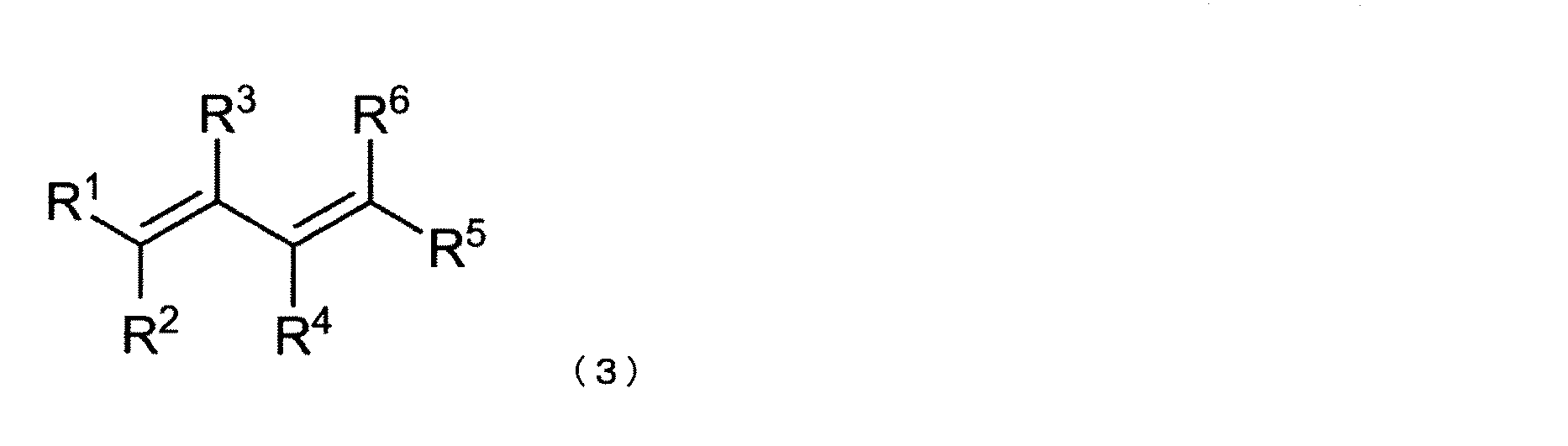
本発明者らは検討の結果、欠陥蛍石型結晶構造又はパイロクロア型結晶構造を本質的に有する複合金属酸化物を第一脱水触媒として、一般式(1)で示されるジオール化合物から一般式(2)−1及び一般式(2)−2で示される不飽和アルコールを製造する第一脱水工程、及び第二脱水触媒の存在下、前記二種の不飽和アルコールの脱水反応を同時に行い、一般式(3)で示されるジエン化合物を製造する第二脱水工程を実施することにより、原料としての再使用が不可能な副生物(不純物)の生成が少なく、対応するジエン化合物を非常に高い選択率で製造できることを見いだし、本発明を完成させるに至った。
すなわち本発明は以下の[1]〜[14]に関する。
[1]少なくとも以下の2工程を含むことを特徴とするジエン化合物の製造方法。
(I)欠陥蛍石型結晶構造又はパイロクロア型結晶構造を有する複合金属酸化物を触媒として、一般式(1)で示されるジオール化合物から一般式(2)−1及び一般式(2)−2で示される不飽和アルコールを製造する第一脱水工程
(II)脱水触媒の存在下、前記一般式(2)−1及び一般式(2)−2で示される不飽和アルコールの脱水反応を同時に行い、一般式(3)で示されるジエン化合物を製造する第二脱水工程
[2]第一脱水工程で用いる複合金属酸化物がパイロクロア型の結晶構造を有する[1]に記載のジエン化合物の製造方法。
[3]第一脱水工程で用いる複合金属酸化物が欠陥蛍石型の結晶構造を有する[1]に記載のジエン化合物の製造方法。
[4]第一脱水工程で用いる複合金属酸化物が、一般式(6)
A2−xB2O7−σ (6)
(式中、Aは第2族又は第3族の金属を示し、Bは第4族又は第5族の金属を示し、xは結晶構造の転相を起こさない範囲での任意の数値であり、σ=A金属のイオンの価数×x/2である。)
で示され、Aがスカンジウム、イットリウム、ネオジム、イッテルビウム、ガドリニウム、及びサマリウムからなる群より選ばれる少なくとも一種であり、Bがチタン、ジルコニウム、及びハフニウムからなる群より選ばれる少なくとも一種であり、xが、−0.05<x<1.0の範囲の数値である[1]に記載のジエン化合物の製造方法。
[5]一般式(6)において、Aがイットリウム、Bがジルコニウムである[4]に記載のジエン化合物の製造方法。
[6]第二脱水工程で用いる脱水触媒が金属リン酸塩、金属縮合リン酸塩、金属硫酸塩、金属塩酸塩、典型金属の酸化物、及び無機酸からなる群より選ばれる少なくとも一種である[1]〜[5]のいずれかに記載のジエン化合物の製造方法。
[7]前記金属リン酸塩、金属縮合リン酸塩、金属硫酸塩、又は金属塩酸塩の金属がアルカリ金属、アルカリ土類金属、チタン、ジルコニウム、ハフニウム、ニオブ、タンタル、アルミニウム、ホウ素、及びスズからなる群より選ばれる少なくとも一種である[6]に記載のジエン化合物の製造方法。
[8]前記典型金属の金属酸化物がシリカ、アルミナ、マグネシア、チタニア、ジルコニア、ニオビア、シリカアルミナ、シリカマグネシア、及びゼオライトからなる群より選ばれる少なくとも一種である[6]に記載のジエン化合物の製造方法。
[9]第二脱水工程の前記脱水触媒が担体に担持された触媒である[6]〜[8]のいずれかに記載のジエン化合物の製造方法。
[10]一般式(1)のR1〜R6がすべて水素原子である[1]〜[9]のいずれかに記載のジエン化合物の製造方法。
[11]第一脱水工程における脱水副生物である式(7)で示されるγ,δ−不飽和アルコールの選択率が1.0%以下、脱水素副生物である式(8)−1〜(8)−4で示されるケトン・アルデヒド類の合計選択率が1.5%以下である[1]〜[10]のいずれかに記載のジエン化合物の製造方法。
[12]第一脱水工程における脱水副生物である式(7)で示されるγ,δ−不飽和アルコールの選択率が0.7%以下、脱水素副生物である式(8)−1〜(8)−4で示されるケトン・アルデヒド類の合計選択率が1.0%以下である[11]に記載のジエン化合物の製造方法。
[13]第二脱水工程において、第一脱水工程の副生物である式(7)で示されるγ,δ−不飽和アルコールと式(8)−1〜(8)−4で示されるケトン・アルデヒド類の含有量の合計が1.0質量%以下である、一般式(2)−1及び一般式(2)−2で示される不飽和アルコールを含む組成物を原料として用いることを特徴とする[11]又は[12]のいずれかに記載のジエン化合物の製造方法。
[14]第一脱水工程における反応生成物に未反応原料の除去のみを行って得られた組成物を第二脱水工程の反応原料として用いることを特徴とする[1]〜[13]のいずれかに記載のジエン化合物の製造方法。
That is, the present invention relates to the following [1] to [14].
[1] A method for producing a diene compound, which comprises at least the following two steps.
(I) Using a mixed metal oxide having a defective fluorite type crystal structure or a pyrochlore type crystal structure as a catalyst, the diol compound represented by the general formula (1) can be converted into the general formula (2) -1 and the general formula (2) -2. First dehydration step for producing unsaturated alcohol represented by
(II) In the presence of a dehydration catalyst, a dehydration reaction of the unsaturated alcohol represented by the general formula (2) -1 and the general formula (2) -2 is simultaneously performed to produce a diene compound represented by the general formula (3). Second dehydration step
[2] The method for producing a diene compound according to [1], wherein the mixed metal oxide used in the first dehydration step has a pyrochlore type crystal structure.
[3] The method for producing a diene compound according to [1], wherein the mixed metal oxide used in the first dehydration step has a defective fluorite type crystal structure.
[4] The complex metal oxide used in the first dehydration step has the general formula (6).
A 2-x B 2 O 7-σ (6)
(In the formula, A represents a Group 2 or Group 3 metal, B represents a Group 4 or Group 5 metal, and x is an arbitrary numerical value within the range where phase inversion of the crystal structure does not occur. , Σ = A metal ion valence × x / 2.)
, A is at least one selected from the group consisting of scandium, yttrium, neodymium, ytterbium, gadolinium, and samarium, B is at least one selected from the group consisting of titanium, zirconium, and hafnium, x is , -0.05 <x <1.0, the method for producing a diene compound according to [1].
[5] The method for producing a diene compound according to [4], wherein in the general formula (6), A is yttrium and B is zirconium.
[6] The dehydration catalyst used in the second dehydration step is at least one selected from the group consisting of metal phosphates, condensed metal phosphates, metal sulfates, metal hydrochlorides, oxides of typical metals, and inorganic acids. The method for producing the diene compound according to any one of [1] to [5].
[7] The metal of the metal phosphate, condensed metal phosphate, metal sulfate, or metal hydrochloride is an alkali metal, an alkaline earth metal, titanium, zirconium, hafnium, niobium, tantalum, aluminum, boron, or tin. The method for producing a diene compound according to [6], which is at least one selected from the group consisting of:
[8] The diene compound according to [6], wherein the metal oxide of the typical metal is at least one selected from the group consisting of silica, alumina, magnesia, titania, zirconia, niobia, silica-alumina, silica-magnesia, and zeolite. Production method.
[9] The method for producing a diene compound according to any one of [6] to [8], wherein the dehydration catalyst in the second dehydration step is a catalyst supported on a carrier.
[10] The method for producing a diene compound according to any one of [1] to [9], wherein R 1 to R 6 of the general formula (1) are all hydrogen atoms.
[11] Selectivity of γ, δ-unsaturated alcohol represented by formula (7), which is a dehydration byproduct in the first dehydration step, is 1.0% or less, and formula (8) -1 is a dehydrogenation byproduct. (8) -4 The method for producing a diene compound according to any one of [1] to [10], wherein the total selectivity of ketones / aldehydes is 1.5% or less.
[12] Selectivity of γ, δ-unsaturated alcohol represented by formula (7), which is a dehydration byproduct in the first dehydration step, is 0.7% or less, and formula (8) -1 is a dehydrogenation byproduct. (8) -4 The method for producing a diene compound according to [11], wherein the total selectivity of ketones / aldehydes is 1.0% or less.
[13] In the second dehydration step, a γ, δ-unsaturated alcohol represented by the formula (7), which is a by-product of the first dehydration step, and a ketone represented by the formulas (8) -1 to (8) -4: A composition containing an unsaturated alcohol represented by the general formula (2) -1 and the general formula (2) -2 having a total content of aldehydes of 1.0% by mass or less is used as a raw material. The method for producing a diene compound according to any one of [11] or [12].
[14] Any one of [1] to [13], characterized in that the composition obtained by only removing unreacted raw materials from the reaction product in the first dehydration step is used as the reaction raw material in the second dehydration step. A method for producing a diene compound according to item 1.
本発明によれば、未反応の原料を蒸留等により分離回収して、再度反応原料として使用する際、原料としての再使用が不可能であるか分離が困難である副生物(不純物)の生成が少ないため、原料の無駄が少なく、目的とするジエン化合物を高効率で製造することができる。 According to the present invention, when an unreacted raw material is separated and recovered by distillation or the like and is reused as a reaction raw material, a by-product (impurity) that cannot be reused as a raw material or is difficult to separate Since the amount is small, the waste of raw materials is small and the target diene compound can be produced with high efficiency.
本発明は少なくとも以下の2工程を含む。 The present invention includes at least the following two steps.
(I)第一脱水工程
欠陥蛍石型結晶構造又はパイロクロア型結晶構造を有する複合金属酸化物を触媒として、一般式(1)で示されるジオール化合物から一般式(2)−1及び一般式(2)−2で示される不飽和アルコールを製造する第一脱水工程(反応式(4))
(I)第二脱水工程
脱水触媒(第二脱水触媒)の存在下、一般式(2)−1及び(2)−2で示される不飽和アルコールの脱水反応により一般式(3)で示されるジエン化合物を製造する第二脱水工程(反応式(5))
炭素数1〜5のアルキル基としてはメチル基、エチル基、プロピル基、イソプロピル基、ブチル基、イソブチル基、tert−ブチル基、ペンチル基等の直鎖又は分岐のアルキル基が挙げられる。炭素数6〜12のアリール基としては、フェニル基、トリル基、メシチル基、ナフチル基等が挙げられる。R1〜R6はそれぞれ独立に、水素原子、又は炭素数1〜5のアルキル基であることが好ましく、得られる共役ジエン化合物の有用性から水素原子であることがより好ましい。R1〜R6は互いに同じであっても、異なっていてもよいが、すべて水素原子であることが最も好ましい。 Examples of the alkyl group having 1 to 5 carbon atoms include linear or branched alkyl groups such as methyl group, ethyl group, propyl group, isopropyl group, butyl group, isobutyl group, tert-butyl group, pentyl group and the like. Examples of the aryl group having 6 to 12 carbon atoms include phenyl group, tolyl group, mesityl group and naphthyl group. R 1 to R 6 are preferably each independently a hydrogen atom or an alkyl group having 1 to 5 carbon atoms, and more preferably a hydrogen atom from the usefulness of the resulting conjugated diene compound. R 1 to R 6 may be the same as or different from each other, but most preferably all are hydrogen atoms.
<第一脱水工程>
第一脱水工程で触媒として用いられる複合金属酸化物は、欠陥蛍石型結晶構造又はパイロクロア型の結晶構造を本質的に有する。
<First dehydration step>
The mixed metal oxide used as a catalyst in the first dehydration step essentially has a defective fluorite crystal structure or a pyrochlore crystal structure.
パイロクロア型結晶構造及び欠陥蛍石型結晶構造のいずれも、その組成は以下の一般式(6)で示される。
A2−xB2O7−σ (6)
(式中、Aは第2族又は第3族の金属を示し、Bは第4族又は第5族の金属を示し、xは結晶構造の転相を起こさない範囲での任意の数値であり、σ=A金属のイオンの価数×x/2である。)
The composition of both the pyrochlore type crystal structure and the defective fluorite type crystal structure is represented by the following general formula (6).
A 2-x B 2 O 7-σ (6)
(In the formula, A represents a Group 2 or Group 3 metal, B represents a Group 4 or Group 5 metal, and x is an arbitrary numerical value within the range where phase inversion of the crystal structure does not occur. , Σ = A metal ion valence × x / 2.)
パイロクロア型結晶構造は、陰イオンが不足している面心立方格子の蛍石型結晶構造と見做され、A金属イオンは8配位、B金属イオンは6配位サイトに位置し、A金属イオンはB金属イオンよりも大きなイオン半径を有するという結晶学的特徴をもっている。欠陥蛍石型結晶構造は、パイロクロア型結晶構造と蛍石型結晶構造の中間の構造を示す。パイロクロア型と欠陥蛍石型の結晶構造は良く似通っており、結晶格子内の酸素サイトの充填率のみが異なると考えられる。 The pyrochlore type crystal structure is regarded as a face-centered cubic fluorite type crystal structure lacking anions, where the A metal ion is located at the 8-coordinate and the B metal ion is located at the 6-coordinated site. Ions have the crystallographic feature that they have a larger ionic radius than the B metal ions. The defective fluorite type crystal structure indicates a structure intermediate between the pyrochlore type crystal structure and the fluorite type crystal structure. The crystal structures of the pyrochlore type and the defect fluorite type are very similar, and it is considered that only the filling rate of oxygen sites in the crystal lattice is different.
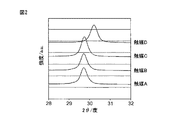
パイロクロア型結晶構造及び欠陥蛍石型結晶構造は、X線回折パターンから判断することができるが、これら二つの回折パターンはほぼ同一のパターンであるため、区別することが難しい。一般的には、PDF(Powder Diffraction Database)と比較することで結晶構造を決定することができる。たとえば、La2Zr2O7においてパイロクロア型結晶構造と欠陥蛍石型結晶構造を区別する場合、2θ=35〜50°の間に、(331)、(511)面に帰属される回折ピークがわずかにでも存在していれば、パイロクロア型結晶構造であることが確認できる。しかし、Y2Zr2O7においては、YとZrの原子散乱因子が同程度であるため、結晶構造の区別に利用できるピークが存在するかどうかは定かではなく、X線回折パターンのみからは一義的に判断できない。そのため、本開示においては、Y/Zrの値が0.9以上1.05以下であり、X線回折のメインピークの位置が29.7±0.2°であればパイロクロア構造であり、Y/Zrの値が0.5以上0.9未満であり、X線回折のメインピークの位置が29.7±0.2°であれば欠陥蛍石型結晶構造であると見做す。 The pyrochlore type crystal structure and the defective fluorite type crystal structure can be judged from the X-ray diffraction patterns, but since these two diffraction patterns are almost the same pattern, it is difficult to distinguish them. In general, the crystal structure can be determined by comparison with PDF (Powder Diffraction Database). For example, when distinguishing a pyrochlore type crystal structure and a defective fluorite type crystal structure in La 2 Zr 2 O 7 , diffraction peaks assigned to the (331) and (511) planes are observed between 2θ = 35 and 50 °. If it exists even slightly, it can be confirmed that it has a pyrochlore type crystal structure. However, in Y 2 Zr 2 O 7 , since the atomic scattering factors of Y and Zr are about the same, it is not clear whether or not there is a peak that can be used for distinguishing the crystal structures, and from the X-ray diffraction pattern alone I can't make a unique decision Therefore, in the present disclosure, if the value of Y / Zr is 0.9 or more and 1.05 or less and the position of the main peak of X-ray diffraction is 29.7 ± 0.2 °, the structure is a pyrochlore structure, and If the value of / Zr is 0.5 or more and less than 0.9 and the position of the main peak of X-ray diffraction is 29.7 ± 0.2 °, it is considered to be a defective fluorite crystal structure.
一般式(6)のAは第2族又は第3族の金属である。Aは、好ましくはマグネシウム、カルシウム、ストロンチウム、バリウム、及び希土類元素からなる群より選ばれる少なくとも一種である。希土類元素としてはスカンジウム、イットリウム、ランタン、セリウム、ネオジム、プラセオジウム、ガドリニウム、サマリウム、及びイッテルビウムが好ましい。副反応抑制の観点からは、適度な塩基性を有するという観点で、希土類元素からなる群から選択される少なくとも一種がより好ましい。さらに工業的な使用を考慮した場合、スカンジウム、イットリウム、ネオジム、イッテルビウム、ガドリニウム、及びサマリウムからなる群より選ばれる少なくとも一種がより好ましく、イットリウムが最も好ましい。 A in the general formula (6) is a Group 2 or Group 3 metal. A is preferably at least one selected from the group consisting of magnesium, calcium, strontium, barium, and rare earth elements. As rare earth elements, scandium, yttrium, lanthanum, cerium, neodymium, praseodymium, gadolinium, samarium, and ytterbium are preferable. From the viewpoint of suppressing side reactions, at least one selected from the group consisting of rare earth elements is more preferable from the viewpoint of having an appropriate basicity. Further, in consideration of industrial use, at least one selected from the group consisting of scandium, yttrium, neodymium, ytterbium, gadolinium, and samarium is more preferable, and yttrium is most preferable.
一般式(6)のBは第4族又は第5族の金属である。Bは、好ましくは、ニオブ、タンタル、チタン、ジルコニウム、及びハフニウムからなる群より選ばれる少なくとも一種である。副反応抑制の観点からは、適度な酸性を有するチタン、ジルコニウム、及びハフニウムからなる群より選択される少なくとも一種がより好ましい。金属イオンの安定性から、チタン、及びジルコニウムからなる群より選択される少なくとも一種がより好ましく、ジルコニウムが最も好ましい。 B in the general formula (6) is a metal of Group 4 or Group 5. B is preferably at least one selected from the group consisting of niobium, tantalum, titanium, zirconium, and hafnium. From the viewpoint of suppressing side reactions, at least one selected from the group consisting of titanium, zirconium, and hafnium having appropriate acidity is more preferable. From the stability of metal ions, at least one selected from the group consisting of titanium and zirconium is more preferable, and zirconium is most preferable.
触媒の調製時に、A金属及びB金属の単純酸化物や、別種の結晶構造を持った複合酸化物が混入することもある。これらの単純酸化物及び複合酸化物の合計混入量がX線回折のメインピーク強度比で20分の1以下となる量であれば、通常化学組成比への影響は無視できるほど小さい。そのため、そのような量の単純酸化物及び複合酸化物が混入した複合金属酸化物も本質的に欠陥蛍石型又はパイロクロア型の結晶構造を有する本発明の触媒と見做すことができる。 At the time of preparing the catalyst, a simple oxide of A metal and B metal or a composite oxide having a different crystal structure may be mixed. If the total amount of these simple oxides and complex oxides mixed is not more than 1/20 in the main peak intensity ratio of X-ray diffraction, the influence on the chemical composition ratio is usually negligible. Therefore, the complex metal oxide in which such an amount of the simple oxide and the complex oxide are mixed can be regarded as the catalyst of the present invention having an essentially defective fluorite type or pyrochlore type crystal structure.
一般式(6)のA金属イオンとB金属イオンのモル比を適切に調整することにより、第一脱水工程で求められる触媒性能を最大化させることができる。すなわち、一般式(2)−1及び(2)−2の化合物の選択率を向上させるとともに、望ましくない副生物の生成を抑えることができる。 By appropriately adjusting the molar ratio of the A metal ion and the B metal ion of the general formula (6), the catalytic performance required in the first dehydration step can be maximized. That is, it is possible to improve the selectivity of the compounds of the general formulas (2) -1 and (2) -2 and suppress the production of undesired by-products.
A金属及びB金属の組成比は、一般式(6):A2−xB2O7−σにおいて、xを−0.05<x<1.0の範囲となるように調整することができる。−0.05<x<0.7の範囲にすることが好ましく、−0.025<x<0.5の範囲にすることがより好ましい。xを−0.05<x<1.0の範囲にすることによって、A金属及びB金属由来の酸性度又は塩基性度を適切な値にすることができると考えられる。σは酸素欠陥量を示すが、その絶対量を実験で測定するのは容易ではない。金属の価数変動、金属欠陥、酸素欠陥などに伴って測定値に多少のばらつきがあるためである。 The composition ratio of A metals and B metals are of the general formula (6): A In 2-x B 2 O 7- σ, to adjust the x to be in the range -0.05 <x <1.0 in it can. The range of −0.05 <x <0.7 is preferable, and the range of −0.025 <x <0.5 is more preferable. It is considered that the acidity or basicity derived from the A metal and the B metal can be set to an appropriate value by setting x in the range of −0.05 <x <1.0. Although σ indicates the amount of oxygen defects, it is not easy to experimentally measure the absolute amount thereof. This is because there are some variations in the measured values due to variations in the valence of the metal, metal defects, oxygen defects, and the like.
A金属及びB金属の組成比は、蛍光X線、SEM−EDX、ICP等の元素分析により求めることができる。 The composition ratio of A metal and B metal can be determined by elemental analysis such as fluorescent X-ray, SEM-EDX, and ICP.
複合金属酸化物触媒のBET比表面積は2〜80m2/gの範囲であることが好ましく、3〜50m2/gであることがより好ましく、5〜30m2/gであることが特に好ましい。BET比表面積は2m2/g以上であることで、基質との接触を高めることができ活性を向上することができる。80m2/g以下であると粒子の結晶化に伴う、反応活性点が形成されるため、反応選択性を高めることができる。 Preferably the BET specific surface area of the composite metal oxide catalyst is in the range of 2~80m 2 / g, more preferably 3 to 50 m 2 / g, and particularly preferably 5 to 30 m 2 / g. When the BET specific surface area is 2 m 2 / g or more, contact with the substrate can be increased and activity can be improved. When it is 80 m 2 / g or less, reaction active points are formed due to crystallization of particles, so that the reaction selectivity can be enhanced.
<複合金属酸化物触媒の製造方法>
欠陥蛍石型又はパイロクロアの結晶構造を本質的に有する複合金属酸化物触媒を得る方法としては、固相法、メカニカルアロイング法、共沈法、ゾルゲル法、均一沈殿法、水熱合成法、錯体重合法などが挙げられる。それらの中でも、工業的に生産可能な固相法、共沈法、ゾルゲル法、又は水熱合成法を用いることが好ましい。高比表面積の触媒とするためには、低温で合成可能な水熱合成法、又は共沈法を用いることがより好ましい。
<Method for producing mixed metal oxide catalyst>
As a method for obtaining a composite metal oxide catalyst having essentially a defective fluorite type or pyrochlore crystal structure, a solid phase method, a mechanical alloying method, a coprecipitation method, a sol-gel method, a uniform precipitation method, a hydrothermal synthesis method, A complex polymerization method and the like can be mentioned. Among them, it is preferable to use the industrially producible solid phase method, coprecipitation method, sol-gel method, or hydrothermal synthesis method. In order to obtain a catalyst having a high specific surface area, it is more preferable to use a hydrothermal synthesis method that can be synthesized at a low temperature or a coprecipitation method.
水熱合成法の一例では、A金属の塩及びB金属の塩の水溶液を作製し、アルカリ化合物(アンモニアなど)を加えてpHを9.2以上に調整する。これより各金属イオンが共沈して、アモルファス状の混合ゾルとなる。このゾルをポリテトラフルオロエチレン製内筒管のオートクレーブ容器に入れ、180℃、48時間で水熱合成して固体の欠陥蛍石型又はパイロクロア型の結晶構造の触媒前駆体を得る。これを粉砕し、空気雰囲気中、900〜1300℃、1〜10時間焼成する。焼成前触媒の形態は粉末状でもよくペレット状でもよい。A金属塩とB金属塩は上記操作によって、ほぼすべてが回収されると考えられることから、原料の仕込みのモル比によって、一般式(6):A2−xB2O7−σのX及びσを制御する。 In one example of the hydrothermal synthesis method, an aqueous solution of a metal A salt and a metal B salt is prepared, and an alkaline compound (such as ammonia) is added to adjust the pH to 9.2 or more. From this, each metal ion co-precipitates and becomes an amorphous mixed sol. This sol is placed in an autoclave container having a polytetrafluoroethylene inner tube and hydrothermally synthesized at 180 ° C. for 48 hours to obtain a solid catalyst precursor having a defective fluorite-type or pyrochlore-type crystal structure. This is crushed and baked in an air atmosphere at 900 to 1300 ° C. for 1 to 10 hours. The catalyst before calcination may be in the form of powder or pellets. A metal salt and B metal salt by the operation, almost all since it is considered to be recovered, by the molar ratio of the feed of the raw materials, the general formula (6): X of A 2-x B 2 O 7 -σ And σ are controlled.
共沈法の一例では、B金属の水酸化物のゾル溶液にA金属塩の水溶液を加え、アルカリ化合物(アンモニアなど)の水溶液に滴下する。これよりB金属の水酸化物の表面にA金属イオンが担持され、アモルファス状の混合ゾルとなる。このゾルを固液分離及び乾燥して触媒前駆体を得る。これを粉砕し、空気雰囲気中、900〜1300℃、1〜10時間焼成する。焼成前触媒の形態は粉末状でもよくペレット状でもよい。A金属塩とB金属の水酸化物は上記操作によって、ほぼすべてが回収されると考えられることから、原料の仕込みのモル比によって、一般式(6):A2−xB2O7−σのX及びσを制御する。 In an example of the coprecipitation method, an aqueous solution of a metal salt of A is added to a sol solution of a hydroxide of metal B, and the solution is added dropwise to an aqueous solution of an alkali compound (such as ammonia). As a result, the metal A ions are carried on the surface of the metal B hydroxide to form an amorphous mixed sol. This sol is solid-liquid separated and dried to obtain a catalyst precursor. This is crushed and baked in an air atmosphere at 900 to 1300 ° C. for 1 to 10 hours. The catalyst before calcination may be in the form of powder or pellets. It is considered that almost all of the A metal salt and the B metal hydroxide are recovered by the above-mentioned operation. Therefore, depending on the molar ratio of the raw material charged, the compound represented by the general formula (6): A 2-x B 2 O 7- controls the X and sigma of sigma.
A金属として、マグネシウム、カルシウム、ストロンチウム、バリウムなどのアルカリ土類金属を用いる場合には、塩基性、中性、及び酸性塩のいずれを用いてもよい。具体的には、酸化マグネシウム、塩化マグネシウム、硝酸マグネシウム、硫酸マグネシウム、炭酸カルシウム、塩化カルシウム、硝酸カルシウム、硫酸カルシウム、炭酸ストロンチウム、塩化ストロンチウム、硝酸ストロンチウム、硫酸ストロンチウム、炭酸バリウム、塩化バリウム、硝酸バリウム、硫酸バリウムなどが挙げられる。 When an alkaline earth metal such as magnesium, calcium, strontium or barium is used as the metal A, any of a basic salt, a neutral salt and an acidic salt may be used. Specifically, magnesium oxide, magnesium chloride, magnesium nitrate, magnesium sulfate, calcium carbonate, calcium chloride, calcium nitrate, calcium sulfate, strontium carbonate, strontium chloride, strontium nitrate, strontium sulfate, barium carbonate, barium chloride, barium nitrate, Examples include barium sulfate.
A金属として、スカンジウム、イットリウムなどの希土類元素を用いる場合には、塩基性、中性、及び酸性塩のいずれを用いてもよい。具体的には、酸化ランタン、水酸化ランタン、塩化ランタン、硝酸ランタン、硝酸イットリウム、硝酸イッテルビウムなどが挙げられる。 When a rare earth element such as scandium or yttrium is used as the A metal, any of a basic salt, a neutral salt and an acidic salt may be used. Specific examples thereof include lanthanum oxide, lanthanum hydroxide, lanthanum chloride, lanthanum nitrate, yttrium nitrate, and ytterbium nitrate.
B金属として、ニオブ、タンタル、チタン、ジルコニウム、又はハフニウムを用いる場合には、塩基性、中性、及び酸性塩のいずれを用いてもよい。具体的には、酸化ニオブ、塩化ニオブ、ペンタエトキシニオブ、酸化タンタル、塩化タンタル、ペンタエトキシタンタル、酸化チタン、塩化チタン、シュウ酸チタン、チタンイソプロポキシド、酸化ジルコニウム、水酸化ジルコニウム、オキシ塩化ジルコニウム、オキシ硝酸ジルコニウムなどが挙げられる。 When niobium, tantalum, titanium, zirconium, or hafnium is used as the B metal, any of a basic salt, a neutral salt, and an acidic salt may be used. Specifically, niobium oxide, niobium chloride, pentaethoxyniobium, tantalum oxide, tantalum chloride, pentaethoxytantalum, titanium oxide, titanium chloride, titanium oxalate, titanium isopropoxide, zirconium oxide, zirconium hydroxide, zirconium oxychloride. , Zirconium oxynitrate and the like.
上記のA金属及びB金属の水溶性塩を用いて、水熱合成法又は共沈法を行う場合、pH調整剤又は鉱化剤として、水酸化ナトリウム水溶液、水酸化カリウム水溶液、水酸化カルシウム水溶液、石灰水、炭酸ナトリウム水溶液、アンモニア水溶液、トリエチルアミン水溶液、ピリジン水溶液、エチレンジアミン水溶液、炭酸水素ナトリウム水溶液などの塩基性水溶液を用いることができる。触媒活性低下の原因となる不純物の除去性を考慮すると、アンモニア水溶液又はトリエチルアミン水溶液を用いることが好ましい。 When a hydrothermal synthesis method or a coprecipitation method is performed using the above water-soluble salts of metal A and metal B, a sodium hydroxide aqueous solution, a potassium hydroxide aqueous solution, a calcium hydroxide aqueous solution is used as a pH adjusting agent or a mineralizing agent. A basic aqueous solution such as lime water, sodium carbonate aqueous solution, ammonia aqueous solution, triethylamine aqueous solution, pyridine aqueous solution, ethylenediamine aqueous solution, and sodium hydrogen carbonate aqueous solution can be used. Considering the removability of impurities that cause a decrease in catalyst activity, it is preferable to use an aqueous ammonia solution or an aqueous triethylamine solution.
水熱合成法では、A金属の塩及びB金属の塩の水溶液をアルカリでpH9.0〜10.5に調整することで不溶性のアモルファス状水酸化物塩を含んだゾル溶液を得ることができる。各金属塩の濃度は0.01〜0.5mol/Lであることが好ましい。得られたゾル溶液に対してオートクレーブにて水熱処理を行う。容器の内量に対するゾル溶液の容量の比は30〜80%であることが好ましい。水熱処理温度は120〜230℃であることが好ましく、処理時間は3〜60時間であることが好ましい。このような水熱合成条件により、カチオン及びアニオン欠陥を含んだ、触媒前駆体X(低結晶性A2−xB2O7−σ)を得ることができる。 In the hydrothermal synthesis method, a sol solution containing an insoluble amorphous hydroxide salt can be obtained by adjusting the pH of an aqueous solution of a metal A salt and a metal B salt with alkali to 9.0 to 10.5. . The concentration of each metal salt is preferably 0.01 to 0.5 mol / L. The obtained sol solution is hydrothermally treated in an autoclave. The ratio of the volume of the sol solution to the inner amount of the container is preferably 30 to 80%. The hydrothermal treatment temperature is preferably 120 to 230 ° C., and the treatment time is preferably 3 to 60 hours. Such hydrothermal synthesis conditions, including cation and anion defect, it is possible to obtain a catalyst precursor X (low crystalline A 2-x B 2 O 7 -σ).
共沈法では、B金属の水酸化物のゾル溶液にA金属塩の水溶液を加えた溶液を、アルカリ化合物(アンモニアなど)の水溶液に滴下し、最終的にpH9.2以上の混合溶液とする。これよりB金属の水酸化物の表面にA金属イオンが担持され、A金属イオンとB金属イオンが入り交ざった、アモルファス状の水酸化物混合物(A(OH)3/B(OH)4・nH2O)の形態で触媒前駆体Yを得ることができる。各金属塩の濃度は0.01〜0.5mol/Lであることが好ましい。溶液を混合する時の溶液の温度は、10〜100℃、撹拌時間は5〜600分であることが好ましい。滴下速度は、0.1〜100g/分であることが好ましい。 In the coprecipitation method, a solution obtained by adding an aqueous solution of A metal salt to a sol solution of B metal hydroxide is dropped into an aqueous solution of an alkaline compound (ammonia or the like) to finally obtain a mixed solution having a pH of 9.2 or more. . From this, an amorphous hydroxide mixture (A (OH) 3 / B (OH) 4. ) In which A metal ions are carried on the surface of the B metal hydroxide and A metal ions and B metal ions are intermingled The catalyst precursor Y can be obtained in the form of (nH 2 O). The concentration of each metal salt is preferably 0.01 to 0.5 mol / L. The temperature of the solution when mixing the solutions is preferably 10 to 100 ° C., and the stirring time is preferably 5 to 600 minutes. The dropping rate is preferably 0.1 to 100 g / min.
得られた触媒前駆体X又はYに焼成処理を行う。焼成により結晶化が進行し、かつ結晶性が向上し、パイロクロア型又は欠陥蛍石型の結晶構造を生成することができる。 The obtained catalyst precursor X or Y is calcined. Crystallization proceeds by firing and crystallinity is improved, and a pyrochlore type or defective fluorite type crystal structure can be generated.
触媒前駆体の焼成は結晶性を向上させるために、600℃以上の温度で行うことが好ましい。上限温度に特に制限はないが、1400℃を超えると触媒表面積が維持できないおそれがあるため、1300℃以下であることが好ましい。特に好ましい焼成温度は700〜1200℃の範囲であり、さらに好ましくは900〜1100℃の範囲である。 The firing of the catalyst precursor is preferably carried out at a temperature of 600 ° C. or higher in order to improve the crystallinity. The upper limit temperature is not particularly limited, but if it exceeds 1400 ° C, the catalyst surface area may not be maintained, so 1300 ° C or less is preferable. A particularly preferable firing temperature is in the range of 700 to 1200 ° C, and more preferably 900 to 1100 ° C.
焼成時間は、1〜30時間であることが結晶成長の面で好ましく、3〜10時間であることがより好ましい。 The firing time is preferably 1 to 30 hours from the viewpoint of crystal growth, and more preferably 3 to 10 hours.
焼成時の雰囲気に制約はないが、特に空気雰囲気で行うことが好ましい。 There is no restriction on the atmosphere during firing, but it is particularly preferable to carry out in an air atmosphere.
焼成の前に仮焼成を行ってもよい。仮焼成は触媒成形時のハンドリング性を向上させるために行う。仮焼成の条件は120℃以上の温度で行うことが好ましい。上限温度に特に制限はないが、800℃を超えると触媒成形体の強度が低下するおそれがあるため、700℃以下であることが好ましい。特に好ましい仮焼成温度は200〜600℃の範囲であり、さらに好ましくは300〜500℃の範囲である。焼成時間は、1〜30時間であることが焼きムラをなくす面で好ましく、3〜10時間であることがより好ましい。 Pre-baking may be performed before baking. The calcination is performed to improve the handling property during catalyst molding. The calcination condition is preferably performed at a temperature of 120 ° C. or higher. The upper limit temperature is not particularly limited, but if it exceeds 800 ° C., the strength of the catalyst molded body may decrease, so it is preferably 700 ° C. or less. Particularly preferable calcination temperature is in the range of 200 to 600 ° C, and more preferably in the range of 300 to 500 ° C. The firing time is preferably from 1 to 30 hours, and more preferably from 3 to 10 hours in terms of eliminating unevenness in firing.
本発明の触媒の形状はそれぞれ独立した粒子であってもよいし、粒子を固めてペレットとしてもよい。反応器への充填などハンドリングの観点からはペレットが好ましい。触媒は本発明の反応に不活性な担体に担持されたものであってもよい。担体の例としてはシリカ、アルミナ、チタニア、ジルコニア、シリカアルミナ、ゼオライト、活性炭、グラファイトなどが挙げられるが、特に限定はされない。 The shape of the catalyst of the present invention may be independent particles, or the particles may be solidified into pellets. From the viewpoint of handling such as filling the reactor, pellets are preferred. The catalyst may be supported on a carrier inert to the reaction of the present invention. Examples of the carrier include silica, alumina, titania, zirconia, silica-alumina, zeolite, activated carbon and graphite, but are not particularly limited.
<第一脱水工程の反応>
第一脱水工程で使用される反応装置は連続式の気相流通反応装置が好適である。触媒は固定床又は流動床のいずれの方式でもよく、特にメンテナンスの面などから固定床が望ましい。
<Reaction of the first dehydration step>
A continuous gas phase flow reactor is suitable as the reactor used in the first dehydration step. The catalyst may be either a fixed bed or a fluidized bed, and the fixed bed is particularly preferable from the viewpoint of maintenance.
反応装置の一例として上部に反応原料であるジオールの気化器を備えた直管型反応器が挙げられる。反応器に触媒を充填し、原料のジオールを気化器で蒸発させて生じた原料ストリームを反応器に導入する。反応器下部の熱交換器で反応生成物を冷却し、目的の不飽和アルコールと未反応の原料を回収する。原料濃度を調節して副反応を抑制するため、気化した原料ジオールを窒素ガス、水蒸気などの不活性ガスで希釈して反応に供してもよい。 As an example of the reaction apparatus, a straight tube type reactor having a vaporizer of diol as a reaction raw material on its upper part can be mentioned. The catalyst is charged into the reactor, and the raw material diol produced by vaporizing the raw material diol in the vaporizer is introduced into the reactor. The reaction product is cooled by a heat exchanger at the bottom of the reactor, and the target unsaturated alcohol and unreacted raw materials are recovered. In order to control the concentration of the raw material and suppress the side reaction, the vaporized raw material diol may be diluted with an inert gas such as nitrogen gas or steam before being used for the reaction.
第一脱水工程の反応温度は250〜400℃の範囲が適している。250℃以上であると、反応が速やかに進む。400℃以下とすると副反応による選択率低下の影響が小さくなる。より好ましい温度範囲は300〜350℃である。 The reaction temperature of the first dehydration step is suitably in the range of 250 to 400 ° C. If the temperature is 250 ° C or higher, the reaction proceeds rapidly. When the temperature is 400 ° C. or less, the influence of the decrease in selectivity due to side reaction becomes small. A more preferable temperature range is 300 to 350 ° C.
直管型反応器において、触媒充填容積当たりのジオールの導入量は0.1〜30kg/(h・L−cat)の範囲とすることができ、好ましくは0.2〜20kg/(h・L−cat)であり、最も好ましくは0.5〜15kg/(h・L−cat)である。導入量が、0.1kg/(h・L−cat)以上であれば、十分な生産量を得ることができる。30kg/(h・L−cat)以下であれば、未反応の原料が増加することなく、分離及び精製に労力が少なくて済む他、原料からの副反応も抑えることができる。 In a straight tube reactor, the amount of diol introduced per catalyst filling volume can be in the range of 0.1 to 30 kg / (h · L-cat), preferably 0.2 to 20 kg / (h · L). -Cat), and most preferably 0.5 to 15 kg / (hL-cat). If the introduction amount is 0.1 kg / (h · L-cat) or more, a sufficient production amount can be obtained. When the amount is 30 kg / (h · L-cat) or less, the amount of unreacted raw material does not increase, labor for separation and purification is small, and side reactions from the raw material can be suppressed.
第一脱水工程における主な副生物は、脱水副生物である式(7)で示されるγ,δ−不飽和アルコールと、脱水素副生物である式(8)−1〜4で示されるケトン・アルデヒド類(それぞれ一般式(1)においてR3又はR5=Hの場合に限る。)である。γ,δ−不飽和アルコールは続く第二脱水工程において、一部が逆プリンス反応によりアルデヒド類へと変換されることで、プロセス全体の収率低下を招く。また、ケトン・アルデヒド類は重合活性が高く、触媒上に沈着することにより触媒の失活を促進させるほか、副反応生成物として目的のジエン化合物の精製を困難にするおそれがある。
第二脱水工程での副生物の発生を低減するためには第一脱水工程におけるγ,δ−不飽和アルコールの選択率は1.0%以下、ケトン・アルデヒド類の合計選択率は1.5%以下とすることが好ましく、γ,δ−不飽和アルコールの選択率は0.7%以下、ケトン・アルデヒド類の合計選択率は1.0%以下であることが更に好ましい。 In order to reduce the generation of by-products in the second dehydration step, the selectivity of γ, δ-unsaturated alcohol in the first dehydration step is 1.0% or less, and the total selectivity of ketones / aldehydes is 1.5%. % Or less, the selectivity of γ, δ-unsaturated alcohol is 0.7% or less, and the total selectivity of ketone / aldehyde is more preferably 1.0% or less.
<第二脱水工程>
本発明の第一脱水工程で使用する触媒は、前記不純物であるγ,δ−不飽和アルコール又はケトン・アルデヒド類の生成が少ないので、第一脱水工程において得られた不飽和アルコールを含む反応生成物に未反応原料(ジオール化合物)の除去のみを行って得られた組成物をそのまま第二脱水工程の反応原料として使用することが可能である。さらに反応生成物の精製を行い、不飽和アルコール中の不純物の一部乃至全部を除いた後に第二脱水工程に使用することもできる。精製方法としては、蒸留、再結晶、その他の一般的な精製方法を適用することができる。この時点で副生物を除去しておくことにより、続く第二脱水工程における反応性の改善、不純物の少ない高品位なジエン化合物の取得などが可能となる。第二脱水工程においては、第一脱水工程の副生物である前記式(7)で示されるγ,δ−不飽和アルコールと前記式(8)−1〜(8)−4で示されるケトン・アルデヒド類の含有量の合計が1.0質量%以下である、一般式(2)−1及び一般式(2)−2で示される不飽和アルコールを含む組成物を原料として用いることが好ましい。前記副生物の合計含有量は0.6質量%以下であることがより好ましい。
<Second dehydration step>
Since the catalyst used in the first dehydration step of the present invention produces less γ, δ-unsaturated alcohols or ketones / aldehydes, which are the impurities, the reaction product containing the unsaturated alcohol obtained in the first dehydration step. The composition obtained by only removing the unreacted raw material (diol compound) can be used as it is as the reaction raw material in the second dehydration step. The reaction product may be further purified to remove some or all of the impurities in the unsaturated alcohol and then used in the second dehydration step. As the purification method, distillation, recrystallization, and other general purification methods can be applied. By removing the by-product at this point, it becomes possible to improve the reactivity in the subsequent second dehydration step and obtain a high-quality diene compound containing few impurities. In the second dehydration step, the γ, δ-unsaturated alcohol represented by the formula (7), which is a by-product of the first dehydration step, and the ketone represented by the formulas (8) -1 to (8) -4, It is preferable to use, as a raw material, a composition containing an unsaturated alcohol represented by the general formula (2) -1 and the general formula (2) -2, in which the total content of aldehydes is 1.0% by mass or less. More preferably, the total content of the by-products is 0.6% by mass or less.
第二脱水工程で使用する脱水触媒(第二脱水触媒)は、原料となる一般式(2)−1及び(2)−2で示される不飽和アルコールの脱水能力を示すものであれば特に限定されない。例えば金属リン酸塩、金属縮合リン酸塩、金属硫酸塩、金属塩酸塩、典型金属の酸化物、無機酸などが挙げられる。これらの触媒は単独で使用してもよく、併用してもよい。触媒を担体に担持して使用してもよい。例えば、脱水触媒の形状保持性が低い場合には、担体に担持させた触媒を脱水触媒として有利に使用することができる。 The dehydration catalyst (second dehydration catalyst) used in the second dehydration step is particularly limited as long as it exhibits the dehydration ability of the unsaturated alcohols represented by the general formulas (2) -1 and (2) -2 as the raw materials. Not done. Examples thereof include metal phosphates, metal condensed phosphates, metal sulfates, metal hydrochlorides, typical metal oxides, and inorganic acids. These catalysts may be used alone or in combination. The catalyst may be supported on a carrier before use. For example, when the dehydration catalyst has a low shape-retaining property, the catalyst supported on the carrier can be advantageously used as the dehydration catalyst.
担体の例としてはシリカ、アルミナ、チタニア、ジルコニア、シリカアルミナ、ゼオライト、活性炭、グラファイトなどが挙げられるが、特に限定はされない。ここで担体は活性、反応選択性、温度応答性などのいずれか一つ以上の観点から、担持される触媒とは区別可能なものである。なお、後述のようにシリカアルミナなどは担体としてではなく、脱水触媒そのものとしての使用も可能である。 Examples of the carrier include silica, alumina, titania, zirconia, silica-alumina, zeolite, activated carbon and graphite, but are not particularly limited. Here, the carrier is distinguishable from the supported catalyst in terms of at least one of activity, reaction selectivity, temperature responsiveness and the like. Note that, as will be described later, silica alumina or the like can be used not as a carrier but as a dehydration catalyst itself.
金属リン酸塩、金属縮合リン酸塩、金属硫酸塩、及び金属塩酸塩の金属としては、アルカリ金属、アルカリ土類金属、チタン、ジルコニウム、ハフニウム、ニオブ、タンタル、アルミニウム、ホウ素、スズなどが挙げられる。これら金属の中ではナトリウム、マグネシウム、及びアルミニウムが好ましい。 Examples of the metal of the metal phosphate, condensed metal phosphate, metal sulfate, and metal hydrochloride include alkali metal, alkaline earth metal, titanium, zirconium, hafnium, niobium, tantalum, aluminum, boron, tin, and the like. To be Among these metals, sodium, magnesium and aluminum are preferable.
典型金属の酸化物としては、シリカ、アルミナ、マグネシア、チタニア、ジルコニア、ニオビア、シリカアルミナ、シリカマグネシア、ゼオライトなどが挙げられる。 Examples of typical metal oxides include silica, alumina, magnesia, titania, zirconia, niobia, silica alumina, silica magnesia, and zeolite.
無機酸としては、硫酸、硝酸、塩酸、リン酸などが挙げられる。 Examples of the inorganic acid include sulfuric acid, nitric acid, hydrochloric acid, phosphoric acid and the like.
第二脱水工程で使用する触媒としては、目的のジエン選択率が高いことから、硫酸マグネシウム、リン酸アルミニウム、ポリリン酸ナトリウム、シリカアルミナ、及びゼオライトが好ましく、選択率の観点からシリカアルミナ、及びゼオライトがより好ましい。 As the catalyst used in the second dehydration step, since the target diene selectivity is high, magnesium sulfate, aluminum phosphate, sodium polyphosphate, silica alumina, and zeolite are preferable, and silica alumina from the viewpoint of selectivity, and zeolite. Is more preferable.
第二脱水工程で使用する反応装置は第一脱水工程と同様に連続式の気相流通反応装置が好適である。触媒は固定床又は流動床のいずれの方式でもよく、特にメンテナンスの面などから固定床が望ましい。 As the reactor used in the second dehydration step, a continuous gas phase flow reactor is suitable as in the first dehydration step. The catalyst may be either a fixed bed or a fluidized bed, and the fixed bed is particularly preferable from the viewpoint of maintenance.
反応装置の一例として上部に原料となる不飽和アルコールの気化器を備えた直管型反応器が挙げられる。反応器に触媒を充填し、原料の不飽和アルコールを気化器で蒸発させて生じた原料ストリームを反応器に導入する。反応器下部の熱交換器で反応生成物を冷却し、目的のジエン化合物と未反応の原料を回収する。副反応を抑制するため、気化した原料不飽和アルコールを窒素ガス、水蒸気などの不活性ガスで希釈して反応に供してもよい。 As an example of the reaction device, there is a straight tube type reactor having a vaporizer of unsaturated alcohol as a raw material on the upper part. A reactor is filled with a catalyst, and a raw material stream produced by vaporizing an unsaturated alcohol as a raw material in a vaporizer is introduced into the reactor. The reaction product is cooled by the heat exchanger at the bottom of the reactor, and the target diene compound and the unreacted raw material are recovered. In order to suppress a side reaction, the vaporized raw material unsaturated alcohol may be diluted with an inert gas such as nitrogen gas or steam before being subjected to the reaction.
第二脱水工程の反応温度は200〜500℃の範囲が適している。反応温度は好ましくは250〜400℃である。200℃以上であると、反応が速やかに進む。500℃以下とすると副反応による選択率低下の影響が小さくなる。 The reaction temperature of the second dehydration step is suitably in the range of 200 to 500 ° C. The reaction temperature is preferably 250 to 400 ° C. If the temperature is 200 ° C or higher, the reaction proceeds rapidly. When the temperature is 500 ° C. or lower, the influence of the decrease in selectivity due to side reaction becomes small.
触媒充填容積当たりの原料となる不飽和アルコールの導入量は0.05〜20kg/(h・L−cat)の範囲とすることができ、好ましくは0.1〜10kg/(h・L−cat)であり、最も好ましくは0.2〜5kg/(h・L−cat)である。導入量が、0.05kg/(h・L−cat)以上であれば、十分な生産量を得ることができる。20kg/(h・L−cat)以下であれば、未反応の原料が増加することなく、分離及び精製に労力が少なくて済む他、原料からの副反応も抑えることができる。 The amount of the unsaturated alcohol as the raw material introduced per the catalyst filling volume can be in the range of 0.05 to 20 kg / (h · L-cat), preferably 0.1 to 10 kg / (h · L-cat). ), And most preferably 0.2 to 5 kg / (h · L-cat). When the introduction amount is 0.05 kg / (h · L-cat) or more, a sufficient production amount can be obtained. If it is 20 kg / (h · L-cat) or less, the amount of unreacted raw material does not increase, the labor for separation and purification is small, and side reactions from the raw material can be suppressed.
不飽和アルコールを含む原料ストリームの触媒充填容積に対する空間速度[SV]は100〜40000h−1の範囲とすることができ、特に500〜10000h−1が好適である。空間速度が、100h−1以上であれば、接触時間が過度に増加しないため、不飽和アルコール原料及び生成したジエン化合物からの副生物の生成を抑えることができる。空間速度が40000h−1以下であれば、転化率が低くならず、未反応の原料が少なくなるため、未反応の原料の分離に過剰なコストをかけなくてすむ。 Space velocity [SV] relative to the catalyst filling volume of feedstream containing an unsaturated alcohol may be in the range of 100~40000h -1, especially 500~10000H -1 are preferred. When the space velocity is 100 h −1 or more, the contact time does not excessively increase, so that the production of by-products from the unsaturated alcohol raw material and the produced diene compound can be suppressed. When the space velocity is 40,000 h −1 or less, the conversion rate does not decrease and the amount of unreacted raw material decreases, so that it is possible to avoid excessive cost for separating the unreacted raw material.
第二脱水工程から得られたジエン化合物に対し、さらに水洗、蒸留等による精製操作を行うことで、純度を高めたジエン化合物を入手することもできる。 The diene compound obtained from the second dehydration step may be further purified by washing with water, distillation or the like to obtain a diene compound having an increased purity.
上記に述べた方法は、本発明の実施形態の一つであるが、実施において、このほかの形態をとることも可能である。 The method described above is one of the embodiments of the present invention, but it is possible to take other forms in the implementation.
以下、実施例により本発明の効果を具体的に説明するが、本発明はこれらの実施例により限定されるものではない。
[触媒の化学組成比の測定]
元素含有量を、株式会社リガク製ZSX Primus IIを使用し、EZスキャンプログラムにより測定した。B金属に対するA金属のモル比を下記式から求めた。
[Measurement of chemical composition ratio of catalyst]
The elemental content was measured by an EZ scan program using ZSX Primus II manufactured by Rigaku Corporation. The molar ratio of A metal to B metal was determined from the following formula.
[X線回折測定]
株式会社リガク製MultiFlexを用いて触媒のX線回折(XRD)測定を行った。測定は連続走査モードにて行った。測定条件は、管電圧40kV、管電流40mA、サンプリング幅0.02°、スキャンスピード3°/minとした。
[X-ray diffraction measurement]
X-ray diffraction (XRD) measurement of the catalyst was performed using MultiFlex manufactured by Rigaku Corporation. The measurement was performed in the continuous scanning mode. The measurement conditions were a tube voltage of 40 kV, a tube current of 40 mA, a sampling width of 0.02 °, and a scan speed of 3 ° / min.
第一脱水工程で使用した触媒A〜Fは、それぞれ以下の調製法により調製した。 The catalysts A to F used in the first dehydration step were prepared by the following preparation methods.
[触媒A]:イットリウム−ジルコニウム複合酸化物触媒の調製
硝酸イットリウムn水和物(和光純薬工業株式会社、純度99.9%)36.477gに蒸留水200mLを加えて調製した水溶液、及びオキシ塩化ジルコニウム32.225g(関東化学株式会社、純度99%以上)に蒸留水200mLを加えて調製した水溶液を混合し、撹拌しながら濃アンモニア水(関東化学株式会社、純度28〜30%)を滴下し、pH9.2に調整した。得られたゾル液をテフロン(登録商標)製内筒管を備えたSUS製オートクレーブに入れて、180℃で48時間水熱処理を行った。処理後の懸濁液から、粉末をろ過器にて回収し、イオン交換水で洗浄及びろ過した。120℃で1昼夜乾燥を行った後、室温まで放冷してから、メノウ乳鉢にて粉砕して触媒前駆体を得た。
[Catalyst A]: Preparation of yttrium-zirconium composite oxide catalyst An aqueous solution prepared by adding 200 mL of distilled water to 36.477 g of yttrium nitrate n-hydrate (Wako Pure Chemical Industries, Ltd., purity 99.9%), and oxy. An aqueous solution prepared by adding 200 mL of distilled water to 32.225 g of zirconium chloride (Kanto Chemical Co., Inc., purity of 99% or more) is mixed, and concentrated ammonia water (Kanto Chemical Co., Inc., purity of 28 to 30%) is added dropwise while stirring. Then, the pH was adjusted to 9.2. The obtained sol solution was put into an SUS autoclave equipped with a Teflon (registered trademark) inner cylinder tube, and subjected to hydrothermal treatment at 180 ° C. for 48 hours. The powder was collected from the treated suspension with a filter, washed with ion-exchanged water, and filtered. After drying for one day at 120 ° C., the mixture was allowed to cool to room temperature and then pulverized in an agate mortar to obtain a catalyst precursor.
触媒前駆体をペレットに成形し、粒径1.4〜2.8mmに整粒した後に、空気雰囲気中、1100℃で3時間焼成することで、イットリウム−ジルコニウム複合酸化物触媒(触媒A)を得た。触媒AはXRDで29.7°に回折ピークが見られ、またY/Zr比が1.00であったことから、パイロクロア型結晶構造であると推定された。 The yttrium-zirconium composite oxide catalyst (catalyst A) was obtained by molding the catalyst precursor into pellets and sizing the particles to a particle size of 1.4 to 2.8 mm, followed by firing at 1100 ° C. for 3 hours in an air atmosphere. Obtained. Since the catalyst A had a diffraction peak at 29.7 ° in XRD and had a Y / Zr ratio of 1.00, it was presumed to have a pyrochlore type crystal structure.
[触媒B]:イットリウム−ジルコニウム複合酸化物触媒の調製
硝酸イットリウムn水和物の量を32.829gとした以外は、触媒Aと同様の手順でイットリウム−ジルコニウム複合酸化物触媒(触媒B)を得た。触媒BはXRDで29.7°に回折ピークが見られ、またY/Zr比が0.90であったことから、パイロクロア型結晶構造であると推定された。
[Catalyst B]: Preparation of yttrium-zirconium composite oxide catalyst An yttrium-zirconium composite oxide catalyst (catalyst B) was prepared in the same procedure as the catalyst A except that the amount of yttrium nitrate n-hydrate was changed to 32.829 g. Obtained. The catalyst B had a diffraction peak at 29.7 ° in XRD and had a Y / Zr ratio of 0.90, so it was presumed to have a pyrochlore type crystal structure.
[触媒C]:イットリウム−ジルコニウム複合酸化物触媒の調製
硝酸イットリウムn水和物の量を29.182gとした以外は、触媒Aと同様の手順でイットリウム−ジルコニウム複合酸化物触媒(触媒C)を得た。触媒CはXRDで29.7°に回折ピークが見られ、またY/Zr比が0.80であったことから、欠陥蛍石型結晶構造であると推定された。
[Catalyst C]: Preparation of yttrium-zirconium composite oxide catalyst An yttrium-zirconium composite oxide catalyst (catalyst C) was prepared in the same procedure as the catalyst A, except that the amount of yttrium nitrate n-hydrate was 29.182 g. Obtained. The catalyst C had a diffraction peak at 29.7 ° in XRD, and had a Y / Zr ratio of 0.80, so it was presumed to have a defective fluorite crystal structure.
[触媒D]:イットリウム−ジルコニウム複合酸化物触媒の調製
硝酸イットリウムn水和物(和光純薬工業株式会社、純度99.9%)1.833g(7.9mmol)に蒸留水50mLを加えて調製した水溶液及び尿素80g(関東化学株式会社、純度99%以上)に蒸留水200mLを加えて調製した水溶液を、水酸化ジルコニウムスラリー(第一稀元素化学工業株式会社、ZSL−10T)200g(水酸化ジルコニウム量:165mol)に対して添加し、100℃に加熱し、5時間撹拌した。その後、吸引濾過器にて固液分離した後、ケーキを120℃で24時間乾燥し、室温まで放冷した後、メノウ乳鉢にて粉砕して触媒前駆体を得た。得られた粉末を500℃で仮焼成し、メノウ乳鉢にて再粉砕したものをペレットに成形し粒径1.4〜2.8mmに整粒した後に、空気雰囲気中、900℃で3時間焼成してイットリウム−ジルコニウム複合酸化物触媒(触媒D)を得た。触媒DはXRDで30.3°に回折ピークが見られ、Y/Zr比が0.04であったことから蛍石型結晶構造であると推定された。
[Catalyst D]: Preparation of yttrium-zirconium composite oxide catalyst Prepared by adding 50 mL of distilled water to 1.833 g (7.9 mmol) of yttrium nitrate n-hydrate (Wako Pure Chemical Industries, Ltd., purity 99.9%). An aqueous solution prepared by adding 200 mL of distilled water to 80 g of the prepared aqueous solution and 80 g of urea (Kanto Kagaku Co., Ltd.,
[触媒E]:カルシウム−ジルコニウム複合酸化物触媒の調製
硝酸イットリウムn水和物の代わりに塩化カルシウム(和光純薬工業株式会社、純度95%)0.4972gを用いた以外は、触媒Dと同様の手順でカルシウム−ジルコニウム複合酸化物触媒(触媒E)を得た。触媒EはXRDで30.2°に回折ピークが見られ、Ca/Zr比が0.04であったことから蛍石型結晶構造であると推定された。
[Catalyst E]: Preparation of calcium-zirconium composite oxide catalyst Same as catalyst D except that 0.4972 g of calcium chloride (Wako Pure Chemical Industries, Ltd.,
[触媒F]:酸化セリウム触媒(CeO2)の調製
市販の酸化セリウム(特級、和光純薬工業株式会社製)をポリ塩化ビニル製のセル(10mmφ)に入れ、59kN/cm2の圧力で1分間プレスした。得られたディスク状のセルを破砕し、粒径1.4〜2.8mmに整粒した。破砕物をマッフル炉(ADVANTEC製KM−280)で、空気中、1000℃で3時間焼成を行い、酸化セリウム触媒(触媒F)を得た。触媒FはXRDで28.6°、33.1°、47.5°、56.4°に回折ピークが見られたことから、蛍石型結晶構造であると推定された。
[Catalyst F]: Preparation of cerium oxide catalyst (CeO 2 ) Commercially available cerium oxide (special grade, manufactured by Wako Pure Chemical Industries, Ltd.) was placed in a polyvinyl chloride cell (10 mmφ), and the pressure was 1 at 59 kN / cm 2. Pressed for minutes. The disc-shaped cell obtained was crushed and sized to a particle size of 1.4 to 2.8 mm. The crushed material was calcined in a muffle furnace (KM-280 manufactured by ADVANTEC) in air at 1000 ° C. for 3 hours to obtain a cerium oxide catalyst (catalyst F). It was estimated that the catalyst F had a fluorite type crystal structure because diffraction peaks were observed at 28.6 °, 33.1 °, 47.5 °, and 56.4 ° in XRD.
第二脱水工程で使用した触媒G及びHは、それぞれ以下の調製法により調製した。 The catalysts G and H used in the second dehydration step were prepared by the following preparation methods.
[触媒G]:シリカアルミナ触媒(Al2O3−SiO2)の調製
硝酸アルミニウム・九水和物(和光純薬工業株式会社製、特級)5.3gと硝酸(和光純薬工業株式会社製、特級、60%)19.5gと蒸留水(和光純薬工業株式会社製)100mLの混合液をメカニカルスターラーに接続したテフロン(登録商標)製撹拌翼で撹拌した。ケイ酸ナトリウム溶液(和光純薬工業株式会社製、濃度55質量%、SiO2/Na2O=2.2)27.9gと蒸留水(和光純薬工業株式会社製)100mLの混合溶液を、硝酸アルミニウム水溶液に滴下した。30分間熟成したのち、アンモニア水溶液でpHを9にして沈殿を析出させ、さらに3時間撹拌を継続した。析出物に対し、ろ過、水洗浄、1%硝酸アンモニウム(和光純薬工業株式会社製)水溶液洗浄、水洗浄の順に処置を行った後、得られた析出物を50℃に加温したpH9のアンモニア水溶液中で48時間熟成させた。イオン交換水で2回洗浄後、70℃で12時間乾燥したのち、マッフル炉(ADVANTEC製KM−280)で空気中、500℃で2時間焼成した。
[Catalyst G]: Preparation of silica-alumina catalyst (Al 2 O 3 —SiO 2 ) 5.3 g of aluminum nitrate nonahydrate (manufactured by Wako Pure Chemical Industries, Ltd., special grade) and nitric acid (manufactured by Wako Pure Chemical Industries, Ltd.) , Special grade, 60%) and distilled water (manufactured by Wako Pure Chemical Industries, Ltd.) 100 mL were stirred by a Teflon (registered trademark) stirring blade connected to a mechanical stirrer. A mixed solution of 27.9 g of a sodium silicate solution (manufactured by Wako Pure Chemical Industries, Ltd., concentration 55 mass%, SiO 2 / Na 2 O = 2.2) and 100 mL of distilled water (manufactured by Wako Pure Chemical Industries, Ltd.), It was added dropwise to the aluminum nitrate aqueous solution. After aging for 30 minutes, the pH was adjusted to 9 with an aqueous ammonia solution to deposit a precipitate, and stirring was further continued for 3 hours. The precipitate was treated in the order of filtration, water washing, 1% ammonium nitrate (manufactured by Wako Pure Chemical Industries, Ltd.) aqueous solution, and water washing, and then the obtained precipitate was heated to 50 ° C. to pH 9 ammonia. It was aged in an aqueous solution for 48 hours. After washing twice with ion-exchanged water and drying at 70 ° C. for 12 hours, it was baked in a muffle furnace (KM-280 manufactured by ADVANTEC) in air at 500 ° C. for 2 hours.
得られた粉末を、ポリ塩化ビニル製のセル(30mmφ)に入れ、7kN/cm2の圧力で1分間プレスした。ディスク状のセルを破砕し、1.4〜2.8mmのふるい間に残るものを回収し、その後、マッフル炉(ADVANTEC製KM−280)で空気中、600℃で5時間焼成し、シリカアルミナ触媒(触媒G)を得た。 The obtained powder was put into a polyvinyl chloride cell (30 mmφ) and pressed at a pressure of 7 kN / cm 2 for 1 minute. The disk-shaped cells were crushed, and what remained between the sieves of 1.4 to 2.8 mm was recovered, and thereafter, the mixture was calcined in a muffle furnace (KM-280 manufactured by ADVANTEC) in air at 600 ° C. for 5 hours to obtain silica-alumina. A catalyst (catalyst G) was obtained.
[触媒H]:グラファイト担持ポリリン酸ナトリウム触媒(NaPOx−graphite)の調製
リン酸ブチルアミン8.8g(85%リン酸とブチルアミンより調製)を40gの水に溶かし、撹拌しながら無水リン酸ナトリウム100gとグラファイト粉末(和光純薬工業株式会社製)20gを加えた。撹拌しながら蒸発乾固させて粉末を得たのち、80℃のオーブン中で12時間風乾を行った。ポリ塩化ビニル製のセル(30mmφ)に入れ、13kN/cm2の圧力で1分間プレスした。得られたディスク状のセルを破砕し、1.4〜2.8mmのメッシュ分を回収した。破砕物をマッフル炉(ADVANTEC製KM−280)で空気中、300℃で2時間焼成を行い、グラファイト担持ポリリン酸ナトリウム触媒(触媒H)を得た。
[Catalyst H]: Preparation of graphite-supported sodium polyphosphate catalyst (NaPO x -graphite) 8.8 g of butylamine phosphate (prepared from 85% phosphoric acid and butylamine) was dissolved in 40 g of water, and 100 g of anhydrous sodium phosphate with stirring. And 20 g of graphite powder (manufactured by Wako Pure Chemical Industries, Ltd.) were added. After evaporating to dryness with stirring to obtain a powder, it was air-dried in an oven at 80 ° C. for 12 hours. It was placed in a polyvinyl chloride cell (30 mmφ) and pressed at a pressure of 13 kN / cm 2 for 1 minute. The obtained disk-shaped cells were crushed, and a mesh portion of 1.4 to 2.8 mm was collected. The crushed material was fired in a muffle furnace (KM-280 manufactured by ADVANTEC) in air at 300 ° C. for 2 hours to obtain a graphite-supported sodium polyphosphate catalyst (catalyst H).
[反応装置]
以下の実施例及び比較例の脱水反応には、いずれも固定床の常圧気相流通反応装置を使用した。反応管(ステンレス製)は内径16mm、全長300mmで、上部に原料を蒸発させるための気化器、及び希釈剤(窒素ガス)の導入口が接続され、下部には冷却器、及び気液分離器が設置されていた。
[Reactor]
In the dehydration reactions of the following examples and comparative examples, a fixed bed atmospheric pressure gas flow reactor was used. The reaction tube (made of stainless steel) has an inner diameter of 16 mm and a total length of 300 mm, a vaporizer for evaporating the raw material and an inlet for a diluent (nitrogen gas) are connected to the upper part, and a cooler and a gas-liquid separator are connected to the lower part. Was installed.
[ガスクロマトグラフィー]
脱水反応後の生成物ガスは5℃でほぼ全量を凝縮して液化し、ガスクロマトグラフィーで分析し、反応転化率及び選択率を計算した。分析装置として、ジーエルサイエンス株式会社製キャピラリーカラムTC−1(60m、0.25mmφ)を接続した株式会社島津製作所製GC−17Aを使用した。キャリアガスにはヘリウムを使用し、検出はFID検出器にて行った。定量は内標準法によって行った。検量線補正後、目的物の収量及び原料残量を求め、これらより転化率及び選択率を求めた。
[Gas chromatography]
Almost all the product gas after the dehydration reaction was condensed at 5 ° C. to be liquefied and analyzed by gas chromatography to calculate the reaction conversion rate and the selectivity. As an analyzing device, GC-17A manufactured by Shimadzu Corporation, to which a capillary column TC-1 manufactured by GL Sciences Co., Ltd. (60 m, 0.25 mmφ) was connected, was used. Helium was used as the carrier gas, and detection was performed with an FID detector. Quantification was performed by the internal standard method. After correction of the calibration curve, the yield of the target substance and the remaining amount of the raw material were obtained, and the conversion and selectivity were obtained from these.
第一脱水工程において、転化率及び式(2)−1及び式(2)−2で示される不飽和アルコールの選択率の計算には以下の式を用いた。
第一脱水工程において、式(7)で示される脱水副生物選択率(δ,γ−不飽和アルコール)、式(8)−1〜4で示される脱水素生成物選択率(ケトン・アルデヒド類)の計算には以下の式を用いた。
第二脱水工程において、式(2)−1及び式(2)−2で示される不飽和アルコールから式(3)で示されるジエン化合物への転化率及び選択率の計算には以下の式を用いた。なお、ここで「不飽和アルコール導入量」、「不飽和アルコール消費量」は式(2)−1、式(2)−2で示される各不飽和アルコールの合計量である。
触媒寿命は、第二脱水工程の原料である不飽和アルコール(式(2)−1及び式(2)−2の合計)の転化率と反応時間とのグラフから、転化率が約100%から低下して、98.5%となるまでの時間を読み取り、その値とした。 From the graph of the conversion rate of the unsaturated alcohol (the total of the formula (2) -1 and the formula (2) -2) and the reaction time, which are the raw materials of the second dehydration step, the catalyst life is about 100%. The time until it decreased to reach 98.5% was read and used as the value.
[第一脱水工程]
(実施例1〜4及び比較例1〜3)
触媒A〜Fのいずれか4mLを上記常圧気相流通反応装置に充填し、原料の1,3−ジオールとして1,3−ブタンジオール(キシダ化学株式会社、特級)を230℃でガス化して第一脱水工程を行った。1,3−ブタンジオールの導入量は触媒1mLあたり毎時6.3gで、反応器内温度は320〜340℃に設定した。SVは1600h−1である。ただし、実施例2では触媒量は6mL、1,3−ブタンジオールの導入量は触媒1mLあたり毎時12.6g(SVは3100h−1)とした。
[First dehydration step]
(Examples 1 to 4 and Comparative Examples 1 to 3)
The above atmospheric pressure gas phase flow reactor was filled with 4 mL of any of the catalysts A to F, and 1,3-butanediol (Kishida Chemical Co., Ltd., special grade) was gasified at 230 ° C. as a raw material 1,3-diol to produce a first gas. One dehydration step was performed. The amount of 1,3-butanediol introduced was 6.3 g / mL of catalyst per hour, and the reactor internal temperature was set to 320 to 340 ° C. The SV is 1600h- 1 . However, in Example 2, the catalyst amount was 6 mL, and the introduced amount of 1,3-butanediol was 12.6 g / hr (SV was 3100 h −1 ) per 1 mL of the catalyst.
実施例1〜4及び比較例1〜3の触媒の反応成績(反応原料である1,3−ブタンジオールの転化率と、式(2)−1の不飽和アルコールに相当するクロチルアルコール(幾何異性体を含む)、式(2)−2の不飽和アルコールに相当する3−ブテン−2−オール、式(7)の不飽和アルコールに相当する3−ブテン−1−オール、及びその他の生成物の選択率を表1に示す。数値は反応開始から3時間経過後の測定値に基づく。 Reaction results of the catalysts of Examples 1 to 4 and Comparative Examples 1 to 3 (conversion rate of 1,3-butanediol as a reaction raw material and crotyl alcohol (geometry) corresponding to the unsaturated alcohol of the formula (2) -1 (Including isomers), 3-buten-2-ol corresponding to unsaturated alcohol of formula (2) -2, 3-buten-1-ol corresponding to unsaturated alcohol of formula (7), and other formations The selectivity of the products is shown in Table 1. The numerical values are based on the measured values after 3 hours have elapsed from the start of the reaction.
(比較例4)
酸化セリウム触媒(触媒F)125mLを用い、1,3−ブタンジオールを基質として脱水反応を行った。1,3−ブタンジオールの導入量は触媒1mLあたり毎時12.0g、反応器入口圧力は0.08MPaG以下で、反応器内温度は325〜345℃に設定した。
(Comparative example 4)
A dehydration reaction was carried out using 125 mL of a cerium oxide catalyst (catalyst F) and 1,3-butanediol as a substrate. The amount of 1,3-butanediol introduced was 12.0 g / mL of catalyst per hour, the reactor inlet pressure was 0.08 MPaG or less, and the reactor internal temperature was set to 325 to 345 ° C.
1200時間経過後の1,3−ブタンジオールの転化率は64.4%で、クロチルアルコールの選択率は37.8%、3−ブテン−2−オールの選択率は59.2%であった。 The conversion of 1,3-butanediol after 1200 hours was 64.4%, the selectivity of crotyl alcohol was 37.8%, and the selectivity of 3-buten-2-ol was 59.2%. It was
[蒸留工程]
実施例2で得られた反応液約10L(9.1kg)に対し、一塔式の蒸留塔を用いて蒸留操作を行った。充填剤としてマクマホンパッキンを使用し、塔底温度170℃、還流比R=20、圧力−0.08MPaGの条件で運転を行い、初留0.3Lを除去したのちに不飽和アルコール水溶液(P−1)7.0L(6.1kg)を得た。この蒸留液P−1の組成を表2に示す。また、初留の組成を表3に示す。初留に含まれる3−ブテン−2−オールの量は100g(蒸留原液中の5質量%相当)、クロチルアルコールの量は100g(蒸留原液中の5質量%相当)と見積もられた。この部分は1,3−ブタジエン収率のロスとなる。
[Distillation process]
About 10 L (9.1 kg) of the reaction solution obtained in Example 2 was subjected to a distillation operation using a one-column distillation column. A McMahon packing was used as a packing material, the column bottom temperature was 170 ° C., the reflux ratio was R = 20, and the operation was at a pressure of −0.08 MPaG. After removing 0.3 L of the initial distillation, an unsaturated alcohol aqueous solution (P− 1) 7.0 L (6.1 kg) was obtained. The composition of this distillate P-1 is shown in Table 2. The composition of the initial distillate is shown in Table 3. It was estimated that the amount of 3-buten-2-ol contained in the initial distillate was 100 g (corresponding to 5% by mass in the distillate stock solution) and the amount of crotyl alcohol was 100 g (corresponding to 5% by mass in the distillate stock solution). This portion causes a loss of 1,3-butadiene yield.
実施例2で得られた反応液約10L(9.1kg)に対し、初留の除去を行わないことを除き、前記と同様の条件で蒸留を行い、不飽和アルコール水溶液(P−2)7.3L(6.3kg)を得た。この蒸留液P−2の組成を表2に示す。一部の副生物は自己反応により、蒸留の過程で濃度低下が観察された。 About 10 L (9.1 kg) of the reaction solution obtained in Example 2 was distilled under the same conditions as above except that the initial distillation was not removed, and the unsaturated alcohol aqueous solution (P-2) 7 0.3 L (6.3 kg) was obtained. The composition of this distillate P-2 is shown in Table 2. Due to self-reaction of some by-products, a decrease in concentration was observed during the distillation process.
比較例4で得られた反応液21L(19.9kg)に対し、一塔式の蒸留塔を用いて蒸留操作を行った。充填剤としてマクマホンパッキンを使用し、塔底温度170℃、還流比R=20、圧力−0.08kPaGの条件で運転を行い、初留0.7Lを除去したのちに不飽和アルコール水溶液(C−1)13.0L(11.2kg)を得た。この蒸留液C−1の組成を表2に示す。また、初留の組成を表3に示す。初留に含まれる3−ブテン−2−オールの量は180g(蒸留原液中の3質量%相当)、クロチルアルコールの量は70g(蒸留原液中の2質量%相当)と見積もられた。この部分は1,3−ブタジエン収率のロスとなる。 21 L (19.9 kg) of the reaction liquid obtained in Comparative Example 4 was subjected to a distillation operation using a one-column distillation column. A McMahon packing was used as a packing material, the column bottom temperature was 170 ° C., the reflux ratio was R = 20, and the operation was carried out under the conditions of a pressure of −0.08 kPaG. After removing 0.7 L of the initial distillation, an unsaturated alcohol aqueous solution (C- 1) 13.0 L (11.2 kg) was obtained. The composition of this distillate C-1 is shown in Table 2. The composition of the initial distillate is shown in Table 3. It was estimated that the amount of 3-buten-2-ol contained in the initial distillate was 180 g (corresponding to 3% by mass in the distillate stock solution) and the amount of crotyl alcohol was 70 g (corresponding to 2% by mass in the distillate stock solution). This portion causes a loss of 1,3-butadiene yield.
比較例4で得られた反応液21L(19.9g)に対し、初留の除去を行わないことを除き、前記と同様の条件で蒸留を行い、不飽和アルコール水溶液(C−2)13.7L(11.8kg)を得た。この蒸留液C−2の組成を表2に示す。 The reaction liquid 21L (19.9 g) obtained in Comparative Example 4 was distilled under the same conditions as above except that the initial distillation was not removed, and the unsaturated alcohol aqueous solution (C-2) 13. 7 L (11.8 kg) was obtained. The composition of this distillate C-2 is shown in Table 2.
[第二脱水工程]
(実施例5)
触媒G(シリカアルミナ触媒)を用い、蒸留後の原料液P−1を基質とし、水蒸気及び窒素ガスを希釈剤として第二脱水工程を行った。反応液中の不飽和アルコールの導入量は触媒1mLあたり毎時0.32g、水蒸気導入量は触媒1mLあたり毎時0.20L、窒素ガスの導入量は触媒1mLあたり毎時0.10Lで、反応器内温度は300℃に設定した。SVは400h−1であった。
[Second dehydration step]
(Example 5)
A second dehydration step was performed using catalyst G (silica-alumina catalyst), using the raw material liquid P-1 after distillation as a substrate, and using steam and nitrogen gas as diluents. The amount of unsaturated alcohol introduced into the reaction solution was 0.32 g / hr per 1 mL of the catalyst, the amount of steam introduced was 0.20 L / hr per 1 mL of the catalyst, and the amount of nitrogen gas introduced was 0.10 L / hr per 1 mL of the catalyst. Was set to 300 ° C. The SV was 400 h -1 .
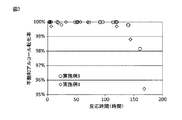
この実施例における触媒寿命は156時間、1,3−ブタジエンの平均選択率は96.7%であった。反応条件及び結果を表4に示す。この反応の反応時間ごとの転化率をプロットしたものを図3に示す。 The catalyst life in this example was 156 hours, and the average selectivity of 1,3-butadiene was 96.7%. The reaction conditions and results are shown in Table 4. A plot of the conversion rate of this reaction for each reaction time is shown in FIG.
(実施例6)
原料として蒸留後の原料液P−2を用いた他は実施例5に示す方法と同様の条件で反応を行った。触媒寿命は146時間、1,3−ブタジエンの平均選択率は97.5%であった。反応条件及び結果を表4に示す。この反応の反応時間ごとの転化率をプロットしたものを図3に示す。
(Example 6)
The reaction was carried out under the same conditions as in the method of Example 5 except that the raw material liquid P-2 after distillation was used as the raw material. The catalyst life was 146 hours, and the average selectivity of 1,3-butadiene was 97.5%. The reaction conditions and results are shown in Table 4. A plot of the conversion rate of this reaction for each reaction time is shown in FIG.
(比較例5)
原料として蒸留後の原料液C−1を用いた他は実施例5に示す方法と同様の条件で反応を行った。触媒寿命は122時間、1,3−ブタジエンの平均選択率は99.0%であった。反応条件及び結果を表4に示す。この反応の反応時間ごとの転化率をプロットしたものを図4に示す。
(Comparative example 5)
The reaction was performed under the same conditions as in the method of Example 5 except that the raw material liquid C-1 after distillation was used as the raw material. The catalyst life was 122 hours, and the average selectivity of 1,3-butadiene was 99.0%. The reaction conditions and results are shown in Table 4. A plot of the conversion rate of this reaction for each reaction time is shown in FIG.
(比較例6)
原料として蒸留後の原料液C−2を用いた他は実施例5に示す方法と同様の条件で反応を行った。触媒寿命は73時間、1,3−ブタジエンの平均選択率は97.0%であった。反応条件及び結果を表4に示す。この反応の反応時間ごとの転化率をプロットしたものを図4に示す。
(Comparative example 6)
The reaction was performed under the same conditions as in the method of Example 5 except that the raw material liquid C-2 after distillation was used as the raw material. The catalyst life was 73 hours, and the average selectivity of 1,3-butadiene was 97.0%. The reaction conditions and results are shown in Table 4. A plot of the conversion rate of this reaction for each reaction time is shown in FIG.
[一段脱水反応]
(比較例7)
触媒H(グラファイト担持ポリリン酸ナトリウム触媒)を用い、1,3−ブタンジオールを基質、水蒸気及び窒素ガスを希釈剤とし、一段階で1,3−ブタジエンを製造する脱水反応を行った。1,3−ブタンジオールの導入量は触媒1mLあたり毎時0.081g、水蒸気(ガス)の導入量は触媒1mLあたり毎時0.025L、窒素ガスの導入量は触媒1mLあたり毎時0.140Lで、反応器内温度は270℃に設定した。SVは400h−1であった。
[One-step dehydration reaction]
(Comparative Example 7)
Using catalyst H (graphite-supported sodium polyphosphate catalyst), 1,3-butanediol was used as a substrate, and steam and nitrogen gas were used as diluents to carry out a dehydration reaction for producing 1,3-butadiene in one step. The amount of 1,3-butanediol introduced was 0.081 g per hour per 1 mL of the catalyst, the amount of steam (gas) introduced was 0.025 L per hour per 1 mL of the catalyst, and the amount of nitrogen gas introduced was 0.140 L per hour per 1 mL of the catalyst. The internal temperature was set to 270 ° C. The SV was 400 h -1 .
この比較例における223時間経過後までの1,3−ブタンジオールの転化率は100%、1,3−ブタジエンの平均選択率は77.4%であった。また、この反応では、時間の経過とともに徐々に1,3−ブタジエンの選択率が低下する傾向が見られた。 In this comparative example, the conversion of 1,3-butanediol was 100% and the average selectivity of 1,3-butadiene was 77.4% after 223 hours had elapsed. In this reaction, the selectivity of 1,3-butadiene tended to gradually decrease with the passage of time.
上記の実施例から明らかなように、本発明の方法に従って1,3−ジオール型の原料から二段階の工程を経て、対応するジエン化合物を高選択的に得ることが可能である。特に、第一脱水工程で欠陥蛍石型又はパイロクロア型の結晶構造を有する複合金属酸化物を用いた場合は、精製蒸留の有無が第二脱水工程における触媒寿命にあまり影響しない(実施例5及び6)。一方でそれ以外の触媒を用いた場合は、精製蒸留を行わないと第二脱水工程の触媒寿命が大きく低下した(比較例5及び比較例6)。このことから、第一脱水工程で欠陥蛍石型又はパイロクロア型の結晶構造を有する複合金属酸化物を用いた場合は、第一脱水工程の反応生成物から未反応原料の除去のみを行って得られた組成物を反応原料として第二脱水工程に適用した場合でも第二脱水触媒の触媒活性を長時間維持することが可能であることが示された。 As is apparent from the above-mentioned examples, it is possible to highly selectively obtain the corresponding diene compound from the 1,3-diol type raw material through the two-step process according to the method of the present invention. In particular, when a complex metal oxide having a defective fluorite-type or pyrochlore-type crystal structure is used in the first dehydration step, the presence or absence of purification distillation does not significantly affect the catalyst life in the second dehydration step (Example 5 and 6). On the other hand, when other catalysts were used, the catalyst life of the second dehydration step was significantly reduced unless purification distillation was performed (Comparative Examples 5 and 6). From this, when the complex metal oxide having a defective fluorite type or pyrochlore type crystal structure is used in the first dehydration step, it is obtained by only removing unreacted raw materials from the reaction product of the first dehydration step. It was shown that the catalytic activity of the second dehydration catalyst can be maintained for a long time even when the obtained composition is applied as the reaction raw material to the second dehydration step.
Claims (13)
(I)欠陥蛍石型結晶構造又はパイロクロア型結晶構造を有する複合金属酸化物を触媒として、一般式(1)で示されるジオール化合物から一般式(2)−1及び一般式(2)−2で示される不飽和アルコールを製造する第一脱水工程
(II)脱水触媒の存在下、前記一般式(2)−1及び一般式(2)−2で示される不飽和アルコールの脱水反応を同時に行い、一般式(3)で示されるジエン化合物を製造する第二脱水工程
第一脱水工程で用いる複合金属酸化物が、一般式(6)
A 2−x B 2 O 7−σ (6)
(式中、Aは第2族又は第3族の金属を示し、Bは第4族又は第5族の金属を示し、xは結晶構造の転相を起こさない範囲での任意の数値であり、σ=A金属のイオンの価数×x/2である。)
で示され、Aがスカンジウム、イットリウム、ネオジム、イッテルビウム、ガドリニウム、及びサマリウムからなる群より選ばれる少なくとも一種であり、Bがチタン、ジルコニウム、及びハフニウムからなる群より選ばれる少なくとも一種であり、xが、−0.05<x<1.0の範囲の数値である、ジエン化合物の製造方法。 A method for producing a diene compound, which comprises at least the following two steps ,
(I) Using a mixed metal oxide having a defective fluorite type crystal structure or a pyrochlore type crystal structure as a catalyst, the diol compound represented by the general formula (1) can be converted into the general formula (2) -1 and the general formula (2) -2. First dehydration step for producing unsaturated alcohol represented by
(II) In the presence of a dehydration catalyst, a dehydration reaction of the unsaturated alcohol represented by the general formula (2) -1 and the general formula (2) -2 is simultaneously performed to produce a diene compound represented by the general formula (3). Second dehydration step
The composite metal oxide used in the first dehydration step has the general formula (6)
A 2-x B 2 O 7-σ (6)
(In the formula, A represents a Group 2 or Group 3 metal, B represents a Group 4 or Group 5 metal, and x is an arbitrary numerical value within the range where phase inversion of the crystal structure does not occur. , Σ = A metal ion valence × x / 2.)
, A is at least one selected from the group consisting of scandium, yttrium, neodymium, ytterbium, gadolinium, and samarium, B is at least one selected from the group consisting of titanium, zirconium, and hafnium, x is , -0.05 <x <1.0, a method for producing a diene compound.
Priority Applications (1)
| Application Number | Priority Date | Filing Date | Title |
|---|---|---|---|
| JP2016076748A JP6684635B2 (en) | 2016-04-06 | 2016-04-06 | Method for producing diene compound |
Applications Claiming Priority (1)
| Application Number | Priority Date | Filing Date | Title |
|---|---|---|---|
| JP2016076748A JP6684635B2 (en) | 2016-04-06 | 2016-04-06 | Method for producing diene compound |
Publications (2)
| Publication Number | Publication Date |
|---|---|
| JP2017186274A JP2017186274A (en) | 2017-10-12 |
| JP6684635B2 true JP6684635B2 (en) | 2020-04-22 |
Family
ID=60045280
Family Applications (1)
| Application Number | Title | Priority Date | Filing Date |
|---|---|---|---|
| JP2016076748A Active JP6684635B2 (en) | 2016-04-06 | 2016-04-06 | Method for producing diene compound |
Country Status (1)
| Country | Link |
|---|---|
| JP (1) | JP6684635B2 (en) |
Families Citing this family (1)
| Publication number | Priority date | Publication date | Assignee | Title |
|---|---|---|---|---|
| US20230158475A1 (en) * | 2020-03-23 | 2023-05-25 | Sekisui Chemical Co., Ltd. | Catalyst and method for producing diene compound |
Family Cites Families (1)
| Publication number | Priority date | Publication date | Assignee | Title |
|---|---|---|---|---|
| PL3142785T3 (en) * | 2014-05-16 | 2022-08-22 | Versalis S.P.A. | METHOD OF PREPARATION OF ALKENOLS AND THEIR APPLICATION FOR THE PRODUCTION OF 1,3-BUTADIENE |
-
2016
- 2016-04-06 JP JP2016076748A patent/JP6684635B2/en active Active
Also Published As
| Publication number | Publication date |
|---|---|
| JP2017186274A (en) | 2017-10-12 |
Similar Documents
| Publication | Publication Date | Title |
|---|---|---|
| Ghantani et al. | Catalytic dehydration of lactic acid to acrylic acid using calcium hydroxyapatite catalysts | |
| Lauriol-Garbay et al. | New efficient and long-life catalyst for gas-phase glycerol dehydration to acrolein | |
| JP5993084B2 (en) | Catalytic conversion of lactic acid to acrylic acid | |
| EP2006273B1 (en) | Process for production of acrolein | |
| RU2695786C2 (en) | Method of producing alkenols and use thereof for producing 1,3-butadiene | |
| US8298981B2 (en) | Process to produce high surface area nanoparticle vanadium phosphorus oxide catalyst and product derives thereof | |
| US4668652A (en) | Catalyst for oxidation reactions and process for its production | |
| US20230278013A1 (en) | Oxidative dehydrogenation catalyst compositions | |
| JP5846388B2 (en) | Novel glycerin dehydration catalyst and process for producing the same | |
| JP6091310B2 (en) | Method for producing butadiene | |
| JP2017197458A (en) | Method for producing conjugated diene compound by dehydration of allylic unsaturated alcohol | |
| JP6815594B2 (en) | Method for producing diene compound | |
| JP5796489B2 (en) | Method for producing α-hydroxycarboxylic acid ester | |
| JP6384664B2 (en) | Method for producing isobutanol | |
| US5663392A (en) | Preparation of VSba aTib Ox ammoxidation catalysts | |
| JP2017186274A (en) | Method for producing diene compound | |
| JP6552355B2 (en) | Process for producing unsaturated alcohol and catalyst | |
| KR102758948B1 (en) | Catalyst for oxidative dehydrogenation and method for manufacturing the catalyst | |
| Fougret et al. | Influence of the carrier on the catalytic performance of impregnated phosphoric acid in the hydration of ethylene | |
| JP2016094402A (en) | Method for producing conjugated diene compound and dehydration catalyst for allyl type unsaturated alcohol | |
| JP6462498B2 (en) | Process for producing unsaturated alcohol and catalyst | |
| EP4565361A1 (en) | Catalyst for the production of 1,3-butadiene giving a high yield based on a support comprising aluminium and sodium | |
| JP6727079B2 (en) | Catalyst for producing unsaturated alcohol and method for producing unsaturated alcohol | |
| WO2024028341A1 (en) | Catalyst for the production of 1,3-butadiene comprising an aluminium-containing support with high favourable weight hourly space velocity | |
| US10569259B2 (en) | Catalyst for dehydration of glycerin, preparation method thereof, and production method of acrolein using the catalyst |
Legal Events
| Date | Code | Title | Description |
|---|---|---|---|
| A621 | Written request for application examination |
Free format text: JAPANESE INTERMEDIATE CODE: A621 Effective date: 20190205 |
|
| A977 | Report on retrieval |
Free format text: JAPANESE INTERMEDIATE CODE: A971007 Effective date: 20191114 |
|
| A131 | Notification of reasons for refusal |
Free format text: JAPANESE INTERMEDIATE CODE: A131 Effective date: 20200107 |
|
| A521 | Request for written amendment filed |
Free format text: JAPANESE INTERMEDIATE CODE: A523 Effective date: 20200204 |
|
| TRDD | Decision of grant or rejection written | ||
| A01 | Written decision to grant a patent or to grant a registration (utility model) |
Free format text: JAPANESE INTERMEDIATE CODE: A01 Effective date: 20200303 |
|
| A61 | First payment of annual fees (during grant procedure) |
Free format text: JAPANESE INTERMEDIATE CODE: A61 Effective date: 20200330 |
|
| R150 | Certificate of patent or registration of utility model |
Ref document number: 6684635 Country of ref document: JP Free format text: JAPANESE INTERMEDIATE CODE: R150 |
|
| S111 | Request for change of ownership or part of ownership |
Free format text: JAPANESE INTERMEDIATE CODE: R313111 |
|
| R350 | Written notification of registration of transfer |
Free format text: JAPANESE INTERMEDIATE CODE: R350 |
|
| S531 | Written request for registration of change of domicile |
Free format text: JAPANESE INTERMEDIATE CODE: R313531 |
|
| R350 | Written notification of registration of transfer |
Free format text: JAPANESE INTERMEDIATE CODE: R350 |
|
| S111 | Request for change of ownership or part of ownership |
Free format text: JAPANESE INTERMEDIATE CODE: R313111 |
|
| R350 | Written notification of registration of transfer |
Free format text: JAPANESE INTERMEDIATE CODE: R350 |
|
| R250 | Receipt of annual fees |
Free format text: JAPANESE INTERMEDIATE CODE: R250 |