JP6636070B2 - Immunoassay method and kit for immunoassay - Google Patents
Immunoassay method and kit for immunoassay Download PDFInfo
- Publication number
- JP6636070B2 JP6636070B2 JP2018028373A JP2018028373A JP6636070B2 JP 6636070 B2 JP6636070 B2 JP 6636070B2 JP 2018028373 A JP2018028373 A JP 2018028373A JP 2018028373 A JP2018028373 A JP 2018028373A JP 6636070 B2 JP6636070 B2 JP 6636070B2
- Authority
- JP
- Japan
- Prior art keywords
- substance
- measured
- immunoassay
- labeling
- reagent
- Prior art date
- Legal status (The legal status is an assumption and is not a legal conclusion. Google has not performed a legal analysis and makes no representation as to the accuracy of the status listed.)
- Active
Links
Landscapes
- Investigating Or Analysing Biological Materials (AREA)
- Peptides Or Proteins (AREA)
Description
本発明は、免疫測定方法及び免疫測定用キットに関する。 The present invention relates to an immunoassay method and an immunoassay kit.
免疫測定においては、血清検体を測定する際、反応容器、固相担体表面、固相担体表面に固定化した物質への検体由来の成分の非特異的な吸着が特定の検体でみられ、これらの非特異反応が正確な測定を行う妨げとなり問題となっている(例えば、非特許文献1)。非特異反応を防止するため種々の蛋白質、界面活性剤及び塩類等を含有させた免疫測定試薬が提案されている(例えば、特許文献1〜3)。 In the immunoassay, when measuring a serum sample, non-specific adsorption of a component derived from the sample to a reaction vessel, a solid support surface, or a substance immobilized on the solid support surface is observed in a specific sample. Non-specific reaction hinders accurate measurement, which is a problem (for example, Non-Patent Document 1). In order to prevent non-specific reactions, immunoassay reagents containing various proteins, surfactants, salts and the like have been proposed (for example, Patent Documents 1 to 3).
また、免疫測定において、測定対象物を検出するための標識物質が、固相である磁性シリカ粒子表面、固相に固定化した物質及び反応容器内壁へ非特異的に結合することに起因して、正常値と判定されるべき検体が、誤って異常値と判定されること(いわゆる標識物質の非特異的反応)が大きな課題となっている。また、標識物質の非特異的反応が生じると、測定のノイズが上昇し、測定感度が低下することも問題である。特に従来の技術では、標識物質の非特異的反応を抑制するには限界がある。これら非特異的反応を減少させることは、多数検体同時迅速検査を目的とした自動化免疫測定装置の開発において、ますます重要な課題となっている。 In addition, in the immunoassay, the labeling substance for detecting the measurement target is non-specifically bound to the surface of the magnetic silica particles as the solid phase, the substance immobilized on the solid phase, and the inner wall of the reaction vessel. A serious problem is that a sample to be determined as a normal value is erroneously determined to be an abnormal value (a so-called non-specific reaction of a labeling substance). Another problem is that when a non-specific reaction of the labeling substance occurs, measurement noise increases and measurement sensitivity decreases. In particular, in the prior art, there is a limit in suppressing the nonspecific reaction of the labeling substance. Reducing these non-specific reactions has become an increasingly important issue in the development of an automated immunoassay for the purpose of rapid simultaneous testing of many samples.
本発明は、固相担体表面や固相担体に固定化した物質及び反応容器内壁への検体由来の非特異的反応を減少させ、正確性の高い免疫測定方法及び免疫測定用キットを提供することを目的とする。 An object of the present invention is to provide a highly accurate immunoassay method and an immunoassay kit that reduce nonspecific reactions derived from a sample on the surface of a solid support or a substance immobilized on the solid support and the inner wall of a reaction vessel. With the goal.
本発明者らは、上記目的を達成するため鋭意検討した結果、本発明に到達した。即ち、本発明は、試料中の測定対象物質(G)の濃度を測定する免疫測定方法であって、下記工程(1)と、工程(2)又は工程(2’)とを含む免疫測定方法;免疫測定用試薬として固相担体試薬(A)と標識試薬(B)とを含む免疫測定用キットであって、測定対象物質と特異的に結合する物質(D)を固定化した固相担体(a)を固相担体試薬(A)中に含有し、標識物質(b)により標識された測定対象物質(F1)、その類似物質(F2)又は標識物質(b)により標識された測定対象物質と特異的に結合する物質(F3)と、アルカリ土類金属の有機酸塩(C)とを標識試薬(B)中に含有する前記免疫測定方法に用いられる免疫測定用キットである。
工程(1):測定対象物質と特異的に結合する物質(D)を固定化した固相担体(a)と測定対象物質(G)とを反応させて、物質(D)と測定対象物質(G)との複合体(J)を形成させる工程。
工程(2):標識物質(b)により標識された測定対象物質と特異的に結合する物質(F3)と複合体(J)とをアルカリ土類金属の有機酸塩(C)の含有量が0.05mM〜15mMである溶液中で反応させて、物質(D)と測定対象物質(G)と物質(F3)との複合体(L)を形成させる工程。
工程(2’):固相担体(a)に固定化された測定対象物質と特異的に結合する物質(D)と標識物質(b)により標識された測定対象物質(F1)又はその類似物質(F2)とをアルカリ土類金属の有機酸塩(C)の含有量が0.05mM〜15mMである溶液中で反応させて、物質(D)と物質(F1)又は(F2)との複合体(M)を形成させる工程。
The present inventors have conducted intensive studies to achieve the above object, and as a result, have reached the present invention. That is, the present invention relates to an immunoassay method for measuring the concentration of a measurement target substance (G) in a sample, which comprises the following step (1), step (2) or step (2 ′). An immunoassay kit comprising a solid-phase carrier reagent (A) and a labeling reagent (B) as immunoassay reagents, the solid-phase carrier immobilizing a substance (D) that specifically binds to a substance to be measured; (A) is contained in the solid phase carrier reagent (A), and the measurement target substance (F1) labeled with the labeling substance (b), its analogous substance (F2) or the measurement target labeled with the labeling substance (b) An immunoassay kit for use in the immunoassay method, comprising a substance (F3) that specifically binds to a substance and an organic acid salt of an alkaline earth metal (C) in a labeling reagent (B).
Step (1): The solid support (a) on which the substance (D) that specifically binds to the substance to be measured is immobilized and the substance to be measured (G) are reacted, and the substance (D) and the substance to be measured ( Forming a complex (J) with G).
Step (2): The complex (J) and the substance (F3) that specifically binds to the substance to be measured labeled with the labeling substance (b) are reduced in the content of the alkaline earth metal organic acid salt (C). Reacting in a solution of 0.05 mM to 15 mM to form a complex (L) of the substance (D), the substance to be measured (G), and the substance (F3).
Step (2 ′): a substance (D) specifically binding to the substance to be measured immobilized on the solid phase carrier (a) and a substance to be measured (F1) labeled with the labeling substance (b) or a similar substance thereof (F2) is reacted in a solution having an alkaline earth metal organic acid salt (C) content of 0.05 mM to 15 mM to form a complex of the substance (D) and the substance (F1) or (F2). Forming a body (M);
本発明の免疫測定方法及び免疫測定用キットは、正確性の高い臨床検査を可能とする。 The immunoassay method and immunoassay kit of the present invention enable highly accurate clinical tests.
本発明の免疫測定方法は、試料中の測定対象物質(G)の濃度を測定する免疫測定方法であって、下記工程(1)と、工程(2)又は工程(2’)とを含む免疫測定方法。
工程(1):測定対象物質と特異的に結合する物質(D)を固定化した固相担体(a)と測定対象物質(G)とを反応させて、物質(D)と測定対象物質(G)との複合体(J)を形成させる工程。
工程(2):標識物質(b)により標識された測定対象物質と特異的に結合する物質(F3)と複合体(J)とをアルカリ土類金属の有機酸塩(C)の含有量が0.05mM〜15mMである溶液中で反応させて、物質(D)と測定対象物質(G)と物質(F3)との複合体(L)を形成させる工程。
工程(2’):固相担体(a)に固定化された測定対象物質と特異的に結合する物質(D)と標識物質(b)により標識された測定対象物質(F1)又はその類似物質(F2)とをアルカリ土類金属の有機酸塩(C)の含有量が0.05mM〜15mMである溶液中で反応させて、物質(D)と物質(F1)又は(F2)との複合体(M)を形成させる工程。
The immunoassay method of the present invention is an immunoassay method for measuring the concentration of a measurement target substance (G) in a sample, and comprises the following step (1) and step (2) or step (2 ′). Measuring method.
Step (1): The solid support (a) on which the substance (D) that specifically binds to the substance to be measured is immobilized and the substance to be measured (G) are reacted, and the substance (D) and the substance to be measured ( Forming a complex (J) with G).
Step (2): The complex (J) and the substance (F3) that specifically binds to the substance to be measured labeled with the labeling substance (b) are reduced in the content of the alkaline earth metal organic acid salt (C). Reacting in a solution of 0.05 mM to 15 mM to form a complex (L) of the substance (D), the substance to be measured (G), and the substance (F3).
Step (2 ′): a substance (D) specifically binding to the substance to be measured immobilized on the solid phase carrier (a) and a substance to be measured (F1) labeled with the labeling substance (b) or a similar substance thereof (F2) is reacted in a solution having an alkaline earth metal organic acid salt (C) content of 0.05 mM to 15 mM to form a complex of the substance (D) and the substance (F1) or (F2). Forming a body (M);
工程(2)及び工程(2’)における反応を、アルカリ土類金属の有機酸塩(C)の存在下で行うことにより、固相担体表面(例えば磁性シリカ粒子表面)、固相担体に固定化した物質(D)及び反応容器内壁への測定対象物質(G)の非特定的反応を減少させ、正確性の高い免疫測定が可能となる。 The reaction in the step (2) and the step (2 ′) is performed in the presence of an organic acid salt of an alkaline earth metal (C), so that the solid phase is immobilized on the surface of the solid support (for example, the surface of magnetic silica particles). The non-specific reaction of the converted substance (D) and the substance (G) to be measured to the inner wall of the reaction vessel is reduced, and highly accurate immunoassay becomes possible.
本発明の免疫測定方法の測定の対象となる試料中の測定対象物質(G)としては、一般的に免疫測定の分野で測定されるものであれば特に限定はされず、例えば血清、血液、血漿、尿等の生体体液、リンパ液、血球、各種細胞類等の生体由来の試料中に含まれるタンパク質、脂質タンパク質、核酸、免疫グロブリン、血液凝固関連因子、抗体、酵素、ホルモン、癌マーカー、心疾患マーカー及び各種薬物等が代表的なものとして挙げられる。更に具体的には、例えばアルブミン、ヘモグロビン、ミオグロビン、トランスフェリン、プロテインA、C反応性蛋白質(CRP)等のタンパク質、例えば高比重リポ蛋白質(HDL)、低比重リポ蛋白質(LDL)、超低比重リポ蛋白質等の脂質蛋白質、例えばデオキシリボ核酸(DNA)、リボ核酸(RNA)等の核酸、例えばアルカリ性ホスファターゼ、アミラーゼ、酸性ホスファターゼ、γ−グルタミルトランスフェラーゼ(γ−GTP)、リパーゼ、クレアチンキナーゼ(CK)、乳酸脱水素酵素(LDH)、グルタミン酸オキザロ酢酸トランスアミナーゼ(GOT)、グルタミン酸ピルビン酸トランスアミナーゼ(GPT)、レニン、プロテインキナーゼ(PK)、チロシンキナーゼ等の酵素、例えばIgG、IgM、IgA、IgD、IgE等の免疫グロブリン(或はこれらの、例えばFc部、Fab部、F(ab)2部等の断片)、例えばフィブリノーゲン、フィブリン分解産物(FDP)、プロトロンビン、トロンビン等の血液凝固関連因子、例えば抗ストレプトリジンO抗体、抗ヒトH.ピロリ抗体、抗ヒトB型肝炎ウイルス表面抗原抗体(抗HBs抗原抗体)、抗ヒトB型肝炎コア抗原抗体(抗HBc抗体)抗ヒトC型肝炎ウイルス抗体、抗リュウマチ因子等の抗体、例えばB型肝炎ウィルス表面抗原(HBsAg)、例えば甲状腺刺激ホルモン(TSH)、甲状腺ホルモン(FT3、FT4、T3、T4)、副甲状腺ホルモン(PTH)、副腎皮質刺激ホルモン(ACTH)、ヒト絨毛性ゴナドトロピン(hCG)、エストラジオール(E2)、コルチゾール、アルドステロン等のホルモン、例えばα−フェトプロテイン(AFP)、癌胎児性抗原(CEA)、CA19−9、前立腺特異抗原(PSA)等の癌マーカー、例えばトロポニンT(TnT)、ヒト脳性ナトリウム利尿ペプチド前駆体N端フラグメント(NT−proBNP)等の心疾患マーカー、例えば抗てんかん薬、抗生物質、テオフィリン等の薬物等が挙げられる。上記したものの中でも、抗体、ホルモン、癌マーカー、心疾患マーカー等が好ましい。 The substance to be measured (G) in the sample to be measured by the immunoassay method of the present invention is not particularly limited as long as it is generally measured in the field of immunoassay, for example, serum, blood, Proteins, lipid proteins, nucleic acids, immunoglobulins, blood coagulation-related factors, antibodies, enzymes, hormones, cancer markers, hearts contained in biological samples such as biological fluids such as plasma and urine, lymph fluid, blood cells, and various cells Representative examples include disease markers and various drugs. More specifically, for example, proteins such as albumin, hemoglobin, myoglobin, transferrin, protein A, C-reactive protein (CRP), such as high-density lipoprotein (HDL), low-density lipoprotein (LDL), and ultra-low-density lipoprotein Lipid proteins such as proteins, for example, nucleic acids such as deoxyribonucleic acid (DNA) and ribonucleic acid (RNA), for example, alkaline phosphatase, amylase, acid phosphatase, γ-glutamyltransferase (γ-GTP), lipase, creatine kinase (CK), lactic acid Enzymes such as dehydrogenase (LDH), glutamate oxaloacetate transaminase (GOT), glutamate pyruvate transaminase (GPT), renin, protein kinase (PK) and tyrosine kinase, such as IgG, IgM, IgA, I Immunoglobulins such as gD and IgE (or fragments thereof such as Fc part, Fab part and F (ab) 2 part), and blood coagulation-related factors such as fibrinogen, fibrin degradation product (FDP), prothrombin and thrombin For example, anti-streptolysin O antibody, anti-human H. H. pylori antibody, anti-human hepatitis B virus surface antigen antibody (anti-HBs antigen antibody), anti-human hepatitis B core antigen antibody (anti-HBc antibody), anti-human hepatitis C virus antibody, antibodies such as anti-rheumatic factor, eg, type B Hepatitis virus surface antigen (HBsAg), such as thyroid stimulating hormone (TSH), thyroid hormone (FT3, FT4, T3, T4), parathyroid hormone (PTH), corticotropin (ACTH), human chorionic gonadotropin (hCG) , Estradiol (E2), cortisol, aldosterone and other hormones such as α-fetoprotein (AFP), carcinoembryonic antigen (CEA), CA19-9, prostate specific antigen (PSA) and other cancer markers such as troponin T (TnT) , Human brain natriuretic peptide precursor N-terminal fragment (NT-p OBNP) cardiac markers such as, for example, an antiepileptic drug, an antibiotic, a drug such as theophylline and the like. Among the above, antibodies, hormones, cancer markers, heart disease markers and the like are preferable.
本発明の免疫測定方法には、測定対象物質と特異的に結合する物質(D)を固定化した固相担体(a)を含有する固相担体試薬(A)が用いられる。 In the immunoassay method of the present invention, a solid support reagent (A) containing a solid support (a) on which a substance (D) that specifically binds to a substance to be measured is immobilized is used.
固相担体(a)としては、一般的に免疫測定の分野で測定されるものであれば特に限定はされず、例えばガラスビーズ、ポリスチレンビーズ、磁性粒子(a1)、マイクロプレート、ラテックス等が代表的なものとして挙げられる。これらの内、免疫測定における測定時間の短時間化及び正確性の観点から、特開2014−210680号公報及び特開2013−019889号公報に記載の磁性シリカ粒子(a11)を用いることが好ましい。 The solid support (a) is not particularly limited as long as it is generally measured in the field of immunoassay, and examples thereof include glass beads, polystyrene beads, magnetic particles (a1), microplates, and latex. It is mentioned as a typical thing. Among them, it is preferable to use the magnetic silica particles (a11) described in JP-A-2014-210680 and JP-A-2013-01889 from the viewpoints of shortening the measurement time and accuracy in the immunoassay.
磁性シリカ粒子(a11)としては、シリカのマトリックス中に体積平均粒子径が1〜20nmで超常磁性を有する金属酸化物を分散されているものが好ましい。超常磁性とは、外部磁場の存在下で物質の個々の原子磁気モーメントが整列し誘発された一時的な磁場を示し、外部磁場を取り除くと、部分的な整列が損なわれ磁場を示さなくなることをいう。
尚、本発明における金属酸化物及び後述の磁性シリカ粒子の体積平均粒子径は、任意の200個の粒子について走査型電子顕微鏡(日本電子株式会社製「JSM−7000F」)で観察して測定された粒子径の平均値である。
As the magnetic silica particles (a11), those in which a metal oxide having a volume average particle diameter of 1 to 20 nm and having superparamagnetism is dispersed in a silica matrix are preferable. Superparamagnetism refers to a temporary magnetic field induced by the alignment of the individual atomic magnetic moments of a substance in the presence of an external magnetic field, and the removal of the external magnetic field results in the loss of partial alignment and no magnetic field. Say.
In addition, the volume average particle diameter of the metal oxide and the magnetic silica particles described below in the present invention is measured by observing arbitrary 200 particles with a scanning electron microscope (“JSM-7000F” manufactured by JEOL Ltd.). It is the average of the particle diameters.
体積平均粒子径が1〜20nmで超常磁性を示す超常磁性金属酸化物としては、鉄、コバルト、ニッケル及びこれらの合金等の酸化物が挙げられるが、磁界に対する感応性が優れていることから、酸化鉄が特に好ましい。超常磁性金属酸化物は、1種を単独で用いても2種以上を併用してもよい。 Examples of superparamagnetic metal oxides having a volume average particle diameter of 1 to 20 nm and exhibiting superparamagnetism include oxides such as iron, cobalt, nickel, and alloys thereof, since they have excellent sensitivity to a magnetic field. Iron oxide is particularly preferred. One type of superparamagnetic metal oxide may be used alone, or two or more types may be used in combination.
酸化鉄としては、公知の種々の酸化鉄を用いることができる。
酸化鉄の内、特に化学的な安定性に優れることから、マグネタイト、γ−ヘマタイト、マグネタイト−α−ヘマタイト中間酸化鉄及びγ−ヘマタイト−α−ヘマタイト中間酸化鉄からなる群から選ばれる少なくとも1種が好ましく、大きな飽和磁化を有し、外部磁場に対する感応性が優れていることから、マグネタイトが更に好ましい。
Various known iron oxides can be used as the iron oxide.
Among iron oxides, at least one selected from the group consisting of magnetite, γ-hematite, magnetite-α-hematite intermediate iron oxide, and γ-hematite-α-hematite intermediate iron oxide, because of its excellent chemical stability. Is preferred, and magnetite is more preferred because it has a large saturation magnetization and excellent sensitivity to an external magnetic field.
磁性シリカ粒子(a11)中の超常磁性金属酸化物の含有量の下限は、磁性シリカ粒子(a11)の重量を基準として、60重量%が好ましく、更に好ましくは65重量%であり、上限は95重量%が好ましく、更に好ましくは80重量%である。
超常磁性金属酸化物の含有量が60重量%以上であると、得られた磁性シリカ粒子(a11)の磁性が十分であり、実際の用途面における分離操作を短時間で行えるので好ましい。また、95重量%以下であると、合成が容易である。
The lower limit of the content of the superparamagnetic metal oxide in the magnetic silica particles (a11) is preferably 60% by weight, more preferably 65% by weight, and the upper limit is 95% based on the weight of the magnetic silica particles (a11). %, More preferably 80% by weight.
When the content of the superparamagnetic metal oxide is 60% by weight or more, the obtained magnetic silica particles (a11) have sufficient magnetism, and the separation operation in an actual application can be performed in a short time. When the content is 95% by weight or less, synthesis is easy.
超常磁性金属酸化物の製造方法は、特に限定されないが、Massartにより報告されたものをベースとして水溶性鉄塩及びアンモニアを用いる共沈殿法(R.Massart,IEEE Trans.Magn.1981,17,1247)や水溶性鉄塩の水溶液中の酸化反応を用いた方法により合成することができる。 The method for producing the superparamagnetic metal oxide is not particularly limited, but a coprecipitation method using a water-soluble iron salt and ammonia based on the one reported by Massart (R. Massart, IEEE Trans. Magn. 1981, 17, 1247). ) And an oxidation reaction of an aqueous solution of a water-soluble iron salt in an aqueous solution.
磁性シリカ粒子(a11)の体積平均粒子径は、好ましくは1〜5μm、更に好ましくは1〜3μmである。
体積平均粒子径が1μm以上であると、分離回収を短時間で行える傾向にあり、5μm以下であると、表面積が適度であり、固定化する物質[測定対象物質と特異的に結合する物質(D)]の結合量を適度にすることができ、結合効率がよい。
The volume average particle diameter of the magnetic silica particles (a11) is preferably 1 to 5 μm, more preferably 1 to 3 μm.
When the volume average particle diameter is 1 μm or more, separation and collection tends to be performed in a short time, and when the volume average particle diameter is 5 μm or less, the surface area is moderate and the substance to be immobilized [the substance that specifically binds to the substance to be measured ( D)], the binding amount can be made moderate, and the binding efficiency is good.
磁性シリカ粒子(a11)の体積平均粒子径は、後述の水中油型エマルションを作製する際の混合条件(せん断力等)を調節して水中油型エマルションの粒子径を調整することにより制御することができる。また、磁性シリカ粒子製造時の水洗工程の条件変更や通常の分級等の方法によっても体積平均粒子径を所望の値とすることができる。 The volume average particle size of the magnetic silica particles (a11) should be controlled by adjusting the mixing conditions (such as shearing force) when preparing an oil-in-water emulsion described below to adjust the particle size of the oil-in-water emulsion. Can be. In addition, the volume average particle diameter can be set to a desired value by a method such as a change in conditions of a washing step at the time of production of the magnetic silica particles or a usual classification.
本発明における磁性シリカ粒子(a11)は、例えば体積平均粒子径が1〜20nmの超常磁性金属酸化物粒子、前記超常磁性金属酸化物粒子の重量に基づいて30〜500重量%の(アルキル)アルコキシシラン及び分散剤を含有する分散液と、水、水溶性有機溶媒、非イオン性界面活性剤及び(アルキル)アルコキシシランの加水分解用触媒を含有する溶液とを混合して水中油型エマルションを形成後、(アルキル)アルコキシシランの加水分解反応及び縮合反応を行い、超常磁性金属酸化物がシリカに包含された磁性シリカ粒子の水性分散体が得た後、磁性シリカ粒子の水性分散体を遠心分離及び/又は集磁により固液分離し、水又はメタノール等で洗浄することにより得られる。
上記及び以下において、(アルキル)アルコキシシランとは、アルキルアルコキシシラン又はアルコキシシランを意味する。
The magnetic silica particles (a11) in the present invention include, for example, superparamagnetic metal oxide particles having a volume average particle diameter of 1 to 20 nm, and 30 to 500% by weight of (alkyl) alkoxy based on the weight of the superparamagnetic metal oxide particles. An oil-in-water emulsion is formed by mixing a dispersion containing a silane and a dispersant with a solution containing water, a water-soluble organic solvent, a nonionic surfactant and a catalyst for hydrolyzing an (alkyl) alkoxysilane. Thereafter, a hydrolysis reaction and a condensation reaction of the (alkyl) alkoxysilane are performed to obtain an aqueous dispersion of magnetic silica particles in which the superparamagnetic metal oxide is included in silica, and then the aqueous dispersion of magnetic silica particles is centrifuged. And / or solid-liquid separation by magnetism and washing with water or methanol.
Above and below, (alkyl) alkoxysilane means alkylalkoxysilane or alkoxysilane.
磁性シリカ粒子(a11)は、超常磁性金属酸化物がシリカに包含され、粒子表面に存在しないことから、多くの測定対象物質と特異的に結合する物質(D)をその表面に固定化することができる。 The magnetic silica particles (a11) contain a superparamagnetic metal oxide contained in silica and do not exist on the particle surface. Therefore, the substance (D) that specifically binds to many measurement target substances is immobilized on the surface. Can be.
固相担体(好ましくは磁性シリカ粒子)に、測定対象物質と特異的に結合する物質(D)を固定化する方法としては、上述の固相担体に物質(D)を物理吸着させる方法が挙げられるが、より効率良く物質(D)を固定化させる観点から、グルタルアルデヒド、アルブミン、カルボジイミド、ストレプトアビジン、ビオチン及び官能基を有するアルキルアルコキシシランからなる群から選ばれる少なくとも1種の有機化合物を固相担体表面に結合させ、それらを介して物質(D)を固相担体に固定化させることが好ましい。
これらの有機化合物の内、特定の物質(D)を結合させる観点から、官能基を有するアルキルアルコキシシランが更に好ましい。
As a method for immobilizing the substance (D) which specifically binds to the substance to be measured on the solid support (preferably magnetic silica particles), the above-mentioned method of physically adsorbing the substance (D) to the solid support is mentioned. However, from the viewpoint of more efficiently immobilizing the substance (D), at least one organic compound selected from the group consisting of glutaraldehyde, albumin, carbodiimide, streptavidin, biotin, and an alkylalkoxysilane having a functional group is solidified. It is preferable that the substance (D) is bound to the surface of the solid phase carrier, and the substance (D) is immobilized on the solid phase carrier via them.
Among these organic compounds, from the viewpoint of binding the specific substance (D), an alkylalkoxysilane having a functional group is more preferable.
本発明における測定対象物質と特異的に結合する物質(D)としては、例えば「抗原」−「抗体」間反応、「糖鎖」−「タンパク質」間反応、「糖鎖」−「レクチン」間反応、「酵素」−「インヒビター」間反応、「タンパク質」−「ペプチド鎖」間反応又は「染色体又はヌクレオチド鎖」−「ヌクレオチド鎖」間反応、「ヌクレオチド鎖」−「タンパク質」間反応等の相互反応によって試料中の測定対象物質(G)又はその類似物質と結合するもの等が挙げられ、上記各組合せにおいて何れか一方が測定対象物質(G)又はその類似物質である場合、他の一方がこの測定対象物質と特異的に結合する物質(D)である。例えば、測定対象物質(G)又はその類似物質が「抗原」であるときは測定対象物質と特異的に結合する物質(D)は「抗体」であり、測定対象物質(G)又はその類似物質が「抗体」であるときは測定対象物質と特異的に結合する物質(D)は「抗原」である(以下、その他の上記各組合せにおいても同様である)。 Examples of the substance (D) that specifically binds to the substance to be measured in the present invention include a reaction between “antigen” and “antibody”, a reaction between “sugar chain” and “protein”, and a reaction between “sugar chain” and “lectin”. Reaction, reaction between “enzyme” and “inhibitor”, reaction between “protein” and “peptide chain”, reaction between “chromosome or nucleotide chain” and “nucleotide chain”, mutual reaction between “nucleotide chain” and “protein”, etc. A substance that binds to a substance to be measured (G) or a similar substance thereof in a sample by a reaction, and the like. When one of the above combinations is a substance to be measured (G) or a similar substance, the other is used. The substance (D) that specifically binds to the substance to be measured. For example, when the substance to be measured (G) or a substance similar thereto is an “antigen”, the substance (D) that specifically binds to the substance to be measured is an “antibody” and the substance to be measured (G) or a substance similar thereto Is an “antibody”, the substance (D) that specifically binds to the substance to be measured is an “antigen” (the same applies to other combinations described above).
上記における測定対象物質(G)の類似物質(アナログ)は、測定対象物質と特異的に結合する物質(D)が有する測定対象物質(G)との結合部位と結合し得るもの、言い換えれば、測定対象物質(G)が有する測定対象物質と特異的に結合する物質(D)との結合部位を有するもの、更に言い換えれば、測定対象物質(G)と測定対象物質と特異的に結合する物質(D)との反応時に共存させると(G)と(D)との反応と競合し得るものであれば何れでもよい。 The analogous substance (analog) of the measurement target substance (G) in the above can bind to the binding site of the substance (D) that specifically binds to the measurement target substance with the measurement target substance (G), in other words, A substance having a binding site for a substance (D) which specifically binds to a substance to be measured, which is contained in the substance to be measured (G), in other words, a substance which specifically binds to the substance to be measured (G) and the substance to be measured Any compound may be used as long as it can compete with the reaction between (G) and (D) when coexisting during the reaction with (D).
測定対象物質と特異的に結合する物質(D)の具体例としては、ヌクレオチド鎖(オリゴヌクレオチド鎖、ポリヌクレオチド鎖);染色体;ペプチド鎖(例えばC−ペプチド、アンジオテンシンI等)、タンパク質〔例えばプロカルシトニン、免疫グロブリンA(IgA)、免疫グロブリンE(IgE)、免疫グロブリンG(IgG)、免疫グロブリンM(IgM)、免疫グロブリンD(IgD)、β2−ミクログロブリン、アルブミン、これらの分解産物、フェリチン等の血清タンパク質〕;酵素〔例えばアミラーゼ(例えば膵型、唾液腺型、X型等)、アルカリホスファターゼ(例えば肝性、骨性、胎盤性、小腸性等)、酸性ホスファターゼ(例えばPAP等)、γ−グルタミルトランスファラーゼ(例えば腎性、膵性、肝性等)、リパーゼ(例えば膵型、胃型等)、クレアチンキナーゼ(例えばCK−1、CK−2、mCK等)、乳酸脱水素酵素(例えばLDH1〜LDH5等)、グルタミン酸オキザロ酢酸トランスアミナーゼ(例えばASTm、ASTs等)、グルタミン酸ピルビン酸トランスアミナーゼ(例えばALTm、ALTs等)、コリンエステラーゼ(例えばChE1〜ChE5等)、ロイシンアミノペプチダーゼ(例えばC−LAP、AA、CAP等)、レニン、プロテインキナーゼ、チロシンキナーゼ等〕及びこれら酵素のインヒビター、ホルモン(例えばPTH、TSH、インシュリン、LH、FSH、プロラクチン等)、レセプター(例えばエストロゲン、TSH等に対するレセプター);リガンド(例えばエストロゲン、TSH等);例えば細菌(例えば結核菌、肺炎球菌、ジフテリア菌、髄膜炎菌、淋菌、ブドウ球菌、レンサ球菌、腸内細菌、大腸菌、ヘリコバクター・ピロリ等)、ウイルス(例えばルベラウイルス、ヘルペスウイルス、肝炎ウイルス、ATLウイルス、AIDSウイルス、インフルエンザウイルス、アデノウイルス、エンテロウイルス、ポリオウイルス、EBウイルス、HAV、HBV、HCV、HIV、HTLV等)、真菌(例えばカンジダ、クリプトコッカス等)、スピロヘータ(例えばレプトスピラ、梅毒トレポネーマ等)、クラミジア、マイコプラズマ等の微生物;当該微生物に由来するタンパク質又はペプチド或いは糖鎖抗原;気管支喘息、アレルギー性鼻炎、アトピー性皮膚炎等のアレルギーの原因となる各種アレルゲン(例えばハウスダスト、例えばコナヒョウダニ、ヤケヒョウダニ等のダニ類、例えばスギ、ヒノキ、スズメノヒエ、ブタクサ、オオアワガエリ、ハルガヤ、ライムギ等の花粉、例えばネコ、イヌ、カニ等の動物、例えば米、卵白等の食物、真菌、昆虫、木材、薬剤、化学物質等に由来するアレルゲン等);脂質(例えばリポタンパク質等);プロテアーゼ(例えばトリプシン、プラスミン、セリンプロテアーゼ等);腫瘍マーカータンパク抗原(例えばPSA、PGI、PGII等);糖鎖抗原〔例えばAFP(例えばL1からL3等)、hCG(hCGファミリー)、トランスフェリン、IgG、サイログロブリン、Decay−accelerating−factor(DAF)、癌胎児性抗原(例えばCEA、NCA、NCA−2、NFA等)、CA19−9、PIVKA−II、CA125、前立腺特異抗原、癌細胞が産生する特殊な糖鎖を有する腫瘍マーカー糖鎖抗原、ABO糖鎖抗原等〕;糖鎖(例えばヒアルロン酸、β−グルカン、上記糖鎖抗原等が有する糖鎖等);糖鎖に結合するタンパク質(例えばヒアルロン酸結合タンパク、βグルカン結合タンパク等);リン脂質(例えばカルジオリピン等);リポ多糖(例えばエンドトキシン等);化学物質(例えばT3、T4、例えばトリブチルスズ、ノニルフェノール、4−オクチルフェノール、フタル酸ジ−n−ブチル、フタル酸ジシクロヘキシル、ベンゾフェノン、オクタクロロスチレン、フタル酸ジ−2−エチルヘキシル等の環境ホルモン);人体に投与・接種される各種薬剤及びこれらの代謝物;アプタマー;核酸結合性物質;及びこれらに対する抗体等が挙げられる。
尚、本発明において用いられる抗体には、パパインやペプシン等の蛋白質分解酵素、或いは化学的分解により生じるFab、F(ab’)2フラグメント等の分解産物も包含される。
Specific examples of the substance (D) that specifically binds to the substance to be measured include a nucleotide chain (oligonucleotide chain, polynucleotide chain); a chromosome; a peptide chain (eg, C-peptide, angiotensin I, etc.), a protein [eg, Calcitonin, immunoglobulin A (IgA), immunoglobulin E (IgE), immunoglobulin G (IgG), immunoglobulin M (IgM), immunoglobulin D (IgD), β2-microglobulin, albumin, their degradation products, ferritin Serum protein such as amylase (eg, pancreatic type, salivary gland type, X type, etc.), alkaline phosphatase (eg, hepatic, osteogenic, placental, small intestinal, etc.), acid phosphatase (eg, PAP, etc.), γ- Glutamyltransferase (eg, renal, pancreatic, hepatic, etc.), Lipper Zein (eg, pancreatic type, gastric type, etc.), creatine kinase (eg, CK-1, CK-2, mCK, etc.), lactate dehydrogenase (eg, LDH1 to LDH5, etc.), glutamate oxaloacetate transaminase (eg, ASTm, ASTs, etc.), Glutamate pyruvate transaminase (eg, ALTm, ALTs, etc.), cholinesterase (eg, ChE1 to ChE5, etc.), leucine aminopeptidase (eg, C-LAP, AA, CAP, etc.), renin, protein kinase, tyrosine kinase, etc., and inhibitors of these enzymes Hormones (eg, PTH, TSH, insulin, LH, FSH, prolactin, etc.), receptors (eg, receptors for estrogen, TSH, etc.); ligands (eg, estrogen, TSH, etc.); Mycobacterium tuberculosis, Streptococcus pneumoniae, Diphtheria, Meningococcus, Neisseria gonorrhoeae, Staphylococcus, Streptococcus, enterobacteria, Escherichia coli, Helicobacter pylori, etc.), viruses (eg Rubella virus, herpes virus, hepatitis virus, ATL virus, AIDS virus, influenza virus, adenovirus, enterovirus, poliovirus, EB virus, HAV, HBV, HCV, HIV, HTLV, etc., fungi (eg, Candida, Cryptococcus, etc.), spirochetes (eg, leptospira, syphilis treponema, etc.), chlamydia, Microorganisms such as mycoplasma; proteins or peptides or sugar chain antigens derived from the microorganism; various allergens that cause allergies such as bronchial asthma, allergic rhinitis, atopic dermatitis (eg, house dust, eg, Kona Dust mites, mites such as Dermatophagoides pteronyssinus, for example, cedar, cypress, sparrow crab, ragweed, pollen such as oakweed, harugaya, rye, animals such as cats, dogs, crabs, foods such as rice, egg white, fungi, insects, wood, Lipids (eg, lipoproteins, etc.); proteases (eg, trypsin, plasmin, serine proteases, etc.); tumor marker protein antigens (eg, PSA, PGI, PGII, etc.); sugar chain antigens [ For example, AFP (eg, L1 to L3 etc.), hCG (hCG family), transferrin, IgG, thyroglobulin, Decay-accelerating-factor (DAF), carcinoembryonic antigen (eg, CEA, NCA, NCA-2, NFA, etc.), CA19 -9, PIVK A-II, CA125, prostate-specific antigen, tumor marker sugar chain antigen having a special sugar chain produced by cancer cells, ABO sugar chain antigen, etc.]; sugar chains (eg, hyaluronic acid, β-glucan, the above sugar chain antigens, etc.) A protein (eg, a hyaluronic acid-binding protein, β-glucan-binding protein, etc.); a phospholipid (eg, cardiolipin); a lipopolysaccharide (eg, endotoxin); a chemical substance (eg, T3, T4) Environmental hormones such as tributyltin, nonylphenol, 4-octylphenol, di-n-butyl phthalate, dicyclohexyl phthalate, benzophenone, octachlorostyrene, and di-2-ethylhexyl phthalate); various drugs administered and inoculated to the human body And their metabolites; aptamers; nucleic acid binding substances; and Antibodies and the like.
The antibodies used in the present invention include proteolytic enzymes such as papain and pepsin, and degradation products such as Fab and F (ab ') 2 fragments generated by chemical degradation.
測定対象物質と特異的に結合する物質(D)としては、「抗原」−「抗体」間反応或いは「糖鎖−タンパク質」間反応によって測定対象物質又はその類似物質と結合するものが好ましい。具体的には、測定対象物質又はその類似物質に対する抗体、測定対象物質又はその類似物質が結合する抗原、或いは、測定対象物質又はその類似物質に結合するタンパク質が好ましく、測定対象物質又はその類似物質に対する抗体、或いは測定対象物質又はその類似物質に結合するタンパク質が更に好ましい。 The substance (D) that specifically binds to the measurement target substance is preferably a substance that binds to the measurement target substance or a similar substance thereof by an "antigen"-"antibody" reaction or a "sugar chain-protein" reaction. Specifically, an antibody against the substance to be measured or its analogous substance, an antigen to which the substance to be measured or its analogous substance binds, or a protein that binds to the substance to be measured or its analogous substance is preferable, and the substance to be measured or its analogous substance is preferable. And a protein that binds to a substance to be measured or a substance similar thereto.
固相担体試薬(A)中の固相担体(a)の含有量は、粒子の洗浄性の観点から、0.001〜10重量%が好ましく、更に好ましくは0.01〜1重量%である。 The content of the solid phase carrier (a) in the solid phase carrier reagent (A) is preferably from 0.001 to 10% by weight, and more preferably from 0.01 to 1% by weight, from the viewpoint of particle washing properties. .
固相担体試薬(A)中には、固相担体(a)以外に、ゼラチン、ゼラチン以外のタンパク質、糖類、界面活性剤及び無機塩を含有してもよい。 The solid phase carrier reagent (A) may contain gelatin, a protein other than gelatin, a saccharide, a surfactant and an inorganic salt, in addition to the solid phase carrier (a).
ゼラチンとしては、公知のゼラチンが含まれ、分子量及び性状に限定はなく、いかなる動物(ホ乳類、鳥類及び魚類等)から取得したものであってもよい。
ゼラチンとしては、例えばコラーゲンを酸又はアルカリによる化学処理後、加熱処理して製造した酸処理ゼラチン及びアルカリ処理ゼラチン等が挙げられる。更にこのゼラチンをアミノ基、イミノ基、カルボキシル基、メルカプト基及び水酸基等の官能基を周知の方法を利用し導入し、化学的に修飾したゼラチン誘導体を用いることもできる。
ゼラチンの含有量は、固相担体試薬(A)の保存安定性の観点から、固相担体試薬(A)の重量を基準として、1〜8重量%が好ましく、更に好ましくは2〜5重量%である。
Gelatin includes known gelatin, and is not limited in molecular weight and properties, and may be obtained from any animal (such as mammals, birds, and fish).
Examples of the gelatin include an acid-treated gelatin and an alkali-treated gelatin produced by subjecting collagen to a chemical treatment with an acid or an alkali, followed by heat treatment. Further, a gelatin derivative obtained by introducing a functional group such as an amino group, an imino group, a carboxyl group, a mercapto group and a hydroxyl group into the gelatin using a well-known method and chemically modifying the gelatin can also be used.
From the viewpoint of storage stability of the solid phase carrier reagent (A), the content of gelatin is preferably 1 to 8% by weight, more preferably 2 to 5% by weight, based on the weight of the solid phase carrier reagent (A). It is.
ゼラチン以外のタンパク質としては、一般的に免疫測定の分野で測定されるものであれば特に限定はされず、例えば、ウシ血清アルブミン(BSA)、カゼイン及びスキムミルク等が挙げられる。タンパク質は、1種を単独で用いても2種以上を併用してもよい。
タンパク質の含有量は、固相担体試薬(A)の保存安定性の観点から、固相担体試薬(A)の重量を基準として、0〜5重量%が好ましく、更に好ましくは0.1〜3重量%である。
The protein other than gelatin is not particularly limited as long as it is generally measured in the field of immunoassay, and examples include bovine serum albumin (BSA), casein, skim milk and the like. One type of protein may be used alone, or two or more types may be used in combination.
From the viewpoint of storage stability of the solid phase carrier reagent (A), the content of the protein is preferably 0 to 5% by weight, more preferably 0.1 to 3% by weight, based on the weight of the solid phase carrier reagent (A). % By weight.
糖類としては、単糖類、二糖類及び多糖類が含まれる。
単糖類としては、トリオース(ケトトリオース等)、テトロース(ケトテトロース等)、ペントース(ケトペントース、アルドペントース及びデオキシ糖類等)、ヘキソース[ケトヘキソース(プシコース、フルクトース、ソルボース及びタガトース等)、アルドヘキソース(アロース、アルトロース、グルコース、マンノース、グロース、イドース、ガラクトース及びタロース等)及びデオキシ糖(フコース、フクロース及びラムノース等)等]並びにヘプトース(セドヘプツロース等)等が挙げられる。
二糖類としては、上記単糖類の内、2分子が脱水縮合してグリコシド結合を形成したものが含まれ、具体的には、スクロース、ラクトース、マルトース及びセロビオース等が挙げられる。
多糖類としては、上記単糖類の内、3分子以上が脱水縮合してグリコシド結合を形成したものが含まれ、具体的には、アミロース、アミロペクチン、グリコーゲン、セルロース、ヒアルロン酸、コンドロイチン硫酸及びヘパリンが挙げられる。
糖類は、1種を単独で用いても2種以上を併用してもよい。
糖類としては、固相担体試薬(A)の保存安定性の観点から、二糖類が好ましく、更に好ましくはスクロース及びラクトースである。
糖類の含有量は、固相担体試薬(A)の保存安定性の観点から、固相担体試薬(A)の重量を基準として、5〜40重量%が好ましく、更に好ましくは10〜20重量%である。
Saccharides include monosaccharides, disaccharides and polysaccharides.
Examples of the monosaccharides include triose (such as ketotriose), tetroses (such as ketotetroose), pentoses (such as ketopentose, aldpentose, and deoxysaccharides), hexoses (such as ketohexose (psicose, fructose, sorbose, and tagatose), and aldhexose (allose and altoose). Loose, glucose, mannose, gulose, idose, galactose and talose) and deoxy sugars (such as fucose, fucrose and rhamnose), and heptose (such as sedoheptulose).
Examples of the disaccharide include those in which two molecules of the above monosaccharides are dehydrated and condensed to form a glycosidic bond, and specific examples include sucrose, lactose, maltose, and cellobiose.
Polysaccharides include those in which three or more molecules of the above monosaccharides are dehydrated and condensed to form glycosidic bonds, and specifically, amylose, amylopectin, glycogen, cellulose, hyaluronic acid, chondroitin sulfate and heparin. No.
One type of saccharide may be used alone, or two or more types may be used in combination.
From the viewpoint of storage stability of the solid phase carrier reagent (A), saccharides are preferably disaccharides, and more preferably sucrose and lactose.
The content of the saccharide is preferably from 5 to 40% by weight, more preferably from 10 to 20% by weight, based on the weight of the solid-phase carrier reagent (A), from the viewpoint of storage stability of the solid-phase carrier reagent (A). It is.
無機塩としては、アルカリ金属塩[ハロゲン化物(塩化ナトリウム、塩化カリウム、臭化ナトリウム及びフッ化ナトリウム等)、硫酸塩(硫酸ナトリウム及び硫酸カリウム等)、硝酸塩(硝酸ナトリウム及び硝酸カリウム等)及びリン酸塩(リン酸ナトリウム及びリン酸カリウム等)]、アルカリ土類金属塩[ハロゲン化物(塩化カルシウム及び塩化マグネシウム等)及び硫酸塩(硫酸マグネシウム等)]等が挙げられる。
無機塩は、1種を単独で用いても2種以上を併用してもよい。
これらの内、固相担体試薬(A)の保存安定性の観点から、塩化ナトリウム、塩化カリウム、塩化マグネシウム、硫酸ナトリウム、硫酸カリウム、硝酸ナトリウム及び硝酸カリウムからなる群から選ばれる少なくとも1種が好ましい。
無機塩の含有量は、固相担体試薬(A)の保存安定性の観点から、固相担体試薬(A)の重量を基準として、0.1〜2重量%が好ましく、更に好ましくは0.5〜1重量%である。
Examples of inorganic salts include alkali metal salts [halides (such as sodium chloride, potassium chloride, sodium bromide and sodium fluoride), sulfates (such as sodium sulfate and potassium sulfate), nitrates (such as sodium nitrate and potassium nitrate) and phosphoric acid Salts (such as sodium phosphate and potassium phosphate)], alkaline earth metal salts [halides (such as calcium chloride and magnesium chloride) and sulfates (such as magnesium sulfate)], and the like.
One type of inorganic salt may be used alone, or two or more types may be used in combination.
Among them, at least one selected from the group consisting of sodium chloride, potassium chloride, magnesium chloride, sodium sulfate, potassium sulfate, sodium nitrate and potassium nitrate is preferred from the viewpoint of storage stability of the solid carrier reagent (A).
The content of the inorganic salt is preferably 0.1 to 2% by weight, more preferably 0.1 to 2% by weight, based on the weight of the solid phase carrier reagent (A), from the viewpoint of storage stability of the solid phase carrier reagent (A). 5 to 1% by weight.
本発明の免疫測定方法には、標識物質(b)により標識された測定対象物質(F1)、標識物質(b)により標識された測定対象物質の類似物質(F2)又は標識物質(b)により標識された測定対象物質と特異的に結合する物質(F3)を含有する標識試薬(B)が用いられる。 In the immunoassay method of the present invention, the measurement target substance (F1) labeled with the labeling substance (b), the analogous substance (F2) or the labeling substance (b) of the measurement target substance labeled with the labeling substance (b) are used. A labeling reagent (B) containing a substance (F3) that specifically binds to a labeled substance to be measured is used.
標識物質(b)により標識された測定対象物質(F1)に用いられる測定対象物質としては、上述の測定対象物質(G)と同様のものが挙げられ、好ましいものも同様である。
標識物質(b)により標識された測定対象物質の類似物質(F2)に用いられる測定対象物質の類似物質としては、上述の測定対象物質(G)の類似物質と同様のものが挙げられる。
標識物質(b)により標識された測定対象物質と特異的に結合する物質(F3)に用いられる測定対象物質と特異的に結合する物質としては、上述の測定対象物質と特異的に結合する物質(D)と同様のものが挙げられ、好ましいものも同様である。
The measurement target substance used for the measurement target substance (F1) labeled with the labeling substance (b) includes the same substances as the above-mentioned measurement target substance (G), and preferable ones are also the same.
As the analogous substance of the measurement target substance used for the analogous substance (F2) of the measurement target substance labeled with the labeling substance (b), the same substance as the above-described analogous substance of the measurement target substance (G) can be mentioned.
The substance that specifically binds to the measurement target substance used in the substance (F3) that specifically binds to the measurement target substance labeled with the labeling substance (b) includes the substance that specifically binds to the above measurement target substance. The same ones as (D) are mentioned, and the preferable ones are also the same.
標識するために用いられる標識物質(b)としては、例えば酵素免疫測定法(EIA)において用いられるアルカリホスファターゼ、β−ガラクトシダーゼ、ペルオキシダーゼ、マイクロペルオキシダーゼ、グルコースオキシダーゼ、グルコース−6−リン酸脱水素酵素、リンゴ酸脱水素酵素、ルシフェラーゼ、チロシナーゼ、酸性ホスファターゼ等の酵素類、例えば放射免疫測定法(RIA)において用いられる99mTc、131I、125I、14C、3H、32P等の放射性同位元素、例えば蛍光免疫測定法(FIA)において用いられるフルオレセイン、ダンシル、フルオレスカミン、クマリン、ナフチルアミン又はこれらの誘導体、グリーン蛍光タンパク質(GFP)等の蛍光性物質、例えばルシフェリン、イソルミノール、ルミノール、ビス(2,4,6−トリフロロフェニル)オキザレート等の発光性物質、例えばフェノール、ナフトール、アントラセン又はこれらの誘導体等の紫外部に吸収を有する物質、例えば4−アミノ−2,2,6,6−テトラメチルピペリジン−1−オキシル、3−アミノ−2,2,5,5−テトラメチルピロリジン−1−オキシル、2,6−ジ−t−ブチル−α−(3,5−ジ−t−ブチル−4−オキソ−2,5−シクロヘキサジエン−1−イリデン)−p−トリオキシル等のオキシル基を有する化合物に代表されるスピンラベル化剤としての性質を有する物質等が挙げられる。
これらの内、感度等の観点から、酵素、蛍光性物質が好ましく、更に好ましいのはアルカリホスファターゼ、ペルオキシダーゼ及びグルコースオキシダーゼであり、特に好ましいのはペルオキシダーゼである。
As the labeling substance (b) used for labeling, for example, alkaline phosphatase, β-galactosidase, peroxidase, microperoxidase, glucose oxidase, glucose-6-phosphate dehydrogenase, used in enzyme immunoassay (EIA), Enzymes such as malate dehydrogenase, luciferase, tyrosinase, and acid phosphatase, for example, radioisotopes such as 99mTc, 131I, 125I, 14C, 3H, and 32P used in radioimmunoassay (RIA), for example, fluorescence immunoassay Fluorescein, dansyl, fluorescamine, coumarin, naphthylamine or derivatives thereof used in (FIA), fluorescent substances such as green fluorescent protein (GFP), such as luciferin, isoluminol, Luminescent substances such as phenol, naphthol, anthracene or derivatives thereof such as phenol, naphthol, anthracene or derivatives thereof, for example, 4-amino-2,2,2 6,6-tetramethylpiperidine-1-oxyl, 3-amino-2,2,5,5-tetramethylpyrrolidine-1-oxyl, 2,6-di-t-butyl-α- (3,5-di Substances having a property as a spin labeling agent represented by a compound having an oxyl group such as -t-butyl-4-oxo-2,5-cyclohexadiene-1-ylidene) -p-trioxyl are exemplified.
Among these, enzymes and fluorescent substances are preferred from the viewpoint of sensitivity and the like, more preferred are alkaline phosphatase, peroxidase and glucose oxidase, and particularly preferred is peroxidase.
標識物質(b)を測定対象物質、測定対象物質の類似物質及び測定対象物質と特異的に結合する物質に結合させるには、一般的に免疫測定の分野で用いられる方法、例えば公知のEIA、RIA或はFIA等において一般に行われている公知の標識方法[例えば、医化学実験講座、第8巻、山村雄一監修、第1版、中山書店、1971;図説 蛍光抗体、川生明著、第1版、(株)ソフトサイエンス社、1983;酵素免疫測定法、石川栄治、河合忠、室井潔編、第2版、医学書院、1982等]等を利用すればよい。 In order to bind the labeling substance (b) to the substance to be measured, an analogous substance to the substance to be measured, and a substance that specifically binds to the substance to be measured, a method generally used in the field of immunoassay, for example, a known EIA, A known labeling method generally used in RIA or FIA [eg, Medical Chemistry Laboratory Course, Vol. 8, supervised by Yuichi Yamamura, First Edition, Nakayama Shoten, 1971; Illustrated Fluorescent Antibody, Akira Kawao, First Edition, Soft Science Co., 1983; Enzyme immunoassay, Eiji Ishikawa, Tadashi Kawai, Kiyoshi Muroi, Second Edition, Medical Shoin, 1982, etc.] may be used.
標識物質(b)の使用量は、用いる標識物質(b)の種類により異なるため一概には言えないが、例えばPODを標識物質(b)として使用する場合には、測定対象物質、測定対象物質の類似物質又は測定対象物質と特異的に結合する物質と標識物質(b)とを、例えば好ましくは1:1〜20(更に好ましくは1:1〜10、特に好ましくは1:1〜2)のモル比となるように、緩衝液中に含有させて用いればよい。
緩衝液としては、一般的に免疫測定の分野で用いられている、例えばトリス緩衝液、リン酸緩衝液、ベロナール緩衝液、ホウ酸緩衝液及びグッド緩衝液等が挙げられ、そのpHは、抗原抗体反応を抑制しない範囲であればよく、5〜9が好ましい。
また、このような緩衝液中には、目的の抗原抗体反応を阻害しないものであれば、例えばアルブミン、グロブリン、水溶性ゼラチン、ポリエチレングリコール等の安定化剤、界面活性剤及び糖類等を含有させておいてもよい。
The amount of the labeling substance (b) used is different depending on the type of the labeling substance (b) to be used, and cannot be said unconditionally. For example, when POD is used as the labeling substance (b), the substance to be measured, Of the analogous substance or the substance that specifically binds to the measurement target substance and the labeling substance (b), for example, preferably 1: 1 to 20 (more preferably 1: 1 to 10, particularly preferably 1: 1 to 2). It may be used by being contained in a buffer so that the molar ratio is as follows.
Examples of the buffer include those generally used in the field of immunoassay, such as Tris buffer, phosphate buffer, veronal buffer, borate buffer and Good buffer, and the like. What is necessary is just a range which does not suppress an antibody reaction, and 5-9 are preferable.
In such a buffer, a stabilizer such as albumin, globulin, water-soluble gelatin, polyethylene glycol and the like, a surfactant, a saccharide and the like may be contained as long as the buffer does not inhibit the target antigen-antibody reaction. You may keep it.
標識試薬(B)中の標識物質(b)により標識された測定対象物質(F1)、標識物質(b)により標識された測定対象物質の類似物質(F2)及び標識物質(b)により標識された測定対象物質と特異的に結合する物質(F3)の含有量は、感度の観点から、それぞれ0.01〜40μg/mLが好ましく、更に好ましくは0.1〜20μg/mLである。 The measurement target substance (F1) labeled with the labeling substance (b) in the labeling reagent (B), an analogous substance (F2) of the measurement target substance labeled with the labeling substance (b), and the labeling substance (b) From the viewpoint of sensitivity, the content of the substance (F3) that specifically binds to the measurement target substance is preferably 0.01 to 40 μg / mL, and more preferably 0.1 to 20 μg / mL.
本発明におけるアルカリ土類金属の有機酸塩(C)を構成するアルカリ土類金属としては、ベリリウム、マグネシウム、カルシウム、ストロンチウム、バリウム及びラジウム等が挙げられる。
アルカリ土類金属としては、非特異反応の低減の観点から、マグネシウム及びカルシウムが好ましく、特にマグネシウムが好ましい。
有機酸塩(C)を構成する有機酸としては、炭素数1〜5の有機酸、具体的には、カルボン酸{炭素数1〜5のモノカルボン酸(ギ酸、酢酸、プロピオン酸、酪酸及びイソ酪酸等)、炭素数2〜5のポリカルボン酸(2〜3価のものが含まれ、具体的にはシュウ酸、シュウ酸、マロン酸及びコハク酸等)等}並びにスルホン酸(炭素数1〜5のものが含まれ、具体的には、メタンスルホン酸、エタンスルホン酸、ブタンスルホン酸及びオクタンスルホン酸等)等が挙げられる。
有機酸としては、水への溶解性の観点から、炭素数1〜5の有機酸が好ましく、更に好ましいのは炭素数1〜5のカルボン酸であり、更に好ましいのはギ酸、酢酸及びシュウ酸であり、特に好ましいのは酢酸である。
有機酸塩(C)としては、水への溶解性の観点から、ギ酸マグネシウム、酢酸マグネシウム及びシュウ酸マグネシウムからなる群から選ばれる少なくとも1種が好ましく、更に好ましいのは酢酸マグネシウムである。
アルカリ土類金属の有機酸塩(C)は、1種を単独で用いても2種以上を併用してもよい。
Examples of the alkaline earth metal constituting the organic acid salt (C) of the alkaline earth metal in the present invention include beryllium, magnesium, calcium, strontium, barium, and radium.
As the alkaline earth metal, from the viewpoint of reducing non-specific reactions, magnesium and calcium are preferable, and magnesium is particularly preferable.
Examples of the organic acid constituting the organic acid salt (C) include organic acids having 1 to 5 carbon atoms, specifically, carboxylic acids カ ル ボ ン monocarboxylic acids having 1 to 5 carbon atoms (formic acid, acetic acid, propionic acid, butyric acid and Isobutyric acid, etc.), polycarboxylic acids having 2 to 5 carbon atoms (including those having 2 to 3 valences, specifically, oxalic acid, oxalic acid, malonic acid, succinic acid, etc.) and sulfonic acid (carbon number 1-5, and specific examples thereof include methanesulfonic acid, ethanesulfonic acid, butanesulfonic acid, and octanesulfonic acid.
As the organic acid, from the viewpoint of solubility in water, an organic acid having 1 to 5 carbon atoms is preferable, a carboxylic acid having 1 to 5 carbon atoms is more preferable, and formic acid, acetic acid, and oxalic acid are more preferable. And particularly preferred is acetic acid.
From the viewpoint of solubility in water, the organic acid salt (C) is preferably at least one selected from the group consisting of magnesium formate, magnesium acetate and magnesium oxalate, and more preferably magnesium acetate.
As the organic acid salt (C) of the alkaline earth metal, one kind may be used alone, or two or more kinds may be used in combination.
標識試薬(B)は、上記以外に、タンパク質、界面活性剤及び高分子化合物を含んでいてもよい。
タンパク質としては、一般的に免疫測定の分野で測定されるものであれば特に限定はされず、例えば、ウシ血清アルブミン(BSA)、カゼイン、スキムミルク等が挙げられる。タンパク質は、1種を単独で用いても2種以上を併用してもよい。
タンパク質の含有量は、感度及び試薬の保存安定性の観点から、標識試薬(B)の重量を基準として、0.001〜8重量%が好ましい。
The labeling reagent (B) may contain a protein, a surfactant, and a polymer compound in addition to the above.
The protein is not particularly limited as long as it is generally measured in the field of immunoassay, and examples include bovine serum albumin (BSA), casein, skim milk and the like. One type of protein may be used alone, or two or more types may be used in combination.
From the viewpoint of sensitivity and storage stability of the reagent, the content of the protein is preferably 0.001 to 8% by weight based on the weight of the labeling reagent (B).
界面活性剤としては、公知の非イオン界面活性剤、両性界面活性剤及びアニオン界面活性剤等が挙げられが、界面活性剤としては、非特異反応の低減の観点から、水溶性の非イオン界面活性剤が好ましい。
尚、水溶性とは、25℃の水100gに10g溶解することを意味する。
水溶性の非イオン界面活性剤として、具体的には、HLBが12以上のポリオキシエチレンノニルフェニルエーテル、ポリオキシエチレンオクチルエーテル、ポリオキシエチレンアルキルエーテル及びポリオキシエチレンソルビタン脂肪族エステル等が挙げられる。
界面活性剤の含有量は、粒子の洗浄性の観点から、標識試薬(B)の重量を基準として、0.001〜4重量%である。
Examples of the surfactant include known nonionic surfactants, amphoteric surfactants, and anionic surfactants. The surfactant includes a water-soluble nonionic surfactant from the viewpoint of reducing nonspecific reactions. Activators are preferred.
In addition, the water solubility means that 10 g is dissolved in 100 g of water at 25 ° C.
Specific examples of the water-soluble nonionic surfactant include polyoxyethylene nonylphenyl ether having an HLB of 12 or more, polyoxyethylene octyl ether, polyoxyethylene alkyl ether, and polyoxyethylene sorbitan aliphatic ester. .
The content of the surfactant is 0.001 to 4% by weight based on the weight of the labeling reagent (B) from the viewpoint of the cleaning properties of the particles.
高分子化合物としては、一般的に免疫測定の分野で使用されるものであれば特に限定はされず、例えば、ポリエチレングリコール、ポリビニルアルコール、ポリビニルピロリドン、Blockmaster(JSR(株)製)及びLipidure(日油(株)製)が挙げられる。
高分子化合物は、1種を単独で用いても2種以上を併用してもよい。
高分子化合物の含有量は、非特異的反応の抑制の観点から、標識試薬(B)の重量を基準として、高分子化合物の純分が、0.001〜3重量%であることが好ましく、更に好ましくは0.5〜1重量%である。
The polymer compound is not particularly limited as long as it is generally used in the field of immunoassay. For example, polyethylene glycol, polyvinyl alcohol, polyvinylpyrrolidone, Blockmaster (manufactured by JSR Corporation) and Lipidure (JP Oil Co., Ltd.).
One type of polymer compound may be used alone, or two or more types may be used in combination.
The content of the polymer compound is preferably from 0.001 to 3% by weight based on the weight of the labeling reagent (B) from the viewpoint of suppressing non-specific reaction, More preferably, it is 0.5 to 1% by weight.
本発明の免疫測定方法は、上記工程(1)[測定対象物質と特異的に結合する物質(D)を固定化した固相担体(a)と測定対象物質(G)とを反応させて、物質(D)と測定対象物質(G)との複合体(J)を形成させる工程]を含み、更に工程(2)[標識物質(b)により標識された測定対象物質と特異的に結合する物質(F3)と複合体(J)とを反応させて、物質(D)と測定対象物質(G)と物質(F3)との複合体(L)を形成させる工程]又は工程(2’)[固相担体(a)に固定化された測定対象物質と特異的に結合する物質(D)と標識物質(b)により標識された測定対象物質(F1)又はその類似物質(F2)とを反応させて、物質(D)と物質(F1)又は(F2)との複合体(M)を形成させる工程]を含む方法である限り、試料中の測定対象物質(G)を定量する免疫測定方法として免疫測定の分野で一般的に行われる方法に用いることができ、具体的には、文献[例えば、酵素免疫測定法第2版(石川栄治ら編集、医学書院)1982年]記載のサンドイッチ法、競合法及び特開平6−130063号公報記載の免疫測定方法に用いることができる。 In the immunoassay method of the present invention, the step (1) [reacting the solid support (a) on which the substance (D) specifically binding to the substance to be measured is immobilized with the substance to be measured (G), Forming a complex (J) of the substance (D) and the substance to be measured (G)], and further comprising a step (2) [specifically binding to the substance to be measured labeled with the labeling substance (b)]. Reacting the substance (F3) with the complex (J) to form a complex (L) of the substance (D), the substance to be measured (G), and the substance (F3)] or a step (2 ′) [The substance (D) which specifically binds to the substance to be measured immobilized on the solid phase carrier (a) and the substance to be measured (F1) labeled with the labeling substance (b) or its analogous substance (F2) Reacting to form a complex (M) of the substance (D) and the substance (F1) or (F2)]. Can be used as a method generally used in the field of immunoassay as an immunoassay method for quantifying a substance to be measured (G) in a sample. Second edition (edited by Eiji Ishikawa et al., Medical Shoin), 1982], the sandwich method, the competitive method, and the immunoassay method described in JP-A-6-130063.
本発明の免疫測定方法をサンドイッチ法に適用する具体例としては以下の方法が挙げられる。即ち、本発明における工程(1)として、測定対象物質(G)を含む試料と、測定対象物質と特異的に結合する物質(D)を表面に固定化した磁性シリカ粒子(a11){固相担体試薬(A)中の固相担体(a)}とを接触させて、磁性シリカ粒子(a11)表面に測定対象物質と特異的に結合する物質(D)と測定対象物質(G)との複合体(J)を形成させ、複合体(J)が固定化された磁性シリカ粒子(a11)をB/F分離した後、本発明における工程(2)として、前記複合体(J)に標識された測定対象物質と特異的に結合する物質(F3){標識試薬(B)}をアルカリ土類金属の有機酸塩(C)の存在下で接触させて、磁性シリカ粒子(a11)に固定化された測定対象物質と特異的に結合する物質(D)と測定対象物質(G)と標識された測定対象物質と特異的に結合する物質(F3)との複合体{(D)/(G)/(F3)}[複合体(L)]を形成させ、複合体(L)をB/F分離して、複合体(L)中の標識物質(b)量を測定し、その結果に基づいて試料中の測定対象物質量が測定される。 Specific examples of applying the immunoassay of the present invention to the sandwich method include the following methods. That is, as the step (1) in the present invention, a sample containing a substance to be measured (G), a magnetic silica particle (a11) having a substance (D) specifically binding to the substance to be measured immobilized on its surface, and a solid phase The solid-phase carrier (a) in the carrier reagent (A) is brought into contact with the carrier (A) to contact the magnetic silica particles (a11) with the substance (D) and the substance (G) that specifically bind to the substance to be measured. After the complex (J) is formed and the magnetic silica particles (a11) on which the complex (J) is immobilized are subjected to B / F separation, as step (2) in the present invention, the complex (J) is labeled. The substance (F3) {labeling reagent (B)} that specifically binds to the measured substance to be measured is brought into contact in the presence of an organic acid salt of an alkaline earth metal (C), and is fixed to the magnetic silica particles (a11). (D) that specifically binds to the ) And a substance (F3) that specifically binds to the labeled substance to be measured {(D) / (G) / (F3)} [complex (L)] to form a complex (L ) Is subjected to B / F separation, and the amount of the labeling substance (b) in the complex (L) is measured. Based on the result, the amount of the substance to be measured in the sample is measured.
本発明の免疫測定方法を競合法法に適用する具体例としては以下の方法が挙げられる。即ち、本発明における工程(1)として、測定対象物質(G)を含む試料と、測定対象物質と特異的に結合する物質(D)を表面に固定化した磁性シリカ粒子(a11){固相担体試薬(A)中の固相担体(a)}とを接触させて、磁性シリカ粒子(a11)表面に測定対象物質と特異的に結合する物質(D)と測定対象物質(G)との複合体(J)を形成させ、B/F分離した後、本発明における工程(2’)として、磁性シリカ粒子(a11)に固定化された(G)と反応していない物質(D)と標識物質(b)により標識された測定対象物質(F1)又はその類似物質(F2)とをアルカリ土類金属の有機酸塩(C)の存在下で接触させて、磁性シリカ粒子(a11)に固定化された測定対象物質と特異的に結合する物質(D)と標識物質(b)により標識された測定対象物質(F1)又はその類似物質(F2)との複合体{(D)/(F1)又は(F2)}[複合体(M)]を形成させ、複合体(J)と複合体(M)とが固定化された磁性シリカ粒子(a11)をB/F分離して、複合体(M)中の標識物質(b)量を測定し、その結果に基づいて試料中の測定対象物質量が測定される。 Specific examples in which the immunoassay of the present invention is applied to the competition method include the following methods. That is, as the step (1) in the present invention, a sample containing a substance to be measured (G), a magnetic silica particle (a11) having a substance (D) specifically binding to the substance to be measured immobilized on its surface, and a solid phase The solid-phase carrier (a) in the carrier reagent (A) is brought into contact with the carrier (A) to contact the magnetic silica particles (a11) with the substance (D) and the substance (G) that specifically bind to the substance to be measured. After forming the complex (J) and performing B / F separation, in the step (2 ′) in the present invention, the compound (G) immobilized on the magnetic silica particles (a11) and the substance (D) that has not reacted with the (G) are used. The substance to be measured (F1) or its analogous substance (F2) labeled with the labeling substance (b) is brought into contact in the presence of an organic acid salt of an alkaline earth metal (C) to contact the magnetic silica particles (a11). A substance (D) that specifically binds to the immobilized target substance and a label A complex {(D) / (F1) or (F2)} with the substance to be measured (F1) or its analogous substance (F2) labeled with the substance (b) is formed to form a complex (M). The magnetic silica particles (a11) on which the complex (J) and the complex (M) are immobilized are subjected to B / F separation, and the amount of the labeling substance (b) in the complex (M) is measured. Based on this, the amount of the substance to be measured in the sample is measured.
本発明の免疫測定方法における工程(2)及び工程(2’)における反応液中のアルカリ土類金属の有機酸塩(C)の濃度は、反応液の重量を基準として、0.05mM〜15mMであり、非特異反応の低減の観点から、0.2mM〜5.0mMが好ましく、更に好ましくは0.5mM〜2.5mMである。
(C)の含有量が0.05mM未満であると、非特異反応を低減できず、正確性が低くなるという問題がある。また、15mMより大きいと、非特異反応が低減できず、正確性が低くなり、更に感度が低くなるという問題がある。
In the immunoassay method of the present invention, the concentration of the alkaline earth metal organic acid salt (C) in the reaction solution in the step (2) and the step (2 ′) is 0.05 mM to 15 mM based on the weight of the reaction solution. From the viewpoint of reducing non-specific reactions, the concentration is preferably from 0.2 mM to 5.0 mM, more preferably from 0.5 mM to 2.5 mM.
When the content of (C) is less than 0.05 mM, non-specific reactions cannot be reduced, and there is a problem that accuracy is reduced. On the other hand, if it is higher than 15 mM, non-specific reaction cannot be reduced, and accuracy is lowered, and sensitivity is further lowered.
アルカリ土類金属の有機酸塩(C)は、予め標識試薬(B)に混合しておいてもよいし、工程(2)及び工程(2’)で標識試薬(B)を添加する際に(B)とは別に添加してもよいが、測定の正確性の観点から予め標識試薬(B)に添加しておくことが好ましい。また、(B)と事前混合せずに(C)を用いる場合、水や上記緩衝液等と混合して用いてもよい。 The alkaline earth metal organic acid salt (C) may be mixed in advance with the labeling reagent (B), or when the labeling reagent (B) is added in the steps (2) and (2 ′). Although it may be added separately from (B), it is preferable to add it to the labeling reagent (B) in advance from the viewpoint of measurement accuracy. When (C) is used without being preliminarily mixed with (B), it may be used by mixing with water or the above-mentioned buffer solution.
上記工程(2)及び工程(2’)における固相担体(a)に対するアルカリ土類金属の有機酸(C)の重量比率[(C)/(a)])は、非特異反応の低減の観点から、0.04〜1.10が好ましく、更に好ましくは0.11〜0.54である。 The weight ratio [(C) / (a)] of the organic acid (C) of the alkaline earth metal to the solid support (a) in the step (2) and the step (2 ′) is a factor that reduces the nonspecific reaction. From the viewpoint, it is preferably from 0.04 to 1.10, and more preferably from 0.11 to 0.54.
本発明の免疫測定方法は、測定対象物質(G)がPIVKA−IIであり、物質(D)が抗PIVKA−IIモノクローナル抗体であり、測定対象物質と特異的に結合する物質(F3)が標識物質(b)で標識された抗プロトロンビン抗体である場合に特に測定の正確性が高くなる。 In the immunoassay method of the present invention, the substance to be measured (G) is PIVKA-II, the substance (D) is an anti-PIVKA-II monoclonal antibody, and the substance (F3) that specifically binds to the substance to be measured is labeled. Particularly in the case of an anti-prothrombin antibody labeled with the substance (b), the measurement accuracy is particularly improved.
標識物質(b)又はその活性の測定方法としては、放射免疫測定法(RIA)、酵素免疫測定法(EIA)、蛍光免疫測定法(FIA)及び化学発光免疫測定法(CLIA及びCLEIA)が挙げられ、短時間での免疫測定における感度の観点から好ましいのはEIA、CLIA及びCLEIAであり、更に好ましいのはCLEIAである。 Examples of the method for measuring the labeling substance (b) or its activity include a radioimmunoassay (RIA), an enzyme immunoassay (EIA), a fluorescence immunoassay (FIA), and a chemiluminescence immunoassay (CLIA and CLEIA). From the viewpoint of sensitivity in a short-time immunoassay, EIA, CLIA and CLEIA are preferred, and CLEIA is more preferred.
例えば、標識物質量の測定を化学発光法により行う場合、化学発光試薬(E)を用いる。
化学発光試薬(E)は、上記の標識物質(b)に基づき選択され、例えば、標識物質(b)がペルオキシダーゼである場合、2,3−ジヒドロ−1,4−フタラジンジオン化合物及び化学発光増強剤を必須構成成分とする化学発光試薬第1液と、酸化剤及び水を必須構成成分とする化学発光試薬第2液とを含む。
For example, when the amount of the labeling substance is measured by a chemiluminescence method, a chemiluminescent reagent (E) is used.
The chemiluminescent reagent (E) is selected based on the above-mentioned labeling substance (b). For example, when the labeling substance (b) is peroxidase, a 2,3-dihydro-1,4-phthalazinedione compound and chemiluminescence are used. It contains a chemiluminescent reagent first liquid containing an enhancer as an essential component, and a chemiluminescent reagent second liquid containing an oxidizing agent and water as essential components.
2,3−ジヒドロ−1,4−フタラジンジオン化合物としては、例えば、特開平2−291299号公報、特開平10−319015号公報及び特開2000−279196号公報等に記載の公知の2,3−ジヒドロ−1,4−フタラジンジオン化合物及びこれらの混合物等が使用できる。
これらの内、ルミノール、イソルミノール、N−アミノヘキシル−N−エチルイソルミノール(AHEI)、N−アミノブチル−N−エチルイソルミノール(ABEI)及びこれらの金属塩(アルカリ金属塩等)が好ましく、更に好ましいのはルミノール及びその金属塩、特に好ましいのはルミノールのナトリウム塩である。
Examples of the 2,3-dihydro-1,4-phthalazinedione compound include known 2,2 dihydro-1,4-phthalazine dione compounds described in JP-A-2-291299, JP-A-10-319015, JP-A-2000-279196 and the like. A 3-dihydro-1,4-phthalazinedione compound and a mixture thereof can be used.
Of these, luminol, isoluminol, N-aminohexyl-N-ethylisoluminol (AHEI), N-aminobutyl-N-ethylisoluminol (ABEI) and metal salts thereof (such as alkali metal salts) are preferable. More preferred is luminol and its metal salts, particularly preferred is the sodium salt of luminol.
化学発光増強剤としては、例えば、特開昭59−500252号公報、特開昭59−171839号公報及び特開平2−291299号公報等に記載の公知の化学発光増強剤及びこれらの混合物等が使用できる。これらの内、化学発光増強効果等の観点から、フェノールが好ましく、更に好ましいのはP−ヨードフェノール、4−(シアノメチルチオ)フェノール及び4−シアノメチルチオ−2−クロロフェノール、特に好ましいのは4−(シアノメチルチオ)フェノールである。 Examples of the chemiluminescence enhancer include known chemiluminescence enhancers described in JP-A-59-500252, JP-A-59-171839 and JP-A-2-291299, and mixtures thereof. Can be used. Of these, phenol is preferred from the viewpoint of the effect of enhancing chemiluminescence, and more preferred are P-iodophenol, 4- (cyanomethylthio) phenol and 4-cyanomethylthio-2-chlorophenol, and particularly preferred is 4-cyanomethylthio-2-chlorophenol. (Cyanomethylthio) phenol.
化学発光試薬第1液は、酵素の蛍光強度の観点からはアルカリ性であることが好ましく、第1液のpHは、7〜11が好ましく、更に好ましくは8〜10である。
尚、pHは、JIS K0400−12−10:2000に準拠して測定温度25℃で測定される。
The first liquid of the chemiluminescent reagent is preferably alkaline from the viewpoint of the fluorescence intensity of the enzyme, and the pH of the first liquid is preferably 7 to 11, more preferably 8 to 10.
The pH is measured at a measurement temperature of 25 ° C. according to JIS K0400-12-10: 2000.
化学発光試薬第2液が含有する酸化剤としては、例えば、特開平8−261943号公報及び特開2000−279196号公報等に記載の公知の酸化剤等[無機の過酸化物(過酸化水素、過ホウ酸ナトリウム及び過ホウ酸カリウム等)、有機過酸化物(過酸化ジアルキル及び過酸化アシル等)、ペルオクソ酸化合物(ペルオクソ硫酸及びペルオクソリン酸等)等]が挙げられる。
これらの内、保存安定性等の観点から、過酸化水素、過ホウ酸ナトリウム及び過ホウ酸カリウムが好ましく、更に好ましいのは過酸化水素である。
Examples of the oxidizing agent contained in the chemiluminescent reagent second liquid include known oxidizing agents described in JP-A-8-261943 and JP-A-2000-279196 [inorganic peroxides (hydrogen peroxide) , Sodium perborate and potassium perborate, etc.), organic peroxides (such as dialkyl peroxide and acyl peroxide), and peroxoacid compounds (such as peroxosulfuric acid and peroxophosphoric acid).
Among them, hydrogen peroxide, sodium perborate and potassium perborate are preferred from the viewpoint of storage stability and the like, and hydrogen peroxide is more preferred.
本発明の免疫測定用キットは、本発明の免疫測定方法に用いられる各種試薬及びアルカリ土類金属の有機酸塩(C)を含む免疫測定用キットであって、免疫測定用試薬として固相担体試薬(A)と標識試薬(B)とを含み、測定対象物質と特異的に結合する物質(D)を固定化した固相担体(a)を固相担体試薬(A)中に含有し、標識物質(b)により標識された測定対象物質(F1)、その類似物質(F2)又は標識物質(b)により標識された測定対象物質と特異的に結合する物質(F3)と、アルカリ土類金属の有機酸塩(C)とを標識試薬(B)中に含有する。 The immunoassay kit of the present invention is an immunoassay kit containing various reagents used in the immunoassay method of the present invention and an organic acid salt of an alkaline earth metal (C). A solid phase carrier (a) containing a reagent (A) and a labeling reagent (B) and immobilizing a substance (D) that specifically binds to a substance to be measured is contained in the solid phase carrier reagent (A); A substance to be measured (F1) labeled with the labeling substance (b), a substance similar thereto (F2) or a substance (F3) specifically binding to the substance to be measured labeled with the labeling substance (b), and an alkaline earth A metal organic acid salt (C) is contained in the labeling reagent (B).
標識試薬(B)中のアルカリ土類金属の有機酸塩(C)の含有量は、(B)の重量を基準として、0.05mM〜15mMであることが好ましく、非特異反応の低減の観点から、更に好ましくは0.2mM〜5.0mM、特に好ましくは0.5mM〜2.5mMである。 The content of the organic acid salt (C) of the alkaline earth metal in the labeling reagent (B) is preferably 0.05 mM to 15 mM based on the weight of (B), from the viewpoint of reducing non-specific reactions. Therefore, it is more preferably 0.2 mM to 5.0 mM, particularly preferably 0.5 mM to 2.5 mM.
本発明の免疫測定用キットは、更にルミノール発光試薬(E1)及び過酸化水素液(E2)を含む化学発光試薬(E)を構成品として含むことが好ましい。 The immunoassay kit of the present invention preferably further comprises a chemiluminescent reagent (E) containing a luminol luminescent reagent (E1) and a hydrogen peroxide solution (E2) as components.
本発明の免疫測定用キットにおける固相担体試薬(A)、標識試薬(B)、アルカリ土類金属の有機酸塩(C)、物質(D)及び化学発光試薬(E)の各構成成分の組成、含有量及びこれらの好ましい範囲等は上述の免疫測定方法で説明したものと同様である。 The components of the solid phase carrier reagent (A), the labeling reagent (B), the organic acid salt of an alkaline earth metal (C), the substance (D) and the chemiluminescent reagent (E) in the immunoassay kit of the present invention. The composition, content, preferred ranges thereof, and the like are the same as those described in the immunoassay method.
以下、実施例により、本発明を更に説明するが、本発明はこれに限定されるものではない。以下において部は重量部を示す。 Hereinafter, the present invention will be further described with reference to examples, but the present invention is not limited thereto. In the following, "part" indicates "part by weight".
<実施例1>
以下に示す方法により、固相担体試薬(A1)(抗PIVKA−IIモノクローナル抗体を固定化した磁性シリカ粒子を含有)、標識試薬(B1)(POD標識抗プロトロンビン抗体試薬)、免疫反応緩衝液、ルミノール発光試薬(E1)及び過酸化水素液(E2)から構成される本発明の免疫測定用キット(S1)を得た。
<Example 1>
According to the method described below, the solid-phase carrier reagent (A1) (containing magnetic silica particles immobilized with an anti-PIVKA-II monoclonal antibody), the labeling reagent (B1) (POD-labeled anti-prothrombin antibody reagent), an immunoreaction buffer, An immunoassay kit (S1) of the present invention comprising a luminol luminescence reagent (E1) and a hydrogen peroxide solution (E2) was obtained.
磁性シリカ粒子の作製:
反応容器に塩化鉄(III)6水和物186部、塩化鉄(II)4水和物68部及び水1288部を仕込んで溶解させて50℃に昇温し、撹拌下温度を50〜55℃の保持しながら、25重量%アンモニア水280部を1時間かけて滴下し、水中にマグネタイト粒子を得た。得られたマグネタイト粒子に分散剤であるオレイン酸64部を加え、2時間撹拌を継続した。室温に冷却後、デカンテーションにより固液分離して得られたオレイン酸が吸着したマグネタイト粒子を水1000部で洗浄する操作を3回行い、更にアセトン1000部で洗浄する操作を2回行い、40℃で2日間乾燥させることで、体積平均粒子径が15nmの超常磁性金属酸化物粒子を得た。
Preparation of magnetic silica particles:
In a reaction vessel, 186 parts of iron (III) chloride hexahydrate, 68 parts of iron (II) chloride tetrahydrate and 1288 parts of water were charged and dissolved, the temperature was raised to 50 ° C, and the temperature was stirred to 50 to 55. While maintaining the temperature at ℃, 280 parts of 25% by weight ammonia water was added dropwise over 1 hour to obtain magnetite particles in the water. To the obtained magnetite particles, 64 parts of oleic acid as a dispersant was added, and stirring was continued for 2 hours. After cooling to room temperature, the operation of washing the magnetite particles adsorbed with oleic acid obtained by solid-liquid separation by decantation with 1,000 parts of water is performed three times, and the operation of washing with 1000 parts of acetone is performed twice, and the operation is repeated 40 times. By drying at 2 ° C. for 2 days, superparamagnetic metal oxide particles having a volume average particle diameter of 15 nm were obtained.
超常磁性金属酸化物粒子80部をテトラエトキシシラン240部に加えて分散し、分散液(1)を調製した。次に、反応容器に水5050部、25重量%アンモニア水溶液3500部、非イオン界面活性剤[(三洋化成工業(株)製「NSA−17」]400部を加えてクリアミックス[エムテクニック(株)製]を用いて混合し溶液(2)を得た。50℃に昇温後、クリアミックスを回転数6,000rpmで攪拌しながら、上記分散液(1)を溶液(2)に1時間かけて滴下後、50℃で1時間反応させた。反応後、2,000rpmで20分間遠心分離して微粒子の存在する上清を除き、コア層を得た。 80 parts of the superparamagnetic metal oxide particles were added to 240 parts of tetraethoxysilane and dispersed to prepare a dispersion (1). Next, 5050 parts of water, 3500 parts of a 25% by weight aqueous ammonia solution, and 400 parts of a nonionic surfactant [“NSA-17” manufactured by Sanyo Chemical Industry Co., Ltd.] were added to the reaction vessel, and a clear mix [M Technic Co., Ltd. )) To obtain a solution (2) .After the temperature was raised to 50 ° C., the dispersion (1) was added to the solution (2) for 1 hour while stirring the clear mix at 6,000 rpm. After the reaction, the mixture was allowed to react for 1 hour at 50 ° C. After the reaction, the mixture was centrifuged at 2,000 rpm for 20 minutes to remove the supernatant containing fine particles, thereby obtaining a core layer.
反応容器にコア層80部、脱イオン水2500部、25重量%アンモニア水溶液260部、エタノール2500部、テトラエトキシシラン1200部を加えてクリアミックス[エムテクニック(株)製]を用いて混合し、クリアミックスの回転数6,000rpmで攪拌しながら2時間反応させた。反応後、2,000rpmで20分間遠心分離して微粒子の存在する上清を除き、磁石を用いて粒子を集磁し上清を除く操作を10回行った。次に、得られた固相に水5000部を加えて粒子を分散させて600rpmで10分間遠心分離後、微粒子の存在する上清を除く操作を20回行い、続いて得られた固相に水5000部を加えて粒子を分散させて300rpmで10分間遠心分離することにより、大きな粒子径の粒子を沈降させて除去することで分級を行った。更に、磁石を用いて粒子を集磁し上清を除く操作を10回行い、目的とする体積平均粒子径2.0μmの磁性シリカ粒子を得た。得られた磁性シリカ粒子中の超常磁性金属酸化物粒子の含有量を測定した結果、含有量は81重量%であった。 80 parts of the core layer, 2500 parts of deionized water, 260 parts of a 25% by weight aqueous ammonia solution, 2500 parts of ethanol, and 1200 parts of tetraethoxysilane are added to a reaction vessel and mixed using a clear mix [manufactured by M Technique Co., Ltd.]. The reaction was carried out for 2 hours while stirring at a rotation speed of the clear mix of 6,000 rpm. After the reaction, centrifugation was performed at 2,000 rpm for 20 minutes to remove the supernatant containing fine particles, and the operation of magnetizing the particles using a magnet and removing the supernatant was performed 10 times. Next, 5000 parts of water was added to the obtained solid phase to disperse the particles, and after centrifugation at 600 rpm for 10 minutes, the operation of removing the supernatant containing fine particles was performed 20 times. 5000 parts of water was added to disperse the particles, and the mixture was centrifuged at 300 rpm for 10 minutes to sediment and remove particles having a large particle diameter, thereby performing classification. Further, the operation of magnetizing the particles using a magnet and removing the supernatant was performed 10 times to obtain the desired magnetic silica particles having a volume average particle diameter of 2.0 μm. As a result of measuring the content of the superparamagnetic metal oxide particles in the obtained magnetic silica particles, the content was 81% by weight.
<超常磁性金属酸化物粒子の含有量の測定方法>
磁性シリカ粒子の任意の20個について、走査型電子顕微鏡(型番JSM−7000F、メーカー名日本電子株式会社)で観察し、エネルギー分散型X線分光装置(型番INCA Wave/Energy、メーカー名オックスフォード社)により超常磁性金属酸化物粒子の含有量を測定し、その平均値を含有量Sとした。また、同測定にてシリカの含有量を測定し、その平均値を含有量Tとした。以下の計算式(1)にて、超常磁性金属酸化物粒子の含有量を求めた。
超常磁性金属酸化物粒子の含有量(重量%)={(S)/(S+T)}×100・・・(1)
<Method for measuring content of superparamagnetic metal oxide particles>
An arbitrary 20 of the magnetic silica particles were observed with a scanning electron microscope (model JSM-7000F, manufacturer JEOL Ltd.), and an energy dispersive X-ray spectrometer (model INCA Wave / Energy, manufacturer Oxford) Was used to measure the content of the superparamagnetic metal oxide particles, and the average value was defined as the content S. Further, the content of silica was measured by the same measurement, and the average value was defined as the content T. The content of the superparamagnetic metal oxide particles was determined by the following calculation formula (1).
Content of superparamagnetic metal oxide particles (% by weight) = {(S) / (S + T)} × 100 (1)
固相担体試薬(A1)の作製:
1重量%γ−アミノプロピルトリエトキシシラン含有水溶液40mLの入った蓋付きポリスチレン瓶に上記で製造した磁性シリカ粒子40mgを加え、25℃で1時間反応させ、ネオジウム磁石で磁性シリカ粒子を集磁後、液をアスピレーターで吸引除去した。次いで脱イオン水40mLを加えて蓋をし、ポリスチレン瓶をゆっくりと2回倒置攪拌した後、ネオジウム磁石で磁性シリカ粒子を集磁後、液をアスピレーターで吸引除去して磁性シリカ粒子を洗浄した。この洗浄操作を5回行った。次いで、この洗浄後の磁性シリカ粒子を2重量%グルタルアルデヒド含有水溶液40mLの入った蓋付きポリスチレン瓶に加え、25℃で1時間反応させた。そして、脱イオン水40mLを加えて蓋をし、ポリスチレン瓶をゆっくりと2回倒置攪拌したのち、ネオジウム磁石で磁性シリカ粒子を集磁後、液をアスピレーターで吸引除去して磁性シリカ粒子を洗浄した。この洗浄操作を10回行った。更にこの洗浄後の磁性シリカ粒子を抗PIVKA−IIモノクローナル抗体(D−1)[コスモ・バイオ(株)製]を10μg/mLの濃度で含む0.02Mリン酸緩衝液(pH=8.7)120mLの入った蓋付きポリスチレン瓶に加え、25℃で1時間反応させた。反応後、ネオジウム磁石で磁性シリカ粒子を集磁後、抗PIVKA−IIモノクローナル抗体(D−1)含有リン酸緩衝液を除去した。次いで、得られた磁性シリカ粒子を1重量%のブロックエース[DSファーマバイオメディカル(株)製]含有の0.02Mリン酸緩衝液(pH7.0)40mLの入った蓋付きポリエチレン瓶に40mg加え、25℃で12時間浸漬させた。これにより、抗PIVKA−IIモノクローナル抗体(D−1)を固定化した磁性シリカ粒子を含有する固相担体試薬(A1)を得た。
Preparation of solid support reagent (A1):
To a polystyrene bottle with a lid containing 40 mL of an aqueous solution containing 1% by weight of γ-aminopropyltriethoxysilane, add 40 mg of the magnetic silica particles prepared above, react at 25 ° C. for 1 hour, and collect the magnetic silica particles with a neodymium magnet. The liquid was removed by suction with an aspirator. Next, 40 mL of deionized water was added, the lid was closed, and the polystyrene bottle was slowly inverted twice and stirred. Then, the magnetic silica particles were collected with a neodymium magnet, and the liquid was suctioned off with an aspirator to wash the magnetic silica particles. This washing operation was performed five times. Next, the washed magnetic silica particles were added to a polystyrene bottle with a lid containing 40 mL of a 2% by weight glutaraldehyde-containing aqueous solution, and reacted at 25 ° C. for 1 hour. Then, after adding 40 mL of deionized water and closing the lid, the polystyrene bottle was slowly inverted twice and stirred, and then the magnetic silica particles were collected with a neodymium magnet, and the liquid was suctioned off with an aspirator to wash the magnetic silica particles. . This washing operation was performed 10 times. Further, the magnetic silica particles after washing are combined with an anti-PIVKA-II monoclonal antibody (D-1) (manufactured by Cosmo Bio Inc.) at a concentration of 10 μg / mL in a 0.02 M phosphate buffer (pH = 8.7). ) It was added to a polystyrene bottle with a lid containing 120 mL, and reacted at 25 ° C for 1 hour. After the reaction, the magnetic silica particles were collected with a neodymium magnet, and then the phosphate buffer containing the anti-PIVKA-II monoclonal antibody (D-1) was removed. Next, 40 mg of the obtained magnetic silica particles was added to a polyethylene bottle with a lid containing 40 mL of 0.02 M phosphate buffer (pH 7.0) containing 1% by weight of Block Ace (manufactured by DS Pharma Biomedical Co., Ltd.). At 25 ° C. for 12 hours. Thus, a solid-phase carrier reagent (A1) containing magnetic silica particles to which the anti-PIVKA-II monoclonal antibody (D-1) was immobilized was obtained.
標識試薬(B1)の作製:
抗プロトロンビンモノポリクローナル抗体[(株)アットモル製]、西洋ワサビ由来POD[東洋紡(株)製]を用い、文献(エス・ヨシタケ、エム・イマガワ、イー・イシカワ、エトール;ジェイ.バイオケム,Vol.92,1982,1413−1424)に記載の方法でPODで標識された抗プロトロンビン抗体(F3)を調製した。これを1.0重量%のカゼイン加水分解物[和光純薬工業(株)製]、0.5mM酢酸マグネシウム四水和物[ナカライテスク(株)製]含有の0.02Mリン酸緩衝液で、POD標識抗プロトロンビン抗体(F3)濃度として0.5μg/mLの濃度に希釈し、標識試薬(B1)を調製し、冷蔵(2〜10℃)で保存した。
Preparation of labeling reagent (B1):
Using anti-prothrombin monopolyclonal antibody [manufactured by Atmol Co., Ltd.] and horseradish-derived POD [manufactured by Toyobo Co., Ltd.], literature (S Yoshitake, M. Imagawa, E. Ishikawa, Ethol; J. Biochem, Vol. 92) , 1982, 1413-1424) to prepare an anti-prothrombin antibody (F3) labeled with POD. This was treated with a 0.02 M phosphate buffer containing 1.0% by weight of casein hydrolyzate [manufactured by Wako Pure Chemical Industries, Ltd.] and 0.5 mM magnesium acetate tetrahydrate [manufactured by Nacalai Tesque, Inc.]. The POD-labeled anti-prothrombin antibody (F3) was diluted to a concentration of 0.5 μg / mL to prepare a labeling reagent (B1) and stored in a refrigerator (2 to 10 ° C.).
免疫反応緩衝液の作製:
ウシ血清アルブミン(Boval Campany製)を0.1重量%、エマルミンL−90−S[三洋化成工業(株)製]を1重量%、塩化ナトリウム[和光純薬工業(株)製]を0.85重量%を含有する0.02Mリン酸緩衝液(pH7.0)を調製し、冷蔵(2〜10℃)で保管した。
Preparation of immune reaction buffer:
0.1% by weight of bovine serum albumin (manufactured by Boval Company), 1% by weight of emulmin L-90-S [manufactured by Sanyo Chemical Industries, Ltd.], 0.1% by weight of sodium chloride [manufactured by Wako Pure Chemical Industries, Ltd.]. A 0.02 M phosphate buffer (pH 7.0) containing 85% by weight was prepared and stored in a refrigerator (2 to 10 ° C).
ルミノール発光試薬(E1)の調製:
ルミノールのナトリウム塩[シグマ アルドリッチ ジャパン(株)製]0.7g及び4−(シアノメチルチオ)フェノール0.1gを1,000mLメスフラスコに仕込んだ。3−[4−(2−ヒドロキシエチル)−1−ピペラジニル]プロパンスルホン酸/水酸化ナトリウム緩衝液(10mM、pH=8.6)を溶液の容量が1,000mLになるように仕込み、25℃で均一混合してルミノール発光試薬(E1)を調製した。測定に用いるまで冷蔵(2〜10℃)保存した。
Preparation of Luminol Luminescent Reagent (E1):
0.7 g of sodium salt of luminol (manufactured by Sigma-Aldrich Japan KK) and 0.1 g of 4- (cyanomethylthio) phenol were charged into a 1,000 mL measuring flask. 3- [4- (2-Hydroxyethyl) -1-piperazinyl] propanesulfonic acid / sodium hydroxide buffer (10 mM, pH = 8.6) was charged so that the volume of the solution became 1,000 mL, and 25 ° C. To obtain a luminol luminescent reagent (E1). It was stored refrigerated (2 to 10 ° C) until used for measurement.
過酸化水素液(E2)の調製:
過酸化水素[和光純薬工業(株)製、試薬特級、濃度30重量%]6.6gを1,000mLメスフラスコに仕込んだ。脱イオン水を溶液の容量が1,000mLになるように仕込み、25℃で均一混合して過酸化水素液(E2)を調製した。測定に用いるまで冷蔵(2〜10℃)保存した。
Preparation of hydrogen peroxide solution (E2):
6.6 g of hydrogen peroxide [manufactured by Wako Pure Chemical Industries, Ltd., reagent special grade, concentration 30% by weight] was charged into a 1,000 mL volumetric flask. Deionized water was charged so that the volume of the solution became 1,000 mL, and uniformly mixed at 25 ° C. to prepare a hydrogen peroxide solution (E2). It was stored refrigerated (2 to 10 ° C) until used for measurement.
<実施例2〜5>
実施例1の「標識試薬(B1)の作製」において、アルカリ土類金属の有機酸塩(C)の種類及び濃度を表1に記載のものとする以外は実施例1と同様にして標識試薬(B2)〜(B5)を作製し、実施例1と同じ固相担体試薬(A1)、免疫反応緩衝液、ルミノール発光試薬(E1)及び過酸化水素液(E2)と組み合わせて免疫測定用キット(S2)〜(S5)とした。
<Examples 2 to 5>
In "Preparation of labeling reagent (B1)" of Example 1, the labeling reagent was prepared in the same manner as in Example 1 except that the kind and concentration of the organic acid salt of alkaline earth metal (C) were those shown in Table 1. (B2) to (B5) prepared and combined with the same solid phase carrier reagent (A1), immunoreaction buffer, luminol luminescence reagent (E1) and hydrogen peroxide solution (E2) as in Example 1 for immunoassay (S2) to (S5).
<比較例1〜5>
実施例1の「標識試薬(B1)の作製」において、アルカリ土類金属の有機酸塩(C)又は無機塩の種類及び濃度を表1に記載のものとする以外は実施例1と同様にして標識試薬(B’1)〜(B’5)を作製し、実施例1と同じ固相担体試薬(A1)、免疫反応緩衝液、ルミノール発光試薬(E1)及び過酸化水素液(E2)と組み合わせて比較用の免疫測定用キット(S’1)〜(S’5)とした。
<Comparative Examples 1 to 5>
In "Preparation of labeling reagent (B1)" of Example 1, the procedure was the same as in Example 1 except that the kind and concentration of the organic acid salt (C) or the inorganic salt of the alkaline earth metal were as shown in Table 1. To prepare labeling reagents (B'1) to (B'5), and the same solid phase carrier reagent (A1), immunoreaction buffer, luminol luminescence reagent (E1) and hydrogen peroxide solution (E2) as in Example 1. And immunoassay kits (S'1) to (S'5) for comparison.
尚、表1中、各成分は下記を用いた。
酢酸Mg:「酢酸マグネシウム四水和物」、ナカライテスク(株)製
シュウ酸Mg:「シュウ酸マグネシウム二水和物」、和光純薬工業(株)製
酢酸Ca:「酢酸カルシウム一水和物」、ナカライテスク(株)製
塩化Mg:「塩化マグネシウム」、和光純薬工業(株)製
硫酸Mg:「硫酸マグネシウム」、和光純薬工業(株)製
硝酸Mg:「硝酸マグネシウム六水和物」、ナカライテスク(株)製
In addition, in Table 1, each component used the following.
Mg acetate: "magnesium acetate tetrahydrate"; Nacalai Tesque, Inc .; magnesium oxalate: "magnesium oxalate dihydrate"; Wako Pure Chemical Industries, Ltd. Ca acetate: "calcium acetate monohydrate""Magnesium chloride manufactured by Nakarai Tesque K.K .:" Magnesium chloride "; Mg sulfate manufactured by Wako Pure Chemical Industries, Ltd .:" Magnesium sulfate "; Mg nitrate manufactured by Wako Pure Chemical Industries, Ltd .:" Magnesium nitrate hexahydrate " ”, Manufactured by Nakarai Tesque
以下の方法により免疫測定用試薬(S1)〜(S5)及び(S‘1)〜(S’5)を用いて、免疫測定を行い、免疫測定用キットの正確性を評価した。正確性の結果を表1に示す。 The immunoassay was performed using the immunoassay reagents (S1) to (S5) and (S‘1) to (S′5) according to the following method, and the accuracy of the immunoassay kit was evaluated. The accuracy results are shown in Table 1.
<実施例6〜10及び比較例6〜10>
<免疫測定方法>
○工程(1)
実施例及び比較例で得られた免疫測定用キットの固相担体試薬(A1)をそれぞれ0.025mL、試験管に入れ、試験管の外側からネオジウム磁石で磁性シリカ粒子を10秒間集め、試験管中の液をアスピレーターで除き、ネオジウム磁石を側面から十分に離し、免疫反応緩衝液0.2mLと、測定対象物質であるPIVKA−II抗原(G)の濃度が25mAU/mLになるように調製したプール血清0.025mLとを試験管に入れて混合して、試験管中で37℃で3分間反応させ、抗PIVKA−IIモノクローナル抗体固定化磁性シリカ粒子上の抗PIVKA−IIモノクローナル抗体(D−1)とPIVKA―II(G)との複合体(J)を形成させた。反応後、試験管の外側からネオジウム磁石で磁性シリカ粒子を10秒間集め、試験管中の液をアスピレーターで除き、ネオジウム磁石を側面から十分に離し、生理食塩水0.5mLを加えて磁性シリカ粒子を分散させて集磁後、アスピレーターで液を除く洗浄操作を3回行った。
<Examples 6 to 10 and Comparative Examples 6 to 10>
<Immunoassay method>
○ Process (1)
0.025 mL of each of the solid phase carrier reagents (A1) of the immunoassay kits obtained in Examples and Comparative Examples was placed in a test tube, and magnetic silica particles were collected from the outside of the test tube with a neodymium magnet for 10 seconds. The inner solution was removed with an aspirator, the neodymium magnet was sufficiently separated from the side surface, and the concentration of the immune reaction buffer 0.2 mL and the concentration of the PIVKA-II antigen (G) to be measured was adjusted to 25 mAU / mL. 0.025 mL of the pooled serum was placed in a test tube, mixed, and allowed to react in a test tube at 37 ° C. for 3 minutes. The anti-PIVKA-II monoclonal antibody (D- A complex (J) of 1) and PIVKA-II (G) was formed. After the reaction, the magnetic silica particles were collected from the outside of the test tube with a neodymium magnet for 10 seconds, the liquid in the test tube was removed with an aspirator, the neodymium magnet was sufficiently separated from the side, 0.5 mL of physiological saline was added, and the magnetic silica particles were added. Was dispersed and magnetized, and a washing operation of removing the liquid with an aspirator was performed three times.
○工程(2)
続いて、それぞれの免疫測定用キットの標識試薬0.1mLをそれぞれ試験管に注入し、試験管中で37℃で3分間反応させ、抗PIVKA−IIモノクローナル抗体固定化磁性シリカ粒子上に抗PIVKA−IIモノクローナル抗体(D−1)とPIVKA―II(G)とPOD標識抗プロトロンビン抗体(F3)との複合体(L)を形成させた。反応後、試験管の外側からネオジウム磁石で磁性シリカ粒子を10秒間集め、試験管中の液をアスピレーターで除き、ネオジウム磁石を側面から十分に離し、生理食塩水0.5mLを加えて磁性シリカ粒子を分散させて集磁後、アスピレーターで液を除く洗浄操作を2回行った。
○ Process (2)
Subsequently, 0.1 mL of the labeling reagent of each immunoassay kit was injected into each test tube, and allowed to react at 37 ° C. for 3 minutes in the test tube, and the anti-PIVKA was immobilized on the magnetic silica particles immobilized with the anti-PIVKA-II monoclonal antibody. A complex (L) of -II monoclonal antibody (D-1), PIVKA-II (G) and POD-labeled anti-prothrombin antibody (F3) was formed. After the reaction, the magnetic silica particles were collected from the outside of the test tube with a neodymium magnet for 10 seconds, the liquid in the test tube was removed with an aspirator, the neodymium magnet was sufficiently separated from the side, 0.5 mL of physiological saline was added, and the magnetic silica particles were added. Was dispersed and magnetically collected, and a washing operation of removing the liquid with an aspirator was performed twice.
○化学発光・検出工程
最後に、ルミノール発光試薬(E1)0.1mLと過酸化水素液(E2)0.1mLとを同時に加え、37℃で発光反応させ、ルミノール発光試薬(E1)及び過酸化水素液(E2)を添加後40〜45秒の一秒当たりの平均発光量をルミノメーター[ベルトールドジャパン社製「Lumat LB9507」]で測定した。
○ Chemiluminescence / detection step Finally, 0.1 mL of luminol luminescence reagent (E1) and 0.1 mL of hydrogen peroxide solution (E2) are added simultaneously, and the luminescence reaction is performed at 37 ° C., and the luminol luminescence reagent (E1) and the peroxide The average light emission amount per second for 40 to 45 seconds after the addition of the hydrogen liquid (E2) was measured with a luminometer [“Lumat LB9507” manufactured by Berthold Japan).
また、上記「工程(1)」において、「PIVKA−II抗原(G)の濃度が25mAU/mLになるように調整したプール血清」に代えて下記の標準液をそれぞれ用いる以外は同様にして、平均発光量をルミノメーターで測定し、発光量と抗原(G)の濃度との関係を示す検量線を作製した。得られた検量線から、上記「免疫測定法」における測定濃度を求めた。結果を表1に示す。
標準液:免疫反応緩衝液にてPIVKA−II抗原(G)の濃度を0〜100mAU/mL(濃度ポイント:0、25、50、100mAU/mL)に調整したもの
Further, in the above “Step (1)”, the same procedure was performed except that the following standard solutions were used in place of “the pooled serum adjusted so that the concentration of PIVKA-II antigen (G) was 25 mAU / mL”. The average luminescence was measured with a luminometer, and a calibration curve showing the relationship between the luminescence and the concentration of antigen (G) was prepared. From the obtained calibration curve, the measured concentration in the above “immunoassay method” was determined. Table 1 shows the results.
Standard solution: the concentration of PIVKA-II antigen (G) adjusted to 0 to 100 mAU / mL (concentration points: 0, 25, 50, 100 mAU / mL) with an immune reaction buffer
<正確性の評価方法>
正確性については、測定濃度と実際の濃度「25mAU/mL」との比率から、以下の基準で判定した。
○:(測定濃度/実際の濃度)×100=90%〜110%
×:(測定濃度/実際の濃度)×100<90%又は>110%
尚、測定濃度/実際の測定濃度が100%に近いほど、正確性が高いことを意味する。
<Accuracy evaluation method>
The accuracy was determined from the ratio of the measured concentration to the actual concentration “25 mAU / mL” according to the following criteria.
:: (measured concentration / actual concentration) × 100 = 90% to 110%
×: (measured concentration / actual concentration) × 100 <90% or> 110%
Note that the closer the measured concentration / actual measured concentration is to 100%, the higher the accuracy is.
実施例6〜10及び比較例6〜10の免疫測定方法で評価した正確性の結果を表1に示す。 Table 1 shows the results of the accuracy evaluated by the immunoassay methods of Examples 6 to 10 and Comparative Examples 6 to 10.
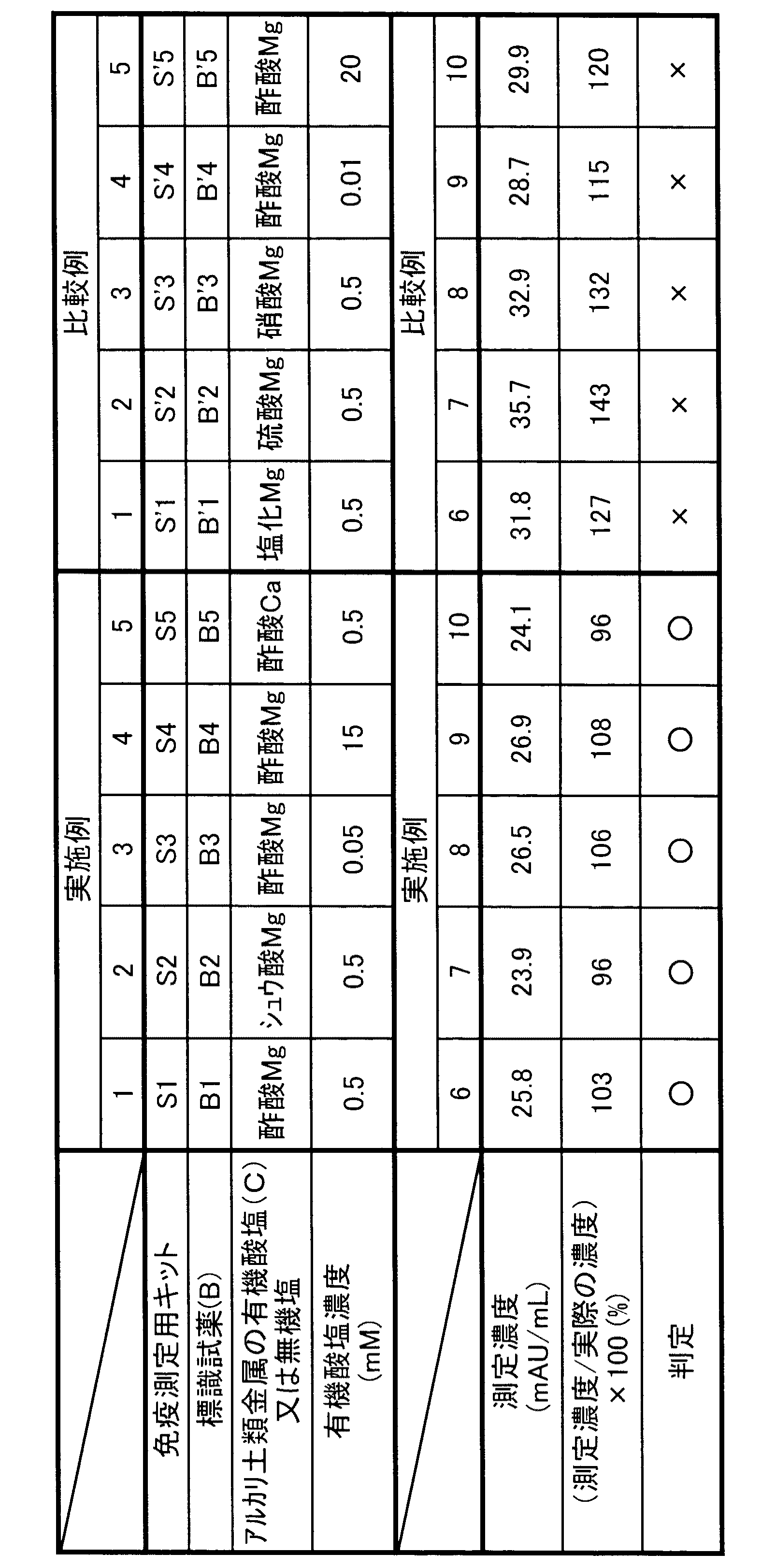
表1から、本発明の免疫測定用キットを用いた免疫測定方法は、比較用の免疫測定用キットを用いた免疫測定方法に比べて、測定濃度と実際の濃度の比率が100%に近く、正確性が高いことがわかる。 From Table 1, the immunoassay method using the immunoassay kit of the present invention shows that the ratio between the measured concentration and the actual concentration is close to 100% as compared with the immunoassay method using the immunoassay kit for comparison. It turns out that the accuracy is high.
本発明の免疫測定用キット及び免疫測定方法は正確性に優れることから、放射免疫測定法、酵素免疫測定法、蛍光免疫測定法及び化学発光免疫測定法等の臨床検査に幅広く適用できる。 Since the immunoassay kit and immunoassay method of the present invention are excellent in accuracy, they can be widely applied to clinical tests such as radioimmunoassay, enzyme immunoassay, fluorescence immunoassay, and chemiluminescence immunoassay.
Claims (8)
工程(1):測定対象物質と特異的に結合する物質(D)を固定化した固相担体(a)と測定対象物質(G)とを反応させて、物質(D)と測定対象物質(G)との複合体(J)を形成させる工程。
工程(2):標識物質(b)により標識された測定対象物質と特異的に結合する物質(F3)と複合体(J)とをアルカリ土類金属の有機酸塩(C)の含有量が0.05mM〜15mMである溶液中で反応させて、物質(D)と測定対象物質(G)と物質(F3)との複合体(L)を形成させる工程。
工程(2’):固相担体(a)に固定化された測定対象物質と特異的に結合する物質(D)と標識物質(b)により標識された測定対象物質(F1)又はその類似物質(F2)とをアルカリ土類金属の有機酸塩(C)の含有量が0.05mM〜15mMである溶液中で反応させて、物質(D)と物質(F1)又は(F2)との複合体(M)を形成させる工程。 An immunoassay method for measuring the concentration of a measurement target substance (G) in a sample, the method comprising the following step (1) and step (2) or step (2 ').
Step (1): The solid support (a) on which the substance (D) that specifically binds to the substance to be measured is immobilized and the substance to be measured (G) are reacted, and the substance (D) and the substance to be measured ( Forming a complex (J) with G).
Step (2): The complex (J) and the substance (F3) that specifically binds to the substance to be measured labeled with the labeling substance (b) are reduced in the content of the alkaline earth metal organic acid salt (C). Reacting in a solution of 0.05 mM to 15 mM to form a complex (L) of the substance (D), the substance to be measured (G), and the substance (F3).
Step (2 ′): a substance (D) specifically binding to the substance to be measured immobilized on the solid phase carrier (a) and a substance to be measured (F1) labeled with the labeling substance (b) or a similar substance thereof (F2) is reacted in a solution having an alkaline earth metal organic acid salt (C) content of 0.05 mM to 15 mM to form a complex of the substance (D) and the substance (F1) or (F2). Forming a body (M);
Applications Claiming Priority (2)
| Application Number | Priority Date | Filing Date | Title |
|---|---|---|---|
| JP2017034602 | 2017-02-27 | ||
| JP2017034602 | 2017-02-27 |
Publications (2)
| Publication Number | Publication Date |
|---|---|
| JP2018141780A JP2018141780A (en) | 2018-09-13 |
| JP6636070B2 true JP6636070B2 (en) | 2020-01-29 |
Family
ID=63526610
Family Applications (1)
| Application Number | Title | Priority Date | Filing Date |
|---|---|---|---|
| JP2018028373A Active JP6636070B2 (en) | 2017-02-27 | 2018-02-21 | Immunoassay method and kit for immunoassay |
Country Status (1)
| Country | Link |
|---|---|
| JP (1) | JP6636070B2 (en) |
Cited By (1)
| Publication number | Priority date | Publication date | Assignee | Title |
|---|---|---|---|---|
| WO2026109508A1 (en) * | 2024-11-19 | 2026-05-28 | Damian Pharma Ag | Methods of diagnosing primary aldosteronism |
Families Citing this family (1)
| Publication number | Priority date | Publication date | Assignee | Title |
|---|---|---|---|---|
| CN111579778B (en) * | 2020-05-07 | 2023-02-03 | 广州市妇女儿童医疗中心(广州市妇幼保健院、广州市儿童医院、广州市妇婴医院、广州市妇幼保健计划生育服务中心) | Application of IgE in bronchoalveolar lavage fluid as disease course diagnostic marker of acute-stage adenovirus pneumonia |
Family Cites Families (6)
| Publication number | Priority date | Publication date | Assignee | Title |
|---|---|---|---|---|
| JPH06509646A (en) * | 1991-07-26 | 1994-10-27 | デイド・ケミストリイ・システムズ・インコーポレーテツド | Signal detection assay in the presence of suspended solid support |
| JP3162125B2 (en) * | 1991-10-01 | 2001-04-25 | 積水化学工業株式会社 | Magnetic solid support for immunoassay |
| JP3993670B2 (en) * | 1997-09-26 | 2007-10-17 | アルフレッサファーマ株式会社 | Method for stabilizing sensitized metal colloid reagent solution and stable solution containing sensitized metal colloid reagent |
| JP5428166B2 (en) * | 2007-06-29 | 2014-02-26 | Jnc株式会社 | Aggregation and dispersion method of magnetic particles and separation, detection method and detection kit using the same |
| CN107102135A (en) * | 2011-05-20 | 2017-08-29 | 阿波特日本有限公司 | Immunity inspection method and reagent for reducing non-specific binding |
| JP5350516B2 (en) * | 2011-06-15 | 2013-11-27 | 三洋化成工業株式会社 | Magnetic particles and method for producing the same |
-
2018
- 2018-02-21 JP JP2018028373A patent/JP6636070B2/en active Active
Cited By (1)
| Publication number | Priority date | Publication date | Assignee | Title |
|---|---|---|---|---|
| WO2026109508A1 (en) * | 2024-11-19 | 2026-05-28 | Damian Pharma Ag | Methods of diagnosing primary aldosteronism |
Also Published As
| Publication number | Publication date |
|---|---|
| JP2018141780A (en) | 2018-09-13 |
Similar Documents
| Publication | Publication Date | Title |
|---|---|---|
| CN103597353B (en) | Use assay method and this assay method reagent of magnetic silica particles | |
| JP6182520B2 (en) | Magnetic silica particles, method for measuring a substance to be measured using the magnetic silica particles, and reagent for measuring the substance to be measured | |
| JP5844195B2 (en) | Magnetic silica particles, immunoassay using the same, and reagent for immunoassay | |
| JP7578741B2 (en) | Immunoassay method, immunoassay kit and solid phase carrier reagent | |
| WO2017078119A1 (en) | Reagent and method for cardiac troponin-i assay | |
| JP7269906B2 (en) | Immunoassay reagent, immunoassay kit, and immunoassay method | |
| JP2018141780A (en) | Immunity measuring method and kit for immunity measurement | |
| JP6449221B2 (en) | Particle composition, immunoassay reagent and immunoassay method | |
| JP5786188B2 (en) | Reagent for measuring C-reactive protein in sample, measuring method, and method for expanding measuring range | |
| JP2016136130A (en) | Reagent for immunoassay and immunoassay method | |
| JP2010101703A (en) | Immunoassay and measuring reagent kit | |
| JP6635985B2 (en) | Immunoassay reagent, immunoassay kit and immunoassay method | |
| JP6636072B2 (en) | Immunoassay reagent, immunoassay kit and immunoassay method | |
| JP6672353B2 (en) | Immunoassay method and immunoassay kit used therefor | |
| JP7431711B2 (en) | Immunoassay method and immunoassay kit | |
| JP7191913B2 (en) | Immunoassay method and immunoassay kit | |
| JP2018124277A (en) | Particle-containing composition, immunoassay reagent, immunoassay method and particle storage method | |
| JP2019052905A (en) | Immunoassay method, immunoassay reagent and immunoassay kit containing the same | |
| JP7627161B2 (en) | Immunoassay reagent, immunoassay kit, and immunoassay method | |
| JP7211748B2 (en) | Immunoassay reagent, immunoassay kit, and immunoassay method | |
| JP6767452B2 (en) | Immunoassay reagents, immunoassay kits and immunoassay methods | |
| JPH08220095A (en) | Heterogeneous immunoassay with precipitable solid phase | |
| JP2019070645A (en) | Manufacturing method of peroxidase-labeled antibody-containing aqueous solution and immunoassay method | |
| JP2001050961A (en) | Fluidity improving agent | |
| US20100267055A1 (en) | One-step immunoassays exhibiting increased sensitivity and specificity |
Legal Events
| Date | Code | Title | Description |
|---|---|---|---|
| A621 | Written request for application examination |
Free format text: JAPANESE INTERMEDIATE CODE: A621 Effective date: 20190307 |
|
| A977 | Report on retrieval |
Free format text: JAPANESE INTERMEDIATE CODE: A971007 Effective date: 20191122 |
|
| TRDD | Decision of grant or rejection written | ||
| A01 | Written decision to grant a patent or to grant a registration (utility model) |
Free format text: JAPANESE INTERMEDIATE CODE: A01 Effective date: 20191203 |
|
| A61 | First payment of annual fees (during grant procedure) |
Free format text: JAPANESE INTERMEDIATE CODE: A61 Effective date: 20191217 |
|
| R150 | Certificate of patent or registration of utility model |
Ref document number: 6636070 Country of ref document: JP Free format text: JAPANESE INTERMEDIATE CODE: R150 |
|
| R250 | Receipt of annual fees |
Free format text: JAPANESE INTERMEDIATE CODE: R250 |