JP6209010B2 - Hair cosmetics - Google Patents
Hair cosmetics Download PDFInfo
- Publication number
- JP6209010B2 JP6209010B2 JP2013156062A JP2013156062A JP6209010B2 JP 6209010 B2 JP6209010 B2 JP 6209010B2 JP 2013156062 A JP2013156062 A JP 2013156062A JP 2013156062 A JP2013156062 A JP 2013156062A JP 6209010 B2 JP6209010 B2 JP 6209010B2
- Authority
- JP
- Japan
- Prior art keywords
- polymer
- mass
- unsaturated monomer
- organopolysiloxane
- less
- Prior art date
- Legal status (The legal status is an assumption and is not a legal conclusion. Google has not performed a legal analysis and makes no representation as to the accuracy of the status listed.)
- Active
Links
Landscapes
- Cosmetics (AREA)
Description
本発明は、オルガノポリシロキサングラフトポリマーを含有するポリマー組成物に関し、詳しくは、毛髪化粧料として有用なポリマー組成物に関する。 The present invention relates to a polymer composition containing an organopolysiloxane graft polymer, and more particularly to a polymer composition useful as a hair cosmetic.
オルガノポリシロキサンは優れた多くの特徴を有していることから、シャンプーやヘアコンディショナー等の感触向上剤等として、様々な形態のオルガノポリシロキサンが使用されている。
例えば、特許文献1には、べたつくことがなく、毛髪に優れた光沢と艶及びなめらかな感触を付与することができ、また、毛髪形状保持力があり長期間繰り返し使用しても蓄積することがなく、更に、配合上の問題もないポリアクリル変性オルガノポリシロキサンが開示されている。
また、特許文献2には、ポリ(N−アシルアルキレンイミン)変性オルガノポリシロキサンを含有する毛髪化粧料を毛髪に適用し、毛髪温度50℃以上において毛髪を形付けした後、毛髪の温度を50℃未満に冷却することにより、形付けした髪型を固定する整髪方法が開示されている。
特許文献3には、メルカプト変性シリコーンとラジカル重合性ビニルモノマーを溶液重合してなるオルガノポリシロキサングラフトポリマーを含む化粧品組成物が開示されている。
特許文献4には、オルガノポリシロキサングラフトポリマーを含む毛髪化粧料が開示されている。
特許文献5には、アニオン基を有するオルガノポリシロキサングラフトポリマー処理粉体、及びそれを用いた化粧品を含むパーソナルケア製品が開示されている。
Since organopolysiloxane has many excellent features, various forms of organopolysiloxane are used as a touch improver for shampoos and hair conditioners.
For example, Patent Document 1 has no stickiness, can impart excellent luster, luster and smooth feel to the hair, and has hair shape retention ability and can accumulate even after repeated use over a long period of time. In addition, a polyacryl-modified organopolysiloxane having no compounding problems is disclosed.
In Patent Document 2, a hair cosmetic containing a poly (N-acylalkylenimine) -modified organopolysiloxane is applied to hair, and after shaping the hair at a hair temperature of 50 ° C. or higher, the hair temperature is 50. A hair styling method is disclosed in which the shaped hairstyle is fixed by cooling to less than 0C.
Patent Document 3 discloses a cosmetic composition containing an organopolysiloxane graft polymer obtained by solution polymerization of mercapto-modified silicone and a radical polymerizable vinyl monomer.
Patent Document 4 discloses a hair cosmetic containing an organopolysiloxane graft polymer.
Patent Document 5 discloses a personal care product including an anionic polyorganosiloxane graft polymer-treated powder and a cosmetic using the same.
特許文献1に記載されたポリアクリル変性オルガノポリシロキサンは、室温における皮膜の弾性率が低く、毛髪セット力及び毛髪形状保持力が不十分であるという課題がある。また、毛髪化粧料中における配合量を増やすとべたつきを感じるという問題もある。
特許文献2に記載されたポリ(N−アシルアルキレンイミン)変性オルガノポリシロキサンは、高湿度下でのセット保持性が十分とは言えなかった。
特許文献3〜5には、カチオン基又はアニオン基を有するオルガノポリシロキサングラフトポリマーが開示されているが、髪温度50℃以上において毛髪を形付けした後、毛髪の温度を50℃未満に冷却することにより、形付けした髪形を固定する整髪方法(例えば、ヘアアイロンやドライヤーを用いた毛髪のセット方法)には使用できない。
The polyacryl-modified organopolysiloxane described in Patent Document 1 has a problem that the film has a low elastic modulus at room temperature, and the hair setting force and the hair shape retention force are insufficient. There is also a problem that stickiness is felt when the blending amount in the hair cosmetic is increased.
The poly (N-acylalkylenimine) -modified organopolysiloxane described in Patent Document 2 cannot be said to have sufficient set retention under high humidity.
Patent Documents 3 to 5 disclose organopolysiloxane graft polymers having a cationic group or an anionic group, but after shaping the hair at a hair temperature of 50 ° C or higher, the temperature of the hair is cooled to less than 50 ° C. Therefore, it cannot be used for a hair styling method (for example, a hair setting method using a hair iron or a dryer) for fixing the shaped hairstyle.
本発明の課題は、髪温度50℃以上において毛髪を形付けした後、毛髪の温度を50℃未満に冷却することにより、形付けした髪形を固定可能で、かつ、優れたセット保持性を有するポリマー組成物、及びそれを含有する毛髪化粧料を提供することにある。 An object of the present invention is to shape a hair at a hair temperature of 50 ° C. or higher and then cool the hair temperature to less than 50 ° C. so that the shaped hair can be fixed and has excellent set retention. The object is to provide a polymer composition and a hair cosmetic containing the polymer composition.
本発明は、以下のポリマー組成物及び毛髪化粧料を提供する。
[1]下記ポリマーA及びポリマーBを含有し、ポリマーA及びポリマーBの合計に対するオルガノポリシロキサンセグメントの含有量が30質量%以上70質量%以下である、ポリマー組成物。
ポリマーA:主鎖としてオルガノポリシロキサンセグメントを有し、側鎖として不飽和単量体由来の重合体セグメントを有するオルガノポリシロキサングラフトポリマーであって、オルガノポリシロキサングラフトポリマー中におけるオルガノポリシロキサンセグメントの含有量が70質量%超90質量%以下であるオルガノポリシロキサングラフトポリマー。
ポリマーB:ポリマーAの側鎖を構成する不飽和単量体と同じ不飽和単量体由来の繰り返し単位を90質量%以上含有するポリマー。
[2]前記ポリマー組成物を含有する毛髪化粧料。
The present invention provides the following polymer composition and hair cosmetic.
[1] A polymer composition containing the following polymer A and polymer B, wherein the content of the organopolysiloxane segment with respect to the total of the polymer A and the polymer B is 30% by mass or more and 70% by mass or less.
Polymer A: an organopolysiloxane graft polymer having an organopolysiloxane segment as a main chain and a polymer segment derived from an unsaturated monomer as a side chain, wherein the organopolysiloxane segment in the organopolysiloxane graft polymer An organopolysiloxane graft polymer having a content of more than 70% by mass and 90% by mass or less.
Polymer B: A polymer containing 90% by mass or more of a repeating unit derived from the same unsaturated monomer as the unsaturated monomer constituting the side chain of the polymer A.
[2] A hair cosmetic containing the polymer composition.
本発明によれば、髪温度50℃以上において毛髪を形付けした後、毛髪の温度を50℃未満に冷却することにより、形付けした髪形を固定可能で、かつ、高いセット保持力を有するポリマー組成物、及びそれを含有する毛髪化粧料を提供することができる。 According to the present invention, after shaping hair at a hair temperature of 50 ° C. or higher, the shaped hairstyle can be fixed by cooling the hair temperature to less than 50 ° C., and has a high set holding power. A composition and a hair cosmetic containing the composition can be provided.
[ポリマー組成物]
本発明のポリマー組成物は、下記ポリマーA及びポリマーBを含有し、ポリマーA及びポリマーBの合計に対するオルガノポリシロキサンセグメントの含有量が30質量%以上70質量%以下のポリマー組成物である。
ポリマーA:主鎖としてオルガノポリシロキサンセグメントを有し、側鎖として不飽和単量体由来の重合体セグメントを有するオルガノポリシロキサングラフトポリマーであって、オルガノポリシロキサングラフトポリマー中におけるオルガノポリシロキサンセグメントの含有量が70質量%超90質量%以下であるオルガノポリシロキサングラフトポリマー。
ポリマーB:ポリマーAの側鎖を構成する不飽和単量体と同じ不飽和単量体由来の繰り返し単位を90質量%以上含有するポリマー。
[Polymer composition]
The polymer composition of the present invention is a polymer composition containing the following polymer A and polymer B, wherein the content of the organopolysiloxane segment with respect to the total of polymer A and polymer B is 30% by mass or more and 70% by mass or less.
Polymer A: an organopolysiloxane graft polymer having an organopolysiloxane segment as a main chain and a polymer segment derived from an unsaturated monomer as a side chain, wherein the organopolysiloxane segment in the organopolysiloxane graft polymer An organopolysiloxane graft polymer having a content of more than 70% by mass and 90% by mass or less.
Polymer B: A polymer containing 90% by mass or more of a repeating unit derived from the same unsaturated monomer as the unsaturated monomer constituting the side chain of the polymer A.
<ポリマーA>
前記ポリマーAは、主鎖としてオルガノポリシロキサンセグメントを有し、側鎖として不飽和単量体由来の重合体セグメントを有するオルガノポリシロキサングラフトポリマーであって、オルガノポリシロキサングラフトポリマー中におけるオルガノポリシロキサンセグメントの含有量が70質量%超90質量%以下のオルガノポリシロキサングラフトポリマー(以下、「グラフトポリマー」ともいう)である。
本発明におけるグラフトポリマーは、2つ以上の側鎖が、主鎖を構成するオルガノポリシロキサンセグメントの任意のケイ素原子に、ヘテロ原子を含むアルキレン基を介して結合していることが好ましく、両末端を除く1以上のケイ素原子に上記アルキレン基を介して結合していることがより好ましく、両末端を除く2以上のケイ素原子に上記アルキレン基を介して結合していることが更に好ましい。
<Polymer A>
The polymer A is an organopolysiloxane graft polymer having an organopolysiloxane segment as a main chain and a polymer segment derived from an unsaturated monomer as a side chain, the organopolysiloxane in the organopolysiloxane graft polymer It is an organopolysiloxane graft polymer (hereinafter also referred to as “graft polymer”) having a segment content of more than 70% by mass and 90% by mass or less.
In the graft polymer of the present invention, it is preferable that two or more side chains are bonded to any silicon atom of the organopolysiloxane segment constituting the main chain via an alkylene group containing a hetero atom. It is more preferable that it is bonded to one or more silicon atoms except for through the alkylene group, and it is further preferable to bond to two or more silicon atoms other than both ends via the alkylene group.
〔オルガノポリシロキサンセグメント〕
グラフトポリマーは、主鎖としてオルガノポリシロキサンセグメントを有する。
オルガノポリシロキサンセグメントの化学構造は特に限定されないが、好ましい具体例としては、下記一般式(1)又は(2)で表される変性オルガノポリシロキサンセグメントである。
[Organopolysiloxane segment]
The graft polymer has an organopolysiloxane segment as the main chain.
The chemical structure of the organopolysiloxane segment is not particularly limited, but a preferred specific example is a modified organopolysiloxane segment represented by the following general formula (1) or (2).
前記一般式(1)及び(2)中、R1は、それぞれ独立に炭素数1以上22以下のアルキル基又は炭素数6以上14以下のアリール基を表し、R2は、ヘテロ原子を含んでいてもよいアルキレン基を表す。pは、2以上4000以下の数を表し、qは、2以上250以下の数を表す。式中、p個の繰返し単位とq個の繰返し単位の結合様式は、それぞれの繰返し単位がブロック状につながっていてもよいし、ランダム状につながっていてもよい。 In the general formulas (1) and (2), R 1 independently represents an alkyl group having 1 to 22 carbon atoms or an aryl group having 6 to 14 carbon atoms, and R 2 contains a hetero atom. Represents an optionally substituted alkylene group. p represents a number of 2 to 4000, and q represents a number of 2 to 250. In the formula, the coupling mode of p repeating units and q repeating units may be such that each repeating unit is connected in a block shape or in a random shape.
前記一般式(1)及び(2)中、R1で表されるアルキル基としては、直鎖、分岐鎖、又は環状のアルキル基が挙げられ、R1で表されるアルキル基の炭素数は、グラフトポリマーのエタノール中での分散性の観点から、好ましくは1以上10以下、より好ましくは6以下である。R1で表されるアルキル基の具体例としては、メチル基、エチル基、n−プロピル基、イソプロピル基、n−ブチル基、tert−ブチル基、ペンチル基、ヘキシル基、シクロへキシル基、ヘプチル基、オクチル基、ノニル基、デシル基、ウンデシル基、ドデシル基、オクタデシル基、ノナデシル基、エイコシル基、ドコシル基等が挙げられる。なお、グラフトポリマーのエタノール中での分散性とは、エタノールを主成分とする組成物中でグラフトポリマーが安定に分散しうる性質のことであり、本性質が良好であると、溶媒がエタノールを主成分とする毛髪化粧料に配合可能であり、洗髪性も良好となるため好ましい。
R1で表されるアリール基の炭素数は、グラフトポリマーのエタノール中での分散性の観点から好ましくは6以上12以下、より好ましくは9以下である。R1で表されるアリール基の具体例としては、フェニル基、トリル基、キシリル基、ナフチル基、ビフェニル基、アントリル基、フェナントリル基等が挙げられる。
これらの中でも、R1としては、グラフトポリマーのエタノール中での分散性の観点から炭素数1以上6以下の直鎖又は分岐鎖のアルキル基が好ましく、炭素数1以上3以下の直鎖又は分岐鎖のアルキル基がより好ましく、メチル基が更に好ましい。
In the general formulas (1) and (2), examples of the alkyl group represented by R 1 include a linear, branched, or cyclic alkyl group. The carbon number of the alkyl group represented by R 1 is From the viewpoint of dispersibility of the graft polymer in ethanol, it is preferably 1 or more and 10 or less, more preferably 6 or less. Specific examples of the alkyl group represented by R 1 include methyl group, ethyl group, n-propyl group, isopropyl group, n-butyl group, tert-butyl group, pentyl group, hexyl group, cyclohexyl group, heptyl. Group, octyl group, nonyl group, decyl group, undecyl group, dodecyl group, octadecyl group, nonadecyl group, eicosyl group, docosyl group and the like. The dispersibility of the graft polymer in ethanol is a property that allows the graft polymer to be stably dispersed in a composition containing ethanol as a main component. If this property is good, the solvent is ethanol. It is preferable because it can be blended in the hair cosmetic composition containing the main component and the hair washability is improved.
The number of carbon atoms of the aryl group represented by R 1 is preferably 6 or more and 12 or less, more preferably 9 or less, from the viewpoint of dispersibility of the graft polymer in ethanol. Specific examples of the aryl group represented by R 1 include phenyl group, tolyl group, xylyl group, naphthyl group, biphenyl group, anthryl group, phenanthryl group and the like.
Among these, as R 1 , a linear or branched alkyl group having 1 to 6 carbon atoms is preferable from the viewpoint of dispersibility of the graft polymer in ethanol, and linear or branched having 1 to 3 carbon atoms. A chain alkyl group is more preferred, and a methyl group is still more preferred.
前記一般式(1)及び(2)中、pは、2以上4000以下の数を表し、qは、2以上250以下の数を表す。
pは、オルガノポリシロキサングラフトポリマーを用いた毛髪化粧料(以下「本発明の毛髪化粧料」ともいう)で毛髪をセットした後の毛髪の感触、すなわち、べたつき軽減の観点から、好ましくは50以上、より好ましくは80以上、更に好ましくは100以上の数であり、また、グラフトポリマーのエタノール中での分散性の観点から、好ましくは2000以下、より好ましくは1300以下、更に好ましくは700以下の数である。
qは、グラフトポリマーのエタノール中での分散性の観点から、好ましくは3以上、より好ましくは5以上の数であり、本発明の毛髪化粧料のセット力、セット後の毛髪形状の持続性の観点から好ましくは50以下、より好ましくは30以下の数である。
In the general formulas (1) and (2), p represents a number of 2 to 4000, and q represents a number of 2 to 250.
p is preferably 50 or more from the viewpoint of hair feel after setting hair with a hair cosmetic using an organopolysiloxane graft polymer (hereinafter also referred to as “hair cosmetic of the present invention”), that is, stickiness reduction. More preferably, the number is 80 or more, more preferably 100 or more, and from the viewpoint of dispersibility of the graft polymer in ethanol, the number is preferably 2000 or less, more preferably 1300 or less, and still more preferably 700 or less. It is.
From the viewpoint of dispersibility of the graft polymer in ethanol, q is preferably a number of 3 or more, more preferably 5 or more, and the setting power of the hair cosmetic of the present invention, the sustainability of the hair shape after setting, From the viewpoint, the number is preferably 50 or less, more preferably 30 or less.
前記一般式(1)及び(2)中、ヘテロ原子を含んでいてもよいアルキレン基(R2)の一部又は全部は、主鎖及び不飽和単量体由来の重合体セグメントと結合し、主鎖と側鎖である不飽和単量体由来の重合体セグメントの連結基として機能する。不飽和単量体由来の重合体セグメントと結合していないヘテロ原子を含んでいてもよいアルキレン基が存在する場合は、該ヘテロ原子を含んでいてもよいアルキレン基は、主鎖及び水素原子と結合している。
本発明において、ヘテロ原子を含んでいてもよいアルキレン基の炭素数は、グラフトポリマー製造時の原料の入手性の観点から、好ましくは2以上、より好ましくは3以上であり、また、グラフトポリマーのエタノール中での分散性の観点から、好ましくは20以下、より好ましくは10以下、更に好ましくは8以下である。
In the general formulas (1) and (2), part or all of the alkylene group (R 2 ) which may contain a hetero atom is bonded to the polymer chain derived from the main chain and the unsaturated monomer, It functions as a linking group for a polymer segment derived from an unsaturated monomer as a main chain and a side chain. When there is an alkylene group that may contain a hetero atom that is not bonded to the polymer segment derived from the unsaturated monomer, the alkylene group that may contain the hetero atom includes the main chain and a hydrogen atom. Are connected.
In the present invention, the number of carbon atoms of the alkylene group which may contain a hetero atom is preferably 2 or more, more preferably 3 or more, from the viewpoint of availability of raw materials during the production of the graft polymer. From the viewpoint of dispersibility in ethanol, it is preferably 20 or less, more preferably 10 or less, and still more preferably 8 or less.
本発明において、ヘテロ原子を含んでいてもよいアルキレン基は、酸素原子、硫黄原子、−NH−、−COO−、−NHCO−、及び−NR3CO−から選ばれる1つ以上の原子又は官能基によって分断されていてもよい。すなわち、ヘテロ原子を含んでいてもよいアルキレン基は、「−(アルキレン基部分1)−(上記の原子又は官能基)−(アルキレン基部分2)−」という構造であってもよく、この場合、アルキレン基の炭素数とは、アルキレン基部分1の炭素数及びアルキレン基部分2の炭素数の和をいう。ここでR3は、炭素数1以上3以下のアルキル基である。ヘテロ原子を含んでいてもよいアルキレン基が上記原子又は官能基によって分断されている場合は、グラフトポリマーの製造の容易性の観点から、−NHCO−によって分断されていることが好ましい。 In the present invention, the alkylene group which may contain a hetero atom is one or more atoms or functional groups selected from an oxygen atom, a sulfur atom, —NH—, —COO—, —NHCO—, and —NR 3 CO—. It may be divided by a group. That is, the alkylene group which may contain a hetero atom may have a structure of “— (alkylene group moiety 1) — (the above atom or functional group) — (alkylene group moiety 2) —”. The carbon number of the alkylene group means the sum of the carbon number of the alkylene group part 1 and the carbon number of the alkylene group part 2. Here, R 3 is an alkyl group having 1 to 3 carbon atoms. When the alkylene group which may contain a hetero atom is interrupted by the above atom or functional group, it is preferably interrupted by —NHCO— from the viewpoint of ease of production of the graft polymer.
本発明において、ヘテロ原子を含んでいてもよいアルキレン基は、水酸基、アミノ基、炭素数1以上3以下のアルキルアミノ基、炭素数1以上3以下のジアルキルアミノ基、アミノ基と炭素数2以上4以下の脂肪酸が脱水縮合して得られるアミド基、カルボキシ基、及び炭素数1以上3以下のアルキルエステル基から選ばれる1つ以上の1価の基が置換していてもよい。この場合、ヘテロ原子を含んでいてもよいアルキレン基の炭素数とは、前記置換基の炭素数を含まない。グラフトポリマー製造時の原料入手性の観点から、ヘテロ原子を含んでいてもよいアルキレン基は、アセトアミド基、炭素数1以上3以下のアルキルアミノ基、及びアミノ基から選ばれる1つ以上の1価の基が置換していることが好ましい。 In the present invention, the alkylene group which may contain a hetero atom includes a hydroxyl group, an amino group, an alkylamino group having 1 to 3 carbon atoms, a dialkylamino group having 1 to 3 carbon atoms, an amino group and 2 or more carbon atoms. One or more monovalent groups selected from an amide group obtained by dehydration condensation of 4 or less fatty acid, a carboxy group, and an alkyl ester group having 1 to 3 carbon atoms may be substituted. In this case, the carbon number of the alkylene group which may contain a hetero atom does not include the carbon number of the substituent. From the viewpoint of availability of raw materials at the time of producing the graft polymer, the alkylene group which may contain a hetero atom is at least one monovalent selected from an acetamido group, an alkylamino group having 1 to 3 carbon atoms, and an amino group. These groups are preferably substituted.
本発明において、ヘテロ原子を含んでいてもよいアルキレン基は、−O−、−S−、−NH−、−NR30−、−NHCO−及び−COO−から選ばれる、2価のヘテロ原子、又はヘテロ原子を含む2価の基が置換していてもよい。ここでR30はジメチルアミノ基が置換していてもよい炭素数1以上3以下のアルキル基である。該ヘテロ原子、又はヘテロ原子を含む2価の基は、ヘテロ原子を含んでいてもよいアルキレン基が不飽和単量体由来の重合体セグメントとの連結基として働く場合には、不飽和単量体由来の重合体セグメントと結合している。その他の場合は水素原子と結合している。
グラフトポリマーの製造の容易性の観点から、ヘテロ原子を含んでいてもよいアルキレン基は、−S−が置換していることが好ましい。
ヘテロ原子を含んでいてもよいアルキレン基(R2)は、該ヘテロ原子、好ましくは窒素原子、酸素原子、又は硫黄原子、より好ましくは硫黄原子を介して不飽和単量体由来の重合体セグメントと結合していることが好ましい。
したがって、R2で表される「ヘテロ原子を含んでいてもよいアルキレン基」は、(i)無置換のアルキレン基、(ii)酸素原子、硫黄原子、−NH−、−COO−、−NHCO−、及び−NR3CO−から選ばれる1つ以上の原子又は官能基によって分断されたアルキレン基、(iii)水酸基、アミノ基、アルキル(炭素数1以上3以下)アミノ基、ジアルキル(炭素数1以上3以下)アミノ基、アミノ基と炭素数2以上4以下の脂肪酸が脱水縮合して得られるアミド基、カルボキシ基及びアルキル(炭素数1以上3以下)エステル基から選ばれる1つ以上の1価の基が置換しているアルキレン基、(iv)−O−、−S−、−NH−、−NR30−及び−COO−から選ばれる2価のヘテロ原子、又はヘテロ原子を含む2価の基が置換したアルキレン基の他、上記(ii)、(iii)、(iv)の組合せからなるアルキレン基が該当する。
In the present invention, an alkylene group which may contain a hetero atom, -O -, - S -, - NH -, - NR 30 -, - NHCO- and selected from -COO-, 2-valent hetero atom, Alternatively, a divalent group containing a hetero atom may be substituted. Here, R 30 is an alkyl group having 1 to 3 carbon atoms which may be substituted by a dimethylamino group. In the case where the heteroatom or a divalent group containing a heteroatom serves as a linking group with a polymer segment derived from an unsaturated monomer, the alkylene group that may contain a heteroatom is an unsaturated monomer. It is bound to the polymer segment derived from the body. In other cases, it is bonded to a hydrogen atom.
From the viewpoint of ease of production of the graft polymer, the alkylene group which may contain a hetero atom is preferably substituted with -S-.
The alkylene group (R 2 ) which may contain a hetero atom is a polymer segment derived from an unsaturated monomer via the hetero atom, preferably a nitrogen atom, an oxygen atom or a sulfur atom, more preferably a sulfur atom. It is preferable that it is couple | bonded with.
Therefore, the “alkylene group optionally containing a hetero atom” represented by R 2 includes (i) an unsubstituted alkylene group, (ii) an oxygen atom, a sulfur atom, —NH—, —COO—, —NHCO. An alkylene group interrupted by one or more atoms or functional groups selected from — and —NR 3 CO—, (iii) a hydroxyl group, an amino group, an alkyl (having 1 to 3 carbon atoms) amino group, a dialkyl (having a carbon number) 1 or more and 3 or less) one or more selected from an amino group, an amide group obtained by dehydration condensation of an amino group and a fatty acid having 2 to 4 carbon atoms, a carboxy group, and an alkyl (1 to 3 carbon atoms) ester group monovalent alkylene radical group is substituted, (iv) -O -, - S -, - NH -, - NR 30 - and divalent heteroatoms selected from -COO- 2 or containing a hetero atom, Alkyl substituted with a valent group Other emissions group, the (ii), (iii), the appropriate alkylene group comprising a combination of (iv).
本発明における、ヘテロ原子を含んでいてもよいアルキレン基の具体例としては、下記式(i)〜(xii)が例示される。中でもグラフトポリマーの製造の容易性の観点から下記式(xi)及び(xii)が好ましい。 Specific examples of the alkylene group that may contain a hetero atom in the present invention include the following formulas (i) to (xii). Of these, the following formulas (xi) and (xii) are preferred from the viewpoint of ease of production of the graft polymer.
式(i)〜(xii)中、*は、前記一般式(1)又は(2)におけるケイ素原子に結合する部位を表し、**は、不飽和単量体由来の重合体セグメントに結合する部位を表す。
式(xii)中、X1は−O−、−OCO−、−COO−、−CONH−、−NHCO−から選ばれる一種以上であり、グラフトポリマーの製造の容易性の観点から−CONH−又は−NHCO−が好ましく、−NHCO−がより好ましい。
In formulas (i) to (xii), * represents a site bonded to a silicon atom in the general formula (1) or (2), and ** is bonded to a polymer segment derived from an unsaturated monomer. Represents a site.
In the formula (xii), X 1 is one or more selected from —O—, —OCO—, —COO—, —CONH—, —NHCO—, and —CONH— from the viewpoint of ease of production of the graft polymer. -NHCO- is preferable, and -NHCO- is more preferable.
また、式(xii)中、R4は、水酸基、アミノ基、アルキル(炭素数1以上3以下)アミノ基、ジアルキル(炭素数1以上3以下)アミノ基、アミノ基と炭素数2以上4以下の脂肪酸が脱水縮合して得られるアミド基、カルボキシ基及びアルキル(炭素数1以上3以下)エステル基から選ばれる1つ以上の1価の基が置換していてもよいアルキレン基である。置換基としては、製造時の原料入手性の観点から、アセトアミド基、アルキル(炭素数1以上3以下)アミノ基、及びアミノ基であることが好ましい。R4で表されるアルキレン基の炭素数は、グラフトポリマーの製造の容易性の観点から好ましくは2以上、より好ましくは3以上であり、また、グラフトポリマーのエタノール中での分散性の観点から、好ましくは10以下、より好ましくは6以下である。
R4の具体例としては、下記式(xiii)〜(xv)が挙げられる。
In the formula (xii), R 4 represents a hydroxyl group, an amino group, an alkyl (C 1 or more and 3 or less) amino group, a dialkyl (C 1 or more and 3 or less) amino group, an amino group and 2 or more and 4 or less carbon atoms. Is an alkylene group which may be substituted with one or more monovalent groups selected from an amide group, a carboxy group, and an alkyl (having 1 to 3 carbon atoms) ester group obtained by dehydration condensation. The substituent is preferably an acetamido group, an alkyl (having 1 to 3 carbon atoms) amino group, and an amino group from the viewpoint of availability of raw materials during production. The number of carbon atoms of the alkylene group represented by R 4 is preferably 2 or more, more preferably 3 or more from the viewpoint of ease of production of the graft polymer, and from the viewpoint of dispersibility of the graft polymer in ethanol. , Preferably 10 or less, more preferably 6 or less.
Specific examples of R 4 include the following formulas (xiii) to (xv).
式(xiv)中、X-は塩化物イオン、臭化物イオン等のハロゲン化物イオン、酢酸イオン、アルキル(炭素数1以上3以下)硫酸イオン等のアニオンを表す。 In the formula (xiv), X − represents an anion such as a halide ion such as a chloride ion or a bromide ion, an acetate ion, or an alkyl (having 1 to 3 carbon atoms) sulfate ion.
〔不飽和単量体由来の重合体セグメント〕
不飽和単量体由来の重合体セグメントに用いることができる不飽和単量体について、特に制限はなく、例えば、非イオン性の不飽和単量体、カチオン性の不飽和単量体、及びアニオン性の不飽和単量体を用いることができる。
本発明においては特に、(1)非イオン性の不飽和単量体としてN,N−ジメチルアクリルアミド(以下「DMAAm」ともいう)を用いる場合、(2)カチオン性の不飽和単量体を用いる場合、(3)アニオン性の不飽和単量体としてカルボン酸又はその塩を有する不飽和単量体を用いる場合が好ましい。以下、各場合における好ましい態様を詳述する。
[Polymer segment derived from unsaturated monomer]
There are no particular limitations on the unsaturated monomer that can be used in the polymer segment derived from the unsaturated monomer, such as a nonionic unsaturated monomer, a cationic unsaturated monomer, and an anion. Unsaturated monomers can be used.
In the present invention, in particular, when (1) N, N-dimethylacrylamide (hereinafter also referred to as “DMAAm”) is used as the nonionic unsaturated monomer, (2) a cationic unsaturated monomer is used. In this case, it is preferable to use (3) an unsaturated monomer having a carboxylic acid or a salt thereof as the anionic unsaturated monomer. Hereinafter, preferred embodiments in each case will be described in detail.
(非イオン性の不飽和単量体としてDMAAmを用いる場合)
非イオン性の不飽和単量体としてDMAAmを用いる場合、前記ポリマーAの不飽和単量体由来の重合体セグメントは、DMAAm由来の繰り返し単位を50質量%以上100質量%以下含有し、イオン性の不飽和単量体由来の繰り返し単位の含有量が1質量%以下であることが好ましい。
また、不飽和単量体由来の重合体セグメントのガラス転移温度が60℃以上150℃以下であることがより好ましい。
更にホモポリマーのガラス転移温度が60℃以上150℃以下である非イオン性の不飽和単量体(以下、「Tg60-150℃非イオン性不飽和単量体」ともいう)由来の繰り返し単位を90質量%以上含有することが好ましい。
(When DMAAm is used as a nonionic unsaturated monomer)
When DMAAm is used as the nonionic unsaturated monomer, the polymer segment derived from the unsaturated monomer of the polymer A contains 50% by mass to 100% by mass of the repeating unit derived from DMAAm, and is ionic. The content of the repeating unit derived from the unsaturated monomer is preferably 1% by mass or less.
The glass transition temperature of the polymer segment derived from the unsaturated monomer is more preferably 60 ° C. or higher and 150 ° C. or lower.
Further, a repeating unit derived from a nonionic unsaturated monomer having a glass transition temperature of 60 ° C. or higher and 150 ° C. or lower (hereinafter also referred to as “Tg 60-150 ° C. nonionic unsaturated monomer”) of the homopolymer. It is preferable to contain 90 mass% or more.
前記ポリマーAの不飽和単量体由来の重合体セグメント中におけるDMAAm由来の繰り返し単位の含有量は、毛髪化粧料のセット力、セット後の毛髪形状の持続性の観点、毛髪化粧料が付着した髪の洗髪性の観点、及びグラフトポリマーのエタノール中での分散性の観点から、好ましくは50質量%以上、より好ましくは60質量%以上、更に好ましくは70質量%以上、より更に好ましくは75質量%以上であり、また、毛髪をセットした後の毛髪の感触の観点から、好ましくは100質量%以下、より好ましくは95質量%以下、更に好ましくは90質量%以下、より更に好ましくは85質量%以下である。
なお、グラフトポリマーにおいて、不飽和単量体由来の重合体セグメント中におけるDMAAm由来の繰返し単位の含有量は、NMR法により測定することができる。
The content of the repeating unit derived from DMAAm in the polymer segment derived from the unsaturated monomer of the polymer A is determined in view of the setting power of the hair cosmetic, the sustainability of the hair shape after setting, and the hair cosmetic. From the viewpoint of hair washability and the dispersibility of the graft polymer in ethanol, it is preferably 50% by mass or more, more preferably 60% by mass or more, still more preferably 70% by mass or more, and even more preferably 75% by mass. From the viewpoint of the feel of the hair after setting the hair, it is preferably 100% by mass or less, more preferably 95% by mass or less, still more preferably 90% by mass or less, and still more preferably 85% by mass. It is as follows.
In the graft polymer, the content of the repeating unit derived from DMAAm in the polymer segment derived from the unsaturated monomer can be measured by NMR method.
不飽和単量体由来の重合体セグメントのガラス転移温度は、毛髪化粧料のセット力、セット後の毛髪形状の持続性の観点から、好ましくは60℃以上、より好ましくは70℃以上であり、また、髪温度50℃以上における毛髪の形付けのしやすさの観点から、好ましくは150℃以下、より好ましくは140℃以下である。 The glass transition temperature of the polymer segment derived from the unsaturated monomer is preferably 60 ° C. or higher, more preferably 70 ° C. or higher, from the viewpoint of the setting power of the hair cosmetic and the sustainability of the hair shape after setting. Further, from the viewpoint of easy shaping of hair at a hair temperature of 50 ° C. or higher, it is preferably 150 ° C. or lower, more preferably 140 ° C. or lower.
前記ポリマーAの不飽和単量体由来の重合体セグメント中における前記Tg60-150℃非イオン性不飽和単量体由来の繰り返し単位の含有量は、毛髪化粧料のセット力、セット後の毛髪形状の持続性の観点から、好ましくは90質量%以上、より好ましくは95質量%、更に好ましくは実質的に100質量%、より更に好ましくは100質量%である。 The content of the repeating unit derived from the Tg 60-150 ° C. nonionic unsaturated monomer in the polymer segment derived from the unsaturated monomer of the polymer A is the hair cosmetic setting power, the hair after setting. From the viewpoint of shape sustainability, it is preferably 90% by mass or more, more preferably 95% by mass, still more preferably substantially 100% by mass, and still more preferably 100% by mass.
前記Tg60-150℃非イオン性不飽和単量体のガラス転移温度は、毛髪化粧料のセット力、セット後の毛髪形状の持続性の観点から、好ましくは60℃以上、より好ましくは70℃以上であり、また、髪温度50℃以上における毛髪の形付けのしやすさの観点から、好ましくは150℃以下、より好ましくは140℃以下である。 The glass transition temperature of the Tg 60-150 ° C. nonionic unsaturated monomer is preferably 60 ° C. or more, more preferably 70 ° C., from the viewpoint of the setting power of the hair cosmetic and the sustainability of the hair shape after setting. From the viewpoint of easy shaping of hair at a hair temperature of 50 ° C. or higher, the temperature is preferably 150 ° C. or lower, more preferably 140 ° C. or lower.
本発明においては、Tg60-150℃非イオン性不飽和単量体としてDMAAmのみを用いてもよいが、DMAAm以外のTg60-150℃非イオン性不飽和単量体を用いてもよい。
前記DMAAm以外のTg60-150℃非イオン性不飽和単量体のガラス転移温度は、毛髪化粧料のセット力、セット後の毛髪形状の持続性の観点から、好ましくは80℃以上、より好ましくは100℃以上、更に好ましくは120℃以上であり、また、髪温度50℃以上における毛髪の形付けのしやすさの観点から、好ましくは135℃以下、より好ましくは130℃以下である。
In the present invention, Tg 60-150 ° C. may be used DMAAm only as a non-ionic unsaturated monomer, or may be used Tg 60-150 ° C. nonionic unsaturated monomer other than DMAAm.
The glass transition temperature of the Tg 60-150 ° C. nonionic unsaturated monomer other than the DMAAm is preferably 80 ° C. or more, more preferably from the viewpoint of the setting power of the hair cosmetic and the sustainability of the hair shape after setting. Is 100 ° C. or higher, more preferably 120 ° C. or higher, and is preferably 135 ° C. or lower, more preferably 130 ° C. or lower, from the viewpoint of ease of hair shaping at a hair temperature of 50 ° C. or higher.
前記DMAAm以外のTg60-150℃非イオン性不飽和単量体の含有量は、毛髪化粧料のセット力、セット後の毛髪形状の持続性の観点及び毛髪をセットした後の毛髪の感触の観点から、好ましくは0質量%以上、より好ましくは5質量%以上、更に好ましくは10質量%以上であり、また、毛髪化粧料のセット力、セット後の毛髪形状の持続性の観点、及びグラフトポリマーのエタノール中での分散性の観点から、好ましくは50質量%以下、より好ましくは30質量%以下、更に好ましくは25質量%以下である。 The content of Tg 60-150 ° C. nonionic unsaturated monomer other than the above DMAAm depends on the setting power of the hair cosmetics, the viewpoint of durability of the hair shape after setting, and the feel of the hair after setting the hair. From the viewpoint, it is preferably 0% by mass or more, more preferably 5% by mass or more, and further preferably 10% by mass or more. Also, the setting power of the hair cosmetic, the viewpoint of the sustainability of the hair shape after setting, and the graft From the viewpoint of dispersibility of the polymer in ethanol, it is preferably 50% by mass or less, more preferably 30% by mass or less, and still more preferably 25% by mass or less.
前記DMAAm以外の非イオン性不飽和単量体としては、DMAAmと共重合可能な不飽和単量体であって、例えば、オレフィン、ハロゲン化オレフィン、ビニルエステル、(メタ)アクリレート類、又は(メタ)アクリルアミド類(但し、DMAAmを除く)等の不飽和単量体由来の繰り返し単位が挙げられる。不飽和単量体由来の重合体セグメント中、DMAAm由来の繰り返し単位以外の部分は、DMAAmと共重合可能な単一種の不飽和単量体由来の繰り返し単位からなっていてもよいし、2種以上の不飽和単量体由来の繰り返し単位からなっていてもよい。 Examples of nonionic unsaturated monomers other than DMAAm are unsaturated monomers copolymerizable with DMAAm, such as olefins, halogenated olefins, vinyl esters, (meth) acrylates, or (meta ) Repeating units derived from unsaturated monomers such as acrylamides (excluding DMAAm). In the polymer segment derived from the unsaturated monomer, the portion other than the repeating unit derived from DMAAm may consist of a repeating unit derived from a single type of unsaturated monomer copolymerizable with DMAAm, or two types. You may consist of the above repeating unit derived from an unsaturated monomer.
オレフィンの具体例としては、エチレン、プロピレン、イソブチレンが挙げられる。ハロゲン化オレフィンの具体例としては、塩化ビニル、フッ化ビニル、ビニリデンクロリド、ビニリデンフルオライドが挙げられる。ビニルエステルの具体例としては、ギ酸ビニル、酢酸ビニル、プロピオン酸ビニル、バーサチック酸ビニル等が挙げられる。 Specific examples of olefins include ethylene, propylene, and isobutylene. Specific examples of the halogenated olefin include vinyl chloride, vinyl fluoride, vinylidene chloride, and vinylidene fluoride. Specific examples of the vinyl ester include vinyl formate, vinyl acetate, vinyl propionate, vinyl versatate and the like.
(メタ)アクリレート類の具体例としては、(メタ)アクリル酸メチル、(メタ)アクリル酸エチル、(メタ)アクリル酸プロピル、(メタ)アクリル酸イソブチル、(メタ)アクリル酸n−ブチル、(メタ)アクリル酸tert−ブチル、(メタ)アクリル酸ヘキシル、(メタ)アクリル酸オクチル、(メタ)アクリル酸2−エチルヘキシル、(メタ)アクリル酸デシル、(メタ)アクリル酸ドデシル、(メタ)アクリル酸シクロヘキシル等の炭素数1〜16のアルキル基を有する(メタ)アクリレート;(メタ)アクリル酸2−ヒドロキシエチル等の水酸基が置換した炭素数1〜16のアルキル基を有する(メタ)アクリレート;及び(メタ)アクリル酸ポリエチレングリコール等が挙げられる。 Specific examples of (meth) acrylates include methyl (meth) acrylate, ethyl (meth) acrylate, propyl (meth) acrylate, isobutyl (meth) acrylate, n-butyl (meth) acrylate, (meth ) Tert-butyl acrylate, hexyl (meth) acrylate, octyl (meth) acrylate, 2-ethylhexyl (meth) acrylate, decyl (meth) acrylate, dodecyl (meth) acrylate, cyclohexyl (meth) acrylate (Meth) acrylate having an alkyl group having 1 to 16 carbon atoms such as (meth) acrylate having a hydroxyl group substituted with a hydroxyl group such as 2-hydroxyethyl (meth) acrylate; ) Polyethylene glycol acrylate and the like.
DMAAmを除く(メタ)アクリルアミド類の具体例としては、アクリルアミド、メタクリルアミド等の(メタ)アクリルアミド;N,N−ジエチル(メタ)アクリルアミド等のN,N−ジアルキル(メタ)アクリルアミド類(但しDMAAmは除く);N−イソプロピル(メタ)アクリルアミド、N−tert−ブチル(メタ)アクリルアミド、N−シクロヘキシル(メタ)アクリルアミド、N−tert−オクチル(メタ)アクリルアミド等のN−アルキル(メタ)アクリルアミド類;ジアセトン(メタ)アクリルアミド等の窒素原子上の置換基にカルボニル基を有するN−モノ置換(メタ)アクリルアミド類;N−メチロール(メタ)アクリルアミド、N−ヒドロキシエチル(メタ)アクリルアミド等の窒素原子上の置換基に水酸基を有するN−モノ置換(メタ)アクリルアミド類が挙げられる。 Specific examples of (meth) acrylamides excluding DMAAm include (meth) acrylamides such as acrylamide and methacrylamide; N, N-dialkyl (meth) acrylamides such as N, N-diethyl (meth) acrylamide (however, DMAAm is Except); N-alkyl (meth) acrylamides such as N-isopropyl (meth) acrylamide, N-tert-butyl (meth) acrylamide, N-cyclohexyl (meth) acrylamide, N-tert-octyl (meth) acrylamide; diacetone N-monosubstituted (meth) acrylamides having a carbonyl group as a substituent on the nitrogen atom such as (meth) acrylamide; substitution on the nitrogen atom such as N-methylol (meth) acrylamide and N-hydroxyethyl (meth) acrylamide Hydroxyl group To N- monosubstituted (meth) acrylamides and the like.
これらの中でも、毛髪のセット能力及びセット後の毛髪形状の保持性の観点からは、アクリルアミド、メタクリルアミド、N,N−ジエチル(メタ)アクリルアミド、N−イソプロピル(メタ)アクリルアミド、N−tert−ブチル(メタ)アクリルアミド、ジアセトン(メタ)アクリルアミド、N−ヒドロキシエチル(メタ)アクリルアミド、N−メチロール(メタ)アクリルアミド、(メタ)アクリル酸メチル、(メタ)アクリル酸エチル、(メタ)アクリル酸プロピル、(メタ)アクリル酸イソブチル、(メタ)アクリル酸n−ブチル、(メタ)アクリル酸tert−ブチル、(メタ)アクリル酸2−ヒドロキシエチルがより好ましく、N−tert−ブチル(メタ)アクリルアミド、N−ヒドロキシエチル(メタ)アクリルアミド、ジアセトン(メタ)アクリルアミド、(メタ)アクリル酸メチル、(メタ)アクリル酸tert−ブチルが更に好ましく、N−tert−ブチル(メタ)アクリルアミド、N−ヒドロキシエチル(メタ)アクリルアミド、ジアセトン(メタ)アクリルアミド、(メタ)アクリル酸メチル、(メタ)アクリル酸tert−ブチルがより更に好ましい。 Among these, acrylamide, methacrylamide, N, N-diethyl (meth) acrylamide, N-isopropyl (meth) acrylamide, N-tert-butyl are used from the viewpoint of hair setting ability and retention of the hair shape after setting. (Meth) acrylamide, diacetone (meth) acrylamide, N-hydroxyethyl (meth) acrylamide, N-methylol (meth) acrylamide, methyl (meth) acrylate, ethyl (meth) acrylate, propyl (meth) acrylate, ( More preferred are isobutyl acrylate, n-butyl (meth) acrylate, tert-butyl (meth) acrylate, 2-hydroxyethyl (meth) acrylate, N-tert-butyl (meth) acrylamide, N-hydroxy Ethyl (meth) acrylamide More preferred are diacetone (meth) acrylamide, methyl (meth) acrylate, and tert-butyl (meth) acrylate, N-tert-butyl (meth) acrylamide, N-hydroxyethyl (meth) acrylamide, diacetone (meth) acrylamide, More preferred are methyl (meth) acrylate and tert-butyl (meth) acrylate.
非イオン性の不飽和単量体としてN,N−ジメチルアクリルアミドを用いる場合、前記ポリマーAの不飽和単量体由来の重合体セグメント中のイオン性の不飽和単量体由来の繰り返し単位は、毛髪化粧料のセット力、セット後の毛髪形状の持続性の観点から、好ましくは1質量%以下であり、より好ましくは0.5質量%以下であり、更に好ましくは0.1質量%以下であり、より更に好ましくは実質的に0質量%であり、より更に好ましくは0質量%である。 When N, N-dimethylacrylamide is used as the nonionic unsaturated monomer, the repeating unit derived from the ionic unsaturated monomer in the polymer segment derived from the unsaturated monomer of the polymer A is: From the viewpoint of the setting power of the hair cosmetic and the sustainability of the hair shape after setting, it is preferably 1% by mass or less, more preferably 0.5% by mass or less, and further preferably 0.1% by mass or less. More preferably still substantially 0% by mass, still more preferably 0% by mass.
(カチオン性の不飽和単量体を用いる場合)
不飽和単量体としてカチオン性の不飽和単量体を用いる場合、前記ポリマーAの不飽和単量体由来の重合体セグメントは、非イオン性の不飽和単量体由来の繰り返し単位(但し、アミノ基を有する不飽和単量体由来の繰り返し単位を除く)を40質量%以上90質量%以下含有し、カチオン性の不飽和単量体由来の繰り返し単位を10質量%以上60質量%以下含有し、アニオン性の不飽和単量体由来の繰返し単位の含有量は1質量%以下であることが好ましい。
また、不飽和単量体由来の重合体セグメントのガラス転移温度が60℃以上150℃以下であることがより好ましい。
更に、非イオン性の不飽和単量体として、ホモポリマーのガラス転移温度が60℃以上150℃以下である非イオン性の不飽和単量体を用いることが好ましい。
(When using a cationic unsaturated monomer)
When a cationic unsaturated monomer is used as the unsaturated monomer, the polymer segment derived from the unsaturated monomer of the polymer A is a repeating unit derived from a nonionic unsaturated monomer (provided that 40 mass% to 90 mass%) (excluding repeating units derived from unsaturated monomers having an amino group) and 10 mass% to 60 mass% repeating units derived from cationic unsaturated monomers And it is preferable that content of the repeating unit derived from an anionic unsaturated monomer is 1 mass% or less.
The glass transition temperature of the polymer segment derived from the unsaturated monomer is more preferably 60 ° C. or higher and 150 ° C. or lower.
Furthermore, as the nonionic unsaturated monomer, it is preferable to use a nonionic unsaturated monomer having a glass transition temperature of 60 ° C. or higher and 150 ° C. or lower.
前記ポリマーAの不飽和単量体由来の重合体セグメント中のカチオン性の不飽和単量体由来の繰り返し単位の含有量は、毛髪化粧料のセット力の観点、毛髪化粧料が付着した髪の洗髪性の観点、及びグラフトポリマーのエタノール中での分散性の観点から、好ましくは10質量%以上、より好ましくは15質量%以上、更に好ましくは20質量%以上であり、また、毛髪化粧料のセット力(含有量が多いと皮膜が柔らなかくなる)の観点から、好ましくは60質量%以下、より好ましくは50質量%以下、更に好ましくは40質量%以下である。 The content of the repeating unit derived from the cationic unsaturated monomer in the polymer segment derived from the unsaturated monomer of the polymer A is determined from the viewpoint of the set power of the hair cosmetic, the hair to which the hair cosmetic is attached. From the viewpoint of hair washability and from the viewpoint of dispersibility of the graft polymer in ethanol, it is preferably 10% by mass or more, more preferably 15% by mass or more, and further preferably 20% by mass or more. From the viewpoint of setting force (when the content is large, the film becomes soft), it is preferably 60% by mass or less, more preferably 50% by mass or less, and still more preferably 40% by mass or less.
カチオン性不飽和単量体としては、アミノ基を有する不飽和単量体及び4級アンモニウム塩基を有する不飽和単量体から選ばれる1種以上が挙げられる。
アミノ基を有する不飽和単量体の具体例としては、N,N−ジメチルアミノエチル(メタ)アクリレート、N,N−ジエチルアミノエチル(メタ)アクリレート、N,N−ジメチルアミノプロピル(メタ)アクリレート、N,N−ジエチルアミノプロピル(メタ)アクリレート、N,N−ジメチルアミノエチル(メタ)アクリルアミド、N,N−ジエチルアミノエチル(メタ)アクリルアミド、N,N−ジメチルアミノプロピル(メタ)アクリルアミド、N,N−ジエチルアミノプロピル(メタ)アクリルアミド、2−ビニルピリジン、4−ビニルピリジン及びこれらをH+X-で表される酸で中和した構造が挙げられる。
ここでX-は、塩化物イオン、臭化物イオン等のハロゲン化物イオン;炭素数1以上3以下のアルキル硫酸イオン、酢酸イオン、乳酸イオン、安息香酸イオン、アジピン酸イオン、ギ酸イオン、リンゴ酸イオン、グリコール酸イオン等の有機酸イオン;等のアニオンを示す。本発明の毛髪化粧料で毛髪をセットした場合のセット後の毛髪の感触、及び高湿度下におけるセット保持性の観点から、アルキル硫酸イオン、乳酸イオン、ギ酸イオン、リンゴ酸イオン、グリコール酸イオンであることが好ましく、乳酸イオンであることがより好ましい。
また、4級アンモニウム塩基を有する不飽和単量体の具体例としては、X-を対イオンに持つ(メタ)アクロイルオキシエチルトリメチルアンモニウム、(メタ)アクロイルオキシプロピルトリメチルアンモニウム、(メタ)アクロイルアミノエチルトリメチルアンモニウム、(メタ)アクロイルアミノプロピルトリメチルアンモニウム、ジアリルジメチルアンモニウム、1−エチル−4−ビニルピリジニウム、1,2−ジメチル−5−ビニルピリジニウム等が挙げられる。
Examples of the cationic unsaturated monomer include one or more selected from an unsaturated monomer having an amino group and an unsaturated monomer having a quaternary ammonium base.
Specific examples of the unsaturated monomer having an amino group include N, N-dimethylaminoethyl (meth) acrylate, N, N-diethylaminoethyl (meth) acrylate, N, N-dimethylaminopropyl (meth) acrylate, N, N-diethylaminopropyl (meth) acrylate, N, N-dimethylaminoethyl (meth) acrylamide, N, N-diethylaminoethyl (meth) acrylamide, N, N-dimethylaminopropyl (meth) acrylamide, N, N- Examples include diethylaminopropyl (meth) acrylamide, 2-vinylpyridine, 4-vinylpyridine, and structures obtained by neutralizing these with an acid represented by H + X − .
X − represents a halide ion such as a chloride ion or a bromide ion; an alkyl sulfate ion having 1 to 3 carbon atoms, an acetate ion, a lactate ion, a benzoate ion, an adipate ion, a formate ion, a malate ion, Anion such as organic acid ion such as glycolate ion; From the viewpoint of the feel of the hair after setting when the hair is set with the hair cosmetic composition of the present invention, and the set retention property under high humidity, alkyl sulfate ion, lactate ion, formate ion, malate ion, glycolate ion It is preferable that it is a lactate ion.
Specific examples of the unsaturated monomer having a quaternary ammonium base include (meth) acryloyloxyethyltrimethylammonium, (meth) acryloyloxypropyltrimethylammonium, (meth) acrylo having X − as a counter ion. Ilaminoethyltrimethylammonium, (meth) acryloylaminopropyltrimethylammonium, diallyldimethylammonium, 1-ethyl-4-vinylpyridinium, 1,2-dimethyl-5-vinylpyridinium and the like can be mentioned.
前記ポリマーAの不飽和単量体由来の重合体セグメント中における非イオン性不飽和単量体由来の繰り返し単位(但し、アミノ基を有する不飽和単量体由来の繰り返し単位を除く)の含有量は、毛髪化粧料のセット力、セット後の毛髪形状の持続性の観点、及び毛髪をセットした後の毛髪の感触の観点から、好ましくは40質量%以上、より好ましくは50質量%以上、更に好ましくは60質量%以上であり、また、グラフトポリマーのエタノール中での分散性の観点から、好ましくは90質量%以下、より好ましくは85質量%以下、更に好ましくは80質量%以下である。 Content of repeating unit derived from nonionic unsaturated monomer in polymer segment derived from unsaturated monomer of polymer A (excluding repeating unit derived from unsaturated monomer having amino group) Is preferably 40% by mass or more, more preferably 50% by mass or more, from the viewpoint of the setting power of the hair cosmetic, the sustainability of the hair shape after setting, and the feel of the hair after setting the hair. The amount is preferably 60% by mass or more, and from the viewpoint of dispersibility of the graft polymer in ethanol, it is preferably 90% by mass or less, more preferably 85% by mass or less, and further preferably 80% by mass or less.
不飽和単量体由来の重合体セグメントのガラス転移温度は、毛髪化粧料のセット力、セット後の毛髪形状の持続性の観点から、好ましくは60℃以上、より好ましくは70℃以上であり、また、髪温度50℃以上における毛髪の形付けのしやすさの観点から、好ましくは150℃以下、より好ましくは140℃以下である。 The glass transition temperature of the polymer segment derived from the unsaturated monomer is preferably 60 ° C. or higher, more preferably 70 ° C. or higher, from the viewpoint of the setting power of the hair cosmetic and the sustainability of the hair shape after setting. Further, from the viewpoint of easy shaping of hair at a hair temperature of 50 ° C. or higher, it is preferably 150 ° C. or lower, more preferably 140 ° C. or lower.
非イオン性の不飽和単量体は、更に好ましくは、ホモポリマーのガラス転移温度が60℃以上150℃以下である非イオン性の不飽和単量体である。
前記Tg60-150℃非イオン性不飽和単量体のガラス転移温度は、毛髪化粧料のセット力、セット後の毛髪形状の持続性の観点から、好ましくは60℃以上、より好ましくは70℃以上、更に好ましくは80℃以上、より更に好ましくは100℃以上、より更に好ましくは120℃以上であり、また、髪温度50℃以上における毛髪の形付けのしやすさの観点から、好ましくは150℃以下、より好ましくは140℃以下、更に好ましくは130℃以下である。
The nonionic unsaturated monomer is more preferably a nonionic unsaturated monomer whose homopolymer has a glass transition temperature of 60 ° C. or higher and 150 ° C. or lower.
The glass transition temperature of the Tg 60-150 ° C. nonionic unsaturated monomer is preferably 60 ° C. or higher, more preferably 70 ° C., from the viewpoint of the setting power of the hair cosmetic and the sustainability of the hair shape after setting. More preferably, it is 80 ° C. or higher, more preferably 100 ° C. or higher, still more preferably 120 ° C. or higher, and preferably 150 from the viewpoint of ease of hair shaping at a hair temperature of 50 ° C. or higher. ° C or lower, more preferably 140 ° C or lower, still more preferably 130 ° C or lower.
前記非イオン性不飽和単量体としては、カチオン性の不飽和単量体と共重合可能な不飽和単量体(但し、アミノ基を有する不飽和単量体由来の繰り返し単位を除く)であって、例えば、オレフィン、ハロゲン化オレフィン、ビニルエステル、(メタ)アクリレート類、(メタ)アクリルアミド類等の不飽和単量体が挙げられる。これらの不飽和単量体の具体例としては、前述したものが挙げられる。
不飽和単量体由来の重合体セグメント中、カチオン性の不飽和単量体由来の繰り返し単位以外の部分は、カチオン性の不飽和単量体と共重合可能な単一種の不飽和単量体由来の繰り返し単位からなっていてもよいし、2種以上の不飽和単量体由来の繰り返し単位からなっていてもよい。
これらの中でも、毛髪のセット能力及びセット後の毛髪形状の保持性の観点から、N−t−ブチルアクリルアミドがより更に好ましい。
The nonionic unsaturated monomer is an unsaturated monomer copolymerizable with a cationic unsaturated monomer (excluding a repeating unit derived from an unsaturated monomer having an amino group). Examples thereof include unsaturated monomers such as olefins, halogenated olefins, vinyl esters, (meth) acrylates, and (meth) acrylamides. Specific examples of these unsaturated monomers include those described above.
In the polymer segment derived from the unsaturated monomer, the portion other than the repeating unit derived from the cationic unsaturated monomer is a single type of unsaturated monomer copolymerizable with the cationic unsaturated monomer. It may consist of a repeating unit derived from, or may consist of a repeating unit derived from two or more unsaturated monomers.
Among these, Nt-butylacrylamide is still more preferable from the viewpoint of hair setting ability and hair shape retention after setting.
不飽和単量体としてカチオン性の不飽和単量体を用いる場合、前記ポリマーAの不飽和単量体由来の重合体セグメント中におけるアニオン性の不飽和単量体由来の繰返し単位は、ポリマー製造時の溶媒への溶解性の観点から、好ましくは1質量%以下、より好ましくは実質的に0質量%、更に好ましくは0質量%である。 When a cationic unsaturated monomer is used as the unsaturated monomer, the repeating unit derived from the anionic unsaturated monomer in the polymer segment derived from the unsaturated monomer of the polymer A is polymer production. From the viewpoint of solubility in the solvent at the time, it is preferably 1% by mass or less, more preferably substantially 0% by mass, and still more preferably 0% by mass.
(アニオン性の不飽和単量体を用いる場合)
不飽和単量体としてアニオン性の不飽和単量体を用いる場合、前記ポリマーAの不飽和単量体由来の重合体セグメントは、カルボン酸又はその塩を有する不飽和単量体由来の繰返し単位を20質量%以上85質量%以下含有し、非イオン性の不飽和単量体由来の繰り返し単位(但し、アミノ基を有する不飽和単量体由来の繰り返し単位を除く)を15質量%以上80質量%以下含有し、カチオン性の不飽和単量体由来の繰返し単位の含有量が1質量%以下であることが好ましい。
また、不飽和単量体由来の重合体セグメントのガラス転移温度が60℃以上150℃以下であることがより好ましい。
更に、非イオン性の不飽和単量体としては、ホモポリマーのガラス転移温度が60℃以上150℃以下である非イオン性の不飽和単量体を用いることが好ましい。
(When using an anionic unsaturated monomer)
When an anionic unsaturated monomer is used as the unsaturated monomer, the polymer segment derived from the unsaturated monomer of the polymer A is a repeating unit derived from the unsaturated monomer having a carboxylic acid or a salt thereof. 15% to 80% by weight of a repeating unit derived from a nonionic unsaturated monomer (excluding a repeating unit derived from an unsaturated monomer having an amino group). The content of repeating units derived from a cationic unsaturated monomer is preferably 1% by mass or less.
The glass transition temperature of the polymer segment derived from the unsaturated monomer is more preferably 60 ° C. or higher and 150 ° C. or lower.
Furthermore, as the nonionic unsaturated monomer, it is preferable to use a nonionic unsaturated monomer whose homopolymer has a glass transition temperature of 60 ° C. or higher and 150 ° C. or lower.
前記ポリマーAの不飽和単量体由来の重合体セグメント中におけるカルボン酸又はその塩を有する不飽和単量体の含有量は、毛髪化粧料が付着した髪の洗髪性の観点、及びグラフトポリマーのエタノール中での分散性の観点から、好ましくは20質量%以上、より好ましくは25質量%以上、更に好ましくは30質量%以上であり、また、毛髪をセットした後の毛髪の感触の観点から、好ましくは85質量%以下、より好ましくは80質量%以下、更に好ましくは75質量%以下、より更に好ましくは70質量%以下である。 The content of the unsaturated monomer having a carboxylic acid or a salt thereof in the polymer segment derived from the unsaturated monomer of the polymer A is determined from the viewpoint of the hair washability of the hair to which the hair cosmetic is attached, and the graft polymer. From the viewpoint of dispersibility in ethanol, it is preferably 20% by mass or more, more preferably 25% by mass or more, still more preferably 30% by mass or more, and from the viewpoint of the feel of the hair after setting the hair, Preferably it is 85 mass% or less, More preferably, it is 80 mass% or less, More preferably, it is 75 mass% or less, More preferably, it is 70 mass% or less.
前記カルボン酸又はその塩を有する不飽和単量体の具体例としては、例えば、(メタ)アクリル酸、マレイン酸、無水マレイン酸、イタコン酸、フマル酸、クロトン酸等の不飽和カルボン酸単量体等が挙げられる。このうち、入手性の観点から(メタ)アクリル酸、マレイン酸が好ましく、(メタ)アクリル酸がより好ましい。
これらカルボン酸を有する不飽和単量体由来の繰返し単位は、酸のままであってもよいし、一部又は全部が中和されたものであってよい。中和に使用する塩基化合物の具体例としては、例えば、水酸化リチウム、水酸化カリウム、水酸化ナトリウム等のアルカリ金属水酸化物;アンモニア;モノ−、ジ−、もしくはトリエタノールアミン、トリエチルアミン、モルホリン、アミノメチルプロパノール、アミノエチルプロパンジオール等のアミン化合物等がある。このうち、グラフトポリマーのエタノール中での分散性の観点から、一部又は全部が中和されていることが好ましい。
Specific examples of the unsaturated monomer having the carboxylic acid or a salt thereof include, for example, an unsaturated carboxylic acid monomer such as (meth) acrylic acid, maleic acid, maleic anhydride, itaconic acid, fumaric acid, and crotonic acid. Examples include the body. Among these, (meth) acrylic acid and maleic acid are preferable from the viewpoint of availability, and (meth) acrylic acid is more preferable.
The repeating unit derived from the unsaturated monomer having a carboxylic acid may be an acid or may be partially or wholly neutralized. Specific examples of the base compound used for neutralization include, for example, alkali metal hydroxides such as lithium hydroxide, potassium hydroxide, and sodium hydroxide; ammonia; mono-, di-, or triethanolamine, triethylamine, morpholine And amine compounds such as aminomethylpropanol and aminoethylpropanediol. Among these, from the viewpoint of dispersibility of the graft polymer in ethanol, a part or all of the graft polymer is preferably neutralized.
不飽和単量体由来の重合体セグメントのガラス転移温度は、毛髪化粧料のセット力、セット後の毛髪形状の持続性の観点から、好ましくは60℃以上、より好ましくは70℃以上であり、また、髪温度50℃以上における毛髪の形付けのしやすさの観点から、好ましくは150℃以下、より好ましくは140℃以下である。 The glass transition temperature of the polymer segment derived from the unsaturated monomer is preferably 60 ° C. or higher, more preferably 70 ° C. or higher, from the viewpoint of the setting power of the hair cosmetic and the sustainability of the hair shape after setting. Further, from the viewpoint of easy shaping of hair at a hair temperature of 50 ° C. or higher, it is preferably 150 ° C. or lower, more preferably 140 ° C. or lower.
非イオン性の不飽和単量体は、更に好ましくは、ホモポリマーのガラス転移温度が60℃以上150℃以下である非イオン性の不飽和単量体である。
前記Tg60-150℃非イオン性不飽和単量体のガラス転移温度は、毛髪化粧料のセット力、セット後の毛髪形状の持続性の観点から、好ましくは60℃以上、より好ましくは70℃以上、更に好ましくは80℃以上、より更に好ましくは100℃以上、より更に好ましくは120℃以上であり、また、髪温度50℃以上における毛髪の形付けのしやすさの観点から、好ましくは150℃以下、より好ましくは140℃以下、更に好ましくは130℃である。
The nonionic unsaturated monomer is more preferably a nonionic unsaturated monomer whose homopolymer has a glass transition temperature of 60 ° C. or higher and 150 ° C. or lower.
The glass transition temperature of the Tg 60-150 ° C. nonionic unsaturated monomer is preferably 60 ° C. or more, more preferably 70 ° C., from the viewpoint of the setting power of the hair cosmetic and the sustainability of the hair shape after setting. More preferably, it is 80 ° C. or higher, more preferably 100 ° C. or higher, still more preferably 120 ° C. or higher, and from the viewpoint of easy shaping of hair at a hair temperature of 50 ° C. or higher, preferably 150 ° C. C. or lower, more preferably 140.degree. C. or lower, still more preferably 130.degree.
前記非イオン性不飽和単量体由来の繰り返し単位の含有量は、毛髪化粧料のセット力、セット後の毛髪形状の持続性の観点から、及び毛髪をセットした後の毛髪の感触の観点から、好ましくは15質量%以上、より好ましくは20質量%以上、更に好ましくは25質量%以上、より更に好ましくは30質量%以上であり、また、グラフトポリマーのエタノール中での分散性の観点から、好ましくは80質量%以下、より好ましくは75質量%以下、更に好ましくは70質量%以下である。
非イオン性不飽和単量体の具体例としては、前述したものが挙げられる。
これらの中でも、毛髪のセット能力及びセット後の毛髪形状の保持性の観点から、N−t−ブチルアクリルアミドがより更に好ましい。
The content of the repeating unit derived from the nonionic unsaturated monomer is set from the viewpoint of the hair cosmetic setting power, the sustainability of the hair shape after setting, and the hair feel after setting the hair. , Preferably 15% by mass or more, more preferably 20% by mass or more, further preferably 25% by mass or more, and still more preferably 30% by mass or more, and from the viewpoint of dispersibility of the graft polymer in ethanol, Preferably it is 80 mass% or less, More preferably, it is 75 mass% or less, More preferably, it is 70 mass% or less.
Specific examples of the nonionic unsaturated monomer include those described above.
Among these, Nt-butylacrylamide is still more preferable from the viewpoint of hair setting ability and hair shape retention after setting.
不飽和単量体としてアニオン性の不飽和単量体を用いる場合、前記ポリマーAの不飽和単量体由来の重合体セグメント中におけるカチオン性の不飽和単量体由来の繰返し単位は、ポリマー製造時の溶媒への溶解性の観点から、好ましくは1質量%以下、より好ましくは実質的に0質量%、更に好ましくは0質量%である。 When an anionic unsaturated monomer is used as the unsaturated monomer, the repeating unit derived from the cationic unsaturated monomer in the polymer segment derived from the unsaturated monomer of the polymer A is a polymer production. From the viewpoint of solubility in the solvent at the time, it is preferably 1% by mass or less, more preferably substantially 0% by mass, and still more preferably 0% by mass.
〔ポリマーA(オルガノポリシロキサングラフトポリマー)の構成〕
オルガノポリシロキサングラフトポリマー中におけるオルガノポリシロキサンセグメントの含有量は、本発明の毛髪化粧料で毛髪をセットした後の毛髪の感触の観点から、70質量%超、好ましくは72質量%以上、より好ましくは74質量%以上であり、グラフトポリマーのエタノール中での分散性の観点から、90質量%以下、好ましくは86質量%以下、より好ましくは80質量%以下である。
グラフトポリマー中におけるオルガノポリシロキサンセグメントの含有量は、実施例に記載の方法で求めることができる。
[Configuration of polymer A (organopolysiloxane graft polymer)]
The content of the organopolysiloxane segment in the organopolysiloxane graft polymer is more than 70% by mass, preferably 72% by mass or more, more preferably from the viewpoint of hair feel after setting the hair with the hair cosmetic composition of the present invention. Is 74% by mass or more, and from the viewpoint of dispersibility of the graft polymer in ethanol, it is 90% by mass or less, preferably 86% by mass or less, and more preferably 80% by mass or less.
The content of the organopolysiloxane segment in the graft polymer can be determined by the method described in the examples.
また、隣接する不飽和単量体由来の重合体セグメント間におけるオルガノポリシロキサンセグメントの数平均分子量(MNg)(以下、「グラフト点間分子量」ということがある)は、オルガノポリシロキサングラフトポリマーを含有する毛髪化粧料で毛髪をセットした場合のセット力とセット後の毛髪形状の保持力の向上の観点から、好ましくは500以上、より好ましくは1,000以上、更に好ましくは1,500以上、より好ましくは2,000以上であり、グラフトポリマーのエタノール中での分散性の観点から、好ましくは10,000以下、より好ましくは5,000以下、更に好ましくは4,100以下、より更に好ましくは3,000以下、より更に好ましくは2,500以下である。
ここで、「隣接する不飽和単量体由来の重合体セグメント間におけるオルガノポリシロキサンセグメント」とは、下記式(3)に示すように、不飽和単量体由来の重合体セグメントのオルガノポリシロキサンセグメントに対する結合点(結合点A)から、これに隣接する不飽和単量体由来の重合体セグメントの結合点(結合点B)までの2点間において破線で囲まれた部分であって、1つのR1SiO単位と、1つのR2と、y+1個のR1 2SiO単位とから構成されるセグメントをいう。
In addition, the number average molecular weight (MNg) of the organopolysiloxane segment between adjacent polymer segments derived from unsaturated monomers (hereinafter sometimes referred to as “molecular weight between graft points”) includes the organopolysiloxane graft polymer. From the viewpoint of improving the setting power when the hair is set with the hair cosmetic to be performed and the holding power of the hair shape after setting, preferably 500 or more, more preferably 1,000 or more, still more preferably 1,500 or more, more Preferably, it is 2,000 or more, and from the viewpoint of dispersibility of the graft polymer in ethanol, it is preferably 10,000 or less, more preferably 5,000 or less, still more preferably 4,100 or less, and even more preferably 3 2,000 or less, more preferably 2,500 or less.
Here, “an organopolysiloxane segment between polymer segments derived from adjacent unsaturated monomers” means an organopolysiloxane of a polymer segment derived from an unsaturated monomer as shown in the following formula (3). A portion surrounded by a broken line between two points from the bond point (bond point A) to the segment to the bond point (bond point B) of the polymer segment derived from the unsaturated monomer adjacent thereto, A segment composed of one R 1 SiO unit, one R 2 , and y + 1 R 1 2 SiO units.
式中、R1はそれぞれ独立に炭素数1以上22以下のアルキル基又は炭素数6以上14以下のアリール基を示し、R2はヘテロ原子が含まれていてもよいアルキレン基を示し、−W−R5は不飽和単量体由来の重合体セグメントを示し、R5は重合開始剤の残基又は水素原子を示し、yは正の数を示す。 In the formula, each R 1 independently represents an alkyl group having 1 to 22 carbon atoms or an aryl group having 6 to 14 carbon atoms, R 2 represents an alkylene group which may contain a hetero atom, and —W -R 5 represents a polymer segment derived from an unsaturated monomer, R 5 represents a residue or a hydrogen atom of the polymerization initiator, y represents a positive number.
グラフト点間分子量は、上記式(3)において破線で囲まれた部分の分子量の平均値であって、不飽和単量体由来の重合体セグメント1モル当たりのオルガノポリシロキサンセグメントの質量(g/mol)と解することができる。グラフト点間分子量は、グラフトポリマーが後述のラジカル反応性オルガノポリシロキサンから製造される場合であって、かつすべてのラジカル反応性官能基と不飽和単量体由来の重合体とが結合している場合には、ラジカル反応性オルガノポリシロキサンの単位質量当たりに存在するラジカル反応性官能基モル数(mol/g)の逆数の値と同一とみなされる。 The molecular weight between graft points is the average value of the molecular weight of the portion surrounded by the broken line in the above formula (3), and the mass of the organopolysiloxane segment per mole of the polymer segment derived from the unsaturated monomer (g / mol). The molecular weight between graft points is the case where the graft polymer is produced from the radical reactive organopolysiloxane described later, and all radical reactive functional groups and the polymer derived from the unsaturated monomer are bonded. In this case, the value is considered to be the same as the reciprocal value of the number of moles of radical reactive functional groups (mol / g) present per unit mass of the radical reactive organopolysiloxane.
また、主鎖を構成するオルガノポリシロキサンセグメントの重量平均分子量(MWsi)は、オルガノポリシロキサングラフトポリマーを含有する毛髪化粧料で毛髪をセットした場合のセット力及びセット後の毛髪形状の保持力の観点から、好ましくは3,000以上、より好ましくは5,000以上、更に好ましくは10,000以上、より更に好ましくは20,000以上である。MWsiは、グラフトポリマーのエタノール中での分散性の観点から、好ましくは200,000以下、より好ましくは100,000以下、更に好ましくは50,000以下、より更に好ましくは40,000以下である。
オルガノポリシロキサングラフトポリマーが後述のラジカル反応性オルガノポリシロキサンから製造される場合には、オルガノポリシロキサンセグメントは、ラジカル反応性オルガノポリシロキサンと共通の骨格を有するため、MWsiはラジカル反応性オルガノポリシロキサンの重量平均分子量(MWra)と略同一であり、本発明においては同一と見なす。なお、MWraは、実施例に記載の測定条件によるゲル浸透クロマトグラフ法(GPC)で測定し、ポリスチレン換算したものである。
In addition, the weight average molecular weight (MWsi) of the organopolysiloxane segment constituting the main chain is determined by the setting power when the hair is set with a hair cosmetic containing an organopolysiloxane graft polymer and the holding power of the hair shape after setting. From the viewpoint, it is preferably 3,000 or more, more preferably 5,000 or more, still more preferably 10,000 or more, and still more preferably 20,000 or more. MWsi is preferably 200,000 or less, more preferably 100,000 or less, still more preferably 50,000 or less, and still more preferably 40,000 or less, from the viewpoint of dispersibility of the graft polymer in ethanol.
When the organopolysiloxane graft polymer is produced from the radical reactive organopolysiloxane described below, the MWsi is the radical reactive organopolysiloxane because the organopolysiloxane segment has a common skeleton with the radical reactive organopolysiloxane. Is substantially the same as the weight average molecular weight (MWra), and is regarded as the same in the present invention. In addition, MWra is measured by gel permeation chromatography (GPC) under the measurement conditions described in the Examples, and converted to polystyrene.
グラフトポリマー(ポリマーA)の重量平均分子量(MWt)は、オルガノポリシロキサングラフトポリマーを含有する毛髪化粧料で毛髪をセットした場合のセット力及びセット後の毛髪形状の保持力の観点から、好ましくは10,000以上、より好ましくは20,000以上、更に好ましくは30,000以上、より更に好ましくは40,000以上であり、グラフトポリマーのエタノール中での分散性の観点から好ましくは200,000以下、より好ましくは150,000以下、更に好ましくは100,000以下、より更に好ましくは80,000以下、より更に好ましくは60,000以下である。当該範囲内であれば、十分な皮膜強度を確保でき、加えてエタノール中での分散性が優れるようになり、また、べたつかず、かつセット力及びセット後の毛髪形状の保持力がより一層向上したものとすることができる。
本明細書において、MWtは、実施例に記載の測定条件によるGPCで測定し、ポリスチレン換算したものである。
The weight average molecular weight (MWt) of the graft polymer (Polymer A) is preferably from the viewpoint of the setting power when the hair is set with a hair cosmetic containing an organopolysiloxane graft polymer and the holding power of the hair shape after setting. 10,000 or more, more preferably 20,000 or more, still more preferably 30,000 or more, still more preferably 40,000 or more, and preferably 200,000 or less from the viewpoint of dispersibility of the graft polymer in ethanol. More preferably, it is 150,000 or less, More preferably, it is 100,000 or less, More preferably, it is 80,000 or less, More preferably, it is 60,000 or less. Within this range, sufficient film strength can be ensured, in addition, dispersibility in ethanol will be excellent, and it will not be sticky, and the setting power and the holding power of the hair shape after setting will be further improved. Can be.
In this specification, MWt is measured by GPC under the measurement conditions described in the examples and converted to polystyrene.
〔オルガノポリシロキサングラフトポリマーの製造方法〕
次に、オルガノポリシロキサングラフトポリマー(ポリマーA)の製造方法について説明する。なお、以下に説明するオルガノポリシロキサングラフトポリマーの製造方法によれば、副生成物として、後述するポリマーBIも得ることができる。本発明においては、以下に説明する方法によって得られるポリマーAとポリマーBIとの混合物を「ポリマー混合物C」という場合がある。
グラフトポリマーの製造方法としては特に制限はないが、例えば(i)反応性官能基を有するオルガノポリシロキサンと、該反応性官能基と反応しうる官能基を末端に有する不飽和単量体由来の重合体セグメントを反応させるgraft−onto法(高分子反応法)、(ii)後述のラジカル反応性オルガノポリシロキサンの存在下、不飽和単量体をラジカル重合させるgraft−from法等があげられる。これらの中では製造時の負荷低減の観点から、(ii)ラジカル反応性オルガノポリシロキサンの存在下、不飽和単量体をラジカル重合させるgraft−from法が好ましい。
以下graft−from法によるグラフトポリマーの製造方法に関して説明する。
[Method for producing organopolysiloxane graft polymer]
Next, a method for producing an organopolysiloxane graft polymer (Polymer A) will be described. In addition, according to the manufacturing method of the organopolysiloxane graft polymer demonstrated below, the polymer BI mentioned later can also be obtained as a by-product. In the present invention, a mixture of polymer A and polymer BI obtained by the method described below may be referred to as “polymer mixture C”.
The method for producing the graft polymer is not particularly limited. For example, it is derived from (i) an organopolysiloxane having a reactive functional group and an unsaturated monomer having a functional group capable of reacting with the reactive functional group at the terminal. Examples thereof include a graft-onto method (polymer reaction method) in which a polymer segment is reacted, (ii) a graft-from method in which an unsaturated monomer is radically polymerized in the presence of a radical-reactive organopolysiloxane described later. Among these, from the viewpoint of reducing the load during production, (ii) the graft-from method in which an unsaturated monomer is radically polymerized in the presence of a radical-reactive organopolysiloxane is preferable.
Hereinafter, a method for producing a graft polymer by the graft-from method will be described.
(ラジカル反応性オルガノポリシロキサン)
グラフトポリマーは、下記一般式(4)又は(5)で示されるラジカル反応性オルガノポリシロキサンの存在下、不飽和単量体をラジカル重合することにより製造することができる。
(Radical reactive organopolysiloxane)
The graft polymer can be produced by radical polymerization of an unsaturated monomer in the presence of a radical reactive organopolysiloxane represented by the following general formula (4) or (5).
式中、R11は、それぞれ独立に炭素数1以上22以下のアルキル基又は炭素数6以上14以下のアリール基を表し、R12は、ラジカル反応性官能基を有するアルキル基(以下「ラジカル反応性基含有アルキル基」ともいう)を表す。
前記一般式(4)及び(5)中、R11の好ましい様態は、前記一般式(1)及び(2)中、R1の好ましい様態と同様である。
前記一般式(4)及び(5)中のp及びqは、それぞれ一般式(1)及び(2)のp及びqと同義であり、好ましい様態は、それぞれ前記一般式(1)及び(2)中のp及びqの好ましい様態と同様である。
In the formula, each R 11 independently represents an alkyl group having 1 to 22 carbon atoms or an aryl group having 6 to 14 carbon atoms, and R 12 represents an alkyl group having a radical reactive functional group (hereinafter referred to as “radical reaction”). Also referred to as a functional group-containing alkyl group).
In the general formulas (4) and (5), a preferred embodiment of R 11 is the same as the preferred embodiment of R 1 in the general formulas (1) and (2).
In the general formulas (4) and (5), p and q have the same meanings as p and q in the general formulas (1) and (2), respectively, and preferable modes are the general formulas (1) and (2), respectively. ) In the preferred embodiments of p and q.
本発明においてラジカル反応性官能基とは、ラジカルを発生し得る官能基のことをいい、例えば、エチレン性不飽和基、クロロ基やブロモ基等のハロゲノ基、スルファニル基(メルカプト基)等が挙げられる。これらの中では不飽和単量体との反応性、分子量制御の観点からスルファニル基が好ましい。 In the present invention, the radical reactive functional group means a functional group capable of generating a radical, and examples thereof include an ethylenically unsaturated group, a halogeno group such as a chloro group and a bromo group, and a sulfanyl group (mercapto group). It is done. Among these, a sulfanyl group is preferable from the viewpoint of reactivity with an unsaturated monomer and molecular weight control.
一般式(4)及び(5)において、R12で示されるラジカル反応性基含有アルキル基の炭素数は、ラジカル反応性オルガノポリシロキサンの入手の容易性の観点から、好ましくは2以上、より好ましくは3以上であり、また、グラフトポリマーのエタノール中での分散性の観点から、好ましくは20以下、より好ましくは10以下、更に好ましくは8以下である。
なお、本発明において、ラジカル反応性基含有アルキル基の炭素数には、ラジカル反応性官能基が炭素を有する場合であってもラジカル反応性官能基の炭素数は含まれず、またラジカル反応性基含有アルキル基が前述の1価の基が置換したものであった場合も、該1価の基の炭素数は含まれない。
In general formulas (4) and (5), the number of carbon atoms of the radical-reactive group-containing alkyl group represented by R 12 is preferably 2 or more, more preferably from the viewpoint of easy availability of the radical-reactive organopolysiloxane. Is 3 or more, and from the viewpoint of dispersibility of the graft polymer in ethanol, it is preferably 20 or less, more preferably 10 or less, and still more preferably 8 or less.
In the present invention, the number of carbon atoms of the radical reactive functional group-containing alkyl group does not include the number of carbon atoms of the radical reactive functional group even when the radical reactive functional group has carbon. Also when the containing alkyl group is the above-described monovalent group substituted, the carbon number of the monovalent group is not included.
一般式(4)及び(5)において、R12で示されるラジカル反応性基含有アルキル基は、水酸基、アミノ基、炭素数1以上3以下のアルキルアミノ基、炭素数1以上3以下のジアルキルアミノ基、アミノ基と炭素数2以上4以下の脂肪酸が脱水縮合して得られるアミド基、カルボキシ基及び炭素数1以上3以下のアルキルエステル基から選ばれる1つ以上の1価の基が置換していてもよい。これら置換基の内、ラジカル反応性オルガノポリシロキサンの製造時の原料入手の容易さの観点から、アセトアミド基、炭素数1以上3以下のアルキルアミノ基、又はアミノ基が好ましい。 In general formulas (4) and (5), the radical-reactive group-containing alkyl group represented by R 12 is a hydroxyl group, an amino group, an alkylamino group having 1 to 3 carbon atoms, or a dialkylamino group having 1 to 3 carbon atoms. One or more monovalent groups selected from an amide group obtained by dehydration condensation of a group, an amino group and a fatty acid having 2 to 4 carbon atoms, a carboxy group, and an alkyl ester group having 1 to 3 carbon atoms are substituted. It may be. Among these substituents, an acetamido group, an alkylamino group having 1 to 3 carbon atoms, or an amino group is preferable from the viewpoint of easy availability of raw materials when producing radical-reactive organopolysiloxane.
一般式(4)及び(5)において、R12で示されるラジカル反応性基含有アルキル基は、酸素原子、硫黄原子、−NH−、−COO−、−NHCO−、及び−NR13CO−から選ばれる1つ以上の原子又は官能基によって分断されていてもよい。ここでR13は、炭素数1以上3以下のアルキル基である。ラジカル反応性基含有アルキル基が上記原子又は官能基によって分断されている場合は、ラジカル反応性オルガノポリシロキサンの入手性又は製造の容易さの観点から、−NHCO−によって分断されていることが好ましい。 In the general formulas (4) and (5), the radical-reactive group-containing alkyl group represented by R 12 is an oxygen atom, a sulfur atom, —NH—, —COO—, —NHCO—, and —NR 13 CO—. It may be interrupted by one or more selected atoms or functional groups. Here, R 13 is an alkyl group having 1 to 3 carbon atoms. When the radical-reactive group-containing alkyl group is interrupted by the above atoms or functional groups, it is preferable that the radical-reactive group-containing alkyl group is interrupted by —NHCO— from the viewpoint of availability of radical-reactive organopolysiloxane or production. .
本発明におけるラジカル反応性基含有アルキル基の具体例としては、下記式(xvii)〜(xx)が挙げられ、中でもラジカル反応性オルガノポリシロキサンの製造上、又は入手の容易さの観点から下記式(xix)又は(xx)が好ましい。式(xx)中のX11及びR14及びその好ましい様態は、それぞれ前記式(xii)中のX1及びR4及びその好ましい様態と同様である。 Specific examples of the radical-reactive group-containing alkyl group in the present invention include the following formulas (xvii) to (xx). Above all, from the viewpoint of the production of a radical-reactive organopolysiloxane or availability, (Xix) or (xx) is preferred. X 11 and R 14 in formula (xx) and preferred embodiments thereof are the same as X 1 and R 4 in formula (xii) and preferred embodiments thereof, respectively.
ラジカル反応性オルガノポリシロキサンの重量平均分子量(MWra)は、本発明においては前記MWsiと同一とみなされ、よって、その好ましい様態も前記MWsiの好ましい様態と同様である。
なお、本発明においてMWraは、実施例に記載の測定条件によるGPCで測定し、ポリスチレン換算したものである。
The weight-average molecular weight (MWra) of the radical-reactive organopolysiloxane is considered to be the same as the MWsi in the present invention, and therefore its preferred mode is the same as the preferred mode of the MWsi.
In the present invention, MWra is measured by GPC under the measurement conditions described in the Examples and converted to polystyrene.
ラジカル反応性オルガノポリシロキサンの単位質量当たりに存在するラジカル反応性官能基のモル数は、オルガノポリシロキサングラフトポリマーを含有する毛髪化粧料で毛髪をセットした場合のセット力及びセット後の毛髪形状の保持力の向上の観点から、好ましくは1/500mol/g以下、より好ましくは1/700mol/g以下、更に好ましくは1/1000mol/g以下であり、グラフトポリマーのエタノール中での分散性の観点から、好ましくは1/10,000mol/g以上、より好ましくは1/5000mol/g以上、更に好ましくは1/3000mol/g以上である。 The number of moles of radical-reactive functional groups present per unit mass of the radical-reactive organopolysiloxane depends on the setting force when the hair is set with a hair cosmetic containing an organopolysiloxane graft polymer and the hair shape after setting. From the viewpoint of improving the holding power, it is preferably 1/500 mol / g or less, more preferably 1/700 mol / g or less, and still more preferably 1/1000 mol / g or less. From the viewpoint of dispersibility of the graft polymer in ethanol. Therefore, it is preferably 1 / 10,000 mol / g or more, more preferably 1/5000 mol / g or more, and still more preferably 1/3000 mol / g or more.
ラジカル反応性基がスルファニル基であるラジカル反応性オルガノポリシロキサンは市販品としても入手することができ、例えば「KF−2001」(信越化学工業(株)製)等がある。 The radical reactive organopolysiloxane whose radical reactive group is a sulfanyl group can be obtained as a commercial product, for example, “KF-2001” (manufactured by Shin-Etsu Chemical Co., Ltd.).
(反応性官能基を有するオルガノポリシロキサン)
またラジカル反応性オルガノポリシロキサンは、下記一般式(6)又は(7)で示される反応性官能基を有するオルガノポリシロキサンと、ラジカル反応性付与剤とを反応させて得ることもできる。一般式(6)及び(7)で示される反応性官能基を有するオルガノポリシロキサンは、種々の構造のものが市販されており、入手が容易である。
(Organopolysiloxane having a reactive functional group)
The radical reactive organopolysiloxane can also be obtained by reacting an organopolysiloxane having a reactive functional group represented by the following general formula (6) or (7) with a radical reactivity imparting agent. Organopolysiloxanes having reactive functional groups represented by the general formulas (6) and (7) are commercially available in various structures and are easily available.
式中、R21は、それぞれ独立に炭素数1以上22以下のアルキル基又は炭素数6以上14以下のアリール基を表し、R22は反応性官能基を有するアルキル基(以下「反応性基含有アルキル基」ともいう)を表す。p及びqは、それぞれ一般式(4)及び(5)のp及びqと同義であり、好ましい様態は、それぞれ前記一般式(4)及び(5)中のp及びqの好ましい様態と同様である。
一般式(6)及び(7)中の、R21の好ましい様態は、一般式(4)及び(5)におけるR11の好ましい様態と同様である。
In the formula, each R 21 independently represents an alkyl group having 1 to 22 carbon atoms or an aryl group having 6 to 14 carbon atoms, and R 22 represents an alkyl group having a reactive functional group (hereinafter referred to as “reactive group-containing”). Also referred to as an “alkyl group”. p and q are respectively synonymous with p and q of the general formulas (4) and (5), and preferable modes are the same as the preferable modes of p and q in the general formulas (4) and (5), respectively. is there.
In the general formulas (6) and (7), a preferred embodiment of R 21 is the same as the preferred embodiment of R 11 in the general formulas (4) and (5).
本発明において反応性官能基とは、水酸基、アミノ基、カルボキシ基、又はエポキシ基を言う。
反応性官能基を有するオルガノポリシロキサンは、水酸基、アミノ基、カルボキシ基、及びエポキシ基から選ばれる1種以上の置換基を有している。
反応性官能基としては、入手性の観点から、水酸基、アミノ基、又はエポキシ基が好ましく、反応性及び取扱い性の観点から、アミノ基が好ましい。
In the present invention, the reactive functional group means a hydroxyl group, an amino group, a carboxy group, or an epoxy group.
The organopolysiloxane having a reactive functional group has one or more substituents selected from a hydroxyl group, an amino group, a carboxy group, and an epoxy group.
As the reactive functional group, a hydroxyl group, an amino group, or an epoxy group is preferable from the viewpoint of availability, and an amino group is preferable from the viewpoint of reactivity and handleability.
一般式(6)及び(7)において、R22で示される反応性基含有アルキル基の炭素数は、反応性官能基を有するオルガノポリシロキサンの入手の容易性の観点から、好ましくは2以上、より好ましくは3以上であり、また、グラフトポリマーのエタノール中での分散性の観点から、好ましくは15以下、より好ましくは10以下、更に好ましくは5以下である。 In the general formulas (6) and (7), the number of carbon atoms of the reactive group-containing alkyl group represented by R 22 is preferably 2 or more from the viewpoint of easy availability of the organopolysiloxane having a reactive functional group. More preferably, it is 3 or more, and from the viewpoint of dispersibility of the graft polymer in ethanol, it is preferably 15 or less, more preferably 10 or less, still more preferably 5 or less.
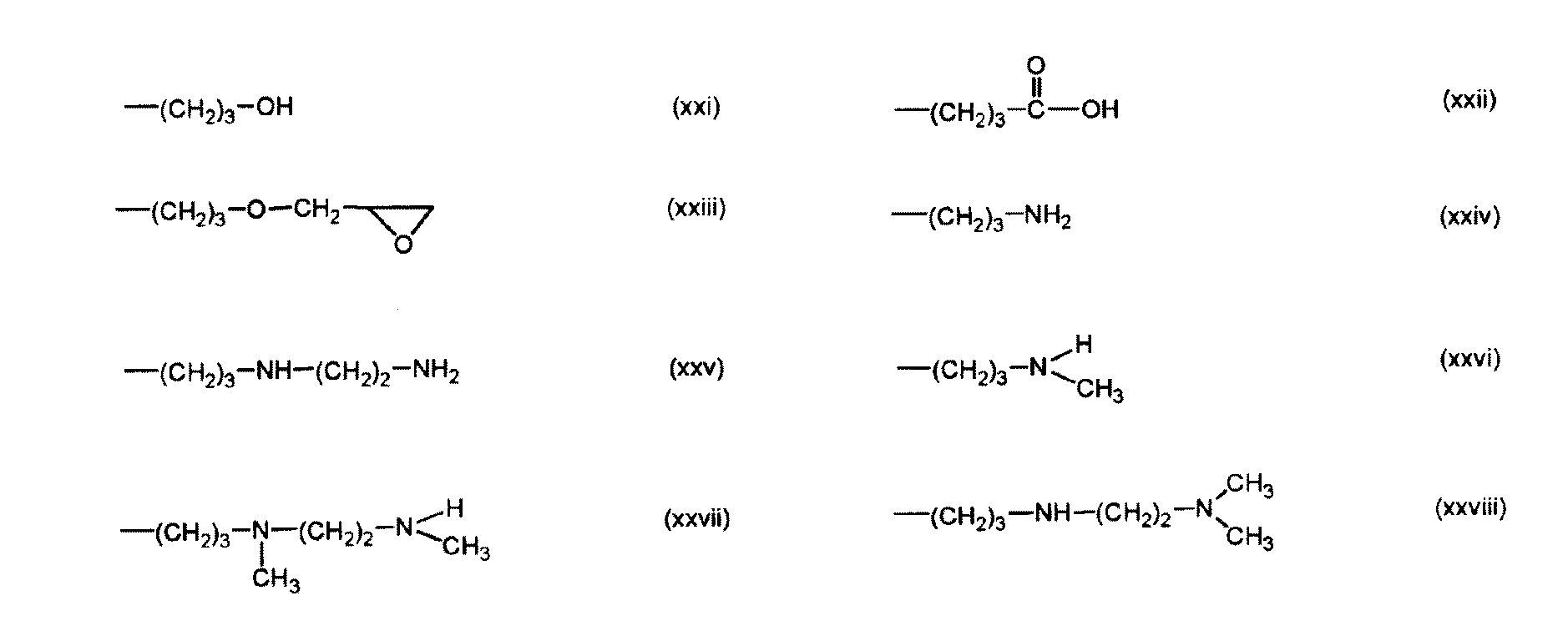
本発明における反応性基含有アルキル基の具体例としては、下記式(xxi)〜(xxviii)が挙げられ、入手性の観点から(xxi)〜(xxiv)から選ばれる一種以上が好ましく、反応性の観点から(xxiv)がより好ましい。 Specific examples of the reactive group-containing alkyl group in the present invention include the following formulas (xxi) to (xxviii), and from the viewpoint of availability, one or more selected from (xxi) to (xxiv) are preferable, and the reactivity In view of the above, (xxiv) is more preferable.
反応性官能基を有するオルガノポリシロキサンの重量平均分子量(MWsim)は、オルガノポリシロキサングラフトポリマーを含有する毛髪化粧料で毛髪をセットした場合のセット力及びセット後の毛髪形状の保持力の観点から、好ましくは3,000以上、より好ましくは5,000以上、更に好ましくは10,000以上、より更に好ましくは20,000以上であり、また、グラフトポリマーのエタノール中での分散性の観点から、好ましくは200,000以下、より好ましくは100,000以下、更に好ましくは50,000以下、より更に好ましくは40,000以下である。
なお、本発明においてMWsimは、実施例に記載の測定条件によるGPCで測定し、ポリスチレン換算したものである。
The weight average molecular weight (MWsim) of the organopolysiloxane having a reactive functional group is determined from the viewpoint of the setting power when the hair is set with a hair cosmetic containing an organopolysiloxane graft polymer and the holding power of the hair shape after setting. , Preferably 3,000 or more, more preferably 5,000 or more, still more preferably 10,000 or more, still more preferably 20,000 or more, and from the viewpoint of dispersibility of the graft polymer in ethanol, Preferably it is 200,000 or less, More preferably, it is 100,000 or less, More preferably, it is 50,000 or less, More preferably, it is 40,000 or less.
In the present invention, MWsim is measured by GPC under the measurement conditions described in the Examples and converted to polystyrene.
反応性官能基を有するオルガノポリシロキサンの単位質量当たりに存在する反応性官能基のモル数は、オルガノポリシロキサングラフトポリマーを含有する毛髪化粧料で毛髪をセットした場合のセット力及びセット後の毛髪形状の保持力の向上の観点から、好ましくは1/500mol/g以下、より好ましくは1/700mol/g以下、更に好ましくは1/1,000mol/g以下であり、グラフトポリマーのエタノール中での分散性の観点から、好ましくは1/10,000mol/g以上、より好ましくは1/5,000mol/g以上、更に好ましくは1/3,000mol/g以上である。 The number of moles of the reactive functional group present per unit mass of the organopolysiloxane having a reactive functional group is the setting force when the hair is set with a hair cosmetic containing an organopolysiloxane graft polymer and the hair after setting. From the viewpoint of improving the holding power of the shape, it is preferably 1/500 mol / g or less, more preferably 1/700 mol / g or less, still more preferably 1/1000 mol / g or less, and the graft polymer in ethanol. From the viewpoint of dispersibility, it is preferably 1 / 10,000 mol / g or more, more preferably 1 / 5,000 mol / g or more, and still more preferably 1 / 3,000 mol / g or more.
(ラジカル反応性付与剤)
本発明においてラジカル反応性付与剤とは、反応性官能基を有するオルガノポリシロキサンの反応性官能基と反応して、反応性官能基を有するオルガノポリシロキサンにラジカル反応性官能基を付加する剤をいう。
(Radical reactivity imparting agent)
In the present invention, the radical reactivity imparting agent is an agent that reacts with a reactive functional group of an organopolysiloxane having a reactive functional group to add a radical reactive functional group to the organopolysiloxane having a reactive functional group. Say.
ラジカル反応性付与剤としては、分子内にラジカル反応性官能基と、前記反応性官能基を有するオルガノポリシロキサンの反応性官能基と反応可能なカルボキシ基、エステル基、エポキシ基、ヒドロキシル基、及びラクトン類から選ばれる一種以上の官能基とを有する化合物を用いることができ、前記反応性官能基を有するオルガノポリシロキサンの反応性官能基が、水酸基、アミノ基、又はエポキシ基である場合には、置換基を有していてもよいチオラクトン類を用いることができる。
ラジカル反応性付与剤のラジカル反応性官能基及びその好ましい様態は、前記ラジカル反応性オルガノポリシロキサンのラジカル反応性官能基及びその好ましい様態と同様である。中でも、重合時の反応性の観点から、ラジカル反応性付与剤はラジカル反応性官能基として、スルファニル基(メルカプト基)を有しているものが好ましく、例えば、3−メルカプトプロピオン酸等のスルファニル基とカルボキシ基を分子内に有する化合物、γ−ブチロラクトンチオール等のスルファニル基を有するラクトン類等が挙げられる。また、置換基を有していてもよいチオラクトンとしては、γ−チオブチロラクトン、N−アセチル−DL−ホモシステインチオラクトン、DL−ホモシステインチオラクトン塩酸塩等が挙げられる。これらの内、ラジカル反応性付与剤としては、反応性オルガノポリシロキサンとの反応性、重合時の反応性の観点からN−アセチル−DL−ホモシステインチオラクトンがより好ましい。
As the radical reactivity imparting agent, a radical reactive functional group in the molecule, a carboxy group capable of reacting with the reactive functional group of the organopolysiloxane having the reactive functional group, an ester group, an epoxy group, a hydroxyl group, and In the case where a compound having one or more functional groups selected from lactones can be used, and the reactive functional group of the organopolysiloxane having the reactive functional group is a hydroxyl group, an amino group, or an epoxy group , Thiolactones which may have a substituent can be used.
The radical-reactive functional group of the radical reactivity-imparting agent and its preferred mode are the same as the radical-reactive functional group of the radical-reactive organopolysiloxane and its preferred mode. Among these, from the viewpoint of reactivity during polymerization, the radical reactivity imparting agent preferably has a sulfanyl group (mercapto group) as a radical reactive functional group, for example, a sulfanyl group such as 3-mercaptopropionic acid. And a compound having a carboxy group in the molecule, and lactones having a sulfanyl group such as γ-butyrolactone thiol. Examples of the thiolactone which may have a substituent include γ-thiobutyrolactone, N-acetyl-DL-homocysteine thiolactone, DL-homocysteine thiolactone hydrochloride and the like. Among these, as the radical reactivity imparting agent, N-acetyl-DL-homocysteine thiolactone is more preferable from the viewpoint of reactivity with the reactive organopolysiloxane and reactivity during polymerization.
ラジカル反応性付与剤の使用量は、反応性官能基を有するオルガノポリシロキサンの反応性官能基の総量に対し、反応性の観点から、0.8当量以上が好ましく、0.9当量以上がより好ましく、また、反応後の未反応のラジカル反応性付与剤を低減させる観点から、1.2当量以下が好ましく、1.1当量以下がより好ましい。 The amount of radical reactivity imparting agent used is preferably 0.8 equivalents or more, more preferably 0.9 equivalents or more from the viewpoint of reactivity with respect to the total amount of reactive functional groups of the organopolysiloxane having a reactive functional group. Preferably, from the viewpoint of reducing the unreacted radical reactivity imparting agent after the reaction, 1.2 equivalents or less is preferable, and 1.1 equivalents or less is more preferable.
(ラジカル反応性オルガノポリシロキサンの製造)
ラジカル反応性付与剤と反応性官能基を有するオルガノポリシロキサンとの反応では、溶媒を用いてもよい。
溶媒としては水、メタノール、エタノール、イソプロパノール等のアルコール類、アセトン、メチルエチルケトン等のケトン類、酢酸エチル、酢酸ブチル等のエステル類、ヘキサン、シクロヘキサン等の炭化水素類、ジエチルエーテル、テトラヒドロフラン等のエーテル類、ベンゼン、トルエン等の芳香族化合物、ジクロロメタン、クロロホルム等のハロゲン化炭化水素等が挙げられる。
環境負荷低減の観点から、溶媒は用いないことが好ましい。
(Production of radical-reactive organopolysiloxane)
In the reaction between the radical reactivity imparting agent and the organopolysiloxane having a reactive functional group, a solvent may be used.
Solvents include water, alcohols such as methanol, ethanol and isopropanol, ketones such as acetone and methyl ethyl ketone, esters such as ethyl acetate and butyl acetate, hydrocarbons such as hexane and cyclohexane, ethers such as diethyl ether and tetrahydrofuran. , Aromatic compounds such as benzene and toluene, and halogenated hydrocarbons such as dichloromethane and chloroform.
From the viewpoint of reducing environmental burden, it is preferable not to use a solvent.
反応温度は、反応性の観点から70℃以上が好ましく、90℃以上がより好ましく、得られるラジカル反応性ポリシロキサンの化学的安定性の観点から、200℃以下が好ましく、150℃以下がより好ましい。
反応時間は、反応を十分に進行させる観点から1時間以上が好ましく、2時間以上がより好ましく、生産性の観点から10時間以下が好ましく、5時間以下がより好ましい。
反応は、得られるラジカル反応性オルガノポリシロキサンの反応性の観点から、反応性官能基を有するオルガノポリシロキサンの反応性官能基とラジカル反応性付与剤の少なくとも一方の転化率が、80%以上となるまで行うことが好ましく、90%以上となるまで行うことがより好ましい。
転化率の測定法は、反応に用いる反応性官能基を有するオルガノポリシロキサンの反応性官能基、及びラジカル反応性付与剤によって異なるが、いずれも公知の方法によって測定できる。例えば反応性官能基を有するオルガノポリシロキサンの反応性官能基がアミノ基であり、ラジカル反応性付与剤がチオラクトン類である場合には、アミノ基の転化率は「石油製品全塩基価試験方法(過塩素酸法)」(JIS K2501)によって求められ、またチオラクトン類の転化率は、液体クロマトグラフ法を用いて求めることができる。
The reaction temperature is preferably 70 ° C. or higher from the viewpoint of reactivity, more preferably 90 ° C. or higher, and preferably 200 ° C. or lower, more preferably 150 ° C. or lower, from the viewpoint of chemical stability of the resulting radical reactive polysiloxane. .
The reaction time is preferably 1 hour or longer, more preferably 2 hours or longer, from the viewpoint of sufficiently allowing the reaction to proceed, preferably 10 hours or shorter, more preferably 5 hours or shorter, from the viewpoint of productivity.
From the viewpoint of the reactivity of the resulting radical reactive organopolysiloxane, the conversion rate of at least one of the reactive functional group of the organopolysiloxane having a reactive functional group and the radical reactivity imparting agent is 80% or more. It is preferable to carry out until it becomes, and it is more preferable to carry out until it becomes 90% or more.
The method for measuring the conversion rate varies depending on the reactive functional group of the organopolysiloxane having a reactive functional group used for the reaction and the radical reactivity imparting agent, and any of them can be measured by a known method. For example, when the reactive functional group of the organopolysiloxane having a reactive functional group is an amino group and the radical reactivity-imparting agent is a thiolactone, the conversion rate of the amino group is “a total base number test method for petroleum products ( Perchloric acid method) ”(JIS K2501), and the conversion rate of thiolactones can be determined using a liquid chromatographic method.
(オルガノポリシロキサングラフトポリマーの製造)
ラジカル反応性オルガノポリシロキサンの存在下、不飽和単量体を重合させる方法は特に限定されず、バルク重合法、溶液重合法、懸濁重合法等を採用しうるが、より均一な組成のオルガノポリシロキサングラフトポリマーを製造するために、溶液重合法が好ましい。
原料となる不飽和単量体の使用量は、グラフトポリマーのエタノール中での分散性の観点から、原料となるラジカル反応性オルガノポリシロキサンと原料となる不飽和単量体の総量に対して、好ましくは10質量%以上、より好ましくは15質量%以上、更に好ましくは20質量%以上であり、また、オルガノポリシロキサングラフトポリマーを含有する毛髪化粧料で毛髪をセットした後の毛髪の感触の観点から、好ましくは50質量%以下、より好ましくは40質量%以下、更に好ましくは30質量%以下である。
(Production of organopolysiloxane graft polymer)
The method for polymerizing the unsaturated monomer in the presence of the radical-reactive organopolysiloxane is not particularly limited, and a bulk polymerization method, a solution polymerization method, a suspension polymerization method, etc. can be adopted, but an organo with a more uniform composition. Solution polymerization methods are preferred for producing polysiloxane graft polymers.
From the viewpoint of the dispersibility of the graft polymer in ethanol, the amount of the unsaturated monomer used as the raw material is based on the total amount of the radical reactive organopolysiloxane used as the raw material and the unsaturated monomer used as the raw material. Preferably it is 10 mass% or more, More preferably, it is 15 mass% or more, More preferably, it is 20 mass% or more, and the viewpoint of the touch of the hair after setting hair with the hair cosmetics containing an organopolysiloxane graft polymer Therefore, it is preferably 50% by mass or less, more preferably 40% by mass or less, and still more preferably 30% by mass or less.
不飽和単量体の重合を、溶液重合法で行う場合、用いる溶媒としては、原料であるラジカル反応性オルガノポリシロキサン、不飽和単量体、及び得られるグラフトポリマーのいずれもが溶解又は均一に分散すれば特に制限はない。
溶媒の具体例としては、水、メタノール、エタノール、イソプロパノール等のアルコール類、アセトン、メチルエチルケトン等のケトン類、酢酸エチル、酢酸ブチル等のエステル類、ヘキサン、シクロヘキサン等の炭化水素類、ジエチルエーテル、テトラヒドロフラン等のエーテル類、ベンゼン、トルエン等の芳香族化合物、ジクロロメタン、クロロホルム等のハロゲン化炭化水素等が挙げられる。これらは単独で又は2種以上を組み合わせて使用してよい。
これらの中で、より均一な側鎖分子量分布を有するグラフトポリマー得る観点から、水、エタノール、イソプロパノール等の炭素数1以上8以下のアルコール、酢酸エチル、酢酸ブチル等の炭素数2以上8以下のエステル、ジエチルエーテル、及びテトラヒドロフラン等の炭素数2以上8以下のエーテルから選ばれる1種以上の溶媒を用いることが好ましく、毛髪化粧料へのグラフトポリマー製造時の溶媒の持ち込みの観点から、水、エタノール等の炭素数1以上3以下のアルコールから選ばれる1種以上を用いることがより好ましい。
When the polymerization of the unsaturated monomer is carried out by a solution polymerization method, the solvent used is such that the radical reactive organopolysiloxane, the unsaturated monomer, and the resulting graft polymer are all dissolved or homogeneous. If dispersed, there is no particular limitation.
Specific examples of the solvent include water, alcohols such as methanol, ethanol and isopropanol, ketones such as acetone and methyl ethyl ketone, esters such as ethyl acetate and butyl acetate, hydrocarbons such as hexane and cyclohexane, diethyl ether and tetrahydrofuran. And ethers such as benzene, toluene and the like, and halogenated hydrocarbons such as dichloromethane and chloroform. These may be used alone or in combination of two or more.
Among these, from the viewpoint of obtaining a graft polymer having a more uniform side chain molecular weight distribution, alcohols having 1 to 8 carbon atoms such as water, ethanol and isopropanol, and having 2 to 8 carbon atoms such as ethyl acetate and butyl acetate. It is preferable to use one or more solvents selected from ethers having 2 to 8 carbon atoms, such as esters, diethyl ether, and tetrahydrofuran. From the viewpoint of bringing a solvent into the hair cosmetic composition, water, It is more preferable to use one or more selected from alcohols having 1 to 3 carbon atoms such as ethanol.
溶媒の使用量は、原料であるラジカル反応性オルガノポリシロキサン、不飽和単量体及び得られるオルガノポリシロキサングラフトポリマーのいずれもが溶解又は均一に分散すれば特に制限はないが、製造時の操作の容易性、及び生産性の観点から、製造時に投入するラジカル反応性オルガノポリシロキサン及び不飽和単量体の総質量に対して、好ましくは20質量%以上、より好ましくは40質量%以上、更に好ましくは60質量%以上、より更に好ましくは100質量%以上であり、また、反応性の観点から、好ましくは1000質量%以下、より好ましくは900質量%以下、更に好ましくは400質量%以下、より更に好ましくは300質量%以下である。 The amount of the solvent used is not particularly limited as long as all of the raw material radical-reactive organopolysiloxane, unsaturated monomer and the resulting organopolysiloxane graft polymer are dissolved or uniformly dispersed. From the viewpoint of ease of production and productivity, it is preferably 20% by mass or more, more preferably 40% by mass or more, and more preferably 40% by mass or more, based on the total mass of the radical-reactive organopolysiloxane and unsaturated monomer added at the time of production. Preferably, it is 60% by mass or more, more preferably 100% by mass or more, and from the viewpoint of reactivity, it is preferably 1000% by mass or less, more preferably 900% by mass or less, still more preferably 400% by mass or less, more More preferably, it is 300 mass% or less.
重合開始剤としては、2,2’−アゾビスイソブチロニトリル、2,2’−アゾビス(2,4−ジメチルバレロニトリル)等のアゾ系開始剤、過酸化ラウロイル、過酸化ベンゾイル等の過酸化物系開始剤、過硫酸アンモニウム等の過硫酸系開始剤等が挙げられる。また光照射等によりラジカルを発生させることにより重合を開始してもよい。重合開始剤としては、反応性の観点から、2,2’−アゾビス(2,4−ジメチルバレロニトリル)が好ましい。重合開始剤の使用量は特に制限がないが、得られるグラフトポリマーの重量平均分子量の観点から、投入する不飽和単量体の総質量に対して、好ましくは10質量%以下、より好ましくは1質量%以下であり、また、反応性の観点から、好ましくは0.001質量%以上、より好ましくは0.01質量%以上である。 Examples of the polymerization initiator include azo-based initiators such as 2,2′-azobisisobutyronitrile and 2,2′-azobis (2,4-dimethylvaleronitrile), and peroxides such as lauroyl peroxide and benzoyl peroxide. Examples thereof include oxide initiators and persulfate initiators such as ammonium persulfate. Further, polymerization may be initiated by generating radicals by light irradiation or the like. As the polymerization initiator, 2,2'-azobis (2,4-dimethylvaleronitrile) is preferable from the viewpoint of reactivity. Although there is no restriction | limiting in particular in the usage-amount of a polymerization initiator, From a viewpoint of the weight average molecular weight of the graft polymer obtained, Preferably it is 10 mass% or less with respect to the total mass of the unsaturated monomer thrown in, More preferably, it is 1 From the viewpoint of reactivity, it is preferably 0.001% by mass or more, and more preferably 0.01% by mass or more.
重合反応時の温度は、用いる重合開始剤、溶媒の種類等により適宜選択できるが、重合反応速度の観点から、好ましくは50℃以上、より好ましくは60℃以上である。また、重合反応に用いる設備負荷低減のため常圧で反応させることが好ましく、溶媒の沸点以下で反応させる観点から、重合反応時の温度は、好ましくは100℃以下、より好ましくは90℃以下である。 The temperature during the polymerization reaction can be appropriately selected depending on the polymerization initiator used, the type of the solvent, and the like, but is preferably 50 ° C. or higher, more preferably 60 ° C. or higher from the viewpoint of the polymerization reaction rate. Moreover, it is preferable to make it react at normal pressure for the equipment load reduction used for polymerization reaction, and from the viewpoint of making it react below the boiling point of a solvent, the temperature at the time of polymerization reaction becomes like this. Preferably it is 100 degrees C or less, More preferably, it is 90 degrees C or less. is there.
重合反応は、不飽和単量体の転化率が80%以上になるまで行うことが好ましく、90%以上まで行うことがより好ましい。転化率の上限は100%である。
不飽和単量体の転化率は、ガスクロマトグラフィー分析により求めることができる。具体的な操作については、実施例に記載する。
重合反応時間は通常0.1時間以上60時間以下であり、操作性の観点から、好ましくは0.5時間以上、より好ましくは1時間以上、更に好ましくは2時間以上、より更に好ましくは4時間以上であり、また、生産性の観点から、好ましくは30時間以下、より好ましくは20時間以下、更に好ましくは10時間以下である。重合反応を、原料を滴下や分割添加等、時間をかけて添加する場合、重合反応時間は、原料の添加に要する時間を含む。重合反応の時間は、例えば重合反応温度を上げることで短時間化が可能であり、重合温度に応じて変えることができる。
The polymerization reaction is preferably performed until the conversion rate of the unsaturated monomer is 80% or more, and more preferably 90% or more. The upper limit of conversion is 100%.
The conversion rate of the unsaturated monomer can be determined by gas chromatography analysis. Specific operations are described in the examples.
The polymerization reaction time is usually from 0.1 hours to 60 hours, and from the viewpoint of operability, it is preferably 0.5 hours or more, more preferably 1 hour or more, still more preferably 2 hours or more, and even more preferably 4 hours. From the viewpoint of productivity, it is preferably 30 hours or less, more preferably 20 hours or less, and even more preferably 10 hours or less. In the case where the polymerization reaction is added over time, such as dropwise addition or divided addition of raw materials, the polymerization reaction time includes the time required for addition of the raw materials. The polymerization reaction time can be shortened, for example, by raising the polymerization reaction temperature, and can be changed according to the polymerization temperature.
原料となるラジカル反応性オルガノポリシロキサン及び不飽和単量体、溶媒、重合開始剤等は一括添加して重合反応を行ってもよいが、組成をコントロールするために、分割添加又は滴下して重合反応を行ってもよい。例えば、(1)ラジカル反応性オルガノポリシロキサン、不飽和単量体、溶媒を混合して加熱し、そこに開始剤を溶解させた溶液を一括あるいは滴下で添加する方法;(2)溶媒を加熱したところに、ラジカル反応性オルガノポリシロキサン、不飽和単量体、開始剤をそれぞれ別々に又は混合させて溶媒に溶解させた溶液を滴下する方法;(3)ラジカル反応性オルガノポリシロキサン、不飽和単量体の一部及び溶媒を混合して加熱し、そこに開始剤及び不飽和単量体の残部を溶解させた溶液を一括あるいは滴下で添加する方法等がある。
また重合反応終了後に必要に応じて公知の方法によって精製や未反応の不飽和単量体の低減等を行ってもよい。例えば、重合開始剤を添加して加熱することや膜精製、吸着剤処理等による未反応の不飽和単量体やその他不純物の低減を行ってもよい。
The radical-reactive organopolysiloxane and unsaturated monomer, solvent, polymerization initiator, etc. that are the raw materials may be added all at once, and the polymerization reaction may be carried out. A reaction may be performed. For example, (1) A method in which a radical-reactive organopolysiloxane, an unsaturated monomer, and a solvent are mixed and heated, and a solution in which an initiator is dissolved is added all at once or dropwise; (2) the solvent is heated Then, a method in which a radical-reactive organopolysiloxane, an unsaturated monomer, and an initiator are separately or mixed, and a solution dissolved in a solvent is dropped; (3) radical-reactive organopolysiloxane, unsaturated There is a method in which a part of the monomer and a solvent are mixed and heated, and a solution in which the initiator and the remainder of the unsaturated monomer are dissolved is added all at once or dropwise.
Further, after completion of the polymerization reaction, purification or reduction of unreacted unsaturated monomers may be performed by a known method as necessary. For example, unreacted unsaturated monomers and other impurities may be reduced by adding a polymerization initiator and heating, membrane purification, adsorbent treatment, or the like.
<ポリマーB>
本発明におけるポリマーBは、ポリマーAの側鎖を構成する不飽和単量体と同じ不飽和単量体由来の繰り返し単位を90質量%以上含有するポリマーである。
前記ポリマーBは、前記オルガノポリシロキサングラフトポリマー(ポリマーA)の製造時に副生成物としてその一部が製造されるが、本発明においては、ポリマーAとは別に前記ポリマーBの条件を満たすポリマーを製造し、ポリマーBとして用いることが好ましい。
なお、本発明においては、ポリマーAの製造時に副生成物として製造されるポリマーBを「ポリマーBI」とし、ポリマーAとは別に製造したポリマーBを「ポリマーBII」とする。
<Polymer B>
The polymer B in the present invention is a polymer containing 90% by mass or more of a repeating unit derived from the same unsaturated monomer as the unsaturated monomer constituting the side chain of the polymer A.
A part of the polymer B is produced as a by-product during the production of the organopolysiloxane graft polymer (polymer A). In the present invention, a polymer that satisfies the conditions of the polymer B is separated from the polymer A. Preferably, it is manufactured and used as polymer B.
In the present invention, polymer B produced as a by-product during production of polymer A is referred to as “polymer BI”, and polymer B produced separately from polymer A is referred to as “polymer BII”.
〔ポリマーBI〕
ポリマーBIは、前述のとおり、ポリマーAの製造時に副生成物として製造されるポリマーである。
ポリマーBI中、ポリマーAの側鎖を構成する不飽和単量体の含有量は、ポリマーAとの相溶性を向上させる観点から、好ましくは90質量%以上、より好ましくは95質量%以上、更に好ましくは実質的に100質量%、より更に好ましくは100質量%である。
なお、ポリマーBIの好ましい態様は、ポリマーAの側鎖を構成する不飽和単量体と同様である。
[Polymer BI]
As described above, the polymer BI is a polymer produced as a by-product when the polymer A is produced.
In the polymer BI, the content of the unsaturated monomer constituting the side chain of the polymer A is preferably 90% by mass or more, more preferably 95% by mass or more, from the viewpoint of improving the compatibility with the polymer A. Preferably it is 100 mass% substantially, More preferably, it is 100 mass%.
In addition, the preferable aspect of polymer BI is the same as that of the unsaturated monomer which comprises the side chain of the polymer A.
<ポリマー混合物C>
前述のとおりポリマー混合物Cは、ポリマーAとポリマーAの製造過程で得られるポリマーBIとを含むものである。本発明のポリマー組成物は、このポリマー混合物Cと必要に応じて溶媒を混合したものであってもよく、ポリマー混合物Cに対して、後述のポリマーBII、更に必要に応じて溶媒を混合したものであってもよい。
前記ポリマー混合物C中におけるポリマーAの含有量は、ポリマー組成物の製造時の混合比率の決定のしやすさの観点から、好ましくは70質量%以上、より好ましくは72質量%以上、更に好ましくは80質量%以上、より更に好ましくは90質量%以上であり、また、反応制御の容易さの観点から、好ましくは99.5質量%以下、より好ましくは99.0質量%以下である。
<Polymer mixture C>
As described above, the polymer mixture C includes the polymer A and the polymer BI obtained in the production process of the polymer A. The polymer composition of the present invention may be a mixture of the polymer mixture C and a solvent as necessary. The polymer mixture C is a polymer BII described later and further mixed with a solvent as necessary. It may be.
The content of the polymer A in the polymer mixture C is preferably 70% by mass or more, more preferably 72% by mass or more, and still more preferably from the viewpoint of easy determination of the mixing ratio at the time of production of the polymer composition. It is 80% by mass or more, more preferably 90% by mass or more, and from the viewpoint of easy reaction control, it is preferably 99.5% by mass or less, more preferably 99.0% by mass or less.
前記ポリマー混合物C中のポリマーBIに対するポリマーAの質量比[ポリマーA/ポリマーBI]は、ポリマー組成物の製造時の混合比率の決定のしやすさの観点から、好ましくは2.3以上、より好ましくは3.0以上、更に好ましくは9.0以上、より更に好ましくは20以上、より更に好ましくは40以上、より更に好ましくは60以上であり、また、反応制御の容易さの観点から、好ましくは200以下、より好ましくは100以下、更に好ましくは80以下、より更に好ましくは70以下である。
なお、ポリマー混合物C中のポリマーBIの含有量は、ラジカル重合性オルガノポリシロキサン及び不飽和単量体の先仕込み割合、滴下速度を変化させることによって調整することができる。
The mass ratio of the polymer A to the polymer BI in the polymer mixture C [Polymer A / Polymer BI] is preferably 2.3 or more from the viewpoint of easy determination of the mixing ratio at the time of producing the polymer composition. Preferably it is 3.0 or more, more preferably 9.0 or more, still more preferably 20, or more, still more preferably 40 or more, still more preferably 60 or more, and from the viewpoint of ease of reaction control, preferably Is 200 or less, more preferably 100 or less, still more preferably 80 or less, and still more preferably 70 or less.
In addition, content of the polymer BI in the polymer mixture C can be adjusted by changing the radical chargeable organopolysiloxane and the pre-charge ratio of the unsaturated monomer, and the dropping speed.
〔ポリマーBII〕
ポリマーBIIは、前述のとおりポリマーAの製造とは別に製造されるポリマーである。
ポリマーBII中、ポリマーAの側鎖を構成する不飽和単量体の含有量は、ポリマーAとの相溶性を向上させる観点から、好ましくは90質量%以上、より好ましくは95質量%以上、更に好ましくは実質的に100質量%、より更に好ましくは100質量%である。
ポリマーBIIは、前述のとおりポリマーAの側鎖を構成する不飽和単量体と同じ不飽和単量体を90質量%以上含有するポリマーであるため、ポリマーBIIの好ましい態様は、ポリマーAの側鎖を構成する不飽和単量体と同様である。
[Polymer BII]
The polymer BII is a polymer produced separately from the production of the polymer A as described above.
In the polymer BII, the content of the unsaturated monomer constituting the side chain of the polymer A is preferably 90% by mass or more, more preferably 95% by mass or more, from the viewpoint of improving the compatibility with the polymer A. Preferably it is 100 mass% substantially, More preferably, it is 100 mass%.
Since the polymer BII is a polymer containing 90% by mass or more of the same unsaturated monomer as the unsaturated monomer constituting the side chain of the polymer A as described above, the preferred mode of the polymer BII is the side of the polymer A This is the same as the unsaturated monomer constituting the chain.
〔ポリマーBIIの製造方法〕
ポリマーBIIの製造方法は特に限定されず、バルク重合法、溶液重合法、懸濁重合法等を採用しうるが、特に溶液重合法が好ましい。
原料となる不飽和単量体の重合を、溶液重合法で行う場合、用いる溶媒としては、不飽和単量体、及び得られるポリマーBIIのいずれもが溶解又は均一に分散すれば特に制限はない。
溶媒の具体例としては、オルガノポリシロキサングラフトポリマー製造時の溶媒と同じものが挙げられる。
これらの中で、より均一な組成を有するポリマーBIIを得る観点から、水、エタノール、イソプロパノール等の炭素数1以上8以下のアルコール、酢酸エチル、酢酸ブチル等の炭素数2以上8以下のエステル、ジエチルエーテル、及びテトラヒドロフラン等の炭素数2以上8以下のエーテルから選ばれる1種以上の溶媒を用いることが好ましく、ポリマー組成物を毛髪化粧料用途等に用いる場合、化粧品製品へのポリマーBII製造時の溶媒の持ち込みの観点から水、エタノール等の炭素数1以上3以下のアルコールから選ばれる1種以上を用いることがより好ましい。
[Method for producing polymer BII]
The production method of the polymer BII is not particularly limited, and a bulk polymerization method, a solution polymerization method, a suspension polymerization method and the like can be adopted, but a solution polymerization method is particularly preferable.
When the polymerization of the unsaturated monomer as a raw material is carried out by a solution polymerization method, the solvent used is not particularly limited as long as both the unsaturated monomer and the resulting polymer BII are dissolved or uniformly dispersed. .
Specific examples of the solvent include the same solvents as those used in the production of the organopolysiloxane graft polymer.
Among these, from the viewpoint of obtaining a polymer BII having a more uniform composition, alcohols having 1 to 8 carbon atoms such as water, ethanol and isopropanol, esters having 2 to 8 carbon atoms such as ethyl acetate and butyl acetate, It is preferable to use one or more solvents selected from diethyl ether and ethers having 2 to 8 carbon atoms, such as tetrahydrofuran, and when the polymer composition is used for hair cosmetics, etc. From the viewpoint of bringing in the solvent, it is more preferable to use at least one selected from alcohols having 1 to 3 carbon atoms such as water and ethanol.
溶媒の使用量は、不飽和単量体及び得られるポリマーBIIのいずれもが溶解又は均一に分散すれば特に制限はないが、製造時の操作の容易性、及び生産性の観点から、不飽和単量体の総質量に対して、好ましくは50質量%以上、より好ましくは100質量%以上、更に好ましくは150質量%以上、より更に好ましくは200質量%以上であり、また、反応性の観点から、好ましくは1,500質量%以下、より好ましくは1,000質量%以下、更に好ましくは500質量%以下、より更に好ましくは300質量%以下である。 The amount of the solvent used is not particularly limited as long as both the unsaturated monomer and the resulting polymer BII are dissolved or uniformly dispersed, but from the viewpoint of ease of operation during production and productivity, Preferably it is 50 mass% or more with respect to the total mass of a monomer, More preferably, it is 100 mass% or more, More preferably, it is 150 mass% or more, More preferably, it is 200 mass% or more, and a reactive viewpoint Therefore, it is preferably 1,500% by mass or less, more preferably 1,000% by mass or less, still more preferably 500% by mass or less, and still more preferably 300% by mass or less.
重合開始剤の種類、量の好ましい態様は、オルガノポリシロキサングラフトポリマー製造時の重合開始剤の好ましい態様と同じである。
重合反応時の温度及び反応時間の好ましい態様は、オルガノポリシロキサングラフトポリマー製造時の好ましい態様と同じである。
The preferred embodiment of the kind and amount of the polymerization initiator is the same as the preferred embodiment of the polymerization initiator at the time of producing the organopolysiloxane graft polymer.
Preferred embodiments of the temperature and reaction time during the polymerization reaction are the same as the preferred embodiments during the production of the organopolysiloxane graft polymer.
重合反応は、不飽和単量体の転化率が80%以上になるまで行うことが好ましく、90%以上まで行うことがより好ましい。転化率の上限は100%である。
不飽和単量体の転化率は、ガスクロマトグラフィー分析により求めることができる。具体的な操作については、実施例に記載する。
The polymerization reaction is preferably performed until the conversion rate of the unsaturated monomer is 80% or more, and more preferably 90% or more. The upper limit of conversion is 100%.
The conversion rate of the unsaturated monomer can be determined by gas chromatography analysis. Specific operations are described in the examples.
原料となる不飽和単量体、溶媒、重合開始剤等は一括添加して重合反応を行ってもよいが、組成をコントロールするために、分割添加又は滴下して重合反応を行ってもよい。例えば、(1)不飽和単量体、溶媒を混合して加熱し、そこに開始剤を溶解させた溶液を一括あるいは滴下で添加する方法;(2)溶媒を加熱したところに、不飽和単量体、開始剤をそれぞれ別々に又は混合させて溶媒に溶解させた溶液を滴下する方法;(3)不飽和単量体の一部及び溶媒を混合して加熱し、そこに開始剤及び不飽和単量体の残部を溶解させた溶液を一括あるいは滴下で添加する方法等がある。
また重合反応終了後に必要に応じて公知の方法によって精製や未反応の不飽和単量体の低減等を行ってもよい。例えば、重合開始剤を添加して加熱することや膜精製、吸着剤処理等による未反応の不飽和単量体やその他不純物の低減を行ってもよい。
Unsaturated monomers, solvents, polymerization initiators, and the like as raw materials may be added all at once to carry out the polymerization reaction, but in order to control the composition, the polymerization reaction may be carried out by adding in portions or dropwise. For example, (1) a method in which an unsaturated monomer and a solvent are mixed and heated, and a solution having an initiator dissolved therein is added all at once or dropwise; (2) when the solvent is heated, A method in which a solution in which a monomer and an initiator are separately or mixed and dissolved in a solvent is dropped; (3) A part of the unsaturated monomer and the solvent are mixed and heated, and the initiator and the initiator are mixed therewith. There is a method of adding a solution in which the remainder of the saturated monomer is dissolved all at once or dropwise.
Further, after completion of the polymerization reaction, purification or reduction of unreacted unsaturated monomers may be performed by a known method as necessary. For example, unreacted unsaturated monomers and other impurities may be reduced by adding a polymerization initiator and heating, membrane purification, adsorbent treatment, or the like.
ポリマーBIIは、取り扱い性の観点から溶液であることが好ましい。溶媒としては、溶媒として水、C1〜C3の直鎖若しくは分岐鎖の飽和若しくは不飽和アルコールから選ばれる1種以上を含有させることができる。中でも、毛髪化粧料へのポリマーBII製造時の溶媒の持ち込みの観点から、溶媒としては、水、エタノール、及びイソプロパノールから選ばれる1種以上が好ましく、水、エタノールから選ばれる1種以上が特に好ましい。
溶液中におけるポリマーBIIの含有量は、毛髪化粧料を調製する際の操作性の観点から、好ましくは5質量%以上、より好ましくは10質量%以上、更に好ましくは20質量%以上、より更に好ましくは25質量%以上であり、また、ポリマーBIIの溶解性の観点から、好ましくは50質量%以下、より好ましくは45質量%以下である。
The polymer BII is preferably a solution from the viewpoint of handleability. As a solvent, 1 or more types chosen from water and a C1-C3 linear or branched saturated or unsaturated alcohol as a solvent can be contained. Among these, from the viewpoint of bringing the solvent into the hair cosmetic into the polymer BII, the solvent is preferably one or more selected from water, ethanol, and isopropanol, and more preferably one or more selected from water and ethanol. .
The content of the polymer BII in the solution is preferably 5% by mass or more, more preferably 10% by mass or more, still more preferably 20% by mass or more, and still more preferably, from the viewpoint of operability when preparing a hair cosmetic. Is 25% by mass or more, and is preferably 50% by mass or less, more preferably 45% by mass or less, from the viewpoint of solubility of the polymer BII.
ポリマーBの重量平均分子量は、オルガノポリシロキサングラフトポリマーを含有する毛髪化粧料で毛髪をセットした場合のセット力及びセット後の毛髪形状の保持力の観点から、好ましくは2,000以上、より好ましくは5,000以上、更に好ましくは10,000以上、より更に好ましくは15,000以上であり、また、好ましくは100,000以下、より好ましくは50,000以下、更に好ましくは40,000以下、より更に好ましくは35,000以下である。
なお、ポリマーBの重量平均分子量は、後述の実施例に記載の方法により測定することができる。
The weight average molecular weight of the polymer B is preferably 2,000 or more, more preferably from the viewpoint of the setting power when the hair is set with a hair cosmetic containing an organopolysiloxane graft polymer and the holding power of the hair shape after setting. Is 5,000 or more, more preferably 10,000 or more, still more preferably 15,000 or more, preferably 100,000 or less, more preferably 50,000 or less, still more preferably 40,000 or less, More preferably, it is 35,000 or less.
In addition, the weight average molecular weight of the polymer B can be measured by a method described in Examples described later.
<ポリマー組成物の組成>
本発明のポリマー組成物は、前述のポリマーA及びポリマーBを含有するものである。
ポリマー組成物中のポリマーA及びポリマーBの含有量は、毛髪化粧料を調製する際の操作性の観点から、好ましくは0.5質量%以上、より好ましくは1質量%以上、更に好ましくは2質量%以上、より更に好ましくは3質量%以上、より更に好ましくは4質量%以上であり、また、ポリマーAの溶解性の観点から、好ましくは50質量%以下、より好ましくは40質量%以下、更に好ましくは20質量%以下、より更に好ましくは10質量%以下、より更に好ましくは8質量%以下、より更に好ましくは6質量%以下である。
<Composition of polymer composition>
The polymer composition of the present invention contains the aforementioned polymer A and polymer B.
The content of polymer A and polymer B in the polymer composition is preferably 0.5% by mass or more, more preferably 1% by mass or more, and still more preferably 2 from the viewpoint of operability when preparing a hair cosmetic. % By mass, more preferably 3% by mass or more, still more preferably 4% by mass or more, and from the viewpoint of the solubility of the polymer A, preferably 50% by mass or less, more preferably 40% by mass or less, More preferably, it is 20 mass% or less, More preferably, it is 10 mass% or less, More preferably, it is 8 mass% or less, More preferably, it is 6 mass% or less.
本発明のポリマー組成物において、ポリマーA及びポリマーBの合計に対するオルガノポリシロキサンセグメントの含有量は、毛髪の感触から、30質量%以上、好ましくは40質量%以上、より好ましくは45質量%以上、更に好ましくは50質量%以上であり、また、グラフトポリマーのエタノール中での分散性を向上させる観点から、70質量%未満、好ましくは65質量%以下、より好ましくは60質量%以下、更に好ましくは55質量%以下である。 In the polymer composition of the present invention, the content of the organopolysiloxane segment based on the total of the polymer A and the polymer B is 30% by mass or more, preferably 40% by mass or more, more preferably 45% by mass or more, from the feel of the hair. More preferably, it is 50% by mass or more, and from the viewpoint of improving the dispersibility of the graft polymer in ethanol, it is less than 70% by mass, preferably 65% by mass or less, more preferably 60% by mass or less, still more preferably. It is 55 mass% or less.
ポリマー組成物中のポリマーBに対するポリマーAの質量比[ポリマーA/ポリマーB]は、毛髪化粧料のセット力、セット後の毛髪形状の持続性の観点から、好ましくは0.6以上、より好ましくは1.0以上、更に好ましくは1.5以上、より更に好ましくは2.0以上であり、また、毛髪をセットした後の毛髪の感触の観点から、好ましくは30以下、より好ましくは10以下、更に好ましくは6以下、より更に好ましくは4.5以下、より更に好ましくは4.0以下、より更に好ましくは3.5以下である。 The mass ratio of the polymer A to the polymer B in the polymer composition [Polymer A / Polymer B] is preferably 0.6 or more, more preferably from the viewpoint of the setting power of the hair cosmetic and the sustainability of the hair shape after setting. Is 1.0 or more, more preferably 1.5 or more, still more preferably 2.0 or more, and from the viewpoint of the feel of the hair after setting the hair, it is preferably 30 or less, more preferably 10 or less. Further, it is preferably 6 or less, more preferably 4.5 or less, still more preferably 4.0 or less, and still more preferably 3.5 or less.
本発明のポリマー組成物は、取り扱い性の観点から溶液であることが好ましい。溶媒としては、水、C1〜C3の直鎖若しくは分岐鎖の飽和若しくは不飽和アルコールから選ばれる1種以上を含有させることができる。中でも、毛髪化粧料への溶媒の持ち込みの観点から、溶媒としては、水、エタノール、及びイソプロパノールから選ばれる1種以上が好ましく、水、エタノールから選ばれる1種以上が特に好ましい。
ポリマー組成物中における溶媒の含有量は、ポリマー組成物の溶解性の観点から、好ましくは50質量%以上、より好ましくは55質量%以上、更に好ましくは58質量%以下であり、また、毛髪化粧料を調製する際の操作性の観点から、好ましくは99.5質量%以下、より好ましくは99質量%以下、更に好ましくは90質量%以下、より更に好ましくは80質量%以下、より更に好ましくは70質量%以下である。
The polymer composition of the present invention is preferably a solution from the viewpoint of handleability. As a solvent, 1 or more types chosen from water and a C1-C3 linear or branched saturated or unsaturated alcohol can be contained. Among these, from the viewpoint of bringing the solvent into the hair cosmetic, the solvent is preferably one or more selected from water, ethanol, and isopropanol, and more preferably one or more selected from water and ethanol.
The content of the solvent in the polymer composition is preferably 50% by mass or more, more preferably 55% by mass or more, and further preferably 58% by mass or less from the viewpoint of solubility of the polymer composition. From the viewpoint of operability when preparing the material, it is preferably 99.5% by mass or less, more preferably 99% by mass or less, still more preferably 90% by mass or less, still more preferably 80% by mass or less, and still more preferably. 70% by mass or less.
[毛髪化粧料]
<ポリマー組成物(成分(A))>
本発明の毛髪化粧料は、本発明のポリマー組成物(以下「成分(A)」ともいう)を含有する。これにより、柔軟な感触と、手指を髪に通してもヘアスタイルが崩れないセット特性と、より自然な仕上がりが得られる。
[Hair cosmetic]
<Polymer composition (component (A))>
The hair cosmetic composition of the present invention contains the polymer composition of the present invention (hereinafter also referred to as “component (A)”). As a result, a soft feel, a set characteristic in which the hairstyle does not collapse even when a finger is passed through the hair, and a more natural finish are obtained.
成分(A)の含有量は、本発明の毛髪化粧料の毛髪のセット力及びセット後の毛髪形状の保持力、グラフトポリマーのエタノール中での分散性の観点から、毛髪化粧料の全質量基準(但し、毛髪化粧料がスプレータイプであって、噴射剤を含有する場合は、全質量には噴射剤の質量は含まれない。以下、同様である。)で、好ましくは0.01質量%以上、より好ましくは0.05質量%以上、更に好ましくは0.1質量%以上、より更に好ましくは0.5質量%以上であり、また、好ましくは50質量%以下、より好ましくは30質量%以下、更に好ましくは20質量%以下、より更に好ましくは10質量%以下である。 The content of the component (A) is based on the total mass of the hair cosmetic from the viewpoint of the setting power of the hair cosmetic of the present invention, the holding power of the hair shape after setting, and the dispersibility of the graft polymer in ethanol. (However, when the hair cosmetic is a spray type and contains a propellant, the total mass does not include the mass of the propellant. The same applies hereinafter.), Preferably 0.01% by mass Or more, more preferably 0.05% by mass or more, further preferably 0.1% by mass or more, still more preferably 0.5% by mass or more, and preferably 50% by mass or less, more preferably 30% by mass. Hereinafter, it is further preferably 20% by mass or less, and still more preferably 10% by mass or less.
ポリマーAの含有量は、毛髪化粧料の全質量基準で、毛髪化粧料のセット力、セット後の毛髪形状の持続性の観点から、好ましくは0.5質量%以上、より好ましくは1質量%以上、更に好ましくは2質量%以上、より更に好ましくは3質量%以上であり、また、毛髪をセットした後の毛髪の感触の観点、ポリマーAの溶解性の観点及び経済性の観点から、好ましくは10質量%以下、より好ましくは8質量%以下、更に好ましくは6質量%以下、より更に好ましくは5質量%以下である。 The content of the polymer A is preferably 0.5% by mass or more, more preferably 1% by mass, based on the total mass of the hair cosmetic, from the viewpoint of the setting power of the hair cosmetic and the sustainability of the hair shape after setting. Above, more preferably 2% by mass or more, and still more preferably 3% by mass or more, and from the viewpoint of hair feel after setting the hair, from the viewpoint of solubility of the polymer A and from the viewpoint of economy, Is 10% by mass or less, more preferably 8% by mass or less, still more preferably 6% by mass or less, and still more preferably 5% by mass or less.
ポリマーBの含有量は、毛髪化粧料の全質量基準で、毛髪化粧料のセット力、セット後の毛髪形状の持続性の観点から、好ましくは0.1質量%以上、より好ましくは0.3質量%以上、更に好ましくは0.5質量%以上、より更に好ましくは0.7質量%以上であり、また、毛髪をセットした後の毛髪の感触の観点及び経済性の観点から、好ましくは8質量%以下、より好ましくは5質量%以下、更に好ましくは3質量%以下、より更に好ましくは2質量%以下である。 The content of the polymer B is preferably 0.1% by mass or more, more preferably 0.3% from the viewpoint of the setting power of the hair cosmetic and the sustainability of the hair shape after setting, based on the total mass of the hair cosmetic. It is preferably 8% by mass or more, more preferably 0.5% by mass or more, and even more preferably 0.7% by mass or more, and preferably 8 from the viewpoint of hair feel and economy after setting the hair. It is at most 5% by mass, more preferably at most 5% by mass, even more preferably at most 3% by mass, even more preferably at most 2% by mass.
ポリマーA及びポリマーBの含有量は、毛髪化粧料の全質量基準で、毛髪化粧料のセット力、セット後の毛髪形状の持続性の観点から、毛髪化粧料のセット力、セット後の毛髪形状の持続性の観点から、好ましくは0.5質量%以上、より好ましくは1質量%以上、更に好ましくは2質量%以上、より更に好ましくは3質量%以上、より更に好ましくは4質量%以上であり、また、毛髪をセットした後の毛髪の感触の観点及び経済性の観点から、好ましくは15質量%以下、より好ましくは10質量%以下、更に好ましくは8質量%以下、より更に好ましくは7質量%以下、より更に好ましくは6質量%以下である。 The content of the polymer A and the polymer B is based on the total mass of the hair cosmetic, and from the viewpoint of the setting power of the hair cosmetic and the sustainability of the hair shape after setting, the setting power of the hair cosmetic, the hair shape after setting From the viewpoint of sustainability, it is preferably 0.5% by mass or more, more preferably 1% by mass or more, further preferably 2% by mass or more, still more preferably 3% by mass or more, and still more preferably 4% by mass or more. In addition, from the viewpoint of the feel of the hair after setting the hair and from the viewpoint of economy, it is preferably 15% by mass or less, more preferably 10% by mass or less, still more preferably 8% by mass or less, and still more preferably 7%. It is at most 6% by mass, more preferably at most 6% by mass.
<溶媒>
その他、本発明の毛髪化粧料においては、毛髪のセット力、使用感の良さ、毛髪化粧料を調製する際の操作性の観点から、溶媒として水、炭素数1以上3以下の直鎖若しくは分岐鎖の飽和若しくは不飽和アルコールから選ばれる1種以上を含有させることができる。中でも、溶媒としては、水、エタノール、及びイソプロパノールから選ばれる1種以上が好ましく、水、エタノールから選ばれる1種以上が特に好ましい。
<Solvent>
In addition, in the hair cosmetic composition of the present invention, from the viewpoint of hair setting power, good usability, and operability when preparing the hair cosmetic composition, water, a straight chain or branched chain having 1 to 3 carbon atoms is used as a solvent. One or more selected from saturated or unsaturated alcohols of the chain can be contained. Especially, as a solvent, 1 or more types chosen from water, ethanol, and isopropanol are preferable, and 1 or more types chosen from water and ethanol are especially preferable.
本発明の毛髪化粧料は、ブタノール、イソブタノール、N−メチルピロリドン、γ−ブチロラクトン、γ−カプロラクトン、シクロペンタノン、シクロヘキサノン等の有機溶剤;コンディショニング成分;界面活性剤;多価アルコール;ジンクピリチオン、オクトピロックス等の抗フケ剤;ビタミン剤;トリクロサン、トリクロロカルバン等の殺菌剤;グリチルリチン酸ジカリウム、酢酸トコフェロール等の抗炎症剤;メチルパラベン、ブチルパラベン等の防腐剤;キレート剤;パンテノール等の保湿剤;染料、顔料等の着色剤;ヒドロキシエチルセルロース、メチルセルロース、ポリエチレングリコール、粘土鉱物等の粘度調整剤;有機酸、水酸化ナトリウム、水酸化カリウム等のpH調整剤;植物エキス類;パール化剤;香料;色素;紫外線吸収剤;酸化防止剤等の成分を含有してもよい。 The hair cosmetic composition of the present invention comprises butanol, isobutanol, N-methylpyrrolidone, γ-butyrolactone, γ-caprolactone, cyclopentanone, cyclohexanone and other organic solvents; conditioning components; surfactants; polyhydric alcohols; Antidandruff agents such as topirox; vitamins; bactericides such as triclosan and trichlorocarban; anti-inflammatory agents such as dipotassium glycyrrhizinate and tocopherol acetate; antiseptics such as methylparaben and butylparaben; chelating agents; moisturizers such as panthenol Colorants such as dyes and pigments; viscosity modifiers such as hydroxyethylcellulose, methylcellulose, polyethylene glycol and clay minerals; pH adjusters such as organic acids, sodium hydroxide and potassium hydroxide; plant extracts; pearlizing agents; Dye; ultraviolet Wire absorber; You may contain components, such as antioxidant.
本発明の毛髪化粧料は、本発明のポリマー組成物、溶媒、必要に応じてその他の成分を混合することにより得られる。ポリマー組成物を混合する代わりに、ポリマー混合物C及びポリマーBIIをそれぞれ混合してもよい。
また、本発明のポリマー組成物をそのまま毛髪化粧料として用いてもよい。
The hair cosmetic composition of the present invention can be obtained by mixing the polymer composition of the present invention, a solvent, and other components as required. Instead of mixing the polymer composition, the polymer mixture C and the polymer BII may be mixed.
Moreover, you may use the polymer composition of this invention as hair cosmetics as it is.
<毛髪化粧料の形態>
本発明で使用する毛髪化粧料は、常法に従い各種剤型に調製することができ、例えば、ミスト、ローション、トニック等の液状組成物だけなく、ゲル状、ペースト状、クリーム状、ワックス状等の半固形状組成物とすることができる。
<Form of hair cosmetic>
The hair cosmetic used in the present invention can be prepared in various dosage forms according to a conventional method, for example, not only liquid compositions such as mist, lotion, tonic, but also gel, paste, cream, wax, etc. The semi-solid composition of
また、本発明の毛髪化粧料は、噴射剤を含有させてエアゾール型毛髪化粧料としてもよい。噴射剤としては、通常エアゾール型化粧料に用いられているものであれば特に限定されるものではなく、例えば、プロパン、ブタン又はそれらの混合物(液化石油ガスを含む)等の低級飽和炭化水素、ジメチルエーテル等のエーテル類、窒素ガス、炭酸ガス、亜酸化窒素ガス等を使用することができる。これらは単独で又は2種以上を組み合わせて用いることができる。
噴射剤の含有量は、本発明の毛髪化粧料中、好ましくは0.01質量%以上、より好ましくは10質量%以上であり、また、好ましくは100質量%以下、より好ましくは40質量%以下である。
Moreover, the hair cosmetic composition of the present invention may be an aerosol type hair cosmetic composition containing a propellant. The propellant is not particularly limited as long as it is usually used in aerosol-type cosmetics. For example, lower saturated hydrocarbons such as propane, butane or a mixture thereof (including liquefied petroleum gas), Ethers such as dimethyl ether, nitrogen gas, carbon dioxide gas, nitrous oxide gas and the like can be used. These can be used alone or in combination of two or more.
The content of the propellant in the hair cosmetic composition of the present invention is preferably 0.01% by mass or more, more preferably 10% by mass or more, and preferably 100% by mass or less, more preferably 40% by mass or less. It is.
さらに、本発明の毛髪化粧料は、成分(A)のオルガノポリシロキサンを含有する組成物を泡吐出容器に充填することにより、ノンエアゾール型毛髪化粧料とすることができる。泡吐出容器としては、組成物を空気と混合し、泡状態として吐出させるものであれば特に限定されるものではなく、例えば、軟質容器の胴部を手指で押圧することにより使用するスクイズフォーマー、ポンプ機構を備えたキャップの頭を手指で押圧することにより使用されるポンプフォーマー、トリガータイプ等が挙げられる。 Furthermore, the hair cosmetic composition of the present invention can be made into a non-aerosol hair cosmetic composition by filling a foam discharge container with a composition containing the organopolysiloxane of component (A). The foam discharge container is not particularly limited as long as the composition is mixed with air and discharged as a foam state. For example, a squeeze foamer used by pressing the body of a soft container with fingers. Examples include a pump former and a trigger type that are used by pressing the head of a cap equipped with a pump mechanism with fingers.
このような毛髪化粧料は、ヘアスタイリング剤、ヘアコンディショニング剤等として用いるのが好ましく、その剤型としては、ポンプスプレー、エアゾールスプレー、ポンプフォーム、エアゾールフォーム、ジェル、ローション、ミスト、クリーム等が好ましい。中でも、ポンプスプレー、ポンプフォーム、エアゾールフォームがより好ましい。 Such a hair cosmetic is preferably used as a hair styling agent, hair conditioning agent, etc., and as its dosage form, pump spray, aerosol spray, pump foam, aerosol foam, gel, lotion, mist, cream, etc. are preferable. . Among these, pump spray, pump foam, and aerosol foam are more preferable.
<反応性官能基を有するオルガノポリシロキサン、及びラジカル反応性オルガノポリシロキサンの重量平均分子量(MWsim、MWra)のGPC測定条件>
カラム :K−804L(東ソー株式会社製)2つを直列につないで使用
溶離液 :1mMジメチルドデシルアミン/クロロホルム溶液
流量 :1.0mL/min
カラム温度:40℃
検出器 :RI
サンプル濃度及びサンプル量:5mg/mL、500μL
上記条件を用い、ポリスチレン換算で、反応性官能基を有するオルガノポリシロキサン、又はラジカル反応性オルガノポリシロキサンそれぞれの重量平均分子量を測定した。
<GPC measurement conditions for weight average molecular weight (MWsim, MWra) of organopolysiloxane having reactive functional group and radical reactive organopolysiloxane>
Column: Two K-804Ls (manufactured by Tosoh Corporation) are connected in series. Eluent: 1 mM dimethyldodecylamine / chloroform solution Flow rate: 1.0 mL / min
Column temperature: 40 ° C
Detector: RI
Sample concentration and sample volume: 5 mg / mL, 500 μL
Using the above conditions, the weight average molecular weight of each of the organopolysiloxane having a reactive functional group or the radical reactive organopolysiloxane was measured in terms of polystyrene.
<オルガノポリシロキサングラフトポリマー(ポリマーA)、及び不飽和単量体由来の重合体(ポリマーBII−1〜3)の重量平均分子量(MWA、MWBII)のGPC測定条件>
カラム :α−M(東ソー株式会社製)2つを直列につないで使用
溶離液 :50mMLiBr/1質量%酢酸/エタノール/水(8/2)混合溶液
流量 :1.0mL/min
カラム温度:40℃
検出器 :RI
サンプル濃度及びサンプル量:5mg/mL、500μL
上記条件を用い、ポリエチレンオキサイド換算で、ポリマーA、又はポリマーBII−1〜3それぞれの重量平均分子量を測定した。
<GPC measurement conditions for weight average molecular weight (MW A , MW BII ) of organopolysiloxane graft polymer (Polymer A) and polymer derived from unsaturated monomer (Polymer BII-1 to 3)>
Column: Two α-Ms (manufactured by Tosoh Corporation) are connected in series. Eluent: 50 mM LiBr / 1 mass% acetic acid / ethanol / water (8/2) mixed solution Flow rate: 1.0 mL / min
Column temperature: 40 ° C
Detector: RI
Sample concentration and sample volume: 5 mg / mL, 500 μL
Using the above conditions, the weight average molecular weight of each of the polymer A or the polymers BII-1 to B-3 was measured in terms of polyethylene oxide.
<製造例10の不飽和単量体由来の重合体(ポリマーBII−4)の重量平均分子量(MWBII)のGPC測定条件>
カラム :α−M(東ソー株式会社製)2つを直列につないで使用
溶離液 :50mMLiBr/60mM燐酸/DMF溶液
流量 :1.0mL/min
カラム温度:40℃
検出器 :RI
サンプル濃度及びサンプル量:5mg/mL、500μL
上記条件を用い、ポリエチレンオキサイド換算で、ポリマーBII−4の重量平均分子量を測定した。
<GPC measurement conditions for weight average molecular weight (MW BII ) of polymer derived from unsaturated monomer of Production Example 10 (Polymer BII-4)>
Column: Two α-Ms (manufactured by Tosoh Corporation) are connected in series. Eluent: 50 mM LiBr / 60 mM phosphoric acid / DMF solution Flow rate: 1.0 mL / min
Column temperature: 40 ° C
Detector: RI
Sample concentration and sample volume: 5 mg / mL, 500 μL
Using the above conditions, the weight average molecular weight of the polymer BII-4 was measured in terms of polyethylene oxide.
<側鎖一級アミノプロピル変性オルガノポリシロキサン(反応性官能基を有するオルガノポリシロキサン)から合成したスルファニル基変性オルガノポリシロキサン(ラジカル反応性オルガノボリシロキサン)の単位質量当たりのスルファニル基のモル数の算出>
側鎖一級アミノプロピル変性オルガノポリシロキサン(反応性官能基を有するオルガノポリシロキサン)、及び側鎖一級アミノプロピル変性オルガノポリシロキサンとN−アセチル−DL−ホモシステインチオラクトン(ラジカル反応性付与剤)との反応により得られたスルファニル基変性オルガノポリシロキサン(ラジカル反応性オルガノポリシロキサン)を含む混合物のアミノ基量を測定することにより、反応により消費されたアミノ基量を測定した。アミノ基量の測定は、ASTM D 2073に準拠した方法で行った。具体的には、フラスコに試料(ラジカル反応性オルガノポリシロキサン)を約10gはかりとり、エタノールを50mL加えて撹拌し、電位差滴定装置を用いて0.2mol/Lのエタノール性塩酸溶液で滴定し、同時にブランク試験を行って補正して測定した。
アミノ基量の測定結果から、まずアミノ基の転化率;α(%)を下記式(IV)により求めた。
<Calculation of moles of sulfanyl groups per unit mass of sulfanyl group-modified organopolysiloxane (radical reactive organopolysiloxane) synthesized from side chain primary aminopropyl-modified organopolysiloxane (organopolysiloxane having a reactive functional group) >
Side-chain primary aminopropyl-modified organopolysiloxane (organopolysiloxane having a reactive functional group), side-chain primary aminopropyl-modified organopolysiloxane and N-acetyl-DL-homocysteine thiolactone (radical reactivity-imparting agent) The amount of amino groups consumed by the reaction was measured by measuring the amount of amino groups in the mixture containing the sulfanyl group-modified organopolysiloxane (radical reactive organopolysiloxane) obtained by the above reaction. The amount of amino groups was measured by a method based on ASTM D 2073. Specifically, about 10 g of a sample (radical reactive organopolysiloxane) was weighed into a flask, 50 mL of ethanol was added and stirred, and titrated with a 0.2 mol / L ethanolic hydrochloric acid solution using a potentiometric titrator. At the same time, a blank test was performed and corrected.
From the measurement result of the amount of amino groups, first, the conversion rate of amino groups; α (%) was determined by the following formula (IV).
α(%)=[1−[a1×(f+g)/(a0×f)]]×100 (IV)
上式中、a0、a1は、それぞれ側鎖一級アミノプロピル変性オルガノポリシロキサンの単位質量当たりのアミノ基のモル数、及びラジカル反応性付与剤との反応後の反応混合物中の単位質量当たりのアミノ基のモル数を表し、fは側鎖一級アミノプロピルオルガノポリシロキサンの仕込み総質量、gはラジカル反応性付与剤の仕込み総質量を示す。
反応後のラジカル反応性オルガノポリシロキサン上には、反応により消費されたアミノ基と同数のスルファニル基が生成したと見なして、下記計算式(V)から、スルファニル基変性オルガノポリシロキサンの単位質量当たりのスルファニル基のモル数(S)を算出した。
α (%) = [1− [a 1 × (f + g) / (a 0 × f)]] × 100 (IV)
In the above formula, a 0 and a 1 are the number of moles of amino groups per unit mass of the side chain primary aminopropyl-modified organopolysiloxane, and the unit mass in the reaction mixture after reaction with the radical reactivity-imparting agent. Represents the total number of charged primary masses of the side chain primary aminopropylorganopolysiloxane, and g represents the total charged mass of the radical reactivity imparting agent.
Assuming that the same number of sulfanyl groups as the amino groups consumed by the reaction were formed on the radical-reactive organopolysiloxane after the reaction, from the following calculation formula (V), per unit mass of the sulfanyl group-modified organopolysiloxane The number of moles (S) of the sulfanyl group was calculated.
S(mol/g)=(a0×f×α/100)/[f+(a0×f×α/100)×h](V)
上式中、a0、a1、f、gは、それぞれ上記式(IV)中のa0、a1、f、gと同じ意味を示し、hはラジカル反応性付与剤の分子量を表す。
S (mol / g) = (a 0 × f × α / 100) / [f + (a 0 × f × α / 100) × h] (V)
In the above formula, a 0, a 1, f, g each represent the same meaning as a 0, a 1, f, g in the formula (IV), h represents the molecular weight of the radical reactive imparting agent.
<スルファニル基(メルカプト基)の残存率の測定方法>
10mLのスクリュー管に、オルガノポリシロキサングラフトポリマーの40質量%エタノール溶液を0.6g、N−メチルマレイミド(シグマアルドリッチ製)の10質量%エタノール溶液を0.15g、エタノールを0.55g入れ、室温で2時間撹拌した。撹拌終了後、エタノール1gを加え、その溶液をガスクロマトグラフィーにて分析し、N−メチルマレイミド量を定量した。N−メチルマレイミドの消費率からスルファニル基の残存量を算出し、この値とスルファニル基変性オルガノポリシロキサンの単位質量当たりのスルファニル基のモル数から、スルファニル基の残存率を算出した。
<Measurement method of residual ratio of sulfanyl group (mercapto group)>
In a 10 mL screw tube, 0.6 g of a 40 wt% ethanol solution of an organopolysiloxane graft polymer, 0.15 g of a 10 wt% ethanol solution of N-methylmaleimide (manufactured by Sigma Aldrich), and 0.55 g of ethanol are placed at room temperature. For 2 hours. After stirring, 1 g of ethanol was added, the solution was analyzed by gas chromatography, and the amount of N-methylmaleimide was quantified. The residual amount of sulfanyl groups was calculated from the consumption rate of N-methylmaleimide, and the residual rate of sulfanyl groups was calculated from this value and the number of moles of sulfanyl groups per unit mass of the sulfanyl group-modified organopolysiloxane.
<ポリマーAのグラフト点間分子量の算出>
原料に用いたスルファニル基変性オルガノポリシロキサンの単位質量当たりのスルファニル基のモル数及び前記<スルファニル基の残存率の測定方法>で得られたスルファニル基の残存率から、グラフト点間分子量を算出した。
<Calculation of molecular weight between graft points of polymer A>
The molecular weight between graft points was calculated from the number of moles of sulfanyl group per unit mass of the sulfanyl group-modified organopolysiloxane used as a raw material and the residual ratio of the sulfanyl group obtained in the above <Method for measuring residual ratio of sulfanyl group>. .
<ポリマー混合物Cにおける、オルガノポリシロキサングラフトポリマーに結合していない不飽和単量体由来の重合体(ポリマーBI)の含有量の測定方法>
ラジカル反応性オルガノポリシロキサンの存在下、不飽和単量体をラジカル重合させるgraft−from法を用いた場合、ポリマーAの他に、オルガノポリシロキサングラフトポリマーに結合していない不飽和単量体由来の重合体(ポリマーBI)が生成する。重合反応終了後、溶媒を除去した後のポリマー混合物Cにおける該不飽和単量体由来の重合体の含有量(質量%)を液体クロマトグラフィにより測定した。測定条件を以下に示す。ピークトップの位置が28.5〜29.0分であるピークがポリマーBIであり、予め別に合成した同じ組成のポリマーを標準として検量線を作成し、サンプル中のポリマーBIの含有量を算出した。
<Measurement method of content of polymer (polymer BI) derived from unsaturated monomer not bonded to organopolysiloxane graft polymer in polymer mixture C>
When the graft-from method for radical polymerization of unsaturated monomers in the presence of radical-reactive organopolysiloxane is used, in addition to polymer A, derived from unsaturated monomers not bonded to the organopolysiloxane graft polymer The polymer (polymer BI) is produced. After completion of the polymerization reaction, the content (% by mass) of the polymer derived from the unsaturated monomer in the polymer mixture C after removing the solvent was measured by liquid chromatography. The measurement conditions are shown below. The peak where the peak top position is 28.5 to 29.0 minutes is polymer BI, and a calibration curve was created using a polymer of the same composition separately synthesized in advance as a standard, and the content of polymer BI in the sample was calculated. .
(液体クロマトグラフィの測定条件)
検出器 :紫外吸光光度計(測定波長:230nm)
カラム :ODSカラム(一般財団法人 化学物質評価研究機構製、商品名:L−c
olumn ODS、サイズ:4.6×150mm、5μm)
カラム温度:30℃付近の一定温度
移動相A :2%リン酸水溶液、移動相B:2%リン酸エタノール溶液
グラジエント条件:
開始から7分未満は移動相Bの濃度を15質量%とした。
7分以降20分未満は移動相Bの濃度を30質量%とした。
20分以降35分までは移動相Bの濃度を100質量%とした。
流速 :0.5mL/min
サンプル濃度とサンプル量:1〜2mg/mL 10.0μL
(Measurement conditions for liquid chromatography)
Detector: UV absorption photometer (measurement wavelength: 230 nm)
Column: ODS column (manufactured by Chemicals Evaluation and Research Organization, trade name: L-c
(olumn ODS, size: 4.6 × 150 mm, 5 μm)
Column temperature: constant temperature around 30 ° C. Mobile phase A: 2% phosphoric acid aqueous solution, mobile phase B: 2% phosphoric acid ethanol solution Gradient conditions:
Less than 7 minutes from the start, the concentration of mobile phase B was 15% by mass.
From 7 minutes to less than 20 minutes, the concentration of mobile phase B was 30% by mass.
From 20 minutes to 35 minutes, the concentration of mobile phase B was 100% by mass.
Flow rate: 0.5 mL / min
Sample concentration and sample volume: 1-2 mg / mL 10.0 μL
<ポリマーA中におけるオルガノポリシロキサンセグメントの含有量>
ポリマーA中におけるオルガノポリシロキサンセグメントの含有量は、「ポリマー混合物Cの製造時に投入されるラジカル反応性オルガノポリシロキサンの総質量(a)」と、{(a)及び「ポリマー混合物Cの製造時に投入される不飽和単量体の総質量(b1)」の総和から「ポリマー混合物Cの製造時に生成するオルガノポリシロキサンに結合していない不飽和単量体由来の重合体(ポリマーBI)の総質量(c)」を差し引いた値}との比と同一であるとみなし、a/(a+b1−c)より求める。
<Content of organopolysiloxane segment in polymer A>
The content of the organopolysiloxane segment in the polymer A is “the total mass of the radical-reactive organopolysiloxane (a) introduced during the production of the polymer mixture C” and {(a) and “at the production of the polymer mixture C”. From the sum of the “total mass (b1) of unsaturated monomers to be charged” ”, the total of polymers derived from unsaturated monomers not bonded to the organopolysiloxane (polymer BI) produced during the production of the polymer mixture C (polymer BI) It is considered to be the same as the ratio to the value obtained by subtracting “mass (c)”, and is obtained from a / (a + b1−c).
<ポリマーA及びポリマーBの合計の含有量中のオルガノポリシロキサンセグメントの含有量>
ポリマーA及びポリマーBの合計の含有量中のオルガノポリシロキサンセグメントの含有量は、上記aと、a、b1及び「ポリマーBIIの製造時に投入される不飽和単量体の総質量(b2)」の合計質量との比(a/(a+b1+b2))より求める。
<Content of organopolysiloxane segment in total content of polymer A and polymer B>
The content of the organopolysiloxane segment in the total content of the polymer A and the polymer B is the above-mentioned a, a, b1, and “the total mass (b2) of unsaturated monomers charged during the production of the polymer BII”. It calculates | requires from ratio (a / (a + b1 + b2)) with the sum total mass.
<ポリマーA及びポリマーBII製造における不飽和単量体の転化率測定方法>
重合反応時の不飽和単量体の転化率はガスクロマトグラフィーを用い、以下の条件で未反応の不飽和単量体を測定し、転化率を算出した。
(ガスクロマトグラフィーの測定条件)
カラム :SUPELCO PTA−5
(Sigma−Aldrich製、30m×250μm×0.5μm)
モード :スプリットレスモード
注入口温度:250℃
オーブン:40〜280℃
検出器 :FID
検出器温度:300℃
サンプル :50mg/gエタノール溶液、1.0μL
<Method for Measuring Conversion of Unsaturated Monomer in Polymer A and Polymer BII Production>
The conversion rate of the unsaturated monomer during the polymerization reaction was determined by measuring the unreacted unsaturated monomer under the following conditions using gas chromatography and calculating the conversion rate.
(Measurement conditions for gas chromatography)
Column: SUPELCO PTA-5
(Manufactured by Sigma-Aldrich, 30 m × 250 μm × 0.5 μm)
Mode: Splitless mode Inlet temperature: 250 ° C
Oven: 40-280 ° C
Detector: FID
Detector temperature: 300 ° C
Sample: 50 mg / g ethanol solution, 1.0 μL
<実施例、及び比較例で使用した不飽和単量体のホモポリマーのガラス転移温度>
N,N−ジメチルアクリルアミド :80℃
N−t−ブチルアクリルアミド :125℃
N,N−ジメチルアミノプロピルアクリルアミド:134℃
メタクリル酸 :228℃
<Glass transition temperature of unsaturated monomer homopolymer used in Examples and Comparative Examples>
N, N-dimethylacrylamide: 80 ° C
Nt-butylacrylamide: 125 ° C
N, N-dimethylaminopropylacrylamide: 134 ° C
Methacrylic acid: 228 ° C
製造例1
<ラジカル反応性オルガノポリシロキサンR1の製造>
還流冷却管、温度計、窒素導入管、撹拌装置を取り付けたセパラブルフラスコに反応性官能基を有するオルガノポリシロキサンとして、側鎖一級アミノプロピル変性オルガノポリシロキサン(重量平均分子量25,000、単位質量当たりのアミノ基のモル数;1/2078mol/g、東レ・ダウコーニング社製)を100g、N−アセチル−DL−ホモシステインチオラクトンを8g仕込んだ。窒素雰囲気下で、100℃に昇温し、3時間撹拌し、スルファニル基を有するラジカル反応性オルガノポリシロキサンR1を合成した。電位差滴定測定によりアミノ基の残存量を測定したところ、原料とした側鎖一級アミノプロピル変性オルガノポリシロキサンのアミノ基の98.4%がN−アセチル−DL−ホモシステインチオラクトンと反応していた(アミノ基転化率98.4%)。したがってラジカル反応性オルガノポリシロキサンR1の単位質量当たりのスルファニル基のモル数は1/2271mol/gである。GPC測定により求めたラジカル反応性オルガノポリシロキサンR1の重量平均分子量は、25,000であった。
Production Example 1
<Production of radical reactive organopolysiloxane R1>
Side chain primary aminopropyl modified organopolysiloxane (weight average molecular weight 25,000, unit mass) as an organopolysiloxane having a reactive functional group in a separable flask equipped with a reflux condenser, thermometer, nitrogen inlet tube, and stirring device The number of moles of amino groups per unit; 1/2078 mol / g, manufactured by Toray Dow Corning) was charged 100 g, and 8 g of N-acetyl-DL-homocysteine thiolactone was charged. Under a nitrogen atmosphere, the temperature was raised to 100 ° C. and stirred for 3 hours to synthesize a radical-reactive organopolysiloxane R1 having a sulfanyl group. When the residual amount of amino groups was measured by potentiometric titration measurement, 98.4% of the amino groups of the side chain primary aminopropyl-modified organopolysiloxane used as a raw material reacted with N-acetyl-DL-homocysteine thiolactone. (Amino group conversion 98.4%). Therefore, the number of moles of the sulfanyl group per unit mass of the radical reactive organopolysiloxane R1 is 1/2271 mol / g. The weight average molecular weight of the radical-reactive organopolysiloxane R1 determined by GPC measurement was 25,000.
製造例2
<ラジカル反応性オルガノポリシロキサンR2の製造>
還流冷却管、温度計、窒素導入管、撹拌装置を取り付けたセパラブルフラスコに反応性官能基を有するオルガノポリシロキサンとして、側鎖一級アミノプロピル変性オルガノポリシロキサン(重量平均分子量31,000、単位質量当たりのアミノ基のモル数;1/3820mol/g、信越化学工業社製)を200g、N−アセチル−DL−ホモシステインチオラクトンを8.34g仕込んだ。窒素雰囲気下で、100℃に昇温し、3時間撹拌し、スルファニル基を有するラジカル反応性オルガノポリシロキサンR2を合成した。電位差滴定測定によりアミノ基の残存量を測定したところ、原料とした側鎖一級アミノイソプロピル変性オルガノポリシロキサンのアミノ基の99.3%がN−アセチル−DL−ホモシステインチオラクトンと反応していた(アミノ基転化率99.3%)。したがってラジカル反応性オルガノポリシロキサンR2の単位質量当たりのスルファニル基のモル数は1/4006mol/gである。GPC測定により求めたラジカル反応性オルガノポリシロキサンR2の重量平均分子量は、31,000であった。
Production Example 2
<Production of radical reactive organopolysiloxane R2>
As an organopolysiloxane having a reactive functional group in a separable flask equipped with a reflux condenser, a thermometer, a nitrogen inlet tube, and a stirrer, a side chain primary aminopropyl-modified organopolysiloxane (weight average molecular weight 31,000, unit mass) 200 g of N-acetyl-DL-homocysteine thiolactone (8.34 g) was charged. Under a nitrogen atmosphere, the temperature was raised to 100 ° C. and stirred for 3 hours to synthesize a radical-reactive organopolysiloxane R2 having a sulfanyl group. When the residual amount of amino groups was measured by potentiometric titration measurement, 99.3% of the amino groups of the side chain primary aminoisopropyl-modified organopolysiloxane used as a raw material reacted with N-acetyl-DL-homocysteine thiolactone. (Amino group conversion 99.3%). Therefore, the number of moles of sulfanyl group per unit mass of the radical reactive organopolysiloxane R2 is 1/4066 mol / g. The weight average molecular weight of the radical-reactive organopolysiloxane R2 determined by GPC measurement was 31,000.
製造例3
<ポリマーA1及びポリマーBI−1を含有するポリマー混合物C1の製造>
還流冷却器、温度計、窒素導入管、撹拌装置を取り付けたセパラブルフラスコにエタノール16.45g、ジメチルアクリルアミド2.49g、t−ブチルアクリルアミド0.62gを仕込んだ。上記混合液を窒素雰囲気下80℃の還流下で撹拌しながら、下記溶液(a)及び溶液(b)をそれぞれ別の滴下ロートに入れ、同時に約1時間かけて滴下した。
溶液(a):ジメチルアクリルアミド9.96g、t−ブチルアクリルアミド 2.50g、エタノール30.5gを混合した溶液。
溶液(b):上記製造例1にて合成したラジカル反応性オルガノポリシロキサンR1 43.19g、2,2’−アゾビス(2,4−ジメチルバレロニトリル)(和光純薬工業株式会社製、アゾ系重合開始剤「V−65B」)0.0038g、エタノール30.2gを混合した溶液。
Production Example 3
<Production of polymer mixture C1 containing polymer A1 and polymer BI-1>
A separable flask equipped with a reflux condenser, a thermometer, a nitrogen inlet tube, and a stirring device was charged with 16.45 g of ethanol, 2.49 g of dimethylacrylamide, and 0.62 g of t-butylacrylamide. While stirring the above mixed solution under reflux at 80 ° C. in a nitrogen atmosphere, the following solution (a) and solution (b) were respectively added to separate dropping funnels and simultaneously dropped over about 1 hour.
Solution (a): A solution in which 9.96 g of dimethylacrylamide, 2.50 g of t-butylacrylamide, and 30.5 g of ethanol are mixed.
Solution (b): 43.19 g of radical-reactive organopolysiloxane R1 synthesized in Production Example 1 above, 2,2′-azobis (2,4-dimethylvaleronitrile) (manufactured by Wako Pure Chemical Industries, Ltd., azo type) Polymerization initiator “V-65B”) 0.0038 g and ethanol 30.2 g mixed.
滴下終了後、V−65Bを0.0114g、エタノールを11.1gの混合液を1時間かけて滴下し、更に1時間撹拌したのち冷却した。反応時間は計3時間である。得られた溶液は、オルガノポリシロキサングラフトポリマーであるポリマーA1を含むポリマー混合物C1を固形分として40質量%含むエタノール溶液であった。スルファニル基の残存率を測定したところ、0%であった。また、GC測定により求めた転化率はジメチルアクリルアミド、t−ブチルアクリルアミドそれぞれ99.5%、99.6%であった。
得られたポリマー混合物C1中における、オルガノポリシロキサングラフトポリマーに結合していない不飽和単量体由来の重合体(ポリマーBI−1)の含有量を測定したところ、1.5質量%であった。すなわち、得られたポリマー溶液D1は、ポリマーA1を39.4質量%及びポリマーBI−1を0.6質量%含有する。
ポリマーA1中のオルガノポリシロキサンセグメントの含有量は、76質量%であった。また、ポリマーA1の重量平均分子量(MWt)は50,000であった。
After completion of the dropwise addition, a mixed solution of 0.0114 g of V-65B and 11.1 g of ethanol was added dropwise over 1 hour, and the mixture was further stirred for 1 hour and then cooled. The reaction time is 3 hours in total. The obtained solution was an ethanol solution containing 40% by mass of polymer mixture C1 containing polymer A1 which is an organopolysiloxane graft polymer as a solid content. When the residual ratio of the sulfanyl group was measured, it was 0%. Moreover, the conversion rate calculated | required by GC measurement was 99.5% and 99.6%, respectively for dimethyl acrylamide and t-butyl acrylamide.
It was 1.5 mass% when content of the polymer (polymer BI-1) derived from the unsaturated monomer which is not couple | bonded with the organopolysiloxane graft polymer in the obtained polymer mixture C1 was measured. . That is, the obtained polymer solution D1 contains 39.4% by mass of polymer A1 and 0.6% by mass of polymer BI-1.
The content of the organopolysiloxane segment in the polymer A1 was 76% by mass. Moreover, the weight average molecular weight (MWt) of the polymer A1 was 50,000.
製造例4
<ポリマーA2及びポリマーBI−2を含有するポリマー混合物C2の製造>
還流冷却器、温度計、窒素導入管、撹拌装置を取り付けたセパラブルフラスコにエタノール7.26gを仕込んだ。エタノールを窒素雰囲気下80℃の還流下で撹拌しながら、下記溶液(a)及び溶液(b)をそれぞれ別の滴下ロートに入れ、溶液(a)は80分かけて、溶液(b)は60分かけて滴下した。溶液(b)の滴下終了直後から溶液(c)を30分かけて滴下した。
溶液(a):ジメチルアクリルアミド18.68g、t−ブチルアクリルアミド 4.67g、エタノール35.23gを混合した溶液。
溶液(b):上記製造例1にて合成したラジカル反応性オルガノポリシロキサンRI 27.00g、V−65B0.0099g、エタノール9.83gを混合した溶液。
溶液(c):V−65B0.0049g、エタノール4.92gを混合した溶液。
Production Example 4
<Production of polymer mixture C2 containing polymer A2 and polymer BI-2>
7.26 g of ethanol was charged into a separable flask equipped with a reflux condenser, a thermometer, a nitrogen introduction tube, and a stirring device. While stirring ethanol under reflux at 80 ° C. in a nitrogen atmosphere, the following solution (a) and solution (b) were placed in separate dropping funnels, respectively, with solution (a) taking 80 minutes and solution (b) being 60 It was added dropwise over a period of minutes. The solution (c) was added dropwise over 30 minutes immediately after the completion of the addition of the solution (b).
Solution (a): A solution in which 18.68 g of dimethylacrylamide, 4.67 g of t-butylacrylamide, and 35.23 g of ethanol are mixed.
Solution (b): A solution obtained by mixing 27.00 g of the radical-reactive organopolysiloxane RI synthesized in Production Example 1 above, 0.0099 g of V-65B, and 9.83 g of ethanol.
Solution (c): A solution obtained by mixing 0.0049 g of V-65B and 4.92 g of ethanol.
全ての溶液を滴下終了後、反応混合物を80℃の還流下で1時間撹拌したのち冷却した。得られた溶液は、オルガノポリシロキサングラフトポリマーであるポリマーA2を含むポリマー混合物C2を固形分として40質量%含むエタノール溶液であった。上記方法でスルファニル基の残存率を測定したところ、0%であった。また、GC測定により求めた転化率はジメチルアクリルアミド、t−ブチルアクリルアミドそれぞれ98.7%、99.2%であった。
得られたポリマー混合物C2中における、オルガノポリシロキサングラフトポリマーに結合していない不飽和単量体由来の重合体(ポリマーBI−2)の含有量を測定したところ、25.2質量%であった。すなわち、得られたポリマー溶液D2は、ポリマーA2を30.0質量%及びポリマーBI−2を10.0質量%含有する。
ポリマーA2中のオルガノポリシロキサンセグメントの含有量は、72質量%であった。また、ポリマーA2の重量平均分子量(MWt)は53,000であった。
After completion of the dropwise addition of all the solutions, the reaction mixture was stirred at 80 ° C. under reflux for 1 hour and then cooled. The obtained solution was an ethanol solution containing 40% by mass of polymer mixture C2 containing polymer A2 as an organopolysiloxane graft polymer as a solid content. When the residual ratio of the sulfanyl group was measured by the above method, it was 0%. Moreover, the conversion rate calculated | required by GC measurement was 98.7% and 99.2%, respectively for dimethyl acrylamide and t-butyl acrylamide.
It was 25.2 mass% when content of the polymer (polymer BI-2) derived from the unsaturated monomer which is not couple | bonded with the organopolysiloxane graft polymer in the obtained polymer mixture C2 was measured. . That is, the obtained polymer solution D2 contains 30.0% by mass of polymer A2 and 10.0% by mass of polymer BI-2.
The content of the organopolysiloxane segment in the polymer A2 was 72% by mass. Moreover, the weight average molecular weight (MWt) of the polymer A2 was 53,000.
製造例5
<ポリマーA3及びポリマーBI−3を含有するポリマー混合物C3の製造>
還流冷却器、温度計、窒素導入管、撹拌装置を取り付けたセパラブルフラスコにエタノール13.17g、ジメチルアミノプロピルアクリルアミド0.94g、t−ブチルアクリルアミド2.19gを仕込んだ。上記混合液を窒素雰囲気下80℃の還流下で撹拌しながら、下記溶液(a)及び溶液(b)をそれぞれ別の滴下ロートに入れ、同時に溶液(a)を約40分、溶液(b)を約1時間かけて滴下した。
溶液(a):ジメチルアミノプロピルアクリルアミド1.87g、t−ブチルアクリルアミド 4.37g、エタノール9.51gを混合した溶液。
溶液(b):上記製造例2にて合成したラジカル反応性オルガノポリシロキサンR2 46.7g、V−65B0.0077g、エタノール50.4gを混合した溶液。
Production Example 5
<Production of polymer mixture C3 containing polymer A3 and polymer BI-3>
A separable flask equipped with a reflux condenser, a thermometer, a nitrogen inlet tube, and a stirring device was charged with ethanol 13.17 g, dimethylaminopropyl acrylamide 0.94 g, and t-butyl acrylamide 2.19 g. While stirring the above mixture under reflux at 80 ° C. in a nitrogen atmosphere, the following solution (a) and solution (b) are put in separate dropping funnels, and at the same time, the solution (a) is added for about 40 minutes. Was dropped over about 1 hour.
Solution (a): A solution in which 1.87 g of dimethylaminopropylacrylamide, 4.37 g of t-butylacrylamide, and 9.51 g of ethanol are mixed.
Solution (b): A solution obtained by mixing 46.7 g of radical reactive organopolysiloxane R2 synthesized in Production Example 2 above, 0.0077 g of V-65B, and 50.4 g of ethanol.
滴下終了後、V−65Bを0.023g、エタノールを11.1gの混合液を約1時間かけて滴下し、更に1時間撹拌したのち冷却した。反応時間は計3時間である。得られた溶液は、オルガノポリシロキサングラフトポリマーであるポリマーA3を含むポリマー混合物C3を固形分として40質量%含むエタノール溶液であった。スルファニル基の残存率を測定したところ、4.2%であった。また、GC測定により求めた転化率はジメチルアミノプロピルアクリルアミド、t−ブチルアクリルアミドそれぞれ99.4%、98.2%であった。
得られたポリマー混合物C3中における、オルガノポリシロキサングラフトポリマーに結合していない不飽和単量体由来の重合体(ポリマーBI−3)の含有量は、上記液体クロマトグラフィ法で直接測定することができない。製造例5のポリマー混合物C3は、製造例3のポリマー混合物C1と製造方法が同一であるため、ポリマー混合物C3中のポリマーBI−3の含有量は、ポリマー混合物C1中のポリマーBI−1の含有量と同一であると仮定し、1.5質量%とした。すなわち、得られたポリマー溶液D3は、ポリマーA3を39.4質量%及びポリマーBI−3を0.6質量%含有する。
After the completion of dropping, a mixed solution of 0.023 g of V-65B and 11.1 g of ethanol was dropped over about 1 hour, and the mixture was further stirred for 1 hour and then cooled. The reaction time is 3 hours in total. The obtained solution was an ethanol solution containing 40% by mass of polymer mixture C3 containing polymer A3, which is an organopolysiloxane graft polymer, as a solid content. When the residual ratio of the sulfanyl group was measured, it was 4.2%. Moreover, the conversion rate calculated | required by GC measurement was 99.4% and 98.2%, respectively for dimethylaminopropyl acrylamide and t-butyl acrylamide.
The content of the polymer (polymer BI-3) derived from an unsaturated monomer not bonded to the organopolysiloxane graft polymer in the obtained polymer mixture C3 cannot be directly measured by the liquid chromatography method. . Since the production method of the polymer mixture C3 of Production Example 5 is the same as that of the polymer mixture C1 of Production Example 3, the content of the polymer BI-3 in the polymer mixture C3 is the content of the polymer BI-1 in the polymer mixture C1. Assuming that the amount is the same, it was 1.5% by mass. That is, the obtained polymer solution D3 contains 39.4% by mass of polymer A3 and 0.6% by mass of polymer BI-3.
製造例6
<ポリマーA4及びポリマーBI−4を含有するポリマー混合物C4の製造>
還流冷却器、温度計、窒素導入管、撹拌装置を取り付けたセパラブルフラスコにエタノール12.6g、メタクリル酸0.93g、t−ブチルアクリルアミド1.87gを仕込んだ。上記混合液を窒素雰囲気下80℃の還流下で撹拌しながら、下記溶液(a)及び溶液(b)をそれぞれ別の滴下ロートに入れ、同時に溶液(a)を約45分、溶液(b)を約1時間かけて滴下した。
溶液(a):メタクリル酸1.87g、t−ブチルアクリルアミド 3.74g、エタノール8.65gを混合した溶液。
溶液(b):上記製造例2にて合成したラジカル反応性オルガノポリシロキサンR2 46.7g、V−65B0.0060g、エタノール3.69gを混合した溶液。
Production Example 6
<Production of polymer mixture C4 containing polymer A4 and polymer BI-4>
12.6 g of ethanol, 0.93 g of methacrylic acid, and 1.87 g of t-butylacrylamide were charged in a separable flask equipped with a reflux condenser, a thermometer, a nitrogen introduction tube, and a stirring device. While stirring the above mixed solution under reflux at 80 ° C. under a nitrogen atmosphere, the following solution (a) and solution (b) are put in separate dropping funnels, and at the same time, the solution (a) is added for about 45 minutes. Was dropped over about 1 hour.
Solution (a): A solution in which 1.87 g of methacrylic acid, 3.74 g of t-butylacrylamide, and 8.65 g of ethanol are mixed.
Solution (b): A solution obtained by mixing 46.7 g of radical reactive organopolysiloxane R2 synthesized in Production Example 2 above, 0.0060 g of V-65B, and 3.69 g of ethanol.
滴下終了後、V−65Bを0.0181g、エタノールを11.1gの混合液を約1時間かけて滴下し、更に1時間撹拌したのち冷却した。反応時間は計3時間である。得られた溶液は、オルガノポリシロキサングラフトポリマーであるポリマーA4を含むポリマー混合物C4を固形分として40質量%含むエタノール溶液であった。スルファニル基の残存率を測定したところ、4.4%であった。また、GC測定により求めた転化率はメタクリル酸、t−ブチルアクリルアミドそれぞれ98.6%、93.7%であった。
得られたポリマー混合物C4中における、オルガノポリシロキサングラフトポリマーに結合していない不飽和単量体由来の重合体(ポリマーBI−4)の含有量は、上記液体クロマトグラフィ法で直接測定することができない。製造例6のポリマー混合物C4は、製造例3のポリマー混合物C1と製造方法が同一であるため、ポリマー混合物C4中のポリマーBI−4の含有量は、ポリマー混合物C1中のポリマーBI−1の含有量と同一であると仮定し、1.5質量%とした。すなわち、得られたポリマー溶液D4は、ポリマーA4を39.4質量%及びポリマーBI−4を0.6質量%含有する。
After completion of the dropwise addition, a mixed solution of 0.0181 g of V-65B and 11.1 g of ethanol was dropped over about 1 hour, and the mixture was further stirred for 1 hour and then cooled. The reaction time is 3 hours in total. The obtained solution was an ethanol solution containing 40% by mass of polymer mixture C4 containing polymer A4 which is an organopolysiloxane graft polymer as a solid content. When the residual ratio of the sulfanyl group was measured, it was 4.4%. Moreover, the conversion rate calculated | required by GC measurement was 98.6% and 93.7%, respectively for methacrylic acid and t-butylacrylamide.
The content of the polymer (polymer BI-4) derived from an unsaturated monomer not bonded to the organopolysiloxane graft polymer in the obtained polymer mixture C4 cannot be directly measured by the liquid chromatography method. . Since the polymer mixture C4 of Production Example 6 has the same production method as the polymer mixture C1 of Production Example 3, the content of the polymer BI-4 in the polymer mixture C4 is the content of the polymer BI-1 in the polymer mixture C1. Assuming that the amount is the same, it was 1.5% by mass. That is, the obtained polymer solution D4 contains 39.4% by mass of polymer A4 and 0.6% by mass of polymer BI-4.
製造例7
<ポリマーBII−1の製造>
還流冷却管、温度計、窒素導入管、撹拌装置を取り付けたセパラブルフラスコに予め17.2gのエタノールを仕込み、窒素雰囲気下で80℃に昇温した。次いでジメチルアクリルアミド15.00g、t−ブチルアクリルアミド15.00g、エタノール41.8gの混合溶液と、V−65B0.66g、エタノール12.6gの混合溶液を、80℃の還流下で、同時に1時間滴下した。滴下終了後も80℃で1時間攪拌し、ポリマーBII−1の30質量%エタノール溶液を得た。ガスクロマトグラフィー(GC)測定により求めた転化率はジメチルアクリルアミド、t−ブチルアクリルアミドそれぞれ99.7%、98.8%であった。GPC測定により求めたポリマーBII−1の重量平均分子量は、21,000であった。
Production Example 7
<Production of polymer BII-1>
17.2 g of ethanol was charged in advance into a separable flask equipped with a reflux condenser, a thermometer, a nitrogen inlet tube, and a stirring device, and the temperature was raised to 80 ° C. in a nitrogen atmosphere. Subsequently, a mixed solution of 15.00 g of dimethylacrylamide, 15.00 g of t-butylacrylamide and 41.8 g of ethanol, and a mixed solution of V6B650.66 g and 12.6 g of ethanol are simultaneously added dropwise at 80 ° C. for 1 hour. did. After completion of the dropping, the mixture was stirred at 80 ° C. for 1 hour to obtain a 30% by mass ethanol solution of polymer BII-1. The conversion rates determined by gas chromatography (GC) measurement were 99.7% and 98.8% for dimethylacrylamide and t-butylacrylamide, respectively. The weight average molecular weight of the polymer BII-1 determined by GPC measurement was 21,000.
製造例8
<ポリマーBII−2の製造>
還流冷却管、温度計、窒素導入管、撹拌装置を取り付けたセパラブルフラスコに予め17.2gのエタノールを仕込み、窒素雰囲気下で80℃に昇温した。次いでジメチルアクリルアミド24.00g、t−ブチルアクリルアミド6.00g、エタノール50.0gの混合溶液と、V−65B0.71g、エタノール13.5gの混合溶液を、80℃の還流下で、同時に1時間滴下した。滴下終了後も80℃で1時間攪拌し、ポリマーBII−2の30質量%エタノール溶液を得た。GC測定により求めた転化率はジメチルアクリルアミド、t−ブチルアクリルアミドそれぞれ99.5%、99.6%であった。GPC測定により求めたポリマーBII−2の重量平均分子量は、19,000であった。
Production Example 8
<Production of polymer BII-2>
17.2 g of ethanol was charged in advance into a separable flask equipped with a reflux condenser, a thermometer, a nitrogen inlet tube, and a stirring device, and the temperature was raised to 80 ° C. in a nitrogen atmosphere. Next, a mixed solution of 24.00 g of dimethylacrylamide, 6.00 g of t-butylacrylamide, and 50.0 g of ethanol, and a mixed solution of 0.71 g of V-65B and 13.5 g of ethanol are simultaneously added dropwise at 80 ° C. for 1 hour. did. After completion of the dropwise addition, the mixture was stirred at 80 ° C. for 1 hour to obtain a 30 mass% ethanol solution of polymer BII-2. Conversion determined by GC measurement was 99.5% and 99.6% for dimethylacrylamide and t-butylacrylamide, respectively. The weight average molecular weight of the polymer BII-2 determined by GPC measurement was 19,000.
製造例9
<ポリマーBII−3の製造>
還流冷却管、温度計、窒素導入管、撹拌装置を取り付けたセパラブルフラスコに予め7.37gのエタノールを仕込み、窒素雰囲気下で80℃に昇温した。次いでジメチルアミノプロピルアクリルアミド9.00g、t−ブチルアクリルアミド21.00g、エタノール46.4gの混合溶液と、V−65B1.58g、エタノール19.9gの混合溶液を、80℃の還流下で、同時に1時間滴下した。滴下終了後も80℃で1時間攪拌し、ポリマーBII−3の30質量%エタノール溶液を得た。GC測定により求めた転化率はジメチルアミノプロピルアクリルアミド、t−ブチルアクリルアミドそれぞれ99.4%、98.2%であった。GPC測定により求めたポリマーBII−3の重量平均分子量は、8,000であった。
Production Example 9
<Production of polymer BII-3>
A separable flask equipped with a reflux condenser, a thermometer, a nitrogen inlet tube, and a stirrer was charged in advance with 7.37 g of ethanol, and the temperature was raised to 80 ° C. in a nitrogen atmosphere. Next, a mixed solution of 9.00 g of dimethylaminopropylacrylamide, 21.00 g of t-butylacrylamide, and 46.4 g of ethanol, and a mixed solution of 1.58 g of V-65B and 19.9 g of ethanol were simultaneously added under a reflux of 80 ° C. Dropped for hours. After completion of the dropping, the mixture was stirred at 80 ° C. for 1 hour to obtain a 30% by mass ethanol solution of polymer BII-3. Conversion determined by GC measurement was 99.4% and 98.2% for dimethylaminopropylacrylamide and t-butylacrylamide, respectively. The weight average molecular weight of the polymer BII-3 determined by GPC measurement was 8,000.
製造例10
<ポリマーBII−4の製造>
還流冷却管、温度計、窒素導入管、撹拌装置を取り付けたセパラブルフラスコに予め7.37gのエタノールを仕込み、窒素雰囲気下で80℃に昇温した。次いでメタクリル酸20.00g、t−ブチルアクリルアミド10.00g、エタノール46.4gの混合溶液と、V−65B1.58g、エタノール19.9gの混合溶液を、80℃の還流下で、同時に1時間滴下した。滴下終了後も80℃で1時間攪拌し、ポリマーBII−4の30質量%エタノール溶液を得た。GC測定により求めた転化率はメタクリル酸、t−ブチルアクリルアミドそれぞれ98.7%、94.3%であった。GPC測定により求めたポリマーBII−4の重量平均分子量は、13,000であった。
Production Example 10
<Production of polymer BII-4>
A separable flask equipped with a reflux condenser, a thermometer, a nitrogen inlet tube, and a stirrer was charged in advance with 7.37 g of ethanol, and the temperature was raised to 80 ° C. in a nitrogen atmosphere. Next, a mixed solution of 20.00 g of methacrylic acid, 10.00 g of t-butylacrylamide and 46.4 g of ethanol, and a mixed solution of 1.58 g of V-65B and 19.9 g of ethanol are simultaneously added dropwise at 80 ° C. for 1 hour. did. After completion of dropping, the mixture was stirred at 80 ° C. for 1 hour to obtain a 30% by mass ethanol solution of polymer BII-4. Conversion determined by GC measurement was 98.7% and 94.3% for methacrylic acid and t-butylacrylamide, respectively. The weight average molecular weight of the polymer BII-4 determined by GPC measurement was 13,000.
実施例1〜7、比較例1〜2
表4に示す配合にしたがって、製造例3〜6で得たポリマー混合物Cの溶液D、製造例7〜10で得たポリマーBIIの溶液及びエタノールを混合し、ポリマー組成物を得た。
得られた実施例1〜7及び比較例1〜2のポリマー組成物について、以下に示す評価を行った。
Examples 1-7, Comparative Examples 1-2
According to the formulation shown in Table 4, the solution D of the polymer mixture C obtained in Production Examples 3 to 6, the solution of the polymer BII obtained in Production Examples 7 to 10 and ethanol were mixed to obtain a polymer composition.
The polymer compositions of Examples 1 to 7 and Comparative Examples 1 and 2 thus obtained were evaluated as follows.
[評価]
<毛髪セット性評価>
(評価条件)
実施例1〜7、比較例1〜2のポリマー組成物をそのまま毛髪化粧料として用いた。長さ30cm、重さ10gのコーカシアン毛のくせ毛の毛束を評価に用いた。この毛束全体が湿るように水で濡らし、実施例1〜7及び比較例1〜2のポリマー組成物を1.2g塗布し、表裏5回くしを通した。次いで毛束をドライヤーで完全に乾燥させた後、150℃に温度設定したストレートアイロンでくしを添えて3回伸ばした。この一連の処理が完了した後、以下の基準に従って官能評価を行った。各評価は3名の専門パネラーによるのべ5回の評価の平均値を示した。
[Evaluation]
<Evaluation of hair setting>
(Evaluation conditions)
The polymer compositions of Examples 1 to 7 and Comparative Examples 1 and 2 were used as hair cosmetics as they were. A hair bundle of caucasian hair having a length of 30 cm and a weight of 10 g was used for evaluation. The whole hair bundle was moistened with water so that 1.2 g of the polymer compositions of Examples 1 to 7 and Comparative Examples 1 to 2 were applied, and passed through the front and back 5 times. Next, after the hair bundle was completely dried with a dryer, it was stretched three times with a comb with a straight iron set at a temperature of 150 ° C. After this series of treatments was completed, sensory evaluation was performed according to the following criteria. Each evaluation showed the average value of five evaluations by three expert panelists.
(評価基準)
(1)ヘアスタイルの仕上がり(目視)
上記の毛束処理条件において、アイロンを外した後の毛束の状態について、以下の判定基準により目視評価した。評価平均値が3.5以上であれば、ヘアスタイルの仕上がりは良いといえる。
5:毛髪のくせはまっすぐに伸び、毛束全体が1枚の板のようにまとまっている。
4:毛髪のくせはまっすぐに伸び、毛束のほぼ全体がまとまっている。
3:毛髪のくせは伸びているが、毛束のまとまりが弱い。
2:毛髪のくせは伸びているが、毛束のまとまりが全くない。
1:全く毛髪のくせが伸びない。
(Evaluation criteria)
(1) Hairstyle finish (visual)
Under the above-described hair bundle treatment conditions, the state of the hair bundle after removing the iron was visually evaluated according to the following criteria. If the average evaluation value is 3.5 or more, it can be said that the finish of the hairstyle is good.
5: The habit of the hair is straight and the whole hair bundle is bundled like a single plate.
4: The hair's habit is straight and almost all of the hair bundle is gathered.
3: Although the hair is stretched, the bundle of hair bundles is weak.
2: Although the hair's habit is stretched, there is no bundle of hair bundles.
1: The hair habit does not grow at all.
(2)ヘアスタイルの仕上がり(毛束の広がり)
上記の毛束処理条件において、アイロンを外した後の毛束を、毛先を下にして吊るし、毛先から5cm上の毛束の幅を測定した。評価平均値が6.0cm以下であれば、ヘアスタイルの仕上がりは良いといえる。
(2) Hair style finish (spreading hair bundle)
Under the above-described hair bundle treatment conditions, the hair bundle after the iron was removed was suspended with the hair tip down, and the width of the hair bundle 5 cm above the hair tip was measured. If the average evaluation value is 6.0 cm or less, it can be said that the finish of the hairstyle is good.
(3)感触(うねりのなさ)
上記の毛髪処理条件において、アイロンを外した後の毛束の感触(指を通した場合のうねりのなさ)について、以下の判定基準により官能評価した。評価平均値が4.0以上であれば、感触は良いといえる。
5:指を通しても全く引っかからず、すっと通る。
4:若干うねりを感じるが、引っかからず指が通る。
3:引っかからず指は通るが、うねりを感じる。
2:ところどころ引っかかりながら指が通る。
1:指が引っかかって通らない。
(3) Feel (no swell)
Under the hair treatment conditions described above, the feel of the hair bundle after the iron was removed (no undulation when passing through the finger) was sensory evaluated according to the following criteria. If the average evaluation value is 4.0 or more, it can be said that the touch is good.
5: Even if it passes through a finger, it does not catch at all, and passes through.
4: A slight swell is felt, but the finger passes without being caught.
3: The finger passes through without being caught, but feels swell.
2: A finger passes while getting caught.
1: A finger is caught and cannot pass.
(4)ヘアスタイルセット後の形状保持力(目視)
上記の毛髪処理条件において一連の処理が完了した後の毛束を、温度25℃、相対湿度40〜60%の環境下に、毛先を下にして吊るして放置した。18時間放置した時の毛束の状態について目視で評価した。評価平均値が3.0以上であれば、保持力は良いといえる。
5:毛束全体がまとまっており、くせも伸びたままである。
4:毛束全体がまとまっているが、毛束の先がうねっている。
3:毛束のほぼ全体がまとまってはいるが、全体的にうねりがある。
2:毛束のまとまりが弱く、うねりが顕著にあらわれている。
1:毛束全体がばらばらになっている。
(4) Shape retention after hairstyle set (visual)
The hair bundle after a series of treatments was completed under the above-mentioned hair treatment conditions was left hanging with the hair tips down in an environment of a temperature of 25 ° C. and a relative humidity of 40 to 60%. The condition of the hair bundle when left for 18 hours was visually evaluated. If the average evaluation value is 3.0 or more, it can be said that the holding power is good.
5: The whole hair bundle is gathered, and the habit remains stretched.
4: The whole hair bundle is gathered, but the tip of the hair bundle is wavy.
3: Almost all of the hair bundles are gathered, but there is overall swell.
2: The bundle of hair bundles is weak and the undulation appears remarkably.
1: The entire hair bundle is separated.
(5)ヘアスタイルセット後の形状保持力(毛束の広がり)
上記の毛髪処理条件において一連の処理が完了した後の毛束を、温度25℃、相対湿度40〜60%の環境下に、毛先を下にして吊るして、18時間放置した後の毛先から5cm上の毛束の幅を測定した。評価平均値が7.0cm以下であれば、ヘアスタイルの仕上がりは良いといえる。
(5) Shape retention after hairstyle set (expansion of hair bundle)
The hair ends after a series of treatments have been completed under the above-mentioned hair treatment conditions, the hair ends after being hung in the environment of a temperature of 25 ° C. and a relative humidity of 40 to 60% with the hair tips down and left standing for 18 hours. The width of the hair bundle 5 cm above was measured. If the average evaluation value is 7.0 cm or less, it can be said that the finish of the hairstyle is good.
表4の結果から明らかなように、オルガノポリシロキサングラフトポリマー及び不飽和単量体由来の重合体を含有する本発明のポリマー組成物は、毛髪化粧料に用いた場合、毛髪のセット後のうねりが少なく良感触で、毛髪のセット能力及びセット後の毛髪形状の保持力に優れる。 As is apparent from the results in Table 4, the polymer composition of the present invention containing an organopolysiloxane graft polymer and a polymer derived from an unsaturated monomer is swelled after setting the hair when used in hair cosmetics. There are few good feelings, and it is excellent in the hair setting ability and the holding power of the hair shape after setting.
オルガノポリシロキサングラフトポリマーを含有するポリマー組成物は、感触が良好であり、髪型を強固に固定し、長時間維持することができる毛髪化粧料として有用である。 The polymer composition containing the organopolysiloxane graft polymer has a good feel, is useful as a hair cosmetic that can firmly fix the hairstyle and maintain it for a long time.
Claims (9)
該ポリマー組成物が、ポリマーA及びポリマーBを含有し、ポリマーA及びポリマーBの合計に対するオルガノポリシロキサンセグメントの含有量が30質量%以上70質量%以下であり、
ポリマーBに対するポリマーAの質量比(ポリマーA/ポリマーB)が0.6以上30以下でであって、
ポリマーA:主鎖としてオルガノポリシロキサンセグメントを有し、側鎖として不飽和単量体由来の重合体セグメントを有するオルガノポリシロキサングラフトポリマーであって、オルガノポリシロキサングラフトポリマー中におけるオルガノポリシロキサンセグメントの含有量が70質量%超90質量%以下であるオルガノポリシロキサングラフトポリマー。
ポリマーB:ポリマーAの側鎖を構成する不飽和単量体と同じ不飽和単量体由来の繰り返し単位を90質量%以上含有するポリマー。
ポリマーAの不飽和単量体由来の重合体セグメント及びポリマーBが、(1)N,N−ジメチルアクリルアミド由来の繰り返し単位、(2)ホモポリマーのガラス転移温度が60℃以上150℃以下である非イオン性の不飽和単量体由来の繰り返し単位(但し、アミノ基を有する不飽和単量体由来の繰り返し単位を除く)、及びカチオン性の不飽和単量体由来の繰り返し単位、又は(3)ホモポリマーのガラス転移温度が60℃以上150℃以下である非イオン性の不飽和単量体由来の繰り返し単位(但し、アミノ基を有する不飽和単量体由来の繰り返し単位を除く)及びアニオン性の不飽和単量体としてカルボン酸又はその塩を有する不飽和単量体由来の繰り返し単位を含有し、前記(1)の、ポリマーAの不飽和単量体由来の重合体セグメント及びポリマーB中における、N,N−ジメチルアクリルアミド由来の繰り返し単位の含有量が50質量%以上100質量%以下であり、ホモポリマーのガラス転移温度が60℃以上150℃以下である非イオン性の不飽和単量体由来の繰り返し単位の含有量が90質量%以上である、毛髪化粧料。 A hair cosmetic containing a polymer composition,
The polymer composition contains a polymer A and polymer B, Ri der content of less than 30 wt% to 70 wt% of the organopolysiloxane segment to the total of polymer A and polymer B,
The mass ratio of polymer A to polymer B (polymer A / polymer B) is 0.6 or more and 30 or less,
Polymer A: an organopolysiloxane graft polymer having an organopolysiloxane segment as a main chain and a polymer segment derived from an unsaturated monomer as a side chain, wherein the organopolysiloxane segment in the organopolysiloxane graft polymer An organopolysiloxane graft polymer having a content of more than 70% by mass and 90% by mass or less.
Polymer B: A polymer containing 90% by mass or more of a repeating unit derived from the same unsaturated monomer as the unsaturated monomer constituting the side chain of the polymer A.
The polymer segment derived from the unsaturated monomer of polymer A and polymer B are (1) a repeating unit derived from N, N-dimethylacrylamide, and (2) the glass transition temperature of the homopolymer is 60 ° C. or higher and 150 ° C. or lower. Repeating units derived from nonionic unsaturated monomers (excluding repeating units derived from unsaturated monomers having an amino group) and repeating units derived from cationic unsaturated monomers, or (3 ) Repeating units derived from nonionic unsaturated monomers whose homopolymer has a glass transition temperature of 60 ° C. or more and 150 ° C. or less (excluding repeating units derived from unsaturated monomers having an amino group) and anions A polymer segment derived from an unsaturated monomer of the polymer A of (1) above, which contains a repeating unit derived from an unsaturated monomer having a carboxylic acid or a salt thereof as a functional unsaturated monomer And non-ionic, wherein the content of repeating units derived from N, N-dimethylacrylamide in the polymer and the polymer B is 50% by mass or more and 100% by mass or less, and the glass transition temperature of the homopolymer is 60 ° C. or more and 150 ° C. or less. Hair cosmetics in which the content of repeating units derived from unsaturated monomers is 90% by mass or more.
Priority Applications (1)
| Application Number | Priority Date | Filing Date | Title |
|---|---|---|---|
| JP2013156062A JP6209010B2 (en) | 2013-07-26 | 2013-07-26 | Hair cosmetics |
Applications Claiming Priority (1)
| Application Number | Priority Date | Filing Date | Title |
|---|---|---|---|
| JP2013156062A JP6209010B2 (en) | 2013-07-26 | 2013-07-26 | Hair cosmetics |
Publications (2)
| Publication Number | Publication Date |
|---|---|
| JP2015024977A JP2015024977A (en) | 2015-02-05 |
| JP6209010B2 true JP6209010B2 (en) | 2017-10-04 |
Family
ID=52489939
Family Applications (1)
| Application Number | Title | Priority Date | Filing Date |
|---|---|---|---|
| JP2013156062A Active JP6209010B2 (en) | 2013-07-26 | 2013-07-26 | Hair cosmetics |
Country Status (1)
| Country | Link |
|---|---|
| JP (1) | JP6209010B2 (en) |
Families Citing this family (4)
| Publication number | Priority date | Publication date | Assignee | Title |
|---|---|---|---|---|
| JP6580860B2 (en) * | 2015-04-28 | 2019-09-25 | 花王株式会社 | Hairdressing composition |
| JP6580861B2 (en) * | 2015-04-30 | 2019-09-25 | 花王株式会社 | Hairdressing composition |
| JP6580862B2 (en) * | 2015-04-30 | 2019-09-25 | 花王株式会社 | Hairdressing composition |
| US10493017B2 (en) | 2015-07-14 | 2019-12-03 | Kao Usa Inc. | Compositions for providing frizz-free wavy hairstyles using low heat |
Family Cites Families (6)
| Publication number | Priority date | Publication date | Assignee | Title |
|---|---|---|---|---|
| JPH01239175A (en) * | 1988-03-17 | 1989-09-25 | Nisshin Kagaku Kogyo Kk | Textile treating agent |
| FR2739283B1 (en) * | 1995-09-29 | 1997-11-07 | Oreal | TOPICAL COMPOSITION CONTAINING A SILICONE GRAFT POLYMER AND AN AMPHIPHILIC FATTY CHAIN POLYMER |
| FR2740032B1 (en) * | 1995-10-18 | 1997-11-21 | Oreal | WATER-BASED LACQUER FOR THE TREATMENT OF KERATINIC MATERIALS, PACKAGED IN AN AEROSOL DEVICE, INCLUDING AT LEAST ONE SILICONE POLYMER GRAFT AND APPLICATIONS |
| KR100292709B1 (en) * | 1995-10-27 | 2001-10-26 | 데이비드 엠 모이어 | Hair styling compositions containing non-silicone and silicon grafted polymers and small amounts of volatile hydrocarbon solvents |
| JPH1135433A (en) * | 1997-07-25 | 1999-02-09 | Kao Corp | Hair cosmetics |
| DE10041211A1 (en) * | 2000-08-22 | 2002-03-07 | Basf Ag | Use of hydrophilic graft copolymers with N-vinylamine and / or open-chain n-vinylamino units in cosmetic formulations |
-
2013
- 2013-07-26 JP JP2013156062A patent/JP6209010B2/en active Active
Also Published As
| Publication number | Publication date |
|---|---|
| JP2015024977A (en) | 2015-02-05 |
Similar Documents
| Publication | Publication Date | Title |
|---|---|---|
| AU2013282126B2 (en) | Organopolysiloxane graft polymer | |
| JP5747519B2 (en) | Block polymer | |
| JP5245397B2 (en) | Block polymer, method for producing the same, and cosmetic composition containing the block polymer | |
| JP6071491B2 (en) | Hair cosmetics | |
| JP5262376B2 (en) | Silicone-containing block polymer and cosmetic composition containing the silicone-containing block polymer | |
| JPH04359912A (en) | New copolymer and cosmetic containing same | |
| JP2015024977A (en) | Polymer composition | |
| JP6378478B2 (en) | Organopolysiloxane graft polymer | |
| US10493017B2 (en) | Compositions for providing frizz-free wavy hairstyles using low heat | |
| JP5900326B2 (en) | Hair cosmetics | |
| JP6496967B2 (en) | Polymer for cosmetics | |
| JP6580862B2 (en) | Hairdressing composition | |
| JP6903492B2 (en) | Hair styling composition | |
| JP4073582B2 (en) | Hair cosmetic polymer and hair cosmetic | |
| JP2006298880A (en) | Cosmetic composition | |
| JP2009249330A (en) | Cosmetic | |
| JPH08283358A (en) | Resin for hair cosmetics |
Legal Events
| Date | Code | Title | Description |
|---|---|---|---|
| A621 | Written request for application examination |
Free format text: JAPANESE INTERMEDIATE CODE: A621 Effective date: 20160609 |
|
| A131 | Notification of reasons for refusal |
Free format text: JAPANESE INTERMEDIATE CODE: A131 Effective date: 20170530 |
|
| A977 | Report on retrieval |
Free format text: JAPANESE INTERMEDIATE CODE: A971007 Effective date: 20170526 |
|
| A521 | Request for written amendment filed |
Free format text: JAPANESE INTERMEDIATE CODE: A523 Effective date: 20170725 |
|
| TRDD | Decision of grant or rejection written | ||
| A01 | Written decision to grant a patent or to grant a registration (utility model) |
Free format text: JAPANESE INTERMEDIATE CODE: A01 Effective date: 20170829 |
|
| A61 | First payment of annual fees (during grant procedure) |
Free format text: JAPANESE INTERMEDIATE CODE: A61 Effective date: 20170908 |
|
| R151 | Written notification of patent or utility model registration |
Ref document number: 6209010 Country of ref document: JP Free format text: JAPANESE INTERMEDIATE CODE: R151 |
|
| R250 | Receipt of annual fees |
Free format text: JAPANESE INTERMEDIATE CODE: R250 |
|
| R250 | Receipt of annual fees |
Free format text: JAPANESE INTERMEDIATE CODE: R250 |
|
| R250 | Receipt of annual fees |
Free format text: JAPANESE INTERMEDIATE CODE: R250 |
|
| R250 | Receipt of annual fees |
Free format text: JAPANESE INTERMEDIATE CODE: R250 |
|
| R250 | Receipt of annual fees |
Free format text: JAPANESE INTERMEDIATE CODE: R250 |
|
| R250 | Receipt of annual fees |
Free format text: JAPANESE INTERMEDIATE CODE: R250 |