JP6164792B2 - Method for manufacturing extruded foam molding - Google Patents
Method for manufacturing extruded foam molding Download PDFInfo
- Publication number
- JP6164792B2 JP6164792B2 JP2011018066A JP2011018066A JP6164792B2 JP 6164792 B2 JP6164792 B2 JP 6164792B2 JP 2011018066 A JP2011018066 A JP 2011018066A JP 2011018066 A JP2011018066 A JP 2011018066A JP 6164792 B2 JP6164792 B2 JP 6164792B2
- Authority
- JP
- Japan
- Prior art keywords
- extrusion
- foamable material
- foaming
- foam molding
- foam
- Prior art date
- Legal status (The legal status is an assumption and is not a legal conclusion. Google has not performed a legal analysis and makes no representation as to the accuracy of the status listed.)
- Expired - Fee Related
Links
- 238000000034 method Methods 0.000 title claims description 9
- 238000004519 manufacturing process Methods 0.000 title claims description 8
- 238000010097 foam moulding Methods 0.000 title description 24
- 239000000463 material Substances 0.000 claims description 41
- 238000005187 foaming Methods 0.000 claims description 29
- 238000001125 extrusion Methods 0.000 claims description 28
- 239000004088 foaming agent Substances 0.000 claims description 20
- 239000000126 substance Substances 0.000 claims description 20
- 229920003002 synthetic resin Polymers 0.000 claims description 14
- 239000000057 synthetic resin Substances 0.000 claims description 14
- 239000006260 foam Substances 0.000 claims description 11
- 229920001577 copolymer Polymers 0.000 claims description 7
- -1 azo compound Chemical class 0.000 claims description 5
- 229920000058 polyacrylate Polymers 0.000 claims description 3
- 239000000203 mixture Substances 0.000 description 27
- 238000000465 moulding Methods 0.000 description 8
- 239000011324 bead Substances 0.000 description 7
- 210000004027 cell Anatomy 0.000 description 7
- 210000000497 foam cell Anatomy 0.000 description 5
- 238000004898 kneading Methods 0.000 description 5
- 229920001707 polybutylene terephthalate Polymers 0.000 description 4
- 230000005484 gravity Effects 0.000 description 3
- 229920005989 resin Polymers 0.000 description 3
- 239000011347 resin Substances 0.000 description 3
- 239000004215 Carbon black (E152) Substances 0.000 description 2
- VGGSQFUCUMXWEO-UHFFFAOYSA-N Ethene Chemical compound C=C VGGSQFUCUMXWEO-UHFFFAOYSA-N 0.000 description 2
- 239000005977 Ethylene Substances 0.000 description 2
- 238000002845 discoloration Methods 0.000 description 2
- 229930195733 hydrocarbon Natural products 0.000 description 2
- 150000002430 hydrocarbons Chemical class 0.000 description 2
- 238000012986 modification Methods 0.000 description 2
- 230000004048 modification Effects 0.000 description 2
- 229920000098 polyolefin Polymers 0.000 description 2
- MWRWFPQBGSZWNV-UHFFFAOYSA-N Dinitrosopentamethylenetetramine Chemical compound C1N2CN(N=O)CN1CN(N=O)C2 MWRWFPQBGSZWNV-UHFFFAOYSA-N 0.000 description 1
- 239000004952 Polyamide Substances 0.000 description 1
- 230000002159 abnormal effect Effects 0.000 description 1
- 239000003086 colorant Substances 0.000 description 1
- 230000000052 comparative effect Effects 0.000 description 1
- 238000013329 compounding Methods 0.000 description 1
- 230000007613 environmental effect Effects 0.000 description 1
- 239000005038 ethylene vinyl acetate Substances 0.000 description 1
- 229920006244 ethylene-ethyl acrylate Polymers 0.000 description 1
- 229920006225 ethylene-methyl acrylate Polymers 0.000 description 1
- 229920005680 ethylene-methyl methacrylate copolymer Polymers 0.000 description 1
- 229920005676 ethylene-propylene block copolymer Polymers 0.000 description 1
- 229920005674 ethylene-propylene random copolymer Polymers 0.000 description 1
- 235000012438 extruded product Nutrition 0.000 description 1
- 239000000945 filler Substances 0.000 description 1
- 229920001903 high density polyethylene Polymers 0.000 description 1
- 239000004700 high-density polyethylene Substances 0.000 description 1
- 230000001771 impaired effect Effects 0.000 description 1
- 229920000554 ionomer Polymers 0.000 description 1
- 229920000092 linear low density polyethylene Polymers 0.000 description 1
- 239000004707 linear low-density polyethylene Substances 0.000 description 1
- 229920001684 low density polyethylene Polymers 0.000 description 1
- 239000004702 low-density polyethylene Substances 0.000 description 1
- 238000002156 mixing Methods 0.000 description 1
- 239000004014 plasticizer Substances 0.000 description 1
- 229920001200 poly(ethylene-vinyl acetate) Polymers 0.000 description 1
- 229920002647 polyamide Polymers 0.000 description 1
- 229920001748 polybutylene Polymers 0.000 description 1
- 229920000515 polycarbonate Polymers 0.000 description 1
- 239000004417 polycarbonate Substances 0.000 description 1
- 229920000642 polymer Polymers 0.000 description 1
- 229920005629 polypropylene homopolymer Polymers 0.000 description 1
- 239000004800 polyvinyl chloride Substances 0.000 description 1
- 229920000915 polyvinyl chloride Polymers 0.000 description 1
- 239000002994 raw material Substances 0.000 description 1
- 230000000630 rising effect Effects 0.000 description 1
- 239000003381 stabilizer Substances 0.000 description 1
- 229920005992 thermoplastic resin Polymers 0.000 description 1
- 229910000859 α-Fe Inorganic materials 0.000 description 1
Images
Landscapes
- Manufacture Of Porous Articles, And Recovery And Treatment Of Waste Products (AREA)
- Compositions Of Macromolecular Compounds (AREA)
Description
本発明は、発泡性材料を用いた押出し発泡成形組成物であって、例えば電線,ケーブル等に適用されている押出し成形品に関するものである。 The present invention relates to an extrusion foam molding composition using a foamable material, and relates to an extrusion molded product applied to, for example, electric wires, cables and the like.
近年の環境問題,各種原料の高騰などを背景として、例えば電線,ケーブル等に適用されている押出し成形品においても使用する材料を減量させることが検討され始めている。例えば樹脂材料に化学発泡剤,発泡ビーズ等の発泡性材料を配合した混練物から成る押出し発泡成形組成物の場合には、その目的とする組成物の体積を変えずに密度を小さくすることができ、結果的に材料の減算を図ることも可能となる。 Considering environmental problems in recent years and rising prices of various raw materials, for example, it has begun to consider reducing the amount of materials used in extruded products applied to, for example, electric wires and cables. For example, in the case of an extruded foam molding composition comprising a kneaded material in which a foaming material such as a chemical foaming agent and foamed beads is blended with a resin material, the density can be reduced without changing the volume of the target composition. As a result, it is possible to subtract the material.
一般的な押出し発泡成形組成物の一例としては、ポリブチレンテレフタレート(PBT)等の樹脂材料(合成樹脂)にN,N’‐ジニトロソペンタメチレンテトラミン等の化学発泡剤を配合した混練物を適用したものが挙げられる(例えば特許文献1)。発泡ビーズの一例としては、弗素化炭化水素等から成るコアを熱可塑性樹脂等の殻壁で覆ったものが挙げられる。 As an example of a general extrusion foam molding composition, a kneaded material in which a chemical foaming agent such as N, N'-dinitrosopentamethylenetetramine is blended with a resin material (synthetic resin) such as polybutylene terephthalate (PBT) is applied. (For example, Patent Document 1). As an example of the expanded beads, a core made of a fluorinated hydrocarbon or the like and covered with a shell wall such as a thermoplastic resin can be cited.
前記のように化学発泡剤を含んだ混練物を押出し成形すると、その成形工程時の熱により、混合物中の化学発泡剤が熱分解してガスが発生し、発泡して所望の押出し発泡成形組成物が得られるとされている。化学発泡剤は、比較的高温(例えば240℃〜300℃程度)で押出し成形される製品にも多く適用されているものであるが、混練物中の化学発泡剤は不均一に発泡(例えば、大きく発泡し過ぎるなどの異常発泡現象)され易く、押出し発泡成形組成物の外観性が損なわれてしまう恐れがある。 When a kneaded product containing a chemical foaming agent is extruded and molded as described above, the chemical foaming agent in the mixture is thermally decomposed by the heat during the molding process to generate gas and foam to produce the desired extruded foam molding composition. It is said that things can be obtained. Although chemical foaming agents are often applied to products that are extruded at relatively high temperatures (for example, about 240 ° C. to 300 ° C.), chemical foaming agents in a kneaded product foam unevenly (for example, An abnormal foaming phenomenon such as excessive foaming is likely to occur, and the appearance of the extruded foam molding composition may be impaired.
一方、発泡ビーズを含んだ混練物を適用した場合は、前記の化学発泡剤を用いた場合のように外観性を損なう可能性は低いものの、一般的な発泡ビーズのコアの揮発温度は比較的低い。このため、前記のように比較的高温で押出し成形される製品に適用した場合には、その成形温度よりも低い温度で発泡ビーズのコアが熱分解して揮発、例えば混練物の混練工程中(押出し成形工程前)に発泡ビーズが発泡し易く、発泡セルに応力がかかって脆弱となり、押出し発泡成形性(発泡率,機械的強度等)が低下する恐れがある。 On the other hand, when a kneaded product containing foam beads is applied, the volatilization temperature of the core of general foam beads is relatively low, although the possibility of impairing the appearance is low as in the case of using the chemical foaming agent. Low. For this reason, when applied to a product that is extruded at a relatively high temperature as described above, the core of the foamed beads is thermally decomposed at a temperature lower than the molding temperature and volatilizes, for example, during the kneading process of the kneaded product ( Before the extrusion molding process), the foamed beads tend to foam, the foamed cells are stressed and become brittle, and the extrusion foaming moldability (foaming rate, mechanical strength, etc.) may be reduced.
本願発明者は、前記のような背景技術等に伴って、押出し発泡成形組成物においては、以下に示す課題があることに着目した。 The inventor of the present application has paid attention to the following problems in the extruded foam molding composition in accordance with the background art as described above.
すなわち、比較的高温(例えば240℃〜300℃程度)で押出し発泡成形される組成物においても、所望の外観性,押出し発泡成形性(発泡率,機械的強度)を有するように成形することが挙げられる。 That is, even a composition that is extruded and foam-molded at a relatively high temperature (for example, about 240 ° C. to 300 ° C.) can be molded so as to have a desired appearance and extrusion-foaming moldability (foaming rate, mechanical strength). Can be mentioned.
この発明に係る押出し発泡成形組成物およびその製造方法は、前記の課題を解決すべく本願発明者の鋭意研究の末に創作された技術的思想である。 The extruded foam molding composition and the production method thereof according to the present invention are technical ideas created after the intensive research of the present inventor in order to solve the above-mentioned problems.
具体的に、この発明の押出し発泡成形組成物(およびその製造方法)の一態様は、合成樹脂に発泡性材料を配合した混練物を押出し発泡成形して発泡セルを形成した組成物(およびその製造方法)であって、前記の発泡性材料が、化学発泡剤を殻壁で覆って成ることを特徴とするものである。前記発泡性材料は、合成樹脂100重量部に対し1〜10重量部配合したものであっても良い。また、前記の化学発泡剤はアゾ化合物であっても良く、前記の殻壁はアクリル系ポリマーまたはアクリルニトリルコポリマーであっても良い。さらに、前記の押出し発泡成形温度は240℃〜300℃であっても良く、前記発泡セル径は0.15mm〜0.25mmであっても良い。 Specifically, one aspect of the extrusion foam molding composition (and method for producing the same) of the present invention is a composition in which a kneaded material in which a foamable material is blended with a synthetic resin is extruded and foam molded to form a foam cell (and its Manufacturing method) , wherein the foamable material comprises a chemical foaming agent covered with a shell wall. The foamable material may be 1 to 10 parts by weight based on 100 parts by weight of the synthetic resin. The chemical foaming agent may be an azo compound, and the shell wall may be an acrylic polymer or an acrylonitrile copolymer. Furthermore, the extrusion foam molding temperature may be 240 ° C. to 300 ° C., and the foam cell diameter may be 0.15 mm to 0.25 mm.
一般的な押出し発泡成形組成物においては、単に周知の化学発泡剤または発泡ビーズ(例えばコアが弗素化炭化水素等から成るもの)を発泡性材料として適用したものはあったが、本発明のように化学発泡剤を殻壁で覆ったものを発泡性材料として適用するという技術的思想は無かった。本発明の発泡性材料によれば、化学発泡剤の発泡が殻壁によって制御されるため、押出し発泡成形中の均一に発泡し易くなり、また当該押出し発泡成形工程前(混練工程等)において意に反して発泡する現象を抑制することもできる。 In general extrusion foam molding compositions, there are those in which a well-known chemical foaming agent or foam beads (for example, a core made of a fluorinated hydrocarbon or the like) is applied as a foamable material. There was no technical idea of applying a chemical foaming agent covered with a shell wall as a foamable material. According to the foamable material of the present invention, since the foaming of the chemical foaming agent is controlled by the shell wall, it is easy to foam uniformly during the extrusion foam molding, and before the extrusion foam molding process (kneading process, etc.) In contrast, the phenomenon of foaming can be suppressed.
本発明に係る押出し発泡成形組成物およびその製造方法によれば、比較的高温(例えば240℃〜300℃程度)で押出し発泡成形される場合であっても、所望の外観性,押出し発泡成形性(発泡率,機械的強度等)が得られることとなる。 According to the extrusion foam molding composition and the method for producing the same according to the present invention, even when extrusion foam molding is performed at a relatively high temperature (for example, about 240 ° C. to 300 ° C.), desired appearance and extrusion foam molding properties are achieved. (Foaming rate, mechanical strength, etc.) will be obtained.
本発明に係る押出し発泡成形組成物は、合成樹脂に発泡性材料を配合した混練物を押出し発泡成形して発泡セルを形成した組成物であって、前記の発泡性材料が化学発泡剤を殻壁で覆って成るものであれば良く、例えば以下に示すような合成樹脂,発泡性材料等を適用でき、押出し発泡成形組成物分野(例えば電線,ケーブル等の分野)における周知の技術等を適宜適用した種々の形態のものが考えられる。 An extruded foam molding composition according to the present invention is a composition in which a foamed cell is formed by extruding and molding a kneaded material in which a foamable material is blended with a synthetic resin, and the foamable material shells a chemical foaming agent. Any material may be used as long as it is covered with a wall. For example, synthetic resins and foamable materials as shown below can be applied, and well-known techniques in the extrusion foamed composition field (for example, the field of electric wires and cables) are appropriately used. Various forms can be considered.
<合成樹脂>
合成樹脂としては、一般的な押出し発泡成形組成物に用いられているものを適用できるが、ポリ塩化ビニル樹脂,ポリオレフィン,エチレン−酢酸ビニル共重合体,エチレン−(メタ)アクリレート共重合体,アイオノマー等が挙げられる。
<Synthetic resin>
As the synthetic resin, those used in general extrusion foam molding compositions can be applied. Polyvinyl chloride resin, polyolefin, ethylene-vinyl acetate copolymer, ethylene- (meth) acrylate copolymer, ionomer Etc.
ポリオレフィンとしては、例えば高密度ポリエチレン,低密度ポリエチレン,線状低密度ポリエチレン,ホモポリプロピレン,エチレン−プロピレンランダム共重合体,エチレン−プロピレンブロック共重合体,ポリブテン−1,ポリヘキセン−1等が挙げられる。エチレン−(メタ)アクリレート共重合体としては、例えばエチレン−アクリル酸メチル共重合体,エチレン−アクリル酸エチル共重合体,エチレン−メタクリル酸メチル共重合体,エチレン−メタクリル酸エチル共重合体が挙げられる。 Examples of the polyolefin include high density polyethylene, low density polyethylene, linear low density polyethylene, homopolypropylene, ethylene-propylene random copolymer, ethylene-propylene block copolymer, polybutene-1, and polyhexene-1. Ethylene - (meth) Accession Li rate copolymers, such as ethylene - methyl acrylate copolymer, ethylene - ethyl acrylate copolymer, ethylene - methyl methacrylate copolymer, ethylene - ethyl methacrylate copolymer Is mentioned.
また、比較的高温で押出し発泡成形される製品に用いられているポリブチレンテレフタレート,ポリカーボネート,ポリアミド等の合成樹脂も適用できる。 In addition, synthetic resins such as polybutylene terephthalate, polycarbonate, and polyamide that are used in products that are extruded and foam-molded at a relatively high temperature are also applicable.
<発泡性材料>
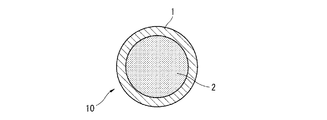
発泡性材料としては、例えば図1に示すように球状の殻壁1内に化学発泡剤2が充填された発泡性材料10が挙げられ、押出し発泡成形工程により化学発泡剤2が揮発して発泡し、押出し発泡成形組成物中に発泡セルを形成できるものであれば良い。前記の殻壁1により、化学発泡剤2は所定の大きさで発泡するように制御し易くなり、例えば大きく発泡し過ぎるような現象を抑制でき、より発泡セルをより均一にすることが可能となる。
<Foaming material>
As the foamable material, for example, as shown in FIG. 1, a
殻壁1,化学発泡剤2は、一般的な押出し発泡成形組成物に用いられているものを適用できるが、例えば殻壁としてはアクリル系ポリマー,アクリルニトリルコポリマー等が挙げられ、化学発泡剤としてはアゾ化合物が挙げられる。
As the shell wall 1 and the
また、発泡性材料10の配合量や殻壁1の厚さ等は、目的とする押出し発泡成形組成物に応じて、押出し発泡成形温度(例えば240℃〜300℃),発泡セル径(例えば0.15mm〜0.25mm)を想定して設定することができるが、例えば合成樹脂100重量部に対し発泡性材料を1〜10重量部程度を配合することが挙げられる。
The blending amount of the
<その他>
混練物は、前記の合成樹脂,発泡性材料の他に、一般的な押出し発泡成形組成物に用いられている各種材料、例えば可塑剤,充填剤,着色剤,安定剤等を適宜添加することができる。
<Others>
In addition to the above-mentioned synthetic resin and foamable material, the kneaded product should be appropriately added with various materials used in general extrusion foaming molding compositions, such as plasticizers, fillers, colorants, stabilizers, etc. Can do.
<製法>
前記の合成樹脂,発泡性材料等を含んだ配合材料を混練し、その混練物を押出し発泡成形できるものであれば、その押出し発泡成形組成物分野で知られている手法(混練機,押出し成形機等を用いた手法)を適宜利用することができる。例えば、前記の配合材料の混練工程には種々のミキサーを適用することができ、例えばラボプラストミル等のバッチ式ミキサー等が挙げられる。また、二軸押出し成形機を用いた場合は、例えばタンブラーミキサー(ドライブレンド)等を併用することにより、前記の混練,成形を連続的に行うことができる。
<Production method>
If the compounding material containing the above synthetic resin, foamable material, etc. is kneaded and the kneaded product can be extruded and foam-molded, a technique (kneader, extrusion molding) known in the field of the extruded foam-molded composition can be used. A method using a machine or the like can be used as appropriate. For example, various mixers can be applied to the kneading step of the blended material, and examples thereof include a batch mixer such as a lab plast mill. Moreover, when a biaxial extrusion molding machine is used, the above-mentioned kneading and molding can be performed continuously by using, for example, a tumbler mixer (dry blend).
次に、本実施形態に基づいて、下記に示すように種々の材料を用いて押出し発泡成形組成物の試料(後述の試料S1〜S6(実施例),P1〜P8(比較例))を作製し、それら各試料の発泡率,外観性,発泡セル径を観測して検証し、その結果を後述の表1に示した。 Next, based on this embodiment, samples of extruded foam molding compositions (samples S1 to S6 (Examples) and P1 to P8 (Comparative Examples) described later) are prepared using various materials as described below. The foaming rate, appearance, and foamed cell diameter of each sample were observed and verified, and the results are shown in Table 1 described later.
<各試料>
ポリブチレンテレフタレート(ウィンテックポリマー株式会社製のジェラネックス500FP)100重量部に対し、後述の表1に示すように発泡性材料A〜Cの何れかを配合してラボプラストミル(東洋精機社製)に投入し、混練(ロータ回転数60rpm)して押出し発泡成形加工(押出し発泡成形温度240℃または300℃)することにより、幅25mm,厚さ1.5mmの長尺平板状の試料S1〜S6,P1〜P8をそれぞれ作製した。
<Each sample>
To (Gela Nex 500FP manufactured by Win Tech Polymer Ltd.) 100 parts by weight of polybutylene terephthalate, Rabopu La Sutomiru (Toyo Seiki Co., Ltd. was blended either foamable material A~C as shown in Table 1 below ), Kneading (rotor rotation speed: 60 rpm) and extrusion foam molding (extrusion foam molding temperature: 240 ° C. or 300 ° C.) to obtain a long plate-like sample S1 to 25 mm in width and 1.5 mm in thickness. S6, P1 to P8 were respectively produced.
なお、発泡性材料Aは、ポリスレンEB201(永和化成工業社製)を、アクリロニトリルコポリマーである殻壁(Expancel社製のExpancel551DE20D60と同じ殻壁)で覆ったものとする。また、発泡性材料BはポリスレンEB201、発泡性材料CはEXPANCEL930DU120(日本フェライト社製)とする。 The foamable material A is obtained by covering Polyslen EB201 (manufactured by Eiwa Kasei Kogyo Co., Ltd.) with a shell wall that is an acrylonitrile copolymer (the same shell wall as Expandel 551DE20D60 manufactured by Expandel ) . The foamable material B is made of polyslene EB201, and the foamable material C is made of EXPANCEL930DU120 (manufactured by Nippon Ferrite Co., Ltd.).
<発泡率>
各試料S1〜S6,P1〜P8の発泡率を下記式により算出した。
発泡率(%)={(無発泡時の試料の比重)−(発泡時の試料の比重)}/(無発泡時の試料の比重)×100
<外観性>
前記の各試料S1〜S6,P1〜P8表面を観察した。なお、後述表1の外観性の欄において、記号「○」は、試料表面が平滑であり、その表面の変色や発泡はなく、所謂ブツ等が観られなかった場合とする。記号「△」は、試料表面が少なからず荒れた状態であり、その表面の変色,発泡や、所謂ブツ等も少なからず観られた場合とする。記号「×」は、試料表面が荒れた状態であり、その表面の変色,発泡や、所謂ブツ等も観られた場合とする。
<Foaming rate>
The foaming rate of each sample S1-S6, P1-P8 was calculated by the following formula.
Foaming rate (%) = {(specific gravity of the sample without foaming) − (specific gravity of the sample when foaming)} / (specific gravity of the sample without foaming) × 100
<Appearance>
The surfaces of the samples S1 to S6 and P1 to P8 were observed. In addition, in the column of appearance in Table 1 described later, the symbol “◯” indicates that the surface of the sample is smooth, the surface is not discolored or foamed, and so-called irregularities are not observed. The symbol “Δ” indicates that the surface of the sample is not a little rough, and the surface is discolored, foamed, or so-called with a few spots. The symbol “x” indicates that the sample surface is in a rough state, and discoloration, foaming, or so-called irregularity of the surface is observed.
<発泡セル径>
各試料S1〜S6,P1〜P8に形成された発泡セルを、それぞれランダムに20個選択して直径を測定し、各々平均値を算出した。
<Foamed cell diameter>
Twenty foam cells formed in each of the samples S1 to S6 and P1 to P8 were selected at random, the diameter was measured, and the average value was calculated.
前記の表1に示す結果から、単に化学発泡剤を用いた試料P1〜P8の場合、試料表面が荒れた状態となったり、その表面の変色,発泡,ブツ等が発生していること読み取れる。なお、セル発泡率についても、バラツキが生じていることを確認した。 From the results shown in Table 1, it can be seen that in the case of Samples P1 to P8 using a chemical foaming agent, the sample surface is in a rough state, or the surface is discolored, foamed, or flawed. In addition, it confirmed that the cell foaming rate had variation.
一方、化学発泡剤を殻壁で覆って成る発泡性材料を用いた試料S1〜S6の場合は、試料表面が平滑であり、その表面の変色,発泡,ブツ等が全く観られなかった。なお、セル発泡率についても、バラツキが殆ど生じていないことを確認した。 On the other hand, in the case of samples S1 to S6 using a foamable material formed by covering a chemical foaming agent with a shell wall, the sample surface was smooth, and no discoloration, foaming, or flaws on the surface were observed. In addition, it was confirmed that there was almost no variation in the cell foaming rate.
また、試料S1〜S6のような押出し発泡成形組成物において、合成樹脂100重量部に対し1〜10重量部配合したものであれば、少なくとも試料P1〜P8と比較して、所望の外観性,押出し発泡成形性(発泡率,機械的強度等)を確認した。 In addition, in the extrusion foam molding composition as in samples S1 to S6, if it is blended in an amount of 1 to 10 parts by weight with respect to 100 parts by weight of the synthetic resin, compared with at least samples P1 to P8, the desired appearance, Extrusion foam moldability (foaming rate, mechanical strength, etc.) was confirmed.
以上、本発明において、記載された具体例に対してのみ詳細に説明したが、本発明の技術思想の範囲で多彩な変形および修正が可能であることは、当業者にとって明白なことであり、このような変形および修正が特許請求の範囲に属することは当然のことである。 Although the present invention has been described in detail only for the specific examples described above, it is obvious to those skilled in the art that various changes and modifications are possible within the scope of the technical idea of the present invention. Such variations and modifications are naturally within the scope of the claims.
1…殻壁
2…化学発泡剤
10…発泡性材料
DESCRIPTION OF SYMBOLS 1 ...
Claims (2)
前記の発泡性材料が、アゾ化合物である化学発泡剤を、アクリル系ポリマーまたはアクリルニトリルコポリマーである殻壁で覆って成ることを特徴とする押出し発泡成形品の製造方法。 A method for producing an extruded foamed molded article in which a foamed cell is formed by extruding and foaming a kneaded product in which a foamable material is blended with a synthetic resin at a temperature of 240 ° C to 300 ° C.
A process for producing an extrusion foamed molded article, wherein the foamable material is formed by covering a chemical foaming agent, which is an azo compound, with a shell wall, which is an acrylic polymer or an acrylonitrile copolymer .
Priority Applications (1)
| Application Number | Priority Date | Filing Date | Title |
|---|---|---|---|
| JP2011018066A JP6164792B2 (en) | 2011-01-31 | 2011-01-31 | Method for manufacturing extruded foam molding |
Applications Claiming Priority (1)
| Application Number | Priority Date | Filing Date | Title |
|---|---|---|---|
| JP2011018066A JP6164792B2 (en) | 2011-01-31 | 2011-01-31 | Method for manufacturing extruded foam molding |
Publications (2)
| Publication Number | Publication Date |
|---|---|
| JP2012158650A JP2012158650A (en) | 2012-08-23 |
| JP6164792B2 true JP6164792B2 (en) | 2017-07-19 |
Family
ID=46839453
Family Applications (1)
| Application Number | Title | Priority Date | Filing Date |
|---|---|---|---|
| JP2011018066A Expired - Fee Related JP6164792B2 (en) | 2011-01-31 | 2011-01-31 | Method for manufacturing extruded foam molding |
Country Status (1)
| Country | Link |
|---|---|
| JP (1) | JP6164792B2 (en) |
Families Citing this family (1)
| Publication number | Priority date | Publication date | Assignee | Title |
|---|---|---|---|---|
| US20240417526A1 (en) * | 2021-10-28 | 2024-12-19 | Mitsubishi Chemical Corporation | Thermoplastic resin composition pellet and method for producing same |
Family Cites Families (6)
| Publication number | Priority date | Publication date | Assignee | Title |
|---|---|---|---|---|
| JPS6011975B2 (en) * | 1980-11-25 | 1985-03-29 | 積水化成品工業株式会社 | Method for manufacturing polyolefin resin foam sheet |
| JPS5813640A (en) * | 1981-07-18 | 1983-01-26 | Eiwa Kasei Kogyo Kk | Foaming agent concentrate and manufacturing of foamed article using the same |
| JPH107846A (en) * | 1996-06-26 | 1998-01-13 | Sumitomo Bakelite Co Ltd | Flame-retardant polyolefin resin composition |
| JP2003012845A (en) * | 2001-04-24 | 2003-01-15 | Sekisui Chem Co Ltd | Foamed vinyl chloride resin molding |
| JP2006291063A (en) * | 2005-04-12 | 2006-10-26 | Mitsubishi Engineering Plastics Corp | Polybutylene terephthalate resin composition for extrusion foam molding and extrusion foam molding |
| JP2010265421A (en) * | 2009-05-18 | 2010-11-25 | Eiwa Kasei Kogyo Kk | Micro capsule |
-
2011
- 2011-01-31 JP JP2011018066A patent/JP6164792B2/en not_active Expired - Fee Related
Also Published As
| Publication number | Publication date |
|---|---|
| JP2012158650A (en) | 2012-08-23 |
Similar Documents
| Publication | Publication Date | Title |
|---|---|---|
| US8420707B2 (en) | Biomass composite composition and foaming method thereof | |
| CN101747605B (en) | A kind of fully biodegradable foam material and preparation method thereof | |
| KR20170017611A (en) | Foamable master batch and Polyolefin resin compositions with excellent expandability and direct metallizing property | |
| CN104254569A (en) | Polycarbonate resin composition with superior fluidity and molding thereof | |
| JP5564343B2 (en) | Polystyrene resin film and laminated sheet | |
| JP6164792B2 (en) | Method for manufacturing extruded foam molding | |
| JP5380379B2 (en) | Polystyrene resin foam molding | |
| TW201144070A (en) | Foamed resin sheet and method of manufacturing foamed resin sheet | |
| JP6093795B2 (en) | Method for producing polypropylene resin foam sheet | |
| JP6387770B2 (en) | Polypropylene resin foam sheet | |
| JP5171238B2 (en) | Foaming agent masterbatch | |
| CN107652500A (en) | A kind of antistatic foaming material and preparation method thereof | |
| CN103571167B (en) | Polycarbonate resin foam blow-molded article and preparation method thereof | |
| JP2023110831A (en) | foam sheet | |
| JP2023066410A (en) | Method for producing thermoplastic resin composition pellets | |
| JP5220058B2 (en) | Polyolefin resin foam molding | |
| JP6003250B2 (en) | Method for producing thermally conductive resin composition | |
| JP2004083656A (en) | Resin composition with excellent moldability | |
| JP2011137116A (en) | Electroconductive polycarbonate resin composition and molding obtained therefrom | |
| JP5337674B2 (en) | Polyolefin resin molded products | |
| JP2010196054A (en) | Polyolefin resin expanded molded product | |
| JP2010077193A (en) | Foaming agent masterbatch for vinyl chloride resin and foam molded product | |
| WO2023074796A1 (en) | Thermoplastic resin composition pellets and method for producing same | |
| JP2010215851A (en) | Polyolefin-based resin molded article | |
| TW201522461A (en) | Modified polypropylene resin, resin foam and foamed resin container, and method for producing modified polypropylene resin |
Legal Events
| Date | Code | Title | Description |
|---|---|---|---|
| A711 | Notification of change in applicant |
Free format text: JAPANESE INTERMEDIATE CODE: A712 Effective date: 20120926 |
|
| RD03 | Notification of appointment of power of attorney |
Free format text: JAPANESE INTERMEDIATE CODE: A7423 Effective date: 20120927 |
|
| RD04 | Notification of resignation of power of attorney |
Free format text: JAPANESE INTERMEDIATE CODE: A7424 Effective date: 20121005 |
|
| A621 | Written request for application examination |
Free format text: JAPANESE INTERMEDIATE CODE: A621 Effective date: 20131218 |
|
| A977 | Report on retrieval |
Free format text: JAPANESE INTERMEDIATE CODE: A971007 Effective date: 20140821 |
|
| A131 | Notification of reasons for refusal |
Free format text: JAPANESE INTERMEDIATE CODE: A131 Effective date: 20140826 |
|
| A131 | Notification of reasons for refusal |
Free format text: JAPANESE INTERMEDIATE CODE: A131 Effective date: 20150428 |
|
| A521 | Request for written amendment filed |
Free format text: JAPANESE INTERMEDIATE CODE: A523 Effective date: 20150622 |
|
| A02 | Decision of refusal |
Free format text: JAPANESE INTERMEDIATE CODE: A02 Effective date: 20151006 |
|
| A521 | Request for written amendment filed |
Free format text: JAPANESE INTERMEDIATE CODE: A523 Effective date: 20151204 |
|
| A911 | Transfer to examiner for re-examination before appeal (zenchi) |
Free format text: JAPANESE INTERMEDIATE CODE: A911 Effective date: 20151211 |
|
| A912 | Re-examination (zenchi) completed and case transferred to appeal board |
Free format text: JAPANESE INTERMEDIATE CODE: A912 Effective date: 20160219 |
|
| A521 | Request for written amendment filed |
Free format text: JAPANESE INTERMEDIATE CODE: A523 Effective date: 20170412 |
|
| A61 | First payment of annual fees (during grant procedure) |
Free format text: JAPANESE INTERMEDIATE CODE: A61 Effective date: 20170620 |
|
| R150 | Certificate of patent or registration of utility model |
Ref document number: 6164792 Country of ref document: JP Free format text: JAPANESE INTERMEDIATE CODE: R150 |
|
| R250 | Receipt of annual fees |
Free format text: JAPANESE INTERMEDIATE CODE: R250 |
|
| R250 | Receipt of annual fees |
Free format text: JAPANESE INTERMEDIATE CODE: R250 |
|
| R250 | Receipt of annual fees |
Free format text: JAPANESE INTERMEDIATE CODE: R250 |
|
| LAPS | Cancellation because of no payment of annual fees |