JP5962011B2 - Method for producing toner for developing electrostatic image, method for producing developer for developing electrostatic image, method for producing toner cartridge, method for producing process cartridge, and image forming method - Google Patents
Method for producing toner for developing electrostatic image, method for producing developer for developing electrostatic image, method for producing toner cartridge, method for producing process cartridge, and image forming method Download PDFInfo
- Publication number
- JP5962011B2 JP5962011B2 JP2011290293A JP2011290293A JP5962011B2 JP 5962011 B2 JP5962011 B2 JP 5962011B2 JP 2011290293 A JP2011290293 A JP 2011290293A JP 2011290293 A JP2011290293 A JP 2011290293A JP 5962011 B2 JP5962011 B2 JP 5962011B2
- Authority
- JP
- Japan
- Prior art keywords
- toner
- image
- developing
- developer
- electrostatic
- Prior art date
- Legal status (The legal status is an assumption and is not a legal conclusion. Google has not performed a legal analysis and makes no representation as to the accuracy of the status listed.)
- Expired - Fee Related
Links
- 238000004519 manufacturing process Methods 0.000 title claims 14
- 238000000034 method Methods 0.000 title claims 7
- 239000000049 pigment Substances 0.000 claims 5
- 239000011259 mixed solution Substances 0.000 claims 3
- 238000002360 preparation method Methods 0.000 claims 3
- 239000000725 suspension Substances 0.000 claims 3
- 239000011230 binding agent Substances 0.000 claims 2
- 238000001035 drying Methods 0.000 claims 2
- 229920005989 resin Polymers 0.000 claims 2
- 239000011347 resin Substances 0.000 claims 2
- 239000006104 solid solution Substances 0.000 claims 2
- 239000002904 solvent Substances 0.000 claims 2
- 239000012736 aqueous medium Substances 0.000 claims 1
- IISBACLAFKSPIT-UHFFFAOYSA-N bisphenol A Chemical group C=1C=C(O)C=CC=1C(C)(C)C1=CC=C(O)C=C1 IISBACLAFKSPIT-UHFFFAOYSA-N 0.000 claims 1
- 239000003795 chemical substances by application Substances 0.000 claims 1
- VPWFPZBFBFHIIL-UHFFFAOYSA-L disodium 4-[(4-methyl-2-sulfophenyl)diazenyl]-3-oxidonaphthalene-2-carboxylate Chemical compound [Na+].[Na+].[O-]S(=O)(=O)C1=CC(C)=CC=C1N=NC1=C(O)C(C([O-])=O)=CC2=CC=CC=C12 VPWFPZBFBFHIIL-UHFFFAOYSA-L 0.000 claims 1
- 239000003960 organic solvent Substances 0.000 claims 1
- 239000002245 particle Substances 0.000 claims 1
- 229920001225 polyester resin Polymers 0.000 claims 1
- 239000004645 polyester resin Substances 0.000 claims 1
Images


Landscapes
- Developing Agents For Electrophotography (AREA)
Description
本発明は、静電荷像現像用トナーの製造方法、静電荷像現像用現像剤、トナーカートリッジ、プロセスカートリッジ、画像形成装置および画像形成方法に関する。 The present invention relates to an electrostatic charge image developing toner manufacturing method, an electrostatic charge image developing developer, a toner cartridge, a process cartridge, an image forming apparatus, and an image forming method.
電子写真法など静電荷像を経て画像情報を可視化する方法は、現在様々な分野で利用されている。電子写真法においては、帯電、露光工程により像保持体上に静電潜像を形成し(潜像形成工程)、静電荷像現像用トナー(以下、単に「トナー」と呼ぶ場合がある。)を含む静電荷像現像用現像剤(以下、単に「現像剤」と呼ぶ場合がある。)で静電潜像を現像し(現像工程)、転写工程、定着工程を経て可視化される。ここで用いられる現像剤には、トナーとキャリアからなる2成分現像剤と、磁性トナーまたは非磁性トナーを単独で用いる1成分現像剤とがある。 A method of visualizing image information through an electrostatic charge image such as electrophotography is currently used in various fields. In electrophotography, an electrostatic latent image is formed on an image carrier by a charging and exposure process (latent image forming process), and an electrostatic charge image developing toner (hereinafter sometimes simply referred to as “toner”). The electrostatic latent image is developed with a developer for developing an electrostatic charge image (hereinafter sometimes referred to simply as “developer”) (development process), and visualized through a transfer process and a fixing process. The developer used here includes a two-component developer composed of a toner and a carrier, and a one-component developer using a magnetic toner or a nonmagnetic toner alone.
そのトナーの製法には、通常、熱可塑性樹脂等の結着樹脂を顔料等の着色剤、帯電制御剤、ワックス等の離型剤等とともに溶融混練し、冷却後、粉砕し、さらに分級する混練粉砕法が使用されている。 The toner is usually prepared by melt-kneading a binder resin such as a thermoplastic resin together with a colorant such as a pigment, a charge control agent, a release agent such as a wax, cooling, pulverizing, and further classification. A grinding method is used.
また、画像の高画質化の要求によりトナー形状およびトナー表面構造等の制御を意図的に行うことが可能な手段として、湿式製法によるトナーの製造方法が提案されており、特に高画質化を狙うために粒径をできるだけ揃える方法として、例えば、懸濁重合法、乳化重合凝集法等が知られている。 Further, as a means capable of intentionally controlling the toner shape, the toner surface structure, and the like in response to a demand for high image quality of the image, a toner manufacturing method by a wet manufacturing method has been proposed, and particularly aims for high image quality. Therefore, as a method for making the particle diameters as uniform as possible, for example, a suspension polymerization method, an emulsion polymerization aggregation method and the like are known.
例えば、特許文献1には、結着樹脂、マゼンタ顔料および極性樹脂を含有する静電荷像現像用マゼンタトナーを、マゼンタ顔料としてC.I.ピグメントバイオレット19とC.I.ピグメントレッド122またはC.I.ピグメントレッド202との固溶体顔料を用い、結着樹脂としてスチレン重合体、スチレン共重合体等を用い、極性樹脂として酸価3mgKOH/g以上20mgKOH/g以下である樹脂を用い、懸濁重合法により製造することが記載されている。このトナーは、摩擦帯電性に優れ、極めて鮮明な色彩が得られると共に、OHP透明性に優れ、かつ製造安定性に優れた特性を有することが記載されている。また、特許文献2には、上記固溶体を混錬粉砕法に用いた例が、特許文献3〜5には懸濁重合法に用いた例が、特許文献6には凝集法に用いた例があり、いずれもマゼンタトナーが提案されている。
For example,
本発明の目的は、トナー表面への離型剤の露出が少なく、トナーの流動性の低下が抑制される静電荷像現像用トナーの製造方法、そのようにして得られるトナーを含む静電荷像現像用現像剤、トナーカートリッジ、その現像剤を用いるプロセスカートリッジ、画像形成装置および画像形成方法を提供することにある。 An object of the present invention is to provide a method for producing a toner for developing an electrostatic image in which the release agent is less exposed on the toner surface and the decrease in fluidity of the toner is suppressed, and the electrostatic image containing the toner thus obtained The present invention provides a developing developer, a toner cartridge, a process cartridge using the developer, an image forming apparatus, and an image forming method.
請求項1に係る発明は、結着樹脂と、離型剤と、C.I.ピグメントバイオレット19とC.I.ピグメントレッド122との固溶体またはC.I.ピグメントバイオレット19とC.I.ピグメントレッド202との固溶体であるマゼンタ顔料とを有機溶媒中に溶解または分散させて混合液を調製する混合液調製工程と、前記混合液を水系媒体中に分散懸濁させて懸濁液を調製する懸濁液調製工程と、前記懸濁液から溶媒を除去する溶媒除去工程と、得られたトナー粒子を乾燥する乾燥工程と、を含み、前記結着樹脂が、少なくともビスフェノール骨格を有するポリエステル樹脂である静電荷像現像用トナーの製造方法である。
The invention according to
請求項2に係る発明は、静電荷像現像用現像剤の製造方法であって、前記静電荷像現像用現像剤が、請求項1に記載の静電荷像現像用トナーの製造方法により得られる静電荷像現像用トナーを含有する静電荷像現像用現像剤の製造方法である。
The invention according to claim 2 is a method for producing a developer for developing an electrostatic image, wherein the developer for developing an electrostatic image is obtained by the method for producing toner for developing an electrostatic image according to
請求項3に係る発明は、トナーカートリッジの製造方法であって、前記トナーカートリッジが、請求項1に記載の静電荷像現像用トナーの製造方法により得られる静電荷像現像用トナーを含有するトナーカートリッジの製造方法である。 According to a third aspect of the present invention, there is provided a toner cartridge manufacturing method, wherein the toner cartridge contains the electrostatic charge image developing toner obtained by the electrostatic charge image developing toner manufacturing method according to the first aspect. It is a manufacturing method of a cartridge.
請求項4に係る発明は、像保持体と、前記像保持体の表面に形成された静電潜像を現像剤を用いて現像してトナー画像を形成する現像手段と、を備えるプロセスカートリッジの製造方法であって、前記現像剤は、請求項2に記載の静電荷像現像用現像剤の製造方法により得られる静電荷像現像用現像剤であるプロセスカートリッジの製造方法である。 Invention includes an image holding member, a developing means for forming a toner image by using a developer an electrostatic latent image formed on the surface of the image carrier, Ru with a process cartridge according to claim 4 The developer is a process cartridge manufacturing method which is an electrostatic charge image developing developer obtained by the electrostatic charge image developing developer manufacturing method according to claim 2.
請求項5に係る発明は、像保持体の表面を帯電させる帯電工程と、前記像保持体の表面に静電潜像を形成する潜像形成工程と、前記像保持体の表面に形成された静電潜像を現像剤を用いて現像してトナー画像を形成する現像工程と、前記現像されたトナー画像を被転写体に転写する転写工程と、を備え、前記現像剤は、請求項2に記載の静電荷像現像用現像剤の製造方法により得られる静電荷像現像用現像剤である画像形成方法である。 The invention according to claim 5 is formed on the surface of the image carrier, a charging step for charging the surface of the image carrier, a latent image forming step for forming an electrostatic latent image on the surface of the image carrier. the electrostatic latent image is developed with a developer comprising a developing step of forming a toner image, and a transferring step of the transferring the developed toner image image to a transfer member, the developer, claim 2. An image forming method which is a developer for developing an electrostatic charge image obtained by the method for producing a developer for developing an electrostatic charge image according to 2.
請求項1に係る発明によると、本構成を有さない場合に比較して、トナー表面への離型剤の露出が少なく、トナーの流動性の低下が抑制される静電荷像現像用トナーが得られる。 According to the first aspect of the present invention, there is provided an electrostatic charge image developing toner in which the exposure of the release agent to the toner surface is less and the decrease in the fluidity of the toner is suppressed as compared with the case without this configuration. can get.
請求項1に係る発明によると、結着樹脂がビスフェノール骨格を有さない場合に比較して、トナー表面への離型剤の露出が少なく、トナーの流動性の低下が抑制される静電荷像現像用トナーが得られる。 According to the first aspect of the present invention, compared to the case where the binder resin does not have a bisphenol skeleton, the exposure of the release agent to the toner surface is less, and the electrostatic charge image in which the decrease in toner fluidity is suppressed. A developing toner is obtained.
請求項2に係る発明によると、本構成を有さない場合に比較して、トナー表面への離型剤の露出が少なく、トナーの流動性の低下が抑制される静電荷像現像用トナーを含有する静電荷像現像用現像剤の製造方法が提供される。 According to the second aspect of the present invention, there is provided an electrostatic charge image developing toner in which the release agent is less exposed on the toner surface and the lowering of the toner fluidity is suppressed as compared with the case without this configuration. There is provided a method for producing a developer for developing an electrostatic charge image.
請求項3に係る発明によると、本構成を有さない場合に比較して、トナー表面への離型剤の露出が少なく、トナーの流動性の低下が抑制される静電荷像現像用トナーを含有するトナーカートリッジの製造方法が提供される。 According to the third aspect of the present invention, there is provided an electrostatic image developing toner in which the release agent is less exposed on the toner surface and the lowering of the fluidity of the toner is suppressed as compared with the case without this configuration. A method of manufacturing a toner cartridge containing the toner cartridge is provided.
請求項4に係る発明によると、本構成を有さない場合に比較して、トナー表面への離型剤の露出が少なく、トナーの流動性の低下が抑制される静電荷像現像用トナーを含有するプロセスカートリッジの製造方法が提供される。 According to the fourth aspect of the present invention, there is provided an electrostatic charge image developing toner in which the release agent is less exposed on the toner surface and the lowering of the fluidity of the toner is suppressed as compared with the case without this configuration. A method of manufacturing a process cartridge containing the method is provided.
請求項5に係る発明によると、本構成を有さない場合に比較して、トナー表面への離型剤の露出が少なく、トナーの流動性の低下が抑制される画像形成方法が提供される。 According to the fifth aspect of the present invention, there is provided an image forming method in which the exposure of the release agent to the toner surface is less than that in the case where the present configuration is not provided, and the decrease in toner fluidity is suppressed. .
本発明の実施の形態について以下説明する。本実施形態は本発明を実施する一例であって、本発明は本実施形態に限定されるものではない。 Embodiments of the present invention will be described below. This embodiment is an example for carrying out the present invention, and the present invention is not limited to this embodiment.
<静電荷像現像用トナーの製造方法>
本発明の実施形態に係る静電荷像現像用トナーの製造方法は、結着樹脂と、離型剤と、C.I.ピグメントバイオレット19(以下、単に「PV19」と呼ぶ場合がある)とC.I.ピグメントレッド122(以下、単に「PR122」と呼ぶ場合がある)との固溶体またはC.I.ピグメントバイオレット19とC.I.ピグメントレッド202(以下、単に「PR202」と呼ぶ場合がある)との固溶体であるマゼンタ顔料とを有機溶媒中に溶解または分散させて混合液を調製する混合液調製工程と、前記混合液を水系媒体中に分散懸濁させて懸濁液を調製する懸濁液調製工程と、前記懸濁液から溶媒を除去する溶媒除去工程と、得られたトナー粒子を乾燥する乾燥工程と、を含む。一般に、このような方法は「溶解懸濁法」と呼ばれる。
<Method for producing toner for developing electrostatic image>
A method for producing an electrostatic charge image developing toner according to an embodiment of the present invention includes a binder resin, a release agent, C.I. I. Pigment Violet 19 (hereinafter sometimes simply referred to as “PV19”) and C.I. I. Pigment Red 122 (hereinafter sometimes simply referred to as “PR122”) or C.I. I. Pigment violet 19 and C.I. I. A liquid mixture preparing step of preparing a liquid mixture by dissolving or dispersing magenta pigment, which is a solid solution with CI Pigment Red 202 (hereinafter sometimes simply referred to as “PR202”), in an organic solvent; A suspension preparation step of preparing a suspension by dispersing and suspending in a medium, a solvent removal step of removing the solvent from the suspension, and a drying step of drying the obtained toner particles are included. In general, such a method is called a “dissolution suspension method”.
従来、着色剤としてPV19とPR122、またはPV19とPR202をそれぞれ単独の顔料として含むトナー粒子の構造、特に離型剤のトナー粒子中の位置を制御することは困難であった。詳細は不明であるが、PV19とPR122、またはPV19とPR202が混晶であるため、顔料の結晶構造の規則性がそれぞれの顔料単独よりも低めであり、異方性が低いため、トナー粒子内部に含まれる結着樹脂への顔料の分散性が高いが、一方で他のトナー構成材料、特に離型剤のトナー粒子内部への分散の制御が困難であり、離型剤がトナーの表面へ露出しやすくなると推定される。 Conventionally, it has been difficult to control the structure of toner particles containing PV19 and PR122 as coloring agents or PV19 and PR202 as individual pigments, particularly the position of the release agent in the toner particles. Details are unknown, but because PV19 and PR122 or PV19 and PR202 are mixed crystals, the regularity of the crystal structure of the pigment is lower than that of each pigment alone, and the anisotropy is low. Although the dispersibility of the pigment in the binder resin contained in the toner is high, it is difficult to control the dispersion of other toner constituent materials, particularly the release agent inside the toner particles. Estimated to be easily exposed.
本発明者らは、顔料の構成をPV19とPR122との固溶体またはPV19とPR202との固溶体として、結着樹脂と離型剤とその固溶体とを有機溶媒中に溶解または分散させて混合液を調製する混合液調製工程と、混合液を水系媒体中に分散懸濁させて懸濁液を調製する懸濁液調製工程と、懸濁液から溶媒を除去する溶媒除去工程と、得られたトナー粒子を乾燥する乾燥工程と、を含む湿式製法と組み合わせることにより、トナー粒子の構造、特に離型剤のトナー粒子中の位置を制御しやすくなることを見出した。その結果、例えばストレス条件下等においてもトナー粒子表面への離型剤の露出が少なく、トナーの流動性の低下が抑制され、トナーカートリッジから現像装置への搬送経路や現像装置等における粉体搬送性が向上する。よって、当該搬送経路等におけるトナー詰まりが生じにくく、画像濃度の低下等が抑制される。 The present inventors prepared a mixed liquid by dissolving or dispersing a binder resin, a release agent, and the solid solution in an organic solvent, using a solid solution of PV19 and PR122 or a solid solution of PV19 and PR202 as the composition of the pigment. A mixed liquid preparing step, a suspension preparing step of preparing a suspension by dispersing and suspending the mixed liquid in an aqueous medium, a solvent removing step of removing the solvent from the suspension, and the obtained toner particles It has been found that the structure of the toner particles, particularly the position of the release agent in the toner particles can be easily controlled by combining with a wet manufacturing method including a drying step of drying the toner. As a result, for example, there is little exposure of the release agent to the surface of the toner particles even under stress conditions, etc., and a decrease in toner fluidity is suppressed, and the powder transport in the transport path from the toner cartridge to the developing device or in the developing device Improves. Therefore, toner clogging in the conveyance path or the like is unlikely to occur, and a decrease in image density or the like is suppressed.
本実施形態に係るトナーの製造方法により得られるトナーの表面の離型剤の露出量は、例えば、1%以上10%以下の範囲である。 The exposure amount of the release agent on the surface of the toner obtained by the toner manufacturing method according to the present embodiment is, for example, in the range of 1% to 10%.
以下、本実施形態に係るトナーの製造方法の一例について説明する。 Hereinafter, an example of a toner manufacturing method according to the exemplary embodiment will be described.
[混合液調製工程]
まず、結着樹脂と、離型剤と、着色剤としてPV19とPR122との固溶体またはPV19とPR202との固溶体であるマゼンタ顔料とを有機溶媒中に溶解または分散させて混合液を調製する(混合液調製工程)。この混合液調製工程においては、少なくとも結着樹脂、着色剤、離型剤を含むトナー材料を有機溶媒中に溶解もしくは分散させて、トナー材料の混合液を得るものである。
[Mixed liquid preparation process]
First, a mixed solution is prepared by dissolving or dispersing a binder resin, a release agent, and a magenta pigment which is a solid solution of PV19 and PR122 or a solid solution of PV19 and PR202 as a colorant in an organic solvent (mixing) Liquid preparation step). In this mixed liquid preparation step, a toner material containing at least a binder resin, a colorant, and a release agent is dissolved or dispersed in an organic solvent to obtain a mixed liquid of toner materials.
そのトナー材料には、結着樹脂、着色剤、離型剤の他に、必要に応じてトナー粒子に通常添加される帯電制御剤等を適宜配合してもよい。トナー材料の混合液は、結着樹脂にあらかじめ着色剤、離型剤もしくは帯電制御剤等を混練させたものを、有機溶媒中に溶解もしくは分散させてもよいし、または結着樹脂を有機溶媒中に溶解させた後、着色剤、離型剤および帯電制御剤等をボールミル、サンドミル等のメディア入り分散機または高圧分散機等を用いて分散させてもよいし、あらかじめ有機溶媒中に着色剤、離型剤もしくは帯電制御剤等をメディア入り分散機、高圧分散機または超音波分散機等を用いて分散した後、結着樹脂を溶解させてもよい。この混合工程においては、結着樹脂、離型剤が有機溶媒中に溶解して着色剤が溶解または分散している限り、如何なる方法により混合したものでもよい。 In addition to the binder resin, the colorant, and the release agent, the toner material may be appropriately mixed with a charge control agent or the like that is usually added to the toner particles as necessary. The mixed liquid of toner material may be prepared by kneading a binder resin with a colorant, a release agent, a charge control agent, or the like in advance in an organic solvent, or the binder resin may be dissolved in an organic solvent. After being dissolved therein, a colorant, a release agent, a charge control agent, etc. may be dispersed using a media-containing disperser such as a ball mill or a sand mill or a high-pressure disperser, or a colorant in an organic solvent in advance. The binder resin may be dissolved after the release agent or the charge control agent is dispersed using a media-containing disperser, a high-pressure disperser, an ultrasonic disperser, or the like. In this mixing step, any mixing method may be used as long as the binder resin and the release agent are dissolved in the organic solvent and the colorant is dissolved or dispersed.
トナー材料の溶解もしくは分散に用いる有機溶媒としては、酢酸メチル、酢酸エチル等のエステル系溶媒、メチルエチルケトン、メチルイソプロピルケトン等のケトン系溶媒、ヘキサン、シクロヘキサン等の脂肪族炭化水素系溶媒、ジクロロメタン、クロロホルム、トリクロロエチレン等のハロゲン化炭化水素系溶媒等が挙げられる。これらの有機溶媒は、結着樹脂を溶解するものであって、かつ、水に溶解する割合が0重量%以上30重量%以下程度のものであり、沸点が100℃以下であることが好ましい。なお、スチレンやアクリル酸等の重合性単量体は用いないのが好ましい。また、工業化を行うにあたり、作業上の安全性、コストおよび生産性等をも考慮すると、酢酸エチルを用いることが特に好ましい。これら有機溶媒はトナー材料の混合液の粘度が20℃において1mPa・s以上10,000mPa・s以下の範囲となるように用いられることが好ましく、1mPa・s以上2,000mPa・s以下の範囲となるように用いられることがより好ましい。 Organic solvents used for dissolving or dispersing the toner material include ester solvents such as methyl acetate and ethyl acetate, ketone solvents such as methyl ethyl ketone and methyl isopropyl ketone, aliphatic hydrocarbon solvents such as hexane and cyclohexane, dichloromethane and chloroform. And halogenated hydrocarbon solvents such as trichlorethylene. These organic solvents are those that dissolve the binder resin and have a ratio of dissolving in water of about 0 wt% or more and 30 wt% or less, and preferably have a boiling point of 100 ° C. or less. It is preferable not to use a polymerizable monomer such as styrene or acrylic acid. Further, in industrialization, it is particularly preferable to use ethyl acetate in consideration of work safety, cost, productivity, and the like. These organic solvents are preferably used so that the viscosity of the liquid mixture of toner materials is in the range of 1 mPa · s to 10,000 mPa · s at 20 ° C., and in the range of 1 mPa · s to 2,000 mPa · s. More preferably, it is used.
[懸濁液調製工程]
次に、混合液調製工程で得られた混合液を、水系媒体中に分散懸濁させて懸濁液を調製する(懸濁液調製工程)。
[Suspension preparation process]
Next, the liquid mixture obtained in the liquid mixture preparation step is dispersed and suspended in an aqueous medium to prepare a suspension (suspension preparation step).
水系媒体としては、水中に無機分散剤を分散させたものを用いることが好ましい。また、トナー粒子の粒度分布をできるだけ均一にするためには、水中に無機分散剤を分散させるとともに、水に溶解する高分子分散剤を添加することが好ましい。この無機分散剤は、ボールミルのようなメディア入り分散機、高圧分散機または超音波分散機等を用いて水中に分散させればよい。また、高分子分散剤は、水中にできるだけ均一に溶解していれば如何なる方法によって添加してもよい。また、用いる水は、通常、イオン交換水、蒸留水または純水などである。 As the aqueous medium, it is preferable to use a medium in which an inorganic dispersant is dispersed in water. In order to make the particle size distribution of the toner particles as uniform as possible, it is preferable to disperse the inorganic dispersant in water and add a polymer dispersant that dissolves in water. The inorganic dispersant may be dispersed in water using a media-containing disperser such as a ball mill, a high-pressure disperser, an ultrasonic disperser, or the like. The polymer dispersant may be added by any method as long as it dissolves as uniformly as possible in water. The water used is usually ion exchange water, distilled water or pure water.
無機分散剤としては、親水性分散剤を用いることが好ましく、具体的には、シリカ、アルミナ、チタニア、炭酸カルシウム、炭酸マグネシウム、リン酸三カルシウム、粘土、珪藻土、ベントナイト等が挙げられるが、炭酸カルシウムが好ましい。また、これらの無機分散剤は、その粒子表面がカルボキシル基を有する重合体で被覆されているものがより好ましい。このような重合体で被覆されたものは親油親水バランスを最適化するため、トナー材料の混合液の懸濁液調製工程において分散粒子がほとんど合一せず、粒度分布がシャープなトナー粒子が得られる。 As the inorganic dispersant, it is preferable to use a hydrophilic dispersant. Specific examples include silica, alumina, titania, calcium carbonate, magnesium carbonate, tricalcium phosphate, clay, diatomaceous earth, bentonite, and the like. Calcium is preferred. Moreover, as for these inorganic dispersing agents, what the particle | grain surface is coat | covered with the polymer which has a carboxyl group is more preferable. In order to optimize the lipophilic hydrophilic balance, those coated with such a polymer have toner particles with a sharp particle size distribution, in which the dispersed particles hardly merge in the suspension preparation step of the toner material mixture. can get.
上記カルボキシル基を有する重合体としては、α,β−モノエチレン性不飽和カルボン酸またはα,β−モノエチレン性不飽和カルボン酸のカルボキシル基がアルカリ金属、アルカリ土類金属、アンモニウム、アミン等により中和されたアルカリ金属塩、アルカリ土類金属塩、アンモニウム塩、アミン塩等から選ばれる少なくとも1種と、α,β−モノエチレン性不飽和カルボン酸エステルとの共重合物、あるいは、α,β−モノエチレン性不飽和カルボン酸とα,β−モノエチレン性不飽和カルボン酸エステルとの共重合物の上記のようなアルカリ金属塩、アルカリ土類金属塩、アンモニウム塩またはアミン塩等が含まれる。これらは1種のみで用いてもよく、2種以上混合して用いてもよい。 As the polymer having a carboxyl group, the carboxyl group of an α, β-monoethylenically unsaturated carboxylic acid or α, β-monoethylenically unsaturated carboxylic acid is an alkali metal, alkaline earth metal, ammonium, amine, or the like. A copolymer of at least one selected from neutralized alkali metal salts, alkaline earth metal salts, ammonium salts, amine salts, and the like and α, β-monoethylenically unsaturated carboxylic acid ester, or α, Includes alkali metal salts, alkaline earth metal salts, ammonium salts or amine salts as described above of copolymers of β-monoethylenically unsaturated carboxylic acid and α, β-monoethylenically unsaturated carboxylic acid ester It is. These may be used alone or in combination of two or more.
α,β−モノエチレン性不飽和カルボン酸の代表的なものとしては、アクリル酸、メタクリル酸、クロトン酸等のα,β−不飽和モノカルボン酸、マレイン酸、フマル酸、イタコン酸等のα,β−不飽和ジカルボン酸から選ばれる少なくとも1種が挙げられる。また、α,β−モノエチレン性不飽和カルボン酸エステルの代表的なものとしては、アクリル酸、メタクリル酸その他のアルキルエステル類、アルコキシ基を有するアクリレートおよびメタクリレート類、シクロヘキシル基を有するアクリレートおよびメタクリレート類、ヒドロキシ基を有するアクリレートおよびメタクリレート類、ポリアルキレングリコールモノアクリレート類およびポリアルキレングリコールモノメタクリレート類等が挙げられる。これらに代表されるα,β−モノエチレン性不飽和カルボン酸エステルより選ばれるものが好ましい。 Representative α, β-monoethylenically unsaturated carboxylic acids include α, β-unsaturated monocarboxylic acids such as acrylic acid, methacrylic acid, and crotonic acid, and α such as maleic acid, fumaric acid, and itaconic acid. , Β-unsaturated dicarboxylic acid. Representative examples of α, β-monoethylenically unsaturated carboxylic acid esters include acrylic acid, methacrylic acid and other alkyl esters, acrylates and methacrylates having alkoxy groups, and acrylates and methacrylates having cyclohexyl groups. , Acrylates and methacrylates having a hydroxy group, polyalkylene glycol monoacrylates, polyalkylene glycol monomethacrylates and the like. Those selected from α, β-monoethylenically unsaturated carboxylic acid esters represented by these are preferable.
無機分散剤としては、体積平均粒子径が1nm以上1,000nm以下の範囲のものが好ましく用いられるが、5nm以上500nm以下の範囲のものがより好ましく、10nm以上300nm以下の範囲のものがさらに好ましい。この体積平均粒子径が1nm未満では、無機分散剤を分散させることが困難となる場合があり、1,000nmを超えるとトナー粒子径との差が小さくなるため、油相成分を安定に分散維持させることが困難となる場合がある。その無機分散剤の使用量は、トナー100重量部に対して1重量以上300重量部以下の範囲が好ましく、4重量部以上100重量部以下の範囲がより好ましい。1重量部より少ないと分散性と安定性が不安定になりやすく、300重量部を超えると水相成分の粘度が高くなり、分散懸濁の安定性が低下しやすくなる。 As the inorganic dispersant, those having a volume average particle diameter in the range of 1 nm to 1,000 nm are preferably used, more preferably in the range of 5 nm to 500 nm, and still more preferably in the range of 10 nm to 300 nm. . If the volume average particle diameter is less than 1 nm, it may be difficult to disperse the inorganic dispersant. If the volume average particle diameter exceeds 1,000 nm, the difference from the toner particle diameter becomes small, so that the oil phase component is stably dispersed and maintained. It may be difficult to do so. The amount of the inorganic dispersant used is preferably in the range of 1 to 300 parts by weight and more preferably in the range of 4 to 100 parts by weight with respect to 100 parts by weight of the toner. When the amount is less than 1 part by weight, the dispersibility and stability tend to be unstable, and when the amount exceeds 300 parts by weight, the viscosity of the aqueous phase component increases, and the stability of the dispersion suspension tends to decrease.
高分子分散剤としては、親水性のものを用いることが好ましく、カルボキシル基を有するものの中でヒドロキシプロポキシル基、メトキシル基等の親油基を持たないものが好ましい。具体的には、カルボキシメチルセルロース、カルボキシエチルセルロース等の水溶性のセルロースエーテルが用いられるが、特にカルボキシメチルセルロースが好ましい。これらのセルロース類は、エーテル化度が0.6以上1.5以下の範囲であり、平均重合度が50以上3,000以下の範囲のものであることが好ましい。また、そのカルボキシル基は、ナトリウム、カリウム、マグネシウム等の金属塩であってもよい。トナー粒子の粒度分布をシャープにするために、高分子分散剤の使用量をトナー材料の混合液の粘度(トナー材料と有機溶媒の比率等により異なる。)によって変えてもよい。例えば、トナー材料の混合液の粘度が比較的低い場合には、水系媒体の粘度を高くしなくてもよく、高分子分散剤の添加量も少なくてよい。これに対して、トナー材料の混合液の粘度が高い場合には、高分子分散剤の添加量も多くして水系媒体の粘度を高くしてもよい。水系媒体の粘度は、20℃において概ね1mPa・s以上3,000mPa・s以下の範囲となるように調整されることが好ましく、1mPa・s以上1,000mPa・s以下の範囲となるように調整されることがより好ましい。 As the polymer dispersant, a hydrophilic one is preferably used, and among those having a carboxyl group, those having no lipophilic group such as a hydroxypropoxyl group and a methoxyl group are preferable. Specifically, water-soluble cellulose ethers such as carboxymethyl cellulose and carboxyethyl cellulose are used, and carboxymethyl cellulose is particularly preferable. These celluloses preferably have a degree of etherification in the range of 0.6 to 1.5 and an average degree of polymerization in the range of 50 to 3,000. Further, the carboxyl group may be a metal salt such as sodium, potassium or magnesium. In order to sharpen the particle size distribution of the toner particles, the amount of the polymer dispersant used may be changed depending on the viscosity of the mixed liquid of the toner material (which varies depending on the ratio of the toner material and the organic solvent). For example, when the viscosity of the mixture of toner materials is relatively low, the viscosity of the aqueous medium need not be increased, and the amount of the polymer dispersant added may be small. On the other hand, when the viscosity of the mixture of toner materials is high, the amount of the polymer dispersant may be increased to increase the viscosity of the aqueous medium. The viscosity of the aqueous medium is preferably adjusted to be in the range of approximately 1 mPa · s to 3,000 mPa · s at 20 ° C., and is adjusted to be in the range of 1 mPa · s to 1,000 mPa · s. More preferably.
懸濁液調製工程に使用される装置としては、例えば、一般に乳化機、分散機として市販されているものが挙げられ、特に限定されるものではない。例えば、ウルトラタラックス(IKA社製)、ポリトロン(キネマティカ社製)、TKオートホモミクサ(特殊機化工業社製)、ナショナルクッキングミキサ(松下電器産業社製)等のバッチ式乳化機、エバラマイルダ(荏原製作所社製)、TKパイプラインホモミクサ、TKホモミックラインフロ(特殊機化工業社製)、コロイドミル(神鋼パンテック社製)、スラッシャ、トリゴナル湿式微粉砕機(三井三池化工機製)、キャビトロン(ユーロテック社製)、ファインフローミル(太平洋機工社製)等の連続式乳化機、クレアミックス(エムテクニック社製)、フィルミックス(特殊機化工業社製)等のバッチまたは連続両用乳化機、マイクロフルイダイザ(みづほ工業社製)、ナノメーカ、ナノマイザ(ナノマイザ社製)、APV ゴウリン(ゴウリン社製)等の高圧乳化機、膜乳化機(冷化工業社製)等の膜乳化機、バイブロミキサ(冷化工業社製)等の振動式乳化機、超音波ホモジナイザ(ブランソン社製)等の超音波乳化機等が挙げられる。 As an apparatus used for a suspension preparation process, what is generally marketed as an emulsifier and a disperser is mentioned, for example, It does not specifically limit. For example, batch type emulsifiers such as Ultra Tarrax (manufactured by IKA), Polytron (manufactured by Kinematica), TK Auto Homomixer (manufactured by Special Machine Industries), National Cooking Mixer (manufactured by Matsushita Electric Industrial Co., Ltd.), Hagiwara Seisakusho Co., Ltd.), TK Pipeline Homomixer, TK Homomic Line Flow (made by Koki Kogyo Kogyo Co., Ltd.), Colloid Mill (made by Shinko Pantech Co., Ltd.), Slasher, Trigonal Wet Fine Crusher (Mitsui Miike Chemical Co., Ltd.), Batch or continuous dual-use emulsification such as continuous emulsifier such as Cavitron (Eurotech), fine flow mill (Pacific Kiko), Claremix (Mtechnic), Philmix (Special Machine Industries) Machine, microfluidizer (manufactured by Mizuho Kogyo Co., Ltd.), nano maker, nanomizer (manufactured by Nanomizer), APV High pressure emulsifiers such as phosphorus (manufactured by Gourin), membrane emulsifiers such as membrane emulsifiers (manufactured by Chilling Industries), vibratory emulsifiers such as vibratory mixers (manufactured by Chilling Industries), ultrasonic homogenizers (Branson) For example, an ultrasonic emulsifier.
[溶媒除去工程]
次に、懸濁液調製工程で得られた懸濁液から溶媒を除去する(溶媒除去工程)。この溶媒除去工程においては、懸濁液調製工程で得られた懸濁液中の有機溶媒、水等を除去するものである。また、この懸濁液の溶媒除去は懸濁液調製工程の直後に行ってもよいが、得られるトナー粒子の粒度分布をより均一にするには、粒度分布を安定させるため、懸濁液調製工程終了後、1分以上後に溶媒除去を行うことが好ましい。この溶媒除去工程では、懸濁液調製工程で得られた懸濁液を例えば0℃以上100℃以下の範囲に冷却または加熱することにより、懸濁液の液滴中に含まれる溶媒を除去することが好ましい。その溶媒除去の具体的な方法には、次のいずれかの方法を行うことが好ましい。
(1)懸濁液に気流を吹き付けて、懸濁液面上の気相を強制的に更新する。この場合には、懸濁液に気体を吹き込んでもよい。
(2)圧力を例えば10mmHg以上760mmHg未満に減圧する。この場合には、気体のパージにより懸濁液面上の気相を強制的に更新してもよいし、さらに懸濁液に気体を吹き込んでもよい。
[Solvent removal step]
Next, the solvent is removed from the suspension obtained in the suspension preparation step (solvent removal step). In this solvent removal step, the organic solvent, water, and the like in the suspension obtained in the suspension preparation step are removed. The solvent removal of the suspension may be performed immediately after the suspension preparation step. However, in order to make the particle size distribution of the obtained toner particles more uniform, the suspension is prepared in order to stabilize the particle size distribution. It is preferable to remove the solvent after 1 minute or more after the completion of the process. In this solvent removal process, the solvent contained in the droplets of the suspension is removed by cooling or heating the suspension obtained in the suspension preparation process, for example, in the range of 0 ° C. to 100 ° C. It is preferable. As a specific method for removing the solvent, any one of the following methods is preferably performed.
(1) A gas stream is sprayed on the suspension to forcibly update the gas phase on the surface of the suspension. In this case, gas may be blown into the suspension.
(2) The pressure is reduced to, for example, 10 mmHg or more and less than 760 mmHg. In this case, the gas phase on the surface of the suspension may be forcibly updated by purging the gas, or a gas may be blown into the suspension.
このようにして得られたトナー粒子に無機分散安定剤や前述した有機の分散安定剤(高分子分散剤)がトナー粒子表面に付着したまま残留していると、残留付着物の吸湿性のために、トナーとしての帯電性の湿度依存性や粉体流動性が悪化してしまう場合がある。したがって、トナーの帯電性や粉体流動性に対する影響を極力なくすため、できる限りこうした無機および有機の分散安定剤を取り除くことが好ましい。得られたトナー粒子は、少量の残存溶媒を乾燥により除去した後に、塩酸、硝酸、蟻酸、酢酸等の、無機分散安定剤を水溶化する酸類で洗浄するのが好ましい。これによりトナー粒子表面に残存する無機分散安定剤が除去される。また、高分子分散剤は、水洗等により除けばよい。上記酸処理後のトナー粒子は、必要により水酸化ナトリウム等のアルカリで中和してもよい。必要に応じてろ過、デカンテーション、遠心分離等の適当な方法により回収され、必要により水等でさらに水洗されてもよい。 If the inorganic dispersion stabilizer or the above-mentioned organic dispersion stabilizer (polymer dispersion agent) remains on the toner particle surface in the toner particles thus obtained, the residual adhering matter may absorb moisture. In addition, the humidity dependency of the chargeability as a toner and the powder fluidity may deteriorate. Therefore, it is preferable to remove such inorganic and organic dispersion stabilizers as much as possible in order to minimize the influence on the chargeability and powder flowability of the toner. The obtained toner particles are preferably washed with an acid such as hydrochloric acid, nitric acid, formic acid, acetic acid or the like that makes the inorganic dispersion stabilizer water-soluble after removing a small amount of residual solvent by drying. As a result, the inorganic dispersion stabilizer remaining on the toner particle surface is removed. Further, the polymer dispersant may be removed by washing with water or the like. The toner particles after the acid treatment may be neutralized with an alkali such as sodium hydroxide if necessary. If necessary, it may be recovered by an appropriate method such as filtration, decantation, or centrifugation, and may be further washed with water if necessary.
[乾燥工程]
次に、溶媒除去工程で得られたトナー粒子を乾燥する(乾燥工程)。この乾燥工程においては、溶媒除去工程で得られたトナー粒子の水分などを除去するものである。この乾燥工程においてトナー粒子の水分を3重量%以下まで除去する時間が10分未満とすることが好ましい。このように急速に乾燥することにより、内部汚染がトナー粒子表面に滲み出すのが防止される。また、乾燥機として気流乾燥機を用い、また30秒以内に乾燥することがより好ましい。
[Drying process]
Next, the toner particles obtained in the solvent removal step are dried (drying step). In this drying step, moisture and the like of the toner particles obtained in the solvent removal step are removed. In this drying step, it is preferable that the time for removing the moisture of the toner particles to 3% by weight or less is less than 10 minutes. Such rapid drying prevents internal contamination from oozing out onto the toner particle surface. Moreover, it is more preferable to use an air dryer as a dryer and to dry within 30 seconds.
乾燥工程に使用される装置としては、例えば、一般に乾燥器または乾燥機として市販されているものが挙げられ、特に限定されるものではない。 As an apparatus used for a drying process, what is generally marketed as a dryer or a dryer is mentioned, for example, It does not specifically limit.
また、必要に応じて、残存するごく少量のトナー粒子の有機溶媒などの成分を除去する工程、さらに篩分してトナー粒子を作製する工程を含んでもよい。有機溶媒除去、篩分の工程では、いかなる方法であってもよく、トナー粒子が凝集や粉砕をなるべく起こさない方法であることが好ましい。 Further, if necessary, a step of removing a component such as an organic solvent of a very small amount of remaining toner particles, and a step of preparing toner particles by sieving may be included. In the organic solvent removal and sieving steps, any method may be used, and it is preferable that the toner particles be agglomerated or pulverized as much as possible.
<静電荷像現像用トナー>
(トナーの構成成分)
本実施形態に係る静電荷像現像用トナーにおけるトナー粒子は、結着樹脂、着色剤、離型剤等を含有し、着色剤として上記の通り、PV19とPR122、またはPV19とPR202の固溶体を含有する。トナー粒子は、その他の成分を必要に応じて含有する。
<Toner for electrostatic image development>
(Constituent components of toner)
The toner particles in the electrostatic image developing toner according to this embodiment contain a binder resin, a colorant, a release agent, etc., and contain a solid solution of PV19 and PR122 or PV19 and PR202 as the colorant as described above. To do. The toner particles contain other components as necessary.
結着樹脂としては、例えば、ポリエステル樹脂が挙げられる。ポリエステル樹脂は、酸(多価カルボン酸)成分とアルコール(多価アルコール)成分とから合成されるものであり、本実施形態において、「酸由来構成成分」とは、ポリエステル樹脂の合成前には酸成分であった構成部位を指し、「アルコール由来構成成分」とは、ポリエステル樹脂の合成前にはアルコール成分であった構成部位を指す。 Examples of the binder resin include a polyester resin. The polyester resin is synthesized from an acid (polyhydric carboxylic acid) component and an alcohol (polyhydric alcohol) component. In the present embodiment, the “acid-derived constituent component” The component part which was an acid component is pointed out, and the "alcohol-derived component" refers to the component part which was an alcohol component before the synthesis of the polyester resin.
[酸由来構成成分]
酸由来構成成分は、特に制限はなく、脂肪族ジカルボン酸、芳香族カルボン酸が好ましく用いられる。脂肪族ジカルボン酸としては、例えば、蓚酸、マロン酸、コハク酸、グルタル酸、アジピン酸、ピメリン酸、スベリン酸、アゼリン酸、セバシン酸、1,9−ノナンジカルボン酸、1,10−デカンジカルボン酸、1,11−ウンデカンジカルボン酸、1,12−ドデカンジカルボン酸、1,13−トリデカンジカルボン酸、1,14−テトラデカンジカルボン酸、1,16−ヘキサデカンジカルボン酸、1,18−オクタデカンジカルボン酸など、あるいはその低級アルキルエステルや酸無水物が挙げられるが、これらに限定されない。また芳香族カルボン酸としては例えば、テレフタル酸、イソフタル酸、無水フタル酸、無水トリメリット酸、ピロメリット酸、ナフタレンジカルボン酸などの芳香族カルボン酸類の低級アルキルエステルや酸無水物が挙げられる。また、シクロヘキサンジカルボン酸などの脂環式カルボン酸類等が挙げられる。さらに良好な定着性を確保するため、架橋構造あるいは分岐構造をとるためにジカルボン酸とともに3価以上のカルボン酸(トリメリット酸やその酸無水物等)を併用することが好ましい。また、前述のアルケニルコハク酸類の具体的なものとしては、ドデセニルコハク酸、ドデシルコハク酸、ステアリルコハク酸、オクチルコハク酸、オクセニルコハク酸等が挙げられる。
[Acid-derived components]
The acid-derived component is not particularly limited, and aliphatic dicarboxylic acids and aromatic carboxylic acids are preferably used. Examples of the aliphatic dicarboxylic acid include oxalic acid, malonic acid, succinic acid, glutaric acid, adipic acid, pimelic acid, suberic acid, azelic acid, sebacic acid, 1,9-nonanedicarboxylic acid, and 1,10-decanedicarboxylic acid. 1,11-undecanedicarboxylic acid, 1,12-dodecanedicarboxylic acid, 1,13-tridecanedicarboxylic acid, 1,14-tetradecanedicarboxylic acid, 1,16-hexadecanedicarboxylic acid, 1,18-octadecanedicarboxylic acid, etc. Or lower alkyl esters and acid anhydrides thereof, but are not limited thereto. Examples of the aromatic carboxylic acid include lower alkyl esters and acid anhydrides of aromatic carboxylic acids such as terephthalic acid, isophthalic acid, phthalic anhydride, trimellitic anhydride, pyromellitic acid, and naphthalenedicarboxylic acid. Moreover, alicyclic carboxylic acids, such as cyclohexane dicarboxylic acid, etc. are mentioned. In order to secure better fixing properties, it is preferable to use a trivalent or higher carboxylic acid (trimellitic acid or acid anhydride thereof) together with a dicarboxylic acid in order to form a crosslinked structure or a branched structure. Specific examples of the alkenyl succinic acid include dodecenyl succinic acid, dodecyl succinic acid, stearyl succinic acid, octyl succinic acid, octenyl succinic acid and the like.
[アルコール由来構成成分]
アルコール由来構成成分としては特に制限はないが、脂肪族ジオールとして、例えば、エチレングリコール、1,3−プロパンジオール、1,4−ブタンジオール、1,5−ペンタンジオール、1,6−ヘキサンジオール、1,7−ヘプタンジオール、1,8−オクタンジオール、1,9−ノナンジオール、1,10−デカンジオール、1,11−ウンデカンジオール、1,12−ドデカンジオール、1,13−トリデカンジオール、1,14−テトラデカンジオール、1,18−オクタデカンジオール、1,20−エイコサンジオール等が挙げられる。また、ジエチレングリコール、トリエチレングリコール、ネオペンチルグリコール、グリセリンなどや、シクロヘキサンジオール、シクロヘキサンジメタノール、水添ビスフェノールAなどの脂環式ジオール類、ビスフェノールAのエチレンオキサイド付加物、ビスフェノールAのプロピレンオキサイド付加物などの芳香族ジオール類が用いられる。また、良好な定着性を確保するため、架橋構造あるいは分岐構造をとるためにジオールとともに3価以上の多価アルコール(グリセリン、トリメチロールプロパン、ペンタエリスリトール)を併用してもよい。
[Alcohol-derived components]
The alcohol-derived constituent component is not particularly limited, and examples of the aliphatic diol include ethylene glycol, 1,3-propanediol, 1,4-butanediol, 1,5-pentanediol, 1,6-hexanediol, 1,7-heptanediol, 1,8-octanediol, 1,9-nonanediol, 1,10-decanediol, 1,11-undecanediol, 1,12-dodecanediol, 1,13-tridecanediol, 1,14-tetradecanediol, 1,18-octadecanediol, 1,20-eicosanediol and the like can be mentioned. In addition, diethylene glycol, triethylene glycol, neopentyl glycol, glycerin, alicyclic diols such as cyclohexanediol, cyclohexanedimethanol, hydrogenated bisphenol A, ethylene oxide adduct of bisphenol A, propylene oxide adduct of bisphenol A Aromatic diols such as are used. Further, in order to ensure good fixability, a trihydric or higher polyhydric alcohol (glycerin, trimethylolpropane, pentaerythritol) may be used in combination with the diol in order to take a crosslinked structure or a branched structure.
ポリエステル樹脂の製造方法としては特に制限はなく、酸成分とアルコール成分を反応させる一般的なポリエステル重合法で製造すればよく、例えば、直接重縮合、エステル交換法等が挙げられ、単量体の種類によって使い分けて製造すればよい。前記酸成分とアルコール成分とを反応させる際のモル比(酸成分/アルコール成分)としては、反応条件等によっても異なるため、一概には言えないが、通常1/1程度である。 The method for producing the polyester resin is not particularly limited, and may be produced by a general polyester polymerization method in which an acid component and an alcohol component are reacted. Examples thereof include direct polycondensation and transesterification. What is necessary is just to produce it properly according to a kind. The molar ratio (acid component / alcohol component) when the acid component reacts with the alcohol component varies depending on the reaction conditions and the like, and cannot be generally stated, but is usually about 1/1.
ポリエステル樹脂の製造は、例えば、重合温度180℃以上230℃以下の間で行えばよく、必要に応じて反応系内を減圧にし、縮合時に発生する水やアルコールを除去しながら反応させてもよい。単量体が、反応温度下で溶解または相溶しない場合は、重合反応が部分的に早くなったり、遅くなる場合があり、無着色粒子を多く発生する場合があるため、高沸点の溶媒を溶解補助剤として加え溶解させてもよい。重縮合反応においては、溶解補助溶媒を留去しながら行ってもよい。共重合反応において相溶性の悪い単量体が存在する場合はあらかじめ相溶性の悪い単量体と、その単量体と重縮合予定の酸またはアルコールとを縮合させておいてから主成分と共に重縮合させてもよい。 The polyester resin may be produced, for example, at a polymerization temperature of 180 ° C. or higher and 230 ° C. or lower, and may be reacted while removing the water and alcohol generated during condensation by reducing the pressure in the reaction system as necessary. . When the monomer is not dissolved or compatible at the reaction temperature, the polymerization reaction may be partially accelerated or delayed, and many uncolored particles may be generated. It may be added and dissolved as a solubilizer. The polycondensation reaction may be carried out while distilling off the solubilizing solvent. If there is a monomer with poor compatibility in the copolymerization reaction, the monomer with poor compatibility is preliminarily condensed with the acid or alcohol to be polycondensed and then polymerized together with the main component. It may be condensed.
ポリエステル樹脂の製造時に使用してもよい触媒としては、ナトリウム、リチウム等のアルカリ金属化合物;マグネシウム、カルシウム等のアルカリ土類金属化合物;亜鉛、マンガン、アンチモン、チタン、スズ、ジルコニウム、ゲルマニウム等の金属化合物;亜リン酸化合物、リン酸化合物、およびアミン化合物等が挙げられる。この中でも、例えば、スズ、ギ酸スズ、シュウ酸スズ、テトラフェニルスズ、ジブチルスズジクロライド、ジブチルスズオキシド、ジフェニルスズオキシド等のスズ含有触媒を用いることが好ましい。 Catalysts that may be used in the production of the polyester resin include alkali metal compounds such as sodium and lithium; alkaline earth metal compounds such as magnesium and calcium; metals such as zinc, manganese, antimony, titanium, tin, zirconium, and germanium Compound; Phosphorous acid compound, phosphoric acid compound, amine compound and the like. Among these, for example, it is preferable to use a tin-containing catalyst such as tin, tin formate, tin oxalate, tetraphenyltin, dibutyltin dichloride, dibutyltin oxide, and diphenyltin oxide.
本実施形態においては、静電荷像現像用トナー用の樹脂として共重合可能なものであれは、親水性極性基を有する化合物を用いてもよい。具体例としては、仮に用いる樹脂がポリエステルである場合、スルホニル−テレフタル酸ナトリウム塩、3−スルホニルイソフタル酸ナトリウム塩等の芳香環に直接スルホニル基が置換したジカルボン酸化合物が挙げられる。 In the present embodiment, a compound having a hydrophilic polar group may be used as long as it is copolymerizable as a resin for an electrostatic charge image developing toner. Specific examples include dicarboxylic acid compounds in which an aromatic ring such as sulfonyl-terephthalic acid sodium salt or 3-sulfonylisophthalic acid sodium salt is directly substituted when the resin used is a polyester.
ポリエステル樹脂の重量平均分子量Mwは5,000以上であることが好ましく、5,000以上50,000以下の範囲であることがより好ましい。このポリエステル樹脂を含むと、擦摺性に優位である。ポリエステル樹脂の重量平均分子量Mwが5,000を下回ると、場合によっては分離しやすくなることから、遊離した樹脂に由来する問題(フィルミング、脆さによる微粉増加、粉体流動性悪化など)が発生する場合がある。 The weight average molecular weight Mw of the polyester resin is preferably 5,000 or more, and more preferably 5,000 or more and 50,000 or less. When this polyester resin is included, it is excellent in rubbing property. When the weight average molecular weight Mw of the polyester resin is less than 5,000, it may be easily separated in some cases, and thus problems derived from the released resin (filming, increase in fine powder due to brittleness, deterioration in powder fluidity, etc.) May occur.
本実施形態に係るトナーにおいて、ポリエステル樹脂以外の樹脂としては特に制限されないが、具体的には、スチレン、パラクロロスチレン、α−メチルスチレン等のスチレン類;アクリル酸メチル、アクリル酸エチル、アクリル酸n−プロピル、アクリル酸ブチル、アクリル酸ラウリル、アクリル酸2−エチルヘキシル等のアクリル系単量体;メタクリル酸メチル、メタクリル酸エチル、メタクリル酸n−プロピル、メタクリル酸ラウリル、メタクリル酸2−エチルヘキシル等のメタクリル系単量体;さらにアクリル酸、メタクリル酸、スチレンスルフォン酸ナトリウム等のエチレン系不飽和酸単量体;さらにアクリロニトリル、メタクリロニトリル等のビニルニトリル類;ビニルメチルエーテル、ビニルイソブチルエーテル等のビニルエーテル類;ビニルメチルケトン、ビニルエチルケトン、ビニルイソプロペニルケトン等のビニルケトン類;エチレン、プロピレン、ブタジエンなどのオレフィン類単量体の単独重合体、それらの単量体を2種以上組み合せた共重合体、またはそれらの混合物、さらには、エポキシ樹脂、ポリエステル樹脂、ポリウレタン樹脂、ポリアミド樹脂、セルロース樹脂、ポリエーテル樹脂等、非ビニル縮合系樹脂、または、それらと前記ビニル系樹脂との混合物、これらの共存下でビニル系単量体を重合して得られるグラフト重合体等が挙げられる。これらの樹脂は、1種単独で使用してもよいし、2種以上を併用してもよい。 In the toner according to the exemplary embodiment, the resin other than the polyester resin is not particularly limited. Specifically, styrenes such as styrene, parachlorostyrene, and α-methylstyrene; methyl acrylate, ethyl acrylate, acrylic acid acrylic monomers such as n-propyl, butyl acrylate, lauryl acrylate, 2-ethylhexyl acrylate; methyl methacrylate, ethyl methacrylate, n-propyl methacrylate, lauryl methacrylate, 2-ethylhexyl methacrylate, etc. Methacrylic monomers; Ethylene unsaturated acid monomers such as acrylic acid, methacrylic acid and sodium styrenesulfonate; Vinyl nitriles such as acrylonitrile and methacrylonitrile; Vinyl ethers such as vinyl methyl ether and vinyl isobutyl ether Tells; Vinyl ketones such as vinyl methyl ketone, vinyl ethyl ketone, and vinyl isopropenyl ketone; Homopolymers of olefin monomers such as ethylene, propylene, and butadiene; Copolymers combining two or more of these monomers Or a mixture thereof, and further, an epoxy resin, a polyester resin, a polyurethane resin, a polyamide resin, a cellulose resin, a polyether resin, etc., a non-vinyl condensation resin, or a mixture of them with the vinyl resin, these Examples thereof include a graft polymer obtained by polymerizing a vinyl monomer in the coexistence. These resins may be used alone or in combination of two or more.
本実施形態において、結着樹脂が、少なくともビスフェノール骨格を有することが好ましい。ビスフェノール骨格を有する結着樹脂としては、アルコール由来構成成分として上記ビスフェノールAのエチレンオキサイド付加物、ビスフェノールAのプロピレンオキサイド付加物等のビスフェノール骨格を有する芳香族ジオール類を用いたポリエステル樹脂等が挙げられる。 In the present embodiment, the binder resin preferably has at least a bisphenol skeleton. Examples of the binder resin having a bisphenol skeleton include polyester resins using aromatic diols having a bisphenol skeleton such as ethylene oxide adduct of bisphenol A and propylene oxide adduct of bisphenol A as alcohol-derived constituent components. .
着色剤としては、上記の通り、PV19とPR122との固溶体またはPV19とPR202との固溶体が用いられる。固溶体は、例えば、米国特許第3,160,510号明細書に記載のように、固溶体成分を硫酸または適当な溶媒から同時に再結晶させた後に溶剤処理する方法や、ドイツ特許出願公告1,217,333号公報に記載のように、適当に置換されたジアミノテレフタル酸混合物の環化後に溶剤処理する等の公知の方法により得ればよい。固溶体におけるPV19とPR122またはPV19とPR202の混合比は、目的の色に応じて適宜決めればよいが、例えば、重量比で5:95以上95:5以下である。また、目的の色に応じて、PV19とPR122との固溶体またはPV19とPR202との固溶体の他に、例えば、PR48、PR57、PR170、PR221、PR238等の他の着色剤を含有してもよい。他の着色剤の含有量は、目的の色に応じて適宜決めればよい。これら着色剤の含有量としては結着樹脂100重量部に対して、0.1重量部以上40重量部以下が好ましく、1重量部以上30重量部以下がさらに好ましい。 As the colorant, as described above, a solid solution of PV19 and PR122 or a solid solution of PV19 and PR202 is used. For example, as described in U.S. Pat. No. 3,160,510, the solid solution can be obtained by a method in which a solid solution component is simultaneously recrystallized from sulfuric acid or a suitable solvent and then solvent-treated, or German Patent Application Publication No. 1,217. No. 333, and may be obtained by a known method such as solvent treatment after cyclization of a suitably substituted diaminoterephthalic acid mixture. The mixing ratio of PV19 and PR122 or PV19 and PR202 in the solid solution may be appropriately determined according to the target color. For example, the weight ratio is 5:95 or more and 95: 5 or less. In addition to the solid solution of PV19 and PR122 or the solid solution of PV19 and PR202, other colorants such as PR48, PR57, PR170, PR221, and PR238 may be contained depending on the target color. What is necessary is just to determine suitably content of another coloring agent according to the target color. The content of these colorants is preferably from 0.1 to 40 parts by weight, more preferably from 1 to 30 parts by weight, based on 100 parts by weight of the binder resin.
本実施形態に係るトナーは、離型剤を含む。離型剤の具体的な例としてはポリエチレン、ポリプロピレン、ポリブテン等の低分子量ポリオレフィン類、加熱により軟化点を有するシリコーン類、オレイン酸アミド、エルカ酸アミド、リシノール酸アミド、ステアリン酸アミド等のような脂肪酸アミド類やカルナウバワックス、ライスワックス、キャンデリラワックス、木ロウ、ホホバ油等のような植物系ワックス、ミツロウのごとき動物系ワックス、モンタンワックス、オゾケライト、セレシン、パラフィンワックス、マイクロクリスタリンワックス、フィッシャトロプシュワックス等のような鉱物、石油系ワックス、およびそれらの変性物等が挙げられる。これらのうち、離型剤がパラフィン系ワックス、およびカルナバ等のエステル系ワックスのうち少なくとも1つの場合に、本実施形態に係る静電荷像現像用トナーの製造方法による効果がより発揮される。 The toner according to the exemplary embodiment includes a release agent. Specific examples of the release agent include low molecular weight polyolefins such as polyethylene, polypropylene, polybutene, silicones having a softening point by heating, oleic acid amide, erucic acid amide, ricinoleic acid amide, stearic acid amide, etc. Fatty acid amides, plant waxes such as carnauba wax, rice wax, candelilla wax, tree wax, jojoba oil, animal waxes such as beeswax, montan wax, ozokerite, ceresin, paraffin wax, microcrystalline wax, fisher Examples thereof include minerals such as Tropsch wax, petroleum waxes, and modified products thereof. Among these, when the release agent is at least one of paraffin wax and ester wax such as carnauba, the effect of the method for producing an electrostatic charge image developing toner according to the present embodiment is more exhibited.
これらの離型剤は単独で使用可能な他、2種類以上組み合わせて使用してもよい。これら離型剤の含有量としては結着樹脂100質量部に対して、1質量部以上10質量部以下が好ましく、5質量部以上9質量部以下がより好ましい。 These mold release agents can be used alone or in combination of two or more. The content of these release agents is preferably 1 part by mass or more and 10 parts by mass or less, and more preferably 5 parts by mass or more and 9 parts by mass or less with respect to 100 parts by mass of the binder resin.
その他の成分としては、特に制限はなく、目的に応じて適宜選択すればよく、例えば、無機粒子、帯電制御剤等の公知の各種添加剤等が挙げられる。 There is no restriction | limiting in particular as another component, What is necessary is just to select suitably according to the objective, For example, well-known various additives, such as an inorganic particle and a charge control agent, etc. are mentioned.
本実施形態のトナーには必要に応じて無機粒子を添加してもよい。前記無機粒子としてはシリカ粒子、酸化チタン粒子、アルミナ粒子、酸化セリウム粒子、あるいはこれらの表面を疎水化処理したもの等公知の無機粒子を単独または二種以上を組み合わせて使用すればよいが、発色性やオーバヘッドプロジェクタ(OHP)透過性等の透明性を損なわないという観点から屈折率が結着樹脂よりも小さいシリカ粒子が好ましい。またシリカ粒子は種々の表面処理を施されてもよく、例えばシラン系カップリング剤、チタン系カップリング剤、シリコーンオイル等で表面処理したものが好ましい。 If necessary, inorganic particles may be added to the toner of this embodiment. As the inorganic particles, known inorganic particles such as silica particles, titanium oxide particles, alumina particles, cerium oxide particles, or those whose surfaces have been subjected to a hydrophobic treatment may be used alone or in combination of two or more types. Silica particles having a refractive index smaller than that of the binder resin are preferable from the viewpoint of not impairing transparency and transparency such as overhead projector (OHP) transparency. Further, the silica particles may be subjected to various surface treatments, and for example, those subjected to surface treatment with a silane coupling agent, a titanium coupling agent, silicone oil or the like are preferable.
これら無機粒子を添加することによりトナーの粘弾性を調整してもよく、画像光沢度や紙への染み込みを調整してもよい。無機粒子はトナー原料100質量部に対して0.5質量%以上20質量%以下含有されることが好ましく、1質量%以上15質量%以下がさらに好ましい。 By adding these inorganic particles, the viscoelasticity of the toner may be adjusted, and the glossiness of the image and the penetration into the paper may be adjusted. The inorganic particles are preferably contained in an amount of 0.5% by mass or more and 20% by mass or less, more preferably 1% by mass or more and 15% by mass or less based on 100 parts by mass of the toner raw material.
本実施形態のトナーには必要に応じて帯電制御剤を添加してもよい。帯電制御剤としてはクロム系アゾ染料、鉄系アゾ染料、アルミニウムアゾ染料、サリチル酸金属錯体などを使用すればよい。 A charge control agent may be added to the toner of the exemplary embodiment as necessary. As the charge control agent, a chromium-based azo dye, an iron-based azo dye, an aluminum azo dye, a salicylic acid metal complex, or the like may be used.
<静電荷像現像用トナーの物性>
本実施形態に係る静電荷像現像用トナーの体積平均粒径としては、3μm以上10μm以下の範囲が好ましく、4μm以上8μm以下の範囲がより好ましい。
<Physical properties of toner for developing electrostatic image>
The volume average particle size of the toner for developing an electrostatic charge image according to the exemplary embodiment is preferably in the range of 3 μm to 10 μm, and more preferably in the range of 4 μm to 8 μm.
前記体積平均粒径および個数平均粒径の測定は、コールターマルチサイザII型(ベックマン−コールター社製)を用いて、100μmのアパーチャ径で測定することにより行われる。この時、測定はトナーを電解質水溶液(アイソトン水溶液)に分散させ、超音波により30秒分散させた後に行う。 The volume average particle diameter and the number average particle diameter are measured by measuring with an aperture diameter of 100 μm using a Coulter Multisizer II type (manufactured by Beckman-Coulter). At this time, the measurement is performed after the toner is dispersed in an electrolyte aqueous solution (isoton aqueous solution) and dispersed by ultrasonic waves for 30 seconds.
また、本実施形態に係る静電荷像現像用トナーの体積平均粒度分布指標GSDvは、1.27以下であり、好ましくは1.25以下である。GSDvが1.27を超えると粒度分布がシャープとならず、解像性が低下し、トナー飛散やかぶり等の画像欠陥の原因となる場合がある。 The volume average particle size distribution index GSDv of the electrostatic image developing toner according to this embodiment is 1.27 or less, preferably 1.25 or less. When GSDv exceeds 1.27, the particle size distribution is not sharp, resolution is deteriorated, and image defects such as toner scattering and fogging may be caused.
なお、体積平均粒径D50vおよび体積平均粒度分布指標GSDvは、以下のようにして求める。前述のコールターマルチサイザII型(ベックマン−コールター社製)で測定されるトナーの粒度分布を基にして分割された粒度範囲(チャネル)に対して体積、数をそれぞれ小径側から累積分布を描いて、累積16%となる粒径を体積D16v、数D16p、累積50%となる粒径を体積D50v、数D50p、累積84%となる粒径を体積D84v、数D84pと定義する。この際、D50vは体積平均粒径を表し、体積平均粒度分布指標(GSDv)は(D84v/D16v)1/2として求められる。なお、(D84p/D16p)1/2は数平均粒度分布指標(GSDp)を表す。 The volume average particle diameter D50v and the volume average particle size distribution index GSDv are obtained as follows. Draw a cumulative distribution from the small diameter side for the volume and number of the particle size range (channel) divided based on the particle size distribution of the toner measured by the above-mentioned Coulter Multisizer II (manufactured by Beckman-Coulter). In addition, the particle diameter that is accumulated 16% is defined as volume D16v and several D16p, the particle diameter that is accumulated 50% is defined as volume D50v and several D50p, and the particle diameter that is accumulated 84% is defined as volume D84v and several D84p. At this time, D50v represents the volume average particle diameter, and the volume average particle size distribution index (GSDv) is obtained as (D84v / D16v) 1/2 . In addition, (D84p / D16p) 1/2 represents a number average particle size distribution index (GSDp).
また、本実施形態に係る静電荷像現像用トナーの、下記式で表される形状係数SF1は好ましくは110以上140以下の範囲、より好ましくは115以上130以下の範囲である。
SF1=(ML2/A)×(π/4)×100
〔ただし、上記式において、MLはトナーの最大長(μm)を表し、Aはトナーの投影面積(μm2)を表す。〕
トナーの形状係数SF1が110より小さい、または140を超えると、長期にわたって、優れた帯電性、クリーニング性、転写性が得られないことがある。
In addition, the shape factor SF1 represented by the following formula of the toner for developing an electrostatic charge image according to the exemplary embodiment is preferably in the range of 110 to 140, more preferably in the range of 115 to 130.
SF1 = (ML 2 / A) × (π / 4) × 100
[Where, ML represents the maximum length (μm) of toner, and A represents the projected area (μm 2 ) of toner. ]
When the toner shape factor SF1 is smaller than 110 or exceeds 140, excellent chargeability, cleaning properties, and transferability may not be obtained over a long period of time.
なお、形状係数SF1はルーゼックス画像解析装置(株式会社ニレコ製、FT)を用いて次のように測定する。まず、スライドグラス上に散布したトナーの光学顕微鏡像をビデオカメラを通じてルーゼックス画像解析装置に取り込み、50個のトナーについて最大長(ML)と投影面積(A)を測定し、個々のトナーについて、(ML2/A)×(π/4)×100を算出し、これを平均した値を形状係数SF1として求める。 The shape factor SF1 is measured as follows using a Luzex image analyzer (FT manufactured by Nireco Corporation). First, an optical microscopic image of toner spread on a slide glass is taken into a Luzex image analyzer through a video camera, and the maximum length (ML) and projection area (A) of 50 toners are measured. ML 2 / A) × (π / 4) × 100 is calculated, and a value obtained by averaging is calculated as the shape factor SF1.
<静電荷像現像用現像剤>
本実施形態において、静電荷像現像用現像剤は、前記本実施形態に係る静電荷像現像用トナーの製造方法により得られる静電荷像現像用トナーを含有する以外は特に制限はなく、目的に応じて適宜の成分組成をとればよい。本実施形態における静電荷像現像用現像剤は、静電荷像現像用トナーを、単独で用いると一成分系の静電荷像現像用現像剤となり、また、キャリアと組み合わせて用いると二成分系の静電荷像現像用現像剤となる。
<Developer for developing electrostatic image>
In this embodiment, the developer for developing an electrostatic image is not particularly limited except that it contains the toner for developing an electrostatic image obtained by the method for producing a toner for developing an electrostatic image according to the present embodiment. Accordingly, an appropriate component composition may be taken. The electrostatic charge image developing developer in the present embodiment is a one-component electrostatic charge image developing developer when the electrostatic charge image developing toner is used alone, or a two-component developer when used in combination with a carrier. It becomes a developer for developing an electrostatic image.
例えばキャリアを用いる場合のそのキャリアとしては、特に制限はなく、それ自体公知のキャリアが挙げられ、例えば、特開昭62−39879号公報、特開昭56−11461号公報等に記載された樹脂被覆キャリア等の公知のキャリアが挙げられる。 For example, in the case of using a carrier, the carrier is not particularly limited, and examples thereof include known carriers. For example, resins described in JP-A Nos. 62-39879 and 56-11461 are disclosed. Known carriers such as a coated carrier can be used.
キャリアの具体例としては、以下の樹脂被覆キャリアが挙げられる。該キャリアの核体粒子としては、通常の鉄粉、フェライト、マグネタイト造型物などが挙げられ、その体積平均粒径は、30μm以上200μm以下程度の範囲である。 Specific examples of the carrier include the following resin-coated carriers. Examples of the core particles of the carrier include normal iron powder, ferrite, and magnetite molding, and the volume average particle size is in the range of about 30 μm to 200 μm.
また、上記樹脂被覆キャリアの被覆樹脂としては、例えば、スチレン、パラクロロスチレン、α−メチルスチレン等のスチレン類;アクリル酸メチル、アクリル酸エチル、アクリル酸n−プロピル、アクリル酸ラウリル、アクリル酸2−エチルヘキシル、メタクリル酸メチル、メタクリル酸n−プロピル、メタクリル酸ラウリル、メタクリル酸2−エチルヘキシル等のα−メチレン脂肪酸モノカルボン酸類;ジメチルアミノエチルメタクリレート等の含窒素アクリル類;アクリロニトリル、メタクリロニトリル等のビニルニトリル類;2−ビニルピリジン、4−ビニルピリジン等のビニルピリジン類;ビニルメチルエーテル、ビニルイソブチルエーテル等のビニルエーテル類;ビニルメチルケトン、ビニルエチルケトン、ビニルイソプロぺニルケトン等のビニルケトン類;エチレン、プロピレン等のオレフィン類;弗化ビニリデン、テトラフルオロエチレン、ヘキサフルオロエチレン等のビニル系フッ素含有モノマ;などの単独重合体、または2種類以上のモノマからなる共重合体、さらに、メチルシリコーン、メチルフェニルシリコーン等を含むシリコーン樹脂類、ビスフェノール、グリコール等を含有するポリエステル類、エポキシ樹脂、ポリウレタン樹脂、ポリアミド樹脂、セルロース樹脂、ポリエーテル樹脂、ポリカーボネート樹脂等が挙げられる。これらの樹脂は、1種単独で用いてもよいし、あるいは2種以上併用してもよい。被覆樹脂の被覆量としては、前記核体粒子100重量部に対して0.1重量部以上10重量部以下程度の範囲が好ましく、0.5重量部以上3.0重量部以下の範囲がより好ましい。 Examples of the coating resin for the resin-coated carrier include styrenes such as styrene, parachlorostyrene, and α-methylstyrene; methyl acrylate, ethyl acrylate, n-propyl acrylate, lauryl acrylate, acrylic acid 2 -Α-methylene fatty acid monocarboxylic acids such as ethylhexyl, methyl methacrylate, n-propyl methacrylate, lauryl methacrylate, 2-ethylhexyl methacrylate; nitrogen-containing acrylics such as dimethylaminoethyl methacrylate; acrylonitrile, methacrylonitrile, etc. Vinyl nitriles; vinyl pyridines such as 2-vinyl pyridine and 4-vinyl pyridine; vinyl ethers such as vinyl methyl ether and vinyl isobutyl ether; vinyl methyl ketone, vinyl ethyl ketone, vinyl isopropenyl Homopolymers such as vinyl ketones such as ketones; olefins such as ethylene and propylene; vinyl-based fluorine-containing monomers such as vinylidene fluoride, tetrafluoroethylene and hexafluoroethylene; and copolymers composed of two or more types of monomers Furthermore, silicone resins containing methyl silicone, methyl phenyl silicone, etc., polyesters containing bisphenol, glycol, etc., epoxy resins, polyurethane resins, polyamide resins, cellulose resins, polyether resins, polycarbonate resins and the like can be mentioned. These resins may be used alone or in combination of two or more. The coating amount of the coating resin is preferably in the range of about 0.1 to 10 parts by weight and more preferably in the range of 0.5 to 3.0 parts by weight with respect to 100 parts by weight of the core particles. preferable.
キャリアの製造には、加熱型ニーダ、加熱型ヘンシェルミキサ、UMミキサなどを使用すればよく、前記被覆樹脂の量によっては、加熱型流動転動床、加熱型キルンなどを使用してもよい。 For the production of the carrier, a heating type kneader, a heating type Henschel mixer, a UM mixer or the like may be used. Depending on the amount of the coating resin, a heating type fluidized rolling bed, a heating type kiln or the like may be used.
静電荷像現像用現像剤における前記本実施形態の静電荷像現像用トナーとキャリアとの混合比としては特に制限はなく、目的に応じて適宜選択すればよい。 The mixing ratio of the electrostatic image developing toner of the present embodiment and the carrier in the developer for developing an electrostatic image is not particularly limited and may be appropriately selected according to the purpose.
<トナーカートリッジ>
本実施形態に係るトナーカートリッジは、前記本実施形態に係る静電荷像現像用トナーの製造方法により得られる静電荷像現像用トナーを含有するものであればよく、特に制限はない。トナーカートリッジは、例えば、現像手段を備えた画像形成装置に着脱され、この現像手段に供給されるためのトナーとして、前記本実施形態に係る静電荷像現像用トナーの製造方法により得られるトナーが収納されているものである。
<Toner cartridge>
The toner cartridge according to the present embodiment is not particularly limited as long as it contains the electrostatic image developing toner obtained by the method for producing the electrostatic image developing toner according to the present embodiment. For example, the toner cartridge is attached to and detached from an image forming apparatus including a developing unit, and as a toner to be supplied to the developing unit, a toner obtained by the method for manufacturing an electrostatic charge image developing toner according to the present embodiment is used. It is what is stored.
<現像剤カートリッジ>
本実施形態に係る現像剤カートリッジは、前記本実施形態に係る静電荷像現像用トナーの製造方法により得られる静電荷像現像用トナーを含む静電荷像現像用現像剤を含有するものであればよく、特に制限はない。現像剤カートリッジは、例えば、現像手段を備えた画像形成装置に着脱され、この現像手段に供給されるための現像剤として、前記本実施形態に係る静電荷像現像用トナーの製造方法により得られるトナーを含む静電荷像現像用現像剤が収納されているものである。
<Developer cartridge>
As long as the developer cartridge according to the present embodiment contains an electrostatic charge image developing developer including the electrostatic charge image developing toner obtained by the method of manufacturing an electrostatic charge image developing toner according to the present embodiment. Well, there are no particular restrictions. For example, the developer cartridge is attached to and detached from an image forming apparatus including a developing unit, and is obtained by the method for manufacturing an electrostatic charge image developing toner according to the present embodiment as a developer to be supplied to the developing unit. A developer for developing an electrostatic image containing toner is contained.
<プロセスカートリッジ>
本実施形態に係るプロセスカートリッジは、前記本実施形態に係る静電荷像現像用トナーの製造方法により得られる静電荷像現像用トナーを含む静電荷像現像用現像剤を含有するものであればよく、特に制限はない。プロセスカートリッジは、例えば、像保持体と、像保持体の表面に形成された静電潜像を現像剤を用いて現像してトナー像を形成する現像手段とを備える。本実施形態のプロセスカートリッジは、必要に応じて、像保持体の表面を帯電させる帯電手段と、帯電した像保持体の表面に潜像を形成する潜像形成手段と、像保持体の表面に形成されたトナー像を被転写体に転写する転写手段と、転写後の像保持体の表面に残留した残留トナー等を除去して清掃する像保持体清掃手段と、被転写体に転写されたトナー像を定着するための定着手段とからなる群より選択される少なくとも1つを備えていてもよい。
<Process cartridge>
The process cartridge according to the present embodiment only needs to contain an electrostatic charge image developing developer including the electrostatic charge image developing toner obtained by the method of manufacturing an electrostatic charge image developing toner according to the present embodiment. There is no particular limitation. The process cartridge includes, for example, an image carrier and a developing unit that develops an electrostatic latent image formed on the surface of the image carrier using a developer to form a toner image. The process cartridge according to the present embodiment includes a charging unit that charges the surface of the image holding member, a latent image forming unit that forms a latent image on the surface of the charged image holding member, and a surface of the image holding member, as necessary. Transfer means for transferring the formed toner image to the transfer body, image holding body cleaning means for removing residual toner remaining on the surface of the image holder after transfer, and cleaning, and transferred to the transfer body You may provide at least 1 selected from the group which consists of a fixing means for fixing a toner image.
本発明の実施形態に係るプロセスカートリッジの一例の概略構成を図1に示し、その構成について説明する。プロセスカートリッジ1は、静電潜像が形成される像保持体としての感光体(電子写真感光体)14と、感光体14の表面を帯電する帯電手段としての帯電装置10と、感光体14の表面に形成された静電潜像にトナーを付着させてトナー像を形成する現像手段としての現像装置16と、感光体14の表面に接触して、転写後に感光体14の表面に残留した残留トナーなどを除去して清掃する像保持体清掃手段としてのクリーニングブレード20とが一体に支持されており、画像形成装置に着脱自在である。画像形成装置に装着されたときには感光体14の周囲に、帯電装置10、レーザ光あるいは原稿の反射光などにより感光体14の表面に静電潜像を形成する潜像形成手段としての露光装置12、現像装置16、感光体14表面のトナー像を被転写体である記録用紙24に転写処理する転写手段としての転写ロール18、クリーニングブレード20がこの順序で配置されるようになっている。なお、図1では、他の電子写真プロセスにおいて通常必要な機能ユニットは、その記載を省略してある。
A schematic configuration of an example of a process cartridge according to an embodiment of the present invention is shown in FIG. 1, and the configuration will be described. The
本実施形態に係るプロセスカートリッジ1の動作について説明する。
The operation of the
まず、帯電装置10により感光体14の表面が帯電される(帯電工程)。次に、露光装置12により感光体14の表面に光が当てられ、光の当てられた部分の帯電電荷が除去され、画像情報に応じて静電潜像(静電荷像)が形成される(潜像形成工程)。その後、静電潜像が現像装置16により現像され、感光体14の表面にトナー像が形成される(現像工程)。例えば、感光体14として有機感光体を用い、露光装置12としてレーザビーム光を用いたデジタル式電子写真複写機の場合、感光体14の表面は、帯電装置10により負電荷を付与され、レーザビーム光によりドット状にデジタル潜像が形成され、レーザビーム光の当たった部分に現像装置16でトナーを付与され可視像化される。この場合、現像装置16にはマイナスのバイアスが印加されている。次に転写ロール18で、被転写体である記録用紙24がこのトナー像に重ねられ、記録用紙24の裏側からトナーとは逆極性の電荷が記録用紙24に与えられ、静電気力によりトナー像が記録用紙24に転写される(転写工程)。転写されたトナー像は、定着手段としての定着ロール22を有する定着装置において熱および圧力が加えられ、記録用紙24に融着されて定着される(定着工程)。一方、転写されずに感光体14の表面に残存したトナー等の残留物はクリーニングブレード20により除去される(像保持体清掃工程)。この帯電工程から像保持体清掃工程に至る一連のプロセスで一回のサイクルが終了する。なお、図1において、転写ロール18で記録用紙24に直接トナー像が転写されているが、中間転写ベルト等の中間転写体を介して転写されてもよい。
First, the surface of the
帯電手段である帯電装置10としては、例えば、図1に示すようなコロトロンなどの帯電器が用いられるが、導電性または半導電性の帯電ロールを用いてもよい。導電性または半導電性の帯電ロールを用いた接触型帯電器は、感光体14に対し、直流電流を印加するか、交流電流を重畳させて印加してもよい。例えばこのような帯電装置10により、感光体14との接触部近傍の微小空間で放電を発生させることにより感光体14表面を帯電させる。なお、通常は、−300V以上−1000V以下に帯電される。また前記の導電性または半導電性の帯電ロールは単層構造あるいは多重構造でもよい。また、帯電ロールの表面をクリーニングする機構を設けてもよい。
As the charging
感光体14は、少なくとも静電潜像(静電荷像)が形成される機能を有する。電子写真感光体は、円筒状の導電性の基体外周面に必要に応じて下引き層と、電荷発生物質を含む電荷発生層と、電荷輸送物質を含む電荷輸送層とがこの順序で形成されたものである。電荷発生層と電荷輸送層の積層順序は逆であってもよい。これらは、電荷発生物質と電荷輸送物質とを別個の層(電荷発生層、電荷輸送層)に含有させて積層した積層型感光体であるが、電荷発生物質と電荷輸送物質との双方を同一の層に含む単層型感光体であってもよく、好ましくは積層型感光体である。また、下引き層と感光層との間に中間層を有していてもよい。また、感光層の上に保護層を有してもよい。また、有機感光体に限らずアモルファスシリコン感光膜など他の種類の感光層を使用してもよい。
The
露光装置12としては、特に制限はなく、例えば、感光体14表面に、半導体レーザ光、LED(Light Emitting Diode)光、液晶シャッタ光などの光源を、所望の像様に露光するレーザ光学系、LEDアレイなどの光学系機器などが挙げられる。
The
現像手段は、感光体14上に形成された静電潜像を静電荷像現像用トナーを含む一成分現像剤あるいは二成分現像剤により現像してトナー像を形成する機能を有する。そのような現像装置としては、上述の機能を有している限り特に制限はなく、目的に応じて適宜選択すればよく、トナー層が感光体14に接触する方式のものでも、接触しない方式のものでもよい。例えば、図1のように静電荷像現像用トナーを現像装置16を用いて感光体14に付着させる機能を有する現像器、あるいはブラシなどを用いてトナーを感光体14に付着させる機能を有する現像器など、公知の現像器などが挙げられる。
The developing unit has a function of developing the electrostatic latent image formed on the
転写手段である転写装置としては、例えば、記録用紙24の裏側からトナーとは逆極性の電荷を記録用紙24に与え、静電気力によりトナー画像を記録用紙24に転写するもの、あるいは図1に示すような記録用紙24の表面に記録用紙24を介して直接接触して転写する導電性または半導電性のロール等を用いた転写ロールおよび転写ロール押圧装置を用いればよい。転写ロールには、像保持体に付与する転写電流として、直流電流を印加してもよいし、交流電流を重畳させて印加してもよい。転写ロールは、帯電すべき画像領域幅、転写帯電器の形状、開口幅、プロセススピード(周速)等により、任意に設定すればよい。また、低コスト化のため、転写ロールとして単層の発泡ロール等が好適に用いられる。転写方式としては、記録用紙24に直接転写する方式でも、中間転写体を介して記録用紙24に転写する方式でもよい。
As a transfer device as a transfer means, for example, a charge opposite in polarity to the toner is applied to the
中間転写体としては、公知の中間転写体を用いればよい。中間転写体に用いられる材料としては、ポリカーボネート樹脂(PC)、ポリフッ化ビニリデン(PVDF)、ポリアルキレンフタレート、PC/ポリアルキレンテレフタレート(PAT)のブレンド材料、エチレンテトラフロロエチレン共重合体(ETFE)/PC、ETFE/PAT、PC/PATのブレンド材料等が挙げられるが、機械的強度の観点から熱硬化ポリイミド樹脂を用いた中間転写ベルトが好ましい。 A known intermediate transfer member may be used as the intermediate transfer member. Materials used for the intermediate transfer member include polycarbonate resin (PC), polyvinylidene fluoride (PVDF), polyalkylene phthalate, PC / polyalkylene terephthalate (PAT) blend material, ethylene tetrafluoroethylene copolymer (ETFE) / PC, ETFE / PAT, PC / PAT blend materials, and the like can be mentioned. From the viewpoint of mechanical strength, an intermediate transfer belt using a thermosetting polyimide resin is preferable.
像保持体清掃手段としては、像保持体上の残留トナー等を除去して清掃するものであれば、ブレードクリーニング方式、ブラシクリーニング方式、ロールクリーニング方式を採用したもの等、適宜選定して差し支えない。これらの中でもクリーニングブレードを用いることが好ましい。また、クリーニングブレードの材質としてはウレタンゴム、ネオプレンゴム、シリコーンゴム等が挙げられる。中でも、耐摩耗性に優れていることから、特にポリウレタン弾性体を用いることが好ましい。 The image carrier cleaning means may be selected as appropriate as long as it removes residual toner on the image carrier and cleans it, and employs a blade cleaning method, a brush cleaning method, a roll cleaning method, or the like. . Among these, it is preferable to use a cleaning blade. Examples of the material for the cleaning blade include urethane rubber, neoprene rubber, and silicone rubber. Among them, it is particularly preferable to use a polyurethane elastic body because of its excellent wear resistance.
定着手段としての定着装置としては、記録用紙24に転写されたトナー像を加熱、加圧あるいは加熱加圧により定着するものであれば特に制限はない。例えば、加熱ロールと加圧ロールとを備える定着装置が用いられる。
The fixing device as the fixing unit is not particularly limited as long as the toner image transferred onto the
トナー像を転写する被転写体である記録用紙24としては、例えば、電子写真方式の複写機、プリンタなどに使用される普通紙、OHPシートなどが挙げられる。定着後における画像表面の平滑性をさらに向上させるには、転写材の表面もできるだけ平滑であることが好ましく、例えば、普通紙の表面を樹脂などでコーティングしたコート紙、印刷用のアート紙などが好適に使用される。
Examples of the
<画像形成装置>
本実施形態に係る画像形成装置は、前記本実施形態に係る静電荷像現像用トナーの製造方法により得られる静電荷像現像用トナーを含む静電荷像現像用現像剤を含有するものであればよく、特に制限はない。画像形成装置は、例えば、像保持体と、像保持体の表面を帯電させる帯電手段と、像保持体の表面に静電潜像を形成する潜像形成手段と、像保持体の表面に形成された静電潜像を現像剤を用いて現像してトナー像を形成する現像手段と、現像されたトナー像を被転写体に転写する転写手段とを備える。本実施形態の画像形成装置は、必要に応じて、被転写体に転写されたトナー像を定着するための定着手段と、転写後の像保持体の表面に残留した残留トナー等を除去して清掃する像保持体清掃手段と、からなる群より選択される少なくとも1つを備えていてもよい。また、本実施形態に係る画像形成装置は、上記プロセスカートリッジを使用するものであってもよい。
<Image forming apparatus>
As long as the image forming apparatus according to the present exemplary embodiment includes an electrostatic charge image developing developer including the electrostatic charge image developing toner obtained by the method of manufacturing the electrostatic charge image developing toner according to the present exemplary embodiment. Well, there are no particular restrictions. The image forming apparatus includes, for example, an image carrier, a charging unit that charges the surface of the image carrier, a latent image forming unit that forms an electrostatic latent image on the surface of the image carrier, and a surface formed on the surface of the image carrier. A developing unit that develops the electrostatic latent image using a developer to form a toner image; and a transfer unit that transfers the developed toner image to a transfer target. The image forming apparatus according to the present exemplary embodiment removes residual toner and the like remaining on the surface of the image holding member after transfer, and a fixing unit for fixing the toner image transferred to the transfer target, as necessary. And at least one selected from the group consisting of an image carrier cleaning means for cleaning. The image forming apparatus according to the present embodiment may use the process cartridge.
本実施形態に係る画像形成装置の一例の概略構成を図2に示し、その構成について説明する。画像形成装置3は、静電潜像が形成される像保持体としての感光体14と、感光体14の表面を帯電する帯電手段としての帯電装置10と、レーザ光あるいは原稿の反射光などにより感光体14の表面に静電潜像を形成する潜像形成手段としての露光装置12と、感光体14の表面に形成された静電潜像にトナーを付着させてトナー像を形成する現像手段としての現像装置16と、感光体14表面のトナー像を被転写体である記録用紙24に転写処理する転写手段としての転写ロール18と、感光体14の表面に接触して、転写後に感光体14の表面に残留した残留トナーなどを除去して清掃する像保持体清掃手段としてのクリーニングブレード20とを備える。画像形成装置3において、感光体14の周囲に、帯電装置10、露光装置12、現像装置16、転写ロール18、クリーニングブレード20がこの順序で配置されている。また、定着手段として定着ロール22を有する定着装置を備える。なお、図2では、他の電子写真プロセスにおいて通常必要な機能ユニットは、その記載を省略してある。画像形成装置3の各構成、画像形成時の動作は図1のプロセスカートリッジ1と同様である。
FIG. 2 shows a schematic configuration of an example of the image forming apparatus according to the present embodiment, and the configuration will be described. The
本実施形態に係るプロセスカートリッジおよび画像形成装置の各構成については、これらに限らず従来から電子写真方式のプロセスカートリッジおよび画像形成装置の各構成として公知の構成を適用してもよい。すなわち、帯電手段、潜像形成手段、現像手段、転写手段、像保持体清掃手段、除電手段、給紙手段、搬送手段、画像制御手段等について、必要に応じて従来公知のものが適宜採用される。これらの構成については、本実施形態において特に限定されるものではない。 The configurations of the process cartridge and the image forming apparatus according to the present embodiment are not limited to these, and conventionally known configurations may be applied as the configurations of the electrophotographic process cartridge and the image forming apparatus. That is, conventionally known ones are appropriately employed as necessary for the charging unit, latent image forming unit, developing unit, transfer unit, image carrier cleaning unit, charge eliminating unit, sheet feeding unit, transport unit, image control unit, and the like. The These configurations are not particularly limited in the present embodiment.
以下、実施例および比較例を挙げ、本発明をより具体的に詳細に説明するが、本発明は、以下の実施例に限定されるものではない。 Hereinafter, although an example and a comparative example are given and the present invention is explained more concretely in detail, the present invention is not limited to the following examples.
(マゼンタ顔料固溶体1の調製)
2,5−ジ−(4−メチルフェニルアミノ)テレフタル酸をリン酸中で環化して、2,9−ジメチルキナクリドン(C.I.ピグメントレッド122)を合成した。得られた2,9−ジメチルキナクリドンのリン酸分散液に水を添加してフィルターで濾別した後、さらに水で洗浄した。洗浄した2,9−ジメチルキナクリドンに再び水を添加して、固形分20質量%の水分散液とした。同様に2,5−ジ−フェニルアミノテレフタル酸を用いて、固形分20質量%のキナクリドン(C.I.ピグメントバイオレット19)の水分散液を作製した。上記固形分20質量%のジメチルキナクリドン(C.I.ピグメントレッド122)の水分散液250質量部と固形分20質量%のキナクリドン(C.I.ピグメントバイオレット19)の水分散液250質量部にエタノール250質量部を添加して顔料の混合液とした。この混合液を、冷却管を装備した容器に移し、顔料を磨砕しながら、125℃の加熱還流下で4時間反応させた。反応終了後、反応液から顔料を濾別、洗浄、乾燥した後、粉砕して、PV19とPR122との固溶体を調製した。
(Preparation of magenta pigment solid solution 1)
2,5-Di- (4-methylphenylamino) terephthalic acid was cyclized in phosphoric acid to synthesize 2,9-dimethylquinacridone (CI Pigment Red 122). Water was added to the obtained phosphoric acid dispersion of 2,9-dimethylquinacridone, filtered through a filter, and further washed with water. Water was added again to the washed 2,9-dimethylquinacridone to obtain an aqueous dispersion having a solid content of 20% by mass. Similarly, an aqueous dispersion of quinacridone (CI Pigment Violet 19) having a solid content of 20% by mass was prepared using 2,5-di-phenylaminoterephthalic acid. 250 parts by mass of an aqueous dispersion of dimethylquinacridone (CI Pigment Red 122) having a solid content of 20% by mass and 250 parts by mass of an aqueous dispersion of quinacridone (CI Pigment Violet 19) having a solid content of 20% by mass 250 parts by mass of ethanol was added to prepare a pigment mixture. This mixed liquid was transferred to a container equipped with a condenser, and reacted for 4 hours under heating and reflux at 125 ° C. while grinding the pigment. After completion of the reaction, the pigment was filtered off from the reaction solution, washed, dried, and then pulverized to prepare a solid solution of PV19 and PR122.
(マゼンタ顔料固溶体2の調製)
2,5−ジ−(4−メチルフェニルアミノ)テレフタル酸を2,5−ジ−(3−クロロフェニルアミノ)テレフタル酸に変えた以外はマゼンタ顔料固溶体1の調製と同様の方法で、PV19とPR202との固溶体を調製した。
(Preparation of magenta pigment solid solution 2)
PV19 and PR202 were prepared in the same manner as in the preparation of the magenta pigment
<実施例1>
(油相A−1の調製)
離型剤としてカルナバワックス(東亜化成製、RC160)30質量部を酢酸エチル250質量部に加熱溶解させた後、液体窒素で急激に冷却析出させて離型剤の酢酸エチル分散液を得た。離型剤の体積平均粒子径は、レーザ回折/散乱粒度分布測定装置LA−700(堀場製作所(株)製)で測定したところ、0.1μmであった。ビスフェノールAプロピレンオキサイド付加物、ビスフェノールAエチレンオキサイド付加物、およびテレフタル酸誘導体から構成されるポリエステル樹脂(重量平均分子量Mw:20,000、ガラス転移温度Tg:66℃、融解温度Tm:106℃)100質量部、マゼンタ顔料固溶体1を6質量部、酢酸エチル80質量部をボールミルで10時間混合分散後、離型剤の酢酸エチル分散液36質量部を加え、できるだけ均一になるまでよく撹拌した。この液をA−1液とする。
<Example 1>
(Preparation of oil phase A-1)
As a release agent, 30 parts by weight of carnauba wax (manufactured by Toa Kasei Co., Ltd., RC160) was dissolved in 250 parts by weight of ethyl acetate, and then rapidly cooled and precipitated with liquid nitrogen to obtain an ethyl acetate dispersion of the release agent. The volume average particle size of the release agent was 0.1 μm as measured with a laser diffraction / scattering particle size distribution analyzer LA-700 (manufactured by Horiba, Ltd.). Polyester resin composed of bisphenol A propylene oxide adduct, bisphenol A ethylene oxide adduct, and terephthalic acid derivative (weight average molecular weight Mw: 20,000, glass transition temperature Tg: 66 ° C., melting temperature Tm: 106 ° C.) 100 6 parts by mass and 6 parts by mass of magenta pigment
(水相B−1の調製)
一方、炭酸カルシウム60質量部、水40質量部をボールミルで10時間混合分散して炭酸カルシウム分散液を得た。この炭酸カルシウム分散液7質量部と高分子分散剤セロゲンBS−H(第一工業製薬(株)製)の2%水溶液100質量部とをクッキングミキサーMX−915C(松下電器(株)製)に入れて、5分間撹拌した。この液をB−1液とする。
(Preparation of aqueous phase B-1)
On the other hand, 60 parts by mass of calcium carbonate and 40 parts by mass of water were mixed and dispersed with a ball mill for 10 hours to obtain a calcium carbonate dispersion. 7 parts by mass of this calcium carbonate dispersion and 100 parts by mass of a 2% aqueous solution of the polymer dispersant Serogen BS-H (Daiichi Kogyo Seiyaku Co., Ltd.) were added to a cooking mixer MX-915C (Matsushita Electric Co., Ltd.). And stirred for 5 minutes. This liquid is designated as B-1.
(乳化)
撹拌機を用いて前記B−1液50質量部と前記A−1液50質量部を撹拌混合し、懸濁液とした。その後、減圧下、35℃で溶媒を除去した。次に6N塩酸を100質量部加えて、炭酸カルシウムを溶解除去した後、5,000質量部の水で水洗、45℃で乾燥、エルボージェット分級機(松坂貿易社製)を用いて分級して、体積平均粒子径6.8μmのトナー粒子を得た。
(Emulsification)
Using a stirrer, 50 parts by mass of the B-1 liquid and 50 parts by mass of the A-1 liquid were stirred and mixed to obtain a suspension. Thereafter, the solvent was removed at 35 ° C. under reduced pressure. Next, after adding 100 parts by mass of 6N hydrochloric acid to dissolve and remove calcium carbonate, washing with 5,000 parts by mass of water, drying at 45 ° C., and classification using an elbow jet classifier (manufactured by Matsuzaka Trading Co., Ltd.) Thus, toner particles having a volume average particle diameter of 6.8 μm were obtained.
(トナーの調製)
上記作製したトナー粒子100質量部に対し、体積平均粒子径100nmのヘキサメチルジシラザン処理したシリカ1.2質量部を添加し、5Lヘンシェルミキサ撹拌混合機(三井三池加工機(株)製)にて外添し、さらに風力篩分機ハイボルターNR300(東京機械製)にて篩分(網目目開き45μm)して、トナーを得た。トナーがPV19とPR122との固溶体またはPV19とPR202との固溶体を含むことは、粉末X線回折の方法により確認した。
(Toner preparation)
To 100 parts by mass of the toner particles prepared above, 1.2 parts by mass of hexamethyldisilazane-treated silica having a volume average particle diameter of 100 nm was added, and the mixture was added to a 5 L Henschel mixer agitator / mixer (Mitsui Miike Processing Co., Ltd.). Then, the mixture was further sieved with a wind sieving machine Hibolter NR300 (manufactured by Tokyo Kikai Co., Ltd.) (mesh opening: 45 μm) to obtain a toner. It was confirmed by a powder X-ray diffraction method that the toner contains a solid solution of PV19 and PR122 or a solid solution of PV19 and PR202.
(現像剤の調製)
トナー4質量部と下記キャリアA 96質量部とを、V型ブレンダーで5分間撹拌して、現像剤を作製した。なお、キャリアAは次のように作製されたものを用いた。ニーダにMn−Mgフェライト(体積平均粒径:50μm、パウダーテック社製、形状係数SF1:120)を1,000質量部投入し、パーフルオロオクチルメチルアクリレート−メチルメタクリレート共重合体(重合比率:20/80、Tg:72℃、重量平均分子量:72,000、綜研化学(株)製)150質量部をトルエン700質量部に溶かした溶液を加え、常温で20分混合した後、70℃に加熱して減圧乾燥した後、取り出し、コートキャリアを得た。さらに得たコートキャリアを75μm目開きのメッシュでふるい、粗粉を除去してキャリアを得た。
(Preparation of developer)
4 parts by mass of toner and 96 parts by mass of Carrier A described below were stirred for 5 minutes with a V-type blender to prepare a developer. The carrier A used was prepared as follows. 1,000 parts by mass of Mn—Mg ferrite (volume average particle size: 50 μm, manufactured by Powder Tech Co., Ltd., shape factor SF1: 120) was added to a kneader, and a perfluorooctylmethyl acrylate-methyl methacrylate copolymer (polymerization ratio: 20). / 80, Tg: 72 ° C., weight average molecular weight: 72,000, manufactured by Soken Chemical Co., Ltd.) A solution prepared by dissolving 150 parts by mass in 700 parts by mass of toluene was added, mixed at room temperature for 20 minutes, and then heated to 70 ° C. After drying under reduced pressure, it was taken out to obtain a coat carrier. Furthermore, the obtained coated carrier was sieved with a mesh having an opening of 75 μm, and coarse powder was removed to obtain a carrier.
<実施例2>
(水相B−2の調製)
炭酸カルシウムをドデシルフェニルエーテルジスルホン酸ナトリウム 0.4質量部に変更した以外は実施例1と同様にして水相B−2を作製した。
<Example 2>
(Preparation of aqueous phase B-2)
An aqueous phase B-2 was produced in the same manner as in Example 1 except that the calcium carbonate was changed to 0.4 parts by mass of sodium dodecylphenyl ether disulfonate.
(乳化)
撹拌機を用いて前記B−2液50質量部と前記A−1液50質量部を撹拌混合し、懸濁液とした。その後、減圧下、35℃で溶媒を除去した。5,000質量部の水で水洗、10質量部の1N塩酸で洗浄(pH4.0)、45℃で乾燥、エルボージェット分級機(松坂貿易社製)を用いて分級して、体積平均粒子径6.8μmのトナー粒子2を得た。
(Emulsification)
Using a stirrer, 50 parts by mass of the B-2 liquid and 50 parts by mass of the A-1 liquid were stirred and mixed to obtain a suspension. Thereafter, the solvent was removed at 35 ° C. under reduced pressure. Washed with 5,000 parts by weight of water, washed with 10 parts by weight of 1N hydrochloric acid (pH 4.0), dried at 45 ° C., and classified using an elbow jet classifier (manufactured by Matsuzaka Trading Co., Ltd.). 6.8 μm toner particles 2 were obtained.
実施例1と同様にしてトナー、現像剤を調製した。 In the same manner as in Example 1, a toner and a developer were prepared.
<実施例3>
マゼンタ顔料固溶体1の代わりにマゼンタ顔料固溶体2を用いた以外は実施例1と同様にしてトナー粒子、トナー、現像剤を調製した。
<Example 3>
Toner particles, toner, and developer were prepared in the same manner as in Example 1 except that the magenta pigment solid solution 2 was used instead of the magenta pigment
<実施例4>
マゼンタ顔料固溶体1の代わりにマゼンタ顔料固溶体2を用いた以外は実施例2と同様にしてトナー粒子、トナー、現像剤を調製した。
<Example 4>
Toner particles, toner, and developer were prepared in the same manner as in Example 2 except that the magenta pigment solid solution 2 was used instead of the magenta pigment
<比較例7>
ポリエステル樹脂の代わりにスチレン−アクリル酸ブチル共重合体樹脂(スチレン−アクリル比71:29、重量平均分子量Mw:22,000、ガラス転移温度Tg:60℃)を用いた以外は実施例1と同様にしてトナー粒子、トナー、現像剤を調製した。
< Comparative Example 7 >
Similar to Example 1 except that a styrene-butyl acrylate copolymer resin (styrene-acrylic ratio 71:29, weight average molecular weight Mw: 22,000, glass transition temperature Tg: 60 ° C.) was used instead of the polyester resin. Thus, toner particles, toner and developer were prepared.
<比較例8>
ポリエステル樹脂の代わりにスチレン−アクリル酸ブチル共重合体樹脂(スチレン−アクリル比71:29、重量平均分子量Mw:25,000、ガラス転移温度Tg:62℃)を用いた以外は実施例2と同様にしてトナー粒子、トナー、現像剤を調製した。
< Comparative Example 8 >
Similar to Example 2 except that a styrene-butyl acrylate copolymer resin (styrene-acrylic ratio 71:29, weight average molecular weight Mw: 25,000, glass transition temperature Tg: 62 ° C.) was used instead of the polyester resin. Thus, toner particles, toner and developer were prepared.
<比較例1>
マゼンタ顔料固溶体1の代わりに顔料としてPV19 3質量部、PR122 3質量部をそれぞれ単独の顔料として用いた以外は実施例1と同様にしてトナー粒子、トナー、現像剤を調製した。
<Comparative Example 1>
Toner particles, toner, and developer were prepared in the same manner as in Example 1 except that 3 parts by mass of PV19 and 3 parts by mass of PR122 were used as pigments instead of the magenta pigment
<比較例2>
マゼンタ顔料固溶体1の代わりに顔料としてPV19 3質量部、PR202 3質量部をそれぞれ単独の顔料として用いた以外は実施例1と同様にしてトナー粒子、トナー、現像剤を調製した。
<Comparative example 2>
Toner particles, a toner, and a developer were prepared in the same manner as in Example 1 except that 3 parts by mass of PV19 and 3 parts by mass of PR202 were used as individual pigments instead of the magenta pigment
<比較例3>
マゼンタ顔料固溶体1の代わりに顔料としてPV19 3質量部、PR122 3質量部をそれぞれ単独の顔料として用いた以外は実施例2と同様にしてトナー粒子、トナー、現像剤を調製した。
<Comparative Example 3>
Toner particles, toner, and developer were prepared in the same manner as in Example 2 except that 3 parts by mass of PV19 and 3 parts by mass of PR122 were used as individual pigments in place of the magenta pigment
<比較例4>
マゼンタ顔料固溶体1の代わりに顔料としてPV19 3質量部、PR202 3質量部をそれぞれ単独の顔料として用いた以外は実施例2と同様にしてトナー粒子、トナー、現像剤を調製した。
<Comparative example 4>
Toner particles, toner, and developer were prepared in the same manner as in Example 2 except that 3 parts by mass of PV19 and 3 parts by mass of PR202 were used as pigments in place of the magenta pigment
<比較例5>
実施例1にて用いた樹脂、離型剤、マゼンタ顔料固溶体1を、バンバリーミキサ(神戸製鋼社製)に入れ、内部の温度が110±5℃になるように圧力を加え、80rpmで混練を10分間行った。得られた混練物を冷却後、ハンマーミルにて粗粉砕し、これをジェットミルにて7.5μmに微粉砕した後、エルボージェット分級機(松坂貿易社製)にて分級し、トナー粒子、トナー、現像剤を調製した。
<Comparative Example 5>
The resin, mold release agent, and magenta pigment
<比較例6>
実施例2にて用いた樹脂、離型剤、マゼンタ顔料固溶体2を、バンバリーミキサ(神戸製鋼社製)に入れ、内部の温度が110±5℃になるように圧力を加え、80rpmで混練を10分間行った。得られた混練物を冷却後、ハンマーミルにて粗粉砕し、これをジェットミルにて7.5μmに微粉砕した後、エルボージェット分級機(松坂貿易社製)にて分級し、トナー粒子、トナー、現像剤を調製した。
<Comparative Example 6>
The resin, mold release agent, and magenta pigment solid solution 2 used in Example 2 were put into a Banbury mixer (manufactured by Kobe Steel), pressure was applied so that the internal temperature became 110 ± 5 ° C., and kneading was performed at 80 rpm. 10 minutes. The obtained kneaded product is cooled, coarsely pulverized with a hammer mill, finely pulverized to 7.5 μm with a jet mill, and then classified with an elbow jet classifier (manufactured by Matsuzaka Trading Co., Ltd.). Toner and developer were prepared.
<評価>
(離型剤露出量の測定)
XPS(日本電子(株)製)にて、トナー表面(トナー粒子表面)の離型剤露出量の測定を行った。XPS条件は光電子励起:MgKα線(10kv,30mA)、光電子エネルギーアナライザのパスエネルギ:30Vとした。結果を表1に示す。
<Evaluation>
(Measurement of release agent exposure)
Using XPS (manufactured by JEOL Ltd.), the amount of release agent exposure on the toner surface (toner particle surface) was measured. The XPS conditions were photoelectron excitation: MgKα ray (10 kv, 30 mA), and photoelectron energy analyzer pass energy: 30 V. The results are shown in Table 1.
(トナー流動性の評価)
得られた現像剤を、富士ゼロックス社製DocuCentreColor500の現像装置に、補給用トナーを各トナーカートリッジにセットし、用紙上の各単色ベタ画像の現像トナー量を4.0g/m2に調整した後、3次色に相当する量のベタ画像を、5cm×5cmの大きさのベタ画像として出力した。用紙は、富士ゼロックスオフィスサプライ社製の商品名「C2r紙」を用いた。トナー流動性の評価を以下の基準で行った。富士ゼロックス社製DocuCentreColor500の現像カートリッジ部を取り出し、カートリッジモータを外部電源により動作できるようにした。駆動時間に対するトナー切り出し重量を測定した。1分間に切り出されたトナー重量により◎〜×とした。結果を表1に示す。
◎:200g以上
○:150g以上200g未満
△:100g以上150g未満
×:100g未満
(Evaluation of toner fluidity)
After the developer thus obtained is set in a developing device of DocuCentreColor500 manufactured by Fuji Xerox Co., Ltd., toner for replenishment is set in each toner cartridge, and the developing toner amount of each single-color solid image on the paper is adjusted to 4.0 g / m 2. A solid image corresponding to the tertiary color was output as a solid image having a size of 5 cm × 5 cm. As the paper, the product name “C2r paper” manufactured by Fuji Xerox Office Supply Co., Ltd. was used. Toner fluidity was evaluated according to the following criteria. The developing cartridge portion of the DocuCenterColor 500 manufactured by Fuji Xerox Co., Ltd. was taken out so that the cartridge motor could be operated by an external power source. The toner cut-out weight with respect to the driving time was measured. Based on the weight of toner cut out in 1 minute, it was marked as ◎ to ×. The results are shown in Table 1.
◎: 200 g or more ○: 150 g or more and less than 200 g Δ: 100 g or more and less than 150 g ×: less than 100 g
実施例のトナーは、エリアカバレッジ100%(高濃度ベタ)の画像を連続50,000枚出力した場合、トナーカートリッジからのディスペンス性および現像装置へのトナーの供給がスムースになされた。一方、比較例のトナーは、上記エリアカバレッジ100%(高濃度ベタ画像)のドキュメントを連続出力した場合、100枚以内でカートリッジから現像装置に供給される搬送経路でトナー詰まりが生じ、画像濃度の低下や、現像機のギアとディスペンスギアとの間でギアが空転することによる異音が生じた。 With the toner of the example, when 50,000 continuous images with an area coverage of 100% (high density solid) were output continuously, the dispensing property from the toner cartridge and the toner supply to the developing device were made smooth. On the other hand, with the toner of the comparative example, when a document with the above area coverage of 100% (high density solid image) is continuously output, toner clogging occurs in the transport path supplied from the cartridge to the developing device within 100 sheets, and the image density A decrease in noise and noise due to the idle rotation of the gear between the developing machine gear and the dispense gear occurred.
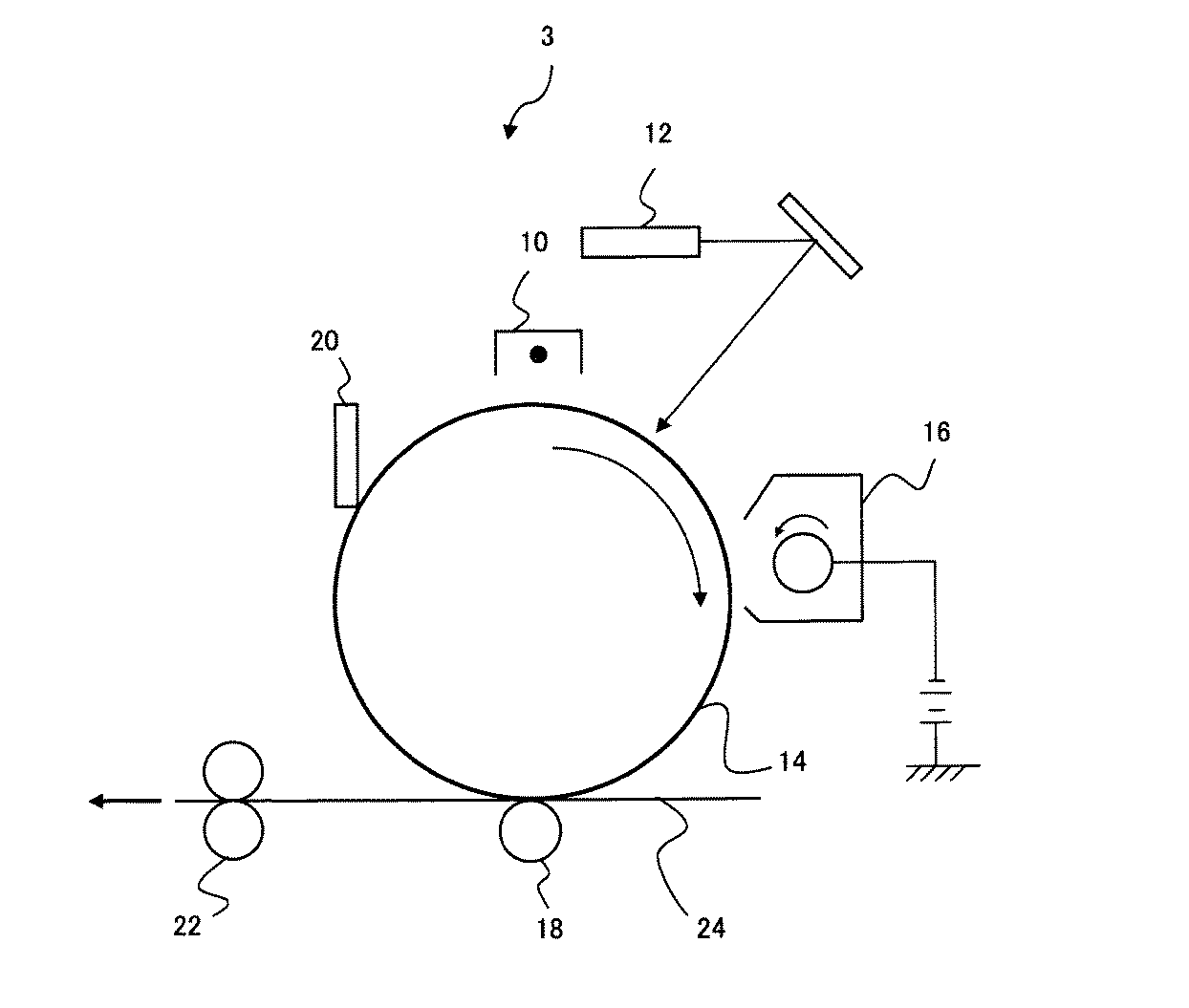
このように、実施例の方法により得られたトナーを用いると、トナー表面への離型剤の露出が少なく、トナーの流動性の低下が抑制された。 As described above, when the toner obtained by the method of the example was used, the exposure of the release agent to the toner surface was small, and the decrease in the fluidity of the toner was suppressed.
1 プロセスカートリッジ、3 画像形成装置、10 帯電装置、12 露光装置、14 感光体、16 現像装置、18 転写ロール、20 クリーニングブレード、22 定着ロール、24 記録用紙。
DESCRIPTION OF
Claims (5)
前記混合液を水系媒体中に分散懸濁させて懸濁液を調製する懸濁液調製工程と、
前記懸濁液から溶媒を除去する溶媒除去工程と、
得られたトナー粒子を乾燥する乾燥工程と、
を含み、
前記結着樹脂が、少なくともビスフェノール骨格を有するポリエステル樹脂であることを特徴とする静電荷像現像用トナーの製造方法。 A binder resin, a release agent, and C.I. I. Pigment violet 19 and C.I. I. A solid solution with CI Pigment Red 122 or C.I. I. Pigment violet 19 and C.I. I. A mixed solution preparation step of preparing a mixed solution by dissolving or dispersing a magenta pigment which is a solid solution with Pigment Red 202 in an organic solvent;
A suspension preparation step of preparing a suspension by dispersing and suspending the mixed solution in an aqueous medium; and
A solvent removal step of removing the solvent from the suspension;
A drying step of drying the obtained toner particles;
Including
A method for producing a toner for developing an electrostatic charge image, wherein the binder resin is a polyester resin having at least a bisphenol skeleton.
前記静電荷像現像用現像剤が、請求項1に記載の静電荷像現像用トナーの製造方法により得られる静電荷像現像用トナーを含有することを特徴とする静電荷像現像用現像剤の製造方法。 A method for producing a developer for developing an electrostatic image,
The developer for developing an electrostatic charge image, wherein the developer for developing an electrostatic charge image contains the toner for developing an electrostatic charge image obtained by the method for producing a toner for developing an electrostatic charge image according to claim 1 . Manufacturing method .
前記トナーカートリッジが、請求項1に記載の静電荷像現像用トナーの製造方法により得られる静電荷像現像用トナーを含有することを特徴とするトナーカートリッジの製造方法。 A toner cartridge manufacturing method comprising:
The toner cartridge, the manufacturing method of the toner cartridge, characterized by containing a toner for developing electrostatic images obtained by the production method of the electrostatic image developing toner according to claim 1.
前記現像剤は、請求項2に記載の静電荷像現像用現像剤の製造方法により得られる静電荷像現像用現像剤であることを特徴とするプロセスカートリッジの製造方法。 An image holding member, a developing means for forming a toner image by an electrostatic latent image formed on the surface of the image carrier using a developer, a process for the preparation of a process cartridge Ru provided with,
3. The process cartridge manufacturing method according to claim 2, wherein the developer is an electrostatic image developing developer obtained by the method for manufacturing an electrostatic image developing developer according to claim 2.
前記像保持体の表面に静電潜像を形成する潜像形成工程と、
前記像保持体の表面に形成された静電潜像を現像剤を用いて現像してトナー画像を形成する現像工程と、
前記現像されたトナー画像を被転写体に転写する転写工程と、
を備え、
前記現像剤は、請求項2に記載の静電荷像現像用現像剤の製造方法により得られる静電荷像現像用現像剤であることを特徴とする画像形成方法。 A charging step for charging the surface of the image carrier;
A latent image forming step of forming an electrostatic latent image on the surface of the image carrier;
A developing step of developing the electrostatic latent image formed on the surface of the image carrier using a developer to form a toner image;
A transfer step of transferring the developed toner image image to a transfer member,
With
The image forming method according to claim 2, wherein the developer is an electrostatic image developing developer obtained by the method for producing an electrostatic image developing developer according to claim 2.
Priority Applications (1)
| Application Number | Priority Date | Filing Date | Title |
|---|---|---|---|
| JP2011290293A JP5962011B2 (en) | 2011-12-29 | 2011-12-29 | Method for producing toner for developing electrostatic image, method for producing developer for developing electrostatic image, method for producing toner cartridge, method for producing process cartridge, and image forming method |
Applications Claiming Priority (1)
| Application Number | Priority Date | Filing Date | Title |
|---|---|---|---|
| JP2011290293A JP5962011B2 (en) | 2011-12-29 | 2011-12-29 | Method for producing toner for developing electrostatic image, method for producing developer for developing electrostatic image, method for producing toner cartridge, method for producing process cartridge, and image forming method |
Publications (2)
| Publication Number | Publication Date |
|---|---|
| JP2013140238A JP2013140238A (en) | 2013-07-18 |
| JP5962011B2 true JP5962011B2 (en) | 2016-08-03 |
Family
ID=49037724
Family Applications (1)
| Application Number | Title | Priority Date | Filing Date |
|---|---|---|---|
| JP2011290293A Expired - Fee Related JP5962011B2 (en) | 2011-12-29 | 2011-12-29 | Method for producing toner for developing electrostatic image, method for producing developer for developing electrostatic image, method for producing toner cartridge, method for producing process cartridge, and image forming method |
Country Status (1)
| Country | Link |
|---|---|
| JP (1) | JP5962011B2 (en) |
Families Citing this family (1)
| Publication number | Priority date | Publication date | Assignee | Title |
|---|---|---|---|---|
| JP7314948B2 (en) * | 2018-09-28 | 2023-07-26 | 日本ゼオン株式会社 | Magenta toner and its manufacturing method |
Family Cites Families (8)
| Publication number | Priority date | Publication date | Assignee | Title |
|---|---|---|---|---|
| JP3417212B2 (en) * | 1996-05-29 | 2003-06-16 | 富士ゼロックス株式会社 | Electrophotographic toner, manufacturing method thereof, electrophotographic developer and image forming method |
| JPH1020539A (en) * | 1996-07-03 | 1998-01-23 | Fuji Xerox Co Ltd | Image forming method and electrostatic latent image developing agent |
| JPH10198175A (en) * | 1997-01-08 | 1998-07-31 | Fuji Xerox Co Ltd | Image forming method |
| JPH10307418A (en) * | 1997-05-07 | 1998-11-17 | Fuji Xerox Co Ltd | Production of electrostatic latent image developing toner, electrostatic latent image developing toner, electrostatic latent image developer and image forming method |
| JP3891280B2 (en) * | 2002-07-26 | 2007-03-14 | 日本ゼオン株式会社 | Magenta toner |
| JP4101109B2 (en) * | 2003-05-07 | 2008-06-18 | キヤノン株式会社 | Toner and full-color image forming method |
| JP5282271B2 (en) * | 2008-05-22 | 2013-09-04 | コニカミノルタ株式会社 | toner |
| JP5305863B2 (en) * | 2008-11-27 | 2013-10-02 | キヤノン株式会社 | toner |
-
2011
- 2011-12-29 JP JP2011290293A patent/JP5962011B2/en not_active Expired - Fee Related
Also Published As
| Publication number | Publication date |
|---|---|
| JP2013140238A (en) | 2013-07-18 |
Similar Documents
| Publication | Publication Date | Title |
|---|---|---|
| US8642239B2 (en) | Toner for developing electrostatic charge image, method of preparing the same, device for supplying the same, and apparatus and method for forming image using the same | |
| JP4957389B2 (en) | Toner for developing electrostatic image and method for producing the same, developer for developing electrostatic image, image forming method, and image forming apparatus | |
| JP5545046B2 (en) | Image forming apparatus and image forming method | |
| JP4873033B2 (en) | Toner for developing electrostatic image, method for producing toner for developing electrostatic image, developer for developing electrostatic image, and image forming apparatus | |
| JP5621467B2 (en) | Orange toner and toner storage container for storing the same, orange developer and process cartridge for storing the same, color toner set, and image forming apparatus | |
| JP4984913B2 (en) | Toner for electrostatic image development, electrostatic image developer, toner cartridge, process cartridge, image forming method and image forming apparatus | |
| JP2013072944A (en) | Toner for electrostatic charge image development and manufacturing method of the same, electrostatic charge image developer, toner cartridge, process cartridge, image forming method, and image forming apparatus | |
| JP2008040319A (en) | Toner for electrostatic charge image development, method for manufacturing the same, developer for electrostatic charge image development and image forming method | |
| JP2012150163A (en) | Magenta toner, toner set, magenta developer, toner storage container, process cartridge, and image forming apparatus | |
| JP2010211189A (en) | Transparent toner for developing electrostatic latent image, developer for electrostatic latent image, toner cartridge, process cartridge, and image forming apparatus | |
| JP2008233175A (en) | Electrostatic charge image developing toner, electrostatic charge image developer, toner cartridge, process cartridge, and image forming apparatus | |
| JP6825277B2 (en) | Toner set, electrostatic charge image developer set, toner cartridge set, process cartridge, image forming apparatus, and image forming method | |
| JP2019113686A (en) | White toner for electrostatic charge image development, electrostatic charge image developer, toner cartridge, process cartridge, image forming apparatus, and image forming method | |
| KR101656773B1 (en) | Toner for developing electrostatic latent image and process for preparing the same | |
| JP2014164064A (en) | Toner for electrostatic charge image development and manufacturing method of the same, electrostatic charge image developer, toner cartridge, developer cartridge, process cartridge, image forming apparatus, and image forming method | |
| JP5470962B2 (en) | Toner for developing electrostatic image, method for producing toner for developing electrostatic image, developer for developing electrostatic image, and image forming apparatus | |
| JP2007034277A (en) | Image forming apparatus and method for manufacturing toner particles | |
| JP2009069647A (en) | Electrostatic charge image developing toner, electrostatic charge image developer, cartridge for electrostatic charge image developer, process cartridge, image forming apparatus, and image forming method | |
| JP2006293285A (en) | Electrostatic latent image developing toner, production method thereof, electrostatic latent image developing developer and image forming method | |
| JP5664133B2 (en) | Toner for developing electrostatic image, developer for developing electrostatic image, process cartridge, image forming apparatus, and image forming method | |
| JP2006267950A (en) | Toner for electrophotography, developer for electrophotography and image forming method | |
| JP5454046B2 (en) | Electrostatic latent image developing toner, electrostatic latent image developer, toner cartridge, process cartridge, and image forming apparatus | |
| JP4506601B2 (en) | Toner for developing electrostatic image, method for producing the same, developer for developing electrostatic image, and image forming method | |
| JP2013068743A (en) | Image forming method | |
| JP4458003B2 (en) | Electrostatic latent image developing toner, electrostatic latent image developer, and image forming method |
Legal Events
| Date | Code | Title | Description |
|---|---|---|---|
| A621 | Written request for application examination |
Free format text: JAPANESE INTERMEDIATE CODE: A621 Effective date: 20141121 |
|
| A977 | Report on retrieval |
Free format text: JAPANESE INTERMEDIATE CODE: A971007 Effective date: 20150918 |
|
| A131 | Notification of reasons for refusal |
Free format text: JAPANESE INTERMEDIATE CODE: A131 Effective date: 20150929 |
|
| A521 | Request for written amendment filed |
Free format text: JAPANESE INTERMEDIATE CODE: A523 Effective date: 20151117 |
|
| A131 | Notification of reasons for refusal |
Free format text: JAPANESE INTERMEDIATE CODE: A131 Effective date: 20160322 |
|
| A521 | Request for written amendment filed |
Free format text: JAPANESE INTERMEDIATE CODE: A523 Effective date: 20160512 |
|
| TRDD | Decision of grant or rejection written | ||
| A01 | Written decision to grant a patent or to grant a registration (utility model) |
Free format text: JAPANESE INTERMEDIATE CODE: A01 Effective date: 20160531 |
|
| A61 | First payment of annual fees (during grant procedure) |
Free format text: JAPANESE INTERMEDIATE CODE: A61 Effective date: 20160613 |
|
| R150 | Certificate of patent or registration of utility model |
Ref document number: 5962011 Country of ref document: JP Free format text: JAPANESE INTERMEDIATE CODE: R150 |
|
| S533 | Written request for registration of change of name |
Free format text: JAPANESE INTERMEDIATE CODE: R313533 |
|
| R350 | Written notification of registration of transfer |
Free format text: JAPANESE INTERMEDIATE CODE: R350 |
|
| LAPS | Cancellation because of no payment of annual fees |