JP5862002B2 - High-strength hot-dip galvanized steel sheet with excellent fatigue characteristics and method for producing the same - Google Patents
High-strength hot-dip galvanized steel sheet with excellent fatigue characteristics and method for producing the same Download PDFInfo
- Publication number
- JP5862002B2 JP5862002B2 JP2010220715A JP2010220715A JP5862002B2 JP 5862002 B2 JP5862002 B2 JP 5862002B2 JP 2010220715 A JP2010220715 A JP 2010220715A JP 2010220715 A JP2010220715 A JP 2010220715A JP 5862002 B2 JP5862002 B2 JP 5862002B2
- Authority
- JP
- Japan
- Prior art keywords
- fatigue
- steel sheet
- less
- strength
- hot
- Prior art date
- Legal status (The legal status is an assumption and is not a legal conclusion. Google has not performed a legal analysis and makes no representation as to the accuracy of the status listed.)
- Expired - Fee Related
Links
Images
Classifications
-
- B—PERFORMING OPERATIONS; TRANSPORTING
- B32—LAYERED PRODUCTS
- B32B—LAYERED PRODUCTS, i.e. PRODUCTS BUILT-UP OF STRATA OF FLAT OR NON-FLAT, e.g. CELLULAR OR HONEYCOMB, FORM
- B32B15/00—Layered products comprising a layer of metal
- B32B15/18—Layered products comprising a layer of metal comprising iron or steel
-
- C—CHEMISTRY; METALLURGY
- C21—METALLURGY OF IRON
- C21D—MODIFYING THE PHYSICAL STRUCTURE OF FERROUS METALS; GENERAL DEVICES FOR HEAT TREATMENT OF FERROUS OR NON-FERROUS METALS OR ALLOYS; MAKING METAL MALLEABLE, e.g. BY DECARBURISATION OR TEMPERING
- C21D8/00—Modifying the physical properties of ferrous metals or ferrous alloys by deformation combined with, or followed by, heat treatment
- C21D8/02—Modifying the physical properties of ferrous metals or ferrous alloys by deformation combined with, or followed by, heat treatment during manufacturing of plates or strips
- C21D8/0221—Modifying the physical properties of ferrous metals or ferrous alloys by deformation combined with, or followed by, heat treatment during manufacturing of plates or strips characterised by the working steps
- C21D8/0226—Hot rolling
-
- C—CHEMISTRY; METALLURGY
- C21—METALLURGY OF IRON
- C21D—MODIFYING THE PHYSICAL STRUCTURE OF FERROUS METALS; GENERAL DEVICES FOR HEAT TREATMENT OF FERROUS OR NON-FERROUS METALS OR ALLOYS; MAKING METAL MALLEABLE, e.g. BY DECARBURISATION OR TEMPERING
- C21D8/00—Modifying the physical properties of ferrous metals or ferrous alloys by deformation combined with, or followed by, heat treatment
- C21D8/02—Modifying the physical properties of ferrous metals or ferrous alloys by deformation combined with, or followed by, heat treatment during manufacturing of plates or strips
- C21D8/04—Modifying the physical properties of ferrous metals or ferrous alloys by deformation combined with, or followed by, heat treatment during manufacturing of plates or strips to produce plates or strips for drawing, e.g. for deep-drawing
- C21D8/0421—Modifying the physical properties of ferrous metals or ferrous alloys by deformation combined with, or followed by, heat treatment during manufacturing of plates or strips to produce plates or strips for drawing, e.g. for deep-drawing characterised by the working steps
- C21D8/0436—Cold rolling
-
- C—CHEMISTRY; METALLURGY
- C21—METALLURGY OF IRON
- C21D—MODIFYING THE PHYSICAL STRUCTURE OF FERROUS METALS; GENERAL DEVICES FOR HEAT TREATMENT OF FERROUS OR NON-FERROUS METALS OR ALLOYS; MAKING METAL MALLEABLE, e.g. BY DECARBURISATION OR TEMPERING
- C21D8/00—Modifying the physical properties of ferrous metals or ferrous alloys by deformation combined with, or followed by, heat treatment
- C21D8/02—Modifying the physical properties of ferrous metals or ferrous alloys by deformation combined with, or followed by, heat treatment during manufacturing of plates or strips
- C21D8/04—Modifying the physical properties of ferrous metals or ferrous alloys by deformation combined with, or followed by, heat treatment during manufacturing of plates or strips to produce plates or strips for drawing, e.g. for deep-drawing
- C21D8/0447—Modifying the physical properties of ferrous metals or ferrous alloys by deformation combined with, or followed by, heat treatment during manufacturing of plates or strips to produce plates or strips for drawing, e.g. for deep-drawing characterised by the heat treatment
- C21D8/0473—Final recrystallisation annealing
-
- C—CHEMISTRY; METALLURGY
- C21—METALLURGY OF IRON
- C21D—MODIFYING THE PHYSICAL STRUCTURE OF FERROUS METALS; GENERAL DEVICES FOR HEAT TREATMENT OF FERROUS OR NON-FERROUS METALS OR ALLOYS; MAKING METAL MALLEABLE, e.g. BY DECARBURISATION OR TEMPERING
- C21D9/00—Heat treatment, e.g. annealing, hardening, quenching or tempering, adapted for particular articles; Furnaces therefor
- C21D9/46—Heat treatment, e.g. annealing, hardening, quenching or tempering, adapted for particular articles; Furnaces therefor for sheet metals
- C21D9/48—Heat treatment, e.g. annealing, hardening, quenching or tempering, adapted for particular articles; Furnaces therefor for sheet metals deep-drawing sheets
-
- C—CHEMISTRY; METALLURGY
- C21—METALLURGY OF IRON
- C21D—MODIFYING THE PHYSICAL STRUCTURE OF FERROUS METALS; GENERAL DEVICES FOR HEAT TREATMENT OF FERROUS OR NON-FERROUS METALS OR ALLOYS; MAKING METAL MALLEABLE, e.g. BY DECARBURISATION OR TEMPERING
- C21D9/00—Heat treatment, e.g. annealing, hardening, quenching or tempering, adapted for particular articles; Furnaces therefor
- C21D9/52—Heat treatment, e.g. annealing, hardening, quenching or tempering, adapted for particular articles; Furnaces therefor for wires; for strips ; for rods of unlimited length
- C21D9/54—Furnaces for treating strips or wire
- C21D9/56—Continuous furnaces for strip or wire
- C21D9/561—Continuous furnaces for strip or wire with a controlled atmosphere or vacuum
-
- C—CHEMISTRY; METALLURGY
- C22—METALLURGY; FERROUS OR NON-FERROUS ALLOYS; TREATMENT OF ALLOYS OR NON-FERROUS METALS
- C22C—ALLOYS
- C22C38/00—Ferrous alloys, e.g. steel alloys
- C22C38/001—Ferrous alloys, e.g. steel alloys containing N
-
- C—CHEMISTRY; METALLURGY
- C22—METALLURGY; FERROUS OR NON-FERROUS ALLOYS; TREATMENT OF ALLOYS OR NON-FERROUS METALS
- C22C—ALLOYS
- C22C38/00—Ferrous alloys, e.g. steel alloys
- C22C38/02—Ferrous alloys, e.g. steel alloys containing silicon
-
- C—CHEMISTRY; METALLURGY
- C22—METALLURGY; FERROUS OR NON-FERROUS ALLOYS; TREATMENT OF ALLOYS OR NON-FERROUS METALS
- C22C—ALLOYS
- C22C38/00—Ferrous alloys, e.g. steel alloys
- C22C38/06—Ferrous alloys, e.g. steel alloys containing aluminium
-
- C—CHEMISTRY; METALLURGY
- C22—METALLURGY; FERROUS OR NON-FERROUS ALLOYS; TREATMENT OF ALLOYS OR NON-FERROUS METALS
- C22C—ALLOYS
- C22C38/00—Ferrous alloys, e.g. steel alloys
- C22C38/12—Ferrous alloys, e.g. steel alloys containing tungsten, tantalum, molybdenum, vanadium, or niobium
-
- C—CHEMISTRY; METALLURGY
- C22—METALLURGY; FERROUS OR NON-FERROUS ALLOYS; TREATMENT OF ALLOYS OR NON-FERROUS METALS
- C22C—ALLOYS
- C22C38/00—Ferrous alloys, e.g. steel alloys
- C22C38/14—Ferrous alloys, e.g. steel alloys containing titanium or zirconium
-
- C—CHEMISTRY; METALLURGY
- C22—METALLURGY; FERROUS OR NON-FERROUS ALLOYS; TREATMENT OF ALLOYS OR NON-FERROUS METALS
- C22C—ALLOYS
- C22C38/00—Ferrous alloys, e.g. steel alloys
- C22C38/18—Ferrous alloys, e.g. steel alloys containing chromium
- C22C38/38—Ferrous alloys, e.g. steel alloys containing chromium with more than 1.5% by weight of manganese
-
- C—CHEMISTRY; METALLURGY
- C22—METALLURGY; FERROUS OR NON-FERROUS ALLOYS; TREATMENT OF ALLOYS OR NON-FERROUS METALS
- C22C—ALLOYS
- C22C38/00—Ferrous alloys, e.g. steel alloys
- C22C38/60—Ferrous alloys, e.g. steel alloys containing lead, selenium, tellurium, or antimony, or more than 0.04% by weight of sulfur
-
- C—CHEMISTRY; METALLURGY
- C23—COATING METALLIC MATERIAL; COATING MATERIAL WITH METALLIC MATERIAL; CHEMICAL SURFACE TREATMENT; DIFFUSION TREATMENT OF METALLIC MATERIAL; COATING BY VACUUM EVAPORATION, BY SPUTTERING, BY ION IMPLANTATION OR BY CHEMICAL VAPOUR DEPOSITION, IN GENERAL; INHIBITING CORROSION OF METALLIC MATERIAL OR INCRUSTATION IN GENERAL
- C23C—COATING METALLIC MATERIAL; COATING MATERIAL WITH METALLIC MATERIAL; SURFACE TREATMENT OF METALLIC MATERIAL BY DIFFUSION INTO THE SURFACE, BY CHEMICAL CONVERSION OR SUBSTITUTION; COATING BY VACUUM EVAPORATION, BY SPUTTERING, BY ION IMPLANTATION OR BY CHEMICAL VAPOUR DEPOSITION, IN GENERAL
- C23C2/00—Hot-dipping or immersion processes for applying the coating material in the molten state without affecting the shape; Apparatus therefor
- C23C2/02—Pretreatment of the material to be coated, e.g. for coating on selected surface areas
-
- C—CHEMISTRY; METALLURGY
- C23—COATING METALLIC MATERIAL; COATING MATERIAL WITH METALLIC MATERIAL; CHEMICAL SURFACE TREATMENT; DIFFUSION TREATMENT OF METALLIC MATERIAL; COATING BY VACUUM EVAPORATION, BY SPUTTERING, BY ION IMPLANTATION OR BY CHEMICAL VAPOUR DEPOSITION, IN GENERAL; INHIBITING CORROSION OF METALLIC MATERIAL OR INCRUSTATION IN GENERAL
- C23C—COATING METALLIC MATERIAL; COATING MATERIAL WITH METALLIC MATERIAL; SURFACE TREATMENT OF METALLIC MATERIAL BY DIFFUSION INTO THE SURFACE, BY CHEMICAL CONVERSION OR SUBSTITUTION; COATING BY VACUUM EVAPORATION, BY SPUTTERING, BY ION IMPLANTATION OR BY CHEMICAL VAPOUR DEPOSITION, IN GENERAL
- C23C2/00—Hot-dipping or immersion processes for applying the coating material in the molten state without affecting the shape; Apparatus therefor
- C23C2/02—Pretreatment of the material to be coated, e.g. for coating on selected surface areas
- C23C2/022—Pretreatment of the material to be coated, e.g. for coating on selected surface areas by heating
- C23C2/0224—Two or more thermal pretreatments
-
- C—CHEMISTRY; METALLURGY
- C23—COATING METALLIC MATERIAL; COATING MATERIAL WITH METALLIC MATERIAL; CHEMICAL SURFACE TREATMENT; DIFFUSION TREATMENT OF METALLIC MATERIAL; COATING BY VACUUM EVAPORATION, BY SPUTTERING, BY ION IMPLANTATION OR BY CHEMICAL VAPOUR DEPOSITION, IN GENERAL; INHIBITING CORROSION OF METALLIC MATERIAL OR INCRUSTATION IN GENERAL
- C23C—COATING METALLIC MATERIAL; COATING MATERIAL WITH METALLIC MATERIAL; SURFACE TREATMENT OF METALLIC MATERIAL BY DIFFUSION INTO THE SURFACE, BY CHEMICAL CONVERSION OR SUBSTITUTION; COATING BY VACUUM EVAPORATION, BY SPUTTERING, BY ION IMPLANTATION OR BY CHEMICAL VAPOUR DEPOSITION, IN GENERAL
- C23C2/00—Hot-dipping or immersion processes for applying the coating material in the molten state without affecting the shape; Apparatus therefor
- C23C2/02—Pretreatment of the material to be coated, e.g. for coating on selected surface areas
- C23C2/024—Pretreatment of the material to be coated, e.g. for coating on selected surface areas by cleaning or etching
-
- C—CHEMISTRY; METALLURGY
- C23—COATING METALLIC MATERIAL; COATING MATERIAL WITH METALLIC MATERIAL; CHEMICAL SURFACE TREATMENT; DIFFUSION TREATMENT OF METALLIC MATERIAL; COATING BY VACUUM EVAPORATION, BY SPUTTERING, BY ION IMPLANTATION OR BY CHEMICAL VAPOUR DEPOSITION, IN GENERAL; INHIBITING CORROSION OF METALLIC MATERIAL OR INCRUSTATION IN GENERAL
- C23C—COATING METALLIC MATERIAL; COATING MATERIAL WITH METALLIC MATERIAL; SURFACE TREATMENT OF METALLIC MATERIAL BY DIFFUSION INTO THE SURFACE, BY CHEMICAL CONVERSION OR SUBSTITUTION; COATING BY VACUUM EVAPORATION, BY SPUTTERING, BY ION IMPLANTATION OR BY CHEMICAL VAPOUR DEPOSITION, IN GENERAL
- C23C2/00—Hot-dipping or immersion processes for applying the coating material in the molten state without affecting the shape; Apparatus therefor
- C23C2/04—Hot-dipping or immersion processes for applying the coating material in the molten state without affecting the shape; Apparatus therefor characterised by the coating material
- C23C2/06—Zinc or cadmium or alloys based thereon
-
- C—CHEMISTRY; METALLURGY
- C23—COATING METALLIC MATERIAL; COATING MATERIAL WITH METALLIC MATERIAL; CHEMICAL SURFACE TREATMENT; DIFFUSION TREATMENT OF METALLIC MATERIAL; COATING BY VACUUM EVAPORATION, BY SPUTTERING, BY ION IMPLANTATION OR BY CHEMICAL VAPOUR DEPOSITION, IN GENERAL; INHIBITING CORROSION OF METALLIC MATERIAL OR INCRUSTATION IN GENERAL
- C23C—COATING METALLIC MATERIAL; COATING MATERIAL WITH METALLIC MATERIAL; SURFACE TREATMENT OF METALLIC MATERIAL BY DIFFUSION INTO THE SURFACE, BY CHEMICAL CONVERSION OR SUBSTITUTION; COATING BY VACUUM EVAPORATION, BY SPUTTERING, BY ION IMPLANTATION OR BY CHEMICAL VAPOUR DEPOSITION, IN GENERAL
- C23C2/00—Hot-dipping or immersion processes for applying the coating material in the molten state without affecting the shape; Apparatus therefor
- C23C2/26—After-treatment
- C23C2/28—Thermal after-treatment, e.g. treatment in oil bath
-
- C—CHEMISTRY; METALLURGY
- C23—COATING METALLIC MATERIAL; COATING MATERIAL WITH METALLIC MATERIAL; CHEMICAL SURFACE TREATMENT; DIFFUSION TREATMENT OF METALLIC MATERIAL; COATING BY VACUUM EVAPORATION, BY SPUTTERING, BY ION IMPLANTATION OR BY CHEMICAL VAPOUR DEPOSITION, IN GENERAL; INHIBITING CORROSION OF METALLIC MATERIAL OR INCRUSTATION IN GENERAL
- C23C—COATING METALLIC MATERIAL; COATING MATERIAL WITH METALLIC MATERIAL; SURFACE TREATMENT OF METALLIC MATERIAL BY DIFFUSION INTO THE SURFACE, BY CHEMICAL CONVERSION OR SUBSTITUTION; COATING BY VACUUM EVAPORATION, BY SPUTTERING, BY ION IMPLANTATION OR BY CHEMICAL VAPOUR DEPOSITION, IN GENERAL
- C23C2/00—Hot-dipping or immersion processes for applying the coating material in the molten state without affecting the shape; Apparatus therefor
- C23C2/34—Hot-dipping or immersion processes for applying the coating material in the molten state without affecting the shape; Apparatus therefor characterised by the shape of the material to be treated
- C23C2/36—Elongated material
- C23C2/40—Plates; Strips
-
- C—CHEMISTRY; METALLURGY
- C21—METALLURGY OF IRON
- C21D—MODIFYING THE PHYSICAL STRUCTURE OF FERROUS METALS; GENERAL DEVICES FOR HEAT TREATMENT OF FERROUS OR NON-FERROUS METALS OR ALLOYS; MAKING METAL MALLEABLE, e.g. BY DECARBURISATION OR TEMPERING
- C21D2211/00—Microstructure comprising significant phases
- C21D2211/005—Ferrite
-
- C—CHEMISTRY; METALLURGY
- C21—METALLURGY OF IRON
- C21D—MODIFYING THE PHYSICAL STRUCTURE OF FERROUS METALS; GENERAL DEVICES FOR HEAT TREATMENT OF FERROUS OR NON-FERROUS METALS OR ALLOYS; MAKING METAL MALLEABLE, e.g. BY DECARBURISATION OR TEMPERING
- C21D2211/00—Microstructure comprising significant phases
- C21D2211/008—Martensite
-
- Y—GENERAL TAGGING OF NEW TECHNOLOGICAL DEVELOPMENTS; GENERAL TAGGING OF CROSS-SECTIONAL TECHNOLOGIES SPANNING OVER SEVERAL SECTIONS OF THE IPC; TECHNICAL SUBJECTS COVERED BY FORMER USPC CROSS-REFERENCE ART COLLECTIONS [XRACs] AND DIGESTS
- Y10—TECHNICAL SUBJECTS COVERED BY FORMER USPC
- Y10T—TECHNICAL SUBJECTS COVERED BY FORMER US CLASSIFICATION
- Y10T428/00—Stock material or miscellaneous articles
- Y10T428/12—All metal or with adjacent metals
- Y10T428/12493—Composite; i.e., plural, adjacent, spatially distinct metal components [e.g., layers, joint, etc.]
- Y10T428/12535—Composite; i.e., plural, adjacent, spatially distinct metal components [e.g., layers, joint, etc.] with additional, spatially distinct nonmetal component
- Y10T428/12611—Oxide-containing component
-
- Y—GENERAL TAGGING OF NEW TECHNOLOGICAL DEVELOPMENTS; GENERAL TAGGING OF CROSS-SECTIONAL TECHNOLOGIES SPANNING OVER SEVERAL SECTIONS OF THE IPC; TECHNICAL SUBJECTS COVERED BY FORMER USPC CROSS-REFERENCE ART COLLECTIONS [XRACs] AND DIGESTS
- Y10—TECHNICAL SUBJECTS COVERED BY FORMER USPC
- Y10T—TECHNICAL SUBJECTS COVERED BY FORMER US CLASSIFICATION
- Y10T428/00—Stock material or miscellaneous articles
- Y10T428/12—All metal or with adjacent metals
- Y10T428/12493—Composite; i.e., plural, adjacent, spatially distinct metal components [e.g., layers, joint, etc.]
- Y10T428/12535—Composite; i.e., plural, adjacent, spatially distinct metal components [e.g., layers, joint, etc.] with additional, spatially distinct nonmetal component
- Y10T428/12611—Oxide-containing component
- Y10T428/12618—Plural oxides
-
- Y—GENERAL TAGGING OF NEW TECHNOLOGICAL DEVELOPMENTS; GENERAL TAGGING OF CROSS-SECTIONAL TECHNOLOGIES SPANNING OVER SEVERAL SECTIONS OF THE IPC; TECHNICAL SUBJECTS COVERED BY FORMER USPC CROSS-REFERENCE ART COLLECTIONS [XRACs] AND DIGESTS
- Y10—TECHNICAL SUBJECTS COVERED BY FORMER USPC
- Y10T—TECHNICAL SUBJECTS COVERED BY FORMER US CLASSIFICATION
- Y10T428/00—Stock material or miscellaneous articles
- Y10T428/12—All metal or with adjacent metals
- Y10T428/12493—Composite; i.e., plural, adjacent, spatially distinct metal components [e.g., layers, joint, etc.]
- Y10T428/1266—O, S, or organic compound in metal component
-
- Y—GENERAL TAGGING OF NEW TECHNOLOGICAL DEVELOPMENTS; GENERAL TAGGING OF CROSS-SECTIONAL TECHNOLOGIES SPANNING OVER SEVERAL SECTIONS OF THE IPC; TECHNICAL SUBJECTS COVERED BY FORMER USPC CROSS-REFERENCE ART COLLECTIONS [XRACs] AND DIGESTS
- Y10—TECHNICAL SUBJECTS COVERED BY FORMER USPC
- Y10T—TECHNICAL SUBJECTS COVERED BY FORMER US CLASSIFICATION
- Y10T428/00—Stock material or miscellaneous articles
- Y10T428/12—All metal or with adjacent metals
- Y10T428/12493—Composite; i.e., plural, adjacent, spatially distinct metal components [e.g., layers, joint, etc.]
- Y10T428/1266—O, S, or organic compound in metal component
- Y10T428/12667—Oxide of transition metal or Al
Landscapes
- Chemical & Material Sciences (AREA)
- Engineering & Computer Science (AREA)
- Materials Engineering (AREA)
- Mechanical Engineering (AREA)
- Metallurgy (AREA)
- Organic Chemistry (AREA)
- Thermal Sciences (AREA)
- Physics & Mathematics (AREA)
- Chemical Kinetics & Catalysis (AREA)
- Crystallography & Structural Chemistry (AREA)
- Oil, Petroleum & Natural Gas (AREA)
- Heat Treatment Of Sheet Steel (AREA)
- Coating With Molten Metal (AREA)
Description
本発明は、自動車部品等の用途に好適な疲労特性に優れた高強度溶融亜鉛めっき鋼板およびその製造方法に関するものである。 The present invention relates to a high-strength hot-dip galvanized steel sheet having excellent fatigue characteristics suitable for applications such as automobile parts and a method for producing the same.
近年、地球環境保全の観点からCO2などの排気ガスを低減化する試みが進められている。自動車産業では車体を軽量化して燃費を向上させることにより、排気ガス量を低下させる対策が図られている。
車体軽量化の手法のひとつとして、自動車に使用されている鋼板を高強度化することで板厚を薄肉化する手法が挙げられる。また、フロア周りに使用される鋼板には高強度化による薄肉化とともに防錆性が求められており、高強度溶融亜鉛めっき鋼板の適用が検討されている。さらに、フロア周りの部品は足回り部品(ロアアーム等)と同様に走行中に強い振動を受けるため振動に対する高い耐久性が求められ、鋼板には優れた疲労強度が要求される。
In recent years, attempts have been made to reduce exhaust gases such as CO 2 from the viewpoint of global environmental conservation. In the automobile industry, measures are taken to reduce the amount of exhaust gas by reducing the weight of the vehicle body and improving fuel efficiency.
One of the methods for reducing the weight of the vehicle body is a method of reducing the plate thickness by increasing the strength of a steel plate used in an automobile. In addition, steel sheets used around the floor are required to have a rust prevention property as well as to be thinned by increasing strength, and application of high-strength hot-dip galvanized steel sheets is being studied. Furthermore, since the parts around the floor are subjected to strong vibration during running like the underbody parts (such as the lower arm), high durability against vibration is required, and the steel sheet is required to have excellent fatigue strength.
フロア周りの部品は車体組み立て後のめっきおよび化成処理性を確保するため、打抜き穴あけ加工を施される場合が多く、応力集中部である打抜き穴加工を施された部位の疲労特性は平滑材の疲労特性より劣化することが知られている。このため、打抜き穴加工での疲労特性の向上が求められている。 Parts around the floor are often subjected to punching to ensure plating and chemical conversion after car body assembly, and the fatigue properties of the parts subjected to punching holes that are stress-concentrated parts are smooth materials. It is known to deteriorate from fatigue characteristics. For this reason, the improvement of the fatigue characteristic in punching hole processing is calculated | required.
このような要求に対して、例えば、特許文献1には、成分組成を適正範囲に調整し、組織を、フェライト相を主相としマルテンサイト相またはマルテンサイト相および残留オーステナイト相を第2相とする複合組織とし、フェライト相におけるCu粒子のサイズを規定した疲労特性に優れた高強度冷延鋼板およびその製造方法が提案されている。 In response to such a request, for example, in Patent Document 1, the component composition is adjusted to an appropriate range, and the structure is composed of a ferrite phase as a main phase and a martensite phase or a martensite phase and a retained austenite phase as a second phase. A high-strength cold-rolled steel sheet having excellent fatigue characteristics that defines the size of Cu particles in the ferrite phase and a method for producing the same have been proposed.
特許文献2には、成分組成を適正範囲に調整し、フェライト相、ベイナイト相、残留オーステナイト相、マルテンサイト相の複合組織とし、フェライト相のCu粒子サイズを最適化した疲労特性に優れた加工用高強度冷延鋼板およびその製造方法が提案されている。 In Patent Document 2, the component composition is adjusted to an appropriate range to obtain a composite structure of a ferrite phase, a bainite phase, a retained austenite phase, and a martensite phase. A high-strength cold-rolled steel sheet and a manufacturing method thereof have been proposed.
しかしながら、特許文献1、特許文献2で開示された技術は、切欠き付きの平面曲げ疲労試験片で疲労強度を評価しており、試験片は機械加工された端面であり、打抜き穴加工で導入される端面の初期亀裂が疲労強度に及ぼす影響については何ら考慮されていない。 However, the techniques disclosed in Patent Document 1 and Patent Document 2 evaluate fatigue strength with notched flat bending fatigue test pieces, and the test pieces are machined end faces and are introduced by punching holes. No consideration is given to the effect of initial cracks on the fatigue strength of the end face.
特許文献3には、成分組成を適正範囲に調整し、アルミナ系酸化物、窒化チタンを抑制し、組織をベイニティック・フェライト主相とした打抜き端面の疲労特性と伸びフランジ性に優れた高強度熱延鋼板およびその製造方法が提案されている。 In Patent Document 3, the composition of the components is adjusted to an appropriate range, alumina oxide and titanium nitride are suppressed, and the fatigue characteristics and stretch flangeability of the punched end surface with the structure being the main phase of bainitic ferrite are excellent. A high-strength hot-rolled steel sheet and a method for producing the same have been proposed.
しかしながら、特許文献3では、打抜き穴端面を考慮した疲労特性について評価しているものの、高強度溶融亜鉛めっき鋼板の打ち抜き端面を考慮した疲労特性については何ら触れられていない。 However, Patent Document 3 evaluates the fatigue characteristics considering the punched hole end face, but does not mention any fatigue characteristics considering the punched end face of the high-strength hot-dip galvanized steel sheet.
本発明は、かかる事情に鑑みてなされたものであって、打抜き穴加工での疲労特性に優れた引張強度が590MPa以上の高強度溶融亜鉛めっき鋼板およびその製造方法を提供することを目的とする。 The present invention has been made in view of such circumstances, and an object of the present invention is to provide a high-strength hot-dip galvanized steel sheet having a tensile strength of 590 MPa or more excellent in fatigue characteristics in punching holes and a method for producing the same. .
本発明者らは、上記した目的を達成するために、打抜き穴加工後の疲労特性について鋭意検討を進めた。その結果、成分組成を適正範囲に調整し、金属組織、製造条件(特に連続式溶融亜鉛めっき処理工程の製造条件)を適切に制御することが極めて重要であることを見出した。そして、平均粒径が15μm以下で面積率が60%以上のフェライト相と、面積率が5〜40%のマルテンサイト相を有する金属組織とすること、および、亜鉛めっき層直下の下地鋼板表面から鋼板側深さ方向100μm以内の鋼板表層部に生成したFe、Si、Mn、Al、P、Nb、Tiの中から選ばれる一種以上の酸化物(以下、内部酸化量と称することもある)が、片面あたり0.060g/m2未満とすることで打抜き穴加工後の疲労特性が向上することを見出した。 In order to achieve the above-described object, the present inventors have intensively studied the fatigue characteristics after punching. As a result, it was found that it is extremely important to adjust the component composition to an appropriate range and appropriately control the metal structure and production conditions (particularly, the production conditions of the continuous hot dip galvanizing process). And, the average grain size is 15 μm or less and the area ratio is 60% or more of the ferrite phase, and the area ratio is 5 to 40% martensite phase metal structure, and from the surface of the underlying steel sheet directly under the galvanized layer One or more oxides selected from Fe, Si, Mn, Al, P, Nb, and Ti (hereinafter also referred to as internal oxidation amount) generated in the steel sheet surface layer within a depth direction of 100 μm on the steel sheet side. The present inventors have found that the fatigue characteristics after punching hole processing are improved by making it less than 0.060 g / m 2 per side.
本発明は上記知見に基づくものであり、特徴は以下の通りである。
[1]成分組成として、質量%で、C:0.03〜0.15%、Si:2.00%以下、Mn:1.0〜2.5%、P:0.050%以下、S:0.0100%以下、Al:0.050%以下、N:0.0050%以下、Ti:0.010〜0.100%、Nb:0.010〜0.100%、Sb:0.0010〜0.0100%を含有し、残部がFeおよび不可避的不純物からなり、組織として、平均粒径が15μm以下で面積率が60%以上のフェライト相と、面積率が5〜40%のマルテンサイト相を有し、亜鉛めっき層直下の下地鋼板表面から鋼板側深さ方向100μm以内の鋼板表層部に生成したFe、Si、Mn、Al、P、Nb、Tiの中から選ばれる一種以上の酸化物が、片面あたり0.060g/m2未満であることを特徴とする疲労特性に優れた高強度溶融亜鉛めっき鋼板。
[2]前記[1]において、成分組成として、質量%で、さらに、Cr:0.05〜0.80%、V:0.01〜0.10%、Cu:0.01〜0.10%、Ni:0.01〜0.10%、Sn:0.001〜0.010%、Mo:0.01〜0.50%、Ta:0.001〜0.010%の中から選ばれる1種以上の元素を含有することを特徴とする疲労特性に優れた高強度溶融亜鉛めっき鋼板。
[3]前記[1]または前記[2]に記載の成分組成を有する鋼素材に対し、Ar3点以上の温度で仕上げ圧延し、600℃以下の温度で巻取り、酸洗後、連続式溶融亜鉛めっき処理を行うにあたり、前記連続式溶融亜鉛めっき処理では、700〜900℃の温度で均熱し、700℃以上の温度域での雰囲気の露点を-40℃以下として焼鈍し、1〜50℃/秒の平均冷却速度で600℃以下に冷却したのち、溶融亜鉛めっき処理することを特徴とする疲労特性に優れた高強度溶融亜鉛めっき鋼板の製造方法。
[4]前記[1]または前記[2]に記載の成分組成を有する鋼素材に対し、Ar3点以上の温度で仕上げ圧延し、600℃以下の温度で巻取り、酸洗後、40%以上の圧下率で冷間圧延し、次いで、連続式溶融亜鉛めっき処理を行うにあたり、前記連続式溶融亜鉛めっき処理では、700〜900℃の温度で均熱し、700℃以上の温度域での雰囲気の露点を-40℃以下として焼鈍し、1〜50℃/秒の平均冷却速度で600℃以下に冷却したのち、溶融亜鉛めっき処理することを特徴とする疲労特性に優れた高強度溶融亜鉛めっき鋼板の製造方法。
[5]前記[3]または前記[4]において、前記溶融亜鉛めっき処理後、さらに合金化処理を施すことを特徴とする疲労特性に優れた高強度溶融亜鉛めっき鋼板の製造方法。
The present invention is based on the above findings, and features are as follows.
[1] As component composition, C: 0.03-0.15%, Si: 2.00% or less, Mn: 1.0-2.5%, P: 0.050% or less, S: 0.0100% or less, Al: 0.050% or less, N : 0.0050% or less, Ti: 0.010 to 0.100%, Nb: 0.010 to 0.100%, Sb: 0.0010 to 0.0100%, the balance is composed of Fe and inevitable impurities, and the structure has an average particle size of 15 μm or less Fe having a ferrite phase with a rate of 60% or more, and a martensite phase with an area ratio of 5 to 40%, and formed on the steel sheet surface layer portion within 100 μm in the steel plate side depth direction from the underlying steel sheet surface immediately below the galvanized layer, A high-strength hot-dip galvanized steel sheet with excellent fatigue characteristics, wherein one or more oxides selected from Si, Mn, Al, P, Nb, and Ti are less than 0.060 g / m 2 per side.
[2] In the above [1], as a component composition, in mass%, Cr: 0.05 to 0.80%, V: 0.01 to 0.10%, Cu: 0.01 to 0.10%, Ni: 0.01 to 0.10%, Sn: 0.001 A high-strength hot-dip galvanized steel sheet having excellent fatigue characteristics, comprising one or more elements selected from -0.010%, Mo: 0.01-0.50%, Ta: 0.001-0.010%.
[3] A steel material having the composition described in [1] or [2] above is finish-rolled at a temperature of 3 or higher Ar, wound at a temperature of 600 ° C. or lower, pickled, and continuously In carrying out the hot dip galvanizing treatment, in the continuous hot dip galvanizing treatment, heat treatment is performed at a temperature of 700 to 900 ° C., and the dew point of the atmosphere in a temperature range of 700 ° C. or higher is annealed to -40 ° C. or lower, and 1 to 50 A method for producing a high-strength hot-dip galvanized steel sheet having excellent fatigue properties, characterized by cooling to 600 ° C. or lower at an average cooling rate of ° C./second and then hot-dip galvanizing.
[4] The steel material having the composition described in [1] or [2] above is finish-rolled at a temperature of 3 or higher Ar, wound at a temperature of 600 ° C. or lower, pickled, and 40% In the continuous hot dip galvanizing process, the steel sheet is soaked at a temperature of 700 to 900 ° C., and the atmosphere in a temperature range of 700 ° C. or higher is obtained. High strength hot dip galvanizing with excellent fatigue characteristics, characterized by annealing at a dew point of -40 ° C or lower, cooling to 600 ° C or lower at an average cooling rate of 1 to 50 ° C / sec, and hot-dip galvanizing treatment A method of manufacturing a steel sheet.
[5] A method for producing a high-strength hot-dip galvanized steel sheet having excellent fatigue characteristics, wherein the alloying treatment is further performed after the hot dip galvanizing treatment in the above [3] or [4].
なお、本発明において、高強度とは、引張強度TSが590MPa以上である。また、本発明の高強度溶融亜鉛めっき鋼板は、亜鉛めっきの下地鋼板として冷延鋼板、熱延鋼板のいずれも含むものであり、溶融亜鉛めっき処理後合金化処理を施さないめっき鋼板(以下、GIと称することもある)、合金化処理を施すめっき鋼板(以下、GAと称することもある)のいずれも含むものである。 In the present invention, the high strength means that the tensile strength TS is 590 MPa or more. Moreover, the high-strength hot-dip galvanized steel sheet of the present invention includes both cold-rolled steel sheets and hot-rolled steel sheets as galvanized base steel sheets, and is a plated steel sheet that is not subjected to alloying after hot-dip galvanizing (hereinafter, GI) and a plated steel sheet (hereinafter also referred to as GA) to be alloyed.
本発明によれば、疲労特性に優れた引張強度が590MPa以上の高強度溶融亜鉛めっき鋼板が得られる。 According to the present invention, a high-strength hot-dip galvanized steel sheet having excellent fatigue properties and a tensile strength of 590 MPa or more can be obtained.
以下、本発明について具体的に説明する。なお、以下の説明において、鋼成分組成の各元素の含有量の単位は「質量%」であり、以下、特に断らない限り単に「%」で示す。 Hereinafter, the present invention will be specifically described. In the following description, the unit of the content of each element of the steel component composition is “mass%”, and hereinafter, simply indicated as “%” unless otherwise specified.
先ず、本発明で最も重要な要件である、めっき層直下の下地鋼板表面の構造と疲労強度について説明する。
本発明を完成するに至った実験研究の成果について説明する。質量%で、C:0.09%、Si:0.55%、Mn:1.55%、P:0.025%、S:0.0007%、Al:0.035%、N:0.0025%、Ti:0.015%、Nb:0.03%、Sb:0.0015%を含有し、残部がFeおよび不可避的不純物からなる鋼スラブに対し、粗圧延、7パスの仕上げ圧延からなる熱間圧延を行い、板厚3.6mmの熱延鋼板とした。ここで、仕上げ圧延温度は850℃(Ar3点:758℃)、巻取温度は570℃とした。次に、得られた熱延鋼板に対して酸洗後、冷間圧延(圧下率:61%、板厚:1.4mm)、連続式溶融亜鉛めっき処理を施して板厚1.4mmの供試材とした。連続式溶融亜鉛めっき処理は、均熱温度を800℃とし、焼鈍炉内の露点を-30〜-60℃まで変化させた。
以上により得られた供試材について、金属組織観察、内部酸化量を調査するとともに引張特性および打抜き加工後の疲労特性を評価した。
First, the structure and fatigue strength of the surface of the underlying steel sheet immediately below the plating layer, which are the most important requirements in the present invention, will be described.
The results of experimental research that led to the completion of the present invention will be described. In mass%, C: 0.09%, Si: 0.55%, Mn: 1.55%, P: 0.025%, S: 0.0007%, Al: 0.035%, N: 0.0025%, Ti: 0.015%, Nb: 0.03%, Sb : The steel slab containing 0.0015%, the balance being Fe and inevitable impurities, was subjected to hot rolling consisting of rough rolling and 7-pass finish rolling to obtain a hot-rolled steel sheet having a thickness of 3.6 mm. Here, the finish rolling temperature was 850 ° C. (Ar 3 points: 758 ° C.), and the winding temperature was 570 ° C. Next, after pickling the obtained hot-rolled steel sheet, cold rolling (rolling ratio: 61%, sheet thickness: 1.4 mm) and continuous hot-dip galvanizing treatment were performed, and a specimen with a sheet thickness of 1.4 mm It was. In the continuous hot dip galvanizing treatment, the soaking temperature was set to 800 ° C, and the dew point in the annealing furnace was changed from -30 to -60 ° C.
With respect to the specimens obtained as described above, the metal structure observation, the amount of internal oxidation were investigated, and the tensile characteristics and fatigue characteristics after punching were evaluated.
金属組織の観察は、圧延方向平行断面の板厚1/4位置を研磨・ナイタール腐食後、断面3箇所、各箇所で1000倍の倍率で10視野(合計30視野)にわたり走査型電子顕微鏡(SEM)で観察し、その画像をMedia Cybernetics社製の画像解析ソフト“Image Pro Plus ver.4.0”を使用した画像解析処理により測定した。すなわち、画像解析でフェライト相、パーライト相、セメンタイト相、マルテンサイト相、ベイナイト相を分別して、フェライト相の平均粒径、フェライト相の面積率、マルテンサイト相の面積率を求めた。フェライト相の平均粒径は、フェライト粒の面積を画像処理により求め、各々の視野における面積円相当径を算出し、それらの値を平均(30視野)して求めた。具体的には、SEM画像を解析ソフトにデジタルデータ取り込みし、2値化して、面積円相当径を求めた。フェライト相の面積率およびマルテンサイト相の面積率は、各々の相をデジタル画像上で分別し、画像処理し、測定視野ごとに各々の相の面積率を求めた。これらの値を平均(30視野)して各々の面積率とした。 For the observation of the metal structure, a 1/4 position of the thickness of the cross-section parallel to the rolling direction was polished and subjected to nital corrosion, and then the cross-section was scanned at 3 locations, 10 times at 1000 times magnification (30 views in total) at each location (SEM) The image was measured by image analysis using an image analysis software “Image Pro Plus ver. 4.0” manufactured by Media Cybernetics. That is, the ferrite phase, the pearlite phase, the cementite phase, the martensite phase, and the bainite phase were separated by image analysis, and the average grain size of the ferrite phase, the area ratio of the ferrite phase, and the area ratio of the martensite phase were obtained. The average particle diameter of the ferrite phase was obtained by calculating the area of the ferrite grain by image processing, calculating the area equivalent circle diameter in each field of view, and averaging those values (30 fields). Specifically, the SEM image was imported into the analysis software as digital data and binarized to determine the area circle equivalent diameter. As for the area ratio of the ferrite phase and the area ratio of the martensite phase, each phase was fractionated on a digital image, subjected to image processing, and the area ratio of each phase was obtained for each measurement visual field. These values were averaged (30 fields of view) to obtain each area ratio.
内部酸化量は、「インパルス炉溶融-赤外線吸収法」により測定した。ただし、素材(すなわち焼鈍を施す前の高強度鋼板)に含まれる酸素量を差し引く必要があるので、本発明では、連続式溶融亜鉛めっき処理後の高強度鋼板の両面の表層部をそれぞれ100μm研磨して鋼中酸素濃度を測定し、その測定値を素材に含まれる酸素量OHとし、また、連続式溶融亜鉛めっき処理後の高強度鋼板の板厚方向全体での鋼中酸素濃度を測定して、その測定値を内部酸化後の酸素量OIとした。このようにして得られた高強度鋼板の内部酸化後の酸素量OIと、素材に含まれる酸素量OHとを用いて、OIとOHの差(=OI-OH)を算出し、さらに片面単位面積(すなわち1m2)当たりの量に換算した値(g/m2)を内部酸化量とした。また、酸化物組成については、走査型電子顕微鏡(SEM)に取り付けたエネルギー分散型X線分光器(EDS)を用いて、めっき層直下の下地鋼板表面から鋼板側深さ方向100μmまでの鋼板表層部を1視野あたり3000倍の視野で観察し、酸化物組成を同定した。これを30視野行ない、検出された元素を観察サンプルの酸化物組成とした。 The amount of internal oxidation was measured by “impulse furnace melting-infrared absorption method”. However, since it is necessary to subtract the amount of oxygen contained in the material (that is, the high-strength steel plate before annealing), in the present invention, the surface layer portions on both sides of the high-strength steel plate after continuous hot-dip galvanizing are each polished by 100 μm. The oxygen concentration in the steel is measured, the measured value is the amount of oxygen OH contained in the material, and the oxygen concentration in the steel in the entire thickness direction of the high-strength steel sheet after continuous hot-dip galvanizing is measured. The measured value was defined as the oxygen amount OI after internal oxidation. Using the oxygen amount OI after internal oxidation of the high-strength steel plate obtained in this way and the oxygen amount OH contained in the material, the difference between OI and OH (= OI-OH) is calculated, and further, single-sided unit area (i.e. 1 m 2) value converted into the amount per (g / m 2) as an internal oxide amount. For oxide composition, using an energy dispersive X-ray spectrometer (EDS) attached to a scanning electron microscope (SEM), the steel sheet surface layer from the surface of the underlying steel sheet directly below the plating layer to the steel sheet side depth direction of 100 μm The portion was observed with a field of view of 3000 times per field, and the oxide composition was identified. This was performed for 30 fields of view, and the detected element was used as the oxide composition of the observation sample.
本実験では連続式溶融亜鉛めっき処理の条件に応じて亜鉛めっき層直下の下地鋼板表面から鋼板側深さ方向100μm以内の鋼板表層部に生成した内部酸化量が変化した。ここで何れの条件においてもフェライト相の平均粒径は15μm以下、フェライト相の面積率は60%以上、マルテンサイト相の面積率5〜40%であり、マルテンサイト相とフェライト相の合計面積率は95%以上であった。 In this experiment, the amount of internal oxidation generated on the steel sheet surface layer within 100 μm in the depth direction of the steel sheet changed from the surface of the underlying steel sheet directly under the galvanized layer depending on the conditions of the continuous hot dip galvanizing treatment. Here, in any condition, the average particle diameter of the ferrite phase is 15 μm or less, the area ratio of the ferrite phase is 60% or more, the area ratio of the martensite phase is 5 to 40%, and the total area ratio of the martensite phase and the ferrite phase Was over 95%.
得られた供試材から打抜き加工後の疲労特性を評価するため疲労試験用の試験板(大きさ:50mm×260mm)を採取し、45mm×250mm、平行部巾:30mm、R:100mmの引張疲労試験片を作製し、試験片の中心に10mmφの穴をクリアランス10%で打抜き加工した。その後、(株)島津製作所製サーボパルサーで応力比0.1、繰返しサイクル数20Hz、最大応力一定で引張疲労試験を繰返し回数2×10⁶まで実施し、2×10⁶での疲労強度を求めた。同様の試験を3回実施して、平均の疲労強度を求めた。 In order to evaluate the fatigue characteristics after punching from the obtained specimen, a test plate for fatigue test (size: 50 mm x 260 mm) was sampled, and a tensile of 45 mm x 250 mm, parallel part width: 30 mm, R: 100 mm A fatigue test piece was prepared, and a 10 mmφ hole was punched at the center of the test piece with a clearance of 10%. Thereafter, manufactured by Shimadzu Corporation servo pulser at stress ratio 0.1, the number of repetition cycles 20 Hz, performed up to the number of times 2 × 10 6 repeated tensile fatigue test at a maximum stress constant was determined fatigue strength at 2 × 10 6. A similar test was performed three times to obtain an average fatigue strength.
引張強度は、JIS5号引張試験片を採取し、JIS Z2241に準拠して引張試験を実施した。引張試験は破断まで実施して、引張強度を求めた。同様の試験を各試料につき2回実施して、平均値を求め、その試料の引張強度とした。
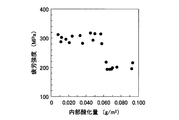
得られた結果を図1に示す。
For tensile strength, JIS No. 5 tensile test specimens were collected and a tensile test was performed in accordance with JIS Z2241. The tensile test was carried out until breakage to determine the tensile strength. The same test was performed twice for each sample, the average value was obtained, and the tensile strength of the sample was obtained.
The obtained results are shown in FIG.
図1において、何れの鋼板も、組織は、フェライト相の平均粒径は15μm以下、フェライト相の面積率は60%以上、マルテンサイト相の面積率は5〜40%であり、引張強度は590MPa以上であった。図1に示すように、溶融亜鉛めっき層直下の下地鋼板表面から鋼板側深さ方向100μm以内の鋼板表層部に生成した内部酸化量が、片面あたり0.060g/m2未満となると、繰返し回数2×106における疲労強度が向上し、良好な疲労特性となることが分かる。 In FIG. 1, the structure of each steel sheet is that the average grain size of the ferrite phase is 15 μm or less, the area ratio of the ferrite phase is 60% or more, the area ratio of the martensite phase is 5 to 40%, and the tensile strength is 590 MPa. That was all. As shown in Fig. 1, when the internal oxidation amount generated in the steel sheet surface layer within 100 μm in the steel plate side depth direction from the surface of the underlying steel sheet immediately below the hot dip galvanized layer is less than 0.060 g / m 2 per side, the number of repetitions is 2 It can be seen that the fatigue strength at × 10 6 is improved and good fatigue characteristics are obtained.
次いで、本発明の疲労特性に優れた高強度溶融亜鉛めっき鋼板の鋼の成分組成について説明する。
C:0.03〜0.15%
Cは、所望の強度を確保するために必須の元素であり、そのためには0.03%以上必要である。一方、0.15%を超えて添加すると打抜き加工での穴あけで穴端面が過度に硬化して、疲労強度が低下する。したがって、Cは0.03%以上0.15%以下とする。
Next, the component composition of the steel of the high-strength hot-dip galvanized steel sheet excellent in fatigue characteristics of the present invention will be described.
C: 0.03-0.15%
C is an essential element for securing a desired strength, and 0.03% or more is necessary for that purpose. On the other hand, if added over 0.15%, the hole end face is excessively hardened by punching and the fatigue strength is reduced. Therefore, C is 0.03% or more and 0.15% or less.
Si:2.00%以下
Siは、鋼を強化するために有効な元素であるが、添加量が2.00%超えとなると焼鈍後にフェライト粒径が過度に成長し、所望の強度が得られなくなる。また、フェライト相とマルテンサイト相の硬度差が大きくなるため、打抜き加工で発生した微細亀裂の伝播が速くなり打抜き加工後の疲労強度が低下する。従って、Siは2.00%以下とする。
Si: 2.00% or less
Si is an effective element for strengthening steel, but if the addition amount exceeds 2.00%, the ferrite grain size grows excessively after annealing, and the desired strength cannot be obtained. Further, since the hardness difference between the ferrite phase and the martensite phase is increased, the propagation of fine cracks generated in the punching process is accelerated, and the fatigue strength after the punching process is reduced. Therefore, Si is 2.00% or less.
Mn:1.0〜2.5%
Mnは、Cと同様に所望の強度を確保するために必須の元素である。所望の強度を確保するためには下限を1.0%とする必要がある。一方、2.5%を超えて過剰に添加すると、Cの過剰添加と同様に穴端面で加工により過度に硬化し、疲労強度が低下する。従って、Mnは1.0%以上2.5%以下とする。
Mn: 1.0-2.5%
Mn, like C, is an essential element for ensuring a desired strength. In order to ensure the desired strength, the lower limit needs to be 1.0%. On the other hand, if it exceeds 2.5% and is added excessively, it is excessively hardened by processing at the hole end face as in the case of excessive addition of C, and the fatigue strength decreases. Therefore, Mn is 1.0% or more and 2.5% or less.
P:0.050%以下
Pは、鋼の強化に有効な元素であるが、添加量が0.050%を超えると熱間圧延で生成される表面酸化層(スケール)の剥離が過多となり、めっき後の表面性状が劣化する。従って、Pは0.050%以下とする。
P: 0.050% or less
P is an element effective for strengthening steel. However, if the addition amount exceeds 0.050%, the surface oxide layer (scale) generated by hot rolling is excessively peeled, and the surface properties after plating deteriorate. Therefore, P is set to 0.050% or less.
S:0.0100%以下
Sは、添加量が0.0100%を超えるとMnSなどの非金属介在物が増加し、打抜き加工での穴端面が割れやすくなり、疲労強度が低下する。このため、Sは0.0100%以下とする。
S: 0.0100% or less
When the amount of S exceeds 0.0100%, non-metallic inclusions such as MnS increase, the hole end face in the punching process tends to crack, and the fatigue strength decreases. For this reason, S is set to 0.0100% or less.
Al:0.050%以下
Alは、鋼の脱酸のために0.010%以上添加することが好ましい。一方、0.050%を超えるとめっき後の表面外観が著しく劣化するため、上限は0.050%とする。
Al: 0.050% or less
Al is preferably added in an amount of 0.010% or more for deoxidation of steel. On the other hand, if it exceeds 0.050%, the surface appearance after plating deteriorates remarkably, so the upper limit is made 0.050%.
N:0.0050%以下
Nは、通常の鋼に含有される量である0.0050%以下であれば本発明の効果を損なわない。従って、Nは0.0050%以下とする。
N: 0.0050% or less
If N is 0.0050% or less, which is an amount contained in ordinary steel, the effect of the present invention is not impaired. Therefore, N is set to 0.0050% or less.
Ti:0.010〜0.100%、Nb:0.010〜0.100%
Ti、Nbは、組織の微細化や析出強化により鋼を高強度化する目的で添加する。所望の強度を確保するためには各々の元素の下限を0.010%とする。一方、各々の元素が0.100%を超えて過剰に添加すると、過度に硬化し、打抜き加工時に打抜きが困難になる。あるいは、打抜き加工後の穴の端面に亀裂が発生し、疲労強度が低下する。従って、Tiは0.010%以上0.100%以下、Nbは0.010%以上0.100%以下とする。
Ti: 0.010 to 0.100%, Nb: 0.010 to 0.100%
Ti and Nb are added for the purpose of increasing the strength of steel by refining the structure and strengthening precipitation. In order to ensure the desired strength, the lower limit of each element is 0.010%. On the other hand, if each element is added in excess of 0.100%, it will be excessively hardened, making it difficult to punch during punching. Or a crack generate | occur | produces in the end surface of the hole after a punching process, and fatigue strength falls. Therefore, Ti is 0.010% or more and 0.100% or less, and Nb is 0.010% or more and 0.100% or less.
Sb:0.0010〜0.0100%
Sbは、スラブ加熱時の表層酸化抑制を通して、巻取り後の表面酸化を抑制し、溶融亜鉛めっき層直下の下地鋼板表面から鋼板側深さ方向100μm以内の鋼板表層部に生成する内部酸化量を低減させるのに有効な元素である。Sb量が0.0010%未満では表面酸化の抑制効果が不十分である。また、表面酸化抑制効果はSb量が0.0100%超で飽和する傾向にある。しがたって、Sb量は0.0010%以上0.0100%以下、好ましくは0.0040%以上0.0080%以下とする。
Sb: 0.0010 to 0.0100%
Sb suppresses surface oxidation after coiling through suppressing surface oxidation during slab heating, and the amount of internal oxidation generated in the steel sheet surface layer within 100 μm in the steel sheet side depth direction from the surface of the underlying steel sheet immediately below the hot-dip galvanized layer. It is an effective element to reduce. If the Sb content is less than 0.0010%, the effect of suppressing surface oxidation is insufficient. Further, the surface oxidation inhibiting effect tends to be saturated when the Sb content exceeds 0.0100%. Therefore, the Sb content is 0.0010% or more and 0.0100% or less, preferably 0.0040% or more and 0.0080% or less.
残部はFeおよび不可避的不純物である。
上記した成分が基本組成であるが、本発明では上記した基本組成に加えて、Cr、V、Cu、Ni、Sn、Mo、Ta中から選ばれる1種以上の元素を含有することができる。
The balance is Fe and inevitable impurities.
Although the above-described components are basic compositions, in the present invention, in addition to the basic compositions described above, one or more elements selected from Cr, V, Cu, Ni, Sn, Mo, and Ta can be contained.
Cr:0.05〜0.80%、V:0.01〜0.10%、Cu:0.01〜0.10%、Ni:0.01〜0.10% 、Sn:0.001〜0.010%、Mo:0.01〜0.50%、Ta:0.001〜0.010%
Cr、Vは、鋼の焼入れ性を向上させ、高強度化する目的で添加することができる。Cu、Ni、Sn、Taは強度に寄与する元素であり、鋼の強化の目的で添加することができる。Moは鋼の焼入れ強化に有効な元素であり高強度化する目的で添加することができる。それぞれの元素の下限は、所望の効果が得られる最低限の量であり、また、上限は効果が飽和する量である。以上より、添加する場合は、Crは0.05%以上0.80%以下、Vは0.01%以上0.10%以下、Cuは0.01%以上0.10%以下、Niは0.01%以上0.10%以下 、Snは0.001%以上0.010%以下、Moは0.01%以上0.50%以下、Taは0.001%以上0.010%以下とする。
Cr: 0.05-0.80%, V: 0.01-0.10%, Cu: 0.01-0.10%, Ni: 0.01-0.10%, Sn: 0.001-0.010%, Mo: 0.01-0.50%, Ta: 0.001-0.010%
Cr and V can be added for the purpose of improving the hardenability of the steel and increasing the strength. Cu, Ni, Sn, and Ta are elements that contribute to strength and can be added for the purpose of strengthening steel. Mo is an element effective for strengthening the quenching of steel and can be added for the purpose of increasing the strength. The lower limit of each element is the minimum amount at which a desired effect is obtained, and the upper limit is an amount at which the effect is saturated. From the above, when added, Cr is 0.05% to 0.80%, V is 0.01% to 0.10%, Cu is 0.01% to 0.10%, Ni is 0.01% to 0.10%, Sn is 0.001% to 0.010 %, Mo is 0.01% to 0.50% and Ta is 0.001% to 0.010%.
また、めっき性を大きく変化させることなく、硫化物系介在物の形態を制御する作用を有し、これにより加工性の向上に有効に寄与するREMを0.0001%以上0.1%以下の範囲で含有することもできる。 In addition, it has an effect of controlling the form of sulfide inclusions without greatly changing the plating property, and thereby contains REM that effectively contributes to improvement of workability in the range of 0.0001% to 0.1%. You can also.
次に、本発明の疲労特性に優れた高強度溶融亜鉛めっき鋼板の組織限定理由について説明する。 Next, the reason for limiting the structure of the high-strength hot-dip galvanized steel sheet having excellent fatigue characteristics according to the present invention will be described.
本発明では、鋼の組織として、平均粒径が15μm以下で面積率が60%以上のフェライト相と、面積率が5〜40%のマルテンサイト相を有し、亜鉛めっき層直下の下地鋼板表面から鋼板側深さ方向100μm以内の鋼板表層部に生成したFe、Si、Mn、Al、P、Nb、Tiの中から選ばれる一種以上の酸化物が片面あたり0.060g/m2未満に制御する必要がある。
このような組織とすることで打抜き穴加工後の疲労特性が向上する。
In the present invention, the steel structure has a ferrite phase with an average particle size of 15 μm or less and an area ratio of 60% or more, and a martensite phase with an area ratio of 5 to 40%, and the surface of the underlying steel sheet directly under the galvanized layer One or more oxides selected from Fe, Si, Mn, Al, P, Nb, Ti generated on the steel sheet surface layer within a depth direction of 100 μm from the steel sheet side are controlled to be less than 0.060 g / m 2 per side There is a need.
With such a structure, the fatigue characteristics after punching are improved.
打抜き穴加工後の端面近傍の鋼板表層では、加工により微細な亀裂が生成し、引張疲労試験中に亀裂が進展し、破断に至る。特に、亜鉛めっき層直下の下地鋼板表面から鋼板側深さ方向100μm以内の鋼板表層部に生成した酸化物を起点に発生した亀裂が疲労強度に強く影響を及ぼす。すなわち、内部酸化量が片面あたり0.060g/m2以上となると疲労試験前の打抜き加工で導入された微細な亀裂が繰返し引張疲労試験中に早期に伝播、連結されるため、疲労強度が低下する。このため、本発明では、亜鉛めっき層直下の下地鋼板表面から鋼板側深さ方向100μm以内の鋼板表層部に生成したFe、Si、Mn、Al、P、Nb、Tiの中から選ばれる一種以上の酸化物(内部酸化量)を片面あたり0.060g/m2未満に限定する。 In the steel sheet surface layer in the vicinity of the end face after punching, fine cracks are generated by processing, the cracks develop during the tensile fatigue test, and breakage occurs. In particular, cracks originating from oxides generated in the steel sheet surface layer within a depth direction of 100 μm from the surface of the underlying steel sheet immediately below the galvanized layer strongly affect fatigue strength. That is, when the internal oxidation amount is 0.060 g / m 2 or more per side, the fatigue strength decreases because the fine cracks introduced in the punching process before the fatigue test are propagated and connected early during the repeated tensile fatigue test. . For this reason, in the present invention, one or more selected from Fe, Si, Mn, Al, P, Nb, and Ti generated on the steel sheet surface layer portion within a depth direction of 100 μm from the surface of the underlying steel sheet immediately below the galvanized layer. Is limited to less than 0.060 g / m 2 per side.
マルテンサイト相の面積率が40%を超えた場合、または、5%未満の場合は、片面あたりの内部酸化量が0.060g/m2未満であっても、フェライト相とマルテンサイト相の硬度差が大きくなるため、打抜き加工で発生した微細亀裂の伝播が速くなり繰返し引張疲労試験中の疲労強度が低下する。したがって、マルテンサイト相の面積率は5%以上40%以下とする。 When the area ratio of the martensite phase exceeds 40% or less than 5%, the hardness difference between the ferrite phase and the martensite phase even if the internal oxidation amount per side is less than 0.060 g / m 2 Therefore, the propagation of fine cracks generated in the punching process becomes faster, and the fatigue strength during repeated tensile fatigue tests decreases. Therefore, the area ratio of the martensite phase is 5% or more and 40% or less.
さらに、フェライト相の平均粒径および面積率の制御も重要である。フェライト相の平均粒径を15μm以下、面積率を60%以上とし、フェライト相とマルテンサイト相の組織を均一化させることで引張疲労試験において打抜き穴加工時に発生した微細な亀裂が伝播するのを抑制し、疲労強度が向上する。
なお、面積率が60%以上のフェライト相と、面積率が5〜40%のマルテンサイト相のほかに、面積率で5%以内であればセメンタイト相、ベイナイト相、パーライト相を含むことができる。
Furthermore, control of the average grain size and area ratio of the ferrite phase is also important. By making the average grain size of the ferrite phase 15 μm or less and the area ratio 60% or more, and making the structure of the ferrite phase and martensite phase uniform, it is possible to propagate the fine cracks generated during punching hole processing in the tensile fatigue test. Suppresses and improves fatigue strength.
In addition to the ferrite phase with an area ratio of 60% or more and the martensite phase with an area ratio of 5 to 40%, a cementite phase, a bainite phase, and a pearlite phase can be included if the area ratio is within 5%. .
次に、疲労特性に優れた高強度溶融亜鉛めっき鋼板の製造方法について説明する。 Next, a method for producing a high-strength hot-dip galvanized steel sheet having excellent fatigue characteristics will be described.
上記した成分組成を有する溶鋼を、転炉等の常用の溶製方法で溶製し、連続鋳造法等の常用の鋳造方法で鋼素材(スラブ)とする。 The molten steel having the above component composition is melted by a conventional melting method such as a converter, and is made into a steel material (slab) by a conventional casting method such as a continuous casting method.
次いで、得られた鋼素材に対し、加熱し圧延して熱延板とする熱間圧延を施す。この時、
熱間圧延は、仕上圧延の終了温度をAr3点以上とし、600℃以下の温度で巻取ることとする。
Next, the obtained steel material is hot-rolled to be hot-rolled by heating and rolling. At this time,
In hot rolling, finishing temperature of finish rolling is set to Ar 3 point or higher, and winding is performed at a temperature of 600 ° C. or lower.
仕上圧延の終了温度:Ar3点以上
仕上圧延の終了温度が、Ar3点未満となると、鋼板表層部にフェライト相が生成し、その加工ひずみによるフェライト相の粗大化等により、板厚方向の組織が不均一となり、冷間圧延および連続式溶融亜鉛めっき処理後の組織においてフェライト相の面積率を60%以上に制御できない。従って、仕上圧延の終了温度はAr3点以上とする。なお、Ar3点は次式(1)から計算できるが、実際に測定した温度を用いてもよい。
Ar3=910 - 310×[C] - 80×[Mn] + 0.35×(t-0.8) ・・・(1)
ここで[M]は元素Mの含有量(質量%)を、tは板厚(mm)を表す。なお、含有元素に応じて、補正項を導入してもよく、例えば、Cu、Cr、Ni、Moが含有される場合には、- 20×[Cu]、- 15×[Cr]、- 55×[Ni]、 -80×[Mo]といった補正項を式(1)の右辺に加えてもよい。
Finishing rolling finish temperature: Ar 3 point or more When the finish rolling finish temperature is less than Ar 3 point, a ferrite phase is formed in the surface layer of the steel sheet, and the ferrite phase becomes coarse due to the processing strain, etc. The structure becomes uneven, and the area ratio of the ferrite phase cannot be controlled to 60% or more in the structure after cold rolling and continuous hot dip galvanizing. Accordingly, the finishing temperature of finish rolling is set to Ar 3 point or higher. The Ar 3 point can be calculated from the following equation (1), but the actually measured temperature may be used.
Ar 3 = 910-310 × [C]-80 × [Mn] + 0.35 × (t-0.8) (1)
Here, [M] represents the content (% by mass) of the element M, and t represents the plate thickness (mm). A correction term may be introduced depending on the contained elements. For example, when Cu, Cr, Ni, and Mo are contained, −20 × [Cu], −15 × [Cr], −55 Correction terms such as × [Ni] and -80 × [Mo] may be added to the right side of Equation (1).
巻取温度:600℃以下
巻取温度が600℃を超えるとパーライト相の面積率が増加し、連続式溶融亜鉛めっき処理後の鋼板において、マルテンサイト相の面積率が40%超の組織となり、疲労特性が低下する。したがって、巻取温度は600℃以下とする。なお、熱延板の形状が劣化するため巻取温度は200℃以上とすることが好ましい。
Winding temperature: 600 ° C or less When the coiling temperature exceeds 600 ° C, the area ratio of the pearlite phase increases, and in the steel sheet after continuous hot dip galvanizing, the area ratio of the martensite phase becomes more than 40%, Fatigue properties are reduced. Therefore, the coiling temperature is 600 ° C. or less. In addition, since the shape of a hot-rolled sheet deteriorates, it is preferable that winding temperature shall be 200 degreeC or more.
次いで、酸洗後、或いはさらに40%以上の圧下率で冷間圧延を行なう。
酸洗工程では、表面に生成した黒皮スケールを除去する。なお、酸洗条件は特に限定しない。
冷間圧延の圧下率:40%以上
冷間圧延の圧下率が40%未満となるとフェライト相の再結晶が進行しにくくなり、連続式溶融亜鉛めっき処理後の組織においてフェライト相とマルテンサイト相が均一に分散しなくなり、打抜き時に発生した打抜き端面の微細な亀裂が進展し、疲労強度が低下する。よって、冷間圧延の圧下率は40%以上とする。
Next, cold rolling is performed after pickling or at a rolling reduction of 40% or more.
In the pickling process, the black skin scale formed on the surface is removed. The pickling conditions are not particularly limited.
Cold rolling reduction ratio: 40% or more When the rolling reduction ratio of cold rolling is less than 40%, the recrystallization of the ferrite phase is difficult to proceed, and the ferrite phase and martensite phase appear in the structure after continuous hot dip galvanizing. Dispersion does not occur uniformly, and fine cracks on the punched end surface generated at the time of punching develop and fatigue strength decreases. Therefore, the rolling reduction of cold rolling is set to 40% or more.
次いで、連続式溶融亜鉛めっき処理を行う。この時、700〜900℃の温度で均熱し、700℃以上の温度域での雰囲気の露点を-40℃以下として焼鈍し、1〜50℃/秒の平均冷却速度で600℃以下に冷却したのち、溶融亜鉛めっき処理する。
均熱温度は、所望のマルテンサイト相の面積率を得るために700℃以上が必要である。900℃を超えるとフェライト相の平均粒径が大きくなり所望の特性が得られなくなる。700℃以上の温度域での雰囲気の露点を-40℃以下とすることで、連続式溶融亜鉛めっき処理中の焼鈍工程での酸素ポテンシャルが低下し、それに伴い易酸化性元素であるSiやMn等の鋼板表層部における活量が低下する。そして、これらの元素の外部酸化および内部酸化が抑制され、その結果、溶融亜鉛めっき層直下の下地鋼板表面から鋼板側深さ方向100μm以内の鋼板表層部に生成する内部酸化量が低減し、疲労特性が改善されることになる。雰囲気の露点が-40℃超えでは、内部酸化量が増加する。
雰囲気の露点を-40℃以下となるように制御するにあたっては、通常の露点は-40℃より高いので、炉内の水分を吸収剤で吸収除去する等により-40℃以下の露点とする。
雰囲気の露点の下限は、特に規定しないが、-80℃未満は効果が飽和し、コスト面で不利になるため、-80℃以上が望ましい。雰囲気の露点を制御する温度域が700℃未満の場合は、Si、Mnの表面濃化や内部酸化が起こらないため、雰囲気の露点を制御する温度域は700℃以上とする。上限は特に規定しないが、900℃を超えると焼鈍炉内のロールの劣化やコスト増大の観点で不利となるため、900℃以下が好ましい。
焼鈍炉内雰囲気の水素濃度が1vol%未満では還元による活性化効果が得られず耐めっき剥離性が劣化する。上限は特に規定しないが、50vol%超えではコストアップし、かつ効果が飽和する。よって、水素濃度は1vol%以上50vol%以下が好ましい。なお、焼鈍炉内の気体成分は、水素以外には窒素と不可避不純物気体からなる。本発明効果を損するものでなければ他の気体成分を含有してもよい。
前記の条件にて焼鈍したのち、1〜50℃/秒の平均冷却速度で600℃以下に冷却する。これはパーライトを生成させず、かつ微細なフェライトを析出させるためである。平均冷却速度が1℃/秒未満ではパーライトが生成したりフェライト粒径が大きくなる。平均冷却速度が50℃/秒を超えるとマルテンサイトの面積率が40%を超える。また、上記平均冷却速度で冷却する温度を600℃以下とするのは、600℃を超える温度ではパーライト相の面積率が増加し、疲労特性が低下するためである。このため、1〜50℃/秒の平均冷却速度で600℃以下に冷却する。
次いで、溶融亜鉛めっき処理する。
Next, continuous hot dip galvanizing is performed. At this time, it was soaked at a temperature of 700 to 900 ° C., annealed with the dew point of the atmosphere in the temperature range of 700 ° C. or higher being −40 ° C. or lower, and cooled to 600 ° C. or lower at an average cooling rate of 1 to 50 ° C./second. After that, hot dip galvanizing is performed.
The soaking temperature needs to be 700 ° C. or higher in order to obtain a desired area ratio of the martensite phase. If the temperature exceeds 900 ° C., the average particle size of the ferrite phase becomes large and desired characteristics cannot be obtained. By setting the dew point of the atmosphere in the temperature range of 700 ° C or higher to -40 ° C or lower, the oxygen potential in the annealing process during continuous hot dip galvanizing treatment decreases, and accordingly, oxidizable elements such as Si and Mn The activity in the steel sheet surface layer portion such as the lowers. And, the external oxidation and internal oxidation of these elements are suppressed, and as a result, the amount of internal oxidation generated in the steel sheet surface layer part within 100 μm in the steel sheet side depth direction from the surface of the underlying steel sheet immediately below the hot dip galvanized layer is reduced, and fatigue is reduced. The characteristics will be improved. When the dew point of the atmosphere exceeds -40 ° C, the amount of internal oxidation increases.
When controlling the dew point of the atmosphere to be -40 ° C or lower, the normal dew point is higher than -40 ° C. Therefore, the dew point should be -40 ° C or lower by absorbing and removing moisture in the furnace with an absorbent.
The lower limit of the dew point of the atmosphere is not particularly specified, but if it is less than -80 ° C, the effect is saturated and disadvantageous in terms of cost, so -80 ° C or higher is desirable. When the temperature range for controlling the dew point of the atmosphere is less than 700 ° C, Si and Mn surface concentration and internal oxidation do not occur. Therefore, the temperature range for controlling the dew point of the atmosphere is 700 ° C or higher. The upper limit is not particularly specified, but if it exceeds 900 ° C., it is disadvantageous from the viewpoint of deterioration of rolls in the annealing furnace and cost increase.
If the hydrogen concentration in the annealing furnace atmosphere is less than 1 vol%, the activation effect due to reduction cannot be obtained and the plating peel resistance deteriorates. The upper limit is not specified, but if it exceeds 50 vol%, the cost increases and the effect is saturated. Therefore, the hydrogen concentration is preferably 1 vol% or more and 50 vol% or less. In addition, the gas component in an annealing furnace consists of nitrogen and an unavoidable impurity gas other than hydrogen. Other gas components may be included as long as the effects of the present invention are not impaired.
After annealing under the above conditions, it is cooled to 600 ° C. or lower at an average cooling rate of 1 to 50 ° C./second. This is because pearlite is not generated and fine ferrite is precipitated. When the average cooling rate is less than 1 ° C./second, pearlite is generated or the ferrite grain size is increased. When the average cooling rate exceeds 50 ° C / second, the martensite area ratio exceeds 40%. The reason why the temperature for cooling at the above average cooling rate is 600 ° C. or lower is that when the temperature exceeds 600 ° C., the area ratio of the pearlite phase increases and the fatigue characteristics deteriorate. For this reason, it cools to 600 degrees C or less with the average cooling rate of 1-50 degrees C / sec.
Next, hot dip galvanizing is performed.
次いで、あるいはさらに亜鉛めっきの合金化処理を施した後、室温まで冷却する。
溶融亜鉛めっき処理に引き続き合金化処理を行うときは、溶融亜鉛めっき処理をしたのち、例えば、450℃以上600℃以下に鋼板を加熱して合金化処理を施し、めっき層のFe含有量が7〜15%になるよう行うのが好ましい。7%未満では合金化ムラが発生したりフレーキング性が劣化する。一方、15%超えは耐めっき剥離性が劣化する。
以上により、本発明の疲労特性に優れた高強度溶融亜鉛めっき鋼板が得られる。
そして、以下のように、亜鉛めっき層直下の下地鋼板表層部の構造に特徴を有することになる。
亜鉛めっき層の直下の、下地鋼板表面から鋼板側深さ方向100μm以内の鋼板表層部では、Fe、Si、Mn、Al、P、Nb、Tiの中から選ばれる一種以上の酸化物が、片面あたり0.060g/m2未満に抑制される。
また、本発明の高強度溶融亜鉛めっき鋼板は、鋼板の表面に、片面あたりのめっき付着量が20〜120g/m2の亜鉛めっき層を有することが好ましい。20g/m2未満では耐食性の確保が困難になる場合がある。一方、120g/m2を超えると耐めっき剥離性が劣化する場合がある。
さらに、本発明において、得られた高強度溶融亜鉛めっき鋼板に化成処理などの各種表面処理を施しても本発明の効果を損なうものではない。
Next, or after further alloying treatment of galvanization, it is cooled to room temperature.
When the alloying treatment is performed subsequent to the hot dip galvanizing treatment, after the hot dip galvanizing treatment, for example, the steel sheet is heated to 450 ° C. or higher and 600 ° C. or lower to perform the alloying treatment, and the Fe content of the plating layer is 7 It is preferable to carry out to -15%. If it is less than 7%, uneven alloying occurs or flaking properties deteriorate. On the other hand, if it exceeds 15%, the plating peel resistance deteriorates.
By the above, the high intensity | strength hot-dip galvanized steel plate excellent in the fatigue characteristic of this invention is obtained.
And it has the characteristic in the structure of the base steel plate surface layer part just under a galvanization layer as follows.
One or more oxides selected from Fe, Si, Mn, Al, P, Nb, and Ti are formed on one side of the steel sheet surface layer within 100 μm in the depth direction from the surface of the underlying steel sheet directly below the galvanized layer. Per unit of less than 0.060 g / m 2 .
Moreover, it is preferable that the high-strength hot-dip galvanized steel sheet of the present invention has a galvanized layer having a plating adhesion amount of 20 to 120 g / m 2 on one surface on the surface of the steel sheet. If it is less than 20 g / m 2 , it may be difficult to ensure corrosion resistance. On the other hand, if it exceeds 120 g / m 2 , the plating peel resistance may deteriorate.
Furthermore, in the present invention, even if various surface treatments such as chemical conversion treatment are performed on the obtained high-strength hot-dip galvanized steel sheet, the effects of the present invention are not impaired.
以下、本発明を、実施例に基いて具体的に説明する。
表1に示す成分組成を有する鋼素材(スラブ)を出発素材とした。これら鋼素材を、表2、表3に示す加熱温度に加熱した後、表2、表3に示す条件にて、熱間圧延し、酸洗した後、次いで冷間圧延、連続式溶融亜鉛めっき処理を施した。一部の鋼板については、冷間圧延を施さなかった。次いで、一部を除いて、連続式溶融亜鉛めっき処理後に合金化処理を施した。
なお、連続式溶融亜鉛めっき処理設備では、表2、表3に示す通り、均熱温度と700℃以上の温度域の露点を制御して通板して焼鈍したのち、1〜50℃/秒の平均冷却速度で600℃以下に冷却し、次いで、460℃のAl含有Zn浴にて溶融亜鉛めっき処理を施した。上記700℃以上の領域以外の焼鈍炉内雰囲気の露点は-35℃を基本とした。
また、雰囲気の気体成分は窒素と水素および不可避不純物気体からなり、-40℃以下の露点は雰囲気中の水分を吸収除去して制御した。雰囲気中の水素濃度は10vol%を基本とした。
また、GAは0.14質量%Al含有Zn浴を、GIは0.18質量%Al含有Zn浴を用いた。付着量はガスワイピングにより調節し、GAは合金化処理した。
Hereinafter, the present invention will be specifically described based on examples.
A steel material (slab) having the composition shown in Table 1 was used as a starting material. These steel materials are heated to the heating temperatures shown in Tables 2 and 3 and then hot-rolled and pickled under the conditions shown in Tables 2 and 3, followed by cold rolling and continuous hot dip galvanizing. Treated. Some steel plates were not cold rolled. Subsequently, except for a part, the alloying treatment was performed after the continuous hot dip galvanizing treatment.
In continuous hot dip galvanizing equipment, as shown in Tables 2 and 3, 1-50 ° C / second after annealing by controlling the soaking temperature and the dew point in the temperature range above 700 ° C Then, the steel sheet was cooled to 600 ° C. or less at an average cooling rate, and then hot dip galvanized in an Al-containing Zn bath at 460 ° C. The dew point of the atmosphere in the annealing furnace other than the region above 700 ° C was basically -35 ° C.
The gas components in the atmosphere consisted of nitrogen, hydrogen, and inevitable impurity gas, and the dew point of −40 ° C. or lower was controlled by absorbing and removing moisture in the atmosphere. The hydrogen concentration in the atmosphere was basically 10 vol%.
Moreover, GA used 0.14 mass% Al-containing Zn bath, and GI used 0.18 mass% Al-containing Zn bath. The adhesion amount was adjusted by gas wiping, and GA was alloyed.
以上により得られた溶融亜鉛めっき鋼板(GAおよびGI)に対して、内部酸化量、組織観察、引張特性、疲労特性について、評価した。測定方法を下記に示す。 The hot-dip galvanized steel sheets (GA and GI) obtained as described above were evaluated for internal oxidation amount, structure observation, tensile properties, and fatigue properties. The measurement method is shown below.
(1)内部酸化量
内部酸化量は、「インパルス炉溶融-赤外線吸収法」により測定した。ただし、素材(すなわち連続式溶融亜鉛めっき処理を施す前の高強度鋼板)に含まれる酸素量を差し引く必要があるので、本発明では、連続式溶融亜鉛めっき処理後の高強度鋼板の両面の表層部をそれぞれ100μm研磨して鋼中酸素濃度を測定し、その測定値を素材に含まれる酸素量OHとし、また、連続式溶融亜鉛めっき処理後の高強度鋼板の板厚方向全体での鋼中酸素濃度を測定して、その測定値を内部酸化後の酸素量OIとした。このようにして得られた高強度鋼板の内部酸化後の酸素量OIと、素材に含まれる酸素量OHとを用いて、OIとOHの差(=OI-OH)を算出し、さらに片面単位面積(すなわち1m2)当たりの量に換算した値(g/m2)を内部酸化量とした。また、酸化物組成については、走査型電子顕微鏡(SEM)に取り付けたエネルギー分散型X線分光器(EDS)を用いて、めっき層直下の下地鋼板表面から鋼板側深さ方向100μmまでの鋼板表層部を1視野あたり3000倍の視野で観察し、酸化物組成を同定した。これを30視野行ない、検出された元素を観察サンプルの酸化物組成とした。
(1) Internal oxidation amount The internal oxidation amount was measured by “impulse furnace melting-infrared absorption method”. However, since it is necessary to subtract the amount of oxygen contained in the material (that is, the high-strength steel plate before the continuous hot-dip galvanizing treatment), in the present invention, the surface layers on both sides of the high-strength steel plate after the continuous hot-dip galvanizing treatment Each part is polished by 100μm, and the oxygen concentration in the steel is measured. The measured value is defined as the amount of oxygen OH contained in the material. The oxygen concentration was measured, and the measured value was defined as the oxygen amount OI after internal oxidation. Using the oxygen amount OI after internal oxidation of the high-strength steel plate obtained in this way and the oxygen amount OH contained in the material, the difference between OI and OH (= OI-OH) is calculated, and further, single-sided unit area (i.e. 1 m 2) value converted into the amount per (g / m 2) as an internal oxide amount. For oxide composition, using an energy dispersive X-ray spectrometer (EDS) attached to a scanning electron microscope (SEM), the steel sheet surface layer from the surface of the underlying steel sheet directly below the plating layer to the steel sheet side depth direction of 100 μm The portion was observed with a field of view of 3000 times per field, and the oxide composition was identified. This was performed for 30 fields of view, and the detected element was used as the oxide composition of the observation sample.
(2)組織観察
金属組織の評価は圧延方向平行断面の板厚1/4位置を研磨・ナイタール腐食後、断面3箇所、各箇所で1000倍の倍率で10視野(合計30視野)にわたり走査型電子顕微鏡で観察し、その画像をMedia Cybernetics社製の画像解析ソフト“Image Pro Plus ver.4.0”を使用した画像解析処理により測定した。すなわち、画像解析でフェライト相、パーライト相、セメンタイト相、マルテンサイト相、ベイナイト相を分別して、フェライト相の平均粒径、フェライト相の面積率、マルテンサイト相の面積率を求めた。フェライト相の平均粒径は、フェライト粒の面積を画像処理により求め、各々の視野における面積円相当径を算出し、それらの値を平均(30視野)して求めた。具体的には、SEM画像を解析ソフトにデジタルデータ取り込みし、2値化して、面積円相当径を求めた。フェライト相の面積率およびマルテンサイト相の面積率は、各々の相をデジタル画像上で分別し、画像処理し、測定視野ごとに各々の相の面積率を求めた。これらの値を平均(30視野)して各々の面積率とした。
(2) Structure observation Metal structure is evaluated by scanning a 1/4 thickness position of the cross section parallel to the rolling direction, after polishing and nital corrosion, scanning 3 sections, 10 fields at 1000 times magnification (30 fields in total) at each position. The image was observed with an electron microscope, and the image was measured by an image analysis process using an image analysis software “Image Pro Plus ver. 4.0” manufactured by Media Cybernetics. That is, the ferrite phase, the pearlite phase, the cementite phase, the martensite phase, and the bainite phase were separated by image analysis, and the average grain size of the ferrite phase, the area ratio of the ferrite phase, and the area ratio of the martensite phase were obtained. The average particle diameter of the ferrite phase was obtained by calculating the area of the ferrite grain by image processing, calculating the area equivalent circle diameter in each field of view, and averaging those values (30 fields). Specifically, the SEM image was imported into the analysis software as digital data and binarized to determine the area circle equivalent diameter. As for the area ratio of the ferrite phase and the area ratio of the martensite phase, each phase was fractionated on a digital image, subjected to image processing, and the area ratio of each phase was obtained for each measurement visual field. These values were averaged (30 fields of view) to obtain each area ratio.
(3)引張試験
得られた鋼板から、圧延方向が引張方向となるようにJIS5号引張試験片を採取し、JIS Z2241に準拠して引張試験を実施した。引張試験は破断まで実施して、引張強度を求めた。同様の試験を各試料につき2回実施して、平均値を求め、その試料の引張強度とした。
(3) Tensile test A JIS No. 5 tensile test piece was collected from the obtained steel plate so that the rolling direction was the tensile direction, and a tensile test was performed in accordance with JIS Z2241. The tensile test was carried out until breakage to determine the tensile strength. The same test was performed twice for each sample, the average value was obtained, and the tensile strength of the sample was obtained.
(4)引張疲労試験
得られた鋼板から打抜き穴加工後の疲労特性を評価するため、疲労試験用の試験板(大きさ:50mm×260mm)を採取し、45mm×250mm、平行部巾:30mm、R:100mmの引張疲労試験片を作製し、試験片の中心に10mmφの穴をクリアランス10%で打抜き加工した。その後、(株)島津製作所製サーボパルサーで応力比0.1、繰返しサイクル数20Hz、最大応力一定で引張疲労試験を繰返し回数2×10⁶まで実施した。同様の試験を3回実施して、平均の疲労強度を求めた。
(4) Tensile fatigue test In order to evaluate the fatigue characteristics after punching from the steel plate obtained, a test plate for fatigue test (size: 50 mm x 260 mm) was taken, 45 mm x 250 mm, parallel part width: 30 mm , R: A 100 mm tensile fatigue test piece was prepared, and a 10 mmφ hole was punched at the center of the test piece with a clearance of 10%. Thereafter, a tensile fatigue test was performed with a servo pulser manufactured by Shimadzu Corporation with a stress ratio of 0.1, a repetition cycle number of 20 Hz, and a constant maximum stress up to 2 × 10 6 repetitions. A similar test was performed three times to obtain an average fatigue strength.
以上により得られた結果を条件と併せて表2、表3に示す。 The results obtained as described above are shown in Tables 2 and 3 together with the conditions.

表2、表3より、平均粒径が15μm以下で面積率が60%以上のフェライト相と面積率が5〜40%のマルテンサイト相を有し、亜鉛めっき層直下の下地鋼板表面から鋼板側深さ方向100μm以内の鋼板表層部に生成したFe、Si、Mn、Al、P、Nb、Tiの中から選ばれる一種以上の酸化物が、片面あたり0.060g/m2未満である本発明の範囲内である本発明例では、引張疲労試験での疲労強度が高い。
一方、比較例では、引張疲労試験における疲労強度が低い、もしくは引張強度が低い。特に、成分組成が適切でない比較例からは、フェライト相の平均粒径、フェライト相の面積率、マルテンサイト相の面積率および内部酸化量を適正化しても引張疲労試験での疲労強度は改善されないことがわかる。
From Table 2 and Table 3, it has a ferrite phase with an average grain size of 15 μm or less and an area ratio of 60% or more and a martensite phase with an area ratio of 5 to 40%, from the surface of the underlying steel sheet directly under the galvanized layer to the steel sheet side One or more oxides selected from Fe, Si, Mn, Al, P, Nb, and Ti formed on the steel sheet surface layer within a depth direction of 100 μm are less than 0.060 g / m 2 per side. In the present invention example within the range, the fatigue strength in the tensile fatigue test is high.
On the other hand, in the comparative example, the fatigue strength in the tensile fatigue test is low or the tensile strength is low. In particular, from the comparative example in which the component composition is not appropriate, even if the average particle diameter of the ferrite phase, the area ratio of the ferrite phase, the area ratio of the martensite phase, and the amount of internal oxidation are optimized, the fatigue strength in the tensile fatigue test is not improved. I understand that.
本発明の高強度溶融亜鉛めっき鋼板は、疲労特性に優れ、自動車の車体そのものを軽量化かつ高強度化するための表面処理鋼板として利用することができる。 The high-strength hot-dip galvanized steel sheet of the present invention is excellent in fatigue characteristics, and can be used as a surface-treated steel sheet for reducing the weight and strength of an automobile body itself.
Claims (5)
組織として、平均粒径が15μm以下で面積率が60%以上のフェライト相と、面積率が5〜40%のマルテンサイト相を有し、
亜鉛めっき層直下の下地鋼板表面から鋼板側深さ方向100μm以内の鋼板表層部に生成したFe、Si、Mn、Al、P、Nb、Tiの中から選ばれる一種以上の酸化物が、片面あたり0.060g/m2未満であり、
下記打抜き穴加工後の疲労特性評価が286MPa以上322MPa以下であることを特徴とする疲労特性に優れた高強度溶融亜鉛めっき鋼板。
打抜き穴加工後の疲労特性評価:疲労試験用の試験板(大きさ:50mm×260mm)を採取し、45mm×250mm、平行部巾:30mm、R:100mmの引張疲労試験片を作製し、試験片の中心に10mmφの穴をクリアランス10%で打抜き加工する。その後、サーボパルサーで応力比0.1、繰返しサイクル数20Hz、最大応力一定で引張疲労試験を繰返し回数2×10⁶まで実施する。同様の試験を3回実施して、平均の疲労強度を求める。 As component composition, C: 0.03-0.15%, Si: 2.00% or less, Mn: 1.0-2.5%, P: 0.050% or less, S: 0.0100% or less, Al: 0.050% or less, N: 0.0050% Hereinafter, Ti: 0.010 to 0.100%, Nb: 0.010 to 0.100%, Sb: 0.0010 to 0.0100%, the balance consists of Fe and inevitable impurities,
As a structure, it has a ferrite phase with an average particle size of 15 μm or less and an area ratio of 60% or more, and a martensite phase with an area ratio of 5 to 40%,
One or more oxides selected from Fe, Si, Mn, Al, P, Nb, and Ti generated on the steel sheet surface layer within a depth direction of 100 μm from the surface of the underlying steel sheet immediately below the galvanized layer It is less than 0.060g / m 2,
A high-strength hot-dip galvanized steel sheet excellent in fatigue characteristics, characterized in that the fatigue characteristic evaluation after punching hole processing described below is 286 MPa or more and 322 MPa or less .
Fatigue property evaluation after punching holes: A test plate for fatigue test (size: 50 mm x 260 mm) was taken, and a 45 mm x 250 mm, parallel part width: 30 mm, R: 100 mm tensile fatigue test specimen was prepared and tested. A 10mmφ hole is punched at the center of the piece with a clearance of 10%. After that, with a servo pulser, a tensile fatigue test is performed with a stress ratio of 0.1, a repetition cycle number of 20 Hz, and a constant maximum stress up to 2 × 10 6 repetitions. The same test is performed three times to obtain the average fatigue strength.
前記連続式溶融亜鉛めっき処理では、700〜900℃の温度で均熱し、700℃以上の温度域での雰囲気の露点を-40℃以下として焼鈍し、1〜50℃/秒の平均冷却速度で600℃以下に冷却したのち、溶融亜鉛めっき処理し、
製造した鋼板の下記打抜き穴加工後の疲労特性評価が286MPa以上322MPa以下であることを特徴とする疲労特性に優れた高強度溶融亜鉛めっき鋼板の製造方法。
打抜き穴加工後の疲労特性評価:疲労試験用の試験板(大きさ:50mm×260mm)を採取し、45mm×250mm、平行部巾:30mm、R:100mmの引張疲労試験片を作製し、試験片の中心に10mmφの穴をクリアランス10%で打抜き加工する。その後、サーボパルサーで応力比0.1、繰返しサイクル数20Hz、最大応力一定で引張疲労試験を繰返し回数2×10⁶まで実施する。同様の試験を3回実施して、平均の疲労強度を求める。 The steel material having the component composition according to claim 1 or claim 2 is finish-rolled at a temperature of Ar 3 or higher, wound at a temperature of 600 ° C. or lower, pickled, and continuously hot-dip galvanized. In doing so,
In the continuous hot dip galvanizing treatment, heat treatment is performed at a temperature of 700 to 900 ° C., annealing is performed with the dew point of the atmosphere in a temperature range of 700 ° C. or higher being −40 ° C. or lower, and an average cooling rate of 1 to 50 ° C./second. After cooling to below 600 ° C, hot dip galvanizing treatment,
A method for producing a high-strength hot-dip galvanized steel sheet having excellent fatigue characteristics, characterized in that the fatigue characteristics of the produced steel sheet after the following punching hole processing is 286 MPa or more and 322 MPa or less .
Fatigue property evaluation after punching holes: A test plate for fatigue test (size: 50 mm x 260 mm) was taken, and a 45 mm x 250 mm, parallel part width: 30 mm, R: 100 mm tensile fatigue test specimen was prepared and tested. A 10mmφ hole is punched at the center of the piece with a clearance of 10%. After that, with a servo pulser, a tensile fatigue test is performed with a stress ratio of 0.1, a repetition cycle number of 20 Hz, and a constant maximum stress up to 2 × 10 6 repetitions. The same test is performed three times to obtain the average fatigue strength.
前記連続式溶融亜鉛めっき処理では、700〜900℃の温度で均熱し、700℃以上の温度域での雰囲気の露点を-40℃以下として焼鈍し、1〜50℃/秒の平均冷却速度で600℃以下に冷却したのち、溶融亜鉛めっき処理し、
製造した鋼板の下記打抜き穴加工後の疲労特性評価が286MPa以上322MPa以下であることを特徴とする疲労特性に優れた高強度溶融亜鉛めっき鋼板の製造方法。
打抜き穴加工後の疲労特性評価:疲労試験用の試験板(大きさ:50mm×260mm)を採取し、45mm×250mm、平行部巾:30mm、R:100mmの引張疲労試験片を作製し、試験片の中心に10mmφの穴をクリアランス10%で打抜き加工する。その後、サーボパルサーで応力比0.1、繰返しサイクル数20Hz、最大応力一定で引張疲労試験を繰返し回数2×10⁶まで実施する。同様の試験を3回実施して、平均の疲労強度を求める。 For the steel material having the component composition according to claim 1 or claim 2, finish rolling at a temperature of Ar 3 point or higher, winding at a temperature of 600 ° C. or lower, pickling, and at a rolling reduction of 40% or higher In performing cold rolling and then performing continuous hot dip galvanizing treatment,
In the continuous hot dip galvanizing treatment, heat treatment is performed at a temperature of 700 to 900 ° C., annealing is performed with the dew point of the atmosphere in a temperature range of 700 ° C. or higher being −40 ° C. or lower, and an average cooling rate of 1 to 50 ° C./second. After cooling to below 600 ° C, hot dip galvanizing treatment,
A method for producing a high-strength hot-dip galvanized steel sheet having excellent fatigue characteristics, characterized in that the fatigue characteristics of the produced steel sheet after the following punching hole processing is 286 MPa or more and 322 MPa or less .
Fatigue property evaluation after punching holes: A test plate for fatigue test (size: 50 mm x 260 mm) was taken, and a 45 mm x 250 mm, parallel part width: 30 mm, R: 100 mm tensile fatigue test specimen was prepared and tested. A 10mmφ hole is punched at the center of the piece with a clearance of 10%. After that, with a servo pulser, a tensile fatigue test is performed with a stress ratio of 0.1, a repetition cycle number of 20 Hz, and a constant maximum stress up to 2 × 10 6 repetitions. The same test is performed three times to obtain the average fatigue strength.
Priority Applications (8)
| Application Number | Priority Date | Filing Date | Title |
|---|---|---|---|
| JP2010220715A JP5862002B2 (en) | 2010-09-30 | 2010-09-30 | High-strength hot-dip galvanized steel sheet with excellent fatigue characteristics and method for producing the same |
| EP11829415.6A EP2623629B1 (en) | 2010-09-30 | 2011-09-28 | High strenght galvanized steel sheet exhibiting excellent fatigue property and method for manufacturing the same |
| CN2011800470389A CN103140596A (en) | 2010-09-30 | 2011-09-28 | High-strength hot-dip galvanized steel sheet having excellent fatigue characteristics and manufacturing method therefor |
| US13/876,659 US9044920B2 (en) | 2010-09-30 | 2011-09-28 | High strength galvanized steel sheet exhibiting excellent fatigue property |
| KR1020137010644A KR101578984B1 (en) | 2010-09-30 | 2011-09-28 | High strength galvanized steel sheet exhibiting excellent fatigue property and method for manufacturing the same |
| PCT/JP2011/072902 WO2012043863A1 (en) | 2010-09-30 | 2011-09-28 | High-strength hot-dip galvanized steel sheet having excellent fatigue characteristics and manufacturing method therefor |
| TW100135237A TWI519656B (en) | 2010-09-30 | 2011-09-29 | High strength galvanized steel sheet having excellent fatigue resistance and method for manufacturing the same |
| ARP110103585A AR083207A1 (en) | 2010-09-30 | 2011-09-29 | HIGH RESISTANCE GALVANIZED STEEL SHEET EXHIBITING AN EXCELLENT PROPERTY OF FATIGUE AND METHOD TO MANUFACTURE IT |
Applications Claiming Priority (1)
| Application Number | Priority Date | Filing Date | Title |
|---|---|---|---|
| JP2010220715A JP5862002B2 (en) | 2010-09-30 | 2010-09-30 | High-strength hot-dip galvanized steel sheet with excellent fatigue characteristics and method for producing the same |
Publications (2)
| Publication Number | Publication Date |
|---|---|
| JP2012077317A JP2012077317A (en) | 2012-04-19 |
| JP5862002B2 true JP5862002B2 (en) | 2016-02-16 |
Family
ID=45893295
Family Applications (1)
| Application Number | Title | Priority Date | Filing Date |
|---|---|---|---|
| JP2010220715A Expired - Fee Related JP5862002B2 (en) | 2010-09-30 | 2010-09-30 | High-strength hot-dip galvanized steel sheet with excellent fatigue characteristics and method for producing the same |
Country Status (8)
| Country | Link |
|---|---|
| US (1) | US9044920B2 (en) |
| EP (1) | EP2623629B1 (en) |
| JP (1) | JP5862002B2 (en) |
| KR (1) | KR101578984B1 (en) |
| CN (1) | CN103140596A (en) |
| AR (1) | AR083207A1 (en) |
| TW (1) | TWI519656B (en) |
| WO (1) | WO2012043863A1 (en) |
Families Citing this family (15)
| Publication number | Priority date | Publication date | Assignee | Title |
|---|---|---|---|---|
| JP5884714B2 (en) * | 2012-01-31 | 2016-03-15 | Jfeスチール株式会社 | Hot-dip galvanized steel sheet and manufacturing method thereof |
| EP2835432B1 (en) * | 2012-04-06 | 2016-11-02 | JFE Steel Corporation | Continuous hot-dip zinc plating facility |
| JP5870861B2 (en) * | 2012-06-26 | 2016-03-01 | Jfeスチール株式会社 | High-strength hot-dip galvanized steel sheet with excellent fatigue characteristics and ductility and small in-plane anisotropy of ductility and method for producing the same |
| KR101639914B1 (en) * | 2014-12-23 | 2016-07-15 | 주식회사 포스코 | High strength cold steel sheet with good phosphating property and method for manufacturing the same |
| JP6164280B2 (en) * | 2015-12-22 | 2017-07-19 | Jfeスチール株式会社 | Mn-containing alloyed hot-dip galvanized steel sheet excellent in surface appearance and bendability and method for producing the same |
| JP6249113B2 (en) * | 2016-01-27 | 2017-12-20 | Jfeスチール株式会社 | High yield ratio type high strength galvanized steel sheet and method for producing the same |
| CN108603262B (en) | 2016-01-27 | 2020-03-20 | 杰富意钢铁株式会社 | High yield ratio type high strength galvanized steel sheet and method for producing same |
| KR102130233B1 (en) * | 2016-03-31 | 2020-07-03 | 제이에프이 스틸 가부시키가이샤 | Thin steel plate and plated steel sheet, and hot rolled steel sheet manufacturing method, cold rolled full hard steel sheet manufacturing method, heat treatment plate manufacturing method, thin steel sheet manufacturing method and plated steel sheet manufacturing method |
| JP6278162B1 (en) * | 2016-03-31 | 2018-02-14 | Jfeスチール株式会社 | Thin steel plate and plated steel plate, hot rolled steel plate manufacturing method, cold rolled full hard steel plate manufacturing method, thin steel plate manufacturing method and plated steel plate manufacturing method |
| CN116694988A (en) * | 2016-03-31 | 2023-09-05 | 杰富意钢铁株式会社 | Steel sheet, plated steel sheet, method for producing steel sheet, and method for producing plated steel sheet |
| KR102165051B1 (en) * | 2016-03-31 | 2020-10-13 | 제이에프이 스틸 가부시키가이샤 | Thin steel sheet and plated steel sheet, and manufacturing method of thin steel sheet and plating steel sheet |
| JP6237956B1 (en) * | 2016-03-31 | 2017-11-29 | Jfeスチール株式会社 | Thin steel plate and plated steel plate, method for producing hot rolled steel plate, method for producing cold rolled full hard steel plate, method for producing thin steel plate, and method for producing plated steel plate |
| EP4317514A4 (en) * | 2021-04-02 | 2024-10-09 | Baoshan Iron & Steel Co., Ltd. | HOT-DIP GALVANIZED OR HOT-DIP GALVANIZED MULTI-PHASE ZINC-ALUMINUM-MAGNESIUM STEEL WITH A YIELD STRENGTH GREATER THAN OR EQUAL TO 45 MPA AND FAST HEAT TREATMENT-HOT PLATING PROCESS THEREFOR |
| WO2024115952A1 (en) * | 2022-12-02 | 2024-06-06 | Arcelormittal | Hot rolling with residual elements |
| CN122206516A (en) * | 2023-11-28 | 2026-06-12 | 浦项股份有限公司 | Steel sheet for thermoforming, thermoformed member, thermoformed part, method for producing same, forming device, forming method, battery case holder, and battery module |
Family Cites Families (16)
| Publication number | Priority date | Publication date | Assignee | Title |
|---|---|---|---|---|
| JP2993404B2 (en) * | 1995-09-08 | 1999-12-20 | 住友金属工業株式会社 | Alloyed hot-dip galvanized steel sheet excellent in film adhesion and method for producing the same |
| JP3619359B2 (en) | 1998-01-19 | 2005-02-09 | 新日本製鐵株式会社 | Composite structure high-strength cold-rolled steel sheet with excellent fatigue characteristics and method for producing the same |
| JP3749615B2 (en) | 1998-03-31 | 2006-03-01 | 新日本製鐵株式会社 | High-strength cold-rolled steel sheet for work with excellent fatigue characteristics and method for producing the same |
| US7074497B2 (en) * | 2002-03-01 | 2006-07-11 | Jfe Steel Corporation | Coated steel sheet and method for manufacturing the same |
| JP4313983B2 (en) * | 2002-04-18 | 2009-08-12 | Jfeスチール株式会社 | Steel for case hardening bearings with excellent toughness and rolling fatigue life in sub-high temperature range |
| JP4168750B2 (en) * | 2002-12-27 | 2008-10-22 | Jfeスチール株式会社 | Method for producing hot-dip galvanized cold-rolled steel sheet with an ultrafine grain structure and excellent fatigue properties |
| JP4105974B2 (en) * | 2003-04-16 | 2008-06-25 | 新日本製鐵株式会社 | High-strength hot-rolled steel sheet excellent in fatigue characteristics and stretch flangeability of punched end face, and method for producing the same |
| JP4665692B2 (en) * | 2005-09-29 | 2011-04-06 | Jfeスチール株式会社 | High-strength steel sheet with excellent bending rigidity and method for producing the same |
| JP4964494B2 (en) * | 2006-05-09 | 2012-06-27 | 新日本製鐵株式会社 | High-strength steel sheet excellent in hole expansibility and formability and method for producing the same |
| JP4134203B2 (en) * | 2006-06-09 | 2008-08-20 | 株式会社神戸製鋼所 | High cleanliness spring steel and high cleanliness spring with excellent fatigue characteristics |
| KR20080060981A (en) * | 2006-12-27 | 2008-07-02 | 주식회사 포스코 | Galvanized steel sheet with excellent surface quality and its manufacturing method |
| KR100957981B1 (en) * | 2007-12-20 | 2010-05-19 | 주식회사 포스코 | High strength cold rolled steel, hot dip galvanized steel with excellent workability and its manufacturing method |
| KR100928788B1 (en) * | 2007-12-28 | 2009-11-25 | 주식회사 포스코 | High strength steel sheet with excellent weldability and manufacturing method |
| JP5740847B2 (en) * | 2009-06-26 | 2015-07-01 | Jfeスチール株式会社 | High-strength hot-dip galvanized steel sheet and manufacturing method thereof |
| JP5786318B2 (en) * | 2010-01-22 | 2015-09-30 | Jfeスチール株式会社 | High-strength hot-dip galvanized steel sheet with excellent fatigue characteristics and hole expansibility and method for producing the same |
| JP5786317B2 (en) * | 2010-01-22 | 2015-09-30 | Jfeスチール株式会社 | High-strength hot-dip galvanized steel sheet with excellent material stability and workability and method for producing the same |
-
2010
- 2010-09-30 JP JP2010220715A patent/JP5862002B2/en not_active Expired - Fee Related
-
2011
- 2011-09-28 CN CN2011800470389A patent/CN103140596A/en active Pending
- 2011-09-28 WO PCT/JP2011/072902 patent/WO2012043863A1/en not_active Ceased
- 2011-09-28 EP EP11829415.6A patent/EP2623629B1/en active Active
- 2011-09-28 KR KR1020137010644A patent/KR101578984B1/en active Active
- 2011-09-28 US US13/876,659 patent/US9044920B2/en active Active
- 2011-09-29 TW TW100135237A patent/TWI519656B/en not_active IP Right Cessation
- 2011-09-29 AR ARP110103585A patent/AR083207A1/en active IP Right Grant
Also Published As
| Publication number | Publication date |
|---|---|
| TW201231688A (en) | 2012-08-01 |
| US20130280551A1 (en) | 2013-10-24 |
| JP2012077317A (en) | 2012-04-19 |
| CN103140596A (en) | 2013-06-05 |
| AR083207A1 (en) | 2013-02-06 |
| KR101578984B1 (en) | 2015-12-18 |
| TWI519656B (en) | 2016-02-01 |
| EP2623629A4 (en) | 2016-08-31 |
| WO2012043863A1 (en) | 2012-04-05 |
| EP2623629A1 (en) | 2013-08-07 |
| KR20130094325A (en) | 2013-08-23 |
| US9044920B2 (en) | 2015-06-02 |
| EP2623629B1 (en) | 2017-11-15 |
Similar Documents
| Publication | Publication Date | Title |
|---|---|---|
| JP6525114B1 (en) | High strength galvanized steel sheet and method of manufacturing the same | |
| KR101578984B1 (en) | High strength galvanized steel sheet exhibiting excellent fatigue property and method for manufacturing the same | |
| CN111511945B (en) | High-strength cold-rolled steel sheet and method for producing same | |
| CA2714117C (en) | High strength galvanized steel sheet with excellent formability and method for manufacturing the same | |
| JP6249113B2 (en) | High yield ratio type high strength galvanized steel sheet and method for producing the same | |
| JPWO2011025042A1 (en) | High-strength hot-dip galvanized steel sheet and manufacturing method thereof | |
| JP2011225955A (en) | High strength hot-dip galvanized steel sheet excellent in workability, and method for manufacturing the same | |
| JP6388056B2 (en) | Manufacturing method of hot-rolled steel sheet and manufacturing method of cold-rolled full hard steel sheet | |
| JP7541652B1 (en) | Galvanized steel sheet and member, and manufacturing method thereof | |
| WO2018030502A1 (en) | High-strength steel sheet, and production method therefor | |
| WO2017131055A1 (en) | High-yield ratio high-strength galvanized steel sheet, and method for producing same | |
| JP5338873B2 (en) | High-strength hot-dip galvanized steel sheet excellent in workability with a tensile strength of 440 MPa or more and its production method | |
| JP5103988B2 (en) | High strength hot dip galvanized steel sheet | |
| JP5434984B2 (en) | High-strength hot-dip galvanized steel sheet excellent in workability with a tensile strength of 440 MPa or more and its production method | |
| WO2023176100A1 (en) | Hot-pressed member, steel sheet for hot pressing, method for producing hot-pressed member, and method for producing steel sheet for hot pressing | |
| JP2023085984A (en) | Steel plate and plated steel plate | |
| JP7708344B1 (en) | Galvanized steel sheet and member, and manufacturing method thereof | |
| JP7773120B2 (en) | Welded joints and joining structures for automobile components | |
| JP6575727B1 (en) | High ductility high strength steel sheet and method for producing the same | |
| WO2024122121A1 (en) | Plated steel sheet | |
| WO2025187450A1 (en) | High-strength galvanized steel sheet, member, automobile component, method for producing high-strength galvanized steel sheet, and method for producing member | |
| CN120153109A (en) | High-strength plated steel sheet and method for producing the same | |
| CN116806274A (en) | High-strength steel sheet and method for producing same |
Legal Events
| Date | Code | Title | Description |
|---|---|---|---|
| RD03 | Notification of appointment of power of attorney |
Free format text: JAPANESE INTERMEDIATE CODE: A7423 Effective date: 20120321 |
|
| RD04 | Notification of resignation of power of attorney |
Free format text: JAPANESE INTERMEDIATE CODE: A7424 Effective date: 20120327 |
|
| A621 | Written request for application examination |
Free format text: JAPANESE INTERMEDIATE CODE: A621 Effective date: 20130823 |
|
| A131 | Notification of reasons for refusal |
Free format text: JAPANESE INTERMEDIATE CODE: A131 Effective date: 20140902 |
|
| A131 | Notification of reasons for refusal |
Free format text: JAPANESE INTERMEDIATE CODE: A131 Effective date: 20150512 |
|
| A521 | Request for written amendment filed |
Free format text: JAPANESE INTERMEDIATE CODE: A523 Effective date: 20150610 |
|
| TRDD | Decision of grant or rejection written | ||
| A01 | Written decision to grant a patent or to grant a registration (utility model) |
Free format text: JAPANESE INTERMEDIATE CODE: A01 Effective date: 20151201 |
|
| A61 | First payment of annual fees (during grant procedure) |
Free format text: JAPANESE INTERMEDIATE CODE: A61 Effective date: 20151214 |
|
| R150 | Certificate of patent or registration of utility model |
Ref document number: 5862002 Country of ref document: JP Free format text: JAPANESE INTERMEDIATE CODE: R150 |
|
| R250 | Receipt of annual fees |
Free format text: JAPANESE INTERMEDIATE CODE: R250 |
|
| R250 | Receipt of annual fees |
Free format text: JAPANESE INTERMEDIATE CODE: R250 |
|
| R250 | Receipt of annual fees |
Free format text: JAPANESE INTERMEDIATE CODE: R250 |
|
| R250 | Receipt of annual fees |
Free format text: JAPANESE INTERMEDIATE CODE: R250 |
|
| LAPS | Cancellation because of no payment of annual fees |