JP5852257B2 - Method and apparatus for improving network loading - Google Patents
Method and apparatus for improving network loading Download PDFInfo
- Publication number
- JP5852257B2 JP5852257B2 JP2014541097A JP2014541097A JP5852257B2 JP 5852257 B2 JP5852257 B2 JP 5852257B2 JP 2014541097 A JP2014541097 A JP 2014541097A JP 2014541097 A JP2014541097 A JP 2014541097A JP 5852257 B2 JP5852257 B2 JP 5852257B2
- Authority
- JP
- Japan
- Prior art keywords
- frequency
- cell
- signals
- crs
- transmitted
- Prior art date
- Legal status (The legal status is an assumption and is not a legal conclusion. Google has not performed a legal analysis and makes no representation as to the accuracy of the status listed.)
- Expired - Fee Related
Links
- 238000000034 method Methods 0.000 title claims description 100
- 230000005540 biological transmission Effects 0.000 claims description 70
- 238000004891 communication Methods 0.000 claims description 54
- 230000001360 synchronised effect Effects 0.000 claims description 15
- 230000001960 triggered effect Effects 0.000 claims description 5
- 238000001514 detection method Methods 0.000 claims description 4
- 230000000737 periodic effect Effects 0.000 claims description 4
- 230000008569 process Effects 0.000 description 10
- 238000004590 computer program Methods 0.000 description 9
- 238000012545 processing Methods 0.000 description 9
- 230000002452 interceptive effect Effects 0.000 description 5
- 238000005516 engineering process Methods 0.000 description 4
- 230000006870 function Effects 0.000 description 4
- 125000004122 cyclic group Chemical group 0.000 description 3
- 238000010586 diagram Methods 0.000 description 3
- 239000011159 matrix material Substances 0.000 description 3
- 238000013468 resource allocation Methods 0.000 description 3
- 230000002441 reversible effect Effects 0.000 description 3
- 239000000969 carrier Substances 0.000 description 2
- 230000001413 cellular effect Effects 0.000 description 2
- 238000007726 management method Methods 0.000 description 2
- 230000003287 optical effect Effects 0.000 description 2
- 230000008520 organization Effects 0.000 description 2
- 238000000638 solvent extraction Methods 0.000 description 2
- 241000760358 Enodes Species 0.000 description 1
- 230000003321 amplification Effects 0.000 description 1
- 239000003795 chemical substances by application Substances 0.000 description 1
- 230000001143 conditioned effect Effects 0.000 description 1
- 238000000794 confocal Raman spectroscopy Methods 0.000 description 1
- 238000011500 cytoreductive surgery Methods 0.000 description 1
- 230000000694 effects Effects 0.000 description 1
- 238000001914 filtration Methods 0.000 description 1
- 230000000977 initiatory effect Effects 0.000 description 1
- 230000007774 longterm Effects 0.000 description 1
- 238000013507 mapping Methods 0.000 description 1
- 238000005259 measurement Methods 0.000 description 1
- 230000007246 mechanism Effects 0.000 description 1
- 238000010295 mobile communication Methods 0.000 description 1
- 238000012986 modification Methods 0.000 description 1
- 230000004048 modification Effects 0.000 description 1
- 238000003199 nucleic acid amplification method Methods 0.000 description 1
- 230000010363 phase shift Effects 0.000 description 1
- 230000004044 response Effects 0.000 description 1
- 239000013589 supplement Substances 0.000 description 1
- 238000012546 transfer Methods 0.000 description 1
- 238000011144 upstream manufacturing Methods 0.000 description 1
Images


Classifications
-
- H—ELECTRICITY
- H04—ELECTRIC COMMUNICATION TECHNIQUE
- H04W—WIRELESS COMMUNICATION NETWORKS
- H04W36/00—Hand-off or reselection arrangements
- H04W36/04—Reselecting a cell layer in multi-layered cells
-
- H—ELECTRICITY
- H04—ELECTRIC COMMUNICATION TECHNIQUE
- H04W—WIRELESS COMMUNICATION NETWORKS
- H04W36/00—Hand-off or reselection arrangements
- H04W36/0005—Control or signalling for completing the hand-off
- H04W36/0055—Transmission or use of information for re-establishing the radio link
- H04W36/0061—Transmission or use of information for re-establishing the radio link of neighbour cell information
-
- H—ELECTRICITY
- H04—ELECTRIC COMMUNICATION TECHNIQUE
- H04W—WIRELESS COMMUNICATION NETWORKS
- H04W36/00—Hand-off or reselection arrangements
- H04W36/06—Reselecting a communication resource in the serving access point
-
- H—ELECTRICITY
- H04—ELECTRIC COMMUNICATION TECHNIQUE
- H04W—WIRELESS COMMUNICATION NETWORKS
- H04W36/00—Hand-off or reselection arrangements
- H04W36/16—Performing reselection for specific purposes
- H04W36/20—Performing reselection for specific purposes for optimising the interference level
-
- H—ELECTRICITY
- H04—ELECTRIC COMMUNICATION TECHNIQUE
- H04W—WIRELESS COMMUNICATION NETWORKS
- H04W36/00—Hand-off or reselection arrangements
- H04W36/16—Performing reselection for specific purposes
- H04W36/165—Performing reselection for specific purposes for reducing network power consumption
-
- H—ELECTRICITY
- H04—ELECTRIC COMMUNICATION TECHNIQUE
- H04W—WIRELESS COMMUNICATION NETWORKS
- H04W36/00—Hand-off or reselection arrangements
- H04W36/16—Performing reselection for specific purposes
- H04W36/22—Performing reselection for specific purposes for handling the traffic
Landscapes
- Engineering & Computer Science (AREA)
- Computer Networks & Wireless Communication (AREA)
- Signal Processing (AREA)
- Mobile Radio Communication Systems (AREA)
Description
米国特許法第119条に基づく優先権の主張
[0001]本特許出願は、本出願の譲受人に譲渡され、参照により本明細書に明確に組み込まれる、2011年11月14日に出願された「Methods and Apparatus for Improving Network Loading」と題する米国仮出願第61/559,520号の優先権を主張する。
Claiming priority under 35 USC 119
[0001] This patent application is assigned to the assignee of the present application and is expressly incorporated by reference herein, entitled "Methods and Apparatus for Improving Network Loading", filed November 14, 2011. Claims priority of provisional application 61 / 559,520.
[0002]本開示は、一般に通信に関し、より詳細には、ワイヤレスネットワークにおけるネットワークローディングを改善する(たとえば、周波数間ハンドオーバを可能にすることによって)ための方法および装置に関する。 [0002] This disclosure relates generally to communication, and more particularly to a method and apparatus for improving network loading in a wireless network (eg, by enabling inter-frequency handover).
[0003]ワイヤレス通信ネットワークは、音声、ビデオ、パケットデータ、メッセージング、ブロードキャストなどの様々な通信コンテンツを提供するために広く展開されている。これらのワイヤレスネットワークは、利用可能なネットワークリソースを共有することによって複数のユーザをサポートすることが可能な多元接続ネットワークとすることができ得る。そのような多元接続ネットワークの例には、符号分割多元接続(CDMA)ネットワーク、時分割多元接続(TDMA)ネットワーク、周波数分割多元接続(FDMA)ネットワーク、直交FDMA(OFDMA)ネットワーク、およびシングルキャリアFDMA(SC−FDMA)ネットワークがある。 [0003] Wireless communication networks are widely deployed to provide various communication content such as voice, video, packet data, messaging, broadcast, and the like. These wireless networks may be multiple access networks that can support multiple users by sharing available network resources. Examples of such multiple access networks include code division multiple access (CDMA) networks, time division multiple access (TDMA) networks, frequency division multiple access (FDMA) networks, orthogonal FDMA (OFDMA) networks, and single carrier FDMA ( SC-FDMA) network.
[0004]ワイヤレス通信ネットワークは、いくつかのユーザ機器(UE)の通信をサポートすることができるいくつかの基地局を含むことができ得る。UEは、ダウンリンクおよびアップリンクを介して基地局と通信し得る。ダウンリンク(または順方向リンク)は基地局からUEへの通信リンクを指し、アップリンク(または逆方向リンク)はUEから基地局への通信リンクを指す。 [0004] A wireless communication network may include a number of base stations that can support communication for a number of user equipments (UEs). A UE may communicate with a base station via downlink and uplink. The downlink (or forward link) refers to the communication link from the base station to the UE, and the uplink (or reverse link) refers to the communication link from the UE to the base station.
[0005]基地局は、ダウンリンク上で1つまたは複数のUEにデータを送信し得、アップリンク上で1つまたは複数のUEからデータを受信し得る。ダウンリンク上では、基地局からのデータ送信は、ネイバー(neighbor)基地局からのデータ送信による干渉を観測することがある。アップリンク上では、UEからのデータ送信は、ネイバー基地局と通信している他のUEからのデータ送信による干渉を観測することがある。ダウンリンクでもアップリンクでも、干渉基地局および/または干渉UEとによる干渉がパフォーマンスを劣化させることがある。 [0005] A base station may transmit data to one or more UEs on the downlink and may receive data from one or more UEs on the uplink. On the downlink, data transmission from a base station may observe interference due to data transmission from a neighbor base station. On the uplink, data transmission from the UE may observe interference due to data transmission from other UEs communicating with neighboring base stations. In the downlink and uplink, interference with interfering base stations and / or interfering UEs can degrade performance.
[0006]本開示のいくつかの態様は、ワイヤレス通信のための方法を提供する。本方法は、概して、第1の周波数において送信する第1の基地局(BS)によって、第2の周波数においてビーコン信号を送信する際に使用するためのセル識別情報(ID)を選択することであり、第2の周波数において第1のBSから送信される共通基準信号(CRS)が第2の周波数において第2のBSから送信されるCRSと衝突(collide)するように、セルIDが選択されることと、第1のBSによって、セルIDを使用して、第2の周波数において1つまたは複数の信号を送信することとを含む。 [0006] Certain aspects of the present disclosure provide a method for wireless communication. The method generally includes selecting cell identification information (ID) for use in transmitting a beacon signal at a second frequency by a first base station (BS) transmitting at a first frequency. Yes, the cell ID is selected such that the common reference signal (CRS) transmitted from the first BS at the second frequency collides with the CRS transmitted from the second BS at the second frequency. And transmitting one or more signals on the second frequency using the cell ID by the first BS.
[0007]本開示のいくつかの態様は、ワイヤレス通信のための装置を提供する。本装置は、概して、第1の周波数において送信する第1の基地局(BS)によって、第2の周波数においてビーコン信号を送信する際に使用するためのセル識別情報(ID)を選択するための手段であり、第2の周波数において第1のBSから送信される共通基準信号(CRS)が第2の周波数において第2のBSから送信されるCRSと衝突するように、セルIDが選択される、手段と、第1のBSによって、セルIDを使用して、第2の周波数において1つまたは複数の信号を送信するための手段とを含む。 [0007] Certain aspects of the present disclosure provide an apparatus for wireless communication. The apparatus generally selects cell identification information (ID) for use in transmitting a beacon signal at a second frequency by a first base station (BS) transmitting at a first frequency. The cell ID is selected such that the common reference signal (CRS) transmitted from the first BS at the second frequency collides with the CRS transmitted from the second BS at the second frequency. , Means and means for transmitting one or more signals on the second frequency using the cell ID by the first BS.
[0008]本開示のいくつかの態様は、ワイヤレス通信のための装置を提供する。本装置は、概して、少なくとも1つのプロセッサと、少なくとも1つのプロセッサに結合されたメモリとを含む。第プロセッサは、概して、第1の周波数において送信する第1の基地局(BS)によって、第2の周波数においてビーコン信号を送信する際に使用するためのセル識別情報(ID)を選択し、第2の周波数において第1のBSから送信される共通基準信号(CRS)が第2の周波数において第2のBSから送信されるCRSと衝突するように、セルIDが選択され、第1のBSによって、セルIDを使用して、第2の周波数において1つまたは複数の信号を送信するように構成される。 [0008] Certain aspects of the present disclosure provide an apparatus for wireless communication. The apparatus generally includes at least one processor and a memory coupled to the at least one processor. The first processor generally selects cell identification information (ID) for use in transmitting a beacon signal at a second frequency by a first base station (BS) transmitting at a first frequency; The cell ID is selected such that the common reference signal (CRS) transmitted from the first BS at the second frequency collides with the CRS transmitted from the second BS at the second frequency, and is transmitted by the first BS. , Configured to transmit one or more signals on the second frequency using the cell ID.
[0009]本開示のいくつかの態様は、ワイヤレス通信のためのコンピュータプログラム製品を提供する。第コンピュータプログラム製品は、概して、コンピュータ可読媒体を含み、コンピュータ可読媒体は、第1の周波数において送信する第1の基地局(BS)によって、第2の周波数においてビーコン信号を送信する際に使用するためのセル識別情報(ID)を選択するためのコードであり、第2の周波数において第1のBSから送信される共通基準信号(CRS)が第2の周波数において第2のBSから送信されるCRSと衝突するように、セルIDが選択される、コードと、第1のBSによって、セルIDを使用して、第2の周波数において1つまたは複数の信号を送信するためのコードとを備える。 [0009] Certain aspects of the present disclosure provide a computer program product for wireless communication. The computer program product generally includes a computer readable medium for use in transmitting a beacon signal at a second frequency by a first base station (BS) transmitting at the first frequency. Is a code for selecting cell identification information (ID) for transmission, and a common reference signal (CRS) transmitted from the first BS at the second frequency is transmitted from the second BS at the second frequency. A cell ID is selected to collide with the CRS, and a code for transmitting one or more signals on the second frequency using the cell ID by the first BS. .
[0010]本開示のいくつかの態様は、ワイヤレス通信のための方法を提供する。T本方法は、概して、第1の周波数において動作する第1の基地局(BS)から、セル識別情報(ID)を含む1つまたは複数の信号を第2の周波数において受信することであり、第2の周波数において第1のBSから送信される共通基準信号(CRS)が第2の周波数において第2のBSから送信されるCRSと衝突するように、セルIDが選択されることと、受信されたセルIDに基づいて第2のBSから第1のBSへのハンドオーバを実行することとを含む。 [0010] Certain aspects of the present disclosure provide a method for wireless communication. The method generally includes receiving one or more signals including cell identification information (ID) at a second frequency from a first base station (BS) operating at the first frequency; The cell ID is selected and received so that the common reference signal (CRS) transmitted from the first BS at the second frequency collides with the CRS transmitted from the second BS at the second frequency. Performing a handover from the second BS to the first BS based on the determined cell ID.
[0011]本開示のいくつかの態様は、ワイヤレス通信のための装置を提供する。T本装置は、概して、第1の周波数において動作する第1の基地局(BS)から、セル識別情報(ID)を含む1つまたは複数の信号を第2の周波数において受信するための手段であり、第2の周波数において第1のBSから送信される共通基準信号(CRS)が第2の周波数において第2のBSから送信されるCRSと衝突するように、セルIDが選択される、手段と、受信されたセルIDに基づいて第2のBSから第1のBSへのハンドオーバを実行するための手段とを含む。 [0011] Certain aspects of the present disclosure provide an apparatus for wireless communication. The apparatus is generally means for receiving one or more signals including cell identification information (ID) at a second frequency from a first base station (BS) operating at the first frequency. A cell ID is selected such that a common reference signal (CRS) transmitted from a first BS at a second frequency collides with a CRS transmitted from a second BS at a second frequency; And means for performing a handover from the second BS to the first BS based on the received cell ID.
[0012]本開示のいくつかの態様は、ワイヤレス通信のための装置を提供する。本装置は、概して、少なくとも1つのプロセッサと、少なくとも1つのプロセッサに結合されたメモリとを含む。T少なくとも1つのプロセッサは、概して、第1の周波数において動作する第1の基地局(BS)から、セル識別情報(ID)を含む1つまたは複数の信号を第2の周波数において受信し、第2の周波数において第1のBSから送信される共通基準信号(CRS)が第2の周波数において第2のBSから送信されるCRSと衝突するように、セルIDが選択され、受信されたセルIDに基づいて第2のBSから第1のBSへのハンドオーバを実行するように構成される。 [0012] Certain aspects of the present disclosure provide an apparatus for wireless communication. The apparatus generally includes at least one processor and a memory coupled to the at least one processor. T at least one processor generally receives one or more signals including cell identification information (ID) at a second frequency from a first base station (BS) operating at the first frequency; The cell ID is selected so that the common reference signal (CRS) transmitted from the first BS at the second frequency collides with the CRS transmitted from the second BS at the second frequency, and the received cell ID. Based on the second BS is configured to perform a handover from the second BS to the first BS.
[0013]本開示のいくつかの態様は、ワイヤレス通信のためのコンピュータプログラム製品を提供する。Tコンピュータプログラム製品は、概して、コンピュータ可読媒体を含み、コンピュータ可読媒体は、第1の周波数において動作する第1の基地局(BS)から、セル識別情報(ID)を含む1つまたは複数の信号を第2の周波数において受信するためのコードであり、第2の周波数において第1のBSから送信される共通基準信号(CRS)が第2の周波数において第2のBSから送信されるCRSと衝突するように、セルIDが選択される、コードと、受信されたセルIDに基づいて第2のBSから第1のBSへのハンドオーバを実行するためのコードとを備える。 [0013] Certain aspects of the present disclosure provide a computer program product for wireless communication. A T computer program product generally includes a computer readable medium, which includes one or more signals including cell identification information (ID) from a first base station (BS) operating at a first frequency. In the second frequency, and the common reference signal (CRS) transmitted from the first BS in the second frequency collides with the CRS transmitted from the second BS in the second frequency. And a code for selecting a cell ID and a code for performing a handover from the second BS to the first BS based on the received cell ID.
[0014]方法、装置、システム、コンピュータプログラム製品、および処理システムを含む多数の他の態様が提供される。 [0014] Numerous other aspects are provided, including methods, apparatus, systems, computer program products, and processing systems.
[0024]ここで、図面を参照しながら様々な態様について説明する。以下の説明では、説明のために、1つまたは複数の態様の完全な理解を与えるために多数の具体的な詳細を記載する。ただし、そのような(1つまたは複数の)態様は、これらの具体的な詳細なしに実施され得ることを認識されよう。 [0024] Various aspects will now be described with reference to the drawings. In the following description, for purposes of explanation, numerous specific details are set forth in order to provide a thorough understanding of one or more aspects. However, it will be appreciated that such aspect (s) may be practiced without these specific details.
[0025]本出願で使用する「構成要素」、「モジュール」、「システム」などの用語は、限定はしないが、ハードウェア、ファームウェア、ハードウェアとソフトウェアの組合せ、ソフトウェア、または実行中のソフトウェアなど、コンピュータ関連のエンティティを含むものとする。たとえば、構成要素は、プロセッサ上で実行されるプロセス、プロセッサ、オブジェクト、実行ファイル、実行スレッド、プログラムおよび/またはコンピュータであり得るが、これらに限定されない。例として、コンピューティングデバイス上で実行されるアプリケーションと、そのコンピューティングデバイスの両方が構成要素であり得る。1つまたは複数の構成要素がプロセスおよび/または実行スレッド内に常駐することができ、1つの構成要素が1つのコンピュータ上に配置され得、および/または2つ以上のコンピュータ間に分散され得る。さらに、これらの構成要素は、様々なデータ構造を記憶している様々なコンピュータ可読媒体から実行することができる。これらの構成要素は、信号を介して、ローカルシステム、分散システム内の別の構成要素と相互作用し、および/またはインターネットなどのネットワーク上で他のシステムと相互作用する1つの構成要素からのデータのような、1つまたは複数のデータパケットを有する信号に従うことなどによって、ローカルプロセスおよび/またはリモートプロセスを介して通信し得る。 [0025] The terms "component", "module", "system", etc. used in this application include, but are not limited to, hardware, firmware, a combination of hardware and software, software, or running software, etc. , Including computer-related entities. For example, a component can be, but is not limited to being, a process running on a processor, a processor, an object, an executable, a thread of execution, a program, and / or a computer. By way of illustration, both an application running on a computing device and the computing device can be a component. One or more components can reside within a process and / or thread of execution, and one component can be located on one computer and / or distributed between two or more computers. In addition, these components can execute from various computer readable media having various data structures stored thereon. These components interact via signals from one component that interacts with other components in the local system, distributed system, and / or interacts with other systems over a network such as the Internet. May communicate via a local process and / or a remote process, such as by following a signal having one or more data packets.
[0026]さらに、本明細書では、ワイヤード端末またはワイヤレス端末とすることができる端末に関する様々な態様について説明する。端末は、システム、デバイス、加入者ユニット、加入者局、移動局、モバイル、モバイルデバイス、リモート局、リモート端末、アクセス端末、ユーザ端末、端末、通信デバイス、ユーザエージェント、ユーザデバイス、またはユーザ機器(UE)と呼ばれることもある。ワイヤレス端末は、セルラー電話、衛星電話、コードレス電話、セッション開始プロトコル(SIP)電話、ワイヤレスローカルループ(WLL)局、携帯情報端末(PDA)、ワイヤレス接続機能を有するハンドヘルドデバイス、コンピューティングデバイス、またはワイヤレスモデムに接続された他の処理デバイスとすることができ得る。さらに、本明細書では基地局に関する様々な態様について説明する。基地局は、(1つまたは複数の)ワイヤレス端末と通信するために利用され得、アクセスポイント、ノードB、eノードB(eNB)、または何らかの他の用語で呼ばれることもある。 [0026] Furthermore, various aspects related to a terminal that can be a wired terminal or a wireless terminal are described herein. A terminal is a system, device, subscriber unit, subscriber station, mobile station, mobile, mobile device, remote station, remote terminal, access terminal, user terminal, terminal, communication device, user agent, user device, or user equipment ( UE). A wireless terminal can be a cellular phone, satellite phone, cordless phone, session initiation protocol (SIP) phone, wireless local loop (WLL) station, personal digital assistant (PDA), handheld device with wireless connectivity, computing device, or wireless It could be another processing device connected to the modem. Further, various aspects related to the base station are described in this specification. A base station may be utilized for communicating with wireless terminal (s) and may also be referred to as an access point, Node B, eNode B (eNB), or some other terminology.
[0027]さらに、「または」という用語は、排他的な「または」ではなく、包括的な「または」を意味するものとする。すなわち、別段に規定されていない限り、または文脈から明らかでない限り、「XはAまたはBを採用する」という句は、自然包括的並べ替えのいずれかを意味するものとする。つまり、「XはAまたはBを使用する」という句は、以下の場合、すなわち、XがAを使用する場合、XがBを使用する場合、またはXがAとBの両方を使用する場合のうちのいずれかによって満足される。その上、本出願および添付の特許請求の範囲で使用されるとき、冠詞「a」および「an」とは、別段指定されない限り、または単数形を対象とすべきであると文脈から明らかでない限り、通常、「1つまたは複数」を意味すると解釈されるべきである。 [0027] Furthermore, the term “or” is intended to mean an inclusive “or” rather than an exclusive “or”. That is, unless otherwise specified or apparent from the context, the phrase “X adopts A or B” shall mean either natural inclusive reordering. That is, the phrase “X uses A or B” is used in the following cases: when X uses A, when X uses B, or when X uses both A and B Satisfied by any of the. Moreover, as used in the present application and the appended claims, the articles “a” and “an” are intended to be unless otherwise specified or from the context that the singular should be covered. Which should normally be taken to mean “one or more”.
[0028]本明細書で説明する技法は、符号分割多元接続(CDMA)ネットワーク、時分割多元接続(TDMA)ネットワーク、周波数分割多元接続(FDMA)ネットワーク、直交FDMA(OFDMA)ネットワーク、シングルキャリアFDMA(SC−FDMA)ネットワークなど様々なワイヤレス通信ネットワークに対して使用でき得る。「ネットワーク」および「システム」という用語は、しばしば互換的に使用される。CDMAネットワークは、ユニバーサル地上波無線アクセス(UTRA:Universal Terrestrial Radio Access)、CDMA2000などの無線技術を実装し得る。UTRAは、広帯域CDMA(W−CDMA(登録商標))と低チップレート(LCR)とを含む。CDMA2000は、IS−2000、IS−95およびIS−856規格をカバーする。TDMAネットワークは、Global System for Mobile Communications(「GSM(登録商標)」)などの無線技術を実装することができ得る。 [0028] The techniques described herein include code division multiple access (CDMA) networks, time division multiple access (TDMA) networks, frequency division multiple access (FDMA) networks, orthogonal FDMA (OFDMA) networks, single carrier FDMA ( It can be used for various wireless communication networks such as SC-FDMA) networks. The terms “network” and “system” are often used interchangeably. A CDMA network may implement a radio technology such as Universal Terrestrial Radio Access (UTRA), CDMA2000. UTRA includes wideband CDMA (W-CDMA®) and low chip rate (LCR). CDMA2000 covers IS-2000, IS-95 and IS-856 standards. A TDMA network may be capable of implementing a radio technology such as Global System for Mobile Communications (“GSM®”).
[0029]OFDMAネットワークは、進化型UTRA(E−UTRA)、IEEE802.11、IEEE802.16、IEEE802.20、Flash−OFDM(登録商標)などの無線技術を実施することができ得る。UTRA、E−UTRA、およびGSMは、Universal Mobile Telecommunication System(UMTS)の一部である。ロングタームエボリューション(LTE:Long Term Evolution)は、E−UTRAを使用するUMTSの最近のリリースである。UTRA、E−UTRA、GSM、UMTSおよびLTEは、「第3世代パートナーシッププロジェクト」(3GPP:3rd Generation Partnership Project)と称する団体からの文書に記載されている。CDMA2000は、「第3世代パートナーシッププロジェクト2」(3GPP2:3rd Generation Partnership Project 2)と称する団体からの文書に記載されている。これらの様々な無線技術および規格は当技術分野で知られている。明快のために、本技法のいくつかの態様について以下ではLTEに関して説明し、以下の説明の大部分でLTE用語を使用する。
[0029] An OFDMA network may be capable of implementing wireless technologies such as Evolved UTRA (E-UTRA), IEEE 802.11, IEEE 802.16, IEEE 802.20, Flash-OFDM. UTRA, E-UTRA, and GSM are part of the Universal Mobile Telecommunication System (UMTS). Long Term Evolution (LTE) is a recent release of UMTS that uses E-UTRA. UTRA, E-UTRA, GSM, UMTS and LTE are described in documents from an organization named “3rd Generation Partnership Project” (3GPP). CDMA2000 is described in documents from an organization named “3rd
[0030]シングルキャリア変調と周波数領域等化とを利用するシングルキャリア周波数分割多元接続(SC−FDMA)は、OFDMAシステムと同様のパフォーマンスおよび本質的に同じ全体的な複雑さを有する。SC−FDMA信号は、それの固有のシングルキャリア構造のために、より低いピーク対平均電力比(PAPR:peak-to-average power ratio)を有する。SC−FDMAは、特に、より低いPAPRが送信電力効率の点でモバイル端末に利益を与えるアップリンク通信において、大きい注目を引いている。 [0030] Single carrier frequency division multiple access (SC-FDMA), which utilizes single carrier modulation and frequency domain equalization, has similar performance and essentially the same overall complexity as an OFDMA system. An SC-FDMA signal has a lower peak-to-average power ratio (PAPR) because of its inherent single carrier structure. SC-FDMA has drawn much attention, especially in uplink communications where lower PAPR benefits the mobile terminal in terms of transmit power efficiency.
[0031]図1に、本開示の様々な態様が実行され得る例示的な異種ワイヤレスネットワーク100を示す。ワイヤレス通信ネットワーク100は、LTEネットワークまたは何らかの他のワイヤレスネットワークであり得る。ワイヤレスネットワーク100は、いくつかの発展型ノードB(eNB)110と他のネットワークエンティティとを含み得る。eNBは、UEと通信するエンティティであり得、基地局、ノードB、アクセスポイントなどと呼ばれることもある。各eNBは、特定の地理的エリアに通信カバレージを与え得る。3GPPでは、「セル」という用語は、この用語が使用されるコンテキストに応じて、eNBのカバレージエリアおよび/またはこのカバレージエリアをサービスしているeNBサブシステムを指すことがある。
[0031] FIG. 1 illustrates an example
[0032]eNBは、マクロセル、ピコセル、フェムトセル、および/または他のタイプのセルに通信カバレージを与え得る。マクロセルは、比較的大きい地理的エリア(たとえば、半径数キロメートル)をカバーし得、サービスに加入しているUEによる無制限アクセスを可能にし得る。ピコセルは、比較的小さい地理的エリアをカバーし得、サービスに加入しているUEによる無制限アクセスを可能にし得る。フェムトセルは、比較的小さい地理的エリア(たとえば、自宅)をカバーし得、フェムトセルとの関連を有するUE(たとえば、限定加入者グループ(CSG:Closed Subscriber Group)中のUE)による制限付きアクセスを可能にし得る。マクロセルのためのeNBはマクロeNBと呼ばれることがある。ピコセルのためのeNBはピコeNBと呼ばれることがある。フェムトセルのためのeNBはホームeNB(HeNB)またはフェムトeNBと呼ばれることがある。図1に示す例では、eNB110aがマクロセル102aのためのマクロeNBであり得、eNB110bがピコセル102bのためのピコeNBであり得、eNB110cがフェムトセル102cのためのフェムトeNBであり得る。eNBは、1つまたは複数の(たとえば、3つの)セルをサポートし得る。「eNB」、「基地局」、および「セル」という用語は、本明細書では互換的に使用され得る。
[0032] An eNB may provide communication coverage for a macro cell, a pico cell, a femto cell, and / or other types of cell. A macrocell may cover a relatively large geographic area (eg, a few kilometers in radius) and may allow unrestricted access by UEs with service subscription. A pico cell may cover a relatively small geographic area and may allow unrestricted access by UEs with service subscription. A femtocell may cover a relatively small geographic area (eg, home) and has limited access by UEs that have an association with the femtocell (eg, a UE in a Closed Subscriber Group (CSG)). Can make it possible. An eNB for a macro cell may be referred to as a macro eNB. An eNB for a pico cell may be referred to as a pico eNB. An eNB for a femto cell may be referred to as a home eNB (HeNB) or a femto eNB. In the example shown in FIG. 1,
[0033]ワイヤレスネットワーク100はまた、リレーを含み得る。リレーは、上流局(たとえば、eNBまたはUE)からデータの送信を受信し、そのデータの送信を下流局(たとえば、UEまたはeNB)に送ることができるエンティティであり得る。リレーはまた、他のUEに対する送信を中継することができるUEであり得る。図1に示す例では、リレー110dは、eNB110aとUE120dとの間の通信を可能にするために、バックホール(backhaul)リンクを介してマクロeNB110aと通信し、アクセスリンクを介してUE120dと通信し得る。リレーは、リレーeNB、中継局、リレー基地局などと呼ばれることもある。
[0033] The
[0034]ワイヤレスネットワーク100は、様々なタイプのeNB、たとえば、マクロeNB、ピコeNB、フェムトeNB、リレーeNBなどを含む異種ネットワークであり得る。これらの様々なタイプのeNBは、様々な送信電力レベル、様々なカバレージサイズ、およびワイヤレスネットワーク100における干渉に対する様々な影響を有し得る。たとえば、マクロeNBは、高い送信電力レベル(たとえば、5〜40ワット)を有し得るが、ピコeNB、フェムトeNB、およびリレーは、より低い送信電力レベル(たとえば、0.1〜2ワット)を有し得る。
[0034] The
[0035]ネットワークコントローラ130は、eNBのセットに結合し得、これらのeNBの協調および制御を行い得る。ネットワークコントローラ130は、単一のネットワークエンティティまたはネットワークエンティティの集合を備え得る。ネットワークコントローラ130はバックホールを介してeNBと通信し得る。eNBはまた、たとえば、ワイヤレスバックホールまたはワイヤラインバックホールを介して直接または間接的に互いに通信し得る。
[0035]
[0036]UE120はワイヤレスネットワーク100中に拡散されていてもよく、各UEは固定であってもモバイルであってもよい。UEは、移動局、端末、アクセス端末、加入者ユニット、局などと呼ばれることもある。UEは、セルラー電話、携帯情報端末(PDA)、ワイヤレスモデム、ワイヤレス通信デバイス、ハンドヘルドデバイス、ラップトップコンピュータ、コードレス電話、ワイヤレスローカルループ(WLL)局、スマートフォン、ネットブック、スマートブックなどであり得る。UEは、マクロeNB、ピコeNB、フェムトeNB、リレーなどと通信することが可能であり得る。UEはまた、別のUEとピアツーピア(P2P)に通信することが可能であり得る。図1に示す例では、UE120eおよび120fは、ワイヤレスネットワーク100中のeNBと通信することなしに互いに直接通信し得る。P2P通信は、UE間のローカル通信のためのワイヤレスネットワーク100上の負荷を低減し得る。UE間のP2P通信はまた、1つのUEが別のUEのためにリレーとして働くことを可能にし、それによって他のUEがeNBに接続することを可能にし得る。
[0036] The UEs 120 may be spread throughout the
[0037]図1において、両矢印付きの実線は、ダウンリンクおよび/またはアップリンク上での、UEと、そのUEをサービスするように指定されたeNBであるサービングeNBとの間の所望の送信を示す。両矢印付きの破線は、UEとeNBとの間の干渉送信を示す。 [0037] In FIG. 1, a solid line with double arrows indicates a desired transmission between a UE and a serving eNB that is an eNB designated to serve the UE on the downlink and / or uplink. Indicates. A broken line with a double arrow indicates interference transmission between the UE and the eNB.
[0038]UEは、複数のeNBのカバレージ内に位置し得る。そのUEをサービスするために、これらのeNBのうちの1つが選択され得る。サービングeNBは、受信信号強度、受信信号品質、経路損失、加入者グループ中のメンバーシップなど、様々な基準に基づいて選択され得る。受信信号品質は、信号対雑音干渉比(SINR:signal-to-noise-and-interference ratio)、または基準信号受信品質(RSRQ:reference signal received quality)、または何らかの他のメトリックによって定量化され得る。 [0038] A UE may be located within the coverage of multiple eNBs. One of these eNBs may be selected to serve the UE. The serving eNB may be selected based on various criteria such as received signal strength, received signal quality, path loss, membership in a subscriber group. Received signal quality may be quantified by signal-to-noise-and-interference ratio (SINR), or reference signal received quality (RSRQ), or some other metric.
[0039]UEは、UEが1つまたは複数の干渉eNBからの高い干渉を観測し得る支配的干渉シナリオにおいて動作し得る。支配的干渉シナリオは、制限された関連付けにより発生し得る。たとえば、図1では、UE120cは、フェムトeNB110cの近くにあり得、eNB110cについて高い受信電力を有し得る。しかしながら、UE120cは、制限された関連付けによりフェムトeNB110cにアクセスできないことがあり、次いで、より低い受信電力をもつeNB110aに接続し得る。この場合、UE120cは、ダウンリンクでフェムトeNB110cからの高い干渉を観測することができ、アップリンクでフェムトeNB110cへの高い干渉の原因ともなりうる。
[0039] The UE may operate in a dominant interference scenario where the UE may observe high interference from one or more interfering eNBs. The dominant interference scenario may occur due to limited association. For example, in FIG. 1,
[0040]支配的干渉シナリオはまた、範囲拡張により発生し得、これは、UEが、UEによって検出されたすべてのeNBのうち、より低い経路損失と場合によってはより低いSINRとをもつeNBに接続するシナリオである。たとえば、図1では、UE120bは、マクロeNB110aよりもピコeNB110bの近くに位置し得、ピコeNB110bについてより低い経路損失を有し得る。しかしながら、マクロeNB110aと比較してピコeNB110bの送信電力レベルがより低いことにより、UE120bは、ピコeNB110bについて、マクロeNB110aよりも低い受信電力を有し得る。とはいえ、より低い経路損失により、UE120bはピコeNB110bに接続することが望ましいことがある。これにより、UE120bの所与のデータレートに対してワイヤレスネットワークへの干渉が少なくなり得る。
[0040] Dominant interference scenarios may also occur due to range extension, which causes the UE to eNB with lower path loss and possibly lower SINR among all eNBs detected by the UE. It is a scenario to connect. For example, in FIG. 1,
[0041]支配的干渉シナリオにおける通信をサポートするために様々な干渉管理技法が使用され得る。これらの干渉管理技法には、(セル間干渉協調(ICIC:inter-cell interference coordination)と呼ばれることがある)半静的リソース区分、動的リソース割当て、干渉消去などがある。半静的リソース区分は、リソースを異なるセルに割り当てるために(たとえば、バックホールネゴシエーションを介して)実行され得る。リソースは、サブフレーム、サブバンド、キャリア、リソースブロック、送信電力などを備え得る。各セルには、他のセルまたはそれらのUEからの干渉をほとんどまたはまったく観測し得ないリソースのセットが割り当てられ得る。また、動的リソース割当ては、ダウンリンクおよび/またはアップリンク上で強い干渉を観測するUEの通信をサポートするために、必要に応じてリソースを割り当てるために(たとえば、セルとUEとの間のオーバージエアメッセージの交換を介して)実行され得る。また、干渉消去は、干渉セルからの干渉を緩和するためにUEによって実行され得る。 [0041] Various interference management techniques may be used to support communication in dominant interference scenarios. These interference management techniques include semi-static resource partitioning (sometimes referred to as inter-cell interference coordination (ICIC)), dynamic resource allocation, interference cancellation, and the like. Semi-static resource partitioning may be performed (eg, via backhaul negotiation) to allocate resources to different cells. Resources may comprise subframes, subbands, carriers, resource blocks, transmission power, and so on. Each cell may be assigned a set of resources that can observe little or no interference from other cells or their UEs. Also, dynamic resource allocation can be used to allocate resources as needed (eg, between cells and UEs) to support communication of UEs that observe strong interference on the downlink and / or uplink. (Via exchange of over-the-air messages). Interference cancellation may also be performed by the UE to mitigate interference from interfering cells.
[0042]ワイヤレスネットワーク100は、ダウンリンクおよびアップリンク上でのデータ送信のためにハイブリッド自動再送信(HARQ:hybrid automatic retransmission)をサポートし得る。HARQの場合、送信機(たとえば、eNB)は、パケットが受信機(たとえば、UE)によって正しく復号されるまで、または何らかの他の終了条件に遭遇するまで、パケットの1つまたは複数の送信を送り得る。同期HARQの場合、パケットのすべての送信は、Q番目のサブフレームごとに含み得る、単一のHARQインターレースのサブフレーム中で送られ得、ただし、Qは、4、6、8、10、または何らかの他の値に等しくなり得る。非同期HARQの場合、パケットの各送信は、任意のサブフレーム中で送られ、同じパケットの前の送信から最小遅延を受け得る。
[0042] The
[0043]ワイヤレスネットワーク100は同期または非同期動作をサポートし得る。同期動作の場合、eNBは同様のフレームタイミングを有し得、異なるeNBからの送信は近似的に時間的に整合され得る。非同期動作の場合、eNBは異なるフレームタイミングを有し得、異なるeNBからの送信は時間的に整合されないことがある。
[0043] The
[0044]ワイヤレスネットワーク100は、周波数分割複信(FDD)または時分割複信(TDD)を利用し得る。FDDの場合、ダウンリンクおよびアップリンクには別々の周波数チャネルが割り振られ得、ダウンリンク送信およびアップリンク送信は2つの周波数チャネル上で同時に送られ得る。TDDの場合、ダウンリンクおよびアップリンクは同じ周波数チャネルを共有し得、ダウンリンク送信およびアップリンク送信は、異なる時間期間において同じ周波数チャネル上で送られ得る。
[0044] The
[0045]図2は、例示的なワイヤレスシステム200における例示的な基地局210とアクセス端末250との例示的な構成要素を示すブロック図である。基地局210は、図1に示したeNB110のうちの1つなどのアクセスポイントまたはeNBであり得、アクセス端末250は、図1に示したUE120のうちの1つなどのユーザ機器であり得る。
[0045] FIG. 2 is a block diagram illustrating example components of an
[0046]基地局210において、いくつかのデータストリームのトラフィックデータがデータソース212から送信(TX)データプロセッサ214に与えられる。プロセッサ230は、AT250に送信されるべき制御情報を生成し得る。
[0046] At
[0047]TXデータプロセッサ214は、データストリーム用に選択された特定のコーディング方式に基づいて、そのデータストリームごとにトラフィックデータをフォーマットし、コーディングし、インターリーブして、コード化データを与える。データストリームと制御情報とのコード化データは、OFDM技法を使用してパイロットデータと多重化され得る。
[0047]
[0048]パイロットデータは、典型的には、知られている方法で処理され、チャネル応答を推定するために受信機システムにおいて使用され得る知られているデータパターンである。次いで、各データストリームの多重化されたパイロットデータおよび符号化データは、変調シンボルを与えるために、そのデータストリーム用に選択された特定の変調方式(たとえば、2位相シフトキーイング(BPSK)、4位相シフトキーイング(QPSK)、M−PSK(Mは概して2のべき乗である)、M−QAM(直交振幅変調))に基づいて変調(すなわち、シンボルマッピング)される。各データストリームのデータレート、コーディング、および変調は、メモリ232に結合され得るプロセッサ230によって実行される命令によって判断され得る。
[0048] The pilot data is typically a known data pattern that is processed in a known manner and may be used at the receiver system to estimate the channel response. The multiplexed pilot data and encoded data for each data stream is then sent to a specific modulation scheme (eg, two phase shift keying (BPSK), four phase) selected for that data stream to provide modulation symbols. Modulation (ie, symbol mapping) based on shift keying (QPSK), M-PSK (M is generally a power of 2), M-QAM (Quadrature Amplitude Modulation). The data rate, coding, and modulation for each data stream may be determined by instructions executed by
[0049]次いで、すべてのデータストリームの変調シンボルがTX MIMOプロセッサ220に供給され、TX MIMOプロセッサ220はさらに(たとえば、OFDMの場合)その変調シンボルを処理し得る。次いで、TX MIMOプロセッサ220は、NT個の変調シンボルストリームをNT個の送信機(TMTR)222a〜222tに供給する。いくつかの態様では、TX MIMOプロセッサ220は、データストリームのシンボルと、シンボルがそこから送信されているアンテナとにビームフォーミング重みを適用する。
[0049] The modulation symbols for all data streams are then provided to
[0050]送信機222は、ダウンリンクコンポーネントキャリアごとにシンボルストリームを受信し、処理して、1つまたは複数のアナログ信号を与え、さらに、それらのアナログ信号を調整(たとえば、増幅、フィルタ処理、およびアップコンバート)して、MIMOチャネルを介して送信するのに適した被変調信号を与える。次いで、送信機222a〜222tからのNT個の変調信号は、それぞれNT個のアンテナ224a〜224tから送信される。
[0050] The
[0051]アクセス端末250では、ダウンリンクコンポーネントキャリアのための送信された変調信号はNR個のアンテナ252a〜252rによって受信され、各アンテナ252から受信された信号は、受信機254a〜254rのそれぞれの受信機(RCVR)に供給される。各受信機254は、それぞれの受信信号を調整(たとえば、フィルタ処理、増幅、およびダウンコンバート)し、調整された信号をデジタル化して、サンプルを与え、さらにそれらのサンプルを処理して、対応する「受信」シンボルストリームを与える。
[0051] At
[0052]次いで、RXデータプロセッサ260は、NR個の受信機254からNR個の受信シンボルストリームを受信し、特定の受信機処理技法に基づいて処理して、NT個の「検出」シンボルストリームを与える。RXデータプロセッサ260は、次いで、構成されたコンポーネントキャリアごとに各検出シンボルストリームを復調し、デインターリーブし、復号して、たとえば、(本明細書で説明する潜在的干渉セルにおける慎重なリソース割当てによって保護され得る)PDSCH信号とブロードキャスト信号とを含む、トラフィックデータと制御情報とを復元する。
[0052] Then,
[0053]RXデータプロセッサ260による処理は、基地局210においてTX MIMOプロセッサ220およびTXデータプロセッサ214によって実行される処理を補足するものであり得る。メモリ272に結合されたプロセッサ270は、どのプリコーディング行列を使用すべきかを定期的に判断する。プロセッサ270は、行列インデックス部分とランク値部分とを備えるアップリンクメッセージを作成する。
[0053] The processing by
[0054]アップリンク(逆方向リンク)メッセージは、通信リンクおよび/または受信データストリームに関する様々なタイプの情報を備え得る。アップリンクメッセージは、次いで、データソース236からいくつかのデータストリームのトラフィックデータをも受信するTXデータプロセッサ238によって処理され、変調器280によって変調され、送信機254a〜254rによって調整され得る。
[0054] Uplink (reverse link) messages may comprise various types of information regarding the communication link and / or the received data stream. The uplink message may then be processed by a
[0055]送信機システム210において、アクセス端末250からのアップリンク送信は、アンテナ224によって受信され、受信機222によって調整され、復調器240によって復調され、RXデータプロセッサ242によって処理されて、アクセス端末250によって送信された逆方向リンクメッセージを抽出する。次いで、プロセッサ230は、ビームフォーミング重みを判断するためにどのプリコーディング行列を使用すべきかなど、様々なパラメータを判断し、抽出されたメッセージを処理し続けることができる。
[0055] At
[0056]図3は、LTEのFDDのためのフレーム構造300の一例を示す。ダウンリンクとアップリンクそれぞれの伝送タイムラインは、無線フレーム単位で区画することができ得る。各無線フレームは、所定の持続時間(たとえば、10ミリ秒(ms))を有することができ、0〜9のインデックスをもつ10個のサブフレームに区分でき得る。各サブフレームは2個のスロットを含むことができ得る。したがって、各無線フレームは、0〜19のインデックスをもつ20個のスロットを含むことができ得る。各スロットは、L個のシンボル期間、たとえば、(図3に示すように)通常の巡回プレフィックスの場合は7つのシンボル期間、または拡張された巡回プレフィックスの場合は6つのシンボル期間を含み得る。各サブフレーム中の2L個のシンボル期間には0〜2L−1のインデックスが割り当てられ得る。
[0056] FIG. 3 shows an example of a
[0057]LTEでは、eNBは、eNBによってサポートされるセルごとに(たとえばシステム帯域幅の中心1.08MHzにおいて)ダウンリンクで優先同期信号(PSS)とセカンダリ同期信号(SSS)を送信することができ得る。図3に示すように、PSSとSSSは、それぞれシンボル周期6と5で、通常の巡回プレフィックスによる各無線フレームのサブフレーム0と5で送信することができ得る。PSSおよびSSSは、セル探索および収集のためにUEによって使用され得る。また、eNBは、eNBによってサポートされるセルごとにシステム帯域幅全体でセル特有の基準信号(CRS)を送信することができ得る。CRSは、共通基準信号としても知られている。CRSは、各サブフレームのいくつかのシンボル周期で送信することができ、UEがチャネル推定、チャネル品質測定、および/または他の機能を実行するために使用することができ得る。eNBはまた、いくつかの無線フレームのスロット1中のシンボル期間0〜3中で物理ブロードキャストチャネル(PBCH:Physical Broadcast Channel)を送信し得る。PBCHは何らかのシステム情報を搬送し得る。eNBは、いくつかのサブフレームにおいて物理ダウンリンク共有チャネル(PDSCH:Physical Downlink Shared Channel)上でシステム情報ブロック(SIB:system information block)などの他のシステム情報を送信し得る。eNBは、サブフレームの第1のB個のシンボル時間内で、物理ダウンリンク制御チャネル(PDCCH:Physical Downlink Control Channel)上で制御情報/データを送信することができ、ここでBは、各サブフレームについて構成可能なものとすることができ得る。eNBは、各サブフレームの残りのシンボル時間内においてPDSCH上でトラヒックデータおよび/または他のデータを送信することができ得る。
[0057] In LTE, an eNB may transmit a priority synchronization signal (PSS) and a secondary synchronization signal (SSS) on the downlink for each cell supported by the eNB (eg, at a system bandwidth center of 1.08 MHz). It can be done. As shown in FIG. 3, PSS and SSS may be transmitted in
[0058]ワイヤレスネットワークは、ダウンリンクおよびアップリンク上でのデータ送信のためにハイブリッド自動再送要求(HARQ:hybrid automatic retransmission)をサポートし得る。HARQの場合、送信機(たとえば、eNB)は、パケットが受信機(たとえば、UE)によって正しく復号されるまで、または何らかの他の終了条件に遭遇するまで、パケットの1つまたは複数の送信を送り得る。同期HARQの場合、パケットのすべての送信は、単一のインターレースのサブフレーム中で送られ得る。非同期HARQの場合、パケットの各送信は、任意のサブフレーム中で送られ得る。 [0058] A wireless network may support hybrid automatic retransmission (HARQ) for data transmission on the downlink and uplink. For HARQ, the transmitter (eg, eNB) sends one or more transmissions of the packet until the packet is correctly decoded by the receiver (eg, UE) or some other termination condition is encountered. obtain. For synchronous HARQ, all transmissions of a packet may be sent in a single interlaced subframe. For asynchronous HARQ, each transmission of a packet may be sent in any subframe.
ネットワークローディングを改善するための例示的な方法および装置
[0059]本開示のいくつかの態様は、異種ネットワークの負荷のバランスをとるための方法を提案する。基地局は、特別に選択されたセルIDを使用して、そのネイバー基地局によって使用されるキャリア周波数において1つまたは複数のビーコン信号を送り得る。ネイバー基地局に接続されたUEは、ビーコン信号を受信し、場合によっては、そのサービング基地局の負荷を低減するために、ビーコン信号を送信した基地局にハンドオーバし得る。
Exemplary methods and apparatus for improving network loading
[0059] Some aspects of the present disclosure propose a method for balancing the load of heterogeneous networks. A base station may send one or more beacon signals on a carrier frequency used by its neighbor base station using a specially selected cell ID. A UE connected to a neighbor base station may receive a beacon signal and possibly hand over to the base station that transmitted the beacon signal in order to reduce the load on the serving base station.
[0060]図1に示したような異種ネットワークでは、マクロセルおよびピコ/フェムトセルは、異なるキャリア周波数において送信を行うことができ得る。たとえば、ピコセルがキャリア周波数F1において送信を行うとき、マクロセルは、キャリア周波数F2において送信を行い得る。セル(たとえば、マクロセル)のうちの1つに結合された(たとえば、動作可能なように接続された)UEは、それが良好なチャネル状態を有するとき、他の周波数を検索しない場合がある。したがって、UEは、その近傍にある他のセル(たとえば、ピコ/フェムトセル)に気づいていない場合がある。その結果、UEは、マクロセルの周波数とは異なる周波数で送信している隣接するセル(たとえば、ピコ/フェムトセル)にオフロードされない場合がある。 [0060] In a heterogeneous network such as that shown in FIG. 1, the macro cell and the pico / femto cell may be able to transmit on different carrier frequencies. For example, when the pico cell transmits on the carrier frequency F1, the macro cell may transmit on the carrier frequency F2. A UE that is coupled (eg, operatively connected) to one of the cells (eg, macrocells) may not search for other frequencies when it has good channel conditions. Thus, the UE may not be aware of other cells (eg, pico / femto cells) in its vicinity. As a result, the UE may not be offloaded to neighboring cells (eg, pico / femto cells) that are transmitting on a frequency different from the frequency of the macro cell.
[0061]異種ネットワークにおける異なるノードの負荷のバランスをとり、より効率的にシステムリソースを利用するために、周波数間ハンドオーバおよび/またはトラフィックオフロードを実行するようにUEをトリガする必要があり得る。たとえば、マクロセルによってサービスされたUEがピコセルのカバレージエリア内を移動するとき、マクロセルの負荷を低減するために、UEがマクロセルからピコセルにハンドオーバすることが望ましい場合がある。ピコセルは異なる周波数において動作し得るので、UEは、ピコセルの存在に気づいていない場合がある。 [0061] In order to balance the load of different nodes in a heterogeneous network and utilize system resources more efficiently, it may be necessary to trigger the UE to perform inter-frequency handover and / or traffic offload. For example, when a UE served by a macro cell moves within the coverage area of a pico cell, it may be desirable for the UE to handover from the macro cell to the pico cell in order to reduce the load on the macro cell. Since the pico cell may operate at different frequencies, the UE may not be aware of the presence of the pico cell.
[0062]本開示のいくつかの態様は、ワイヤレスシステムにおいて周波数間ハンドオーバおよびトラフィックオフロードを可能にするために、基地局(たとえば、ピコ/フェムトセル)によって実行され得る方法を提示する。この方法は、基地局(BS)によって現在使用されているキャリア周波数以外のキャリア周波数においてビーコン信号を送信することを含み得る。キャリア周波数は、1つまたは複数のUEと通信するために、ネイバーBS(たとえば、マクロセル)によって使用され得る。BSは、セル識別情報(ID)を選択し、選択されたセルIDを使用してキャリア周波数において1つまたは複数のビーコン信号を送信することができ得る。ビーコン信号は、UEの近接のBSの存在を検出するために使用され得る。UEは、BSからビーコン信号を受信することができ(たとえば、干渉除去アルゴリズムを用いて)、そのサービングBS(たとえば、マクロセル)にその近接のBSの存在を通知することができ得る。次いで、ネイバーBS(たとえば、マクロセル)は、UEがBSにハンドオーバすべきかどうかを決定し得る。 [0062] Certain aspects of the present disclosure present methods that may be performed by a base station (eg, a pico / femto cell) to enable inter-frequency handover and traffic offload in a wireless system. The method may include transmitting a beacon signal at a carrier frequency other than the carrier frequency currently used by the base station (BS). The carrier frequency may be used by a neighbor BS (eg, macro cell) to communicate with one or more UEs. The BS may be able to select cell identification information (ID) and transmit one or more beacon signals at the carrier frequency using the selected cell ID. The beacon signal can be used to detect the presence of a BS near the UE. A UE may receive a beacon signal from a BS (eg, using an interference cancellation algorithm) and may notify its serving BS (eg, a macro cell) of the presence of its neighboring BSs. A neighbor BS (eg, macro cell) may then determine whether the UE should hand over to the BS.
[0063]隣接するBSによって使用されるキャリア周波数において送信されるビーコン信号は、1つまたは複数の1次同期信号(PSS)、2次同期信号(SSS)、物理ブロードキャストチャネル(PBCH)、共通基準信号(CRS)、システム情報ブロック(SIB)、またはそれらの任意の組合せを含み得る。 [0063] Beacon signals transmitted on carrier frequencies used by neighboring BSs are one or more primary synchronization signals (PSS), secondary synchronization signals (SSS), physical broadcast channel (PBCH), common reference It may include a signal (CRS), a system information block (SIB), or any combination thereof.
[0064]図4は、本開示のいくつかの態様による、第1のキャリア周波数で送信する第1のBSによって実行され得る例示的な動作400を示す。第1のBSは、ピコ基地局、フェムト基地局、または任意の他のタイプの基地局とすることができ得る。動作は、第2のキャリア周波数において1つまたは複数のビーコン信号を送信する際に使用するためのセル識別情報(ID)を選択することによって、402で開始し得る。たとえば、セルIDは、第2のキャリア周波数における第1のBSから送信される共通基準信号(CRS)が第2のキャリア周波数における第2のBS(たとえば、マクロセル)から送信されるCRSと衝突するように選択され得る。第2のBSは、第2のキャリア周波数または任意の他の基地局において動作する最も強い隣接するBSでもよい。最も強い隣接するBSは、隣接するBSから受信される測定された基準信号、1次同期信号(PSS)、2次同期信号(SSS)、および/またはそれらの組合せに基づいて見つけられ(またはそれによって示され)得る。404で、基地局は、選択されたセルIDを使用して第2のキャリア周波数において1つまたは複数のビーコン信号を送信することができ得る。
[0064] FIG. 4 illustrates
[0065]態様では、第1のBSは、選択されたセルIDを使用して第2のキャリア周波数において1つまたは複数のCRSを含み得るビーコン信号を送信することができ得る。送信されたビーコン信号におけるCRSは、第2のBSによって送信されるCRSと衝突し得る。(たとえば、第2のBSに関連付けられた)ネットワーク上のUEは、ビーコン信号を受信し得る。UEは、第1および第2のBSから受信される衝突したCRSを含む受信信号において干渉除去アルゴリズムを実行することによって、その近傍において第1のBSの存在を検出することが可能であり得る。UEは、その近接における第1のBSの存在を第2のBSに通知することができ得る。1つまたは複数のパラメータ(たとえば、UEによる通知を含む)に基づいて、第2のBSは、UEを第1のBSにオフロードすることを決定し、周波数間ハンドオーバをUEに通知し得る。次いで、UEは、第2のBSから第1のBSにハンドオーバするための第1のBSとのハンドオーバプロシージャを実行し得る。この機構を使用して、第2のBSにおける負荷を低減するために、異種ネットワークにおいて、1つまたは複数のUEが第2のBSからの他のBSにオフロードされ得る。 [0065] In an aspect, the first BS may be able to transmit a beacon signal that may include one or more CRSs at the second carrier frequency using the selected cell ID. The CRS in the transmitted beacon signal may collide with the CRS transmitted by the second BS. A UE on the network (eg, associated with a second BS) may receive a beacon signal. The UE may be able to detect the presence of the first BS in its vicinity by performing an interference cancellation algorithm on the received signal including the collided CRS received from the first and second BSs. The UE may be able to notify the second BS of the presence of the first BS in its proximity. Based on one or more parameters (eg, including notification by the UE), the second BS may decide to offload the UE to the first BS and may notify the UE of the inter-frequency handover. The UE may then perform a handover procedure with the first BS for handover from the second BS to the first BS. Using this mechanism, one or more UEs may be offloaded from the second BS to other BSs in a heterogeneous network to reduce the load on the second BS.
[0066]第2の周波数においてビーコン信号を送信することが、通信のために第2の周波数を使用している他のデバイス(たとえば、UE、BS)に対する干渉を引き起こす可能性があることに留意されたい。しかしながら、本明細書で説明するように、ビーコン信号が送信される場合、そのような干渉は、干渉除去アルゴリズムを用いてキャンセルされ得る。 [0066] Note that transmitting a beacon signal at the second frequency may cause interference to other devices (eg, UE, BS) using the second frequency for communication. I want to be. However, as described herein, when a beacon signal is transmitted, such interference can be canceled using an interference cancellation algorithm.
[0067]いくつかの態様では、第1のBSは、ネットワークのリッスン(listening)を介して隣接するセルに関する情報を取得することができ得る。第1のBSは、ネットワークにおいて信号をリッスンし、他のキャリア周波数においてセルサーチを実行することができ得る。代わりに、第1のBSは、バックホールネットワーク通信を介して他の隣接するセルからセル情報を取得または受信することができ得る。いくつかの態様では、隣接するセルに関する情報は、隣接するセルの物理的なセルID、それらのセルのタイミング情報および/またはキャリア周波数情報(たとえば、周波数エラー)、および他の情報を含み得る。 [0067] In some aspects, the first BS may be able to obtain information about neighboring cells via network listening. The first BS may be able to listen for signals in the network and perform cell searches on other carrier frequencies. Alternatively, the first BS may be able to obtain or receive cell information from other neighboring cells via backhaul network communication. In some aspects, information regarding neighboring cells may include physical cell IDs of neighboring cells, timing information and / or carrier frequency information (eg, frequency error) for those cells, and other information.
[0068]隣接するセル情報に基づいて、第1のBSは、キャリア周波数F2においてビーコン信号を送信しながら使用すべきセル識別情報(ID)を選択することができ得る。第1のBSは、他の隣接するBSによって現在使用されている1つまたは複数のセルIDを識別し、識別されたセルIDとは異なるセルIDを選択することができ得る。いくつかの態様では、第1のBSは、隣接するセルにすでに割り当てられているセルIDを再利用することを回避し得る。このようにして、BSは、ネットワークにおけるBSの一意の識別情報を確保する。 [0068] Based on neighboring cell information, the first BS may be able to select cell identification information (ID) to be used while transmitting a beacon signal at carrier frequency F2. The first BS may be able to identify one or more cell IDs currently used by other neighboring BSs and select a cell ID that is different from the identified cell ID. In some aspects, the first BS may avoid reusing cell IDs that are already assigned to neighboring cells. In this way, the BS ensures unique identification information of the BS in the network.
[0069]LTE規格では、504の一意の物理レイヤセル識別情報がある。物理レイヤセル識別情報は、168の一意の物理レイヤセル識別情報グループにグループ分けされ、各グループが3つの一意の識別情報を含む。グループ分けは、各物理レイヤセル識別情報が唯一無二の物理レイヤセル識別情報グループの一部となるように行われる。物理レイヤセル識別情報
は、したがって、物理レイヤセル識別情報グループを表す0から167の範囲の数
および物理レイヤセル識別情報グループ内の物理レイヤ識別情報を表す0から2の範囲の数
によって一意に識別される。 Uniquely identified by
[0070]いくつかの態様では、第1のBSは、第1のBSが周波数F2で取得することができるセルに関して衝突している共通基準信号(CRS)を有するセルIDを選択し得る。たとえば、第1のBSは、第1のBSおよび第2のBSのCRSの衝突をもたらし得る、最も強いセル(たとえば、第2のBS)のセルIDから3だけ離間したセルIDを選択し得る。 [0070] In some aspects, the first BS may select a cell ID having a common reference signal (CRS) that is colliding with the cell that the first BS can obtain at frequency F2. For example, the first BS may select a cell ID that is 3 away from the cell ID of the strongest cell (eg, the second BS), which may result in a CRS collision between the first BS and the second BS. .
[0071]いくつかの態様では、第1のBSは、第1のBSが周波数F2において取得することができる最も強いセルと時間的および/または周波数的に同期される1つまたは複数のビーコン信号を送信し得る。いくつかの態様では、第1のBSは、送信エネルギーを低減し、および/または最小化するような方法で、1つまたは複数のビーコン信号を送信することができ得る。たとえば、第1のBSは、キャリア周波数F2における1つまたは複数の信号の送信のために、マルチメディアブロードキャストオーバー単一周波数ネットワーク(MBSFN)サブフレームを利用し得る。MBSFNサブフレームは、複数の受信機に信号(たとえば、データおよび制御)をブロードキャストするために使用され得る。MBSFN送信モードは、同期された単一周波数ネットワークを介したマルチキャストまたはブロードキャストデータを送るために、OFDM無線インターフェースを利用する。 [0071] In some aspects, the first BS has one or more beacon signals that are temporally and / or frequency synchronized with the strongest cell that the first BS can obtain at frequency F2. Can be sent. In some aspects, the first BS may be able to transmit one or more beacon signals in a manner that reduces and / or minimizes transmission energy. For example, the first BS may utilize a multimedia broadcast over single frequency network (MBSFN) subframe for transmission of one or more signals at carrier frequency F2. The MBSFN subframe may be used to broadcast signals (eg, data and control) to multiple receivers. The MBSFN transmission mode utilizes an OFDM radio interface to send multicast or broadcast data over a synchronized single frequency network.
[0072]いくつかの態様では、第1のBSは、周期的または非周期的に、周波数F2を介してビーコン信号を送信することができ得る。たとえば、第1のBSは、t秒ごとに1つまたは複数のビーコン信号を送信し得る、または、第1のBSは、時々ビーコン信号を送信し得る。いくつかのシナリオでは、ビーコン信号の送信は、イベントによってトリガされ得る。たとえば、第1のBSは、別のBSによってサービスされるそれの近傍においてUEを検出した場合、ビーコン信号を送信することができ得る。 [0072] In some aspects, the first BS may be able to transmit a beacon signal over frequency F2 periodically or aperiodically. For example, the first BS may transmit one or more beacon signals every t seconds, or the first BS may transmit beacon signals from time to time. In some scenarios, transmission of the beacon signal can be triggered by an event. For example, if a first BS detects a UE in the vicinity of it served by another BS, it may be able to transmit a beacon signal.
[0073]いくつかの態様では、第1のBSは、本明細書で説明したように、選択されたセルIDを使用して第2の周波数において1つまたは複数のビーコン信号を送信し得る。(たとえば、第2のBSに関連付けられた)ネットワーク上のUEは、(たとえば、干渉除去アルゴリズムを実施することによって)ビーコン信号を正常に受信することができ得る。ビーコン信号の品質が閾値よりも良い場合、UEは、そのサービングBS(たとえば、第2のBS)に第1のBSの近接度を通知し、ハンドオーバを要求することができ得る。UEが第1のBSにハンドオーバする場合、UEは、第1の周波数を使用する第1のBSとの通信を開始し得る。第2の周波数におけるビーコン信号の送信が第2の周波数を使用する他のデバイスに何らかの干渉をもたらし得ることに留意されたい。しかしながら、そのような干渉は、干渉除去技法を使用してキャンセルされ得る。 [0073] In some aspects, the first BS may transmit one or more beacon signals on the second frequency using the selected cell ID, as described herein. A UE on the network (eg, associated with a second BS) may be able to successfully receive a beacon signal (eg, by implementing an interference cancellation algorithm). If the beacon signal quality is better than a threshold, the UE may be able to notify its serving BS (eg, second BS) of the proximity of the first BS and request a handover. When the UE hands over to the first BS, the UE may initiate communication with the first BS using the first frequency. Note that transmission of a beacon signal at the second frequency may cause some interference to other devices using the second frequency. However, such interference can be canceled using interference cancellation techniques.
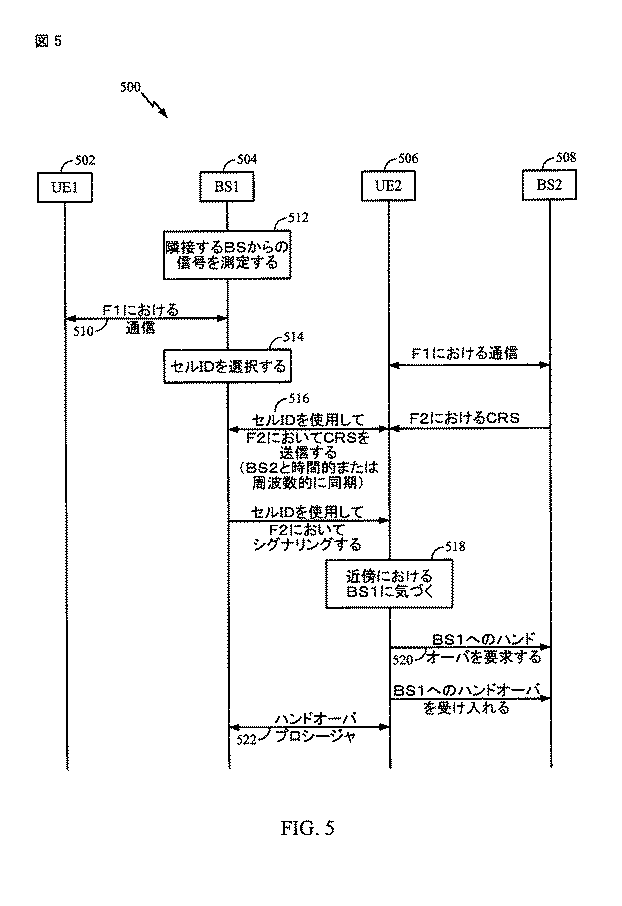
[0074]図5は、本開示のいくつかの態様による、ネットワークローディングを改善するためにネットワークで交換され得る例示的な信号500を示す。図5に示したように、510で、ユーザ機器UE1 502は、周波数F1において第1のBS、BS1 504と通信することができ得る。512で、BS1 504は、ネットワークにおいて隣接するBSによって送信される信号を測定し、基準に基づいて第2のBSを選択し得る。たとえば、BS1 504は、ネイバーBSの中で最も強い信号を有するBS2 508を選択し得る。514で、BS1は、本明細書で説明するように、(たとえば、周波数F2においてBS1から送信される共通基準信号(CRS)がBS2から送信されるCRSと衝突するように)BS2 508のセルIDに基づいてセルIDを選択することができ得る。516で、BS1 504は、通信するためにBS2 508およびUE2 506によって使用される1つまたは複数の信号(たとえばCRS)を周波数F2において送信することができ得る。周波数F2において送信されたCRSは、BS2 508によって送信されたCRSと衝突し得る。BS1 504は、F2において信号を送信する前に、時間的または周波数的に、BS2 508と同期し得る。518で、UE2 506は、それの近接におけるBS1 504の存在に気づくことができ得る。BS1から受信された信号の信号品質が良い場合、520で、UE2 506は、BS2 508からBS1 504へのハンドオーバを要求し得る。BS2は、その負荷を低減するために、ハンドオーバを受け入れることができ得る。522で、UE2 506およびBS1 504は、ハンドオーバプロシージャを開始することができ得る。
[0074] FIG. 5 illustrates an
[0075]図6は、本開示のいくつかの態様による、基地局によって実行され得る例示的なプロシージャ600を示す。602で、BSは、任意の他のBSがそれの近傍にあるかどうかを調べ得る。はいの場合、604で、BSは、ネイバーBSに関する情報を取得し、最も強い信号を有し得るネイバーBSを選択し得る。606で、BSは、それが選択されたBSのセルIDと衝突するように、セルIDを選択し得る。608で、BSは、選択されたセルIDを使用して1つまたは複数の信号を送信し得る。送信された信号は、選択されたBSからの送信と時間的または周波数的に同期され得る。610で、BSは、UEからハンドオーバ要求を受信し得る。612で、BSは、UEとのハンドオーバプロシージャを実行し得る。
[0075] FIG. 6 illustrates an
[0076]図7は、本開示のいくつかの態様によるUEによって実行され得る例示的なプロシージャ700を示す。702で、UEは、周波数F2を介してサービングBSと通信し得る。704で、UEは、周波数F2において信号を受信し得る。706で、UEは、受信信号において干渉除去を実行し得る。いくつかの態様では、708で、UEは、受信信号に干渉する任意の強い信号があるかどうかを確認し得る。たとえば、UEは、CRSにおいて任意の強い干渉があるかどうかを調べることができ得る。いくつかの態様では、はいの場合、710で、UEは、強い干渉を送信しているBSを識別することができ得る。712で、UEは、サービングBSから受信信号を送信すると識別されたBSへのハンドオーバを要求し得る。714で、ハンドオーバ要求が受け入れられた場合、UEは、識別されたBSとのハンドオーバプロシージャを実行し得る。
[0076] FIG. 7 illustrates an
[0077]図8は、本開示のいくつかの態様による、たとえば、ネットワークローディングを改善するためにユーザ機器によって実行され得る例示的な動作を示す。802で、UEは、第1の周波数において動作する第1のBSから、セルIDを含む1つまたは複数の信号を第2の周波数において受信し、第2の周波数において第1のBSから送信される共通基準信号(CRS)が第2の周波数において第2のBSから送信されるCRSと衝突するように、セルIDが選択される。いくつかの態様では、UEは、クリーンな信号を生成するために干渉除去アルゴリズムを使用して受信信号における干渉をキャンセルし得る。次いで、UEは、クリーンな信号から第1の基地局およびその対応するセルIDを識別し得る。804で、UEは、受信されたセルIDに基づいて第2のBSから第1のBSにハンドオーバし得る。 [0077] FIG. 8 illustrates example operations that may be performed by user equipment, eg, to improve network loading, in accordance with certain aspects of the present disclosure. At 802, a UE receives one or more signals including a cell ID from a first BS operating at a first frequency at a second frequency and transmitted from the first BS at a second frequency. The cell ID is selected such that the common reference signal (CRS) collides with the CRS transmitted from the second BS at the second frequency. In some aspects, the UE may cancel interference in the received signal using an interference cancellation algorithm to generate a clean signal. The UE may then identify the first base station and its corresponding cell ID from the clean signal. At 804, the UE may be handed over from the second BS to the first BS based on the received cell ID.
[0078]図9は、本開示のいくつかの態様による、基地局およびユーザ機器を備える例示的なネットワーク900を示す。基地局910は、受信機ユニット918を使用して、それの近傍(図示せず)におけるUE920および/または他の基地局から信号を受信し得る。基地局は、処理モジュール916を使用して受信信号を処理し得る。基地局は、セルID選択モジュール914を使用して、本明細書で説明したように、セルIDを選択し、選択されたセルIDを使用して、1つまたは複数のビーコン信号を生成し得る。次いで、基地局は、送信機モジュール912を使用してビーコン信号を送信し得る。UE920は、受信機モジュール922を使用してビーコン信号を受信し得る。次いで、UEは、処理モジュール924を使用して受信されたビーコン信号を処理し、基地局がそれの近傍にあると決定することができ得る。次いで、UEは、そのサービング基地局(図示せず)から基地局910にハンドオーバするよう要求し、ハンドオーバ要求が受け入れられた場合、送信機モジュール926を使用して、BS910に信号を送信し得る。
[0078] FIG. 9 illustrates an
[0079]要約すれば、本明細書で説明する技法は、UEがそれの近接の他の基地局に気づくことを可能にし、それらの隣接するBSにハンドオーバすることによって、異種ネットワークの負荷のバランスをとることを容易にする。 [0079] In summary, the techniques described herein allow a UE to notice other base stations in its proximity and balance the load of heterogeneous networks by handing over to their neighboring BSs. Making it easy to take.
[0080]上記で説明した図4および図8の方法に示したブロックに対応する様々な動作は、様々な(1つまたは複数の)ハードウェアおよび/またはソフトウェア構成要素および/または(1つまたは複数の)モジュールによって実行され得る。たとえば、第2のBSに関する情報を受信または取得するための手段は、受信機または任意の好適な受信構成要素(たとえば、図2に示したような受信機222)であり得る。ユーザ機器のハンドオーバを引き起こすための手段、1つまたは複数の信号の送信を同期させるための手段、MBSFNサブフレームを利用するための手段、および1つまたは複数のセルIDを識別するための手段は、たとえば図2に示したように、プロセッサ230などの任意の好適な処理構成要素であり得る。セルIDを選択するための手段は、たとえば図9に示すように、セルID選択モジュール914などの任意の好適な処理構成要素であり得る。1つまたは複数の信号を送信するための手段および/または通信するための手段は、図2に示したように、送信機222などの任意の好適な送信構成要素であり得る。
[0080] Various operations corresponding to the blocks shown in the methods of FIGS. 4 and 8 described above may be performed by various hardware (s) and / or software components and / or (one or Can be executed by a plurality of modules. For example, the means for receiving or obtaining information regarding the second BS may be a receiver or any suitable receiving component (eg,
[0081]本開示に関連して説明した様々な例示的な論理ブロック、モジュール、および回路は、汎用プロセッサ、デジタル信号プロセッサ(DSP)、特定用途向け集積回路(ASIC)、フィールドプログラマブルゲートアレイ信号(FPGA)または他のプログラマブル論理デバイス(PLD)、個別ゲートまたはトランジスタ論理、個別ハードウェア構成要素、あるいは本明細書で説明した機能を実行するように設計されたそれらの任意の組合せを用いて実装または実行でき得る。汎用プロセッサはマイクロプロセッサとすることができ得るが、代替として、プロセッサは、任意の市販のプロセッサ、コントローラ、マイクロコントローラ、または状態機械とすることができ得る。プロセッサは、コンピューティングデバイスの組合せ、たとえば、DSPとマイクロプロセッサとの組合せ、複数のマイクロプロセッサ、DSPコアと連携する1つまたは複数のマイクロプロセッサ、あるいは任意の他のそのような構成として実装することもでき得る。 [0081] Various exemplary logic blocks, modules, and circuits described in connection with this disclosure include general purpose processors, digital signal processors (DSPs), application specific integrated circuits (ASICs), field programmable gate array signals ( FPGA or other programmable logic device (PLD), discrete gate or transistor logic, discrete hardware components, or any combination thereof designed to perform the functions described herein or It can be done. A general purpose processor may be a microprocessor, but in the alternative, the processor may be any commercially available processor, controller, microcontroller or state machine. A processor may be implemented as a combination of computing devices, eg, a combination of a DSP and a microprocessor, a plurality of microprocessors, one or more microprocessors associated with a DSP core, or any other such configuration. You can also.
[0082]本開示に関連して説明した方法またはアルゴリズムのステップは、直接ハードウェアか、プロセッサによって実行されるソフトウェアモジュールか、またはその2つの組合せで実施でき得る。ソフトウェアモジュールは、当技術分野で知られている任意の形式の記憶媒体中に常駐することができ得る。使用でき得る記憶媒体のいくつかの例には、ランダムアクセスメモリ(RAM)、読取り専用メモリ(ROM)、フラッシュメモリ、EPROMメモリ、EEPROM(登録商標)メモリ、レジスタ、ハードディスク、リムーバブルディスク、CD−ROMなどがある。ソフトウェアモジュールは、単一の命令、または多数の命令を備えることができ、いくつかの異なるコードセグメント上で、異なるプログラム間で、および複数の記憶媒体にわたって分散でき得る。記憶媒体は、プロセッサがその記憶媒体から情報を読み取ることができ、その記憶媒体に情報を書き込むことができるように、プロセッサに結合でき得る。代替として、記憶媒体はプロセッサに一体化することができ得る。 [0082] The method or algorithm steps described in connection with this disclosure may be implemented in direct hardware, software modules executed by a processor, or a combination of the two. A software module may reside in any form of storage medium that is known in the art. Some examples of storage media that can be used include random access memory (RAM), read only memory (ROM), flash memory, EPROM memory, EEPROM® memory, registers, hard disk, removable disk, CD-ROM. and so on. A software module can comprise a single instruction, or multiple instructions, and can be distributed over several different code segments, between different programs, and across multiple storage media. A storage medium may be coupled to the processor such that the processor can read information from, and write information to, the storage medium. In the alternative, the storage medium may be integral to the processor.
[0083]本明細書で開示する方法は、説明した方法を達成するための1つまたは複数のステップまたはアクションを備える。本方法のステップおよび/またはアクションは、特許請求の範囲から逸脱することなく互いに交換され得る。言い換えれば、ステップまたはアクションの特定の順序が指定されない限り、特定のステップおよび/またはアクションの順序および/または使用は特許請求の範囲から逸脱することなく変更され得る。 [0083] The methods disclosed herein comprise one or more steps or actions for achieving the described method. The method steps and / or actions may be interchanged with one another without departing from the scope of the claims. In other words, unless a specific order of steps or actions is specified, the order and / or use of specific steps and / or actions may be changed without departing from the scope of the claims.
[0084]説明した機能は、ハードウェア、ソフトウェア、ファームウェア、またはそれらの組合せで実装でき得る。ソフトウェアで実装した場合、機能は1つまたは複数の命令としてコンピュータ可読媒体上に記憶され得る。記憶媒体は、コンピュータによってアクセスされ得る任意の利用可能な媒体であり得る。限定ではなく例として、そのようなコンピュータ可読媒体は、RAM、ROM、EEPROM、CD−ROM、あるいは他の光ディスクストレージ、磁気ディスクストレージまたは他の磁気記憶デバイス、もしくは命令またはデータ構造の形態の所望のプログラムコードを搬送または記憶するために使用でき、コンピュータによってアクセスできる任意の他の媒体を備えることができる。本明細書で使用するディスク(disk)およびディスク(disc)は、コンパクトディスク(disc)(CD)、レーザディスク(disc)、光ディスク(disc)、デジタル多用途ディスク(disc)(DVD)、フロッピー(登録商標)ディスク(disk)およびBlu−ray(登録商標)ディスク(disc)を含み、ディスク(disk)は、通常、データを磁気的に再生し、ディスク(disc)は、データをレーザで光学的に再生する。 [0084] The functions described may be implemented in hardware, software, firmware, or combinations thereof. If implemented in software, the functions may be stored on a computer-readable medium as one or more instructions. A storage media may be any available media that can be accessed by a computer. By way of example, and not limitation, such computer readable media can be RAM, ROM, EEPROM, CD-ROM, or other optical disk storage, magnetic disk storage or other magnetic storage device, or any desired form in the form of instructions or data structures. Any other medium that can be used to carry or store the program code and that can be accessed by a computer can be provided. Discs and discs used in this specification are compact discs (CD), laser discs, optical discs, digital versatile discs (DVDs), floppy discs (discs). (Registered trademark) disk and Blu-ray (registered trademark) disc, which normally reproduces data magnetically, and the disc optically reproduces data with a laser. To play.
[0085]たとえば、そのようなデバイスは、本明細書で説明した方法を実行するための手段の転送を可能にするために、サーバに結合され得る。代替的に、本明細書で説明される様々な方法は、ユーザ端末および/または基地局がストレージ手段をデバイスに結合するかまたは与えると様々な方法を得ることができるように、ストレージ手段(たとえば、RAM、ROM、コンパクトディスク(CD)またはフロッピーディスクなど物理記憶媒体など)によって提供できる。その上、本明細書で説明した方法および技法をデバイスに提供するための任意の他の好適な技法が利用され得る。 [0085] For example, such a device may be coupled to a server to allow transfer of means for performing the methods described herein. Alternatively, the various methods described herein are storage means (e.g., such that the user terminal and / or base station can obtain various methods when the storage means is coupled or provided to the device). , RAM, ROM, a physical storage medium such as a compact disk (CD) or a floppy disk). Moreover, any other suitable technique for providing the devices with the methods and techniques described herein may be utilized.
[0086]特許請求の範囲は、上記に示した正確な構成および構成要素に限定されないことを理解されたい。上記の方法および装置の構成、動作および詳細において、特許請求の範囲から逸脱することなく、様々な改変、変更および変形を行うことができ得る。 [0086] It is to be understood that the claims are not limited to the precise configuration and components illustrated above. Various modifications, changes and variations may be made in the arrangement, operation and details of the methods and apparatus described above without departing from the scope of the claims.
[0087]上記は本開示の態様を対象とするが、本開示の他の態様およびさらなる態様は、それらの基本的範囲から逸脱することなく考案され得、それらの範囲は以下の特許請求の範囲によって判断される。
以下に、本願出願の当初の特許請求の範囲に記載された発明を付記する。
[C1]
ワイヤレス通信のための方法であって、
第1の周波数において送信する第1の基地局(BS)によって、第2の周波数においてビーコン信号を送信する際に使用するためのセル識別情報(ID)を選択することであり、前記第2の周波数において前記第1のBSから送信される共通基準信号(CRS)が前記第2の周波数において第2のBSから送信されるCRSと衝突するように、前記セルIDが選択されることと、
前記第1のBSによって、前記セルIDを使用して、前記第2の周波数において1つまたは複数の信号を送信することと
を備える方法。
[C2]
前記第1のBSによって、前記選択されたセルIDを使用して、前記第2の周波数において前記ビーコン信号を送信することと、
前記ビーコン信号に基づいて、前記第2のBSに関連付けられたユーザ機器(UE)の前記第1のBSへのハンドオーバを引き起こすことと
をさらに備えるC1に記載の方法。
[C3]
前記第2の周波数および前記セルIDを使用して、前記第1のBSによって前記UEと通信すること
をさらに備えるC2に記載の方法。
[C4]
前記第2の周波数および前記セルIDを使用して、前記第1のBSによって前記UEと通信することが、干渉除去アルゴリズムを使用してキャンセルされ得る、前記第2の周波数を使用する別のUEに対する干渉を引き起こすことを含む、C3に記載の方法。
[C5]
前記第2のBSが、測定された基準信号、1次同期信号(PSS)、または2次同期信号(SSS)のうちの1つまたは複数によって示されるように、前記第2の周波数において動作する最も強い隣接するBSである、C1に記載の方法。
[C6]
前記1つまたは複数の信号の送信を、前記第2のBSからの送信と、時間的に同期させること
をさらに備えるC5に記載の方法。
[C7]
前記1つまたは複数の信号の送信を、前記第2のBSからの送信と、周波数的に同期させること
をさらに備えるC5に記載の方法。
[C8]
前記1つまたは複数の信号の送信が、周期的、非周期的、またはイベントによるトリガのうちの少なくとも1つである、C1に記載の方法。
[C9]
前記イベントが前記第1のBSの近傍におけるUEの検出を備える、C8に記載の方法。
[C10]
前記1つまたは複数の信号が、送信エネルギーを低減するような方法で送信される、C1に記載の方法。
[C11]
前記1つまたは複数の信号を送信するために、マルチメディアブロードキャストオーバー単一周波数ネットワーク(MBSFN)サブフレームを利用すること
をさらに備えるC10に記載の方法。
[C12]
前記第1のBSの前記セルIDを選択することが、
1つまたは複数の隣接するBSによって現在使用されている1つまたは複数のセルIDを識別することと、
前記セルIDが前記1つまたは複数の識別されたセルIDとは異なるように、前記第1のBSの前記セルIDを選択することと
を備える、C1に記載の方法。
[C13]
前記1つまたは複数のセルIDが、ネットワークリッスンまたはバックホールネットワーク通信のうちの少なくとも1つによって識別される、C12に記載の方法。
[C14]
前記1つまたは複数の信号が、1次同期信号(PSS)、2次同期信号(SSS)、物理ブロードキャストチャネル(PBCH)、CRS、またはシステム情報ブロック(SIB)のうちの1つまたは複数を備える、C1に記載の方法。
[C15]
前記第2のBSに関する情報を受信または取得することであり、前記情報が、物理セルID情報、タイミング情報、またはキャリア周波数情報のうちの1つまたは複数を備えること
をさらに備える、C1に記載の方法。
[C16]
ワイヤレス通信のための装置であって、
第1の周波数において送信する第1の基地局(BS)によって、第2の周波数においてビーコン信号を送信する際に使用するためのセル識別情報(ID)を選択するための手段であり、前記第2の周波数において前記第1のBSから送信される共通基準信号(CRS)が前記第2の周波数において第2のBSから送信されるCRSと衝突するように、前記セルIDが選択される、手段と、
前記第1のBSによって、前記セルIDを使用して、前記第2の周波数において1つまたは複数の信号を送信するための手段と
を備える装置。
[C17]
前記第1のBSによって、前記選択されたセルIDを使用して、前記第2の周波数において前記ビーコン信号を送信するための手段と、
前記ビーコン信号に基づいて、前記第2のBSに関連付けられたユーザ機器(UE)の前記第1のBSへのハンドオーバを引き起こすための手段と
をさらに備えるC16に記載の装置。
[C18]
前記第2の周波数および前記セルIDを使用して、前記第1のBSによって前記UEと通信するための手段
をさらに備えるC17に記載の装置。
[C19]
前記第2の周波数および前記セルIDを使用して、前記第1のBSによって前記UEと通信するための前記手段が、干渉除去アルゴリズムを使用してキャンセルされ得る、前記第2の周波数を使用する別のUEに対する干渉を引き起こすように構成される、C18に記載の装置。
[C20]
前記第2のBSが、測定された基準信号、1次同期信号(PSS)、または2次同期信号(SSS)のうちの1つまたは複数によって示されるように、前記第2の周波数において動作する最も強い隣接するBSである、C16に記載の装置。
[C21]
前記1つまたは複数の信号の送信を、前記第2のBSからの送信と、時間的に同期させるための手段
をさらに備えるC20に記載の装置。
[C22]
前記1つまたは複数の信号の送信を、前記第2のBSからの送信と、周波数的に同期させるための手段
をさらに備えるC20に記載の装置。
[C23]
前記1つまたは複数の信号の送信が、周期的、非周期的、またはイベントによるトリガのうちの少なくとも1つである、C16に記載の装置。
[C24]
前記イベントが前記第1のBSの近傍におけるUEの検出を備える、C23に記載の装置。
[C25]
前記1つまたは複数の信号が、送信エネルギーを低減するような方法で送信される、C16に記載の装置。
[C26]
前記1つまたは複数の信号を送信するために、マルチメディアブロードキャストオーバー単一周波数ネットワーク(MBSFN)サブフレームを利用するための手段
をさらに備えるC25に記載の装置。
[C27]
前記第1のBSの前記セルIDを選択するための前記手段が、
1つまたは複数の隣接するBSによって現在使用されている1つまたは複数のセルIDを識別し、
前記セルIDが前記識別された1つまたは複数のセルIDとは異なるように、前記第1のBSの前記セルIDを選択する
ように構成される、C16に記載の装置。
[C28]
前記1つまたは複数のセルIDが、ネットワークリッスンまたはバックホールネットワーク通信のうちの少なくとも1つによって識別される、C27に記載の装置。
[C29]
前記1つまたは複数の信号が、1次同期信号(PSS)、2次同期信号(SSS)、物理ブロードキャストチャネル(PBCH)、CRS、またはシステム情報ブロック(SIB)のうちの1つまたは複数を備える、C16に記載の装置。
[C30]
前記第2のBSに関する情報を受信または取得するための手段であり、前記情報が、物理セルID情報、タイミング情報、またはキャリア周波数情報のうちの1つまたは複数を備える、手段
をさらに備える、C16に記載の装置。
[C31]
ワイヤレス通信のための装置であって、
第1の周波数において送信する第1の基地局(BS)によって、第2の周波数においてビーコン信号を送信する際に使用するためのセル識別情報(ID)を選択し、前記第2の周波数において前記第1のBSから送信される共通基準信号(CRS)が前記第2の周波数において第2のBSから送信されるCRSと衝突するように、前記セルIDが選択され、
前記第1のBSによって、前記セルIDを使用して、前記第2の周波数において1つまたは複数の信号を送信する
ように構成される少なくとも1つのプロセッサと、
前記少なくとも1つのプロセッサに結合されたメモリと
を備える装置。
[C32]
ワイヤレス通信のためのコンピュータプログラム製品であって、
第1の周波数において送信する第1の基地局(BS)によって、第2の周波数においてビーコン信号を送信する際に使用するためのセル識別情報(ID)を選択するためのコードであり、前記第2の周波数において前記第1のBSから送信される共通基準信号(CRS)が前記第2の周波数において第2のBSから送信されるCRSと衝突するように、前記セルIDが選択される、コードと、
前記第1のBSによって、前記セルIDを使用して、前記第2の周波数において1つまたは複数の信号を送信するためのコードと
を備えるコンピュータ可読媒体
を備えるコンピュータプログラム製品。
[C33]
ワイヤレス通信のための方法であって、
第1の周波数において動作する第1の基地局(BS)から、セル識別情報(ID)を含む1つまたは複数の信号を第2の周波数において受信することであり、前記第2の周波数において前記第1のBSから送信される共通基準信号(CRS)が前記第2の周波数において第2のBSから送信されるCRSと衝突するように、前記第1のBSによって前記セルIDが選択されることと、
前記受信されたセルIDに基づいて前記第2のBSから前記第1のBSへのハンドオーバを実行することと
を備える方法。
[C34]
クリーンな信号を生成するために干渉除去アルゴリズムを使用して前記受信された1つまたは複数の信号における干渉をキャンセルすることと、
前記クリーンな信号から前記第1の基地局およびその対応するセルIDを識別することと
をさらに備えるC33に記載の方法。
[C35]
前記第2の周波数および前記セルIDを使用して、前記第1のBSと通信すること
をさらに備えるC33に記載の方法。
[C36]
前記第2のBSが、測定された基準信号、1次同期信号(PSS)、または2次同期信号(SSS)のうちの1つまたは複数によって示されるように、前記第2の周波数において動作する、前記第1のBSの最も強いネイバーである、C33に記載の方法。
[C37]
前記1つまたは複数の信号が、前記第2のBSからの送信と、時間的に同期される、C33に記載の方法。
[C38]
前記1つまたは複数の信号が、前記第2のBSからの送信と、周波数的に同期される、C33に記載の方法。
[C39]
前記1つまたは複数の信号が非周期的に受信される、C33に記載の方法。
[C40]
前記1つまたは複数の信号が、マルチメディアブロードキャストオーバー単一周波数ネットワーク(MBSFN)サブフレームで受信される、C33に記載の方法。
[C41]
前記1つまたは複数の信号が、1次同期信号(PSS)、2次同期信号(SSS)、物理ブロードキャストチャネル(PBCH)、CRS、またはシステム情報ブロック(SIB)のうちの1つまたは複数を備える、C33に記載の方法。
[C42]
ワイヤレス通信のための装置であって、
第1の周波数において動作する第1の基地局(BS)から、セル識別情報(ID)を含む1つまたは複数の信号を第2の周波数において受信するための手段であり、前記第2の周波数において前記第1のBSから送信される共通基準信号(CRS)が前記第2の周波数において第2のBSから送信されるCRSと衝突するように、前記第1のBSによって前記セルIDが選択される、手段と、
前記受信されたセルIDに基づいて前記第2のBSから前記第1のBSへのハンドオーバを実行するための手段と
を備える装置。
[C43]
クリーンな信号を生成するために干渉除去アルゴリズムを使用して前記受信された1つまたは複数の信号における干渉をキャンセルするための手段と、
前記クリーンな信号から前記第1の基地局およびその対応するセルIDを識別するための手段と
をさらに備えるC42に記載の装置。
[C44]
前記第2の周波数および前記セルIDを使用して、前記第1のBSと通信するための手段
をさらに備えるC42に記載の装置。
[C45]
前記第2のBSが、測定された基準信号、1次同期信号(PSS)、または2次同期信号(SSS)のうちの1つまたは複数によって示されるように、前記第2の周波数において動作する、前記第1のBSの最も強いネイバーである、C42に記載の装置。
[C46]
前記1つまたは複数の信号が、前記第2のBSからの送信と、時間的に同期される、C42に記載の装置。
[C47]
前記1つまたは複数の信号が、前記第2のBSからの送信と、周波数的に同期される、C42に記載の装置。
[C48]
前記1つまたは複数の信号が非周期的に受信される、C42に記載の装置。
[C49]
前記1つまたは複数の信号が、マルチメディアブロードキャストオーバー単一周波数ネットワーク(MBSFN)サブフレームで受信される、C42に記載の装置。
[C50]
前記1つまたは複数の信号が、1次同期信号(PSS)、2次同期信号(SSS)、物理ブロードキャストチャネル(PBCH)、CRS、またはシステム情報ブロック(SIB)のうちの1つまたは複数を備える、C42に記載の装置。
[C51]
ワイヤレス通信のための装置であって、
第1の周波数において動作する第1の基地局(BS)から、セル識別情報(ID)を含む1つまたは複数の信号を第2の周波数において受信し、前記第2の周波数において前記第1のBSから送信される共通基準信号(CRS)が前記第2の周波数において第2のBSから送信されるCRSと衝突するように、前記第1のBSによって前記セルIDが選択され、
前記受信されたセルIDに基づいて前記第2のBSから前記第1のBSへのハンドオーバを実行する
ように構成された少なくとも1つのプロセッサと、
前記少なくとも1つのプロセッサに結合されたメモリと
を備える装置。
[C52]
ワイヤレス通信のためのコンピュータプログラム製品であって、
第1の周波数において動作する第1の基地局(BS)から、セル識別情報(ID)を含む1つまたは複数の信号を第2の周波数において受信するためのコードであり、前記第2の周波数において前記第1のBSから送信される共通基準信号(CRS)が前記第2の周波数において第2のBSから送信されるCRSと衝突するように、前記第1のBSによって前記セルIDが選択される、コードと、
前記受信されたセルIDに基づいて前記第2のBSから前記第1のBSへのハンドオーバを実行するためのコードと
を備えるコンピュータ可読媒体
を備えるコンピュータプログラム製品。
[0087] While the above is directed to aspects of the present disclosure, other and further aspects of the present disclosure may be devised without departing from their basic scope, which scope is the scope of the following claims Is judged by.
Hereinafter, the invention described in the scope of claims of the present application will be appended.
[C1]
A method for wireless communication,
Selecting cell identification information (ID) for use in transmitting a beacon signal at a second frequency by a first base station (BS) transmitting at a first frequency, said second The cell ID is selected such that a common reference signal (CRS) transmitted from the first BS at a frequency collides with a CRS transmitted from a second BS at the second frequency;
Transmitting one or more signals on the second frequency by the first BS using the cell ID;
A method comprising:
[C2]
Transmitting the beacon signal on the second frequency using the selected cell ID by the first BS;
Causing a handover of a user equipment (UE) associated with the second BS to the first BS based on the beacon signal;
The method of C1, further comprising:
[C3]
Communicating with the UE by the first BS using the second frequency and the cell ID
The method of C2, further comprising:
[C4]
Communicating with the UE by the first BS using the second frequency and the cell ID can be canceled using an interference cancellation algorithm, another UE using the second frequency The method of C3, comprising causing interference to.
[C5]
The second BS operates at the second frequency as indicated by one or more of a measured reference signal, primary synchronization signal (PSS), or secondary synchronization signal (SSS). The method of C1, which is the strongest adjacent BS.
[C6]
Synchronizing the transmission of the one or more signals with the transmission from the second BS in time.
The method of C5, further comprising:
[C7]
Synchronizing in frequency the transmission of the one or more signals with the transmission from the second BS.
The method of C5, further comprising:
[C8]
The method of C1, wherein the transmission of the one or more signals is at least one of periodic, aperiodic, or event triggered.
[C9]
The method of C8, wherein the event comprises detection of a UE in the vicinity of the first BS.
[C10]
The method of C1, wherein the one or more signals are transmitted in a manner that reduces transmission energy.
[C11]
Utilizing a multimedia broadcast over single frequency network (MBSFN) subframe to transmit the one or more signals
The method of C10, further comprising:
[C12]
Selecting the cell ID of the first BS;
Identifying one or more cell IDs currently used by one or more neighboring BSs;
Selecting the cell ID of the first BS such that the cell ID is different from the one or more identified cell IDs;
The method of C1, comprising.
[C13]
The method of C12, wherein the one or more cell IDs are identified by at least one of network listening or backhaul network communication.
[C14]
The one or more signals comprise one or more of a primary synchronization signal (PSS), a secondary synchronization signal (SSS), a physical broadcast channel (PBCH), a CRS, or a system information block (SIB). , C1.
[C15]
Receiving or obtaining information on the second BS, wherein the information comprises one or more of physical cell ID information, timing information, or carrier frequency information.
The method of C1, further comprising:
[C16]
A device for wireless communication,
Means for selecting cell identification information (ID) for use in transmitting a beacon signal at a second frequency by a first base station (BS) transmitting at a first frequency; Means for selecting the cell ID such that a common reference signal (CRS) transmitted from the first BS at a second frequency collides with a CRS transmitted from a second BS at the second frequency; When,
Means for transmitting, by the first BS, one or more signals on the second frequency using the cell ID;
A device comprising:
[C17]
Means for transmitting the beacon signal at the second frequency using the selected cell ID by the first BS;
Means for causing a handover of a user equipment (UE) associated with the second BS to the first BS based on the beacon signal;
The apparatus according to C16, further comprising:
[C18]
Means for communicating with the UE by the first BS using the second frequency and the cell ID
The apparatus according to C17, further comprising:
[C19]
Using the second frequency and the cell ID, the means for communicating with the UE by the first BS uses the second frequency, which can be canceled using an interference cancellation algorithm. The apparatus of C18, configured to cause interference to another UE.
[C20]
The second BS operates at the second frequency as indicated by one or more of a measured reference signal, primary synchronization signal (PSS), or secondary synchronization signal (SSS). The device of C16, which is the strongest adjacent BS.
[C21]
Means for temporally synchronizing the transmission of the one or more signals with the transmission from the second BS
The apparatus according to C20, further comprising:
[C22]
Means for frequency-synchronizing the transmission of the one or more signals with the transmission from the second BS
The apparatus according to C20, further comprising:
[C23]
The apparatus of C16, wherein the transmission of the one or more signals is at least one of periodic, aperiodic, or event triggered.
[C24]
The apparatus of C23, wherein the event comprises detection of a UE in the vicinity of the first BS.
[C25]
The apparatus of C16, wherein the one or more signals are transmitted in a manner that reduces transmission energy.
[C26]
Means for utilizing a multimedia broadcast over single frequency network (MBSFN) subframe to transmit the one or more signals
The apparatus according to C25, further comprising:
[C27]
The means for selecting the cell ID of the first BS;
Identify one or more cell IDs currently used by one or more neighboring BSs;
Select the cell ID of the first BS such that the cell ID is different from the identified cell ID or cells.
The apparatus according to C16, configured as follows.
[C28]
The apparatus of C27, wherein the one or more cell IDs are identified by at least one of network listening or backhaul network communication.
[C29]
The one or more signals comprise one or more of a primary synchronization signal (PSS), a secondary synchronization signal (SSS), a physical broadcast channel (PBCH), a CRS, or a system information block (SIB). , C16.
[C30]
Means for receiving or obtaining information regarding the second BS, wherein the information comprises one or more of physical cell ID information, timing information, or carrier frequency information
The apparatus according to C16, further comprising:
[C31]
A device for wireless communication,
Select cell identification information (ID) for use in transmitting a beacon signal at a second frequency by a first base station (BS) transmitting at a first frequency, and at the second frequency The cell ID is selected such that a common reference signal (CRS) transmitted from the first BS collides with a CRS transmitted from the second BS at the second frequency,
The first BS transmits one or more signals on the second frequency using the cell ID.
At least one processor configured as:
A memory coupled to the at least one processor;
A device comprising:
[C32]
A computer program product for wireless communication,
A code for selecting cell identification information (ID) for use in transmitting a beacon signal at a second frequency by a first base station (BS) transmitting at a first frequency; The cell ID is selected such that a common reference signal (CRS) transmitted from the first BS at a frequency of 2 collides with a CRS transmitted from a second BS at the second frequency; When,
A code for transmitting one or more signals on the second frequency by the first BS using the cell ID;
A computer-readable medium comprising
A computer program product comprising:
[C33]
A method for wireless communication,
Receiving one or more signals including cell identification information (ID) at a second frequency from a first base station (BS) operating at a first frequency, wherein the signal at the second frequency The cell ID is selected by the first BS such that a common reference signal (CRS) transmitted from the first BS collides with a CRS transmitted from the second BS at the second frequency. When,
Performing a handover from the second BS to the first BS based on the received cell ID;
A method comprising:
[C34]
Canceling interference in the received signal or signals using an interference cancellation algorithm to generate a clean signal;
Identifying the first base station and its corresponding cell ID from the clean signal;
The method of C33, further comprising:
[C35]
Communicating with the first BS using the second frequency and the cell ID
The method of C33, further comprising:
[C36]
The second BS operates at the second frequency as indicated by one or more of a measured reference signal, primary synchronization signal (PSS), or secondary synchronization signal (SSS). The method of C33, which is the strongest neighbor of the first BS.
[C37]
The method of C33, wherein the one or more signals are synchronized in time with transmissions from the second BS.
[C38]
The method of C33, wherein the one or more signals are frequency synchronized with a transmission from the second BS.
[C39]
The method of C33, wherein the one or more signals are received aperiodically.
[C40]
The method of C33, wherein the one or more signals are received in a multimedia broadcast over single frequency network (MBSFN) subframe.
[C41]
The one or more signals comprise one or more of a primary synchronization signal (PSS), a secondary synchronization signal (SSS), a physical broadcast channel (PBCH), a CRS, or a system information block (SIB). , C33.
[C42]
A device for wireless communication,
Means for receiving at a second frequency one or more signals including cell identification information (ID) from a first base station (BS) operating at a first frequency, said second frequency The cell ID is selected by the first BS such that a common reference signal (CRS) transmitted from the first BS in FIG. 2 collides with a CRS transmitted from the second BS at the second frequency. Means,
Means for performing a handover from the second BS to the first BS based on the received cell ID;
A device comprising:
[C43]
Means for canceling interference in the received signal or signals using an interference cancellation algorithm to generate a clean signal;
Means for identifying the first base station and its corresponding cell ID from the clean signal;
The apparatus according to C42, further comprising:
[C44]
Means for communicating with the first BS using the second frequency and the cell ID
The apparatus according to C42, further comprising:
[C45]
The second BS operates at the second frequency as indicated by one or more of a measured reference signal, primary synchronization signal (PSS), or secondary synchronization signal (SSS). The device according to C42, which is the strongest neighbor of the first BS.
[C46]
The apparatus of C42, wherein the one or more signals are synchronized in time with transmissions from the second BS.
[C47]
The apparatus of C42, wherein the one or more signals are frequency synchronized with a transmission from the second BS.
[C48]
The apparatus of C42, wherein the one or more signals are received aperiodically.
[C49]
The apparatus of C42, wherein the one or more signals are received in a multimedia broadcast over single frequency network (MBSFN) subframe.
[C50]
The one or more signals comprise one or more of a primary synchronization signal (PSS), a secondary synchronization signal (SSS), a physical broadcast channel (PBCH), a CRS, or a system information block (SIB). , C42.
[C51]
A device for wireless communication,
One or more signals including cell identification information (ID) are received at a second frequency from a first base station (BS) operating at a first frequency, and the first frequency is received at the second frequency. The cell ID is selected by the first BS such that a common reference signal (CRS) transmitted from the BS collides with a CRS transmitted from the second BS at the second frequency;
Perform handover from the second BS to the first BS based on the received cell ID
At least one processor configured as follows:
A memory coupled to the at least one processor;
A device comprising:
[C52]
A computer program product for wireless communication,
A code for receiving at a second frequency one or more signals containing cell identification information (ID) from a first base station (BS) operating at a first frequency, the second frequency The cell ID is selected by the first BS such that a common reference signal (CRS) transmitted from the first BS in FIG. 2 collides with a CRS transmitted from the second BS at the second frequency. Code,
A code for performing a handover from the second BS to the first BS based on the received cell ID;
A computer-readable medium comprising
A computer program product comprising:
Claims (52)
第1の周波数において送信する第1の基地局(BS)によって、第2の周波数において1つまたは複数の信号を送信する際に使用するためのセル識別情報(ID)を選択することであり、前記第2の周波数において前記第1のBSから送信される共通基準信号(CRS)が前記第2の周波数において第2のBSから送信されるCRSと衝突するように、前記セルIDが選択されることと、
前記第1のBSによって、前記セルIDを使用して、前記第2の周波数において前記1つまたは複数の信号を送信することと
を備える方法。 A method for wireless communication,
Selecting cell identification information (ID) for use in transmitting one or more signals at a second frequency by a first base station (BS) transmitting at a first frequency; The cell ID is selected such that a common reference signal (CRS) transmitted from the first BS at the second frequency collides with a CRS transmitted from the second BS at the second frequency. And
Method comprising by the first BS, using the cell ID, and transmitting the one or more signals at the second frequency.
をさらに備える請求項1に記載の方法。 Before SL based on one or more signals, and Hikiokosuko a request for handover of the to first BS of the second user equipment associated with the BS (UE)
The method of claim 1, further comprising a.
をさらに備える請求項2に記載の方法。 The method of claim 2, further comprising communicating with the UE by the first BS using the second frequency and the cell ID.
をさらに備える請求項5に記載の方法。 The method of claim 5, further comprising: temporally synchronizing the transmission of the one or more signals with a transmission from the second BS.
をさらに備える請求項5に記載の方法。 The method of claim 5, further comprising: synchronizing the transmission of the one or more signals with a transmission from the second BS in frequency.
をさらに備える請求項10に記載の方法。 The method of claim 10, further comprising utilizing a multimedia broadcast over single frequency network (MBSFN) subframe to transmit the one or more signals.
1つまたは複数の隣接するBSによって現在使用されている1つまたは複数のセルIDを識別することと、
前記セルIDが前記1つまたは複数の識別されたセルIDとは異なるように、前記第1のBSの前記セルIDを選択することと
を備える、請求項1に記載の方法。 Selecting the cell ID of the first BS;
Identifying one or more cell IDs currently used by one or more neighboring BSs;
The method of claim 1, comprising selecting the cell ID of the first BS such that the cell ID is different from the one or more identified cell IDs.
をさらに備える、請求項1に記載の方法。 Receiving or obtaining information about the second BS, wherein the information further comprises one or more of physical cell ID information, timing information, or carrier frequency information. The method described.
第1の周波数において送信する第1の基地局(BS)によって、第2の周波数において1つまたは複数の信号を送信する際に使用するためのセル識別情報(ID)を選択するための手段であり、前記第2の周波数において前記第1のBSから送信される共通基準信号(CRS)が前記第2の周波数において第2のBSから送信されるCRSと衝突するように、前記セルIDが選択される、手段と、
前記第1のBSによって、前記セルIDを使用して、前記第2の周波数において前記1つまたは複数の信号を送信するための手段と
を備える装置。 A device for wireless communication,
Means for selecting cell identification information (ID) for use in transmitting one or more signals at a second frequency by a first base station (BS) transmitting at a first frequency; And the cell ID is selected such that a common reference signal (CRS) transmitted from the first BS at the second frequency collides with a CRS transmitted from the second BS at the second frequency. Means,
Wherein the first BS, using the cell ID, and means for transmitting the one or more signals at the second frequency.
をさらに備える請求項16に記載の装置。 Before SL based on one or more signals, to claim 16, further comprising means for causing a request for the handover to the first BS of the second user equipment associated with the BS (UE) The device described.
をさらに備える請求項17に記載の装置。 The apparatus of claim 17, further comprising means for communicating with the UE by the first BS using the second frequency and the cell ID.
をさらに備える請求項20に記載の装置。 21. The apparatus of claim 20, further comprising: means for temporally synchronizing the transmission of the one or more signals with a transmission from the second BS.
をさらに備える請求項20に記載の装置。 21. The apparatus of claim 20, further comprising means for synchronizing the transmission of the one or more signals with the transmission from the second BS in frequency.
をさらに備える請求項25に記載の装置。 26. The apparatus of claim 25, further comprising means for utilizing a multimedia broadcast over single frequency network (MBSFN) subframe to transmit the one or more signals.
1つまたは複数の隣接するBSによって現在使用されている1つまたは複数のセルIDを識別し、
前記セルIDが前記識別された1つまたは複数のセルIDとは異なるように、前記第1のBSの前記セルIDを選択する
ように構成される、請求項16に記載の装置。 The means for selecting the cell ID of the first BS;
Identify one or more cell IDs currently used by one or more neighboring BSs;
The apparatus of claim 16, configured to select the cell ID of the first BS such that the cell ID is different from the identified one or more cell IDs.
をさらに備える、請求項16に記載の装置。 Means for receiving or obtaining information about the second BS, the information further comprising one or more of physical cell ID information, timing information, or carrier frequency information. Item 17. The device according to Item 16.
第1の周波数において送信する第1の基地局(BS)によって、第2の周波数において1つまたは複数の信号を送信する際に使用するためのセル識別情報(ID)を選択し、前記第2の周波数において前記第1のBSから送信される共通基準信号(CRS)が前記第2の周波数において第2のBSから送信されるCRSと衝突するように、前記セルIDが選択され、
前記第1のBSによって、前記セルIDを使用して、前記第2の周波数において前記1つまたは複数の信号を送信する
ように構成される少なくとも1つのプロセッサと、
前記少なくとも1つのプロセッサに結合されたメモリと
を備える装置。 A device for wireless communication,
Selecting cell identification information (ID) for use in transmitting one or more signals at a second frequency by a first base station (BS) transmitting at a first frequency; The cell ID is selected such that a common reference signal (CRS) transmitted from the first BS at a frequency of C1 collides with a CRS transmitted from a second BS at the second frequency;
By the first BS, using the cell ID, the at least one processor configured to send the one or more signals at said second frequency,
And a memory coupled to the at least one processor.
第1の周波数において送信する第1の基地局(BS)によって、第2の周波数において1つまたは複数の信号を送信する際に使用するためのセル識別情報(ID)を選択することであり、前記第2の周波数において前記第1のBSから送信される共通基準信号(CRS)が前記第2の周波数において第2のBSから送信されるCRSと衝突するように、前記セルIDが選択されることと、
前記第1のBSによって、前記セルIDを使用して、前記第2の周波数において前記1つまたは複数の信号を送信することと
を行うために1つまたは複数のプロセッサによって実行可能である、コンピュータ可読記憶媒体。 A computer readable storage medium for wireless communication, the computer readable storage medium having one or more stored instructions, wherein the one or more instructions are:
By the first base station (BS) for transmitting at a first frequency, it is to select a cell identity (ID) for use in transmitting the one or more signals at the second frequency, The cell ID is selected such that a common reference signal (CRS) transmitted from the first BS at the second frequency collides with a CRS transmitted from the second BS at the second frequency. and that,
By the first BS, using the cell ID, the transmitting the one or more signals in the second frequency
Executable by one or more processors to perform, computer-readable storage medium.
第1の周波数において動作する第1の基地局(BS)から、セル識別情報(ID)を含む1つまたは複数の信号を第2の周波数において受信することであり、前記第2の周波数において前記第1のBSから送信される共通基準信号(CRS)が前記第2の周波数において第2のBSから送信されるCRSと衝突するように、前記第1のBSによって前記セルIDが選択されることと、
前記受信されたセルIDに基づいて前記第2のBSから前記第1のBSへのハンドオーバを実行することと
を備える方法。 A method for wireless communication,
Receiving one or more signals including cell identification information (ID) at a second frequency from a first base station (BS) operating at a first frequency, wherein the signal at the second frequency The cell ID is selected by the first BS such that a common reference signal (CRS) transmitted from the first BS collides with a CRS transmitted from the second BS at the second frequency. When,
Performing a handover from the second BS to the first BS based on the received cell ID.
前記クリーンな信号から前記第1の基地局およびその対応するセルIDを識別することと
をさらに備える請求項33に記載の方法。 Canceling interference in the received signal or signals using an interference cancellation algorithm to generate a clean signal;
34. The method of claim 33, further comprising: identifying the first base station and its corresponding cell ID from the clean signal.
をさらに備える請求項33に記載の方法。 34. The method of claim 33, further comprising communicating with the first BS using the second frequency and the cell ID.
第1の周波数において動作する第1の基地局(BS)から、セル識別情報(ID)を含む1つまたは複数の信号を第2の周波数において受信するための手段であり、前記第2の周波数において前記第1のBSから送信される共通基準信号(CRS)が前記第2の周波数において第2のBSから送信されるCRSと衝突するように、前記第1のBSによって前記セルIDが選択される、手段と、
前記受信されたセルIDに基づいて前記第2のBSから前記第1のBSへのハンドオーバを実行するための手段と
を備える装置。 A device for wireless communication,
Means for receiving at a second frequency one or more signals including cell identification information (ID) from a first base station (BS) operating at a first frequency, said second frequency The cell ID is selected by the first BS such that a common reference signal (CRS) transmitted from the first BS in FIG. 2 collides with a CRS transmitted from the second BS at the second frequency. Means,
Means for performing a handover from the second BS to the first BS based on the received cell ID.
前記クリーンな信号から前記第1の基地局およびその対応するセルIDを識別するための手段と
をさらに備える請求項42に記載の装置。 Means for canceling interference in the received signal or signals using an interference cancellation algorithm to generate a clean signal;
43. The apparatus of claim 42, further comprising: means for identifying the first base station and its corresponding cell ID from the clean signal.
をさらに備える請求項42に記載の装置。 43. The apparatus of claim 42, further comprising means for communicating with the first BS using the second frequency and the cell ID.
第1の周波数において動作する第1の基地局(BS)から、セル識別情報(ID)を含む1つまたは複数の信号を第2の周波数において受信し、前記第2の周波数において前記第1のBSから送信される共通基準信号(CRS)が前記第2の周波数において第2のBSから送信されるCRSと衝突するように、前記第1のBSによって前記セルIDが選択され、
前記受信されたセルIDに基づいて前記第2のBSから前記第1のBSへのハンドオーバを実行する
ように構成された少なくとも1つのプロセッサと、
前記少なくとも1つのプロセッサに結合されたメモリと
を備える装置。 A device for wireless communication,
One or more signals including cell identification information (ID) are received at a second frequency from a first base station (BS) operating at a first frequency, and the first frequency at the second frequency The cell ID is selected by the first BS such that a common reference signal (CRS) transmitted from the BS collides with a CRS transmitted from the second BS at the second frequency;
At least one processor configured to perform a handover from the second BS to the first BS based on the received cell ID;
And a memory coupled to the at least one processor.
第1の周波数において動作する第1の基地局(BS)から、セル識別情報(ID)を含む1つまたは複数の信号を第2の周波数において受信することであり、前記第2の周波数において前記第1のBSから送信される共通基準信号(CRS)が前記第2の周波数において第2のBSから送信されるCRSと衝突するように、前記第1のBSによって前記セルIDが選択されることと、
前記受信されたセルIDに基づいて前記第2のBSから前記第1のBSへのハンドオーバを実行することと
を行うために1つまたは複数のプロセッサによって実行可能である、コンピュータ可読記憶媒体。 A computer readable storage medium for wireless communication, the computer readable storage medium having one or more stored instructions, wherein the one or more instructions are:
From a first base station operating in the first frequency (BS), one or more signals including cell identification information (ID) is to receive at a second frequency, said in the second frequency as common reference signal transmitted from the first BS (CRS) collides with CRS transmitted from the second BS in the second frequency, wherein the cell ID is selected by the first BS When,
And performing a handover to the first BS from the second BS based on the received cell ID
A computer readable storage medium executable by one or more processors to perform .
Applications Claiming Priority (5)
| Application Number | Priority Date | Filing Date | Title |
|---|---|---|---|
| US201161559520P | 2011-11-14 | 2011-11-14 | |
| US61/559,520 | 2011-11-14 | ||
| US13/663,162 US9042287B2 (en) | 2011-11-14 | 2012-10-29 | Methods and apparatus for improving network loading |
| US13/663,162 | 2012-10-29 | ||
| PCT/US2012/062533 WO2013074282A1 (en) | 2011-11-14 | 2012-10-30 | Methods and apparatus for improving network loading |
Publications (2)
| Publication Number | Publication Date |
|---|---|
| JP2015502077A JP2015502077A (en) | 2015-01-19 |
| JP5852257B2 true JP5852257B2 (en) | 2016-02-03 |
Family
ID=48280570
Family Applications (1)
| Application Number | Title | Priority Date | Filing Date |
|---|---|---|---|
| JP2014541097A Expired - Fee Related JP5852257B2 (en) | 2011-11-14 | 2012-10-30 | Method and apparatus for improving network loading |
Country Status (6)
| Country | Link |
|---|---|
| US (1) | US9042287B2 (en) |
| EP (1) | EP2781119A1 (en) |
| JP (1) | JP5852257B2 (en) |
| CN (1) | CN103918309B (en) |
| IN (1) | IN2014CN03049A (en) |
| WO (1) | WO2013074282A1 (en) |
Families Citing this family (19)
| Publication number | Priority date | Publication date | Assignee | Title |
|---|---|---|---|---|
| US10212686B2 (en) * | 2009-03-13 | 2019-02-19 | Lenovo Innovations Limited (Hong Kong) | Method and arrangement for positioning in a wireless communications system |
| US9622279B2 (en) * | 2012-08-22 | 2017-04-11 | Telefonaktiebolaget L M Ericsson (Publ) | Dynamic spectrum band selection for D2D communications |
| US9768929B2 (en) * | 2012-12-21 | 2017-09-19 | Blackberry Limited | Method and apparatus for identifying interference type in time division duplex systems |
| WO2014104505A1 (en) * | 2012-12-26 | 2014-07-03 | 엘지전자 주식회사 | Method for measuring subband in wireless communication system, and apparatus therefor |
| US10015709B2 (en) * | 2013-02-14 | 2018-07-03 | Hmd Global Oy | Handover of a user equipment having offloaded user data traffic between two small cells controlled by different macro cells |
| WO2014162905A1 (en) * | 2013-04-05 | 2014-10-09 | 京セラ株式会社 | Network selection control method and user terminal |
| US9210690B2 (en) * | 2013-08-08 | 2015-12-08 | Blackberry Limited | Method and system for initial synchronization and collision avoidance in device to device communications without network coverage |
| US9578650B2 (en) * | 2013-09-04 | 2017-02-21 | Nokia Solutions And Networks Oy | Coordinated scheduling with adaptive muting |
| US9526081B2 (en) * | 2013-11-10 | 2016-12-20 | Telefonaktiebolaget L M Ericsson (Publ) | Over-the-air frequency and time synchronization for small cells |
| US9923772B2 (en) * | 2014-07-16 | 2018-03-20 | Cisco Technology, Inc. | Interfrequency and inter-technology neighbor planning on a self-organizing network |
| JP6502473B2 (en) * | 2014-08-11 | 2019-04-17 | エルジー エレクトロニクス インコーポレイティド | A synchronization signal transmission method in a wireless communication system. |
| WO2017152421A1 (en) * | 2016-03-11 | 2017-09-14 | 华为技术有限公司 | Method and terminal for connectivity operation based on micro base station, and base station |
| US10708907B2 (en) * | 2016-04-19 | 2020-07-07 | Qualcomm Incorporated | Interference management with adaptive resource block allocation |
| CN110383883B (en) * | 2017-01-06 | 2021-11-16 | 瑞典爱立信有限公司 | Techniques for determining signal quality |
| US11122566B2 (en) * | 2017-07-20 | 2021-09-14 | Qualcomm Incorporated | Waveform design based on power spectral density (PSD) parameters |
| US10659257B2 (en) * | 2017-10-31 | 2020-05-19 | Qualcomm Incorporated | Low latency multiplexing operations |
| CN110022603B (en) * | 2018-01-09 | 2021-04-16 | 大唐移动通信设备有限公司 | Method and device for synchronization between base stations |
| CN111245503B (en) * | 2020-01-17 | 2020-11-03 | 东南大学 | Spectrum sharing method for satellite communication and ground communication |
| US12238677B2 (en) | 2020-10-19 | 2025-02-25 | Nokia Technologies Oy | Arrangement for determining a location of a base station |
Family Cites Families (23)
| Publication number | Priority date | Publication date | Assignee | Title |
|---|---|---|---|---|
| US6845238B1 (en) | 1999-09-15 | 2005-01-18 | Telefonaktiebolaget Lm Ericsson (Publ) | Inter-frequency measurement and handover for wireless communications |
| US6901256B2 (en) | 2000-12-29 | 2005-05-31 | Sprint Spectrum L.P. | Cellular/PCS CDMA system with pilot beacons for call handoffs |
| US20050159158A1 (en) | 2002-02-27 | 2005-07-21 | Kohli Pardeep | Method and system for providing mobile handoff between hybrid networks |
| US6990324B2 (en) * | 2004-04-15 | 2006-01-24 | Flarion Technologies, Inc. | Methods and apparatus for selecting between multiple carriers using a single receiver chain tuned to a single carrier |
| US20060166677A1 (en) | 2005-01-27 | 2006-07-27 | Lucent Technologies, Inc. | Balancing load of cells in inter-frequency handover of wireless communications |
| US8335202B2 (en) * | 2006-11-20 | 2012-12-18 | Qualcomm Incorporated | Sending pilots on secondary channels for improved acquisition and handoff in cellular communication |
| US9167504B2 (en) * | 2006-12-04 | 2015-10-20 | Qualcomm Incorporated | Inter-technology handoff |
| JP5140312B2 (en) | 2007-04-27 | 2013-02-06 | 株式会社エヌ・ティ・ティ・ドコモ | Connection control method in mobile communication, mobile communication management device, and mobile station device |
| US8792889B2 (en) * | 2007-10-02 | 2014-07-29 | Qualcomm Incorporated | Method and apparatus for performing inter-frequency handoff in a wireless communication network |
| US9544776B2 (en) | 2008-03-25 | 2017-01-10 | Qualcomm Incorporated | Transmission and reception of dedicated reference signals |
| US8666411B2 (en) * | 2008-11-21 | 2014-03-04 | Qualcomm Incorporated | Method and apparatus for wireless communication |
| CN101772130A (en) * | 2009-01-07 | 2010-07-07 | 中兴通讯股份有限公司 | Auxiliary detection signaling sending method |
| US8811350B2 (en) | 2009-03-13 | 2014-08-19 | Lg Electronics Inc. | Handover performed in consideration of uplink/downlink component carrier setup |
| KR20100113435A (en) * | 2009-04-13 | 2010-10-21 | 삼성전자주식회사 | Apparatus and method for transmitting system information block in a broadband wireless communication system |
| US9565011B2 (en) * | 2009-06-04 | 2017-02-07 | Qualcomm Incorporated | Data transmission with cross-subframe control in a wireless network |
| US8576692B2 (en) * | 2009-09-10 | 2013-11-05 | Qualcomm Incorporated | Transmission of UE-specific reference signal for wireless communication |
| WO2011035808A1 (en) * | 2009-09-24 | 2011-03-31 | Nokia Siemens Networks Oy | Method and apparatus for planning of cell sizes and frequency use in a wireless communications network |
| US9401784B2 (en) * | 2009-10-21 | 2016-07-26 | Qualcomm Incorporated | Time and frequency acquisition and tracking for OFDMA wireless systems |
| KR101708928B1 (en) | 2010-01-19 | 2017-02-22 | 삼성전자주식회사 | Method and apparatus for switching a frequency assignment in wireless communicaton system |
| JP5684237B2 (en) * | 2010-04-05 | 2015-03-11 | 株式会社Nttドコモ | Base station apparatus, mobile station apparatus, and reference signal transmission method |
| US20120113961A1 (en) * | 2010-11-08 | 2012-05-10 | Motorola Mobility, Inc. | Interference Measurements in Enhanced Inter-Cell Interference Coordination Capable Wireless Terminals |
| US9838925B2 (en) * | 2011-01-26 | 2017-12-05 | Telefonaktiebolaget L M Ericsson (Publ) | Method and a network node for determining an offset for selection of a cell of a first radio network node |
| US9060328B2 (en) * | 2011-04-13 | 2015-06-16 | Interdigital Patent Holdings, Inc. | Method and apparatus for small cell discovery in heterogeneous networks |
-
2012
- 2012-10-29 US US13/663,162 patent/US9042287B2/en active Active
- 2012-10-30 CN CN201280054446.1A patent/CN103918309B/en active Active
- 2012-10-30 WO PCT/US2012/062533 patent/WO2013074282A1/en not_active Ceased
- 2012-10-30 IN IN3049CHN2014 patent/IN2014CN03049A/en unknown
- 2012-10-30 EP EP12787590.4A patent/EP2781119A1/en not_active Withdrawn
- 2012-10-30 JP JP2014541097A patent/JP5852257B2/en not_active Expired - Fee Related
Also Published As
| Publication number | Publication date |
|---|---|
| WO2013074282A1 (en) | 2013-05-23 |
| US9042287B2 (en) | 2015-05-26 |
| EP2781119A1 (en) | 2014-09-24 |
| CN103918309B (en) | 2018-07-06 |
| US20130121222A1 (en) | 2013-05-16 |
| CN103918309A (en) | 2014-07-09 |
| JP2015502077A (en) | 2015-01-19 |
| IN2014CN03049A (en) | 2015-07-03 |
Similar Documents
| Publication | Publication Date | Title |
|---|---|---|
| CN103918309B (en) | Method and device for improving network load | |
| JP6651434B2 (en) | Method and apparatus for proximity detection | |
| JP5992558B2 (en) | Interference mitigation by transmitting at a lower second power level | |
| JP5607171B2 (en) | Spectral interpretation in heterogeneous networks | |
| JP5735140B2 (en) | Discovery reference signal design for cooperative multipoint operation in heterogeneous networks | |
| US9271167B2 (en) | Determination of radio link failure with enhanced interference coordination and cancellation | |
| JP5852178B2 (en) | Semi-persistent scheduling grants in heterogeneous networks | |
| JP5752684B2 (en) | Method and apparatus for coordinating transmission of reference signals from multiple cells | |
| JP5675970B2 (en) | Rate matching for data and control channels in wireless communication systems | |
| JP5869136B2 (en) | Uplink resource management under multi-point coordinated transmission | |
| JP2013516939A (en) | Method and apparatus for detecting a transmitted signal | |
| KR101821537B1 (en) | Method and apparatus for management of high frequency communications in a low frequency wireless network | |
| JP2016530813A (en) | Method and apparatus for avoiding or avoiding cell range extension (CRE) in heterogeneous networks |
Legal Events
| Date | Code | Title | Description |
|---|---|---|---|
| A977 | Report on retrieval |
Free format text: JAPANESE INTERMEDIATE CODE: A971007 Effective date: 20150527 |
|
| A131 | Notification of reasons for refusal |
Free format text: JAPANESE INTERMEDIATE CODE: A131 Effective date: 20150602 |
|
| A521 | Request for written amendment filed |
Free format text: JAPANESE INTERMEDIATE CODE: A523 Effective date: 20150902 |
|
| TRDD | Decision of grant or rejection written | ||
| A01 | Written decision to grant a patent or to grant a registration (utility model) |
Free format text: JAPANESE INTERMEDIATE CODE: A01 Effective date: 20151104 |
|
| A61 | First payment of annual fees (during grant procedure) |
Free format text: JAPANESE INTERMEDIATE CODE: A61 Effective date: 20151203 |
|
| R150 | Certificate of patent or registration of utility model |
Ref document number: 5852257 Country of ref document: JP Free format text: JAPANESE INTERMEDIATE CODE: R150 |
|
| R250 | Receipt of annual fees |
Free format text: JAPANESE INTERMEDIATE CODE: R250 |
|
| R250 | Receipt of annual fees |
Free format text: JAPANESE INTERMEDIATE CODE: R250 |
|
| LAPS | Cancellation because of no payment of annual fees |