JP5779647B2 - Non-stick coating with improved wear resistance and hardness on substrates - Google Patents
Non-stick coating with improved wear resistance and hardness on substrates Download PDFInfo
- Publication number
- JP5779647B2 JP5779647B2 JP2013524127A JP2013524127A JP5779647B2 JP 5779647 B2 JP5779647 B2 JP 5779647B2 JP 2013524127 A JP2013524127 A JP 2013524127A JP 2013524127 A JP2013524127 A JP 2013524127A JP 5779647 B2 JP5779647 B2 JP 5779647B2
- Authority
- JP
- Japan
- Prior art keywords
- particles
- micrometers
- layer
- coating
- inorganic filler
- Prior art date
- Legal status (The legal status is an assumption and is not a legal conclusion. Google has not performed a legal analysis and makes no representation as to the accuracy of the status listed.)
- Expired - Fee Related
Links
Classifications
-
- C—CHEMISTRY; METALLURGY
- C09—DYES; PAINTS; POLISHES; NATURAL RESINS; ADHESIVES; COMPOSITIONS NOT OTHERWISE PROVIDED FOR; APPLICATIONS OF MATERIALS NOT OTHERWISE PROVIDED FOR
- C09J—ADHESIVES; NON-MECHANICAL ASPECTS OF ADHESIVE PROCESSES IN GENERAL; ADHESIVE PROCESSES NOT PROVIDED FOR ELSEWHERE; USE OF MATERIALS AS ADHESIVES
- C09J201/00—Adhesives based on unspecified macromolecular compounds
-
- B—PERFORMING OPERATIONS; TRANSPORTING
- B05—SPRAYING OR ATOMISING IN GENERAL; APPLYING FLUENT MATERIALS TO SURFACES, IN GENERAL
- B05D—PROCESSES FOR APPLYING FLUENT MATERIALS TO SURFACES, IN GENERAL
- B05D5/00—Processes for applying liquids or other fluent materials to surfaces to obtain special surface effects, finishes or structures
- B05D5/08—Processes for applying liquids or other fluent materials to surfaces to obtain special surface effects, finishes or structures to obtain an anti-friction or anti-adhesive surface
- B05D5/083—Processes for applying liquids or other fluent materials to surfaces to obtain special surface effects, finishes or structures to obtain an anti-friction or anti-adhesive surface involving the use of fluoropolymers
-
- B—PERFORMING OPERATIONS; TRANSPORTING
- B05—SPRAYING OR ATOMISING IN GENERAL; APPLYING FLUENT MATERIALS TO SURFACES, IN GENERAL
- B05D—PROCESSES FOR APPLYING FLUENT MATERIALS TO SURFACES, IN GENERAL
- B05D5/00—Processes for applying liquids or other fluent materials to surfaces to obtain special surface effects, finishes or structures
- B05D5/08—Processes for applying liquids or other fluent materials to surfaces to obtain special surface effects, finishes or structures to obtain an anti-friction or anti-adhesive surface
-
- B—PERFORMING OPERATIONS; TRANSPORTING
- B05—SPRAYING OR ATOMISING IN GENERAL; APPLYING FLUENT MATERIALS TO SURFACES, IN GENERAL
- B05D—PROCESSES FOR APPLYING FLUENT MATERIALS TO SURFACES, IN GENERAL
- B05D7/00—Processes, other than flocking, specially adapted for applying liquids or other fluent materials to particular surfaces or for applying particular liquids or other fluent materials
-
- B—PERFORMING OPERATIONS; TRANSPORTING
- B05—SPRAYING OR ATOMISING IN GENERAL; APPLYING FLUENT MATERIALS TO SURFACES, IN GENERAL
- B05D—PROCESSES FOR APPLYING FLUENT MATERIALS TO SURFACES, IN GENERAL
- B05D7/00—Processes, other than flocking, specially adapted for applying liquids or other fluent materials to particular surfaces or for applying particular liquids or other fluent materials
- B05D7/50—Multilayers
- B05D7/56—Three layers or more
-
- C—CHEMISTRY; METALLURGY
- C09—DYES; PAINTS; POLISHES; NATURAL RESINS; ADHESIVES; COMPOSITIONS NOT OTHERWISE PROVIDED FOR; APPLICATIONS OF MATERIALS NOT OTHERWISE PROVIDED FOR
- C09J—ADHESIVES; NON-MECHANICAL ASPECTS OF ADHESIVE PROCESSES IN GENERAL; ADHESIVE PROCESSES NOT PROVIDED FOR ELSEWHERE; USE OF MATERIALS AS ADHESIVES
- C09J127/00—Adhesives based on homopolymers or copolymers of compounds having one or more unsaturated aliphatic radicals, each having only one carbon-to-carbon double bond, and at least one being terminated by a halogen; Adhesives based on derivatives of such polymers
- C09J127/02—Adhesives based on homopolymers or copolymers of compounds having one or more unsaturated aliphatic radicals, each having only one carbon-to-carbon double bond, and at least one being terminated by a halogen; Adhesives based on derivatives of such polymers not modified by chemical after-treatment
- C09J127/12—Adhesives based on homopolymers or copolymers of compounds having one or more unsaturated aliphatic radicals, each having only one carbon-to-carbon double bond, and at least one being terminated by a halogen; Adhesives based on derivatives of such polymers not modified by chemical after-treatment containing fluorine atoms
-
- B—PERFORMING OPERATIONS; TRANSPORTING
- B05—SPRAYING OR ATOMISING IN GENERAL; APPLYING FLUENT MATERIALS TO SURFACES, IN GENERAL
- B05D—PROCESSES FOR APPLYING FLUENT MATERIALS TO SURFACES, IN GENERAL
- B05D2202/00—Metallic substrate
-
- B—PERFORMING OPERATIONS; TRANSPORTING
- B05—SPRAYING OR ATOMISING IN GENERAL; APPLYING FLUENT MATERIALS TO SURFACES, IN GENERAL
- B05D—PROCESSES FOR APPLYING FLUENT MATERIALS TO SURFACES, IN GENERAL
- B05D2202/00—Metallic substrate
- B05D2202/10—Metallic substrate based on Fe
- B05D2202/15—Stainless steel
-
- B—PERFORMING OPERATIONS; TRANSPORTING
- B05—SPRAYING OR ATOMISING IN GENERAL; APPLYING FLUENT MATERIALS TO SURFACES, IN GENERAL
- B05D—PROCESSES FOR APPLYING FLUENT MATERIALS TO SURFACES, IN GENERAL
- B05D2601/00—Inorganic fillers
-
- B—PERFORMING OPERATIONS; TRANSPORTING
- B05—SPRAYING OR ATOMISING IN GENERAL; APPLYING FLUENT MATERIALS TO SURFACES, IN GENERAL
- B05D—PROCESSES FOR APPLYING FLUENT MATERIALS TO SURFACES, IN GENERAL
- B05D2601/00—Inorganic fillers
- B05D2601/02—Inorganic fillers used for pigmentation effect, e.g. metallic effect
- B05D2601/08—Aluminium flakes or platelets
-
- B—PERFORMING OPERATIONS; TRANSPORTING
- B05—SPRAYING OR ATOMISING IN GENERAL; APPLYING FLUENT MATERIALS TO SURFACES, IN GENERAL
- B05D—PROCESSES FOR APPLYING FLUENT MATERIALS TO SURFACES, IN GENERAL
- B05D2601/00—Inorganic fillers
- B05D2601/20—Inorganic fillers used for non-pigmentation effect
- B05D2601/24—Titanium dioxide, e.g. rutile
-
- B—PERFORMING OPERATIONS; TRANSPORTING
- B05—SPRAYING OR ATOMISING IN GENERAL; APPLYING FLUENT MATERIALS TO SURFACES, IN GENERAL
- B05D—PROCESSES FOR APPLYING FLUENT MATERIALS TO SURFACES, IN GENERAL
- B05D2601/00—Inorganic fillers
- B05D2601/20—Inorganic fillers used for non-pigmentation effect
- B05D2601/26—Abrasives
-
- Y—GENERAL TAGGING OF NEW TECHNOLOGICAL DEVELOPMENTS; GENERAL TAGGING OF CROSS-SECTIONAL TECHNOLOGIES SPANNING OVER SEVERAL SECTIONS OF THE IPC; TECHNICAL SUBJECTS COVERED BY FORMER USPC CROSS-REFERENCE ART COLLECTIONS [XRACs] AND DIGESTS
- Y10—TECHNICAL SUBJECTS COVERED BY FORMER USPC
- Y10T—TECHNICAL SUBJECTS COVERED BY FORMER US CLASSIFICATION
- Y10T428/00—Stock material or miscellaneous articles
- Y10T428/25—Web or sheet containing structurally defined element or component and including a second component containing structurally defined particles
-
- Y—GENERAL TAGGING OF NEW TECHNOLOGICAL DEVELOPMENTS; GENERAL TAGGING OF CROSS-SECTIONAL TECHNOLOGIES SPANNING OVER SEVERAL SECTIONS OF THE IPC; TECHNICAL SUBJECTS COVERED BY FORMER USPC CROSS-REFERENCE ART COLLECTIONS [XRACs] AND DIGESTS
- Y10—TECHNICAL SUBJECTS COVERED BY FORMER USPC
- Y10T—TECHNICAL SUBJECTS COVERED BY FORMER US CLASSIFICATION
- Y10T428/00—Stock material or miscellaneous articles
- Y10T428/25—Web or sheet containing structurally defined element or component and including a second component containing structurally defined particles
- Y10T428/252—Glass or ceramic [i.e., fired or glazed clay, cement, etc.] [porcelain, quartz, etc.]
-
- Y—GENERAL TAGGING OF NEW TECHNOLOGICAL DEVELOPMENTS; GENERAL TAGGING OF CROSS-SECTIONAL TECHNOLOGIES SPANNING OVER SEVERAL SECTIONS OF THE IPC; TECHNICAL SUBJECTS COVERED BY FORMER USPC CROSS-REFERENCE ART COLLECTIONS [XRACs] AND DIGESTS
- Y10—TECHNICAL SUBJECTS COVERED BY FORMER USPC
- Y10T—TECHNICAL SUBJECTS COVERED BY FORMER US CLASSIFICATION
- Y10T428/00—Stock material or miscellaneous articles
- Y10T428/31504—Composite [nonstructural laminate]
- Y10T428/3154—Of fluorinated addition polymer from unsaturated monomers
-
- Y—GENERAL TAGGING OF NEW TECHNOLOGICAL DEVELOPMENTS; GENERAL TAGGING OF CROSS-SECTIONAL TECHNOLOGIES SPANNING OVER SEVERAL SECTIONS OF THE IPC; TECHNICAL SUBJECTS COVERED BY FORMER USPC CROSS-REFERENCE ART COLLECTIONS [XRACs] AND DIGESTS
- Y10—TECHNICAL SUBJECTS COVERED BY FORMER USPC
- Y10T—TECHNICAL SUBJECTS COVERED BY FORMER US CLASSIFICATION
- Y10T428/00—Stock material or miscellaneous articles
- Y10T428/31504—Composite [nonstructural laminate]
- Y10T428/3154—Of fluorinated addition polymer from unsaturated monomers
- Y10T428/31544—Addition polymer is perhalogenated
Landscapes
- Life Sciences & Earth Sciences (AREA)
- Engineering & Computer Science (AREA)
- Wood Science & Technology (AREA)
- Chemical & Material Sciences (AREA)
- Organic Chemistry (AREA)
- Paints Or Removers (AREA)
- Laminated Bodies (AREA)
Description
本発明は、多層非粘着性フッ素化ポリマー(fluoropolymer)コーティング組成物およびこれらの組成物がコーティングされた基材に関し、このコーティングされた基材は、向上した耐摩耗性、硬度および耐腐食性を有する。特に、本発明は、非粘着性コーティングを有する改善された調理器具であって、コーティングが、基材に対する良好な接着性を維持しつつも、向上した耐摩耗性、硬度および耐腐食性を有する調理器具の製造分野に属する。 The present invention relates to multilayer non-tacky fluorinated polymer coating compositions and substrates coated with these compositions, the coated substrate having improved wear resistance, hardness and corrosion resistance. Have. In particular, the present invention is an improved cookware having a non-tacky coating, wherein the coating has improved wear resistance, hardness and corrosion resistance while maintaining good adhesion to the substrate. It belongs to the manufacturing field of cookware.
フッ素化ポリマー樹脂、特に過フッ素化ポリマー樹脂は、低い表面エネルギーおよび非粘着特性、ならびに、耐熱性および耐薬品性を有することで知られている。しかしながら、フッ素化ポリマーコーティングは、弱い耐摩耗性および低い硬度を示すことが多い。摩耗性に優れた非粘着性ポリマーコーティングを金属基材上で得ることが長い間にわたって所望されている。より長期の耐用寿命を有するコーティングされた基材の達成に係る特定の懸念は、コーティングされた基材の摩耗に耐える能力である。摩耗とは、コーティングが毛羽立って、表面から破損するかまたは細断される、摩擦もしくは研磨によって生じ得るコーティングの損耗量を指す。コーティングされた基材の損傷においては、最初の引掻き傷に続いて摩耗が生じ得、ここで、コーティングを可塑的に変形させるナイフがその後に損耗される毛羽の形成をももたらし得る。このような欠陥は、さらに耐腐食性を損なわせてしまう。 Fluorinated polymer resins, particularly perfluorinated polymer resins, are known to have low surface energy and non-stick properties, as well as heat and chemical resistance. However, fluorinated polymer coatings often exhibit weak wear resistance and low hardness. It has long been desirable to obtain a non-tacky polymer coating with excellent wear on a metal substrate. A particular concern with the achievement of a coated substrate having a longer useful life is the ability to withstand the wear of the coated substrate. Abrasion refers to the amount of wear on the coating that can be caused by friction or abrasion, where the coating becomes fuzzy and breaks or shreds from the surface. In damage to the coated substrate, wear can occur following the initial scratch, where the knife that plastically deforms the coating can also result in the formation of fuzz that is subsequently worn. Such defects further impair corrosion resistance.
非粘着性コーティングは、調理後における食品片の固着を防止するか、または、他の用途において低摩擦の摺接が促進されるよう発売に際して最適化されている。しかしながら、望ましい非粘着特性をもたらす特性によって、非粘着性コーティングを基材に良好に接着させることが困難でもある。基材に対する良好な接着性は、良好な耐摩耗性および良好な耐腐食性の両方に対する前提条件として見られている。 Non-stick coatings are optimized at launch to prevent sticking of food pieces after cooking or to promote low friction sliding contact in other applications. However, properties that provide desirable non-stick properties also make it difficult to adhere non-stick coatings to substrates well. Good adhesion to the substrate is seen as a prerequisite for both good wear resistance and good corrosion resistance.
技術分野においては一般に、接着の促進においてプライマー層におけるバインダの化学的相互作用を機械的接着が補助するよう、非粘着性コーティングを塗布する前に金属基材を粗面化することによって接着が達成されている。典型的な粗面化は、酸エッチング、研磨、グリットブラスチング、ブラッシング、および、基材上へのガラス、セラミックまたはエナメルフリットの粗雑層の焼成を含む。このような処理は、接着性の問題に対する不完全で不十分な解決方法である。 In the technical field, adhesion is generally achieved by roughening the metal substrate before applying the non-stick coating so that mechanical adhesion assists the chemical interaction of the binder in the primer layer in promoting adhesion. Has been. Typical roughening includes acid etching, polishing, grit blasting, brushing, and firing a rough layer of glass, ceramic or enamel frit onto the substrate. Such a treatment is an incomplete and insufficient solution to the adhesion problem.
耐引掻き傷性および耐摩耗性コーティングを達成するための従来の試みは、パーフルオロカーボンポリマーに伴う硬質の耐熱性樹脂助剤の使用、または、雲母およびアルミニウムフレークなどの充填材の使用を含んでいた。しかしながら、プライマー層に充填材(無機または有機)が添加されると、基材もしくは上方の層あるいはその両方に対する接着が弱くなってしまう場合があり、または、トップコートに充填材が添加された場合には非粘着特性が弱くなってしまう場合がある。また、プライマー層にフッ素樹脂が添加されると、基材に対する接着が弱くなってしまう場合があり、または、中間コーティングもしくはトップコート層にフッ素樹脂が添加された場合には中間コーティングもしくはトップコートに係るコーティング間の接着が弱くなってしまう。 Previous attempts to achieve scratch and abrasion resistant coatings included the use of hard heat resistant resin aids with perfluorocarbon polymers, or the use of fillers such as mica and aluminum flakes. . However, if a filler (inorganic or organic) is added to the primer layer, adhesion to the substrate and / or the upper layer may be weakened, or if a filler is added to the top coat In some cases, non-adhesive properties may be weakened. Also, if a fluororesin is added to the primer layer, adhesion to the substrate may be weakened, or if a fluororesin is added to the intermediate coating or topcoat layer, the intermediate coating or topcoat Adhesion between the coatings becomes weak.
米国特許第6,761,964号明細書(Tannenbaum)には、基材に接着されたプライマー層を備える非粘着性コーティングを有するコーティングされた基材が開示されており、ここでは、プライマー層は、実質的にプライマー層に内包されていると共に中間コーティング層に延在している粗大セラミック粒子を含む無機フィルム硬化剤を含んでいる。 US Pat. No. 6,761,964 (Tannenbaum) discloses a coated substrate having a non-stick coating with a primer layer adhered to the substrate, wherein the primer layer is And an inorganic film hardener comprising coarse ceramic particles substantially encapsulated in the primer layer and extending into the intermediate coating layer.
本発明は、優れた耐摩耗性および耐腐食性を備えた耐久性の非粘着性コーティングに対する必要性に対応するものである。本発明は、非粘着性コーティング用の新規のプレプライマーを提供する。新規のプレプライマーは、基材に対する接着性を犠牲にすることなく向上した耐摩耗性、硬度および耐腐食性を提供する。本発明は、より高い耐摩耗性および硬度のために特に炭化ケイ素および二酸化チタンといった、充填材をプレプライマー層において高レベルで利用しており、本明細書において、高レベルの充填材とは、無機充填粒子対ポリマーバインダ固形分の重量比が1.0超であることを意味する。高レベルの充填材は、乾燥フィルムにおける応力を低減させて基材に対するより強固な接着に寄与する。高レベルの二酸化チタンは乾燥フィルム密度を増加させる。また、プレプライマー中の無機充填材の50%を超える二酸化チタンレベルなどの高レベルの二酸化チタンが顕著に高い耐腐食性をもたらすことが見出された。 The present invention addresses the need for a durable non-tacky coating with excellent wear and corrosion resistance. The present invention provides novel pre-primers for non-stick coatings. The novel pre-primer provides improved wear resistance, hardness and corrosion resistance without sacrificing adhesion to the substrate. The present invention utilizes fillers at high levels in the pre-primer layer, particularly silicon carbide and titanium dioxide, for higher wear resistance and hardness, where high level fillers are referred to herein as It means that the weight ratio of inorganic filler particles to polymer binder solids is greater than 1.0. A high level of filler reduces stress in the dry film and contributes to stronger adhesion to the substrate. High levels of titanium dioxide increase the dry film density. It has also been found that high levels of titanium dioxide, such as titanium dioxide levels exceeding 50% of the inorganic filler in the preprimer, provide significantly higher corrosion resistance.
本発明は、摩擦力に耐える非粘着性コーティングでコーティングされた基材を提供し、このコーティングは、非フッ素化ポリマー樹脂を含むと共に、後にプレプライマーベースコート層から少なくとも隣の隣接層に延在する二酸化チタンおよび粗大セラミック粒子の両方を含有する高充填ベースコートを備えている。 The present invention provides a substrate coated with a non-stick coating that resists frictional forces, the coating comprising a non-fluorinated polymer resin and later extending from the pre-primer basecoat layer to at least the next adjacent layer. A highly filled base coat containing both titanium dioxide and coarse ceramic particles is provided.
実施形態において、本発明は摩擦力に対する耐久性を有する多層非粘着性コーティングでコーティングされた基材を提供し、前記コーティングは、(a)フッ素化ポリマーを実質的に含まず、少なくとも10マイクロメートルの乾燥フィルム厚を有し、耐熱性非フッ素化ポリマー−ポリマーバインダ組成物および無機充填粒子を含むプレプライマーベースコート層であって、無機充填粒子対ポリマーバインダ固形分の重量比が1.0超であり、ならびに、前記無機充填粒子の少なくとも10重量%が少なくとも14マイクロメートルの平均粒径を有する粗大セラミック粒子であり、および、無機充填粒子の50%超が二酸化チタンであるプレプライマーベースコート層と、(b)少なくとも2つのさらなるコーティング層であって、さらなるコーティング層は3.0超のアスペクト比を有する無機充填粒子を含まず、および、前記さらなるコーティング層の少なくとも2つは1種以上のフッ素化ポリマーを含む、さらなるコーティング層とを備え、粗大セラミック粒子の一部がプレプライマーベースコート層から少なくとも隣の隣接層に延在している。 In an embodiment, the present invention provides a substrate coated with a multilayer non-stick coating that is resistant to frictional forces, said coating being substantially free of (a) a fluorinated polymer and at least 10 micrometers. A pre-primer basecoat layer comprising a heat resistant non-fluorinated polymer-polymer binder composition and inorganic filler particles, wherein the weight ratio of inorganic filler particles to polymer binder solids is greater than 1.0. And a pre-primer basecoat layer in which at least 10% by weight of the inorganic filler particles are coarse ceramic particles having an average particle size of at least 14 micrometers, and more than 50% of the inorganic filler particles are titanium dioxide; (B) at least two additional coating layers, Coarse ceramic particles comprising: a coating layer comprising no inorganic filler particles having an aspect ratio greater than 3.0, and at least two of said further coating layers comprising one or more fluorinated polymers; Part of which extends from the pre-primer basecoat layer to at least the next adjacent layer.
実施形態において、ベースコート中の無機充填粒子の少なくとも60%が二酸化チタンである。 In an embodiment, at least 60% of the inorganic filler particles in the base coat are titanium dioxide.
実施形態において、ベースコートは、少なくとも約12マイクロメートルの乾燥フィルム厚を有するか、または、ベースコートは、約10〜約40マイクロメートルの範囲内、もしくは、好ましくは約14〜約20マイクロメートルの範囲内の乾燥フィルム厚を有し得る。 In embodiments, the base coat has a dry film thickness of at least about 12 micrometers, or the base coat is in the range of about 10 to about 40 micrometers, or preferably in the range of about 14 to about 20 micrometers. Of dry film thickness.
実施形態において、耐熱性非フッ素化ポリマーバインダは、ポリイミド(PI)、ポリアミドイミド(PAI)、ポリエーテルスルホン(PES)、ポリフェニレンスルフィド(PPS)およびこれらの混合物からなる群から選択されるポリマーを含む。 In embodiments, the heat resistant non-fluorinated polymer binder comprises a polymer selected from the group consisting of polyimide (PI), polyamideimide (PAI), polyethersulfone (PES), polyphenylene sulfide (PPS), and mixtures thereof. .
実施形態において、非フッ素化ポリマーバインダは、15,000以下または15,000未満の数平均分子量を有するポリアミドイミド(PAI)を含む。例えば、非フッ素化ポリマーバインダは、約8,000〜約15,000または8,000〜15,000未満の範囲内の数平均分子量を有するポリアミドイミド(PAI)を含み得る。 In embodiments, the non-fluorinated polymer binder comprises polyamideimide (PAI) having a number average molecular weight of 15,000 or less or less than 15,000. For example, the non-fluorinated polymer binder may comprise a polyamideimide (PAI) having a number average molecular weight in the range of about 8,000 to about 15,000 or less than 8,000 to 15,000.
他の実施形態において、非フッ素化ポリマーバインダは、少なくとも15,000の数平均分子量を有するポリアミドイミド(PAI)を含む。例えば、非フッ素化ポリマーバインダは、約15,000〜約30,000の範囲内の数平均分子量を有するポリアミドイミド(PAI)を含み得る。 In other embodiments, the non-fluorinated polymer binder comprises polyamideimide (PAI) having a number average molecular weight of at least 15,000. For example, the non-fluorinated polymer binder can include a polyamideimide (PAI) having a number average molecular weight in the range of about 15,000 to about 30,000.
実施形態において、非フッ素化ポリマーバインダは、ポリアミドイミド(PAI)およびポリフェニレンスルフィド(PPS)の組み合わせを含む。 In an embodiment, the non-fluorinated polymer binder comprises a combination of polyamideimide (PAI) and polyphenylene sulfide (PPS).
実施形態において、基材は、アルミニウム、ステンレス鋼および炭素鋼からなる群から選択される金属基材である。 In an embodiment, the substrate is a metal substrate selected from the group consisting of aluminum, stainless steel, and carbon steel.
実施形態において、無機充填材は、チタン、アルミニウム、亜鉛、錫およびこれらの混合物の無機酸化物の1種以上を含む。好ましくは、無機充填材は二酸化チタンを含む。 In an embodiment, the inorganic filler includes one or more inorganic oxides of titanium, aluminum, zinc, tin, and mixtures thereof. Preferably, the inorganic filler includes titanium dioxide.
実施形態において、セラミック粒子は、20マイクロメートル超の平均粒径d50を有する。好ましくは、セラミック粒子は、14〜60マイクロメートルの範囲内の平均粒径d50を有する。 In embodiments, the ceramic particles have an average particle size d 50 of greater than 20 micrometers. Preferably, the ceramic particles have an average particle size d 50 in the range of 14-60 micrometers.
実施形態において、セラミック粒子は、少なくとも1200のヌープ硬度を有する。 In embodiments, the ceramic particles have a Knoop hardness of at least 1200.
実施形態において、セラミック粒子は、2.5以下のアスペクト比を有する。 In embodiments, the ceramic particles have an aspect ratio of 2.5 or less.
実施形態において、セラミック粒子は、無機窒化物、炭化物、ホウ化物および酸化物からなる群から選択される。特に好ましいセラミック粒子は炭化ケイ素である。 In an embodiment, the ceramic particles are selected from the group consisting of inorganic nitrides, carbides, borides and oxides. Particularly preferred ceramic particles are silicon carbide.
実施形態において、炭化ケイ素粒子は、2.5以下のアスペクト比および20マイクロメートル超の平均粒径を有する。 In embodiments, the silicon carbide particles have an aspect ratio of 2.5 or less and an average particle size greater than 20 micrometers.
実施形態において、無機充填粒子の総重量の少なくとも90重量%は、炭化ケイ素および二酸化チタンのみから構成される。 In an embodiment, at least 90% by weight of the total weight of the inorganic filler particles is composed solely of silicon carbide and titanium dioxide.
実施形態において、多層非粘着性コーティングは、プレプライマー層、プライマー層およびトップコート、ならびに、任意選択的に1つ以上の中間層を備えている。例えば、非粘着性コーティングは、プレプライマー、プライマー、中間層およびトップコート層から構成されていてもよい。 In embodiments, the multilayer non-stick coating comprises a pre-primer layer, a primer layer and a top coat, and optionally one or more intermediate layers. For example, the non-stick coating may be composed of a pre-primer, a primer, an intermediate layer and a top coat layer.
また、上記の実施形態に記載の要素の組み合わせからもたらされる追加の実施形態もまた想定される。 Additional embodiments resulting from combinations of the elements described in the above embodiments are also envisioned.
好ましい実施形態において、セラミック粒子は、2.5以下のアスペクト比および20マイクロメートル超の平均粒径を有する炭化ケイ素粒子であると共に、無機充填粒子の総重量の少なくとも90重量%は炭化ケイ素および二酸化チタンのみから構成される。 In a preferred embodiment, the ceramic particles are silicon carbide particles having an aspect ratio of 2.5 or less and an average particle size greater than 20 micrometers, and at least 90% by weight of the total weight of the inorganic filler particles is silicon carbide and dioxide. Consists of only titanium.
本発明は基材上の多層非粘着性コーティングを提供し、このコーティングは、上面からの良好な剥離性および基材に対する良好な接着性といった特性を維持しつつも、優れた耐摩耗性、硬度および耐腐食性を提供する。本発明は、摩擦力に対する耐久性を有する多層非粘着性コーティングでコーティングされた基材を提供し、前記コーティングは、(a)フッ素化ポリマーを実質的に含まず、少なくとも10マイクロメートルの乾燥フィルム厚を有し、耐熱性非フッ素化ポリマー−ポリマーバインダ組成物および無機充填粒子を含むプレプライマーベースコート層であって、無機充填粒子対ポリマーバインダ固形分の重量比が1.0超であり、ならびに、前記無機充填粒子の少なくとも10重量%が少なくとも14マイクロメートルの平均粒径を有する粗大セラミック粒子であり、および、無機充填粒子の50%超が二酸化チタンであるプレプライマーベースコート層と、(b)少なくとも2つのさらなるコーティング層であって、さらなるコーティング層は3.0超のアスペクト比を有する無機充填粒子を含まず、および、前記さらなるコーティング層の少なくとも2つは1種以上のフッ素化ポリマーを含む、さらなるコーティング層とを備え、粗大セラミック粒子の一部はプレプライマーベースコート層から少なくとも隣の隣接層に延在している。 The present invention provides a multilayer non-tacky coating on a substrate that has excellent wear resistance, hardness while maintaining properties such as good release from the top surface and good adhesion to the substrate. And provide corrosion resistance. The present invention provides a substrate coated with a multilayer non-tacky coating that is resistant to frictional forces, said coating being substantially free of (a) a fluorinated polymer and a dry film of at least 10 micrometers. A pre-primer basecoat layer having a thickness and comprising a heat resistant non-fluorinated polymer-polymer binder composition and inorganic filler particles, wherein the weight ratio of inorganic filler particles to polymer binder solids is greater than 1.0; and A pre-primer basecoat layer wherein at least 10% by weight of the inorganic filler particles are coarse ceramic particles having an average particle size of at least 14 micrometers, and more than 50% of the inorganic filler particles are titanium dioxide; and (b) At least two additional coating layers, wherein the additional coating layers are: A further coating layer comprising no inorganic filler particles having an aspect ratio greater than 0.0, and at least two of said further coating layers comprising one or more fluorinated polymers, wherein some of the coarse ceramic particles are It extends from the pre-primer basecoat layer to at least the next adjacent layer.
本明細書において、量、濃度、または、他の値もしくはパラメータが範囲、好ましい範囲、または、好ましい上方値および好ましい下方値のいずれか列挙として記載されている場合、これは、範囲が個別に開示されているかに関わらず、いずれかの範囲上限値もしくは好ましい上方値といずれかの範囲下限値もしくは好ましい下方値との任意の対から形成されるすべての範囲を特定的に開示していると理解されるべきである。本明細書において数値の範囲が言及されている場合、別段の定めがある場合を除き、この範囲は、その端点と、その範囲内のすべての整数および少数を包含していることが意図されている。範囲の定義に際して言及されている特定の値に本発明の範囲が限定されることは意図されていない。 In this specification, when amounts, concentrations, or other values or parameters are listed as ranges, preferred ranges, or preferred upper and preferred lower values, this is the only case that the ranges are individually disclosed. It is understood that all ranges formed from any pair of any upper range value or preferred upper value and any lower range value or preferred lower value are specifically disclosed, regardless of whether It should be. Where numerical ranges are referred to herein, the ranges are intended to include the endpoints and all integers and decimals within the range, unless otherwise specified. Yes. It is not intended that the scope of the invention be limited to the specific values recited when defining a range.
個別のコーティング層は、水性または溶剤型であり得る液体組成物から形成され得る。環境に配慮するために、組成物は水性組成物であることが好ましく、後者は、フィルム形成を補助するために、例えばN−メチルピロリドン(NMP)といったいくらかの量の溶剤を含有していてもよいが、溶剤の量は最低限であることが好ましい。 The separate coating layer can be formed from a liquid composition that can be aqueous or solvent-based. For environmental considerations, the composition is preferably an aqueous composition, which may contain some amount of solvent, for example N-methylpyrrolidone (NMP), to aid film formation. Although good, the amount of solvent is preferably minimal.
本発明のプレプライマーベースコート層の耐熱性非フッ素化ポリマーバインダ成分は、溶融するまで加熱された場合にフィルム形成性であり、熱的に安定であり、および、持続使用温度が少なくとも約140℃であるポリマーから組成される。この成分の主な機能は、フッ素化ポリマー含有層を特に金属基材といった基材に接着させると共に、層内において、および、その一部としてフィルム形成することである。フッ素化ポリマーは、単独では、基材に対する接着性をほとんどもしくは全く有しておらず、その存在が基材への良好な接着を損なわせてしまう。従って、プレプライマーベースコート層は、フッ素化ポリマーを基本的に含まない。プレプライマーベースコート層は、フッ素化ポリマーを含有していないことが好ましい。ベースコートのバインダは、フッ素を含有していないが、ベースコートに塗布された非粘着性コーティングの少なくとも2つの層に含有されていることが好ましいフッ素化ポリマーに接着性を有しているか、または、このフッ素化ポリマーに反応性である。このようなポリマーバインダの例としては、以下の1種以上が挙げられる、すなわち、(1)約185℃のガラス転移温度および約140℃〜160℃の持続使用温度を有する非晶質熱可塑性ポリマーであるポリスルホン、(2)約230℃のガラス転移温度および約170℃〜190℃の持続使用温度を有する非晶質熱可塑性ポリマーであるポリエーテルスルホン(PES)、(3)ポリイミド、ポリアミドイミド(PAI)および/またはポリアミドイミドに転換されるポリアミド酸塩であって、これらのイミドは、とりわけ、コーティングを融着するための加熱で架橋されると共に、250℃超の持続使用温度を有する。本明細書において、「ポリアミドイミド」という用語は、換言すると、容易にポリアミドイミドに転換され得るポリアミド酸またはその塩を含む。以下に記載のとおりPAIが用いられる場合などの好ましい実施形態において、耐熱性非フッ素化ポリマーバインダは有機溶剤中に可溶性である。 The heat resistant non-fluorinated polymer binder component of the pre-primer basecoat layer of the present invention is film-forming when heated to melt, is thermally stable, and has a sustained use temperature of at least about 140 ° C. It is composed of a polymer. The main function of this component is to adhere the fluorinated polymer-containing layer to a substrate, particularly a metal substrate, and to form a film within and as part of the layer. The fluorinated polymer alone has little or no adhesion to the substrate, and its presence impairs good adhesion to the substrate. Therefore, the pre-primer base coat layer basically does not contain a fluorinated polymer. It is preferable that the pre-primer base coat layer does not contain a fluorinated polymer. The base coat binder does not contain fluorine, but has adhesion to the fluorinated polymer, preferably contained in at least two layers of the non-stick coating applied to the base coat, or this Reactive to fluorinated polymers. Examples of such polymer binders include one or more of the following: (1) an amorphous thermoplastic polymer having a glass transition temperature of about 185 ° C. and a sustained use temperature of about 140 ° C. to 160 ° C. (2) Polyethersulfone (PES) which is an amorphous thermoplastic polymer having a glass transition temperature of about 230 ° C. and a sustained use temperature of about 170 ° C. to 190 ° C., (3) Polyimide, Polyamideimide ( PAI) and / or polyamic acid salts converted to polyamide-imides, which imides are, inter alia, crosslinked with heat to fuse the coating and have a sustained use temperature of more than 250 ° C. As used herein, the term “polyamideimide” includes, in other words, a polyamic acid or salt thereof that can be easily converted to a polyamideimide. In preferred embodiments, such as when PAI is used as described below, the heat resistant non-fluorinated polymer binder is soluble in an organic solvent.
当業者は、本発明の実施において、耐高温性ポリマーバインダ混合物の使用可能性を認識するであろう。特に、柔軟性、硬度、耐水蒸気性、耐腐食性および特に可噴霧性などの一定の特性が所望される場合に、本発明において複数のバインダの使用が想定される。 Those skilled in the art will recognize the feasibility of using a high temperature resistant polymer binder mixture in the practice of the present invention. In particular, the use of multiple binders is envisaged in the present invention when certain properties such as flexibility, hardness, water vapor resistance, corrosion resistance and in particular sprayability are desired.
本明細書において、平均粒径は、所与の体積の粒子において、粒子の総体積の50%が所与の粒径以下の粒径を有するこの所与の粒径として定義されると共に、この所与の粒径に等しいパラメータd50により定義される。例えば、d50=0.15マイクロメートルとは、0.15マイクロメートル以下の粒径を有する粒子の総体積が50%であることを意味する。本明細書において、粒径は、所与の体積の粒子において、粒子の総体積の100%が所与の粒径以下の粒径を有するこの所与の粒径として定義されると共に、この所与の粒径に等しいパラメータd100により定義される。例えば、d100=0.30マイクロメートルとは、0.30マイクロメートル以下の粒径を有する粒子の総体積が100%であることを意味し、換言すると、すべての粒子が0.30マイクロメートル以下であることを意味する。本発明においては、無機充填粒子の少なくとも10重量%が、少なくとも14マイクロメートルの平均粒径d50、および、好ましくは少なくとも20マイクロメートルの平均粒径d50を有する粗大セラミック粒子である。 As used herein, average particle size is defined as the given particle size at which 50% of the total volume of particles has a particle size less than or equal to the given particle size for a given volume of particles, Defined by the parameter d 50 equal to a given particle size. For example, d 50 = 0.15 micrometers means that the total volume of particles having a particle size of 0.15 micrometers or less is 50%. As used herein, particle size is defined as the given particle size at which, for a given volume of particles, 100% of the total volume of the particles has a particle size less than or equal to the given particle size. Defined by parameter d 100 equal to a given particle size. For example, d 100 = 0.30 micrometers means that the total volume of particles having a particle size of 0.30 micrometers or less is 100%, in other words, all particles are 0.30 micrometers. It means the following. In the present invention, at least 10% by weight of the inorganic filler particles are coarse ceramic particles having an average particle size d 50 of at least 14 micrometers, and preferably an average particle diameter d 50 of at least 20 micrometers.
好ましい一実施形態においては、有機液体に不溶性であるポリフェニレンスルフィド(PPS)がポリマーバインダの溶液に不溶性粉末粒子として添加される。ポリフェニレンスルフィド(PPS)は、約280℃の溶融温度および約200℃〜240℃の持続使用温度を有する部分結晶性ポリマーである。実施形態において、PPS粒子は、約5マイクロメートル〜約20マイクロメートルの範囲内の平均粒径d50を有する。42マイクロメートルのd100と共に10マイクロメートルの平均粒径(d50)を有するPPS粉末粒子が特に有用である。PPS粒子の添加は、ポリマーバインダの液体溶液の吹付けを補助する。特に、PPSの粒子が基材に塗布される高分子量PAIの溶液に添加されると、この高粘度組成物について向上した噴霧性が認められる。これは、塗布の際のコーティングのたるみをもたらす傾向にある単純な希釈によるPAI粘度の制御とは対称的である。好ましい実施形態において、非フッ素化ポリマーバインダは、溶液または分散体中のPAIと不溶性PPS粉末粒子との混合物を含む。本発明における使用に関して、重量%固形分におけるPAI:PPSの比は、80:20〜20:80の範囲内であり得、および、重量%固形分におけるPAI:PPSの好ましい比は49:51〜35:65の範囲内である。 In a preferred embodiment, polyphenylene sulfide (PPS), which is insoluble in organic liquids, is added to the polymer binder solution as insoluble powder particles. Polyphenylene sulfide (PPS) is a partially crystalline polymer having a melting temperature of about 280 ° C and a sustained use temperature of about 200 ° C to 240 ° C. In embodiments, the PPS particles have an average particle size d 50 in the range of about 5 micrometers to about 20 micrometers. PPS powder particles having an average particle size (d 50 ) of 10 micrometers with a d 100 of 42 micrometers are particularly useful. The addition of PPS particles assists in spraying a liquid solution of the polymer binder. In particular, improved sprayability is observed for this high viscosity composition when PPS particles are added to the high molecular weight PAI solution applied to the substrate. This is in contrast to the control of PAI viscosity by simple dilution which tends to result in coating sagging during application. In a preferred embodiment, the non-fluorinated polymer binder comprises a mixture of PAI and insoluble PPS powder particles in solution or dispersion. For use in the present invention, the ratio of PAI: PPS in wt% solids can be in the range of 80:20 to 20:80, and the preferred ratio of PAI: PPS in wt% solids is 49:51 Within the range of 35:65.
実施形態において、本発明のプレプライマーにおいて用いられる液体は、耐高温性ポリマーバインダが溶解する有機溶剤であり、すなわち、プレプライマー組成物中に存在する主たる液体は有機溶剤である。このような溶剤としては、N−メチルピロリドン(NMP)、ジメチルホルムアミド、ジメチルアセタミド、ジメチルスルホキシドおよびクレジル酸が挙げられるが、これらは、用いられる特定のポリマーバインダに応じることとなる。比較的安全であると共に環境受容性であるために、NMPが好ましい溶剤である。当業者は、溶剤の混合物を用いることが可能であることを認識するであろう。このような実施形態における有機溶剤の使用は、時々「フラッシュさび」と称される、洗浄されてグリットブラスト処理された基材におけるさびの初期の形成を予防する。 In an embodiment, the liquid used in the pre-primer of the present invention is an organic solvent in which the high temperature resistant polymer binder is dissolved, i.e., the main liquid present in the pre-primer composition is an organic solvent. Such solvents include N-methylpyrrolidone (NMP), dimethylformamide, dimethylacetamide, dimethyl sulfoxide and cresyl acid, which will depend on the specific polymer binder used. NMP is a preferred solvent because it is relatively safe and environmentally acceptable. One skilled in the art will recognize that mixtures of solvents can be used. The use of organic solvents in such embodiments prevents the initial formation of rust on the cleaned and grit blasted substrate, sometimes referred to as “flash rust”.
しかしながら、上記のとおり、水性組成物が好ましく、NMPなどの少量の溶剤の添加が、耐熱性非フッ素化ポリマーバインダ成分のフィルム形成を補助し得る。 However, as noted above, aqueous compositions are preferred and the addition of a small amount of solvent such as NMP can assist in film formation of the heat resistant non-fluorinated polymer binder component.
好ましいバインダの例は、無機充填材の添加に先立ってN−メチルピロリドンなどの融合助剤中に溶解されるポリアミドイミド(PAI)である。すべての分子量のPAIが実用性を見出され得ると共に、すべての市販されているPAIが好適であり得る。8,000〜15,000の数平均分子量を有するPAIが好ましい。実施形態において、ポリアミドイミドは、例えば、約15,000〜約30,000、または、約18,000〜約25,000の範囲内等、少なくとも約15,000の数平均分子量を有する。このより高分子量のPAIは、より厚いフィルム、すなわち、少なくとも約10マイクロメートルの乾燥フィルム厚(DFT)のベースコートの形成を可能とする。高分子量ポリアミドイミドは、Hitachi Chemicalから入手可能である。ベースコートにおけるより高数平均分子量のPAIの使用は、発泡を生じさせることなくより厚いコーティングを形成可能であることに関連している。 An example of a preferred binder is polyamideimide (PAI) dissolved in a fusion aid such as N-methylpyrrolidone prior to the addition of the inorganic filler. All molecular weight PAIs may find utility, and all commercially available PAIs may be suitable. PAI having a number average molecular weight of 8,000 to 15,000 is preferred. In embodiments, the polyamideimide has a number average molecular weight of at least about 15,000, such as in the range of about 15,000 to about 30,000, or about 18,000 to about 25,000. This higher molecular weight PAI allows the formation of a thicker film, ie, a base coat with a dry film thickness (DFT) of at least about 10 micrometers. High molecular weight polyamideimides are available from Hitachi Chemical. The use of higher number average molecular weight PAIs in the base coat is associated with the ability to form thicker coatings without causing foaming.
上記のとおり、フッ素化ポリマーは低い表面エネルギーを有し、基材に良好に接着しない。特にステンレス鋼といった基材に対するより良好な接着を達成するために、ベースコートを形成するために本発明において用いられる液体組成物は、実質的にフッ素化ポリマーを含まず、基本的にフッ素化ポリマーを含んでいないことが好ましい。本明細書において、フッ素化ポリマーを実質的に含んでいない、とは、採用される組成物が、総固形分の5重量%未満のフッ素化ポリマーを含有する乾燥ベースコートを形成していることを意味する。フッ素化ポリマーを基本的に含まないとは、採用される組成物が、総固形分の約0.5重量%未満のこのようなフッ素化ポリマーを含有するベースコートを形成していることを意味する。より好ましくは、ベースコートはフッ素化ポリマーを含んでいない。 As mentioned above, fluorinated polymers have low surface energy and do not adhere well to the substrate. In order to achieve better adhesion, particularly to a substrate such as stainless steel, the liquid composition used in the present invention to form the base coat is substantially free of fluorinated polymer and essentially contains fluorinated polymer. It is preferably not included. As used herein, “substantially free of fluorinated polymer” means that the composition employed forms a dry base coat containing less than 5% by weight of the total solids of fluorinated polymer. means. Essentially free of fluorinated polymer means that the composition employed forms a base coat containing such fluorinated polymer of less than about 0.5% by weight of total solids. . More preferably, the base coat does not contain a fluorinated polymer.
無機充填粒子は、組成物の他の成分に対して不活性であると共に、フッ素化ポリマーとバインダとを融着させる最終的な焼成温度で熱的に安定である1種以上の充填材タイプ材料である。充填材は不水溶性であり、従って、典型的には不均一に分散性であるが、本発明の水性分散体形態の組成物中には溶解しない。プレプライマーベースコートの無機充填粒子は、少なくとも14マイクロメートル、好ましくは少なくとも20マイクロメートル、より好ましくは少なくとも25マイクロメートルの平均粒径を有する粗大セラミック粒子を含む。最も好ましくは、セラミック粒子は少なくとも40マイクロメートルの平均粒径を有する。 The inorganic filler particles are inert to the other components of the composition and are one or more filler-type materials that are thermally stable at the final firing temperature to fuse the fluorinated polymer and binder. It is. Fillers are water-insoluble and are therefore typically non-uniformly dispersible but not soluble in the aqueous dispersion form compositions of the present invention. The inorganic filler particles of the pre-primer base coat comprise coarse ceramic particles having an average particle size of at least 14 micrometers, preferably at least 20 micrometers, more preferably at least 25 micrometers. Most preferably, the ceramic particles have an average particle size of at least 40 micrometers.
無機充填粒子のセラミック粒子は、2.5以下、および、より好ましくは1.5以下のアスペクト比(以下に定義されている)を有していることが好ましい。 The ceramic particles of the inorganic filler particles preferably have an aspect ratio (defined below) of 2.5 or less, and more preferably 1.5 or less.
アスペクト比とは、粒子の最長の直径「b」対粒子の最長の直径(主軸)に対して直角に計測した最長の距離の寸法「s」の比を意味する。このアスペクト比は、粒子の好ましい形状および向きを定量化する。高いアスペクト比を有する粒子は平坦であるか細長く、より球状であると共に理想的なアスペクト比1に近似していることが好ましい本発明の好ましい粒子とは異なっている。基材上のコーティング中の粒子が小さくて高いアスペクト比を有している場合には、これらは基材と平行に配向され得、コーティングされた基材に作用する摩擦力を偏向させることが可能ではなくなる。粒子が大きくて高いアスペクト比を有している場合には、これらは、基材に対して直角に配向されて、コーティングから突出し得る。摩擦力はこのような粒子の頂部を押してコーティングに歪みを生じさせ、さらには粒子をコーティングから引き抜いて穴を生じさせ、コーティングをより急速に摩耗させてしまう場合がある。 Aspect ratio means the ratio of the longest diameter “b” of a particle to the longest distance dimension “s” measured perpendicular to the longest diameter (principal axis) of the particle. This aspect ratio quantifies the preferred shape and orientation of the particles. Particles with high aspect ratios are different from the preferred particles of the present invention, which are preferably flat or elongated, more spherical and close to the ideal aspect ratio of 1. If the particles in the coating on the substrate are small and have a high aspect ratio, they can be oriented parallel to the substrate and can deflect the frictional forces acting on the coated substrate Is not. If the particles are large and have a high aspect ratio, they can be oriented perpendicular to the substrate and protrude from the coating. Frictional forces can push the top of such particles, causing the coating to distort and even pull the particles out of the coating, creating holes that can cause the coating to wear more rapidly.
さらに、無機充填粒子のセラミック粒子は、好ましくは少なくとも1200、および、より好ましくは少なくとも1500のヌープ硬度を有する。ヌープ硬度は、材料の凹みまたは引掻き傷に対する耐性を示すための尺度である。鉱物およびセラミックの硬度に対する値が、Shackelford and Alexander, CRC Materials Science and Engineering Handbook, CRC Press, Boca Raton FL, 1991製の基準材料に基づいて、Handbook of Chemistry,77th Edition,pp.12−186,187に列挙されている。無機充填粒子は、コーティング表面に作用する摩擦力を偏向することにより、および、フッ素化ポリマーオーバーコートを貫通した鋭利な物体の貫通に耐えることにより、基材にコーティングとして塗布された非粘着性フッ素化ポリマー組成物に対して耐久性を与える。 Furthermore, the ceramic particles of the inorganic filler particles preferably have a Knoop hardness of at least 1200, and more preferably at least 1500. Knoop hardness is a measure for indicating resistance to dents or scratches in a material. Values for mineral and ceramic hardness, based Shackelford and Alexander, the CRC Materials Science and Engineering Handbook, CRC Press, Boca Raton FL, 1991 made the reference material, Handbook of Chemistry, 77 th Edition , pp. 12-186,187. Inorganic filled particles are non-sticky fluorine applied as a coating to the substrate by deflecting the frictional forces acting on the coating surface and by resisting the penetration of sharp objects through the fluorinated polymer overcoat. It provides durability to the polymerized polymer composition.
プレプライマーベースコートは、少なくとも51重量%の無機充填粒子を含むことが好ましく、この粒子は、少なくとも14マイクロメートル、好ましくは少なくとも20マイクロメートル、および、より好ましくは少なくとも25マイクロメートルの平均粒径を有する粗大セラミック粒子を含む。プレプライマーベースコート組成物に含有されて基材に塗布されたセラミック粒子の少なくとも一部は、プレプライマー層の厚みを貫通して隣接する(プライマー)層に延在する。 The pre-primer basecoat preferably comprises at least 51% by weight of inorganic filler particles, the particles having an average particle size of at least 14 micrometers, preferably at least 20 micrometers, and more preferably at least 25 micrometers. Contains coarse ceramic particles. At least a portion of the ceramic particles contained in the pre-primer basecoat composition and applied to the substrate extends through the thickness of the pre-primer layer to the adjacent (primer) layer.
無機充填粒子の例としては、少なくとも1200のヌープ硬度を有する無機酸化物、炭化物、ホウ化物および窒化物が挙げられる。ジルコニウム、タンタル、チタン、タングステン、ホウ素、アルミニウムおよびベリリウムの無機酸化物、窒化物、ホウ化物および炭化物が好ましい。炭化ケイ素および酸化アルミニウムが特に好ましい。好ましい無機組成物に係る典型的なヌープ硬度値は、ジルコニア(1200)、窒化アルミニウム(1225)、ベリリア(1300)、窒化ジルコニウム(1510)、ホウ化ジルコニウム(1560)、窒化チタン(1770)、炭化タンタル(1800)、炭化タングステン(1880)、アルミナ(2025)、炭化ジルコニウム(2150)、炭化チタン(2470)、炭化ケイ素(2500)、ホウ化アルミニウム(2500)、ホウ化チタン(2850)である。炭化ケイ素が最も好ましい粗大セラミック粒子である。 Examples of inorganic filler particles include inorganic oxides, carbides, borides and nitrides having a Knoop hardness of at least 1200. Inorganic oxides, nitrides, borides and carbides of zirconium, tantalum, titanium, tungsten, boron, aluminum and beryllium are preferred. Silicon carbide and aluminum oxide are particularly preferred. Typical Knoop hardness values for preferred inorganic compositions are: zirconia (1200), aluminum nitride (1225), beryllia (1300), zirconium nitride (1510), zirconium boride (1560), titanium nitride (1770), carbonized Tantalum (1800), tungsten carbide (1880), alumina (2025), zirconium carbide (2150), titanium carbide (2470), silicon carbide (2500), aluminum boride (2500), and titanium boride (2850). Silicon carbide is the most preferred coarse ceramic particle.
無機充填粒子の粗大粒子に追加して、本発明の非粘着性コーティング組成物は、無機充填粒子より小さい粒子、ならびに、1200未満のヌープ硬度値を有する他の充填材を含有していてもよい。好ましくは、ベースコートプレプライマー層中の無機充填粒子の少なくとも10重量%が、少なくとも14マイクロメートル、好ましくは少なくとも20マイクロメートル、より好ましくは少なくとも25マイクロメートルの平均粒径を有する粗大セラミック粒子である。ベースコートプレプライマー層中の無機充填粒子のより好ましくは少なくとも20重量%、および、さらにはより好ましくは少なくとも30重量%が、少なくとも14マイクロメートル、好ましくは少なくとも20マイクロメートル、より好ましくは少なくとも25マイクロメートルの平均粒径を有する粗大セラミック粒子である。好ましい実施形態において、粗大セラミック粒子は、少なくとも40マイクロメートルの平均粒径を有する。 In addition to the coarse particles of inorganic filler particles, the non-stick coating composition of the present invention may contain particles smaller than the inorganic filler particles, as well as other fillers having a Knoop hardness value of less than 1200. . Preferably, at least 10% by weight of the inorganic filler particles in the basecoat pre-primer layer are coarse ceramic particles having an average particle size of at least 14 micrometers, preferably at least 20 micrometers, more preferably at least 25 micrometers. More preferably at least 20%, and even more preferably at least 30% by weight of the inorganic filler particles in the basecoat preprimer layer are at least 14 micrometers, preferably at least 20 micrometers, more preferably at least 25 micrometers. Coarse ceramic particles having an average particle size of In a preferred embodiment, the coarse ceramic particles have an average particle size of at least 40 micrometers.
好適な追加の充填材としては、酸化アルミニウム、焼成酸化アルミニウム、炭化ケイ素等、ならびに、ガラスフレーク、ガラスビーズ、ガラスファイバー、ケイ酸アルミニウムまたはケイ酸ジルコニウム、雲母、金属フレーク、金属繊維、セラミック微細粉末、二酸化ケイ素、硫酸バリウム、タルク等の微小粒子が挙げられる。好ましい追加の充填材は二酸化チタンである。プレプライマーベースコート層中の無機充填粒子の50%超が二酸化チタンであり、好ましくは、プレプライマーベースコート層中の無機充填粒子の少なくとも60%が二酸化チタンである。二酸化チタンは、0.1〜2.0マイクロメートル、または、好ましくは0.1〜1.0マイクロメートルの粒径を有し得る。 Suitable additional fillers include aluminum oxide, calcined aluminum oxide, silicon carbide, etc., as well as glass flakes, glass beads, glass fibers, aluminum silicate or zirconium silicate, mica, metal flakes, metal fibers, ceramic fine powder And fine particles such as silicon dioxide, barium sulfate, and talc. A preferred additional filler is titanium dioxide. More than 50% of the inorganic filler particles in the pre-primer base coat layer are titanium dioxide, and preferably at least 60% of the inorganic filler particles in the pre-primer base coat layer are titanium dioxide. Titanium dioxide can have a particle size of 0.1 to 2.0 micrometers, or preferably 0.1 to 1.0 micrometers.
充填材の粒径は、SYMPATEC GmbH(Germany)製のHelos & Rodos Laser Diffraction Analyserを用いて測定される体積分布粒径d50である。充填粒子は、乾燥および焼成に際するベースコートの収縮を防止する。上記のPPS粒子と同様に、充填粒子はまた、同一の%固形分を有する組成物における粘度の低減を補助し、従って、液体組成物の噴霧性を補助する。一連の粒径の充填粒子の存在が重要である。より大きな充填粒子は耐摩耗性および噴霧性を向上させる一方で、より小さなサイズの粒子は、向上した耐腐食性をもたらす。一実施形態においては、プレプライマーベースコート層の形成に本発明において用いられる液体組成物は、耐熱性ポリマーバインダおよび51重量%(組成物の総固形分基準)の無機充填粒子〜約80重量%以下(組成物の総固形分基準)の無機充填粒子を含有する。 The particle size of the filler is a volume distribution particle size d 50 measured using a Helos & Rodos Laser Diffraction Analyzer manufactured by SYMPATEC GmbH (Germany). Filled particles prevent shrinkage of the base coat during drying and firing. Similar to the PPS particles described above, the packed particles also assist in reducing viscosity in compositions having the same% solids, and thus assist in sprayability of the liquid composition. The presence of a range of packed particles is important. Larger filler particles improve wear resistance and sprayability, while smaller sized particles provide improved corrosion resistance. In one embodiment, the liquid composition used in the present invention to form the pre-primer basecoat layer comprises a heat resistant polymer binder and 51 wt% (based on total solids of the composition) inorganic filler particles to about 80 wt% or less. Contains inorganic filler particles (based on the total solid content of the composition).
本発明の組成物は、従来の方法により基材に塗布可能である。コーティングされる基材に応じて、噴霧およびローラ塗布が最も簡便な塗布方法である。ブラシ塗布、浸漬およびコイルコーティングを含む他の周知のコーティング方法が好適である。 The composition of the present invention can be applied to a substrate by conventional methods. Depending on the substrate to be coated, spraying and roller application are the simplest application methods. Other well known coating methods are suitable including brush application, dipping and coil coating.
基材は、ベースコート、続いて、非粘着性コーティング層の塗布によってコーティングされた基材の耐摩耗性が高められる金属であることが好ましい。有用な基材の例としては、アルミニウム、アルマイト、炭素鋼、およびステンレス鋼が挙げられる。上記のとおり、本発明は、ステンレス鋼に対する特定の適応性を有する。ステンレス鋼は劣った熱分布特性を示すために、調理鍋は度々、アルミニウムとステンレス鋼との複合合材から構成され、ここで、アルミニウムは調理鍋により均一な温度分布をもたらし、ステンレス鋼は耐腐食性の調理面をもたらす。 The substrate is preferably a metal that increases the abrasion resistance of the coated substrate by application of a base coat followed by a non-stick coating layer. Examples of useful substrates include aluminum, anodized, carbon steel, and stainless steel. As described above, the present invention has particular applicability to stainless steel. Because stainless steel exhibits poor heat distribution characteristics, cooking pans are often composed of a composite mixture of aluminum and stainless steel, where aluminum provides a uniform temperature distribution in the cooking pan, and stainless steel is resistant to Provides a corrosive cooking surface.
液体プレプライマーベースコート組成物を塗布する前に、基材は、接着を妨げる可能性のある汚染物およびグリースを除去するために洗浄されることが好ましい。好ましくは、基材は次いでグリットブラストされる。洗浄ステップおよび/またはグリットブラストステップにより、ベースコートを基材により良好に接着させることが可能になる。従来の石鹸およびクレンザーを洗浄に用いることが可能である。基材は、空気中において、800°F(427℃)以上の温度といった高温で焼成されることによりさらに洗浄されることが可能である。次いで、洗浄された基材は、砂または酸化アルミニウムなどの研磨粒子でグリットブラストされて、ベースコートが接着可能である粗面化された表面が形成される。ベースコートの接着に所望されるこの粗面化は、40〜160マイクロインチ(1〜4マイクロメートル)の粗度平均で特徴付けられることが可能である。 Prior to applying the liquid pre-primer basecoat composition, the substrate is preferably washed to remove contaminants and grease that may interfere with adhesion. Preferably, the substrate is then grit blasted. The cleaning step and / or the grit blasting step allows the base coat to adhere better to the substrate. Conventional soaps and cleansers can be used for cleaning. The substrate can be further cleaned by firing in air at a high temperature such as 800 ° F. (427 ° C.) or higher. The cleaned substrate is then grit blasted with abrasive particles such as sand or aluminum oxide to form a roughened surface to which the base coat can adhere. This roughening desired for basecoat adhesion can be characterized by a roughness average of 40 to 160 microinches (1 to 4 micrometers).
好ましい実施形態において、ベースコートは吹付けによって塗布される。ベースコートは、約10マイクロメートル超、好ましくは約12マイクロメートル超、ならびに、他の実施形態において、約10〜約20マイクロメートル、好ましくは約14〜約17マイクロメートルの範囲内の乾燥フィルム厚(DFT)で塗布される。ベースコートの厚さは、耐腐食性に影響する。ベースコートが過度に薄い場合、基材は完全に被覆されず耐腐食性が低くなってしまう。ベースコートが過度に厚い場合、コーティングに割れが生じるか、泡が生じてしまうこととなって、塩イオンに侵される可能性のある領域が形成され、従って、耐腐食性が低減してしまう。液体組成物が塗布され、次いで、乾燥されてベースコートが形成される。乾燥温度は組成物に応じて120℃〜250℃で様々であるが、例えば、典型的には150℃で20分間または180℃で10分間であり得る。 In a preferred embodiment, the base coat is applied by spraying. The base coat has a dry film thickness in the range of greater than about 10 micrometers, preferably greater than about 12 micrometers, and in other embodiments from about 10 to about 20 micrometers, preferably from about 14 to about 17 micrometers. DFT). The thickness of the base coat affects the corrosion resistance. If the base coat is too thin, the substrate is not completely coated and the corrosion resistance is low. If the base coat is too thick, the coating will crack or foam, creating areas that can be attacked by salt ions, thus reducing corrosion resistance. A liquid composition is applied and then dried to form a base coat. The drying temperature varies from 120 ° C. to 250 ° C. depending on the composition, but can typically be, for example, 150 ° C. for 20 minutes or 180 ° C. for 10 minutes.
ベースコートが塗布および乾燥された後、従来の非粘着性コーティングが好ましくはプライマーおよびトップコートの形態で塗布されることが可能であり、1つ以上の中間コーティングが含まれていてもよい。1つの好ましい多層コーティングは、プレプライマー(14〜17マイクロメートル)、プライマー(11〜15マイクロメートル)、中間層(12〜15マイクロメートル)およびトップコート(4〜8マイクロメートル)を含む。他のコーティング厚もまた用いられ得る。非粘着性コーティングは、例えば、シリコーンまたはフッ素化ポリマーといったいずれかの好適な非粘着性組成物を含んでいてもよい。フッ素化ポリマーが特に好ましい。多層非粘着性コーティングが塗布された後に基材が焼成される。4層非粘着性フッ素化ポリマーコーティングでの好ましい一実施形態において、基材は427℃で3〜6分間焼成されるが、焼成時間は非粘着性コーティングの組成および厚さに応じることとなる。 After the base coat has been applied and dried, a conventional non-stick coating can be applied, preferably in the form of a primer and a top coat, and may include one or more intermediate coatings. One preferred multilayer coating includes a pre-primer (14-17 micrometers), a primer (11-15 micrometers), an intermediate layer (12-15 micrometers) and a topcoat (4-8 micrometers). Other coating thicknesses can also be used. The non-stick coating may comprise any suitable non-stick composition such as, for example, silicone or fluorinated polymer. Fluorinated polymers are particularly preferred. The substrate is fired after the multilayer non-stick coating is applied. In a preferred embodiment with a four-layer non-stick fluorinated polymer coating, the substrate is baked at 427 ° C. for 3-6 minutes, although the baking time will depend on the composition and thickness of the non-stick coating.
本発明において使用されるための非粘着性コーティングの上層において用いられるフッ素化ポリマーは、少なくとも1×10⁷Pa・sの溶融粘度を有する1種以上の非溶融成形可能なフッ素化ポリマーを含み得る。一実施形態は、フッ素化ポリマーの中で最も高い熱安定性を備える、380℃で少なくとも1×10⁸Pa・sの溶融粘度を有するポリテトラフルオロエチレン(PTFE)である。このようなPTFEはまた、焼成(融着)中のフィルム形成能を向上させる、とりわけヘキサフルオロプロピレン(HFP)といったパーフルオロオレフィン、または、とりわけアルキル基が1〜5個の炭素原子を含有するパーフルオロ(アルキルビニル)エーテルなどの少量のコモノマー変性剤を含有していることが可能であり、パーフルオロ(プロピルビニルエーテル)(PPVE)が好ましい。このような変性剤の量は、一般に0.5mole%以下で、PTFEに溶融成形能を付与するには不十分であろう。PTFEは、簡潔さのためにも通常は少なくとも1×10⁹Pa・sといった単一の溶融粘度を有していることが可能であるが、異なる溶融粘度を有するPTFEの混合物を用いて非粘着性成分を形成することが可能である。 The fluorinated polymer used in the top layer of the non-stick coating for use in the present invention may comprise one or more non-melt moldable fluorinated polymers having a melt viscosity of at least 1 × 10 7 Pa · s. . One embodiment is polytetrafluoroethylene (PTFE) having a melt viscosity of at least 1 × 10 8 Pa · s at 380 ° C. with the highest thermal stability of the fluorinated polymers. Such PTFE also improves the film-forming ability during firing (fusion), especially perfluoroolefins such as hexafluoropropylene (HFP), or especially perfluoroalkyl groups containing 1 to 5 carbon atoms. A small amount of a comonomer modifier such as fluoro (alkyl vinyl) ether can be contained, and perfluoro (propyl vinyl ether) (PPVE) is preferred. The amount of such a modifier is generally 0.5 mole% or less, and will be insufficient to impart melt molding ability to PTFE. PTFE can have a single melt viscosity, usually at least 1 × 10 9 Pa · s for simplicity, but it is non-sticky using a mixture of PTFE with different melt viscosities It is possible to form sex components.
フッ素化ポリマーはまた、代わりに、PTFEと組み合わされた(ブレンドされた)溶融成形可能なフッ素化ポリマーであることが可能である。このような溶融成形可能なフッ素化ポリマーの例としては、コポリマーの融点を実質的にポリテトラフルオロエチレン(PTFE)といったTFEホモポリマーの融点よりも低くする、例えば、315℃以下の溶融温度にするのに十分な量でポリマー中に存在する少なくとも1種のフッ素化共重合性モノマー(コモノマー)とTFEとのコポリマーが挙げられる。TFEとの好ましいコモノマーとしては、3〜6個の炭素原子を有する過フッ素化オレフィン、および、アルキル基が1〜5個の炭素原子、特に1〜3個の炭素原子を含有するパーフルオロ(アルキルビニルエーテル)(PAVE)などの過フッ素化モノマーが挙げられる。特に好ましいコモノマーとしては、ヘキサフルオロプロピレン(HFP)、パーフルオロ(エチルビニルエーテル)(PEVE)、パーフルオロ(プロピルビニルエーテル)(PPVE)およびパーフルオロ(メチルビニルエーテル)(PMVE)が挙げられる。好ましいTFEコポリマーとしては、FEP(TFE/HFPコポリマー)、PFA(TFE/PAVEコポリマー)、PAVEがPEVEおよび/またはPPVEであるTFE/HFP/PAVE、ならびに、MFA(PAVEのアルキル基が少なくとも2個の炭素原子を有するTFE/PMVE/PAVE)が挙げられる。溶融成形可能なテトラフルオロエチレンコポリマーの分子量は、フィルム形成性に十分であると共に、コーティングされた用途において一体性を有するよう成形された形状を保持することが可能であるために十分である限りにおいて重要ではない。典型的には、溶融粘度は、少なくとも1×102Pa・sであり、ASTM D−1238に準拠して372℃での測定で約60〜100×103Pa・s以下の範囲であり得る。 The fluorinated polymer can alternatively be a melt moldable fluorinated polymer combined (blended) with PTFE. As an example of such a melt moldable fluorinated polymer, the melting point of the copolymer is substantially lower than the melting point of a TFE homopolymer such as polytetrafluoroethylene (PTFE), for example, at a melting temperature of 315 ° C. or lower. And a copolymer of TFE with at least one fluorinated copolymerizable monomer (comonomer) present in the polymer in an amount sufficient for Preferred comonomers with TFE include perfluorinated olefins having 3 to 6 carbon atoms, and perfluoro (alkyls whose alkyl groups contain 1 to 5 carbon atoms, especially 1 to 3 carbon atoms. And perfluorinated monomers such as vinyl ether (PAVE). Particularly preferred comonomers include hexafluoropropylene (HFP), perfluoro (ethyl vinyl ether) (PEVE), perfluoro (propyl vinyl ether) (PPVE) and perfluoro (methyl vinyl ether) (PMVE). Preferred TFE copolymers include FEP (TFE / HFP copolymer), PFA (TFE / PAVE copolymer), TFE / HFP / PAVE where PAVE is PEVE and / or PPVE, and MFA (at least two alkyl groups in PAVE) And TFE / PMVE / PAVE) having carbon atoms. As long as the molecular weight of the melt-formable tetrafluoroethylene copolymer is sufficient to be film-forming and to be able to retain the shaped shape to have integrity in the coated application It does not matter. Typically, the melt viscosity is at least 1 × 10 2 Pa · s and can range from about 60-100 × 10 3 Pa · s or less as measured at 372 ° C. according to ASTM D-1238. .
好ましい組成物は、1×10⁷〜1×10¹¹Pa・sの範囲内の溶融粘度を有する非溶融成形可能なフッ素化ポリマーと、1×10³〜1×10⁵Pa・sの範囲内の粘度を有する溶融成形可能なフッ素化ポリマーとのブレンドである。 Preferred compositions include non-melt moldable fluorinated polymers having a melt viscosity in the range of 1 × 10 7 to 1 × 10 11 Pa · s and in the range of 1 × 10 3 to 1 × 10 5 Pa · s. With a melt moldable fluorinated polymer having a viscosity of
フッ素化ポリマー成分は、一般に、塗布の容易性および環境受容性のために本発明の組成物について好ましい形態である、ポリマーの水中の分散体として市販されている。「分散体」とは、フッ素化ポリマー粒子が水性媒体中に安定して分散されており、分散体が用いられることとなる時間内に粒子の沈降が生じないことを意味する。これは、典型的にはおよそ0.2マイクロメートルといった小さいサイズのフッ素化ポリマー粒子によって、および、分散体製造業者による水性分散体中における界面活性剤の使用によって達成される。このような分散体は、任意選択的に濃縮および/または界面活性剤のさらなる添加が続く、分散重合として知られるプロセスによって直接的に入手可能である。 The fluorinated polymer component is generally marketed as a dispersion in water of the polymer, which is a preferred form for the compositions of the present invention due to ease of application and environmental acceptance. “Dispersion” means that the fluorinated polymer particles are stably dispersed in an aqueous medium, and no settling of particles occurs within the time that the dispersion will be used. This is achieved by fluorinated polymer particles, typically as small as approximately 0.2 micrometers, and by the use of surfactants in aqueous dispersions by dispersion manufacturers. Such dispersions are directly available by a process known as dispersion polymerization, optionally followed by concentration and / or further addition of surfactant.
有用なフッ素化ポリマーとしてはまた、通例マイクロパウダーとして知られるものが挙げられる。これらのフッ素化ポリマーは、一般に、372℃で1×10²Pa・s〜1×10⁶Pa・sの溶融粘度を有する。このようなポリマーとしては、これらに限定されないが、テトラフルオロエチレン(TFE)ポリマーとして知られるポリマー群に基づくものが挙げられる。ポリマーは、直接的に重合されるか、または、より高分子量のPTFE樹脂の分解により形成され得る。TFEポリマーとしては、TFE(PTFE)のホモポリマー、および、TFEと、樹脂が非溶融加工性(変性PTFE)のままである、このような低濃度の共重合性変性コモノマー(<1.0モルパーセント)とのコポリマーが挙げられる。変性モノマーは、例えば、ヘキサフルオロプロピレン(HFP)、パーフルオロ(プロピルビニル)エーテル(PPVE)、過フルオロブチルエチレン、クロロトリフルオロエチレン、または、分子に側基を導入する他のモノマーであることが可能である。 Useful fluorinated polymers also include those commonly known as micropowders. These fluorinated polymers generally have a melt viscosity of 1 × 10 2 Pa · s to 1 × 10 6 Pa · s at 372 ° C. Such polymers include, but are not limited to, those based on a group of polymers known as tetrafluoroethylene (TFE) polymers. The polymer can be polymerized directly or formed by degradation of higher molecular weight PTFE resin. TFE polymers include TFE (PTFE) homopolymers and such low concentrations of copolymerizable modified comonomers (<1.0 moles) where the resin remains non-melt processable (modified PTFE). Percent). The modifying monomer can be, for example, hexafluoropropylene (HFP), perfluoro (propylvinyl) ether (PPVE), perfluorobutylethylene, chlorotrifluoroethylene, or other monomers that introduce side groups into the molecule. Is possible.
さらに、本発明によれば、耐摩耗性ベースコート組成物は、液体有機溶剤、上記の可溶性耐熱性非フッ素化ポリマーバインダ、および、耐熱性非フッ素化ポリマーバインダの不溶性粒子を含み得る。 Furthermore, according to the present invention, the abrasion resistant base coat composition may comprise a liquid organic solvent, the above soluble heat resistant non-fluorinated polymer binder, and insoluble particles of the heat resistant non-fluorinated polymer binder.
また、本発明によれば、ポリアミドイミド(PAI)耐熱性ポリマーバインダ、液体溶剤、耐熱性ポリフェニレンスルフィド(PPS)バインダの不溶性粒子、ならびに、少なくとも14マイクロメートルまたは好ましくは少なくとも20マイクロメートルの平均粒径を有する炭化ケイ素の粗大粒子、および、0.1〜1.0マイクロメートルの平均粒径を有する二酸化チタンのより小さな粒子を含む無機充填粒子を含む、耐摩耗性ベースコート組成物が提供される。無機充填粒子対ポリマーバインダの重量比は1.0超であると共に、無機充填粒子の少なくとも10重量%、好ましくは少なくとも20重量%およびより好ましくは30重量%超は少なくとも14マイクロメートルまたは好ましくは少なくとも20マイクロメートルの平均粒径を有する炭化ケイ素粒子であり、ならびに、無機充填粒子の50重量%超はより小さな二酸化チタン粒子である。無機充填粒子の60重量%超がより小さな二酸化チタン粒子であるより好ましい。実施形態において、無機充填粒子の90%超が炭化ケイ素および二酸化チタンから構成される。 Also according to the invention, polyamideimide (PAI) heat-resistant polymer binder, liquid solvent, heat-resistant polyphenylene sulfide (PPS) binder insoluble particles, and an average particle size of at least 14 micrometers or preferably at least 20 micrometers. A wear-resistant basecoat composition is provided comprising coarse particles of silicon carbide having a particle size and inorganic filler particles comprising smaller particles of titanium dioxide having an average particle size of 0.1 to 1.0 micrometers. The weight ratio of inorganic filler particles to polymer binder is greater than 1.0 and at least 10%, preferably at least 20% and more preferably greater than 30% by weight of the inorganic filler particles is at least 14 micrometers or preferably at least Silicon carbide particles having an average particle size of 20 micrometers, and more than 50% by weight of the inorganic filler particles are smaller titanium dioxide particles. More preferably, more than 60% by weight of the inorganic filler particles are smaller titanium dioxide particles. In embodiments, more than 90% of the inorganic filler particles are composed of silicon carbide and titanium dioxide.
本発明の耐摩耗性非粘着性仕上げを有する製品としては、フライパン、ソースパン、耐熱皿、炊飯器およびその挿入物、電気器具、アイロンのかけ面、コンベア、シュート、ロール面、切刃、加工容器等が挙げられる。 The products having the wear-resistant non-sticky finish of the present invention include frying pans, sauce pans, bakeware, rice cookers and their inserts, electric appliances, ironing surfaces, conveyors, chutes, roll surfaces, cutting blades, processing A container etc. are mentioned.
試験法
耐摩耗性試験:
塗膜の耐摩耗性を、ASTM手法D3702−94(2004)に記載されているThrust Washer Abrasion Testを用いて測定した。装置は、精密加工された座金に塗布されたコーティングを試験する。反対の表面はコーティングされていない鋼製の環であり、これによりコーティングが研磨されることとなる。コーティングした試験片を試験装置に装填し、装置を特定の時間の間運転されるよう設定する。実験の後、フィルム厚の変化および重量損失が計測可能であり、このデータから、一連の摩耗の程度を算出することが可能であると共に、耐摩耗性を判定することが可能である。より少ない重量損失が良好な耐摩耗性に対応する。
Test method Abrasion resistance test:
The abrasion resistance of the coating film was measured using a Thrust Washer Abrasion Test described in ASTM method D3702-94 (2004). The device tests the coating applied to the precision machined washer. The opposite surface is an uncoated steel ring which causes the coating to be polished. The coated specimen is loaded into the test apparatus and the apparatus is set to run for a specified time. After the experiment, the change in film thickness and weight loss can be measured, and from this data, a series of wear levels can be calculated and the wear resistance can be determined. Less weight loss corresponds to good wear resistance.
代替的な試験手法においては、ステンレス鋼製のピンを、ピンが一定の力でコーティング面に当接するようピンに重量負荷をかけて試験基材(フライパン)のコーティング面に垂直に配置する。試験を開始する前に、フライパンを200℃に加熱する。次いで、ピンをコーティング面上で機械的に前後に反復して動かし、1サイクルは、コーティング面における1回の前後の動きに対応する。試験をコーティングが基材まで研磨されるまで続け、得られた結果を、コーティングが基材まで研磨されるまでに行われた研磨サイクルの反復回数として記録する。より多くのサイクル数がより良好な耐摩耗性に対応する。 In an alternative test approach, a stainless steel pin is placed perpendicular to the coating surface of the test substrate (fry pan) with a weight load applied to the pin so that the pin abuts the coating surface with a constant force. Before starting the test, heat the frying pan to 200 ° C. The pin is then mechanically moved back and forth repeatedly on the coating surface, and one cycle corresponds to one back and forth movement on the coating surface. The test is continued until the coating is polished to the substrate, and the results obtained are recorded as the number of repetitions of the polishing cycle performed before the coating is polished to the substrate. A higher number of cycles corresponds to better wear resistance.
鉛筆硬度試験(結果用の尺度):
塗膜の硬度を鉛筆硬度により評価した(標準的な産業試験である)。一連の硬度の鉛筆(軟質から硬質の順に:4B、3B、2B、HB、F、H、2H、3H、4H、鉛筆:Uni、三菱鉛筆)をおよそ3mmの芯を出して用意する。
Pencil hardness test (scale for results):
The hardness of the coating was evaluated by pencil hardness (a standard industrial test). A series of hardness pencils (in order of soft to hard: 4B, 3B, 2B, HB, F, H, 2H, 3H, 4H, pencil: Uni, Mitsubishi pencil) are prepared with a core of about 3 mm.
試験用鉛筆を試験コーティングと共に用意する。最も軟らかい鉛筆で開始し、鉛筆の先端を45度の角度でコーティング面上で前進させる。軌跡を拡大鏡または顕微鏡で検査して、芯がフィルムを切断したかを見る。この手法を、フィルムを切断する最初の鉛筆が特定されるまで鉛筆の硬度を高めて続ける。直前鉛筆の硬度の級がフィルムの評価硬度である。 Prepare test pencil with test coating. Start with the softest pencil and advance the pencil tip over the coating surface at an angle of 45 degrees. Examine the trajectory with a magnifier or microscope to see if the core has cut the film. This procedure continues with increasing pencil hardness until the first pencil to cut the film is identified. The hardness grade of the immediately preceding pencil is the evaluated hardness of the film.
耐腐食性試験:
耐腐食性試験は、フライパンの調理面上の多層非粘着性コーティングの腐食に関する耐久性の比較をもたらす定性的試験である。コーティングしたフライパンを基材(キャストアルミニウム)まで予め切れ目を入れておき、次いで、10%塩水溶液を満たす。フライパン中の塩水溶液を8時間沸騰させ、次いで、室温で16時間維持した。この24時間の期間を1試験サイクルとする。さらなる試験サイクルを、コーティング面が視認可能な欠陥(コーティングのブリスタまたは腐食)が生じるまで反復する。
Corrosion resistance test:
The corrosion resistance test is a qualitative test that provides a comparison of the durability of multi-layer non-stick coatings on the cooking surface of a frying pan. The coated frying pan is pre-cut to the substrate (cast aluminum) and then filled with a 10% salt solution. The brine solution in the pan was boiled for 8 hours and then maintained at room temperature for 16 hours. This 24 hour period is defined as one test cycle. Further test cycles are repeated until the coating surface has visible defects (coating blisters or corrosion).
ベースコート処方成分:
ポリマーバインダ:
可溶性ポリマーバインダPAIは、6〜8%の残存NMPを含有すると共におよそ12,000の数平均分子量を有する固体樹脂(これはポリアミック塩に戻ることが可能である)である、Torlon(登録商標)AI−10ポリ(アミド−イミド)(Amoco Chemicals Corp.)である。
Base coat formulation ingredients:
Polymer binder:
The soluble polymer binder PAI is Torlon®, which is a solid resin that contains 6-8% residual NMP and has a number average molecular weight of approximately 12,000, which can be returned to a polyamic salt. AI-10 poly (amide-imide) (Amoco Chemicals Corp.).
不溶性ポリマーバインダ粒子は、10マイクロメートルの平均粒径を有し、大日本インキ化学工業株式会社(日本国、東京)から入手可能であるポリフェニレンスルフィド(PQ−208)である。 The insoluble polymer binder particles are polyphenylene sulfide (PQ-208) having an average particle size of 10 micrometers and available from Dainippon Ink and Chemicals, Inc. (Tokyo, Japan).
無機充填粒子:
無機充填粒子は二酸化チタンおよび炭化ケイ素を含む。
Inorganic filled particles:
The inorganic filler particles include titanium dioxide and silicon carbide.
充填粒子は、0.15マイクロメートルの平均粒径d50および0.30マイクロメートルの粒径d100を有し、DuPont Taiwanから入手可能である二酸化チタンR−900である。粒径は、SYMPATEC GmbH Germany製のHeloe & Rodos Laser diffraction KA/LA分析器で測定した。 The packed particles are titanium dioxide R-900, which has an average particle size d 50 of 0.15 micrometers and a particle diameter d 100 of 0.30 micrometers and is available from DuPont Taiwan. The particle size was measured with a Heloe & Rodos Laser diffraction KA / LA analyzer manufactured by SYMPATEC GmbH.
大きいセラミック粒子、炭化ケイ素は、Elektroschmelzwerk Kempten GmbH (ESK),Munich Germanyから得た。
P600=平均粒径25.8±1マイクロメートル
P400=平均粒径35.0±1.5マイクロメートル
P320=平均粒径46.2±1.5マイクロメートル
Large ceramic particles, silicon carbide, were obtained from Elektroschmelzwerk Kempten GmbH (ESK), Munich Germany.
P600 = average particle diameter 25.8 ± 1 micrometer P400 = average particle diameter 35.0 ± 1.5 micrometers P320 = average particle diameter 46.2 ± 1.5 micrometers
平均粒径は、販売業者により提供された情報に基づいて、FEPA− Standard−43−GB 1984R 1993 resp. ISO 6344を用いる沈降により計測する。 The average particle size is based on information provided by the vendor based on FEPA-Standard-43-GB 1984R 1993 resp. Measured by sedimentation using ISO 6344.
プライマー、中間層、トップコート処方成分:
フッ素化ポリマー
PTFE分散体:DuPont Company,Wilmington,DEから入手可能であるDuPont TFEフッ素化ポリマー樹脂分散体グレード30。
Primer, intermediate layer, topcoat formulation ingredients:
Fluorinated polymer PTFE dispersion: DuPont TFE fluorinated polymer resin dispersion grade 30 available from DuPont Company, Wilmington, DE.
FEP分散体:54.5〜56.5重量%の固形分含有量および150〜210ナノメートルの粒径を有するTFE/HFPフッ素化ポリマー樹脂分散体であって、この樹脂は、9.3〜12.4重量%のHFP含有量、および、米国特許第4,380,618号明細書に記載のとおり改変したASTM D−1238の方法により372℃で計測した11.8〜21.3のメルトフローレートを有する。 FEP dispersion: a TFE / HFP fluorinated polymer resin dispersion having a solids content of 54.5-56.5 wt% and a particle size of 150-210 nanometers, the resin comprising 9.3- 12.4 wt% HFP content and a melt of 11.8 to 21.3 measured at 372 ° C. by ASTM D-1238 method modified as described in US Pat. No. 4,380,618 Has a flow rate.
PFA分散体:DuPont Company,Wilmington,DEから入手可能であるDuPont PFAフッ素化ポリマー樹脂分散体グレード335。 PFA dispersion: DuPont PFA fluorinated polymer resin dispersion grade 335 available from DuPont Company, Wilmington, DE.
無機充填粒子
酸化アルミニウム(微小粒子)は、Condea Vista Co.から市販されているCeralox HPA0.5であり、平均粒径0.35〜0.50マイクロメートルである。
Inorganic filled particles Aluminum oxide (fine particles) is available from Condea Vista Co. Ceralox HPA 0.5, commercially available from U.S., with an average particle size of 0.35-0.50 micrometers.
炭化ケイ素(同上)。 Silicon carbide (same as above).
サンプルについてプライマー、中間層およびトップコートを一定に維持し、以下のものなどのいずれかの非粘着性コーティング組成物とすることが可能である。 The primer, intermediate layer and topcoat can be kept constant for the sample, resulting in any non-stick coating composition such as:
実施例1−耐摩耗性および硬度
洗浄してグリースを除去し、次いで、グリットブラストしたアルミニウムAL1050製のパンおよびパネルの吹付けにより、表1に記載のPAI、PPS、炭化ケイ素およびTiO2のベースコートを塗布する。プレプライマー層中の無機充填粒子対ポリマーバインダの重量比はおよそ1.4である。塗布したベースコートの乾燥コーティング厚(DFT)は、フィルム厚機器(例えば、渦電流の原理に基づいたIsoscope(ASTM B244))による計測でおよそ15ミクロンである。このベースコートを150℃での20分間の強制空気乾燥により乾燥させる。従来の非粘着性コーティング(欧州特許第1 016 466 B1号明細書に記載のコーティングと同様)を以下のとおり塗布する。耐熱性ポリマーバインダ、充填材および顔料を含有するプライマーコーティングをベースコート上に噴霧する。プライマーの組成が表2に列挙されている。次いで、中間層を乾燥したプライマー上に噴霧する。トップコートをウェットオンウェットで中間層に塗布する。中間層およびトップコートの組成がそれぞれ表3および表4に列挙されている。コーティングされた基材を427℃で3〜5分間焼成する。プライマー/中間層/トップコートに係る乾燥コーティング厚(DFT)を渦電流分析から13マイクロメートル/14マイクロメートル/6マイクロメートル(+/−1マイクロメートル)と測定する。
Example 1-Abrasion Resistance and Hardness A base coat of PAI, PPS, silicon carbide and TiO 2 as described in Table 1 by spraying a pan and panel made of aluminum AL1050 that was washed to remove grease and then grit blasted. Apply. The weight ratio of inorganic filler particles to polymer binder in the preprimer layer is approximately 1.4. The dry coat thickness (DFT) of the applied base coat is approximately 15 microns as measured by a film thickness instrument (eg, Isoscope (ASTM B244) based on the eddy current principle). The base coat is dried by forced air drying at 150 ° C. for 20 minutes. A conventional non-stick coating (similar to the coating described in EP 1 016 466 B1) is applied as follows. A primer coating containing a heat resistant polymer binder, filler and pigment is sprayed onto the base coat. Primer compositions are listed in Table 2. The intermediate layer is then sprayed onto the dried primer. A top coat is applied wet to wet to the intermediate layer. The compositions of the intermediate layer and the top coat are listed in Table 3 and Table 4, respectively. The coated substrate is baked at 427 ° C. for 3-5 minutes. The dry coating thickness (DFT) on the primer / intermediate layer / topcoat is measured from eddy current analysis as 13 micrometers / 14 micrometers / 6 micrometers (+/- 1 micrometers).
これらのパネルを試験法における上記の耐摩耗性および硬度試験に供した(結果は表6中)。 These panels were subjected to the above abrasion resistance and hardness test in the test method (results are in Table 6).
1A:炭化ケイ素の効果
以下の表6において、比較例および実施例サンプルに係る多層コーティングはプレプライマーベースコート層を除き同等であって、このプレプライマーベースコート層に関して、実施例サンプルでは表1に示される組成物(プレプライマーベースコート層中に炭化ケイ素を含む)が用いられ、および、比較例(比較例A)では表2に示される組成物(プレプライマーベースコート層中に炭化ケイ素を含まない)が用いられている。
1A: Effect of Silicon Carbide In Table 6 below, the multilayer coatings according to the comparative and example samples are equivalent except for the pre-primer base coat layer, and for this pre-primer base coat layer, the example sample shows in Table 1. The composition (containing silicon carbide in the preprimer base coat layer) is used, and the composition shown in Table 2 (containing no silicon carbide in the preprimer base coat layer) is used in the comparative example (Comparative Example A). It has been.
本発明の多層非粘着性コーティング(プレプライマーベースコート層中に炭化ケイ素を含む)は、比較例多層非粘着性コーティング(プレプライマーベースコート層中に炭化ケイ素を含まない)よりもかなり良好な耐摩耗性および硬度を示す。両方のコーティングが基材に対する良好な接着性を示した。 The multilayer non-tacky coating of the present invention (with silicon carbide in the pre-primer base coat layer) has significantly better wear resistance than the comparative multi-layer non-tacky coating (without silicon carbide in the pre-primer base coat layer). And hardness. Both coatings showed good adhesion to the substrate.
以下の表7中の比較例Bでは、すべての炭化ケイ素が微小粒径である(炭化ケイ素の重量は同じ)ことを除き、表1に示されているものと同一のプレプライマーベースコート層用の配合物(実施例組成物用)が用いられている。プレプライマーベースコート層以外では、コーティング層は実施例多層コーティングと同等である。走査電子顕微鏡検査を用いて、実施例プレプライマーベースコート層中の粗大粒径炭化ケイ素粒子(46マイクロメートル粒径)が少なくとも多層コーティングの隣の層に延在している一方で、比較例Bにおいて用いた微小粒径炭化ケイ素(5マイクロメートル粒径)は隣の層には延在していなかったことを確認した。耐摩耗性を、Thrust Washer Abrasion試験(ASTM手法D3702−94)を用いて評価した(表7)。 In Comparative Example B in Table 7 below, for the same pre-primer basecoat layer as shown in Table 1, except that all silicon carbide has a fine particle size (the same weight of silicon carbide). Formulations (for example compositions) are used. Except for the pre-primer basecoat layer, the coating layer is equivalent to the example multilayer coating. In Comparative Example B, while scanning electron microscopy was used, coarse particle size silicon carbide particles (46 micron particle size) in the example preprimer basecoat layer extended at least to the next layer of the multilayer coating. It was confirmed that the fine particle size silicon carbide used (5 μm particle size) did not extend to the adjacent layer. Abrasion resistance was evaluated using the Thrust Washer Abrasion test (ASTM method D3702-94) (Table 7).
実施例多層コーティング(プレプライマーベースコート層中の粗大粒径炭化ケイ素粒子が少なくとも多層コーティングの隣の層に延在している)の耐摩耗性は、比較例多層コーティング(これは、特に優れた現在市販されている多層製品に匹敵するものであった)の耐摩耗性よりもかなり優れていた。 The abrasion resistance of the example multilayer coating (where the coarse grained silicon carbide particles in the pre-primer basecoat layer extend at least to the next layer of the multilayer coating) It was much better than the wear resistance of the multilayer product on the market).
1B:フッ素化ポリマーの効果
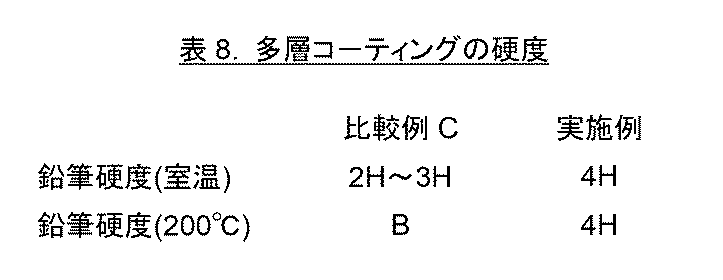
以下の表8中の比較例Cでは、比較例サンプルベースコートは10重量%のフッ素化ポリマー成分(ベースコート組成物の固形分の総重量の割合として添加した10重量%のフッ素化ポリマー固形分)を含んでいる一方で実施例ベースコートはフッ素化ポリマー成分を含んでいないことを除き、表1に示されているものと同一のプレプライマーベースコート層用の配合物(実施例組成物用)が用いられている。プレプライマーベースコート層以外では、コーティング層は実施例多層コーティングと同等である。従来の多層非粘着性コーティングはフッ素化ポリマーをベースコート層(これは通常プライマーである)中に含んでいる。コーティングの硬度を上記の鉛筆硬度試験を利用して評価したが、ここで、試験は多層コーティングの最上位層の表面で行う。ベースコート層中にフッ素化ポリマーを含んでいないことの効果を以下の表8中に示す。
1B: Effect of fluorinated polymer In Comparative Example C in Table 8 below, the comparative sample basecoat was 10% by weight of the fluorinated polymer component (10% by weight added as a percentage of the total weight of the solids of the basecoat composition). The same formulation for the pre-primer basecoat layer as shown in Table 1, except that the example basecoat does not contain a fluorinated polymer component while containing a fluorinated polymer solids). For the composition). Except for the pre-primer basecoat layer, the coating layer is equivalent to the example multilayer coating. Conventional multilayer non-stick coatings include a fluorinated polymer in a basecoat layer (which is usually a primer). The hardness of the coating was evaluated using the pencil hardness test described above, where the test is performed on the surface of the top layer of the multilayer coating. The effect of not including a fluorinated polymer in the base coat layer is shown in Table 8 below.
本発明の実施例多層コーティング(ベースコート層中にフッ素化ポリマーを含まない)の鉛筆硬度は、比較例多層コーティングの鉛筆硬度(この後者は、ベースコート層におけるフッ素化ポリマーの従来の使用を反映する)と比して向上している。 The pencil hardness of the inventive multilayer coating (without the fluorinated polymer in the basecoat layer) is the pencil hardness of the comparative multilayer coating (this latter reflects the conventional use of the fluorinated polymer in the basecoat layer). Compared to
実施例2−耐腐食性
2A:二酸化チタンの効果
ベースコート層中の二酸化チタンの効果を上記の調査と同様に判定した。すべてのサンプルが、各サンプルについて同一の厚さで塗布された同一のプライマー層、中間層およびトップコート層を有していた一方で、ベースコート層のみが異なっていた。各サンプルについて、ベースコート層は、表1の組成を用い、二酸化チタンと炭化ケイ素との相対量のみが異なっている。ベースコート層中には二酸化チタン、炭化ケイ素およびカーボンブラックの3種の無機充填材が存在しており(表1)、カーボンブラックのレベルは、無機充填材の総重量の1.7重量%で一定に保持されている。二酸化チタンおよび炭化ケイ素を様々にして、無機充填材の総重量の割合としての二酸化チタンの重量%表記で、0%、40%、55%、60%および98.3%の二酸化チタンレベルとした。追加の炭化ケイ素を必要とする組成物については、追加分は微小粒径炭化ケイ素(5マイクロメートル)を用いた0%TiO2サンプルを除いて、追加分として同一の粗大粒径炭化ケイ素(炭化ケイ素、P320)を用いた。
Example 2 Corrosion Resistance 2A: Effect of Titanium Dioxide The effect of titanium dioxide in the base coat layer was determined in the same manner as in the above investigation. All samples had the same primer layer, intermediate layer and topcoat layer applied at the same thickness for each sample, while only the basecoat layer was different. For each sample, the base coat layer uses the composition of Table 1 and differs only in the relative amounts of titanium dioxide and silicon carbide. There are three inorganic fillers in the base coat layer: titanium dioxide, silicon carbide and carbon black (Table 1), and the level of carbon black is constant at 1.7% by weight of the total weight of the inorganic filler. Is held in. Titanium dioxide and silicon carbide were varied to give titanium dioxide levels of 0%, 40%, 55%, 60% and 98.3% in terms of weight percent of titanium dioxide as a percentage of the total weight of the inorganic filler. . For compositions requiring additional silicon carbide, the additional portion is the same coarse particle size silicon carbide (carbonized) as the additional portion, except for the 0% TiO 2 sample using fine particle size silicon carbide (5 micrometers). Silicon, P320) was used.
パネルを試験法における上記の腐食試験に供した(結果は表9中)。 The panel was subjected to the above corrosion test in the test method (results are in Table 9).
ベースコート層が高度に充填された層(無機充填粒子対ポリマーバインダ固形分の重量比は1.0超)であると共に、無機充填粒子の50%超が二酸化チタンである場合に、多層コーティングの耐腐食性における顕著な向上が観察された。例示的な耐腐食性が無機充填粒子の60%超が二酸化チタンであるサンプルについて観察された(10試験サイクルにわたって欠損または欠陥は観察されなかった)。
以下、本明細書に記載の主な発明について列記する。
(1) 摩擦力に対する耐久性を有する多層非粘着性コーティングでコーティングされた基材であって、前記コーティングが、
(a)フッ素化ポリマーを実質的に含まず、少なくとも10マイクロメートルの乾燥フィルム厚を有し、耐熱性非フッ素化ポリマー−ポリマーバインダ組成物および無機充填粒子を含むプレプライマーベースコート層であって、無機充填粒子対ポリマーバインダ固形分の重量比が1.0超であり、ならびに、前記無機充填粒子の少なくとも10重量%が少なくとも14マイクロメートルの平均粒径を有する粗大セラミック粒子であり、および、前記無機充填粒子の50%超が二酸化チタンであるプレプライマーベースコート層と、
(b)少なくとも2つのさらなるコーティング層であって、前記さらなるコーティング層は3.0超のアスペクト比を有する無機充填粒子を含まず、および、前記さらなるコーティング層の少なくとも2つは1種以上のフッ素化ポリマーを含む、さらなるコーティング層と
を備え、
前記粗大セラミック粒子の一部が前記プレプライマーベースコート層から少なくとも隣の隣接層に延在している基材。
(2) 前記ベースコート中の前記無機充填粒子の少なくとも60%が二酸化チタンである、(1)に記載のコーティングされた基材。
(3) 前記ベースコートが、約10〜約40マイクロメートルの範囲内の乾燥フィルム厚を有する、(1)に記載のコーティングされた基材。
(4) 前記耐熱性非フッ素化ポリマーバインダが、ポリイミド(PI)、ポリアミドイミド(PAI)、ポリエーテルスルホン(PES)、ポリフェニレンスルフィド(PPS)およびこれらの組み合わせからなる群から選択される1種以上のポリマーを含む、(1)に記載のコーティングされた基材。
(5) 前記非フッ素化ポリマーバインダが、ポリアミドイミド(PAI)およびポリフェニレンスルフィド(PPS)の組み合わせを含む、(1)に記載のコーティングされた基材。
(6) 前記基材が、アルミニウム、ステンレス鋼および炭素鋼からなる群から選択される金属基材である、(1)に記載のコーティングされた基材。
(7) 前記基材がステンレス鋼である、(1)に記載のコーティングされた基材。
(8) 前記無機充填材が、チタン、アルミニウム、亜鉛、錫およびこれらの混合物の1種以上の前記無機酸化物を含む、(1)に記載のコーティングされた基材。
(9) 前記無機充填材が二酸化チタンを含む、(1)に記載のコーティングされた基材。
(10) 前記セラミック粒子が20マイクロメートル超の平均粒径を有する、(1)に記載のコーティングされた基材。
(11) 前記セラミック粒子が14〜60マイクロメートルの範囲内の平均粒径を有する、(1)に記載のコーティングされた基材。
(12) 前記セラミック粒子が少なくとも1200のヌープ硬度を有する、(1)に記載のコーティングされた基材。
(13) 前記セラミック粒子が2.5以下のアスペクト比を有する、(12)に記載のコーティングされた基材。
(14) 前記セラミック粒子が、無機窒化物、炭化物、ホウ化物および酸化物からなる群から選択される、(12)に記載のコーティングされた基材。
(15) 前記セラミック粒子が炭化ケイ素である、(12)に記載のコーティングされた基材。
(16) 前記炭化ケイ素粒子が、2.5以下のアスペクト比および20マイクロメートル超の平均粒径を有する、(15)に記載のコーティングされた基材。
(17) 無機充填粒子の総重量の少なくとも90重量%が炭化ケイ素および二酸化チタンのみから構成される、(1)に記載のコーティングされた基材。
(18) 前記多層非粘着性コーティングが、プレプライマー層、プライマー層およびトップコート、ならびに、任意選択的に1つ以上の中間層を備える、(1)に記載のコーティングされた基材。
When the basecoat layer is a highly packed layer (inorganic filler particles to polymer binder solids weight ratio> 1.0) and more than 50% of the inorganic filler particles are titanium dioxide, A significant improvement in corrosivity was observed. Exemplary corrosion resistance was observed for samples where more than 60% of the inorganic filler particles were titanium dioxide (no defects or defects were observed over 10 test cycles).
The main inventions described in this specification are listed below.
(1) A substrate coated with a multilayer non-tacky coating having durability against frictional force, the coating comprising:
(A) a pre-primer basecoat layer substantially free of fluorinated polymer, having a dry film thickness of at least 10 micrometers, comprising a heat resistant non-fluorinated polymer-polymer binder composition and inorganic filler particles, The weight ratio of inorganic filler particles to polymer binder solids is greater than 1.0, and at least 10% by weight of the inorganic filler particles are coarse ceramic particles having an average particle size of at least 14 micrometers; and A pre-primer basecoat layer in which more than 50% of the inorganic filler particles are titanium dioxide;
(B) at least two additional coating layers, wherein the additional coating layer does not include inorganic filler particles having an aspect ratio greater than 3.0, and at least two of the additional coating layers include one or more fluorine An additional coating layer comprising a polymerized polymer, and
A base material in which a part of the coarse ceramic particles extends from the pre-primer base coat layer to at least an adjacent layer.
(2) The coated substrate according to (1), wherein at least 60% of the inorganic filler particles in the base coat are titanium dioxide.
(3) The coated substrate of (1), wherein the base coat has a dry film thickness in the range of about 10 to about 40 micrometers.
(4) The heat-resistant non-fluorinated polymer binder is one or more selected from the group consisting of polyimide (PI), polyamideimide (PAI), polyethersulfone (PES), polyphenylene sulfide (PPS), and combinations thereof. The coated substrate according to (1), comprising the polymer of:
(5) The coated substrate according to (1), wherein the non-fluorinated polymer binder comprises a combination of polyamideimide (PAI) and polyphenylene sulfide (PPS).
(6) The coated substrate according to (1), wherein the substrate is a metal substrate selected from the group consisting of aluminum, stainless steel, and carbon steel.
(7) The coated substrate according to (1), wherein the substrate is stainless steel.
(8) The coated substrate according to (1), wherein the inorganic filler includes one or more inorganic oxides of titanium, aluminum, zinc, tin, and mixtures thereof.
(9) The coated substrate according to (1), wherein the inorganic filler comprises titanium dioxide.
(10) The coated substrate according to (1), wherein the ceramic particles have an average particle size greater than 20 micrometers.
(11) The coated substrate according to (1), wherein the ceramic particles have an average particle size in the range of 14 to 60 micrometers.
(12) The coated substrate according to (1), wherein the ceramic particles have a Knoop hardness of at least 1200.
(13) The coated substrate according to (12), wherein the ceramic particles have an aspect ratio of 2.5 or less.
(14) The coated substrate according to (12), wherein the ceramic particles are selected from the group consisting of inorganic nitrides, carbides, borides and oxides.
(15) The coated substrate according to (12), wherein the ceramic particles are silicon carbide.
(16) The coated substrate according to (15), wherein the silicon carbide particles have an aspect ratio of 2.5 or less and an average particle size of more than 20 micrometers.
(17) The coated substrate according to (1), wherein at least 90% by weight of the total weight of the inorganic filler particles is composed only of silicon carbide and titanium dioxide.
(18) The coated substrate of (1), wherein the multilayer non-stick coating comprises a pre-primer layer, a primer layer and a top coat, and optionally one or more intermediate layers.
Claims (1)
(a)フッ素化ポリマーを実質的に含まず、少なくとも10マイクロメートルの乾燥フィルム厚を有し、耐熱性非フッ素化ポリマー−ポリマーバインダ組成物および無機充填粒子を含むプレプライマーベースコート層であって、無機充填粒子対ポリマーバインダ固形分の重量比が1.0超であり、ならびに、前記無機充填粒子の少なくとも10重量%が少なくとも14マイクロメートルの平均粒径および2.5以下のアスペクト比を有する粗大セラミック粒子であり、および、前記無機充填粒子の50%超が0.1〜2.0マイクロメートルの粒径を有する二酸化チタンであるプレプライマーベースコート層と、
(b)少なくとも2つのさらなるコーティング層であって、前記さらなるコーティング層は3.0超のアスペクト比を有する無機充填粒子を含まず、および、前記さらなるコーティング層の少なくとも2つは1種以上のフッ素化ポリマーを含む、さらなるコーティング層と
を備え、
前記粗大セラミック粒子の一部が前記プレプライマーベースコート層から少なくとも隣の隣接層に延在している基材。 A substrate coated with a multilayer non-tacky coating having durability against frictional forces, said coating comprising:
(A) a pre-primer basecoat layer substantially free of fluorinated polymer, having a dry film thickness of at least 10 micrometers, comprising a heat resistant non-fluorinated polymer-polymer binder composition and inorganic filler particles, The weight ratio of inorganic filler particles to polymer binder solids is greater than 1.0, and at least 10% by weight of the inorganic filler particles are coarse having an average particle size of at least 14 micrometers and an aspect ratio of 2.5 or less A pre-primer basecoat layer that is ceramic particles and wherein more than 50% of the inorganic filler particles are titanium dioxide having a particle size of 0.1 to 2.0 micrometers ;
(B) at least two additional coating layers, wherein the additional coating layer does not include inorganic filler particles having an aspect ratio greater than 3.0, and at least two of the additional coating layers include one or more fluorine An additional coating layer comprising a polymerized polymer, and
A base material in which a part of the coarse ceramic particles extends from the pre-primer base coat layer to at least an adjacent layer.
Applications Claiming Priority (3)
| Application Number | Priority Date | Filing Date | Title |
|---|---|---|---|
| US37140610P | 2010-08-06 | 2010-08-06 | |
| US61/371,406 | 2010-08-06 | ||
| PCT/US2011/046722 WO2012019088A1 (en) | 2010-08-06 | 2011-08-05 | Non-stick coating having improved abrasion resistance and hardness on a substrate |
Publications (3)
| Publication Number | Publication Date |
|---|---|
| JP2013538706A JP2013538706A (en) | 2013-10-17 |
| JP2013538706A5 JP2013538706A5 (en) | 2014-06-26 |
| JP5779647B2 true JP5779647B2 (en) | 2015-09-16 |
Family
ID=44511557
Family Applications (1)
| Application Number | Title | Priority Date | Filing Date |
|---|---|---|---|
| JP2013524127A Expired - Fee Related JP5779647B2 (en) | 2010-08-06 | 2011-08-05 | Non-stick coating with improved wear resistance and hardness on substrates |
Country Status (5)
| Country | Link |
|---|---|
| US (1) | US8642171B2 (en) |
| JP (1) | JP5779647B2 (en) |
| KR (1) | KR101962482B1 (en) |
| CN (1) | CN103068494B (en) |
| WO (1) | WO2012019088A1 (en) |
Families Citing this family (33)
| Publication number | Priority date | Publication date | Assignee | Title |
|---|---|---|---|---|
| BR112014016855A2 (en) * | 2012-01-09 | 2017-06-13 | Du Pont | binder solutions |
| JP6066581B2 (en) * | 2012-04-27 | 2017-01-25 | 三井・デュポンフロロケミカル株式会社 | Polymer particles, aqueous dispersion containing the same, and fluororesin coating composition using the same |
| US10400129B2 (en) * | 2012-07-17 | 2019-09-03 | Her Majesty The Queen In Right Of Canada As Represented By The Minister Of Natural Resources | Method and composite for preparing heat exchangers for corrosive environments |
| EP2882894A1 (en) * | 2012-08-09 | 2015-06-17 | E. I. du Pont de Nemours and Company | Improved barrier fabrics |
| US9057001B2 (en) * | 2012-11-02 | 2015-06-16 | Rockwell Automation Technologies, Inc. | Transparent non-stick coating composition, method and apparatus |
| FR2997616A1 (en) * | 2012-11-06 | 2014-05-09 | Seb Sa | COOKING DEVICE HAVING A COOKING SURFACE HAVING NON-OXIDE OR AT LEAST PARTIALLY NON-OXIDE CERAMIC ANTI-ADHESIVE COATING, AND CULINARY ARTICLE OR HOME APPLIANCE COMPRISING SUCH A COOKING DEVICE |
| CN102952465A (en) * | 2012-11-14 | 2013-03-06 | 无锡卡秀堡辉涂料有限公司 | Water-base roller coating construction paint for non-stick pan inter-coat cooker |
| US20140272430A1 (en) * | 2013-03-15 | 2014-09-18 | Sabic Innovative Plastics Ip B.V. | Process of making dispersed polyetherimide micronized particles and process of coating and further forming of these particles products made therefrom |
| CN105745076B (en) * | 2013-11-26 | 2018-10-16 | 大金工业株式会社 | laminate |
| SG11201609628UA (en) * | 2014-05-20 | 2016-12-29 | Whitford Corp | Sol-gel compositions with improved hardness and impact resistance |
| FR3022553A1 (en) * | 2014-06-20 | 2015-12-25 | Seb Sa | AQUEOUS PHASE PRIMARY COMPOSITION VIA HETEROCYCLIC POLYMERS IN THE FORM OF POWDERS OBTAINED BY MILLING |
| DE102015201168A1 (en) * | 2015-01-23 | 2016-07-28 | Aktiebolaget Skf | sensor |
| WO2016161264A2 (en) * | 2015-04-01 | 2016-10-06 | 3M Innovative Properties Company | Multilayer articles comprising a release surface and methods thereof |
| CN107531010A (en) * | 2015-04-01 | 2018-01-02 | 3M创新有限公司 | Multilayer article including release surface and method thereof |
| US10479067B2 (en) | 2015-04-01 | 2019-11-19 | 3M Innovative Properties Company | Multilayer articles comprising a release surface and methods thereof |
| BR112017028586A2 (en) * | 2015-07-10 | 2018-08-28 | Whitford Corp | composition for forming low friction, high release functional coatings |
| WO2017140514A1 (en) * | 2016-02-15 | 2017-08-24 | Nv Bekaert Sa | Wire for hook and eye brassiere closures |
| CN105925029A (en) * | 2016-06-07 | 2016-09-07 | 平顶山市美伊金属制品有限公司 | Non-stick pan spray coating containing absorbable iron element |
| CN106065212A (en) * | 2016-06-07 | 2016-11-02 | 平顶山市美伊金属制品有限公司 | A kind of non-stick pan spray paint containing acceptable calcium element |
| CN105925043A (en) * | 2016-06-07 | 2016-09-07 | 平顶山市美伊金属制品有限公司 | Non-stick pan spray coating containing absorbable zinc element |
| JP6461050B2 (en) * | 2016-06-28 | 2019-01-30 | エスシージー ケミカルズ カンパニー,リミテッド | High emissivity coating composition and manufacturing process thereof |
| CN109803563B (en) * | 2016-10-12 | 2022-05-10 | 科慕埃弗西有限公司 | Low bake temperature fluoropolymer coating |
| JP7105787B2 (en) * | 2017-02-07 | 2022-07-25 | ザ ケマーズ カンパニー エフシー リミテッド ライアビリティ カンパニー | Substrate coated with a non-stick coating that resists abrasion and scratches |
| US10598419B2 (en) * | 2017-05-19 | 2020-03-24 | Zhejiang Ocean University | Seawater fluidized ice manufacturing equipment and method |
| CN107760183A (en) * | 2017-11-10 | 2018-03-06 | 宁波市恩迪卫浴有限公司 | A kind of composite coating of antiwear heat resisting and preparation method thereof |
| WO2019154816A1 (en) * | 2018-02-06 | 2019-08-15 | Thermolon Korea Co. Ltd. | Non-stick ceramic coating comprising diamonds and coloured mica |
| BR112021003178A2 (en) | 2018-08-20 | 2021-05-11 | Advanced Flexible Composites, Inc. | cookware, food support, replaceable cooking surface or insert, use of food support, method, and composite material. |
| FR3091532B1 (en) | 2019-01-07 | 2022-07-29 | Seb Sa | NON-STICK COATING |
| PL3955785T3 (en) * | 2019-04-15 | 2025-12-01 | Advanced Flexible Composites, Inc. | Nonstick composite materials and molded nonstick cookware |
| JP6819717B2 (en) * | 2019-04-19 | 2021-01-27 | ダイキン工業株式会社 | Coating composition and coating article |
| CN110305579B (en) * | 2019-06-05 | 2021-07-06 | 浙江鹏孚隆科技股份有限公司 | Wear-resistant scratch-resistant long-service-life non-stick coating and coating method thereof |
| PL3964300T3 (en) * | 2020-09-04 | 2023-07-17 | Industrielack Ag | Fluorine-free antiadhesive coating and method for the production of same |
| CN115044853B (en) * | 2022-06-29 | 2023-09-15 | 武汉苏泊尔炊具有限公司 | Amorphous non-stick material and amorphous non-stick coating for cookware |
Family Cites Families (16)
| Publication number | Priority date | Publication date | Assignee | Title |
|---|---|---|---|---|
| US4177320A (en) * | 1976-12-10 | 1979-12-04 | Daikin Kogyo Co., Ltd. | Article coated with fluorocarbon polymer |
| US4380618A (en) | 1981-08-21 | 1983-04-19 | E. I. Du Pont De Nemours And Company | Batch polymerization process |
| US5079073A (en) | 1989-08-21 | 1992-01-07 | E. I. Du Pont De Nemours And Company | Non-stick coating system with thin undercoat of polyamide imide |
| US6291054B1 (en) | 1999-02-19 | 2001-09-18 | E. I. Du Pont De Nemours And Company | Abrasion resistant coatings |
| US6403213B1 (en) | 1999-05-14 | 2002-06-11 | E. I. Du Pont De Nemours And Company | Highly filled undercoat for non-stick finish |
| JP3608037B2 (en) * | 2000-02-10 | 2005-01-05 | 大阪瓦斯株式会社 | Cooking utensils and cooking utensils |
| US6846570B2 (en) * | 2000-08-17 | 2005-01-25 | Whitford Corporation | Multiple coat non-stick coating system and articles coated with same |
| US6761964B2 (en) | 2001-04-02 | 2004-07-13 | E. I. Du Pont De Nemours And Company | Fluoropolymer non-stick coatings |
| US6863974B2 (en) | 2002-09-13 | 2005-03-08 | Akzo Nobel Coatings International B.V. | Multilayer non-stick coating |
| US20040115477A1 (en) | 2002-12-12 | 2004-06-17 | Bruce Nesbitt | Coating reinforcing underlayment and method of manufacturing same |
| JP2004283699A (en) * | 2003-03-20 | 2004-10-14 | Osaka Gas Co Ltd | Member for gas using facility applied with high durable coating |
| US20060134404A1 (en) | 2004-12-16 | 2006-06-22 | Witsch Michael J | Fluoropolymer release coating with improved heat transfer |
| US20070036900A1 (en) * | 2005-08-12 | 2007-02-15 | Yuqing Liu | Process for improving the corrosion resistance of a non-stick coating on a substrate |
| US7858188B2 (en) * | 2005-12-14 | 2010-12-28 | Dupont-Mitsui Fluorochemicals Co Ltd | Non-stick coating composition comprising diamond particles and substrate |
| US8012542B2 (en) * | 2005-12-30 | 2011-09-06 | E.I. Du Pont De Nemours And Company | Fluoropolymer coating compositions containing adhesive polymers and substrate coating process |
| US8158251B2 (en) * | 2008-02-07 | 2012-04-17 | E. I. Du Pont De Nemours And Company | Article with non-stick finish and improved scratch resistance |
-
2011
- 2011-08-04 US US13/197,965 patent/US8642171B2/en not_active Expired - Fee Related
- 2011-08-05 KR KR1020137005635A patent/KR101962482B1/en not_active Expired - Fee Related
- 2011-08-05 JP JP2013524127A patent/JP5779647B2/en not_active Expired - Fee Related
- 2011-08-05 WO PCT/US2011/046722 patent/WO2012019088A1/en not_active Ceased
- 2011-08-05 CN CN201180038613.9A patent/CN103068494B/en not_active Expired - Fee Related
Also Published As
| Publication number | Publication date |
|---|---|
| KR101962482B1 (en) | 2019-03-26 |
| WO2012019088A1 (en) | 2012-02-09 |
| CN103068494A (en) | 2013-04-24 |
| CN103068494B (en) | 2015-01-28 |
| KR20130096721A (en) | 2013-08-30 |
| US8642171B2 (en) | 2014-02-04 |
| US20120034448A1 (en) | 2012-02-09 |
| JP2013538706A (en) | 2013-10-17 |
Similar Documents
| Publication | Publication Date | Title |
|---|---|---|
| KR101962482B1 (en) | Non-stick coating having improved abrasion resistance and hardness on a substrate | |
| US6592977B2 (en) | Abrasion resistant coatings | |
| JP5319282B2 (en) | Method for improving the corrosion resistance of non-stick coatings on substrates | |
| EP2240056B1 (en) | Article with non-stick finish and improved scratch resistance | |
| CN101415763B (en) | Non-stick finish | |
| JP5244088B2 (en) | Non-adhesive finish | |
| WO2008063560A2 (en) | Glass articles with adhesion and stain resistant non-stick coatings | |
| US7772311B2 (en) | Non-stick finish composition | |
| TWI472584B (en) | Non-stick finish | |
| HK1130823B (en) | Non-stick finish |
Legal Events
| Date | Code | Title | Description |
|---|---|---|---|
| A521 | Request for written amendment filed |
Free format text: JAPANESE INTERMEDIATE CODE: A523 Effective date: 20140509 |
|
| A621 | Written request for application examination |
Free format text: JAPANESE INTERMEDIATE CODE: A621 Effective date: 20140509 |
|
| A977 | Report on retrieval |
Free format text: JAPANESE INTERMEDIATE CODE: A971007 Effective date: 20150225 |
|
| A131 | Notification of reasons for refusal |
Free format text: JAPANESE INTERMEDIATE CODE: A131 Effective date: 20150303 |
|
| A521 | Request for written amendment filed |
Free format text: JAPANESE INTERMEDIATE CODE: A523 Effective date: 20150521 |
|
| TRDD | Decision of grant or rejection written | ||
| A01 | Written decision to grant a patent or to grant a registration (utility model) |
Free format text: JAPANESE INTERMEDIATE CODE: A01 Effective date: 20150616 |
|
| A61 | First payment of annual fees (during grant procedure) |
Free format text: JAPANESE INTERMEDIATE CODE: A61 Effective date: 20150713 |
|
| R150 | Certificate of patent or registration of utility model |
Ref document number: 5779647 Country of ref document: JP Free format text: JAPANESE INTERMEDIATE CODE: R150 |
|
| S111 | Request for change of ownership or part of ownership |
Free format text: JAPANESE INTERMEDIATE CODE: R313113 |
|
| S531 | Written request for registration of change of domicile |
Free format text: JAPANESE INTERMEDIATE CODE: R313531 |
|
| R350 | Written notification of registration of transfer |
Free format text: JAPANESE INTERMEDIATE CODE: R350 |
|
| R250 | Receipt of annual fees |
Free format text: JAPANESE INTERMEDIATE CODE: R250 |
|
| R250 | Receipt of annual fees |
Free format text: JAPANESE INTERMEDIATE CODE: R250 |
|
| R250 | Receipt of annual fees |
Free format text: JAPANESE INTERMEDIATE CODE: R250 |
|
| R250 | Receipt of annual fees |
Free format text: JAPANESE INTERMEDIATE CODE: R250 |
|
| R250 | Receipt of annual fees |
Free format text: JAPANESE INTERMEDIATE CODE: R250 |
|
| R250 | Receipt of annual fees |
Free format text: JAPANESE INTERMEDIATE CODE: R250 |
|
| R250 | Receipt of annual fees |
Free format text: JAPANESE INTERMEDIATE CODE: R250 |
|
| LAPS | Cancellation because of no payment of annual fees |