JP5654875B2 - Method for producing foamed pressure sensitive adhesive - Google Patents
Method for producing foamed pressure sensitive adhesive Download PDFInfo
- Publication number
- JP5654875B2 JP5654875B2 JP2010541768A JP2010541768A JP5654875B2 JP 5654875 B2 JP5654875 B2 JP 5654875B2 JP 2010541768 A JP2010541768 A JP 2010541768A JP 2010541768 A JP2010541768 A JP 2010541768A JP 5654875 B2 JP5654875 B2 JP 5654875B2
- Authority
- JP
- Japan
- Prior art keywords
- adhesive
- microballoon
- mixing device
- pressure
- roll
- Prior art date
- Legal status (The legal status is an assumption and is not a legal conclusion. Google has not performed a legal analysis and makes no representation as to the accuracy of the status listed.)
- Active
Links
Images


Classifications
-
- C—CHEMISTRY; METALLURGY
- C08—ORGANIC MACROMOLECULAR COMPOUNDS; THEIR PREPARATION OR CHEMICAL WORKING-UP; COMPOSITIONS BASED THEREON
- C08J—WORKING-UP; GENERAL PROCESSES OF COMPOUNDING; AFTER-TREATMENT NOT COVERED BY SUBCLASSES C08B, C08C, C08F, C08G or C08H
- C08J9/00—Working-up of macromolecular substances to porous or cellular articles or materials; After-treatment thereof
- C08J9/32—Working-up of macromolecular substances to porous or cellular articles or materials; After-treatment thereof from compositions containing microballoons, e.g. syntactic foams
-
- C—CHEMISTRY; METALLURGY
- C09—DYES; PAINTS; POLISHES; NATURAL RESINS; ADHESIVES; COMPOSITIONS NOT OTHERWISE PROVIDED FOR; APPLICATIONS OF MATERIALS NOT OTHERWISE PROVIDED FOR
- C09J—ADHESIVES; NON-MECHANICAL ASPECTS OF ADHESIVE PROCESSES IN GENERAL; ADHESIVE PROCESSES NOT PROVIDED FOR ELSEWHERE; USE OF MATERIALS AS ADHESIVES
- C09J11/00—Features of adhesives not provided for in group C09J9/00, e.g. additives
-
- B—PERFORMING OPERATIONS; TRANSPORTING
- B29—WORKING OF PLASTICS; WORKING OF SUBSTANCES IN A PLASTIC STATE IN GENERAL
- B29B—PREPARATION OR PRETREATMENT OF THE MATERIAL TO BE SHAPED; MAKING GRANULES OR PREFORMS; RECOVERY OF PLASTICS OR OTHER CONSTITUENTS OF WASTE MATERIAL CONTAINING PLASTICS
- B29B7/00—Mixing; Kneading
- B29B7/30—Mixing; Kneading continuous, with mechanical mixing or kneading devices
- B29B7/34—Mixing; Kneading continuous, with mechanical mixing or kneading devices with movable mixing or kneading devices
- B29B7/38—Mixing; Kneading continuous, with mechanical mixing or kneading devices with movable mixing or kneading devices rotary
- B29B7/40—Mixing; Kneading continuous, with mechanical mixing or kneading devices with movable mixing or kneading devices rotary with single shaft
- B29B7/42—Mixing; Kneading continuous, with mechanical mixing or kneading devices with movable mixing or kneading devices rotary with single shaft with screw or helix
- B29B7/426—Mixing; Kneading continuous, with mechanical mixing or kneading devices with movable mixing or kneading devices rotary with single shaft with screw or helix with consecutive casings or screws, e.g. for charging, discharging, mixing
-
- B—PERFORMING OPERATIONS; TRANSPORTING
- B29—WORKING OF PLASTICS; WORKING OF SUBSTANCES IN A PLASTIC STATE IN GENERAL
- B29B—PREPARATION OR PRETREATMENT OF THE MATERIAL TO BE SHAPED; MAKING GRANULES OR PREFORMS; RECOVERY OF PLASTICS OR OTHER CONSTITUENTS OF WASTE MATERIAL CONTAINING PLASTICS
- B29B7/00—Mixing; Kneading
- B29B7/30—Mixing; Kneading continuous, with mechanical mixing or kneading devices
- B29B7/34—Mixing; Kneading continuous, with mechanical mixing or kneading devices with movable mixing or kneading devices
- B29B7/38—Mixing; Kneading continuous, with mechanical mixing or kneading devices with movable mixing or kneading devices rotary
- B29B7/46—Mixing; Kneading continuous, with mechanical mixing or kneading devices with movable mixing or kneading devices rotary with more than one shaft
- B29B7/48—Mixing; Kneading continuous, with mechanical mixing or kneading devices with movable mixing or kneading devices rotary with more than one shaft with intermeshing devices, e.g. screws
- B29B7/485—Mixing; Kneading continuous, with mechanical mixing or kneading devices with movable mixing or kneading devices rotary with more than one shaft with intermeshing devices, e.g. screws with three or more shafts provided with screws
-
- B—PERFORMING OPERATIONS; TRANSPORTING
- B29—WORKING OF PLASTICS; WORKING OF SUBSTANCES IN A PLASTIC STATE IN GENERAL
- B29B—PREPARATION OR PRETREATMENT OF THE MATERIAL TO BE SHAPED; MAKING GRANULES OR PREFORMS; RECOVERY OF PLASTICS OR OTHER CONSTITUENTS OF WASTE MATERIAL CONTAINING PLASTICS
- B29B7/00—Mixing; Kneading
- B29B7/30—Mixing; Kneading continuous, with mechanical mixing or kneading devices
- B29B7/34—Mixing; Kneading continuous, with mechanical mixing or kneading devices with movable mixing or kneading devices
- B29B7/38—Mixing; Kneading continuous, with mechanical mixing or kneading devices with movable mixing or kneading devices rotary
- B29B7/46—Mixing; Kneading continuous, with mechanical mixing or kneading devices with movable mixing or kneading devices rotary with more than one shaft
- B29B7/48—Mixing; Kneading continuous, with mechanical mixing or kneading devices with movable mixing or kneading devices rotary with more than one shaft with intermeshing devices, e.g. screws
- B29B7/487—Mixing; Kneading continuous, with mechanical mixing or kneading devices with movable mixing or kneading devices rotary with more than one shaft with intermeshing devices, e.g. screws with consecutive casings or screws, e.g. for feeding, discharging, mixing
-
- B—PERFORMING OPERATIONS; TRANSPORTING
- B29—WORKING OF PLASTICS; WORKING OF SUBSTANCES IN A PLASTIC STATE IN GENERAL
- B29B—PREPARATION OR PRETREATMENT OF THE MATERIAL TO BE SHAPED; MAKING GRANULES OR PREFORMS; RECOVERY OF PLASTICS OR OTHER CONSTITUENTS OF WASTE MATERIAL CONTAINING PLASTICS
- B29B7/00—Mixing; Kneading
- B29B7/74—Mixing; Kneading using other mixers or combinations of mixers, e.g. of dissimilar mixers ; Plant
- B29B7/7461—Combinations of dissimilar mixers
-
- B—PERFORMING OPERATIONS; TRANSPORTING
- B29—WORKING OF PLASTICS; WORKING OF SUBSTANCES IN A PLASTIC STATE IN GENERAL
- B29B—PREPARATION OR PRETREATMENT OF THE MATERIAL TO BE SHAPED; MAKING GRANULES OR PREFORMS; RECOVERY OF PLASTICS OR OTHER CONSTITUENTS OF WASTE MATERIAL CONTAINING PLASTICS
- B29B7/00—Mixing; Kneading
- B29B7/74—Mixing; Kneading using other mixers or combinations of mixers, e.g. of dissimilar mixers ; Plant
- B29B7/7476—Systems, i.e. flow charts or diagrams; Plants
- B29B7/748—Plants
-
- B—PERFORMING OPERATIONS; TRANSPORTING
- B29—WORKING OF PLASTICS; WORKING OF SUBSTANCES IN A PLASTIC STATE IN GENERAL
- B29B—PREPARATION OR PRETREATMENT OF THE MATERIAL TO BE SHAPED; MAKING GRANULES OR PREFORMS; RECOVERY OF PLASTICS OR OTHER CONSTITUENTS OF WASTE MATERIAL CONTAINING PLASTICS
- B29B7/00—Mixing; Kneading
- B29B7/74—Mixing; Kneading using other mixers or combinations of mixers, e.g. of dissimilar mixers ; Plant
- B29B7/7476—Systems, i.e. flow charts or diagrams; Plants
- B29B7/7495—Systems, i.e. flow charts or diagrams; Plants for mixing rubber
-
- B—PERFORMING OPERATIONS; TRANSPORTING
- B29—WORKING OF PLASTICS; WORKING OF SUBSTANCES IN A PLASTIC STATE IN GENERAL
- B29C—SHAPING OR JOINING OF PLASTICS; SHAPING OF MATERIAL IN A PLASTIC STATE, NOT OTHERWISE PROVIDED FOR; AFTER-TREATMENT OF THE SHAPED PRODUCTS, e.g. REPAIRING
- B29C43/00—Compression moulding, i.e. applying external pressure to flow the moulding material; Apparatus therefor
- B29C43/22—Compression moulding, i.e. applying external pressure to flow the moulding material; Apparatus therefor of articles of indefinite length
- B29C43/24—Calendering
-
- B—PERFORMING OPERATIONS; TRANSPORTING
- B29—WORKING OF PLASTICS; WORKING OF SUBSTANCES IN A PLASTIC STATE IN GENERAL
- B29C—SHAPING OR JOINING OF PLASTICS; SHAPING OF MATERIAL IN A PLASTIC STATE, NOT OTHERWISE PROVIDED FOR; AFTER-TREATMENT OF THE SHAPED PRODUCTS, e.g. REPAIRING
- B29C43/00—Compression moulding, i.e. applying external pressure to flow the moulding material; Apparatus therefor
- B29C43/22—Compression moulding, i.e. applying external pressure to flow the moulding material; Apparatus therefor of articles of indefinite length
- B29C43/28—Compression moulding, i.e. applying external pressure to flow the moulding material; Apparatus therefor of articles of indefinite length incorporating preformed parts or layers, e.g. compression moulding around inserts or for coating articles
-
- B—PERFORMING OPERATIONS; TRANSPORTING
- B29—WORKING OF PLASTICS; WORKING OF SUBSTANCES IN A PLASTIC STATE IN GENERAL
- B29C—SHAPING OR JOINING OF PLASTICS; SHAPING OF MATERIAL IN A PLASTIC STATE, NOT OTHERWISE PROVIDED FOR; AFTER-TREATMENT OF THE SHAPED PRODUCTS, e.g. REPAIRING
- B29C48/00—Extrusion moulding, i.e. expressing the moulding material through a die or nozzle which imparts the desired form; Apparatus therefor
- B29C48/001—Combinations of extrusion moulding with other shaping operations
- B29C48/0011—Combinations of extrusion moulding with other shaping operations combined with compression moulding
-
- B—PERFORMING OPERATIONS; TRANSPORTING
- B29—WORKING OF PLASTICS; WORKING OF SUBSTANCES IN A PLASTIC STATE IN GENERAL
- B29C—SHAPING OR JOINING OF PLASTICS; SHAPING OF MATERIAL IN A PLASTIC STATE, NOT OTHERWISE PROVIDED FOR; AFTER-TREATMENT OF THE SHAPED PRODUCTS, e.g. REPAIRING
- B29C48/00—Extrusion moulding, i.e. expressing the moulding material through a die or nozzle which imparts the desired form; Apparatus therefor
- B29C48/15—Extrusion moulding, i.e. expressing the moulding material through a die or nozzle which imparts the desired form; Apparatus therefor incorporating preformed parts or layers, e.g. extrusion moulding around inserts
- B29C48/154—Coating solid articles, i.e. non-hollow articles
-
- B—PERFORMING OPERATIONS; TRANSPORTING
- B29—WORKING OF PLASTICS; WORKING OF SUBSTANCES IN A PLASTIC STATE IN GENERAL
- B29C—SHAPING OR JOINING OF PLASTICS; SHAPING OF MATERIAL IN A PLASTIC STATE, NOT OTHERWISE PROVIDED FOR; AFTER-TREATMENT OF THE SHAPED PRODUCTS, e.g. REPAIRING
- B29C48/00—Extrusion moulding, i.e. expressing the moulding material through a die or nozzle which imparts the desired form; Apparatus therefor
- B29C48/25—Component parts, details or accessories; Auxiliary operations
- B29C48/36—Means for plasticising or homogenising the moulding material or forcing it through the nozzle or die
- B29C48/375—Plasticisers, homogenisers or feeders comprising two or more stages
- B29C48/385—Plasticisers, homogenisers or feeders comprising two or more stages using two or more serially arranged screws in separate barrels
-
- B—PERFORMING OPERATIONS; TRANSPORTING
- B29—WORKING OF PLASTICS; WORKING OF SUBSTANCES IN A PLASTIC STATE IN GENERAL
- B29C—SHAPING OR JOINING OF PLASTICS; SHAPING OF MATERIAL IN A PLASTIC STATE, NOT OTHERWISE PROVIDED FOR; AFTER-TREATMENT OF THE SHAPED PRODUCTS, e.g. REPAIRING
- B29C48/00—Extrusion moulding, i.e. expressing the moulding material through a die or nozzle which imparts the desired form; Apparatus therefor
- B29C48/25—Component parts, details or accessories; Auxiliary operations
- B29C48/36—Means for plasticising or homogenising the moulding material or forcing it through the nozzle or die
- B29C48/395—Means for plasticising or homogenising the moulding material or forcing it through the nozzle or die using screws surrounded by a cooperating barrel, e.g. single screw extruders
- B29C48/40—Means for plasticising or homogenising the moulding material or forcing it through the nozzle or die using screws surrounded by a cooperating barrel, e.g. single screw extruders using two or more parallel screws or at least two parallel non-intermeshing screws, e.g. twin screw extruders
-
- B—PERFORMING OPERATIONS; TRANSPORTING
- B29—WORKING OF PLASTICS; WORKING OF SUBSTANCES IN A PLASTIC STATE IN GENERAL
- B29C—SHAPING OR JOINING OF PLASTICS; SHAPING OF MATERIAL IN A PLASTIC STATE, NOT OTHERWISE PROVIDED FOR; AFTER-TREATMENT OF THE SHAPED PRODUCTS, e.g. REPAIRING
- B29C48/00—Extrusion moulding, i.e. expressing the moulding material through a die or nozzle which imparts the desired form; Apparatus therefor
- B29C48/25—Component parts, details or accessories; Auxiliary operations
- B29C48/36—Means for plasticising or homogenising the moulding material or forcing it through the nozzle or die
- B29C48/395—Means for plasticising or homogenising the moulding material or forcing it through the nozzle or die using screws surrounded by a cooperating barrel, e.g. single screw extruders
- B29C48/40—Means for plasticising or homogenising the moulding material or forcing it through the nozzle or die using screws surrounded by a cooperating barrel, e.g. single screw extruders using two or more parallel screws or at least two parallel non-intermeshing screws, e.g. twin screw extruders
- B29C48/435—Sub-screws
- B29C48/44—Planetary screws
-
- B—PERFORMING OPERATIONS; TRANSPORTING
- B29—WORKING OF PLASTICS; WORKING OF SUBSTANCES IN A PLASTIC STATE IN GENERAL
- B29C—SHAPING OR JOINING OF PLASTICS; SHAPING OF MATERIAL IN A PLASTIC STATE, NOT OTHERWISE PROVIDED FOR; AFTER-TREATMENT OF THE SHAPED PRODUCTS, e.g. REPAIRING
- B29C48/00—Extrusion moulding, i.e. expressing the moulding material through a die or nozzle which imparts the desired form; Apparatus therefor
- B29C48/25—Component parts, details or accessories; Auxiliary operations
- B29C48/92—Measuring, controlling or regulating
-
- B—PERFORMING OPERATIONS; TRANSPORTING
- B29—WORKING OF PLASTICS; WORKING OF SUBSTANCES IN A PLASTIC STATE IN GENERAL
- B29C—SHAPING OR JOINING OF PLASTICS; SHAPING OF MATERIAL IN A PLASTIC STATE, NOT OTHERWISE PROVIDED FOR; AFTER-TREATMENT OF THE SHAPED PRODUCTS, e.g. REPAIRING
- B29C70/00—Shaping composites, i.e. plastics material comprising reinforcements, fillers or preformed parts, e.g. inserts
- B29C70/58—Shaping composites, i.e. plastics material comprising reinforcements, fillers or preformed parts, e.g. inserts comprising fillers only, e.g. particles, powder, beads, flakes, spheres
- B29C70/60—Shaping composites, i.e. plastics material comprising reinforcements, fillers or preformed parts, e.g. inserts comprising fillers only, e.g. particles, powder, beads, flakes, spheres comprising a combination of distinct filler types incorporated in matrix material, forming one or more layers, and with or without non-filled layers
- B29C70/606—Shaping composites, i.e. plastics material comprising reinforcements, fillers or preformed parts, e.g. inserts comprising fillers only, e.g. particles, powder, beads, flakes, spheres comprising a combination of distinct filler types incorporated in matrix material, forming one or more layers, and with or without non-filled layers and with one or more layers of non-plastics material or non-specified material, e.g. supports
-
- B—PERFORMING OPERATIONS; TRANSPORTING
- B29—WORKING OF PLASTICS; WORKING OF SUBSTANCES IN A PLASTIC STATE IN GENERAL
- B29C—SHAPING OR JOINING OF PLASTICS; SHAPING OF MATERIAL IN A PLASTIC STATE, NOT OTHERWISE PROVIDED FOR; AFTER-TREATMENT OF THE SHAPED PRODUCTS, e.g. REPAIRING
- B29C70/00—Shaping composites, i.e. plastics material comprising reinforcements, fillers or preformed parts, e.g. inserts
- B29C70/58—Shaping composites, i.e. plastics material comprising reinforcements, fillers or preformed parts, e.g. inserts comprising fillers only, e.g. particles, powder, beads, flakes, spheres
- B29C70/66—Shaping composites, i.e. plastics material comprising reinforcements, fillers or preformed parts, e.g. inserts comprising fillers only, e.g. particles, powder, beads, flakes, spheres the filler comprising hollow constituents, e.g. syntactic foam
-
- C—CHEMISTRY; METALLURGY
- C08—ORGANIC MACROMOLECULAR COMPOUNDS; THEIR PREPARATION OR CHEMICAL WORKING-UP; COMPOSITIONS BASED THEREON
- C08K—Use of inorganic or non-macromolecular organic substances as compounding ingredients
- C08K7/00—Use of ingredients characterised by shape
- C08K7/22—Expanded, porous or hollow particles
-
- C—CHEMISTRY; METALLURGY
- C08—ORGANIC MACROMOLECULAR COMPOUNDS; THEIR PREPARATION OR CHEMICAL WORKING-UP; COMPOSITIONS BASED THEREON
- C08L—COMPOSITIONS OF MACROMOLECULAR COMPOUNDS
- C08L53/00—Compositions of block copolymers containing at least one sequence of a polymer obtained by reactions only involving carbon-to-carbon unsaturated bonds; Compositions of derivatives of such polymers
- C08L53/02—Compositions of block copolymers containing at least one sequence of a polymer obtained by reactions only involving carbon-to-carbon unsaturated bonds; Compositions of derivatives of such polymers of vinyl-aromatic monomers and conjugated dienes
-
- C—CHEMISTRY; METALLURGY
- C08—ORGANIC MACROMOLECULAR COMPOUNDS; THEIR PREPARATION OR CHEMICAL WORKING-UP; COMPOSITIONS BASED THEREON
- C08L—COMPOSITIONS OF MACROMOLECULAR COMPOUNDS
- C08L55/00—Compositions of homopolymers or copolymers, obtained by polymerisation reactions only involving carbon-to-carbon unsaturated bonds, not provided for in groups C08L23/00 - C08L53/00
- C08L55/02—ABS [Acrylonitrile-Butadiene-Styrene] polymers
-
- C—CHEMISTRY; METALLURGY
- C09—DYES; PAINTS; POLISHES; NATURAL RESINS; ADHESIVES; COMPOSITIONS NOT OTHERWISE PROVIDED FOR; APPLICATIONS OF MATERIALS NOT OTHERWISE PROVIDED FOR
- C09J—ADHESIVES; NON-MECHANICAL ASPECTS OF ADHESIVE PROCESSES IN GENERAL; ADHESIVE PROCESSES NOT PROVIDED FOR ELSEWHERE; USE OF MATERIALS AS ADHESIVES
- C09J107/00—Adhesives based on natural rubber
-
- C—CHEMISTRY; METALLURGY
- C09—DYES; PAINTS; POLISHES; NATURAL RESINS; ADHESIVES; COMPOSITIONS NOT OTHERWISE PROVIDED FOR; APPLICATIONS OF MATERIALS NOT OTHERWISE PROVIDED FOR
- C09J—ADHESIVES; NON-MECHANICAL ASPECTS OF ADHESIVE PROCESSES IN GENERAL; ADHESIVE PROCESSES NOT PROVIDED FOR ELSEWHERE; USE OF MATERIALS AS ADHESIVES
- C09J11/00—Features of adhesives not provided for in group C09J9/00, e.g. additives
- C09J11/08—Macromolecular additives
-
- C—CHEMISTRY; METALLURGY
- C09—DYES; PAINTS; POLISHES; NATURAL RESINS; ADHESIVES; COMPOSITIONS NOT OTHERWISE PROVIDED FOR; APPLICATIONS OF MATERIALS NOT OTHERWISE PROVIDED FOR
- C09J—ADHESIVES; NON-MECHANICAL ASPECTS OF ADHESIVE PROCESSES IN GENERAL; ADHESIVE PROCESSES NOT PROVIDED FOR ELSEWHERE; USE OF MATERIALS AS ADHESIVES
- C09J121/00—Adhesives based on unspecified rubbers
-
- C—CHEMISTRY; METALLURGY
- C09—DYES; PAINTS; POLISHES; NATURAL RESINS; ADHESIVES; COMPOSITIONS NOT OTHERWISE PROVIDED FOR; APPLICATIONS OF MATERIALS NOT OTHERWISE PROVIDED FOR
- C09J—ADHESIVES; NON-MECHANICAL ASPECTS OF ADHESIVE PROCESSES IN GENERAL; ADHESIVE PROCESSES NOT PROVIDED FOR ELSEWHERE; USE OF MATERIALS AS ADHESIVES
- C09J123/00—Adhesives based on homopolymers or copolymers of unsaturated aliphatic hydrocarbons having only one carbon-to-carbon double bond; Adhesives based on derivatives of such polymers
- C09J123/02—Adhesives based on homopolymers or copolymers of unsaturated aliphatic hydrocarbons having only one carbon-to-carbon double bond; Adhesives based on derivatives of such polymers not modified by chemical after-treatment
-
- C—CHEMISTRY; METALLURGY
- C09—DYES; PAINTS; POLISHES; NATURAL RESINS; ADHESIVES; COMPOSITIONS NOT OTHERWISE PROVIDED FOR; APPLICATIONS OF MATERIALS NOT OTHERWISE PROVIDED FOR
- C09J—ADHESIVES; NON-MECHANICAL ASPECTS OF ADHESIVE PROCESSES IN GENERAL; ADHESIVE PROCESSES NOT PROVIDED FOR ELSEWHERE; USE OF MATERIALS AS ADHESIVES
- C09J123/00—Adhesives based on homopolymers or copolymers of unsaturated aliphatic hydrocarbons having only one carbon-to-carbon double bond; Adhesives based on derivatives of such polymers
- C09J123/02—Adhesives based on homopolymers or copolymers of unsaturated aliphatic hydrocarbons having only one carbon-to-carbon double bond; Adhesives based on derivatives of such polymers not modified by chemical after-treatment
- C09J123/04—Homopolymers or copolymers of ethene
- C09J123/08—Copolymers of ethene
- C09J123/0846—Copolymers of ethene with unsaturated hydrocarbons containing other atoms than carbon or hydrogen atoms
- C09J123/0853—Vinylacetate
-
- C—CHEMISTRY; METALLURGY
- C09—DYES; PAINTS; POLISHES; NATURAL RESINS; ADHESIVES; COMPOSITIONS NOT OTHERWISE PROVIDED FOR; APPLICATIONS OF MATERIALS NOT OTHERWISE PROVIDED FOR
- C09J—ADHESIVES; NON-MECHANICAL ASPECTS OF ADHESIVE PROCESSES IN GENERAL; ADHESIVE PROCESSES NOT PROVIDED FOR ELSEWHERE; USE OF MATERIALS AS ADHESIVES
- C09J133/00—Adhesives based on homopolymers or copolymers of compounds having one or more unsaturated aliphatic radicals, each having only one carbon-to-carbon double bond, and at least one being terminated by only one carboxyl radical, or of salts, anhydrides, esters, amides, imides, or nitriles thereof; Adhesives based on derivatives of such polymers
- C09J133/04—Homopolymers or copolymers of esters
- C09J133/06—Homopolymers or copolymers of esters of esters containing only carbon, hydrogen and oxygen, the oxygen atom being present only as part of the carboxyl radical
- C09J133/10—Homopolymers or copolymers of methacrylic acid esters
-
- C—CHEMISTRY; METALLURGY
- C09—DYES; PAINTS; POLISHES; NATURAL RESINS; ADHESIVES; COMPOSITIONS NOT OTHERWISE PROVIDED FOR; APPLICATIONS OF MATERIALS NOT OTHERWISE PROVIDED FOR
- C09J—ADHESIVES; NON-MECHANICAL ASPECTS OF ADHESIVE PROCESSES IN GENERAL; ADHESIVE PROCESSES NOT PROVIDED FOR ELSEWHERE; USE OF MATERIALS AS ADHESIVES
- C09J153/00—Adhesives based on block copolymers containing at least one sequence of a polymer obtained by reactions only involving carbon-to-carbon unsaturated bonds; Adhesives based on derivatives of such polymers
- C09J153/02—Vinyl aromatic monomers and conjugated dienes
-
- C—CHEMISTRY; METALLURGY
- C09—DYES; PAINTS; POLISHES; NATURAL RESINS; ADHESIVES; COMPOSITIONS NOT OTHERWISE PROVIDED FOR; APPLICATIONS OF MATERIALS NOT OTHERWISE PROVIDED FOR
- C09J—ADHESIVES; NON-MECHANICAL ASPECTS OF ADHESIVE PROCESSES IN GENERAL; ADHESIVE PROCESSES NOT PROVIDED FOR ELSEWHERE; USE OF MATERIALS AS ADHESIVES
- C09J155/00—Adhesives based on homopolymers or copolymers, obtained by polymerisation reactions only involving carbon-to-carbon unsaturated bonds, not provided for in groups C09J123/00 - C09J153/00
- C09J155/02—ABS [Acrylonitrile-Butadiene-Styrene] polymers
-
- C—CHEMISTRY; METALLURGY
- C09—DYES; PAINTS; POLISHES; NATURAL RESINS; ADHESIVES; COMPOSITIONS NOT OTHERWISE PROVIDED FOR; APPLICATIONS OF MATERIALS NOT OTHERWISE PROVIDED FOR
- C09J—ADHESIVES; NON-MECHANICAL ASPECTS OF ADHESIVE PROCESSES IN GENERAL; ADHESIVE PROCESSES NOT PROVIDED FOR ELSEWHERE; USE OF MATERIALS AS ADHESIVES
- C09J201/00—Adhesives based on unspecified macromolecular compounds
-
- C—CHEMISTRY; METALLURGY
- C09—DYES; PAINTS; POLISHES; NATURAL RESINS; ADHESIVES; COMPOSITIONS NOT OTHERWISE PROVIDED FOR; APPLICATIONS OF MATERIALS NOT OTHERWISE PROVIDED FOR
- C09J—ADHESIVES; NON-MECHANICAL ASPECTS OF ADHESIVE PROCESSES IN GENERAL; ADHESIVE PROCESSES NOT PROVIDED FOR ELSEWHERE; USE OF MATERIALS AS ADHESIVES
- C09J7/00—Adhesives in the form of films or foils
- C09J7/30—Adhesives in the form of films or foils characterised by the adhesive composition
- C09J7/38—Pressure-sensitive adhesives [PSA]
-
- C—CHEMISTRY; METALLURGY
- C09—DYES; PAINTS; POLISHES; NATURAL RESINS; ADHESIVES; COMPOSITIONS NOT OTHERWISE PROVIDED FOR; APPLICATIONS OF MATERIALS NOT OTHERWISE PROVIDED FOR
- C09J—ADHESIVES; NON-MECHANICAL ASPECTS OF ADHESIVE PROCESSES IN GENERAL; ADHESIVE PROCESSES NOT PROVIDED FOR ELSEWHERE; USE OF MATERIALS AS ADHESIVES
- C09J9/00—Adhesives characterised by their physical nature or the effects produced, e.g. glue sticks
-
- B—PERFORMING OPERATIONS; TRANSPORTING
- B29—WORKING OF PLASTICS; WORKING OF SUBSTANCES IN A PLASTIC STATE IN GENERAL
- B29B—PREPARATION OR PRETREATMENT OF THE MATERIAL TO BE SHAPED; MAKING GRANULES OR PREFORMS; RECOVERY OF PLASTICS OR OTHER CONSTITUENTS OF WASTE MATERIAL CONTAINING PLASTICS
- B29B7/00—Mixing; Kneading
- B29B7/80—Component parts, details or accessories; Auxiliary operations
- B29B7/82—Heating or cooling
- B29B7/826—Apparatus therefor
-
- B—PERFORMING OPERATIONS; TRANSPORTING
- B29—WORKING OF PLASTICS; WORKING OF SUBSTANCES IN A PLASTIC STATE IN GENERAL
- B29B—PREPARATION OR PRETREATMENT OF THE MATERIAL TO BE SHAPED; MAKING GRANULES OR PREFORMS; RECOVERY OF PLASTICS OR OTHER CONSTITUENTS OF WASTE MATERIAL CONTAINING PLASTICS
- B29B7/00—Mixing; Kneading
- B29B7/80—Component parts, details or accessories; Auxiliary operations
- B29B7/88—Adding charges, i.e. additives
- B29B7/90—Fillers or reinforcements, e.g. fibres
-
- B—PERFORMING OPERATIONS; TRANSPORTING
- B29—WORKING OF PLASTICS; WORKING OF SUBSTANCES IN A PLASTIC STATE IN GENERAL
- B29C—SHAPING OR JOINING OF PLASTICS; SHAPING OF MATERIAL IN A PLASTIC STATE, NOT OTHERWISE PROVIDED FOR; AFTER-TREATMENT OF THE SHAPED PRODUCTS, e.g. REPAIRING
- B29C2948/00—Indexing scheme relating to extrusion moulding
- B29C2948/92—Measuring, controlling or regulating
- B29C2948/92504—Controlled parameter
- B29C2948/92704—Temperature
-
- B—PERFORMING OPERATIONS; TRANSPORTING
- B29—WORKING OF PLASTICS; WORKING OF SUBSTANCES IN A PLASTIC STATE IN GENERAL
- B29K—INDEXING SCHEME ASSOCIATED WITH SUBCLASSES B29B, B29C OR B29D, RELATING TO MOULDING MATERIALS OR TO MATERIALS FOR MOULDS, REINFORCEMENTS, FILLERS OR PREFORMED PARTS, e.g. INSERTS
- B29K2105/00—Condition, form or state of moulded material or of the material to be shaped
- B29K2105/0097—Glues or adhesives, e.g. hot melts or thermofusible adhesives
-
- B—PERFORMING OPERATIONS; TRANSPORTING
- B29—WORKING OF PLASTICS; WORKING OF SUBSTANCES IN A PLASTIC STATE IN GENERAL
- B29K—INDEXING SCHEME ASSOCIATED WITH SUBCLASSES B29B, B29C OR B29D, RELATING TO MOULDING MATERIALS OR TO MATERIALS FOR MOULDS, REINFORCEMENTS, FILLERS OR PREFORMED PARTS, e.g. INSERTS
- B29K2105/00—Condition, form or state of moulded material or of the material to be shaped
- B29K2105/06—Condition, form or state of moulded material or of the material to be shaped containing reinforcements, fillers or inserts
- B29K2105/16—Fillers
- B29K2105/165—Hollow fillers, e.g. microballoons or expanded particles
-
- B—PERFORMING OPERATIONS; TRANSPORTING
- B29—WORKING OF PLASTICS; WORKING OF SUBSTANCES IN A PLASTIC STATE IN GENERAL
- B29L—INDEXING SCHEME ASSOCIATED WITH SUBCLASS B29C, RELATING TO PARTICULAR ARTICLES
- B29L2007/00—Flat articles, e.g. films or sheets
- B29L2007/005—Tarpaulins
-
- C—CHEMISTRY; METALLURGY
- C08—ORGANIC MACROMOLECULAR COMPOUNDS; THEIR PREPARATION OR CHEMICAL WORKING-UP; COMPOSITIONS BASED THEREON
- C08G—MACROMOLECULAR COMPOUNDS OBTAINED OTHERWISE THAN BY REACTIONS ONLY INVOLVING UNSATURATED CARBON-TO-CARBON BONDS
- C08G2170/00—Compositions for adhesives
- C08G2170/40—Compositions for pressure-sensitive adhesives
-
- C—CHEMISTRY; METALLURGY
- C08—ORGANIC MACROMOLECULAR COMPOUNDS; THEIR PREPARATION OR CHEMICAL WORKING-UP; COMPOSITIONS BASED THEREON
- C08J—WORKING-UP; GENERAL PROCESSES OF COMPOUNDING; AFTER-TREATMENT NOT COVERED BY SUBCLASSES C08B, C08C, C08F, C08G or C08H
- C08J2201/00—Foams characterised by the foaming process
- C08J2201/02—Foams characterised by the foaming process characterised by mechanical pre- or post-treatments
- C08J2201/024—Preparation or use of a blowing agent concentrate, i.e. masterbatch in a foamable composition
-
- C—CHEMISTRY; METALLURGY
- C08—ORGANIC MACROMOLECULAR COMPOUNDS; THEIR PREPARATION OR CHEMICAL WORKING-UP; COMPOSITIONS BASED THEREON
- C08J—WORKING-UP; GENERAL PROCESSES OF COMPOUNDING; AFTER-TREATMENT NOT COVERED BY SUBCLASSES C08B, C08C, C08F, C08G or C08H
- C08J2203/00—Foams characterized by the expanding agent
- C08J2203/22—Expandable microspheres, e.g. Expancel®
-
- C—CHEMISTRY; METALLURGY
- C08—ORGANIC MACROMOLECULAR COMPOUNDS; THEIR PREPARATION OR CHEMICAL WORKING-UP; COMPOSITIONS BASED THEREON
- C08J—WORKING-UP; GENERAL PROCESSES OF COMPOUNDING; AFTER-TREATMENT NOT COVERED BY SUBCLASSES C08B, C08C, C08F, C08G or C08H
- C08J2207/00—Foams characterised by their intended use
- C08J2207/02—Adhesive
-
- C—CHEMISTRY; METALLURGY
- C08—ORGANIC MACROMOLECULAR COMPOUNDS; THEIR PREPARATION OR CHEMICAL WORKING-UP; COMPOSITIONS BASED THEREON
- C08J—WORKING-UP; GENERAL PROCESSES OF COMPOUNDING; AFTER-TREATMENT NOT COVERED BY SUBCLASSES C08B, C08C, C08F, C08G or C08H
- C08J2307/00—Characterised by the use of natural rubber
-
- C—CHEMISTRY; METALLURGY
- C08—ORGANIC MACROMOLECULAR COMPOUNDS; THEIR PREPARATION OR CHEMICAL WORKING-UP; COMPOSITIONS BASED THEREON
- C08J—WORKING-UP; GENERAL PROCESSES OF COMPOUNDING; AFTER-TREATMENT NOT COVERED BY SUBCLASSES C08B, C08C, C08F, C08G or C08H
- C08J2333/00—Characterised by the use of homopolymers or copolymers of compounds having one or more unsaturated aliphatic radicals, each having only one carbon-to-carbon double bond, and only one being terminated by only one carboxyl radical, or of salts, anhydrides, esters, amides, imides, or nitriles thereof; Derivatives of such polymers
- C08J2333/04—Characterised by the use of homopolymers or copolymers of compounds having one or more unsaturated aliphatic radicals, each having only one carbon-to-carbon double bond, and only one being terminated by only one carboxyl radical, or of salts, anhydrides, esters, amides, imides, or nitriles thereof; Derivatives of such polymers esters
- C08J2333/06—Characterised by the use of homopolymers or copolymers of compounds having one or more unsaturated aliphatic radicals, each having only one carbon-to-carbon double bond, and only one being terminated by only one carboxyl radical, or of salts, anhydrides, esters, amides, imides, or nitriles thereof; Derivatives of such polymers esters of esters containing only carbon, hydrogen, and oxygen, the oxygen atom being present only as part of the carboxyl radical
- C08J2333/10—Homopolymers or copolymers of methacrylic acid esters
-
- C—CHEMISTRY; METALLURGY
- C08—ORGANIC MACROMOLECULAR COMPOUNDS; THEIR PREPARATION OR CHEMICAL WORKING-UP; COMPOSITIONS BASED THEREON
- C08J—WORKING-UP; GENERAL PROCESSES OF COMPOUNDING; AFTER-TREATMENT NOT COVERED BY SUBCLASSES C08B, C08C, C08F, C08G or C08H
- C08J2353/00—Characterised by the use of block copolymers containing at least one sequence of a polymer obtained by reactions only involving carbon-to-carbon unsaturated bonds; Derivatives of such polymers
- C08J2353/02—Characterised by the use of block copolymers containing at least one sequence of a polymer obtained by reactions only involving carbon-to-carbon unsaturated bonds; Derivatives of such polymers of vinyl aromatic monomers and conjugated dienes
-
- C—CHEMISTRY; METALLURGY
- C08—ORGANIC MACROMOLECULAR COMPOUNDS; THEIR PREPARATION OR CHEMICAL WORKING-UP; COMPOSITIONS BASED THEREON
- C08L—COMPOSITIONS OF MACROMOLECULAR COMPOUNDS
- C08L2205/00—Polymer mixtures characterised by other features
- C08L2205/14—Polymer mixtures characterised by other features containing polymeric additives characterised by shape
- C08L2205/18—Spheres
- C08L2205/20—Hollow spheres
-
- C—CHEMISTRY; METALLURGY
- C08—ORGANIC MACROMOLECULAR COMPOUNDS; THEIR PREPARATION OR CHEMICAL WORKING-UP; COMPOSITIONS BASED THEREON
- C08L—COMPOSITIONS OF MACROMOLECULAR COMPOUNDS
- C08L2666/00—Composition of polymers characterized by a further compound in the blend, being organic macromolecular compounds, natural resins, waxes or and bituminous materials, non-macromolecular organic substances, inorganic substances or characterized by their function in the composition
- C08L2666/02—Organic macromolecular compounds, natural resins, waxes or and bituminous materials
-
- C—CHEMISTRY; METALLURGY
- C08—ORGANIC MACROMOLECULAR COMPOUNDS; THEIR PREPARATION OR CHEMICAL WORKING-UP; COMPOSITIONS BASED THEREON
- C08L—COMPOSITIONS OF MACROMOLECULAR COMPOUNDS
- C08L2666/00—Composition of polymers characterized by a further compound in the blend, being organic macromolecular compounds, natural resins, waxes or and bituminous materials, non-macromolecular organic substances, inorganic substances or characterized by their function in the composition
- C08L2666/02—Organic macromolecular compounds, natural resins, waxes or and bituminous materials
- C08L2666/04—Macromolecular compounds according to groups C08L7/00 - C08L49/00, or C08L55/00 - C08L57/00; Derivatives thereof
- C08L2666/06—Homopolymers or copolymers of unsaturated hydrocarbons; Derivatives thereof
-
- C—CHEMISTRY; METALLURGY
- C09—DYES; PAINTS; POLISHES; NATURAL RESINS; ADHESIVES; COMPOSITIONS NOT OTHERWISE PROVIDED FOR; APPLICATIONS OF MATERIALS NOT OTHERWISE PROVIDED FOR
- C09J—ADHESIVES; NON-MECHANICAL ASPECTS OF ADHESIVE PROCESSES IN GENERAL; ADHESIVE PROCESSES NOT PROVIDED FOR ELSEWHERE; USE OF MATERIALS AS ADHESIVES
- C09J2301/00—Additional features of adhesives in the form of films or foils
- C09J2301/40—Additional features of adhesives in the form of films or foils characterized by the presence of essential components
- C09J2301/408—Additional features of adhesives in the form of films or foils characterized by the presence of essential components additives as essential feature of the adhesive layer
-
- C—CHEMISTRY; METALLURGY
- C09—DYES; PAINTS; POLISHES; NATURAL RESINS; ADHESIVES; COMPOSITIONS NOT OTHERWISE PROVIDED FOR; APPLICATIONS OF MATERIALS NOT OTHERWISE PROVIDED FOR
- C09J—ADHESIVES; NON-MECHANICAL ASPECTS OF ADHESIVE PROCESSES IN GENERAL; ADHESIVE PROCESSES NOT PROVIDED FOR ELSEWHERE; USE OF MATERIALS AS ADHESIVES
- C09J2301/00—Additional features of adhesives in the form of films or foils
- C09J2301/40—Additional features of adhesives in the form of films or foils characterized by the presence of essential components
- C09J2301/412—Additional features of adhesives in the form of films or foils characterized by the presence of essential components presence of microspheres
-
- Y—GENERAL TAGGING OF NEW TECHNOLOGICAL DEVELOPMENTS; GENERAL TAGGING OF CROSS-SECTIONAL TECHNOLOGIES SPANNING OVER SEVERAL SECTIONS OF THE IPC; TECHNICAL SUBJECTS COVERED BY FORMER USPC CROSS-REFERENCE ART COLLECTIONS [XRACs] AND DIGESTS
- Y10—TECHNICAL SUBJECTS COVERED BY FORMER USPC
- Y10T—TECHNICAL SUBJECTS COVERED BY FORMER US CLASSIFICATION
- Y10T428/00—Stock material or miscellaneous articles
- Y10T428/28—Web or sheet containing structurally defined element or component and having an adhesive outermost layer
-
- Y—GENERAL TAGGING OF NEW TECHNOLOGICAL DEVELOPMENTS; GENERAL TAGGING OF CROSS-SECTIONAL TECHNOLOGIES SPANNING OVER SEVERAL SECTIONS OF THE IPC; TECHNICAL SUBJECTS COVERED BY FORMER USPC CROSS-REFERENCE ART COLLECTIONS [XRACs] AND DIGESTS
- Y10—TECHNICAL SUBJECTS COVERED BY FORMER USPC
- Y10T—TECHNICAL SUBJECTS COVERED BY FORMER US CLASSIFICATION
- Y10T428/00—Stock material or miscellaneous articles
- Y10T428/28—Web or sheet containing structurally defined element or component and having an adhesive outermost layer
- Y10T428/2839—Web or sheet containing structurally defined element or component and having an adhesive outermost layer with release or antistick coating
Landscapes
- Chemical & Material Sciences (AREA)
- Organic Chemistry (AREA)
- Engineering & Computer Science (AREA)
- Mechanical Engineering (AREA)
- Chemical Kinetics & Catalysis (AREA)
- Health & Medical Sciences (AREA)
- Medicinal Chemistry (AREA)
- Polymers & Plastics (AREA)
- Composite Materials (AREA)
- Materials Engineering (AREA)
- Adhesives Or Adhesive Processes (AREA)
- Adhesive Tapes (AREA)
- Manufacture Of Porous Articles, And Recovery And Treatment Of Waste Products (AREA)
- Laminated Bodies (AREA)
Description
本発明は、膨張させたポリマー製の微小中空球、いわゆるマイクロバルーンによって発泡させた、とりわけ感圧性の接着剤、その製造方法、ならびにとりわけ接着テープへの使用について記載する。 The present invention describes a particularly hollow pressure-sensitive adhesive foamed by expanded polymer micro-hollow spheres, so-called micro-balloons, a process for its production, and in particular its use in adhesive tapes.
マイクロバルーンによって発泡させた(自己)接着剤は古くから知られており、記載もされている。この接着剤は、発泡セルの寸法が均一な分布を示す一定のセル構造を有する特長がある。これらは、独立泡からなる微小発泡体であり、空隙がないので、連続泡型のものに比べて、傷つきやすい製品を、埃や液体に対してより良く密封することができる。 (Self) adhesives foamed by microballoons have been known for a long time and have been described. This adhesive has the feature of having a certain cell structure in which the dimensions of the foamed cells have a uniform distribution. These are micro-foams made of closed-cell foam, and since there are no voids, products that are easily damaged can be better sealed against dust and liquid than those of the continuous foam type.
そうした発泡体は柔軟な熱可塑性のポリマー殻のため、非膨張性の、非ポリマー製微小中空球(ガラス中空球)が充填された発泡体に比べ、大きな順応能力を有する。このため、例えば射出成形部品において通例の製造誤差を吸収するのにより適し、また泡の特性から熱応力をより良く補償する。 Because such foams are flexible thermoplastic polymer shells, they have greater adaptability than foams filled with non-expandable, non-polymeric micro-hollow spheres (glass hollow spheres). For this reason, for example, it is more suitable to absorb the usual manufacturing errors in injection molded parts, and better compensates for thermal stresses from the properties of the foam.
加えて、ポリマー殻の熱可塑性樹脂を選択することで、発泡体の機械的性質にさらに影響を加えることができる。例えば、発泡体がマトリックスより密度が低くても、凝集強度がポリマー・マトリックス自体より大きい発泡体を製造することが可能である。このため、粗面の下地に対する順応能力といった典型的な発泡体特性と、PSA発泡体のための大きな凝集強度を兼ね備えることができる。 In addition, the mechanical properties of the foam can be further influenced by selecting a thermoplastic resin for the polymer shell. For example, even if the foam is less dense than the matrix, it is possible to produce a foam with a cohesive strength greater than the polymer matrix itself. For this reason, it is possible to combine typical foam properties such as the ability to adapt to a rough surface with a large cohesive strength for the PSA foam.
これに対し、従来法で、化学的にまたは物理的に発泡された材料は、圧力および温度により非可逆的に崩壊し易い。またその凝集強度も小さい。 On the other hand, the chemically or physically foamed material in the conventional method is easily irreversibly collapsed by pressure and temperature. Also, its cohesive strength is small.
ドイツ特許第2105877号(C)(特許文献1)に明示される接着テープは、その少なくとも片面が微小セル感圧接着剤で塗工された支持体からなり、その接着剤層は核生成剤を含み、接着剤層のセルは独立しており、接着剤層中に完全に分配されている。この接着テープは、貼られる不規則な表面に順応することができ、比較的持続的な接着を実現するが、他方、接着テープは元の厚さの半分に圧縮されると、わずかな回復しか示さない。極めて好ましくないことに、接着剤中の空隙が、側面からの溶媒および水の接着継目への侵入の開始点となる。さらに、溶媒または水が、接着テープ全体に染み通ることもあり得る。 The adhesive tape specified in German Patent No. 2105877 (C) (Patent Document 1) consists of a support coated with a microcell pressure sensitive adhesive on at least one side, and the adhesive layer contains a nucleating agent. Including, the cells of the adhesive layer are independent and are fully distributed in the adhesive layer. This adhesive tape can adapt to the irregular surface to which it is applied and achieves a relatively sustained bond, while the adhesive tape, when compressed to half its original thickness, has only a slight recovery. Not shown. Very unfavorably, voids in the adhesive are the starting point for penetration of solvent and water from the side into the adhesive seam. In addition, the solvent or water can penetrate the entire adhesive tape.
欧州特許出願公開第0257984号(A1)(特許文献2)に開示されている接着テープは、少なくとも片面に発泡された接着性コートが存在する。この接着性コート中には、ポリマー小球が含まれていて、その内部に炭化水素からなる液体を含有し、温度を上げることで膨張する。自己接着剤の骨格ポリマーはゴムまたはポリアクリレートでよい。微小中空球はこのとき重合の前または後に加えられる。マイクロバルーン含有の自己接着剤は、溶媒中から加工され、接着テープに成形される。その際、発泡工程は常に塗工の後で行う。このため微細に粗い表面が維持される。これにより、とりわけ、非破壊的再剥離可能性および再配置可能性といった性質が得られる。マイクロバルーンで発泡させた自己接着剤の、微細に粗い表面のため再配置可能性が良好となる効果については、他の文献、例えばドイツ特許出願公開第3537433号(A1)(特許文献3)または国際公開第95/31225号(A1)(特許文献4)にも記載されている。 The adhesive tape disclosed in European Patent Application Publication No. 0257984 (A1) (Patent Document 2) has an adhesive coat foamed on at least one side. This adhesive coat contains polymer globules, contains a liquid composed of hydrocarbons inside, and expands when the temperature is raised. The self-adhesive backbone polymer may be rubber or polyacrylate. The microhollow spheres are then added before or after polymerization. The microballoon-containing self-adhesive is processed from a solvent and formed into an adhesive tape. At that time, the foaming step is always performed after coating. For this reason, a fine and rough surface is maintained. This provides, inter alia, properties such as non-destructive removability and repositionability. Regarding the effect of the self-adhesive foamed with a microballoon that the repositionability is good due to the finely rough surface, other documents such as German Patent Application Publication No. 3537433 (A1) (Patent Document 3) or It is also described in International Publication No. 95/31225 (A1) (Patent Document 4).
この微細に粗い表面は、気泡が無い接着部を作るためにも利用される。この利用については、欧州特許出願公開第0693097号(A1)(特許文献5)および国際公開第98/18878号(A1)(特許文献6)に開示されている。 This fine and rough surface is also used to make an adhesive part free of bubbles. This use is disclosed in European Patent Application No. 0693097 (A1) (Patent Document 5) and International Publication No. 98/18878 (A1) (Patent Document 6).
しかしながら、微細に粗い表面の有利な特性には、常に、接着強度または剥離強度の明白な低下の問題が直面している。このため、ドイツ特許出願公開第19730854号(A1)(特許文献7)では、マイクロバルーンで発泡させた支持体層が提案され、これは、接着強度の低下を避けるために、無発泡の感圧性自己接着剤を発泡させた芯層の上下に用いることを提案している。 However, the advantageous properties of a fine and rough surface always face the problem of an apparent decrease in bond strength or peel strength. For this reason, German Patent Application Publication No. 19730854 (A1) (Patent Document 7) proposes a support layer foamed with a microballoon, which is a non-foamed pressure-sensitive material in order to avoid a decrease in adhesive strength. It has been proposed to use a self-adhesive agent above and below the foamed core layer.
支持体混合物の調製は、好ましくは、エラストマーの混練で標準的な内部ミキサで行われる。混合物は、その際、とりわけ、ムーニー値ML1+3(100℃)が10〜80の領域に調整される。混合物には、第2の低温での作業工程で、可能な架橋剤、促進剤、および所望のマイクロバルーンを加える。この第2の作業工程は、好ましくは70℃未満の温度で、混練機、内部ミキサ、練りロール機、または二軸押出し機中で行われる。続いて、混合物は機械で所望の厚さに押し出され、および/またはカレンダ処理される。続いて、支持体は両面に感圧性自己接着剤を付けられる。この後、熱的発泡、および場合によって架橋の工程が続く。 The preparation of the support mixture is preferably carried out in a standard internal mixer with elastomer kneading. The mixture is then adjusted, inter alia, to the region where the Mooney value ML 1 + 3 (100 ° C.) is between 10 and 80. To the mixture, possible crosslinkers, accelerators, and the desired microballoons are added in a second low temperature operation step. This second working step is preferably carried out at a temperature below 70 ° C. in a kneader, internal mixer, kneading roll machine or twin screw extruder. Subsequently, the mixture is extruded on the machine to the desired thickness and / or calendered. Subsequently, the support is attached to both sides with a pressure sensitive self-adhesive. This is followed by the steps of thermal foaming and optionally crosslinking.
マイクロバルーンの膨張は、これをポリマー・マトリックス中に入れる前に、あるいはポリマー・マトリックスを支持体に成形した後にはじめて実施する。 Inflation of the microballoon is only performed before it is placed in the polymer matrix or after the polymer matrix has been formed into a support.
膨張させた形態では、マイクロバルーンの殻の厚さはわずか0.02μmである。したがって、提案されているマイクロバルーンの膨張を、既に支持体材料のポリマー・マトリックスへの練り込みの前に行うことは、練り込みに際しての大きな力でバルーンの多くが破壊してしまい、発泡率がそれだけ低下してしまうので、不利である。さらに、部分的に傷んだマイクロバルーンにより厚さのバラツキが生じる。安定的な製造法は到底得られない。 In the inflated form, the microballoon shell thickness is only 0.02 μm. Therefore, if the proposed microballoon is already expanded before the support material is kneaded into the polymer matrix, a large force during kneading destroys many of the balloons, resulting in a high expansion rate. It will be disadvantageous because it will decrease that much. In addition, thickness variations are caused by partially damaged microballoons. A stable production method cannot be obtained.
このため、発泡は、熱洞中でテープ状に成形した後に実施することが好まれる。しかしこの場合も、発泡前の全プロセス条件が正確に一定でなく、さらに発泡中の熱洞での条件も正確に一定でないので、支持体の平均厚さが目標の厚さから大きく乖離し易い。狙い通りに厚さを修正することはもはや可能でない。同様に、マイクロバルーンや支持体の他の構成成分の濃度の局所的バラツキが直接に厚さの変動に現れてくるので、厚さの著しい統計的偏差を覚悟しないといけない。 For this reason, foaming is preferably performed after being formed into a tape shape in the heat tunnel. In this case, however, the total process conditions before foaming are not exactly constant, and the conditions in the heat tunnel during foaming are not exactly constant, so the average thickness of the support tends to deviate significantly from the target thickness. . It is no longer possible to modify the thickness as intended. Similarly, local variations in the concentrations of the microballoons and other constituents of the support appear directly in the thickness variation, so a significant statistical deviation in thickness must be prepared.
国際公開第95/32851号(A1)(特許文献8)は、類似の方法を記載している。その提案によれば、発泡支持体と自己接着剤の間に、さらに熱可塑性層を設ける。 WO 95/32851 (A1) describes a similar method. According to the proposal, a thermoplastic layer is further provided between the foam support and the self-adhesive.
両方の方法とも、高い剥離強度の要求は充たすものの、個々の層の結合が負荷により破壊されてしまうので、必然的に非常に脆弱な製品となってしまう。さらに、構造中の発泡部分が必然的に減少するので、そうした製品に望まれる順応性が明白に限定されてしまう。 Both methods meet the requirement for high peel strength, but inevitably result in a very fragile product because the bond between the individual layers is broken by the load. Furthermore, the reduced foaming in the structure inevitably reduces the flexibility desired for such products.
欧州特許出願公開第1102809号(A1)(特許文献9)の提案する方法は、マイクロバルーンを塗工ダイから吐出する前に部分的に膨張させ、場合により後段に設けられた工程で完全に膨張させる。この方法によれば、製品は、表面粗さが明白に小さくなるので、それに関連する剥離強度の低下も小さくなる。しかしその働きは、接着剤粘度によって著しく制約を受ける。高い粘度の接着剤系では、必然的にダイ間隙において高い間隙圧力を発生させるので、膨張させたマイクロバルーンが圧縮され、あるいは変形される。ダイから吐出された後、マイクロバルーンは、元の形状に戻り、接着剤の表面から突出する。この作用は、接着剤粘度の増加、層厚の減少、および嵩密度の低下あるいはマイクロバルーン含量の増加により大きくなる。 European Patent Application No. 1102809 (A1) (Patent Document 9) proposes a method in which the microballoon is partially inflated before being discharged from the coating die, and in some cases it is completely inflated in a process provided in the subsequent stage. Let According to this method, the product has a clearly reduced surface roughness, so that the associated decrease in peel strength is also reduced. However, its function is significantly limited by the adhesive viscosity. High viscosity adhesive systems inevitably generate a high gap pressure in the die gap, so that the inflated microballoons are compressed or deformed. After being discharged from the die, the microballoon returns to its original shape and protrudes from the surface of the adhesive. This effect is increased by increasing the adhesive viscosity, decreasing the layer thickness, and decreasing the bulk density or increasing the microballoon content.
したがって、本発明は、マイクロバルーンで発泡させた接着剤の従来の製造方法の欠点を除去すること、すなわち、低嵩密度あるいは高い発泡率においても、表面が粗い欠点、およびこれに伴う低い接着力、あるいは発泡支持体においての追加的後塗工接着剤の必要性を回避すること、を目的とする。 Therefore, the present invention eliminates the disadvantages of the conventional manufacturing method of adhesives foamed with microballoons, that is, the disadvantages of having a rough surface, and the low adhesive force associated therewith, even at low bulk density or high foaming rate. Alternatively, the object is to avoid the need for an additional post-coating adhesive in the foam support.
上記課題は、請求項1に詳述されるような、膨張させたマイクロバルーンを含有する好ましくは感圧性の接着剤の製造方法により解決される。従属請求項の対象は、本発明の対象の有利な実施形態、ならびに本発明に従って製造した接着剤の片面または両面接着テープでの使用である。
The problem is solved by a method for producing a preferably pressure-sensitive adhesive containing inflated microballoons as detailed in
したがって、本発明は、膨張させたマイクロバルーンを含有する、とりわけ感圧性の接着剤であって、膨張させたマイクロバルーンを含有する該接着剤の接着力が、膨張させたマイクロバルーンで生じた空隙の破壊によって脱泡された、目付け量および組成が同じ接着剤の接着力に比べて最大30%だけ、好ましくは最大20%だけ、特に好ましくは10%だけ減少している接着剤に関する。 Accordingly, the present invention is a particularly pressure-sensitive adhesive containing an inflated microballoon, and the adhesive force of the adhesive containing the inflated microballoon is a void generated in the inflated microballoon. It relates to an adhesive which has been defoamed by a breakage of the same and whose basis weight and composition are reduced by up to 30%, preferably by up to 20%, particularly preferably by 10% compared to the adhesive strength of the same adhesive.
本発明の好ましい一実施形態によれば、膨張させたマイクロバルーンを含有する接着剤の接着力が、膨張させたマイクロバルーンで生じた空隙の破壊によって脱泡された、目付け量および組成が同じ接着剤の接着力に比べて減少していない。 According to a preferred embodiment of the present invention, the adhesive strength of the adhesive containing the inflated microballoon is defoamed by the breakage of voids generated in the inflated microballoon, and has the same basis weight and composition. It does not decrease compared to the adhesive strength of the agent.
さらに好ましくは、膨張させたマイクロバルーンを含有する接着剤の接着力が、膨張させたマイクロバルーンで生じた空隙の破壊によって脱泡された、目付け量および組成が同じ接着剤の接着力に比べて、好ましくは10〜30%だけ大きい。 More preferably, the adhesive strength of the adhesive containing the expanded microballoon is defoamed by the destruction of voids generated in the expanded microballoon, compared to the adhesive strength of the adhesive having the same basis weight and composition. Preferably 10 to 30% larger.
本発明の別の好ましい実施形態によれば、接着剤の表面粗さが10μm以下である。 According to another preferred embodiment of the present invention, the surface roughness of the adhesive is 10 μm or less.
さらに、本発明は、膨張させたマイクロバルーンを含有する、同様に好ましくは感圧性の接着剤の製造方法(図3参照)であって、
・接着剤を構成する、ポリマー、樹脂、または充填材といった成分、および未膨張のマイクロバルーンを第1の混合装置中で混合し、陽圧下で膨張温度まで加熱し、
・該マイクロバルーンを、混合装置から吐出されるときに膨張させ、
・接着剤混合物を膨張させたマイクロバルーンとともに、ロール・コータ中で層状に成形し、
・場合により、接着剤混合物を膨張させたマイクロバルーンとともに、テープ状の支持体材料または剥離材料上に塗工する、方法を含む。
Furthermore, the present invention is a method for producing a pressure-sensitive adhesive (see FIG. 3), which preferably contains an inflated microballoon, preferably also comprising:
The ingredients that make up the adhesive, such as the polymer, resin, or filler, and the unexpanded microballoon are mixed in a first mixing device and heated to the expansion temperature under positive pressure;
Inflating the microballoon as it is discharged from the mixing device;
-Formed in layers in a roll coater with a microballoon in which the adhesive mixture is expanded,
-Optionally including a method of applying the adhesive mixture together with an expanded microballoon onto a tape-like support material or release material.
同様に、本発明は、膨張させたマイクロバルーンを含有する、同様に好ましくは感圧性の接着剤の製造方法(図2参照)であって、
・接着剤を構成する、ポリマー、樹脂、または充填材といった成分を未膨張のマイクロバルーンと第1の混合装置中で陽圧下で混合し、温度をマイクロバルーンの膨張温度より下に調節し、
・混合された、とりわけ均一な接着剤を第1の混合装置から第2の混合装置に移送し、陽圧下で膨張温度まで加熱し、
・該マイクロバルーンを、第2の混合装置中で、または第2の混合装置から吐出されるときに膨張させ、
・接着剤混合物を膨張させたマイクロバルーンとともに、ロール・コータ中で層状に成形し、
・場合により、接着剤混合物を膨張させたマイクロバルーンとともに、帯状支持体材料または剥離材料上に塗工する、方法を含む。
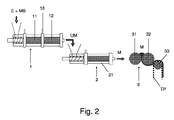
Similarly, the present invention is a method (see FIG. 2) for producing an adhesive, preferably also pressure sensitive, which contains an inflated microballoon,
The ingredients that make up the adhesive, such as polymer, resin, or filler, are mixed with the unexpanded microballoon in a first mixing device under positive pressure, and the temperature is adjusted below the expansion temperature of the microballoon;
Transferring the mixed, in particular uniform, adhesive from the first mixing device to the second mixing device and heating to the expansion temperature under positive pressure;
Inflating the microballoon in or out of the second mixing device;
-Formed in layers in a roll coater with a microballoon in which the adhesive mixture is expanded,
-Optionally including a method of coating the adhesive mixture with the expanded microballoons on the strip support material or release material.
同様に、本発明は、膨張させたマイクロバルーンを含有する、やはり好ましくは感圧性の接着剤の製造方法(図1参照)であって、
・接着剤を構成する、ポリマー、樹脂、または充填材といった成分を第1の混合装置中で混合し、
・混合された、とりわけ均一な接着剤を第1の混合装置から第2の混合装置に移送し、同時に未膨張のマイクロバルーンを第2の混合装置に送入し、
・該マイクロバルーンを、第2の混合装置中で、または第2の混合装置から吐出されるときに膨張させ、
・接着剤混合物を膨張させたマイクロバルーンとともに、ロール・コータ中で層状に成形し、
・場合により、接着剤混合物を膨張させたマイクロバルーンとともに、テープ状の支持体材料または剥離材料上に塗工する、方法を含む。
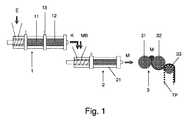
Similarly, the present invention is a method (see FIG. 1) for producing an adhesive, preferably also pressure sensitive, containing an inflated microballoon,
The ingredients that make up the adhesive, such as polymer, resin, or filler, are mixed in the first mixing device;
Transferring the mixed, in particular uniform, adhesive from the first mixing device to the second mixing device and simultaneously feeding the unexpanded microballoon into the second mixing device;
Inflating the microballoon in or out of the second mixing device;
-Formed in layers in a roll coater with a microballoon in which the adhesive mixture is expanded,
-Optionally including a method of applying the adhesive mixture together with an expanded microballoon onto a tape-like support material or release material.
本発明の好ましい実施形態によれば、接着剤を、ロール・コータ中で成形し、支持体材料上に塗工する。 According to a preferred embodiment of the present invention, the adhesive is molded in a roll coater and applied onto the support material.
マイクロバルーンで発泡させた接着剤は、均一で閉じられたコート形態を得るために、普通は塗工前に脱気する必要はない。混練中に接着剤中に巻き込まれた空気は、膨張するマイクロバルーンにより駆逐される。しかしながら、処理量が多いときには、ロール間隙への接着剤の均一な送入を達成するために、接着剤を塗工の前に脱気することが勧められる。脱気は、理想的にはロール・コータの直前で、混練温度および環境圧との圧力差少なくとも200mbarで実施する。 Adhesive foamed with microballoons usually does not need to be degassed prior to coating in order to obtain a uniform and closed coat form. Air entrained in the adhesive during kneading is driven out by the expanding microballoon. However, when the throughput is high, it is recommended that the adhesive be degassed before coating in order to achieve uniform delivery of the adhesive into the roll gap. Degassing is ideally performed immediately before the roll coater with a pressure difference of at least 200 mbar from the kneading temperature and ambient pressure.
さらに、
・第1の混合装置が、連続式装置、とりわけ遊星ローラ押出し機、2軸押出し機、またはピン型押出し機であるか、
・第1の混合装置が、非連続式装置、とりわけZ−ニーダまたは内部ミキサであり、
・第2の混合装置が、遊星ローラ押出し機、単軸または2軸押出し機、またはピン型押出し機であり、および/または
・接着剤を膨張させたマイクロバルーンとともに支持体層に成形する成形手段が、カレンダ、ロール・コータ、またはロールと固定ドクタの形成する間隙であるのが、有利である。
further,
The first mixing device is a continuous device, in particular a planetary roller extruder, a twin screw extruder, or a pin type extruder,
The first mixing device is a discontinuous device, in particular a Z-kneader or an internal mixer,
The second mixing device is a planetary roller extruder, a single or twin screw extruder, or a pin type extruder, and / or a molding means for molding into a support layer together with a microballoon in which the adhesive is expanded Is advantageously a calendar, a roll coater, or a gap formed by a roll and a stationary doctor.
本発明の方法によれば、とりわけ自己接着性の、接着剤の全ての既知および文献に記載の成分が無溶媒で処理可能である。 According to the method of the present invention, all known and literature components of the adhesive, in particular self-adhesive, can be treated without solvent.
上述した本発明の思想に含まれる方法で、特に際立った形態の変形形態を以下に例示するが、描かれた図を選択することで不必要な制限を加えることを意図するものではない。 In the methods included in the above-described idea of the present invention, particularly prominent variations are illustrated below, but are not intended to impose unnecessary limitations by selecting the drawings.
図3に、発泡した感圧性自己接着テープの製造方法の特に好適な形態を示す。 FIG. 3 shows a particularly preferred embodiment of a method for producing a foamed pressure-sensitive self-adhesive tape.
連続式混合装置、例えば遊星ローラ押出し機(PWE)により、(自己)接着剤を製造する。 The (self) adhesive is produced by a continuous mixing device such as a planetary roller extruder (PWE).
そのために、接着剤を生成する原料Eを、遊星ローラ押出し機(PWE)1に供給する。このとき同時に、未膨張のマイクロバルーンMBを、混練過程中に陽圧下で自己接着剤の中に均一に混入する。 For that purpose, the raw material E which produces | generates an adhesive agent is supplied to the planetary roller extruder (PWE) 1. FIG. At the same time, the uninflated microballoon MB is uniformly mixed in the self-adhesive agent under positive pressure during the kneading process.
自己接着剤を均一に製造するのに必要な温度と、マイクロバルーンを膨張させるのに必要な温度は、マイクロバルーンが、PWE1から吐出されるときダイから出たときの圧力低下によって、自己接着剤M中で発泡し、その際に接着剤の表面から突出するように、相互に調整される。 The temperature required to uniformly produce the self-adhesive and the temperature required to inflate the microballoon are determined by the pressure drop when the microballoon exits the die when discharged from the PWE1. It adjusts mutually so that it may foam in M and may protrude from the surface of an adhesive agent in that case.
ロール・コータ3を成形手段として用い、この泡状の接着剤Mはカレンダ加工され、テープ状の支持体材料、例えば剥離紙TPの上に塗工されるが、ロール間隙において部分的後発泡が生じうる。ロール・コータ3は、ドクタ・ロール31および塗工ロール32からなる。後者上に、剥離紙TPが巻き上げロール33によって案内され、塗工ロール32から接着剤Kが剥離紙TPに移される。
Using the
同時に、膨張したマイクロバルーンMBは、接着剤Kのポリマー・マトリックス中に再度押し込まれ、容積重が150kg/m3未満と非常に低いにもかかわらず、表面が平滑で持続的に(逆行せずに)接着力のある表面が生成する。 At the same time, the inflated microballoons MB are pushed again into the polymer matrix of adhesive K, and the surface is smooth and persistent (without reversing) despite the very low bulk weight of less than 150 kg / m 3 A) an adhesive surface is produced.
図2に、発泡した感圧性自己接着テープの製造方法の、別の特に好適な形態を示す。 FIG. 2 shows another particularly preferred embodiment of the method for producing a foamed pressure-sensitive self-adhesive tape.
遊星ローラ押出し機(PWE)1には、前後に配置された2つの混合ゾーン11,12があり、これらの中で、1本の中心スピンドルが回転する。さらに、加熱ゾーンごとに6本の遊星スピンドルがある。注入リング13に、追加の原料、例えば可塑剤または液状樹脂が加えられる。
The planetary roller extruder (PWE) 1 has two mixing
好適な装置としては、Entex社、Bochumの遊星ローラ押出し機が例示される。 A suitable apparatus is exemplified by a planetary roller extruder from Entex, Bochum.
続いて、マイクロバルーンが、第2の混合装置、例えば単軸押出し機中で、陽圧下で自己接着剤中に均一に混入され、膨張温度より高温に加熱され、吐出時に発泡させられる。このため、原料Eから生成した接着剤Kを、ここでは、単軸押出し機(ESE)2に送入し、同時にマイクロバルーンMBを充填する。単軸押出し機ESEには、そのバレル長21にわたって合計4つの加熱ゾーンが存在する。
Subsequently, the microballoon is uniformly mixed in the self-adhesive under positive pressure in a second mixing device, for example, a single screw extruder, heated to a temperature higher than the expansion temperature, and foamed during discharge. For this reason, the adhesive K produced | generated from the raw material E is sent here to the single screw extruder (ESE) 2, and is filled with microballoon MB simultaneously. The single screw extruder ESE has a total of four heating zones over its
好適な装置としてKiener社の単軸押出し機が例示される。 An example of a suitable apparatus is a single screw extruder manufactured by Kiener.
マイクロバルーンMBは、ESE2のダイ出口での圧力低下によって膨張する間に、接着剤の表面から突出する。 The microballoon MB protrudes from the surface of the adhesive while inflating due to the pressure drop at the die exit of ESE2.
ロール・コータ3により、この泡状の接着剤Mはカレンダ加工され、テープ状の支持体材料、例えば剥離紙TPの上に塗工されるが、ロール間隙において部分的後発泡が生じうる。ロール・コータ3は、ドクタ・ロール31および塗工ロール32からなる。後者上に、剥離紙TPが巻き上げロール33によって案内され、塗工ロール32から接着剤Kが剥離紙TPに移される。
The foam-like adhesive M is calendered by the
同時に、膨張したマイクロバルーンMBは、接着剤Kのポリマー・マトリックス中に再度押し込まれ、容積重が150kg/m3未満と非常に低いにもかかわらず、表面が平滑で持続的に(逆行せずに)接着力のある表面が生成する。 At the same time, the inflated microballoons MB are pushed again into the polymer matrix of adhesive K, and the surface is smooth and persistent (without reversing) despite the very low bulk weight of less than 150 kg / m 3 A) an adhesive surface is produced.
図1に、発泡した感圧性自己接着テープの製造方法の、別の特に好適な形態を示す。 FIG. 1 shows another particularly preferred embodiment of a method for producing a foamed pressure-sensitive self-adhesive tape.
連続式混合装置、例えば遊星ローラ押出し機(PWE)により、(自己)接着剤を製造する。 The (self) adhesive is produced by a continuous mixing device such as a planetary roller extruder (PWE).
そのために、接着剤を生成する原料Eを遊星ローラ押出し機(PWE)1に供給する。遊星ローラ押出し機(PWE)1には、前後に配置された2つの混合ゾーン11,12があり、これらの中で、1本の中心スピンドルが回転する。さらに、加熱ゾーンごとに6本の遊星スピンドルがある。
For that purpose, the raw material E which produces | generates an adhesive agent is supplied to the planetary roller extruder (PWE) 1. FIG. The planetary roller extruder (PWE) 1 has two mixing
注入リング13に、追加の原料、例えば可塑剤または液状樹脂が加えられる。
Additional raw materials such as plasticizers or liquid resins are added to the
好適な装置としては、Entex社、Bochumの遊星ローラ押出し機が例示される。 A suitable apparatus is exemplified by a planetary roller extruder from Entex, Bochum.
続いて、マイクロバルーンが、第2の混合装置、例えば単軸押出し機中で、陽圧下で自己接着剤中に均一に混入され、膨張温度より高温に加熱され、吐出時に発泡させられる。そのために、原料Eから生成した接着剤Kを、ここでは、単軸押出し機(ESE)2に送入し、同時にマイクロバルーンMBを充填する。単軸押出し機ESEには、そのバレル長21にわたって合計4つの加熱ゾーンが存在する。
Subsequently, the microballoon is uniformly mixed in the self-adhesive under positive pressure in a second mixing device, for example, a single screw extruder, heated to a temperature higher than the expansion temperature, and foamed during discharge. Therefore, the adhesive K produced | generated from the raw material E is sent here to the single screw extruder (ESE) 2, and is filled with microballoon MB simultaneously. The single screw extruder ESE has a total of four heating zones over its
好適な装置としてKiener社の単軸押出し機が例示される。 An example of a suitable apparatus is a single screw extruder manufactured by Kiener.
マイクロバルーンMBは、ESE2のダイ出口での圧力低下によって膨張する間に、接着剤の表面から突出する。 The microballoon MB protrudes from the surface of the adhesive while inflating due to the pressure drop at the die exit of ESE2.
ロール・コータ3により、この泡状の接着剤Mはカレンダ加工され、テープ状の支持体材料、例えば剥離紙TPの上に塗工されるが、ロール間隙において部分的後発泡が生じうる。ロール・コータ3は、ドクタ・ロール31および塗工ロール32からなる。後者上に、剥離紙TPが巻き上げロール33によって案内され、塗工ロール32から接着剤Kが剥離紙TPに移される。同時に、膨張したマイクロバルーンMBは、接着剤Kのポリマー・マトリックス中に再度押し込まれ、容積重が150kg/m3未満と非常に低いにもかかわらず、表面が平滑で持続的に(逆行せずに)接着力のある表面が生成する。
The foam-like adhesive M is calendered by the
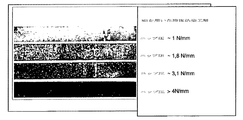
図4から見て取れるように、ロール間隙におけるニップ圧を下げると、マイクロバルーンがより弱くしか圧し戻されないので、塗工された発泡自己接着剤の接着面積が減少する。図4は、塗工方法または塗工パラメータに依存した接着面積を示す。必要なニップ圧は、用いられる接着剤系に大きく依存し、粘度が高いほどニップ圧を高くしなければならず、また所望の層厚および選択した塗工速度にも依存する。実際には、4N/mmより大きいニップ圧なら充分であるが、50m/分を超える特に速い塗工速度において、少ない接着剤塗工量(目付け量が70g/m2未満)において、また高粘度接着剤(0.1radおよび110℃で50,000Pa・s)においては、50N/mmより大きいニップ圧が必要となる。 As can be seen from FIG. 4, decreasing the nip pressure in the roll gap reduces the adhesion area of the applied foamed self-adhesive because the microballoons are only weakly pressed back. FIG. 4 shows the adhesion area depending on the coating method or coating parameters. The required nip pressure is highly dependent on the adhesive system used, the higher the viscosity, the higher the nip pressure must be, and the desired layer thickness and the selected coating speed. In practice, a nip pressure greater than 4 N / mm is sufficient, but at particularly fast coating speeds exceeding 50 m / min, at low adhesive coating weights (weight per unit area less than 70 g / m 2 ) and high viscosity For the adhesive (50,000 Pa · s at 0.1 rad and 110 ° C.), a nip pressure greater than 50 N / mm is required.
ロールの温度はマイクロバルーンの膨張温度に適合させるのがよいことが判明している。理想的には、第1のロールのロール温度は、マイクロバルーンを破壊することなく後発泡可能とするために、マイクロバルーンの膨張温度より高くする。最終ロールの温度は、マイクロバルーンの殻が硬化でき、本発明の平滑な表面が形成するように、膨張温度に等しいかより低くする。 It has been found that the temperature of the roll should be adapted to the expansion temperature of the microballoon. Ideally, the roll temperature of the first roll is higher than the expansion temperature of the microballoon so that it can be foamed without breaking the microballoon. The temperature of the final roll is equal to or lower than the expansion temperature so that the microballoon shell can be cured and the smooth surface of the present invention formed.
溶媒を含まないポリマー系の連続式製造および加工のための装置は多く知られている。大抵は、スクリュー使用機械、例えば、さまざまなスクリュー長および装備を有する単軸および二軸押出し機が使用される。さらに、連続式に働く、さまざまな構造の混練機、例えば混練機とスクリュー使用機械の組合せ、あるいは遊星ローラ押出し機もこの目的に使用される。 Many devices for the continuous production and processing of solvent-free polymer systems are known. Mostly screw-using machines are used, for example single and twin screw extruders with various screw lengths and equipment. In addition, kneaders of various constructions working in a continuous manner, for example combinations of kneaders and screw-using machines, or planetary roller extruders are also used for this purpose.
遊星ローラ押出し機は、かなり古くから知られ、まずPVCのような熱可塑性樹脂の加工に使用され、主としてカレンダまたはロール機といった下流のユニットへの供給用に使用されてきた。しかし、遊星ローラ押出し機は、物質および熱の交換を起こす表面更新が盛んで、摩擦によってもたらされたエネルギーを迅速かつ効果的に取り去ることができる利点、および滞留時間が短くかつ滞留時間分布が狭い利点のため、最近はとりわけ、特に厳しく温度制御された運転条件が必要とされる混練プロセスにも使用範囲が拡がってきた。 Planetary roller extruders have been known for quite some time and have been used primarily for processing thermoplastics such as PVC and primarily for feeding downstream units such as calendar or roll machines. However, planetary roller extruders have an active surface renewal that causes the exchange of material and heat, the advantage of being able to quickly and effectively remove the energy brought about by friction, and the short residence time and residence time distribution. Due to the narrow advantages, the range of use has recently expanded, especially in kneading processes that require particularly severe temperature-controlled operating conditions.
遊星ローラ押出し機には、メーカーによってさまざまな形態およびサイズが存在する。希望する処理能力により、バレルの直径は一般的に70mmから400mmの間とされる。 Planetary roller extruders come in a variety of forms and sizes depending on the manufacturer. Depending on the desired throughput, the barrel diameter is typically between 70 mm and 400 mm.
通常、遊星ローラ押出し機には供給部と混練部がある。供給部は送りスクリューからなり、全ての固体成分が連続的に送入される。続いて、送りスクリューは、この材料を混練部に送る。スクリューを有する供給部の範囲は、スクリューへの材料の焼付きを防止するため、好ましくは冷却する。しかしながら、スクリュー部分が無く、材料が中心スピンドルと遊星スピンドルの間に直接送入される実施形態もある。しかし、本特許の方法の有効性にとって、これは重要ではない。 Usually, a planetary roller extruder has a supply unit and a kneading unit. A supply part consists of a feed screw and all the solid components are sent in continuously. Subsequently, the feed screw sends this material to the kneading section. The range of the supply section with the screw is preferably cooled in order to prevent the material from sticking to the screw. However, in some embodiments there is no screw portion and the material is fed directly between the central spindle and the planetary spindle. However, this is not important for the effectiveness of the method of this patent.
混練部は、1本の駆動された中心スピンドルと、内面にはす歯の付いた1つまたは複数のバレル中で、中心スピンドルの周囲を回転する複数の遊星スピンドルとからなる。中心スピンドルの回転速度、およびそれによる遊星スピンドルの公転速度は可変であり、したがって混練プロセスの制御のために重要なパラメータである。 The kneading section is composed of a single driven central spindle and a plurality of planetary spindles that rotate around the central spindle in one or more barrels with internal teeth. The rotational speed of the central spindle and thus the revolution speed of the planetary spindle is variable and is therefore an important parameter for the control of the kneading process.
材料が中心スピンドルと遊星スピンドルの間、あるいは遊星スピンドルとロール部分のはす歯との間を循環することで、剪断エネルギーと外部加熱の影響によって、材料の均一な混練物への分散が達成される。 As the material circulates between the center spindle and the planetary spindle, or between the planetary spindle and the helical teeth of the roll part, the dispersion of the material into a uniform kneaded material is achieved due to the effects of shear energy and external heating. The
各バレル中で公転する遊星スピンドルの数は可変であって、プロセス上の要請に適合される。スピンドル数は、遊星ローラ押出し機中の空隙容積および材料のプロセス中の滞留時間に影響を与え、さらに熱および物質交換のための表面積を規定する。遊星スピンドルの数は、導入される剪断エネルギーを通して、混練結果に影響を与える。バレルの直径を一定としたとき、スピンドル数を多くすると、より良い均一化および分散性能、あるいはより大きな製品処理量が得られる。 The number of planetary spindles revolving in each barrel is variable and adapts to process requirements. The number of spindles affects the void volume in the planetary roller extruder and the residence time of the material in the process, and further defines the surface area for heat and mass exchange. The number of planetary spindles affects the kneading result through the introduced shear energy. When the diameter of the barrel is constant, increasing the number of spindles results in better homogenization and dispersion performance or greater product throughput.
中心スピンドルとバレルの間に組付け可能な遊星スピンドルの最大数は、バレルの直径と、使用される遊星スピンドルの直径に依存する。工業規模の処理量を達成するために必須であるような、より大きなバレル径を用いるとき、あるいはより小さな直径の遊星スピンドルを用いるとき、バレルにより多数の遊星スピンドルが装着できる。通常、D=70mmのバレル径においては、7本までの遊星スピンドルが使用され、一方、D=200mmのバレル径においては、例えば10本、D=400mmのバレル径においては、例えば24本の遊星スピンドルが使用できる。 The maximum number of planetary spindles that can be assembled between the central spindle and the barrel depends on the diameter of the barrel and the diameter of the planetary spindle used. A large number of planetary spindles can be mounted by the barrel when using larger barrel diameters, as required to achieve industrial scale throughput, or when using smaller diameter planetary spindles. Typically, up to 7 planetary spindles are used for a barrel diameter of D = 70 mm, while for example 10 for a barrel diameter of D = 200 mm, for example 24 planets for a barrel diameter of D = 400 mm. A spindle can be used.
本発明は、発泡した接着剤の塗工を、溶媒を用いることなく、多ロール・コータで実施することを提案している。この塗工機は、少なくとも2本のロールで少なくとも1つのロール間隙を有するものから、5本のロールと3つのロール間隙を有するものまで可能である。 The present invention proposes to apply the foamed adhesive on a multi-roll coater without using a solvent. The coating machine can range from one having at least one roll gap with at least two rolls to one having five rolls and three roll gaps.
さらに、カレンダ(I,F,L−カレンダ)のようなコート機で、発泡接着剤を1つまたは複数のロール間隙を通すことで、希望する厚さに成形することも考えられる。 Furthermore, it is also conceivable to form a desired thickness by passing the foamed adhesive through one or a plurality of roll gaps in a coating machine such as a calendar (I, F, L-calender).
その際、各ロールの温度設定を、送出しロールでは選んだタイプのマイクロバルーンの発泡温度より高いか同じ温度になるように、他方、受取りロールでは前記発泡温度より低いか同じ温度になるようにして制御されない発泡を防ぐことで、場合によって制御された後発泡が起きるように選び、このとき全てのロールはそれぞれ30〜220℃に調節可能にしておくのが、特に有利であることが判明している。 At this time, the temperature setting of each roll is set so that it is higher than or equal to the foaming temperature of the selected type of microballoon for the delivery roll, while it is lower or the same temperature for the receiving roll. It has been found to be particularly advantageous to choose uncontrolled foaming so that foaming occurs after controlled in some cases, and that all rolls are individually adjustable to 30-220 ° C. ing.
成形された接着剤層の一方のロールから他方のロールへの移送特性を改善するために、さらに、反接着加工をしたロールまたは格子目付きロールを使用することができる。充分に高精度に成形された接着剤フィルムを得るために、ロールの周速度に差を付けることもできる。 In order to improve the transfer property of the formed adhesive layer from one roll to the other, an anti-adhesive roll or a grid roll can be used. In order to obtain an adhesive film formed with sufficiently high accuracy, it is possible to make a difference in the peripheral speed of the roll.
好ましい4本ロール・コータは、1本の供給ロール、供給ロールに平行に配列され支持体材料上の層の厚さを規定する1本のドクタ・ロール、および供給ロールの下に位置する1本の送りロールから構成されている。送りロールと共に第2のロール間隙を作る押圧ロール上で、接着剤とテープ状の材料が合体される。 A preferred four roll coater has one supply roll, one doctor roll arranged parallel to the supply roll and defining the thickness of the layer on the support material, and one positioned below the supply roll. It consists of a feed roll. The adhesive and the tape-like material are combined on the pressure roll that forms the second roll gap together with the feed roll.
塗工する帯状支持体材料の種類に応じて、塗工は共回転法または逆回転法で行われる。 Depending on the type of belt-like support material to be coated, the coating is carried out by a co-rotation method or a counter-rotation method.
成形手段は、ロールと固定ドクタの間に生じる間隙によって構成することもできる。固定ドクタはドクタ・ナイフであっても、あるいは固定(半)ロールであってもよい。 The forming means can also be constituted by a gap generated between the roll and the fixed doctor. The fixed doctor may be a doctor knife or a fixed (half) roll.
本発明に従って記述された方法により、一方では、マイクロバルーン発泡自己接着剤の利点を備えながら、他方では、典型的に生じる未発泡製品に比べて接着力の低下が無い、自己接着性製品を作製することができる。非常に驚くべきことに、当業者には予見できないが、前記の方法によれば、たとえ発泡自己接着剤の層厚が、膨張させたマイクロバルーンの直径の範囲内にあっても、自己接着性製品を作製することができる。同様に驚くべきことに、マイクロバルーンの直径によって規定されるが、球体の理論的最密充填値を超えるような低い嵩密度の製品を作りだすことが可能である。 The method described according to the present invention, on the one hand, produces a self-adhesive product with the advantages of a microballoon foaming self-adhesive, on the other hand, without a loss of adhesion compared to the typically unfoamed product. can do. Very surprisingly not foreseeable to those skilled in the art, according to the method described above, self-adhesiveness is achieved even if the layer thickness of the foamed self-adhesive is within the diameter of the expanded microballoon. Product can be made. Equally surprisingly, it is possible to create a product with a low bulk density, which is defined by the diameter of the microballoon, but exceeds the theoretical close packing value of the sphere.
球体の理論的最密充填において、各球は12個の最隣接球を有し、そのうち6個は自身の層内に、3個ずつ上および下にある。これらは、立方充填においては立方八面体を、六方充填においてはアンチ立方八面体を形成する。 In the theoretical close packing of spheres, each sphere has 12 nearest spheres, 6 of which are 3 above and below in its own layer. These form a cubic octahedron in cubic filling and an anti-cubic octahedron in hexagonal filling.
球体の理論的最密充填における空間充填率は下式の値である。 The space filling factor in the theoretical close packing of a sphere is the value of the following equation.
接着剤中のマイクロバルーンは、充填率が高いと、球として存在せず、非可逆的に3次元の多面体に変形されているので、膨張したマイクロバルーンの接着剤中の空間充填率は74%を超えることができる。 When the filling rate of the microballoon in the adhesive is high, it does not exist as a sphere and is irreversibly deformed into a three-dimensional polyhedron. Therefore, the space filling rate in the adhesive of the expanded microballoon is 74%. Can be exceeded.
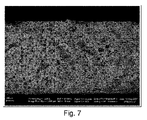
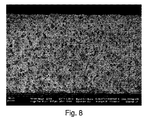
これは、図7および8が、非常にわかりやすく示している。図7には、マイクロバルーンの含量が8重量%の接着剤が示され、その接着剤嵩密度は338kg/m3となっている。図8には、マイクロバルーンの含量が22重量%で、嵩密度が137kg/m3の接着剤が示されている。 This is illustrated very clearly in FIGS. 7 and 8. FIG. 7 shows an adhesive having a microballoon content of 8% by weight, and the adhesive bulk density is 338 kg / m 3 . FIG. 8 shows an adhesive having a microballoon content of 22% by weight and a bulk density of 137 kg / m 3 .
膨張させたマイクロバルーンがはっきり見て取れるように変形しているため、充填率は、明示されているとおり、理論的に可能な球体の最密充填を超えている。マイクロバルーンは、多面体形状を示しており、もはや球形ではない。 Since the inflated microballoon is deformed so that it can be clearly seen, the filling rate exceeds the theoretically possible close-packing of the spheres as evidenced. Microballoons exhibit a polyhedral shape and are no longer spherical.
本発明による方法およびそれによる接着剤の新規性は、膨張させたマイクロバルーンを、層への成形中、特に塗工作業の直前に、接着剤のポリマー・マトリックス中に圧し戻すことで、平坦で持続的に接着性の接着剤表面が、特にロール・コータである成形手段により成形されることにある。 The novelty of the method according to the invention and the resulting adhesive is achieved by pressing the expanded microballoon back into the polymer matrix of the adhesive during molding into a layer, particularly immediately before the coating operation. The persistent adhesive surface is to be formed by forming means , in particular a roll coater.
層厚が20〜3000μmの範囲で、マイクロバルーン含量が多く、このため高い発泡率または低い嵩密度に発泡し接着力の強い自己接着テープが製造できる。 When the layer thickness is in the range of 20 to 3000 μm, the content of the microballoon is large, and therefore, a self-adhesive tape having a high foaming rate or a low bulk density and strong adhesion can be produced.
発泡接着剤の効能の一つはコスト削減にある。同じ層厚に対して接着剤塗工量が何倍も少なくできるので、原料が節減できる。さらに、接着剤の同じ処理量または量的生産における塗工速度を上げることができる。 One of the benefits of foam adhesives is cost reduction. Since the amount of adhesive coating can be reduced many times for the same layer thickness, raw materials can be saved. Furthermore, the coating speed can be increased in the same throughput or quantitative production of the adhesive.
さらに、接着剤の発泡は、接着技術的および応用技術的に改良された特性を与える。 Furthermore, the foaming of the adhesive gives improved properties in terms of adhesion technology and application technology.
前述の接着力低下の減少は、膨張させたマイクロバルーンが、塗工作業中に、ポリマー・マトリックス中に圧し戻されることで得られる優れた表面特性によりもたらされる。 This reduction in adhesion loss is due to the superior surface properties obtained by inflated microballoons being pressed back into the polymer matrix during the coating operation.
さらに発泡自己接着剤は、同じポリマー系の無発泡接着剤に比べ、例えば、低温耐衝撃性の改善、粗面の下地に対する接着力の向上、平滑ではない下地に対する発泡接着剤のより良い減衰および/またはシール性もしくは順応性、より好ましい圧縮硬さ特性、および改良された圧縮能力といった、さらなる性能特性を獲得する。 In addition, foamed self-adhesives, for example, have improved low temperature impact resistance, improved adhesion to rough substrates, better attenuation of foam adhesives on non-smooth substrates, and compared to the same polymer-based non-foamed adhesives. Obtain additional performance characteristics such as sealability or conformability, more favorable compression hardness properties, and improved compression capability.
本発明の自己接着剤の特徴的性質あるいは付加的機能の幾つかは、例の中でさらに説明する。 Some of the characteristic properties or additional functions of the self-adhesives of the present invention are further illustrated in the examples.
好ましいホットメルト接着剤を用いた発泡接着剤は、膨張したマイクロバルーンが、塗工中にロール間隙で、あらためてポリマー・マトリックス中に圧し戻され、このため表面粗さRaが10μm未満と好適な値を示す、平滑な接着性の表面を有する。表面粗さの測定は、非常に平滑な支持体を土台としており、自身も表面粗さRaが1μm未満である接着テープにのみ適している。したがって、実用にされる支持体、例えばクレープ紙あるいは不織布および織布で、表面粗さが大きなものにおいては、本方法の利点について記述するのに、製品の表面粗さの測定は適していない。 Foamed adhesives using preferred hot melt adhesives are suitable when the expanded microballoons are pressed back into the polymer matrix at the roll gap during application, and thus the surface roughness Ra is less than 10 μm. It has a smooth, adhesive surface that exhibits a value. The measurement of the surface roughness is based only on an adhesive tape that is based on a very smooth support and that itself has a surface roughness Ra of less than 1 μm. Thus, for practical substrates such as crepe paper or non-woven fabrics and woven fabrics with high surface roughness, measuring the surface roughness of the product is not suitable for describing the advantages of the method.
本発明の好ましい実施形態における接着剤中のマイクロバルーンの割合は、0重量%を超え30重量%以下、特に1.5重量%と10重量%の間である。 The proportion of microballoons in the adhesive in a preferred embodiment of the invention is greater than 0% by weight and not more than 30% by weight, in particular between 1.5% and 10% by weight.
また、好ましくは、マイクロバルーンは、25℃で直径が3μm〜40μm、特に5μm〜20μmを、および/または温度を作用させた後で直径が20μm〜200μm、特に40μm〜100μmを示す。 Also preferably, the microballoons have a diameter of 3 μm to 40 μm, especially 5 μm to 20 μm at 25 ° C. and / or a diameter of 20 μm to 200 μm, especially 40 μm to 100 μm after the application of temperature.
従来知られたどの製造方法による、マイクロバルーンを用いて発泡させた接着剤システムでも、粗く、接着力がごく小さいか無い、接着剤表面が形成された。 Adhesive systems foamed with microballoons by any known manufacturing method produced a rough, adhesive surface with very little or no adhesion.
溶媒を用いて塗工した自己接着剤においては、0.5重量%と低いマイクロバルーン含量から、接着力(剥離力)の低下が40%を超えることになる。マイクロバルーン含量を増加すると、接着力はさらに低下し、凝集力は増加する。 In the self-adhesive coated using a solvent, the decrease in adhesive force (peeling force) exceeds 40% due to the microballoon content as low as 0.5% by weight. Increasing the microballoon content further reduces adhesion and increases cohesion.
マイクロバルーン含量がわずか1重量%であっても、接着剤の接着力は非常に低い。 Even if the microballoon content is only 1% by weight, the adhesive strength of the adhesive is very low.
これは、比較例1.1および1.2、あるいは表3によって裏付けられている。 This is supported by Comparative Examples 1.1 and 1.2 or Table 3.
マイクロバルーンを用いて発泡させた接着剤も容積重と、目付け量および組成が同じ接着剤で膨張したマイクロバルーンで生じた空隙を破壊して脱泡させたものの容積重との比は、好ましくは0.8より小さい。 The ratio of the bulk weight of the adhesive foamed using the microballoon to the bulk weight of the foam which is defoamed by destroying the void generated by the microballoon expanded with the adhesive having the same basis weight and composition is preferably Less than 0.8.
こうした挙動は、無溶媒のダイ・コーティングにおいても現れ、マイクロバルーンが押出し機/ダイから吐出された後に圧力差を解消する際に発泡し、接着剤マトリックスから突出する。 This behavior also appears in solventless die coatings, which foam and protrude from the adhesive matrix as the pressure differential is relieved after the microballoons are ejected from the extruder / die.
本発明の思想には、本発明の方法によって得られる接着剤、特に自己接着剤も含まれる。 The idea of the present invention includes an adhesive obtained by the method of the present invention, particularly a self-adhesive.
さらに、本発明の思想には、前記接着剤を用いて、テープ状材料の少なくとも片面に接着剤を塗工することで製造した自己接着テープも含まれる。両面を接着性に加工した接着テープにおいて、接着コートを両面とも発明によるものにすることもできる。あるいは、いずれか一方のコートのみを発明によるものにし、他方の面は(接着テープの果たす使命に合わせて)任意に選ぶようにする。 Further, the idea of the present invention includes a self-adhesive tape manufactured by applying an adhesive to at least one surface of a tape-like material using the adhesive. In the adhesive tape in which both sides are processed to be adhesive, both sides of the adhesive coat can be made according to the invention. Alternatively, only one of the coats is according to the invention and the other side is chosen arbitrarily (according to the mission that the adhesive tape fulfills).
支持体材料としてフィルム、織布、あるいは紙が好ましく、その片面に(自己)接着剤を塗工する。 The support material is preferably a film, a woven fabric, or paper, and a (self) adhesive is applied to one side thereof.
さらに、好ましくは(自己)接着剤を剥離紙または剥離フィルムに塗工することで、略称でフィックス(Fix)とも呼ばれる支持体の無い接着テープが得られる。 Furthermore, an adhesive tape without a support, which is also abbreviated as “Fix”, is obtained by preferably applying a (self) adhesive to release paper or release film.
接着テープにおいてテープ状の支持体材料上の接着剤の厚さは20μm〜3000μm、好ましくは40μm〜150μmとできる。 In the adhesive tape, the thickness of the adhesive on the tape-like support material can be 20 μm to 3000 μm, preferably 40 μm to 150 μm.
さらに、接着剤層を、とりわけ架橋後に、支持体の無い両面接着性の自己接着テープとして使用するときには、厚さが20μm〜2000μmの接着剤を剥離材の上に塗工できる。 Furthermore, when the adhesive layer is used as a double-sided adhesive self-adhesive tape having no support, especially after crosslinking, an adhesive having a thickness of 20 μm to 2000 μm can be applied on the release material.
マイクロバルーンは、熱可塑性ポリマー殻を有する弾力性の中空球である。これらの球は低沸点液体または液化ガスで充満されている。殻の材料としては特にポリアクリロニトリル、PVDC、PVC、またはポリアクリレートが使用される。低沸点液体としては、特に低級アルカンの炭化水素、例えばイソブタンまたはイソペンタンが好適で、圧力下で液化ガスとしてポリマー殻中に封入される。マイクロバルーンに、作用、特に熱的作用を加えると、一方で外側のポリマー殻が軟化する。同時に、殻の中に存在する液体発泡ガスがガス状態に移行する。その際にマイクロバルーンは、非可逆的に伸び、3次元的に膨張する。内部圧と外部圧が釣り合った時点で膨張は終わる。ポリマー殻は維持されるので、独立気泡の発泡体が得られる。 Microballoons are elastic hollow spheres with a thermoplastic polymer shell. These spheres are filled with a low boiling liquid or liquefied gas. Polyacrylonitrile, PVDC, PVC or polyacrylate is used in particular as the shell material. As the low-boiling liquid, hydrocarbons of lower alkanes such as isobutane or isopentane are particularly suitable, and are enclosed in the polymer shell as a liquefied gas under pressure. When an action, particularly a thermal action, is applied to the microballoon, the outer polymer shell softens. At the same time, the liquid foam gas present in the shell shifts to the gas state. At that time, the microballoons expand irreversibly and expand three-dimensionally. Expansion ends when the internal and external pressures are balanced. Since the polymer shell is maintained, a closed cell foam is obtained.
多くの種類のマイクロバルーンが商業的に入手可能であり、例えばAkzo Nobel社からのExpancel DU−Type(dry unexpanded)は、主として大きさ(未膨張状態での直径6〜45μm)および膨張に必要な開始温度(75〜220℃)で細分化されている。マイクロバルーンの種類あるいは発泡温度を、接着剤の混練に必要な温度パターンおよび機械のパラメータに調和させると、接着剤の混練と発泡を同時に1行程で実施できる。 Many types of microballoons are commercially available, e.g. Expandel DU-Type (dry unexpanded) from Akzo Nobel, is mainly needed for size (unexpanded diameter 6-45 μm) and inflation It is subdivided at the starting temperature (75-220 ° C.). If the type or foaming temperature of the microballoon is matched with the temperature pattern and machine parameters required for kneading the adhesive, the kneading and foaming of the adhesive can be performed simultaneously in one step.
さらに未膨張のマイクロバルーンも、固形分またはマイクロバルーン含量が約40〜45重量%の水性の分散液として、さらに、ポリマー、例えばエチレン/酢酸ビニル中に約65重量%のマイクロバルーン濃度で埋入されたマイクロバルーン(マスター・バッチ)として入手可能である。分散液マイクロバルーンも、マスターバッチも、DU−Typeと同様に本発明の方法による接着剤の発泡に適している。 In addition, unexpanded microballoons are also embedded as solids or aqueous dispersions with a microballoon content of about 40-45% by weight, and further embedded in polymers such as ethylene / vinyl acetate at a microballoon concentration of about 65% by weight. Available as a microballoon (master batch). Both the dispersion microballoon and the masterbatch are suitable for foaming the adhesive according to the method of the present invention, similar to DU-Type.
本発明の方法の実施にとって、好適な接着剤・ベースの選択は重要ではない。ベースは、天然ゴム、ブロックコポリマーを含む合成ゴム、またはそれらの混合物を含む熱可塑性エラストマーの群から選択できるが、いわゆるポリアクリレート接着剤の群からも選択できる。 The selection of a suitable adhesive base is not critical to the practice of the method of the present invention. The base can be selected from the group of thermoplastic elastomers including natural rubber, synthetic rubber including block copolymers, or mixtures thereof, but can also be selected from the group of so-called polyacrylate adhesives.
ゴム系の接着剤のベースは、好適には天然ゴムまたは合成ゴムの群から選ばれる非熱可塑性エラストマーであり、あるいは天然ゴムおよび/または合成ゴムの任意の混合体からなる。ここに1種または複数の天然ゴムは、基本的に全ての入手可能な品質、例えばクレープ(Crepe)、RSS、ADS、TSR、またはCVタイプの中から、必要な純度や粘度水準に応じて選ぶことができ、また、1種または複数の合成ゴムは、ランダム共重合したスチレン−ブタジエンゴム(SBR)、ブタジエンゴム(BR)、合成ポリイソプレン(IR)、ブチルゴム(IIR)、ハロゲン化ブチルゴム(XIIR)、アクリレートゴム(ACM)、エチレン/酢酸ビニル共重合体(EVA)、ポリウレタン、および/またはそれらの混合体の群から選ぶことができる。 The base of the rubber-based adhesive is preferably a non-thermoplastic elastomer selected from the group of natural rubber or synthetic rubber, or consists of any mixture of natural rubber and / or synthetic rubber. Here, the natural rubber or rubbers are basically selected from all available qualities, for example Crepe, RSS, ADS, TSR or CV types, depending on the required purity and viscosity level. One or more synthetic rubbers may be randomly copolymerized styrene-butadiene rubber (SBR), butadiene rubber (BR), synthetic polyisoprene (IR), butyl rubber (IIR), halogenated butyl rubber (XIIR). ), Acrylate rubber (ACM), ethylene / vinyl acetate copolymer (EVA), polyurethane, and / or mixtures thereof.
さらに、熱可塑性エラストマーを好ましくは接着剤のベースとして選ぶことができる。 Furthermore, a thermoplastic elastomer can preferably be chosen as the base of the adhesive.
この点での代表として、スチレン・ブロック共重合体、とりわけスチレン/イソプレン/スチレン(SIS)、およびスチレン/ブタジエン/スチレン(SBS)タイプが挙げられる Representative in this regard are styrene block copolymers, especially styrene / isoprene / styrene (SIS) and styrene / butadiene / styrene (SBS) types.
さらに、好ましくは接着剤をポリアクリレートの群からも選ぶことができる。 Furthermore, preferably the adhesive can also be selected from the group of polyacrylates.
粘着性付与樹脂としては、全ての既知かつ文献に記載されている粘着性樹脂が例外なく使用できる。代表的なものとしては、ロジン、その不均化、水素添加、重合、エステル化誘導体、および塩、脂肪族および芳香族炭化水素樹脂、テルペン樹脂、およびテルペンフェノール樹脂が挙げられる。これらと、他の樹脂を任意に組み合わせることで、作製される接着剤の特性を所望通りに調節できる。Donatas Satas、「Handbook of Pressure Sensitive Adhesive Technology」、van Nostrand(1989)(非特許文献1)の最新の技術についての記述が明白に参照され得る。 As the tackifier resin, all known and described adhesive resins can be used without exception. Representative examples include rosin, its disproportionation, hydrogenation, polymerization, esterified derivatives, and salts, aliphatic and aromatic hydrocarbon resins, terpene resins, and terpene phenol resins. By arbitrarily combining these and other resins, the properties of the produced adhesive can be adjusted as desired. The description of the latest technology of Donatas Satas, “Handbook of Pressure Sensitive Adhesive Technology”, van Nostrand (1989) (Non-Patent Document 1) can be clearly referred to.
可塑剤としては、接着テープ技術で知られた全ての可塑性付与物質が使用できる。なかでも、パラフィンおよびナフテン油、オリゴブタジエンやオリゴイソプレンのような(官能基を有する)オリゴマー、液体ニトリルゴム、液体テルペン樹脂、植物性および動物性油脂、フタラート、官能性アクリレートが挙げられる。 As the plasticizer, all plasticizing substances known in the adhesive tape technology can be used. Among these, paraffin and naphthenic oils, oligomers (having functional groups) such as oligobutadiene and oligoisoprene, liquid nitrile rubber, liquid terpene resins, vegetable and animal oils, phthalates, and functional acrylates are included.
本発明の方法において化学的架橋を熱的に誘導するためには、全ての既知の熱的に活性化できる化学架橋剤が使用でき、促進剤添加硫黄または硫黄供与体系、イソシアナート系、反応性のメラミン樹脂、ホルムアルデヒド樹脂、および(場合によってはハロゲン化した)フェノール/ホルムアルデヒド樹脂、あるいは反応性のフェノール樹脂またはジイソシアナートおよび対応する活性化剤を含む架橋系、エポキシ化したポリエステル樹脂およびアクリレート樹脂、ならびにそれらの組合せが例示される。 All known thermally activatable chemical crosslinkers can be used to thermally induce chemical crosslinking in the process of the present invention, including accelerator-added sulfur or sulfur donor systems, isocyanate systems, reactivity Melamine resins, formaldehyde resins, and (optionally halogenated) phenol / formaldehyde resins, or cross-linked systems containing reactive phenol resins or diisocyanates and corresponding activators, epoxidized polyester resins and acrylate resins As well as combinations thereof.
架橋剤は、好ましくは50℃より高い温度、特に100℃〜160℃の温度、極めて好ましくは110℃〜140℃の温度で活性化される。 The cross-linking agent is preferably activated at temperatures higher than 50 ° C., in particular at temperatures of 100 ° C. to 160 ° C., very preferably at temperatures of 110 ° C. to 140 ° C.
架橋剤の熱的励起は赤外線あるいは高エネルギー交流電場によっても行える。 The thermal excitation of the crosslinking agent can also be performed by infrared or high energy alternating electric field.
片面または両面接着性の接着テープ用の支持体材料としては、全ての既知の繊維製支持体、例えば、ループパイル地、ベロア、紗、織布、編布、特にPETフィラメント織布またはポリアミド織布、または不織布、が使用できる。ここに「不織布」とは、少なくともEN29092(1998)による繊維製の面状物、ならびにステッチボンド不織布および類似の系を意味する。 Support materials for single-sided or double-sided adhesive tapes include all known fiber supports such as loop pile fabrics, velours, folds, woven fabrics, knitted fabrics, especially PET filament woven fabrics or polyamide woven fabrics Or a non-woven fabric can be used. “Nonwoven fabric” as used herein means at least a fiber sheet according to EN 29092 (1998), as well as stitchbonded nonwoven fabrics and similar systems.
同様にスペーサー織布および編布を、貼り合わせ層と共に使用することができる。スペーサー織布は、マット状の層構造体で、繊維不織布またはフィラメント不織布製の被覆層、裏層、およびこれらの層の間にある離散したまたは束状の保持繊維からなるが、保持繊維は、層構造体の全面にわたって分布し、粒子層を貫いてニードリングを行い、被覆層と裏層を上下に結合する。粒子層を貫いてニードリングが行われた保持繊維は、被覆層と裏層の相互の間隔を維持するが、自身も被覆層および裏層と結合している。 Similarly, spacer woven fabrics and knitted fabrics can be used with the bonding layer. The spacer woven fabric is a mat-like layer structure, and is composed of a coating layer made of a fiber nonwoven fabric or a filament nonwoven fabric, a back layer, and discrete or bundle-shaped holding fibers between these layers. It is distributed over the entire surface of the layer structure, needs to be penetrated through the particle layer, and the coating layer and the back layer are bonded up and down. The holding fibers that have been needled through the particle layer maintain the distance between the covering layer and the backing layer, but are also bonded to the covering layer and the backing layer.
不織布としては、とりわけ結合強化した短繊維不織布が対象となるが、さらには、多くの場合、追加的に結合強化された、フィラメント方式、メルトブローン方式、およびスパンボンド方式不織布が対象になる。不織布に対して可能な結合強化方法としては、機械的、熱的ならびに化学的結合強化が知られている。機械的結合強化においては、単繊維を乱雑に絡み合わせ、繊維束にステッチを作り、または追加の糸で縫い付けることで繊維を純粋に機械的に結合する。熱的および化学的方法においては、繊維/繊維間結合が接着力で(バインダ使用)または凝集力で(バインダ不使用)達成される。処方および実施方法を適切にすれば、これらの結合強化は、例外なく、もしくは少なくとも大部分が、繊維の結節点に限定されるので、不織布内にゆるやかでかつ開放的な構造を維持しながら、安定的な3次元網目構造を形成する。 As the nonwoven fabric, a short fiber nonwoven fabric having a bond strengthened is particularly targeted, but in many cases, a filament system, a meltblown system, and a spunbond system nonwoven fabric additionally subjected to a bond reinforcement are also targeted. Mechanical, thermal and chemical bond strengthening are known as possible bond strengthening methods for nonwoven fabrics. In mechanical bond reinforcement, fibers are purely mechanically bonded by randomly intertwining single fibers, making stitches in fiber bundles, or sewing with additional threads. In thermal and chemical methods, fiber / fiber bonding is achieved with adhesive strength (with binder) or cohesive strength (without binder). With proper formulation and method of implementation, these bond reinforcements are without exception, or at least mostly limited to the fiber knots, while maintaining a loose and open structure within the nonwoven, A stable three-dimensional network structure is formed.
とりわけ、別の糸での追加縫いか、ステッチにより結合強化された不織布が、特に有利であることがわかっている。 In particular, additional stitches with separate yarns or nonwovens reinforced by stitching have proved particularly advantageous.
こうした結合強化した不織布は、例えばKarl Mayer(前Malimo)社の型式マリフリース(Malivlies)のステッチボンド機で製造され、とりわけNaue Fasertechnik社、およびTechtex GmbH社から入手できる。マリフリースは、横配向繊維不織布を、不織布の繊維でステッチを形成して結合強化することを特徴とする。 Such bond-reinforced non-woven fabrics are produced, for example, on Karl Mayer (formerly Marimo) model Marifries stitch bond machines and are available from Nau Fasertechnik and Techtex GmbH, among others. Mali fleece is characterized in that a horizontally oriented fiber nonwoven fabric is reinforced by forming stitches with the fibers of the nonwoven fabric.
支持体としてさらに、クーニット(Kunit)型不織布あるいはムルチクニット(Multiknit)型不織布を使用できる。クーニット型不織布は、縦方向に配向した繊維の不織布を加工して、一方の面にステッチが、他方の面にはステッチの結合部またはパイル繊維の折り目があるが、糸も既成の面状体も有していない面状体に作るところに特徴がある。そうした不織布も、例えばKarl Mayer社の型式「Kunitvlies」のステッチボンド機で、既に長年にわたり製造されている。この不織布は、長繊維不織布として、縦方向の大きな引張り力を負担できる、さらなる特徴がある。ムルチクニット型不織布は、クーニット型不織布に比べ、両面から針を刺すことで、上面に加え下面にも結合強化がなされる特徴がある。 Further, a Kunit type nonwoven fabric or a Multiknit type nonwoven fabric can be used as the support. Kounit-type non-woven fabric is made by processing a non-woven fabric of fibers oriented in the longitudinal direction, and stitches are formed on one side, stitches on the other side or pile fiber creases, but the yarn is also a prefabricated sheet. It has the feature that it is made into a planar body that does not have. Such non-woven fabrics have already been produced for many years, for example in the stitch bond machine of the model “Kunitvlies” from Karl Mayer. This non-woven fabric has a further characteristic that it can bear a large tensile force in the longitudinal direction as a long-fiber non-woven fabric. The multi-knit type non-woven fabric has a feature that, as compared with the co-knitted type non-woven fabric, the bonding is strengthened on the lower surface in addition to the upper surface by inserting a needle from both sides.
最後に、糸縫い不織布は、本発明の接着テープを作る中間製品としても適している。糸縫い不織布は、多数の互いに平行に並んだ縫い目を有する不織布材料で形成される。この縫い目は連続した繊維の糸を用い縫い込みまたはステッチボンドすることで作られる。この型の不織布に対しては、Karl Mayer(前Malimo)社の型式マリバット(Maliwat)のステッチボンド機が知られている。 Finally, the thread-sewn nonwoven fabric is also suitable as an intermediate product for making the adhesive tape of the present invention. A thread stitched nonwoven fabric is formed of a nonwoven material having a number of seams aligned in parallel. This seam is made by stitching or stitchbonding with continuous fiber threads. For this type of non-woven fabric, there is known a type of Mariwat stitch bond machine from Karl Mayer (formerly Marimo).
さらに、Caliweb(登録商標)が抜きんでて適している。Caliweb(登録商標)は、外側にある2つのステッチ層と、ステッチ層に対して垂直に配向した内側にあるパイル層を有する、熱的に固定されたスペーサー不織布材ムルチクニットで構成されている。 Further, Caliweb (registered trademark) is suitable. Caliweb (R) is composed of a thermally fixed spacer nonwoven multiknit having two outer stitch layers and an inner pile layer oriented perpendicular to the stitch layers.
さらに、短繊維不織布が特に有利であって、これは第1の工程で機械的加工により予備的に結合強化されるか、あるいは水力学的に製反された湿式不織布であって、不織布の繊維の2%〜50%、特に不織布の繊維の5%〜40%を、溶融性繊維とする。
Furthermore, short-fiber nonwoven fabrics are particularly advantageous, which are wet nonwoven fabrics that are pre-bonded or strengthened mechanically in the first step, or hydrodynamically reprocessed, wherein the
この種の不織布は、繊維が湿式で製反されるか、あるいは、例えば、短繊維不織布を、不織布の繊維でステッチを作って、またはニードリング、縫い付け、あるいは空気および/または水噴射処理により予備的に結合強化することに特徴がある。 This type of non-woven fabric is produced by wet-fabrication of the fibers or, for example, short fiber non-woven fabrics, stitched with non-woven fibers, or by needling, sewing, or air and / or water jetting. It is characterized by strengthening the joints in advance.
第2の工程で、熱的固定を行い、溶融性繊維を溶融し、または部分溶融し、不織布の強度を再度増加させる。 In the second step, thermal fixation is performed, the meltable fiber is melted or partially melted, and the strength of the nonwoven fabric is increased again.
不織布支持体の結合強化は、バインダ無しで、例えば構造を持つロールを用いて熱エンボス加工することでも達成され、その際、圧力、温度、滞留時間、およびエンボス形状で、強度、厚さ、密度、柔軟性等の性質を制御することができる。 Bonding reinforcement of the nonwoven support can also be achieved by heat embossing, for example using a structured roll, without a binder, with pressure, temperature, residence time, and emboss shape, strength, thickness, density , Properties such as flexibility can be controlled.
繊維製の支持体の出発原料としては、特に、ポリエステル繊維、ポリプロピレン繊維、ビスコース繊維、または木綿繊維が見込まれている。しかしながら本発明は上記の材料に限定されることはなく、当業者が発明活動を必要とすることなく知り得る、他の多くの繊維を、特に、ポリエステル、ポリオレフィン、ポリアミドといった耐摩耗性のポリマー、またはガラス繊維もしくは炭素繊維不織布の製造に使用することが可能である。 As starting materials for fiber supports, in particular polyester fibers, polypropylene fibers, viscose fibers or cotton fibers are expected. However, the present invention is not limited to the materials described above, and many other fibers that one skilled in the art may know without requiring inventive activity, in particular wear resistant polymers such as polyesters, polyolefins, polyamides, Or it can be used for manufacture of glass fiber or carbon fiber nonwoven fabric.
支持体材料としては、紙(クレープ付きおよび/またはクレープ無し)製、ラミネート製、フィルム(例えばポリエチレンフィルム、ポリプロピレンフィルム、1軸または2軸延伸ポリプロピレンフィルム、ポリエステルフィルム、PAフィルム、PVCフィルムおよびその他のフィルム)製、またはテープ状の発泡材(例えば、ポリエチレンおよびポリウレタン製)製の支持体も適している。 Support materials include paper (with and / or without crepe), laminate, film (eg, polyethylene film, polypropylene film, uniaxial or biaxially oriented polypropylene film, polyester film, PA film, PVC film and other Also suitable are supports made of film) or of tape-like foam (eg polyethylene and polyurethane).
塗工側の支持体表面は、化学的または物理的に前処理されていてよく、支持体裏面は反接着物理処理または塗工を行ってよい。 The support surface on the coating side may be chemically or physically pretreated, and the back surface of the support may be subjected to an anti-adhesion physical treatment or coating.
最後に、帯状の支持体材料は、ライナとも呼ばれる剥離紙または剥離フィルムのような両面が反接着塗工された材料であってもよい。 Finally, the belt-like support material may be a material with anti-adhesion coating on both sides, such as a release paper or release film, also called a liner.
下記の試験方法を、例の中においても、記載した測定値を決定するために適用した。 The following test methods were applied in the examples to determine the described measurements.
試験方法
表面粗さの測定
PRIMOSシステムは照明ユニットと撮影ユニットからなる。照明ユニットは、デジタル微小鏡投映機を用いて、表面上に直線を投映する。投映される平行な直線は、表面構造により偏移され、すなわち、変調される。
Test method Measurement of surface roughness The PRIMOS system consists of an illumination unit and an imaging unit. The lighting unit projects a straight line on the surface using a digital micromirror projector. The projected parallel straight lines are shifted or modulated by the surface structure.
変調された直線の記録用に、いわゆる三角測量角度である、所定の角度に配置されたCCDカメラを用いる。
測定野の寸法: 14.5x23.4mm2
断面長さ: 20.0mm
表面粗さ: 縁から1.0mm離れる(Xm=21.4mm;Ym=12.5mm)
フィルタ: 3次多項式フィルタ
A CCD camera arranged at a predetermined angle, which is a so-called triangulation angle, is used for recording a modulated straight line.
Measurement field dimensions: 14.5 x 23.4 mm 2
Section length: 20.0mm
Surface roughness: 1.0 mm away from edge (Xm = 21.4 mm; Ym = 12.5 mm)
Filter: 3rd order polynomial filter
対応する測定装置は、例えばGFMesstechnik GmbH、Teltowから購入できる。 Corresponding measuring devices can be purchased, for example, from GFMestechnik GmbH, Teltow.
剥離強度(接着力)
剥離強度(接着力)の試験はPSTC−1に準拠して行う。
Peel strength (adhesive strength)
The peel strength (adhesive strength) test is performed according to PSTC-1.
検査する(自己)接着テープの所定幅(標準:20mm)の試験片を、研磨した鋼板、あるいは他の所望の接着/試験基板、例えばポリエチレンまたはポリカーボナート等、の上に、5kgの鋼製ロールを10回転動させて接着する。両面接着テープは、36μm厚の硬質PVCフィルムで裏面を強化する。このように調製された板を、試験装置に装着し、接着テープの遊離端を引張試験機で、剥離角180°、速度300mm/分で引き剥がし、これに必要な力を求める。測定結果は、N/cmで示され、3測定値の平均をとる。全ての測定は、温度調節された室中で23℃および相対湿度50%下で行う。 A 5 kg steel roll with a test piece of (self) adhesive tape to be inspected of a predetermined width (standard: 20 mm) on a polished steel plate or other desired adhesive / test substrate, such as polyethylene or polycarbonate. Move 10 times to bond. The double-sided adhesive tape reinforces the back surface with a hard PVC film having a thickness of 36 μm. The plate prepared in this manner is mounted on a test apparatus, and the free end of the adhesive tape is peeled off with a tensile tester at a peeling angle of 180 ° and a speed of 300 mm / min, and the necessary force is obtained. A measurement result is shown by N / cm and takes the average of three measured values. All measurements are performed in a temperature-controlled room at 23 ° C. and 50% relative humidity.
剪断強度の定量:静的剪断力試験(剪断耐久時間SSZ)
接着テープを所定の固い接着基板(ここでは鋼板)に貼り、一定の剪断負荷をかける。耐久時間を分単位で測定する。
Determination of shear strength: Static shear test (shear durability time SSZ)
Adhesive tape is applied to a predetermined hard adhesive substrate (here, a steel plate), and a certain shear load is applied. Measure endurance time in minutes.
板の吊り下げを適切に行う(角度179±1°)ことで、接着テープが板の下縁から剥がされないようにする。 Appropriate hanging of the plate (angle 179 ± 1 °) prevents the adhesive tape from being peeled off the lower edge of the plate.
この試験は第一に接着剤の凝集力についての知見を与える。ただし、これは、重量と温度のパラメータが、試験において、実際に凝集の破壊が生じるように選ばれたときにのみ当てはまる。 This test first gives insight into the cohesive strength of the adhesive. However, this is only true when the weight and temperature parameters are chosen in the test such that agglomeration breakage actually occurs.
さもないときは、この試験は接着基板に対する接着力について、あるいは接着力と接着剤の凝集力の組合せについての情報を与える。 Otherwise, this test gives information about the adhesion force to the bonded substrate or about the combination of adhesion force and adhesive cohesive strength.
試験する接着テープの13mm幅の試験片を、研磨した鋼板(試験基板)に、5cm長さにわたり、2kgのロールを10回転動して貼付する。両面接着テープは、背面を50μm厚のアルミニウム箔で被覆して強化する。続いて、輪ベルトを接着テープの下端に取り付ける。さらに、所定の角度である179±1°を保証できるように、ボルトとナットでアダプター板を、剪断試験板の前面に固定する。 A test piece having a width of 13 mm of the adhesive tape to be tested is attached to a polished steel plate (test substrate) by moving a 2 kg roll 10 times over a length of 5 cm. The double-sided adhesive tape is reinforced by covering the back with an aluminum foil having a thickness of 50 μm. Subsequently, the belt is attached to the lower end of the adhesive tape. Further, the adapter plate is fixed to the front surface of the shear test plate with bolts and nuts so that a predetermined angle of 179 ± 1 ° can be guaranteed.
ロール掛けから負荷荷重までの準備時間は10〜15分とする。続いて、錘を輪ベルトを利用して衝撃を与えないように吊るす。 The preparation time from roll application to load loading is 10 to 15 minutes. Subsequently, the weight is suspended using a ring belt so as not to give an impact.
自動カウンタが試験試料の剪断時点を決定する。 An automatic counter determines the shear point of the test sample.
剪断変形の定量:ミクロ剪断移動量(MSW)
接着テープの1cm幅の試験片を、研磨した鋼板(試験基板)に、5cm長さにわたり、2kgのロールを10回転動して貼付する。両面接着テープは、背面を50μm厚のアルミニウム箔で被覆する。試験片を190μm厚さのPETフィルムで強化し、続いて固定装置を用いて縁を真っ直ぐに切断する。その際、強化された試験片の縁は、鋼板の縁から1mm突出させる。板は15分間試験条件下(23℃、相対湿度50%)、ただし無負荷で、測定装置中で平衡処理される。続いて、所望の試験用錘(ここでは50g)を吊るし、剪断負荷が接着面に平行に生じるようにする。解像度がμm領域の移動量測定器が、剪断移動量を時間の関数としてグラフに記録する。
Quantification of shear deformation: micro shear movement (MSW)
A test piece of 1 cm width of the adhesive tape is attached to a polished steel plate (test substrate) by moving a 2 kg roll 10 times over a length of 5 cm. The double-sided adhesive tape has a back surface covered with 50 μm thick aluminum foil. The specimen is reinforced with a 190 μm thick PET film, and then the edges are cut straight using a fixing device. At that time, the edge of the strengthened test piece is projected 1 mm from the edge of the steel plate. The plates are equilibrated in the measuring device under test conditions (23 ° C., 50% relative humidity) for 15 minutes, but without load. Subsequently, a desired test weight (here, 50 g) is suspended so that a shearing load is generated parallel to the adhesive surface. A displacement measuring device with a resolution in the μm region records the shear displacement as a function of time in a graph.
ミクロ剪断移動量μS1として、一定時間の錘負荷後(ここでは10分)の剪断移動量(剪断距離)が示される。 As the micro shear movement amount μS1, the shear movement amount (shear distance) after a certain period of weight loading (here, 10 minutes) is indicated.
両面接着性感圧接着テープの低温耐衝撃性
低温耐衝撃性試験により、両面接着性(d/s)感圧接着テープの突発的な動的衝撃負荷への感受性を調べる。試験しようとする接着テープを用いて、試験体を、PC板とABS枠から製作する。試験しようとする両面接着テープは、これら継目構成部品の間に貼られ、続いて6kgの錘を5秒間載せる。
Low-temperature impact resistance of double-sided adhesive pressure-sensitive adhesive tape The low-temperature impact resistance test examines the sensitivity of double-sided adhesive (d / s) pressure-sensitive adhesive tapes to sudden dynamic impact loads. Using the adhesive tape to be tested, a test body is manufactured from a PC plate and an ABS frame. The double-sided adhesive tape to be tested is affixed between these seam components, followed by a 6 kg weight for 5 seconds.
このように製作した試験体を、試験温度で少なくとも5時間貯蔵する。続いて、冷却されている試験体を立てた姿勢で1.5mの高さから所定の基盤(アルミニウムの板)上に落下させる。この過程を3度繰り返す。 The specimen thus produced is stored for at least 5 hours at the test temperature. Subsequently, the test specimen being cooled is dropped from a height of 1.5 m onto a predetermined substrate (aluminum plate) in a standing posture. This process is repeated three times.
全ての接着された試料が落下で分解等せず試験に合格するまで温度を変えて貯蔵することで定性的な評価ができる。 Qualitative evaluation can be made by changing the temperature until all the bonded samples are dropped and not decomposed and pass the test.
嵩密度/密度
塗工された自己接着剤の嵩密度あるいは密度は、目付け量とそのときの層厚の比から決定される。
Bulk density / density The bulk density or density of the coated self-adhesive is determined from the ratio between the basis weight and the layer thickness at that time.
d=層厚(支持体厚さは除外)、単位m
d = layer thickness (excluding support thickness), unit m
以下に比較例ならびに例を用いて、本発明をさらに詳しく説明するが、それらによって本発明の対象を何ら限定するものでない。 Hereinafter, the present invention will be described in more detail with reference to comparative examples and examples, but these do not limit the subject of the present invention.
下記の比較例1.1および1.2は、溶媒による発泡に比べての、本発明のホットメルト法による自己接着剤の発泡の利点を示している。 Comparative Examples 1.1 and 1.2 below show the advantages of self-adhesive foaming by the hot melt process of the present invention over solvent foaming.
別の比較例2に示されるように、本発明の方法により達成される利点は、完成した発泡自己接着テープにおいて最も簡単な方法で実証できる。 As shown in another comparative example 2, the advantages achieved by the method of the present invention can be demonstrated in the simplest way in a finished foam self-adhesive tape.
簡潔にするため、例中における「ホットメルト」という表現は、本発明の方法を表わす「ホットメルト法」と同じ意味とする。 For the sake of brevity, the expression “hot melt” in the examples has the same meaning as the “hot melt method” representing the method of the present invention.
使用原料
以下の例において、下表の原料を使用した。
Raw materials used In the following examples, the raw materials shown in the following table were used.
比較例1.1
天然ゴムを用いた溶媒法接着剤の例において、わずか1重量%のマイクロバルーン含量でさえ接着剤の接着力が著しく低下する。
Comparative Example 1.1
In the example of solvent-based adhesives using natural rubber, even with a microballoon content of only 1% by weight, the adhesive strength of the adhesive is significantly reduced.
天然ゴム(NR)を用いた溶媒法接着剤の組成は下表のとおりである。 The composition of the solvent method adhesive using natural rubber (NR) is as shown in the table below.
ベンジン中の接着剤の固形分含量は40重量%である。 The solids content of the adhesive in benzine is 40% by weight.
上表の組成に従いマイクロバルーン含量を変えた5種類の溶媒法接着剤を、Z混練機で製作した。 Five types of solvent method adhesives having different microballoon contents according to the composition shown in the above table were produced with a Z kneader.
これらの接着剤を、23μm厚さのPETフィルムに、固形分換算で50g/m2の一定の接着剤塗工量で、ドクタを用いて塗工する。 These adhesives are applied to a 23 μm-thick PET film using a doctor at a constant adhesive coating amount of 50 g / m 2 in terms of solid content.
塗工された試料片を、まず15分間ドラフト中に置いて、使用された溶媒の大部分を蒸散させ、続いて試料は15分間、70℃で恒量まで乾燥する。 The coated sample piece is first placed in a fume for 15 minutes to evaporate most of the solvent used, and then the sample is dried to constant weight at 70 ° C. for 15 minutes.
膨張性マイクロバルーンを混ぜた試料を、さらに乾燥器中で130℃、5分以上の熱負荷をかけ、自己接着剤の発泡を開始させる。 The sample mixed with the inflatable microballoon is further subjected to a heat load at 130 ° C. for 5 minutes or more in a dryer to start the foaming of the self-adhesive.
表3に、マイクロバルーンの含量の増加が、接着剤の接着技術的特性にどう影響するかを示す。 Table 3 shows how an increase in the content of microballoons affects the adhesive technical properties of the adhesive.
接着力と対照的に、自己接着剤の凝集力はその発泡により格段に向上する。 In contrast to the adhesive strength, the cohesive strength of the self-adhesive is greatly improved by its foaming.
発泡した試料は同じ温度条件、同じ負荷において、10分後においても剪断移動量はわずかないし皆無であった(「剪断変形の定量」参照)。 The foamed sample showed little to no shear transfer even after 10 minutes at the same temperature and load (see “Quantification of shear deformation”).
0.5重量%のわずかなマイクロバルーン含量から、未発泡の自己接着剤に比べ、既に41%の接着力の低下が見られ、2重量%のマイクロバルーンの発泡により、鋼板に対する接着力はほぼ0N/cmに低下する。 A slight microballoon content of 0.5% by weight has already led to a 41% reduction in adhesion compared to the unfoamed self-adhesive, and the 2% by weight microballoon foaming has almost reduced the adhesion to steel plates. Reduced to 0 N / cm.
比較例1.2
天然ゴムを用いたホットメルト法接着剤組成。
Comparative Example 1.2
Hot-melt adhesive composition using natural rubber.
上表の組成に従いマイクロバルーン含量(0、1.5、3、10重量%)を変えた4種類のホットメルト接着剤を、本発明の方法により製作する。 Four types of hot melt adhesives having different microballoon contents (0, 1.5, 3, 10% by weight) according to the composition shown in the above table are produced by the method of the present invention.
PWEのパラメータ: 温度(2加熱ゾーンおよび中心スピンドル)=60℃
温度(ダイ)=130℃
回転数(スクリュー)=100rpm
ESEのパラメータ: 温度(4加熱ゾーン)=140℃
温度(ダイ)=140℃
回転数(スクリュー)=68rpm
ロール・コータのパラメータ: 温度(ドクタ・ロール)=140℃
温度(塗工ロール)=120℃
PWE parameters: Temperature (2 heating zones and central spindle) = 60 ° C
Temperature (die) = 130 ° C
Rotation speed (screw) = 100rpm
ESE parameters: Temperature (4 heating zones) = 140 ° C
Temperature (die) = 140 ° C
Rotation speed (screw) = 68rpm
Roll coater parameters: Temperature (doctor roll) = 140 ° C
Temperature (coating roll) = 120 ° C
製造は図1に対する開示で記述した方法による。 Manufacture is by the method described in the disclosure for FIG.
天然ゴムおよび粘着性樹脂Dertophene 110を、ペレットで遊星ローラ押出し機に供給し、混練する。そうして均一化させた接着剤のストランドを、ダイを出た後に、単軸押出し機の導入域に送り、同時にマイクロバルーンを送入する。マイクロバルーンの熱可塑性のポリマー殻はポリマー・マトリックス中に均一に分配されるとともに、単軸押出し機中で140℃で軟化され、ダイから吐出されるとき、つまり圧力差が解消されるとき、封入されているイソブタンが膨張し、したがってマイクロバルーンも膨張する。 Natural rubber and adhesive resin Dertophene 110 are fed in pellets to a planetary roller extruder and kneaded. The strand of adhesive thus homogenized is sent out to the introduction area of the single screw extruder after it exits the die, and at the same time, the microballoon is fed in. The microballoon thermoplastic polymer shell is evenly distributed in the polymer matrix and softened at 140 ° C in a single screw extruder and encapsulated when discharged from the die, ie when the pressure differential is resolved The isobutane being inflated, and thus the microballoons are also inflated.
続いてこの接着剤を、ロール・コータで23μmのPETフィルムに50g/cm2だけ塗工し、剥離フィルムまたは剥離紙で被覆し、続いて巻いて球形にする。 Subsequently, this adhesive is applied to a 23 μm PET film by a roll coater in an amount of 50 g / cm 2 , covered with a release film or release paper, and then rolled into a spherical shape.
そのように製造された発泡自己接着剤は、同じ基本組成(上表2および表3参照)、で23μmのPETフィルム上の一定の目付け量50g/cm2の発泡した溶媒法接着剤と対比して、下記の接着技術的特性を達成する(表5の組成F〜I参照)。 The foamed self-adhesive so produced contrasts with a foamed solvent method adhesive with the same basic composition (see Tables 2 and 3 above) and a constant basis weight of 50 g / cm 2 on a 23 μm PET film. Thus, the following adhesion technical characteristics are achieved (see compositions F to I in Table 5).
試料D(溶媒法、1.5重量%および470kg/m3)と、試料G(ホットメルト法、1.5重量%および480kg/m3)を、直接相互に比較してみると、発泡溶媒法接着剤の接着力低下は既に78%であるが、発泡ホットメルト接着剤では、2%にしか過ぎないのが明らかとなる。 When sample D (solvent method, 1.5 wt% and 470 kg / m 3 ) and sample G (hot melt method, 1.5 wt% and 480 kg / m 3 ) were directly compared with each other, the foaming solvent It is clear that the adhesive strength drop of the process adhesive is already 78%, but only 2% for the foamed hot melt adhesive.
10重量%と高いマイクロバルーン含量で発泡した結果、同じ接着剤ベースのホットメルト法自己接着テープで密度200kg/m3となった場合も、接着力低下は25%とわずかである。 As a result of foaming with a high microballoon content of 10% by weight, even when the density is 200 kg / m 3 with the same adhesive-based hot-melt self-adhesive tape, the decrease in adhesive strength is only 25%.
ポリマー・マトリックス中のマイクロバルーンの空間充填率は、マイクロバルーン含量の増加、あるいは密度の低下と共に高くなる。理論的な球体の最密充填での空間充填率は、74%に達し、これは本例では274kg/m3の密度に対応する。本発明の方法によれば、容積重が274kg/m3より小さくても、接着力の低下が小さい発泡体を製造できる。 The space filling factor of the microballoons in the polymer matrix increases with increasing microballoon content or decreasing density. The space filling factor at close packing of the theoretical sphere reaches 74%, which corresponds to a density of 274 kg / m 3 in this example. According to the method of the present invention, even if the bulk weight is smaller than 274 kg / m 3 , it is possible to produce a foam with a small decrease in adhesive force.
比較例
比較例1.2のNR−自己接着剤の使用。
自己接着剤中の発泡させたマイクロバルーンを破壊するために、試験する試料を真空中でプレスした。
Comparative Example Use of the NR-self adhesive of Comparative Example 1.2.
In order to break the foamed microballoons in the self-adhesive, the sample to be tested was pressed in a vacuum.
プレスのパラメータ
温度: 150℃
プレス力: 10kN
真空度: −0.9bar
プレス時間: 90秒
Press parameter temperature: 150 ° C
Press force: 10kN
Degree of vacuum: -0.9 bar
Press time: 90 seconds
本発明の方法によるマイクロバルーンでの自己接着剤の発泡は、溶媒による発泡に比べて、接着力に対して明白に影響が小さい。圧力と温度をかけた脱泡によって実現される接着力の増加は、試験した事例において、発泡による接着力の低下に対応する。 Foaming of a self-adhesive with a microballoon according to the method of the present invention has a clearly smaller effect on the adhesive force than foaming with a solvent. The increase in adhesion achieved by defoaming over pressure and temperature corresponds to a decrease in adhesion due to foaming in the tested cases.
脱泡のためのパラメータは、生成される接着剤の密度が、近似的にその接着剤の未発泡状態での密度に対応するように選ぶ。 The parameters for defoaming are chosen so that the density of the adhesive produced approximately corresponds to the density of the adhesive in the unfoamed state.
比較例2.1
SIS使用の溶媒法接着剤。
Comparative Example 2.1
Solvent method adhesive using SIS.
加工
上記の全ての原料の、ベンジン、アセトン、トルエンからなる混合溶媒への添加、およびそれに続く室温での回転ロール台上での約10時間の混合。
Processing Addition of all of the above ingredients to a mixed solvent consisting of benzine, acetone, toluene, followed by mixing for about 10 hours on a rotating roll table at room temperature.
こうして製造された接着剤を、ドクタブレードを用いて帯状に支持体上、この例では、23μm厚のPETフィルム上に、約50g/m2の一定の塗工量で塗工する。 The adhesive thus produced is applied on a support, in this example on a PET film having a thickness of 23 μm, using a doctor blade at a constant coating amount of about 50 g / m 2 .
マイクロバルーンの添加および混合は、それぞれの接着剤の塗工直前に行う。 Addition and mixing of the microballoons are performed immediately before application of each adhesive.
製造された試料は、室温での塗工後、15分間室温で保管し、混合溶媒の大部分を蒸散させ、続いて70℃で15分間、通風乾燥器内で恒量まで乾燥する。 The manufactured sample is stored at room temperature for 15 minutes after coating at room temperature, most of the mixed solvent is evaporated, and then dried to constant weight in an air dryer at 70 ° C. for 15 minutes.
膨張性マイクロバルーンを混ぜた試料を、さらに乾燥器中で130℃、5分以上の熱負荷をかけ自己接着剤の発泡を開始させる。 The sample mixed with the inflatable microballoon is further subjected to a heat load at 130 ° C. for 5 minutes or more in a dryer to start foaming of the self-adhesive.
熱負荷とそれにより拡大するマイクロバルーンは、粗い表面を形成する。この結果、溶媒法の発泡自己接着剤では、限定された接着面のみが基材、例えば鋼、の上に実現され、0N/cmに近いわずかな接着力のみが得られる。 The heat load and thereby the expanding microballoons form a rough surface. As a result, with the solvent-based foam self-adhesive, only a limited adhesive surface is realized on a substrate, such as steel, and only a slight adhesive force close to 0 N / cm is obtained.
ここにおいても、合成ゴム(スチレン/イソプレン/スチレン・ブロック共重合体)を用いた溶媒法接着剤の例で明らかなように、2重量%のマイクロバルーン含量で、接着力がもはや無くなってしまう。 Again, as is evident in the example of the solvent-based adhesive using synthetic rubber (styrene / isoprene / styrene block copolymer), the adhesive strength is no longer present at a 2% by weight microballoon content.
比較例2.2
SIS使用のホットメルト法接着剤。
Comparative Example 2.2
Hot melt adhesive using SIS.
製造は図1に対する開示で記述した方法による。 Manufacture is by the method described in the disclosure for FIG.
同じ接着剤組成であるが異なる製造方法(溶媒法、および、本発明の方法によるホットメルト法)の場合の接着技術的特性の比較。 Comparison of adhesion technical characteristics for the same adhesive composition but different production methods (solvent method and hot melt method according to the method of the present invention).
ホットメルト法のマイクロバルーン無しで作製した無発泡の試料に比べ、本発明の方法による発泡により、同一の塗工量において、接着力の増加が達成される。 Compared to a non-foamed sample prepared without a hot melt microballoon, the foaming by the method of the present invention achieves an increase in adhesive force at the same coating amount.
比較例3
SBS使用の接着剤組成、それぞれ重量%単位。
Comparative Example 3
Adhesive composition using SBS, each in wt%.
製造は図1に対する開示で記述した方法による。 Manufacture is by the method described in the disclosure for FIG.
自己接着剤の発泡によって、接着力の低下はほとんど生じない。低温での耐衝撃性は、発泡によって大きく改善する。 Due to the foaming of the self-adhesive, there is almost no decrease in the adhesive strength. Impact resistance at low temperatures is greatly improved by foaming.
比較例4
比較例2.1(溶媒法)と、比較例2.2(ホットメルト法)のSIS使用自己接着剤の使用。
Comparative Example 4
Use of the SIS self-adhesive of Comparative Example 2.1 (solvent method) and Comparative Example 2.2 (hot melt method).
自己接着剤中の発泡したマイクロバルーンを破壊するために、試験する試料を真空中でプレスした。 In order to break the foamed microballoons in the self-adhesive, the sample to be tested was pressed in a vacuum.
プレスのパラメータ
温度: 150℃
プレス力: 10kN
真空度: −0.9bar
プレス時間: 90秒
Press parameter temperature: 150 ° C
Press force: 10kN
Degree of vacuum: -0.9 bar
Press time: 90 seconds
したがってマイクロバルーンによる自己接着剤の発泡は、接着力に悪影響が無かった。それぞれの無発泡接着剤と比較して、前記の接着剤系は接着力がむしろ向上している。これは、それぞれの脱泡した試料と比べて、発泡体の基材に対する架橋挙動がより良く、発泡試料の厚さがより大きいことで説明できる。 Therefore, foaming of the self-adhesive with the microballoon had no adverse effect on the adhesive force. Compared to the respective non-foamed adhesives, the adhesive system has rather improved adhesion. This can be explained by the better cross-linking behavior of the foam to the substrate and the greater thickness of the foam sample compared to the respective defoamed sample.
例5
天然ゴム使用の接着剤組成
Kautschuk SVR 3L 47.5重量%
Piccotac 1100−E 47.5重量%
Expancel 051 DU 40 5.0重量%
Example 5
Adhesive composition using natural rubber Kautschuk SVR 3L 47.5 wt%
Piccotac 1100-E 47.5% by weight
Expandel 051 DU 40 5.0 wt%
PWEのパラメータ: 温度(2加熱ゾーン)=50℃
温度(中心スピンドル)=10℃
温度(ダイ)=160℃
回転数(スクリュー)=25rpm
ESEのパラメータ: 温度(加熱ゾーン1)=20℃
温度(加熱ゾーン2)=60℃
温度(加熱ゾーン3)=100℃
温度(加熱ゾーン4)=140℃
温度(ダイ)=140℃
回転数(スクリュー)=62rpm
ロール・コータのパラメータ: 温度(ドクタ・ロール)=130℃
温度(塗工ロール)=130℃
PWE parameters: Temperature (2 heating zones) = 50 ° C
Temperature (center spindle) = 10 ° C
Temperature (die) = 160 ° C
Rotation speed (screw) = 25rpm
ESE parameters: Temperature (heating zone 1) = 20 ° C
Temperature (heating zone 2) = 60 ° C.
Temperature (heating zone 3) = 100 ° C.
Temperature (heating zone 4) = 140 ° C.
Temperature (die) = 140 ° C
Rotation speed (screw) = 62rpm
Roll coater parameters: Temperature (doctor roll) = 130 ° C
Temperature (coating roll) = 130 ° C
製造は図1に対する開示で記述した方法による。 Manufacture is by the method described in the disclosure for FIG.
天然ゴムおよび樹脂Piccotac 1100−Eを、ペレットで遊星ローラ押出し機に供給し、混練する。均一化された接着剤のストランドはダイを出た後に、単軸押出し機の導入域に送られ、同時にマイクロバルーンが添加される。マイクロビーズの熱可塑性のポリマー殻がポリマー・マトリックス中に均一に分配されるとともに、単軸押出し機中で140℃で軟化され、ダイから吐出されるとき、つまり圧力差を解消するとき、封入されているイソブタンが膨張し、したがってマイクロバルーンも膨張する。 Natural rubber and resin Piccotac 1100-E are fed in pellets to a planetary roller extruder and kneaded. After the homogenized strand of adhesive exits the die, it is sent to the introduction area of the single screw extruder, and microballoons are added simultaneously. The microbead's thermoplastic polymer shell is evenly distributed in the polymer matrix and softened at 140 ° C in a single screw extruder and encapsulated when discharged from the die, ie when the pressure differential is eliminated. Isobutane is inflated, and thus the microballoons are also inflated.
続いてこの接着剤を、ロール・コータで織布支持体に塗工し、巻いて球形にする。 The adhesive is then applied to the woven fabric support with a roll coater and rolled into a sphere.
この発泡自己接着剤は、下記の接着技術的特性を示す。 This foamed self-adhesive exhibits the following adhesive technical characteristics.
例6
天然ゴム使用の接着剤組成
Example 6
Adhesive composition using natural rubber
PWEのパラメータ: 温度(2加熱ゾーン)=50℃
温度(中心スピンドル)=10℃
温度(ダイ)=160℃
回転数(スクリュー)=50rpm
ESEのパラメータ: 温度(加熱ゾーン1)=20℃
温度(加熱ゾーン2)=60℃
温度(加熱ゾーン3)=100℃
温度(加熱ゾーン4)=140℃
温度(ダイ)=140℃
回転数(スクリュー)=68rpm
ロール・コータのパラメータ: 温度(ドクタ・ロール)=130℃
温度(塗工ロール)=130℃
PWE parameters: Temperature (2 heating zones) = 50 ° C
Temperature (center spindle) = 10 ° C
Temperature (die) = 160 ° C
Rotation speed (screw) = 50rpm
ESE parameters: Temperature (heating zone 1) = 20 ° C
Temperature (heating zone 2) = 60 ° C.
Temperature (heating zone 3) = 100 ° C.
Temperature (heating zone 4) = 140 ° C.
Temperature (die) = 140 ° C
Rotation speed (screw) = 68rpm
Roll coater parameters: Temperature (doctor roll) = 130 ° C
Temperature (coating roll) = 130 ° C
製造は図1に対する開示で記述した方法による。 Manufacture is by the method described in the disclosure for FIG.
天然ゴムおよび樹脂Piccotac 1100−Eを、ペレットで遊星ローラ押出し機に供給し、混練する。均一化された接着剤のストランドを、ダイを出た後に、単軸押出し機の導入域に送り、組成Bにおいては同時にマイクロバルーンを添加する。マイクロビーズの熱可塑性のポリマー殻がポリマー・マトリックス中に均一に分配されるとともに、単軸押出し機中で140℃で軟化され、ダイから吐出されるとき、つまり圧力差が解消されるとき、封入されているイソブタンが膨張し、したがってマイクロバルーンも膨張する。 Natural rubber and resin Piccotac 1100-E are fed in pellets to a planetary roller extruder and kneaded. After the homogenized strand of adhesive exits the die, it is sent to the introduction area of the single screw extruder, and in composition B, microballoons are added simultaneously. The microbead's thermoplastic polymer shell is evenly distributed in the polymer matrix and softened at 140 ° C in a single screw extruder and encapsulated when discharged from the die, ie when the pressure differential is resolved The isobutane being inflated, and thus the microballoons are also inflated.
発泡ならびに無発泡の天然ゴム接着剤を、裏面に剥離層の付いたクレープ紙製支持体に塗工し、続いて接着技術的に相互に比較した。特徴的なのは、無発泡NR接着剤とほぼ同じ層厚に調節し、同時に同様な接着技術的水準にあるようにするのに、25g/m2の接着剤が節減できることである。 Foamed and non-foamed natural rubber adhesives were applied to a crepe paper support with a release layer on the back and subsequently compared to each other in terms of adhesion technology. Characteristically, 25 g / m 2 of adhesive can be saved to adjust to approximately the same layer thickness as the non-foamed NR adhesive, while at the same time being at the same level of adhesion technology.
この例は、本発明の方法によれば、接着剤層の厚さが膨張させたマイクロバルーンの直径に相当するが、接着力はわずかしか低下しない、自己接着性の製品が製造できることを実証している。 This example demonstrates that according to the method of the present invention, a self-adhesive product can be produced in which the thickness of the adhesive layer corresponds to the diameter of the expanded microballoon, but the adhesion is only slightly reduced. ing.
例7
SIS使用の接着剤組成
Vector 4113 47.5重量%
Pentalyn H−E 47.5重量%
Expancel 051 DU 40 5.0重量%
Example 7
Adhesive composition Vector 4113 used by SIS 47.5% by weight
Pentalyn HE 47.5% by weight
Expandel 051 DU 40 5.0 wt%
PWEのパラメータ: 温度(2加熱ゾーンおよび中心スピンドル)=80℃
温度(ダイ)=130℃
回転数(スクリュー)=50rpm
ロール・コータのパラメータ: 温度(ドクタ・ロール)=140℃
温度(塗工ロール)=130℃
PWE parameters: Temperature (2 heating zones and central spindle) = 80 ° C
Temperature (die) = 130 ° C
Rotation speed (screw) = 50rpm
Roll coater parameters: Temperature (doctor roll) = 140 ° C
Temperature (coating roll) = 130 ° C
製造は図3に対する開示で記述した、とりわけ有利な方法による。 Manufacture is in a particularly advantageous manner as described in the disclosure for FIG.
スチレン・ブロック共重合体Vector 4113、樹脂Pentalyn H−EおよびマイクロバルーンExpancel 051 DU 40を、遊星ローラ押出し機に供給する。ポリマー・マトリックスが混練され、その中にマイクロバルーンが均一に分配されると共に、マイクロバルーンの熱可塑性のポリマー殻が、押出し機中で140℃で軟化され、ダイから吐出されるとき、つまり圧力差を解消するとき、封入されているイソブタンが膨張し、したがってマイクロバルーンも膨張する。続いてこの接着剤は、ロール・コータで織布支持体に塗工され、続いて巻きにされる。 Styrene block copolymer Vector 4113, resin Pentalyn HE and Microballoon Expandel 051 DU 40 are fed to a planetary roller extruder. When the polymer matrix is kneaded and the microballoons are uniformly distributed therein, the thermoplastic polymer shell of the microballoons is softened at 140 ° C. in the extruder and discharged from the die, ie, pressure difference When the solution is dissolved, the encapsulated isobutane expands, and thus the microballoon also expands. This adhesive is then applied to the woven support with a roll coater and subsequently wound.
この発泡自己接着剤は、以下の接着技術的特性を実現する。 This foamed self-adhesive realizes the following adhesive technical characteristics.
図5は、マイクロバルーン53で発泡した自己接着テープの構造を示すが、これは織布支持体51の上の、マイクロバルーン53を含有する接着剤52からなる。
FIG. 5 shows the structure of a self-adhesive tape foamed with a
本発明の発泡した自己接着剤の接着技術的特性は、高いマイクロバルーン含量、あるいは低い嵩密度にかかわらず、無発泡接着剤の水準にある。 The adhesive technical properties of the foamed self-adhesives of the present invention are at the level of non-foamed adhesives, regardless of high microballoon content or low bulk density.
例6および7は、本発明に従って発泡させた接着剤が、支持体の粗さまたは構造を埋め合わせるのに極めて適していることを実証している。 Examples 6 and 7 demonstrate that an adhesive foamed according to the present invention is very suitable for compensating for the roughness or structure of the support.
例8
SIS使用の接着剤組成
Vector 4113 47.5重量%
Pentalyn H−E 47.5重量%
Expancel 051 DU 40 5.0重量%
Example 8
Adhesive composition Vector 4113 used by SIS 47.5% by weight
Pentalyn HE 47.5% by weight
Expandel 051 DU 40 5.0 wt%
PWEのパラメータ: 温度(2加熱ゾーンおよび中心スピンドル)=60℃
温度(ダイ)=130℃
回転数(スクリュー)=100rpm
ESEのパラメータ: 温度(4加熱ゾーン)=140℃
温度(ダイ)=140℃
回転数(スクリュー)=68rpm
ロール・コータのパラメータ: 温度(ドクタ・ロール)=140℃
温度(塗工ロール)=140℃
PWE parameters: Temperature (2 heating zones and central spindle) = 60 ° C
Temperature (die) = 130 ° C
Rotation speed (screw) = 100rpm
ESE parameters: Temperature (4 heating zones) = 140 ° C
Temperature (die) = 140 ° C
Rotation speed (screw) = 68rpm
Roll coater parameters: Temperature (doctor roll) = 140 ° C
Temperature (coating roll) = 140 ° C
製造は図1に対する開示で記述した方法による。 Manufacture is by the method described in the disclosure for FIG.
スチレン・ブロック共重合体Vector 4113および樹脂Pentalyn H−Eを、ペレットで遊星ローラ押出し機に供給し、混練する。均一化させた接着剤のストランドを、ダイを出た後に、単軸押出し機の導入域に送り、同時にマイクロバルーンを添加する。マイクロビーズの熱可塑性のポリマー殻がポリマー・マトリックス中に均一に分配されるとともに、単軸押出し機中で140℃で軟化され、ダイから吐出されるとき、つまり圧力差が解消されるとき、封入されているイソブタンが膨張し、したがってマイクロバルーンも膨張する。 Styrene block copolymer Vector 4113 and resin Pentalyn HE are supplied to the planetary roller extruder in pellets and kneaded. After the homogenized strand of adhesive exits the die, it is sent to the introduction area of the single screw extruder and simultaneously the microballoon is added. The microbead's thermoplastic polymer shell is evenly distributed in the polymer matrix and softened at 140 ° C in a single screw extruder and encapsulated when discharged from the die, ie when the pressure differential is resolved The isobutane being inflated, and thus the microballoons are also inflated.
続いてこの接着剤を、ロール・コータで80μmの剥離紙(剥離力が異なるように両面をシリコーン処理:塗工側=95cN/cm、剥離側=13cN/cm)の低シリコーン処理側に塗工し、続いて巻いて球形にする。 Subsequently, this adhesive was applied to the low silicone-treated side of a release paper of 80 μm with a roll coater (both sides were subjected to silicone treatment so that the peeling force was different: coating side = 95 cN / cm, peeling side = 13 cN / cm). And then roll it into a sphere.
この、両面自己接着性発泡フィックスは、以下の接着技術的特性を実現する。 This double-sided self-adhesive foamed fix achieves the following adhesive technical characteristics.
例9
SBS/SIS使用の接着剤組成
Kraton D−1165 23.0重量%
Taipol SBS 3202 23.0重量%
Dercolyte A115 46.0重量%
Expancel 051 DU 40 8.0重量%
Example 9
Adhesive composition using SBS / SIS Kraton D-1165 23.0% by weight
Taipol SBS 3202 23.0 wt%
Delcolite A115 46.0% by weight
Expandel 051 DU 40 8.0 wt%
PWEのパラメータ: 温度(2加熱ゾーンおよび中心スピンドル)=130℃
温度(ダイ)=160℃
回転数(スクリュー)=100rpm
ESEのパラメータ: 温度(4加熱ゾーン)=50℃
温度(ダイ)=50℃
回転数(スクリュー)=68rpm
ロール・コータのパラメータ: 温度(ドクタ・ロール)=140℃
温度(塗工ロール)=140℃
PWE parameters: Temperature (2 heating zones and central spindle) = 130 ° C
Temperature (die) = 160 ° C
Rotation speed (screw) = 100rpm
ESE parameters: Temperature (4 heating zones) = 50 ° C
Temperature (die) = 50 ° C
Rotation speed (screw) = 68rpm
Roll coater parameters: Temperature (doctor roll) = 140 ° C
Temperature (coating roll) = 140 ° C
製造は図1に対する開示で記述した方法による。 Manufacture is by the method described in the disclosure for FIG.
Kraton D−1165、Taipol SBS 3202、およびDercolyte A115を、ペレットで相当する量だけ遊星ローラ押出し機に供給し、混練する。均一化された接着剤のストランドを、ダイを出た後に、単軸押出し機の導入域に送り、同時にマイクロバルーンを添加する。マイクロビーズの熱可塑性のポリマー殻がポリマー・マトリックス中に均一に分配されるとともに、単軸押出し機中で140℃で(PWEから出た接着剤中の余熱で)軟化され、ダイから吐出されるとき、つまり圧力差が解消されるとき、封入されているイソブタンが膨張し、したがってマイクロバルーンも膨張する。 Kraton D-1165, Taipol SBS 3202, and Decollyte A115 are supplied to the planetary roller extruder in a corresponding amount by pellets and kneaded. After exiting the die, the homogenized strands of adhesive are sent to the introduction area of a single screw extruder and at the same time a microballoon is added. The microbead's thermoplastic polymer shell is evenly distributed in the polymer matrix and is softened in a single screw extruder at 140 ° C. (with residual heat in the adhesive from the PWE) and discharged from the die When, i.e., when the pressure differential is resolved, the encapsulated isobutane expands and thus the microballoon also expands.
続いてこの接着剤を、ロール・コータで80μmの剥離紙(剥離力が、それぞれ95cN/cmおよび13cN/cmとなって互いに異なるように両面をシリコーン処理)の低シリコーン処理側に塗工し、続いて巻いて球形にする。 Subsequently, this adhesive was applied to the low silicone-treated side of 80 μm release paper (silicone-treated on both sides so that the peel forces were 95 cN / cm and 13 cN / cm, respectively) with a roll coater, Then roll it into a sphere.
この、両面自己接着性発泡フィックスは、以下の接着技術的特性を実現する。 This double-sided self-adhesive foamed fix achieves the following adhesive technical characteristics.
図6は、マイクロバルーン63で発泡され、ライナ61の上に塗工された接着剤62の構造を示す。
FIG. 6 shows the structure of the adhesive 62 foamed by the
例10
アクリレート共重合体使用の接着剤組成
Ac使用接着剤A
n−ブチルアクリレート 44.2重量%
2−エチルヘキシルアクリレート 44.7重量%
メチルアクリレート 8.6重量%
アクリル酸 純品 1.5重量%
Bisomer HEMA 1.0重量%
Ac使用接着剤B
n−ブチルアクリレート 44.9重量%
2−エチルヘキシルアクリレート 44.9重量%
N−tert.−ブチルアクリルアミド 6.2重量%
アクリル酸 純品 3.0重量%
無水マレイン酸 1.0重量%
Example 10
Adhesive composition using acrylate copolymer Ad using adhesive Ac
n-Butyl acrylate 44.2% by weight
2-ethylhexyl acrylate 44.7% by weight
8.6% by weight of methyl acrylate
Acrylic acid pure product 1.5% by weight
Bisomer HEMA 1.0% by weight
Ac adhesive B
n-Butyl acrylate 44.9% by weight
2-ethylhexyl acrylate 44.9% by weight
N-tert. -Butylacrylamide 6.2% by weight
Acrylic acid pure product 3.0% by weight
Maleic anhydride 1.0% by weight
アクリレート・接着剤AおよびBは共に、それぞれ5および8%のマイクロバルーンと混合する。 Both acrylates and adhesives A and B are mixed with 5 and 8% microballoons, respectively.
上記のモノマー混合物(量表示は重量%)を溶液中で共重合させる。重合出発物質は、60重量%のモノマー混合物および40重量%の溶媒(例えば、ベンジン60/95、およびアセトン)からなる。溶液は、通常のガラスまたは鋼製の反応容器(還流冷却器、撹拌器、温度測定ユニットおよびガス供給管付き)中で、まず窒素を流して酸素を除去した後、沸騰するまで加熱する。 The above monomer mixture (quantity is expressed in weight%) is copolymerized in solution. The polymerization starting material consists of 60% by weight monomer mixture and 40% by weight solvent (eg benzine 60/95, and acetone). The solution is heated in a normal glass or steel reaction vessel (with a reflux condenser, a stirrer, a temperature measurement unit, and a gas supply pipe) by first flowing nitrogen to remove oxygen and then boiling.
過酸化ジベンゾイル、過酸化ジラウロイル、またはアゾビスイソブチロニトリルといったラジカル重合用の通常の開始剤を0.2〜0.4重量%加えて、重合を開始させる。 Polymerization is initiated by adding 0.2 to 0.4 weight percent of a conventional initiator for radical polymerization such as dibenzoyl peroxide, dilauroyl peroxide, or azobisisobutyronitrile.
約20時間の重合時間中に、粘度に応じて、溶媒を場合によって数回追加して薄め、最終的重合溶液の固体含量が35〜55重量%となるようにする。 During the polymerization time of about 20 hours, depending on the viscosity, the solvent is optionally added several times to reduce the solids content of the final polymerization solution to 35-55% by weight.
濃縮は、圧を下げ、および/または温度を上げて行う。 Concentration is performed at reduced pressure and / or increased temperature.
マイクロバルーンを混合した自己接着剤の製造は図1に対する開示で記述した方法による。 The production of the self-adhesive mixed with microballoons is according to the method described in the disclosure for FIG.
アクリレート接着剤を、ストランドの形態で、ここでは二軸押出し機である連続混合装置中に送り、同時にマイクロバルーンを供給する。マイクロバルーンの熱可塑性のポリマー殻がポリマー・マトリックス中に均一に分配されるとともに、加熱された二軸押出し機中で140℃で軟化され、ダイから吐出されるとき、つまり圧力差が解消されるとき、封入されているイソブタンが膨張し、したがってマイクロバルーンも膨張する。 The acrylate adhesive is fed in the form of strands into a continuous mixing device, here a twin screw extruder, and simultaneously feeds the microballoons. The microballoon thermoplastic polymer shell is evenly distributed in the polymer matrix and is softened at 140 ° C. in a heated twin screw extruder and discharged from the die, ie the pressure difference is eliminated Sometimes the encapsulated isobutane expands, and so the microballoon also expands.
続いてこの接着剤を、ロール・コータで80μmの剥離紙(剥離力が、それぞれ95cN/cmおよび13cN/cmとなって互いに異なるように両面をシリコーン処理)の低シリコーン処理側に塗工し、続いて巻いて球形にする。 Subsequently, this adhesive was applied to the low silicone-treated side of 80 μm release paper (silicone-treated on both sides so that the peel forces were 95 cN / cm and 13 cN / cm, respectively) with a roll coater, Then roll it into a sphere.
以下の接着技術的特性がAc使用接着剤AおよびBに対して調節された。 The following adhesion technical properties were adjusted for Ac used adhesives A and B.
アクリレート接着剤の発泡によって、目付け量が少なくても、層厚が同程度であると、接着力の低下は見られない。 Even if the basis weight is small due to foaming of the acrylate adhesive, if the layer thickness is about the same, no decrease in adhesive strength is observed.
熱的剪断強度を向上させるために、この接着剤系は、イオン化放射線または文献で知られているイソシアナート、エポキシ樹脂、またはフェノール樹脂といった架橋系によって極めて良好に架橋される。 In order to improve the thermal shear strength, the adhesive system is very well crosslinked by ionizing radiation or crosslinking systems such as isocyanates, epoxy resins or phenolic resins known in the literature.
Claims (9)
接着剤を構成する成分を第1の混合装置中で混合し、
混合された接着剤を第1の混合装置から第2の混合装置に移送し、同時に未膨張のマイクロバルーンを第2の混合装置に送入し、
該マイクロバルーンを、第2の混合装置中で、または第2の混合装置から吐出されるときに膨張させ、
接着剤混合物を、膨張させたマイクロバルーンとともに、成形手段中で層状に成形し、 場合により、接着剤混合物を、膨張させたマイクロバルーンとともに、帯状支持体材料上に塗工する、方法。 A method for producing a pressure-sensitive adhesive containing an inflated microballoon,
Mixing the components constituting the adhesive in the first mixing device;
Transferring the mixed adhesive from the first mixing device to the second mixing device, and simultaneously sending the unexpanded microballoon to the second mixing device;
Inflating the microballoon in or out of the second mixing device;
A method wherein the adhesive mixture is formed into a layer in a molding means together with an expanded microballoon, and optionally the adhesive mixture is applied together with the expanded microballoon onto a strip-like support material.
接着剤を構成する成分を未膨張のマイクロバルーンと第1の混合装置中で陽圧下で混合し、マイクロバルーンの膨張温度より低い温度に調節し、
混合された接着剤を第1の混合装置から第2の混合装置に移送し、陽圧下で膨張温度まで加熱し、
該マイクロバルーンを、第2の混合装置中で、または第2の混合装置から吐出されるときに膨張させ、
接着剤混合物を、膨張させたマイクロバルーンとともに、ロール・コータ中で層状に成形し、
場合により、接着剤混合物を、膨張させたマイクロバルーンとともに、帯状支持体材料または剥離材料上に塗工する、方法。 A method for producing a pressure-sensitive adhesive containing an inflated microballoon,
The components constituting the adhesive are mixed with uninflated microballoons in a first mixing device under positive pressure and adjusted to a temperature below the inflation temperature of the microballoons;
Transferring the mixed adhesive from the first mixing device to the second mixing device, heating to an expansion temperature under positive pressure,
Inflating the microballoon in or out of the second mixing device;
The adhesive mixture is formed into layers in a roll coater with an expanded microballoon,
Optionally, the adhesive mixture is applied together with the inflated microballoons onto the strip support material or release material.
接着剤を構成する成分、および未膨張のマイクロバルーンを第1の混合装置中で混合し、陽圧下で膨張温度まで加熱し、
該マイクロバルーンを、混合装置から吐出されるときに膨張させ、
接着剤混合物を、膨張させたマイクロバルーンとともに、ロール・コータ中で層状に成形し、
場合により、接着剤混合物を、膨張させたマイクロバルーンとともに、帯状支持体材料または剥離材料上に塗工する、方法。 A method for producing a pressure-sensitive adhesive containing an inflated microballoon,
The components that make up the adhesive, and the unexpanded microballoon are mixed in a first mixing device and heated to an expansion temperature under positive pressure,
Inflating the microballoon as it is discharged from the mixing device;
The adhesive mixture is formed into layers in a roll coater with an expanded microballoon,
Optionally, the adhesive mixture is applied together with the inflated microballoons onto the strip support material or release material.
第1の混合装置が、非連続式装置であり、
第2の混合装置が、単軸押出し機であり、および/または
接着剤を、膨張させたマイクロバルーンとともに支持体層に成形する成形手段が、カレンダ、ロール・コータ、またはロールと固定ドクタの形成する間隙であることを特徴とする、請求項1に記載の方法。 Whether the first mixing device is a continuous device;
The first mixing device is a discontinuous device;
The second mixing device is a single screw extruder and / or the forming means for forming the adhesive with the expanded microballoon into the support layer is a calendar, roll coater, or roll and stationary doctor formation The method according to claim 1, wherein the gap is a gap.
第1の混合装置が、Z−ニーダまたは内部ミキサである、
ことを特徴とする、請求項8に記載の方法。 The first mixing device is a planetary roller extruder, a single or twin screw extruder, or a pin type extruder,
The first mixing device is a Z-kneader or an internal mixer;
The method according to claim 8 , wherein:
Applications Claiming Priority (3)
| Application Number | Priority Date | Filing Date | Title |
|---|---|---|---|
| DE102008004388A DE102008004388A1 (en) | 2008-01-14 | 2008-01-14 | Foamed, in particular pressure-sensitive adhesive, method of production and use thereof |
| DE102008004388.5 | 2008-01-14 | ||
| PCT/EP2009/050072 WO2009090119A1 (en) | 2008-01-14 | 2009-01-06 | Foamed, in particular pressure-sensitive adhesive, process for producing it and the use thereof |
Publications (3)
| Publication Number | Publication Date |
|---|---|
| JP2011510113A JP2011510113A (en) | 2011-03-31 |
| JP2011510113A5 JP2011510113A5 (en) | 2012-02-16 |
| JP5654875B2 true JP5654875B2 (en) | 2015-01-14 |
Family
ID=40560247
Family Applications (1)
| Application Number | Title | Priority Date | Filing Date |
|---|---|---|---|
| JP2010541768A Active JP5654875B2 (en) | 2008-01-14 | 2009-01-06 | Method for producing foamed pressure sensitive adhesive |
Country Status (12)
| Country | Link |
|---|---|
| US (3) | US20090181250A1 (en) |
| EP (2) | EP2610289A3 (en) |
| JP (1) | JP5654875B2 (en) |
| KR (1) | KR101539046B1 (en) |
| CN (1) | CN101970556B (en) |
| CA (1) | CA2709713C (en) |
| DE (1) | DE102008004388A1 (en) |
| ES (1) | ES2419055T3 (en) |
| MX (1) | MX2010007255A (en) |
| PL (1) | PL2235098T3 (en) |
| TW (1) | TWI527861B (en) |
| WO (1) | WO2009090119A1 (en) |
Families Citing this family (66)
| Publication number | Priority date | Publication date | Assignee | Title |
|---|---|---|---|---|
| DE102008056980A1 (en) * | 2008-11-12 | 2010-05-20 | Tesa Se | Radiation crosslinkable, foamed self-adhesive based on vinylaromatic block copolymers |
| DE102008059054A1 (en) * | 2008-11-26 | 2010-05-27 | Otto Bock Pur Life Science Gmbh | Polyurethane patch for the transdermal application of active substances and process for its preparation |
| DE102008062368A1 (en) | 2008-12-17 | 2010-06-24 | Tesa Se | Pressure-sensitive adhesives based on natural rubber and polyacrylates |
| DE102009058101A1 (en) * | 2009-12-12 | 2011-06-16 | Bayer Materialscience Ag | Use of layer structures in wind turbines |
| DE102010031636B4 (en) * | 2010-07-21 | 2012-02-23 | Hilti Aktiengesellschaft | Anchor rail with drawstring |
| US20120028524A1 (en) * | 2010-08-02 | 2012-02-02 | 3M Innovative Properties Company | Duct tape with foam film backing layer |
| DE102010062669A1 (en) * | 2010-12-08 | 2012-06-14 | Tesa Se | Process for producing foamed polymer compositions, foamed polymer compositions and adhesive tape therewith |
| US8618348B2 (en) | 2011-09-28 | 2013-12-31 | Johnson & Johnson Consumer Companies, Inc. | Dressings with a foamed adhesive layer |
| DE102011085223A1 (en) * | 2011-10-26 | 2013-05-02 | Tesa Se | Bio-based natural rubber compound and its use |
| US9222254B2 (en) | 2012-03-13 | 2015-12-29 | Schabel Polymer Technology, Llc | Structural assembly insulation |
| DE102012210386A1 (en) * | 2012-06-20 | 2013-12-24 | Tesa Se | Edge protection strip |
| DE102013208445A1 (en) | 2013-05-08 | 2014-11-13 | Tesa Se | Process for producing a syntactically foamed polymer composition, preferably a pressure-sensitive adhesive, apparatus for carrying out the method, extrudate and self-adhesive tape |
| DE102013221847A1 (en) * | 2013-08-01 | 2015-02-05 | Tesa Se | Method for molding a body in a mold |
| KR101471361B1 (en) * | 2014-03-18 | 2014-12-11 | (주)앤디포스 | Double-sided tape for touch screen panel and manufacturing method thereof |
| WO2015154236A1 (en) * | 2014-04-09 | 2015-10-15 | GM Global Technology Operations LLC | Systems and methods for reinforced adhesive bonding |
| US10087573B1 (en) * | 2014-05-08 | 2018-10-02 | Regina B. Casperson | Elastomeric tubular casings for drawstrings and a method of laundering accessories therewith |
| JP2015218318A (en) * | 2014-05-21 | 2015-12-07 | テーザ・ソシエタス・ヨーロピア | Method for producing a syntactic foam-type polymer composition, preferably a pressure-sensitive adhesive composition, apparatus for carrying out the method, extrudate, and self-adhesive tape |
| JP6599784B2 (en) * | 2015-02-03 | 2019-10-30 | 積水化学工業株式会社 | Adhesive tape |
| DE102015206076A1 (en) * | 2015-04-02 | 2016-10-06 | Tesa Se | Removable pressure-sensitive adhesive strip |
| EP3581630B1 (en) | 2015-04-02 | 2021-07-14 | tesa SE | Removable adhesive tape |
| DE102015208792A1 (en) * | 2015-05-12 | 2016-11-17 | Tesa Se | PSA |
| DE102016202479A1 (en) | 2016-02-18 | 2017-08-24 | Tesa Se | PSA strips |
| KR102092951B1 (en) * | 2016-03-21 | 2020-03-25 | 주식회사 엘지화학 | Substrate film for double-sided adhesive tape and the preparing method for the same |
| DE102016207822A1 (en) * | 2016-05-06 | 2017-11-09 | Tesa Se | Self-adhesive based on rubber |
| DE102016209707A1 (en) * | 2016-06-02 | 2017-12-07 | Tesa Se | PSA strips |
| JP6882857B2 (en) * | 2016-06-27 | 2021-06-02 | 日東電工株式会社 | Polarizing film with adhesive layer and liquid crystal display device |
| CN109476972B (en) | 2016-07-08 | 2021-12-10 | 施敏打硬株式会社 | Structural adhesive composition having good thread breakage properties and capable of being applied intermittently |
| JP7189768B2 (en) * | 2016-07-15 | 2022-12-14 | 松本油脂製薬株式会社 | Resin composition and its use |
| CN106497446B (en) * | 2016-11-09 | 2022-06-10 | 宁波启合新材料科技有限公司 | Preparation method of adhesive tape |
| EP3333236B1 (en) * | 2016-12-09 | 2021-03-31 | tesa SE | Adhesive strips |
| EP3333235B1 (en) * | 2016-12-09 | 2023-06-07 | tesa SE | Adhesive strips |
| EP3551689A1 (en) | 2016-12-12 | 2019-10-16 | 3M Innovative Properties Company | Thin foam tapes |
| DE102017004563A1 (en) | 2017-03-05 | 2018-09-06 | Entex Rust & Mitschke Gmbh | Degassing when extruding polymers |
| FR3067929B1 (en) * | 2017-06-23 | 2019-11-22 | Produits Dentaires Pierre Rolland | DENTAL ADHESIVE |
| US11225942B2 (en) * | 2017-07-05 | 2022-01-18 | General Electric Company | Enhanced through-thickness resin infusion for a wind turbine composite laminate |
| US20190031923A1 (en) | 2017-07-26 | 2019-01-31 | 3M Innovative Properties Company | Backing for adhesive tape with thermal resistance |
| KR20190013128A (en) * | 2017-07-31 | 2019-02-11 | 다우 실리콘즈 코포레이션 | Silicone composition for temporary bonding adhesive, electronic article comprising cured body of the same, and manufacturing method thereof |
| US9909035B1 (en) * | 2017-09-29 | 2018-03-06 | Mayapple Baby Llc | Mountable articles, dual-adhesive-adhesive tape and mounting methods using them |
| DE102018200957A1 (en) | 2017-10-17 | 2019-04-18 | Tesa Se | Pressure-sensitive adhesive strip with partially foamed self-adhesive |
| DE102017218519A1 (en) | 2017-10-17 | 2019-04-18 | Tesa Se | Hardenable pressure-sensitive adhesive strip based on vinylaromatic block copolymer |
| DE102017221039B4 (en) * | 2017-11-24 | 2020-09-03 | Tesa Se | Process for the production of a pressure sensitive adhesive based on acrylonitrile-butadiene rubber |
| DE102018001412A1 (en) | 2017-12-11 | 2019-06-13 | Entex Rust & Mitschke Gmbh | Degassing during the extrusion of substances, preferably plastics |
| CN109466124B (en) * | 2017-12-27 | 2021-08-06 | 宁波长阳科技股份有限公司 | Release film |
| EP3747296A4 (en) * | 2018-01-31 | 2021-03-31 | ASICS Corporation | Shoe sole member and shoes |
| DE102018204594A1 (en) | 2018-03-27 | 2019-10-02 | Tesa Se | Process for the homogeneous incorporation of filler into a, in particular thermally crosslinkable, self-adhesive composition based on non-thermoplastic elastomer |
| EP3567086B1 (en) | 2018-05-08 | 2021-08-18 | tesa SE | Method for forming an adhesive mass layer foamed with micro balloons |
| CN112088197B (en) | 2018-05-08 | 2022-06-21 | 德莎欧洲股份公司 | Method for producing self-adhesive composition layer foamed with microspheres |
| EP3587528B1 (en) | 2018-06-22 | 2021-05-26 | 3M Innovative Properties Company | Process of manufacturing a pressure sensitive adhesive having low voc characteristics |
| DE102018211617A1 (en) | 2018-07-12 | 2020-02-27 | Tesa Se | Production of a pressure sensitive adhesive based on solid EPDM rubber |
| DE102018221589A1 (en) * | 2018-08-23 | 2020-02-27 | Tesa Se | Process for the production of an in particular thermally vulcanizable adhesive and an adhesive tape with the thermally vulcanizable adhesive |
| CN109401695A (en) * | 2018-11-08 | 2019-03-01 | 铁科腾跃科技有限公司 | A kind of lightweight SIS type hot-fusible pressure-sensitive adhesive and preparation method thereof |
| DE102018222679A1 (en) * | 2018-12-19 | 2020-06-25 | Tesa Se | Process for producing a pressure-sensitive adhesive based on acrylonitrile-butadiene rubber and adhesive tape containing this pressure-sensitive adhesive |
| CN113302252B (en) * | 2019-01-22 | 2023-12-29 | 积水化学工业株式会社 | Adhesive tape and manufacturing method thereof |
| DE102019202569A1 (en) | 2019-02-26 | 2020-08-27 | Tesa Se | Adhesive tape comprising at least two different adhesive compositions which are separated from one another by a barrier layer |
| CN110564331B (en) * | 2019-09-24 | 2020-05-19 | 苏州世华新材料科技股份有限公司 | Preparation method of elastic pressure-sensitive adhesive tape and elastic pressure-sensitive adhesive tape |
| DE102019216938A1 (en) * | 2019-11-04 | 2021-05-06 | Tesa Se | Foamed pressure-sensitive adhesive layer and adhesive tape containing the foamed pressure-sensitive adhesive layer |
| DE102019216942A1 (en) | 2019-11-04 | 2021-05-06 | Tesa Se | Pressure-sensitive adhesives, self-adhesive products and composites containing them |
| EP3825081B8 (en) * | 2019-11-22 | 2023-01-11 | BIC Violex Single Member S.A. | Razor blades |
| DE102020207783A1 (en) | 2020-06-23 | 2021-12-23 | Tesa Se | Conductive double-sided adhesive strip |
| CN111748313B (en) * | 2020-07-29 | 2022-04-01 | 上海仁速新材料有限公司 | Ultraviolet curing adhesive and preparation method and application thereof |
| DE102021203370A1 (en) | 2021-04-01 | 2022-10-06 | Tesa Se | Use of a pressure-sensitive adhesive tape as a cover for a radio frequency radiation source |
| CN113388306B (en) * | 2021-04-02 | 2022-08-16 | 烟台高氏化工科技有限公司 | Coating composition and preparation method and application thereof |
| DE102021204631A1 (en) | 2021-05-06 | 2022-11-10 | Tesa Se | Process for forming a syntactically foamed polymer sheet |
| DE102022118334A1 (en) | 2022-07-21 | 2024-02-01 | Tesa Se | Shock-resistant pressure-sensitive adhesive |
| WO2024205698A1 (en) * | 2023-03-27 | 2024-10-03 | Fitesa Germany Gmbh | Bonded nonwoven fabric |
| DE102023132977A1 (en) | 2023-11-27 | 2025-05-28 | Tesa Se | Foamable pressure-sensitive adhesive formulation containing hydrogenated vinyl aromatic block copolymers |
Family Cites Families (48)
| Publication number | Priority date | Publication date | Assignee | Title |
|---|---|---|---|---|
| DE1504434B2 (en) * | 1961-07-11 | 1970-11-05 | Joh. Kleinewefers Söhne, 4150 Krefeld | Method and device for the production of homogeneous, stretchable film webs from non-crystalline macromolecular plastics |
| US3565247A (en) | 1968-10-21 | 1971-02-23 | Minnesota Mining & Mfg | Pressure-sensitive adhesive tape product |
| US4407932A (en) * | 1981-03-12 | 1983-10-04 | Minnesota Mining & Manufacturing Co. | Fade-resistant and abrasion resistant photographic reproduction, method of preparing, and photographic product therefor |
| JPS61101578A (en) * | 1984-10-24 | 1986-05-20 | Sekisui Chem Co Ltd | adhesive composition |
| JPS61136568A (en) * | 1984-12-04 | 1986-06-24 | Nitto Electric Ind Co Ltd | Surface protective film |
| JPH0414434Y2 (en) | 1985-04-08 | 1992-03-31 | ||
| US4855170A (en) * | 1986-08-21 | 1989-08-08 | Minnesota Mining And Manufacturing Company | Pressure-sensitive tape construction incorporating resilient polymeric microspheres |
| ZA876122B (en) * | 1986-08-21 | 1989-04-26 | Minnesota Mining & Mfg | Pressure-sensitive tape construction incorporating resilient polymeric microspheres |
| US4722943A (en) * | 1987-03-19 | 1988-02-02 | Pierce & Stevens Corporation | Composition and process for drying and expanding microspheres |
| JP2657965B2 (en) * | 1987-10-31 | 1997-09-30 | 日本カーバイド工業 株式会社 | Pressure-sensitive adhesive layer |
| US4891387A (en) * | 1988-06-28 | 1990-01-02 | The B. F. Goodrich Company | Bulk polymerized cycloolefin monomers containing microencapsulated blowing agents |
| JP2709353B2 (en) * | 1989-03-14 | 1998-02-04 | 日東電工株式会社 | Self-adhesive adhesive and adhesive tape |
| US5024880A (en) * | 1990-01-03 | 1991-06-18 | Minnesota Mining And Manufacturing Company | Cellular pressure-sensitive adhesive membrane |
| US5264467A (en) * | 1991-09-24 | 1993-11-23 | Air Products And Chemicals, Inc. | High performance solvent-free contact adhesive |
| US5296277A (en) * | 1992-06-26 | 1994-03-22 | Minnesota Mining And Manufacturing Company | Positionable and repositionable adhesive articles |
| JPH06248242A (en) * | 1993-02-26 | 1994-09-06 | Nippon Kakoh Seishi Kk | Peelable foamed adhesive sheet |
| JP3417596B2 (en) | 1993-04-07 | 2003-06-16 | ミネソタ マイニング アンド マニュファクチャリング カンパニー | Adhesive film containing elastic microspheres |
| US5514122A (en) * | 1994-05-16 | 1996-05-07 | Minnesota Mining And Manufacturing Company | Feminine hygiene pad |
| US5476712A (en) * | 1994-05-31 | 1995-12-19 | Avery Dennison Corporation | Flexographic plate mounting tape |
| JP3373946B2 (en) * | 1994-08-31 | 2003-02-04 | ニチバン株式会社 | Method for producing bubble-containing pressure-sensitive adhesive tape |
| US6169138B1 (en) * | 1994-12-15 | 2001-01-02 | Saint-Gobain Performance Plastics Corporation | Foamed pressure sensitive tapes |
| US6479073B1 (en) * | 1996-10-07 | 2002-11-12 | 3M Innovative Properties Company | Pressure sensitive adhesive articles and methods for preparing same |
| JP3612394B2 (en) | 1996-10-25 | 2005-01-19 | ミネソタ マイニング アンド マニュファクチャリング カンパニー | Adhesive sheet and method for producing the same |
| DE19730854A1 (en) * | 1997-07-18 | 1999-01-21 | Beiersdorf Ag | Self-adhesive tape containing microballoons in the carrier layer |
| US6306497B1 (en) * | 1998-03-03 | 2001-10-23 | Arkwright Incorporated | Pressure-sensitive adhesive articles for use on transparent imaging films |
| US6103152A (en) | 1998-07-31 | 2000-08-15 | 3M Innovative Properties Co. | Articles that include a polymer foam and method for preparing same |
| JP3961697B2 (en) * | 1998-10-07 | 2007-08-22 | 日東電工株式会社 | Automotive paint protection sheet |
| JP4093658B2 (en) * | 1998-12-08 | 2008-06-04 | 日東電工株式会社 | Fine foamed adhesive tape or sheet and method for producing the same |
| JP2000293108A (en) * | 1999-04-02 | 2000-10-20 | Kuramoto Sangyo:Kk | Forgery preventing label |
| DE19939078A1 (en) * | 1999-08-18 | 2001-02-22 | Beiersdorf Ag | Use of isocyanates in the production of highly viscous self-adhesive compositions |
| JP3594853B2 (en) * | 1999-11-08 | 2004-12-02 | 日東電工株式会社 | Heat release adhesive sheet |
| US6630531B1 (en) * | 2000-02-02 | 2003-10-07 | 3M Innovative Properties Company | Adhesive for bonding to low surface energy surfaces |
| US6565697B1 (en) * | 2000-03-01 | 2003-05-20 | Brady Worldwide, Inc. | Manufacturing method for a positionable and repositionable pressure sensitive adhesive product and an article formed therefrom |
| JP2001300964A (en) * | 2000-04-21 | 2001-10-30 | Nitto Denko Corp | Method of manufacturing calender roll and laminated sheet |
| US6803099B1 (en) * | 2000-10-10 | 2004-10-12 | Armstrong World Industries, Inc. | Self-adhering surface covering and method of making |
| JP4703833B2 (en) * | 2000-10-18 | 2011-06-15 | 日東電工株式会社 | Energy ray-curable heat-peelable pressure-sensitive adhesive sheet and method for producing cut pieces using the same |
| US6656319B1 (en) * | 2000-10-25 | 2003-12-02 | 3M Innovative Properties Company | Fluid-activatable adhesive articles and methods |
| US20030082362A1 (en) * | 2001-07-31 | 2003-05-01 | Khandpur Ashish K. | High cohesive strength pressure sensitive adhesive foam |
| US6777080B2 (en) * | 2002-04-04 | 2004-08-17 | 3M Innovative Properties Company | Pressure sensitive adhesive composition |
| US20040131846A1 (en) * | 2002-12-19 | 2004-07-08 | Epple Thomas C. | Microsphere containing electron beam cured pressure-sensitive adhesive tapes and methods of making and using same |
| US7285576B2 (en) * | 2003-03-12 | 2007-10-23 | 3M Innovative Properties Co. | Absorbent polymer compositions, medical articles, and methods |
| KR20060126809A (en) * | 2004-03-11 | 2006-12-08 | 닛토덴코 가부시키가이샤 | Processing method of adherend using heat-peelable pressure-sensitive adhesive sheet and heat-peelable pressure-sensitive adhesive sheet |
| EP1735147A4 (en) * | 2004-04-14 | 2007-12-19 | Avery Dennison Corp | Microsphere containing electron beam cured pressure-sensitive adhesive tapes and methods of making and using same |
| DE102004037910B4 (en) * | 2004-08-05 | 2015-05-07 | Tesa Se | Reversible closure system for closing items such as bags, bags, packaging or similar with two adhesive strips |
| DE102004047913A1 (en) * | 2004-09-29 | 2006-03-30 | Tesa Ag | Production of self-adhesive tape with expanded hollow microspheres in the base layer, for use e.g. in furniture production, involves expanding the microspheres after mixing with the components of the base tape |
| US8353995B2 (en) * | 2005-07-15 | 2013-01-15 | 3M Innovative Properties Company | Automobile panel repair laminate |
| JP4849993B2 (en) * | 2006-08-14 | 2012-01-11 | 日東電工株式会社 | Adhesive sheet, method for producing the same, and method for cutting laminated ceramic sheet |
| US7691225B2 (en) * | 2007-01-15 | 2010-04-06 | Nitto Denko Corporation | Thermal-release double-coated pressure-sensitive adhesive tape or sheet and method of processing adherend |
-
2008
- 2008-01-14 DE DE102008004388A patent/DE102008004388A1/en not_active Withdrawn
- 2008-02-14 US US12/031,300 patent/US20090181250A1/en not_active Abandoned
-
2009
- 2009-01-06 ES ES09702394T patent/ES2419055T3/en active Active
- 2009-01-06 EP EP13159970.6A patent/EP2610289A3/en not_active Withdrawn
- 2009-01-06 JP JP2010541768A patent/JP5654875B2/en active Active
- 2009-01-06 KR KR1020107018156A patent/KR101539046B1/en active Active
- 2009-01-06 CA CA2709713A patent/CA2709713C/en active Active
- 2009-01-06 CN CN200980108940XA patent/CN101970556B/en active Active
- 2009-01-06 WO PCT/EP2009/050072 patent/WO2009090119A1/en not_active Ceased
- 2009-01-06 PL PL09702394T patent/PL2235098T3/en unknown
- 2009-01-06 MX MX2010007255A patent/MX2010007255A/en active IP Right Grant
- 2009-01-06 EP EP09702394A patent/EP2235098B1/en active Active
- 2009-01-12 TW TW098100924A patent/TWI527861B/en active
-
2015
- 2015-11-30 US US14/954,289 patent/US20160083549A1/en not_active Abandoned
-
2019
- 2019-07-31 US US16/527,936 patent/US20190375909A1/en not_active Abandoned
Also Published As
| Publication number | Publication date |
|---|---|
| TW200942590A (en) | 2009-10-16 |
| KR20100116614A (en) | 2010-11-01 |
| EP2610289A2 (en) | 2013-07-03 |
| CA2709713A1 (en) | 2009-07-23 |
| US20190375909A1 (en) | 2019-12-12 |
| MX2010007255A (en) | 2010-08-11 |
| EP2235098A1 (en) | 2010-10-06 |
| ES2419055T3 (en) | 2013-08-19 |
| US20160083549A1 (en) | 2016-03-24 |
| CA2709713C (en) | 2015-12-22 |
| TWI527861B (en) | 2016-04-01 |
| CN101970556A (en) | 2011-02-09 |
| CN101970556B (en) | 2013-11-27 |
| DE102008004388A1 (en) | 2009-07-16 |
| EP2610289A3 (en) | 2013-10-30 |
| KR101539046B1 (en) | 2015-07-23 |
| JP2011510113A (en) | 2011-03-31 |
| PL2235098T3 (en) | 2013-08-30 |
| US20090181250A1 (en) | 2009-07-16 |
| WO2009090119A1 (en) | 2009-07-23 |
| EP2235098B1 (en) | 2013-03-20 |
Similar Documents
| Publication | Publication Date | Title |
|---|---|---|
| JP5654875B2 (en) | Method for producing foamed pressure sensitive adhesive | |
| JP5753156B2 (en) | Foamed compound manufacturing method | |
| KR100746758B1 (en) | Adhesive for bonding to low surface energy surfaces | |
| AU759020B2 (en) | Articles that include a polymer foam and method for preparing same | |
| CN1315966C (en) | Stretch releasable foams, articles including same and methods for the manufacture thereof | |
| KR101987865B1 (en) | Double-sided adhesive tape having a first outer impact-adhesive side and a second outer side that can be heat activated | |
| JP4399111B2 (en) | Method for producing self-adhesive tape | |
| KR101110965B1 (en) | Thermally Conductive Foam Interface Materials | |
| TW201229106A (en) | Process for preparing foamable polymer compositions, process for preparing foamed polymer compositions therefrom, foamed polymer compositions and adhesive tape therewith | |
| JP2001107002A (en) | Use of reactive phenolic resins in the production of highly viscous self-adhesive compositions | |
| JP2015017179A (en) | Temperature-sensitive adhesive, and crosslinking method of the same | |
| JP6599784B2 (en) | Adhesive tape | |
| DE DK et al. | POLYMERSCHAUM ENTHALTENDE ARTIKEL UND VERFAHREN ZU DEREN HERSTELLUNG ARTICLE CONTENANT UNE MOUSSE POLYMERE ET PROCEDE DE PREPARATION ASSOCIE |
Legal Events
| Date | Code | Title | Description |
|---|---|---|---|
| A524 | Written submission of copy of amendment under article 19 pct |
Free format text: JAPANESE INTERMEDIATE CODE: A524 Effective date: 20111220 |
|
| A621 | Written request for application examination |
Free format text: JAPANESE INTERMEDIATE CODE: A621 Effective date: 20111220 |
|
| A977 | Report on retrieval |
Free format text: JAPANESE INTERMEDIATE CODE: A971007 Effective date: 20130411 |
|
| A131 | Notification of reasons for refusal |
Free format text: JAPANESE INTERMEDIATE CODE: A131 Effective date: 20130514 |
|
| A601 | Written request for extension of time |
Free format text: JAPANESE INTERMEDIATE CODE: A601 Effective date: 20130813 |
|
| A602 | Written permission of extension of time |
Free format text: JAPANESE INTERMEDIATE CODE: A602 Effective date: 20130820 |
|
| A521 | Request for written amendment filed |
Free format text: JAPANESE INTERMEDIATE CODE: A523 Effective date: 20130913 |
|
| A02 | Decision of refusal |
Free format text: JAPANESE INTERMEDIATE CODE: A02 Effective date: 20140604 |
|
| A521 | Request for written amendment filed |
Free format text: JAPANESE INTERMEDIATE CODE: A523 Effective date: 20140925 |
|
| A521 | Request for written amendment filed |
Free format text: JAPANESE INTERMEDIATE CODE: A821 Effective date: 20140926 |
|
| A911 | Transfer to examiner for re-examination before appeal (zenchi) |
Free format text: JAPANESE INTERMEDIATE CODE: A911 Effective date: 20141021 |
|
| TRDD | Decision of grant or rejection written | ||
| A01 | Written decision to grant a patent or to grant a registration (utility model) |
Free format text: JAPANESE INTERMEDIATE CODE: A01 Effective date: 20141112 |
|
| A61 | First payment of annual fees (during grant procedure) |
Free format text: JAPANESE INTERMEDIATE CODE: A61 Effective date: 20141121 |
|
| R150 | Certificate of patent or registration of utility model |
Ref document number: 5654875 Country of ref document: JP Free format text: JAPANESE INTERMEDIATE CODE: R150 |
|
| S531 | Written request for registration of change of domicile |
Free format text: JAPANESE INTERMEDIATE CODE: R313531 |
|
| R350 | Written notification of registration of transfer |
Free format text: JAPANESE INTERMEDIATE CODE: R350 |
|
| R250 | Receipt of annual fees |
Free format text: JAPANESE INTERMEDIATE CODE: R250 |
|
| R250 | Receipt of annual fees |
Free format text: JAPANESE INTERMEDIATE CODE: R250 |
|
| R250 | Receipt of annual fees |
Free format text: JAPANESE INTERMEDIATE CODE: R250 |
|
| R250 | Receipt of annual fees |
Free format text: JAPANESE INTERMEDIATE CODE: R250 |
|
| R250 | Receipt of annual fees |
Free format text: JAPANESE INTERMEDIATE CODE: R250 |
|
| R250 | Receipt of annual fees |
Free format text: JAPANESE INTERMEDIATE CODE: R250 |
|
| R250 | Receipt of annual fees |
Free format text: JAPANESE INTERMEDIATE CODE: R250 |
|
| R250 | Receipt of annual fees |
Free format text: JAPANESE INTERMEDIATE CODE: R250 |
|
| R250 | Receipt of annual fees |
Free format text: JAPANESE INTERMEDIATE CODE: R250 |