JP5421908B2 - Short-acting phenylalkylamine calcium channel blocker and use thereof - Google Patents
Short-acting phenylalkylamine calcium channel blocker and use thereof Download PDFInfo
- Publication number
- JP5421908B2 JP5421908B2 JP2010513245A JP2010513245A JP5421908B2 JP 5421908 B2 JP5421908 B2 JP 5421908B2 JP 2010513245 A JP2010513245 A JP 2010513245A JP 2010513245 A JP2010513245 A JP 2010513245A JP 5421908 B2 JP5421908 B2 JP 5421908B2
- Authority
- JP
- Japan
- Prior art keywords
- lower alkyl
- methyl
- ethyl
- dimethoxyphenyl
- benzoate
- Prior art date
- Legal status (The legal status is an assumption and is not a legal conclusion. Google has not performed a legal analysis and makes no representation as to the accuracy of the status listed.)
- Active
Links
Classifications
-
- A—HUMAN NECESSITIES
- A61—MEDICAL OR VETERINARY SCIENCE; HYGIENE
- A61K—PREPARATIONS FOR MEDICAL, DENTAL OR TOILETRY PURPOSES
- A61K31/00—Medicinal preparations containing organic active ingredients
- A61K31/275—Nitriles; Isonitriles
- A61K31/277—Nitriles; Isonitriles having a ring, e.g. verapamil
-
- A—HUMAN NECESSITIES
- A61—MEDICAL OR VETERINARY SCIENCE; HYGIENE
- A61K—PREPARATIONS FOR MEDICAL, DENTAL OR TOILETRY PURPOSES
- A61K31/00—Medicinal preparations containing organic active ingredients
- A61K31/21—Esters, e.g. nitroglycerine, selenocyanates
- A61K31/215—Esters, e.g. nitroglycerine, selenocyanates of carboxylic acids
- A61K31/216—Esters, e.g. nitroglycerine, selenocyanates of carboxylic acids of acids having aromatic rings, e.g. benactizyne, clofibrate
-
- A—HUMAN NECESSITIES
- A61—MEDICAL OR VETERINARY SCIENCE; HYGIENE
- A61K—PREPARATIONS FOR MEDICAL, DENTAL OR TOILETRY PURPOSES
- A61K31/00—Medicinal preparations containing organic active ingredients
- A61K31/21—Esters, e.g. nitroglycerine, selenocyanates
- A61K31/26—Cyanate or isocyanate esters; Thiocyanate or isothiocyanate esters
-
- A—HUMAN NECESSITIES
- A61—MEDICAL OR VETERINARY SCIENCE; HYGIENE
- A61K—PREPARATIONS FOR MEDICAL, DENTAL OR TOILETRY PURPOSES
- A61K31/00—Medicinal preparations containing organic active ingredients
- A61K31/275—Nitriles; Isonitriles
-
- A—HUMAN NECESSITIES
- A61—MEDICAL OR VETERINARY SCIENCE; HYGIENE
- A61P—SPECIFIC THERAPEUTIC ACTIVITY OF CHEMICAL COMPOUNDS OR MEDICINAL PREPARATIONS
- A61P21/00—Drugs for disorders of the muscular or neuromuscular system
-
- A—HUMAN NECESSITIES
- A61—MEDICAL OR VETERINARY SCIENCE; HYGIENE
- A61P—SPECIFIC THERAPEUTIC ACTIVITY OF CHEMICAL COMPOUNDS OR MEDICINAL PREPARATIONS
- A61P43/00—Drugs for specific purposes, not provided for in groups A61P1/00-A61P41/00
-
- A—HUMAN NECESSITIES
- A61—MEDICAL OR VETERINARY SCIENCE; HYGIENE
- A61P—SPECIFIC THERAPEUTIC ACTIVITY OF CHEMICAL COMPOUNDS OR MEDICINAL PREPARATIONS
- A61P9/00—Drugs for disorders of the cardiovascular system
-
- A—HUMAN NECESSITIES
- A61—MEDICAL OR VETERINARY SCIENCE; HYGIENE
- A61P—SPECIFIC THERAPEUTIC ACTIVITY OF CHEMICAL COMPOUNDS OR MEDICINAL PREPARATIONS
- A61P9/00—Drugs for disorders of the cardiovascular system
- A61P9/06—Antiarrhythmics
-
- A—HUMAN NECESSITIES
- A61—MEDICAL OR VETERINARY SCIENCE; HYGIENE
- A61P—SPECIFIC THERAPEUTIC ACTIVITY OF CHEMICAL COMPOUNDS OR MEDICINAL PREPARATIONS
- A61P9/00—Drugs for disorders of the cardiovascular system
- A61P9/10—Drugs for disorders of the cardiovascular system for treating ischaemic or atherosclerotic diseases, e.g. antianginal drugs, coronary vasodilators, drugs for myocardial infarction, retinopathy, cerebrovascula insufficiency, renal arteriosclerosis
-
- A—HUMAN NECESSITIES
- A61—MEDICAL OR VETERINARY SCIENCE; HYGIENE
- A61P—SPECIFIC THERAPEUTIC ACTIVITY OF CHEMICAL COMPOUNDS OR MEDICINAL PREPARATIONS
- A61P9/00—Drugs for disorders of the cardiovascular system
- A61P9/12—Antihypertensives
-
- C—CHEMISTRY; METALLURGY
- C07—ORGANIC CHEMISTRY
- C07C—ACYCLIC OR CARBOCYCLIC COMPOUNDS
- C07C229/00—Compounds containing amino and carboxyl groups bound to the same carbon skeleton
- C07C229/02—Compounds containing amino and carboxyl groups bound to the same carbon skeleton having amino and carboxyl groups bound to acyclic carbon atoms of the same carbon skeleton
- C07C229/34—Compounds containing amino and carboxyl groups bound to the same carbon skeleton having amino and carboxyl groups bound to acyclic carbon atoms of the same carbon skeleton the carbon skeleton containing six-membered aromatic rings
-
- C—CHEMISTRY; METALLURGY
- C07—ORGANIC CHEMISTRY
- C07C—ACYCLIC OR CARBOCYCLIC COMPOUNDS
- C07C229/00—Compounds containing amino and carboxyl groups bound to the same carbon skeleton
- C07C229/38—Compounds containing amino and carboxyl groups bound to the same carbon skeleton having amino groups bound to acyclic carbon atoms and carboxyl groups bound to carbon atoms of six-membered aromatic rings of the same carbon skeleton
-
- C—CHEMISTRY; METALLURGY
- C07—ORGANIC CHEMISTRY
- C07C—ACYCLIC OR CARBOCYCLIC COMPOUNDS
- C07C255/00—Carboxylic acid nitriles
- C07C255/01—Carboxylic acid nitriles having cyano groups bound to acyclic carbon atoms
- C07C255/32—Carboxylic acid nitriles having cyano groups bound to acyclic carbon atoms having cyano groups bound to acyclic carbon atoms of a carbon skeleton containing at least one six-membered aromatic ring
- C07C255/42—Carboxylic acid nitriles having cyano groups bound to acyclic carbon atoms having cyano groups bound to acyclic carbon atoms of a carbon skeleton containing at least one six-membered aromatic ring the carbon skeleton being further substituted by singly-bound nitrogen atoms, not being further bound to other hetero atoms
-
- C—CHEMISTRY; METALLURGY
- C07—ORGANIC CHEMISTRY
- C07C—ACYCLIC OR CARBOCYCLIC COMPOUNDS
- C07C255/00—Carboxylic acid nitriles
- C07C255/01—Carboxylic acid nitriles having cyano groups bound to acyclic carbon atoms
- C07C255/32—Carboxylic acid nitriles having cyano groups bound to acyclic carbon atoms having cyano groups bound to acyclic carbon atoms of a carbon skeleton containing at least one six-membered aromatic ring
- C07C255/42—Carboxylic acid nitriles having cyano groups bound to acyclic carbon atoms having cyano groups bound to acyclic carbon atoms of a carbon skeleton containing at least one six-membered aromatic ring the carbon skeleton being further substituted by singly-bound nitrogen atoms, not being further bound to other hetero atoms
- C07C255/43—Carboxylic acid nitriles having cyano groups bound to acyclic carbon atoms having cyano groups bound to acyclic carbon atoms of a carbon skeleton containing at least one six-membered aromatic ring the carbon skeleton being further substituted by singly-bound nitrogen atoms, not being further bound to other hetero atoms the carbon skeleton being further substituted by singly-bound oxygen atoms
Landscapes
- Health & Medical Sciences (AREA)
- Chemical & Material Sciences (AREA)
- Organic Chemistry (AREA)
- General Health & Medical Sciences (AREA)
- Veterinary Medicine (AREA)
- Public Health (AREA)
- Medicinal Chemistry (AREA)
- Animal Behavior & Ethology (AREA)
- Pharmacology & Pharmacy (AREA)
- Life Sciences & Earth Sciences (AREA)
- Epidemiology (AREA)
- Bioinformatics & Cheminformatics (AREA)
- Engineering & Computer Science (AREA)
- General Chemical & Material Sciences (AREA)
- Chemical Kinetics & Catalysis (AREA)
- Nuclear Medicine, Radiotherapy & Molecular Imaging (AREA)
- Emergency Medicine (AREA)
- Heart & Thoracic Surgery (AREA)
- Cardiology (AREA)
- Urology & Nephrology (AREA)
- Orthopedic Medicine & Surgery (AREA)
- Physical Education & Sports Medicine (AREA)
- Neurology (AREA)
- Vascular Medicine (AREA)
- Pharmaceuticals Containing Other Organic And Inorganic Compounds (AREA)
- Acyclic And Carbocyclic Compounds In Medicinal Compositions (AREA)
- Medicines That Contain Protein Lipid Enzymes And Other Medicines (AREA)
- Organic Low-Molecular-Weight Compounds And Preparation Thereof (AREA)
Description
本発明は、心血管障害を治療するための、L-型カルシウムチャネルをブロックするフェニルアルキルアミン化合物の使用に関する。 The present invention relates to the use of phenylalkylamine compounds that block L-type calcium channels for the treatment of cardiovascular disorders.
カルシウムチャネルブロッカー
カルシウムチャネルブロッカー(CCB)は、例えば高血圧、狭心症、および心不整脈等の数種の心血管障害を含む種々の疾患のコントロールにおいて重要な治療的価値を有する化学的に多様な種類の化合物であり、細胞のカルシウムチャネルを調節することによって細胞内へのカルシウムの流入を抑制するか、または遅くさせる異種の薬剤群を含む。これらのチャネルを通してのカルシウムの流入によって電気機械的カップリングプロセスが開始し、最終的に筋肉の収縮に到る。心臓および血管の平滑筋細胞へのカルシウムの侵入を調節する能力は、それぞれ狭心症および高血圧の治療への強力な治療的アプローチである。同様に、心組織および伝達系へのカルシウムの流入を遮断することで、特定の型の不整脈を制御するための有用なアプローチが提供される。
Calcium channel blockers Calcium channel blockers (CCBs) are chemically diverse classes with important therapeutic value in the control of various diseases including several cardiovascular disorders such as hypertension, angina pectoris, and cardiac arrhythmias And a heterogeneous group of drugs that inhibit or slow the influx of calcium into cells by modulating cellular calcium channels. The influx of calcium through these channels initiates the electromechanical coupling process that ultimately leads to muscle contraction. The ability to regulate calcium invasion into cardiac and vascular smooth muscle cells is a powerful therapeutic approach to the treatment of angina and hypertension, respectively. Similarly, blocking calcium influx into the heart tissue and transmission system provides a useful approach for controlling certain types of arrhythmias.
血清エステラーゼ
血清エステラーゼは、膨大な数の構造的に多様な薬剤の加水分解による生体内変化において重要な役割を果たしている。これらの酵素は、エステル結合を有するほとんどの治療薬の薬物動態学的挙動の主たる決定因子である。血清エステラーゼは、有機リン酸エステルとの相互作用に基づいて3つの群、A-、B-、およびC-エステラーゼに分類される(De Vrieseら, Endocrinology (2004) 145, No. 11, 4997-5005)。アリールエステラーゼ/パラオキソナーゼを含むA-エステラーゼは、有機リン酸エステルを速やかに加水分解する。アセチルコリンエステラーゼ、ブチリルコリンエステラーゼ、および非特異的カルボキシルエステラーゼを含むB-エステラーゼは有機リン酸エステルによって阻害される。アセチルエステラーゼ等のC-エステラーゼは有機リン酸エステルと相互作用しない。
Serum esterase Serum esterase plays an important role in biotransformation by hydrolysis of a vast number of structurally diverse drugs. These enzymes are the main determinants of the pharmacokinetic behavior of most therapeutic agents with ester linkages. Serum esterases are divided into three groups, A-, B-, and C-esterases based on their interaction with organophosphates (De Vriese et al., Endocrinology (2004) 145, No. 11, 4997- 5005). A-esterases including aryl esterases / paraoxonases rapidly hydrolyze organophosphates. B-esterases, including acetylcholinesterase, butyrylcholinesterase, and nonspecific carboxylesterase are inhibited by organophosphates. C-esterases such as acetylesterase do not interact with organophosphates.
狭心症
狭心症は、不均衡な酸素需給比率のために心臓の一領域への血中酸素供給が不十分となる症状である。狭心症は通常、感受性がある患者で激しい運動または情動的ストレスの後に起こるが、これは冠動脈の脈管構造が心臓への十分な酸素灌流を提供できないことによる。冠動脈の狭窄は、動脈硬化または血管の冠攣縮性(vasospastic)狭窄の結果として、潜在的な原因であることがしばしばである。狭心症の持続時間は通常15分未満であり、典型的にはニトログリセリンの舌下投与による治療で症状が軽減する。ニトログリセリンおよび他の硝酸エステルは、酸化窒素(NO)の放出を通じて血管拡張を誘導し、それによって血圧低下を引き起こす。
Angina pectoris is a condition in which blood oxygen supply to a region of the heart is inadequate due to an unbalanced oxygen supply-demand ratio. Angina usually occurs in sensitive patients after intense exercise or emotional stress because the coronary vasculature cannot provide sufficient oxygen perfusion to the heart. Coronary stenosis is often a potential cause as a result of arteriosclerosis or vasospastic stenosis of blood vessels. The duration of angina is usually less than 15 minutes, and treatment with sublingual administration of nitroglycerin typically reduces symptoms. Nitroglycerin and other nitrates induce vasodilation through the release of nitric oxide (NO), thereby causing a decrease in blood pressure.
狭心症は、その主たる根本的原因が動脈硬化である安定狭心症、その根本的原因が冠動脈の一時的な血管痙攣によるものである冠攣縮性狭心症(異型狭心症またはプリンツメタル狭心症とも呼ばれる)、または動脈硬化性プラークが破裂した部位における血小板凝集によって引き起こされる不安定狭心症に分類することができる。安定狭心症が通常激しい運動またはストレスの結果として生じるのに対して、冠攣縮性狭心症は、休息時、または早朝の時間帯に感じられることもある。不安定狭心症は休息時でも感じられ、心筋梗塞が差し迫っていることの前兆であり得る。心臓への血流の持続的減少(虚血)は、心筋が死ぬことによって心臓に永久的な損傷を生じ得る。冠動脈が50〜70%を上回り顕著に狭くなると、血管はもはや心臓の酸素需要を供給できず、狭心症は症状的には胸痛として感じられる。 Angina pectoris is stable angina whose main cause is arteriosclerosis, and coronary spastic angina (atypical angina pectoris or prinz metal) whose root cause is temporary vasospasm of the coronary arteries. (Also called angina), or unstable angina caused by platelet aggregation at the site where the atherosclerotic plaque ruptured. Stable angina usually occurs as a result of intense exercise or stress, whereas vasospastic angina may be felt at rest or early in the morning. Unstable angina can be felt at rest and can be a precursor to an imminent myocardial infarction. A persistent decrease in blood flow to the heart (ischemia) can cause permanent damage to the heart due to death of the heart muscle. When the coronary arteries become significantly narrower than 50-70%, the blood vessels can no longer supply the heart's oxygen demand and angina is symptomatically felt as chest pain.
心不整脈および心房細動
不整脈、あるいは異常な心拍リズムは、興奮および心臓への伝導が異常であることによって引き起こされる。不整脈の発生のメカニズムは、以下の3つのグループに分類される:(1) 興奮異常、(2) 興奮伝導異常、および(3) 興奮異常および興奮伝導異常の組み合わせ。
Cardiac arrhythmias and atrial fibrillation arrhythmias, or abnormal heart rhythms, are caused by abnormal excitation and conduction to the heart. The mechanism of occurrence of arrhythmia is divided into three groups: (1) excitatory abnormalities, (2) excitatory abnormalities, and (3) a combination of excitatory and excitatory abnormalities.
心房細動は、心臓の内在性ペースメーカーの伝導ポテンシャルの異常から生じる不整脈である。心房細動においては、放電は急速かつ不規則であり、その結果、心収縮の不規則なリズムが生じる。正常な心臓において、放電は洞房結節で発生する。心房細動では、放電は洞房結節で排他的に発生するのではなく、心房の他の部分から生じる。これらの急速で不規則な放電の結果、急速で効果のない心房収縮が生じ、心房が心室に血液を供給する能力が低下する。 Atrial fibrillation is an arrhythmia that results from an abnormal conduction potential of the heart's intrinsic pacemaker. In atrial fibrillation, the discharge is rapid and irregular, resulting in an irregular rhythm of cardiac contraction. In a normal heart, the discharge occurs at the sinoatrial node. In atrial fibrillation, the discharge does not occur exclusively in the sinoatrial node but originates from other parts of the atrium. These rapid and irregular discharges result in rapid and ineffective atrial contractions that reduce the ability of the atria to supply blood to the ventricles.
不意に始まり、停止する再発性の不整脈を、発作性と呼ぶ。発作性上室性頻拍(PSVT)は、突然始まり、消失する規則性および発作性の動悸のエピソードとして現れる(Blomstrom-Lundqvistら, 2003, J Am Coll Cardiol, 42:1493-531)。 Recurrent arrhythmias that begin and stop unexpectedly are called seizures. Paroxysmal supraventricular tachycardia (PSVT) appears as an episode of regular and paroxysmal palpitations that begins and disappears suddenly (Blomstrom-Lundqvist et al., 2003, J Am Coll Cardiol, 42: 1493-531).
心房粗動は、動悸、呼吸困難、倦怠感、または胸痛の急性症状を特徴とする。ほとんどの場合、心房粗動のある患者は2対1の房室結節(AV) 伝導パターンを有する。例えば、1分間に150回の心拍数で、心房の粗動回数は1分間に300回になり得る(Blomstrom-Lundqvistら, 2003, J Am Coll Cardiol, 42:1493-531)。 Atrial flutter is characterized by acute symptoms of palpitations, dyspnea, malaise, or chest pain. In most cases, patients with atrial flutter have a 2-to-1 atrioventricular node (AV) conduction pattern. For example, with 150 heartbeats per minute, the number of atrial flutter can be 300 per minute (Blomstrom-Lundqvist et al., 2003, J Am Coll Cardiol, 42: 1493-531).
血流および血圧の調節
高血圧は、通常140 (心臓収縮時)/90 (心臓拡張時)を超える高い血圧として定義される。高血圧状態は、外科的処置の実施と関連して生じ得る。例えば、手術前、手術中、および手術後において、血圧調節は重要である。高血圧から生じる高血圧性クリーゼ(hypertensive crisis)は、更に2つのカテゴリー:切迫(urgent)および緊急(emergency)に分けられる。緊急性高血圧性クリーゼの症状はより重篤であり、脳腫脹、卒中、肺水腫、心臓発作または他の症状が含まれ得る。切迫および緊急の双方のカテゴリーにおいて、高血圧性クリーゼは深刻な血圧上昇を伴い、そして起こり得る合併症(すなわち卒中または臓器および組織への損傷)を防止するために速やかな処置を必要とする。
Regulated blood flow and blood pressure Hypertension is defined as high blood pressure, usually exceeding 140 (during systole) / 90 (during diastole). Hypertensive conditions can occur in connection with performing surgical procedures. For example, blood pressure regulation is important before, during, and after surgery. Hypertensive crisis resulting from hypertension is further divided into two categories: urgent and emergency. The symptoms of an emergency hypertensive crisis are more severe and may include brain swelling, stroke, pulmonary edema, heart attack or other symptoms. In both the impending and emergency categories, hypertensive crises are associated with severe blood pressure increases and require prompt treatment to prevent possible complications (ie stroke or damage to organs and tissues).
レイノー症候群は、例えば手指、足指、耳および鼻等の身体の先端部への血流が制限されることと関連する障害であり、体幹の温度を守るための末梢血管の収縮および先端部への血流制限を含む、寒さに対する正常な応答の逸脱を反映する。寒さまたは情緒的ストレスにさらされることによって発病し得る。米国の人口の最大で5〜10%が、レイノー症候群にある程度冒されている。 Raynaud's syndrome is a disorder associated with restricting blood flow to the tip of the body, such as the fingers, toes, ears and nose, and the contraction and tip of peripheral blood vessels to protect the temperature of the trunk Reflects deviations in normal response to cold, including blood flow limitation to the It can be caused by exposure to cold or emotional stress. Up to 5-10% of the US population is affected to some extent by Raynaud's syndrome.
間欠性跛行は、脚部、および時には腕の不快感を伴う状態である。これは、動脈の狭窄、およびその結果として生じる、特に身体運動時の筋肉への血流の低下のために起きる。症状は最も一般的にはふくらはぎの筋肉で生じるが、足、腰または尻に影響する場合もある。 Intermittent claudication is a condition with discomfort in the legs and sometimes arms. This occurs because of arterial stenosis and the resulting reduction in blood flow to the muscles, particularly during physical exercise. Symptoms most commonly occur in the calf muscles, but can also affect the legs, hips or buttocks.
非再灌流現象は、過度もしくは異常な血管収縮が生じる再灌流後の状態である。経皮的冠動脈内腔拡張術(PTCA)を受けた患者の約2〜5%で生じる非再灌流現象は、血小板から放出される物質による血管内での血流の遮断および血管収縮をもたらす、血小板および好中球の凝集によるものと考えられている。この症状は、異常な組織再灌流を特徴とする。持続的な非再灌流は、高確率で臨床上の合併症と関連する(Eeckhout, E. および Kern, M. J., European Heart Journal (2001) 22, 729-739)。 Non-reperfusion is a condition after reperfusion that causes excessive or abnormal vasoconstriction. The non-reperfusion phenomenon that occurs in about 2-5% of patients undergoing percutaneous coronary lumen dilatation (PTCA) results in blockage of blood flow and vasoconstriction in blood vessels by substances released from platelets. It is thought to be due to aggregation of platelets and neutrophils. This symptom is characterized by abnormal tissue reperfusion. Sustained non-reperfusion is associated with high probability with clinical complications (Eeckhout, E. and Kern, M. J., European Heart Journal (2001) 22, 729-739).
患者における心血管障害の罹患率を考慮すると、虚血性心疾患および心不整脈等の心血管障害の治療のための、新規かつ改善された化合物および方法に対する需要がある。 Given the prevalence of cardiovascular disorders in patients, there is a need for new and improved compounds and methods for the treatment of cardiovascular disorders such as ischemic heart disease and cardiac arrhythmias.
本発明は、ヒトにおける狭心症等の虚血性心疾患、および発作性上室性頻拍、心房粗動および心房細動等の心不整脈の治療に使用するための、薬学的に有効な量の短時間作用型カルシウムチャネル遮断化合物の使用に関する。化合物は、高血圧および血流に関連する他の心血管障害および症状を治療するために使用することもできる。 The present invention relates to a pharmaceutically effective amount for use in the treatment of ischemic heart diseases such as angina pectoris and cardiac arrhythmias such as paroxysmal supraventricular tachycardia, atrial flutter and atrial fibrillation in humans. Of the short-acting calcium channel blocking compounds. The compounds can also be used to treat high blood pressure and other cardiovascular disorders and symptoms associated with blood flow.
従って、本発明の第1の態様は、治療上有効な量の下記式の化合物、もしくは製薬上許容されるその付加塩、またはその任意のエナンチオマーもしくはジアステレオマーを、それを必要とする患者に投与することを含む、虚血性心疾患または心不整脈を治療する方法を特徴とする。
[式中、
−a、b、c、d、e、f、およびgはそれぞれ独立して-CH2-、-O-、-S-、または単結合であり;
−R11、R12、R13、R14、R15、R16、R17、およびR20はそれぞれ独立してH、ハロゲン、置換されていても良い低級アルキル、置換されていても良い低級アルコキシアルキル、またはCO2R10であり;
−R10はそれぞれ独立してH、置換されていても良い低級アルキル、または置換されていても良い低級アルコキシアルキルであり;
−R18はH、CN、またはCO2R10であり;そして
−R19はCH3、H、またはハロゲンである]。
[Where:
-A, b, c, d, e, f, and g are each independently -CH 2 -, - O -, - S-, or a single bond;
-R 11 , R 12 , R 13 , R 14 , R 15 , R 16 , R 17 and R 20 are each independently H, halogen, optionally substituted lower alkyl, optionally substituted lower Alkoxyalkyl, or CO 2 R 10 ;
Each -R 10 is independently H, optionally substituted lower alkyl, or optionally substituted lower alkoxyalkyl;
-R 18 is H, be a CN or CO 2 R 10,; and -R 19 are CH 3, H or halogen,.
本発明の好ましい実施形態において、
−R11、R12、R13、R14、R15、R16、R17、およびR20はそれぞれ独立して:H、低級アルキル、-CO2(低級アルキル)で置換された低級アルキル、-CO2(低級アルコキシアルキル)で置換された低級アルキル、フッ素もしくは塩素で置換された低級アルキル、低級アルコキシアルキル、−CO2(低級アルキル)で置換された低級アルコキシアルキル、-CO2(低級アルコキシアルキル)で置換された低級アルコキシアルキル、フッ素もしくは塩素で置換された低級アルコキシアルキル、またはCO2R10であり;そして
−R10はそれぞれ独立して低級アルキルまたは低級アルコキシアルキルである。
In a preferred embodiment of the present invention,
-R 11 , R 12 , R 13 , R 14 , R 15 , R 16 , R 17 , and R 20 are each independently: H, lower alkyl, lower alkyl substituted with -CO 2 (lower alkyl), Lower alkyl substituted with —CO 2 (lower alkoxyalkyl), lower alkyl substituted with fluorine or chlorine, lower alkoxyalkyl, lower alkoxyalkyl substituted with —CO 2 (lower alkyl), —CO 2 (lower alkoxy Alkyl) -substituted lower alkoxyalkyl, fluorine or chlorine-substituted lower alkoxyalkyl, or CO 2 R 10 ; and —R 10 is each independently lower alkyl or lower alkoxyalkyl.
本発明のいくつかの実施形態において、虚血性心疾患は、安定もしくは不安定狭心症または冠攣縮性狭心症である。本発明の他の実施形態において、心不整脈は、心房細動、心房粗動、発作性上室性頻拍(PSVT)、心房性、結節性、もしくは心室性期外脱分極、心房頻拍、心室頻拍、心室細動、またはトルサードドゥポワント(Torsades de Pointes)である。 In some embodiments of the invention, the ischemic heart disease is stable or unstable angina or coronary spastic angina. In other embodiments of the invention, the cardiac arrhythmia is atrial fibrillation, atrial flutter, paroxysmal supraventricular tachycardia (PSVT), atrial, nodular, or ventricular extradepolarization, atrial tachycardia, Ventricular tachycardia, ventricular fibrillation, or Torsades de Pointes.
特定の実施形態において、投与は舌下、バッカル、経皮、鼻内または吸入投与を含み、患者は望ましくはヒトの患者である。 In certain embodiments, administration includes sublingual, buccal, transdermal, intranasal or inhalation administration, and the patient is desirably a human patient.
第2の態様において、本発明は、治療上有効な量の下記式の化合物、もしくは製薬上許容されるその付加塩、またはその任意のエナンチオマーもしくはジアステレオマーを、それを必要とする患者に投与することを含む、緊急治療室環境における高血圧性クリーゼの治療方法を特徴とする。
[式中、
−a、b、c、d、e、f、およびgはそれぞれ独立して-CH2-、-O-、-S-、または単結合であり;
−R10はそれぞれ独立してH、置換されていても良い低級アルキル、または置換されていても良い低級アルコキシアルキルであり;
−R11、R12、R13、R14、R15、R16、R17、およびR20はそれぞれ独立してH、ハロゲン、置換されていても良い低級アルキル、置換されていても良い低級アルコキシアルキル、またはCO2R10であり;
−R18はH、CN、またはCO2R10であり;そして
−R19はCH3、H、またはハロゲンである]。
[Where:
-A, b, c, d, e, f, and g are each independently -CH 2 -, - O -, - S-, or a single bond;
Each -R 10 is independently H, optionally substituted lower alkyl, or optionally substituted lower alkoxyalkyl;
-R 11 , R 12 , R 13 , R 14 , R 15 , R 16 , R 17 and R 20 are each independently H, halogen, optionally substituted lower alkyl, optionally substituted lower Alkoxyalkyl, or CO 2 R 10 ;
-R 18 is H, be a CN or CO 2 R 10,; and -R 19 are CH 3, H or halogen,.
本発明の好ましい実施形態において、
−R11、R12、R13、R14、R15、R16、R17、およびR20はそれぞれ独立して:H、低級アルキル、-CO2(低級アルキル)で置換された低級アルキル、-CO2(低級アルコキシアルキル)で置換された低級アルキル、フッ素もしくは塩素で置換された低級アルキル、低級アルコキシアルキル、-CO2(低級アルキル)で置換された低級アルコキシアルキル、-CO2(低級アルコキシアルキル)で置換された低級アルコキシアルキル、フッ素もしくは塩素で置換された低級アルコキシアルキル、またはCO2R10であり;そして
−R10はそれぞれ独立して低級アルキルまたは低級アルコキシアルキルである。
In a preferred embodiment of the present invention,
-R 11 , R 12 , R 13 , R 14 , R 15 , R 16 , R 17 , and R 20 are each independently: H, lower alkyl, lower alkyl substituted with -CO 2 (lower alkyl), Lower alkyl substituted with —CO 2 (lower alkoxyalkyl), lower alkyl substituted with fluorine or chlorine, lower alkoxyalkyl, lower alkoxyalkyl substituted with —CO 2 (lower alkyl), —CO 2 (lower alkoxy Alkyl) -substituted lower alkoxyalkyl, fluorine or chlorine-substituted lower alkoxyalkyl, or CO 2 R 10 ; and —R 10 is each independently lower alkyl or lower alkoxyalkyl.
本発明のいくつかの実施形態において、投与は舌下、バッカル、鼻内、吸入、または非経口投与を含む。本発明の特定の実施形態において、非経口投与は静脈内投与である。更に他の実施形態において、患者はヒトの患者である。 In some embodiments of the invention, administration includes sublingual, buccal, intranasal, inhalation, or parenteral administration. In certain embodiments of the invention, parenteral administration is intravenous administration. In yet other embodiments, the patient is a human patient.
第3の態様において、本発明は、治療上有効な量の下記式の化合物、もしくは製薬上許容されるその付加塩、またはその任意のエナンチオマーもしくはジアステレオマーを、それを必要とする患者に投与することを含む、手術前、手術中、または手術後における高血圧、または再灌流後の非再灌流現象の治療方法を特徴とする。
[式中、
−a、b、c、d、e、f、およびgはそれぞれ独立して-CH2-、-O-、-S-、または単結合であり;
−R10はそれぞれ独立してH、置換されていても良い低級アルキル、または置換されていても良い低級アルコキシアルキルであり;
−R11、R12、R13、R14、R15、R16、R17、およびR20はそれぞれ独立してH、ハロゲン、置換されていても良い低級アルキル、置換されていても良い低級アルコキシアルキル、またはCO2R10であり;
−R18はH、CN、またはCO2R10であり;そして
−R19はCH3、H、またはハロゲンである]。
[Where:
-A, b, c, d, e, f, and g are each independently -CH 2 -, - O -, - S-, or a single bond;
Each -R 10 is independently H, optionally substituted lower alkyl, or optionally substituted lower alkoxyalkyl;
-R 11 , R 12 , R 13 , R 14 , R 15 , R 16 , R 17 and R 20 are each independently H, halogen, optionally substituted lower alkyl, optionally substituted lower Alkoxyalkyl, or CO 2 R 10 ;
-R 18 is H, be a CN or CO 2 R 10,; and -R 19 are CH 3, H or halogen,.
本発明の好ましい実施形態において、
−R11、R12、R13、R14、R15、R16、R17、およびR20はそれぞれ独立して:H、低級アルキル、-CO2(低級アルキル)で置換された低級アルキル、-CO2(低級アルコキシアルキル)で置換された低級アルキル、フッ素もしくは塩素で置換された低級アルキル、低級アルコキシアルキル、-CO2(低級アルキル)で置換された低級アルコキシアルキル、-CO2(低級アルコキシアルキル)で置換された低級アルコキシアルキル、フッ素もしくは塩素で置換された低級アルコキシアルキル、またはCO2R10であり;そして
−R10はそれぞれ独立して低級アルキルまたは低級アルコキシアルキルである。
In a preferred embodiment of the present invention,
-R 11 , R 12 , R 13 , R 14 , R 15 , R 16 , R 17 , and R 20 are each independently: H, lower alkyl, lower alkyl substituted with -CO 2 (lower alkyl), Lower alkyl substituted with —CO 2 (lower alkoxyalkyl), lower alkyl substituted with fluorine or chlorine, lower alkoxyalkyl, lower alkoxyalkyl substituted with —CO 2 (lower alkyl), —CO 2 (lower alkoxy Alkyl) -substituted lower alkoxyalkyl, fluorine or chlorine-substituted lower alkoxyalkyl, or CO 2 R 10 ; and —R 10 is each independently lower alkyl or lower alkoxyalkyl.
本発明のいくつかの実施形態において、投与は非経口投与を含む。選ばれた実施形態において、非経口投与は静脈内投与である。本発明の他の実施形態において、患者はヒトの患者である。 In some embodiments of the invention, administration includes parenteral administration. In selected embodiments, parenteral administration is intravenous administration. In other embodiments of the invention, the patient is a human patient.
本発明の第4の態様は、治療上有効な量の下記式の化合物、もしくは製薬上許容されるその付加塩、またはその任意のエナンチオマーもしくはジアステレオマーを、それを必要とする患者に投与することを含む、骨格筋の血流低下と関連する疾患を治療するためのさらなる方法を特徴とする。
[式中、
−a、b、c、d、e、f、およびgはそれぞれ独立して-CH2-、-O-、-S-、または単結合であり;
−R10はそれぞれ独立してH、置換されていても良い低級アルキル、または置換されていても良い低級アルコキシアルキルであり;
−R11、R12、R13、R14、R15、R16、R17、およびR20はそれぞれ独立してH、ハロゲン、置換されていても良い低級アルキル、置換されていても良い低級アルコキシアルキル、またはCO2R10であり;
−R18はH、CN、またはCO2R10であり;そして
−R19はCH3、H、またはハロゲンである]。
[Where:
-A, b, c, d, e, f, and g are each independently -CH 2 -, - O -, - S-, or a single bond;
Each -R 10 is independently H, optionally substituted lower alkyl, or optionally substituted lower alkoxyalkyl;
-R 11 , R 12 , R 13 , R 14 , R 15 , R 16 , R 17 and R 20 are each independently H, halogen, optionally substituted lower alkyl, optionally substituted lower Alkoxyalkyl, or CO 2 R 10 ;
-R 18 is H, be a CN or CO 2 R 10,; and -R 19 are CH 3, H or halogen,.
本発明の好ましい実施形態において、
−R11、R12、R13、R14、R15、R16、R17、およびR20はそれぞれ独立して:H、低級アルキル、-CO2(低級アルキル)で置換された低級アルキル、-CO2(低級アルコキシアルキル)で置換された低級アルキル、フッ素もしくは塩素で置換された低級アルキル、低級アルコキシアルキル、-CO2(低級アルキル)で置換された低級アルコキシアルキル、-CO2(低級アルコキシアルキル)で置換された低級アルコキシアルキル、フッ素もしくは塩素で置換された低級アルコキシアルキル、またはCO2R10であり;そして
−R10はそれぞれ独立して低級アルキルまたは低級アルコキシアルキルである。
In a preferred embodiment of the present invention,
-R 11 , R 12 , R 13 , R 14 , R 15 , R 16 , R 17 , and R 20 are each independently: H, lower alkyl, lower alkyl substituted with -CO 2 (lower alkyl), Lower alkyl substituted with —CO 2 (lower alkoxyalkyl), lower alkyl substituted with fluorine or chlorine, lower alkoxyalkyl, lower alkoxyalkyl substituted with —CO 2 (lower alkyl), —CO 2 (lower alkoxy Alkyl) -substituted lower alkoxyalkyl, fluorine or chlorine-substituted lower alkoxyalkyl, or CO 2 R 10 ; and —R 10 is each independently lower alkyl or lower alkoxyalkyl.
いくつかの実施形態において、骨格筋の血流低下と関連する疾患はレイノー現象または間欠性跛行である。他の実施形態において、投与は舌下、バッカル、経皮、鼻内、吸入または局所投与を含む。 In some embodiments, the disease associated with decreased skeletal muscle blood flow is Raynaud's phenomenon or intermittent claudication. In other embodiments, administration includes sublingual, buccal, transdermal, intranasal, inhalation or topical administration.
第5の態様において、本発明は、以下の構造を有する化合物、もしくは製薬上許容されるその付加塩、またはその任意のエナンチオマーもしくはジアステレオマーを含む医薬組成物を特徴とする。
[式中、
−a、b、c、d、e、f、およびgはそれぞれ独立して-CH2-、-O-、-S-、または単結合であり;
−R10はそれぞれ独立してH、置換されていても良い低級アルキル、または置換されていても良い低級アルコキシアルキルであり;
−R11、R12、R13、R14、R15、R16、R17、およびR20はそれぞれ独立してH、ハロゲン、置換されていても良い低級アルキル、置換されていても良い低級アルコキシアルキル、またはCO2R10であり;
−R18はH、CN、またはCO2R10であり;そして
−R19はCH3、H、またはハロゲンである]。
[Where:
-A, b, c, d, e, f, and g are each independently -CH 2 -, - O -, - S-, or a single bond;
Each -R 10 is independently H, optionally substituted lower alkyl, or optionally substituted lower alkoxyalkyl;
-R 11 , R 12 , R 13 , R 14 , R 15 , R 16 , R 17 and R 20 are each independently H, halogen, optionally substituted lower alkyl, optionally substituted lower Alkoxyalkyl, or CO 2 R 10 ;
-R 18 is H, be a CN or CO 2 R 10,; and -R 19 are CH 3, H or halogen,.
本発明の好ましい実施形態において、
−R11、R12、R13、R14、R15、R16、R17、およびR20はそれぞれ独立して:H、低級アルキル、-CO2(低級アルキル)で置換された低級アルキル、-CO2(低級アルコキシアルキル)で置換された低級アルキル、フッ素もしくは塩素で置換された低級アルキル、低級アルコキシアルキル、-CO2(低級アルキル)で置換された低級アルコキシアルキル、-CO2(低級アルコキシアルキル)で置換された低級アルコキシアルキル、フッ素もしくは塩素で置換された低級アルコキシアルキル、またはCO2R10であり;そして
−R10はそれぞれ独立して低級アルキルまたは低級アルコキシアルキルである。
In a preferred embodiment of the present invention,
-R 11 , R 12 , R 13 , R 14 , R 15 , R 16 , R 17 , and R 20 are each independently: H, lower alkyl, lower alkyl substituted with -CO 2 (lower alkyl), Lower alkyl substituted with —CO 2 (lower alkoxyalkyl), lower alkyl substituted with fluorine or chlorine, lower alkoxyalkyl, lower alkoxyalkyl substituted with —CO 2 (lower alkyl), —CO 2 (lower alkoxy Alkyl) -substituted lower alkoxyalkyl, fluorine or chlorine-substituted lower alkoxyalkyl, or CO 2 R 10 ; and —R 10 is each independently lower alkyl or lower alkoxyalkyl.
いくつかの実施形態において、医薬組成物は以下よりなる群から選択される症状を治療するために製剤化されている:
−虚血性心疾患;
−心不整脈;
−緊急治療室環境(emergency room setting)における高血圧性クリーゼ;
−手術前、手術中、または手術後の高血圧;
−再灌流後の非再灌流現象;および
−骨格筋血流低下と関連する疾患。
In some embodiments, the pharmaceutical composition is formulated to treat a condition selected from the group consisting of:
-Ischemic heart disease;
-Cardiac arrhythmia;
-Hypertensive crisis in an emergency room setting;
-High blood pressure before, during or after surgery;
-Non-reperfusion phenomenon after reperfusion; and-diseases associated with decreased skeletal muscle blood flow.
第6の態様において、本発明は、以下の(a)および(b)を含むキットを特徴とする:
(a) 以下の構造を有する化合物、もしくは製薬上許容されるその付加塩、またはその任意のエナンチオマーもしくはジアステレオマーを含む医薬組成物:
(a) A pharmaceutical composition comprising a compound having the following structure, or a pharmaceutically acceptable addition salt thereof, or any enantiomer or diastereomer thereof:
[式中、
−a、b、c、d、e、f、およびgはそれぞれ独立して-CH2-、-O-、-S-、または単結合であり;
−R10はそれぞれ独立してH、置換されていても良い低級アルキル、または置換されていても良い低級アルコキシアルキルであり;
−R11、R12、R13、R14、R15、R16、R17、およびR20はそれぞれ独立してH、ハロゲン、置換されていても良い低級アルキル、置換されていても良い低級アルコキシアルキル、またはCO2R10であり;
−R18はH、CN、またはCO2R10であり;そして
−R19はCH3、H、またはハロゲンである。]
(b) 以下よりなる群から選択される症状の治療のための(a)の医薬組成物を使用するための説明書:
−虚血性心疾患;
−心不整脈;
−緊急治療室環境における高血圧性クリーゼ;
−手術前、手術中、または手術後の高血圧;
−再灌流後の非再灌流現象;および
−骨格筋血流低下と関連する疾患。
[Where:
-A, b, c, d, e, f, and g are each independently -CH 2 -, - O -, - S-, or a single bond;
Each -R 10 is independently H, optionally substituted lower alkyl, or optionally substituted lower alkoxyalkyl;
-R 11 , R 12 , R 13 , R 14 , R 15 , R 16 , R 17 and R 20 are each independently H, halogen, optionally substituted lower alkyl, optionally substituted lower Alkoxyalkyl, or CO 2 R 10 ;
-R 18 is H, be a CN or CO 2 R 10,; and -R 19 are CH 3, H or halogen. ]
(b) Instructions for using the pharmaceutical composition of (a) for the treatment of symptoms selected from the group consisting of:
-Ischemic heart disease;
-Cardiac arrhythmia;
-Hypertensive crisis in emergency room environment;
-High blood pressure before, during or after surgery;
-Non-reperfusion phenomenon after reperfusion; and-diseases associated with decreased skeletal muscle blood flow.
本発明の好ましい実施形態において、
−R11、R12、R13、R14、R15、R16、R17、およびR20はそれぞれ独立して:H、低級アルキル、-CO2(低級アルキル)で置換された低級アルキル、-CO2(低級アルコキシアルキル)で置換された低級アルキル、フッ素もしくは塩素で置換された低級アルキル、低級アルコキシアルキル、-CO2(低級アルキル)で置換された低級アルコキシアルキル、-CO2(低級アルコキシアルキル)で置換された低級アルコキシアルキル、フッ素もしくは塩素で置換された低級アルコキシアルキル、またはCO2R10であり;そして
−R10はそれぞれ独立して低級アルキルまたは低級アルコキシアルキルである。
In a preferred embodiment of the present invention,
-R 11 , R 12 , R 13 , R 14 , R 15 , R 16 , R 17 , and R 20 are each independently: H, lower alkyl, lower alkyl substituted with -CO 2 (lower alkyl), Lower alkyl substituted with —CO 2 (lower alkoxyalkyl), lower alkyl substituted with fluorine or chlorine, lower alkoxyalkyl, lower alkoxyalkyl substituted with —CO 2 (lower alkyl), —CO 2 (lower alkoxy Alkyl) -substituted lower alkoxyalkyl, fluorine or chlorine-substituted lower alkoxyalkyl, or CO 2 R 10 ; and —R 10 is each independently lower alkyl or lower alkoxyalkyl.
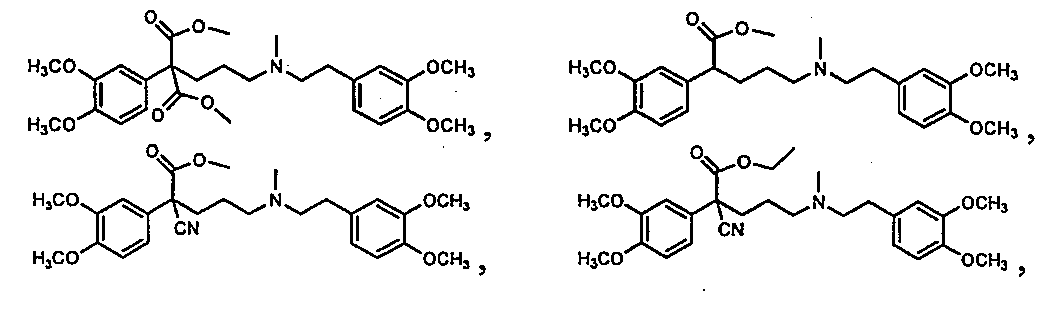
本発明の方法、組成物またはキットのいずれかにおいて、本発明において使用する化合物は、以下の化合物を除外することができる:
本発明の方法、組成物またはキットのいずれかにおいて、本発明において使用する化合物は立体化学的に純粋であっても良く、または立体化学異性体の混合物として使用することもできる。いくつかの実施形態において、化合物はラセミ化合物である。他の実施形態において、化合物は、単一のエナンチオマー、または単一のジアステレオマーである。更に他の実施形態において、化合物はジアステレオマーの混合物、またはエナンチオマーの混合物である。 In any of the methods, compositions or kits of the present invention, the compounds used in the present invention may be stereochemically pure or may be used as a mixture of stereochemical isomers. In some embodiments, the compound is a racemate. In other embodiments, the compound is a single enantiomer, or a single diastereomer. In still other embodiments, the compound is a mixture of diastereomers or a mixture of enantiomers.
本発明の方法、組成物またはキットのいずれかにおいて、好ましい実施形態は以下の化合物を含む:
−a、b、c、d、e、f、およびgはそれぞれ独立して-CH2-、-O-、-S-、または単結合であり;
−R11、R12、R13、R14、R15、R16、R17、およびR20はそれぞれ独立して:H、低級アルキル、-CO2(低級アルキル)で置換された低級アルキル、-CO2(低級アルコキシアルキル)で置換された低級アルキル、フッ素もしくは塩素で置換された低級アルキル、低級アルコキシアルキル、-CO2(低級アルキル)で置換された低級アルコキシアルキル、-CO2(低級アルコキシアルキル)で置換された低級アルコキシアルキル、フッ素もしくは塩素で置換された低級アルコキシアルキル、またはCO2R10であり;
−R10はそれぞれ独立して低級アルキルまたは低級アルコキシアルキルであり;
−R18はH、CN、またはCO2R10であり;そして
−R19はCH3またはHであり;
ここで、化合物はベラパミル、ガロパミル、エモパミル(emopamil)、メパミル(mepamil)、またはデバパミル(devapamil)ではない。
In any of the methods, compositions or kits of the present invention, preferred embodiments include the following compounds:
-A, b, c, d, e, f, and g are each independently -CH 2 -, - O -, - S-, or a single bond;
-R 11 , R 12 , R 13 , R 14 , R 15 , R 16 , R 17 , and R 20 are each independently: H, lower alkyl, lower alkyl substituted with -CO 2 (lower alkyl), Lower alkyl substituted with —CO 2 (lower alkoxyalkyl), lower alkyl substituted with fluorine or chlorine, lower alkoxyalkyl, lower alkoxyalkyl substituted with —CO 2 (lower alkyl), —CO 2 (lower alkoxy Lower alkoxyalkyl substituted with alkyl), lower alkoxyalkyl substituted with fluorine or chlorine, or CO 2 R 10 ;
Each —R 10 is independently lower alkyl or lower alkoxyalkyl;
-R 18 is H, be a CN or CO 2 R 10,; and -R 19 is an CH 3 or H;
Here, the compound is not verapamil, galopamil, emopamil, mepamil, or devapamil.
本発明の方法、組成物またはキットのいずれにおいても、いくつかの実施形態は、R11、R12、R13、R14、R15、R16、R17、R18、およびR20の少なくとも1つがCO2R10、-CO2(低級アルキル)で置換された低級アルキル、-CO2(低級アルコキシアルキル)で置換された低級アルキル、-CO2(低級アルキル)で置換された低級アルコキシアルキル、または-CO2(低級アルコキシアルキル)で置換された低級アルコキシアルキルである化合物を含む。更なる実施形態において、R19はHであり、gは単結合であり、そしてR20はHである。更に他の実施形態において、R19はHであり、gは単結合であり、R20はCO2R10であり、そして-d-R14および-e-R15の両方が-O-(低級アルキル)または-O-(低級アルコキシアルキル)であることはない。 In any of the methods, compositions or kits of the present invention, some embodiments include at least R 11 , R 12 , R 13 , R 14 , R 15 , R 16 , R 17 , R 18 , and R 20 . One is CO 2 R 10 , lower alkyl substituted with —CO 2 (lower alkyl), lower alkyl substituted with —CO 2 (lower alkoxyalkyl), lower alkoxyalkyl substituted with —CO 2 (lower alkyl) Or a compound that is a lower alkoxyalkyl substituted with —CO 2 (lower alkoxyalkyl). In a further embodiment, R 19 is H, g is a single bond, and R 20 is H. In still other embodiments, R 19 is H, g is a single bond, R 20 is CO 2 R 10 , and both -dR 14 and -eR 15 are -O- (lower alkyl) or It is not -O- (lower alkoxyalkyl).
本発明の任意の方法、組成物またはキットにおいて、いくつかの実施形態は以下の化合物を含む。
(a)R17は低級アルキルであり;
(b)R18はCNまたはCO2R10であり;
(c)-a-R11、-b-R12、または-c-R13の少なくとも1つは独立して
(i)-O-(低級アルキル);
(ii)-O-( -CO2(低級アルキル)で置換された低級アルキル);
(iii)-O-( -CO2(低級アルコキシアルキル)で置換された低級アルキル);
(iv)-O-(フッ素もしくは塩素で置換された低級アルキル);
(v)-O-(低級アルコキシアルキル);
(vi)-O-( -CO2(低級アルキル)で置換された低級アルコキシアルキル);
(vii)-O-( -CO2(低級アルコキシアルキル)で置換された低級アルコキシアルキル);
(viii)-O-(フッ素もしくは塩素で置換された低級アルキル);または
(ix)-(単結合)-CO2R10であり;そして
(d)-d-R14、-e-R15、-f-R16、または-g-R20の少なくとも1つは独立して
(i)-O-(低級アルキル);
(ii)-O-( -CO2(低級アルキル)で置換された低級アルキル);
(iii)-O-( -CO2(低級アルコキシアルキル)で置換された低級アルキル);
(iv)-O-(フッ素もしくは塩素で置換された低級アルキル);
(v)-O-(低級アルコキシアルキル);
(vi)-O-( -CO2(低級アルキル)で置換された低級アルコキシアルキル);
(vii)-O-( -CO2(低級アルコキシアルキル)で置換された低級アルコキシアルキル);
(viii)-O-(フッ素もしくは塩素で置換された低級アルキル);または
(ix)-(単結合)-CO2R10である。
In any method, composition or kit of the invention, some embodiments comprise the following compounds:
(a) R 17 is lower alkyl;
(b) R 18 is CN or CO 2 R 10 ;
(c) at least one of -aR 11 , -bR 12 , or -cR 13 is independently
(i) -O- (lower alkyl);
(ii) -O- (lower alkyl substituted with -CO 2 (lower alkyl));
(iii) -O- (lower alkyl substituted with -CO 2 (lower alkoxyalkyl));
(iv) -O- (lower alkyl substituted with fluorine or chlorine);
(v) -O- (lower alkoxyalkyl);
(vi) -O-(-lower alkoxyalkyl substituted with -CO 2 (lower alkyl));
(vii) —O— (lower alkoxyalkyl substituted with —CO 2 (lower alkoxyalkyl));
(viii) -O- (lower alkyl substituted with fluorine or chlorine); or
(ix)-(single bond) -CO 2 R 10 ; and
(d) at least one of -dR 14 , -eR 15 , -fR 16 , or -gR 20 is independently
(i) -O- (lower alkyl);
(ii) -O- (lower alkyl substituted with -CO 2 (lower alkyl));
(iii) -O- (lower alkyl substituted with -CO 2 (lower alkoxyalkyl));
(iv) -O- (lower alkyl substituted with fluorine or chlorine);
(v) -O- (lower alkoxyalkyl);
(vi) -O-(-lower alkoxyalkyl substituted with -CO 2 (lower alkyl));
(vii) —O— (lower alkoxyalkyl substituted with —CO 2 (lower alkoxyalkyl));
(viii) -O- (lower alkyl substituted with fluorine or chlorine); or
(ix)-(single bond) -CO 2 R 10 .
更なる実施形態において、R11、R12、R13、R14、R15、R16、R17、R18、またはR20の少なくとも1つは、CO2R10、-CO2(低級アルキル)で置換された低級アルキル、-CO2(低級アルコキシアルキル)で置換された低級アルキル、-CO2(低級アルキル)で置換された低級アルコキシアルキル、または-CO2(低級アルコキシアルキル)で置換された低級アルコキシアルキルである。更なる実施形態において、R19はHであり、gは単結合であり、そしてR20はHである。更に他の実施形態において、gは単結合であり、R20はCO2R10であり、そして-d-R14および-e-R15の両方が-O-(低級アルキル)または-O-(低級アルコキシアルキル)であることはない。 In a further embodiment, at least one of R 11 , R 12 , R 13 , R 14 , R 15 , R 16 , R 17 , R 18 , or R 20 is CO 2 R 10 , —CO 2 (lower alkyl). ), Lower alkyl substituted with —CO 2 (lower alkoxyalkyl), lower alkoxyalkyl substituted with —CO 2 (lower alkyl), or —CO 2 (lower alkoxyalkyl) Lower alkoxyalkyl. In a further embodiment, R 19 is H, g is a single bond, and R 20 is H. In still other embodiments, g is a single bond, R 20 is CO 2 R 10 , and both -dR 14 and -eR 15 are -O- (lower alkyl) or -O- (lower alkoxyalkyl ) Is not.
本発明の任意の方法、組成物またはキットにおいて、低級アルキルは以下のものであり得る:メチル、エチル、プロピル、イソプロピル、n-ブチル、s-ブチル、i-ブチル、t-ブチル、ペンチル、イソアミル、ヘキシル、ヘプチル、シクロプロピル、シクロブチル、シクロペンチル、シクロヘキシル、シクロブチルメチル、またはシクロヘプチル。いくつかの実施形態において、低級アルキルはメチル、エチル、プロピル、イソプロピル、n-ブチル、t-ブチル、またはシクロプロピルである。 In any method, composition or kit of the present invention, the lower alkyl can be: methyl, ethyl, propyl, isopropyl, n-butyl, s-butyl, i-butyl, t-butyl, pentyl, isoamyl , Hexyl, heptyl, cyclopropyl, cyclobutyl, cyclopentyl, cyclohexyl, cyclobutylmethyl, or cycloheptyl. In some embodiments, lower alkyl is methyl, ethyl, propyl, isopropyl, n-butyl, t-butyl, or cyclopropyl.
本発明の方法、組成物またはキットのいずれかにおいて、-CO2(低級アルキル)で置換された低級アルキルは以下のものであり得る:-CH2CO2R21、-CH2CH2CO2R21、-CH(CO2R21)CH3、-CH2CH2CH2CO2R21、-CH(CO2R21)CH2CH3、-CH2CH(CO2R21)CH3、-CH(CH3)CH2CO2R21、-C(CH3)2CO2R21、-CH2CH2CH2CH2CO2R21、-CH2CH2CH2CH2CH2CO2R21、-CH2CH2CH2CH2CH2CH2CO2R21、または-CH2CH2CH2CH2CH2CH2CH2CO2R21[式中R21は低級アルキル]。いくつかの実施形態において、R21はメチル、エチル、プロピル、イソプロピル、t-ブチル、またはシクロプロピルである。他の実施形態において、-CO2(低級アルキル)で置換された低級アルキルは:-CH2CO2CH3、-CH2CO2CH2CH3、-CH2CH2CO2CH3、または-CH2CH2CO2CH2CH3である。 In any of the methods, compositions or kits of the present invention, the lower alkyl substituted with —CO 2 (lower alkyl) can be: —CH 2 CO 2 R 21 , —CH 2 CH 2 CO 2 R 21 , -CH (CO 2 R 21 ) CH 3 , -CH 2 CH 2 CH 2 CO 2 R 21 , -CH (CO 2 R 21 ) CH 2 CH 3 , -CH 2 CH (CO 2 R 21 ) CH 3 , -CH (CH 3 ) CH 2 CO 2 R 21 , -C (CH 3 ) 2 CO 2 R 21 , -CH 2 CH 2 CH 2 CH 2 CO 2 R 21 , -CH 2 CH 2 CH 2 CH 2 CH 2 CO 2 R 21 , -CH 2 CH 2 CH 2 CH 2 CH 2 CH 2 CO 2 R 21 , or -CH 2 CH 2 CH 2 CH 2 CH 2 CH 2 CH 2 CO 2 R 21 [where R 21 Is lower alkyl]. In some embodiments, R 21 is methyl, ethyl, propyl, isopropyl, t-butyl, or cyclopropyl. In other embodiments, lower alkyl substituted with —CO 2 (lower alkyl) is: —CH 2 CO 2 CH 3 , —CH 2 CO 2 CH 2 CH 3 , —CH 2 CH 2 CO 2 CH 3 , or it is a -CH 2 CH 2 CO 2 CH 2 CH 3.
本発明の方法、組成物またはキットのいずれかにおいて、低級アルコキシアルキルは以下のものであり得る:-CH2OR22、-CH2CH2OR22、-CH(OR22)CH3、-CH2CH2CH2OR22、-CH(OR22)CH2CH3、-CH2CH(OR22)CH3、-CH(CH3)CH2OR22、-C(CH3)2OR22、-CH2CH2CH2CH2COR22、-CH2CH2CH2CH2CH2OR22、-CH2CH2CH2CH2CH2CH2OR22、または-CH2CH2CH2CH2CH2CH2CH(OR22)[式中R22は低級アルキル]。いくつかの実施形態において、R22はメチル、エチル、プロピル、イソプロピル、n-ブチル、t-ブチル、またはシクロプロピルである。他の実施形態において、低級アルコキシアルキルは-CH2OCH3、-CH2OCH2CH3、-CH2CH2OCH3、または-CH2CH2OCH2CH3である。 In any of the methods, compositions or kits of the invention, the lower alkoxyalkyl can be: —CH 2 OR 22 , —CH 2 CH 2 OR 22 , —CH (OR 22 ) CH 3 , —CH 2 CH 2 CH 2 OR 22 , -CH (OR 22 ) CH 2 CH 3 , -CH 2 CH (OR 22 ) CH 3 , -CH (CH 3 ) CH 2 OR 22 , -C (CH 3 ) 2 OR 22 , -CH 2 CH 2 CH 2 CH 2 COR 22 ,, -CH 2 CH 2 CH 2 CH 2 CH 2 OR 22 , -CH 2 CH 2 CH 2 CH 2 CH 2 CH 2 OR 22 , or -CH 2 CH 2 CH 2 CH 2 CH 2 CH 2 CH (OR 22 ) [wherein R 22 is lower alkyl]. In some embodiments, R 22 is methyl, ethyl, propyl, isopropyl, n-butyl, t-butyl, or cyclopropyl. In other embodiments, the lower alkoxyalkyl is —CH 2 OCH 3 , —CH 2 OCH 2 CH 3 , —CH 2 CH 2 OCH 3 , or —CH 2 CH 2 OCH 2 CH 3 .
本発明の方法、組成物またはキットのいずれかにおいて、-CO2(低級アルコキシアルキル)で置換された低級アルキルは以下のものであり得る:-CH2CO2R23、-CH2CH2CO2R23、-CH(CO2R23)CH3、-CH2CH2CH2CO2R23、-CH(CO2R23)CH2CH3、-CH2CH(CO2R23)CH3、-CH(CH3)CH2CO2R23、-C(CH3)2CO2R23、-CH2CH2CH2CH2CO2R23、-CH2CH2CH2CH2CH2CO2R23、-CH2CH2CH2CH2CH2CH2CO2R23、または-CH2CH2CH2CH2CH2CH2CH2(CO2R23)[式中R23は低級アルコキシアルキル]]。いくつかの実施形態において、R23はCH2CH2OCH3またはCH2CH2OCH2CH3である。他の実施形態において、-CO2(低級アルコキシアルキル)で置換された低級アルキルは:-CH2CO2(CH2CH2OCH3)、-CH2CO2(CH2CH2OCH2CH3)、-CH2CH2CO2(CH2CH2OCH3)、または-CH2CH2CO2(CH2CH2OCH2CH3)である。 In any of the methods, compositions or kits of the present invention, the lower alkyl substituted with —CO 2 (lower alkoxyalkyl) can be: —CH 2 CO 2 R 23 , —CH 2 CH 2 CO 2 R 23 , -CH (CO 2 R 23 ) CH 3 , -CH 2 CH 2 CH 2 CO 2 R 23 , -CH (CO 2 R 23 ) CH 2 CH 3 , -CH 2 CH (CO 2 R 23 ) CH 3 , -CH (CH 3 ) CH 2 CO 2 R 23 , -C (CH 3 ) 2 CO 2 R 23 , -CH 2 CH 2 CH 2 CH 2 CO 2 R 23 , -CH 2 CH 2 CH 2 CH 2 CH 2 CO 2 R 23 , -CH 2 CH 2 CH 2 CH 2 CH 2 CH 2 CO 2 R 23 , or -CH 2 CH 2 CH 2 CH 2 CH 2 CH 2 CH 2 (CO 2 R 23 ) [Formula R 23 is lower alkoxyalkyl]]. In some embodiments, R 23 is CH 2 CH 2 OCH 3 or CH 2 CH 2 OCH 2 CH 3 . In other embodiments, lower alkyl substituted with —CO 2 (lower alkoxyalkyl) is: —CH 2 CO 2 (CH 2 CH 2 OCH 3 ), —CH 2 CO 2 (CH 2 CH 2 OCH 2 CH 3 ), —CH 2 CH 2 CO 2 (CH 2 CH 2 OCH 3 ), or —CH 2 CH 2 CO 2 (CH 2 CH 2 OCH 2 CH 3 ).
本発明の方法、組成物またはキットのいずれかにおいて、フッ素もしくは塩素で置換された低級アルキルは以下のものであり得る:-CH2X、-CHX2、-CX3、-CH2CX3、-CX2CX3、または-CH(CX3)2[式中Xは-Fもしくは-Cl]。いくつかの実施形態において、フッ素もしくは塩素で置換された低級アルキルは-CF3、-CCl3、-CF2CF3、または-CH(CF3)2である。 The method of the present invention, in any composition or kit, lower alkyl substituted with fluorine or chlorine can be the following: -CH 2 X, -CHX 2, -CX 3, -CH 2 CX 3, -CX 2 CX 3 or -CH (CX 3 ) 2 [wherein X is -F or -Cl]. In some embodiments, the lower alkyl substituted with fluorine or chlorine is —CF 3 , —CCl 3 , —CF 2 CF 3 , or —CH (CF 3 ) 2 .
本発明の方法、組成物またはキットのいずれかにおいて、-CO2(低級アルキル)で置換された低級アルコキシアルキルは以下のものであり得る:-CH2CH(CO2R24)OR25、-CH(CO2R24)CH2OR25、-CH2CH2OCH2CH2(CO2R24)、または-CH2CH2OCH(CO2R24)CH3[式中R24およびR25はそれぞれ独立して低級アルキル]]。いくつかの実施形態において、R24はメチル、エチル、プロピル、イソプロピル、t-ブチル、またはシクロプロピルである。いくつかの実施形態において、R25はメチル、エチル、プロピル、イソプロピル、n-ブチル、t-ブチル、またはシクロプロピルである。 In any of the methods, compositions or kits of the present invention, the lower alkoxyalkyl substituted with —CO 2 (lower alkyl) may be: —CH 2 CH (CO 2 R 24 ) OR 25 , — CH (CO 2 R 24 ) CH 2 OR 25 , -CH 2 CH 2 OCH 2 CH 2 (CO 2 R 24 ), or -CH 2 CH 2 OCH (CO 2 R 24 ) CH 3 [wherein R 24 and R 25 are each independently lower alkyl]]]. In some embodiments, R 24 is methyl, ethyl, propyl, isopropyl, t-butyl, or cyclopropyl. In some embodiments, R 25 is methyl, ethyl, propyl, isopropyl, n-butyl, t-butyl, or cyclopropyl.
本発明の方法、組成物またはキットのいずれかにおいて、-CO2(低級アルコキシアルキル)で置換された低級アルコキシアルキルは以下のものであり得る:-CH2CH(CO2R26)OR27、-CH(CO2R26)CH2OR27、-CH2CH2OCH2CH2(CO2R26)、または-CH2CH2OCH(CO2R26)CH3[式中独立してR26は低級アルコキシアルキルであり、R27は低級アルキルである]。いくつかの実施形態において、R26はCH2CH2OCH3またはCH2CH2OCH2CH3である。いくつかの実施形態において、R27はメチル、エチル、プロピル、イソプロピル、n-ブチル、t-ブチル、またはシクロプロピルである。 In any of the methods, compositions or kits of the present invention, the lower alkoxyalkyl substituted with —CO 2 (lower alkoxyalkyl) may be: —CH 2 CH (CO 2 R 26 ) OR 27 , -CH (CO 2 R 26 ) CH 2 OR 27 , -CH 2 CH 2 OCH 2 CH 2 (CO 2 R 26 ), or -CH 2 CH 2 OCH (CO 2 R 26 ) CH 3 R 26 is lower alkoxyalkyl and R 27 is lower alkyl]. In some embodiments, R 26 is CH 2 CH 2 OCH 3 or CH 2 CH 2 OCH 2 CH 3 . In some embodiments, R 27 is methyl, ethyl, propyl, isopropyl, n-butyl, t-butyl, or cyclopropyl.
本発明の方法、組成物またはキットのいずれかにおいて、フッ素もしくは塩素で置換された低級アルコキシアルキルは以下のものであり得る:-CX2CX2OCH2CH3、-CH2CH2OCH2CX3、-CH2CH2OCX2CX3、または-CH2CH2OCH(CX3)2[式中Xは-Fもしくは-Cl]。 The method of the present invention, in any composition or kit, lower alkoxyalkyl substituted with fluorine or chlorine can be the following: -CX 2 CX 2 OCH 2 CH 3, -CH 2 CH 2 OCH 2 CX 3 , —CH 2 CH 2 OCX 2 CX 3 , or —CH 2 CH 2 OCH (CX 3 ) 2 [wherein X is —F or —Cl].
本発明の方法、組成物またはキットのいずれかにおいて、CO2R10は:CO2CH3、CO2CH2CH3、CO2CH(CH3)2、CO2C(CH3)3、CO2CH2CH2OCH3、またはCO2CH2CH2OCH2CH3であり得る。 In any of the methods, compositions or kits of the present invention, CO 2 R 10 is: CO 2 CH 3 , CO 2 CH 2 CH 3 , CO 2 CH (CH 3 ) 2 , CO 2 C (CH 3 ) 3 , It can be CO 2 CH 2 CH 2 OCH 3 , or CO 2 CH 2 CH 2 OCH 2 CH 3 .
本発明の方法、組成物またはキットのいずれかにおいて、本発明において使用する化合物は、望ましくは以下の化合物のいずれかである。
定義
本明細書において用いる用語「狭心症」は、虚血性心疾患のために感じる胸部の不快感をいう。狭心症は、その主たる根本的原因が動脈硬化である安定狭心症、その根本的原因が冠動脈の一過性の血管痙攣によるものである冠攣縮性狭心症(異型狭心症またはプリンツメタル狭心症とも呼ばれる)、または動脈硬化性プラークの破裂部位における血小板凝集によって引き起こされる不安定狭心症に分類することができる。
Definitions As used herein, the term “angina” refers to chest discomfort felt due to ischemic heart disease. Angina is stable angina, the main underlying cause of which is arteriosclerosis, and vasospastic angina (atypical angina or prints), whose underlying cause is transient vasospasm in the coronary arteries. (Also called metal angina), or unstable angina caused by platelet aggregation at the site of atherosclerotic plaque rupture.
本明細書において使用する用語「バッカル投与」は、頬と歯ぐきの間に投与することによる化合物もしくは化合物の製薬上許容される製剤の吸収を意味する。望ましくは化合物は式Iの化合物である。 The term “buccal administration” as used herein means the absorption of a compound or a pharmaceutically acceptable formulation of the compound by administration between the cheek and gums. Desirably the compound is a compound of formula I.
本明細書において使用する「心不整脈」は、不規則であるか、速過ぎるか、遅過ぎるか、または心臓を通る電気経路の異常を介して伝導される、異常な心拍リズムを特徴とする症状をいう。不整脈は、心臓の下室(心室)で生じる心室性不整脈、および心臓の上室(心房)で生じる上室性不整脈とに分類することができる。心不整脈には、心房の非常に速い収縮が引き起こされ、そのために心室内への血液の効率的な送り込みが損なわれる、異常に速い放電パターンを特徴とする心房細動および心房粗動が含まれる。心不整脈にはまた、心室より上部の心組織で始まる規則的かつ速い心拍数を特徴とする発作性上室性頻拍(PSVT)も含まれる。他の心不整脈の例は、心房性、結節性、もしくは心室性期外脱分極、心房頻拍、心室頻拍、心室細動、およびトルサードドゥポワント(Torsades de Pointes)である。 As used herein, “cardiac arrhythmia” is a condition characterized by an abnormal heart rhythm that is irregular, too fast, too slow, or conducted through an abnormality in the electrical pathway through the heart. Say. Arrhythmias can be classified into ventricular arrhythmias that occur in the lower chamber (ventricle) of the heart and supraventricular arrhythmias that occur in the upper chamber (atrium) of the heart. Cardiac arrhythmias include atrial fibrillation and atrial flutter characterized by an unusually fast discharge pattern that causes a very fast contraction of the atrium, thereby impairing the efficient delivery of blood into the ventricle. . Cardiac arrhythmias also include paroxysmal supraventricular tachycardia (PSVT) characterized by a regular and fast heart rate that begins in heart tissue above the ventricle. Examples of other cardiac arrhythmias are atrial, nodular, or ventricular extradepolarization, atrial tachycardia, ventricular tachycardia, ventricular fibrillation, and Torsades de Pointes.
本明細書において使用する「骨格筋の血流低下と関連する疾患」は、骨格筋を灌流する動脈の狭窄の結果、灌流および酸素送達が減少する症状をいう。こうした症状としては、限定するものではないが、レイノー症候群および間欠性跛行が挙げられる。 As used herein, “diseases associated with decreased blood flow in skeletal muscle” refer to symptoms in which perfusion and oxygen delivery are reduced as a result of stenosis of the arteries that perfuse skeletal muscle. Such symptoms include, but are not limited to, Raynaud's syndrome and intermittent claudication.
用語「添加剤」は、本明細書において、本明細書に記載する活性化合物(例えば式Iを有するもの)以外の任意の成分を記載するために使用する。添加剤としては、例えば:付着防止剤、抗酸化剤、結合剤、被覆剤、圧縮助剤、崩壊剤、色素(着色剤)、皮膚軟化剤、乳化剤、充填剤(希釈剤)、皮膜形成剤もしくは被覆剤、風味剤、香料、滑動剤(流動促進剤)、潤滑剤、防腐剤、印刷インキ、吸着剤、懸濁剤もしくは分散剤、甘味料、または水和水を挙げることができる。添加剤の例としては、限定するものではないが、以下のものが挙げられる:ブチル化ヒドロキシトルエン(BHT)、炭酸カルシウム、リン酸カルシウム(二塩基)、ステアリン酸カルシウム、クロスカルメロース、架橋型ポリビニルピロリドン、クエン酸、クロスポビドン、システイン、エチルセルロース、ゼラチン、ヒドロキシプロピルセルロース、ヒドロキシプロピルメチルセルロース、ラクトース、ステアリン酸マグネシウム、マルチトール、マンニトール、メチオニン、メチルセルロース、メチルパラベン、微結晶セルロース、ポリエチレングリコール、ポリビニルピロリドン、ポビドン、糊化デンプン、プロピルパラベン、パルミチン酸レチニル、シェラック、二酸化ケイ素、カルボキシメチルセルロースナトリウム、クエン酸ナトリウム、グリコール酸デンプンナトリウム、ソルビトール、デンプン(トウモロコシ)、ステアリン酸、ステアリン酸、スクロース、タルク、二酸化チタン、ビタミンA、ビタミンE、ビタミンC、およびキシリトール。 The term “additive” is used herein to describe any ingredient other than the active compounds described herein (eg, those having Formula I). Examples of additives include: anti-adhesive agents, antioxidants, binders, coating agents, compression aids, disintegrants, pigments (colorants), emollients, emulsifiers, fillers (diluents), and film forming agents. Or a coating agent, a flavoring agent, a fragrance | flavor, a glidant (glue promoter), a lubricant, an antiseptic | preservative, printing ink, an adsorption agent, a suspending agent or a dispersing agent, a sweetener, or a hydration water can be mentioned. Examples of additives include, but are not limited to, butylated hydroxytoluene (BHT), calcium carbonate, calcium phosphate (dibasic), calcium stearate, croscarmellose, crosslinked polyvinylpyrrolidone, Citric acid, crospovidone, cysteine, ethylcellulose, gelatin, hydroxypropylcellulose, hydroxypropylmethylcellulose, lactose, magnesium stearate, maltitol, mannitol, methionine, methylcellulose, methylparaben, microcrystalline cellulose, polyethylene glycol, polyvinylpyrrolidone, povidone, glue Starch, propylparaben, retinyl palmitate, shellac, silicon dioxide, sodium carboxymethylcellulose, sodium citrate Beam, sodium starch glycolate, sorbitol, starch (corn), stearic acid, stearic acid, sucrose, talc, titanium dioxide, vitamin A, vitamin E, vitamin C, and xylitol.
本明細書において用いる「手術前、手術中、または手術後の高血圧」は、手術前後の高血圧、すなわち外科的処置の直前、その間、またはその後に生じる持続的な血圧上昇(米国では収縮時/拡張時≧140/90mmHg、または他の多くの国では≧160/95mmHg)をいう。 As used herein, “hypertension before, during, or after surgery” refers to pre- and post-surgery hypertension, ie, a continuous increase in blood pressure that occurs immediately before, during, or after a surgical procedure (contraction / dilation in the United States). Hour ≧ 140 / 90mmHg, or in many other countries ≧ 160 / 95mmHg).
本明細書において用いる用語「緊急治療室環境における高血圧性クリーゼ」は、病院または病院の緊急治療室の環境で迅速に対処する必要のある収縮時および拡張時血圧の突然の上昇をいう。突然の急性かつ深刻な血圧上昇は、末端臓器の急性損傷(すなわち心血管系、腎臓、中枢神経系)と関連することも、関連しないこともある。 As used herein, the term “hypertensive crisis in an emergency room setting” refers to a sudden rise in systolic and diastolic blood pressure that needs to be addressed quickly in a hospital or hospital emergency room setting. A sudden acute and severe increase in blood pressure may or may not be associated with acute damage to end organs (ie, cardiovascular system, kidney, central nervous system).
本明細書において使用する「吸入投与」または「吸入による投与」は、肺内への吸入によって液体エアゾールミスト、固体エアゾール粒子物、または気体物質の形態で体に吸収させるための薬剤の送達をいう。望ましくは化合物は式Iの化合物である。 As used herein, “inhalation administration” or “administration by inhalation” refers to the delivery of a drug for absorption by the body in the form of a liquid aerosol mist, solid aerosol particles, or gaseous substance by inhalation into the lungs. . Desirably the compound is a compound of formula I.
本明細書において使用する用語「鼻内投与」または「鼻への投与」は、鼻もしくは鼻腔に投与することによる化合物または化合物の製薬上許容される製剤の吸収を意味する。望ましくは化合物は式Iの化合物である。 As used herein, the term “nasal administration” or “nasal administration” means absorption of a compound or a pharmaceutically acceptable formulation of the compound by administration to the nose or nasal cavity. Desirably the compound is a compound of formula I.
本明細書において使用する用語「静脈内投与」は、化合物の製薬上許容される製剤を静脈内に直接注射することを意味する。望ましくは、化合物は式Iの化合物である。 The term “intravenous administration” as used herein means direct injection of a pharmaceutically acceptable formulation of a compound directly into a vein. Desirably, the compound is a compound of formula I.
本明細書において使用する用語「虚血性心疾患」または「虚血性心疾患」は、血流の制限および心筋への酸素送達の減少に至る、狭窄した心臓の動脈を特徴とする症状をいう。 As used herein, the term “ischemic heart disease” or “ischemic heart disease” refers to a condition characterized by a constricted heart artery leading to blood flow limitation and decreased oxygen delivery to the myocardium.
本明細書において使用する用語「低級アルコキシアルキル」は、エーテル含有置換基を有する低級アルキル基、例えば特にエトキシエチル、メトキシエチル、およびメトキシプロピルなどを意味し、ここでエーテル含有置換基は低級アルキルの任意の位置にあり得る。低級アルコキシアルキルは、例えば以下のものであり得る:-CH2OR22、-CH2CH2OR22、-CH(OR22)CH3、-CH2CH2CH2OR22、-CH(OR22)CH2CH3、-CH2CH(OR22)CH3、-CH(CH3)CH2OR22、-C(CH3)2OR22、-CH2CH2CH2CH2COR22、-CH2CH2CH2CH2CH2OR22、-CH2CH2CH2CH2CH2CH2OR22、または-CH2CH2CH2CH2CH2CH2CH(OR22)[式中R22は低級アルキル]。望ましくはR22はメチル、エチル、プロピル、イソプロピル、n-ブチル、t-ブチル、またはシクロプロピルである。低級アルコキシアルキルの非制限的な例としては、-CH2OCH3、-CH2OCH2CH3、-CH2CH2OCH3、および-CH2CH2OCH2CH3が挙げられる。低級アルコキシアルキルは場合により置換されていても良い。置換された低級アルコキシアルキルは、場合により、例えば低級アルキル基上の任意の炭素位置、またはエーテル含有置換基上の任意の炭素位置でCO2R10で置換されていても良い。 As used herein, the term “lower alkoxyalkyl” means a lower alkyl group having an ether-containing substituent, such as, in particular, ethoxyethyl, methoxyethyl, methoxypropyl, etc., where the ether-containing substituent is a lower alkyl group. Can be in any position. Lower alkoxyalkyl, it may for example include the following: -CH 2 OR 22, -CH 2 CH 2 OR 22, -CH (OR 22) CH 3, -CH 2 CH 2 CH 2 OR 22, -CH (OR 22 ) CH 2 CH 3 , -CH 2 CH (OR 22 ) CH 3 , -CH (CH 3 ) CH 2 OR 22 , -C (CH 3 ) 2 OR 22 , -CH 2 CH 2 CH 2 CH 2 COR 22 , -CH 2 CH 2 CH 2 CH 2 CH 2 OR 22 , -CH 2 CH 2 CH 2 CH 2 CH 2 CH 2 OR 22 , or -CH 2 CH 2 CH 2 CH 2 CH 2 CH 2 CH (OR 22 ) [Wherein R 22 is lower alkyl]. Desirably R 22 is methyl, ethyl, propyl, isopropyl, n-butyl, t-butyl, or cyclopropyl. Non-limiting examples of lower alkoxyalkyl include —CH 2 OCH 3 , —CH 2 OCH 2 CH 3 , —CH 2 CH 2 OCH 3 , and —CH 2 CH 2 OCH 2 CH 3 . Lower alkoxyalkyl may be optionally substituted. The substituted lower alkoxyalkyl may optionally be substituted with CO 2 R 10 at, for example, any carbon position on the lower alkyl group or any carbon position on the ether-containing substituent.
本明細書において使用する用語「低級アルキル」は、直鎖、分岐鎖もしくは環状構造からなる1〜7個の炭素原子のアルキル基を意味する。低級アルキルは、1、2、3、4、5、6、または7個の炭素原子を含み得る。低級アルキル基の例としては、限定するものではないが:特にメチル、エチル、プロピル、イソプロピル、ブチル、s-、i-およびt-ブチル、ペンチル、イソアミル、ヘキシル、ヘプチル、シクロプロピル、シクロブチル、シクロペンチル、シクロヘキシル、シクロブチルメチル、およびシクロヘプチルが挙げられる。望ましくは、低級アルキルはメチル、エチル、プロピル、イソプロピル、n-ブチル、t-ブチル、またはシクロプロピルである。低級アルキルは場合により置換されていても良い。置換された低級アルキルは、場合により、任意の炭素位置で、例えばCO2R10で置換されていても良い。 The term “lower alkyl” as used herein means an alkyl group of 1 to 7 carbon atoms consisting of a linear, branched or cyclic structure. A lower alkyl can contain 1, 2, 3, 4, 5, 6, or 7 carbon atoms. Examples of lower alkyl groups include, but are not limited to: methyl, ethyl, propyl, isopropyl, butyl, s-, i- and t-butyl, pentyl, isoamyl, hexyl, heptyl, cyclopropyl, cyclobutyl, cyclopentyl , Cyclohexyl, cyclobutylmethyl, and cycloheptyl. Desirably, lower alkyl is methyl, ethyl, propyl, isopropyl, n-butyl, t-butyl, or cyclopropyl. Lower alkyl may be optionally substituted. The substituted lower alkyl may be optionally substituted at any carbon position, for example with CO 2 R 10 .
本明細書において使用する「再灌流後の非再灌流現象」という用語は、虚血状態に関連して閉塞した動脈が再開したにもかかわらず、長時間の虚血後に心筋組織が再灌流できないことをいう。 As used herein, the term “non-reperfusion phenomenon after reperfusion” refers to the inability of myocardial tissue to reperfuse after prolonged ischemia despite the resumption of an occluded artery associated with an ischemic condition That means.
本明細書において使用する「非経口投与」は、消化管を回避する経路での化合物または化合物の製薬上許容される製剤の投与を意味する。望ましくは、非経口投与は静脈内投与、皮膚層の下(皮下)、真皮内(皮内)、または筋肉中(筋肉内)への化合物の製薬上許容される製剤の注射である。望ましくは化合物は式Iの化合物である。 As used herein, “parenteral administration” means administration of a compound or a pharmaceutically acceptable formulation of the compound by a route that avoids the gastrointestinal tract. Desirably, parenteral administration is intravenous administration, injection of a pharmaceutically acceptable formulation of the compound under the skin layer (subcutaneous), intradermal (intradermal), or intramuscularly (intramuscular). Desirably the compound is a compound of formula I.
本明細書において使用する「製薬上許容される酸付加塩」は、塩基性活性化合物および有機酸または無機酸から誘導される。有機酸から誘導される製薬上許容される酸付加塩の例としては、限定するものではないが、酢酸塩、アジピン酸塩、アルギン酸塩、アスコルビン酸塩、アスパラギン酸塩、ベンゼンスルホン酸塩、安息香酸塩、酪酸塩、ショウノウ酸塩、カンファースルホン酸塩、クエン酸塩、シクロペンタンプロピオン酸塩、ジグルコン酸塩、ドデシル硫酸塩、エタンスルホン酸塩、フマル酸塩、グルコヘプトン酸塩、グリセロリン酸塩、ヘプトン酸塩、ヘキサン酸塩、2-ヒドロキシ-エタンスルホン酸塩、イセチオン酸塩、ラクトビオン酸塩、乳酸塩、ラウリン酸塩、ラウリル硫酸塩、リンゴ酸塩、マレイン酸塩、マロン酸塩、メタンスルホン酸塩(メシラート)、2-ナフタレンスルホン酸塩、ニコチン酸塩、オレイン酸塩、シュウ酸塩、パルミチン酸塩、パモ酸塩、ペクチン酸塩、過硫酸塩、3-フェニルプロピオン酸塩、ピクリン酸塩、ピバル酸塩、プロピオン酸塩、ステアリン酸塩、コハク酸塩、酒石酸塩、チオシアン酸塩、トルエンスルホン酸塩、ウンデカン酸塩、および吉草酸塩等が挙げられる。無機酸から誘導される製薬上許容される酸付加塩の例としては、重硫酸塩、硫酸塩、ホウ酸塩、臭化水素酸塩、塩酸塩、ヨウ化水素酸塩、ヘミ硫酸塩、硝酸塩、リン酸塩等が挙げられる。望ましくは、「製薬上許容される酸付加塩」は、シュウ酸塩、塩酸塩、臭化水素酸塩、メタンスルホン酸塩、硫酸塩、ヘミ硫酸塩または重硫酸塩である。 As used herein, “pharmaceutically acceptable acid addition salts” are derived from basic active compounds and organic or inorganic acids. Examples of pharmaceutically acceptable acid addition salts derived from organic acids include, but are not limited to, acetate, adipate, alginate, ascorbate, aspartate, benzenesulfonate, benzoate Acid salt, butyrate, camphor sulfonate, camphor sulfonate, citrate, cyclopentane propionate, digluconate, dodecyl sulfate, ethane sulfonate, fumarate, glucoheptonate, glycerophosphate, Heptonate, hexanoate, 2-hydroxy-ethanesulfonate, isethionate, lactobionate, lactate, laurate, lauryl sulfate, malate, maleate, malonate, methanesulfone Acid salt (mesylate), 2-naphthalenesulfonate, nicotinate, oleate, oxalate, palmitate, pamo Acid, pectate, persulfate, 3-phenylpropionate, picrate, pivalate, propionate, stearate, succinate, tartrate, thiocyanate, toluenesulfonate, Examples include undecanoate and valerate. Examples of pharmaceutically acceptable acid addition salts derived from inorganic acids include bisulfate, sulfate, borate, hydrobromide, hydrochloride, hydroiodide, hemisulfate, nitrate And phosphates. Desirably, the “pharmaceutically acceptable acid addition salt” is oxalate, hydrochloride, hydrobromide, methanesulfonate, sulfate, hemisulfate or bisulfate.
本明細書において使用する「製薬上許容される担体」は、活性化合物を懸濁もしくは溶解することができ、患者に対して非毒性かつ非炎症性の性質を有するベヒクルをいう。更に、製薬上許容される担体としては、医薬製剤の分野において公知もしくは使用されており、活性剤の生物学的活性の治療的有効性を有意に妨害せず、かつ患者に対して非毒性である、製薬上許容される添加剤、例えば防腐剤、抗酸化剤、香料、乳化剤、色素、または賦形剤を挙げることができる。 As used herein, “pharmaceutically acceptable carrier” refers to a vehicle that can suspend or dissolve an active compound and that has non-toxic and non-inflammatory properties for a patient. In addition, pharmaceutically acceptable carriers are known or used in the field of pharmaceutical formulations and do not significantly interfere with the therapeutic effectiveness of the biological activity of the active agent and are non-toxic to the patient. There may be mentioned some pharmaceutically acceptable additives such as preservatives, antioxidants, perfumes, emulsifiers, dyes or excipients.
本明細書において使用する用語「製薬上許容される製剤」は、製薬上許容される担体および活性化合物を含む組成物をいう。望ましくは、活性化合物は式Iの化合物である。 The term “pharmaceutically acceptable formulation” as used herein refers to a composition comprising a pharmaceutically acceptable carrier and an active compound. Desirably, the active compound is a compound of formula I.
本明細書において使用する用語「薬用パッチ」は、血流、皮膚または下部組織への活性化合物の吸収のために患者の外表面上に貼るための、活性化合物を埋め込んで含有するパッドをいう。望ましくは、パッチは皮膚上に置かれ、化合物はパッチから時間をかけて次第に放出される。更に、パッチは望ましくは粘着性パッチである。 As used herein, the term “medicinal patch” refers to a pad containing an active compound embedded for application on the outer surface of a patient for absorption of the active compound into the bloodstream, skin or underlying tissue. Desirably, the patch is placed on the skin and the compound is gradually released from the patch over time. Further, the patch is desirably an adhesive patch.
本明細書において使用する用語「舌下投与」は、化合物または化合物の製薬上許容される製剤を舌の下に投与することによる吸収を意味する。望ましくは化合物は式Iの化合物である。 The term “sublingual administration” as used herein means absorption by administering a compound or a pharmaceutically acceptable formulation of the compound under the tongue. Desirably the compound is a compound of formula I.
本明細書において使用する用語「治療上有効な量」は、患者に投与した場合に、虚血性心疾患、心不整脈、緊急治療室環境における高血圧性クリーゼ、手術前、手術中、もしくは手術後の高血圧、再灌流後の非再灌流現象、または骨格筋の血流低下と関連した疾患を軽減し、解消し、または防止する活性化合物の量をいう。望ましくは、治療上有効な量の医薬製剤は、本発明の化合物(例えば式Iを有する化合物)を約0.000001〜10重量/体積% (「%w/v」)の濃度範囲で含有する。 As used herein, the term “therapeutically effective amount”, when administered to a patient, ischemic heart disease, cardiac arrhythmia, hypertensive crisis in an emergency room setting, preoperative, intraoperative, or postoperative The amount of active compound that reduces, eliminates or prevents hypertension, non-reperfusion after reperfusion, or diseases associated with decreased skeletal muscle blood flow. Desirably, a therapeutically effective amount of a pharmaceutical formulation contains a compound of the invention (eg, a compound having Formula I) in a concentration range of about 0.000001 to 10% w / v (“% w / v”).
本明細書において使用する「局所投与」または「局所的に投与」は、活性化合物が下部組織に侵入するような、患者の外表面への化合物の製薬上許容される製剤の投与をいう。望ましくは、外表面は皮膚であり、局所投与は、望ましくは損傷していない皮膚、損傷した皮膚、むけた皮膚または皮膚の開放創への製薬上許容される製剤の投与を含む。望ましくは、化合物は式Iの化合物である。 As used herein, “local administration” or “local administration” refers to the administration of a pharmaceutically acceptable formulation of a compound to the outer surface of a patient such that the active compound enters the underlying tissue. Desirably, the outer surface is skin and topical administration desirably comprises administration of a pharmaceutically acceptable formulation to undamaged skin, damaged skin, peeled skin or open skin wounds. Desirably, the compound is a compound of formula I.
本明細書において使用する「経皮投与」または「経皮的に投与」は、化合物または化合物の製薬上許容される製剤の局所投与または他の投与の結果、薬剤を皮膚バリアを通過して拡散させることをいう。望ましくは化合物は式Iの化合物である。 As used herein, “transdermal administration” or “transdermal administration” refers to the diffusion of a drug across a skin barrier as a result of topical or other administration of a compound or pharmaceutically acceptable formulation of a compound. It means to make it. Desirably the compound is a compound of formula I.
ある基が置換されていても良い場合、任意の置換基としては、限定するものではないが、以下のものが挙げられる:ハロゲン(すなわち-F、-Cl、-Br、または-I)、-CO2H、-CO2(低級アルキル)、-CO2(低級アルコキシアルキル)、-(低級アルキル)、-(低級アルコキシアルキル)、-O(低級アルキル)、-O(低級アルコキシアルキル)、-NH(低級アルキル)、-NH(低級アルコキシアルキル)、-N(低級アルキル)2、および-N(低級アルコキシアルキル)2。 Where a group may be substituted, optional substituents include, but are not limited to, the following: halogen (ie, -F, -Cl, -Br, or -I),- CO 2 H, -CO 2 (lower alkyl), - CO 2 (lower alkoxyalkyl), - (lower alkyl), - (lower alkoxyalkyl), - O (lower alkyl), - O (lower alkoxyalkyl), - NH (lower alkyl), -NH (lower alkoxyalkyl), -N (lower alkyl) 2 , and -N (lower alkoxyalkyl) 2 .
これらの定義、およびThe Merck Manual 第16版 1992(第25章, 第461-498頁; 第25章, 第498-507頁; および第24章, 第413-429頁)、またGoodmanおよびGilmanの「The Pharmacological Basis of Therapeutics」第11版 2006(第34章, 第899-908頁; 第31章, 第823-824頁および第830-832頁; および第32章, 第845-846頁)に記載された他の定義は、ここで参照によりこれらの定義に組み込む。 These definitions and The Merck Manual 16th edition 1992 (Chapter 25, 461-498; Chapter 25, 498-507; and Chapter 24, 413-429), and Goodman and Gilman's “The Pharmacological Basis of Therapeutics”, 11th edition 2006 (Chapter 34, 899-908; Chapter 31, 823-824 and 830-832; and Chapter 32, 845-846) Other definitions listed are hereby incorporated by reference into these definitions.
本発明の他の特徴および利点は、以下の詳細な説明および特許請求の範囲から明らかとなろう。 Other features and advantages of the invention will be apparent from the following detailed description and from the claims.
本発明は、虚血性心疾患、心不整脈、緊急治療室環境における高血圧性クリーゼ、手術前、手術中、もしくは手術後の高血圧、再灌流後の非再灌流現象、および骨格筋の血流低下と関連する疾患を治療するための、薬学的に有効な量の短時間作用型カルシウムチャネル遮断化合物の使用に関する。本発明の組成物、キット、および方法において使用する化合物は、フェニルアルキルアミン(例えばベラパミル)クラスのカルシウムチャネルブロッカー由来の分子にエステラーゼ感受性の基を共有結合することによって短時間作用型とし、舌下、バッカル、経皮、鼻内、吸入、局所、および非経口(例えば静脈内)の投与経路のために製剤化することができる。本明細書に開示する化合物を含有する医薬組成物は、本発明の方法に従って投与するための説明書と共にキットに含めることができる。 The present invention relates to ischemic heart disease, cardiac arrhythmia, hypertensive crisis in emergency room environment, high blood pressure before, during or after surgery, non-reperfusion phenomenon after reperfusion, and decreased blood flow of skeletal muscle. It relates to the use of a pharmaceutically effective amount of a short-acting calcium channel blocking compound for the treatment of related diseases. The compounds used in the compositions, kits, and methods of the present invention are made short-acting by covalently attaching esterase-sensitive groups to molecules derived from phenylalkylamine (eg, verapamil) class calcium channel blockers. , Buccal, transdermal, nasal, inhalation, topical, and parenteral (eg, intravenous) routes of administration. Pharmaceutical compositions containing the compounds disclosed herein can be included in kits with instructions for administration according to the methods of the invention.
本発明の文脈において、短時間作用型カルシウムチャネル遮断化合物は、望ましい効果を上げ、次いで速やかに代謝されて不活化される化合物をも示すことを意図する。短時間作用型CCBは、1分未満〜60分未満の作用時間を有することを意味する。好ましくは化合物の作用時間は1分〜30分であろう。 In the context of the present invention, short-acting calcium channel blocking compounds are intended to provide compounds that have the desired effect and then are rapidly metabolized and inactivated. Short acting CCB means having a duration of action of less than 1 minute to less than 60 minutes. Preferably the duration of action of the compound will be from 1 minute to 30 minutes.
望ましい実施形態において、本発明の方法において使用する化合物、もしくは製薬上許容されるその付加塩、またはその任意のエナンチオマーもしくはジアステレオマーは構造的に式Iで定義され、
式Iで示される化合物は更に以下のように定義される:
−a、b、c、d、e、f、およびgはそれぞれ独立して-CH2-、-O-、-S-、または単結合であり;
−R11、R12、R13、R14、R15、R16、R17、およびR20はそれぞれ独立して:H、低級アルキル、-CO2(低級アルキル)で置換された低級アルキル、-CO2(低級アルコキシアルキル)で置換された低級アルキル、フッ素もしくは塩素で置換された低級アルキル、低級アルコキシアルキル、-CO2(低級アルキル)で置換された低級アルコキシアルキル、-CO2(低級アルコキシアルキル)で置換された低級アルコキシアルキル、フッ素もしくは塩素で置換された低級アルコキシアルキル、またはCO2R10であり;
−R10はそれぞれ独立して低級アルキルまたは低級アルコキシアルキルであり;
−R18はH、CN、またはCO2R10であり;そして
−R19はCH3またはHである。
The compound of formula I is further defined as follows:
-A, b, c, d, e, f, and g are each independently -CH 2 -, - O -, - S-, or a single bond;
-R 11 , R 12 , R 13 , R 14 , R 15 , R 16 , R 17 , and R 20 are each independently: H, lower alkyl, lower alkyl substituted with -CO 2 (lower alkyl), Lower alkyl substituted with —CO 2 (lower alkoxyalkyl), lower alkyl substituted with fluorine or chlorine, lower alkoxyalkyl, lower alkoxyalkyl substituted with —CO 2 (lower alkyl), —CO 2 (lower alkoxy Lower alkoxyalkyl substituted with alkyl), lower alkoxyalkyl substituted with fluorine or chlorine, or CO 2 R 10 ;
Each —R 10 is independently lower alkyl or lower alkoxyalkyl;
-R 18 is H, be a CN or CO 2 R 10,; and -R 19 are CH 3 or H.
式Iによって規定される化合物は、遊離の塩基として、または製薬上許容される酸付加塩として存在し得る。 The compounds defined by formula I can exist as the free base or as a pharmaceutically acceptable acid addition salt.
上記したように、本発明の短時間作用型カルシウムチャネルブロッカー(例えば式Iで規定される化合物)は、カルシウムの制御が正常な止血において役割を果たす障害を治療するために使用することができる。こうした障害としては、例えば肺高血圧症、末梢血管疾患、軽度の鬱血性心不全、肥大性大動脈弁下狭窄、虚血性損傷に対する保護、卒中、片頭痛、抗-新生物薬に対する腫瘍の抵抗性、アカラシア、食道痙攣、気管支喘息、早産、月経困難症、および腎移植における成功率の増大が挙げられる。 As noted above, the short-acting calcium channel blockers of the invention (eg, compounds defined by Formula I) can be used to treat disorders where calcium control plays a role in normal hemostasis. These disorders include, for example, pulmonary hypertension, peripheral vascular disease, mild congestive heart failure, hypertrophic aortic stenosis, protection against ischemic injury, stroke, migraine, tumor resistance to anti-neoplastic drugs, achalasia , Esophageal spasm, bronchial asthma, preterm birth, dysmenorrhea, and increased success in kidney transplantation.
カルシウムチャネル遮断化合物等の医薬薬剤は、肝臓を介さない不活化手段によって超短時間から中程度までにわたる比較的短時間の治療的作用を有するように作製することができる。こうした薬剤は、血清エステラーゼによる血中での広範な代謝、並びに肝臓で起こり得る代謝を受け得る。迅速な排除または不活性もしくはより活性の低い生成物への生体内変換により、長期間または反復的な投与による蓄積は最小限のものとなる。血清エステラーゼに対して感受性となっているカルシウムチャネル遮断化合物は、血液中で不活性もしくはより活性の低い代謝産物に速やかに分解されることが予想される。これはスクシニルコリンで見られる速やかな分解(Stanski, D. R. およびHug, C. C., Jr. Anesthesiology 57: 435-438 (1982))に類似したものと考えることができ、投与量と薬理効果の持続時間との相関性をより予測可能にすることができる。 A pharmaceutical agent such as a calcium channel blocking compound can be prepared to have a therapeutic action in a relatively short time ranging from an extremely short time to a medium by inactivation means not via the liver. Such drugs can undergo extensive metabolism in the blood by serum esterases as well as metabolism that can occur in the liver. Rapid elimination or biotransformation to an inactive or less active product minimizes accumulation over prolonged or repeated administrations. Calcium channel blocking compounds that are sensitive to serum esterases are expected to be rapidly degraded into inactive or less active metabolites in the blood. This can be thought of as similar to the rapid degradation seen with succinylcholine (Stanski, DR and Hug, CC, Jr. Anesthesiology 57: 435-438 (1982)). Can be made more predictable.
抗狭心症薬は、心臓への酸素供給を増大させるか、または心筋の酸素需要を低減させることによって、冠動脈の虚血を軽減または防止する。狭心症を治療するために使用される医薬薬剤には3つの大きなクラスがある(有機硝酸エステル、カルシウムチャネルブロッカー、およびβ-ブロッカーとしても知られるβ-アドレナリン作動性アンタゴニスト)。有機硝酸エステル(例えば硝酸グリセリン、ニトログリセリン)は一般的に狭心症治療に有効な薬剤であり、冠動脈および冠動脈の平滑筋に一酸化窒素(NO)を放出することによって血管拡張を引き起こす。しかしながら、有機硝酸エステルの使用の大きな限界は、硝酸エステル耐性の発生である。カルシウムチャネルブロッカー(例えばベラパミル、ニカルジピン、ニフェジピン、クレビジピン、ジルチアゼム、ベプリジル)は細動脈平滑筋および心筋におけるカルシウムチャネルと拮抗し、その結果、血管拡張および/または心臓の収縮性低下が生じる。カルシウムチャネルブロッカーは、一般的に低血圧、めまい、浮腫、吐き気、および嘔吐を含む軽度の副作用がよく見られ、また肥大性閉塞性心筋症の患者には禁忌である。 Anti-anginal agents reduce or prevent coronary ischemia by increasing oxygen supply to the heart or reducing myocardial oxygen demand. There are three major classes of pharmaceutical agents used to treat angina (an organic nitrate, a calcium channel blocker, and a β-adrenergic antagonist, also known as a β-blocker). Organic nitrates (eg, glyceryl nitrate, nitroglycerin) are generally effective drugs for the treatment of angina and cause vasodilation by releasing nitric oxide (NO) into the coronary arteries and coronary artery smooth muscle. However, a major limitation of the use of organic nitrates is the occurrence of nitrate resistance. Calcium channel blockers (eg, verapamil, nicardipine, nifedipine, clevidipine, diltiazem, bepridil) antagonize calcium channels in arteriole smooth muscle and myocardium, resulting in vasodilation and / or decreased cardiac contractility. Calcium channel blockers are commonly associated with mild side effects including hypotension, dizziness, edema, nausea, and vomiting, and are contraindicated in patients with hypertrophic obstructive cardiomyopathy.
心房細動を治療し、異常かつ急速な心拍を遅くさせるために使用される薬剤としては、カルシウムチャネルブロッカー(例えばベラパミル、ジルチアゼム)、ジゴキシン(例えばジギタリス)、およびβ-ブロッカー(例えばプロプラノロール、アテノロール、エスモロール)が挙げられる。これらの医薬薬剤は、房室結節を通じた放電の伝導を遅らせることによって心拍を遅くするが、通常、心房細動を正常なリズムに戻すものではない。正常な心拍リズムを達成するためには他の薬剤または治療が必要であるが、これらは一般により高い毒性を伴う。 Agents used to treat atrial fibrillation and slow abnormal and rapid heartbeat include calcium channel blockers (eg verapamil, diltiazem), digoxin (eg digitalis), and β-blockers (eg propranolol, atenolol, Esmolol). These pharmaceutical agents slow the heartbeat by slowing the conduction of the discharge through the atrioventricular node, but usually do not return atrial fibrillation to a normal rhythm. Other drugs or treatments are required to achieve a normal heart rhythm, but these are generally associated with higher toxicity.
カルシウムチャネルブロッカーおよびβ-ブロッカーは、心房粗動の薬理学的な急性期治療、並びにアミオダロン等の伝統的な不整脈治療剤のためにしばしば処方される。 Calcium channel blockers and β-blockers are often prescribed for pharmacological acute treatment of atrial flutter and traditional arrhythmia treatments such as amiodarone.
硝酸含有薬剤、例えばニトログリセリンまたはニトロプルシドナトリウムは、血流および血圧調節に関連するこれらの障害に対処するために使用することができるが、これらの薬剤は反発性(rebound)頻脈および他の副作用を生じ得る。他の伝統的な血圧降下剤、例えばカルシウムチャネルブロッカーのニカルジピンは、一般的に手術前後の血圧調節に有効に対処するには作用時間が長すぎる。対照的に、本発明の化合物は短時間作用型であり、従って心血管障害のための既存の治療と関連した上記の望ましくない特徴および効果を克服する。 Nitrate-containing drugs such as sodium nitroglycerin or sodium nitroprusside can be used to address these disorders related to blood flow and blood pressure regulation, but these drugs are rebound tachycardia and other side effects Can result. Other traditional antihypertensive agents, such as the calcium channel blocker nicardipine, are generally too long acting to effectively cope with pre- and post-operative blood pressure regulation. In contrast, the compounds of the present invention are short acting, thus overcoming the above undesirable features and effects associated with existing therapies for cardiovascular disorders.
医薬製剤
本発明において使用される化合物(例えば式Iを有する化合物)の望ましい投与経路としては、舌下、バッカル、経皮、鼻内、吸入、局所、および非経口(例えば静脈内)投与が挙げられる。化合物は望ましくは製薬上許容される担体と共に投与する。本明細書に記載した障害の治療のために製剤化される、本明細書に記載した化合物の医薬製剤もまた、本発明の一部である。
Pharmaceutical Formulations Preferred routes of administration of compounds used in the present invention (eg compounds having Formula I) include sublingual, buccal, transdermal, nasal, inhalation, topical, and parenteral (eg, intravenous) administration. It is done. The compound is desirably administered with a pharmaceutically acceptable carrier. Pharmaceutical formulations of the compounds described herein that are formulated for the treatment of the disorders described herein are also part of the invention.
経皮送達システムのためには、治療的投与量の投与は、当然のことながら、投与期間中、断続的であるよりは、継続的なものであろう。 For transdermal delivery systems, the administration of the therapeutic dose will, of course, be continuous rather than intermittent throughout the administration period.
バッカルまたは舌下投与のための投与量は、典型的には、1回の投与あたり必要に応じて0.1〜500mgである。実際には、医師が個々の患者にとって最も適した実際の投与計画を決定し、投与量は特定の患者の年齢、体重、および応答性によって変動する。上記の投与量は平均的な患者の例であるが、より多いか、またはより少ない投与量が適した個々の事例が存在し、そうした場合も本発明の範囲内である。 The dosage for buccal or sublingual administration is typically 0.1-500 mg as needed per administration. In practice, the physician will determine the actual dosage regimen that is most appropriate for an individual patient, and the dosage will vary depending on the age, weight and responsiveness of the particular patient. While the above dosages are examples of an average patient, there are individual cases where higher or lower dosages are suitable and such are within the scope of the present invention.
バッカル投与のためには、組成物は、従来の方法で製剤化される錠剤、ロゼンジ等の形態をとり得る。ネブライザーおよび液体スプレー装置および電気流体力学(EHD)エアゾール装置と共に使用するのに好適な液体医薬製剤は、典型的には本発明の化合物を製薬上許容される担体と共に含むであろう。好ましくは、製薬上許容される担体は、アルコール、水、ポリエチレングリコールまたはパーフルオロカーボン等の液体である。場合によって、本発明の化合物の溶液もしくは懸濁液のエアゾール特性を変えるために、もう1つの物質を添加することができる。望ましくは、この物質は、アルコール、グリコール、ポリグリコールまたは脂肪酸等の液体である。エアゾール装置で使用するのに好適な液体医薬溶液または懸濁液を製剤化する他の方法は当業者に公知である(例えばBiesalski, 米国特許第5,112,598号およびBiesalski, 米国特許第5,556,611号(いずれも参照により本明細書に組み入れる)を参照のこと)。 For buccal administration, the composition may take the form of tablets, lozenges, etc. formulated in conventional manner. Liquid pharmaceutical formulations suitable for use with nebulizers and liquid spray devices and electrohydrodynamic (EHD) aerosol devices will typically include a compound of the invention together with a pharmaceutically acceptable carrier. Preferably, the pharmaceutically acceptable carrier is a liquid such as alcohol, water, polyethylene glycol or perfluorocarbon. Optionally, another substance can be added to alter the aerosol properties of a solution or suspension of the compound of the invention. Desirably, the material is a liquid such as an alcohol, glycol, polyglycol or a fatty acid. Other methods of formulating liquid pharmaceutical solutions or suspensions suitable for use in aerosol devices are known to those skilled in the art (eg, Biesalski, US Pat. No. 5,112,598 and Biesalski, US Pat. No. 5,556,611 (both See incorporated herein by reference).
化合物は鼻内投与のために製剤化することもできる。鼻内投与のためには、溶液または懸濁液を、従来の手段、例えばスポイト、ピペットまたはスプレーで鼻腔に直接適用する。製剤は、単回または複数回の投与形態で提供することができる。スポイトまたはピペットの場合、投与は、適切な既定量の溶液または懸濁液を患者が投与することによって達成することができる。スプレーの場合、これは、例えば定量噴霧スプレーポンプ手段によって達成することができる。 The compound can also be formulated for intranasal administration. For intranasal administration, solutions or suspensions are applied directly to the nasal cavity by conventional means, for example with a dropper, pipette or spray. The formulation can be provided in single or multiple dosage forms. In the case of a dropper or pipette, administration can be accomplished by the patient administering an appropriate predetermined amount of solution or suspension. In the case of a spray, this can be achieved for example by means of a metering atomizing spray pump.
化合物は更に、特に吸入による気道への、鼻内投与を含むエアゾール投与のために製剤化することができる。化合物は一般的に、例えば5ミクロン以下のオーダーの小さい粒径を有するであろう。このような粒径は、当分野において公知の手段、例えば微粉化によって得ることができる。活性成分は、好適な推進剤、例えばクロロフルオロカーボン(CFC)(例えばジクロロジフルオロメタン、トリクロロフルオロメタン、またはジクロロテトラフルオロエタン)、もしくは二酸化炭素または他の好適な気体と共に加圧パック中に提供される。エアゾールは便宜的にレシチン等の界面活性剤を含有することもできる。投与薬剤量は計量バルブによって調節することができる。あるいはまた、活性成分は、乾燥粉末の形態、例えば、ラクトース、デンプン、およびデンプン誘導体(ヒドロキシプロピルメチルセルロース等)、およびポリビニルピロリドン(PVP)等の好適な粉末基材中に化合物を含む粉末混合物形態で提供することができる。粉末担体は鼻腔内でゲルを形成するであろう。粉末組成物は、例えば、ゼラチン等のカプセルもしくはカートリッジ、または粉末を吸入器によって投与することができるブリスターパック中の単位投与量形態で提供することができる。 The compounds can be further formulated for aerosol administration, including intranasal administration, particularly to the respiratory tract by inhalation. The compound will generally have a small particle size, for example of the order of 5 microns or less. Such a particle size can be obtained by means known in the art, for example by micronization. The active ingredient is provided in a pressurized pack with a suitable propellant such as chlorofluorocarbon (CFC) (eg, dichlorodifluoromethane, trichlorofluoromethane, or dichlorotetrafluoroethane), or carbon dioxide or other suitable gas. . For convenience, the aerosol can also contain a surfactant such as lecithin. The amount of drug administered can be adjusted by a metering valve. Alternatively, the active ingredient is in the form of a dry powder, for example, in the form of a powder mixture comprising the compound in a suitable powder base such as lactose, starch, and starch derivatives (such as hydroxypropylmethylcellulose), and polyvinylpyrrolidone (PVP). Can be provided. The powder carrier will form a gel in the nasal cavity. The powder composition can be provided in unit dosage form, for example in a capsule or cartridge, such as gelatin, or a blister pack in which the powder can be administered by inhaler.
ヒトに使用する場合、本発明の化合物は単独で投与することができるが、一般的には、意図される投与経路および標準的な薬学的慣行に従って選択される薬学的担体と混合して投与される。従って、本発明に従って使用するための医薬組成物は、薬学的に使用することができる調製物への式Iの化合物の加工を容易にする添加剤および助剤を含む1種以上の生理的に許容される担体を使用し、従来の方法で製剤化することができる。 When used in humans, the compounds of the invention can be administered alone, but are generally administered in a mixture with a pharmaceutical carrier selected according to the intended route of administration and standard pharmaceutical practice. The Accordingly, a pharmaceutical composition for use in accordance with the present invention comprises one or more physiologically containing additives and auxiliaries that facilitate the processing of a compound of formula I into a pharmaceutically usable preparation. It can be formulated in a conventional manner using an acceptable carrier.
これらの医薬組成物は、従来の方法で、例えば従来の混合、溶解、顆粒化、糖衣錠形成(dragee-making)、粉末化(levigating)、乳化、カプセル化、封入、または凍結乾燥の工程によって製造することができる。適切な製剤化は選択された投与経路に依存する。こうした組成物の製剤化および調製は、医薬製剤分野の熟練者に周知である。 These pharmaceutical compositions are prepared in a conventional manner, for example by conventional mixing, dissolving, granulating, dragee-making, levigating, emulsifying, encapsulating, encapsulating or lyophilizing processes. can do. Proper formulation is dependent upon the route of administration chosen. The formulation and preparation of such compositions is well known to those skilled in the pharmaceutical formulation arts.
吸入による投与のためには、本発明の化合物は、好適な推進剤を使用して加圧パックまたはネブライザーからエアゾールスプレーを出す形態で便利に送達される。加圧エアゾールの場合、計量された量を送達するためのバルブをつけることによって、投与量単位を決定することができる。 For administration by inhalation, the compounds of the invention are conveniently delivered in the form of an aerosol spray from a pressurized pack or nebulizer using a suitable propellant. In the case of a pressurized aerosol, the dosage unit can be determined by turning on a valve to deliver a metered amount.
医薬製剤はまた、従来の、毒性のない製薬上許容される担体およびアジュバントを含有する剤形または製剤で非経口(静脈内、筋肉内、皮下等)投与することもできる。特に、非経口投与に好適な製剤としては、抗酸化剤、緩衝剤、静菌剤、および製剤を意図される受容者の血液と等張にする溶質を含み得る水性および非水性の無菌の注射用溶液;および懸濁剤および増粘剤を含み得る水性および非水性の無菌の懸濁液が挙げられる。例えば、こうした組成物を調製するために、本発明の化合物は、非経口的に許容される液体ベヒクル中に溶解または懸濁することができる。使用可能な許容されるベヒクルおよび溶媒は特に水、適切な量の塩酸、水酸化ナトリウムもしくは好適な緩衝剤の添加によって好適なpHに調整された水、1,3-ブタンジオール、リンゲル溶液および等張の塩化ナトリウム溶液である。水性製剤はまた、1種以上の防腐剤、例えばメチル、エチルまたはn-プロピルp-ヒドロキシベンゾエートを含み得る。 The pharmaceutical formulations can also be administered parenterally (intravenous, intramuscular, subcutaneous, etc.) in dosage forms or formulations containing conventional non-toxic pharmaceutically acceptable carriers and adjuvants. In particular, formulations suitable for parenteral administration include aqueous and non-aqueous sterile injections that may contain antioxidants, buffers, bacteriostatic agents, and solutes that render the formulation isotonic with the blood of the intended recipient. And aqueous and non-aqueous sterile suspensions that may contain suspending agents and thickeners. For example, to prepare such compositions, the compounds of the invention can be dissolved or suspended in a parenterally acceptable liquid vehicle. Acceptable vehicles and solvents that can be used are water, water adjusted to a suitable pH by addition of an appropriate amount of hydrochloric acid, sodium hydroxide or a suitable buffer, 1,3-butanediol, Ringer's solution and the like This is a sodium chloride solution. Aqueous formulations may also contain one or more preservatives, such as methyl, ethyl or n-propyl p-hydroxybenzoate.
非経口投与のための製剤は、単回投与または複数回投与用容器、例えば密封したアンプルおよびバイアルで提供することができ、また使用直前に無菌の液体担体、例えば注射用水の添加のみを必要とする凍結乾燥状態で保存することができる。即時調製注射用溶液および懸濁液は、無菌の粉末、顆粒および錠剤から調製することができる。 Formulations for parenteral administration can be provided in single-dose or multi-dose containers such as sealed ampoules and vials, and only require the addition of a sterile liquid carrier such as water for injection just prior to use. Can be stored in a lyophilized state. Extemporaneous injection solutions and suspensions may be prepared from sterile powders, granules and tablets.
局所用医薬製剤
本発明に従って使用するための製薬上許容される局所製剤は、本発明の化合物(例えば式Iの化合物)を薬学的に使用することができる調製物に加工することを容易にする添加剤および助剤を含む1種以上の生理的に許容される担体を使用して、従来の方法で製剤化することができる。適切な製剤化は、選択された所望の製品に依存する。製剤の非限定的な例を以下に示す。
Topical Pharmaceutical Formulations Pharmaceutically acceptable topical formulations for use in accordance with the present invention facilitate the processing of compounds of the present invention (eg, compounds of Formula I) into preparations that can be used pharmaceutically. It can be formulated in a conventional manner using one or more physiologically acceptable carriers containing additives and auxiliaries. Proper formulation depends on the desired product selected. Non-limiting examples of formulations are shown below.
本発明において有用な局所製剤は、種々の型の製品に製造することができる。これらには、限定するものではないが、ローション、クリーム、ゲル、スティック、スプレー、軟膏、ペースト、ムース、および化粧品が挙げられる。製品の型としては、限定するものではないが、溶液、エマルジョン、ゲル、固体およびリポソームを含む、数種の型の担体系を挙げることができる。製剤化および投与のための技術は当分野において標準的なものであり、例えば「Remington: The Science and Practice of Pharmacy 第20版」 Lippincott Williams & Wilkins, Philadelphia, PA. Gennaro A.R.等編, 2000に見出すことができる。製剤は、体内の所望の標的部位、例えば皮膚への送達を最大にするために選択することができる。 The topical formulations useful in the present invention can be manufactured into various types of products. These include, but are not limited to, lotions, creams, gels, sticks, sprays, ointments, pastes, mousses, and cosmetics. Product types can include several types of carrier systems including, but not limited to, solutions, emulsions, gels, solids and liposomes. Techniques for formulation and administration are standard in the art and are found, for example, in “Remington: The Science and Practice of Pharmacy 20th Edition” Lippincott Williams & Wilkins, Philadelphia, PA. Gennaro AR et al., 2000. be able to. The formulation can be selected to maximize delivery to a desired target site in the body, such as the skin.
ローションは、皮膚表面に抵抗なく適用することができる調製物であり、典型的には液体または半液体の調製物である。ローションは、水性もしくは油性の基材と共に製剤化することができ、一般的には1種以上の乳化剤、安定化剤、分散剤、懸濁剤、増粘剤、または着色剤も含有するであろう。 Lotions are preparations that can be applied without resistance to the skin surface and are typically liquid or semi-liquid preparations. Lotions can be formulated with an aqueous or oily base and will in general also contain one or more emulsifying agents, stabilizing agents, dispersing agents, suspending agents, thickening agents, or coloring agents. Let's go.
本発明に従って送達するための活性剤を含有するクリームは、粘性のある液体、または水中油型もしくは油中水型の半固体エマルジョンである。クリーム基材は水で洗い流すことができ、油相、乳化剤および水相を含む。油相は、時に「内(internal)」相とも呼ばれ、一般にワセリンおよび脂肪アルコール、例えばセチルもしくはステアリルアルコールを含有する;水相は通常、必ずという訳ではないが、体積が油相より大きく、一般に湿潤剤を含有する。クリーム製剤における乳化剤は、「Remington: The Science and Practice of Pharmacy 第20版」 Lippincott Williams & Wilkins, Philadelphia, PA. Gennaro A.R.等編, 2000に記載されているように、一般的にノニオン性、アニオン性、カチオン性または両性界面活性剤である。 Creams containing active agents for delivery according to the present invention are viscous liquids or oil-in-water or water-in-oil semi-solid emulsions. The cream base can be washed away with water and contains an oil phase, an emulsifier and an aqueous phase. The oil phase, sometimes referred to as the “internal” phase, generally contains petrolatum and a fatty alcohol, such as cetyl or stearyl alcohol; the water phase is usually, but not always, larger in volume than the oil phase, Generally contains a wetting agent. Emulsifiers in cream formulations are generally nonionic, anionic as described in “Remington: The Science and Practice of Pharmacy 20th Edition” Lippincott Williams & Wilkins, Philadelphia, PA. Gennaro AR et al., 2000. , A cationic or amphoteric surfactant.
ゲル製剤も、本発明と関連して使用することができる。局所的医薬製剤の分野の作業者に認識されるように、ゲルは半固体の、懸濁液型の系である。単相のゲルは、典型的には水性であるが、好ましくはアルコール、場合によって油も含有する担体の液体中に実質的に均一に分布した有機高分子を含有する。 Gel formulations can also be used in connection with the present invention. As recognized by workers in the field of topical pharmaceutical formulation, gels are semi-solid, suspension-type systems. Single-phase gels are typically aqueous, but preferably contain organic polymers distributed substantially uniformly in the carrier liquid which also contains alcohol, optionally oil.
半固体の調製物である軟膏は、典型的にはワセリンまたは他のワセリン誘導体に基づくものである。当業者に認識されるように、使用できる特定の軟膏基材は、所定の製剤のために選択された活性剤のための最適な送達をもたらすものであり、そして好ましくは他の望ましい特徴、例えば皮膚軟化性等を同様に提供するものである。他の担体またはベヒクルと同様に、軟膏基材は、不活性で、安定で、刺激性が少なく、そして感作性がないものであるべきである。例えば「Remington: The Science and Practice of Pharmacy 第20版」 Lippincott Williams & Wilkins, Philadelphia, PA. Gennaro A.R.等編, 2000, 第845-849頁に記載されているように、軟膏基材は4つのクラス:油性基材;吸収性基材;水で除去できる基材;および水溶性基材に分類することができる。油性軟膏基材としては、例えば植物油、動物から得られる油脂、および石油から得られる半固体の炭化水素が挙げられる。吸収性基材は、乳化性軟膏基材としても知られ、水をほとんど、もしくは全く含まず、例えばヒドロキシステアリンサルフェート、無水ラノリンおよび親水性ワセリンが挙げられる。吸収性基材は油中水型(W/O)エマルジョンまたは水中油型(O/W)エマルジョンであり、例えばセチルアルコール、グリセリルモノステアレート、ラノリンおよびステアリン酸が挙げられる。好ましい水溶性軟膏基材は種々の分子量のポリエチレングリコールから調製される。 Ointments that are semisolid preparations are typically based on petrolatum or other petrolatum derivatives. As will be appreciated by those skilled in the art, the particular ointment base that can be used is one that provides optimal delivery for the active agent selected for a given formulation and preferably other desirable characteristics such as It provides skin softening properties as well. As with other carriers or vehicles, the ointment base should be inert, stable, less irritating and non-sensitizing. For example, as described in “Remington: The Science and Practice of Pharmacy 20th edition” Lippincott Williams & Wilkins, Philadelphia, PA. Gennaro AR et al., 2000, pp. 845-849, ointment bases are classified into four classes. An oily substrate; an absorbent substrate; a substrate that can be removed with water; and a water-soluble substrate. Examples of the oily ointment base include vegetable oils, fats and oils obtained from animals, and semi-solid hydrocarbons obtained from petroleum. Absorbent substrates are also known as emulsifying ointment substrates and contain little or no water, such as hydroxystearate sulfate, anhydrous lanolin and hydrophilic petrolatum. Absorbent substrates are water-in-oil (W / O) emulsions or oil-in-water (O / W) emulsions such as cetyl alcohol, glyceryl monostearate, lanolin and stearic acid. Preferred water-soluble ointment bases are prepared from polyethylene glycols of various molecular weights.
本発明の有用な製剤はスプレーも包含する。スプレーは一般に、送達のために皮膚にミスト噴霧することができる水性および/またはアルコール性溶液中の活性剤を提供する。こうしたスプレーとしては、送達後に投与部位への活性剤溶液の集中を提供するために製剤化されたものが挙げられ、例えば、スプレー溶液は、主として薬剤または活性剤が溶解できるアルコールまたは他の揮発性の液体から構成することができる。皮膚に送達されると、担体は蒸発し、濃縮された活性剤が投与部位に残る。 Useful formulations of the present invention also include sprays. Sprays generally provide active agents in aqueous and / or alcoholic solutions that can be mist sprayed onto the skin for delivery. Such sprays include those formulated to provide a concentration of the active agent solution at the site of administration after delivery, for example, a spray solution is an alcohol or other volatile that can primarily dissolve the drug or active agent. It can be composed of a liquid. When delivered to the skin, the carrier evaporates and the concentrated active agent remains at the site of administration.
本発明において使用するための局所的医薬製剤はまた、好適な固体またはゲル相の担体を含み得る。このような担体の例としては、限定するものではないが、炭酸カルシウム、リン酸カルシウム、種々の糖類、デンプン、セルロース誘導体、ゼラチン、およびポリエチレングリコール等のポリマーが挙げられる。 Topical pharmaceutical formulations for use in the present invention may also include suitable solid or gel phase carriers. Examples of such carriers include, but are not limited to, polymers such as calcium carbonate, calcium phosphate, various sugars, starch, cellulose derivatives, gelatin, and polyethylene glycol.
更に、局所的医薬製剤は、好適な乳化剤、すなわち水中油または油中水の混合および懸濁を促進または容易にする物質を含み得る。本発明において使用するための乳化剤は、単一の乳化剤からなるものでも良く、また乳化剤の混合物であっても良く、またノニオン性、アニオン性、もしくはカチオン性の界面活性剤、または2種以上のこうした界面活性剤の混合物であっても良い。このような界面活性剤は、例えば「McCutcheon社の洗浄剤および乳化剤(McCutcheon's Detergent and Emulsifiers)」 北アメリカ版, the McCutcheon Division, MC Publishing Companyによる1980年版, 175 Rock Road, Glen Rock, N.J. 07452, USAに記載されている。 In addition, topical pharmaceutical formulations may contain suitable emulsifiers, ie substances that facilitate or facilitate the mixing and suspension of oil-in-water or water-in-oil. The emulsifier for use in the present invention may consist of a single emulsifier or a mixture of emulsifiers, a nonionic, anionic or cationic surfactant, or two or more A mixture of such surfactants may also be used. Such surfactants are, for example, `` McCutcheon's Detergent and Emulsifiers '' North American version, 1980 version by the McCutcheon Division, MC Publishing Company, 175 Rock Road, Glen Rock, NJ 07452, USA It is described in.
本発明において使用するための製薬上許容される製剤に含めるために特に好適なノニオン性乳化剤は、例えばPaul L. Lindnerによって「Emulsions and Emulsion」 Kenneth Lissant編, Dekker, New York, N.Y.発行, 1974, 第188-190頁に記載された方法によって決定される親水性−親油性バランス(HLB)を有するものである。こうしたノニオン性乳化剤の例としては、限定するものではないが「BRIJ 72」(HLB 4.9のポリオキシエチレン(2)ステアリルエーテルの商品名);「BRIJ 721」(HLB 15.5のポリオキシエチレン(21)ステアリルエーテルの商品名)が挙げられる。 Nonionic emulsifiers that are particularly suitable for inclusion in pharmaceutically acceptable formulations for use in the present invention are described, for example, by Paul L. Lindner, “Emulsions and Emulsion” edited by Kenneth Lissant, published by Dekker, New York, NY, 1974, It has a hydrophilic-lipophilic balance (HLB) determined by the method described on pages 188-190. Examples of such nonionic emulsifiers include, but are not limited to, “BRIJ 72” (trade name of polyoxyethylene (2) stearyl ether of HLB 4.9); “BRIJ 721” (polyoxyethylene of HLB 15.5 (21) Trade name of stearyl ether).
局所的医薬製剤はまた、好適な皮膚軟化剤を含み得る。皮膚軟化剤は、乾燥の予防もしくは軽減のため、並びに皮膚の保護のために使用することができる物質である。有用な皮膚軟化剤として、限定するものではないが、セチルアルコール、ミリスチン酸イソプロピル、ステアリルアルコール等が挙げられる。広範な種類の好適な皮膚軟化剤が当分野において公知であり、本発明に包含される製剤で使用することができる。例えばSagarin, Cosmetics, Science and Technology, 第2版, 第1巻, 第32-43頁 (1972), および米国特許第4,919,934号, Deckner等, Apr. 24, 1990発行(いずれも参照により全体として本明細書に組み入れる)を参照のこと。 Topical pharmaceutical formulations may also contain suitable emollients. An emollient is a substance that can be used to prevent or reduce dryness as well as to protect the skin. Useful emollients include, but are not limited to, cetyl alcohol, isopropyl myristate, stearyl alcohol and the like. A wide variety of suitable emollients are known in the art and can be used in the formulations encompassed by the present invention. For example, Sagarin, Cosmetics, Science and Technology, 2nd edition, Volume 1, pages 32-43 (1972), and U.S. Pat.No. 4,919,934, Deckner et al., Apr. 24, 1990 (all by reference) See incorporated herein.
本発明の方法において使用するための局所的医薬製剤はまた、好適な抗酸化剤、すなわち酸化を阻害する物質を含み得る。本発明に従って使用するために好適な抗酸化剤としては、限定するものではないが、ブチル化ヒドロキシトルエン、アスコルビン酸、アスコルビン酸ナトリウム、アスコルビン酸カルシウム、アスコルビン酸パルミテート、ブチル化ヒドロキシアニソール、2,4,5-トリヒドロキシブチロフェノン、4-ヒドロキシメチル-2,6-ジ-tert-ブチルフェノール、エリソルビン酸、グアヤクガム、プロピルガレート、チオジプロピオン酸、チオジプロピオン酸ジラウリル、tert-ブチルヒドロキノンおよびビタミンE等のトコフェロール、これらの化合物の製薬上許容される塩およびエステルが挙げられる。好ましくは、抗酸化剤はブチル化ヒドロキシトルエン、ブチル化ヒドロキシアニソール、プロピルガレート、アスコルビン酸、これらの製薬上許容される塩もしくはエステル、またはこれらの混合物である。最も好ましくは、抗酸化剤はブチル化ヒドロキシトルエンである。 Topical pharmaceutical formulations for use in the methods of the present invention may also contain suitable antioxidants, ie substances that inhibit oxidation. Suitable antioxidants for use in accordance with the present invention include, but are not limited to, butylated hydroxytoluene, ascorbic acid, sodium ascorbate, calcium ascorbate, ascorbyl palmitate, butylated hydroxyanisole, 2,4 , 5-trihydroxybutyrophenone, 4-hydroxymethyl-2,6-di-tert-butylphenol, erythorbic acid, guaiac gum, propyl gallate, thiodipropionic acid, dilauryl thiodipropionate, tert-butylhydroquinone and vitamin E Tocopherols, pharmaceutically acceptable salts and esters of these compounds. Preferably, the antioxidant is butylated hydroxytoluene, butylated hydroxyanisole, propyl gallate, ascorbic acid, pharmaceutically acceptable salts or esters thereof, or mixtures thereof. Most preferably, the antioxidant is butylated hydroxytoluene.
更に、本発明において使用するための局所的医薬製剤は、好適な防腐剤を含み得る。防腐剤は、抗微生物薬として作用させるために医薬製剤に添加される化合物である。特に、非経口製剤において有効かつ許容されるものとして当分野で公知の防腐剤は、塩化ベンザルコニウム、ベンゼトニウム、クロロヘキシジン、フェノール、m-クレゾール、ベンジルアルコール、メチルパラベン、プロピルパラベン、クロロブタノール、o-クレゾール、p-クレゾール、クロロクレゾール、硝酸フェニル水銀、チメロサール、安息香酸、およびこれらの種々の混合物である。例えば Wallhausser, K.-H., Develop. Biol. Standard, 24:9-28 (1974) (S. Krager, Basel)を参照のこと。 In addition, topical pharmaceutical formulations for use in the present invention may contain suitable preservatives. Preservatives are compounds that are added to pharmaceutical formulations to act as antimicrobial agents. In particular, preservatives known in the art as effective and acceptable in parenteral formulations include benzalkonium chloride, benzethonium, chlorohexidine, phenol, m-cresol, benzyl alcohol, methyl paraben, propyl paraben, chlorobutanol, o- Cresol, p-cresol, chlorocresol, phenylmercuric nitrate, thimerosal, benzoic acid, and various mixtures thereof. See, for example, Wallhausser, K.-H., Develop. Biol. Standard, 24: 9-28 (1974) (S. Krager, Basel).
本発明において使用するための局所的医薬製剤は、脂質二重層を通過しない金属カチオンと複合体を形成するために好適なキレート剤を更に含有していても良い。好適なキレート剤の例としては、エチレンジアミン四酢酸(EDTA)、エチレングリコール-ビス(β-アミノエチルエーテル)-N,N,N',N'-四酢酸(EGTA)および8-アミノ-2-[(2-アミノ-5-メチルフェノキシ)メチル]-6-メトキシキノリン-N,N,N',N'-四酢酸、四カリウム塩(QUIN-2)が挙げられる。 The topical pharmaceutical formulation for use in the present invention may further contain a chelating agent suitable for forming a complex with a metal cation that does not pass through the lipid bilayer. Examples of suitable chelating agents include ethylenediaminetetraacetic acid (EDTA), ethylene glycol-bis (β-aminoethyl ether) -N, N, N ′, N′-tetraacetic acid (EGTA) and 8-amino-2- [(2-Amino-5-methylphenoxy) methyl] -6-methoxyquinoline-N, N, N ′, N′-tetraacetic acid, tetrapotassium salt (QUIN-2).
本発明の方法のために有用な局所的医薬製剤はまた、製剤のpHを製薬上許容される範囲内に調節するために使用する好適な中和剤を含み得る。局所製剤については、pH範囲は望ましくは4.5〜7.1である。最も望ましくは、pH範囲は4.5〜6.5である。 Topical pharmaceutical formulations useful for the methods of the present invention may also include suitable neutralizing agents used to adjust the pH of the formulation to within a pharmaceutically acceptable range. For topical formulations, the pH range is desirably 4.5 to 7.1. Most desirably, the pH range is 4.5 to 6.5.
更に、局所的医薬製剤は、好適な親水性ゲル化剤を含み得る。これらの成分は、例えば、薬剤のポリマーとの相互作用を通してポリマー含有溶液の粘度を増大させることができる拡散可能な化合物である。また、本明細書において有用なものは、アクリル酸/アクリル酸エチルコポリマー、およびCarbopol(登録商標)樹脂の商標でB. F. Goodrich社から販売されているカルボキシビニルポリマー等の親水性ゲル化剤である。これらの樹脂は、本質的に0.75%〜2.00%のポリアリルスクロースまたはポリアリルペンタエリスリトール等の架橋剤で架橋されたアクリル酸のコロイド状水溶性ポリアルケニルポリエーテル架橋型ポリマーからなる。望ましい増粘剤は例えばCarbopol(登録商標) Ultrez 10である。 Furthermore, the topical pharmaceutical formulation may comprise a suitable hydrophilic gelling agent. These components are, for example, diffusible compounds that can increase the viscosity of the polymer-containing solution through the interaction of the drug with the polymer. Also useful herein are hydrophilic gelling agents such as acrylic acid / ethyl acrylate copolymer and carboxyvinyl polymer sold by B. F. Goodrich under the trademark Carbopol® resin. These resins consist essentially of a colloidal water-soluble polyalkenyl polyether crosslinked polymer of acrylic acid crosslinked with a crosslinking agent such as 0.75% to 2.00% polyallyl sucrose or polyallyl pentaerythritol. A desirable thickener is, for example, Carbopol® Ultrez 10.
局所的医薬製剤はまた、1種以上の好適な溶媒を含み得る。好適な溶媒としては、エタノール、プロピレングリコール、グリセリン、ジプロピレングリコールおよびポリエチレングリコールが挙げられる。非親油性薬剤は、典型的には製薬上許容される溶媒および/または担体に非常に低い溶解性を示す。 Topical pharmaceutical formulations may also contain one or more suitable solvents. Suitable solvents include ethanol, propylene glycol, glycerin, dipropylene glycol and polyethylene glycol. Non-lipophilic drugs typically exhibit very low solubility in pharmaceutically acceptable solvents and / or carriers.
更に、本発明において使用するための局所的医薬製剤は、1種以上の好適な皮膚浸透促進剤を含み得る。好適な添加剤は、(例えばOsborne D.W.およびHenke J.J., 「技術文献で引用された皮膚浸透促進剤(Skin penetration enhancers cited in the technical literature)」 Pharm. Tech. 21:58-66, 1997に記載されたように)皮膚浸透促進剤であることが当分野において公知である。皮膚浸透促進剤の例としては、水、エタノール、プロピレングリコール、オレイン酸、オレイルアルコール、ラウリル硫酸ナトリウム、ジメチルスルホキシド、1-ドデシルアザシクロヘプタン-2-オン(商品名Azone(登録商標))、N-メチル-2-ピロリジノン、2-ピロリジノン、D-リモネン、1,8-シネオール、尿素、およびメントールが挙げられ、これらは公知の浸透促進剤の一部に過ぎない。ジエチレングリコールモノエチルエーテル NF (CAS番号111-90-0, INCI名 エトキシジグリコール、商品名TRANSCUTOL(登録商標)) (例えば, Watkinson A.C.等, 「プロスタグランジンの経皮送達の態様(Aspects of the transdermal delivery of prostaglandins)」 Int. J. Pharm. 74:229-236, 1991; Rojas J.等, 「モルヒネ塩基の経皮吸収における二元および三元溶媒系の最適化(Optimization of binary and ternary solvent systems in the percutaneous absorption of morphine base)」 STP Pharma Sciences, 1:70-75, 1991; Watkinson A.C., Ph.D. Thesis, University of Wales, 1991; Ritschel W.A.等, 「薬剤のための皮内デポの開発. 結合、薬剤蓄積および保持特性研究(Development of an intracutaneous depot for drugs. Binding, drug accumulation and retention studies)」 Skin Pharmacol. 4:235-245, 1991を参照のこと)。 Furthermore, the topical pharmaceutical formulation for use in the present invention may comprise one or more suitable skin penetration enhancers. Suitable additives are described in (eg, Osborne DW and Henke JJ, “Skin penetration enhancers cited in the technical literature” Pharm. Tech. 21: 58-66, 1997. As is known in the art to be skin penetration enhancers. Examples of skin penetration enhancers include water, ethanol, propylene glycol, oleic acid, oleyl alcohol, sodium lauryl sulfate, dimethyl sulfoxide, 1-dodecylazacycloheptan-2-one (trade name Azone (registered trademark)), N -Methyl-2-pyrrolidinone, 2-pyrrolidinone, D-limonene, 1,8-cineole, urea, and menthol are just some of the known penetration enhancers. Diethylene glycol monoethyl ether NF (CAS number 111-90-0, INCI name ethoxydiglycol, trade name TRANSCUTOL®) (for example, Watkinson AC et al., “Aspects of the transdermal Int. J. Pharm. 74: 229-236, 1991; Rojas J. et al., `` Optimization of binary and ternary solvent systems in transdermal absorption of morphine bases. in the percutaneous absorption of morphine base) '' STP Pharma Sciences, 1: 70-75, 1991; Watkinson AC, Ph.D. Thesis, University of Wales, 1991; Ritschel WA et al., `` Development of intradermal depots for drugs Binding, drug accumulation and retention studies "Skin Pharmacol. 4: 235-245, 1991).
ジエチレングリコールモノエチルエーテル NF (DGME)は多くの薬剤、特に水溶性が非常に低い非親油性薬剤にとっての有用な溶媒である。in vitroの皮膚吸収試験から、DGMEに溶解した化合物のフラックス値の増大が示された;しかしながら、DGMEは角質層の脂質を流動化させるものではなく(Harrison J.E.等, 「ヒト角質層における浸透物質の拡散性および溶解性に対するAzoneおよびTranscutolの相対的効果(The relative effect of Azone and Transcutol on permeant diffusivity and solubility in human stratum corneum)」 Pharm. Res., 13:542-546, 1996)、またDGMEは浸透物質に関連する遅延時間を短縮するものでもない(Rojas J.等, 「モルヒネ塩基の経皮吸収における二元および三元溶媒系の最適化」 STP Pharma Sciences, 1:70-75, 1991)。これらの更なる浸透性促進化合物は、本明細書に記載する医薬組成物において望ましい場合には、局所用組成物の約0.1〜約10重量%の伝統的な範囲、好ましくは約1.0〜約5.0重量%の範囲で使用することができる。 Diethylene glycol monoethyl ether NF (DGME) is a useful solvent for many drugs, especially non-lipophilic drugs with very low water solubility. In vitro skin absorption studies showed an increase in the flux value of compounds dissolved in DGME; however, DGME does not fluidize stratum corneum lipids (Harrison JE et al., “Permeants in the human stratum corneum) The relative effect of Azone and Transcutol on permeant diffusivity and solubility in human stratum corneum ”Pharm. Res., 13: 542-546, 1996), and DGME is Nor does it reduce the lag time associated with osmotic substances (Rojas J. et al., “Optimization of binary and ternary solvent systems in transdermal absorption of morphine bases” STP Pharma Sciences, 1: 70-75, 1991) . These additional penetration enhancing compounds, if desired in the pharmaceutical compositions described herein, have a traditional range of about 0.1 to about 10% by weight of the topical composition, preferably about 1.0 to about 5.0. It can be used in the range of% by weight.
液体形態、例えば局所投与または化粧品用途に適したローションは、好適な水性もしくは非水性のベヒクルを、緩衝剤、懸濁および分散剤、増粘剤、浸透促進剤等と共に含み得る。クリームまたはペースト等の固体形態は、例えば以下の任意の成分、基材としての水、油、アルコールまたはグリースを、界面活性剤、ポリエチレングリコール等のポリマー、増粘剤、固体等と共に含み得る。液体または固体製剤は、リポソーム、ミクロソーム、マイクロスポンジ、パッチ等の送達促進技術を含み得る。 Lotions suitable for liquid forms such as topical administration or cosmetic applications may include suitable aqueous or non-aqueous vehicles with buffers, suspending and dispersing agents, thickening agents, penetration enhancers and the like. Solid forms such as creams or pastes may include, for example, the following optional ingredients, water, oil, alcohol or grease as a substrate, along with surfactants, polymers such as polyethylene glycol, thickeners, solids and the like. Liquid or solid formulations may include delivery enhancing technologies such as liposomes, microsomes, microsponges, patches and the like.
局所投与
本発明における使用のための化合物(例えば式Iの化合物)は、製薬上許容される局所(例えば経皮)製剤で投与することができる。本発明の原理に従う局所的治療計画は、組成物を皮膚の投与部位に1日1〜数回直接適用することを含み得る。更に含まれるのは、薬用パッチの形態での送達方法である。
Topical Administration Compounds for use in the present invention (eg, compounds of formula I) can be administered in pharmaceutically acceptable topical (eg, transdermal) formulations. A topical treatment plan in accordance with the principles of the invention may involve applying the composition directly to the site of skin administration one to several times a day. Also included is a method of delivery in the form of a medicated patch.
これらの製剤は、製薬上許容される担体、例えば水、油(植物性および鉱物性の油を含む)、クリーム基材、ローション基材、軟膏基材等を含み得る。これらの基材には懸濁剤、増粘剤、浸透促進剤等が含まれる。局所および経皮製剤は化粧品および局所的医薬品の分野の者には周知であり、例えば、「Remington: The Science and Practice of Pharmacy 第20版」 Lippincott Williams & Wilkins, Philadelphia, PA. Gennaro A.R.等編, 2000の第44章(参照により本明細書に組み入れる)に記載されている。 These formulations can contain pharmaceutically acceptable carriers such as water, oils (including vegetable and mineral oils), cream bases, lotion bases, ointment bases and the like. These substrates include suspending agents, thickeners, penetration enhancers and the like. Topical and transdermal formulations are well known to those in the cosmetic and topical pharmaceutical fields, for example, “Remington: The Science and Practice of Pharmacy 20th edition” Lippincott Williams & Wilkins, Philadelphia, PA. Gennaro AR et al. Chapter 44 of 2000 (incorporated herein by reference).
局所(例えば経皮)製剤はまた、製薬上許容されるベヒクルを含み得る。局所製剤のための添加剤は当分野において周知であり、それらが製薬上許容されるものであり、上皮細胞またはその機能に対して有害でない限り、局所用組成物に添加することができる。更に、添加剤は、製剤、特に活性化合物の安定性の低下を引き起こすものであってはならない。例えば、不活性な増量剤、抗刺激剤、粘着付与剤、賦形剤、香料、乳白剤、抗酸化剤、ゲル化剤、安定化剤、界面活性剤、皮膚軟化剤、着色剤、防腐剤、緩衝剤、他の浸透促進剤、および経皮送達デバイスの他の伝統的成分が当分野において公知である。賦形剤は、一般に薬剤組成物を製剤化する際に使用する担体、希釈剤および/またはベヒクルである。賦形剤は当分野において標準的なものであり、賦形剤の例およびその適用は、例えばKatz, M. (Drug Design 4:93-148, 1973)に見ることができる。 Topical (eg, transdermal) formulations can also include a pharmaceutically acceptable vehicle. Additives for topical formulations are well known in the art and can be added to topical compositions as long as they are pharmaceutically acceptable and not detrimental to epithelial cells or their function. Furthermore, the additive must not cause a reduction in the stability of the formulation, in particular the active compound. For example, inert fillers, anti-irritants, tackifiers, excipients, fragrances, opacifiers, antioxidants, gelling agents, stabilizers, surfactants, emollients, colorants, preservatives , Buffers, other penetration enhancers, and other traditional ingredients of transdermal delivery devices are known in the art. Excipients are carriers, diluents and / or vehicles that are generally used in formulating pharmaceutical compositions. Excipients are standard in the art and examples of excipients and their applications can be found, for example, in Katz, M. (Drug Design 4: 93-148, 1973).
活性化合物の皮膚を通しての侵入または浸透は、単独または組み合わせて薬剤に対する皮膚の透過性を増大させるように作用する物質(例えばp20溶媒)または物質の混合物によって増大させることができる。こうした促進剤の使用を通じてもたらされる浸透性の増大は、例えば拡散セル装置を使用して動物またはヒトの皮膚を通した薬剤の拡散速度を測定することによって観察することができる。拡散セルはMerritt等, 「皮膚への侵入のための拡散装置(Diffusion Apparatus for Skin Penetration)」 J. of Controlled Release, 1:161-162, 1984に記載されている。医薬薬剤の局所投与によって、皮膚および周辺組織への薬剤の限定された分布がもたらされる場合があり、あるいは、その薬剤が血流によって処置領域から除去される場合には、薬剤の全身的な分布がもたらされる場合がある。しかしながら、経皮投与は、望ましくは製薬上許容される製剤の局所投与または他の投与の結果、皮膚バリアを通しての薬剤の拡散を生じさせるものである。角質層はバリアとして作用し、無傷の皮膚に侵入することができる薬剤は少ない。対照的に、表皮および真皮は多くの溶質に対して浸透可能であり、従って角質層を擦りむかれたか、あるいは剥ぎ取られて表皮が露出した皮膚を通して薬剤がより容易に吸収される。経皮送達は、皮膚または粘膜の任意の部分を通した注射または他の送達、および残りの部分を通した吸収または浸透を含む。無傷の皮膚を通しての吸収は、皮膚に適用する前に活性剤を適切な製薬上許容されるベヒクル中に入れることによって増大させることができる。受動的局所投与は、活性剤を皮膚軟化剤または浸透促進剤と組み合わせて処置部位に直接適用することからなり得る。 The penetration or penetration of the active compound through the skin can be increased by substances (eg, p20 solvents) or mixtures of substances that act alone or in combination to increase the permeability of the skin to the drug. The increase in permeability caused through the use of such enhancers can be observed, for example, by measuring the diffusion rate of the drug through the animal or human skin using a diffusion cell device. The diffusion cell is described in Merritt et al., “Diffusion Apparatus for Skin Penetration” J. of Controlled Release, 1: 161-162, 1984. Local administration of a pharmaceutical agent may result in a limited distribution of the drug to the skin and surrounding tissue, or if the drug is removed from the treatment area by the bloodstream, the systemic distribution of the drug May be brought about. However, transdermal administration desirably results in the diffusion of the drug through the skin barrier as a result of topical or other administration of a pharmaceutically acceptable formulation. The stratum corneum acts as a barrier and few drugs can penetrate intact skin. In contrast, the epidermis and dermis are permeable to many solutes, so that the drug is more readily absorbed through the skin where the stratum corneum has been scraped or stripped to expose the epidermis. Transdermal delivery includes injection or other delivery through any part of the skin or mucosa and absorption or penetration through the remaining part. Absorption through intact skin can be increased by placing the active agent in a suitable pharmaceutically acceptable vehicle prior to application to the skin. Passive topical administration may consist of applying the active agent directly to the treatment site in combination with an emollient or penetration enhancer.
局所的(例えば経皮的)投与が可能な医薬製剤はまた、組成物を患者の皮膚を通して表皮または真皮中に運ぶのに十分な量のある種のヒアルロン酸を含んでいても良く、組成物はリンパ系を介して放出されるまで表皮または真皮に留まる。望ましくは、活性化合物は製剤の1〜5重量%であり、ヒアルロン酸は製剤の1〜3重量%である。望ましい形態のヒアルロン酸は約150,000ダルトンより大きく、そして750,000ダルトン未満の分子量を有する。ヒアルロン酸の塩も、本発明に包含される方法において使用するのに望ましい。 Pharmaceutical formulations capable of topical (eg, transdermal) administration may also contain a certain amount of hyaluronic acid sufficient to carry the composition through the patient's skin and into the epidermis or dermis. Remains in the epidermis or dermis until released through the lymphatic system. Desirably, the active compound is 1-5% by weight of the formulation and hyaluronic acid is 1-3% by weight of the formulation. Desirable forms of hyaluronic acid have a molecular weight greater than about 150,000 daltons and less than 750,000 daltons. Hyaluronic acid salts are also desirable for use in the methods encompassed by the present invention.
本発明の化合物の多くは、製薬上許容される酸付加塩として提供することができる。このような製薬上許容される酸付加塩は、遊離塩基の生物学的有効性および性質を保持する塩である。 Many of the compounds of the present invention can be provided as pharmaceutically acceptable acid addition salts. Such pharmaceutically acceptable acid addition salts are salts that retain the biological effectiveness and properties of the free base.
エステラーゼ酵素による加水分解に対するCCB類似体の感受性は、ヒト血漿中におけるその安定性を測定することによって推測することができる。この手段によって、相対的安定性の順に化合物をランク付けする定性的なin-vitroの方法が提供され、より長い半減期を有するCCB(すなわちジルチアゼム、ベラパミルおよびニフェジピン)との有用な比較が提供される。このようなアッセイは、MDS Pharma Services等の商用サービス会社から入手することができる。アッセイは以下のようにして行う:
・試験マトリクスはプールされたヒト血漿である;
・試験する類似体の濃度は10μMである;
・二重に、混合液を37℃でインキュベートする;
・0、0.5、1、2および30分の時点で等量のアセトニトリルを添加し、インキュベーションを停止する;そして
・抽出したサンプルを、既に確立された一般的な方法を用いて(+)-または(-)-ESI LC/MSで分析する。
・データを時間ゼロのサンプルの%として表す。
The sensitivity of a CCB analog to hydrolysis by an esterase enzyme can be inferred by measuring its stability in human plasma. This measure provides a qualitative in-vitro method of ranking compounds in order of relative stability and provides a useful comparison with CCBs with longer half-lives (ie diltiazem, verapamil and nifedipine). The Such assays can be obtained from commercial service companies such as MDS Pharma Services. The assay is performed as follows:
The test matrix is pooled human plasma;
The concentration of analog tested is 10 μM;
• Duplicately incubate the mixture at 37 ° C;
• Add equal volumes of acetonitrile at 0, 0.5, 1, 2 and 30 minutes to stop the incubation; and • Extract the extracted sample using the established general method (+) − or Analyze with (-)-ESI LC / MS.
Data is expressed as a percentage of time zero samples.
一般的合成方法
本発明の化合物は、本明細書に記載したようにして調製することができる。特に、スキーム1に示す方法は、式Iの化合物の合成のために使用することができる。化合物は、一般構造Aのハロゲン置換化合物を、一般構造Bのアミンと共に加熱して調製することができる。反応は、反応物質を合わせてそのまま、または溶媒、例えばジクロロメタンもしくはテトラヒドロフランの存在下で加熱することによって実施することができる。ヨウ化ナトリウム等の触媒を添加しても、あるいは添加しなくても良い。
式Iの化合物は、更に以下のように記載される:
−a、b、c、d、e、f、およびgはそれぞれ独立して-CH2-、-O-、-S-、または単結合であり;
−R11、R12、R13、R14、R15、R16、R17、およびR20はそれぞれ独立して:H、低級アルキル, -CO2(低級アルキル)で置換された低級アルキル、-CO2(低級アルコキシアルキル)で置換された低級アルキル、フッ素もしくは塩素で置換された低級アルキル、低級アルコキシアルキル、-CO2(低級アルキル)で置換された低級アルコキシアルキル、-CO2(低級アルコキシアルキル)で置換された低級アルコキシアルキル、フッ素もしくは塩素で置換された低級アルコキシアルキル、またはCO2R10であり;
−R10はそれぞれ独立して低級アルキルまたは低級アルコキシアルキルであり;
−R18はH、CN、またはCO2R10であり;そして
−R19はCH3またはHである。
Compounds of formula I are further described as follows:
-A, b, c, d, e, f, and g are each independently -CH 2 -, - O -, - S-, or a single bond;
-R 11 , R 12 , R 13 , R 14 , R 15 , R 16 , R 17 and R 20 are each independently: H, lower alkyl, lower alkyl substituted with -CO 2 (lower alkyl), Lower alkyl substituted with —CO 2 (lower alkoxyalkyl), lower alkyl substituted with fluorine or chlorine, lower alkoxyalkyl, lower alkoxyalkyl substituted with —CO 2 (lower alkyl), —CO 2 (lower alkoxy Lower alkoxyalkyl substituted with alkyl), lower alkoxyalkyl substituted with fluorine or chlorine, or CO 2 R 10 ;
Each —R 10 is independently lower alkyl or lower alkoxyalkyl;
-R 18 is H, be a CN or CO 2 R 10,; and -R 19 are CH 3 or H.
出発物質および中間体化合物
本発明で例示する式1の化合物を調製するために使用する一般構造Aのハロゲン置換化合物を表1に示す。
表1の化合物は、もう1つの方法として以下の命名法を使用して表すことができる:
1a:ジメチル2-(3-ブロモプロピル)-2-(3,4-ジメトキシフェニル)マロネート;
1b:メチル5-ブロモ-2-シアノ-2-(3,4-ジメトキシフェニル)ペンタノエート;
1c:エチル5-ブロモ-2-シアノ-2-(3,4-ジメトキシフェニル)ペンタノエート;
1d:イソプロピル5-ブロモ-2-シアノ-2-(3,4-ジメトキシフェニル)ペンタノエート;
1e:メチル5-クロロ-2-(3,4-ジメトキシフェニル)-2-イソプロピルペンタノエート;
1f:5-ブロモ-2-(3,4-ジメトキシフェニル)-2-イソプロピルペンタンニトリル;
1g:1-エチル3-メチル2-(3-ブロモプロピル)-2-(3,4-ジメトキシフェニル)マロネート;
1h:ジエチル2-(3-ブロモプロピル)-2-(3,4-ジメトキシフェニル)マロネート;
1i:1-tert-ブチル3-メチル2-(3-ブロモプロピル)-2-(3,4-ジメトキシフェニル)マロネート;
1j:1-イソプロピル3-メチル2-(3-ブロモプロピル)-2-(3,4-ジメトキシフェニル)マロネート;
1k:メチル5-ブロモ-2-(3,4-ジメトキシフェニル)-2-メチルペンタノエート;
1l:エチル5-ブロモ-2-(3,4-ジメトキシフェニル)-2-メチルペンタノエート;
1m:メチル5-ブロモ-2-(3,4-ジメトキシフェニル)-2-エチルペンタノエート;
1n:メチル4-(6-ブロモ-3-シアノ-2-メチルヘキサン-3-イル)ベンゾエート;
1o:エチル5-ブロモ-2-(3,4-ジメトキシフェニル)-2-エチルペンタノエート;
1p:イソプロピル5-ブロモ-2-(3,4-ジメトキシフェニル)-2-メチルペンタノエート;
1q:メチル4-(5-ブロモ-2-シアノ-1-メトキシ-1-オキソペンタン-2-イル)ベンゾエート;
1r:メチル3-(6-ブロモ-3-シアノ-2-メチルヘキサン-3-イル)ベンゾエート;
1s:メチル3-(5-ブロモ-2-シアノ-1-メトキシ-1-オキソペンタン-2-イル)ベンゾエート;
1t:エチル4-(6-ブロモ-3-シアノ-2-メチルヘキサン-3-イル)ベンゾエート;および
1u:イソプロピル4-(6-ブロモ-3-シアノ-2-メチルヘキサン-3-イル)ベンゾエート。
The compounds in Table 1 can be represented using the following nomenclature as another method:
1a: Dimethyl 2- (3-bromopropyl) -2- (3,4-dimethoxyphenyl) malonate;
1b: methyl 5-bromo-2-cyano-2- (3,4-dimethoxyphenyl) pentanoate;
1c: ethyl 5-bromo-2-cyano-2- (3,4-dimethoxyphenyl) pentanoate;
1d: isopropyl 5-bromo-2-cyano-2- (3,4-dimethoxyphenyl) pentanoate;
1e: methyl 5-chloro-2- (3,4-dimethoxyphenyl) -2-isopropylpentanoate;
1f: 5-bromo-2- (3,4-dimethoxyphenyl) -2-isopropylpentanenitrile;
1 g: 1-ethyl 3-methyl 2- (3-bromopropyl) -2- (3,4-dimethoxyphenyl) malonate;
1h: diethyl 2- (3-bromopropyl) -2- (3,4-dimethoxyphenyl) malonate;
1i: 1-tert-butyl 3-methyl 2- (3-bromopropyl) -2- (3,4-dimethoxyphenyl) malonate;
1j: 1-isopropyl 3-methyl 2- (3-bromopropyl) -2- (3,4-dimethoxyphenyl) malonate;
1k: methyl 5-bromo-2- (3,4-dimethoxyphenyl) -2-methylpentanoate;
1l: ethyl 5-bromo-2- (3,4-dimethoxyphenyl) -2-methylpentanoate;
1m: methyl 5-bromo-2- (3,4-dimethoxyphenyl) -2-ethylpentanoate;
1n: methyl 4- (6-bromo-3-cyano-2-methylhexane-3-yl) benzoate;
1o: ethyl 5-bromo-2- (3,4-dimethoxyphenyl) -2-ethylpentanoate;
1p: isopropyl 5-bromo-2- (3,4-dimethoxyphenyl) -2-methylpentanoate;
1q: methyl 4- (5-bromo-2-cyano-1-methoxy-1-oxopentan-2-yl) benzoate;
1r: methyl 3- (6-bromo-3-cyano-2-methylhexane-3-yl) benzoate;
1s: methyl 3- (5-bromo-2-cyano-1-methoxy-1-oxopentan-2-yl) benzoate;
1t: ethyl 4- (6-bromo-3-cyano-2-methylhexane-3-yl) benzoate; and
1u: Isopropyl 4- (6-bromo-3-cyano-2-methylhexane-3-yl) benzoate.
本発明で例示する式1の化合物を調製するために使用する一般構造Bのアミン化合物を表2に示す。
表2の化合物は、もう1つの方法として以下の命名法を使用して表すことができる:
2a:2-(3,4-ジメトキシフェニル)-N-メチルエタンアミン;
2b:メチル4-(2-(メチルアミノ)エチル)ベンゾエート;
2c:エチル4-(2-(メチルアミノ)エチル)ベンゾエート;
2d:メチル3-(2-(メチルアミノ)エチル)ベンゾエート;
2e:エチル3-(2-(メチルアミノ)エチル)ベンゾエート;
2f:イソプロピル3-(2-(メチルアミノ)エチル)ベンゾエート;
2g:プロピル3-(2-(メチルアミノ)エチル)ベンゾエート;
2h:メチル2-メトキシ-5-(2-(メチルアミノ)エチル)ベンゾエート;
2i:ジメチル5-(2-(メチルアミノ)エチル)イソフタレート;
2j:メチル2-(4-(2-(メチルアミノ)エチル)フェノキシ)アセテート;
2k:エチル2-(4-(2-(メチルアミノ)エチル)フェノキシ)アセテート;
2l:メチル2-(3-(2-(メチルアミノ)エチル)フェノキシ)アセテート;
2m:ブチル3-(2-(メチルアミノ)エチル)ベンゾエート;
2n:2-メトキシエチル3-(2-(メチルアミノ)エチル)ベンゾエート;および
2o:メチル2-(3-(2-(メチルアミノ)エチル)フェニル)アセテート;
The compounds in Table 2 can alternatively be represented using the following nomenclature:
2a: 2- (3,4-dimethoxyphenyl) -N-methylethanamine;
2b: methyl 4- (2- (methylamino) ethyl) benzoate;
2c: ethyl 4- (2- (methylamino) ethyl) benzoate;
2d: methyl 3- (2- (methylamino) ethyl) benzoate;
2e: ethyl 3- (2- (methylamino) ethyl) benzoate;
2f: isopropyl 3- (2- (methylamino) ethyl) benzoate;
2 g: propyl 3- (2- (methylamino) ethyl) benzoate;
2h: methyl 2-methoxy-5- (2- (methylamino) ethyl) benzoate;
2i: dimethyl 5- (2- (methylamino) ethyl) isophthalate;
2j: methyl 2- (4- (2- (methylamino) ethyl) phenoxy) acetate;
2k: ethyl 2- (4- (2- (methylamino) ethyl) phenoxy) acetate;
2l: methyl 2- (3- (2- (methylamino) ethyl) phenoxy) acetate;
2m: butyl 3- (2- (methylamino) ethyl) benzoate;
2n: 2-methoxyethyl 3- (2- (methylamino) ethyl) benzoate; and
2o: methyl 2- (3- (2- (methylamino) ethyl) phenyl) acetate;
本発明で例示する式1の化合物
本発明で例示する式1の化合物を表3に示す。
表3の化合物は、もう1つの方法として以下の命名法を使用して表すことができる:
3a:ジメチル2-(3-((3,4-ジメトキシフェネチル)(メチル)アミノ)プロピル)-2-(3,4-ジメトキシフェニル)マロネート;
3b:メチル5-((3,4-ジメトキシフェネチル)(メチル)アミノ)-2-(3,4-ジメトキシフェニル)ペンタノエート;
3c:メチル2-シアノ-5-((3,4-ジメトキシフェネチル)(メチル)アミノ)-2-(3,4-ジメトキシフェニル)ペンタノエート;
3d:エチル2-シアノ-5-((3,4-ジメトキシフェネチル)(メチル)アミノ)-2-(3,4-ジメトキシフェニル)ペンタノエート;
3e:イソプロピル2-シアノ-5-((3,4-ジメトキシフェネチル)(メチル)アミノ)-2-(3,4-ジメトキシフェニル)ペンタノエート;
3f:メチル5-((3,4-ジメトキシフェネチル)(メチル)アミノ)-2-(3,4-ジメトキシフェニル)-2-イソプロピルペンタノエート;
3g:メチル4-(2-((4-シアノ-4-(3,4-ジメトキシフェニル)-5-メチルヘキシル)(メチル)アミノ)エチル)ベンゾエート;
3h:メチル4-(2-((4-(3,4-ジメトキシフェニル)-4-(メトキシカルボニル)-5-メチルヘキシル)(メチル)アミノ)エチル)ベンゾエート;
3i:メチル4-(2-((4-シアノ-4-(3,4-ジメトキシフェニル)-5-メトキシ-5-オキソペンチル)(メチル)アミノ)エチル)ベンゾエート;
3j:1-エチル3-メチル2-(3-((3,4-ジメトキシフェネチル)(メチル)アミノ)プロピル)-2-(3,4-ジメトキシフェニル)マロネート;
3k:ジエチル2-(3-((3,4-ジメトキシフェネチル)(メチル)アミノ)プロピル)-2-(3,4-ジメトキシフェニル)マロネート;
3l:1-tert-ブチル3-メチル 2-(3-((3,4-ジメトキシフェネチル)(メチル)アミノ)プロピル)-2-(3,4-ジメトキシフェニル)マロネート;
3m:1-イソプロピル3-メチル 2-(3-((3,4-ジメトキシフェネチル)(メチル)アミノ)プロピル)-2-(3,4-ジメトキシフェニル)マロネート;
3n:エチル4-(2-((4-シアノ-4-(3,4-ジメトキシフェニル)-5-メトキシ-5-オキソペンチル)(メチル)アミノ)エチル)ベンゾエート;
3o:メチル3-(2-((4-シアノ-4-(3,4-ジメトキシフェニル)-5-メチルヘキシル)(メチル)アミノ)エチル)ベンゾエート;
3p:メチル4-(2-((4-シアノ-4-(3,4-ジメトキシフェニル)-5-エトキシ-5-オキソペンチル)(メチル)アミノ)エチル)ベンゾエート;
3q:エチル4-(2-((4-シアノ-4-(3,4-ジメトキシフェニル)-5-エトキシ-5-オキソペンチル)(メチル)アミノ)エチル)ベンゾエート;
3r:エチル4-(2-((4-シアノ-4-(3,4-ジメトキシフェニル)-5-メチルヘキシル)(メチル)アミノ)エチル)ベンゾエート;
3s:メチル5-((3,4-ジメトキシフェネチル)(メチル)アミノ)-2-(3,4-ジメトキシフェニル)-2-メチルペンタノエート;
3t:メチル3-(2-((4-シアノ-4-(3,4-ジメトキシフェニル)-5-メトキシ-5-オキソペンチル)(メチル)アミノ) エチル)ベンゾエート;
3u:メチル3-(2-((4-シアノ-4-(3,4-ジメトキシフェニル)-5-エトキシ-5-オキソペンチル)(メチル)アミノ) エチル)ベンゾエート;
3v:エチル5-((3,4-ジメトキシフェネチル)(メチル)アミノ)-2-(3,4-ジメトキシフェニル)-2-メチルペンタノエート;
3w:エチル4-(2-((4-(3,4-ジメトキシフェニル)-4-(メトキシカルボニル)-5-メチルヘキシル)(メチル)アミノ)エチル)ベンゾエート;
3x:メチル5-((3,4-ジメトキシフェネチル)(メチル)アミノ)-2-(3,4-ジメトキシフェニル)-2-エチルペンタノエート;
3y:メチル4-(3-シアノ-6-((3,4-ジメトキシフェネチル)(メチル)アミノ)-2-メチルヘキサン-3-イル)ベンゾエート;
3z:エチル3-(2-((4-シアノ-4-(3,4-ジメトキシフェニル)-5-メチルヘキシル)(メチル)アミノ)エチル)ベンゾエート;
3aa:エチル5-((3,4-ジメトキシフェネチル)(メチル)アミノ)-2-(3,4-ジメトキシフェニル)-2-エチルペンタノエート;
3ab:イソプロピル5-((3,4-ジメトキシフェネチル)(メチル)アミノ)-2-(3,4-ジメトキシフェニル)-2-メチルペンタノエート;
3ac:メチル4-(2-シアノ-5-((3,4-ジメトキシフェネチル)(メチル)アミノ)-1-メトキシ-1-オキソペンタン-2-イル)ベンゾエート;
3ad:メチル3-(3-シアノ-6-((3,4-ジメトキシフェネチル)(メチル)アミノ)-2-メチルヘキサン-3-イル)ベンゾエート;
3ae:イソプロピル3-(2-((4-シアノ-4-(3,4-ジメトキシフェニル)-5-メチルヘキシル)(メチル)アミノ)エチル)ベンゾエート;
3af:プロピル3-(2-((4-シアノ-4-(3,4-ジメトキシフェニル)-5-メチルヘキシル)(メチル)アミノ)エチル)ベンゾエート;
3ag:メチル5-(2-((4-シアノ-4-(3,4-ジメトキシフェニル)-5-メチルヘキシル)(メチル)アミノ)エチル)-2-メトキシベンゾエート;
3ah:メチル3-(2-シアノ-5-((3,4-ジメトキシフェネチル)(メチル)アミノ)-1-メトキシ-1-オキソペンタン-2-イル)ベンゾエート;
3ai:ジメチル5-(2-((4-シアノ-4-(3,4-ジメトキシフェニル)-5-メチルヘキシル) (メチル)アミノ)エチル)イソフタレート;
3aj:メチル3-(2-((4-(3,4-ジメトキシフェニル)-4-(メトキシカルボニル)-5-メチルヘキシル) (メチル)アミノ)エチル)ベンゾエート;
3ak:メチル2-(4-(2-((4-シアノ-4-(3,4-ジメトキシフェニル)-5-メチルヘキシル)(メチル) アミノ)エチル)フェノキシ)アセテート;
3al:エチル2-(4-(2-((4-シアノ-4-(3,4-ジメトキシフェニル)-5-メチルヘキシル)(メチル) アミノ)エチル)フェノキシ)アセテート;
3am:メチル3-(3-シアノ-6-((4-(メトキシカルボニル)フェネチル)(メチル)アミノ)-2-メチルヘキサン-3-イル)ベンゾエート;
3an:エチル4-(3-シアノ-6-((3,4-ジメトキシフェネチル)(メチル)アミノ)-2-メチルヘキサン-3-イル)ベンゾエート;
3ao:イソプロピル4-(3-シアノ-6-((3,4-ジメトキシフェネチル)(メチル)アミノ)-2-メチルヘキサン-3-イル)ベンゾエート;
3ap:メチル3-(2-((4-シアノ-4-(3-(メトキシカルボニル)フェニル)-5-メチルヘキシル) (メチル)アミノ)エチル)ベンゾエート;
3aq:メチル2-(3-(2-((4-シアノ-4-(3,4-ジメトキシフェニル)-5-メチルヘキシル) (メチル)アミノ)エチル)フェノキシ)アセテート;
3ar:ブチル3-(2-((4-シアノ-4-(3,4-ジメトキシフェニル)-5-メチルヘキシル) (メチル)アミノ)エチル)ベンゾエート;
3as:2-メトキシエチル 3-(2-((4-シアノ-4-(3,4-ジメトキシフェニル)-5-メチルヘキシル) (メチル)アミノ)エチル)ベンゾエート;
3at:メチル2-(3-(2-((4-シアノ-4-(3,4-ジメトキシフェニル)-5-メチルヘキシル)(メチル) アミノ)エチル)フェニル)アセテート;および
3au:メチル2-(2-((4-シアノ-4-(3,4-ジメトキシフェニル)-5-メチルヘキシル)(メチル)アミノ)エチル)ベンゾエート。
The compounds in Table 3 can alternatively be represented using the following nomenclature:
3a: dimethyl 2- (3-((3,4-dimethoxyphenethyl) (methyl) amino) propyl) -2- (3,4-dimethoxyphenyl) malonate;
3b: methyl 5-((3,4-dimethoxyphenethyl) (methyl) amino) -2- (3,4-dimethoxyphenyl) pentanoate;
3c: methyl 2-cyano-5-((3,4-dimethoxyphenethyl) (methyl) amino) -2- (3,4-dimethoxyphenyl) pentanoate;
3d: ethyl 2-cyano-5-((3,4-dimethoxyphenethyl) (methyl) amino) -2- (3,4-dimethoxyphenyl) pentanoate;
3e: isopropyl 2-cyano-5-((3,4-dimethoxyphenethyl) (methyl) amino) -2- (3,4-dimethoxyphenyl) pentanoate;
3f: methyl 5-((3,4-dimethoxyphenethyl) (methyl) amino) -2- (3,4-dimethoxyphenyl) -2-isopropylpentanoate;
3g: methyl 4- (2-((4-cyano-4- (3,4-dimethoxyphenyl) -5-methylhexyl) (methyl) amino) ethyl) benzoate;
3h: methyl 4- (2-((4- (3,4-dimethoxyphenyl) -4- (methoxycarbonyl) -5-methylhexyl) (methyl) amino) ethyl) benzoate;
3i: methyl 4- (2-((4-cyano-4- (3,4-dimethoxyphenyl) -5-methoxy-5-oxopentyl) (methyl) amino) ethyl) benzoate;
3j: 1-ethyl 3-methyl 2- (3-((3,4-dimethoxyphenethyl) (methyl) amino) propyl) -2- (3,4-dimethoxyphenyl) malonate;
3k: diethyl 2- (3-((3,4-dimethoxyphenethyl) (methyl) amino) propyl) -2- (3,4-dimethoxyphenyl) malonate;
3l: 1-tert-butyl 3-methyl 2- (3-((3,4-dimethoxyphenethyl) (methyl) amino) propyl) -2- (3,4-dimethoxyphenyl) malonate;
3m: 1-isopropyl 3-methyl 2- (3-((3,4-dimethoxyphenethyl) (methyl) amino) propyl) -2- (3,4-dimethoxyphenyl) malonate;
3n: ethyl 4- (2-((4-cyano-4- (3,4-dimethoxyphenyl) -5-methoxy-5-oxopentyl) (methyl) amino) ethyl) benzoate;
3o: methyl 3- (2-((4-cyano-4- (3,4-dimethoxyphenyl) -5-methylhexyl) (methyl) amino) ethyl) benzoate;
3p: methyl 4- (2-((4-cyano-4- (3,4-dimethoxyphenyl) -5-ethoxy-5-oxopentyl) (methyl) amino) ethyl) benzoate;
3q: ethyl 4- (2-((4-cyano-4- (3,4-dimethoxyphenyl) -5-ethoxy-5-oxopentyl) (methyl) amino) ethyl) benzoate;
3r: ethyl 4- (2-((4-cyano-4- (3,4-dimethoxyphenyl) -5-methylhexyl) (methyl) amino) ethyl) benzoate;
3s: methyl 5-((3,4-dimethoxyphenethyl) (methyl) amino) -2- (3,4-dimethoxyphenyl) -2-methylpentanoate;
3t: methyl 3- (2-((4-cyano-4- (3,4-dimethoxyphenyl) -5-methoxy-5-oxopentyl) (methyl) amino) ethyl) benzoate;
3u: methyl 3- (2-((4-cyano-4- (3,4-dimethoxyphenyl) -5-ethoxy-5-oxopentyl) (methyl) amino) ethyl) benzoate;
3v: ethyl 5-((3,4-dimethoxyphenethyl) (methyl) amino) -2- (3,4-dimethoxyphenyl) -2-methylpentanoate;
3w: ethyl 4- (2-((4- (3,4-dimethoxyphenyl) -4- (methoxycarbonyl) -5-methylhexyl) (methyl) amino) ethyl) benzoate;
3x: methyl 5-((3,4-dimethoxyphenethyl) (methyl) amino) -2- (3,4-dimethoxyphenyl) -2-ethylpentanoate;
3y: methyl 4- (3-cyano-6-((3,4-dimethoxyphenethyl) (methyl) amino) -2-methylhexane-3-yl) benzoate;
3z: ethyl 3- (2-((4-cyano-4- (3,4-dimethoxyphenyl) -5-methylhexyl) (methyl) amino) ethyl) benzoate;
3aa: ethyl 5-((3,4-dimethoxyphenethyl) (methyl) amino) -2- (3,4-dimethoxyphenyl) -2-ethylpentanoate;
3ab: isopropyl 5-((3,4-dimethoxyphenethyl) (methyl) amino) -2- (3,4-dimethoxyphenyl) -2-methylpentanoate;
3ac: methyl 4- (2-cyano-5-((3,4-dimethoxyphenethyl) (methyl) amino) -1-methoxy-1-oxopentan-2-yl) benzoate;
3ad: methyl 3- (3-cyano-6-((3,4-dimethoxyphenethyl) (methyl) amino) -2-methylhexane-3-yl) benzoate;
3ae: isopropyl 3- (2-((4-cyano-4- (3,4-dimethoxyphenyl) -5-methylhexyl) (methyl) amino) ethyl) benzoate;
3af: propyl 3- (2-((4-cyano-4- (3,4-dimethoxyphenyl) -5-methylhexyl) (methyl) amino) ethyl) benzoate;
3ag: methyl 5- (2-((4-cyano-4- (3,4-dimethoxyphenyl) -5-methylhexyl) (methyl) amino) ethyl) -2-methoxybenzoate;
3ah: methyl 3- (2-cyano-5-((3,4-dimethoxyphenethyl) (methyl) amino) -1-methoxy-1-oxopentan-2-yl) benzoate;
3ai: dimethyl 5- (2-((4-cyano-4- (3,4-dimethoxyphenyl) -5-methylhexyl) (methyl) amino) ethyl) isophthalate;
3aj: methyl 3- (2-((4- (3,4-dimethoxyphenyl) -4- (methoxycarbonyl) -5-methylhexyl) (methyl) amino) ethyl) benzoate;
3ak: methyl 2- (4- (2-((4-cyano-4- (3,4-dimethoxyphenyl) -5-methylhexyl) (methyl) amino) ethyl) phenoxy) acetate;
3al: ethyl 2- (4- (2-((4-cyano-4- (3,4-dimethoxyphenyl) -5-methylhexyl) (methyl) amino) ethyl) phenoxy) acetate;
3am: methyl 3- (3-cyano-6-((4- (methoxycarbonyl) phenethyl) (methyl) amino) -2-methylhexane-3-yl) benzoate;
3an: ethyl 4- (3-cyano-6-((3,4-dimethoxyphenethyl) (methyl) amino) -2-methylhexane-3-yl) benzoate;
3ao: isopropyl 4- (3-cyano-6-((3,4-dimethoxyphenethyl) (methyl) amino) -2-methylhexane-3-yl) benzoate;
3ap: methyl 3- (2-((4-cyano-4- (3- (methoxycarbonyl) phenyl) -5-methylhexyl) (methyl) amino) ethyl) benzoate;
3aq: methyl 2- (3- (2-((4-cyano-4- (3,4-dimethoxyphenyl) -5-methylhexyl) (methyl) amino) ethyl) phenoxy) acetate;
3ar: butyl 3- (2-((4-cyano-4- (3,4-dimethoxyphenyl) -5-methylhexyl) (methyl) amino) ethyl) benzoate;
3as: 2-methoxyethyl 3- (2-((4-cyano-4- (3,4-dimethoxyphenyl) -5-methylhexyl) (methyl) amino) ethyl) benzoate;
3at: methyl 2- (3- (2-((4-cyano-4- (3,4-dimethoxyphenyl) -5-methylhexyl) (methyl) amino) ethyl) phenyl) acetate; and
3au: methyl 2- (2-((4-cyano-4- (3,4-dimethoxyphenyl) -5-methylhexyl) (methyl) amino) ethyl) benzoate.
本発明が更に十分に理解されるために、以下の調製例を示す。これらの実施例は説明目的のためだけのものであり、いかなる意味においても本発明の範囲を制限するものとして解釈されるべきではない。 In order that this invention be more fully understood, the following preparation examples are set forth. These examples are for illustrative purposes only and should not be construed as limiting the scope of the invention in any way.
市販されていない合成出発物質として必要な化合物は合成した。特に断らない限り、エバポレーションは全て減圧下、好ましくは約15mmHg〜100mmHgの間で実施した。最終産物、中間体および出発物質の構造は、標準的な分析方法、例えば元素分析、NMRおよびMSによって確認した。 The necessary compounds as synthesis starting materials not commercially available were synthesized. Unless otherwise stated, all evaporations were performed under reduced pressure, preferably between about 15 mmHg and 100 mmHg. The structure of final products, intermediates and starting materials was confirmed by standard analytical methods such as elemental analysis, NMR and MS.
本発明において例示する式1の化合物を調製するために使用する出発物質および中間体化合物の調製を以下の実施例に記載する。 The preparation of starting materials and intermediate compounds used to prepare compounds of formula 1 exemplified in the present invention are described in the following examples.
表1に挙げる化合物について:
実施例1 5-ブロモ-2-(3,4-ジメトキシフェニル)-2-イソプロピルペンタンニトリル (1f)
方法A 段階1:9.99g (56.4mmol)の(3,4-ジメトキシフェニル)アセトニトリルを141mLのテトラヒドロフラン (THF) に溶解した-30℃の溶液に、56.4mL(56.4mmol)のナトリウムビス(トリメチルシリル)アミド (NaHMDS、THF中1.0 M)をゆっくり添加した。混合液を-30℃で10分間攪拌し、10.6mL (113.0mmol) の2-ブロモプロパンを添加した。混合液を2時間(h)加熱還流し、次いで22℃で約16時間放置した。NH4Clの飽和水溶液を添加し、混合液を酢酸エチルで抽出した。有機相を塩水で洗浄し、乾燥し(Na2SO4)、濾過し、エバポレートした。残渣をシリカゲル上のフラッシュクロマトグラフィーにより、まずヘキサンで溶出し、次いで15% 酢酸エチル/ヘキサンまで次第に上昇させて精製し、油状の2-(3,4-ジメトキシフェニル)-3-メチルブタンニトリルを得た。
For the compounds listed in Table 1:
Example 1 5-Bromo-2- (3,4-dimethoxyphenyl) -2-isopropylpentanenitrile (1f)
Method A Step 1: To a solution at −30 ° C. in which 9.99 g (56.4 mmol) (3,4-dimethoxyphenyl) acetonitrile was dissolved in 141 mL tetrahydrofuran (THF), 56.4 mL (56.4 mmol) sodium bis (trimethylsilyl) Amide (NaHMDS, 1.0 M in THF) was added slowly. The mixture was stirred at −30 ° C. for 10 minutes and 10.6 mL (113.0 mmol) 2-bromopropane was added. The mixture was heated to reflux for 2 hours (h) and then left at 22 ° C. for about 16 hours. A saturated aqueous solution of NH 4 Cl was added and the mixture was extracted with ethyl acetate. The organic phase was washed with brine, dried (Na 2 SO 4 ), filtered and evaporated. The residue was purified by flash chromatography on silica gel, eluting first with hexane and then gradually increasing to 15% ethyl acetate / hexane to give oily 2- (3,4-dimethoxyphenyl) -3-methylbutanenitrile. Obtained.
方法A 段階2:11.21g (51.1 mmol)の2-(3,4-ジメトキシフェニル)-3-メチルブタンニトリルを126mLのテトラヒドロフラン (THF) に溶解した-30℃の溶液に、46.0mL (46.0mmol)のナトリウムビス(トリメチルシリル)アミド (NaHMDS、THF中1.0 M)をゆっくり添加した。混合液を-30℃で10分間攪拌し、9.40mL(256mmol)の1,3-ジブロモプロパンを滴下した。混合液を22℃に加温し、約16時間攪拌した。次いでNH4Clの飽和水溶液を添加し、混合液を酢酸エチルで抽出した。有機相を塩水で洗浄し、乾燥し(Na2SO4)、濾過し、エバポレートした。残渣をシリカゲル上のフラッシュクロマトグラフィーにより、まずヘキサンで溶出し、次いで15%酢酸エチル/ヘキサンまで次第に上昇させて精製し、油状の5-ブロモ-2-(3,4-ジメトキシフェニル)-2-イソプロピルペンタンニトリルを得た。 Method A Step 2: To a -30 ° C. solution of 11.21 g (51.1 mmol) of 2- (3,4-dimethoxyphenyl) -3-methylbutanenitrile in 126 mL of tetrahydrofuran (THF), 46.0 mL (46.0 mmol) ) Sodium bis (trimethylsilyl) amide (NaHMDS, 1.0 M in THF) was added slowly. The mixture was stirred at −30 ° C. for 10 minutes, and 9.40 mL (256 mmol) of 1,3-dibromopropane was added dropwise. The mixture was warmed to 22 ° C. and stirred for about 16 hours. Then a saturated aqueous solution of NH 4 Cl was added and the mixture was extracted with ethyl acetate. The organic phase was washed with brine, dried (Na 2 SO 4 ), filtered and evaporated. The residue was purified by flash chromatography on silica gel, eluting first with hexane and then gradually increasing to 15% ethyl acetate / hexane to give oily 5-bromo-2- (3,4-dimethoxyphenyl) -2- Isopropylpentanenitrile was obtained.
特に断らない限り、以下の化合物を方法Aに記載したものと類似の方法で調製した。 Unless otherwise noted, the following compounds were prepared in a manner similar to that described in Method A:
実施例2
1a:ジメチル2-(3-ブロモプロピル)-2-(3,4-ジメトキシフェニル)マロネート;段階1で、(3,4-ジメトキシフェニル)-酢酸メチルエステルを(3,4-ジメトキシフェニル)アセトニトリルの代わりに使用し、炭酸ジメチルを2-ブロモプロパンの代わりに使用し、水素化ナトリウムをNaHMDSの代わりに使用した。段階2で、水素化ナトリウムをNaHMDSの代わりに使用した。
Example 2
1a: Dimethyl 2- (3-bromopropyl) -2- (3,4-dimethoxyphenyl) malonate; In Step 1, (3,4-dimethoxyphenyl) -acetic acid methyl ester was converted to (3,4-dimethoxyphenyl) acetonitrile , Dimethyl carbonate was used instead of 2-bromopropane, and sodium hydride was used instead of NaHMDS. In Step 2, sodium hydride was used instead of NaHMDS.
実施例3
1b:メチル5-ブロモ-2-シアノ-2-(3,4-ジメトキシフェニル)ペンタノエート;段階1で、炭酸ジメチルを2-ブロモプロパンの代わりに使用し、水素化ナトリウムをNaHMDSの代わりに使用した。
Example 3
1b: methyl 5-bromo-2-cyano-2- (3,4-dimethoxyphenyl) pentanoate; in step 1, dimethyl carbonate was used instead of 2-bromopropane and sodium hydride was used instead of NaHMDS .
実施例4
1c:エチル5-ブロモ-2-シアノ-2-(3,4-ジメトキシフェニル)ペンタノエート;段階1で、炭酸ジエチルを2-ブロモプロパンの代わりに使用し、水素化ナトリウムをNaHMDSの代わりに使用した。
Example 4
1c: ethyl 5-bromo-2-cyano-2- (3,4-dimethoxyphenyl) pentanoate; in step 1, diethyl carbonate was used instead of 2-bromopropane and sodium hydride was used instead of NaHMDS .
実施例5
1d:イソプロピル5-ブロモ-2-シアノ-2-(3,4-ジメトキシフェニル)ペンタノエート;段階1で、イソプロピルクロロホルメートを2-ブロモプロパンの代わりに使用した。
Example 5
1d: Isopropyl 5-bromo-2-cyano-2- (3,4-dimethoxyphenyl) pentanoate; in Step 1, isopropyl chloroformate was used instead of 2-bromopropane.
実施例6
1e:メチル5-クロロ-2-(3,4-ジメトキシフェニル)-2-イソプロピルペンタノエート;段階1で、(3,4-ジメトキシフェニル)-酢酸メチルエステルを(3,4-ジメトキシフェニル)アセトニトリルの代わりに使用し、2-ヨードプロパンを2-ブロモプロパンの代わりに使用し、KHMDSをNaHMDSの代わりに使用した。段階2で、1-ブロモ-3-クロロプロパンを1,3-ジブロモプロパンの代わりに使用した。
Example 6
1e: methyl 5-chloro-2- (3,4-dimethoxyphenyl) -2-isopropylpentanoate; in step 1, (3,4-dimethoxyphenyl) -acetic acid methyl ester is converted to (3,4-dimethoxyphenyl) Used in place of acetonitrile, 2-iodopropane was used in place of 2-bromopropane, and KHMDS was used in place of NaHMDS. In Step 2, 1-bromo-3-chloropropane was used in place of 1,3-dibromopropane.
実施例7
1g:1-エチル3-メチル2-(3-ブロモプロピル)-2-(3,4-ジメトキシフェニル)マロネート;段階1で、(3,4-ジメトキシフェニル)-酢酸メチルエステルを(3,4-ジメトキシフェニル)アセトニトリルの代わりに使用し、エチルクロロホルメートを2-ブロモプロパンの代わりに使用し、リチウムジイソプロピルアミド(LDA)をNaHMDSの代わりに使用した。段階2で、水素化ナトリウムをNaHMDSの代わりに使用した。
Example 7
1 g: 1-ethyl 3-methyl 2- (3-bromopropyl) -2- (3,4-dimethoxyphenyl) malonate; in Step 1, (3,4-dimethoxyphenyl) -acetic acid methyl ester is (3,4 -Dimethoxyphenyl) acetonitrile was used, ethyl chloroformate was used instead of 2-bromopropane, and lithium diisopropylamide (LDA) was used instead of NaHMDS. In Step 2, sodium hydride was used instead of NaHMDS.
実施例8
1h:ジエチル2-(3-ブロモプロピル)-2-(3,4-ジメトキシフェニル)マロネート;段階1で、(3,4-ジメトキシフェニル)-酢酸エチルエステルを(3,4-ジメトキシフェニル)アセトニトリルの代わりに使用し、エチルクロロホルメートを2-ブロモプロパンの代わりに使用し、リチウムジイソプロピルアミド(LDA)をNaHMDSの代わりに使用した。段階2で、水素化ナトリウムをNaHMDSの代わりに使用した。
Example 8
1h: diethyl 2- (3-bromopropyl) -2- (3,4-dimethoxyphenyl) malonate; in Step 1, (3,4-dimethoxyphenyl) -acetic acid ethyl ester was converted to (3,4-dimethoxyphenyl) acetonitrile , Ethyl chloroformate was used instead of 2-bromopropane, and lithium diisopropylamide (LDA) was used instead of NaHMDS. In Step 2, sodium hydride was used instead of NaHMDS.
実施例9
1i:1-tert-ブチル3-メチル 2-(3-ブロモプロピル)-2-(3,4-ジメトキシフェニル)マロネート;段階1で、(3,4-ジメトキシフェニル)-酢酸メチルエステルを(3,4-ジメトキシフェニル)アセトニトリルの代わりに使用し、二炭酸ジ-tert-ブチルを2-ブロモプロパンの代わりに使用し、LDAをNaHMDSの代わりに使用した。段階2で、水素化ナトリウムをNaHMDSの代わりに使用した。
Example 9
1i: 1-tert-butyl 3-methyl 2- (3-bromopropyl) -2- (3,4-dimethoxyphenyl) malonate; in step 1, (3,4-dimethoxyphenyl) -acetic acid methyl ester is (3 , 4-Dimethoxyphenyl) acetonitrile was used, di-tert-butyl dicarbonate was used instead of 2-bromopropane, and LDA was used instead of NaHMDS. In Step 2, sodium hydride was used instead of NaHMDS.
実施例10
1j:1-イソプロピル3-メチル 2-(3-ブロモプロピル)-2-(3,4-ジメトキシフェニル)マロネート;段階1で、(3,4-ジメトキシフェニル)-酢酸メチルエステルを(3,4-ジメトキシフェニル)アセトニトリルの代わりに使用し、イソプロピルクロロホルメートを2-ブロモプロパンの代わりに使用し、LDAをNaHMDSの代わりに使用した。段階2で、水素化ナトリウムをNaHMDSの代わりに使用した。
Example 10
1j: 1-Isopropyl 3-methyl 2- (3-bromopropyl) -2- (3,4-dimethoxyphenyl) malonate; In Step 1, (3,4-dimethoxyphenyl) -acetic acid methyl ester is (3,4 -Dimethoxyphenyl) acetonitrile was used, isopropyl chloroformate was used instead of 2-bromopropane, and LDA was used instead of NaHMDS. In Step 2, sodium hydride was used instead of NaHMDS.
実施例11
1k:メチル5-ブロモ-2-(3,4-ジメトキシフェニル)-2-メチルペンタノエート;段階1で、(3,4-ジメトキシフェニル)-酢酸メチルエステルを(3,4-ジメトキシフェニル)アセトニトリルの代わりに使用し、硫酸ジメチルを2-ブロモプロパンの代わりに使用した。
Example 11
1k: methyl 5-bromo-2- (3,4-dimethoxyphenyl) -2-methylpentanoate; in step 1, (3,4-dimethoxyphenyl) -acetic acid methyl ester is converted to (3,4-dimethoxyphenyl) It was used in place of acetonitrile and dimethyl sulfate was used in place of 2-bromopropane.
実施例12
1l:エチル5-ブロモ-2-(3,4-ジメトキシフェニル)-2-メチルペンタノエート;段階1で、(3,4-ジメトキシフェニル)-酢酸エチルエステルを(3,4-ジメトキシフェニル)アセトニトリルの代わりに使用し、硫酸ジメチルを2-ブロモプロパンの代わりに使用した。
Example 12
1l: ethyl 5-bromo-2- (3,4-dimethoxyphenyl) -2-methylpentanoate; in step 1, (3,4-dimethoxyphenyl) -acetic acid ethyl ester is converted to (3,4-dimethoxyphenyl) It was used in place of acetonitrile and dimethyl sulfate was used in place of 2-bromopropane.
実施例13
1m:メチル5-ブロモ-2-(3,4-ジメトキシフェニル)-2-エチルペンタノエート;段階1で、(3,4-ジメトキシフェニル)-酢酸メチルエステルを(3,4-ジメトキシフェニル)アセトニトリルの代わりに使用し、硫酸ジエチルを2-ブロモプロパンの代わりに使用した。
Example 13
1m: methyl 5-bromo-2- (3,4-dimethoxyphenyl) -2-ethylpentanoate; in step 1, (3,4-dimethoxyphenyl) -acetic acid methyl ester is converted to (3,4-dimethoxyphenyl) It was used in place of acetonitrile and diethyl sulfate was used in place of 2-bromopropane.
実施例14
1n:メチル4-(6-ブロモ-3-シアノ-2-メチルヘキサン-3-イル)ベンゾエート;段階1で、メチル4-(シアノメチル)ベンゾエートを(3,4-ジメトキシフェニル)アセトニトリルの代わりに使用した。段階2で、水素化ナトリウムをNaHMDSの代わりに使用した。
Example 14
1n: methyl 4- (6-bromo-3-cyano-2-methylhexane-3-yl) benzoate; in step 1, methyl 4- (cyanomethyl) benzoate was used instead of (3,4-dimethoxyphenyl) acetonitrile did. In Step 2, sodium hydride was used instead of NaHMDS.
実施例15
1o:エチル5-ブロモ-2-(3,4-ジメトキシフェニル)-2-エチルペンタノエート;段階1で、(3,4-ジメトキシフェニル)-酢酸エチルエステルを(3,4-ジメトキシフェニル)アセトニトリルの代わりに使用し、硫酸ジエチルを2-ブロモプロパンの代わりに使用した。
Example 15
1o: ethyl 5-bromo-2- (3,4-dimethoxyphenyl) -2-ethylpentanoate; in step 1, (3,4-dimethoxyphenyl) -acetic acid ethyl ester is converted to (3,4-dimethoxyphenyl) It was used in place of acetonitrile and diethyl sulfate was used in place of 2-bromopropane.
実施例16
1p:イソプロピル5-ブロモ-2-(3,4-ジメトキシフェニル)-2-メチルペンタノエート;段階1で、(3,4-ジメトキシフェニル)-酢酸イソプロピルエステルを(3,4-ジメトキシフェニル)アセトニトリルの代わりに使用し、硫酸ジメチルを2-ブロモプロパンの代わりに使用した。
Example 16
1p: isopropyl 5-bromo-2- (3,4-dimethoxyphenyl) -2-methylpentanoate; in step 1, (3,4-dimethoxyphenyl) -acetic acid isopropyl ester is converted to (3,4-dimethoxyphenyl) It was used in place of acetonitrile and dimethyl sulfate was used in place of 2-bromopropane.
実施例17
1q:メチル4-(5-ブロモ-2-シアノ-1-メトキシ-1-オキソペンタン-2-イル)ベンゾエート;段階1で、メチル4-(シアノメチル)ベンゾエートを(3,4-ジメトキシフェニル)アセトニトリルの代わりに使用し、炭酸ジメチルを2-ブロモプロパンの代わりに使用した。段階2で、水素化ナトリウムをNaHMDSの代わりに使用した。
Example 17
1q: methyl 4- (5-bromo-2-cyano-1-methoxy-1-oxopentan-2-yl) benzoate; in step 1, methyl 4- (cyanomethyl) benzoate was converted to (3,4-dimethoxyphenyl) acetonitrile And dimethyl carbonate was used in place of 2-bromopropane. In Step 2, sodium hydride was used instead of NaHMDS.
実施例18
1r:メチル3-(6-ブロモ-3-シアノ-2-メチルヘキサン-3-イル)ベンゾエート;段階1で、メチル3-(シアノメチル)ベンゾエートを(3,4-ジメトキシフェニル)アセトニトリルの代わりに使用し、水素化ナトリウムをNaHMDSの代わりに使用した。段階2で、水素化ナトリウムをNaHMDSの代わりに使用した。
Example 18
1r: methyl 3- (6-bromo-3-cyano-2-methylhexane-3-yl) benzoate; in step 1, methyl 3- (cyanomethyl) benzoate was used instead of (3,4-dimethoxyphenyl) acetonitrile Sodium hydride was used instead of NaHMDS. In Step 2, sodium hydride was used instead of NaHMDS.
実施例19
1s:メチル3-(5-ブロモ-2-シアノ-1-メトキシ-1-オキソペンタン-2-イル)ベンゾエート;段階1で、メチル3-(シアノメチル)ベンゾエートを(3,4-ジメトキシフェニル)アセトニトリルの代わりに使用し、炭酸ジメチルを2-ブロモプロパンの代わりに使用した。
Example 19
1s: methyl 3- (5-bromo-2-cyano-1-methoxy-1-oxopentan-2-yl) benzoate; in step 1, methyl 3- (cyanomethyl) benzoate is (3,4-dimethoxyphenyl) acetonitrile And dimethyl carbonate was used in place of 2-bromopropane.
実施例20
1t:エチル4-(6-ブロモ-3-シアノ-2-メチルヘキサン-3-イル)ベンゾエート;エチル4-(1-シアノ-2-メチルプロピル)ベンゾエートは、メチル4-(1-シアノ-2-メチルプロピル)ベンゾエート(実施例14で記載する変換における中間体として得られるもの)のNaOH加水分解、続いてエタノールおよび触媒のH2SO4中で加熱することによるエステル化によって得られた。次いでこのエチルエステルに方法A、段階2の手法を行った。
Example 20
1t: ethyl 4- (6-bromo-3-cyano-2-methylhexane-3-yl) benzoate; ethyl 4- (1-cyano-2-methylpropyl) benzoate is methyl 4- (1-cyano-2 -Methylpropyl) benzoate (obtained as an intermediate in the transformation described in Example 14) by NaOH hydrolysis followed by esterification by heating in ethanol and catalytic H 2 SO 4 . The ethyl ester was then subjected to Method A, Step 2 procedure.
実施例21
1u:イソプロピル 4-(6-ブロモ-3-シアノ-2-メチルヘキサン-3-イル)ベンゾエート;イソプロピル4-(1-シアノ-2-メチルプロピル)ベンゾエートは、メチル4-(1-シアノ-2-メチルプロピル)ベンゾエート(実施例14に記載する変換における中間体として得られるもの)のNaOH加水分解、続いて2-プロパノールおよび触媒のH2SO4中で加熱することによるエステル化によって得られた。次いでこのイソプロピルエステルに方法A、段階2の手法を行った。
Example 21
1u: isopropyl 4- (6-bromo-3-cyano-2-methylhexane-3-yl) benzoate; isopropyl 4- (1-cyano-2-methylpropyl) benzoate is methyl 4- (1-cyano-2 Obtained by NaOH hydrolysis of (methylpropyl) benzoate (obtained as an intermediate in the transformation described in Example 14) followed by esterification by heating in 2 -propanol and catalytic H 2 SO 4 . The isopropyl ester was then subjected to Method A, Step 2 procedure.
表2に挙げる化合物について:
実施例22 メチル 4-(2-(メチルアミノ)エチル)ベンゾエート(2b)
2.02g (10.0mmol)の4-(2-アミノエチル)安息香酸塩酸塩を25mLのメタノールに溶解した溶液に1.5mLのH2SO4を添加した。混合液を加熱還流すると、1時間後に均一な溶液となった。溶液を約16時間還流し、22℃に冷却し、エバポレーションによって約10mLに濃縮した。溶液を100mLの水で希釈し、1N NaOHで塩基性として、100mLのジクロロメタン(DCM)で抽出した。水相をDCMで逆抽出した(4 x 100mL)。抽出物を合わせて乾燥し(Na2SO4)、エバポレートして無色の油のメチル4-(2-アミノエチル)ベンゾエートを得た。この物質を次の変換に直接使用した。
For the compounds listed in Table 2:
Example 22 Methyl 4- (2- (methylamino) ethyl) benzoate (2b)
To a solution of 2.02 g (10.0 mmol) 4- (2-aminoethyl) benzoic acid hydrochloride in 25 mL methanol was added 1.5 mL H 2 SO 4 . The mixture was heated to reflux and became a homogeneous solution after 1 hour. The solution was refluxed for about 16 hours, cooled to 22 ° C. and concentrated to about 10 mL by evaporation. The solution was diluted with 100 mL water, basified with 1N NaOH and extracted with 100 mL dichloromethane (DCM). The aqueous phase was back extracted with DCM (4 x 100 mL). The combined extracts were dried (Na 2 SO 4 ) and evaporated to give a colorless oil, methyl 4- (2-aminoethyl) benzoate. This material was used directly for the next conversion.
メチル4-(2-アミノエチル)ベンゾエートを30mLのDCMに溶解した0℃の溶液に、1.10mL (6.31mmol) のジイソプロピルエチルアミン (DIEA)、次いで0.850mL(6.11mmol)の無水トリフルオロ酢酸を添加した。反応液を22℃まで加温し、2時間攪拌した。反応液を30mLの飽和NaHCO3で洗浄した。水溶液を30mLのDCMで逆抽出し、有機抽出物を合わせて乾燥し(Na2SO4)、エバポレートして固体のメチル4-(2-(2,2,2-トリフルオロアセトアミド)エチル)ベンゾエートを得た。この物質を更にシリカゲル上のフラッシュクロマトグラフィーにより、まずヘキサンで溶出し、次いで20%酢酸エチル/ヘキサンまで次第に上昇させて精製した。 To a 0 ° C solution of methyl 4- (2-aminoethyl) benzoate in 30 mL DCM, add 1.10 mL (6.31 mmol) diisopropylethylamine (DIEA), then 0.850 mL (6.11 mmol) trifluoroacetic anhydride did. The reaction was warmed to 22 ° C. and stirred for 2 hours. The reaction was washed with 30 mL saturated NaHCO 3 . The aqueous solution was back extracted with 30 mL DCM and the combined organic extracts were dried (Na 2 SO 4 ) and evaporated to solid methyl 4- (2- (2,2,2-trifluoroacetamido) ethyl) benzoate. Got. This material was further purified by flash chromatography on silica gel, eluting first with hexane and then gradually increasing to 20% ethyl acetate / hexane.
1.53g (5.54mmol) のメチル4-(2-(2,2,2-トリフルオロアセトアミド)エチル)ベンゾエートを30mLのジメチルホルムアミド (DMF) に溶解した0℃の溶液に、1.91g (13.9mmol) の炭酸カリウムおよび1.75mL (27.7mmol)のヨードメタンを添加した。反応液を22℃に加温し、約16時間攪拌した。白色の沈殿が生じ、これを回収した。この固体を100mLの水でよく洗浄してカリウム塩を溶解し、回収して50mLのヘキサンで再度洗浄した。得られた粗製のメチル4-(2-(2,2,2-トリフルオロ-N-メチルアセトアミド)エチル)ベンゾエートを次の段階に直接使用した。 To a 0 ° C solution of 1.53 g (5.54 mmol) methyl 4- (2- (2,2,2-trifluoroacetamido) ethyl) benzoate in 30 mL dimethylformamide (DMF), 1.91 g (13.9 mmol) Of potassium carbonate and 1.75 mL (27.7 mmol) of iodomethane were added. The reaction was warmed to 22 ° C. and stirred for about 16 hours. A white precipitate formed and was collected. The solid was washed well with 100 mL water to dissolve the potassium salt, recovered and washed again with 50 mL hexane. The resulting crude methyl 4- (2- (2,2,2-trifluoro-N-methylacetamido) ethyl) benzoate was used directly in the next step.
0.80g(5.5mmol)の水素化ナトリウム(60%鉱油分散液)を20mLのメタノールに溶解した溶液を調製し、1.05g (3.64mmol) のメチル 4-(2-(2,2,2-トリフルオロ-N-メチルアセトアミド)エチル)ベンゾエートを12mLのTHFに溶解した0℃の別の溶液に添加した。溶液を22℃に加温し、約36時間攪拌した。水を添加し(100mL)、溶液を1N HClでpH 1に酸性化した。混合液をDCMで洗浄し(2 x 100mL)、次いで1N NaOHでpH 8-9に塩基性化した。水溶液をDCMで抽出し(3 x 100mL)、有機抽出物を乾燥し(Na2SO4)、エバポレートして白色固体の2bを得、これを更に精製することなく次の変換に使用した。 Prepare a solution of 0.80 g (5.5 mmol) sodium hydride (60% mineral oil dispersion) in 20 mL methanol and add 1.05 g (3.64 mmol) methyl 4- (2- (2,2,2-trimethyl). Fluoro-N-methylacetamido) ethyl) benzoate was added to another solution at 0 ° C. dissolved in 12 mL THF. The solution was warmed to 22 ° C. and stirred for about 36 hours. Water was added (100 mL) and the solution was acidified to pH 1 with 1N HCl. The mixture was washed with DCM (2 × 100 mL) and then basified to pH 8-9 with 1N NaOH. The aqueous solution was extracted with DCM (3 × 100 mL) and the organic extracts were dried (Na 2 SO 4 ) and evaporated to give 2b as a white solid that was used for the next conversion without further purification.
実施例23
2c:エチル4-(2-(メチルアミノ)エチル)ベンゾエート;2.72g (13.5 mmol)の4-(2-アミノエチル)安息香酸塩酸塩を67.5mLの1N NaOHおよび30mLのジオキサンに溶解した溶液に、3.24g (14.9 mmol) の二炭酸ジ-tert-ブチル (BOC2O) を10mLのジオキサンに溶解した22℃の溶液を添加した。溶液を2時間22℃で攪拌し、更に1.66g (7.61mmol) のBOC2O を添加した。更に30分間攪拌した後、反応液を250mLの氷水中に注ぎ入れ、混合液を1N HClでpH 約2に酸性化し、250mLの酢酸エチルで抽出し、乾燥し(Na2SO4)、エバポレートして白色固体を得た。この固体を50mLの酢酸エチルから再結晶させ、過剰のBOC2Oを除去して白色固体の4-(2-(tert-ブトキシカルボニルアミノ)エチル) 安息香酸を得た。
Example 23
2c: ethyl 4- (2- (methylamino) ethyl) benzoate; 2.72 g (13.5 mmol) of 4- (2-aminoethyl) benzoic acid hydrochloride dissolved in 67.5 mL of 1N NaOH and 30 mL of dioxane 3.24 g (14.9 mmol) di-tert-butyl dicarbonate (BOC 2 O) dissolved in 10 mL dioxane was added at 22 ° C. The solution was stirred for 2 hours at 22 ° C. and an additional 1.66 g (7.61 mmol) BOC 2 O was added. After stirring for another 30 minutes, the reaction was poured into 250 mL of ice water and the mixture was acidified with 1N HCl to pH ˜2, extracted with 250 mL of ethyl acetate, dried (Na 2 SO 4 ) and evaporated. A white solid was obtained. This solid was recrystallized from 50 mL of ethyl acetate and excess BOC 2 O was removed to give 4- (2- (tert-butoxycarbonylamino) ethyl) benzoic acid as a white solid.
1.96g (7.39mmol) の4-(2-(tert-ブトキシカルボニルアミノ)エチル) 安息香酸を25mLのDMFに溶解した溶液に、4.43g (32.1mmol) の炭酸カリウムおよび3.00 mL (37.2 mmol)のヨードエタンを0℃で添加した。混合液を22℃に加温し、約16時間攪拌した。次いで、反応液を20mLの水および100mLの飽和NaHCO3で希釈した。混合液をDCMで抽出し (3 x 200 mL)、有機相を合わせて100mLの水で洗浄し、乾燥し(MgSO4)、エバポレートして、粘性があり、灰色がかった白色固体のエチル4-(2-(tert-ブトキシカルボニルアミノ)エチル)ベンゾエートを得た。 To a solution of 1.96 g (7.39 mmol) 4- (2- (tert-butoxycarbonylamino) ethyl) benzoic acid in 25 mL DMF, 4.43 g (32.1 mmol) potassium carbonate and 3.00 mL (37.2 mmol) Iodoethane was added at 0 ° C. The mixture was warmed to 22 ° C. and stirred for about 16 hours. The reaction was then diluted with 20 mL water and 100 mL saturated NaHCO 3 . The mixture was extracted with DCM (3 x 200 mL) and the combined organic phases were washed with 100 mL water, dried (MgSO4) and evaporated to a viscous, off-white solid ethyl 4- ( 2- (tert-Butoxycarbonylamino) ethyl) benzoate was obtained.
方法B 段階1:1.25g (4.26mmol) のエチル4-(2-(tert-ブトキシカルボニルアミノ)エチル)ベンゾエートを40mLの乾燥THFに溶解した窒素雰囲気下の溶液に、4.7mL (4.7mmol)のNaHMDS (THF中1.0M)を0℃で滴下した。10分間攪拌した後、0.50mL (5.3mmol) の硫酸ジメチルを添加し、反応液を22℃に加温して約16時間攪拌した。25mLの飽和NaHCO3を添加することによって反応を停止させ、混合液をDCMで抽出した(2 x 25 mL)。有機抽出物を合わせて乾燥し(Na2SO4)、エバポレートして残渣をシリカゲル上のフラッシュクロマトグラフィーにより、まずヘキサンで溶出し、次いで10% 酢酸エチル/ヘキサンまで次第に上昇させて精製し、無色の油のエチル 4-(2-(tert-ブトキシカルボニル(メチル)アミノ)エチル)ベンゾエートを得た。 Method B Step 1: To a solution under nitrogen atmosphere of 1.25 g (4.26 mmol) ethyl 4- (2- (tert-butoxycarbonylamino) ethyl) benzoate in 40 mL dry THF was added 4.7 mL (4.7 mmol). NaHMDS (1.0 M in THF) was added dropwise at 0 ° C. After stirring for 10 minutes, 0.50 mL (5.3 mmol) of dimethyl sulfate was added and the reaction was warmed to 22 ° C. and stirred for about 16 hours. The reaction was quenched by adding 25 mL of saturated NaHCO 3 and the mixture was extracted with DCM (2 × 25 mL). The combined organic extracts were dried (Na 2 SO 4 ), evaporated and the residue was purified by flash chromatography on silica gel, eluting first with hexane and then gradually increasing to 10% ethyl acetate / hexane to give a colorless An oil of ethyl 4- (2- (tert-butoxycarbonyl (methyl) amino) ethyl) benzoate was obtained.
方法B 段階2:0.907g (2.95 mmol) のエチル4-(2-(tert-ブトキシカルボニル(メチル)アミノ)エチル)ベンゾエートを10mLのDCMに溶解した0℃の溶液に、2.0mL (26mmol)のトリフルオロ酢酸(TFA)を添加した。反応液を22℃に加温し、3時間攪拌し、次いで溶媒を蒸発させた。残渣を100mLの酢酸エチルおよびNaClで飽和させておいた100mLの1N NaOH間で分配した。水相を酢酸エチルで逆抽出し(6 x 50mL)、有機相を合わせて乾燥し(Na2SO4)、エバポレートして無色の油の2cを得た。 Method B Step 2: 0.907 g (2.95 mmol) of ethyl 4- (2- (tert-butoxycarbonyl (methyl) amino) ethyl) benzoate was dissolved in 10 mL of DCM at 0 ° C. with 2.0 mL (26 mmol) of Trifluoroacetic acid (TFA) was added. The reaction was warmed to 22 ° C. and stirred for 3 hours, then the solvent was evaporated. The residue was partitioned between 100 mL of ethyl acetate and 100 mL of 1N NaOH that had been saturated with NaCl. The aqueous phase was back extracted with ethyl acetate (6 × 50 mL) and the combined organic phases were dried (Na 2 SO 4 ) and evaporated to give a colorless oil 2c.
実施例24
2d:メチル3-(2-(メチルアミノ)エチル)ベンゾエート;5.71g (24.9mmol) のメチル3-ブロモメチルベンゾエートを36mLのメタノールに溶解した溶液に、2.11g (32.4 mmol)のシアン化カリウムを添加した。混合液を約16時間還流し、22℃に冷却して濾過した。濾液をエバポレートし、残渣をシリカゲル上のフラッシュクロマトグラフィーにより、まずヘキサンで溶出し、次いで15%酢酸エチル/ヘキサンまで次第に上昇させて精製し、メチル3-(シアノメチル)ベンゾエートを得た。
Example 24
2d: methyl 3- (2- (methylamino) ethyl) benzoate; 2.11 g (32.4 mmol) of potassium cyanide was added to a solution of 5.71 g (24.9 mmol) of methyl 3-bromomethylbenzoate in 36 mL of methanol. . The mixture was refluxed for about 16 hours, cooled to 22 ° C. and filtered. The filtrate was evaporated and the residue was purified by flash chromatography on silica gel, eluting first with hexane and then gradually increasing to 15% ethyl acetate / hexane to give methyl 3- (cyanomethyl) benzoate.
1.31g (7.48mmol) のメチル3-(シアノメチル)ベンゾエートを31mLのTHFに溶解した-10℃の攪拌溶液に、710mg (18.7mmol) の水素化ホウ素ナトリウム、続いて1.44mL (18.7mmol) のトリフルオロ酢酸をゆっくり添加した。混合液を22℃に加温し、約16時間攪拌した。混合液に約100mLの水を慎重に添加した(気体が発生)。混合液を酢酸エチルで抽出した (5 x 50 mL)。有機相を塩水で洗浄し、乾燥し(Na2SO4)、濾過し、エバポレートしてメチル 3-(2-アミノエチル)ベンゾエートを得、これを精製することなく次の段階に使用した。 To a stirred solution of 1.31 g (7.48 mmol) methyl 3- (cyanomethyl) benzoate in 31 mL THF at −10 ° C. is added 710 mg (18.7 mmol) sodium borohydride, followed by 1.44 mL (18.7 mmol) Fluoroacetic acid was added slowly. The mixture was warmed to 22 ° C. and stirred for about 16 hours. About 100 mL of water was carefully added to the mixture (gas evolution). The mixture was extracted with ethyl acetate (5 x 50 mL). The organic phase was washed with brine, dried (Na 2 SO 4 ), filtered and evaporated to give methyl 3- (2-aminoethyl) benzoate, which was used in the next step without purification.
方法C:5.12g (28.6mmol) のメチル3-(2-アミノエチル)ベンゾエートを71mLのテトラヒドロフラン(THF)に溶解した中に、7.48g (34.3mmol) のBOC2Oを添加した。混合液を約16時間22℃で攪拌し、100mLの水を添加した。混合液を酢酸エチルで抽出し(2 x 100 mL)、有機相を塩水で洗浄し、乾燥し(Na2SO4)、エバポレートした。残渣をシリカゲル上のフラッシュクロマトグラフィーにより、まずヘキサンで溶出し、次いで20%酢酸エチル/ヘキサンまで次第に上昇させて精製し、メチル3-(2-(tert-ブトキシカルボニルアミノ)エチル)ベンゾエートを得、これを更に方法Bと類似の方法で2dに変換した。 Method C: To a solution of 5.12 g (28.6 mmol) of methyl 3- (2-aminoethyl) benzoate in 71 mL of tetrahydrofuran (THF) was added 7.48 g (34.3 mmol) of BOC 2 O. The mixture was stirred for about 16 hours at 22 ° C. and 100 mL of water was added. The mixture was extracted with ethyl acetate (2 × 100 mL) and the organic phase was washed with brine, dried (Na 2 SO 4 ) and evaporated. The residue was purified by flash chromatography on silica gel, eluting first with hexane and then gradually increasing to 20% ethyl acetate / hexane to give methyl 3- (2- (tert-butoxycarbonylamino) ethyl) benzoate, This was further converted to 2d in a manner similar to Method B.
実施例25
2e:エチル3-(2-(メチルアミノ)エチル)ベンゾエート;1.90g (10.6mmol) のメチル3-(2-アミノエチル)ベンゾエートを106mLの1N NaOHおよび50mLのジオキサンに溶解した溶液に、3.47g (15.9mmol) のBOC2Oを10mLのジオキサンに溶解した22℃の溶液を添加した。溶液を2時間22℃で攪拌し、次いで1N HClの添加によってpH 2に酸性化した。水性/有機性混合液を、固体のNaClと共に攪拌することで飽和させ、次いでDCMで抽出した(5 x 100mL)。有機抽出物を合わせて乾燥し(Na2SO4)、エバポレートして泡状白色固体の3-(2-(tert-ブトキシカルボニルアミノ)エチル)安息香酸を得、これを精製することなく続けて使用した。
Example 25
2e: ethyl 3- (2- (methylamino) ethyl) benzoate; 3.90 g (10.6 mmol) methyl 3- (2-aminoethyl) benzoate in a solution of 106 mL 1N NaOH and 50 mL dioxane, 3.47 g A 22 ° C. solution of (15.9 mmol) BOC 2 O in 10 mL dioxane was added. The solution was stirred for 2 hours at 22 ° C. and then acidified to pH 2 by addition of 1N HCl. The aqueous / organic mixture was saturated by stirring with solid NaCl and then extracted with DCM (5 × 100 mL). The combined organic extracts were dried (Na 2 SO 4 ) and evaporated to give 3- (2- (tert-butoxycarbonylamino) ethyl) benzoic acid as a foamy white solid, which was continued without purification. used.
ヨードエタンおよび炭酸カリウムを用いた3-(2-(tert-ブトキシカルボニルアミノ)エチル)安息香酸からエチル 3-(2-(tert-ブトキシカルボニルアミノ)エチル)ベンゾエートへの変換は、実施例23に記載したものと類似の方法で達成した。 The conversion of 3- (2- (tert-butoxycarbonylamino) ethyl) benzoic acid to ethyl 3- (2- (tert-butoxycarbonylamino) ethyl) benzoate using iodoethane and potassium carbonate is described in Example 23. Achieved in a similar way to
エチル3-(2-(tert-ブトキシカルボニルアミノ)エチル)ベンゾエートから2eへの変換は方法Bに記載したものと類似の方法で達成した。 Conversion of ethyl 3- (2- (tert-butoxycarbonylamino) ethyl) benzoate to 2e was accomplished in a similar manner as described in Method B.
実施例26
2f:イソプロピル3-(2-(メチルアミノ)エチル)ベンゾエート;3-(2-(tert-ブトキシカルボニルアミノ)エチル)安息香酸からイソプロピル3-(2-(tert-ブトキシカルボニルアミノ)エチル)ベンゾエートへの変換は、2-ヨードプロパンおよび炭酸カリウムを用い、実施例23に記載したものと類似の方法で達成した。
Example 26
2f: Isopropyl 3- (2- (methylamino) ethyl) benzoate; 3- (2- (tert-butoxycarbonylamino) ethyl) benzoic acid to isopropyl 3- (2- (tert-butoxycarbonylamino) ethyl) benzoate The conversion of was achieved in a manner similar to that described in Example 23 using 2-iodopropane and potassium carbonate.
イソプロピル 3-(2-(tert-ブトキシカルボニルアミノ)エチル)ベンゾエートから2fへの変換は、方法Bに記載したものと類似の方法で達成した。 Conversion of isopropyl 3- (2- (tert-butoxycarbonylamino) ethyl) benzoate to 2f was achieved in a manner similar to that described in Method B.
実施例27
2g:プロピル3-(2-(メチルアミノ)エチル)ベンゾエート;0.580g (1.98 mmol) のメチル3-(2-(tert-ブトキシカルボニル(メチル)アミノ)エチル)ベンゾエートを5mLのジオキサンに溶解した溶液に、10mLの1N NaOHを添加した。混合液を22℃で2時間攪拌し、次いで1N HClでpH 約1に酸性化した。次いで混合液をDCMで抽出し(4 x 25 mL)、乾燥し(Na2SO4)、エバポレートして泡状白色固体の3-(2-(tert-ブトキシカルボニル(メチル)アミノ)エチル)安息香酸を得、これを精製することなく続けて使用した。
Example 27
2 g: propyl 3- (2- (methylamino) ethyl) benzoate; 0.580 g (1.98 mmol) of methyl 3- (2- (tert-butoxycarbonyl (methyl) amino) ethyl) benzoate dissolved in 5 mL of dioxane To this was added 10 mL of 1N NaOH. The mixture was stirred at 22 ° C. for 2 hours and then acidified to pH˜1 with 1N HCl. The mixture was then extracted with DCM (4 x 25 mL), dried (Na 2 SO 4), evaporated and the foamy white solid 3- (2-(tert-butoxycarbonyl (methyl) amino) ethyl) benzoic The acid was obtained and used subsequently without purification.
3-(2-(tert-ブトキシカルボニル(メチル)アミノ)エチル)安息香酸からプロピル3-(2-(tert-ブトキシカルボニル(メチル)アミノ)エチル)ベンゾエートへの変換は、1-ヨードプロパンおよび炭酸カリウムを用い、実施例23に記載したものと類似の方法で達成した。 The conversion of 3- (2- (tert-butoxycarbonyl (methyl) amino) ethyl) benzoic acid to propyl 3- (2- (tert-butoxycarbonyl (methyl) amino) ethyl) benzoate comprises 1-iodopropane and carbonic acid. Achieved in an analogous manner to that described in Example 23 using potassium.
プロピル3-(2-(tert-ブトキシカルボニル(メチル)アミノ)エチル)ベンゾエートから化合物2gへの変換は、方法B 段階2に記載したものと類似の方法で達成した。 Conversion of propyl 3- (2- (tert-butoxycarbonyl (methyl) amino) ethyl) benzoate to compound 2g was accomplished in a manner similar to that described in Method B Step 2.
実施例28
2h:メチル2-メトキシ-5-(2-(メチルアミノ)エチル)ベンゾエート;1.01g (6.09mmol) の5-ホルミル-2-ヒドロキシ安息香酸を25mLのアセトンに溶解した溶液に、4.25g (30.5 mmol) の炭酸カリウムおよび1.15mL (18.3mmol)のヨードメタンを添加した。混合液を約16時間加熱還流し、22℃に冷却し、濾過した。回収した固体をアセトンで洗浄した。濾液を合わせ、エバポレートし、残渣をシリカゲル上のフラッシュクロマトグラフィーにより、ヘキサンおよび酢酸エチルの混合液で溶出して精製し、灰色がかった白色固体のメチル5-ホルミル-2-メトキシベンゾエートを得た。
Example 28
2h: Methyl 2-methoxy-5- (2- (methylamino) ethyl) benzoate; To a solution of 1.01 g (6.09 mmol) of 5-formyl-2-hydroxybenzoic acid in 25 mL of acetone, 4.25 g (30.5 mmol) of potassium carbonate and 1.15 mL (18.3 mmol) of iodomethane were added. The mixture was heated to reflux for about 16 hours, cooled to 22 ° C. and filtered. The collected solid was washed with acetone. The filtrates were combined and evaporated, and the residue was purified by flash chromatography on silica gel eluting with a mixture of hexane and ethyl acetate to give methyl 5-formyl-2-methoxybenzoate as an off-white solid.
0.609g (3.66mmol) の5-ホルミル-2-メトキシベンゾエートを10mLの酢酸に溶解した22℃の溶液に、2.2mL(22mmol) のn-ブチルアミン、続いて0.337mL (5.50mmol) のニトロメタンを添加した。混合液を3時間加熱還流し、22℃に冷却し、250mLの水に注いだ。黄色の沈殿物が得られ、これは混合液を200mLの酢酸エチルで抽出した際に溶解した。有機相を飽和NaHCO3で洗浄し(2 x 100 mL)、乾燥し(Na2SO4)、エバポレートした。残渣をシリカゲル上のフラッシュクロマトグラフィーにより、ヘキサンおよび酢酸エチルの混合液で溶出して精製し、メチル2-メトキシ-5-(2-ニトロビニル)ベンゾエートを得た。 To a solution of 0.609 g (3.66 mmol) 5-formyl-2-methoxybenzoate in 10 mL acetic acid at 22 ° C., add 2.2 mL (22 mmol) n-butylamine followed by 0.337 mL (5.50 mmol) nitromethane. did. The mixture was heated to reflux for 3 hours, cooled to 22 ° C. and poured into 250 mL of water. A yellow precipitate was obtained, which dissolved when the mixture was extracted with 200 mL of ethyl acetate. The organic phase was washed with saturated NaHCO 3 (2 × 100 mL), dried (Na 2 SO 4 ) and evaporated. The residue was purified by flash chromatography on silica gel eluting with a mixture of hexane and ethyl acetate to give methyl 2-methoxy-5- (2-nitrovinyl) benzoate.
0.429g (1.81mmol) の2-メトキシ-5-(2-ニトロビニル)ベンゾエートを18mLのメタノールに溶解した溶液に、0.75mLの12N HCl、続いて50mgの炭素上10%パラジウムを添加した。混合液を水素バルーン雰囲気下で3時間攪拌し、次いで窒素で脱気し、濾過した。エバポレーションして粘着性の油の塩酸メチル5-(2-アミノエチル)-2-メトキシベンゾエートを得た。 To a solution of 0.429 g (1.81 mmol) 2-methoxy-5- (2-nitrovinyl) benzoate in 18 mL methanol was added 0.75 mL 12N HCl followed by 50 mg 10% palladium on carbon. The mixture was stirred under a hydrogen balloon atmosphere for 3 hours, then degassed with nitrogen and filtered. Evaporation gave a sticky oil of methyl 5- (2-aminoethyl) -2-methoxybenzoate hydrochloride.
メチル5-(2-アミノエチル)-2-メトキシベンゾエートから2hへの変換は、方法Cおよび方法Bに記載したものと類似の方法で達成した。 Conversion of methyl 5- (2-aminoethyl) -2-methoxybenzoate to 2h was accomplished in a manner similar to that described in Method C and Method B.
実施例29
2i:ジメチル 5-(2-(メチルアミノ)エチル)イソフタレート;
3.15g (14.1mmol) のジメチル 5-(ヒドロキシメチル)イソフタレート(Dimick 等, J. Am. Chem. Soc. (1999) 121, No. 44, 10286-10296に記載のようにして調製)を60mLのDCMに溶解した溶液に、7.34g (84.4mmol)のMnO2を添加した。混合液を還流下で約16時間攪拌し、更に3.5gのMnO2を添加した。還流を更に6時間継続し、混合液を冷却し、セライトを通して濾過し、エバポレートして白色固体のジメチル 5-ホルミルイソフタレートを得、これを精製することなく続けて使用した。
Example 29
2i: dimethyl 5- (2- (methylamino) ethyl) isophthalate;
60 mL of 3.15 g (14.1 mmol) of dimethyl 5- (hydroxymethyl) isophthalate (prepared as described by Dimick et al., J. Am. Chem. Soc. (1999) 121, No. 44, 10286-10296) 7.34 g (84.4 mmol) of MnO 2 was added to a solution of The mixture was stirred at reflux for about 16 hours and an additional 3.5 g of MnO 2 was added. Refluxing was continued for an additional 6 hours, the mixture was cooled, filtered through celite, and evaporated to give dimethyl 5-formylisophthalate as a white solid that was used continuously without purification.
2.45g(11.0mmol)のジメチル5-ホルミルイソフタレートを30mLのメタノールに溶解した溶液に、1.48mL (27.6mmol)のニトロメタンおよび1.53mL(11.0mmol)のトリエチルアミン(TEA)を添加した。溶液を22℃で約16時間攪拌し、エバポレートし、次いでキシレンと共にコエバポレートした。残渣をシリカゲル上のフラッシュクロマトグラフィーにより、まず5%酢酸エチル/ヘキサンで溶出し、次いで20% 酢酸エチル/ヘキサンまで次第に上昇させて精製し、固体のジメチル5-(1-ヒドロキシ-2-ニトロエチル)イソフタレートを得た。 To a solution of 2.45 g (11.0 mmol) dimethyl 5-formyl isophthalate in 30 mL methanol was added 1.48 mL (27.6 mmol) nitromethane and 1.53 mL (11.0 mmol) triethylamine (TEA). The solution was stirred at 22 ° C. for about 16 hours, evaporated and then co-evaporated with xylene. The residue was purified by flash chromatography on silica gel, eluting first with 5% ethyl acetate / hexane and then gradually increasing to 20% ethyl acetate / hexane to give solid dimethyl 5- (1-hydroxy-2-nitroethyl) Isophthalate was obtained.
2.29g (8.09 mmol)のジメチル5-(1-ヒドロキシ-2-ニトロエチル)イソフタレートを50mLのDCMおよび10mLの無水酢酸に溶解した22℃の溶液に、100mgの4-ジメチルアミノピリジンを添加した。溶液を22℃で1.5時間攪拌し、エバポレートし、次いでキシレンと共にコエバポレートした(物質はわずかに暗色化した)。残渣を100mLのDCMおよび50mLの1N HCl間で分配した。有機相を水(50mL)、飽和NaHCO3で洗浄し、乾燥(Na2SO4)してエバポレートした。得られた残渣をシリカゲル上のフラッシュクロマトグラフィーにより、DCMで溶出して精製し、淡黄色固体のジメチル5-(2-ニトロビニル)イソフタレートを得た。 To a solution of 2.29 g (8.09 mmol) dimethyl 5- (1-hydroxy-2-nitroethyl) isophthalate in 50 mL DCM and 10 mL acetic anhydride at 22 ° C. was added 100 mg 4-dimethylaminopyridine. The solution was stirred at 22 ° C. for 1.5 hours, evaporated and then co-evaporated with xylene (the material was slightly darkened). The residue was partitioned between 100 mL DCM and 50 mL 1N HCl. The organic phase was washed with water (50 mL), saturated NaHCO 3 , dried (Na 2 SO 4 ) and evaporated. The resulting residue was purified by flash chromatography on silica gel eluting with DCM to give dimethyl 5- (2-nitrovinyl) isophthalate as a pale yellow solid.
365mg (1.38 mmol) のジメチル5-(2-ニトロビニル)イソフタレートを15mLのメタノールおよび0.46mLの12N HClに溶解した溶液に、80mgの炭素上10%パラジウムを添加した。混合液を水素バルーン雰囲気下で7時間攪拌し、次いでセライトを通して濾過し、エバポレートして白色固体のジメチル 5-(2-アミノエチル)イソフタレート塩酸塩を得、これをそのまま直ちに次の段階に使用した。 To a solution of 365 mg (1.38 mmol) dimethyl 5- (2-nitrovinyl) isophthalate in 15 mL methanol and 0.46 mL 12 N HCl was added 80 mg 10% palladium on carbon. The mixture was stirred under a hydrogen balloon atmosphere for 7 hours, then filtered through celite and evaporated to give dimethyl 5- (2-aminoethyl) isophthalate hydrochloride as a white solid, which was immediately used in the next step. did.
ジメチル5-(2-アミノエチル)イソフタレート塩酸塩から2iへの変換は、方法C(THFの代わりにDMFを使用し、TEAを添加する)、続いて方法Bと類似した方法で達成した。 Conversion of dimethyl 5- (2-aminoethyl) isophthalate hydrochloride to 2i was achieved in a manner similar to Method C (using DMF instead of THF and adding TEA) followed by Method B.
実施例30
2j:メチル2-(4-(2-(メチルアミノ)エチル)フェノキシ)アセテート;
方法D:1.00g (5.75 mmol) の4-(2-アミノエチル)フェノールを5mLのジオキサンに溶解した22℃の溶液に、2mLの1N NaOH、続いて2mLのジオキサンに溶解した1.88g (8.62 mmol) のBOC2Oを添加した。混合液を22℃で2時間攪拌し、次いで25mLの飽和NaHCO3を添加して中和し、pHを約7.5-8とした。水相を分離し、DCMで抽出した(3 x 50 mL)。有機相を合わせ、乾燥し(Na2SO4)、エバポレートした。残渣をシリカゲル上のフラッシュクロマトグラフィーにより、ヘキサンおよび酢酸エチルの混合液で溶出して精製し、無色の油のtert-ブチル4-ヒドロキシフェネチルカルバメートを得た。
方法E:1.11g (4.70 mmol) のtert-ブチル4-ヒドロキシフェネチルカルバメートを20mLのDMFに溶解した22℃の溶液に、1.3g (9.4mmol) の炭酸カリウムおよび0.700mL(5.87mmol)の臭化ベンジルを添加した。混合液を約16時間22℃で攪拌し、100mLの水で希釈し、酢酸エチルで抽出した (3 x 75 mL)。有機相を合わせ、100mLの1N HClで洗浄し、乾燥し(Na2SO4)、エバポレートした。残渣をシリカゲル上のフラッシュクロマトグラフィーにより、ヘキサンおよび酢酸エチルの混合液で溶出して精製し、油のtert-ブチル4-(ベンジルオキシ)フェネチルカルバメートを得、これはその後真空下で固形化した。
Example 30
2j: methyl 2- (4- (2- (methylamino) ethyl) phenoxy) acetate;
Method D: 1.88 g (8.62 mmol) dissolved in 22 mL of a solution of 1.00 g (5.75 mmol) 4- (2-aminoethyl) phenol in 5 mL dioxane, 2 mL 1N NaOH, followed by 2 mL dioxane. ) BOC 2 O was added. The mixture was stirred at 22 ° C. for 2 hours and then neutralized by adding 25 mL of saturated NaHCO 3 to a pH of about 7.5-8. The aqueous phase was separated and extracted with DCM (3 x 50 mL). The organic phases were combined, dried (Na 2 SO 4 ) and evaporated. The residue was purified by flash chromatography on silica gel eluting with a mixture of hexane and ethyl acetate to give a colorless oil of tert-butyl 4-hydroxyphenethylcarbamate.
Method E: To a solution of 1.11 g (4.70 mmol) tert-butyl 4-hydroxyphenethylcarbamate in 20 mL DMF at 22 ° C. was added 1.3 g (9.4 mmol) potassium carbonate and 0.700 mL (5.87 mmol) bromide. Benzyl was added. The mixture was stirred for about 16 hours at 22 ° C., diluted with 100 mL of water and extracted with ethyl acetate (3 × 75 mL). The organic phases were combined, washed with 100 mL of 1N HCl, dried (Na 2 SO 4 ) and evaporated. The residue was purified by flash chromatography on silica gel eluting with a mixture of hexane and ethyl acetate to give an oil tert-butyl 4- (benzyloxy) phenethylcarbamate, which then solidified under vacuum.
tert-ブチル4-(ベンジルオキシ)フェネチルカルバメートからtert-ブチル4-(ベンジルオキシ)フェネチル(メチル)カルバメートへの変換は、方法Bの段階1と類似の方法で達成した。 Conversion of tert-butyl 4- (benzyloxy) phenethylcarbamate to tert-butyl 4- (benzyloxy) phenethyl (methyl) carbamate was accomplished in an analogous manner to Step 1 of Method B.
1.13g (3.32mmol) のtert-ブチル4-(ベンジルオキシ)フェネチル(メチル)カルバメートを15mLのメタノールに溶解した溶液に、35mgの炭素上10%パラジウムを添加した。反応液を水素バルーン雰囲気下で6時間攪拌し、セライトを通して濾過し、エバポレートして無色の油のtert-ブチル4-ヒドロキシフェネチル(メチル)カルバメートを得、これを精製することなく続けて使用した。 To a solution of 1.13 g (3.32 mmol) tert-butyl 4- (benzyloxy) phenethyl (methyl) carbamate in 15 mL methanol was added 35 mg 10% palladium on carbon. The reaction was stirred under a hydrogen balloon atmosphere for 6 hours, filtered through celite, and evaporated to give a colorless oil of tert-butyl 4-hydroxyphenethyl (methyl) carbamate, which was used continuously without purification.
tert-ブチル4-ヒドロキシフェネチル(メチル)カルバメートから2jへの変換は、方法E(臭化ベンジルの代わりにメチル2-ブロモアセテートを、DMFの代わりにアセトンを使用)、続いて方法Bの段階2と類似の方法で達成した。 Conversion of tert-butyl 4-hydroxyphenethyl (methyl) carbamate to 2j is described in Method E (using methyl 2-bromoacetate instead of benzyl bromide and acetone instead of DMF), followed by Step 2 of Method B. And achieved in a similar way.
実施例31
2k:エチル2-(4-(2-(メチルアミノ)エチル)フェノキシ)アセテート;tert-ブチル 4-ヒドロキシフェネチル(メチル)カルバメートから2kへの変換は、方法E(臭化ベンジルの代わりにエチル2-ブロモアセテートを、DMFの代わりにアセトンを使用)、続いて方法Bの段階2と類似の方法で達成した。
Example 31
2k: ethyl 2- (4- (2- (methylamino) ethyl) phenoxy) acetate; tert-butyl The conversion of 4-hydroxyphenethyl (methyl) carbamate to 2k is carried out according to Method E (ethyl 2 -Bromoacetate was used in a manner similar to Step 2 of Method B, followed by using acetone instead of DMF).
実施例32
2l:メチル2-(3-(2-(メチルアミノ)エチル)フェノキシ)アセテート;2-(3-メトキシフェニル)エタンアミンからtert-ブチル3-メトキシフェネチル(メチル)カルバメートへの変換は、方法D、続いて方法Bの段階1と類似の方法で達成した。
Example 32
2l: methyl 2- (3- (2- (methylamino) ethyl) phenoxy) acetate; the conversion of 2- (3-methoxyphenyl) ethanamine to tert-butyl 3-methoxyphenethyl (methyl) carbamate is described in Method D, Subsequently, it was achieved in a manner similar to Step 1 of Method B.
3.16g (11.9 mmol) のtert-ブチル3-メトキシフェネチル(メチル)カルバメートを10mLの48%HBr水溶液に溶解した溶液を調製し、110℃に約16時間加熱した。溶液を0℃に冷却し、10N NaOHで慎重に中和してわずかに塩基性のpHとした。冷却した混合液に3.90g (17.8 mmol)のBOC2Oを10mLのジオキサンに溶解したものを添加した。反応液を22℃に加温し、2時間攪拌し、1N HClを慎重に添加してpH約7に調整した。混合液を100mLの飽和NaHCO3および酢酸エチル間で分配した。有機相を乾燥し(Na2SO4)、エバポレートした。残渣をシリカゲル上のフラッシュクロマトグラフィーにより、ヘキサンおよび酢酸エチルの混合液で溶出して精製し、tert-ブチル 3-ヒドロキシフェネチル(メチル)カルバメートを得た。 A solution of 3.16 g (11.9 mmol) tert-butyl 3-methoxyphenethyl (methyl) carbamate dissolved in 10 mL of 48% aqueous HBr was prepared and heated to 110 ° C. for about 16 hours. The solution was cooled to 0 ° C. and carefully neutralized with 10N NaOH to a slightly basic pH. A solution obtained by dissolving 3.90 g (17.8 mmol) of BOC 2 O in 10 mL of dioxane was added to the cooled mixture. The reaction was warmed to 22 ° C., stirred for 2 hours, and adjusted to pH˜7 by careful addition of 1N HCl. The mixture was partitioned between 100 mL saturated NaHCO 3 and ethyl acetate. The organic phase was dried (Na 2 SO 4 ) and evaporated. The residue was purified by flash chromatography on silica gel eluting with a mixture of hexane and ethyl acetate to give tert-butyl 3-hydroxyphenethyl (methyl) carbamate.
tert-ブチル3-ヒドロキシフェネチル(メチル)カルバメートから2lへの変換は、方法E(臭化ベンジルの代わりにメチル2-ブロモアセテートを、DMFの代わりにアセトンを使用)、続いて方法Bの段階2と類似の方法で達成した。 Conversion of tert-butyl 3-hydroxyphenethyl (methyl) carbamate to 2l is performed using method E (using methyl 2-bromoacetate instead of benzyl bromide and acetone instead of DMF), followed by step 2 of method B. And achieved in a similar way.
実施例33
2m:ブチル3-(2-(メチルアミノ)エチル)ベンゾエート;3-(2-(tert-ブトキシカルボニル(メチル)アミノ)エチル)安息香酸からブチル3-(2-(tert-ブトキシカルボニル(メチル)アミノ)エチル)ベンゾエートへの変換は、1-ヨードブタンおよび炭酸カリウムを用い、実施例23に記載したものと類似の方法で達成した。ブチル3-(2-(tert-ブトキシカルボニル(メチル)アミノ)エチル)ベンゾエートから2mへの変換は、方法Bの段階2に記載したものと類似の方法で達成した。
Example 33
2m: butyl 3- (2- (methylamino) ethyl) benzoate; 3- (2- (tert-butoxycarbonyl (methyl) amino) ethyl) benzoic acid to butyl 3- (2- (tert-butoxycarbonyl (methyl)) Conversion to amino) ethyl) benzoate was accomplished in a manner similar to that described in Example 23 using 1-iodobutane and potassium carbonate. Conversion of butyl 3- (2- (tert-butoxycarbonyl (methyl) amino) ethyl) benzoate to 2m was accomplished in a manner similar to that described in Step 2 of Method B.
実施例34
2n:2-メトキシエチル3-(2-(メチルアミノ)エチル)ベンゾエート;3-(2-(tert-ブトキシカルボニル(メチル)アミノ)エチル)安息香酸から2-メトキシエチル3-(2-(tert-ブトキシカルボニル(メチル)アミノ)エチル)ベンゾエートへの変換は、1-ブロモ-2-メトキシエタンおよび炭酸カリウムを用い、実施例23に記載したものと類似の方法で達成した。
Example 34
2n: 2-methoxyethyl 3- (2- (methylamino) ethyl) benzoate; 3- (2- (tert-butoxycarbonyl (methyl) amino) ethyl) benzoic acid to 2-methoxyethyl 3- (2- (tert Conversion to -butoxycarbonyl (methyl) amino) ethyl) benzoate was accomplished in a manner similar to that described in Example 23 using 1-bromo-2-methoxyethane and potassium carbonate.
2-メトキシエチル 3-(2-(tert-ブトキシカルボニル(メチル)アミノ)エチル)ベンゾエートから2nへの変換は、方法Bの段階2に記載したものと類似の方法で達成した。 Conversion of 2-methoxyethyl 3- (2- (tert-butoxycarbonyl (methyl) amino) ethyl) benzoate to 2n was accomplished in a manner similar to that described in Step 2 of Method B.
実施例35
2o:メチル2-(3-(2-(メチルアミノ)エチル)フェニル)アセテート
2-(3-ブロモフェニル)エタンアミンからtert-ブチル3-ブロモフェネチル(メチル)カルバメートへの変換は、方法C、続いて方法Bの段階1と類似の方法で達成した。
Example 35
2o: Methyl 2- (3- (2- (methylamino) ethyl) phenyl) acetate
Conversion of 2- (3-bromophenyl) ethanamine to tert-butyl 3-bromophenethyl (methyl) carbamate was accomplished in a manner similar to Method C, followed by Step 1 of Method B.
200mg(1.51 mmol)のジメチルマロネートを4mLのジオキサンに溶解した22℃の溶液に、61.0 mg(1.53 mmol)の水素化ナトリウム(鉱油中60%の分散液)を添加した。混合液を10分間攪拌した後、61μL (0.06mmol)のトリ-tert-ブチルホスフィン(トルエン中1M)、17.4 mg (0.030mmol)のビス(ジベンジリデンアセトン)パラジウム(0)および333mg(1.06mmol)のtert-ブチル3-ブロモフェネチル(メチル)カルバメートを順次添加し、混合液を約16時間窒素下で加熱還流した。22℃に冷却した後、溶媒を蒸発させて残渣を飽和NH4Clおよび酢酸エチル間で分配した。有機相を塩水で洗浄し、乾燥し(Na2SO4)、濾過し、エバポレートしてジメチル2-(3-(2-(tert-ブトキシカルボニル(メチル)アミノ)エチル)フェニル)マロネートを得、これを更に精製することなく次の段階に直接使用した。 To a 22 ° C. solution of 200 mg (1.51 mmol) dimethyl malonate in 4 mL dioxane, 61.0 mg (1.53 mmol) sodium hydride (60% dispersion in mineral oil) was added. After the mixture was stirred for 10 minutes, 61 μL (0.06 mmol) tri-tert-butylphosphine (1M in toluene), 17.4 mg (0.030 mmol) bis (dibenzylideneacetone) palladium (0) and 333 mg (1.06 mmol) Of tert-butyl 3-bromophenethyl (methyl) carbamate was added sequentially and the mixture was heated to reflux under nitrogen for about 16 hours. After cooling to 22 ° C., the solvent was evaporated and the residue was partitioned between saturated NH 4 Cl and ethyl acetate. The organic phase was washed with brine, dried (Na 2 SO 4 ), filtered and evaporated to give dimethyl 2- (3- (2- (tert-butoxycarbonyl (methyl) amino) ethyl) phenyl) malonate, This was used directly in the next step without further purification.
429μL (10.6mmol)のメタノールに85mg (2.1mmol) の水素化ナトリウム(鉱油中60%の分散液)をゆっくり添加した。次いでこの混合液を387mg (1.06 mmol) のジメチル2-(3-(2-(tert-ブトキシカルボニル(メチル)アミノ)エチル)フェニル)マロネートを5mLのテトラヒドロフランに溶解した別の溶液に添加した。得られた溶液を2時間還流し、次いで22℃に冷却した。更に85mgのNaHを429mlのメタノールに入れたものを添加し、溶液を約16時間、再度加熱還流した。溶媒を蒸発させ、残渣を飽和NH4Clおよび酢酸エチル間で分配した。有機相を塩水で洗浄し、乾燥し(Na2SO4)、濾過し、エバポレートした。残渣をシリカゲル上のフラッシュクロマトグラフィーにより、まずヘキサンで溶出し、次いで15%酢酸エチル/ヘキサンまで次第に上昇させて精製し、メチル2-(3-(2-(tert-ブトキシカルボニル(メチル)アミノ)エチル)フェニル)アセテートを得た。 To 429 μL (10.6 mmol) methanol was added 85 mg (2.1 mmol) sodium hydride (60% dispersion in mineral oil) slowly. This mixture was then added to another solution of 387 mg (1.06 mmol) of dimethyl 2- (3- (2- (tert-butoxycarbonyl (methyl) amino) ethyl) phenyl) malonate dissolved in 5 mL of tetrahydrofuran. The resulting solution was refluxed for 2 hours and then cooled to 22 ° C. A further 85 mg of NaH in 429 ml of methanol was added and the solution was heated to reflux again for about 16 hours. The solvent was evaporated and the residue was partitioned between saturated NH 4 Cl and ethyl acetate. The organic phase was washed with brine, dried (Na 2 SO 4 ), filtered and evaporated. The residue was purified by flash chromatography on silica gel, eluting first with hexane and then gradually increasing to 15% ethyl acetate / hexane to give methyl 2- (3- (2- (tert-butoxycarbonyl (methyl) amino) Ethyl) phenyl) acetate was obtained.
メチル2-(3-(2-(tert-ブトキシカルボニル(メチル)アミノ)エチル)フェニル)アセテートから2oへの変換は、方法Bの段階2に類似の方法で達成した。 Conversion of methyl 2- (3- (2- (tert-butoxycarbonyl (methyl) amino) ethyl) phenyl) acetate to 2o was achieved in a manner analogous to Step 2 of Method B.
本発明において例示する式1の化合物の調製:
本発明において例示する式1の化合物の調製は、方法Fの一般的方法によって実施した。方法Fの条件は、以下の実施例に記載する化合物の合成に好適である。場合によって、反応はTHFの蒸発なしに行い、または代わりに他の好適な非反応性有機溶媒を使用した。場合によって、反応を促進するために2〜3個のヨウ化ナトリウムの結晶を添加し、またはDIEA等の塩基を添加した。これらの変更は一般的方法の結果を大きく変えるものではなかった。
Preparation of compounds of formula 1 exemplified in the present invention:
The preparation of the compound of formula 1 exemplified in the present invention was carried out by the general method of Method F. The conditions of Method F are suitable for the synthesis of the compounds described in the following examples. In some cases, the reaction was carried out without evaporation of THF, or another suitable non-reactive organic solvent was used instead. In some cases, 2-3 crystals of sodium iodide were added to facilitate the reaction, or a base such as DIEA was added. These changes did not significantly change the results of the general method.
実施例36
エチル4-(2-((4-シアノ-4-(3,4-ジメトキシフェニル)-5-メチルヘキシル)(メチル)アミノ)エチル)ベンゾエート(3r)
方法F:0.326g (0.961 mmol)の化合物1fを1mLのTHFに溶解した溶液、および0.292g (1.41mmol)の化合物2cを1mLのTHFに溶解した別の溶液を合わせた。得られた溶液を90℃の油浴中で加熱し、THFをゆっくりした窒素流下で蒸発させた。得られた混合液を85℃で18時間、窒素下で攪拌し、22℃に冷却して飽和NaHCO3および酢酸エチル間で分配した。有機相を乾燥し(Na2SO4)、エバポレートして、残渣をシリカゲル上のフラッシュクロマトグラフィーにより、まずDCMで溶出し、次いで2%メタノール/DCMまで次第に上昇させて精製し、化合物3rを無色の油として得た。MSの結果はM+H = 467。化合物3rのシュウ酸塩を酢酸エチルから再結晶させた。mp 111-112℃。
Example 36
Ethyl 4- (2-((4-cyano-4- (3,4-dimethoxyphenyl) -5-methylhexyl) (methyl) amino) ethyl) benzoate (3r)
Method F: A solution of 0.326 g (0.961 mmol) of Compound If in 1 mL of THF and another solution of 0.292 g (1.41 mmol) of Compound 2c in 1 mL of THF were combined. The resulting solution was heated in a 90 ° C. oil bath and the THF was evaporated under a slow stream of nitrogen. The resulting mixture was stirred at 85 ° C. for 18 hours under nitrogen, cooled to 22 ° C. and partitioned between saturated NaHCO 3 and ethyl acetate. The organic phase was dried (Na 2 SO 4 ), evaporated and the residue was purified by flash chromatography on silica gel, eluting first with DCM and then gradually increasing to 2% methanol / DCM to give compound 3r as colorless. Obtained as an oil. The MS result is M + H = 467. The oxalate salt of compound 3r was recrystallized from ethyl acetate. mp 111-112 ° C.
特に断らない限り、以下の実施例は、方法Fと類似の方法で調製した。 Unless otherwise noted, the following examples were prepared in a manner analogous to Method F.
実施例37
3a:ジメチル2-(3-((3,4-ジメトキシフェネチル)(メチル)アミノ)プロピル)-2-(3,4-ジメトキシフェニル)マロネート;1aを2aと反応させて3aを得た。MSの結果はM+H = 504。3aのシュウ酸塩を酢酸エチルから再結晶させた。mp 165-166℃。
Example 37
3a: Dimethyl 2- (3-((3,4-dimethoxyphenethyl) (methyl) amino) propyl) -2- (3,4-dimethoxyphenyl) malonate; 1a was reacted with 2a to give 3a. MS result M + H = 504. 3a oxalate was recrystallized from ethyl acetate. mp 165-166 ° C.
実施例38
3b:メチル5-((3,4-ジメトキシフェネチル)(メチル)アミノ)-2-(3,4-ジメトキシフェニル)ペンタノエート;0.349g (0.694mmol)の3aを20mLのTHFに溶解した22℃の溶液に、0.281mL (6.94 mmol) のメタノール、続いて56mg (1.39 mmol) の NaH(鉱油中60%の分散液)を添加した。反応液を1時間還流し、22℃に冷却し、100mLのDCMで希釈した。混合液を50mLの飽和NaHCO3、50mLの水で洗浄し、乾燥し、エバポレートして油を得た。この油を、シリカゲル上のフラッシュクロマトグラフィーにより、まず2%メタノール/DCMで溶出し、次いで4%メタノール/DCMまで次第に上昇させて精製し、無色の油の3bを得た。MSの結果はM+H = 446。3rのシュウ酸塩を酢酸エチルから再結晶させた。mp 112-113.5℃。
Example 38
3b: methyl 5-((3,4-dimethoxyphenethyl) (methyl) amino) -2- (3,4-dimethoxyphenyl) pentanoate; 0.349 g (0.694 mmol) 3a dissolved in 20 mL THF at 22 ° C. To the solution was added 0.281 mL (6.94 mmol) methanol followed by 56 mg (1.39 mmol) NaH (60% dispersion in mineral oil). The reaction was refluxed for 1 hour, cooled to 22 ° C. and diluted with 100 mL DCM. The mixture was washed with 50 mL saturated NaHCO 3 , 50 mL water, dried and evaporated to give an oil. The oil was purified by flash chromatography on silica gel, eluting first with 2% methanol / DCM and then gradually increasing to 4% methanol / DCM to give a colorless oil 3b. MS result was M + H = 446. 3r oxalate was recrystallized from ethyl acetate. mp 112-113.5 ° C.
実施例39
3c:メチル2-シアノ-5-((3,4-ジメトキシフェネチル)(メチル)アミノ)-2-(3,4-ジメトキシフェニル)ペンタノエート;1bを2aと反応させて3cを得た。MSの結果はM+H = 471。3cのシュウ酸塩を酢酸エチルから再結晶させた。mp 129-130℃。
Example 39
3c: methyl 2-cyano-5-((3,4-dimethoxyphenethyl) (methyl) amino) -2- (3,4-dimethoxyphenyl) pentanoate; 1b was reacted with 2a to give 3c. MS result was M + H = 471. 3c oxalate was recrystallized from ethyl acetate. mp 129-130 ° C.
実施例40
3d:エチル2-シアノ-5-((3,4-ジメトキシフェネチル)(メチル)アミノ)-2-(3,4-ジメトキシフェニル)ペンタノエート;1cを2aと反応させて3dを得た。MSの結果はM+H = 485。3dのシュウ酸塩を酢酸エチルから再結晶させた。mp 77-78℃。
Example 40
3d: ethyl 2-cyano-5-((3,4-dimethoxyphenethyl) (methyl) amino) -2- (3,4-dimethoxyphenyl) pentanoate; 1c was reacted with 2a to give 3d. MS result was M + H = 485. 3d oxalate was recrystallized from ethyl acetate. mp 77-78 ° C.
実施例41
3e:イソプロピル2-シアノ-5-((3,4-ジメトキシフェネチル)(メチル)アミノ)-2-(3,4-ジメトキシフェニル)ペンタノエート;1dを2aと反応させて3eを得た。MSの結果はM+H = 499。3eのシュウ酸塩を酢酸エチルから再結晶させた。mp 66-67℃。
Example 41
3e: Isopropyl 2-cyano-5-((3,4-dimethoxyphenethyl) (methyl) amino) -2- (3,4-dimethoxyphenyl) pentanoate; 1d was reacted with 2a to give 3e. MS result M + H = 499. 3e oxalate was recrystallized from ethyl acetate. mp 66-67 ° C.
実施例42
3f:メチル5-((3,4-ジメトキシフェネチル)(メチル)アミノ)-2-(3,4-ジメトキシフェニル)-2-イソプロピルペンタノエート;1eを2aと反応させて3fを得た。MSの結果はM+H = 488。3fのシュウ酸塩を酢酸エチルから再結晶させた。mp 158-159℃。
Example 42
3f: methyl 5-((3,4-dimethoxyphenethyl) (methyl) amino) -2- (3,4-dimethoxyphenyl) -2-isopropylpentanoate; 1e was reacted with 2a to give 3f. MS result was M + H = 488. 3f oxalate was recrystallized from ethyl acetate. mp 158-159 ° C.
実施例43
3g:メチル4-(2-((4-シアノ-4-(3,4-ジメトキシフェニル)-5-メチルヘキシル)(メチル)アミノ)エチル)ベンゾエート;1fを2bと反応させて3gを得た。MSの結果はM+H = 453。3gのシュウ酸塩を酢酸エチルから再結晶させた。mp 130-131℃。
Example 43
3 g: methyl 4- (2-((4-cyano-4- (3,4-dimethoxyphenyl) -5-methylhexyl) (methyl) amino) ethyl) benzoate; 1f was reacted with 2b to give 3 g . The MS result was M + H = 453. 3 g of oxalate was recrystallized from ethyl acetate. mp 130-131 ° C.
実施例44
3h:メチル4-(2-((4-(3,4-ジメトキシフェニル)-4-(メトキシカルボニル)-5-メチルヘキシル)(メチル)アミノ)エチル)ベンゾエート;1eを2bと反応させて3hを得た。MSの結果はM+H = 486。3hのシュウ酸塩を酢酸エチルから再結晶させた。mp 129-131℃。
Example 44
3h: methyl 4- (2-((4- (3,4-dimethoxyphenyl) -4- (methoxycarbonyl) -5-methylhexyl) (methyl) amino) ethyl) benzoate; 1e is reacted with 2b to give 3h Got. MS result was M + H = 486. 3h oxalate was recrystallized from ethyl acetate. mp 129-131 ° C.
実施例45
3i:メチル4-(2-((4-シアノ-4-(3,4-ジメトキシフェニル)-5-メトキシ-5-オキソペンチル)(メチル)アミノ)エチル)ベンゾエート;1bを2bと反応させて3iを得た。MSの結果はM+H = 469。3iのシュウ酸塩を酢酸エチルから再結晶させた。mp 80-83℃。
Example 45
3i: methyl 4- (2-((4-cyano-4- (3,4-dimethoxyphenyl) -5-methoxy-5-oxopentyl) (methyl) amino) ethyl) benzoate; reacting 1b with 2b Got 3i. MS result was M + H = 469. 3i oxalate was recrystallized from ethyl acetate. mp 80-83 ℃.
実施例46
3j:1-エチル3-メチル2-(3-((3,4-ジメトキシフェネチル)(メチル)アミノ)プロピル)-2-(3,4-ジメトキシフェニル)マロネート;1gを2aと反応させて3jを得た。MSの結果はM+H = 518。3jのシュウ酸塩をイソプロパノール/エーテルから再結晶させた。mp 146-149℃。
Example 46
3j: 1-ethyl 3-methyl 2- (3-((3,4-dimethoxyphenethyl) (methyl) amino) propyl) -2- (3,4-dimethoxyphenyl) malonate; 1 g is reacted with 2a to give 3j Got. MS result was M + H = 518. 3j oxalate was recrystallized from isopropanol / ether. mp 146-149 ° C.
実施例47
3k:ジエチル2-(3-((3,4-ジメトキシフェネチル)(メチル)アミノ)プロピル)-2-(3,4-ジメトキシフェニル)マロネート;1hを2aと反応させて3kを得た。MSの結果はM+H = 532。3kのシュウ酸塩を酢酸エチル/エーテルから再結晶させた。mp 101-104℃。
Example 47
3k: diethyl 2- (3-((3,4-dimethoxyphenethyl) (methyl) amino) propyl) -2- (3,4-dimethoxyphenyl) malonate; 1h was reacted with 2a to give 3k. MS result was M + H = 532. 3k oxalate was recrystallized from ethyl acetate / ether. mp 101-104 ° C.
実施例48
3l:1-tert-ブチル3-メチル2-(3-((3,4-ジメトキシフェネチル)(メチル)アミノ)プロピル)-2-(3,4-ジメトキシフェニル)マロネート;化合物1iを2aと反応させて3lを得た。MSの結果はM+H = 546。化合物3lのシュウ酸塩を酢酸エチル/ヘキサンから再結晶させた。mp 161-163℃。
Example 48
3l: 1-tert-butyl 3-methyl 2- (3-((3,4-dimethoxyphenethyl) (methyl) amino) propyl) -2- (3,4-dimethoxyphenyl) malonate; reacting compound 1i with 2a 3l was obtained. The MS result is M + H = 546. The oxalate salt of compound 3l was recrystallized from ethyl acetate / hexane. mp 161-163 ° C.
実施例49
3m:1-イソプロピル3-メチル2-(3-((3,4-ジメトキシフェネチル)(メチル)アミノ)プロピル)-2-(3,4-ジメトキシフェニル)マロネート;1jを2aと反応させて3mを得た。MSの結果はM+H = 532。3mのシュウ酸塩をメタノール/エーテルから再結晶させた。mp 157-159℃。
Example 49
3m: 1-Isopropyl 3-methyl 2- (3-((3,4-dimethoxyphenethyl) (methyl) amino) propyl) -2- (3,4-dimethoxyphenyl) malonate; 3m by reacting 1j with 2a Got. MS result was M + H = 532. 3m oxalate was recrystallized from methanol / ether. mp 157-159 ° C.
実施例50
3n:エチル4-(2-((4-シアノ-4-(3,4-ジメトキシフェニル)-5-メトキシ-5-オキソペンチル)(メチル)アミノ)エチル)ベンゾエート;1bを2cと反応させて3nを得た。MSの結果はM+H = 483。3nのシュウ酸塩を酢酸エチルから再結晶させた。mp 88-89℃。
Example 50
3n: ethyl 4- (2-((4-cyano-4- (3,4-dimethoxyphenyl) -5-methoxy-5-oxopentyl) (methyl) amino) ethyl) benzoate; 1b is reacted with 2c 3n was obtained. MS result was M + H = 483. 3n oxalate was recrystallized from ethyl acetate. mp 88-89 ° C.
実施例51
3o:メチル3-(2-((4-シアノ-4-(3,4-ジメトキシフェニル)-5-メチルヘキシル)(メチル)アミノ)エチル)ベンゾエート;1fを2dと反応させて3oを得た。MSの結果はM+H = 453。3oのシュウ酸塩を酢酸エチルから再結晶させた。mp 135-136℃。
Example 51
3o: methyl 3- (2-((4-cyano-4- (3,4-dimethoxyphenyl) -5-methylhexyl) (methyl) amino) ethyl) benzoate; 1f was reacted with 2d to give 3o . MS result was M + H = 453. 3o oxalate was recrystallized from ethyl acetate. mp 135-136 ° C.
実施例52
3p:メチル4-(2-((4-シアノ-4-(3,4-ジメトキシフェニル)-5-エトキシ-5-オキソペンチル)(メチル)アミノ)エチル)ベンゾエート;1cを2bと反応させて3pを得た。MSの結果はM+H = 483。3pのシュウ酸塩を酢酸エチルから再結晶させた。mp 75-77℃。
Example 52
3p: methyl 4- (2-((4-cyano-4- (3,4-dimethoxyphenyl) -5-ethoxy-5-oxopentyl) (methyl) amino) ethyl) benzoate; 1c reacted with 2b 3p was obtained. MS result was M + H = 483. 3p oxalate was recrystallized from ethyl acetate. mp 75-77 ° C.
実施例53
3q:エチル4-(2-((4-シアノ-4-(3,4-ジメトキシフェニル)-5-エトキシ-5-オキソペンチル)(メチル)アミノ)エチル)ベンゾエート;1cを2cと反応させて3qを得た。MSの結果はM+H = 497。3qのシュウ酸塩を酢酸エチルから再結晶させた。mp 83-84℃。
Example 53
3q: ethyl 4- (2-((4-cyano-4- (3,4-dimethoxyphenyl) -5-ethoxy-5-oxopentyl) (methyl) amino) ethyl) benzoate; 1c is reacted with 2c Got 3q. MS result was M + H = 497. 3q oxalate was recrystallized from ethyl acetate. mp 83-84 ° C.
実施例54
3r:エチル4-(2-((4-シアノ-4-(3,4-ジメトキシフェニル)-5-メチルヘキシル)(メチル)アミノ)エチル)ベンゾエート;1fを2cと反応させて3rを得た。MSの結果はM+H = 467。3rのシュウ酸塩を酢酸エチルから再結晶させた。mp 111-112℃。
Example 54
3r: ethyl 4- (2-((4-cyano-4- (3,4-dimethoxyphenyl) -5-methylhexyl) (methyl) amino) ethyl) benzoate; 1f was reacted with 2c to give 3r . MS result was M + H = 467. 3r oxalate was recrystallized from ethyl acetate. mp 111-112 ° C.
実施例55
3s:メチル5-((3,4-ジメトキシフェネチル)(メチル)アミノ)-2-(3,4-ジメトキシフェニル)-2-メチルペンタノエート;1kを2aと反応させて3sを得た。MSの結果はM+H = 460。3sのシュウ酸塩を酢酸エチルから再結晶させた。mp 88-89℃。
Example 55
3s: methyl 5-((3,4-dimethoxyphenethyl) (methyl) amino) -2- (3,4-dimethoxyphenyl) -2-methylpentanoate; 1k was reacted with 2a to give 3s. MS result was M + H = 460. 3s oxalate was recrystallized from ethyl acetate. mp 88-89 ° C.
実施例56
3t:メチル3-(2-((4-シアノ-4-(3,4-ジメトキシフェニル)-5-メトキシ-5-オキソペンチル)(メチル)アミノ)エチル)ベンゾエート;1bを2dと反応させて3tを得た。MSの結果はM+H = 469。3tのシュウ酸塩を酢酸エチルから再結晶させた。mp 94-95℃。
Example 56
3t: methyl 3- (2-((4-cyano-4- (3,4-dimethoxyphenyl) -5-methoxy-5-oxopentyl) (methyl) amino) ethyl) benzoate; reacting 1b with 2d 3t was obtained. MS result was M + H = 469. 3t of oxalate was recrystallized from ethyl acetate. mp 94-95 ° C.
実施例57
3u:メチル3-(2-((4-シアノ-4-(3,4-ジメトキシフェニル)-5-エトキシ-5-オキソペンチル)(メチル)アミノ)エチル)ベンゾエート;1cを2dと反応させて3uを得た。MSの結果はM+H = 483。3uのシュウ酸塩を酢酸エチルから再結晶させた。mp 89-91℃。
Example 57
3u: methyl 3- (2-((4-cyano-4- (3,4-dimethoxyphenyl) -5-ethoxy-5-oxopentyl) (methyl) amino) ethyl) benzoate; 1c reacted with 2d Got 3u. MS result was M + H = 483. 3u oxalate was recrystallized from ethyl acetate. mp 89-91 ° C.
実施例58
3v:エチル5-((3,4-ジメトキシフェネチル)(メチル)アミノ)-2-(3,4-ジメトキシフェニル)-2-メチルペンタノエート;化合物1lを2aと反応させて3vを得た。MSの結果はM+H = 474。3vのシュウ酸塩を酢酸エチルから再結晶させた。mp 118-121℃。
Example 58
3v: ethyl 5-((3,4-dimethoxyphenethyl) (methyl) amino) -2- (3,4-dimethoxyphenyl) -2-methylpentanoate; compound 1l was reacted with 2a to give 3v . MS result was M + H = 474. 3v oxalate was recrystallized from ethyl acetate. mp 118-121 ° C.
実施例59
3w:エチル4-(2-((4-(3,4-ジメトキシフェニル)-4-(メトキシカルボニル)-5-メチルヘキシル)(メチル)アミノ)エチル)ベンゾエート;1eを2cと反応させて3wを得た。MSの結果はM+H = 500。3wのシュウ酸塩を酢酸エチルから再結晶させた。mp 121-123℃。
Example 59
3w: ethyl 4- (2-((4- (3,4-dimethoxyphenyl) -4- (methoxycarbonyl) -5-methylhexyl) (methyl) amino) ethyl) benzoate; 1e is reacted with 2c to give 3w Got. MS result is M + H = 500. 3w oxalate was recrystallized from ethyl acetate. mp 121-123 ° C.
実施例60
3x:メチル5-((3,4-ジメトキシフェネチル)(メチル)アミノ)-2-(3,4-ジメトキシフェニル)-2-エチルペンタノエート;1mを2aと反応させて3xを得た。MSの結果はM+H = 474。3xのシュウ酸塩をメタノール/酢酸エチルから再結晶させた。mp 148-150℃。
Example 60
3x: methyl 5-((3,4-dimethoxyphenethyl) (methyl) amino) -2- (3,4-dimethoxyphenyl) -2-ethylpentanoate; 1m was reacted with 2a to give 3x. MS result was M + H = 474. 3x oxalate was recrystallized from methanol / ethyl acetate. mp 148-150 ° C.
実施例61
3y:メチル4-(3-シアノ-6-((3,4-ジメトキシフェネチル)(メチル)アミノ)-2-メチルヘキサン-3-イル)ベンゾエート;化合物1nを2aと反応させて3yを得た。MSの結果はM+H = 453。3yのシュウ酸塩をメタノール/エーテルから再結晶させた。mp 179-182℃。
Example 61
3y: methyl 4- (3-cyano-6-((3,4-dimethoxyphenethyl) (methyl) amino) -2-methylhexane-3-yl) benzoate; compound 1n was reacted with 2a to give 3y . MS result was M + H = 453. 3y oxalate was recrystallized from methanol / ether. mp 179-182 ° C.
実施例62
3z:エチル3-(2-((4-シアノ-4-(3,4-ジメトキシフェニル)-5-メチルヘキシル)(メチル)アミノ)エチル)ベンゾエート;1fを2eと反応させて3zを得た。MSの結果はM+H = 467。3zのシュウ酸塩を酢酸エチルから再結晶させた。mp 128-129℃。
Example 62
3z: ethyl 3- (2-((4-cyano-4- (3,4-dimethoxyphenyl) -5-methylhexyl) (methyl) amino) ethyl) benzoate; 1f was reacted with 2e to give 3z . MS result was M + H = 467. 3z oxalate was recrystallized from ethyl acetate. mp 128-129 ° C.
実施例63
3aa:エチル5-((3,4-ジメトキシフェネチル)(メチル)アミノ)-2-(3,4-ジメトキシフェニル)-2-エチルペンタノエート;1oを2aと反応させて3aaを得た。MSの結果はM+H = 488。3aaのシュウ酸塩をメタノール/酢酸エチルから再結晶させた。mp 122-124℃。
Example 63
3aa: ethyl 5-((3,4-dimethoxyphenethyl) (methyl) amino) -2- (3,4-dimethoxyphenyl) -2-ethylpentanoate; 1a was reacted with 2a to give 3aa. MS result was M + H = 488. 3aa oxalate was recrystallized from methanol / ethyl acetate. mp 122-124 ° C.
実施例64
3ab:イソプロピル5-((3,4-ジメトキシフェネチル)(メチル)アミノ)-2-(3,4-ジメトキシフェニル)-2-メチルペンタノエート;1pを2aと反応させて3abを得た。MSの結果はM+H = 488。3abのシュウ酸塩をメタノール/酢酸エチルから再結晶させた。mp 85-87℃。
Example 64
3ab: isopropyl 5-((3,4-dimethoxyphenethyl) (methyl) amino) -2- (3,4-dimethoxyphenyl) -2-methylpentanoate; 1p was reacted with 2a to give 3ab. MS result was M + H = 488. 3ab oxalate was recrystallized from methanol / ethyl acetate. mp 85-87 ℃.
実施例65
3ac:メチル4-(2-シアノ-5-((3,4-ジメトキシフェネチル)(メチル)アミノ)-1-メトキシ-1-オキソペンタン-2-イル)ベンゾエート;1qを2aと反応させて3acを得た。MSの結果はM+H = 469。3acのシュウ酸塩をメタノール/エーテルから再結晶させた。mp 133-136℃。
Example 65
3ac: methyl 4- (2-cyano-5-((3,4-dimethoxyphenethyl) (methyl) amino) -1-methoxy-1-oxopentan-2-yl) benzoate; 1q is reacted with 2a to give 3ac Got. MS result M + H = 469. 3ac oxalate was recrystallized from methanol / ether. mp 133-136 ° C.
実施例66
3ad:メチル3-(3-シアノ-6-((3,4-ジメトキシフェネチル)(メチル)アミノ)-2-メチルヘキサン-3-イル)ベンゾエート;1rを2aと反応させて3adを得た。MSの結果はM+H = 453。3adのシュウ酸塩をメタノール/エーテルから再結晶させた。mp 158-159℃。
Example 66
3ad: methyl 3- (3-cyano-6-((3,4-dimethoxyphenethyl) (methyl) amino) -2-methylhexane-3-yl) benzoate; 1r was reacted with 2a to give 3ad. MS result was M + H = 453. 3ad oxalate was recrystallized from methanol / ether. mp 158-159 ° C.
実施例67
3ae:イソプロピル3-(2-((4-シアノ-4-(3,4-ジメトキシフェニル)-5-メチルヘキシル)(メチル)アミノ)エチル)ベンゾエート;1fを2fと反応させて3aeを得た。MSの結果はM+H = 481。3aeのシュウ酸塩を酢酸エチルから再結晶させた。mp 130-132℃。
Example 67
3ae: isopropyl 3- (2-((4-cyano-4- (3,4-dimethoxyphenyl) -5-methylhexyl) (methyl) amino) ethyl) benzoate; 1f was reacted with 2f to give 3ae . MS result was M + H = 481. 3ae oxalate was recrystallized from ethyl acetate. mp 130-132 ° C.
実施例68
3af:プロピル3-(2-((4-シアノ-4-(3,4-ジメトキシフェニル)-5-メチルヘキシル)(メチル)アミノ)エチル)ベンゾエート;1fを2gと反応させて3afを得た。MSの結果はM+H = 481。3afのシュウ酸塩を酢酸エチルから再結晶させた。mp 110-114℃。
Example 68
3af: Propyl 3- (2-((4-cyano-4- (3,4-dimethoxyphenyl) -5-methylhexyl) (methyl) amino) ethyl) benzoate; 1f was reacted with 2 g to give 3af . MS result was M + H = 481. 3af oxalate was recrystallized from ethyl acetate. mp 110-114 ° C.
実施例69
3ag:メチル5-(2-((4-シアノ-4-(3,4-ジメトキシフェニル)-5-メチルヘキシル)(メチル)アミノ)エチル)-2-メトキシベンゾエート;1fを2hと反応させて3agを得た。MSの結果はM+H = 483。3agのシュウ酸塩を酢酸エチルから再結晶させた。mp 76-81℃。
Example 69
3ag: methyl 5- (2-((4-cyano-4- (3,4-dimethoxyphenyl) -5-methylhexyl) (methyl) amino) ethyl) -2-methoxybenzoate; reacting 1f with 2h Obtained 3ag. MS result was M + H = 483. 3ag oxalate was recrystallized from ethyl acetate. mp 76-81 ° C.
実施例70
3ah:メチル3-(2-シアノ-5-((3,4-ジメトキシフェネチル)(メチル)アミノ)-1-メトキシ-1-オキソペンタン-2-イル)ベンゾエート;1sを2aと反応させて3ahを得た。MSの結果はM+H = 469。3ahのシュウ酸塩をメタノール/エーテルから再結晶させた。mp 132-139℃。
Example 70
3ah: methyl 3- (2-cyano-5-((3,4-dimethoxyphenethyl) (methyl) amino) -1-methoxy-1-oxopentan-2-yl) benzoate; reacting 1s with 2a to form 3ah Got. MS result was M + H = 469. 3ah oxalate was recrystallized from methanol / ether. mp 132-139 ° C.
実施例71
3ai:ジメチル5-(2-((4-シアノ-4-(3,4-ジメトキシフェニル)-5-メチルヘキシル)(メチル)アミノ)エチル)イソフタレート;1fを2iと反応させて3aiを得た。MSの結果はM+H = 511。3aiのシュウ酸塩をヘキサン/酢酸エチルから再結晶させた。mp 100-103℃。
Example 71
3ai: dimethyl 5- (2-((4-cyano-4- (3,4-dimethoxyphenyl) -5-methylhexyl) (methyl) amino) ethyl) isophthalate; 1f is reacted with 2i to give 3ai It was. MS result was M + H = 511. 3ai oxalate was recrystallized from hexane / ethyl acetate. mp 100-103 ° C.
実施例72
3aj:メチル3-(2-((4-(3,4-ジメトキシフェニル)-4-(メトキシカルボニル)-5-メチルヘキシル)(メチル)アミノ)エチル)ベンゾエート;1eを2dと反応させて3ajを得た。MSの結果はM+H = 486。3ajのシュウ酸塩を酢酸エチルから再結晶させた。mp 87-90℃。
Example 72
3aj: methyl 3- (2-((4- (3,4-dimethoxyphenyl) -4- (methoxycarbonyl) -5-methylhexyl) (methyl) amino) ethyl) benzoate; 1e reacted with 2d Got. MS result was M + H = 486. 3aj oxalate was recrystallized from ethyl acetate. mp 87-90 ° C.
実施例73
3ak:メチル2-(4-(2-((4-シアノ-4-(3,4-ジメトキシフェニル)-5-メチルヘキシル)(メチル)アミノ)エチル)フェノキシ)アセテート;1fを2jと反応させて3akを得た。MSの結果はM+H = 483。3akのシュウ酸塩を酢酸エチルから再結晶させた。
Example 73
3ak: methyl 2- (4- (2-((4-cyano-4- (3,4-dimethoxyphenyl) -5-methylhexyl) (methyl) amino) ethyl) phenoxy) acetate; 1f reacted with 2j Got 3ak. MS result was M + H = 483. 3ak of oxalate was recrystallized from ethyl acetate.
実施例74
3al:エチル2-(4-(2-((4-シアノ-4-(3,4-ジメトキシフェニル)-5-メチルヘキシル)(メチル)アミノ)エチル)フェノキシ)アセテート;1fを2kと反応させて3alを得た。MSの結果はM+H = 497。3alのシュウ酸塩を酢酸エチルから再結晶させた。
Example 74
3al: ethyl 2- (4- (2-((4-cyano-4- (3,4-dimethoxyphenyl) -5-methylhexyl) (methyl) amino) ethyl) phenoxy) acetate; 1f reacted with 2k Got 3al. MS result M + H = 497. 3al oxalate was recrystallized from ethyl acetate.
実施例75
3am:メチル3-(3-シアノ-6-((4-(メトキシカルボニル)フェネチル)(メチル)アミノ)-2-メチルヘキサン-3-イル)ベンゾエート;1rを2bと反応させて3amを得た。MSの結果はM+H = 451。3amのシュウ酸塩をメタノール/エーテルから再結晶させた。mp 108-112℃。
Example 75
3am: methyl 3- (3-cyano-6-((4- (methoxycarbonyl) phenethyl) (methyl) amino) -2-methylhexane-3-yl) benzoate; 1r was reacted with 2b to give 3am . MS result was M + H = 451. 3am oxalate was recrystallized from methanol / ether. mp 108-112 ° C.
実施例76
3an:エチル4-(3-シアノ-6-((3,4-ジメトキシフェネチル)(メチル)アミノ)-2-メチルヘキサン-3-イル)ベンゾエート;1tを2aと反応させて3anを得た。MSの結果はM+H = 467。3anのシュウ酸塩をメタノール/エーテルから再結晶させた。mp 159-163℃。
Example 76
3an: ethyl 4- (3-cyano-6-((3,4-dimethoxyphenethyl) (methyl) amino) -2-methylhexane-3-yl) benzoate; 1t was reacted with 2a to give 3an. MS result was M + H = 467. 3an oxalate was recrystallized from methanol / ether. mp 159-163 ° C.
実施例77
3ao:イソプロピル4-(3-シアノ-6-((3,4-ジメトキシフェネチル)(メチル)アミノ)-2-メチルヘキサン-3-イル)ベンゾエート;1uを2aと反応させて3aoを得た。MSの結果はM+H = 481。3aoのシュウ酸塩をメタノール/エーテルから再結晶させた。mp 165-167℃。
Example 77
3ao: isopropyl 4- (3-cyano-6-((3,4-dimethoxyphenethyl) (methyl) amino) -2-methylhexane-3-yl) benzoate; 1u was reacted with 2a to give 3ao. MS result was M + H = 481. 3ao oxalate was recrystallized from methanol / ether. mp 165-167 ° C.
実施例78
3ap:メチル3-(2-((4-シアノ-4-(3-(メトキシカルボニル)フェニル)-5-メチルヘキシル)(メチル)アミノ)エチル)ベンゾエート;1rを2dと反応させて3apを得た。MSの結果はM+H = 451。3apのシュウ酸塩をメタノール/エーテルから再結晶させた。mp 129-136℃。
Example 78
3ap: methyl 3- (2-((4-cyano-4- (3- (methoxycarbonyl) phenyl) -5-methylhexyl) (methyl) amino) ethyl) benzoate; 3r is obtained by reacting 1r with 2d It was. MS result was M + H = 451. 3ap oxalate was recrystallized from methanol / ether. mp 129-136 ° C.
実施例79
3aq:メチル2-(3-(2-((4-シアノ-4-(3,4-ジメトキシフェニル)-5-メチルヘキシル)(メチル)アミノ)エチル)フェノキシ)アセテート;1fを2lと反応させて3aqを得た。MSの結果はM+H = 483。3aqのシュウ酸塩をメタノール/エーテルから再結晶させた。mp 96-100℃。
Example 79
3aq: methyl 2- (3- (2-((4-cyano-4- (3,4-dimethoxyphenyl) -5-methylhexyl) (methyl) amino) ethyl) phenoxy) acetate; 1f reacted with 2l Got 3aq. MS result was M + H = 483. 3aq oxalate was recrystallized from methanol / ether. mp 96-100 ° C.
実施例80
3ar:ブチル3-(2-((4-シアノ-4-(3,4-ジメトキシフェニル)-5-メチルヘキシル)(メチル)アミノ)エチル)ベンゾエート;1fを2mと反応させて3arを得た。MSの結果はM+H = 495。3arのシュウ酸塩をメタノール/エーテルから再結晶させた。mp 97-103℃。
Example 80
3ar: butyl 3- (2-((4-cyano-4- (3,4-dimethoxyphenyl) -5-methylhexyl) (methyl) amino) ethyl) benzoate; 1f was reacted with 2m to give 3ar . MS result was M + H = 495. 3ar oxalate was recrystallized from methanol / ether. mp 97-103 ° C.
実施例81
3as:2-メトキシエチル3-(2-((4-シアノ-4-(3,4-ジメトキシフェニル)-5-メチルヘキシル)(メチル)アミノ)エチル)ベンゾエート;1fを2nと反応させて3asを得た。MSの結果はM+H = 497。3arのシュウ酸塩をメタノール/エーテルから再結晶させた。
Example 81
3as: 2-methoxyethyl 3- (2-((4-cyano-4- (3,4-dimethoxyphenyl) -5-methylhexyl) (methyl) amino) ethyl) benzoate; 1f is reacted with 2n to give 3as Got. MS result was M + H = 497. 3ar oxalate was recrystallized from methanol / ether.
実施例82
3at:メチル2-(3-(2-((4-シアノ-4-(3,4-ジメトキシフェニル)-5-メチルヘキシル)(メチル)アミノ)エチル)フェニル)アセテート;1fを2oと反応させて3atを得た。MSの結果はM+H = 467。3atのシュウ酸塩を酢酸エチルから再結晶させた。mp 77-82℃。
Example 82
3at: methyl 2- (3- (2-((4-cyano-4- (3,4-dimethoxyphenyl) -5-methylhexyl) (methyl) amino) ethyl) phenyl) acetate; 1f reacted with 2o Got 3at. MS result M + H = 467. 3at oxalate was recrystallized from ethyl acetate. mp 77-82 ℃.
実施例83
3au:メチル2-(2-((4-シアノ-4-(3,4-ジメトキシフェニル)-5-メチルヘキシル)(メチル)アミノ)エチル)ベンゾエート;1fをN-メチル-2-フェニルエタンアミンと反応させて2-(3,4-ジメトキシフェニル)-2-イソプロピル-5-(メチル(フェネチル)アミノ)ペンタンニトリルを得、これを更にLiang, C.D. 等, Tetrahedron Lett., (1986) 27, 1971-1974に報告された手法と類似の方法で反応させた。
Example 83
3au: methyl 2- (2-((4-cyano-4- (3,4-dimethoxyphenyl) -5-methylhexyl) (methyl) amino) ethyl) benzoate; 1f is N-methyl-2-phenylethanamine To give 2- (3,4-dimethoxyphenyl) -2-isopropyl-5- (methyl (phenethyl) amino) pentanenitrile, which is further combined with Liang, CD et al., Tetrahedron Lett., (1986) 27, The reaction was carried out in a manner similar to that reported in 1971-1974.
331mg (0.839 mmol) の2-(3,4-ジメトキシフェニル)-2-イソプロピル-5-(メチル(フェネチル)アミノ)ペンタンニトリルを8.3mLのベンゼンに溶解した中に226mg (1.01mmol) の酢酸パラジウム(II)を添加し、混合液を窒素下で72時間、22℃で攪拌した。溶液を耐圧フラスコに移し、10mLのメタノールを添加し、混合液を40psiの一酸化炭素で24時間処理した。175μL(1.26mmol)のトリエチルアミンを添加した後、混合液をセライトパッドを通して濾過し、エバポレートして3auおよび2-(3,4-ジメトキシフェニル)-2-イソプロピル-5-(メチル(フェネチル)アミノ)ペンタンニトリルの粗製の混合物を得た。精製のために、57mgの粗生成物の溶液を1mLのメタノールに溶解し、63μLの10N NaOHで処理した。22℃で1時間攪拌した後、更に126μLの10N NaOHおよび2mLのメタノールを添加した。溶液を50℃に加熱し、次いで22℃に冷却し、エバポレートし、エーテルおよび0.5 N NaOH間で分配した。水相を12N HClでpH 約6に酸性化し、次いで酢酸エチルで抽出した(3x)。有機相を合わせ、乾燥し(Na2SO4)、エバポレートして2-(2-((4-シアノ-4-(3,4-ジメトキシフェニル)-5-メチルヘキシル)(メチル)アミノ)エチル)安息香酸を得た。該カルボン酸を、44mg (0.24 mmol)のカルボニルジイミダゾールを1mLのTHFに溶解したもので3時間、22℃で処理することによってエステル化し、続いて8mLのメタノールを添加し、約16時間、22℃で攪拌を継続した。溶媒を蒸発させ、残渣をシリカゲル上のフラッシュクロマトグラフィーにより、まずジクロロメタンで溶出し、次いで3%メタノール/ジクロロメタンまで次第に上昇させて精製し、3auを得た。MSの結果はM+H = 453。フェニル環中の示されたオルト位におけるエステル基の置換を1H NMR解析によって確認した。 331 mg (0.839 mmol) 2- (3,4-dimethoxyphenyl) -2-isopropyl-5- (methyl (phenethyl) amino) pentanenitrile dissolved in 8.3 mL benzene in 226 mg (1.01 mmol) palladium acetate (II) was added and the mixture was stirred at 22 ° C. under nitrogen for 72 hours. The solution was transferred to a pressure flask, 10 mL of methanol was added, and the mixture was treated with 40 psi carbon monoxide for 24 hours. After adding 175 μL (1.26 mmol) of triethylamine, the mixture was filtered through a celite pad and evaporated to 3au and 2- (3,4-dimethoxyphenyl) -2-isopropyl-5- (methyl (phenethyl) amino) A crude mixture of pentanenitriles was obtained. For purification, 57 mg of the crude product solution was dissolved in 1 mL of methanol and treated with 63 μL of 10N NaOH. After stirring at 22 ° C. for 1 hour, an additional 126 μL of 10N NaOH and 2 mL of methanol were added. The solution was heated to 50 ° C., then cooled to 22 ° C., evaporated and partitioned between ether and 0.5 N NaOH. The aqueous phase was acidified with 12N HCl to pH ˜6 and then extracted with ethyl acetate (3 ×). The organic phases were combined, dried (Na 2 SO 4 ) and evaporated to 2- (2-((4-cyano-4- (3,4-dimethoxyphenyl) -5-methylhexyl) (methyl) amino) ethyl. ) Obtained benzoic acid. The carboxylic acid was esterified by treatment of 44 mg (0.24 mmol) of carbonyldiimidazole in 1 mL of THF for 3 hours at 22 ° C., followed by addition of 8 mL of methanol for about 16 hours, 22 hours. Stirring was continued at ° C. The solvent was evaporated and the residue was purified by flash chromatography on silica gel, eluting first with dichloromethane and then gradually increasing to 3% methanol / dichloromethane to give 3au. MS result is M + H = 453. Substitution of the ester group at the indicated ortho position in the phenyl ring was confirmed by 1 H NMR analysis.
実施例84:カルシウムチャネル結合データ
カルシウムチャネル結合阻害定数 (Ki)を以下のようにして決定した。
Example 84: Calcium Channel Binding Data The calcium channel binding inhibition constant (Ki) was determined as follows.
体重175 ± 25gの雄のWistar系ラットの全脳膜をpH 7.4のHEPES緩衝液中で調製した。10mgのアリコートを、例えば0.4nM [3H](-)-デスメトキシベラパミル (D-888)(Amersham, TRK-834)と共に、60分間、25℃でインキュベートした。非特異的結合は10μMのD-600(Sigma, M-115)の存在下で評価した。膜を濾過、洗浄し、次いでフィルターをカウントして、特異的に結合した[3H](-)-デスメトキシベラパミル (D-888)を決定した。全ての測定は2回反復して実施した。特異的結合は、全結合および非特異的結合の差として決定した。Ki値は、試験した化合物の観察されたIC50、アッセイで用いた放射性リガンドの濃度、およびリガンドのKdについてのヒストリカルな数値(MDS Pharma Servicesで実験により得られたもの)を用い、ChengおよびPrusoffの方程式(Cheng, Y. 等, Biochem. Pharmacol. (1973) 22, 3099-3018)を使用して算出した。 Whole brain membranes of male Wistar rats weighing 175 ± 25 g were prepared in pH 7.4 HEPES buffer. A 10 mg aliquot was incubated with, for example, 0.4 nM [3H] (−)-desmethoxyverapamil (D-888) (Amersham, TRK-834) for 60 minutes at 25 ° C. Nonspecific binding was assessed in the presence of 10 μM D-600 (Sigma, M-115). The membrane was filtered and washed, then the filters were counted to determine specifically bound [3H] (−)-desmethoxyverapamil (D-888). All measurements were performed in duplicate. Specific binding was determined as the difference between total binding and non-specific binding. Ki values are calculated using the observed IC 50 of the tested compound, the concentration of the radioligand used in the assay, and historical values for the K d of the ligand (obtained experimentally at MDS Pharma Services). Calculations were made using the Prusoff equation (Cheng, Y. et al., Biochem. Pharmacol. (1973) 22, 3099-3018).
同じ方法を使用して、表4に挙げた化合物についてKiを決定した。
他の実施形態
本発明をその特定の実施形態と関連付けて記載したが、更なる改変が可能であり、本出願が、一般的に本発明の原理に従って本発明のいかなる変更、使用、または適応も包含することを意図するものであり、本明細書の開示からのこうした逸脱を含めることは本発明が関連する分野において公知または慣用の実務の範囲内のものであり、これを本明細書で示した必須の特徴に適用することができることは理解されるであろう。
Other Embodiments Although the present invention has been described in connection with specific embodiments thereof, further modifications are possible and this application may generally be modified, used or adapted in accordance with the principles of the invention. The inclusion of such deviations from the disclosure of this specification is intended to be within the scope of practice known or customary in the field to which this invention pertains, and is set forth herein. It will be understood that it can be applied to other essential features.
本明細書において引用した全ての参考文献、特許、特許出願公開、および特許出願は、これらの参考文献、特許、特許出願公開、および特許出願のそれぞれが参照により本明細書に別個に組み込まれる場合と同程度に、参照により本明細書に組み込まれる。 All references, patents, patent application publications, and patent applications cited herein are hereby individually incorporated by reference into each of these references, patents, patent application publications, and patent applications. To the same extent, are incorporated herein by reference.
Claims (7)
[式中、
−a、b、c、d、e、およびfは、それぞれ独立して、-O-または単結合であり、
−R11、R12、R13、R14、R15、およびR16 は、それぞれ独立して、H、低級アルキル、-CO2(低級アルキル)で置換された低級アルキル、またはCO2R10であり、
−R10はそれぞれ独立して低級アルキルまたは低級アルコキシアルキルであり、
−R 17 は低級アルキル、またはCO 2 R 10 であり、
−R18はCN、またはCO2R10であり、かつ
−R19はHであり、gは単結合であり、R 20 はHであり、
R 11 、R 12 、R 13 、R 14 、R 15 、R 16 、R 17 、およびR 18 の少なくとも1つが、CO 2 R 10 、または-CO 2 (低級アルキル)で置換された低級アルキルである]
を含有する医薬組成物。 A compound having the formula: or a pharmaceutically acceptable addition salt thereof, or any enantiomer or diastereomer thereof
[Where:
-A, b, c, d, e, and f are each independently, -O- or a single bond,
-R 11 , R 12 , R 13 , R 14 , R 15 , and R 16 are each independently H, lower alkyl, lower alkyl substituted with -CO 2 (lower alkyl) , or CO 2 R 10 And
-R 10 are each independently lower alkyl or lower alkoxyalkyl,
-R 17 is lower alkyl or CO 2 R 10 ;
-R 18 is C N or CO 2 R 10,, and -R 19 is Ri H Der, g is a single bond, R 20 is H,
At least one of R 11 , R 12 , R 13 , R 14 , R 15 , R 16 , R 17 , and R 18 is CO 2 R 10 or lower alkyl substituted with —CO 2 (lower alkyl). ]
A pharmaceutical composition comprising
(a)R17が低級アルキルであり、
(b) -a-R11、-b-R12、または-c-R13の少なくとも1つが独立して、
(i) -O-(低級アルキル)、
(ii) -O-( -CO2(低級アルキル)で置換された低級アルキル)、
(iii) -O-( -CO2(低級アルコキシアルキル)で置換された低級アルキル)、
(iv) -O-(フッ素もしくは塩素で置換された低級アルキル)、
(v) -O-(低級アルコキシアルキル)、
(vi) -O-( -CO2(低級アルキル)で置換された低級アルコキシアルキル)、
(vii) -O-( -CO2(低級アルコキシアルキル)で置換された低級アルコキシアルキル)、
(viii) -O-(フッ素もしくは塩素で置換された低級アルキル)、または
(ix) -(単結合)-CO2R10であり、そして
(c) -d-R14、-e-R15、または-f-R16 の少なくとも1つが独立して、
(i) -O-(低級アルキル)、
(ii) -O-( -CO2(低級アルキル)で置換された低級アルキル)、
(iii) -O-( -CO2(低級アルコキシアルキル)で置換された低級アルキル)、
(iv) -O-(フッ素もしくは塩素で置換された低級アルキル)、
(v) -O-(低級アルコキシアルキル)、
(vi) -O-( -CO2(低級アルキル)で置換された低級アルコキシアルキル)、
(vii) -O-( -CO2(低級アルコキシアルキル)で置換された低級アルコキシアルキル)、
(viii) -O-(フッ素もしくは塩素で置換された低級アルキル)、または
(ix) -(単結合)-CO2R10である。 The pharmaceutical composition according to claim 1, which is:
(a) R 17 is lower alkyl,
( b ) at least one of -aR 11 , -bR 12 , or -cR 13 is independently
(i) -O- (lower alkyl),
(ii) -O- (lower alkyl substituted with -CO 2 (lower alkyl)),
(iii) -O- (lower alkyl substituted with -CO 2 (lower alkoxyalkyl)),
(iv) -O- (lower alkyl substituted with fluorine or chlorine),
(v) -O- (lower alkoxyalkyl),
(vi) -O- (lower alkoxyalkyl substituted with -CO 2 (lower alkyl)),
(vii) -O-(-lower alkoxyalkyl substituted with -CO 2 (lower alkoxyalkyl)),
(viii) -O- (lower alkyl substituted with fluorine or chlorine), or
(ix)-(single bond) -CO 2 R 10 and
(C) -dR 14, -eR 15 or at least one independently of -fr 16,,
(i) -O- (lower alkyl),
(ii) -O- (lower alkyl substituted with -CO 2 (lower alkyl)),
(iii) -O- (lower alkyl substituted with -CO 2 (lower alkoxyalkyl)),
(iv) -O- (lower alkyl substituted with fluorine or chlorine),
(v) -O- (lower alkoxyalkyl),
(vi) -O- (lower alkoxyalkyl substituted with -CO 2 (lower alkyl)),
(vii) -O-(-lower alkoxyalkyl substituted with -CO 2 (lower alkoxyalkyl)),
(viii) -O- (lower alkyl substituted with fluorine or chlorine), or
(ix)-(single bond) -CO 2 R 10 .
虚血性心疾患、
心不整脈、
緊急治療室環境における高血圧性クリーゼ、
術前、術中または術後の高血圧、
再灌流後の非再灌流現象、および
骨格筋の血流低下に関連する疾患。 The pharmaceutical composition according to any one of claims 1 to 3 , wherein the pharmaceutical composition is formulated to treat a symptom selected from the group consisting of:
Ischemic heart disease,
Cardiac arrhythmia,
Hypertensive crisis in an emergency room setting,
High blood pressure before, during or after surgery,
Diseases associated with non-reperfusion after reperfusion and decreased skeletal muscle blood flow.
(a) 請求項1〜3のいずれか1項記載の医薬組成物および
(b) 虚血性心疾患、
心不整脈、
緊急治療室環境における高血圧性クリーゼ、
術前、術中または術後の高血圧、
再灌流後の非再灌流現象、および
骨格筋の血流低下に関連する疾患、
からなる群より選択される疾患の治療のための前記(a)の医薬組成物の使用説明書
を含むキット。 (A) and (b) below,
(a) The pharmaceutical composition according to any one of claims 1 to 3 and
(b) ischemic heart disease,
Cardiac arrhythmia,
Hypertensive crisis in an emergency room setting,
High blood pressure before, during or after surgery,
Non-reperfusion after reperfusion, and diseases related to decreased blood flow in skeletal muscle,
A kit comprising instructions for using the pharmaceutical composition according to (a) for the treatment of a disease selected from the group consisting of:
(b) 心不整脈、好ましくは心房細動、心房粗動、発作性上室性頻拍(PSVT)、心房性、結節性もしくは心室性の期外脱分極、心房頻拍、心室頻拍、心室細動、またはトルサードドゥポワント、
(c) 緊急治療室環境における高血圧性クリーゼ、
(d) 術前、術中または術後の高血圧、
(e) 再灌流後の非再灌流現象、または
(f) 骨格筋の血流低下に関連する疾患、好ましくはレイノー現象または間欠性跛行、
の治療を必要とする患者の治療に使用するための請求項1〜3のいずれか1項記載の医薬組成物であって、前記患者に投与される、前記医薬組成物。 ( a) ischemic heart disease, preferably stable angina, unstable angina, or vasospastic angina,
(b) cardiac arrhythmia, preferably atrial fibrillation, atrial flutter, paroxysmal supraventricular tachycardia (PSVT), atrial, nodular or ventricular extrapolarization, atrial tachycardia, ventricular tachycardia, ventricle Fibrillation, or torsade de pointe,
(c) hypertensive crisis in emergency room settings,
(d) high blood pressure before, during or after surgery,
(e) non-reperfusion phenomenon after reperfusion, or
(f) a disease associated with decreased skeletal muscle blood flow, preferably Raynaud's phenomenon or intermittent claudication,
What pharmaceutical composition der according to any one of the treatment of claims 1 to 3 for use in treating a patient in need, is administered to said patient, said Pharmaceuticals composition.
前記疾患が緊急治療室環境における高血圧性クリーゼである場合は、舌下、バッカル、鼻内、吸入、もしくは非経口投与される、好ましくは前記非経口投与は静脈内投与である、または
前記疾患が術前、術中もしくは術後の高血圧、または再灌流後の非再灌流現象である場合は、非経口投与、好ましくは静脈内投与される、または
前記疾患が骨格筋の血流低下に関連する疾患である場合は、舌下、バッカル、経皮、鼻内、吸入、もしくは局所投与される、請求項6記載の医薬組成物。 If the disease is ischemic heart disease or cardiac arrhythmias, sublingual, buccal, transdermal, when intranasally, or is inhaled, or wherein the disease is hypertensive crisis in an emergency room environment, the tongue lower, buccal, nasal, inhalation, or parenterally administered, preferably non-re of the parenteral administration is intravenous, or said disease preoperative, intraoperative or postoperative hypertension or reperfusion, If a perfusion behavior, when administered parenterally, it is preferably administered intravenously or said disease is a disease associated with decreased skeletal muscle blood flow, the sublingual, buccal, transdermal, intranasal, inhalation 7. The pharmaceutical composition according to claim 6 , which is administered topically.
Applications Claiming Priority (3)
| Application Number | Priority Date | Filing Date | Title |
|---|---|---|---|
| US93644007P | 2007-06-20 | 2007-06-20 | |
| US60/936,440 | 2007-06-20 | ||
| PCT/US2008/007665 WO2008156820A1 (en) | 2007-06-20 | 2008-06-19 | Short acting phenylalkylamine calcium channel blockers and uses thereof |
Publications (2)
| Publication Number | Publication Date |
|---|---|
| JP2010530429A JP2010530429A (en) | 2010-09-09 |
| JP5421908B2 true JP5421908B2 (en) | 2014-02-19 |
Family
ID=40156562
Family Applications (1)
| Application Number | Title | Priority Date | Filing Date |
|---|---|---|---|
| JP2010513245A Active JP5421908B2 (en) | 2007-06-20 | 2008-06-19 | Short-acting phenylalkylamine calcium channel blocker and use thereof |
Country Status (18)
| Country | Link |
|---|---|
| US (18) | US20100190852A1 (en) |
| EP (1) | EP2170050B1 (en) |
| JP (1) | JP5421908B2 (en) |
| KR (1) | KR101541557B1 (en) |
| CN (1) | CN101754678B (en) |
| AU (1) | AU2008266798B2 (en) |
| BR (1) | BRPI0812919B8 (en) |
| CA (1) | CA2693627C (en) |
| CY (1) | CY1115619T1 (en) |
| DK (1) | DK2170050T3 (en) |
| ES (1) | ES2498047T3 (en) |
| HR (1) | HRP20140801T1 (en) |
| MX (1) | MX347325B (en) |
| NZ (1) | NZ582033A (en) |
| PL (1) | PL2170050T3 (en) |
| PT (1) | PT2170050E (en) |
| SI (1) | SI2170050T1 (en) |
| WO (1) | WO2008156820A1 (en) |
Families Citing this family (8)
| Publication number | Priority date | Publication date | Assignee | Title |
|---|---|---|---|---|
| PT2170050E (en) | 2007-06-20 | 2014-09-04 | Milestone Pharmaceuticals Inc | Short acting phenylalkylamine calcium channel blockers and uses thereof |
| KR101052620B1 (en) * | 2008-08-28 | 2011-07-29 | 한국과학기술연구원 | Novel phenylacetate derivative or pharmaceutically acceptable salt thereof, preparation method thereof and composition for the prevention or treatment of diseases caused by the activity of T-type calcium ion channel containing the same as an active ingredient |
| KR20120100945A (en) * | 2009-09-30 | 2012-09-12 | 마이크로도스 테라퓨특스, 인코포레이티드 | Methods and compositions for treatment of raynaud's phenomenon |
| WO2015073919A1 (en) * | 2013-11-14 | 2015-05-21 | University Medical Pharmaceuticals Corporation | Microneedles for therapeutic agent delivery with improved mechanical properties |
| KR20240044546A (en) * | 2015-04-14 | 2024-04-04 | 마일스톤 파마슈티컬즈 인코포레이티드 | Highly water-soluble salts of a short acting phenylalkylamine calcium channel blocker and uses thereof |
| US12257224B2 (en) | 2021-07-15 | 2025-03-25 | Milestone Pharmaceuticals Inc. | Methods of administration for highly water-soluble salts of a short acting phenylalkylamine calcium channel blocker |
| WO2025215083A1 (en) | 2024-04-10 | 2025-10-16 | Dipharma Francis S.R.L. | Method for preparing a drug used for paroxysmal supraventricular tachycardia |
| WO2025229679A1 (en) * | 2024-04-30 | 2025-11-06 | Cipla Limited | Process for synthesis of etripamil |
Family Cites Families (22)
| Publication number | Priority date | Publication date | Assignee | Title |
|---|---|---|---|---|
| DE1154810B (en) * | 1961-04-01 | 1963-09-26 | Knoll Ag | Process for the preparation of basic substituted phenylacetonitriles |
| US3957845A (en) * | 1962-04-27 | 1976-05-18 | Knoll A.G. Chemische Fabriken | Trifluoromethyl-substituted phenyl acetonitriles |
| DE1493904A1 (en) * | 1965-07-31 | 1969-06-19 | Knoll Ag | Process for the preparation of basic substituted phenylacetonitriles |
| DE2059923C3 (en) * | 1970-12-05 | 1979-01-25 | Knoll Ag, 6700 Ludwigshafen | 1-a-Isopropyl-o - [(N-methyl-N-homoveratryl) v-aminopropyl] -3,4-dimethoxyphenylacetonitrile, process for its preparation and pharmaceuticals containing it |
| JPS5118940B2 (en) * | 1971-12-25 | 1976-06-14 | ||
| DE2631222C3 (en) * | 1976-07-12 | 1979-01-04 | Knoll Ag, 6700 Ludwigshafen | Process for the preparation of basic substituted phenylacetonitriles |
| DE3144150A1 (en) * | 1981-04-10 | 1982-12-09 | Basf Ag, 6700 Ludwigshafen | (OMEGA) -CYAN-1, (OMEGA) -DIPHENYL-AZAALKAN DERIVATIVES, THEIR PRODUCTION AND THE MEDICINAL PRODUCTS CONTAINING THEM |
| DE3433383A1 (en) * | 1984-09-12 | 1986-03-20 | Boehringer Mannheim Gmbh, 6800 Mannheim | NEW PHENYL ACETONITRILE DERIVATIVES |
| DE3603032A1 (en) * | 1986-01-31 | 1987-08-06 | Basf Ag | BASICLY SUBSTITUTED PHENYL ACETONITRILES, THEIR PRODUCTION AND THE MEDICINAL PRODUCTS CONTAINING THEM |
| US4833162A (en) * | 1988-02-03 | 1989-05-23 | American Cyanamid Company | Substituted benzeneacetonitriles and their use as calcium channel blockers |
| US5162569A (en) | 1989-12-21 | 1992-11-10 | G. D. Searle & Co. | Phenylacetonitrilealkylaminoalkyl-ortho-substituted aryl compounds as immunosuppressives |
| IE64870B1 (en) | 1989-12-21 | 1995-09-20 | Searle & Co | Methods of using 2-isopropyl-2-phenylaminovaleronitriles immunosuppressants and vasodilators |
| US5486539A (en) * | 1989-12-21 | 1996-01-23 | G. D. Searle & Co. | Method of using phenylacetonitrilealkylaminoalkyl-ortho-substituted aryl compounds as immunosuppressives |
| US5247119A (en) * | 1990-12-12 | 1993-09-21 | G. D. Searle & Co. | Phenylacetonitrilehydroxyalkylaminoalkyl-ortho-substituted aryl compounds as immunosuppressives |
| US6057344A (en) * | 1991-11-26 | 2000-05-02 | Sepracor, Inc. | Methods for treating hypertension, and angina using optically pure (-) amlodipine |
| US5451604A (en) * | 1993-07-26 | 1995-09-19 | G. D. Searle & Co. | Halogenated phenylacetonitrile alkylaminoalkylphenyl compounds as immunosuppressives |
| US5910601A (en) * | 1994-09-26 | 1999-06-08 | Darwin Discovery Limited | Chiral nitriles, their preparation and their use for the manufacture of verapamil and analogues |
| US5859279A (en) | 1996-09-10 | 1999-01-12 | Darwin Discovery Limited | Compound and process |
| US6750238B1 (en) | 2000-05-12 | 2004-06-15 | The University Of Toledo | Aralkyl ester soft drugs |
| US7511077B2 (en) * | 2005-02-09 | 2009-03-31 | Neuromed Pharmaceuticals Ltd. | Diamine calcium channel blockers |
| GB2435824A (en) | 2006-03-09 | 2007-09-12 | Esteve Labor Dr | Use of nitrile compounds in the treatment of food related and other disorders |
| PT2170050E (en) | 2007-06-20 | 2014-09-04 | Milestone Pharmaceuticals Inc | Short acting phenylalkylamine calcium channel blockers and uses thereof |
-
2008
- 2008-06-19 PT PT87686366T patent/PT2170050E/en unknown
- 2008-06-19 MX MX2009014052A patent/MX347325B/en active IP Right Grant
- 2008-06-19 ES ES08768636.6T patent/ES2498047T3/en active Active
- 2008-06-19 WO PCT/US2008/007665 patent/WO2008156820A1/en not_active Ceased
- 2008-06-19 CA CA2693627A patent/CA2693627C/en active Active
- 2008-06-19 JP JP2010513245A patent/JP5421908B2/en active Active
- 2008-06-19 PL PL08768636T patent/PL2170050T3/en unknown
- 2008-06-19 HR HRP20140801AT patent/HRP20140801T1/en unknown
- 2008-06-19 SI SI200831291T patent/SI2170050T1/en unknown
- 2008-06-19 KR KR1020107000124A patent/KR101541557B1/en active Active
- 2008-06-19 EP EP08768636.6A patent/EP2170050B1/en active Active
- 2008-06-19 NZ NZ582033A patent/NZ582033A/en unknown
- 2008-06-19 BR BRPI0812919A patent/BRPI0812919B8/en active IP Right Grant
- 2008-06-19 CN CN200880020979.1A patent/CN101754678B/en active Active
- 2008-06-19 AU AU2008266798A patent/AU2008266798B2/en active Active
- 2008-06-19 DK DK08768636.6T patent/DK2170050T3/en active
- 2008-06-19 US US12/664,026 patent/US20100190852A1/en not_active Abandoned
-
2014
- 2014-06-16 US US14/305,626 patent/US9227918B2/en active Active
- 2014-09-18 CY CY20141100766T patent/CY1115619T1/en unknown
-
2015
- 2015-11-23 US US14/949,107 patent/US9463179B2/en active Active
-
2016
- 2016-09-12 US US15/262,567 patent/US9737503B2/en active Active
-
2017
- 2017-07-18 US US15/653,246 patent/US10010522B2/en active Active
- 2017-07-18 US US15/653,367 patent/US10010523B2/en active Active
- 2017-07-20 US US15/655,564 patent/US10010524B2/en active Active
-
2018
- 2018-06-04 US US15/997,229 patent/US20180280339A1/en not_active Abandoned
-
2019
- 2019-01-14 US US16/246,980 patent/US20190142781A1/en not_active Abandoned
- 2019-08-29 US US16/555,766 patent/US20190380993A1/en not_active Abandoned
-
2020
- 2020-04-09 US US16/844,440 patent/US20200230097A1/en not_active Abandoned
- 2020-11-12 US US17/096,498 patent/US20210059972A1/en not_active Abandoned
-
2021
- 2021-06-22 US US17/354,288 patent/US20210315855A1/en not_active Abandoned
-
2022
- 2022-01-26 US US17/584,686 patent/US20220142963A1/en not_active Abandoned
-
2023
- 2023-04-24 US US18/138,341 patent/US20230255923A1/en not_active Abandoned
- 2023-12-08 US US18/533,381 patent/US20240115543A1/en not_active Abandoned
-
2024
- 2024-07-19 US US18/778,038 patent/US20240366552A1/en not_active Abandoned
-
2025
- 2025-02-28 US US19/066,738 patent/US20250195462A1/en not_active Abandoned
Also Published As
Similar Documents
| Publication | Publication Date | Title |
|---|---|---|
| JP5421908B2 (en) | Short-acting phenylalkylamine calcium channel blocker and use thereof | |
| US8501727B2 (en) | Short acting benzothiazepine calcium channel blockers and uses thereof | |
| HK1140913B (en) | Short acting phenylalkylamine calcium channel blockers and uses thereof | |
| HK1086819B (en) | 2-(butyl-1-sulfonylamino)-n-[1(r)-(6-methoxy-pyridin-3-yl)-propyl]- benzamid, the use thereof in the form of drug an pharmaceutical preparations containing said compound | |
| HK1086819A1 (en) | 2-(butyl-1-sulfonylamino)-n-[1(r)-(6-methoxy-pyridin-3-yl)-propyl]- benzamid, the use thereof in the form of drug an pharmaceutical preparations containing said compound |
Legal Events
| Date | Code | Title | Description |
|---|---|---|---|
| RD01 | Notification of change of attorney |
Free format text: JAPANESE INTERMEDIATE CODE: A7426 Effective date: 20100625 |
|
| A521 | Request for written amendment filed |
Free format text: JAPANESE INTERMEDIATE CODE: A821 Effective date: 20100625 |
|
| A621 | Written request for application examination |
Free format text: JAPANESE INTERMEDIATE CODE: A621 Effective date: 20110510 |
|
| A131 | Notification of reasons for refusal |
Free format text: JAPANESE INTERMEDIATE CODE: A131 Effective date: 20130611 |
|
| A601 | Written request for extension of time |
Free format text: JAPANESE INTERMEDIATE CODE: A601 Effective date: 20130904 |
|
| A602 | Written permission of extension of time |
Free format text: JAPANESE INTERMEDIATE CODE: A602 Effective date: 20130911 |
|
| A521 | Request for written amendment filed |
Free format text: JAPANESE INTERMEDIATE CODE: A523 Effective date: 20131011 |
|
| TRDD | Decision of grant or rejection written | ||
| A01 | Written decision to grant a patent or to grant a registration (utility model) |
Free format text: JAPANESE INTERMEDIATE CODE: A01 Effective date: 20131105 |
|
| A61 | First payment of annual fees (during grant procedure) |
Free format text: JAPANESE INTERMEDIATE CODE: A61 Effective date: 20131122 |
|
| R150 | Certificate of patent or registration of utility model |
Ref document number: 5421908 Country of ref document: JP Free format text: JAPANESE INTERMEDIATE CODE: R150 |
|
| R250 | Receipt of annual fees |
Free format text: JAPANESE INTERMEDIATE CODE: R250 |
|
| R250 | Receipt of annual fees |
Free format text: JAPANESE INTERMEDIATE CODE: R250 |
|
| R250 | Receipt of annual fees |
Free format text: JAPANESE INTERMEDIATE CODE: R250 |
|
| R250 | Receipt of annual fees |
Free format text: JAPANESE INTERMEDIATE CODE: R250 |
|
| R250 | Receipt of annual fees |
Free format text: JAPANESE INTERMEDIATE CODE: R250 |
|
| R250 | Receipt of annual fees |
Free format text: JAPANESE INTERMEDIATE CODE: R250 |
|
| R250 | Receipt of annual fees |
Free format text: JAPANESE INTERMEDIATE CODE: R250 |
|
| R250 | Receipt of annual fees |
Free format text: JAPANESE INTERMEDIATE CODE: R250 |
|
| R250 | Receipt of annual fees |
Free format text: JAPANESE INTERMEDIATE CODE: R250 |
|
| R250 | Receipt of annual fees |
Free format text: JAPANESE INTERMEDIATE CODE: R250 |