JP5259609B2 - Multi-colored ophthalmic lens - Google Patents
Multi-colored ophthalmic lens Download PDFInfo
- Publication number
- JP5259609B2 JP5259609B2 JP2009536777A JP2009536777A JP5259609B2 JP 5259609 B2 JP5259609 B2 JP 5259609B2 JP 2009536777 A JP2009536777 A JP 2009536777A JP 2009536777 A JP2009536777 A JP 2009536777A JP 5259609 B2 JP5259609 B2 JP 5259609B2
- Authority
- JP
- Japan
- Prior art keywords
- ophthalmic lens
- wavelength range
- central region
- region
- transmittance
- Prior art date
- Legal status (The legal status is an assumption and is not a legal conclusion. Google has not performed a legal analysis and makes no representation as to the accuracy of the status listed.)
- Active
Links
Images
Classifications
-
- G—PHYSICS
- G02—OPTICS
- G02C—SPECTACLES; SUNGLASSES OR GOGGLES INSOFAR AS THEY HAVE THE SAME FEATURES AS SPECTACLES; CONTACT LENSES
- G02C5/00—Constructions of non-optical parts
- G02C5/001—Constructions of non-optical parts specially adapted for particular purposes, not otherwise provided for or not fully classifiable according to technical characteristics, e.g. therapeutic glasses
-
- G—PHYSICS
- G02—OPTICS
- G02C—SPECTACLES; SUNGLASSES OR GOGGLES INSOFAR AS THEY HAVE THE SAME FEATURES AS SPECTACLES; CONTACT LENSES
- G02C7/00—Optical parts
- G02C7/10—Filters, e.g. for facilitating adaptation of the eyes to the dark; Sunglasses
- G02C7/105—Filters, e.g. for facilitating adaptation of the eyes to the dark; Sunglasses having inhomogeneously distributed colouring
Landscapes
- Physics & Mathematics (AREA)
- Health & Medical Sciences (AREA)
- Ophthalmology & Optometry (AREA)
- General Physics & Mathematics (AREA)
- Optics & Photonics (AREA)
- General Health & Medical Sciences (AREA)
- Eyeglasses (AREA)
- Optical Filters (AREA)
- Lenses (AREA)
Description
本発明は、眼科用レンズの着色の分野に関する。特に、本発明は、眼科用レンズのマルチ−着色のための新規な設計に関する。 The present invention relates to the field of coloring ophthalmic lenses. In particular, the present invention relates to a novel design for multi-coloring of ophthalmic lenses.
本発明の目的の範囲内において、“眼科用レンズ”は、矯正手段及び非−矯正手段レンズ、並びに、眼の前方に身に着けることを目的とした他の視覚装置及びまたマスクをも意味する。 Within the scope of the object of the present invention, "ophthalmic lens" means corrective and non-corrective means lenses, as well as other visual devices and also masks intended to be worn in front of the eye. .
年齢を取るとともに、視覚機能にかかわる異なる構造が変化する。見る対象となる物体が、距離を変えた場合、水晶体、虹彩の後ろに位置している両凸レンズが、網膜上に画像の焦点を合わせる過程に関与する。調節と呼ばれるこのプロセスが、年齢を取るとともに変化する。すなわち、物体が眼の近くにある場合、例えば、読書の場合に、水晶体が、曲率を変化させるその能力を失い、このようにして、近くの物体を見るための眼の能力が低下する。これが、老眼である。調節を行う能力のこの変化に加え、また、水晶体が、特に、短波長範囲における可視光、即ち青色光の分散及び吸収の増加を引き起こし、年齢を取るとともに現われる及び/又は顕著となるグレアへの感度及びコントラストへの感度の機能障害を引き起こす組織学的変化を受ける。古い水晶体における青色光の劣った透過品質の悪影響に対抗するために、黄色のフィルターが推奨されている。特に短波長を取り除くこれらのフィルターが、従って、膜状眩輝に関係する問題を減らし、コントラストの知覚を改善する。 As you get older, the different structures involved in visual function change. When the object to be viewed changes distance, the biconvex lens located behind the lens and iris is involved in the process of focusing the image on the retina. This process, called accommodation, changes with age. That is, when the object is in the vicinity of the eye, for example when reading, the lens loses its ability to change the curvature, thus reducing the ability of the eye to see the nearby object. This is presbyopia. In addition to this change in the ability to make adjustments, the lens also causes an increase in the dispersion and absorption of visible light, i.e. blue light, especially in the short wavelength range, to glare that appears and / or becomes noticeable with age. Subject to histological changes that cause impairment of sensitivity and sensitivity to contrast. A yellow filter is recommended to counter the adverse effects of the poor transmission quality of blue light in old lenses. These filters, especially those that remove short wavelengths, thus reduce the problems associated with film glare and improve contrast perception.
このようなフィルターが、特に、非特許文献1に記載されている。Wolffsohnの研究では、黄色いフィルターによって短波長を取り除くことにより、特に、空のような青色背景の全体を背景にした発光体を見た場合におけるコントラストの知覚が増加することを示している。
Such a filter is described in particular in Non-Patent
特許文献1では、選択的に青色光をブロックする“ルゲート(Rugate)”型フィルターと組み合わされた光学レンズが記載されている。これらのレンズが、光透過の品質及び視覚の明瞭さを改善する。また、特許文献1では、特に黄斑変性及び白内障の治療のためのこのようなレンズの使用が記載されている。
しかしながら、非特許文献2の最近の研究では、光環境からの短波長を失うことが、いまやわずかな青色光を通過させることのみが可能である黄色い水晶体を持つ高齢者に広く認められる体内時計の不調の要因となることを示している。
However, a recent study of Non-Patent
体内時計を調節するための機構が、可視光の短波長による眼の照明に関係することを示す視覚の神経生理学の最近の研究によって証明されているように、定期的に及び長期間にわたって黄色のフィルターを身に付けることで、寝起きサイクルの調節に悪影響を与えることが分かる。 As evidenced by recent studies of visual neurophysiology that show that the mechanism for regulating the circadian clock is related to eye illumination with short wavelengths of visible light, It can be seen that wearing a filter adversely affects the regulation of the waking cycle.
コントラストに対する感度又は視力に関して述べられる要求が、既に黄色−橙色フィルターによって満足されている一方で、他方では、24時間周期のリズムの調節に関連する視覚的な要求が、未だ、特別な眼科用製品の対象となっていないと思われる。確かに、特許文献2では、24時間周期のリズムの調節のためのシステムが記載されているが、これは、眼科用製品ではなく、このシステムが、特定波長に関する24時間周期のリズムにおける光の作用を区別しない。
While the requirements stated with respect to contrast sensitivity or visual acuity are already met by the yellow-orange filter, on the other hand, the visual requirements related to the regulation of the rhythm of the 24-hour period are still a special ophthalmic product. It seems that it is not the target of. Certainly,
従って、今のところ、これらの両方の要求に同時に答えることを可能にする色付きレンズシステムは存在しない。 Thus, at present, there is no colored lens system that makes it possible to answer both these requirements simultaneously.
本発明が解決することを提案する技術的課題は、導入部において記載したように、水晶体の透明性の変化に苦しむ人々のグレアに対する感受性を抑えること及びコントラストに対する感度を改善すること、さらに、青色光が存在しないことによるそれらの24時間周期のリズムのいずれの障害を減らす又は回避することである。 The technical problem that the present invention proposes to solve is to suppress the glare sensitivity and improve the contrast sensitivity of people suffering from changes in the transparency of the lens, as described in the introductory part. To reduce or avoid any disturbance of their 24-hour rhythm due to the absence of light.
この課題が、基本的に使用者の視界によって探られるレンズの領域に対応し短波長を吸収することが可能な中心領域と、主に短波長を透過させ、従って長波長を吸収することが可能な周辺領域との両方を備えたレンズを使用する本発明に従って解決された。この後者の領域が、中心領域を囲み、通常、使用者の視覚によって覆われない。一方、視覚領域における短波長(480nm未満)を吸収する中心領域が、コントラストに対する感度を改善する周知の役割を果たし、視覚領域外である周辺領域が、眼に入り込む(青色)光の短波長要素を増加させ、この結果、中心領域による後者の吸収を補う。 This challenge basically corresponds to the area of the lens sought by the user's field of view, and it is possible to absorb the short wavelength and thus absorb the long wavelength, mainly the central region that can absorb the short wavelength This has been solved according to the present invention using a lens with both a peripheral region. This latter area surrounds the central area and is usually not covered by the user's vision. On the other hand, a central region that absorbs a short wavelength (less than 480 nm) in the visual region plays a well-known role to improve sensitivity to contrast, and a peripheral region outside the visual region is a short wavelength element of (blue) light that enters the eye. Thus compensating for the latter absorption by the central region.
結果として、本発明の主題は、眼科用レンズであり、その表面上に以下を含むことを特徴とする。
・第1の、中心の、領域であって、400nmから480nmの間に含まれる短波長範囲における50%未満の透過率、及び480nmから700nmの間に含まれる長波長範囲における50%以上の透過率を示す領域、及び
・第2の、周辺の、領域であって、400nmから500nmの間に含まれる短波長範囲における50%以上の透過率、及び500nmから700nmの間に含まれる長波長範囲における50%未満の透過率を示す領域。
As a result, the subject of the present invention is an ophthalmic lens, characterized in that it includes the following on its surface:
The first, central, region of less than 50% transmission in the short wavelength range comprised between 400 nm and 480 nm and more than 50% transmission in the long wavelength range comprised between 480 nm and 700 nm A region exhibiting a rate, and a second, peripheral region, a transmittance of 50% or more in a short wavelength range included between 400 nm and 500 nm, and a long wavelength range included between 500 nm and 700 nm In which the transmittance is less than 50%.
また、本発明の主題は、水晶体の透明性の変化に苦しむ人々のグレアに対する感受性を抑えること及びコントラストに対する感度を改善すること、さらに、それらの24時間周期のリズムにおける障害を減らす又は回避することを目的としたメガネを製造するために、このような眼科用レンズを使用することである。これらの人々は、通常、60歳以上の人々であり、好ましくは70歳以上であり、特に75歳以上である。 Also, the subject of the present invention is to reduce the sensitivity to glare and improve the sensitivity to contrast of people suffering from changes in the transparency of the lens, and further reduce or avoid disturbances in their 24 hour rhythm. The use of such an ophthalmic lens in order to manufacture eyeglasses intended for the purpose. These people are usually people over the age of 60, preferably over the age of 70, in particular over the age of 75.
最後に、本発明の主題は、水晶体の透明性の変化と関係がある障害の対症療法のための方法、及び24時間周期のリズムにおける障害の予防的治療のための方法であって、このような眼科用レンズを備えたメガネの処方を含む。 Finally, the subject of the present invention is a method for the symptomatic treatment of disorders associated with changes in lens transparency and a method for the prophylactic treatment of disorders in the rhythm of a 24-hour period, such as Including prescriptions for glasses with special ophthalmic lenses.
短波長を吸収するフィルター領域を記載するために使用された形容詞“中心の”は、この領域が、本発明による眼科用レンズの幾何学的中心に対応する位置を占めることを意味しない。これは、単に、このレンズの領域が、眼科用レンズの周辺と接触しないが、長波長を吸収する周辺フィルター領域によって囲まれるという事実を示す。眼科用レンズが、1つ又はそれ以上の光学中心を含む場合、この中心領域は、通常、この光学中心、又はこれらの光学中心のそれぞれを中心とする。 The adjective “central” used to describe a filter region that absorbs short wavelengths does not mean that this region occupies a position corresponding to the geometric center of an ophthalmic lens according to the present invention. This simply indicates the fact that the area of this lens is not in contact with the periphery of the ophthalmic lens but is surrounded by a peripheral filter area that absorbs long wavelengths. If the ophthalmic lens includes one or more optical centers, this central region is usually centered on this optical center, or each of these optical centers.
短波長を吸収する中心領域が、有利に、400から480nmの間に含まれる短波長に対し30%未満又は30%に等しい透過率、及び480nmから700nmの間に含まれる長波長範囲における50%以上の透過率を示す。さらに有利には、短波長を吸収する中心領域が、400から480nmの間に含まれる短波長に対し20%未満又は20%に等しい透過率を示す。 A central region that absorbs short wavelengths is advantageously less than 30% or equal to 30% transmission for short wavelengths comprised between 400 and 480 nm, and 50% in the long wavelength range comprised between 480 nm and 700 nm. The above transmittance is shown. More advantageously, the central region that absorbs short wavelengths exhibits a transmission of less than 20% or equal to 20% for short wavelengths comprised between 400 and 480 nm.
本発明の好ましい実施形態によると、中心領域は、黄色に着色されている。 According to a preferred embodiment of the present invention, the central region is colored yellow.
優先的に、長波長を吸収する周辺領域が、400nmから500nmの間に含まれる短波長範囲における60%より大きい又は60%に等しい透過率、及び500nmから700nmの間に含まれる長波長範囲における50%未満の透過率を示す。さらに好ましくは、長波長を吸収する周辺領域が、400nmから500nmの間に含まれる短波長範囲における70%より大きい又は70%に等しい透過率を示す。 Preferentially, the peripheral region that absorbs long wavelengths is greater than or equal to 60% in the short wavelength range comprised between 400 nm and 500 nm, and in the long wavelength range comprised between 500 nm and 700 nm. A transmittance of less than 50% is shown. More preferably, the peripheral region that absorbs long wavelengths exhibits a transmission greater than or equal to 70% in the short wavelength range comprised between 400 nm and 500 nm.
本発明の好ましい実施形態によると、周辺領域は、青色に着色されている。 According to a preferred embodiment of the invention, the peripheral area is colored blue.
本発明の実施形態において、眼科用レンズは、アフォーカル眼科用レンズである。この実施形態において、及びこのタイプの非−矯正レンズに対し、好ましくは、中心領域が、円形又は楕円形を有する。 In an embodiment of the present invention, the ophthalmic lens is an afocal ophthalmic lens. In this embodiment and for this type of non-correcting lens, preferably the central region has a circular or elliptical shape.
本発明の他の実施形態において、眼科用レンズは、モノフォーカル矯正眼科用レンズである。このタイプのレンズにおいて、中心領域は、好ましくは、円形又は楕円形であり、通常、レンズの光学中心を中心とする。 In another embodiment of the invention, the ophthalmic lens is a monofocal corrective ophthalmic lens. In this type of lens, the central region is preferably circular or elliptical and is usually centered on the optical center of the lens.
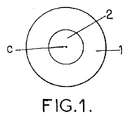
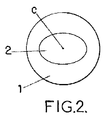
図1及び2が、中心領域(2)を囲んで長波長を吸収する周辺フィルター領域(1)を含むこのようなモノフォーカルレンズを表し、この中心領域(2)が、短波長を吸収し、円形又は楕円形であり、レンズの光学中心Cを中心とする。 FIGS. 1 and 2 represent such a monofocal lens that includes a peripheral filter region (1) that surrounds the central region (2) and absorbs long wavelengths, which central region (2) absorbs short wavelengths, It is circular or elliptical and centered on the optical center C of the lens.
有利に、中心円形領域の直径、又は中心楕円形領域の長径が、5から35mmの間に含まれ、好ましくは、10から25mmの間に含まれ、特に、約20mmである。 Advantageously, the diameter of the central circular region or the major axis of the central elliptical region is comprised between 5 and 35 mm, preferably comprised between 10 and 25 mm, in particular about 20 mm.
アフォーカル及びモノフォーカルレンズに加え、本発明は、他のタイプのレンズ、特にプログレッシブレンズに適用することが可能である。このタイプのレンズは、これが、配置され及び制御されることが可能な2つの光学的領域、すなわち、遠視野領域(far vision zone)及び近視野領域(near vision zone)を有するという点において優れており、プログレッションコリダー(progression corridor)によって連結され、このプログレッションコリダーにより、眼が、遠視野から近視野に徐々に移ることが可能となり、この結果、着用者に真の視覚的快適性を提供する。これらの2つの光学的領域のそれぞれが、遠視野光学中心(far vision optical centre)及び近視野光学中心(near vision optical centre)と呼ばれる中心と連結されることが可能である。 In addition to afocal and monofocal lenses, the present invention can be applied to other types of lenses, particularly progressive lenses. This type of lens is excellent in that it has two optical regions that can be positioned and controlled, namely a far vision zone and a near vision zone. Connected by a progression corridor, which allows the eye to move gradually from the far field to the near field, resulting in true visual comfort for the wearer To do. Each of these two optical regions can be connected with a center called a far vision optical center and a near vision optical center.
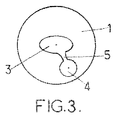
従って、本発明の特定の実施形態の主題は、遠視野光学中心及び近視野光学中心を備えたプログレッシブ矯正眼科用レンズである。図3に表されたレンズのような場合では、短波長を吸収する中心領域が、好ましくは円形又は楕円形であり基本的に遠視野光学中心の周囲の領域を覆う第1領域(3)と、好ましくは円形又は楕円形であり近視野光学中心の周囲の領域を覆う第2領域(4)と、これら2つの領域を連結し、それが一方から他方に通過した場合に目が追う経路に対応するバンド(5)とを、含む。換言すると、このバンドが、上記の“プログレッションコリダー”に対応する。レンズ表面の残りが、長波長を吸収する周辺領域(1)によって覆われる。 Accordingly, the subject of certain embodiments of the invention is a progressive corrective ophthalmic lens with a far-field optical center and a near-field optical center. In the case of the lens shown in FIG. 3, the central region that absorbs short wavelengths is preferably circular or elliptical, and basically a first region (3) that covers the region around the far-field optical center. A second region (4), preferably circular or elliptical, that covers the region around the near-field optical center, and connects these two regions to the path followed when it passes from one to the other And corresponding band (5). In other words, this band corresponds to the “progression collider” described above. The rest of the lens surface is covered by a peripheral region (1) that absorbs long wavelengths.
プログレッシブ矯正眼科用レンズの場合、遠視野光学中心を覆う中心領域(3)の直径又は長径が、好ましくは、5から35mmの間に含まれ、特に、10から25mmの間に含まれ、いっそうさらに好ましくは約20mmである。 In the case of progressive corrective ophthalmic lenses, the diameter or major axis of the central region (3) covering the far-field optical center is preferably comprised between 5 and 35 mm, in particular comprised between 10 and 25 mm, and even more Preferably it is about 20 mm.
近視野光学中心を覆う中心領域(4)が、通常、遠視野光学中心に対応するそれよりも小さい。近視野光学中心を覆う中心領域(4)の直径又は長径が、有利に、5から15mmの間に含まれ、好ましくは、7から13mmの間であり、特に、約10mmである。これらの2つの領域を連結するバンドの幅が、有利に、3から7mmの間に含まれ、好ましくは4から6mmの間であり、特に、約5mmである。本発明の特定の実施形態では、2つの中心領域(3)及び(4)を連結するこのバンド(5)が、任意に、長波長フィルター領域、即ち、周辺領域(1)と同じ特徴を有するフィルター領域を有することが可能である。 The central area (4) covering the near-field optical center is usually smaller than that corresponding to the far-field optical center. The diameter or major axis of the central region (4) covering the near-field optical center is advantageously comprised between 5 and 15 mm, preferably between 7 and 13 mm, in particular about 10 mm. The width of the band connecting these two regions is advantageously comprised between 3 and 7 mm, preferably between 4 and 6 mm, in particular about 5 mm. In a particular embodiment of the invention, this band (5) connecting the two central regions (3) and (4) optionally has the same characteristics as the long wavelength filter region, ie the peripheral region (1). It is possible to have a filter area.
前述の短波長を吸収する中心領域の寸法が、多くのメガネ着用者に適した範囲に対応するが、個人差を考慮していない。24時間周期のリズムの調節のために不可欠な長波長を吸収する周辺領域の範囲を最大化するために、中心領域の寸法を、人の眼によって実際に調査される領域の寸法に可能な限り制限することが有利であることが容易に理解される。短波長の吸収領域及び長波長の吸収領域の相対寸法のこのような最適化が、例えば、視覚行動の他の研究の範囲内における本出願人によって開発されたビジョンプリントシステム(Vision Print System)技術(VPS)を使用し、実行されることが可能である。これが、“眼球−頭部運動(eye−head behaviour)”とも呼ばれる、環境の視覚探査における眼球−頭部の調整方法(eye−head coordination strategy)の個人差の表現を可能にするデバイスを含む。従って、一方では、眼の動きによってというよりはむしろ頭の動きによって、視覚的に物体を追う傾向がある“頭部運動者(head movers)”である個人と、他方では、頭でというよりはむしろ眼の動きによって、視覚的に物体を追う傾向がある“眼球運動者(eye movers)”である個人とを定義することが可能である。 The dimensions of the central region that absorbs short wavelengths described above correspond to a range suitable for many spectacle wearers, but do not take into account individual differences. In order to maximize the extent of the peripheral region that absorbs the long wavelengths that are essential for the adjustment of the rhythm of the 24-hour period, the size of the central region is as much as possible to the size of the region actually examined by the human eye It will be readily appreciated that it is advantageous to limit. Such optimization of the relative dimensions of the short-wavelength absorption region and the long-wavelength absorption region is, for example, the Vision Print System technology developed by the applicant within the scope of other studies of visual behavior. (VPS) can be used. This includes devices that allow the expression of individual differences in eye-head coordination strategies in visual exploration of the environment, also referred to as “eye-head behaviors”. Thus, on the one hand, individuals who are “head movers” who tend to follow objects visually by head movement rather than by eye movement, and on the other hand, rather than by head. Rather, by eye movement it is possible to define individuals who are “eye movers” who tend to follow objects visually.
従って、メガネ着用者の眼球−頭部運動の判定により、中心領域の大きさを最適化することが可能となる。着用者が、眼で確認することによって物体を追うために、それらの眼というよりはむしろそれらの頭の方向を変える傾向がある場合、通常、5から20mmの中心領域が、レンズの視覚領域全体を覆うために十分である。反対に、着用者が、眼で確認することによって物体を追うために、それらの頭というよりはむしろそれらの眼を動かす傾向がある場合、その結果、比較的レンズの広い領域を覆う中心領域が必要であり、例えば、領域が、20から35mmの間に含まれる直径を有する。 Therefore, the size of the central region can be optimized by determining the eyeball-head movement of the eyeglass wearer. If the wearer tends to change the direction of their heads rather than their eyes to follow the object by looking with the eyes, a central area of 5 to 20 mm is usually the entire visual area of the lens Enough to cover. Conversely, if the wearer tends to move their eyes rather than their heads to follow the object by looking with the eye, the result is a central area that covers a relatively large area of the lens. Required, for example, the region has a diameter comprised between 20 and 35 mm.
周辺領域は、必ずしも中心領域に隣接しておらず、原理上は、無色のバンドによって後者から分離されることが可能である。しかしながら、瞳孔内に浸入する短波長で放射された光の割合を可能な限り増加させるために、本発明の眼科用レンズの長波長を吸収する周辺領域が、好ましくは、中心領域によって覆われていない全体表面を覆う。 The peripheral region is not necessarily adjacent to the central region, and in principle can be separated from the latter by a colorless band. However, in order to increase as much as possible the proportion of light emitted at short wavelengths that penetrates into the pupil, the peripheral region that absorbs the long wavelengths of the ophthalmic lens of the invention is preferably covered by a central region. Not covering the whole surface.
選択的に黄色に着色された中心領域又は選択的に青色に着色された周辺領域の色が、極めて低い彩度(low intensity)を有し、室内又は微光レベル下での使用のための、白色レンズ(即ち、無色の又は“クリスタル”色とも呼ばれる)に使われることが可能である。これらの領域の色が、強い明度(high intensity)を有することも可能であり、屋外又は強い光レベル下での使用のための、サンレンズ(sun lenses)に使われることが可能である。 The color of the central area selectively colored yellow or the peripheral area selectively colored blue has a very low intensity, for use at room or under low light levels, It can be used for white lenses (ie, also called colorless or “crystal” colors). The colors of these areas can also have high intensity and can be used for sun lenses for use outdoors or under strong light levels.
本発明による眼科用レンズを製造することを目的とし、無機又は有機ガラスから形成された適切な支持材上の黄色及び青色の着色に選択的に対応する色付きフィルターの使用が、例えば、昇華及び/又はインクジェットプリンティングによって行われることが可能である。これらの技術が、例えば、本出願人の名義で出願された特許文献3及び特許文献4に記載されている。特許文献5に記載されたような、インクジェットプリンティングと組み合わせられるピクセルで構成されたフィルムの基板上における使用を想定することも可能である。
The purpose of producing an ophthalmic lens according to the present invention, the use of colored filters that selectively correspond to yellow and blue coloration on suitable supports formed from inorganic or organic glasses, for example sublimation and / or Or it can be done by inkjet printing. These techniques are described in, for example,
本発明が、非制限的な方法で本発明の主題を説明する以下の実施例を読むことによりさらに理解されるだろう。 The invention will be further understood by reading the following examples which illustrate the subject of the invention in a non-limiting manner.
(実施例1)インクジェットプリンティングによる、本発明の眼科用レンズの着色
40重量%のアニオン性ポリウレタン(Baxendenによって販売されるW234)が、磁気撹拌下で、60重量%のコロイド状シリカ(Aldrichによって販売されるLudox TM40)と混合される。1時間撹拌した後、遠心分離(スピンコーティング)によって得られた混合物が、Orma(登録商標)バイプレイン(biplane)基板に適応される(500回転/20秒)。堆積物が、オーブン内で1時間の間100℃で乾燥される。このようにして得られたプライマーの厚さが、3.6μmである。乾燥した後、プライマー及び基板を備えた光学レンズが、Canon製i865プリンターでプリントされることが可能である。黄色及び青色領域が、Powerpoint(登録商標)ソフトウェアを使用して形成される。眼科用レンズが、プリンターのローディングモジュールに導入され、後者が、パワーポイントの“黄色フィルター−青色フィルター”のファイルを備えたコンピューターに接続されている。プリンティングが実行される。レンズがプリンターから離れたとき、これが、即座に、100℃で1時間の間乾燥される。黄色フィルター及び青色フィルターを備えた眼科用レンズが得られる。
Example 1 Coloring of Ophthalmic Lenses of the Present Invention by Inkjet Printing 40% by weight anionic polyurethane (W234 sold by Baxenden) is sold by magnetically stirred 60% by weight colloidal silica (Aldrich) Ludox TM40). After stirring for 1 hour, the mixture obtained by centrifugation (spin coating) is applied to an Orma® biplane substrate (500 revolutions / 20 seconds). The deposit is dried in an oven at 100 ° C. for 1 hour. The primer thus obtained has a thickness of 3.6 μm. After drying, the optical lens with primer and substrate can be printed with a Canon i865 printer. Yellow and blue areas are formed using Powerpoint® software. An ophthalmic lens is installed in the printer's loading module, and the latter is connected to a computer with a PowerPoint “yellow filter-blue filter” file. Printing is performed. When the lens leaves the printer, it is immediately dried at 100 ° C. for 1 hour. An ophthalmic lens provided with a yellow filter and a blue filter is obtained.
1 周辺フィルター領域
2、3、4 中心領域
5 バンド
c 光学中心
1
Claims (13)
400nmから480nmの間の全波長範囲における50%未満の透過率、及び480nmから700nmの間の全波長範囲における50%以上の透過率を有する、第1の、中心領域、並びに、
400nmから500nmの間の全波長範囲における50%以上の透過率、及び500nmから700nmの間の全波長範囲における50%未満の透過率を有する、第2の、周辺領域
を、その表面上に備えることを特徴とする眼科用レンズ。 An ophthalmic lens,
A first central region having a transmission of less than 50% in the entire wavelength range between 400 nm and 480 nm, and a transmission of 50% or more in the entire wavelength range between 480 nm and 700 nm; and
A second peripheral region is provided on the surface having a transmittance of 50% or more in the entire wavelength range between 400 nm and 500 nm and a transmittance of less than 50% in the entire wavelength range between 500 nm and 700 nm. An ophthalmic lens characterized by that.
前記中心領域が、円形又は楕円形であることを特徴とする請求項1から7のいずれか一項に記載の眼科用レンズ。 The ophthalmic lens is an afocal ophthalmic lens,
The ophthalmic lens according to claim 1, wherein the central region is circular or elliptical.
前記中心領域が、円形又は楕円形であることを特徴とする請求項1から7のいずれか一項に記載の眼科用レンズ。 The ophthalmic lens is a monofocal correction ophthalmic lens,
The central region, ophthalmic lens according to any one of claims 1 to 7, characterized in that a circular or elliptical.
前記中心領域が、基本的に、遠視野光学中心の周囲の領域と、近視野光学中心の周囲の領域と、これら2つの領域を連結し、目が一方から他方に通過した場合に目が追う経路に対応するバンドとを覆うことを特徴とする請求項1から7のいずれか一項に記載の眼科用レンズ。 The ophthalmic lens is a progressive correction ophthalmic lens with a far-field optical center and a near-field optical center,
The central region is essentially a region around the far vision optical center, and the surrounding areas of the near-field optical center, the two connecting areas, eye eyes follow when passing from one to the other The ophthalmic lens according to claim 1, wherein the ophthalmic lens covers a band corresponding to the path.
前記近視野光学中心を覆う前記中心領域(4)の直径又は長径が、5から15mmの間に含まれ、
これらの2つの領域を連結するバンド(5)の幅が、3から7mmの間に含まれることを特徴とする請求項11に記載の眼科用レンズ。 The diameter or major axis of the central region (3) covering the far-field optical center is comprised between 5 and 35 mm ;
The diameter or major axis of the central region (4) covering the near-field optical center is comprised between 5 and 15 mm ;
The width of the band connecting these two regions (5) The ophthalmic lens according to claim 11, characterized in that comprised between 3 7 mm.
Applications Claiming Priority (3)
| Application Number | Priority Date | Filing Date | Title |
|---|---|---|---|
| FR06/10095 | 2006-11-17 | ||
| FR0610095A FR2908897B1 (en) | 2006-11-17 | 2006-11-17 | COLORFUL COLOR OPHTHALMIC LENSES. |
| PCT/FR2007/052344 WO2008059175A1 (en) | 2006-11-17 | 2007-11-15 | Multi-tint coloured ophthalmic lenses |
Publications (2)
| Publication Number | Publication Date |
|---|---|
| JP2010510535A JP2010510535A (en) | 2010-04-02 |
| JP5259609B2 true JP5259609B2 (en) | 2013-08-07 |
Family
ID=37888405
Family Applications (1)
| Application Number | Title | Priority Date | Filing Date |
|---|---|---|---|
| JP2009536777A Active JP5259609B2 (en) | 2006-11-17 | 2007-11-15 | Multi-colored ophthalmic lens |
Country Status (8)
| Country | Link |
|---|---|
| US (1) | US8096656B2 (en) |
| EP (1) | EP2084569B1 (en) |
| JP (1) | JP5259609B2 (en) |
| AT (1) | ATE539372T1 (en) |
| BR (1) | BRPI0718920B1 (en) |
| ES (1) | ES2380155T3 (en) |
| FR (1) | FR2908897B1 (en) |
| WO (1) | WO2008059175A1 (en) |
Families Citing this family (25)
| Publication number | Priority date | Publication date | Assignee | Title |
|---|---|---|---|---|
| US8403478B2 (en) * | 2001-11-02 | 2013-03-26 | High Performance Optics, Inc. | Ophthalmic lens to preserve macular integrity |
| US8500274B2 (en) | 2000-11-03 | 2013-08-06 | High Performance Optics, Inc. | Dual-filter ophthalmic lens to reduce risk of macular degeneration |
| ATE487199T1 (en) * | 2004-09-10 | 2010-11-15 | Hy Ko Products Co | HIGH FREQUENCY IDENTIFICATION (RFID) SYSTEM FOR MANUFACTURING, DISTRIBUTION AND RETAILING OF KEYS |
| US8360574B2 (en) * | 2006-03-20 | 2013-01-29 | High Performance Optics, Inc. | High performance selective light wavelength filtering providing improved contrast sensitivity |
| US8113651B2 (en) | 2006-03-20 | 2012-02-14 | High Performance Optics, Inc. | High performance corneal inlay |
| US20070216861A1 (en) * | 2006-03-20 | 2007-09-20 | Andrew Ishak | Ophthalmic system combining ophthalmic components with blue light wavelength blocking and color-balancing functionalities |
| US20120075577A1 (en) | 2006-03-20 | 2012-03-29 | Ishak Andrew W | High performance selective light wavelength filtering providing improved contrast sensitivity |
| US8882267B2 (en) | 2006-03-20 | 2014-11-11 | High Performance Optics, Inc. | High energy visible light filter systems with yellowness index values |
| US9377569B2 (en) | 2006-03-20 | 2016-06-28 | High Performance Optics, Inc. | Photochromic ophthalmic systems that selectively filter specific blue light wavelengths |
| EP2602654B1 (en) * | 2011-12-08 | 2023-04-19 | Essilor International | Ophthalmic filter |
| EP2602653B1 (en) * | 2011-12-08 | 2020-09-16 | Essilor International | Method of determining the configuration of an ophthalmic filter |
| EP2602655B1 (en) * | 2011-12-08 | 2024-04-03 | Essilor International | Ophthalmic filter |
| US9798163B2 (en) | 2013-05-05 | 2017-10-24 | High Performance Optics, Inc. | Selective wavelength filtering with reduced overall light transmission |
| EP3063780B1 (en) | 2013-10-29 | 2021-06-02 | Varex Imaging Corporation | X-ray tube having planar emitter with tunable emission characteristics and magnetic steering and focusing |
| US10025117B2 (en) * | 2013-11-12 | 2018-07-17 | Nikon-Essilor Co., Ltd. | Functional dyed spectacle lens |
| US20170038605A1 (en) * | 2014-04-11 | 2017-02-09 | LEGERTON A Jerome | Ophthalmic eyewear for regulating ocular exposure to high energy electromagnetic radiation |
| US9683102B2 (en) | 2014-05-05 | 2017-06-20 | Frontier Scientific, Inc. | Photo-stable and thermally-stable dye compounds for selective blue light filtered optic |
| JP6546352B2 (en) | 2016-02-22 | 2019-07-17 | ノバルティス アーゲー | UV absorbing vinyl monomer and use thereof |
| US10268053B2 (en) | 2016-02-22 | 2019-04-23 | Novartis Ag | UV/visible-absorbing vinylic monomers and uses thereof |
| CN108732784A (en) * | 2018-05-24 | 2018-11-02 | 李志伟 | A kind of eyeglass |
| GB201811317D0 (en) * | 2018-07-10 | 2018-08-29 | City Univ Of London | Lens |
| TWI846770B (en) | 2018-11-30 | 2024-07-01 | 美商賽特眼鏡視光有限公司 | Light scattering lens for treating myopia and eyeglasses containing the same |
| CN110045517A (en) * | 2019-04-10 | 2019-07-23 | 军视康(北京)科技发展有限公司 | A kind of double light myopia preventing and treatings training eyeglasses of flat-top and manufacturing method |
| CN110018576A (en) * | 2019-04-10 | 2019-07-16 | 军视康(北京)科技发展有限公司 | A kind of double light myopia campus learning training eyeglasses of flat-top and manufacturing method |
| EP4031934A4 (en) | 2019-09-19 | 2023-09-06 | The UAB Research Foundation | MULTISPECTRAL AND MULTIFOCAL CONTROL OF MYOPIA |
Family Cites Families (19)
| Publication number | Priority date | Publication date | Assignee | Title |
|---|---|---|---|---|
| FR1179188A (en) | 1957-07-19 | 1959-05-21 | Glasses avoiding glare | |
| US3454332A (en) * | 1966-11-03 | 1969-07-08 | Robert Siegel | Corneal plastic contact lens with colored peripheral zone |
| US3628854A (en) * | 1969-12-08 | 1971-12-21 | Optical Sciences Group Inc | Flexible fresnel refracting membrane adhered to ophthalmic lens |
| FR2418478A2 (en) * | 1978-02-27 | 1979-09-21 | Carreau Bernard | Selectively filtered optical spectacles for e.g. tennis - have central clear region with surrounding partially opaque filter |
| FR2389912A1 (en) | 1977-05-06 | 1978-12-01 | Carreau Bernard | Protective spectacle lens construction - reduces light transmitted to peripheral retinal regions using fibre optic patch with hole in centre |
| JP2813390B2 (en) * | 1989-10-30 | 1998-10-22 | ホーヤ株式会社 | Eyeglass lens for lensectomy |
| US5408278A (en) * | 1990-11-23 | 1995-04-18 | Christman; Ernest H. | Method and device for enhancing visual and color perception |
| US5470932A (en) * | 1993-10-18 | 1995-11-28 | Alcon Laboratories, Inc. | Polymerizable yellow dyes and their use in opthalmic lenses |
| US5838419A (en) | 1996-02-22 | 1998-11-17 | Holland; Stephen | Method and apparatus for treating refractive eye abnormalities |
| JP3911046B2 (en) * | 1996-04-12 | 2007-05-09 | ペンタックス株式会社 | Optical member having wavelength selectivity |
| JP3449406B2 (en) * | 1999-04-07 | 2003-09-22 | Hoyaヘルスケア株式会社 | Novel pyrazolone compound and ophthalmic plastic lens using the same |
| US6827440B2 (en) * | 2000-01-03 | 2004-12-07 | Wesley Jessen Company | Colored contact lens with a more natural appearance |
| US8403478B2 (en) * | 2001-11-02 | 2013-03-26 | High Performance Optics, Inc. | Ophthalmic lens to preserve macular integrity |
| US6811258B1 (en) * | 2003-06-23 | 2004-11-02 | Alan H. Grant | Eyeglasses for improved visual contrast using hetero-chromic light filtration |
| FR2872590B1 (en) * | 2004-07-02 | 2006-10-27 | Essilor Int | METHOD FOR PRODUCING AN OPHTHALMIC GLASS AND OPTICAL COMPONENT SUITABLE FOR CARRYING OUT SAID METHOD |
| ES2247946B2 (en) * | 2005-04-19 | 2006-10-01 | Universidad Complutense De Madrid | THERAPEUTIC CONTACT LENS FOR PSEUDO-AFAQUIC EYES AND / OR IN NEURODEGENERATION PROCESS. |
| FR2908896B1 (en) * | 2006-11-17 | 2009-02-06 | Essilor Int | COLORFUL COLOR OPHTHALMIC LENSES FOR MYOPES. |
| FR2908898B1 (en) * | 2006-11-17 | 2009-02-06 | Essilor Int | COLORED OPHTHALMIC LENSES FOR DYSLEXICS. |
| EP2291698A1 (en) * | 2008-05-20 | 2011-03-09 | Edwin J. Sarver | Progressive chromatic aberration corrected ocular lens |
-
2006
- 2006-11-17 FR FR0610095A patent/FR2908897B1/en active Active
-
2007
- 2007-11-15 ES ES07858700T patent/ES2380155T3/en active Active
- 2007-11-15 WO PCT/FR2007/052344 patent/WO2008059175A1/en not_active Ceased
- 2007-11-15 AT AT07858700T patent/ATE539372T1/en active
- 2007-11-15 EP EP07858700A patent/EP2084569B1/en active Active
- 2007-11-15 US US12/514,544 patent/US8096656B2/en active Active
- 2007-11-15 JP JP2009536777A patent/JP5259609B2/en active Active
- 2007-11-15 BR BRPI0718920A patent/BRPI0718920B1/en active IP Right Grant
Also Published As
| Publication number | Publication date |
|---|---|
| US8096656B2 (en) | 2012-01-17 |
| BRPI0718920B1 (en) | 2018-12-18 |
| WO2008059175A1 (en) | 2008-05-22 |
| US20100053550A1 (en) | 2010-03-04 |
| ES2380155T3 (en) | 2012-05-09 |
| FR2908897B1 (en) | 2009-03-06 |
| BRPI0718920A2 (en) | 2013-12-03 |
| ATE539372T1 (en) | 2012-01-15 |
| EP2084569A1 (en) | 2009-08-05 |
| FR2908897A1 (en) | 2008-05-23 |
| EP2084569B1 (en) | 2011-12-28 |
| JP2010510535A (en) | 2010-04-02 |
Similar Documents
| Publication | Publication Date | Title |
|---|---|---|
| JP2010510535A (en) | Multi-colored ophthalmic lens | |
| JP5259610B2 (en) | Multi-colored ophthalmic lens for myopia | |
| EP2089756B1 (en) | Coloured ophthalmic lenses for people with dyslexia | |
| AU2012348561B2 (en) | Ophthalmic filter | |
| US6874888B1 (en) | Polarized contact lenses with a clear peripheral portion | |
| US10108027B2 (en) | Method of determining the configuration of an ophthalmic filter | |
| US8342680B2 (en) | Eyeglass lens | |
| AU2020203703A1 (en) | Ophthalmic filter | |
| EP4057052B1 (en) | Ophthalmic set for myopia progression control | |
| JP2019502953A (en) | Methods and ophthalmic elements for stimulating non-visual physiological effects | |
| US20070132943A1 (en) | Multipart Sunglasses | |
| TWI500993B (en) | The use of chromatic aberration to control myopia and both the beauty of contact lenses | |
| US7195350B2 (en) | Multiview eyeglasses | |
| CN204009260U (en) | A kind of shading eyeglasses eyeglass | |
| CN116648657A (en) | Ophthalmic articles, especially for sunglasses | |
| CN222719775U (en) | Ultraviolet and blue light preventing contact lens and color changing contact lens | |
| Riaz | Construction of Glasses (Ophthalmologists as Opticians) | |
| CN106344261A (en) | Myopia prevention and treatment eye mask, glasses and reading and writing instrument for avoiding peripheral defocus | |
| KR100608451B1 (en) | Visual Perception Overload Symptom Reduction Device | |
| HK1160228A (en) | Low-power eyewear for reducing symptoms of computer vision syndrome |
Legal Events
| Date | Code | Title | Description |
|---|---|---|---|
| A621 | Written request for application examination |
Free format text: JAPANESE INTERMEDIATE CODE: A621 Effective date: 20100421 |
|
| A977 | Report on retrieval |
Free format text: JAPANESE INTERMEDIATE CODE: A971007 Effective date: 20120607 |
|
| A131 | Notification of reasons for refusal |
Free format text: JAPANESE INTERMEDIATE CODE: A131 Effective date: 20120612 |
|
| A521 | Request for written amendment filed |
Free format text: JAPANESE INTERMEDIATE CODE: A523 Effective date: 20120911 |
|
| TRDD | Decision of grant or rejection written | ||
| A01 | Written decision to grant a patent or to grant a registration (utility model) |
Free format text: JAPANESE INTERMEDIATE CODE: A01 Effective date: 20130402 |
|
| A61 | First payment of annual fees (during grant procedure) |
Free format text: JAPANESE INTERMEDIATE CODE: A61 Effective date: 20130424 |
|
| FPAY | Renewal fee payment (event date is renewal date of database) |
Free format text: PAYMENT UNTIL: 20160502 Year of fee payment: 3 |
|
| R150 | Certificate of patent or registration of utility model |
Ref document number: 5259609 Country of ref document: JP Free format text: JAPANESE INTERMEDIATE CODE: R150 Free format text: JAPANESE INTERMEDIATE CODE: R150 |
|
| R250 | Receipt of annual fees |
Free format text: JAPANESE INTERMEDIATE CODE: R250 |
|
| R250 | Receipt of annual fees |
Free format text: JAPANESE INTERMEDIATE CODE: R250 |
|
| R250 | Receipt of annual fees |
Free format text: JAPANESE INTERMEDIATE CODE: R250 |
|
| S111 | Request for change of ownership or part of ownership |
Free format text: JAPANESE INTERMEDIATE CODE: R313113 |
|
| R350 | Written notification of registration of transfer |
Free format text: JAPANESE INTERMEDIATE CODE: R350 |
|
| R250 | Receipt of annual fees |
Free format text: JAPANESE INTERMEDIATE CODE: R250 |
|
| R250 | Receipt of annual fees |
Free format text: JAPANESE INTERMEDIATE CODE: R250 |
|
| R250 | Receipt of annual fees |
Free format text: JAPANESE INTERMEDIATE CODE: R250 |
|
| R250 | Receipt of annual fees |
Free format text: JAPANESE INTERMEDIATE CODE: R250 |
|
| R250 | Receipt of annual fees |
Free format text: JAPANESE INTERMEDIATE CODE: R250 |
|
| R250 | Receipt of annual fees |
Free format text: JAPANESE INTERMEDIATE CODE: R250 |
|
| R250 | Receipt of annual fees |
Free format text: JAPANESE INTERMEDIATE CODE: R250 |
|
| R250 | Receipt of annual fees |
Free format text: JAPANESE INTERMEDIATE CODE: R250 |