JP5259592B2 - Thiophenecarboxamide derivatives as EP4 receptor ligands - Google Patents
Thiophenecarboxamide derivatives as EP4 receptor ligands Download PDFInfo
- Publication number
- JP5259592B2 JP5259592B2 JP2009523120A JP2009523120A JP5259592B2 JP 5259592 B2 JP5259592 B2 JP 5259592B2 JP 2009523120 A JP2009523120 A JP 2009523120A JP 2009523120 A JP2009523120 A JP 2009523120A JP 5259592 B2 JP5259592 B2 JP 5259592B2
- Authority
- JP
- Japan
- Prior art keywords
- compound
- pharmaceutically acceptable
- group
- acceptable salt
- formula
- Prior art date
- Legal status (The legal status is an assumption and is not a legal conclusion. Google has not performed a legal analysis and makes no representation as to the accuracy of the status listed.)
- Expired - Fee Related
Links
- 0 CBc1c(C(NC(*)(*)c2ccc(*)cc2)=O)[s]c(*)c1* Chemical compound CBc1c(C(NC(*)(*)c2ccc(*)cc2)=O)[s]c(*)c1* 0.000 description 3
- PYWZJCKVQWUVPO-UHFFFAOYSA-N CC(c(cc1)ccc1-c1n[nH]nn1)NC(c([s]1)c(Cc2cc(Cl)ccc2)cc1Cl)=O Chemical compound CC(c(cc1)ccc1-c1n[nH]nn1)NC(c([s]1)c(Cc2cc(Cl)ccc2)cc1Cl)=O PYWZJCKVQWUVPO-UHFFFAOYSA-N 0.000 description 1
- OKRPFRUXMOYTDV-UHFFFAOYSA-N CC(c(cc1)ccc1C(O)=O)NC(OC(C)(C)C)=O Chemical compound CC(c(cc1)ccc1C(O)=O)NC(OC(C)(C)C)=O OKRPFRUXMOYTDV-UHFFFAOYSA-N 0.000 description 1
- FADNAZBPTQVMPQ-ZDUSSCGKSA-N C[C@@H](c(cc1)ccc1C(O)=O)NC(c1c(C)[s]c(C)c1Cc(cc1)ccc1Cl)=O Chemical compound C[C@@H](c(cc1)ccc1C(O)=O)NC(c1c(C)[s]c(C)c1Cc(cc1)ccc1Cl)=O FADNAZBPTQVMPQ-ZDUSSCGKSA-N 0.000 description 1
- NWYUIYYDNDZXBK-UHFFFAOYSA-N Cc([s]c(C)c1Br)c1Br Chemical compound Cc([s]c(C)c1Br)c1Br NWYUIYYDNDZXBK-UHFFFAOYSA-N 0.000 description 1
- NNNHDNZOOJUIKG-UHFFFAOYSA-N Cc1c(Cc2cc(C(F)(F)F)ccc2)c(C(NC2(CC2)c(cc2)ccc2C(N=N[NH+]2[O-])=[N+]2[O-])=O)c(C)[s]1 Chemical compound Cc1c(Cc2cc(C(F)(F)F)ccc2)c(C(NC2(CC2)c(cc2)ccc2C(N=N[NH+]2[O-])=[N+]2[O-])=O)c(C)[s]1 NNNHDNZOOJUIKG-UHFFFAOYSA-N 0.000 description 1
- BEWXZMDKZCMEJP-UHFFFAOYSA-N Cc1c(Cc2ccc(C(F)(F)F)cc2)c(C(NC2(CC2)c(cc2)ccc2C#N)=O)c(C)[s]1 Chemical compound Cc1c(Cc2ccc(C(F)(F)F)cc2)c(C(NC2(CC2)c(cc2)ccc2C#N)=O)c(C)[s]1 BEWXZMDKZCMEJP-UHFFFAOYSA-N 0.000 description 1
- BMYCTTRDGGWIPP-UHFFFAOYSA-N Cc1c(Cc2ccc(C(F)(F)F)cc2)c(C(NC2(CC2)c(cc2)ccc2C(N=N[NH+]2[O-])=[N+]2[O-])=O)c(C)[s]1 Chemical compound Cc1c(Cc2ccc(C(F)(F)F)cc2)c(C(NC2(CC2)c(cc2)ccc2C(N=N[NH+]2[O-])=[N+]2[O-])=O)c(C)[s]1 BMYCTTRDGGWIPP-UHFFFAOYSA-N 0.000 description 1
- WBADBJDOSDVJBE-UHFFFAOYSA-N Cc1c(Cc2ccc(C(F)(F)F)cc2)c(C(O)=O)c(C)[s]1 Chemical compound Cc1c(Cc2ccc(C(F)(F)F)cc2)c(C(O)=O)c(C)[s]1 WBADBJDOSDVJBE-UHFFFAOYSA-N 0.000 description 1
- DDAZHNWCORZWHX-UHFFFAOYSA-N Clc([s]1)c(C(c2cccc(Cl)c2)OC2OCCCC2)c(Br)c1Cl Chemical compound Clc([s]1)c(C(c2cccc(Cl)c2)OC2OCCCC2)c(Br)c1Cl DDAZHNWCORZWHX-UHFFFAOYSA-N 0.000 description 1
- HBYGBJDMFWFILO-UHFFFAOYSA-N OC(c(c(C(c1cc(Cl)ccc1)OC1OCCCC1)c([s]1)Cl)c1Cl)=O Chemical compound OC(c(c(C(c1cc(Cl)ccc1)OC1OCCCC1)c([s]1)Cl)c1Cl)=O HBYGBJDMFWFILO-UHFFFAOYSA-N 0.000 description 1
Classifications
-
- C—CHEMISTRY; METALLURGY
- C07—ORGANIC CHEMISTRY
- C07D—HETEROCYCLIC COMPOUNDS
- C07D409/00—Heterocyclic compounds containing two or more hetero rings, at least one ring having sulfur atoms as the only ring hetero atoms
- C07D409/02—Heterocyclic compounds containing two or more hetero rings, at least one ring having sulfur atoms as the only ring hetero atoms containing two hetero rings
- C07D409/12—Heterocyclic compounds containing two or more hetero rings, at least one ring having sulfur atoms as the only ring hetero atoms containing two hetero rings linked by a chain containing hetero atoms as chain links
-
- A—HUMAN NECESSITIES
- A61—MEDICAL OR VETERINARY SCIENCE; HYGIENE
- A61P—SPECIFIC THERAPEUTIC ACTIVITY OF CHEMICAL COMPOUNDS OR MEDICINAL PREPARATIONS
- A61P19/00—Drugs for skeletal disorders
- A61P19/02—Drugs for skeletal disorders for joint disorders, e.g. arthritis, arthrosis
-
- A—HUMAN NECESSITIES
- A61—MEDICAL OR VETERINARY SCIENCE; HYGIENE
- A61P—SPECIFIC THERAPEUTIC ACTIVITY OF CHEMICAL COMPOUNDS OR MEDICINAL PREPARATIONS
- A61P25/00—Drugs for disorders of the nervous system
- A61P25/04—Centrally acting analgesics, e.g. opioids
-
- A—HUMAN NECESSITIES
- A61—MEDICAL OR VETERINARY SCIENCE; HYGIENE
- A61P—SPECIFIC THERAPEUTIC ACTIVITY OF CHEMICAL COMPOUNDS OR MEDICINAL PREPARATIONS
- A61P27/00—Drugs for disorders of the senses
- A61P27/02—Ophthalmic agents
- A61P27/06—Antiglaucoma agents or miotics
-
- A—HUMAN NECESSITIES
- A61—MEDICAL OR VETERINARY SCIENCE; HYGIENE
- A61P—SPECIFIC THERAPEUTIC ACTIVITY OF CHEMICAL COMPOUNDS OR MEDICINAL PREPARATIONS
- A61P29/00—Non-central analgesic, antipyretic or antiinflammatory agents, e.g. antirheumatic agents; Non-steroidal antiinflammatory drugs [NSAID]
-
- A—HUMAN NECESSITIES
- A61—MEDICAL OR VETERINARY SCIENCE; HYGIENE
- A61P—SPECIFIC THERAPEUTIC ACTIVITY OF CHEMICAL COMPOUNDS OR MEDICINAL PREPARATIONS
- A61P35/00—Antineoplastic agents
-
- A—HUMAN NECESSITIES
- A61—MEDICAL OR VETERINARY SCIENCE; HYGIENE
- A61P—SPECIFIC THERAPEUTIC ACTIVITY OF CHEMICAL COMPOUNDS OR MEDICINAL PREPARATIONS
- A61P43/00—Drugs for specific purposes, not provided for in groups A61P1/00-A61P41/00
-
- C—CHEMISTRY; METALLURGY
- C07—ORGANIC CHEMISTRY
- C07D—HETEROCYCLIC COMPOUNDS
- C07D333/00—Heterocyclic compounds containing five-membered rings having one sulfur atom as the only ring hetero atom
- C07D333/02—Heterocyclic compounds containing five-membered rings having one sulfur atom as the only ring hetero atom not condensed with other rings
- C07D333/04—Heterocyclic compounds containing five-membered rings having one sulfur atom as the only ring hetero atom not condensed with other rings not substituted on the ring sulphur atom
- C07D333/26—Heterocyclic compounds containing five-membered rings having one sulfur atom as the only ring hetero atom not condensed with other rings not substituted on the ring sulphur atom with hetero atoms or with carbon atoms having three bonds to hetero atoms with at the most one bond to halogen, e.g. ester or nitrile radicals, directly attached to ring carbon atoms
- C07D333/38—Carbon atoms having three bonds to hetero atoms with at the most one bond to halogen, e.g. ester or nitrile radicals
Landscapes
- Health & Medical Sciences (AREA)
- Chemical & Material Sciences (AREA)
- Organic Chemistry (AREA)
- General Health & Medical Sciences (AREA)
- Veterinary Medicine (AREA)
- General Chemical & Material Sciences (AREA)
- Medicinal Chemistry (AREA)
- Nuclear Medicine, Radiotherapy & Molecular Imaging (AREA)
- Chemical Kinetics & Catalysis (AREA)
- Pharmacology & Pharmacy (AREA)
- Life Sciences & Earth Sciences (AREA)
- Animal Behavior & Ethology (AREA)
- Public Health (AREA)
- Engineering & Computer Science (AREA)
- Bioinformatics & Cheminformatics (AREA)
- Ophthalmology & Optometry (AREA)
- Pain & Pain Management (AREA)
- Rheumatology (AREA)
- Neurology (AREA)
- Biomedical Technology (AREA)
- Neurosurgery (AREA)
- Immunology (AREA)
- Orthopedic Medicine & Surgery (AREA)
- Physical Education & Sports Medicine (AREA)
- Pharmaceuticals Containing Other Organic And Inorganic Compounds (AREA)
- Plural Heterocyclic Compounds (AREA)
- Heterocyclic Compounds Containing Sulfur Atoms (AREA)
Description
本発明は、プロスタグランジンE介在性疾患を治療するための化合物及び方法、及びその特定の医薬組成物に関する。本発明は、PGE2受容体のEP4サブタイプのリガンド、アンタゴニスト、又はアゴニストである新規化合物に向けたものである。E型プロスタグランジンの疼痛及び炎症作用のアンタゴニストである本発明化合物は、NSAID及びアヘン剤とは構造的に異なる。 The present invention relates to compounds and methods for treating prostaglandin E mediated diseases and certain pharmaceutical compositions thereof. The present invention is directed to novel compounds that are ligands, antagonists, or agonists of the EP4 subtype of the PGE 2 receptor. The compounds of the present invention that are antagonists of the pain and inflammatory effects of type E prostaglandins are structurally different from NSAIDs and opiates.
3つの総説論文が、プロスタノイド受容体のキャラクタリゼーション及び治療的関連性、並びに最も一般的に使用される選択的アゴニスト及びアンタゴニストについて記載している:フォルコ(Folco)、サムエルソン(Samuelsson)、マクラウフ(Maclouf)、及びヴェロ(Velo)編、「エイコサノイド:バイオテクノロジーから治療応用まで(Eicosanoids:From Biotechnology to Therapeutic Applications)」、プレナム・プレス(Plenum Press)、ニューヨーク、1996年、第14章、p.137−154;「ジャーナル・オブ・リピド・メディエーターズ・アンド・セル・シグナリング(Journalof Lipd Mediators and Cell Signaling)」、1996年、第14巻、p.83−87;及び、「プロスタグランジンズ・アンド・アザー・リピド・メディエーターズ(Prostaglandins and Other Lipid Mediators)」、2002年、第69巻、p.557−573。 Three review articles describe the characterization and therapeutic relevance of prostanoid receptors, and the most commonly used selective agonists and antagonists: Folco, Samuelsson, McLauf (Macrouf), edited by Velo, "Eicosanoids: From Biotechnology to Therapeutic Applications", Plenum Press, New York, 1996, Chapter 14, p. 137-154; “Journal of Lipid Mediators and Cell Signaling”, 1996, Vol. 14, p. 83-87; and "Prostaglandins and Other Lipid Mediators", 2002, Vol. 69, p. 557-573.
したがって、選択的なプロスタグランジンリガンド、アゴニスト、又はアンタゴニストは、プロスタグランジンE受容体のどのサブタイプが考慮されるかに依存して、従来の非ステロイド抗炎症剤と同様の抗炎症性、解熱性及び鎮痛性の特性を持ち、加えて、血管ホメオスタシス、再生、胃腸機能及び骨代謝に影響を及ぼす。これらの化合物は、無差別なシクロオキシゲナーゼ阻害剤であるNSAIDのメカニズムベースのいくつかの副作用を誘導するのをおさえる能力を有している。特に、当該化合物は、胃腸毒性を軽減する可能性、腎性副作用を軽減する可能性、出血時間を減少させる効果、そしてアスピリン感受性喘息患者において喘息発作を誘発するのを減少させる可能性を有すると考えられる。 Thus, selective prostaglandin ligands, agonists or antagonists may be anti-inflammatory, similar to conventional non-steroidal anti-inflammatory agents, depending on which subtype of prostaglandin E receptor is considered, It has antipyretic and analgesic properties and in addition affects vascular homeostasis, regeneration, gastrointestinal function and bone metabolism. These compounds have the ability to mitigate some of the mechanism-based side effects of NSAID, a promiscuous cyclooxygenase inhibitor. In particular, the compounds have the potential to reduce gastrointestinal toxicity, to reduce renal side effects, to reduce bleeding time, and to reduce the induction of asthma attacks in aspirin-sensitive asthmatic patients. Conceivable.
「ザ・ジャーナル・オブ・クリニカル・インベスティゲーション(The Journal of Clinical Investigation)」(2002年、第110巻、p.651−658)において、研究は、マウスにおいてコラーゲン抗体注入により誘導される慢性炎症が、主としてPGE2受容体のEP4サブタイプにより媒介されることを示唆している。特許出願公開 WO96/06822(1996年3月7日)、WO96/11902(1996年4月25日)、及びEP752421−A1(1997年1月8日)は、プロスタグランジン介在性疾患の治療において有用であるものとして化合物を開示している。 In “The Journal of Clinical Investigation” (2002, 110, p.651-658), the study shows chronic inflammation induced by collagen antibody injection in mice. Has been suggested to be mediated primarily by the EP4 subtype of the PGE 2 receptor. Patent application publications WO96 / 06822 (March 7, 1996), WO96 / 11902 (April 25, 1996), and EP752421-A1 (January 8, 1997) are described in the treatment of prostaglandin-mediated diseases. The compounds are disclosed as being useful.
本発明は、PGE2受容体のEP4サブタイプのリガンド、アンタゴニスト、又はアゴニストである新規化合物に向けたものである。当該化合物はそれ故、EP4受容体により媒介される疾患又は症状、例えば急性及び慢性の疼痛、変形性関節症、リウマチ様関節炎、がん及び緑内障の治療のために有用であり得る。 The present invention is directed to novel compounds that are ligands, antagonists, or agonists of the EP4 subtype of the PGE 2 receptor. The compounds may therefore be useful for the treatment of diseases or conditions mediated by the EP4 receptor, such as acute and chronic pain, osteoarthritis, rheumatoid arthritis, cancer and glaucoma.
発明の要旨
本発明は、EP4介在性の疾患又は症状、例えば急性及び慢性の疼痛、変形性関節症、リウマチ様関節炎、がん及び緑内障の治療のために有用な、EP4受容体リガンド、アンタゴニスト又はアゴニストとしてのチオフェンカルボキサミド誘導体に向けたものである。医薬組成物及び使用方法もまた含まれる。
SUMMARY OF THE INVENTION The present invention relates to EP4 receptor ligands, antagonists or compounds useful for the treatment of EP4-mediated diseases or conditions such as acute and chronic pain, osteoarthritis, rheumatoid arthritis, cancer and glaucoma. It is directed to thiophenecarboxamide derivatives as agonists. Also included are pharmaceutical compositions and methods of use.
発明の詳細な記載
本発明は、式I又は式II:
Detailed Description of the Invention The present invention provides compounds of formula I or formula II:
[式中、
X及びYは、独立して、N及びC(R11)からなる群より選択され、ここで、各R11は、独立して、水素、ハロ及びC1−4アルキルからなる群より選択され;
Bは、−C(R5)(R6)−、−O−、−S−、−S(O)−、−SO2−、−C(R5)(R6)−C(R7)(R8)−、−O−C(R5)(R6)−、−S−C(R5)(R6)−、−S(O)−C(R5)(R6)−及び−SO2−C(R5)(R6)−からなる群より選択され;
Cは、アリール及びヘテロアリールからなる群より選択されるか、又はアリール若しくはヘテロアリールの縮合類似体であり、各々は、R10から独立して選択される1から3個の置換基で置換されていてもよく;
Eは、−C(O)OH、−C(O)OC1−4アルキル、テトラゾリル及び
[Where:
X and Y are independently selected from the group consisting of N and C (R 11 ), wherein each R 11 is independently selected from the group consisting of hydrogen, halo and C 1-4 alkyl. ;
Is B, -C (R 5) ( R 6) -, - O -, - S -, - S (O) -, - SO 2 -, - C (R 5) (R 6) -C (R 7 ) (R 8) -, - O-C (R 5) (R 6) -, - S-C (R 5) (R 6) -, - S (O) -C (R 5) (R 6) Selected from the group consisting of — and —SO 2 —C (R 5 ) (R 6 ) —;
C is selected from the group consisting of aryl and heteroaryl, or is a fused analog of aryl or heteroaryl, each substituted with 1 to 3 substituents independently selected from R 10 May be;
E represents —C (O) OH, —C (O) OC 1-4 alkyl, tetrazolyl and
からなる群より選択され、ここで、Rは、C1−4アルキル、アリール及びヘテロアリールからなる群より選択されるか、又はアリール若しくはヘテロアリールの縮合類似体であり、ここで、アリール及びヘテロアリール、又はその縮合類似体は、R10から独立して選択される1から3個の置換基で置換されていてもよく;
R1からR8は、独立して、H、ハロ、−O−R12、C1−6アルキル及びC3−6シクロアルキルからなる群より選択され、かつ、R1とR2、R5とR6、及びR7とR8の1つ以上のペアは、それらが結合する炭素原子と一緒になって3から5員までの単環式シクロアルキル環を形成してもよく、そして、R5とR6、又はR7とR8が一緒になって、カルボニルを形成してもよく;
R9は、ハロ、ヒドロキシ及びC1−4アルキルからなる群より選択され、
R10は、ハロ、シアノ、C1−4アルキル、C1−4フルオロアルキル、C1−4アルコキシ、C1−4チオアルコキシ及びC1−4フルオロアルコキシからなる群より選択され、そして
各R12は、H、C1−4アルキル、C3−6シクロアルキル及びヘテロシクリルからなる群より選択される]
の化合物の属、又は式I若しくは式IIの化合物の薬学的に許容され得る塩を包含する。
Wherein R is selected from the group consisting of C 1-4 alkyl, aryl and heteroaryl, or is a fused analog of aryl or heteroaryl, wherein aryl and hetero Aryl, or fused analogs thereof, may be substituted with 1 to 3 substituents independently selected from R 10 ;
R 1 to R 8 are independently selected from the group consisting of H, halo, —O—R 12 , C 1-6 alkyl and C 3-6 cycloalkyl, and R 1 and R 2 , R 5 And one or more pairs of R 6 and R 7 and R 8 together with the carbon atom to which they are attached may form a 3 to 5 membered monocyclic cycloalkyl ring, and R 5 and R 6 , or R 7 and R 8 may be taken together to form a carbonyl;
R 9 is selected from the group consisting of halo, hydroxy and C 1-4 alkyl;
R 10 is selected from the group consisting of halo, cyano, C 1-4 alkyl, C 1-4 fluoroalkyl, C 1-4 alkoxy, C 1-4 thioalkoxy and C 1-4 fluoroalkoxy, and each R 12 is selected from the group consisting of H, C 1-4 alkyl, C 3-6 cycloalkyl and heterocyclyl]
Or a pharmaceutically acceptable salt of a compound of formula I or II.
この属の中で、本発明は、式IIの化合物である第1の亜属を包含する。 Within this genus, the present invention includes a first subgenus that is a compound of Formula II.
前記第1の亜属の中で、本発明は、式IIの化合物である第1のクラスを包含し、
ここで、
Bは−CH2−であり;
CはR10で置換されていてもよいフェニルであり;
Eは−C(O)OH、−C(O)OC1−4アルキル及びテトラゾリルからなる群より選択され;
R1はH又はメチルであり;
R3はハロであり;
R2及びR4はHであり;
R9は存在せず;かつ
R10はクロロ及びCF3からなる群より選択される。
Within said first subgenus, the invention encompasses a first class that is a compound of formula II;
here,
B is —CH 2 —;
C is phenyl optionally substituted by R 10 ;
E is selected from the group consisting of —C (O) OH, —C (O) OC 1-4 alkyl and tetrazolyl;
R 1 is H or methyl;
R 3 is halo;
R 2 and R 4 are H;
R 9 is absent; and R 10 is selected from the group consisting of chloro and CF 3 .
またこの属の中で、本発明は、式Iの化合物である第2の亜属を包含する。 Also within this genus, the present invention encompasses a second subgenus that is a compound of Formula I.
該第2の亜属の中で、本発明は、式Iの化合物である第2のクラスを包含し、
ここで、
X及びYはC(R11)であり、ここで、各R11は、独立して、水素、ハロ及びC1−4アルキルからなる群より選択される。
Within the second subgenus, the present invention encompasses a second class of compounds of formula I;
here,
X and Y are C (R 11 ), wherein each R 11 is independently selected from the group consisting of hydrogen, halo, and C 1-4 alkyl.
該第2のクラスの中で、本発明は、式Iの化合物である第1のサブクラスを包含し、ここで、
Bは−CH2−であり;
CはR10で置換されていてもよいフェニルであり;
Eは−C(O)OH、−C(O)OC1−4アルキル及びテトラゾリルからなる群より選択され;
R1はH又はメチルであり、かつR2はHであるか、又はR1及びR2は、それらが結合する炭素原子と一緒になってシクロプロピル環を形成し;
R9は存在せず;
R10はクロロ及びCF3からなる群より選択される。
Within the second class, the present invention encompasses a first subclass that is a compound of formula I, wherein
B is —CH 2 —;
C is phenyl optionally substituted by R 10 ;
E is selected from the group consisting of —C (O) OH, —C (O) OC 1-4 alkyl and tetrazolyl;
R 1 is H or methyl and R 2 is H, or R 1 and R 2 together with the carbon atom to which they are attached form a cyclopropyl ring;
R 9 is absent;
R 10 is selected from the group consisting of chloro and CF 3 .
また該第2のクラスの中で、本発明は、各R11がクロロである、式Iの化合物である第2のサブクラスを包含する。 Also within the second class, the invention includes a second subclass of compounds of formula I, wherein each R 11 is chloro.
該第2のサブクラスの中で、本発明は、式Iの化合物である第1のグループを包含し、
ここで、
Bは−CH2−であり;
CはR10で置換されていてもよいフェニルであり;
Eは−C(O)OH、−C(O)OC1−4アルキル及びテトラゾリルからなる群より選択され;
R1はH又はメチルであり、かつR2はHであるか、又はR1及びR2は、それらが結合する炭素原子と一緒になってシクロプロピル環を形成し;
R9は存在せず;
R10はクロロ及びCF3からなる群より選択される。
Within the second subclass, the invention encompasses a first group that is a compound of formula I;
here,
B is —CH 2 —;
C is phenyl optionally substituted by R 10 ;
E is selected from the group consisting of —C (O) OH, —C (O) OC 1-4 alkyl and tetrazolyl;
R 1 is H or methyl and R 2 is H, or R 1 and R 2 together with the carbon atom to which they are attached form a cyclopropyl ring;
R 9 is absent;
R 10 is selected from the group consisting of chloro and CF 3 .
前記第1のグループの中で、本発明は、式Iの化合物である第1のサブグループを包含し、ここで、R10は、Bの結合に対しメタ−又はパラ−位においてフェニル基上に置換されている。 Within said first group, the present invention encompasses a first subgroup which is a compound of formula I, wherein R 10 is on the phenyl group in the meta- or para-position relative to the bond of B. Has been replaced.
また該第2のクラスの中で、本発明は、各R11がメチルである、式Iの化合物である第3のサブクラスを包含する。 Also within the second class, the present invention encompasses a third subclass of compounds of formula I, wherein each R 11 is methyl.
該第3のサブクラスの中で、本発明は、式Iの化合物である第2のグループを包含し、
ここで、
Bは−CH2−であり;
CはR10で置換されていてもよいフェニルであり;
Eは−C(O)OH及びテトラゾリルからなる群より選択され;
R1はH又はメチルであり、かつR2はHであるか、又はR1及びR2は、それらが結合する炭素原子と一緒になってシクロプロピル環を形成し;
R9は存在せず;
R10はクロロ及びCF3からなる群より選択される。
Within the third subclass, the present invention encompasses a second group of compounds of formula I;
here,
B is —CH 2 —;
C is phenyl optionally substituted by R 10 ;
E is selected from the group consisting of —C (O) OH and tetrazolyl;
R 1 is H or methyl and R 2 is H, or R 1 and R 2 together with the carbon atom to which they are attached form a cyclopropyl ring;
R 9 is absent;
R 10 is selected from the group consisting of chloro and CF 3 .
該第2のグループの中で、本発明は、式Iの化合物である第2のサブグループを包含し、ここで、R10は、Bの結合に対しメタ−又はパラ−位においてフェニル基上に置換されている。 Within this second group, the present invention encompasses a second subgroup which is a compound of formula I, wherein R 10 is on the phenyl group in the meta- or para-position relative to the bond of B. Has been replaced.
該第2のサブグループの中で、本発明は、R10がCF3であり、かつBの結合に対しパラ−位においてフェニル基上に置換されている、式Iの化合物を包含する。 Within this second subgroup, the present invention includes compounds of formula I wherein R 10 is CF 3 and is substituted on the phenyl group in the para-position relative to the bond of B.
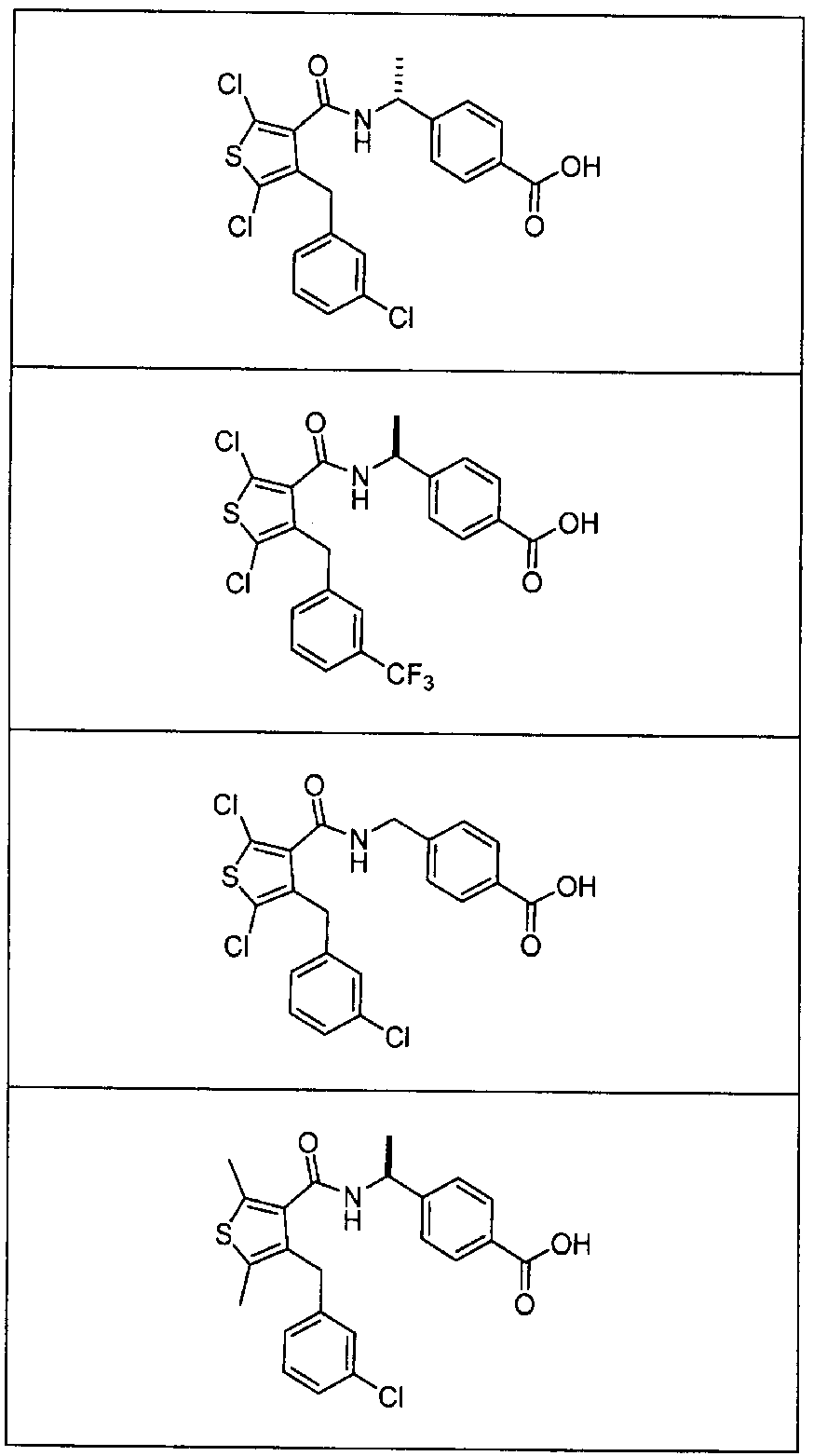
本発明はまた、以下の表: The present invention also includes the following table:
から選択される化合物、又は上記化合物のいずれかの薬学的に許容され得る塩を包含する。 Or a pharmaceutically acceptable salt of any of the above compounds.
本発明はまた、その薬学的に許容され得る塩がナトリウム塩である、上記表から選択される化合物も包含する。 The invention also encompasses a compound selected from the table above, wherein the pharmaceutically acceptable salt is a sodium salt.
本発明はまた、以下の表: The present invention also includes the following table:
から選択される化合物も包含する。 Also included are compounds selected from:
本発明はまた、式I又は式IIの化合物を、1つ以上の生理学的に許容され得る担体又は賦形剤と混合してなる医薬組成物も包含する。 The invention also encompasses a pharmaceutical composition comprising a compound of Formula I or Formula II mixed with one or more physiologically acceptable carriers or excipients.
本発明はまた、ヒト又は霊長類の医薬における使用のための、式I又は式IIの化合物、又はその薬学的に許容され得る誘導体も包含する。 The invention also encompasses a compound of formula I or formula II, or a pharmaceutically acceptable derivative thereof, for use in human or primate medicine.
本発明はまた、EP4受容体により媒介される症状を患っているヒト又は動物患者を治療する方法であって、式I又は式IIの化合物の有効量を、該患者へ投与することを含んでなる方法も包含する。 The present invention is also a method of treating a human or animal patient suffering from a condition mediated by the EP4 receptor, comprising administering to the patient an effective amount of a compound of formula I or formula II. The method is also included.
本発明はまた、EP4受容体により媒介される症状の治療用の治療薬製造のための、式I又は式IIの化合物の使用も包含する。 The invention also encompasses the use of a compound of formula I or formula II for the manufacture of a therapeutic agent for the treatment of conditions mediated by the EP4 receptor.
定義
以下の略号は、表示した意味を有する:
DHP = 3,4−ジヒドロ−2H−ピラン
DMAP = 4−ジメチルアミノピリジン
DMSO = ジメチルスルホキシド
EDCI = 1−(3−ジメチルアミノプロピル)−3−エチルカルボジイミド塩酸塩
HATU = O−(7−アザベンゾトリアゾール−1−イル)−N,N,N’,N’−テトラメチルウロニウム=ヘキサフルオロホスフェート
NBS = N−ブロモスクシンイミド
NCS = N−クロロスクシンイミド
PPTS = ピリジニウム=p−トルエンスルホネート
PTSA = p−トルエンスルホン酸
TFA = トリフルオロ酢酸
TMSCl= クロロトリメチルシラン
Definitions The following abbreviations have the meanings indicated:
DHP = 3,4-dihydro-2H-pyran DMAP = 4-dimethylaminopyridine DMSO = dimethylsulfoxide EDCI = 1- (3-dimethylaminopropyl) -3-ethylcarbodiimide hydrochloride HATU = O- (7-azabenzotriazole -1-yl) -N, N, N ′, N′-tetramethyluronium = hexafluorophosphate NBS = N-bromosuccinimide NCS = N-chlorosuccinimide PPTS = pyridinium = p-toluenesulfonate PTSA = p-toluenesulfone Acid TFA = trifluoroacetic acid TMSCl = chlorotrimethylsilane
「アルキル」、並びに接頭語「alk」をもつ他の基、例えばアルコキシ、アルカノイルは、直鎖又は分枝鎖か、又はそれらの組合せであってもよい炭素鎖を意味する。アルキル基の例は、メチル、エチル、プロピル、イソプロピル、ブチル、sec−及びtert−ブチル、ペンチル、ヘキシル、ヘプチル、オクチル、ノニルなどを包含する。 “Alkyl” as well as other groups with the prefix “alk”, for example alkoxy, alkanoyl, means a carbon chain which may be linear or branched or combinations thereof. Examples of alkyl groups include methyl, ethyl, propyl, isopropyl, butyl, sec- and tert-butyl, pentyl, hexyl, heptyl, octyl, nonyl and the like.
「フルオロアルキル」は、1つ以上の水素原子がフッ素原子により置換されている、上記に定義されたアルキルを意味する。 “Fluoroalkyl” means an alkyl as defined above wherein one or more hydrogen atoms are replaced by fluorine atoms.
「アルケニル」は、少なくとも1つの炭素−炭素二重結合を含有しており、かつ直鎖又は分枝鎖か、又はそれらの組合せであってもよい炭素鎖を意味する。アルケニルの例は、ビニル、アリル、イソプロペニル、ペンテニル、ヘキセニル、ヘプテニル、1−プロペニル、2−ブテニル、2−メチル−2−ブテニルなどを包含する。 “Alkenyl” means a carbon chain containing at least one carbon-carbon double bond and which may be linear or branched or combinations thereof. Examples of alkenyl include vinyl, allyl, isopropenyl, pentenyl, hexenyl, heptenyl, 1-propenyl, 2-butenyl, 2-methyl-2-butenyl and the like.
「アルキニル」は、少なくとも1つの炭素−炭素三重結合を含有し、かつ直鎖又は分枝鎖か、又はそれらの組合せであってもよい炭素鎖を意味する。アルキニルの例は、エチニル、プロパルギル、3−メチル−1−ペンチニル、2−ヘプチニルなどを包含する。 “Alkynyl” means a carbon chain containing at least one carbon-carbon triple bond and which may be straight or branched, or combinations thereof. Examples of alkynyl include ethynyl, propargyl, 3-methyl-1-pentynyl, 2-heptynyl and the like.
「シクロアルキル」は、各々が3から10個の炭素原子を有する、単環式又は二環式の飽和炭素環を意味する。シクロアルキルの「縮合類似体」は、アリール又はヘテロアリール基に縮合した単環式の環を意味し、ここで、結合点は非芳香族部分にある。シクロアルキル及びその縮合類似体の例は、シクロプロピル、シクロブチル、シクロペンチル、シクロヘキシル、シクロヘプチル、テトラヒドロナフチル、デカヒドロナフチル、インダニルなどを包含する。 “Cycloalkyl” means a mono- or bicyclic saturated carbocycle, each having from 3 to 10 carbon atoms. A “fused analog” of a cycloalkyl means a monocyclic ring fused to an aryl or heteroaryl group, wherein the point of attachment is on the non-aromatic moiety. Examples of cycloalkyl and its fused analogs include cyclopropyl, cyclobutyl, cyclopentyl, cyclohexyl, cycloheptyl, tetrahydronaphthyl, decahydronaphthyl, indanyl and the like.
「アルコキシ」は、指示された数の炭素原子を有する、直鎖又は分枝したアルコキシ基を意味する。例えば、C1−6アルコキシは、メトキシ、エトキシ、プロポキシ、イソプロポキシなどを包含する。 “Alkoxy” means a straight-chain or branched alkoxy group having the indicated number of carbon atoms. For example, C 1-6 alkoxy includes methoxy, ethoxy, propoxy, isopropoxy and the like.
「チオアルコキシ」は、−O−基が−S−で置換されている、上記に定義したアルコキシを意味する。 “Thioalkoxy” means alkoxy as defined above wherein the —O— group is replaced by —S—.
「シクロアルコキシ」は、シクロプロピルオキシのように、酸素原子に結合した、上記に定義されたシクロアルキルを意味する。 “Cycloalkoxy” means a cycloalkyl as defined above attached to an oxygen atom, such as cyclopropyloxy.
「フルオロアルコキシ」は、1個以上の水素原子がフッ素原子により置換されている、上記に定義したアルコキシを意味する。 “Fluoroalkoxy” means alkoxy as defined above wherein one or more hydrogen atoms are replaced by fluorine atoms.
「アリール」は、炭素原子のみを含有する、単環又は二環式の芳香環を意味する。アリールの「縮合類似体」は、単環式シクロアルキル又は単環式ヘテロシクリル基に縮合したアリール基を意味し、ここで、結合点は芳香族部分にある。アリール及びその縮合類似体の例は、フェニル、ナフチル、インダニル、インデニル、テトラヒドロナフチル、2,3−ジヒドロベンゾフラニル、ジヒドロベンゾピラニル、1,4−ベンゾジオキサニルなどを包含する。 “Aryl” means a mono- or bicyclic aromatic ring containing only carbon atoms. A “fused analog” of aryl means an aryl group fused to a monocyclic cycloalkyl or monocyclic heterocyclyl group, wherein the point of attachment is on the aromatic moiety. Examples of aryl and its fused analogs include phenyl, naphthyl, indanyl, indenyl, tetrahydronaphthyl, 2,3-dihydrobenzofuranyl, dihydrobenzopyranyl, 1,4-benzodioxanyl and the like.
「ヘテロアリール」は、N、O及びSから選択される少なくとも1つのヘテロ原子を含有し、各環が5から6の原子を含有する、単環又は二環式の芳香環を意味する。ヘテロアリールの「縮合類似体」は、単環式シクロアルキル又は単環式ヘテロシクリル基に縮合したヘテロアリール基を意味し、ここで、結合点は芳香族部分にある。ヘテロアリールの例は、ピロリル、イソオキサゾリル、イソチアゾリル、ピラゾリル、ピリジル、オキサゾリル、オキサジアゾリル、チアジアゾリル、チアゾリル、イミダゾリル、トリアゾリル、テトラゾリル、フラニル、トリアジニル、チエニル、ピリミジル、ピリダジニル、ピラジニル、ベンゾオキサゾリル、ベンゾチアゾリル、ベンゾイミダゾリル、ベンゾフラニル、ベンゾチオフェニル、フロ(2,3−b)ピリジル、キノリル、インドリル、イソキノリルなどを包含する。 “Heteroaryl” means a mono- or bicyclic aromatic ring containing at least one heteroatom selected from N, O and S, each ring containing from 5 to 6 atoms. A “fused analog” of heteroaryl means a heteroaryl group fused to a monocyclic cycloalkyl or monocyclic heterocyclyl group, wherein the point of attachment is on the aromatic moiety. Examples of heteroaryl are pyrrolyl, isoxazolyl, isothiazolyl, pyrazolyl, pyridyl, oxazolyl, oxadiazolyl, thiadiazolyl, thiazolyl, imidazolyl, triazolyl, tetrazolyl, furanyl, triazinyl, thienyl, pyrimidyl, pyridazinyl, pyrazinyl, benzoxazolyl, benzothiazolyl, benzoimidazolyl , Benzofuranyl, benzothiophenyl, furo (2,3-b) pyridyl, quinolyl, indolyl, isoquinolyl and the like.
「ヘテロシクリル」は、N、S及びOから選択される少なくとも1つのヘテロ原子を含有する、芳香族ではない、単環若しくは二環式の飽和環、又は部分不飽和な単環式の環を意味し、当該環の各々は、3から10個の原子を有し、ここで、結合点は炭素又は窒素上であり得る。ヘテロシクリルの「縮合類似体」は、アリール又はヘテロアリール基に縮合した単環式ヘテロ環を意味し、ここで、結合点は非芳香族部分にある。「ヘテロシクリル」及びその縮合類似体の例は、ピロリジニル、ピペリジニル、ピペラジニル、イミダゾリジニル、2,3−ジヒドロフロ(2,3−b)ピリジル、ベンゾオキサジニル、テトラヒドロヒドロキノリニル、テトラヒドロイソキノリニル、ジヒドロインドリルなどを包含する。この用語はまた、芳香族ではない部分不飽和単環式の環、例えば、窒素を介して結合した、2−若しくは4−ピリドン、又はN−置換−(1H,3H)−ピリミジン−2,4−ジオン(N−置換ウラシル)も包含する。 “Heterocyclyl” means a non-aromatic, monocyclic or bicyclic saturated ring or partially unsaturated monocyclic ring containing at least one heteroatom selected from N, S and O Each of the rings has 3 to 10 atoms, where the point of attachment can be on carbon or nitrogen. A “fused analog” of heterocyclyl means a monocyclic heterocycle fused to an aryl or heteroaryl group, wherein the point of attachment is on the non-aromatic moiety. Examples of “heterocyclyl” and its condensed analogs are pyrrolidinyl, piperidinyl, piperazinyl, imidazolidinyl, 2,3-dihydrofuro (2,3-b) pyridyl, benzooxazinyl, tetrahydrohydroquinolinyl, tetrahydroisoquinolinyl, Including dihydroindolyl. The term also includes a partially unsaturated monocyclic ring that is not aromatic, such as 2- or 4-pyridone, or N-substituted- (1H, 3H) -pyrimidine-2,4, attached via nitrogen. Also included are diones (N-substituted uracils).
「ハロゲン」及び「ハロ」は、フッ素、塩素、臭素及びヨウ素を包含する。 “Halogen” and “halo” include fluorine, chlorine, bromine and iodine.
光学異性体−ジアステレオマー−幾何異性体−互変異性体
式I及び式IIの化合物は、1つ以上の不斉中心を有し、したがってラセミ体及びラセミ混合物、単一エナンチオマー、ジアステレオ混合物及び個々のジアステレオマーとして生じ得る。本発明は、式I及び式IIの化合物の全てのかかる異性体型を包含するものとする。
Optical isomers-diastereomers-geometric isomers-tautomers Compounds of formula I and formula II have one or more asymmetric centers and are therefore racemates and racemic mixtures, single enantiomers, diastereomeric mixtures And can occur as individual diastereomers. The present invention is meant to encompass all such isomeric forms of the compounds of Formula I and Formula II.
本明細書に記載されたある化合物は、オレフィン二重結合を含有しており、かつ、他に指定されない限り、E及びZ双方の幾何異性体を包含するものとする。 Certain compounds described herein contain olefinic double bonds, and unless specified otherwise, are meant to include both E and Z geometric isomers.
本明細書に記載されたある化合物は、水素の結合点を異にして存在してもよく、互変異性体と呼ばれる。かかる例は、ケト−エノール互変異性体として知られる、ケトン及びそのエノール型であってよい。個々の互変異性体、並びにその混合物は、式I及び式IIの化合物の内に包含される。 Certain compounds described herein may exist with different points of attachment of hydrogen and are referred to as tautomers. Such an example may be a ketone and its enol form, known as keto-enol tautomers. The individual tautomers, as well as mixtures thereof, are encompassed within compounds of Formula I and Formula II.
式I及び式IIの化合物は、例えば、適当な溶媒、例えばMeOH又はEtOAc、又はそれらの混合物から、分別結晶によりジアステレオ異性体のエナンチオマーペアへ分離され得る。そのようにして得られたエナンチオマーペアは、例えば光学活性アミンを分割剤として使用することによるか、又はキラルHPLCカラム等の通常の手段により、個々の立体異性体へ分離され得る。 Compounds of Formula I and Formula II can be separated into diastereomeric enantiomeric pairs by fractional crystallization, for example, from a suitable solvent such as MeOH or EtOAc, or mixtures thereof. The enantiomeric pairs so obtained can be separated into the individual stereoisomers, for example by using optically active amines as resolving agents, or by conventional means such as chiral HPLC columns.
別法として、一般式I又は式IIの化合物の任意のエナンチオマーは、立体特異的合成により、光学的に純粋な出発物質、又は構造の分かっている試薬を使用して取得され得る。 Alternatively, any enantiomer of a compound of general formula I or formula II can be obtained by stereospecific synthesis using optically pure starting materials or reagents of known structure.
塩
用語「薬学的に許容され得る塩」は、無機又は有機塩基、及び無機又は有機酸を含む、薬学的に許容され得る非毒性の塩基又は酸から調製される塩を指す。無機塩基から誘導される塩は、アルミニウム、アンモニウム、カルシウム、銅、第二鉄、第一鉄、リチウム、マグネシウム、第二マンガン塩、第一マンガン、カリウム、ナトリウム、亜鉛などを包含する。特に好適であるのは、アンモニウム、カルシウム、マグネシウム、カリウム、及びナトリウムの塩である。薬学的に許容され得る有機非毒性塩基から誘導される塩は、第一級、第二級及び第三級アミンの塩;天然産置換アミンを含む置換アミンの塩;環状アミン、及び塩基性イオン交換樹脂を含み、例えば、アルギニン、ベタイン、カフェイン、コリン、N,N’−ジベンジルエチレンジアミン、ジエチルアミン、2−ジエチルアミノエタノール、2−ジメチルアミノエタノール、エタノールアミン、エチレンジアミン、N−エチル−モルホリン、N−エチルピペリジン、グルカミン、グルコサミン、ヒスチジン、ヒドラバミン、イソプロピルアミン、リジン、メチルグルカミン、モルホリン、ピペラジン、ピペリジン、ポリアミン樹脂、プロカイン、プリン、テオブロミン、トリエチルアミン、トリメチルアミン、トリプロピルアミン、トロメタミンなどの塩が挙げられる。
The term “pharmaceutically acceptable salts” refers to salts prepared from pharmaceutically acceptable non-toxic bases or acids including inorganic or organic bases and inorganic or organic acids. Salts derived from inorganic bases include aluminum, ammonium, calcium, copper, ferric, ferrous, lithium, magnesium, manganic salts, manganous, potassium, sodium, zinc, and the like. Particularly preferred are the ammonium, calcium, magnesium, potassium, and sodium salts. Salts derived from pharmaceutically acceptable organic non-toxic bases include primary, secondary and tertiary amine salts; salts of substituted amines including naturally occurring substituted amines; cyclic amines, and basic ions Including exchange resins such as arginine, betaine, caffeine, choline, N, N′-dibenzylethylenediamine, diethylamine, 2-diethylaminoethanol, 2-dimethylaminoethanol, ethanolamine, ethylenediamine, N-ethyl-morpholine, N -Ethylpiperidine, glucamine, glucosamine, histidine, hydrabamine, isopropylamine, lysine, methylglucamine, morpholine, piperazine, piperidine, polyamine resin, procaine, purine, theobromine, triethylamine, trimethylamine, tripropylamine, tromethamimi Salt.
本発明化合物が塩基性である場合、塩は、無機及び有機酸を含む、薬学的に許容され得る非毒性の酸から調製され得る。かかる酸は、酢酸、ベンゼンスルホン酸、安息香酸、カンファースルホン酸、クエン酸、エタンスルホン酸、フマル酸、グルコン酸、グルタミン酸、臭化水素酸、塩酸、イセチオン酸、乳酸、マレイン酸、リンゴ酸、マンデル酸、メタンスルホン酸、ムチン酸、硝酸、パモン酸、パントテン酸、リン酸、コハク酸、硫酸、酒石酸、p−トルエンスルホン酸などを包含する。特に好適であるのは、クエン酸、臭化水素酸、塩酸、マレイン酸、リン酸、硫酸及び酒石酸である。 When the compound of the present invention is basic, salts can be prepared from pharmaceutically acceptable non-toxic acids, including inorganic and organic acids. Such acids are acetic acid, benzenesulfonic acid, benzoic acid, camphorsulfonic acid, citric acid, ethanesulfonic acid, fumaric acid, gluconic acid, glutamic acid, hydrobromic acid, hydrochloric acid, isethionic acid, lactic acid, maleic acid, malic acid, Mandelic acid, methanesulfonic acid, mucinic acid, nitric acid, pamonic acid, pantothenic acid, phosphoric acid, succinic acid, sulfuric acid, tartaric acid, p-toluenesulfonic acid and the like are included. Particularly suitable are citric acid, hydrobromic acid, hydrochloric acid, maleic acid, phosphoric acid, sulfuric acid and tartaric acid.
本明細書で用いる場合、式I及び式IIの化合物に対する言及はまた、薬学的に許容され得る塩も包むものとすることが理解されよう。 It will be understood that, as used herein, references to compounds of formula I and formula II are also intended to encompass pharmaceutically acceptable salts.
有用性
本発明化合物は、EP4受容体のリガンドであり、したがってEP4受容体のアンタゴニスト又はアゴニストとして有用であり、そしてこの受容体により媒介される疾患又は症状を治療するための有用性がある。
Utility The compounds of the present invention are EP4 receptor ligands and are therefore useful as antagonists or agonists of the EP4 receptor and have utility for treating diseases or conditions mediated by this receptor.
EP4受容体に結合するその能力に鑑み、本発明化合物は、該化合物がアンタゴニストであるか、又はアゴニストであるかに依存して、1つ以上の以下の疾患の治療において有用である。 In view of its ability to bind to the EP4 receptor, the compounds of the invention are useful in the treatment of one or more of the following diseases, depending on whether the compound is an antagonist or an agonist.
PGE2受容体のEP4サブタイプのアンタゴニストである本発明化合物は、急性及び慢性疼痛、変形性関節症、リウマチ様関節炎及びがんのような疾患又は症状の治療のために有用である。 The compounds of the invention that are antagonists of the EP4 subtype of the PGE 2 receptor are useful for the treatment of diseases or conditions such as acute and chronic pain, osteoarthritis, rheumatoid arthritis and cancer.
本発明化合物は、鎮痛剤として有用である。例えば、それらは、疾患修飾及び関節構造保存の特性を含む慢性関節痛(例えば、リウマチ様関節炎、変形性関節症、リウマチ性脊椎炎、痛風性関節炎及び若年性関節炎)の治療;筋骨格痛;腰及び頸部疼痛;捻挫及び挫傷;神経障害性疼痛;交感神経依存性疼痛;筋炎;がん及び線維筋肉痛に付随する疼痛;片頭痛に付随する疼痛;インフルエンザ又は他のウイルス感染症、例えば感冒に付随する疼痛;リウマチ熱;機能性腸疾患、例えば非潰瘍性消化不良、非心臓性胸痛及び過敏性腸症候群に付随する疼痛;心筋虚血に付随する疼痛;術後疼痛;頭痛;歯痛;及び、月経困難症の治療において有用である。 The compound of the present invention is useful as an analgesic. For example, they treat chronic joint pain (eg, rheumatoid arthritis, osteoarthritis, rheumatoid spondylitis, gouty arthritis and juvenile arthritis), including characteristics of disease modification and preservation of joint structure; musculoskeletal pain; Back and neck pain; sprains and contusions; neuropathic pain; sympathetic-dependent pain; myositis; pain associated with cancer and fibromyalgia; pain associated with migraine; influenza or other viral infections such as Pain associated with the common cold; rheumatic fever; functional bowel disease such as non-ulcer dyspepsia, non-cardiac chest pain and irritable bowel syndrome; pain associated with myocardial ischemia; postoperative pain; headache; And useful in the treatment of dysmenorrhea.
本発明は、神経障害性疼痛の治療において有用である。神経障害性疼痛症候群は、ニューロン損傷に続いて発生し得るものであり、結果として生じる疼痛は、元の損傷が治癒された後であっても、数か月又は数年間継続することがある。ニューロン損傷は、末梢神経、背根、脊髄又は脳のある領域に生じ得る。神経障害性疼痛症候群は、伝統的に、それらを突如引き起こした疾患又は事象に従って分類される。神経障害性疼痛症候群は、糖尿病性神経障害;坐骨神経痛;非特異的腰部疼痛;多発性硬化症性疼痛;線維筋痛症;HIV関連神経障害;ヘルペス後神経痛;三叉神経痛;及び物理的外傷、切断、がん、毒素又は慢性炎症性の症状からの結果として生じる疼痛を包含する。これらの症状は、治療することが難しく、いくつかの薬剤が限られた効能をもつことは知られているが、完全なペインコントロールはめったに達成されることはない。神経障害性疼痛の症状は、驚くほど雑多であり、自発性の、速い、刺すような痛み、又は継続する灼熱痛としてしばしば記載される。さらに、正常な非疼痛性知覚、例えば「しびれてピリピリする感覚(ピンズ・アンド・ニードルズ)」(知覚障害及び感覚異常)、接触に対する感度増加(知覚過敏)、無害な刺激後の疼痛性知覚(動的、静的、又は熱的アロディニア)、有害な刺激に対する感度増加(熱性、寒冷、機械的痛覚過敏)、刺激除去後の継続的な痛覚(痛覚異常過敏)、又は選択的感覚経路の不在又は欠損(痛覚鈍麻)がある。 The present invention is useful in the treatment of neuropathic pain. Neuropathic pain syndrome can occur following neuronal injury, and the resulting pain can continue for months or years, even after the original injury has been healed. Neuronal damage can occur in certain areas of the peripheral nerve, dorsal root, spinal cord or brain. Neuropathic pain syndromes are traditionally classified according to the disease or event that suddenly caused them. Neuropathic pain syndrome includes diabetic neuropathy; sciatica; nonspecific lumbar pain; multiple sclerosis pain; fibromyalgia; HIV-related neuropathy; postherpetic neuralgia; trigeminal neuralgia; Includes pain resulting from amputation, cancer, toxins or chronic inflammatory symptoms. Although these symptoms are difficult to treat and some drugs are known to have limited efficacy, complete pain control is rarely achieved. The symptoms of neuropathic pain are surprisingly miscellaneous and are often described as spontaneous, fast, stinging pain, or persistent burning pain. In addition, normal non-pain perceptions such as “numbness and tingling sensations (pins and needles)” (sensory disturbances and sensory abnormalities), increased sensitivity to touch (hypersensitivity), harmless post-stimulation pain perception ( Dynamic, static, or thermal allodynia), increased sensitivity to harmful stimuli (thermal, cold, mechanical hyperalgesia), continuous nociception after stimulation removal (hyperalgesia), or absence of selective sensory pathways Or there is a deficit (painlessness).
本発明化合物はまた、炎症の治療において、例えば、皮膚症状(例えば、日焼け、火傷、湿疹、皮膚炎、乾癬);眼性疾患、例えば緑内障、網膜炎、網膜症、ブドウ膜炎及び眼組織に対する急性損傷(例えば、結膜炎);肺疾患(例えば、喘息、気管支炎、肺気腫、アレルギー性鼻炎、呼吸窮迫症候群、愛鳥家病、農夫肺、COPD);胃腸管疾患(例えば、アフタ性潰瘍、クローン病、アトピー性胃炎、varialoforme胃炎、潰瘍性大腸炎、小児脂肪便症、限局性回腸炎、過敏性腸症候群、炎症性腸疾患、胃小腸逆流症);臓器移植;炎症性の要素をもつ他の症状、例えば、血管疾患、片頭痛、結節性動脈周囲炎、甲状腺炎、再生不良性貧血、ホジキン病、スクレロドーマ(sclerodoma)、重症筋無力性(myaesthenia gravis)、多発性硬化症、サルコイドーシス(sorcoidosis)、ネフローゼ症候群、ベーチェット病、多発性筋炎、歯肉炎、心筋虚血、発熱、全身性エリテマトーデス、多発性筋炎、腱炎、滑液包炎及びシューグレン症候群の治療において有用である。 The compounds of the invention may also be used in the treatment of inflammation, for example against skin conditions (eg sunburn, burns, eczema, dermatitis, psoriasis); ocular diseases such as glaucoma, retinitis, retinopathy, uveitis and ocular tissues. Acute injury (eg, conjunctivitis); lung disease (eg, asthma, bronchitis, emphysema, allergic rhinitis, respiratory distress syndrome, aviary disease, farmer's lung, COPD); gastrointestinal disease (eg, aphthous ulcer, Crohn's disease) , Atopic gastritis, varialoform gastritis, ulcerative colitis, childhood steatosis, localized ileitis, irritable bowel syndrome, inflammatory bowel disease, gastrointestinal reflux disease); organ transplantation; other with inflammatory components Symptoms such as vascular disease, migraine, nodular periarteritis, thyroiditis, aplastic anemia, Hodgkin's disease, sclerodoma, myasthenia gravis (myes) henia gravis), multiple sclerosis, sarcoidosis, nephrotic syndrome, Behcet's disease, polymyositis, gingivitis, myocardial ischemia, fever, systemic lupus erythematosus, polymyositis, tendinitis, synovial bursitis and shoe Useful in the treatment of Glenn syndrome.
本発明化合物はまた、免疫疾患、例えば自己免疫疾患、免疫不全症又は臓器移植の治療においても有用である。本発明化合物はまた、HIV感染の潜伏期間を増やすことにおいても有効である。 The compounds of the present invention are also useful in the treatment of immune diseases such as autoimmune diseases, immunodeficiencies or organ transplants. The compounds of the present invention are also effective in increasing the latency period of HIV infection.
本発明化合物はまた、血小板機能異常(例えば、閉鎖性の血管症)の治療において有用である。 The compounds of the present invention are also useful in the treatment of abnormal platelet function (eg, obstructive angiopathy).
本発明化合物はまた、利尿作用をもつ薬剤の調製のためにも有用である。 The compound of the present invention is also useful for the preparation of a drug having a diuretic action.
本発明化合物はまた、インポテンス又は勃起機能低下の治療において有用である。 The compounds of the present invention are also useful in the treatment of impotence or reduced erectile function.
本発明化合物はまた、異常な骨代謝又は吸収により特徴づけられる骨疾患、例えば、骨粗鬆症(特に閉経後骨粗鬆症)、高カルシウム血症、副甲状腺機能亢進症、骨パジェット病、骨溶解、骨転移を伴う、又は伴わない悪性高カルシウム血症、リウマチ様関節炎、歯周炎、変形性関節症、骨痛、骨減少症、がん悪液質、結石症(calculosis)、結石症(lithiasis)(特に尿路結石症)、固形がん、痛風及び強直性脊椎炎、腱炎及び滑液包炎の治療において有用である。さらなる側面においては、本発明化合物は、骨吸収を阻害すること、及び/又は、骨再生を促進することにおいて有用であり得る。 The compounds of the present invention can also be used to treat bone diseases characterized by abnormal bone metabolism or resorption, such as osteoporosis (especially postmenopausal osteoporosis), hypercalcemia, hyperparathyroidism, Paget's disease of bone, osteolysis, bone metastasis. With or without malignant hypercalcemia, rheumatoid arthritis, periodontitis, osteoarthritis, bone pain, osteopenia, cancer cachexia, calculus, lithiasis (especially (Urolithiasis), solid cancer, gout and ankylosing spondylitis, tendinitis and bursitis. In a further aspect, the compounds of the present invention may be useful in inhibiting bone resorption and / or promoting bone regeneration.
本発明はまた、NSAID及びCOX−2阻害剤の、血行力学的副作用を弱めることにおいても有用である。 The present invention is also useful in reducing the hemodynamic side effects of NSAIDs and COX-2 inhibitors.
本発明化合物はまた、心臓血液疾患、例えば、高血圧又は心筋虚血(myocardiac ischemia);機能性又は器質性の静脈不全;静脈瘤治療;痔;及び動脈圧の著しい低下に付随するショック状態(例えば、敗血症性ショック)の治療においても有用である。 The compounds of the present invention may also be used in cardiovascular diseases such as hypertension or myocardial ischemia; functional or organic venous insufficiency; varicose vein treatment; epilepsy; and shock conditions associated with a significant decrease in arterial pressure (eg It is also useful in the treatment of septic shock.
本発明化合物はまた、神経変性疾患及び神経変性、例えば、痴呆、特に変性性痴呆(老人性痴呆、アルツハイマー病、ピック病、ハンチントン舞踏病、パーキンソン病及びクロイツフェルト−ヤコブ病、ALS、運動ニューロン疾患を含む);血管性痴呆(多発梗塞性痴呆を含む);並びに頭蓋内占拠性病変に付随する痴呆;外傷;感染及び関連症状(HIV感染を含む);代謝;毒素;無酸素症及びビタミン欠乏症;加齢に付随する軽度認知障害、特に加齢に伴う記憶障害の治療においても有用である。
式I及び式IIの化合物はまた、卒中、心停止、肺バイパス、外傷性脳損傷又は脊髄損傷などに続く、神経保護の処置において、及び神経変性の治療においても有用である。本発明化合物はまた、卒中及び多発性硬化症の治療に有用である。
The compounds of the present invention can also be used for neurodegenerative diseases and neurodegeneration such as dementia, especially degenerative dementia (senile dementia, Alzheimer's disease, Pick's disease, Huntington's chorea, Parkinson's disease and Creutzfeldt-Jakob disease, ALS, motor neuron disease. Vascular dementia (including multiple infarct dementia); and dementia associated with intracranial occupational lesions; trauma; infection and related symptoms (including HIV infection); metabolism; toxins; anoxia and vitamin deficiency It is also useful in the treatment of mild cognitive impairment associated with aging, particularly memory impairment associated with aging.
The compounds of formula I and formula II are also useful in the treatment of neuroprotection and in the treatment of neurodegeneration following stroke, cardiac arrest, lung bypass, traumatic brain injury or spinal cord injury, and the like. The compounds of the present invention are also useful for the treatment of stroke and multiple sclerosis.
本発明化合物はまた、耳鳴りの治療においても有用である。 The compounds of the present invention are also useful in the treatment of tinnitus.
本発明化合物はまた、依存症誘発剤に対する依存を予防又は低減することにおいて、或いは、依存症誘発剤に対する耐性又は逆耐性を予防又は低減することにおいても有用である。依存症誘発剤の例は、オピオイド(例えば、モルヒネ)、CNS抑制薬(例えば、エタノール)、神経刺激薬(例えば、コカイン)及びニコチンを包含する。 The compounds of the present invention are also useful in preventing or reducing dependence on dependence-inducing agents, or in preventing or reducing tolerance or reverse tolerance to dependence-inducing agents. Examples of dependence inducing agents include opioids (eg morphine), CNS inhibitors (eg ethanol), neurostimulants (eg cocaine) and nicotine.
本発明化合物はまた、I型糖尿病の合併症(例えば、糖尿病性細小血管症、糖尿病性網膜症、糖尿病性腎症、黄班変性症、緑内障)、ネフローゼ症候群、再生不良性貧血、ブドウ膜炎、川崎病及びサルコイドーシスの治療においても有用である。 The compound of the present invention is also a complication of type I diabetes (eg, diabetic microangiopathy, diabetic retinopathy, diabetic nephropathy, macular degeneration, glaucoma), nephrotic syndrome, aplastic anemia, uveitis It is also useful in the treatment of Kawasaki disease and sarcoidosis.
本発明化合物はまた、腎機能障害(腎炎、特にメサンギウム増殖性糸球体腎炎、腎炎症候群)、肝機能障害(肝炎、肝硬変)、胃腸機能不全(下痢)及び結腸がんの治療においても有用である。 The compounds of the present invention are also useful in the treatment of renal dysfunction (nephritis, particularly mesangial proliferative glomerulonephritis, nephritic syndrome), liver dysfunction (hepatitis, cirrhosis), gastrointestinal dysfunction (diarrhea) and colon cancer. .
本発明化合物はまた、新生物を、かかる治療又は予防を必要とする患者において、治療又は予防するために有用である。用語「治療」は、新生物の増殖、拡散又は転移の、部分的又は完全な阻害、並びに、疼痛、食欲不振又は体重減少を含む、新生物細胞及び/又は新生物に付随する症状の部分的又は完全な破壊を包含する。この用語はまた、化合物の、別の化学療法の増感剤としての使用も包含する。用語「予防」は、リスクのある個体において、臨床的に顕性な新生物の発症を完全に防止すること、又は新生物の前臨床的に顕性な段階の発症を防止することの、いずれかを包含する。またこの定義により包含されることを意図するのは、悪性細胞の発現を防止すること、又は、前癌細胞の悪性細胞への進行を停止又は逆転させることである。このことは、新生物の発症のリスクにある者の予防的治療を包含する。用語、治療のための「患者」は、既知の新生物の任意の1つをもつ任意のヒト又は哺乳動物患者を包含し、かつ好ましくはヒト患者である。予防方法については、患者は任意のヒト又は動物患者であり、かつ好ましくは、新生物を獲得するリスクにあるヒト患者である。患者は、発がん物質への暴露に起因するリスクにあってもよく、遺伝的に新生物をもつ素因を与えられている、などでもよい。 The compounds of the present invention are also useful for treating or preventing neoplasms in patients in need of such treatment or prevention. The term “treatment” refers to partial or complete inhibition of neoplastic growth, spread or metastasis, as well as partial neoplastic cells and / or symptoms associated with neoplasms, including pain, anorexia or weight loss. Or encompass complete destruction. The term also encompasses the use of the compound as a sensitizer for another chemotherapy. The term “prevention” can either completely prevent the development of a clinically evident neoplasm in an individual at risk, or prevent the development of a preclinical manifestation of a neoplasm. Including. Also intended to be encompassed by this definition is to prevent the expression of malignant cells or to stop or reverse the progression of precancerous cells to malignant cells. This includes prophylactic treatment of those at risk of developing a neoplasm. The term “patient” for treatment encompasses any human or mammalian patient with any one of the known neoplasms, and is preferably a human patient. For prevention methods, the patient is any human or animal patient, and preferably a human patient at risk of acquiring a neoplasm. The patient may be at risk from exposure to a carcinogen, may be genetically predisposed to having a neoplasm, and so on.
用語「新生物」は、良性及びがん性双方の、腫瘍(tumor)、腫瘍(growth)及びポリープを包含する。したがって、本発明化合物は、扁平上皮乳頭腫、基底細胞腫、移行上皮乳頭腫、腺腫、ガストリノーマ、胆管細胞腺腫、肝細胞腺腫、尿細管腺腫、膨大細胞腫、グロムス腫瘍、色素細胞母班、線維腫、粘液腫、脂肪腫、平滑筋腫、横紋筋腫、良性奇形腫、血管腫、骨腫、軟骨腫、及び髄膜腫を含む、良性の、腫瘍(tumor)、腫瘍(growth)及びポリープを治療又は予防するために有用である。本発明化合物はまた、扁平上皮癌、基底細胞癌、移行上皮癌、腺癌、悪性ガストリノーマ、胆管細胞癌、肝細胞癌、腎細胞癌、悪性黒色腫、線維肉腫、粘液肉腫、脂肪肉腫、平滑筋肉腫、横紋筋肉腫、悪性奇形腫、血管肉腫、カポジ肉腫、リンパ管肉腫、骨肉腫、軟骨肉腫、悪性髄膜腫、非ホジキンリンパ腫、ホジキンリンパ腫及び白血病を含む、癌性の、腫瘍(tumor)、腫瘍(growth)及びポリープを治療又は予防するために有用である。本明細書では、「新生物」は、脳腫瘍、骨癌、上皮細胞由来の新生物(上皮癌)、基底細胞癌、腺癌、胃腸がん、例えば、口唇がん、口腔がん、食道がん、小腸がん及び胃がん、結腸がん、直腸がん、肝臓がん、膀胱がん、膵臓がん、卵巣がん、子宮頚がん、肺がん、乳がん及び皮膚がん、例えば扁平上皮(squamus)細胞及び基底細胞がん、前立腺がん、腎細胞癌、及び、全身の上皮、間充織又は血液細胞に影響を及ぼす他の既知のがんを包含する。本発明化合物は、任意の上記のがんの治療又は予防に有用である。本発明化合物は、以下の細胞タイプの、良性及びがん性の、腫瘍(tumor)、腫瘍(growth)及びポリープの治療又は予防に有用である:扁平上皮、基底細胞、移行上皮、腺上皮、G細胞、胆管上皮、肝細胞、尿細管上皮、メラノサイト、線維性結合組織、心臓骨格、脂肪組織、平滑筋、骨格筋、生殖細胞、血管、リンパ管、骨、軟骨、髄膜、リンパ球様細胞及び造血細胞。本化合物は、家族性腺腫様ポリープ症(FAP)を含む、腺腫様ポリープをもつ患者を治療するために使用できる。さらに、本化合物は、FAPのリスクにある患者において、ポリープの形成を防止するために使用できる。好ましくは、本発明化合物は、以下のがんの治療又は予防に有用である:結腸直腸、食道 胃、乳房、頭頸部、皮膚、肺、肝臓、胆嚢、膵臓、膀胱、子宮内膜 子宮頚部、前立腺、甲状腺及び脳。 The term “neoplasm” includes both benign and cancerous tumors, growths and polyps. Therefore, the compound of the present invention is a squamous papilloma, basal cell tumor, transitional cell papilloma, adenoma, gastrinoma, cholangiocellular adenoma, hepatocellular adenoma, tubular adenoma, giant cell tumor, glomus tumor, pigment cell matrix, fiber Benign tumors, growths and polyps, including tumors, myxoma, lipomas, leiomyomas, rhabdomyosarcomas, benign teratomas, hemangiomas, osteomas, chondromas, and meningiomas Useful for treating or preventing. The compounds of the present invention are also squamous cell carcinoma, basal cell carcinoma, transitional cell carcinoma, adenocarcinoma, malignant gastrinoma, cholangiocarcinoma, hepatocellular carcinoma, renal cell carcinoma, malignant melanoma, fibrosarcoma, myxosarcoma, liposarcoma, smooth Cancerous tumors, including myoma, rhabdomyosarcoma, malignant teratoma, hemangiosarcoma, Kaposi sarcoma, lymphangiosarcoma, osteosarcoma, chondrosarcoma, malignant meningioma, non-Hodgkin lymphoma, Hodgkin lymphoma and leukemia ( useful for treating or preventing tumors, tumors and polyps. In the present specification, “neoplasm” refers to brain tumor, bone cancer, epithelial cell-derived neoplasm (epithelial cancer), basal cell cancer, adenocarcinoma, gastrointestinal cancer, for example, lip cancer, oral cancer, esophagus. Cancer, small intestine cancer and stomach cancer, colon cancer, rectal cancer, liver cancer, bladder cancer, pancreatic cancer, ovarian cancer, cervical cancer, lung cancer, breast cancer and skin cancer, for example squamous epithelium (squamus) ) Cell and basal cell carcinoma, prostate cancer, renal cell carcinoma, and other known cancers that affect systemic epithelium, mesenchyme or blood cells. The compounds of the present invention are useful for the treatment or prevention of any of the above cancers. The compounds of the invention are useful for the treatment or prevention of benign and cancerous tumors, tumors and polyps of the following cell types: squamous epithelium, basal cells, transitional epithelium, glandular epithelium, G cells, bile duct epithelium, hepatocytes, tubular epithelium, melanocytes, fibrous connective tissue, heart skeleton, adipose tissue, smooth muscle, skeletal muscle, germ cells, blood vessels, lymphatic vessels, bone, cartilage, meninges, lymphoid Cells and hematopoietic cells. The compounds can be used to treat patients with adenomatous polyps, including familial adenomatous polyps (FAP). Furthermore, the compounds can be used to prevent the formation of polyps in patients at risk for FAP. Preferably, the compound of the present invention is useful for the treatment or prevention of the following cancers: colorectal, esophagus stomach, breast, head and neck, skin, lung, liver, gallbladder, pancreas, bladder, endometrium cervix, Prostate, thyroid and brain.
治療について言及する場合、他に明確に指定しない限り、確立された症状の治療、及び予防的治療の双方を包含することが理解されるべきである。 When referring to treatment, it is to be understood to encompass both treatment of established symptoms and prophylactic treatment, unless explicitly stated otherwise.
本発明のEP4アゴニストは、眼高圧症、緑内障、黄斑浮腫、黄斑変性症を治療するため、網膜及び視神経先端の血液速度を増大するため、網膜及び視神経の酸素量力を増大するため、神経保護作用を与えるため、又はそれらの組合せのために有用である。本発明のEP4アゴニストはまた、制限されることなく、骨粗鬆症、グルココルチコイド誘発性骨粗鬆症、パジェット病、異常に増加した骨回転、歯周病、歯牙喪失、骨折、リウマチ様関節炎、人工関節周囲骨溶解、骨形成不全、転移性骨疾患、悪性の高カルシウム血症及び多発性骨髄腫を含む、異常な骨吸収に関連した疾病状態又は症状の治療にも有用である。 The EP4 agonist of the present invention treats ocular hypertension, glaucoma, macular edema, macular degeneration, increases the blood velocity of the retina and optic nerve tip, increases the oxygen capacity of the retina and optic nerve, and thus has a neuroprotective action. Or a combination thereof. The EP4 agonists of the present invention also include, without limitation, osteoporosis, glucocorticoid-induced osteoporosis, Paget's disease, abnormally increased bone rotation, periodontal disease, tooth loss, fracture, rheumatoid arthritis, periarticular osteolysis It is also useful in the treatment of disease states or conditions associated with abnormal bone resorption, including bone dysplasia, metastatic bone disease, malignant hypercalcemia and multiple myeloma.
用量範囲
式I又は式IIの化合物の、予防用又は治療用の用量の大きさは、治療されるべき症状の性質及び重さにより、また用いる式I又は式IIの特定の化合物、及びその投与経路によって、もちろん異なり得る。用量はまた、個々の患者の年齢、体重、及び応答によっても異なり得る。一般に、日用量範囲は、単回用量又は分割用量で、哺乳動物のkg体重当たり、約0.001mgから約100mgまで、好ましくは、kg当たり0.01mgから約50mg、かつ最も好ましくは、kg当たり0.1mgから約10mgの範囲内にある。一方、ある場合には、これらの範囲外の投薬量を使用することが必要であり得る。
Dosage range The size of a prophylactic or therapeutic dose of a compound of formula I or formula II depends on the nature and severity of the condition to be treated and the particular compound of formula I or formula II used and its administration Of course, it can vary depending on the route. The dose can also vary according to the age, weight and response of the individual patient. In general, the daily dose range is from about 0.001 mg to about 100 mg per kg body weight of the mammal, preferably 0.01 mg to about 50 mg per kg, and most preferably per kg, in single or divided doses. Within the range of 0.1 mg to about 10 mg. On the other hand, in some cases it may be necessary to use dosages outside these ranges.
静脈内投与用の組成物を用いる場合の使用においては、適当な投薬量範囲は、1日当たり、kg体重当たり、式I又は式IIの化合物を約0.01mgから約25mgまで(好ましくは、0.1mgから約10mgまで)である。 For use with compositions for intravenous administration, a suitable dosage range is from about 0.01 mg to about 25 mg of a compound of formula I or formula II per day, per kg body weight (preferably 0 .1 mg to about 10 mg).
経口用組成物を用いる場合の使用においては、適当な投薬量範囲は、例えば、1日当たり、kg体重当たり、式I又はIaの化合物を約0.01mgから約100mgまで、好ましくは、kg当たり約0.1mgから約10mgまでである。 For use when using an oral composition, a suitable dosage range is, for example, from about 0.01 mg to about 100 mg of a compound of formula I or Ia per day, per kg body weight, preferably about per kg. From 0.1 mg to about 10 mg.
舌下投与用組成物を用いる場合の使用においては、適当な投薬量範囲は、1日当たり、kg体重当たり、式I又は式IIの化合物を0.01mgから約25mgまで(好ましくは、0.1mgから約5mgまで)である。 For use when using a composition for sublingual administration, a suitable dosage range is 0.01 mg to about 25 mg (preferably 0.1 mg) of a compound of formula I or formula II per kg body weight per day. To about 5 mg).
医薬組成物
本発明の別の側面は、式I又は式IIの化合物と、薬学的に許容され得る担体とを含んでなる医薬組成物を提供する。医薬組成物における場合、用語「組成物」は、活性成分と、担体を構成する不活性成分(薬学的に許容され得る賦形剤)とを含んでなる生成物、並びに、任意の2つ以上の成分の結合、錯体形成又は凝集から、或いは1つ以上の成分の解離から、或いは、1つ以上の成分の別のタイプの反応又は相互作用から、結果として直接又は間接的に生じる任意の生成物を包含することを意図している。したがって、本発明の医薬組成物は、式I又は式IIの化合物と、付加的な活性成分、及び薬学的に許容され得る賦形剤を混合することにより製造される任意の組成物を包含する。
Pharmaceutical Compositions Another aspect of the present invention provides a pharmaceutical composition comprising a compound of formula I or formula II and a pharmaceutically acceptable carrier. In pharmaceutical compositions, the term “composition” includes a product comprising an active ingredient and an inactive ingredient (pharmaceutically acceptable excipient) that constitutes a carrier, as well as any two or more Any production resulting directly or indirectly from binding, complexing or aggregation of components, from dissociation of one or more components, or from another type of reaction or interaction of one or more components It is intended to encompass things. Accordingly, the pharmaceutical compositions of the present invention encompass any composition made by admixing a compound of Formula I or Formula II, an additional active ingredient, and a pharmaceutically acceptable excipient. .
哺乳動物、特にヒトに対し、本発明化合物の有効な投薬量を提供するため、任意の適当な投与経路を用いてよい。例えば、経口、舌下、直腸内、局所、非経口、眼、経肺、経鼻などを使用してもよい。剤形は、錠剤、トローチ、分散物、懸濁物、溶液、カプセル、クリーム、軟膏、エアロゾルなどを包含する。 Any suitable route of administration may be employed for providing an effective dosage of a compound of the present invention to mammals, particularly humans. For example, oral, sublingual, rectal, topical, parenteral, ocular, pulmonary, nasal, and the like may be used. Dosage forms include tablets, troches, dispersions, suspensions, solutions, capsules, creams, ointments, aerosols and the like.
本発明の医薬組成物は、式I又は式IIの化合物を、活性成分として、又はその薬学的に許容され得る塩として含んでなり、かつまた、薬学的に許容され得る担体、及び、任意で他の治療成分を含有してもよい。用語「薬学的に許容され得る塩」は、無機塩基又は酸、及び有機塩基又は酸を含む、薬学的に許容され得る非毒性の塩基又は酸から調製される塩を指す。 The pharmaceutical composition of the invention comprises a compound of formula I or formula II as an active ingredient or as a pharmaceutically acceptable salt thereof, and also a pharmaceutically acceptable carrier, and optionally Other therapeutic ingredients may be included. The term “pharmaceutically acceptable salts” refers to salts prepared from pharmaceutically acceptable non-toxic bases or acids including inorganic bases or acids and organic bases or acids.
当該組成物は、経口、舌下、直腸内、局所、非経口(皮下、筋肉内及び静脈内を含む)、眼(点眼)、経肺(エアロゾル吸入)、又は経鼻投与に適した組成物を包含するが、任意の所与の症例における最適な経路は、治療されている症状の性質及び重さに依存し、かつ活性成分の性質に依存し得る。それらは単位剤形の形態で便利に与えられてよく、かつ薬学の技術分野における任意の周知の方法により調剤されてもよい。 The composition is suitable for oral, sublingual, rectal, topical, parenteral (including subcutaneous, intramuscular and intravenous), ocular (instillation), transpulmonary (aerosol inhalation), or nasal administration. However, the optimal route in any given case will depend on the nature and severity of the condition being treated and may depend on the nature of the active ingredient. They may conveniently be given in the form of unit dosage forms and may be formulated by any well known method in the pharmaceutical arts.
吸入による投与には、本発明化合物は、加圧パック又はネブライザーからエアロゾルスプレーを提供する形態で便利に送達される。本化合物はまた、調剤される粉末として送達されてもよいし、粉末組成物は、吸入剤粉末吸入器装置の助けにより吸入してもよい。吸入用の好ましい送達系は、定量噴霧式吸入(MDI)エアロゾルであって、これは、適当な噴射剤、例えばフルオロカーボン又は炭化水素中の式I又は式IIの化合物の懸濁物又は溶液として製剤してもよく、また、乾燥噴霧式吸入(DPI)エアロゾルであって、これは、付加的な賦形剤を用いるか、又は用いない、式I又は式IIの化合物の乾燥粉末として製剤してもよい。 For administration by inhalation, the compounds of the present invention are conveniently delivered in a form that provides an aerosol spray from a pressurized pack or nebulizer. The compound may also be delivered as a powder to be dispensed, or the powder composition may be inhaled with the aid of an inhalant powder inhaler device. A preferred delivery system for inhalation is a metered dose inhalation (MDI) aerosol, which is formulated as a suspension or solution of a compound of Formula I or Formula II in a suitable propellant such as a fluorocarbon or hydrocarbon. It may also be a dry spray inhalation (DPI) aerosol, formulated as a dry powder of a compound of formula I or formula II with or without additional excipients. Also good.
式I又は式IIの化合物の適当な局所用製剤は、経皮装置、エアロゾル、クリーム、軟膏、ローション、粉剤などを包含する。 Suitable topical formulations of compounds of formula I or formula II include transdermal devices, aerosols, creams, ointments, lotions, powders and the like.
実際の使用においては、式I及び式IIの化合物は、混和物中の活性成分として、慣用の薬学の調合技術に従い、薬学的担体と混合可能である。該担体は、投与、例えば経口又は非経口(静脈内を含む)のために所望される剤形に依存して、広く多様な形態をとってよい。経口用剤形のための組成物の調製においては、例えば懸濁液、エリキシル及び溶液のような経口用液体製剤の場合には、例えば水、グリコール、油、アルコール、着香剤、保存剤、着色剤など;或いは、例えば粉末、カプセル及び錠剤のような経口用固形製剤の場合には、デンプン、糖、微結晶セルロース、希釈剤、造粒剤、潤滑剤、結合剤、崩壊剤などのような担体といった、任意の通常の薬学的媒介物を用いてよく、液体製剤よりも固形経口製剤の方が好ましい。その投与の容易さの故に、錠剤及びカプセルが、最も有利な経口用単位剤形に相当し、この場合、固形の薬学的担体が当然使用される。所望であれば、錠剤を、標準的な水性又は非水性の技術によりコートしてもよい。 In actual use, the compounds of Formula I and Formula II can be mixed with a pharmaceutical carrier as the active ingredient in a blend according to conventional pharmaceutical formulation techniques. The carrier may take a wide variety of forms depending on the form of preparation desired for administration, eg, oral or parenteral (including intravenous). In the preparation of compositions for oral dosage forms, in the case of oral liquid preparations such as suspensions, elixirs and solutions, for example water, glycols, oils, alcohols, flavoring agents, preservatives, Or in the case of oral solid preparations such as powders, capsules and tablets, such as starch, sugar, microcrystalline cellulose, diluents, granulating agents, lubricants, binders, disintegrants, etc. Any conventional pharmaceutical vehicle may be used, such as a solid carrier, and solid oral formulations are preferred over liquid formulations. Because of their ease of administration, tablets and capsules represent the most advantageous oral dosage unit form, in which case solid pharmaceutical carriers are obviously employed. If desired, tablets may be coated by standard aqueous or nonaqueous techniques.
上記に示した一般的な財形に加えて、式I及び式IIの化合物はまた、制御放出性の手段及び/又は送達装置、例えば、米国特許第3,845,770;3,916,899;3,536,809;3,598,123;3,630,200、及び4,008,719号に記載されたものにより投与してもよい。 In addition to the general forms shown above, the compounds of Formula I and Formula II may also contain controlled release means and / or delivery devices such as US Pat. Nos. 3,845,770; 3,916,899; 3,536,809; 3,598,123; 3,630,200, and 4,008,719.
経口投与に適した本発明の医薬組成物は、個別の単位、例えば、各々が予め決められた量の活性成分を粉末又は顆粒として含有する、カプセル、カシェ剤又は錠剤として、或いは、水性液体、非水性液体中、水中油型エマルジョン又は油中水型の液体エマルジョン中の、溶液又は懸濁液として与えられてもよい。かかる組成物は、任意の調剤法により製剤されてよいが、全ての方法は、活性成分を1つ以上の必須の成分を構成する担体と組合せていく工程を包含する。一般に、該組成物は、活性成分を、液体担体又は超微粒子固形担体、又は双方と、均一に及び均質に混合することに調剤し、次いで、必要であれば生成物を所望の製剤に造形する。例えば、錠剤は、圧縮又は成形により、任意で1つ以上の副成分と共に製剤してもよい。圧縮錠剤は、適当な機器において、粉末又は顆粒といった流動性の形態にある活性成分を、任意で結合剤、潤滑剤、不活性希釈剤、界面活性剤又は分散剤と混合して圧縮することにより製剤してもよい。成形錠剤は、不活性な液体希釈剤で湿らせた粉末化された化合物の混合物を、適当な機器において成形することにより製し得る。望ましくは、各錠剤は、約1mgから約500mgまでの活性成分を含有し、そして各カシェ剤又はカプセルは、約1から約500mgまでの活性成分を含有する。 Pharmaceutical compositions according to the invention suitable for oral administration are in individual units, for example as capsules, cachets or tablets, each containing a predetermined amount of the active ingredient as a powder or granules, or as an aqueous liquid, It may be provided as a solution or suspension in a non-aqueous liquid, an oil-in-water emulsion or a water-in-oil liquid emulsion. Such compositions may be formulated by any formulation method, but all methods include the step of bringing into association the active ingredient with the carrier which constitutes one or more necessary ingredients. In general, the compositions are formulated by uniformly and intimately mixing the active ingredient with liquid carriers or ultrafine solid carriers, or both, and then, if necessary, shaping the product into the desired formulation. . For example, a tablet may be formulated with one or more accessory ingredients, optionally by compression or molding. Compressed tablets are made by compressing, in a suitable machine, the active ingredient in a flowable form, such as a powder or granules, optionally mixed with a binder, lubricant, inert diluent, surfactant or dispersant. It may be formulated. Molded tablets may be made by molding in a suitable machine a mixture of the powdered compound moistened with an inert liquid diluent. Desirably, each tablet contains from about 1 mg to about 500 mg of the active ingredient, and each cachet or capsule contains from about 1 to about 500 mg of the active ingredient.
併用療法
式I及び式IIの化合物は、式I及び式IIの化合物がそれに対し有用である疾患又は症状の、治療/予防/抑制又は改善において使用される、他の薬剤と組合せて使用してもよい。かかる他の薬剤は、それらが一般に使用される経路及び量において、式I又は式IIの化合物と同時に、又は連続的に投与してもよい。式I又は式IIの化合物を、1つ以上の他の薬剤と同時に用いる場合、かかる他の薬剤を、式I又は式IIの化合物に加えて含有する医薬組成物が好ましい。したがって、本発明の医薬組成物は、式I又は式IIの化合物に加えて、1つ以上の他の活性成分も含有するものを包含する。別々に、又は同じ医薬組成物中で投与される、式I又は式IIの化合物と組合せてもよい他の活性成分の例は、制限されることなく、COX−2阻害剤、例えばセレコキシブ、ロフェコキシブ、エトリコキシブ、バルデコキシブ又はパレコキシブ;5−リポキシゲナーゼ阻害剤;NSAID、例えばジクロフェナク、インドメタシン、ナブメトン又はイブプロフェン;ロイコトリエン受容体アンタゴニスト;DMARD、例えばメトトレキセート;アデノシンA1受容体アゴニスト;ナトリウムチャンネル遮断薬、例えばラモトリジン;NMDA受容体モジュレーター、例えばグリシン受容体アンタゴニスト;ガバペンチン及び関連化合物;三環系抗うつ剤、例えばアミトリプチリン;ニューロン安定化抗てんかん薬;モノアミン取込み阻害剤、例えばベンラファキシン;オピオイド鎮痛薬;局所麻酔薬;5HTアゴニスト、例えばスマトリプタン、ナラトリプタン、ゾルミトリプタン、エレトリプタン、フロバトリプタン、アルモトリプタン又はリザトリプタンのようなトリプタン類;EP1受容体リガンド;EP2受容体リガンド;EP3受容体リガンド;EP1アンタゴニスト;EP2アンタゴニスト及びEP3アンタゴニストを含む。本化合物を他の治療薬と組合せて使用する場合、当該化合物は、任意の便利な経路により、連続的に、又は同時に投与してもよい。
Combination therapy Formula I and Formula II compounds are used in combination with other drugs used in the treatment / prevention / suppression or amelioration of the diseases or conditions for which compounds of Formula I and Formula II are useful. Also good. Such other agents may be administered simultaneously or sequentially with the compounds of Formula I or Formula II in the routes and amounts in which they are commonly used. When a compound of formula I or formula II is used contemporaneously with one or more other drugs, a pharmaceutical composition containing such other drugs in addition to the compound of formula I or formula II is preferred. Accordingly, the pharmaceutical compositions of the present invention include those that also contain one or more other active ingredients, in addition to a compound of formula I or formula II. Examples of other active ingredients that may be combined with a compound of formula I or formula II administered separately or in the same pharmaceutical composition include, but are not limited to, COX-2 inhibitors such as celecoxib, rofecoxib 5-lipoxygenase inhibitors; NSAIDs such as diclofenac, indomethacin, nabumetone or ibuprofen; leukotriene receptor antagonists; DMARDs such as methotrexate; adenosine A1 receptor agonists; sodium channel blockers such as lamotrigine; Body modulators such as glycine receptor antagonists; gabapentin and related compounds; tricyclic antidepressants such as amitriptyline; neuronal stabilizing antiepileptic drugs; inhibition of monoamine uptake EP1 receptor ligands, eg, venlafaxine; opioid analgesics; local anesthetics; 5HT agonists such as sumatriptan, naratriptan, zolmitriptan, eletriptan, frovatriptan, almotriptan or rizatriptan; EP2 receptor ligands; EP3 receptor ligands; EP1 antagonists; EP2 antagonists and EP3 antagonists. When the compound is used in combination with other therapeutic agents, the compound may be administered continuously or simultaneously by any convenient route.
したがって、本発明は、さらなる側面において、式I又は式IIの化合物、又はその薬学的に許容され得る誘導体を、さらなる治療薬又は薬剤と一緒に含んでなる組合せを提供する。 The invention thus provides, in a further aspect, a combination comprising a compound of formula I or formula II, or a pharmaceutically acceptable derivative thereof, together with a further therapeutic agent or agent.
上記に言及した組合せは、医薬製剤の形態での使用のために便利に与えられてよく、したがって、上記に定義した組合せを、薬学的に許容され得る担体又は賦形剤と一緒に含んでなる医薬製剤は、本発明のさらなる側面を含んでなる。かかる組合せの個々の成分は、別々か又は組合せた医薬製剤中で、連続的又は同時に投与してよい。 The above mentioned combinations may be conveniently provided for use in the form of pharmaceutical preparations and thus comprise a combination as defined above together with a pharmaceutically acceptable carrier or excipient. The pharmaceutical formulation comprises a further aspect of the present invention. The individual components of such combinations may be administered sequentially or simultaneously in separate or combined pharmaceutical formulations.
式I又は式IIの化合物の、第2の活性成分に対する重量比は、変更してもよく、また各成分の有効用量に依存し得る。一般には、各々の有効用量が用いられ得る。したがって、例えば、式I又は式IIの化合物をNSAIDと組合せる場合、NSAIDに対する式I又は式IIの化合物の重量比は、一般に約1000:1から約1:1000まで、好ましくは約200:1から約1:200までの範囲であり得る。式I又は式IIの化合物と、他の活性成分との組合せもまた、一般には上記の範囲内であろうが、各々の場合に、各活性成分の有効用量を用いるべきである。 The weight ratio of the compound of formula I or formula II to the second active ingredient may be varied and may depend upon the effective dose of each ingredient. In general, each effective dose can be used. Thus, for example, when a compound of formula I or formula II is combined with an NSAID, the weight ratio of the compound of formula I or formula II to NSAID is generally from about 1000: 1 to about 1: 1000, preferably about 200: 1. To about 1: 200. Combinations of a compound of Formula I or Formula II and other active ingredients will generally also be within the aforementioned range, but in each case, an effective dose of each active ingredient should be used.
生物活性を測定するためのアッセイ
式I又は式IIの化合物は、以下のアッセイを用いて試験して、インビトロ及びインビボにおけるそのプロスタノイドアンタゴニスト又はアゴニスト活性を、またその選択性を測定することができる。示されたプロスタグランジン受容体活性は、DP、EP1、EP2、EP3、EP4、FP、IP、及びTPである。
Assays for Measuring Biological Activity A compound of Formula I or Formula II can be tested using the following assay to determine its prostanoid antagonist or agonist activity and its selectivity in vitro and in vivo. . Prostaglandin receptor activity shown is DP, EP 1 , EP 2 , EP 3 , EP 4 , FP, IP, and TP.
ヒト胎児腎(HEK)293(ebna)細胞系におけるプロスタノイド受容体の安定な発現
完全長のコーディング配列に相当するプロスタノイド受容体cDNAを、哺乳動物発現ベクターの適当な部位へサブクローンし、HEK293(ebna)細胞内へトランスフェクトした。個々のcDNAを発現しているHEK293(ebna)細胞を、選択下に増殖し、2−3週間の増殖後に、クローニングリング法を用いて個々のコロニーを単離し、続いてクローン細胞系へ拡張した。
Stable expression of prostanoid receptor in human fetal kidney (HEK) 293 (ebna) cell line Prostanoid receptor cDNA corresponding to the full-length coding sequence is subcloned into an appropriate site of a mammalian expression vector, and HEK293 (Ebna) transfected into cells. HEK293 (ebna) cells expressing individual cDNAs were grown under selection, and after 2-3 weeks of growth, individual colonies were isolated using the cloning ring method and subsequently expanded into clonal cell lines. .
プロスタノイド受容体結合アッセイ
トランスフェクトしたHEK293(ebna)細胞を、培養液中に維持し、収穫し、プロテアーゼ阻害剤の存在下に細胞を溶解した後、分画遠心分離により膜を調製して、受容体結合アッセイに使用する。プロスタノイド受容体結合アッセイ(DP1、DP2(CRTH2)、EP1、EP2、EP3−III、EP4、FP、IP、及びTPについて)を、1mM EDTA、2.5−30mM 二価カチオン及び適当な放射リガンドを含有する、10mM MES/KOH(pH6.0)(EP、FP及びTP)、又は10mM HEPES/KOH(pH7.4)(DP及びIP)中で行なう。合成化合物は、ジメチルスルホキシド中で添加し、これを全てのインキュベーションにおいて1%(v/v)にて一定に維持する。反応は、膜タンパク質の添加により開始する。非特異結合は、10μMの対応する非放射性プロスタノイドの存在下に測定する。インキュベーションは、室温又は30℃において、60−90分間行ない、急速濾過により終了する。特異結合は、全結合から非特異結合を引き算することにより計算する。各リガンド濃度において残留した特異結合を計算し、S字状の濃度−反応曲線を構築するため、リガンド濃度の関数として表わす。化合物の結合親和性は、等式 Ki=InPt/1+[放射リガンド]/Kd (ここで、Kdは、放射リガンド:受容体相互作用の平衡阻害定数であり、そしてInPtは、用量−反応曲線の変曲点である)から平衡阻害定数(Ki)を計算することにより測定する。
Prostanoid receptor binding assay Transfected HEK293 (ebna) cells are maintained in culture, harvested, cells are lysed in the presence of protease inhibitors, membranes are prepared by differential centrifugation, Used in receptor binding assays. Prostanoid receptor binding assay (for DP1, DP2 (CRTH2), EP1, EP2, EP3-III, EP4, FP, IP, and TP), 1 mM EDTA, 2.5-30 mM divalent cation and appropriate radioligand In 10 mM MES / KOH (pH 6.0) (EP, FP and TP) or 10 mM HEPES / KOH (pH 7.4) (DP and IP). Synthetic compounds are added in dimethyl sulfoxide, which is kept constant at 1% (v / v) during all incubations. The reaction is initiated by the addition of membrane protein. Nonspecific binding is measured in the presence of 10 μM of the corresponding nonradioactive prostanoid. Incubations are performed at room temperature or 30 ° C. for 60-90 minutes and terminated by rapid filtration. Specific binding is calculated by subtracting nonspecific binding from total binding. The residual specific binding at each ligand concentration is calculated and expressed as a function of ligand concentration to construct a sigmoidal concentration-response curve. The binding affinity of a compound is the equation Ki = InPt / 1 + [radioligand] / Kd (where Kd is the equilibrium inhibition constant of the radioligand: receptor interaction and InPt is the dose-response curve The equilibrium inhibition constant (Ki) is calculated from the inflection point).
以下の化合物を、EP4受容体について上記の結合アッセイにおいて試験し、示された活性を実証した。 The following compounds were tested in the above binding assay for the EP4 receptor and demonstrated the indicated activity.
プロスタノイド受容体アゴニスト及びアンタゴニストアッセイ
HEK−293(ebna)−hEP4細胞における細胞内cAMP蓄積の刺激を測定する、全細胞セカンドメッセンジャーアッセイは、受容体リガンドがアゴニストであるか又はアンタゴニストであるかを測定するために行われる。細胞を収穫し、25mM HEPES、pH7.4を含有するHBSS中に再懸濁する。インキュベーションは、0.5mM IBMX(ホスホジエステラーゼ阻害剤、バイオモル(Biomol)より入手)を含有する。試料を37℃で10分間インキュベートし、反応を終了し、次いでcAMPレベルを測定する。リガンドを、ジメチルスルホキシド中で添加し、これを全てのインキュベーションにおいて1%(v/v;アゴニスト)又は2%(v/v;アンタゴニスト)にて一定に維持する。アゴニストについては、セカンドメッセンジャー反応をリガンド濃度の関数として表わし、EC50値及び最大反応の双方を、PGE2スタンダードに比較して計算する。アンタゴニストについては、リガンドがアゴニスト反応を阻害する能力を、PGE2アゴニストのそのEC70に相当する濃度での存在下に、用量−反応曲線を実行することにより測定する。IC50値は、PGE2誘導活性の50%を阻害するために必要なリガンドの濃度として計算する。
Prostanoid Receptor Agonist and Antagonist Assay HEK-293 (ebna) -A whole cell second messenger assay that measures stimulation of intracellular cAMP accumulation in hEP4 cells measures whether the receptor ligand is an agonist or antagonist To be done. Cells are harvested and resuspended in HBSS containing 25 mM HEPES, pH 7.4. Incubation contains 0.5 mM IBMX (phosphodiesterase inhibitor, obtained from Biomol). Samples are incubated at 37 ° C. for 10 minutes to complete the reaction and then cAMP levels are measured. The ligand is added in dimethyl sulfoxide, which is kept constant at 1% (v / v; agonist) or 2% (v / v; antagonist) in all incubations. For agonists, the second messenger response is expressed as a function of ligand concentration, and both EC 50 values and maximum responses are calculated relative to the PGE 2 standard. For antagonists, the ability of the ligand to inhibit the agonist response is measured by running a dose-response curve in the presence of a PGE 2 agonist at a concentration corresponding to its EC 70 . IC 50 values are calculated as the concentration of ligand required to inhibit 50% of PGE 2 induced activity.
ラット足浮腫アッセイ
この方法は、チャン(Chan)ら(ザ・ジャーナル・オブ・ファーマコロジー・アンド・エクスペリメンタル・セラピューティクス(J.Pharmacol.Exp.Ther.)、1995年、第274巻、p.1531−1537)により記載されたものと同様である。
Rat Paw Edema Assay This method is described by Chan et al. (J. Pharmacol. Exp. Ther.), 1995, 274, p. 1531-1537).
カラギーナンによりラットにおいて誘導される急性炎症性痛覚過敏
この方法は、ボイス(Boyce)ら(「ニューロファーマコロジー(Neuropharmacology)」、1994年、第33巻、p.1609−1611)において記載されたものと同様である。
Acute inflammatory hyperalgesia induced in rats by carrageenan This method is described in Boyce et al. ("Neuropharmacology", 1994, Vol. 33, pp. 1609-1611). It is the same.
ラットにおけるアジュバント誘発関節炎
雌のルイスラット(体重〜146−170g)を計量し、耳にマークを付し、群に割り当て(関節炎を誘発しなかったネガティブコントロール群、ビヒクルコントロール群、1mg/kgの合計1日用量でインドメタシンを投与したポジティブコントロール群、及び0.10−3.0mg/kgの合計1日用量で試験化合物を投与した4つの群)、体重が各群内で等しくなるようにする。各々が10匹のラットからなる6つの群に、0.1mLの軽油(アジュバント)中の0.5mgのマイコバクテリウム・ブチリカム(Mycobacterium butyricum)を後肢内に注射し、ネガティブコントロール群のラット10匹には、アジュバントを注射しなかった。体重、対側の肢体積(水銀置換式プレチスモグラフィーにより測定)、及び側面X線像(ケタミン(Ketamine)及びキシラジン(Xylazine)麻酔下に取得)を、事前(1日目)及び、アジュバント注射後21日目に測定し、第1肢体積を、事前(1日目)及びアジュバント注射後の4及び21日目に測定する。ラットは、X線像及びアジュバント注射のため、0.03−0.1mLの、ケタミン(87mg/kg)及びキシラジン(13mg/kg)の組合せを筋内注射して麻酔する。X線像は、両後肢について、0日目及び21日目に、ファキシトロン(Faxitron)(45kVp、30秒間)及びコダック(Kodak)X−OMAT TLフィルムを用いて作成し、自動現像機で現像する。X線像を、実験処理について盲検化された研究者により、軟及び硬組織における変化について評価する。以下のX線像の変化を、重さによって数的に等級分けする:軟組織( issue)体積の増加(0−4)、関節窩の狭窄又は拡大(0−5) 軟骨下侵食(0−3)、骨膜反応(0−4)、骨溶解(0−4)、亜脱臼(0−3)、及び変性性関節症(0−3)。特定の基準を用いて、各X線像変化について、重さの数的等級を確立する。肢当たりの最大可能なスコアは、26であった。合計1日用量0.1、0.3、1、及び3mg/kg/日の試験化合物、1mg/kg/日の合計1日用量のインドメタシン、又はビヒクル(滅菌水中0.5%メトセル)を、1日2回経口投与し、アジュバントの注射後に開始して、21日まで続ける。化合物は毎週調製し、使用まで暗中で冷蔵し、投与直前にボルテックスで混合する。
Adjuvant-induced arthritic female Lewis rats (body weight ˜146-170 g) were weighed, marked on the ear and assigned to groups (negative control group that did not induce arthritis, vehicle control group, total of 1 mg / kg) The positive control group that received indomethacin at the daily dose and the four groups that received the test compound at a total daily dose of 0.10-3.0 mg / kg), the body weights should be equal within each group. Six groups of 10 rats each were injected with 0.5 mg Mycobacterium butyricum in 0.1 mL of light oil (adjuvant) into the hind limbs, and 10 rats in the negative control group Was not injected with adjuvant. Body weight, contralateral limb volume (measured by mercury-substituted plethysmography), and lateral X-ray image (taken under ketamine and xylazine anesthesia) prior (day 1) and adjuvant injection Measured 21 days later, the first limb volume is measured prior (day 1) and 4 and 21 days after adjuvant injection. Rats are anesthetized by intramuscular injection of 0.03-0.1 mL of a combination of ketamine (87 mg / kg) and xylazine (13 mg / kg) for radiographic and adjuvant injection. X-ray images are created on both hind limbs on days 0 and 21 using Faxitron (45 kVp, 30 seconds) and Kodak X-OMAT TL film and developed with an automatic processor. . X-ray images are evaluated for changes in soft and hard tissues by researchers blinded to the experimental treatment. The following X-ray image changes are graded numerically by weight: soft tissue ( issu) volume increase (0-4), glenoid constriction or enlargement (0-5) subchondral erosion (0-3), periosteal reaction (0-4), osteolysis (0-4), subluxation ( 0-3), and degenerative arthropathy (0-3). Using specific criteria, a numerical grade of weight is established for each x-ray image change. The maximum possible score per limb was 26. A total daily dose of 0.1, 0.3, 1, and 3 mg / kg / day of test compound, a total daily dose of indomethacin, or vehicle (0.5% methocel in sterile water), Orally administered twice daily, starting after injection of adjuvant and continuing until day 21. Compounds are prepared weekly, refrigerated in the dark until use, and vortexed immediately prior to administration.
本発明を、以下の合成法及び実施例により、さらに説明する。 The invention is further illustrated by the following synthetic methods and examples.
合成の方法Method of synthesis
実施例1
4−[1−({[5−クロロ−3−(3−クロロベンジル)−2−チエニル]カルボニル}アミノ)エチル]安息香酸
Example 1
4- [1-({[5-Chloro-3- (3-chlorobenzyl) -2-thienyl] carbonyl} amino) ethyl] benzoic acid
工程1:2−ブロモ−3−ヒドロキシメチルチオフェン Step 1: 2-bromo-3-hydroxymethylthiophene
THF(150mL)中の3−チオフェンメタノール(8.20g、71.8mmol)の溶液に対し、0℃において、水(10mL)を、続いて固体のN−ブロモスクシンイミド(12.8g、71.8mmol)を添加し、この溶液を室温で1時間攪拌した。殆どの溶媒を真空中で留去し、残渣をEtOAc中に再溶解し、水(3回)及び飽和食塩水で洗浄した。有機層をMgSO4で乾燥し、濾過し、真空中で濃縮して、所望の生成物を黄色がかった油として得た。この粗生成物を、さらなる精製なしに直接使用した。 To a solution of 3-thiophenemethanol (8.20 g, 71.8 mmol) in THF (150 mL) at 0 ° C., water (10 mL) was added followed by solid N-bromosuccinimide (12.8 g, 71.8 mmol). ) Was added and the solution was stirred at room temperature for 1 hour. Most of the solvent was removed in vacuo and the residue was redissolved in EtOAc and washed with water (3 times) and saturated brine. The organic layer was dried over MgSO 4 , filtered and concentrated in vacuo to give the desired product as a yellowish oil. This crude product was used directly without further purification.
工程2:(2−ブロモ−5−クロロ−3−チエニル)メタノール Step 2: (2-Bromo-5-chloro-3-thienyl) methanol
THF(100mL)及び水(10mL)中の、実施例1、工程1で得た2−ブロモ−3−ヒドロキシメチルチオフェン(13.0g、67.3mmol)の溶液に対し、N−クロロスクシンイミド(9.88g、74.0mmol)を添加し、混合物を室温で5時間攪拌し、真空中で濃縮した。残渣を、上記のように処理して所望の生成物を得た。この粗生成物を、直接使用した。 To a solution of 2-bromo-3-hydroxymethylthiophene (13.0 g, 67.3 mmol) obtained in Example 1, Step 1 in THF (100 mL) and water (10 mL), N-chlorosuccinimide (9 .88 g, 74.0 mmol) was added and the mixture was stirred at room temperature for 5 hours and concentrated in vacuo. The residue was treated as described above to give the desired product. This crude product was used directly.
工程3:2−ブロモ−5−クロロチオフェン−3−カルバルデヒド Step 3: 2-Bromo-5-chlorothiophene-3-carbaldehyde
ジクロロメタン(50mL)中のDMSO(2.10mL、29.7mmol)の溶液に対し、−78℃において、塩化オキサリル(1.90mL、26.8mmol)を滴下添加し、混合物をその温度で30分間攪拌した。これに対し、ジクロロメタン(25mL)中の、実施例1、工程2で得た(2−ブロモ−5−クロロ−3−チエニル)メタノール(4.50g、19.8mmol、クルード)をカニューレを介して添加し、得られた溶液を30分間攪拌した。トリエチルアミン(6.40mL、45.5mmol)を一度に添加し、混合物を−78℃で30分間攪拌し、そして空気中で徐々に温めた。この混合物を真空中で濃縮し、次いでエーテル中に再懸濁し、そして濾過した。濾液を真空中で濃縮して所望の生成物を得た。この粗生成物を、さらなる精製なしに直接使用した。 To a solution of DMSO (2.10 mL, 29.7 mmol) in dichloromethane (50 mL) at −78 ° C., oxalyl chloride (1.90 mL, 26.8 mmol) was added dropwise and the mixture was stirred at that temperature for 30 min. did. In contrast, (2-bromo-5-chloro-3-thienyl) methanol (4.50 g, 19.8 mmol, crude) obtained in Example 1, Step 2 in dichloromethane (25 mL) was added via cannula. And the resulting solution was stirred for 30 minutes. Triethylamine (6.40 mL, 45.5 mmol) was added in one portion and the mixture was stirred at −78 ° C. for 30 minutes and gradually warmed in air. The mixture was concentrated in vacuo then resuspended in ether and filtered. The filtrate was concentrated in vacuo to give the desired product. This crude product was used directly without further purification.
工程4:(2−ブロモ−5−クロロ−3−チエニル)(3−クロロフェニル)メタノール Step 4: (2-Bromo-5-chloro-3-thienyl) (3-chlorophenyl) methanol
THF/エーテル中の、実施例1、工程3で得た2−ブロモ−5−クロロチオフェン−3−カルバルデヒド(2.50g、11.1mmol)の溶液に対し、−78℃において、3−クロロフェニルマグネシウムブロミド(26.6mL、THF中0.5M)を2分間で添加し、混合物を−78℃で5分間攪拌し、飽和NH4Cl/水でクエンチし、酢酸エチルで抽出した。有機層を飽和食塩水で洗浄し、MgSO4で乾燥し、そして濾過した。濾液を濃縮し、残渣をフラッシュクロマトグラフィー(10−20% EtOAc/ヘキサン)により精製して所望の生成物を得た。 To a solution of 2-bromo-5-chlorothiophene-3-carbaldehyde obtained in Example 1, Step 3 (2.50 g, 11.1 mmol) in THF / ether at −78 ° C., 3-chlorophenyl Magnesium bromide (26.6 mL, 0.5 M in THF) was added over 2 minutes and the mixture was stirred at −78 ° C. for 5 minutes, quenched with saturated NH 4 Cl / water and extracted with ethyl acetate. The organic layer was washed with saturated brine, dried over MgSO 4 and filtered. The filtrate was concentrated and the residue was purified by flash chromatography (10-20% EtOAc / hexanes) to give the desired product.
工程5:2−ブロモ−5−クロロ−3−(3−クロロベンジル)チオフェン Step 5: 2-Bromo-5-chloro-3- (3-chlorobenzyl) thiophene
ジクロロメタン中の、実施例1、工程4で得た(2−ブロモ−5−クロロ−3−チエニル)(3−クロロフェニル)メタノール(2.50g、7.40mmol)の溶液に対し、室温でトリフルオロ酢酸(5.70mL、74.0mmol)を加え(赤色溶液を形成)、続いてトリエチルシラン(5.91mL、37.0mmol)を添加し(赤色溶液が黄色に変化)、この混合物を室温で30分間攪拌し、そして濃縮した。残渣を、トルエンで共蒸発させ、次いで高真空下にポンプした。この粗生成物をフラッシュクロマトグラフィー(100%ヘキサン)により精製して、所望の生成物を無色の油として得た。 To a solution of (2-bromo-5-chloro-3-thienyl) (3-chlorophenyl) methanol (2.50 g, 7.40 mmol) obtained in Example 1, Step 4, in dichloromethane, at room temperature. Acetic acid (5.70 mL, 74.0 mmol) is added (forms a red solution), followed by triethylsilane (5.91 mL, 37.0 mmol) (red solution turns yellow) and the mixture is stirred at room temperature for 30 minutes. Stir for minutes and concentrate. The residue was coevaporated with toluene and then pumped under high vacuum. The crude product was purified by flash chromatography (100% hexane) to give the desired product as a colorless oil.
工程6:5−クロロ−3−(3−クロロベンジル)チオフェン−2−カルボン酸 Step 6: 5-chloro-3- (3-chlorobenzyl) thiophene-2-carboxylic acid
THF中の、実施例1、工程5で得た2−ブロモ−5−クロロ−3−(3−クロロベンジル)チオフェン(1.56g、4.84mmol)の溶液に対し、−78℃でN2下に、n−ブチルリチウム(2.5Mヘキサン、2.13mL、5.32mmol)を滴下添加し、混合物を5分間攪拌した。過剰のCO2ガスを反応混合物中にバブルし、混合物を0℃に温め、1N HClでクエンチし、そしてEtOAcで抽出した。この粗生成物をエーテル/ヘキサンから結晶化して、所望の生成物を白色固体として得た。 To a solution of 2-bromo-5-chloro-3- (3-chlorobenzyl) thiophene (1.56 g, 4.84 mmol) obtained in Example 1, Step 5, in THF, at -78 ° C, N 2 Below, n-butyllithium (2.5 M hexane, 2.13 mL, 5.32 mmol) was added dropwise and the mixture was stirred for 5 minutes. Excess CO 2 gas was bubbled into the reaction mixture, the mixture was warmed to 0 ° C., quenched with 1N HCl, and extracted with EtOAc. The crude product was crystallized from ether / hexane to give the desired product as a white solid.
工程7ないし9は、(1S)−1−[4−(メトキシカルボニル)フェニル]エタンアミニウムクロリドの調製を記載する。(R)−エナンチオマー及びラセミ体(±)は、以下の同じ手順に従って調製した。 Steps 7-9 describe the preparation of (1S) -1- [4- (methoxycarbonyl) phenyl] ethanaminium chloride. The (R) -enantiomer and racemate (±) were prepared according to the same procedure below.
工程7:tert−ブチル=[(1S)−1−(4−ブロモフェニル)エチル]カルバメート Step 7: tert-butyl = [(1S) -1- (4-bromophenyl) ethyl] carbamate
THF(500mL)中の、(S)−(−)−1−(4−ブロモフェニル)エチルアミン(アルファ・エイサー(Alfa Aesar)62.9g、314mmol、98%ee)の溶液に対し、0℃において、固体のジ−tert−ブチルジカルボネート(75.3g、345mmol)を、続いてトリエチルアミン(88.3mL、628mmol)を添加し、混合物を0℃で2時間攪拌し、そして真空中で濃縮した。このようにして得た灰白色の固体を、エーテル/ヘキサンで洗浄し、この固体を高真空下に乾燥して所望の生成物を得た。 To a solution of (S)-(−)-1- (4-bromophenyl) ethylamine (Alfa Aesar 62.9 g, 314 mmol, 98% ee) in THF (500 mL) at 0 ° C. Solid di-tert-butyl dicarbonate (75.3 g, 345 mmol) was added followed by triethylamine (88.3 mL, 628 mmol) and the mixture was stirred at 0 ° C. for 2 h and concentrated in vacuo. The off-white solid thus obtained was washed with ether / hexane and the solid was dried under high vacuum to give the desired product.
工程8:4−{(1S)−1−[(tert−ブトキシカルボニル)アミノ]エチル}安息香酸 Step 8: 4-{(1S) -1-[(tert-butoxycarbonyl) amino] ethyl} benzoic acid
THF(1.5L)/エーテル(300mL)中の、実施例1、工程7で得たtert−ブチル=[(1S)−1−(4−ブロモフェニル)エチル]カルバメート(91.7g、305mmol)の溶液に対し、−20℃において、メチルリチウム(エーテル中1.6M、229mL、366mmol)を添加し、混合物を徐々に0℃に温めて30分間攪拌し、次いで−72℃に冷却した(内部温度)。n−ブチルリチウム(ヘキサン中2.5M、146mL、366mmol)を滴下添加し、混合物を−72℃で30分間攪拌した。過剰のCO2ガスを反応混合物内にバブルし(白色固体の形成)、次いで懸濁液を空気中で30分間温め、次に、これに対し18mLの酢酸を添加した。このスラリーを室温で1時間攪拌し、次いで濾過した。固体を収集し、酢酸(50mL)、酢酸エチル、及び水中に再溶解し、そして酢酸エチルで抽出した。有機層を水で洗浄し、Na2SO4で乾燥し、そして濾過した。この粗生成物をエーテルで洗浄し、真空下に乾燥して所望の生成物を得た。 Tert-butyl = [(1S) -1- (4-bromophenyl) ethyl] carbamate (91.7 g, 305 mmol) obtained in Example 1, Step 7, in THF (1.5 L) / ether (300 mL). Methyl lithium (1.6 M in ether, 229 mL, 366 mmol) was added at −20 ° C. and the mixture was gradually warmed to 0 ° C. and stirred for 30 minutes, then cooled to −72 ° C. (internal temperature). n-Butyllithium (2.5 M in hexane, 146 mL, 366 mmol) was added dropwise and the mixture was stirred at −72 ° C. for 30 minutes. Excess CO 2 gas was bubbled into the reaction mixture (formation of a white solid), then the suspension was warmed in air for 30 minutes, to which was then added 18 mL of acetic acid. The slurry was stirred at room temperature for 1 hour and then filtered. The solid was collected, redissolved in acetic acid (50 mL), ethyl acetate, and water and extracted with ethyl acetate. The organic layer was washed with water, dried over Na 2 SO 4 and filtered. The crude product was washed with ether and dried under vacuum to give the desired product.
工程9:(1S)−1−[4−(メトキシカルボニル)フェニル]エタンアミニウムクロリド Step 9: (1S) -1- [4- (methoxycarbonyl) phenyl] ethanaminium chloride
MeOH(175mL)中の、実施例1、工程8で得た4−{(1S)−1−[(tert−ブトキシカルボニル)アミノ]エチル}安息香酸(48.0g、181mmol)の懸濁液に対し、室温において、クロロトリメチルシラン(116mL、905mmol)を添加し、懸濁液を室温で6時間攪拌した(透明な溶液となった)。この溶液を真空中で濃縮し、白色固体を得て、これをエーテルで粉砕し、そして濾過した。この白色固体を収集し、高真空下で乾燥して所望の生成物を得た。 To a suspension of 4-{(1S) -1-[(tert-butoxycarbonyl) amino] ethyl} benzoic acid (48.0 g, 181 mmol) obtained in Example 1, Step 8, in MeOH (175 mL). In contrast, at room temperature, chlorotrimethylsilane (116 mL, 905 mmol) was added and the suspension was stirred at room temperature for 6 hours (becomes a clear solution). The solution was concentrated in vacuo to give a white solid that was triturated with ether and filtered. This white solid was collected and dried under high vacuum to give the desired product.
工程10:メチル=4−[1−({[5−クロロ−3−(3−クロロベンジル)−2−チエニル]カルボニル}アミノ)エチル]ベンゾエート Step 10: Methyl = 4- [1-({[5-chloro-3- (3-chlorobenzyl) -2-thienyl] carbonyl} amino) ethyl] benzoate
実施例1、工程6で得た5−クロロ−3−(3−クロロベンジル)チオフェン−2−カルボン酸(200mg、0.696mmol)、及び実施例1、工程7ないし9に従って調製した(±)−1−[4−(メトキシカルボニル)フェニル]エタンアミニウムクロリド(180mg、0.835mmol)のDMF中の溶液を0℃に冷却し、これに対し、O−(7−アザベンゾトリアゾール−1−イル)−N,N,N’,N’−テトラメチルウロニウムヘキサフルオロホスフェート(317mg、0.835mmol)を、続いてN,N−ジイソプロピルエチルアミン(304μL、1.74mmol、2.5当量)を滴下添加した。この混合物を0℃で15分間攪拌し、水及びEtOAc/エーテルで希釈した。有機層を水、飽和食塩水で洗浄し、乾燥し、そして濾過した。この粗生成物を、コンビ・フラッシュ(Combi Flash)クロマトグラフィーシステム(10−40%EtOAc/ヘキサンで15分間)により精製し、所望の生成物を白色固体として得た。 5-chloro-3- (3-chlorobenzyl) thiophene-2-carboxylic acid (200 mg, 0.696 mmol) obtained in Example 1, Step 6, and (±) prepared according to Example 1, Steps 7-9. A solution of -1- [4- (methoxycarbonyl) phenyl] ethanaminium chloride (180 mg, 0.835 mmol) in DMF was cooled to 0 ° C., whereas O- (7-azabenzotriazole-1- Yl) -N, N, N ′, N′-tetramethyluronium hexafluorophosphate (317 mg, 0.835 mmol) followed by N, N-diisopropylethylamine (304 μL, 1.74 mmol, 2.5 eq). Added dropwise. The mixture was stirred at 0 ° C. for 15 minutes and diluted with water and EtOAc / ether. The organic layer was washed with water, saturated brine, dried and filtered. The crude product was purified by Combi Flash chromatography system (10-40% EtOAc / hexanes for 15 minutes) to give the desired product as a white solid.
工程11:4−[1−({[5−クロロ−3−(3−クロロベンジル)−2−チエニル]カルボニル}アミノ)エチル]安息香酸
THF(1.5mL)及びメタノール(1.5mL)中の、実施例1、工程10で得たメチル=4−[1−({[5−クロロ−3−(3−クロロベンジル)−2−チエニル]カルボニル}アミノ)エチル]ベンゾエート(81.0mg、0.181mmol)、及びLiOH(0.9mL、水中1M)の混合物を、室温で一晩攪拌し、そして濃縮した。残渣を1N HClで希釈し、EtOAcで抽出した。有機層をNa2SO4で乾燥し、そして濾過した。濾液を真空中で濃縮し、所望の生成物を白色固体として得た。MS(−ESI):m/z 432.0(M−1)−。
Step 11: 4- [1-({[5-Chloro-3- (3-chlorobenzyl) -2-thienyl] carbonyl} amino) ethyl] benzoic acid in THF (1.5 mL) and methanol (1.5 mL) Of methyl 4- [1-({[5-chloro-3- (3-chlorobenzyl) -2-thienyl] carbonyl} amino) ethyl] benzoate (81.0 mg, obtained in Example 1, Step 10). 0.181 mmol), and LiOH (0.9 mL, 1 M in water) were stirred overnight at room temperature and concentrated. The residue was diluted with 1N HCl and extracted with EtOAc. The organic layer was dried over Na 2 SO 4 and filtered. The filtrate was concentrated in vacuo to give the desired product as a white solid. MS (-ESI): m / z 432.0 (M-1) - .
実施例2
5−クロロ−3−(3−クロロベンジル)−N−{1−[4−(1H−テトラゾール−5−イル)フェニル]エチル}チオフェン−2−カルボキサミド
Example 2
5-chloro-3- (3-chlorobenzyl) -N- {1- [4- (1H-tetrazol-5-yl) phenyl] ethyl} thiophene-2-carboxamide
工程1:5−クロロ−3−(3−クロロベンジル)−N−[1−(4−シアノフェニル)エチル]チオフェン−2−カルボキサミド Step 1: 5-chloro-3- (3-chlorobenzyl) -N- [1- (4-cyanophenyl) ethyl] thiophene-2-carboxamide
実施例1、工程6で得た5−クロロ−3−(3−クロロベンジル)チオフェン−2−カルボン酸(230mg、0.801mmol)、4−(1−アジドエチル)ベンゾニトリル(146mg、0.848mmol)[市販の4−アセチルベンゾニトリルの還元後、トンプソン(Tompson)ら、「ザ・ジャーナル・オブ・オーガニック・ケミストリー(J.Org.Chem.)」、1993年、第58巻、p.5886に従って調製した]、及びジフェニルジセレニド(549mg、1.76mmol)のアセトニトリル中の懸濁液に対し、室温でN2下に、トリブチルホスフィン(217μL、0.881mmol、1.1当量)を滴下添加し(懸濁液は溶解、わずかに発熱性)、混合物を室温で6時間攪拌し、飽和NaHCO3でクエンチし、そしてエーテルで抽出した。この粗生成物を、コンビ・フラッシュクロマトグラフィーシステム(10−40% EtOAc/ヘキサン)により精製し、所望の生成物を得た。 5-chloro-3- (3-chlorobenzyl) thiophene-2-carboxylic acid (230 mg, 0.801 mmol), 4- (1-azidoethyl) benzonitrile (146 mg, 0.848 mmol) obtained in Example 1, Step 6. ) [After reduction of commercially available 4-acetylbenzonitrile, Thompson et al., “The Journal of Organic Chemistry”, 1993, Vol. 58, p. To a suspension of diphenyl diselenide (549 mg, 1.76 mmol) in acetonitrile at room temperature under N 2 with tributylphosphine (217 μL, 0.881 mmol, 1.1 eq). Added dropwise (suspension dissolved, slightly exothermic), the mixture was stirred at room temperature for 6 hours, quenched with saturated NaHCO 3 and extracted with ether. The crude product was purified by combi flash chromatography system (10-40% EtOAc / hexanes) to give the desired product.
工程2:5−クロロ−3−(3−クロロベンジル)−N−{1−[4−(1H−テトラゾール−5−イル)フェニル]エチル}チオフェン−2−カルボキサミド
実施例2、工程1で得た5−クロロ−3−(3−クロロベンジル)−N−[1−(4−シアノフェニル)エチル]チオフェン−2−カルボキサミド(192mg、0.462mmol)、及びアジドトリブチルスズ(0.380mL、1.39mmol)のトルエン(1mL)中の混合物を、N2下に、3時間加熱還流し、室温に冷却した。この粗生成物を、直接フラッシュクロマトグラフィー(2−10% iPrOH/ヘキサン)により精製し、所望の生成物を白色固体として得た。MS(−ESI):m/z 456(M−1)−。
Step 2: 5-chloro-3- (3-chlorobenzyl) -N- {1- [4- (1H-tetrazol-5-yl) phenyl] ethyl} thiophene-2-carboxamide obtained in Example 2, Step 1. 5-chloro-3- (3-chlorobenzyl) -N- [1- (4-cyanophenyl) ethyl] thiophene-2-carboxamide (192 mg, 0.462 mmol), and azidotributyltin (0.380 mL, 1. (39 mmol) in toluene (1 mL) was heated to reflux under N 2 for 3 hours and cooled to room temperature. The crude product was purified by direct flash chromatography (2-10% i PrOH / hexane) to give the desired product as a white solid. MS (-ESI): m / z 456 (M-1) - .
実施例3
4−[(1S)−1−({[4−(3−クロロベンジル)−3−チエニル]カルボニル}アミノ)エチル]安息香酸
Example 3
4-[(1S) -1-({[4- (3-chlorobenzyl) -3-thienyl] carbonyl} amino) ethyl] benzoic acid
工程1:(4−ブロモ−3−チエニル)(3−クロロフェニル)メタノール Step 1: (4-Bromo-3-thienyl) (3-chlorophenyl) methanol
3,4−ジブロモチオフェン(15.5g、64.1mmol)を、Et2O(50mL)中のn−BuLi(ヘキサン中2.5M、25.6mL、64.1mmol)に対し、−78℃において滴下添加した。1.5時間後、ベージュ色の懸濁液に対し、3−クロロベンズアルデヒド(7.29mL、64.1mmol)を滴下添加した。得られた溶液を−78℃で1時間攪拌し、そして0℃に温めた。1時間後、反応物を25%NH4OAc水溶液の添加によりクエンチした。水層をEtOAcで抽出し、合わせた有機物を水及び飽和食塩水で洗浄し、乾燥し(Na2SO4)、そして濃縮して所望の生成物を淡黄色の油として得た。粗生成物を、さらなる精製なしに直接使用した。 3,4-Dibromothiophene (15.5 g, 64.1 mmol) was added to n-BuLi (2.5 M in hexane, 25.6 mL, 64.1 mmol) in Et 2 O (50 mL) at −78 ° C. Added dropwise. After 1.5 hours, 3-chlorobenzaldehyde (7.29 mL, 64.1 mmol) was added dropwise to the beige suspension. The resulting solution was stirred at -78 ° C for 1 hour and warmed to 0 ° C. After 1 hour, the reaction was quenched by the addition of 25% aqueous NH 4 OAc. The aqueous layer was extracted with EtOAc and the combined organics were washed with water and saturated brine, dried (Na 2 SO 4 ) and concentrated to give the desired product as a pale yellow oil. The crude product was used directly without further purification.
工程2:3−ブロモ−4−(3−クロロベンジル)チオフェン Step 2: 3-Bromo-4- (3-chlorobenzyl) thiophene
CH2Cl2(1mL)中の、実施例3、工程1で得た(4−ブロモ−3−チエニル)(3−クロロフェニル)メタノール(144mg、0.474mmol)に対し、0℃において、連続して、トリエチルシラン(303μL、1.90mmol)を迅速に、そしてTFA(364μL、4.74mmol)を滴下添加した。30分後、反応物を濃縮乾固し、残渣をCHCl3中に溶解し、そして5%NaHCO3水溶液で洗浄した。水層をCHCl3で抽出し、合わせた有機物を水及び飽和食塩水で洗浄し、乾燥し(Na2SO4)、そして濃縮した。粗生成物をシリカゲル上で精製して(トルエン/ヘキサン 5:95)、所望の生成物を無色の油として得た。 Against (4-bromo-3-thienyl) (3-chlorophenyl) methanol (144 mg, 0.474 mmol) obtained in Example 3, Step 1 in CH 2 Cl 2 (1 mL) at 0 ° C. Triethylsilane (303 μL, 1.90 mmol) was added rapidly and TFA (364 μL, 4.74 mmol) was added dropwise. After 30 minutes, the reaction was concentrated to dryness, the residue was dissolved in CHCl 3 and washed with 5% aqueous NaHCO 3 solution. The aqueous layer was extracted with CHCl 3 and the combined organics were washed with water and saturated brine, dried (Na 2 SO 4 ), and concentrated. The crude product was purified on silica gel (toluene / hexane 5:95) to give the desired product as a colorless oil.
工程3:4−(3−クロロベンジル)チオフェン−3−カルボン酸 Step 3: 4- (3-Chlorobenzyl) thiophene-3-carboxylic acid
実施例3、工程2で得た3−ブロモ−4−(3−クロロベンジル)チオフェン(6.22g、21.6mmol)を、実施例1、工程6と同様の条件下に反応させ(THFの代わりにEt2Oを溶媒として使用した)、所望の生成物を灰白色の固体として得て、これをさらなる精製なしに直接使用した。 3-Bromo-4- (3-chlorobenzyl) thiophene (6.22 g, 21.6 mmol) obtained in Example 3, Step 2 was reacted under the same conditions as in Example 1, Step 6 (in THF). Instead, Et 2 O was used as the solvent) and the desired product was obtained as an off-white solid that was used directly without further purification.
工程4:メチル=4−[(1S)−1−({[4−(3−クロロベンジル)−3−チエニル]カルボニル}アミノ)エチル]ベンゾエート Step 4: Methyl = 4-[(1S) -1-({[4- (3-chlorobenzyl) -3-thienyl] carbonyl} amino) ethyl] benzoate
実施例3、工程3で得た4−(3−クロロベンジル)チオフェン−3−カルボン酸
(380mg、1.50mmol)を、実施例1、工程10と同様の条件下に、実施例1、工程9で得た(1S)−1−[4−(メトキシカルボニル)フェニル]エタンアミニウムクロリドと反応させた。シリカゲルでのクロマトグラフィー(EtOAc/ヘキサン 40:60ないし95:5)の後、所望の生成物を白色固体として得た。
4- (3-Chlorobenzyl) thiophene-3-carboxylic acid (380 mg, 1.50 mmol) obtained in Example 3 and Step 3 was subjected to the same conditions as in Example 1 and Step 10 in Example 1 and Step. (1S) -1- [4- (methoxycarbonyl) phenyl] ethanaminium chloride obtained in 9. After chromatography on silica gel (EtOAc / Hexane 40:60 to 95: 5), the desired product was obtained as a white solid.
工程5:4−[(1S)−1−({[4−(3−クロロベンジル)−3−チエニル]カルボニル}アミノ)エチル]安息香酸
実施例3、工程4で得たメチル=4−[(1S)−1−({[4−(3−クロロベンジル)−3−チエニル]カルボニル}アミノ)エチル]ベンゾエート(100mg、0.242mmol)を、実施例1、工程11と同様の条件下に反応させ、所望の生成物を白色固体として得た。MS(−ESI):m/z 398(M−1)−。
Step 5: 4-[(1S) -1-({[4- (3-Chlorobenzyl) -3-thienyl] carbonyl} amino) ethyl] benzoic acid Methyl obtained in Example 3, Step 4 = 4- [ (1S) -1-({[4- (3-Chlorobenzyl) -3-thienyl] carbonyl} amino) ethyl] benzoate (100 mg, 0.242 mmol) under the same conditions as in Example 1, Step 11. The reaction gave the desired product as a white solid. MS (-ESI): m / z 398 (M-1) - .
実施例4
4−[(1S)−1−({[5−ブロモ−4−(3−クロロベンジル)−3−チエニル]カルボニル}アミノ)エチル]安息香酸
Example 4
4-[(1S) -1-({[5-Bromo-4- (3-chlorobenzyl) -3-thienyl] carbonyl} amino) ethyl] benzoic acid
工程1:メチル=4−[(1S)−1−({[5−ブロモ−4−(3−クロロベンジル)−3−チエニル]カルボニル}アミノ)エチル]ベンゾエート Step 1: Methyl = 4-[(1S) -1-({[5-bromo-4- (3-chlorobenzyl) -3-thienyl] carbonyl} amino) ethyl] benzoate
N−ブロモスクシンイミド(43.0mg、0.242mmol)を、1:1のCH2Cl2/AcOH(1.2mL)中の、実施例3、工程4で得たメチル=4−[(1S)−1−({[4−(3−クロロベンジル)−3−チエニル]カルボニル}アミノ)エチル]ベンゾエート(50.0mg、0.121mmol)に対し添加した。16時間後、反応物を、5%NaHCO3水溶液へ徐々に注入した。水層をCHCl3で抽出し、合わせた有機物を5%NaHCO3水溶液、飽和Na2S2O3、及び飽和食塩水で洗浄し、乾燥し(Na2SO4)、そして濃縮した。この粗生成物を、コンビ・フラッシュクロマトグラフィーシステム(15分間で、0−2% EtOAc/CHCl3)により精製し、所望の生成物を褐色の固体として得た。 N-bromosuccinimide (43.0 mg, 0.242 mmol) in 1: 1 CH 2 Cl 2 / AcOH (1.2 mL) methyl obtained in Example 3, Step 4 = 4-[(1S) To the 1-({[4- (3-chlorobenzyl) -3-thienyl] carbonyl} amino) ethyl] benzoate (50.0 mg, 0.121 mmol). After 16 hours, the reaction was slowly poured into 5% aqueous NaHCO 3 solution. The aqueous layer was extracted with CHCl 3 and the combined organics were washed with 5% aqueous NaHCO 3 , saturated Na 2 S 2 O 3 , and saturated brine, dried (Na 2 SO 4 ), and concentrated. The crude product was purified by combi flash chromatography system (0-2% EtOAc / CHCl 3 over 15 minutes) to give the desired product as a brown solid.
工程2:4−[(1S)−1−({[5−ブロモ−4−(3−クロロベンジル)−3−チエニル]カルボニル}アミノ)エチル]安息香酸
実施例4、工程1で得たメチル=4−[(1S)−1−({[5−ブロモ−4−(3−クロロベンジル)−3−チエニル]カルボニル}アミノ)エチル]ベンゾエート(25.0mg、0.0507mmol)を、実施例1、工程11と同様の条件下に反応させた。1:1のEtOAc/ヘキサン中での、粗生成物の粉砕の後、所望の生成物を灰白色の固体として得た。MS(−APCI):m/z 476(M−1)−。
Step 2: 4-[(1S) -1-({[5-Bromo-4- (3-chlorobenzyl) -3-thienyl] carbonyl} amino) ethyl] benzoic acid Methyl obtained in Example 4, Step 1 = 4-[(1S) -1-({[5-Bromo-4- (3-chlorobenzyl) -3-thienyl] carbonyl} amino) ethyl] benzoate (25.0 mg, 0.0507 mmol) 1. Reaction was performed under the same conditions as in Step 11. After trituration of the crude product in 1: 1 EtOAc / hexanes, the desired product was obtained as an off-white solid. MS (-APCI): m / z 476 (M-1) - .
実施例5
4−[(1S)−1−({[2,5−ジブロモ−4−(3−クロロベンジル)−3−チエニル]カルボニル}アミノ)エチル]安息香酸
Example 5
4-[(1S) -1-({[2,5-dibromo-4- (3-chlorobenzyl) -3-thienyl] carbonyl} amino) ethyl] benzoic acid
工程1:メチル=4−[(1S)−1−({[2,5−ジブロモ−4−(3−クロロベンジル)−3−チエニル]カルボニル}アミノ)エチル]ベンゾエート Step 1: Methyl = 4-[(1S) -1-({[2,5-dibromo-4- (3-chlorobenzyl) -3-thienyl] carbonyl} amino) ethyl] benzoate
N−ブロモスクシンイミド(43.0mg、0.242mmol)を、DMF(1mL)中の、実施例3、工程4で得たメチル=4−[(1S)−1−({[4−(3−クロロベンジル)−3−チエニル]カルボニル}アミノ)エチル]ベンゾエート(50.0mg、0.121mmol)に対し添加した。50℃で20時間後、反応物を、1:1の飽和NaHCO3/水へ注入した。水層をEtOAcで抽出し、合わせた有機物を水及び飽和食塩水で洗浄し、乾燥し(Na2SO4)、そして濃縮した。この粗生成物を、コンビ・フラッシュクロマトグラフィーシステム(15分間で、0−2% EtOAc/CHCl3)により精製し、所望の生成物を白色固体として得た。 N-bromosuccinimide (43.0 mg, 0.242 mmol) was obtained in Example 3 step 4 in DMF (1 mL) methyl 4-[(1S) -1-({[4- (3- Chlorobenzyl) -3-thienyl] carbonyl} amino) ethyl] benzoate (50.0 mg, 0.121 mmol) was added. After 20 hours at 50 ° C., the reaction was poured into 1: 1 saturated NaHCO 3 / water. The aqueous layer was extracted with EtOAc and the combined organics were washed with water and saturated brine, dried (Na 2 SO 4 ), and concentrated. The crude product was purified by combi flash chromatography system (0-2% EtOAc / CHCl 3 over 15 minutes) to give the desired product as a white solid.
工程2:4−[(1S)−1−({[2,5−ジブロモ−4−(3−クロロベンジル)−3−チエニル]カルボニル}アミノ)エチル]安息香酸
実施例5、工程1で得たメチル=4−[(1S)−1−({[2,5−ジブロモ−4−(3−クロロベンジル)−3−チエニル]カルボニル}アミノ)エチル]ベンゾエート(27.0mg、0.0472mmol)を、実施例1、工程11と同様の条件下に反応させた。1:9のEtOAc/ヘキサン中での、粗生成物の粉砕の後、所望の生成物を白色固体として得た。MS(−APCI):m/z 554(M−1)−。
Step 2: 4-[(1S) -1-({[2,5-Dibromo-4- (3-chlorobenzyl) -3-thienyl] carbonyl} amino) ethyl] benzoic acid Obtained in Example 5, Step 1. Methyl 4-[(1S) -1-({[2,5-dibromo-4- (3-chlorobenzyl) -3-thienyl] carbonyl} amino) ethyl] benzoate (27.0 mg, 0.0472 mmol) Was reacted under the same conditions as in Example 1, Step 11. After trituration of the crude product in 1: 9 EtOAc / hexanes, the desired product was obtained as a white solid. MS (-APCI): m / z 554 (M-1) -.
実施例6
メチル=4−[(1S)−1−({[2,5−ジクロロ−4−(3−クロロベンジル)−3−チエニル]カルボニル}アミノ)エチル]ベンゾエート
Example 6
Methyl = 4-[(1S) -1-({[2,5-dichloro-4- (3-chlorobenzyl) -3-thienyl] carbonyl} amino) ethyl] benzoate
工程1:2,5−ジクロロ−4−(3−クロロベンジル)チオフェン−3−カルボン酸 Step 1: 2,5-dichloro-4- (3-chlorobenzyl) thiophene-3-carboxylic acid
N−クロロスクシンイミド(4.46g、33.4mmol)を、AcOH(40mL)中の、実施例3、工程3で得た4−(3−クロロベンジル)チオフェン−3−カルボン酸
(4.02g、15.9mmol)に対し添加した。110℃で2時間後、溶媒をトルエン(3回)で共蒸発させた。残渣を、CHCl3(250mL)及び水(100mL)の間に分配した。有機層を水(2回)及び飽和食塩水で洗浄し、乾燥し(Na2SO4)、そして濃縮した。この粗生成物をシリカゲル上でのクロマトグラフィー(20:80ないし30:70 EtOAc/ヘキサン、0.5%AcOHを含有)により精製し、所望の生成物をベージュ色の固体として得た。
N-chlorosuccinimide (4.46 g, 33.4 mmol) was added 4- (3-chlorobenzyl) thiophene-3-carboxylic acid (4.02 g, 4.03 g) in Example 3, step 3 in AcOH (40 mL). 15.9 mmol). After 2 hours at 110 ° C., the solvent was coevaporated with toluene (3 times). The residue was partitioned between CHCl 3 (250 mL) and water (100 mL). The organic layer was washed with water (twice) and saturated brine, dried (Na 2 SO 4 ) and concentrated. The crude product was purified by chromatography on silica gel (20:80 to 30:70 EtOAc / hexanes, containing 0.5% AcOH) to give the desired product as a beige solid.
工程2:メチル=4−[(1S)−1−({[2,5−ジクロロ−4−(3−クロロベンジル)−3−チエニル]カルボニル}アミノ)エチル]ベンゾエート
実施例6、工程1で得た2,5−ジクロロ−4−(3−クロロベンジル)チオフェン−3−カルボン酸(1.90g、5.91mmol)を、実施例1、工程10と同様の条件下に、実施例1、工程9で得た(1S)−1−[4−(メトキシカルボニル)フェニル]エタンアミニウムクロリドと反応させた。この粗生成物を、コンビ・フラッシュクロマトグラフィーシステム(20分間で、2−5% EtOAc/トルエン)により精製し、所望の生成物を白色固体として得た。MS(−APCI):m/z 480(M−1)−。
Step 2: Methyl = 4-[(1S) -1-({[2,5-dichloro-4- (3-chlorobenzyl) -3-thienyl] carbonyl} amino) ethyl] benzoate In Example 6, Step 1 The obtained 2,5-dichloro-4- (3-chlorobenzyl) thiophene-3-carboxylic acid (1.90 g, 5.91 mmol) was treated under the same conditions as in Example 1 and Step 10 in Example 1. The (1S) -1- [4- (methoxycarbonyl) phenyl] ethaneaminium chloride obtained in Step 9 was reacted. The crude product was purified by a combi flash chromatography system (2-5% EtOAc / toluene over 20 minutes) to give the desired product as a white solid. MS (-APCI): m / z 480 (M-1) -.
実施例7
4−[(1S)−1−({[2,5−ジクロロ−4−(3−クロロベンジル)−3−チエニル]カルボニル}アミノ)エチル]安息香酸
Example 7
4-[(1S) -1-({[2,5-dichloro-4- (3-chlorobenzyl) -3-thienyl] carbonyl} amino) ethyl] benzoic acid
実施例6、工程2で得たメチル=4−[(1S)−1−({[2,5−ジクロロ−4−(3−クロロベンジル)−3−チエニル]カルボニル}アミノ)エチル]ベンゾエート(2.11g、4.37mmol)を、実施例1、工程11と同様の条件下に反応させた。この粗生成物を、Et2O中で粉砕し、所望の生成物を白色固体として得た。MS(−APCI):m/z 466(M−1)−。 Methyl = 4-[(1S) -1-({[2,5-dichloro-4- (3-chlorobenzyl) -3-thienyl] carbonyl} amino) ethyl] benzoate obtained in Example 6, Step 2 ( 2.11 g, 4.37 mmol) were reacted under the same conditions as in Example 1, Step 11. The crude product was triturated in Et 2 O to give the desired product as a white solid. MS (-APCI): m / z 466 (M-1) -.
実施例8
4−{(1S)−1−[({2,5−ジクロロ−4−[(3−クロロフェニル)(テトラヒドロ−2H−ピラン−2−イルオキシ)メチル]−3−チエニル}カルボニル)アミノ]エチル}安息香酸
Example 8
4-{(1S) -1-[({2,5-dichloro-4-[(3-chlorophenyl) (tetrahydro-2H-pyran-2-yloxy) methyl] -3-thienyl} carbonyl) amino] ethyl} benzoic acid
工程1:(4−ブロモ−2,5−ジクロロ−3−チエニル)(3−クロロフェニル)メタノール Step 1: (4-Bromo-2,5-dichloro-3-thienyl) (3-chlorophenyl) methanol
THF(18mL)中の3,4−ジブロモ−2,5−ジクロロチオフェン(2.00g、6.43mmol)の溶液に対し、−78℃において、n−BuLi(ヘキサン中2.5M、2.57mL、6.43mmol)を滴下添加した。30分後、3−クロロベンズアルデヒド(0.732mL、6.43mmol)を、この黄色の溶液に滴下添加した。得られた溶液を−78℃で30分間攪拌し、0℃に温めた。30分後、反応物を25%NH4OAc水溶液の添加によりクエンチした。水層をEtOAcで抽出し、合わせた有機物を水及び飽和食塩水で洗浄し、乾燥し(Na2SO4)、そして濃縮した。この粗生成物をシリカゲル上でのクロマトグラフィー(50:50ないし80:20 CHCl3/ヘキサン)により精製し、所望の生成物を淡黄色の油として得た。 To a solution of 3,4-dibromo-2,5-dichlorothiophene (2.00 g, 6.43 mmol) in THF (18 mL) at −78 ° C., n-BuLi (2.5 M in hexane, 2.57 mL). 6.43 mmol) was added dropwise. After 30 minutes, 3-chlorobenzaldehyde (0.732 mL, 6.43 mmol) was added dropwise to the yellow solution. The resulting solution was stirred at −78 ° C. for 30 minutes and warmed to 0 ° C. After 30 minutes, the reaction was quenched by the addition of 25% aqueous NH 4 OAc. The aqueous layer was extracted with EtOAc and the combined organics were washed with water and saturated brine, dried (Na 2 SO 4 ), and concentrated. The crude product was purified by chromatography on silica gel (50:50 to 80:20 CHCl 3 / hexanes) to give the desired product as a pale yellow oil.
工程2:2−[(4−ブロモ−2,5−ジクロロ−3−チエニル)(3−クロロフェニル)メトキシ]テトラヒドロ−2H−ピラン Step 2: 2-[(4-Bromo-2,5-dichloro-3-thienyl) (3-chlorophenyl) methoxy] tetrahydro-2H-pyran
ピリジニウム=p−トルエンスルホネート(74.0mg、0.293mmol)を、CH2Cl2(12mL)中の、実施例8、工程1で得た(4−ブロモ−2,5−ジクロロ−3−チエニル)(3−クロロフェニル)メタノール(1.09g、2.93mmol)及び3,4−ジヒドロ−2H−ピラン(2.67mL、29.3mmol)に対し添加した。3.5時間後、反応混合物をCHCl3で希釈し、5%NaHCO3水溶液、水、及び飽和食塩水で洗浄し、乾燥し(Na2SO4)、そして濃縮した。この粗生成物を、コンビ・フラッシュクロマトグラフィーシステム(20分間で、30−50% CHCl3/ヘキサン)により精製し、所望の生成物を無色のゴムとして得た。 Pyridinium = p-toluenesulfonate (74.0 mg, 0.293 mmol) was obtained in Example 8, step 1 (4-bromo-2,5-dichloro-3-thienyl) in CH 2 Cl 2 (12 mL). ) (3-chlorophenyl) methanol (1.09 g, 2.93 mmol) and 3,4-dihydro-2H-pyran (2.67 mL, 29.3 mmol). After 3.5 hours, the reaction mixture was diluted with CHCl 3 , washed with 5% aqueous NaHCO 3 , water, and brine, dried (Na 2 SO 4 ), and concentrated. The crude product was purified by a combi flash chromatography system (30-50% CHCl 3 / hexane over 20 minutes) to give the desired product as a colorless gum.
工程3:2,5−ジクロロ−4−[(3−クロロフェフェニル)(テトラヒドロ−2H−ピラン−2−イルオキシ)メチル]チオフェン−3−カルボン酸 Step 3: 2,5-dichloro-4-[(3-chlorofephenyl) (tetrahydro-2H-pyran-2-yloxy) methyl] thiophene-3-carboxylic acid
実施例8、工程2で得た2−[(4−ブロモ−2,5−ジクロロ−3−チエニル)(3−クロロフェニル)メトキシ]テトラヒドロ−2H−ピラン(334mg、0.731mmol)を、実施例1、工程6と同様の条件下に反応させた(THFの代わりにEt2Oを溶媒として使用した;1N HClの代わりに25%NH4OAc水溶液で反応をクエンチした)。この粗生成物を、シリカゲル上でのクロマトグラフィー(50:50 EtOAc/ヘキサン、0.25%AcOHを含有)により精製し、所望の生成物を白色の泡沫として得た。 Example 2, 2-[(4-Bromo-2,5-dichloro-3-thienyl) (3-chlorophenyl) methoxy] tetrahydro-2H-pyran (334 mg, 0.731 mmol) obtained in Step 2, was 1. Reacted under the same conditions as in Step 6 (Et 2 O was used as the solvent instead of THF; the reaction was quenched with 25% NH 4 OAc aqueous solution instead of 1N HCl). The crude product was purified by chromatography on silica gel (50:50 EtOAc / hexane, containing 0.25% AcOH) to give the desired product as a white foam.
工程4:メチル=4−{(1S)−1−[({2,5−ジクロロ−4−[(3−クロロフェニル)(テトラヒドロ−2H−ピラン−2−イルオキシ)メチル]−3−チエニル}カルボニル)アミノ]エチル}ベンゾエート Step 4: Methyl = 4-{(1S) -1-[({2,5-dichloro-4-[(3-chlorophenyl) (tetrahydro-2H-pyran-2-yloxy) methyl] -3-thienyl} carbonyl ) Amino] ethyl} benzoate
実施例8、工程3で得た2,5−ジクロロ−4−[(3−クロロフェフェニル)(テトラヒドロ−2H−ピラン−2−イルオキシ)メチル]チオフェン−3−カルボン酸を、実施例1、工程10と同様の条件下に、実施例1、工程9で得た(1S)−1−[4−(メトキシカルボニル)フェニル]エタンアミニウムクロリドと反応させた。この粗生成物をコンビ・フラッシュクロマトグラフィーシステム(20分間で、2−8% EtOAc/トルエン)により精製し、所望の生成物を白色の泡沫として得た。 The 2,5-dichloro-4-[(3-chlorofephenyl) (tetrahydro-2H-pyran-2-yloxy) methyl] thiophene-3-carboxylic acid obtained in Example 8, Step 3 The reaction was conducted with (1S) -1- [4- (methoxycarbonyl) phenyl] ethanaminium chloride obtained in Example 1 and Step 9 under the same conditions as in Step 10. The crude product was purified by a combi flash chromatography system (2-8% EtOAc / toluene over 20 minutes) to give the desired product as a white foam.
工程5:4−{(1S)−1−[({2,5−ジクロロ−4−[(3−クロロフェニル)(テトラヒドロ−2H−ピラン−2−イルオキシ)メチル]−3−チエニル}カルボニル)アミノ]エチル}安息香酸
実施例8、工程4で得たメチル=4−{(1S)−1−[({2,5−ジクロロ−4−[(3−クロロフェニル)(テトラヒドロ−2H−ピラン−2−イルオキシ)メチル]−3−チエニル}カルボニル)アミノ]エチル}ベンゾエート(21.3mg、0.0365mmol)を、実施例1、工程11と同様の条件下に反応させた。反応混合物を25%NH4OAc水溶液で中和した(1N HClによる酸性化の代わりに)。所望の生成物を白色の泡沫として得て、さらなる精製なしに使用した。MS(−APCI):m/z 566(M−1)−。
Step 5: 4-{(1S) -1-[({2,5-dichloro-4-[(3-chlorophenyl) (tetrahydro-2H-pyran-2-yloxy) methyl] -3-thienyl} carbonyl) amino ] Ethyl} benzoic acid Methyl obtained in Example 8, Step 4, 4-{(1S) -1-[({2,5-dichloro-4-[(3-chlorophenyl) (tetrahydro-2H-pyran-2] -Iyloxy) methyl] -3-thienyl} carbonyl) amino] ethyl} benzoate (21.3 mg, 0.0365 mmol) was reacted under the same conditions as in Example 1, Step 11. The reaction mixture was neutralized with 25% aqueous NH 4 OAc (instead of acidified with 1N HCl). The desired product was obtained as a white foam and used without further purification. MS (-APCI): m / z 566 (M-1) -.
実施例9
4−{(1S)−1−[({2,5−ジクロロ−4−[(3−クロロフェニル)(ヒドロキシ)メチル]−3−チエニル}カルボニル)アミノ]エチル}安息香酸
Example 9
4-{(1S) -1-[({2,5-dichloro-4-[(3-chlorophenyl) (hydroxy) methyl] -3-thienyl} carbonyl) amino] ethyl} benzoic acid
工程1:メチル=4−{(1S)−1−[({2,5−ジクロロ−4−[(3−クロロフェニル)(ヒドロキシ)メチル]−3−チエニル}カルボニル)アミノ]エチル}ベンゾエート Step 1: Methyl = 4-{(1S) -1-[({2,5-dichloro-4-[(3-chlorophenyl) (hydroxy) methyl] -3-thienyl} carbonyl) amino] ethyl} benzoate
p−トルエンスルホン酸一水和物(6.00mg、0.0338mmol)を、MeOH(2mL)中の、実施例8、工程4で得たメチル=4−{(1S)−1−[({2,5−ジクロロ−4−[(3−クロロフェニル)(テトラヒドロ−2H−ピラン−2−イルオキシ)メチル]−3−チエニル}カルボニル)アミノ]エチル}ベンゾエート(197mg、0.338mmol)に対し添加した。1.5時間後、反応混合物を5%NaHCO3水溶液でクエンチし、そしてEtOAcで抽出した。合わせた有機物を5%NaHCO3水溶液、水、及び飽和食塩水で洗浄し、乾燥し(Na2SO4)、そして濃縮した。この粗生成物を、コンビ・フラッシュクロマトグラフィーシステム(20分間で、2−8% EtOAc/トルエン)により精製し、所望の生成物を無色のゴムとして得た。 p-Toluenesulfonic acid monohydrate (6.00 mg, 0.0338 mmol) was obtained in Example 8 step 4 in MeOH (2 mL) methyl 4-{(1S) -1-[({ To 2,5-dichloro-4-[(3-chlorophenyl) (tetrahydro-2H-pyran-2-yloxy) methyl] -3-thienyl} carbonyl) amino] ethyl} benzoate (197 mg, 0.338 mmol) . After 1.5 hours, the reaction mixture was quenched with 5% aqueous NaHCO 3 and extracted with EtOAc. The combined organics were washed with 5% aqueous NaHCO 3 solution, water, and saturated brine, dried (Na 2 SO 4 ), and concentrated. The crude product was purified by a combination flash chromatography system (2-8% EtOAc / toluene over 20 minutes) to give the desired product as a colorless gum.
工程2:4−{(1S)−1−[({2,5−ジクロロ−4−[(3−クロロフェニル)(ヒドロキシ)メチル]−3−チエニル}カルボニル)アミノ]エチル}安息香酸
実施例9、工程1で得たメチル=4−{(1S)−1−[({2,5−ジクロロ−4−[(3−クロロフェニル)(ヒドロキシ)メチル]−3−チエニル}カルボニル)アミノ]エチル}ベンゾエート(49.0mg、0.0982mmol)を、実施例1、工程11と同様の条件下に反応させた。反応混合物を25%NH4OAc水溶液で中和した(1N HClによる酸性化の代わりに)。所望の生成物を灰白色の泡沫として得て、さらなる精製を行わなかった。MS(−ESI):m/z 482(M−1)−。
Step 2: 4-{(1S) -1-[({2,5-dichloro-4-[(3-chlorophenyl) (hydroxy) methyl] -3-thienyl} carbonyl) amino] ethyl} benzoic acid Example 9 Methyl obtained in Step 1, 4-{(1S) -1-[({2,5-dichloro-4-[(3-chlorophenyl) (hydroxy) methyl] -3-thienyl} carbonyl) amino] ethyl} Benzoate (49.0 mg, 0.0982 mmol) was reacted under the same conditions as in Example 1, Step 11. The reaction mixture was neutralized with 25% aqueous NH 4 OAc (instead of acidified with 1N HCl). The desired product was obtained as an off-white foam without further purification. MS (-ESI): m / z 482 (M-1) -.
実施例10
4−[(1S)−1−({[2,5−ジクロロ−4−(3−クロロベンゾイル)−3−チエニル]カルボニル}アミノ)エチル]安息香酸
Example 10
4-[(1S) -1-({[2,5-dichloro-4- (3-chlorobenzoyl) -3-thienyl] carbonyl} amino) ethyl] benzoic acid
工程1:メチル=4−[(1S)−1−({[2,5−ジクロロ−4−(3−クロロベンゾイル)−3−チエニル]カルボニル}アミノ)エチル]ベンゾエート Step 1: Methyl = 4-[(1S) -1-({[2,5-dichloro-4- (3-chlorobenzoyl) -3-thienyl] carbonyl} amino) ethyl] benzoate
デスマーチン・ペルヨージナン(114mg、0.268mmol)を、CH2Cl2(1.5mL)中の、実施例9、工程1で得たメチル=4−{(1S)−1−[({2,5−ジクロロ−4−[(3−クロロフェニル)(ヒドロキシ)メチル]−3−チエニル}カルボニル)アミノ]エチル}ベンゾエート(89.0mg、0.178mmol)に対し添加した。17時間後、この懸濁液を、7当量のNa2S2O3を含有する20mLの飽和NaHCO3に注入して10分間攪拌し、この後に透明な層を得た。水層をCHCl3で抽出し、合わせた有機物を5%NaHCO3水溶液、水、及び飽和食塩水で洗浄し、乾燥し(Na2SO4)、そして濃縮した。この粗生成物を、コンビ・フラッシュクロマトグラフィーシステム(20分間で、2−8% EtOAc/トルエン)により精製し、所望の生成物を白色固体として得た。 Dess-Martin periodinane (114 mg, 0.268 mmol) in methyl CH 2 Cl 2 (1.5 mL) methyl 4-{(1S) -1-[({2, Added to 5-dichloro-4-[(3-chlorophenyl) (hydroxy) methyl] -3-thienyl} carbonyl) amino] ethyl} benzoate (89.0 mg, 0.178 mmol). After 17 hours, the suspension was poured into 20 mL saturated NaHCO 3 containing 7 equivalents of Na 2 S 2 O 3 and stirred for 10 minutes, after which a clear layer was obtained. The aqueous layer was extracted with CHCl 3 and the combined organics were washed with 5% aqueous NaHCO 3 solution, water, and brine, dried (Na 2 SO 4 ), and concentrated. The crude product was purified by a combi flash chromatography system (2-8% EtOAc / toluene over 20 minutes) to give the desired product as a white solid.
工程2:4−[(1S)−1−({[2,5−ジクロロ−4−(3−クロロベンゾイル)−3−チエニル]カルボニル}アミノ)エチル]安息香酸
実施例10、工程1で得たメチル=4−[(1S)−1−({[2,5−ジクロロ−4−(3−クロロベンゾイル)−3−チエニル]カルボニル}アミノ)エチル]ベンゾエート(73.0mg、0.147mmol)を、実施例1、工程11と同様の条件下に反応させた。反応混合物を25%NH4OAc水溶液で中和した(1N HClによる酸性化の代わりに)。この粗生成物を、シリカゲル上でのクロマトグラフィー(35:65のEtOAc/ヘキサン、0.25%AcOHを含有)により精製し、所望の生成物を灰白色の固体として得た。MS(−APCI):m/z 480(M−1)−。
Step 2: 4-[(1S) -1-({[2,5-Dichloro-4- (3-chlorobenzoyl) -3-thienyl] carbonyl} amino) ethyl] benzoic acid Obtained in Example 10, Step 1. Methyl 4-[(1S) -1-({[2,5-dichloro-4- (3-chlorobenzoyl) -3-thienyl] carbonyl} amino) ethyl] benzoate (73.0 mg, 0.147 mmol) Was reacted under the same conditions as in Example 1, Step 11. The reaction mixture was neutralized with 25% aqueous NH 4 OAc (instead of acidified with 1N HCl). The crude product was purified by chromatography on silica gel (35:65 EtOAc / hexanes containing 0.25% AcOH) to give the desired product as an off-white solid. MS (-APCI): m / z 480 (M-1) -.
実施例11
メチル=4−{(1S)−1−[({2,5−ジメチル−4−[4−(トリフルオロメチル)ベンジル]−3−チエニル}カルボニル)アミノ]エチル}ベンゾエート
Example 11
Methyl = 4-{(1S) -1-[({2,5-dimethyl-4- [4- (trifluoromethyl) benzyl] -3-thienyl} carbonyl) amino] ethyl} benzoate
工程1:3,4−ジブロモ−2,5−ジメチルチオフェン Step 1: 3,4-dibromo-2,5-dimethylthiophene
N−ブロモスクシンイミド(92.0g、516mmol)を装入した2Lの丸底フラスコを、アルミニウムホイルで囲って暗いフード内で殆どの昼光をマスクする。窒素下で熱電対を用いて、600mLの1,2−ジクロロエタンを添加した後、この懸濁液を、室温で、25mLの1,2−ジクロロエタン中の、2,5−ジメチルチオフェン(ランカスター(Lancaster))(27.6g、246mmol)により一度に処理する。温度を、約10分間で50℃まで上げ、橙色の懸濁液の色が薄まる。90分後、この懸濁液のHPLC分析は、出発物質の完全な消費と、無視できるほど少量のモノブロモ物質とを示す。1Lのヘキサンを添加して、反応物を15分間攪拌する。沈澱を濾過して捨てる。濾液を減圧下に濃縮し、残渣を240mLのテトラヒドロフラン中に取る。得られた溶液を、18mLのN,N−ジメチル−1,3−プロパンジアミン(ランカスター(Lancaster))で処理し、45分間攪拌する。この濁った溶液を、1.2Lのジエチルエーテル及び500mLの1N塩酸と一緒に、分液漏斗に移す。相を分離し、有機層を500mLの1N塩酸で洗浄する。相を分離し、濁った有機層を、焼結ガラス製漏斗上で300gのシリカゲルを通して丸底フラスコ内に移し、約150mLの酢酸エチルでこのガラス器具をすすぐ。透明な溶液を減圧下に濃縮し、所望の化合物をベージュ色の固体として得る。 A 2 L round bottom flask charged with N-bromosuccinimide (92.0 g, 516 mmol) is surrounded by aluminum foil to mask most daylight in a dark hood. After adding 600 mL of 1,2-dichloroethane using a thermocouple under nitrogen, this suspension was treated with 2,5-dimethylthiophene (Lancaster) in 25 mL of 1,2-dichloroethane at room temperature. )) (27.6 g, 246 mmol). The temperature is raised to 50 ° C. in about 10 minutes and the orange suspension color fades. After 90 minutes, HPLC analysis of this suspension shows complete consumption of starting material and negligible amount of monobromo material. 1 L of hexane is added and the reaction is stirred for 15 minutes. The precipitate is filtered and discarded. The filtrate is concentrated under reduced pressure and the residue is taken up in 240 mL of tetrahydrofuran. The resulting solution is treated with 18 mL of N, N-dimethyl-1,3-propanediamine (Lancaster) and stirred for 45 minutes. This cloudy solution is transferred to a separatory funnel with 1.2 L of diethyl ether and 500 mL of 1N hydrochloric acid. The phases are separated and the organic layer is washed with 500 mL of 1N hydrochloric acid. The phases are separated and the cloudy organic layer is transferred onto a sintered glass funnel through 300 g of silica gel into a round bottom flask and the glassware is rinsed with about 150 mL of ethyl acetate. The clear solution is concentrated under reduced pressure to give the desired compound as a beige solid.
工程2:(4−ブロモ−2,5−ジメチル−3−チエニル)[4−(トリフルオロメチル)フェニル]メタノール Step 2: (4-Bromo-2,5-dimethyl-3-thienyl) [4- (trifluoromethyl) phenyl] methanol
ジエチルエーテル(1L)及びテトラヒドロフラン(80mL)の混合物中の、実施例11、工程1で得た、激しく混合した3,4−ジブロモ−2,5−ジメチルチオフェン(53.2g、197mmol)の溶液に対し、窒素下で−74℃において、n−ブチルリチウム(1.6M/ヘキサン、123mL、197mmol)を、シリンジを用いて徐々に添加し、内部温度を−70℃と−74℃の間に維持するようにする。反応物を、さらに30分間攪拌する。30mLのジエチルエーテル中の、p−トリフルオロメチルベンズアルデヒド(27.0mL、200mmol)の溶液を、3分間にわたり添加する。反応物を5分間攪拌する。冷浴を除去し、溶液を15分間、温めながら攪拌した。これを5mLのメタノールで、次いで300mLの1N塩酸でクエンチし、そして30分間攪拌した。相を分離させる。有機層を飽和食塩水(200mL)で洗浄し、硫酸マグネシウムで乾燥し、減圧下に濃縮して、所望の化合物を淡黄色の油として得る。 To a vigorously mixed solution of 3,4-dibromo-2,5-dimethylthiophene (53.2 g, 197 mmol) obtained in Example 11, Step 1, in a mixture of diethyl ether (1 L) and tetrahydrofuran (80 mL). In contrast, n-butyllithium (1.6 M / hexane, 123 mL, 197 mmol) was added slowly using a syringe at −74 ° C. under nitrogen, and the internal temperature was maintained between −70 ° C. and −74 ° C. To do. The reaction is stirred for an additional 30 minutes. A solution of p-trifluoromethylbenzaldehyde (27.0 mL, 200 mmol) in 30 mL diethyl ether is added over 3 minutes. The reaction is stirred for 5 minutes. The cold bath was removed and the solution was stirred while warming for 15 minutes. This was quenched with 5 mL of methanol and then with 300 mL of 1N hydrochloric acid and stirred for 30 minutes. Separate the phases. The organic layer is washed with saturated brine (200 mL), dried over magnesium sulfate and concentrated under reduced pressure to give the desired compound as a pale yellow oil.
工程3:3−ブロモ−2,5−ジメチル−4−[4−(トリフルオロメチル)ベンジル]チオフェン Step 3: 3-Bromo-2,5-dimethyl-4- [4- (trifluoromethyl) benzyl] thiophene
500mLのジクロロメタン中の、実施例11、工程2で得た(4−ブロモ−2,5−ジメチル−3−チエニル)[4−(トリフルオロメチル)フェニル]メタノール(74.0g、200mmol)及びトリエチルシラン(130mL、800mmol)の溶液に対し、窒素下で0℃において、トリフルオロ酢酸(155mL、2.00mmol)を添加し、内部温度を1と4.5℃の間に維持するようにする。減圧下に殆どの揮発物を除去し、得られた溶液を、エーテル(1L)及び飽和炭酸水素ナトリウム水溶液と水との混合物(500mL)に注ぐ。相を分離させる。有機層を飽和食塩水(200mL)で洗浄し、硫酸マグネシウムで乾燥し、そして減圧下に濃縮する。残渣を希釈し、かつトルエンから2回濃縮する(300mL)。残渣を二等分し、ヘキサンで希釈し(各部分30mLで)、そして各部分を、コンビ・フラッシュクロマトグラフィーシステム(100%ヘキサンで5分間、次いで、21分間で5%酢酸エチル/95%ヘキサンとする による精製のため、330gのシリカゲルにかけ、所望の生成物を無色の液体として得る。 (4-Bromo-2,5-dimethyl-3-thienyl) [4- (trifluoromethyl) phenyl] methanol (74.0 g, 200 mmol) and triethyl obtained in Example 11, Step 2 in 500 mL of dichloromethane. To a solution of silane (130 mL, 800 mmol) at 0 ° C. under nitrogen is added trifluoroacetic acid (155 mL, 2.00 mmol) so that the internal temperature is maintained between 1 and 4.5 ° C. Most of the volatiles are removed under reduced pressure and the resulting solution is poured into a mixture of ether (1 L) and saturated aqueous sodium bicarbonate and water (500 mL). Separate the phases. The organic layer is washed with saturated brine (200 mL), dried over magnesium sulfate and concentrated under reduced pressure. The residue is diluted and concentrated twice from toluene (300 mL). The residue was halved, diluted with hexane (in 30 mL portions) and each portion was combined with a flash chromatography system (5% ethyl acetate / 95% hexane for 5 minutes with 100% hexane, then 21 minutes). To For purification according to 330 g over 330 g of silica gel to give the desired product as a colorless liquid.
工程4:2,5−ジメチル−4−[4−(トリフルオロメチル)ベンジル]チオフェン−3−カルボン酸 Step 4: 2,5-Dimethyl-4- [4- (trifluoromethyl) benzyl] thiophene-3-carboxylic acid
n−BuLi(ヘキサン中2.5M、68.3mL、0.171mmol)を、Et2O(650mL)及びTHF(350mL)の混合物中の、実施例11、工程3で得た3−ブロモ−2,5−ジメチル−4−[4−(トリフルオロメチル)ベンジル]チオフェン(54.2g、0.155mmol)の溶液に対し、−78℃において滴下添加した。得られた赤褐色の溶液を、同温度で45分間攪拌した。過剰のCO2ガスを反応混合物中にバブルし(約15分間)、得られた橙色の溶液を、0℃に温めるのに先立ち、−78℃に1時間維持した。この温度において30分後、1.5Lの飽和NH4Cl水溶液を添加した。水層を1N HClでpH3に酸性化し、そしてEtOAc(2回)で抽出した。合わせた有機物を水(2回)及び飽和食塩水で洗浄し、乾燥し(Na2SO4)、そして濃縮した。黄色の固形残渣を、250mLの10:90のEtOAc/ヘキサン中で19時間スウィッシュした。得られた混合物を濾過し、固体を、10:90のEtOAc/ヘキサン及びヘキサンで連続してすすぎ、次いで乾燥した。所望の生成物を白色固体として得た。 n-BuLi (2.5 M in hexane, 68.3 mL, 0.171 mmol) was added to 3-bromo-2 obtained in Example 11, Step 3 in a mixture of Et 2 O (650 mL) and THF (350 mL). , 5-dimethyl-4- [4- (trifluoromethyl) benzyl] thiophene (54.2 g, 0.155 mmol) was added dropwise at -78 ° C. The resulting reddish brown solution was stirred at the same temperature for 45 minutes. Excess CO 2 gas was bubbled into the reaction mixture (about 15 minutes) and the resulting orange solution was maintained at −78 ° C. for 1 hour prior to warming to 0 ° C. After 30 minutes at this temperature, 1.5 L of saturated aqueous NH 4 Cl was added. The aqueous layer was acidified with 1N HCl to pH 3 and extracted with EtOAc (2 ×). The combined organics were washed with water (2 times) and saturated brine, dried (Na 2 SO 4 ) and concentrated. The yellow solid residue was swished in 250 mL of 10:90 EtOAc / hexanes for 19 hours. The resulting mixture was filtered and the solid was rinsed successively with 10:90 EtOAc / hexanes and hexanes and then dried. The desired product was obtained as a white solid.
工程5:メチル=4−{(1S)−1−[({2,5−ジメチル−4−[4−(トリフルオロメチル)ベンジル]−3−チエニル}カルボニル)アミノ]エチル}ベンゾエート
ジメチルホルムアミド(50mL)中の、実施例11、工程4で得た2,5−ジメチル−4−[4−(トリフルオロメチル)ベンジル]チオフェン−3−カルボン酸(4.36g、1当量)、及び実施例1、工程9で得た(1S)−1−[4−(メトキシカルボニル)フェニル]エタンアミニウムクロリド(3.29g、1.10当量)の溶液に対し、HATU(5.65g、1.07当量)を一度に添加する。2分間の攪拌の後、ジイソプロピルエチルアミン(6.0mL、2.5当量)を一度に添加し、原料の酸を完全に消費するまで反応物を攪拌した。反応物を、半飽和炭酸水素ナトリウム(400mL)に注ぎ、白色の懸濁液を30分間激しく攪拌した。固体を濾過により収集し、水で洗浄し、この間をブフナー上で行ない、乾燥し、シリカゲル上でのクロマトグラフィー(2:98ないし10:90 EtOAc/CHCl3)により精製して、所望の生成物を白色固体として得た。MS(+APCI):m/z 476(M+1)+。
Step 5: methyl = 4-{(1S) -1-[({2,5-dimethyl-4- [4- (trifluoromethyl) benzyl] -3-thienyl} carbonyl) amino] ethyl} benzoate dimethylformamide ( 50 mL), Example 11, 2,5-dimethyl-4- [4- (trifluoromethyl) benzyl] thiophene-3-carboxylic acid (4.36 g, 1 eq) obtained in Step 4, and Example 1. To the solution of (1S) -1- [4- (methoxycarbonyl) phenyl] ethaneaminium chloride (3.29 g, 1.10 equiv) obtained in Step 9, HATU (5.65 g, 1.07 Equivalents) is added in one portion. After stirring for 2 minutes, diisopropylethylamine (6.0 mL, 2.5 eq) was added in one portion and the reaction was stirred until the raw acid was completely consumed. The reaction was poured into half-saturated sodium bicarbonate (400 mL) and the white suspension was stirred vigorously for 30 minutes. The solid is collected by filtration, washed with water, during this time on a Buchner, dried and purified by chromatography on silica gel (2:98 to 10:90 EtOAc / CHCl 3 ) to give the desired product. Was obtained as a white solid. MS (+ APCI): m / z 476 (M + 1) <+> .
実施例12
4−{(1S)−1−[({2,5−ジメチル−4−[4−(トリフルオロメチル)ベンジル]−3−チエニル}カルボニル)アミノ]エチル}安息香酸
Example 12
4-{(1S) -1-[({2,5-dimethyl-4- [4- (trifluoromethyl) benzyl] -3-thienyl} carbonyl) amino] ethyl} benzoic acid
THF(305mL)及びMeOH(152mL)中の、実施例11、工程5で得たメチル=4−{(1S)−1−[({2,5−ジメチル−4−[4−(トリフルオロメチル)ベンジル]−3−チエニル}カルボニル)アミノ]エチル}ベンゾエートの溶液(5.68g、11.9mmol)を、LiOH(水中1N,35.8mL、35.8mmol)で、室温で44時間、そして50℃で3.5時間処理した。溶液を室温に冷却し、1N HCl(38.2mL、3.2当量)を添加した。350mLの揮発物を真空中で除去し、残渣に対し800mLの水を添加して、得られた懸濁液を19時間攪拌した。固体を濾過により収集し、水ですすぎ、乾燥した。所望の生成物を白色固体として得た。MS(−APCI):m/z 460(M−1)−。 Methyl obtained in Example 11, Step 5, in THF (305 mL) and MeOH (152 mL) = 4-{(1S) -1-[({2,5-dimethyl-4- [4- (trifluoromethyl) ) Benzyl] -3-thienyl} carbonyl) amino] ethyl} benzoate (5.68 g, 11.9 mmol) in LiOH (1N in water, 35.8 mL, 35.8 mmol) at room temperature for 44 hours and 50 Treated at ° C for 3.5 hours. The solution was cooled to room temperature and 1N HCl (38.2 mL, 3.2 eq) was added. 350 mL of volatiles were removed in vacuo, 800 mL of water was added to the residue and the resulting suspension was stirred for 19 hours. The solid was collected by filtration, rinsed with water and dried. The desired product was obtained as a white solid. MS (-APCI): m / z 460 (M-1) -.
実施例13
ナトリウム=4−{(1S)−1−[({2,5−ジメチル−4−[4−(トリフルオロメチル)ベンジル]−3−チエニル}カルボニル)アミノ]エチル}ベンゾエート
Example 13
Sodium = 4-{(1S) -1-[({2,5-dimethyl-4- [4- (trifluoromethyl) benzyl] -3-thienyl} carbonyl) amino] ethyl} benzoate
EtOH(50mL)、THF(15mL)及び水(15mL)の混合物中の、実施例12で得た4−{(1S)−1−[({2,5−ジメチル−4−[4−(トリフルオロメチル)ベンジル]−3−チエニル}カルボニル)アミノ]エチル}安息香酸(1.70g、3.68mmol)の溶液に対し、NaOH(水中1N、3.68mL、3.68mmol)を添加した。10分後、この溶液を濃縮乾固し、残渣を高真空下で乾燥して、所望の生成物を灰白色の固体として得た。MS(−APCI):m/z 460(M−23)−。 4-{(1S) -1-[({2,5-dimethyl-4- [4- (tri-methyl)) obtained in Example 12 in a mixture of EtOH (50 mL), THF (15 mL) and water (15 mL). To a solution of fluoromethyl) benzyl] -3-thienyl} carbonyl) amino] ethyl} benzoic acid (1.70 g, 3.68 mmol) was added NaOH (1N in water, 3.68 mL, 3.68 mmol). After 10 minutes, the solution was concentrated to dryness and the residue was dried under high vacuum to give the desired product as an off-white solid. MS (-APCI): m / z 460 (M-23) - .
実施例14
2,5−ジメチル−N−{1−[4−(2H−テトラゾール−5−イル)フェニル]シクロプロピル}−4−[4−(トリフルオロメチル)ベンジル]チオフェン−3−カルボキサミド
Example 14
2,5-Dimethyl-N- {1- [4- (2H-tetrazol-5-yl) phenyl] cyclopropyl} -4- [4- (trifluoromethyl) benzyl] thiophene-3-carboxamide
工程1:4−(1−アミノシクロプロピル)ベンゾニトリル Step 1: 4- (1-Aminocyclopropyl) benzonitrile
ジクロロメタン中の1,4−ジシアノベンゼン(3.30g、25.8mmol)の溶液に対し、チタン(IV)イソプロポキシド(7.56mL、25.8mmol)を、続いてエチルマグネシウムブロミド(エーテル中3M、15.5mL、46.4mmol)を滴下添加し(発熱性、1当量の試薬添加後にガス発生)、そして混合物を室温で45分間攪拌した。三フッ化ホウ素ジエチルエーテラート(5.71mL、46.4mmol)を添加し、混合物を室温で2時間攪拌し、NH4Cl及びHClでクエンチし、そして分離させた。水相をエーテルで1回洗浄し、次いで、10N NaOHでpHを9ないし10に調整した(沈殿形成)。この混合物を、セライトを通して濾過し、ケークを水/EtOAcで洗浄した。相を分離させ、水相をEtOAcで抽出した。有機層を合わせ、飽和食塩水で洗浄し、Na2SO4で乾燥し、濾過し、そして真空中で濃縮して、所望の生成物を粘着性の油として得て、これを−20℃で固化した。この粗生成物を、さらなる精製なしに直接使用した。 To a solution of 1,4-dicyanobenzene (3.30 g, 25.8 mmol) in dichloromethane was added titanium (IV) isopropoxide (7.56 mL, 25.8 mmol) followed by ethylmagnesium bromide (3M in ether). 15.5 mL, 46.4 mmol) was added dropwise (exothermic, gas evolution after addition of 1 equivalent of reagent) and the mixture was stirred at room temperature for 45 minutes. Boron trifluoride diethyl etherate (5.71 mL, 46.4 mmol) was added and the mixture was stirred at room temperature for 2 hours, quenched with NH 4 Cl and HCl and allowed to separate. The aqueous phase was washed once with ether and then the pH was adjusted to 9-10 with 10N NaOH (precipitation). The mixture was filtered through celite and the cake was washed with water / EtOAc. The phases were separated and the aqueous phase was extracted with EtOAc. The organic layers were combined, washed with brine, dried over Na 2 SO 4 , filtered and concentrated in vacuo to give the desired product as a sticky oil that was at −20 ° C. Solidified. This crude product was used directly without further purification.
工程2:N−[1−(4−シアノフェニル)シクロプロピル]−2,5−ジメチル−4−[4−(トリフルオロメチル)ベンジル]チオフェン−3−カルボキサミド Step 2: N- [1- (4-Cyanophenyl) cyclopropyl] -2,5-dimethyl-4- [4- (trifluoromethyl) benzyl] thiophene-3-carboxamide
実施例11、工程4で得た2,5−ジメチル−4−[4−(トリフルオロメチル)ベンジル]チオフェン−3−カルボン酸(286mg、0.910mmol)を、実施例1、工程10と同様の条件下に、実施例14、工程1で得た4−(1−アミノシクロプロピル)ベンゾニトリル(144mg、0.910mmol)と反応させた。この粗生成物を、コンビ・フラッシュクロマトグラフィーシステム(20分間で、2−5% EtOAc/CHCl3)により精製し、所望の生成物を淡黄色の固体として得た。 The 2,5-dimethyl-4- [4- (trifluoromethyl) benzyl] thiophene-3-carboxylic acid (286 mg, 0.910 mmol) obtained in Example 11, Step 4 was used in the same manner as in Example 1, Step 10. Was reacted with 4- (1-aminocyclopropyl) benzonitrile (144 mg, 0.910 mmol) obtained in Example 14, Step 1. The crude product was purified by combi flash chromatography system (2-5% EtOAc / CHCl 3 over 20 minutes) to give the desired product as a pale yellow solid.
工程3:2,5−ジメチル−N−{1−[4−(2H−テトラゾール−5−イル)フェニル]シクロプロピル}−4−[4−(トリフルオロメチル)ベンジル]チオフェン−3−カルボキサミド
トルエン(2.5mL)中の、実施例14、工程2で得たN−[1−(4−シアノフェニル)シクロプロピル]−2,5−ジメチル−4−[4−(トリフルオロメチル)ベンジル]チオフェン−3−カルボキサミド(174mg、0.383mmol)の懸濁液に対し、アジドトリブチルスズ(317μL、1.15mmol)を添加し、混合物を還流温度で加熱した。20時間後、こうして得た溶液を室温に冷却し、そしてAcOH(365μL)を添加した。不均一な混合物を4時間攪拌し、沈澱した固体を濾過により収集し、トルエン及びヘキサンで連続してすすぎ、次いで乾燥して、所望の生成物を灰白色の固体として得た。MS(−APCI):m/z 496(M−1)−。
Step 3: 2,5-Dimethyl-N- {1- [4- (2H-tetrazol-5-yl) phenyl] cyclopropyl} -4- [4- (trifluoromethyl) benzyl] thiophene-3-carboxamide Toluene N- [1- (4-Cyanophenyl) cyclopropyl] -2,5-dimethyl-4- [4- (trifluoromethyl) benzyl] obtained in Example 14, Step 2 in (2.5 mL). To a suspension of thiophene-3-carboxamide (174 mg, 0.383 mmol), azidotributyltin (317 μL, 1.15 mmol) was added and the mixture was heated at reflux temperature. After 20 hours, the solution thus obtained was cooled to room temperature and AcOH (365 μL) was added. The heterogeneous mixture was stirred for 4 hours and the precipitated solid was collected by filtration, rinsed successively with toluene and hexane, and then dried to give the desired product as an off-white solid. MS (-APCI): m / z 496 (M-1) - .
実施例15
ナトリウム=5−(4−{1−[({2,5−ジメチル−4−[4−(トリフルオロメチル)ベンジル]−3−チエニル}カルボニル)アミノ]シクロプロピル}フェニル)テトラゾール−2−イド
Example 15
Sodium = 5- (4- {1-[({2,5-dimethyl-4- [4- (trifluoromethyl) benzyl] -3-thienyl} carbonyl) amino] cyclopropyl} phenyl) tetrazol-2-ide
EtOH(3mL)中の、実施例14、工程3で得た2,5−ジメチル−N−{1−[4−(2H−テトラゾール−5−イル)フェニル]シクロプロピル}−4−[4−(トリフルオロメチル)ベンジル]チオフェン−3−カルボキサミド(150mg、0.301mmol)の懸濁液を、NaOH(水中1.0N、301μL、0.301mmol)で処理した。こうして得た溶液を濃縮乾固した。残渣に水(20mL)を添加した。混濁した溶液を、ドライアイス及びアセトンの浴中で凍結し、凍結乾燥して、所望の生成物を灰白色の綿毛状の固体として得た。MS(−APCI):m/z 496(M−23)−。 2,5-Dimethyl-N- {1- [4- (2H-tetrazol-5-yl) phenyl] cyclopropyl} -4- [4- in Example 14, step 3, in EtOH (3 mL) A suspension of (trifluoromethyl) benzyl] thiophene-3-carboxamide (150 mg, 0.301 mmol) was treated with NaOH (1.0 N in water, 301 μL, 0.301 mmol). The solution thus obtained was concentrated to dryness. Water (20 mL) was added to the residue. The cloudy solution was frozen in a bath of dry ice and acetone and lyophilized to give the desired product as an off-white fluffy solid. MS (-APCI): m / z 496 (M-23) - .
実施例16
4−{1−[({2,5−ジメチル−4−[4−(トリフルオロメチル)ベンジル]−3−チエニル}カルボニル)アミノ]シクロプロピル}安息香酸
Example 16
4- {1-[({2,5-dimethyl-4- [4- (trifluoromethyl) benzyl] -3-thienyl} carbonyl) amino] cyclopropyl} benzoic acid
工程1:1−(4−カルボキシフェニル)シクロプロパンアミニウムクロリド Step 1: 1- (4-Carboxyphenyl) cyclopropaneaminium chloride
実施例14、工程1で得た4−(1−アミノシクロプロピル)ベンゾニトリル(576mg、3.64mmol)及び6N HCl(12mL)の混合物を、還流温度で40時間加熱し、室温に冷却し、そして濃縮乾固して、所望の生成物をベージュ色の固体として得た。この粗生成物を、さらなる精製なしに使用した。 A mixture of 4- (1-aminocyclopropyl) benzonitrile (576 mg, 3.64 mmol) and 6N HCl (12 mL) obtained in Example 14, Step 1, was heated at reflux for 40 hours, cooled to room temperature, It was then concentrated to dryness to give the desired product as a beige solid. This crude product was used without further purification.
工程2:1−[4−(メトキシカルボニル)フェニル]シクロプロパンアミニウムクロリド Step 2: 1- [4- (Methoxycarbonyl) phenyl] cyclopropaneaminium chloride
MeOH(10mL)中の、実施例16、工程1で得た1−(4−カルボキシフェニル)シクロプロパンアミニウムクロリド(4.17mmol)を、HCl(ジオキサン中4M、104μL、0.417mmol)の存在下に、還流温度で16時間加熱し、そして室温に冷却した。この混合物を濃縮乾固し、残渣をEtOAcとリン酸緩衝液(pH10)との間で分配した。有機層を飽和食塩水で洗浄し、乾燥し(Na2SO4)、そして濃縮した。残渣をジオキサン(10mL)中に溶解し、そして過剰のHCl(ジオキサン中4M)を添加した。この混合物を、次に濃縮乾固し、所望の生成物を褐色の固体として得た。この粗生成物を、さらなる精製なしに使用した。 1- (4-Carboxyphenyl) cyclopropaneaminium chloride (4.17 mmol) obtained in Example 16, Step 1 in MeOH (10 mL) was added to HCl (4 M in dioxane, 104 μL, 0.417 mmol). Below, it was heated at reflux for 16 hours and cooled to room temperature. The mixture was concentrated to dryness and the residue was partitioned between EtOAc and phosphate buffer (pH 10). The organic layer was washed with saturated brine, dried (Na 2 SO 4 ) and concentrated. The residue was dissolved in dioxane (10 mL) and excess HCl (4M in dioxane) was added. This mixture was then concentrated to dryness to give the desired product as a brown solid. This crude product was used without further purification.
工程3:メチル=4−{1−[({2,5−ジメチル−4−[4−(トリフルオロメチル)ベンジル]−3−チエニル}カルボニル)アミノ]シクロプロピル}ベンゾエート Step 3: Methyl = 4- {1-[({2,5-dimethyl-4- [4- (trifluoromethyl) benzyl] -3-thienyl} carbonyl) amino] cyclopropyl} benzoate
実施例11、工程4で得た2,5−ジメチル−4−[4−(トリフルオロメチル)ベンジル]チオフェン−3−カルボン酸(275mg、0.87mmol)を、実施例11、工程5と同様の条件下に、実施例16、工程2で得た1−[4−(メトキシカルボニル)フェニル]シクロプロパンアミニウムクロリド(167mg、0.86mmol)と反応させた。粗生成物を、コンビ・フラッシュクロマトグラフィーシステム(20分間で、2−5% EtOAc/CHCl3)により精製し、所望の生成物を白色固体として得た。 The 2,5-dimethyl-4- [4- (trifluoromethyl) benzyl] thiophene-3-carboxylic acid (275 mg, 0.87 mmol) obtained in Example 11, Step 4 was used in the same manner as in Example 11, Step 5. Was reacted with 1- [4- (methoxycarbonyl) phenyl] cyclopropaneaminium chloride (167 mg, 0.86 mmol) obtained in Example 16, Step 2. The crude product was purified by combi flash chromatography system (2-5% EtOAc / CHCl 3 over 20 minutes) to give the desired product as a white solid.
工程4:4−{1−[({2,5−ジメチル−4−[4−(トリフルオロメチル)ベンジル]−3−チエニル}カルボニル)アミノ]シクロプロピル}安息香酸
実施例16、工程3で得たメチル=4−{1−[({2,5−ジメチル−4−[4−(トリフルオロメチル)ベンジル]−3−チエニル}カルボニル)アミノ]シクロプロピル}ベンゾエート(172mg、0.353mmol)を、実施例1、工程11と同様の条件下に反応させた。粗固体を10:90のEtOH/ヘキサン中でスウィッシュし、懸濁液を濾過した。得られた固体を10:90のEtOH/ヘキサンで、次にヘキサンですすぎ、そして乾燥して所望の生成物を白色固体として得た。MS(−ESI):m/z 472(M−1)−。
Step 4: 4- {1-[({2,5-Dimethyl-4- [4- (trifluoromethyl) benzyl] -3-thienyl} carbonyl) amino] cyclopropyl} benzoic acid In Example 16, Step 3 Obtained methyl = 4- {1-[({2,5-dimethyl-4- [4- (trifluoromethyl) benzyl] -3-thienyl} carbonyl) amino] cyclopropyl} benzoate (172 mg, 0.353 mmol) Was reacted under the same conditions as in Example 1, Step 11. The crude solid was swished in 10:90 EtOH / hexane and the suspension was filtered. The resulting solid was rinsed with 10:90 EtOH / hexane, then hexane, and dried to give the desired product as a white solid. MS (-ESI): m / z 472 (M-1) - .
実施例17
ナトリウム=4−{1−[({2,5−ジメチル−4−[4−(トリフルオロメチル)ベンジル]−3−チエニル}カルボニル)アミノ]シクロプロピル}ベンゾエート
Example 17
Sodium = 4- {1-[({2,5-dimethyl-4- [4- (trifluoromethyl) benzyl] -3-thienyl} carbonyl) amino] cyclopropyl} benzoate
EtOH(5mL)中の、実施例16、工程4で得た4−{1−[({2,5−ジメチル−4−[4−(トリフルオロメチル)ベンジル]−3−チエニル}カルボニル)アミノ]シクロプロピル}安息香酸(112mg、0.236mmol)の溶液を、NaOH(水中1.0N、236μL、0.236mmol)で処理し、その後、沈澱を形成した。こうして得た混合物を濃縮乾固した。残渣に水(15mL)を添加した。得られた非常に細かい懸濁液を、ドライアイス及びアセトンの浴中で凍結し、凍結乾燥して、所望の生成物を白色の綿毛状の固体として得た。MS(−APCI):m/z 472(M−23)−。 4- {1-[({2,5-dimethyl-4- [4- (trifluoromethyl) benzyl] -3-thienyl} carbonyl) amino obtained in Example 16, step 4 in EtOH (5 mL). A solution of cyclopropyl} benzoic acid (112 mg, 0.236 mmol) was treated with NaOH (1.0 N in water, 236 μL, 0.236 mmol), after which a precipitate formed. The mixture thus obtained was concentrated to dryness. Water (15 mL) was added to the residue. The resulting very fine suspension was frozen in a bath of dry ice and acetone and lyophilized to give the desired product as a white fluffy solid. MS (-APCI): m / z 472 (M-23) - .
実施例18
2,5−ジメチル−N−[(1S)−1−(4−{[(メチルスルホニル)アミノ]カルボニル}フェニル)エチル]−4−[4−(トリフルオロメチル)ベンジル]チオフェン−3−カルボキサミド
Example 18
2,5-Dimethyl-N-[(1S) -1- (4-{[(methylsulfonyl) amino] carbonyl} phenyl) ethyl] -4- [4- (trifluoromethyl) benzyl] thiophene-3-carboxamide
THF(5mL)及びDMF(2.5mL)の混合物中の、実施例12で得た4−{(1S)−1−[({2,5−ジメチル−4−[4−(トリフルオロメチル)ベンジル]−3−チエニル}カルボニル)アミノ]エチル}安息香酸(200mg、0.433mmol)の溶液に対し、メタンスルホンアミド(52.0mg、0.542mmol)、1−(3−ジメチルアミノプロピル)−3−エチルカルボジイミド塩酸塩(166mg、0.866mmol)及び4−ジメチルアミノピリジン(66.0mg、0.542mmol)を連続して添加した。混合物を室温で一晩攪拌し、酢酸でクエンチした。10分後、この混合物を水で希釈し、1N HCl及びEtOAcの間で分配した。有機層を、1N HCl(2回)及び飽和食塩水で洗浄し、乾燥し、そして濃縮した。残渣を、コンビ・フラッシュクロマトグラフィーシステム(13分間で、50% THF/CHCl3)により精製し、所望の生成物を白色固体として得た。MS(−APCI):m/z 537(M−1)−。 4-{(1S) -1-[({2,5-dimethyl-4- [4- (trifluoromethyl)) obtained in Example 12 in a mixture of THF (5 mL) and DMF (2.5 mL). Benzyl] -3-thienyl} carbonyl) amino] ethyl} benzoic acid (200 mg, 0.433 mmol) to a solution of methanesulfonamide (52.0 mg, 0.542 mmol), 1- (3-dimethylaminopropyl)- 3-Ethylcarbodiimide hydrochloride (166 mg, 0.866 mmol) and 4-dimethylaminopyridine (66.0 mg, 0.542 mmol) were added sequentially. The mixture was stirred at room temperature overnight and quenched with acetic acid. After 10 minutes, the mixture was diluted with water and partitioned between 1N HCl and EtOAc. The organic layer was washed with 1N HCl (2.times.) And saturated brine, dried and concentrated. The residue was purified by a combi flash chromatography system (50% THF / CHCl 3 over 13 minutes) to give the desired product as a white solid. MS (-APCI): m / z 537 (M-1) -.
実施例19
2,5−ジメチル−N−[(1S)−1−(4−{[(フェニルスルホニル)アミノ]カルボニル}フェニル)エチル]−4−[4−(トリフルオロメチル)ベンジル]チオフェン−3−カルボキサミド
Example 19
2,5-Dimethyl-N-[(1S) -1- (4-{[(phenylsulfonyl) amino] carbonyl} phenyl) ethyl] -4- [4- (trifluoromethyl) benzyl] thiophene-3-carboxamide
実施例12で得た4−{(1S)−1−[({2,5−ジメチル−4−[4−(トリフルオロメチル)ベンジル]−3−チエニル}カルボニル)アミノ]エチル}安息香酸(200mg、0.433mmol)を、実施例18と同様の条件下に、ベンゼンスルホンアミド(85.0mg、0.542mmol)、1−(3−ジメチルアミノプロピル)−3−エチルカルボジイミド塩酸塩(166mg、0.866mmol)及び4−ジメチルアミノピリジン(66.0mg、0.542mmol)で処理した。この粗生成物を、コンビ・フラッシュクロマトグラフィーシステム(25% THF/CHCl3で5分間、次に50%で5分間)により精製し、所望の生成物を白色固体として得た。MS(−APCI):m/z 599(M−1)−。 4-{(1S) -1-[({2,5-dimethyl-4- [4- (trifluoromethyl) benzyl] -3-thienyl} carbonyl) amino] ethyl} benzoic acid obtained in Example 12 ( 200 mg, 0.433 mmol) under the same conditions as in Example 18, benzenesulfonamide (85.0 mg, 0.542 mmol), 1- (3-dimethylaminopropyl) -3-ethylcarbodiimide hydrochloride (166 mg, 0.866 mmol) and 4-dimethylaminopyridine (66.0 mg, 0.542 mmol). The crude product was purified by a combi flash chromatography system (25% THF / CHCl 3 for 5 minutes, then 50% for 5 minutes) to give the desired product as a white solid. MS (-APCI): m / z 599 (M-1) -.
本発明を例示する化合物が以下の表に示されており、これらを上記記載の方法に従って作成した。 Compounds that illustrate the invention are shown in the table below and were made according to the methods described above.
実施例31
4−{1−[({2,5−ジメチル−4−[4−(トリフルオロメチル)ベンジル]−3−チエニル}カルボニル)アミノ]シクロプロピル}安息香酸ジエチルアミン塩
Example 31
4- {1-[({2,5-dimethyl-4- [4- (trifluoromethyl) benzyl] -3-thienyl} carbonyl) amino] cyclopropyl} benzoic acid diethylamine salt
工程1− シクロプロパン化 Step 1-Cyclopropanation
機械的攪拌機、熱電対、窒素注入口及び冷却浴を具備した、視覚的に清浄な100Lの5頸丸底フラスコに、ニトリル−エステル6(2.60Kg、1.00当量)及びトルエン(40L、15mL/g)を装入した。この混合物を、2−プロパノール及びドライアイスで満たした冷却浴を用いて−25℃に冷却した。この溶液に対し、Ti(OiPr)4(4.73L、1.00当量)を5分間にわたり添加した。エチルマグネシウムブロミド(10.5L、2.0当量)を、反応混合物の温度を−25℃と−13℃の間に保ちながら、2時間にわたり添加した。この混合物を、−20℃で30分間熟成した。三フッ化ホウ素ジエチルエーテル(4.09L)を、反応混合物の温度を−24℃と−8℃の間に保ちながら、40分間にわたり添加した。この混合物を、−20℃で30分間熟成し、次いでHPLCにより変換を測定して、93%であることを示した。反応物を、HClの添加によりクエンチした。この反応混合物に対し、20L(7.5mL/g)の3N HClを徐々に添加し(30分間にわたり)、39℃の発熱を生じた(発熱 −16℃→+23℃)。有機層を抽出器に移し、次いで残りのHCl(20L、7.5mL/g)をフラスコに添加してアミン塩を溶解した。10分間の攪拌の後、水層を抽出器に移した。この混合物を10分間攪拌し、次いで層を分離させた。水層をトルエン(13L、5mL/g)で洗浄した。水層を、2−Me−THF 2×10mL/g(2×26L)、及び2×5mL/g(2×13L)で抽出した。合わせたMe−THF層を、3N NaOH(26L、10mL/g)で洗浄し、層分離に先立ち、このNaOH溶液のpHを10NのNaOH(1.6L)を用いてpH9に調整した。有機層を飽和食塩水(13L、5mL/g)で洗浄した。シクロプロピルアミン7の分析収率を、Me−THF層について、その濃縮に先立ち測定し、43.2%(1.334Kg)であることを示した。水層への損失は、3.8%(bellow)であった。 A visually clean 100 L 5-neck round bottom flask equipped with a mechanical stirrer, thermocouple, nitrogen inlet and cooling bath was charged with nitrile-ester 6 (2.60 Kg, 1.00 equiv) and toluene (40 L, 15 mL / g) was charged. The mixture was cooled to −25 ° C. using a cooling bath filled with 2-propanol and dry ice. To this solution, Ti (OiPr) 4 (4.73 L, 1.00 equiv) was added over 5 minutes. Ethyl magnesium bromide (10.5 L, 2.0 eq) was added over 2 hours keeping the temperature of the reaction mixture between -25 ° C and -13 ° C. This mixture was aged at −20 ° C. for 30 minutes. Boron trifluoride diethyl ether (4.09 L) was added over 40 minutes keeping the temperature of the reaction mixture between -24 ° C and -8 ° C. The mixture was aged at −20 ° C. for 30 minutes and then measured for conversion by HPLC and was found to be 93%. The reaction was quenched by the addition of HCl. To this reaction mixture, 20 L (7.5 mL / g) 3N HCl was slowly added (over 30 minutes) resulting in an exotherm of 39 ° C. (exothermic −16 ° C. → + 23 ° C.). The organic layer was transferred to the extractor and then the remaining HCl (20 L, 7.5 mL / g) was added to the flask to dissolve the amine salt. After 10 minutes of stirring, the aqueous layer was transferred to the extractor. The mixture was stirred for 10 minutes and then the layers were separated. The aqueous layer was washed with toluene (13 L, 5 mL / g). The aqueous layer was extracted with 2-Me-THF 2 × 10 mL / g (2 × 26 L) and 2 × 5 mL / g (2 × 13 L). The combined Me-THF layer was washed with 3N NaOH (26 L, 10 mL / g) and the pH of the NaOH solution was adjusted to pH 9 with 10 N NaOH (1.6 L) prior to layer separation. The organic layer was washed with saturated brine (13 L, 5 mL / g). The analytical yield of cyclopropylamine 7 was measured for the Me-THF layer prior to its concentration and was shown to be 43.2% (1.334 Kg). The loss to the water layer was 3.8% (bellow).
工程2− シクロプロイルアミン、メタンスルホン酸塩形成 Step 2-Cycloproylamine, methanesulfonate formation
機械的攪拌機、熱電対、窒素注入口及び冷却浴を具備した、視覚的に清浄な100Lの5頸丸底フラスコに、シクロプロピルアミン7(2.63Kg、1.00当量)及びTHF(32L、12mL/g)を装入した。この溶液に対し、MsOH(1.00L、1.12当量)をTHF(4.0L、1.5mL/g)溶液として、2時間にわたり添加した。最初の10分間の添加の後、シード(500mg)を添加して結晶化を開始した。溶液を室温で15時間攪拌した。この懸濁液を濾過し、少量の母液ですすいだ。塩を、冷THFで2回洗浄し(2×8L、2×3mL/g)、次いでフリット上で3時間乾燥した。塩を、真空オーブン内で、最初は30℃で20時間、次いで50℃で60時間乾燥した。
得られた物質の収量は、3.93Kgであり、これは94.4%wtであった(収率=92.9%)。母液に対する損失は、8.2g(0.3%)であった。
A visually clean 100 L 5-neck round bottom flask equipped with a mechanical stirrer, thermocouple, nitrogen inlet and cooling bath was charged with cyclopropylamine 7 (2.63 Kg, 1.00 equiv) and THF (32 L, 12 mL / g) was charged. To this solution, MsOH (1.00 L, 1.12 equiv) was added as a THF (4.0 L, 1.5 mL / g) solution over 2 hours. After the first 10 minutes of addition, seed (500 mg) was added to initiate crystallization. The solution was stirred at room temperature for 15 hours. The suspension was filtered and rinsed with a small amount of mother liquor. The salt was washed twice with cold THF (2 × 8 L, 2 × 3 mL / g) and then dried on the frit for 3 hours. The salt was dried in a vacuum oven, initially at 30 ° C. for 20 hours and then at 50 ° C. for 60 hours.
The yield of the material obtained was 3.93 Kg, which was 94.4% wt (yield = 92.9%). The loss to the mother liquor was 8.2 g (0.3%).
工程3− メタンスルホン酸塩破壊 Step 3-Methanesulfonate destruction
機械的攪拌機、熱電対及び窒素注入口を具備した、視覚的に清浄な160Lの5頸抽出器に、MsOH塩14(3.85Kg、1.00当量)及びiPAc(39L、10mL/g)を装入した。この溶液に対し、2M K3PO4(19L、5mL/g)を添加した。溶液を室温で2時間攪拌して塩を完全に破壊し、懸濁液中に何ら固体が残らないようにした。層を分離させた。有機層を水(19L、5mL/g)で1回、そして飽和NaCl溶液(19L、5mL/g)で1回洗浄した。シクロプロピルアミンの分析収率を、iPAc溶液について調べ、2.445Kg(98.8%)であることを示した。水層に対する損失は0.1%未満であった。iPAc層をロータリーエバポレーター(rotavap)で濃縮し、10LのTHFで(Swich)した。 A visually clean 160 L 5-neck extractor equipped with a mechanical stirrer, thermocouple and nitrogen inlet is charged with MsOH salt 14 (3.85 Kg, 1.00 equiv) and iPAc (39 L, 10 mL / g). I was charged. To this solution was added 2M K 3 PO 4 (19 L, 5 mL / g). The solution was stirred at room temperature for 2 hours to completely destroy the salt so that no solids remained in the suspension. The layers were separated. The organic layer was washed once with water (19 L, 5 mL / g) and once with saturated NaCl solution (19 L, 5 mL / g). The analytical yield of cyclopropylamine was examined for iPAc solution and was found to be 2.445 Kg (98.8%). The loss to the aqueous layer was less than 0.1%. The iPAc layer was concentrated on a rotary evaporator (Rotavap) and 10 L THF (Switch).
工程4− 酸塩化物形成及びフリーデル・クラフツアシル化 Step 4-Acid chloride formation and Friedel-Crafts acylation
視覚的に清浄な100Lの5頸丸底フラスコに、機械的攪拌機、還流用コンデンサー、内部温度プローブ、窒素注入口を具備し、そして、20リットルの5N NaOHを満たしたスクラバーに連結した。このフラスコに、クロロベンゼン、安息香酸1及び塩化オキサリルを装入し、次に、蒸気浴により、内部温度が50℃に達するまで加熱した。次いでDMFを滴下添加した。 A visually clean 100 L 5-neck round bottom flask equipped with a mechanical stirrer, reflux condenser, internal temperature probe, nitrogen inlet and connected to a scrubber filled with 20 liters of 5N NaOH. The flask was charged with chlorobenzene, benzoic acid 1 and oxalyl chloride and then heated with a steam bath until the internal temperature reached 50 ° C. DMF was then added dropwise.
DMFの添加に際し、激しいガス発生が見られた。20分後、蒸気浴を止め、反応物を45−50℃の内部温度に維持した。1時間後、濁った反応混合物をアリコートのHPLCによりアッセイし、酸1の96%が酸塩化物1aとなったことを示した。 Vigorous gas evolution was observed upon addition of DMF. After 20 minutes, the steam bath was turned off and the reaction was maintained at an internal temperature of 45-50 ° C. After 1 hour, the cloudy reaction mixture was assayed by HPLC of aliquots and showed that 96% of acid 1 was acid chloride 1a .
内部温度が22℃に低下した後、反応器に対しジメチルチオフェンを一度に、続いて塩化チタン(IV)を1時間にわたり、添加漏斗から添加した。 After the internal temperature dropped to 22 ° C., dimethylthiophene was added to the reactor all at once followed by titanium (IV) chloride from the addition funnel over 1 hour.
塩化チタン(IV)の添加の間、最大36℃までの内部温度の上昇が見られた。粗混合物を一晩で室温に冷却した。 During the addition of titanium (IV) chloride, an increase in internal temperature up to 36 ° C. was observed. The crude mixture was cooled to room temperature overnight.
視覚的に清浄な160リットルの抽出器に、1N HClを装入した。この抽出器内に、粗反応混合物を激しく攪拌しながら移した(内部温度プローブは、反応混合物温度が22℃から34℃まで変化することを示した)。5分間の激しい攪拌の後に、相を分離させた。有機層(底部)を除去し、水層をヘプタンで逆抽出した。有機層を合わせ、半飽和食塩水で洗浄し、次いで20ミクロンのフィルターを通して、機械的攪拌機を具備しかつバッチ濃縮機に連結した視覚的に清浄な100Lの丸底フラスコ内に濾過した。溶媒を減圧下に除去して、薄褐色の油を得た。 A visually clean 160 liter extractor was charged with 1N HCl. The crude reaction mixture was transferred into the extractor with vigorous stirring (internal temperature probe showed the reaction mixture temperature changed from 22 ° C. to 34 ° C.). After 5 minutes of vigorous stirring, the phases were allowed to separate. The organic layer (bottom) was removed and the aqueous layer was back extracted with heptane. The organic layers were combined, washed with half-saturated saline, then filtered through a 20 micron filter into a visually clean 100 L round bottom flask equipped with a mechanical stirrer and connected to a batch concentrator. The solvent was removed under reduced pressure to give a light brown oil.
この物質を15.61kgの薄褐色の油に濃縮した後、アリコートをHPLC分析に移し、この物質が、52.77wt% ケトン2であること、又は8.24kg、92.4%の分析収率であることを測定した。 After concentrating this material to 15.61 kg of light brown oil, an aliquot is transferred to HPLC analysis and the material is 52.77 wt% ketone 2 , or 8.24 kg, 92.4% analytical yield. Measured.
工程5− 臭素化 Step 5-Bromination
視覚的に清浄な100Lの5頸丸底フラスコに、機械的攪拌機、添加漏斗、内部温度プローブ、窒素注入口を具備し、そして、20リットルの5N NaOHを満たしたスクラバーに連結した。このフラスコに、ケトン2、クロロベンゼン、及び塩化亜鉛を装入し、次いで、外部の氷水浴により、内部温度が16℃に達するまで冷却した。臭素を添加漏斗に装入し、次いで1時間にわたり添加した。 A visually clean 100 L 5-neck round bottom flask equipped with a mechanical stirrer, addition funnel, internal temperature probe, nitrogen inlet and connected to a scrubber filled with 20 liters of 5N NaOH. The flask was charged with ketone 2 , chlorobenzene, and zinc chloride and then cooled with an external ice-water bath until the internal temperature reached 16 ° C. Bromine was charged to the addition funnel and then added over 1 hour.
内部温度は、臭素の添加の間に、最大26℃まで上昇することを観察した。添加の完了後、この混合物を15分間激しく攪拌した。 The internal temperature was observed to rise to a maximum of 26 ° C. during the bromine addition. After complete addition, the mixture was stirred vigorously for 15 minutes.
視覚的に正常な160リットルの抽出器に、1N HClを装入した。この抽出器内に、粗反応混合物を激しく攪拌しながら移した(内部温度プローブは、反応混合物温度が22℃から34℃まで変化することを示した)。5分間の激しい攪拌の後に、相を分離させた。有機層(底部)を除去し、水層をヘプタンで逆抽出した。有機層を合わせ、半飽和食塩水で洗浄し、次に、機械的攪拌機を具備しかつバッチ濃縮機に連結した視覚的に清浄な100Lの丸底フラスコ内に移した。40Lのヘプタンで洗浄し、溶媒を減圧下に除去して、薄褐色の油を得た。 A visually normal 160 liter extractor was charged with 1N HCl. The crude reaction mixture was transferred into the extractor with vigorous stirring (internal temperature probe showed the reaction mixture temperature changed from 22 ° C. to 34 ° C.). After 5 minutes of vigorous stirring, the phases were allowed to separate. The organic layer (bottom) was removed and the aqueous layer was back extracted with heptane. The organic layers were combined and washed with half-saturated saline, then transferred into a visually clean 100 L round bottom flask equipped with a mechanical stirrer and connected to a batch concentrator. Wash with 40 L heptane and remove the solvent under reduced pressure to give a light brown oil.
この物質を10.29kgの薄褐色の油に濃縮した後、アリコートをHPLC分析に移し、この物質が、80.0wt% ブロモケトン3であること、又は8.35kg、93.6%の分析収率であることを測定した。 After concentrating this material to 10.29 kg of light brown oil, an aliquot is transferred to HPLC analysis and the material is 80.0 wt% bromoketone 3 , or 8.35 kg, 93.6% analytical yield. Measured.
工程6− 還元 Step 6-Reduction
視覚的に清浄な100Lの5頸丸底フラスコに、機械的攪拌機、添加漏斗、内部温度プローブ、窒素入口及び出口を具備した。このフラスコに、ブロモケトン3、トリエチルシラン及びジクロロメタンを装入し、次いで、外部のイソプロパノール/CO2浴により、内部温度が−1℃に達するまで冷却した。塩化チタン(IV)を添加漏斗に装入し、次いで1時間にわたり添加した。 A visually clean 100 L 5-neck round bottom flask was equipped with a mechanical stirrer, addition funnel, internal temperature probe, nitrogen inlet and outlet. The flask was charged with bromoketone 3 , triethylsilane and dichloromethane and then cooled with an external isopropanol / CO 2 bath until the internal temperature reached -1 ° C. Titanium (IV) chloride was charged to the addition funnel and then added over 1 hour.
内部温度は、塩化チタン(IV)の添加の間に、最大30℃まで上昇することを観察した。発熱は、添加の完了後も続き、最大内部温度43℃まで0.5時間にわたり続いた。この混合物をさらに2時間攪拌し、この間に温度は8℃まで低下した。 The internal temperature was observed to rise to a maximum of 30 ° C. during the addition of titanium (IV) chloride. The exotherm continued after completion of the addition and continued for 0.5 hours to a maximum internal temperature of 43 ° C. The mixture was stirred for an additional 2 hours, during which time the temperature dropped to 8 ° C.
視覚的に正常な160リットルの抽出器に、1N HClを装入した。この抽出器内に、粗反応混合物を激しく攪拌しながら移した(内部温度プローブは、反応混合物温度が22℃から34℃まで変化することを示した)。5分間の激しい攪拌の後に、相を分離させた。有機層(底部)を除去し、水層をヘプタンで逆抽出した。有機層を合わせ、水で洗浄した。 A visually normal 160 liter extractor was charged with 1N HCl. The crude reaction mixture was transferred into the extractor with vigorous stirring (internal temperature probe showed the reaction mixture temperature changed from 22 ° C. to 34 ° C.). After 5 minutes of vigorous stirring, the phases were allowed to separate. The organic layer (bottom) was removed and the aqueous layer was back extracted with heptane. The organic layers were combined and washed with water.
この機械的攪拌機を具備した視覚的に清浄な100Lの丸底フラスコ内に、粗有機相を、40L2回で移し、4kgのシリカ上で攪拌した。1時間の攪拌の後、この物質をガラスフリット上で濾過し、ヘプタン(5L)で洗浄した。濾過された粗有機物を次に、視覚的に清浄な100Lの丸底フラスコ内に移し、バッチ濃縮機へ連結した。溶媒を、減圧下に、加熱しながら、40Lのトルエン洗浄で、続いて40Lのヘプタン洗浄で除去し、薄褐色の油を得た。この反応フラスコに、ヘプタン(40L)及びシリカゲル(8kg)を添加し、材料を窒素下に72時間攪拌した。スラリーをガラスフリット上で濾過し、ヘプタン(15L)で洗浄した。濾過した粗有機物を、次に視覚的に清浄な100Lの丸底フラスコ内に移し、バッチ濃縮機へ連結した。溶媒を、減圧下に、加熱しながら除去し、薄褐色の油を得た。 In a visually clean 100 L round bottom flask equipped with this mechanical stirrer, the crude organic phase was transferred in 2 × 40 L and stirred over 4 kg of silica. After 1 hour of stirring, the material was filtered on a glass frit and washed with heptane (5 L). The filtered crude organic was then transferred into a visually clean 100 L round bottom flask and connected to a batch concentrator. The solvent was removed with a 40 L toluene wash followed by a 40 L heptane wash while heating under reduced pressure to give a light brown oil. To the reaction flask was added heptane (40 L) and silica gel (8 kg) and the material was stirred under nitrogen for 72 hours. The slurry was filtered on a glass frit and washed with heptane (15 L). The filtered crude organic was then transferred into a visually clean 100 L round bottom flask and connected to a batch concentrator. The solvent was removed with heating under reduced pressure to give a light brown oil.
この物質を、8.31kgの薄褐色の油に濃縮した後、アリコートをHPLC分析に移し、この物質が、36.30wt%ブロモアルケン4であること、又は3.02kg、37.6%の分析収率であることを測定した。 After concentrating this material to 8.31 kg of light brown oil, an aliquot is transferred to HPLC analysis and the material is 36.30 wt% bromoalkene 4 or 3.02 kg, 37.6% analysis. The yield was measured.
この工程における低い収率は、還元産物の重合化によるものであった。この望ましくない副反応は、臭素化の工程からの残留クロロベンゼンの量を、<1%まで注意深く低下させることにより回避できた。このことは、ケトン還元に向けて溶媒を1,2−ジクロロエタンに切り換えるに先立ち、粗臭素化混合物をトルエンで洗浄することにより達成された。この反応を、1Kgスケールで、このプロトコールを用いて再度実行し、84%の収率で進行した。 The low yield in this step was due to the polymerization of the reduced product. This undesirable side reaction could be avoided by carefully reducing the amount of residual chlorobenzene from the bromination step to <1%. This was accomplished by washing the crude brominated mixture with toluene prior to switching the solvent to 1,2-dichloroethane for ketone reduction. The reaction was run again using this protocol on a 1 Kg scale and proceeded in 84% yield.
工程7− 金属−ハロゲン交換及び酸形成 Step 7-Metal-halogen exchange and acid formation
視覚的に清浄な50Lの5頸丸底フラスコに、機械的攪拌機、添加漏斗、内部温度プローブ、窒素入口及び出口を具備した。このフラスコに、ブロモアルカン4、テトラメチルエチレンジアミン及びMTBEを装入し、次いで、外部のイソプロパノール/CO2浴により、内部温度が−65℃に達するまで冷却した。nBuLiを添加漏斗に装入し、次いで1時間にわたり添加した。 A visually clean 50 L 5-neck round bottom flask was equipped with a mechanical stirrer, addition funnel, internal temperature probe, nitrogen inlet and outlet. The flask was charged with bromoalkane 4 , tetramethylethylenediamine and MTBE and then cooled with an external isopropanol / CO 2 bath until the internal temperature reached −65 ° C. nBuLi was charged to the addition funnel and then added over 1 hour.
内部温度は、nBuLiの添加の間に、最大−58℃まで上昇することを観察した。この混合物をさらに0.5時間攪拌し、この間に温度は−62℃まで低下した。 The internal temperature was observed to rise to a maximum of −58 ° C. during the addition of nBuLi. The mixture was stirred for an additional 0.5 hour, during which time the temperature dropped to -62 ° C.
ガス状CO2を、1.5時間にわたり反応混合物中にバブルした。16ゲージの、長さ100cmのニードルを使用して、試薬を反応混合物の表面下に確実に送達した。 Gaseous CO 2 was bubbled into the reaction mixture over 1.5 hours. A 16 gauge, 100 cm long needle was used to ensure that the reagent was delivered below the surface of the reaction mixture.
CO2の添加の間に、内部温度は最大−54℃まで上昇することを観察した。1.5時間後、内部温度は−60℃まで低下し、この粗混合物からアリコートを取った。HPLC分析は、〜85%のCO2の取込み(対 還元)を示した。 During the addition of CO 2, the internal temperature was observed to rise to a maximum of -54 ° C.. After 1.5 hours, the internal temperature had dropped to −60 ° C. and an aliquot was taken from this crude mixture. HPLC analysis showed 85% of CO 2 uptake (versus reduction).
冷却浴を、内部温度が−25℃に達するまで温水浴で置換え;次いで1N HClを反応器に添加した。5分間激しく攪拌した後、二相溶液を、激しく攪拌しながら、視覚的に清浄な100Lの抽出器に移した。5分間の激しい攪拌の後、相を分離させた。水層(底部)を除去し、有機層を収集した。水層をMTBE(6L)で逆抽出した。有機相を合わせ、0.5N KOH(13.0L)で、激しく攪拌しながら5分間処理した。層を分離させた後、水層を収集した。有機相を、0.5N KOH(6.5L)で再抽出し、そして水層を収集した。有機相の除去の後、合わせた水層を抽出器に戻し、これにMTBE(23L)も装入した。二相溶液を、6N HCl(1.25L)の添加によりpH〜1まで酸性化し、この二相の溶液を10分間激しく攪拌した。 The cooling bath was replaced with a warm water bath until the internal temperature reached −25 ° C .; 1N HCl was then added to the reactor. After stirring vigorously for 5 minutes, the biphasic solution was transferred to a visually clean 100 L extractor with vigorous stirring. After 5 minutes of vigorous stirring, the phases were allowed to separate. The aqueous layer (bottom) was removed and the organic layer was collected. The aqueous layer was back extracted with MTBE (6 L). The organic phases were combined and treated with 0.5N KOH (13.0 L) for 5 minutes with vigorous stirring. After separating the layers, the aqueous layer was collected. The organic phase was re-extracted with 0.5N KOH (6.5 L) and the aqueous layer was collected. After removal of the organic phase, the combined aqueous layers were returned to the extractor, which was also charged with MTBE (23L). The biphasic solution was acidified to pH˜1 by the addition of 6N HCl (1.25 L) and the biphasic solution was stirred vigorously for 10 minutes.
層を分離させた後、有機層を収集し、半飽和食塩水(13L)で洗浄した。粗有機物質をロータリーエバポレーター(rotovap)上で真空濃縮し、ヘプタン(10L)で洗浄して、黄色の固体を得た(〜4.5kg)。 After separating the layers, the organic layer was collected and washed with half-saturated brine (13 L). The crude organic material was concentrated in vacuo on a rotovap and washed with heptane (10 L) to give a yellow solid (˜4.5 kg).
この粗固体を、機械的攪拌機、内部温度プローブ、窒素入口及び出口を具備した、視覚的に清浄な25Lの丸底フラスコに装入した。このフラスコに、粗酸6及びヘプタンを装入し、次いで外部の氷/水浴により、内部温度が2℃に達するまで冷却した。スラリーを6時間激しく攪拌し、次いでガラスフリット上で濾過し、冷ヘプタン(1.25L)で洗浄した。フィルターケークを、ハウスバキュームにより、窒素下に一晩乾燥した。淡黄色の固体を真空オーブンに移し、50℃で24時間乾燥した。 This crude solid was charged into a visually clean 25 L round bottom flask equipped with a mechanical stirrer, internal temperature probe, nitrogen inlet and outlet. The flask was charged with crude acid 6 and heptane and then cooled with an external ice / water bath until the internal temperature reached 2 ° C. The slurry was stirred vigorously for 6 hours, then filtered on a glass frit and washed with cold heptane (1.25 L). The filter cake was dried overnight under house vacuum under nitrogen. The pale yellow solid was transferred to a vacuum oven and dried at 50 ° C. for 24 hours.
全1.22kgの乾燥した黄色の固体を収集した。HPLC分析は、この物質が87wt%酸5であること、又は1.06kg、79%の分析収率であることを示した。 A total of 1.22 kg of dry yellow solid was collected. HPLC analysis indicated that this material was 87 wt% acid 5 , or 1.06 kg, 79% analytical yield.
工程8− アミド化/加水分解 Step 8-Amidation / Hydrolysis
機械的攪拌機、熱電対、窒素注入口、冷却浴及びNaOHスクラバーを具備した、視覚的に清浄な100Lの5頸丸底フラスコに、チオフェン酸5(91%wtで2.95Kg=2.68Kg、1.00当量)及びTHF(16L、6mL/g)を装入した。DMF(6.64mL、1%mol)を添加した。この溶液に対し、塩化オキサリル(897mL、1.20当量)を、室温で30分間にわたり添加した。塩化オキサリルの添加の間に、10℃の発熱を認めた(温度は17℃から27℃に上昇した)。この混合物を室温で2時間熟成し(変換99.9%)、次に、溶媒及び過剰の塩化オキサリルを、バッチ濃縮機を用いて除去した。残渣をTHF(20L)で洗浄した。残渣をTHF(27L、10mL/g)中に溶解し、溶液を3℃に冷却した。この溶液に対し、ヒューニッヒ塩基(2.24L、1.50当量)を添加した。シクロプロピルアミン7(1.88Kg、1.15当量)をTHF溶液(5L、2mL/g)として、30分間にわたり、この溶液に添加した。20℃の発熱を観察した(温度 7℃→27℃)。この混合物を30分間熟成した。アミド−エステルへの変換は、99.8%であった。この溶液に対し、MeOH(4mL/g、10.7L)及び4N LiOH(7.47L、3.5当量)を添加した。14℃の発熱を観察した(温度 17℃→31℃)。混合物を55℃に加熱し、この温度で1.5時間保持した。アミド−酸の変換は、99.5%であった。この混合物を22℃に冷却し、反応を2N HCl(19L、7mL/g)の添加によりクエンチした。バッチ濃縮機を用いて有機溶媒を除去し、20LのMe−THFで洗浄した。残渣(HCl中の懸濁液としての)を、Me−THF(54L、20mL/g)中に溶解した。二相混合物を抽出器に移し、層を分離した。水層を、Me−THF(13L、5mL/g)で逆抽出した。合わせた有機層を水(13L、5mL/g)で洗浄した。化合物9の分析収率を、有機層について、その濃縮に先立ち測定し、88.0%(3.56Kg)であることを示した。水層への損失は、0.1%未満であった。 A visually clean 100 L 5-neck round bottom flask equipped with a mechanical stirrer, thermocouple, nitrogen inlet, cooling bath and NaOH scrubber was charged with thiophenic acid 5 (2.95 kg = 2.68 Kg at 91% wt., 1.00 equivalent) and THF (16 L, 6 mL / g) were charged. DMF (6.64 mL, 1% mol) was added. To this solution was added oxalyl chloride (897 mL, 1.20 equiv) over 30 minutes at room temperature. An exotherm of 10 ° C was observed during the addition of oxalyl chloride (temperature rose from 17 ° C to 27 ° C). The mixture was aged at room temperature for 2 hours (conversion 99.9%) and then the solvent and excess oxalyl chloride were removed using a batch concentrator. The residue was washed with THF (20 L). The residue was dissolved in THF (27 L, 10 mL / g) and the solution was cooled to 3 ° C. To this solution was added Hunig's base (2.24 L, 1.50 eq). Cyclopropylamine 7 (1.88 Kg, 1.15 eq) was added to this solution as a THF solution (5 L, 2 mL / g) over 30 minutes. An exotherm of 20 ° C. was observed (temperature 7 ° C. → 27 ° C.). This mixture was aged for 30 minutes. Conversion to amide-ester was 99.8%. To this solution was added MeOH (4 mL / g, 10.7 L) and 4N LiOH (7.47 L, 3.5 eq). An exotherm of 14 ° C. was observed (temperature 17 ° C. → 31 ° C.). The mixture was heated to 55 ° C. and held at this temperature for 1.5 hours. Amide-acid conversion was 99.5%. The mixture was cooled to 22 ° C. and the reaction was quenched by the addition of 2N HCl (19 L, 7 mL / g). The organic solvent was removed using a batch concentrator and washed with 20 L Me-THF. The residue (as a suspension in HCl) was dissolved in Me-THF (54 L, 20 mL / g). The biphasic mixture was transferred to the extractor and the layers were separated. The aqueous layer was back extracted with Me-THF (13 L, 5 mL / g). The combined organic layers were washed with water (13 L, 5 mL / g). The analytical yield of compound 9 was measured for the organic layer prior to its concentration and was shown to be 88.0% (3.56 Kg). The loss to the aqueous layer was less than 0.1%.
工程9− Et2NH塩形成 Step 9-Et 2 NH salt formation
一連のアミド化/加水分解で得たMe−THF溶液を、ソルカ・フロック(Solka Floc)のパッド(1.20Kg)を通し、4LのTHFですすいだ。濾液を、機械的攪拌機、熱電対、窒素注入口、加熱蒸気浴及びバッチ濃縮機を具備した、視覚的に清浄な100Lの5頸丸底フラスコに移した。溶媒を減圧下に除去し、残渣をTHF(30L)で洗い流した。残渣をTHF(21L、6mL/g)中に懸濁し、この懸濁液にEt2NH(1.18L、1.52当量)を添加した。6℃の発熱を観察した(21℃→27℃)。塩をTHF中に溶解した。この混合物を室温で1時間熟成し、冷水を使用して溶液を22℃に冷却した。実施例31のシード(30.0g)を添加し、混合物を1時間熟成した。MTBE(25L)を、2時間にわたり添加し、次いで、この懸濁液を室温で13時間熟成した。混合物を3℃に冷却し、さらなるMTBE(13L、4mL/g)を1時間にわたり添加した。母液への損失を調べ、〜22%であることを示した。MTBE(2×7L、2×2mL/g)を1時間にわたり添加し、混合物を1.5時間熟成し、次にこの混合物を濾過した。ケークを1×7LのMTBE/THF(2/1)及び2×7LのMTBEですすいだ。全濾過に5時間を要した。ケークを、フリット上で62時間、窒素下に乾燥した。化合物Aを、60℃の真空オーブン内で20時間乾燥した。実施例31の収量は、ベージュ色の固体として3.76Kg(92%)であった。HPLCによるこの物質の純度は、97.8APCであった。1H NMRは、〜3%molのMTBEの存在を示した。 The Me-THF solution obtained from the series of amidation / hydrolysis was rinsed with 4 L of THF through a pad (1.20 Kg) of Solka Floc. The filtrate was transferred to a visually clean 100 L 5-neck round bottom flask equipped with a mechanical stirrer, thermocouple, nitrogen inlet, heated steam bath and batch concentrator. The solvent was removed under reduced pressure and the residue was washed away with THF (30 L). The residue was suspended in THF (21 L, 6 mL / g) and Et 2 NH (1.18 L, 1.52 equiv) was added to this suspension. An exotherm of 6 ° C. was observed (21 ° C. → 27 ° C.). The salt was dissolved in THF. The mixture was aged at room temperature for 1 hour and the solution was cooled to 22 ° C. using cold water. The seed of Example 31 (30.0 g) was added and the mixture was aged for 1 hour. MTBE (25 L) was added over 2 hours and then the suspension was aged at room temperature for 13 hours. The mixture was cooled to 3 ° C. and more MTBE (13 L, 4 mL / g) was added over 1 hour. The loss to the mother liquor was examined and shown to be ˜22%. MTBE (2 × 7 L, 2 × 2 mL / g) was added over 1 hour and the mixture was aged for 1.5 hours, then the mixture was filtered. The cake was rinsed with 1 × 7 L MTBE / THF (2/1) and 2 × 7 L MTBE. Total filtration took 5 hours. The cake was dried under nitrogen on a frit for 62 hours. Compound A was dried in a vacuum oven at 60 ° C. for 20 hours. The yield of Example 31 was 3.76 Kg (92%) as a beige solid. The purity of this material by HPLC was 97.8 APC. 1 H NMR showed the presence of ˜3% mol MTBE.
工程10− 精製 Step 10-Purification
実施例31(3.67Kg)の塩を、Me−THF(30L)及び1N HCl(20L、6N HCl溶液から調製)の混合物に添加し、懸濁液を、完全に溶解するまで(35分間)室温で攪拌した。層を分離し、有機層を水で2回(20L及び10L)洗浄した。有機層を、機械的攪拌機、熱電対、窒素注入口、加熱蒸気浴及びバッチ濃縮機を具備した、視覚的に清浄な100Lの5頸丸底フラスコに移した。溶媒を減圧下に除去し、残渣をTHF(20L)で洗い流した。 The salt of Example 31 (3.67 Kg) is added to a mixture of Me-THF (30 L) and 1N HCl (prepared from 20 L, 6N HCl solution) until the suspension is completely dissolved (35 min). Stir at room temperature. The layers were separated and the organic layer was washed twice with water (20 L and 10 L). The organic layer was transferred to a visually clean 100 L 5-neck round bottom flask equipped with a mechanical stirrer, thermocouple, nitrogen inlet, heated steam bath and batch concentrator. The solvent was removed under reduced pressure and the residue was washed away with THF (20 L).
残渣をTHF(60L)中に溶解し、この溶液を、蒸気浴を用いて60℃に温めた。(L)−リジン(1.20Kg、1.09当量)の水溶液(9.5L)を2分間にわたって添加し、続いてEtOH(1.26L)を添加した。この混合物を、冷水及び氷の上で、40分間にわたり22℃に冷却した。混合物を室温で15時間熟成し、次いで濾過し、3×3LのTHFですすぎ、フリット上で1時間乾燥した。 The residue was dissolved in THF (60 L) and the solution was warmed to 60 ° C. using a steam bath. An aqueous solution (9.5 L) of (L) -lysine (1.20 Kg, 1.09 equiv) was added over 2 minutes followed by EtOH (1.26 L). The mixture was cooled to 22 ° C. over 40 minutes on cold water and ice. The mixture was aged at room temperature for 15 hours, then filtered, rinsed with 3 × 3 L of THF, and dried on the frit for 1 hour.
化合物9.リジン塩を、Me−THF(30L)及び1N HCl(20L、12N及び6NのHCl溶液から調製)の混合物に添加し、懸濁液を、完全に溶解するまで(40分間)室温で攪拌した。層を分離し、有機層を水で2回(20L及び10L)洗浄した。有機層を、インラインフィルタ―を通して、機械的攪拌機、熱電対、窒素注入口、加熱蒸気浴及びバッチ濃縮機を具備した、視覚的に清浄な100Lの5頸丸底フラスコに移した。溶媒を減圧下に除去し、残渣をTHF(20L)で洗い流した。 Compound 9. The lysine salt was added to a mixture of Me-THF (30 L) and 1N HCl (prepared from 20 L, 12 N and 6 N HCl solution) and the suspension was stirred at room temperature until completely dissolved (40 minutes). The layers were separated and the organic layer was washed twice with water (20 L and 10 L). The organic layer was transferred through an in-line filter to a visually clean 100 L 5-neck round bottom flask equipped with a mechanical stirrer, thermocouple, nitrogen inlet, heated steam bath and batch concentrator. The solvent was removed under reduced pressure and the residue was washed away with THF (20 L).
この残渣をTHF(14L、6mL/g)中に懸濁し、Et2NH(624mL、0.90当量)を懸濁液に添加した。混合物を22℃で30分間熟成し、実施例31のシード(24.0g)を添加し、そしてこの混合物を1時間熟成した。MTBE(24L)を2時間にわたり添加し、次いで懸濁液を室温で1時間熟成した。MTBE(5L、2mL/g)を30分間にわたり添加した。混合物を30分間熟成し、次いで混合物を濾過した。ケークを、1×7LのMTBE/THF(2/1)、及び2×5L MTBEですすいだ。全濾過に4時間を要した。ケークを、フリット上で8時間、窒素下に乾燥した。実施例31の塩を、60℃の真空オーブン内で20時間乾燥した。実施例31の収量は、ベージュ色の固体として2.78Kg(75%)であった。HPLCによるこの物質の純度は、98.7APCであった。1H NMRは、〜1.7%molの残留THFの存在を示した。 This residue was suspended in THF (14 L, 6 mL / g) and Et 2 NH (624 mL, 0.90 equiv) was added to the suspension. The mixture was aged at 22 ° C. for 30 minutes, the seed of Example 31 (24.0 g) was added, and the mixture was aged for 1 hour. MTBE (24 L) was added over 2 hours and then the suspension was aged at room temperature for 1 hour. MTBE (5 L, 2 mL / g) was added over 30 minutes. The mixture was aged for 30 minutes and then the mixture was filtered. The cake was rinsed with 1 × 7 L MTBE / THF (2/1) and 2 × 5 L MTBE. Total filtration took 4 hours. The cake was dried under nitrogen on a frit for 8 hours. The salt of Example 31 was dried in a vacuum oven at 60 ° C. for 20 hours. The yield of Example 31 was 2.78 Kg (75%) as a beige solid. The purity of this material by HPLC was 98.7 APC. 1 H NMR showed the presence of ˜1.7% mol residual THF.
別法の実施例31 Alternative Example 31
工程1− 4−(trifluoromethbenzyl)アルコールによるフリーデル・クラフツアルキル化 Step 1-4 Friedel-Crafts alkylation with 4- (trifluoromethylbenzyl) alcohol
ベンジルアルコールをDCE(1.2mL)中に溶解し、2,5−ジメチルチオフェンを、続いてMsOH及びFeCl3を添加した。混合物を55℃に温め、16時間熟成した。反応を、NH4Cl溶液の添加によりクエンチした。混合物をMTBEで抽出し、有機層をMTBEで1回逆抽出し、有機層を合わせ、飽和食塩水で洗浄し、MgSO4で乾燥し、濾過し、そして濃縮した。分析収率(HPLC標準に比較して)は、278mg(70%)であった。 Benzyl alcohol was dissolved in DCE (1.2 mL) and 2,5-dimethylthiophene was added followed by MsOH and FeCl 3 . The mixture was warmed to 55 ° C. and aged for 16 hours. The reaction was quenched by the addition of NH 4 Cl solution. The mixture was extracted with MTBE, the organic layer was back extracted once with MTBE, the organic layers were combined, washed with brine, dried over MgSO 4 , filtered and concentrated. Analytical yield (compared to HPLC standard) was 278 mg (70%).
工程2−イソシアネート形成 Step 2-Isocyanate formation
ホスゲンをDCM(40mL)中に希釈し、0℃に冷却し、そしてシクロプロピルアミン及びEt3NのDCM(10mL)溶液を、60分間にわたり添加した。この混合物を室温に温め、10分間熟成した。この混合物を1N HCl及び飽和食塩水で洗浄し、MgSO4で乾燥し、濾過し、そして濃縮した。残渣をフラッシュクロマトグラフィー(10−>30% EtOAc/ヘキサン)により精製し、3.67gのイソシアネートを得た。 Phosgene was diluted in DCM (40 mL), cooled to 0 ° C., and a solution of cyclopropylamine and Et 3 N in DCM (10 mL) was added over 60 minutes. The mixture was warmed to room temperature and aged for 10 minutes. The mixture was washed with 1N HCl and brine, dried over MgSO 4 , filtered and concentrated. The residue was purified by flash chromatography (10-> 30% EtOAc / hexanes) to give 3.67 g of isocyanate.
工程3− エステル8を形成するための12のフリーデル・クラフツアミド化 12 Friedel-Crafts amidation to form a step 3 ester 8
チオフェンフラグメントをDCE(1.5mL)中に希釈し、イソシアネートを、続いてFeCl3を添加した。70℃まで15分間温めた後、混合物を飽和NH4Cl及び2−MeTHFの間に分配した。有機層を飽和食塩水で洗浄した。この有機層を、83mgの所望の生成物(66%)においてアッセイした。 The thiophene fragment was diluted in DCE (1.5 mL) and isocyanate was added followed by FeCl 3 . After warming to 70 ° C. for 15 minutes, the mixture was partitioned between saturated NH 4 Cl and 2-MeTHF. The organic layer was washed with saturated brine. The organic layer was assayed at 83 mg of the desired product (66%).
実施例31は、先に記載したように、エステル8から合成可能である。 Example 31 can be synthesized from ester 8 as described above.
Claims (19)
X及びYは、それぞれ、C(R 11 )であり、ここで、各R11は、独立して、水素、ハロ及びC1−4アルキルからなる群より選択され;
Bは、−C(R5)(R6)−、−O−、−S−、−S(O)−、−SO2−、−C(R5)(R6)−C(R7)(R8)−、−O−C(R5)(R6)−、−S−C(R5)(R6)−、−S(O)−C(R5)(R6)−及び−SO2−C(R5)(R6)−からなる群より選択され;
Cは、アリール及びヘテロアリールからなる群より選択されるか、又はアリール若しくはヘテロアリールの縮合類似体であり、各々は、R10から独立して選択される1から3個の置換基で置換されていてもよく;
Eは、−C(O)OH、−C(O)OC1−4アルキル、テトラゾリル及び
R1からR8は、独立して、H、ハロ、−O−R12、C1−6アルキル及びC3−6シクロアルキルからなる群より選択され、かつ、R1とR2、R5とR6、及びR7とR8の1つ以上のペアは、それらが結合する炭素原子と一緒になって3から5員の単環式シクロアルキル環を形成してもよく、そして、R5とR6、又はR7とR8が一緒になって、カルボニルを形成してもよく;
R9は、ハロ、ヒドロキシ及びC1−4アルキルからなる群より選択され、
R10は、ハロ、シアノ、C1−4アルキル、C1−4フルオロアルキル、C1−4アルコキシ、C1−4チオアルコキシ及びC1−4フルオロアルコキシからなる群より選択され、そして
各R12は、H、C1−4アルキル、C3−6シクロアルキル及びヘテロシクリルからなる群より選択される]の化合物、又は式I若しくは式IIの化合物の薬学的に許容され得る塩。 Formula I or Formula II:
X and Y are each C (R 11 ), wherein each R 11 is independently selected from the group consisting of hydrogen, halo, and C 1-4 alkyl;
Is B, -C (R 5) ( R 6) -, - O -, - S -, - S (O) -, - SO 2 -, - C (R 5) (R 6) -C (R 7 ) (R 8) -, - O-C (R 5) (R 6) -, - S-C (R 5) (R 6) -, - S (O) -C (R 5) (R 6) Selected from the group consisting of — and —SO 2 —C (R 5 ) (R 6 ) —;
C is selected from the group consisting of aryl and heteroaryl, or is a fused analog of aryl or heteroaryl, each substituted with 1 to 3 substituents independently selected from R 10 May be;
E represents —C (O) OH, —C (O) OC 1-4 alkyl, tetrazolyl and
R 1 to R 8 are independently selected from the group consisting of H, halo, —O—R 12 , C 1-6 alkyl and C 3-6 cycloalkyl, and R 1 and R 2 , R 5 And one or more pairs of R 6 and R 7 and R 8 together with the carbon atom to which they are attached may form a 3 to 5 membered monocyclic cycloalkyl ring and R 5 and R 6 or R 7 and R 8 together may form a carbonyl;
R 9 is selected from the group consisting of halo, hydroxy and C 1-4 alkyl;
R 10 is selected from the group consisting of halo, cyano, C 1-4 alkyl, C 1-4 fluoroalkyl, C 1-4 alkoxy, C 1-4 thioalkoxy and C 1-4 fluoroalkoxy, and each R 12 is selected from the group consisting of H, C 1-4 alkyl, C 3-6 cycloalkyl and heterocyclyl], or a pharmaceutically acceptable salt of a compound of formula I or formula II.
CがR10で置換されていてもよいフェニルであり;
Eが−C(O)OH、−C(O)OC1−4アルキル及びテトラゾリルからなる群より選択され;
R1がH又はメチルであり;
R3がハロであり;
R2及びR4がHであり;
R9が存在せず;かつ
R10がクロロ及びCF3からなる群より選択される、請求項2記載の化合物、又はその化合物の薬学的に許容され得る塩。 B is —CH 2 —;
C is phenyl optionally substituted by R 10 ;
E is selected from the group consisting of —C (O) OH, —C (O) OC 1-4 alkyl and tetrazolyl;
R 1 is H or methyl;
R 3 is halo;
R 2 and R 4 are H;
R 9 is absent; and R 10 is selected from the group consisting of chloro and CF 3, The compound of claim 2, wherein, or a pharmaceutically acceptable salt of the compound.
CがR10で置換されていてもよいフェニルであり;
Eが−C(O)OH、−C(O)OC1−4アルキル及びテトラゾリルからなる群より選択され;
R1がH又はメチルであり、かつR2がHであるか、又はR1及びR2が、それらが結合する炭素原子と一緒になってシクロプロピル環を形成し;
R9が存在せず;かつ
R10がクロロ及びCF3からなる群より選択される、請求項4記載の化合物、又はその化合物の薬学的に許容され得る塩。 B is —CH 2 —;
C is phenyl optionally substituted by R 10 ;
E is selected from the group consisting of —C (O) OH, —C (O) OC 1-4 alkyl and tetrazolyl;
R 1 is H or methyl and R 2 is H, or R 1 and R 2 together with the carbon atom to which they are attached form a cyclopropyl ring;
R 9 is absent; and R 10 is selected from the group consisting of chloro and CF 3, The compound of claim 4, wherein, or a pharmaceutically acceptable salt of the compound.
CがR10で置換されていてもよいフェニルであり;
Eが−C(O)OH、−C(O)OC1−4アルキル及びテトラゾリルからなる群より選択され;
R1がH又はメチルであり、かつR2がHであるか、又はR1及びR2が、それらが結合する炭素原子と一緒になってシクロプロピル環を形成し;
R9が存在せず;
R10がクロロ及びCF3からなる群より選択される、請求項6記載の化合物、又はその化合物の薬学的に許容され得る塩。 B is —CH 2 —;
C is phenyl optionally substituted by R 10 ;
E is selected from the group consisting of —C (O) OH, —C (O) OC 1-4 alkyl and tetrazolyl;
R 1 is H or methyl and R 2 is H, or R 1 and R 2 together with the carbon atom to which they are attached form a cyclopropyl ring;
R 9 is not present;
R 10 is selected from the group consisting of chloro and CF 3, the compound according to claim 6, or a pharmaceutically acceptable salt of the compound.
CがR10で置換されていてもよいフェニルであり;
Eが−C(O)OH及びテトラゾリルからなる群より選択され;
R1がH又はメチルであり、かつR2がHであるか、又はR1及びR2が、それらが結合する炭素原子と一緒になってシクロプロピル環を形成し;
R9が存在せず;かつ
R10がクロロ及びCF3からなる群より選択される、請求項9記載の化合物、又はその化合物の薬学的に許容され得る塩。 B is —CH 2 —;
C is phenyl optionally substituted by R 10 ;
E is selected from the group consisting of -C (O) OH and tetrazolyl;
R 1 is H or methyl and R 2 is H, or R 1 and R 2 together with the carbon atom to which they are attached form a cyclopropyl ring;
R 9 is absent; and R 10 is selected from the group consisting of chloro and CF 3, the compound according to claim 9, or a pharmaceutically acceptable salt of the compound.
Applications Claiming Priority (3)
| Application Number | Priority Date | Filing Date | Title |
|---|---|---|---|
| US83725206P | 2006-08-11 | 2006-08-11 | |
| US60/837,252 | 2006-08-11 | ||
| PCT/CA2007/001404 WO2008017164A1 (en) | 2006-08-11 | 2007-08-10 | Thiophenecarboxamide derivatives as ep4 receptor ligands |
Publications (3)
| Publication Number | Publication Date |
|---|---|
| JP2010500293A JP2010500293A (en) | 2010-01-07 |
| JP2010500293A5 JP2010500293A5 (en) | 2010-09-16 |
| JP5259592B2 true JP5259592B2 (en) | 2013-08-07 |
Family
ID=39032586
Family Applications (1)
| Application Number | Title | Priority Date | Filing Date |
|---|---|---|---|
| JP2009523120A Expired - Fee Related JP5259592B2 (en) | 2006-08-11 | 2007-08-10 | Thiophenecarboxamide derivatives as EP4 receptor ligands |
Country Status (8)
| Country | Link |
|---|---|
| US (1) | US8969394B2 (en) |
| EP (1) | EP2054401B1 (en) |
| JP (1) | JP5259592B2 (en) |
| CN (1) | CN101541778B (en) |
| AU (1) | AU2007283404B2 (en) |
| CA (1) | CA2660133C (en) |
| ES (1) | ES2421453T3 (en) |
| WO (1) | WO2008017164A1 (en) |
Families Citing this family (31)
| Publication number | Priority date | Publication date | Assignee | Title |
|---|---|---|---|---|
| EP2460787A1 (en) * | 2007-07-03 | 2012-06-06 | Astellas Pharma Inc. | Amide compounds and their use as PGE2 antagonists. |
| EP2185534A1 (en) * | 2007-08-09 | 2010-05-19 | Merck Sharp & Dohme Corp. | Process for making thiophene carboxamide derivative |
| US8598355B2 (en) | 2008-05-14 | 2013-12-03 | Astellas Pharma Inc. | Amide compound |
| US8404736B2 (en) * | 2008-08-14 | 2013-03-26 | Beta Pharma Canada Inc. | Heterocyclic amide derivatives as EP4 receptor antagonists |
| KR20120093955A (en) | 2009-10-14 | 2012-08-23 | 젬머스 파마 인코포레이티드 | Combination therapy treatment for viral infections |
| BR112012020236A2 (en) * | 2010-02-22 | 2016-05-17 | Raqualia Pharma Inc | use of a compound with ep4 antagonistic activity or a pharmaceutically acceptable salt thereof, use of a compound of formula (i), (ii), (iii), (iv), (va) or (vb), or a salt pharmaceutically acceptable drug thereof, pharmaceutical composition and method for treating il-23 mediated diseases in an animal subject, including a mammalian subject |
| EP3061751A1 (en) | 2010-09-21 | 2016-08-31 | Eisai R&D Management Co., Ltd. | Pharmaceutical composition |
| WO2012076063A1 (en) | 2010-12-10 | 2012-06-14 | Rottapharm S.P.A. | Pyridine amide derivatives as ep4 receptor antagonists |
| UA115576C2 (en) | 2012-12-06 | 2017-11-27 | Байєр Фарма Акцієнгезелльшафт | BENZIMIDASOL DERIVATIVES AS ER4 ANGAGONES |
| KR102239641B1 (en) * | 2013-03-19 | 2021-04-13 | 에스크엣 인크. | Use of ep4 receptor antagonists in the treatment of cartilage disease |
| US10391086B2 (en) | 2013-03-19 | 2019-08-27 | Askat Inc. | Use of EP4 receptor antagonists in the treatment of cartilage disease |
| BR112015030315B1 (en) | 2013-06-12 | 2022-10-04 | Kaken Pharmaceutical Co., Ltd | 4-ALKYNILIMIDAZOLE DERIVATIVE AND PHARMACEUTICAL PRODUCT INCLUDING IT AND EP4 RECEPTOR ANTAGONIST |
| KR20160042039A (en) | 2013-08-09 | 2016-04-18 | 알데릭스, 인코포레이티드 | Compounds and methods for inhibiting phosphate transport |
| TW201607943A (en) | 2013-12-19 | 2016-03-01 | 拜耳製藥公司 | Novel benzimidazole derivatives as EP4 ligands |
| TW201623277A (en) * | 2014-03-26 | 2016-07-01 | 安斯泰來製藥股份有限公司 | Amide compound |
| WO2015179615A1 (en) * | 2014-05-23 | 2015-11-26 | Eisai R&D Management Co., Ltd | Combination therapies for the treatment of cancer |
| ES2721525T3 (en) * | 2014-06-06 | 2019-08-01 | Allergan Inc | Novel EP4 agonists as therapeutic compounds |
| CN105037186A (en) * | 2015-06-17 | 2015-11-11 | 苏州敬业医药化工有限公司 | Preparation method of aminomethylbenzoic acid |
| CR20180323A (en) | 2015-11-20 | 2018-08-06 | Idorsia Pharmaceuticals Ltd | DERIVATIVES OF INDOL N-SUBSTITUTES AS MODULATORS OF PGE2 RECEIVERS |
| WO2018162562A1 (en) | 2017-03-10 | 2018-09-13 | Bayer Pharma Aktiengesellschaft | Use of an ep4 antagonist for the treatment of inflammatory pain |
| CN110612296A (en) | 2017-05-18 | 2019-12-24 | 爱杜西亚药品有限公司 | Phenyl derivatives as PGE2 receptor modulators |
| TW201900180A (en) | 2017-05-18 | 2019-01-01 | 瑞士商愛杜西亞製藥有限公司 | Pyrimidine derivative |
| AU2018268311B2 (en) | 2017-05-18 | 2022-02-10 | Idorsia Pharmaceuticals Ltd | Pyrimidine derivatives as PGE2 receptor modulators |
| MX394108B (en) | 2017-05-18 | 2025-03-21 | Idorsia Pharmaceuticals Ltd | N-SUBSTITUTED INDOL DERIVATIVES. |
| JP7093791B2 (en) | 2017-05-18 | 2022-06-30 | イドーシア ファーマシューティカルズ リミテッド | Benzofuran and benzothiophene derivatives as PGE2 receptor regulators |
| WO2019038156A1 (en) | 2017-08-22 | 2019-02-28 | Bayer Pharma Aktiengesellschaft | Use of an ep4 antagonist for the treatment of arthritis |
| US10202415B1 (en) | 2017-10-19 | 2019-02-12 | King Saud University | Method of synthesizing of 3-oxolupenal nanoparticles |
| WO2020237096A1 (en) | 2019-05-21 | 2020-11-26 | Ardelyx, Inc. | Combination for lowering serum phosphate in a patient |
| CN112552200B (en) * | 2019-09-10 | 2024-03-12 | 烟台药物研究所 | A kind of preparation method of optically pure 4-(1-amino)ethyl benzoate and its salt |
| MX2023001979A (en) * | 2020-08-18 | 2023-02-27 | Hutchison Medipharma Ltd | Pyrimidinone compounds and uses thereof. |
| KR20230107228A (en) | 2020-11-13 | 2023-07-14 | 오노 야꾸힝 고교 가부시키가이샤 | Cancer treatment by combination of EP4 antagonists and immune checkpoint inhibitors |
Family Cites Families (10)
| Publication number | Priority date | Publication date | Assignee | Title |
|---|---|---|---|---|
| US5962490A (en) * | 1987-09-25 | 1999-10-05 | Texas Biotechnology Corporation | Thienyl-, furyl- and pyrrolyl-sulfonamides and derivatives thereof that modulate the activity of endothelin |
| US5834468A (en) | 1995-07-07 | 1998-11-10 | Zeneca Limited | Substituted aryl and heteroaryl compounds as E-type prostaglandin antagonists |
| OA12542A (en) * | 2001-01-31 | 2006-06-05 | Pfizer Prod Inc | Thiazolyl-, oxazolyl-, pyrrolyl-, and imidazolyl-acid amide derivatives useful as inhibitors of PDE4isozymes. |
| WO2004099127A1 (en) * | 2003-05-07 | 2004-11-18 | Novo Nordisk A/S | Novel compounds as kinase inhibitors |
| RS20060143A (en) | 2003-09-03 | 2008-06-05 | Pfizer Inc., | Phenyl or pyridil amide compounds as prostaglandin e2 antagonists |
| GB0324269D0 (en) * | 2003-10-16 | 2003-11-19 | Pharmagene Lab Ltd | EP4 receptor antagonists |
| CN1946391A (en) * | 2004-04-20 | 2007-04-11 | 辉瑞产品公司 | Combinations comprising alpha-2-delta ligands |
| MXPA06011555A (en) * | 2004-05-04 | 2006-12-15 | Pfizer | Substituted methyl aryl or heteroaryl amide compounds. |
| CN1950334A (en) * | 2004-05-04 | 2007-04-18 | 辉瑞有限公司 | Ortho substituted aryl or heteroaryl amide compounds |
| WO2005116010A1 (en) | 2004-05-26 | 2005-12-08 | Merck Frosst Canada Ltd. | Ep4 receptor agonist, compositions and methods thereof |
-
2007
- 2007-08-10 WO PCT/CA2007/001404 patent/WO2008017164A1/en not_active Ceased
- 2007-08-10 CN CN200780037574.4A patent/CN101541778B/en not_active Expired - Fee Related
- 2007-08-10 US US12/309,941 patent/US8969394B2/en active Active
- 2007-08-10 EP EP07815782.3A patent/EP2054401B1/en active Active
- 2007-08-10 AU AU2007283404A patent/AU2007283404B2/en not_active Ceased
- 2007-08-10 ES ES07815782T patent/ES2421453T3/en active Active
- 2007-08-10 CA CA2660133A patent/CA2660133C/en not_active Expired - Fee Related
- 2007-08-10 JP JP2009523120A patent/JP5259592B2/en not_active Expired - Fee Related
Also Published As
| Publication number | Publication date |
|---|---|
| CN101541778B (en) | 2014-10-08 |
| EP2054401A1 (en) | 2009-05-06 |
| US20090247596A1 (en) | 2009-10-01 |
| WO2008017164A1 (en) | 2008-02-14 |
| AU2007283404A1 (en) | 2008-02-14 |
| US8969394B2 (en) | 2015-03-03 |
| JP2010500293A (en) | 2010-01-07 |
| CN101541778A (en) | 2009-09-23 |
| AU2007283404B2 (en) | 2013-04-18 |
| EP2054401A4 (en) | 2010-10-13 |
| CA2660133A1 (en) | 2008-02-14 |
| EP2054401B1 (en) | 2013-05-01 |
| ES2421453T3 (en) | 2013-09-02 |
| CA2660133C (en) | 2015-10-27 |
Similar Documents
| Publication | Publication Date | Title |
|---|---|---|
| JP2010500293A (en) | Thiophenecarboxamide derivatives as EP4 receptor ligands | |
| JP5183628B2 (en) | Indoline amide derivatives as EP4 receptor ligands | |
| CN101622230B (en) | Indole and indoline cyclopropyl amide derivatives as ep4 receptor antagonists | |
| US7968578B2 (en) | Indole amide derivatives as EP4 receptor antagonists | |
| CN102149384B (en) | Heterocyclic amide derivatives as EP4 receptor antagonists | |
| CN101636385B (en) | Naphthalene and quinoline sulfonylurea derivatives as EP4 receptor antagonists | |
| JP5289046B2 (en) | Quinoline derivatives as EP4 antagonists | |
| JP2012503605A (en) | Beta-carboline sulfonylurea derivatives as EP4 receptor antagonists | |
| CN109836434B (en) | Thieno-ring compound and synthesis method and application thereof | |
| KR20110006654A (en) | Amide compound | |
| HK1162301A (en) | Heterocyclic amide derivatives as ep4 receptor antagonists |
Legal Events
| Date | Code | Title | Description |
|---|---|---|---|
| A521 | Request for written amendment filed |
Free format text: JAPANESE INTERMEDIATE CODE: A523 Effective date: 20091021 |
|
| A521 | Request for written amendment filed |
Free format text: JAPANESE INTERMEDIATE CODE: A523 Effective date: 20100802 |
|
| A621 | Written request for application examination |
Free format text: JAPANESE INTERMEDIATE CODE: A621 Effective date: 20100802 |
|
| RD04 | Notification of resignation of power of attorney |
Free format text: JAPANESE INTERMEDIATE CODE: A7424 Effective date: 20120221 |
|
| RD03 | Notification of appointment of power of attorney |
Free format text: JAPANESE INTERMEDIATE CODE: A7423 Effective date: 20120314 |
|
| A131 | Notification of reasons for refusal |
Free format text: JAPANESE INTERMEDIATE CODE: A131 Effective date: 20121211 |
|
| A977 | Report on retrieval |
Free format text: JAPANESE INTERMEDIATE CODE: A971007 Effective date: 20121211 |
|
| A521 | Request for written amendment filed |
Free format text: JAPANESE INTERMEDIATE CODE: A523 Effective date: 20130308 |
|
| TRDD | Decision of grant or rejection written | ||
| A01 | Written decision to grant a patent or to grant a registration (utility model) |
Free format text: JAPANESE INTERMEDIATE CODE: A01 Effective date: 20130402 |
|
| A61 | First payment of annual fees (during grant procedure) |
Free format text: JAPANESE INTERMEDIATE CODE: A61 Effective date: 20130424 |
|
| FPAY | Renewal fee payment (event date is renewal date of database) |
Free format text: PAYMENT UNTIL: 20160502 Year of fee payment: 3 |
|
| R150 | Certificate of patent or registration of utility model |
Free format text: JAPANESE INTERMEDIATE CODE: R150 |
|
| R250 | Receipt of annual fees |
Free format text: JAPANESE INTERMEDIATE CODE: R250 |
|
| LAPS | Cancellation because of no payment of annual fees |