JP5259180B2 - Electroluminescent polymers containing planar arylamine units, their preparation and use - Google Patents
Electroluminescent polymers containing planar arylamine units, their preparation and use Download PDFInfo
- Publication number
- JP5259180B2 JP5259180B2 JP2007509954A JP2007509954A JP5259180B2 JP 5259180 B2 JP5259180 B2 JP 5259180B2 JP 2007509954 A JP2007509954 A JP 2007509954A JP 2007509954 A JP2007509954 A JP 2007509954A JP 5259180 B2 JP5259180 B2 JP 5259180B2
- Authority
- JP
- Japan
- Prior art keywords
- polymer
- units
- formula
- group
- occurrence
- Prior art date
- Legal status (The legal status is an assumption and is not a legal conclusion. Google has not performed a legal analysis and makes no representation as to the accuracy of the status listed.)
- Expired - Lifetime
Links
Images

Classifications
-
- C—CHEMISTRY; METALLURGY
- C08—ORGANIC MACROMOLECULAR COMPOUNDS; THEIR PREPARATION OR CHEMICAL WORKING-UP; COMPOSITIONS BASED THEREON
- C08G—MACROMOLECULAR COMPOUNDS OBTAINED OTHERWISE THAN BY REACTIONS ONLY INVOLVING UNSATURATED CARBON-TO-CARBON BONDS
- C08G61/00—Macromolecular compounds obtained by reactions forming a carbon-to-carbon link in the main chain of the macromolecule
- C08G61/12—Macromolecular compounds containing atoms other than carbon in the main chain of the macromolecule
-
- C—CHEMISTRY; METALLURGY
- C09—DYES; PAINTS; POLISHES; NATURAL RESINS; ADHESIVES; COMPOSITIONS NOT OTHERWISE PROVIDED FOR; APPLICATIONS OF MATERIALS NOT OTHERWISE PROVIDED FOR
- C09B—ORGANIC DYES OR CLOSELY-RELATED COMPOUNDS FOR PRODUCING DYES, e.g. PIGMENTS; MORDANTS; LAKES
- C09B57/00—Other synthetic dyes of known constitution
-
- C—CHEMISTRY; METALLURGY
- C09—DYES; PAINTS; POLISHES; NATURAL RESINS; ADHESIVES; COMPOSITIONS NOT OTHERWISE PROVIDED FOR; APPLICATIONS OF MATERIALS NOT OTHERWISE PROVIDED FOR
- C09B—ORGANIC DYES OR CLOSELY-RELATED COMPOUNDS FOR PRODUCING DYES, e.g. PIGMENTS; MORDANTS; LAKES
- C09B57/00—Other synthetic dyes of known constitution
- C09B57/001—Pyrene dyes
-
- C—CHEMISTRY; METALLURGY
- C09—DYES; PAINTS; POLISHES; NATURAL RESINS; ADHESIVES; COMPOSITIONS NOT OTHERWISE PROVIDED FOR; APPLICATIONS OF MATERIALS NOT OTHERWISE PROVIDED FOR
- C09B—ORGANIC DYES OR CLOSELY-RELATED COMPOUNDS FOR PRODUCING DYES, e.g. PIGMENTS; MORDANTS; LAKES
- C09B57/00—Other synthetic dyes of known constitution
- C09B57/008—Triarylamine dyes containing no other chromophores
-
- C—CHEMISTRY; METALLURGY
- C09—DYES; PAINTS; POLISHES; NATURAL RESINS; ADHESIVES; COMPOSITIONS NOT OTHERWISE PROVIDED FOR; APPLICATIONS OF MATERIALS NOT OTHERWISE PROVIDED FOR
- C09B—ORGANIC DYES OR CLOSELY-RELATED COMPOUNDS FOR PRODUCING DYES, e.g. PIGMENTS; MORDANTS; LAKES
- C09B69/00—Dyes not provided for by a single group of this subclass
- C09B69/10—Polymeric dyes; Reaction products of dyes with monomers or with macromolecular compounds
- C09B69/109—Polymeric dyes; Reaction products of dyes with monomers or with macromolecular compounds containing other specific dyes
-
- C—CHEMISTRY; METALLURGY
- C09—DYES; PAINTS; POLISHES; NATURAL RESINS; ADHESIVES; COMPOSITIONS NOT OTHERWISE PROVIDED FOR; APPLICATIONS OF MATERIALS NOT OTHERWISE PROVIDED FOR
- C09K—MATERIALS FOR MISCELLANEOUS APPLICATIONS, NOT PROVIDED FOR ELSEWHERE
- C09K11/00—Luminescent materials, e.g. electroluminescent or chemiluminescent
- C09K11/06—Luminescent materials, e.g. electroluminescent or chemiluminescent containing organic luminescent materials
-
- H—ELECTRICITY
- H05—ELECTRIC TECHNIQUES NOT OTHERWISE PROVIDED FOR
- H05B—ELECTRIC HEATING; ELECTRIC LIGHT SOURCES NOT OTHERWISE PROVIDED FOR; CIRCUIT ARRANGEMENTS FOR ELECTRIC LIGHT SOURCES, IN GENERAL
- H05B33/00—Electroluminescent light sources
- H05B33/12—Light sources with substantially two-dimensional [2D] radiating surfaces
- H05B33/14—Light sources with substantially two-dimensional [2D] radiating surfaces characterised by the chemical or physical composition or the arrangement of the electroluminescent material, or by the simultaneous addition of the electroluminescent material in or onto the light source
-
- H—ELECTRICITY
- H10—SEMICONDUCTOR DEVICES; ELECTRIC SOLID-STATE DEVICES NOT OTHERWISE PROVIDED FOR
- H10K—ORGANIC ELECTRIC SOLID-STATE DEVICES
- H10K10/00—Organic devices specially adapted for rectifying, amplifying, oscillating or switching; Organic capacitors or resistors having potential barriers
-
- H—ELECTRICITY
- H10—SEMICONDUCTOR DEVICES; ELECTRIC SOLID-STATE DEVICES NOT OTHERWISE PROVIDED FOR
- H10K—ORGANIC ELECTRIC SOLID-STATE DEVICES
- H10K50/00—Organic light-emitting devices
- H10K50/10—OLEDs or polymer light-emitting diodes [PLED]
- H10K50/11—OLEDs or polymer light-emitting diodes [PLED] characterised by the electroluminescent [EL] layers
-
- H—ELECTRICITY
- H10—SEMICONDUCTOR DEVICES; ELECTRIC SOLID-STATE DEVICES NOT OTHERWISE PROVIDED FOR
- H10K—ORGANIC ELECTRIC SOLID-STATE DEVICES
- H10K85/00—Organic materials used in the body or electrodes of devices covered by this subclass
- H10K85/10—Organic polymers or oligomers
- H10K85/111—Organic polymers or oligomers comprising aromatic, heteroaromatic, or aryl chains, e.g. polyaniline, polyphenylene or polyphenylene vinylene
-
- H—ELECTRICITY
- H10—SEMICONDUCTOR DEVICES; ELECTRIC SOLID-STATE DEVICES NOT OTHERWISE PROVIDED FOR
- H10K—ORGANIC ELECTRIC SOLID-STATE DEVICES
- H10K85/00—Organic materials used in the body or electrodes of devices covered by this subclass
- H10K85/10—Organic polymers or oligomers
- H10K85/151—Copolymers
-
- H—ELECTRICITY
- H10—SEMICONDUCTOR DEVICES; ELECTRIC SOLID-STATE DEVICES NOT OTHERWISE PROVIDED FOR
- H10K—ORGANIC ELECTRIC SOLID-STATE DEVICES
- H10K85/00—Organic materials used in the body or electrodes of devices covered by this subclass
- H10K85/60—Organic compounds having low molecular weight
- H10K85/631—Amine compounds having at least two aryl rest on at least one amine-nitrogen atom, e.g. triphenylamine
-
- H—ELECTRICITY
- H10—SEMICONDUCTOR DEVICES; ELECTRIC SOLID-STATE DEVICES NOT OTHERWISE PROVIDED FOR
- H10K—ORGANIC ELECTRIC SOLID-STATE DEVICES
- H10K85/00—Organic materials used in the body or electrodes of devices covered by this subclass
- H10K85/60—Organic compounds having low molecular weight
- H10K85/631—Amine compounds having at least two aryl rest on at least one amine-nitrogen atom, e.g. triphenylamine
- H10K85/633—Amine compounds having at least two aryl rest on at least one amine-nitrogen atom, e.g. triphenylamine comprising polycyclic condensed aromatic hydrocarbons as substituents on the nitrogen atom
-
- H—ELECTRICITY
- H10—SEMICONDUCTOR DEVICES; ELECTRIC SOLID-STATE DEVICES NOT OTHERWISE PROVIDED FOR
- H10K—ORGANIC ELECTRIC SOLID-STATE DEVICES
- H10K85/00—Organic materials used in the body or electrodes of devices covered by this subclass
- H10K85/60—Organic compounds having low molecular weight
- H10K85/631—Amine compounds having at least two aryl rest on at least one amine-nitrogen atom, e.g. triphenylamine
- H10K85/636—Amine compounds having at least two aryl rest on at least one amine-nitrogen atom, e.g. triphenylamine comprising heteroaromatic hydrocarbons as substituents on the nitrogen atom
-
- C—CHEMISTRY; METALLURGY
- C09—DYES; PAINTS; POLISHES; NATURAL RESINS; ADHESIVES; COMPOSITIONS NOT OTHERWISE PROVIDED FOR; APPLICATIONS OF MATERIALS NOT OTHERWISE PROVIDED FOR
- C09K—MATERIALS FOR MISCELLANEOUS APPLICATIONS, NOT PROVIDED FOR ELSEWHERE
- C09K2211/00—Chemical nature of organic luminescent or tenebrescent compounds
- C09K2211/14—Macromolecular compounds
- C09K2211/1408—Carbocyclic compounds
- C09K2211/1416—Condensed systems
-
- C—CHEMISTRY; METALLURGY
- C09—DYES; PAINTS; POLISHES; NATURAL RESINS; ADHESIVES; COMPOSITIONS NOT OTHERWISE PROVIDED FOR; APPLICATIONS OF MATERIALS NOT OTHERWISE PROVIDED FOR
- C09K—MATERIALS FOR MISCELLANEOUS APPLICATIONS, NOT PROVIDED FOR ELSEWHERE
- C09K2211/00—Chemical nature of organic luminescent or tenebrescent compounds
- C09K2211/14—Macromolecular compounds
- C09K2211/1408—Carbocyclic compounds
- C09K2211/1433—Carbocyclic compounds bridged by heteroatoms, e.g. N, P, Si or B
-
- C—CHEMISTRY; METALLURGY
- C09—DYES; PAINTS; POLISHES; NATURAL RESINS; ADHESIVES; COMPOSITIONS NOT OTHERWISE PROVIDED FOR; APPLICATIONS OF MATERIALS NOT OTHERWISE PROVIDED FOR
- C09K—MATERIALS FOR MISCELLANEOUS APPLICATIONS, NOT PROVIDED FOR ELSEWHERE
- C09K2211/00—Chemical nature of organic luminescent or tenebrescent compounds
- C09K2211/14—Macromolecular compounds
- C09K2211/1441—Heterocyclic
- C09K2211/145—Heterocyclic containing oxygen as the only heteroatom
-
- C—CHEMISTRY; METALLURGY
- C09—DYES; PAINTS; POLISHES; NATURAL RESINS; ADHESIVES; COMPOSITIONS NOT OTHERWISE PROVIDED FOR; APPLICATIONS OF MATERIALS NOT OTHERWISE PROVIDED FOR
- C09K—MATERIALS FOR MISCELLANEOUS APPLICATIONS, NOT PROVIDED FOR ELSEWHERE
- C09K2211/00—Chemical nature of organic luminescent or tenebrescent compounds
- C09K2211/14—Macromolecular compounds
- C09K2211/1441—Heterocyclic
- C09K2211/1458—Heterocyclic containing sulfur as the only heteroatom
-
- H—ELECTRICITY
- H10—SEMICONDUCTOR DEVICES; ELECTRIC SOLID-STATE DEVICES NOT OTHERWISE PROVIDED FOR
- H10K—ORGANIC ELECTRIC SOLID-STATE DEVICES
- H10K2102/00—Constructional details relating to the organic devices covered by this subclass
- H10K2102/10—Transparent electrodes, e.g. using graphene
- H10K2102/101—Transparent electrodes, e.g. using graphene comprising transparent conductive oxides [TCO]
- H10K2102/103—Transparent electrodes, e.g. using graphene comprising transparent conductive oxides [TCO] comprising indium oxides, e.g. ITO
-
- H—ELECTRICITY
- H10—SEMICONDUCTOR DEVICES; ELECTRIC SOLID-STATE DEVICES NOT OTHERWISE PROVIDED FOR
- H10K—ORGANIC ELECTRIC SOLID-STATE DEVICES
- H10K85/00—Organic materials used in the body or electrodes of devices covered by this subclass
- H10K85/10—Organic polymers or oligomers
- H10K85/111—Organic polymers or oligomers comprising aromatic, heteroaromatic, or aryl chains, e.g. polyaniline, polyphenylene or polyphenylene vinylene
- H10K85/113—Heteroaromatic compounds comprising sulfur or selene, e.g. polythiophene
- H10K85/1135—Polyethylene dioxythiophene [PEDOT]; Derivatives thereof
-
- Y—GENERAL TAGGING OF NEW TECHNOLOGICAL DEVELOPMENTS; GENERAL TAGGING OF CROSS-SECTIONAL TECHNOLOGIES SPANNING OVER SEVERAL SECTIONS OF THE IPC; TECHNICAL SUBJECTS COVERED BY FORMER USPC CROSS-REFERENCE ART COLLECTIONS [XRACs] AND DIGESTS
- Y02—TECHNOLOGIES OR APPLICATIONS FOR MITIGATION OR ADAPTATION AGAINST CLIMATE CHANGE
- Y02E—REDUCTION OF GREENHOUSE GAS [GHG] EMISSIONS, RELATED TO ENERGY GENERATION, TRANSMISSION OR DISTRIBUTION
- Y02E10/00—Energy generation through renewable energy sources
- Y02E10/50—Photovoltaic [PV] energy
- Y02E10/549—Organic PV cells
Landscapes
- Chemical & Material Sciences (AREA)
- Engineering & Computer Science (AREA)
- Materials Engineering (AREA)
- Organic Chemistry (AREA)
- Physics & Mathematics (AREA)
- Spectroscopy & Molecular Physics (AREA)
- Medicinal Chemistry (AREA)
- Polymers & Plastics (AREA)
- Chemical Kinetics & Catalysis (AREA)
- Optics & Photonics (AREA)
- Health & Medical Sciences (AREA)
- Electroluminescent Light Sources (AREA)
- Polyoxymethylene Polymers And Polymers With Carbon-To-Carbon Bonds (AREA)
- Organic Low-Molecular-Weight Compounds And Preparation Thereof (AREA)
- Addition Polymer Or Copolymer, Post-Treatments, Or Chemical Modifications (AREA)
Abstract
Description
ポリマー(有機)発光ダイオード(PLED)に基づくディスプレイおよび照明要素の商品化についての幅広い基礎研究が、約13年間進行中である。この開発は、WO 90/13148 に開示されている基礎開発により始まった。最初の単純ではあるが製品(フィリップス(PHILIPS)N.V.製のかみそりにおける小さなディスプレイ)は、近年、市場で入手できる。しかしながら、これらのディスプレイを現在市場を独占している液晶ディスプレイ(LCD)の真の競合物とするためには、用いられる材料におけるかなりの改善がなお必要である。 Extensive basic research on the commercialization of displays and lighting elements based on polymer (organic) light emitting diodes (PLEDs) has been in progress for about 13 years. This development began with the basic development disclosed in WO 90/13148. The first simple but product (small display in a razor made by PHILIPS NV) is recently available on the market. However, significant improvements in the materials used are still needed to make these displays a true competitor to the liquid crystal displays (LCDs) that currently dominate the market.
全ての3つの色を生成するためには、ある種のコモノマーを対応するポリマー中に共重合することが必要である(例えば、WO 00/46321、WO 03/020790、および WO 02/077060 を参照されたい)。青色発光ベースポリマー(骨格)から出発すると、一般的に、2つの他の原色である赤と緑を生成することができる。 In order to produce all three colors, it is necessary to copolymerize certain comonomers into the corresponding polymers (see for example WO 00/46321, WO 03/020790, and WO 02/077060). I want to be) Starting from a blue-emitting base polymer (skeleton), it is generally possible to produce two other primary colors, red and green.
さらに、ある種のアリールアミノ基の挿入が、性質における改善を引き起こすことが報告されている。 Furthermore, the insertion of certain arylamino groups has been reported to cause improvements in properties.
・WO 99/54385 は、ポリフルオレンを記載しており、その効率および使用電圧は、トリフェニルアミン、テトラフェニル−p−ジアミノベンゼン、またはテトラフェニル−4,4’−ジアミノビフェニルの誘導体を、対応するポリマーの主鎖中に共重合することにより改善され得る。 WO 99/54385 describes polyfluorene, the efficiency and working voltage corresponding to triphenylamine, tetraphenyl-p-diaminobenzene or tetraphenyl-4,4'-diaminobiphenyl derivatives It can be improved by copolymerizing in the main chain of the polymer.
・WO 01/49769 は、トリアリールアミノ基を含むポリマーを記載しており、ここで、少なくとも1つのアリール基は、ヘテロアリール基である。これらのポリマーの詳細な利点は記載されていない。 WO 01/49769 describes polymers containing triarylamino groups, wherein at least one aryl group is a heteroaryl group. The detailed advantages of these polymers are not described.
・WO 04/037887 は、トリアリールアミン単位を記載しており、これは、例えば、ナフチル単位のような縮合アリール置換基を含む。これらは、パッシブマトリックスアプリケーションについて特に適している。 WO 04/037887 describes triarylamine units, which contain, for example, fused aryl substituents such as naphthyl units. These are particularly suitable for passive matrix applications.
・WO 04/106409 は、共役ポリマー中の正孔伝導体およびエミッタとしてのトリス−およびテトラキストリアリールアミンを記載している。 WO 04/106409 describes hole conductors in conjugated polymers and tris- and tetrakistriarylamines as emitters.
・WO 05/017065 は、共役ポリマー中の正孔伝導体として、トリアリールアミンの代わりにトリアリールホスフィン誘導体を提供している。 WO 05/017065 provides triarylphosphine derivatives instead of triarylamines as hole conductors in conjugated polymers.
従来技術に従ういくつかのポリマーは、PLEDにおける使用時に良好な性質を既に示す。既に達成されている進展にも関わらず、しかしながら、これらは、これらを高品質のアプリケーションとする必要条件に未だ合致していない。特に、緑色発光ポリマー、およびとりわけ青色発光ポリマーの寿命は、多くのアプリケーションについて未だに不十分である。 Some polymers according to the prior art already show good properties when used in PLEDs. Despite progress already made, however, they still do not meet the requirements to make them high quality applications. In particular, the lifetime of green light emitting polymers, and especially blue light emitting polymers, is still insufficient for many applications.
驚くべきことに、ある種の平面ビス(トリアリールアミン)単位を含む共役ポリマーまたは部分的に共役したポリマーは、従来技術よりも優れる、非常に良好な性質を有するということが、ここに見出された。これらは、特に、寿命並びに電流/電圧曲線およびポリマーの効率に関する。従って、本発明は、これらのポリマー、およびPLEDにおけるこれらの使用に関する。 Surprisingly, it has now been found that conjugated or partially conjugated polymers containing certain planar bis (triarylamine) units have very good properties, superior to the prior art. It was done. These relate in particular to lifetime and current / voltage curves and polymer efficiency. The present invention therefore relates to these polymers and their use in PLEDs.
その中央単位(フェニレン)が、平面構造を有するテトラフェニル−p−ジアミノベンゼンは、本目的には適しておらず、これは、いくつかのモノマーとの組み合わせにおいて、強いカラーシフトをもたらすためである。 Tetraphenyl-p-diaminobenzene, whose central unit (phenylene) has a planar structure, is not suitable for this purpose, because it results in a strong color shift in combination with several monomers. .
US 6066712 は、例えばフルオレンまたはジヒドロフェナントレンのような、重縮合された環状基を介して架橋されているジビニルアリーレン単位と芳香族ジアミンから成る交互の正孔注入ポリマーを記載している。しかしながら、これらのポリマーは、高品質のOLEDアプリケーションに適しているとは考えられず、何故なら、ほんの1mA/cm2の非常に低い電流密度(および従って、非常に低い輝度)において、ほぼ200h程度の非常に乏しい寿命が、OLEDにおけるこれらにより得られるためである。 US 6066712 describes alternating hole injection polymers consisting of divinylarylene units and aromatic diamines which are crosslinked via polycondensed cyclic groups, such as fluorene or dihydrophenanthrene. However, these polymers are not considered suitable for high quality OLED applications because they are on the order of approximately 200 h at very low current densities (and therefore very low brightness) of only 1 mA / cm 2. This is because a very poor lifetime is obtained with these in OLEDs.
本発明は、共役または部分的に共役したポリマーであって、少なくとも0.1モル%、好ましくは少なくとも1モル%、特に好ましくは少なくとも5モル%、非常に特に好ましくは少なくとも7モル%の式(1)
(式中、用いられる記号および添え字は、以下の意味を有する。すなわち、
Aは、出現毎に同一であるか異なり、N、PまたはAsであり、
Xは、出現毎に同一であるか異なり、6〜40個のC原子を有する二価の平面共役系(これは、少なくとも2つのアリーレン基を含み、および置換基R1により置換されていてもよい)であり、
Ar1、Ar2、Ar3、Ar4、Ar5は、出現毎に同一であるか異なり、2〜40個のC原子を有する芳香族環系または複素環式芳香族環系(これらは、1以上のR1基により置換されていてもよい)であり、但し、Ar1〜Ar5基のいずれも、この基が、ポリマー鎖への直接の結合を有さない場合には、縮合環系を示さず、
R1は、出現毎に同一であるか異なり、H、F、Cl、Br、I、CN、NO2、OH、N(R1)2、Si(R2)3、B(R2)2、1〜40個のC原子を有する直鎖の、分岐の若しくは環状のアルキル基、アルコキシ基若しくはチオアルコキシ基(ここで、1以上の非隣接のC原子は、−CR2=CR2−、−C≡C−、−NR2−、−O−、−S−、−CO−O−、または−O−CO−O−により置き換えられてもよく、さらに、1以上のH原子は、フッ素により置き換えられてもよい)、2〜40個のC原子を有するアリール基、ヘテロアリール基、アリールオキシ基、若しくはヘテロアリールオキシ基(ここで、1以上のC原子は、O、SまたはNにより置き換えられてもよい)(これらは、1以上の非芳香族基R1基により置換されていてもよい)であり、2つ以上のR1基は、互いに、脂肪族または芳香族の単環または多環の環系を形成していてもよく、
R2は、出現毎に同一であるか異なり、H、または1〜20個のC原子を有する脂肪族または芳香族炭化水素基であり、
nは、出現毎に同一であるか異なり、0、1または2である)の単位を含み、該ポリマーへの式(1)単位の結合は、単位Ar1〜Ar5の1つまたは2つを介して行われる共役または部分的に共役したポリマーに関する(但し、式(2)
A is the same or different at each occurrence and is N, P or As;
X is the same or different at each occurrence and is a divalent planar conjugated system having 6 to 40 C atoms, which contains at least two arylene groups and may be substituted by the substituent R 1 Good)
Ar 1 , Ar 2 , Ar 3 , Ar 4 , Ar 5 are the same or different at each occurrence and are aromatic or heteroaromatic ring systems having 2 to 40 C atoms (which are Optionally substituted by one or more R 1 groups, provided that any of the Ar 1 to Ar 5 groups does not have a direct bond to the polymer chain, the fused ring Not showing the system,
R 1 is the same or different at each occurrence, and H, F, Cl, Br, I, CN, NO 2 , OH, N (R 1 ) 2 , Si (R 2 ) 3 , B (R 2 ) 2 , straight-chain having 1 to 40 C atoms, branched or cyclic alkyl group, alkoxy group or thioalkoxy group (wherein 1 or more non-adjacent C atoms may, -
R 2 is the same or different at each occurrence and is H or an aliphatic or aromatic hydrocarbon group having 1 to 20 C atoms;
n is the same or different at each occurrence and is 0, 1 or 2), and the bond of the unit of formula (1) to the polymer is one or two of the units Ar 1 to Ar 5 Conjugated or partially conjugated polymers carried out via the formula (2)
(式中、Ar21、Ar22,Ar24は、それぞれ、置換基を有していてもよいアリーレン基であり、Ar25は、置換基を有していてもよい、アリーレン基または二価の重縮合環基であり、Ar23およびAr26は、それぞれ、置換基を有していてもよい、アルキル基、アラルキル基またはアリール基であり、m1は、0、1、2または3であり、n1は、自然数である)のポリマーを除く)。 (In the formula, Ar 21 , Ar 22 and Ar 24 are each an arylene group which may have a substituent, and Ar 25 is an arylene group or a divalent which may have a substituent. Each of Ar 23 and Ar 26 is an alkyl group, an aralkyl group or an aryl group which may have a substituent, and m 1 is 0, 1, 2, or 3. N 1 is a natural number).
本発明によるポリマーは、好ましくは共役している。 The polymer according to the invention is preferably conjugated.
式(1)の単位は、ポリマーの主鎖または側鎖中に結合されていてよく、好ましくは主鎖中に結合されている。式(1)の単位が、ポリマーの主鎖中に結合される場合には、Ar1〜Ar5基のうちの2つが、ポリマー鎖に結合される二価の基であり、他のものは、一価の基である。式(1)の単位が、ポリマーの側鎖中に結合される場合には、Ar1〜Ar5基のうちの1つが、ポリマー鎖に結合される二価の基であり、他のものは一価の基である。 The unit of the formula (1) may be bonded in the main chain or side chain of the polymer, and is preferably bonded in the main chain. When the unit of formula (1) is bonded in the main chain of the polymer, two of the Ar 1 to Ar 5 groups are divalent groups bonded to the polymer chain, and the others are , A monovalent group. When the unit of formula (1) is bonded in the side chain of the polymer, one of the Ar 1 to Ar 5 groups is a divalent group bonded to the polymer chain, the other is It is a monovalent group.
記載から明らかではあるが、式(1)の構造単位は、非対称的に置換されていてもよく、すなわち、単一の単位中に、異なる原子A、異なる基Xおよび/または異なる基Ar1〜Ar5、または異なる置換基R1およびR2が存在していてもよく、またはこれらは、異なる位置で結合されていてもよいということを明示的に指摘しておく。 As is clear from the description, the structural units of the formula (1) may be asymmetrically substituted, i.e. different atoms A, different groups X and / or different groups Ar 1 to Ar 1 in a single unit. It is explicitly pointed out that Ar 5 , or different substituents R 1 and R 2 may be present, or that they may be bonded at different positions.
本発明の目的のために、記号Xにより記載される「二価の平面共役系」とは、互いにおよび原子Aと共役し、およびその二面角が35°未満、好ましくは30°未満、特に好ましくは25°未満である少なくとも2つのアリーレン基を含む二価の共役系を意味するものと解釈されることが意図されている。測定したまたは計算した二面角は、常に、測定方法に依存し、二面角は、本発明の目的のために、量子化学計算により決定される必要がある。この目的のために、形状を、内部座標において、半経験的方法AM1(例えば、M.J.S.デューア(Dewar)等、J. Am. Chem. Soc. 1985, 107, 3902)を用いて、「ベルニー(Berny)」最適化により決定する(H.B.シュレーゲル(Schlegel)等、J. Comp. Chem. 1996, 17,49)。続いて、エネルギと軌道を、ハイブリッド関数B3PW91(J.P.パーデュー(Perdew),Phys. Rev. B 1996, 54, 16533)、および「スプリットバレンス(split valence)」基底セット6−31G(d)(J.A.ポープル(Pople)等、J. Phys. Chem. 1971, 54, 724)を用いる密度関数理論により計算し、全ての計算は、ガウシアン(Gaussian)98プログラムパッケージ(J.A.ポープル、ガウシアン社、ピッツバーグ PA、2001)を用いて行う。平面共役系は、必ずしも共役した基のみを含む必要はなく、例えば、アリーレン基を架橋し、従って系の平面性をもたらす脂肪族架橋を含んでいてもよい。系は、同様に、置換されていてもよく、ここで、置換基自体は、1以上の環系を形成していてもよい。単結合回りの回転により、平面性から逸脱することのない、堅固な平面共役系が好ましい。 For the purposes of the present invention, a “divalent planar conjugated system” described by the symbol X is conjugated to each other and to the atom A, and its dihedral angle is less than 35 °, preferably less than 30 °, in particular It is intended to be taken to mean a divalent conjugated system comprising at least two arylene groups, preferably less than 25 °. The measured or calculated dihedral angle always depends on the measurement method, and for the purposes of the present invention, the dihedral angle needs to be determined by quantum chemical calculations. For this purpose, the shape is determined in internal coordinates using the semi-empirical method AM1 (eg MJS Dewar et al., J. Am. Chem. Soc. 1985, 107, 3902). , Determined by "Berny" optimization (HB Schlegel et al., J. Comp. Chem. 1996, 17, 49). Subsequently, the energy and trajectory are represented by the hybrid function B3PW91 (JP Perdew, Phys. Rev. B 1996, 54, 16533), and the “split valence” basis set 6-31G (d). (J. A. Popple et al., J. Phys. Chem. 1971, 54, 724). All calculations are performed using the Gaussian 98 program package (JA Popple). , Gaussian, Pittsburgh PA, 2001). Planar conjugated systems need not necessarily include only conjugated groups, but may include, for example, aliphatic bridges that crosslink arylene groups and thus provide system planarity. The system may be similarly substituted, where the substituents themselves may form one or more ring systems. A rigid planar conjugate system that does not deviate from planarity by rotation about a single bond is preferred.
平面共役系の例は、フルオレン(ジアミンにおける二面角0.1°)、トランス−インデノフルオレン(ジアミンにおける二面角0.5°)、ジヒドロフェナントレン(ジアミンにおける二面角20.2°)、およびトラン(ジアミンにおける二面角0.7°)であり、ここで、トランは、堅固な系ではない。これに対して、従来技術に従って用いられるビフェニルにおける二面角は、42°であり、従って、ビフェニルは、平面系でない。 Examples of planar conjugated systems are fluorene (dihedral angle 0.1 ° in diamine), trans-indenofluorene (dihedral angle 0.5 ° in diamine), dihydrophenanthrene (dihedral angle 20.2 ° in diamine). , And Tran (dihedral angle 0.7 ° in diamine), where Tran is not a rigid system. In contrast, the dihedral angle in biphenyl used according to the prior art is 42 °, and therefore biphenyl is not a planar system.
本明細書の目的のために、アリーレン基とは、例えば、フェニレン、ナフチレン等のような、単純なまたは縮合した二価の芳香族基または複素環式芳香族基を意味するものとし、これに対して、例えば、ビフェニル系またはフルオレン系は、単純なアリーレン基を意味するものとは解釈されず、何故なら、2つのフェニレン単位は、単結合により(フルオレンにおいては、さらなる非共役架橋により)結合されているためである。ここで、芳香族基は、少なくとも6個のC原子を含み、および複素環式芳香族基は、少なくとも2個のC原子を含む。 For the purposes of this specification, an arylene group shall mean a simple or fused divalent aromatic or heterocyclic aromatic group such as, for example, phenylene, naphthylene, etc. In contrast, for example, biphenyl or fluorene is not taken to mean a simple arylene group, because the two phenylene units are linked by a single bond (in fluorene by a further non-conjugated bridge). It is because it has been. Here, the aromatic group contains at least 6 C atoms, and the heterocyclic aromatic group contains at least 2 C atoms.
本発明の目的のために、芳香族環系または複素環式芳香族環系とは、必ずしも芳香族基または複素環式芳香族基のみを含む系ではなく、複数の芳香族基または複素環式芳香族基に、例えば、sp3混成C、O、N等のような短い非芳香族単位(H以外の<10%の原子、好ましくはH以外の<5%の原子)が介在していてもよい系を意味するものと解釈されることが意図されている。つまり、例えば9,9’−スピロビフルオレン、9,9−ジアリールフルオレン、トリアリールアミン等のような系も、本発明の目的のために、芳香族環系を意味するものと解釈されることが意図されている。ここで、芳香族環系は、少なくとも6個のC原子を含み、および複素環式芳香族環系は、少なくとも2個のC原子を含む。 For the purposes of the present invention, an aromatic ring system or a heteroaromatic ring system is not necessarily a system comprising only an aromatic group or a heteroaromatic group, but a plurality of aromatic groups or heterocycles. Short non-aromatic units such as sp 3 hybridized C, O, N, etc. (<10% atoms other than H, preferably <5% atoms other than H) intervene in the aromatic group, for example. Is intended to be taken to mean a good system. That is, for example, systems such as 9,9′-spirobifluorene, 9,9-diarylfluorene, triarylamine, etc. are to be interpreted as meaning aromatic ring systems for the purposes of the present invention. Is intended. Here, the aromatic ring system comprises at least 6 C atoms and the heterocyclic aromatic ring system comprises at least 2 C atoms.
本発明の目的のために、C1〜C40−アルキル基(ここで、個々のH原子またはCH2基は、上記した基により置換されていてもよい)とは、特に好ましくは、メチル基、エチル基、n−プロピル基、i−プロピル基、n−ブチル基、i−ブチル基、s−ブチル基、t−ブチル基、2−メチルブチル基、n−ペンチル基、s−ペンチル基、シクロペンチル基、n−ヘキシル基、シクロヘキシル基、n−ヘプチル基、シクロヘプチル基、n−オクチル基、シクロオクチル基、2−エチルヘキシル基、トリフルオロメチル基、ペンタフルオロエチル基、2,2,2−トリフルオロエチル基、エテニル基、プロペニル基、ブテニル基、ペンテニル基、シクロペンテニル基、ヘキセニル基、シクロヘキセニル基、ヘプテニル基、シクロヘプテニル基、オクテニル基、シクロオクテニル基、エチニル基、プロピニル基、ブチニル基、ペンチニル基、ヘキシニル基、またはオクチニル基を意味するものと解釈される。C1〜C40−アルコキシ基とは、特に好ましくは、メトキシ、エトキシ、n−プロポキシ、i−プロポキシ、n−ブトキシ、i−ブトキシ、s−ブトキシ、t−ブトキシ、または2−メチルブトキシを意味するものと解釈される。2〜40個のC原子を有する芳香族環系または複素環式芳香族環系(これらは、いずれの場合も、上記したR基により置換されていてもよく、およびこれらは、芳香族環系または複素環式芳香族環系上の所望の位置により結合されていてよい)は、特に、ベンゼン、ナフタレン、アントラセン、フェナントレン、ピレン、クリセン、ペリレン、フルオランテン、ナフタセン、ペンタセン、ベンゾピレン、ビフェニル、ビフェニレン、テルフェニル、テルフェニレン、フルオレン、スピロビフルオレン、ジヒドロフェナントレン、ジヒドロピレン、テトラヒドロピレン、シス−若しくはトランス−インデノフルオレン、フラン、ベンゾフラン、イソベンゾフラン,ジベンゾフラン、チオフェン、ベンゾチオフェン、イソベンゾチオフェン、ジベンゾチオフェン、ピロール、インドール、イソインドール、カルバゾール、ピリジン、キノリン、イソキノリン、アクリジン、フェナントリジン、ベンゾ−5,6−キノリン、ベンゾ−6,7−キノリン、ベンゾ−7,8−キノリン、フェノチアジン、フェノキサジン、ピラゾール、インダゾール、イミダゾール、ベンゾイミダゾール、ナフトイミダゾール、フェナントロイミダゾール、ピリジイミダゾール、ピラジンイミダゾール、キノキサリンイミダゾール、オキサゾール、ベンゾオキサゾール、ナフトオキサゾール、アントロオキサゾール(anthroxazole)、フェナントロオキサゾール、イソオキサゾール、1,2−チアゾール、1,3−チアゾール、ベンゾチアゾール、ピリダジン、ベンゾピリダジン、ピリミジン、ベンゾピリミジン、キノキサリン、1,5−ジアザアントラセン、2,7−ジアザピレン、2,3−ジアザピレン、1,6−ジアザピレン、1,8−ジアザピレン、4,5−ジアザピレン、4,5,9,10−テトラアザペリレン、ピラジン、フェナジン、フェノキサジン、フェノチアジン、フルオルビン(fluorubin)、ナフチリジン、アザカルバゾール、ベンゾカルボリン、フェナントロリン、1,2,3−トリアゾール、1,2,4−トリアゾール、ベンゾトリアゾール、1,2,3−オキサジアゾール、1,2,4−オキサジアゾール、1,2,5−オキサジアゾール、1,3,4−オキサジアゾール、1,2,3−チアジアゾール、1,2,4−チアジアゾール、1,2,5−チアジアゾール、1,3,4−チアジアゾール、1,3,5−トリアジン、1,2,4−トリアジン、1,2,3−トリアジン、テトラゾール1,2,4,5−テトラジン、1,2,3,4−テトラジン、1,2,3,5−テトラジン、プリン、プテリジン、インドリジン、およびベンゾチアジアゾールから誘導される基を意味すると解釈される。 For the purposes of the present invention, C 1 -C 40 -alkyl groups (wherein the individual H atoms or CH 2 groups may be substituted by the groups mentioned above) are particularly preferably methyl groups. , Ethyl group, n-propyl group, i-propyl group, n-butyl group, i-butyl group, s-butyl group, t-butyl group, 2-methylbutyl group, n-pentyl group, s-pentyl group, cyclopentyl Group, n-hexyl group, cyclohexyl group, n-heptyl group, cycloheptyl group, n-octyl group, cyclooctyl group, 2-ethylhexyl group, trifluoromethyl group, pentafluoroethyl group, 2,2,2-tri Fluoroethyl, ethenyl, propenyl, butenyl, pentenyl, cyclopentenyl, hexenyl, cyclohexenyl, heptenyl, cycloheptenyl Group, octenyl group, cyclooctenyl group, is interpreted ethynyl group, propynyl group, butynyl group, pentynyl group, shall mean a hexynyl group or octynyl group. C 1 -C 40 - and alkoxy group, particularly preferably means methoxy, ethoxy, n- propoxy, i- propoxy, n- butoxy, i- butoxy, s- butoxy, t- butoxy or 2-methylbutoxy, To be interpreted. Aromatic or heteroaromatic ring systems having 2 to 40 C atoms, which in each case may be substituted by the R groups described above, and these are aromatic ring systems Or may be linked by any desired position on the heterocyclic aromatic ring system), in particular benzene, naphthalene, anthracene, phenanthrene, pyrene, chrysene, perylene, fluoranthene, naphthacene, pentacene, benzopyrene, biphenyl, biphenylene, Terphenyl, terphenylene, fluorene, spirobifluorene, dihydrophenanthrene, dihydropyrene, tetrahydropyrene, cis- or trans-indenofluorene, furan, benzofuran, isobenzofuran, dibenzofuran, thiophene, benzothiophene, isobenzothiophene, dibe Zothiophene, pyrrole, indole, isoindole, carbazole, pyridine, quinoline, isoquinoline, acridine, phenanthridine, benzo-5,6-quinoline, benzo-6,7-quinoline, benzo-7,8-quinoline, phenothiazine, phenoxy Sadine, pyrazole, indazole, imidazole, benzimidazole, naphthimidazole, phenanthroimidazole, pyridiimidazole, pyrazineimidazole, quinoxaline imidazole, oxazole, benzoxazole, naphthoxazole, anthroxazole, phenanthrooxazole, iso Oxazole, 1,2-thiazole, 1,3-thiazole, benzothiazole, pyridazine, benzopyridazine, pyrimidine, benzopyrimidine, Noxaline, 1,5-diazaanthracene, 2,7-diazapyrene, 2,3-diazapyrene, 1,6-diazapyrene, 1,8-diazapyrene, 4,5-diazapyrene, 4,5,9,10-tetraaza Perylene, pyrazine, phenazine, phenoxazine, phenothiazine, fluorubin, naphthyridine, azacarbazole, benzocarboline, phenanthroline, 1,2,3-triazole, 1,2,4-triazole, benzotriazole, 1,2,3 -Oxadiazole, 1,2,4-oxadiazole, 1,2,5-oxadiazole, 1,3,4-oxadiazole, 1,2,3-thiadiazole, 1,2,4-thiadiazole 1,2,5-thiadiazole, 1,3,4-thiadiazole, 1,3,5-triazine, 1, 2,4-triazine, 1,2,3-triazine, tetrazole 1,2,4,5-tetrazine, 1,2,3,4-tetrazine, 1,2,3,5-tetrazine, purine, pteridine, India It is taken to mean a group derived from lysine and benzothiadiazole.
本発明の目的のために、共役ポリマーは、主鎖中に主にsp2混成(または任意に、sp混成)炭素原子(これは、対応するヘテロ原子により置き換えられてもよい)を含むポリマーである。最も単純な場合、これは、主鎖中の二重結合と単結合の交互の存在を意味する。共役の中断をもたらす自然的に(不規則でなく)生じる欠陥が、「共役ポリマー」という語の価値を減じることはないことを主に意味する。さらに、共役という語は、例えば、例えば式(1)の単位のようなアリールアミン、アリールホスフィンもしくはアリールアルシン単位、並びに/またはある種のヘテロ環基(すなわち、N、O、PまたはS原子を介して共役)、並びに/または有機金属錯体(すなわち、金属原子を介して共役)が、主鎖中に位置する場合にも、本明細書中において同様に用いられる。これに対して、例えば、単純アルキル架橋、(チオ)エーテル、エステル、アミドまたはイミド結合のような単位は、非共役部位として明確に定義される。部分的に共役したポリマーは、主鎖中の比較的長い共役部分が、非共役部分により中断されているポリマー、または主鎖において非共役であるポリマーの側鎖に比較的長い共役部分を含むポリマーを意味するものと解釈されることが意図されている。 For the purposes of the present invention, a conjugated polymer is a polymer that contains primarily sp 2 hybridized (or optionally sp hybridized) carbon atoms in the backbone (which may be replaced by corresponding heteroatoms). is there. In the simplest case, this means the alternating presence of double and single bonds in the main chain. It mainly means that naturally occurring (not irregular) defects resulting in conjugation interruptions do not diminish the value of the term “conjugated polymer”. Furthermore, the term conjugate refers to, for example, an arylamine, arylphosphine or arylarsine unit such as a unit of formula (1), and / or certain heterocyclic groups (ie N, O, P or S atoms). Conjugation via) and / or organometallic complexes (ie, conjugation via metal atoms) are also used herein as well when located in the main chain. In contrast, units such as simple alkyl bridges, (thio) ether, ester, amide or imide bonds are clearly defined as non-conjugated sites. A partially conjugated polymer is a polymer in which a relatively long conjugated part in the main chain is interrupted by a non-conjugated part or a polymer containing a relatively long conjugated part in the side chain of a polymer that is non-conjugated in the main chain It is intended to be interpreted as meaning.
共役ポリマー中への式(1)の単位の取り込みを、芳香族単位Ar1〜Ar5のいずれもの所望の位置により行うことができる。側鎖中への取り込みを、好ましくは、Ar1により行い、主鎖中への取り込みを、Ar1およびAr3により行う。ポリマーへの、並びに窒素原子若しくはリン原子若しくはヒ素原子Aへの結合の間に、偶数のC原子(または対応するヘテロ原子、すなわち、N、Oおよび/またはS)が介在するように、結合が行われることが好ましい。C原子(または対応するヘテロ原子)の数は、特に好ましくは、4の倍数である。 Incorporation of the unit of formula (1) into the conjugated polymer can be carried out by any desired position of the aromatic units Ar 1 to Ar 5 . The incorporation into the side chain, preferably, carried out by Ar 1, the incorporation into the main chain is performed by Ar 1 and Ar 3. Bonding is such that an even number of C atoms (or corresponding heteroatoms, ie, N, O and / or S) are interposed between the bond to the polymer and to the nitrogen or phosphorus atom or arsenic atom A. Preferably, it is done. The number of C atoms (or corresponding heteroatoms) is particularly preferably a multiple of 4.
式(1)の単位に加えて、本発明によるポリマーは、好ましくは、さらなる構造要素を含み、および従って、コポリマーとして言及されてもよい。特に、WO 02/077060、WO 05/014689 およびこれらに挙げられる文献における比較的広範囲なリストを参照することができる。これらの他の構造単位は、例えば、以下に記載されるクラスに由来し得る。 In addition to the units of formula (1), the polymers according to the invention preferably comprise further structural elements and may therefore be referred to as copolymers. In particular, reference can be made to a relatively extensive list in WO 02/077060, WO 05/014689 and the literature cited therein. These other structural units can be derived, for example, from the classes described below.
群1:ポリマー骨格を示す単位
この群の単位は、6〜40個のC原子を有する芳香族、炭素環式の構造(これらは、置換されていてもよいし、または置換されない)を含むものである。フルオレン誘導体(例えば、EP 0842208、WO 99/54385、WO 00/22027、WO 00/22026、WO 00/46321 )が、ここでは適している。さらに、スピロビフルオレン誘導体(例えば、EP 0707020、EP 0894107、WO 03/020790 )も実現性がある。2つの先に述べたモノマー単位の組み合わせを含むポリマー(WO 02/077060 )も、既に提案されている。WO 05/014689 は、ジヒドロフェナントレン誘導体を記載している。さらに、シス−若しくはトランス−インデノフルオレン誘導体(例えば、GB 0226010.7、WO 04/113412 )も適しており、また、例えば、ジヒドロピレン、またはテトラヒドロピレン誘導体、および明示的に挙げられていないさらなる芳香族構造も適している。
Group 1: Units representing polymer backbones Units in this group include aromatic, carbocyclic structures having 6 to 40 C atoms, which may be substituted or unsubstituted. . Fluorene derivatives (eg EP 0842208, WO 99/54385, WO 00/22027, WO 00/22026, WO 00/46321) are suitable here. Furthermore, spirobifluorene derivatives (eg EP 0707020, EP 0894107, WO 03/020790) are also feasible. A polymer (WO 02/077060) containing a combination of the two previously mentioned monomer units has also been proposed. WO 05/014689 describes dihydrophenanthrene derivatives. Furthermore, cis- or trans-indenofluorene derivatives (eg GB 0226010.7, WO 04/113412) are also suitable, for example dihydropyrene or tetrahydropyrene derivatives, and further aromatics not explicitly mentioned The structure is also suitable.
群2:形態または発光色を改変する単位
形態および生じるポリマーの発光色に影響を与えることができる構造単位も見込まれる。6〜40個のC原子を有する置換若しくは無置換の芳香族構造、または例えば、1,4−フェニレン、1,4−ナフチレン、1,4−または9,10−アントリレン、1,6−若しくは2,7−若しくは4,9−ピレニレン、3,9−若しくは3,10−ペリレニレン、2,7−若しくは3,6−フェナントレニレン、4,4’−ビフェニリレン、4,4’’−テルフェニリレン、4,4’−ビ−1,1’−ナフチリレン、4,4’−スチルベニレン、または4,4’’−ビススチリルアリーレン誘導体のようなトラン、スチルベン、ビススチリルアリーレン誘導体が好ましい。
Group 2: Units that modify morphology or emission color Structural units that can influence the morphology and emission color of the resulting polymer are also envisaged. Substituted or unsubstituted aromatic structures having 6 to 40 C atoms, or, for example, 1,4-phenylene, 1,4-naphthylene, 1,4- or 9,10-anthrylene, 1,6- or 2 , 7- or 4,9-pyrenylene, 3,9- or 3,10-peryleneylene, 2,7- or 3,6-phenanthrenylene, 4,4'-biphenylylene, 4,4 "-terphenylylene, Preferred are tolan, stilbene and bisstyrylarylene derivatives such as 4,4′-bi-1,1′-naphthylylene, 4,4′-stilbenylene, or 4,4 ″ -bisstyrylarylene derivatives.
群3:ポリマーの正孔注入性および/または正孔輸送性を高める単位
これらは、一般的に、例えば置換または無置換のトリアリールアミン、ベンジジン、N,N,N’,N’−テトラアリール−パラ−フェニレンジアミン、トリアリールホスフィン、フェノチアジン、フェノキサジン、ジヒドロフェナジン、チアントレン、ジベンゾ−p−ジオキシン、フェノキサチイン、カルバゾール、アズレン、チオフェン、ピロール、フラン、および高いHOMO(HOMO=最高被占軌道)を有するさらなるO−、S−、またはN−含有へテロ環のような、芳香族アミンまたは電子リッチなヘテロ環である。しかしながら、式(1)の単位は、既に、正孔伝導性を有するために、本発明によるポリマーは、さらなる正孔輸送単位の追加の使用を伴わなくても、適切な正孔伝導性を有することができる。
Group 3: Units that increase the hole injection and / or hole transport properties of the polymer. These are typically substituted or unsubstituted triarylamine, benzidine, N, N, N ′, N′-tetraaryl, for example. -Para-phenylenediamine, triarylphosphine, phenothiazine, phenoxazine, dihydrophenazine, thianthrene, dibenzo-p-dioxin, phenoxathiin, carbazole, azulene, thiophene, pyrrole, furan, and high HOMO (HOMO = highest occupied orbital Aromatic amines or electron rich heterocycles, such as additional O-, S-, or N-containing heterocycles with However, since the unit of formula (1) already has hole conductivity, the polymer according to the invention has adequate hole conductivity without the additional use of further hole transport units. be able to.
群4:ポリマーの電子注入性および/または電子輸送性を高める単位
これらは、一般的に、例えば置換または無置換のピリジン、ピリミジン、ピリダジン、ピラジン、オキサジアゾール、キノリン、キノキサリン、ベンゾチアジアゾール、またはフェナジン、さらにトリアリールボランおよび低いLUMO(LUMO=最低空軌道)を有するさらなるO−、S−若しくはN−含有へテロ環のような化合物のような電子不足の芳香族またはヘテロ環である。
Group 4: Units that increase the electron injecting and / or electron transporting properties of the polymer. These are typically substituted or unsubstituted pyridine, pyrimidine, pyridazine, pyrazine, oxadiazole, quinoline, quinoxaline, benzothiadiazole, or Electron-deficient aromatics or heterocycles such as phenazine, further triarylboranes and compounds such as additional O-, S- or N-containing heterocycles with low LUMO (LUMO = lowest orbital).
群5:群3および群4からの個々の単位の組み合わせを有する単位
正孔移動度を高め、および電子移動度を高める構造が互いに直接的に結合されている単位が、本発明によるポリマー中に存在することも好ましい。これらの単位のいくつかは、発光色を緑色、黄色または赤色へとシフトする。従って、これらの使用は、例えば、本来は青色を発光するポリマーからの他の発光色の生成に適している。
Group 5: Units having a combination of individual units from
群6:三重項状態から発光するか、あるいは一重項状態から三重項状態への遷移を高める単位
群6からの構造単位は、室温においてさえも、高い効率で三重項状態から発光することができる、すなわち、電場蛍光(electrofluorescence)の代わりに電場リン光(electrophosphorescence)を示すものである。第一に、36を超える原子番号を有する重原子を含む化合物が、この目的に適している。特に適した化合物は、この条件を満たすd遷移金属またはf遷移金属を含むものである。8〜10族からの元素(Ru、Os、Rh、Ir、Pd、Pt)を含む、とりわけイリジウムおよび/または白金を含む構造単位が、非常に特に好ましい。これらの金属錯体は、ポリマーの主鎖および/または側鎖中に結合され得る。
Group 6: Unit that emits light from the triplet state or enhances the transition from the singlet state to the triplet state. The structural unit from group 6 can emit light from the triplet state with high efficiency even at room temperature. That is, it shows electric phosphorescence instead of electrofluorescence. First, compounds containing heavy atoms having an atomic number greater than 36 are suitable for this purpose. Particularly suitable compounds are those containing d-transition metals or f-transition metals that satisfy this condition. Very particular preference is given to structural units comprising elements from groups 8 to 10 (Ru, Os, Rh, Ir, Pd, Pt), in particular comprising iridium and / or platinum. These metal complexes can be bound in the main chain and / or side chain of the polymer.
このような構造要素の使用について、一重項状態から三重項状態への遷移を高め、従って、電場リン光性を高めるさらなる構造要素を、支持するような様式で用いることが好ましい。例えば、WO 04/070772 および WO 04/113468 に記載されるカルバゾール単位、好ましくは架橋されたカルバゾール二量体単位、および例えば、未公開特許出願 DE 10349033.7 に記載されるケト単位が、この目的に適している。 For the use of such structural elements, it is preferred to use in a manner that supports further structural elements that enhance the transition from the singlet state to the triplet state and thus increase the electric field phosphorescence. For example, carbazole units described in WO 04/070772 and WO 04/113468, preferably bridged carbazole dimer units, and keto units described in, for example, unpublished patent application DE 10349033.7 are suitable for this purpose. ing.
式(1)の単位に加えて、さらに、群1〜6から選択される1以上の単位を含む、本発明によるポリマーが好ましい。群1〜6のうちの1つからの、1つを超える構造単位が、同時に存在することも有利である。
Preference is given to polymers according to the invention which, in addition to the units of the formula (1), further comprise one or more units selected from groups 1-6. It is also advantageous that more than one structural unit from one of
式(1)の単位に加えて、群1からの単位を含む、非常に特に好ましくは少なくとも50モル%のこれらの単位を含むポリマーが、特に好ましい。群1からの単位は、好ましくは、スピロビフルオレン、フルオレン、ジヒドロフェナントレン、シス−インデノフルオレンおよび/若しくはトランス−インデノフルオレン(これらは、置換されていてもよいし、または置換されない)から選択される。
Particular preference is given to polymers comprising units from
1〜50モル%の式(1)の単位の割合が好ましい。5〜30モル%の式(1)の単位の割合が好ましく、非常に特に好ましくは7〜15モル%の割合である。この割合は、とりわけ、エレクトロルミネセンスポリマーに特に適していると判明した。例えば、種々のアプリケーション中の電荷輸送ポリマーのような、他のアプリケーションについては、かなりより高い割合の式(1)の単位、例えば、最大で100モル%の式(1)の単位が適するであろう。 A proportion of units of the formula (1) of 1 to 50 mol% is preferred. A proportion of units of the formula (1) of 5 to 30 mol% is preferred, very particularly preferred is a proportion of 7 to 15 mol%. This ratio has proved to be particularly suitable for electroluminescent polymers, among others. For other applications, such as charge transport polymers in various applications, a much higher proportion of units of formula (1), for example, up to 100 mole% of units of formula (1) may be suitable. Let's go.
出現毎に同一か異なるAが、NまたはPを表す、特に好ましくはNを表すところの本発明によるポリマーが好ましい。 Preference is given to polymers according to the invention in which the same or different A for each occurrence represents N or P, particularly preferably N.
さらに、出現毎に同一か異なるXが、式(3)の単位を表すところの本発明によるポリマーが好ましい
(式中、以下が、用いられる記号および添え字に適用される。すなわち、
Yは、出現毎に同一であるか異なり、−C(R1)2−、−C(R1)2−C(R1)2−、−N(R1)−、−O−、−S−、−P(R1)−、−P(=O)(R1)−、−O−C(R1)2−、または−O−C(=O)−であり、好ましくは−C(R1)2−または−C(R1)2−C(R1)2−であり、
mは、出現毎に同一であるか異なり、0または1、好ましくは0であり、ここで、添え字m=0の場合には、Y基は除かれ、および化学結合に該当せず、
o、pは、出現毎に同一であるか異なり、0または1であり、但し、oとpは、同時に0であることはなく、ここで、添え字oまたはp=0の場合には、Y基は除かれ、および化学結合に該当せず、
qは、出現毎に同一であるか異なり、0、1または2、好ましくは0または1であり、
式(3)における破線は、この式から式(1)の構造単位中のA原子への結合を示す)。
(Where the following applies to the symbols and subscripts used:
Y is the same or different for each occurrence, and -C (R 1 ) 2- , -C (R 1 ) 2 -C (R 1 ) 2- , -N (R 1 )-, -O-,- S—, —P (R 1 ) —, —P (═O) (R 1 ) —, —O—C (R 1 ) 2 —, or —O—C (═O) —, preferably — C (R 1 ) 2 — or —C (R 1 ) 2 —C (R 1 ) 2 —,
m is the same or different at each occurrence and is 0 or 1, preferably 0, where the subscript m = 0 removes the Y group and does not correspond to a chemical bond;
o and p are the same or different at each occurrence and are 0 or 1, provided that o and p are not 0 at the same time, where subscript o or p = 0, The Y group is removed and does not correspond to a chemical bond;
q is the same or different at each occurrence and is 0, 1 or 2, preferably 0 or 1,
The dashed line in formula (3) indicates the bond from this formula to the A atom in the structural unit of formula (1)).
さらに、出現毎に同一か異なる記号Ar1〜Ar5が、R1により置換されていてもよい、4〜30個のC原子を有する芳香族環系または複素環式芳香族環系を、好ましくは、R1により置換されていてもよい、6〜25個のC原子を有する芳香族環系または複素環式芳香族環系を表すところの本発明によるポリマーが好ましい。 Furthermore, an aromatic ring or a heterocyclic aromatic ring system having 4 to 30 C atoms, in which the same or different symbols Ar 1 to Ar 5 for each occurrence may be substituted by R 1 , Are preferably polymers according to the invention which represent aromatic or heteroaromatic ring systems having 6 to 25 C atoms which may be substituted by R 1 .
添え字nは、さらに好ましくは、0または1、特に好ましくは0を表す。 The subscript n more preferably represents 0 or 1, particularly preferably 0.
さらに、式(1)の対称的な単位が好ましい。この好ましさは、モノマーのより容易な合成の到達性のためである。つまり、式(1)の単位における全てのAが同一であり、および単位が、Ar1〜Ar5に関して対称的な構造を有することが好ましい。複数の単位Xが存在する場合には、これらは、好ましくは、同一であることを選択されるべきである。 Furthermore, symmetrical units of formula (1) are preferred. This preference is due to the easier synthesis of the monomer. That is, it is preferable that all A in the unit of the formula (1) are the same, and the unit has a symmetric structure with respect to Ar 1 to Ar 5 . If a plurality of units X are present, they should preferably be chosen to be the same.
式(1)の単位の例は、以下の例(1)〜(30)に従う構造であり、ここで、破線結合は、ポリマー中への結合を意味する。より明瞭にするために、可能性のある置換基は、一般的には示さないが、合成的な理由、溶解度、効率、または系の安定性のために好ましいことは理解できる。
本発明によるポリマーは、式(1)の単位を含むホモポリマーか、コポリマーのいずれかである。式(1)の1以上の構造に加えて、本発明によるコポリマーは、上記した群1〜6からの1以上のさらなる構造を場合により有することができる。本発明によるコポリマーは、ランダム、交互、あるいはブロック様構造を有していてよく、または、複数のこれらの構造を、交互の配置で有していてもよい。ブロック様構造を有するコポリマーを得ることができる方法は、例えば、WO 05/014688 中に詳細に記載されている。これを、本発明の一部として本願に援用する。ここで、ポリマーは、直線構造を有していてはならず、代わりに、分岐した構造であるか、または樹枝状の構造であり得るということを強調する必要がある。
The polymer according to the invention is either a homopolymer or a copolymer comprising units of formula (1). In addition to one or more structures of formula (1), the copolymers according to the invention can optionally have one or more further structures from
本発明によるポリマーは、好ましくは10〜10,000、特に好ましくは20〜5000、非常に特に好ましくは50〜2000の繰り返し単位を有する。 The polymers according to the invention preferably have 10 to 10,000, particularly preferably 20 to 5000, very particularly preferably 50 to 2000 repeat units.
本発明によるポリマーは、一般的に、1以上のタイプのモノマーの重合により調製され、そのうちの少なくとも1種のモノマーは、ポリマー中に式(1)の単位をもたらす。原則として、多くの対応する重合反応が存在する。しかしながら、C−C結合またはC−N結合をもたらすいくつかのタイプが、ここでは特に首尾よくいくことが照明されている。すなわち、
(A)スズキ重合、
(B)ヤマモト重合、
(C)シュティレ(STILLE)重合、
(D)ハルトビヒ−ブーフバルト(HARTWIG-BUCHWALD)重合
である。
The polymers according to the invention are generally prepared by the polymerization of one or more types of monomers, of which at least one monomer results in units of formula (1) in the polymer. In principle, there are many corresponding polymerization reactions. However, it has been illuminated that several types leading to C—C or C—N bonds are particularly successful here. That is,
(A) Suzuki polymerization,
(B) Yamamoto polymerization,
(C) STILLE polymerization,
(D) Hartwig-Buchwald polymerization.
重合をこれらの方法により行うことができる方法、およびポリマーを反応媒体から分離し、精製する方法は、例えば、WO 03/048225 または WO 04/022626 中に詳細に記載されている。 The way in which the polymerization can be carried out by these methods and the way in which the polymer is separated from the reaction medium and purified are described in detail, for example, in WO 03/048225 or WO 04/022626.
ポリマーの合成のために、対応するモノマーを必要とする。群1〜6からの単位の合成については、WO 05/014689 およびこれらの中に挙げられる文献を参照する。
For the synthesis of the polymer, the corresponding monomer is required. For the synthesis of units from
本発明によるポリマー中に式(1)の構造単位をもたらすモノマーは、対応するトリアリールアミン誘導体(または対応するリン誘導体およびヒ素誘導体)であり、これは、適切な位置で適切に置換され、およびこのモノマーがポリマー中に取り込まれることを可能にする適切な官能基を有する。 Monomers that lead to structural units of formula (1) in the polymers according to the invention are the corresponding triarylamine derivatives (or corresponding phosphorus and arsenic derivatives), which are appropriately substituted at the appropriate positions, and It has appropriate functional groups that allow this monomer to be incorporated into the polymer.
これらのモノマーは新規であり、従って、同様に、本発明の主題である。 These monomers are novel and are therefore also the subject of the present invention.
本発明は、さらに、式(4)および式(5)の二官能性モノマー化合物に関する
(式中、A、X、Ar1、Ar2、Ar3、Ar4、Ar5、R1、R2およびnは、式(1)において記載したものと同じ意味を有し、さらに、
Zは、出現毎に同一であるか異なり、C−C結合反応またはC−N結合反応の条件下で共重合する官能基であり、好ましくは、Cl、Br、I、O−トシレート、O−トリフレート、O−SO2R1、B(OR1)2、またはSn(R1)3であり、特に好ましくはBr、I、B(OR1)2、またはSn(R1)3であり、
rは、0または1である)。
(Wherein A, X, Ar 1 , Ar 2 , Ar 3 , Ar 4 , Ar 5 , R 1 , R 2 and n have the same meaning as described in formula (1);
Z is the same or different at each occurrence, and is a functional group that is copolymerized under the conditions of a C—C bond reaction or a C—N bond reaction, and is preferably Cl, Br, I, O-tosylate, O— Triflate, O—SO 2 R 1 , B (OR 1 ) 2 , or Sn (R 1 ) 3 , particularly preferably Br, I, B (OR 1 ) 2 , or Sn (R 1 ) 3 ,
r is 0 or 1).
C−C結合反応は、好ましくは、スズキカップリング、ヤマモトカップリング、およびシュティレ(STILLE)カップリングの群から選択され、C−N結合反応は、好ましくは、ハルトビヒ−ブーフバルト(HARTWIG-BUCHWALD)カップリングである。 The C—C coupling reaction is preferably selected from the group of Suzuki coupling, Yamamoto coupling, and STILLE coupling, and the C—N coupling reaction is preferably a HARTWIG-BUCHWALD cup. It is a ring.
式(4)および式(5)の官能性モノマー化合物について、式(1)の構造単位について上記したものと同じ好ましさが、ここでも当てはまる。 For the functional monomer compounds of formula (4) and formula (5), the same preferences as described above for the structural unit of formula (1) apply here as well.
さらに、本発明によるポリマーを純物質として用いるのでなく、代わりに、いずれもの所望のタイプのさらなるポリマー、オリゴマー、樹枝状または低分子量物質と共に混合物(配合物)として用いることも好ましい。これらは、例えば、電子性質を改善し得るか、あるいはそのもの自身が発光し得る。しかしながら、電子的に不活性な配合成分も、例えば、溶液の粘度や、または形成されるフィルムの形態を制御するために、適切であり得る。従って、このタイプの配合物も、本発明の一部である。 Furthermore, it is also preferred not to use the polymer according to the invention as a pure substance, but instead as a mixture with any desired type of further polymer, oligomer, dendritic or low molecular weight substance. These can, for example, improve the electronic properties or themselves can emit light. However, electronically inert ingredients may also be appropriate, for example, to control the viscosity of the solution or the form of the film that is formed. Therefore, this type of formulation is also part of the present invention.
本発明は、さらに、1以上の溶媒中の、本発明による1種以上のポリマーまたは配合物の溶液または調合物に関する。ポリマー溶液を調製することができる方法は、例えば、WO 02/072714、WO 03/019694 およびこれらの中に挙げられる文献中に記載されている。これらの溶液を、例えば、エリアコーティング法(例えば、スピンコーティング)により、または印刷法(例えば、インクジェット印刷)により薄いポリマー層を製造するために用いることができる。 The invention further relates to a solution or formulation of one or more polymers or formulations according to the invention in one or more solvents. The methods by which polymer solutions can be prepared are described, for example, in WO 02/072714, WO 03/019694 and the literature cited therein. These solutions can be used, for example, to produce thin polymer layers by area coating methods (eg spin coating) or by printing methods (eg ink jet printing).
本発明によるポリマーおよび配合物を、PLEDにおいて用いることができる。PLEDを製造することができる方法は、WO 04/037887 中に一般方法として詳細に記載されており、これは、個々のケースに対応するように合わせて変化させる必要がある。上記した通り、本発明によるポリマーは、このように製造されるPLEDまたはディスプレイにおけるエレクトロルミネセンス材料として非常に特に適している。 The polymers and blends according to the invention can be used in PLEDs. The way in which PLEDs can be produced is described in detail as a general method in WO 04/037887, which has to be varied to accommodate individual cases. As mentioned above, the polymers according to the invention are very particularly suitable as electroluminescent materials in PLEDs or displays thus produced.
本発明の目的のために、エレクトロルミネセンス材料とは、PLEDにおいて活性層として用いることができる材料を意味するものと解釈される。活性層とは、電場の印加時に、光を放射することができる層(発光層)、並びに/または正電荷および/若しくは負電荷の注入および/若しくは輸送を改善する層(電荷注入層または電荷輸送層)を意味する。発光層と正孔注入層との間の「緩衝層」としての使用も可能である。 For the purposes of the present invention, electroluminescent material is taken to mean a material that can be used as an active layer in a PLED. An active layer is a layer that can emit light when an electric field is applied (light emitting layer) and / or a layer that improves injection and / or transport of positive and / or negative charges (charge injection layer or charge transport) Layer). It can also be used as a “buffer layer” between the light emitting layer and the hole injection layer.
従って、本発明は、PLEDにおける、とりわけ発光材料としての、本発明によるポリマーまたは配合物の使用に関する。 The invention therefore relates to the use of the polymers or formulations according to the invention in PLEDs, in particular as luminescent materials.
本発明は、さらに、1以上の活性層を有するPLEDであって、ここで、これらの活性層のうちの少なくとも1つは、本発明による1種以上のポリマーまたは配合物を含むPLEDに関する。活性層は、例えば、発光層、および/または輸送層、および/または電荷注入層であってよい。 The invention further relates to a PLED having one or more active layers, wherein at least one of these active layers comprises a PLED comprising one or more polymers or formulations according to the invention. The active layer may be, for example, a light emitting layer, and / or a transport layer, and / or a charge injection layer.
本発明によるポリマーは、WO 03/020790 に記載されるポリスピロビフルオレン、WO 02/077060 に記載されるポリフルオレン、および WO 05/014689 に記載されるポリジヒドロフェナントレン(これらは、式(1)の単位を含まず、ここでは、直近の従来技術として挙げている)に対して、以下の驚くべき利点を有する。 The polymer according to the present invention comprises a polyspirobifluorene as described in WO 03/020790, a polyfluorene as described in WO 02/077060, and a polydihydrophenanthrene as described in WO 05/014689, which have the formula (1) In this case, the following conventional advantages are obtained).
(1)寿命は、比較ポリマー(これは、式(1)の単位を含まず、代わりにその中心の芳香族単位が、平面構造を有さないビス(トリアリールアミン)誘導体を含み、その他は同一の組成を有する)よりも長い。寿命における改善は、使用について非常に重要であり、何故なら、とりわけ、青色発光ポリマーおよび緑色発光ポリマーの場合には、不十分な寿命が、これまで、使用の最も大きい障害であったからである。 (1) Lifetime is a comparative polymer (which does not contain the unit of formula (1), instead the central aromatic unit contains a bis (triarylamine) derivative with no planar structure, Have the same composition). Improvements in lifetime are very important for use because, in particular, in the case of blue and green emitting polymers, insufficient lifetime has so far been the biggest obstacle to use.
(2)他の点では同一の組成を有する本発明によるポリマーは、アプリケーションにおいて、匹敵する、あるいはより高い発光効率を有する。このことは、同じ輝度が、より低いエネルギ消費で達成されるため、非常に重要であり、このことは、とりわけ、再充電可能なまたは他のバッテリに頼る携帯アプリケーション(携帯電話、ポケベル、PDA等のディスプレイ)において非常に重要である。反対に、より高い輝度が、同じエネルギ消費について得られ、このことは、例えば、照明アプリケーションについて興味深い。 (2) Polymers according to the invention that otherwise have the same composition have comparable or higher luminous efficiency in application. This is very important because the same brightness is achieved with lower energy consumption, which is notably rechargeable or other battery-dependent portable applications (cell phones, pagers, PDAs, etc.) Is very important for display). Conversely, higher brightness is obtained for the same energy consumption, which is interesting for lighting applications, for example.
(3)平面(および好ましくは堅固な)架橋単位を有するトリアリールアミン単位を用いた場合に、電流/電圧曲線は、より急峻である。従って、本発明によるトリアリールアミン単位は、従来技術に従うトリアリールアミン単位と比べて、より良好な正孔伝導体である。 (3) The current / voltage curve is steeper when using triarylamine units with planar (and preferably rigid) bridging units. Thus, the triarylamine units according to the invention are better hole conductors than the triarylamine units according to the prior art.
本明細書および以下の例は、PLEDおよび対応するディスプレイに関しての、本発明によるポリマーの使用に関する。記載のこの制限に関わらず、当業者は、さらなる発明を必要とすることなく、他の電子デバイス、例えば、いくつかの例を挙げると、有機電界効果トランジスタ(O−FET)、有機集積回路(O−IC)、有機薄膜トランジスタ(O−TFT)、有機太陽電池(O−SC)、有機電界クエンチデバイス(organic field-quench devices)(O−FQD)、または有機レーザダイオード(O−laser)におけるさらなる使用についても、半導体(または適切なドーピングの場合には、伝導体)として、本発明によるポリマーを使用することができる。本発明は、同様に、対応するデバイスにおける、本発明によるポリマーの使用に関する。従って、本発明は同様に、本発明による少なくとも1種のポリマーを含む、有機電界効果トランジスタ(O−FET)、有機集積回路(O−IC)、有機薄膜トランジスタ(O−TFT)、有機太陽電池(O−SC)、有機電界クエンチデバイス(organic field-quench devices)(O−FQD)、および有機レーザダイオード(O−laser)に関する。 This specification and the following examples relate to the use of the polymers according to the invention in relation to PLEDs and corresponding displays. Despite this limitation described, those skilled in the art will recognize that other electronic devices, such as organic field-effect transistors (O-FETs), organic integrated circuits ( Further in O-IC), organic thin film transistors (O-TFT), organic solar cells (O-SC), organic field-quench devices (O-FQD), or organic laser diodes (O-laser) Also for use, the polymers according to the invention can be used as semiconductors (or conductors in the case of suitable doping). The invention likewise relates to the use of the polymers according to the invention in corresponding devices. Accordingly, the present invention likewise relates to an organic field effect transistor (O-FET), an organic integrated circuit (O-IC), an organic thin film transistor (O-TFT), an organic solar cell (at least one polymer comprising at least one polymer according to the present invention). O-SC), organic field-quench devices (O-FQD), and organic laser diodes (O-lasers).
さらに、共役または部分的に共役したポリマーについて上記した記載を、共役または部分的に共役したデンドリマーまたはオリゴマーに、さらなる発明を必要とせずに適用することは、当業者には容易である。従って、本発明は、このタイプのデンドリマーおよびオリゴマーにも関する。 Furthermore, it is easy for those skilled in the art to apply the above description for conjugated or partially conjugated polymers to conjugated or partially conjugated dendrimers or oligomers without the need for further invention. The invention therefore also relates to this type of dendrimer and oligomer.
例
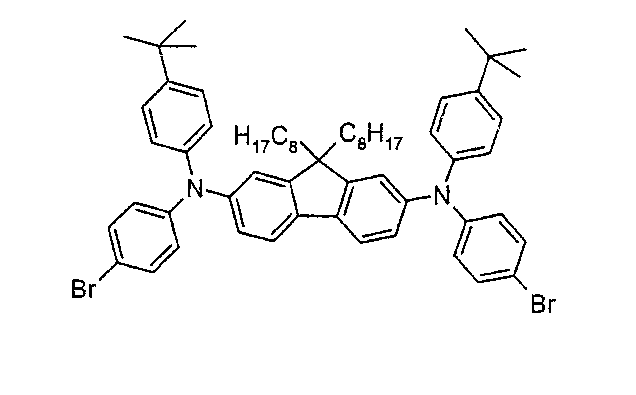
例1:N,N’−ビス(4−ブロモフェニル)−N,N’−ビス(4−tert−ブチルフェニル)−9,9−ジオクチルフルオレン−2,7−ジアミン(本発明によるモノマーEM1)の合成
a)N,N’−ジフェニル−N,N’−ビス(4−tert−ブチルフェニル)−9,9−ジオクチルフルオレン−2,7−ジアミン
150mlのトルエン中の26g(47.4mmol)の2,7−ジブロモ−9,9−ジオクチルフルオレン(M.レンジャー(Ranger)、M.ルクレール(Leclerc), Chem. Commun. 1997, 1597 に記載される通りに合成)、および20.2g(91mmol)の4−tert−ブチルフェニルフェニルアミン(J. Org. Chem. 2003, 68, 452 に記載される通りに合成)の脱気溶液を、N2で1時間飽和させた。その後、まず、174mg(0.86mmol)のP(tBu)3、続いて96mg(0.42mmol)のPd(OAc)2を、この溶液に加え、固体状態の5.4g(56mmol)のNaOtBuを続いて加えた。この反応混合物を、5時間還流した。室温にまで冷却した後、0.8gのNaCNと40mlの水を注意深く加えた。有機相を、4×50mlのH2Oを用いて洗浄し、MgSO4にて乾燥させ、および溶媒を、減圧下で除去した。シリカゲル上でのクロマトグラフィー精製は、黄色オイルを与えた。収量は、HPLCによると99.3%の純度で、33g(理論の85%)であった。
a) N, N′-Diphenyl-N, N′-bis (4-tert-butylphenyl) -9,9-dioctylfluorene-2,7-diamine 26 g (47.4 mmol) of 2,2 in 150 ml of toluene 7-dibromo-9,9-dioctylfluorene (synthesized as described in M. Ranger, M. Leclerc, Chem. Commun. 1997, 1597), and 20.2 g (91 mmol) of 4 A degassed solution of tert-butylphenylphenylamine (synthesized as described in J. Org. Chem. 2003, 68, 452) was saturated with N 2 for 1 hour. Then, firstly, NaO of 174 mg P of (0.86mmol) (t Bu) 3 , the Pd (OAc) 2 in followed by 96 mg (0.42 mmol), was added to the solution, the solid state 5.4 g (56 mmol) t Bu was subsequently added. The reaction mixture was refluxed for 5 hours. After cooling to room temperature, 0.8 g NaCN and 40 ml water were carefully added. The organic phase was washed with 4 × 50 ml H 2 O, dried over MgSO 4 and the solvent was removed under reduced pressure. Chromatographic purification on silica gel gave a yellow oil. The yield was 33 g (85% of theory) with a purity of 99.3% according to HPLC.
1H−NMR(CDCl3,500MHz):0.65(m,4H),0.83(t,J=7.03Hz,6H),0.99−1.28(m,20H),1.31(s,18H),1,71−1.79(m,4H),6.90−7.11(m,12H),7.21−7.31(m,10H),7.40−7.51(m,2H)。 1 H-NMR (CDCl 3 , 500 MHz): 0.65 (m, 4H), 0.83 (t, J = 7.03 Hz, 6H), 0.99-1.28 (m, 20H), 1. 31 (s, 18H), 1, 71-1.79 (m, 4H), 6.90-7.11 (m, 12H), 7.21-7.31 (m, 10H), 7.40- 7.51 (m, 2H).
b)N,N’−ビス(4−ブロモフェニル)−N,N’−ビス(4−tert−ブチルフェニル)−9,9−ジオクチルフルオレン−2,7−ジアミン(EM1)
36.6g(43.7mmol)のN,N’−ジフェニル−N,N’−ビス(4−tert−ブチルフェニル)−9,9−ジオクチルフルオレン−2,7−ジアミンを、500mlのTHF中に導入した。続いて、300mlのTHF中に溶解させた15.15g(84.4mmol)のNBSの溶液を、光を排除しながら0℃にて滴下して加え、この混合物を室温にまで昇温させ、さらに4時間攪拌した。500mlの水を、続いて、この混合物に加え、これを、CH2Cl2を用いて抽出した。有機相をMgSO4にて乾燥させ、溶媒を、減圧下で除去した。生成物を熱ヘキサンを用いて攪拌することにより洗浄し、吸引しながらろ過すると、35g(理論の68%)の白色固体を与え、これは、酢酸エチルからの再結晶を繰り返した後に、99.9%のHPLC純度を有した。
b) N, N′-bis (4-bromophenyl) -N, N′-bis (4-tert-butylphenyl) -9,9-dioctylfluorene-2,7-diamine (EM1)
36.6 g (43.7 mmol) of N, N′-diphenyl-N, N′-bis (4-tert-butylphenyl) -9,9-dioctylfluorene-2,7-diamine in 500 ml of THF. Introduced. Subsequently, a solution of 15.15 g (84.4 mmol) of NBS dissolved in 300 ml of THF was added dropwise at 0 ° C. while excluding light, and the mixture was allowed to warm to room temperature, Stir for 4 hours. 500 ml of water was subsequently added to the mixture, which was extracted with CH 2 Cl 2 . The organic phase was dried over MgSO 4 and the solvent was removed under reduced pressure. The product was washed by stirring with hot hexane and filtered with suction to give 35 g (68% of theory) of a white solid, which, after repeated recrystallization from ethyl acetate, 99. It had an HPLC purity of 9%.
1H−NMR(CDCl3,500MHz):0.66(m,4H),0.85(t,J=7.03Hz,6H),0,99−1.28(m,20H),1.33(s,18H),1,73−1.79(m,4H),6,85−7.10(m,12H),7,21−7.35(m,8H),7,40−7.51(m,2H)。 1 H-NMR (CDCl 3 , 500 MHz): 0.66 (m, 4H), 0.85 (t, J = 7.03 Hz, 6H), 0, 99-1.28 (m, 20H), 1. 33 (s, 18H), 1, 73-1.79 (m, 4H), 6, 85-7.10 (m, 12H), 7, 21-7.35 (m, 8H), 7, 40- 7.51 (m, 2H).
例2:N,N’−ビス(4−ブロモフェニル)−N,N’−ビス(4−tert−ブチルフェニル)−9,10−ジブチル−9,10−ジメトキシ−9,10−ジヒドロフェナントレン−2,7−ジアミン(本発明によるモノマーEM2)の合成
a)N,N’−ジフェニル−N,N’−ビス(4−tert−ブチルフェニル)−9,10−ジブチル−9,10−ジメトキシ−9,10−ジヒドロフェナントレン−2,7−ジアミン
24.2g(47.4mmol)の2,7−ジブロモ−9,10−ジブチル−9,10−ジメトキシ−9,10−ジヒドロフェナントレン(WO 05/014689 に記載される通りに合成)を出発材料として用いて、例1a)と同様に合成を行った。シリカゲル上でのクロマトグラフィー精製は、黄色オイルを与えた。収量は、HPLCによれば99.0%の純度で、30g(理論の81%)であった。
a) N, N′-diphenyl-N, N′-bis (4-tert-butylphenyl) -9,10-dibutyl-9,10-dimethoxy-9,10-dihydrophenanthrene-2,7-diamine 24. Using 2 g (47.4 mmol) of 2,7-dibromo-9,10-dibutyl-9,10-dimethoxy-9,10-dihydrophenanthrene (synthesized as described in WO 05/014689) as starting material The synthesis was carried out as in Example 1a). Chromatographic purification on silica gel gave a yellow oil. The yield was 30 g (81% of theory) with a purity of 99.0% according to HPLC.
1H−NMR(CDCl3,500MHz):0.53(m,2H),0.81(t,J=7.03Hz,6H),0.94−1.19(m,6H),1.25(s,18H),1.62(m,2H),2.05(t,J=7.03Hz,2H),3.31(s,6H),6.61−7.5(m,24H)。 1 H-NMR (CDCl 3 , 500 MHz): 0.53 (m, 2H), 0.81 (t, J = 7.03 Hz, 6H), 0.94-1.19 (m, 6H), 1. 25 (s, 18H), 1.62 (m, 2H), 2.05 (t, J = 7.03 Hz, 2H), 3.31 (s, 6H), 6.61-7.5 (m, 24H).
b)N,N’−ビス(4−ブロモフェニル)−N,N’−ビス(4−tert−ブチルフェニル)−9,10−ジブチル−9,10−ジメトキシ−9,10−ジヒドロフェナントレン−2,7−ジアミン(EM2)
34.9g(43.7mmol)のN,N’−ジフェニル−N,N’−ビス(4−tert−ブチルフェニル)−9,10−ジブチル−9,10−ジメトキシ−9,10−ジヒドロフェナントレン−2,7−ジアミンを出発材料として用いて、例1b)と同様に合成を行った。酢酸エチルからの再結晶を繰り返した後に99.9%のHPLC純度を有する24g(理論の70%)の白色固体を得た。
b) N, N′-bis (4-bromophenyl) -N, N′-bis (4-tert-butylphenyl) -9,10-dibutyl-9,10-dimethoxy-9,10-dihydrophenanthrene-2 , 7-diamine (EM2)
34.9 g (43.7 mmol) N, N′-diphenyl-N, N′-bis (4-tert-butylphenyl) -9,10-dibutyl-9,10-dimethoxy-9,10-dihydrophenanthrene- The synthesis was carried out analogously to Example 1b) using 2,7-diamine as starting material. After repeated recrystallization from ethyl acetate, 24 g (70% of theory) of a white solid with 99.9% HPLC purity was obtained.
1H−NMR(CDCl3,500MHz):0.53(m,2H),0.81(t,J=7.03Hz,6H),0.94−1.19(m,6H),1.25(s,18H),1.62(m,2H),2.05(t,J=7.03Hz,2H),3.31(s,6H),6.85−7.05(m,10H),7.11−7.20(m,2H),7.25−7.33(m,8H),7.42−7.48(m,2H)。 1 H-NMR (CDCl 3 , 500 MHz): 0.53 (m, 2H), 0.81 (t, J = 7.03 Hz, 6H), 0.94-1.19 (m, 6H), 1. 25 (s, 18H), 1.62 (m, 2H), 2.05 (t, J = 7.03 Hz, 2H), 3.31 (s, 6H), 6.85-7.05 (m, 10H), 7.11-7.20 (m, 2H), 7.25-7.33 (m, 8H), 7.42-7.48 (m, 2H).
例3:N,N’−ビス(4−ブロモフェニル)−N,N’−ビス(4−tert−ブチルフェニル)−2’,7’−ビス(tert−ブチル)−9,9’−スピロビフルオレン−2,7−ジアミン(本発明によるモノマーEM3)の合成
a)N,N’−ジフェニル−N,N’−ビス(4−tert−ブチルフェニル)−2’,7’−ビス(tert−ブチル)−9,9’−スピロビフルオレン−2,7−ジアミン
31.0g(54mmol)の2,7−ジブロモ−2’,7’−ビス(tert−ブチル)−9,9’−スピロビフルオレンを出発材料として用いて、例1a)と同様に合成を行った。シリカゲル上でのクロマトグラフィー精製は、黄色オイルを与えた。収量は、HPLCによれば99.2%の純度で、50g(理論の99%)であった。
a) N, N′-diphenyl-N, N′-bis (4-tert-butylphenyl) -2 ′, 7′-bis (tert-butyl) -9,9′-spirobifluorene-2,7- Synthesis as in Example 1a) using 31.0 g (54 mmol) of diamine as the starting material, 2,7-dibromo-2 ′, 7′-bis (tert-butyl) -9,9′-spirobifluorene. went. Chromatographic purification on silica gel gave a yellow oil. The yield was 50 g (99% of theory) with a purity of 99.2% according to HPLC.
1H−NMR(アセトン−d6,500MHz):1.28(s,36H),6.39(s,2H),6.81−6.89(m,12H),6.98(dd,J=2Hz,J=8.3Hz,2H),7.05−7.20(m,12H),7.34(dd,J=1.7Hz,J=8.0Hz,2H),7.06(d,J=8.0Hz,2H),7.79(d,J=8.3Hz,2H)。 1 H-NMR (acetone-d 6 , 500 MHz): 1.28 (s, 36H), 6.39 (s, 2H), 6.81-6.89 (m, 12H), 6.98 (dd, J = 2 Hz, J = 8.3 Hz, 2H), 7.05-7.20 (m, 12H), 7.34 (dd, J = 1.7 Hz, J = 8.0 Hz, 2H), 7.06 (D, J = 8.0 Hz, 2H), 7.79 (d, J = 8.3 Hz, 2H).
b)N,N’−ビス(4−ブロモフェニル)−N,N’−ビス(4−tert−ブチルフェニル)−2’,7’−ビス(tert−ブチル)−9,9’−スピロビフルオレン−2,7−ジアミン(EM3)
52g(60.8mmol)のN,N’−ジフェニル−N,N’−ビス(4−tert−ブチルフェニル)−2’,7’−ビス(tert−ブチル)−9,9’−スピロビフルオレン−2,7−ジアミンを出発材料として用いて、例1b)と同様に合成を行った。酢酸エチルからの再結晶を繰り返した後に99.8%のHPLC純度を有する68g(理論の97.5%)の白色固体を得た。
b) N, N′-bis (4-bromophenyl) -N, N′-bis (4-tert-butylphenyl) -2 ′, 7′-bis (tert-butyl) -9,9′-spirobi Fluorene-2,7-diamine (EM3)
52 g (60.8 mmol) of N, N′-diphenyl-N, N′-bis (4-tert-butylphenyl) -2 ′, 7′-bis (tert-butyl) -9,9′-spirobifluorene The synthesis was carried out as in Example 1b) using -2,7-diamine as starting material. After repeated recrystallization from ethyl acetate, 68 g (97.5% of theory) of a white solid with 99.8% HPLC purity were obtained.
1H−NMR(CDCl3,500MHz):1.25(s,36H),6.49(s,2H),6.65−7.15(m,20H),7.32(dd,J=1.6Hz,J=8.0Hz,2H),7.56(d,J=8.0Hz,2H),7.66(s,J=8.0Hz,2H)。 1 H-NMR (CDCl 3 , 500 MHz): 1.25 (s, 36H), 6.49 (s, 2H), 6.65-7.15 (m, 20H), 7.32 (dd, J = 1.6 Hz, J = 8.0 Hz, 2H), 7.56 (d, J = 8.0 Hz, 2H), 7.66 (s, J = 8.0 Hz, 2H).
例4:他のコモノマーの合成
本発明によるポリマー、および比較ポリマーのための他のモノマー(M)の構造を以下に示す。モノマーM1〜M6の合成は、WO 03/020790、WO 05/014689、およびこれらの中に挙げられる文献中に記載されている。
例5:ポリマーの合成
ポリマーを、WO 03/048225 に記載されるスズキカップリングにより合成した。合成したポリマーP1〜P5の組成を、表1に示す。加えて、本発明によるモノマーEM1およびEM2の代わりに、モノマーM4を含む比較ポリマーC1〜C5を合成した。比較ポリマーの組成を、同様に、表1に示す。
Example 5: Polymer synthesis Polymers were synthesized by Suzuki coupling as described in WO 03/048225. Table 1 shows the compositions of the synthesized polymers P1 to P5. In addition, instead of monomers EM1 and EM2 according to the present invention, comparative polymers C1-C5 containing monomer M4 were synthesized. The composition of the comparative polymer is also shown in Table 1.
例6:PLEDの製造
ポリマーを、PLEDにおける使用について詳細に調べた。PLEDは、いずれの場合も2層系であり、すなわち、基板//ITO//PEDOT//ポリマー//陰極であった。PEDOTは、ポリチオフェン誘導体(H.C.シュタルク(Stark),ゴスラル(Goslar)からのBaytron P)である。全てのケースに用いられた陰極は、Ba/Ag(アルドリッチ)であった。PLEDを製造することができる方法は、WO 04/037887 およびその中に挙げられる文献中に詳細に記載されている。
Example 6: Production of PLED The polymer was investigated in detail for use in PLED. The PLEDs were in each case a two-layer system, i.e. substrate // ITO // PEDOT // polymer // cathode. PEDOT is a polythiophene derivative (HC Stark, Baytron P from Goslar). The cathode used in all cases was Ba / Ag (Aldrich). The way in which PLEDs can be produced is described in detail in WO 04/037887 and the literature cited therein.
例7〜11:デバイス例
PLEDにおいてポリマーP1〜P5を用いて得られる結果を、表1に示す。比較ポリマーC1〜C5を用いて得られるエレクトロルミネセンス結果も示す。本発明によるポリマーおよび比較ポリマーの発光色は、常に同一でないために、400cd/m2の初期輝度および0.2のy−色座標に関する修正値を、より良い比較を得るために、青色発光ポリマーの寿命について示した。
Examples 7-11: Device Examples Table 1 shows the results obtained using polymers P1-P5 in PLEDs. Also shown are electroluminescence results obtained using comparative polymers C1-C5. Since the emission colors of the polymer according to the invention and the comparative polymer are not always the same, the blue emission polymer is obtained in order to obtain a better comparison of the corrected values for the initial luminance of 400 cd / m 2 and the y-color coordinate of 0.2. It showed about the lifetime of.
全く明らかであるが、本発明による式(1)の平面トリアリールアミン単位を含む本発明によるポリマーは、従来技術に従うトリアリールアミン単位を含むポリマーと比較して、とりわけ寿命において、有意により優れたエレクトロルミネセンスを有した。従って、6倍を超えるまでの改善(ポリマーP2またはC2)が、寿命において観察された。この効果は、全てのポリマーについてそれほど顕著ではないが、寿命における有意な延長は、本発明による全てのポリマーについて観察される。
表1:本発明によるポリマーおよび比較ポリマーを用いるデバイス結果
aCIE座標:Commission Internationale de l’Eclairage 1931 の色座標
b寿命:輝度が、初期輝度の50%にまで低下するまでの時間。修正寿命は、6.6W/m2のエネルギ密度、すなわち、400cd/m2の輝度および0.2のyCIE色座標に関する。修正寿命を、実際に測定された寿命から、初期輝度から、および色座標から計算することができる。
Table 1: Device results using polymers according to the invention and comparative polymers
a CIE coordinates: Color coordinates of Commission Internationale de l'Eclairage 1931
b Life: The time until the luminance decreases to 50% of the initial luminance. Fixed life, energy density of 6.6 W / m 2, i.e., about yCIE color coordinates of the luminance and 0.2 of 400 cd / m 2. The corrected lifetime can be calculated from the actual measured lifetime, from the initial luminance, and from the color coordinates.
例12:電流/電圧曲線の比較
ポリマーP2および比較ポリマーC2についての電流密度/電圧曲線を、図1に示す。明らかなように、本発明によるトリアリールアミン単位を含むポリマーP2についての曲線は、従来技術に従うトリアリールアミン単位を含む比較ポリマーC2についてよりも、かなりより急峻である。従って、本発明によるトリアリールアミン単位は、より優れた正孔伝導体であることが明らかである。
Example 12: Comparison of current / voltage curves The current density / voltage curves for polymer P2 and comparative polymer C2 are shown in FIG. As is apparent, the curve for polymer P2 comprising triarylamine units according to the present invention is considerably steeper than for comparative polymer C2 comprising triarylamine units according to the prior art. Thus, it is clear that the triarylamine unit according to the present invention is a better hole conductor.
Claims (20)
Aは、出現毎に同一であるか異なり、N、PまたはAsであり、
Xは、出現毎に同一であるか異なり、40個までのC原子を有する二価の平面共役系(これは、少なくとも2つのアリーレン基を含み、および置換基R1により置換されていてもよい)であり、
Ar1、Ar2、Ar3、Ar4、Ar5は、出現毎に同一であるか異なり、2〜40個のC原子を有する芳香族環系または複素環式芳香族環系(これらは、1以上のR1基により置換されていてもよい)であり、但し、Ar1〜Ar5基のいずれも、この基が、ポリマー鎖への直接の結合を有さない場合には、縮合環系を示さず、
R1は、出現毎に同一であるか異なり、F、Cl、Br、I、CN、NO2、OH、N(R 2 ) 2 、Si(R2)3、B(R2)2、1〜40個のC原子を有する直鎖の、分岐の若しくは環状のアルキル基、アルコキシ基若しくはチオアルコキシ基(ここで、1以上の非隣接のC原子は、−CR2=CR2−、−C≡C−、−NR2−、−O−、−S−、−CO−O−、または−O−CO−O−により置き換えられてもよく、さらに、1以上のH原子は、フッ素により置き換えられてもよい)、2〜40個のC原子を有するアリール基、ヘテロアリール基、アリールオキシ基、若しくはヘテロアリールオキシ基(ここで、1以上のC原子は、O、SまたはNにより置き換えられてもよい)(これらは、1以上の非芳香族R1基により置換されていてもよい)であり、2つ以上のR1基は、互いに、脂肪族または芳香族の単環または多環の環系を形成していてもよく、
R2は、出現毎に同一であるか異なり、H、または1〜20個のC原子を有する脂肪族または芳香族炭化水素基であり、
nは、出現毎に同一であるか異なり、0、1または2である)の単位および置換されていてもよいし、または置換されないスピロビフルオレン、ジヒドロフェナントレン、シス−インデノフルオレンおよび/若しくはトランス−インデノフルオレンから選択される少なくとも50モル%の単位を含み、該ポリマーへの前記式(1)単位の結合は、基Ar1〜Ar5の1つまたは2つを介して行われる共役または部分的に共役したポリマー(但し、式(2)
A is the same or different at each occurrence and is N, P or As;
X is the same or different at each occurrence and is a divalent planar conjugated system having up to 40 C atoms, which contains at least two arylene groups and may be substituted by the substituent R 1 ) And
Ar 1 , Ar 2 , Ar 3 , Ar 4 , Ar 5 are the same or different at each occurrence and are aromatic or heteroaromatic ring systems having 2 to 40 C atoms (which are Optionally substituted by one or more R 1 groups, provided that any of the Ar 1 to Ar 5 groups does not have a direct bond to the polymer chain, the fused ring Not showing the system,
R 1 is the same or different for each occurrence , and F 1 , Cl, Br, I, CN, NO 2 , OH, N (R 2 ) 2 , Si (R 2 ) 3 , B (R 2 ) 2 , 1 A linear, branched or cyclic alkyl group, alkoxy group or thioalkoxy group having ˜40 C atoms, wherein one or more non-adjacent C atoms are —CR 2 ═CR 2 —, —C ≡C—, —NR 2 —, —O—, —S—, —CO—O—, or —O—CO—O— may be substituted, and one or more H atoms may be replaced by fluorine. Aryl groups having 2 to 40 C atoms, heteroaryl groups, aryloxy groups, or heteroaryloxy groups, wherein one or more C atoms are replaced by O, S or N may be) (these one or more non-aromatic R 1 It is also may) be replaced by two or more R 1 groups are each, may form a ring system monocyclic or polycyclic aliphatic or aromatic,
R 2 is the same or different at each occurrence and is H or an aliphatic or aromatic hydrocarbon group having 1 to 20 C atoms;
n is the same or different at each occurrence and is 0, 1 or 2) and may be substituted or unsubstituted spirobifluorene, dihydrophenanthrene, cis-indenofluorene and / or trans - comprises units of at least 50 mol% are selected from indenofluorene, binding of the formula (1) units to the polymer, conjugated takes place via one or two groups Ar 1 to Ar 5 or Partially conjugated polymer (provided that the formula (2)
Yは、出現毎に同一であるか異なり、−C(R1)2−、−C(R1)2−C(R1)2−、−N(R1)−、−O−、−S−、−P(R1)−、−P(=O)(R1)−、−O−C(R1)2−、または−O−C(=O)−であり、
mは、出現毎に同一であるか異なり、0または1であり、ここで、添え字m=0の場合には、Y基は除かれ、および化学結合に該当せず、
o、pは、出現毎に同一であるか異なり、0または1であり、但し、oとpは、同時に0であることはなく、ここで、添え字oまたはp=0の場合には、Y基は除かれ、および化学結合に該当せず、
qは、出現毎に同一であるか異なり、0、1または2であり、
式(3)における破線は、この構造単位から前記式(1)の構造単位中のA原子への結合を示す)。 The polymer according to any one of claims 1 to 9 , wherein a symbol X which is the same or different for each occurrence represents a unit of the formula (3).
Y is the same or different for each occurrence, and -C (R 1 ) 2- , -C (R 1 ) 2 -C (R 1 ) 2- , -N (R 1 )-, -O-,- S—, —P (R 1 ) —, —P (═O) (R 1 ) —, —O—C (R 1 ) 2 —, or —O—C (═O) —,
m is the same or different at each occurrence and is 0 or 1, where the subscript m = 0, the Y group is removed and does not correspond to a chemical bond,
o and p are the same or different at each occurrence and are 0 or 1, provided that o and p are not 0 at the same time, where subscript o or p = 0, The Y group is removed and does not correspond to a chemical bond;
q is the same or different for each occurrence and is 0, 1 or 2;
The broken line in Formula (3) shows the bond from this structural unit to the A atom in the structural unit of Formula (1).
Applications Claiming Priority (3)
| Application Number | Priority Date | Filing Date | Title |
|---|---|---|---|
| DE102004020299A DE102004020299A1 (en) | 2004-04-26 | 2004-04-26 | Conjugated polymers, their preparation and use |
| DE102004020299.0 | 2004-04-26 | ||
| PCT/EP2005/004447 WO2005104263A1 (en) | 2004-04-26 | 2005-04-26 | Electroluminescent polymers comprising planar arylamine units the preparation and use thereof |
Publications (2)
| Publication Number | Publication Date |
|---|---|
| JP2007534814A JP2007534814A (en) | 2007-11-29 |
| JP5259180B2 true JP5259180B2 (en) | 2013-08-07 |
Family
ID=34967311
Family Applications (1)
| Application Number | Title | Priority Date | Filing Date |
|---|---|---|---|
| JP2007509954A Expired - Lifetime JP5259180B2 (en) | 2004-04-26 | 2005-04-26 | Electroluminescent polymers containing planar arylamine units, their preparation and use |
Country Status (8)
| Country | Link |
|---|---|
| US (1) | US8679644B2 (en) |
| EP (1) | EP1741148B1 (en) |
| JP (1) | JP5259180B2 (en) |
| KR (1) | KR101206314B1 (en) |
| CN (1) | CN1947274A (en) |
| AT (1) | ATE433201T1 (en) |
| DE (2) | DE102004020299A1 (en) |
| WO (1) | WO2005104263A1 (en) |
Families Citing this family (50)
| Publication number | Priority date | Publication date | Assignee | Title |
|---|---|---|---|---|
| JP4724404B2 (en) * | 2004-10-05 | 2011-07-13 | 国立大学法人東京工業大学 | Polymer composition and polymer light emitting device |
| CN101061156A (en) * | 2004-12-03 | 2007-10-24 | 住友化学株式会社 | Polymers and electronic devices containing triarylamines |
| TWI385193B (en) * | 2004-12-07 | 2013-02-11 | 住友化學股份有限公司 | Polymer material and components using the same |
| JP5217153B2 (en) * | 2005-11-18 | 2013-06-19 | 住友化学株式会社 | Polymer compound and polymer light emitting device using the same |
| DE102006031990A1 (en) * | 2006-07-11 | 2008-01-17 | Merck Patent Gmbh | New materials for organic electroluminescent devices |
| EP2069419A2 (en) * | 2006-08-24 | 2009-06-17 | E.I. Du Pont De Nemours And Company | Hole transport polymers |
| US8465848B2 (en) * | 2006-12-29 | 2013-06-18 | E I Du Pont De Nemours And Company | Benzofluorenes for luminescent applications |
| WO2008146715A1 (en) * | 2007-05-23 | 2008-12-04 | Sumitomo Chemical Company, Limited | Polymer compound and method for producing the same, and light-emitting material, liquid composition, thin film, polymer light-emitting device, surface light source, display device, organic transistor and solar cell, each using the polymer compound |
| WO2008150822A2 (en) | 2007-06-01 | 2008-12-11 | E.I. Du Pont De Nemours And Company | Charge transport materials for luminescent applications |
| US8063399B2 (en) | 2007-11-19 | 2011-11-22 | E. I. Du Pont De Nemours And Company | Electroactive materials |
| EP2213693A4 (en) * | 2007-11-20 | 2011-11-09 | Idemitsu Kosan Co | POLYMERIC COMPOUND AND ORGANIC ELECTROLUMINESCENT ELEMENT COMPRISING SAME |
| US20100264814A1 (en) * | 2007-12-11 | 2010-10-21 | Idemitsu Kosan Co., Ltd. | Polymer compound and organic electroluminescent device using the same |
| EP2233508A4 (en) * | 2007-12-11 | 2012-01-04 | Idemitsu Kosan Co | POLYMER COMPOUND AND ORGANIC ELECTROLUMINESCENCE DEVICE USING THE SAME |
| US8343381B1 (en) * | 2008-05-16 | 2013-01-01 | E I Du Pont De Nemours And Company | Hole transport composition |
| DE102008049037A1 (en) * | 2008-09-25 | 2010-04-22 | Merck Patent Gmbh | New polymers with low polydispersity |
| US8551624B2 (en) * | 2008-12-01 | 2013-10-08 | E I Du Pont De Nemours And Company | Electroactive materials |
| EP2352801B1 (en) * | 2008-12-01 | 2017-06-21 | E. I. du Pont de Nemours and Company | Electroactive materials |
| KR101616149B1 (en) * | 2008-12-04 | 2016-04-27 | 이 아이 듀폰 디 네모아 앤드 캄파니 | Electroactive materials |
| JP5591822B2 (en) * | 2008-12-12 | 2014-09-17 | イー・アイ・デュポン・ドウ・ヌムール・アンド・カンパニー | Photoactive composition and electronic device formed with the composition |
| US8759818B2 (en) | 2009-02-27 | 2014-06-24 | E I Du Pont De Nemours And Company | Deuterated compounds for electronic applications |
| US8497495B2 (en) * | 2009-04-03 | 2013-07-30 | E I Du Pont De Nemours And Company | Electroactive materials |
| CN102421858A (en) | 2009-06-22 | 2012-04-18 | 默克专利有限公司 | Conducting formulation |
| US20110077373A1 (en) * | 2009-09-29 | 2011-03-31 | General Electric Company | Polymer and optoelectronic device comprising the same |
| KR20120091144A (en) * | 2009-09-29 | 2012-08-17 | 이 아이 듀폰 디 네모아 앤드 캄파니 | Deuterated Compounds for Luminescent Applications |
| KR101782660B1 (en) * | 2009-10-19 | 2017-09-27 | 이 아이 듀폰 디 네모아 앤드 캄파니 | Triarylamine compounds for electronic applications |
| EP2492988B1 (en) * | 2009-10-22 | 2018-12-26 | Sumitomo Chemical Company, Limited | Organic electroluminescent element |
| JP5784621B2 (en) | 2009-10-29 | 2015-09-24 | イー・アイ・デュポン・ドウ・ヌムール・アンド・カンパニーE.I.Du Pont De Nemours And Company | Deuterium compounds for electronic applications |
| US8617720B2 (en) | 2009-12-21 | 2013-12-31 | E I Du Pont De Nemours And Company | Electroactive composition and electronic device made with the composition |
| DE102010007938A1 (en) | 2010-02-12 | 2011-10-06 | Merck Patent Gmbh | Electroluminescent polymers, process for their preparation and their use |
| DE102010013068A1 (en) * | 2010-03-26 | 2011-09-29 | Merck Patent Gmbh | Connections for electronic devices |
| KR101423173B1 (en) | 2010-11-04 | 2014-07-25 | 제일모직 주식회사 | Compound for organic photoelectric device and organic photoelectric device including the same |
| WO2012087955A1 (en) | 2010-12-20 | 2012-06-28 | E. I. Du Pont De Nemours And Company | Compositions for electronic applications |
| US9837612B2 (en) | 2010-12-21 | 2017-12-05 | Sumitomo Chemical Company, Limted | Polymer compound and light-emitting device using same |
| DE102010055901A1 (en) * | 2010-12-23 | 2012-06-28 | Merck Patent Gmbh | Organic electroluminescent device |
| KR101507001B1 (en) | 2011-12-30 | 2015-03-31 | 제일모직 주식회사 | Compound for organic optoelectronic device, organic light emitting diode including the same and display including the organic light emitting diode |
| CN102617466B (en) * | 2011-12-31 | 2014-04-23 | 上海师范大学 | A Class of "Up-Down" Asymmetric tert-butylspirobifluorene Compounds |
| GB201200619D0 (en) * | 2012-01-16 | 2012-02-29 | Cambridge Display Tech Ltd | Polymer |
| GB201223369D0 (en) * | 2012-12-24 | 2013-02-06 | Cambridge Display Tech Ltd | Polymer and device |
| CN108148186A (en) | 2012-01-31 | 2018-06-12 | 剑桥显示技术有限公司 | Polymer |
| CN104245785B (en) * | 2012-04-17 | 2018-05-25 | 默克专利有限公司 | Crosslinkable and crosslinked polymer, Its Preparation Method And Use |
| JP2014108941A (en) | 2012-11-30 | 2014-06-12 | Samsung Display Co Ltd | Amine derivative, organic light-emitting material, and organic electroluminescence device using the same |
| CN104871330B (en) * | 2012-12-28 | 2018-09-21 | 默克专利有限公司 | Compositions comprising polymeric organic semiconducting compounds |
| EP2980114A4 (en) * | 2013-03-28 | 2016-11-23 | Sumitomo Chemical Co | POLYMER COMPOUND AND LIGHT-EMITTING ELEMENT MADE THEREFROM |
| KR20180090363A (en) * | 2016-01-08 | 2018-08-10 | 히타치가세이가부시끼가이샤 | Organic electronic materials, organic electronic devices and organic electroluminescent devices |
| CN105622442A (en) * | 2016-02-23 | 2016-06-01 | 中节能万润股份有限公司 | Tert-butyl spirobifluorene compound and preparation method and application thereof |
| WO2017180998A2 (en) | 2016-04-15 | 2017-10-19 | Beckman Coulter, Inc. | Photoactive macromolecules and uses thereof |
| CN109792000B (en) | 2016-12-22 | 2021-04-20 | 广州华睿光电材料有限公司 | Organic functional compounds, mixtures, compositions, organic functional thin films, methods for their preparation, and organic electronic devices |
| CN109369891B (en) * | 2017-12-28 | 2021-03-19 | 广州华睿光电材料有限公司 | Polymers containing basic groups and their use |
| CN111634909B (en) * | 2020-05-22 | 2021-09-24 | 上海应用技术大学 | Preparation method and application of nitrogen-doped porous carbon materials based on trichloroazaacene fused-ring aromatic hydrocarbons |
| US12649804B2 (en) | 2022-01-05 | 2026-06-09 | Samsung Electronics Co., Ltd. | Polymeric compound, electroluminescent device material, electroluminescent device, and electronic device |
Family Cites Families (35)
| Publication number | Priority date | Publication date | Assignee | Title |
|---|---|---|---|---|
| JPH0679165B2 (en) * | 1986-03-08 | 1994-10-05 | キヤノン株式会社 | Electrophotographic photoreceptor |
| GB8909011D0 (en) | 1989-04-20 | 1989-06-07 | Friend Richard H | Electroluminescent devices |
| DE4436773A1 (en) | 1994-10-14 | 1996-04-18 | Hoechst Ag | Conjugated polymers with spirocenters and their use as electroluminescent materials |
| DE69608446T3 (en) | 1995-07-28 | 2010-03-11 | Sumitomo Chemical Company, Ltd. | 2.7 ARYL 9 SUBSTITUTED FLUORESE AND 9 SUBSTITUTED FLUORESOLIGOMERS AND POLYMERS |
| DE19614971A1 (en) | 1996-04-17 | 1997-10-23 | Hoechst Ag | Polymers with spiro atoms and their use as electroluminescent materials |
| US5763636A (en) * | 1995-10-12 | 1998-06-09 | Hoechst Aktiengesellschaft | Polymers containing spiro atoms and methods of using the same as electroluminescence materials |
| US6066712A (en) * | 1997-05-09 | 2000-05-23 | Minolta Co., Ltd. | Styryl polymer, production method and use thereof |
| US6309763B1 (en) | 1997-05-21 | 2001-10-30 | The Dow Chemical Company | Fluorene-containing polymers and electroluminescent devices therefrom |
| US5777070A (en) * | 1997-10-23 | 1998-07-07 | The Dow Chemical Company | Process for preparing conjugated polymers |
| JP2000016973A (en) * | 1998-04-28 | 2000-01-18 | Canon Inc | Novel triarylamine compound and light emitting device using the compound |
| EP0953624B1 (en) * | 1998-04-28 | 2004-02-04 | Canon Kabushiki Kaisha | Triarylamine compound and luminescent device |
| DE19846766A1 (en) | 1998-10-10 | 2000-04-20 | Aventis Res & Tech Gmbh & Co | A conjugated fluorene-based polymer useful as an organic semiconductor, electroluminescence material, and for display elements |
| DE19846768A1 (en) | 1998-10-10 | 2000-04-20 | Aventis Res & Tech Gmbh & Co | A conjugated polymer useful as an organic semiconductor, an electroluminescence material, and for display elements in television monitor and illumination technology contains fluorene building units |
| EP1155096B1 (en) | 1999-02-04 | 2005-03-09 | Dow Global Technologies Inc. | Fluorene copolymers and devices made therefrom |
| ATE284910T1 (en) | 2000-01-05 | 2005-01-15 | Cambridge Display Tech Ltd | POLYMERS, THEIR PRODUCTION AND USE |
| JP4307839B2 (en) | 2001-03-10 | 2009-08-05 | メルク パテント ゲーエムベーハー | Organic semiconductor solutions and dispersions |
| JP4259875B2 (en) | 2001-03-24 | 2009-04-30 | メルク パテント ゲーエムベーハー | Conjugated polymers containing spirobifluorene units and fluorene units and uses thereof |
| JP2004532348A (en) * | 2001-06-22 | 2004-10-21 | ケンブリッジ ディスプレイ テクノロジー リミテッド | Polymer containing substituted triphenylamine repeating units |
| DE10141624A1 (en) * | 2001-08-24 | 2003-03-06 | Covion Organic Semiconductors | Solutions of polymeric semiconductors |
| DE10143353A1 (en) * | 2001-09-04 | 2003-03-20 | Covion Organic Semiconductors | Conjugated polymers containing spirobifluorene units and their use |
| TWI249542B (en) * | 2001-11-09 | 2006-02-21 | Sumitomo Chemical Co | Polymer compound and polymer light-emitting device using the same |
| DE10159946A1 (en) | 2001-12-06 | 2003-06-18 | Covion Organic Semiconductors | Process for the production of aryl-aryl coupled compounds |
| JP2004067970A (en) * | 2002-08-09 | 2004-03-04 | Tosoh Corp | Novel triarylamine polymer, production method thereof and use thereof |
| WO2004014985A1 (en) * | 2002-08-09 | 2004-02-19 | Tosoh Corporation | Novel triarylamine polymer, process for producing the same, and use thereof |
| DE10241814A1 (en) * | 2002-09-06 | 2004-03-25 | Covion Organic Semiconductors Gmbh | Process for the preparation of aryl-aryl coupled compounds |
| JP4506113B2 (en) * | 2002-09-20 | 2010-07-21 | 東ソー株式会社 | Novel arylamine derivatives having a fluorene skeleton, synthetic intermediates thereof, production methods thereof, and organic EL devices |
| DE10249723A1 (en) | 2002-10-25 | 2004-05-06 | Covion Organic Semiconductors Gmbh | Conjugated polymers containing arylamine units, their preparation and use |
| DE10304819A1 (en) | 2003-02-06 | 2004-08-19 | Covion Organic Semiconductors Gmbh | Carbazole-containing conjugated polymers and blends, their preparation and use |
| KR20060025538A (en) | 2003-05-30 | 2006-03-21 | 코비온 올가닉 세미콘덕터스 게엠베하 | Polymer |
| EP1491568A1 (en) | 2003-06-23 | 2004-12-29 | Covion Organic Semiconductors GmbH | Semiconductive Polymers |
| DE10337077A1 (en) | 2003-08-12 | 2005-03-10 | Covion Organic Semiconductors | Conjugated copolymers, their preparation and use |
| DE10337346A1 (en) | 2003-08-12 | 2005-03-31 | Covion Organic Semiconductors Gmbh | Conjugated polymers containing dihydrophenanthrene units and their use |
| EP1660608B1 (en) | 2003-08-19 | 2015-07-08 | Merck Patent GmbH | Oligomer and polymer comprising triphenyl phosphine units |
| DE10349033A1 (en) | 2003-10-22 | 2005-05-25 | Covion Organic Semiconductors Gmbh | Organic semiconductor, for use in organic LEDs and solar cells and laser diodes, contains a polymer and structural units which emit light from the triplet state and a triplet emitter |
| WO2005049546A1 (en) | 2003-11-14 | 2005-06-02 | Sumitomo Chemical Company, Limited | Halogenated bisdiarylaminopolycylic aromatic compounds and polymers thereof |
-
2004
- 2004-04-26 DE DE102004020299A patent/DE102004020299A1/en not_active Withdrawn
-
2005
- 2005-04-26 DE DE502005007417T patent/DE502005007417D1/en not_active Expired - Lifetime
- 2005-04-26 EP EP05741399A patent/EP1741148B1/en not_active Expired - Lifetime
- 2005-04-26 CN CNA2005800132033A patent/CN1947274A/en active Pending
- 2005-04-26 AT AT05741399T patent/ATE433201T1/en not_active IP Right Cessation
- 2005-04-26 WO PCT/EP2005/004447 patent/WO2005104263A1/en not_active Ceased
- 2005-04-26 KR KR1020067021816A patent/KR101206314B1/en not_active Expired - Lifetime
- 2005-04-26 US US11/587,463 patent/US8679644B2/en not_active Expired - Fee Related
- 2005-04-26 JP JP2007509954A patent/JP5259180B2/en not_active Expired - Lifetime
Also Published As
| Publication number | Publication date |
|---|---|
| DE502005007417D1 (en) | 2009-07-16 |
| EP1741148B1 (en) | 2009-06-03 |
| ATE433201T1 (en) | 2009-06-15 |
| DE102004020299A1 (en) | 2005-12-01 |
| US20080102312A1 (en) | 2008-05-01 |
| WO2005104263A1 (en) | 2005-11-03 |
| KR20070026464A (en) | 2007-03-08 |
| JP2007534814A (en) | 2007-11-29 |
| KR101206314B1 (en) | 2012-11-29 |
| EP1741148A1 (en) | 2007-01-10 |
| CN1947274A (en) | 2007-04-11 |
| US8679644B2 (en) | 2014-03-25 |
Similar Documents
| Publication | Publication Date | Title |
|---|---|---|
| KR101206314B1 (en) | Electroluminescent polymers containing planar arylamine units, the preparation and use thereof | |
| JP5500565B2 (en) | Electroluminescent polymers and uses thereof | |
| JP5398988B2 (en) | Partially conjugated polymers, their preparation and use | |
| JP5398989B2 (en) | Electroluminescent polymers and uses thereof | |
| US7799875B2 (en) | Triarylamine-arylvinylene moiety-containing conjugated polymers, their production and use | |
| US9349960B2 (en) | Compounds and polymers which contain substituted indenofluorene derivatives as structural unit, process for the preparation thereof, and the use thereof as electronic devices and mixtures and solutions | |
| US20090032776A1 (en) | Electroluminescent materials and their use | |
| US9738826B2 (en) | Materials for organic electroluminescence devices | |
| US8557953B2 (en) | Polymers comprising substituted anthracenyl units, blends comprising these polymers, and devices comprising these polymers or blends | |
| CN101489961B (en) | Electroluminescent polymers and use thereof | |
| JP2012528209A (en) | Composition comprising at least one phosphor compound and at least one polymer having a conjugated blocking unit | |
| KR20090040390A (en) | Conjugation Polymers, Methods of Making and Uses thereof | |
| JP5866355B2 (en) | Polymers containing substituted benzothiophene units, blends containing these polymers and devices containing these polymers or blends | |
| JP5795336B2 (en) | Styrene copolymers, especially for use in optoelectronic components | |
| CN103068879B (en) | Polymers having structural units with electron transport properties | |
| KR20110073387A (en) | New polymers with low polydispersity |
Legal Events
| Date | Code | Title | Description |
|---|---|---|---|
| A621 | Written request for application examination |
Free format text: JAPANESE INTERMEDIATE CODE: A621 Effective date: 20080428 |
|
| A977 | Report on retrieval |
Free format text: JAPANESE INTERMEDIATE CODE: A971007 Effective date: 20110628 |
|
| A131 | Notification of reasons for refusal |
Free format text: JAPANESE INTERMEDIATE CODE: A131 Effective date: 20110726 |
|
| A521 | Request for written amendment filed |
Free format text: JAPANESE INTERMEDIATE CODE: A523 Effective date: 20111021 |
|
| A131 | Notification of reasons for refusal |
Free format text: JAPANESE INTERMEDIATE CODE: A131 Effective date: 20120529 |
|
| RD04 | Notification of resignation of power of attorney |
Free format text: JAPANESE INTERMEDIATE CODE: A7424 Effective date: 20120529 |
|
| A521 | Request for written amendment filed |
Free format text: JAPANESE INTERMEDIATE CODE: A523 Effective date: 20120828 |
|
| TRDD | Decision of grant or rejection written | ||
| A01 | Written decision to grant a patent or to grant a registration (utility model) |
Free format text: JAPANESE INTERMEDIATE CODE: A01 Effective date: 20130326 |
|
| A61 | First payment of annual fees (during grant procedure) |
Free format text: JAPANESE INTERMEDIATE CODE: A61 Effective date: 20130424 |
|
| FPAY | Renewal fee payment (event date is renewal date of database) |
Free format text: PAYMENT UNTIL: 20160502 Year of fee payment: 3 |
|
| R150 | Certificate of patent or registration of utility model |
Ref document number: 5259180 Country of ref document: JP Free format text: JAPANESE INTERMEDIATE CODE: R150 |
|
| R250 | Receipt of annual fees |
Free format text: JAPANESE INTERMEDIATE CODE: R250 |
|
| R250 | Receipt of annual fees |
Free format text: JAPANESE INTERMEDIATE CODE: R250 |
|
| R250 | Receipt of annual fees |
Free format text: JAPANESE INTERMEDIATE CODE: R250 |
|
| R250 | Receipt of annual fees |
Free format text: JAPANESE INTERMEDIATE CODE: R250 |
|
| R250 | Receipt of annual fees |
Free format text: JAPANESE INTERMEDIATE CODE: R250 |
|
| R250 | Receipt of annual fees |
Free format text: JAPANESE INTERMEDIATE CODE: R250 |
|
| R250 | Receipt of annual fees |
Free format text: JAPANESE INTERMEDIATE CODE: R250 |
|
| R250 | Receipt of annual fees |
Free format text: JAPANESE INTERMEDIATE CODE: R250 |
|
| R250 | Receipt of annual fees |
Free format text: JAPANESE INTERMEDIATE CODE: R250 |
|
| EXPY | Cancellation because of completion of term |