JP5134397B2 - Haplotype estimation apparatus and program - Google Patents
Haplotype estimation apparatus and program Download PDFInfo
- Publication number
- JP5134397B2 JP5134397B2 JP2008048748A JP2008048748A JP5134397B2 JP 5134397 B2 JP5134397 B2 JP 5134397B2 JP 2008048748 A JP2008048748 A JP 2008048748A JP 2008048748 A JP2008048748 A JP 2008048748A JP 5134397 B2 JP5134397 B2 JP 5134397B2
- Authority
- JP
- Japan
- Prior art keywords
- haplotype
- combination
- frequency
- polymorphism
- character string
- Prior art date
- Legal status (The legal status is an assumption and is not a legal conclusion. Google has not performed a legal analysis and makes no representation as to the accuracy of the status listed.)
- Expired - Fee Related
Links
Images








Landscapes
- Management, Administration, Business Operations System, And Electronic Commerce (AREA)
Description
本発明は、ハプロタイプ推定装置、および、プログラムに関する。 The present invention relates to a haplotype estimation device and a program.
生活習慣病のような複雑な病気の原因となる遺伝子の解明や、さらには個別化医療の実現の為には、遺伝子型データなどの実験データから、ヒト等の個体のハプロタイプを推定する必要がある。 In order to elucidate genes that cause complex diseases such as lifestyle-related diseases and to realize personalized medicine, it is necessary to estimate the haplotype of individuals such as humans from experimental data such as genotype data. is there.
複数座位に渡るハプロタイプを推定する方法には、主に、(1)1座位当たりの遺伝子型データから複数座位に渡るハプロタイプとその頻度を推定する方法と、(2)塩基多型を考慮したコピー多型(Copy Number Polymorphism,あるいはCopy Number Variation、本明細書中で「CNP」と略す場合がある。)に関する実験データから一塩基多型のハプロタイプとその頻度を推定する方法と、が存在する。 Methods for estimating haplotypes across multiple loci mainly include (1) a method for estimating haplotypes across multiple loci and their frequencies from genotype data per locus, and (2) a copy considering nucleotide polymorphisms. There exists a method for estimating a single nucleotide polymorphism haplotype and its frequency from experimental data on a polymorphism (Copy Number Polymorphism, or Copy Number Variation, which may be abbreviated as “CNP” in this specification).
まず、上述の(1)に示す、1座位当たりの遺伝子型データから複数座位に渡るハプロタイプとその頻度を推定する方法において、「1座位当たりの遺伝子型データ」とは、複数座位に渡る関連が分からない、座位毎に独立した(相(phase)が未知の)遺伝子型データのことである。ここで、図1は、1座位あたりの遺伝子型データの一例を示す図である。図1において、Lは座位(Locus)、Aはアレル(Allele)を表している。 First, in the method for estimating haplotypes and frequencies of a plurality of loci from the genotype data per locus shown in (1) above, the “genotype data per locus” is related to a plurality of loci. Not known, genotype data independent of each locus (unknown phase). Here, FIG. 1 is a diagram showing an example of genotype data per locus. In FIG. 1, L represents a sitting position (Locus), and A represents an allele.
図1に示すように、1座位当たりの遺伝子型データは、各個体、各座位における、各アレルのカウント数データを有している。ここで、「カウント数データ」とは、個体において、各座位におけるアレルをカウントすることにより得られたカウント数のデータである。例えば、図1においては、個体1における座位(L1)におけるアレル(A1)のカウント数は「1」であり、座位(L3)におけるアレル(A1)のカウント数は「2」である。 As shown in FIG. 1, the genotype data per locus has count data of each allele in each individual and each locus. Here, “count data” is data of the count obtained by counting alleles at each locus in an individual. For example, in Figure 1, locus in an individual 1 count (L 1) allele in (A 1) is "1", the count number of the allele (A 1) in the locus (L 3) is "2" is there.
ここで、上述のように、遺伝子型データは、直接的に相(phase)を特定するものではなく、座位間のアレルの関連は未知であり、図1の例(例えば、個体1)でいえば、カウント数データから、座位L1と座位L2の間での相を特定することはできず、座位L1におけるアレル(A1/A2)と座位L2におけるアレル(A1/A3)の関連は未知である。そのため、ハプロタイプを推定する(相を特定する)ための手法が必要となる。 Here, as described above, the genotype data does not directly specify the phase, the allele relationship between the loci is unknown, and can be said in the example of FIG. 1 (for example, individual 1). if, from the count number of the data, locus L 1 and can not identify the phase between the sitting position L 2, alleles at sitting position L 2 and allele (a 1 / a 2) in the locus L 1 (a 1 / a The relationship of 3 ) is unknown. Therefore, a method for estimating the haplotype (specifying the phase) is required.
ここで、非特許文献1〜4に記載のハプロタイプ推定方法は、1座位あたりの遺伝子型データから、複数座位に渡るハプロタイプを推定する。ここで、「複数座位に渡るハプロタイプ」とは、複数座位に渡るアレルの組合せ(相を特定する組合せ)のことである。ここで、図2は、複数座位に渡るハプロタイプの組合せの一例を示す図である。図2において、A(L)は、座位Lに対応するアレルAを表している。 Here, the haplotype estimation methods described in Non-Patent Documents 1 to 4 estimate haplotypes over a plurality of loci from genotype data per locus. Here, “a haplotype that spans multiple loci” refers to a combination of alleles that span multiple loci (a combination that identifies phases). Here, FIG. 2 is a diagram showing an example of a combination of haplotypes over a plurality of sitting positions. In FIG. 2, A (L) represents the allele A corresponding to the sitting position L.
図2に示すように、例えば、ハプロタイプ1は、座位L1においてA1のアレルをもち、座位L2においてA1のアレルをもち、座位L3においてA1のアレルを持つことが特定されている。このように、従来のハプロタイプの推定方法においては、一般に2種類のアレルを想定し、一塩基多型(Single Nucleotide Polymorphism、「SNP」と略す。)などの遺伝子型データから、複数座位に渡るハプロタイプを推定している。また、この方法では、1座位当たりの遺伝子型データさえ分かれば、コピー数多型(Copy Number Polymorphism,またはCopy Number Variation、以下「CNP」と略す。)のデータからでもハプロタイプ推定を行うことができる。例えば、1座位あたりの遺伝子型データとして、コピーの数が多いアレル、少ないアレルの2種類を定義し(その数は曖昧ではあるが)、一塩基多型に対してと同じ方法で複数座位にわたるハプロタイプが推定されている(非特許文献5参照)。 As shown in FIG. 2, for example, haplotype 1 has a allele A 1 in locus L 1, the locus L 2 has allele A 1, are identified to have alleles of A 1 in locus L 3 Yes. Thus, in the conventional haplotype estimation method, two types of alleles are generally assumed, and haplotypes that span multiple loci from genotype data such as single nucleotide polymorphism (abbreviated as “SNP”). Is estimated. In addition, in this method, as long as genotype data per locus is known, haplotype estimation can be performed from data of copy number polymorphism (Copy Number Polymorphism or Copy Number Variation, hereinafter abbreviated as “CNP”). . For example, two types of alleles with a large number of copies and few alleles are defined as genotype data per locus (although the number is ambiguous), and multiple loci are handled in the same way as for single nucleotide polymorphisms. A haplotype has been estimated (see Non-Patent Document 5).
次に、上述の(2)に示す、塩基多型を考慮したコピー多型に関する実験データから一塩基多型のハプロタイプとその頻度を推定する方法(例えば、本願出願人および発明者による特願2007−237139(未公開であるため先行技術ではない。))に関して、コピー数多型は、ある区間の配列(「コピー単位」と呼ぶ。)が繰り返し現れることがあり、そのコピー数に個体差がある。ここで、「塩基多型を考慮したコピー数多型に関する実験データ」とは、蛍光色素プローブ等によって実験的に識別される異なる塩基の数のデータのことであり、そのデータは生物学的にはコピー単位上にある異なる塩基の数に相当し、例えば図3のように示される。ここで、図3は、塩基多型を考慮した一塩基多型の実験データの一例を示す図である。 Next, a method for estimating the haplotype of a single nucleotide polymorphism and its frequency from experimental data on copy polymorphism taking into account the nucleotide polymorphism shown in (2) (for example, Japanese Patent Application No. 2007 by the present applicant and the inventor) -237139 (not a prior art because it is unpublished)), the copy number polymorphism may repeatedly show an array of a certain section (referred to as "copy unit"), and there is an individual difference in the copy number. is there. Here, “experimental data on copy number variation considering base polymorphism” refers to data on the number of different bases experimentally identified by a fluorescent dye probe or the like, and the data is biologically Corresponds to the number of different bases on the copy unit and is shown, for example, in FIG. Here, FIG. 3 is a diagram illustrating an example of experimental data of a single nucleotide polymorphism considering the nucleotide polymorphism.
図3において、Mは、蛍光色素プローブ等の標識で識別される個体間で違いのない配列部位(マーカー部位)、Fは、(異なる蛍光色素等で区別される)個体間で違いうる塩基(多型塩基)に、それぞれ対応する。換言すれば、図3は、各個体、各マーカー部位における、各多型塩基をカウントしたカウント数の表であり、図1の場合とは異なり、各マーカー部位におけるカウント総数が2以外の数値(0,1,2,3,4・・・)であることが想定されている。すなわち、多型塩基のカウント数は、個体における2つのハプロタイプ(すなわちディプロタイプ)のコピー数に依存する。ここで「コピー数多型のハプロタイプ」とは、相同染色体の1本上の区画における異なる塩基の組合せで表されたコピー単位の組合せのことであり、例えば、図4のように表現される。ここで、図4は、図3のデータから推定されるハプロタイプの表現例を示す図である。図4において、F(M)は、マーカー部位Mに対応する異なる塩基Fを表し、各コピー単位はMに渡るF(M)の組合せで表され、異なるコピー単位は“,”で区切られている。 In FIG. 3, M is a sequence site (marker site) that is not different among individuals identified by a label such as a fluorescent dye probe, and F is a base that can be different between individuals (discriminated by different fluorescent dyes). Each corresponding to a polymorphic base). In other words, FIG. 3 is a table of the number of counts obtained by counting each polymorphic base in each individual and each marker site. Unlike FIG. 1, the total count in each marker site is a numerical value other than 2 ( 0, 1, 2, 3, 4... That is, the count number of polymorphic bases depends on the copy number of two haplotypes (ie, diplotype) in an individual. Here, the “copy number polymorphism haplotype” is a combination of copy units represented by a combination of different bases in one section of a homologous chromosome, and is expressed as shown in FIG. 4, for example. Here, FIG. 4 is a diagram illustrating an expression example of a haplotype estimated from the data of FIG. In FIG. 4, F (M) represents a different base F corresponding to the marker site M, each copy unit is represented by a combination of F (M) over M, and different copy units are delimited by “,”. Yes.
図4に示すように、ハプロタイプ表現形式は、塩基多型とコピー数多型とを同時に表現され、例えばハプロタイプ1ではコピー数が2であり、それぞれのコピー単位上ではF1(M1)F1(M2)F1(M3)とF1(M1)F2(M2)F3(M3)の多型塩基の組合せを有している。 As shown in FIG. 4, in the haplotype expression format, a base polymorphism and a copy number polymorphism are expressed simultaneously. For example, haplotype 1 has a copy number of 2, and F 1 (M 1 ) F on each copy unit. It has a combination of polymorphic bases of 1 (M 2 ) F 1 (M 3 ) and F 1 (M 1 ) F 2 (M 2 ) F 3 (M 3 ).
しかしながら、上述した方法によっては、塩基多型が考慮されていないコピー数多型に関するデータから、コピー数多型のハプロタイプとその頻度を推定することができないという問題があった。 However, depending on the method described above, there is a problem that the haplotype of the copy number polymorphism and its frequency cannot be estimated from the data on the copy number polymorphism not considering the base polymorphism.
例えば、コピー数多型の分析において、効率性を優先する実験プラットフォームによっては、背景技術で示したようなコピー単位上の多型塩基のデータが得られず、一座位当たりの二つの相同染色体に渡る合計のコピー数や曖昧なコピー数しか実験データとして得られない場合があり、上述した方法によってはハプロタイプとその頻度を推定することができないという問題があった。また、コピー数多型に関するデータに1座位当たりの遺伝子型データが加わったデータから、ハプロタイプとその頻度を推定する方法は開発されていないという問題があった。 For example, in the analysis of copy number variation, depending on the experimental platform that prioritizes efficiency, polymorphic base data on the copy unit as shown in the background art cannot be obtained, and two homologous chromosomes per locus There are cases where only the total number of copies or the number of ambiguous copies can be obtained as experimental data, and there is a problem that the haplotype and its frequency cannot be estimated by the above-described method. Further, there has been a problem that a method for estimating a haplotype and its frequency has not been developed from data obtained by adding genotype data per locus to data on copy number variation.
本発明は、上記に鑑みてなされたもので、塩基多型が考慮されていないコピー数多型に関する実験データから、曖昧なコピー数の総和しか得られない場合であっても、ハプロタイプとその頻度を高精度で推定することができる、ハプロタイプ推定装置、および、プログラムを提供することを目的とする。また、コピー数多型に関するデータに1座位当たりの遺伝子型データが加わったデータであっても、ハプロタイプとその頻度を推定することができる、ハプロタイプ推定装置、および、プログラムを提供することを目的とする。 The present invention has been made in view of the above, and even when only the sum of ambiguous copy numbers can be obtained from experimental data on copy number polymorphisms in which nucleotide polymorphisms are not considered, haplotypes and their frequencies It is an object of the present invention to provide a haplotype estimation device and a program capable of estimating the accuracy of the program. Another object of the present invention is to provide a haplotype estimation apparatus and program capable of estimating haplotypes and their frequencies even if the data on the copy number polymorphism is added with genotype data per locus. To do.
このような目的を達成するため、請求項1に記載のハプロタイプ推定装置は、集団における各個体の少なくともコピー数多型を含む実験データからハプロタイプを推定する、制御部と記憶部を少なくとも備えたハプロタイプ推定装置において、上記記憶部は、上記個体毎に、上記実験データから得られた、標識によって特定されるマーカー部位に対応付けられた上記コピー数多型のコピー数の総和Nに対する一または複数の条件式を、上記マーカー部位の種類毎に記憶する多型テーブル、を備え、上記制御部は、上記コピー数の総和Nについて、足し合わせた場合に、上記多型テーブルに記憶された上記コピー数の総和Nの上記条件式を満たす任意の2つの整数に分割するコピー数総和分割手段と、上記コピー数総和分割手段により分割された上記2つの整数をそれぞれ多型識別文字として表し、上記個体において上記多型識別文字を列挙したハプロタイプ文字列の組合せとして格納するハプロタイプ文字列格納手段と、上記集団において、同一である上記ハプロタイプ文字列の数を集計し、当該ハプロタイプ文字列の上記集団における頻度を求め、当該頻度が所定の条件を満たす上記各個体の上記ハプロタイプ文字列の上記組合せを、上記ハプロタイプの組合せとして推定するハプロタイプ推定手段と、を備えたことを特徴とする。 In order to achieve such an object, the haplotype estimation apparatus according to claim 1 is a haplotype including at least a control unit and a storage unit, which estimates a haplotype from experimental data including at least a copy number polymorphism of each individual in a group. In the estimation apparatus, the storage unit may obtain, for each individual, one or a plurality of copy numbers with respect to the total number N of the copy number polymorphisms obtained from the experimental data and associated with the marker site specified by the label. A polymorphism table that stores a conditional expression for each type of the marker part, and the control unit adds the copy number stored in the polymorphism table when the total number N of the copy numbers is added. The copy number sum dividing means for dividing the sum N into any two integers satisfying the above conditional expression and the copy number sum dividing means. The haplotype character string storage means for representing each of the two integers as a polymorphic identification character and storing it as a combination of haplotype character strings enumerating the polymorphic identification characters in the individual, and the haplotype character string that is the same in the group Haplotype estimation means for estimating the combination of the haplotype character strings of each individual of which the frequency satisfies a predetermined condition as a combination of the haplotypes, , Provided.
また、請求項2に記載のハプロタイプ推定装置は、請求項1に記載のハプロタイプ推定装置において、上記条件式は、上記コピー数の総和Nの条件を規定する一または複数の等式または不等式を含むこと、を特徴とする。 The haplotype estimation apparatus according to claim 2 is the haplotype estimation apparatus according to claim 1, wherein the conditional expression includes one or a plurality of equations or inequalities that define a condition of the total number N of copy numbers. It is characterized by this.
また、請求項3のハプロタイプ推定装置は、請求項1に記載のハプロタイプ推定装置において、上記多型テーブルは、上記個体毎に、塩基多型を更に含む上記実験データから得られた、上記標識によって特定される上記マーカー部位に対応付けられた多型塩基をカウントしたカウント数を、当該多型塩基の種類毎に更に記憶し、上記ハプロタイプ文字列格納手段は、上記ハプロタイプ文字列の組合せにおいて、上記多型塩基の種類に対応付けた上記多型識別文字を更に列挙すること、を特徴とする。 The haplotype estimation apparatus according to claim 3 is the haplotype estimation apparatus according to claim 1, wherein the polymorphism table is obtained from the experimental data further including a base polymorphism for each individual by the label. The count number obtained by counting the polymorphic bases associated with the specified marker site is further stored for each type of the polymorphic bases, and the haplotype character string storage means includes the haplotype character string combinations described above, The polymorphism identification characters associated with the types of polymorphic bases are further listed.
また、請求項4のハプロタイプ推定装置は、請求項1に記載のハプロタイプ推定装置において、上記ハプロタイプ推定手段は、上記ハプロタイプ文字列の頻度を、ハーディ・ワインバーグの法則に基づいて算出し、上記所定の条件を、上記集団におけるハーディ・ワインバーグ平衡とすること、を特徴とする。 The haplotype estimation device according to claim 4 is the haplotype estimation device according to claim 1, wherein the haplotype estimation means calculates the frequency of the haplotype character string based on Hardy-Weinberg's law, The above condition is the Hardy-Weinberg equilibrium in the above group.
また、請求項5に記載のハプロタイプ推定装置は、請求項1乃至4のいずれか一つに記載のハプロタイプ推定装置において、上記ハプロタイプ文字列格納手段は、作成した上記ハプロタイプ文字列の組合せにおける上記多型識別文字が表す上記整数の和が、上記多型テーブルにおける上記コピー数の総和Nの上記条件式を満たすか否か確認し、上記条件式を満たさない場合に当該ハプロタイプ文字列を除外し、および/または、作成した上記ハプロタイプ文字列の組合せが他の上記ハプロタイプ文字列の組合せと重複するか否か判断し、重複する場合に当該ハプロタイプ文字列の組合せを除外すること、を特徴とする。 Further, the haplotype estimation device according to claim 5 is the haplotype estimation device according to any one of claims 1 to 4, wherein the haplotype character string storage means includes the multiple haplotype character strings in the generated combination of the haplotype character strings. Check whether the sum of the integers represented by the type identification character satisfies the conditional expression of the total number N of the copy numbers in the polymorphism table, and exclude the haplotype character string when the conditional expression is not satisfied, And / or determining whether or not the created combination of the haplotype character strings overlaps with another combination of the haplotype character strings, and excluding the combination of the haplotype character strings when they overlap.
また、請求項6に記載のハプロタイプ推定装置は、請求項1乃至5のいずれか一つに記載のハプロタイプ推定装置において、上記ハプロタイプ推定手段は、EM(Expectation−Maximization)法を用いて、上記集団における上記ハプロタイプ文字列の頻度を、当該ハプロタイプ文字列を少なくとも一方に有する上記組合せの頻度により重み付けして算出するMステップと、上記組合せの頻度を、当該組合せを構成する上記ハプロタイプ文字列の頻度の積により求め、当該組合せの頻度に基づいて上記重みを算出するEステップと、を上記頻度の値が収束するまで交互に繰り返すハプロタイプ頻度算出手段、を更に備えたことを特徴とする。 The haplotype estimation apparatus according to claim 6 is the haplotype estimation apparatus according to any one of claims 1 to 5, wherein the haplotype estimation means uses the EM (Expectation-Maximization) method to generate the group. M step of calculating the frequency of the haplotype character string by weighting by the frequency of the combination having at least one of the haplotype character strings, and the frequency of the combination of the frequency of the haplotype character strings constituting the combination. E step of calculating by the product and calculating the weight based on the frequency of the combination, and a haplotype frequency calculating means that alternately repeats until the frequency value converges.
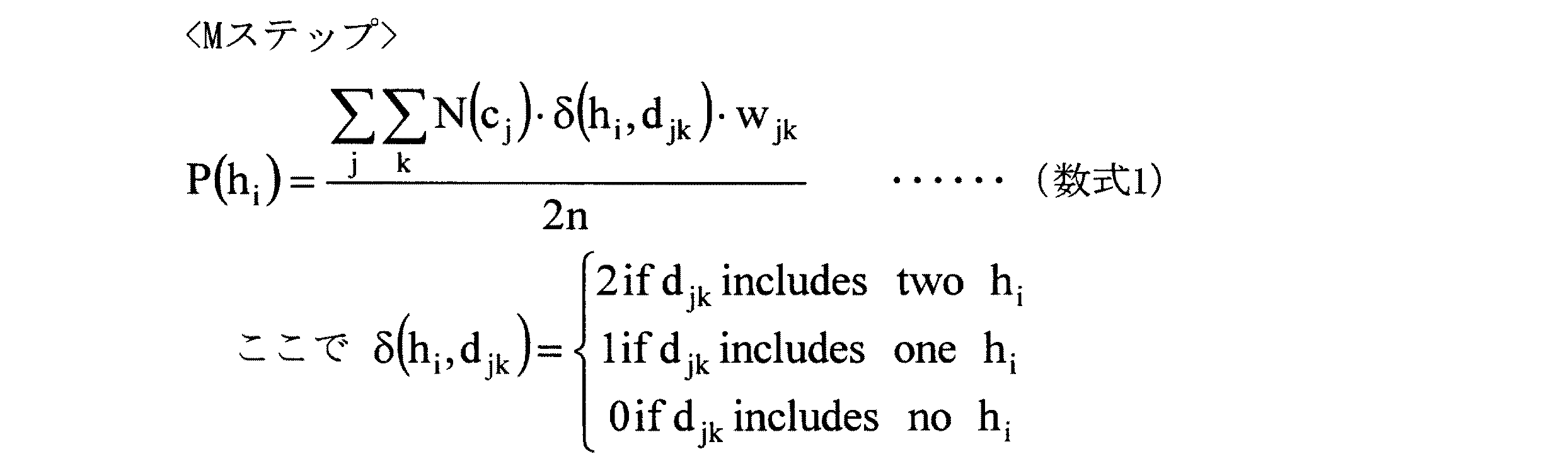
また、請求項7に記載のハプロタイプ推定装置は、請求項6に記載のハプロタイプ推定装置において、上記Mステップは、下記の数式1に基づいて、上記ハプロタイプ文字列の頻度を算出し、上記Eステップは、下記の数式2に基づいて上記ハプロタイプ文字列の上記組合せの頻度を求め、上記重みとして当該ハプロタイプ文字列の上記組合せの頻度を上記集団における上記組合せの頻度の総和で除して算出すること、を特徴とする。
また、請求項8に記載のプログラムは、集団における各個体の少なくともコピー数多型を含む実験データからハプロタイプを推定する、制御部と記憶部を少なくとも備えたハプロタイプ推定装置に実行させるためのプログラムであって、上記記憶部は、上記個体毎に、上記実験データから得られた、標識によって特定されるマーカー部位に対応付けられた上記コピー数多型のコピー数の総和Nに対する一または複数の条件式を、上記マーカー部位の種類毎に記憶する多型テーブル、を備えており、上記制御部において、上記コピー数の総和Nについて、足し合わせた場合に、上記多型テーブルに記憶された上記コピー数の総和Nの上記条件式を満たす任意の2つの整数に分割するコピー数総和分割ステップと、上記コピー数総和分割ステップにて分割された上記2つの整数をそれぞれ多型識別文字として表し、上記個体において上記多型識別文字を列挙したハプロタイプ文字列の組合せとして格納するハプロタイプ文字列格納ステップと、上記集団において、同一である上記ハプロタイプ文字列の数を集計し、当該ハプロタイプ文字列の上記集団における頻度を求め、当該頻度が所定の条件を満たす上記各個体の上記ハプロタイプ文字列の上記組合せを、上記ハプロタイプの組合せとして推定するハプロタイプ推定ステップと、を実行させることを特徴とする。 The program according to claim 8 is a program for estimating a haplotype from experimental data including at least a copy number polymorphism of each individual in a group, and causing the haplotype estimation apparatus including at least a control unit and a storage unit to execute the program. The storage unit has one or more conditions for the total number N of copy numbers of the copy number polymorphism associated with the marker site specified by the label obtained from the experimental data for each individual. A polymorphism table that stores an expression for each type of the marker part, and the control unit stores the copy stored in the polymorphism table when the total number N of copies is added. Copy number sum dividing step for dividing the number N into any two integers satisfying the above conditional expression, and the copy number sum dividing step The haplotype character string storage step that represents each of the two integers divided as described above as a polymorphism identification character and stores it as a combination of haplotype character strings that enumerate the polymorphism identification characters in the individual is the same in the group The number of the haplotype character strings is totaled, the frequency of the haplotype character strings in the population is obtained, and the combination of the haplotype character strings of the individuals that satisfy the predetermined condition is estimated as the haplotype combination. And a haplotype estimation step.
本発明によれば、塩基多型が考慮されていないコピー数多型に関する実験データから、曖昧なコピー数の総和しか得られない場合であっても、ハプロタイプとその頻度を高精度で推定することができる。 According to the present invention, it is possible to estimate haplotypes and their frequencies with high accuracy even when only the sum of ambiguous copy numbers can be obtained from experimental data on copy number polymorphisms that do not consider base polymorphisms. Can do.
また、本発明によれば、コピー数多型に関するデータに1座位当たりの遺伝子型データが加わったデータであっても、ハプロタイプとその頻度を推定することができる。 Further, according to the present invention, haplotypes and their frequencies can be estimated even in data obtained by adding genotype data per locus to data on copy number variation.
また、本発明によれば、文字列による取り得るハプロタイプ文字列の組合せの推定結果が、実験データと一致するか否かを検証し、冗長な文字列を排除するので、精度よく取り得るハプロタイプの組合せを算出することができる。 Further, according to the present invention, it is verified whether or not the estimation result of the combination of haplotype character strings that can be taken by the character string matches the experimental data, and redundant character strings are excluded. Combinations can be calculated.
また、本発明によれば、EM法を用いて、高精度にハプロタイプの尤度を検定することができる。 Further, according to the present invention, it is possible to test the likelihood of a haplotype with high accuracy using the EM method.
また、本発明によれば、個体におけるコピー数多型のコピー数の総和データを用いて、ハプロタイプにおけるコピー数とその頻度を高精度で推定することができる。 Further, according to the present invention, the copy number and frequency of haplotypes can be estimated with high accuracy using the total copy number data of the copy number polymorphism in the individual.
以下に、本発明にかかるハプロタイプ推定装置、ハプロタイプ推定方法、および、プログラム、並びに、記録媒体の実施の形態を図面に基づいて詳細に説明する。なお、この実施の形態によりこの発明が限定されるものではない。 Hereinafter, embodiments of a haplotype estimation device, a haplotype estimation method, a program, and a recording medium according to the present invention will be described in detail with reference to the drawings. Note that the present invention is not limited to the embodiments.
[本発明の原理] [Principle of the present invention]
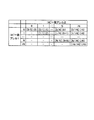
以下、本発明の原理および概要について説明し、その後、本発明の構成および処理等について詳細に説明する。ここで、図5は、1座位当たりの二つの相同染色体に渡る総コピー数(コピー数の総和)の多型テーブルの一例を表す図である。図5において、Lは座位を表す。 The principle and outline of the present invention will be described below, and then the configuration and processing of the present invention will be described in detail. Here, FIG. 5 is a diagram showing an example of a polymorphism table of the total number of copies (total number of copies) over two homologous chromosomes per locus. In FIG. 5, L represents a sitting position.
図5に示すように、実験結果によっては、各個体(個体1、個体2、・・・)、各座位(L1、L2、L3、・・・)における、二つの相同染色体に渡る総コピー数の表(テーブル)が得られる場合(コピー数多型がある場合)があり、総コピー数は2に限られない。 As shown in FIG. 5, depending on the experimental result, it extends over two homologous chromosomes at each individual (individual 1, individual 2,...) And at each locus (L 1 , L 2 , L 3 ,...). There are cases where a table of the total number of copies can be obtained (when there is a copy number polymorphism), and the total number of copies is not limited to two.
また、実験によっては、総コピー数がはっきりと確定されず、例えば“0コピーあるいは1コピー”、“2よりは多いコピー数”など、コピー数の状態が唯一つに決まっていない総コピー数(すなわち曖昧な総コピー数)を含むデータが得られる場合がある。ここで、図6は、曖昧なコピー数を含む、1座位当たりの二つの相同染色体に渡る総コピー数のデータの一例を示す図である。 Also, depending on the experiment, the total number of copies is not clearly determined. For example, “0 copies or 1 copy”, “number of copies greater than 2”, etc. That is, data including an ambiguous total copy number) may be obtained. Here, FIG. 6 is a diagram showing an example of data on the total number of copies over two homologous chromosomes per locus including ambiguous copy numbers.
図6において、“0or1”は、0コピーあるいは1コピーで表し、“>2”は、2よりは多いコピー数を表している。実際に、実験で得られるデータは、このような曖昧なデータしか得られない場合があるので、このようなデータから、相同染色体1本上の一座位におけるコピー数と、そのコピー数をアレルと見た時の頻度、あるいはそのようなアレルの複数座位に渡る組合せとしてのハプロタイプとその頻度を推定する必要があった。 In FIG. 6, “0or1” represents 0 copy or 1 copy, and “> 2” represents a copy number larger than 2. Actually, there is a case where only such ambiguous data can be obtained from the data obtained in the experiment. From such data, the copy number at one locus on one homologous chromosome and the copy number as the allele. It was necessary to estimate the frequency at the time of viewing, or the haplotype and the frequency as a combination across such alleles.
また、そのような総コピー数のデータに、それとは異なる座位における1座位当たりの遺伝子型データが組み合わさったデータから、ハプロタイプを推定する必要があった。ここで、図7は、1座位当たりの二つの相同染色体に渡る総コピー数のデータに、1座位当たりの遺伝子型データが組み合わさったデータの一例を示す図である。図7に示すように、座位L1およびL4では、1座位当たりの二つの相同染色体に渡る総コピー数を表しており、座位L2、L3、L5では、1座位当たりの遺伝子型データが表現されている。 In addition, it was necessary to estimate the haplotype from data obtained by combining such total copy number data with genotype data per locus at a different locus. Here, FIG. 7 is a diagram showing an example of data in which genotype data per locus is combined with data on the total number of copies across two homologous chromosomes per locus. As shown in FIG. 7, loci L 1 and L 4 represent the total number of copies across two homologous chromosomes per locus, and loci L 2 , L 3 and L 5 are genotypes per locus. Data is represented.
ここで、「ハプロタイプ」とは、二つの相同染色体に渡る総コピー数(曖昧な総コピー数も含む。)が得られた座位に対しては、相同染色体1本上におけるコピー数をアレルとし、遺伝子型が得られた座位に対してはそこで既に定義されたアレルを使った、複数座位に渡るアレルの組合せのことである。ここで、図8は、本発明におけるハプロタイプの表現例を示す図である。図8において、N(L)は、相同染色体1本上の座位Lにおけるコピー数N(整数値)を表しており、A(L)は座位Lに対応するアレルAを表している。 Here, the “haplotype” is the allele of the number of copies on one homologous chromosome for the locus from which the total number of copies across two homologous chromosomes (including ambiguous total number of copies) is obtained. For a locus from which a genotype was obtained, it is a combination of alleles across multiple loci using alleles already defined there. Here, FIG. 8 is a diagram illustrating an expression example of a haplotype in the present invention. In FIG. 8, N (L) represents the copy number N (integer value) at the locus L on one homologous chromosome, and A (L) represents the allele A corresponding to the locus L.
図7において示されるような、二つの相同染色体に渡る総コピー数のデータは、遺伝子型データではないため、従来技術(1)を適用することができないという問題があった。また、その総コピー数データは塩基多型を考慮したコピー数多型に関する実験データとも異なり、さらに今回取り扱うハプロタイプはコピー単位の組合せのことではない為、従来技術(2)も適用することができないという問題があった。 As shown in FIG. 7, the data of the total copy number across two homologous chromosomes is not genotype data, and thus there is a problem that the prior art (1) cannot be applied. In addition, the total copy number data is different from the experimental data related to copy number polymorphism considering base polymorphism, and the haplotype handled this time is not a combination of copy units, so the prior art (2) cannot be applied. There was a problem.
本発明は、上述した種々の問題に鑑みて本発明者により鋭意検討された結果得られたものであり、一座位当たりの二つの相同染色体に渡る、コピー数の総和(以下、「総コピー数」と呼ぶ。)のデータを処理し、相同染色体1本上の一座位におけるコピー数と、そのコピー数をアレルと見たときの頻度、あるいは、そのようなアレルの複数座位に渡る組合せとしてのハプロタイプとその頻度を推定する。さらには、一座位当たりの二つの相同染色体に渡る総コピー数のデータに、それとは異なる座位における一座位当たりの遺伝子型データが組み合わさったデータから、上述した背景技術のようなハプロタイプとその頻度を推定する。 The present invention was obtained as a result of intensive studies by the present inventors in view of the various problems described above, and is the sum of copy numbers over two homologous chromosomes per locus (hereinafter referred to as “total copy number”). Data), and the number of copies at one locus on one homologous chromosome, the frequency when the copy number is regarded as an allele, or a combination over multiple loci of such alleles. Estimate haplotypes and their frequency. Furthermore, from the data of the total copy number across two homologous chromosomes per locus combined with the genotype data per locus at a different locus, the haplotype and frequency as in the background art described above are combined. Is estimated.
ここでは、本発明の原理を説明するために一例として、総コピー数と遺伝子型が組み合わさったデータからの推定について説明する。なぜなら、総コピー数と遺伝子型が組み合わさったデータからハプロタイプを推定することは、総コピー数データのみからハプロタイプを推定することを含むより一般的な推定であり、かつ、総コピー数データから複数座位に渡るハプロタイプとその頻度を推定することは、一座位におけるコピー数のアレルとその頻度を推定することを含むより一般的な推定であるからである。 Here, as an example for explaining the principle of the present invention, estimation from data in which the total copy number and the genotype are combined will be described. Because estimating the haplotype from the combined data of the total copy number and the genotype is a more general estimation including estimating the haplotype only from the total copy number data, and more than one from the total copy number data. This is because estimating the haplotype across the locus and its frequency is a more general estimate including estimating the copy number allele at the locus and its frequency.
与えられたデータからハプロタイプとその頻度を推定する原理は、各個体に対しデータと矛盾しないディプロタイプ(2つの相同染色体上それぞれにある2つのハプロタイプの組合せ)を見出し、データを利用してハプロタイプの頻度を計算することである。ここで、二つの相同染色体に渡る(確定された)総コピー数がデータとして得られた場合、「矛盾しない」とは、各座位に対しては、ディプロタイプから数えられるその座位のコピー数アレルのコピー数の和が、そのデータにおける総コピー数に一致するということである。例えば、上述の図7のデータの個体1、座位L1に対しては、図8におけるハプロタイプ1,ハプロタイプ2からなるディプロタイプを考えたとき、N11(L1)+N12(L1)がデータにおける総コピー数2に一致するということである。 The principle of estimating the haplotype and its frequency from the given data is to find a diplotype (combination of two haplotypes on each of two homologous chromosomes) that is consistent with the data for each individual, and use the data to determine the haplotype. Is to calculate the frequency. Here, when the total number of copies (determined) across two homologous chromosomes is obtained as data, “no contradiction” means that for each locus, the copy number allele of that locus counted from the diplotype. That is, the sum of the number of copies matches the total number of copies in the data. For example, for the individual 1 and the locus L 1 in FIG. 7 described above, when considering a diplotype consisting of haplotype 1 and haplotype 2 in FIG. 8, N 11 (L 1 ) + N 12 (L 1 ) is This means that the total number of copies in the data is equal to 2.
また、総コピー数が曖昧な総コピー数である場合、「矛盾しない」とは、それが複数の総コピー数が提示されたもの(例えば、不等号を含まず“or”で複数の総コピー数が連結されたもの)であるときは、ディプロタイプから数えられるその座位のコピー数アレルのコピー数の和が、その複数の総コピー数のいずれかに一致するということである。例えば図7のデータの個体1、座位L4に対しては、図8におけるハプロタイプ1,ハプロタイプ2から成るディプロタイプを考えたとき、N41(L4)+N42(L4)が、データ「0or1」が提示する複数の総コピー数N=0,1のいずれかに一致するということである。また、曖昧な総コピー数が“ある数より大きい”など不等号で表現される総コピー数であるとき、「矛盾しない」とは、ディプロタイプから数えられるその座位のコピー数アレルのコピー数の和が、不等号で表現される条件を満たすということである。例えば、図7のデータの個体2、座位L1に対しては、図8におけるハプロタイプ1,ハプロタイプ2からなるディプロタイプを考えたとき、N11(L1)+N12(L1)がデータ「>2」によって表現された“2より大きい”を満たす、すなわちN11(L1)+N12(L1)>2を満たす、ということである。 In addition, when the total number of copies is ambiguous, “no contradiction” means that a plurality of total number of copies is presented (for example, “or” does not include an inequality sign and a plurality of total number of copies. Is the concatenated), the sum of the copy numbers of the locus copy number alleles counted from the diplotype matches one of the total copy numbers. For example, for the individual 1 and the locus L 4 in FIG. 7, when considering a diplotype consisting of haplotype 1 and haplotype 2 in FIG. 8, N 41 (L 4 ) + N 42 (L 4 ) “0 or 1” corresponds to one of a plurality of total copy numbers N = 0, 1 presented. In addition, when the ambiguous total copy number is a total copy number expressed by an inequality sign such as “greater than a certain number”, “no contradiction” means that the copy number of the locus copy number allele counted from the diplotype Is that the condition expressed by the inequality sign is satisfied. For example, for the individual 2 and the locus L 1 in FIG. 7, when considering a diplotype consisting of haplotype 1 and haplotype 2 in FIG. 8, N 11 (L 1 ) + N 12 (L 1 ) is the data “ > 2 ”is satisfied, that is, N 11 (L 1 ) + N 12 (L 1 )> 2 is satisfied.
また、遺伝子型がデータとして得られた各座位に対しては、上記「矛盾しない」とは、ディプロタイプから数えられるその座位の各アレルの数が、その遺伝子型データにおける各アレルの数(カウント数)と一致するということである。例えば、図7のデータの個体1、座位L2に対しては、図8におけるハプロタイプ1,ハプロタイプ2からなるディプロタイプを考えたとき、ディプロタイプのL2におけるA1,A2,A3,…の数それぞれ1,1,0,…(ディプロタイプ表現のA1(L2),A2(L2)から得られるカウント数)が、データにおけるA1,A2,A3,…の数にそれぞれ一致するということである。 For each locus whose genotype is obtained as data, the above “not contradictory” means that the number of alleles at that locus counted from the diplotype is the number of alleles in the genotype data (count Number). For example, the individual first data of FIG. 7, for the locus L 2, haplotype 1 in FIG. 8, when considering diplotypes consisting haplotype 2, A 1 in diplotypes L 2, A 2, A 3, The numbers of 1, 1 , 0,... (The counts obtained from A 1 (L 2 ) and A 2 (L 2 ) in the diplotype expression) are the numbers of A 1 , A 2 , A 3 ,. It means that each number matches.
以上、まとめると、「矛盾しない」とは、コピー数多型におけるコピー数の総和(2本の染色体に渡るコピー単位の総数)の条件や、塩基多型におけるカウント数(2本の染色体に渡る多型塩基に特異的なマーカー部位の総数)の条件に反しないことである。 In summary, “no contradiction” means that the total number of copies in the copy number polymorphism (total number of copy units across two chromosomes) and the count number in the base polymorphism (over two chromosomes) The total number of marker sites specific for polymorphic bases) should not be violated.
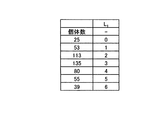
ここでは、本発明の原理を1個体に対して説明したが、データの各座位における総コピー数及び各アレルの数が同じ個体(すなわち、コピー数データやカウント数データのパターンが同じ個体)は同じように扱えるので、それらの数のパターンでデータをまとめてパターン毎にインデックス(j)を付け、集団における特定のパターンを有する個体数N(cj)を保持しておいてもよい。以降、この数のパターンを「カウントパターン」と呼ぶ。(各カウントパターンに対し)与えられたデータと矛盾しないディプロタイプが見出せれば、Expectation−Maximization(EM)法やGibbsサンプリング法などによって、データからハプロタイプの頻度が計算できる。 Here, the principle of the present invention has been explained for one individual. However, individuals having the same total number of copies and alleles at each locus of data (that is, individuals having the same pattern of copy number data and count number data). Since the data can be handled in the same manner, the data may be collected by the number of patterns, an index (j) may be attached to each pattern, and the number N (c j ) of individuals having a specific pattern in the group may be held. Hereinafter, this number of patterns is referred to as a “count pattern”. If a diplotype that is consistent with the given data is found (for each count pattern), the frequency of the haplotype can be calculated from the data by the Extraction-Maximization (EM) method, Gibbs sampling method, or the like.
各カウントパターンに対し、データと矛盾しないディプロタイプを見出す方法は種々考えられる。ここではデータと矛盾しない、あらゆる可能なディプロタイプを見出すことを想定して説明する。方法としては、例えば各カウントパターンに対し、まず一座位毎にデータと矛盾しないあらゆる可能な遺伝子型を見出し、それから全座位に渡ってあらゆる可能なディプロタイプを構成する方法が考えられる。ここで、図10は、本発明の概要を模式的に示したフロー図である。 Various methods for finding a diplotype that is consistent with the data for each count pattern are conceivable. Here, it is assumed that all possible diplotypes that are consistent with the data are found. As a method, for example, for each count pattern, first, all possible genotypes consistent with the data are found for each locus, and then all possible diplotypes are constructed over all loci. Here, FIG. 10 is a flowchart schematically showing the outline of the present invention.
その第一段階では、二本の相同染色体に渡る(確定された)総コピー数がデータとして得られた座位に対しては、その総コピー数と和が等しい(0を含む正の)整数値2つ一組をあらゆる組合せで作り、2つの整数値をそれぞれコピー数を表すアレルで、2つ一組を遺伝子型とすればよい。例えば、総コピー数がNのとき、[N/0],[N−1/1],[N−2/2],…,[0/N](ここで、[ ]は遺伝子型、あるいはディプロタイプを表し、“/”でアレルまたはハプロタイプを分ける位置を表す。)に対し、重複する冗長な遺伝子型を除いたものが、求める遺伝子型である。総コピー数が曖昧な、“or”で連結された総コピー数である場合は、それぞれの総コピー数に対して、これと同じ方法で遺伝子型を列挙すれば求められる。例えば、0or1or3の場合、総コピー数0に対し上と同じ方法で遺伝子型を列挙し(例えば、[0/0])、さらに総コピー数1に対し同じ方法で列挙し(例えば、[1/0])、さらに総コピー数3に対し同じ方法で列挙し(例えば、[3/0]、[2/1])、あらゆる組み合わせの遺伝子型(例えば、[0/0]、[1/0]、[3/0]、[2/1])を求める。 In the first stage, for loci where the total copy number (determined) across two homologous chromosomes is obtained as data, an integer value that is equal to the total copy number and positive (including zero) It is sufficient that two sets are made of all combinations, and two integer values are alleles each representing a copy number, and the two sets are genotypes. For example, when the total number of copies is N, [N / 0], [N-1 / 1], [N-2 / 2], ..., [0 / N] (where [] is the genotype, or (Representing the diplotype, and representing the position where the allele or haplotype is separated by “/”), and excluding redundant redundant genotypes is the desired genotype. When the total copy number is ambiguous and the total copy number is linked by “or”, the genotype is enumerated by the same method for each total copy number. For example, in the case of 0or1or3, the genotypes are enumerated in the same manner as above for the total copy number 0 (for example, [0/0]), and further enumerated in the same manner for the total copy number 1 (for example, [1 / 0]), and further listed in the same way for a total copy number of 3 (eg, [3/0], [2/1]), and any combination of genotypes (eg, [0/0], [1/0 ], [3/0], [2/1]).
総コピー数が曖昧な、不等号で表現された総コピー数であり、しかも“Nより多いコピー数”を表す「>N」である場合は、アレルのコピー数にも“Nより多いコピー数”を表す「>N」を用意して{0,1,…,N,>N}の各要素をコピー数アレルとし、それら2つのコピー数の和が総コピー数の不等式条件(>N、即ちNより大きい)を満たすようなあらゆる2つ一組(同じコピー数アレルからなる組を含む。)を遺伝子型とすればよい(ここで、2つのコピー数の和を出す際、アレルコピー数>Nには、どんな数あるいは>Nが足されてもその総コピー数は>Nとなり、不等式条件は満たされる)。ここで、図9は、2つのコピー数アレルからなる遺伝子型とそのコピー数の和を一例として示す図である。 If the total number of copies is ambiguous and expressed as an inequality sign, and “> N” representing “number of copies greater than N”, the number of copies of the allele is also “number of copies greater than N”. "> N" is prepared, each element of {0, 1, ..., N,> N} is set as a copy number allele, and the sum of these two copy numbers is an inequality condition (> N, that is, Any combination of two (including a set consisting of the same copy number alleles) that satisfies the condition (greater than N) may be used as a genotype (here, when calculating the sum of two copy numbers, the number of allele copies> No matter what number or> N is added to N, the total number of copies is> N, and the inequality condition is satisfied). Here, FIG. 9 is a diagram showing, as an example, a genotype composed of two copy number alleles and the sum of the copy numbers.
例えば、図9のように、{0,1,…,N,>N}から2つのコピー数アレルをあらゆる組合せで作って各組を遺伝子型とし、その2つのアレルのコピー数の和が不等式条件>Nを満たす組だけ選択すればそれが求める遺伝子型である。図9において、( )内の数字は2つのアレルのコピー数の和を表す。なお、総コピー数が“Nより少ないコピー数”を表す<Nである場合は、0or1or2…orN−1である場合と同じである。 For example, as shown in FIG. 9, two copy number alleles are created from {0, 1,..., N,> N} in any combination, and each set is genotyped, and the sum of the copy numbers of the two alleles is an inequality. If only a set satisfying the condition> N is selected, it is the genotype desired. In FIG. 9, the numbers in parentheses represent the sum of the copy numbers of two alleles. Note that the case where <N representing the total number of copies “less than N” is the same as 0 or 1 or 2... Or N−1.
遺伝子型がデータとして得られた座位に対しては、データにおける数の分だけアレルを表す文字(多型識別文字)を取り、これを2つに分けて組を作り、遺伝子型とすればよい。遺伝子型データの座位に関しては、一座位当たりのアレルの総数は必ず2であるので簡単にアレルを2つに分けられ、遺伝子型は唯一つ得られる。 For the loci where the genotype is obtained as data, the characters representing the alleles (polymorphism identification characters) are taken as many as the number in the data, and these are divided into two to make a genotype. . Regarding the locus of genotype data, the total number of alleles per locus is always 2, so the allele can be easily divided into two, and only one genotype is obtained.
第二段階においては、各座位の遺伝子型から、全座位に渡るあらゆる可能なディプロタイプを作る。これには、全座位に渡って一つずつ遺伝子型をあらゆる組合せで取り、その各組合せに対し、各座位の各遺伝子型が持つ2つのアレルから、全座位に渡るアレルの組合せとしてのハプロタイプ2つの組合せから構成されるディプロタイプを、2M−1個(ここでMは全座位数)のあらゆる組合せで作り、このディプロタイプの作成を遺伝子型の組合せ全部に対し行った後、最後に重複する冗長なディプロタイプを除けばよい。 In the second stage, all possible diplotypes across all loci are created from the genotype of each locus. This takes haplotype 2 as a combination of alleles across all loci from the two alleles of each genotype at each locus for each combination, taking genotypes one by one across all loci. A diplotype consisting of two combinations is made up of any combination of 2 M-1 (where M is the total number of loci), and this diplotype is created for all combinations of genotypes, and finally duplicated. This eliminates redundant diplotypes.
例えば、座位L1の遺伝子型が[B11/B12],[B13/B14]、座位L2,L3の遺伝子型がそれぞれ[B21/B22],[B31/B32]であるとき(ここでBは、コピー数アレルあるいは遺伝子型データで定義されているアレルを表す。)、まず全座位に渡る遺伝子型の組合せ、[B11/B12],[B21/B22],[B31/B32]と[B13/B14],[B21/B22],[B31/B32]を取る。次に、最初の組合せ[B11/B12],[B21/B22],[B31/B32]に対しては、[B11B21B31/B12B22B32],[B11B21B32/B12B22B31],[B11B22B31/B12B21B32],[B11B22B32/B12B21B31]の23−1個のあらゆる組合せを列挙する。さらに、[B13/B14],[B21/B22],[B31/B32]に対しても、同様に23−1個のあらゆる組合せを列挙する。 For example, loci genotype L 1 is [B 11 / B 12], [B 13 / B 14], locus L 2, genotype L 3 are each [B 21 / B 22], [B 31 / B 32 ] (Where B represents an allele defined by copy number alleles or genotype data), first, a combination of genotypes across all loci, [B 11 / B 12 ], [B 21 / B 22], [B 31 / B 32] and [B 13 / B 14], [B 21 / B 22], take the [B 31 / B 32]. Next, for the first combination [B 11 / B 12 ], [B 21 / B 22 ], [B 31 / B 32 ], [B 11 B 21 B 31 / B 12 B 22 B 32 ], [B 11 B 21 B 32 / B 12 B 22 B 31], [B 11 B 22 B 31 / B 12 B 21 B 32], [B 11 B 22 B 32 / B 12 B 21 B 31] 2 3 -List every single combination. Furthermore, all combinations of 2 3-1 are listed for [B 13 / B 14 ], [B 21 / B 22 ], and [B 31 / B 32 ].
最後に重複する冗長なディプロタイプを除く。図10に、あるカウントパターンc1に対し、データと矛盾しないディプロタイプを見出す方法の例を示した。その図において、L1,L3は二つの相同染色体に渡る総コピー数がデータとして得られた座位であり、L2は遺伝子型がデータとして得られた座位である。図10<SA−2>の記号(○の中に×)は、全座位に渡って一つずつ遺伝子型をあらゆる組合せで取ることを示す。 Excludes redundant redundant diplotypes at the end. Figure 10, for a certain count pattern c 1, showing an example of a method of finding the diplotype consistent with the data. In the figure, L 1 and L 3 are loci where the total number of copies across two homologous chromosomes is obtained as data, and L 2 is a locus where the genotype is obtained as data. In FIG. 10, the symbol <SA-2> (x in the circle) indicates that genotypes are taken in all combinations one by one over all loci.
こうして得られたディプロタイプを用い、さらに与えられたデータを使って、ハプロタイプの頻度を求める。この方法も幾つか考えられるが、一例として、Expectation−Maximization(EM)法を用いてもよい。これは、得られたディプロタイプに対し、その存在の重みを割り付け、そのディプロタイプが含むハプロタイプの個数を、その重み分を考慮して数え、ハプロタイプの頻度を計算し(Mステップ)、次にそのハプロタイプ頻度からハーディ・ワインバーグの法則を使って、ディプロタイプの存在の重みを更新し(Eステップ)、さらにその更新された重みから、Mステップ、次にEステップ、さらにMステップ、…と手続きを繰り返して頻度を更新していく方法である。例えば、以下の数式1のようなMステップと、数式2−1の様なEステップを交互に行って、ハプロタイプの頻度の更新していく。
上記数式2−1において、Pは頻度、nは個体の総数、i,j,kはハプロタイプ、カウントパターン、カウントパターン内でのディプロタイプのインデックス、h,dはハプロタイプ、ディプロタイプ,N(cj)はカウントパターンcjを持つ個体の数、wはEM法における、カウントパターン内でのディプロタイプの重みを表す。数2−1におけるディプロタイプの頻度は、ハーディ・ワインバーグの法則から計算する。ハーディ・ワインバーグの法則とは遺伝学における自然法則であり、この法則によって、ディプロタイプを構成する2つのハプロタイプとその確率(あるいは頻度)が分かったとき、そのディプロタイプの確率(あるいは頻度)が計算できる。この法則は、例えば、以下の数2−2の様に表現される。以上のような方法で、ハプロタイプとその頻度を推定する。ここで、頻度の非常に低いハプロタイプは存在しないと解釈してもよい。
[本発明の概要]
まず、本発明は、集団における各個体の少なくともコピー数多型を含む実験データからハプロタイプを推定する、制御部と記憶部を少なくとも備えたハプロタイプ推定装置において実行される。
[Outline of the present invention]
First, the present invention is executed in a haplotype estimation apparatus including at least a control unit and a storage unit that estimates haplotypes from experimental data including at least copy number variation of each individual in a group.
そして、図10に示すように、本ハプロタイプ推定装置は、個体毎に、実験データから得られた、標識によって特定されるマーカー部位に対応付けられたコピー数多型の総コピー数Nに対する一または複数の条件式を、マーカー部位の種類毎に記憶する多型テーブルを備える(SA−1)。ここで、コピー数Nに対する条件式は、コピー数の総和Nの条件を規定する一または複数の等式または不等式を含んでもよく、例えば、「N=2」や「N>0」や、「N=1or2」や「N≧2」等であってもよい。また、当該多型テーブルは、個体毎に、塩基多型を更に含む実験データから得られた、標識によって特定されるマーカー部位に対応付けられた多型塩基をカウントしたカウント数を、当該多型塩基の種類毎に更に格納されてもよい。 Then, as shown in FIG. 10, the haplotype estimation device is provided for each individual with respect to the total copy number N of the copy number polymorphism associated with the marker site specified by the label, obtained from the experimental data. A polymorphism table that stores a plurality of conditional expressions for each type of marker part is provided (SA-1). Here, the conditional expression for the copy number N may include one or a plurality of equalities or inequalities that define the condition of the total copy number N. For example, “N = 2”, “N> 0”, “ N = 1 or 2 ”or“ N ≧ 2 ”may be used. In addition, the polymorphism table, for each individual, obtained from the experimental data further including the base polymorphism, the count number obtained by counting the polymorphic bases associated with the marker site specified by the label, the polymorphism You may store further for every kind of base.
そして、本ハプロタイプ推定装置は、コピー数の総和Nについて、足し合わせた場合に、多型テーブルに記憶された総コピー数Nの条件式を満たす任意の2つの整数に分割する(SA−2)。例えば、本ハプロタイプ推定装置は、図5<SA−2>に示すように、総コピー数Nの条件式N=2の場合に、[2/0]または[1/1]に分割する。また、例えば、総コピー数Nの条件式N≦2の場合は、[2/0]、[1/1]、[1/0]または[0/0]に分割する。 The haplotype estimation apparatus divides the total number N of copies into two arbitrary integers that satisfy the conditional expression of the total number of copies N stored in the polymorphism table when the sum is added (SA-2). . For example, as shown in FIG. 5 <SA-2>, the haplotype estimation apparatus divides the haplotype estimation apparatus into [2/0] or [1/1] when the conditional expression N = 2 of the total copy number N. Further, for example, when the conditional expression N ≦ 2 of the total number of copies N, it is divided into [2/0], [1/1], [1/0] or [0/0].
そして、本ハプロタイプ推定装置は、分割された2つの整数をそれぞれ多型識別文字(例えば、「2」や「3」など)として表し、個体において(複数の座位に渡って)多型識別文字を列挙したハプロタイプ文字列の組合せ(ディプロタイプを表す。)として格納する(SA−3〜4)。ここで、図10<SA−3>に示すように、コピー数多型のコピー数を表す多型識別文字は、一例として、アラビア数字により表してもよい。ここで、図10<SA−4>に示すように、多型テーブルに個体毎の標識によって特定されるマーカー部位に対応付けられた多型塩基の種類毎の多型塩基のデータがある場合は、ハプロタイプ文字列の組合せにおいて、多型塩基の種類に対応付けた多型識別文字(例えば、「A1」や「A2」など)を更に列挙してもよい(例えば、「2A13/0A20」)。ここで、本ハプロタイプ推定装置は、まず遺伝子型の組合せを求めてから、次に全ての可能なハプロタイプの組合せ(ディプロタイプ)を求めてもよい。 Then, the haplotype estimation device represents each of the two divided integers as a polymorphism identification character (for example, “2” or “3”), and the individual polymorphism identification character (over a plurality of loci) is displayed in the individual. Stored as a combination of enumerated haplotype character strings (representing a diplotype) (SA-3 to 4). Here, as shown in FIG. 10 <SA-3>, the polymorphism identifying characters representing the copy number polymorphism copy number may be represented by Arabic numerals as an example. Here, as shown in FIG. 10 <SA-4>, when there is polymorphic base data for each type of polymorphic base associated with the marker site specified by the label for each individual in the polymorphism table, In the combination of haplotype character strings, polymorphism identification characters (for example, “A 1 ”, “A 2 ”, etc.) associated with the types of polymorphic bases may be further listed (for example, “2A 1 3 / 0A 2 0 "). Here, the present haplotype estimation apparatus may first obtain genotype combinations and then obtain all possible haplotype combinations (diplotypes).
すなわち、本ハプロタイプ推定装置は、一例として、図10に示すように、個体毎および座位(マーカー部位)毎の実験データ<SA−1>から、各座位における全ての可能な組合せを求め(SA−2)、次に、複数の座位に渡る全ての可能な遺伝子型の組合せを求め(SA−3)、最後に、遺伝子型の組合せから複数の座位に渡る全ての可能なハプロタイプの組合せ(ディプロタイプ)を表す文字列を求めてもよい(SA−4)。また、ここで、本ハプロタイプ推定装置は、作成したハプロタイプ文字列の組合せにおける多型識別文字が表す整数の和が、多型テーブルにおける総コピー数Nの条件式を満たすか否か(または多型塩基のカウント数と一致するか否か)を確認し、条件を満たさない場合に当該ハプロタイプ文字列を除外してもよい。また、ハプロタイプ推定装置は、作成したハプロタイプ文字列の組合せが他のハプロタイプ文字列の組合せと重複するか否か判断し、重複する場合に当該ハプロタイプ文字列の組合せを除外してもよい(SA−5)。 That is, as an example, the haplotype estimation apparatus obtains all possible combinations at each locus (SA−) from experimental data <SA-1> for each individual and each locus (marker site) as shown in FIG. 2) Next, seek all possible genotype combinations across multiple loci (SA-3) and finally, all possible haplotype combinations across multiple loci from genotype combinations (diplotypes) ) May be obtained (SA-4). Further, here, the haplotype estimation apparatus determines whether or not the sum of integers represented by the polymorphism identification characters in the generated combination of haplotype character strings satisfies the conditional expression of the total number of copies N in the polymorphism table (or polymorphism). Whether or not it matches the count number of bases), and if the condition is not satisfied, the haplotype character string may be excluded. In addition, the haplotype estimation device may determine whether or not the created haplotype character string combination overlaps with other haplotype character string combinations, and may exclude the haplotype character string combinations when they overlap (SA−). 5).
そして、本ハプロタイプ推定装置は、集団において、同一であるハプロタイプ文字列の数を集計し、ハプロタイプ文字列の集団における頻度を求め、当該頻度が所定の条件を満たす各個体のハプロタイプ文字列の組合せを、ハプロタイプの組合せとして推定する。ここで、本ハプロタイプ推定装置は、頻度をハーディ・ワインバーグ(Hardy−Weinberg)の法則に基づいて算出し、集団における頻度がハーディ・ワインバーグ平衡となる場合に所定の条件を満たすと判定してもよい。 Then, the haplotype estimation device counts the number of haplotype character strings that are the same in the group, obtains the frequency in the haplotype character string group, and determines the combination of the haplotype character strings of each individual that satisfies the predetermined frequency. Estimated as a combination of haplotypes. Here, the haplotype estimation device calculates the frequency based on Hardy-Weinberg's law, and determines that the predetermined condition is satisfied when the frequency in the group becomes the Hardy-Weinberg equilibrium. Also good.
また、本ハプロタイプ推定装置は、ハプロタイプの推定処理において、EM(Expectation−Maximization)法を用いて、集団におけるハプロタイプ文字列の頻度を、当該ハプロタイプ文字列を少なくとも一方に有する組合せの頻度により重み付けして算出するMステップと、組合せの頻度を、当該組合せを構成するハプロタイプ文字列の頻度の積により求め、当該組合せの頻度に基づいて重みを算出するEステップと、を頻度の値が収束するまで交互に繰り返すことにより所定の条件を満たす頻度を算出してもよい。EM法の詳細な処理については、後述する。以上で、本発明の概要の説明を終える。 Further, the haplotype estimation apparatus weights the frequency of haplotype character strings in a group by the frequency of combinations having at least one of the haplotype character strings using an EM (Expectation-Maximization) method in haplotype estimation processing. The M step to be calculated and the frequency of the combination are obtained by the product of the frequencies of the haplotype character strings that constitute the combination, and the E step for calculating the weight based on the frequency of the combination is alternated until the frequency value converges The frequency satisfying a predetermined condition may be calculated by repeating the above. Detailed processing of the EM method will be described later. This is the end of the description of the outline of the present invention.
[ハプロタイプ推定装置の構成]
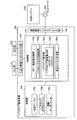
まず、本ハプロタイプ推定装置の構成について説明する。図11は、本発明が適用される本ハプロタイプ推定装置の構成の一例を示すブロック図であり、該構成のうち本発明に関係する部分のみを概念的に示している。
[Configuration of haplotype estimation device]
First, the configuration of the haplotype estimation device will be described. FIG. 11 is a block diagram showing an example of the configuration of the haplotype estimation apparatus to which the present invention is applied, and conceptually shows only the part related to the present invention in the configuration.
図11において、ハプロタイプ推定装置100は、概略的に、ハプロタイプ推定装置100の全体を統括的に制御するCPU等の制御部102、通信回線等に接続されるルータ等の通信装置(図示せず)に接続される通信制御インターフェース部104、入力部112や出力部114に接続される入出力制御インターフェース部108、および、各種のデータベースやテーブルなどを格納する記憶部106を備えて構成されており、これら各部は任意の通信路を介して通信可能に接続されている。 In FIG. 11, a haplotype estimation device 100 is schematically a communication device (not shown) such as a control unit 102 such as a CPU that controls the overall haplotype estimation device 100 and a communication line. A communication control interface unit 104 connected to the input / output control unit 108 connected to the input unit 112 and the output unit 114, and a storage unit 106 for storing various databases and tables, These units are communicably connected via an arbitrary communication path.
記憶部106に格納される各種のデータベースやテーブル(多型テーブル106a〜実験データファイル106c)は、固定ディスク装置等のストレージ手段であり、各種処理に用いる各種のプログラムやテーブルやファイルやデータベース等を格納する。 Various databases and tables (polymorphic table 106a to experimental data file 106c) stored in the storage unit 106 are storage means such as a fixed disk device, and store various programs, tables, files, databases, and the like used for various processes. Store.
これら記憶部106の各構成要素のうち、多型テーブル106aは、個体毎に、実験データから得られた、標識によって特定されるマーカー部位に対応付けられたコピー数多型の総コピー数N(二本の相同染色体上のコピー単位の数の総和)に対する一または複数の条件式をマーカー部位の種類毎(すなわちコピー多型の種類毎)にコピー数データとして記憶する多型テーブルである。ここで、多型テーブル106aは、個体毎に、塩基多型を更に含む実験データから得られた、標識によって特定されるマーカー部位に対応付けられた多型塩基をカウントしたカウント数を当該多型塩基の種類毎にカウント数データとして更に記憶してもよい。上述したように、図5や図6や図7や図10<SA−1>は、多型テーブル106aに格納されるコピー数データおよび/またはカウント数データの一例を示す。この多型テーブル106aに格納される情報は、一例として図7等に示すように、個体毎、座位毎(コピー数多型の種類に対応したマーカー部位毎、および/または、各座位における多型塩基の種類毎)のコピー数(条件式を含んでもよい。)/カウント数を定義している。ここで、コピー数Nに対する条件式は、コピー数の総和Nの条件を規定する一または複数の等式または不等式を含んでもよく、例えば、「N=3」や「N>0」、「N=1or2」、「N≠2」、「0<N≦2」等であってもよい。 Among the constituent elements of the storage unit 106, the polymorphism table 106a includes, for each individual, the total copy number N of the copy number polymorphism associated with the marker site specified by the label, obtained from the experimental data. It is a polymorphism table that stores one or more conditional expressions for the total number of copy units on two homologous chromosomes) as copy number data for each type of marker site (that is, for each type of copy polymorphism). Here, the polymorphism table 106a indicates, for each individual, the count number obtained by counting the polymorphic bases associated with the marker site specified by the label, obtained from the experimental data further including the base polymorphism. You may further memorize | store as count number data for every kind of base. As described above, FIG. 5, FIG. 6, FIG. 7, and FIG. 10 <SA-1> show examples of copy number data and / or count number data stored in the polymorphism table 106a. The information stored in the polymorphism table 106a includes, as an example, as shown in FIG. 7 and the like, for each individual, for each locus (for each marker site corresponding to the type of copy number polymorphism and / or for each locus. The number of copies (which may include a conditional expression) / count number is defined. Here, the conditional expression for the copy number N may include one or a plurality of equalities or inequalities that define the condition of the total copy number N. For example, “N = 3”, “N> 0”, “N = 1 or 2 ”,“ N ≠ 2 ”,“ 0 <N ≦ 2 ”, and the like.
また、ハプロタイプ文字列ファイル106bは、多型テーブル106aに記憶された個体のコピー数データおよび/またはカウント数データに基づいて算出された、取り得るハプロタイプ文字列の組合せを記憶するハプロタイプ文字列記憶手段である。ハプロタイプ文字列ファイル106bは、一例として、ハプロタイプ文字列を、図8に示したようなハプロタイプ表現形式で記憶してもよい。 The haplotype character string file 106b stores haplotype character string storage means for storing possible combinations of haplotype character strings calculated based on individual copy number data and / or count number data stored in the polymorphism table 106a. It is. As an example, the haplotype character string file 106b may store the haplotype character string in a haplotype expression format as shown in FIG.
また、実験データファイル106cは、集団における各個体の少なくともコピー数多型を含む実験データを記憶する実験データ記憶手段である。ここで、実験データは、一塩基多型等の塩基多型のデータ(遺伝子型データ等)を含んでもよい。一例として、コピー数多型のコピー単位上の、標識によって特定されるマーカー部位に対応付けられた多型塩基を示す実験データ(DNAチップやPCR等による実験データなど)を記憶してもよい。また、標識としては、蛍光色素プローブの他、蛍光特性を持たない色素や、放射性同位体、GFP・GRPなどのタンパク質、Hisタグ、ビオチン化などによって識別可能なプローブ等を用いてもよい。 The experimental data file 106c is experimental data storage means for storing experimental data including at least a copy number polymorphism of each individual in the group. Here, the experimental data may include nucleotide polymorphism data (eg, genotype data) such as a single nucleotide polymorphism. As an example, experimental data (such as experimental data by a DNA chip or PCR) indicating a polymorphic base associated with a marker site specified by a label on a copy number polymorphism copy unit may be stored. As the label, a fluorescent dye probe, a dye having no fluorescent property, a radioisotope, a protein such as GFP / GRP, a His tag, a probe that can be identified by biotinylation, or the like may be used.
また、図11において、通信制御インターフェース部104は、ハプロタイプ推定装置100とネットワーク300(またはルータ等の通信装置)との間における通信制御を行う。すなわち、通信制御インターフェース部104は、他の端末と通信回線を介してデータを通信する機能を有する。 In FIG. 11, the communication control interface unit 104 performs communication control between the haplotype estimation device 100 and the network 300 (or a communication device such as a router). That is, the communication control interface unit 104 has a function of communicating data with other terminals via a communication line.
また、図11において、入出力制御インターフェース部108は、入力部112や出力部114の制御を行う。ここで、出力部114としては、モニタ(家庭用テレビを含む。)の他、スピーカ等を用いることができる。また、入力部112としては、キーボード、マウス、およびマイク等を用いることができる。 In FIG. 11, the input / output control interface unit 108 controls the input unit 112 and the output unit 114. Here, as the output unit 114, in addition to a monitor (including a home television), a speaker or the like can be used. As the input unit 112, a keyboard, a mouse, a microphone, and the like can be used.
また、図11において、制御部102は、OS(Operating System)等の制御プログラム、各種の処理手順等を規定したプログラム、および所要データを格納するための内部メモリを有し、これらのプログラム等により、種々の処理を実行するための情報処理を行う。制御部102は、機能概念的に、コピー数総和分割部102a、ハプロタイプ文字列格納部102b、ハプロタイプ推定部102c、多型テーブル作成部102eを備えて構成されている。なお、理解の容易のために上述した記号を用いて説明することがある。 11, the control unit 102 has a control program such as an OS (Operating System), a program that defines various processing procedures, and an internal memory for storing necessary data. Information processing for executing various processes is performed. The control unit 102 includes a copy number sum total division unit 102a, a haplotype character string storage unit 102b, a haplotype estimation unit 102c, and a polymorphism table creation unit 102e in terms of functional concept. For ease of understanding, the above symbols may be used for explanation.
このうち、コピー数総和分割部102aは、コピー数の総和Nについて、足し合わせた場合に、多型テーブル106aに記憶された総コピー数Nの条件式を満たす任意の2つの整数に分割するコピー数総和分割手段である。ここで、コピー数総和分割部102aは、総コピー数Nの条件式が曖昧な数を規定している場合(例えば、「N=2」ではなく「N>2」など)には、2つの整数の少なくとも一方を曖昧な整数(例えば、[>2/0])に分割してもよい。 Among these, the copy number sum dividing unit 102a, when adding the total number N of copies, divides the copy number into arbitrary two integers that satisfy the conditional expression of the total copy number N stored in the polymorphism table 106a. Number sum dividing means. Here, when the conditional expression of the total copy number N defines an ambiguous number (for example, “N> 2” instead of “N = 2”), the copy number total dividing unit 102a At least one of the integers may be divided into ambiguous integers (eg, [> 2/0]).
また、ハプロタイプ文字列格納部102bは、コピー数総和分割部102aにより分割された2つの整数をそれぞれ多型識別文字(例えば、アラビア数字の「0」や「1」)として表し、個体において多型識別文字を列挙したハプロタイプ文字列の組合せ(例えば、「302/021」)としてハプロタイプ文字列ファイル106bに格納するハプロタイプ文字列格納手段である。ここで、ハプロタイプ文字列格納部102bは、多型テーブル106aに、個体毎に、塩基多型を更に含む実験データ(遺伝子型データ)から得られた、標識によって特定されるマーカー部位に対応付けられた多型塩基が、当該多型塩基の種類毎に格納されている場合(すなわち、カウント数データが格納されている場合)に、ハプロタイプ文字列の組合せにおいて、多型塩基の種類に対応付けた多型識別文字を更に列挙してもよい(例えば、「302A1/021A2」)。ここで、ハプロタイプ文字列格納部102bは、作成したハプロタイプ文字列の組合せにおける対応する多型識別文字が表す整数の和(二本の相同染色体上のコピー多型のコピー数の和を表している。)が、多型テーブル106aにおける総コピー数Nの条件式を満たすか否か確認し、条件式を満たさない場合に当該ハプロタイプ文字列を除外してもよい。また、ハプロタイプ文字列格納部102bは、作成したハプロタイプ文字列の組合せにおける多型塩基を表す多型識別文字の数が、多型テーブル106aに格納されたカウント数データと一致するか否か確認し、一致しない場合に当該ハプロタイプ文字列を除外してもよい。また、ハプロタイプ文字列格納部102bは、作成したハプロタイプ文字列の組合せが他のハプロタイプ文字列と重複するか否か判断し、重複する場合に当該ハプロタイプ文字列を除外してもよい。 In addition, the haplotype character string storage unit 102b represents each of the two integers divided by the copy number sum dividing unit 102a as a polymorphism identification character (for example, Arabic numerals “0” and “1”), The haplotype character string storage unit stores the haplotype character string in the haplotype character string file 106b as a combination of haplotype character strings in which identification characters are listed (for example, “302/021”). Here, the haplotype character string storage unit 102b is associated in the polymorphism table 106a with a marker site specified by a label, obtained from experimental data (genotype data) further including a base polymorphism for each individual. When a polymorphic base is stored for each type of the polymorphic base (that is, when count data is stored), it is associated with the type of polymorphic base in the combination of haplotype character strings. The polymorphism identification characters may be further listed (for example, “302A 1 / 021A 2 ”). Here, the haplotype character string storage unit 102b represents the sum of the integers represented by the corresponding polymorphism identification characters in the created haplotype character string combination (the sum of the copy numbers of the copy polymorphisms on the two homologous chromosomes). .) May satisfy the conditional expression of the total number of copies N in the polymorphism table 106a, and the haplotype character string may be excluded if the conditional expression is not satisfied. In addition, the haplotype character string storage unit 102b confirms whether or not the number of polymorphism identification characters representing polymorphic bases in the generated combination of haplotype character strings matches the count number data stored in the polymorphism table 106a. If the characters do not match, the haplotype character string may be excluded. In addition, the haplotype character string storage unit 102b may determine whether or not the created combination of haplotype character strings overlaps with another haplotype character string, and may exclude the haplotype character string if it overlaps.
また、ハプロタイプ推定部102cは、ハプロタイプ文字列ファイル106bを参照して、集団において、同一であるハプロタイプ文字列の数を集計し、当該ハプロタイプ文字列の集団における頻度を求め、当該頻度が所定の条件を満たす各個体のハプロタイプ文字列の組合せを、ハプロタイプの組合せとして推定するハプロタイプ推定手段である。ここで、ハプロタイプ推定部102cは、ハプロタイプ文字列の頻度を、ハーディ・ワインバーグの法則に基づいて算出し、所定の条件を、集団におけるハーディ・ワインバーグ平衡としてもよい。 Further, the haplotype estimation unit 102c refers to the haplotype character string file 106b, counts the number of haplotype character strings that are the same in the group, obtains the frequency of the haplotype character string in the group, and the frequency is a predetermined condition. This is a haplotype estimation means for estimating a combination of haplotype character strings of each individual satisfying the above as a haplotype combination. Here, the haplotype estimation unit 102c may calculate the frequency of the haplotype character string based on Hardy-Weinberg's law, and the predetermined condition may be Hardy-Weinberg equilibrium in the group.
ここで、ハプロタイプ推定部102cは、図11に示すように、ハプロタイプ頻度算出部102dを備えて構成される。ハプロタイプ頻度算出部102dは、EM(Expectation−Maximization)法を用いて、集団におけるハプロタイプ文字列の頻度を、当該ハプロタイプ文字列を少なくとも一方に有する組合せの頻度により重み付けして算出するMステップと、ハプロタイプの組合せの頻度を、当該組合せを構成する2つのハプロタイプ文字列の頻度の積により求め、当該組合せの頻度に基づいて重みを算出するEステップと、を頻度の値が収束するまで交互に繰り返すハプロタイプ頻度算出手段である。ここで、ハプロタイプ頻度算出部102dは、Mステップにおいて算出されたハプロタイプ文字列の頻度と、前回のMステップにおいて算出されたハプロタイプ文字列の頻度と、の対数尤度差を求め、対数尤度差が所定の閾値以下となった場合に、頻度の値が収束したと判定してもよい。これにより、EM法の収束条件を適切に設定することができるので、精度を保証しながら計算時間を節約することができる。 Here, the haplotype estimation unit 102c includes a haplotype frequency calculation unit 102d as shown in FIG. The haplotype frequency calculation unit 102d uses an EM (Expectation-Maximization) method to calculate the frequency of a haplotype character string in a group by weighting the frequency of a haplotype character string by a combination frequency having at least one of the haplotype character strings, and a haplotype The haplotype that repeats alternately the E step of calculating the weight of the combination based on the product of the frequencies of the two haplotype character strings constituting the combination and calculating the weight based on the frequency of the combination until the frequency value converges It is a frequency calculation means. Here, the haplotype frequency calculation unit 102d obtains a log likelihood difference between the frequency of the haplotype character string calculated in the M step and the frequency of the haplotype character string calculated in the previous M step, and calculates the log likelihood difference. May be determined that the frequency value has converged when the value is equal to or less than a predetermined threshold. Thereby, since the convergence condition of EM method can be set appropriately, calculation time can be saved while ensuring accuracy.
また、ここで、ハプロタイプ頻度算出部102dは、Mステップにおいて、下記の数式1に基づいて、ハプロタイプ文字列の頻度P(hi)を算出し、Eステップにおいて、下記の数式2に基づいてハプロタイプ文字列の組合せの頻度P(djk)を求め、重みwjkとして当該ハプロタイプ文字列の組合せの頻度を集団における組合せの頻度の総和で除して算出してもよい。
また、多型テーブル作成部102eは、実験データファイル106cに記憶された個体毎の実験データを用いて、標識によって特定されるマーカー部位に対応付けられた総コピー数N(二本の染色体に渡るコピー単位の数の総和)をコピー数多型の種類毎にコピー数データとして、および/または、標識によって特定されるマーカー部位に対応付けられた多型塩基をカウントしたカウント数を多型塩基の種類毎にカウント数データとして、多型テーブル106aに格納する多型テーブル作成手段である。ここで、格納されるカウント数およびコピー数は、一意に特定される数に限られず、曖昧な数(例えば、「>5」、「1or2」、「≠0」)であってもよい。 In addition, the polymorphism table creation unit 102e uses the experiment data for each individual stored in the experiment data file 106c, and uses the total copy number N (crossing over two chromosomes) associated with the marker site specified by the marker. The total number of copy units) as the copy number data for each type of copy number polymorphism and / or the number of counts obtained by counting the polymorphic bases associated with the marker site identified by the label. This is a polymorphism table creating means for storing count data for each type in the polymorphism table 106a. Here, the number of counts and the number of copies to be stored are not limited to uniquely specified numbers, and may be ambiguous numbers (for example, “> 5”, “1or2”, “≠ 0”).
ここで、本ハプロタイプ推定装置100は、ルータ等の通信装置および専用線等の有線または無線の通信回線を介して、ネットワーク300に通信可能に接続されてもよい。この場合、本システムは、概略的にハプロタイプ推定装置100と、コピー数データやカウント数データ等に関する外部データベースやハプロタイプ推定プログラム等の外部プログラム等を提供する外部システム200とを、ネットワーク300を介して通信可能に接続して構成される。ここで、図11において、ネットワーク300は、ハプロタイプ推定装置100と外部システム200とを相互に接続する機能を有し、例えば、インターネット等である。 Here, the haplotype estimation device 100 may be communicably connected to the network 300 via a communication device such as a router and a wired or wireless communication line such as a dedicated line. In this case, the present system roughly includes a haplotype estimation apparatus 100 and an external system 200 that provides an external database such as an external database related to copy number data and count number data, a haplotype estimation program, and the like via a network 300. It is configured to be communicable. Here, in FIG. 11, a network 300 has a function of connecting the haplotype estimation apparatus 100 and the external system 200 to each other, and is, for example, the Internet.
ここで、外部システム200は、ネットワーク300を介して、ハプロタイプ推定装置100と相互に接続され、利用者に対してコピー数データやカウント数データ等に関する外部データベースやハプロタイプ推定プログラム等の外部プログラム等を実行するウェブサイトを提供する機能を有する。ここで、外部システム200は、WEBサーバやASPサーバ等として構成していてもよく、そのハードウェア構成は、一般に市販されるワークステーション、パーソナルコンピュータ等の情報処理装置およびその付属装置により構成していてもよい。また、外部システム200の各機能は、外部システム200のハードウェア構成中のCPU、ディスク装置、メモリ装置、入力装置、出力装置、通信制御装置等およびそれらを制御するプログラム等により実現される。以上で、本ハプロタイプ推定装置100の構成の説明を終える。 Here, the external system 200 is mutually connected to the haplotype estimation apparatus 100 via the network 300, and external programs such as an external database related to copy number data and count number data, a haplotype estimation program, and the like are given to the user. It has a function of providing a website to be executed. Here, the external system 200 may be configured as a WEB server, an ASP server, or the like, and its hardware configuration is configured by an information processing apparatus such as a commercially available workstation or a personal computer and its attached devices. May be. Each function of the external system 200 is realized by a CPU, a disk device, a memory device, an input device, an output device, a communication control device, and the like in the hardware configuration of the external system 200 and a program for controlling them. Above, description of the structure of this haplotype estimation apparatus 100 is completed.
[本ハプロタイプ推定装置100の処理]
次に、このように構成された実施の形態における本ハプロタイプ推定装置100の処理の一例について、以下に図12〜図14を参照して詳細に説明する。
[Processing of Haplotype Estimation Device 100]
Next, an example of processing of the haplotype estimation apparatus 100 according to the embodiment configured as described above will be described in detail below with reference to FIGS.
[ハプロタイプ推定処理]
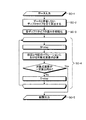
本実施の形態におけるハプロタイプ推定処理の一例について、以下に図12を参照して説明する。ここで、図12は、本ハプロタイプ推定装置100のハプロタイプ推定処理の一例を示す図である。
[Haplotype estimation process]
An example of the haplotype estimation process in the present embodiment will be described below with reference to FIG. Here, FIG. 12 is a diagram illustrating an example of haplotype estimation processing of the haplotype estimation apparatus 100.
図12に示すように、コピー数総和分割部102aは、コピー数の総和Nについて、足し合わせた場合に、多型テーブルに記憶された総コピー数Nの条件式を満たす任意の2つの整数に分割する(SB−1)。ここで、コピー数総和分割部102aは、総コピー数Nの条件式が曖昧な数を規定している場合(例えば、「N>2」)には、2つの整数を曖昧な整数(例えば、[>2/0])で分割してもよい。 As shown in FIG. 12, when the copy number sum total dividing unit 102a adds the total number N of copies, it adds any two integers that satisfy the conditional expression of the total copy number N stored in the polymorphism table. Divide (SB-1). Here, when the conditional expression of the total copy number N defines an ambiguous number (for example, “N> 2”), the copy number sum dividing unit 102a converts two integers into ambiguous integers (for example, [> 2/0]).
そして、ハプロタイプ文字列格納部102bは、コピー数総和分割部102aにより分割された2つの整数をそれぞれ多型識別文字として表し、個体における多型識別文字を複数の座位に渡って列挙したハプロタイプ文字列の組合せを、とりうる全ての組み合せで算出してハプロタイプ文字列ファイル106bに格納する(SB−2)。なお、多型テーブル106aに、遺伝子型データから得られた、標識によって特定されるマーカー部位に対応付けられた多型塩基のカウント数が、多型塩基の種類毎に格納されている場合には、ハプロタイプ文字列格納部102bは、多型塩基の種類に対応付けた多型識別文字を加えて、ハプロタイプ文字列の組合せに列挙してもよい。ここで、ハプロタイプ文字列格納部102bは、作成したハプロタイプ文字列の組合せにおける対応する多型識別文字が表す整数の和(二本の相同染色体上のコピー多型のコピー数の和を表している。)が、多型テーブル106aにおける総コピー数Nの条件式を満たすか否か確認し、条件式を満たさない場合に当該ハプロタイプ文字列を除外してもよい。また、ハプロタイプ文字列格納部102bは、作成したハプロタイプ文字列の組合せが他のハプロタイプ文字列と重複するか否か判断し、重複する場合に当該ハプロタイプ文字列を除外してもよい。 The haplotype character string storage unit 102b represents each of the two integers divided by the copy number sum dividing unit 102a as a polymorphism identification character, and lists the haplotype character string in which the individual polymorphism identification characters are listed over a plurality of loci. Are calculated for all possible combinations and stored in the haplotype character string file 106b (SB-2). When the polymorphic base count number associated with the marker site identified by the label obtained from the genotype data is stored for each type of polymorphic base in the polymorphism table 106a. The haplotype character string storage unit 102b may add the polymorphism identification character associated with the type of polymorphic base and enumerate the combinations of haplotype character strings. Here, the haplotype character string storage unit 102b represents the sum of the integers represented by the corresponding polymorphism identification characters in the created haplotype character string combination (the sum of the copy numbers of the copy polymorphisms on the two homologous chromosomes). .) May satisfy the conditional expression of the total number of copies N in the polymorphism table 106a, and the haplotype character string may be excluded if the conditional expression is not satisfied. In addition, the haplotype character string storage unit 102b may determine whether or not the created combination of haplotype character strings overlaps with another haplotype character string, and may exclude the haplotype character string if it overlaps.
そして、ハプロタイプ推定部102cは、ハプロタイプ文字列格納部102bにより個体毎に格納されたハプロタイプ文字列の組合せを記憶するハプロタイプ文字列ファイルハプロタイプ文字列ファイル106bを参照して、集団において、同一であるハプロタイプ文字列の数を集計する(SB−3)。 Then, the haplotype estimation unit 102c refers to the haplotype string file haplotype string file 106b that stores combinations of haplotype strings stored for each individual by the haplotype string storage unit 102b, and the haplotypes that are the same in the group. The number of character strings is totaled (SB-3).
そして、ハプロタイプ推定部102cは、ハプロタイプ文字列の集団における頻度を計算する(SB−4)。ここで、ハプロタイプ推定部102cは、ハプロタイプ文字列の頻度をハーディ・ワインバーグの法則により算出してもよい。 Then, the haplotype estimation unit 102c calculates the frequency in the haplotype character string group (SB-4). Here, the haplotype estimation unit 102c may calculate the frequency of the haplotype character string according to Hardy Weinberg's law.
そして、ハプロタイプ推定部102cは、ハプロタイプ文字列の頻度が所定の条件を満たす各個体のハプロタイプ文字列の組合せを抽出し、ハプロタイプの組合せとして推定する(SB−5)。ここで、ハプロタイプ推定部102cは、所定の条件として、集団におけるハーディ・ワインバーグ平衡を設定してもよい。以上で、本実施の形態におけるハプロタイプ推定処理を終える。 Then, the haplotype estimation unit 102c extracts a combination of haplotype character strings of each individual whose haplotype character string frequency satisfies a predetermined condition, and estimates the combination as a haplotype combination (SB-5). Here, the haplotype estimation unit 102c may set Hardy-Weinberg equilibrium in the group as a predetermined condition. Above, the haplotype estimation process in this Embodiment is complete | finished.
[EM法による処理]
ハプロタイプ推定部102cの処理によるEM法の詳細な処理の一例について説明する。すなわち、ハプロタイプ推定部102cは、ハプロタイプ頻度算出部102dの処理により、集団におけるハプロタイプ文字列の頻度を、EM(Expectation−Maximization)法を用いて、効率よく計算する。
[Process by EM method]
An example of detailed processing of the EM method by processing of the haplotype estimation unit 102c will be described. That is, the haplotype estimation unit 102c efficiently calculates the frequency of the haplotype character strings in the group using the EM (Expectation-Maximization) method by the processing of the haplotype frequency calculation unit 102d.
ここで、EM法とは、得られたディプロタイプ(本実施の形態においては、ハプロタイプ文字列の組合せとして表す。)に対し、その存在の重みを割り付け、そのディプロタイプが含むハプロタイプの個数を、重み分を考慮して数え、ハプロタイプの頻度を計算し(Mステップ)、次にそのハプロタイプ頻度からハーディ・ワインバーグの法則を使って、ディプロタイプの存在の重みを更新し(Eステップ)、さらにその更新された重みから、Mステップ、次にEステップ、さらにMステップ、・・・と処理を繰り返して、頻度を更新していく方法である。例えば、下記の数式1に基づくMステップと、下記の数式2(数式2−1および数式2−2)に基づくEステップを交互に行うことにより、ハプロタイプの頻度の更新していく。
ここで、上記の数式2−2は、ハーディ・ワインバーグの法則を示している。ハーディ・ワインバーグの法則とは遺伝学における自然法則であり、この法則によって、ディプロタイプを構成する2つのハプロタイプとその確率(あるいは頻度)が分かった時、そのディプロタイプの確率(あるいは頻度)が計算できる。なお、上記EM法においては、頻度の非常に低いハプロタイプは存在しないと解釈される。このように、ハプロタイプ推定部102cは、ハプロタイプ頻度算出部102dの処理により、一例として上記のEM法を用いて、ハプロタイプの組合せとその頻度を推定する。ここで、ハプロタイプ頻度算出部102dは、下記の数式に基づいて、Mステップにおいて算出されたハプロタイプ文字列の頻度と、前回のMステップにおいて算出されたハプロタイプ文字列の頻度と、の対数尤度差を求め、対数尤度差が所定の閾値以下となった場合に、頻度の値が収束したと判定してもよい。
以上で、EM法による処理の一例の説明を終える。 Above, description of an example of the process by EM method is completed.
[実施例]
本実施の形態を、プログラミング言語Perlで実装した実施例について、以下に図13〜図14を参照して説明する。図13は、本実装の枠組みを示すフローチャートである。図14は、コピー数総和分割処理およびハプロタイプ文字列格納処理の一例を示すフローチャートである。なお、以下の説明において、説明の簡単のために、本実施の形態におけるハプロタイプ文字列を単に「ハプロタイプ」と、ハプロタイプ文字列の組合せを「ディプロタイプ」と述べる場合がある。
[Example]
An example in which the present embodiment is implemented in the programming language Perl will be described below with reference to FIGS. FIG. 13 is a flowchart showing the framework of this implementation. FIG. 14 is a flowchart illustrating an example of the copy number sum dividing process and the haplotype character string storage process. In the following description, for the sake of simplicity, the haplotype character string in this embodiment may be simply referred to as “haplotype” and the combination of haplotype character strings may be referred to as “diplotype”.
図13に示すように、まず、ハプロタイプ推定装置100は、多型テーブル106aを参照してデータ(例えば、図5、図6、図7等に示した多型テーブルのデータ)を読み込む(SC−1)。ここで、ハプロタイプ推定装置は、EM法において収束判定に使われる数値も読み込んでもよい。 As shown in FIG. 13, first, the haplotype estimation apparatus 100 reads data (for example, data of the polymorphism table shown in FIGS. 5, 6, 7, etc.) with reference to the polymorphism table 106a (SC− 1). Here, the haplotype estimation apparatus may also read numerical values used for convergence determination in the EM method.
次に、ハプロタイプ推定装置100は、コピー数総和分割処理およびハプロタイプ文字列格納処理として、データと矛盾しないディプロタイプを全て算出する(SC−2)。具体的には、以下のSC−21〜SC−25を行う。 Next, the haplotype estimation apparatus 100 calculates all diplotypes that are consistent with the data as the copy number sum dividing process and the haplotype character string storage process (SC-2). Specifically, the following SC-21 to SC-25 are performed.
すなわち、取り得るハプロタイプの組合せを過不足なく求めるため(多型テーブル106aのコピー数データおよび/またはカウント数データと矛盾しないディプロタイプを見出すため)、ハプロタイプ推定装置は、ディプロタイプ(ハプロタイプの組合せ)を構成する。ここで、データと矛盾しないディプロタイプとは、作成したディプロタイプ(2本の相同染色体に渡る文字の集合)において、コピー数多型におけるコピー数の総和(2本の染色体に渡るコピー単位の総数)の条件や、塩基多型におけるカウント数(2本の染色体に渡る多型塩基に特異的なマーカー部位の総数)の条件に反しないことである。具体的には、多型識別文字が表す2本の染色体上のコピー数を足し合わせたとき、多型テーブル106aに記憶されたコピー数データの条件に反しない(各コピー多型の総コピー数Nの条件を満たす)ことである。また、多型識別文字が表す2本の染色体上の多型塩基をカウントしたとき、多型テーブル106aに記憶されたカウント数データのカウント数と一致するということである。ここで、図14は、コピー数データおよび/またはカウント数データの全パターンにおいて、そのカウントパターンと矛盾しないディプロタイプを作成する処理の一例を示すフローチャートである。 In other words, in order to obtain possible combinations of haplotypes without excess or deficiency (in order to find a diplotype that is consistent with the copy number data and / or the count number data of the polymorphism table 106a), the haplotype estimation device uses a diplotype (a combination of haplotypes). Configure. Here, the diplotype that is consistent with the data is the total number of copies in the copy number polymorphism (total number of copy units across the two chromosomes) in the created diplotype (a set of characters across two homologous chromosomes). ) And the number of counts in the base polymorphism (the total number of marker sites specific to the polymorphic base across two chromosomes). Specifically, when the copy numbers on the two chromosomes represented by the polymorphism identification characters are added, the copy number data stored in the polymorphism table 106a does not violate the conditions (total copy number of each copy polymorphism). N condition). In addition, when the polymorphic bases on the two chromosomes represented by the polymorphism identification characters are counted, the count number of the count number data stored in the polymorphism table 106a matches. Here, FIG. 14 is a flowchart showing an example of processing for creating a diplotype that is consistent with the count pattern in all patterns of copy number data and / or count number data.
図14に示すように、まず、ハプロタイプ推定装置100は、多型テーブル106aに記憶されたコピー数データおよび/またはカウント数データから全カウントパターンを算出する(読み出す)(SC−21)。 As shown in FIG. 14, first, the haplotype estimating apparatus 100 calculates (reads out) all count patterns from the copy number data and / or count number data stored in the polymorphism table 106a (SC-21).
つぎに、ハプロタイプ推定装置100は、カウントパターン(ci)のイテレーション(iイテレーション)に入る。ここでiイテレーションは、最初iを1に初期化し、1イテレーション毎にiを1ずつ増加させ、“i<=カウントパターンの個数”である限り繰り返すこととする。 Next, the haplotype estimation apparatus 100 enters an iteration (i iteration) of the count pattern (c i ). Here, i iteration is initially initialized to 1, i is incremented by 1 for each iteration, and is repeated as long as “i <= number of count patterns”.
iイテレーション内において、ハプロタイプ推定装置100は、コピー数総和分割部102aおよびハプロタイプ文字列格納部102bの処理により、各座位に渡って遺伝子型を算出する(SC−22)。コピー数総和分割部102aは、二つの相同染色体に渡る(確定された)総コピー数の座位に対しては、その総コピー数と和が等しい(0を含む正の)整数値2つ一組をあらゆる組合せで作る。ハプロタイプ文字列格納部102bは、その2つの整数値を、アレルを表す文字(多型識別文字)として扱う。多型テーブル106aに格納された総コピー数Nが曖昧な、“or”で連結された総コピー数である場合は、コピー数総和分割部102aは、それぞれの総コピー数に対して、上記と同じ方法でそれぞれ2つ一組を作る。多型テーブル106aに格納された総コピー数が曖昧な、整数Nより少ないコピー数である事を表す“<N”である場合は、コピー数総和分割部102aは、“<N”を“0or1or2…orN−1”に変換して、それぞれについて上と同じ方法で2つ一組を作る。多型テーブル106aに格納された総コピー数が曖昧な、Nより多いコピー数である事を表す“>N”である場合は、{0,1,…,N,>N}の各要素をアレルを表す文字(多型識別文字)として、図9に示すように、あらゆる2つ一組を列挙してその2つの和を出し、それが総コピー数の不等式条件(>N、即ちNより大きい)を満たす組だけ選択する。ただし和を出す際、アレルコピー数“>N”には、どんな数あるいは“>N”が足されてもその総コピー数は“>N”となり、不等式条件は満たされる。遺伝子型の座位に対しては、データにおける数の分だけアレルを表す文字(多型識別文字)を取り、2つ一組を作る(その他、適宜、特願2007−237139号を参照)。 In the i iteration, the haplotype estimation apparatus 100 calculates the genotype over each locus by the processing of the copy number sum dividing unit 102a and the haplotype character string storage unit 102b (SC-22). The copy number sum dividing unit 102a sets a set of two integer values (a positive value including 0) whose sum is equal to the total copy number for the locus of the total copy number (determined) across two homologous chromosomes. Make in any combination. The haplotype character string storage unit 102b handles the two integer values as characters (polymorphic identification characters) representing alleles. When the total number of copies N stored in the polymorphism table 106a is ambiguous and is the total number of copies concatenated with “or”, the total copy number dividing unit 102a performs the above processing for each total number of copies. Make two pairs in the same way. When the total number of copies stored in the polymorphism table 106a is ambiguous and “<N” indicating that the number of copies is less than the integer N, the copy number sum dividing unit 102a sets “<N” to “0or1or2”. ... orN-1 "and make a pair for each in the same way as above. When the total number of copies stored in the polymorphism table 106a is ambiguous and “> N” indicating that the number of copies is greater than N, each element of {0, 1,..., N,> N} is As shown in FIG. 9, as a character representing an allele (polymorphic identifier character), every two pairs are enumerated and the sum of the two is obtained, which is an inequality condition (> N, that is, N) of the total copy number Select only pairs that satisfy (large). However, when calculating the sum, the number of allele copies “> N” is added to any number or “> N”, so that the total number of copies becomes “> N”, and the inequality condition is satisfied. For genotype loci, characters representing alleles (polymorphism identification characters) are taken as many as the number in the data, and two sets are made (refer to Japanese Patent Application No. 2007-237139 as appropriate).
そして、ハプロタイプ推定装置100は、各座位に渡って1つずつ遺伝子型を総当たりで取って、全座位に渡る遺伝子型のあらゆる組合せを作る(SC−23)。 The haplotype estimation apparatus 100 then takes all the genotypes one by one over each locus and creates all combinations of genotypes over all loci (SC-23).
そして、ハプロタイプ推定装置100は、作成した遺伝子型の組合せに関するイテレーション(jイテレーション)に入る。ここで、jイテレーションは、最初jを1に初期化し、1イテレーション毎に1ずつ増加させ、“j<=遺伝子の組合せの個数”である限り繰り返すこととする。 Then, the haplotype estimation apparatus 100 enters an iteration (j iteration) regarding the created combination of genotypes. Here, j iteration is initially initialized to 1, incremented by 1 for each iteration, and repeated as long as “j <= number of gene combinations”.
jイテレーション内において、ハプロタイプ文字列格納部102bは、遺伝子型の組合せjに対し、全座位に渡って各遺伝子型からアレルを1つずつ取って、座位の順に多型識別文字を並べた文字列を作り、その文字列をハプロタイプ文字列とする。このとき、ハプロタイプ文字列格納部102bは、各遺伝子型からアレルを1つずつ取った際残った方のアレルからも座位の順にアレル文字を並べた文字列を作り、その文字列をペア(組合せ)となるもう一つのハプロタイプ文字列として、ディプロタイプ(ハプロタイプ文字列の組合せ)を作る(SC−24)。この、全座位に渡って各遺伝子型からアレルを一つずつ取ることは総当たりで行って、あらゆる可能な2M−1個(ここでMは全座位数)のディプロタイプを得る。ハプロタイプ推定装置100は、このディプロタイプの作成を遺伝子型の組合せ全部に対して行い、jイテレーションを終了する。 In the j iteration, the haplotype character string storage unit 102b takes one allele from each genotype over all loci for the genotype combination j, and arranges polymorphism identification characters in the order of the loci. And make the string a haplotype string. At this time, the haplotype character string storage unit 102b creates a character string in which allele characters are arranged in the order of the loci from the remaining allele when one allele is taken from each genotype, and the character strings are paired (combined). ) Is created as another haplotype character string (SC-24). Taking alleles from each genotype one by one across all loci is done brute force to obtain all possible 2 M-1 diplotypes (where M is the number of all loci). The haplotype estimation apparatus 100 creates this diplotype for all combinations of genotypes, and ends the j iteration.
そして、ハプロタイプ文字列格納部102bは、得られたハプロタイプ文字列の組合せ(ディプロタイプ)から、重複する冗長なディプロタイプを除外する(SC−25)。すなわち、ハプロタイプ文字列格納部102bは、作成したハプロタイプ文字列の組合せが他のハプロタイプ文字列の組合せと重複するか否か判断し、重複する場合に当該ハプロタイプ文字列の組合せを除外する。ここで、ハプロタイプ文字列格納部102bは、作成したハプロタイプ文字列の組合せにおいて、対応する多型識別文字が表す整数の和が、多型テーブル106aにおけるコピー数の総和Nの条件式を満たすか否か確認し、条件式を満たさない場合に当該ハプロタイプ文字列を除外してもよい。 Then, the haplotype character string storage unit 102b excludes redundant redundant diplotypes from the obtained haplotype character string combinations (diplotypes) (SC-25). That is, the haplotype character string storage unit 102b determines whether or not the created haplotype character string combination overlaps with other haplotype character string combinations, and excludes the haplotype character string combinations when they overlap. Here, the haplotype character string storage unit 102b determines whether the sum of integers represented by the corresponding polymorphism identification characters satisfies the conditional expression of the total number N of copies in the polymorphism table 106a in the generated haplotype character string combination. If the conditional expression is not satisfied, the haplotype character string may be excluded.
ハプロタイプ推定装置100は、上記の処理を各カウントパターンに対して行い、iイテレーションを終え、最終的に、データと矛盾しない全ディプロタイプを算出し、ハプロタイプ文字列ファイル106bに格納する。以上が、取り得るハプロタイプの組合せを求めるための処理である。 The haplotype estimation apparatus 100 performs the above processing on each count pattern, finishes the i iteration, finally calculates all diplotypes that are consistent with the data, and stores them in the haplotype character string file 106b. The above is the processing for obtaining possible haplotype combinations.
再び、図13に戻り、ハプロタイプ推定部102cは、ハプロタイプ頻度算出部102dの処理により、EM法を用いて、ハプロタイプ文字列ファイル106bに記憶されたハプロタイプ文字列の組合せに基づいて、ハプロタイプ文字列の頻度を計算する。 Returning to FIG. 13 again, the haplotype estimation unit 102c uses the EM method based on the combination of the haplotype character strings stored in the haplotype character string file 106b by the processing of the haplotype frequency calculation unit 102d. Calculate the frequency.
すなわち、まず、ハプロタイプ頻度算出部102dは、各カウントパターン(ci)に対し、各ハプロタイプの組合せの存在の重みを初期化する(SC−3)。本実施例においては、初期値として重みを平等に割り付けた。すなわち、初期値の重みは、wjk=1/njである。ここでwは重み、jはカウントパターンのインデックス、kはカウントパターン内でのディプロタイプのインデックスであり、njはカウントパターン内でのディプロタイプの総数である。 That is, first, the haplotype frequency calculation unit 102d initializes the weight of existence of each haplotype combination for each count pattern (c i ) (SC-3). In this embodiment, the weights are assigned equally as initial values. That is, the initial value weight is w jk = 1 / n j . Here, w is a weight, j is a count pattern index, k is a diplotype index in the count pattern, and n j is a total number of diplotypes in the count pattern.
次にSC−4に移り、ハプロタイプ推定部102cは、EM法のMステップを数式1に基づいて行う。そして、対数尤度を下記の数式に従って計算し、記憶部106に保存する。下記の数式において、記号は上述と同様である。ここで対数尤度とは、計算されたディプロタイプの頻度がどれくらいデータを説明しているかの指標であり、本実施例においては、これをEM法の収束の判定に用いる。ハプロタイプ推定部102cは、収束判定において、前回のSC−4イテレーションで保存された対数尤度と今回のSC−4イテレーションで計算された対数尤度との差を計算し、その差が一定値以内ならば、もはや対数尤度は改善されないと判定し、SC−5に処理を移す。そうでなければ、SC−4内にとどまり、ハプロタイプ推定部102cは、数式2に従って、EM法のEステップを行う。そしてSC−4のイテレーションを繰り返す。
そして、ハプロタイプ推定部102cは、上記条件によってSC−5に処理を移した場合(対数尤度差一定値以内の場合)、ハプロタイプ及びその頻度を結果ファイルに(出力部114などに)出力する(SC−5)。以上で、本実施例の説明を終える。 When the haplotype estimation unit 102c shifts the process to SC-5 according to the above condition (when the log likelihood difference is within a certain value), the haplotype and its frequency are output to the result file (such as the output unit 114) ( SC-5). This is the end of the description of this embodiment.
[実証シミュレーション]
本実施の形態がコピー数多型及び一座位当たりの遺伝子型に関するデータから、ハプロタイプとその頻度を推定できるかどうかを確かめる為、シミュレーション実験を行った。実験は四つのタイプからハプロタイプとその頻度を推定できるかどうかシミュレーションを行った。すなわち、(1)一座位における二つの相同染色体に渡る総コピー数のデータから、その座位における相同染色体1本上のコピー数と、そのコピー数をアレルと見た時の頻度を推定できるかどうか、(2)(複数座位に渡る)一座位当たりの二つの相同染色体に渡る総コピー数のデータから、ハプロタイプとその頻度を推定できるかどうか、(3)一座位当たりの二つの相同染色体に渡る総コピー数のデータに、それとは異なる座位において、一座位当たりのSNPの遺伝子型データが組み合わさったデータから、ハプロタイプとその頻度を推定できるかどうか、(4)一座位当たりの二つの相同染色体に渡る総コピー数が曖昧な総コピー数を含む場合のデータに、それとは異なる座位において、一座位当たりのSNP の遺伝子型データが組み合わさったデータから、ハプロタイプとその頻度を推定できるかどうか、についてシミュレーション実験を行った。図15は、シミュレーションの枠組みを示すフローチャートである。
[Demonstration simulation]
In order to confirm whether or not the present embodiment can estimate the haplotype and its frequency from the data on the copy number variation and the genotype per locus, a simulation experiment was conducted. The experiment simulated whether the haplotype and its frequency could be estimated from four types. (1) Whether the number of copies on a single homologous chromosome at the locus and the frequency when the copy number is regarded as an allele can be estimated from the data on the total number of copies across the two homologous chromosomes at the locus. (2) Whether haplotypes and their frequencies can be estimated from data on the total number of copies across two homologous chromosomes per locus (over multiple loci), (3) across two homologous chromosomes per locus Whether the haplotype and its frequency can be estimated from the data of total copy number combined with SNP genotype data per locus at a different locus, (4) two homologous chromosomes per locus SNP genotype data per locus at the different loci is combined with the data when the total copy number over the range includes ambiguous total copy numbers. A simulation experiment was conducted to determine whether haplotypes and their frequencies can be estimated from the combined data. FIG. 15 is a flowchart showing a simulation framework.
図15に示すように、まず、SD−1において、ハプロタイプ推定装置は、ハプロタイプ(あるいはコピー数アレル)とその確率が書かれたファイルを読み込む。また、ハプロタイプ推定装置は、以下で用いる個体の数も読み込む。曖昧な総コピー数を含むデータを作成する場合は、曖昧でない総コピー数を曖昧な総コピー数に変換する表(例えば総コピー数0と1はいずれも0or1に変換する、3以上の総コピー数はどれも>2に変換する、等の対応づけが定義された表)が書かれたファイルも読み込む。 As shown in FIG. 15, first, in SD-1, the haplotype estimation apparatus reads a file in which the haplotype (or copy number allele) and its probability are written. The haplotype estimation apparatus also reads the number of individuals used below. When creating data including the ambiguous total copy number, a table that converts the unambiguous total copy number to the ambiguous total copy number (for example, the total copy number of 0 or 1 is converted to 0 or 1, and three or more total copies A file in which a table in which the correspondence is defined such that all numbers are converted to> 2 is also read.
そして、SD−2において、ハプロタイプ推定装置は、読み込んだハプロタイプから構成しうるあらゆる2つ1組(ハプロタイプ2つから構成される1組)を作成し、1組を1つのディプロタイプとして、ハーディ・ワインバーグの法則(数式2−2参照)に基づいて、読み込んだハプロタイプの確率から全ディプロタイプの確率を計算する。 In SD-2, the haplotype estimation device creates every two pairs (one pair composed of two haplotypes) that can be composed of the read haplotypes, and sets one pair as one diplotype. Based on the Weinberg's law (see Equation 2-2), the probabilities for all diplotypes are calculated from the probabilities for the read haplotypes.
そして、SD−3において、ハプロタイプ推定装置は、ディプロタイプとその確率から、ディプロタイプの多項分布を構成し、与えられた個体の数だけディプロタイプをランダム抽出する。これは、例えば、R言語を使って、rmultinom(1,size=個体の数,prob=c(ディプロタイプ1の確率、ディプロタイプ2の確率、ディプロタイプ3の確率、…))の様なコマンドで簡単に実施できる。抽出されたディプロタイプの1つ1つが、1つ1つの個体に相当する。 In SD-3, the haplotype estimation device constructs a diplotype multinomial distribution from the diplotype and its probability, and randomly extracts the diplotype by the number of given individuals. For example, using R language, a command such as rmultinom (1, size = number of individuals, prob = c (probability of diplotype 1, probability of diplotype 2, probability of diplotype 3)) Easy to implement. Each extracted diplotype corresponds to an individual.
そして、SD−4において、ハプロタイプ推定装置は、各個体が持つディプロタイプを構成する2つのハプロタイプの各座位に対し、コピー数の座位の時は2つのハプロタイプに渡る総コピー数、SNPの座位の時は各塩基の数を数え、データを作成する。例えば、個体が持つディプロタイプが[1A21/1A12]であったら、L1,L3はコピー数の座位であるのでそれぞれ総コピー数は2(1+1),3(1+2)、L2はSNPの座位であるので、A1,A2の数を数えそれぞれ1,1となる。曖昧な総コピー数を含むデータを作成する場合は、入力で読み込んだ変換表に基づいて総コピー数を曖昧な総コピー数に変換する。 Then, in SD-4, the haplotype estimation device, for each locus of the two haplotypes constituting the diplotype of each individual, at the copy number locus, the total copy number over the two haplotypes, the SNP locus At times, count the number of each base and create the data. For example, if the diplotype of the individual is [1A 2 1 / 1A 1 2], L 1 and L 3 are the copy number loci, so the total copy numbers are 2 (1 + 1), 3 (1 + 2), and L, respectively. Since 2 is the SNP locus, the numbers of A 1 and A 2 are counted to be 1, 1 respectively. When creating data including an ambiguous total copy number, the total copy number is converted into an ambiguous total copy number based on a conversion table read as input.
最後にSD−5において、ハプロタイプ推定装置は、データをファイルに出力する。 Finally, in SD-5, the haplotype estimation device outputs data to a file.
以上で説明したシミュレーションの枠組みを使って、まず上述の実験(1)の場合について、図16で示されたコピー数アレルとその確率、さらに個体の数500を読み込み、データ図17を作成した。次に、本実施の形態が図17のデータだけから、図16で示されたコピー数アレルとその確率(頻度)を推定(再現)できるか試験した。これは言い換えれば、不完全な観測データからの母集団比率の推定問題である。本実施の形態適用の際、EM法において収束判定に使われる対数尤度差は0.001未満とした。適用の結果、コピー数アレルとその頻度に関し、図18のような結果を得た。図18(再現データ)にあって図16(元データ)にないコピー数アレルの頻度は全て低い。上述のように、これらは存在しないと解釈される。図16にあるコピー数アレルは全て図18に現れており、かつ、それら推定頻度も正解頻度とほぼ等しい。よって、本実施の形態はコピー数アレルとその頻度を推定出来ることが実証された。 Using the simulation framework described above, first, in the case of the above-described experiment (1), the copy number allele and its probability shown in FIG. 16 and the number of individuals 500 were read to create a data diagram 17. Next, it was tested whether this embodiment can estimate (reproduce) the copy number allele and its probability (frequency) shown in FIG. 16 only from the data of FIG. In other words, this is a problem of estimating the population ratio from incomplete observation data. When this embodiment is applied, the log likelihood difference used for convergence determination in the EM method is set to less than 0.001. As a result of the application, a result as shown in FIG. 18 was obtained regarding the copy number allele and its frequency. The frequency of copy number alleles in FIG. 18 (reproduction data) that is not in FIG. 16 (original data) is low. As mentioned above, these are interpreted as absent. All copy number alleles shown in FIG. 16 appear in FIG. 18, and their estimated frequencies are almost equal to the correct answer frequencies. Therefore, it was demonstrated that this embodiment can estimate the copy number allele and its frequency.
同様に、上述の実験(2)の場合についても、図19で示されたハプロタイプとその確率、さらに個体の数500を読み込み、データ図20を作成した。次に本実施の形態が図20のデータだけから、図19で示されたハプロタイプとその確率を推定できるか試験した。本実施の形態適用の際、EM法において収束判定に使われる対数尤度差は上と同じとした。適用の結果、ハプロタイプとその頻度に関し、図21のような結果を得た。図21(再現データ)にあって図19(元データ)にないハプロタイプの頻度は全て低い。上述のように、これらは存在しないと解釈される。図19にあるハプロタイプは全て図21に現れており、かつ、それら推定頻度も正解頻度とほぼ等しい。よって、本実施の形態はコピー数アレルの組合せとしてのハプロタイプとその頻度を推定出来ることが実証された。 Similarly, in the case of the above-described experiment (2), the haplotype and its probability shown in FIG. 19 and the number of individuals 500 were read to create a data diagram 20. Next, it was tested whether this embodiment can estimate the haplotype and its probability shown in FIG. 19 only from the data of FIG. When applying this embodiment, the log-likelihood difference used for convergence determination in the EM method is the same as above. As a result of application, the results shown in FIG. 21 were obtained with respect to the haplotype and its frequency. The frequency of haplotypes in FIG. 21 (reproduction data) that is not in FIG. 19 (original data) is low. As mentioned above, these are interpreted as absent. All the haplotypes shown in FIG. 19 appear in FIG. 21, and their estimated frequencies are almost equal to the correct answer frequencies. Therefore, it has been demonstrated that this embodiment can estimate the haplotypes and their frequencies as combinations of copy number alleles.
同様に、上述の実験(3)の場合についても、図22で示されたハプロタイプとその確率、さらに個体の数500を読み込み、データ図23を作成した。次に本実施の形態が図23のデータだけから、図22で示されたハプロタイプとその確率を推定できるか試験した。本実施の形態適用の際、EM法において収束判定に使われる対数尤度差は上と同じとした。適用の結果、ハプロタイプとその頻度に関し、図24のような結果を得た。上述の実験結果と同様、この結果が示す通り、本実施の形態はコピー数アレルとSNPアレルの組合せとしてのハプロタイプとその頻度を推定出来ることが実証された。 Similarly, also in the case of the above-mentioned experiment (3), the haplotype and its probability shown in FIG. 22 and the number of individuals 500 were read and a data diagram 23 was created. Next, it was tested whether this embodiment can estimate the haplotype shown in FIG. 22 and its probability only from the data of FIG. When applying this embodiment, the log-likelihood difference used for convergence determination in the EM method is the same as above. As a result of application, the results shown in FIG. 24 were obtained with respect to the haplotype and its frequency. Like this experimental result, as this result shows, it was demonstrated that this embodiment can estimate the haplotype and its frequency as a combination of the copy number allele and the SNP allele.
同様に、上述の実験(4)の場合についても、図25で示されたハプロタイプとその確率、さらに個体の数500を読み込み、データ図26を作成した。この際、総コピー数0と1はいずれも曖昧な総コピー数0or1に変換し、3以上の総コピー数はどれも曖昧な総コピー数>2に変換した。次に、本実施の形態が図26のデータだけから、図25で示されたハプロタイプとその確率を推定できるか試験した。本実施の形態適用の際、EM法において収束判定に使われる対数尤度差は上と同じとした。適用の結果、ハプロタイプとその頻度に関し、図27のような結果を得た。上述の実験結果と同様、この結果が示す通り、曖昧な総コピー数を含むデータの場合においても、本実施の形態はコピー数アレルとSNPアレルの組合せとしてのハプロタイプとその頻度を推定出来ることが実証された。 Similarly, in the case of the above-described experiment (4), the haplotype and its probability shown in FIG. 25 and the number of individuals 500 were read to create a data diagram 26. At this time, the total copy numbers 0 and 1 were both converted to the ambiguous total copy number 0 or 1, and the total copy numbers of 3 or more were all converted to the ambiguous total copy number> 2. Next, it was tested whether this embodiment can estimate the haplotype and its probability shown in FIG. 25 only from the data of FIG. When applying this embodiment, the log-likelihood difference used for convergence determination in the EM method is the same as above. As a result of application, the results shown in FIG. 27 were obtained with respect to the haplotype and its frequency. Similar to the experimental results described above, as this result shows, even in the case of data including an ambiguous total copy number, this embodiment can estimate the haplotype as a combination of the copy number allele and the SNP allele and its frequency. Proven.
[他の実施の形態]
さて、これまで本発明の実施の形態について説明したが、本発明は、上述した実施の形態以外にも、上記特許請求の範囲に記載した技術的思想の範囲内において種々の異なる実施の形態にて実施されてよいものである。
[Other embodiments]
Although the embodiments of the present invention have been described so far, the present invention can be applied to various different embodiments in addition to the above-described embodiments within the scope of the technical idea described in the claims. May be implemented.
特に、上述の実施の形態において、上述した構成・処理以外にも、適宜、特願2007−237139に記載の事項を補ってもよいものである。 In particular, in the above-described embodiment, the matters described in Japanese Patent Application No. 2007-237139 may be appropriately supplemented in addition to the configuration and processing described above.
また、ハプロタイプ推定装置100がスタンドアローンの形態で処理を行う場合を一例に説明したが、ハプロタイプ推定装置100とは別筐体で構成されるクライアント端末からの要求に応じて処理を行い、その処理結果を当該クライアント端末に返却するように構成してもよい。 Moreover, although the case where the haplotype estimation device 100 performs processing in a stand-alone form has been described as an example, the processing is performed in response to a request from a client terminal configured in a separate housing from the haplotype estimation device 100, and the processing You may comprise so that a result may be returned to the said client terminal.
また、実施の形態において説明した各処理のうち、自動的に行われるものとして説明した処理の全部または一部を手動的に行うこともでき、あるいは、手動的に行われるものとして説明した処理の全部または一部を公知の方法で自動的に行うこともできる。 In addition, among the processes described in the embodiment, all or part of the processes described as being automatically performed can be performed manually, or the processes described as being performed manually can be performed. All or a part can be automatically performed by a known method.
このほか、上記文献中や図面中で示した処理手順、制御手順、具体的名称、各処理の登録データ等のパラメータを含む情報、データベース構成については、特記する場合を除いて任意に変更することができる。 In addition, the processing procedures, control procedures, specific names, information including parameters such as registration data for each processing, and database configuration shown in the above documents and drawings may be arbitrarily changed unless otherwise specified. Can do.
また、ハプロタイプ推定装置100に関して、図示の各構成要素は機能概略的なものであり、必ずしも物理的に図示の如く構成されていることを要しない。 Further, regarding the haplotype estimation apparatus 100, each illustrated component is functionally schematic and does not necessarily need to be physically configured as illustrated.
例えば、ハプロタイプ推定装置100の各装置が備える処理機能、特に制御部102にて行われる各処理機能については、その全部または任意の一部を、CPU(Central Processing Unit)および当該CPUにて解釈実行されるプログラムにて実現することができ、あるいは、ワイヤードロジックによるハードウェアとして実現することも可能である。尚、プログラムは、後述する記録媒体に記録されており、必要に応じてハプロタイプ推定装置100に機械的に読み取られる。すなわち、ROMまたはHDなどの記憶部106などは、OS(Operating System)として協働してCPUに命令を与え、各種処理を行うためのコンピュータプログラムが記録されている。このコンピュータプログラムは、RAMにロードされることによって実行され、CPUと協働して制御部を構成する。 For example, the processing functions provided in each device of the haplotype estimation device 100, in particular, the processing functions performed by the control unit 102, all or any part thereof are interpreted and executed by a CPU (Central Processing Unit) and the CPU. It can be realized by a program to be executed, or can be realized as hardware by wired logic. The program is recorded on a recording medium described later, and is mechanically read by the haplotype estimation apparatus 100 as necessary. In other words, the storage unit 106 such as ROM or HD stores a computer program for performing various processes by giving instructions to the CPU in cooperation with an OS (Operating System). This computer program is executed by being loaded into the RAM, and constitutes a control unit in cooperation with the CPU.
また、このコンピュータプログラムは、ハプロタイプ推定装置100に対して任意のネットワーク300を介して接続されたアプリケーションプログラムサーバに記憶されていてもよく、必要に応じてその全部または一部をダウンロードすることも可能である。 The computer program may be stored in an application program server connected to the haplotype estimation apparatus 100 via an arbitrary network 300, and may be downloaded in whole or in part as necessary. It is.
また、本発明に係るプログラムを、コンピュータ読み取り可能な記録媒体に格納することもできる。ここで、この「記録媒体」とは、フレキシブルディスク、光磁気ディスク、ROM、EPROM、EEPROM、CD−ROM、MO、DVD等の任意の「可搬用の物理媒体」、あるいは、LAN、WAN、インターネットに代表されるネットワークを介してプログラムを送信する場合の通信回線や搬送波のように、短期にプログラムを保持する「通信媒体」を含むものとする。 The program according to the present invention can also be stored in a computer-readable recording medium. Here, the “recording medium” refers to any “portable physical medium” such as a flexible disk, a magneto-optical disk, a ROM, an EPROM, an EEPROM, a CD-ROM, an MO, and a DVD, or a LAN, WAN, or Internet. It includes a “communication medium” that holds the program in a short period of time, such as a communication line or a carrier wave when the program is transmitted via a network represented by
また、「プログラム」とは、任意の言語や記述方法にて記述されたデータ処理方法であり、ソースコードやバイナリコード等の形式を問わない。なお、「プログラム」は必ずしも単一的に構成されるものに限られず、複数のモジュールやライブラリとして分散構成されるものや、OS(Operating System)に代表される別個のプログラムと協働してその機能を達成するものをも含む。なお、実施の形態に示した各装置において記録媒体を読み取るための具体的な構成、読み取り手順、あるいは、読み取り後のインストール手順等については、周知の構成や手順を用いることができる。 The “program” is a data processing method described in an arbitrary language or description method, and may be in any format such as source code or binary code. The “program” is not necessarily limited to a single configuration, but is distributed in the form of a plurality of modules and libraries, or in cooperation with a separate program represented by an OS (Operating System). Including those that achieve the function. Note that a well-known configuration and procedure can be used for a specific configuration for reading a recording medium, a reading procedure, an installation procedure after reading, and the like in each device described in the embodiment.
記憶部106に格納される各種のデータベース等(多型テーブル106a〜実験データファイル106c)は、RAM、ROM等のメモリ装置、ハードディスク等の固定ディスク装置、フレキシブルディスク、光ディスク等のストレージ手段であり、各種処理やウェブサイト提供に用いる各種のプログラムやテーブルやデータベースやウェブページ用ファイル等を格納する。 Various databases (polymorphic table 106a to experimental data file 106c) stored in the storage unit 106 are storage means such as a memory device such as RAM and ROM, a fixed disk device such as a hard disk, a flexible disk, and an optical disk. Stores various programs, tables, databases, web page files, and the like used for various processes and website provision.
また、ハプロタイプ推定装置100は、既知のパーソナルコンピュータ、ワークステーション等の情報処理装置を接続し、該情報処理装置に本発明の方法を実現させるソフトウェア(プログラム、データ等を含む)を実装することにより実現してもよい。 In addition, the haplotype estimation apparatus 100 connects an information processing apparatus such as a known personal computer or workstation, and implements software (including programs, data, and the like) that realizes the method of the present invention in the information processing apparatus. It may be realized.
更に、装置の分散・統合の具体的形態は図示するものに限られず、その全部または一部を、各種の付加等に応じた任意の単位で、機能的または物理的に分散・統合して構成することができる。 Furthermore, the specific form of distribution / integration of the devices is not limited to the one shown in the figure, and all or a part thereof is configured to be functionally or physically distributed / integrated in an arbitrary unit according to various additions. can do.
以上詳述に説明したように、本発明によれば、塩基多型が考慮されていないコピー数多型に関する実験データから、曖昧なコピー数の総和しか得られない場合であっても、ハプロタイプとその頻度を高精度で推定することができる、ハプロタイプ推定装置、および、プログラムを提供することが可能である。 As explained in detail above, according to the present invention, even if only the sum of the ambiguous copy numbers can be obtained from the experimental data on the copy number polymorphisms in which the base polymorphism is not considered, It is possible to provide a haplotype estimation device and a program that can estimate the frequency with high accuracy.
また、コピー数多型に関するデータに1座位当たりの遺伝子型データが加わったデータであっても、ハプロタイプとその頻度を推定することができる、ハプロタイプ推定装置、および、プログラムを提供することが可能である。 In addition, it is possible to provide a haplotype estimation device and program that can estimate haplotypes and their frequencies even if the data on the copy number polymorphism is added with genotype data per locus. is there.
100 ハプロタイプ推定装置
102 制御部
102a コピー数総和分割部
102b ハプロタイプ文字列格納部
102c ハプロタイプ推定部
102d ハプロタイプ頻度算出部
102e 多型テーブル作成部
104 通信制御インターフェース部
106 記憶部
106a 多型テーブル
106b ハプロタイプ文字列ファイル
106c 実験データファイル
108 入出力制御インターフェース部
112 入力部
114 出力部
200 外部システム
300 ネットワーク
100 Haplotype estimation device
102 Control unit
102a Copy number total division part
102b Haplotype character string storage
102c Haplotype estimation unit
102d Haplotype frequency calculator
102e Multi-type table creation unit
104 Communication control interface unit
106 Storage unit
106a polymorphic table
106b Haplotype string file
106c Experiment data file
108 Input / output control interface
112 Input section
114 Output unit 200 External system 300 Network
Claims (8)
上記記憶部は、
上記個体毎に、上記実験データから得られた、標識によって特定されるマーカー部位に対応付けられた上記コピー数多型のコピー数の総和Nに対する一または複数の条件式を、上記マーカー部位の種類毎に記憶する多型テーブル、
を備え、
上記制御部は、
上記コピー数の総和Nについて、足し合わせた場合に、上記多型テーブルに記憶された上記コピー数の総和Nの上記条件式を満たす任意の2つの整数に分割するコピー数総和分割手段と、
上記コピー数総和分割手段により分割された上記2つの整数をそれぞれ多型識別文字として表し、上記個体において上記多型識別文字を列挙したハプロタイプ文字列の組合せとして格納するハプロタイプ文字列格納手段と、
上記集団において、同一である上記ハプロタイプ文字列の数を集計し、当該ハプロタイプ文字列の上記集団における頻度を求め、当該頻度が所定の条件を満たす上記各個体の上記ハプロタイプ文字列の上記組合せを、上記ハプロタイプの組合せとして推定するハプロタイプ推定手段と、
を備えたことを特徴とするハプロタイプ推定装置。 In a haplotype estimation apparatus comprising at least a control unit and a storage unit, which estimates a haplotype from experimental data including at least copy number polymorphism of each individual in a group,
The storage unit
For each individual, one or more conditional expressions for the total copy number N of the copy number polymorphisms associated with the marker site specified by the label obtained from the experimental data are expressed as the type of the marker site. A polymorphic table to remember for each
With
The control unit
A copy number sum dividing means for dividing the sum N of the copy numbers into arbitrary two integers satisfying the conditional expression of the sum N of the copy numbers stored in the polymorphism table when added together;
Haplotype character string storage means for representing each of the two integers divided by the copy number sum dividing means as a polymorphism identification character and storing it as a combination of haplotype character strings enumerating the polymorphism identification characters in the individual;
In the group, the number of the haplotype character strings that are the same is totaled, the frequency of the haplotype character string in the group is determined, and the combination of the haplotype character strings of the individuals that satisfy the predetermined condition Haplotype estimation means for estimating a combination of the haplotypes;
A haplotype estimation device comprising:
上記条件式は、上記コピー数の総和Nの条件を規定する一または複数の等式または不等式を含むこと、
を特徴とするハプロタイプ推定装置。 In the haplotype estimation apparatus according to claim 1,
The conditional expression includes one or more equations or inequalities that define the condition of the total number N of copies.
A haplotype estimation device characterized by
上記多型テーブルは、
上記個体毎に、塩基多型を更に含む上記実験データから得られた、上記標識によって特定される上記マーカー部位に対応付けられた多型塩基をカウントしたカウント数を、当該多型塩基の種類毎に更に記憶し、
上記ハプロタイプ文字列格納手段は、
上記ハプロタイプ文字列の組合せにおいて、上記多型塩基の種類に対応付けた上記多型識別文字を更に列挙すること、
を特徴とするハプロタイプ推定装置。 In the haplotype estimation apparatus according to claim 1,
The polymorphic table is
For each individual, the number obtained by counting the polymorphic bases associated with the marker site specified by the label, obtained from the experimental data further including the base polymorphism, is counted for each type of polymorphic base. To remember further,
The haplotype character string storage means is:
In the combination of the haplotype character strings, further enumerating the polymorphism identification characters associated with the polymorphic base type,
A haplotype estimation device characterized by
上記ハプロタイプ推定手段は、
上記ハプロタイプ文字列の頻度を、ハーディ・ワインバーグの法則に基づいて算出し、
上記所定の条件を、上記集団におけるハーディ・ワインバーグ平衡とすること、
を特徴とするハプロタイプ推定装置。 In the haplotype estimation apparatus according to claim 1,
The haplotype estimation means is:
Calculate the frequency of the haplotype string based on Hardy Weinberg's law,
The predetermined condition is Hardy-Weinberg equilibrium in the group;
A haplotype estimation device characterized by
上記ハプロタイプ文字列格納手段は、
作成した上記ハプロタイプ文字列の組合せにおける上記多型識別文字が表す上記整数の和が、上記多型テーブルにおける上記コピー数の総和Nの上記条件式を満たすか否か確認し、上記条件式を満たさない場合に当該ハプロタイプ文字列を除外し、および/または、作成した上記ハプロタイプ文字列の組合せが他の上記ハプロタイプ文字列の組合せと重複するか否か判断し、重複する場合に当該ハプロタイプ文字列の組合せを除外すること、
を特徴とするハプロタイプ推定装置。 In the haplotype estimation device according to any one of claims 1 to 4,
The haplotype character string storage means is:
Check whether the sum of the integers represented by the polymorphism identification characters in the generated combination of the haplotype character strings satisfies the conditional expression of the total number N of the copy numbers in the polymorphism table, and satisfies the conditional expression If not, the haplotype character string is excluded and / or whether the created haplotype character string combination is duplicated with other haplotype character string combinations. Excluding combinations,
A haplotype estimation device characterized by
上記ハプロタイプ推定手段は、
EM(Expectation−Maximization)法を用いて、
上記集団における上記ハプロタイプ文字列の頻度を、当該ハプロタイプ文字列を少なくとも一方に有する上記組合せの頻度により重み付けして算出するMステップと、
上記組合せの頻度を、当該組合せを構成する上記ハプロタイプ文字列の頻度の積により求め、当該組合せの頻度に基づいて上記重みを算出するEステップと、
を上記頻度の値が収束するまで交互に繰り返すハプロタイプ頻度算出手段、
を更に備えたことを特徴とするハプロタイプ推定装置。 In the haplotype estimation device according to any one of claims 1 to 5,
The haplotype estimation means is:
Using the EM (Expectation-Maximization) method,
M step of calculating the frequency of the haplotype character string in the population by weighting the frequency of the combination having the haplotype character string in at least one of the groups;
Calculating the frequency of the combination by a product of the frequencies of the haplotype character strings constituting the combination, and calculating the weight based on the frequency of the combination;
Haplotype frequency calculation means that alternately repeats until the frequency value converges,
A haplotype estimation device further comprising:
上記Mステップは、
下記の数式1に基づいて、上記ハプロタイプ文字列の頻度を算出し、
上記Eステップは、
下記の数式2に基づいて上記ハプロタイプ文字列の上記組合せの頻度を求め、上記重みとして当該ハプロタイプ文字列の上記組合せの頻度を上記集団における上記組合せの頻度の総和で除して算出すること、
を特徴とするハプロタイプ推定装置。 In the haplotype estimation apparatus according to claim 6,
The M step is
Based on Equation 1 below, the frequency of the haplotype string is calculated,
The E step is
Obtaining the frequency of the combination of the haplotype character strings based on the following formula 2, and dividing the frequency of the combination of the haplotype character strings by the sum of the frequencies of the combinations in the group as the weight;
A haplotype estimation device characterized by
上記記憶部は、
上記個体毎に、上記実験データから得られた、標識によって特定されるマーカー部位に対応付けられた上記コピー数多型のコピー数の総和Nに対する一または複数の条件式を、上記マーカー部位の種類毎に記憶する多型テーブル、
を備えており、
上記制御部において、
上記コピー数の総和Nについて、足し合わせた場合に、上記多型テーブルに記憶された上記コピー数の総和Nの上記条件式を満たす任意の2つの整数に分割するコピー数総和分割ステップと、
上記コピー数総和分割ステップにて分割された上記2つの整数をそれぞれ多型識別文字として表し、上記個体において上記多型識別文字を列挙したハプロタイプ文字列の組合せとして格納するハプロタイプ文字列格納ステップと、
上記集団において、同一である上記ハプロタイプ文字列の数を集計し、当該ハプロタイプ文字列の上記集団における頻度を求め、当該頻度が所定の条件を満たす上記各個体の上記ハプロタイプ文字列の上記組合せを、上記ハプロタイプの組合せとして推定するハプロタイプ推定ステップと、
を実行させるためのプログラム。 A program for causing a haplotype estimation apparatus including at least a control unit and a storage unit to execute a haplotype from experimental data including at least copy number polymorphism of each individual in a group,
The storage unit
For each individual, one or more conditional expressions for the total copy number N of the copy number polymorphisms associated with the marker site specified by the label obtained from the experimental data are expressed as the type of the marker site. A polymorphic table to remember for each
With
In the control unit,
A copy number sum dividing step of dividing the total number N of the copy numbers into arbitrary two integers satisfying the conditional expression of the total number N of the copy numbers stored in the polymorphism table when added together;
A haplotype character string storage step that represents the two integers divided in the copy number sum dividing step as polymorphism identification characters, and stores them as a combination of haplotype character strings that enumerate the polymorphism identification characters in the individual, and
In the group, the number of the haplotype character strings that are the same is totaled, the frequency of the haplotype character string in the group is determined, and the combination of the haplotype character strings of the individuals that satisfy the predetermined condition A haplotype estimation step for estimating as a combination of the haplotypes;
A program for running
Priority Applications (1)
| Application Number | Priority Date | Filing Date | Title |
|---|---|---|---|
| JP2008048748A JP5134397B2 (en) | 2008-02-28 | 2008-02-28 | Haplotype estimation apparatus and program |
Applications Claiming Priority (1)
| Application Number | Priority Date | Filing Date | Title |
|---|---|---|---|
| JP2008048748A JP5134397B2 (en) | 2008-02-28 | 2008-02-28 | Haplotype estimation apparatus and program |
Publications (2)
| Publication Number | Publication Date |
|---|---|
| JP2009205551A JP2009205551A (en) | 2009-09-10 |
| JP5134397B2 true JP5134397B2 (en) | 2013-01-30 |
Family
ID=41147716
Family Applications (1)
| Application Number | Title | Priority Date | Filing Date |
|---|---|---|---|
| JP2008048748A Expired - Fee Related JP5134397B2 (en) | 2008-02-28 | 2008-02-28 | Haplotype estimation apparatus and program |
Country Status (1)
| Country | Link |
|---|---|
| JP (1) | JP5134397B2 (en) |
Cited By (1)
| Publication number | Priority date | Publication date | Assignee | Title |
|---|---|---|---|---|
| JP2947478B2 (en) | 1989-07-07 | 1999-09-13 | クラレケミカル株式会社 | Carbon monoxide remover |
Family Cites Families (3)
| Publication number | Priority date | Publication date | Assignee | Title |
|---|---|---|---|---|
| JP2004192018A (en) * | 2002-10-16 | 2004-07-08 | Japan Biological Informatics Consortium | Haplotype frequency estimation method using DNA pool |
| CA2505472A1 (en) * | 2002-11-11 | 2004-05-27 | Affymetrix, Inc. | Methods for identifying dna copy number changes |
| WO2008136210A1 (en) * | 2007-04-26 | 2008-11-13 | Riken | Haplotype estimating device and program |
-
2008
- 2008-02-28 JP JP2008048748A patent/JP5134397B2/en not_active Expired - Fee Related
Cited By (1)
| Publication number | Priority date | Publication date | Assignee | Title |
|---|---|---|---|---|
| JP2947478B2 (en) | 1989-07-07 | 1999-09-13 | クラレケミカル株式会社 | Carbon monoxide remover |
Also Published As
| Publication number | Publication date |
|---|---|
| JP2009205551A (en) | 2009-09-10 |
Similar Documents
| Publication | Publication Date | Title |
|---|---|---|
| Pritchard et al. | Inference of population structure using multilocus genotype data | |
| Burton et al. | Chromosome-scale scaffolding of de novo genome assemblies based on chromatin interactions | |
| Wright et al. | Modeling character change heterogeneity in phylogenetic analyses of morphology through the use of priors | |
| Kuhner et al. | Maximum likelihood estimation of recombination rates from population data | |
| Zhang et al. | HAPLORE: a program for haplotype reconstruction in general pedigrees without recombination | |
| Buckley et al. | Differentiating between hypotheses of lineage sorting and introgression in New Zealand alpine cicadas (Maoricicada Dugdale) | |
| Sorenson et al. | More taxa, more characters: the hoatzin problem is still unresolved | |
| Lindgreen et al. | MASTR: multiple alignment and structure prediction of non-coding RNAs using simulated annealing | |
| JP5068414B2 (en) | System and method for validating, aligning and reordering one or more gene sequence maps using at least one ordered restriction enzyme map | |
| Jayasundara et al. | ViQuaS: an improved reconstruction pipeline for viral quasispecies spectra generated by next-generation sequencing | |
| Gao et al. | TideHunter: efficient and sensitive tandem repeat detection from noisy long-reads using seed-and-chain | |
| Wu | Accurate and efficient cell lineage tree inference from noisy single cell data: the maximum likelihood perfect phylogeny approach | |
| Wright et al. | Simulating association studies: a data-based resampling method for candidate regions or whole genome scans | |
| Xu | Phylogenetic analysis under reticulate evolution | |
| Skare et al. | Identification of distant family relationships | |
| Lobon et al. | Demographic history of the genus Pan inferred from whole mitochondrial genome reconstructions | |
| Steinberg et al. | Building and improving reference genome assemblies | |
| Strimmer et al. | Recombination analysis using directed graphical models | |
| CN113555062A (en) | Data analysis system and analysis method for genome base variation detection | |
| Krannich et al. | Population-scale detection of non-reference sequence variants using colored de Bruijn graphs | |
| Smith et al. | The frequency and topology of pseudoorthologs | |
| Balvert et al. | Ogre: overlap graph-based metagenomic read clustering | |
| Wilke | Molecular clock in neutral protein evolution | |
| Oja et al. | Methods for estimating human endogenous retrovirus activities from EST databases | |
| JP5134397B2 (en) | Haplotype estimation apparatus and program |
Legal Events
| Date | Code | Title | Description |
|---|---|---|---|
| A621 | Written request for application examination |
Free format text: JAPANESE INTERMEDIATE CODE: A621 Effective date: 20101122 |
|
| TRDD | Decision of grant or rejection written | ||
| A01 | Written decision to grant a patent or to grant a registration (utility model) |
Free format text: JAPANESE INTERMEDIATE CODE: A01 Effective date: 20121106 |
|
| A01 | Written decision to grant a patent or to grant a registration (utility model) |
Free format text: JAPANESE INTERMEDIATE CODE: A01 |
|
| A61 | First payment of annual fees (during grant procedure) |
Free format text: JAPANESE INTERMEDIATE CODE: A61 Effective date: 20121109 |
|
| FPAY | Renewal fee payment (event date is renewal date of database) |
Free format text: PAYMENT UNTIL: 20151116 Year of fee payment: 3 |
|
| R150 | Certificate of patent or registration of utility model |
Free format text: JAPANESE INTERMEDIATE CODE: R150 |
|
| S533 | Written request for registration of change of name |
Free format text: JAPANESE INTERMEDIATE CODE: R313533 |
|
| R350 | Written notification of registration of transfer |
Free format text: JAPANESE INTERMEDIATE CODE: R350 |
|
| LAPS | Cancellation because of no payment of annual fees |