JP5048898B2 - Fluoroalkyl phosphates for use in electrochemical cells - Google Patents
Fluoroalkyl phosphates for use in electrochemical cells Download PDFInfo
- Publication number
- JP5048898B2 JP5048898B2 JP2001235045A JP2001235045A JP5048898B2 JP 5048898 B2 JP5048898 B2 JP 5048898B2 JP 2001235045 A JP2001235045 A JP 2001235045A JP 2001235045 A JP2001235045 A JP 2001235045A JP 5048898 B2 JP5048898 B2 JP 5048898B2
- Authority
- JP
- Japan
- Prior art keywords
- solvent
- electrolyte
- fluoroalkyl
- group
- carbonate
- Prior art date
- Legal status (The legal status is an assumption and is not a legal conclusion. Google has not performed a legal analysis and makes no representation as to the accuracy of the status listed.)
- Expired - Fee Related
Links
Images

Classifications
-
- C—CHEMISTRY; METALLURGY
- C07—ORGANIC CHEMISTRY
- C07F—ACYCLIC, CARBOCYCLIC OR HETEROCYCLIC COMPOUNDS CONTAINING ELEMENTS OTHER THAN CARBON, HYDROGEN, HALOGEN, OXYGEN, NITROGEN, SULFUR, SELENIUM OR TELLURIUM
- C07F9/00—Compounds containing elements of Groups 5 or 15 of the Periodic Table
- C07F9/02—Phosphorus compounds
- C07F9/28—Phosphorus compounds with one or more P—C bonds
- C07F9/38—Phosphonic acids [RP(=O)(OH)2]; Thiophosphonic acids ; [RP(=X1)(X2H)2(X1, X2 are each independently O, S or Se)]
-
- H—ELECTRICITY
- H01—ELECTRIC ELEMENTS
- H01G—CAPACITORS; CAPACITORS, RECTIFIERS, DETECTORS, SWITCHING DEVICES, LIGHT-SENSITIVE OR TEMPERATURE-SENSITIVE DEVICES OF THE ELECTROLYTIC TYPE
- H01G9/00—Electrolytic capacitors, rectifiers, detectors, switching devices, light-sensitive or temperature-sensitive devices; Processes of their manufacture
- H01G9/004—Details
- H01G9/022—Electrolytes; Absorbents
-
- C—CHEMISTRY; METALLURGY
- C07—ORGANIC CHEMISTRY
- C07C—ACYCLIC OR CARBOCYCLIC COMPOUNDS
- C07C211/00—Compounds containing amino groups bound to a carbon skeleton
- C07C211/01—Compounds containing amino groups bound to a carbon skeleton having amino groups bound to acyclic carbon atoms
- C07C211/02—Compounds containing amino groups bound to a carbon skeleton having amino groups bound to acyclic carbon atoms of an acyclic saturated carbon skeleton
- C07C211/13—Amines containing three or more amino groups bound to the carbon skeleton
-
- C—CHEMISTRY; METALLURGY
- C07—ORGANIC CHEMISTRY
- C07C—ACYCLIC OR CARBOCYCLIC COMPOUNDS
- C07C211/00—Compounds containing amino groups bound to a carbon skeleton
- C07C211/62—Quaternary ammonium compounds
- C07C211/63—Quaternary ammonium compounds having quaternised nitrogen atoms bound to acyclic carbon atoms
-
- C—CHEMISTRY; METALLURGY
- C07—ORGANIC CHEMISTRY
- C07F—ACYCLIC, CARBOCYCLIC OR HETEROCYCLIC COMPOUNDS CONTAINING ELEMENTS OTHER THAN CARBON, HYDROGEN, HALOGEN, OXYGEN, NITROGEN, SULFUR, SELENIUM OR TELLURIUM
- C07F9/00—Compounds containing elements of Groups 5 or 15 of the Periodic Table
- C07F9/02—Phosphorus compounds
- C07F9/28—Phosphorus compounds with one or more P—C bonds
-
- H—ELECTRICITY
- H01—ELECTRIC ELEMENTS
- H01M—PROCESSES OR MEANS, e.g. BATTERIES, FOR THE DIRECT CONVERSION OF CHEMICAL ENERGY INTO ELECTRICAL ENERGY
- H01M10/00—Secondary cells; Manufacture thereof
- H01M10/05—Accumulators with non-aqueous electrolyte
- H01M10/056—Accumulators with non-aqueous electrolyte characterised by the materials used as electrolytes, e.g. mixed inorganic/organic electrolytes
- H01M10/0564—Accumulators with non-aqueous electrolyte characterised by the materials used as electrolytes, e.g. mixed inorganic/organic electrolytes the electrolyte being constituted of organic materials only
- H01M10/0566—Liquid materials
- H01M10/0568—Liquid materials characterised by the solutes
-
- H—ELECTRICITY
- H01—ELECTRIC ELEMENTS
- H01M—PROCESSES OR MEANS, e.g. BATTERIES, FOR THE DIRECT CONVERSION OF CHEMICAL ENERGY INTO ELECTRICAL ENERGY
- H01M10/00—Secondary cells; Manufacture thereof
- H01M10/05—Accumulators with non-aqueous electrolyte
- H01M10/056—Accumulators with non-aqueous electrolyte characterised by the materials used as electrolytes, e.g. mixed inorganic/organic electrolytes
- H01M10/0564—Accumulators with non-aqueous electrolyte characterised by the materials used as electrolytes, e.g. mixed inorganic/organic electrolytes the electrolyte being constituted of organic materials only
- H01M10/0566—Liquid materials
- H01M10/0569—Liquid materials characterised by the solvents
-
- H—ELECTRICITY
- H01—ELECTRIC ELEMENTS
- H01M—PROCESSES OR MEANS, e.g. BATTERIES, FOR THE DIRECT CONVERSION OF CHEMICAL ENERGY INTO ELECTRICAL ENERGY
- H01M6/00—Primary cells; Manufacture thereof
- H01M6/14—Cells with non-aqueous electrolyte
- H01M6/16—Cells with non-aqueous electrolyte with organic electrolyte
- H01M6/162—Cells with non-aqueous electrolyte with organic electrolyte characterised by the electrolyte
- H01M6/164—Cells with non-aqueous electrolyte with organic electrolyte characterised by the electrolyte by the solvent
-
- Y—GENERAL TAGGING OF NEW TECHNOLOGICAL DEVELOPMENTS; GENERAL TAGGING OF CROSS-SECTIONAL TECHNOLOGIES SPANNING OVER SEVERAL SECTIONS OF THE IPC; TECHNICAL SUBJECTS COVERED BY FORMER USPC CROSS-REFERENCE ART COLLECTIONS [XRACs] AND DIGESTS
- Y02—TECHNOLOGIES OR APPLICATIONS FOR MITIGATION OR ADAPTATION AGAINST CLIMATE CHANGE
- Y02E—REDUCTION OF GREENHOUSE GAS [GHG] EMISSIONS, RELATED TO ENERGY GENERATION, TRANSMISSION OR DISTRIBUTION
- Y02E60/00—Enabling technologies; Technologies with a potential or indirect contribution to GHG emissions mitigation
- Y02E60/10—Energy storage using batteries
-
- Y—GENERAL TAGGING OF NEW TECHNOLOGICAL DEVELOPMENTS; GENERAL TAGGING OF CROSS-SECTIONAL TECHNOLOGIES SPANNING OVER SEVERAL SECTIONS OF THE IPC; TECHNICAL SUBJECTS COVERED BY FORMER USPC CROSS-REFERENCE ART COLLECTIONS [XRACs] AND DIGESTS
- Y02—TECHNOLOGIES OR APPLICATIONS FOR MITIGATION OR ADAPTATION AGAINST CLIMATE CHANGE
- Y02E—REDUCTION OF GREENHOUSE GAS [GHG] EMISSIONS, RELATED TO ENERGY GENERATION, TRANSMISSION OR DISTRIBUTION
- Y02E60/00—Enabling technologies; Technologies with a potential or indirect contribution to GHG emissions mitigation
- Y02E60/13—Energy storage using capacitors
Landscapes
- Chemical & Material Sciences (AREA)
- Organic Chemistry (AREA)
- Engineering & Computer Science (AREA)
- Power Engineering (AREA)
- Chemical Kinetics & Catalysis (AREA)
- Electrochemistry (AREA)
- General Health & Medical Sciences (AREA)
- Health & Medical Sciences (AREA)
- Molecular Biology (AREA)
- Biochemistry (AREA)
- Life Sciences & Earth Sciences (AREA)
- Physics & Mathematics (AREA)
- Condensed Matter Physics & Semiconductors (AREA)
- Microelectronics & Electronic Packaging (AREA)
- Manufacturing & Machinery (AREA)
- General Chemical & Material Sciences (AREA)
- Inorganic Chemistry (AREA)
- General Physics & Mathematics (AREA)
- Secondary Cells (AREA)
- Electric Double-Layer Capacitors Or The Like (AREA)
- Organic Low-Molecular-Weight Compounds And Preparation Thereof (AREA)
- Primary Cells (AREA)
Description
【0001】
【発明の属する技術分野】
本発明は、フルオロアルキルホスフェート、これらを製造する方法及びこれらを電池類、コンデンサ、スーパーコンデンサ及びガルバニック電池において導電性塩として使用する方法に関する。
【0002】
【従来の技術】
近年、ポータブル電子機器、例えばラップトップ及びパームトップコンピュータ、携帯電話又はビデオカメラ等の普及、また従って軽量で高性能の電池に対する要求も劇的に全世界において高まっている。
【0003】
この突然の各種電池に対する要求の増大及びそれに関連する生態学的問題より見て、実用寿命の長い再充電可能な電池の開発がますます重要である。
【0004】
リチウムイオン電池及び非常に大きな容量を有する二重層コンデンサ(いわゆるスーパーコンデンサ又はウルトラコンデンサ)が現在のこの技術分野の水準を代表している。これら両系において導電性塩として LiPF6 又は N(C2H5)4BF4 の形の加水分解を受け易くかつ熱的に不安定な物質が一般に用いられている。湿った空気との接触又は溶媒からの残留水分との接触に際して HF が急速に形成される。HF はその有毒な性質に加えて、サイクル挙動、また従って電池の電気化学的性能に非常に大きな悪影響を有する。これまでに提供されている代替物はビス(トリフルオロメチルスルホニル)イミド又はビス(ペンタフルオロエチルスルホニル)イミドのようなイミド類、或いは、例えばトリス(トリフルオロメチルスルホニル)メタニド及びその誘導体のようなメタニド類である。これらの塩は高い正電極安定性を有し、そして種々の有機非プロトン溶媒と共に伝導性の高い溶液を形成する。しかしながら、これらのイミド類は、それらが種々の電池において負電極電流コレクタとして作用するアルミニウム金属を充分に不働体化しないと言う欠点を有する。これに対して、メタニド類は非常に大きな労作のもとでしか製造し、精製することができない(Turowsky, Seppelt: Inorg. Chem., 1988, 2135) 。加えて、アルミニウムの酸化に対する安定性及び不働体化のような電気化学的性質はそのメタニドの純度に非常に大きく依存する。
【0005】
【発明が解決しようとする課題】
従って本発明の目的は、電気化学的に安定であって製造が簡単であるような導電性塩類を提供することである。
【0006】
本発明は、電池類、コンデンサ、スーパーコンデンサ及びガルバニック電池の実用寿命を延長し、そしてその性能を改善することも目的としていた。
【0007】
【課題を解決するための手段】
驚くべきことに、この目的は、下記一般式(I)
Mn+[[PFx(CyF2y+1-zHz)6-x]-]n (I)
のフルオロアルキルホスフェートにより達成され、
その際、この式において
1≦x≦6であり、
1≦y≦8であり、
0≦z≦2y+1であり、
1≦n≦5であり、そして
Mn+は1価ないし3価のカチオンであって、中でも
NR1R2R3R4、
PR1R2R3R4、
P(NR1R2)kR3 mR4 4-k-m
(但しk=1ないし4、m=0ないし3、そしてk+m≦4である)、
C(NR1R2)(NR3R4)(NR5R6)、
C(アリール)3 、
Rb又は
トロピリウムであり、
その際
R1ないしR8は、H、(C 1 ないしC 8 )のアルキル又はアリールであるが、
これらは部分的に、F、Cl又はBrにより置換されていてもよく、
また、その際、Mn+=Li+、Na+、Cs+、K+及びAg+は除外される。
【0008】
下記の各式のフルオロアルキルホスフェートが好ましい:
N(C2H5)4[PF3(C2 F 5)3]、
N(CH3)4[PF3(C4 F 9)3]、
[N(CH3)4][PF3(C4 F 9)3]、
[N(C2H5)4][PF3(C2 F 5)3]、
P[N(CH3)2]4[PF3(C2 F 5)3]、
P[N(CH3)2]4[PF3(C4 F 9)3]、
[P(CH3)4]+[PF3(C2 F 5)3]-、
[P(C2H5)4]+[PF3(C2 F 5)3]-、
[P(CH3)4]+[PF3(C4 F 9)3]-、
[P(C2H5)4]+[PF3(C4 F 9)3]-、
C[N(CH3)2]3[PF3(C2 F 5)3] 及び
C[N(CH3)2]3[PF3(C4 F 9)3]、
本発明に係るこれらの化合物は、非常に高い電気化学的安定性を有することが見出されている。すなわち、本発明に係る一般式(I)のフルオロアルキルホスフェート類は、それぞれの純粋な形で、またそれらの混合物の形で、一次及び二次電池、コンデンサ、スーパーコンデンサ及びガルバニック電池における導電性塩として使用することができる。本発明に係るフルオロアルキルホスフェート類を、当業者に知られた他の塩類と共に導電性塩として使用することも可能である。
【0009】
本発明に従うフルオロアルキルホスフェート類は純粋な形で導電性塩として使用するのが好ましく、と言うのはそのようにして特に良好な電気化学的諸性質の再現性を達成することができるからである。
【0010】
それらのフルオロアルキルホスフェートはドイツ特許DE19641138に記述されている方法によって作られるホスホラン化合物から出発して作られる。これらのホスホラン化合物又はそれらフルオロアルキルホスフェートの0.01ないし4モル濃度、好ましくは0.5ないし3モル濃度、特に好ましくは1.5ないし2.5モル濃度の溶液又は懸濁液が、種々の溶媒の中で、好ましくは有機非プロトン溶媒の中で、特に好ましくは、炭酸エステル類、エステル類、エーテル類、ニトリル類、アミド類、ケトン類、スルホン酸エステル類、スルホンアミド類、スルホキシド類、燐酸エステル類、ホスホラン類、クロロアルカン類及びそれらの混合物よりなる群から選ばれた溶媒の中で作られる。好ましい溶媒は、1次又は2次電池、コンデンサ、スーパーコンデンサ又はガルバニック電池の中で直接用いるのに適した溶媒又は溶媒混合物、例えば炭酸ジメチル、炭酸ジエチル、炭酸プロピレン、炭酸エチレン、炭酸エチルメチル、炭酸メチルプロピル、1,2−ジメトキシエタン、1,2−ジエトキシエタン、酢酸メチル、γ−ブチロラクトン、酢酸エチル、プロピオン酸メチル、プロピオン酸エチル、酪酸メチル、酪酸エチル、ジメチルスルホキシド、ジオキソラン、スルホラン、アセトニトリル、アクリロニトリル、テトラヒドロフラン、2−メチルテトラヒドロフラン又はそれらの混合物である。
【0011】
フルオロアルキルホスフェート類との反応には、金属又は非金属の弗化物、塩化物、テトラフルオロボレート又はヘキサフルオロホスフェートの、好ましくは(N R1 R2 R3 R4)F 、(NR1 R2 R3 R4)Cl、 (PR1 R2 R3 R4)F 、(PR1 R2 R3 R4)Cl、[P(NR1 R2)4]F 、[P(N R1 R2)4]Cl、[C(NR1 R2)3]Cl 及び [C(N R1 R2)3]F よりなる群から選ばれたものが、所望の場合、それらの溶液の形の調製液の、等モル量で、又は僅かに過剰の量で加えられる。ホスホランとの反応のためには、N(CH3)4F、 N(C2H5)4F、[P[(CH3)2]4]F 又は C[N(CH3)2]3F の等モル量又は僅かな過剰量が加えられる。その混合物は液体の領域において、好ましくは0℃と50℃との間の温度、特に好ましくは室温において攪拌される。これは0.5時間から48時間まで、好ましくは2時間から12時間までにわたり攪拌される。もし本発明に従うフルオロアルキルホスフェートをメタセシスによって製造する場合には、その生ずる副生物をその反応混合物の冷却及び引き続く濾過によって分離除去する。副生物が形成されないような反応の場合には、その反応混合物は直接引き続いて使用することができる。
【0012】
得られた電解質は1次電池、2次電池、コンデンサ、スーパーコンデンサ及びガルバニック電池において使用するのに適しており、そしてこれも本発明の主題の1つである。
【0013】
本発明に従うフルオロアルキルホスフェートのそのような電解質の中の濃度は好ましくは0.01ないし 4モル/リットル、特に好ましくは0.5ないし3モル/リットルである。
【0014】
本発明はまた、本発明に従う一般式(I)の少なくとも1つのフルオロアルキルホスフェート及び場合により更に他の塩類及び/又は添加物を含む1次電池、2次電池、コンデンサ、スーパーコンデンサ及びガルバニック電池にも関する。上記他の塩類及び添加物は当業者に知られており、例えば1999年ニューヨーク Marc Dekker Inc. 刊行の Doron Aurbach: "Nonaqueous Electrochemistry" 、1995年ニューヨーク McGraw-Hill Inc. 刊行の D. Linden: "Handbook ofBatteries, 第2版、及び 1994年ワインハイム VCH Verlagsgemeinschaft刊行の G. Mamantov 及び A.I. Popov: "Chemistry of Nonaqueous Solutions,Current Progress" に記述されている。これらの文献は本願において参照文献として採用され、従ってこれらは本願の開示の1部とみなされる。
【0015】
【発明の実施の態様】
本発明に従うフルオロアルキルホスフェートは慣用の電解質と共に使用することができる。好適な電解質の例は、LiPF6 、LiBF4 、LiClO4、LiAsF6、LiCF3SO3、LiN(CF3SO2)2 及び LiC(CF3SO2)3 並びにそれらの混合物よりなる群から選ばれる導電性塩を含むものである。これらの電解質はまた、水分含有量を減少させるために有機イソシアネート類(ドイツ特許DE19944603)をも含むことができる。下記一般式
MX+[(EZ)y-]x/y
のリチウム錯塩(ドイツ特許DE19951804)が存在していてもよく、その際上記式において
x及びyは1、2、3、4、5又は6であり、
Mx+は金属イオンであり、
E は BR1 R2 R3 、AlR1 R2 R3 、 PR1 R2 R3 R4 R5 、
AsR1 R2 R3 R4 R5 及び VR1 R2 R3 R4 R5 よりなる群から選
ばれるルイス酸であり、その際
R1 ないしR5 は同一であっても異なっていてもよく、そして場合によ
り単結合又は2重結合によって互いに直接結合されていることができ、
そしてこれらはそれぞれ個別に、又は一緒になって、
ハロゲン(F 、Cl 又は Br ) 、
部分的に、又は完全に F、Cl 又は Br によって置換されていても
よいアルキル基又はアルコキシ基(C1 ないし C8)、又は
置換されていないか、又はアルキル(C1 ないし C8) 又は F
、Cl又は Br によってモノ置換ないしヘキサ置換されていてもよい
、フェニル、ナフチル、アントラセニル及びフェナントレニルより
なる群から選ばれて、場合により酸素を介して結合されていてもよ
い芳香族環、又は置換されていないか、又はアルキル(C1 ない
し C8) 又は F、Cl又は Br によってモノ置換ないしテトラ置換
されていてもよい、ピリジル、ピラジル、及びピリミジルよりなる
群から選ばれて、場合により酸素を介して結合されていてもよい異
節芳香族環を表わし、
そして
Z は、 OR6 、N R6 R7 、C R6 R7 R8 、OSO2R6 、
N(SO2 R6)(SO2R7)、C(SO2 R6)(SO2R7)(SO2R8) 又は OCO R6 で
あり、その際
R6 ないしR8 は同一であっても異なっていてもよく、そして場合
により単結合又は2重結合によって互いに直接結合されていること
ができ、そしてこれらはそれぞれ個別に、又は一緒になって、
水素原子又は前記R1 ないしR5 について定義したと同じもの
を表わすことができ、
その際この錯塩は対応する硼素又は燐ルイス酸/溶媒付加物をリチウムイミド又はテトラアルキルアンモニウムイミド、メタニド又はトリフレートと反応させることにより作られる。
【0016】
下記一般式
【0017】
【化1】
のボレート塩(ドイツ特許DE19959722)も存在していることができ、その際この式において
Mは金属イオン又はテトラアルキルアンモニウムイオンであり、
x及びyは1、2、3、4、5又は6であり、
R1 ないしR5 は同一であっても異なっていてもよく、そして場合により単
結合又は2重結合によって互いに直接結合されているアルコキシ残基又はカ
ルボキシル残基である。
【0019】
これらのボレート塩はリチウムテトラアルコキシボレート又はリチウムアルコキシドと硼酸塩との1:1の混合物を非プロトン溶媒の中で2:1又は4:1の比率で適当なヒドロキシル化合物又はカルボキシル化合物と反応させることによって作られる。
【0020】
下記一般式、すなわち
SiR1 R2 R3 R4
のシラン化合物のような種々の添加物も存在していることができ、その際上記式において
R1 ないしR4 は H、CyF2y+1-zHz 、OCyF2y+1-zHz、OC(O)CyF2y+1-zHz 又は OSO2CyF2y+1-zHz であり、その際
1≦x<6、
1≦y≦8、そして
0≦z≦2y+1であり、またその際
R1 ないしR4 は同一であっても異なっていてもよく、そしてフェニル及びナフチルよりなる群から選ばれる、置換されていないか、又は F、CyF2y+1-zHz 、 OCyF2y+1-zHz、OC(O)CyF2y+1-zHz、OSO2CyF2y+1-zHz 又は N(CnF2n+1-zHz)2 によりモノ置換又はポリ置換されていてもよい芳香族環であるか、又はピリジル、ピラジル及びピリミジルよりなる群から選ばれる、 F、CyF2y+1-zHz 、 OCyF2y+1-zHz、OC(O)CyF2y+1-zHz、OSO2CyF2y+1-zHz 又は N(CnF2n+1-zHz)2 によりモノ置換又はポリ置換されていてもよい異節芳香族環であってもよい(ドイツ特許DE10027626)。
【0021】
本発明に従う化合物はまた、下記式、すなわち
Li+[PFx(CyF2y+1-zHz)6-x]-
において
1≦x≦5、
3≦y≦8、そして
0≦z≦2y+1であり、そして
各配位子 (CyF2y+1-zHz) が同一であっても異なっていてもよい
リチウムフルオロアルキルホスフェートを含む電解質の中で使用することもできるが、但しその際下記一般式の化合物すなわち
Li+[PFa[CHbFc(CF3)d]e]-
においてaが2ないし5の整数であり、bが0又は1であり、cが0又は1であり、dが2であり、そしてeは1ないし4の整数であって、その際b及びcはそれざれ同時に0ではなく、そしてa+eの合計は6に等しく、そして各配位子[CHbFc(CF3)d] が同一であっても異なっていてもよい化合物は除外される(ドイツ特許DE10008955)。
【0022】
リチウムフルオロアルキルホスフェートの製造方法は、下記の各一般式、すなわち
HmP(CnH2n+1)3-m 、
OP(CnH2n+1)3、
ClmP(CnH2n+1)3-m、
FmP(CnH2n+1)3-m 、
CloP(CnH2n+1)5-o 及び
FoP(CnH2n+1)5-o 、
のそれぞれにおいて0≦m≦2、3≦n≦8、そして0≦o≦4である化合物の少なくとも1つを弗化水素の中で電解することにより弗素化し、その得られた弗素化生成物の混合物を抽出、相分離及び/又は蒸留によって分離し、そして得られた弗素化されたアルキルホスホランを湿分の排除のもとに非プロトン溶媒混合物の中で弗化リチウムと反応させ、そしてその得られた塩を精製して通常的方法により分離することを特徴とする。
【0023】
本発明に従う化合物はまた、下記式
Li[P(OR1)a(O R2)b(O R3)c(O R4)dFe]
において0<a+b+c+d≦5であってa+b+c+d+e=6であり、そしてR1 ないしR4 は互いに独立にアルキル、アリール又はヘテロアリール残基であって、その際R1 ないしR4 の少なくとも2つは互いに単結合又は二重結合により直接結合されている塩を含む電解質の中で使用することもできる(ドイツ特許DE10016801)。これらの化合物は下記一般式
P(OR1)a(O R2)b(O R3)c(O R4)dFe
において0<a+b+c+d≦5であってa+b+c+d+e=5であり、そしてR1 ないしR4 は上に定義した通りであるような燐(V) 化合物を有機溶媒の存在のもとに弗化リチウムと反応させることによって作られる。
【0024】
下記一般式、すなわち
K+ A-
のイオン性液体が電解質の中に存在していることも可能であり、その際上記式において
K+ は下記、すなわち
【0025】
【化2】
よりなる群から選ばれるカチオンであって、その際
R1 ないしR5 は同一であっても異なっていてもよく、そして場合により単
結合又は二重結合により互いに直接結合していることができ、そしてそれぞ
れ別個に、又は一緒になって H、ハロゲン、又は C1 ないし C8 のアルキル
残基〔これは他の基、F 、Cl、又は N(CnF2n+1-xHx)2 、O(CnF2n+1-xHx)、
SO2(CnF2n+1-xHx) 又は CnF2n+1-xHx において1<n<6で0<x≦13
である基により部分的に又は完全に置換されていてもよい〕を表わすことが
でき、
そして
A- は [B(O R1)n(O R2)m(O R3)o(O R4)m]- よりなる群から選ばれるアニオンであって、その際この式において0≦n,m,o,p≦4であってm+n+o+p=4であり、
R1 ないしR4 は
異なっているか、又はいくつかの対において同一であることができ、そして
場合により単結合又は二重結合によって互いに直接結合されていて、それぞ
れ個別に、又は一緒になって、フェニル、ナフチル、アントラセニル及びフ
ェナントレニルよりなる群から選ばれ、そして置換されていないか、又は
CnH2n+1-xHx (但し1<n<6、そして0<x≦13である)又はハロゲン
(F 、Cl 又は Br )によりモノ置換又はポリ置換されていてもよい芳香族
環、
ピリジル、ピラジル及びピリミジルよりなる群から選ばれ、そして置換され
ていないか、又は CnH2n+1-xHx (但し1<n<6、そして0<x≦13で
ある)又はハロゲン(F 、Cl 又は Br )によりモノ置換又はポリ置換され
ていてもよい異節芳香族環、又は
他の基、好ましくは、F 、Cl、又は N(CnF2n+1-xHx)2 、O(CnF2n+1-xHx)、
SO2(CnF2n+1-xHx) 又は CnF2n+1-xHx において1<n<6で0<x≦13
である基により部分的に又は完全に置換されていてもよいアルキル基(C1
ないし C8) を表わすか、或いは
O R1 ないし OR4 は
それぞれ個別に、又は一緒になって、他の基、好ましくは、F 、Cl、又は
N(CnF2n+1-xHx)2 、O(CnF2n+1-xHx)、SO2(CnF2n+1-xHx) 又は CnF2n+1-xHx
において1<n<6で0<x≦13である基により部分的に又は完全に置換
されていてもよい、芳香族又は脂肪族のカルボキシル、ジカルボキシル、オ
キシスルホニル又はオキシカルボニルの残基(ドイツ特許DE100265
65)を表わす。
【0027】
イオン性液体 K+ A- においてK+ が上に定義した通りであってA- が、
[PFx(CyF2y+1-zHz)6-x]-
において
1≦x<6、
1≦y≦8、そして
0≦z≦2y+1である
イオンよりなる群から選ばれるアニオンであるものが存在していることも可能である(ドイツ特許DE10027995)。
【0028】
本発明に従う化合物はまた、電気化学的電池における非プロトン電解質系の中の酸含有量を低下させるために、下記式、すなわち
N R1 R2 R3
の化合物を含む電解質の中に存在していることもでき、その際この式において
R1 及びR2 は H、CyF2y+1-zHz 又は (CnF2n-mHm)X(但しXは芳香族又はヘテロ環の残基である)であり、そして
R3 は(CnF2n-mHm)Y(但しYはヘテロ環残基である)であるか、又は
(CoF2o-pHp)Zであってその際Zは芳香族残基であり、またその際n、m、
o、p、y及びzは下記の条件、すなわち
0≦n≦6、
0≦m≦2n、
2≦o≦6、
0≦p≦2o、
1≦y≦8 及び
0≦z≦2y+1
を満足する。
【0029】
その電解質はまた、
a)下記一般式
Li+[PFx(CyF2y+1-zHz)6-z]-
において
1≦x≦5、
1≦y≦8、そして
0≦z≦2y+1であり、そして
それら配位子 (CyF2y+1-zHz) がそれぞれ同一であるか又は異なっている
少なくとも1つのリチウムフルオロアルキルフォスフェート塩と、及び
b)少なくとも1つのポリマーと
の混合物を含むこともできる(ドイツ特許DE10058264)。
【0030】
その電解質はまた、下記一般式
Mn+[(B R4)-]n
の硼酸テトラキスフルオロアルキル塩をも含むことができ、その際上記一般式においてMn+は1価、2価又は3価のカチオンであり、各配位子Rはいずれも同一であって (CxF2x+1) であり(但し1≦x≦8)、そしてnは1、2又は3である(ドイツ特許DE10055811)。
【0031】
この硼酸テトラキスフルオロアルキル塩の製造方法は、一般式
Mn+[[B(CN)4]-]n
においてMn+及びnが上に定義した通りである少なくとも1つの化合物を少なくとも1つの溶媒の中で少なくとも弗素化剤と反応させることにより弗素化し、そして得られた弗素化化合物を慣用的方法によって精製し、分離することを特徴とする。
【0032】
その電解質はまた、下記一般式
Mn+[[BFx(CyF2y+1-zHz)4-x]-]n
のボレート塩をも含むことができ、その際この式において 1<x<3、
1≦y≦8 及び 0≦z≦2y+1であり、そしてMはカリウム及びバリウムを除いて1価ないし3価のカチオン(1≦n≦3)であり、中でも Li 又は NR1 R2 R3 R4 、P R5 R6 R7 R8 、P(N R5 R6)k R7 mR8 4-k-m (但しkは1ないし4であり、mは0ないし3であり、そしてk+m≦4である)であるか、又は
C(N R5 R6)(NR7 R8)(NR9 R19) であり、その際これらにおいてR1 ないしR4 は CyF2y+1-zHz であり、そしてR5 ないしR10は H 又は CyF2y+1-zHz であり、或いはまたMは異節芳香族環カチオン、中でも窒素含有、及び/又は酸素含有、及び/又は硫黄含有の異節芳香族環カチオンである(ドイツ特許DE10103189)。
【0033】
これらの化合物の製造方法は、
a)各 BF3/溶媒錯化合物を1:1でアルキルリチウムと冷却のもとに反応させ
、その溶媒の大部分をゆっくりと暖めた後で除去し、そして次にその固型物
を濾過分離して適当な溶媒で洗浄するか、又は
b)それらリチウム塩を適当な溶媒の中で1:1で B(CF3)F3 の塩と反応させ、
そしてその混合物を高められた温度において攪拌し、その溶媒を除去し、そ
の反応混合物に非プロトン性非水溶媒、好ましくは電気化学的電池において
用いられている溶媒を加え、そしてその混合物を乾燥させるか、又は
c)B(CF3)F3 の塩を1:1ないし 1:1.5の比率で高められた温度において
水の中でリチウム塩と反応させ、そして0.5ないし2時間にわたりその沸
点に加熱し、水分を除去し、その反応混合物に非プロトン性の非水溶媒、好
ましくは電気化学的電池において用いられている溶媒を加え、そしてこの混
合物を乾燥させる
ことを特徴とする。
【0034】
その電解質はまた、下記一般式
Mn+[[PFx(CyF2y+1-zHz)6-x]-]n
のフルオロアルキルホスフェート塩をも含むことができ、その際この式においてMn+は1価、2価又は3価のカチオンであり、1≦x≦5、1≦y≦8 及び 0≦z≦2y+1であり、nは1、2又は3であり、そしてそれぞれの配位子 (CyF2y+1-zHz) はいずれも同一であるか、又は異なっていてもよく、但しMn+がリチウムカチオンであるフルオロアルキルホスフェート塩及び
M+[[PF4(CF3)2]- においてM+ が Cs+、Ag+ 又は K+ である塩、
M+[[PF4(C2F5)2]- においてM+ が Cs+ である塩、M+[[PF3(C2F5)3]- においてM+ が Cs+、K+、Na+ 又はp−Cl(C6H4)N2 + である塩又はM+[[PF3(C3F7)3]- においてM+ が Cs+、K+、Na+ 、p−Cl(C6H4)N2 + 又はp−O2N(C6H4)N2 + である塩は除外される(ドイツ特許DE10055812)。
【0035】
これらのフルオロアルキルホスフェート塩の製造方法は、下記の各一般式、すなわち
HrP(CsH2s+1)3-r 、
OP(CsH2s+1)3、
ClrP(CsH2s+1)3-r、
FrP(CsH2s+1)3-r 、
CltP(CsH2s+1)5-t及び/又は
FtP(CsH2s+1)5-t
において 0≦r≦2、3≦s≦8 及び 0≦t≦4 である少なくとも1つの化合物を弗化水素の中で電解により弗素化し、得られた弗素化生成物の混合物を分離し、そして得られた弗素化されたアルキルホスホランを一般式Mn+(F-)n においてMn+及びnが上に定義したと同じである化合物と湿分を除いた非プロトン溶媒又は溶媒混合物の中で反応させ、そして得られたフルオロアルキルホスフェート塩を慣用的方法によって精製し、分離することを特徴とする。
【0036】
本発明に従う化合物は下記式、すなわち
(Ma+)b[(CnF2n+1-mHm)yPF5-y(CR1 R2)xPF5-y(CnF2n+1-mHm)y](2-) (a*b/2)
のフルオロアルキルホスフェート塩を含む電解質の中に存在していることができ(ドイツ特許DE10109032)、その際この式において
Ma+は1価、2価又は3価のカチオンであり、aは1、2又は3であり、b
はaが1のとき2であり、bはaが3のとき2であり、そしてbはaが2の
とき1であり、そしていずれの場合にも1≦n≦8であり、そしてnが1又
は2のとき0≦m≦2であって、3≦n≦8のとき0≦m≦4であり、そし
て1≦x≦12であり、0≦y≦2であって、R1 とR2 とはそれぞれ同一
であるか又は異なっており、そして弗素、水素、アルキル、フルオロアルキ
ル及びパーフルオロアルキル置換基よりなる群から選ばれ、その際いずれの
場合にも各置換基 (CnF2n+1-mHm) は同一であっても又は異なっていてもよ
い。
【0037】
これらの化合物は、フルオロ−α,ω−ビス(アルキルフルオロホスホラノ)アルカンの少なくとも1つを一般式(Ma+)(F-)a においてMa+ が上に定義した通りである弗化物塩の少なくとも1つと、溶液において反応させてフルオロアルキルホスフェート塩を作り、そして所望の場合にこの後者を慣用的方法により精製し、及び/又は分離することにより製造される。
【0038】
本発明に従う化合物は、Sb、Bi、Cd、In、Pb、Ga 及び錫又はそれらの合金よりなる群から選ばれた被覆された金属芯よりなる正電極材料を含む電気化学的電池のための電解質において使用することができる(ドイツ特許DE10016024)。この正電極材料を製造するための方法は、
a)その金属又は合金コア(芯材)のウロトロピンの中の懸濁液又はゾルを調製し、
b)この懸濁液を C5 - C12 の炭化水素で乳化し、
c)この乳化液をその金属又は合金の芯材の上に沈殿させ、そして
d)その金属の水酸化物又はヒドロ水酸化物をその系の加熱によって対応する酸化物に転化する
ことを特徴とする。
【0039】
本発明に従う化合物はまた、一般的なリチウム層間化合物及び挿入化合物で作られた負電極を有する電気化学的電池のみならず、1つ以上の金属酸化物で被覆されたリチウム混合酸化物粒子よりなる負電極材料を用いた電気化学的電池のための電解質においても使用することができる(ドイツ特許DE19922522)。それらは1つ以上のポリマーで被覆されたリチウム混合酸化物粒子よりなることもできる(ドイツ特許DE19946066)。本発明に従う化合物はアルカリ金属化合物及び金属酸化物の1つ以上の被覆を有するリチウム混合酸化物粒子よりなる負電極を有する系においても同様に使用することができる(ドイツ特許DE10014884)。これらの物質の製造方法は、それら粒子を有機溶媒の中に懸濁させ、有機溶媒の中に懸濁させたアルカリ金属塩化合物を加え、有機溶媒の中に溶解させた金属酸化物を加え、この懸濁液に加水分解溶液を加え、そして次にその被覆された粒子を濾過除去し、乾燥し、そして焙焼することを特徴とする。本発明に従う化合物はドープされた酸化錫を含む正電極材料を含む系においても同様に使用することができる(ドイツ特許DE10025761)。この正電極材料は、
a)塩化錫の溶液に尿素を加え、
b)この溶液にウロトロピン及び適当なドープ化合物を加え、
c)得られたゾルを石油エーテルの中で乳化させ、
d)得られたゲルを洗浄し、そしてその溶媒を吸引により除去し、そして
e)そのゲルを乾燥して加熱する
ことにより作られる。
【0040】
本発明に従う化合物は同様に、還元された酸化錫を含む正電極材料を含む系において使用することができる(ドイツ特許DE10025762)。この正電極材料は、
a)塩化錫の溶液に尿素を加え、
b)この溶液にウロトロピンを加え、
c)得られたゾルを石油エーテルの中で乳化させ、
d)得られたゲルを洗浄し、そしてその溶媒を吸引により除去し、
e)そのゲルを乾燥して加熱し、そして
f)得られた SnO2 を曝気可能な炉野中で還元性ガスの流れに曝す
ことにより作られる。
【0041】
本発明に従うフルオロアルキルホスフェートは電気化学的に安定であると言う利点を有する。この性質は、本発明に従う化合物を含む導電性塩を種々の電池、コンデンサ、スーパコンデンサ及びガルバニック電池において使用することを可能にする。
【0042】
【実施例】
以下に本発明を実施例によって説明する。これらの例は単に本発明を説明するだけのものであり、本発明の技術的範囲を制限するものではない。
例1
Li[PF3(C2 F 5)3]経由のN(C2H5)4[PF3(C2 F 5)3]の製造
塩化メチレンの中の等モル量のN(C2H5)4X(但しXは、F又はClである)を、1.5ないし2.5モル濃度のLi[PF3(C2 F 5)3]の溶液に加える。この溶液を室温において長時間攪拌するが、その間に、LiXの僅かな沈降が起こる。次にこの反応混合物を更に−30℃から−10℃までの温度に2時間保持し、そして、その生じた沈殿を−30℃ないし−10℃において減圧のもとに濾過除去する。溶媒を蒸留により除去する。次いで100℃において減圧のもとに乾燥した後でその生成物は無色の粒状物の形で得ることができる。
【0043】
19F−NMR分光法(CD3CN、標準:CCl3F):
−43.6 dm (1F)
−79.7 m (3F)
−81.3 m (6F)
−87.0 dm (2F)
−115.3 m (4F)
−115.7 m (2F)
例2
PF2(C2 F 5)3経由のN(CH3)4[PF3(C2 F 5)3]の製造
等モル量のN(CH3)4Fを、ジクロロメタンの中の10gのPF2(C2 F 5)3(ドイツ特許DE19846636に従い調製した)に−40℃において加える。この混合物を長時間攪拌して室温まで暖める。その溶媒を蒸留によって除去し、そしてN(CH3)4[PF3(C2 F 5)3]を分離する。
【0044】
19F−NMR 分光法(CD3CN、標準:CCl3F):
−44.0 dm (1F)
−80.0 m (3F)
−82 m (6F)
−87.5 dm (2F)
−115.8 m (4F)
−116.2 m (2F)
例3
PF2(C4 F 9)3経由のN(CH3)4[PF3(C4 F 9)3]の製造
製造は、PF2(C4 F 9)3より出発して例2と同様に行なう。用いたカチオン源はN(CH3)4Fである。
例4
P[N(CH3)2]4[PF3(C2F5)3]及びP[N(CH3)2]4[PF3(C4 F 9)3]の製造
製造は例2と同様に行なう。用いたカチオン源はP[N(CH3)2]4Fである。
例5
P[N(CH3)2]4[PF3(C4F9)3]及びP[N(CH3)2]4[PF3(C2 F 5)3]の製造
製造は例1と同様に行なう。用いたカチオン源はP[N(CH3)2]4Clである。
例6
C[N(CH3)2]3[PF3(C2F5)3]及びC[N(CH3)2]3[PF3(C4 F 9)3]の製造
製造は例1と同様に行なう。用いたカチオン源はC[N(CH3)2]3Clである。
例7
電解質の電気化学的安定性
ステンレス鋼、白金又は金の作動電極と、リチウム対極とリチウム照合電極とを含む測定電池の中で、いずれの場合にも5サイクルのボルタモグラムを順に記録した。このために、静止電位から出発して、最初10mV/秒又は20mV/秒の割合で電位をLi/Li+に対して6Vまで上昇させ、次いでその静止電位まで戻した。可能な最高の電気化学ウィンドーを利用できるようにECとDMCとの1:1の混合物を溶媒として用いた。
【0045】
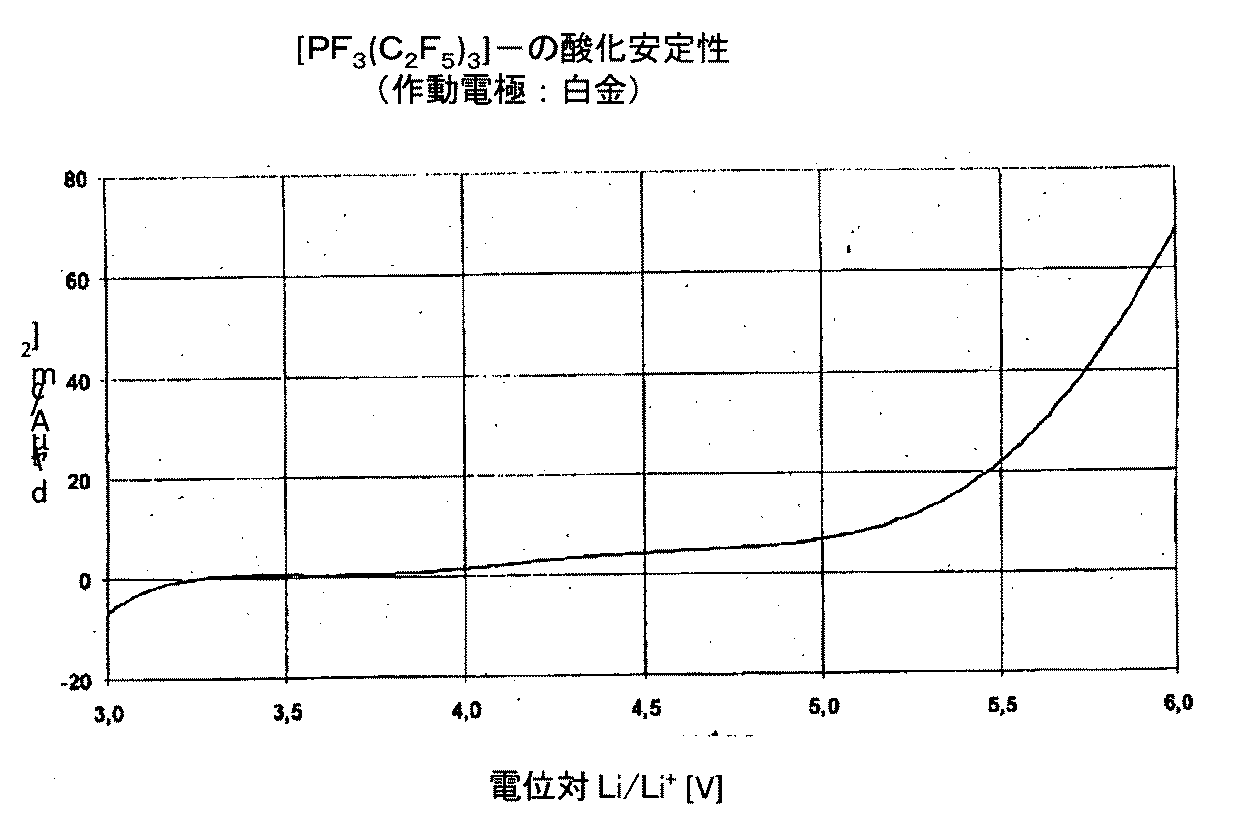
ここでは全ての電解質は5Vよりも大きな正電極安定性を示す。図1は、これを[PF3(C2 F 5)3]-を含む電解質について代表的な態様で示す。
【0046】
【0047】
【発明の効果】
本発明により提供されるフルオロアルキルホスフェートは簡単に製造することができ、電気化学的に安定であり、これを各種電池、コンデンサ、スーパーコンデンサ等の導電性電解質に使用すると、それらの実用寿命が延長され、性能が改善される。
【図面の簡単な説明】
【図1】 白金作動電極を含む測定電池中の、[PF3(C2 F 5)3]- の酸化安定性を示すグラフ。[0001]
BACKGROUND OF THE INVENTION
The present invention relates to fluoroalkyl phosphates, methods for producing them and methods for using them as conductive salts in batteries, capacitors, supercapacitors and galvanic batteries.
[0002]
[Prior art]
In recent years, the popularity of portable electronic devices such as laptop and palmtop computers, mobile phones or video cameras, and thus the demand for lightweight and high performance batteries has also increased dramatically worldwide.
[0003]
In view of this sudden increase in demand for various types of batteries and the ecological problems associated therewith, it is increasingly important to develop rechargeable batteries with a long service life.
[0004]
Lithium ion batteries and double layer capacitors (so-called supercapacitors or ultracapacitors) with very large capacities represent the current state of the art. LiPF as the conductive salt in both systems6 Or N (C2HFive)FourBFFour Substances that are susceptible to hydrolysis and are thermally unstable are generally used. HF is rapidly formed upon contact with moist air or with residual moisture from the solvent. In addition to its toxic properties, HF has a very detrimental effect on cycle behavior and thus on the electrochemical performance of the battery. Alternatives provided so far are imides such as bis (trifluoromethylsulfonyl) imide or bis (pentafluoroethylsulfonyl) imide or, for example, tris (trifluoromethylsulfonyl) methanide and its derivatives. Methanides. These salts have high positive electrode stability and form highly conductive solutions with various organic aprotic solvents. However, these imides have the disadvantage that they do not sufficiently passivate the aluminum metal that acts as a negative electrode current collector in various batteries. In contrast, methanides can only be produced and purified with very great effort (Turowsky, Seppelt: Inorg. Chem., 1988, 2135). In addition, electrochemical properties such as aluminum oxidation stability and passivation are very much dependent on the purity of its methanide.
[0005]
[Problems to be solved by the invention]
Accordingly, it is an object of the present invention to provide conductive salts that are electrochemically stable and simple to manufacture.
[0006]
The present invention also aimed to extend the useful life of batteries, capacitors, supercapacitors and galvanic batteries and to improve their performance.
[0007]
[Means for Solving the Problems]
Surprisingly,This purpose is,The following general formula (I)
Mn +[[PFx(CyF2y + 1-zHz)6-x]-]n (I)
Of fluoroalkyl phosphate,
that time,In this formula
1 ≦ x ≦ 6,
1 ≦ y ≦ 8,
0 ≦ z ≦ 2y + 1,
1 ≦ n ≦ 5, and
Mn +Is a monovalent to trivalent cation,
NR1R2RThreeRFour,
PR1R2RThreeRFour,
P (NR1R2)kRThree mRFour 4-km
(Where k = 1 to 4, m = 0 to 3, and k + m ≦ 4),
C (NR1R2) (NRThreeRFour) (NRFiveR6),
C (aryl)Three ,
Rb or
Tropylium,
that time
R1Or R8Is,H,(C 1 Or C 8 ) Alkyl or arylIn Although,
These are partly,Optionally substituted by F, Cl or Br;
Also,that time,Mn += Li+, Na+, Cs+, K+And Ag+Is excluded.
[0008]
Fluoroalkyl phosphates of the following formulas are preferred:
N (C2HFive)Four[PFThree(C2 F Five)Three],
N (CHThree)Four[PFThree(CFour F 9)Three],
[N (CHThree)Four] [PFThree(CFour F 9)Three],
[N (C2HFive)Four] [PFThree(C2 F Five)Three],
P [N (CHThree)2]Four[PFThree(C2 F Five)Three],
P [N (CHThree)2]Four[PFThree(CFour F 9)Three],
[P (CHThree)Four]+[PFThree(C2 F Five)Three]-,
[P (C2HFive)Four]+[PFThree(C2 F Five)Three]-,
[P (CHThree)Four]+[PFThree(CFour F 9)Three]-,
[P (C2HFive)Four]+[PFThree(CFour F 9)Three]-,
C [N (CHThree)2]Three[PFThree(C2 F Five)Three] as well as
C [N (CHThree)2]Three[PFThree(CFour F 9)Three],
In the present inventionAffectThese compounds have been found to have very high electrochemical stability. That is, in the present inventionAffectThe fluoroalkyl phosphates of the general formula (I) are,In each pure form and in the form of a mixture of them,onceas well assecondaryIt can be used as a conductive salt in batteries, capacitors, supercapacitors and galvanic batteries. In the present inventionAffectFluoroalkyl phosphates can also be used as conductive salts with other salts known to those skilled in the art.
[0009]
The fluoroalkyl phosphates according to the invention are preferably used in pure form as conductive salts, since in this way particularly good reproducibility of electrochemical properties can be achieved. .
[0010]
These fluoroalkyl phosphates are made starting from phospholane compounds made by the method described in German patent DE19641138. Solutions or suspensions of these phosphorane compounds or their fluoroalkyl phosphates in 0.01 to 4 molar, preferably 0.5 to 3 molar, particularly preferably 1.5 to 2.5 molar, Among the solvents, preferably organic aprotic solvents, particularly preferably, carbonates, esters, ethers, nitriles, amides, ketones, sulfonate esters, sulfonamides, sulfoxides, Made in a solvent selected from the group consisting of phosphate esters, phosphoranes, chloroalkanes and mixtures thereof. Preferred solvents are solvents or solvent mixtures suitable for direct use in primary or secondary batteries, capacitors, supercapacitors or galvanic batteries, such as dimethyl carbonate, diethyl carbonate, propylene carbonate, ethylene carbonate, ethyl methyl carbonate, carbonate Methylpropyl, 1,2-dimethoxyethane, 1,2-diethoxyethane, methyl acetate, γ-butyrolactone, ethyl acetate, methyl propionate, ethyl propionate, methyl butyrate, ethyl butyrate, dimethyl sulfoxide, dioxolane, sulfolane, acetonitrile , Acrylonitrile, tetrahydrofuran, 2-methyltetrahydrofuran or mixtures thereof.
[0011]
Reactions with fluoroalkyl phosphates include metal or non-metal fluoride, chloride, tetrafluoroborate or hexafluorophosphate, preferably (N R1 R2 RThree RFour) F, (NR1 R2 RThree RFour) Cl, (PR1 R2 RThree RFour) F, (PR1 R2 RThree RFour) Cl, [P (NR1 R2)Four] F, [P (N R1 R2)Four] Cl, [C (NR1 R2)Three] Cl and [C (N R1 R2)ThreeThose selected from the group consisting of] F are added, if desired, in equimolar amounts or in slight excesses of the preparations in the form of their solutions. For reaction with phosphorane, N (CHThree)FourF, N (C2HFive)FourF, [P [(CHThree)2]Four] F or C [N (CHThree)2]ThreeAn equimolar amount of F or a slight excess is added. The mixture is stirred in the liquid region, preferably at a temperature between 0 ° C. and 50 ° C., particularly preferably at room temperature. This is stirred for 0.5 to 48 hours, preferably 2 to 12 hours. If the fluoroalkyl phosphate according to the invention is produced by metathesis, the resulting by-products are separated off by cooling the reaction mixture and subsequent filtration. In the case of reactions where no by-products are formed, the reaction mixture can be used directly subsequently.
[0012]
The resulting electrolyte is suitable for use in primary batteries, secondary batteries, capacitors, supercapacitors and galvanic batteries and is also one of the subjects of the present invention.
[0013]
The concentration of the fluoroalkyl phosphate according to the invention in such an electrolyte is preferably 0.01 to 4 mol / liter, particularly preferably 0.5 to 3 mol / liter.
[0014]
The invention also provides a primary battery, secondary battery, capacitor, supercapacitor and galvanic battery comprising at least one fluoroalkyl phosphate of general formula (I) according to the invention and optionally further salts and / or additives. Also related. Other salts and additives mentioned above are known to those skilled in the art, such as Doron Aurbach: “Non aqueous Electrochemistry” published by Marc Dekker Inc., New York, 1999; D. Linden: “Handbook” published by McGraw-Hill Inc., New York, 1995. ofBatteries, 2nd edition, and G. Mamantov and AI Popov published in 1994 Weinheim VCH Verlagsgemeinschaft: “Chemistry of Nonaqueous Solutions, Current Progress”, which are hereby incorporated by reference and thus These are considered part of the present disclosure.
[0015]
BEST MODE FOR CARRYING OUT THE INVENTION
The fluoroalkyl phosphates according to the invention can be used with conventional electrolytes. An example of a suitable electrolyte is LiPF6 , LiBFFour , LiClOFour, LiAsF6, LiCFThreeSOThree, LiN (CFThreeSO2)2 And LiC (CFThreeSO2)Three And a conductive salt selected from the group consisting of mixtures thereof. These electrolytes can also contain organic isocyanates (German Patent DE 19944603) in order to reduce the water content. The following general formula
MX +[(EZ)y-]x / y
The lithium complex salt (German Patent DE 19951804) may be present,
x and y are 1, 2, 3, 4, 5 or 6;
Mx +Is a metal ion,
E is BR1 R2 RThree , AlR1 R2 RThree , PR1 R2 RThree RFour RFive ,
AsR1 R2 RThree RFour RFive And VR1 R2 RThree RFour RFive Selected from the group consisting of
Lewis acid
R1 Or RFive May be the same or different, and in some cases
Can be directly connected to each other by single bonds or double bonds,
And these are individually or together,
Halogen (F, Cl or Br),
Partially or fully substituted by F, Cl or Br
A good alkyl or alkoxy group (C1 Or C8), Or
Unsubstituted or alkyl (C1 Or C8Or F
, Cl or Br may be mono-substituted or hexa-substituted
, Phenyl, naphthyl, anthracenyl and phenanthrenyl
Selected from the group consisting of optionally bonded via oxygen
Aromatic ring, or unsubstituted or alkyl (C1 Absent
C8Or mono- or tetra-substituted by F, Cl or Br
May be made of pyridyl, pyrazyl, and pyrimidyl
Selected from the group and optionally bonded via oxygen
Represents an aromatic ring,
And
Z is OR6 , N R6 R7 , CR6 R7 R8 , OSO2R6 ,
N (SO2 R6) (SO2R7), C (SO2 R6) (SO2R7) (SO2R8) Or OCO R6 so
Yes, at that time
R6 Or R8 Can be the same or different, and if
Are directly connected to each other by single bonds or double bonds
And these can be individually or together
A hydrogen atom or R1 Or RFive Same as defined for
Can be expressed,
The complex salt is then made by reacting the corresponding boron or phosphorus Lewis acid / solvent adduct with lithium imide or tetraalkylammonium imide, methanide or triflate.
[0016]
The following general formula
[0017]
[Chemical 1]
Borate salts (German Patent DE 95959722) can also be present, in this formula
M is a metal ion or a tetraalkylammonium ion,
x and y are 1, 2, 3, 4, 5 or 6;
R1 Or RFive May be the same or different, and in some cases simply
Alkoxy residues or bonds directly connected to each other by a bond or a double bond
Ruboxyl residue.
[0019]
These borate salts are prepared by reacting a 1: 1 mixture of lithium tetraalkoxyborate or lithium alkoxide and borate with an appropriate hydroxyl compound or carboxyl compound in an aprotic solvent in a ratio of 2: 1 or 4: 1. Made by.
[0020]
The following general formula:
SiR1 R2 RThree RFour
Various additives such as silane compounds can also be present, wherein
R1 Or RFour H, CyF2y + 1-zHz , OCyF2y + 1-zHz, OC (O) CyF2y + 1-zHz Or OSO2CyF2y + 1-zHz And in that case
1 ≦ x <6,
1 ≦ y ≦ 8, and
0 ≦ z ≦ 2y + 1, and at that time
R1 Or RFour Can be the same or different and are selected from the group consisting of phenyl and naphthyl, unsubstituted or F, CyF2y + 1-zHz , OCyF2y + 1-zHz, OC (O) CyF2y + 1-zHz, OSO2CyF2y + 1-zHz Or N (CnF2n + 1-zHz)2 Is an aromatic ring which may be mono- or poly-substituted by, or selected from the group consisting of pyridyl, pyrazyl and pyrimidyl, F, CyF2y + 1-zHz , OCyF2y + 1-zHz, OC (O) CyF2y + 1-zHz, OSO2CyF2y + 1-zHz Or N (CnF2n + 1-zHz)2 It may also be a heteroaromatic ring which may be mono- or polysubstituted by (German Patent DE 100 626 626).
[0021]
The compounds according to the invention also have the following formula:
Li+[PFx(CyF2y + 1-zHz)6-x]-
In
1 ≦ x ≦ 5,
3 ≦ y ≦ 8, and
0 ≦ z ≦ 2y + 1, and
Each ligand (CyF2y + 1-zHz) May be the same or different
It can also be used in electrolytes containing lithium fluoroalkyl phosphates, provided that compounds of the general formula
Li+[PFa[CHbFc(CFThree)d]e]-
Wherein a is an integer from 2 to 5, b is 0 or 1, c is 0 or 1, d is 2, and e is an integer from 1 to 4, wherein b and c Are not simultaneously 0, and the sum of a + e is equal to 6 and each ligand [CHbFc(CFThree)d], Which may be the same or different, are excluded (German Patent DE 10008955).
[0022]
The method for producing lithium fluoroalkyl phosphate has the following general formulas:
HmP (CnH2n + 1)3-m ,
OP (CnH2n + 1)Three,
ClmP (CnH2n + 1)3-m,
FmP (CnH2n + 1)3-m ,
CloP (CnH2n + 1)5-o as well as
FoP (CnH2n + 1)5-o ,
Fluorinated by electrolyzing in hydrogen fluoride at least one of the compounds wherein 0 ≦ m ≦ 2, 3 ≦ n ≦ 8, and 0 ≦ o ≦ 4, and the resulting fluorinated product And the resulting fluorinated alkylphosphorane is reacted with lithium fluoride in an aprotic solvent mixture under exclusion of moisture, and The obtained salt is purified and separated by a conventional method.
[0023]
The compounds according to the invention also have the formula
Li [P (OR1)a(OR2)b(ORThree)c(ORFour)dFe]
0 <a + b + c + d ≦ 5, a + b + c + d + e = 6, and R1 Or RFour Independently of one another are alkyl, aryl or heteroaryl residues, wherein R1 Or RFour At least two of these can also be used in an electrolyte comprising a salt directly linked to each other by a single or double bond (DE 10016801). These compounds have the general formula
P (OR1)a(OR2)b(ORThree)c(ORFour)dFe
0 <a + b + c + d ≦ 5, a + b + c + d + e = 5, and R1 Or RFour Is made by reacting a phosphorus (V) compound as defined above with lithium fluoride in the presence of an organic solvent.
[0024]
The following general formula:
K+ A-
It is also possible that the ionic liquid is present in the electrolyte,
K+ Is the following:
[0025]
[Chemical 2]
A cation selected from the group consisting of
R1 Or RFive May be the same or different, and in some cases simply
Can be directly connected to each other by a bond or a double bond, and
H or halogen or C separately or together1 Or C8 The alkyl
Residue (this may be another group, F 1, Cl, or N (CnF2n + 1-xHx)2 , O (CnF2n + 1-xHx),
SO2(CnF2n + 1-xHx) Or CnF2n + 1-xHx 1 <n <6 and 0 <x ≦ 13
Which may be partially or fully substituted by the group
Can
And
A- Is [B (OR1)n(OR2)m(ORThree)o(ORFour)m]- An anion selected from the group consisting of 0 ≦ n, m, o, p ≦ 4 and m + n + o + p = 4 in this formula,
R1 Or RFour Is
Can be different or the same in several pairs; and
Optionally directly connected to each other by single or double bonds,
Individually or together, phenyl, naphthyl, anthracenyl and
Selected from the group consisting of enanthrenyl and unsubstituted or
CnH2n + 1-xHx (Where 1 <n <6 and 0 <x ≦ 13) or halogen
Aromatics optionally mono- or polysubstituted by (F 1, Cl 2 or Br 3)
ring,
Selected from the group consisting of pyridyl, pyrazyl and pyrimidyl and substituted
Or CnH2n + 1-xHx (However, 1 <n <6 and 0 <x ≦ 13
Mono- or poly-substituted by halogen) (F, Cl or Br)
An unusual aromatic ring, or
Other groups, preferably F 1, Cl, or N (CnF2n + 1-xHx)2 , O (CnF2n + 1-xHx),
SO2(CnF2n + 1-xHx) Or CnF2n + 1-xHx 1 <n <6 and 0 <x ≦ 13
An alkyl group which may be partially or fully substituted by a group (C1
Or C8) Or
OR1 Or ORFour Is
Each individually or together, another group, preferably F 2, Cl, or
N (CnF2n + 1-xHx)2 , O (CnF2n + 1-xHx), SO2(CnF2n + 1-xHx) Or CnF2n + 1-xHx
Partially or completely substituted by groups where 1 <n <6 and 0 <x ≦ 13
Aromatic or aliphatic carboxyl, dicarboxyl, o
Residues of xylsulfonyl or oxycarbonyl (German Patent DE10025
65).
[0027]
Ionic liquid K+ A- At K+ Is as defined above and A- But,
[PFx(CyF2y + 1-zHz)6-x]-
In
1 ≦ x <6,
1 ≦ y ≦ 8, and
0 ≦ z ≦ 2y + 1
It is also possible that there is an anion selected from the group consisting of ions (German Patent DE 100 099 955).
[0028]
The compounds according to the invention can also be used to reduce the acid content in an aprotic electrolyte system in electrochemical cells:
N R1 R2 RThree
Can be present in an electrolyte containing a compound of the formula
R1 And R2 H, CyF2y + 1-zHz Or (CnF2n-mHm) X, where X is an aromatic or heterocyclic residue, and
RThree (CnF2n-mHm) Y (where Y is a heterocyclic residue), or
(CoF2o-pHpZ, where Z is an aromatic residue and n, m,
o, p, y and z are the following conditions:
0 ≦ n ≦ 6,
0 ≦ m ≦ 2n,
2 ≦ o ≦ 6,
0 ≦ p ≦ 2o,
1 ≦ y ≦ 8 and
0 ≦ z ≦ 2y + 1
Satisfied.
[0029]
The electrolyte is also
a) The following general formula
Li+[PFx(CyF2y + 1-zHz)6-z]-
In
1 ≦ x ≦ 5,
1 ≦ y ≦ 8, and
0 ≦ z ≦ 2y + 1, and
Their ligands (CyF2y + 1-zHz) Are the same or different
At least one lithium fluoroalkyl phosphate salt; and
b) at least one polymer;
Can also be included (German Patent DE 10058264).
[0030]
The electrolyte also has the general formula
Mn +[(BRFour)-]n
And tetrakisfluoroalkyl borate salts ofn +Is a monovalent, divalent or trivalent cation, and each ligand R is the same as (CxF2x + 1(Where 1 ≦ x ≦ 8) and n is 1, 2 or 3 (German Patent DE10055811).
[0031]
The process for producing the tetrakisfluoroalkyl borate has the general formula
Mn +[[B (CN)Four]-]n
At Mn +And fluorinating at least one compound, wherein n is as defined above, by reacting with at least a fluorinating agent in at least one solvent, and the resulting fluorinated compound is purified and separated by conventional methods. It is characterized by doing.
[0032]
The electrolyte also has the general formula
Mn +[[BFx(CyF2y + 1-zHz)4-x]-]n
Borate salts of the formula, where 1 <x <3,
1 ≦ y ≦ 8 and 0 ≦ z ≦ 2y + 1, and M is a monovalent to trivalent cation (1 ≦ n ≦ 3) except potassium and barium, among which Li or NR1 R2 RThree RFour , PRFive R6 R7 R8 , P (N RFive R6)k R7 mR8 4-km (Where k is 1 to 4, m is 0 to 3 and k + m ≦ 4), or
C (N RFive R6) (NR7 R8) (NR9 R19) Where R is1 Or RFour Is CyF2y + 1-zHz And RFive Or RTenIs H or CyF2y + 1-zHz Or M is a heteroaromatic ring cation, in particular a nitrogen-containing and / or oxygen-containing and / or sulfur-containing heteroaromatic ring cation (DE 10 103 189).
[0033]
The method for producing these compounds is:
a) Each BFThree/ Reaction of solvent complex compound 1: 1 with alkyllithium under cooling
Most of the solvent is slowly warmed and then removed, and then the solid
Is filtered off and washed with a suitable solvent, or
b) The lithium salt is 1: 1 in a suitable solvent with B (CFThree) FThree React with the salt of
The mixture is then stirred at an elevated temperature to remove the solvent and
In an aprotic non-aqueous solvent, preferably in an electrochemical cell
Add the solvent used and dry the mixture, or
c) B (CFThree) FThree At an elevated temperature in a ratio of 1: 1 to 1: 1.5
React with lithium salt in water and boil for 0.5 to 2 hours
Heat to a point to remove moisture and add an aprotic non-aqueous solvent, preferably to the reaction mixture.
Preferably, the solvent used in electrochemical cells is added and mixed.
Dry the compound
It is characterized by that.
[0034]
The electrolyte also has the general formula
Mn +[[PFx(CyF2y + 1-zHz)6-x]-]n
Or a fluoroalkyl phosphate salt ofn +Is a monovalent, divalent or trivalent cation, 1 ≦ x ≦ 5, 1 ≦ y ≦ 8 and 0 ≦ z ≦ 2y + 1, n is 1, 2 or 3, and the respective ligand (CyF2y + 1-zHz) May be the same or different, provided that Mn +A fluoroalkyl phosphate salt wherein is a lithium cation and
M+[[PFFour(CFThree)2]- At M+ Cs+, Ag+ Or K+ Salt,
M+[[PFFour(C2FFive)2]- At M+ Cs+ The salt, M+[[PFThree(C2FFive)Three]- At M+ Cs+, K+, Na+ Or p-Cl (C6HFour) N2 + A salt or M+[[PFThree(CThreeF7)Three]- At M+ Cs+, K+, Na+ , P-Cl (C6HFour) N2 + Or p-O2N (C6HFour) N2 + Is excluded (German Patent DE 10055812).
[0035]
These fluoroalkyl phosphate salts are produced by the following general formulas:
HrP (CsH2s + 1)3-r ,
OP (CsH2s + 1)Three,
ClrP (CsH2s + 1)3-r,
FrP (CsH2s + 1)3-r ,
CltP (CsH2s + 1)5-tAnd / or
FtP (CsH2s + 1)5-t
At least one compound in which 0 ≦ r ≦ 2, 3 ≦ s ≦ 8 and 0 ≦ t ≦ 4 by electrolysis in hydrogen fluoride, separating the resulting mixture of fluorinated products, and The resulting fluorinated alkylphosphorane is represented by the general formula Mn +(F-)n At Mn +And reacting the compound in which n is the same as defined above in an aprotic solvent or solvent mixture excluding moisture, and purifying and separating the resulting fluoroalkyl phosphate salt by conventional methods. Features.
[0036]
The compounds according to the invention have the following formula:
(Ma +)b[(CnF2n + 1-mHm)yPF5-y(CR1 R2)xPF5-y(CnF2n + 1-mHm)y](2-) (a * b / 2)
In an electrolyte containing a fluoroalkylphosphate salt of (DE 10109032), in which
Ma +Is a monovalent, divalent or trivalent cation, a is 1, 2 or 3, b
Is 2 when a is 1, b is 2 when a is 3, and b is 2 when a is 2.
1 and in each case 1 ≦ n ≦ 8 and n is 1 or
Is 0 ≦ m ≦ 2 when 2, and 0 ≦ m ≦ 4 when 3 ≦ n ≦ 8.
1 ≦ x ≦ 12, 0 ≦ y ≦ 2, and R1 And R2 Are the same
Or are different and are fluorine, hydrogen, alkyl, fluoroalkyl
Selected from the group consisting of
In some cases, each substituent (CnF2n + 1-mHm) May be the same or different
Yes.
[0037]
These compounds have at least one fluoro-α, ω-bis (alkylfluorophosphorano) alkane represented by the general formula (Ma +) (F-)a At Ma + By reacting in solution with at least one fluoride salt, as defined above, to form a fluoroalkyl phosphate salt and, if desired, purifying and / or separating this latter by conventional methods. Manufactured.
[0038]
The compound according to the invention comprises an electrolyte for an electrochemical cell comprising a positive electrode material comprising a coated metal core selected from the group consisting of Sb, Bi, Cd, In, Pb, Ga and tin or alloys thereof. (German Patent DE 10016024). The method for producing this positive electrode material is:
a) preparing a suspension or sol in the urotropin of the metal or alloy core (core material);
b) Add this suspension to CFive -C12 Emulsified with a hydrocarbon of
c) precipitating the emulsion on the metal or alloy core; and
d) the metal hydroxide or hydroxide is converted to the corresponding oxide by heating the system
It is characterized by that.
[0039]
The compounds according to the invention also consist of lithium mixed oxide particles coated with one or more metal oxides as well as electrochemical cells with negative electrodes made of common lithium intercalation compounds and intercalation compounds It can also be used in electrolytes for electrochemical cells using negative electrode materials (German Patent DE 19922252). They can also consist of lithium mixed oxide particles coated with one or more polymers (German Patent DE 199446066). The compounds according to the invention can likewise be used in systems having a negative electrode consisting of lithium mixed oxide particles with one or more coatings of alkali metal compounds and metal oxides (German Patent DE 100148884). The method for producing these substances is to suspend the particles in an organic solvent, add an alkali metal salt compound suspended in the organic solvent, add a metal oxide dissolved in the organic solvent, A hydrolytic solution is added to the suspension and the coated particles are then filtered off, dried and roasted. The compounds according to the invention can likewise be used in systems comprising positive electrode materials comprising doped tin oxide (German Patent DE 10025761). This positive electrode material is
a) adding urea to a solution of tin chloride;
b) Add urotropin and a suitable dope compound to this solution,
c) The obtained sol is emulsified in petroleum ether,
d) washing the resulting gel and removing the solvent by suction; and
e) Dry and heat the gel
Made by.
[0040]
The compounds according to the invention can likewise be used in systems comprising positive electrode materials comprising reduced tin oxide (German Patent DE 10025762). This positive electrode material is
a) adding urea to a solution of tin chloride;
b) Add urotropin to this solution,
c) The obtained sol is emulsified in petroleum ether,
d) washing the resulting gel and removing the solvent by suction;
e) the gel is dried and heated, and
f) SnO obtained2 Is exposed to reducing gas flow in an aerated furnace
Made by.
[0041]
The fluoroalkyl phosphates according to the invention have the advantage that they are electrochemically stable. This property makes it possible to use conductive salts containing the compounds according to the invention in various batteries, capacitors, supercapacitors and galvanic batteries.
[0042]
【Example】
Hereinafter, the present invention will be described by way of examples. These examples merely illustrate the invention and do not limit the scope of the invention.
Example 1
Li [PFThree(C2 F Five)Three] Via N (C2HFive)Four[PFThree(C2 F Five)Three]Manufacturing of
An equimolar amount of N (C in methylene chloride2HFive)FourX (where X is,F or Cl),1.5 to 2.5 molar Li [PFThree(C2 F Five)Three] To the solution. The solution is stirred at room temperature for a long time,,A slight precipitation of LiX occurs. The reaction mixture is then further maintained at a temperature from -30 ° C to -10 ° C for 2 hours, and,The resulting precipitate is filtered off at -30 ° C to -10 ° C under reduced pressure. The solvent is removed by distillation. The product can then be obtained in the form of colorless granules after drying at 100 ° C. under reduced pressure.
[0043]
19F-NMR spectroscopy (CDThreeCN, standard: CClThreeF):
-43.6 dm (1F)
-79.7 m (3F)
-81.3 m (6F)
-87.0 dm (2F)
-115.3 m (4F)
-115.7 m (2F)
Example 2
PF2(C2 F Five)ThreeVia N (CHThree)Four[PFThree(C2 F Five)Three]Manufacturing of
An equimolar amount of N (CHThree)FourF,10 g PF in dichloromethane2(C2 F Five)Three(Prepared according to German patent DE 198464636) at -40 ° C. The mixture is stirred for a long time and allowed to warm to room temperature. The solvent is removed by distillation and N (CHThree)Four[PFThree(C2 F Five)Three] Is separated.
[0044]
19F-NMR spectroscopy (CDThreeCN, standard: CClThreeF):
-44.0 dm (1F)
-80.0 m (3F)
-82 m (6F)
-87.5 dm (2F)
-115.8 m (4F)
-116.2 m (2F)
Example 3
PF2(CFour F 9)ThreeVia N (CHThree)Four[PFThree(CFour F 9)Three]Manufacturing of
Manufacturing,PF2(CFour F 9)ThreeStarting from the same procedure as in Example 2. The cation source used was N (CHThree)FourF.
Example 4
P [N (CHThree)2]Four[PFThree(C2FFive)Three] And P [N (CHThree)2]Four[PFThree(CFour F 9)Three]Manufacturing of
Production is carried out as in Example 2. The cation source used was P [N (CHThree)2]FourF.
Example 5
P [N (CHThree)2]Four[PFThree(CFourF9)Three] And P [N (CHThree)2]Four[PFThree(C2 F Five)Three]Manufacturing of
Production is carried out as in Example 1. The cation source used was P [N (CHThree)2]FourCl.
Example 6
C [N (CHThree)2]Three[PFThree(C2FFive)Three] And C [N (CHThree)2]Three[PFThree(CFour F 9)Three]Manufacturing of
Production is carried out as in Example 1. The cation source used was C [N (CHThree)2]ThreeCl.
Example 7
Electrochemical stability of electrolyte
In each case, five cycles of voltammograms were recorded in sequence in a measuring battery comprising a stainless steel, platinum or gold working electrode, a lithium counter electrode and a lithium reference electrode. For this purpose, starting from a resting potential, the potential is initially Li / Li at a rate of 10 mV / sec or 20 mV / sec.+Was raised to 6V and then returned to its resting potential. A 1: 1 mixture of EC and DMC was used as solvent so that the best possible electrochemical window was available.
[0045]
Here, all electrolytes show positive electrode stability greater than 5V. Figure 1 shows this as [PFThree(C2 F Five)Three]-It shows in a typical aspect about the electrolyte containing.
[0046]
[0047]
【The invention's effect】
The fluoroalkyl phosphate provided by the present invention can be easily produced and is electrochemically stable. When used in conductive electrolytes such as various batteries, capacitors and supercapacitors, their practical life is extended. And the performance is improved.
[Brief description of the drawings]
FIG. 1 shows a [PF] in a measuring battery including a platinum working electrode.Three(C2 F Five)Three]-The graph which shows the oxidation stability of.
Claims (12)
M+[PFx(CyF2y+1−zHz)6−x]− (I)
但し、上記の式(I)中、
x=3であり、
1≦y≦8であり、
z=0であり、
M+は、下記の群から選択される:
[N(R 1 ) 4 ] +
その際、R1は、炭素数(C1−C8)のアルキル基である。Fluoroalkyl phosphates of the following general formula (I):
M + [PF x (C y F 2y + 1-z H z) 6-x] - (I)
However, in the above formula (I),
x = 3,
1 ≦ y ≦ 8,
z = 0,
M + is selected from the following group:
[N (R 1 ) 4 ] +
In this case, R 1 is an alkyl group having a carbon number (C 1 -C 8 ).
a) [N(C2H5)4]+[PF3(C2F5)3]−、
b) [N(CH3)4]+[PF3(C2F5)3]−、
c) [N(CH3)4]+[PF3(C4F9)3]− 。 2. The fluoroalkyl phosphate of claim 1 selected from the group consisting of a), b), c ) below:
a) [N (C 2 H 5 ) 4 ] + [PF 3 (C 2 F 5 ) 3 ] − ,
b) [N (CH 3 ) 4 ] + [PF 3 (C 2 F 5 ) 3 ] − ,
c) [N (CH 3 ) 4 ] + [PF 3 (C 4 F 9 ) 3 ] − .
該方法は、
溶媒中において、
[PFx−1(CyF2y+1−zHz)6−x]に、M+F−を反応させる、あるいは、
Li+[PFx(CyF2y+1−zHz)6−x]−に、M+X−を反応させる工程を有する
但し、
M+は、請求項1に定義されており、
x、y、zは、請求項1に定義されており、
X−は、F−、Cl−、BF4 −、ならびにPF6 −から選択される
ことを特徴とする方法。A process for producing a fluoroalkyl phosphate according to claim 1 comprising:
The method
In the solvent,
The [PF x-1 (C y F 2y + 1-z H z) 6-x], M + F - reacting, or,
Li + [PF x (C y F 2y + 1-z H z) 6-x] - in, M + X - where has the step of reacting,
M + is defined in claim 1,
x, y, z are defined in claim 1,
X − is selected from F − , Cl − , BF 4 − , and PF 6 − .
[PFx−1(CyF2y+1−zHz)6−x]に、M+F−を反応させる
但し、
M+は、請求項1に定義されており、
x、y、zは、請求項1に定義されている
ことを特徴とする請求項3に記載の方法。In an organic aprotic solvent,
The [PF x-1 (C y F 2y + 1-z H z) 6-x], M + F - where are reacted,
M + is defined in claim 1,
The method of claim 3, wherein x, y, and z are defined in claim 1.
ことを特徴とする請求項3に記載の方法。M + F - is, [N (CH 3) 4 ] + F -, [N (C 2 H 5) 4] + F - The method according to claim 3, characterized in that it is chosen from.
[PFx−1(CyF2y+1−zHz)6−x]に、M+F−を反応させる
ことを特徴とする請求項3に記載の方法。Among solvents or solvent mixtures suitable for direct use in primary or secondary batteries, capacitors, supercapacitors or galvanic batteries,
The [PF x-1 (C y F 2y + 1-z H z) 6-x], M + F - The method of claim 3, wherein the reacting.
有機非プロトン溶媒である
ことを特徴とする請求項3に記載の方法。The solvent is selected from carbonates, esters, ethers, nitriles, amides, ketones, sulfonate esters, sulfonamides, sulfoxides, phosphate esters, phosphoranes, chloroalkanes, and mixtures thereof. Selected from the group
4. A process according to claim 3, which is an organic aprotic solvent.
ことを特徴とする請求項3に記載の方法。The solvent is dimethyl carbonate, diethyl carbonate, propylene carbonate, ethylene carbonate, ethyl methyl carbonate, methyl propyl carbonate, 1,2-dimethoxyethane, 1,2-diethoxyethane, methyl acetate, γ-butyrolactone, ethyl acetate, propion 4. The method according to claim 3, characterized in that it is selected from the group consisting of methyl acid, ethyl propionate, methyl butyrate, ethyl butyrate, dimethyl sulfoxide, dioxolane, sulfolane, acetonitrile, acrylonitrile, tetrahydrofuran, 2-methyltetrahydrofuran and mixtures thereof. The method described.
前記電解質は、該溶液中に、前記少なくとも一つのフルオロアルキルホスフェートを含む
ことを特徴とする使用。Use of at least one fluoroalkyl phosphate as a conductive salt according to claim 1 in the preparation of an electrolyte for a primary battery, secondary battery, capacitor, supercapacitor or galvanic battery comprising:
Use wherein the electrolyte comprises the at least one fluoroalkyl phosphate in the solution.
該溶液中に、請求項1に記載の少なくとも一つのフルオロアルキルホスフェートを含むことを特徴とする電解質。Electrolyte for primary battery, secondary battery, capacitor, super capacitor or galvanic battery,
An electrolyte comprising at least one fluoroalkyl phosphate according to claim 1 in the solution.
ことを特徴とする請求項10に記載の電解質。11. The electrolyte according to claim 10, wherein the concentration of at least one fluoroalkyl phosphate is 0.01 to 4 mol / liter.
ことを特徴とする請求項10に記載の電解質。11. The electrolyte according to claim 10, wherein the concentration of at least one fluoroalkyl phosphate is 0.5 to 3 mol / liter.
Applications Claiming Priority (2)
| Application Number | Priority Date | Filing Date | Title |
|---|---|---|---|
| DE10038858A DE10038858A1 (en) | 2000-08-04 | 2000-08-04 | Fluoroalkyl phosphates for use in electrochemical cells |
| DE10038858-2 | 2000-08-04 |
Publications (2)
| Publication Number | Publication Date |
|---|---|
| JP2002138095A JP2002138095A (en) | 2002-05-14 |
| JP5048898B2 true JP5048898B2 (en) | 2012-10-17 |
Family
ID=7651845
Family Applications (1)
| Application Number | Title | Priority Date | Filing Date |
|---|---|---|---|
| JP2001235045A Expired - Fee Related JP5048898B2 (en) | 2000-08-04 | 2001-08-02 | Fluoroalkyl phosphates for use in electrochemical cells |
Country Status (10)
| Country | Link |
|---|---|
| US (1) | US6841301B2 (en) |
| EP (1) | EP1178050B1 (en) |
| JP (1) | JP5048898B2 (en) |
| KR (1) | KR100801811B1 (en) |
| CN (1) | CN1279046C (en) |
| BR (1) | BR0103182A (en) |
| CA (1) | CA2354794A1 (en) |
| DE (2) | DE10038858A1 (en) |
| RU (1) | RU2265609C2 (en) |
| TW (1) | TW530432B (en) |
Families Citing this family (20)
| Publication number | Priority date | Publication date | Assignee | Title |
|---|---|---|---|---|
| DE10119278C1 (en) * | 2001-04-20 | 2002-10-02 | Merck Patent Gmbh | Preparation of (per)fluoroalkylperfluorophosphates, used as conductive salt in battery, capacitor, supercapacitor or galvanic cell, involves reacting fluoroalkylphosphorane with metal or nonmetal fluoride without solvent |
| DE10130940A1 (en) * | 2001-06-27 | 2003-01-16 | Merck Patent Gmbh | Super acids, manufacturing processes and uses |
| DE10325051A1 (en) * | 2003-06-02 | 2004-12-23 | Merck Patent Gmbh | Ionic liquids with guanidinium cations |
| US7939644B2 (en) * | 2003-08-21 | 2011-05-10 | Merck Patent Gmbh | Cyanoborate, fluoroalkylphosphate, fluoroalkylborate or imide dyes |
| US20050162122A1 (en) * | 2004-01-22 | 2005-07-28 | Dunn Glenn M. | Fuel cell power and management system, and technique for controlling and/or operating same |
| KR100803193B1 (en) * | 2005-08-24 | 2008-02-14 | 삼성에스디아이 주식회사 | Organic Electrolyte and Lithium Battery |
| JP5265197B2 (en) * | 2005-12-02 | 2013-08-14 | 関東電化工業株式会社 | Ionic liquid having phosphonium cation containing PN bond and method for producing the same |
| US7696729B2 (en) * | 2006-05-02 | 2010-04-13 | Advanced Desalination Inc. | Configurable power tank |
| JP5155868B2 (en) * | 2006-09-14 | 2013-03-06 | 国立大学法人静岡大学 | Electrolyte for electrochemical devices |
| US7776385B2 (en) * | 2006-09-19 | 2010-08-17 | Toyota Motor Engineering & Manufacturing North America, Inc. | Method of chemical protection of metal surface |
| DE102007004698A1 (en) * | 2007-01-31 | 2008-08-07 | Merck Patent Gmbh | Compounds containing Organofluorochlorophosphatanionen |
| JP2010287431A (en) * | 2009-06-11 | 2010-12-24 | Sony Corp | battery |
| US8920669B2 (en) | 2009-08-03 | 2014-12-30 | Merck Patent Gmbh | Electrolyte system |
| DE102009058969A1 (en) * | 2009-12-18 | 2011-06-22 | Merck Patent GmbH, 64293 | Compound with (perfluoroalkyl) fluorohydrogenphosphate anions |
| US9312073B2 (en) | 2010-02-10 | 2016-04-12 | Nec Energy Devices, Ltd. | Nonaqueous electrolyte solution, and lithium ion secondary battery having the same |
| CN102956362B (en) * | 2011-08-17 | 2016-01-13 | 海洋王照明科技股份有限公司 | Double electric layer capacitor electrolytic solution and double electric layer capacitor |
| US10707526B2 (en) | 2015-03-27 | 2020-07-07 | New Dominion Enterprises Inc. | All-inorganic solvents for electrolytes |
| AU2017240747B2 (en) | 2016-04-01 | 2021-10-21 | Sionic Energy, Inc. | Modified ionic liquids containing phosphorus |
| US10707531B1 (en) | 2016-09-27 | 2020-07-07 | New Dominion Enterprises Inc. | All-inorganic solvents for electrolytes |
| WO2019018432A1 (en) | 2017-07-17 | 2019-01-24 | NOHMs Technologies, Inc. | Phosphorus containing electrolytes |
Family Cites Families (12)
| Publication number | Priority date | Publication date | Assignee | Title |
|---|---|---|---|---|
| US3300503A (en) * | 1963-09-19 | 1967-01-24 | Du Pont | Nitrogen-containing fluoro-phosphoranes |
| JPS63215033A (en) * | 1987-03-04 | 1988-09-07 | 松下電器産業株式会社 | electric double layer capacitor |
| JPH0645190A (en) * | 1992-07-23 | 1994-02-18 | Matsushita Electric Ind Co Ltd | Electric double-layer capacitor |
| DE4316104A1 (en) * | 1993-05-13 | 1994-11-17 | Manfred Wuehr | Electrolyte for use in a galvanic cell |
| WO1995026056A1 (en) * | 1994-03-21 | 1995-09-28 | Centre National De La Recherche Scientifique | Ionic conducting material having good anticorrosive properties |
| RU2075435C1 (en) * | 1994-12-21 | 1997-03-20 | Сибирский химический комбинат | Method of preparing lithium hexafluorophosphate |
| DE19641138A1 (en) * | 1996-10-05 | 1998-04-09 | Merck Patent Gmbh | Lithium fluorophosphates and their use as conductive salts |
| JP3702645B2 (en) * | 1998-05-12 | 2005-10-05 | 三菱化学株式会社 | Method for producing organic onium salt |
| DE10008955C2 (en) * | 2000-02-25 | 2002-04-25 | Merck Patent Gmbh | Lithium fluoroalkyl phosphates, process for their preparation and their use as conductive salts |
| DE10016801A1 (en) * | 2000-04-05 | 2001-10-11 | Merck Patent Gmbh | Lithium salts, processes for their production, non-aqueous electrolyte and electrochemical cell |
| DE10027626A1 (en) * | 2000-06-07 | 2001-12-13 | Merck Patent Gmbh | Electrolyte comprising a lithium containing inorganic or organic conductive salt contains a silane compound as an additive useful in electrochemical cells, batteries and secondary lithium batteries |
| DE10027995A1 (en) * | 2000-06-09 | 2001-12-13 | Merck Patent Gmbh | Ionic liquids II |
-
2000
- 2000-08-04 DE DE10038858A patent/DE10038858A1/en not_active Withdrawn
-
2001
- 2001-07-11 EP EP01115786A patent/EP1178050B1/en not_active Expired - Lifetime
- 2001-07-11 DE DE50108141T patent/DE50108141D1/en not_active Expired - Lifetime
- 2001-07-31 TW TW090118520A patent/TW530432B/en not_active IP Right Cessation
- 2001-08-01 US US09/918,464 patent/US6841301B2/en not_active Expired - Lifetime
- 2001-08-02 BR BR0103182-1A patent/BR0103182A/en not_active IP Right Cessation
- 2001-08-02 JP JP2001235045A patent/JP5048898B2/en not_active Expired - Fee Related
- 2001-08-02 CA CA002354794A patent/CA2354794A1/en not_active Abandoned
- 2001-08-03 RU RU2001121695/04A patent/RU2265609C2/en not_active IP Right Cessation
- 2001-08-03 CN CNB011232986A patent/CN1279046C/en not_active Expired - Fee Related
- 2001-08-03 KR KR1020010047028A patent/KR100801811B1/en not_active Expired - Fee Related
Also Published As
| Publication number | Publication date |
|---|---|
| US20020022182A1 (en) | 2002-02-21 |
| US6841301B2 (en) | 2005-01-11 |
| KR20020011932A (en) | 2002-02-09 |
| CN1337398A (en) | 2002-02-27 |
| EP1178050A3 (en) | 2002-09-25 |
| CN1279046C (en) | 2006-10-11 |
| EP1178050B1 (en) | 2005-11-23 |
| DE10038858A1 (en) | 2002-02-14 |
| JP2002138095A (en) | 2002-05-14 |
| BR0103182A (en) | 2002-03-19 |
| TW530432B (en) | 2003-05-01 |
| KR100801811B1 (en) | 2008-02-11 |
| RU2265609C2 (en) | 2005-12-10 |
| CA2354794A1 (en) | 2002-02-04 |
| EP1178050A2 (en) | 2002-02-06 |
| DE50108141D1 (en) | 2005-12-29 |
Similar Documents
| Publication | Publication Date | Title |
|---|---|---|
| RU2272043C2 (en) | Ionic liquids ii | |
| US7166724B2 (en) | Ionic liquids | |
| US6841301B2 (en) | Fluoroalkyl phosphates for use in electrochemical cells | |
| US20020012850A1 (en) | Silane compounds as additive in electrolytes for electrochemical cells | |
| US6815119B2 (en) | Tetrakisfluoroalkylborate salts and their use as conducting salts | |
| US20010033964A1 (en) | Alkylspiroborate salts for use in electrochemical cells | |
| JP2005500432A (en) | Polymer electrolytes and their use in galvanic cells | |
| US20020160261A1 (en) | Borate salts for use in electrochemical cells | |
| CN1311188A (en) | Fluoro-alkyl lithium phosphate, and application as electrolytic salt | |
| JP2001220393A (en) | Alkyl spiroborate used in electrochemical cells | |
| US6893774B2 (en) | Fluoroalkylphosphate salts, and process for the preparation of these substances | |
| US6794083B2 (en) | Fluoroalkylphosphate salt electrolytes | |
| US20020001755A1 (en) | Lithium salt and a process of preparing thereof | |
| JP2002356491A (en) | Method for preparing fluoroalkylphosphate | |
| CA2324630A1 (en) | Complex salts for use in electrochemical cells |
Legal Events
| Date | Code | Title | Description |
|---|---|---|---|
| A621 | Written request for application examination |
Free format text: JAPANESE INTERMEDIATE CODE: A621 Effective date: 20080730 |
|
| RD03 | Notification of appointment of power of attorney |
Free format text: JAPANESE INTERMEDIATE CODE: A7423 Effective date: 20080730 |
|
| A977 | Report on retrieval |
Free format text: JAPANESE INTERMEDIATE CODE: A971007 Effective date: 20110525 |
|
| A131 | Notification of reasons for refusal |
Free format text: JAPANESE INTERMEDIATE CODE: A131 Effective date: 20110601 |
|
| A521 | Request for written amendment filed |
Free format text: JAPANESE INTERMEDIATE CODE: A523 Effective date: 20110811 |
|
| A131 | Notification of reasons for refusal |
Free format text: JAPANESE INTERMEDIATE CODE: A131 Effective date: 20120508 |
|
| A521 | Request for written amendment filed |
Free format text: JAPANESE INTERMEDIATE CODE: A523 Effective date: 20120606 |
|
| TRDD | Decision of grant or rejection written | ||
| A01 | Written decision to grant a patent or to grant a registration (utility model) |
Free format text: JAPANESE INTERMEDIATE CODE: A01 Effective date: 20120703 |
|
| A01 | Written decision to grant a patent or to grant a registration (utility model) |
Free format text: JAPANESE INTERMEDIATE CODE: A01 |
|
| A61 | First payment of annual fees (during grant procedure) |
Free format text: JAPANESE INTERMEDIATE CODE: A61 Effective date: 20120720 |
|
| FPAY | Renewal fee payment (event date is renewal date of database) |
Free format text: PAYMENT UNTIL: 20150727 Year of fee payment: 3 |
|
| R150 | Certificate of patent or registration of utility model |
Free format text: JAPANESE INTERMEDIATE CODE: R150 |
|
| R250 | Receipt of annual fees |
Free format text: JAPANESE INTERMEDIATE CODE: R250 |
|
| R250 | Receipt of annual fees |
Free format text: JAPANESE INTERMEDIATE CODE: R250 |
|
| LAPS | Cancellation because of no payment of annual fees |