JP4988552B2 - Catalyst for producing hydrogen by steam reforming of hydrocarbons - Google Patents
Catalyst for producing hydrogen by steam reforming of hydrocarbons Download PDFInfo
- Publication number
- JP4988552B2 JP4988552B2 JP2007508378A JP2007508378A JP4988552B2 JP 4988552 B2 JP4988552 B2 JP 4988552B2 JP 2007508378 A JP2007508378 A JP 2007508378A JP 2007508378 A JP2007508378 A JP 2007508378A JP 4988552 B2 JP4988552 B2 JP 4988552B2
- Authority
- JP
- Japan
- Prior art keywords
- catalyst
- support
- feed stream
- atmosphere
- heating
- Prior art date
- Legal status (The legal status is an assumption and is not a legal conclusion. Google has not performed a legal analysis and makes no representation as to the accuracy of the status listed.)
- Expired - Fee Related
Links
Images


Classifications
-
- B—PERFORMING OPERATIONS; TRANSPORTING
- B01—PHYSICAL OR CHEMICAL PROCESSES OR APPARATUS IN GENERAL
- B01J—CHEMICAL OR PHYSICAL PROCESSES, e.g. CATALYSIS OR COLLOID CHEMISTRY; THEIR RELEVANT APPARATUS
- B01J37/00—Processes, in general, for preparing catalysts; Processes, in general, for activation of catalysts
- B01J37/08—Heat treatment
-
- B—PERFORMING OPERATIONS; TRANSPORTING
- B01—PHYSICAL OR CHEMICAL PROCESSES OR APPARATUS IN GENERAL
- B01J—CHEMICAL OR PHYSICAL PROCESSES, e.g. CATALYSIS OR COLLOID CHEMISTRY; THEIR RELEVANT APPARATUS
- B01J21/00—Catalysts comprising the elements, oxides, or hydroxides of magnesium, boron, aluminium, carbon, silicon, titanium, zirconium, or hafnium
- B01J21/02—Boron or aluminium; Oxides or hydroxides thereof
- B01J21/04—Alumina
-
- B—PERFORMING OPERATIONS; TRANSPORTING
- B01—PHYSICAL OR CHEMICAL PROCESSES OR APPARATUS IN GENERAL
- B01J—CHEMICAL OR PHYSICAL PROCESSES, e.g. CATALYSIS OR COLLOID CHEMISTRY; THEIR RELEVANT APPARATUS
- B01J23/00—Catalysts comprising metals or metal oxides or hydroxides, not provided for in group B01J21/00
- B01J23/002—Mixed oxides other than spinels, e.g. perovskite
-
- B—PERFORMING OPERATIONS; TRANSPORTING
- B01—PHYSICAL OR CHEMICAL PROCESSES OR APPARATUS IN GENERAL
- B01J—CHEMICAL OR PHYSICAL PROCESSES, e.g. CATALYSIS OR COLLOID CHEMISTRY; THEIR RELEVANT APPARATUS
- B01J23/00—Catalysts comprising metals or metal oxides or hydroxides, not provided for in group B01J21/00
- B01J23/02—Catalysts comprising metals or metal oxides or hydroxides, not provided for in group B01J21/00 of the alkali- or alkaline earth metals or beryllium
-
- B—PERFORMING OPERATIONS; TRANSPORTING
- B01—PHYSICAL OR CHEMICAL PROCESSES OR APPARATUS IN GENERAL
- B01J—CHEMICAL OR PHYSICAL PROCESSES, e.g. CATALYSIS OR COLLOID CHEMISTRY; THEIR RELEVANT APPARATUS
- B01J23/00—Catalysts comprising metals or metal oxides or hydroxides, not provided for in group B01J21/00
- B01J23/38—Catalysts comprising metals or metal oxides or hydroxides, not provided for in group B01J21/00 of noble metals
- B01J23/40—Catalysts comprising metals or metal oxides or hydroxides, not provided for in group B01J21/00 of noble metals of the platinum group metals
-
- B—PERFORMING OPERATIONS; TRANSPORTING
- B01—PHYSICAL OR CHEMICAL PROCESSES OR APPARATUS IN GENERAL
- B01J—CHEMICAL OR PHYSICAL PROCESSES, e.g. CATALYSIS OR COLLOID CHEMISTRY; THEIR RELEVANT APPARATUS
- B01J23/00—Catalysts comprising metals or metal oxides or hydroxides, not provided for in group B01J21/00
- B01J23/38—Catalysts comprising metals or metal oxides or hydroxides, not provided for in group B01J21/00 of noble metals
- B01J23/40—Catalysts comprising metals or metal oxides or hydroxides, not provided for in group B01J21/00 of noble metals of the platinum group metals
- B01J23/46—Ruthenium, rhodium, osmium or iridium
- B01J23/468—Iridium
-
- B—PERFORMING OPERATIONS; TRANSPORTING
- B01—PHYSICAL OR CHEMICAL PROCESSES OR APPARATUS IN GENERAL
- B01J—CHEMICAL OR PHYSICAL PROCESSES, e.g. CATALYSIS OR COLLOID CHEMISTRY; THEIR RELEVANT APPARATUS
- B01J23/00—Catalysts comprising metals or metal oxides or hydroxides, not provided for in group B01J21/00
- B01J23/38—Catalysts comprising metals or metal oxides or hydroxides, not provided for in group B01J21/00 of noble metals
- B01J23/54—Catalysts comprising metals or metal oxides or hydroxides, not provided for in group B01J21/00 of noble metals combined with metals, oxides or hydroxides provided for in groups B01J23/02 - B01J23/36
- B01J23/56—Platinum group metals
- B01J23/58—Platinum group metals with alkali- or alkaline earth metals
-
- B—PERFORMING OPERATIONS; TRANSPORTING
- B01—PHYSICAL OR CHEMICAL PROCESSES OR APPARATUS IN GENERAL
- B01J—CHEMICAL OR PHYSICAL PROCESSES, e.g. CATALYSIS OR COLLOID CHEMISTRY; THEIR RELEVANT APPARATUS
- B01J35/00—Catalysts, in general, characterised by their form or physical properties
- B01J35/60—Catalysts, in general, characterised by their form or physical properties characterised by their surface properties or porosity
-
- C—CHEMISTRY; METALLURGY
- C01—INORGANIC CHEMISTRY
- C01B—NON-METALLIC ELEMENTS; COMPOUNDS THEREOF; METALLOIDS OR COMPOUNDS THEREOF NOT COVERED BY SUBCLASS C01C
- C01B3/00—Hydrogen; Gaseous mixtures containing hydrogen; Separation of hydrogen from mixtures containing it; Purification of hydrogen; Reversible storage of hydrogen
- C01B3/02—Production of hydrogen; Production of gaseous mixtures containing hydrogen
- C01B3/32—Production of hydrogen; Production of gaseous mixtures containing hydrogen by reaction of gaseous or liquid organic compounds with gasifying agents, e.g. water, carbon dioxide or air
- C01B3/34—Production of hydrogen; Production of gaseous mixtures containing hydrogen by reaction of gaseous or liquid organic compounds with gasifying agents, e.g. water, carbon dioxide or air by reaction of hydrocarbons with gasifying agents
- C01B3/38—Production of hydrogen; Production of gaseous mixtures containing hydrogen by reaction of gaseous or liquid organic compounds with gasifying agents, e.g. water, carbon dioxide or air by reaction of hydrocarbons with gasifying agents using catalysts
-
- C—CHEMISTRY; METALLURGY
- C01—INORGANIC CHEMISTRY
- C01B—NON-METALLIC ELEMENTS; COMPOUNDS THEREOF; METALLOIDS OR COMPOUNDS THEREOF NOT COVERED BY SUBCLASS C01C
- C01B3/00—Hydrogen; Gaseous mixtures containing hydrogen; Separation of hydrogen from mixtures containing it; Purification of hydrogen; Reversible storage of hydrogen
- C01B3/02—Production of hydrogen; Production of gaseous mixtures containing hydrogen
- C01B3/32—Production of hydrogen; Production of gaseous mixtures containing hydrogen by reaction of gaseous or liquid organic compounds with gasifying agents, e.g. water, carbon dioxide or air
- C01B3/34—Production of hydrogen; Production of gaseous mixtures containing hydrogen by reaction of gaseous or liquid organic compounds with gasifying agents, e.g. water, carbon dioxide or air by reaction of hydrocarbons with gasifying agents
- C01B3/38—Production of hydrogen; Production of gaseous mixtures containing hydrogen by reaction of gaseous or liquid organic compounds with gasifying agents, e.g. water, carbon dioxide or air by reaction of hydrocarbons with gasifying agents using catalysts
- C01B3/40—Production of hydrogen; Production of gaseous mixtures containing hydrogen by reaction of gaseous or liquid organic compounds with gasifying agents, e.g. water, carbon dioxide or air by reaction of hydrocarbons with gasifying agents using catalysts characterised by the catalyst
-
- B—PERFORMING OPERATIONS; TRANSPORTING
- B01—PHYSICAL OR CHEMICAL PROCESSES OR APPARATUS IN GENERAL
- B01J—CHEMICAL OR PHYSICAL PROCESSES, e.g. CATALYSIS OR COLLOID CHEMISTRY; THEIR RELEVANT APPARATUS
- B01J23/00—Catalysts comprising metals or metal oxides or hydroxides, not provided for in group B01J21/00
- B01J23/70—Catalysts comprising metals or metal oxides or hydroxides, not provided for in group B01J21/00 of the iron group metals or copper
- B01J23/89—Catalysts comprising metals or metal oxides or hydroxides, not provided for in group B01J21/00 of the iron group metals or copper combined with noble metals
-
- B—PERFORMING OPERATIONS; TRANSPORTING
- B01—PHYSICAL OR CHEMICAL PROCESSES OR APPARATUS IN GENERAL
- B01J—CHEMICAL OR PHYSICAL PROCESSES, e.g. CATALYSIS OR COLLOID CHEMISTRY; THEIR RELEVANT APPARATUS
- B01J2523/00—Constitutive chemical elements of heterogeneous catalysts
-
- B—PERFORMING OPERATIONS; TRANSPORTING
- B01—PHYSICAL OR CHEMICAL PROCESSES OR APPARATUS IN GENERAL
- B01J—CHEMICAL OR PHYSICAL PROCESSES, e.g. CATALYSIS OR COLLOID CHEMISTRY; THEIR RELEVANT APPARATUS
- B01J35/00—Catalysts, in general, characterised by their form or physical properties
- B01J35/60—Catalysts, in general, characterised by their form or physical properties characterised by their surface properties or porosity
- B01J35/61—Surface area
- B01J35/613—10-100 m2/g
-
- C—CHEMISTRY; METALLURGY
- C01—INORGANIC CHEMISTRY
- C01B—NON-METALLIC ELEMENTS; COMPOUNDS THEREOF; METALLOIDS OR COMPOUNDS THEREOF NOT COVERED BY SUBCLASS C01C
- C01B2203/00—Integrated processes for the production of hydrogen or synthesis gas
- C01B2203/02—Processes for making hydrogen or synthesis gas
- C01B2203/0205—Processes for making hydrogen or synthesis gas containing a reforming step
- C01B2203/0227—Processes for making hydrogen or synthesis gas containing a reforming step containing a catalytic reforming step
- C01B2203/0233—Processes for making hydrogen or synthesis gas containing a reforming step containing a catalytic reforming step the reforming step being a steam reforming step
-
- C—CHEMISTRY; METALLURGY
- C01—INORGANIC CHEMISTRY
- C01B—NON-METALLIC ELEMENTS; COMPOUNDS THEREOF; METALLOIDS OR COMPOUNDS THEREOF NOT COVERED BY SUBCLASS C01C
- C01B2203/00—Integrated processes for the production of hydrogen or synthesis gas
- C01B2203/10—Catalysts for performing the hydrogen forming reactions
- C01B2203/1041—Composition of the catalyst
- C01B2203/1047—Group VIII metal catalysts
- C01B2203/1064—Platinum group metal catalysts
-
- C—CHEMISTRY; METALLURGY
- C01—INORGANIC CHEMISTRY
- C01B—NON-METALLIC ELEMENTS; COMPOUNDS THEREOF; METALLOIDS OR COMPOUNDS THEREOF NOT COVERED BY SUBCLASS C01C
- C01B2203/00—Integrated processes for the production of hydrogen or synthesis gas
- C01B2203/10—Catalysts for performing the hydrogen forming reactions
- C01B2203/1041—Composition of the catalyst
- C01B2203/1082—Composition of support materials
-
- Y—GENERAL TAGGING OF NEW TECHNOLOGICAL DEVELOPMENTS; GENERAL TAGGING OF CROSS-SECTIONAL TECHNOLOGIES SPANNING OVER SEVERAL SECTIONS OF THE IPC; TECHNICAL SUBJECTS COVERED BY FORMER USPC CROSS-REFERENCE ART COLLECTIONS [XRACs] AND DIGESTS
- Y02—TECHNOLOGIES OR APPLICATIONS FOR MITIGATION OR ADAPTATION AGAINST CLIMATE CHANGE
- Y02E—REDUCTION OF GREENHOUSE GAS [GHG] EMISSIONS, RELATED TO ENERGY GENERATION, TRANSMISSION OR DISTRIBUTION
- Y02E60/00—Enabling technologies; Technologies with a potential or indirect contribution to GHG emissions mitigation
- Y02E60/30—Hydrogen technology
- Y02E60/36—Hydrogen production from non-carbon containing sources, e.g. by water electrolysis
-
- Y—GENERAL TAGGING OF NEW TECHNOLOGICAL DEVELOPMENTS; GENERAL TAGGING OF CROSS-SECTIONAL TECHNOLOGIES SPANNING OVER SEVERAL SECTIONS OF THE IPC; TECHNICAL SUBJECTS COVERED BY FORMER USPC CROSS-REFERENCE ART COLLECTIONS [XRACs] AND DIGESTS
- Y02—TECHNOLOGIES OR APPLICATIONS FOR MITIGATION OR ADAPTATION AGAINST CLIMATE CHANGE
- Y02P—CLIMATE CHANGE MITIGATION TECHNOLOGIES IN THE PRODUCTION OR PROCESSING OF GOODS
- Y02P20/00—Technologies relating to chemical industry
- Y02P20/50—Improvements relating to the production of bulk chemicals
- Y02P20/52—Improvements relating to the production of bulk chemicals using catalysts, e.g. selective catalysts
Landscapes
- Chemical & Material Sciences (AREA)
- Chemical Kinetics & Catalysis (AREA)
- Organic Chemistry (AREA)
- Engineering & Computer Science (AREA)
- Materials Engineering (AREA)
- Physics & Mathematics (AREA)
- Thermal Sciences (AREA)
- Health & Medical Sciences (AREA)
- General Health & Medical Sciences (AREA)
- Combustion & Propulsion (AREA)
- Inorganic Chemistry (AREA)
- Catalysts (AREA)
- Hydrogen, Water And Hydrids (AREA)
Description
本発明は、触媒に関する。特に、本発明は、炭化水素燃料から水素を製造するために使用できる触媒に関する。 The present invention relates to a catalyst. In particular, the present invention relates to a catalyst that can be used to produce hydrogen from a hydrocarbon fuel.
天然ガス、プロパン、液化石油ガス、アルコール、ナフサおよび他の炭化水素燃料からの水素の製造は、重要な産業活動である。水素は、金属加工業において、半導体製造において、石油脱硫において、電気化学的燃料電池および燃焼機関による発電のために、およびアンモニアの合成および他の化学的方法での供給原料として、工業的に使用される。 The production of hydrogen from natural gas, propane, liquefied petroleum gas, alcohol, naphtha and other hydrocarbon fuels is an important industrial activity. Hydrogen is used industrially in the metal processing industry, in semiconductor manufacturing, in petroleum desulfurization, for power generation by electrochemical fuel cells and combustion engines, and as a feedstock in the synthesis of ammonia and other chemical methods. Is done.
水素は、炭化水素燃料から工業的に、蒸気改質と部分酸化とを組合せて使用する、化学改質によって典型的に製造される。単純な炭化水素であるメタンの蒸気改質は、以下の反応によって起こる:
CH4 + H2O → CO + 3H2
この反応は、触媒の存在下で起き、非常に吸熱性である。反応の進行度は低温では低い。従来の改質処理では、満足できる量の炭化水素燃料を一酸化炭素および水素に変換するには、800℃程度の温度がたいてい必要とされる。
Hydrogen is typically produced from hydrocarbon fuels industrially by chemical reforming using a combination of steam reforming and partial oxidation. Steam reforming of methane, a simple hydrocarbon, occurs by the following reaction:
CH 4 + H 2 O → CO +
This reaction takes place in the presence of a catalyst and is very endothermic. The degree of progress of the reaction is low at low temperatures. In conventional reforming processes, temperatures on the order of 800 ° C. are usually required to convert a satisfactory amount of hydrocarbon fuel into carbon monoxide and hydrogen.
産業用反応器で典型的に用いられる蒸気改質触媒は、酸化アルミニウムとCaまたはMgとの混合物を含有するセラミック酸化物上に担持された、活性Ni金属成分を含む。しかし、炭化水素燃料に存在するO2は、Niを蒸気改質触媒としては不活性な酸化ニッケルにすることがある。Ni金属はまた、担体上の酸化アルミニウムと反応して、ニッケルアルミネートスピネルのような、蒸気改質用には触媒として不活性である化合物を形成することがある。活性金属と担体との間のこの不利益な相互作用は、長期間の運転の間に、触媒活性を著しく低減することがある。 Steam reforming catalysts typically used in industrial reactors contain an active Ni metal component supported on a ceramic oxide containing a mixture of aluminum oxide and Ca or Mg. However, O 2 present in the hydrocarbon fuel may turn Ni into nickel oxide that is inactive as a steam reforming catalyst. Ni metal may also react with aluminum oxide on the support to form compounds that are inert as catalysts for steam reforming, such as nickel aluminate spinel. This detrimental interaction between the active metal and the support can significantly reduce the catalytic activity during long-term operation.
場合によっては、改質触媒は、反応器の運転停止と運転再開とからなるサイクル(cyclic)運転状態に曝される。このサイクル運転は、燃料電池および小さなスケールの水素生成プラントにとっては、従来の大きなスケールの水素製造プラントよりも、重要である。反応器が運転を停止している間に、触媒の空気への暴露が、触媒活性を著しく低下させないことが望ましい。しかし、各々のサイクルの間にNiを空気に曝すと、Niがますます酸化されて、触媒活性の低下がますます引き起こされる。これらの条件下で、Ni系触媒に活性を取り戻そうとする場合には、酸化されたニッケルを還元させなくてはならない。 In some cases, the reforming catalyst is exposed to a cyclic operating condition consisting of shutting down and restarting the reactor. This cycle operation is more important for fuel cells and small scale hydrogen production plants than for conventional large scale hydrogen production plants. It is desirable that exposure of the catalyst to air does not significantly reduce catalyst activity while the reactor is shut down. However, when Ni is exposed to air during each cycle, Ni is increasingly oxidized and causes a decrease in catalytic activity. Under these conditions, the oxidized nickel must be reduced if the Ni-based catalyst is to regain activity.
O2は炭化水素原料、特に用役設備(utility)から得られる天然ガスに比較的高濃度で存在し得るので、O2を炭化水素から除去する処理を改質反応器の上流に組み込み、Ni金属触媒の酸化を避ける必要がある。 Since O 2 can be present in relatively high concentrations in hydrocarbon feedstocks, especially natural gas obtained from utilities, a process for removing O 2 from hydrocarbons is incorporated upstream of the reforming reactor, and Ni It is necessary to avoid oxidation of the metal catalyst.
従来のNi系触媒に関するさらなる問題は、Ni金属が、反応する炭化水素流体中の微量(〜1ppm)の硫黄(S)によって、触媒能の低下および非活性化を受けやすいということである。硫黄をNi系改質触媒にとって許容できる程度まで除去するためには、水素添加脱硫処理と硫黄吸収床とが必要であり、これら両者は改質システムの複雑さ、コストおよび大きさを増加させる。 A further problem with conventional Ni-based catalysts is that Ni metal is subject to reduced catalytic activity and deactivation due to trace amounts (˜1 ppm) of sulfur (S) in the reacting hydrocarbon fluid. In order to remove sulfur to an extent acceptable for Ni-based reforming catalysts, a hydrodesulfurization treatment and a sulfur absorbing bed are required, both of which increase the complexity, cost and size of the reforming system.
蒸気改質処理のための代わりの触媒が提案されてきた。 Alternative catalysts for steam reforming processes have been proposed.
Rostrup-Nielsen, Jens R., Catalytic Steam Reforming, Springer-Verlag, Berlin, 1984は、蒸気改質のためには、RhおよびRuが最も活性な触媒であり、それと同時に、Pt、NiおよびPdは全てそれに匹敵するものであり、そしてIrはあまり望ましくないということを示唆している。 In Rostrup-Nielsen, Jens R., Catalytic Steam Reforming, Springer-Verlag, Berlin, 1984, Rh and Ru are the most active catalysts for steam reforming, while Pt, Ni and Pd are all It is comparable and suggests that Ir is less desirable.
米国特許第4,988,661号明細書は、実質的に酸化アルミニウムとCa、Baおよび/またはSrの酸化物とからなる担体上に担持させた、酸化ニッケル、酸化コバルトおよび/または白金族貴金属を有する炭化水素蒸気改質触媒を開示している。 U.S. Pat. No. 4,988,661 describes nickel oxide, cobalt oxide and / or platinum group noble metals supported on a support consisting essentially of aluminum oxide and Ca, Ba and / or Sr oxides. A hydrocarbon steam reforming catalyst is disclosed.
米国特許第6,238,816号明細書は、炭化水素蒸気改質のための耐硫黄触媒を開示している。この触媒は、様々な酸化物材料に担持させた、Ag、Co、Cr、Cu、Fe、Pd、Pt、Ru、Rhおよび/またはVの活性金属を含む。 U.S. Pat. No. 6,238,816 discloses a sulfur resistant catalyst for hydrocarbon steam reforming. The catalyst comprises active metals of Ag, Co, Cr, Cu, Fe, Pd, Pt, Ru, Rh and / or V supported on various oxide materials.
従来の炭化水素蒸気改質触媒は、Ni系触媒と比較して、向上した初期活性および硫黄耐性を提供する一方で、従来の触媒は、空気および還元性雰囲気の両方への曝露に長期間に亘る安定な性能を提供することはできない。従来、触媒の安定性は空気中で測定されている。しかし、空気中における触媒の安定性は、低酸素および還元性の環境での触媒の安定性を示すものではない。 Conventional hydrocarbon steam reforming catalysts provide improved initial activity and sulfur tolerance compared to Ni-based catalysts, while conventional catalysts are prone to prolonged exposure to both air and reducing atmospheres. It is not possible to provide a wide range of stable performance. Traditionally, catalyst stability has been measured in air. However, the stability of the catalyst in air does not indicate the stability of the catalyst in a low oxygen and reducing environment.
本発明は、安定な、高表面積の触媒担体上に、Ir、Ptおよび/またはPdのような活性金属を含む触媒を提供する。この触媒は、向上した硫黄耐性、活性、ならびに空気および還元性雰囲気の両方における長期間の安定性を有する。 The present invention provides a catalyst comprising an active metal such as Ir, Pt and / or Pd on a stable, high surface area catalyst support. This catalyst has improved sulfur tolerance, activity, and long-term stability in both air and reducing atmospheres.
活性金属は、硫黄に対して耐性があり、527℃で約−50kJ/molより負ではなく、727℃で約−20kJ/molより負ではない、硫化物生成の自由エネルギー、ΔG0 sulfideを有し得る。本明細書において使用する限り、用語“ΔG0 sulfide”は、反応H2S + xMe → H2 + MexSについての硫化物生成の自由エネルギーを指す。ここで、Meは活性金属であり、MexSはその金属の硫化物であって、その反応温度で最も負の値が大きい生成の自由エネルギーを有するものである。 The active metal is resistant to sulfur and has a free energy of sulfide formation, ΔG 0 sulfide , less negative than about −50 kJ / mol at 527 ° C. and less negative than about −20 kJ / mol at 727 ° C. Can do. As used herein, the term “ΔG 0 sulfide ” refers to the free energy of sulfide formation for the reaction H 2 S + xMe → H 2 + Me x S. Here, Me is an active metal, and Me x S is a sulfide of the metal, and has free energy of formation having the largest negative value at the reaction temperature.
触媒担体は、少なくとも1つのセラミック材料、たとえば単斜晶ジルコニアおよび/またはアルカリ土類金属ヘキサアルミネートを含み、約750℃の温度および約100psigの圧力で、空気と還元性の75vol%H2/25vol%H2Oの雰囲気との両方の雰囲気に100時間曝したあとに高い表面積を保持する。 The catalyst support comprises at least one ceramic material, such as monoclinic zirconia and / or alkaline earth metal hexaaluminate, and at a temperature of about 750 ° C. and a pressure of about 100 psig, air and reducing 75 vol% H 2 / High surface area is maintained after 100 hours exposure to both 25 vol% H 2 O atmosphere.
安定な、高い表面積の触媒担体は、前駆体材料を低酸素雰囲気中、例えば、1100℃以下の温度で、0.20atmまたはそれ以下のO2分圧を有し、かつ、H2、H2Oおよび不活性ガスからなる群より選ばれる少なくとも1つを少なくとも50vol%含む雰囲気中で熱処理することにより、作ることができる。生成した触媒担体は、バインダを必要とせず、また実質的に単一相の材料であり得る。 A stable, high surface area catalyst support allows the precursor material to have an O 2 partial pressure of 0.20 atm or less at a temperature of 1100 ° C. or less in a low oxygen atmosphere, and H 2 , H 2 It can be made by heat treatment in an atmosphere containing at least 50 vol% of at least one selected from the group consisting of O and an inert gas. The resulting catalyst support does not require a binder and can be a substantially single phase material.
本発明の触媒を使用して、従来実行できるよりも硫黄と酸素とが著しく多く混入している原料流を使用する炭化水素蒸気改質によって、H2を生成することができる。触媒は、還元−酸化サイクルに対して耐性がある。空気中と還元性雰囲気中との両方での担体の安定性は、炭化水素改質の間、担体上の活性金属を分散させたままにしておくことを可能にする。その結果、触媒はその触媒活性を、従来の触媒よりも、著しく長く保持する。 Using the catalyst of the present invention, H 2 can be produced by hydrocarbon steam reforming using a feed stream that contains significantly more sulfur and oxygen than is conventionally possible. The catalyst is resistant to reduction-oxidation cycles. The stability of the support, both in air and in a reducing atmosphere, allows the active metal on the support to remain dispersed during hydrocarbon reforming. As a result, the catalyst retains its catalytic activity significantly longer than conventional catalysts.
本発明の好ましい実施形態を、以下の図面を参照しながら、詳細に説明する。 A preferred embodiment of the present invention will be described in detail with reference to the following drawings.
本発明の触媒は、活性金属を安定な触媒担体上に含む。 The catalyst of the present invention comprises an active metal on a stable catalyst support.
実施形態では、活性金属は、Ir、PtおよびPdの少なくとも1つを含む。好ましくは、活性金属は、527℃で約−50kJ/molより負ではなく、727℃で約−20kJ/molより負ではない、硫化物生成の自由エネルギー、ΔG0 sulfideを有する。より好ましくは、ΔG0 sulfideは527℃で約−30kJ/molより負ではなく、727℃で約0kJ/molより大きい。硫黄に対する活性金属の低い親和性は、活性金属を含む触媒を原料中の硫黄に対してより耐性にする傾向がある。 In an embodiment, the active metal includes at least one of Ir, Pt and Pd. Preferably, the active metal has a sulfide free energy, ΔG 0 sulfide , that is less than about −50 kJ / mol at 527 ° C. and less than about −20 kJ / mol at 727 ° C. More preferably, ΔG 0 sulfide is less negative than about −30 kJ / mol at 527 ° C. and greater than about 0 kJ / mol at 727 ° C. The low affinity of the active metal for sulfur tends to make the catalyst containing the active metal more resistant to sulfur in the feed.
好ましくは、活性金属は、1atmの圧力で、約1550℃より高い融点を有する。より好ましくは、活性金属は、1atmで、1750℃より高い融点を有する。活性金属の比較的高い融点は、触媒担体上に分散された活性金属が、触媒の使用中に凝集することを防ぐのを助ける。このような凝集は、活性金属の表面積の減少および触媒活性の減少をもたらし得る。 Preferably, the active metal has a melting point greater than about 1550 ° C. at a pressure of 1 atm. More preferably, the active metal has a melting point greater than 1750 ° C. at 1 atm. The relatively high melting point of the active metal helps to prevent the active metal dispersed on the catalyst support from agglomerating during use of the catalyst. Such agglomeration can result in a decrease in the surface area of the active metal and a decrease in catalytic activity.
表Iは、様々な金属についてのΔG0 sulfideおよび融点を列挙する。白金族の金属でないNiは、527℃で約−50kJ/molより著しく負であり、727℃で約−20kJ/molより著しく負であるΔG0 sulfideを有する。白金族の金属であるRuは、527℃で約−50kJ/molより著しく負であり、727℃で約−20kJ/molより著しく負であるΔG0 sulfideを有する。Ruの融点は2310℃である。NiおよびRuの両者のΔG0 sulfideは非常に負なので、NiまたはRu系の触媒は硫黄汚染を非常に受けやすい。 Table I lists ΔG 0 sulfide and melting points for various metals. Ni that is not a platinum group metal has a ΔG 0 sulfide that is significantly more negative than about −50 kJ / mol at 527 ° C. and significantly more negative than about −20 kJ / mol at 727 ° C. Ru, a platinum group metal, has a ΔG 0 sulfide that is significantly more negative than about −50 kJ / mol at 527 ° C. and significantly more negative than about −20 kJ / mol at 727 ° C. The melting point of Ru is 2310 ° C. Since both Ni and Ru have very negative ΔG 0 sulfide , Ni or Ru-based catalysts are very susceptible to sulfur contamination.
NiおよびRuと対照的に、表1は、Pd、PtおよびIrの各々が、527℃で約−50kJ/molより負ではなく、727℃で約−20kJ/molより負ではないΔG0 sulfideを有することを示している。Pd、PtおよびIrはまた、1550℃より高い融点を持つ。したがって、Ir、PdおよびPtは好ましい活性金属である。Irは、ΔG0 sulfideと融点との最も好ましい組合せを持つ活性金属である。
触媒は、0.01〜6重量%、好ましくは0.1〜4重量%の活性金属を含み得る。触媒に添加される活性金属の量は、その触媒を使用する処理条件(例えば、全圧、温度)、および原料の組成(例えば、硫黄の活量)に合わせる。より高い硫黄活量およびより低温では、添加する金属を一般に増やすが、より低い硫黄活量およびより高温では、添加する金属を一般的に減らす。好ましい添加量に調整して、好ましい熱流分布を反応器内で達成させるために望ましい反応速度を達成させてもよい。 The catalyst may comprise 0.01 to 6% by weight, preferably 0.1 to 4% by weight of active metal. The amount of active metal added to the catalyst is matched to the processing conditions (for example, total pressure and temperature) using the catalyst and the composition of the raw material (for example, the activity of sulfur). Higher sulfur activity and lower temperatures generally add more metal, but lower sulfur activity and higher temperatures generally reduce the added metal. The desired addition rate may be adjusted to achieve the desired reaction rate in order to achieve the preferred heat flow distribution in the reactor.
活性金属に加えて、触媒は、Ir、PtおよびPd以外の、少なくとも1つの添加金属を含むことができる。好ましくは、添加金属はある程度の触媒活性を呈する。添加の金属は、活性金属についての上述したΔG0 sulfideと融点との基準を満たす必要はない。添加金属の例は、蒸気改質の技術で知られている他の金属に加えて、Ni、CoおよびRuを含む。Ni、CoまたはRuを含む従来の触媒に少量のIr、Ptおよび/またはPdを添加することで、1つまたはそれ以上の原料の不純物の存在下で反応開始温度を下げることができ、かつ、硫化、コーキングまたは酸化によって触媒能が低下した後の触媒再生を容易にすることもできる。 In addition to the active metal, the catalyst can include at least one additional metal other than Ir, Pt and Pd. Preferably, the additive metal exhibits some catalytic activity. The added metal need not meet the above-mentioned criteria for ΔG 0 sulfide and melting point for the active metal. Examples of additive metals include Ni, Co and Ru, in addition to other metals known in the art of steam reforming. Addition of small amounts of Ir, Pt and / or Pd to conventional catalysts containing Ni, Co or Ru can lower the reaction initiation temperature in the presence of one or more source impurities, and It is also possible to facilitate the regeneration of the catalyst after the catalytic capacity is reduced by sulfiding, coking or oxidation.
好ましくは、活性金属および任意の添加金属は、各々、触媒担体上に分散している。より好ましくは、金属の各々は、触媒担体上に均一に分散している。 Preferably, the active metal and any additional metals are each dispersed on the catalyst support. More preferably, each of the metals is uniformly dispersed on the catalyst support.
触媒担体は、炭化水素蒸気改質処理において遭遇する、低O2および還元性の雰囲気で向上した安定性を有する、少なくとも1つのセラミック材料を含む。 The catalyst support includes at least one ceramic material that has improved stability in low O 2 and reducing atmospheres encountered in hydrocarbon steam reforming processes.
従来、触媒担体は、製造中に空気中でほぼ均一にか焼している。その結果、これらの担体は、大気環境(0.21atmのO2分圧)で安定である。しかし、本発明者らは、空気中でのセラミックの安定性が、蒸気改質において遭遇する、低O2および還元性の雰囲気における安定性を保証しないことを見出した。 Conventionally, catalyst supports are calcined almost uniformly in air during production. As a result, these carriers are stable in the atmospheric environment (0.21 atm O 2 partial pressure). However, the inventors have found that the stability of ceramics in air does not guarantee the stability in low O 2 and reducing atmospheres encountered in steam reforming.
本発明者らは、空気に安定な担体の熱力学的な不安定性は、空気に安定な担体を低O2環境に曝すことで確認できることを見出した。本発明者らは、低O2および還元性の雰囲気において向上した安定性を有する、被覆していないセラミック材料についてのエージング試験を開発した。 The present inventors have found that the thermodynamic instability of an air stable carrier can be confirmed by exposing the air stable carrier to a low O 2 environment. The inventors have developed an aging test on uncoated ceramic materials with improved stability in low O 2 and reducing atmospheres.
エージング試験は、750℃の温度、100psigの圧力で、75at%H2/25at%H2Oの雰囲気に、候補材料を100時間曝すことを含む。試験は、空気と75at%H2/25at%H2Oの雰囲気との間でのサイクルを含むことができる。これらの試験条件は、触媒が蒸気改質中に曝されるであろう、最も激しい酸化および還元/水熱条件を模倣することを意図している。試験に合格したセラミック材料を使用して、従来の蒸気改質触媒材料と比較して、向上した安定性を有する触媒担体および触媒を形成することができる。
Aging test at a temperature of 750 ° C., at a pressure of 100 psig, to an atmosphere of 75at% H 2 / 25at% H 2 O, comprising exposing a
100時間のエージング試験中のセラミック材料の安定性は、この技術分野で知られている様々な回折技術(例えば、X線回折)でモニターした際に、試験中にセラミック材料の組成に明らかな変化がないことに反映される。100時間のエージング試験中、セラミック材料の少なくとも80vol%、好ましくは少なくとも90vol%、より好ましくは少なくとも95vol%が、最初の結晶相のままである。 The stability of the ceramic material during the 100-hour aging test is a clear change in the composition of the ceramic material during the test when monitored by various diffraction techniques known in the art (eg, X-ray diffraction). It is reflected that there is no. During the 100 hour aging test, at least 80 vol%, preferably at least 90 vol%, more preferably at least 95 vol% of the ceramic material remains in the original crystalline phase.
本発明の触媒および触媒担体に使用できるセラミック材料は、単斜晶ジルコニア(すなわち、単斜晶ZrO2)およびアルカリ土類金属ヘキサアルミネート(すなわち、MeO・6Al2O3またはMeAl12O19、ここでMeはアルカリ土類金属である)を含む。アルカリ土類金属は、Ca、Ba、SrおよびRaを含む。好ましくは、ヘキサアルミネート触媒担体中のアルカリ土類金属は、Ca、BaまたはSrである。バリウムヘキサアルミネート(BaO・6Al2O3またはBaAl12O19)は、触媒担体用のセラミック材料として特に好ましい。触媒および触媒担体は、単斜晶ジルコニアおよびアルカリ土類金属ヘキサアルミネートの1つまたはそれ以上を含むことができる。触媒および触媒担体は、単斜晶ジルコニアおよびアルカリ土類金属ヘキサアルミネートに加えて、1つまたはそれ以上のセラミック材料を含むこともできる。しかし、好ましくは、触媒担体は、単斜晶ジルコニアおよびアルカリ土類金属ヘキサアルミネートの少なくとも1つを、少なくとも95vol%、より好ましくは少なくとも98vol%含む。さらにより好ましくは、触媒担体は、実質的に単一相の材料である。 Ceramic materials that can be used in the catalyst and catalyst support of the present invention include monoclinic zirconia (ie, monoclinic ZrO 2 ) and alkaline earth metal hexaaluminates (ie, MeO.6Al 2 O 3 or MeAl 12 O 19 , Where Me is an alkaline earth metal). Alkaline earth metals include Ca, Ba, Sr and Ra. Preferably, the alkaline earth metal in the hexaaluminate catalyst support is Ca, Ba or Sr. Barium hexaaluminate (BaO.6Al 2 O 3 or BaAl 12 O 19 ) is particularly preferred as the ceramic material for the catalyst support. The catalyst and catalyst support can include one or more of monoclinic zirconia and alkaline earth metal hexaaluminate. The catalyst and catalyst support can also include one or more ceramic materials in addition to monoclinic zirconia and alkaline earth metal hexaaluminate. Preferably, however, the catalyst support comprises at least 95 vol%, more preferably at least 98 vol%, of at least one of monoclinic zirconia and alkaline earth metal hexaaluminate. Even more preferably, the catalyst support is a substantially single phase material.
100時間のエージング試験後、従来の触媒担体は、約2m2/gまたはそれ以下の表面積を有する。対照的に、100時間のエージング試験後、本発明の触媒担体は、少なくとも6m2/g、好ましくは少なくとも12m2/g、より好ましくは18m2/gの表面積を有することができる。表面積は、本技術分野で知られている様々な方法、例えば、ブルナウアー(Brunauer)、エメット(Emmett)およびテラー(Teller)(BET)技術を使用する窒素吸着によって、測定することができる。100時間のエージング試験後に従来の触媒担体よりもより大きな表面積を維持することによって、本発明の触媒担体は、担体上の活性金属の持続した分散性および活性を容易にする。 After a 100 hour aging test, conventional catalyst supports have a surface area of about 2 m 2 / g or less. In contrast, after a 100 hour aging test, the catalyst support of the present invention can have a surface area of at least 6 m 2 / g, preferably at least 12 m 2 / g, more preferably 18 m 2 / g. The surface area can be measured by various methods known in the art, such as nitrogen adsorption using Brunauer, Emmett and Teller (BET) techniques. By maintaining a larger surface area than a conventional catalyst support after 100 hours of aging testing, the catalyst support of the present invention facilitates sustained dispersibility and activity of the active metal on the support.
触媒担体の安定性および炭化水素原料中の不純物に対する触媒活性金属の耐性の結果、本発明の触媒は、広い範囲の条件下で向上した安定性を有する。酸素および硫黄化合物を含む炭化水素原料への長期間の曝露に対する触媒の安定性は、100時間のエージング試験後の触媒の活量係数が、エージング試験前の触媒の活量係数の、少なくとも50%、好ましくは少なくとも60%、より好ましくは少なくとも70%であることに反映される。本明細書において使用する限り、用語“活量係数”は、時間の逆数の単位を有し、触媒反応が炭化水素濃度についての一次であると仮定すると、反応速度の炭化水素濃度に対する比を指す。言い換えると、反応速度式がr=kC(ここでrは反応速度(単位は、例えば、モル/秒/l)であり、Cは炭化水素濃度(単位は、例えば、モル/l))であると仮定すると、活量係数はkである(単位は、例えば、秒−1)。 As a result of the stability of the catalyst support and the resistance of the catalytically active metal to impurities in the hydrocarbon feed, the catalyst of the present invention has improved stability under a wide range of conditions. The stability of the catalyst against long-term exposure to hydrocarbon feedstocks containing oxygen and sulfur compounds is such that the activity coefficient of the catalyst after the 100 hour aging test is at least 50% of the activity coefficient of the catalyst before the aging test. , Preferably at least 60%, more preferably at least 70%. As used herein, the term “activity coefficient” refers to the ratio of reaction rate to hydrocarbon concentration assuming that the unit has reciprocal units of time and the catalytic reaction is first order with respect to hydrocarbon concentration. . In other words, the reaction rate equation is r = kC (where r is the reaction rate (the unit is, for example, mol / second / l), and C is the hydrocarbon concentration (the unit is, for example, mol / l)). Assuming that, the activity coefficient is k (the unit is, for example, second −1 ).
好ましい実施形態では、本発明の触媒は、単斜晶ジルコニア担体上にIrを含む。他の好ましい実施形態では、触媒は、アルカリ土類金属ヘキサアルミネート担体上にIrを含み、特に、バリウムヘキサアルミネート担体上にIrを含む。 In a preferred embodiment, the catalyst of the present invention comprises Ir on a monoclinic zirconia support. In another preferred embodiment, the catalyst comprises Ir on an alkaline earth metal hexaaluminate support, in particular Ir on a barium hexaaluminate support.
本発明の触媒担体は、本技術分野で知られている従来技術を用いて製造することができる。例えば、前駆体酸化物を、ボールミリングおよび他の技術を用いて混合し、その混合した粉末を空気中で1400℃を越える温度でか焼して、担体を形成することができる。担体を、湿式の化学的手法、たとえば溶液に溶解している金属塩の共沈、金属塩の溶液または沈殿物の凍結乾燥、金属前駆体の噴霧乾燥、または金属前駆体の噴霧熱分解を用いて合成し、その後に空気中でか焼することもできる。アルカリ土類金属ヘキサアルミネートを製造するための前駆体は、アルカリ土類金属の酸化物、水酸化物、硝酸塩、およびアルコキシド、ならびにアルミニウムの酸化物、硝酸塩、水酸化物およびアルコキシドを含む。 The catalyst carrier of the present invention can be produced using conventional techniques known in the art. For example, precursor oxides can be mixed using ball milling and other techniques, and the mixed powder can be calcined in air at temperatures in excess of 1400 ° C. to form a support. The support is used by wet chemical techniques, such as coprecipitation of metal salts dissolved in solution, freeze drying of metal salt solutions or precipitates, spray drying of metal precursors, or spray pyrolysis of metal precursors. And then calcined in air. Precursors for producing alkaline earth metal hexaaluminates include alkaline earth metal oxides, hydroxides, nitrates, and alkoxides, and aluminum oxides, nitrates, hydroxides, and alkoxides.
単斜晶ジルコニアは、鉱石バデライトとして、天然に産出する。単斜晶ジルコニアは、ジルコンサンドから、本技術分野で知られている方法で作ることもできる。単斜晶の結晶構造は、四面体結晶構造を有する従来の安定化ジルコニアよりも密度が低いジルコニアを提供する。 Monoclinic zirconia is naturally produced as ore badelite. Monoclinic zirconia can also be made from zircon sand by methods known in the art. The monoclinic crystal structure provides zirconia that is less dense than conventional stabilized zirconia having a tetrahedral crystal structure.
従来技術によって製造したアルカリ土類金属アルミネート触媒担体は、比較的小さい表面積を有する。従来は、アルカリ土類金属アルミネートの前駆体を、大気空気中(O2分圧が0.21atm)、1100℃以上程度の温度で加熱し、熱力学的に安定なヘキサアルミネート結晶構造を形成している。純粋なBaAl12O19を生成するためには、空気中での1400℃より高いか焼温度をたいてい必要とする。しかし、これらの高温は、著しい量の焼結および緻密化を従来のヘキサアルミネート担体にもたらす。高いか焼温度は、安定ではあるが、表面積が小さい担体を生む。 Alkaline earth metal aluminate catalyst supports produced by the prior art have a relatively small surface area. Conventionally, a precursor of an alkaline earth metal aluminate is heated in the air (O 2 partial pressure is 0.21 atm) at a temperature of about 1100 ° C. or more to form a thermodynamically stable hexaaluminate crystal structure. Forming. In order to produce pure BaAl 12 O 19 a calcination temperature higher than 1400 ° C. in air is often required. However, these high temperatures provide significant amounts of sintering and densification to conventional hexaaluminate supports. A high calcination temperature produces a carrier that is stable but has a small surface area.
驚くべきことに、本発明者らは、低O2の雰囲気(すなわち、空気の0.21atmのO2よりも低いO2分圧で)中、1100℃またはそれ以下の比較的低温で前駆体を加熱することで、より大きな表面積のほぼ純粋なアルカリ土類金属ヘキサアルミネート触媒担体を生成できることを見出した。本発明の実施形態では、1100℃以下、好ましくは950℃以下、より好ましくは800℃以下の温度で、0.20atmまたはそれ以下、好ましくは0.10atmまたはそれ以下、より好ましくは0.10atmまたはそれ以下のO2分圧を有し、かつH2、H2Oおよび不活性ガスからなる群から選ばれる少なくとも1つを、少なくとも50vol%、好ましくは少なくとも75vol%、より好ましくは少なくとも90vol%含む、低O2の雰囲気で、前駆体材料を加熱する。不活性ガスは、N2のような非反応性のガスならびにHe、Ne、Ar、Kr、およびXeのような希ガスを実質的に含む。本発明の低O2の雰囲気での加熱は、全圧が1atm未満の真空での加熱を含む。本発明の低O2の雰囲気での加熱は、1atmより高い全圧での加熱も含む。低温処理によって製造したアルカリ土類金属ヘキサアルミネートは、6m2/gの、好ましくは12m2/gの、より好ましくは18m2/gの比較的安定な表面積を有する。これらの表面積は、1100℃より高い従来のか焼温度を用いて得られたヘキサアルミネートよりも大きい。 Surprisingly, we have precursors at relatively low temperatures of 1100 ° C. or lower in a low O 2 atmosphere (ie, at an O 2 partial pressure lower than 0.21 atm O 2 of air). Has been found to produce a substantially pure alkaline earth metal hexaaluminate catalyst support with a larger surface area. In an embodiment of the invention, at a temperature of 1100 ° C. or lower, preferably 950 ° C. or lower, more preferably 800 ° C. or lower, 0.20 atm or lower, preferably 0.10 atm or lower, more preferably 0.10 atm or It has an O 2 partial pressure lower than that, and contains at least one selected from the group consisting of H 2 , H 2 O and an inert gas, at least 50 vol%, preferably at least 75 vol%, more preferably at least 90 vol% The precursor material is heated in a low O 2 atmosphere. The inert gas substantially includes non-reactive gases such as N 2 and noble gases such as He, Ne, Ar, Kr, and Xe. The heating in the low O 2 atmosphere of the present invention includes heating in a vacuum with a total pressure of less than 1 atm. The heating in the low O 2 atmosphere of the present invention includes heating at a total pressure higher than 1 atm. The alkaline earth metal hexaaluminate produced by the low temperature treatment has a relatively stable surface area of 6 m 2 / g, preferably 12 m 2 / g, more preferably 18 m 2 / g. These surface areas are greater than the hexaaluminates obtained using conventional calcination temperatures above 1100 ° C.
上で論じたように、バリウムヘキサアルミネート(すなわち、BaAl12O19またはBaO・6Al2O3)は、好ましい触媒担体である。バリウムヘキサアルミネート担体は、まず、バリウムおよびアルミニウムの前駆体を約1:12のBa:Alモル比で水溶液から共沈させることによりバリウムアルミネート試料を調製することによって、作ることができる。沈殿物をその後乾燥し、空気中約1100℃でか焼する。か焼されたバリウムアルミネート試料をその後反応器内に置き、75vol%H2/25vol%O2を用いて約950℃で100時間より短い時間処理して、大きい表面積のバリウムヘキサアルミネート材料を生成する。 As discussed above, barium hexaaluminate (ie, BaAl 12 O 19 or BaO · 6Al 2 O 3 ) is a preferred catalyst support. A barium hexaaluminate support can be made by first preparing a barium aluminate sample by co-precipitating a barium and aluminum precursor from an aqueous solution at a Ba: Al molar ratio of about 1:12. The precipitate is then dried and calcined at about 1100 ° C. in air. Place the calcined barium aluminate sample subsequent reactor, the 75vol% H 2 / 25vol% O 2 was treated with about 950 ° C. for less than 100 hours using a high surface area barium hexa-aluminate materials Generate.
任意に、触媒担体材料をプレスしてタブレットにしてもよく、または追加の材料(例えば、バインダ)と混合して押出してもよく、または当業者に知られている他の技術を使用して成形してもよい。追加の材料を成形処理中に添加する場合には、水素、水、不活性ガスまたはそれらの組合せを含む雰囲気中で、組み合わせた材料を加熱処理して、還元性条件下で安定な広い表面積の材料を作ることができる。 Optionally, the catalyst support material may be pressed into tablets, mixed with additional materials (eg, binders) and extruded, or molded using other techniques known to those skilled in the art May be. When additional materials are added during the molding process, the combined materials are heat treated in an atmosphere containing hydrogen, water, inert gas, or combinations thereof to provide a large surface area that is stable under reducing conditions. Can make material.
本発明の低O2の雰囲気での熱処理は、触媒担体製造方法のいろいろな段階で行うことができる。例えば、タブレットまたは押出し物を作るためにバインダと混ぜ合わせる前に、前駆体材料を処理することができる。あるいは、前駆体を最終的な形状に成形した後に、処理を施すことができる。繰り返しの熱処理を行うこともできる。例えば、前駆体をまず熱処理して、高表面積の相安定粉末を生成し、次に処理してタブレット、押出し物またはウォッシュコート(washcoat)にした後に、処理した材料を二回目に熱処理して系を安定化させることができる。活性触媒金属を添加する前に、本発明の低O2雰囲気での熱処理を、従来の空気か焼を使用して製造した完成した触媒担体粒子に行うこともできる。その処理は、担体粒子の表面積を安定にし、かつ、つぶれた担体構造体の内部への活性金属の封入により生じるであろう、活性金属の表面積の減少を防ぐ。 The heat treatment in the low O 2 atmosphere of the present invention can be performed at various stages of the catalyst carrier production method. For example, the precursor material can be processed before being combined with a binder to make a tablet or extrudate. Alternatively, the treatment can be performed after the precursor has been formed into a final shape. Repeated heat treatment can also be performed. For example, the precursor is first heat treated to produce a high surface area phase stable powder, then processed to a tablet, extrudate or washcoat, and then the treated material is heat treated a second time to form the system. Can be stabilized. Prior to the addition of the active catalyst metal, the heat treatment in the low O 2 atmosphere of the present invention can also be performed on the finished catalyst support particles produced using conventional air calcination. The treatment stabilizes the surface area of the support particles and prevents the reduction of the active metal surface area that would result from encapsulating the active metal within the collapsed support structure.
本発明の触媒は、Ir、Pt、および/またはPdの活性金属と任意の追加の金属とを触媒担体に導入することで製造することができる。含浸、析出および堆積のような、当技術分野において知られている様々な技術を使用して、金属を担体に導入することができる。例えば、Ir、Ptおよび/またはPdの塩の水溶液または有機溶液で担体を含浸させることによって、金属を触媒担体に導入することができる。Ir、Ptおよび/またはPdの有機金属錯体を担体に堆積させて、金属を導入することができる。金属の塩および錯体は、塩化物、硝酸塩、酢酸塩、アセチル酢酸塩、オキシレート(oxylate)を含む。金属の分散は、当技術分野において知られている様々な方法で最適化することができる。例えば、活性金属を触媒担体のペレットまたは粒子の至るところにわたって均一に分布させて、活性金属微結晶の熟成およびその後の活性金属の表面積の低下を阻止することができる。あるいは、活性金属は、触媒担体のペレットまたは粒子の表面近くに集中する場合がある。図1は、そのような実施形態を示す。図1は、触媒担体外部領域2に囲まれた触媒担体内部領域1を具備する触媒ペレット10の断面図を示す。ここで外部領域2は、分散された活性金属、例えば、Ir(図示しない)を内部領域1よりも多く含む。
The catalyst of the present invention can be produced by introducing an active metal of Ir, Pt, and / or Pd and any additional metal into a catalyst support. Various techniques known in the art such as impregnation, deposition and deposition can be used to introduce the metal into the support. For example, the metal can be introduced into the catalyst support by impregnating the support with an aqueous or organic solution of a salt of Ir, Pt and / or Pd. An organometallic complex of Ir, Pt and / or Pd can be deposited on the support to introduce the metal. Metal salts and complexes include chlorides, nitrates, acetates, acetyl acetates, oxylates. The metal dispersion can be optimized in various ways known in the art. For example, the active metal can be uniformly distributed throughout the pellets or particles of the catalyst support to prevent aging of the active metal microcrystals and subsequent reduction of the surface area of the active metal. Alternatively, the active metal may concentrate near the surface of the catalyst support pellets or particles. FIG. 1 illustrates such an embodiment. FIG. 1 shows a cross-sectional view of a
従来の触媒とは対照的に、本発明の触媒は、硫黄およびO2が存在する中で、天然ガス、液化石油ガス、アルコール、ナフサ、ならびにメタン、エタン、プロパンおよびブタンの1つまたはそれ以上を含む他の炭化水素燃料のような燃料源から水素を製造するための蒸気改質処理で使用することができる。本発明の触媒は、1質量ppmまたはそれ以上、10質量ppmまたはそれ以上、さらには100質量ppmまたはそれ以上の硫黄を含む炭化水素燃料原料内で作用することができる。本発明の触媒は、原料中のO2の存在に敏感ではなく、蒸気中の酸素原子以外に1質量ppmまたはそれ以上の酸素原子を含む炭化水素燃料原料内で作用することができる。実施形態では、本発明の触媒は、100質量ppmまたはそれ以上、例えば、0.01から10vol%、好ましくは1から10vol%のO2を含む炭化水素燃料活性原料中で作用することができる。本発明の触媒は、硫黄および酸素に対して耐性を持つので、従来の触媒を使用する場合に典型的に必要となる、硫黄およびO2を除去するための炭化水素燃料の費用がかかる前処理(例えば、部分酸化、水素添加脱硫、吸着、吸収など)なしに、蒸気改質で使用することができる。本発明の触媒は、250時間以上、純粋でない原料に作用する改質システム、たとえば、天然ガス、プロパン、ナフサ、および硫黄を含有する他の炭化水素のような炭化水素燃料から水素を製造するためのシステムに見られるものにとって最適な活性を提供する。好ましい実施形態では、米国特許第6,497,856号に開示されているような蒸気改質によりH2を生成するためのシステムで、本発明の触媒を使用することができる。米国特許第6,497,856号の開示は、参照により本明細書に全て組み込まれている。 In contrast to conventional catalysts, the catalyst of the present invention is natural gas, liquefied petroleum gas, alcohol, naphtha, and one or more of methane, ethane, propane and butane in the presence of sulfur and O 2. Can be used in steam reforming processes to produce hydrogen from fuel sources such as other hydrocarbon fuels. The catalyst of the present invention can operate in a hydrocarbon fuel feed containing 1 ppm by mass or more, 10 ppm by mass or more, and even 100 ppm by mass or more of sulfur. The catalyst of the present invention is not sensitive to the presence of O 2 in the feed and can operate in hydrocarbon fuel feeds containing 1 mass ppm or more oxygen atoms in addition to oxygen atoms in the vapor. In an embodiment, the catalyst of the present invention, 100 ppm by weight or more, e.g., 10 vol% from 0.01, preferably acting from 1 hydrocarbon fuels active ingredient containing a 10 vol% of O 2. Because the catalysts of the present invention are resistant to sulfur and oxygen, the costly pretreatment of hydrocarbon fuels to remove sulfur and O 2 is typically required when using conventional catalysts. It can be used in steam reforming without (eg, partial oxidation, hydrodesulfurization, adsorption, absorption, etc.). The catalyst of the present invention is intended to produce hydrogen from reforming systems that operate on impure feedstock for more than 250 hours, for example, hydrocarbon fuels such as natural gas, propane, naphtha, and other hydrocarbons containing sulfur. Provides optimal activity for those found in systems. In a preferred embodiment, the catalyst of the present invention can be used in a system for producing H 2 by steam reforming as disclosed in US Pat. No. 6,497,856. The disclosure of US Pat. No. 6,497,856 is fully incorporated herein by reference.
本発明の触媒を組み込んだシステムは、従来の触媒を組み込んだシステムと比べて、より迅速にかつより簡単に、冷却またはアイドリングの状態から起動することができる。本発明の触媒は、還元性または不活性ガスを使用することなく、運転状態から運転停止させることおよび運転再開させることができる。この処理の簡素化は、部材を省略することで、従来のシステムと比較して改質システムの費用を削減させる。また、この簡素化は、運転中に漏れを生じさせる広がることがある相互接続の数を減少させることで、安全性および耐久性を向上させる。 A system incorporating the catalyst of the present invention can be started from a cooled or idle state more quickly and more easily than a system incorporating a conventional catalyst. The catalyst of the present invention can be stopped from operation and restarted without using a reducing or inert gas. This simplification of processing reduces the cost of the reforming system compared to conventional systems by omitting members. This simplification also improves safety and durability by reducing the number of interconnects that may cause leakage during operation.
実施形態において、本発明の触媒は、蒸気改質処理において使用でき、そこで触媒は、一度またはそれ以上、気体の炭化水素と蒸気とを含む活性原料流と、空気および/または蒸気を含むが気体の炭化水素が100質量ppm未満である不活性原料流との各々に曝される。不活性原料流はO2を100質量ppmまたはそれ以上、例えば、0.01から10vol%、好ましくは1から10vol%のO2を含み得る。実施形態において、触媒は周期的に活性および不活性の原料流に曝される。 In embodiments, the catalyst of the present invention can be used in a steam reforming process, where the catalyst is one or more active feed streams comprising gaseous hydrocarbons and steam, and air and / or steam but gas. Of hydrocarbons are each exposed to an inert feed stream that is less than 100 ppm by weight. The inert feed stream can contain 100 ppm by mass or more of O 2 , for example 0.01 to 10 vol%, preferably 1 to 10 vol% O 2 . In embodiments, the catalyst is periodically exposed to active and inert feed streams.
本発明の触媒は、従来の触媒と比較して、著しく向上した活性、および標準の炭化水素蒸気改質条件下での長期安定性を呈する。 The catalyst of the present invention exhibits significantly improved activity and long-term stability under standard hydrocarbon steam reforming conditions compared to conventional catalysts.
(例)
(例1)
Rh、PtまたはIrを含む未使用の触媒の活性を、エージング後の類似の触媒のそれと比較した。
(Example)
(Example 1)
The activity of the unused catalyst containing Rh, Pt or Ir was compared to that of a similar catalyst after aging.
1重量%Rh、PtまたはIrが活性金属として添加されたカルシウムアルミネート/アルミナ混合担体を使用して、触媒を調製した。触媒は、Rh、PtまたはIrを、商業的に入手可能なカルシウムアルミネート/アルミナ担体に含浸させることで合成した。金属塩化物またはヘキサクロロ金属酸の塩の水溶液から、金属を堆積させた。担体を金属含有溶液で含浸させた後、材料を約110℃で24時間乾燥させ、それから空気中、約500℃でか焼させた。 Catalysts were prepared using a calcium aluminate / alumina mixed support with 1 wt% Rh, Pt or Ir added as the active metal. The catalyst was synthesized by impregnating commercially available calcium aluminate / alumina supports with Rh, Pt or Ir. The metal was deposited from an aqueous solution of a metal chloride or a salt of hexachlorometal acid. After impregnating the support with the metal-containing solution, the material was dried at about 110 ° C. for 24 hours and then calcined at about 500 ° C. in air.
図2は、メタンからなる純粋な炭化水素原料に蒸気対炭素(メタン)の比が約4:1となるように水を加えた中での、未使用の触媒の各々について温度による活量係数の変化を示す。未使用の3つの触媒の全ては、約600℃から800℃の温度範囲内で活性を示す。 FIG. 2 shows the activity coefficient as a function of temperature for each of the unused catalysts in a pure hydrocarbon feed consisting of methane with water added to a steam to carbon (methane) ratio of about 4: 1. Shows changes. All three unused catalysts show activity within a temperature range of about 600 ° C to 800 ° C.
図3は、硫化水素の形で約10ppmの硫黄を含むメタンからなる硫黄含有炭化水素原料中での、温度による各々の触媒の活量係数の変化を示す。触媒は、まず、ライン天然ガスに蒸気対炭素の比が約4:1となるように水を加えた約175psigの炭化水素原料中において、約750℃のエージングを100時間受けた後である。 FIG. 3 shows the change in the activity coefficient of each catalyst with temperature in a sulfur-containing hydrocarbon feedstock consisting of methane containing about 10 ppm sulfur in the form of hydrogen sulfide. The catalyst is first subjected to aging at about 750 ° C. for 100 hours in an about 175 psig hydrocarbon feedstock with water added to the line natural gas at a steam to carbon ratio of about 4: 1.
図2−3は、硫黄および/または酸素によって実質的に汚染されていない炭化水素では、未使用のRh含有触媒は、未使用のIrおよびPt含有の触媒よりも、より活性であったことを示す。しかし、それらの触媒が100時間のエージング試験を受け、その後硫黄を含む炭化水素原料流に曝された後では、Ir−含有触媒は、RhおよびPt含有の触媒よりも、より活性であった。 Figure 2-3 shows that for hydrocarbons that are not substantially polluted by sulfur and / or oxygen, the unused Rh-containing catalyst was more active than the unused Ir and Pt-containing catalyst. Show. However, the Ir-containing catalysts were more active than the Rh and Pt containing catalysts after they were subjected to a 100 hour aging test and then exposed to a hydrocarbon feed stream containing sulfur.
Pt−含有触媒および、特に、Ir−含有触媒の安定性が、Rh含有触媒と比較すると、驚くべきものである。従来は、より高い初期活性を有する活性金属(例えば、Rh)が活性触媒に好まれている。しかし、図2−3は、より低い初期活性を有する活性金属(例えば、PtおよびIr)が、優れた長期性能と、安定性と、硫黄耐性とを有する蒸気改質触媒を提供できることを示している。 The stability of Pt-containing catalysts, and in particular Ir-containing catalysts, is surprising when compared to Rh-containing catalysts. Conventionally, active metals with higher initial activity (eg, Rh) have been preferred as active catalysts. However, FIG. 2-3 shows that active metals with lower initial activity (eg, Pt and Ir) can provide a steam reforming catalyst with excellent long-term performance, stability and sulfur tolerance. Yes.
(例2)
様々な触媒担体上にIrを含む触媒の活性を比較した。
(Example 2)
The activities of catalysts containing Ir on various catalyst supports were compared.
4重量%のIrをカルシウムアルミネート/アルミナ混合担体に含浸させて、触媒を調製した。ヘキサクロロイリジウム酸の水溶液から、金属を堆積させた。担体を金属含有溶液で含浸させた後、触媒を約110℃で24時間乾燥させ、それから、空気中、約500℃でか焼させた。蒸気対炭素のモル比が約4で、平均温度が約750℃の硫黄および酸素を含む炭化水素原料で、触媒を約5日間エージングした。 A catalyst was prepared by impregnating 4 wt% Ir into a calcium aluminate / alumina mixed support. The metal was deposited from an aqueous solution of hexachloroiridate. After the support was impregnated with the metal-containing solution, the catalyst was dried at about 110 ° C. for 24 hours and then calcined at about 500 ° C. in air. The catalyst was aged for about 5 days with a hydrocarbon feedstock containing sulfur and oxygen having a steam to carbon molar ratio of about 4 and an average temperature of about 750 ° C.
4重量%のIrを純粋な単斜晶ジルコニア担体に含浸させて、第2の触媒を調製した。ヘキサクロロイリジウム酸の水溶液から、商業的に入手可能な単斜晶ジルコニア担体に金属を堆積させた。担体を金属含有溶液で含浸させた後、触媒を約110℃で24時間乾燥させ、それから空気中、約500℃でか焼させた。それから、カルシウムアルミネート/アルミナ混合担体触媒に使用したのと類似の条件下で、第2触媒を約11日間エージングした。 A second catalyst was prepared by impregnating pure monoclinic zirconia support with 4 wt% Ir. The metal was deposited from an aqueous solution of hexachloroiridium acid on a commercially available monoclinic zirconia support. After impregnating the support with the metal-containing solution, the catalyst was dried at about 110 ° C. for 24 hours and then calcined at about 500 ° C. in air. The second catalyst was then aged for about 11 days under conditions similar to those used for the calcium aluminate / alumina mixed support catalyst.
図4は、2つのエージングした触媒について温度による活量係数の変化を比較している。図4は、単斜晶ジルコニア担持触媒がより長時間エージングを受けたにも関わらず、純粋な単斜晶ジルコニア担体を有する触媒の活性は、カルシウムアルミネート/アルミナ担体を有する触媒のそれよりも優れていたということを示している。 FIG. 4 compares the change in activity coefficient with temperature for two aged catalysts. FIG. 4 shows that the activity of the catalyst with pure monoclinic zirconia support is higher than that of the catalyst with calcium aluminate / alumina support, even though the monoclinic zirconia supported catalyst has been aged for a longer time. It shows that it was excellent.
(例3)
様々な触媒のエージング時の安定性を調べた。
(Example 3)
The stability during aging of various catalysts was investigated.
2重量%のIrをカルシウムアルミネート/アルミナ混合担体に含浸させて、触媒を調製した。ヘキサクロロイリジウム酸の水溶液から、商業的に入手可能なカルシウムアルミネート/アルミネート担体に金属を堆積させた。担体を金属含有溶液で含浸させた後、触媒を約110℃で24時間乾燥させ、それから空気中、約500℃でか焼させた。 A catalyst was prepared by impregnating a calcium aluminate / alumina mixed carrier with 2% by weight of Ir. The metal was deposited from an aqueous solution of hexachloroiridate on a commercially available calcium aluminate / aluminate support. After impregnating the support with the metal-containing solution, the catalyst was dried at about 110 ° C. for 24 hours and then calcined at about 500 ° C. in air.
第2の触媒を、2重量%のIrを単斜晶ジルコニア単体に含浸させて調製した。ヘキサクロロイリジウム酸の水溶液から、商業的に入手可能な単斜晶ジルコニア担体に金属を堆積させた。担体を金属含有溶液で含浸させた後、触媒を約110℃で24時間乾燥させ、それから空気中、約500℃でか焼させた。 A second catalyst was prepared by impregnating monoclinic zirconia alone with 2 wt% Ir. The metal was deposited from an aqueous solution of hexachloroiridium acid on a commercially available monoclinic zirconia support. After impregnating the support with the metal-containing solution, the catalyst was dried at about 110 ° C. for 24 hours and then calcined at about 500 ° C. in air.
各々の触媒を反応器内に置き、約750℃、蒸気対炭素の比を約4とした硫黄含有炭化水素原料の存在下で5日間エージングした。エージング後、触媒を反応器から取り出し、分析した。 Each catalyst was placed in a reactor and aged for 5 days in the presence of a sulfur-containing hydrocarbon feed at about 750 ° C. and a steam to carbon ratio of about 4. After aging, the catalyst was removed from the reactor and analyzed.
図5は、2重量%のIrをカルシウムアルミネート/アルミナ混合担体上に含む触媒の、その触媒が未使用である場合のX線回折パターンを含む。比較のために、図5は、同じ触媒について、この触媒を水素および蒸気を含む雰囲気において750℃で5日間エージングした後のX線回折パターンも含む。図5は、カルシウムアルミネート/アルミナ混合担体が、最初は、少なくとも4つの相:CaAl2O4、CaAl4O7、CaAl12O19およびAl2O3を含んでいたことを示す。未使用の試料では、Irを触媒に多量に添加したにも関わらず、Irが担体上に広く分散していたために、Ir回折ピークは認められなかった。図5は、エージング後に、担体の相組成は、主にCaAl12O19およびAl2O3に変化し、少しのCaAl4O7は残っていたことを示している。エージング後には、活性Ir金属の広範な凝集および焼結のために、Ir回折ピークが見られた。 FIG. 5 includes an X-ray diffraction pattern of a catalyst containing 2 wt% Ir on a calcium aluminate / alumina mixed support when the catalyst is unused. For comparison, FIG. 5 also includes an X-ray diffraction pattern for the same catalyst after aging the catalyst at 750 ° C. for 5 days in an atmosphere containing hydrogen and steam. FIG. 5 shows that the calcium aluminate / alumina mixed support initially contained at least four phases: CaAl 2 O 4 , CaAl 4 O 7 , CaAl 12 O 19 and Al 2 O 3 . In the unused sample, although Ir was added in a large amount to the catalyst, Ir diffraction peaks were not observed because Ir was widely dispersed on the support. FIG. 5 shows that after aging, the phase composition of the support changed mainly to CaAl 12 O 19 and Al 2 O 3 with some CaAl 4 O 7 remaining. After aging, an Ir diffraction peak was seen due to extensive aggregation and sintering of the active Ir metal.
図6は、単斜晶ジルコニア担体上に、2重量%Irを含む第2の触媒の、その触媒が未使用である場合のX線回折パターンを含む。比較のために、図6は、触媒を水素と蒸気とを含む雰囲気において750℃で5日間エージングした後の、同じ触媒のX線回折パターンも含む。図6は、ジルコニア担持触媒はエージング後に著しい相変化を受けなかったことを示している。5日のエージング後にIr回折ピークは認められず、活性Ir金属が依然として担体の表面上によく分散していたことを示している。 FIG. 6 includes an X-ray diffraction pattern of a second catalyst containing 2 wt% Ir on a monoclinic zirconia support when the catalyst is unused. For comparison, FIG. 6 also includes an X-ray diffraction pattern of the same catalyst after aging the catalyst at 750 ° C. for 5 days in an atmosphere containing hydrogen and steam. FIG. 6 shows that the zirconia supported catalyst did not undergo significant phase change after aging. No Ir diffraction peak was observed after 5 days of aging, indicating that the active Ir metal was still well dispersed on the surface of the support.
(例4)
バリウムアルミネート触媒担体の安定性を調べた。
(Example 4)
The stability of the barium aluminate catalyst support was investigated.
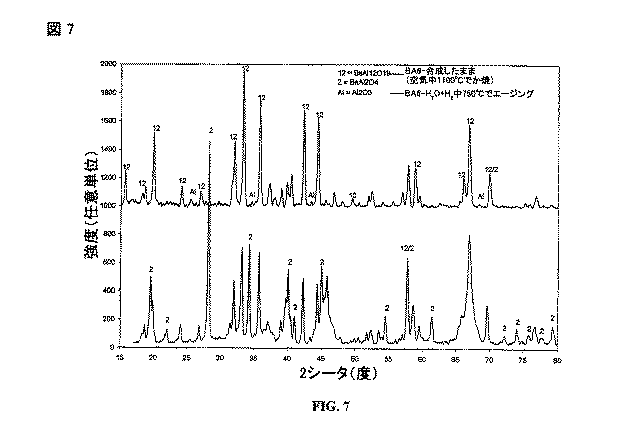
まず、バリウムおよびアルミニウムの前駆体を、約1:12のBa:Alモル比で、水溶液から共沈させることにより、バリウムアルミネートの触媒担体を調製した。その後、沈殿物を乾燥させ、空気中、1100℃で数時間か焼させた。触媒担体を、反応器内に置き、75vol%H2/25vol%H2Oの存在下で、950℃で4日間エージングした。 First, a barium aluminate catalyst support was prepared by co-precipitating barium and aluminum precursors from an aqueous solution at a Ba: Al molar ratio of about 1:12. The precipitate was then dried and calcined at 1100 ° C. for several hours in air. The catalyst support was placed in a reactor, in the presence of 75vol% H 2 / 25vol% H 2 O, aged 4 days at 950 ° C..
図7は、未使用の担体のX線回折パターンを、エージングした担体のものと比較している。空気中、1100℃でか焼した直後に、触媒担体はBaAl2O4相とBaAl12O19(BaO・6Al2O3またはBA6)相の混合物を依然として含んでいた。しかし、還元性/水熱のエージング環境下では、触媒担体は100%近くBaAl12O19に変換した。エージングされたBaAl12O19触媒担体は、15m2/gを越える、非常に安定な比表面積を持っていた。 FIG. 7 compares the X-ray diffraction pattern of the unused carrier with that of the aged carrier. Immediately after calcination in air at 1100 ° C., the catalyst support still contained a mixture of BaAl 2 O 4 phase and BaAl 12 O 19 (BaO.6Al 2 O 3 or BA6) phase. However, in a reducing / hydrothermal aging environment, the catalyst support was converted to BaAl 12 O 19 by nearly 100%. The aged BaAl 12 O 19 catalyst support had a very stable specific surface area exceeding 15 m 2 / g.
(例5)
様々な触媒担体材料の安定性を比較した。
(Example 5)
The stability of various catalyst support materials was compared.
カルシウムアルミネート/アルミナ混合物、ニッケルアルミネート(NiAl2O4)、単斜晶ジルコニア、およびバリウムアルミネートの各々から、触媒担体を調製した。カルシウムアルミネート/アルミナおよび単斜晶ジルコニア担体は、市販の原料から得た。ニッケルアルミネートおよびバリウムヘキサアルミネートは、それぞれ、ニッケルおよびアルミニウムの前駆体(1:2の比)、ならびにバリウムおよびアルミニウムの前駆体(1:12の比)を共沈させ、その後空気中、1100℃でか焼させて合成した。水素および蒸気を含む同一の雰囲気(すなわち、75vol%H2/25vol%H2O)中で、様々なエージング温度で、触媒担体の各々を100時間エージングした。 Catalyst supports were prepared from each of a calcium aluminate / alumina mixture, nickel aluminate (NiAl 2 O 4 ), monoclinic zirconia, and barium aluminate. Calcium aluminate / alumina and monoclinic zirconia support were obtained from commercially available raw materials. Nickel aluminate and barium hexaaluminate coprecipitated nickel and aluminum precursors (1: 2 ratio) and barium and aluminum precursors (1:12 ratio), respectively, followed by 1100 Synthesized by calcining at ℃. Same atmosphere containing hydrogen and steam (i.e., 75vol% H 2 / 25vol% H 2 O) in, at different aging temperatures were 100 hours aging each of the catalyst support.
図8は、4つのエージングした触媒担体の表面積が、エージング温度によっていかに変化したかを示している。 FIG. 8 shows how the surface area of the four aged catalyst supports varied with aging temperature.
エージングしたカルシウムアルミネート混合物およびエージングしたNiAl2O4の表面積は、両方とも、エージング温度が約200℃を越えた場合には10m2/g未満であり、その温度が700℃を越えた場合には約3m2/g程度まで低下した。これは、カルシウムアルミネート混合担体およびNiAl2O4担体が、H2/H2O雰囲気では不安定であり、著しい比表面積の低下を伴って、著しい相変化を受ける、という理論と矛盾していない。 The surface areas of the aged calcium aluminate mixture and the aged NiAl 2 O 4 are both less than 10 m 2 / g when the aging temperature exceeds about 200 ° C., and when the temperature exceeds 700 ° C. Decreased to about 3 m 2 / g. This is inconsistent with the theory that calcium aluminate mixed support and NiAl 2 O 4 support are unstable in H 2 / H 2 O atmosphere and undergo significant phase change with a significant decrease in specific surface area. Absent.
エージングしたカルシウムアルミネート混合担体およびエージングしたNiAl2O4担体とは対照的に、エージングした純粋な単斜晶ジルコニア担体およびエージングしたバリウムヘキサアルミネート担体は、約750℃、H2/H2O環境で、10m2/gを越える表面積を持っていた。これは、純粋な単斜晶ジルコニア担体およびアルカリ土類金属ヘキサアルミネート担体は、H2/H2O環境で安定であり、いったん生成すると、著しい相変化を受けない、ということを示している。純粋な単斜晶ジルコニア担体およびアルカリ土類金属ヘキサアルミネート担体の高い安定性を示す表面積は、蒸気中で数百時間後でも活性金属の分散を維持し、より長期間の触媒活性をもたらす。 In contrast to the aged calcium aluminate mixed support and the aged NiAl 2 O 4 support, the aged pure monoclinic zirconia support and the aged barium hexaaluminate support are about 750 ° C., H 2 / H 2 O In the environment, it had a surface area greater than 10 m 2 / g. This indicates that pure monoclinic zirconia support and alkaline earth metal hexaaluminate support are stable in the H 2 / H 2 O environment and, once formed, undergo no significant phase change. . The highly stable surface area of pure monoclinic zirconia support and alkaline earth metal hexaaluminate support maintains active metal dispersion even after several hundred hours in steam, resulting in longer-term catalytic activity.
(例6)
本発明の触媒のサイクル運転(すなわち、反応器の運転、続いて運転停止、続いて再運転)に耐え得る能力を調べた。
(Example 6)
The ability of the catalyst of the present invention to withstand cycle operation (ie, reactor operation, followed by shutdown, followed by re-operation) was investigated.
約1重量%のIrをカルシウムアルミネート/アルミナ混合担体に含浸させることによって、触媒を調製した。ヘキサクロロイリジウム酸の水溶液から、商業的に入手可能なカルシウムアルミネート/アルミナ担体上に金属を堆積させた。担体を金属含有溶液で含浸させた後、触媒を約110℃で24時間乾燥させ、それから空気中、約500℃でか焼させた。触媒をほぼ二等分した。 The catalyst was prepared by impregnating about 1 wt% Ir into a calcium aluminate / alumina mixed support. The metal was deposited from an aqueous solution of hexachloroiridate on a commercially available calcium aluminate / alumina support. After impregnating the support with the metal-containing solution, the catalyst was dried at about 110 ° C. for 24 hours and then calcined at about 500 ° C. in air. The catalyst was approximately halved.
触媒の第1の部分を反応器内に置き、硫黄およびO2を含んだ炭化水素原料で、その反応器を約750℃で500時間に亘り連続的に運転させた。 The first portion of the catalyst was placed in a reactor and the reactor was continuously operated at about 750 ° C. for 500 hours with a hydrocarbon feed containing sulfur and O 2 .
触媒の第2の部分を反応器内に置いてその反応器の運転を開始し、750℃で約24時間、第1の部分に使用したのと同じ炭化水素/硫黄/O2原料で運転させた。その後、反応器の運転を停止し、空気でパージした。その後、次の24時間原料充填サイクルに先立ち、反応器を750℃まで再加熱し、蒸気でパージした。これらの工程を、500時間の総運転時間にわたって繰り返した。このサイクル条件は、標準の反応器の運転開始および運転停止で触媒が曝されるであろう環境の典型である。 The second part of the catalyst is placed in the reactor and the reactor is started and operated at the same hydrocarbon / sulfur / O 2 feed used for the first part at 750 ° C. for about 24 hours. It was. The reactor was then stopped and purged with air. The reactor was then reheated to 750 ° C. and purged with steam prior to the next 24 hour feed charge cycle. These steps were repeated over a total operating time of 500 hours. This cycle condition is typical of the environment where the catalyst will be exposed at standard reactor start-up and shutdown.
図9は、500時間の試験後の、第1の部分の触媒(空気サイクルを用いずに、連続的に運転させた)の温度による活量係数の変化と、第2の部分の触媒(空気サイクルを用いて運転させた)のそれとを比較する。 FIG. 9 shows the change in activity coefficient with temperature of the first part of the catalyst (running continuously without using an air cycle) and the second part of the catalyst (air) after 500 hours of testing. Compared to that of the cycle).
図9は、本発明の触媒が、空気サイクルを用いて運転させる反応器、および空気サイクルを用いずに運転させる反応器の両方で、満足な触媒活性を呈することを示している。 FIG. 9 shows that the catalyst of the present invention exhibits satisfactory catalytic activity in both a reactor operated with an air cycle and a reactor operated without an air cycle.
値の範囲についての本明細書における開示は、その範囲内のあらゆる数値の開示である。さらに、属(genus)についての本明細書における開示は、その属の中のあらゆる種(species)の開示である(例えば、「希ガス」という属の開示は、Ar、Krなどの、あらゆる希ガス種の開示である)。 The disclosure herein of a range of values is a disclosure of any numerical value within that range. Further, the disclosure herein for a genus is the disclosure of any species within that genus (eg, the disclosure of the genus “noble gas” is any rare species such as Ar, Kr, etc.). Gas type disclosure).
本発明を具体的な実施形態について説明してきたが、本発明は、説明したそれら具体的な詳細に限定されるものではなく、当業者にとってそれ自体を示唆するであろう様々な変更および改良を含み、全ては以下の請求項で定義される本発明の範囲内にある。 Although the invention has been described with reference to specific embodiments, the invention is not limited to the specific details described, but various changes and modifications may be suggested to one skilled in the art. All within the scope of the invention as defined in the following claims.
Claims (36)
少なくとも1つの前駆体酸化物を、0.20atmまたはそれ以下のO2分圧を有し、H2、H2Oおよび不活性ガスからなる群より選択される少なくとも1つを少なくとも50vol%含んだ雰囲気中で加熱すること
を含んだ方法。A method for producing a catalyst carrier for a catalyst according to claim 1 , comprising:
At least one precursor oxide having an O 2 partial pressure of 0.20 atm or less and containing at least 50 vol% of at least one selected from the group consisting of H 2 , H 2 O and inert gas and heating child in an atmosphere
Method that includes.
前記他の雰囲気の全圧は、1atmである請求項18記載の方法。The other atmosphere is air;
The method of claim 18, wherein the total pressure of the other atmosphere is 1 atm.
請求項1記載の触媒を用意することと、
前記触媒の上に、気体の炭化水素と気体のH2Oとを含んだ活性な原料流を通すことと、
前記気体の炭化水素と前記気体のH2Oとを前記触媒を使用して反応させ、H2を製造することと
を含んだ方法。 A method for producing H 2 using the catalyst of claim 1 , comprising:
And providing a catalytic according to claim 1,
Passing an active feed stream comprising gaseous hydrocarbons and gaseous H 2 O over the catalyst;
And of H 2 O and hydrocarbons the gas of the gas is reacted using the catalyst, method person containing the to produce a H 2.
Applications Claiming Priority (3)
| Application Number | Priority Date | Filing Date | Title |
|---|---|---|---|
| US10/825,150 US7309480B2 (en) | 2004-04-16 | 2004-04-16 | Catalyst for hydrogen generation through steam reforming of hydrocarbons |
| US10/825,150 | 2004-04-16 | ||
| PCT/US2005/011037 WO2005105664A2 (en) | 2004-04-16 | 2005-04-01 | Catalyst for hydrogen generation through steam reforming of hydrocarbons |
Publications (2)
| Publication Number | Publication Date |
|---|---|
| JP2007532305A JP2007532305A (en) | 2007-11-15 |
| JP4988552B2 true JP4988552B2 (en) | 2012-08-01 |
Family
ID=35096486
Family Applications (1)
| Application Number | Title | Priority Date | Filing Date |
|---|---|---|---|
| JP2007508378A Expired - Fee Related JP4988552B2 (en) | 2004-04-16 | 2005-04-01 | Catalyst for producing hydrogen by steam reforming of hydrocarbons |
Country Status (8)
| Country | Link |
|---|---|
| US (3) | US7309480B2 (en) |
| EP (1) | EP1771376A4 (en) |
| JP (1) | JP4988552B2 (en) |
| KR (1) | KR101166943B1 (en) |
| CN (1) | CN101001695B (en) |
| AU (1) | AU2005238426B2 (en) |
| CA (1) | CA2561427C (en) |
| WO (1) | WO2005105664A2 (en) |
Families Citing this family (36)
| Publication number | Priority date | Publication date | Assignee | Title |
|---|---|---|---|---|
| US7309480B2 (en) * | 2004-04-16 | 2007-12-18 | H2Gen Innovations, Inc. | Catalyst for hydrogen generation through steam reforming of hydrocarbons |
| CA2614591C (en) * | 2005-05-06 | 2013-12-31 | Ohio University | Electrocatalysts and additives for the oxidation of solid fuels |
| US7309479B2 (en) * | 2005-06-29 | 2007-12-18 | Samsung Engineering Co., Ltd. | Cobalt oxide catalysts |
| US8142756B1 (en) * | 2006-03-28 | 2012-03-27 | The United States Of America As Represented By The U.S. Department Of Energy | Methods of reforming hydrocarbon fuels using hexaaluminate catalysts |
| CN101679027B (en) * | 2007-04-18 | 2013-01-02 | 乔治洛德方法研究和开发液化空气有限公司 | Hydrogen production process |
| US20080260631A1 (en) * | 2007-04-18 | 2008-10-23 | H2Gen Innovations, Inc. | Hydrogen production process |
| US20090108238A1 (en) * | 2007-10-31 | 2009-04-30 | Sud-Chemie Inc. | Catalyst for reforming hydrocarbons |
| US8119558B2 (en) * | 2008-03-14 | 2012-02-21 | Süd-Chemie Inc. | Ultra high temperature shift catalyst with low methanation |
| US8293805B2 (en) * | 2008-05-29 | 2012-10-23 | Schlumberger Technology Corporation | Tracking feedstock production with micro scale gas-to-liquid units |
| JP5572855B2 (en) * | 2009-03-24 | 2014-08-20 | 昭和シェル石油株式会社 | Biomass gasification reforming catalyst and method for producing synthesis gas using the same |
| US20100292076A1 (en) * | 2009-05-18 | 2010-11-18 | Sud-Chemie Inc. | Ultra high temperature shift catalyst with low methanation |
| US8735023B2 (en) * | 2009-12-14 | 2014-05-27 | GM Global Technology Operations LLC | Fuel cell with layered electrode |
| CN102451696B (en) * | 2010-10-22 | 2014-03-05 | 中国石油化工股份有限公司 | Catalyst for reaction of hydrogen preparation or carbonyl synthesis gas preparation by hydrocarbon steam conversion |
| CN102674413B (en) * | 2011-03-16 | 2014-04-30 | 中国科学院过程工程研究所 | Catalyst for CO and H methanation and preparation method thereof |
| CN102836718B (en) * | 2011-06-20 | 2014-06-04 | 中国科学院过程工程研究所 | Mesoporous hexaaluminate nickel supported methanation catalyst and preparation method thereof |
| US20130071764A1 (en) * | 2011-09-15 | 2013-03-21 | John R. Budge | Systems and methods for steam reforming |
| JP5984620B2 (en) * | 2011-11-29 | 2016-09-06 | 大阪瓦斯株式会社 | Hydrocarbon compound steam reforming catalyst and method for producing the same |
| WO2013135656A1 (en) * | 2012-03-13 | 2013-09-19 | Bayer Intellectual Property Gmbh | Method for reducing carbon dioxide at high temperatures on mixed metal oxide catalysts in the form of hexaaluminates |
| US20130270483A1 (en) * | 2012-04-12 | 2013-10-17 | Primus Green Energy Inc. | Catalytical gasifier configuration for biomass pyrolysis |
| KR20150028329A (en) | 2012-06-29 | 2015-03-13 | 바스프 에스이 | High-pressure process for carbon dioxide reforming of hydrocarbons in the presence of iridium-containing active masses |
| EP2964385A1 (en) | 2013-03-07 | 2016-01-13 | Basf Se | Nickel hexaaluminate-containing catalyst for reforming hydrocarbons in the presence of carbon dioxide |
| JP6293416B2 (en) | 2013-03-07 | 2018-03-14 | 大阪瓦斯株式会社 | Method for autothermal reforming of hydrocarbon compounds |
| EP2813286A1 (en) * | 2013-06-11 | 2014-12-17 | Evonik Industries AG | Reaction tube and method for the production of hydrogen cyanide |
| MX2016004436A (en) | 2013-10-11 | 2016-06-21 | Evonik Degussa Gmbh | Reaction tube and method for producing hydrogen cyanide. |
| US10369549B2 (en) | 2015-03-20 | 2019-08-06 | Sabic Global Technologies B.V. | Use of nickel-manganese olivine and nickel-manganese spinel as bulk metal catalysts for carbon dioxide reforming of methane |
| KR101828791B1 (en) * | 2016-07-27 | 2018-02-13 | 한국화학연구원 | Thermally stable monolith catalysts for reforming reaction |
| CN109641203B (en) * | 2016-08-08 | 2025-11-18 | 国立大学法人东京工业大学 | Methods for manufacturing catalysts for ammonia synthesis and methods for manufacturing ammonia. |
| EP3301075A1 (en) | 2016-09-28 | 2018-04-04 | Evonik Degussa GmbH | Method for producing hydrogen cyanide |
| CN108262046A (en) * | 2016-12-30 | 2018-07-10 | 中国石油天然气股份有限公司 | Doped hexaaluminate oxide catalyst, preparation method and application thereof |
| EP3553045B1 (en) * | 2018-04-09 | 2024-09-04 | Kemijski Institut | Process to produce methacrylic acid monomer from biomass-derived carboxylic acids |
| CN111389405B (en) * | 2020-01-21 | 2023-09-15 | 天津大学 | A method for preactivating methane steam hydrogen production catalyst |
| JP7643836B2 (en) * | 2020-03-30 | 2025-03-11 | Eneos株式会社 | Hydrogen supply system, control device, and hydrogen production method |
| CN114077519B (en) * | 2020-08-21 | 2022-11-18 | 荣耀终端有限公司 | System service recovery method and device and electronic equipment |
| CN113509926B (en) * | 2021-09-14 | 2021-12-03 | 清华大学 | Fuel reforming catalyst precursor, catalyst, preparation method and application |
| KR102819305B1 (en) * | 2021-11-26 | 2025-06-11 | 전남대학교산학협력단 | Hexa-aluminate support-containing catalyst, and method for producing same |
| CN118002149B (en) * | 2024-04-08 | 2024-07-26 | 中自科技股份有限公司 | Natural gas steam reforming catalyst and reactor |
Family Cites Families (35)
| Publication number | Priority date | Publication date | Assignee | Title |
|---|---|---|---|---|
| US4459372A (en) * | 1982-08-25 | 1984-07-10 | Uop Inc. | Surface-metallated refractory inorganic oxides, method of their preparation and catalyst supported on the oxides |
| US4572904A (en) * | 1983-09-27 | 1986-02-25 | Signal Applied Technologies Inc. | Lead-tolerant catalyst system for treating exhaust gas containing lead compounds |
| US4868148A (en) * | 1987-08-24 | 1989-09-19 | Allied-Signal Inc. | Layered automotive catalytic composite |
| US5015617A (en) * | 1988-04-14 | 1991-05-14 | Nippon Shokubai Kagaku Kogyo Co., Ltd. | Catalyst for purifying exhaust gas and method for production thereof |
| US5026536A (en) * | 1988-12-20 | 1991-06-25 | Nippon Oil Co., Ltd. | Hydrogen production from hydrocarbon |
| DE4106535A1 (en) * | 1991-03-01 | 1992-09-03 | Degussa | MONOCLIN'S ZIRCONOXIDE, PROCESS FOR ITS PRODUCTION AND USE |
| JPH07187665A (en) * | 1993-11-10 | 1995-07-25 | Denki Kagaku Kogyo Kk | Production of barium hexaaluminate powder |
| FR2721837B1 (en) * | 1994-07-01 | 1996-08-30 | Inst Francais Du Petrole | HIGH TEMPERATURE RESISTANT OXIDATION CATALYST, PREPARATION METHOD THEREOF, AND COMBUSTION METHOD USING SUCH CATALYST |
| JP3377676B2 (en) * | 1996-04-05 | 2003-02-17 | ダイハツ工業株式会社 | Exhaust gas purification catalyst |
| US5786294A (en) * | 1996-05-10 | 1998-07-28 | Northwestern University | Crystalline mesoporous zirconia catalysts having stable tetragonal pore wall structure |
| DE19653629A1 (en) * | 1996-12-20 | 1998-06-25 | Basf Ag | Monoclinic zirconium oxide with a high surface area |
| DE19654391A1 (en) * | 1996-12-27 | 1998-07-02 | Basf Ag | Catalyst for the selective production of propylene from propane |
| JPH10287419A (en) * | 1997-04-09 | 1998-10-27 | Kawai Sekkai Kogyo Kk | Production of barium hexaaluminate |
| US6413489B1 (en) * | 1997-04-15 | 2002-07-02 | Massachusetts Institute Of Technology | Synthesis of nanometer-sized particles by reverse micelle mediated techniques |
| GB9806199D0 (en) * | 1998-03-24 | 1998-05-20 | Johnson Matthey Plc | Catalytic generation of hydrogen |
| DE19937107A1 (en) * | 1999-08-06 | 2001-02-08 | Basf Ag | Catalyst with bimodal pore radius distribution |
| US6607678B2 (en) * | 1999-08-17 | 2003-08-19 | Battelle Memorial Institute | Catalyst and method of steam reforming |
| US6497856B1 (en) * | 2000-08-21 | 2002-12-24 | H2Gen Innovations, Inc. | System for hydrogen generation through steam reforming of hydrocarbons and integrated chemical reactor for hydrogen production from hydrocarbons |
| US6509000B1 (en) * | 2000-08-31 | 2003-01-21 | Council Of Scientific And Industrial Research | Low temperature process for the production of hydrogen |
| US20020061277A1 (en) * | 2000-09-25 | 2002-05-23 | Engelhard Corporation | Non-pyrophoric water-gas shift reaction catalysts |
| WO2002038268A1 (en) * | 2000-11-08 | 2002-05-16 | Idemitsu Kosan Co., Ltd. | Catalyst for hydrocarbon reforming and method of reforming hydrocarbon with the same |
| EP1790412B1 (en) * | 2000-11-17 | 2013-03-06 | Osaka Gas Company Limited | Catalyst for purifying methane-containing waste gas |
| US6562747B2 (en) * | 2000-12-19 | 2003-05-13 | Delphi Technologies, Inc. | Gas sensor electrolyte |
| US6713040B2 (en) * | 2001-03-23 | 2004-03-30 | Argonne National Laboratory | Method for generating hydrogen for fuel cells |
| US20020174603A1 (en) * | 2001-03-23 | 2002-11-28 | Shabbir Ahmed | Method for generating hydrogen for fuel cells |
| EP1390298B1 (en) * | 2001-05-23 | 2007-10-17 | Ecaps | Sintering resistant catalyst material and a method for the preparation thereof |
| US7442669B2 (en) * | 2002-03-05 | 2008-10-28 | Tda Research, Inc. | Oxidation catalysts comprising metal exchanged hexaaluminate wherein the metal is Sr, Pd, La, and/or Mn |
| EP1487740A1 (en) * | 2002-03-13 | 2004-12-22 | Conocophillips Company | Controlled-pore catalyst structures and process for producing synthesis gas |
| US7214643B2 (en) * | 2002-03-22 | 2007-05-08 | Kabushiki Kaisha Toyota Chuo Kenkyusho | Metal oxide and method for producing the same, and catalyst |
| US7094730B2 (en) * | 2002-10-31 | 2006-08-22 | Delphi Technologies, Inc. | Gas treatment device, methods for making and using the same, and a vehicle exhaust system |
| US20040086432A1 (en) * | 2002-10-31 | 2004-05-06 | Labarge William J. | Reformer, systems utilizing the reformer, and methods for operating the systems |
| US6774080B2 (en) * | 2002-11-25 | 2004-08-10 | Delphi Technologies, Inc. | Gas treatment device comprising SMSI material and methods for making and using the same |
| CN1729139A (en) * | 2002-12-20 | 2006-02-01 | 本田技研工业株式会社 | Catalyst formulations for hydrogen generation |
| US7399728B2 (en) * | 2003-12-19 | 2008-07-15 | Umicore Ag & Co Kg | Catalyst formulation, exhaust system, and gas treatment device |
| US7309480B2 (en) * | 2004-04-16 | 2007-12-18 | H2Gen Innovations, Inc. | Catalyst for hydrogen generation through steam reforming of hydrocarbons |
-
2004
- 2004-04-16 US US10/825,150 patent/US7309480B2/en not_active Expired - Lifetime
-
2005
- 2005-04-01 KR KR1020067023447A patent/KR101166943B1/en not_active Expired - Fee Related
- 2005-04-01 CN CN2005800114603A patent/CN101001695B/en not_active Expired - Fee Related
- 2005-04-01 WO PCT/US2005/011037 patent/WO2005105664A2/en not_active Ceased
- 2005-04-01 EP EP05732800A patent/EP1771376A4/en not_active Withdrawn
- 2005-04-01 JP JP2007508378A patent/JP4988552B2/en not_active Expired - Fee Related
- 2005-04-01 AU AU2005238426A patent/AU2005238426B2/en not_active Ceased
- 2005-04-01 CA CA2561427A patent/CA2561427C/en not_active Expired - Fee Related
-
2006
- 2006-12-18 US US11/612,094 patent/US7645440B2/en not_active Expired - Lifetime
-
2007
- 2007-10-18 US US11/874,265 patent/US7923409B2/en not_active Expired - Fee Related
Also Published As
| Publication number | Publication date |
|---|---|
| AU2005238426B2 (en) | 2008-05-08 |
| CA2561427A1 (en) | 2005-11-10 |
| CA2561427C (en) | 2013-02-12 |
| EP1771376A4 (en) | 2011-06-15 |
| US20050232857A1 (en) | 2005-10-20 |
| EP1771376A2 (en) | 2007-04-11 |
| JP2007532305A (en) | 2007-11-15 |
| CN101001695B (en) | 2010-06-09 |
| US7309480B2 (en) | 2007-12-18 |
| US20070116639A1 (en) | 2007-05-24 |
| AU2005238426A1 (en) | 2005-11-10 |
| US7645440B2 (en) | 2010-01-12 |
| WO2005105664A2 (en) | 2005-11-10 |
| CN101001695A (en) | 2007-07-18 |
| US7923409B2 (en) | 2011-04-12 |
| WO2005105664A3 (en) | 2006-09-14 |
| US20080038186A1 (en) | 2008-02-14 |
| KR101166943B1 (en) | 2012-07-19 |
| KR20070044802A (en) | 2007-04-30 |
Similar Documents
| Publication | Publication Date | Title |
|---|---|---|
| US7923409B2 (en) | Catalyst for hydrogen generation through steam reforming of hydrocarbons | |
| KR101994152B1 (en) | A Reduced Carbon Poisoning Perovskite Catalyst Impregnated with Metal Ion, Preparation Method Thereof and Methane Reforming Method Threrewith | |
| JP5327323B2 (en) | Hydrocarbon gas reforming catalyst, method for producing the same, and method for producing synthesis gas | |
| US10010876B2 (en) | Catalyst for high temperature steam reforming | |
| US7906098B2 (en) | Method for making hydrogen using a gold containing water-gas shift catalyst | |
| US20080032887A1 (en) | Nickel on Strontium-Doped Calcium Aluminate Catalyst for Reforming | |
| WO2020012687A1 (en) | Hydrocarbon reforming catalyst and hydrocarbon reforming apparatus | |
| US7378369B2 (en) | Nickel supported on titanium stabilized promoted calcium aluminate carrier | |
| US20100304236A1 (en) | Catalysts and methods including steam reforming | |
| KR102092736B1 (en) | Preparation Method of Reduced Carbon Poisoning Perovskite Catalyst Impregnated with Metal Ion, and Methane Reforming Method Threrewith | |
| Tri et al. | High activity and stability of nano‐nickel catalyst based on LaNiO3 perovskite for methane bireforming | |
| CN100402150C (en) | Carbon monoxide removal catalyst, method for producing same, and device for removing carbon monoxide | |
| JP4525909B2 (en) | Water gas shift reaction catalyst, method for producing the same, and method for producing water gas | |
| JP5619598B2 (en) | Copper-zinc-aluminum catalyst, production method thereof, carbon monoxide conversion method, and hydrogen production method | |
| JP2023106808A (en) | Composite oxide composed of NiAl2O4, γ-Al2O3 and ZrO2, active material which is reduced product of said complex oxide, and method for regenerating said active material | |
| KR20170027674A (en) | High Efficiency Ni-based Catalyst for Steam Methane Reforming and use thereof | |
| JP7347541B2 (en) | Hydrocarbon reforming catalyst, hydrocarbon reformer, and method for recovering sulfur deterioration of hydrocarbon reforming catalyst |
Legal Events
| Date | Code | Title | Description |
|---|---|---|---|
| A621 | Written request for application examination |
Free format text: JAPANESE INTERMEDIATE CODE: A621 Effective date: 20080326 |
|
| A711 | Notification of change in applicant |
Free format text: JAPANESE INTERMEDIATE CODE: A711 Effective date: 20100317 |
|
| A521 | Request for written amendment filed |
Free format text: JAPANESE INTERMEDIATE CODE: A821 Effective date: 20100317 |
|
| A711 | Notification of change in applicant |
Free format text: JAPANESE INTERMEDIATE CODE: A711 Effective date: 20100827 |
|
| A521 | Request for written amendment filed |
Free format text: JAPANESE INTERMEDIATE CODE: A821 Effective date: 20100827 |
|
| A131 | Notification of reasons for refusal |
Free format text: JAPANESE INTERMEDIATE CODE: A131 Effective date: 20110705 |
|
| A521 | Request for written amendment filed |
Free format text: JAPANESE INTERMEDIATE CODE: A523 Effective date: 20111005 |
|
| A131 | Notification of reasons for refusal |
Free format text: JAPANESE INTERMEDIATE CODE: A131 Effective date: 20111129 |
|
| A521 | Request for written amendment filed |
Free format text: JAPANESE INTERMEDIATE CODE: A523 Effective date: 20120227 |
|
| TRDD | Decision of grant or rejection written | ||
| A01 | Written decision to grant a patent or to grant a registration (utility model) |
Free format text: JAPANESE INTERMEDIATE CODE: A01 Effective date: 20120327 |
|
| A01 | Written decision to grant a patent or to grant a registration (utility model) |
Free format text: JAPANESE INTERMEDIATE CODE: A01 |
|
| A61 | First payment of annual fees (during grant procedure) |
Free format text: JAPANESE INTERMEDIATE CODE: A61 Effective date: 20120426 |
|
| R150 | Certificate of patent or registration of utility model |
Free format text: JAPANESE INTERMEDIATE CODE: R150 |
|
| FPAY | Renewal fee payment (event date is renewal date of database) |
Free format text: PAYMENT UNTIL: 20150511 Year of fee payment: 3 |
|
| R250 | Receipt of annual fees |
Free format text: JAPANESE INTERMEDIATE CODE: R250 |
|
| R250 | Receipt of annual fees |
Free format text: JAPANESE INTERMEDIATE CODE: R250 |
|
| LAPS | Cancellation because of no payment of annual fees |