JP4952012B2 - Resin composition for forming fine pattern and method for forming fine pattern - Google Patents
Resin composition for forming fine pattern and method for forming fine pattern Download PDFInfo
- Publication number
- JP4952012B2 JP4952012B2 JP2006082967A JP2006082967A JP4952012B2 JP 4952012 B2 JP4952012 B2 JP 4952012B2 JP 2006082967 A JP2006082967 A JP 2006082967A JP 2006082967 A JP2006082967 A JP 2006082967A JP 4952012 B2 JP4952012 B2 JP 4952012B2
- Authority
- JP
- Japan
- Prior art keywords
- methyl
- group
- pattern
- pentanol
- fine pattern
- Prior art date
- Legal status (The legal status is an assumption and is not a legal conclusion. Google has not performed a legal analysis and makes no representation as to the accuracy of the status listed.)
- Expired - Fee Related
Links
Images
Landscapes
- Photosensitive Polymer And Photoresist Processing (AREA)
- Compositions Of Macromolecular Compounds (AREA)
- Addition Polymer Or Copolymer, Post-Treatments, Or Chemical Modifications (AREA)
Abstract
Description
本発明はフォトレジストを用いた微細加工技術に関し、特にパターニング後に熱処理によりパターンを収縮させる際に用いられる微細パターン形成用樹脂組成物および微細パターン形成方法に関する。 The present invention relates to a fine processing technique using a photoresist, and more particularly to a resin composition for forming a fine pattern and a method for forming a fine pattern, which are used when a pattern is shrunk by heat treatment after patterning.
近年、半導体素子の微細化が進むに伴い、その製造方法におけるリソグラフィー工程において、いっそうの微細化が要求されるようになってきている。すなわち、リソグラフィー工程では、現在100nm以下の微細加工が必要になってきており、ArFエキシマレーザー光、F2エキシマレーザー光などの短波長の照射光に対応したフォトレジスト材料を用いて、微細なパターンを形成させる方法が種々検討されている。
このようなリソグラフィー技術においては、露光波長の制約から、微細化に限界が生じるのを免れないので、これまで、この波長限界をこえる微細パターンの形成を可能にするための研究が行なわれてきた。すなわち、ポリメチルメタクリレートなどの電子線用レジストをパターン化し、該レジストパターン上にポジ型レジストを塗布したのち、加熱処理して該レジストパターンとポジレジスト層との境界に反応層を設け、ポジ型レジストの非反応部分を除去することにより、レジストパターンを微細化する方法(特許文献1)、下層レジストパターンと上層レジストとの間に酸発生剤や酸による熱架橋を利用して反応層を形成させる方法(特許文献2)、上層レジスト塗布液として、感光性成分を含まず、水溶性樹脂や水溶性架橋剤、あるいはこれらの混合物を水溶性溶媒に溶解した微細パターン形成材料を用いて半導体装置を製造する方法(特許文献3)、基板上に化学増幅型レジストからなる感光層を設け、画像形成露光後、現像処理してレジストパターンを形成させ、このレジストパターン上に、ポリビニルアセタールのような水溶性樹脂やテトラ(ヒドロキシメチル)グリコールウリルのような水溶性架橋剤とアミンのような水溶性含窒素有機化合物と、場合によりフッ素およびケイ素含有界面活性剤とを含む塗膜形成剤を塗布したのち、加熱処理してレジストパターンとレジストパターン微細化用塗膜との界面に水不溶性の反応層を形成させ、次いで純水により、レジストパターン微細化用塗膜の非反応部分を除去する方法(特許文献4)などが提案されている。
In recent years, with the progress of miniaturization of semiconductor elements, further miniaturization has been required in the lithography process in the manufacturing method. That is, in the lithography process, microfabrication of 100 nm or less is now required, and a fine pattern is formed using a photoresist material corresponding to short-wavelength irradiation light such as ArF excimer laser light and F 2 excimer laser light. Various methods for forming the film have been studied.
In such a lithography technique, there is an unavoidable limitation on the miniaturization due to the limitation of the exposure wavelength, so far, research has been conducted to enable the formation of a fine pattern exceeding the wavelength limit. . That is, after patterning an electron beam resist such as polymethyl methacrylate and applying a positive resist on the resist pattern, heat treatment is performed to provide a reaction layer at the boundary between the resist pattern and the positive resist layer. A method of refining a resist pattern by removing non-reacted portions of the resist (Patent Document 1), and forming a reaction layer between the lower layer resist pattern and the upper layer resist using thermal crosslinking with an acid generator or acid (Patent Document 2), as an upper layer resist coating solution, a semiconductor device using a fine pattern forming material in which a photosensitive component is not contained and a water-soluble resin, a water-soluble crosslinking agent, or a mixture thereof is dissolved in a water-soluble solvent (Patent Document 3), a photosensitive layer made of a chemically amplified resist is provided on a substrate, and after image-forming exposure, development processing is performed. A resist pattern is formed, and a water-soluble resin such as polyvinyl acetal, a water-soluble cross-linking agent such as tetra (hydroxymethyl) glycoluril, a water-soluble nitrogen-containing organic compound such as an amine, and the like. After applying a film-forming agent containing a fluorine-containing and silicon-containing surfactant, heat treatment is performed to form a water-insoluble reaction layer at the interface between the resist pattern and the resist pattern refinement coating, and then with pure water A method (Patent Document 4) and the like for removing a non-reacted portion of a resist pattern refinement coating film have been proposed.
これらの方法は、感光性レジスト(下層レジスト)の波長限界をこえ、微細パターン形成材料(上層レジスト)によるパターンの微細化を簡単に行なうことができるという点で好ましいものであるが、レジストパターンの底部分の不必要な部分まで微細パターン形成材料の架橋を生じたり、裾ひき形状となったり、微細パターン形成材料の断面形状の垂直性が不良になったり、あるいは上層レジストパターンサイズが架橋を起こすための加熱であるミキシングベークによりパターン形状が左右されるなどの問題があり、まだ十分に満足しうるものとはいえない。また、これらのプロセスは10数nm/℃と温度依存性が高く、基板の大型化、パターンの微細化に際し、ウエーハ面内での温度を均一に保つことは困難であるため、得られたパターンの寸法制御性が低下するという問題がある。さらに、上記の水溶性樹脂を用いた微細パターン形成材料は、水への溶解性の制限からドライエッチングに対する耐性が低いという問題がある。半導体デバイスを作製するに際し、レジストパターンをマスクにドライエッチングにより基板上にパターンを転写するが、ドライエッチング耐性が低いとレジストパターンが基板上に精度良く転写できないという問題がある。 These methods are preferable in that the pattern of the resist pattern (lower layer resist) can be easily refined beyond the wavelength limit of the photosensitive resist (upper layer resist). Cross-linking of the fine pattern forming material up to the unnecessary part of the bottom part, a skirted shape, the perpendicularity of the cross-sectional shape of the fine pattern forming material is poor, or the upper resist pattern size is cross-linked However, there is a problem that the pattern shape is influenced by mixing baking, which is a heating for heating, and it cannot be said that it is sufficiently satisfactory. In addition, these processes have a high temperature dependency of several 10 nm / ° C., and it is difficult to keep the temperature in the wafer plane uniform when the substrate is enlarged and the pattern is miniaturized. There is a problem that the dimensional controllability of the lowering. Furthermore, the fine pattern forming material using the above water-soluble resin has a problem of low resistance to dry etching due to the limitation of solubility in water. In manufacturing a semiconductor device, a pattern is transferred onto a substrate by dry etching using a resist pattern as a mask. However, when the resistance to dry etching is low, there is a problem that the resist pattern cannot be accurately transferred onto the substrate.
そのほか、基板上にフォトレジストパターンを形成したのち、それに熱または放射線照射を施し、フォトレジストパターンを流動化させ、パターン寸法を解像限界よりも小さくする、いわゆる熱フロープロセスが提案されている(特許文献5、特許文献6)。 In addition, a so-called thermal flow process has been proposed in which a photoresist pattern is formed on a substrate and then subjected to heat or radiation to fluidize the photoresist pattern to make the pattern dimension smaller than the resolution limit ( Patent Document 5 and Patent Document 6).
しかしながら、この方法では、熱や放射線によるレジストの流動制御が困難であり、品質の一定した製品が得られないという問題がある。さらに、この熱フロープロセスを発展させた方法として、基板上にフォトレジストパターンを形成したのち、その上に水溶性樹脂膜を設け、フォトレジストの流動を制御する方法(特許文献7)が提案されているが、この方法で用いられるポリビニルアルコールのような水溶性樹脂は、水による除去時に必要とされる溶解性や経時安定性が不十分であり、残留分を生じるという問題がある。 However, this method has a problem that it is difficult to control the flow of resist by heat or radiation, and a product having a constant quality cannot be obtained. Furthermore, as a method developed from this thermal flow process, a method (Patent Document 7) is proposed in which a photoresist pattern is formed on a substrate, a water-soluble resin film is provided on the substrate, and the flow of the photoresist is controlled. However, the water-soluble resin such as polyvinyl alcohol used in this method has a problem that the solubility and stability over time required at the time of removal with water are insufficient and a residue is generated.
あるいは、フォトレジストを用いて形成されたレジストパターンを熱収縮させて、微細レジストパターンを形成する際に、レジストパターン上に被覆形成剤を設け、熱処理により、レジストパターンを熱収縮させ、水洗により除去し得るレジストパターン微細化用被覆形成剤、およびこのものを用いて効率よく微細レジストパターンを形成させる方法(特許文献8)が提案されているが、この方法ではレジストパターン微細化用被覆形成剤は水系であり、直径100nm以下のコンタクトホール等の微細なパターンへの被覆性が不十分であり、かつ水系であるため塗布時に専用のカップが必要になるためコストアップとなり、さらに、輸送などで低温となる場合、凍結・析出が生じるという問題がある。
本発明は、このような問題に対処するためになされたもので、フォトレジストを用いて形成されたレジストパターンを熱処理することにより微細パターンを形成するに際し、該レジストパターン上に塗布され、熱処理により、レジストパターンを円滑に収縮させることができると共に、その後のアルカリ水溶液処理により容易に除去し得る樹脂組成物の樹脂成分として用いることができる重合体に、架橋成分、および特定のアルコール溶媒とを含む微細パターン形成用樹脂組成物およびこの樹脂組成物を用いた微細パターン形成方法の提供を目的とする。 The present invention has been made to cope with such a problem. When a fine pattern is formed by heat-treating a resist pattern formed using a photoresist, the fine-pattern is applied on the resist pattern, and the heat-treatment is performed by heat treatment. The polymer that can be used as a resin component of a resin composition that can be shrunk smoothly and can be easily removed by subsequent aqueous alkaline treatment , contains a crosslinking component and a specific alcohol solvent. It aims at providing the resin composition for fine pattern formation, and the fine pattern formation method using this resin composition .
本発明の微細パターン形成用樹脂組成物は、下記式(1)で表される繰返し単位と、下記式(2)および下記式(3)で表される繰返し単位から選ばれる少なくとも1つの繰返し単位とを含み、ゲルパーミエーションクロマトグラフィ法により測定したポリスチレン換算質量平均分子量が1,000〜500,000である重合体からなる樹脂成分と、該樹脂成分を架橋できる架橋成分と、1−プロパノール、イソプロパノール、1−ブタノール、2−ブタノール、t−ブタノール、1−ペンタノール、2−ペンタノール、3−ペンタノール、2−メチル−1−ブタノール、3−メチル−1−ブタノール、3−メチル−2−ブタノール、1−ヘキサノール、2−ヘキサノール、3−ヘキサノール、2−メチル−1−ペンタノール、2−メチル−2−ペンタノール、2−メチル−3−ペンタノール、3−メチル−1−ペンタノール、3−メチル−2−ペンタノール、3−メチル−3−ペンタノール、4−メチル−1−ペンタノール、4−メチル−2−ペンタノール、1−ヘプタノール、2−ヘプタノール、2−メチル−2−ヘプタノールおよび2−メチル−3−ヘプタノールから選ばれる少なくとも1つのアルコールに、全溶媒に対して10質量%以下の水を含む溶媒とを含み、レジストパターン上に形成された被覆膜がフォトレジスト由来の酸により架橋して、上記レジストパターン間隙を微細化することを特徴とする。

本発明に使用できる重合体(以下、本発明の重合体ともいう)は、高分子側鎖内にアミド基とフェノール性水酸基とを有する繰返し単位と、(メタ)アクリル酸誘導体由来の繰返し単位および/またはスチレン誘導体由来の繰返し単位とを含むので、架橋成分およびアルコール溶媒と組み合わせることにより、微細なレジストパターンへの塗布特性に優れ、また硬化膜の寸法制御性にも優れる微細パターン形成用樹脂組成物が得られる。このため、基板の表面状態の如何にかかわらず、レジストパターンのパターン間隙を実効的に、精度よく微細化することができ、波長限界をこえるパターンを良好かつ経済的に低コストでパターン欠陥の少ない状態で形成することができる。
特に、本発明の重合体を樹脂成分として使用した微細パターン形成用樹脂組成物は、該樹脂の収縮量が大きく、収縮時の温度依存性が低く、収縮後の形状に優れ、ピッチ依存性が低いため、プロセス変動に対するパターン形成マージンであるプロセスウィンドウ(Exposure Depth-Windowともいう)が広い。また、エッチング耐性に優れている。
さらに、このようにして形成された微細レジストパターンをマスクとしてドライエッチングすることにより、半導体基板上に精度よくトレンチパターンやホールを形成することができ、微細トレンチパターンやホールを有する半導体装置等を簡単にかつ歩留まりよく製造することができる。
The polymer that can be used in the present invention (hereinafter also referred to as the polymer of the present invention) includes a repeating unit having an amide group and a phenolic hydroxyl group in the polymer side chain, a repeating unit derived from a (meth) acrylic acid derivative, and And / or a repeating unit derived from a styrene derivative. By combining with a cross-linking component and an alcohol solvent, the resin composition for forming a fine pattern has excellent coating characteristics on a fine resist pattern and excellent dimensional controllability of a cured film. A thing is obtained. Therefore, regardless of the surface state of the substrate, the pattern gap of the resist pattern can be effectively and accurately miniaturized, and the pattern exceeding the wavelength limit can be satisfactorily and economically reduced with few pattern defects. It can be formed in a state.
In particular, the resin composition for forming a fine pattern using the polymer of the present invention as a resin component has a large amount of shrinkage of the resin, low temperature dependence during shrinkage, excellent shape after shrinkage, and pitch dependence. Since it is low, a process window (also referred to as an exposure depth-window), which is a pattern formation margin against process variations, is wide. Moreover, it is excellent in etching resistance.
Furthermore, by performing dry etching using the fine resist pattern thus formed as a mask, a trench pattern and a hole can be formed with high precision on a semiconductor substrate, and a semiconductor device having a fine trench pattern and a hole can be easily obtained. In addition, it can be manufactured with good yield.
本発明者らは、熱処理によりレジストパターンを円滑に収縮させることができると共に、その後のアルカリ水溶液処理により容易に除去し得る樹脂組成物に使用できる樹脂成分について、鋭意研究を重ねた結果、水溶性樹脂ではなくアルコール可溶性な特定の樹脂が、効率よく微細パターンを形成し得ることを見出し、この知見に基づいて本発明を完成するに至った。
本発明の微細パターン形成用樹脂組成物に樹脂成分として使用できる重合体は、式(1)で表されるフェノール類に由来する水酸基(−OH)と高分子側鎖内にアミド基とを有する繰返し単位と、式(2)で表される(メタ)アクリル酸誘導体由来の繰返し単位および/または式(3)で表されるスチレン誘導体由来の繰返し単位とを含む重合体である。この重合体を用いることにより、エッチング耐性に優れた微細パターン形成用樹脂組成物が得られる。
The present inventors have conducted extensive research on resin components that can be used for resin compositions that can be smoothly contracted by heat treatment and can be easily removed by subsequent aqueous alkaline treatment. It has been found that a specific resin that is soluble in alcohol rather than a resin can efficiently form a fine pattern, and the present invention has been completed based on this finding.
The polymer that can be used as the resin component in the resin composition for forming a fine pattern of the present invention has a hydroxyl group (—OH) derived from phenols represented by the formula (1) and an amide group in the polymer side chain. It is a polymer containing a repeating unit and a repeating unit derived from a (meth) acrylic acid derivative represented by formula (2) and / or a repeating unit derived from a styrene derivative represented by formula (3). By using this polymer, a resin composition for forming a fine pattern having excellent etching resistance can be obtained.
式(1)で表される繰返し単位は、式(1−1)で表される単量体を重合させて得られる。
また、式(1−1)で表される単量体は、重合体を構成する全単量体に対して、通常30〜95モル%、好ましくは40〜90モル%配合される。30モル%未満であると、微細パターン形成用樹脂組成物の樹脂成分として使用した場合に、後述する架橋成分との反応部位が少なすぎ、パターンの収縮を起こすことができず、95モル%をこえると、アルコール溶剤への溶解不良を起こし、パターン欠陥の原因となるおそれがある。
The repeating unit represented by the formula (1) is obtained by polymerizing the monomer represented by the formula (1-1).
Moreover, the monomer represented by Formula (1-1) is 30-95 mol% normally with respect to all the monomers which comprise a polymer, Preferably 40-90 mol% is mix | blended. When it is less than 30 mol%, when used as a resin component of the resin composition for forming a fine pattern, there are too few reaction sites with a crosslinking component described later, and pattern shrinkage cannot be caused. If it exceeds, there is a possibility of causing poor dissolution in an alcohol solvent and causing pattern defects.
式(2)で表される繰返し単位は、式(2−1)で表される単量体を重合させて得られる。
R1は、式(2)におけるR1と同一であり、1価の有機基を表す。1価の有機基としては、α位の炭素原子にフルオロアルキル基を有するフッ素アルコール基、炭素数1〜20の1価の炭化水素基が挙げられる。
The repeating unit represented by the formula (2) is obtained by polymerizing the monomer represented by the formula (2-1).
R 1 is the same as R 1 in Formula (2) and represents a monovalent organic group. Examples of the monovalent organic group include a fluorine alcohol group having a fluoroalkyl group at the α-position carbon atom and a monovalent hydrocarbon group having 1 to 20 carbon atoms.
α位の炭素原子にフルオロアルキル基を有するフッ素アルコール基を有する単量体は、下記式(2−1−1)で表すことができる。
特に、R3が脂肪族環状炭化水素基であるときは、ビストリフルオロメチル−ヒドロキシメチル基とR3との間にスペーサーとして炭素数1〜4のアルキレン基を挿入することが好ましい。
上記の中で、式(2−1−1)としては、R3が2,5−ノルボルニレン基、1,2−プロピレン基が好ましい。
好適な式(2−1−1)としては、4,4,4−トリフルオロ−3−ヒドロキシ−1−メチル−3−トリフルオロメチル−1−ブチルメタクリレートが挙げられる。
In particular, when R 3 is an aliphatic cyclic hydrocarbon group, it is preferable to insert an alkylene group having 1 to 4 carbon atoms as a spacer between the bistrifluoromethyl-hydroxymethyl group and R 3 .
Among the above, as Formula (2-1-1), R 3 is preferably a 2,5-norbornylene group or a 1,2-propylene group.
Suitable examples of the formula (2-1-1) include 4,4,4-trifluoro-3-hydroxy-1-methyl-3-trifluoromethyl-1-butyl methacrylate.
式(2−1)において、R1が炭素数1〜20の1価の炭化水素基の場合、その1価の炭化水素基としては、メチル基、エチル基、1−プロピル基もしくは2−プロピル基などのプロピル基、ブチル基、ペンチル基、ヘキシル基、ヘプチル基、オクチル基、ノニル基、デシル基、ウンデシル基、ドデシル基、トリデシル基、テトラデシル基、ペンタデシル基、ヘキサデシル基、ヘプタデシル基、オクタデシル基、ノナデシル基、インサル基、1−メチル−1−プロピル基、2−メチル−1−プロピル基、2−メチル−2−プロピル基、1−メチル−1−ブチル基、2−メチル−1−ブチル基、メチリデン基、エチリデン基、プロピリデン基、または、2−プロピリデン基等の飽和鎖状炭化水素基;フェニル基、トリル基等のアリル基;シクロブチル基、シクロペンチル基、シクロヘキシル基、シクロオクチル基等の炭素数3〜10のシクロアルキル基などの単環式炭化水素環基;ノルボルニル基、アダマンチル基等の2〜4環式の炭素数4〜20の炭化水素環基などの架橋環式炭化水素環基またはその誘導体;ポリエチレングリコール、ポリプロピレングリコールなどの炭素数1〜10のポリアルキレングリコールより誘導される1価の基等が挙げられる。
また、式(2−1)で表される単量体の酸素原子と結合している炭素原子にメチル基、エチル基等の置換基を有する上記単環式炭化水素環基、架橋環式炭化水素環基等を挙げることができる。
式(2−1)の単量体は、重合体を構成する全単量体に対して、通常5〜70モル%、好ましくは、10〜60モル%できる。
In the formula (2-1), when R 1 is a monovalent hydrocarbon group having 1 to 20 carbon atoms, the monovalent hydrocarbon group may be a methyl group, an ethyl group, a 1-propyl group or a 2-propyl group. Propyl, butyl, pentyl, hexyl, heptyl, octyl, nonyl, decyl, undecyl, dodecyl, tridecyl, tetradecyl, pentadecyl, hexadecyl, heptadecyl, octadecyl , Nonadecyl group, insal group, 1-methyl-1-propyl group, 2-methyl-1-propyl group, 2-methyl-2-propyl group, 1-methyl-1-butyl group, 2-methyl-1-butyl Group, methylidene group, ethylidene group, propylidene group, or saturated chain hydrocarbon group such as 2-propylidene group; allyl group such as phenyl group, tolyl group; cyclo Monocyclic hydrocarbon ring groups such as cycloalkyl groups having 3 to 10 carbon atoms such as til group, cyclopentyl group, cyclohexyl group and cyclooctyl group; 2 to 4 cyclic carbon atoms having 4 to 4 carbon atoms such as norbornyl group and adamantyl group Examples thereof include bridged cyclic hydrocarbon ring groups such as 20 hydrocarbon ring groups or derivatives thereof; monovalent groups derived from polyalkylene glycols having 1 to 10 carbon atoms such as polyethylene glycol and polypropylene glycol.
In addition, the above monocyclic hydrocarbon ring group having a substituent such as a methyl group or an ethyl group on the carbon atom bonded to the oxygen atom of the monomer represented by the formula (2-1), bridged cyclic carbonization Examples thereof include a hydrogen ring group.
The monomer of the formula (2-1) is usually 5 to 70 mol%, preferably 10 to 60 mol%, based on all monomers constituting the polymer.
式(3)で表される繰返し単位は、式(3−1)で表される単量体を重合させて得られる。
式(3−1)において、R2は水素原子または1価の有機基を表す。1価の有機基としてはフェノール性水酸基またはその誘導体が挙げられる。
式(3−1)で表される単量体としては、スチレン、p−t−ブトキシスチレン、p−ヒドロキシスチレン、m−ヒドロキシスチレン、o−ヒドロキシスチレン、α−メチル−p−ヒドロキシスチレン、α−メチル−m−ヒドロキシスチレン、α−メチル−o−ヒドロキシスチレン、2−アリルフェノール、4−アリルフェノール、2−アリル−6−メチルフェノール、2−アリル−6−メトキシフェノール、4−アリル−2−メトキシフェノール、4−アリル−2,6−ジメトキシフェノール、4−アリルオキシ−2−ヒドロキシベンゾフェノン等を例示することができ、これらの中で、スチレンまたはp−t−ブトキシスチレンが好ましい。
式(3−1)の単量体は、重合体を構成する全単量体に対して、通常5〜70モル%、好ましくは、10〜60モル%配合できる。
The repeating unit represented by the formula (3) is obtained by polymerizing the monomer represented by the formula (3-1).
In Formula (3-1), R 2 represents a hydrogen atom or a monovalent organic group. Examples of monovalent organic groups include phenolic hydroxyl groups or derivatives thereof.
Examples of the monomer represented by the formula (3-1) include styrene, pt-butoxystyrene, p-hydroxystyrene, m-hydroxystyrene, o-hydroxystyrene, α-methyl-p-hydroxystyrene, α -Methyl-m-hydroxystyrene, α-methyl-o-hydroxystyrene, 2-allylphenol, 4-allylphenol, 2-allyl-6-methylphenol, 2-allyl-6-methoxyphenol, 4-allyl-2 -Methoxyphenol, 4-allyl-2,6-dimethoxyphenol, 4-allyloxy-2-hydroxybenzophenone and the like can be exemplified, and among these, styrene or pt-butoxystyrene is preferable.
The monomer of the formula (3-1) can be usually blended in an amount of 5 to 70 mol%, preferably 10 to 60 mol%, based on all monomers constituting the polymer.
本発明の重合体は、式(1−1)で表される単量体を必須成分とし、式(2−1)で表される単量体、式(3−1)で表される単量体、または式(2−1)および式(3−1)で表される混合単量体を配合して得られる。好ましくは式(1−1)で表される単量体と式(2−1)で表される単量体、または式(1−1)で表される単量体と式(3−1)で表される単量体との組み合わせである。なお、上記混合単量体の場合、重合体を構成する全単量体に対して、混合単量体として、通常5〜70モル%、好ましくは、10〜60モル%配合される。 The polymer of the present invention comprises a monomer represented by the formula (1-1) as an essential component, a monomer represented by the formula (2-1), and a single unit represented by the formula (3-1). It is obtained by blending a monomer or a mixed monomer represented by formula (2-1) and formula (3-1). Preferably, the monomer represented by formula (1-1) and the monomer represented by formula (2-1), or the monomer represented by formula (1-1) and formula (3-1) It is a combination with the monomer represented by. In addition, in the case of the said mixed monomer, it is 5-70 mol% normally as a mixed monomer with respect to all the monomers which comprise a polymer, Preferably, 10-60 mol% is mix | blended.
重合体は、例えば、各単量体の混合物を、ヒドロパーオキシド類、ジアルキルパーオキシド類、ジアシルパーオキシド類、アゾ化合物等のラジカル重合開始剤を使用し、必要に応じて連鎖移動剤の存在下、適当な溶媒中で重合することにより製造することができる。
上記重合に使用される溶媒としては、例えば、n−ペンタン、n−ヘキサン、n−ヘプタン、n−オクタン、n−ノナン、n−デカン等のアルカン類;シクロヘキサン、シクロヘプタン、シクロオクタン、デカリン、ノルボルナン等のシクロアルカン類;ベンゼン、トルエン、キシレン、エチルベンゼン、クメン等の芳香族炭化水素類;クロロブタン類、ブロモヘキサン類、ジクロロエタン類、ヘキサメチレンジブロミド、クロロベンゼン等のハロゲン化炭化水素類;酢酸エチル、酢酸n−ブチル、酢酸i−ブチル、プロピオン酸メチル、プロピレングリコールモノメチルエーテルアセテート等の飽和カルボン酸エステル類;γ−ブチロラクトン等のアルキルラクトン類;テトラヒドロフラン、ジメトキシエタン類、ジエトキシエタン類等のエーテル類;2−ブタノン、2−ヘプタノン、メチルイソブチルケトン等のアルキルケトン類;シクロヘキサノン等のシクロアルキルケトン類;2−プロパノール、1−ブタノール、4−メチル−2−ペンタノール、プロピレングリコールモノメチルエーテル等のアルコール類等を挙げられる。これらの溶媒は、単独であるいは2種以上を組み合わせて使用することができる。
For the polymer, for example, a mixture of each monomer is used with radical polymerization initiators such as hydroperoxides, dialkyl peroxides, diacyl peroxides, azo compounds, and the presence of a chain transfer agent if necessary. Then, it can be produced by polymerization in an appropriate solvent.
Examples of the solvent used for the polymerization include alkanes such as n-pentane, n-hexane, n-heptane, n-octane, n-nonane, and n-decane; cyclohexane, cycloheptane, cyclooctane, decalin, Cycloalkanes such as norbornane; aromatic hydrocarbons such as benzene, toluene, xylene, ethylbenzene, cumene; halogenated hydrocarbons such as chlorobutanes, bromohexanes, dichloroethanes, hexamethylene dibromide, chlorobenzene; ethyl acetate Saturated carboxylic acid esters such as n-butyl acetate, i-butyl acetate, methyl propionate, propylene glycol monomethyl ether acetate; alkyl lactones such as γ-butyrolactone; tetrahydrofuran, dimethoxyethanes, diethoxyethanes, etc. Ethers; alkyl ketones such as 2-butanone, 2-heptanone and methyl isobutyl ketone; cycloalkyl ketones such as cyclohexanone; 2-propanol, 1-butanol, 4-methyl-2-pentanol, propylene glycol monomethyl ether, etc. Alcohols and the like. These solvents can be used alone or in combination of two or more.
また、上記重合における反応温度は、通常、40〜120℃、好ましくは50〜100℃であり、反応時間は、通常、1〜48時間、好ましくは1〜24時間である。 Moreover, the reaction temperature in the said superposition | polymerization is 40-120 degreeC normally, Preferably it is 50-100 degreeC, and reaction time is 1-48 hours normally, Preferably it is 1-24 hours.
重合体は、純度が高いことが好ましく、ハロゲン、金属等の不純物の含有量が少ないだけでなく、残留する単量体やオリゴマー成分が既定値以下、例えばHPLCによる分析で0.1質量%以下等であることが好ましい。これによって、重合体を用いた微細パターン形成用樹脂組成物としてのプロセス安定性、パターン形状等をさらに改善することができるだけでなく、液中異物や感度等の経時変化がない微細パターン形成用樹脂組成物が得られる。
上記のような方法で得られた重合体の精製方法として、以下の方法が挙げられる。金属等の不純物を除去する方法としては、ゼータ電位フィルターを用いて重合溶液中の金属を吸着させる方法、蓚酸、スルホン酸等の酸性水溶液で重合溶液を洗浄することで金属をキレート状態にして除去する方法等が挙げられる。また、残留する単量体やオリゴマー成分を規定値以下に除去する方法としては、水洗や適切な溶媒を組み合わせることにより残留する単量体やオリゴマー成分を除去する液々抽出法、特定の分子量以下のもののみを抽出除去する透析や限外濾過等の溶液状態での精製方法、重合溶液を貧溶媒へ滴下することで樹脂を貧溶媒中に凝固させることにより残留する単量体等を除去する再沈澱法、濾別した樹脂スラリー貧溶媒で洗浄する等の固体状態での精製方法等が挙げられる。また、これらの方法を組み合わせてもよい。
The polymer preferably has a high purity, and not only the content of impurities such as halogen and metal is low, but the residual monomer and oligomer components are not more than predetermined values, for example, 0.1% by mass or less by HPLC analysis. Etc. As a result, not only can process stability and pattern shape as a resin composition for forming a fine pattern using a polymer be improved, but also a resin for forming a fine pattern that does not change over time such as foreign matter in liquid or sensitivity. A composition is obtained.
The following method is mentioned as a purification method of the polymer obtained by the above methods. As a method for removing impurities such as metals, a method in which a metal in a polymerization solution is adsorbed using a zeta potential filter, a metal is chelated and removed by washing the polymerization solution with an acidic aqueous solution such as oxalic acid or sulfonic acid. And the like. In addition, as a method of removing residual monomers and oligomer components below the specified value, liquid-liquid extraction method that removes residual monomers and oligomer components by combining water washing and an appropriate solvent, a specific molecular weight or less Purification method in the solution state such as dialysis and ultrafiltration to extract and remove only those, and by removing the residual monomer by coagulating the resin in the poor solvent by dropping the polymerization solution into the poor solvent Examples thereof include a reprecipitation method and a purification method in a solid state such as washing with a poor solvent for the resin slurry separated by filtration. Moreover, you may combine these methods.
このようにして得られる重合体の質量平均分子量Mwはゲルパーミエーションクロマト法ポリスチレン換算で通常1,000〜500,000、好ましくは1,000〜50,000、特に好ましくは1,000〜20,000である。微細パターン形成用樹脂組成物に用いた場合、分子量が大きすぎると熱硬化後に現像液で除去することができなくなるおそれがあり、低すぎると塗布後に均一な塗膜を形成できないおそれがある。 The mass average molecular weight Mw of the polymer thus obtained is usually 1,000 to 500,000, preferably 1,000 to 50,000, particularly preferably 1,000 to 20,000, in terms of polystyrene by gel permeation chromatography. 000. When used in a resin composition for forming a fine pattern, if the molecular weight is too large, there is a possibility that it cannot be removed with a developer after thermosetting, and if it is too low, a uniform coating film may not be formed after coating.
本発明の重合体を微細パターン形成用樹脂組成物の樹脂成分とする場合、架橋成分と組み合わせ、アルコール溶媒に溶解させることが好ましい。
架橋成分としては、下記式(4)で表される基を含む化合物(以下、「架橋成分I」という)、反応性基として2つ以上の環状エーテルを含む化合物(以下、「架橋成分II」という)、または、「架橋成分I」および「架橋成分II」との混合物が挙げられる。
上記架橋成分は上述した水酸基を含有する樹脂および/または架橋成分が相互に酸の作用により反応する架橋成分(硬化成分)として作用するものである。
When the polymer of the present invention is used as the resin component of the resin composition for forming a fine pattern, it is preferably combined with a crosslinking component and dissolved in an alcohol solvent.
As the crosslinking component, a compound containing a group represented by the following formula (4) (hereinafter referred to as “crosslinking component I”), a compound containing two or more cyclic ethers as a reactive group (hereinafter referred to as “crosslinking component II”). Or a mixture with “crosslinking component I” and “crosslinking component II”.
The cross-linking component serves as a cross-linking component (curing component) in which the hydroxyl group-containing resin and / or the cross-linking component react with each other by the action of an acid.
式(4)で表される化合物(架橋成分I)は、分子内に官能基としてイミノ基、メチロール基およびメトキシメチル基等を有する化合物であり、(ポリ)メチロール化メラミン、(ポリ)メチロール化グリコールウリル、(ポリ)メチロール化ベンゾグアナミン、(ポリ)メチロール化ウレアなどの活性メチロール基の全部または一部をアルキルエーテル化した含窒素化合物を挙げることができる。ここで、アルキル基としてはメチル基、エチル基、ブチル基、またはこれらを混合したものを挙げることができ、一部自己縮合してなるオリゴマー成分を含有していてもよい。具体的にはヘキサメトキシメチル化メラミン、ヘキサブトキシメチル化メラミン、テトラメトキシメチル化グリコールウリル、テトラブトキシメチル化グリコールウリルなどを例示できる。
市販されている化合物としては、サイメル300、同301、同303、同350、同232、同235、同236、同238、同266、同267、同285、同1123、同1123−10、同1170、同370、同771、同272、同1172、同325、同327、同703、同712、同254、同253、同212、同1128、同701、同202、同207(以上、日本サイテックインダストリーズ社製)、ニカラックMW−30M、同30、同22、同24X、ニカラックMS−21、同11、同001、ニカラックMX−002、同730、同750、同708、同706、同042、同035、同45、同410、同302、同202、ニカラックSM−651、同652、同653、同551、同451、ニカラックSB−401、同355、同303、同301、同255、同203、同201、ニカラックBX−4000、同37、同55H、ニカラックBL−60(以上、三和ケミカル社製)などを挙げることができる。好ましくは、式1におけるR1、R2のどちらか一方が水素原子であり、すなわち、イミノ基を含有する架橋成分であるサイメル325、同327、同703、同712、同254、同253、同212、同1128、同701、同202、同207が好ましい。
The compound represented by formula (4) (crosslinking component I) is a compound having an imino group, a methylol group, a methoxymethyl group or the like as a functional group in the molecule, and (poly) methylol melamine, (poly) methylol Examples thereof include nitrogen-containing compounds obtained by alkyl etherifying all or part of active methylol groups such as glycoluril, (poly) methylolated benzoguanamine, and (poly) methylolated urea. Here, examples of the alkyl group include a methyl group, an ethyl group, a butyl group, or a mixture thereof, and may contain an oligomer component that is partially self-condensed. Specific examples include hexamethoxymethylated melamine, hexabutoxymethylated melamine, tetramethoxymethylated glycoluril, and tetrabutoxymethylated glycoluril.
The commercially available compounds include Cymel 300, 301, 303, 350, 232, 235, 236, 238, 266, 267, 285, 1123, 1123-10, 1170, 370, 771, 272, 1172, 325, 327, 703, 712, 254, 253, 212, 1128, 701, 202, 207 (Japan) Manufactured by Cytec Industries, Inc.), Nicarak MW-30M, 30, 22, 22, 24X, Nicarak MS-21, 11, 001, Nicarax MX-002, 730, 750, 708, 706, 706, 042 , 035, 45, 410, 302, 202, Nicarak SM-651, 652, 653, 551, 451, Nika SB-401, 355, 303, 301, 255, 203, 201, Nicarax BX-4000, 37, 55H, Nicalac BL-60 (manufactured by Sanwa Chemical Co., Ltd.), etc. Can be mentioned. Preferably, one of R 1 and R 2 in Formula 1 is a hydrogen atom, that is, Cymel 325, 327, 703, 712, 254, 253, which are crosslinking components containing an imino group, 212, 1128, 701, 202, and 207 are preferable.
反応性基として2つ以上の環状エーテルを含む化合物(架橋成分II)は、例えば、3,4−エポキシシクロヘキシルメチル−3',4'−エポキシシクロヘキサンカルボキシレート、2−(3,4−エポキシシクロヘキシル−5,5−スピロ−3,4−エポキシ)シクロヘキサン−メタ−ジオキサン、ビス(3,4−エポキシシクロヘキシルメチル)アジペート、ビス(3,4−エポキシ−6−メチルシクロヘキシルメチル)アジペート、3,4−エポキシ−6−メチルシクロヘキシル−3',4'−エポキシ−6'−メチルシクロヘキサンカルボキシレート、メチレンビス(3,4−エポキシシクロヘキサン)、エチレングリコールのジ(3,4−エポキシシクロヘキシルメチル)エーテル、エチレンビス(3,4−エポキシシクロヘキサンカルボキシレート)、ε−カプロラクトン変性3,4−エポキシシクロヘキシルメチル−3',4'−エポキシシクロヘキサンカルボキシレート、トリメチルカプロラクトン変性3,4−エポキシシクロヘキシルメチル−3',4'−エポキシシクロヘキサンカルボキシレート、β−メチル−δ−バレロラクトン変性3,4−エポキシシクロヘキシルメチル−3',4'−エポキシシクロヘキサンカルボキシレートなどのエポキシシクロヘキシル基含有化合物や、ビスフェノールAジグリシジルエーテル、ビスフェノールFジグリシジルエーテル、ビスフェノールSジグリシジルエーテル、臭素化ビスフェノールAジグリシジルエーテル、臭素化ビスフェノールFジグリシジルエーテル、臭素化ビスフェノールSジグリシジルエーテル、水添ビスフェノールAジグリシジルエーテル、水添ビスフェノールFジグリシジルエーテル、水添ビスフェノールSジグリシジルエーテル、1,4−ブタンジオールジグリシジルエーテル、1,6−ヘキサンジオールジグリシジルエーテル、グリセリントリグリシジルエーテル、トリメチロールプロパントリグリシジルエーテル、ポリエチレングリコールジグリシジルエーテル、ポリプロピレングリコールジグリシジルエーテル類;エチレングリコール、プロピレングリコール、グリセリンなどの脂肪族多価アルコールに1種または2種以上のアルキレンオキサイドを付加することにより得られるポリエーテルポリオールのポリグリシジルエーテル類;脂肪族長鎖二塩基酸のジグリシジルエステル類;脂肪族高級アルコールのモノグリシジルエーテル類;フェノール、クレゾール、ブチルフェノールまたはこれらにアルキレンオキサイドを付加して得られるポリエーテルアルコールのモノグリシジルエーテル類;高級脂肪酸のグリシジルエステル類、3,7−ビス(3−オキセタニル)−5−オキサ−ノナン、3,3'−(1,3−(2−メチレニル)プロパンジイルビス(オキシメチレン))ビス−(3−エチルオキセタン)、1,4−ビス〔(3−エチル−3−オキセタニルメトキシ)メチル〕ベンゼン、1,2−ビス[(3−エチル−3−オキセタニルメトキシ)メチル]エタン、1,3−ビス[(3−エチル−3−オキセタニルメトキシ)メチル]プロパン、エチレングリコールビス(3−エチル−3−オキセタニルメチル)エーテル、ジシクロペンテニルビス(3−エチル−3−オキセタニルメチル)エーテル、トリエチレングリコールビス(3−エチル−3−オキセタニルメチル)エーテル、テトラエチレングリコールビス(3−エチル−3−オキセタニルメチル)エーテル、トリシクロデカンジイルジメチレン(3−エチル−3−オキセタニルメチル)エーテル、トリメチロールプロパントリス(3−エチル−3−オキセタニルメチル)エーテル、1,4−ビス(3−エチル−3−オキセタニルメトキシ)ブタン、1,6−ビス(3−エチル−3−オキセタニルメトキシ)ヘキサン、ペンタエリスリトールトリス(3−エチル−3−オキセタニルメチル)エーテル、ペンタエリスリトールテトラキス(3−エチル−3−オキセタニルメチル)エーテル、ポリエチレングリコールビス(3−エチル−3−オキセタニルメチル)エーテル、ジペンタエリスリトールヘキサキス(3−エチル−3−オキセタニルメチル)エーテル、ジペンタエリスリトールペンタキス(3−エチル−3−オキセタニルメチル)エーテル、ジペンタエリスリトールテトラキス(3−エチル−3−オキセタニルメチル)エーテル、カプロラクトン変性ジペンタエリスリトールヘキサキス(3−エチル−3−オキセタニルメチル)エーテル、カプロラクトン変性ジペンタエリスリトールペンタキス(3−エチル−3−オキセタニルメチル)エーテル、ジトリメチロールプロパンテトラキス(3−エチル−3−オキセタニルメチル)エーテル、エチレンオキシド(EO)変性ビスフェノールAビス(3−エチル−3−オキセタニルメチル)エーテル、プロピレンオキシド(PO)変性ビスフェノールAビス(3−エチル−3−オキセタニルメチル)エーテル、EO変性水添ビスフェノールAビス(3−エチル−3−オキセタニルメチル)エーテル、PO変性水添ビスフェノールAビス(3−エチル−3−オキセタニルメチル)エーテル、EO変性ビスフェノールF(3−エチル−3−オキセタニルメチル)エーテルなどの分子中にオキセタン環を2個以上有するオキセタン化合物を挙げることができる。 A compound containing two or more cyclic ethers as a reactive group (crosslinking component II) is, for example, 3,4-epoxycyclohexylmethyl-3 ′, 4′-epoxycyclohexanecarboxylate, 2- (3,4-epoxycyclohexyl). -5,5-spiro-3,4-epoxy) cyclohexane-meta-dioxane, bis (3,4-epoxycyclohexylmethyl) adipate, bis (3,4-epoxy-6-methylcyclohexylmethyl) adipate, 3,4 -Epoxy-6-methylcyclohexyl-3 ', 4'-epoxy-6'-methylcyclohexanecarboxylate, methylenebis (3,4-epoxycyclohexane), ethylene glycol di (3,4-epoxycyclohexylmethyl) ether, ethylene Bis (3,4-epoxycyclohexanecarboxylate), -Caprolactone-modified 3,4-epoxycyclohexylmethyl-3 ', 4'-epoxycyclohexanecarboxylate, trimethylcaprolactone-modified 3,4-epoxycyclohexylmethyl-3', 4'-epoxycyclohexanecarboxylate, β-methyl-δ- Epoxycyclohexyl group-containing compounds such as valerolactone-modified 3,4-epoxycyclohexylmethyl-3 ′, 4′-epoxycyclohexanecarboxylate, bisphenol A diglycidyl ether, bisphenol F diglycidyl ether, bisphenol S diglycidyl ether, brominated Bisphenol A diglycidyl ether, brominated bisphenol F diglycidyl ether, brominated bisphenol S diglycidyl ether, hydrogenated bisphenol A diglycidyl ether, Bisphenol F diglycidyl ether, hydrogenated bisphenol S diglycidyl ether, 1,4-butanediol diglycidyl ether, 1,6-hexanediol diglycidyl ether, glycerin triglycidyl ether, trimethylolpropane triglycidyl ether, polyethylene glycol di Glycidyl ethers, polypropylene glycol diglycidyl ethers; polyglycidyl ethers of polyether polyols obtained by adding one or more alkylene oxides to aliphatic polyhydric alcohols such as ethylene glycol, propylene glycol and glycerin; Diglycidyl esters of aliphatic long-chain dibasic acids; monoglycidyl ethers of higher aliphatic alcohols; phenol, cresol, butylphenol Or monoglycidyl ethers of polyether alcohols obtained by adding alkylene oxide to these; glycidyl esters of higher fatty acids, 3,7-bis (3-oxetanyl) -5-oxa-nonane, 3,3 ′ -(1,3- (2-methylenyl) propanediylbis (oxymethylene)) bis- (3-ethyloxetane), 1,4-bis [(3-ethyl-3-oxetanylmethoxy) methyl] benzene, 2-bis [(3-ethyl-3-oxetanylmethoxy) methyl] ethane, 1,3-bis [(3-ethyl-3-oxetanylmethoxy) methyl] propane, ethylene glycol bis (3-ethyl-3-oxetanylmethyl) ) Ether, dicyclopentenyl bis (3-ethyl-3-oxetanylmethyl) ether, triethyleneglycol Rubis (3-ethyl-3-oxetanylmethyl) ether, tetraethyleneglycolbis (3-ethyl-3-oxetanylmethyl) ether, tricyclodecanediyldimethylene (3-ethyl-3-oxetanylmethyl) ether, trimethylolpropane Tris (3-ethyl-3-oxetanylmethyl) ether, 1,4-bis (3-ethyl-3-oxetanylmethoxy) butane, 1,6-bis (3-ethyl-3-oxetanylmethoxy) hexane, pentaerythritol tris (3-ethyl-3-oxetanylmethyl) ether, pentaerythritol tetrakis (3-ethyl-3-oxetanylmethyl) ether, polyethylene glycol bis (3-ethyl-3-oxetanylmethyl) ether, dipentaerythritol hexakis ( 3-ethyl-3-oxetanylmethyl) ether, dipentaerythritol pentakis (3-ethyl-3-oxetanylmethyl) ether, dipentaerythritol tetrakis (3-ethyl-3-oxetanylmethyl) ether, caprolactone-modified dipentaerythritol hexa Kis (3-ethyl-3-oxetanylmethyl) ether, caprolactone-modified dipentaerythritol pentakis (3-ethyl-3-oxetanylmethyl) ether, ditrimethylolpropanetetrakis (3-ethyl-3-oxetanylmethyl) ether, ethylene oxide ( EO) modified bisphenol A bis (3-ethyl-3-oxetanylmethyl) ether, propylene oxide (PO) modified bisphenol A bis (3-ethyl-3-oxetanylmethyl) Ether, EO-modified hydrogenated bisphenol A bis (3-ethyl-3-oxetanylmethyl) ether, PO-modified hydrogenated bisphenol A bis (3-ethyl-3-oxetanylmethyl) ether, EO-modified bisphenol F (3-ethyl-3 -Oxetane compounds having two or more oxetane rings in the molecule such as -oxetanylmethyl) ether.
これらのうち、架橋成分IIとしては、1,6−ヘキサンジオールジグリシジルエーテル、ジペンタエリスリトールヘキサキス(3−エチル−3−オキセタニルメチル)エーテルが好ましい。
上述した架橋成分は、単独であるいは2種以上を組み合わせて使用することができる。
Among these, as the crosslinking component II, 1,6-hexanediol diglycidyl ether and dipentaerythritol hexakis (3-ethyl-3-oxetanylmethyl) ether are preferable.
The above-mentioned crosslinking components can be used alone or in combination of two or more.
本発明の重合体と組み合わせて微細パターン形成用樹脂組成物とする場合、架橋成分の配合量は、上記本発明の重合体100質量部に対して、1〜100質量部、好ましくは5〜70質量部である。配合量が1質量部未満では硬化が不十分になり、パターンの収縮が起こらないおそれがあり、100質量部をこえると硬化が進みすぎ、パターンが埋まってしまうおそれがある。
また、上記重合体および架橋成分の合計量は、後述するアルコール溶媒を含めた樹脂組成物全体に対して、0.1〜30質量%、好ましくは1〜20質量%である。上記重合体および架橋成分の合計量が、0.1質量%未満では塗膜が薄くなりすぎパターンエッチ部に膜切れを起こすおそれがあり、30質量%をこえると粘度が高くなりすぎ微細なパターンへ埋め込むことができないおそれがある。
When the resin composition for forming a fine pattern is combined with the polymer of the present invention, the amount of the crosslinking component is 1 to 100 parts by mass, preferably 5 to 70 parts, relative to 100 parts by mass of the polymer of the present invention. Part by mass. If the blending amount is less than 1 part by mass, curing may be insufficient and the pattern may not shrink, and if it exceeds 100 parts by mass, curing may proceed excessively and the pattern may be buried.
Moreover, the total amount of the said polymer and a crosslinking component is 0.1-30 mass% with respect to the whole resin composition containing the alcohol solvent mentioned later, Preferably it is 1-20 mass%. If the total amount of the polymer and the cross-linking component is less than 0.1% by mass, the coating film may become too thin, and there is a risk of film breakage in the pattern-etched portion. There is a possibility that it cannot be embedded.
微細パターン形成用樹脂組成物に使用できるアルコール溶媒は、水酸基を有する樹脂および架橋成分を十分に溶解し、かつフォトレジスト膜上に塗布するに際し、フォトレジスト膜とインターミキシングを起こさない溶媒であれば使用できる。
そのような溶媒としては、炭素数1〜8の1価アルコールであることが好ましい。例えば、1−プロパノール、イソプロパノール、1−ブタノール、2−ブタノール、t−ブタノール、1−ペンタノール、2−ペンタノール、3−ペンタノール、2−メチル−1−ブタノール、3−メチル−1−ブタノール、3−メチル−2−ブタノール、1−ヘキサノール、2−ヘキサノール、3−ヘキサノール、2−メチル−1−ペンタノール、2−メチル−2−ペンタノール、2−メチル−3−ペンタノール、3−メチル−1−ペンタノール、3−メチル−2−ペンタノール、3−メチル−3−ペンタノール、4−メチル−1−ペンタノール、4−メチル−2−ペンタノール、1−ヘプタノール、2−ヘプタノール、2−メチル−2−ヘプタノール、2−メチル−3−ヘプタノールなどが挙げられ、1−ブタノール、2−ブタノール、4−メチルー2−ペンタノールが好ましい。これらのアルコール溶媒は、単独であるいは2種以上を組み合わせて使用することができる。
また、アルコール溶媒は、全溶媒に対して10質量%以下、好ましくは1質量%以下の水を含むことができる。10質量%をこえると水酸基を有する樹脂の溶解性が低下する。より好ましくは、水を含有しない無水アルコール溶媒である。
The alcohol solvent that can be used in the resin composition for forming a fine pattern is a solvent that sufficiently dissolves the hydroxyl group-containing resin and the crosslinking component and does not cause intermixing with the photoresist film when applied onto the photoresist film. Can be used.
Such a solvent is preferably a monohydric alcohol having 1 to 8 carbon atoms. For example, 1-propanol, isopropanol, 1-butanol, 2-butanol, t-butanol, 1-pentanol, 2-pentanol, 3-pentanol, 2-methyl-1-butanol, 3-methyl-1-butanol 3-methyl-2-butanol, 1-hexanol, 2-hexanol, 3-hexanol, 2-methyl-1-pentanol, 2-methyl-2-pentanol, 2-methyl-3-pentanol, 3- Methyl-1-pentanol, 3-methyl-2-pentanol, 3-methyl-3-pentanol, 4-methyl-1-pentanol, 4-methyl-2-pentanol, 1-heptanol, 2-heptanol , 2-methyl-2-heptanol, 2-methyl-3-heptanol and the like, 1-butanol, 2-butanol, - methyl-2-pentanol are preferred. These alcohol solvents can be used alone or in combination of two or more.
The alcohol solvent can contain 10% by mass or less, preferably 1% by mass or less of water based on the total solvent. If it exceeds 10% by mass, the solubility of the resin having a hydroxyl group is lowered. More preferably, it is an anhydrous alcohol solvent containing no water.
本発明の重合体を用いる微細パターン形成用樹脂組成物は、フォトレジスト膜上に塗布するに際し、塗布性を調整する目的で、他の溶媒を混合することもできる。他の溶媒は、フォトレジスト膜を浸食せずに、かつ微細パターン形成用樹脂組成物を均一に塗布する作用がある。
他の溶媒としては、テトラヒドロフラン、ジオキサンなどの環状エーテル類;エチレングリコールモノメチルエーテル、エチレングリコールモノエチルエーテル、エチレングリコールジメチルエーテル、エチレングリコールジエチルエーテル、ジエチレングリコールモノメチルエーテル、ジエチレングリコールモノエチルエーテル、ジエチレングリコールジメチルエーテル、ジエチレングリコールジエチルエーテル、ジエチレングリコールエチルメチルエーテル、プロピレングリコールモノメチルエーテル、プロピレングリコールモノエチルエーテルなどの多価アルコールのアルキルエーテル類;エチレングリコールエチルエーテルアセテート、ジエチレングリコールエチルエーテルアセテート、プロピレングリコールエチルエーテルアセテート、プロピレングリコールモノメチルエーテルアセテートなどの多価アルコールのアルキルエーテルアセテート類;トルエン、キシレンなどの芳香族炭化水素類;アセトン、メチルエチルケトン、メチルイソブチルケトン、シクロヘキサノン、4−ヒドロキシ−4−メチル−2−ペンタノン、ジアセトンアルコールなどのケトン類;酢酸エチル、酢酸ブチル、2−ヒドロキシプロピオン酸エチル、2−ヒドロキシ−2−メチルプロピオン酸エチル、2−ヒドロキシ−2−メチルプロピオン酸エチル、エトキシ酢酸エチル、ヒドロキシ酢酸エチル、2−ヒドロキシ−3−メチルブタン酸メチル、3−メトキシプロピオン酸メチル、3−メトキシプロピオン酸エチル、3−エトキシプロピオン酸エチル、3−エトキシプロピオン酸メチル、酢酸エチル、酢酸ブチルなどのエステル類、水が挙げられる。これらのうち、環状エーテル類、多価アルコールのアルキルエーテル類、多価アルコールのアルキルエーテルアセテート類、ケトン類、エステル類、水が好ましい。
When the resin composition for forming a fine pattern using the polymer of the present invention is applied onto a photoresist film, it can be mixed with another solvent for the purpose of adjusting applicability. Other solvents have the effect of uniformly applying the resin composition for forming a fine pattern without eroding the photoresist film.
Other solvents include cyclic ethers such as tetrahydrofuran and dioxane; ethylene glycol monomethyl ether, ethylene glycol monoethyl ether, ethylene glycol dimethyl ether, ethylene glycol diethyl ether, diethylene glycol monomethyl ether, diethylene glycol monoethyl ether, diethylene glycol dimethyl ether, diethylene glycol diethyl ether Alkyl ethers of polyhydric alcohols such as diethylene glycol ethyl methyl ether, propylene glycol monomethyl ether, propylene glycol monoethyl ether; ethylene glycol ethyl ether acetate, diethylene glycol ethyl ether acetate, propylene glycol ethyl ether acetate And alkyl ether acetates of polyhydric alcohols such as propylene glycol monomethyl ether acetate; aromatic hydrocarbons such as toluene and xylene; acetone, methyl ethyl ketone, methyl isobutyl ketone, cyclohexanone, 4-hydroxy-4-methyl-2-pentanone , Ketones such as diacetone alcohol; ethyl acetate, butyl acetate, ethyl 2-hydroxypropionate, ethyl 2-hydroxy-2-methylpropionate, ethyl 2-hydroxy-2-methylpropionate, ethyl ethoxyacetate, hydroxyacetic acid Ethyl, methyl 2-hydroxy-3-methylbutanoate, methyl 3-methoxypropionate, ethyl 3-methoxypropionate, ethyl 3-ethoxypropionate, methyl 3-ethoxypropionate, acetic acid Chill, esters such as butyl acetate, and water. Among these, cyclic ethers, polyhydric alcohol alkyl ethers, polyhydric alcohol alkyl ether acetates, ketones, esters, and water are preferable.
上記、他の溶媒の配合割合は、全溶媒中の30質量%以下であり、好ましくは20質量%以下である。30質量%をこえると、フォトレジスト膜を浸食し、微細パターン形成用樹脂組成物との間にインターミキシングを起こすなどの不具合を発生し、レジストパターンを埋めてしまうおそれがある。なお、水が混合される場合、10質量%以下である。 The blending ratio of the other solvent is 30% by mass or less, preferably 20% by mass or less, based on the total solvent. If it exceeds 30% by mass, the photoresist film may be eroded, causing problems such as intermixing with the resin composition for forming a fine pattern, and the resist pattern may be buried. In addition, when water is mixed, it is 10 mass% or less.
本発明の重合体を用いる微細パターン形成用樹脂組成物には、塗布性、消泡性、レベリング性などを向上させる目的で界面活性剤を配合することもできる。
そのような界面活性剤としては、例えばBM−1000、BM−1100(以上、BMケミー社製)、メガファックF142D、同F172、同F173、同F183(以上、大日本インキ化学工業(株)製)、フロラードFC−135、同FC−170C、同FC−430、同FC−431(以上、住友スリーエム(株)製)、サーフロンS−112、同S−113、同S−131、同S−141、同S−145(以上、旭硝子(株)製)、SH−28PA、同−190、同−193、SZ−6032、SF−8428(以上、東レダウコーニングシリコーン(株)製)などの商品名で市販されているフッ素系界面活性剤を使用することができる。
これらの界面活性剤の配合量は、本発明の重合体100質量部に対して好ましくは5質量部以下である。
In the resin composition for forming a fine pattern using the polymer of the present invention, a surfactant can be blended for the purpose of improving coating properties, antifoaming properties, leveling properties and the like.
Examples of such surfactants include BM-1000, BM-1100 (above, manufactured by BM Chemie), MegaFuck F142D, F172, F173, F183 (above, manufactured by Dainippon Ink & Chemicals, Inc.). ), FLORARD FC-135, FC-170C, FC-430, FC-431 (above, manufactured by Sumitomo 3M), Surflon S-112, S-113, S-131, S- 141, S-145 (made by Asahi Glass Co., Ltd.), SH-28PA, -190, -193, SZ-6032, SF-8428 (above, made by Toray Dow Corning Silicone) Fluorosurfactants marketed by name can be used.
The compounding amount of these surfactants is preferably 5 parts by mass or less with respect to 100 parts by mass of the polymer of the present invention.
上記微細パターン形成用樹脂組成物を用いて、次の方法で微細パターンが形成できる。(1)レジストパターンの形成
スピンコートなどの従来公知の方法により8インチあるいは12インチのシリコンウエハ基板上に反射防止膜(有機膜あるいは無機膜)を形成する。次いで、スピンコートなどの従来公知の方法によりフォトレジストを塗布し、例えば、80℃〜140℃程度、60〜120秒程度の条件でプリベーク(PB)を行なう。その後、g線、i線などの紫外線、KrFエキシマレーザー光、ArFエキシマレーザー光、X線、電子線などで露光をし、例えば、80℃〜140℃程度の条件でポストイクスポージャーベーク(PEB)を行なった後、現像し、レジストパターンを形成する。
(2)微細パターンの形成
上記レジストパターンが形成された基板に、スピンコートなどの従来公知の方法により上記微細パターン形成用樹脂組成物を塗布する。スピンコートのみで溶剤が揮散し被覆膜を形成する場合がある。また、必要に応じて、例えば、80℃〜110℃程度、60〜120秒程度のプリベーク(PB)し、微細パターン形成用樹脂組成物の被覆膜を形成する。
次いで、このレジストパターンを微細パターン形成用樹脂組成物により被覆した基板を熱処理する。熱処理により、フォトレジスト由来の酸がフォトレジストとの界面から微細パターン形成用樹脂組成物層中に拡散し、微細パターン形成用樹脂組成物は架橋反応を起こす。フォトレジスト界面からの架橋反応状態は、微細パターン形成用樹脂組成物の材料、使用されるフォトレジスト、ベーク処理温度およびベーク処理時間により決定される。熱処理温度および熱処理時間は、通常90℃〜160℃程度の温度で、60〜120秒程度で行なわれる。
次いで、微細パターン形成用樹脂組成物の被覆膜を、テトラメチルアンモニウムヒドロキシド(TMAH)などのアルカリ水溶液などにより現像処理(例えば、60〜120秒程度)して、未架橋の微細パターン形成用樹脂組成物の被覆膜を溶解させて除去する。最後に水で洗浄処理することにより、ホールパターンや楕円パターン、トレンチパターンなどを微細化することができる。
A fine pattern can be formed by the following method using the resin composition for forming a fine pattern. (1) Formation of resist pattern An antireflection film (organic film or inorganic film) is formed on an 8-inch or 12-inch silicon wafer substrate by a conventionally known method such as spin coating. Next, a photoresist is applied by a conventionally known method such as spin coating, and prebaking (PB) is performed under conditions of, for example, about 80 ° C. to 140 ° C. and about 60 to 120 seconds. Then, exposure with ultraviolet rays such as g-line and i-line, KrF excimer laser beam, ArF excimer laser beam, X-ray, electron beam, etc., for example, post-exposure baking (PEB) under conditions of about 80 ° C to 140 ° C Then, development is performed to form a resist pattern.
(2) Formation of fine pattern The resin composition for fine pattern formation is applied to the substrate on which the resist pattern is formed by a conventionally known method such as spin coating. The solvent may be volatilized only by spin coating to form a coating film. Moreover, if necessary, for example, prebaking (PB) is performed at about 80 ° C. to 110 ° C. for about 60 to 120 seconds to form a coating film of the resin composition for forming a fine pattern.
Next, the substrate on which the resist pattern is coated with the fine pattern forming resin composition is heat-treated. By the heat treatment, the acid derived from the photoresist diffuses from the interface with the photoresist into the resin composition layer for forming a fine pattern, and the resin composition for forming a fine pattern causes a crosslinking reaction. The cross-linking reaction state from the photoresist interface is determined by the material of the resin composition for fine pattern formation, the photoresist used, the baking temperature and the baking time. The heat treatment temperature and heat treatment time are usually about 90 ° C. to 160 ° C. and about 60 to 120 seconds.
Next, the coating film of the resin composition for forming a fine pattern is developed (for example, about 60 to 120 seconds) with an alkaline aqueous solution such as tetramethylammonium hydroxide (TMAH) to form an uncrosslinked fine pattern. The coating film of the resin composition is dissolved and removed. Finally, a hole pattern, an elliptical pattern, a trench pattern, etc. can be made finer by washing with water.
以下の各実施例および比較例において、重合体の組成比は、日本電子(株)製「JNM−EX270」の1H−NMR分析により決定した。また、重合体の分子量(Mw)は、東ソー(株)製GPCカラム(G2000HXL 2本、G3000HXL 1本、G4000HXL 1本)を用い、流量1.0ミリリットル/分、溶出溶媒テトラヒドロフラン、カラム温度40℃の分析条件で、単分散ポリスチレンを標準とするゲルパーミエーションクロマトグラフィー(GPC)により測定した。 In each of the following Examples and Comparative Examples, the composition ratio of the polymer was determined by 1 H-NMR analysis of “JNM-EX270” manufactured by JEOL Ltd. Further, the molecular weight (Mw) of the polymer was measured using a GPC column (2 G2000HXL, 1 G3000HXL, 1 G4000HXL) manufactured by Tosoh Corporation, a flow rate of 1.0 ml / min, an elution solvent tetrahydrofuran, and a column temperature of 40 ° C. The measurement was performed by gel permeation chromatography (GPC) using monodisperse polystyrene as a standard.
実施例1
実施例2
実施例3
実施例4
実施例5
市販品の例
ポリビニルアルコールとして市販の平均重合度900〜1,100、けん化度96%以上を使用した。この重合体を樹脂P−6とする。
Example of a commercial product A commercially available average polymerization degree of 900 to 1,100 and a saponification degree of 96% or more were used as polyvinyl alcohol. This polymer is indicated as a resin P-6.
実施例6
p−ヒドロキシメタクリルアニリド(P−3−1)70g、t−ブチルメタクリレート(P−3−2)30g、アゾビスイソブチロニトリル5g、2,4−ジフェニル−4−メチル−1−ペンテン3gをメタノール/イソプロピルアルコール混合溶剤(1:1)に溶解し、還流条件(70℃)にて8時間重合反応を行なった。重合液をメタノール/水再沈精製およびイソプロピルアルコール/ヘプタン再沈精製し、Mw5,200、Mw/Mn1.67のp−ヒドロキシメタクリルアニリド/t−ブチルメタクリレート=70/30(モル比)からなる重合体75gを得た。この重合体を樹脂P−8とする。
Example 6
70 g of p-hydroxymethacrylanilide (P-3-1), 30 g of t-butyl methacrylate (P-3-2), 5 g of azobisisobutyronitrile, 3 g of 2,4-diphenyl-4-methyl-1-pentene The resultant was dissolved in a methanol / isopropyl alcohol mixed solvent (1: 1) and subjected to a polymerization reaction under reflux conditions (70 ° C.) for 8 hours. The polymerization solution was purified by reprecipitation of methanol / water and isopropyl alcohol / heptane, and was composed of pw-hydroxymethacrylanilide / t-butylmethacrylate = 70/30 (molar ratio) of Mw 5,200 and Mw / Mn 1.67. 75 g of coalescence was obtained. This polymer is indicated as a resin P-8.
実施例7
p−ヒドロキシメタクリルアニリド(P−3−1)70g、t−ブチルメタクリレート(P−3−2)30g、アゾビスイソブチロニトリル6g、2,4−ジフェニル−4−メチル−1−ペンテン1gをメタノール/イソプロピルアルコール混合溶剤に溶解し、還流条件(70℃)にて8時間重合反応を行なった。重合液をメタノール/水再沈精製およびイソプロピルアルコール/ヘプタン再沈精製し、Mw8,100、Mw/Mn1.97のp−ヒドロキシメタクリルアニリド/t−ブチルメタクリレート=70/30(モル比)からなる重合体80gを得た。この重合体を樹脂P−9とする。
Example 7
70 g of p-hydroxymethacrylanilide (P-3-1), 30 g of t-butyl methacrylate (P-3-2), 6 g of azobisisobutyronitrile, 1 g of 2,4-diphenyl-4-methyl-1-pentene It melt | dissolved in the methanol / isopropyl alcohol mixed solvent, and the polymerization reaction was performed on recirculation | reflux conditions (70 degreeC) for 8 hours. The polymerization solution was purified by methanol / water reprecipitation and isopropyl alcohol / heptane reprecipitation, and consisted of p-hydroxymethacrylanilide / t-butylmethacrylate = 70/30 (molar ratio) of Mw 8,100 and Mw / Mn 1.97. 80 g of coalescence was obtained. This polymer is indicated as a resin P-9.
実施例8
p−ヒドロキシメタクリルアニリド(P−3−1)60g、t−ブチルメタクリレート(P−3−2)40g、アゾビスイソブチロニトリル7g、2,4−ジフェニル−4−メチル−1−ペンテン1gをメタノール/イソプロピルアルコール混合溶剤に溶解し、還流条件(70℃)にて8時間重合反応を行なった。重合液をメタノール/水再沈精製およびイソプロピルアルコール/ヘプタン再沈精製し、Mw6,900、Mw/Mn1.85のp−ヒドロキシメタクリルアニリド/t−ブチルメタクリレート=60/40(モル比)からなる重合体80gを得た。この重合体を樹脂P−10とする。
Example 8
60 g of p-hydroxymethacrylanilide (P-3-1), 40 g of t-butyl methacrylate (P-3-2), 7 g of azobisisobutyronitrile, 1 g of 2,4-diphenyl-4-methyl-1-pentene It melt | dissolved in the methanol / isopropyl alcohol mixed solvent, and the polymerization reaction was performed on recirculation | reflux conditions (70 degreeC) for 8 hours. The polymerization solution was purified by reprecipitation with methanol / water and isopropyl alcohol / heptane, and the weight of pw-hydroxymethacrylanilide / t-butylmethacrylate = 60/40 (molar ratio) with Mw 6,900 and Mw / Mn 1.85. 80 g of coalescence was obtained. This polymer is indicated as a resin P-10.
比較用樹脂合成例
実施例1〜実施例8で得られた各重合体を微細パターン形成用樹脂として評価した。
表1に示す割合で、実施例1〜実施例8で得られた樹脂、架橋成分、アルコール溶媒およびその他添加剤を加え、攪拌羽根を使用して3時間攪拌した(100rpm)後、孔径100nmのフィルターを使用して濾過して、評価用の微細パターン形成用樹脂組成物No1〜No19を得た。評価例1〜評価例19として表1に示す。また、比較評価例を比較例1〜比較例3として表1に示す。
各評価例および比較評価例に用いた架橋成分およびアルコール溶媒を以下に示す。
架橋成分
C−1:サイメル300(日本サイテックインダストリーズ社製、商品名)
C−2:サイメル325(日本サイテックインダストリーズ社製、商品名)
C−3:ニカラックMX−750(三和ケミカル社製、商品名)
アルコール溶媒その他
S−1:1−ブタノール
S−2:4−メチルー2−ペンタノール
S−3:水
A−1:t−ブチル−1−ピロリジンカルボキシレート
A−2:トリブチルアミン
Each polymer obtained in Examples 1 to 8 was evaluated as a resin for forming a fine pattern.
In the ratio shown in Table 1, after adding the resin obtained in Examples 1 to 8, the crosslinking component, the alcohol solvent and other additives, and stirring for 3 hours (100 rpm) using a stirring blade, the pore diameter was 100 nm. It filtered using the filter and obtained resin composition No1-No19 for fine pattern formation for evaluation. The results are shown in Table 1 as Evaluation Examples 1 to 19. Comparative evaluation examples are shown in Table 1 as Comparative Examples 1 to 3.
The crosslinking component and alcohol solvent used in each evaluation example and comparative evaluation example are shown below.
Cross-linking component C-1: Cymel 300 (trade name, manufactured by Nippon Cytec Industries, Ltd.)
C-2: Cymel 325 (Nippon Cytec Industries, trade name)
C-3: Nikarac MX-750 (manufactured by Sanwa Chemical Co., Ltd., trade name)
Alcohol solvent and others S-1: 1-butanol S-2: 4-methyl-2-pentanol S-3: water A-1: t-butyl-1-pyrrolidine carboxylate A-2: tributylamine
得られた微細パターン形成用樹脂組成物を評価するために、レジストパターン付きの評価用基板を以下の方法で作製した。
8インチシリコンウェハ上に下層反射防止膜ARC29A(ブルワーサイエンス社製)をCLEAN TRACK ACT8(東京エレクトロン(株))でスピンコートにより膜厚77nm(PB205℃、60秒)で塗膜を形成した後、JSR ArF AR1244J(JSR株式会社製、脂環族系感放射線性樹脂組成物)のパターニングを実施する。AR1244Jは、スピンコート(CLEAN TRACK ACT8)、PB(130℃、90秒)により膜厚210nmとして塗布し、ArF投影露光装置S306C(ニコン(株))で、NA:0.78、シグマ:0.85、2/3Annの光学条件にて露光(露光量30mJ/cm2)を行ない、同CLEAN TRACK ACT8ホットプレートにてPEB(130℃、90秒)を行ない、同CLEAN TRACK ACT8のLDノズルにてパドル現像(60秒間)、超純水にてリンス、次いで4000rpmで15秒間振り切りによりスピンドライし、評価用基板を得た。この工程で得られた基板を評価用基板Aとする。同一条件で作製した評価用基板Aを複数枚準備した。
得られた評価用基板を走査型電子顕微鏡(日立計測器(株)製S−9360)で100nm径ホールパターン、100nmスペースのマスクパターン(バイアス+30nm/マスク上は130nm径パターン/70nmスペース)に該当するパターンを観察し、レジストパターンのホール径を測定した。
In order to evaluate the obtained resin composition for forming a fine pattern, an evaluation substrate with a resist pattern was prepared by the following method.
After forming a coating film with a film thickness of 77 nm (PB205 ° C., 60 seconds) on a 8-inch silicon wafer by spin coating a lower antireflection film ARC29A (Brewer Science Co., Ltd.) with CLEAN TRACK ACT8 (Tokyo Electron Ltd.), Patterning of JSR ArF AR1244J (manufactured by JSR Corporation, alicyclic radiation-sensitive resin composition) is performed. AR1244J was applied by spin coating (CLEAN TRACK ACT8) and PB (130 ° C., 90 seconds) to a film thickness of 210 nm, and ArF projection exposure apparatus S306C (Nikon Corporation), NA: 0.78, sigma: 0.0. 85 (2/3 Ann) exposure (exposure 30mJ / cm 2 ), CLEAN TRACK ACT8 hot plate, PEB (130 ° C, 90 seconds), CLEAN TRACK ACT8 LD nozzle Paddle development (60 seconds), rinsing with ultrapure water, followed by spin drying at 4000 rpm for 15 seconds to obtain a substrate for evaluation. The substrate obtained in this step is referred to as an evaluation substrate A. A plurality of evaluation substrates A prepared under the same conditions were prepared.
The obtained substrate for evaluation corresponds to a 100 nm diameter hole pattern and a 100 nm space mask pattern (bias +30 nm / 130 nm diameter pattern / 70 nm space on the mask) with a scanning electron microscope (S-9360 manufactured by Hitachi Keiki Co., Ltd.). The hole diameter of the resist pattern was measured.
レジストパターン付き評価基板を表1記載の実施例において、微細パターン形成用樹脂組成物を以下の方法で評価した。各評価結果をそれぞれ表2に示す。
(1)埋め込み性評価
上記評価用基板A上に、表1記載の微細パターン形成用樹脂組成物をCLEAN TRACK ACT8にてスピンコートにより、膜厚300nmの塗膜を得た。ついで、走査型電子顕微鏡(日立計測器(株)製S−4800)を用いて100nm径パターン部の断面を20箇所観察し、パターン内に気泡などの空隙部がないものを埋め込み性良好と判断して「〇」、観察されたものを埋め込み性不良をして「×」とした。
(2)収縮率評価
上記評価用基板A上に、表1記載の微細パターン形成用樹脂組成物をCLEAN TRACK ACT8にてスピンコートにより、膜厚300nm塗布した後、レジストパターンと微細パターン形成用樹脂組成物を反応させるため、表1記載の収縮率評価ベーク条件でベークを行なった。ついで、同CLEAN TRACK ACT8のLDノズルにて2.38質量%TMAH水溶液を現像液としてパドル現像(60秒間)、超純水にてリンス、次いで4000rpmで15秒間振り切りによりスピンドライした。この工程で得られた基板を評価用基板Bとする。
ただし、比較例1〜3の現像は、超純水を現像液として用い同CLEAN TRACK ACT8のLDノズルにてパドル現像(60秒間)、次いで4000rpmで15秒間振り切りによりスピンドライした。
パターン寸法の収縮率は、走査型電子顕微鏡(日立計測器(株)製S−9360)で100nm径ホールパターン、100nmスペースのマスクパターン(バイアス+30nm/マスク上は130nm径パターン/70nmスペース)に該当するパターンを観察し、パターンのホール径を測定し、下記式より収縮率を算出した。
収縮率(%)=[(φ1−φ2)/φ1]×100
φ1:評価用基板Aのレジストパターンホール径(nm)
φ2:評価用基板Bのレジストパターンホール径(nm)
このとき、収縮が確認されたとき「〇」、収縮が確認されないもしくはパターンがつぶれてしまっているとき「×」とした。なお、比較例1〜3は、埋め込み性が均一でなく、収縮率にばらつきが大きく、評価が不可であるため、表2において*印で示してある。さらに評価例2、5、6、14、17〜19は、評価用基板Bにおいて、上記評価方法と同様に100nm径ホールパターン、560nmスペースのマスクパターン(バイアス+40nm/マスク上は140nmパターン/520nmスペース)に該当するパターンも観察し、ピッチ依存性を評価した。評価例2、5、6、14、17〜19のピッチ依存性は小さかった。
(3)残さ評価
評価用基板Bを走査型電子顕微鏡(日立計測器(株)製S−4800)で100nm径ホールパターン、100nmスペースのマスクパターン(バイアス+30nm/マスク上は130nm径パターン/70nmスペース)に該当するパターンの断面を観察し、開口部底部に残さがないとき「〇」、残さが観察されたとき「×」とした。
(4)パターン収縮後形状評価
評価用基板Aおよび評価用基板Bにおいて、走査型電子顕微鏡(日立計測器(株)製S−4800)で100nm径ホールパターン、100nmスペースのマスクパターン(バイアス+30nm/マスク上は130nmパターン/70nmスペース)に該当し、かつ同位置に存在するパターンの断面をそれぞれ観察する。断面形状を図1および図2に示す。基板1に対するホールパターン2の側壁2の角度がパターン収縮前の角度θ(図1(a))とパターン収縮後の角度θ’(図1(b))で3度以下の差であること(図1参照)、かつ評価用基板A(図2(a))におけるレジストの膜厚tを100として、基板1から80をこえる部分でのみ評価用基板B上のパターンに劣化t’が認められるものを良好とし(図2(b))、その他は不良とした(図2参照)。なお、比較例1〜3は埋め込み性が均一でなく、収縮率にばらつきが大きく、評価が不可であるため、表2において*印で示してある。
(5)パターン欠陥評価
評価例2、5、12〜14、17〜19および比較例3につき、パターン欠陥評価を行なった。フォトレジストにパターンを形成した後、欠陥測定を行ない、微細パターン形成用樹脂組成物を塗布、ベーク、現像処理後、更に同じ条件にて、欠陥測定装置(KLA-Tencor社製UV明視野パターン付ウェーハ欠陥検査装置2351)を用いて、欠陥測定を行なった。測定条件は、8インチウエハ上に150nmホール/300nmピッチのパターンを形成して37.590cm2の測定範囲の欠陥を測定した。欠陥の種類としては、パターンを微細化させる前後の座標が一致している欠陥と、パターンを微細化させた後の欠陥で、微細化前と座標が一致していない欠陥とを測定した。これらの欠陥数の合計が40個以下を「○」、40個をこえる場合を「×」とした。
(6)エッチング耐性評価
評価用基板Bに対して、PMT社製ドライエッチング装置(Pinnacle8000)を用い、エッチングガスをCF4とし、ガス流量75sccm、圧力2.5mTorr、出力2,500Wの条件でドライエッチングを行なって、主にホールパターンの断面およびホールパターン周辺の荒れを断面SEMから観察した。評価の指標として、観察時に断面および表面の凹凸がくっきりと観察される場合を不良、比較的凹凸の少ない場合を良好とした。
(7)ベーク温度依存性
評価例2、5、6、14、17〜19について、前記収縮率評価と同様の評価を行ない(ただし温度は表1に示されるベーク温度依存性評価温度範囲)、収縮率のベーク温度依存性(%/℃)を測定した。評価結果を表2に示す。
In the examples shown in Table 1 for the evaluation substrate with a resist pattern, the resin composition for forming a fine pattern was evaluated by the following method. Each evaluation result is shown in Table 2.
(1) Evaluation of embedding property A coating film having a film thickness of 300 nm was obtained on the evaluation substrate A by spin coating the resin composition for forming a fine pattern shown in Table 1 with CLEAN TRACK ACT8. Next, using a scanning electron microscope (S-4800, manufactured by Hitachi Sokki Co., Ltd.), 20 cross-sections of the 100 nm diameter pattern part were observed, and those having no voids such as bubbles in the pattern were judged to have good embeddability. Then, “◯” was observed, and the observed property was evaluated as “x” due to poor embeddability.
(2) Shrinkage Evaluation After applying the resin composition for forming a fine pattern shown in Table 1 on the evaluation substrate A by spin coating with CLEAN TRACK ACT8 to a film thickness of 300 nm, a resist pattern and a resin for forming a fine pattern In order to make the composition react, baking was performed under the shrinkage rate evaluation baking conditions shown in Table 1. Subsequently, paddle development (60 seconds) was performed using a 2.38 mass% TMAH aqueous solution as a developer with the LD nozzle of the CLEAN TRACK ACT8, rinsed with ultrapure water, and then spin-dried by shaking off at 4000 rpm for 15 seconds. The substrate obtained in this step is referred to as an evaluation substrate B.
However, the development of Comparative Examples 1 to 3 was spin-dried using ultrapure water as a developer and paddle development with the LD nozzle of the CLEAN TRACK ACT8 (60 seconds) and then shaking off at 4000 rpm for 15 seconds.
Pattern dimension shrinkage corresponds to 100nm diameter hole pattern, 100nm space mask pattern (bias + 30nm / 130nm diameter pattern / 70nm space on the mask) with a scanning electron microscope (S-9360 manufactured by Hitachi Keiki Co., Ltd.) The pattern to be observed was observed, the hole diameter of the pattern was measured, and the shrinkage was calculated from the following formula.
Shrinkage rate (%) = [(φ1-φ2) / φ1] × 100
φ1: Resist pattern hole diameter of evaluation substrate A (nm)
φ2: resist pattern hole diameter of evaluation substrate B (nm)
At this time, when shrinkage was confirmed, “◯”, and when shrinkage was not confirmed or the pattern was crushed, “X” was marked. In Comparative Examples 1 to 3, the embedding property is not uniform, the shrinkage rate varies greatly, and the evaluation is impossible. Further, in Evaluation Examples 2, 5, 6, 14, and 17 to 19, in the evaluation substrate B, a 100 nm diameter hole pattern, a 560 nm space mask pattern (bias + 40 nm / 140 nm pattern / 520 nm space on the mask), as in the above evaluation method. ) Was also observed to evaluate the pitch dependence. The pitch dependence of Evaluation Examples 2, 5, 6, 14, 17 to 19 was small.
(3) Residue evaluation The substrate B for evaluation was scanned with a scanning electron microscope (S-4800, manufactured by Hitachi Sokki Co., Ltd.). The cross section of the pattern corresponding to) was observed. When there was no residue at the bottom of the opening, “◯” was indicated, and when the residue was observed, “X” was assigned.
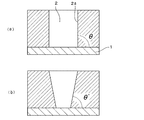
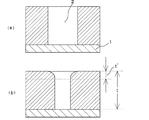
(4) Shape evaluation after pattern shrinkage In evaluation substrate A and evaluation substrate B, a scanning electron microscope (S-4800 manufactured by Hitachi Sokki Co., Ltd.) used a 100 nm diameter hole pattern and a 100 nm space mask pattern (bias +30 nm / The cross section of the pattern corresponding to 130 nm pattern / 70 nm space on the mask and existing at the same position is observed. The cross-sectional shape is shown in FIGS. The angle of the
(5) Pattern Defect Evaluation With respect to Evaluation Examples 2, 5, 12-14, 17-19, and Comparative Example 3, pattern defect evaluation was performed. After forming a pattern on the photoresist, the defect is measured, and after applying, baking and developing the resin composition for forming a fine pattern, under the same conditions, a defect measuring apparatus (with UV bright field pattern manufactured by KLA-Tencor) Defect measurement was performed using a wafer defect inspection apparatus 2351). Measurement conditions were such that a pattern having a 150 nm hole / 300 nm pitch was formed on an 8-inch wafer and a defect in a measurement range of 37.590 cm 2 was measured. As the types of defects, a defect in which coordinates before and after pattern miniaturization coincided with each other, and a defect after the pattern was miniaturized and in which coordinates did not coincide with those before miniaturization were measured. When the total number of these defects is 40 or less, “◯” is indicated, and when the number exceeds 40, “×” is indicated.
(6) Evaluation of etching resistance The substrate B for evaluation was dried using a dry etching apparatus (Pintacle 8000) manufactured by PMT, with an etching gas of CF 4 , a gas flow rate of 75 sccm, a pressure of 2.5 mTorr, and an output of 2500 W. Etching was performed to observe mainly the cross section of the hole pattern and the roughness around the hole pattern from the cross section SEM. As an evaluation index, a case where the unevenness of the cross section and the surface was clearly observed at the time of observation was determined to be defective, and a case where the unevenness was relatively small was determined to be good.
(7) Bake temperature dependency Evaluation examples 2, 5, 6, 14, and 17 to 19 are evaluated in the same manner as the shrinkage rate evaluation (however, the temperature is the baking temperature dependency evaluation temperature range shown in Table 1). The baking temperature dependency (% / ° C.) of the shrinkage rate was measured. The evaluation results are shown in Table 2.
本発明の重合体を樹脂成分として用いた微細パターン形成用樹脂組成物は、レジストパターンのパターン間隙を実効的に、精度よく微細化することができ、波長限界をこえるパターンを良好かつ経済的に形成できるので、今後ますます微細化が進行するとみられる集積回路素子の製造に代表される微細加工の分野で極めて好適に使用することができる。 The resin composition for forming a fine pattern using the polymer of the present invention as a resin component can effectively and accurately miniaturize the pattern gap of the resist pattern, and the pattern exceeding the wavelength limit can be favorably and economically. Since it can be formed, it can be used very favorably in the field of microfabrication represented by the manufacture of integrated circuit elements that are expected to be further miniaturized in the future.
1 基板
2 ホールパターン
1
Claims (3)
前記レジストパターンが形成された基板に微細パターン形成用樹脂組成物を塗布して被覆膜を形成する工程と、
前記フォトレジスト由来の酸により前記微細パターン形成用樹脂組成物を架橋させる工程と、
アルカリ水溶液により現像処理する工程とを含む微細パターン形成方法であって、
前記微細パターン形成用樹脂組成物が請求項1または請求項2記載の微細パターン形成用樹脂組成物であることを特徴とする微細パターン形成方法。 Forming a resist pattern using a photoresist on a substrate;
Applying a fine pattern forming resin composition to the substrate on which the resist pattern is formed to form a coating film; and
Cross-linking the fine pattern forming resin composition with an acid derived from the photoresist;
A fine pattern forming method including a step of developing with an alkaline aqueous solution,
The method for forming a fine pattern, wherein the resin composition for forming a fine pattern is the resin composition for forming a fine pattern according to claim 1 or 2.
Priority Applications (1)
| Application Number | Priority Date | Filing Date | Title |
|---|---|---|---|
| JP2006082967A JP4952012B2 (en) | 2005-03-29 | 2006-03-24 | Resin composition for forming fine pattern and method for forming fine pattern |
Applications Claiming Priority (3)
| Application Number | Priority Date | Filing Date | Title |
|---|---|---|---|
| JP2005093384 | 2005-03-29 | ||
| JP2005093384 | 2005-03-29 | ||
| JP2006082967A JP4952012B2 (en) | 2005-03-29 | 2006-03-24 | Resin composition for forming fine pattern and method for forming fine pattern |
Publications (2)
| Publication Number | Publication Date |
|---|---|
| JP2006307179A JP2006307179A (en) | 2006-11-09 |
| JP4952012B2 true JP4952012B2 (en) | 2012-06-13 |
Family
ID=37474414
Family Applications (1)
| Application Number | Title | Priority Date | Filing Date |
|---|---|---|---|
| JP2006082967A Expired - Fee Related JP4952012B2 (en) | 2005-03-29 | 2006-03-24 | Resin composition for forming fine pattern and method for forming fine pattern |
Country Status (1)
| Country | Link |
|---|---|
| JP (1) | JP4952012B2 (en) |
Families Citing this family (19)
| Publication number | Priority date | Publication date | Assignee | Title |
|---|---|---|---|---|
| JP4844439B2 (en) * | 2007-03-14 | 2011-12-28 | Jsr株式会社 | Resin composition for forming fine pattern and method for forming fine pattern |
| JPWO2008114644A1 (en) * | 2007-03-16 | 2010-07-01 | Jsr株式会社 | Resist pattern forming method and resist pattern insolubilizing resin composition used therefor |
| JPWO2008143301A1 (en) * | 2007-05-23 | 2010-08-12 | Jsr株式会社 | Pattern forming method and resin composition used therefor |
| WO2008153155A1 (en) * | 2007-06-15 | 2008-12-18 | Fujifilm Corporation | Surface treatment agent for forming pattern and pattern forming method using the treatment agent |
| JP2009016657A (en) * | 2007-07-06 | 2009-01-22 | Tokyo Electron Ltd | Resist pattern re-forming method |
| JP5045759B2 (en) * | 2007-09-27 | 2012-10-10 | Jsr株式会社 | Resin composition for forming fine pattern and method for forming fine pattern |
| TWI505046B (en) | 2008-01-24 | 2015-10-21 | Jsr股份有限公司 | Method for forming photoresist pattern and resin composition for refining photoresist pattern |
| JP5029390B2 (en) * | 2008-01-28 | 2012-09-19 | Jsr株式会社 | Polymer purification method |
| JP2009265505A (en) * | 2008-04-28 | 2009-11-12 | Jsr Corp | Pattern formation method and resin composition for fine pattern formation |
| WO2010032839A1 (en) * | 2008-09-19 | 2010-03-25 | Jsr株式会社 | Resist pattern coating agent and resist pattern formation method |
| TW201027247A (en) * | 2008-10-21 | 2010-07-16 | Jsr Corp | Resist pattern coating agent and process for producing resist pattern using |
| TW201031696A (en) * | 2008-11-28 | 2010-09-01 | Jsr Corp | Resist pattern coating agent and process for producing resist pattern using the same |
| JP2010250263A (en) * | 2009-03-25 | 2010-11-04 | Jsr Corp | Resist pattern forming method and resist pattern insolubilizing resin composition used therefor |
| JP5375412B2 (en) * | 2009-07-30 | 2013-12-25 | Jsr株式会社 | Resin composition for forming fine pattern and method for forming fine pattern |
| JP2011033884A (en) * | 2009-08-03 | 2011-02-17 | Jsr Corp | Resist pattern coating agent and resist pattern forming method |
| JP2011059583A (en) * | 2009-09-14 | 2011-03-24 | Jsr Corp | Resin composition for forming fine pattern, method for forming fine pattern and polymer |
| KR101915553B1 (en) * | 2011-05-20 | 2018-11-06 | 닛산 가가쿠 가부시키가이샤 | Composition for forming organic hard mask layer for use in lithography containing polymer having acrylamide structure |
| JP5705669B2 (en) * | 2011-07-14 | 2015-04-22 | メルクパフォーマンスマテリアルズIp合同会社 | Composition for forming a fine pattern and method for forming a fine pattern using the same |
| JP5758263B2 (en) * | 2011-10-11 | 2015-08-05 | メルク、パテント、ゲゼルシャフト、ミット、ベシュレンクテル、ハフツングMerck Patent GmbH | Composition for forming fine resist pattern and pattern forming method using the same |
Family Cites Families (5)
| Publication number | Priority date | Publication date | Assignee | Title |
|---|---|---|---|---|
| JPS6452139A (en) * | 1987-05-18 | 1989-02-28 | Konishiroku Photo Ind | Photosensitive composition |
| JP3950584B2 (en) * | 1999-06-29 | 2007-08-01 | Azエレクトロニックマテリアルズ株式会社 | Water-soluble resin composition |
| JP4348499B2 (en) * | 2000-08-16 | 2009-10-21 | 信越化学工業株式会社 | Fine plating pattern forming composition |
| JP2003064133A (en) * | 2001-08-23 | 2003-03-05 | Idemitsu Petrochem Co Ltd | Biodegradable polymer and method for producing the same |
| JP2003270779A (en) * | 2002-01-11 | 2003-09-25 | Fuji Photo Film Co Ltd | Negative resist composition |
-
2006
- 2006-03-24 JP JP2006082967A patent/JP4952012B2/en not_active Expired - Fee Related
Also Published As
| Publication number | Publication date |
|---|---|
| JP2006307179A (en) | 2006-11-09 |
Similar Documents
| Publication | Publication Date | Title |
|---|---|---|
| JP4893402B2 (en) | Fine pattern forming method | |
| JP4687651B2 (en) | Resin composition for forming fine pattern and method for forming fine pattern | |
| JP4952012B2 (en) | Resin composition for forming fine pattern and method for forming fine pattern | |
| KR102346806B1 (en) | Photoresist pattern trimming compositions and methods | |
| KR101433565B1 (en) | Composition for forming upper layer film for immersion exposure, upper layer film for immersion exposure, and method of forming photoresist pattern | |
| JP5392095B2 (en) | Resist pattern forming method and resist pattern refined resin composition | |
| JP2011059583A (en) | Resin composition for forming fine pattern, method for forming fine pattern and polymer | |
| JP5375412B2 (en) | Resin composition for forming fine pattern and method for forming fine pattern | |
| JP5045759B2 (en) | Resin composition for forming fine pattern and method for forming fine pattern | |
| JP5233985B2 (en) | Resin composition for forming fine pattern and method for forming fine pattern | |
| JP2011081041A (en) | Resist pattern coating agent and resist pattern formation method | |
| JP2009085989A (en) | Resin composition for forming fine pattern and method for forming fine pattern | |
| JP4650375B2 (en) | Resin composition for forming fine pattern and method for forming fine pattern | |
| JP4844439B2 (en) | Resin composition for forming fine pattern and method for forming fine pattern | |
| JP5029390B2 (en) | Polymer purification method | |
| WO2010061833A1 (en) | Resist pattern coating agent and method for forming resist pattern | |
| JP2009235188A (en) | Polymer | |
| JP2009265505A (en) | Pattern formation method and resin composition for fine pattern formation | |
| KR100688569B1 (en) | Top Coating Composition Containing Fluorine and Method of Forming Photoresist Pattern Using the Same |
Legal Events
| Date | Code | Title | Description |
|---|---|---|---|
| A621 | Written request for application examination |
Free format text: JAPANESE INTERMEDIATE CODE: A621 Effective date: 20081205 |
|
| A977 | Report on retrieval |
Free format text: JAPANESE INTERMEDIATE CODE: A971007 Effective date: 20110516 |
|
| A131 | Notification of reasons for refusal |
Free format text: JAPANESE INTERMEDIATE CODE: A131 Effective date: 20110524 |
|
| A521 | Request for written amendment filed |
Free format text: JAPANESE INTERMEDIATE CODE: A523 Effective date: 20110721 |
|
| A02 | Decision of refusal |
Free format text: JAPANESE INTERMEDIATE CODE: A02 Effective date: 20110816 |
|
| A521 | Request for written amendment filed |
Free format text: JAPANESE INTERMEDIATE CODE: A523 Effective date: 20111114 |
|
| A911 | Transfer to examiner for re-examination before appeal (zenchi) |
Free format text: JAPANESE INTERMEDIATE CODE: A911 Effective date: 20111125 |
|
| TRDD | Decision of grant or rejection written | ||
| A01 | Written decision to grant a patent or to grant a registration (utility model) |
Free format text: JAPANESE INTERMEDIATE CODE: A01 Effective date: 20120214 |
|
| A01 | Written decision to grant a patent or to grant a registration (utility model) |
Free format text: JAPANESE INTERMEDIATE CODE: A01 |
|
| A61 | First payment of annual fees (during grant procedure) |
Free format text: JAPANESE INTERMEDIATE CODE: A61 Effective date: 20120227 |
|
| R150 | Certificate of patent or registration of utility model |
Ref document number: 4952012 Country of ref document: JP Free format text: JAPANESE INTERMEDIATE CODE: R150 Free format text: JAPANESE INTERMEDIATE CODE: R150 |
|
| FPAY | Renewal fee payment (event date is renewal date of database) |
Free format text: PAYMENT UNTIL: 20150323 Year of fee payment: 3 |
|
| FPAY | Renewal fee payment (event date is renewal date of database) |
Free format text: PAYMENT UNTIL: 20150323 Year of fee payment: 3 |
|
| R250 | Receipt of annual fees |
Free format text: JAPANESE INTERMEDIATE CODE: R250 |
|
| R250 | Receipt of annual fees |
Free format text: JAPANESE INTERMEDIATE CODE: R250 |
|
| R250 | Receipt of annual fees |
Free format text: JAPANESE INTERMEDIATE CODE: R250 |
|
| R250 | Receipt of annual fees |
Free format text: JAPANESE INTERMEDIATE CODE: R250 |
|
| R250 | Receipt of annual fees |
Free format text: JAPANESE INTERMEDIATE CODE: R250 |
|
| R250 | Receipt of annual fees |
Free format text: JAPANESE INTERMEDIATE CODE: R250 |
|
| R250 | Receipt of annual fees |
Free format text: JAPANESE INTERMEDIATE CODE: R250 |
|
| R250 | Receipt of annual fees |
Free format text: JAPANESE INTERMEDIATE CODE: R250 |
|
| R250 | Receipt of annual fees |
Free format text: JAPANESE INTERMEDIATE CODE: R250 |
|
| R250 | Receipt of annual fees |
Free format text: JAPANESE INTERMEDIATE CODE: R250 |
|
| LAPS | Cancellation because of no payment of annual fees |