JP4789618B2 - Novel transcription factor, its production and use - Google Patents
Novel transcription factor, its production and use Download PDFInfo
- Publication number
- JP4789618B2 JP4789618B2 JP2005502807A JP2005502807A JP4789618B2 JP 4789618 B2 JP4789618 B2 JP 4789618B2 JP 2005502807 A JP2005502807 A JP 2005502807A JP 2005502807 A JP2005502807 A JP 2005502807A JP 4789618 B2 JP4789618 B2 JP 4789618B2
- Authority
- JP
- Japan
- Prior art keywords
- group
- substituted
- carbon atoms
- unsubstituted
- pharmaceutically acceptable
- Prior art date
- Legal status (The legal status is an assumption and is not a legal conclusion. Google has not performed a legal analysis and makes no representation as to the accuracy of the status listed.)
- Expired - Fee Related
Links
- 238000004519 manufacturing process Methods 0.000 title description 8
- 102000040945 Transcription factor Human genes 0.000 title 1
- 108091023040 Transcription factor Proteins 0.000 title 1
- -1 imino compound Chemical class 0.000 claims abstract description 91
- 150000001875 compounds Chemical class 0.000 claims abstract description 86
- SETVRSKZJJWOPA-FLDGXQSCSA-N ascochlorin Chemical compound C[C@@H]1CCC(=O)[C@H](C)[C@@]1(C)\C=C\C(\C)=C\CC1=C(O)C(Cl)=C(C)C(C=O)=C1O SETVRSKZJJWOPA-FLDGXQSCSA-N 0.000 claims abstract description 59
- SHZXWVNJUPKTJN-UHFFFAOYSA-N Ascochlorin Natural products CC1CCC(=O)C(C)C1C=CC(C)=CCC1=C(O)C(Cl)=C(C)C(C=O)=C1O SHZXWVNJUPKTJN-UHFFFAOYSA-N 0.000 claims abstract description 46
- 208000037976 chronic inflammation Diseases 0.000 claims abstract description 7
- 230000006020 chronic inflammation Effects 0.000 claims abstract description 7
- 230000001225 therapeutic effect Effects 0.000 claims abstract description 4
- 125000004432 carbon atom Chemical group C* 0.000 claims description 88
- 125000000217 alkyl group Chemical group 0.000 claims description 58
- 150000003839 salts Chemical class 0.000 claims description 57
- 230000003287 optical effect Effects 0.000 claims description 53
- 239000003814 drug Substances 0.000 claims description 31
- 125000002252 acyl group Chemical group 0.000 claims description 30
- 125000004435 hydrogen atom Chemical group [H]* 0.000 claims description 28
- 229910052739 hydrogen Inorganic materials 0.000 claims description 24
- 239000001257 hydrogen Substances 0.000 claims description 24
- 125000003277 amino group Chemical group 0.000 claims description 22
- 125000003178 carboxy group Chemical group [H]OC(*)=O 0.000 claims description 21
- 125000002887 hydroxy group Chemical group [H]O* 0.000 claims description 21
- 125000003118 aryl group Chemical group 0.000 claims description 19
- 239000004480 active ingredient Substances 0.000 claims description 18
- 125000000753 cycloalkyl group Chemical group 0.000 claims description 17
- 238000001308 synthesis method Methods 0.000 claims description 17
- UFHFLCQGNIYNRP-UHFFFAOYSA-N Hydrogen Chemical compound [H][H] UFHFLCQGNIYNRP-UHFFFAOYSA-N 0.000 claims description 15
- 125000003342 alkenyl group Chemical group 0.000 claims description 15
- 125000000304 alkynyl group Chemical group 0.000 claims description 15
- HVYWMOMLDIMFJA-DPAQBDIFSA-N cholesterol Chemical compound C1C=C2C[C@@H](O)CC[C@]2(C)[C@@H]2[C@@H]1[C@@H]1CC[C@H]([C@H](C)CCCC(C)C)[C@@]1(C)CC2 HVYWMOMLDIMFJA-DPAQBDIFSA-N 0.000 claims description 15
- 229940124597 therapeutic agent Drugs 0.000 claims description 13
- VGYPZLGWVQQOST-UHFFFAOYSA-N Ascofuranone Natural products OC=1C(Cl)=C(C)C(C=O)=C(O)C=1CC=C(C)CCC=C(C)C1CC(=O)C(C)(C)O1 VGYPZLGWVQQOST-UHFFFAOYSA-N 0.000 claims description 11
- 125000003172 aldehyde group Chemical group 0.000 claims description 11
- 150000001413 amino acids Chemical class 0.000 claims description 10
- VGYPZLGWVQQOST-JUERRSSISA-N ascofuranone Chemical compound OC=1C(Cl)=C(C)C(C=O)=C(O)C=1C\C=C(/C)CC\C=C(/C)[C@@H]1CC(=O)C(C)(C)O1 VGYPZLGWVQQOST-JUERRSSISA-N 0.000 claims description 10
- 210000004027 cell Anatomy 0.000 claims description 10
- 206010012601 diabetes mellitus Diseases 0.000 claims description 10
- 239000002207 metabolite Substances 0.000 claims description 10
- 125000001997 phenyl group Chemical group [H]C1=C([H])C([H])=C(*)C([H])=C1[H] 0.000 claims description 9
- 206010020772 Hypertension Diseases 0.000 claims description 8
- 229910052799 carbon Inorganic materials 0.000 claims description 7
- 208000011580 syndromic disease Diseases 0.000 claims description 7
- 239000000654 additive Substances 0.000 claims description 6
- 230000001172 regenerating effect Effects 0.000 claims description 6
- 208000037803 restenosis Diseases 0.000 claims description 6
- 206010003210 Arteriosclerosis Diseases 0.000 claims description 5
- 206010028665 Myxoedema Diseases 0.000 claims description 5
- 208000011775 arteriosclerosis disease Diseases 0.000 claims description 5
- 208000003786 myxedema Diseases 0.000 claims description 5
- 125000004084 sesquiterpene group Chemical group 0.000 claims description 5
- 210000000130 stem cell Anatomy 0.000 claims description 5
- 241000233866 Fungi Species 0.000 claims description 4
- 150000001721 carbon Chemical class 0.000 claims description 4
- 239000003795 chemical substances by application Substances 0.000 claims description 4
- 239000003529 anticholesteremic agent Substances 0.000 claims description 3
- 229940127226 anticholesterol agent Drugs 0.000 claims description 3
- 239000003085 diluting agent Substances 0.000 claims description 3
- 239000003937 drug carrier Substances 0.000 claims description 3
- 230000003449 preventive effect Effects 0.000 claims description 3
- 230000000069 prophylactic effect Effects 0.000 claims description 3
- 230000000996 additive effect Effects 0.000 claims description 2
- 229940121363 anti-inflammatory agent Drugs 0.000 claims description 2
- 239000002260 anti-inflammatory agent Substances 0.000 claims description 2
- 230000000694 effects Effects 0.000 abstract description 13
- 201000010099 disease Diseases 0.000 abstract description 7
- 208000037265 diseases, disorders, signs and symptoms Diseases 0.000 abstract description 7
- 102000003728 Peroxisome Proliferator-Activated Receptors Human genes 0.000 abstract description 4
- 108090000029 Peroxisome Proliferator-Activated Receptors Proteins 0.000 abstract description 4
- 239000003446 ligand Substances 0.000 abstract description 4
- 102000006255 nuclear receptors Human genes 0.000 abstract description 4
- 108020004017 nuclear receptors Proteins 0.000 abstract description 4
- 239000003054 catalyst Substances 0.000 abstract description 3
- 125000002924 primary amino group Chemical group [H]N([H])* 0.000 abstract description 3
- 206010028980 Neoplasm Diseases 0.000 abstract description 2
- 102100038637 Cytochrome P450 7A1 Human genes 0.000 abstract 1
- 101000957672 Homo sapiens Cytochrome P450 7A1 Proteins 0.000 abstract 1
- 102000016978 Orphan receptors Human genes 0.000 abstract 1
- 108070000031 Orphan receptors Proteins 0.000 abstract 1
- 102000007451 Steroid Receptors Human genes 0.000 abstract 1
- 108010085012 Steroid Receptors Proteins 0.000 abstract 1
- 230000003213 activating effect Effects 0.000 abstract 1
- 230000001737 promoting effect Effects 0.000 abstract 1
- 150000004492 retinoid derivatives Chemical class 0.000 abstract 1
- 230000035897 transcription Effects 0.000 abstract 1
- 238000013518 transcription Methods 0.000 abstract 1
- CSCPPACGZOOCGX-UHFFFAOYSA-N Acetone Chemical compound CC(C)=O CSCPPACGZOOCGX-UHFFFAOYSA-N 0.000 description 48
- OKKJLVBELUTLKV-UHFFFAOYSA-N Methanol Chemical compound OC OKKJLVBELUTLKV-UHFFFAOYSA-N 0.000 description 48
- 150000002148 esters Chemical class 0.000 description 37
- 238000006243 chemical reaction Methods 0.000 description 30
- 239000002262 Schiff base Substances 0.000 description 27
- 150000004753 Schiff bases Chemical class 0.000 description 26
- GLOBOHBQKQLVIS-UHFFFAOYSA-N 2-(3-methylbut-2-enyl)phenol Chemical compound CC(C)=CCC1=CC=CC=C1O GLOBOHBQKQLVIS-UHFFFAOYSA-N 0.000 description 21
- 238000000034 method Methods 0.000 description 20
- ZMANZCXQSJIPKH-UHFFFAOYSA-N Triethylamine Chemical compound CCN(CC)CC ZMANZCXQSJIPKH-UHFFFAOYSA-N 0.000 description 18
- 239000000843 powder Substances 0.000 description 17
- 239000000243 solution Substances 0.000 description 17
- 238000004809 thin layer chromatography Methods 0.000 description 15
- WYURNTSHIVDZCO-UHFFFAOYSA-N Tetrahydrofuran Chemical compound C1CCOC1 WYURNTSHIVDZCO-UHFFFAOYSA-N 0.000 description 14
- 230000015572 biosynthetic process Effects 0.000 description 13
- 239000002904 solvent Substances 0.000 description 13
- XLYOFNOQVPJJNP-UHFFFAOYSA-N water Substances O XLYOFNOQVPJJNP-UHFFFAOYSA-N 0.000 description 13
- 150000001299 aldehydes Chemical class 0.000 description 12
- 125000003545 alkoxy group Chemical group 0.000 description 12
- 229940125782 compound 2 Drugs 0.000 description 12
- BEBCJVAWIBVWNZ-UHFFFAOYSA-N glycinamide Chemical compound NCC(N)=O BEBCJVAWIBVWNZ-UHFFFAOYSA-N 0.000 description 12
- 235000018102 proteins Nutrition 0.000 description 12
- 108090000623 proteins and genes Proteins 0.000 description 12
- 102000004169 proteins and genes Human genes 0.000 description 12
- 125000005196 alkyl carbonyloxy group Chemical group 0.000 description 11
- 230000002829 reductive effect Effects 0.000 description 11
- HEDRZPFGACZZDS-UHFFFAOYSA-N Chloroform Chemical compound ClC(Cl)Cl HEDRZPFGACZZDS-UHFFFAOYSA-N 0.000 description 10
- 239000004472 Lysine Substances 0.000 description 10
- KDXKERNSBIXSRK-UHFFFAOYSA-N Lysine Natural products NCCCCC(N)C(O)=O KDXKERNSBIXSRK-UHFFFAOYSA-N 0.000 description 10
- 229940125904 compound 1 Drugs 0.000 description 10
- 229940079593 drug Drugs 0.000 description 10
- 239000000126 substance Substances 0.000 description 10
- YMWUJEATGCHHMB-UHFFFAOYSA-N Dichloromethane Chemical compound ClCCl YMWUJEATGCHHMB-UHFFFAOYSA-N 0.000 description 9
- 241000699670 Mus sp. Species 0.000 description 9
- 239000000203 mixture Substances 0.000 description 9
- 239000003242 anti bacterial agent Substances 0.000 description 8
- 229940088710 antibiotic agent Drugs 0.000 description 8
- 238000010898 silica gel chromatography Methods 0.000 description 8
- 238000003786 synthesis reaction Methods 0.000 description 8
- 241001465754 Metazoa Species 0.000 description 7
- 235000001014 amino acid Nutrition 0.000 description 7
- 229940024606 amino acid Drugs 0.000 description 7
- 230000008034 disappearance Effects 0.000 description 7
- 125000001424 substituent group Chemical group 0.000 description 7
- YLQBMQCUIZJEEH-UHFFFAOYSA-N tetrahydrofuran Natural products C=1C=COC=1 YLQBMQCUIZJEEH-UHFFFAOYSA-N 0.000 description 7
- YRRAKQFQGINEPT-KPKJWKMQSA-N 2-[2-chloro-4-formyl-5-hydroxy-3-methyl-6-[(2e,4e)-3-methyl-5-[(1r,2r,6r)-1,2,6-trimethyl-3-oxocyclohexyl]penta-2,4-dienyl]phenoxy]acetic acid Chemical compound C[C@@H]1CCC(=O)[C@H](C)[C@@]1(C)\C=C\C(\C)=C\CC1=C(O)C(C=O)=C(C)C(Cl)=C1OCC(O)=O YRRAKQFQGINEPT-KPKJWKMQSA-N 0.000 description 6
- XUAAAHFMBMDZCQ-UMXIGZEWSA-N 5-chloro-2-hydroxy-4-methoxy-6-methyl-3-[(2e,4e)-3-methyl-5-[(1r,2r,6r)-1,2,6-trimethyl-3-oxocyclohexyl]penta-2,4-dienyl]benzaldehyde Chemical compound COC1=C(Cl)C(C)=C(C=O)C(O)=C1C\C=C(/C)\C=C\[C@]1(C)[C@@H](C)C(=O)CC[C@H]1C XUAAAHFMBMDZCQ-UMXIGZEWSA-N 0.000 description 6
- QTBSBXVTEAMEQO-UHFFFAOYSA-N Acetic acid Chemical compound CC(O)=O QTBSBXVTEAMEQO-UHFFFAOYSA-N 0.000 description 6
- XEKOWRVHYACXOJ-UHFFFAOYSA-N Ethyl acetate Chemical compound CCOC(C)=O XEKOWRVHYACXOJ-UHFFFAOYSA-N 0.000 description 6
- VYPSYNLAJGMNEJ-UHFFFAOYSA-N Silicium dioxide Chemical compound O=[Si]=O VYPSYNLAJGMNEJ-UHFFFAOYSA-N 0.000 description 6
- 238000010521 absorption reaction Methods 0.000 description 6
- 230000009471 action Effects 0.000 description 6
- 125000005843 halogen group Chemical group 0.000 description 6
- 125000001841 imino group Chemical group [H]N=* 0.000 description 6
- 125000000449 nitro group Chemical group [O-][N+](*)=O 0.000 description 6
- 238000000655 nuclear magnetic resonance spectrum Methods 0.000 description 6
- 239000000741 silica gel Substances 0.000 description 6
- 229910002027 silica gel Inorganic materials 0.000 description 6
- VEXZGXHMUGYJMC-UHFFFAOYSA-N Hydrochloric acid Chemical compound Cl VEXZGXHMUGYJMC-UHFFFAOYSA-N 0.000 description 5
- 238000005481 NMR spectroscopy Methods 0.000 description 5
- 241000700159 Rattus Species 0.000 description 5
- 210000004369 blood Anatomy 0.000 description 5
- 239000008280 blood Substances 0.000 description 5
- BWHMMNNQKKPAPP-UHFFFAOYSA-L potassium carbonate Chemical compound [K+].[K+].[O-]C([O-])=O BWHMMNNQKKPAPP-UHFFFAOYSA-L 0.000 description 5
- 210000000813 small intestine Anatomy 0.000 description 5
- 210000001519 tissue Anatomy 0.000 description 5
- 125000000882 C2-C6 alkenyl group Chemical group 0.000 description 4
- 125000003601 C2-C6 alkynyl group Chemical group 0.000 description 4
- DHMQDGOQFOQNFH-UHFFFAOYSA-N Glycine Chemical compound NCC(O)=O DHMQDGOQFOQNFH-UHFFFAOYSA-N 0.000 description 4
- 241000699666 Mus <mouse, genus> Species 0.000 description 4
- JUJWROOIHBZHMG-UHFFFAOYSA-N Pyridine Chemical compound C1=CC=NC=C1 JUJWROOIHBZHMG-UHFFFAOYSA-N 0.000 description 4
- 241000283984 Rodentia Species 0.000 description 4
- 125000003668 acetyloxy group Chemical group [H]C([H])([H])C(=O)O[*] 0.000 description 4
- 239000002253 acid Substances 0.000 description 4
- RSDOASZYYCOXIB-UHFFFAOYSA-N beta-alaninamide Chemical compound NCCC(N)=O RSDOASZYYCOXIB-UHFFFAOYSA-N 0.000 description 4
- 125000006297 carbonyl amino group Chemical group [H]N([*:2])C([*:1])=O 0.000 description 4
- 239000007810 chemical reaction solvent Substances 0.000 description 4
- 238000000921 elemental analysis Methods 0.000 description 4
- 238000005755 formation reaction Methods 0.000 description 4
- 125000003588 lysine group Chemical group [H]N([H])C([H])([H])C([H])([H])C([H])([H])C([H])([H])C([H])(N([H])[H])C(*)=O 0.000 description 4
- HQKMJHAJHXVSDF-UHFFFAOYSA-L magnesium stearate Chemical compound [Mg+2].CCCCCCCCCCCCCCCCCC([O-])=O.CCCCCCCCCCCCCCCCCC([O-])=O HQKMJHAJHXVSDF-UHFFFAOYSA-L 0.000 description 4
- 239000000546 pharmaceutical excipient Substances 0.000 description 4
- 230000002265 prevention Effects 0.000 description 4
- 230000008569 process Effects 0.000 description 4
- 210000002966 serum Anatomy 0.000 description 4
- 230000002194 synthesizing effect Effects 0.000 description 4
- 125000004169 (C1-C6) alkyl group Chemical group 0.000 description 3
- WFDIJRYMOXRFFG-UHFFFAOYSA-N Acetic anhydride Chemical compound CC(=O)OC(C)=O WFDIJRYMOXRFFG-UHFFFAOYSA-N 0.000 description 3
- UHOVQNZJYSORNB-UHFFFAOYSA-N Benzene Chemical compound C1=CC=CC=C1 UHOVQNZJYSORNB-UHFFFAOYSA-N 0.000 description 3
- OKTJSMMVPCPJKN-UHFFFAOYSA-N Carbon Chemical compound [C] OKTJSMMVPCPJKN-UHFFFAOYSA-N 0.000 description 3
- OBSIQMZKFXFYLV-QMMMGPOBSA-N L-phenylalanine amide Chemical compound NC(=O)[C@@H](N)CC1=CC=CC=C1 OBSIQMZKFXFYLV-QMMMGPOBSA-N 0.000 description 3
- 102000007562 Serum Albumin Human genes 0.000 description 3
- 108010071390 Serum Albumin Proteins 0.000 description 3
- 229920002472 Starch Polymers 0.000 description 3
- 150000001241 acetals Chemical class 0.000 description 3
- 125000002777 acetyl group Chemical group [H]C([H])([H])C(*)=O 0.000 description 3
- 150000003862 amino acid derivatives Chemical class 0.000 description 3
- 239000002585 base Substances 0.000 description 3
- KRKNYBCHXYNGOX-UHFFFAOYSA-N citric acid Chemical compound OC(=O)CC(O)(C(O)=O)CC(O)=O KRKNYBCHXYNGOX-UHFFFAOYSA-N 0.000 description 3
- 235000008504 concentrate Nutrition 0.000 description 3
- 239000012141 concentrate Substances 0.000 description 3
- 239000002552 dosage form Substances 0.000 description 3
- 239000003112 inhibitor Substances 0.000 description 3
- 125000002496 methyl group Chemical group [H]C([H])([H])* 0.000 description 3
- 125000001570 methylene group Chemical group [H]C([H])([*:1])[*:2] 0.000 description 3
- 230000000813 microbial effect Effects 0.000 description 3
- 239000003960 organic solvent Substances 0.000 description 3
- 230000000144 pharmacologic effect Effects 0.000 description 3
- 239000006187 pill Substances 0.000 description 3
- 150000003141 primary amines Chemical class 0.000 description 3
- 239000000047 product Substances 0.000 description 3
- 239000002994 raw material Substances 0.000 description 3
- 239000007787 solid Substances 0.000 description 3
- 239000008107 starch Substances 0.000 description 3
- 235000019698 starch Nutrition 0.000 description 3
- 238000003756 stirring Methods 0.000 description 3
- 231100000419 toxicity Toxicity 0.000 description 3
- 230000001988 toxicity Effects 0.000 description 3
- 210000002700 urine Anatomy 0.000 description 3
- ONBQEOIKXPHGMB-VBSBHUPXSA-N 1-[2-[(2s,3r,4s,5r)-3,4-dihydroxy-5-(hydroxymethyl)oxolan-2-yl]oxy-4,6-dihydroxyphenyl]-3-(4-hydroxyphenyl)propan-1-one Chemical compound O[C@@H]1[C@H](O)[C@@H](CO)O[C@H]1OC1=CC(O)=CC(O)=C1C(=O)CCC1=CC=C(O)C=C1 ONBQEOIKXPHGMB-VBSBHUPXSA-N 0.000 description 2
- ZLAQYJKDQSZARB-FLDGXQSCSA-N 5-chloro-2,4-dihydroxy-6-methyl-3-[(2e,4e)-3-methyl-5-[(1s,2r,6r)-1,2,6-trimethyl-5-oxocyclohex-3-en-1-yl]penta-2,4-dienyl]benzaldehyde Chemical compound C[C@@H]1C=CC(=O)[C@H](C)[C@@]1(C)\C=C\C(\C)=C\CC1=C(O)C(Cl)=C(C)C(C=O)=C1O ZLAQYJKDQSZARB-FLDGXQSCSA-N 0.000 description 2
- GUBGYTABKSRVRQ-XLOQQCSPSA-N Alpha-Lactose Chemical compound O[C@@H]1[C@@H](O)[C@@H](O)[C@@H](CO)O[C@H]1O[C@@H]1[C@@H](CO)O[C@H](O)[C@H](O)[C@H]1O GUBGYTABKSRVRQ-XLOQQCSPSA-N 0.000 description 2
- IJGRMHOSHXDMSA-UHFFFAOYSA-N Atomic nitrogen Chemical compound N#N IJGRMHOSHXDMSA-UHFFFAOYSA-N 0.000 description 2
- 125000005915 C6-C14 aryl group Chemical group 0.000 description 2
- 0 CC(*)=CCc1c(*)c(Cl)c(C)c(C=*)c1* Chemical compound CC(*)=CCc1c(*)c(Cl)c(C)c(C=*)c1* 0.000 description 2
- ZLAQYJKDQSZARB-UHFFFAOYSA-N Cylindrochlorin Natural products CC1C=CC(=O)C(C)C1(C)C=CC(C)=CCC1=C(O)C(Cl)=C(C)C(C=O)=C1O ZLAQYJKDQSZARB-UHFFFAOYSA-N 0.000 description 2
- VZCYOOQTPOCHFL-OWOJBTEDSA-N Fumaric acid Chemical compound OC(=O)\C=C\C(O)=O VZCYOOQTPOCHFL-OWOJBTEDSA-N 0.000 description 2
- 108010010803 Gelatin Proteins 0.000 description 2
- WQZGKKKJIJFFOK-GASJEMHNSA-N Glucose Natural products OC[C@H]1OC(O)[C@H](O)[C@@H](O)[C@@H]1O WQZGKKKJIJFFOK-GASJEMHNSA-N 0.000 description 2
- 239000004471 Glycine Substances 0.000 description 2
- 229920000084 Gum arabic Polymers 0.000 description 2
- 208000035150 Hypercholesterolemia Diseases 0.000 description 2
- QIVBCDIJIAJPQS-VIFPVBQESA-N L-tryptophane Chemical compound C1=CC=C2C(C[C@H](N)C(O)=O)=CNC2=C1 QIVBCDIJIAJPQS-VIFPVBQESA-N 0.000 description 2
- GUBGYTABKSRVRQ-QKKXKWKRSA-N Lactose Natural products OC[C@H]1O[C@@H](O[C@H]2[C@H](O)[C@@H](O)C(O)O[C@@H]2CO)[C@H](O)[C@@H](O)[C@H]1O GUBGYTABKSRVRQ-QKKXKWKRSA-N 0.000 description 2
- AFVFQIVMOAPDHO-UHFFFAOYSA-N Methanesulfonic acid Chemical compound CS(O)(=O)=O AFVFQIVMOAPDHO-UHFFFAOYSA-N 0.000 description 2
- 108020005497 Nuclear hormone receptor Proteins 0.000 description 2
- 102000015636 Oligopeptides Human genes 0.000 description 2
- 108010038807 Oligopeptides Proteins 0.000 description 2
- 102000035195 Peptidases Human genes 0.000 description 2
- 108091005804 Peptidases Proteins 0.000 description 2
- NBIIXXVUZAFLBC-UHFFFAOYSA-N Phosphoric acid Chemical compound OP(O)(O)=O NBIIXXVUZAFLBC-UHFFFAOYSA-N 0.000 description 2
- 102000034527 Retinoid X Receptors Human genes 0.000 description 2
- 108010038912 Retinoid X Receptors Proteins 0.000 description 2
- 241000978776 Senegalia senegal Species 0.000 description 2
- 229930006000 Sucrose Natural products 0.000 description 2
- CZMRCDWAGMRECN-UGDNZRGBSA-N Sucrose Chemical compound O[C@H]1[C@H](O)[C@@H](CO)O[C@@]1(CO)O[C@@H]1[C@H](O)[C@@H](O)[C@H](O)[C@@H](CO)O1 CZMRCDWAGMRECN-UGDNZRGBSA-N 0.000 description 2
- QAOWNCQODCNURD-UHFFFAOYSA-N Sulfuric acid Chemical compound OS(O)(=O)=O QAOWNCQODCNURD-UHFFFAOYSA-N 0.000 description 2
- QIVBCDIJIAJPQS-UHFFFAOYSA-N Tryptophan Natural products C1=CC=C2C(CC(N)C(O)=O)=CNC2=C1 QIVBCDIJIAJPQS-UHFFFAOYSA-N 0.000 description 2
- 238000000862 absorption spectrum Methods 0.000 description 2
- 235000010489 acacia gum Nutrition 0.000 description 2
- 239000000205 acacia gum Substances 0.000 description 2
- DHKHKXVYLBGOIT-UHFFFAOYSA-N acetaldehyde Diethyl Acetal Natural products CCOC(C)OCC DHKHKXVYLBGOIT-UHFFFAOYSA-N 0.000 description 2
- 235000011054 acetic acid Nutrition 0.000 description 2
- 125000003282 alkyl amino group Chemical group 0.000 description 2
- 230000036528 appetite Effects 0.000 description 2
- 235000019789 appetite Nutrition 0.000 description 2
- 150000003934 aromatic aldehydes Chemical group 0.000 description 2
- WPYMKLBDIGXBTP-UHFFFAOYSA-N benzoic acid Chemical compound OC(=O)C1=CC=CC=C1 WPYMKLBDIGXBTP-UHFFFAOYSA-N 0.000 description 2
- UCMIRNVEIXFBKS-UHFFFAOYSA-N beta-alanine Chemical compound NCCC(O)=O UCMIRNVEIXFBKS-UHFFFAOYSA-N 0.000 description 2
- 244000309464 bull Species 0.000 description 2
- KDYFGRWQOYBRFD-NUQCWPJISA-N butanedioic acid Chemical class O[14C](=O)CC[14C](O)=O KDYFGRWQOYBRFD-NUQCWPJISA-N 0.000 description 2
- 201000011510 cancer Diseases 0.000 description 2
- 230000000711 cancerogenic effect Effects 0.000 description 2
- 239000002775 capsule Substances 0.000 description 2
- 125000003917 carbamoyl group Chemical group [H]N([H])C(*)=O 0.000 description 2
- 150000001720 carbohydrates Chemical class 0.000 description 2
- 235000014633 carbohydrates Nutrition 0.000 description 2
- 231100000315 carcinogenic Toxicity 0.000 description 2
- 239000001913 cellulose Substances 0.000 description 2
- 229920002678 cellulose Polymers 0.000 description 2
- 235000010980 cellulose Nutrition 0.000 description 2
- 239000012295 chemical reaction liquid Substances 0.000 description 2
- 229940126142 compound 16 Drugs 0.000 description 2
- 238000009833 condensation Methods 0.000 description 2
- 230000005494 condensation Effects 0.000 description 2
- 239000013078 crystal Substances 0.000 description 2
- 238000001514 detection method Methods 0.000 description 2
- XBDQKXXYIPTUBI-UHFFFAOYSA-N dimethylselenoniopropionate Natural products CCC(O)=O XBDQKXXYIPTUBI-UHFFFAOYSA-N 0.000 description 2
- ZUOUZKKEUPVFJK-UHFFFAOYSA-N diphenyl Chemical compound C1=CC=CC=C1C1=CC=CC=C1 ZUOUZKKEUPVFJK-UHFFFAOYSA-N 0.000 description 2
- 238000004090 dissolution Methods 0.000 description 2
- 239000003651 drinking water Substances 0.000 description 2
- 235000020188 drinking water Nutrition 0.000 description 2
- 125000004494 ethyl ester group Chemical group 0.000 description 2
- 230000029142 excretion Effects 0.000 description 2
- 238000002474 experimental method Methods 0.000 description 2
- 230000006126 farnesylation Effects 0.000 description 2
- 235000013305 food Nutrition 0.000 description 2
- 238000009472 formulation Methods 0.000 description 2
- BTCSSZJGUNDROE-UHFFFAOYSA-N gamma-aminobutyric acid Chemical compound NCCCC(O)=O BTCSSZJGUNDROE-UHFFFAOYSA-N 0.000 description 2
- 210000001035 gastrointestinal tract Anatomy 0.000 description 2
- 239000008273 gelatin Substances 0.000 description 2
- 229920000159 gelatin Polymers 0.000 description 2
- 235000019322 gelatine Nutrition 0.000 description 2
- 235000011852 gelatine desserts Nutrition 0.000 description 2
- 239000008103 glucose Substances 0.000 description 2
- 238000010438 heat treatment Methods 0.000 description 2
- 229940088597 hormone Drugs 0.000 description 2
- 239000005556 hormone Substances 0.000 description 2
- 150000002431 hydrogen Chemical class 0.000 description 2
- 230000002401 inhibitory effect Effects 0.000 description 2
- NOESYZHRGYRDHS-UHFFFAOYSA-N insulin Chemical compound N1C(=O)C(NC(=O)C(CCC(N)=O)NC(=O)C(CCC(O)=O)NC(=O)C(C(C)C)NC(=O)C(NC(=O)CN)C(C)CC)CSSCC(C(NC(CO)C(=O)NC(CC(C)C)C(=O)NC(CC=2C=CC(O)=CC=2)C(=O)NC(CCC(N)=O)C(=O)NC(CC(C)C)C(=O)NC(CCC(O)=O)C(=O)NC(CC(N)=O)C(=O)NC(CC=2C=CC(O)=CC=2)C(=O)NC(CSSCC(NC(=O)C(C(C)C)NC(=O)C(CC(C)C)NC(=O)C(CC=2C=CC(O)=CC=2)NC(=O)C(CC(C)C)NC(=O)C(C)NC(=O)C(CCC(O)=O)NC(=O)C(C(C)C)NC(=O)C(CC(C)C)NC(=O)C(CC=2NC=NC=2)NC(=O)C(CO)NC(=O)CNC2=O)C(=O)NCC(=O)NC(CCC(O)=O)C(=O)NC(CCCNC(N)=N)C(=O)NCC(=O)NC(CC=3C=CC=CC=3)C(=O)NC(CC=3C=CC=CC=3)C(=O)NC(CC=3C=CC(O)=CC=3)C(=O)NC(C(C)O)C(=O)N3C(CCC3)C(=O)NC(CCCCN)C(=O)NC(C)C(O)=O)C(=O)NC(CC(N)=O)C(O)=O)=O)NC(=O)C(C(C)CC)NC(=O)C(CO)NC(=O)C(C(C)O)NC(=O)C1CSSCC2NC(=O)C(CC(C)C)NC(=O)C(NC(=O)C(CCC(N)=O)NC(=O)C(CC(N)=O)NC(=O)C(NC(=O)C(N)CC=1C=CC=CC=1)C(C)C)CC1=CN=CN1 NOESYZHRGYRDHS-UHFFFAOYSA-N 0.000 description 2
- 230000003993 interaction Effects 0.000 description 2
- 125000001449 isopropyl group Chemical group [H]C([H])([H])C([H])(*)C([H])([H])[H] 0.000 description 2
- 210000003734 kidney Anatomy 0.000 description 2
- JVTAAEKCZFNVCJ-UHFFFAOYSA-N lactic acid Chemical compound CC(O)C(O)=O JVTAAEKCZFNVCJ-UHFFFAOYSA-N 0.000 description 2
- 239000008101 lactose Substances 0.000 description 2
- 235000019359 magnesium stearate Nutrition 0.000 description 2
- 239000000463 material Substances 0.000 description 2
- 238000005259 measurement Methods 0.000 description 2
- 230000007721 medicinal effect Effects 0.000 description 2
- BDAGIHXWWSANSR-UHFFFAOYSA-N methanoic acid Natural products OC=O BDAGIHXWWSANSR-UHFFFAOYSA-N 0.000 description 2
- 125000001434 methanylylidene group Chemical group [H]C#[*] 0.000 description 2
- 238000002156 mixing Methods 0.000 description 2
- 125000000896 monocarboxylic acid group Chemical group 0.000 description 2
- 125000004123 n-propyl group Chemical group [H]C([H])([H])C([H])([H])C([H])([H])* 0.000 description 2
- 239000008188 pellet Substances 0.000 description 2
- COLNVLDHVKWLRT-UHFFFAOYSA-N phenylalanine Natural products OC(=O)C(N)CC1=CC=CC=C1 COLNVLDHVKWLRT-UHFFFAOYSA-N 0.000 description 2
- 239000001267 polyvinylpyrrolidone Substances 0.000 description 2
- 235000013855 polyvinylpyrrolidone Nutrition 0.000 description 2
- 229920000036 polyvinylpyrrolidone Polymers 0.000 description 2
- 229910000027 potassium carbonate Inorganic materials 0.000 description 2
- 229940024999 proteolytic enzymes for treatment of wounds and ulcers Drugs 0.000 description 2
- UMJSCPRVCHMLSP-UHFFFAOYSA-N pyridine Natural products COC1=CC=CN=C1 UMJSCPRVCHMLSP-UHFFFAOYSA-N 0.000 description 2
- 230000009257 reactivity Effects 0.000 description 2
- 238000011160 research Methods 0.000 description 2
- SMQUZDBALVYZAC-UHFFFAOYSA-N salicylaldehyde Chemical compound OC1=CC=CC=C1C=O SMQUZDBALVYZAC-UHFFFAOYSA-N 0.000 description 2
- 238000012216 screening Methods 0.000 description 2
- 239000005720 sucrose Substances 0.000 description 2
- 235000000346 sugar Nutrition 0.000 description 2
- 239000004094 surface-active agent Substances 0.000 description 2
- 230000002459 sustained effect Effects 0.000 description 2
- 239000003826 tablet Substances 0.000 description 2
- JOXIMZWYDAKGHI-UHFFFAOYSA-N toluene-4-sulfonic acid Chemical compound CC1=CC=C(S(O)(=O)=O)C=C1 JOXIMZWYDAKGHI-UHFFFAOYSA-N 0.000 description 2
- VZCYOOQTPOCHFL-UHFFFAOYSA-N trans-butenedioic acid Natural products OC(=O)C=CC(O)=O VZCYOOQTPOCHFL-UHFFFAOYSA-N 0.000 description 2
- 208000001072 type 2 diabetes mellitus Diseases 0.000 description 2
- OGNSCSPNOLGXSM-UHFFFAOYSA-N (+/-)-DABA Natural products NCCC(N)C(O)=O OGNSCSPNOLGXSM-UHFFFAOYSA-N 0.000 description 1
- MTCFGRXMJLQNBG-REOHCLBHSA-N (2S)-2-Amino-3-hydroxypropansäure Chemical compound OC[C@H](N)C(O)=O MTCFGRXMJLQNBG-REOHCLBHSA-N 0.000 description 1
- JNYAEWCLZODPBN-JGWLITMVSA-N (2r,3r,4s)-2-[(1r)-1,2-dihydroxyethyl]oxolane-3,4-diol Chemical compound OC[C@@H](O)[C@H]1OC[C@H](O)[C@H]1O JNYAEWCLZODPBN-JGWLITMVSA-N 0.000 description 1
- BJEPYKJPYRNKOW-REOHCLBHSA-N (S)-malic acid Chemical compound OC(=O)[C@@H](O)CC(O)=O BJEPYKJPYRNKOW-REOHCLBHSA-N 0.000 description 1
- MNCMBBIFTVWHIP-UHFFFAOYSA-N 1-anthracen-9-yl-2,2,2-trifluoroethanone Chemical group C1=CC=C2C(C(=O)C(F)(F)F)=C(C=CC=C3)C3=CC2=C1 MNCMBBIFTVWHIP-UHFFFAOYSA-N 0.000 description 1
- IXPNQXFRVYWDDI-UHFFFAOYSA-N 1-methyl-2,4-dioxo-1,3-diazinane-5-carboximidamide Chemical compound CN1CC(C(N)=N)C(=O)NC1=O IXPNQXFRVYWDDI-UHFFFAOYSA-N 0.000 description 1
- 125000001637 1-naphthyl group Chemical group [H]C1=C([H])C([H])=C2C(*)=C([H])C([H])=C([H])C2=C1[H] 0.000 description 1
- ZESRJSPZRDMNHY-YFWFAHHUSA-N 11-deoxycorticosterone Chemical compound O=C1CC[C@]2(C)[C@H]3CC[C@](C)([C@H](CC4)C(=O)CO)[C@@H]4[C@@H]3CCC2=C1 ZESRJSPZRDMNHY-YFWFAHHUSA-N 0.000 description 1
- 125000004974 2-butenyl group Chemical group C(C=CC)* 0.000 description 1
- 125000000069 2-butynyl group Chemical group [H]C([H])([H])C#CC([H])([H])* 0.000 description 1
- 125000006040 2-hexenyl group Chemical group 0.000 description 1
- 125000001622 2-naphthyl group Chemical group [H]C1=C([H])C([H])=C2C([H])=C(*)C([H])=C([H])C2=C1[H] 0.000 description 1
- 125000006024 2-pentenyl group Chemical group 0.000 description 1
- 125000003903 2-propenyl group Chemical group [H]C([*])([H])C([H])=C([H])[H] 0.000 description 1
- 125000001494 2-propynyl group Chemical group [H]C#CC([H])([H])* 0.000 description 1
- BMYNFMYTOJXKLE-UHFFFAOYSA-N 3-azaniumyl-2-hydroxypropanoate Chemical compound NCC(O)C(O)=O BMYNFMYTOJXKLE-UHFFFAOYSA-N 0.000 description 1
- 125000004975 3-butenyl group Chemical group C(CC=C)* 0.000 description 1
- 125000000474 3-butynyl group Chemical group [H]C#CC([H])([H])C([H])([H])* 0.000 description 1
- 125000006041 3-hexenyl group Chemical group 0.000 description 1
- OSWFIVFLDKOXQC-UHFFFAOYSA-N 4-(3-methoxyphenyl)aniline Chemical compound COC1=CC=CC(C=2C=CC(N)=CC=2)=C1 OSWFIVFLDKOXQC-UHFFFAOYSA-N 0.000 description 1
- QTBSBXVTEAMEQO-UHFFFAOYSA-M Acetate Chemical compound CC([O-])=O QTBSBXVTEAMEQO-UHFFFAOYSA-M 0.000 description 1
- 102000009027 Albumins Human genes 0.000 description 1
- 108010088751 Albumins Proteins 0.000 description 1
- QGZKDVFQNNGYKY-UHFFFAOYSA-O Ammonium Chemical compound [NH4+] QGZKDVFQNNGYKY-UHFFFAOYSA-O 0.000 description 1
- 239000004475 Arginine Substances 0.000 description 1
- 102000014654 Aromatase Human genes 0.000 description 1
- 108010078554 Aromatase Proteins 0.000 description 1
- 229940122815 Aromatase inhibitor Drugs 0.000 description 1
- 206010003211 Arteriosclerosis coronary artery Diseases 0.000 description 1
- 241000708553 Ascochyta viciae Species 0.000 description 1
- DCXYFEDJOCDNAF-UHFFFAOYSA-N Asparagine Natural products OC(=O)C(N)CC(N)=O DCXYFEDJOCDNAF-UHFFFAOYSA-N 0.000 description 1
- 239000005711 Benzoic acid Substances 0.000 description 1
- UTEKFENAKWJHHK-UHFFFAOYSA-N C(=CC=CC)C1(CC(=C(C=O)C(=C1Cl)C)O)O Chemical compound C(=CC=CC)C1(CC(=C(C=O)C(=C1Cl)C)O)O UTEKFENAKWJHHK-UHFFFAOYSA-N 0.000 description 1
- OYPRJOBELJOOCE-UHFFFAOYSA-N Calcium Chemical compound [Ca] OYPRJOBELJOOCE-UHFFFAOYSA-N 0.000 description 1
- 229920002134 Carboxymethyl cellulose Polymers 0.000 description 1
- 241000725101 Clea Species 0.000 description 1
- FBPFZTCFMRRESA-KVTDHHQDSA-N D-Mannitol Chemical compound OC[C@@H](O)[C@@H](O)[C@H](O)[C@H](O)CO FBPFZTCFMRRESA-KVTDHHQDSA-N 0.000 description 1
- XUIIKFGFIJCVMT-GFCCVEGCSA-N D-thyroxine Chemical compound IC1=CC(C[C@@H](N)C(O)=O)=CC(I)=C1OC1=CC(I)=C(O)C(I)=C1 XUIIKFGFIJCVMT-GFCCVEGCSA-N 0.000 description 1
- FEWJPZIEWOKRBE-JCYAYHJZSA-N Dextrotartaric acid Chemical compound OC(=O)[C@H](O)[C@@H](O)C(O)=O FEWJPZIEWOKRBE-JCYAYHJZSA-N 0.000 description 1
- 102000015781 Dietary Proteins Human genes 0.000 description 1
- 108010010256 Dietary Proteins Proteins 0.000 description 1
- 102000004190 Enzymes Human genes 0.000 description 1
- 108090000790 Enzymes Proteins 0.000 description 1
- LFQSCWFLJHTTHZ-UHFFFAOYSA-N Ethanol Chemical compound CCO LFQSCWFLJHTTHZ-UHFFFAOYSA-N 0.000 description 1
- 241000223218 Fusarium Species 0.000 description 1
- 241001149959 Fusarium sp. Species 0.000 description 1
- WHUUTDBJXJRKMK-UHFFFAOYSA-N Glutamic acid Natural products OC(=O)C(N)CCC(O)=O WHUUTDBJXJRKMK-UHFFFAOYSA-N 0.000 description 1
- LCWXJXMHJVIJFK-UHFFFAOYSA-N Hydroxylysine Natural products NCC(O)CC(N)CC(O)=O LCWXJXMHJVIJFK-UHFFFAOYSA-N 0.000 description 1
- 229920002153 Hydroxypropyl cellulose Polymers 0.000 description 1
- 238000004566 IR spectroscopy Methods 0.000 description 1
- DGAQECJNVWCQMB-PUAWFVPOSA-M Ilexoside XXIX Chemical compound C[C@@H]1CC[C@@]2(CC[C@@]3(C(=CC[C@H]4[C@]3(CC[C@@H]5[C@@]4(CC[C@@H](C5(C)C)OS(=O)(=O)[O-])C)C)[C@@H]2[C@]1(C)O)C)C(=O)O[C@H]6[C@@H]([C@H]([C@@H]([C@H](O6)CO)O)O)O.[Na+] DGAQECJNVWCQMB-PUAWFVPOSA-M 0.000 description 1
- 206010061218 Inflammation Diseases 0.000 description 1
- 102000004877 Insulin Human genes 0.000 description 1
- 108090001061 Insulin Proteins 0.000 description 1
- 206010022489 Insulin Resistance Diseases 0.000 description 1
- XUJNEKJLAYXESH-REOHCLBHSA-N L-Cysteine Chemical compound SC[C@H](N)C(O)=O XUJNEKJLAYXESH-REOHCLBHSA-N 0.000 description 1
- WTDRDQBEARUVNC-LURJTMIESA-N L-DOPA Chemical compound OC(=O)[C@@H](N)CC1=CC=C(O)C(O)=C1 WTDRDQBEARUVNC-LURJTMIESA-N 0.000 description 1
- WTDRDQBEARUVNC-UHFFFAOYSA-N L-Dopa Natural products OC(=O)C(N)CC1=CC=C(O)C(O)=C1 WTDRDQBEARUVNC-UHFFFAOYSA-N 0.000 description 1
- AHLPHDHHMVZTML-BYPYZUCNSA-N L-Ornithine Chemical compound NCCC[C@H](N)C(O)=O AHLPHDHHMVZTML-BYPYZUCNSA-N 0.000 description 1
- ONIBWKKTOPOVIA-BYPYZUCNSA-N L-Proline Chemical compound OC(=O)[C@@H]1CCCN1 ONIBWKKTOPOVIA-BYPYZUCNSA-N 0.000 description 1
- QNAYBMKLOCPYGJ-REOHCLBHSA-N L-alanine Chemical compound C[C@H](N)C(O)=O QNAYBMKLOCPYGJ-REOHCLBHSA-N 0.000 description 1
- ODKSFYDXXFIFQN-BYPYZUCNSA-P L-argininium(2+) Chemical compound NC(=[NH2+])NCCC[C@H]([NH3+])C(O)=O ODKSFYDXXFIFQN-BYPYZUCNSA-P 0.000 description 1
- DCXYFEDJOCDNAF-REOHCLBHSA-N L-asparagine Chemical compound OC(=O)[C@@H](N)CC(N)=O DCXYFEDJOCDNAF-REOHCLBHSA-N 0.000 description 1
- CKLJMWTZIZZHCS-REOHCLBHSA-N L-aspartic acid Chemical compound OC(=O)[C@@H](N)CC(O)=O CKLJMWTZIZZHCS-REOHCLBHSA-N 0.000 description 1
- LEVWYRKDKASIDU-IMJSIDKUSA-N L-cystine Chemical compound [O-]C(=O)[C@@H]([NH3+])CSSC[C@H]([NH3+])C([O-])=O LEVWYRKDKASIDU-IMJSIDKUSA-N 0.000 description 1
- WHUUTDBJXJRKMK-VKHMYHEASA-N L-glutamic acid Chemical compound OC(=O)[C@@H](N)CCC(O)=O WHUUTDBJXJRKMK-VKHMYHEASA-N 0.000 description 1
- ZDXPYRJPNDTMRX-VKHMYHEASA-N L-glutamine Chemical compound OC(=O)[C@@H](N)CCC(N)=O ZDXPYRJPNDTMRX-VKHMYHEASA-N 0.000 description 1
- HNDVDQJCIGZPNO-YFKPBYRVSA-N L-histidine Chemical compound OC(=O)[C@@H](N)CC1=CN=CN1 HNDVDQJCIGZPNO-YFKPBYRVSA-N 0.000 description 1
- FFFHZYDWPBMWHY-VKHMYHEASA-N L-homocysteine Chemical compound OC(=O)[C@@H](N)CCS FFFHZYDWPBMWHY-VKHMYHEASA-N 0.000 description 1
- AGPKZVBTJJNPAG-WHFBIAKZSA-N L-isoleucine Chemical compound CC[C@H](C)[C@H](N)C(O)=O AGPKZVBTJJNPAG-WHFBIAKZSA-N 0.000 description 1
- ROHFNLRQFUQHCH-YFKPBYRVSA-N L-leucine Chemical compound CC(C)C[C@H](N)C(O)=O ROHFNLRQFUQHCH-YFKPBYRVSA-N 0.000 description 1
- FFEARJCKVFRZRR-BYPYZUCNSA-N L-methionine Chemical compound CSCC[C@H](N)C(O)=O FFEARJCKVFRZRR-BYPYZUCNSA-N 0.000 description 1
- COLNVLDHVKWLRT-QMMMGPOBSA-N L-phenylalanine Chemical compound OC(=O)[C@@H](N)CC1=CC=CC=C1 COLNVLDHVKWLRT-QMMMGPOBSA-N 0.000 description 1
- AYFVYJQAPQTCCC-GBXIJSLDSA-N L-threonine Chemical compound C[C@@H](O)[C@H](N)C(O)=O AYFVYJQAPQTCCC-GBXIJSLDSA-N 0.000 description 1
- OUYCCCASQSFEME-QMMMGPOBSA-N L-tyrosine Chemical compound OC(=O)[C@@H](N)CC1=CC=C(O)C=C1 OUYCCCASQSFEME-QMMMGPOBSA-N 0.000 description 1
- KZSNJWFQEVHDMF-BYPYZUCNSA-N L-valine Chemical compound CC(C)[C@H](N)C(O)=O KZSNJWFQEVHDMF-BYPYZUCNSA-N 0.000 description 1
- ROHFNLRQFUQHCH-UHFFFAOYSA-N Leucine Natural products CC(C)CC(N)C(O)=O ROHFNLRQFUQHCH-UHFFFAOYSA-N 0.000 description 1
- FYYHWMGAXLPEAU-UHFFFAOYSA-N Magnesium Chemical compound [Mg] FYYHWMGAXLPEAU-UHFFFAOYSA-N 0.000 description 1
- 229930195725 Mannitol Natural products 0.000 description 1
- 108091005461 Nucleic proteins Proteins 0.000 description 1
- AHLPHDHHMVZTML-UHFFFAOYSA-N Orn-delta-NH2 Natural products NCCCC(N)C(O)=O AHLPHDHHMVZTML-UHFFFAOYSA-N 0.000 description 1
- UTJLXEIPEHZYQJ-UHFFFAOYSA-N Ornithine Natural products OC(=O)C(C)CCCN UTJLXEIPEHZYQJ-UHFFFAOYSA-N 0.000 description 1
- 229920002701 Polyoxyl 40 Stearate Polymers 0.000 description 1
- ZLMJMSJWJFRBEC-UHFFFAOYSA-N Potassium Chemical compound [K] ZLMJMSJWJFRBEC-UHFFFAOYSA-N 0.000 description 1
- ONIBWKKTOPOVIA-UHFFFAOYSA-N Proline Natural products OC(=O)C1CCCN1 ONIBWKKTOPOVIA-UHFFFAOYSA-N 0.000 description 1
- OFOBLEOULBTSOW-UHFFFAOYSA-N Propanedioic acid Natural products OC(=O)CC(O)=O OFOBLEOULBTSOW-UHFFFAOYSA-N 0.000 description 1
- 208000001647 Renal Insufficiency Diseases 0.000 description 1
- 208000034189 Sclerosis Diseases 0.000 description 1
- MTCFGRXMJLQNBG-UHFFFAOYSA-N Serine Natural products OCC(N)C(O)=O MTCFGRXMJLQNBG-UHFFFAOYSA-N 0.000 description 1
- UIIMBOGNXHQVGW-DEQYMQKBSA-M Sodium bicarbonate-14C Chemical compound [Na+].O[14C]([O-])=O UIIMBOGNXHQVGW-DEQYMQKBSA-M 0.000 description 1
- FAPWRFPIFSIZLT-UHFFFAOYSA-M Sodium chloride Chemical compound [Na+].[Cl-] FAPWRFPIFSIZLT-UHFFFAOYSA-M 0.000 description 1
- DBMJMQXJHONAFJ-UHFFFAOYSA-M Sodium laurylsulphate Chemical compound [Na+].CCCCCCCCCCCCOS([O-])(=O)=O DBMJMQXJHONAFJ-UHFFFAOYSA-M 0.000 description 1
- KDYFGRWQOYBRFD-UHFFFAOYSA-N Succinic acid Natural products OC(=O)CCC(O)=O KDYFGRWQOYBRFD-UHFFFAOYSA-N 0.000 description 1
- FEWJPZIEWOKRBE-UHFFFAOYSA-N Tartaric acid Natural products [H+].[H+].[O-]C(=O)C(O)C(O)C([O-])=O FEWJPZIEWOKRBE-UHFFFAOYSA-N 0.000 description 1
- 241000223892 Tetrahymena Species 0.000 description 1
- AYFVYJQAPQTCCC-UHFFFAOYSA-N Threonine Natural products CC(O)C(N)C(O)=O AYFVYJQAPQTCCC-UHFFFAOYSA-N 0.000 description 1
- 239000004473 Threonine Substances 0.000 description 1
- AUYYCJSJGJYCDS-LBPRGKRZSA-N Thyrolar Chemical compound IC1=CC(C[C@H](N)C(O)=O)=CC(I)=C1OC1=CC=C(O)C(I)=C1 AUYYCJSJGJYCDS-LBPRGKRZSA-N 0.000 description 1
- GSEJCLTVZPLZKY-UHFFFAOYSA-N Triethanolamine Chemical compound OCCN(CCO)CCO GSEJCLTVZPLZKY-UHFFFAOYSA-N 0.000 description 1
- 206010067584 Type 1 diabetes mellitus Diseases 0.000 description 1
- KZSNJWFQEVHDMF-UHFFFAOYSA-N Valine Natural products CC(C)C(N)C(O)=O KZSNJWFQEVHDMF-UHFFFAOYSA-N 0.000 description 1
- 241000700605 Viruses Species 0.000 description 1
- 238000002441 X-ray diffraction Methods 0.000 description 1
- 230000021736 acetylation Effects 0.000 description 1
- 238000006640 acetylation reaction Methods 0.000 description 1
- 230000002378 acidificating effect Effects 0.000 description 1
- 150000007513 acids Chemical class 0.000 description 1
- 230000004913 activation Effects 0.000 description 1
- 239000013543 active substance Substances 0.000 description 1
- 125000004442 acylamino group Chemical group 0.000 description 1
- 239000002671 adjuvant Substances 0.000 description 1
- 239000000443 aerosol Substances 0.000 description 1
- 235000004279 alanine Nutrition 0.000 description 1
- 150000001298 alcohols Chemical class 0.000 description 1
- 125000001931 aliphatic group Chemical group 0.000 description 1
- 239000003513 alkali Substances 0.000 description 1
- 125000005907 alkyl ester group Chemical group 0.000 description 1
- HSFWRNGVRCDJHI-UHFFFAOYSA-N alpha-acetylene Natural products C#C HSFWRNGVRCDJHI-UHFFFAOYSA-N 0.000 description 1
- BJEPYKJPYRNKOW-UHFFFAOYSA-N alpha-hydroxysuccinic acid Natural products OC(=O)C(O)CC(O)=O BJEPYKJPYRNKOW-UHFFFAOYSA-N 0.000 description 1
- 229910000147 aluminium phosphate Inorganic materials 0.000 description 1
- 238000004458 analytical method Methods 0.000 description 1
- 125000002078 anthracen-1-yl group Chemical group [H]C1=C([H])C([H])=C2C([H])=C3C([*])=C([H])C([H])=C([H])C3=C([H])C2=C1[H] 0.000 description 1
- 125000000748 anthracen-2-yl group Chemical group [H]C1=C([H])C([H])=C2C([H])=C3C([H])=C([*])C([H])=C([H])C3=C([H])C2=C1[H] 0.000 description 1
- 230000001093 anti-cancer Effects 0.000 description 1
- 230000003110 anti-inflammatory effect Effects 0.000 description 1
- 230000000840 anti-viral effect Effects 0.000 description 1
- ODKSFYDXXFIFQN-UHFFFAOYSA-N arginine Natural products OC(=O)C(N)CCCNC(N)=N ODKSFYDXXFIFQN-UHFFFAOYSA-N 0.000 description 1
- 239000003886 aromatase inhibitor Substances 0.000 description 1
- 150000004945 aromatic hydrocarbons Chemical class 0.000 description 1
- 206010003246 arthritis Diseases 0.000 description 1
- 125000003289 ascorbyl group Chemical group [H]O[C@@]([H])(C([H])([H])O*)[C@@]1([H])OC(=O)C(O*)=C1O* 0.000 description 1
- 235000009582 asparagine Nutrition 0.000 description 1
- 229960001230 asparagine Drugs 0.000 description 1
- 235000003704 aspartic acid Nutrition 0.000 description 1
- 239000000440 bentonite Substances 0.000 description 1
- 229910000278 bentonite Inorganic materials 0.000 description 1
- 235000012216 bentonite Nutrition 0.000 description 1
- SVPXDRXYRYOSEX-UHFFFAOYSA-N bentoquatam Chemical compound O.O=[Si]=O.O=[Al]O[Al]=O SVPXDRXYRYOSEX-UHFFFAOYSA-N 0.000 description 1
- SRSXLGNVWSONIS-UHFFFAOYSA-N benzenesulfonic acid Chemical compound OS(=O)(=O)C1=CC=CC=C1 SRSXLGNVWSONIS-UHFFFAOYSA-N 0.000 description 1
- 229940092714 benzenesulfonic acid Drugs 0.000 description 1
- 235000010233 benzoic acid Nutrition 0.000 description 1
- 229940000635 beta-alanine Drugs 0.000 description 1
- OQFSQFPPLPISGP-UHFFFAOYSA-N beta-carboxyaspartic acid Natural products OC(=O)C(N)C(C(O)=O)C(O)=O OQFSQFPPLPISGP-UHFFFAOYSA-N 0.000 description 1
- 239000003613 bile acid Substances 0.000 description 1
- 239000011230 binding agent Substances 0.000 description 1
- 230000004071 biological effect Effects 0.000 description 1
- 239000004305 biphenyl Substances 0.000 description 1
- 235000010290 biphenyl Nutrition 0.000 description 1
- 230000037396 body weight Effects 0.000 description 1
- 239000011575 calcium Substances 0.000 description 1
- 229910052791 calcium Inorganic materials 0.000 description 1
- 239000001506 calcium phosphate Substances 0.000 description 1
- 229910000389 calcium phosphate Inorganic materials 0.000 description 1
- 125000002915 carbonyl group Chemical group [*:2]C([*:1])=O 0.000 description 1
- 239000001768 carboxy methyl cellulose Substances 0.000 description 1
- 235000010948 carboxy methyl cellulose Nutrition 0.000 description 1
- 150000001732 carboxylic acid derivatives Chemical class 0.000 description 1
- 239000008112 carboxymethyl-cellulose Substances 0.000 description 1
- 239000000969 carrier Substances 0.000 description 1
- 238000004113 cell culture Methods 0.000 description 1
- 210000000170 cell membrane Anatomy 0.000 description 1
- 208000026106 cerebrovascular disease Diseases 0.000 description 1
- 238000001311 chemical methods and process Methods 0.000 description 1
- 239000007795 chemical reaction product Substances 0.000 description 1
- SURLGNKAQXKNSP-DBLYXWCISA-N chlorin Chemical compound C\1=C/2\N/C(=C\C3=N/C(=C\C=4NC(/C=C\5/C=CC/1=N/5)=CC=4)/C=C3)/CC\2 SURLGNKAQXKNSP-DBLYXWCISA-N 0.000 description 1
- 235000015165 citric acid Nutrition 0.000 description 1
- 210000004351 coronary vessel Anatomy 0.000 description 1
- 239000006071 cream Substances 0.000 description 1
- 125000001995 cyclobutyl group Chemical group [H]C1([H])C([H])([H])C([H])(*)C1([H])[H] 0.000 description 1
- 125000002243 cyclohexanonyl group Chemical group *C1(*)C(=O)C(*)(*)C(*)(*)C(*)(*)C1(*)* 0.000 description 1
- 125000000113 cyclohexyl group Chemical group [H]C1([H])C([H])([H])C([H])([H])C([H])(*)C([H])([H])C1([H])[H] 0.000 description 1
- 125000000640 cyclooctyl group Chemical group [H]C1([H])C([H])([H])C([H])([H])C([H])([H])C([H])(*)C([H])([H])C([H])([H])C1([H])[H] 0.000 description 1
- 125000001511 cyclopentyl group Chemical group [H]C1([H])C([H])([H])C([H])([H])C([H])(*)C1([H])[H] 0.000 description 1
- 125000001559 cyclopropyl group Chemical group [H]C1([H])C([H])([H])C1([H])* 0.000 description 1
- 235000018417 cysteine Nutrition 0.000 description 1
- XUJNEKJLAYXESH-UHFFFAOYSA-N cysteine Natural products SCC(N)C(O)=O XUJNEKJLAYXESH-UHFFFAOYSA-N 0.000 description 1
- 229960003067 cystine Drugs 0.000 description 1
- 210000000805 cytoplasm Anatomy 0.000 description 1
- ZESRJSPZRDMNHY-UHFFFAOYSA-N de-oxy corticosterone Natural products O=C1CCC2(C)C3CCC(C)(C(CC4)C(=O)CO)C4C3CCC2=C1 ZESRJSPZRDMNHY-UHFFFAOYSA-N 0.000 description 1
- 230000003111 delayed effect Effects 0.000 description 1
- YSMODUONRAFBET-UHFFFAOYSA-N delta-DL-hydroxylysine Natural products NCC(O)CCC(N)C(O)=O YSMODUONRAFBET-UHFFFAOYSA-N 0.000 description 1
- 229940119740 deoxycorticosterone Drugs 0.000 description 1
- 238000010586 diagram Methods 0.000 description 1
- 235000021245 dietary protein Nutrition 0.000 description 1
- 125000001664 diethylamino group Chemical group [H]C([H])([H])C([H])([H])N(*)C([H])([H])C([H])([H])[H] 0.000 description 1
- 230000000857 drug effect Effects 0.000 description 1
- 239000000839 emulsion Substances 0.000 description 1
- 238000006911 enzymatic reaction Methods 0.000 description 1
- 229940088598 enzyme Drugs 0.000 description 1
- YSMODUONRAFBET-UHNVWZDZSA-N erythro-5-hydroxy-L-lysine Chemical compound NC[C@H](O)CC[C@H](N)C(O)=O YSMODUONRAFBET-UHNVWZDZSA-N 0.000 description 1
- NTNZTEQNFHNYBC-UHFFFAOYSA-N ethyl 2-aminoacetate Chemical compound CCOC(=O)CN NTNZTEQNFHNYBC-UHFFFAOYSA-N 0.000 description 1
- 125000001495 ethyl group Chemical group [H]C([H])([H])C([H])([H])* 0.000 description 1
- 125000002534 ethynyl group Chemical group [H]C#C* 0.000 description 1
- 230000005713 exacerbation Effects 0.000 description 1
- 230000001747 exhibiting effect Effects 0.000 description 1
- 238000000605 extraction Methods 0.000 description 1
- 235000019253 formic acid Nutrition 0.000 description 1
- 239000001530 fumaric acid Substances 0.000 description 1
- 235000011087 fumaric acid Nutrition 0.000 description 1
- 230000002538 fungal effect Effects 0.000 description 1
- 229960003692 gamma aminobutyric acid Drugs 0.000 description 1
- 239000003349 gelling agent Substances 0.000 description 1
- 230000002068 genetic effect Effects 0.000 description 1
- 235000013922 glutamic acid Nutrition 0.000 description 1
- 239000004220 glutamic acid Substances 0.000 description 1
- ZDXPYRJPNDTMRX-UHFFFAOYSA-N glutamine Natural products OC(=O)C(N)CCC(N)=O ZDXPYRJPNDTMRX-UHFFFAOYSA-N 0.000 description 1
- 235000004554 glutamine Nutrition 0.000 description 1
- 125000000623 heterocyclic group Chemical group 0.000 description 1
- HNDVDQJCIGZPNO-UHFFFAOYSA-N histidine Natural products OC(=O)C(N)CC1=CN=CN1 HNDVDQJCIGZPNO-UHFFFAOYSA-N 0.000 description 1
- 230000002209 hydrophobic effect Effects 0.000 description 1
- QJHBJHUKURJDLG-UHFFFAOYSA-N hydroxy-L-lysine Natural products NCCCCC(NO)C(O)=O QJHBJHUKURJDLG-UHFFFAOYSA-N 0.000 description 1
- 239000001863 hydroxypropyl cellulose Substances 0.000 description 1
- 235000010977 hydroxypropyl cellulose Nutrition 0.000 description 1
- 238000007654 immersion Methods 0.000 description 1
- 239000012535 impurity Substances 0.000 description 1
- 230000004054 inflammatory process Effects 0.000 description 1
- 239000004615 ingredient Substances 0.000 description 1
- 230000005764 inhibitory process Effects 0.000 description 1
- 239000007924 injection Substances 0.000 description 1
- 238000002347 injection Methods 0.000 description 1
- 229940125396 insulin Drugs 0.000 description 1
- 230000000968 intestinal effect Effects 0.000 description 1
- 210000001596 intra-abdominal fat Anatomy 0.000 description 1
- 125000002346 iodo group Chemical group I* 0.000 description 1
- 125000000959 isobutyl group Chemical group [H]C([H])([H])C([H])(C([H])([H])[H])C([H])([H])* 0.000 description 1
- AGPKZVBTJJNPAG-UHFFFAOYSA-N isoleucine Natural products CCC(C)C(N)C(O)=O AGPKZVBTJJNPAG-UHFFFAOYSA-N 0.000 description 1
- 229960000310 isoleucine Drugs 0.000 description 1
- 235000014705 isoleucine Nutrition 0.000 description 1
- 150000002576 ketones Chemical class 0.000 description 1
- 201000006370 kidney failure Diseases 0.000 description 1
- 239000004310 lactic acid Substances 0.000 description 1
- 235000014655 lactic acid Nutrition 0.000 description 1
- 230000003902 lesion Effects 0.000 description 1
- 235000005772 leucine Nutrition 0.000 description 1
- 150000002632 lipids Chemical class 0.000 description 1
- 239000007788 liquid Substances 0.000 description 1
- 235000014666 liquid concentrate Nutrition 0.000 description 1
- 239000008297 liquid dosage form Substances 0.000 description 1
- 239000006210 lotion Substances 0.000 description 1
- 239000000314 lubricant Substances 0.000 description 1
- 239000008176 lyophilized powder Substances 0.000 description 1
- 239000011777 magnesium Substances 0.000 description 1
- 229910052749 magnesium Inorganic materials 0.000 description 1
- ZLNQQNXFFQJAID-UHFFFAOYSA-L magnesium carbonate Chemical compound [Mg+2].[O-]C([O-])=O ZLNQQNXFFQJAID-UHFFFAOYSA-L 0.000 description 1
- 239000001095 magnesium carbonate Substances 0.000 description 1
- 229910000021 magnesium carbonate Inorganic materials 0.000 description 1
- VZCYOOQTPOCHFL-UPHRSURJSA-N maleic acid Chemical compound OC(=O)\C=C/C(O)=O VZCYOOQTPOCHFL-UPHRSURJSA-N 0.000 description 1
- 239000011976 maleic acid Substances 0.000 description 1
- 239000001630 malic acid Substances 0.000 description 1
- 235000011090 malic acid Nutrition 0.000 description 1
- 239000000594 mannitol Substances 0.000 description 1
- 235000010355 mannitol Nutrition 0.000 description 1
- 230000007246 mechanism Effects 0.000 description 1
- 125000005394 methallyl group Chemical group 0.000 description 1
- 229940098779 methanesulfonic acid Drugs 0.000 description 1
- 229930182817 methionine Natural products 0.000 description 1
- 229920000609 methyl cellulose Polymers 0.000 description 1
- 150000004702 methyl esters Chemical class 0.000 description 1
- 230000011987 methylation Effects 0.000 description 1
- 238000007069 methylation reaction Methods 0.000 description 1
- 239000001923 methylcellulose Substances 0.000 description 1
- 235000010981 methylcellulose Nutrition 0.000 description 1
- 150000007522 mineralic acids Chemical class 0.000 description 1
- 239000002395 mineralocorticoid Substances 0.000 description 1
- 125000002950 monocyclic group Chemical group 0.000 description 1
- 125000004108 n-butyl group Chemical group [H]C([H])([H])C([H])([H])C([H])([H])C([H])([H])* 0.000 description 1
- 125000001280 n-hexyl group Chemical group C(CCCCC)* 0.000 description 1
- 125000000740 n-pentyl group Chemical group [H]C([H])([H])C([H])([H])C([H])([H])C([H])([H])C([H])([H])* 0.000 description 1
- 125000001624 naphthyl group Chemical group 0.000 description 1
- 229910052757 nitrogen Inorganic materials 0.000 description 1
- 102000039446 nucleic acids Human genes 0.000 description 1
- 108020004707 nucleic acids Proteins 0.000 description 1
- 150000007523 nucleic acids Chemical class 0.000 description 1
- 239000002674 ointment Substances 0.000 description 1
- 210000000056 organ Anatomy 0.000 description 1
- 150000007524 organic acids Chemical class 0.000 description 1
- 235000005985 organic acids Nutrition 0.000 description 1
- 229960003104 ornithine Drugs 0.000 description 1
- AICOOMRHRUFYCM-ZRRPKQBOSA-N oxazine, 1 Chemical compound C([C@@H]1[C@H](C(C[C@]2(C)[C@@H]([C@H](C)N(C)C)[C@H](O)C[C@]21C)=O)CC1=CC2)C[C@H]1[C@@]1(C)[C@H]2N=C(C(C)C)OC1 AICOOMRHRUFYCM-ZRRPKQBOSA-N 0.000 description 1
- 239000002245 particle Substances 0.000 description 1
- 230000001575 pathological effect Effects 0.000 description 1
- 230000002688 persistence Effects 0.000 description 1
- 239000008194 pharmaceutical composition Substances 0.000 description 1
- 229940124531 pharmaceutical excipient Drugs 0.000 description 1
- ISWSIDIOOBJBQZ-UHFFFAOYSA-N phenol group Chemical group C1(=CC=CC=C1)O ISWSIDIOOBJBQZ-UHFFFAOYSA-N 0.000 description 1
- 150000003904 phospholipids Chemical class 0.000 description 1
- 229920005668 polycarbonate resin Polymers 0.000 description 1
- 239000004431 polycarbonate resin Substances 0.000 description 1
- 125000003367 polycyclic group Chemical group 0.000 description 1
- 229920000642 polymer Polymers 0.000 description 1
- 239000000244 polyoxyethylene sorbitan monooleate Substances 0.000 description 1
- 235000010482 polyoxyethylene sorbitan monooleate Nutrition 0.000 description 1
- 229940099429 polyoxyl 40 stearate Drugs 0.000 description 1
- 229940068968 polysorbate 80 Drugs 0.000 description 1
- 229920000053 polysorbate 80 Polymers 0.000 description 1
- 239000011591 potassium Substances 0.000 description 1
- 229910052700 potassium Inorganic materials 0.000 description 1
- 230000003389 potentiating effect Effects 0.000 description 1
- 235000019260 propionic acid Nutrition 0.000 description 1
- IUVKMZGDUIUOCP-BTNSXGMBSA-N quinbolone Chemical compound O([C@H]1CC[C@H]2[C@H]3[C@@H]([C@]4(C=CC(=O)C=C4CC3)C)CC[C@@]21C)C1=CCCC1 IUVKMZGDUIUOCP-BTNSXGMBSA-N 0.000 description 1
- 238000009790 rate-determining step (RDS) Methods 0.000 description 1
- 102000005962 receptors Human genes 0.000 description 1
- 108020003175 receptors Proteins 0.000 description 1
- 229930002330 retinoic acid Natural products 0.000 description 1
- 102000003702 retinoic acid receptors Human genes 0.000 description 1
- 108090000064 retinoic acid receptors Proteins 0.000 description 1
- 230000002441 reversible effect Effects 0.000 description 1
- CVHZOJJKTDOEJC-UHFFFAOYSA-N saccharin Chemical compound C1=CC=C2C(=O)NS(=O)(=O)C2=C1 CVHZOJJKTDOEJC-UHFFFAOYSA-N 0.000 description 1
- 238000005070 sampling Methods 0.000 description 1
- 229920006395 saturated elastomer Polymers 0.000 description 1
- 230000002784 sclerotic effect Effects 0.000 description 1
- 235000004400 serine Nutrition 0.000 description 1
- 239000011734 sodium Substances 0.000 description 1
- 229910052708 sodium Inorganic materials 0.000 description 1
- 235000010413 sodium alginate Nutrition 0.000 description 1
- 239000000661 sodium alginate Substances 0.000 description 1
- 229940005550 sodium alginate Drugs 0.000 description 1
- 239000011780 sodium chloride Substances 0.000 description 1
- 235000019333 sodium laurylsulphate Nutrition 0.000 description 1
- 239000007790 solid phase Substances 0.000 description 1
- 229940100515 sorbitan Drugs 0.000 description 1
- 235000000891 standard diet Nutrition 0.000 description 1
- 239000007858 starting material Substances 0.000 description 1
- 125000003107 substituted aryl group Chemical group 0.000 description 1
- 239000000829 suppository Substances 0.000 description 1
- 239000000725 suspension Substances 0.000 description 1
- 238000013268 sustained release Methods 0.000 description 1
- 239000012730 sustained-release form Substances 0.000 description 1
- 230000008961 swelling Effects 0.000 description 1
- 238000010189 synthetic method Methods 0.000 description 1
- 239000000454 talc Substances 0.000 description 1
- 229910052623 talc Inorganic materials 0.000 description 1
- 239000011975 tartaric acid Substances 0.000 description 1
- 235000002906 tartaric acid Nutrition 0.000 description 1
- 150000003505 terpenes Chemical group 0.000 description 1
- 125000000999 tert-butyl group Chemical group [H]C([H])([H])C(*)(C([H])([H])[H])C([H])([H])[H] 0.000 description 1
- 238000012360 testing method Methods 0.000 description 1
- 229940126585 therapeutic drug Drugs 0.000 description 1
- 235000008521 threonine Nutrition 0.000 description 1
- 230000006016 thyroid dysfunction Effects 0.000 description 1
- 229940034208 thyroxine Drugs 0.000 description 1
- XUIIKFGFIJCVMT-UHFFFAOYSA-N thyroxine-binding globulin Natural products IC1=CC(CC([NH3+])C([O-])=O)=CC(I)=C1OC1=CC(I)=C(O)C(I)=C1 XUIIKFGFIJCVMT-UHFFFAOYSA-N 0.000 description 1
- 230000036962 time dependent Effects 0.000 description 1
- 125000003944 tolyl group Chemical group 0.000 description 1
- 238000006257 total synthesis reaction Methods 0.000 description 1
- 231100000331 toxic Toxicity 0.000 description 1
- 230000002588 toxic effect Effects 0.000 description 1
- 125000004951 trihalomethoxy group Chemical group 0.000 description 1
- 229940035722 triiodothyronine Drugs 0.000 description 1
- OUYCCCASQSFEME-UHFFFAOYSA-N tyrosine Natural products OC(=O)C(N)CC1=CC=C(O)C=C1 OUYCCCASQSFEME-UHFFFAOYSA-N 0.000 description 1
- 230000002485 urinary effect Effects 0.000 description 1
- 239000004474 valine Substances 0.000 description 1
- 235000014393 valine Nutrition 0.000 description 1
- 125000000391 vinyl group Chemical group [H]C([*])=C([H])[H] 0.000 description 1
- 229920002554 vinyl polymer Polymers 0.000 description 1
- 229940088594 vitamin Drugs 0.000 description 1
- 239000011782 vitamin Substances 0.000 description 1
- 229930003231 vitamin Natural products 0.000 description 1
- 235000013343 vitamin Nutrition 0.000 description 1
- 230000004584 weight gain Effects 0.000 description 1
- 235000019786 weight gain Nutrition 0.000 description 1
- 125000005023 xylyl group Chemical group 0.000 description 1
Images

Classifications
-
- C—CHEMISTRY; METALLURGY
- C07—ORGANIC CHEMISTRY
- C07D—HETEROCYCLIC COMPOUNDS
- C07D307/00—Heterocyclic compounds containing five-membered rings having one oxygen atom as the only ring hetero atom
- C07D307/02—Heterocyclic compounds containing five-membered rings having one oxygen atom as the only ring hetero atom not condensed with other rings
- C07D307/26—Heterocyclic compounds containing five-membered rings having one oxygen atom as the only ring hetero atom not condensed with other rings having one double bond between ring members or between a ring member and a non-ring member
- C07D307/30—Heterocyclic compounds containing five-membered rings having one oxygen atom as the only ring hetero atom not condensed with other rings having one double bond between ring members or between a ring member and a non-ring member with hetero atoms or with carbon atoms having three bonds to hetero atoms with at the most one bond to halogen, e.g. ester or nitrile radicals, directly attached to ring carbon atoms
- C07D307/32—Oxygen atoms
-
- A—HUMAN NECESSITIES
- A61—MEDICAL OR VETERINARY SCIENCE; HYGIENE
- A61P—SPECIFIC THERAPEUTIC ACTIVITY OF CHEMICAL COMPOUNDS OR MEDICINAL PREPARATIONS
- A61P29/00—Non-central analgesic, antipyretic or antiinflammatory agents, e.g. antirheumatic agents; Non-steroidal antiinflammatory drugs [NSAID]
-
- A—HUMAN NECESSITIES
- A61—MEDICAL OR VETERINARY SCIENCE; HYGIENE
- A61P—SPECIFIC THERAPEUTIC ACTIVITY OF CHEMICAL COMPOUNDS OR MEDICINAL PREPARATIONS
- A61P3/00—Drugs for disorders of the metabolism
- A61P3/06—Antihyperlipidemics
-
- A—HUMAN NECESSITIES
- A61—MEDICAL OR VETERINARY SCIENCE; HYGIENE
- A61P—SPECIFIC THERAPEUTIC ACTIVITY OF CHEMICAL COMPOUNDS OR MEDICINAL PREPARATIONS
- A61P3/00—Drugs for disorders of the metabolism
- A61P3/08—Drugs for disorders of the metabolism for glucose homeostasis
- A61P3/10—Drugs for disorders of the metabolism for glucose homeostasis for hyperglycaemia, e.g. antidiabetics
-
- A—HUMAN NECESSITIES
- A61—MEDICAL OR VETERINARY SCIENCE; HYGIENE
- A61P—SPECIFIC THERAPEUTIC ACTIVITY OF CHEMICAL COMPOUNDS OR MEDICINAL PREPARATIONS
- A61P35/00—Antineoplastic agents
-
- A—HUMAN NECESSITIES
- A61—MEDICAL OR VETERINARY SCIENCE; HYGIENE
- A61P—SPECIFIC THERAPEUTIC ACTIVITY OF CHEMICAL COMPOUNDS OR MEDICINAL PREPARATIONS
- A61P7/00—Drugs for disorders of the blood or the extracellular fluid
- A61P7/10—Antioedematous agents; Diuretics
-
- A—HUMAN NECESSITIES
- A61—MEDICAL OR VETERINARY SCIENCE; HYGIENE
- A61P—SPECIFIC THERAPEUTIC ACTIVITY OF CHEMICAL COMPOUNDS OR MEDICINAL PREPARATIONS
- A61P9/00—Drugs for disorders of the cardiovascular system
- A61P9/10—Drugs for disorders of the cardiovascular system for treating ischaemic or atherosclerotic diseases, e.g. antianginal drugs, coronary vasodilators, drugs for myocardial infarction, retinopathy, cerebrovascula insufficiency, renal arteriosclerosis
-
- A—HUMAN NECESSITIES
- A61—MEDICAL OR VETERINARY SCIENCE; HYGIENE
- A61P—SPECIFIC THERAPEUTIC ACTIVITY OF CHEMICAL COMPOUNDS OR MEDICINAL PREPARATIONS
- A61P9/00—Drugs for disorders of the cardiovascular system
- A61P9/12—Antihypertensives
-
- C—CHEMISTRY; METALLURGY
- C07—ORGANIC CHEMISTRY
- C07C—ACYCLIC OR CARBOCYCLIC COMPOUNDS
- C07C403/00—Derivatives of cyclohexane or of a cyclohexene or of cyclohexadiene, having a side-chain containing an acyclic unsaturated part of at least four carbon atoms, this part being directly attached to the cyclohexane or cyclohexene or cyclohexadiene rings, e.g. vitamin A, beta-carotene, beta-ionone
- C07C403/06—Derivatives of cyclohexane or of a cyclohexene or of cyclohexadiene, having a side-chain containing an acyclic unsaturated part of at least four carbon atoms, this part being directly attached to the cyclohexane or cyclohexene or cyclohexadiene rings, e.g. vitamin A, beta-carotene, beta-ionone having side-chains substituted by singly-bound oxygen atoms
- C07C403/10—Derivatives of cyclohexane or of a cyclohexene or of cyclohexadiene, having a side-chain containing an acyclic unsaturated part of at least four carbon atoms, this part being directly attached to the cyclohexane or cyclohexene or cyclohexadiene rings, e.g. vitamin A, beta-carotene, beta-ionone having side-chains substituted by singly-bound oxygen atoms by etherified hydroxy groups
-
- C—CHEMISTRY; METALLURGY
- C07—ORGANIC CHEMISTRY
- C07C—ACYCLIC OR CARBOCYCLIC COMPOUNDS
- C07C403/00—Derivatives of cyclohexane or of a cyclohexene or of cyclohexadiene, having a side-chain containing an acyclic unsaturated part of at least four carbon atoms, this part being directly attached to the cyclohexane or cyclohexene or cyclohexadiene rings, e.g. vitamin A, beta-carotene, beta-ionone
- C07C403/06—Derivatives of cyclohexane or of a cyclohexene or of cyclohexadiene, having a side-chain containing an acyclic unsaturated part of at least four carbon atoms, this part being directly attached to the cyclohexane or cyclohexene or cyclohexadiene rings, e.g. vitamin A, beta-carotene, beta-ionone having side-chains substituted by singly-bound oxygen atoms
- C07C403/12—Derivatives of cyclohexane or of a cyclohexene or of cyclohexadiene, having a side-chain containing an acyclic unsaturated part of at least four carbon atoms, this part being directly attached to the cyclohexane or cyclohexene or cyclohexadiene rings, e.g. vitamin A, beta-carotene, beta-ionone having side-chains substituted by singly-bound oxygen atoms by esterified hydroxy groups
-
- C—CHEMISTRY; METALLURGY
- C07—ORGANIC CHEMISTRY
- C07C—ACYCLIC OR CARBOCYCLIC COMPOUNDS
- C07C403/00—Derivatives of cyclohexane or of a cyclohexene or of cyclohexadiene, having a side-chain containing an acyclic unsaturated part of at least four carbon atoms, this part being directly attached to the cyclohexane or cyclohexene or cyclohexadiene rings, e.g. vitamin A, beta-carotene, beta-ionone
- C07C403/14—Derivatives of cyclohexane or of a cyclohexene or of cyclohexadiene, having a side-chain containing an acyclic unsaturated part of at least four carbon atoms, this part being directly attached to the cyclohexane or cyclohexene or cyclohexadiene rings, e.g. vitamin A, beta-carotene, beta-ionone having side-chains substituted by doubly-bound oxygen atoms
-
- C—CHEMISTRY; METALLURGY
- C07—ORGANIC CHEMISTRY
- C07C—ACYCLIC OR CARBOCYCLIC COMPOUNDS
- C07C403/00—Derivatives of cyclohexane or of a cyclohexene or of cyclohexadiene, having a side-chain containing an acyclic unsaturated part of at least four carbon atoms, this part being directly attached to the cyclohexane or cyclohexene or cyclohexadiene rings, e.g. vitamin A, beta-carotene, beta-ionone
- C07C403/18—Derivatives of cyclohexane or of a cyclohexene or of cyclohexadiene, having a side-chain containing an acyclic unsaturated part of at least four carbon atoms, this part being directly attached to the cyclohexane or cyclohexene or cyclohexadiene rings, e.g. vitamin A, beta-carotene, beta-ionone having side-chains substituted by nitrogen atoms
-
- C—CHEMISTRY; METALLURGY
- C07—ORGANIC CHEMISTRY
- C07C—ACYCLIC OR CARBOCYCLIC COMPOUNDS
- C07C2601/00—Systems containing only non-condensed rings
- C07C2601/12—Systems containing only non-condensed rings with a six-membered ring
- C07C2601/14—The ring being saturated
Landscapes
- Chemical & Material Sciences (AREA)
- Organic Chemistry (AREA)
- Health & Medical Sciences (AREA)
- Animal Behavior & Ethology (AREA)
- Public Health (AREA)
- Veterinary Medicine (AREA)
- General Health & Medical Sciences (AREA)
- Chemical Kinetics & Catalysis (AREA)
- General Chemical & Material Sciences (AREA)
- Medicinal Chemistry (AREA)
- Nuclear Medicine, Radiotherapy & Molecular Imaging (AREA)
- Life Sciences & Earth Sciences (AREA)
- Pharmacology & Pharmacy (AREA)
- Bioinformatics & Cheminformatics (AREA)
- Engineering & Computer Science (AREA)
- Diabetes (AREA)
- Hematology (AREA)
- Obesity (AREA)
- Cardiology (AREA)
- Heart & Thoracic Surgery (AREA)
- Vascular Medicine (AREA)
- Urology & Nephrology (AREA)
- Emergency Medicine (AREA)
- Endocrinology (AREA)
- Pain & Pain Management (AREA)
- Rheumatology (AREA)
- Acyclic And Carbocyclic Compounds In Medicinal Compositions (AREA)
- Pharmaceuticals Containing Other Organic And Inorganic Compounds (AREA)
- Organic Low-Molecular-Weight Compounds And Preparation Thereof (AREA)
Abstract
Description
本発明は、オルシルアルデヒドの3位にテルペン側鎖が結合し一般にプレニルフェノール系抗生物質と呼ばれる一群の微生物代謝産物、すなわち、アスコクロリン、シリンドロクロリン、クロロネクチン、LLZ−1272−・、LLZ−1272−・並びにそれらの4−O−アルキル誘導体、2−O−アルキル誘導体、4−O−アシル誘導体、2−O−アシル誘導体、2,4−diO−アルキル誘導体、2−O−アシル−4−O−アルキル誘導体、4−O−アシル−2−O−アルキル誘導体等の芳香族アルデヒド基をアミノ酸などのアミノ化合物と反応させ相当するイミノ化合物を合成することによって得られる新規化合物および当該合成方法に関する。本発明方法は高度に選択的であり、本方法によって合成された新規イミノ化合物は高コレステロール血症、低HDL−コレステロール血症、心臓の冠状動脈硬化症、脳血管障害、高血圧症、インスリン非依存性糖尿病、内臓脂肪症候群(シンドロームX)、甲状腺機能障害等の治療に有効である。また、インスリン依存性糖尿病の予防、バルーンカテーテル、ステントにより拡張した心臓冠状動脈の再狭索予防、再生医療における移植細胞、組織等の死滅予防にも有効である。 The present invention relates to a group of microbial metabolites, generally referred to as prenylphenol antibiotics, which have a terpene side chain attached to the 3-position of orsylaldehyde, namely ascochlorin, cylindrochlorin, chloronectin, LLZ-1272,. -1272-. And their 4-O-alkyl derivatives, 2-O-alkyl derivatives, 4-O-acyl derivatives, 2-O-acyl derivatives, 2,4-diO-alkyl derivatives, 2-O-acyl- Novel compounds obtained by reacting aromatic aldehyde groups such as 4-O-alkyl derivatives and 4-O-acyl-2-O-alkyl derivatives with amino compounds such as amino acids to synthesize corresponding imino compounds and the synthesis Regarding the method. The method of the present invention is highly selective, and the novel imino compounds synthesized by this method are hypercholesterolemia, low HDL-cholesterolemia, coronary sclerosis of the heart, cerebrovascular disorder, hypertension, insulin independent It is effective in the treatment of diabetes mellitus, visceral fat syndrome (syndrome X), thyroid dysfunction and the like. It is also effective for prevention of insulin-dependent diabetes, prevention of restenosis of the coronary artery expanded by a balloon catheter and stent, and prevention of death of transplanted cells and tissues in regenerative medicine.
田村、安藤、鈴木等は1968年、抗ウイルス抗生物質をスクリーニングする過程で不完全糸状菌Ascochyta viciae Libertから新規代謝産物を単離し、アスコクロリンと命名した(Tamura et al. J. Antibiotics 21:539-544, 1968)。アスコクロリンの絶対構造は本発明者(安藤)が加わる研究グループにより3-[5-[1(R),2(S),6(S)-trimethyl-3-oxocyclohexyl]-3-methyl-2,4-pentadienyl-2,4-dihydroxy-5-chloro-6-methylbenzaldehydeと決定されている(Nawata Y. et al. J. Antibiotics 22: 1969)。この物質は、米国レダリー・ラボラトリーズが特許(US Patent 3,546,073, Dec. 8, 1970)を取得した真菌Fusarium sp.の代謝産物LLZ-1272-Cと同一であった。さらに、アスコクロリンは1968年10月23日、インペリアル・ケミカル・インダストリー社(ICI)が英国の出願番号No.50354/68で出願し、1972年4月12日、未知化合物の構造が決定して追加出願した化合物と同一であった。しかし、本発明者等は、1968年3月に日本特許を出願し、1969年、分子内にヨード原子を導入したX線回折法により絶対構造を解明したので、今日ではアスコクロリンと言う名称が一般名として定着した。 Tamura, Ando, Suzuki et al. Isolated a new metabolite from the incomplete filamentous fungus Ascochyta viciae Libert in the process of screening antiviral antibiotics in 1968 and named it as Ascochlorin (Tamura et al. J. Antibiotics 21: 539 -544, 1968). The absolute structure of ascochlorin has been determined by a research group in which the present inventor (Ando) has joined 3- [5- [1 (R), 2 (S), 6 (S) -trimethyl-3-oxocyclohexyl] -3-methyl-2 , 4-pentadienyl-2,4-dihydroxy-5-chloro-6-methylbenzaldehyde (Nawata Y. et al. J. Antibiotics 22: 1969). This substance was identical to the metabolite LLZ-1272-C of the fungus Fusarium sp., Patented by US Redery Laboratories (US Patent 3,546,073, Dec. 8, 1970). In addition, Ascochlorin was filed on October 23, 1968 by Imperial Chemical Industry (ICI) with UK application number No. 50354/68. On April 12, 1972, the structure of an unknown compound was determined. It was identical to the compound for which an additional application was filed. However, the inventors filed a Japanese patent in March 1968 and elucidated the absolute structure by the X-ray diffraction method in which an iodo atom was introduced into the molecule in 1969. Established as a general name.
一方、発ガン性タンパク質Rasが細胞質でファルネシル化されて細胞膜に移動し、細胞をガン化させる過程は1980年代後期における先端的なガン研究の一つであった。米国メルク社は、1995年、微生物の代謝産物の中にRasのファルネシル化阻害剤をスクリーニングする過程で、アスコクロリン及びその誘導体がRasのファルネシル化を阻害することを発見し、特許を取得した(Singh, S.B et al. US Patent 94-222773 (Merck and Co., Inc., U.S.A))。また、大村等は男性ホルモンを生合成するさいの律速段階であるアロマターゼの阻害剤を微生物代謝産物のなかにスクリーニングしたところ、真菌の代謝産物のなかに強力な阻害物質を単離した。同定したところ、アロマターゼ阻害物質はシリンドロクロリンであったと報告している(大村、高松等、Chem. Pharm. Bull. 42: 953-956, 1994年)。上記の化合物はいずれもオルシルアルデヒドの3位にセスキテルペン側鎖が結合した構造を持っている点で共通していて、本発明者等はこれらの化合物を総称しプレニルフェノールと呼んでいる。 On the other hand, the process by which the carcinogenic protein Ras is farnesylated in the cytoplasm and moves to the cell membrane, causing the cells to become cancerous was one of the leading cancer researches in the late 1980s. In 1995, Merck, Inc. discovered that ascochlorin and its derivatives inhibit Ras farnesylation in the process of screening for Ras farnesylation inhibitors in microbial metabolites, and obtained a patent ( Singh, SB et al. US Patent 94-222773 (Merck and Co., Inc., USA)). Omura et al. Also screened microbial metabolites for inhibitors of aromatase, the rate-determining step in the biosynthesis of male hormones, and isolated powerful inhibitors among fungal metabolites. It was reported that the aromatase inhibitor was silindrochlorin (Omura, Takamatsu et al., Chem. Pharm. Bull. 42: 953-956, 1994). The above compounds are common in that they have a structure in which a sesquiterpene side chain is bonded to the 3-position of orsyl aldehyde, and the present inventors collectively refer to these compounds as prenylphenol.
プレニルフェノールの特徴は、多彩な生物活性を呈する点にある。例えば、本発明者等はアスコクロリンが核酸及びタンパク質の生合成に影響を与えないにもかかわらず、動物ウイルスの増殖を阻止することを発表した。一方、レダリーの研究者等は、プレニルフェノールが原生動物テトラヒメナの生育を阻害するとともに、マウス及びラットの血清コレステロールを低下させる作用があると述べている。とりわけ、アスコクロリンのシクロヘキサノン環を脱水素して生成するシリンドロクロリンは、さらに強力な血清コレステロール低下作用を示すとしている。 The characteristic of prenylphenol is that it exhibits various biological activities. For example, the inventors have announced that ascochlorin inhibits the growth of animal viruses despite not affecting the biosynthesis of nucleic acids and proteins. On the other hand, researchers at Ledery state that prenylphenol inhibits the growth of protozoan Tetrahymena and lowers serum cholesterol in mice and rats. In particular, cylindrochlorin produced by dehydrogenating the cyclohexanone ring of ascochlorin is said to exhibit a more potent serum cholesterol lowering action.
上記ICIの特許によれば、アスコクロリンは血清コレステロール低下作用とともに、齧歯類動物に対し強力な食欲抑制作用を示す。その食欲抑制作用は、48時間絶食させた飢餓マウスを被検動物として飼料摂取の2時間前にアスコクロリンを極微量経口投与すると、2時間の摂食時間内における飼料摂取量を半分に抑制するほど強力である。さらに、ICI特許はアスコクロリンがラットの足掌にアジュバントを注射して惹起させる関節炎に対し、炎症による腫脹を軽減する効果があると述べている。
According to the above-mentioned ICI patent, ascochlorin exhibits a strong appetite suppressive effect on rodents as well as a serum cholesterol lowering effect. The appetite suppressive effect is that when a very small amount of ascochlorin is orally administered to a starved mouse that has been fasted for 48 hours as a
本発明者等は、アスコクロリンの誘導体であるアスコフラノンを単離して構造決定を行い、この化合物に齧歯類動物に対する血清コレステロール低下作用及び抗ガン作用があることを見いだした(Jpn. J. Pharmacol. 25: 35-39, 1975及びJ. Antibiotics 35: 1547-52, 1982)。さらに、プレニルフェノールの呈する薬理作用を検討したところ、アスコフラノン及び4-O-メチルアスコクロリンは、ラットの高血圧病態モデルが、腎不全状態に陥るのを予防することを明らかにした(Eur. J. Pharmacol. 69: 429-438, 1981)。すなわち、プレニルフェノールは片側の腎臓を摘出したラットにミネラルコルチコイドであるデオキシコルチコステロン・酢酸エステルを投与し、飲料水として1%食塩水を与えて発症させる高血圧症を有意に抑制すること、血圧の上昇に伴って起こる高コレステロール血症の阻止、腎臓糸球体に起こる硬化性病変を軽減した。アスコクロリン誘導体の薬理作用のなかで興味深いのは、これらの物質が齧歯類動物レベルにおいて血清総コレステロールを低下させること、及びインスリン非依存性糖尿病モデルのインスリン抵抗性を解除する効果である(Agr. Biol. Chem. 46: 2865-69, 1982; DIABETES 34: 267-274, 1985)。 The present inventors isolated ascofuranone, a derivative of ascochlorin, and determined the structure, and found that this compound has a serum cholesterol lowering action and an anticancer action on rodents (Jpn. J. Pharmacol. 25: 35-39, 1975 and J. Antibiotics 35: 1547-52, 1982). Furthermore, when the pharmacological action of prenylphenol was examined, it was revealed that ascofuranone and 4-O-methylascochlorin prevent the hypertension model of rats from falling into renal failure (Eur. J Pharmacol. 69: 429-438, 1981). That is, prenylphenol significantly inhibits hypertension caused by administration of deoxycorticosterone / acetate, a mineralocorticoid, to rats from which one side of the kidney has been removed, and 1% saline as drinking water. Inhibition of hypercholesterolemia that occurs with the increase of sclerosis, and sclerotic lesions that occur in the glomeruli of the kidneys were reduced. Interesting among the pharmacological actions of ascochlorin derivatives are the effects of these substances on lowering serum total cholesterol at the rodent level and relieving insulin resistance in non-insulin dependent diabetes models (Agr Biol. Chem. 46: 2865-69, 1982; DIABETES 34: 267-274, 1985).
そのため、従来から有機化学的な手法で新規なアスコクロリン誘導体の合成研究が行われており、主要な論文は次の通りである。米国レダリー研究所はFusarium属のカビからアスコクロリンを単離し、その構造を決定する過程で数種の誘導体を合成している(Tetrahedron, Elstad G. A. et al: Tetrahedron 25: 1323-34, 1969)。さらに、サファリン等(Safaryn J. E. et al.: Tetrahedron 42: 2635-42, 1986)並びに森等(Tetrahedron 41: 3049-62, 1985 & ibid 40: 2711-20, 1984)はアスコクロリンの全合成に成功している。一方、前記のメルク社は発ガンタンパク質Rasのファルネシル化酵素の阻害剤を目的として幾つかの誘導体を合成している。 Therefore, synthetic studies of novel ascochlorin derivatives have been conducted by organic chemistry methods, and the main papers are as follows. The US Redery Institute has isolated ascochlorin from Fusarium fungi and synthesized several derivatives in the process of determining its structure (Tetrahedron, Elstad G. A. et al: Tetrahedron 25: 1323-34, 1969). Furthermore, Safaryn et al. (Safaryn JE et al .: Tetrahedron 42: 2635-42, 1986) and Mori et al. (Tetrahedron 41: 3049-62, 1985 & ibid 40: 2711-20, 1984) succeeded in total synthesis of ascochlorin. is doing. On the other hand, Merck has synthesized several derivatives for the purpose of inhibiting the farnesylase of the carcinogenic protein Ras.
本研究者等は、アスコクロリン及び天然から分離されるその関連化合物、並びにオルシルアルデヒドの2位あるいは4位、さらに双方の水酸基をアルキル基ないしアシル基で置換したアスコクロリン誘導体が細胞培養レベルにおいて核内リセプターRXR(レチノイドXリセプター)、RAR(オールトランス−レチノイン酸リセプター)、PPAR(パーオキシソーム増殖因子活性化リセプター)等を活性化し、動物個体レベルでは種々の疾病に関連する遺伝子の情報発現を制御することを発見した。 The researchers found that ascochlorin and its related compounds isolated from nature, and ascochlorin derivatives obtained by substituting the 2- or 4-position of orsylaldehyde with both alkyl groups or acyl groups at the cell culture level. Activation of nuclear receptor RXR (retinoid X receptor), RAR (all-trans-retinoic acid receptor), PPAR (peroxisome proliferator activated receptor), etc., and expression of genes related to various diseases at the individual animal level Found to control.
本発明者らは上記知見に基づき本発明を完成した。 Based on the above findings, the present inventors have completed the present invention.
すなわち、本発明は、下記1〜44の発明を提供する。 That is, the present invention provides the following inventions 1 to 44.
1.全置換芳香族アルデヒド化合物であり3位にセスキテルペン側鎖をもつ糸状菌の代謝産物またはその誘導体のアルデヒド基とアミノ化合物のアミノ基とを反応させることにより生成する新規イミノ化合物の合成法。 1. A synthetic method of a novel imino compound produced by reacting an aldehyde group of a metabolite of a filamentous fungus having a sesquiterpene side chain at the 3-position or a derivative thereof with an amino group of an amino compound, which is a fully substituted aromatic aldehyde compound.
2.下記式 2. Following formula
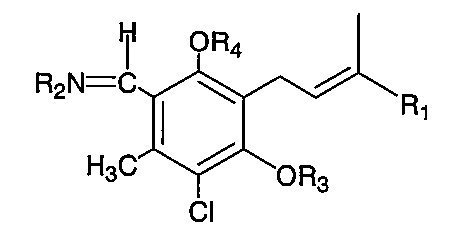
(式中、
R1は、下記の2つの基、すなわち、
(Where
R 1 has the following two groups:
または Or
のいずれかを表し、
R3は、水素原子、置換若しくは非置換の炭素数1〜6のアルキル基、置換若しくは非置換の炭素数2〜6のアルケニル基、置換若しくは非置換の炭素数2〜6のアルキニル基、置換若しくは非置換の炭素数3〜8のシクロアルキル基、アシル基、アリール基、またはカルボキシル基を表し、
R4は、水素原子、置換若しくは非置換の炭素数1〜6のアルキル基、置換若しくは非置換の炭素数2〜6のアルケニル基、置換若しくは非置換の炭素数2〜6のアルキニル基、置換若しくは非置換の炭素数3〜8のシクロアルキル基、アシル基、アリール基、またはカルボキシル基を表す。)
で表される全置換芳香族アルデヒド化合物であり3位にセスキテルペン側鎖をもつ糸状菌の代謝産物またはその誘導体のアルデヒド基と下記式
R2NH2
(式中、R2は、−(CH2)n−CHR5R6(式中、R5は水素原子、アミノ基、1個または2個の炭素数1〜6のアルキル基により置換されたアミノ基、またはフェニルで置換された炭素数1〜6のアルキル基を表し、R6は、カルボキシル基、−CONH2、または−COOR7(式中、R7は、置換若しくは非置換の炭素数1〜6のアルキル基を表す)を表し、nは0または1〜6の整数を表す。)または任意のアミノ酸からNH2を除いた残基を表す。)
で表されるアミノ化合物のアミノ基とを反応させることにより生成する下記式
Represents one of the following:
R 3 is a hydrogen atom, a substituted or unsubstituted alkyl group having 1 to 6 carbon atoms, a substituted or unsubstituted alkenyl group having 2 to 6 carbon atoms, a substituted or unsubstituted alkynyl group having 2 to 6 carbon atoms, substituted Or an unsubstituted cycloalkyl group having 3 to 8 carbon atoms, an acyl group, an aryl group, or a carboxyl group,
R 4 is a hydrogen atom, a substituted or unsubstituted alkyl group having 1 to 6 carbon atoms, a substituted or unsubstituted alkenyl group having 2 to 6 carbon atoms, a substituted or unsubstituted alkynyl group having 2 to 6 carbon atoms, a substituted group Alternatively, it represents an unsubstituted cycloalkyl group having 3 to 8 carbon atoms, an acyl group, an aryl group, or a carboxyl group. )
An aldehyde group of a fungus metabolite or a derivative thereof having a sesquiterpene side chain at the 3-position and the following formula R 2 NH 2
(Wherein R 2 is — (CH 2 ) n —CHR 5 R 6 (wherein R 5 is substituted with a hydrogen atom, an amino group, one or two alkyl groups having 1 to 6 carbon atoms). Represents an amino group or an alkyl group having 1 to 6 carbon atoms substituted with phenyl, R 6 represents a carboxyl group, —CONH 2 , or —COOR 7 (wherein R 7 represents a substituted or unsubstituted carbon number; Represents an alkyl group of 1 to 6, and n represents an integer of 0 or 1 to 6.) or a residue obtained by removing NH 2 from any amino acid.
The following formula generated by reacting with the amino group of the amino compound represented by
(式中、R1、R2、R3、R4は前記と同じ意味を有する。)
で表される新規イミノ化合物の合成法を提供する。
(In the formula, R 1 , R 2 , R 3 and R 4 have the same meaning as described above.)
The synthesis method of the novel imino compound represented by these is provided.
3.全置換芳香族アルデヒド化合物が、その4位水酸基の水素をアルキル基で置換した誘導体である、上記1項または2項記載の合成法。 3. 3. The synthesis method according to 1 or 2 above, wherein the fully substituted aromatic aldehyde compound is a derivative in which hydrogen at the 4-position hydroxyl group is substituted with an alkyl group.
4.全置換芳香族アルデヒド化合物が、その4位水酸基の水素をアシル基で置換した誘導体である、上記1項または2項記載の合成法。 4). 3. The synthesis method according to 1 or 2 above, wherein the fully substituted aromatic aldehyde compound is a derivative in which the hydrogen at the 4-position hydroxyl group is substituted with an acyl group.
5.全置換芳香族アルデヒド化合物が、その2位水酸基の水素をアルキル基で置換した誘導体である、上記1項または2項記載の合成法。 5. 3. The synthesis method according to 1 or 2 above, wherein the fully substituted aromatic aldehyde compound is a derivative obtained by substituting hydrogen at the 2-position hydroxyl group with an alkyl group.
6.全置換芳香族アルデヒド化合物が、その2位並びに4位水酸基の双方の水素をアルキル基で置換した誘導体である、上記1項または2項記載の合成法。 6). 3. The synthesis method according to 1 or 2 above, wherein the fully substituted aromatic aldehyde compound is a derivative in which both hydrogens at the 2-position and 4-position hydroxyl groups are substituted with alkyl groups.
7.全置換芳香族アルデヒド化合物が、その2位水酸基の水素をアルキル基で置換し、4位水酸基の水素をアシル基で置換した誘導体である、上記1項または2項記載の合成法。 7). 3. The synthesis method according to 1 or 2 above, wherein the fully substituted aromatic aldehyde compound is a derivative in which the hydrogen at the 2-position hydroxyl group is substituted with an alkyl group and the hydrogen at the 4-position hydroxyl group is substituted with an acyl group.
8.全置換芳香族アルデヒド化合物が、その2位水酸基の水素をアシル基で置換し、4位水酸基の水素をアルキル基で置換した誘導体である、上記1項または2項記載の合成法。 8). 3. The synthesis method according to 1 or 2 above, wherein the fully substituted aromatic aldehyde compound is a derivative in which the hydrogen at the 2-position hydroxyl group is substituted with an acyl group and the hydrogen at the 4-position hydroxyl group is substituted with an alkyl group.
9.全置換芳香族アルデヒド化合物が、アスコクロリン、シリンドロクロリン、アスコフラノン、クロロネクチン、LLZ-1272-・、LLZ-1272-C・から選択される化合物である、上記1項〜8項のいずれか1項に記載の合成法。 9. Any one of the above items 1 to 8, wherein the wholly substituted aromatic aldehyde compound is a compound selected from ascochlorin, silindrochlorin, ascofuranone, chloronectin, LLZ-1272- ·, LLZ-1272-C · The synthesis method according to item 1.
10.下記式 10. Following formula
(式中、
R1は、下記の2つの基、すなわち、
(Where
R 1 has the following two groups:
または Or
のいずれかを表し、
R2は、−(CH2)n−CHR5R6(式中、R5は水素原子、アミノ基、1個または2個の炭素数1〜6のアルキル基により置換されたアミノ基、またはフェニルで置換された炭素数1〜6のアルキル基を表し、R6は、カルボキシル基、−CONH2、または−COOR7(式中、R7は、置換若しくは非置換の炭素数1〜6のアルキル基を表す)を表し、nは0または1〜6の整数を表す。)または任意のアミノ酸からNH2を除いた残基を表し、
R3は、水素原子、置換若しくは非置換の炭素数1〜6のアルキル基、置換若しくは非置換の炭素数2〜6のアルケニル基、置換若しくは非置換の炭素数2〜6のアルキニル基、置換若しくは非置換の炭素数3〜8のシクロアルキル基、アシル基、アリール基、またはカルボキシル基を表し、
R4は、水素原子、置換若しくは非置換の炭素数1〜6のアルキル基、置換若しくは非置換の炭素数2〜6のアルケニル基、置換若しくは非置換の炭素数2〜6のアルキニル基、置換若しくは非置換の炭素数3〜8のシクロアルキル基、アシル基、アリール基、またはカルボキシル基を表す。)
で表される化合物またはその医薬上許容される塩若しくはエステルまたはそれらの光学異性体。
Represents one of the following:
R 2 represents — (CH 2 ) n —CHR 5 R 6 (wherein R 5 represents a hydrogen atom, an amino group, an amino group substituted with one or two alkyl groups having 1 to 6 carbon atoms, or represents an alkyl group having 1 to 6 carbon atoms which is substituted by phenyl, R 6 is a carboxyl group, in -CONH 2 or -COOR 7, (wherein, R 7 is a substituted or unsubstituted 1 to 6 carbon atoms Represents an alkyl group), n represents 0 or an integer of 1 to 6.) or a residue obtained by removing NH 2 from any amino acid,
R 3 is a hydrogen atom, a substituted or unsubstituted alkyl group having 1 to 6 carbon atoms, a substituted or unsubstituted alkenyl group having 2 to 6 carbon atoms, a substituted or unsubstituted alkynyl group having 2 to 6 carbon atoms, substituted Or an unsubstituted cycloalkyl group having 3 to 8 carbon atoms, an acyl group, an aryl group, or a carboxyl group,
R 4 is a hydrogen atom, a substituted or unsubstituted alkyl group having 1 to 6 carbon atoms, a substituted or unsubstituted alkenyl group having 2 to 6 carbon atoms, a substituted or unsubstituted alkynyl group having 2 to 6 carbon atoms, a substituted group Alternatively, it represents an unsubstituted cycloalkyl group having 3 to 8 carbon atoms, an acyl group, an aryl group, or a carboxyl group. )
Or a pharmaceutically acceptable salt or ester thereof, or an optical isomer thereof.
11.R4が置換若しくは非置換の炭素数1〜6のアルキル基である、上記10項記載の化合物またはその医薬上許容される塩若しくはエステルまたはそれらの光学異性体。 11. 11. The compound according to the above 10, or a pharmaceutically acceptable salt or ester thereof, or an optical isomer thereof, wherein R 4 is a substituted or unsubstituted alkyl group having 1 to 6 carbon atoms.
12.R4がアシル基である、上記10項記載の化合物またはその医薬上許容される塩若しくはエステルまたはそれらの光学異性体。 12 11. The compound according to 10 above, wherein R 4 is an acyl group, or a pharmaceutically acceptable salt or ester thereof, or an optical isomer thereof.
13.R3が置換若しくは非置換の炭素数1〜6のアルキル基である、上記10項記載の化合物またはその医薬上許容される塩若しくはエステルまたはそれらの光学異性体。 13. 11. The compound according to the above 10, or a pharmaceutically acceptable salt or ester thereof, or an optical isomer thereof, wherein R 3 is a substituted or unsubstituted alkyl group having 1 to 6 carbon atoms.
14.R3およびR4が同一または異なった置換若しくは非置換の炭素数1〜6のアルキル基である、上記10項記載の化合物またはその医薬上許容される塩若しくはエステルまたはそれらの光学異性体。 14 11. The compound according to the above 10, or a pharmaceutically acceptable salt or ester thereof, or an optical isomer thereof, wherein R 3 and R 4 are the same or different substituted or unsubstituted alkyl group having 1 to 6 carbon atoms.
15.R3が置換若しくは非置換の炭素数1〜6のアルキル基、R4がアシル基である、上記10項記載の化合物またはその医薬上許容される塩若しくはエステルまたはそれらの光学異性体。 15. 11. The compound according to the above 10, or a pharmaceutically acceptable salt or ester thereof, or an optical isomer thereof, wherein R 3 is a substituted or unsubstituted alkyl group having 1 to 6 carbon atoms and R 4 is an acyl group.
16.R3がアシル基、R4が置換若しくは非置換の炭素数1〜6のアルキル基である、上記10項記載の化合物またはその医薬上許容される塩若しくはエステルまたはそれらの光学異性体。 16. 11. The compound according to the above 10, or a pharmaceutically acceptable salt or ester thereof, or an optical isomer thereof, wherein R 3 is an acyl group and R 4 is a substituted or unsubstituted alkyl group having 1 to 6 carbon atoms.
17.下記式 17. Following formula
(式中、
R1は、下記の2つの基、すなわち、
(Where
R 1 has the following two groups:
または Or
のいずれかを表し、
R2は、−(CH2)n−CHR5R6(式中、R5は水素原子、アミノ基、1個または2個の炭素数1〜6のアルキル基により置換されたアミノ基、またはフェニルで置換された炭素数1〜6のアルキル基を表し、R6は、カルボキシル基、−CONH2、または−COOR7(式中、R7は、置換若しくは非置換の炭素数1〜6のアルキル基を表す)を表し、nは0または1〜6の整数を表す。)または任意のアミノ酸からNH2を除いた残基を表し、
R3は、水素原子、置換若しくは非置換の炭素数1〜6のアルキル基、置換若しくは非置換の炭素数2〜6のアルケニル基、置換若しくは非置換の炭素数2〜6のアルキニル基、置換若しくは非置換の炭素数3〜8のシクロアルキル基、アシル基、アリール基、またはカルボキシル基を表し、
R4は、水素原子、置換若しくは非置換の炭素数1〜6のアルキル基、置換若しくは非置換の炭素数2〜6のアルケニル基、置換若しくは非置換の炭素数2〜6のアルキニル基、置換若しくは非置換の炭素数3〜8のシクロアルキル基、アシル基、アリール基、またはカルボキシル基を表す。)
で表される化合物またはその医薬上許容される塩若しくはエステルまたはそれらの光学異性体の1種若しくは2種以上、および医薬上許容される担体、希釈剤等の添加剤を含む医薬組成物。
Represents one of the following:
R 2 represents — (CH 2 ) n —CHR 5 R 6 (wherein R 5 represents a hydrogen atom, an amino group, an amino group substituted with one or two alkyl groups having 1 to 6 carbon atoms, or represents an alkyl group having 1 to 6 carbon atoms which is substituted by phenyl, R 6 is a carboxyl group, in -CONH 2 or -COOR 7, (wherein, R 7 is a substituted or unsubstituted 1 to 6 carbon atoms Represents an alkyl group), n represents 0 or an integer of 1 to 6.) or a residue obtained by removing NH 2 from any amino acid,
R 3 is a hydrogen atom, a substituted or unsubstituted alkyl group having 1 to 6 carbon atoms, a substituted or unsubstituted alkenyl group having 2 to 6 carbon atoms, a substituted or unsubstituted alkynyl group having 2 to 6 carbon atoms, substituted Or an unsubstituted cycloalkyl group having 3 to 8 carbon atoms, an acyl group, an aryl group, or a carboxyl group,
R 4 is a hydrogen atom, a substituted or unsubstituted alkyl group having 1 to 6 carbon atoms, a substituted or unsubstituted alkenyl group having 2 to 6 carbon atoms, a substituted or unsubstituted alkynyl group having 2 to 6 carbon atoms, a substituted group Alternatively, it represents an unsubstituted cycloalkyl group having 3 to 8 carbon atoms, an acyl group, an aryl group, or a carboxyl group. )
Or a pharmaceutically acceptable salt or ester thereof, or one or more optical isomers thereof, and an additive such as a pharmaceutically acceptable carrier or diluent.
18.上記10項〜16項のいずれか1項に記載された化合物またはその医薬上許容される塩若しくはエステルまたはそれらの光学異性体の1種若しくは2種以上を有効成分とする糖尿病治療・予防薬。 18. A therapeutic or prophylactic agent for diabetes comprising the compound described in any one of the above items 10 to 16, or a pharmaceutically acceptable salt or ester thereof, or one or more optical isomers thereof as an active ingredient.
19.上記10項〜16項のいずれか1項に記載された化合物またはその医薬上許容される塩若しくはエステルまたはそれらの光学異性体の1種若しくは2種以上を有効成分とする動脈硬化症治療薬。 19. A therapeutic agent for arteriosclerosis comprising as an active ingredient one or more of the compounds described in any one of 10 to 16 above or a pharmaceutically acceptable salt or ester thereof or an optical isomer thereof.
20.上記10項〜16項のいずれか1項に記載された化合物またはその医薬上許容される塩若しくはエステルまたはそれらの光学異性体の1種若しくは2種以上を有効成分とする血清コレステロール低下剤。 20. A serum cholesterol-lowering agent comprising as an active ingredient one or more of the compounds described in any one of 10 to 16 above or a pharmaceutically acceptable salt or ester thereof or an optical isomer thereof.
21.上記10項〜16項のいずれか1項に記載された化合物またはその医薬上許容される塩若しくはエステルまたはそれらの光学異性体の1種若しくは2種以上を有効成分とする多重危険因子症候群の治療薬。 21. Treatment of multiple risk factor syndrome comprising one or more of the compounds described in any one of 10 to 16 above or a pharmaceutically acceptable salt or ester thereof or an optical isomer thereof as an active ingredient medicine.
22.上記10項〜16項のいずれか1項に記載された化合物またはその医薬上許容される塩若しくはエステルまたはそれらの光学異性体の1種若しくは2種以上を有効成分とする高血圧症の治療薬。 22. A therapeutic agent for hypertension comprising one or more of the compounds described in any one of 10 to 16 above or a pharmaceutically acceptable salt or ester thereof or an optical isomer thereof as an active ingredient.
23.上記10項〜16項のいずれか1項に記載された化合物またはその医薬上許容される塩若しくはエステルまたはそれらの光学異性体の1種若しくは2種以上を有効成分とする粘液水腫の治療薬。 23. A therapeutic agent for myxedema comprising as an active ingredient one or more of the compounds described in any one of 10 to 16 above or a pharmaceutically acceptable salt or ester thereof or an optical isomer thereof.
24.上記10項〜16項のいずれか1項に記載された化合物またはその医薬上許容される塩若しくはエステルまたはそれらの光学異性体の1種若しくは2種以上を有効成分とする慢性炎症を治療する消炎剤。 24. Anti-inflammatory for treating chronic inflammation containing one or more of the compounds described in any one of 10 to 16 above or a pharmaceutically acceptable salt or ester thereof or an optical isomer thereof as an active ingredient Agent.
25.上記10項〜16項のいずれか1項に記載された化合物またはその医薬上許容される塩若しくはエステルまたはそれらの光学異性体の1種若しくは2種以上を有効成分とするバルーンカテーテルあるいはステントにより拡張した動脈腔の再狭窄に対する予防・治療薬。 25. Expansion by balloon catheter or stent containing one or more of the compounds described in any one of the above items 10 to 16 or a pharmaceutically acceptable salt or ester thereof or an optical isomer thereof as an active ingredient Preventive / therapeutic drug for restenosis of arterial cavity.
26.上記10項〜16項のいずれか1項に記載された化合物またはその医薬上許容される塩若しくはエステルまたはそれらの光学異性体の1種若しくは2種以上を有効成分とする、再生医療の実施に際し、レシピエントに移植する幹細胞から分化誘導した細胞ないし組織を生着させるための生着促進剤。 26. In carrying out regenerative medicine, comprising as an active ingredient one or more of the compounds described in any one of 10 to 16 above or a pharmaceutically acceptable salt or ester thereof or an optical isomer thereof. An engraftment promoter for engrafting cells or tissues induced to differentiate from stem cells to be transplanted into a recipient.
27.上記10項〜16項のいずれか1項に記載された化合物またはその医薬上許容される塩若しくはエステルまたはそれらの光学異性体の1種若しくは2種以上の、治療若しくは予防有効量を患者に投与することを含む糖尿病の治療若しくは予防方法。 27. A therapeutically or prophylactically effective amount of one or more of the compounds described in any one of the above items 10 to 16, or a pharmaceutically acceptable salt or ester thereof, or an optical isomer thereof, is administered to a patient. A method of treating or preventing diabetes comprising:
28.上記10項〜16項のいずれか1項に記載された化合物またはその医薬上許容される塩若しくはエステルまたはそれらの光学異性体の1種若しくは2種以上の、治療有効量を患者に投与することを含む動脈硬化症を治療する方法。 28. A therapeutically effective amount of one or more of the compounds described in any one of the above items 10 to 16, or a pharmaceutically acceptable salt or ester thereof, or an optical isomer thereof, is administered to a patient. A method of treating arteriosclerosis comprising:
29.上記10項〜16項のいずれか1項に記載された化合物またはその医薬上許容される塩若しくはエステルまたはそれらの光学異性体の1種若しくは2種以上の、治療若しくは予防有効量を患者に投与することを含む血清コレステロールを低下する方法。 29. A therapeutically or prophylactically effective amount of one or more of the compounds described in any one of the above items 10 to 16, or a pharmaceutically acceptable salt or ester thereof, or an optical isomer thereof, is administered to a patient. A method of lowering serum cholesterol comprising:
30.上記10項〜16項のいずれか1項に記載された化合物またはその医薬上許容される塩若しくはエステルまたはそれらの光学異性体の1種若しくは2種以上の、治療有効量を患者に投与することを含む多重危険因子症候群を治療する方法。 30. A therapeutically effective amount of one or more of the compounds described in any one of the above items 10 to 16, or a pharmaceutically acceptable salt or ester thereof, or an optical isomer thereof, is administered to a patient. A method of treating multiple risk factor syndrome comprising:
31.上記10項〜16項のいずれか1項に記載された化合物またはその医薬上許容される塩若しくはエステルまたはそれらの光学異性体の1種若しくは2種以上の、治療有効量を患者に投与することを含む高血圧症の治療方法。 31. A therapeutically effective amount of one or more of the compounds described in any one of the above items 10 to 16, or a pharmaceutically acceptable salt or ester thereof, or an optical isomer thereof, is administered to a patient. A method for treating hypertension, comprising:
32.上記10項〜16項のいずれか1項に記載された化合物またはその医薬上許容される塩若しくはエステルまたはそれらの光学異性体の1種若しくは2種以上の、治療有効量を患者に投与することを含む粘液水腫の治療方法。 32. A therapeutically effective amount of one or more of the compounds described in any one of the above items 10 to 16, or a pharmaceutically acceptable salt or ester thereof, or an optical isomer thereof, is administered to a patient. A method of treating myxedema comprising:
33.上記10項〜16項のいずれか1項に記載された化合物またはその医薬上許容される塩若しくはエステルまたはそれらの光学異性体の1種若しくは2種以上の、治療有効量を患者に投与することを含む慢性炎症の治療方法。 33. A therapeutically effective amount of one or more of the compounds described in any one of the above items 10 to 16, or a pharmaceutically acceptable salt or ester thereof, or an optical isomer thereof, is administered to a patient. A method of treating chronic inflammation comprising:
34.上記10項〜16項のいずれか1項に記載された化合物またはその医薬上許容される塩若しくはエステルまたはそれらの光学異性体の1種若しくは2種以上の、治療若しくは予防有効量を患者に投与することを含むバルーンカテーテルあるいはステントにより拡張した動脈腔の再狭窄を予防もしくは治療する方法。 34. A therapeutically or prophylactically effective amount of one or more of the compounds described in any one of the above items 10 to 16, or a pharmaceutically acceptable salt or ester thereof, or an optical isomer thereof, is administered to a patient. A method for preventing or treating restenosis of an arterial cavity dilated by a balloon catheter or stent.
35.上記10項〜16項のいずれか1項に記載された化合物またはその医薬上許容される塩若しくはエステルまたはそれらの光学異性体の1種若しくは2種以上の有効量をレシピエントに投与することを含む、再生医療の実施に際し、レシピエントに移植する幹細胞から分化誘導した細胞ないし組織を生着させる方法。 35. 17. An effective amount of one or more of the compound described in any one of the above 10 to 16 or a pharmaceutically acceptable salt or ester thereof or an optical isomer thereof is administered to a recipient. A method of engrafting a cell or tissue induced to differentiate from a stem cell to be transplanted into a recipient during regenerative medicine.
36.糖尿病治療・予防薬を製造するための、上記10項〜16項のいずれか1項に記載された化合物またはその医薬上許容される塩若しくはエステルまたはそれらの光学異性体の使用。 36. Use of the compound according to any one of the above items 10 to 16, a pharmaceutically acceptable salt or ester thereof, or an optical isomer thereof for the manufacture of a therapeutic / preventive agent for diabetes.
37.動脈硬化症治療薬を製造するための、上記10項〜16項のいずれか1項に記載された化合物またはその医薬上許容される塩若しくはエステルまたはそれらの光学異性体の使用。 37. Use of the compound described in any one of 10 to 16 above, or a pharmaceutically acceptable salt or ester thereof, or an optical isomer thereof for the manufacture of a therapeutic agent for arteriosclerosis.
38.血清コレステロール低下剤を製造するための、上記10項〜16項のいずれか1項に記載された化合物またはその医薬上許容される塩若しくはエステルまたはそれらの光学異性体の使用。 38. Use of the compound according to any one of the above items 10 to 16, or a pharmaceutically acceptable salt or ester thereof, or an optical isomer thereof, for producing a serum cholesterol lowering agent.
39.多重危険因子症候群の治療薬を製造するための、上記10項〜16項のいずれか1項に記載された化合物またはその医薬上許容される塩若しくはエステルまたはそれらの光学異性体の使用。 39. Use of the compound described in any one of the above items 10 to 16, or a pharmaceutically acceptable salt or ester thereof, or an optical isomer thereof for the manufacture of a therapeutic agent for multiple risk factor syndrome.
40.高血圧症の治療薬を製造するための、上記10項〜16項のいずれか1項に記載された化合物またはその医薬上許容される塩若しくはエステルまたはそれらの光学異性体の使用。 40. Use of the compound according to any one of the above items 10 to 16, or a pharmaceutically acceptable salt or ester thereof, or an optical isomer thereof for the manufacture of a therapeutic agent for hypertension.
41.粘液水腫の治療薬を製造するための、上記10項〜16項のいずれか1項に記載された化合物またはその医薬上許容される塩若しくはエステルまたはそれらの光学異性体の使用。 41. Use of the compound described in any one of the above 10 to 16, or a pharmaceutically acceptable salt or ester thereof, or an optical isomer thereof, for producing a therapeutic agent for myxedema.
42.慢性炎症を治療する消炎剤を製造するための、上記10項〜16項のいずれか1項に記載された化合物またはその医薬上許容される塩若しくはエステルまたはそれらの光学異性体の使用。 42. Use of the compound according to any one of the above items 10 to 16, or a pharmaceutically acceptable salt or ester thereof, or an optical isomer thereof for the manufacture of an anti-inflammatory agent for treating chronic inflammation.
43.バルーンカテーテルあるいはステントにより拡張した動脈腔の再狭窄に対する予防・治療薬を製造するための、上記10項〜16項のいずれか1項に記載された化合物またはその医薬上許容される塩若しくはエステルまたはそれらの光学異性体の使用。 43. The compound according to any one of the above 10 to 16, or a pharmaceutically acceptable salt or ester thereof, for producing a prophylactic / therapeutic agent for restenosis of an arterial cavity dilated by a balloon catheter or stent Use of those optical isomers.
44.再生医療の実施に際し、レシピエントに移植する幹細胞から分化誘導した細胞ないし組織を生着させるための生着促進剤を製造するための、上記10項〜16項のいずれか1項に記載された化合物またはその医薬上許容される塩若しくはエステルまたはそれらの光学異性体の使用。 44. In carrying out regenerative medicine, it is described in any one of the above items 10 to 16 for producing an engraftment promoter for engrafting cells or tissues induced to differentiate from stem cells transplanted into a recipient Use of a compound or a pharmaceutically acceptable salt or ester thereof or an optical isomer thereof.
本願明細書において、「全置換芳香族アルデヒド化合物であり3位にセスキテルペン側鎖をもつ糸状菌の代謝産物またはその誘導体」とは、次の式で表される化合物を意味する。 In the present specification, “a metabolite of a filamentous fungus having a sesquiterpene side chain at the 3-position or a derivative thereof, which is a fully substituted aromatic aldehyde compound” means a compound represented by the following formula.
(式中、
R1は、下記の2つの基、すなわち、
(Where
R 1 has the following two groups:
または Or
のいずれかを表し、
R3は、水素原子、置換若しくは非置換の炭素数1〜6のアルキル基、置換若しくは非置換の炭素数2〜6のアルケニル基、置換若しくは非置換の炭素数2〜6のアルキニル基、置換若しくは非置換の炭素数3〜8のシクロアルキル基、アシル基、アリール基、またはカルボキシル基を表し、
R4は、水素原子、置換若しくは非置換の炭素数1〜6のアルキル基、置換若しくは非置換の炭素数2〜6のアルケニル基、置換若しくは非置換の炭素数2〜6のアルキニル基、置換若しくは非置換の炭素数3〜8のシクロアルキル基、アシル基、アリール基、またはカルボキシル基を表す。)
なお、ベンゼン環上の炭素原子の番号は、アルデヒド基と結合している炭素原子を1位とし、時計回りに2位、3位、・・・ 6位とする。
Represents one of the following:
R 3 is a hydrogen atom, a substituted or unsubstituted alkyl group having 1 to 6 carbon atoms, a substituted or unsubstituted alkenyl group having 2 to 6 carbon atoms, a substituted or unsubstituted alkynyl group having 2 to 6 carbon atoms, substituted Or an unsubstituted cycloalkyl group having 3 to 8 carbon atoms, an acyl group, an aryl group, or a carboxyl group,
R 4 is a hydrogen atom, a substituted or unsubstituted alkyl group having 1 to 6 carbon atoms, a substituted or unsubstituted alkenyl group having 2 to 6 carbon atoms, a substituted or unsubstituted alkynyl group having 2 to 6 carbon atoms, a substituted group Alternatively, it represents an unsubstituted cycloalkyl group having 3 to 8 carbon atoms, an acyl group, an aryl group, or a carboxyl group. )
In addition, the number of the carbon atom on the benzene ring is the 1st position of the carbon atom bonded to the aldehyde group, and the 2nd, 3rd,.
本願明細書において、「炭素数1〜6のアルキル基」とは、直鎖状もしくは分枝状のC1−6アルキル基を意味する。C1−6アルキル基としては、例えば、メチル、エチル、n−プロピル、i−プロピル、n−ブチル、i−ブチル、t−ブチル、n−ペンチルまたはn−ヘキシルなどが挙げられる。該「炭素数1〜6のアルキル基」が有していてもよい置換基としては、例えば、ヒドロキシ、アミノ、カルボキシル、ニトロ、アリール基、置換アリール基、モノ−または低級アルキルアミノ(例えば、メチルアミノ、エチルアミノ、プロピルアミノ、ジメチルアミノ、ジエチルアミノなどのモノ−またはジ−C1−6アルキルアミノなど)、アルコキシ(例えば、メトキシ、エトキシ、プロポキシ、ヘキシルオキシなどのC1−6アルコキシなど)、アルキルカルボニルオキシ(例えば、アセトキシ、エチルカルボニルオキシなどのC1−6アルキル−カルボニルオキシなど)またはハロゲン原子などから選ばれた1個もしくは2個以上が用いられる。 In the present specification, the “C 1-6 alkyl group” means a linear or branched C 1-6 alkyl group. Examples of the C 1-6 alkyl group include methyl, ethyl, n-propyl, i-propyl, n-butyl, i-butyl, t-butyl, n-pentyl and n-hexyl. Examples of the substituent that the “alkyl group having 1 to 6 carbon atoms” may have include, for example, hydroxy, amino, carboxyl, nitro, aryl group, substituted aryl group, mono- or lower alkylamino (for example, methyl Mono- or di-C 1-6 alkylamino such as amino, ethylamino, propylamino, dimethylamino, diethylamino), alkoxy (eg, C 1-6 alkoxy such as methoxy, ethoxy, propoxy, hexyloxy, etc.), One or two or more selected from alkylcarbonyloxy (for example, C 1-6 alkyl-carbonyloxy such as acetoxy, ethylcarbonyloxy, etc.) or a halogen atom is used.
本願明細書において、「炭素数2〜6のアルケニル基」とは、直鎖状もしくは分枝状のC2−6アルケニル基を意味する。C2−6アルケニル基としては、例えば、ビニル、アリル、2−メチルアリル、i−プロペニル、2−ブテニル、3−ブテニル、2−ペンテニル、3−ペンテニル、2−ヘキセニル、3−ヘキセニルなどが用いられる。該「炭素数2〜6のアルケニル基」が有していてもよい置換基としては、例えば、ヒドロキシ、アミノ、カルボキシル、ニトロ、モノ−またはジ−アルキルアミノ(例えば、メチルアミノ、エチルアミノ、プロピルアミノ、ジメチルアミノ、ジエチルアミノなどのモノ−またはジ−C1−6アルキルアミノなど)、アルコキシ(例えば、メトキシ、エトキシ、プロポキシ、ヘキシルオキシなどのC1−6アルコキシなど)、アルキルカルボニルオキシ(例えば、アセトキシ、エチルカルボニルオキシなどのC1−6アルキル−カルボニルオキシなど)またはハロゲン原子などから選ばれた1個もしくは2個以上が用いられる。 In the present specification, the “C 2-6 alkenyl group” means a linear or branched C 2-6 alkenyl group. As the C 2-6 alkenyl group, for example, vinyl, allyl, 2-methylallyl, i-propenyl, 2-butenyl, 3-butenyl, 2-pentenyl, 3-pentenyl, 2-hexenyl, 3-hexenyl and the like are used. . Examples of the substituent that the “C 2-6 alkenyl group” may have include, for example, hydroxy, amino, carboxyl, nitro, mono- or di-alkylamino (eg, methylamino, ethylamino, propyl). Mono- or di-C 1-6 alkylamino such as amino, dimethylamino, diethylamino), alkoxy (eg, C 1-6 alkoxy such as methoxy, ethoxy, propoxy, hexyloxy, etc.), alkylcarbonyloxy (eg, 1 or 2 or more selected from C 1-6 alkyl-carbonyloxy such as acetoxy and ethylcarbonyloxy) or a halogen atom.
本願明細書において、「炭素数2〜6アルキニル基」とは、例えば、直鎖状もしくは分枝状のC2−6アルキニル基を意味する。C2−6アルキニル基としては、例えば、エチニル、2−プロピニル、2−ブチニル、3−ブチニル、2−ペンチニル、3−ペンチニル、2−ヘキシニル、3−ヘキシニルなどが用いられる。該「炭素数2〜6のアルキニル基」が有していてもよい置換基としては、例えば、ヒドロキシ、アミノ、カルボキシル、ニトロ、モノ−またはジ−アルキルアミノ(例えば、メチルアミノ、エチルアミノ、プロピルアミノ、ジメチルアミノ、ジエチルアミノなどのモノ−またはジ−C1−6アルキルアミノなど)、アルコキシ(例えば、メトキシ、エトキシ、プロポキシ、ヘキシルオキシなどのC1−6アルコキシなど)、アルキルカルボニルオキシ(例えば、アセトキシ、エチルカルボニルオキシなどのC1−6アルキル−カルボニルオキシなど)、またはハロゲン原子などから選ばれた1個もしくは2個以上が用いられる。 In the present specification, the “C 2-6 alkynyl group” means, for example, a linear or branched C 2-6 alkynyl group. Examples of the C 2-6 alkynyl group include ethynyl, 2-propynyl, 2-butynyl, 3-butynyl, 2-pentynyl, 3-pentynyl, 2-hexynyl, 3-hexynyl and the like. Examples of the substituent which the “C2-C6 alkynyl group” may have include, for example, hydroxy, amino, carboxyl, nitro, mono- or di-alkylamino (for example, methylamino, ethylamino, propyl). Mono- or di-C 1-6 alkylamino such as amino, dimethylamino, diethylamino), alkoxy (eg, C 1-6 alkoxy such as methoxy, ethoxy, propoxy, hexyloxy, etc.), alkylcarbonyloxy (eg, 1 or 2 or more selected from C 1-6 alkyl-carbonyloxy such as acetoxy and ethylcarbonyloxy), or halogen atoms.
本願明細書において、「炭素数3〜8のシクロアルキル基」としては、例えば、シクロプロピル基、シクロブチル基、シクロペンチル基、シクロヘキシル基、シクロオクチル基などが用いられる。該「シクロアルキル基」が有していてもよい置換基としては、例えば、ヒドロキシ、アミノ、カルボキシル、ニトロ、モノ−またはジ−アルキルアミノ(例えば、メチルアミノ、エチルアミノ、プロピルアミノ、ジメチルアミノ、ジエチルアミノなどのモノ−またはジ−C1−6アルキルアミノなど)、アルコキシ(例えば、メトキシ、エトキシ、プロポキシ、ヘキシルオキシなどのC1−6アルコキシなど)、アルキルカルボニルオキシ(例えば、アセトキシ、エチルカルボニルオキシなどのC1−6アルキル−カルボニルオキシなど)またはハロゲン原子などから選ばれた1個もしくは2個以上が用いられる。 In the present specification, examples of the “cycloalkyl group having 3 to 8 carbon atoms” include cyclopropyl group, cyclobutyl group, cyclopentyl group, cyclohexyl group, and cyclooctyl group. Examples of the substituent that the “cycloalkyl group” may have include, for example, hydroxy, amino, carboxyl, nitro, mono- or di-alkylamino (for example, methylamino, ethylamino, propylamino, dimethylamino, Mono- or di-C 1-6 alkylamino such as diethylamino), alkoxy (eg C 1-6 alkoxy such as methoxy, ethoxy, propoxy, hexyloxy, etc.), alkylcarbonyloxy (eg acetoxy, ethylcarbonyloxy, etc.) C 1-6 alkyl-carbonyloxy, etc.) or a halogen atom or the like is used.
本願明細書において、R2が任意のアミノ酸からNH2を除いた残基を表す場合の任意のアミノ酸の例としては、リシン(リジン)、ヒドロキシリシン(リジン)、アルギニン、グリシン、アラニン、バリン、ロイシン、イソロイシン、セリン、トレオニン、アスパラギン酸、グルタミン酸、アスパラギン、グルタミン、システイン、シスチン、メチオニン、フェニルアラニン、チロシン、トリプトファン、ヒスチジン、プロリン、β−アラニン、γ−アミノ酪酸,ホモシステイン、オルニチン、5−ヒドロキシトリプトファン、3、4−ジヒドロキシフェニルアラニン、トリヨードチロニン、チロキシンなどが挙げられる。 In the present specification, examples of any amino acid when R 2 represents a residue obtained by removing NH 2 from any amino acid include lysine (lysine), hydroxylysine (lysine), arginine, glycine, alanine, valine, Leucine, isoleucine, serine, threonine, aspartic acid, glutamic acid, asparagine, glutamine, cysteine, cystine, methionine, phenylalanine, tyrosine, tryptophan, histidine, proline, β-alanine, γ-aminobutyric acid, homocysteine, ornithine, 5-hydroxy Examples include tryptophan, 3,4-dihydroxyphenylalanine, triiodothyronine, and thyroxine.
本願明細書において、「アシル基」とは−COR(Rは、水素原子、置換若しくは非置換の炭素数1〜6のアルキル基、置換若しくは非置換の炭素数2〜6のアルケニル基、置換若しくは非置換の炭素数2〜6のアルキニル基、置換若しくは非置換の炭素数3〜8のシクロアルキル基、単環もしくは多環の芳香環または複素環のいずれかを意味する)で表される基を意味する。該「アシル基」および「アシルアミノ基」が有していてもよい置換基とはR上における置換基を意味し、例えば、ヒドロキシ、アミノ、カルボキシル、ニトロ、モノ−またはジ−アルキルアミノ(例えば、メチルアミノ、エチルアミノ、プロピルアミノ、ジメチルアミノ、ジエチルアミノなどのモノ−またはジ−C1−6アルキルアミノなど)、アルコキシ(例えば、メトキシ、エトキシ、プロポキシ、ヘキシルオキシなどのC1−6アルコキシなど)、アルキルカルボニルオキシ(例えば、アセトキシ、エチルカルボニルオキシなどのC1−6アルキル−カルボニルオキシなど)またはハロゲン原子などから選ばれた1個もしくは2個以上が用いられる。 In the present specification, “acyl group” means —COR (R is a hydrogen atom, a substituted or unsubstituted alkyl group having 1 to 6 carbon atoms, a substituted or unsubstituted alkenyl group having 2 to 6 carbon atoms, substituted or unsubstituted, And a group represented by an unsubstituted alkynyl group having 2 to 6 carbon atoms, a substituted or unsubstituted cycloalkyl group having 3 to 8 carbon atoms, a monocyclic or polycyclic aromatic ring or a heterocyclic ring). Means. The substituent which the “acyl group” and “acylamino group” may have means a substituent on R, for example, hydroxy, amino, carboxyl, nitro, mono- or di-alkylamino (for example, Mono- or di-C 1-6 alkylamino such as methylamino, ethylamino, propylamino, dimethylamino, diethylamino), alkoxy (eg, C 1-6 alkoxy such as methoxy, ethoxy, propoxy, hexyloxy, etc.) 1 or 2 or more selected from alkylcarbonyloxy (for example, C 1-6 alkyl-carbonyloxy such as acetoxy, ethylcarbonyloxy, etc.) or a halogen atom is used.
本願明細書において、「アリール基」とは芳香族炭化水素から水素原子1個を除いた残りの原子団を意味する。特に、C6−14のアリール基が好ましい。C6−14アリール基としては、例えば、フェニル、ナフチル、トリル、キシリル、ビフェニル、1−ナフチル、2−ナフチル、1−アントリル、2−アントリル、9−アントリル、1−フェナントリル、2−フェナントリル、3−フェナントリル、4−フェナントリル、9−フェナントリル、1−アズレニル、2−アズレニル、4−アズレニル、5−アズレニル、6−アズレニルなどが用いられる。該「芳香環」が有していてもよい置換基としては、例えば、低級アルキル、ヒドロキシ、アミノ、カルボキシル、ニトロ、モノ−またはジ−低級アルキルアミノ(例えば、メチルアミノ、エチルアミノ、プロピルアミノ、ジメチルアミノ、ジエチルアミノなどのモノ−またはジ−C1−6アルキルアミノなど)、低級アルコキシ(例えば、メトキシ、エトキシ、プロポキシ、ヘキシルオキシなどのC1−6アルコキシなど)、低級アルキルカルボニルオキシ(例えば、アセトキシ、エチルカルボニルオキシなどのC1−6アルキル−カルボニルオキシなど)、トリハロメタン、トリハロメトキシ、ハロゲン原子またはフェニルなどのアリールなどから選ばれた1個もしくは2個以上が用いられる。 In the present specification, the “aryl group” means an atomic group remaining after removing one hydrogen atom from an aromatic hydrocarbon. In particular, a C 6-14 aryl group is preferable. Examples of the C 6-14 aryl group include phenyl, naphthyl, tolyl, xylyl, biphenyl, 1-naphthyl, 2-naphthyl, 1-anthryl, 2-anthryl, 9-anthryl, 1-phenanthryl, 2-phenanthryl, 3 -Phenanthryl, 4-phenanthryl, 9-phenanthryl, 1-azurenyl, 2-azurenyl, 4-azurenyl, 5-azurenyl, 6-azurenyl and the like are used. Examples of the substituent that the “aromatic ring” may have include, for example, lower alkyl, hydroxy, amino, carboxyl, nitro, mono- or di-lower alkylamino (for example, methylamino, ethylamino, propylamino, Mono- or di-C 1-6 alkylamino such as dimethylamino, diethylamino), lower alkoxy (eg, C 1-6 alkoxy such as methoxy, ethoxy, propoxy, hexyloxy, etc.), lower alkylcarbonyloxy (eg, acetoxy, C 1-6 alkyl such as ethyl carbonyloxy - carbonyl oxy), trihalomethanes, trihalomethoxy, one selected from an aryl, such as a halogen atom or a phenyl or two or more may be used.
本願明細書において、塩としては、とりわけ医薬上許容される酸付加塩が好ましい。この様な塩としては、例えば無機酸(例えば、塩酸、リン酸、臭化水素酸、硫酸)との塩、有機酸(例えば、酢酸、ギ酸、プロピオン酸、フマル酸、マレイン酸、コハク酸、酒石酸、乳酸、クエン酸、リンゴ酸、蓚酸、安息香酸、メタンスルホン酸、p−トルエンスルホン酸、ベンゼンスルホン酸)との塩、あるいはアルカリ(例えば、ナトリウム、カリウム、マグネシウム、カルシウム、アンモニウム、ピリジン、トリエチルアミン)との塩などが用いられる。 In the present specification, a pharmaceutically acceptable acid addition salt is particularly preferable as the salt. Examples of such salts include salts with inorganic acids (eg, hydrochloric acid, phosphoric acid, hydrobromic acid, sulfuric acid), organic acids (eg, acetic acid, formic acid, propionic acid, fumaric acid, maleic acid, succinic acid, Salt with tartaric acid, lactic acid, citric acid, malic acid, succinic acid, benzoic acid, methanesulfonic acid, p-toluenesulfonic acid, benzenesulfonic acid) or alkali (for example, sodium, potassium, magnesium, calcium, ammonium, pyridine, A salt with triethylamine) is used.
本願明細書において、エステルとしては、とりわけカルボキシル基を有する場合のアルキルエステル(例えば、メチルエステル、エチルエステル、n−プロピルエステル、i−プロピルエステル)が好ましい。 In the present specification, the ester is particularly preferably an alkyl ester having a carboxyl group (for example, methyl ester, ethyl ester, n-propyl ester, i-propyl ester).
本願発明のシッフ塩基(イミノ化合物)には、立体異性体や光学異性体もすべて包含される。 The Schiff base (imino compound) of the present invention includes all stereoisomers and optical isomers.
アスコクロリン及びその4位の水酸基をメチル化した4−O−メチルアスコクロリン(化合物−1)は、脂溶性でほとんど水に溶けない。それらは結晶格子から単分子が水に溶け込む速度がきわめて遅いため、ラット、マウス等の小動物に経口投与すると、空腹時では大部分が吸収されずに消化管を通過する。バイオアベイラビリティが低いことに加え、食事摂取の有無(Agr. Biol. Chem. 46: 775-781, 1982年)よっも有効性が変動する。動物実験における再現性の乏しさが、実用化を阻む大きな障害になっていたのである。 Ascochlorin and 4-O-methylascochlorin (compound-1) obtained by methylation of the hydroxyl group at the 4-position are fat-soluble and hardly soluble in water. Since the rate at which single molecules dissolve in water from the crystal lattice is extremely slow, when they are orally administered to small animals such as rats and mice, most of them pass through the digestive tract without being absorbed. In addition to low bioavailability, effectiveness varies depending on whether or not food is consumed (Agr. Biol. Chem. 46: 775-781, 1982). The lack of reproducibility in animal experiments was a major obstacle to practical use.
単分子が結晶格子から離れ水に溶解する速度は、分子内に極性基を導入することにより速めることができる。事実、アスコクロリン4位水酸基の水素を−CH2COOHに置換した4−O−カルボキシメチルアスコクロリン(化合物−2)は小腸のpH7.2〜7.4では6%以上が水に溶けるので、経口投与すると急速に吸収されるため毒性が発現しやすい。 The rate at which single molecules leave the crystal lattice and dissolve in water can be increased by introducing polar groups into the molecule. In fact, 4-O-carboxymethyl ascochlorin (compound-2) in which the hydrogen at the 4-position hydroxyl group of ascochlorin is substituted with —CH 2 COOH has a solubility of 6% or more in water at pH 7.2 to 7.4 in the small intestine. When administered orally, it is rapidly absorbed and is toxic.
一方、化合物−1の水に対する溶解度は約0.7g/mlときわめて低く、水に対する溶解性は化合物−2の対極にある。興味深いことに、両アスコクロリン誘導体のアセトン溶液を飼料に添加量が0.1%になるように散布し、均一に染み込ませてからマウスに与えると、両者はほぼ同等の血清総コレステロール低下作用(健常マウス)並びに尿糖排泄抑制作用(遺伝性肥満糖尿病マウス、C57BL/ksj db/db)を示す(表1)。しかし、単に0.1%の両化合物を機械的に飼料に混合、ないし飼料の摂取量から換算した同一薬物量を強制経口投与しても、アセトン溶液を飼料に散布した場合のような薬効の再現性は認められない。とくに、水に不溶の化合物−1は、アセトンに溶かして飼料に散布しないとほとんど薬効が認められない。 On the other hand, the solubility of Compound-1 in water is as extremely low as about 0.7 g / ml, and the solubility in water is at the counter electrode of Compound-2. Interestingly, when the acetone solution of both ascochlorin derivatives was sprayed on the feed so that the amount added was 0.1%, and evenly soaked and then given to the mice, they both had almost the same serum total cholesterol lowering action ( (Healthy mice) and urinary glucose excretion inhibitory activity (hereditary obese diabetic mice, C57BL / ksj db / db) are shown (Table 1). However, even if 0.1% of both compounds are mechanically mixed in the feed or the same amount of drug converted from the intake of the feed is forcibly administered orally, the effect is as if the acetone solution was sprayed on the feed. Reproducibility is not recognized. In particular, Compound-1 which is insoluble in water has almost no medicinal effect unless dissolved in acetone and sprayed on feed.
水に対する溶解差が大きいにもかかわらず、薬物をアセトンに溶かして飼料に散布・風乾して動物に与えると、両化合物はほぼ等しい薬理作用を示す事実は、薬物と飼料とのあいだに何らかの相互作用があることを示唆している。そこで薬物をアセトンに溶かして散布風乾した飼料と原末を機械的に混合した飼料を室温に一夜放置してから、20倍量のアセトンを加えて抽出し、両化合物の回収を試みた(表2)。 Despite the large difference in water solubility, when the drug is dissolved in acetone, sprayed on feed, air-dried and given to animals, the fact that both compounds show almost equal pharmacological effects is that there is some interaction between the drug and feed. This suggests that there is an effect. Therefore, a feed prepared by dissolving the drug in acetone and spray-dried and mechanically mixed the bulk powder was allowed to stand at room temperature overnight, and then extracted by adding 20 times the amount of acetone (Table). 2).
表2に示すように、両化合物をアセトンに溶解して飼料に散布風乾した場合、アセトンに浸して16時間抽出した後でも両化合物はまったく抽出されない。しかし、飼料粉末に両化合物を機械的に混合した場合、両者は抽出時間とは無関係にアセトンを加えると溶媒中に抽出される。この事実は両者のアセトン溶液を飼料粉末に散布すると、試料中の何らかの成分と化学反応を起こし共有結合が形成されることを示唆する。 As shown in Table 2, when both compounds are dissolved in acetone, sprayed on feed and air-dried, neither compound is extracted at all even after 16 hours of immersion in acetone. However, when both compounds are mechanically mixed in the feed powder, both are extracted into the solvent when acetone is added regardless of the extraction time. This fact suggests that when both acetone solutions are sprayed on the feed powder, a chemical reaction occurs with some component in the sample and a covalent bond is formed.
次ぎに両化合物のアセトン溶液を散布・風乾した飼料粉末を酢酸、塩酸などの酸を添加した有機溶媒に添加し、経時的にサンプリングして溶出されてくる両化合物を定量した。表3に示すとおり、飼料を酸性の有機溶媒に浸積すると、時間の経過とともに飼料から遊離する両化合物の量が増加した。この事実は化合物-1並びに化合物-2をアセトンに溶かして飼料に散布すると、アセトンの飛散にともなって飼料成分と共有結合を形成し、酸を添加すると共有結合が加水分解されることを意味する。この反応はきわめて珍しい固相と液層との反応である。類似した反応としてはタンパク質と還元性炭水化物とが混合した食品に見られる“アミノカルボニル反応”がある。しかし、タンパク質と還元性炭水化物との反応は、不可逆的に進行し最終的に褐色物質を生ずるのに対し、プレニルフェノールと飼料タンパク質との反応は、可逆的であることが特徴である。 Next, an acetone solution of both compounds was sprayed and air-dried feed powder was added to an organic solvent to which acids such as acetic acid and hydrochloric acid were added, and both compounds eluted were quantified by sampling over time. As shown in Table 3, when the feed was immersed in an acidic organic solvent, the amount of both compounds released from the feed increased with time. This fact means that when Compound-1 and Compound-2 are dissolved in acetone and sprayed on the feed, a covalent bond is formed with the feed ingredients as the acetone is scattered, and the covalent bond is hydrolyzed when the acid is added. . This reaction is an extremely rare reaction between a solid phase and a liquid layer. A similar reaction is the “aminocarbonyl reaction” found in foods in which protein and reducing carbohydrates are mixed. However, the reaction between protein and reducing carbohydrate proceeds irreversibly and ultimately yields brown material, whereas the reaction between prenylphenol and feed protein is characterized by reversibility.
アスコクロリン系化合物は、芳香族アルデヒド基と側鎖に6員環ケトンを持つことが特徴である。いずれも蛋白質のリジン残基ω-アミノ基とイミノ化合物を形成する可能性がある。そこでモデル化合物としてグリシン・エチルエステル及びグリシンアミドを選び、有機溶媒中でトリエタノールアミンの存在下にアスコクロリン、アスコフラノン、化合物-1並びに化合物-2と混合した。混合すると、溶液は直ちに黄変して新しい化合物の形成を示唆した。反応液をシリカゲル薄層クロマトグラフィーに展開すると、アスコクロリン、アスコフラノン、化合物−1並びに化合物−2のスポットは消失し、それに代わって新に黄色のスポットが出現する。また、反応液を濃縮し、シリカゲルカラムクロマトグラフィーを行うと黄色物質は純粋に単離することが可能であった。アスコクロリン及び化合物−1は脂溶性でクロロフォルム、酢酸エチル等には易溶だが、メタノールに難溶である。ところが、グリシン・エチルエステル及びグリシンアミドを混合して生成する黄色物質はクロロフォルム、ベンゼンなど極性の低い溶媒に不溶となり、メタノールに可溶となり、まったく溶けなかった水にもある程度溶けるようになる。本発明の化合物の製造に用いるプレニルフェノールとしてアスコクロリン系化合物またはアスコフラノン系化合物を用いる場合、例えば、次の化合物が挙げられる。 Ascochlorin compounds are characterized by having an aromatic aldehyde group and a 6-membered ring ketone in the side chain. Any of these may form an imino compound with the lysine residue ω-amino group of the protein. Therefore, glycine ethyl ester and glycinamide were selected as model compounds and mixed with ascochlorin, ascofuranone, compound-1 and compound-2 in the presence of triethanolamine in an organic solvent. Upon mixing, the solution immediately turned yellow, suggesting the formation of a new compound. When the reaction solution is developed on silica gel thin layer chromatography, spots of ascochlorin, ascofuranone, compound-1 and compound-2 disappear, and a new yellow spot appears instead. Further, when the reaction solution was concentrated and subjected to silica gel column chromatography, the yellow substance could be isolated purely. Ascochlorin and compound-1 are fat-soluble and easily soluble in chloroform, ethyl acetate and the like, but are hardly soluble in methanol. However, the yellow substance produced by mixing glycine / ethyl ester and glycinamide becomes insoluble in solvents of low polarity such as chloroform and benzene, becomes soluble in methanol, and is soluble in water that has not dissolved at all. When an ascochlorin compound or an ascofuranone compound is used as the prenylphenol used in the production of the compound of the present invention, for example, the following compounds may be mentioned.
プレニルフェノールと一級アミノ化合物を反応させることにより生ずる黄色物質の構造は、赤外線吸収スペクトル、NMRスペクトルから解明した。NMRスペクトルを解析すると、アルデヒドのプロトンが消失し、それに代わってイミノプロトンが出現した。赤外線吸収スペクトルからは、アルデヒド基のカルボニル吸収帯が消失し、それに伴って−C=H−の伸縮振動帯が出現するので、一級アミノ化合物が結合するのはアルデヒド基であり、シクロヘキサノン環のケトンではないことが確定した。すなわち、プレニルフェノールとグリシンアミドは下記[反応式1]に示すように反応し、しかも本反応は可逆的である。 The structure of the yellow substance produced by reacting prenylphenol with a primary amino compound was elucidated from infrared absorption spectra and NMR spectra. When the NMR spectrum was analyzed, the proton of the aldehyde disappeared, and an imino proton appeared instead. From the infrared absorption spectrum, since the carbonyl absorption band of the aldehyde group disappears and the —C═H— stretching vibration band appears, the primary amino compound is bonded to the aldehyde group, and the cyclohexanone ring ketone It was confirmed that it was not. That is, prenylphenol and glycinamide react as shown in [Reaction Scheme 1] below, and this reaction is reversible.
[反応式1]グリシンアミドとアスコクロリン誘導体との反応
[Reaction Scheme 1] Reaction of Glycinamide with Ascochlorin Derivative
上記の反応は一級アミノ基を持つ化合物であれば、例外なく反応する。とりわけ、蛋白を構成するアミノ酸はイミノ化合物を合成する素材として好適である。プレニルフェノールをアセトンに溶かし飼料に散布した場合に起こるのは、イミノ化合物形成反応であることが確実になった。プレニルフェノールを共有結合した飼料の蛋白質は、小腸で蛋白分解酵素によって加水分解される。最終的にはω位にプレニルフェノールが結合したリジンあるいはリジンを含むオリゴペプタイドは、アスコクロリンあるいは化合物-1と比べ水への溶解速度の速さ故に容易に消化管から吸収されるようになる。 The above reaction will react without exception if it is a compound having a primary amino group. In particular, amino acids constituting proteins are suitable as materials for synthesizing imino compounds. It was ensured that an imino compound formation reaction occurred when prenylphenol was dissolved in acetone and sprayed on feed. Dietary protein covalently bound to prenylphenol is hydrolyzed by proteolytic enzymes in the small intestine. Ultimately, lysine having prenylphenol bonded to the ω position or an oligopeptide containing lysine is easily absorbed from the digestive tract because of its faster dissolution rate in water than ascochlorin or compound-1.
逆に化合物−2のように吸収が速やかなプレニルフェノールは、蛋白質リジン残基のω−アミノ基と共有結合し、飼料タンパク質の加水分解と共にω位にプレニルフェノールが結合したリジンあるいはリジンを含むオリゴペプタイドが生成するため小腸からの吸収が遅延する。したがって、化合物−2を投与した場合と比べいっきに多量の化合物−2が吸収されないので、毒性が発現し難くなる。化合物−2の効果は時間依存性のため、化合物−2の有効血中濃度が持続するので薬効が高まるものと思われる。アスコクロリンおよびその誘導体と飼料蛋白質との相互作用を図示すると図1のとおりである。 Conversely, prenylphenol that is rapidly absorbed, such as compound-2, is an oligopeptide containing a lysine or lysine in which prenylphenol is covalently bonded to the ω-amino group of the protein lysine residue and hydrolyzed with feed protein. Is produced, so absorption from the small intestine is delayed. Therefore, since a large amount of Compound-2 is not absorbed at all compared with the case where Compound-2 is administered, toxicity becomes difficult to develop. Since the effect of Compound-2 is time-dependent, the effective blood concentration of Compound-2 is sustained, so that the drug efficacy is expected to increase. The interaction between ascochlorin and its derivatives and feed protein is illustrated in FIG.
以下に、本発明のシッフ塩基(イミノ化合物)の合成法の一例について述べる。
1.原料のアスコクロリン類
アスコクリン誘導体の合成原料として、上に示したアスコクロリン(AC)、4−O−メチルアスコクロリン(MAC)、4−カルボキシメチルアスコクロリン(AS−6)およびアスコフラノン(AF)を使用した。
2.アセチルアスコクロリン類の合成
<合成>
アスコクロリン類(AC、MAC、AS−6、AF)を無水酢酸/ピリジンでアシル化後、酢酸エチル抽出、希塩酸と飽和重曹水洗浄、及び濃縮により、粗アセチルアスコクロリン類を得た。
Below, an example of the synthesis method of the Schiff base (imino compound) of this invention is described.
1. As a starting material for the synthesis of ascochlorin such Asukokurin derivatives of the raw material, ascorbyl shown above chlorin (AC), 4-O- methyl ascochlorin (MAC), 4-carboxymethyl-ascochlorin (AS-6) and ascofuranone (AF) It was used.
2. Synthesis of Acetyl Ascochlorins <Synthesis>
Ascochlorins (AC, MAC, AS-6, AF) were acylated with acetic anhydride / pyridine, extracted with ethyl acetate, washed with dilute hydrochloric acid and saturated aqueous sodium bicarbonate, and concentrated to give crude acetylascochlorins.
2−O−、4−O−ジアセチル体については、トリエチルアミン/含水THF中で部分加水分解し、4−O−モノアセチル体も得た。得られたアセチルアスコクロリン類を下記に示す。 The 2-O- and 4-O-diacetyl compounds were partially hydrolyzed in triethylamine / water-containing THF to obtain 4-O-monoacetyl compounds. The obtained acetyl ascochlorins are shown below.
<TLC、IR、NMR>
上記アセチルアスコクロリン類のTLC(薄層クロマトグラフィー)、IR、NMRは後記の表にまとめて掲載した。
3.アセチルアスコクロリン類のシッフ塩基の合成
<合成>
原料のアスコクロリン類、またはアセチルアスコクロリン類と一級アミンを有するアミノ酸誘導体とを、トリエチルアミン、炭酸カリウム等の塩基の存在下または非存在下、メタノール、THF等の溶媒中で縮合した。
<TLC, IR, NMR>
TLC (Thin Layer Chromatography), IR, and NMR of the acetylascochlorins are listed in the table below.
3. Synthesis of Schiff Bases of Acetyl Ascochlorins <Synthesis>
The raw material ascochlorin or acetylascochlorin and an amino acid derivative having a primary amine were condensed in a solvent such as methanol or THF in the presence or absence of a base such as triethylamine or potassium carbonate.
TLCで反応の縮合の進行(シッフ塩基の生成による帯黄色スポットの出現)を確認したのち、反応液からシッフ塩基を抽出後に溶媒を溜去し、または直接反応溶媒を減圧溜去し、シッフ塩基を含有する濃縮物を得た。 After confirming the progress of the condensation of the reaction by TLC (appearance of a yellowish spot due to the formation of a Schiff base), the solvent is distilled off after extracting the Schiff base from the reaction solution, or the reaction solvent is directly distilled off under reduced pressure to give a Schiff base. A concentrate containing was obtained.
濃縮後のシリカゲルカラムクロマトグラフィーにより、シッフ塩基を単離した。 The Schiff base was isolated by silica gel column chromatography after concentration.
なお、以下の一覧表に示すように、各シッフ塩基はサリシルアルデヒド部位と一級アミンと縮合構造であった。 As shown in the following list, each Schiff base had a salicylaldehyde site, a primary amine and a condensed structure.
<TLC、IR、NMR>
上記アセチルアスコクロリン類のTLC、IR、NMRは後記の表にまとめて掲載した。
4.アスコクロリン類のアセタールの合成
<合成>
2−O−アセチルアスコクロリン類とアルコールを、反応溶媒の存在下または非存在下、塩基触媒で縮合した。
<TLC, IR, NMR>
The TLC, IR, and NMR of the acetylascochlorins are listed in the table below.
4). Synthesis of acetal of ascochlorins <synthesis>
2-O-acetylascochlorins and alcohols were condensed with a base catalyst in the presence or absence of a reaction solvent.
TLCで反応の進行を確認後、反応溶媒を溜去後結晶化して、または反応液濃縮物のシリカゲルカラムクロマトグラフィーにより、アセタールを得た。 After confirming the progress of the reaction by TLC, the reaction solvent was distilled off and crystallized, or acetal was obtained by silica gel column chromatography of the reaction liquid concentrate.
5.アスコクロリン誘導体のシリカゲルTLCデータ
各種アスコクロリン誘導体のRf値の確認、および純度確認のため、TLC分析を実施した。結果を以下に示す。
5. Silica gel TLC data of ascochlorin derivatives TLC analysis was performed to confirm the Rf value and purity of various ascochlorin derivatives. The results are shown below.
6.アスコクロリン誘導体のIRデータ
各種アスコクロリン誘導体の構造確認のため、IR測定を実施した。結果を以下に示す。
6). IR data of ascochlorin derivatives In order to confirm the structures of various ascochlorin derivatives, IR measurement was performed. The results are shown below.
7.アスコクロリン誘導体のNMRデータ
各種アスコクロリン誘導体の構造確認のため、IR測定を実施した。結果を以下に示す。
7). NMR data of ascochlorin derivatives IR measurements were performed to confirm the structures of various ascochlorin derivatives. The results are shown below.
1)アセチルアスコクロリン類については、アセチル化によるフェノール性水酸基の水素の消失およびアセトキシ基水素の出現により、構造を確認した。 1) The structure of acetylascochlorins was confirmed by the disappearance of hydrogen of the phenolic hydroxyl group and the appearance of acetoxy group hydrogen by acetylation.
2)シッフ塩基類については、アルデヒド水素の消失、アゾメチン水素の出現、および結合したアミノ酸誘導体に帰属する水素の出現により、構造を確認した。 2) The structure of the Schiff bases was confirmed by the disappearance of aldehyde hydrogen, the appearance of azomethine hydrogen, and the appearance of hydrogen attributed to the bound amino acid derivative.
3)AC類のアセタールについては、アルデヒド水素の消失、ジオキシメチン水素の検出、および結合したアルコールに帰属する水素の検出により、構造を確認した。 3) Regarding the acetals of ACs, the structure was confirmed by disappearance of aldehyde hydrogen, detection of dioxymethine hydrogen, and detection of hydrogen attributed to the bound alcohol.
8.アスコクロリン誘導体の構造式一覧
以下に、上記1〜4の製造および5〜7のデータに基づいて得られたアスコクロリン誘導体の構造式を示す。
8). List of Structural Formulas of Ascochlorin Derivatives The structural formulas of ascochlorin derivatives obtained based on the production of 1 to 4 and the data of 5 to 7 are shown below.
本発明方法は核内リセプターを活性化する新規リガンドを合成する際にはきわめて有用である。これらは生活習慣病、慢性炎症および悪性腫瘍等の発症と増悪に関与する遺伝子情報の発現を制御する機能を持っているからである。とりわけ、アスコクロリン及びシリンドロクロリンは、2位及び4位の水酸基をアルキル基あるいはアシル基で修飾することにより、新しい核内リセプターリガンドを合成する母化合物になりうるので、新しい医薬品の資源としてすこぶる有用である。 The method of the present invention is extremely useful when synthesizing a novel ligand that activates a nuclear receptor. This is because they have the function of controlling the expression of genetic information involved in the onset and exacerbation of lifestyle-related diseases, chronic inflammation and malignant tumors. In particular, ascochlorin and silindrochlorin can be used as a parent compound for synthesizing new nuclear receptor ligands by modifying the hydroxyl groups at the 2nd and 4th positions with alkyl groups or acyl groups. Useful.
本発明の化合物を投与する場合、類似の用途に供される薬剤が許容されている任意の投与経路で純品の形または適当な医薬組成物の形で製剤化して投与することができる。従って投与は、例えば錠剤、座剤、丸剤、カプセル剤、散剤、液剤、懸濁剤、乳剤、クリーム剤、ローション剤、エアゾール剤、軟膏剤、ゲル化剤などのような固体、半固体、凍結乾燥粉末または液体投与形態で、例えば経口、鼻腔内、非経口または局所的に、好ましくは正確な容量を1回に投与しうる適当な単位用量形態で実施することができる。この組成物は通常の製薬用担体または賦形剤および本発明の化合物からなり、さらにその他の医療用医薬品、担体および吸収補助剤などの製薬上許容される種々の添加剤を含有してもよい。一般に製剤上許容しうる組成物は、投与しようとする剤型に応じて、本発明の化合物を約1〜99(重量)%含有し、適当な医薬添加物を約99〜1%含有している。この組成物は、医療用医薬品として本発明の化合物を約5〜75%含有し、残りは適当な医薬品用賦形剤を含有している。本発明の化合物が病態を改善するために有効な一日あたりの投与量は、成人の体重kgあたりで0.1〜20mg/kgであり、望ましくは0.2〜5mg/kgである。 When administering a compound of the present invention, it can be formulated and administered in pure form or in the form of a suitable pharmaceutical composition by any route of administration that allows drugs for similar uses. Therefore, administration can be solid, semi-solid, such as tablets, suppositories, pills, capsules, powders, solutions, suspensions, emulsions, creams, lotions, aerosols, ointments, gelling agents, etc. It can be carried out in a lyophilized powder or liquid dosage form, for example orally, intranasally, parenterally or topically, preferably in a suitable unit dosage form which can be administered in a precise volume at once. This composition comprises a normal pharmaceutical carrier or excipient and the compound of the present invention, and may further contain various pharmaceutically acceptable additives such as other medical drugs, carriers and absorption aids. . In general, a pharmaceutically acceptable composition contains about 1-99% by weight of a compound of the present invention and about 99-1% of a suitable pharmaceutical additive, depending on the dosage form to be administered. Yes. This composition contains about 5 to 75% of a compound of the invention as an ethical drug, the remainder containing suitable pharmaceutical excipients. The effective daily dose for the compound of the present invention to improve the pathological condition is 0.1 to 20 mg / kg, preferably 0.2 to 5 mg / kg per kg body weight of an adult.
先に詳細に説明した疾患に対する好ましい投与形態は、疾患の程度に応じて調節可能に設定した投薬量を選定できるように製剤化することである。製剤化にあたって最も重要なことは、本発明の化合物が脂溶性であることに由来する制約である。核内リセプター・スーパーファミリーのリガンドは、脂溶性ホルモンないしビタミンであり、従って、本発明の化合物も脂溶性であることは当然である。経口投与用として製剤上許容できる添加物は、例えばマンニット、乳糖、でんぷん、ステアリン酸マグネシウム、サッカリン・ナトリウム、タルク、セルロース、グルコース、ゼラチン、シュクロース、炭酸マグネシウムなどのような通常使用可能な任意の賦形剤を加えて調整する。そのような組成物は、液剤、錠剤、丸剤、カプセル剤、散剤および徐放製剤などの形態をとる。 A preferable dosage form for the disease described in detail above is to formulate a dosage that can be adjusted according to the degree of the disease. The most important factor in formulation is the restriction derived from the fact that the compound of the present invention is fat-soluble. The ligands of the nuclear receptor superfamily are fat-soluble hormones or vitamins, and it is therefore natural that the compounds of the present invention are also fat-soluble. Pharmaceutically acceptable additives for oral administration include any of the commonly used additives such as mannitol, lactose, starch, magnesium stearate, sodium saccharine, talc, cellulose, glucose, gelatin, sucrose, magnesium carbonate, etc. Add excipients to adjust. Such compositions take the form of solutions, tablets, pills, capsules, powders, sustained release formulations and the like.
組成物は錠剤または丸剤の形態が好ましいが、そのような組成物は本発明の化合物と一緒に乳糖、シュクロース、リン酸−2−カルシウムなどの希釈剤、でんぷんおよびその誘導体のような崩壊剤、ステアリン酸マグネシウムなどのような滑沢剤、およびでんぷん、アラビアゴム、ポリビニルピロリドン、ゼラチン、セルロースおよびそれらの誘導体のような結合剤、さらに高度に脂溶性で溌水性である本発明の化合物粒子表面を水で濡らす作用を示す界面活性剤、脂溶性の添加物、胆汁酸、リン脂質などを含有する。脂肪族系の合成界面活性剤または有機溶媒可溶の高分子助剤を含有することはとくに好ましい。これらの例としては、例えば、アラビアゴム、アルギン酸ナトリウム、メチルセルロース、カルボキシメチルセルロース、ハイドロキシプロピルセルロース、ポリビニルピロリドン、ベントナイト、ラウリル硫酸ナトリウム、ポリソルベート80,ソルビタンモノ脂肪酸エステル、ステアリン酸ポリオキシル40等がある。 The composition is preferably in the form of tablets or pills, but such compositions are disintegrated with diluents such as lactose, sucrose, 2-calcium phosphate, starch and derivatives thereof together with the compounds of the present invention. , Lubricants such as magnesium stearate, and binders such as starch, gum arabic, polyvinyl pyrrolidone, gelatin, cellulose and their derivatives, and the compound particles of the present invention that are highly lipid soluble and hydrophobic Contains surfactants that act to wet the surface with water, fat-soluble additives, bile acids, phospholipids, and the like. It is particularly preferable to contain an aliphatic synthetic surfactant or an organic solvent-soluble polymer auxiliary. Examples of these include gum arabic, sodium alginate, methylcellulose, carboxymethylcellulose, hydroxypropylcellulose, polyvinylpyrrolidone, bentonite, sodium lauryl sulfate, polysorbate 80, sorbitan monofatty acid ester, polyoxyl 40 stearate, and the like.
以下、本発明の実施例をあげるが、本発明がこれらの実施例に拘束されないことは言うまでもない。
実施例1:アスコクロリン誘導体を出発物質とするイミノ化合物の合成法
アスコクロリン及び誘導体(化合物−1&−2,アスコフラノン)と一級アミンを有するアミノ酸誘導体とを、トリエチルアミン、炭酸カリウム等の塩基の存在下または非存在下、メタノール、テトラハイドロフラン(THF)等の溶媒中で縮合した。
Examples of the present invention will be given below, but it goes without saying that the present invention is not limited to these examples.
Example 1: Method for synthesizing an imino compound starting from an ascochlorin derivative Ascochlorin and a derivative (compound-1 & -2, ascofuranone) and an amino acid derivative having a primary amine are present in the presence of a base such as triethylamine or potassium carbonate. The condensation was carried out in a solvent such as methanol or tetrahydrofuran (THF) under or in the absence.
薄層クロマトグラフィー(TLC)で反応の進行(帯黄色スポットのイミノ化合物の生成)を確認したのち、反応液からシッフ塩基を抽出後に溶媒を減圧留去、または直接反応溶媒を減圧溜去し、イミノ化合物を含有する濃縮物を得た。
濃縮物をシリカゲルカラムクロマトにより精製し、イミノ化合物を単離した。
その他の留意事項は下記のとおりである。
(1)収率は、反応性により10%から定量的に至るまで大きく変動した。
(2)生成物は、いずれもアルデヒド基と反応して生成したイミノ化合物であった。
(3)4-位の水酸基が保護された化合物-1及び化合物-2は、反応性が良い。
(4)グリシンアミドは、すべてのアスコクロリン及び誘導体とイミノ化合物を形成した。
After confirming the progress of the reaction (formation of imino compound of yellowish spot) by thin layer chromatography (TLC), the solvent was distilled off under reduced pressure after extracting the Schiff base from the reaction solution, or the reaction solvent was directly distilled off under reduced pressure, A concentrate containing the imino compound was obtained.
The concentrate was purified by silica gel column chromatography to isolate the imino compound.
Other points to consider are as follows.
(1) Yield varied greatly from 10% to quantitatively due to reactivity.
(2) The product was an imino compound produced by reacting with an aldehyde group.
(3) Compound-1 and Compound-2 in which the 4-position hydroxyl group is protected have good reactivity.
(4) Glycinamide formed imino compounds with all ascochlorins and derivatives.
結果を下記表4〜表8に示す。 The results are shown in Tables 4 to 8 below.
反応によって合成された化合物の構造を以下に示す。図中の略号;MAC=化合物-1、AS-6=化合物-2 The structure of the compound synthesized by the reaction is shown below. Abbreviations in the figure: MAC = compound-1, AS-6 = compound-2
実施例2
アスコクロリン(405 mg, 1mM)を10 mlのテトラハイドロフランに溶かし、液を室温で攪拌しながら5%のトリエチルアミンを含むメタノール5 mlにグリシンアミド(85 mg, 1.15 mM)を溶解した液を少しずつ加えた。加え終わったら室温で攪拌を続行し、反応の状況をシリカゲル薄層クロマトグラフィーによりモニターした。展開溶媒は、メタノール:クロロフォルム=5:95である。16時間後にアスコクロリンのスポットが消失し、黄色を呈するアスコクロリンとグリシンアミドとのシッフ塩基(Rf: 0.57)のスポットのみとなったので反応液を減圧濃縮して乾固した。乾固した黄色無定形の粉末を少量のメタノールに溶解し、シリカゲル・カラムクロマトグラフィー(溶媒:10%メタノール含有ジクロルメタン)によりシッフ塩基と不純物を分別した。黄色のシッフ塩基のみを含む溶出液を集め、減圧乾固して367 mgのアスコクロリンのアルデヒド基にグリシンアミドのアミノ基が反応して形成されたシッフ塩基を得た(収率80%)。
Example 2
Dissolve glycinamide (85 mg, 1.15 mM) in 5 ml of methanol containing 5% triethylamine while stirring the solution at room temperature. Dissolve ascochlorin (405 mg, 1 mM) in 10 ml of tetrahydrofuran. Added one by one. When the addition was complete, stirring was continued at room temperature and the reaction status was monitored by silica gel thin layer chromatography. The developing solvent is methanol: chloroform = 5: 95. After 16 hours, the spot of ascochlorin disappeared, and only a spot of Schiff base (Rf: 0.57) of ascochlorin and glycinamide showing a yellow color was formed. The reaction liquid was concentrated to dryness under reduced pressure. The dried yellow amorphous powder was dissolved in a small amount of methanol, and the Schiff base and impurities were separated by silica gel column chromatography (solvent: dichloromethane containing 10% methanol). The eluate containing only the yellow Schiff base was collected and dried under reduced pressure to obtain a Schiff base formed by reacting the amino group of glycinamide with the aldehyde group of 367 mg of ascochlorin (yield 80%).
赤外線吸収帯(cm-1):3420, 2974, 1698, 1666, 1606, 1419, 1252, 1112, 969
核磁気共鳴スペクトラム:アスコクロリンのアルデヒドプロトンの消失、アゾメチンプロトンの出現及びグリシンアミドのメチレン基に帰属するプロトンの出現で構造を確定した。これらの基に結合したプロトンのケミカルシフトは次のとおり。Ar-CH=N-; 8.63.-CH 2 CONH2; 4.38 (単位:ppm)、Ar-CH=N-のArはアルデヒドを除くアスコクロリン分子、-C=N-の-C=はグリシンアミドのアミノ基と結合したアスコクロリンのアルデヒド炭素を示す。
元素分析(C25H33O4N2Clとしての計算値):C 65.15、H 7.17, N 6.08, Cl 7.71
(実測値):C 65.08, H 7.20, N 6.05, Cl 7.82
実施例3
ジアセチルアスコクロリン(490 mg, 約1 mM)とβ-アラニンアミド(176 mg, 2 mM)を50 mlのテトラハイドロフランに溶解し、溶液を1時間煮沸環流した。1時間後にシリカゲル薄層クロマトグラフィー(展開溶媒:10%メタノール含有クロロフォルム)で調べると、アセチルアスコクロリンのスポットが消失し、黄色を呈するアセチルアスコクロリンとβアラニンアミドが結合したシッフ塩基のスポットのみになったので、反応液の温度を急速に室温まで下げ、生成物が乾固するまで減圧濃縮した。生成物は黄色無定形粉末である。この黄色粉末を少量のメタノールに溶かし、実施例1のようにシリカゲル・カラムクロマトグラフィーを行って、アセチルアスコクロリンのアルデヒド基がβアラニンアミドのアミノ基と結合したシッフ塩基507 mg(分子式C28H37O4N2Cl、分子量516.5)が黄色無定形粉末として得られた。収率:98%
赤外線吸収帯(cm-1):3425, 2972, 1776, 1674, 1628, 1423, 1371, 1200, 1095
核磁気共鳴スペクトラム:アスコクロリンのアルデヒドプロトンの消失、アゾメチンプロトンの出現及びグリシンアミドのメチレン基に帰属するプロトンの出現で構造を確定した。これらの基に結合したプロトンのケミカルシフトは次のとおり。Ar-CH=N-; 8.71.=N-CH 2 -CH 2 CONH2; 3.91、=N-CH2-CH 2 CONH2; 2.61、-O-COCH 3; 2.33 (単位:ppm)、Ar-CH=N-のArはアルデヒドを除くアスコクロリン分子、-C=N-の-C=はβ-アラニンアミドのアミノ基と結合したアスコクロリンのアルデヒド炭素を示す。
元素分析(C28H37O5N2Clとしての計算値):C 65.05、H 7.16, N 6.08, Cl 5.42
(実測値):C 64.98, H 7.22, N 6.05, Cl 5.72
Infrared absorption band (cm -1 ): 3420, 2974, 1698, 1666, 1606, 1419, 1252, 1112, 969
Nuclear magnetic resonance spectrum: The structure was determined by the disappearance of aldehyde protons of ascochlorin, the appearance of azomethine protons, and the appearance of protons belonging to the methylene group of glycinamide. The chemical shift of protons bonded to these groups is as follows. Ar-C H = N-; 8.63. -C H 2 CONH 2 ; 4.38 (unit: ppm), Ar in Ar-CH = N- is an ascochlorin molecule excluding aldehyde, -C = N- -C = is an ascochlorin bonded to the amino group of glycinamide Of aldehyde carbon.
Elemental analysis (calculated as C 25 H 33 O 4 N 2 Cl): C 65.15, H 7.17, N 6.08, Cl 7.71
(Measured value): C 65.08, H 7.20, N 6.05, Cl 7.82
Example 3
Diacetylascochlorin (490 mg, about 1 mM) and β-alanine amide (176 mg, 2 mM) were dissolved in 50 ml of tetrahydrofuran and the solution was boiled and refluxed for 1 hour. When examined by silica gel thin layer chromatography (developing solvent: chloroform containing 10% methanol) after 1 hour, the spot of acetyl ascochlorin disappeared, and only the spot of the Schiff base where yellow acetyl ascochlorin and β-alanine amide were combined was found. Thus, the temperature of the reaction solution was rapidly lowered to room temperature and concentrated under reduced pressure until the product was dried. The product is a yellow amorphous powder. This yellow powder was dissolved in a small amount of methanol and subjected to silica gel column chromatography as in Example 1 to obtain 507 mg of a Schiff base in which the aldehyde group of acetylascochlorin was bonded to the amino group of β-alanine amide (molecular formula C 28 H 37 O 4 N 2 Cl, molecular weight 516.5) was obtained as a yellow amorphous powder. Yield: 98%
Infrared absorption band (cm -1 ): 3425, 2972, 1776, 1674, 1628, 1423, 1371, 1200, 1095
Nuclear magnetic resonance spectrum: The structure was determined by the disappearance of aldehyde protons of ascochlorin, the appearance of azomethine protons, and the appearance of protons belonging to the methylene group of glycinamide. The chemical shift of protons bonded to these groups is as follows. Ar-C H = N-; 8.71. = NC H 2 -CH 2 CONH 2 ; 3.91, = N-CH 2 -C H 2 CONH 2 ; 2.61, -O-COC H 3 ; 2.33 (unit: ppm), Ar in Ar-CH = N- is an aldehyde Ascochlorin molecule except for -C = N-, where -C = represents the aldehyde carbon of ascochlorin bonded to the amino group of β-alaninamide.
Elemental analysis (calculated as C 28 H 37 O 5 N 2 Cl): C 65.05, H 7.16, N 6.08, Cl 5.42
(Measured value): C 64.98, H 7.22, N 6.05, Cl 5.72
実施例4
4-O-メチルアスコクロリン(420 mg, 約1 mM)とL-フェニルアラニンアミド(200 mg, 1.22 mM)を20 mlのテトラハイドロフランに加温溶解し、溶解したのち30 mgのトリエチルアミンを加え、室温で攪拌して反応させた。反応の状況はメタノール:クロロフォルム混合液(1:9)を展開溶媒とするシリカゲル薄層クロマトグラフィーによりモニターした。16時間後に4-O-メチルアスコクロリンのスポットが消失し、黄色を呈するシッフ塩基(Rf: 0.36)のスポットのみとなったので反応液を減圧濃縮して乾固した。生成した黄色無定形の粉末を少量のメタノールに溶解し、シリカゲル・カラムクロマトグラフィー(溶媒:10%メタノール含有ジクロルメタン)によりシッフ塩基を精製した。黄色のシッフ塩基のみを含む溶出液を集め、減圧乾固して mgの4-O-メチルアスコクロリンのアルデヒド基にL-フェニルアラニンアミドのアミノ基が反応して形成されたシッフ塩基423 mgが得られた(収率75%)。
赤外線吸収帯(cm-1):3446, 2936, 1711, 1621, 1454, 1414, 1358, 1250, 1167, 1108, 1008, 970, 751, 698
核磁気共鳴スペクトラム:アスコクロリンのアルデヒドプロトンの消失、アゾメチンプロトンの出現及びフェニルアラニンアミドのメチン基及びフェニルアラニン芳香環に帰属するプロトンの出現で構造を確定した。これらの基に結合したプロトンのケミカルシフトは次のとおり。Ar-CH=N-; 8.63.PhH; 7.31, -CHCONH2; 4.10 (単位:ppm)、Ar-CH=N-のArはアルデヒドを除くアスコクロリン分子、-C=N-の-C=はグリシンアミドのアミノ基と結合したアスコクロリンのアルデヒド炭素を示す。
元素分析(C33H41O4N2Clとしての計算値):C 70.15、H 7.26, N 4.96, Cl 6.29
(実測値):C 70.28, H 7.19, N 5.05, Cl 6.33
Example 4
4-O-methylascochlorin (420 mg, approx. 1 mM) and L-phenylalaninamide (200 mg, 1.22 mM) are dissolved in 20 ml of tetrahydrofuran with heating. After dissolution, add 30 mg of triethylamine. The reaction was stirred at room temperature. The reaction status was monitored by silica gel thin layer chromatography using a methanol: chloroform mixture (1: 9) as a developing solvent. After 16 hours, the spot of 4-O-methylascochlorin disappeared and only a spot of yellow Schiff base (Rf: 0.36) was present. The reaction solution was concentrated under reduced pressure to dryness. The produced yellow amorphous powder was dissolved in a small amount of methanol, and the Schiff base was purified by silica gel column chromatography (solvent: dichloromethane containing 10% methanol). The eluate containing only the yellow Schiff base was collected and dried under reduced pressure to obtain 423 mg of a Schiff base formed by reacting the amino group of L-phenylalaninamide with the aldehyde group of mg 4-O-methylascochlorin. (Yield 75%).
Infrared absorption band (cm -1 ): 3446, 2936, 1711, 1621, 1454, 1414, 1358, 1250, 1167, 1108, 1008, 970, 751, 698
Nuclear magnetic resonance spectrum: The structure was determined by the disappearance of aldehyde protons of ascochlorin, the appearance of azomethine protons, and the appearance of protons belonging to the methine group of phenylalaninamide and the phenylalanine aromatic ring. The chemical shift of protons bonded to these groups is as follows. Ar-C H = N-; 8.63. PhH; 7.31, -C H CONH 2 ; 4.10 (unit: ppm), Ar in Ar-CH = N- is an ascochlorin molecule excluding aldehyde, -C = N- in which -C = is bonded to the amino group of glycinamide The aldehyde carbon of ascochlorin is shown.
Elemental analysis (calculated as C 33 H 41 O 4 N 2 Cl): C 70.15, H 7.26, N 4.96, Cl 6.29
(Measured value): C 70.28, H 7.19, N 5.05, Cl 6.33
実施例5
4-O-カルボキシメチルアスコクロリン(463 mg, 約1 mM)とα-N-アセチル-L-リジン(300 mg, 約1.6 mM)を50 mlのメタノールに加温溶解し、さらに触媒として微粉末化した炭酸カリウム50 mgの存在下に室温で攪拌して反応させた。シリカゲル薄層クロマトグラフィーで反応状況をモニターしたところ、16時間後に原料である4-O-カルボキシメチルアスコクロリンのスポットが消失し、黄色を呈する反応生成物のスポットのみになった。直ちに反応液を減圧濃縮して溶媒を除去し、残留物を真空デシケーター中で乾固した。次ぎに生成した黄色無定形の粉末を少量のメタノールに溶解し、シリカゲル・カラムクロマトグラフィー(溶媒:20%メタノール含有ジクロルメタン)によりシッフ塩基を精製した。黄色のシッフ塩基のみを含む溶出液を集め減圧乾固し、4-O-カルボキシメチルアスコクロリンのアルデヒド基にα-N-アセチル-L-リジンの遊離アミノ基が反応して形成されたシッフ塩基278 mgが得られた(収率44%)。
核磁気共鳴スペクトラム:アスコクロリンのアルデヒドプロトンの消失、アゾメチンプロトンの出現及びα-N-アセチル-L-リジンのメチン、窒素に隣接するメチレン及びα-N-アセチル基のメチルに由来するプロトンの出現で構造を確定した。これらの基に結合したプロトンのケミカルシフトは次のとおり。Ar-CH=N-; 8.48.-CH(NHCOCH3)COOH; 4.30, =N-CH2-; 3.47, -NHCOCH3; 2.35 (単位:ppm)。
元素分析(C33H45O8N2Clとしての計算値):C 62.61、H 7.11, N 4.43, Cl 5.61
(実測値):C 62.88, H 7.14, N 4.37, Cl 5.80
Example 5
4-O-Carboxymethylascochlorin (463 mg, approx. 1 mM) and α-N-acetyl-L-lysine (300 mg, approx. 1.6 mM) are dissolved by heating in 50 ml of methanol, and fine powder is added as a catalyst. The reaction was allowed to stir at room temperature in the presence of 50 mg of activated potassium carbonate. When the reaction state was monitored by silica gel thin layer chromatography, the spot of 4-O-carboxymethyl ascochlorin, which was a raw material, disappeared after 16 hours, and only a spot of a reaction product having a yellow color was obtained. The reaction solution was immediately concentrated under reduced pressure to remove the solvent, and the residue was dried in a vacuum desiccator. Next, the yellow amorphous powder produced was dissolved in a small amount of methanol, and the Schiff base was purified by silica gel column chromatography (solvent: dichloromethane containing 20% methanol). The eluate containing only the yellow Schiff base was collected and dried under reduced pressure, and the Schiff base formed by reacting the free amino group of α-N-acetyl-L-lysine with the aldehyde group of 4-O-carboxymethylascochlorin 278 mg was obtained (44% yield).
Nuclear magnetic resonance spectrum: disappearance of aldehyde proton of ascochlorin, appearance of azomethine proton and appearance of proton derived from methine of α-N-acetyl-L-lysine, methylene adjacent to nitrogen and methyl of α-N-acetyl group To confirm the structure. The chemical shift of protons bonded to these groups is as follows. Ar-C H = N-; 8.48. -CH (NHCOCH 3 ) COOH; 4.30, = N-CH 2- ; 3.47, -NHCOCH 3 ; 2.35 (unit: ppm).
Elemental analysis (calculated as C 33 H 45 O 8 N 2 Cl): C 62.61, H 7.11, N 4.43, Cl 5.61
(Measured value): C 62.88, H 7.14, N 4.37, Cl 5.80
実施例6:遺伝性肥満糖尿病マウス、C57BL/ksj db/db(db/dbマウス)に対する作用
1 gを約50 mlのアセトンに溶解した液を齧歯類動物の標準飼料(日本クレア(株)製、CE-2)1 kgに振りかけて充分混合した後、室内で風乾した。この飼料中における化合物-16の含量は約0.1%である。同様にして含量が0.05〜0.025%のペレット型固形飼料を調製し実験に使用した。対照飼料は同じ粉末飼料にアセトンを振りかけて成型ペレット化した。20頭の生後8週令雄性db/dbマウスをランダムに4群に分け、群ごとに採尿ケージに収容して、化合物-16含有ないし対照飼料を与え21日間飼育した。この間、飼料と飲料水は自由に摂取させ、表1に示す間隔で尿を採取し排泄された尿糖を酵素法で測定した。尿糖排泄量は1頭あたりの平均値で示した。
Example 6: Effect on hereditary obese diabetic mouse, C57BL / ksj db / db (db / db mouse)
A solution prepared by dissolving 1 g in about 50 ml of acetone was sprinkled on 1 kg of a rodent standard diet (manufactured by Clea Japan Co., Ltd., CE-2) and mixed well, and then air-dried indoors. The content of compound-16 in this feed is about 0.1%. Similarly, pellet type solid feed having a content of 0.05 to 0.025% was prepared and used in the experiment. The control feed was formed into pellets by sprinkling acetone on the same powder feed. 20 male 8-week-old male db / db mice were randomly divided into 4 groups, and each group was housed in a urine-collecting cage and fed with compound-16-containing or control feed for 21 days. During this time, feed and drinking water were freely consumed, urine was collected at intervals shown in Table 1, and excreted urine sugar was measured by an enzyme method. Urine sugar excretion was shown as an average value per head.
実施例7:健常マウスにおける血清コレステロール低下作用
ICR系の5週令雄性マウス50頭を無作為に5群に分け、1群10頭のマウスをポリカーボネイト樹脂製のケージに5頭ずつ分散収容した。1群は対照群としてマウス用標準飼料粉末のみをあたえ、他の4群には4種類のアスコクロリン・カルボン酸誘導体の粉末を0.05%混合した上記飼料の粉末を1週間あたえた。実験期間中における各群の体重増加は、対照群と比べて有意差はなく、投薬による影響は認められなかった。1週間後に心臓から採血して血清総コレステロールを酵素法で測定した。
Example 7: Serum cholesterol lowering effect in healthy mice
50 ICR 5-week-old male mice were randomly divided into 5 groups, and 10 mice per group were distributed and housed in cages made of polycarbonate resin. One group was given only mouse standard feed powder as a control group, and the other 4 groups were given the above-mentioned feed powder mixed with 0.05% powder of four kinds of ascochlorin and carboxylic acid derivatives for one week. The weight gain of each group during the experimental period was not significantly different from that of the control group, and no effect of medication was observed. One week later, blood was collected from the heart, and serum total cholesterol was measured by an enzymatic method.
図1および図2に示されているように、プレニルフェノールはアミノカルボニル反応で飼料タンパク質リジン残基のω-アミノ基と結合してシッフ塩基を形成する。動物が摂取すると、小腸内で蛋白分解酵素によりシッフ塩基は加水分解され、リジンのω-アミノ基にプレニルフェノールが結合したイミノ化合物を生ずる。このイミノ化合物は水に溶けやすいので小腸から容易に吸収され、血中で血清アルブミンと交換反応を起こし、プレニルフェノールは血清アルブミンのリジン残基ω-アミノ基に転移する。ω-アミノ機にプレニルフェノールを結合した血清アルブミンは、標的臓器の細胞に取り込まれ、アルブミンが分解されてプレニルフェノールを再生する。つまり、飼料タンパク質に共有結合したプレニルフェノールは、毒性をマスクされた形で吸収され、血中を運搬され、標的細胞に到達するため、強い毒性を呈することなく薬効を発現するものと思われる。 As shown in FIGS. 1 and 2, prenylphenol binds to the ω-amino group of feed protein lysine residues in an aminocarbonyl reaction to form a Schiff base. When ingested by animals, the Schiff base is hydrolyzed by proteolytic enzymes in the small intestine to produce imino compounds in which prenylphenol is bound to the ω-amino group of lysine. Since this imino compound is easily soluble in water, it is easily absorbed from the small intestine, causing an exchange reaction with serum albumin in the blood, and prenylphenol is transferred to the lysine residue ω-amino group of serum albumin. Serum albumin in which prenylphenol is bound to the ω-amino machine is taken into cells of the target organ, and albumin is decomposed to regenerate prenylphenol. In other words, prenylphenol covalently bound to the feed protein is absorbed in a masked form of toxicity, transported in the blood, and reaches the target cell. Therefore, it appears that the drug effect is exhibited without exhibiting strong toxicity.
本発明のイミノ化合物(シッフ塩基)は、糖尿病の治療・予防、動脈硬化症の治療、血清コレステロールの低下、多重危険因子症候群の治療、高血圧症の治療、粘液水腫の治療、慢性炎症の治療、バルーンカテーテルあるいはステントにより拡張した動脈腔の再狭窄に対する予防・治療等に有用である。しかも、再生医療の実施に際し、レシピエントに移植する幹細胞から分化誘導した細胞ないし組織を生着させるための生着促進剤としても有用である。しかも、本発明のイミノ化合物は図2における第3世代に属する化合物であり、薬効の持続性の点においても顕著な効果を奏する。 The imino compound (Schiff base) of the present invention is used to treat and prevent diabetes, treat arteriosclerosis, lower serum cholesterol, treat multiple risk factor syndrome, treat hypertension, treat myxedema, treat chronic inflammation, It is useful for prevention / treatment of restenosis of arterial cavity dilated by a balloon catheter or stent. Moreover, it is also useful as an engraftment promoter for engraftment of cells or tissues that have been induced to differentiate from stem cells to be transplanted into recipients when regenerative medicine is performed. Moreover, the imino compound of the present invention is a compound belonging to the third generation in FIG. 2, and has a remarkable effect in terms of sustained medicinal effects.
このように、本発明化合物は、種々の疾患に有効であり、持続性を有することから、医薬として極めて有望である。 Thus, since the compound of the present invention is effective for various diseases and has persistence, it is extremely promising as a medicine.
Claims (25)
R1は、下記の2つの基、すなわち、
R3は、水素原子、置換若しくは非置換の炭素数1〜6のアルキル基、置換若しくは非置換の炭素数2〜6のアルケニル基、置換若しくは非置換の炭素数2〜6のアルキニル基、置換若しくは非置換の炭素数3〜8のシクロアルキル基、アシル基、アリール基、またはカルボキシル基を表し、
R4は、水素原子、置換若しくは非置換の炭素数1〜6のアルキル基、置換若しくは非置換の炭素数2〜6のアルケニル基、置換若しくは非置換の炭素数2〜6のアルキニル基、置換若しくは非置換の炭素数3〜8のシクロアルキル基、アシル基、アリール基、またはカルボキシル基を表す。)
で表される全置換芳香族アルデヒド化合物であり3位にセスキテルペン側鎖をもつ糸状菌の代謝産物またはその誘導体のアルデヒド基と下記式
R2NH2
(式中、R2は、−(CH2)n−CHR5R6(式中、R5は水素原子、アミノ基、1個または2個の炭素数1〜6のアルキル基により置換されたアミノ基、またはフェニルで置換された炭素数1〜6のアルキル基を表し、R6は、カルボキシル基、−CONH2、または−COOR7(式中、R7は、置換若しくは非置換の炭素数1〜6のアルキル基を表す)を表し、nは0または1〜6の整数を表す。)または任意のアミノ酸からNH2を除いた残基を表す。)
で表されるアミノ化合物のアミノ基とを反応させることにより生成する下記式
で表される新規イミノ化合物の合成法。Following formula
R 1 has the following two groups:
R 3 is a hydrogen atom, a substituted or unsubstituted alkyl group having 1 to 6 carbon atoms, a substituted or unsubstituted alkenyl group having 2 to 6 carbon atoms, a substituted or unsubstituted alkynyl group having 2 to 6 carbon atoms, substituted Or an unsubstituted cycloalkyl group having 3 to 8 carbon atoms, an acyl group, an aryl group, or a carboxyl group,
R 4 is a hydrogen atom, a substituted or unsubstituted alkyl group having 1 to 6 carbon atoms, a substituted or unsubstituted alkenyl group having 2 to 6 carbon atoms, a substituted or unsubstituted alkynyl group having 2 to 6 carbon atoms, a substituted group Alternatively, it represents an unsubstituted cycloalkyl group having 3 to 8 carbon atoms, an acyl group, an aryl group, or a carboxyl group. )
An aldehyde group of a fungus metabolite or a derivative thereof having a sesquiterpene side chain at the 3-position and the following formula R 2 NH 2
(Wherein R 2 is — (CH 2 ) n —CHR 5 R 6 (wherein R 5 is substituted with a hydrogen atom, an amino group, one or two alkyl groups having 1 to 6 carbon atoms). Represents an amino group or an alkyl group having 1 to 6 carbon atoms substituted with phenyl, R 6 represents a carboxyl group, —CONH 2 , or —COOR 7 (wherein R 7 represents a substituted or unsubstituted carbon number; Represents an alkyl group of 1 to 6, and n represents an integer of 0 or 1 to 6.) or a residue obtained by removing NH 2 from any amino acid.
The following formula generated by reacting with the amino group of the amino compound represented by
The synthesis method of the novel imino compound represented by these.
R1は、下記の2つの基、すなわち、
R2は、−(CH2)n−CHR5R6(式中、R5は水素原子、アミノ基、1個または2個の炭素数1〜6のアルキル基により置換されたアミノ基、またはフェニルで置換された炭素数1〜6のアルキル基を表し、R6は、カルボキシル基、−CONH2、または−COOR7(式中、R7は、置換若しくは非置換の炭素数1〜6のアルキル基を表す)を表し、nは0または1〜6の整数を表す。)または任意のアミノ酸からNH2を除いた残基を表し、
R3は、水素原子、置換若しくは非置換の炭素数1〜6のアルキル基、置換若しくは非置換の炭素数2〜6のアルケニル基、置換若しくは非置換の炭素数2〜6のアルキニル基、置換若しくは非置換の炭素数3〜8のシクロアルキル基、アシル基、アリール基、またはカルボキシル基を表し、
R4は、水素原子、置換若しくは非置換の炭素数1〜6のアルキル基、置換若しくは非置換の炭素数2〜6のアルケニル基、置換若しくは非置換の炭素数2〜6のアルキニル基、置換若しくは非置換の炭素数3〜8のシクロアルキル基、アシル基、アリール基、またはカルボキシル基を表す。)
で表される化合物またはその医薬上許容される塩またはそれらの光学異性体。Following formula
R 1 has the following two groups:
R 2 represents — (CH 2 ) n —CHR 5 R 6 (wherein R 5 represents a hydrogen atom, an amino group, an amino group substituted with one or two alkyl groups having 1 to 6 carbon atoms, or represents an alkyl group having 1 to 6 carbon atoms which is substituted by phenyl, R 6 is a carboxyl group, in -CONH 2 or -COOR 7, (wherein, R 7 is a substituted or unsubstituted 1 to 6 carbon atoms Represents an alkyl group), n represents 0 or an integer of 1 to 6.) or a residue obtained by removing NH 2 from any amino acid,
R 3 is a hydrogen atom, a substituted or unsubstituted alkyl group having 1 to 6 carbon atoms, a substituted or unsubstituted alkenyl group having 2 to 6 carbon atoms, a substituted or unsubstituted alkynyl group having 2 to 6 carbon atoms, substituted Or an unsubstituted cycloalkyl group having 3 to 8 carbon atoms, an acyl group, an aryl group, or a carboxyl group,
R 4 is a hydrogen atom, a substituted or unsubstituted alkyl group having 1 to 6 carbon atoms, a substituted or unsubstituted alkenyl group having 2 to 6 carbon atoms, a substituted or unsubstituted alkynyl group having 2 to 6 carbon atoms, a substituted group Alternatively, it represents an unsubstituted cycloalkyl group having 3 to 8 carbon atoms, an acyl group, an aryl group, or a carboxyl group. )
Or a pharmaceutically acceptable salt thereof or an optical isomer thereof.
R1は、下記の2つの基、すなわち、
R2は、−(CH2)n−CHR5R6(式中、R5は水素原子、アミノ基、1個または2個の炭素数1〜6のアルキル基により置換されたアミノ基、またはフェニルで置換された炭素数1〜6のアルキル基を表し、R6は、カルボキシル基、−CONH2、または−COOR7(式中、R7は、置換若しくは非置換の炭素数1〜6のアルキル基を表す)を表し、nは0または1〜6の整数を表す。)または任意のアミノ酸からNH2を除いた残基を表し、
R3は、水素原子、置換若しくは非置換の炭素数1〜6のアルキル基、置換若しくは非置換の炭素数2〜6のアルケニル基、置換若しくは非置換の炭素数2〜6のアルキニル基、置換若しくは非置換の炭素数3〜8のシクロアルキル基、アシル基、アリール基、またはカルボキシル基を表し、
R4は、水素原子、置換若しくは非置換の炭素数1〜6のアルキル基、置換若しくは非置換の炭素数2〜6のアルケニル基、置換若しくは非置換の炭素数2〜6のアルキニル基、置換若しくは非置換の炭素数3〜8のシクロアルキル基、アシル基、アリール基、またはカルボキシル基を表す。)
で表される化合物またはその医薬上許容される塩またはそれらの光学異性体の1種若しくは2種以上、および医薬上許容される担体、希釈剤等の添加剤を含む医薬組成物。Following formula
R 1 has the following two groups:
R 2 represents — (CH 2 ) n —CHR 5 R 6 (wherein R 5 represents a hydrogen atom, an amino group, an amino group substituted with one or two alkyl groups having 1 to 6 carbon atoms, or represents an alkyl group having 1 to 6 carbon atoms which is substituted by phenyl, R 6 is a carboxyl group, in -CONH 2 or -COOR 7, (wherein, R 7 is a substituted or unsubstituted 1 to 6 carbon atoms Represents an alkyl group), n represents 0 or an integer of 1 to 6.) or a residue obtained by removing NH 2 from any amino acid,
R 3 is a hydrogen atom, a substituted or unsubstituted alkyl group having 1 to 6 carbon atoms, a substituted or unsubstituted alkenyl group having 2 to 6 carbon atoms, a substituted or unsubstituted alkynyl group having 2 to 6 carbon atoms, substituted Or an unsubstituted cycloalkyl group having 3 to 8 carbon atoms, an acyl group, an aryl group, or a carboxyl group,
R 4 is a hydrogen atom, a substituted or unsubstituted alkyl group having 1 to 6 carbon atoms, a substituted or unsubstituted alkenyl group having 2 to 6 carbon atoms, a substituted or unsubstituted alkynyl group having 2 to 6 carbon atoms, a substituted group Alternatively, it represents an unsubstituted cycloalkyl group having 3 to 8 carbon atoms, an acyl group, an aryl group, or a carboxyl group. )
Or a pharmaceutically acceptable salt thereof, or one or more optical isomers thereof, and an additive such as a pharmaceutically acceptable carrier or diluent.
Priority Applications (1)
| Application Number | Priority Date | Filing Date | Title |
|---|---|---|---|
| JP2005502807A JP4789618B2 (en) | 2003-02-24 | 2004-02-24 | Novel transcription factor, its production and use |
Applications Claiming Priority (4)
| Application Number | Priority Date | Filing Date | Title |
|---|---|---|---|
| JP2003092682 | 2003-02-24 | ||
| JP2003092682 | 2003-02-24 | ||
| JP2005502807A JP4789618B2 (en) | 2003-02-24 | 2004-02-24 | Novel transcription factor, its production and use |
| PCT/JP2004/002110 WO2004074236A1 (en) | 2003-02-24 | 2004-02-24 | Novel transcriptional factor, process for producing the same and use thereof |
Publications (2)
| Publication Number | Publication Date |
|---|---|
| JPWO2004074236A1 JPWO2004074236A1 (en) | 2006-06-01 |
| JP4789618B2 true JP4789618B2 (en) | 2011-10-12 |
Family
ID=32905960
Family Applications (1)
| Application Number | Title | Priority Date | Filing Date |
|---|---|---|---|
| JP2005502807A Expired - Fee Related JP4789618B2 (en) | 2003-02-24 | 2004-02-24 | Novel transcription factor, its production and use |
Country Status (6)
| Country | Link |
|---|---|
| US (1) | US7629471B2 (en) |
| EP (1) | EP1616856B1 (en) |
| JP (1) | JP4789618B2 (en) |
| AT (1) | ATE513807T1 (en) |
| CA (1) | CA2516698C (en) |
| WO (1) | WO2004074236A1 (en) |
Families Citing this family (6)
| Publication number | Priority date | Publication date | Assignee | Title |
|---|---|---|---|---|
| EP1762558A1 (en) * | 2005-09-07 | 2007-03-14 | NRL Pharma, Inc. | Process for preparing transcription factors and their use |
| JP2009051731A (en) * | 2005-11-25 | 2009-03-12 | Yokohama Tlo Co Ltd | New ascochlorin derivative compound and pharmaceutical composition comprising the same |
| WO2013042782A1 (en) | 2011-09-22 | 2013-03-28 | 武田薬品工業株式会社 | Condensed heterocyclic compound |
| EP3400209B1 (en) * | 2016-01-05 | 2021-09-22 | HOSHINO, Tatsuo | Ascochlorin derivative and use thereof as ampk activator |
| EP3624849B1 (en) | 2017-05-18 | 2025-12-24 | Tatsuo Hoshino | Combination of an ascochlorin derivative and an immune checkpoint inhibitor for treating cancer |
| WO2018216821A1 (en) * | 2017-05-23 | 2018-11-29 | Nrl Pharma, Inc. | Use of ascochlorin derivative for combination therapy |
Citations (2)
| Publication number | Priority date | Publication date | Assignee | Title |
|---|---|---|---|---|
| WO2000035867A1 (en) * | 1998-12-14 | 2000-06-22 | Nuclear Receptor Research Limited | Novel ligands of nuclear receptor |
| WO2000053563A1 (en) * | 1999-03-11 | 2000-09-14 | Nuclear Receptor Research Limited | Novel ligands of nuclear receptors ppar's |
Family Cites Families (2)
| Publication number | Priority date | Publication date | Assignee | Title |
|---|---|---|---|---|
| JPH0737402B2 (en) * | 1987-06-09 | 1995-04-26 | 武田薬品工業株式会社 | Phenol derivative, process for producing the same, and pharmaceutical composition containing the same |
| US6413507B1 (en) * | 1999-12-23 | 2002-07-02 | Shearwater Corporation | Hydrolytically degradable carbamate derivatives of poly (ethylene glycol) |
-
2004
- 2004-02-24 JP JP2005502807A patent/JP4789618B2/en not_active Expired - Fee Related
- 2004-02-24 AT AT04714032T patent/ATE513807T1/en not_active IP Right Cessation
- 2004-02-24 WO PCT/JP2004/002110 patent/WO2004074236A1/en not_active Ceased
- 2004-02-24 US US10/546,854 patent/US7629471B2/en not_active Expired - Fee Related
- 2004-02-24 EP EP04714032A patent/EP1616856B1/en not_active Expired - Lifetime
- 2004-02-24 CA CA2516698A patent/CA2516698C/en not_active Expired - Fee Related
Patent Citations (2)
| Publication number | Priority date | Publication date | Assignee | Title |
|---|---|---|---|---|
| WO2000035867A1 (en) * | 1998-12-14 | 2000-06-22 | Nuclear Receptor Research Limited | Novel ligands of nuclear receptor |
| WO2000053563A1 (en) * | 1999-03-11 | 2000-09-14 | Nuclear Receptor Research Limited | Novel ligands of nuclear receptors ppar's |
Also Published As
| Publication number | Publication date |
|---|---|
| CA2516698A1 (en) | 2004-09-02 |
| EP1616856B1 (en) | 2011-06-22 |
| EP1616856A4 (en) | 2007-03-28 |
| US20060247307A1 (en) | 2006-11-02 |
| CA2516698C (en) | 2012-01-31 |
| US7629471B2 (en) | 2009-12-08 |
| EP1616856A1 (en) | 2006-01-18 |
| WO2004074236A1 (en) | 2004-09-02 |
| ATE513807T1 (en) | 2011-07-15 |
| JPWO2004074236A1 (en) | 2006-06-01 |
Similar Documents
| Publication | Publication Date | Title |
|---|---|---|
| EP1176134A1 (en) | Ligands of nuclear receptors ppar's | |
| US11021454B2 (en) | Type of aryl benzofuran amidated derivative and medical use thereof | |
| JP6636133B2 (en) | Metabolically robust analogs of CYP-eicosanoids for the treatment of heart disease | |
| CN102344481A (en) | Derivatives of 3-O-caffeoyloleanane type pentacyclic triterpene, preparation method thereof and application thereof | |
| JP2000501081A (en) | Azulenyl nitrone spin trapping agent, and method for producing and using the same | |
| CN111635315B (en) | An antipyretic and analgesic drug and its preparation method and use | |
| CN111635309B (en) | A new type of antipyretic and analgesic drug and its preparation method and use | |
| JP7848417B2 (en) | Tetrazines with improved properties | |
| JP2022511269A (en) | Compounds useful as chaperone-mediated autophagy regulators | |
| JPWO2004074236A1 (en) | Novel transcription factor, its production and use | |
| CN105037384A (en) | Novel hydroxyl dihydroartemisinin derivative and application thereof | |
| EP3922628B1 (en) | Cytotoxic compounds inhibiting tubulin polymerisation | |
| CN110698445B (en) | A class of 3-aminoalkylphthalide compounds, their preparation method and use | |
| FR2597865A1 (en) | New derivatives of a benzylalkylcarboxylic acid substituted with a 4-pyridylaminocarbonyl radical, process for their preparation, the new intermediates obtained, their application as medicaments and the pharmaceutical compositions which contain them | |
| CH633541A5 (en) | Pharmacologically active substituted 1,2,4-triazines and medicaments containing these triazines | |
| CN114099503B (en) | Application of compound as CYP2E1 inhibitor | |
| JPH0778037B2 (en) | Analgesics and vasodilators containing a capsaicin derivative or its acid ester as an active ingredient | |
| KR101457637B1 (en) | A dihydropyrazolecarbothioamide derivative, Method of preparing the same, and anti-cancer agent comprising the same | |
| CN115160399A (en) | A kind of soap skin acid compound and its preparation method and medical use | |
| RU2732577C1 (en) | Polymorph maleate of dipeptidyl peptidase inhibitor iv (dppiv) and a method for production thereof | |
| US20240307427A1 (en) | Remdesivir cocrystal, compositions and methods thereof | |
| CN101906069A (en) | (S)-2-substituted-(3'-acetyl-2'-pyridone-1'-yl)acetic acid and its preparation method and application | |
| WO2024173233A2 (en) | Bromoquinone as a treatment for obesity and cancer | |
| CN118388421A (en) | Curcumin derivative, preparation method and application | |
| CA2518328C (en) | Method for preparing transcription factors and use |
Legal Events
| Date | Code | Title | Description |
|---|---|---|---|
| A621 | Written request for application examination |
Free format text: JAPANESE INTERMEDIATE CODE: A621 Effective date: 20070216 |
|
| A131 | Notification of reasons for refusal |
Free format text: JAPANESE INTERMEDIATE CODE: A131 Effective date: 20100608 |
|
| A521 | Request for written amendment filed |
Free format text: JAPANESE INTERMEDIATE CODE: A523 Effective date: 20100809 |
|
| A521 | Request for written amendment filed |
Free format text: JAPANESE INTERMEDIATE CODE: A821 Effective date: 20100810 |
|
| TRDD | Decision of grant or rejection written | ||
| A01 | Written decision to grant a patent or to grant a registration (utility model) |
Free format text: JAPANESE INTERMEDIATE CODE: A01 Effective date: 20110620 |
|
| A01 | Written decision to grant a patent or to grant a registration (utility model) |
Free format text: JAPANESE INTERMEDIATE CODE: A01 |
|
| A61 | First payment of annual fees (during grant procedure) |
Free format text: JAPANESE INTERMEDIATE CODE: A61 Effective date: 20110719 |
|
| FPAY | Renewal fee payment (event date is renewal date of database) |
Free format text: PAYMENT UNTIL: 20140729 Year of fee payment: 3 |
|
| R150 | Certificate of patent or registration of utility model |
Free format text: JAPANESE INTERMEDIATE CODE: R150 |
|
| R250 | Receipt of annual fees |
Free format text: JAPANESE INTERMEDIATE CODE: R250 |
|
| R250 | Receipt of annual fees |
Free format text: JAPANESE INTERMEDIATE CODE: R250 |
|
| R250 | Receipt of annual fees |
Free format text: JAPANESE INTERMEDIATE CODE: R250 |
|
| R250 | Receipt of annual fees |
Free format text: JAPANESE INTERMEDIATE CODE: R250 |
|
| LAPS | Cancellation because of no payment of annual fees |