JP4786552B2 - Optical compensation sheet, manufacturing method thereof, polarizing plate and liquid crystal display device using the same - Google Patents
Optical compensation sheet, manufacturing method thereof, polarizing plate and liquid crystal display device using the same Download PDFInfo
- Publication number
- JP4786552B2 JP4786552B2 JP2006554380A JP2006554380A JP4786552B2 JP 4786552 B2 JP4786552 B2 JP 4786552B2 JP 2006554380 A JP2006554380 A JP 2006554380A JP 2006554380 A JP2006554380 A JP 2006554380A JP 4786552 B2 JP4786552 B2 JP 4786552B2
- Authority
- JP
- Japan
- Prior art keywords
- group
- film
- polymer
- liquid crystal
- optical compensation
- Prior art date
- Legal status (The legal status is an assumption and is not a legal conclusion. Google has not performed a legal analysis and makes no representation as to the accuracy of the status listed.)
- Expired - Lifetime
Links
- 0 CCC1(*)CCNCC1 Chemical compound CCC1(*)CCNCC1 0.000 description 4
- IPOOSKPJJATONS-UHFFFAOYSA-N CCCC(C)(CC)[N+]([O-])=O Chemical compound CCCC(C)(CC)[N+]([O-])=O IPOOSKPJJATONS-UHFFFAOYSA-N 0.000 description 1
Images




Classifications
-
- C—CHEMISTRY; METALLURGY
- C08—ORGANIC MACROMOLECULAR COMPOUNDS; THEIR PREPARATION OR CHEMICAL WORKING-UP; COMPOSITIONS BASED THEREON
- C08L—COMPOSITIONS OF MACROMOLECULAR COMPOUNDS
- C08L1/00—Compositions of cellulose, modified cellulose or cellulose derivatives
- C08L1/08—Cellulose derivatives
- C08L1/10—Esters of organic acids, i.e. acylates
-
- C—CHEMISTRY; METALLURGY
- C08—ORGANIC MACROMOLECULAR COMPOUNDS; THEIR PREPARATION OR CHEMICAL WORKING-UP; COMPOSITIONS BASED THEREON
- C08L—COMPOSITIONS OF MACROMOLECULAR COMPOUNDS
- C08L1/00—Compositions of cellulose, modified cellulose or cellulose derivatives
- C08L1/08—Cellulose derivatives
- C08L1/10—Esters of organic acids, i.e. acylates
- C08L1/12—Cellulose acetate
-
- C—CHEMISTRY; METALLURGY
- C08—ORGANIC MACROMOLECULAR COMPOUNDS; THEIR PREPARATION OR CHEMICAL WORKING-UP; COMPOSITIONS BASED THEREON
- C08L—COMPOSITIONS OF MACROMOLECULAR COMPOUNDS
- C08L1/00—Compositions of cellulose, modified cellulose or cellulose derivatives
- C08L1/08—Cellulose derivatives
- C08L1/10—Esters of organic acids, i.e. acylates
- C08L1/14—Mixed esters, e.g. cellulose acetate-butyrate
-
- C—CHEMISTRY; METALLURGY
- C09—DYES; PAINTS; POLISHES; NATURAL RESINS; ADHESIVES; COMPOSITIONS NOT OTHERWISE PROVIDED FOR; APPLICATIONS OF MATERIALS NOT OTHERWISE PROVIDED FOR
- C09K—MATERIALS FOR MISCELLANEOUS APPLICATIONS, NOT PROVIDED FOR ELSEWHERE
- C09K2323/00—Functional layers of liquid crystal optical display excluding electroactive liquid crystal layer characterised by chemical composition
- C09K2323/03—Viewing layer characterised by chemical composition
-
- C—CHEMISTRY; METALLURGY
- C09—DYES; PAINTS; POLISHES; NATURAL RESINS; ADHESIVES; COMPOSITIONS NOT OTHERWISE PROVIDED FOR; APPLICATIONS OF MATERIALS NOT OTHERWISE PROVIDED FOR
- C09K—MATERIALS FOR MISCELLANEOUS APPLICATIONS, NOT PROVIDED FOR ELSEWHERE
- C09K2323/00—Functional layers of liquid crystal optical display excluding electroactive liquid crystal layer characterised by chemical composition
- C09K2323/03—Viewing layer characterised by chemical composition
- C09K2323/031—Polarizer or dye
-
- G—PHYSICS
- G02—OPTICS
- G02B—OPTICAL ELEMENTS, SYSTEMS OR APPARATUS
- G02B5/00—Optical elements other than lenses
- G02B5/30—Polarising elements
- G02B5/3083—Birefringent or phase retarding elements
-
- G—PHYSICS
- G02—OPTICS
- G02F—OPTICAL DEVICES OR ARRANGEMENTS FOR THE CONTROL OF LIGHT BY MODIFICATION OF THE OPTICAL PROPERTIES OF THE MEDIA OF THE ELEMENTS INVOLVED THEREIN; NON-LINEAR OPTICS; FREQUENCY-CHANGING OF LIGHT; OPTICAL LOGIC ELEMENTS; OPTICAL ANALOGUE/DIGITAL CONVERTERS
- G02F1/00—Devices or arrangements for the control of the intensity, colour, phase, polarisation or direction of light arriving from an independent light source, e.g. switching, gating or modulating; Non-linear optics
- G02F1/01—Devices or arrangements for the control of the intensity, colour, phase, polarisation or direction of light arriving from an independent light source, e.g. switching, gating or modulating; Non-linear optics for the control of the intensity, phase, polarisation or colour
- G02F1/13—Devices or arrangements for the control of the intensity, colour, phase, polarisation or direction of light arriving from an independent light source, e.g. switching, gating or modulating; Non-linear optics for the control of the intensity, phase, polarisation or colour based on liquid crystals, e.g. single liquid crystal display cells
- G02F1/133—Constructional arrangements; Operation of liquid crystal cells; Circuit arrangements
- G02F1/1333—Constructional arrangements; Manufacturing methods
- G02F1/1335—Structural association of cells with optical devices, e.g. polarisers or reflectors
- G02F1/13363—Birefringent elements, e.g. for optical compensation
Landscapes
- Chemical & Material Sciences (AREA)
- Health & Medical Sciences (AREA)
- Chemical Kinetics & Catalysis (AREA)
- Medicinal Chemistry (AREA)
- Polymers & Plastics (AREA)
- Organic Chemistry (AREA)
- Polarising Elements (AREA)
- Liquid Crystal (AREA)
Description
本発明は液晶化合物の分子が配向状態に固定されている光学異方性層を有する光学補償シート、該光学補償シートを備えた偏光板および液晶表示装置に関する。 The present invention relates to an optical compensation sheet having an optically anisotropic layer in which molecules of a liquid crystal compound are fixed in an aligned state, a polarizing plate provided with the optical compensation sheet, and a liquid crystal display device.
光学補償シートは画像着色解消や視野角拡大のために、様々な液晶表示装置で用いられている。従来から光学補償シートとしては延伸複屈折フィルムが使用されていたが、近年、延伸複屈折フィルムに代えて、透明支持体上にディスコティック液晶性化合物からなる光学異方性層を有する光学補償シートを使用することが提案されている。この光学異方性層は、通常、ディスコティック液晶性化合物を含む組成物を配向膜上に塗布し、配向温度よりも高い温度に加熱してディスコティック液晶性化合物を配向させ、その配向状態を固定することにより形成される。一般に、ディスコティック液晶性化合物は、大きな複屈折率を有するとともに、多様な配向形態がある。そして、ディスコティック液晶性化合物を用いることで、従来の延伸複屈折フィルムでは得ることができない光学的性質を実現することが可能になってきている。 Optical compensation sheets are used in various liquid crystal display devices in order to eliminate image coloring and expand the viewing angle. Conventionally, stretched birefringent films have been used as optical compensation sheets, but in recent years, optical compensation sheets having an optically anisotropic layer made of a discotic liquid crystalline compound on a transparent support instead of stretched birefringent films. It has been proposed to use In this optically anisotropic layer, a composition containing a discotic liquid crystalline compound is usually applied on an alignment film, and heated to a temperature higher than the alignment temperature to align the discotic liquid crystalline compound, and the alignment state is changed. It is formed by fixing. In general, the discotic liquid crystalline compound has a large birefringence and various alignment forms. By using a discotic liquid crystalline compound, it has become possible to realize optical properties that cannot be obtained with conventional stretched birefringent films.
一方、ディスコティック液晶性化合物では多様な配向形態が存在するため、所望の光学特性の発現には光学異方性層におけるディスコティック液晶性化合物の配向を制御する必要がある。特に光学補償性能の発現には、ディスコティック液晶性化合物の傾斜角が、局所的にはランダム性をもちつつ支持体面からの距離に伴って変化するように配向させる、いわゆる「ハイブリッド配向」の状態を実現することが重要である。このハイブリッド配向は、配向膜表面の傾斜角と光学補償シートの空気側界面の傾斜角との差を利用して実現されている。ディスコティック液晶性化合物は、空気界面と配向膜界面の両方でそれぞれ安定な傾斜角でモノドメイン配向する。その結果、膜の厚み方向に連続的に傾斜角が変化した配向状態が形成される。そのため、ハイブリッド配向を実現するには、配向膜界面の傾斜角は、空気界面の傾斜角より大幅に小さくしなくてはならない。ポリビニルアルコールを用いた配向膜は、その傾斜角が0°に近いために目的のハイブリッド配向の実現に好適に用いられている(特開平8−50206号公報)。 On the other hand, since there are various alignment forms in the discotic liquid crystalline compound, it is necessary to control the alignment of the discotic liquid crystalline compound in the optically anisotropic layer in order to develop desired optical characteristics. In particular, for the development of optical compensation performance, the so-called “hybrid alignment” state in which the tilt angle of the discotic liquid crystalline compound is aligned so as to change locally with the distance from the support surface while having randomness. It is important to realize. This hybrid alignment is realized by utilizing the difference between the inclination angle of the alignment film surface and the inclination angle of the air-side interface of the optical compensation sheet. The discotic liquid crystal compound is monodomain aligned at a stable tilt angle at both the air interface and the alignment film interface. As a result, an alignment state in which the inclination angle continuously changes in the thickness direction of the film is formed. Therefore, in order to realize hybrid alignment, the tilt angle of the alignment film interface must be significantly smaller than the tilt angle of the air interface. An alignment film using polyvinyl alcohol is suitably used for realizing the target hybrid alignment because the inclination angle is close to 0 ° (Japanese Patent Laid-Open No. 8-50206).
また、従来の技術では、主として、15インチ以下の小型あるいは中型の液晶表示装置を想定して、光学補償シートが開発されていた。しかし、最近では、17インチ以上の大型、かつ輝度の高い液晶表示装置も想定する必要がある。大型の液晶表示装置の偏光板に、従来技術の光学補償シートを保護フィルムとして装着したところ、パネル上にムラが発生していることが判明した。この欠陥は、小型あるいは中型の液晶表示装置では、あまり目立っていなかったが、大型化、高輝度化に対応して、光漏れムラに対処した光学フィルムをさらに開発する必要が生じている。ムラの改良を行う技術として、重合性液晶にレベリング剤を含有させる方法が開示されている(特開平11−148080号公報)。 In the prior art, an optical compensation sheet has been developed mainly assuming a small or medium-sized liquid crystal display device of 15 inches or less. However, recently, it is also necessary to assume a liquid crystal display device having a large size of 17 inches or more and high brightness. When a conventional optical compensation sheet was attached as a protective film to a polarizing plate of a large liquid crystal display device, it was found that unevenness occurred on the panel. This defect is not so conspicuous in a small-sized or medium-sized liquid crystal display device, but it is necessary to further develop an optical film that copes with light leakage unevenness in response to an increase in size and brightness. As a technique for improving unevenness, a method of incorporating a leveling agent into a polymerizable liquid crystal has been disclosed (Japanese Patent Laid-Open No. 11-148080).
光学補償シートの塗布方式としてはこれまでワイヤーバーを用いた方法などが主に用いられてきた。ワイヤーバーを用いた方法は、液受け槽中の塗布液振動、塗布に関連するロールの偏芯やたわみにより段状のムラが発生しやすい。層にしまが発生するのを回避可能な、表面に塗布液を塗布するのに用いられるダイコーターが米国特許第5,759,274に記載されている。 As a method for applying the optical compensation sheet, a method using a wire bar has been mainly used so far. In the method using a wire bar, stepped unevenness is likely to occur due to vibration of the coating liquid in the liquid receiving tank and eccentricity or deflection of the roll related to coating. US Pat. No. 5,759,274 describes a die coater used to apply a coating solution to a surface that can avoid the formation of stripes in the layer.
本発明は、改善された傾斜角でハイブリッド配向した液晶性化合物によってもたらされる光学異方性を示す層を有し、光学補償機能に優れた新規な光学補償シートを提供することを課題とする。とりわけ、空気界面側及び又は配向膜側の傾斜角を改善し、ハイブリッド配向したディスコティック液晶性化合物を光学異方性層に含有する、TNモード、OCBモード、VAモード、IPSモード等の液晶表示装置の視野角改善に寄与する光学補償シートを提供することを課題とする。
さらに、大型の液晶表示装置に適用した場合でも、光学補償シートに起因したムラを生じることなく液晶表示装置の高品位表示に寄与する光学補償シート、及び偏光板を提供することを課題とする。
さらに、本発明は、視野角が改善された液晶表示装置を提供することを課題とする。
An object of the present invention is to provide a novel optical compensation sheet having a layer exhibiting optical anisotropy caused by a liquid crystal compound hybrid-aligned with an improved tilt angle and having an excellent optical compensation function. In particular, liquid crystal displays such as TN mode, OCB mode, VA mode, IPS mode, etc., containing a discotic liquid crystalline compound with hybrid orientation in the optically anisotropic layer with improved tilt angle on the air interface side and / or alignment film side It is an object of the present invention to provide an optical compensation sheet that contributes to improving the viewing angle of the apparatus.
It is another object of the present invention to provide an optical compensation sheet and a polarizing plate that contribute to high-quality display of a liquid crystal display device without causing unevenness due to the optical compensation sheet even when applied to a large liquid crystal display device.
Furthermore, an object of the present invention is to provide a liquid crystal display device with an improved viewing angle.
本発明の第1の態様は、液晶性化合物の少なくとも一種と、セルロースエステルの少なくとも一種と、ポリマーA(但し、ポリマーAはフルオロ脂肪族基含有モノマーより誘導される繰り返し単位と下記一般式(1a)で表される繰り返し単位とを含む共重合体である)の少なくとも一種とを含有する光学異方性層を有する光学補償シートに関する。 According to a first aspect of the present invention, there is provided at least one liquid crystalline compound, at least one cellulose ester, polymer A (provided that polymer A is a repeating unit derived from a fluoroaliphatic group-containing monomer, and the following general formula (1a It is related with the optical compensation sheet | seat which has an optically anisotropic layer containing at least 1 type of the copolymer containing the repeating unit represented by this.

(式中、R1a、R2aおよびR3aは、それぞれ、水素原子または置換基を表し;Laは下記の連結基群から選ばれる2価の連結基または下記の連結基群から選ばれる2つ以上を組み合わせて形成される2価の連結基を表し、
(連結基群)
単結合、−O−、−CO−、−NR4a−(R4aは水素原子、アルキル基、アリール基、またはアラルキル基を表す)、−S−、−SO2−、−P(=O)(OR5a)−(R5aはアルキル基、アリール基、またはアラルキル基を表す)、アルキレン基およびアリーレン基;
Qaはカルボキシル基(−COOH)もしくはその塩、スルホ基(−SO3H)もしくはその塩、またはホスホノキシ{−OP(=O)(OH)2}もしくはその塩を表す。)
Wherein R 1a , R 2a and R 3a each represent a hydrogen atom or a substituent; La is a divalent linking group selected from the following linking group group or 2 selected from the following linking group group Represents a divalent linking group formed by combining two or more,
(Linked group group)
Single bond, —O—, —CO—, —NR 4a — (R 4a represents a hydrogen atom, an alkyl group, an aryl group, or an aralkyl group), —S—, —SO 2 —, —P (═O) (OR 5a ) — (R 5a represents an alkyl group, an aryl group, or an aralkyl group), an alkylene group, and an arylene group;
Q a represents a carboxyl group (—COOH) or a salt thereof, a sulfo group (—SO 3 H) or a salt thereof, or phosphonoxy {—OP (═O) (OH) 2 } or a salt thereof. )
第1の態様において、前記光学異方性層が、ポリマーB(但し、ポリマーBは、フルオロ脂肪族基を有するポリマーである)の少なくとも一種をさらに含有していてもよい。 In the first embodiment, the optically anisotropic layer may further contain at least one of polymer B (provided that polymer B is a polymer having a fluoroaliphatic group).
本発明の第2の態様は、液晶性化合物の少なくとも一種と、下記一般式(1b)で表される重量平均分子量5000以上20000未満のポリマーCの少なくとも一種と、下記一般式(1b)で表される重量平均分子量20000以上のポリマーDの少なくとも一種とを含有する光学異方性層を有する光学補償シートに関する。 The second aspect of the present invention is represented by at least one liquid crystal compound, at least one polymer C having a weight average molecular weight of 5000 or more and less than 20000 represented by the following general formula (1b), and the following general formula (1b). The present invention relates to an optical compensation sheet having an optically anisotropic layer containing at least one polymer D having a weight average molecular weight of 20000 or more.
前記第2の態様において、前記光学異方性層は、さらに、セルロースエステルの少なくとも一種を含有していてもよく、また、前記光学異方性層が、さらに、ポリマーB(但し、ポリマーBは、フルオロ脂肪族基を有するポリマーである)の少なくとも一種を含有していてもよい。 In the second aspect, the optically anisotropic layer may further contain at least one cellulose ester, and the optically anisotropic layer further contains a polymer B (provided that the polymer B is , A polymer having a fluoroaliphatic group).
前記第1及び第2の態様において、前記液晶性化合物が、ディスコティック液晶性化合物から選択されてもよく、前記光学異方性層中の液晶性化合物がハイブリッド配向しており、且つ該ハイブリッド配向が固定されていてもよく、また前記光学異方性層が、表面にスライドコーター又はスロットダイコーターにより塗布液を塗布して形成された層であってもよい。
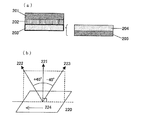
前記第1及び第2の態様は、他の側面において、傾斜配向されその配向状態が固定された液晶性化合物を少なくとも有する光学的異方性層を、順次有する光学補償シートであって、該光学異方性層のフィルム法線方向から測定したレターデーション値:Reが40nm以上であり、かつ配向方向を含むフィルムに直交する面内においてフィルム法線から40°傾斜した方向から測定したレターデーション値:Re(40)と、Reとの:比Re(40)/Reが2.0未満であり、さらに配向方向を含むフィルムに直交する面内においてフィルム法線から−40°傾斜した方向から測定したレターデーション値:Re(−40)と、Reとの比:Re(−40)/Reが0.40以上である光学補償シートに関する。
In the first and second embodiments, the liquid crystalline compound may be selected from a discotic liquid crystalline compound, the liquid crystalline compound in the optically anisotropic layer is in a hybrid orientation, and the hybrid orientation May be fixed, and the optically anisotropic layer may be a layer formed by applying a coating solution on the surface with a slide coater or a slot die coater.
In another aspect, the first and second embodiments are optical compensatory sheets sequentially including an optically anisotropic layer having at least a liquid crystal compound in which the alignment is tilted and the alignment state is fixed. Retardation value measured from the film normal direction of the anisotropic layer: Retation value measured from a direction inclined by 40 ° from the film normal in a plane perpendicular to the film including Re and having an orientation direction of 40 nm or more : Re (40) and Re: ratio Re (40) / Re is less than 2.0, and further measured from a direction inclined by −40 ° from the film normal in a plane perpendicular to the film including the orientation direction. The retardation value: Re (−40) and the ratio of Re: Re (−40) / Re relates to an optical compensation sheet having a Re of 0.40 or more.
前記第1及び第2の態様において、前記光学異方性層において、液晶性化合物のダイレクタとフィルム平面とのなす角度が膜厚方向で変化していてもよい。 In the first and second embodiments, in the optically anisotropic layer, an angle formed between the director of the liquid crystalline compound and the film plane may be changed in the film thickness direction.
また本発明は、
(a)液晶性化合物を少なくとも含む組成物をスロットダイを用いて表面に適用する工程、
(b)該液晶性化合物を傾斜配向させる工程、及び、
(c)その配向状態を固定して、光学異方性層を形成する工程、
を含む第1及び第2の態様の光学補償シートの製造方法も提供する。
The present invention also provides
(A) applying a composition containing at least a liquid crystalline compound to a surface using a slot die;
(B) a step of incliningly aligning the liquid crystalline compound; and
(C) fixing the orientation state and forming an optically anisotropic layer;
A method for producing the optical compensation sheet according to the first and second aspects including the present invention is also provided.
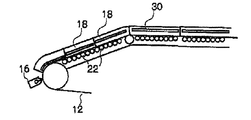
本発明の態様として、連続走行している支持体の表面に塗布液をスロットダイを用いて塗設して配向膜を形成する工程を含み、前記液晶性化合物の少なくとも一種を含有する塗布液を、前記配向膜の表面に塗布する前記方法;液晶性化合物を少なくとも含む組成物をスロットダイを用いて塗設する工程の後に、ウェブを囲むことが可能なケーシングを有するドライヤにより、塗布面近傍の風の乱れを防止しながら、乾燥中の塗布面側の溶剤蒸気を高い濃度で保ったまま乾燥する前記方法;該ドライヤ中の該ウェブの該光学異方性層塗布面側に、塗布液中の溶剤を凝縮、回収させる板状部材を設置し、該板状部材に冷却機構を備え、乾燥温度を制御する方法;が提供される。 As an aspect of the present invention, a coating liquid containing at least one kind of the above-mentioned liquid crystalline compound, comprising a step of coating a coating liquid on the surface of a continuously running support using a slot die to form an alignment film, The method of applying to the surface of the alignment film; after the step of applying a composition containing at least a liquid crystal compound using a slot die, a dryer having a casing capable of surrounding the web The method of drying while preventing the turbulence of the wind while keeping the solvent vapor on the coating surface side being dried at a high concentration; in the coating liquid on the optical anisotropic layer coating surface side of the web in the dryer A method is provided in which a plate-like member for condensing and recovering the solvent is provided, a cooling mechanism is provided on the plate-like member, and the drying temperature is controlled.
また本発明は、前記第1または第2の態様の光学補償シートを有する液晶表示装置;少なくとも、偏光膜と、前記第1または第2の光学補償シートとを有する偏光板;及び少なくとも、液晶セル(例えばTNモードの液晶セル)と、該液晶セルの両側にそれぞれ配置された一対の偏光膜と、前記一対の偏光膜の少なくとも一方と前記液晶セルとの間に前記第1または第2の光学補償シートとを有する液晶表示装置;に関する。 The present invention also provides a liquid crystal display device having the optical compensation sheet of the first or second aspect; a polarizing plate having at least a polarizing film and the first or second optical compensation sheet; and at least a liquid crystal cell. (For example, a TN mode liquid crystal cell), a pair of polarizing films respectively disposed on both sides of the liquid crystal cell, and the first or second optical element between at least one of the pair of polarizing films and the liquid crystal cell A liquid crystal display device having a compensation sheet.
以下、本発明について詳細に説明する。
なお、本発明において「ハイブリッド配向」とは、液晶性分子の長軸方向(例えば、ディスコティック液晶分子の場合はコアの円盤面)と光学異方性層の水平面(本発明では、光学異方性層が配向膜を介して支持体上に形成されているので、支持体の表面)とのなす角度(以下、「チルト角」という)が、支持体からの距離に伴い、すなわち光学異方性層の厚さ方向に変化する配向をいい、光学異方性層が有する2つの界面(例えば、光学異方性層が配向膜上に形成された場合は、配向膜との間の界面と空気界面であるが、光学異方性層が一旦形成された後、転写などにより他の支持体上に配置された場合は、2つの界面は必ずしも配向膜界面と空気界面ではない)において、チルト角が異なる配向状態にある液晶性分子によって実現される。光学異方性層を配向膜上に形成する場合は、光学異方性層/配向膜界面と、光学補償シートの最外面でもある光学異方性層/空気界面とで、チルト角が異なる液晶性分子によって実現される。本発明では、チルト角の変化の態様には、連続的増加、連続的減少、間欠的増加、間欠的減少、連続的増加と連続的減少を含む変化、及び増加及び減少を含む間欠的変化などいずれも含まれるものとする。間欠的変化は、厚さ方向の途中でチルト角が変化しない領域を含んでいる。本発明における「ハイブリッド配向」では、チルト角が変化しない領域を含んでいても、全体として増加又は減少していることが好ましい。さらに、チルト角は全体として支持体からの距離に伴い増加していることが好ましく、特に連続的に変化することが好ましい。
Hereinafter, the present invention will be described in detail.
In the present invention, “hybrid alignment” means the major axis direction of liquid crystalline molecules (for example, the disk surface of the core in the case of discotic liquid crystal molecules) and the horizontal plane of the optically anisotropic layer (in the present invention, optically anisotropic). Since the conductive layer is formed on the support via the alignment film, the angle (hereinafter referred to as “tilt angle”) with the surface of the support increases with the distance from the support, that is, optically anisotropic. Refers to an orientation that changes in the thickness direction of the optical layer, and includes two interfaces of the optical anisotropic layer (for example, when the optical anisotropic layer is formed on the alignment film, When the optically anisotropic layer is once formed and then placed on another support by transfer or the like, the two interfaces are not necessarily the alignment film interface and the air interface). Realized by liquid crystalline molecules with different orientations at different angles When the optically anisotropic layer is formed on the alignment film, the liquid crystal has different tilt angles between the optically anisotropic layer / alignment film interface and the optically anisotropic layer / air interface that is also the outermost surface of the optical compensation sheet. Realized by sex molecules. In the present invention, the aspect of change in tilt angle includes continuous increase, continuous decrease, intermittent increase, intermittent decrease, change including continuous increase and continuous decrease, and intermittent change including increase and decrease, etc. Both shall be included. The intermittent change includes a region where the tilt angle does not change in the middle of the thickness direction. In the “hybrid orientation” in the present invention, it is preferable that the overall increase or decrease is included even if the tilt angle does not change. Further, it is preferable that the tilt angle as a whole increases with the distance from the support, and it is particularly preferable that the tilt angle change continuously.
本明細書において「傾斜配向」とは、液晶性分子が、所定のチルト角(例えば、ディスコティック液晶分子の場合はコアの円盤面)と光学異方性層の水平面(光学異方性層が配向膜を介して支持体上に形成されている態様では、支持体の表面)とのなす角度で配向しているいかなる配向についても用いるものとする。チルト角は、層の深さ方向に変化していてもよいし、変化していなくてもよい。 In this specification, “tilted alignment” means that the liquid crystal molecules have a predetermined tilt angle (for example, the disk surface of the core in the case of discotic liquid crystal molecules) and the horizontal plane of the optical anisotropic layer (the optical anisotropic layer is In the embodiment formed on the support through the alignment film, any orientation that is oriented at an angle with the surface of the support) is used. The tilt angle may or may not change in the depth direction of the layer.
なお、本明細書において、数値範囲について「〜」という記載は、〜の前後の数値を最小値及び最大値として含む範囲を示す。
また、本明細書でいう「重合」には、共重合も含む趣旨である。
さらに、本明細書でいう「支持体上」又は「配向膜上」には、該支持体等の直接の表面をいう場合と、該支持体等の上に何らかの層(膜)を設けた表面をいう場合の両方を含む趣旨である。
In the present specification, the description of “˜” in the numerical range indicates a range including numerical values before and after “−” as the minimum value and the maximum value.
In addition, “polymerization” in the present specification includes copolymerization.
Furthermore, the term “on the support” or “on the alignment film” in the present specification refers to the direct surface of the support or the like, and the surface provided with any layer (film) on the support or the like. This is intended to include both cases.
[第1の態様]
本発明の第1の態様は、液晶性化合物、セルロースエステル及びポリマーAをそれぞれ少なくとも1種含有する光学異方性層を有する光学補償シートに関する。
(セルロースエステル)
まず、本態様に用いられるセルロースエステルについて説明する。
セルロースエステルを、液晶性化合物を含有する組成物中に混合することにより、該組成物を塗布する際にハジキが発生するのを抑制することができる。さらに、セルロースエステルは、液晶性化合物の傾斜角を制御するのに寄与する。第1の態様において、好適に使用可能なセルロースエステルには、セルロースアセテート、セルロースアセテートブチレート、セルロースアセテートプロピオネート、ヒドロキシプロピルセルロース、メチルセルロース及びカルボキシメチルセルロースなどが含まれる。中でも、セルロースアセテートブチレートが好ましく、さらに、ブチリル化度が40%以上であるセルロースアセテートブチレートがより好ましい。添加量については、ディスコティック液晶性化合物の総量に対して重量百分率で、好ましくは0.01〜20%、より好ましくは0.05〜10%、特に好ましくは0.05〜5%である。
[First embodiment]
The first aspect of the present invention relates to an optical compensation sheet having an optically anisotropic layer containing at least one liquid crystalline compound, cellulose ester and polymer A.
(Cellulose ester)
First, the cellulose ester used in this embodiment will be described.
By mixing the cellulose ester into the composition containing the liquid crystal compound, it is possible to suppress the occurrence of repelling when the composition is applied. Further, the cellulose ester contributes to controlling the tilt angle of the liquid crystal compound. In the first embodiment, suitably usable cellulose esters include cellulose acetate, cellulose acetate butyrate, cellulose acetate propionate, hydroxypropyl cellulose, methyl cellulose, carboxymethyl cellulose and the like. Among them, cellulose acetate butyrate is preferable, and cellulose acetate butyrate having a degree of butyrylation of 40% or more is more preferable. The added amount is preferably 0.01 to 20%, more preferably 0.05 to 10%, and particularly preferably 0.05 to 5% by weight percentage with respect to the total amount of the discotic liquid crystalline compound.
(ポリマーA)
次に、第1の態様の光学補償シートに用いられるポリマーAについて説明する。ポリマーAは、フルオロ脂肪族基含有モノマーより誘導される繰り返し単位と下記一般式(1a)で表される繰り返し単位とを含む共重合体である。ポリマーAは主に、配向膜側界面近傍の液晶性分子の傾斜角を調整するのに寄与する。
(Polymer A)
Next, the polymer A used for the optical compensation sheet of the first embodiment will be described. Polymer A is a copolymer containing a repeating unit derived from a fluoroaliphatic group-containing monomer and a repeating unit represented by the following general formula (1a). The polymer A mainly contributes to adjusting the tilt angle of the liquid crystal molecules in the vicinity of the alignment film side interface.
式中、R1a、R2aおよびR3aは、それぞれ、水素原子または置換基を表し;Laは下記の連結基群から選ばれる2価の連結基または下記の連結基群から選ばれる2つ以上を組み合わせて形成される2価の連結基を表し、
(連結基群)
単結合、−O−、−CO−、−NR4a−(R4aは水素原子、アルキル基、アリール基、またはアラルキル基を表す)、−S−、−SO2−、−P(=O)(OR5a)−(R5aはアルキル基、アリール基、またはアラルキル基を表す)、アルキレン基およびアリーレン基;Qaはカルボキシル基(−COOH)もしくはその塩、スルホ基(−SO3H)もしくはその塩、またはホスホノキシ{−OP(=O)(OH)2}もしくはその塩を表す。
In the formula, R 1a , R 2a and R 3a each represent a hydrogen atom or a substituent; La is a divalent linking group selected from the following linking group group or two selected from the following linking group group Represents a divalent linking group formed by combining the above,
(Linked group group)
Single bond, —O—, —CO—, —NR 4a — (R 4a represents a hydrogen atom, an alkyl group, an aryl group, or an aralkyl group), —S—, —SO 2 —, —P (═O) (OR 5a ) — (R 5a represents an alkyl group, an aryl group or an aralkyl group), an alkylene group and an arylene group; Q a is a carboxyl group (—COOH) or a salt thereof, a sulfo group (—SO 3 H) or The salt thereof, or phosphonoxy {—OP (═O) (OH) 2 } or a salt thereof is represented.
ポリマーの種類としては、「改訂 高分子合成の化学」(大津隆行著、発行:株式会社化学同人、1968)1〜4ページに記載があるポリマー種のいずれであってもよく、例えば、ポリオレフィン類、ポリエステル類、ポリアミド類、ポリイミド類、ポリウレタン類、ポリカーボネート類、ポリスルホン類、ポリカーボナート類、ポリエーテル類、ポリアセタール類、ポリケトン類、ポリフェニレンオキシド類、ポリフェニレンスルフィド類、ポリアリレート類、PTFE類、ポリビニリデンフロライド類、セルロース誘導体などが挙げられる。前記ポリマーAは、ポリオレフィン類であることが好ましい。 The type of polymer may be any of the polymer types described in “Revised Chemistry of Polymer Synthesis” (written by Otsu Takayuki, published by Kagaku Dojin Co., 1968), page 1-4. For example, polyolefins , Polyesters, polyamides, polyimides, polyurethanes, polycarbonates, polysulfones, polycarbonates, polyethers, polyacetals, polyketones, polyphenylene oxides, polyphenylene sulfides, polyarylates, PTFEs, polyvinylidene Examples include fluorides and cellulose derivatives. The polymer A is preferably a polyolefin.
前記ポリマーAに含まれるフルオロ脂肪族基含有モノマーより誘導される繰り返し単位は、フルオロ脂肪族基を側鎖に有するポリマーが好ましい。前記フルオロ脂肪族基は、炭素数1〜12であるのが好ましく、6〜10であるのがより好ましい。脂肪族基は、鎖状であっても環状であってもよく、鎖状である場合は直鎖状であっても分岐鎖状であってもよい。中でも、直鎖状の炭素数6〜10のフルオロ脂肪族基が好ましい。フッ素原子による置換の程度については特に制限はないが、脂肪族基中の50%以上の水素原子がフッ素原子に置換されているのが好ましく、60%以上が置換されているのがより好ましい。フルオロ脂肪族基は、エステル結合、アミド結合、イミド結合、ウレタン結合、ウレア結合、エーテル結合、チオエーテル結合、芳香族環などを介してポリマー主鎖と結合した側鎖に含まれる。 The repeating unit derived from the fluoroaliphatic group-containing monomer contained in the polymer A is preferably a polymer having a fluoroaliphatic group in the side chain. The fluoroaliphatic group preferably has 1 to 12 carbon atoms, and more preferably 6 to 10 carbon atoms. The aliphatic group may be linear or cyclic, and when it is linear, it may be linear or branched. Of these, a linear fluoroaliphatic group having 6 to 10 carbon atoms is preferable. The degree of substitution with fluorine atoms is not particularly limited, but 50% or more of hydrogen atoms in the aliphatic group are preferably substituted with fluorine atoms, and more preferably 60% or more are substituted. The fluoroaliphatic group is contained in a side chain bonded to the polymer main chain via an ester bond, an amide bond, an imide bond, a urethane bond, a urea bond, an ether bond, a thioether bond, an aromatic ring, or the like.
特に好ましくは下記一般式(2a)で表されるフルオロ脂肪族含有モノマーである。
一般式(2a)において、R11aは水素原子またはメチル基を表し、Xaは酸素原子、イオウ原子または−N(R12a)−(R12aは水素原子または炭素数1〜4のアルキル基を表し、好ましくは水素原子またはメチル基である)を表し、Hfは水素原子またはフッ素原子を表し、mは1〜6の整数、nは2〜4の整数を表す。 In the general formula (2a), R 11a represents a hydrogen atom or a methyl group, X a represents an oxygen atom, a sulfur atom, or —N (R 12a ) — (R 12a represents a hydrogen atom or an alkyl group having 1 to 4 carbon atoms). , preferably an a hydrogen) atom or a methyl group, H f represents a hydrogen atom or a fluorine atom, m is an integer from 1 to 6, n represents an integer of 2-4.
Xaは好ましくは酸素原子であり、Hfは好ましくは水素原子であり、mは好ましくは1または2であり、nは好ましくは3または4であり、これらの混合物を用いてもよい。 X a is preferably an oxygen atom, H f is preferably a hydrogen atom, m is preferably 1 or 2, n is preferably 3 or 4, and a mixture thereof may be used.
フルオロ脂肪族基含有モノマーは、テロメリゼーション法(テロマー法ともいわれる)またはオリゴメリゼーション法(オリゴマー法ともいわれる)により製造されたフルオロ脂肪族化合物から導かれた化合物であってもよい。これらのフルオロ脂肪族化合物の製造法に関しては、例えば、「フッ素化合物の合成と機能」(監修:石川延男、発行:株式会社シーエムシー、1987)の117〜118ページや、「Chemistry of Organic Fluorine Compounds II」(Monograph 187,Ed by Milos Hudlicky and Attila E.Pavlath,American Chemical Society 1995)の747−752ページに記載されている。テロメリゼーション法とは、ヨウ化物等の連鎖移動常数の大きいアルキルハライドをテローゲンとして、テトラフルオロエチレン等のフッ素含有ビニル化合物のラジカル重合を行い、テロマーを合成する方法である(Scheme−1に例を示した)。 The fluoroaliphatic group-containing monomer may be a compound derived from a fluoroaliphatic compound produced by a telomerization method (also referred to as a telomer method) or an oligomerization method (also referred to as an oligomer method). Regarding the production method of these fluoroaliphatic compounds, for example, “Synthesis and Function of Fluorine Compounds” (Supervision: Nobuo Ishikawa, Issue: CMC Co., 1987), “Chemistry of Organic Fluorines Compounds”. II "(Monograph 187, Ed by Milos Hudricky and Attila E. Pavlath, American Chemical Society 1995). The telomerization method is a method of synthesizing a telomer by radical polymerization of a fluorine-containing vinyl compound such as tetrafluoroethylene using an alkyl halide having a large chain transfer constant such as iodide as a telogen (example in Scheme-1). showed that).
得られた、末端ヨウ素化テロマーは通常、例えば[Scheme2]のごとき適切な末端化学修飾を施され、フルオロ脂肪族化合物へと導かれる。これらの化合物は必要に応じ、さらに所望のモノマー構造へと変換され、フルオロ脂肪族基含有ポリマーの製造に使用される。 The obtained terminal iodinated telomer is usually subjected to appropriate terminal chemical modification such as [Scheme 2], and led to a fluoroaliphatic compound. These compounds are further converted into a desired monomer structure as necessary, and used for the production of a fluoroaliphatic group-containing polymer.
次に前記ポリマーAに含まれる一般式(1a)の繰り返し単位について説明する。
上記一般式(1a)において、R1a、R2aおよびR3aはそれぞれ、水素原子または置換基を表す。Qaはカルボキシル基(−COOH)またはその塩、スルホ基(−SO3H)またはその塩、ホスホノキシ基{−OP(=O)(OH)2}またはその塩を表す。Laは下記の連結基群から選ばれる任意の基、またはそれらの2つ以上を組み合わせて形成される2価の連結基を表す。
(連結基群)
単結合、−O−、−CO−、−NR4a−(R4aは水素原子、アルキル基、アリール基、またはアラルキル基を表す)、−S−、−SO2−、−P(=O)(OR5a)−(R5aはアルキル基、アリール基、またはアラルキル基を表す)、アルキレン基およびアリーレン基。
In the general formula (1a), R 1a , R 2a and R 3a each represent a hydrogen atom or a substituent. Q a represents a carboxyl group (—COOH) or a salt thereof, a sulfo group (—SO 3 H) or a salt thereof, a phosphonoxy group {—OP (═O) (OH) 2 } or a salt thereof. L a represents any group or a divalent linking group formed by combining two or more of them, selected from linking groups groups below.
(Linked group group)
Single bond, —O—, —CO—, —NR 4a — (R 4a represents a hydrogen atom, an alkyl group, an aryl group, or an aralkyl group), —S—, —SO 2 —, —P (═O) (OR 5a ) — (R 5a represents an alkyl group, an aryl group, or an aralkyl group), an alkylene group, and an arylene group.
一般式(1a)中、R1a、R2aおよびR3aは、それぞれ、水素原子または下記に例示した置換基群から選ばれる置換基を表す。
(置換基群)
アルキル基(好ましくは炭素数1〜20、より好ましくは炭素数1〜12、特に好ましくは炭素数1〜8のアルキル基であり、例えば、メチル基、エチル基、イソプロピル基、tert−ブチル基、n−オクチル基、n−デシル基、n−ヘキサデシル基、シクロプロピル基、シクロペンチル基、シクロヘキシル基などが挙げられる)、アルケニル基(好ましくは炭素数2〜20、より好ましくは炭素数2〜12、特に好ましくは炭素数2〜8のアルケニル基であり、例えば、ビニル基、アリール基、2−ブテニル基、3−ペンテニル基などが挙げられる)、アルキニル基(好ましくは炭素数2〜20、より好ましくは炭素数2〜12、特に好ましくは炭素数2〜8のアルキニル基であり、例えば、プロパルギル基、3−ペンチニル基などが挙げられる)、アリール基(好ましくは炭素数6〜30、より好ましくは炭素数6〜20、特に好ましくは炭素数6〜12のアリール基であり、例えば、フェニル基、p−メチルフェニル基、ナフチル基などが挙げられる)、アラルキル基(好ましくは炭素数7〜30、より好ましくは炭素数7〜20、特に好ましくは炭素数7〜12のアラルキル基であり、例えば、ベンジル基、フェネチル基、3−フェニルプロピル基などが挙げられる)、置換もしくは無置換のアミノ基(好ましくは炭素数0〜20、より好ましくは炭素数0〜10、特に好ましくは炭素数0〜6のアミノ基であり、例えば、無置換アミノ基、メチルアミノ基、ジメチルアミノ基、ジエチルアミノ基、アニリノ基などが挙げられる)、アルコキシ基(好ましくは炭素数1〜20、より好ましくは炭素数1〜16、特に好ましくは炭素数1〜10のアルコキシ基であり、例えば、メトキシ基、エトキシ基、ブトキシ基などが挙げられる)、アルコキシカルボニル基(好ましくは炭素数2〜20、より好ましくは炭素数2〜16、特に好ましくは2〜10のアルコキシカルボニル基であり、例えば、メトキシカルボニル基、エトキシカルボニル基などが挙げられる)、アシルオキシ基(好ましくは炭素数2〜20、より好ましくは炭素数2〜16、特に好ましくは2〜10のアシルオキシ基であり、例えば、アセトキシ基、ベンゾイルオキシ基などが挙げられる)、アシルアミノ基(好ましくは炭素数2〜20、より好ましくは炭素数2〜16、特に好ましくは炭素数2〜10のアシルアミノ基であり、例えばアセチルアミノ基、ベンゾイルアミノ基などが挙げられる)、アルコキシカルボニルアミノ基(好ましくは炭素数2〜20、より好ましくは炭素数2〜16、特に好ましくは炭素数2〜12のアルコキシカルボニルアミノ基であり、例えば、メトキシカルボニルアミノ基などが挙げられる)、アリールオキシカルボニルアミノ基(好ましくは炭素数7〜20、より好ましくは炭素数7〜16、特に好ましくは炭素数7〜12のアリールオキシカルボニルアミノ基であり、例えば、フェニルオキシカルボニルアミノ基などが挙げられる)、スルホニルアミノ基(好ましくは炭素数1〜20、より好ましくは炭素数1〜16、特に好ましくは炭素数1〜12のスルホニルアミノ基であり、例えば、メタンスルホニルアミノ基、ベンゼンスルホニルアミノ基などが挙げられる)、スルファモイル基(好ましくは炭素数0〜20、より好ましくは炭素数0〜16、特に好ましくは炭素数0〜12のスルファモイル基であり、例えば、スルファモイル基、メチルスルファモイル基、ジメチルスルファモイル基、フェニルスルファモイル基などが挙げられる)、カルバモイル基(好ましくは炭素数1〜20、より好ましくは炭素数1〜16、特に好ましくは炭素数1〜12のカルバモイル基であり、例えば、無置換のカルバモイル基、メチルカルバモイル基、ジエチルカルバモイル基、フェニルカルバモイル基などが挙げられる)、アルキルチオ基(好ましくは炭素数1〜20、より好ましくは炭素数1〜16、特に好ましくは炭素数1〜12のアルキルチオ基であり、例えば、メチルチオ基、エチルチオ基などが挙げられる)、アリールチオ基(好ましくは炭素数6〜20、より好ましくは炭素数6〜16、特に好ましくは炭素数6〜12のアリールチオ基であり、例えば、フェニルチオ基などが挙げられる)、スルホニル基(好ましくは炭素数1〜20、より好ましくは炭素数1〜16、特に好ましくは炭素数1〜12のスルホニル基であり、例えば、メシル基、トシル基などが挙げられる)、スルフィニル基(好ましくは炭素数1〜20、より好ましくは炭素数1〜16、特に好ましくは炭素数1〜12のスルフィニル基であり、例えば、メタンスルフィニル基、ベンゼンスルフィニル基などが挙げられる)、ウレイド基(好ましくは炭素数1〜20、より好ましくは炭素数1〜16、特に好ましくは炭素数1〜12のウレイド基であり、例えば、無置換のウレイド基、メチルウレイド基、フェニルウレイド基などが挙げられる)、リン酸アミド基(好ましくは炭素数1〜20、より好ましくは炭素数1〜16、特に好ましくは炭素数1〜12のリン酸アミド基であり、例えば、ジエチルリン酸アミド基、フェニルリン酸アミド基などが挙げられる)、ヒドロキシ基、メルカプト基、ハロゲン原子(例えばフッ素原子、塩素原子、臭素原子、ヨウ素原子)、シアノ基、スルホ基、カルボキシル基、ニトロ基、ヒドロキサム酸基、スルフィノ基、ヒドラジノ基、イミノ基、ヘテロ環基(好ましくは炭素数1〜30、より好ましくは1〜12のヘテロ環基であり、例えば、窒素原子、酸素原子、硫黄原子等のヘテロ原子を有するヘテロ環基であり、例えば、イミダゾリル基、ピリジル基、キノリル基、フリル基、ピペリジル基、モルホリノ基、ベンゾオキサゾリル基、ベンズイミダゾリル基、ベンズチアゾリル基などが挙げられる)、シリル基(好ましくは、炭素数3〜40、より好ましくは炭素数3〜30、特に好ましくは、炭素数3〜24のシリル基であり、例えば、トリメチルシリル基、トリフェニルシリル基などが挙げられる)が含まれる。これらの置換基はさらにこれらの置換基によって置換されていてもよい。また、置換基を二つ以上有する場合は、同じでも異なってもよい。また、可能な場合には互いに結合して環を形成していてもよい。
In general formula (1a), R 1a , R 2a and R 3a each represent a hydrogen atom or a substituent selected from the substituent group exemplified below.
(Substituent group)
An alkyl group (preferably an alkyl group having 1 to 20 carbon atoms, more preferably 1 to 12 carbon atoms, particularly preferably 1 to 8 carbon atoms, such as a methyl group, an ethyl group, an isopropyl group, a tert-butyl group, n-octyl group, n-decyl group, n-hexadecyl group, cyclopropyl group, cyclopentyl group, cyclohexyl group and the like, alkenyl group (preferably having 2 to 20 carbon atoms, more preferably 2 to 12 carbon atoms, Particularly preferred are alkenyl groups having 2 to 8 carbon atoms, such as vinyl group, aryl group, 2-butenyl group and 3-pentenyl group), alkynyl groups (preferably having 2 to 20 carbon atoms, more preferred). Is an alkynyl group having 2 to 12 carbon atoms, particularly preferably 2 to 8 carbon atoms, such as propargyl group and 3-pentynyl group. An aryl group (preferably an aryl group having 6 to 30 carbon atoms, more preferably 6 to 20 carbon atoms, particularly preferably 6 to 12 carbon atoms, such as a phenyl group, a p-methylphenyl group, and a naphthyl group. Aralkyl groups (preferably 7 to 30 carbon atoms, more preferably 7 to 20 carbon atoms, particularly preferably 7 to 12 carbon atoms, such as benzyl group, phenethyl group, 3- Phenylpropyl group and the like), a substituted or unsubstituted amino group (preferably an amino group having 0 to 20 carbon atoms, more preferably 0 to 10 carbon atoms, particularly preferably 0 to 6 carbon atoms, Unsubstituted amino group, methylamino group, dimethylamino group, diethylamino group, anilino group, etc.), alkoxy group (preferably having 1 to 1 carbon atoms) 0, more preferably an alkoxy group having 1 to 16 carbon atoms, particularly preferably an alkoxy group having 1 to 10 carbon atoms, such as a methoxy group, an ethoxy group, or a butoxy group), an alkoxycarbonyl group (preferably having 2 carbon atoms) -20, more preferably an alkoxycarbonyl group having 2 to 16 carbon atoms, particularly preferably 2 to 10 carbon atoms such as methoxycarbonyl group and ethoxycarbonyl group), acyloxy group (preferably having 2 to 20 carbon atoms). More preferably an acyloxy group having 2 to 16 carbon atoms, particularly preferably 2 to 10 carbon atoms, such as an acetoxy group and a benzoyloxy group), an acylamino group (preferably having 2 to 20 carbon atoms, more preferably An acylamino group having 2 to 16 carbon atoms, particularly preferably 2 to 10 carbon atoms, such as acetyl Amino groups, benzoylamino groups and the like), alkoxycarbonylamino groups (preferably having 2 to 20 carbon atoms, more preferably 2 to 16 carbon atoms, particularly preferably having 2 to 12 carbon atoms, For example, a methoxycarbonylamino group and the like), an aryloxycarbonylamino group (preferably an aryloxycarbonylamino group having 7 to 20 carbon atoms, more preferably 7 to 16 carbon atoms, and particularly preferably 7 to 12 carbon atoms). For example, a phenyloxycarbonylamino group), a sulfonylamino group (preferably a sulfonylamino group having 1 to 20 carbon atoms, more preferably 1 to 16 carbon atoms, and particularly preferably 1 to 12 carbon atoms). For example, methanesulfonylamino group, benzenesulfonylamino group Sulfamoyl group (preferably a sulfamoyl group having 0 to 20 carbon atoms, more preferably 0 to 16 carbon atoms, particularly preferably 0 to 12 carbon atoms, such as a sulfamoyl group and a methylsulfamoyl group. , A dimethylsulfamoyl group, a phenylsulfamoyl group, etc.), a carbamoyl group (preferably a carbamoyl group having 1 to 20 carbon atoms, more preferably 1 to 16 carbon atoms, and particularly preferably 1 to 12 carbon atoms. For example, an unsubstituted carbamoyl group, a methylcarbamoyl group, a diethylcarbamoyl group, a phenylcarbamoyl group and the like, an alkylthio group (preferably having 1 to 20 carbon atoms, more preferably 1 to 16 carbon atoms, particularly preferably An alkylthio group having 1 to 12 carbon atoms, such as methylthio group, ethylthio group; Group), arylthio group (preferably an arylthio group having 6 to 20 carbon atoms, more preferably 6 to 16 carbon atoms, particularly preferably 6 to 12 carbon atoms, such as a phenylthio group). A sulfonyl group (preferably a sulfonyl group having 1 to 20 carbon atoms, more preferably 1 to 16 carbon atoms, particularly preferably 1 to 12 carbon atoms, and examples thereof include a mesyl group and a tosyl group), a sulfinyl group (Preferably a sulfinyl group having 1 to 20 carbon atoms, more preferably 1 to 16 carbon atoms, particularly preferably 1 to 12 carbon atoms, and examples thereof include a methanesulfinyl group and a benzenesulfinyl group), a ureido group ( Preferably it is C1-C20, More preferably, it is C1-C16, Most preferably, it is C1-C12 ureido group, For example, an unsubstituted ureido group, a methylureido group, a phenylureido group, etc. are mentioned), phosphoric acid amide groups (preferably having 1 to 20 carbon atoms, more preferably 1 to 16 carbon atoms, particularly preferably 1 to 1 carbon atoms). 12 phosphoric acid amide groups such as diethyl phosphoric acid amide group and phenylphosphoric acid amide group), hydroxy group, mercapto group, halogen atom (for example, fluorine atom, chlorine atom, bromine atom, iodine atom) , Cyano group, sulfo group, carboxyl group, nitro group, hydroxamic acid group, sulfino group, hydrazino group, imino group, heterocyclic group (preferably a heterocyclic group having 1 to 30 carbon atoms, more preferably 1 to 12 carbon atoms. A heterocyclic group having a heteroatom such as a nitrogen atom, an oxygen atom or a sulfur atom, such as an imidazolyl group or a pyridyl group. Quinolyl group, furyl group, piperidyl group, morpholino group, benzoxazolyl group, benzimidazolyl group, benzthiazolyl group, etc.), silyl group (preferably having 3 to 40 carbon atoms, more preferably 3 to 3 carbon atoms). 30, particularly preferably a silyl group having 3 to 24 carbon atoms, such as a trimethylsilyl group and a triphenylsilyl group). These substituents may be further substituted with these substituents. Moreover, when it has two or more substituents, they may be the same or different. If possible, they may be bonded to each other to form a ring.
R1a、R2aおよびR3aはそれぞれ、水素原子、アルキル基、ハロゲン原子(例えば、フッ素原子、塩素原子、臭素原子、ヨウ素原子等)、または後述する−La−Qaで表される基であることが好ましく、水素原子、炭素数1〜6のアルキル基、塩素原子、−L−Qで表される基であることがより好ましく、水素原子、炭素数1〜4のアルキル基であることがさらに好ましく、水素原子、炭素数1〜2のアルキル基であることが特に好ましく、R2aおよびR3aが水素原子で、R1aが水素原子またはメチル基であることが最も好ましい。該アルキル基の具体例としては、メチル基、エチル基、n−プロピル基、n−ブチル基、sec−ブチル基等が挙げられる。該アルキル基は、適当な置換基を有していても良い。該置換基としては、ハロゲン原子、アリール基、ヘテロ環基、アルコキシル基、アリールオキシ基、アルキルチオ基、アリールチオ基、アシル基、ヒドロキシル基、アシルオキシ基、アミノ基、アルコキシカルボニル基、アシルアミノ基、オキシカルボニル基、カルバモイル基、スルホニル基、スルファモイル基、スルホンアミド基、スルホリル基、カルボキシル基などが挙げられる。なお、アルキル基の炭素数は、置換基の炭素原子を含まない。以下、他の基の炭素数についても同様である。 R 1a , R 2a and R 3a are each a hydrogen atom, an alkyl group, a halogen atom (for example, a fluorine atom, a chlorine atom, a bromine atom, an iodine atom, etc.) or a group represented by -L a -Q a described later. It is preferably a hydrogen atom, an alkyl group having 1 to 6 carbon atoms, a chlorine atom, or a group represented by -LQ, more preferably a hydrogen atom or an alkyl group having 1 to 4 carbon atoms. More preferably, it is particularly preferably a hydrogen atom or an alkyl group having 1 to 2 carbon atoms, most preferably R 2a and R 3a are a hydrogen atom, and R 1a is a hydrogen atom or a methyl group. Specific examples of the alkyl group include methyl group, ethyl group, n-propyl group, n-butyl group, sec-butyl group and the like. The alkyl group may have a suitable substituent. Examples of the substituent include a halogen atom, aryl group, heterocyclic group, alkoxyl group, aryloxy group, alkylthio group, arylthio group, acyl group, hydroxyl group, acyloxy group, amino group, alkoxycarbonyl group, acylamino group, oxycarbonyl Group, carbamoyl group, sulfonyl group, sulfamoyl group, sulfonamido group, sulfolyl group, carboxyl group and the like. The carbon number of the alkyl group does not include the carbon atom of the substituent. The same applies to the carbon number of other groups.
Laは、上記連結基群から選ばれる2価の連結基、またはそれらの2つ以上を組み合わせて形成される2価の連結基を表す。上記連結基群中、−NR4a−のR4aは、水素原子、アルキル基、アリール基またはアラルキル基を表し、好ましくは水素原子またはアルキル基である。また、−PO(OR5a)−のR5aはアルキル基、アリール基またはアラルキル基を表し、好ましくはアルキル基である。R4aおよびR5aがアルキル基、アリール基またはアラルキル基を表す場合の炭素数は「置換基群」で説明したものと同じである。Lとしては、単結合、−O−、−CO−、−NR4a−、−S−、−SO2−、アルキレン基またはアリーレン基を含むことが好ましく、単結合、−CO−、−O−、−NR4a−、アルキレン基またはアリーレン基を含んでいることが特に好ましく、単結合であることが最も好ましい。Laがアルキレン基を含む場合、アルキレン基の炭素数は好ましくは1〜10、より好ましくは1〜8、特に好ましくは1〜6である。特に好ましいアルキレン基の具体例として、メチレン、エチレン、トリメチレン、テトラブチレン、ヘキサメチレン基等が挙げられる。Laが、アリーレン基を含む場合、アリーレン基の炭素数は、好ましくは6〜24、より好ましくは6〜18、特に好ましくは6〜12である。特に好ましいアリーレン基の具体例として、フェニレン、ナフタレン基等が挙げられる。Laが、アルキレン基とアリーレン基を組み合わせて得られる2価の連結基(即ちアラルキレン基)を含む場合、アラルキレン基の炭素数は、好ましくは7〜34、より好ましくは7〜26、特に好ましくは7〜16である。特に好ましいアラルキレン基の具体例として、フェニレンメチレン基、フェニレンエチレン基、メチレンフェニレン基等が挙げられる。Laとして挙げられた基は、適当な置換基を有していてもよい。このような置換基としては先にR1a〜R3aにおける置換基として挙げた置換基と同様なものを挙げることができる。 La represents a divalent linking group selected from the above linking group group, or a divalent linking group formed by combining two or more thereof. In the linking group group, R 4a in —NR 4a — represents a hydrogen atom, an alkyl group, an aryl group or an aralkyl group, preferably a hydrogen atom or an alkyl group. R 5a in —PO (OR 5a ) — represents an alkyl group, an aryl group or an aralkyl group, and preferably an alkyl group. When R 4a and R 5a represent an alkyl group, an aryl group or an aralkyl group, the number of carbon atoms is the same as that described in the “Substituent group”. L preferably contains a single bond, —O—, —CO—, —NR 4a —, —S—, —SO 2 —, an alkylene group or an arylene group, and is a single bond, —CO—, —O—. , —NR 4a —, an alkylene group or an arylene group is particularly preferable, and a single bond is most preferable. If L a comprises an alkylene group, the number of carbon atoms in the alkylene group is preferably 1 to 10, more preferably 1 to 8, particularly preferably 1 to 6. Specific examples of particularly preferred alkylene groups include methylene, ethylene, trimethylene, tetrabutylene, hexamethylene groups and the like. L a is a case containing an arylene group, the carbon number of the arylene group is preferably 6 to 24, more preferably 6 to 18, particularly preferably 6 to 12. Specific examples of particularly preferred arylene groups include phenylene and naphthalene groups. L a is a case containing a divalent linking group obtained by combining an alkylene group and an arylene group (i.e. aralkylene group), the number of carbon atoms in the aralkylene group is preferably 7-34, more preferably 7-26, particularly preferably Is 7-16. Specific examples of particularly preferred aralkylene groups include a phenylenemethylene group, a phenyleneethylene group, and a methylenephenylene group. Group cited as L a may have a suitable substituent. Examples of such a substituent include the same substituents as those described above as the substituents for R 1a to R 3a .
以下にLaの具体的構造を例示するが、本発明の第1の態様はこれらの具体例に限定されるものではない。
前記式(1a)中、Qaはカルボキシル基、カルボキシル基の塩(例えばリチウム塩、ナトリウム塩、カリウム塩、アンモニウム塩(例えばアンモニウム、テトラメチルアンモニウム、トリメチル−2−ヒドロキシエチルアンモニウム、テトラブチルアンモニウム、トリメチルベンジルアンモニウム、ジメチルフェニルアンモニウムなど)、ピリジニウム塩など)、スルホ基、スルホ基の塩(塩を形成するカチオンの例は上記カルボキシル基に記載のものと同じ)、ホスホノキシ基、ホスホノキシ基の塩(塩を形成するカチオンの例は上記カルボキシル基に記載のものと同じ)を表す。より好ましくはカルボキシル基、スルホ基、ホスホ基であり、特に好ましいのはカルボキシル基またはスルホ基であり、最も好ましいのは、カルボキシル基である。 In the formula (1a), Q a is a carboxyl group, a salt of a carboxyl group (for example, lithium salt, sodium salt, potassium salt, ammonium salt (for example, ammonium, tetramethylammonium, trimethyl-2-hydroxyethylammonium, tetrabutylammonium, Trimethylbenzylammonium, dimethylphenylammonium, etc.), pyridinium salts, etc.), sulfo groups, salts of sulfo groups (examples of cations forming the salts are the same as those described above for carboxyl groups), phosphonoxy groups, salts of phosphonoxy groups ( Examples of the cation forming the salt are the same as those described for the carboxyl group). A carboxyl group, a sulfo group and a phospho group are more preferable, a carboxyl group or a sulfo group is particularly preferable, and a carboxyl group is most preferable.
第1の態様に使用可能な前記ポリマーAに含まれる前記一般式(1a)に対応するモノマーの具体例を以下に挙げるが、本発明の第1の態様は以下の具体例によってなんら制限されるものではない。 Specific examples of the monomer corresponding to the general formula (1a) contained in the polymer A that can be used in the first aspect are listed below, but the first aspect of the present invention is limited by the following specific examples. It is not a thing.
前記ポリマーAは、前記一般式(1a)で表される繰り返し単位を1種含んでいてもよいし、2種以上含んでいてもよい。また前記ポリマーAは、前記フルオロ脂肪族基含有モノマーより誘導される繰り返し単位を1種または2種以上有していてもよい。さらに、前記ポリマーAはそれら以外の他の繰り返し単位を含んでいてもよい。前記他の繰り返し単位については特に制限されず、通常のラジカル重合反応可能なモノマーから誘導される繰り返し単位が好ましい例として挙げられる。以下、他の繰り返し単位を誘導するモノマーの具体例を挙げる。前記ポリマーAは、下記モノマー群から選ばれるモノマーから誘導される繰り返し単位を1種含有していてもよいし、2種以上含有していてもよい。 The polymer A may contain one type of repeating unit represented by the general formula (1a), or may contain two or more types. The polymer A may have one or more repeating units derived from the fluoroaliphatic group-containing monomer. Furthermore, the polymer A may contain other repeating units. The other repeating units are not particularly limited, and preferred examples thereof include repeating units derived from ordinary radical polymerizable monomers. Hereinafter, specific examples of monomers for deriving other repeating units will be given. The polymer A may contain one type of repeating unit derived from a monomer selected from the following monomer group, or may contain two or more types.
モノマー群
(1)アルケン類
エチレン、プロピレン、1−ブテン、イソブテン、1−ヘキセン、1−ドデセン、1−オクタデセン、1−エイコセン、ヘキサフルオロプロペン、フッ化ビニリデン、クロロトリフルオロエチレン、3,3,3−トリフルオロプロピレン、テトラフルオロエチレン、塩化ビニル、塩化ビニリデンなど;
(2)ジエン類
1,3−ブタジエン、イソプレン、1,3−ペンタジエン、2−エチル−1,3−ブタジエン、2−n−プロピル−1,3−ブタジエン、2,3−ジメチル−1,3−ブタジエン、2−メチル−1,3−ペンタジエン、1−フェニル−1,3−ブタジエン、1−α−ナフチル−1,3−ブタジエン、1−β−ナフチル−1,3−ブタジエン、2−クロロ−1,3−ブタジエン、1−ブロモ−1,3−ブタジエン、1−クロロブタジエン、2−フルオロ−1,3−ブタジエン、2,3−ジクロロ−1,3−ブタジエン、1,1,2−トリクロロ−1,3−ブタジエンおよび2−シアノ−1,3−ブタジエン、1,4−ジビニルシクロヘキサンなど;
Monomer group (1) Alkenes Ethylene, propylene, 1-butene, isobutene, 1-hexene, 1-dodecene, 1-octadecene, 1-eicocene, hexafluoropropene, vinylidene fluoride, chlorotrifluoroethylene, 3, 3, 3-trifluoropropylene, tetrafluoroethylene, vinyl chloride, vinylidene chloride, etc .;
(2)
(3)α,β−不飽和カルボン酸の誘導体
(3a)アルキルアクリレート類
メチルアクリレート、エチルアクリレート、n−プロピルアクリレート、イソプロピルアクリレート、n−ブチルアクリレート、イソブチルアクリレート、sec−ブチルアクリレート、tert−ブチルアクリレート、アミルアクリレート、n−ヘキシルアクリレート、シクロヘキシルアクリレート、2−エチルへキシルアクリレート、n−オクチルアクリレート、tert−オクチルアクリレート、ドデシルアクリレート、フェニルアクリレート、ベンジルアクリレート、2−クロロエチルアクリレート、2−ブロモエチルアクリレート、4−クロロブチルアクリレート、2−シアノエチルアクリレート、2−アセトキシエチルアクリレート、メトキシベンジルアクリレート、2−クロロシクロヘキシルアクリレート、フルフリルアクリレート、テトラヒドロフルフリルアクリレート、2−メトキシエチルアクリレート、ω−メトキシポリエチレングリコールアクリレート(ポリオキシエチレンの付加モル数:n=2ないし100のもの)、3−メトキシブチルアクリレート、2−エトキシエチルアクリレート、2−ブトキシエチルアクリレート、2−(2−ブトキシエトキシ)エチルアクリレート、1−ブロモ−2−メトキシエチルアクリレート、1,1−ジクロロ−2−エトキシエチルアクリレート、グリシジルアクリレートなど);
(3b)アルキルメタクリレート類
メチルメタクリレート、エチルメタクリレート、n−プロピルメタクリレート、イソプロピルメタクリレート、n−ブチルメタクリレート、イソブチルメタクリレート、sec−ブチルメタクリレート、tert−ブチルメタクリレート、アミルメタクリレート、n−ヘキシルメタクリレート、シクロヘキシルメタクリレート、2−エチルヘキシルメタクリレート、n−オクチルメタクリレート、ステアリルメタクリレート、ベンジルメタクリレート、フェニルメタクリレート、アリルメタクリレート、フルフリルメタクリレート、テトラヒドロフルフリルメタクリレート、クレジルメタクリレート、ナフチルメタクリレート、2−メトキシエチルメタクリレート、3−メトキシブチルメタクリレート、ω−メトキシポリエチレングリコールメタクリレート(ポリオキシエチレンの付加モル数:n=2ないし100のもの)、2−アセトキシエチルメタクリレート、2−エトキシエチルメタクリレート、2−ブトキシエチルメタクリレート、2−(2−ブトキシエトキシ)エチルメタクリレート、グリシジルメタクリレート、3−トリメトキシシリルプロピルメタクリレート、アリルメタクリレート、2−イソシアナトエチルメタクリレートなど;
(3c)不飽和多価カルボン酸のジエステル類
マレイン酸ジメチル、マレイン酸ジブチル、イタコン酸ジメチル、タコン酸ジブチル、クロトン酸ジブチル、クロトン酸ジヘキシル、フマル酸ジエチル、フマル酸ジメチルなど;
(3d)α、β−不飽和カルボン酸のアミド類
N,N−ジメチルアクリルアミド、N,N−ジエチルアクリルアミド、N−n−プロピルアクリルアミド、N−tertブチルアクリルアミド、N−tertオクチルメタクリルアミド、N−シクロヘキシルアクリルアミド、N−フェニルアクリルアミド、N−(2−アセトアセトキシエチル)アクリルアミド、N−ベンジルアクリルアミド、N−アクリロイルモルフォリン、ジアセトンアクリルアミド、N−メチルマレイミドなど;
(3) Derivatives of α, β-unsaturated carboxylic acid (3a) Alkyl acrylates Methyl acrylate, ethyl acrylate, n-propyl acrylate, isopropyl acrylate, n-butyl acrylate, isobutyl acrylate, sec-butyl acrylate, tert-butyl acrylate , Amyl acrylate, n-hexyl acrylate, cyclohexyl acrylate, 2-ethylhexyl acrylate, n-octyl acrylate, tert-octyl acrylate, dodecyl acrylate, phenyl acrylate, benzyl acrylate, 2-chloroethyl acrylate, 2-bromoethyl acrylate, 4-chlorobutyl acrylate, 2-cyanoethyl acrylate, 2-acetoxyethyl acrylate, methoxybenzyl Chryrate, 2-chlorocyclohexyl acrylate, furfuryl acrylate, tetrahydrofurfuryl acrylate, 2-methoxyethyl acrylate, ω-methoxypolyethylene glycol acrylate (number of added polyoxyethylene: n = 2 to 100), 3-methoxy Butyl acrylate, 2-ethoxyethyl acrylate, 2-butoxyethyl acrylate, 2- (2-butoxyethoxy) ethyl acrylate, 1-bromo-2-methoxyethyl acrylate, 1,1-dichloro-2-ethoxyethyl acrylate, glycidyl acrylate Such);
(3b) Alkyl methacrylates Methyl methacrylate, ethyl methacrylate, n-propyl methacrylate, isopropyl methacrylate, n-butyl methacrylate, isobutyl methacrylate, sec-butyl methacrylate, tert-butyl methacrylate, amyl methacrylate, n-hexyl methacrylate, cyclohexyl methacrylate, 2 -Ethylhexyl methacrylate, n-octyl methacrylate, stearyl methacrylate, benzyl methacrylate, phenyl methacrylate, allyl methacrylate, furfuryl methacrylate, tetrahydrofurfuryl methacrylate, cresyl methacrylate, naphthyl methacrylate, 2-methoxyethyl methacrylate, 3-methoxybutyl methacrylate, ω Methoxypolyethylene glycol methacrylate (number of added polyoxyethylene: n = 2 to 100), 2-acetoxyethyl methacrylate, 2-ethoxyethyl methacrylate, 2-butoxyethyl methacrylate, 2- (2-butoxyethoxy) ethyl methacrylate Glycidyl methacrylate, 3-trimethoxysilylpropyl methacrylate, allyl methacrylate, 2-isocyanatoethyl methacrylate, etc .;
(3c) Diesters of unsaturated polycarboxylic acids Dimethyl maleate, dibutyl maleate, dimethyl itaconate, dibutyl taconate, dibutyl crotonate, dihexyl crotonate, diethyl fumarate, dimethyl fumarate, etc .;
(3d) Amides of α, β-unsaturated carboxylic acids N, N-dimethylacrylamide, N, N-diethylacrylamide, Nn-propylacrylamide, N-tertbutylacrylamide, N-tertoctylmethacrylamide, N- Cyclohexylacrylamide, N-phenylacrylamide, N- (2-acetoacetoxyethyl) acrylamide, N-benzylacrylamide, N-acryloylmorpholine, diacetone acrylamide, N-methylmaleimide and the like;
(4)不飽和ニトリル類
アクリロニトリル、メタクリロニトリルなど;
(5)スチレンおよびその誘導体
スチレン、ビニルトルエン、エチルスチレン、p−tertブチルスチレン、p−ビニル安息香酸メチル、α−メチルスチレン、p−クロロメチルスチレン、ビニルナフタレン、p−メトキシスチレン、p−ヒドロキシメチルスチレン、p−アセトキシスチレンなど;
(6)ビニルエステル類
酢酸ビニル、プロピオン酸ビニル、酪酸ビニル、イソ酪酸ビニル、安息香酸ビニル、サリチル酸ビニル、クロロ酢酸ビニル、メトキシ酢酸ビニル、フェニル酢酸ビニルなど;
(7)ビニルエーテル類
メチルビニルエーテル、エチルビニルエーテル、n−プロピルビニルエーテル、イソプロピルビニルエーテル、n−ブチルビニルエーテル、イソブチルビニルエーテル、tert−ブチルビニルエーテル、n−ペンチルビニルエーテル、n−ヘキシルビニルエーテル、n−オクチルビニルエーテル、n−ドデシルビニルエーテル、n−エイコシルビニルエーテル、2−エチルヘキシルビニルエーテル、シクロヘキシルビニルエーテル、フルオロブチルビニルエーテル、フルオロブトキシエチルビニルエーテルなど;および
(8)その他の重合性単量体
N−ビニルピロリドン、メチルビニルケトン、フェニルビニルケトン、メトキシエチルビニルケトン、2−ビニルオキサゾリン、2−イソプロペニルオキサゾリンなど。
(4) Unsaturated nitriles Acrylonitrile, methacrylonitrile, etc .;
(5) Styrene and its derivatives Styrene, vinyl toluene, ethyl styrene, p-tert butyl styrene, methyl p-vinyl benzoate, α-methyl styrene, p-chloromethyl styrene, vinyl naphthalene, p-methoxy styrene, p-hydroxy Methyl styrene, p-acetoxy styrene, etc .;
(6) Vinyl esters Vinyl acetate, vinyl propionate, vinyl butyrate, vinyl isobutyrate, vinyl benzoate, vinyl salicylate, vinyl chloroacetate, vinyl methoxyacetate, vinyl vinyl acetate, etc .;
(7) Vinyl ethers Methyl vinyl ether, ethyl vinyl ether, n-propyl vinyl ether, isopropyl vinyl ether, n-butyl vinyl ether, isobutyl vinyl ether, tert-butyl vinyl ether, n-pentyl vinyl ether, n-hexyl vinyl ether, n-octyl vinyl ether, n-dodecyl Vinyl ether, n-eicosyl vinyl ether, 2-ethylhexyl vinyl ether, cyclohexyl vinyl ether, fluorobutyl vinyl ether, fluorobutoxyethyl vinyl ether, etc .; and (8) other polymerizable monomers N-vinyl pyrrolidone, methyl vinyl ketone, phenyl vinyl ketone, Methoxyethyl vinyl ketone, 2-vinyl oxazoline, 2-isopropenyl oxazoline .
また、前記ポリマーAは、後述する一般式(3a)で表されるモノマーから誘導される繰り返し単位を含んでいてもよい。 Further, the polymer A may contain a repeating unit derived from a monomer represented by the general formula (3a) described later.
前記ポリマーAのフルオロ脂肪族基含有モノマーの量は、該ポリマーの構成モノマー総量の5重量%以上であるのが好ましく、10重量%以上であるのがより好ましく、30重量%以上であるのがさらに好ましい。前記フルオロ脂肪族基含有モノマーより誘導される繰り返し単位において、前記一般式(1a)で表される繰り返し単位の量は、該フルオロ脂肪族基含有モノマーより誘導される繰り返し単位の構成モノマー総量の1重量%以上であるのが好ましく、2〜20重量%であるのがより好ましく、2〜10重量%であるのが特に好ましく、2〜5重量%であるのが最も好ましい。 The amount of the fluoroaliphatic group-containing monomer of the polymer A is preferably 5% by weight or more, more preferably 10% by weight or more, and more preferably 30% by weight or more of the total amount of constituent monomers of the polymer. Further preferred. In the repeating unit derived from the fluoroaliphatic group-containing monomer, the amount of the repeating unit represented by the general formula (1a) is 1 of the total amount of monomers constituting the repeating unit derived from the fluoroaliphatic group-containing monomer. It is preferably not less than wt%, more preferably 2 to 20 wt%, particularly preferably 2 to 10 wt%, and most preferably 2 to 5 wt%.
第1の態様に用いる前記ポリマーAの重量平均分子量は1,000〜1,000,000であるのが好ましく、1,000〜500,000であるのがより好ましく、1,000〜100,000であるのがさらに好ましい。重量平均分子量は、ゲルパーミエーションクロマトグラフィ(GPC)を用いて、ポリスチレン(PS)換算の値として測定可能である。 The weight average molecular weight of the polymer A used in the first embodiment is preferably 1,000 to 1,000,000, more preferably 1,000 to 500,000, and 1,000 to 100,000. More preferably. The weight average molecular weight can be measured as a value in terms of polystyrene (PS) using gel permeation chromatography (GPC).
前記ポリマーAを製造する際に採用される重合方法については、特に限定されるものではないが、例えば、ビニル基を利用したカチオン重合やラジカル重合、あるいは、アニオン重合等の重合方法を採ることができ、これらの中ではラジカル重合が汎用に利用できる点で特に好ましい。ラジカル重合の重合開始剤としては、ラジカル熱重合開始剤や、ラジカル光重合開始剤等の公知の化合物を使用することができるが、特に、ラジカル熱重合開始剤を使用することが好ましい。ここで、ラジカル熱重合開始剤は、分解温度以上に加熱することにより、ラジカルを発生させる化合物である。このようなラジカル熱重合開始剤としては、例えば、ジアシルパーオキサイド(アセチルパーオキサイド、ベンゾイルパーオキサイド等)、ケトンパーオキサイド(メチルエチルケトンパーオキサイド、シクロヘキサノンパーオキサイド等)、ハイドロパーオキサイド(過酸化水素、tert−ブチルハイドパーオキサイド、クメンハイドロパーオキサイド等)、ジアルキルパーオキサイド(ジ−tert−ブチルパーオキサイド、ジクミルパーオキサイド、ジラウロイルパーオキサイド等)、パーオキシエステル類(tert−ブチルパーオキシアセテート、tert−ブチルパーオキシピバレート等)、アゾ系化合物(アゾビスイソブチロニトリル、アゾビスイソバレロニトリル等)、過硫酸塩類(過硫酸アンモニウム、過硫酸ナトリウム、過硫酸カリウム等)が挙げられる。このようなラジカル熱重合開始剤は、1種を単独で使用することもできるし、あるいは2種以上を組み合わせて使用することもできる。 The polymerization method employed when producing the polymer A is not particularly limited, but for example, a polymerization method using a vinyl group such as cationic polymerization, radical polymerization, or anionic polymerization may be employed. Among these, radical polymerization is particularly preferable in that it can be used for general purposes. As the polymerization initiator for radical polymerization, known compounds such as radical thermal polymerization initiators and radical photopolymerization initiators can be used, and it is particularly preferable to use radical thermal polymerization initiators. Here, the radical thermal polymerization initiator is a compound that generates radicals by heating to a decomposition temperature or higher. Examples of such radical thermal polymerization initiators include diacyl peroxide (acetyl peroxide, benzoyl peroxide, etc.), ketone peroxide (methyl ethyl ketone peroxide, cyclohexanone peroxide, etc.), hydroperoxide (hydrogen peroxide, tert. -Butyl hydroxide, cumene hydroperoxide, etc.), dialkyl peroxides (di-tert-butyl peroxide, dicumyl peroxide, dilauroyl peroxide, etc.), peroxyesters (tert-butyl peroxyacetate, tert) -Butyl peroxypivalate, etc.), azo compounds (azobisisobutyronitrile, azobisisovaleronitrile, etc.), persulfates (ammonium persulfate, sodium persulfate) And potassium persulfate) and the like. Such radical thermal polymerization initiators can be used singly or in combination of two or more.
ラジカル重合方法は、特に制限されるものでなく、乳化重合法、懸濁重合法、塊状重合法、溶液重合法等を採ることが可能である。典型的なラジカル重合方法である溶液重合についてさらに具体的に説明する。他の重合方法についても概要は同等であり、その詳細は例えば「高分子科学実験法」高分子学会編(東京化学同人、1981年)等に記載されている。 The radical polymerization method is not particularly limited, and an emulsion polymerization method, a suspension polymerization method, a bulk polymerization method, a solution polymerization method, and the like can be adopted. The solution polymerization, which is a typical radical polymerization method, will be described more specifically. The outlines of other polymerization methods are the same, and details thereof are described, for example, in “Polymer Science Experimental Method” edited by Polymer Society (Tokyo Kagaku Dojin, 1981).
溶液重合を行うためには有機溶媒を使用する。これらの有機溶媒は本発明の目的、効果を損なわない範囲で任意に選択可能である。これらの有機溶媒は通常、大気圧下での沸点が50〜200℃の範囲内の値を有する有機化合物であり、各構成成分を均一に溶解させる有機化合物が好ましい。好ましい有機溶媒の例を示すと、イソプロパノール、ブタノール等のアルコール類;ジブチルエーテル、エチレングリコールジメチルエーテル、テトラヒドロフラン、ジオキサン等のエーテル類;アセトン、メチルエチルケトン、メチルイソブチルケトン、シクロヘキサノン等のケトン類;酢酸エチル、酢酸ブチル、酢酸アミル、γ−ブチロラクトン等のエステル類;ベンゼン、トルエン、キシレン等の芳香族炭化水素類;が挙げられる。なお、これらの有機溶媒は、1種単独または2種以上を組み合わせて用いることが可能である。さらに、モノマーや生成するポリマーの溶解性の観点から上記有機溶媒に水を併用した水混合有機溶媒も適用可能である。 An organic solvent is used for solution polymerization. These organic solvents can be arbitrarily selected as long as the objects and effects of the present invention are not impaired. These organic solvents are usually organic compounds having boiling points under atmospheric pressure in the range of 50 to 200 ° C., and organic compounds that uniformly dissolve each component are preferred. Examples of preferred organic solvents are: alcohols such as isopropanol and butanol; ethers such as dibutyl ether, ethylene glycol dimethyl ether, tetrahydrofuran and dioxane; ketones such as acetone, methyl ethyl ketone, methyl isobutyl ketone and cyclohexanone; ethyl acetate and acetic acid And esters such as butyl, amyl acetate, and γ-butyrolactone; and aromatic hydrocarbons such as benzene, toluene, and xylene. These organic solvents can be used alone or in combination of two or more. Furthermore, a water-mixed organic solvent in which water is used in combination with the above organic solvent is also applicable from the viewpoint of the solubility of the monomer and the polymer to be produced.
また、溶液重合条件も特に制限されるものではないが、例えば、50〜200℃の温度範囲内で、10分〜30時間加熱することが好ましい。さらに、発生したラジカルが失活しないように、溶液重合中はもちろんのこと、溶液重合開始前にも、不活性ガスパージを行うことが好ましい。不活性ガスとしては通常窒素ガスが好適に用いられる。 Also, the solution polymerization conditions are not particularly limited, but for example, it is preferable to heat within a temperature range of 50 to 200 ° C. for 10 minutes to 30 hours. Furthermore, in order not to deactivate the generated radicals, it is preferable to perform an inert gas purge not only during solution polymerization but also before the start of solution polymerization. Usually, nitrogen gas is suitably used as the inert gas.
前記ポリマーAを好ましい分子量範囲で得るためには、連鎖移動剤を用いたラジカル重合法が特に有効である。連鎖移動剤としてはメルカプタン類(例えば、オクチルメルカプタン、デシルメルカプタン、ドデシルメルカプタン、tert−ドデシルメルカプタン、オクタデシルメルカプタン、チオフェノール、p−ノニルチオフェノール等)、ポリハロゲン化アルキル(例えば、四塩化炭素、クロロホルム、1,1,1−トリクロロエタン、1,1,1−トリブロモオクタンなど)、低活性モノマー類(α−メチルスチレン、α−メチルスチレンダイマー等)のいずれも用いることができるが、好ましくは炭素数4〜16のメルカプタン類である。これらの連鎖移動剤の使用量は、連鎖移動剤の活性やモノマーの組み合わせ、重合条件などにより著しく影響され精密な制御が必要であるが、通常は使用するモノマーの全モル数に対して0.01モル%〜50モル%程度であり、好ましくは0.05モル%〜30モル%、特に好ましくは0.08モル%〜25モル%である。これらの連鎖移動剤は、重合過程において重合度を制御するべき対象のモノマーと同時に系内に存在させればよく、その添加方法については特に問わない。モノマーに溶解して添加してもよいし、モノマーと別途に添加することも可能である。 In order to obtain the polymer A in a preferable molecular weight range, a radical polymerization method using a chain transfer agent is particularly effective. As chain transfer agents, mercaptans (for example, octyl mercaptan, decyl mercaptan, dodecyl mercaptan, tert-dodecyl mercaptan, octadecyl mercaptan, thiophenol, p-nonylthiophenol, etc.), polyhalogenated alkyls (for example, carbon tetrachloride, chloroform, etc.) , 1,1,1-trichloroethane, 1,1,1-tribromooctane, etc.) and low-activity monomers (α-methylstyrene, α-methylstyrene dimer, etc.) can be used, preferably carbon These are mercaptans of 4-16. The amount of these chain transfer agents used is remarkably influenced by the activity of the chain transfer agent, the combination of the monomers, the polymerization conditions and the like, and must be precisely controlled. It is about 01 mol% to 50 mol%, preferably 0.05 mol% to 30 mol%, particularly preferably 0.08 mol% to 25 mol%. These chain transfer agents may be present in the system simultaneously with the target monomer whose degree of polymerization is to be controlled in the polymerization process, and the addition method is not particularly limited. It may be added after being dissolved in the monomer, or may be added separately from the monomer.
なお、前記ポリマーAは、ディスコティック液晶性化合物の配向状態を固定化するために置換基として重合性基を有するものも好ましい。 The polymer A preferably has a polymerizable group as a substituent in order to fix the alignment state of the discotic liquid crystalline compound.
以下に、前記ポリマーAとして第1の態様に好ましく用いられる具体例を示すが、本発明の第1の態様はこれらの具体例によってなんら限定されるものではない。ここで式中の数値(a、b、c、d等の数値)は、それぞれ各モノマーの組成比を示す重量百分率であり、MwはTSK Gel GMHxL、TSK Gel G4000 HxL、TSK Gel G2000 HxL (いずれも東ソー(株)の商品名)のカラムを使用したGPC分析装置により、溶媒THF、示差屈折計検出によるポリスチレン換算で表した重量平均分子量である。 Specific examples of the polymer A that are preferably used in the first aspect are shown below, but the first aspect of the present invention is not limited to these specific examples. Here, the numerical values (numerical values of a, b, c, d, etc.) in the formula are weight percentages indicating the composition ratio of each monomer, and Mw is TSK Gel GMHxL, TSK Gel G4000 HxL, TSK Gel G2000 HxL (whichever It is a weight average molecular weight expressed in terms of polystyrene by detection with a solvent THF and a differential refractometer, using a GPC analyzer using a column of Tosoh Co., Ltd. (trade name).
第1の態様に用いられる前記ポリマーAは、上記した様に、公知慣用の方法で製造することができる。例えば先にあげたフルオロ脂肪族基を有するモノマー、水素結合性基を有するモノマー等を含む有機溶媒中に、汎用のラジカル重合開始剤を添加し、重合させることにより製造できる。また、場合によりその他の付加重合性不飽和化合物を、さらに添加して上記と同じ方法にて製造することができる。各モノマーの重合性に応じ、反応容器にモノマーと開始剤を滴下しながら重合する滴下重合法なども、均一な組成のポリマーを得るために有効である。 The polymer A used in the first embodiment can be produced by a known and commonly used method as described above. For example, it can be produced by adding a general-purpose radical polymerization initiator to an organic solvent containing the above-described monomer having a fluoroaliphatic group, a monomer having a hydrogen bonding group, and the like, and polymerizing the mixture. Further, in some cases, other addition-polymerizable unsaturated compounds can be further added and produced by the same method as described above. Depending on the polymerizability of each monomer, a dropping polymerization method in which a monomer and an initiator are added dropwise to a reaction vessel is also effective for obtaining a polymer having a uniform composition.
光学異方性層形成用組成物中における前記ポリマーAの含有量の好ましい範囲は、その用途によって異なるが、組成物(塗布液である場合は溶媒を除いた組成物)中、0.005〜8重量%であるのが好ましく、0.01〜5重量%であるのがより好ましく、0.05〜1重量%であるのがさらに好ましい。前記フルオロ脂肪族基含有モノマーより誘導される繰り返し単位の添加量が0.005重量%未満では効果が不十分であり、また8重量%より多くなると、塗膜の乾燥が十分に行われなくなったり、光学フィルムとしての性能(例えばレターデーションの均一性等)に悪影響を及ぼす。 The preferable range of the content of the polymer A in the composition for forming an optically anisotropic layer varies depending on the application, but in the composition (a composition excluding the solvent in the case of a coating solution), 0.005 to It is preferably 8% by weight, more preferably 0.01 to 5% by weight, and even more preferably 0.05 to 1% by weight. When the addition amount of the repeating unit derived from the fluoroaliphatic group-containing monomer is less than 0.005% by weight, the effect is insufficient, and when it exceeds 8% by weight, the coating film may not be sufficiently dried. , It adversely affects the performance as an optical film (for example, uniformity of retardation).
(ポリマーB)
前記光学異方生層は、前記ポリマーAを2種以上含有していてもよい。また、前記光学異方性層は、前記ポリマーAとともに、フルオロ脂肪族基を含有するポリマーBをさらに含有しているのが好ましい。ここで、ポリマーBは、フルオロ脂肪族基を有するポリマーであり、中でも、前記一般式(2a)で表される繰り返し単位と、下記一般式(3a)で表される繰り返し単位とを含む共重合体であることが好ましい。
(Polymer B)
The optically anisotropic layer may contain two or more types of the polymer A. The optically anisotropic layer preferably further contains a polymer B containing a fluoroaliphatic group together with the polymer A. Here, the polymer B is a polymer having a fluoroaliphatic group. Among them, the polymer B includes a repeating unit represented by the general formula (2a) and a repeating unit represented by the following general formula (3a). It is preferably a coalescence.
一般式(3a)において、R3aは水素原子またはメチル基を表し、Yaは2価の連結基を表す。2価の連結基としては、酸素原子、イオウ原子または−N(R5a)−等を採用することができる。ここでR5aは水素原子、炭素数1〜4のアルキル基、例えばメチル基、エチル基、プロピル基、ブチル基等が好ましい。R5aは、水素原子およびメチル基であるのが好ましい。Yaは、酸素原子、−N(H)−および−N(CH3)−が特に好ましい。R4aは置換基を有してもよいポリ(アルキレンオキシ)基または置換基を有しても良い炭素数1〜20の直鎖、分岐または環状のアルキル基を表す。 In the general formula (3a), R 3a represents a hydrogen atom or a methyl group, and Y a represents a divalent linking group. As the divalent linking group, an oxygen atom, a sulfur atom, —N (R 5a ) — or the like can be employed. R 5a is preferably a hydrogen atom or an alkyl group having 1 to 4 carbon atoms, such as a methyl group, an ethyl group, a propyl group, or a butyl group. R 5a is preferably a hydrogen atom or a methyl group. Y a is particularly preferably an oxygen atom, —N (H) — or —N (CH 3 ) —. R 4a represents a poly (alkyleneoxy) group which may have a substituent or a linear, branched or cyclic alkyl group having 1 to 20 carbon atoms which may have a substituent.
ポリアルキレンオキシ基は、(RO)xで表すことができ、好ましくは、Rは2〜4個の炭素原子を有するアルキレン基であり、例えば−CH2CH2−、−CH2CH2CH2−、−CH(CH3)CH2−、または−CH(CH3)CH(CH3)−が好ましい。
前記のポリ(アルキレンオキシ)基中のアルキレンオキシ単位はポリ(プロピレンオキシ)におけるように同一であってもよく、また互いに異なる2種以上のアルキレンオキシが不規則に分布されたものであっても良く、直鎖または分岐状のプロピレンオキシまたはエチレンオキシ単位、または直鎖または分岐状のプロピレンオキシ単位のブロックおよびエチレンオキシ単位のブロックのように存在するものであってもよい。
The polyalkyleneoxy group can be represented by (RO) x , and preferably R is an alkylene group having 2 to 4 carbon atoms, such as —CH 2 CH 2 —, —CH 2 CH 2 CH 2. -, - CH (CH 3) CH 2 -, or -CH (CH 3) CH (CH 3) - are preferred.
The alkyleneoxy units in the poly (alkyleneoxy) group may be the same as in poly (propyleneoxy), or two or more different types of alkyleneoxy may be randomly distributed. It may be present as a linear or branched propyleneoxy or ethyleneoxy unit, or a block of linear or branched propyleneoxy units and a block of ethyleneoxy units.
このポリ(アルキレンオキシ)鎖は、複数のポリ(アルキレンオキシ)単位同士が1つまたはそれ以上の連鎖結合(例えば−CONH−Ph−NHCO−、−S−など、ここでPhはフェニレン基を表す)で連結されたものも含むことができる。連鎖の結合が3つまたはそれ以上の原子価を有する場合には、これは分岐鎖のアルキレンオキシ単位を得るための手段を供する。またこの重合体を本発明の第1の態様に用いる場合には、ポリ(アルキレンオキシ)基の分子量は250〜3000が適当である。 In this poly (alkyleneoxy) chain, a plurality of poly (alkyleneoxy) units are linked to each other by one or more chain bonds (for example, -CONH-Ph-NHCO-, -S-, etc., where Ph represents a phenylene group) ) Can be included. If the linkage in the chain has a valence of 3 or more, this provides a means for obtaining branched alkyleneoxy units. When this polymer is used in the first embodiment of the present invention, the molecular weight of the poly (alkyleneoxy) group is suitably from 250 to 3,000.
R4aで表される炭素数1〜20の直鎖、分岐または環状のアルキル基としては、直鎖および分岐してもよいメチル基、エチル基、プロピル基、ブチル基、ペンチル基、ヘキシル基、ヘプチル基、オクチル基、ノニル基、デシル基、ウンデシル基、ドデシル基、トリデシル基、テトラデシル基、ペンタデシル基、オクタデシル基、エイコサニル基等、また、シクロヘキシル基、シクロヘプチル基等の単環シクロアルキル基およびビシクロヘプチル基、ビシクロデシル基、トリシクロウンデシル基、テトラシクロドデシル基、アダマンチル基、ノルボルニル基、テトラシクロデシル基等の多環シクロアルキル基が好適に用いられる。 Examples of the linear, branched or cyclic alkyl group having 1 to 20 carbon atoms represented by R 4a include a methyl group, an ethyl group, a propyl group, a butyl group, a pentyl group, a hexyl group, which may be linear or branched. Heptyl group, octyl group, nonyl group, decyl group, undecyl group, dodecyl group, tridecyl group, tetradecyl group, pentadecyl group, octadecyl group, eicosanyl group, etc., and monocyclic cycloalkyl groups such as cyclohexyl group, cycloheptyl group and the like A polycyclic cycloalkyl group such as a bicycloheptyl group, a bicyclodecyl group, a tricycloundecyl group, a tetracyclododecyl group, an adamantyl group, a norbornyl group, or a tetracyclodecyl group is preferably used.
R4aで表されるポリ(アルキレンオキシ)基またはアルキル基の置換基としては、水酸基、アルキルカルボニル基、アリールカルボニル基、アルキルカルボニルオキシ基、カルボキシル基、アルキルエーテル基、アリールエーテル基、フッ素原子、塩素原子、臭素原子などのハロゲン原子、ニトロ基、シアノ基、アミノ基等があげられるがこの限りではない。 Examples of the substituent of the poly (alkyleneoxy) group or alkyl group represented by R 4a include a hydroxyl group, an alkylcarbonyl group, an arylcarbonyl group, an alkylcarbonyloxy group, a carboxyl group, an alkyl ether group, an aryl ether group, a fluorine atom, Examples include, but are not limited to, halogen atoms such as chlorine atom and bromine atom, nitro group, cyano group and amino group.
一般式(3a)で表されるモノマーは、アルキル(メタ)アクリレートまたはポリ(アルキレンオキシ)(メタ)アクリレートであることが特に好ましい。 The monomer represented by the general formula (3a) is particularly preferably alkyl (meth) acrylate or poly (alkyleneoxy) (meth) acrylate.
一般式(3a)で示されるモノマーの具体例を以下に示すが、以下の具体例に限定されるものではない。
なお、ポリ(アルキレンオキシ)アクリレートおよびメタクリレートは、市販のヒドロキシポリ(アルキレンオキシ)材料、例えば商品名“プルロニック”[Pluronic(旭電化工業(株)製)、“アデカポリエーテル”(旭電化工業(株)製)“カルボワックス”[Carbowax(グリコ・プロダクス)]、“トリトン”[Toriton(ローム・アンド・ハース(Rohm and Haas製)]および“P.E.G”(第一工業製薬(株)製)として販売されているものを公知の方法でアクリル酸、メタクリル酸、アクリルクロリド、メタクリルクロリドまたは無水アクリル酸等と反応させることによって製造できる。
別に、公知の方法で製造したポリ(オキシアルキレン)ジアクリレート等を用いることもできる。
Poly (alkyleneoxy) acrylate and methacrylate are commercially available hydroxypoly (alkyleneoxy) materials such as “Pluronic” (Pluronic (Asahi Denka Kogyo Co., Ltd.)), “Adeka Polyether” (Asahi Denka Kogyo ( “Carbowax” [Carbowax (Glyco Product)], “Triton” [Toriton (Rohm and Haas) and “PEG” (Daiichi Kogyo Seiyaku Co., Ltd.) Can be produced by reacting what is sold as)) with acrylic acid, methacrylic acid, acrylic chloride, methacrylic chloride or acrylic acid anhydride in a known manner.
Separately, poly (oxyalkylene) diacrylate produced by a known method can also be used.
前記ポリマーBとしては、一般式(2a)で表されるモノマーのホモポリマーまたは一般式(2a)で表されるモノマーとポリアルキレンオキシ(メタ)アクリレートとの重合体が好ましく、ポリエチレンオキシ(メタ)アクリレートまたはポリプロピレンオキシ(メタ)アクリレートを含むことが特に好ましい。 The polymer B is preferably a homopolymer of a monomer represented by the general formula (2a) or a polymer of a monomer represented by the general formula (2a) and a polyalkyleneoxy (meth) acrylate, and polyethyleneoxy (meth) It is particularly preferred to include acrylate or polypropyleneoxy (meth) acrylate.
第1の態様に用いる前記ポリマーBは、上記一般式(2a)で表されるモノマーと一般式(3a)で表される各モノマーの他のモノマーから誘導される繰り返し単位を含んでいてもよい。この重合可能なモノマーの好ましい重合比率としては、全モノマー中の20モル%以下、より好ましくは10モル%以下である。このようなモノマーとしては、PolymerHandbook 2nd ed.,J.Brandrup,Wiley lnterscience(1975)Chapter 2Page 1〜483記載のものを用いることができる。他の重合可能なモノマーの例には、アクリル酸、メタクリル酸、アクリル酸エステル類、メタクリル酸エステル類、アクリルアミド類、メタクリルアミド類、アリル化合物、ビニルエーテル類、ビニルエステル類等から選ばれる付加重合性不飽和結合を1個有する化合物等が含まれる。
The polymer B used in the first aspect may include a repeating unit derived from the monomer represented by the general formula (2a) and another monomer of each monomer represented by the general formula (3a). . A preferable polymerization ratio of the polymerizable monomer is 20 mol% or less, more preferably 10 mol% or less in all monomers. Such monomers include Polymer Handbook 2nd ed. , J .; Brandrup, Wiley lnterscience (1975)
具体的には、以下のモノマーを挙げることができる。
アクリル酸エステル類:
フルフリルアクリレート、テトラヒドロフルフリルアクリレートなど、
メタクリル酸エステル類:
フルフリルメタクリレート、テトラヒドロフルフリルメタクリレートなど、
アリル化合物:
アリルエステル類(例えば酢酸アリル、カプロン酸アリル、カプリル酸アリル、ラウリン酸アリル、パルミチン酸アリル、ステアリン酸アリル、安息香酸アリル、アセト酢酸アリル、乳酸アリルなど)、アリルオキシエタノールなど
ビニルエーテル類:
アルキルビニルエーテル(例えばヘキシルビニルエーテル、オクチルビニルエーテル、デシルビニルエーテル、エチルヘキシルビニルエーテル、メトキシエチルビニルエーテル、エトキシエチルビニルエーテル、クロルエチルビニルエーテル、1−メチル−2,2−ジメチルプロピルビニルエーテル、2−エチルブチルビニルエーテル、ヒドロキシエチルビニルエーテル、ジエチレングリコールビニルエーテル、ジメチルアミノエチルビニルエーテル、ジエチルアミノエチルビニルエーテル、ブチルアミノエチルビニルエーテル、ベンジルビニルエーテル、テトラヒドロフルフリルビニルエーテルなど
ビニルエステル類:
ビニルビチレート、ビニルイソブチレート、ビニルトリメチルアセテート、ビニルジエチルアセテート、ビニルバレート、ビニルカプロエート、ビニルクロルアセテート、ビニルジクロルアセテート、ビニルメトキシアセテート、ビニルブトキシアセテート、ビニルラクテート、ビニル−β―フェニルブチレート、ビニルシクロヘキシルカルボキシレートなど。
イタコン酸ジアルキル類:
イタコン酸ジメチル、イタコン酸ジエチル、イタコン酸ジブチルなど。
フマール酸のジアルキルエステル類またはモノアルキルエステル類:
ジブチルフマレートなど
その他、クロトン酸、イタコン酸、アクリロニトリル、メタクリロニトリル、マレイロニトリル、スチレンなど。
Specifically, the following monomers can be mentioned.
Acrylic esters:
Furfuryl acrylate, tetrahydrofurfuryl acrylate, etc.
Methacrylic acid esters:
Furfuryl methacrylate, tetrahydrofurfuryl methacrylate, etc.
Allyl compounds:
Allyl esters (eg, allyl acetate, allyl caproate, allyl caprylate, allyl laurate, allyl palmitate, allyl stearate, allyl benzoate, allyl acetoacetate, allyl lactate, etc.), vinyl ethers such as allyloxyethanol:
Alkyl vinyl ethers (eg hexyl vinyl ether, octyl vinyl ether, decyl vinyl ether, ethyl hexyl vinyl ether, methoxyethyl vinyl ether, ethoxyethyl vinyl ether, chloroethyl vinyl ether, 1-methyl-2,2-dimethylpropyl vinyl ether, 2-ethylbutyl vinyl ether, hydroxyethyl vinyl ether, Diethylene glycol vinyl ether, dimethylaminoethyl vinyl ether, diethylaminoethyl vinyl ether, butylaminoethyl vinyl ether, benzyl vinyl ether, tetrahydrofurfuryl vinyl ether, etc. Vinyl esters:
Vinyl bitylate, vinyl isobutyrate, vinyl trimethyl acetate, vinyl diethyl acetate, vinyl Valate, vinyl caproate, vinyl chloroacetate, vinyl dichloroacetate, vinyl methoxyacetate, vinyl butoxyacetate, vinyl lactate, vinyl-β-phenyl Butyrate, vinyl cyclohexyl carboxylate, etc.
Dialkyl itaconates:
Dimethyl itaconate, diethyl itaconate, dibutyl itaconate, etc.
Dialkyl or monoalkyl esters of fumaric acid:
Dibutyl fumarate etc. Others such as crotonic acid, itaconic acid, acrylonitrile, methacrylonitrile, maleilonitrile, styrene.
前記ポリマーB中の一般式(2a)で示されるフルオロ脂肪族基含有モノマーの量は、該ポリマーの構成モノマー総量の5重量%以上であり、好ましくは10重量%以上であり、より好ましくは30重量%以上である。前記ポリマーBが、一般式(3a)で表されるモノマーから誘導される繰り返し単位を有する場合は、該繰り返し単位の量は、構成モノマー総量の10重量%以上であるのが好ましく、10〜70重量%であるのがより好ましく、10〜60重量%であるのがさらに好ましい。 The amount of the fluoroaliphatic group-containing monomer represented by the general formula (2a) in the polymer B is 5% by weight or more, preferably 10% by weight or more, more preferably 30% by weight based on the total amount of constituent monomers of the polymer. % By weight or more. When the polymer B has a repeating unit derived from the monomer represented by the general formula (3a), the amount of the repeating unit is preferably 10% by weight or more of the total amount of the constituent monomers, More preferably, it is 10% by weight, even more preferably 10% by weight.
第1の態様に用いられる前記ポリマーBの好ましい重量平均分子量は、3000〜100,000が好ましく、6,000〜80,000がより好ましい。 The weight average molecular weight of the polymer B used in the first embodiment is preferably 3000 to 100,000, more preferably 6,000 to 80,000.
更に、液晶化合物を主とする塗布組成物(溶媒を除いた塗布成分)に対する第1の態様に係るポリマーBの好ましい含有量は、0.005〜8重量%の範囲であり、好ましくは0.01〜1重量%の範囲であり、更に好ましくは0.05〜0.5重量%の範囲である。ポリマーBの添加量が0.005重量%以上とすることにより、より効果的であり、また8重量%以下とすることにより、塗膜の乾燥をより容易に行うことが出来、光学フィルムとしての性能(例えばレターデーションの均一性等)に悪影響を及ぼすのをより効果的に防止できる。 Furthermore, the preferable content of the polymer B according to the first aspect with respect to the coating composition (coating component excluding the solvent) mainly composed of a liquid crystal compound is in the range of 0.005 to 8% by weight, preferably 0.8. It is in the range of 01 to 1% by weight, more preferably in the range of 0.05 to 0.5% by weight. By making the addition amount of the polymer B 0.005% by weight or more, it is more effective, and by making the addition amount 8% by weight or less, the coating film can be dried more easily. It is possible to more effectively prevent adverse effects on performance (for example, uniformity of retardation).
第1の態様で用いられる前記ポリマーBは公知慣用の方法で製造することができる。例えば先にあげたフルオロ脂肪族基を有する(メタ)アクリレート、ポリアルキレンオキシ基を有する(メタ)アクリレート等の単量体を含む有機溶媒中に、汎用のラジカル重合開始剤を添加し、重合させることにより製造できる。また、場合によりその他の付加重合性不飽和化合物を、さらに添加して上記と同じ方法にて製造することができる。各モノマーの重合性に応じ、反応容器にモノマーと開始剤を滴下しながら重合する滴下重合法なども、均一な組成のポリマーを得るために有効である。 The polymer B used in the first embodiment can be produced by a known and commonly used method. For example, a general-purpose radical polymerization initiator is added and polymerized in an organic solvent containing monomers such as (meth) acrylate having a fluoroaliphatic group and (meth) acrylate having a polyalkyleneoxy group. Can be manufactured. Further, in some cases, other addition-polymerizable unsaturated compounds can be further added and produced by the same method as described above. Depending on the polymerizability of each monomer, a dropping polymerization method in which a monomer and an initiator are added dropwise to a reaction vessel is also effective for obtaining a polymer having a uniform composition.
以下、第1の態様で用いられる前記ポリマーBの具体的な構造の例を示すが、本発明の第1の態様は、これらに限定されるものではない。なお式中の数字(a,b,c,d等)は各モノマー成分の重量百分率を示す。Mwは、TSK Gel GMHxL、TSK Gel G4000 HxL、TSK Gel G2000 HxL (いずれも東ソー(株)の商品名)のカラムを使用したGPC分析装置により測定した、ポリスチレン換算で表した重量平均分子量である。 Hereinafter, although the example of the specific structure of the said polymer B used by the 1st aspect is shown, the 1st aspect of this invention is not limited to these. The numbers (a, b, c, d, etc.) in the formula indicate the weight percentage of each monomer component. Mw is a weight average molecular weight expressed in terms of polystyrene, measured by a GPC analyzer using columns of TSK Gel GMHxL, TSK Gel G4000 HxL, and TSK Gel G2000 HxL (all trade names of Tosoh Corporation).
さらに第1の態様において、前記光学異方性層は、後述する第2の態様に用いられるポリマーCの少なくとも1種を含有していてもよい。 Furthermore, in the first aspect, the optically anisotropic layer may contain at least one polymer C used in the second aspect described later.
[第2の態様]
本発明の第2の態様は、支持体と、光学異方性層とを有し、前記光学異方性層が、液晶性化合物と、一般式(1b)で表される重量平均分子量5000以上20000未満のポリマーCの少なくとも一種と、一般式(1b)で表される重量平均分子量20000以上のポリマーDの少なくとも一種とを含有する光学補償シートに関する。前記光学異方性層は、支持体上に直接形成してもよいし、配向膜を介して形成してもよい。第2の態様の光学補償シートは、一層の光学異方性層を有する態様であっても、複数層の光学異方性層を有する態様であってもよい。複数層有する場合は、少なくとも一層が、ポリマーC及びDを含有する、光学異方性層であればよい。
[Second embodiment]
The second aspect of the present invention has a support and an optically anisotropic layer, and the optically anisotropic layer has a liquid crystalline compound and a weight average molecular weight of 5000 or more represented by the general formula (1b). The present invention relates to an optical compensation sheet containing at least one kind of polymer C less than 20,000 and at least one kind of polymer D represented by general formula (1b) having a weight average molecular weight of 20000 or more. The optically anisotropic layer may be formed directly on the support or may be formed via an alignment film. The optical compensation sheet of the second aspect may be an aspect having a single optical anisotropic layer or an aspect having a plurality of optical anisotropic layers. When it has two or more layers, at least one layer should just be an optically anisotropic layer containing polymers C and D.
(一般式(1b)で表されるポリマー、ポリマーC及びD)
まず、第2の態様の光学補償シートの光学異方性層に用いられる下記一般式(1)で表されるポリマーC及びDについて説明する。該ポリマーは、液晶性化合物の傾斜角制御剤、特に空気界面側の傾斜角制御剤として機能する。
(Polymer represented by general formula (1b), polymers C and D)
First, polymers C and D represented by the following general formula (1) used for the optically anisotropic layer of the optical compensation sheet of the second aspect will be described. The polymer functions as a tilt angle controlling agent for liquid crystalline compounds, particularly as a tilt angle controlling agent on the air interface side.
一般式(1b)中、Aは水素結合性基を有する繰り返し単位であり、式中にi(iは1以上の整数である)種類含まれる。Bは重合性基を有する繰り返し単位であり、式中にj種類含まれ、Cはエチレン性不飽和モノマーより誘導される繰り返しであり、式中にk種類含まれるが、jとkが同時に0になることはない。即ち、B及びCの少なくとも一方は必ず少なくとも1種類含まれる。a、b及びcは重合比を表す重量百分率で、i種類のAの総量の比率であるΣaiは1〜99重量%であり、j種類のBの総量の比率であるΣbjは0〜99重量%であり、k種類のCの比率であるΣckは0〜99重量%であるが、上記と同様、Σbj及びΣckが同時に0重量%になることはなく、少なくとも一方は0重量%を超え99重量%以下含まれる。 In general formula (1b), A is a repeating unit having a hydrogen bonding group, and i (i is an integer of 1 or more) is included in the formula. B is a repeating unit having a polymerizable group, and j types are included in the formula, and C is a repetition derived from an ethylenically unsaturated monomer, and k types are included in the formula. Never become. That is, at least one of B and C is always included. a, b and c are weight percentages representing the polymerization ratio, Σai which is the ratio of the total amount of i-type A is 1 to 99 wt%, and Σbj which is the ratio of the total amount of j-type B is 0 to 99 wt%. Σck, which is the ratio of k types of C, is 0 to 99% by weight. However, as described above, Σbj and Σck are not simultaneously 0% by weight, and at least one of them exceeds 0% by weight and exceeds 99%. Less than wt% is included.
さらに詳細に説明すると、上記一般式(1b)中、Aは下記一般式(2b)で表される水素結合性極性基を含有するモノマー(以下「モノマーA」とも言う)より誘導される繰り返し単位(以下「繰り返し単位A」とも言う)を表す。 More specifically, in the above general formula (1b), A is a repeating unit derived from a monomer containing a hydrogen-bonding polar group represented by the following general formula (2b) (hereinafter also referred to as “monomer A”). (Hereinafter also referred to as “repeat unit A”).
一般式(2b)中、R1b、R2b及びR3bはそれぞれ、水素原子、アルキル基、ハロゲン原子(例えば、フッ素原子、塩素原子、臭素原子、ヨウ素原子等)又はL1b−Q1bで表される基を表し、L1bは2価の連結基を表し、Q1bは水素結合性基を有する極性基を表す。 In general formula (2b), R 1b , R 2b, and R 3b are each represented by a hydrogen atom, an alkyl group, a halogen atom (eg, a fluorine atom, a chlorine atom, a bromine atom, an iodine atom, etc.) or L 1b -Q 1b . L 1b represents a divalent linking group, and Q 1b represents a polar group having a hydrogen bonding group.
一般式(2b)中、R1b、R2b及びR3bは、それぞれ、好ましくは水素原子、炭素数1〜6のアルキル基、塩素原子、−L1b−Q1bで表される基であり、より好ましくは水素原子、炭素数1〜4のアルキル基であり、特に好ましいのは水素原子、炭素数1〜2のアルキル基である。該アルキル基の具体例としては、メチル基、エチル基、n−プロピル基、n−ブチル基、sec−ブチル基等が挙げられる。該アルキル基は、適当な置換基を有していても良い。該置換基としては、ハロゲン原子、アリール基、ヘテロ環基、アルコキシル基、アリールオキシ基、アルキルチオ基、アリールチオ基、アシル基、ヒドロキシル基、アシルオキシ基、アミノ基、アルコキシカルボニル基、アシルアミノ基、オキシカルボニル基、カルバモイル基、スルホニル基、スルファモイル基、スルホンアミド基、スルホリル基、カルボキシル基などが挙げられる。なお、ここでいうアルキル基の炭素数には、置換基の炭素原子を含まない。 In general formula (2b), R 1b , R 2b and R 3b are each preferably a hydrogen atom, an alkyl group having 1 to 6 carbon atoms, a chlorine atom, or a group represented by -L 1b -Q 1b , More preferred are a hydrogen atom and an alkyl group having 1 to 4 carbon atoms, and particularly preferred are a hydrogen atom and an alkyl group having 1 to 2 carbon atoms. Specific examples of the alkyl group include methyl group, ethyl group, n-propyl group, n-butyl group, sec-butyl group and the like. The alkyl group may have a suitable substituent. Examples of the substituent include a halogen atom, aryl group, heterocyclic group, alkoxyl group, aryloxy group, alkylthio group, arylthio group, acyl group, hydroxyl group, acyloxy group, amino group, alkoxycarbonyl group, acylamino group, oxycarbonyl Group, carbamoyl group, sulfonyl group, sulfamoyl group, sulfonamido group, sulfolyl group, carboxyl group and the like. In addition, the carbon number of an alkyl group here does not include the carbon atom of a substituent.
L1bは、単結合、−O−、−CO−、−NR7b−、−S−、−SO2−、−PO(OR8b)−、アルキレン基、アリーレン基又はこれらを組み合わせて形成される2価の連結基を表す。ここでR7は、水素原子、アルキル基、アリール基、又はアラルキル基を表す。R8bは、アルキル基、アリール基又はアラルキル基を表す。 L 1b is a single bond, —O—, —CO—, —NR 7b —, —S—, —SO 2 —, —PO (OR 8b ) —, an alkylene group, an arylene group, or a combination thereof. Represents a divalent linking group. Here, R 7 represents a hydrogen atom, an alkyl group, an aryl group, or an aralkyl group. R 8b represents an alkyl group, an aryl group, or an aralkyl group.
L1bは、単結合、−O−、−CO−、−NR7b−、−S−、−SO2−、アルキレン基又はアリーレン基を含むことが好ましく、−CO−、−O−、−NR7b−、アルキレン基又はアリーレン基を含んでいるのがより好ましい。
L1bがアルキレン基を含む場合、アルキレン基の炭素数は、好ましくは1〜10、より好ましくは1〜8、特に好ましくは1〜6である。特に好ましいアルキレン基の具体例として、メチレン、エチレン、トリメチレン、テトラブチレン、ヘキサメチレン基等が挙げられる。
L1bが、アリーレン基を含む場合、アリーレン基の炭素数は、好ましくは6〜24、より好ましくは6〜18、特に好ましくは6〜12である。特に好ましいアリーレン基の具体例として、フェニレン、ナフタレン基等が挙げられる。
L1bが、アルキレン基とアリーレン基を組み合わせて得られる2価の連結基(即ちアラルキレン基)を含む場合、アラルキレン基の炭素数は、好ましくは7〜34、より好ましくは7〜26、特に好ましくは7〜16である。特に好ましいアラルキレン基の具体例として、フェニレンメチレン基、フェニレンエチレン基、メチレンフェニレン基等が挙げられる。
L 1b preferably contains a single bond, —O—, —CO—, —NR 7b —, —S—, —SO 2 —, an alkylene group or an arylene group, and —CO—, —O—, —NR It is more preferable that 7b-, an alkylene group, or an arylene group is included.
When L 1b contains an alkylene group, the alkylene group preferably has 1 to 10 carbon atoms, more preferably 1 to 8 carbon atoms, and particularly preferably 1 to 6 carbon atoms. Specific examples of particularly preferred alkylene groups include methylene, ethylene, trimethylene, tetrabutylene, hexamethylene groups and the like.
When L 1b contains an arylene group, the carbon number of the arylene group is preferably 6 to 24, more preferably 6 to 18, and particularly preferably 6 to 12. Specific examples of particularly preferred arylene groups include phenylene and naphthalene groups.
When L 1b contains a divalent linking group (that is, an aralkylene group) obtained by combining an alkylene group and an arylene group, the carbon number of the aralkylene group is preferably 7 to 34, more preferably 7 to 26, and particularly preferably. Is 7-16. Specific examples of particularly preferred aralkylene groups include a phenylenemethylene group, a phenyleneethylene group, and a methylenephenylene group.
L1bとして挙げられた基は、適当な置換基を有していてもよい。このような置換基としては先にR1b〜R3bにおける置換基として挙げた置換基と同様なものを挙げることができる。 The group exemplified as L 1b may have an appropriate substituent. Examples of such a substituent include the same substituents as those described above as the substituents for R 1b to R 3b .
以下にL1bの具体的構造を例示するが、本発明の第2の態様はこれらの具体例に限定されるものではない。これらの例示のなかでも、特に好ましくは、L−1〜L−11であり、より好ましくは、L−1〜L−6である。 Specific examples of L 1b are shown below, but the second aspect of the present invention is not limited to these specific examples. Among these examples, L-1 to L-11 are particularly preferable, and L-1 to L-6 are more preferable.
式(2b)中、Q1bは水素結合性を有する極性基であれば特に制限はない。好ましくは水酸基、カルボキシル基、カルボキシル基の塩(例えばリチウム塩、ナトリウム塩、カリウム塩、アンモニウム塩(例えばアンモニウム塩、テトラメチルアンモニウム塩、トリメチル−2−ヒドロキシエチルアンモニウム塩、テトラブチルアンモニウム塩、トリメチルベンジルアンモニウム塩、ジメチルフェニルアンモニウム塩など)、ピリジニウム塩、カルボン酸のアミド(N無置換体又はN−モノ低級アルキル置換体、例えば−CONH2、−CONHCH3など)、スルホ基、スルホ基の塩(塩を形成するカチオンの例は上記カルボキシル基に記載のものと同じ)、スルホンアミド基(N無置換体又はN−モノ低級アルキル置換体、−SO2NH2、−SO2NHCH3など)、ホスホ基、ホスホ基の塩(塩を形成するカチオンの例は上記カルボキシル基に記載のものと同じ)、ホスホンアミド(N無置換体又はN−モノ低級アルキル置換体、例えば−OP(=O)(NH2)2、−OP(=O)(NHCH3)2など)、ウレイド基(−NHCONH2)、N位が無置換又はモノ置換されたアミノ基(−NH2、−NHCH3)などである(ここで低級アルキル基の例としては、メチル基又はエチル基があげられる)。 In the formula (2b), Q 1b is not particularly limited as long as it is a polar group having hydrogen bonding properties. Preferably, hydroxyl group, carboxyl group, salt of carboxyl group (for example, lithium salt, sodium salt, potassium salt, ammonium salt (for example, ammonium salt, tetramethylammonium salt, trimethyl-2-hydroxyethylammonium salt, tetrabutylammonium salt, trimethylbenzyl) ammonium salts, dimethylphenyl ammonium salt, etc.), pyridinium salts, amides of carboxylic acid (N unsubstituted, or N- mono-lower alkyl substituted compound, e.g. -CONH 2, etc. -CONHCH 3), a sulfo group, salt of a sulfo group ( Examples of the cation that forms a salt are the same as those described above for the carboxyl group), a sulfonamide group (N unsubstituted or N-mono lower alkyl substituted, —SO 2 NH 2 , —SO 2 NHCH 3, etc.), Phospho group, phospho group salt Examples of emission are the same as those described in the above carboxyl group), phosphonamides (N unsubstituted, or N- mono-lower alkyl substituted compound, for example, -OP (= O) (NH 2 ) 2, -OP (= O) (NHCH 3 ) 2 ), ureido group (—NHCONH 2 ), amino group (—NH 2 , —NHCH 3 ) which is unsubstituted or mono-substituted at the N-position (here, examples of lower alkyl groups are A methyl group or an ethyl group).
より好ましくは水酸基、カルボキシル基、スルホ基、ホスホ基であり、特に好ましいのは水酸基又はカルボキシル基である。 More preferred are a hydroxyl group, a carboxyl group, a sulfo group, and a phospho group, and particularly preferred is a hydroxyl group or a carboxyl group.
上記一般式(1b)において、Bは下記一般式(3b)で表される重合性基を含有するモノマー(以下「モノマーB」とも言う)より誘導される繰り返し単位(以下「繰り返し単位B」とも言う)を表す。 In the general formula (1b), B is a repeating unit derived from a monomer (hereinafter also referred to as “monomer B”) containing a polymerizable group represented by the following general formula (3b) (hereinafter also referred to as “repeating unit B”). Say).
一般式(3b)中、R4b、R5b及びR6bは、それぞれ、水素原子、アルキル基、ハロゲン原子(例えば、フッ素原子、塩素原子、臭素原子、ヨウ素原子等)、−L2b−Q2bで表される基であり、好ましくは水素原子、炭素数1〜6のアルキル基、塩素原子、−L2b−Q2bで表される基であり、より好ましくは水素原子、炭素数1〜4のアルキル基であり、特に好ましいのは水素原子、炭素数1〜2のアルキル基である。該アルキル基の具体例としては、一般式(2b)中、R1b、R2b、及びR3bで表された具体例を挙げることができる。該アルキル基の置換基としては、一般式(2b)中、R1b、R2b、及びR3bで表されたアルキル基の置換基を挙げることができる。 In the general formula (3b), R 4b , R 5b and R 6b are each a hydrogen atom, an alkyl group, a halogen atom (eg, a fluorine atom, a chlorine atom, a bromine atom, an iodine atom), -L 2b -Q 2b in a group represented by is preferably a hydrogen atom, an alkyl group having 1 to 6 carbon atoms, a chlorine atom, a group represented by -L 2b -Q 2b, more preferably a hydrogen atom, 1 to 4 carbon atoms And particularly preferred are a hydrogen atom and an alkyl group having 1 to 2 carbon atoms. Specific examples of the alkyl group include specific examples represented by R 1b , R 2b and R 3b in the general formula (2b). Examples of the substituent of the alkyl group include substituents of the alkyl group represented by R 1b , R 2b , and R 3b in the general formula (2b).
一般式(3b)中、L2bで表される2価の連結基は、−O−、−S−、−C(=O)−、−NR9b−、二価の鎖状基、二価の環状基及びそれらの組み合わせからなる群より選ばれる二価の連結基であることが好ましい。上記R9bは炭素原子数が1〜7のアルキル基又は水素原子である。 In general formula (3b), the divalent linking group represented by L 2b is —O—, —S—, —C (═O) —, —NR 9b —, a divalent chain group, divalent. It is preferable that it is a bivalent coupling group chosen from the group which consists of these cyclic groups and those combination. R 9b is an alkyl group having 1 to 7 carbon atoms or a hydrogen atom.
以下に、L2bの具体的構造を例示するが、本発明の第2の態様はこれらの具体例に限定されるものではない。これらの中でも好ましくは、L−1〜L−3であり、より好ましくは、L−2である。
L−1:−CO−O−二価の鎖状基―O−
L−2:−CO−O−二価の鎖状基―O−CO−
L−3:−CO−O−二価の鎖状基―O−CO−O−
L−4:−CO−O−
L−5:−O−CO−
L−6:−CO−二価の鎖状基−O−CO−
Hereinafter, illustrate the specific structure of L 2b, a second embodiment of the present invention is not limited to these specific examples. Among these, L-1 to L-3 are preferable, and L-2 is more preferable.
L-1: —CO—O—divalent chain group—O—
L-2: —CO—O—divalent chain group —O—CO—
L-3: —CO—O—divalent chain group —O—CO—O—
L-4: -CO-O-
L-5: —O—CO—
L-6: —CO—divalent chain group —O—CO—
一般式(3b)中、Q2bは重合性基である。重合性基の重合反応は、付加重合(開環重合を含む)又は縮合重合であることが好ましい。言い換えると、重合性基は、付加重合反応又は縮合重合反応が可能な官能基であることが好ましい。以下に重合性基の例を示す。これらの中で好ましくは、C=Cを有するものである。 In general formula (3b), Q 2b is a polymerizable group. The polymerization reaction of the polymerizable group is preferably addition polymerization (including ring-opening polymerization) or condensation polymerization. In other words, the polymerizable group is preferably a functional group capable of addition polymerization reaction or condensation polymerization reaction. Examples of polymerizable groups are shown below. Of these, those having C = C are preferred.
上記モノマーBは、1種を単独で使用することもできるし2種以上を組み合わせて使用することもできる。 The said monomer B can also be used individually by 1 type, and can also be used in combination of 2 or more type.
上記一般式(1b)のCは、エチレン性不飽和モノマー(以下「モノマーC」とも言う)より誘導される繰り返し単位(以下「繰り返し単位C」とも言う)である。例えば、下記に例示したモノマーC群から独立かつ自由に組み合わせた重合体として選択することが可能である。使用可能なモノマーには特に制限はなく、通常のラジカル重合反応が可能なものであれば、好適に用いることができる。 C in the general formula (1b) is a repeating unit (hereinafter also referred to as “repeating unit C”) derived from an ethylenically unsaturated monomer (hereinafter also referred to as “monomer C”). For example, it can be selected as a polymer that is independently and freely combined from the monomer C group exemplified below. There is no restriction | limiting in particular in the monomer which can be used, If a normal radical polymerization reaction is possible, it can use suitably.
モノマーC群
(1)アルケン類
エチレン、プロピレン、1−ブテン、イソブテン、1−ヘキセン、1−ドデセン、1−オクタデセン、1−エイコセン、ヘキサフルオロプロペン、フッ化ビニリデン、クロロトリフルオロエチレン、3,3,3−トリフルオロプロピレン、テトラフルオロエチレン、塩化ビニル、塩化ビニリデンなど
(2)ジエン類
1,3−ブタジエン、イソプレン、1,3−ペンタジエン、2−エチル−1,3−ブタジエン、2−n−プロピル−1,3−ブタジエン、2,3−ジメチル−1,3−ブタジエン、2−メチル−1,3−ペンタジエン、1−フェニル−1,3−ブタジエン、1−α−ナフチル−1,3−ブタジエン、1−β−ナフチル−1,3−ブタジエン、2−フルオロ−1,3−ブタジエン、及び1,4−ジビニルシクロヘキサンなど;
Monomer C Group (1) Alkenes Ethylene, propylene, 1-butene, isobutene, 1-hexene, 1-dodecene, 1-octadecene, 1-eicosene, hexafluoropropene, vinylidene fluoride, chlorotrifluoroethylene, 3, 3 , 3-trifluoropropylene, tetrafluoroethylene, vinyl chloride, vinylidene chloride, etc. (2)
(3)α,β−不飽和カルボン酸の誘導体
(3a)アルキルアクリレート類
メチルアクリレート、エチルアクリレート、n−プロピルアクリレート、イソプロピルアクリレート、n−ブチルアクリレート、イソブチルアクリレート、sec−ブチルアクリレート、tert−ブチルアクリレート、アミルアクリレート、n−ヘキシルアクリレート、シクロヘキシルアクリレート、2−エチルへキシルアクリレート、n−オクチルアクリレート、tert−オクチルアクリレート、ドデシルアクリレート、フェニルアクリレート、ベンジルアクリレート、2−クロロエチルアクリレート、2−ブロモエチルアクリレート、4−クロロブチルアクリレート、2−シアノエチルアクリレート、2−アセトキシエチルアクリレート、メトキシベンジルアクリレート、2−クロロシクロヘキシルアクリレート、フルフリルアクリレート、テトラヒドロフルフリルアクリレート、2−メトキシエチルアクリレート、ω−メトキシポリエチレングリコールアクリレート(ポリオキシエチレンの付加モル数:n=2〜100のもの)、3−メトキシブチルアクリレート、2−エトキシエチルアクリレート、2−ブトキシエチルアクリレート、2−(2−ブトキシエトキシ)エチルアクリレート、1−ブロモ−2−メトキシエチルアクリレート、1,1−ジクロロ−2−エトキシエチルアクリレート、グリシジルアクリレートなど);
(3b)アルキルメタクリレート類
メチルメタクリレート、エチルメタクリレート、n−プロピルメタクリレート、イソプロピルメタクリレート、n−ブチルメタクリレート、イソブチルメタクリレート、sec−ブチルメタクリレート、tert−ブチルメタクリレート、アミルメタクリレート、n−ヘキシルメタクリレート、シクロヘキシルメタクリレート、2−エチルヘキシルメタクリレート、n−オクチルメタクリレート、ステアリルメタクリレート、ベンジルメタクリレート、フェニルメタクリレート、アリルメタクリレート、フルフリルメタクリレート、テトラヒドロフルフリルメタクリレート、クレジルメタクリレート、ナフチルメタクリレート、2−メトキシエチルメタクリレート、3−メトキシブチルメタクリレート、ω−メトキシポリエチレングリコールメタクリレート(ポリオキシエチレンの付加モル数:n=2ないし100のもの)、2−アセトキシエチルメタクリレート、2−エトキシエチルメタクリレート、2−ブトキシエチルメタクリレート、2−(2−ブトキシエトキシ)エチルメタクリレート、グリシジルメタクリレート、3−トリメトキシシリルプロピルメタクリレート、アリルメタクリレート、2−イソシアナトエチルメタクリレートなど;
(3c)不飽和多価カルボン酸のジエステル類
マレイン酸ジメチル、マレイン酸ジブチル、イタコン酸ジメチル、タコン酸ジブチル、クロトン酸ジブチル、クロトン酸ジヘキシル、フマル酸ジエチル、フマル酸ジメチルなど;
(3d)α、β−不飽和カルボン酸のアミド類
N,N−ジメチルアクリルアミド、N,N−ジエチルアクリルアミド、N−n−プロピルアクリルアミド、N−tertブチルアクリルアミド、N−tertオクチルメタクリルアミド、N−シクロヘキシルアクリルアミド、N−フェニルアクリルアミド、N−(2−アセトアセトキシエチル)アクリルアミド、N−ベンジルアクリルアミド、N−アクリロイルモルフォリン、ジアセトンアクリルアミド、N−メチルマレイミド、N−フェニルマレイミドなど;
(3) Derivatives of α, β-unsaturated carboxylic acid (3a) Alkyl acrylates Methyl acrylate, ethyl acrylate, n-propyl acrylate, isopropyl acrylate, n-butyl acrylate, isobutyl acrylate, sec-butyl acrylate, tert-butyl acrylate , Amyl acrylate, n-hexyl acrylate, cyclohexyl acrylate, 2-ethylhexyl acrylate, n-octyl acrylate, tert-octyl acrylate, dodecyl acrylate, phenyl acrylate, benzyl acrylate, 2-chloroethyl acrylate, 2-bromoethyl acrylate, 4-chlorobutyl acrylate, 2-cyanoethyl acrylate, 2-acetoxyethyl acrylate, methoxybenzyl Chryrate, 2-chlorocyclohexyl acrylate, furfuryl acrylate, tetrahydrofurfuryl acrylate, 2-methoxyethyl acrylate, ω-methoxypolyethylene glycol acrylate (number of added polyoxyethylene: n = 2 to 100), 3-methoxy Butyl acrylate, 2-ethoxyethyl acrylate, 2-butoxyethyl acrylate, 2- (2-butoxyethoxy) ethyl acrylate, 1-bromo-2-methoxyethyl acrylate, 1,1-dichloro-2-ethoxyethyl acrylate, glycidyl acrylate Such);
(3b) Alkyl methacrylates Methyl methacrylate, ethyl methacrylate, n-propyl methacrylate, isopropyl methacrylate, n-butyl methacrylate, isobutyl methacrylate, sec-butyl methacrylate, tert-butyl methacrylate, amyl methacrylate, n-hexyl methacrylate, cyclohexyl methacrylate, 2 -Ethylhexyl methacrylate, n-octyl methacrylate, stearyl methacrylate, benzyl methacrylate, phenyl methacrylate, allyl methacrylate, furfuryl methacrylate, tetrahydrofurfuryl methacrylate, cresyl methacrylate, naphthyl methacrylate, 2-methoxyethyl methacrylate, 3-methoxybutyl methacrylate, ω Methoxypolyethylene glycol methacrylate (number of added polyoxyethylene: n = 2 to 100), 2-acetoxyethyl methacrylate, 2-ethoxyethyl methacrylate, 2-butoxyethyl methacrylate, 2- (2-butoxyethoxy) ethyl methacrylate Glycidyl methacrylate, 3-trimethoxysilylpropyl methacrylate, allyl methacrylate, 2-isocyanatoethyl methacrylate, etc .;
(3c) Diesters of unsaturated polycarboxylic acids Dimethyl maleate, dibutyl maleate, dimethyl itaconate, dibutyl taconate, dibutyl crotonate, dihexyl crotonate, diethyl fumarate, dimethyl fumarate, etc .;
(3d) Amides of α, β-unsaturated carboxylic acids N, N-dimethylacrylamide, N, N-diethylacrylamide, Nn-propylacrylamide, N-tertbutylacrylamide, N-tertoctylmethacrylamide, N- Cyclohexylacrylamide, N-phenylacrylamide, N- (2-acetoacetoxyethyl) acrylamide, N-benzylacrylamide, N-acryloylmorpholine, diacetoneacrylamide, N-methylmaleimide, N-phenylmaleimide and the like;
(4)不飽和ニトリル類
リロニトリル、メタクリロニトリルなど;
(5)スチレン及びその誘導体
スチレン、ビニルトルエン、エチルスチレン、p−tertブチルスチレン、p−ビニル安息香酸メチル、α−メチルスチレン、p−クロロメチルスチレン、ビニルナフタレン、p−メトキシスチレン、p−ヒドロキシメチルスチレン、p−アセトキシスチレンなど;
(6)ビニルエステル類
酢酸ビニル、プロピオン酸ビニル、酪酸ビニル、イソ酪酸ビニル、安息香酸ビニル、サリチル酸ビニル、クロロ酢酸ビニル、メトキシ酢酸ビニル、フェニル酢酸ビニルなど;
(7)ビニルエーテル類
メチルビニルエーテル、エチルブニルエーテル、n−プロピルビニルエーテル、イソプロピルビニルエーテル、n−ブチルビニルエーテル、イソブチルビニルエーテル、tert−ブチルビニルエーテル、n−ペンチルビニルエーテル、n−ヘキシルビニルエーテル、n−オクチルビニルエーテル、n−ドデシルビニルエーテル、n−エイコシルビニルエーテル、2−エチルヘキシルビニルエーテル、シクロヘキシルビニルエーテル、フルオロブチルビニルエーテル、フルオロブトキシエチルビニルエーテルなど;
(4) Unsaturated nitriles such as rilonitrile and methacrylonitrile;
(5) Styrene and its derivatives Styrene, vinyl toluene, ethyl styrene, p-tert butyl styrene, methyl p-vinyl benzoate, α-methyl styrene, p-chloromethyl styrene, vinyl naphthalene, p-methoxy styrene, p-hydroxy Methyl styrene, p-acetoxy styrene, etc .;
(6) Vinyl esters Vinyl acetate, vinyl propionate, vinyl butyrate, vinyl isobutyrate, vinyl benzoate, vinyl salicylate, vinyl chloroacetate, vinyl methoxyacetate, vinyl vinyl acetate, etc .;
(7) Vinyl ethers Methyl vinyl ether, ethyl butyl ether, n-propyl vinyl ether, isopropyl vinyl ether, n-butyl vinyl ether, isobutyl vinyl ether, tert-butyl vinyl ether, n-pentyl vinyl ether, n-hexyl vinyl ether, n-octyl vinyl ether, n- Dodecyl vinyl ether, n-eicosyl vinyl ether, 2-ethylhexyl vinyl ether, cyclohexyl vinyl ether, fluorobutyl vinyl ether, fluorobutoxyethyl vinyl ether, etc .;
(8)その他の重合性単量体
N−ビニルピロリドン、メチルビニルケトン、フェニルビニルケトン、メトキシエチルビニルケトン、2−ビニルオキサゾリン、2−イソプロペニルオキサゾリン、下記一般式(6b)で表される化合物:
一般式(6b)中、R9b及びR10bはそれぞれ、水素原子、炭素数1〜3のアルキル基(好ましくは、メチル基又はエチル基)を表す。
など。
In General Formula (6b), R 9b and R 10b each represent a hydrogen atom or an alkyl group having 1 to 3 carbon atoms (preferably a methyl group or an ethyl group).
Such.
ポリマー中に含まれる上記繰り返し単位A、B及びCは、それぞれ、1種単独でも、2種以上の繰り返し単位が存在していてもよい。また、B及びCのうち一方は存在しなくてもよいが、A、B及びCの全てを少なくとも1種類含有するのが好ましい。上記モノマーAは、例えば、一般式(1b)において、iが1のとき、Aiは、一種類のモノマーA(A1)のみがa1(=a)重量%含まれる。また、iが2のとき、Aiは、A1及びA2の2種類のモノマーAが、それぞれ、a1重量%及びa2重量%(a=a1+a2)含まれる。以下、モノマーB及びCについても同様である。さらに、i、j及びkは、3以上の整数であってもよく、好ましくは、iは1〜5の整数である。より好ましくは、1又は2である。そして、モノマーAの総含量Σaは1〜99重量%、モノマーBの総含量Σbは0〜99重量%、モノマーCの総含量Σcは0〜99重量%の数値であるが、好ましくはΣaが5〜90重量%、Σbが5〜90重量%、Σcが5〜90重量%であり、特に好ましくはΣaが10〜80重量%、Σbが10〜80重量%、Σcが10〜80重量%である。さらに、モノマーA、B及びCの組成比(重量)は、モノマーAを1としたとき、モノマーBが0.1〜5、モノマーCが1〜10であるのが好ましい。 Each of the repeating units A, B and C contained in the polymer may be a single type or two or more types of repeating units. One of B and C may not be present, but preferably contains at least one of A, B and C. For example, when i is 1 in the general formula (1b), the monomer A includes a1 (= a) wt% of only one monomer A (A1). When i is 2, Ai includes two types of monomers A1 and A2, respectively, a1 wt% and a2 wt% (a = a1 + a2). Hereinafter, the same applies to the monomers B and C. Further, i, j and k may be an integer of 3 or more, and preferably i is an integer of 1 to 5. More preferably, it is 1 or 2. The total content Σa of monomer A is 1 to 99% by weight, the total content Σb of monomer B is 0 to 99% by weight, and the total content Σc of monomer C is 0 to 99% by weight. 5 to 90% by weight, Σb is 5 to 90% by weight, and Σc is 5 to 90% by weight, particularly preferably Σa is 10 to 80% by weight, Σb is 10 to 80% by weight, and Σc is 10 to 80% by weight. It is. Furthermore, the composition ratio (weight) of the monomers A, B and C is preferably 0.1 to 5 for the monomer B and 1 to 10 for the monomer C when the monomer A is 1.
前記一般式(1b)で表されるポリマーの重合方法は、特に限定されるものではないが、例えば、ビニル基を利用したカチオン重合やラジカル重合、あるいは、アニオン重合等の重合方法を採ることができ、これらの中ではラジカル重合が汎用に利用できる点で特に好ましい。ラジカル重合の重合開始剤としては、ラジカル熱重合開始剤や、ラジカル光重合開始剤等の公知の化合物を使用することができるが、特に、ラジカル熱重合開始剤を使用することが好ましい。ここで、ラジカル熱重合開始剤は、分解温度以上に加熱することにより、ラジカルを発生させる化合物である。このようなラジカル熱重合開始剤としては、例えば、ジアシルパーオキサイド(アセチルパーオキサイド、ベンゾイルパーオキサイド等)、ケトンパーオキサイド(メチルエチルケトンパーオキサイド、シクロヘキサノンパーオキサイド等)、ハイドロパーオキサイド(過酸化水素、tert−ブチルハイドパーオキサイド、クメンハイドロパーオキサイド等)、ジアルキルパーオキサイド(ジ−tert−ブチルパーオキサイド、ジクミルパーオキサイド、ジラウロイルパーオキサイド等)、パーオキシエステル類(tert−ブチルパーオキシアセテート、tert−ブチルパーオキシピバレート等)、アゾ系化合物(アゾビスイソブチロニトリル、アゾビスイソバレロニトリル等)、過硫酸塩類(過硫酸アンモニウム、過硫酸ナトリウム、過硫酸カリウム等)が挙げられる。このようなラジカル熱重合開始剤は、1種を単独で使用することもできるし、あるいは2種以上を組み合わせて使用することもできる。 The polymerization method of the polymer represented by the general formula (1b) is not particularly limited. For example, a polymerization method such as cation polymerization, radical polymerization, or anion polymerization using a vinyl group may be employed. Among these, radical polymerization is particularly preferable in that it can be used for general purposes. As the polymerization initiator for radical polymerization, known compounds such as radical thermal polymerization initiators and radical photopolymerization initiators can be used, and it is particularly preferable to use radical thermal polymerization initiators. Here, the radical thermal polymerization initiator is a compound that generates radicals by heating to a decomposition temperature or higher. Examples of such radical thermal polymerization initiators include diacyl peroxide (acetyl peroxide, benzoyl peroxide, etc.), ketone peroxide (methyl ethyl ketone peroxide, cyclohexanone peroxide, etc.), hydroperoxide (hydrogen peroxide, tert. -Butyl hydroxide, cumene hydroperoxide, etc.), dialkyl peroxides (di-tert-butyl peroxide, dicumyl peroxide, dilauroyl peroxide, etc.), peroxyesters (tert-butyl peroxyacetate, tert) -Butyl peroxypivalate, etc.), azo compounds (azobisisobutyronitrile, azobisisovaleronitrile, etc.), persulfates (ammonium persulfate, sodium persulfate) And potassium persulfate) and the like. Such radical thermal polymerization initiators can be used singly or in combination of two or more.
ラジカル重合方法は、特に制限されるものでなく、乳化重合法、懸濁重合法、塊状重合法、溶液重合法等を採ることが可能である。典型的なラジカル重合方法である溶液重合についてさらに具体的に説明する。他の重合方法についても概要は同等であり、その詳細は例えば「高分子科学実験法」高分子学会編(東京化学同人、1981年)等に記載されている。 The radical polymerization method is not particularly limited, and an emulsion polymerization method, a suspension polymerization method, a bulk polymerization method, a solution polymerization method, and the like can be adopted. The solution polymerization, which is a typical radical polymerization method, will be described more specifically. The outlines of other polymerization methods are the same, and details thereof are described, for example, in “Polymer Science Experimental Method” edited by Polymer Society (Tokyo Kagaku Dojin, 1981).
溶液重合を行うためには有機溶媒を使用する。これらの有機溶媒は本発明の目的、効果を損なわない範囲で任意に選択可能である。これらの有機溶媒は通常、大気圧下での沸点が50〜200℃の範囲内の値を有する有機化合物であり、各構成成分を均一に溶解させる有機化合物が好ましい。好ましい有機溶媒の例を示すと、イソプロパノール、ブタノール等のアルコール類、ジブチルエーテル、エチレングリコールジメチルエーテル、テトラヒドロフラン、ジオキサン等のエーテル類、アセトン、メチルエチルケトン、メチルイソブチルケトン、シクロヘキサノン等のケトン類、酢酸エチル、酢酸ブチル、酢酸アミル、γ−ブチロラクトン等のエステル類、ベンゼン、トルエン、キシレン等の芳香族炭化水素類が挙げられる。なお、これらの有機溶媒は、1種単独又は2種以上を組み合わせて用いることが可能である。さらに、モノマーや生成するポリマーの溶解性の観点から上記有機溶媒に水を併用した水混合有機溶媒も適用可能である。 An organic solvent is used for solution polymerization. These organic solvents can be arbitrarily selected as long as the objects and effects of the present invention are not impaired. These organic solvents are usually organic compounds having boiling points under atmospheric pressure in the range of 50 to 200 ° C., and organic compounds that uniformly dissolve each component are preferred. Examples of preferable organic solvents include alcohols such as isopropanol and butanol, ethers such as dibutyl ether, ethylene glycol dimethyl ether, tetrahydrofuran and dioxane, ketones such as acetone, methyl ethyl ketone, methyl isobutyl ketone and cyclohexanone, ethyl acetate and acetic acid. Examples thereof include esters such as butyl, amyl acetate and γ-butyrolactone, and aromatic hydrocarbons such as benzene, toluene and xylene. In addition, these organic solvents can be used individually by 1 type or in combination of 2 or more types. Furthermore, a water-mixed organic solvent in which water is used in combination with the above organic solvent is also applicable from the viewpoint of the solubility of the monomer and the polymer to be produced.
また、溶液重合条件も特に制限されるものではないが、例えば、50〜200℃の温度範囲内で、10分〜30時間加熱することが好ましい。さらに、発生したラジカルが失活しないように、溶液重合中はもちろんのこと、溶液重合開始前にも、不活性ガスパージを行うことが好ましい。不活性ガスとしては通常窒素ガスが好適に用いられる。
第2の態様に用いられるポリマーを好ましい分子量範囲で得るためには、連鎖移動剤を用いたラジカル重合法が特に有効である。
連鎖移動剤としてはメルカプタン類(例えば、オクチルメルカプタン、デシルメルカプタン、ドデシルメルカプタン、tert−ドデシルメルカプタン、オクタデシルメルカプタン、チオフェノール、p−ノニルチオフェノール等)、ポリハロゲン化アルキル(例えば、四塩化炭素、クロロホルム、1,1,1−トリクロロエタン、1,1,1−トリブロモオクタンなど)、低活性モノマー類(α−メチルスチレン、α−メチルスチレンダイマー等)のいずれも用いることができるが、好ましくは炭素数4ないし16のメルカプタン類である。これらの連鎖移動剤の使用量は、連鎖移動剤の活性やモノマーの組み合わせ、重合条件などにより著しく影響され精密な制御が必要であるが、通常は使用するモノマーの全モル数に対して0.01モル%〜50モル%程度であり、好ましくは0.05モル%〜30モル%、特に好ましくは0.08モル%〜25モル%である。これらの連鎖移動剤は、重合過程において重合度を制御するべき対象のモノマーと同時に系内に存在させれば良く、その添加方法については特に問わない。モノマーに溶解して添加しても良いし、モノマーと別途に添加することも可能である。
Also, the solution polymerization conditions are not particularly limited, but for example, it is preferable to heat within a temperature range of 50 to 200 ° C. for 10 minutes to 30 hours. Furthermore, in order not to deactivate the generated radicals, it is preferable to perform an inert gas purge not only during solution polymerization but also before the start of solution polymerization. Usually, nitrogen gas is suitably used as the inert gas.
In order to obtain the polymer used in the second embodiment in a preferable molecular weight range, a radical polymerization method using a chain transfer agent is particularly effective.
As chain transfer agents, mercaptans (for example, octyl mercaptan, decyl mercaptan, dodecyl mercaptan, tert-dodecyl mercaptan, octadecyl mercaptan, thiophenol, p-nonylthiophenol, etc.), polyhalogenated alkyls (for example, carbon tetrachloride, chloroform, etc.) , 1,1,1-trichloroethane, 1,1,1-tribromooctane, etc.) and low-activity monomers (α-methylstyrene, α-methylstyrene dimer, etc.) can be used, preferably carbon These are mercaptans of
第2の態様では、一般式(1b)で表されるポリマーを少なくとも二種類のポリマーC及びD併用する。同一組成であって、分子量が互いに異なるポリマーを複数種用いてもよいし、組成が互いに異なるポリマーを用いてもよい。一方のポリマーCの重量平均分子量は5000以上20000未満であり、好ましくは、6000〜18000であり、より好ましくは、6000〜15000である。他方のポリマーCの重量平均分子量は20000以上であり、好ましくは20000〜40000であり、より好ましくは、25000〜35000である。重量平均分子量は、ゲルパーミエーションクロマトグラフィ(GPC)を用いて、ポリスチレン(PS)換算の値として測定可能である。 In the second embodiment, at least two types of polymers C and D are used in combination with the polymer represented by the general formula (1b). A plurality of polymers having the same composition and different molecular weights may be used, or polymers having different compositions may be used. One polymer C has a weight average molecular weight of 5,000 or more and less than 20,000, preferably 6,000 to 18,000, and more preferably 6,000 to 15,000. The weight average molecular weight of the other polymer C is 20000 or more, preferably 20000 to 40000, and more preferably 25000 to 35000. The weight average molecular weight can be measured as a value in terms of polystyrene (PS) using gel permeation chromatography (GPC).
以下に第2の態様で好ましく用いることのできる一般式(1b)で表されるポリマーの具体例を示すが、本発明の第2の態様はこれらの具体例に限定されるものではない。ここで式中の数値はそれぞれ各モノマーの組成比を示す重量百分率を表す。 Specific examples of the polymer represented by formula (1b) that can be preferably used in the second aspect are shown below, but the second aspect of the present invention is not limited to these specific examples. Here, the numerical value in the formula represents a weight percentage indicating the composition ratio of each monomer.
第2の態様において、前記一般式(1b)で表されるポリマーの添加量としては、液晶性化合物(好ましくはデイスコテイック液晶性化合物)の量の0.01〜20重量%が好ましく、0.05〜10重量%がより好ましく、0.1〜5重量%がさらに好ましい。 In the second embodiment, the amount of the polymer represented by the general formula (1b) is preferably 0.01 to 20% by weight of the amount of the liquid crystal compound (preferably a discotic liquid crystal compound), 0.05 10 to 10% by weight is more preferable, and 0.1 to 5% by weight is more preferable.
(セルロース系ポリマー)
第2の態様では、前記一般式(1)で表されるポリマーとともに、セルロース系更新を用いてもよい。セルロース系高分子をバインダーとしてディスコティック液晶層に混ぜることにより、光学異方性層を形成時に塗布液を塗布する際に、ハジキを抑制することができる。また、該セルロース系高分子は、液晶性化合物の傾斜角制御剤としても機能する。セルロース系高分子として好適に使用できるのはセルロースアセテート、セルロースアセテートブチレート、セルロースアセテートプロピオネート、ヒドロキシプロピルセルロース、メチルセルロース、カルボキシメチルセルロースなどである。中でもセルロースエステルが液晶性化合物の傾斜角制御剤として好ましい。セルロースエステルの中では、セルロールアセテートブチレートが好ましく、ブチリル化度が40%以上であることがもっとも好ましい。添加量については、液晶性化合物の総量に対して重量百分率で好ましくは0.01〜8%、より好ましくは0.05〜2%がよい。
(Cellulose polymer)
In the second aspect, cellulose-based renewal may be used together with the polymer represented by the general formula (1). By mixing the cellulosic polymer in the discotic liquid crystal layer with a binder as a binder, repelling can be suppressed when the coating liquid is applied at the time of forming the optically anisotropic layer. The cellulosic polymer also functions as a tilt angle controlling agent for liquid crystal compounds. Preferred examples of the cellulose polymer include cellulose acetate, cellulose acetate butyrate, cellulose acetate propionate, hydroxypropyl cellulose, methyl cellulose, carboxymethyl cellulose, and the like. Among these, cellulose ester is preferable as the tilt angle controlling agent for the liquid crystal compound. Among the cellulose esters, cellulose acetate butyrate is preferable, and the degree of butyrylation is most preferably 40% or more. The addition amount is preferably 0.01 to 8%, more preferably 0.05 to 2% by weight percentage with respect to the total amount of the liquid crystal compound.
第2の態様では、前記一般式(1b)で表されるポリマーC及びDとともに、フルオロ脂肪族基含有ポリマーを用いてもよい。前記フルオロ脂肪族基含有ポリマーは、光学フィルムのムラ防止剤として機能する。したがって、前記フルオロ脂肪族基含有ポリマーを用いた光学補償フィルムを大型の液晶表示装置に適用すると、ムラを生じることがなく、表示品位の高い画像を表示することが可能となる。第2の態様に用いられるフルオロ脂肪族基含有ポリマーの詳細及好ましい例については、前記第1の態様に用いられるポリマーBと同様である。
なお、第2の態様では、前述の第1の態様において用いられるポリマーAを、光学異方性層中に含有させてもよい。
In the second aspect, a fluoroaliphatic group-containing polymer may be used together with the polymers C and D represented by the general formula (1b). The fluoroaliphatic group-containing polymer functions as an unevenness preventing agent for optical films. Therefore, when an optical compensation film using the fluoroaliphatic group-containing polymer is applied to a large liquid crystal display device, an image with high display quality can be displayed without causing unevenness. Details and preferred examples of the fluoroaliphatic group-containing polymer used in the second embodiment are the same as those of the polymer B used in the first embodiment.
In the second aspect, the polymer A used in the first aspect described above may be contained in the optically anisotropic layer.
次に、本発明の第1及び第2の光学補償シートの作製に用いられる材料及び製造方法の例について説明する。
光学異方性層は、所定の材料を含有することを条件に、液晶表示装置の黒表示における液晶セル中の液晶化合物を補償するように設計することが好ましい。黒表示における液晶セル中の液晶化合物の配向状態は、液晶表示装置のモードにより異なる。この液晶セル中の液晶化合物の配向状態に関しては、IDW’00、FMC7−2、P411〜414に記載されている。
Next, examples of materials and manufacturing methods used for manufacturing the first and second optical compensation sheets of the present invention will be described.
The optically anisotropic layer is preferably designed so as to compensate for the liquid crystal compound in the liquid crystal cell in the black display of the liquid crystal display device on the condition that it contains a predetermined material. The alignment state of the liquid crystal compound in the liquid crystal cell in black display varies depending on the mode of the liquid crystal display device. The alignment state of the liquid crystal compound in this liquid crystal cell is described in IDW'00, FMC7-2, P411-414.
光学異方性層は、支持体上に、液晶性化合物及び少なくとも一種の高分子(第1の態様ではセルロースアセテートと、ポリマーA、又は第2の態様では、ポリマーCとポリマーD)を含有する組成物を、支持体の表面、又は支持体上に形成された配向膜の表面に塗布適用して、形成してもよい。配向膜は、10μm以下の膜厚を有することが好ましい。該配向膜として好ましい例は、特開平8−338913号公報に記載されている。 The optically anisotropic layer contains a liquid crystalline compound and at least one polymer (cellulose acetate and polymer A in the first embodiment, or polymer C and polymer D in the second embodiment) on the support. The composition may be applied and applied to the surface of the support or the surface of the alignment film formed on the support. The alignment film preferably has a thickness of 10 μm or less. A preferred example of the alignment film is described in JP-A-8-338913.
第1及び第2の態様において、光学異方性層に用いる液晶性化合物の例には、棒状液晶性化合物およびディスコティック液晶性化合物が含まれる。棒状液晶性化合物およびディスコティック液晶性化合物は、高分子液晶でも低分子液晶でもよく、さらに、低分子液晶が架橋され液晶性を示さなくなったものも含まれる。 In the first and second embodiments, examples of the liquid crystalline compound used for the optically anisotropic layer include a rod-like liquid crystalline compound and a discotic liquid crystalline compound. The rod-like liquid crystal compound and the discotic liquid crystal compound may be a high-molecular liquid crystal or a low-molecular liquid crystal, and further include those in which the low-molecular liquid crystal is cross-linked and no longer exhibits liquid crystallinity.
(棒状液晶性化合物)
棒状液晶性化合物としては、アゾメチン類、アゾキシ類、シアノビフェニル類、シアノフェニルエステル類、安息香酸エステル類、シクロヘキサンカルボン酸フェニルエステル類、シアノフェニルシクロヘキサン類、シアノ置換フェニルピリミジン類、アルコキシ置換フェニルピリミジン類、フェニルジオキサン類、トラン類およびアルケニルシクロヘキシルベンゾニトリル類が好ましく用いられる。
(Bar-shaped liquid crystalline compound)
Examples of rod-like liquid crystalline compounds include azomethines, azoxys, cyanobiphenyls, cyanophenyl esters, benzoic acid esters, cyclohexanecarboxylic acid phenyl esters, cyanophenylcyclohexanes, cyano-substituted phenylpyrimidines, alkoxy-substituted phenylpyrimidines. , Phenyldioxanes, tolanes and alkenylcyclohexylbenzonitriles are preferably used.
なお、棒状液晶性分子には、金属錯体も含まれる。また、棒状液晶性分子を繰り返し単位中に含む液晶ポリマーも、棒状液晶性分子として用いることができる。言い換えると、棒状液晶性分子は、(液晶)ポリマーと結合していてもよい。
棒状液晶性分子については、季刊化学総説第22巻液晶の化学(1994)日本化学会編の第4章、第7章および第11章、および液晶デバイスハンドブック日本学術振興会第142委員会編の第3章に記載がある。
The rod-like liquid crystalline molecule includes a metal complex. In addition, a liquid crystal polymer containing a rod-like liquid crystalline molecule in a repeating unit can also be used as the rod-like liquid crystalline molecule. In other words, the rod-like liquid crystal molecule may be bonded to a (liquid crystal) polymer.
For rod-like liquid crystalline molecules, see
棒状液晶性分子の複屈折率は、0.001〜0.7の範囲にあることが好ましい。 The birefringence of the rod-like liquid crystal molecule is preferably in the range of 0.001 to 0.7.
棒状液晶性化合物は、その配向状態を固定するために、重合性基を有することが好ましい。重合性基は、不飽和重合性基またはエポキシ基が好ましく、不飽和重合性基がさらに好ましく、エチレン性不飽和重合性基が最も好ましい。 The rod-like liquid crystalline compound preferably has a polymerizable group in order to fix its alignment state. The polymerizable group is preferably an unsaturated polymerizable group or an epoxy group, more preferably an unsaturated polymerizable group, and most preferably an ethylenically unsaturated polymerizable group.
(ディスコティック液晶性化合物)
ディスコティック液晶性化合物には、C.Destradeらの研究報告(Mol.Cryst.71巻、111頁(1981年))に記載されているベンゼン誘導体、C.Destradeらの研究報告(Mol.Cryst.122巻、141頁(1985年)、Physics lett,A,78巻、82頁(1990))に記載されているトルキセン誘導体、B.Kohneらの研究報告(Angew.Chem.96巻、70頁(1984年))に記載されたシクロヘキサン誘導体およびJ.M.Lehnらの研究報告(J.Chem.Commun.,1794頁(1985年))、J.Zhangらの研究報告(J.Am.Chem.Soc.116巻、2655頁(1994年))に記載されているアザクラウン系やフェニルアセチレン系マクロサイクルが含まれる。
(Discotic liquid crystalline compounds)
Examples of discotic liquid crystalline compounds include C.I. Benzene derivatives described in a research report of Destrade et al. (Mol. Cryst. 71, 111 (1981)), C.I. Destrode et al. (Mol. Cryst. 122, 141 (1985), Physics lett, A, 78, 82 (1990)) described in The cyclohexane derivatives described in the research report of Kohne et al. (Angew. Chem. 96, 70 (1984)) and M.M. Lehn et al. (J. Chem. Commun., 1794 (1985)), J. Chem. Azacrown-type and phenylacetylene-type macrocycles described in the research report of Zhang et al. (J. Am. Chem. Soc. 116, 2655 (1994)) are included.
ディスコティック液晶性化合物としては、分子中心の母核に対して、直鎖のアルキル基、アルコキシ基、置換ベンゾイルオキシ基が母核の側鎖として放射線状に置換した構造である液晶性を示す化合物も含まれる。分子または分子の集合体が、回転対称性を有し、一定の配向を付与できる化合物であることが好ましい。ディスコティック液晶性分子から形成する光学異方性層は、最終的に光学異方性層に含まれる化合物がディスコティック液晶性分子である必要はなく、例えば、低分子のディスコティック液晶性分子が熱や光で反応する基を有しており、結果的に熱、光で反応により重合または架橋し、高分子量化し液晶性を失った化合物も含まれる。ディスコティック液晶性化合物の好ましい例は、特開平8−50206号公報に記載されている。また、ディスコティック液晶性化合物の重合については、特開平8−27284公報に記載がある。 As a discotic liquid crystalline compound, a compound having liquid crystallinity in which a linear alkyl group, an alkoxy group, and a substituted benzoyloxy group are radially substituted as a side chain of the mother nucleus with respect to the mother nucleus at the center of the molecule Is also included. The molecule or the assembly of molecules is preferably a compound having rotational symmetry and imparting a certain orientation. In the optically anisotropic layer formed from discotic liquid crystalline molecules, the compound finally contained in the optically anisotropic layer does not need to be a discotic liquid crystalline molecule. Also included are compounds having a group that reacts with heat or light and, as a result, polymerized or cross-linked by reaction with heat or light, resulting in a high molecular weight and loss of liquid crystallinity. Preferred examples of the discotic liquid crystalline compound are described in JP-A-8-50206. The polymerization of discotic liquid crystalline compounds is described in JP-A-8-27284.
ディスコティック液晶性化合物を重合により固定するためには、ディスコティック液晶性化合物の円盤状コアに、置換基として重合性基を結合させる必要がある。ただし、円盤状コアに重合性基を直結させると、重合反応において配向状態を保つことが困難になる。そこで、円盤状コアと重合性基との間に、連結基を導入する。従って、重合性基を有するディスコティック液晶性化合物は、下記式(5)で表わされる化合物であることが好ましい。
一般式(5)
D(−L1Q1)n
式(5)において、Dは円盤状コアであり;L1は二価の連結基であり、Q1は重合性基であり、そして、nは4〜12の整数である。
In order to fix the discotic liquid crystalline compound by polymerization, it is necessary to bond a polymerizable group as a substituent to the discotic core of the discotic liquid crystalline compound. However, when the polymerizable group is directly connected to the disc-shaped core, it becomes difficult to maintain the orientation state in the polymerization reaction. Therefore, a linking group is introduced between the discotic core and the polymerizable group. Therefore, the discotic liquid crystalline compound having a polymerizable group is preferably a compound represented by the following formula (5).
General formula (5)
D (-L 1 Q 1 ) n
In formula (5), D is a discotic core; L 1 is a divalent linking group, Q 1 is a polymerizable group, and n is an integer of 4-12.
円盤状コア(D)の例を以下に示す。以下の各例において、LQ(またはQL)は、二価の連結基(L1)と重合性基(Q1)との組み合わせを意味する。
ハイブリッド配向では、ディスコティック液晶性化合物の長軸(円盤面)と支持体の面との角度すなわち傾斜角が、光学異方性層の深さ方向でかつ偏光膜の面からの距離の増加と共に局所的にはランダム性をもちつつ増加または減少している。角度は、距離の増加と共に減少することが好ましい。さらに、傾斜角の変化としては、連続的増加、連続的減少、間欠的増加、間欠的減少、連続的増加と連続的減少を含む変化、あるいは、増加および減少を含む間欠的変化が可能である。間欠的変化は、厚さ方向の途中で傾斜角が変化しない領域を含んでいる。角度が変化しない領域を含んでいても、全体として増加または減少していればよい。しかしながら、傾斜角は連続的に変化することが好ましい。 In the hybrid alignment, the angle between the major axis (disk surface) of the discotic liquid crystal compound and the surface of the support, that is, the inclination angle, increases with increasing distance from the surface of the polarizing film in the depth direction of the optically anisotropic layer. Locally, it increases or decreases with randomness. The angle preferably decreases with increasing distance. Further, the change in the tilt angle can be continuous increase, continuous decrease, intermittent increase, intermittent decrease, change including continuous increase and continuous decrease, or intermittent change including increase and decrease. . The intermittent change includes a region where the inclination angle does not change in the middle of the thickness direction. Even if a region where the angle does not change is included, it may be increased or decreased as a whole. However, it is preferred that the tilt angle changes continuously.
ディスコティック液晶性化合物の長軸(円盤面)の平均方向(各分子の長軸方向の平均)は、一般にディスコティック液晶性化合物あるいは配向膜の材料を選択することにより、またはラビング処理方法を選択することにより、調整することができる。また、表面側(空気側)のディスコティック液晶性化合物の長軸(円盤面)方向は、一般にディスコティック液晶性化合物あるいはディスコティック液晶性化合物と共に使用する添加剤の種類を選択することにより調整することができる。 The average direction of the major axis (disk surface) of the discotic liquid crystalline compound (average of the major axis direction of each molecule) is generally selected by selecting the discotic liquid crystalline compound or the material of the alignment film, or selecting the rubbing treatment method. By doing so, it can be adjusted. The major axis (disk surface) direction of the discotic liquid crystalline compound on the surface side (air side) is generally adjusted by selecting the type of additive used together with the discotic liquid crystalline compound or the discotic liquid crystalline compound. be able to.
ディスコティック液晶性化合物と共に使用する添加剤の例としては、可塑剤、界面活性剤、重合性モノマーおよびポリマーなどを挙げることができる。長軸の配向方向の変化の程度も、上記と同様に、液晶性分子と添加剤との選択により調整できる。
ディスコティック液晶性化合物と共に使用する可塑剤、界面活性剤および重合性モノマーは、ディスコティック液晶性化合物と相溶性を有し、ディスコティック液晶性化合物の傾斜角の変化を与えられるか、あるいは配向を阻害しないことが好ましい。添加成分の中でも重合性モノマー(例、ビニル基、ビニルオキシ基、アクリロイル基およびメタクリロイル基を有する化合物)の添加が好ましい。上記化合物の添加量は、ディスコティック液晶性化合物に対して一般に1〜50重量%の範囲にあり、5〜30重量%の範囲にあることが好ましい。なお、重合性の反応性官能基数が4以上のモノマーを混合して用いると、配向膜と光学異方性層間の密着性を高めることが出来る。
Examples of the additive used together with the discotic liquid crystalline compound include a plasticizer, a surfactant, a polymerizable monomer and a polymer. The degree of change in the orientation direction of the major axis can also be adjusted by selecting liquid crystalline molecules and additives as described above.
The plasticizer, surfactant and polymerizable monomer used together with the discotic liquid crystalline compound are compatible with the discotic liquid crystalline compound and can change the tilt angle of the discotic liquid crystalline compound or change the orientation. It is preferable not to inhibit. Among the additive components, addition of a polymerizable monomer (eg, a compound having a vinyl group, a vinyloxy group, an acryloyl group and a methacryloyl group) is preferable. The amount of the compound added is generally in the range of 1 to 50% by weight and preferably in the range of 5 to 30% by weight with respect to the discotic liquid crystalline compound. In addition, when a monomer having 4 or more polymerizable reactive functional groups is mixed and used, the adhesion between the alignment film and the optically anisotropic layer can be improved.
光学異方性層には、上記ポリマー等(第1の態様では、ポリマーA及びセルロースエステル、又は、第2の態様では、ポリマーC及びD)に加え、さらに別のポリマーが含まれていてもよい。そのポリマーは、ディスコティック液晶性化合物とある程度の相溶性を有し、ディスコティック液晶性化合物に傾斜角の変化を与えられることが好ましい。 The optically anisotropic layer may contain another polymer in addition to the above polymer (in the first aspect, polymer A and cellulose ester, or in the second aspect, polymers C and D). Good. The polymer preferably has a certain degree of compatibility with the discotic liquid crystalline compound and can change the tilt angle of the discotic liquid crystalline compound.
ディスコティック液晶性化合物のディスコティックネマティック液晶相−固相転移温度は、70〜300℃が好ましく、70〜170℃がさらに好ましい。 The discotic nematic liquid crystal phase-solid phase transition temperature of the discotic liquid crystalline compound is preferably 70 to 300 ° C, more preferably 70 to 170 ° C.
(光学異方性層の製造方法)
光学異方性層は、支持体表面に直接又は配向膜表面に、液晶性化合物等を含有する組成物を適用して形成することができる。光学異方性層形成用の組成物は、液晶性化合物、および種々の添加剤を含有する。これらの原料を溶媒に溶解して塗布液として、支持体表面等に塗布するのが好ましい。光学異方性層の形成に用いられる配向膜については特に制限はなく、ポリビニルアルコール等のポリマー層を形成した後、該ポリマー層の表面を所定の方向にラビング処理することによって形成された配向膜などが利用できる。配向膜として好ましい例は、特開平8−338913号公報に記載されている。前記配向膜の膜厚は、10μm以下であるのが好ましい。なお、配向膜は光学異方性層の形成時のみに用い、光学異方性層を形成した後は、剥離可能な場合は剥離してもよい。かかる場合は、仮支持体上に配向膜を形成し、配向膜上で光学異方性層を形成した後に、該光学異方性層を、透明支持体に転写して、本発明の光学補償シートを作製してもよい。
(Method for producing optically anisotropic layer)
The optically anisotropic layer can be formed by applying a composition containing a liquid crystal compound or the like directly on the support surface or on the alignment film surface. The composition for forming an optically anisotropic layer contains a liquid crystal compound and various additives. These raw materials are preferably dissolved in a solvent and applied as a coating solution to the surface of the support. There is no restriction | limiting in particular about the alignment film used for formation of an optically anisotropic layer, After forming polymer layers, such as polyvinyl alcohol, the alignment film formed by rubbing the surface of this polymer layer to a predetermined direction Etc. are available. A preferred example of the alignment film is described in JP-A-8-338913. The thickness of the alignment film is preferably 10 μm or less. The alignment film may be used only at the time of forming the optically anisotropic layer, and after the optically anisotropic layer is formed, it may be peeled off if possible. In such a case, after forming an alignment film on the temporary support and forming an optically anisotropic layer on the alignment film, the optically anisotropic layer is transferred to a transparent support, and the optical compensation of the present invention is performed. A sheet may be produced.
塗布液の調製に使用する溶媒としては、有機溶媒が好ましく用いられる。有機溶媒の例には、アミド(例、N,N−ジメチルホルムアミド)、スルホキシド(例、ジメチルスルホキシド)、ヘテロ環化合物(例、ピリジン)、炭化水素(例、ベンゼン、ヘキサン)、アルキルハライド(例、クロロホルム、ジクロロメタン、テトラクロロエタン)、エステル(例、酢酸メチル、酢酸ブチル)、ケトン(例、アセトン、メチルエチルケトン)、エーテル(例、テトラヒドロフラン、1,2−ジメトキシエタン)が含まれる。アルキルハライドおよびケトンが好ましい。2種類以上の有機溶媒を併用してもよい。
均一性の高い光学フィルムを作製する場合には、塗布液の表面張力は、25mN/m以下であることが好ましく、22mN/m以下であることが更に好ましい。
As a solvent used for preparing the coating solution, an organic solvent is preferably used. Examples of organic solvents include amides (eg, N, N-dimethylformamide), sulfoxides (eg, dimethyl sulfoxide), heterocyclic compounds (eg, pyridine), hydrocarbons (eg, benzene, hexane), alkyl halides (eg, , Chloroform, dichloromethane, tetrachloroethane), esters (eg, methyl acetate, butyl acetate), ketones (eg, acetone, methyl ethyl ketone), ethers (eg, tetrahydrofuran, 1,2-dimethoxyethane). Alkyl halides and ketones are preferred. Two or more organic solvents may be used in combination.
When producing an optical film with high uniformity, the surface tension of the coating solution is preferably 25 mN / m or less, and more preferably 22 mN / m or less.
塗布液の塗布は、公知の方法(例、ワイヤーバーコーティング法、押し出しコーティング法、ダイレクトグラビアコーティング法、リバースグラビアコーティング法、ダイコーティング法)により実施できる。 The coating liquid can be applied by a known method (eg, wire bar coating method, extrusion coating method, direct gravure coating method, reverse gravure coating method, die coating method).
前記塗布液を、支持体表面もしくは配向膜表面に塗布した後、液晶性分子を所望の配向状態にする。
液晶性化合物を、所望の配向状態とした後、その配向状態に固定して光学異方性層を形成する。固定化は、重合反応により実施することが好ましい。重合反応には、熱重合開始剤を用いる熱重合反応と光重合開始剤を用いる光重合反応とが含まれる。光重合反応が好ましい。塗布液中には、液晶性化合物の固定化に寄与する、重合性モノマーや重合開始剤を含有させるのが好ましい。重合性モノマーとしては、例えば、ビニル基、ビニルオキシ基、アクリロイル基およびメタクリロイル基を有する化合物が好ましい。上記化合物の添加量は、液晶性化合物に対して、一般に1〜50重量%であり、5〜30重量%であるのが好ましい。なお、重合性の反応性官能基数が3以上のモノマーを混合して用いると、配向膜と光学異方性層間の密着性を高めることができる。
After the coating solution is applied to the surface of the support or the alignment film, the liquid crystalline molecules are brought into a desired alignment state.
After making a liquid crystal compound into a desired alignment state, it fixes to the alignment state and forms an optically anisotropic layer. The immobilization is preferably performed by a polymerization reaction. The polymerization reaction includes a thermal polymerization reaction using a thermal polymerization initiator and a photopolymerization reaction using a photopolymerization initiator. A photopolymerization reaction is preferred. The coating solution preferably contains a polymerizable monomer or a polymerization initiator that contributes to the fixation of the liquid crystalline compound. As the polymerizable monomer, for example, a compound having a vinyl group, a vinyloxy group, an acryloyl group, and a methacryloyl group is preferable. The amount of the compound added is generally 1 to 50% by weight, preferably 5 to 30% by weight, based on the liquid crystal compound. In addition, when a monomer having 3 or more polymerizable reactive functional groups is mixed and used, adhesion between the alignment film and the optically anisotropic layer can be improved.
光重合開始剤の例には、α−カルボニル化合物(米国特許2367661号、同2367670号の各公報記載)、アシロインエーテル(米国特許2448828号公報記載)、α−炭化水素置換芳香族アシロイン化合物(米国特許2722512号公報記載)、多核キノン化合物(米国特許3046127号、同2951758号の各公報記載)、トリアリールイミダゾールダイマーとp−アミノフェニルケトンとの組み合わせ(米国特許3549367号公報記載)、アクリジンおよびフェナジン化合物(特開昭60−105667号、米国特許4239850号の各公報記載)およびオキサジアゾール化合物(米国特許4212970号公報記載)が含まれる。 Examples of photopolymerization initiators include α-carbonyl compounds (described in US Pat. Nos. 2,367,661 and 2,367,670), acyloin ethers (described in US Pat. No. 2,448,828), α-hydrocarbon substituted aromatic acyloin compounds ( US Pat. No. 2,722,512), polynuclear quinone compounds (described in US Pat. Nos. 3,046,127 and 2,951,758), a combination of triarylimidazole dimer and p-aminophenyl ketone (described in US Pat. No. 3,549,367), acridine, and Phenazine compounds (described in JP-A-60-105667 and US Pat. No. 4,239,850) and oxadiazole compounds (described in US Pat. No. 4,221,970) are included.
光重合開始剤の使用量は、塗布液の固形分の0.01〜20重量%であるのが好ましく、0.5〜5重量%であるのがさらに好ましい。 The amount of the photopolymerization initiator used is preferably 0.01 to 20% by weight, more preferably 0.5 to 5% by weight, based on the solid content of the coating solution.
液晶性分子の重合のための光照射は、紫外線を用いることが好ましい。照射エネルギーは、20mJ/cm2〜50J/cm2の範囲にあることが好ましく、20mJ/cm2〜5000mJ/cm2の範囲にあることがより好ましく、100mJ/cm2〜800mJ/cm2の範囲にあることがさらに好ましい。また、光重合反応を促進するため、加熱条件下で光照射を実施してもよい。 It is preferable to use ultraviolet rays for light irradiation for polymerization of liquid crystalline molecules. The irradiation energy is preferably in the range of 20mJ / cm 2 ~50J / cm 2 , more preferably in the range of 20mJ / cm 2 ~5000mJ / cm 2 , a range of 100mJ / cm 2 ~800mJ / cm 2 More preferably. In order to accelerate the photopolymerization reaction, light irradiation may be performed under heating conditions.
この様にして形成された光学異方性層の厚さは、0.1〜20μmであることが好ましく、0.5〜15μmであることがさらに好ましく、1〜10μmであることが最も好ましい。また、光学異方性層上に、保護層を設けてもよい。 The thickness of the optically anisotropic layer thus formed is preferably 0.1 to 20 μm, more preferably 0.5 to 15 μm, and most preferably 1 to 10 μm. A protective layer may be provided on the optically anisotropic layer.
[配向膜]
本発明の光学補償シートは、配向膜を有していてもよい。配向膜は、液晶性分子の配向方向を規定する機能を有する。従って、配向膜は本発明の好ましい態様を実現する上では必須である。しかし、液晶性化合物を配向後にその配向状態を固定してしまえば、配向膜はその役割を果たしているために、本発明の構成要素としては必ずしも必須のものではない。即ち、配向状態が固定された配向膜上の光学異方性層のみを偏光子上に転写して本発明の偏光板を作製することも可能である。
[Alignment film]
The optical compensation sheet of the present invention may have an alignment film. The alignment film has a function of defining the alignment direction of the liquid crystalline molecules. Therefore, the alignment film is indispensable for realizing a preferred embodiment of the present invention. However, if the alignment state is fixed after aligning the liquid crystalline compound, the alignment film plays the role, and thus is not necessarily an essential component of the present invention. That is, it is possible to produce the polarizing plate of the present invention by transferring only the optically anisotropic layer on the alignment film in which the alignment state is fixed onto the polarizer.
本発明において、光学異方性層は、スロットダイを用いて塗布液を塗布することにより製造するのが好ましい。以下、本発明の光学補償シートの好ましい製造方法例について説明する。
図3はスロットダイを用いたコーターの一例の概略断面図である。コーター110は、バックアップロール111に支持されて連続走行するウェブ112に対して、スロットダイ113から塗布液114をビード(図示せず)にして塗布することにより、ウェブ112の表面上に塗布膜114bを形成する。
In the present invention, the optically anisotropic layer is preferably produced by applying a coating solution using a slot die. Hereinafter, an example of a preferable method for producing the optical compensation sheet of the present invention will be described.
FIG. 3 is a schematic cross-sectional view of an example of a coater using a slot die. The
図4(A)に拡大して示すスロットダイ113は、その内部にポケット115、スロット116が形成されている。ポケット115は、その形状の断面が曲線及び直線で構成される。例えば図4(A)に示すような略円形でもよいし、半円形でもよい。ポケット115は、スロットダイ113の幅方向にその断面形状をもって延長された塗布液の液溜め空間で、その有効延長の長さは、塗布幅と同等か若干長めにするのが一般的である。ポケット115への塗布液114の供給は、スロットダイ113の側面から、あるいはスロットとは反対側の面中央から行い、ポケット115の塗布幅方向両端には塗布液114が漏れ出ないようにするための栓を設けている。
A slot die 113 shown enlarged in FIG. 4A has
スロット116は、ポケット115からウェブ112への塗布液114の流路であり、ポケット115と同様にスロットダイ113の幅方向にその断面形状をもち、ウェブ側に位置する開口部116aは、一般に、図示しない幅規制板のようなものを用いて、概ね塗布幅と同じ長さの幅になるように調整する。このスロット116の、スロット先端におけるバックアップロール111のウェブ走行方向の接線とのなす角は、一般に30°以上90°以下であることが好ましいが、本発明の効果は上記形状のスロットダイに限定されるものではない。
The
スロット116の開口部116aが位置するスロットダイ113の先端リップ117は先細り状に形成されており、その先端はランドと呼ばれる平坦部117aとされている。この平坦部117aであって、スロット116に対してウェブ112の進行方向の上流側を以下、上流側リップランド118と称し、下流側を下流側リップランド119と称する。
The
下流側リップランド119のウェブ走行方向における長さILOは30μm〜500μmが好ましく、より好ましくは30μm〜100μm、さらに好ましくは30μm〜60μmである。また、上流側リップランド118のウェブ進行方向における長さIUPは特に限定されないが、500μm〜1mmの範囲で好ましく用いられる。
The length I LO in the web running direction of the
図4は、スロットダイ113の断面形状を従来のものと比較して示すもので、(A)は本発明に好ましく使用されるスロットダイ113を示し、(B)は従来のスロットダイ130を示している。従来のスロットダイ130では、下流側リップランド131のランド長さILOについて考慮されておらず、ほぼ上流側リップランドの長さIUPと同様の長さとされている。なお、符号132はポケット、133はスロットを示している。これに対して、本発明に好ましく使用されるスロットダイ113では、下流側リップランド長さ ILOが短くされており、これによって、湿潤膜厚が20μm以下の塗布を精度良くおこなうことができる。しかも、この下流側リップランド119のランド長さILOを30μm〜100μmの範囲にすることで、寸法精度のよいリップランドを形成することができる。
4A and 4B show the cross-sectional shape of the slot die 113 in comparison with the conventional one. FIG. 4A shows the slot die 113 preferably used in the present invention, and FIG. 4B shows the conventional slot die 130. ing. In the conventional slot die 130, the land length I LO of the
また、塗膜の膜厚を高精度で均一化するためには、下流側リップランド119のランド長さILOのスロットダイ113の幅方向における変動幅を20μm以内にする。これは下流側リップランド119のランド長さILOが大きくなると、ビードの形成が不安定になるからである。しかも、かすかな外乱でビードが不安定となって、製造適性がなくなる。このため、スロットダイ113の幅方向での変動幅が20μm以内におさまるようにスロットダイ113を制作する。
Further, in order to make the film thickness of the coating film uniform with high accuracy, the fluctuation width in the width direction of the slot die 113 of the land length I LO of the
スロット116の開口部116aを含む先端リップ117の強度や表面状態の向上対策としては、少なくともこの箇所を含むスロットダイの材質を、WCを主成分とする超硬材質にする。超硬材質を用いることにより、表面形状の均質性と併せ、常に吐出される塗布液による先端リップの摩耗への対策にもなる。塗布液として研磨材を含む磁性液等を塗布する場合は特に有効である。超硬材質としては、平均粒径5μmのWC炭化物結晶をCoをはじめとする結合金属で結合してなる材質を使用するが、結合金属はこれに限定されず、Ti、Ta、Nbをはじめとする各種金属を使用することもできる。なお、WC結晶の平均粒径は5μm以内であれば、任意の平均粒径のものを用いてよい。
As a measure for improving the strength and surface condition of the
さらに、薄層の塗布膜厚を高精度に均一に維持するためには、下流側リップランド119のランド長さILOの塗布幅方向における寸法精度を維持するほかに、スロットダイ113の先端リップ117とバックアップロール111の両方の真直度も重要である。これはスロットダイ113の先端部とバックアップロール111の真直度の2つの組み合わせにより達成されるので、どちらかのみを精度良くしても意味が無い。必要真直度は下記の式(1)を利用して、概算ではあるが、実用的に十分な精度で求めることができるが、これに限定されない。ここで、P0はウェブ112の進行方向側におけるビードメニスカス外の圧力、Ppはポケット115の内圧であり、以下図示しないが、σは塗布液114の表面張力、μは塗布液114の粘度、Uは塗布速度、hは膜厚、dは下流側リップランド119とウェブ112との隙間の長さ、Lはスロットダイ113のスロット116の長さ、Dはスロットダイ113のスロット間隙である。そしてスロットダイ113のポケット115の内圧PP とウエブ進行方向側のビードメニスカス外の圧力PO の差圧(P0 −PP )を、スロットダイ113の幅方向に一定として、下記(1)式を用いて、必要真直度を求める。これは、スロットダイ113の先端部とバックアップロール111との隙間の長さdが変化しても、スロットダイ113のポケット115の中と前記ビードメニスカス外の差圧が一定となるように、スロットダイ113の幅方向の流れがポケット115の中で発生して、流量分布となることによる。
P0 −Pp =1.34σ/h ・(μU/σ)2/3 +12μUILO(d/2−h)/d3 −12μhUL/D3 ・・・(1)
Furthermore, in order to maintain the coating thickness of the thin layer uniformly with high accuracy, in addition to maintaining the dimensional accuracy of the land length I LO of the
P 0 −P p = 1.34σ / h (μU / σ) 2/3 +12 μUI LO (d / 2−h) / d 3 −12 μhUL / D 3 (1)
上記(1)式を用いることにより、条件により厳密には異なるが、一般の工業的生産に用いられる塗布系においては、5μm程度のダイブロック幅方向の真直度で、塗布膜厚分布が2%程度発生することになる。従って、高精度の薄膜塗布を実施する際の限界はこの数字であるとみなすことができる。これにより、前記スロットダイ113を塗布位置にセットしたときに,前記先端リップとウェブとの隙間の前記スロットダイ幅方向における変動幅が5μm以内となるように、先端リップと前記バックアップロールの真直度を出す。 Although strictly different depending on conditions by using the above formula (1), in a coating system used for general industrial production, the coating film thickness distribution is 2% with a straightness in the die block width direction of about 5 μm. Will occur. Therefore, it can be considered that this limit is the limit when high-precision thin film coating is performed. As a result, when the slot die 113 is set at the coating position, the straightness between the tip lip and the backup roll is such that the fluctuation width in the slot die width direction of the gap between the tip lip and the web is within 5 μm. Put out.
次に、塗布後の乾燥方法の好ましい例について説明する。
図5は、上記乾燥装置の一例であり、塗布膜の乾燥方法および装置が適用される乾燥装置を組み込んだ塗布・乾燥ライン10の一例を示す概念図である。
図示されるように、塗布・乾燥ライン10は、主として、ロール状に巻回された帯状可撓性支持体12を送り出す送り出し装置14、帯状可撓性支持体12に塗布液を塗布する塗布手段16、帯状可撓性支持体12に塗布形成された塗布膜の塗布液中の溶媒を凝縮、回収させるドライヤ18、必要に応じて設けられる、塗布膜を乾燥させる通風乾燥手段20、および塗布・乾燥により製造された製品を巻き取る巻き取り装置24と、帯状可撓性支持体12が走行する搬送経路を形成する多数のガイドローラ22、22・・・とで形成される。なお、本発明の乾燥工程の前半部では送風せずに凝集板を用いて溶剤を凝縮回収することが好ましい。また、乾燥工程において塗布面側における、塗布液中の溶剤の蒸気圧を、飽和蒸気圧の50〜100%、好ましくは80〜100%に保ったまま乾燥を行うことが好ましい。
Next, the preferable example of the drying method after application | coating is demonstrated.
FIG. 5 is an example of the drying apparatus, and is a conceptual diagram showing an example of a coating / drying
As shown in the figure, the coating / drying
塗布手段16は、公知の方法(例、スロット・ダイコーティング法、ワイヤーバーコーティング法、押し出しコーティング法、ダイレクトグラビアコーティング法、リバースグラビアコーティング法、スライドホッパ塗布方式、カーテン塗布方式)により実施できる。図3に例示したスロットダイを用いる押し出しコーティング法が本発明の光学補償シートの製造に好ましく使用される。 The coating means 16 can be implemented by a known method (eg, slot / die coating method, wire bar coating method, extrusion coating method, direct gravure coating method, reverse gravure coating method, slide hopper coating method, curtain coating method). The extrusion coating method using the slot die illustrated in FIG. 3 is preferably used for manufacturing the optical compensation sheet of the present invention.
なお、塗布手段16は、図に示されるように塗布面が水平方向に対して上側になるような構成であってもよいし、水平方向に対して下側になるような構成であってもよい。また、水平方向に対して傾斜するような構成であってもよい。 The application means 16 may be configured such that the application surface is on the upper side with respect to the horizontal direction as shown in the figure, or may be configured to be on the lower side with respect to the horizontal direction. Good. Moreover, the structure which inclines with respect to a horizontal direction may be sufficient.
ドライヤ18は、帯状可撓性支持体12と所定距離をおいて平行に設けられる板状部材である凝縮板30と、凝縮板30の前後辺から下方に垂設される側面板等とで構成されるケーシングを有する。これにより、塗布膜の塗布液中の溶媒が揮発した際に、揮発した溶媒が凝縮板30に凝縮し回収される構成となっている。
The
本発明における塗布膜の乾燥装置では、塗布面と凝縮板30との間が、二枚の板が挟まれたような空間になり、その空間へ溶媒が蒸発するとともに、蒸発した溶媒が凝縮板30の凝縮面から回収される。塗布面の均一な乾燥が行われるには、塗布面と凝縮板30の凝縮面の間に、乱れのない境界層が形成され、均一な物質移動と熱伝達が行われることが必要である。
In the coating film drying apparatus of the present invention, the space between the coating surface and the condensing
しかし、本発明における塗布膜の乾燥装置におけるような、温度の違う二平面間では、それら均一な熱伝達を阻害するものとして、熱自然対流が一般的に知られている。熱自然対流が発生すると、この境界層を不安定にし、境界層を乱すことにより、不均一な乾燥速度分布を生じる。その結果、塗布膜の均一な乾燥を行うことができなくなる。 However, natural thermal convection is generally known as an obstacle to uniform heat transfer between two planes having different temperatures as in the coating film drying apparatus of the present invention. When thermal natural convection occurs, this boundary layer becomes unstable and disturbs the boundary layer, resulting in a non-uniform drying rate distribution. As a result, the coating film cannot be uniformly dried.
自然対流に関する研究は古くから行われており、たとえば、Heat Transfer 、vol.1(1953) 、Max Jacob 著( 出版社:John Wiley & Sons)には、様々な場合における自然対流に関する実験的研究が紹介されている。化学工学便覧、改訂六版、化学工学会編( 出版社:丸善) には、自然対流に関する研究がまとめて紹介されている。 Research on natural convection has been conducted for a long time, for example, Heat Transfer, vol.1 (1953) and Max Jacob (publisher: John Wiley & Sons) have experimental studies on natural convection in various cases. It has been introduced. The Chemical Engineering Handbook, Revised Sixth Edition, edited by the Society of Chemical Engineering (Publisher: Maruzen), presents research on natural convection all together.
これらは、垂直平板、水平正方形板、傾斜平板、水平円柱面、傾斜円柱面、垂直平板で挟まれた間隙、水平平面板で挟まれた間隙、等に関する。これらの研究で明らかなように、固体表面の形状が伝熱量に大きな影響を及ぼす。 These relate to vertical flat plates, horizontal square plates, inclined flat plates, horizontal cylindrical surfaces, inclined cylindrical surfaces, gaps sandwiched between vertical flat plates, gaps sandwiched between horizontal flat plates, and the like. As is clear from these studies, the shape of the solid surface greatly affects the amount of heat transfer.
しかし、これらの研究は主に空気中に単純に置かれた板または円柱に関するものである。一方、今回対象とするような、一方が連続走行する、塗布液を塗られた面を含む二平面間の問題に関する研究は少なく、自然対流を抑え、均一な境界層の形成するための条件については、明確になっていない。 However, these studies are mainly about plates or cylinders that are simply placed in the air. On the other hand, there are few studies on the problem between two planes, including the surface coated with coating liquid, where one side runs continuously, which is the subject of this study, and the conditions for the formation of a uniform boundary layer by suppressing natural convection Is not clear.
また、自然対流は流体塊の浮力によって生じる対流であるので、浮力に対する粘性力の比、運動量拡散率に対する熱拡散率の比などが重要である。これらを表す無次元数として、それぞれ次の形で表現できる。
レイリー数=グラスホフ数×プラントル数 (式1)
グラスホフ数=[熱膨張率×(T1 −T2 )×L3 ×d2 ×g]/δ2 …(式2)
プラントル数=(比熱容量×δ)/熱伝導度…(式3)
T1−T2:二平面間の温度差(℃) L:二平面間の距離(m) d:流体の密度(g/m3) δ:流体の粘度(g/(m・sec)) g:重力加速度(m/sec2) 熱膨張率(1/℃) 比熱容量(J/(g・℃)) 熱伝導度(J/(m・sec・℃))
一般的に、前者(式2)はグラスホフ数、後者(式3)はプラントル数と呼ばれる。これらの値と自然対流の発生との関係は、特有の場合についてのみ実験式が示されているのみである。なお、これら二つの無次元数を掛けた値は、一般にレイリー数と言われる。
In addition, since natural convection is convection caused by buoyancy of a fluid mass, the ratio of viscous force to buoyancy, the ratio of thermal diffusivity to momentum diffusivity, and the like are important. Each dimensionless number can be expressed in the following form.
Rayleigh number = Grashof number x Prandtl number (Formula 1)
Grasshof number = [thermal expansion coefficient × (T 1 −T 2 ) × L 3 × d 2 × g] / δ 2 (Formula 2)
Prandtl number = (specific heat capacity × δ) / thermal conductivity (Equation 3)
T 1 -T 2 : temperature difference between two planes (° C.) L: distance between two planes (m) d: fluid density (g / m 3 ) δ: fluid viscosity (g / (m · sec)) g: Gravitational acceleration (m / sec 2 ) Thermal expansion coefficient (1 / ° C) Specific heat capacity (J / (g · ° C)) Thermal conductivity (J / (m · sec · ° C))
In general, the former (Formula 2) is called the Grasshof number, and the latter (Formula 3) is called the Prandtl number. The relationship between these values and the occurrence of natural convection is only an empirical formula for a specific case. A value obtained by multiplying these two dimensionless numbers is generally called a Rayleigh number.
詳細な研究を行った結果、本発明における塗布膜の乾燥装置において、レイリー数を5000未満にするように、凝縮板と帯状可撓性支持体との距離、凝縮板の温度および塗布膜の温度を設定することにより、溶媒の種類、凝縮板30の形状、凝縮板30の配置角度、帯状可撓性支持体12の走行角度、等によらず、乾燥ムラのない良好な面の塗布膜が得られることがわかった。
As a result of detailed research, in the coating film drying apparatus according to the present invention, the distance between the condenser plate and the strip-shaped flexible support, the temperature of the condenser plate, and the temperature of the coating film so that the Rayleigh number is less than 5000. Thus, a coating film having a good surface without drying unevenness can be obtained regardless of the type of solvent, the shape of the
レイリー数が2000未満になるように各条件を設定すると、塗布膜の表面性状はさらに改善される。 When each condition is set so that the number of Rayleigh is less than 2000, the surface properties of the coating film are further improved.
凝縮板30の溶媒を凝縮させる面に用いる材質は、金属、プラスチック、木材等、特に限定はされないが、塗布液中に有機溶剤が含まれる場合には、その有機溶剤に対して耐性のある材料を使用するか、または表面にコーティングを施すことが望ましい。
The material used for condensing the solvent of the condensing
ドライヤ18において、凝縮板30に凝縮した溶媒を回収させる手段は、たとえば、凝縮板30の凝縮面に溝を設け、毛管力を利用して溶媒を回収させる。溝の方向は、帯状可撓性支持体12の走行方向であってもよく、これに直交する方向であってもよい。凝縮板30が傾斜している場合には、溶媒を回収させやすい方向に溝を設ければよい。
In the
ドライヤ18に板状部材である凝縮板30を採用する構成以外に、同様な機能を奏する構成、たとえば、多孔板、網、簀の子、ロール等を使用する構成も採用できる。また、US5,694,701に示されるような回収装置と併用してもよい。
In addition to the configuration in which the condensing
ドライヤ18は、塗布液を塗布した直後の自然対流の発生による塗布膜の乾燥ムラを防止するため、塗布手段16のできるだけ近くに配設することが好ましい。具体的には、ドライヤ18の入口が塗布手段16から5m以内の位置になるように配設することが好ましく、2m以内の位置になるように配設することがより好ましく、0.7m以内の位置になるように配設することが最も好ましい。
The
同様の理由で、帯状可撓性支持体12の走行速度は、帯状可撓性支持体12が塗布手段16による塗布後30秒以内にドライヤ18に到達する速度であることが好ましく、塗布後20秒以内にドライヤ18に到達する速度であることがより好ましい。
For the same reason, the running speed of the strip-shaped
塗布液の塗布量および塗布膜厚さは、大きい程塗布膜内部での流動が起きやすいことよりムラが発生しやすいが、本発明によれば、塗布量および塗布膜厚さが大きい場合でも十分な効果が得られる。塗布膜の厚さが0.001〜0.08mmであれば、ムラなくかつ効率よく乾燥することができる。 The larger the coating amount and the coating thickness of the coating solution, the more easily the unevenness occurs because the flow within the coating film is more likely to occur. However, according to the present invention, even when the coating amount and the coating thickness are large, sufficient Effects can be obtained. If the thickness of the coating film is 0.001 to 0.08 mm, it can be dried uniformly and efficiently.
帯状可撓性支持体12の走行速度が大きすぎると、同伴風によって塗布膜近傍の境界層が乱され、塗布膜に悪影響を及ぼす。したがって、帯状可撓性支持体12の走行速度は1〜100m/分に設定することが好ましく、5〜80m/分に設定することがより好ましい。
If the running speed of the belt-like
塗布膜のムラは、乾燥初期で特に発生しやすいので、ドライヤ18が塗布液中の溶媒の10%以上を凝縮、回収し、残りの塗布液を通風乾燥手段20で乾燥させることが好ましい。塗布液中の溶媒の何%を凝縮、回収させるかは、塗布膜の乾燥ムラへの影響、生産効率、等を総合的に判断して決定すればよいが、溶媒の10〜80%重量を凝縮、回収することが好ましい。
Since unevenness of the coating film is particularly likely to occur at the initial stage of drying, it is preferable that the
塗布液中の溶媒の蒸発、凝縮を促進させるため、帯状可撓性支持体12および/または塗布膜を加熱するか、凝縮板30を冷却するか、またはその両手段を採用することが好ましい。たとえば、ドライヤに冷却手段を配し、また、帯状可撓性支持体12を挟んでドライヤ18の反対側に加熱手段を配する。
In order to promote evaporation and condensation of the solvent in the coating solution, it is preferable to heat the belt-like
いずれの場合も、塗布膜の乾燥速度を制御するために、温度管理されていることが望ましい。凝縮板30は、温度コントロールできるようにし、冷却したい場合には、冷却するための設備を設置する必要がある。冷却には、冷媒等を使った水冷式の熱交換器方式のもの、風を使った空冷式、電気を用いた方式、たとえばペルチェ素子を使用した方式、等を用いることができる。
In any case, it is desirable that the temperature is controlled in order to control the drying rate of the coating film. The
帯状可撓性支持体12または塗布膜、またはその両方を加熱したい場合には、反塗布膜側にヒータを配設して加熱することができる。また、昇温可能な搬送ロール(加熱ロール)を配設して加熱することもできる。その他、赤外線ヒータ、マイクロ波加熱手段等を用いて加熱してもよい。
In the case where it is desired to heat the belt-like
帯状可撓性支持体12、塗布膜、凝縮板30の温度を決定する際、注意しなければならないのは、蒸発させた溶媒が凝縮板30以外の場所、たとえば、搬送ロールの表面等に結露しないようにしなければならないことである。このため、たとえば、凝縮板30以外の部分の温度を凝縮板30の温度よりも高くしておくことによりこの種の結露を回避することができる。
When determining the temperature of the strip-shaped
塗布膜の表面とドライヤ18の凝縮板30表面との距離(間隔)は、所望の塗布膜の乾燥速度を考慮した上で、適当な距離に調整する必要がある。距離を短くすると乾燥速度が上がる一方、設定した距離精度の影響を受けやすい。一方、距離を大きくすると乾燥速度が大幅に低下するのみならず、熱による自然対流が起きて乾燥ムラを引き起こす。
The distance (interval) between the surface of the coating film and the surface of the condensing
塗布膜の表面とドライヤ18の凝縮板30表面との距離は、式(1)に示されるレイリー数が5000未満となる条件を満たす範囲で決定する必要があるが、0.1〜200mmの範囲で調整することが好ましく、0.5〜100mmの範囲で調整することがより好ましい。
The distance between the surface of the coating film and the surface of the condensing
なお、ドライヤ18において、帯状可撓性支持体12を挟んで凝縮板30の反対側に多数のガイドローラ22、22…を設ける図5(b)、図6(b)の構成も採り得、ガイドローラ22、22…を設けない図5(a)、図6(a)の構成も採り得る。
In addition, in the
ドライヤ18は、必ずしも図5に示されるような直線状である必要はなく、たとえば、図6に示されるような円弧状のドライヤ26であってもよい。また、大きなドラムを設け、それにドライヤを配設してもよい。
The
なお、図に示される例では、円弧状のドライヤ26を塗布手段16に近づけて溶媒の回収効率の向上を図っている。
In the example shown in the figure, the arc-shaped
通風乾燥手段20としては、従来技術として使用されているローラ搬送ドライヤ方式またはエアフローティングドライヤ方式の乾燥装置が使用できる。いずれの方式の乾燥装置であっても、乾燥した空気を塗布膜の表面に供給して塗布膜を乾燥させる点では共通する。 As the ventilation drying means 20, a roller conveying dryer type or air floating dryer type drying apparatus used as a conventional technique can be used. Any type of drying apparatus is common in that dried air is supplied to the surface of the coating film to dry the coating film.
なお、通風乾燥手段20を設けず、ドライヤ18のみで塗布膜を乾燥させる方法も採り得る。図7、図8、図9は、いずれもドライヤ18のみで塗布膜を乾燥させる構成の例である。
In addition, the method of drying an application film only with the
図7の例において、ドライヤ18は複数のゾーンに分割し、かつ、それぞれのゾーンにおいて凝縮板30と塗布膜との距離が階段的に変化する構成としてある。また、帯状可撓性支持体12を挟んで凝縮板30の反対側に多数のガイドローラ22、22…が設けてある。
In the example of FIG. 7, the
図8の例において、ドライヤ18は複数のゾーンに分割し、かつ、それぞれのゾーンにおいて凝縮板30と塗布膜との距離が階段的に変化する構成としてある。ガイドローラ22、22…は設けていない。
In the example of FIG. 8, the
図9の例において、ドライヤ18は複数のゾーンに分割されておらず、また、それぞれの凝縮板30と塗布膜との距離は一定とした構成としてある。また、帯状可撓性支持体12を挟んで凝縮板30の反対側に多数のガイドローラ22、22…が設けてある。
In the example of FIG. 9, the
その他、本発明の塗布膜の乾燥方法および装置が適用される乾燥装置を組み込んだ塗布・乾燥ライン10に使用されている送り出し装置14、ガイドローラ22、巻き取り装置24等には慣用の部材を使用しており、それらの説明は省略する。
In addition, conventional members are used for the
以上に詳述した本発明の塗布膜の乾燥方法および装置によれば、塗布直後の塗布膜に発生するムラを抑制しかつ効率よく均一に塗布膜を乾燥できる。また、塗布、乾燥工程のレイアウトを大きく変更することなく、さらに、塗布液の物性や溶媒の種類等に制約されないので、塗布液処方手段の柔軟な設計が可能である。
また、本発明の塗布膜の乾燥方法および装置によれば、省エネルギー化、コストダウンにも効果がある。すなわち、塗布・乾燥ラインで発生する蒸発気体のうち、水以外の溶媒はそのまま大気へ放出できないので、蒸発気体を液化して回収する必要があり、そのための溶剤ガス回収設備が必要である。ところが、塗布・乾燥ライン10では、塗布液の一部を凝縮・回収するドライヤにより溶媒を液体の状態で直接回収できるため、溶剤ガス回収設備の負荷を減らすことができる。
According to the coating film drying method and apparatus of the present invention described in detail above, the coating film can be efficiently and uniformly dried while suppressing unevenness occurring in the coating film immediately after coating. In addition, the layout of the coating and drying process is not greatly changed, and further, the physical properties of the coating liquid and the type of solvent are not restricted, so that the coating liquid prescription means can be designed flexibly.
Moreover, according to the coating film drying method and apparatus of the present invention, it is effective in energy saving and cost reduction. That is, among the evaporated gas generated in the coating / drying line, a solvent other than water cannot be released as it is to the atmosphere, so the evaporated gas needs to be liquefied and recovered, and a solvent gas recovery facility for that purpose is required. However, in the coating / drying
[光学異方性層を支持する基板]
本発明の光学異方性シートは、光学異方性層を支持する基板を有する。該基板は、ガラス又は透明なポリマーフィルムであることが好ましい。前記基板は、光透過率(400〜700nm)が80%以上、ヘイズが2.0%以下であることが好ましい。更に好ましくは光透過率が86%以上、ヘイズが1.0%以下である。 ポリマーフィルムを構成するポリマーの例には、セルロースエステル(例、セルロースのモノ乃至トリアシレート体)、ノルボルネン系ポリマーおよびポリメチルメタクリレートが含まれる。市販のポリマー(ノルボルネン系ポリマーでは、アートン及びゼオネックス(いずれも商品名))を用いてもよい。又、従来知られているポリカーボネートやポリスルホンのような複屈折の発現しやすいポリマーであっても、国際公開第00/26705号パンフレットに記載のように、分子を修飾することで複屈折の発現性を制御すれば、本発明の光学フィルムに用いることもできる。
[セルロースアシレートフィルム]
上記基板としては、セルロースアシレートフィルムが好ましい。用いられるセルロースアシレートフィルムの原料のセルロースとしては、綿花リンター、ケナフ、木材パルプ(広葉樹パルプ、針葉樹パルプ)等があり、何れの原料セルロースから得られるセルロースエステルでも使用でき、場合により混合して使用してもよい。 本発明においては、セルロースからエステル化してセルロースアシレートを作製するが、特に好ましい前述のセルロースがそのまま利用できる訳ではなく、リンター、ケナフ、パルプを精製して用いられる。
本発明においてセルロースアシレートとは、セルロースの総炭素数2〜22のカルボン酸エステルのことである。
[Substrate supporting optically anisotropic layer]
The optically anisotropic sheet of the present invention has a substrate that supports the optically anisotropic layer. The substrate is preferably glass or a transparent polymer film. The substrate preferably has a light transmittance (400 to 700 nm) of 80% or more and a haze of 2.0% or less. More preferably, the light transmittance is 86% or more and the haze is 1.0% or less. Examples of the polymer constituting the polymer film include cellulose esters (eg, cellulose mono- to triacylate), norbornene-based polymers, and polymethyl methacrylate. A commercially available polymer (for norbornene polymers, Arton and Zeonex (both are trade names)) may be used. Moreover, even if it is a conventionally known polymer such as polycarbonate or polysulfone that easily develops birefringence, it is possible to develop birefringence by modifying the molecule as described in International Publication No. 00/26705 pamphlet. Can be used for the optical film of the present invention.
[Cellulose acylate film]
As the substrate, a cellulose acylate film is preferable. Cellulose acylate film used as the raw material cellulose includes cotton linter, kenaf, wood pulp (hardwood pulp, softwood pulp), etc., and any cellulose ester obtained from any raw material cellulose can be used, optionally mixed May be. In the present invention, cellulose acylate is produced by esterification from cellulose. However, particularly preferred cellulose as described above cannot be used as it is, and linter, kenaf and pulp are purified and used.
In the present invention, cellulose acylate is a carboxylic acid ester having 2 to 22 carbon atoms in total.
本発明に用いられるセルロースアシレートの炭素数2〜22のアシル基としては、脂肪族アシル基でも芳香族アシル基でもよく、特に限定されない。それらは、例えばセルロースのアルキルカルボニルエステル、アルケニルカルボニルエステル、シクロアルキルカルボニルエステル、あるいは芳香族カルボニルエステル、芳香族アルキルカルボニルエステルなどであり、それぞれさらに置換された基を有していてもよい。これらの好ましいアシル基としては、アセチル、プロピオニル、ブタノイル、ヘプタノイル、ヘキサノイル、オクタノイル、シクロヘキサンカルボニル、アダマンタンカルボニル、フェニルアセチル、ベンゾイル、ナフチルカルボニル、(メタ)アクリロイル、シンナモイル基などを挙げることができる。これらの中でも、より好ましいアシル基は、アセチル、プロピオニル、ブタノイル、ペンタノイル、ヘキサノイル、シクロヘキサンカルボニル、(メタ)アクリロイル、フェニルアセチルなどである。 The acyl group having 2 to 22 carbon atoms of the cellulose acylate used in the present invention may be an aliphatic acyl group or an aromatic acyl group, and is not particularly limited. They are, for example, alkyl carbonyl esters, alkenyl carbonyl esters, cycloalkyl carbonyl esters, aromatic carbonyl esters, aromatic alkyl carbonyl esters, etc. of cellulose, each of which may further have a substituted group. Examples of these preferred acyl groups include acetyl, propionyl, butanoyl, heptanoyl, hexanoyl, octanoyl, cyclohexanecarbonyl, adamantanecarbonyl, phenylacetyl, benzoyl, naphthylcarbonyl, (meth) acryloyl, and cinnamoyl groups. Among these, more preferred acyl groups are acetyl, propionyl, butanoyl, pentanoyl, hexanoyl, cyclohexanecarbonyl, (meth) acryloyl, phenylacetyl and the like.
セルロースアシレートの合成方法は、発明協会公開技報公技番号2001−1745号(2001年3月15日発行 発明協会)p.9に詳細に記載されている。 A method for synthesizing cellulose acylate is disclosed in JIII Journal of Technical Disclosure No. 2001-1745 (Invention Association, March 15, 2001) p. 9 is described in detail.
本発明に好適に用いられるセルロースアシレートとしては、セルロースの水酸基への置換度が下記数式(1)および(2)を満足するものが好ましい。 数式(1):2.3≦SA'+SB'≦3.0 数式(2):0≦SA'≦3.0
ここで、SA'はセルロースの水酸基の水素原子を置換しているアセチル基の置換度、またSB'はセルロースの水酸基の水素原子を置換している炭素原子数3〜22のアシル基の置換度を表す。なお、SAはセルロースの水酸基の水素原子を置換しているアセチル基を表し、SBはセルロースの水酸基の水素原子を置換している炭素原子数3〜22のアシル基を表す。
The cellulose acylate preferably used in the present invention preferably has a degree of substitution with a hydroxyl group of cellulose satisfying the following mathematical formulas (1) and (2). Formula (1): 2.3 ≦ SA ′ + SB ′ ≦ 3.0 Formula (2): 0 ≦ SA ′ ≦ 3.0
Here, SA ′ is the substitution degree of the acetyl group substituting the hydrogen atom of the hydroxyl group of cellulose, and SB ′ is the substitution degree of the acyl group having 3 to 22 carbon atoms substituting the hydrogen atom of the hydroxyl group of cellulose. Represents. SA represents an acetyl group substituting a hydrogen atom of a hydroxyl group of cellulose, and SB represents an acyl group having 3 to 22 carbon atoms substituting a hydrogen atom of a hydroxyl group of cellulose.
セルロースを構成するβ−1,4結合しているグルコース単位は、2位、3位および6位に遊離の水酸基を有している。セルロースアシレートは、これらの水酸基の一部または全部をアシル基によりエステル化した重合体(ポリマー)である。アシル置換度は、2位、3位および6位のそれぞれについて、セルロースがエステル化している割合(各位それぞれ100%のエステル化は置換度1)を意味する。本発明では、SAとSBの置換度の総和(SA'+SB')は、より好ましくは2.6〜3.0であり、特に好ましくは2.80〜3.00である。また、SAの置換度(SA')はより好ましくは1.4〜3.0であり、特には2.3〜2.9である。 Glucose units having β-1,4 bonds constituting cellulose have free hydroxyl groups at the 2nd, 3rd and 6th positions. Cellulose acylate is a polymer obtained by esterifying some or all of these hydroxyl groups with acyl groups. The degree of acyl substitution means the proportion of cellulose esterified at each of the 2-position, 3-position and 6-position (100% esterification at each position is substitution degree 1). In the present invention, the total sum of substitution degrees of SA and SB (SA ′ + SB ′) is more preferably 2.6 to 3.0, and particularly preferably 2.80 to 3.00. Further, the degree of substitution (SA ′) of SA is more preferably 1.4 to 3.0, and particularly 2.3 to 2.9.
更に、下記数式(3)を同時に満足することが好ましい。数式(3):0≦SB"≦1.2 ここで、SB"はセルロースの水酸基の水素原子を置換している炭素原子数3または4のアシル基を表す。
さらにSB"はその28%以上が6位水酸基の置換基であるのが好ましく、より好ましくは30%以上が6位水酸基の置換基であり、31%以上がさらに好ましく、特には32%以上が6位水酸基の置換基であることも好ましい。また更に、セルロースアシレートの6位のSA'とSB"の置換度の総和が0.8以上であり、さらには0.85以上であり、特には0.90以上であるセルロースアシレートフィルムも好ましいものとして挙げることができる。これらのセルロースアシレートフィルムにより溶解性の好ましい溶液が作製でき、特に非塩素系有機溶媒において、良好な溶液の作製が可能となる。
尚、置換度はセルロース中の水酸基に結合した脂肪酸の結合度を測定し、計算によって得られる。測定方法としては、ASTM−D817−91、ASTM−D817−96に準拠して測定することができる。また、水酸基へのアシル基の置換の状態は、13C NMR法によって測定される。
Furthermore, it is preferable that the following mathematical formula (3) is satisfied at the same time. Formula (3): 0 ≦ SB ″ ≦ 1.2 Here, SB ″ represents an acyl group having 3 or 4 carbon atoms replacing a hydrogen atom of a hydroxyl group of cellulose.
Further, 28% or more of SB "is preferably a 6-position hydroxyl group substituent, more preferably 30% or more is a 6-position hydroxyl group substituent, more preferably 31% or more, and particularly 32% or more. It is also preferred that the substituent is a hydroxyl group at the 6-position. Furthermore, the sum of the substitution degrees of SA ′ and SB ″ at the 6-position of the cellulose acylate is 0.8 or more, more preferably 0.85 or more, A cellulose acylate film having a value of 0.90 or more can also be mentioned as a preferable example. These cellulose acylate films can produce a solution having a preferable solubility, and in particular, a non-chlorine organic solvent can produce a good solution.
The degree of substitution can be obtained by calculating the degree of binding of fatty acids bound to hydroxyl groups in cellulose. As a measuring method, it can measure based on ASTM-D817-91 and ASTM-D817-96. The state of substitution of the acyl group with the hydroxyl group is measured by 13 C NMR method.
上記セルロースアシレートフィルムは、フィルムを構成するポリマー成分が実質的に前記の数式(1)、(2)および(3)を満足するセルロースアシレートからなることが好ましい。「実質的に」とは、全ポリマー成分の55重量%以上(好ましくは70重量%以上、さらに好ましくは80重量%以上)を意味する。セルロースアシレートは単独若しくは2種類以上の併用であってもよい。 The cellulose acylate film is preferably made of a cellulose acylate in which the polymer component constituting the film substantially satisfies the above mathematical formulas (1), (2) and (3). “Substantially” means 55% by weight or more (preferably 70% by weight or more, more preferably 80% by weight or more) of the total polymer components. The cellulose acylate may be used alone or in combination of two or more.
セルロースアシレートの粘度平均重合度(DP)は、250以上であることが好ましく、290以上であることがさらに好ましい。又、セルロースアシレートは、ゲルパーミエーションクロマトグラフィーによるMw/Mn(Mwは重量平均分子量、Mnは数平均分子量)の分子量分布が狭いことが好ましい。具体的なMw/Mnの値としては、1.0〜5.0であることが好ましく、1.0〜3.0であることがさらに好ましい。 The viscosity average degree of polymerization (DP) of cellulose acylate is preferably 250 or more, and more preferably 290 or more. Cellulose acylate preferably has a narrow molecular weight distribution of Mw / Mn (Mw is a weight average molecular weight, Mn is a number average molecular weight) by gel permeation chromatography. The specific value of Mw / Mn is preferably 1.0 to 5.0, and more preferably 1.0 to 3.0.
ポリマーフィルムを光学補償シートに用いる場合、ポリマーフィルムは、所望のレターデーション値を有することが好ましい。本明細書において、Re(λ)、Rth(λ)は各々、波長λにおける面内のレターデーションおよび厚さ方向のレターデーションを表す。Re(λ)はKOBRA 21ADH(王子計測機器(株)製)において波長λnmの光をフィルム法線方向に入射させて測定される。Rth(λ)は前記Re(λ)、面内の遅相軸(KOBRA 21ADHにより判断される)を傾斜軸(回転軸)としてフィルム法線方向に対して+40°傾斜した方向から波長λnmの光を入射させて測定したレターデーション値、および面内の遅相軸を傾斜軸(回転軸)としてフィルム法線方向に対して−40°傾斜した方向から波長λnmの光を入射させて測定したレターデーション値の計3つの方向で測定したレターデーション値と平均屈折率の仮定値及び入力された膜厚値を基にKOBRA 21ADHが算出する。ここで平均屈折率の仮定値はポリマーハンドブック(JOHN WILEY&SONS,INC)、各種光学フィルムのカタログの値を使用することができる。平均屈折率の値が既知でないものについてはアッベ屈折計で測定することができる。主な光学フィルムの平均屈折率の値を以下に例示する:
セルロースアシレート(1.48)、シクロオレフィンポリマー(1.52)、ポリカーボネート(1.59)、ポリメチルメタクリレート(1.49)、ポリスチレン(1.59)である。
これら平均屈折率の仮定値と膜厚を入力することで、KOBRA 21ADHはnx、ny、nzを算出する。この算出されたnx,ny,nzよりNz=(nx−nz)/(nx−ny)が更に算出される。 なお、本発明の支持体としては、光学的に負の複屈折性を示すものが好ましい。
When using a polymer film for an optical compensation sheet, the polymer film preferably has a desired retardation value. In this specification, Re (λ) and Rth (λ) respectively represent in-plane retardation and retardation in the thickness direction at a wavelength λ. Re (λ) is measured by making light having a wavelength of λ nm incident in the normal direction of the film in KOBRA 21ADH (manufactured by Oji Scientific Instruments). Rth (λ) is a light having a wavelength of λ nm from the direction inclined by + 40 ° with respect to the normal direction of the film, using Re (λ) and the in-plane slow axis (determined by KOBRA 21ADH) as the tilt axis (rotation axis). And a retardation value measured by making light of wavelength λ nm incident from a direction inclined by −40 ° with respect to the film normal direction with the in-plane slow axis as the tilt axis (rotation axis). KOBRA 21ADH calculates based on the retardation value measured in a total of three directions, the assumed value of the average refractive index, and the input film thickness value. Here, as the assumed value of the average refractive index, values in the polymer handbook (John Wiley & Sons, Inc.) and catalogs of various optical films can be used. Those whose average refractive index is not known can be measured with an Abbe refractometer. Examples of the average refractive index values of main optical films are given below:
Cellulose acylate (1.48), cycloolefin polymer (1.52), polycarbonate (1.59), polymethyl methacrylate (1.49), and polystyrene (1.59).
The KOBRA 21ADH calculates nx, ny, and nz by inputting the assumed value of average refractive index and the film thickness. Nz = (nx−nz) / (nx−ny) is further calculated from the calculated nx, ny, and nz. In addition, as a support body of this invention, what shows optically negative birefringence is preferable.
ポリマーフィルムのレターデーション値は光学補償フィルムが用いられる液晶セルやその使用の方法に応じて好ましい範囲が異なるがReレターデーション値は0〜200nmであり、そして、Rthレターデーション値は0〜400nm範囲に調節することが好ましい。液晶表示装置に二枚の光学異方性層を使用する場合、ポリマーフィルムのRthレターデーション値は70〜250nmの範囲にあることが好ましい。液晶表示装置に一枚の光学的異方性層を使用する場合、基材のRthレターデーション値は150〜400nmの範囲にあることが好ましい。
尚、基材フィルムの複屈折率(Δn:nx−ny)は、0〜0.020の範囲にあることが好ましい。また、セルロースアセテートフィルムの厚み方向の複屈折率{(nx+ny)/2−nz}は、0〜0.04の範囲にあることが好ましい。
The retardation value of the polymer film varies depending on the liquid crystal cell in which the optical compensation film is used and the method of use thereof, but the Re retardation value is 0 to 200 nm, and the Rth retardation value is 0 to 400 nm. It is preferable to adjust to. When two optically anisotropic layers are used in the liquid crystal display device, the Rth retardation value of the polymer film is preferably in the range of 70 to 250 nm. When a single optically anisotropic layer is used in the liquid crystal display device, the Rth retardation value of the substrate is preferably in the range of 150 to 400 nm.
In addition, it is preferable that the birefringence ((DELTA) n: nx-ny) of a base film exists in the range of 0-0.020. The birefringence {(nx + ny) / 2-nz} in the thickness direction of the cellulose acetate film is preferably in the range of 0 to 0.04.
ポリマーフィルムのレターデーションを調整するためには延伸のような外力を与える方法が一般的であるが、又、光学異方性を調節するためのレターデーション上昇剤が、場合により添加される。セルロースアシレートフィルムのレターデーションを調整するには、芳香族環を少なくとも二つ有する芳香族化合物をレターデーション上昇剤として使用することが好ましい。芳香族化合物は、セルロースアシレート100重量部に対して、0.01〜20重量部の範囲で使用することが好ましい。また、二種類以上の芳香族化合物を併用してもよい。芳香族化合物の芳香族環には、芳香族炭化水素環に加えて、芳香族性ヘテロ環を含む。例えば、欧州特許0911656A2号明細書、特開2000−111914号、同2000−275434号公報等記載の化合物等が挙げられる。 In order to adjust the retardation of the polymer film, a method of applying an external force such as stretching is generally used, but a retardation increasing agent for adjusting the optical anisotropy is optionally added. In order to adjust the retardation of the cellulose acylate film, an aromatic compound having at least two aromatic rings is preferably used as a retardation increasing agent. The aromatic compound is preferably used in the range of 0.01 to 20 parts by weight with respect to 100 parts by weight of cellulose acylate. Two or more aromatic compounds may be used in combination. The aromatic ring of the aromatic compound includes an aromatic hetero ring in addition to the aromatic hydrocarbon ring. Examples thereof include compounds described in European Patent 0911656A2, JP-A Nos. 2000-1111914 and 2000-275434.
ポリマーフィルムに添加する上記した添加剤或は種々の目的に応じて添加できる添加剤(例えば、紫外線防止剤、剥離剤、帯電防止剤、劣化防止剤(例、酸化防止剤、過酸化物分解剤、ラジカル禁止剤、金属不活性化剤、酸捕獲剤、アミン、赤外吸収剤等)は、固体でもよく油状物でもよい。また、フィルムが多層から形成される場合、各層の添加物の種類や添加量が異なってもよい。これらの詳細は、上記の公技番号 2001−1745号技法の16頁〜22頁に詳細に記載されている素材が好ましく用いられる。これらの添加剤の使用量は、各素材の添加量は機能が発現する限りにおいて特に限定されないが、ポリマーフィルム全組成物中、0.001〜25重量%の範囲で適宜用いられることが好ましい。
Additives described above to be added to the polymer film or additives that can be added according to various purposes (for example, UV inhibitors, release agents, antistatic agents, deterioration inhibitors (eg, antioxidants, peroxide decomposers) , Radical inhibitors, metal deactivators, acid scavengers, amines, infrared absorbers, etc.) may be solid or oily, and if the film is formed from multiple layers, the type of additive in each layer For these details, the materials described in detail on
[ポリマーフィルムの製造方法]
ポリマーフィルムは、ソルベントキャスト法によりを製造することが好ましい。ソルベントキャスト法では、ポリマー材料を有機溶媒に溶解した溶液(ドープ)を用いてフィルムを製造する。
[Production method of polymer film]
The polymer film is preferably produced by a solvent cast method. In the solvent cast method, a film is produced using a solution (dope) in which a polymer material is dissolved in an organic solvent.
ドープは、ドラムまたはバンド上に流延し、溶媒を蒸発させてフィルムを形成する。流延前のドープは、固形分量が18〜35%となるように濃度を調整することが好ましい。ドラムまたはバンドの表面は、鏡面状態に仕上げておくことが好ましい。ドープは、表面温度が10℃以下のドラムまたはバンド上に流延することが好ましい。流延してから2秒以上風に当てて乾燥することが好ましい。得られたフィルムをドラムまたはバンドから剥ぎ取り、さらに100から160℃まで逐次温度を変えた高温風で乾燥して残留溶剤を蒸発させることもできる。以上の方法は、特公平5−17844号公報に記載がある。この方法によると、流延から剥ぎ取りまでの時間を短縮することが可能である。この方法を実施するためには、流延時のドラムまたはバンドの表面温度においてドープがゲル化することが必要である。 The dope is cast on a drum or band and the solvent is evaporated to form a film. The concentration of the dope before casting is preferably adjusted so that the solid content is 18 to 35%. The surface of the drum or band is preferably finished in a mirror state. The dope is preferably cast on a drum or band having a surface temperature of 10 ° C. or less. After casting, it is preferable to dry it by applying air for 2 seconds or more. The obtained film can be peeled off from the drum or band, and further dried by high-temperature air whose temperature is successively changed from 100 to 160 ° C. to evaporate the residual solvent. The above method is described in Japanese Patent Publication No. 5-17844. According to this method, it is possible to shorten the time from casting to stripping. In order to carry out this method, it is necessary for the dope to gel at the surface temperature of the drum or band during casting.
流延工程では1種類のセルロースアシレート溶液を単層流延してもよいし、2種類以上のセルロースアシレート溶液を同時及び又は逐次共流延してもよい。上記のような二層以上の複数のセルロースアシレート溶液を共流延する方法としては、例えば、支持体の進行方向に間隔を置いて設けた複数の流延口からセルロースアシレートを含む溶液をそれぞれ流延させて積層させる方法(例えば、特開平11−198285号公報記載の方法)、2つの流延口からセルロースアシレート溶液を流延する方法(特開平6−134933号公報記載の方法)、高粘度セルロースアシレート溶液の流れを低粘度のセルロースアシレート溶液で包み込み、その高、低粘度のセルロースアシレート溶液を同時に押出す方法(特開昭56−162617号公報記載の方法)等が挙げられる。本発明ではこれらに限定されるものではない。これらのソルベントキャスト方法の製造工程については、前記の公技番号 2001−1745の22頁〜30頁に詳細に記載され、溶解、流延(共流延を含む)、金属支持体、乾燥、剥離、延伸などに分類される。
In the casting step, one kind of cellulose acylate solution may be cast as a single layer, or two or more kinds of cellulose acylate solutions may be cast simultaneously and / or sequentially. As a method of co-casting a plurality of cellulose acylate solutions of two or more layers as described above, for example, a solution containing cellulose acylate from a plurality of casting openings provided at intervals in the traveling direction of the support. A method of casting and laminating each (for example, a method described in JP-A-11-198285) A method of casting a cellulose acylate solution from two casting ports (a method described in JP-A-6-134933) A method of wrapping a flow of a high-viscosity cellulose acylate solution with a low-viscosity cellulose acylate solution and simultaneously extruding the high- and low-viscosity cellulose acylate solution (method described in JP-A-56-162617), etc. Can be mentioned. The present invention is not limited to these. The manufacturing process of these solvent casting methods is described in detail on
本発明のフィルムの厚さは、15〜120μmであることが好ましく、更には30〜80μmが好ましい。 The thickness of the film of the present invention is preferably 15 to 120 μm, and more preferably 30 to 80 μm.
[ポリマーフィルムの特性]
[フィルムの吸湿膨張係数]
更には、本発明の光学補償シートに用いるセルロースアシレートフィルムの吸湿膨張係数を30×10-5/%RH以下とすることが好ましい。吸湿膨張係数は、15×10-5/%RH以下とすることが好ましく、10×10-5/%RH以下であることがさらに好ましい。また、吸湿膨張係数は小さい方が好ましいが、通常は、1.0×10-5/%RH以上の値である。吸湿膨張係数は、一定温度下において相対湿度を変化させた時の試料の長さの変化量を示す。この吸湿膨張係数を調節することで、光学補償シートの光学補償機能を維持したまま、額縁状の透過率上昇(歪みによる光漏れ)を防止することができる。吸湿膨張係数の測定方法について以下に示す。作製したポリマーフィルムから幅5mm、長さ20mmの試料を切り出し、片方の端を固定して25℃、20%RH(R0 )の雰囲気下にぶら下げた。他方の端に0.5gの重りをぶら下げて、10分間放置し長さ(L0 )を測定した。次に、温度は25℃のまま、湿度を80%RH(R1 )にして、長さ(L1 )を測定した。吸湿膨張係数は下式により算出した。測定は同一試料につき10サンプル行い、平均値を採用した。吸湿膨張係数[/%RH]={(L1 −L0 )/L0 }/(R1 −R0 )
[Characteristics of polymer film]
[Hygroscopic expansion coefficient of film]
Furthermore, the hygroscopic expansion coefficient of the cellulose acylate film used in the optical compensation sheet of the present invention is preferably 30 × 10 −5 /% RH or less. The hygroscopic expansion coefficient is preferably 15 × 10 −5 /% RH or less, and more preferably 10 × 10 −5 /% RH or less. Further, the hygroscopic expansion coefficient is preferably small, but usually a value of 1.0 × 10 −5 /% RH or more. The hygroscopic expansion coefficient indicates the amount of change in the length of the sample when the relative humidity is changed at a constant temperature. By adjusting the hygroscopic expansion coefficient, it is possible to prevent a frame-like transmittance increase (light leakage due to distortion) while maintaining the optical compensation function of the optical compensation sheet. The method for measuring the hygroscopic expansion coefficient is shown below. A sample having a width of 5 mm and a length of 20 mm was cut out from the produced polymer film, and one end was fixed and hung in an atmosphere of 25 ° C. and 20% RH (R 0). A weight of 0.5 g was hung from the other end and left for 10 minutes to measure the length (L0). Next, the length (L1) was measured while the temperature was kept at 25 ° C. and the humidity was 80% RH (R1). The hygroscopic expansion coefficient was calculated by the following equation. The measurement was performed 10 samples for the same sample, and the average value was adopted. Hygroscopic expansion coefficient [/% RH] = {(L1-L0) / L0} / (R1-R0)
ポリマーフィルムの吸湿による寸度変化を小さくするには、疎水基を有する化合物或は微粒子等を添加することが好ましい。疎水基を有する化合物としては、分子中に脂肪族基や芳香族基のような疎水基を有する可塑剤や劣化防止剤の中で該当する素材が特に好ましく用いられる。これらの化合物の添加量は、調整する溶液(ドープ)に対して0.01〜10重量%の範囲にあることが好ましい。又、ポリマーフィルム中の自由体積を小さくすればよく、具体的には、後述のソルベントキャスト方法による成膜時の残留溶剤量が少ない方が自由体積が小さくなる。セルロースアシレートフィルムに対する残留溶剤量が、0.01〜1.00重量%の範囲となる条件で乾燥することが好ましい。 In order to reduce the dimensional change due to moisture absorption of the polymer film, it is preferable to add a compound having a hydrophobic group or fine particles. As the compound having a hydrophobic group, a material corresponding to a plasticizer or a degradation inhibitor having a hydrophobic group such as an aliphatic group or an aromatic group in the molecule is particularly preferably used. It is preferable that the addition amount of these compounds exists in the range of 0.01 to 10 weight% with respect to the solution (dope) to adjust. In addition, the free volume in the polymer film may be reduced. Specifically, the smaller the amount of residual solvent during film formation by the solvent casting method described later, the smaller the free volume. It is preferable to dry under the condition that the residual solvent amount with respect to the cellulose acylate film is in the range of 0.01 to 1.00% by weight.
[フィルムの力学特性]
(フィルムの機械的特性)
本発明に用いるポリマーフィルムの幅方向のカール値は−7/m〜+7/mであることが好ましい。長尺で広幅のポリマーフィルムに対し行う際に、透明保護フィルムの幅方向のカール値が前述の範囲内にあると、フィルムのハンドリングの支障や、フィルムの切断が起きることが無く、また、フィルムのエッジや中央部などで、フィルムが搬送ロールと強く接触することからくる発塵や、フィルム上への異物付着が少なくなり、本発明の光学補償シートの点欠陥や塗布スジの頻度が許容値を超えることがなく、好ましい。また、偏光膜貼り合せ時に気泡が入ることを防ぐことができて好ましい。
カール値は、アメリカ国家規格協会の規定する測定方法(ANSI/ASCPH1.29−1985)に従い測定することができる。
[Mechanical properties of film]
(Mechanical properties of film)
The curl value in the width direction of the polymer film used in the present invention is preferably -7 / m to + 7 / m. If the curl value in the width direction of the transparent protective film is within the above-mentioned range when performing on a long and wide polymer film, the handling of the film and the film will not be cut, and the film At the edges and center of the film, dust generation due to strong contact of the film with the transport roll and adhesion of foreign matter on the film are reduced, and the frequency of point defects and coating streaks of the optical compensation sheet of the present invention is acceptable. Is preferable. Further, it is preferable because bubbles can be prevented from entering when the polarizing film is bonded.
The curl value can be measured according to a measurement method (ANSI / ASCPH1.29-1985) defined by the American National Standards Institute.
本発明に用いるポリマーフィルムの残留溶媒量は、1.5重量%以下とすることでカールを抑制できるので好ましい。さらに0.01〜1.0重量%以下であることがより好ましい。これは、前述の溶液流延製膜方法による成膜時の残留溶媒量を少なくすることで自由体積が小さくなることが主要な効果要因になるためと思われる。 The residual solvent amount of the polymer film used in the present invention is preferably 1.5% by weight or less because curling can be suppressed. Furthermore, it is more preferable that it is 0.01 to 1.0 weight% or less. This is presumably because the reduction of the free volume by reducing the amount of residual solvent during film formation by the above-mentioned solution casting film forming method becomes the main effect factor.
セルロースアシレートフィルムの引き裂き強度は、そのJIS K−7128−2:1998の引裂き試験方法(エルメンドルフ引裂き法)に基づく引裂き強度が、2g以上であるのが、前記の膜厚においても膜の強度が充分に保持できる点で好ましい。より好ましくは、5〜25gであり、更に好ましくは6〜25gである。また60μm換算では、8g以上が好ましく、より好ましくは8〜15gである。具体的には、試料片50mm×64mmを、25℃、65%RHの条件下に2時間調湿した後に軽荷重引裂き強度試験機を用いて測定できる。 The tear strength of the cellulose acylate film is 2 g or more based on the tear test method (Elmendorf tear method) of JIS K-7128-2: 1998. It is preferable in that it can be sufficiently retained. More preferably, it is 5-25g, More preferably, it is 6-25g. Further, in terms of 60 μm, 8 g or more is preferable, and more preferably 8 to 15 g. Specifically, it can be measured using a light load tear strength tester after conditioning a sample piece of 50 mm × 64 mm under the conditions of 25 ° C. and 65% RH for 2 hours.
また、引掻き強度は2g以上であることが好ましく、5g以上であることがより好ましく、10g以上であることが特に好ましい。この範囲とすることにより、フィルム表面の耐傷性、ハンドリング性が問題なく保持される。引掻き強度は、円錐頂角が90゜で先端の半径が0.25mのサファイヤ針を用いて透明保護フィルム表面を引掻き、引掻き跡が目視にて確認できる荷重(g)をもって評価することができる。 The scratch strength is preferably 2 g or more, more preferably 5 g or more, and particularly preferably 10 g or more. By setting it as this range, the scratch resistance and handling property of the film surface can be maintained without any problem. The scratch strength can be evaluated with a load (g) by which the surface of the transparent protective film is scratched using a sapphire needle having a cone apex angle of 90 ° and a tip radius of 0.25 m, and the scratch mark can be visually confirmed.
(フィルムの平衡含水率)
本発明のセルロースアシレートフィルムの平衡含水率は、光学補償層シートを偏光板の一方の透明保護フィルムとして用いる際、ポリビニルアルコールなどの水溶性ポリマーとの接着性を損なわないために、膜厚のいかんに関わらず、25×80%RHにおける平衡含水率が、0〜4重量%であることが好ましい。0.1〜3.5重量%であることがより好ましく、1〜3重量%であることが特に好ましい。平衡含水率が該上限値以下であれば、セルロースアシレートフィルムを偏光板の透明保護フィルムとして用いる際にレターデーションの湿度変化による依存性が大きくなりすぎることがないので好ましい。
(Equilibrium moisture content of film)
The equilibrium moisture content of the cellulose acylate film of the present invention is such that when the optical compensation layer sheet is used as one transparent protective film of the polarizing plate, the film thickness of the film is not impaired so as not to impair the adhesiveness with a water-soluble polymer such as polyvinyl alcohol. Regardless, the equilibrium water content at 25 × 80% RH is preferably 0 to 4% by weight. It is more preferably 0.1 to 3.5% by weight, and particularly preferably 1 to 3% by weight. If the equilibrium moisture content is less than or equal to the upper limit, it is preferable that the dependence of retardation on humidity change does not become too large when the cellulose acylate film is used as a transparent protective film of a polarizing plate.
含水率の測定法は、本発明のセルロースアシレートフィルム試料7mm×35mmを、水分測定器"CA−03"および試料乾燥装置"VA−05"[共に三菱化学(株)製]を用いてカールフィッシャー法により測定した。含水率は、水分量(g)を試料重量(g)で除して算出する。 The moisture content was measured by curling the cellulose acylate film sample 7 mm × 35 mm of the present invention using a moisture measuring device “CA-03” and a sample drying device “VA-05” [both manufactured by Mitsubishi Chemical Corporation]. It was measured by the Fisher method. The moisture content is calculated by dividing the moisture content (g) by the sample weight (g).
(フィルムの透湿度)
本発明のセルロースアシレートフィルムの透湿度は、JIS規格JIS Z−0208をもとに、温度60℃、湿度95%RHの条件において測定し、得られた値を膜厚80μmに換算したものである。該透湿度は400〜2000g/m2・24h、さらには500〜1800g/m2・24h、特には600〜1600g/m2・24hの範囲であることが好ましい。透湿度が該上限値以下であれば、フィルムのレターデーション値の湿度依存性の絶対値が0.5nm/%RHを超えることが少ないので好ましい。また、本発明のセルロースアシレートフィルムに光学異方性層を積層して成る光学補償フィルムにおいて、Re値、Rth値の湿度依存性の絶対値が0.5nm/%RHを超えることが少ないので好ましい。またこのような光学補償シート付き偏光板が液晶表示装置に組み込まれた場合には、色味の変化や視野角の低下などの不具合を引き起こすことがほとんどないので好ましい。一方、該透湿度が該下限値以上であれば、偏光膜の両面などに貼り付けて偏光板を作製する場合に、セルロースアシレートフィルムにより接着剤の乾燥が妨げられて接着不良を引き起こすなどの不具合が生じにくいので好ましい。
(Water permeability of film)
The moisture permeability of the cellulose acylate film of the present invention is measured under conditions of a temperature of 60 ° C. and a humidity of 95% RH based on JIS standard JIS Z-0208, and the obtained value is converted to a film thickness of 80 μm. is there. Translucent humidity 400~2000g / m 2 · 24h, and it is more preferable 500~1800g / m 2 · 24h, in particular in the range of 600~1600g / m 2 · 24h. If the moisture permeability is equal to or less than the upper limit, it is preferable because the absolute value of the humidity dependency of the retardation value of the film rarely exceeds 0.5 nm /% RH. Further, in the optical compensation film formed by laminating the optically anisotropic layer on the cellulose acylate film of the present invention, the absolute value of the humidity dependence of the Re value and the Rth value rarely exceeds 0.5 nm /% RH. preferable. In addition, when such a polarizing plate with an optical compensation sheet is incorporated in a liquid crystal display device, it is preferable because problems such as a change in color and a decrease in viewing angle are hardly caused. On the other hand, if the moisture permeability is equal to or higher than the lower limit value, when the polarizing plate is prepared by being attached to both surfaces of the polarizing film, the cellulose acylate film prevents the adhesive from being dried and causes poor adhesion. This is preferable because it is less likely to cause defects.
セルロースアシレートフィルムの膜厚が厚ければ透湿度は小さくなり、膜厚が薄ければ透湿度は大きくなる。そこでどのような膜厚のサンプルでも基準を80μmに設け換算する必要がある。膜厚の換算は、(80μm換算の透湿度=実測の透湿度×実測の膜厚μm/80μm)として求める。 If the film thickness of the cellulose acylate film is thick, the moisture permeability becomes small, and if the film thickness is thin, the moisture permeability becomes large. Therefore, it is necessary to convert the sample of any film thickness to a standard of 80 μm. Conversion of the film thickness is obtained as (water vapor permeability in terms of 80 μm = measured moisture permeability × measured film thickness μm / 80 μm).
透湿度の測定法は、「高分子の物性II」(高分子実験講座4 共立出版)の285頁〜294頁:蒸気透過量の測定(質量法、温度計法、蒸気圧法、吸着量法)に記載の方法を適用することができ、本発明のセルロースアシレートフィルム試料70mmφを25℃、90%RHおよび60℃、95%RHでそれぞれ24時間調湿し、透湿試験装置["KK−709007"東洋精機(株)製]にて、JIS Z−0208に従って、単位面積あたりの水分量を算出(g/m2)し、透湿度=調湿後質量−調湿前質量で求める。
The measurement method of moisture permeability is "Polymer Physical Properties II" (
[ポリマーフィルムの表面処理]
ポリマーフィルムは、表面処理を施すことが好ましい。表面処理には、コロナ放電処理、グロー放電処理、火炎処理、酸処理、アルカリ処理および紫外線照射処理が含まれる。これらについては、詳細が前記の公技番号2001−1745の30頁〜32頁に詳細に記載されている。これらの中でも特に好ましくは、アルカリ鹸化処理でありセルロースアシレートフィルムの表面処理としては極めて有効である。
[Surface treatment of polymer film]
The polymer film is preferably subjected to a surface treatment. Surface treatment includes corona discharge treatment, glow discharge treatment, flame treatment, acid treatment, alkali treatment and ultraviolet irradiation treatment. Details of these are described in detail on
アルカリ鹸化処理は、鹸化液中に浸漬、鹸化液を塗布する等何れでもよいが、塗布方法が好ましい。塗布方法としては、ディップコーティング法、カーテンコーティング法、ダイコーティング法(エクストルージョンコーティング法、スライドコーティング法、押し出しコーティング法)、グラビアコーティング法、バーコーティング法等を挙げることができる。アルカリ鹸化処理液は、水酸化カリウム溶液、水酸化ナトリウム溶液が挙げられ、水酸化イオンの規定濃度は、0.1〜3.0Nの範囲にあることが好ましい。更に、アルカリ処理液として、フィルムに対する濡れ性が良好な溶媒(例、イソプロピルアルコール、n−ブタノール、メタノール、エタノール等)、界面活性剤、湿潤剤(例えば、ジオール類、グリセリン等)を含有することで、鹸化液の透明支持体に対する濡れ性、鹸化液の経時安定性等が良好となる。具体的には、例えば、特開2002−82226号公報、WO02/46809号公報、特開2003−43673号公報等に内容の記載が挙げられる。 The alkali saponification treatment may be either immersion in a saponification solution or application of a saponification solution, but a coating method is preferred. Examples of the coating method include a dip coating method, a curtain coating method, a die coating method (extrusion coating method, slide coating method, extrusion coating method), a gravure coating method, and a bar coating method. Examples of the alkali saponification treatment liquid include potassium hydroxide solution and sodium hydroxide solution, and the prescribed concentration of hydroxide ions is preferably in the range of 0.1 to 3.0N. Furthermore, as an alkali treatment liquid, a solvent having good wettability to a film (eg, isopropyl alcohol, n-butanol, methanol, ethanol, etc.), a surfactant, a wetting agent (eg, diols, glycerin, etc.) is contained. Thus, the wettability of the saponification solution to the transparent support, the aging stability of the saponification solution, etc. are improved. Specifically, description of the content is mentioned, for example in Unexamined-Japanese-Patent No. 2002-82226, WO02 / 46809 gazette, Unexamined-Japanese-Patent No. 2003-43673, etc.
表面処理の代わりに、表面処理に加えて下塗り層(特開平7−333433号公報記載)、或いは疎水性基と親水性基との両方を含有するゼラチン等の樹脂層を一層のみ塗布する単層法第1層として高分子フィルムによく密着する層(以下、下塗第1層と略す)を設け、その上に第2層として配向膜とよく密着するゼラチン等の親水性の樹脂層(以下、下塗第2層と略す)を塗布する所謂重層法(例えば、特開平11−248940号公報記載)の内容が挙げられる。 Instead of surface treatment, in addition to the surface treatment, an undercoat layer (described in JP-A-7-333433) or a single layer on which only one resin layer such as gelatin containing both a hydrophobic group and a hydrophilic group is applied A layer that adheres well to the polymer film (hereinafter abbreviated as the first undercoat layer) is provided as the first layer, and a hydrophilic resin layer (hereinafter referred to as gelatin) that adheres well to the alignment film as the second layer thereon. The contents of a so-called multi-layer method (for example, described in JP-A No. 11-248940) for applying an undercoat second layer) may be mentioned.
本発明の光学補償シートは、種々のモードの液晶表示装置の光学補償に用いることができる。特に、該光学異方性層のフィルム法線方向から測定したレターデーション値:Reが40nm以上であり、かつ配向方向を含むフィルムに直交する面内においてフィルム法線から40°傾斜した方向から測定したレターデーション値:Re(40)と、Reとの:比Re(40)/Reが2.0未満であり、さらに配向方向を含むフィルムに直交する面内においてフィルム法線から−40°傾斜した方向から測定したレターデーション値:Re(−40)と、Reとの比:Re(−40)/Reが0.40以上である光学補償シートは、TNモード、OCBモード、VAモード等、多くの液晶表示装置に対して有効である。かかかる光学特性を有する光学補償シートは、光学異方性層の作製の際に用いるポリマーA、C及びDの種類及び量を適宜選択し、液晶性分子の傾斜角を調整することができる。 The optical compensation sheet of the present invention can be used for optical compensation of liquid crystal display devices of various modes. In particular, the retardation value measured from the film normal direction of the optically anisotropic layer: Re is 40 nm or more, and is measured from a direction inclined by 40 ° from the film normal in a plane perpendicular to the film including the orientation direction. Retardation value: Re (40) and Re: ratio Re (40) / Re is less than 2.0, and the film is inclined by −40 ° from the film normal in a plane perpendicular to the film including the orientation direction. The retardation value measured from the measured direction: Re (−40) and the ratio of Re: Re (−40) / Re has an optical compensation sheet of 0.40 or more, such as TN mode, OCB mode, VA mode, etc. This is effective for many liquid crystal display devices. In the optical compensation sheet having such optical characteristics, the type and amount of the polymers A, C, and D used in the production of the optically anisotropic layer can be appropriately selected to adjust the tilt angle of the liquid crystalline molecules.
本発明の光学補償シートは、単独で液晶表示装置の部材に用いることができるが、偏光板と一体化して、偏光板中の一部材として液晶表示装置に組み込むこともできる。本発明の光学補償シートが一体化された偏光板は、偏光機能を有するのみならず、液晶表示装置の視野角の拡大にも寄与する。さらに、偏光膜の保護フィルムとして本発明の光学補償シートを用いた偏光板を用いることは、液晶表示装置の薄型化にも寄与する。 The optical compensation sheet of the present invention can be used alone as a member of a liquid crystal display device, but can also be integrated with a polarizing plate and incorporated into a liquid crystal display device as one member in the polarizing plate. The polarizing plate in which the optical compensation sheet of the present invention is integrated not only has a polarizing function but also contributes to an increase in the viewing angle of the liquid crystal display device. Furthermore, using the polarizing plate using the optical compensation sheet of the present invention as a protective film for the polarizing film contributes to the thinning of the liquid crystal display device.
以下、本発明の光学補償シートを付加した偏光板について詳細に説明する。
[偏光板]
偏光板は、一般的には、直線偏光膜と保護膜とを有する。
偏光膜は、Optiva社製のものに代表される塗布型偏光膜、もしくはバインダーと、ヨウ素又は二色性色素からなる偏光膜が好ましい。偏光膜におけるヨウ素及び二色性色素は、バインダー中で配向することで偏向性能を発現する。ヨウ素及び二色性色素は、バインダー分子に沿って配向するか、もしくは二色性色素が液晶のような自己組織化により一方向に配向することが好ましい。
現在、汎用の偏光子は、延伸したポリマーを、浴槽中のヨウ素もしくは二色性色素の溶液に浸漬し、バインダー中にヨウ素、もしくは二色性色素をバインダー中に浸透させることで作製されるのが一般的である。
Hereinafter, the polarizing plate to which the optical compensation sheet of the present invention is added will be described in detail.
[Polarizer]
The polarizing plate generally has a linear polarizing film and a protective film.
The polarizing film is preferably a coating type polarizing film typified by those manufactured by Optiva, or a polarizing film comprising a binder and iodine or a dichroic dye. Iodine and dichroic dye in the polarizing film exhibit deflection performance by being oriented in the binder. It is preferable that the iodine and the dichroic dye are aligned along the binder molecule, or the dichroic dye is aligned in one direction by self-assembly such as liquid crystal.
Currently, general-purpose polarizers are produced by immersing a stretched polymer in a solution of iodine or dichroic dye in a bath and allowing the iodine or dichroic dye to penetrate into the binder. Is common.
汎用の偏光膜は、ポリマー表面から4μm程度(両側合わせて8μm程度)にヨウ素もしくは二色性色素が分布しており、十分な偏光性能を得るためには、少なくとも10μmの厚みが必要である。浸透度は、ヨウ素もしくは二色性色素の溶液濃度、同浴槽の温度、同浸漬時間により制御することができる。 In general-purpose polarizing films, iodine or dichroic dye is distributed about 4 μm (about 8 μm on both sides) from the polymer surface, and a thickness of at least 10 μm is necessary to obtain sufficient polarization performance. The penetrability can be controlled by the solution concentration of iodine or dichroic dye, the temperature of the bath, and the immersion time.
上記のように、バインダー厚みの下限は、10μmであることが好ましい。一方、厚みの上限については、特に限定はしないが、偏光板を液晶表示装置に使用した場合に発生する光漏れ現象の観点からは、薄ければ薄い程よい。現在、汎用の偏光板(約30μm)以下であることが好ましく、25μm以下が好ましく、20μm以下がさらに好ましい。20μm以下であると、光漏れ現象は、17インチの液晶表示装置で観察されなくなる。 As described above, the lower limit of the binder thickness is preferably 10 μm. On the other hand, the upper limit of the thickness is not particularly limited, but the thinner the better, from the viewpoint of the light leakage phenomenon that occurs when the polarizing plate is used in a liquid crystal display device. Currently, it is preferably a general-purpose polarizing plate (about 30 μm) or less, preferably 25 μm or less, and more preferably 20 μm or less. When the thickness is 20 μm or less, the light leakage phenomenon is not observed on a 17-inch liquid crystal display device.
偏光膜のバインダーは架橋していてもよい。架橋しているバインダーは、それ自体架橋可能なポリマーを用いることができる。官能基を有するポリマーあるいはポリマーに官能基を導入して得られるバインダーを、光、熱あるいはpH変化により、バインダー間で反応させて偏光膜を形成することができる。
架橋は一般に、ポリマー又はポリマーと架橋剤の混合物を含む塗布液を、透明支持体上に塗布したのち、加熱を行なうことにより実施される。最終商品の段階で耐久性が確保できれば良いため、架橋させる処理は、最終の偏光板を得るまでのいずれの段階で行なっても良い。
The binder of the polarizing film may be cross-linked. As the crosslinked binder, a polymer that can be crosslinked per se can be used. A polarizing film can be formed by reacting a polymer having a functional group or a binder obtained by introducing a functional group into a polymer between the binders by light, heat, or pH change.
Crosslinking is generally carried out by applying a coating liquid containing a polymer or a mixture of a polymer and a crosslinking agent on a transparent support and then heating. Since it is only necessary to ensure durability at the stage of the final product, the crosslinking treatment may be performed at any stage until the final polarizing plate is obtained.
偏光膜のバインダーは、それ自体架橋可能なポリマーあるいは架橋剤により架橋されるポリマーのいずれも使用することができる。ポリマーの例には、ポリメチルメタクリレート、ポリアクリル酸、ポリメタクリル酸、ポリスチレン、ゼラチン、ポリビニルアルコール、変性ポリビニルアルコール、ポリ(N−メチロールアクリルアミド)、ポリビニルトルエン、クロロスルホン化ポリエチレン、ニトロセルロース、塩素化ポリオレフィン(例、ポリ塩化ビニル)、ポリエステル、ポリイミド、ポリ酢酸ビニル、ポリエチレン、カルボキシメチルセルロース、ポリプロピレン、ポリカーボネート及びそれらのコポリマー(例、アクリル酸/メタクリル酸重合体、スチレン/マレインイミド重合体、スチレン/ビニルトルエン重合体、酢酸ビニル/塩化ビニル重合体、エチレン/酢酸ビニル重合体)が含まれる。水溶性ポリマー(例、ポリ(N−メチロールアクリルアミド)、カルボキシメチルセルロース、ゼラチン、ポリビニルアルコール及び変性ポリビニルアルコール)が好ましく、ゼラチン、ポリビニルアルコール及び変性ポリビニルアルコールがさらに好ましく、ポリビニルアルコール及び変性ポリビニルアルコールが最も好ましい。 As the binder for the polarizing film, either a polymer that can be crosslinked by itself or a polymer that is crosslinked by a crosslinking agent can be used. Examples of polymers include polymethyl methacrylate, polyacrylic acid, polymethacrylic acid, polystyrene, gelatin, polyvinyl alcohol, modified polyvinyl alcohol, poly (N-methylolacrylamide), polyvinyltoluene, chlorosulfonated polyethylene, nitrocellulose, chlorinated Polyolefin (eg, polyvinyl chloride), polyester, polyimide, polyvinyl acetate, polyethylene, carboxymethyl cellulose, polypropylene, polycarbonate and copolymers thereof (eg, acrylic acid / methacrylic acid polymer, styrene / maleimide polymer, styrene / vinyl) Toluene polymer, vinyl acetate / vinyl chloride polymer, ethylene / vinyl acetate polymer). Water-soluble polymers (eg, poly (N-methylolacrylamide), carboxymethylcellulose, gelatin, polyvinyl alcohol and modified polyvinyl alcohol) are preferred, gelatin, polyvinyl alcohol and modified polyvinyl alcohol are more preferred, and polyvinyl alcohol and modified polyvinyl alcohol are most preferred. .
ポリビニルアルコール及び変性ポリビニルアルコールのケン化度は、70〜100%が好ましく、80〜100%がさらに好ましく、95〜100%が最も好ましい。ポリビニルアルコールの重合度は、100〜5000が好ましい。
変性ポリビニルアルコールは、ポリビニルアルコールに対して、重合変性、連鎖移動変性あるいはブロック重合変性により変性基を導入して得られる。重合変性では、変性基として、COONa、Si(OH)3、N(CH3)3・Cl、C9H19COO、SO3Na、C12H25を導入することができる。連鎖移動変性では、変性基として、COONa、SH、SC12H25を導入することができる。変性ポリビニルアルコールの重合度は、100〜3000が好ましい。変性ポリビニルアルコールについては、特開平8−338913号、同9−152509号及び同9−316127号の各公報に記載がある。
ケン化度が85〜95%の未変性ポリビニルアルコール及びアルキルチオ変性ポリビニルアルコールが特に好ましい。
ポリビニルアルコール及び変性ポリビニルアルコールは、二種以上を併用してもよい。
The saponification degree of polyvinyl alcohol and modified polyvinyl alcohol is preferably 70 to 100%, more preferably 80 to 100%, and most preferably 95 to 100%. As for the polymerization degree of polyvinyl alcohol, 100-5000 are preferable.
Modified polyvinyl alcohol is obtained by introducing a modifying group into polyvinyl alcohol by polymerization modification, chain transfer modification or block polymerization modification. In the polymerization modification, COONa, Si (OH) 3 , N (CH 3 ) 3 .Cl, C 9 H 19 COO, SO 3 Na, C 12 H 25 can be introduced as modifying groups. In chain transfer modification, COONa, SH, or SC 12 H 25 can be introduced as a modifying group. The degree of polymerization of the modified polyvinyl alcohol is preferably 100 to 3000. The modified polyvinyl alcohol is described in JP-A-8-338913, JP-A-9-152509, and JP-A-9-316127.
Unmodified polyvinyl alcohol and alkylthio-modified polyvinyl alcohol having a saponification degree of 85 to 95% are particularly preferable.
Two or more kinds of polyvinyl alcohol and modified polyvinyl alcohol may be used in combination.
バインダーの架橋剤は、多く添加すると、偏光膜の耐湿熱性を向上させることができる。ただし、バインダーに対して架橋剤を50重量%以上添加すると、ヨウ素、もしくは二色性色素の配向性が低下する。架橋剤の添加量は、バインダーに対して、0.1〜20重量%が好ましく、0.5〜15重量%がさらに好ましい。
バインダーは、架橋反応が終了した後でも、反応しなかった架橋剤をある程度含んでいる。ただし、残存する架橋剤の量は、バインダー中に1.0重量%以下であることが好ましく、0.5重量%以下であることがさらに好ましい。バインダー層中に1.0重量%を超える量で架橋剤が含まれていると、耐久性に問題が生じる場合がある。すなわち、架橋剤の残留量が多い偏光膜を液晶表示装置に組み込み、長期使用、あるいは高温高湿の雰囲気下に長期間放置した場合に、偏光度の低下が生じることがある。
架橋剤については、米国再発行特許23297号明細書に記載がある。また、ホウ素化合物(例、ホウ酸、硼砂)も、架橋剤として用いることができる。
When a large amount of the crosslinking agent for the binder is added, the heat and humidity resistance of the polarizing film can be improved. However, when 50% by weight or more of a crosslinking agent is added to the binder, the orientation of iodine or dichroic dye is lowered. The amount of the crosslinking agent added is preferably from 0.1 to 20% by weight, more preferably from 0.5 to 15% by weight, based on the binder.
The binder contains some crosslinking agent that has not reacted even after the crosslinking reaction has been completed. However, the amount of the remaining crosslinking agent is preferably 1.0% by weight or less in the binder, and more preferably 0.5% by weight or less. When the crosslinking agent is contained in the binder layer in an amount exceeding 1.0% by weight, there may be a problem in durability. That is, when a polarizing film having a large amount of residual crosslinking agent is incorporated in a liquid crystal display device and used for a long time or left in a high-temperature and high-humidity atmosphere for a long time, the degree of polarization may decrease.
The crosslinking agent is described in US Reissue Patent 23297. Boron compounds (eg, boric acid, borax) can also be used as a crosslinking agent.
二色性色素としては、アゾ系色素、スチルベン系色素、ピラゾロン系色素、トリフェニルメタン系色素、キノリン系色素、オキサジン系色素、チアジン系色素あるいはアントラキノン系色素が用いられる。二色性色素は、水溶性であることが好ましい。二色性色素は、親水性置換基(例、スルホ、アミノ、ヒドロキシル)を有することが好ましい。
二色性色素の例には、C.I.ダイレクト・イエロー12、C.I.ダイレクト・オレンジ39、C.I.ダイレクト・オレンジ72、C.I.ダイレクト・レッド39、C.I.ダイレクト・レッド79、C.I.ダイレクト・レッド81、C.I.ダイレクト・レッド83、C.I.ダイレクト・レッド89、C.I.ダイレクト・バイオレット48、C.I.ダイレクト・ブルー67、C.I.ダイレクト・ブルー90、C.I.ダイレクト・グリーン59、C.I.アシッド・レッド37が含まれる。二色性色素については、特開平1−161202号、同1−172906号、同1−172907号、同1−183602号、同1−248105号、同1−265205号、同7−261024号の各公報に記載がある。二色性色素は、遊離酸、あるいはアルカリ金属塩、アンモニウム塩又はアミン塩として用いられる。二種類以上の二色性色素を配合することにより、各種の色相を有する偏光膜を製造することができる。
As the dichroic dye, an azo dye, a stilbene dye, a pyrazolone dye, a triphenylmethane dye, a quinoline dye, an oxazine dye, a thiazine dye, or an anthraquinone dye is used. The dichroic dye is preferably water-soluble. The dichroic dye preferably has a hydrophilic substituent (eg, sulfo, amino, hydroxyl).
Examples of dichroic dyes include C.I. I.
液晶表示装置のコントラスト比を高めるためには、偏光板の透過率は高い方が好ましく、偏光度も高い方が好ましい。偏光板の透過率は、波長550nmの光において、30〜50%の範囲にあることが好ましく、35〜50%の範囲にあることがさらに好ましく、40〜50%の範囲にある(偏光板の単板透過率の最大値は50%である)ことが最も好ましい。偏光度は、波長550nmの光において、90〜100%の範囲にあることが好ましく、95〜100%の範囲にあることがさらに好ましく、99〜100%の範囲にあることが最も好ましい。 In order to increase the contrast ratio of the liquid crystal display device, the transmittance of the polarizing plate is preferably higher and the degree of polarization is preferably higher. The transmittance of the polarizing plate is preferably in the range of 30 to 50%, more preferably in the range of 35 to 50%, and in the range of 40 to 50% in the light having a wavelength of 550 nm (of the polarizing plate). Most preferably, the maximum value of the single plate transmittance is 50%. The degree of polarization is preferably in the range of 90 to 100%, more preferably in the range of 95 to 100%, and most preferably in the range of 99 to 100% in light having a wavelength of 550 nm.
偏光膜と光学異方性層、あるいは、偏光膜と配向膜を、接着剤を介して配置することも可能性である。接着剤は、ポリビニルアルコール系樹脂(アセトアセチル基、スルホン酸基、カルボキシル基、オキシアルキレン基による変性ポリビニルアルコールを含む)やホウ素化合物水溶液を用いることができる。その中でもポリビニルアルコール系樹脂が好ましい。接着剤層の厚みは、乾燥後に0.01〜10μmの範囲にあることが好ましく、0.05〜5μmの範囲にあることが特に好ましい。 It is also possible to dispose the polarizing film and the optically anisotropic layer, or the polarizing film and the alignment film via an adhesive. As the adhesive, a polyvinyl alcohol resin (including a modified polyvinyl alcohol with an acetoacetyl group, a sulfonic acid group, a carboxyl group, or an oxyalkylene group) or an aqueous boron compound solution can be used. Of these, polyvinyl alcohol resins are preferred. The thickness of the adhesive layer is preferably in the range of 0.01 to 10 μm after drying, and particularly preferably in the range of 0.05 to 5 μm.
(偏光板の製造)
偏光膜は、歩留まりの観点から、バインダーを偏光膜の長手方向(MD方向)に対して、10〜80度傾斜して延伸するか(延伸法)、もしくはラビングした(ラビング法)後に、ヨウ素、二色性染料で染色することが好ましい。傾斜角度は、LCDを構成する液晶セルの両側に貼り合わされる2枚の偏光板の透過軸と液晶セルの縦又は横方向のなす角度にあわせるように延伸することが好ましい。
通常の傾斜角度は45°である。しかし、最近は、透過型、反射型及び半透過型LCDにおいて必ずしも45°でない装置が開発されており、延伸方向はLCDの設計にあわせて任意に調整できることが好ましい。
(Manufacture of polarizing plates)
From the viewpoint of yield, the polarizing film is stretched at an angle of 10 to 80 degrees with respect to the longitudinal direction (MD direction) of the polarizing film (stretching method) or rubbed (rubbing method). It is preferable to dye with a dichroic dye. The tilt angle is preferably stretched so as to match the angle formed between the transmission axis of the two polarizing plates bonded to both sides of the liquid crystal cell constituting the LCD and the vertical or horizontal direction of the liquid crystal cell.
A normal inclination angle is 45 °. Recently, however, devices that are not necessarily 45 ° have been developed in transmissive, reflective, and transflective LCDs, and it is preferable that the stretching direction can be arbitrarily adjusted in accordance with the design of the LCD.
延伸法の場合、延伸倍率は2.5〜30.0倍が好ましく、3.0〜10.0倍がさらに好ましい。延伸は、空気中でのドライ延伸で実施できる。また、水に浸漬した状態でのウェット延伸を実施してもよい。ドライ延伸の延伸倍率は、2.5〜5.0倍が好ましく、ウェット延伸の延伸倍率は、3.0〜10.0倍が好ましい。延伸工程は、斜め延伸を含め数回に分けて行ってもよい。数回に分けることによって、高倍率延伸でもより均一に延伸することができる。斜め延伸前に、横あるいは縦に若干の延伸(幅方向の収縮を防止する程度)を行ってもよい。
延伸は、二軸延伸におけるテンター延伸を左右異なる工程で行うことによって実施できる。上記二軸延伸は、通常のフィルム製膜において行われている延伸方法と同様である。
二軸延伸では、左右異なる速度によって延伸されるため、延伸前のバインダーフィルムの厚みが左右で異なるようにする必要がある。流延製膜では、ダイにテーパーを付けることにより、バインダー溶液の流量に左右の差をつけることができる。
以上のように、偏光膜のMD方向に対して10〜80度斜め延伸されたバインダーフィルムが製造される。
In the stretching method, the stretching ratio is preferably 2.5 to 30.0 times, and more preferably 3.0 to 10.0 times. Stretching can be performed by dry stretching in air. Moreover, you may implement wet extending | stretching in the state immersed in water. The stretch ratio of dry stretching is preferably 2.5 to 5.0 times, and the stretch ratio of wet stretching is preferably 3.0 to 10.0 times. The stretching step may be performed in several steps including oblique stretching. By dividing into several times, it is possible to stretch more uniformly even at high magnification. Before the oblique stretching, a slight stretching (a degree to prevent shrinkage in the width direction) may be performed horizontally or vertically.
Stretching can be performed by performing tenter stretching in biaxial stretching in different steps. The biaxial stretching is the same as the stretching method performed in normal film formation.
In biaxial stretching, stretching is performed at different speeds on the left and right, so that the thickness of the binder film before stretching needs to be different on the left and right. In casting film formation, the flow rate of the binder solution can be differentiated between the left and right sides by tapering the die.
As described above, a binder film that is obliquely stretched by 10 to 80 degrees with respect to the MD direction of the polarizing film is produced.
ラビング法では、LCDの液晶配向処理工程として広く採用されているラビング処理方法を応用することができる。すなわち、膜の表面を、紙やガーゼ、フェルト、ゴムあるいはナイロン、ポリエステル繊維を用いて一定方向に擦ることにより配向を得る。一般には、長さ及び太さが均一な繊維を平均的に植毛した布を用いて数回程度ラビングを行うことにより実施される。ロール自身の真円度、円筒度、振れ(偏芯)がいずれも30μm以下であるラビングロールを用いて実施することが好ましい。ラビングロールへのフィルムのラップ角度は、0.1〜90°が好ましい。ただし、特開平8−160430号公報に記載されているように、360°以上巻き付けることで、安定なラビング処理を得ることもできる。 In the rubbing method, a rubbing treatment method widely adopted as a liquid crystal alignment treatment process of LCD can be applied. That is, orientation is obtained by rubbing the surface of the film in a certain direction using paper, gauze, felt, rubber, nylon, or polyester fiber. Generally, it is carried out by rubbing several times using a cloth in which fibers having a uniform length and thickness are planted on average. It is preferable to carry out using a rubbing roll in which the roundness, cylindricity, and deflection (eccentricity) of the roll itself are all 30 μm or less. The film wrap angle on the rubbing roll is preferably 0.1 to 90 °. However, as described in JP-A-8-160430, a stable rubbing treatment can be obtained by winding 360 ° or more.
長尺フィルムをラビング処理する場合は、フィルムを搬送装置により一定張力の状態で1〜100m/minの速度で搬送することが好ましい。ラビングロールは、任意のラビング角度設定のためフィルム進行方向に対し水平方向に回転自在とされることが好ましい。0〜60°の範囲で適切なラビング角度を選択することが好ましい。液晶表示装置に使用する場合は、40〜50°が好ましい。45°が特に好ましい。 When rubbing a long film, the film is preferably transported at a speed of 1 to 100 m / min in a constant tension state by a transport device. The rubbing roll is preferably rotatable in the horizontal direction with respect to the film traveling direction for setting an arbitrary rubbing angle. It is preferable to select an appropriate rubbing angle in the range of 0 to 60 °. When used for a liquid crystal display device, 40 to 50 ° is preferable. 45 ° is particularly preferred.
偏光膜の光学異方性層とは反対側の表面には、ポリマーフィルムを配置する(光学異方性層/偏光膜/ポリマーフイルムの配置とする)ことが好ましい。 It is preferable to dispose a polymer film (arrangement of optically anisotropic layer / polarizing film / polymer film) on the surface of the polarizing film opposite to the optically anisotropic layer.
本発明の光学補償シートの光学特性は、前記した様に、その用途、例えば、いずれのモードの液晶セルの光学補償に用いられるかによって、好ましい範囲が異なる。一般的には、光学異方性層のReは0〜70nmであるのが好ましく、20〜70nmであるのがより好ましく、Rthは50〜400nmであるのが好ましく、100〜400nmであるのがより好ましい。かかる光学特性を示す光学異方性層を形成するには、例えば、ディスコティック液晶性化合物を用い、ハイブリッド配向に固定して光学異方性層を形成する場合は、最小傾斜角0〜90°(より好ましくは0〜60°)で、且つ最大傾斜角が30〜90°(より好ましくは50〜90°)のハイブリッド配向とするのが好ましい。また、透明支持体のReは0〜70nmであるのが好ましく、0〜50nmであるのがより好ましく、Rthは、10〜400nmであるのが好ましく、40〜250nmであるのがより好ましい。但し、前記一例であり、本発明の光学補償シートの光学特性は、この範囲に限定されるものではない。 As described above, the preferred range of the optical characteristics of the optical compensation sheet of the present invention varies depending on its use, for example, which mode is used for optical compensation of a liquid crystal cell. In general, Re of the optically anisotropic layer is preferably 0 to 70 nm, more preferably 20 to 70 nm, Rth is preferably 50 to 400 nm, and 100 to 400 nm. More preferred. In order to form an optically anisotropic layer exhibiting such optical characteristics, for example, when a discotic liquid crystalline compound is used and the optically anisotropic layer is formed while being fixed in a hybrid orientation, the minimum inclination angle is 0 to 90 °. The hybrid orientation is preferably (more preferably 0 to 60 °) and the maximum inclination angle is 30 to 90 ° (more preferably 50 to 90 °). The Re of the transparent support is preferably from 0 to 70 nm, more preferably from 0 to 50 nm, and Rth is preferably from 10 to 400 nm, more preferably from 40 to 250 nm. However, this is an example, and the optical characteristics of the optical compensation sheet of the present invention are not limited to this range.
なお、本明細書において、Re(λ)、Rth(λ)は各々、波長λにおける面内のレターデーションおよび厚さ方向のレターデーションを表す。Re(λ)はKOBRA 21ADH(王子計測機器(株)製)において波長λnmの光をフィルム法線方向に入射させて測定される。Rth(λ)は前記Re(λ)、面内の遅相軸(KOBRA 21ADHにより判断される)を傾斜軸(回転軸)としてフィルム法線方向に対して+40°傾斜した方向から波長λnmの光を入射させて測定したレターデーション値、および面内の遅相軸を傾斜軸(回転軸)としてフィルム法線方向に対して−40°傾斜した方向から波長λnmの光を入射させて測定したレターデーション値の計3つの方向で測定したレターデーション値と平均屈折率の仮定値及び入力された膜厚値を基にKOBRA 21ADHが算出する。ここで平均屈折率の仮定値はポリマーハンドブック(JOHN WILEY&SONS,INC)、各種光学フィルムのカタログの値を使用することができる。平均屈折率の値が既知でないものについてはアッベ屈折計で測定することができる。主な光学フィルムの平均屈折率の値を以下に例示する:
セルロースアシレート(1.48)、シクロオレフィンポリマー(1.52)、ポリカーボネート(1.59)、ポリメチルメタクリレート(1.49)、ポリスチレン(1.59)である。
これら平均屈折率の仮定値と膜厚を入力することで、KOBRA 21ADHはnx、ny、nzを算出する。この算出されたnx,ny,nzよりNz=(nx−nz)/(nx−ny)が更に算出される。
In this specification, Re (λ) and Rth (λ) represent in-plane retardation and retardation in the thickness direction at a wavelength λ, respectively. Re (λ) is measured by making light having a wavelength of λ nm incident in the normal direction of the film in KOBRA 21ADH (manufactured by Oji Scientific Instruments). Rth (λ) is a light having a wavelength of λ nm from the direction inclined by + 40 ° with respect to the normal direction of the film, using Re (λ) and the in-plane slow axis (determined by KOBRA 21ADH) as the tilt axis (rotation axis). And a retardation value measured by making light of wavelength λ nm incident from a direction inclined by −40 ° with respect to the film normal direction with the in-plane slow axis as the tilt axis (rotation axis). KOBRA 21ADH calculates based on the retardation value measured in a total of three directions, the assumed value of the average refractive index, and the input film thickness value. Here, as the assumed value of the average refractive index, values in the polymer handbook (John Wiley & Sons, Inc.) and catalogs of various optical films can be used. Those whose average refractive index is not known can be measured with an Abbe refractometer. Examples of the average refractive index values of main optical films are given below:
Cellulose acylate (1.48), cycloolefin polymer (1.52), polycarbonate (1.59), polymethyl methacrylate (1.49), and polystyrene (1.59).
The KOBRA 21ADH calculates nx, ny, and nz by inputting the assumed value of average refractive index and the film thickness. Nz = (nx−nz) / (nx−ny) is further calculated from the calculated nx, ny, and nz.
以下、液晶表示装置であって、各液晶モードにおける、本発明の光学補償シートの好ましい形態について説明する。
(TNモード液晶表示装置)
TNモードの液晶セルは、カラーTFT液晶表示装置として最も多く利用されており、多数の文献に記載がある。TNモードの黒表示における液晶セル中の配向状態は、セル中央部で棒状液晶性分子が立ち上がり、セルの基板近傍では棒状液晶性化合物が寝た配向状態にある。
Hereinafter, preferred embodiments of the optical compensation sheet of the present invention in the liquid crystal display device in each liquid crystal mode will be described.
(TN mode liquid crystal display)
The TN mode liquid crystal cell is most frequently used as a color TFT liquid crystal display device, and is described in many documents. The alignment state in the liquid crystal cell in the TN mode black display is an alignment state in which a rod-like liquid crystalline molecule rises at the center of the cell and the rod-like liquid crystalline compound lies in the vicinity of the cell substrate.
セル中央部分の棒状液晶性化合物に対しては、ホメオトロピック配向(円盤面が寝ている水平配向)のディスコティック液晶性化合物もしくは(透明)支持体で補償し、セルの基板近傍の棒状液晶性化合物に対しては、ハイブリット配向(長軸の傾きが支持体からの距離に伴って変化している配向)のディスコティック液晶性化合物で補償することができる。また、セル中央部分の棒状液晶性化合物に対しては、ホモジニアス配向(長軸が寝ている水平配向)の棒状液晶性化合物もしくは(透明)支持体で補償し、セルの基板近傍の棒状液晶性化合物に対しては、ハイブリット配向のディスコティック液晶性化合物で補償することもできる。
ホメオトロピック配向の液晶性化合物は、液晶性化合物の長軸の平均配向方向と層面との角度が85〜95度の状態で配向している。
The rod-like liquid crystalline compound in the center of the cell is compensated with a discotic liquid crystalline compound of the homeotropic orientation (horizontal orientation in which the disk surface is lying) or a (transparent) support, and the rod-like liquid crystalline property in the vicinity of the cell substrate The compound can be compensated with a discotic liquid crystalline compound having a hybrid orientation (an orientation in which the inclination of the major axis changes with the distance from the support). In addition, the rod-like liquid crystalline compound at the center of the cell is compensated with a rod-like liquid crystalline compound having a homogeneous orientation (horizontal orientation in which the major axis lies) or a (transparent) support, and the rod-like liquid crystalline property in the vicinity of the cell substrate is compensated. The compound can be compensated with a discotic liquid crystalline compound having a hybrid alignment.
Homeotropic alignment liquid crystal compounds are aligned in a state where the angle between the average alignment direction of the major axis of the liquid crystal compound and the layer surface is 85 to 95 degrees.
ホモジニアス配向の液晶性化合物は、液晶性化合物の長軸の平均配向方向と層面との角度が5度未満の状態で配向している。
ハイブリット配向の液晶性化合物は、液晶性化合物の長軸の平均配向方向と層面との角度が15度以上であることが好ましく、15度〜85度であることがさらに好ましい。
The liquid crystal compound of homogeneous alignment is aligned in a state where the angle between the average alignment direction of the major axis of the liquid crystal compound and the layer surface is less than 5 degrees.
In the hybrid alignment liquid crystal compound, the angle between the average alignment direction of the major axis of the liquid crystal compound and the layer surface is preferably 15 degrees or more, and more preferably 15 degrees to 85 degrees.
支持体もしくはディスコティック液晶性化合物がホメオトロピック配向している光学異方性層、もしくは、棒状液晶性化合物がホモジニアス配向している光学異方性層、さらにはホメオトロピック配向したディスコティック液晶性化合物とホモジニアス配向した棒状液晶性化合物の混合体からなる光学異方性層は、上記式で定義されるRthレターデーション値が40nm〜200nmであり、上記式で定義されるReレターデーション値が0〜70nmであることが好ましい。 Optically anisotropic layer in which support or discotic liquid crystalline compound is homeotropically oriented, optically anisotropic layer in which rod-like liquid crystalline compound is homogeneously oriented, and further homeotropically oriented discotic liquid crystalline compound And an optically anisotropic layer comprising a mixture of rod-like liquid crystalline compounds that are homogeneously oriented have an Rth retardation value defined by the above formula of 40 nm to 200 nm, and an Re retardation value defined by the above formula of 0 to It is preferably 70 nm.
ホメオトロピック配向(水平配向)しているディスコティック液晶性化合物層およびホモジニアス配向(水平配向)している棒状液晶性化合物層に関しては、特開2000−304931号および同2000−304932号の各公報に記載されている。ハイブリット配向しているディスコティック液晶性化合物層に関しては、特開平8−50206号公報に記載がある。 Regarding the discotic liquid crystal compound layer having homeotropic alignment (horizontal alignment) and the rod-like liquid crystal compound layer having homogeneous alignment (horizontal alignment), Japanese Patent Laid-Open Nos. 2000-304931 and 2000-304932 Are listed. The discotic liquid crystal compound layer having a hybrid orientation is described in JP-A-8-50206.
(OCBモード液晶表示装置)
OCBモードの液晶セルは、棒状液晶性化合物を液晶セルの上部と下部とで実質的に逆の方向に(対称的に)配向させるベンド配向モードの液晶セルである。ベンド配向モードの液晶セルを用いた液晶表示装置は、米国特許4583825号、同5410422号の各公報に開示されている。棒状液晶性化合物が液晶セルの上部と下部とで対称的に配向しているため、ベンド配向モードの液晶セルは、自己光学補償機能を有する。そのため、この液晶モードは、OCB(Optically Compensatory Bend) 液晶モードと呼ばれる。
(OCB mode liquid crystal display)
The OCB mode liquid crystal cell is a bend alignment mode liquid crystal cell in which a rod-like liquid crystal compound is aligned in a substantially opposite direction (symmetrically) between an upper portion and a lower portion of the liquid crystal cell. Liquid crystal display devices using a bend alignment mode liquid crystal cell are disclosed in US Pat. Nos. 4,583,825 and 5,410,422. Since the rod-like liquid crystal compounds are symmetrically aligned at the upper and lower portions of the liquid crystal cell, the bend alignment mode liquid crystal cell has a self-optical compensation function. Therefore, this liquid crystal mode is called an OCB (Optically Compensatory Bend) liquid crystal mode.
OCBモードの液晶セルもTNモード同様、黒表示においては、液晶セル中の配向状態は、セル中央部で棒状液晶性化合物が立ち上がり、セルの基板近傍では棒状液晶性化合物が寝た配向状態にある。 Similarly to the TN mode, the liquid crystal cell in the OCB mode is in a black display, and the alignment state in the liquid crystal cell is such that the rod-like liquid crystal compound rises at the center of the cell and the rod-like liquid crystal compound lies in the vicinity of the cell substrate. .
黒表示にTNモードと液晶の配向は同じ状態であるため、好ましい態様もTNモード対応を同じである。ただし、TNモードに比べ、OCBモードの方がセル中央部で液晶性化合物が立ち上がった範囲が大きいために、光学異方性層について、若干のレターデーション値の調整が必要である。具体的には、支持体もしくはディスコティック液晶性化合物がホメオトロピック配向している光学異方性層、もしくは、棒状液晶性化合物がホモジニアス配向している光学異方性層は、Rthレターデーション値が150nm〜500nmであり、Reレターデーション値が20〜70nmであることが好ましい。 Since the TN mode and the alignment of the liquid crystal are the same in black display, the preferred mode is the same for the TN mode. However, since the OCB mode has a larger range in which the liquid crystal compound has risen at the center of the cell than the TN mode, it is necessary to slightly adjust the retardation value of the optically anisotropic layer. Specifically, an optically anisotropic layer in which a support or a discotic liquid crystalline compound is homeotropically aligned, or an optically anisotropic layer in which a rod-like liquid crystalline compound is homogeneously aligned has an Rth retardation value. It is preferable that it is 150 nm-500 nm, and Re retardation value is 20-70 nm.
(その他液晶表示装置)
ECBモードおよびSTNモードの液晶表示装置の光学補償についても、上記と同様の考え方で、好ましい光学特性を決定することができる。
(Other liquid crystal display devices)
Regarding optical compensation of the ECB mode and STN mode liquid crystal display devices, preferable optical characteristics can be determined based on the same concept as described above.
以下に実施例を挙げて本発明をさらに具体的に説明する。以下の実施例に示す材料、試薬、物質量とその割合、操作等は本発明の趣旨から逸脱しない限り適宜変更することができる。従って、本発明の範囲は以下の具体例に制限されるものではない。なお、以下において、部および%は、特に断りの無い限り、すべて、質量基準であるものとする。 The present invention will be described more specifically with reference to the following examples. The materials, reagents, amounts and ratios of substances, operations, and the like shown in the following examples can be appropriately changed without departing from the gist of the present invention. Therefore, the scope of the present invention is not limited to the following specific examples. In the following, all parts and% are based on mass unless otherwise specified.
[実施例1−1]
(ポリマー基材の作製)
下記の組成物をミキシングタンクに投入し、30℃に加熱しながら攪拌して、各成分を溶解し、セルロースアセテート溶液を調製した。
───────────────────────────────────
セルロースアセテート溶液組成(重量部) 内層 外層
───────────────────────────────────
酢化度60.9%のセルロースアセテート 100重量部 100重量部
トリフェニルホスフェート(可塑剤) 7.8重量部 0.8重量部
ビフェニルジフェニルホスフェート(可塑剤)
3.9重量部 3.9重量部
メチレンクロライド(第1溶媒) 293重量部 314重量部
メタノール(第2溶媒) 71重量部 76重量部
1−ブタノール(第3溶媒) 1.5重量部 1.6重量部
シリカ微粒子(AEROSIL R972、日本アエロジル(株)製)
0重量部 0.8重量部
下記レターデーション上昇剤 1.4重量部 0重量部
─────────────────────────────────────
[Example 1-1]
(Production of polymer substrate)
The following composition was put into a mixing tank and stirred while heating to 30 ° C. to dissolve each component to prepare a cellulose acetate solution.
───────────────────────────────────
Cellulose acetate solution composition (parts by weight) Inner layer Outer layer ───────────────────────────────────
Cellulose acetate having an acetylation degree of 60.9% 100 parts by weight 100 parts by weight Triphenyl phosphate (plasticizer) 7.8 parts by weight 0.8 part by weight Biphenyl diphenyl phosphate (plasticizer)
3.9 parts by weight 3.9 parts by weight Methylene chloride (first solvent) 293 parts by weight 314 parts by weight Methanol (second solvent) 71 parts by weight 76 parts by weight 1-butanol (third solvent) 1.5 parts by weight 6 parts by weight silica fine particles (AEROSIL R972, manufactured by Nippon Aerosil Co., Ltd.)
0 parts by weight 0.8 parts by weight The following retardation increasing agent 1.4 parts by weight 0 parts by weight ────────────────────────────── ────────
得られた内層用ドープおよび外層用ドープを三層共流延ダイを用いて、0℃に冷却したドラム上に流延した。残留溶剤量が70重量%のフィルムをドラムから剥ぎ取り、両端をピンテンターにて固定して搬送方向のドロー比を110%として搬送しながら80℃で乾燥させ、残留溶剤量が10%となったところで、110℃で乾燥させた。その後、140℃の温度で30分乾燥し、残留溶剤が0.3重量%のセルロースアセテートフィルム(外層:3μm、内層:74μm、外層:3μm)を製造した。作製したセルロースアセテートフイルム(CF−02)について、光学特性を測定した。
得られたポリマー基材(PK−1)の幅は1340mmであり、厚さは、80μmであった。エリプソメーター(M−150、日本分光(株)製)を用いて、波長630nmにおけるレターデーション値(Re)を測定したところ、8nmであった。また、波長630nmにおけるレターデーション値(Rth)を測定したところ、93nmであった。
The obtained inner layer dope and outer layer dope were cast on a drum cooled to 0 ° C. using a three-layer co-casting die. The film having a residual solvent amount of 70% by weight was peeled off from the drum, both ends were fixed with a pin tenter, and the film was dried at 80 ° C. while being transported at a draw ratio of 110% in the transport direction, resulting in a residual solvent amount of 10%. By the way, it was dried at 110 ° C. Thereafter, it was dried at a temperature of 140 ° C. for 30 minutes to produce a cellulose acetate film (outer layer: 3 μm, inner layer: 74 μm, outer layer: 3 μm) having a residual solvent of 0.3% by weight. The optical properties of the produced cellulose acetate film (CF-02) were measured.
The obtained polymer substrate (PK-1) had a width of 1340 mm and a thickness of 80 μm. It was 8 nm when the retardation value (Re) in wavelength 630nm was measured using the ellipsometer (M-150, JASCO Corporation make). Moreover, it was 93 nm when the retardation value (Rth) in wavelength 630nm was measured.
作製したポリマー基材(PK−1)を2.0Nの水酸化カリウム溶液(25℃)に2分間浸漬した後、硫酸で中和し、純水で水洗、乾燥した。このPK−1の表面エネルギーを接触角法により求めたところ、63mN/mであった。 The produced polymer substrate (PK-1) was immersed in a 2.0N potassium hydroxide solution (25 ° C.) for 2 minutes, neutralized with sulfuric acid, washed with pure water and dried. The surface energy of this PK-1 was determined by the contact angle method and found to be 63 mN / m.
このPK−1上に、下記の組成の配向膜塗布液を#16のワイヤーバーコーターで28ml/m2の塗布量で塗布した。60℃の温風で60秒、さらに90℃の温風で150秒乾燥した。
(配向膜塗布液組成)
下記の変性ポリビニルアルコール 10重量部
水 371重量部
メタノール 119重量部
グルタルアルデヒド(架橋剤) 0.5重量部
On this PK-1, an alignment film coating solution having the following composition was coated at a coating amount of 28 ml / m 2 with a # 16 wire bar coater. Drying was performed with warm air of 60 ° C. for 60 seconds, and further with warm air of 90 ° C. for 150 seconds.
(Orientation film coating solution composition)
The following modified
ポリマー基材(PK−1)の遅相軸(波長632.8nmで測定)と平行方向に配向膜にラビング処理を実施した。 The alignment film was rubbed in a direction parallel to the slow axis (measured at a wavelength of 632.8 nm) of the polymer substrate (PK-1).
(光学異方性層の形成)
光学異方性層の組成物
下記のディスコティック液晶性化合物 41.01重量部
エチレンオキサイド変成トリメチロールプロパントリアクリレート
(V#360、大阪有機化学(株)製) 4.06重量部
セルロースアセテートブチレート
(CAB551−0・2、イーストマンケミカル社製) 0.69重量部
ポリマーA(P−33) 0.18重量部
光重合開始剤(イルガキュアー907、チバガイギー社製) 1.35重量部
増感剤(カヤキュアーDETX、日本化薬(株)製) 0.45重量部
(Formation of optically anisotropic layer)
Composition of optically anisotropic layer The following discotic liquid crystalline compound 41.01 parts by weight Ethylene oxide modified trimethylolpropane triacrylate (V # 360, manufactured by Osaka Organic Chemical Co., Ltd.) 4.06 parts by weight cellulose acetate butyrate (CAB551-02, manufactured by Eastman Chemical Co., Ltd.) 0.69 parts by weight Polymer A (P-33) 0.18 parts by weight Photopolymerization initiator (Irgacure 907, manufactured by Ciba Geigy) 1.35 parts by weight sensitization Agent (Kayacure DETX, manufactured by Nippon Kayaku Co., Ltd.) 0.45 parts by weight
上記光学異方性層の組成物を、102重量部のメチルエチルケトンに溶解し塗布液とし、これを配向膜上に、#3.6のワイヤーバーで連続的に塗布し、130℃の状態で2分間加熱し、ディスコティック液晶性化合物を配向させた。次に、100℃で120W/cm高圧水銀灯を用いて、1分間UV照射し、ディスコティック液晶性化合物を重合させた。その後、室温まで放冷した。このようにして、光学異方性層付き光学補償シート(KH−1a)を作製した。
波長546nmで測定した光学異方性層のReレターデーション値は52nmであった。
偏光板をクロスニコル配置とし、得られた光学補償シートのムラを観察したところ、正面、および法線から60°まで傾けた方向から見ても、ムラは検出されなかった。
The composition of the optically anisotropic layer is dissolved in 102 parts by weight of methyl ethyl ketone to form a coating solution, which is continuously coated on the alignment film with a # 3.6 wire bar, and is heated at 130.degree. The discotic liquid crystalline compound was aligned by heating for a minute. Next, UV irradiation was performed for 1 minute using a 120 W / cm high-pressure mercury lamp at 100 ° C. to polymerize the discotic liquid crystalline compound. Then, it stood to cool to room temperature. Thus, an optical compensation sheet (KH-1a) with an optically anisotropic layer was produced.
The Re retardation value of the optically anisotropic layer measured at a wavelength of 546 nm was 52 nm.
When the polarizing plate was placed in a crossed Nicol arrangement and the unevenness of the obtained optical compensation sheet was observed, the unevenness was not detected even when viewed from the front and the direction inclined to 60 ° from the normal line.
(偏光子の作製)
平均重合度4000、鹸化度99.8mol%のPVAを水に溶解し、4.0%の水溶液を得た。この溶液をテーパーのついたダイを用いてバンド流延して乾燥し、延伸前の幅が110mmで厚みは左端が120μm、右端が135μmになるように製膜した。
(Production of polarizer)
PVA having an average polymerization degree of 4000 and a saponification degree of 99.8 mol% was dissolved in water to obtain a 4.0% aqueous solution. This solution was band-cast using a die having a taper and dried to form a film so that the width before stretching was 110 mm, the thickness was 120 μm at the left end, and 135 μm at the right end.
このフィルムをバンドから剥ぎ取り、ドライ状態で45度方向に斜め延伸してそのままよう素0.5g/L、よう化カリウム50g/Lの水溶液中に30℃で1分間浸漬し、次いでホウ酸100g/L、よう化カリウム60g/Lの水溶液中に70℃で5分間浸漬し、さらに水洗槽において20度で10秒間水洗したのち80℃で5分間乾燥してよう素系偏光子(HF−01)を得た。偏光子は、幅660mm、厚みは左右とも20μmであった。 The film was peeled off from the band, and obliquely stretched in the 45 ° direction in a dry state, and immersed in an aqueous solution of 0.5 g / L iodine and 50 g / L potassium iodide for 1 minute at 30 ° C., and then 100 g boric acid. / L, immersed in an aqueous solution of 60 g / L of potassium iodide at 70 ° C. for 5 minutes, further washed with water at 20 ° C. for 10 seconds and then dried at 80 ° C. for 5 minutes to obtain an iodine-based polarizer (HF-01 ) The polarizer had a width of 660 mm and a thickness of 20 μm on both the left and right sides.
(偏光板の作製)
ポリビニルアルコール系接着剤を用いて、KH−1a(光学補償シート)をポリマー基材(PK−1)面で偏光子(HF−01)の片側に貼り付けた。また、厚さ80μmのトリアセチルセルロースフイルム(TD−80U:富士写真フイルム(株)製)にケン化処理を行い、ポリビニルアルコール系接着剤を用いて、偏光子の反対側に貼り付けた。
(Preparation of polarizing plate)
Using a polyvinyl alcohol-based adhesive, KH-1a (optical compensation sheet) was attached to one side of the polarizer (HF-01) on the polymer substrate (PK-1) surface. Moreover, the saponification process was performed to the 80-micrometer-thick triacetyl-cellulose film (TD-80U: Fuji Photo Film Co., Ltd. product), and it affixed on the other side of the polarizer using the polyvinyl alcohol-type adhesive agent.
偏光子の透過軸とポリマー基材(PK−1)の遅相軸とは平行になるように配置した。偏光子の透過軸と上記トリアセチルセルロースフイルムの遅相軸とは、直交するように配置した。このようにして偏光板(HB−1a)を作製した。 The transmission axis of the polarizer and the slow axis of the polymer substrate (PK-1) were arranged in parallel. The transmission axis of the polarizer and the slow axis of the triacetyl cellulose film were arranged so as to be orthogonal to each other. In this way, a polarizing plate (HB-1a) was produced.
[実施例2−1]
ポリマーAであるP−33の代わりにP−67を用いた以外は、実施例1−1と同様にして、光学補償シート(KH−2a)、さらには、KH−2a付偏光板(HB−2a)を作製した。
[Example 2-1]
An optical compensation sheet (KH-2a) and a polarizing plate with KH-2a (HB-) were used in the same manner as in Example 1-1 except that P-67 was used instead of polymer A P-33. 2a) was prepared.
[実施例3−1]
ポリマーBであるX−72を0.18重量部添加し、CAB551−0.2の添加量を0.23重量部とし、ポリマーAであるP−33の添加量を0.02重量部にしたこと以外は、実施例1−1と同様にして、光学補償シート(KH−3a)、さらには、KH−3a付偏光板(HB−3a)を作製した。
[Example 3-1]
0.18 parts by weight of X-72 as polymer B was added, 0.23 parts by weight of CAB551-0.2 was added, and 0.02 parts by weight of P-33 as polymer A was added. Except for this, an optical compensation sheet (KH-3a) and a polarizing plate with KH-3a (HB-3a) were produced in the same manner as in Example 1-1.
[実施例4−1]
ポリマーBであるX−72の代わりにX−66を用いた以外は、実施例3−1と同様にして、光学補償シート(KH−4a)、さらには、KH−4a付偏光板(HB−4a)を作製した。
[Example 4-1]
An optical compensation sheet (KH-4a) and a polarizing plate with KH-4a (HB-) were used in the same manner as in Example 3-1, except that X-66 was used instead of X-72 which is polymer B. 4a) was prepared.
[実施例5−1]
ポリマーAであるP−33の代わりにP−63を用いた以外は、実施例1−1と同様にして、光学補償シート(KH−5a)、さらには、KH−5a付偏光板(HB−5a)を作製した。
[Example 5-1]
An optical compensation sheet (KH-5a) and a polarizing plate with KH-5a (HB-) were used in the same manner as in Example 1-1 except that P-63 was used instead of polymer A P-33. 5a) was produced.
[比較例1−1]
セルロースアセテートブチレート(CAB551−0.2)を添加しないこと以外は、実施例1−1と同様にして、光学補償シート(KH−H1a)、さらには、KH−H1a付偏光板(HB−H1a)を作製した。
[Comparative Example 1-1]
Except for not adding cellulose acetate butyrate (CAB551-0.2), in the same manner as in Example 1-1, an optical compensation sheet (KH-H1a), and further a polarizing plate with KH-H1a (HB-H1a) ) Was produced.
[比較例2−1]
ポリマーAであるP−33を添加しないこと以外は、実施例1−1と同様にして、光学補償シート(KH−H2a)、さらには、KH−H2a付偏光板(HB−H2a)を作製した。
[Comparative Example 2-1]
An optical compensation sheet (KH-H2a) and a polarizing plate with KH-H2a (HB-H2a) were prepared in the same manner as Example 1-1 except that P-33, which is polymer A, was not added. .
(TN液晶セルでの光学補償シートの評価)
TN型液晶セルを使用した液晶表示装置(AQUOS LC20C1S、シャープ(株)製)に設けられている一対の偏光板を剥がし、代わりに実施例1で作製した偏光板(HB−1a)を、光学補償シート(KH−1a)が液晶セル側となるように粘着剤を介して、観察者側およびバックライト側に一枚ずつ貼り付けた。観察者側の偏光板の透過軸と、バックライト側の偏光板の透過軸とは、Oモードとなるように配置した。
(Evaluation of optical compensation sheet in TN liquid crystal cell)
A pair of polarizing plates provided in a liquid crystal display device (AQUAS LC20C1S, manufactured by Sharp Corporation) using a TN type liquid crystal cell is peeled off, and the polarizing plate (HB-1a) prepared in Example 1 is optically replaced. The compensation sheets (KH-1a) were attached to the observer side and the backlight side one by one through an adhesive so that the compensation sheet (KH-1a) was on the liquid crystal cell side. The transmission axis of the polarizing plate on the viewer side and the transmission axis of the polarizing plate on the backlight side were arranged to be in the O mode.
作製した液晶表示装置について、測定機(EZ−Contrast160D、ELDIM社製)を用いて、黒表示(L1)から白表示(L8)までの8段階で視野角を測定した。測定結果を第1−1表に示す。 About the produced liquid crystal display device, the viewing angle was measured in eight steps from black display (L1) to white display (L8) using the measuring machine (EZ-Contrast160D, ELDIM company make). The measurement results are shown in Table 1-1.
(液晶性化合物の傾斜角評価)
光学補償シートの光学異方性層における液晶性化合物の配向膜近傍の傾斜角および空気界面近傍の傾斜角は、エリプソメーター(APE−100、島津製作所(株)製)を用いて観察角度を変えてレターデーションを測定し、Jpn.J.Appl.Phys.Vol.36(1997)pp.143−147に記載されている手法で算出した。測定波長は632.8nmであり、結果を第1−1表に示す。
(Evaluation of tilt angle of liquid crystal compounds)
The tilt angle in the vicinity of the alignment film of the liquid crystalline compound and the tilt angle in the vicinity of the air interface in the optically anisotropic layer of the optical compensation sheet are changed by using an ellipsometer (APE-100, manufactured by Shimadzu Corporation). The retardation was measured, and Jpn. J. et al. Appl. Phys. Vol. 36 (1997) p. It calculated by the method described in 143-147. The measurement wavelength is 632.8 nm, and the results are shown in Table 1-1.
上記表1−1に示した実施例1−1〜5−1と比較例1−1、2−1の結果からわかるように、本発明に係るポリマーA又はセルロースアセテートブチレートを含有しない光学補償シートでは、液晶性化合物の空気界面における傾斜角が低い(比較例1−1、2−1)ため、液晶表示装置の視野角が充分に拡大されなかったことが理解できる。一方、セルロースアセテートブチレートとポリマーAの両方を含有する光学補償シート(実施例1−1〜5−1)では、液晶性化合物の空気界面における傾斜角が最適値に制御されているため、視野角の拡大に寄与したことが理解できる。 As can be seen from the results of Examples 1-1 to 5-1 and Comparative Examples 1-1 and 2-1 shown in Table 1-1, the optical compensation does not contain the polymer A or cellulose acetate butyrate according to the present invention. In the sheet, since the tilt angle at the air interface of the liquid crystal compound is low (Comparative Examples 1-1 and 2-1,), it can be understood that the viewing angle of the liquid crystal display device was not sufficiently expanded. On the other hand, in the optical compensation sheet (Examples 1-1 to 5-1) containing both cellulose acetate butyrate and polymer A, the tilt angle at the air interface of the liquid crystalline compound is controlled to the optimum value, so that the field of view It can be understood that it contributed to the expansion of the corner.
[実施例6−1]
実施例1−1で用いたレターデーション上昇剤の添加量を変えて、Rthを80、90、110、120、130nmにしたポリマー基材を作製したこと以外は、実施例1と同様にして、光学補償シート、さらには光学補償シート付き偏光板を作製した。ポリマー基材のRthを80、90、110、120、130nmに変えても、上下左右の視野角は実施例1−1で得られた視野角とほぼ同等であった。
[Example 6-1]
In the same manner as in Example 1, except that the addition amount of the retardation increasing agent used in Example 1-1 was changed to prepare a polymer substrate having Rth of 80, 90, 110, 120, and 130 nm. An optical compensation sheet and a polarizing plate with an optical compensation sheet were prepared. Even when the Rth of the polymer substrate was changed to 80, 90, 110, 120, and 130 nm, the vertical, horizontal, and horizontal viewing angles were almost the same as the viewing angles obtained in Example 1-1.
[実施例7−1]
実施例1−1で用いたレターデーション上昇剤を、下記のレターデーション上昇剤に代え、内層の添加量を1.4重量部にし、Rthを110nmにしたポリマー基材を作製した以外は、実施例11−と同様にして、光学補償シート、さらには、光学補償シート付き偏光板を作製した。上下左右の視野角は実施例1−1で得られた視野角とほぼ同等であった。
[Example 7-1]
Except that the retardation increasing agent used in Example 1-1 was replaced with the following retardation increasing agent, the addition amount of the inner layer was 1.4 parts by weight, and a polymer base material having an Rth of 110 nm was prepared. In the same manner as in Example 11-, an optical compensation sheet and a polarizing plate with an optical compensation sheet were produced. The vertical and horizontal viewing angles were almost the same as the viewing angles obtained in Example 1-1.
[実施例8−1]
実施例7−1で用いたレターデーション上昇剤の添加量を変えて、Rthを80、90、100、120、130nmにしたポリマー基材を作製したこと以外は、実施例1−1と同様にして、光学補償シート、さらには光学補償シート付き偏光板を作製した。ポリマー基材のRthを80、90、100、120、130nmに変えても、上下左右の視野角は実施例1−1で得られた視野角とほぼ同等であった。
[Example 8-1]
The same procedure as in Example 1-1 was conducted, except that the addition amount of the retardation increasing agent used in Example 7-1 was changed to prepare a polymer base material having Rth of 80, 90, 100, 120, and 130 nm. Thus, an optical compensation sheet and a polarizing plate with an optical compensation sheet were produced. Even when the Rth of the polymer substrate was changed to 80, 90, 100, 120, and 130 nm, the vertical and horizontal viewing angles were substantially the same as the viewing angles obtained in Example 1-1.
[実施例1−2]
(ポリマー基材の作製)
下記の組成物をミキシングタンクに投入し、30℃に加熱しながら攪拌して、各成分を溶解し、セルロースアセテート溶液を調製した。
───────────────────────────────────
セルロースアセテート溶液組成(重量部) 内層 外層
───────────────────────────────────
酢化度60.9%のセルロースアセテート 100重量部 100重量部
トリフェニルホスフェート(可塑剤) 7.8重量部 7.8重量部
ビフェニルジフェニルホスフェート(可塑剤)3.9重量部 3.9重量部
メチレンクロライド(第1溶媒) 293重量部 314重量部
メタノール(第2溶媒) 71重量部 76重量部
1−ブタノール(第3溶媒) 1.5重量部 1.6重量部
シリカ微粒子(AEROSIL R972、日本アエロジル(株)製)
0重量部 0.8重量部
下記レターデーション上昇剤 2.0重量部 0重量部
─────────────────────────────────────
[Example 1-2]
(Production of polymer substrate)
The following composition was put into a mixing tank and stirred while heating to 30 ° C. to dissolve each component to prepare a cellulose acetate solution.
───────────────────────────────────
Cellulose acetate solution composition (parts by weight) Inner layer Outer layer ───────────────────────────────────
Cellulose acetate having an acetylation degree of 60.9% 100 parts by weight 100 parts by weight Triphenyl phosphate (plasticizer) 7.8 parts by weight 7.8 parts by weight Biphenyl diphenyl phosphate (plasticizer) 3.9 parts by weight 3.9 parts by weight Methylene chloride (first solvent) 293 parts by weight 314 parts by weight Methanol (second solvent) 71 parts by weight 76 parts by weight 1-butanol (third solvent) 1.5 parts by weight 1.6 parts by weight Silica fine particles (AEROSIL R972, Japan) Aerosil Co., Ltd.)
0 parts by weight 0.8 parts by weight The following retardation increasing agent 2.0 parts by weight 0 parts by weight ────────────────────────────── ────────
得られた内層用ドープ及び外層用ドープを三層共流延ダイを用いて、0℃に冷却したドラム上に流延した。残留溶剤量が70重量%のフィルムをドラムから剥ぎ取り、両端をピンテンターにて固定して搬送方向のドロー比を110%として搬送しながら80℃で乾燥させ、残留溶剤量が10%となったところで、110℃で乾燥させた。その後、140℃の温度で30分乾燥し、残留溶剤が0.3重量%のセルロースアセテートフィルム(外層:3μm、内層:74μm、外層:3μm)を製造した。作製したセルロースアセテートフィルムをポリマー基材として、光学特性を測定した。 The obtained inner layer dope and outer layer dope were cast on a drum cooled to 0 ° C. using a three-layer co-casting die. The film having a residual solvent amount of 70% by weight was peeled off from the drum, both ends were fixed with a pin tenter, and the film was dried at 80 ° C. while being transported at a draw ratio of 110% in the transport direction, resulting in a residual solvent amount of 10%. By the way, it was dried at 110 ° C. Thereafter, it was dried at a temperature of 140 ° C. for 30 minutes to produce a cellulose acetate film (outer layer: 3 μm, inner layer: 74 μm, outer layer: 3 μm) having a residual solvent of 0.3% by weight. Optical characteristics were measured using the produced cellulose acetate film as a polymer substrate.
ポリマー基材(PK−1)の幅は1340mmであり、厚さは、80μmであった。波長630nmにおけるレターデーション値(Re)を測定したところ、8nmであった。また、波長630nmにおけるレターデーション値(Rth)を測定したところ、90nmであった。 The width of the polymer substrate (PK-1) was 1340 mm and the thickness was 80 μm. The retardation value (Re) at a wavelength of 630 nm was measured and found to be 8 nm. Moreover, it was 90 nm when the retardation value (Rth) in wavelength 630nm was measured.
ポリマー基材(PK−1)を2.0Nの水酸化カリウム溶液(25℃)に2分間浸漬した後、硫酸で中和し、純水で水洗、乾燥した。このPK−1の表面エネルギーを接触角法により求めたところ、63mN/mであった。
このPK−1上に、下記の組成の配向膜塗布液を#16のワイヤーバーコーターで28ml/m2の塗布量で塗布した。60℃の温風で60秒、さらに90℃の温風で150秒乾燥した。
(配向膜塗布液組成)
下記の変性ポリビニルアルコール 10重量部
水 371重量部
メタノール 119重量部
グルタルアルデヒド(架橋剤) 0.5重量部
The polymer substrate (PK-1) was immersed in a 2.0N potassium hydroxide solution (25 ° C.) for 2 minutes, neutralized with sulfuric acid, washed with pure water and dried. The surface energy of this PK-1 was determined by the contact angle method and found to be 63 mN / m.
On this PK-1, an alignment film coating solution having the following composition was coated at a coating amount of 28 ml / m 2 with a # 16 wire bar coater. Drying was performed with warm air of 60 ° C. for 60 seconds, and further with warm air of 90 ° C. for 150 seconds.
(Orientation film coating solution composition)
The following modified
ポリマー基材(PK−1)の遅相軸(波長632.8nmで測定)と平行方向に配向膜にラビング処理を実施した。 The alignment film was rubbed in a direction parallel to the slow axis (measured at a wavelength of 632.8 nm) of the polymer substrate (PK-1).
(光学異方性層の形成)
光学異方性層組成物A
下記のディスコティック液晶性化合物 41.01重量部
エチレンオキサイド変成トリメチロールプロパントリアクリレート
(V#360、大阪有機化学(株)製) 4.06重量部
セルロースアセテートブチレート
(CAB551−0.2 イーストマンケミカル) 0.34重量部
セルロースアセテートブチレート
(CAB531−1 イーストマンケミカル) 0.11重量部
一般式(1)の例示化合物(P−23)
Mw=15000 0.18重量部
一般式(1)の例示化合物(P−23)
Mw=30000 0.27重量部
光重合開始剤(イルガキュアー907、チバガイギー社製) 1.35重量部
増感剤(カヤキュアーDETX、日本化薬(株)製) 0.45重量部
フルオロ脂肪族基含有ポリマー例示化合物(P−66) 0.18重量部
(Formation of optically anisotropic layer)
Optically anisotropic layer composition A
The following discotic liquid crystalline compound 41.01 parts by weight Ethylene oxide modified trimethylolpropane triacrylate (V # 360, manufactured by Osaka Organic Chemical Co., Ltd.) 4.06 parts by weight cellulose acetate butyrate (CAB551-0.2 Eastman) Chemical) 0.34 parts by weight cellulose acetate butyrate (CAB531-1 Eastman Chemical) 0.11 parts by weight Exemplified compound of general formula (1) (P-23)
Mw = 15000 0.18 parts by weight Exemplary compound of general formula (1) (P-23)
Mw = 30000 0.27 parts by weight Photopolymerization initiator (Irgacure 907, manufactured by Ciba Geigy) 1.35 parts by weight sensitizer (Kayacure DETX, manufactured by Nippon Kayaku Co., Ltd.) 0.45 parts by weight Fluoroaliphatic group -Containing polymer exemplified compound (P-66) 0.18 parts by weight
上記光学異方性層組成物Aを、メチルエチルケトンにて溶解し、比重0.920の塗布液を調製した。 The optically anisotropic layer composition A was dissolved in methyl ethyl ketone to prepare a coating solution having a specific gravity of 0.920.
図3の構成のスロットダイを用いて、調製した塗布液を配向膜表面に塗布した。具体的には、スロットダイ13の上流側リップランド長IUPを1mm、下流側リップランド長ILOを50μmとしたスロットダイ13を用いて、ウェブ12上に塗布液14を5.2ml/m2で塗布した。塗布速度は60m/分とした。ウェブ12には配向膜を形成したポリマー基材(PK−1)を用い、下流側リップランド19との隙間の長さは40μmに設定した。ラビング処理は、ポリマー基材(PK−1)の遅相軸(波長632.8nmで測定)と平行な方向に、配向膜にラビング処理を実施した。塗布液14を連続的に塗布し、125℃の状態で2分間加熱し、ディスコティック液晶性化合物を配向させた。次に、100℃で120W/cm高圧水銀灯を用いて、1分間UV照射し、ディスコティック液晶性化合物を重合させた。その後、室温まで放冷した。このようにして、光学異方性層付き光学補償シート(KH−1b)を作製した。
波長546nmで測定した光学異方性層のReレターデーション値は50nmであった。
Using the slot die having the configuration shown in FIG. 3, the prepared coating solution was applied to the surface of the alignment film. Specifically, the
The Re retardation value of the optically anisotropic layer measured at a wavelength of 546 nm was 50 nm.
偏光板をクロスニコル配置とし、得られた光学補償シートのムラを観察したところ、正面、及び法線から60°まで傾けた方向から見ても、ムラは検出出来なかった。 When the polarizing plate was arranged in a crossed Nicol arrangement and the unevenness of the obtained optical compensation sheet was observed, the unevenness could not be detected even when viewed from the front and the direction inclined to 60 ° from the normal line.
(偏光子の作製)
平均重合度4000、鹸化度99.8mol%のPVAを水に溶解し、4.0%の水溶液を得た。この溶液をテーパーのついたダイを用いてバンド流延して乾燥し、延伸前の幅が110mmで厚みは左端が120μm、右端が135μmになるように製膜した。
このフィルムをバンドから剥ぎ取り、ドライ状態で45度方向に斜め延伸してそのままよう素0.5g/L、よう化カリウム50g/Lの水溶液中に30℃で1分間浸漬し、次いでホウ酸100g/L、よう化カリウム60g/Lの水溶液中に70℃で5分間浸漬し、さらに水洗槽で20度で10秒間水洗したのち80℃で5分間乾燥してよう素系偏光子(HF−01)を得た。偏光子は、幅660mm、厚みは左右とも20μmであった。
(Production of polarizer)
PVA having an average polymerization degree of 4000 and a saponification degree of 99.8 mol% was dissolved in water to obtain a 4.0% aqueous solution. This solution was band-cast using a die having a taper and dried to form a film so that the width before stretching was 110 mm, the thickness was 120 μm at the left end, and 135 μm at the right end.
The film was peeled off from the band, and obliquely stretched in the 45 ° direction in a dry state, and immersed in an aqueous solution of 0.5 g / L iodine and 50 g / L potassium iodide for 1 minute at 30 ° C., and then 100 g boric acid. / L, immersed in an aqueous solution of 60 g / L of potassium iodide at 70 ° C. for 5 minutes, further washed with water at 20 ° C. for 10 seconds and then dried at 80 ° C. for 5 minutes to obtain an iodine-based polarizer (HF-01 ) The polarizer had a width of 660 mm and a thickness of 20 μm on both the left and right sides.
(偏光板の作製)
ポリビニルアルコール系接着剤を用いて、KH−1b(光学補償シート)をポリマー基材(PK−1)面で偏光子(HF−01)の片側に貼り付けた。また、厚さ80μmのトリアセチルセルロースフイルム(TD−80U:富士写真フイルム(株)製)にケン化処理を行い、ポリビニルアルコール系接着剤を用いて、偏光子の反対側に貼り付けた。
(Preparation of polarizing plate)
Using a polyvinyl alcohol-based adhesive, KH-1b (optical compensation sheet) was attached to one side of the polarizer (HF-01) on the polymer substrate (PK-1) surface. Moreover, the saponification process was performed to the 80-micrometer-thick triacetyl-cellulose film (TD-80U: Fuji Photo Film Co., Ltd. product), and it affixed on the other side of the polarizer using the polyvinyl alcohol-type adhesive agent.
偏光子の透過軸とポリマー基材(PK−1)の遅相軸とは平行になるように配置した。偏光子の透過軸と上記トリアセチルセルロースフイルムの遅相軸とは、直交するように配置した。このようにして偏光板(HB−1b)を作製した。 The transmission axis of the polarizer and the slow axis of the polymer substrate (PK-1) were arranged in parallel. The transmission axis of the polarizer and the slow axis of the triacetyl cellulose film were arranged so as to be orthogonal to each other. In this way, a polarizing plate (HB-1b) was produced.
[実施例2−2〜5−2、比較例1−2〜5−2]
実施例1−2で用いた化合物の添加を表1−2の如く変更した以外は、実施例1−2と同様にして光学補償シートを作製した。
(TN液晶セルでの光学補償シートの評価)
TN型液晶セルを使用した液晶表示装置(AQUOS LC20C1S、シャープ(株)製)に設けられている一対の偏光板を剥がし、代わりに実施例1で作製した偏光板(HB−1b)を、光学補償シート(KH−1b)が液晶セル側となるように粘着剤を介して、観察者側及びバックライト側に一枚ずつ貼り付けた。観察者側の偏光板の透過軸と、バックライト側の偏光板の透過軸とは、Oモードとなるように配置した。
[Examples 2-2 to 5-2, Comparative Examples 1-2 to 5-2]
An optical compensation sheet was produced in the same manner as in Example 1-2 except that the addition of the compound used in Example 1-2 was changed as shown in Table 1-2.
(Evaluation of optical compensation sheet in TN liquid crystal cell)
A pair of polarizing plates provided in a liquid crystal display device (AQUAS LC20C1S, manufactured by Sharp Corporation) using a TN type liquid crystal cell is peeled off, and the polarizing plate (HB-1b) prepared in Example 1 is optically replaced. The compensation sheets (KH-1b) were attached to the observer side and the backlight side one by one via an adhesive so that the compensation sheet (KH-1b) would be on the liquid crystal cell side. The transmission axis of the polarizing plate on the viewer side and the transmission axis of the polarizing plate on the backlight side were arranged to be in the O mode.
作製した液晶表示装置について、測定機(EZ−Contrast160D、ELDIM社製)を用いて、黒表示(L1)から白表示(L8)までの8段階で視野角を測定した。実施例2−2〜4−2、比較例1−2、2−2についても同様にして液晶表示装置を作製し、視野角コントラストを測定した。コントラスト比が20以上である視野角結果を第1−2表に示す。
黒側の階調反転はL1とL2との間の反転で判定し、下方向の階調反転角度の結果を第1−2表に示す。
About the produced liquid crystal display device, the viewing angle was measured in eight steps from black display (L1) to white display (L8) using the measuring machine (EZ-Contrast160D, ELDIM company make). In Examples 2-2 to 4-2 and Comparative Examples 1-2 and 2-2, liquid crystal display devices were produced in the same manner, and viewing angle contrast was measured. The viewing angle results with a contrast ratio of 20 or more are shown in Table 1-2.
The black-side gradation inversion is determined by the inversion between L1 and L2, and the result of the downward gradation inversion angle is shown in Table 1-2.
(液晶表示装置パネル上でのムラ評価)
実施例1−2〜4−2、比較例1−2及び2−2の液晶表示装置の表示パネルを全面中間調に調整し、ムラを評価した。結果を第1−2表に示す。
(液晶性化合物の傾斜角評価)
光学補償シートの光学異方性層における液晶性化合物の配向膜近傍の傾斜角及び空気界面近傍の傾斜角を、実施例1−1〜1−5及び比較例1−1及び1−2と同様の方法で算出した。結果を第1−2表に示す。
(光学補償シートの密着性評価)
光学補償シートの密着性は、JIS K 5400の8.5.2基盤目テープ法に順じて試験片を作製し評価した。但し、評価には日東電工製ポリエステル粘着テープNO31RHを使用した。結果を第1−2表に示す。
(Evaluation of unevenness on LCD panel)
The display panels of the liquid crystal display devices of Examples 1-2 to 4-2 and Comparative Examples 1-2 and 2-2 were adjusted to the whole halftone, and unevenness was evaluated. The results are shown in Table 1-2.
(Evaluation of tilt angle of liquid crystal compounds)
The inclination angle in the vicinity of the alignment film of the liquid crystalline compound and the inclination angle in the vicinity of the air interface in the optically anisotropic layer of the optical compensation sheet are the same as in Examples 1-1 to 1-5 and Comparative Examples 1-1 and 1-2. It was calculated by the method. The results are shown in Table 1-2.
(Evaluation of adhesion of optical compensation sheet)
The adhesion of the optical compensation sheet was evaluated by preparing a test piece in accordance with the JIS K 5400 8.5.2 base tape method. However, polyester adhesive tape NO31RH manufactured by Nitto Denko was used for evaluation. The results are shown in Table 1-2.
上記表1−2に示した実施例1−2〜4−2と比較例1−2、2−2の結果からわかるように、本発明に係る一般式(1)で表される重量平均分子量5000以上20000未満の例示化合物を含有しない光学補償シートでは、液晶性化合物の配向膜界面における傾斜角が低く、液晶表示装置の下階調反転角度が充分に拡大されていない(比較例1−2及び2−2)。一方、本発明に係る一般式(1)で表される重量平均分子量5000以上20000未満のポリマー及び重量平均分子量20000以上のポリマーを含有する光学補償シート(実施例1−2〜4−2)では、空気界面における傾斜角と配向膜界面における傾斜角が最適値に制御されているため、下階調反転角度、視野角の拡大に寄与している。 As can be seen from the results of Examples 1-2 to 4-2 and Comparative Examples 1-2 and 2-2 shown in Table 1-2, the weight average molecular weight represented by the general formula (1) according to the present invention. In the optical compensation sheet that does not contain the exemplary compound of 5000 or more and less than 20000, the tilt angle at the interface of the alignment layer of the liquid crystal compound is low, and the lower gradation inversion angle of the liquid crystal display device is not sufficiently expanded (Comparative Example 1-2). And 2-2). On the other hand, in the optical compensation sheet (Examples 1-2 to 4-2) containing the polymer having a weight average molecular weight of 5000 or more and less than 20000 and the polymer having a weight average molecular weight of 20000 or more represented by the general formula (1) according to the present invention. Since the inclination angle at the air interface and the inclination angle at the alignment film interface are controlled to optimum values, it contributes to the expansion of the lower gradation inversion angle and the viewing angle.
[実施例6−2]
実施例1−2で用いたレターデーション上昇剤の添加量を変えて、Rthを70、80、100、110nmにしたポリマー基材を作製したこと以外は、実施例1−2と同様にして、光学補償シート、さらには光学補償シート付き偏光板を作製した。ポリマー基材のRthを70、80、100、110nmに変えても、上下左右の視野角は実施例1−2で得られた効果と同様の効果が得られた。
[Example 6-2]
Except for changing the addition amount of the retardation increasing agent used in Example 1-2 and preparing a polymer substrate with Rth of 70, 80, 100, 110 nm, the same as in Example 1-2, An optical compensation sheet and a polarizing plate with an optical compensation sheet were prepared. Even when the Rth of the polymer substrate was changed to 70, 80, 100, or 110 nm, the same vertical and horizontal viewing angles as those obtained in Example 1-2 were obtained.
[実施例7−2]
実施例1−2で用いたレターデーション上昇剤を、下記のレターデーション上昇剤に代え、内層の添加量を1.4重量部にし、Rthを95nmにしたポリマー基材を作製した以外は、実施例1−2と同様にして、光学補償シート、さらには、光学補償シート付き偏光板を作製した。実施例1−2で得られた効果と同様の効果が得られた。
[Example 7-2]
Except that the retardation increasing agent used in Example 1-2 was replaced with the following retardation increasing agent, the addition amount of the inner layer was 1.4 parts by weight, and a polymer substrate having an Rth of 95 nm was prepared. In the same manner as in Example 1-2, an optical compensation sheet and a polarizing plate with an optical compensation sheet were produced. The same effect as that obtained in Example 1-2 was obtained.
[実施例8−2]
実施例7−2で用いたレターデーション上昇剤の添加量を変えて、Rthを70、80、90、100、110、120nmにしたポリマー基材を作製したこと以外は、実施例1と同様にして、光学補償シート、さらには光学補償シート付き偏光板を作製した。ポリマー基材のRthを70、80、90、100、110、120nmに変えても、実施例1−2で得られた効果と同様の効果が得られた。
[Example 8-2]
The same procedure as in Example 1 was conducted, except that a polymer base material having Rth of 70, 80, 90, 100, 110, and 120 nm was prepared by changing the addition amount of the retardation increasing agent used in Example 7-2. Thus, an optical compensation sheet and a polarizing plate with an optical compensation sheet were produced. Even when Rth of the polymer substrate was changed to 70, 80, 90, 100, 110, and 120 nm, the same effect as that obtained in Example 1-2 was obtained.
[実施例1−3]
図1に示す構成の光学補償シートおよび楕円偏光板を作製した。
<セルロースアセテートフィルムの作製>
下記の組成物をミキシングタンクに投入し、加熱しながら撹拌して、各成分を溶解し、セルロースアセテート溶液を調製した。
(セルロースアセテート溶液組成)
――――――――――――――――――――――――――――――――――――
酢化度60.7〜61.1%のセルロースアセテート 100重量部
トリフェニルホスフェート(可塑剤) 7.8重量部
ビフェニルジフェニルホスフェート(可塑剤) 3.9重量部
メチレンクロライド(第1溶媒) 336重量部
メタノール(第2溶媒) 29重量部
1−ブタノール(第3溶媒) 11重量部
――――――――――――――――――――――――――――――――――――
別のミキシングタンクに、下記のレターデーション上昇剤16重量部、メチレンクロライド92重量部およびメタノール8重量部を投入し、加熱しながら撹拌して、レターデーション上昇剤溶液を調製した。セルロースアセテート溶液474重量部にレターデーション上昇剤溶液31重量部を混合し、充分に撹拌してドープを調製した。
[Example 1-3]
An optical compensation sheet and an elliptically polarizing plate having the configuration shown in FIG. 1 were produced.
<Production of cellulose acetate film>
The following composition was put into a mixing tank and stirred while heating to dissolve each component to prepare a cellulose acetate solution.
(Cellulose acetate solution composition)
――――――――――――――――――――――――――――――――――――
Cellulose acetate having an acetylation degree of 60.7 to 61.1% 100 parts by weight Triphenyl phosphate (plasticizer) 7.8 parts by weight Biphenyl diphenyl phosphate (plasticizer) 3.9 parts by weight Methylene chloride (first solvent) 336 parts by weight Methanol (second solvent) 29 parts 1-butanol (third solvent) 11 parts ------------- ―――――――
In another mixing tank, 16 parts by weight of the following retardation increasing agent, 92 parts by weight of methylene chloride and 8 parts by weight of methanol were added and stirred while heating to prepare a retardation increasing agent solution. A dope was prepared by mixing 31 parts by weight of the retardation increasing agent solution with 474 parts by weight of the cellulose acetate solution and stirring sufficiently.
レターデーション上昇剤
得られたドープを、バンド延伸機を用いて流延した。バンド上での膜面温度が40℃となってから、70℃の温風で1分乾燥し、バンドからフィルムを140℃の乾燥風で10分乾燥し、残留溶剤量が0.3重量%のセルロースアセテートフィルム(厚さ:80μm)を作製した。作製したセルロースアセテートフィルム(透明支持体、透明保護膜)について、エリプソメーター(M-150、日本分光(株)製)を用いて、波長546nmにおけるReレターデーション値およびRthレターデーション値を測定した。Reは8nm、Rthは91nmであった。 The obtained dope was cast using a band stretching machine. After the film surface temperature on the band reached 40 ° C., the film was dried with warm air of 70 ° C. for 1 minute, and the film was dried from the band with 140 ° C. drying air for 10 minutes, and the residual solvent amount was 0.3% by weight A cellulose acetate film (thickness: 80 μm) was prepared. For the produced cellulose acetate film (transparent support, transparent protective film), the Re retardation value and the Rth retardation value at a wavelength of 546 nm were measured using an ellipsometer (M-150, manufactured by JASCO Corporation). Re was 8 nm and Rth was 91 nm.
作製したセルロースアセテートフィルムを2.0Nの水酸化カリウム溶液(25℃)に2分間浸漬した後、硫酸で中和し、純水で水洗、乾燥した。このフィルムの表面エネルギーを接触角法により求めたところ、63mN/mであった。 The produced cellulose acetate film was immersed in a 2.0N potassium hydroxide solution (25 ° C.) for 2 minutes, neutralized with sulfuric acid, washed with pure water and dried. The surface energy of this film was determined by the contact angle method and found to be 63 mN / m.
<光学異方性層用の配向膜の作製>
このセルロースアセテートフィルム上に、下記の組成の塗布液を#16のワイヤーバーコーターで28mL/m2塗布した。60℃の温風で60秒、さらに90℃の温風で150秒乾燥した。
(配向膜塗布液組成)
―――――――――――――――――――――――――――――――――――
下記の変性ポリビニルアルコール 20重量部
水 360重量部
メタノール 120重量部
グルタルアルデヒド(架橋剤) 1.0重量部
――――――――――――――――――――――――――――――――――――
<Preparation of alignment film for optically anisotropic layer>
On this cellulose acetate film, a coating solution having the following composition was applied at 28 mL / m 2 with a # 16 wire bar coater. Drying was performed with warm air of 60 ° C. for 60 seconds, and further with warm air of 90 ° C. for 150 seconds.
(Orientation film coating solution composition)
―――――――――――――――――――――――――――――――――――
Denatured
<光学異方性層の作製>
光学補償シート製造工程では、ウェブは送出機により送られ、ガイドロールによって支持されながらラビング処理ロール、スロットダイコートによる塗布工程を経てその直後に乾燥工程を通過する。その後、乾燥ゾーン、加熱ゾーン、紫外線ランプを通過し、巻き取り機によって巻き取るのが基本工程である。ウェブの進行方向側とは反対側に、ビードに対して十分な減圧調整を行えるよう、接触しない位置に減圧チャンバーを設置した。
<Preparation of optically anisotropic layer>
In the optical compensation sheet manufacturing process, the web is fed by a feeding machine, passes through a coating process by a rubbing roll and slot die coating while being supported by a guide roll, and then passes through a drying process. After that, the basic process is to pass through a drying zone, a heating zone, and an ultraviolet lamp and wind up by a winder. On the opposite side of the web in the direction of travel, a decompression chamber was installed at a position where it did not come into contact with the bead so that sufficient decompression adjustment was possible.
スロットダイの上流側リップランド長IUPを1mm、下流側リップランド長ILOを50μmとした。このスロットダイを用いて、湿潤膜厚が5μmとなるようにウェブ上に塗布液を5ml/m2で塗布した。塗布速度は50m/分とした。ウェブには上記の配向膜を塗布したセルロースアセテートフィルムを用い、下流側リップランドとウェブであるセルローストリアセテート基材との隙間の長さは40μmに設定した。配向膜塗布面の表面にラビング処理を施して、そのまま塗布工程へ搬送して塗布を実施した。なお、ラビング処理は、セルロースアセテートフィルムの遅相軸と平行な方向に、配向膜にラビング処理を実施した。ラビング処理におけるラビングローラの回転周速を5.0m/秒とし、配向膜用樹脂層に対する押しつけ圧力を9.8×10-3 Paに設定した。 The upstream lip land length I UP of the slot die was 1 mm, and the downstream lip land length I LO was 50 μm. Using this slot die, the coating solution was applied at 5 ml / m 2 on the web so that the wet film thickness was 5 μm. The coating speed was 50 m / min. The cellulose acetate film coated with the alignment film was used for the web, and the length of the gap between the downstream lip land and the cellulose triacetate substrate as the web was set to 40 μm. The surface of the alignment film application surface was subjected to a rubbing treatment and conveyed to the application process as it was for application. In the rubbing treatment, the alignment film was rubbed in a direction parallel to the slow axis of the cellulose acetate film. The rotational peripheral speed of the rubbing roller in the rubbing treatment was 5.0 m / sec, and the pressing pressure against the alignment layer resin layer was set to 9.8 × 10 −3 Pa.
塗布液には、下記に示す光学異方性層の組成1を用いた。塗布速度は50m/分とした。塗布直後に図5(a)に示したドライヤ18を使用して初期乾燥を行った。ドライヤ18の全長は5mとした。ドライヤ18中の凝縮板30は、走行方向の下流側が塗布膜から離れるような所定の傾斜角度をもって配した。凝縮板30とウェブとの距離、凝縮板の温度および塗布液の温度を制御し、レイリー数が1200となるよう調整した。ドライヤ18で初期乾燥されたウェブは、130℃に設定した加熱ゾーンを通過させ、この液晶層表面に60℃の雰囲気下で160W/cmの紫外線ランプにより紫外線を照射し、光学補償シート(KH−1c)を作製した。
As the coating solution,
(光学異方性層塗布液組成1)
下記の組成物を、102重量部のメチルエチルケトンに溶解して塗布液を調製した。
――――――――――――――――――――――――――――――――――――
下記のディスコティック液晶性化合物 41.0重量部
エチレンオキサイド変成トリメチロールプロパントリアクリレート
(V#360、大阪有機化学(株)製) 4.06重量部
セルロースアセテートブチレート
(CAB551−0.2、イーストマンケミカル社製) 0.34重量部
セルロースアセテートブチレート
(CAB531−1、イーストマンケミカル社製) 0.11重量部
下記のフルオロ脂肪族基含有ポリマー 0.03重量部
下記のフルオロ脂肪族基含有ポリマー例示化合物 0.23重量部
光重合開始剤(イルガキュアー907、チバガイギー社製) 1.35重量部
増感剤(カヤキュアーDETX、日本化薬(株)製) 0.45重量部
――――――――――――――――――――――――――――――――――――
(Optically anisotropic layer coating solution composition 1)
The following composition was dissolved in 102 parts by weight of methyl ethyl ketone to prepare a coating solution.
――――――――――――――――――――――――――――――――――――
The following discotic liquid crystalline compound 41.0 parts by weight Ethylene oxide modified trimethylolpropane triacrylate (V # 360, manufactured by Osaka Organic Chemical Co., Ltd.) 4.06 parts by weight cellulose acetate butyrate (CAB551-0.2, yeast Manmade Chemical Co., Ltd.) 0.34 parts by weight Cellulose acetate butyrate (CAB531-1, Eastman Chemical Co., Ltd.) 0.11 parts by weight The following fluoroaliphatic group-containing polymer 0.03 parts by weight The following fluoroaliphatic group-containing Polymer exemplified compound 0.23 parts by weight Photopolymerization initiator (Irgacure 907, manufactured by Ciba Geigy) 1.35 parts by weight sensitizer (Kayacure DETX, manufactured by Nippon Kayaku Co., Ltd.) 0.45 parts by weight ――――――――――――――――――――――――――――――――
<光学補償シートの特性評価>
作製した光学補償シートをクロスニコル配置の偏光板間に置いて、面状観察を行ったところ、光学異方性層はシュリーレン等の欠陥がなく、またあらゆる方向から視角を変えてもムラ等がない均一な膜であった。また、ミクロトームにて、光学補償シートの超薄切片をラビング処理の方向が断面となるように切り出し、偏光顕微鏡にてステージを回転させながら観察したところ、厚み方向で消光する方位が異なっており、明らかにハイブリッド配向していることが解った。
<Evaluation of characteristics of optical compensation sheet>
When the produced optical compensation sheet was placed between polarizing plates in a crossed Nicol arrangement and planar observation was performed, the optically anisotropic layer had no defects such as schlieren, and even if the viewing angle was changed from any direction, unevenness etc. There was no uniform film. In addition, with a microtome, an ultrathin section of the optical compensation sheet was cut out so that the rubbing treatment direction was a cross section, and observed while rotating the stage with a polarizing microscope, the direction of quenching in the thickness direction was different, Obviously, the hybrid orientation was found.
作製した光学補償シートはエリプソメーター(M-150、日本分光(株)製)を用いて、図1(b)の220平面で観察角度0°、±40°の方向からレターデーションを測定した。同様の手法にて支持体に用いたセルロースアセテートフィルムのレターデーションを測定し、その差分より光学異方性層のレターデーション値を算出した。結果を後掲の表1−3に示す。 The prepared optical compensation sheet used an ellipsometer (M-150, manufactured by JASCO Corporation), and the retardation was measured from the observation plane of 0 ° and ± 40 ° on the 220 plane of FIG. The retardation of the cellulose acetate film used for the support was measured in the same manner, and the retardation value of the optically anisotropic layer was calculated from the difference. The results are shown in Table 1-3 below.
<偏光板の作製>
作製した光学補償シートは50℃、1.5NのNaOH水溶液中に1.5分浸漬させて表面の親水化処理を行った後、硫酸で中和し、純水で水洗し、その後乾燥させた。また、厚さ80μmのセルローストリアセテートフィルム(TD-80U、富士写真フイルム(株)製)も同様に親水化処理を行った。延伸したポリビニルアルコールフィルムにヨウ素を吸着させて偏光膜を作製し、続いて前記親水化処理済みの光学補償シートおよびセルローストリアセテートフィルムを、ポリビニルアルコール系接着剤を用いて、偏光膜の両側にそれぞれ貼り付けた。光学補償シートは光学異方性層が塗設されていない方の面を偏光膜に貼り合わせた。偏光膜の吸収軸と光学補償シートの支持体の遅相軸(流延方向と平行方向)とは平行になるように配置した。このようにして偏光板を作製した。
<Preparation of polarizing plate>
The prepared optical compensation sheet was immersed in an aqueous 1.5N NaOH solution at 50 ° C. for 1.5 minutes to make the surface hydrophilic, neutralized with sulfuric acid, washed with pure water, and then dried. . Further, a cellulose triacetate film (TD-80U, manufactured by Fuji Photo Film Co., Ltd.) having a thickness of 80 μm was similarly subjected to a hydrophilic treatment. Iodine is adsorbed on the stretched polyvinyl alcohol film to produce a polarizing film, and then the hydrophilically compensated optical compensation sheet and cellulose triacetate film are bonded to both sides of the polarizing film using a polyvinyl alcohol-based adhesive. I attached. The optical compensation sheet was bonded to the polarizing film on the surface on which the optically anisotropic layer was not coated. The absorption axis of the polarizing film and the slow axis (parallel to the casting direction) of the support of the optical compensation sheet were arranged in parallel. In this way, a polarizing plate was produced.
<液晶セルの作製>
液晶セルは、セルギャップ(d)5μmとし、正の誘電率異方層を持つ液晶材料を基板間に滴下注入で封入し、Δndを400nmとした(Δnは液晶材料の屈折率異方性)。また、液晶セル液晶層のねじれ角は90°とし、図2に示したようにセルの上下に偏光板吸収軸が液晶セルの上下基板ラビング方向と一致するように、作製した偏光板を粘着剤を介して貼り合わせた。
<Production of liquid crystal cell>
The liquid crystal cell has a cell gap (d) of 5 μm, a liquid crystal material having a positive dielectric constant anisotropic layer is sealed between the substrates by dropping, and Δnd is 400 nm (Δn is the refractive index anisotropy of the liquid crystal material) . The twisted angle of the liquid crystal cell liquid crystal layer was 90 °, and the prepared polarizing plate was adhesive so that the polarizing plate absorption axis coincided with the upper and lower substrate rubbing directions of the liquid crystal cell as shown in FIG. Pasted through.
<作製した液晶表示装置の光学測定>
このように作製した液晶表示装置に60Hzの矩形波電圧を印加した。白表示1.5V、黒表示5.6Vのノーマリーホワイトモードとした。測定機は(EZ-Contrast160D、ELDIM社製)を用い、透過率の比(白表示/黒表示)であるコントラスト比と、黒表示(L1)と白表示(L8)透過率を等間隔に切った8階調での透過率視野角を測定した。下方向で隣り合う階調の透過率が反転のない範囲、コントラスト比が10以上の範囲を測定した。結果を表1−3に示す。
<Optical measurement of the produced liquid crystal display device>
A rectangular wave voltage of 60 Hz was applied to the liquid crystal display device thus manufactured. A normally white mode with a white display of 1.5 V and a black display of 5.6 V was set. The measuring instrument (EZ-Contrast 160D, manufactured by ELDIM) is used, and the contrast ratio, which is the transmittance ratio (white display / black display), and the black display (L1) and white display (L8) transmittance are cut at equal intervals. Further, the transmittance viewing angle in 8 gradations was measured. A range in which the transmittance of gradations adjacent in the downward direction is not reversed and a contrast ratio is 10 or more was measured. The results are shown in Table 1-3.
[実施例2−3]
下記の光学異方性層塗布液組成2を用いたこと以外は、実施例1−3と全く同様な手法にて、光学補償シートおよび偏光板を作製した。
(光学異方性層塗布液組成2)
下記の組成物を、95重量部のメチルエチルケトンに溶解して塗布液を調製した。
―――――――――――――――――――――――――――――――――――
ディスコティック液晶性化合物 41.0重量部
エチレンオキサイド変成トリメチロールプロパントリアクリレート
(V#360、大阪有機化学(株)製) 4.06重量部
セルロースアセテートブチレート
(CAB551−0.2、イーストマンケミカル社製) 0.34重量部
セルロースアセテートブチレート
(CAB531−1、イーストマンケミカル社製) 0.11重量部
フルオロ脂肪族基含有ポリマー 0.04重量部
フルオロ脂肪族基含有ポリマー例示化合物 0.23重量部
光重合開始剤(イルガキュアー907、チバガイギー社製) 1.35重量部
増感剤(カヤキュアーDETX、日本化薬(株)製) 0.45重量部
――――――――――――――――――――――――――――――――――――
[Example 2-3]
An optical compensation sheet and a polarizing plate were produced in the same manner as in Example 1-3 except that the following optical anisotropic layer
(Optical anisotropic layer coating solution composition 2)
The following composition was dissolved in 95 parts by weight of methyl ethyl ketone to prepare a coating solution.
―――――――――――――――――――――――――――――――――――
Discotic liquid crystalline compound 41.0 parts by weight Ethylene oxide modified trimethylolpropane triacrylate (V # 360, manufactured by Osaka Organic Chemical Co., Ltd.) 4.06 parts by weight Cellulose acetate butyrate (CAB551-0.2, Eastman Chemical) 0.34 parts by weight cellulose acetate butyrate (CAB531-1, manufactured by Eastman Chemical Co.) 0.11 parts by weight fluoroaliphatic group-containing polymer 0.04 parts by weight fluoroaliphatic group-containing polymer Illustrative compound 0.23 Part by weight photopolymerization initiator (Irgacure 907, manufactured by Ciba-Geigy) 1.35 parts by weight sensitizer (Kayacure DETX, manufactured by Nippon Kayaku Co., Ltd.) 0.45 parts by weight ――――――――― ――――――――――――――――――――――――――
[実施例3−3]
セルロースアセテートフィルムのレターデーション上昇剤(化1)の添加量を調整し、Reが9nm、Rth値が103nmとなるセルロースアセテート支持体フィルムを用いたこと以外、実施例1−3と同様な手法にて、光学補償シートおよび偏光板を作製した。
[Example 3-3]
The amount of the retardation increasing agent (Chemical Formula 1) added to the cellulose acetate film was adjusted, and the same procedure as in Example 1-3 was used except that a cellulose acetate support film having a Re of 9 nm and an Rth value of 103 nm was used. Thus, an optical compensation sheet and a polarizing plate were produced.
[比較例1−3]
下記の光学異方性層塗布液組成3を用いたこと以外、実施例1−3と同様な手法にて、光学補償シートおよび偏光板を作製した。
(光学異方性層塗布液組成3)
下記の組成物を、100重量部のメチルエチルケトンに溶解して塗布液を調製した。
―――――――――――――――――――――――――――――――――――
ディスコティック液晶性化合物 41.0重量部
エチレンオキサイド変成トリメチロールプロパントリアクリレート
(V#360、大阪有機化学(株)製) 4.06重量部
セルロースアセテートブチレート
(CAB551−0.2、イーストマンケミカル社製) 0.90重量部
セルロースアセテートブチレート
(CAB531−1、イーストマンケミカル社製) 0.20重量部
フルオロ脂肪族基含有ポリマー例示化合物 0.23重量部
光重合開始剤(イルガキュアー907、チバガイギー社製) 1.35重量部
増感剤(カヤキュアーDETX、日本化薬(株)製) 0.45重量部
――――――――――――――――――――――――――――――――――――
[Comparative Example 1-3]
An optical compensation sheet and a polarizing plate were produced in the same manner as in Example 1-3, except that the following optical anisotropic layer coating solution composition 3 was used.
(Optical anisotropic layer coating solution composition 3)
The following composition was dissolved in 100 parts by weight of methyl ethyl ketone to prepare a coating solution.
―――――――――――――――――――――――――――――――――――
Discotic liquid crystalline compound 41.0 parts by weight Ethylene oxide modified trimethylolpropane triacrylate (V # 360, manufactured by Osaka Organic Chemical Co., Ltd.) 4.06 parts by weight Cellulose acetate butyrate (CAB551-0.2, Eastman Chemical) 0.90 parts by weight Cellulose acetate butyrate (CAB531-1, manufactured by Eastman Chemical Co., Ltd.) 0.20 parts by weight Fluoro aliphatic group-containing polymer exemplified compound 0.23 parts by weight Photopolymerization initiator (Irgacure 907, 1.35 parts by weight sensitizer (Kayacure DETX, manufactured by Nippon Kayaku Co., Ltd.) 0.45 parts by weight ――――――――――――――――――――― ―――――――――――――――
[実施例4−3]
光学異方性層形成用塗布液の塗布について、#3.6のワイヤーバーで連続的に塗布すること以外は、実施例1−3と同様にして、光学補償シートおよび偏光板を作製した。
[Example 4-3]
About the application | coating of the coating liquid for optically anisotropic layer formation, the optical compensation sheet | seat and the polarizing plate were produced like Example 1-3 except apply | coating continuously with the wire bar of # 3.6.
[比較例2−3]
光学異方性層形成用塗布液の塗布について、#3.0のワイヤーバーで連続的に塗布すること以外は、実施例1−3と同様にして、光学補償シートおよび偏光板を作製した。
[Comparative Example 2-3]
About the application | coating of the coating liquid for optically anisotropic layer formation, the optical compensation sheet | seat and the polarizing plate were produced similarly to Example 1-3 except apply | coating continuously with a # 3.0 wire bar.
[実施例5−3]
光学異方性層形成用塗布液の塗布について、塗布直後に設置する乾燥工程として、非塗布面側をロールで支持し、塗布面側にエア・ノズルから風を吹いて乾燥させる熱風乾燥方法を採用する以外は、実施例1−3と同様にして、光学補償シート、および偏光板を作製した。
表1−3に結果をまとめて示した。
[Example 5-3]
Regarding the application of the coating liquid for forming the optically anisotropic layer, as a drying process that is installed immediately after the application, a hot air drying method in which the non-application surface side is supported by a roll and air is blown from the air nozzle to the application surface side to dry. An optical compensation sheet and a polarizing plate were produced in the same manner as in Example 1-3, except for the adoption.
Table 1-3 summarizes the results.
実施例では液晶表示装置のコントラスト視野角が、全方位で10以上となった。かつ、どの方位においてもムラが全く又はほとんど見えず、均一液晶表示装置を得ることができた。比較例1−3および比較例2−3では光学補償シートのレターデーション値またはその角度依存性が適当でなく、良好なコントラスト視野角を得るまでにはいたらなかった。また、比較例2−3ではムラが確認され、特に大きい面積で観察した場合には目障りなレベルであった。
実施例4−3及び5−3においては、段状又は波状のムラを強いて言えばかすかに認めたが、実用上問題にならないレベルであった。
In the example, the contrast viewing angle of the liquid crystal display device was 10 or more in all directions. In addition, a uniform liquid crystal display device could be obtained with no or almost no unevenness in any orientation. In Comparative Examples 1-3 and 2-3, the retardation value of the optical compensation sheet or the angle dependency thereof was not appropriate, and it was not possible to obtain a good contrast viewing angle. Moreover, in Comparative Example 2-3, unevenness was confirmed, and the level was annoying when observed in a particularly large area.
In Examples 4-3 and 5-3, although stepped or wavy unevenness was slightly recognized, it was at a level not causing a problem in practice.
本発明によれば、改善された傾斜角でハイブリッド配向した液晶性化合物からもたらされた光学異方性を示す光学異方性層を有し、光学補償機能に優れた新規な光学補償シートを提供することができる。とりわけ、空気界面側及び又は配向膜側の傾斜角を改善し、ハイブリッド配向したディスコティック液晶性化合物を光学異方性層に含有する、TNモード、OCBモード、VAモード、IPSモード等の液晶表示装置の視野角改善に寄与する光学補償シートを提供することを課題とする。 According to the present invention, a novel optical compensation sheet having an optical anisotropy layer exhibiting optical anisotropy resulting from a liquid crystal compound hybrid-aligned with an improved tilt angle and having an excellent optical compensation function is provided. Can be provided. In particular, liquid crystal displays such as TN mode, OCB mode, VA mode, IPS mode, etc., containing a discotic liquid crystalline compound with hybrid orientation in the optically anisotropic layer with improved tilt angle on the air interface side and / or alignment film side It is an object of the present invention to provide an optical compensation sheet that contributes to improving the viewing angle of the apparatus.
関連する出願の相互参照
本願は、2004年6月25日に出願された日本国特許出願2004−188334号、2004年9月22日に出願された日本国出願2004−274716号、及び2004年9月24日に出願された日本国出願2004−177364号の優先権を主張した出願である。
This application is related to Japanese Patent Application No. 2004-188334 filed on June 25, 2004, Japanese Application No. 2004-274716 filed on September 22, 2004, and September 9, 2004. This is an application claiming the priority of Japanese Application No. 2004-177364 filed on May 24.
また、図面中の符号は以下の意味である。
10 塗布・乾燥ライン
12 帯状可撓性支持体
14 送り出し装置
16 塗布手段
18 ドライヤ
20 通風乾燥手段
22 ガイドローラ
24 巻き取り装置
26 ドライヤ
30 凝縮板
110 コーター
111 バックアップロール
112 ウェブ
113 スロットダイ
114 塗布液
114b 塗布膜
115 ポケット
116 スロット
116a 開口部
117 先端リップ
117a 平坦部
118 上流側リップランド
119 下流側リップランド
130 スロットダイ
131 下流側リップランド
132 ポケット
133 スロット
ILO 下流側リップランドのランド長さ
IUP 上流側リップランドのウェブ進行方向における長さ
201 偏光板保護フィルム
202 偏光膜
203 光学補償シート
204 透明支持体フィルム
205 光学異方向性層
206 液晶セル
207 液晶層
208 バックライト
209 楕円偏光板
211 上側偏光板の吸収軸方向
212 液晶セル上基板側のラビング方向
213 液晶セル下基板側のラビング方向
214 下側偏光板の吸収軸方向
220 本発明の光学補償シート
221、222、223 Re(0)、Re(±40)の観察方向
224 液晶性化合物の配向方向
Moreover, the code | symbol in drawing has the following meaning.
DESCRIPTION OF
Claims (13)
(連結基群)
単結合、−O−、−CO−、−NR4a−(R4aは水素原子、アルキル基、アリール基、またはアラルキル基を表す)、−S−、−SO2−、−P(=O)(OR5a)−(R5aはアルキル基、アリール基、またはアラルキル基を表す)、アルキレン基およびアリーレン基;
Qaはカルボキシル基(−COOH)もしくはその塩、スルホ基(−SO3H)もしくはその塩、またはホスホノキシ{−OP(=O)(OH)2}もしくはその塩を表す。)
(Linked group group)
Single bond, —O—, —CO—, —NR 4a — (R 4a represents a hydrogen atom, an alkyl group, an aryl group, or an aralkyl group), —S—, —SO 2 —, —P (═O) (OR 5a ) — (R 5a represents an alkyl group, an aryl group, or an aralkyl group), an alkylene group, and an arylene group;
Q a represents a carboxyl group (—COOH) or a salt thereof, a sulfo group (—SO 3 H) or a salt thereof, or phosphonoxy {—OP (═O) (OH) 2 } or a salt thereof. )
(b) 該液晶性化合物の分子を傾斜配向させる工程、及び
(c) その配向状態を固定させて、光学異方性層を形成する工程、
を含む請求項1〜7のいずれか1項に記載の光学補償シートの製造方法。(A) applying a composition containing at least a liquid crystal compound to a surface using a slot die;
(B) a step of tilt-aligning the molecules of the liquid crystalline compound, and (c) a step of fixing the alignment state to form an optically anisotropic layer,
Method of manufacturing an optical compensation sheet according to any one of claims 1 to 7 including a.
Priority Applications (1)
| Application Number | Priority Date | Filing Date | Title |
|---|---|---|---|
| JP2006554380A JP4786552B2 (en) | 2004-06-25 | 2005-06-24 | Optical compensation sheet, manufacturing method thereof, polarizing plate and liquid crystal display device using the same |
Applications Claiming Priority (8)
| Application Number | Priority Date | Filing Date | Title |
|---|---|---|---|
| JP2004188334 | 2004-06-25 | ||
| JP2004188334 | 2004-06-25 | ||
| JP2004274716 | 2004-09-22 | ||
| JP2004274716 | 2004-09-22 | ||
| JP2004277364 | 2004-09-24 | ||
| JP2004277364 | 2004-09-24 | ||
| JP2006554380A JP4786552B2 (en) | 2004-06-25 | 2005-06-24 | Optical compensation sheet, manufacturing method thereof, polarizing plate and liquid crystal display device using the same |
| PCT/JP2005/012145 WO2006001504A1 (en) | 2004-06-25 | 2005-06-24 | Optical compensatory film, process for producing the same, and polarizing plate and liquid crystal display employing the same |
Publications (2)
| Publication Number | Publication Date |
|---|---|
| JP2008503763A JP2008503763A (en) | 2008-02-07 |
| JP4786552B2 true JP4786552B2 (en) | 2011-10-05 |
Family
ID=35781915
Family Applications (1)
| Application Number | Title | Priority Date | Filing Date |
|---|---|---|---|
| JP2006554380A Expired - Lifetime JP4786552B2 (en) | 2004-06-25 | 2005-06-24 | Optical compensation sheet, manufacturing method thereof, polarizing plate and liquid crystal display device using the same |
Country Status (4)
| Country | Link |
|---|---|
| US (1) | US8524116B2 (en) |
| JP (1) | JP4786552B2 (en) |
| TW (1) | TWI407157B (en) |
| WO (1) | WO2006001504A1 (en) |
Families Citing this family (15)
| Publication number | Priority date | Publication date | Assignee | Title |
|---|---|---|---|---|
| KR20070021749A (en) * | 2005-08-19 | 2007-02-23 | 삼성전자주식회사 | Organic composition, liquid crystal display including the same and method for manufacturing same |
| US20070085235A1 (en) * | 2005-10-18 | 2007-04-19 | Boyle Timothy J | Method and apparatus for continuously preparing crosslinked, solution-cast polymer film |
| JP2007256438A (en) * | 2006-03-22 | 2007-10-04 | Fujifilm Corp | Optical compensation sheet, elliptically polarizing plate, and liquid crystal display device |
| JP2007248486A (en) * | 2006-03-13 | 2007-09-27 | Fujifilm Corp | Optical compensation sheet, elliptically polarizing plate, and liquid crystal display device |
| KR101483806B1 (en) * | 2007-04-03 | 2015-01-16 | 코니카 미놀타 어드밴스드 레이어즈 인코포레이티드 | Cellulose ester optical film, polarizing plate and liquid crystal display using the cellulose ester optical film, method for producing cellulose ester optical film, and copolymer |
| JP5058953B2 (en) * | 2007-12-06 | 2012-10-24 | 日東電工株式会社 | Manufacturing method of optical display unit and roll material used therefor |
| JP5230233B2 (en) * | 2008-03-24 | 2013-07-10 | 富士フイルム株式会社 | Liquid crystal display |
| US8204328B2 (en) * | 2008-04-08 | 2012-06-19 | The United States Of America, As Represented By The Secretary Of The Navy | Automated underwater image restoration via denoised deconvolution |
| KR101626472B1 (en) * | 2011-09-05 | 2016-06-01 | 닛산 가가쿠 고교 가부시키 가이샤 | Resin composition |
| CN107408359B (en) * | 2015-02-04 | 2020-06-05 | 富士胶片株式会社 | Image display device |
| JP6612268B2 (en) * | 2015-02-04 | 2019-11-27 | 富士フイルム株式会社 | Laminated body and image display device |
| JP6612786B2 (en) * | 2015-02-04 | 2019-11-27 | 富士フイルム株式会社 | Laminated body and image display device |
| WO2019189586A1 (en) * | 2018-03-29 | 2019-10-03 | 富士フイルム株式会社 | Optical element |
| JP7687812B2 (en) * | 2020-09-07 | 2025-06-03 | 住友化学株式会社 | Optical laminate and elliptically polarizing plate including same |
| CN114611221B (en) * | 2020-12-07 | 2024-05-24 | 长春理工大学 | Design method of core and mold limit deviation in precision glass molding process |
Citations (2)
| Publication number | Priority date | Publication date | Assignee | Title |
|---|---|---|---|---|
| JP2004046038A (en) * | 2002-05-16 | 2004-02-12 | Fuji Photo Film Co Ltd | Optical compensating sheet |
| JP2004063730A (en) * | 2002-07-29 | 2004-02-26 | Shin Etsu Handotai Co Ltd | Manufacturing method of SOI wafer |
Family Cites Families (11)
| Publication number | Priority date | Publication date | Assignee | Title |
|---|---|---|---|---|
| KR19980070467A (en) * | 1997-01-17 | 1998-10-26 | 오오자와 슈지로 | Optical film |
| KR100577991B1 (en) * | 2000-02-15 | 2006-05-11 | 엘지.필립스 엘시디 주식회사 | Multi-domain liquid crystal display device and manufacturing method thereof |
| TW522260B (en) * | 2000-04-03 | 2003-03-01 | Konishiroku Photo Ind | Optical compensation sheet and liquid crystal display |
| JP2002182036A (en) * | 2000-04-06 | 2002-06-26 | Fujitsu Ltd | Viewing angle compensation film and liquid crystal display device |
| JP2003232922A (en) * | 2002-02-08 | 2003-08-22 | Fuji Photo Film Co Ltd | Polarizing plate and liquid crystal display |
| JP2003232923A (en) * | 2002-02-08 | 2003-08-22 | Fuji Photo Film Co Ltd | Optical compensation film, elliptically polarizing plate and liquid crystal display |
| JP2003262879A (en) * | 2002-03-07 | 2003-09-19 | Fuji Photo Film Co Ltd | Liquid crystal display device |
| JP2004017486A (en) * | 2002-06-17 | 2004-01-22 | Fuji Photo Film Co Ltd | Method for manufacturing cellulose acetate film |
| JP2004069730A (en) * | 2002-08-01 | 2004-03-04 | Fuji Photo Film Co Ltd | Optical compensation sheet and its manufacture method |
| KR100924747B1 (en) * | 2002-09-23 | 2009-11-05 | 엘지디스플레이 주식회사 | Wide viewing angle liquid crystal display device |
| TWI309726B (en) * | 2002-12-16 | 2009-05-11 | Fujifilm Corp | Optical compensating sheet, production method thereof, optical film, and polarizing plate and liquid crystal display device using the same |
-
2005
- 2005-06-24 WO PCT/JP2005/012145 patent/WO2006001504A1/en not_active Ceased
- 2005-06-24 JP JP2006554380A patent/JP4786552B2/en not_active Expired - Lifetime
- 2005-06-24 TW TW094121178A patent/TWI407157B/en not_active IP Right Cessation
- 2005-06-24 US US11/630,779 patent/US8524116B2/en active Active
Patent Citations (2)
| Publication number | Priority date | Publication date | Assignee | Title |
|---|---|---|---|---|
| JP2004046038A (en) * | 2002-05-16 | 2004-02-12 | Fuji Photo Film Co Ltd | Optical compensating sheet |
| JP2004063730A (en) * | 2002-07-29 | 2004-02-26 | Shin Etsu Handotai Co Ltd | Manufacturing method of SOI wafer |
Also Published As
| Publication number | Publication date |
|---|---|
| WO2006001504A1 (en) | 2006-01-05 |
| US8524116B2 (en) | 2013-09-03 |
| TW200634353A (en) | 2006-10-01 |
| US20080199637A1 (en) | 2008-08-21 |
| JP2008503763A (en) | 2008-02-07 |
| TWI407157B (en) | 2013-09-01 |
Similar Documents
| Publication | Publication Date | Title |
|---|---|---|
| JP4284221B2 (en) | Liquid crystal display | |
| JP2008503763A (en) | Optical compensation sheet, manufacturing method thereof, polarizing plate and liquid crystal display device using the same | |
| JP4190275B2 (en) | Optical film, polarizing plate and liquid crystal display device using the same | |
| CN101324679B (en) | Optical thin film manufacturing method and optical thin film | |
| JP2006091205A (en) | Optical compensation sheet, manufacturing method thereof, polarizing plate provided with the optical compensation sheet and liquid crystal display device | |
| JP2005206638A (en) | Optical film and polarizing plate and picture display unit using the same | |
| JP2008197170A (en) | Manufacturing method of optical film, optical film, optical compensation sheet using optical film, polarizing plate, and liquid crystal display device | |
| JP4686301B2 (en) | Optical compensation film manufacturing method, optical compensation film, polarizing plate, and liquid crystal display device | |
| JP2006267183A (en) | Optical compensation sheet, its manufacturing method, polarizing plate and liquid crystal display using the same | |
| JP4382620B2 (en) | Optical compensation sheet, elliptically polarizing plate, and liquid crystal display device | |
| JP2008058589A (en) | Optical compensation film, polarizing plate, and liquid crystal display device | |
| JP2006259129A (en) | Optical compensation sheet, liquid crystal display device using the same, and method of manufacturing optical compensation sheet | |
| JP2005196064A (en) | Optical compensation sheet and liquid crystal display device | |
| JP4511297B2 (en) | Optical compensation sheet and liquid crystal display device | |
| JP2006091414A (en) | Optical compensation sheet, elliptically polarized plate and liquid crystal display device | |
| JP2003232923A (en) | Optical compensation film, elliptically polarizing plate and liquid crystal display | |
| JP2004333852A (en) | Optical film, polarizing plate and liquid crystal display | |
| JP2006317571A (en) | Optical compensation film, polarizing plate and liquid crystal display | |
| US20070098920A1 (en) | Optical film, polarizing plate and liquid crystal display | |
| JP2006267628A (en) | Optical film, polarizing plate and liquid crystal display device using the same | |
| JP2007272136A (en) | Liquid crystal display | |
| JP2007286324A (en) | Optical compensation sheet, elliptically polarizing plate, and liquid crystal display device | |
| JP2007248486A (en) | Optical compensation sheet, elliptically polarizing plate, and liquid crystal display device | |
| JP2007122043A (en) | Optical film and polarizing plate and liquid crystal display device using the same | |
| JP2007241125A (en) | Optical compensation film and method for producing the same, and polarizing plate and liquid crystal display device using the same |
Legal Events
| Date | Code | Title | Description |
|---|---|---|---|
| A621 | Written request for application examination |
Free format text: JAPANESE INTERMEDIATE CODE: A621 Effective date: 20080208 |
|
| A131 | Notification of reasons for refusal |
Free format text: JAPANESE INTERMEDIATE CODE: A131 Effective date: 20101026 |
|
| A601 | Written request for extension of time |
Free format text: JAPANESE INTERMEDIATE CODE: A601 Effective date: 20101227 |
|
| A602 | Written permission of extension of time |
Free format text: JAPANESE INTERMEDIATE CODE: A602 Effective date: 20110107 |
|
| A521 | Request for written amendment filed |
Free format text: JAPANESE INTERMEDIATE CODE: A523 Effective date: 20110125 |
|
| A02 | Decision of refusal |
Free format text: JAPANESE INTERMEDIATE CODE: A02 Effective date: 20110222 |
|
| A521 | Request for written amendment filed |
Free format text: JAPANESE INTERMEDIATE CODE: A523 Effective date: 20110523 |
|
| A911 | Transfer to examiner for re-examination before appeal (zenchi) |
Free format text: JAPANESE INTERMEDIATE CODE: A911 Effective date: 20110526 |
|
| TRDD | Decision of grant or rejection written | ||
| A01 | Written decision to grant a patent or to grant a registration (utility model) |
Free format text: JAPANESE INTERMEDIATE CODE: A01 Effective date: 20110621 |
|
| A01 | Written decision to grant a patent or to grant a registration (utility model) |
Free format text: JAPANESE INTERMEDIATE CODE: A01 |
|
| A61 | First payment of annual fees (during grant procedure) |
Free format text: JAPANESE INTERMEDIATE CODE: A61 Effective date: 20110713 |
|
| R150 | Certificate of patent or registration of utility model |
Ref document number: 4786552 Country of ref document: JP Free format text: JAPANESE INTERMEDIATE CODE: R150 |
|
| FPAY | Renewal fee payment (event date is renewal date of database) |
Free format text: PAYMENT UNTIL: 20140722 Year of fee payment: 3 |
|
| R250 | Receipt of annual fees |
Free format text: JAPANESE INTERMEDIATE CODE: R250 |
|
| R250 | Receipt of annual fees |
Free format text: JAPANESE INTERMEDIATE CODE: R250 |
|
| R250 | Receipt of annual fees |
Free format text: JAPANESE INTERMEDIATE CODE: R250 |
|
| R250 | Receipt of annual fees |
Free format text: JAPANESE INTERMEDIATE CODE: R250 |
|
| R250 | Receipt of annual fees |
Free format text: JAPANESE INTERMEDIATE CODE: R250 |
|
| R250 | Receipt of annual fees |
Free format text: JAPANESE INTERMEDIATE CODE: R250 |
|
| R250 | Receipt of annual fees |
Free format text: JAPANESE INTERMEDIATE CODE: R250 |
|
| R250 | Receipt of annual fees |
Free format text: JAPANESE INTERMEDIATE CODE: R250 |
|
| R250 | Receipt of annual fees |
Free format text: JAPANESE INTERMEDIATE CODE: R250 |
|
| R250 | Receipt of annual fees |
Free format text: JAPANESE INTERMEDIATE CODE: R250 |
|
| R250 | Receipt of annual fees |
Free format text: JAPANESE INTERMEDIATE CODE: R250 |
|
| EXPY | Cancellation because of completion of term |