JP4603003B2 - Aromatic diacid diols and their substituted carbamates to minimize degradation of polyurethane foam - Google Patents
Aromatic diacid diols and their substituted carbamates to minimize degradation of polyurethane foam Download PDFInfo
- Publication number
- JP4603003B2 JP4603003B2 JP2007063564A JP2007063564A JP4603003B2 JP 4603003 B2 JP4603003 B2 JP 4603003B2 JP 2007063564 A JP2007063564 A JP 2007063564A JP 2007063564 A JP2007063564 A JP 2007063564A JP 4603003 B2 JP4603003 B2 JP 4603003B2
- Authority
- JP
- Japan
- Prior art keywords
- ester
- polyol
- foam
- aromatic diacid
- catalyst
- Prior art date
- Legal status (The legal status is an assumption and is not a legal conclusion. Google has not performed a legal analysis and makes no representation as to the accuracy of the status listed.)
- Expired - Fee Related
Links
Classifications
-
- C—CHEMISTRY; METALLURGY
- C08—ORGANIC MACROMOLECULAR COMPOUNDS; THEIR PREPARATION OR CHEMICAL WORKING-UP; COMPOSITIONS BASED THEREON
- C08G—MACROMOLECULAR COMPOUNDS OBTAINED OTHERWISE THAN BY REACTIONS ONLY INVOLVING UNSATURATED CARBON-TO-CARBON BONDS
- C08G18/00—Polymeric products of isocyanates or isothiocyanates
- C08G18/06—Polymeric products of isocyanates or isothiocyanates with compounds having active hydrogen
- C08G18/28—Polymeric products of isocyanates or isothiocyanates with compounds having active hydrogen characterised by the compounds used containing active hydrogen
- C08G18/40—High-molecular-weight compounds
- C08G18/42—Polycondensates having carboxylic or carbonic ester groups in the main chain
- C08G18/4205—Polycondensates having carboxylic or carbonic ester groups in the main chain containing cyclic groups
- C08G18/4208—Polycondensates having carboxylic or carbonic ester groups in the main chain containing cyclic groups containing aromatic groups
- C08G18/4211—Polycondensates having carboxylic or carbonic ester groups in the main chain containing cyclic groups containing aromatic groups derived from aromatic dicarboxylic acids and dialcohols
- C08G18/4213—Polycondensates having carboxylic or carbonic ester groups in the main chain containing cyclic groups containing aromatic groups derived from aromatic dicarboxylic acids and dialcohols from terephthalic acid and dialcohols
-
- C—CHEMISTRY; METALLURGY
- C08—ORGANIC MACROMOLECULAR COMPOUNDS; THEIR PREPARATION OR CHEMICAL WORKING-UP; COMPOSITIONS BASED THEREON
- C08L—COMPOSITIONS OF MACROMOLECULAR COMPOUNDS
- C08L75/00—Compositions of polyureas or polyurethanes; Compositions of derivatives of such polymers
- C08L75/04—Polyurethanes
-
- C—CHEMISTRY; METALLURGY
- C08—ORGANIC MACROMOLECULAR COMPOUNDS; THEIR PREPARATION OR CHEMICAL WORKING-UP; COMPOSITIONS BASED THEREON
- C08G—MACROMOLECULAR COMPOUNDS OBTAINED OTHERWISE THAN BY REACTIONS ONLY INVOLVING UNSATURATED CARBON-TO-CARBON BONDS
- C08G18/00—Polymeric products of isocyanates or isothiocyanates
- C08G18/06—Polymeric products of isocyanates or isothiocyanates with compounds having active hydrogen
- C08G18/08—Processes
- C08G18/16—Catalysts
- C08G18/18—Catalysts containing secondary or tertiary amines or salts thereof
- C08G18/1825—Catalysts containing secondary or tertiary amines or salts thereof having hydroxy or primary amino groups
-
- C—CHEMISTRY; METALLURGY
- C08—ORGANIC MACROMOLECULAR COMPOUNDS; THEIR PREPARATION OR CHEMICAL WORKING-UP; COMPOSITIONS BASED THEREON
- C08G—MACROMOLECULAR COMPOUNDS OBTAINED OTHERWISE THAN BY REACTIONS ONLY INVOLVING UNSATURATED CARBON-TO-CARBON BONDS
- C08G18/00—Polymeric products of isocyanates or isothiocyanates
- C08G18/06—Polymeric products of isocyanates or isothiocyanates with compounds having active hydrogen
- C08G18/08—Processes
- C08G18/16—Catalysts
- C08G18/18—Catalysts containing secondary or tertiary amines or salts thereof
- C08G18/1841—Catalysts containing secondary or tertiary amines or salts thereof having carbonyl groups which may be linked to one or more nitrogen or oxygen atoms
-
- C—CHEMISTRY; METALLURGY
- C08—ORGANIC MACROMOLECULAR COMPOUNDS; THEIR PREPARATION OR CHEMICAL WORKING-UP; COMPOSITIONS BASED THEREON
- C08G—MACROMOLECULAR COMPOUNDS OBTAINED OTHERWISE THAN BY REACTIONS ONLY INVOLVING UNSATURATED CARBON-TO-CARBON BONDS
- C08G18/00—Polymeric products of isocyanates or isothiocyanates
- C08G18/06—Polymeric products of isocyanates or isothiocyanates with compounds having active hydrogen
- C08G18/28—Polymeric products of isocyanates or isothiocyanates with compounds having active hydrogen characterised by the compounds used containing active hydrogen
- C08G18/30—Low-molecular-weight compounds
- C08G18/34—Carboxylic acids; Esters thereof with monohydroxyl compounds
-
- C—CHEMISTRY; METALLURGY
- C08—ORGANIC MACROMOLECULAR COMPOUNDS; THEIR PREPARATION OR CHEMICAL WORKING-UP; COMPOSITIONS BASED THEREON
- C08G—MACROMOLECULAR COMPOUNDS OBTAINED OTHERWISE THAN BY REACTIONS ONLY INVOLVING UNSATURATED CARBON-TO-CARBON BONDS
- C08G18/00—Polymeric products of isocyanates or isothiocyanates
- C08G18/06—Polymeric products of isocyanates or isothiocyanates with compounds having active hydrogen
- C08G18/28—Polymeric products of isocyanates or isothiocyanates with compounds having active hydrogen characterised by the compounds used containing active hydrogen
- C08G18/40—High-molecular-weight compounds
- C08G18/4009—Two or more macromolecular compounds not provided for in one single group of groups C08G18/42 - C08G18/64
- C08G18/4018—Mixtures of compounds of group C08G18/42 with compounds of group C08G18/48
-
- C—CHEMISTRY; METALLURGY
- C08—ORGANIC MACROMOLECULAR COMPOUNDS; THEIR PREPARATION OR CHEMICAL WORKING-UP; COMPOSITIONS BASED THEREON
- C08G—MACROMOLECULAR COMPOUNDS OBTAINED OTHERWISE THAN BY REACTIONS ONLY INVOLVING UNSATURATED CARBON-TO-CARBON BONDS
- C08G18/00—Polymeric products of isocyanates or isothiocyanates
- C08G18/06—Polymeric products of isocyanates or isothiocyanates with compounds having active hydrogen
- C08G18/28—Polymeric products of isocyanates or isothiocyanates with compounds having active hydrogen characterised by the compounds used containing active hydrogen
- C08G18/40—High-molecular-weight compounds
- C08G18/4009—Two or more macromolecular compounds not provided for in one single group of groups C08G18/42 - C08G18/64
- C08G18/4072—Mixtures of compounds of group C08G18/63 with other macromolecular compounds
-
- C—CHEMISTRY; METALLURGY
- C08—ORGANIC MACROMOLECULAR COMPOUNDS; THEIR PREPARATION OR CHEMICAL WORKING-UP; COMPOSITIONS BASED THEREON
- C08G—MACROMOLECULAR COMPOUNDS OBTAINED OTHERWISE THAN BY REACTIONS ONLY INVOLVING UNSATURATED CARBON-TO-CARBON BONDS
- C08G18/00—Polymeric products of isocyanates or isothiocyanates
- C08G18/06—Polymeric products of isocyanates or isothiocyanates with compounds having active hydrogen
- C08G18/70—Polymeric products of isocyanates or isothiocyanates with compounds having active hydrogen characterised by the isocyanates or isothiocyanates used
- C08G18/72—Polyisocyanates or polyisothiocyanates
- C08G18/74—Polyisocyanates or polyisothiocyanates cyclic
- C08G18/76—Polyisocyanates or polyisothiocyanates cyclic aromatic
- C08G18/7614—Polyisocyanates or polyisothiocyanates cyclic aromatic containing only one aromatic ring
- C08G18/7621—Polyisocyanates or polyisothiocyanates cyclic aromatic containing only one aromatic ring being toluene diisocyanate including isomer mixtures
-
- C—CHEMISTRY; METALLURGY
- C08—ORGANIC MACROMOLECULAR COMPOUNDS; THEIR PREPARATION OR CHEMICAL WORKING-UP; COMPOSITIONS BASED THEREON
- C08J—WORKING-UP; GENERAL PROCESSES OF COMPOUNDING; AFTER-TREATMENT NOT COVERED BY SUBCLASSES C08B, C08C, C08F, C08G or C08H
- C08J9/00—Working-up of macromolecular substances to porous or cellular articles or materials; After-treatment thereof
- C08J9/04—Working-up of macromolecular substances to porous or cellular articles or materials; After-treatment thereof using blowing gases generated by a previously added blowing agent
-
- C—CHEMISTRY; METALLURGY
- C08—ORGANIC MACROMOLECULAR COMPOUNDS; THEIR PREPARATION OR CHEMICAL WORKING-UP; COMPOSITIONS BASED THEREON
- C08G—MACROMOLECULAR COMPOUNDS OBTAINED OTHERWISE THAN BY REACTIONS ONLY INVOLVING UNSATURATED CARBON-TO-CARBON BONDS
- C08G2110/00—Foam properties
- C08G2110/0008—Foam properties flexible
-
- C—CHEMISTRY; METALLURGY
- C08—ORGANIC MACROMOLECULAR COMPOUNDS; THEIR PREPARATION OR CHEMICAL WORKING-UP; COMPOSITIONS BASED THEREON
- C08G—MACROMOLECULAR COMPOUNDS OBTAINED OTHERWISE THAN BY REACTIONS ONLY INVOLVING UNSATURATED CARBON-TO-CARBON BONDS
- C08G2110/00—Foam properties
- C08G2110/0083—Foam properties prepared using water as the sole blowing agent
-
- C—CHEMISTRY; METALLURGY
- C08—ORGANIC MACROMOLECULAR COMPOUNDS; THEIR PREPARATION OR CHEMICAL WORKING-UP; COMPOSITIONS BASED THEREON
- C08L—COMPOSITIONS OF MACROMOLECULAR COMPOUNDS
- C08L83/00—Compositions of macromolecular compounds obtained by reactions forming in the main chain of the macromolecule a linkage containing silicon with or without sulfur, nitrogen, oxygen or carbon only; Compositions of derivatives of such polymers
Landscapes
- Chemical & Material Sciences (AREA)
- Health & Medical Sciences (AREA)
- Chemical Kinetics & Catalysis (AREA)
- Medicinal Chemistry (AREA)
- Polymers & Plastics (AREA)
- Organic Chemistry (AREA)
- Engineering & Computer Science (AREA)
- Materials Engineering (AREA)
- Polyurethanes Or Polyureas (AREA)
Description
本発明はポリウレタン発泡体に関する。さらに特に、多湿経時状態下での、ポリウレタン発泡体の劣化を減少させるための添加物に関する。 The present invention relates to a polyurethane foam. More particularly, the present invention relates to an additive for reducing deterioration of polyurethane foam under humid aging conditions.
ポリウレタン発泡体は広く知られており、自動車、家および他の産業で使用される。そうした発泡体は、触媒、典型的には、第3級アミンの存在下で、ポリイソシアネートとポリオールとの反応によって製造される。残念ながら、第3級アミン触媒は、通常、悪臭がひどくきつく、多くはそれらの低分子量によって高揮発性である。この問題を克服するために、ポリウレタンメーカーは、形成中および形成後に発泡体中に残留する“非遊離性(non−fugitive)”第3級アミン触媒の使用により、アミン放出のほぼゼロを達成しようとしている。この残留は、典型的には、低揮発性または反応組成物の他の成分との反応のいずれかによる。後者の変化物は、典型的には、第1級または第2級アミン、ヒドロキシル、または発泡体にそれらを結びつける他の反応性基等のイソシアネート反応性基の存在によって、発泡体内に残留する。低揮発性であろうと、ポリウレタンとの反応であろうと、非遊離性の第3級アミン触媒の使用は、ポリウレタンからのアミンの放出を大幅に減少させるが、多湿経時状態下ではポリウレタンの安定性を低下させる残念な効果を有する。例えば、4,4’−ジフェニルメタンジイソシアネート(MDI)に基づく発泡体は、多湿経時の後では、典型的な仕様にほとんど合わないであろうし、トルエンジイソシアネート(TDI)に基づく発泡体は完全に仕様に合致しないかもしれない。一般的に発泡体中に残留するなんらかの第3級アミン触媒で出来た発泡体は、劣った湿度経時物性を示す傾向がある。そうした劣化は、例えば、自動車への適用では、使用に適さない発泡体とするほど厳しい可能性がある。したがって、非遊離性の第3級アミン触媒で製造されたポリウレタン発泡体における性能劣化を克服することが望ましいであろう。 Polyurethane foams are widely known and used in automobiles, homes and other industries. Such foams are made by reaction of polyisocyanates and polyols in the presence of a catalyst, typically a tertiary amine. Unfortunately, tertiary amine catalysts are usually badly odorous and many are highly volatile due to their low molecular weight. To overcome this problem, polyurethane manufacturers will achieve near zero amine release through the use of “non-fugitive” tertiary amine catalysts that remain in the foam during and after formation. It is said. This residue is typically either due to low volatility or reaction with other components of the reaction composition. The latter variations typically remain in the foam due to the presence of isocyanate-reactive groups such as primary or secondary amines, hydroxyls, or other reactive groups that bind them to the foam. The use of non-free tertiary amine catalysts, whether low volatility or reaction with polyurethane, greatly reduces amine release from the polyurethane, but the stability of the polyurethane under humid aging conditions Has the unfortunate effect of lowering. For example, foams based on 4,4′-diphenylmethane diisocyanate (MDI) will hardly meet typical specifications after humid aging, while foams based on toluene diisocyanate (TDI) are fully May not match. In general, foams made of any tertiary amine catalyst remaining in the foam tend to exhibit poor humidity aging properties. Such degradation can be so severe that, for example, in automotive applications, the foam is not suitable for use. Therefore, it would be desirable to overcome performance degradation in polyurethane foams made with non-free tertiary amine catalysts.
一つの形態では、本発明は、非遊離性の第3級アミンウレタン触媒、および式(I)に従う芳香族二酸エステルジオール、またはそれらの置換カルバメートから本質的になる組成物を与える。 In one form, the present invention provides a composition consisting essentially of a non-free tertiary amine urethane catalyst and an aromatic diacid diol according to formula (I), or substituted carbamates thereof.
式(I)では、各Rは、独立して、Hまたは置換カルバモイルであり;各Zは、CH(CH3)CH2、(CH2)m(ここで、mは2〜6の整数である)、ポリエチレングリコール部分、ポリプロピレングリコール部分、およびエチレングリコールプロピレングリコールコポリマー部分からなる二価の基の群から、独立して選択されており;各Aは、二官能性の芳香族基であり;そしてnは1〜100の値を有する数である。当該組成物は、また任意選択的に1種または2種以上の、発泡剤、架橋剤、追加のウレタン触媒、および界面活性剤を含み、そして任意選択的に、1種または2種以上のエステルを含まないポリオールからなるポリオール成分を含む。該芳香族二酸エステルジオール、またはそれらの置換カルバメート中のエステル基の当量:該非遊離性触媒中の第3級アミン当量の割合が、0.1:1〜50:1である。 In Formula (I), each R is independently H or substituted carbamoyl; each Z is, CH (CH 3) CH 2 , (CH 2) m ( where, m is an integer from 2 to 6 there), polyethylene glycol moieties, polypropylene glycol moieties, and from the group of divalent radicals consisting of ethylene glycol propylene glycol copolymers moiety are independently selected; each a is a difunctional aromatic radical; And n is a number having a value of 1-100. The composition also optionally of one or two or more, foaming agents, crosslinking agents, including additional urethane catalysts, and surfactants, and optionally, one or more ester The polyol component which consists of a polyol which does not contain is included. Aromatic diacid ester diol or equivalents of ester groups in the substituted carbamate thereof: ratio of the tertiary amine equivalents in the non-fugitive catalyst is 0.1: 1 to 50: Ru 1 der.
別の形態では、本発明は、非遊離性の第3級アミンウレタン触媒、上に定義されたように、式(I)に従う芳香族二酸エステルジオールまたはそれらの置換カルバメート;および1種または2種以上のエステルを含まないポリオールからなるポリオール成分を含む組成物を与える。ここで、ポリオール成分中のヒドロキシル当量に対する芳香族二酸エステルジオール、またはそれらの置換カルバメート中のヒドロキシル当量の割合は、0を超えるが1.5未満である。 In another form, the invention provides a non-free tertiary amine urethane catalyst, an aromatic diester diol according to formula (I) or a substituted carbamate thereof as defined above; and one or two A composition comprising a polyol component consisting of a polyol that does not contain one or more esters is provided. Here, the ratio of the hydroxyl equivalent in the aromatic diacid diol or the substituted carbamate to the hydroxyl equivalent in the polyol component is more than 0 but less than 1.5.
また別の形態では、本発明は、ポリウレタン発泡体の製造方法を与える。本方法はエステルを含まないポリオール成分、有機イソシアネート、非遊離性の第3級アミンウレタン触媒、および上記の様に式(I)に従う芳香族二酸エステルジオール、またはそれらの置換カルバメートを混合させることを含む。該芳香族二酸エステルジオール、またはそれらの置換カルバメート中のエステル基の当量:該非遊離性触媒中の第3級アミン当量の割合は、0.1:1〜50:1の範囲内である。 In another aspect, the present invention provides a method for producing a polyurethane foam. The method comprises mixing an ester-free polyol component, an organic isocyanate, a non-free tertiary amine urethane catalyst, and an aromatic diester diol according to formula (I) as described above, or a substituted carbamate thereof. including. Aromatic diacid ester diol or equivalents of ester groups in the substituted carbamate thereof: ratio of the tertiary amine equivalents in the non-fugitive catalyst is 0.1: 1 to 50: is within 1 range .
本発明は、ポリウレタン発泡体製造のための新規な組成物に関する。組成物は少なくとも1種の芳香族二酸エステルジオール、またはそれらの置換カルバメートを含む。出願人は、芳香族二酸エステルジオールまたはそれらの置換カルバメートの包含が、多湿経時状態下での非遊離性の第3級アミンウレタン触媒を使用して製造されたポリウレタン発泡体の劣化の減少または除去に役立つことを見出した。下に式(I)として示されるジオールまたはカルバメートは、従来の非遊離性の第3級アミン触媒組成物と伴に、その他の部分は従来と同じ従来の条件下で、使用されることが出来、ポリウレタン発泡体、すなわち、そうした触媒の使用から生じる第3級アミン官能基を含む発泡体を作る。この発泡体は、芳香族二酸エステルジオールまたはそれらの置換カルバメートの存在下で、少なくとも1種のイソシアネート化合物、少なくとも1種の非エステルポリオール化合物、および少なくとも1種の非遊離性の第3級アミン触媒組成物を混合することによって作られる。発泡剤が通常含まれるが、必要ではない。 The present invention relates to a novel composition for the production of polyurethane foams. Composition comprises at least one aromatic diacid ester diol or substituted carbamate thereof. Applicants have noted that inclusion of aromatic diester diols or their substituted carbamates may reduce degradation of polyurethane foams produced using non-free tertiary amine urethane catalysts under humid aging conditions or I found it useful for removal. The diols or carbamates shown below as formula (I) can be used with conventional non-free tertiary amine catalyst compositions and the other parts under the same conventional conditions as before. Making polyurethane foams, ie, foams containing tertiary amine functionality resulting from the use of such catalysts. The foam, in the presence of an aromatic diacid ester diol or substituted carbamate thereof, at least one isocyanate compound, at least one non-ester polyol compound, and at least one non-fugitive tertiary amine Made by mixing the catalyst composition. A blowing agent is usually included but is not required.
本願で用いるように、“芳香族二酸エステルジオールまたはそれらの置換カルバメート”の語は、下の式(I)に従う化合物または化合物の混合物を意味する。 As used herein, the term “aromatic diacid diols or substituted carbamates thereof” means a compound or mixture of compounds according to formula (I) below.
上式中で、各Rは、独立して、Hまたは置換カルバモイルであり;各Zは、CH(CH3)CH2、(CH2)m(ここで、mは2〜6の整数である)、ポリエチレングリコール部分、ポリプロピレングリコール部分、およびエチレングリコールプロピレングリコールコポリマー部分からなる二価の基の群から独立して選択される;各Aは、二官能性の芳香族基であり;そしてnは、1〜100の値を有する数である。 In the above formula, each R is independently H or substituted carbamoyl; each Z is, CH (CH 3) CH 2 , (CH 2) m ( where, m is a integer from 2 to 6 ), A polyethylene glycol moiety, a polypropylene glycol moiety, and an ethylene glycol propylene glycol copolymer moiety independently selected from the group of divalent groups ; each A is a difunctional aromatic group; and n is , A number having a value of 1-100.
ZがC3H6である場合は、プロピレンオキサイドまたはプロピレングリコールから適切に誘導される。好適なZ基のほかの例は、エチレングリコール、ジエチレングリコール、トリエチレングリコール、プロピレングリコール、ジプロピレングリコール、およびトリプロピレングリコールから誘導されたものを含む。例示的なA基は、ナフタレンジカルボン酸のいずれか異性体から誘導される等のC10H6、およびフタル酸またはその位置異性体のいずれかから誘導された等のC6H4、すなわち、1,2−ベンゼンジカルボン酸、1,3−ベンゼンジカルボン酸、および1、4−ベンゼンジカルボン酸部分、並びにこれらの混合物を含む。しかし、他の芳香族二酸を、これらの代わりに用いることが出来、または追加的に用いることが出来る。また、本願で用いるように、“芳香族二酸”の語は、芳香核に少なくとも2つのカルボキシル基を有するこれらの酸を含み、したがってその語は、また例えば、ベンゼントリカルボン酸の位置異性体等の3つまたは4つ以上カルボキシル基を含む化合物も含むと理解されるであろう。同様に、“芳香族二酸エステルジオール”の語は少なくとも2つのヒドロキシル基を有する化合物を含む。したがって、例えば、ベンゼントリカルボン酸から誘導された化学式C6H3(CO-OC2H4OH)3に従う化合物は、本発明に従う“芳香族二酸エステルジオール”である。RがHである式(I)に従う化合物は、ポリマー技術の当業者に公知のポリエステル合成の標準方法によって作られてもよい。 When Z is C 3 H 6 is suitably derived from propylene oxide or propylene glycol. Other examples of suitable Z groups include those derived from ethylene glycol, diethylene glycol, triethylene glycol, propylene glycol, dipropylene glycol, and tripropylene glycol. Exemplary A groups include C 10 H 6 , such as derived from any isomer of naphthalenedicarboxylic acid, and C 6 H 4 , such as derived from phthalic acid or any of its positional isomers, 1,2-benzenedicarboxylic acid, 1,3-benzenedicarboxylic acid, and 1,4-benzenedicarboxylic acid moieties, and mixtures thereof. However, other aromatic diacids can be used instead of these, or additionally. Also, as used herein, the term “aromatic diacid” includes those acids having at least two carboxyl groups in the aromatic nucleus, so the term also includes, for example, positional isomers of benzenetricarboxylic acid, etc. It will be understood to include compounds containing three or more carboxyl groups. Similarly, the term “aromatic diacid diol” includes compounds having at least two hydroxyl groups. Thus, for example, a compound according to the chemical formula C 6 H 3 (CO—OC 2 H 4 OH) 3 derived from benzenetricarboxylic acid is an “aromatic diacid diol” according to the invention. Compounds according to formula (I) wherein R is H may be made by standard methods of polyester synthesis known to those skilled in the polymer art.
式(I)中のR部分としての使用に適する置換カルバモイル基は、RがHである式(I)の対応する化合物と、ポリウレタン技術で使用されるイソシアネートとの反応から、生じるものを含む。そうした化合物の例は、後で記載するような当技術分野で公知等のポリウレタンプレポリマーを含む。Rが置換カルバモイルである式(I)に従う化合物の量を、本発明に従う使用のために計算する場合、それが誘導される類似のジオール(すなわちRはHである)の量だけを、計算に考慮すべきであることに、留意すべきである。したがって、式(I)の化合物のカルバメート中のヒドロキシル当量数は、R基がHであるかの様に計算される。すなわち、プレポリマーの形成において、ヒドロキシル基が置換カルバメートに変換され、したがって、ヒドロキシルが、もう存在しないにもかかわらず、計算目的のためにはまだヒドロキシル基の当量を含めて、ヒドロキシル基として依然として計算される。 Substituted carbamoyl groups suitable for use as the R moiety in formula (I) include those resulting from the reaction of a corresponding compound of formula (I) where R is H with an isocyanate used in polyurethane technology. Examples of such compounds include polyurethane prepolymers known in the art as described below. When calculating the amount of a compound according to formula (I) where R is substituted carbamoyl for use according to the present invention, only the amount of a similar diol from which it is derived (ie R is H) is calculated It should be noted that it should be considered. Accordingly, the number of hydroxyl equivalents in the carbamate of the compound of formula (I) is calculated as if the R group is H. That is, in the formation of the prepolymer, the hydroxyl group is converted to a substituted carbamate, so that the hydroxyl is still present as a hydroxyl group, including the equivalent of the hydroxyl group for calculation purposes, even though it no longer exists. Is done.
発明者らは、ポリウレタン劣化への優れた耐性は、式(I)に従う化合物を取り込むことによって得られることを見出した。nが単一の離散した値を有する個々の化合物を使用することができ、または混合物を使用することが出来る。混合物が、コストおよび有用性の目的のために一般的に使用されるであろう、そしてこれらの場合は、nは混合物の平均値を表す。例示的な化合物はnが1〜5、より典型的には1〜3の平均値を有する式(I)に従うものを含む。特に適した化合物は以下の化合物、およびそれらの位置異性体を含む。 The inventors have found that excellent resistance to polyurethane degradation is obtained by incorporating a compound according to formula (I). Individual compounds where n has a single discrete value can be used, or a mixture can be used. Mixtures will generally be used for cost and utility purposes, and in these cases n represents the average value of the mixture. Exemplary compounds include those according to formula (I) where n has an average value of 1-5, more typically 1-3. Particularly suitable compounds include the following compounds and their positional isomers.
芳香族二酸エステルジオール、またはそれらの置換カルバメートの量は、0.1:1〜50:1の範囲のエステル基の当量:第3級アミン触媒中の第3級アミンの当量の割合を与えるのに充分であるべきである。より典型的には、割合は、0.1:1〜10:1、およびもっとも典型的には0.1:1〜5:1の範囲内であろう。通常、充分な芳香族二酸エステルジオールまたはそれらの置換カルバメートが、少なくとも1モル当量のエステルを与えるために含まれる。 The amount of aromatic diacid ester diols, or their substituted carbamates, is a ratio of equivalents of ester groups in the range of 0.1: 1 to 50: 1: equivalent ratios of tertiary amines in the tertiary amine catalyst. Should be enough to give. More typically, the ratio will be in the range of 0.1: 1 to 10: 1, and most typically 0.1: 1 to 5: 1. Usually sufficient aromatic diester diol or substituted carbamate thereof is included to provide at least one molar equivalent of ester.
明確にするためには、いくつかの芳香族二酸エステルジオールが、いくつかのポリウレタン調合物のための主たる成分として知られているが、この場合それらは、イソシアネート化合物との反応によって発泡体を形成するための好適な量で使用されており、本発明に従う目的のために使用されていないことに、留意しなければならない。むしろ、ポリエーテルおよび他のエステルを含まないポリオールが、発泡体を作るための主たる反応物として使用され、芳香族二酸エステルジオール(またはそれらの置換カルバメート)は、非遊離性の第3級アミンウレタン触媒の量に関して、ある特定且つ限定された量で使用される。ポリオール成分中の自由なヒドロキシル当量に対する芳香族二酸エステルジオール中の自由なヒドロキシル当量の割合(またはプレポリマーの場合には、対応するジオール中の自由なヒドロキシル当量)は、典型的には、1.5未満である。さらに典型的には、この割合は、1.0未満であり、最も典型的には0.5未満である。芳香族二酸エステルジオールまたはそれらの置換カルバメートは、典型的には、10pphp未満で、さらに典型的には5pphp未満で存在するであろう。以下に記載するように、本発明の目的のためのpphp(100ポリオール当たりの部)の基準は、エステルを含まないポリオール成分である。 For clarity, some of the aromatic diacid ester diol, but few have been known as a major component for Kano polyurethane formulation, in which case they, the foam by reaction of an isocyanate compound It should be noted that it is used in a suitable amount to form and is not used for the purposes according to the present invention. Rather, polyether and other ester-free polyols are used as the main reactants to make the foam, and aromatic diacid diols (or their substituted carbamates) are non-free tertiary amines. With respect to the amount of urethane catalyst, it is used in a certain and limited amount. The ratio of the free hydroxyl equivalent in the aromatic diacid diol to the free hydroxyl equivalent in the polyol component (or in the case of a prepolymer, the free hydroxyl equivalent in the corresponding diol) is typically 1 Less than .5. More typically, this ratio is less than 1.0 and most typically less than 0.5. Aromatic diester diols or their substituted carbamates will typically be present at less than 10 pphp, more typically less than 5 pphp. As described below, the basis for pphp (parts per 100 polyols) for purposes of the present invention is the polyol component that does not contain esters.
発泡体の調製
当該技術分野で公知の種々のタイプのいずれかの発泡体も、本発明の方法を使用し、本発明に従って1種または2種以上の芳香族二酸エステルジオール(および/又はそれらの置換カルバメート)が加えられた典型的なポリウレタン調合物を使用して作られるであろう。例えば、本明細書に記載された優れた経時特徴を有する軟質ポリウレタン発泡体は、典型的には、下の表1内に示す量の成分を含む。表1に示す成分は、後で下に詳細が記載される。
Foam Preparation Any of the various types of foams known in the art may also be used in accordance with the present invention for one or more aromatic diacid diols (and / or their) according to the present invention. Of substituted carbamates) will be made using a typical polyurethane formulation. For example, flexible polyurethane foams with superior aging characteristics described herein typically include the amounts of ingredients shown in Table 1 below. The ingredients shown in Table 1 are described in detail below later.
本発明に従って、ポリウレタンの調合物で使用されるポリイソシアネートの量は、限られていないが、典型的には、技術的に当業者に公知の範囲内であろう。例示的範囲が上の表に与えられており、“NCOインデックス”(イソシアネートインデックス)として示される。当技術分野で公知のように、NCOインデックスは、イソシアネートの当量数を活性水素の全当量数によって割って、100を掛けた数と定義される。NCOインデックスは、以下の式によって表される。 In accordance with the present invention, the amount of polyisocyanate used in the polyurethane formulation is not limited, but typically will be within a range known to those skilled in the art. Exemplary ranges are given in the table above and are indicated as “NCO index” (isocyanate index). As is known in the art, the NCO index is defined as the number of equivalents of isocyanate divided by the total number of equivalents of active hydrogen, multiplied by 100. The NCO index is expressed by the following equation.
NCOインデックス=[NCO/(OH+NH)]×100 NCO index = [NCO / (OH + NH)] × 100
軟質発泡体は、約4000〜5000重量平均分子量のおよび約28〜35のヒドロキシル数のベースポリオールと一緒に、発泡体組成中の全ポリオール含有量の一部としてコポリマーポリオールを典型的に使用する。ベースポリオールおよびコポリマーポリオールは、本明細書で詳細に記載する。 Soft foams typically use a copolymer polyol as part of the total polyol content in the foam composition, together with a base polyol having a weight average molecular weight of about 4000-5000 and a hydroxyl number of about 28-35. Base polyols and copolymer polyols are described in detail herein.
本発明のある態様では、触媒および芳香族二酸エステルジオールまたはそれらの置換カルバメートは、任意選択的に例えばポリエーテルポリオールを含む1種または2種以上のエステルを含まないポリオールと、そして任意選択的にポリウレタン発泡体で共通に使用される1種または2種以上の発泡剤および/又は他の添加物とパッケージに混合される。これらの他の追加的な成分の例は以下に記載されており、本発明の基本的性質に影響しない。そうした混合物は、次に再び任意選択的に、当技術分野で公知の他の添加物の存在下で、ポリウレタン発泡体を形成するために、有機イソシアネートと化合できる。 In certain embodiments of the invention, the catalyst and aromatic diester diol or substituted carbamate thereof is optionally selected from polyols that do not include one or more esters, including, for example, polyether polyols, and optionally And one or more foaming agents and / or other additives commonly used in polyurethane foams are mixed into the package. Examples of these other additional ingredients are described below and do not affect the basic properties of the invention. Such mixture is then again optionally in the presence of other additives known in the art, to form a polyurethane foam, it can be combined with an organic isocyanate.
ある場合では、他の成分と、芳香族二酸エステルジオールまたはそれらの置換カルバメートとを含む混合物が、ポリウレタン形成反応中の触媒の通常の働きに材料的に影響を与え、または形成されたポリウレタン発泡体中の芳香族二酸エステルジオールまたはそれらの置換カルバメートの活性に材料的に影響を与えるのに充分な量およびタイプの他の成分を含まないことが望ましい。このように、ある態様では、芳香族二酸エステルジオールまたはそれらの置換カルバメートが、発泡体の形成前に混合するであろう他の材料と、実質的な程度まで反応することは望ましくない。例えばアルカリ金属、アルカリ性土類金属、または第四級水酸化アンモニウムを含むアルカリ性材料は、発泡体の形成の前および/又は後に芳香族二酸エステルジオールまたはそれらの置換カルバメートと反応するかもしれないため、本発明のいくつかの態様中の望ましくないであろう成分の例である。さらに一般的に、発泡体の形成前の芳香族二酸エステルジオールまたはそれらの置換カルバメートと、他の成分との反応は、必ずしも全てではないが、いくつかの態様においては、望ましくない可能性がある。通常、本質的に全ての芳香族二酸エステルジオールまたはそれらの置換カルバメートは、発泡体調製が始まる時点で、そのままであり且つ未反応であることが望ましい。ほとんどの場合では、少なくとも大部分そして好ましくは少なくとも90%の化合物は、その時点で(中和されていないか、またはさもなければ別の化合物へ転化されていない)未反応であるべきである。言い換えれば、そのいずれの反応生成物に対する未反応の芳香族二酸エステルジオールまたはそれらの置換カルバメートのモル比は、発泡体を形成するために有機イソシアネートが加えられた時点で、少なくとも1、そして好ましくは少なくとも9であるのがよい。 In some cases, a mixture comprising other ingredients and an aromatic diacid diol or substituted carbamate thereof materially affects the normal functioning of the catalyst during the polyurethane forming reaction or formed polyurethane foam. It is desirable not to include other components in amounts and types sufficient to materially affect the activity of aromatic diacid diols or their substituted carbamates in the body. Thus, in some embodiments, it is not desirable for aromatic diacid diols or their substituted carbamates to react to a substantial extent with other materials that would be mixed prior to foam formation. For example, alkaline materials including alkali metals, alkaline earth metals, or quaternary ammonium hydroxides may react with aromatic diester diols or their substituted carbamates before and / or after foam formation. , Are examples of components that may be undesirable in some embodiments of the present invention. More generally, the reaction of aromatic diester diols or substituted carbamates thereof with other components prior to foam formation, but not necessarily all, may be undesirable in some embodiments. is there. Usually, it is desirable that essentially all aromatic diacid diols or their substituted carbamates remain intact and unreacted when foam preparation begins. In most cases, at least the majority and preferably at least 90% of the compound, at which time (or not neutralized, or otherwise not converted to another compound) should be unreacted. In other words, the molar ratio of the aromatic diacid ester diol or substituted carbamate thereof unreacted against its one of the reaction products, when an organic isocyanate added et a in order to form a foam, at least 1, And preferably it is at least 9 .
軟質発泡体の製造に加えて、本発明は、また一般的に自動車の産業での多くの適用(例えば計器板および内装品)のために利用される等の半軟質発泡体を調製するために使用することが出来る。半軟質発泡体のための2つの主なポリオール成分は、ベースポリオールおよびコポリマーポリオールであり、ベースポリオールは、典型的に、全ポリオール充填量の70〜100重量%を構成する。半軟質発泡体を作るためのベースポリオールの分子量は、トリオールでは約4500〜約6000であり、ジオールでは約2000〜約4000の範囲にある。典型的には、ベースポリオールは、1種または2種以上のエチレンオキサイドでキャップされたポリエーテルポリオールを含むであろう。主たるヒドロキシル基は、一般的にそうしたポリオールの全ヒドロキシル基含有量の75%超を構成し、キャップしている範囲は、典型的には、約10〜20重量%であり;すなわち、エチレンオキサイド単位は、全ポリオール重量の10〜20%を構成する。コポリマーポリオール(下で詳細に記載する)は、使用する場合は、典型的には、ベースポリオールの100部当たり0〜20部の割合で使用される。 In addition to the production of flexible foams, the present invention also provides for the preparation of semi-soft foams such as those commonly used for many applications in the automotive industry (eg instrument panels and interiors). Can be used. The two main polyol components for semi-soft foams are base polyols and copolymer polyols, which typically constitute 70-100% by weight of the total polyol loading. The molecular weight of the order of the base polyol semi-flexible foam was Ru created, in triol is about 4500~ about 6000, the diol is in the range of about 2000 to about 4000. Typically, the base polyol will comprise a polyether polyol capped with one or more ethylene oxides. The primary hydroxyl groups generally constitute more than 75% of the total hydroxyl group content of such polyols, and the capping range is typically about 10-20% by weight; ie, ethylene oxide units Constitutes 10-20% of the total polyol weight. Copolymer polyols (described in detail below), when used, are typically used at a rate of 0 to 20 parts per 100 parts of base polyol.
ベースポリオールおよびコポリマーポリオールは、硬度を持たせ、そして離型を容易にするために、低分子量架橋剤と典型的に、混合され、架橋剤のレベルは仕上がり部分の硬度要件に従って変わる。セルオープナー(cell openers)もまた、硬化サイクルの間の内部発泡体圧力を減少させるため、したがって圧力除去ボイドおよび“パーティングライン”を減少させるために、半軟質発泡体に典型的に、使用される。ポリウレタン発泡体およびビニルスキン間の接着を改善するために、ビニルスキンの品質によって接着促進剤を追加してもよい。最後に、充分な水(反応性発泡剤)が約3〜約6ポンドの自由な上昇密度を与えるために、典型的に、加えられる。 Base and copolymer polyols are typically mixed with a low molecular weight crosslinker to provide hardness and facilitate release, and the level of crosslinker varies according to the hardness requirements of the finished part. Cell openers are also typically used in semi-soft foams to reduce internal foam pressure during the cure cycle and thus reduce pressure relief voids and “parting lines”. The Depending on the quality of the vinyl skin, an adhesion promoter may be added to improve the adhesion between the polyurethane foam and the vinyl skin. Finally, sufficient water (reactive blowing agent) is typically added to provide a free climb density of about 3 to about 6 pounds.
特に例示的なタイプのポリウレタン発泡体を、上記およびここで検討してきたが、いかなるタイプのポリウレタン発泡体も本発明に従って調製することが出来るということを理解すべきである。 Although exemplary types of polyurethane foams have been discussed above and herein, it should be understood that any type of polyurethane foam can be prepared in accordance with the present invention.
触媒
本発明の組成物中の触媒は、非遊離性の第3級アミンを含む。本願で用いるように、“非遊離性第3級アミン”の語は、第1級アミン、第2級アミン、ヒドロキシル基、アミドもしくはウレア等のイソシアネート反応性基を含む第3級アミン、または(典型的には、120℃より上の)高沸点を有する第3級アミンをいう。いずれの場合でも、結果としていくらかあるいは全ての触媒が発泡体内に残留する。本願で用いるように、“発泡体に残留する”第3級アミン触媒への言及は、それが発泡体中のいかなる他の成分またはその出発材料と反応しているか否かによらず、いかなる形でも残留する触媒を含む。
Catalyst The catalyst in the composition of the present invention comprises a non-free tertiary amine. As used herein, the term "non-fugitive tertiary amine" refers to primary amine, secondary amine, hydroxyl groups, amide Moshiku tertiary amines containing isocyanate-reactive groups such as urethane A Or a tertiary amine having a high boiling point (typically above 120 ° C.) . In either case, the result is that some or all of the catalyst remains in the foam. As used herein, a reference to a tertiary amine catalyst “residual in the foam” refers to any form, regardless of whether it is reacted with any other component in the foam or its starting material. But it contains residual catalyst.
非遊離性の第3級アミン触媒は、ゲル化触媒および発泡触媒の両方を含む。例示的なゲル化触媒は以下を含む:N、N−ビス(3−ジメチルアミノプロピル)N−イソプロパノールアミン;N、N−ジメチルアミノエチル−N’−メチルエタノールアミン(DABCO(商標)T、エアープロダクツアンドケミカルズ社、アレンタウン、PA);N、N、N’−トリメチルアミノプロピルエタノールアミン(POLYCAT(商標)17、エアープロダクツアンドケミカルズ社)、N、N−ジメチルエタノールアミン(DABCO(商標)DMEA);N、N−ジメチル−N’、N’−2−ヒドロキシル(プロピル)−1、3−プロピレンジアミン;ジメチルアミノプロピルアミン(DMAPA);(N、N−ジメチルアミノエトキシ)エタノール、メチルヒドロキシルエチルピペラジン、ビス(N、N−ジメチル−3−アミノプロピル)アミン(POLYCAT(商標)15)、N、N−ジメチルアミノプロピルウレア(DABCO(商標)NE1060、DABCO(商標)NE1070)、N、N’−ビス(3−ジメチルアミノプロピル)ウレア(DABCO(商標)NE1060、DABCO(商標)NE1070)、ビス(ジメチルアミノ)−2−プロパノール、N−(3−アミノプロピル)イミダゾール、N−(2−ヒドロキシルプロピル)イミダゾール、およびN−(2−ヒドロキシルエチル)イミダゾール。 Non-free tertiary amine catalysts include both gelling catalysts and blowing catalysts. Exemplary gelling catalysts include: N, N-bis (3-dimethylaminopropyl) N-isopropanolamine; N, N-dimethylaminoethyl-N′-methylethanolamine (DABCO ™ T, air Products and Chemicals, Allentown, PA); N, N, N′-trimethylaminopropylethanolamine (POLYCAT ™ 17, Air Products and Chemicals), N, N-dimethylethanolamine (DABCO ™ DMEA) ); N, N-dimethyl-N ′, N′-2-hydroxyl (propyl) -1,3-propylenediamine; dimethylaminopropylamine (DMAPA); (N, N-dimethylaminoethoxy) ethanol, methylhydroxylethyl Piperazine, bis (N, N-dimethyl- -Aminopropyl) amine (POLYCAT ™ 15), N, N-dimethylaminopropylurea (DABCO ™ NE1060, DABCO ™ NE1070), N, N'-bis (3-dimethylaminopropyl) urea ( DABCO ™ NE1060, DABCO ™ NE1070), bis (dimethylamino) -2-propanol, N- (3-aminopropyl) imidazole, N- (2-hydroxylpropyl) imidazole, and N- (2-hydroxyl) Ethyl) imidazole.
例示的な非遊離性の発泡触媒は、2−[N−(ジメチルアミノエトキシエチル)−N−メチルアミノ]エタノール(DABCO(商標)NE200)、ジメチルアミノエトキシエタノール、N、N、N’−トリメチル−N’−3−アミノプロピルビス(アミノエチル)エーテルおよびN、N、N’−トリメチル−N’−アミノプロピルビス(アミノエチル)エーテルを含む。 Exemplary non-free foaming catalysts are 2- [N- (dimethylaminoethoxyethyl) -N-methylamino] ethanol (DABCO ™ NE200), dimethylaminoethoxyethanol, N, N, N′-trimethyl. -N'-3-aminopropylbis (aminoethyl) ether and N, N, N'-trimethyl-N'-aminopropylbis (aminoethyl) ether.
触媒はまた、非遊離性の第3級アミンに加えて、高揮発性であって、イソシアネート反応性でないものを含んでもよい。好適な揮発性ゲル化触媒は、例えば、DABCO33−LV(商標)触媒として商業的に供給されるジアザビシクロオクタン(トリエチレンジアミン)を含むであろう。好適な揮発性発泡触媒は、以下を含む:例えば、商業的にDABCO(商標)BL−11触媒としてエアープロダクツアンドケミカルズ社によって商業的に供給されるビスジメチルアミノエチルエーテル;ペンタメチルジエチレントリアミン(POLYCAT(商標)15、エアープロダクツアンドケミカルズ社)と同様に関連組成物;高パーメチレート化ポリアミン;2−[N−(ジメチルアミノエトキシエチル)−N−メチルアミノ]エタノールおよび関連構造;アルコキシレート化ポリアミン;イミダゾールボロン組成物;またはアミノプロピルビス(アミノエチル)エーテル組成物。触媒組成物はまた、所望のポリウレタン発泡体が軟質スラブ材の場合は、例えば他の成分、有機スズ化合物等の例えば遷移金属触媒を含んでもよい。 Catalysts may also include those that are highly volatile and not isocyanate-reactive in addition to non-free tertiary amines. A suitable volatile gelling catalyst would include, for example, diazabicyclooctane (triethylenediamine) supplied commercially as a DABCO 33-LV ™ catalyst. Suitable volatile blowing catalysts include, for example: bisdimethylaminoethyl ether commercially supplied by Air Products and Chemicals, Inc. commercially as DABCO ™ BL-11 catalyst; pentamethyldiethylenetriamine (POLYCAT ( (Trademark) 15, air products and chemicals) related composition; highly permethylated polyamine; 2- [N- (dimethylaminoethoxyethyl) -N-methylamino] ethanol and related structure; alkoxylated polyamine; imidazole Boron composition; or aminopropyl bis (aminoethyl) ether composition. The catalyst composition may also contain, for example, a transition metal catalyst such as other components, organotin compounds, etc., when the desired polyurethane foam is a soft slab material.
典型的には、本発明に従う発泡体を作るための非遊離性第3級アミン触媒の充填量は、0.1〜20pphp、さらに典型的には0.1〜10pphp、およびもっとも典型的には0.1〜5pphpの範囲内にある。しかし、いかなる効果的な量が使用されてもよい。“pphp”の語はポリオール(本発明の目的のために、エステルを含まないポリオール成分を基本とする)100部当たりの部をいう。 Typically, loading of non-fugitive tertiary amine catalysts because the foam was Ru created according to the invention, 0.1~20Pphp, more typically 0.1~10pphp is, and most typically Is in the range of 0.1-5 pphp. However, any effective amount may be used. The term “pphp” refers to parts per hundred parts of polyol (for the purposes of the present invention, based on a polyol component that does not contain an ester).
好適な有機イソシアネート化合物は、以下に限定されないが、ヘキサメチレンジイソシアネート(HDI)、フェニレンジイソシアネート(PDI)、トルエンジイソシアネート(TDI)、および4,4’−ジフェニルメタンジイソシアネート(MDI)を含む。本発明の一形態では、2,4−TDI、2,6−TDI、またはそれらのいかなる混合物もポリウレタン発泡体を製造するために使用される。他の好適なイソシアネート化合物は、“クルード(crude)MDI”として商業的に知られているジイソシアネート混合物である。1つの例はPAPIの名称でダウケミカル社によって販売されており、他の異性体および類似の高次ポリイソシアネートと伴に約60%の4,4’−ジフェニルメタンジイソシアネートを含む。 Suitable organic isocyanate compounds include, but are not limited to, hexamethylene diisocyanate (HDI), phenylene diisocyanate (PDI), toluene diisocyanate (TDI), and 4,4'-diphenylmethane diisocyanate (MDI). In one form of the invention, 2,4-TDI, 2,6-TDI, or any mixture thereof is used to produce polyurethane foam. Another suitable isocyanate compound is a diisocyanate mixture commercially known as "crude MDI". One example is sold by the Dow Chemical Company under the name PAPI and contains about 60% 4,4'-diphenylmethane diisocyanate along with other isomers and similar higher order polyisocyanates.
また、ポリイソシアネートおよびポリエーテルまたはポリエステルポリオールの部分的に前もって反応されている混合物を含むこれらのイソシアネート化合物の“プレポリマー”が好適であり、ポリエステルポリオール上の1種または2種以上のヒドロキシルを、置換カルバメート基に変換する。ポリエーテルおよびポリエステルポリオールから誘導される好適なプレポリマーは周知であり、ポリエステルポリオールから作られたプレポリマーは、本発明の調合物で使用されるかもしれないし、使用されないかもしれない。プレポリマーを作るために使用されるポリエステルポリオールは、式(I)に従う芳香族二酸エステルジオールまたはそれらの置換カルバメートを含んでもよい。そうしたポリオールから作られたプレポリマーが、ポリウレタンの形成で使用されるという点で、調合物中に存在する芳香族二酸エステルジオールの量を計算する場合に、芳香族二酸エステルジオール成分の置換カルバメートによって与えられたエステル含有量を、考慮に入れるべきである。カルバメートは、“エステル”の語のいくらか広い定義内に入るかもしれないが、カルバメート基は、本発明の目的のために、エステルとはみなされないことを強調する。 Also suitable are "prepolymers" of these isocyanate compounds, including partially pre-reacted mixtures of polyisocyanates and polyethers or polyester polyols, wherein one or more hydroxyls on the polyester polyol are Convert to a substituted carbamate group. Suitable prepolymers derived from polyethers and polyester polyols are well known, and prepolymers made from polyester polyols may or may not be used in the formulations of the present invention. The polyester polyol used to make the prepolymer may comprise an aromatic diacid diol according to formula (I) or a substituted carbamate thereof. Substitution of the aromatic diacid diol component when calculating the amount of aromatic diacid diol present in the formulation in that prepolymers made from such polyols are used in the formation of polyurethane. The ester content given by the carbamate should be taken into account. It is emphasized that although carbamates may fall within the somewhat broad definition of the term “ester”, carbamate groups are not considered esters for the purposes of the present invention.
ポリオール成分
ポリウレタンは、ポリオール(典型的には、ポリオールの混合物である)中のヒドロキシル基と、有機イソシアネートとの反応によって製造される。本発明の目的のためには、“ポリオール成分”の語は、エステルを含まないポリオールのみを含み、トレース量以外のエステルは存在しないという意味である。したがって、例えば、ポリエステルポリオールは、本発明に従う“ポリオール成分”の一部ではない。
The polyol component polyurethane is made by reaction of hydroxyl groups in a polyol (typically a mixture of polyols) with an organic isocyanate. For the purposes of the present invention, the term “polyol component” means that only polyols that do not contain esters are included and there are no esters other than trace amounts. Thus, for example, polyester polyols are not part of the “polyol component” according to the present invention.
反応混合物のポリオール成分は、少なくとも主たる、または“ベース”のポリオールを含む。本発明での使用に適するベースポリオールは、非限定例として、ポリエーテルポリオールを含む。ポリエーテルポリオールは、ポリ(エチレンオキサイド)およびポリ(プロピレンオキサイド)ポリマーおよびジオールおよびトリオールを含む多価化合物から誘導された、末端ヒドロキシル基を有するコポリマー等のポリ(アルキレンオキサイド)ポリマーを含む。エチレンオキサイドまたはプロピレンオキサイドとの反応のためのジオールおよびトリオールの例は、エチレングリコール、プロピレングリコール、1、3−ブタンジオール、1、4−ブタンジオール、1、6−ヘキサンジオール、ネオペンチルグリコール、ジエチレングリコール、ジプロピレングリコール、ペンタエリスリトール、グリセロール、ジグリセロール、トリメチロールプロパン、および類似の低分子量ポリオールを含む。当技術分野で公知の他のベースポリオールの例は、ポリヒドロキシル末端アセタール樹脂、ヒドロキシル末端アミンおよびヒドロキシル末端ポリアミンを含む。他の好適なイソシアネート反応性材料の例は、米国特許番号第4,394,491号に見出せる。好適なポリオールはまた、例えば国際公開第03/016373号パンフレット、国際公開第01/58976号パンフレット;国際公開第2004/060956号パンフレット;国際公開第03/016372A1号パンフレット;および国際公開第03/055930号パンフレットに記載されたゲル化、およびポリウレタンの発泡反応を触媒することができる第3級アミン基を含むものも含む。他の有用なポリオールは、ポリアルキレンカーボネートベースのポリオール、およびポリリン酸ベースのポリオールを含んでもよい。 The polyol component of the reaction mixture includes at least the main or “base” polyol. Base polyols suitable for use in the present invention include, by way of non-limiting example, polyether polyols. Polyether polyols include poly (alkylene oxide) polymers, such as copolymers having terminal hydroxyl groups, derived from poly (ethylene oxide) and poly (propylene oxide) polymers and polyvalent compounds including diols and triols. Examples of diols and triols for reaction with ethylene oxide or propylene oxide are ethylene glycol, propylene glycol, 1,3-butanediol, 1,4-butanediol, 1,6-hexanediol, neopentyl glycol, diethylene glycol , Dipropylene glycol, pentaerythritol, glycerol, diglycerol, trimethylolpropane, and similar low molecular weight polyols. Examples of other base polyols known in the art include polyhydroxyl-terminated acetal resins, hydroxyl-terminated amines and hydroxyl-terminated polyamines. Examples of other suitable isocyanate-reactive materials can be found in US Pat. No. 4,394,491. Suitable polyols are also for example WO 03/016373, WO 01/58976; WO 2004/060956; WO 03 / 016372A1; and WO 03/055930. Also included are those containing tertiary amine groups that can catalyze the gelation and polyurethane foaming reactions described in US Pat. Other useful polyols may include polyalkylene carbonate-based polyols and polyphosphoric acid-based polyols.
本発明の一形態では、単一の高分子量ポリエーテルポリオールを、ベースポリオールとして使用してもよい。あるいは、高分子量ポリエーテルポリオールの混合物、例えば、2官能性および3官能性材料の混合物、および/又は異なる分子量もしくは異なる化学的組成材料が使用されてもよい。そうした2官能性および3官能性材料は、ポリエチレングリコール、ポリプロピレングリコール、グリセロールベースのポリエーテルトリオール、トリメチロールプロパンベースのポリエーテルトリオール、および他の類似の化合物または混合物を含むが、これらに限られない、ただし、それらがエステルを含まないことを条件とする。本発明のいくつかの態様では、エステルを含まないポリオール成分の少なくとも50重量%は、1種または2種以上のポリエーテルポリオールからなる。 In one form of the invention, a single high molecular weight polyether polyol may be used as the base polyol. Alternatively, a mixture of high molecular weight polyether polyols, such as a mixture of difunctional and trifunctional materials, and / or different molecular weights or different chemical composition materials may be used. Such bifunctional and trifunctional materials include, but are not limited to, polyethylene glycol, polypropylene glycol, glycerol-based polyether triol, trimethylolpropane-based polyether triol, and other similar compounds or mixtures. Provided that they do not contain esters. In some embodiments of the invention, at least 50% by weight of the ester-free polyol component consists of one or more polyether polyols.
上記のベースポリオールに加えて、またはそれらに代えて、“コポリマーポリオール”と通常呼ばれる材料を、本発明にしたがって使用されるポリオール成分内に含んでもよい。コポリマーポリオールは、発泡体の変形への抵抗力を増すため、例えば発泡体の耐荷重性を改善するために、ポリウレタン発泡体中で使用されてもよい。ポリウレタン発泡体のための耐荷重要件によって、コポリマーポリオールは全ポリオール含有量の0〜約80重量%を構成する。コポリマーポリオールの例は、グラフトポリオールおよびポリ尿素改質ポリオールを含むがこれらに限られない。それらの両方が、当技術分野で公知であり商業的に入手可能である。 In addition to or in place of the above base polyols, materials commonly referred to as “copolymer polyols” may be included in the polyol component used in accordance with the present invention. Copolymer polyols may be used in polyurethane foams to increase resistance to deformation of the foam, for example to improve the load bearing capacity of the foam. Depending on the load bearing requirements for the polyurethane foam, the copolymer polyol constitutes 0 to about 80% by weight of the total polyol content . Examples of copolymer polyols include, but are not limited to, graft polyols and polyurea modified polyols. Both of them are known in the art and are commercially available.
グラフトポリオールは、出発ポリオール中のビニルモノマー、典型的にはスチレンおよびアクリロニトリル、のコポリマー化によって調製される。出発ポリオールは、典型的には、グリセロール開始トリオールであり、典型的には、エチレンオキサイド(約80〜85%第1級ヒドロキシル基)で末端をキャップされる。コポリマーのいくつかは、開始ポリオールとグラフト化する。グラフトポリオールは、またスチレンおよびアクリロニトリルおよび非改質出発ポリオールのホモポリマーを含む。スチレン/アクリロニトリル固形物は、典型的には、グラフトポリオール中のスチレン/アクリロニトリル固形物の含有量は、5重量%〜45重量%の範囲であるが、いかなる種類の当技術分野で公知のグラフトポリオールが使用されてもよい。 Graft polyol, vinyl monomer in the departure polyols are typically prepared by copolymerization of styrene and acrylonitrile. The starting polyol is typically a glycerol initiated triol and is typically end-capped with ethylene oxide (about 80-85% primary hydroxyl groups). Some of the copolymers are grafted with the starting polyol. Graft polyol, also includes a homopolymer of styrene emissions you and acrylonitrile and non-modified starting polyol. Styrene / acrylonitrile solids typically have a styrene / acrylonitrile solid content in the graft polyol ranging from 5% to 45% by weight, although any type of graft polyol known in the art. May be used.
ポリウレア改質ポリオールは、ポリ尿素ディスパージョンを含む生産物の存在下で、ジアミンとジイソシアネートとの反応で形成される。また使用に好適なポリ尿素改質ポリオールの変種は、ポリオール中のイソシアネートおよびアルカノールアミンの、その場反応によって形成されるポリイソシアネートポリ付加(PIPA)ポリオールである。 Polyurea modified polyols are formed by the reaction of diamines and diisocyanates in the presence of products containing polyurea dispersions. Also suitable for use are polyurea modified polyol variants which are polyisocyanate polyaddition (PIPA) polyols formed by in situ reaction of isocyanates and alkanolamines in the polyols.
発泡剤
重合時にポリウレタンマトリックス中にボイドを生成する発泡剤を含ませることによって、ポリウレタン発泡体の生成を補助してもよい。当該技術分野で公知のあらゆる発泡剤が使用されてもよい。好適な発泡剤は、発熱重合反応の間に蒸発する低沸点を有する化合物を含む。そうした発泡剤は一般的に不活性であり、したがって重合反応の間に分解または反応しない。不活性発泡剤の例は、二酸化炭素、クロロフルオロ炭素、水素化されたフルオロ炭素、水素化されたクロロフルオロ炭素、アセトン、およびシクロペンタン、イソペンタン、n−ペンタン、およびそれらの混合物等の低沸点炭化水素を含むが、これらに限られない。他の好適な発泡剤は、イソシアネート化合物と反応してガスを発生する化合物、例えば水を含む。
他の追加成分
The formation of polyurethane foam may be assisted by including a foaming agent that generates voids in the polyurethane matrix during foaming agent polymerization. Any blowing agent known in the art may be used. Suitable blowing agents include compounds having a low boiling point that evaporate during the exothermic polymerization reaction. Such blowing agents are generally inert and therefore do not decompose or react during the polymerization reaction. Examples of inert blowing agents are low boiling points such as carbon dioxide, chlorofluorocarbons, hydrogenated fluorocarbons, hydrogenated chlorofluorocarbons, acetone, and cyclopentane, isopentane, n-pentane, and mixtures thereof. Including but not limited to hydrocarbons. Other suitable blowing agents include compounds that react with isocyanate compounds to generate gas, such as water.
Other additional ingredients
種々の他の成分が、本発明に従って、発泡体を作るための発泡体調合物内に含まれてもよい。任意選択成分の例は、セル安定剤、架橋剤、鎖延長剤、顔料、フィラー、難燃剤、補助ウレタンゲル化触媒、補助ウレタン発泡触媒、遷移金属触媒、およびそれらのいずれかの組み合わせを含むが、これらに限られない。 Various other ingredients may be included in the foam formulation for making the foam in accordance with the present invention. Examples of optional ingredients include cell stabilizers, crosslinkers, chain extenders, pigments, fillers, flame retardants, auxiliary urethane gelling catalysts, auxiliary urethane foam catalysts, transition metal catalysts, and any combination thereof. Not limited to these.
セル安定剤は、例えば、シリコーン界面活性剤またはアニオン性界面活性剤を含んでもよい。好適なシリコーン界面活性剤の例は、ポリアルキルシロキサン、ポリオキシアルキレンポリオール改質されたジメチルポリシロキサン、アルキレングリコール改質ジメチルポリシロキサン、またはそれらいずれかの組み合わせを含むが、これらに限られない。好適なアニオン性界面活性剤は、脂肪酸の塩、硫酸エステルの塩、リン酸エステルの塩、スルホン酸の塩、およびそれらいずれかの組み合わせを含むが、これらに限られない。 The cell stabilizer may include, for example, a silicone surfactant or an anionic surfactant. Examples of suitable silicone surfactants include, but are not limited to, polyalkylsiloxanes, polyoxyalkylene polyol modified dimethylpolysiloxanes, alkylene glycol modified dimethylpolysiloxanes, or any combination thereof. Suitable anionic surfactants include, but are not limited to, fatty acid salts, sulfate ester salts, phosphate ester salts, sulfonic acid salts, and any combination thereof.
好適な架橋剤は、イソシアネート基と反応する、ヒドロキシル基、第1級アミノ基、第2級アミノ基、および他の活性水素含有基から選択される少なくとも2つの部分を含む低分子量化合物を含むが、これらに限られない。架橋剤は、例えば、多価アルコール(特にグリセロールおよびトリメチロールプロパン等の三価アルコール)、ポリアミン、およびそれらの組み合わせを含む。ポリアミン架橋剤の非限定の例は、ジエチルトルエンジアミン、クロロジアミノベンゼン、ジエタノールアミン、ジイソプロパノールアミン、トリエタノールアミン、トリプロパノールアミン、1、6−ヘキサンジアミン、およびそれらの組み合わせを含む。典型的なジアミン架橋剤は、12以下、さらに一般的には7以下の炭素原子を含む。 Suitable cross-linking agents include low molecular weight compounds comprising at least two moieties selected from hydroxyl groups, primary amino groups, secondary amino groups, and other active hydrogen-containing groups that react with isocyanate groups. Not limited to these. Crosslinking agents include, for example, polyhydric alcohols (particularly trihydric alcohols such as glycerol and trimethylolpropane), polyamines, and combinations thereof. Non-limiting examples of polyamine crosslinking agents include diethyltoluenediamine, chlorodiaminobenzene, diethanolamine, diisopropanolamine, triethanolamine, tripropanolamine, 1,6-hexanediamine, and combinations thereof. Typical diamine crosslinkers contain 12 or fewer, more typically 7 or fewer carbon atoms.
鎖延長剤の例は、グリコール、アミン、ジオール等のヒドロキシルまたはアミノ官能基を有する化合物、および水を含むがこれらに限られない。鎖延長剤の特定の非限定例は、以下を含む:エチレングリコール、ジエチレングリコール、プロピレングリコール、ジプロピレングリコール、1、4−ブタンジオール、1、3−ブタンジオール、1、5−ペンタンジオール、ネオペンチルグリコール、1、6−ヘキサンジオール、1、10−デカンジオール、1、12−ドデカンジオール、エトキシレート化ヒドロキノン、1、4−シクロヘキサンジオール、N−メチルエタノールアミン、N−メチルイソプロパノールアミン、4−アミノシクロヘキサノール、1、2−ジアミノエタン、2,4−トルエンジアミン、またはそれらいずれかの混合物。
顔料は、製造の間のポリウレタン発泡体をカラーコード化するために使用されてもよい、例えば生産物の等級を識別するため、または黄色化を隠すために使用されてもよい。顔料は、ポリウレタンの技術分野で公知のあらゆる好適な有機または無機顔料を含んでもよい。例えば、有機顔料または着色剤は、アゾ/ジアゾ染料、フタロシアニン、ジオキサジン、およびカーボンブラックを含むがこれらに限られない。無機顔料の例は、チタニウムジオキサイド、酸化鉄、または酸化クロムを含むがこれらに限られない。
Examples of chain extenders include, but are not limited to, compounds having hydroxyl or amino functional groups such as glycols, amines, diols, and water. Specific non-limiting examples of chain extenders include: ethylene glycol, diethylene glycol, propylene glycol, dipropylene glycol, 1,4-butanediol, 1,3-butanediol, 1,5-pentanediol, neopentyl. Glycol, 1,6-hexanediol, 1,10-decanediol, 1,12-dodecanediol, ethoxylated hydroquinone, 1,4-cyclohexanediol, N-methylethanolamine, N-methylisopropanolamine, 4-amino Cyclohexanol, 1,2-diaminoethane, 2,4-toluenediamine, or any mixture thereof.
Pigments may be used in order to you color code the polyurethane foams during manufacture, for example, to identify the grade of the product, or may be used to hide the yellowing. The pigment may comprise any suitable organic or inorganic pigment known in the polyurethane art. For example, organic pigments or colorants include, but are not limited to, azo / diazo dyes, phthalocyanines, dioxazines, and carbon black. Examples of inorganic pigments include but are not limited to titanium dioxide, iron oxide, or chromium oxide.
フィラーは、密度およびポリウレタン発泡体の耐荷重性を増すために使用されてもよい。好適なフィラーは、硫酸バリウムまたは炭酸カルシウムを含むが、これらに限られない。 Fillers may be used to increase the density and load bearing capacity of the polyurethane foam. Suitable fillers include but are not limited to barium sulfate or calcium carbonate.
難燃剤は、ポリウレタン発泡体の可燃性を減少させるために使用される。例えば、好適な難燃剤は、塩化リン酸エステル、塩化パラフィン、またはメラミンパウダーを含むがこれらに限定されない。 Flame retardants are used to reduce the flammability of polyurethane foam. For example, suitable flame retardants include, but are not limited to, chlorinated phosphate esters, chlorinated paraffin, or melamine powder.
本発明を実施することによって、ポリウレタンメーカーに1または2以上の利点を実現可能とすることが出来る。それらは以下を含む:a)アミンの低放出または非放出を得ながら、柔軟に成形される発泡体のための比較的安価で、且つ入手容易な原料(TDI)の使用;b)既に使用されるものと同じ操作条件の使用能力;c)本発明のプロセスは従来の非遊離性の触媒を使用するため、多くの場合(他の芳香族二酸エステルジオールまたはそれらの置換カルバメートの追加以外の)大きな処方変更の回避;d)当該産業界に周知の原料の使用;およびe)多湿経時前後の周囲条件で測定される優れた物性。 By practicing the present invention, one or more advantages can be realized for a polyurethane manufacturer. They include the following: while obtaining a low emission or non-emission of a) amine, relatively inexpensive for the foams flexibly shaped, and the use of readily available starting materials (TDI); b) already in use C) the ability to use the same operating conditions; c) the process of the present invention uses conventional non-free catalysts, so in many cases (other than adding other aromatic diester diols or their substituted carbamates) ) avoidance of large prescription changes; d) using known starting materials to the industry; and e) excellent physical properties measured at ambient conditions before and after humid aging.
以下は、実施例で使用された材料の表である。
比較実施例1および2
遊離性対非遊離性触媒を使用した先行技術の処方
32オンス(951ml)紙コップ中の約302gの前混合物(表2の様に調製された)に第3級アミン触媒を加えることによって発泡体パッドを調製した。処方物を、2インチ(5.1cm)直径の攪拌パドルを付けたオーバーヘッド攪拌機で、約6,000RPM約10秒間混合した。
Comparative Examples 1 and 2
Prior art formulations using free versus non-free catalysts.
A foam pad was prepared by adding the tertiary amine catalyst to about 302 g of the premix (prepared as in Table 2) in a 32 oz (951 ml) paper cup. The formulation was mixed in an overhead stirrer with a 2 inch (5.1 cm) diameter stirring paddle for about 6,000 RPM for about 10 seconds.
2)コポリマー化スチレンおよびアクリロニトリル、ベースポリオール分子量約4800を含むグラフト化ポリエーテルポリオール、MIミッドランドのダウケミカル社から入手可能。
3)シリコーン界面活性剤、エアープロダクツアンドケミカルズ社から入手可能。
2) Copolymerized styrene and acrylonitrile, a grafted polyether polyol containing a base polyol molecular weight of about 4800, available from Dow Chemical Company, MI Midland.
3) Silicone surfactant, available from Air Products and Chemicals.
トルエンジイソシアネートを次に加え、調合物をさらに同じ攪拌機を使用して約6,000RPMで約6秒間充分に混合し、その後で70℃の熱成形型に注入して4分後に離型した。発泡体パッドを、型から剥がし、手でつぶして計量し、75%のパッド厚みに機械圧縮した。圧縮された発泡体を、切断してテストする前に、一定の温度および高湿状態で48時間貯蔵した。ポリウレタン発泡体の物性を、多湿経時後の周囲条件下で測定した。表3は、遊離性の触媒(比較実施例1)および非遊離性の触媒(比較実施例2)の得られた結果を示す。これらの例では、当量活性ベースでの触媒を比較するために、同じ発泡体の上昇率プロファイルを達成するのに必要な異なる触媒充填量が使用された。 Toluene diisocyanate was then added and the formulation was further mixed at about 6,000 RPM for about 6 seconds using the same stirrer and then poured into a thermoforming mold at 70 ° C. and released after 4 minutes. The foam pad was removed from the mold, crushed by hand, weighed and mechanically compressed to 75% pad thickness. The compressed foam was stored for 48 hours at constant temperature and humidity before being cut and tested. The physical properties of the polyurethane foam were measured under ambient conditions after high humidity. Table 3 shows the results obtained for the free catalyst (Comparative Example 1) and the non-free catalyst (Comparative Example 2). In these examples, different catalyst loadings required to achieve the same foam rise profile were used to compare catalysts on an equivalent activity basis.
実施例3および4
発泡体パッドを、比較実施例2と同じ手順および同じ非遊離性の触媒が使用して作ったが、これらの例では芳香族二酸エステルジオールを、ポリオール前混合物に加えた。実施例3のために、標準および商業的に入手可能なポリエステルポリオール(PEP、NCワシントンのインビスタ社(Invista)から商標名TERATE(商標)2540で販売される)を加え、実施例4では、同じPEPを加えたが、より高い充填量レベル(2.0PPHP)であった。TERATE(商標)2540ポリオールは式(I)に従うテレフタル酸およびジエチレングリコールから誘導された芳香族二酸エステルジオールを含む。
Examples 3 and 4
Foam pads were made using the same procedure and the same non-free catalyst as in Comparative Example 2, but in these examples the aromatic diacid diol was added to the polyol premix. For Example 3, a standard and commercially available polyester polyol (PEP, sold under the trade name TERATE ™ 2540 from Invista, NC, Washington) was added, and in Example 4 the same PEP was added, but at a higher loading level (2.0 PPHP). TERATE ™ 2540 polyol comprises an aromatic diacid diol derived from terephthalic acid and diethylene glycol according to formula (I).
上記データに示されるように、周囲条件下で測定された物性は、両方の先行技術の触媒パッケージ(比較実施例1および2)では類似する。さらに遊離性の触媒(33−LV/BL−11)を使用した検討では、合理的によい湿度経時性能の発泡体を製造した。しかし、芳香族二酸エステルジオールを用いない非遊離性の触媒(NE1070/NE200)で作った発泡体は、測定された張力、伸長、負荷損および圧縮永久歪み値によって示される様に厳しい発泡体劣化を受けた。 As shown in the data above, the physical properties measured under ambient conditions are similar for both prior art catalyst packages (Comparative Examples 1 and 2). Furthermore, in the study using a free catalyst (33-LV / BL-11), a foam having a reasonably good humidity aging performance was produced. However, foams made with non-free catalysts (NE1070 / NE200) that do not use aromatic diester diols are severe foams as indicated by measured tensile, elongation, load loss and compression set values. Deteriorated.
芳香族二酸エステルジオールの追加は、改善された結果となった。比較実施例2と実施例3を比較すると、非遊離性の触媒ベースの発泡体中のポリエーテルポリオール前混合物への1.0PPHPのポリエステルポリオールの追加が、湿度経時物性における注目すべき改善を示す。例えば、湿度経時引っ張り強度は、78kPから99kPに増加した。類似の改善が湿度経時後の伸長で観察された。湿度経時負荷損および湿度経時圧縮永久歪みにおける改善も観察された。 The addition of the aromatic diacid ester diol resulted in improved results. Comparing Comparative Example 2 and Example 3 , the addition of 1.0 PPHP polyester polyol to the polyether polyol premix in a non-free catalyst-based foam shows a noticeable improvement in humidity aging properties. . For example, the tensile strength over time increased from 78 kP to 99 kP. A similar improvement was observed with elongation after humidity aging. Improvements in humidity over time load loss and humidity over time compression set were also observed.
実施例4に見られるように、PEP充填量を倍にすると湿度経時物性においてさらに改善する結果となった。例えば、湿度経時引っ張り強度は、176kPになり、そして湿度経時伸長は、127%に改善された。わずか25.23%の損失を示す湿度経時負荷損における更なる改善も測定された。 As seen in Example 4, doubling the PEP filling amount resulted in further improvement in humidity aging properties. For example, humidity aging tensile strength was 176 kP and humidity aging elongation was improved to 127%. A further improvement in humidity over time load loss was also measured, showing only 25.23% loss.
比較実施例5〜9
非遊離性触媒と組み合わせた他のエステル
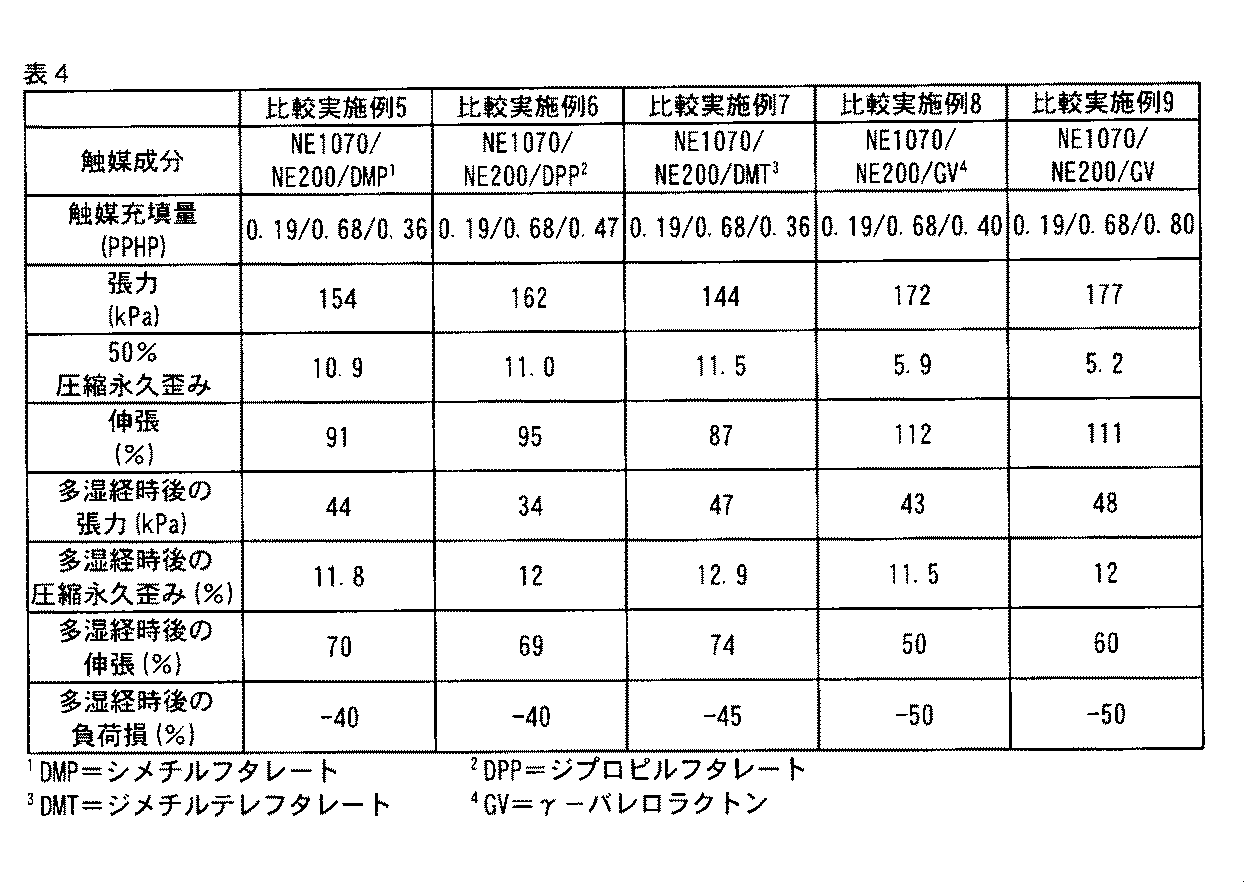
本発明の芳香族二酸エステルジオール(および/又はそれらの置換カルバメート)の代わりに、種々の量の他のエステルを使用して、発泡体パッドを上記の様に調製した。発泡体パッドテストの結果が下の表4に示される。
Comparative Examples 5-9
Other esters in combination with non-free catalysts Instead of the aromatic diacid diols (and / or their substituted carbamates) of the present invention, various amounts of other esters can be used to make the foam pad as described above. Prepared in the same manner. The results of the foam pad test are shown in Table 4 below.
表4に示す(芳香族二酸エステルジオールまたはそれらの置換カルバメートのない)比較実施例2との比較は、一般的に、比較可能またはさらに悪い湿度経時性質を示し、したがって表4で使用されたエステルは、ほとんど有益な効果がない。これは、改善芳香族二酸エステルジオールが使用される上に記載された改善と厳しく対照的であり、このようにいかなるタイプの単なるエステルの存在も本発明の有益性を与えるのに充分でなかった。 Comparison with comparative example 2 (without aromatic diacid diols or their substituted carbamates) shown in Table 4 generally showed comparable or worse humidity aging properties and was therefore used in Table 4 Esters have little beneficial effect. This is in stark contrast to the improvements described above where improved aromatic diester diols are used, and thus the presence of any type of simple ester is not sufficient to provide the benefits of the present invention. It was.
本発明は、示された具体的な実施例を参照してここに説明したが、特許請求の範囲を、示された詳細に限定しようとするものではない。むしろ、これらの詳細において当業者によって、請求項の主題の精神および目的の範囲にある種々の変更がなされることが期待され、むしろこのように請求の範囲の主題と解釈されることが意図される。 Although the invention has been described herein with reference to the specific embodiments shown, it is not intended to limit the scope of the claims to the details shown. Rather, it is expected that various changes within the spirit and scope of the claimed subject matter will be made by those skilled in the art in these details, and are thus intended to be construed as the claimed subject matter. The
Claims (10)
Applications Claiming Priority (1)
| Application Number | Priority Date | Filing Date | Title |
|---|---|---|---|
| US11/374,742 US7666919B2 (en) | 2006-03-14 | 2006-03-14 | Aromatic diacid ester diols and substituted carbamates thereof for minimizing deterioration of polyurethane foams |
Publications (3)
| Publication Number | Publication Date |
|---|---|
| JP2007246904A JP2007246904A (en) | 2007-09-27 |
| JP2007246904A5 JP2007246904A5 (en) | 2010-09-24 |
| JP4603003B2 true JP4603003B2 (en) | 2010-12-22 |
Family
ID=38134581
Family Applications (1)
| Application Number | Title | Priority Date | Filing Date |
|---|---|---|---|
| JP2007063564A Expired - Fee Related JP4603003B2 (en) | 2006-03-14 | 2007-03-13 | Aromatic diacid diols and their substituted carbamates to minimize degradation of polyurethane foam |
Country Status (7)
| Country | Link |
|---|---|
| US (2) | US7666919B2 (en) |
| EP (1) | EP1834974A3 (en) |
| JP (1) | JP4603003B2 (en) |
| KR (1) | KR100885712B1 (en) |
| CN (1) | CN101054432B (en) |
| BR (1) | BRPI0700651A (en) |
| MX (1) | MX2007002973A (en) |
Families Citing this family (10)
| Publication number | Priority date | Publication date | Assignee | Title |
|---|---|---|---|---|
| EP2292676B1 (en) * | 2008-06-25 | 2017-04-19 | Inoac Corporation | Polyurethane foam for flame-laminating |
| RU2529869C2 (en) | 2009-04-09 | 2014-10-10 | Байер Матириальсайенс Аг | Polyester polyols from terephthalic acid and oligoalkylene oxides |
| US10144811B2 (en) | 2012-03-30 | 2018-12-04 | Evonik Degussa Gmbh | Polyurethane foam production process, pre-mix formulation, and product |
| US10023681B2 (en) | 2012-10-24 | 2018-07-17 | Evonik Degussa Gmbh | Delay action catalyst for improving the stability of polyurethane systems having halogen containing blowing agents |
| JP6882195B2 (en) | 2015-05-05 | 2021-06-02 | エボニック オペレーションズ ゲーエムベーハー | A method for producing a slow-acting gelling catalyst composition and a polyurethane polymer. |
| US20170055600A1 (en) * | 2015-08-28 | 2017-03-02 | Damon Howard Hawkins | Anti-Slip Slip-On Slip-Over Roof Safety Shorts |
| WO2021011306A1 (en) * | 2019-07-12 | 2021-01-21 | Dow Global Technologies Llc | Polyurethane foam with improved combustion behavior |
| MX2022000856A (en) | 2019-07-24 | 2022-02-10 | Evonik Operations Gmbh | PREPARATION OF POLYURETHANE SYSTEMS. |
| EP3954722A1 (en) | 2020-07-30 | 2022-02-16 | Evonik Operations GmbH | Process and composition for the production of flexible polyurethane foam |
| WO2025040451A1 (en) | 2023-08-18 | 2025-02-27 | Evonik Operations Gmbh | Hydrolysis resistance of polyurethane foams |
Family Cites Families (29)
| Publication number | Priority date | Publication date | Assignee | Title |
|---|---|---|---|---|
| US4007140A (en) | 1972-11-01 | 1977-02-08 | Imperial Chemical Industries Limited | Tertiary amines as catalysts in polyurethane manufacture |
| DE2513741C3 (en) * | 1974-03-30 | 1980-05-14 | Bridgestone Tire Co. Ltd., Tokio | Process for the production of a flame-retardant, smoke-resistant flexible polyurethane foam |
| DE2937330A1 (en) * | 1979-09-14 | 1981-04-02 | Bayer Ag, 5090 Leverkusen | METHOD FOR THE PRODUCTION OF ELASTIC, FLAME-LAYABLE AND HIGH-FREQUENCY-WELDABLE POLYURETHANE FOAMS |
| DE3001462A1 (en) * | 1980-01-17 | 1981-09-10 | Basf Ag, 6700 Ludwigshafen | METHOD FOR PRODUCING URETHANE AND / OR ISOCYANURATE GROUPS OF FOAMS |
| US4433170A (en) | 1981-07-20 | 1984-02-21 | Texaco Inc. | Novel bis(aminoethyl)ether derivatives useful as polyurethane catalysts |
| US4338408A (en) | 1981-07-20 | 1982-07-06 | Texaco Inc. | Polyurethanes using bis(aminoethyl)ether derivatives as catalysts |
| US4469823A (en) | 1983-07-28 | 1984-09-04 | Texaco Inc. | Flexible polyurethane foams made using an aromatic polyester polyol |
| US4544679A (en) | 1985-02-21 | 1985-10-01 | Mobay Chemical Corporation | Polyol blend and polyisocyanurate foam produced therefrom |
| CA2071030A1 (en) * | 1991-06-17 | 1992-12-18 | Kenneth P. Klapper | Thermoformable polyisocyanurate foam laminates for interior finishing applications |
| US5559161A (en) | 1994-02-18 | 1996-09-24 | Air Products And Chemicals, Inc. | Hydroxy-functional triamine catalyst compositions for the production of polyurethanes |
| US5508314A (en) | 1994-02-18 | 1996-04-16 | Air Products And Chemicals, Inc. | Hydroxyl group-containing blowing catalyst compositions for the production of polyurethanes |
| JP3360920B2 (en) * | 1994-03-24 | 2003-01-07 | サカタインクス株式会社 | Polyurethane resin, method for producing the same, and printing ink composition for lamination using the same |
| JPH07278249A (en) * | 1994-04-12 | 1995-10-24 | Sekisui Chem Co Ltd | Thermoplastic polyurethane |
| JP2619614B2 (en) | 1994-12-07 | 1997-06-11 | 大同鋼板株式会社 | Thermal insulation panel and method of manufacturing the same |
| JPH08143638A (en) * | 1994-11-17 | 1996-06-04 | Asahi Denka Kogyo Kk | Method for producing polyurethane foam |
| US5633293A (en) | 1995-11-30 | 1997-05-27 | Air Products And Chemicals, Inc. | Hydroxy-functional triamine catalyst compositions for polyurethane production |
| US6232356B1 (en) | 1997-05-05 | 2001-05-15 | Air Products And Chemicals, Inc. | Reactive catalyst compositions for improving water blown polyurethane foam performance |
| US5859079A (en) | 1997-05-21 | 1999-01-12 | Air Products And Chemicals, Inc. | Polyurethane catalyst compositions for improving foam performance |
| DE19909978A1 (en) | 1999-03-06 | 2000-09-07 | Bayer Ag | The use of hydrophilic polyester-polyurethane foams in the manufacture of composite materials for vehicle interiors |
| AU5314400A (en) | 1999-06-01 | 2000-12-18 | Solutia Inc. | Composition for use in flexible polyurethane foams |
| US6114403A (en) | 1999-06-09 | 2000-09-05 | Air Products And Chemicals, Inc. | Polyurethane catalyst compositions for improving rigid foam performance |
| US6784220B2 (en) * | 2000-05-19 | 2004-08-31 | Kao Corporation | Polyurethane foam |
| AU2002315173A1 (en) * | 2001-06-15 | 2003-01-02 | Stepan Company | Phthalate polyester polyol-based compositions and high dimensionally stable all water-blown spray polyurethane foam derived therefrom |
| US6818675B2 (en) | 2002-08-06 | 2004-11-16 | General Electric Company | Process for preparing polyurethane foam |
| CA2441246A1 (en) * | 2002-09-23 | 2004-03-23 | Hilti Aktiengesellschaft | Two-component foam system for producing constructional foams and their use |
| WO2004094506A2 (en) | 2003-04-23 | 2004-11-04 | Stepan Company | Liquid hardness agent for open cell foams |
| CN1805987A (en) | 2003-06-13 | 2006-07-19 | 陶氏环球技术公司 | Catalyst composition to get polyurethane product with good hydrolysis resistance. |
| US6858654B1 (en) | 2003-10-27 | 2005-02-22 | Air Products And Chemicals, Inc. | Catalyst blends for producing low thermal desorption polyurethane foams |
| DE102004062540A1 (en) | 2004-12-24 | 2006-07-06 | Bayer Materialscience Ag | Rigid polyurethane foams, a process for their preparation and their use |
-
2006
- 2006-03-14 US US11/374,742 patent/US7666919B2/en active Active
-
2007
- 2007-03-08 BR BRPI0700651-9A patent/BRPI0700651A/en active Search and Examination
- 2007-03-12 MX MX2007002973A patent/MX2007002973A/en active IP Right Grant
- 2007-03-13 KR KR1020070024514A patent/KR100885712B1/en not_active Expired - Fee Related
- 2007-03-13 EP EP07005183A patent/EP1834974A3/en not_active Withdrawn
- 2007-03-13 JP JP2007063564A patent/JP4603003B2/en not_active Expired - Fee Related
- 2007-03-14 CN CN200710085758XA patent/CN101054432B/en not_active Expired - Fee Related
- 2007-06-15 US US11/763,467 patent/US7615580B2/en not_active Expired - Lifetime
Also Published As
| Publication number | Publication date |
|---|---|
| US20070219283A1 (en) | 2007-09-20 |
| KR100885712B1 (en) | 2009-02-26 |
| US7666919B2 (en) | 2010-02-23 |
| MX2007002973A (en) | 2009-02-13 |
| CN101054432B (en) | 2013-01-02 |
| EP1834974A2 (en) | 2007-09-19 |
| CN101054432A (en) | 2007-10-17 |
| JP2007246904A (en) | 2007-09-27 |
| BRPI0700651A (en) | 2007-11-06 |
| US20070235691A1 (en) | 2007-10-11 |
| US7615580B2 (en) | 2009-11-10 |
| EP1834974A3 (en) | 2008-01-02 |
| KR20070093859A (en) | 2007-09-19 |
Similar Documents
| Publication | Publication Date | Title |
|---|---|---|
| KR100885712B1 (en) | Aromatic diester diols and substituted carbamate thereof to minimize deterioration of polyurethane foams | |
| KR100479534B1 (en) | Acid-blocked amine catalysts for the production of polyurethanes | |
| CA2675153C (en) | Tertiary amines blocked with polymer acids | |
| KR101886419B1 (en) | Reducing emissions in polyurethane foam | |
| US9309346B2 (en) | Polyurethane foams made with blowing catalyst compositions containing primary hydroxyl groups and high ethylenediamine backbones | |
| MX2008006557A (en) | Polyester polyol-containing polyurethane systems having improved hydrolytic stability. | |
| KR102621939B1 (en) | Delayed action gelling catalyst compositions and methods for making polyurethane polymers | |
| JP5655261B2 (en) | Catalyst composition for producing flexible or semi-rigid polyurethane foam, and method for producing flexible and semi-rigid polyurethane foam using the same | |
| JPH10324728A (en) | Reactive catalyst composition for improving the performance of water-foamed polyurethane foam | |
| WO2012006548A1 (en) | Additives for improving polyurethane foam performance | |
| JP2025183494A (en) | Manufacturing method for low odor polyurethane foam | |
| MXPA06004207A (en) | Polyurethane foams made with blowing catalyst compositions containing primary hydroxyl groups and high ethylenediamine backbones |
Legal Events
| Date | Code | Title | Description |
|---|---|---|---|
| A524 | Written submission of copy of amendment under article 19 pct |
Free format text: JAPANESE INTERMEDIATE CODE: A524 Effective date: 20080213 |
|
| A977 | Report on retrieval |
Free format text: JAPANESE INTERMEDIATE CODE: A971007 Effective date: 20100212 |
|
| A131 | Notification of reasons for refusal |
Free format text: JAPANESE INTERMEDIATE CODE: A131 Effective date: 20100216 |
|
| A601 | Written request for extension of time |
Free format text: JAPANESE INTERMEDIATE CODE: A601 Effective date: 20100514 |
|
| A602 | Written permission of extension of time |
Free format text: JAPANESE INTERMEDIATE CODE: A602 Effective date: 20100519 |
|
| A521 | Request for written amendment filed |
Free format text: JAPANESE INTERMEDIATE CODE: A523 Effective date: 20100810 |
|
| A524 | Written submission of copy of amendment under article 19 pct |
Free format text: JAPANESE INTERMEDIATE CODE: A524 Effective date: 20100810 |
|
| TRDD | Decision of grant or rejection written | ||
| A01 | Written decision to grant a patent or to grant a registration (utility model) |
Free format text: JAPANESE INTERMEDIATE CODE: A01 Effective date: 20100831 |
|
| A01 | Written decision to grant a patent or to grant a registration (utility model) |
Free format text: JAPANESE INTERMEDIATE CODE: A01 |
|
| A61 | First payment of annual fees (during grant procedure) |
Free format text: JAPANESE INTERMEDIATE CODE: A61 Effective date: 20100930 |
|
| FPAY | Renewal fee payment (event date is renewal date of database) |
Free format text: PAYMENT UNTIL: 20131008 Year of fee payment: 3 |
|
| R150 | Certificate of patent or registration of utility model |
Free format text: JAPANESE INTERMEDIATE CODE: R150 |
|
| R250 | Receipt of annual fees |
Free format text: JAPANESE INTERMEDIATE CODE: R250 |
|
| R250 | Receipt of annual fees |
Free format text: JAPANESE INTERMEDIATE CODE: R250 |
|
| R250 | Receipt of annual fees |
Free format text: JAPANESE INTERMEDIATE CODE: R250 |
|
| R250 | Receipt of annual fees |
Free format text: JAPANESE INTERMEDIATE CODE: R250 |
|
| R250 | Receipt of annual fees |
Free format text: JAPANESE INTERMEDIATE CODE: R250 |
|
| LAPS | Cancellation because of no payment of annual fees |