JP4458317B2 - Facsimile apparatus, facsimile apparatus control method, and computer-readable storage medium storing facsimile apparatus control program - Google Patents
Facsimile apparatus, facsimile apparatus control method, and computer-readable storage medium storing facsimile apparatus control program Download PDFInfo
- Publication number
- JP4458317B2 JP4458317B2 JP2000362038A JP2000362038A JP4458317B2 JP 4458317 B2 JP4458317 B2 JP 4458317B2 JP 2000362038 A JP2000362038 A JP 2000362038A JP 2000362038 A JP2000362038 A JP 2000362038A JP 4458317 B2 JP4458317 B2 JP 4458317B2
- Authority
- JP
- Japan
- Prior art keywords
- double
- memory capacity
- sided
- transmitter
- capacity
- Prior art date
- Legal status (The legal status is an assumption and is not a legal conclusion. Google has not performed a legal analysis and makes no representation as to the accuracy of the status listed.)
- Expired - Fee Related
Links
Images

Landscapes
- Facsimiles In General (AREA)
- Storing Facsimile Image Data (AREA)
Description
【0001】
【発明の属する技術分野】
本発明は両面原稿の画像を受信する両面画像受信を行なうファクシミリ装置、ファクシミリ装置の制御方法、およびファクシミリ装置の制御プログラムを格納したコンピュータ読取可能な記憶媒体に関するものである。
【0002】
【従来の技術】
従来のファクシミリ装置は、片面情報の原稿を送信して、片面に記録する動作が基本となっていた。旧来のITU−T勧告T4、あるいはT30などでは、この片面通信のみが記述されていた。
【0003】
一方で、最近は省資源化に関する意識が高まっており、プリンタや複写機などにおいては、1枚の紙の表面と裏面に記録を行なういわゆる両面記録方式を有するものが増えつつある。これに伴ない、両面ファクシミリ通信に関する規格が2000年の2月にITU−Tで勧告化された。ここで、このITU−T勧告では、受信機から送信機に両面情報の受信機能の有無を通知し、また、送信機から受信機に両面通信であるか否かを通知するようになっている。
【0004】
また、両面画情報の伝送方式としては、原稿表面の画像、裏面の画像を各ページについて交互に送信する両面交互伝送(交互モード)、あるいは原稿表面の画像全部を送信し、続いて裏面の画像全部を送信する両面連続伝送(連続モード)などが知られている。
【0005】
【発明が解決しようとする課題】
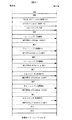
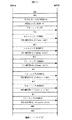
両面受信が可能なファクシミリ装置は、常に両面受信を行なえるようにファクシミリ装置を設計する場合が多い。そして、両面受信のためには上記の交互および連続モードをサポートし、受信したページを意図された順序で記録紙の表裏に印刷するために大きなメモリ容量を必要とし、受信用のメモリとしてメガバイト単位でメモリを確保しておく必要があり、メモリが有効利用されていないという問題があった。
【0006】
特に、従来より、拡張カードなどの形式でプラグイン装着可能ないわゆるオプションメモリを追加し、たとえば代行受信やメモリボックス通信に用いるメモリ領域を拡張する構成が知られているが、折角このようなオプションメモリを装着していても、両面受信に備えてメモリを確保するために用いられてしまうことが考えられる。
【0007】
そこで本発明の課題は、実装されたメモリを無駄にすることなく有効利用できる両面画像通信可能なファクシミリ装置を提供することにある。
【0010】
【課題を解決するための手段】
上記の課題を解決するため、両面原稿の画像を受信する両面画像受信を行なうファクシミリ装置、ファクシミリ装置の制御方法、およびファクシミリ装置の制御プログラムを格納したコンピュータ読取可能な記憶媒体において、使用可能なメモリ容量を検出するメモリ容量検出手段あるいはメモリ容量検出工程を有し、検出した使用可能なメモリ容量に応じて送信機に対して通知する両面受信機能の有無を変更し、使用可能なメモリ容量が所定容量A’以上であれば、交互モードおよび連続モード双方の両面受信機能有りを送信機に対して通知し、使用可能なメモリ容量が所定容量A(A’>A)以上であれば、交互モードのみ両面受信機能有りを送信機に対して通知する構成を採用した。
【0011】
あるいはさらに、使用可能なメモリ容量が所定容量A以上であれば、送信機に対して両面受信機能有りを通知し、使用可能なメモリ容量が所定容量B以上、A未満であれば、送信機に対して両面受信機能無しを通知し、使用可能なメモリ容量が所定容量B未満でありかつ記録紙がある場合は送信機に対して両面受信機能無しを通知し、記録紙が無い場合は、受信動作を実行しない構成を採用した。
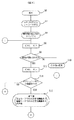
【0012】
【発明の実施の形態】
以下、図面に示す実施形態に基づいて本発明を詳細に説明する。
【0013】
(第1実施形態)
図1は、本発明を採用したファクシミリ装置のハードウェア構成を示している。図1において符号2は、NCU(網制御装置)で、電話網をデータ通信等に使用するためにその回線の端末に接続し、電話交換網の接続制御を行なったり、データ通信路への切り替えを行なったり、ループの保持を行なうものである。NCU2は、バス26からの制御に応じて電話回線2aを電話機4側に接続する(CMLオフ)か、電話回線2aをファクシミリ装置側に接続する(CMLオン)。通常状態では、電話回線2aは電話機4側に接続されている。
【0014】
符号6はハイブリッド回路で、送信系の信号と受信系の信号とを分離し、加算回路12からの送信信号をNCU2経由で電話回線2aに送出し、相手側からの信号をNCU2経由で受け取り、信号線6a経由で変復調器8に送るものである。
【0015】
符号8は変復調器であり、ITU−T勧告V.8、V.21、V.27ter、V.29、V.17、V.34に基づいた変調及び復調を行う変復調器であり、バス26の制御により、各伝送モードが指定される。変復調器8は、バス26からの送信信号を入力し、変調データを信号線8aに出力し、信号線6aに出力されている受信信号を入力し、復調データをバス26に出力する。
【0016】
符号10は、発呼回路であり、バス26からの制御に応じて、電話番号情報を入力し、信号線10aにDTMF形式の選択信号を出力する。
【0017】
符号12は、加算回路であり、信号線8aの情報と信号線10aの情報を入力し、加算した結果を信号線12aに出力する。
【0018】
符号14は、両面情報を読み取り可能な読取回路であり、読み取りデータをバス26に出力する。
【0019】
符号16は、両面情報を記録可能な記録回路であり、バス26に出力されている情報を順次1ライン毎に記録する。
【0020】
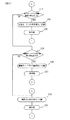
符号18は、メモリ回路であり、読み書き可能なメモリ(RAM)を含む。このRAM部分は、ワーク用の読み取りデータの生情報、あるいは、符号化した情報を格納したり、また、受信情報、あるいは、復号化した情報等を格納するために用いられる。
【0021】
また、本実施形態においては、メモリ回路18には拡張カードなどの形式でオプションメモリ18aを追加することができるようになっている。オプションメモリ18aは不図示のプラグイン機構を介して着脱可能とし、このオプションメモリ18aの装着状態(装着の有無に関する情報)がバス26に出力されるものとする。
【0022】
符号20は、操作部であり、ワンタッチダイヤル、短縮ダイヤル、テンキー、*キー、#キー、スタートキー、ストップキー、セットキー、両面送信選択キー、その他のファンクションキーが設けられており、押下されたキー情報はバス26に出力される。また、操作部20には、LCDやLEDなどの表示素子による表示部が設けられており、バス26に出力されている情報を入力し、表示する。
【0023】
符号22は、CPU(中央処理装置)であり、ファクシミリ全体の動作を制御するとともに、ファクシミリ伝送制御手順を実行するが、その制御プログラムは、ROM24に格納される。符号26はCPU22のバスで、アドレスバス、データバスから構成される。
【0024】
ここで、図2〜図7を参照して両面原稿を両面伝送するための通信手順の概略につき説明する。
【0025】
両面伝送の通信モードとしては、交互モード(両面交互伝送モード)と連続モード(両面連続伝送モード)の2つが存在する。前者は1ページ目の表面、裏面、2ページ目の表面、裏面…と原稿1枚づつその表面、裏面を交互に伝送するモードである。また、後者は1ページ目の表面、2ページ目の表面…とまず原稿の表面のみページ順に全部伝送し、しかる後に1ページ目の裏面、2ページ目の裏面…と原稿の裏面をページ順に全部伝送するモードである。ファクシミリ装置はその実装形態に応じていずれかのモードを使用することができる。
【0026】
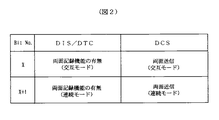
次に、図2に、DIS(デジタル識別:画像受信局から送信される)、DTC(デジタル送信命令:画像送信局から送信される)、およびDCS(デジタル命令:画像送信局から送信される)の各信号のFIF(ファクシミリ情報フィールド)における両面伝送を指定する情報の構成を表形式で示す。
【0027】
図2に示すように、DIS/DTC信号では、FIFのxビット(図中ではビット数は「x」により示されているが実際には113)目により、交互モードでの両面記録機能の有無を表し、FIFのx+1(同114)ビット目により、連続モードでの両面記録機能の有無を表す。また、DCS信号においては、FIFのx(同113)ビット目により、交互モードでの両面送信を指定し、FIFのx+1(同114)ビット目により、連続モードでの両面送信を指定する。
【0028】
なお、以下では、上記の両面記録機能、および両面通信モードを指定するビットは、xおよびx+1ビットと表記する。
【0029】
図3は、ノーマルG3伝送でのQ信号(具体的にはEOP(ページ終了)あるいは、MPS(マルチページ)、あるいはEOM(メッセージ終了)信号など)、また、ECM(エラー訂正モード)伝送でのPPS−Q信号(具体的には、PPS−EOP、あるいは、PPS−MPS、あるいはPPS−EOM、あるいはPPS−NULLなどのポストメッセージ信号)のフレーム構成を示している。
【0030】
図3のように、これらのポストメッセージ信号では、Flag(フラグ)、Address(アドレス)、Control(制御データ)、FCF(ファクシミリ制御フィールド)に続き、ファクシミリ情報が送信される。ファクシミリ情報の先頭では、ECMの場合のみPC(ページカウンタ)、BC(ブロックカウンタ)、FC(フレームカウンタ)の3つのフィールドが送信され、その後に両面伝送関係のファクシミリ情報が続く。両面伝送関係のファクシミリ情報は、Length(レングス:当該ページのデータサイズ(オクテット数単位)でこのフィールドのデータ幅は1オクテット)、Pagenumber(ページナンバー:2オクテット)、Page information(ページ情報)が続き、その後にFCS(フレームチェックシーケンス)、Flag(フラグ)が続く。
【0031】
上記のうち、Page number(ページナンバー)は、規約上、両面原稿をページ順に表面、裏面と送信する際、表、裏の各面ごとにP1から1ページずつ加算されることになっている。また、Page information(ページ情報)は、データ幅1オクテットで、その面の画情報が表であるか裏であるかを示し、bit0により表面(0)か裏面(1)を表現する。当面、ビット1〜6は予約ビットで機能は定義されておらず、ビット7は拡張ビットとして常時0にセットされる。
【0032】
上記のポストメッセージ信号のファクシミリ情報のうち、Length、Pagenumber、Page informationの3つが、両面伝送のために新たに追加となったフィールドである。
【0033】
なお、ノーマルG3通信にて使用するQ信号には、PC、BC、FCは含まれず、ECM通信にて使用するPPS−Q信号でのみ使用される。
【0034】
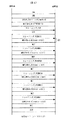
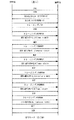
図4は、ノーマルG3モードにおける交互モードでの両面伝送の様子を、図5はECM通信モードにおける交互モードでの両面伝送の様子を、図6はノーマルG3モードにおける連続モードでの両面伝送の様子を、図7はECM通信モードにおける連続モードでの両面伝送の様子を示している。
【0035】
図4〜図7のように、DIS信号のxおよびx+1ビットにより受信機の両面伝送機能(交互および連続のいずれも可)が示され、DCS信号のxおよびx+1ビットにより、送信機がこれから実行しようとする両面伝送モードが宣言される。図6、図7の連続モードでは、DCS信号のx+1ビットを1とすることにより連続モードでの送信を行なうことが宣言されている。
【0036】
また、図4、図6に示すように、ノーマルモードの場合はポストメッセージ信号としてMPS信号が、また、図5、図7に示すように、ECMの場合はポストメッセージ信号としてPPS−MPS信号が用いられている。
【0037】
ここでは3枚の両面原稿が送信されており、各図中の「PN」は上記のPage Numberを示している。
【0038】
たとえば、図4(交互モード)に符号41で示したMPS信号は、「MPS(PN=1,0(front side))」と図示されているが、これは、ページ番号1(PN=1)、表面(0(front side))の画情報を送信したことを示している(図4以降のMPSあるいはPPS−MPS信号の表記は上記と同趣である)。
【0039】
すなわち、図4および図5の交互モードでは、1枚目(PN=1)の表(0)、1枚目(PN=2)の裏(1)、2枚目(PN=3)の表(0)、2枚目(PN=4)の裏(1)、3枚目(PN=5)の表(0)、3枚目(PN=6)の裏(1)の順で原稿の画情報が送信されている。
【0040】
また、図6および図7の連続モードでは、1枚目(PN=1)の表(0)、2枚目(PN=3)の表(0)、3枚目(PN=5)の表(0)、1枚目(PN=2)の裏(1)、2枚目(PN=4)の裏(1)、3枚目(PN=6)の裏(1)の順で原稿の画情報が送信されている。
【0041】
以上が一般的な両面手順であるが、本実施形態では、オプションメモリ18aの装着状態に応じて、相手機に対する両面通信に関する宣言を制御する。
【0042】
すなわち、本実施形態においては、オプションメモリ18aの装着を検出する手段、受信機から送信機に両面受信機能の有無を通知する手段として、オプションメモリ18aの装着の有無により、受信機から送信機に通知する両面受信機能の有無を変更する通信制御を行なうための制御プログラムをROM24に格納しておく。この通信制御はCPU22が実行する。
【0043】
実際の処理では、オプションメモリ18aの装着があれば、受信機から送信機に両面受信機能有りを通知し、オプションメモリ18aの装着がなければ、受信機から送信機に両面受信機能無しを通知する。
【0044】
図8〜図11に上記の通信制御の流れをフローチャート図として示す。図8〜図11の同一番号の個所はそれぞれの位置で連続しているものとする。図示の制御手順は、CPU22のプログラムとしてROM24に格納される。
【0045】
図8において、ステップS0は所定のリセット操作などにより開始される処理の始めを示している。
【0046】
ステップS2では、バス26を介して、メモリ回路18をイニシャライズし、ステップS4では、バス26を介して、操作部20の表示部をイニシャライズ(クリア)する。
【0047】
ステップS6では、バス26を介して、NCU2のCMLをオフとし、回線2aを電話機4側に接続する。
【0048】
ステップS8では、ファクシミリ受信が選択されたか否かを判定し、この判定結果がYESであればステップS12に進み、NOであればステップS10に進み、その他の処理(原稿のコピーなど)を実行する。
【0049】
ステップS12では、バス26を介して、NCU2を制御し、CMLをオンとし回線2aをファクシミリ装置(ハイブリッド回路6)側に接続する。
【0050】
ステップS14では、バス26を介してオプションメモリ18aの装着状態を調べ、オプションメモリ18aが装着されているか否かを判断し、この結果がYESであればステップS16に進み、NOであればステップS34に進む。
【0051】
オプションメモリ18aが装着されている場合にはステップS16において通信前手順を実行し、ここでは交互モードでの両面受信機能有り、および連続モードでの両面受信機能有りを通知する。この両面通信機能の通知は、上記のDIS信号を用いて行なう(以下同様)。
【0052】
ステップS18では、送信機より、交互モードでの両面通信が指定されたか否かが判断され、YESであればステップS20に進み、NOであればステップS24に進む。
【0053】
ステップS20では、交互モードによる両面受信および記録を実行し、ステップS22では、通信後手順を実行する。
【0054】
ステップS24では、送信機から連続モードでの両面通信が指定されたか否かを判断し、この判断結果がYESであればステップS26に進み、NOであるとステップS30に進む。
【0055】
送信から両面通信が指定されている場合にはステップS26において連続モードでの両面受信および記録を実行し、ステップS28で通信後手順を実行する。
【0056】
送信機から連続モードでの両面通信が指定されていない場合にはステップS30において画信号の片面受信、記録を実行し、ステップS32において通信後手順を実行する。
【0057】
オプションメモリ18aが装着されていない場合は、ステッS34の通信前手順において、交互および連続のいずれの受信モードにおいても両面受信機能が無いことを宣言する。
【0058】
以上のように、本実施形態では、オプションメモリ18aの装着状態を判定し、オプションメモリ18aが装着されていない場合は両面受信機能無しを通知するようにしているので、使用可能なメモリ容量に応じて適切に送信機に対して通知する両面受信機能の有無を制御することができ、従来のように両面受信機能に備えるため無駄にメモリを確保しておく必要がなくなり、その分を他の動作のために利用することができ、メモリの使用効率を向上することができる。
【0059】
(第2実施形態)
以上では、オプションメモリ18aが装着されているかいないかに応じて送信機に対する両面通信機能の宣言(通知)を制御する構成を示した。
【0060】
しかし、本願の要旨は、メモリ資源の状態に応じて送信機に対する両面通信機能の有無の通知を制御し、メモリ資源の有効利用を計ることである。
【0061】
したがって、単にオプションメモリの装着状態を検出するのではなく、通信処理に使用可能なメモリ容量を検出し、検出された使用可能なメモリ容量に応じて、受信機から送信機に通知する両面受信機能の有無を変更するようにしてもよい。以下ではこのような通信制御を例示する。
【0062】
本実施形態の通信制御では、たとえば、使用可能なメモリ容量が所定容量A以上であれば、受信機から送信機に両面受信機能有りを通知し、使用可能なメモリ容量が所定容量B以上、A未満であると、受信機から送信機に両面受信機能無しを通知し、使用可能なメモリ容量が所定容量B未満であると、記録紙がある場合は、受信機から送信機に両面受信機能無しを通知し、記録紙が無い場合は、受信動作を実行しないようにする。
【0063】
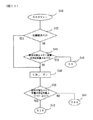
図11には、上記のような処理を行なうために第1の実施形態の制御の流れ図(図8〜図10)に対して必要な変更部分を示したものである。本実施形態では、ハードウェア構成は図1に示したものと同様とし、図11に不図示の部分の制御は前述の図8〜図10と同じであるものとする。
【0064】
図11において、ステップS40は、図8のステップS8のYESの分岐を示している。
【0065】
したがって、ステップS8でファクシミリ受信が選択されたと判定されると、ステップS42において、記録紙があるか否かを判断し、その結果がYESであるとステップS48に進み、NOであるとステップS44に進む。
【0066】
ステップS44では、使用可能なメモリ容量は、所定容量B以下であるか否かを判断する。この判定に必要なメモリ容量の検出は、メモリ管理を行なうCPU22のルーチンが画像メモリや各種の通信制御情報の格納のために用いているメモリ回路18の各領域を管理するポインタアドレスなどを用いて行なえる。
【0067】
ステップS44で使用可能なメモリ容量が所定容量B以下である場合には、ステップS46(図8ステップS6)に進む。すなわち、この状態となるのは記録紙がなく(ステップS42のNO)、使用可能なメモリ容量も小さい方のしきい値B以下であるため、ステップS6においてCMLをオフとし、回線を切断し、受信を中止する。また、ステップS44で使用可能なメモリ容量が所定容量Bよりも多ければ判定はNOとなりステップS48に進む。
【0068】
ステップS48では、バス26を介して、NCU2のCMLをオンとし回線2aをファクシミリ装置(ハイブリッド回路6)側に接続する。
【0069】
そして、ステップS50では使用可能なメモリ容量が所定容量A(A>B)以上であるか否かを判定する。この判定結果がYESであればステップS52(図8ステップS16)に進み、交互モードおよび連続モードの両面受信機能有りを送信機に対して通知する。一方、ステップS50の判定がNOであればステップS54(図10ステップS34)に進み、交互モードおよび連続モードの両面受信機能無しを送信機に対して通知する。
【0070】
このようにして、使用可能なメモリ容量を検出し、その結果をB、A(B<A)の2つのしきい値と比較することにより、使用可能なメモリ容量に応じて適切に送信機に対して通知する両面受信機能の有無を制御することができ、従来のように両面受信機能に備えるため無駄にメモリを確保しておく必要がなくなり、その分を他の動作のために利用することができ、メモリ資源を有効に活用することができる。
【0071】
なお、以上では、メモリ資源の状態に応じて交互モードおよび連続モードの双方の両面受信機能を同時に有効化するか無効化するかを決定している。
【0072】
しかし、上記のメモリ容量に応じて送信機に対して通知する両面受信機能の有無を制御する場合には、より細かくしきい値を設定しておき、送信機に対して通知する交互モード、および連続モードの両面受信機能の有無を別々に制御することも考えられる。
【0073】
たとえば、装置の受信処理および記録処理の実現方法によっても異なるが、一般には、表面をまず全部受信し次に裏面を全部受信する連続の方が大量のメモリを必要とする。
【0074】
したがって、上記のステップS50からS16に移行する場合を考慮して、ステップS16を、しきい値A以上では交互モードのみ両面受信機能有りを通知し、しきい値A’(A’>A)以上では交互モードおよび連続モード双方の両面受信機能有りを通知するような構成とすることが考えられる(しきい値Bに関する処理は上記同様でよい)。
【0075】
以上では、ファクシミリ専用機の構成を示したが、本発明はファクシミリ専用機のみならず、他の形態のファクシミリ装置に実施できるのはいうまでもない。たとえば、本発明は、パーソナルコンピュータのような汎用の端末にFAXモデムなどを外付け/内蔵し、ソフトウェア制御によりファクシミリ通信を行なう構成においても実施することができる。その場合、本発明の制御プログラムは、前述のROM24のみならず、ハードディスク、フロッピーディスク、光ディスク、光磁気ディスクやメモリカードなどのあらゆるコンピュータ読み取り可能な記憶媒体に格納して供給することができる。
【0077】
【発明の効果】
以上の説明から明らかなように、本発明によれば、両面原稿の画像を受信する両面画像受信を行なうファクシミリ装置、ファクシミリ装置の制御方法、およびファクシミリ装置の制御プログラムを格納したコンピュータ読取可能な記憶媒体において、使用可能なメモリ容量を検出するメモリ容量検出手段あるいはメモリ容量検出工程を有し、検出した使用可能なメモリ容量に応じて送信機に対して通知する両面受信機能の有無を変更し、使用可能なメモリ容量が所定容量A’以上であれば、交互モードおよび連続モード双方の両面受信機能有りを送信機に対して通知し、使用可能なメモリ容量が所定容量A(A’>A)以上であれば、交互モードのみ両面受信機能有りを送信機に対して通知する構成を採用しているので、使用可能なメモリ容量に応じて適切に送信機に対して通知する両面受信機能の有無を制御することができ、従来のように両面受信機能に備えるため無駄にメモリを確保しておく必要がなくなり、その分を他の動作のために利用することができ、メモリ資源を有効に活用することができる。
【図面の簡単な説明】
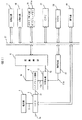
【図1】本発明を採用したファクシミリ装置のハードウェア構成を示したブロック図である。
【図2】両面伝送で用いられるDIS/DTCおよびDCS信号のFIFを示した表図である。
【図3】両面伝送で用いられるポストメッセージ信号のフォーマットを示した説明図である。
【図4】非ECM通信モードにおける交互モードでの両面伝送の様子を示した説明図である。
【図5】ECM通信モードにおける交互モードでの両面伝送の様子を示した説明図である。
【図6】非ECM通信モードにおける連続モードでの両面伝送の様子を示した説明図である。
【図7】ECM通信モードにおける連続モードでの両面伝送の様子を示した説明図である。
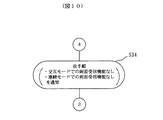
【図8】図1のCPU22の通信制御を示したフローチャート図である。
【図9】図1のCPU22の通信制御を示したフローチャート図である。
【図10】図1のCPU22の通信制御を示したフローチャート図である。
【図11】図1のCPU22による異なる通信制御を示したフローチャート図である。
【符号の説明】
2 NCU
4 電話機
6 ハイブリッド回路
8 変復調器
10 発呼回路
12 加算回路
14 読み取り回路
16 記録回路
18 メモリ回路
20 操作部
22 CPU
24 ROM
26 バス[0001]
BACKGROUND OF THE INVENTION
The present invention relates to a facsimile apparatus for receiving a double-sided image for receiving a double-sided document image, a control method for the facsimile apparatus, and a computer-readable storage medium storing a control program for the facsimile apparatus.
[0002]
[Prior art]
The conventional facsimile apparatus is based on the operation of transmitting a single-sided information original and recording it on one side. In the conventional ITU-T recommendation T4 or T30, only this one-sided communication is described.
[0003]
On the other hand, recently, awareness of resource saving has increased, and printers and copiers are increasingly having a so-called double-sided recording method for recording on the front and back surfaces of a single sheet of paper. Along with this, a standard for double-sided facsimile communication was recommended by ITU-T in February 2000. In this ITU-T recommendation, the receiver notifies the transmitter of the presence / absence of the duplex information reception function, and the transmitter notifies the receiver of whether or not the duplex communication is performed. .
[0004]
In addition, as a transmission method of double-sided image information, double-sided alternate transmission (alternate mode) in which an image on the front side of the document and an image on the back side are alternately transmitted for each page, or all images on the front side of the document are transmitted, and then the image on the back side is transmitted. Double-sided continuous transmission (continuous mode) for transmitting all data is known.
[0005]
[Problems to be solved by the invention]
In many cases, the facsimile apparatus capable of duplex reception is designed so that the duplex reception can always be performed. And for duplex reception, the above alternate and continuous modes are supported, and a large memory capacity is required to print the received pages on the front and back of the recording paper in the intended order. However, there is a problem that the memory is not used effectively.
[0006]
In particular, a configuration has been conventionally known in which a so-called option memory that can be plugged in in the form of an expansion card or the like is added to expand a memory area used for, for example, reception or memory box communication. Even if a memory is mounted, it may be used to secure the memory in preparation for double-sided reception.
[0007]
SUMMARY OF THE INVENTION An object of the present invention is to provide a facsimile apparatus capable of duplex image communication that can be effectively used without wasting a mounted memory.
[0010]
[Means for Solving the Problems]
In order to solve the above-mentioned problem, a memory usable in a computer-readable storage medium storing a facsimile apparatus for receiving double-sided image reception for receiving a double-sided original image, a control method for the facsimile apparatus, and a control program for the facsimile apparatus There is a memory capacity detecting means or a memory capacity detecting step for detecting the capacity, and the presence or absence of the double-sided reception function for notifying the transmitter is changed according to the detected usable memory capacity, and the usable memory capacity is predetermined. If the capacity is A ′ or more, the transmitter is notified that both sides of the alternate mode and the continuous mode are available. If the available memory capacity is greater than or equal to the predetermined capacity A (A ′> A), the alternate mode is used. Only the double-sided reception function is notified to the transmitter.
[0011]
Alternatively, if the usable memory capacity is greater than or equal to the predetermined capacity A, the transmitter is notified that the double-sided reception function is available, and if the usable memory capacity is greater than or equal to the predetermined capacity B and less than A, the transmitter is notified. If the available memory capacity is less than the predetermined capacity B and there is recording paper, the transmitter is notified that there is no double-sided reception function, and if there is no recording paper, it is received. A configuration that does not execute the operation is adopted.
[0012]
DETAILED DESCRIPTION OF THE INVENTION
Hereinafter, the present invention will be described in detail based on embodiments shown in the drawings.
[0013]
(First embodiment)
FIG. 1 shows a hardware configuration of a facsimile apparatus adopting the present invention. In FIG. 1,
[0014]
[0015]
Reference numeral 8 denotes a modulator / demodulator. 8, V. 21, V.R. 27ter, V.I. 29, V.R. 17, V. 34 is a modulator / demodulator that performs modulation and demodulation based on 34, and each transmission mode is designated by the control of the
[0016]
[0017]
[0018]
[0019]
[0020]
[0021]
In the present embodiment, an optional memory 18a can be added to the
[0022]
[0023]
[0024]
Here, an outline of a communication procedure for double-sided transmission of a double-sided document will be described with reference to FIGS.
[0025]
There are two communication modes for double-sided transmission: an alternating mode (double-sided alternating transmission mode) and a continuous mode (double-sided continuous transmission mode). The former is a mode in which the front and back of the first page, the front and back of the second page, and the front and back are alternately transmitted one by one. In the latter case, only the front surface of the first page, the front surface of the second page, and so on are transmitted in the page order first, and then the back surface of the first page, the back surface of the second page, and the back surface of the document are all transmitted in page order. This is the transmission mode. The facsimile apparatus can use either mode depending on the implementation.
[0026]
Next, FIG. 2 shows DIS (digital identification: transmitted from the image receiving station), DTC (digital transmission command: transmitted from the image transmitting station), and DCS (digital command: transmitted from the image transmitting station). The configuration of information specifying double-sided transmission in the FIF (facsimile information field) of each signal is shown in a table format.
[0027]
As shown in FIG. 2, in the DIS / DTC signal, the presence / absence of the duplex recording function in the alternate mode is determined by the x-th bit of FIF (the number of bits is indicated by “x” in the figure but is actually 113). The x + 1 (114th) bit of FIF represents the presence / absence of the duplex recording function in the continuous mode. In the DCS signal, double-sided transmission in the alternate mode is designated by the x (113th) bit of the FIF, and double-sided transmission in the continuous mode is designated by the x + 1 (114th) bit of the FIF.
[0028]
In the following description, the bits specifying the above-described double-sided recording function and double-sided communication mode are expressed as x and x + 1 bits.
[0029]
FIG. 3 shows a Q signal in normal G3 transmission (specifically, an EOP (page end), MPS (multipage), or EOM (message end) signal)), or an ECM (error correction mode) transmission. A frame structure of a PPS-Q signal (specifically, a post message signal such as PPS-EOP, PPS-MPS, PPS-EOM, or PPS-NULL) is shown.
[0030]
As shown in FIG. 3, in these post message signals, facsimile information is transmitted following Flag (flag), Address (address), Control (control data), and FCF (facsimile control field). At the beginning of the facsimile information, only in the case of ECM, three fields of PC (page counter), BC (block counter), and FC (frame counter) are transmitted, followed by facsimile information related to duplex transmission. Facsimile information related to double-sided transmission is followed by Length (length: data size of the page (in octets), the data width of this field is 1 octet), Pagenumber (page number: 2 octets), and Page information (page information). , Followed by FCS (frame check sequence) and Flag (flag).
[0031]
Of the above, the page number (page number) is, by convention, to be added one page at a time from P1 for each of the front and back sides when sending a double-sided document to the front and back sides in page order. The page information (page information) has a data width of 1 octet and indicates whether the image information of the surface is front or back, and the front (0) or back (1) is expressed by bit0. For the time being,
[0032]
Of the facsimile information of the post message signal, three fields, Length, Pagenumber, and Page information, are newly added fields for duplex transmission.
[0033]
Note that the Q signal used in normal G3 communication does not include PC, BC, and FC, and is used only in the PPS-Q signal used in ECM communication.
[0034]
4 shows a state of duplex transmission in the alternate mode in the normal G3 mode, FIG. 5 shows a state of duplex transmission in the alternate mode in the ECM communication mode, and FIG. 6 shows a state of duplex transmission in the continuous mode in the normal G3 mode. FIG. 7 shows a state of double-sided transmission in the continuous mode in the ECM communication mode.
[0035]
As shown in FIGS. 4 to 7, the x and x + 1 bits of the DIS signal indicate the double-sided transmission function of the receiver (which can be alternating or continuous), and the transmitter and the transmitter will be executed by the x and x + 1 bits of the DCS signal. The duplex transmission mode to be attempted is declared. In the continuous mode of FIGS. 6 and 7, it is declared that transmission in the continuous mode is performed by setting the x + 1 bit of the DCS signal to 1.
[0036]
As shown in FIGS. 4 and 6, the MPS signal is used as a post message signal in the normal mode, and the PPS-MPS signal is used as a post message signal in the ECM as shown in FIGS. It is used.
[0037]
Here, three double-sided originals are transmitted, and “PN” in each figure indicates the above-mentioned Page Number.
[0038]
For example, the MPS signal denoted by
[0039]
That is, in the alternating mode of FIG. 4 and FIG. 5, the front (0) of the first sheet (PN = 1), the back (1) of the first sheet (PN = 2), the front of the second sheet (PN = 3). (0) Back of the second sheet (PN = 4) (1) Front (0) of the third sheet (PN = 5), Back of the third sheet (PN = 6) (1) Image information has been sent.
[0040]
6 and 7, the first sheet (PN = 1) table (0), the second sheet (PN = 3) table (0), and the third sheet (PN = 5) table. (0) Back of the first sheet (PN = 2) (1) Back of the second sheet (PN = 4) (1) Back of the third sheet (PN = 6) (1) Image information has been sent.
[0041]
The above is a general double-sided procedure, but in the present embodiment, the declaration regarding the double-sided communication with the counterpart device is controlled according to the mounting state of the option memory 18a.
[0042]
In other words, in the present embodiment, as a means for detecting the installation of the option memory 18a and a means for notifying the transmitter from the receiver of the presence / absence of the double-sided reception function, depending on whether the option memory 18a is installed or not, A control program for performing communication control for changing the presence / absence of the double-sided reception function to be notified is stored in the ROM 24. This communication control is executed by the
[0043]
In actual processing, if the option memory 18a is installed, the receiver notifies the transmitter that the duplex reception function is present, and if the option memory 18a is not installed, the receiver notifies the transmitter that the duplex reception function is absent. .
[0044]
FIGS. 8 to 11 show the flow of the above communication control as flowcharts. The parts with the same numbers in FIGS. 8 to 11 are assumed to be continuous at the respective positions. The illustrated control procedure is stored in the ROM 24 as a program of the
[0045]
In FIG. 8, step S0 indicates the beginning of a process started by a predetermined reset operation or the like.
[0046]
In step S2, the
[0047]
In step S6, the CML of the
[0048]
In step S8, it is determined whether or not facsimile reception is selected. If this determination result is YES, the process proceeds to step S12, and if NO, the process proceeds to step S10 to perform other processing (copying of the document, etc.). .
[0049]
In step S12, the
[0050]
In step S14, the mounting state of the option memory 18a is checked via the
[0051]
If the option memory 18a is installed, a pre-communication procedure is executed in step S16, and notification is made here of the presence of the duplex reception function in the alternate mode and the presence of the duplex reception function in the continuous mode. The notification of the double-sided communication function is performed using the DIS signal (the same applies hereinafter).
[0052]
In step S18, it is determined whether or not double-sided communication in the alternate mode is designated by the transmitter. If YES, the process proceeds to step S20, and if NO, the process proceeds to step S24.
[0053]
In step S20, double-sided reception and recording in the alternate mode are executed, and in step S22, a post-communication procedure is executed.
[0054]
In step S24, it is determined whether or not double-sided communication in the continuous mode is designated by the transmitter. If this determination result is YES, the process proceeds to step S26, and if it is NO, the process proceeds to step S30.
[0055]
If double-sided communication is designated from transmission, double-sided reception and recording in the continuous mode are executed in step S26, and a post-communication procedure is executed in step S28.
[0056]
If double-sided communication in the continuous mode is not designated from the transmitter, one-sided reception and recording of the image signal is executed in step S30, and a post-communication procedure is executed in step S32.
[0057]
If the option memory 18a is not installed, in the pre-communication procedure in step S34, it is declared that there is no double-sided reception function in both the alternating and continuous reception modes.
[0058]
As described above, in the present embodiment, the mounting state of the option memory 18a is determined, and when the option memory 18a is not mounted, the absence of the double-sided reception function is notified. It is possible to control the presence or absence of the double-sided reception function to notify the transmitter appropriately, and since there is a double-sided reception function as in the past, there is no need to reserve memory wastefully, and other operations Therefore, the memory usage efficiency can be improved.
[0059]
(Second Embodiment)
In the above, the configuration in which the declaration (notification) of the double-sided communication function for the transmitter is controlled depending on whether or not the option memory 18a is installed is shown.
[0060]
However, the gist of the present application is to control the notification of the presence / absence of the double-sided communication function for the transmitter according to the state of the memory resource, and to make effective use of the memory resource.
[0061]
Therefore, instead of simply detecting the installed state of the optional memory, the double-sided reception function detects the memory capacity that can be used for communication processing and notifies the transmitter from the receiver according to the detected usable memory capacity. You may make it change the presence or absence of. Hereinafter, such communication control will be exemplified.
[0062]
In the communication control of this embodiment, for example, if the usable memory capacity is equal to or greater than a predetermined capacity A, the receiver notifies the transmitter that the double-sided reception function is present, and the usable memory capacity is equal to or greater than the predetermined capacity B. If it is less than, the receiver notifies the transmitter that there is no duplex reception function. If the usable memory capacity is less than the predetermined capacity B, if there is a recording paper, the receiver does not have the duplex reception function. When there is no recording paper, the receiving operation is not executed.
[0063]
FIG. 11 shows changes necessary for the control flowcharts (FIGS. 8 to 10) of the first embodiment in order to perform the processing as described above. In the present embodiment, the hardware configuration is the same as that shown in FIG. 1, and the control of the portion not shown in FIG. 11 is the same as that shown in FIGS.
[0064]
In FIG. 11, step S40 shows the YES branch of step S8 of FIG.
[0065]
Accordingly, if it is determined in step S8 that facsimile reception has been selected, it is determined in step S42 whether there is a recording sheet. If the result is YES, the process proceeds to step S48, and if NO, the process proceeds to step S44. move on.
[0066]
In step S44, it is determined whether or not the usable memory capacity is equal to or less than a predetermined capacity B. The memory capacity necessary for this determination is detected by using a pointer address or the like for managing each area of the
[0067]
If the usable memory capacity is less than or equal to the predetermined capacity B in step S44, the process proceeds to step S46 (step S6 in FIG. 8). That is, since there is no recording paper (NO in step S42) and the usable memory capacity is equal to or smaller than the smaller threshold B, the CML is turned off in step S6, the line is disconnected, Stop receiving. If the available memory capacity is greater than the predetermined capacity B in step S44, the determination is no and the process proceeds to step S48.
[0068]
In step S48, the CML of the
[0069]
In step S50, it is determined whether or not the usable memory capacity is equal to or larger than a predetermined capacity A (A> B). If the determination result is YES, the process proceeds to step S52 (step S16 in FIG. 8) to notify the transmitter that there is a duplex reception function in the alternating mode and the continuous mode. On the other hand, if the determination in step S50 is NO, the process proceeds to step S54 (step S34 in FIG. 10) to notify the transmitter that there is no duplex reception function in the alternate mode and the continuous mode.
[0070]
In this way, the available memory capacity is detected, and the result is compared with two threshold values B and A (B <A). It is possible to control the presence / absence of the double-sided reception function that notifies the user, and it is not necessary to reserve a memory wastefully to prepare for the double-sided reception function as in the past, and use that amount for other operations. And memory resources can be used effectively.
[0071]
In the above description, it is determined whether to enable or disable both the alternate mode and continuous mode duplex reception functions at the same time according to the state of the memory resource.
[0072]
However, in the case of controlling the presence or absence of the double-sided reception function to notify the transmitter according to the above memory capacity, an alternating mode for notifying the transmitter by setting a threshold value in more detail, and It is also conceivable to separately control the presence or absence of the continuous mode duplex reception function.
[0073]
For example, although it varies depending on the method of realizing the reception process and the recording process of the apparatus, generally, a continuous memory that first receives the entire front surface and then receives the entire back surface requires a larger amount of memory.
[0074]
Therefore, in consideration of the case where the process proceeds from step S50 to S16, step S16 is notified that the duplex reception function is present only in the alternate mode when the threshold value is A or higher, and the threshold value A ′ (A ′> A) or higher. In such a case, it may be configured to notify the presence of the duplex reception function in both the alternating mode and the continuous mode (the processing relating to the threshold B may be the same as described above).
[0075]
Although the configuration of the facsimile machine has been described above, it goes without saying that the present invention can be implemented not only in the facsimile machine but also in other forms of facsimile machines. For example, the present invention can also be implemented in a configuration in which a FAX modem or the like is externally attached / built in a general-purpose terminal such as a personal computer and facsimile communication is performed by software control. In this case, the control program of the present invention can be supplied by being stored not only in the ROM 24 described above but also in any computer-readable storage medium such as a hard disk, floppy disk, optical disk, magneto-optical disk or memory card.
[0077]
【The invention's effect】
As is apparent from the above description, according to the present invention, a facsimile machine that performs double-sided image reception for receiving a double-sided original image, a control method for the facsimile machine, and a computer-readable storage storing a control program for the facsimile machine. The medium has a memory capacity detecting means or a memory capacity detecting step for detecting usable memory capacity, and changes the presence / absence of the double-sided reception function to notify the transmitter according to the detected usable memory capacity, If the usable memory capacity is equal to or larger than the predetermined capacity A ′, the transmitter is notified that both the alternate mode and the continuous mode have the double-sided reception function, and the usable memory capacity is the predetermined capacity A (A ′> A). If this is the case, use a configuration that notifies the transmitter that the duplex reception function is available only in the alternate mode. Accordingly, it is possible to control the presence / absence of the double-sided reception function to notify the transmitter appropriately, and it is not necessary to secure a wasteful memory to prepare for the double-sided reception function as in the past. It can be used for operation, and memory resources can be used effectively.
[Brief description of the drawings]
FIG. 1 is a block diagram showing a hardware configuration of a facsimile apparatus employing the present invention.
FIG. 2 is a table showing DIS / DTC and DCS signal FIF used in double-sided transmission;
FIG. 3 is an explanatory diagram showing a format of a post message signal used in double-sided transmission.
FIG. 4 is an explanatory diagram showing a state of double-sided transmission in an alternate mode in a non-ECM communication mode.
FIG. 5 is an explanatory diagram showing a state of double-sided transmission in an alternate mode in the ECM communication mode.
FIG. 6 is an explanatory diagram showing a state of double-sided transmission in a continuous mode in a non-ECM communication mode.
FIG. 7 is an explanatory diagram showing a state of double-sided transmission in the continuous mode in the ECM communication mode.
8 is a flowchart showing communication control of a
FIG. 9 is a flowchart showing communication control of a
FIG. 10 is a flowchart showing communication control of a
FIG. 11 is a flowchart showing different communication control by the
[Explanation of symbols]
2 NCU
4
24 ROM
26 Bus
Claims (6)
使用可能なメモリ容量を検出するメモリ容量検出手段を有し、
検出した使用可能なメモリ容量に応じて送信機に対して通知する両面受信機能の有無を変更し、使用可能なメモリ容量が所定容量A’以上であれば、交互モードおよび連続モード双方の両面受信機能有りを送信機に対して通知し、使用可能なメモリ容量が所定容量A(A’>A)以上であれば、交互モードのみ両面受信機能有りを送信機に対して通知する制御手段を有することを特徴とするファクシミリ装置。In a facsimile apparatus that receives a double-sided image for receiving a double-sided document image,
A memory capacity detecting means for detecting a usable memory capacity;
Change the presence / absence of the double-sided reception function to notify the transmitter according to the detected usable memory capacity. If the usable memory capacity is equal to or greater than the predetermined capacity A ′, both-side reception in both the alternating mode and continuous mode There is a control means for notifying the transmitter that there is a function and, if the available memory capacity is greater than or equal to a predetermined capacity A (A ′> A), notifies the transmitter that the duplex reception function is available only in the alternate mode. A facsimile machine characterized by the above.
使用可能なメモリ容量を検出するメモリ容量検出工程を有し、
検出した使用可能なメモリ容量に応じて送信機に対して通知する両面受信機能の有無を変更し、使用可能なメモリ容量が所定容量A’以上であれば、交互モードおよび連続モード双方の両面受信機能有りを送信機に対して通知し、使用可能なメモリ容量が所定容量A(A’>A)以上であれば、交互モードのみ両面受信機能有りを送信機に対して通知する制御工程を有することを特徴とするファクシミリ装置の制御方法。In a control method of a facsimile apparatus for receiving a double-sided image for receiving a double-sided document image,
A memory capacity detecting step for detecting a usable memory capacity;
Change the presence / absence of the double-sided reception function to notify the transmitter according to the detected usable memory capacity. If the usable memory capacity is equal to or greater than the predetermined capacity A ′, both-side reception in both the alternating mode and continuous mode There is a control step of notifying the transmitter that there is a function and notifying the transmitter that the duplex reception function is present only in the alternate mode if the available memory capacity is equal to or greater than the predetermined capacity A (A ′> A). A method for controlling a facsimile apparatus.
使用可能なメモリ容量を検出するメモリ容量検出工程と、
検出した使用可能なメモリ容量に応じて送信機に対して通知する両面受信機能の有無を変更し、使用可能なメモリ容量が所定容量A’以上であれば、交互モードおよび連続モード双方の両面受信機能有りを送信機に対して通知し、使用可能なメモリ容量が所定容量A(A’>A)以上であれば、交互モードのみ両面受信機能有りを送信機に対して通知する制御工程を格納したことを特徴とするファクシミリ装置の制御プログラムを格納したコンピュータ読取可能な記憶媒体。In a computer-readable storage medium storing a control program for a facsimile machine that receives a double-sided image for receiving a double-sided document image,
A memory capacity detection step for detecting available memory capacity;
Change the presence / absence of the double-sided reception function to notify the transmitter according to the detected usable memory capacity. If the usable memory capacity is equal to or greater than the predetermined capacity A ′, both-side reception in both the alternating mode and continuous mode Stores a control process for notifying the transmitter that the function is available and notifying the transmitter that the duplex reception function is available only in the alternate mode if the available memory capacity is equal to or greater than the predetermined capacity A (A ′> A). A computer-readable storage medium storing a control program for a facsimile machine.
Priority Applications (1)
| Application Number | Priority Date | Filing Date | Title |
|---|---|---|---|
| JP2000362038A JP4458317B2 (en) | 2000-11-29 | 2000-11-29 | Facsimile apparatus, facsimile apparatus control method, and computer-readable storage medium storing facsimile apparatus control program |
Applications Claiming Priority (1)
| Application Number | Priority Date | Filing Date | Title |
|---|---|---|---|
| JP2000362038A JP4458317B2 (en) | 2000-11-29 | 2000-11-29 | Facsimile apparatus, facsimile apparatus control method, and computer-readable storage medium storing facsimile apparatus control program |
Publications (2)
| Publication Number | Publication Date |
|---|---|
| JP2002165048A JP2002165048A (en) | 2002-06-07 |
| JP4458317B2 true JP4458317B2 (en) | 2010-04-28 |
Family
ID=18833377
Family Applications (1)
| Application Number | Title | Priority Date | Filing Date |
|---|---|---|---|
| JP2000362038A Expired - Fee Related JP4458317B2 (en) | 2000-11-29 | 2000-11-29 | Facsimile apparatus, facsimile apparatus control method, and computer-readable storage medium storing facsimile apparatus control program |
Country Status (1)
| Country | Link |
|---|---|
| JP (1) | JP4458317B2 (en) |
-
2000
- 2000-11-29 JP JP2000362038A patent/JP4458317B2/en not_active Expired - Fee Related
Also Published As
| Publication number | Publication date |
|---|---|
| JP2002165048A (en) | 2002-06-07 |
Similar Documents
| Publication | Publication Date | Title |
|---|---|---|
| US20020163672A1 (en) | Facsimile apparatus | |
| US6982806B2 (en) | Facsimile apparatus, control method for facsimile apparatus, and computer-readable storage medium storing control program for facsimile apparatus | |
| JP4458317B2 (en) | Facsimile apparatus, facsimile apparatus control method, and computer-readable storage medium storing facsimile apparatus control program | |
| US6433892B1 (en) | Facsimile apparatus | |
| JP4378031B2 (en) | Facsimile apparatus, facsimile apparatus control method, and computer-readable storage medium storing facsimile apparatus control program | |
| JP3581671B2 (en) | Facsimile apparatus, control method for facsimile apparatus, and control program for facsimile apparatus | |
| JP3530806B2 (en) | Facsimile apparatus, control method for facsimile apparatus, and computer-readable storage medium storing control program for facsimile apparatus | |
| JP3572019B2 (en) | Electronic device for performing facsimile communication, control method for electronic device for performing facsimile communication, and control program for electronic device for performing facsimile communication | |
| JP3524512B2 (en) | Facsimile apparatus, control method for facsimile apparatus, and control program for facsimile apparatus | |
| JP3619163B2 (en) | Facsimile device, facsimile device control method, and facsimile device control program | |
| JP3706794B2 (en) | Facsimile device, facsimile device control method, computer-readable recording medium storing facsimile device control program | |
| JP3564070B2 (en) | Electronic device for performing facsimile communication, control method for electronic device for performing facsimile communication, computer-readable storage medium storing control program for electronic device for performing facsimile communication, and control program for electronic device for performing facsimile communication | |
| JP2002290689A (en) | Facsimile apparatus, control method for facsimile apparatus, and control program for facsimile apparatus | |
| JP3595795B2 (en) | Facsimile apparatus, control method for facsimile apparatus, and control program for facsimile apparatus | |
| JP2002165049A (en) | Facsimile apparatus, control method for facsimile apparatus, and computer-readable storage medium storing control program for facsimile apparatus | |
| JP2000156764A (en) | Facsimile machine | |
| JP2003032461A (en) | Image communication device | |
| JPH10294815A (en) | Facsimile machine | |
| JPH10304147A (en) | Facsimile machine | |
| JP2002016755A (en) | Facsimile apparatus, control method for facsimile apparatus, and computer-readable storage medium storing control program for facsimile apparatus | |
| JP2001111801A (en) | Facsimile apparatus, control method for facsimile apparatus, and computer-readable storage medium storing control program for facsimile apparatus | |
| JP2001245125A (en) | Image communication device | |
| JP2001103205A (en) | Facsimile apparatus, control method therefor, and computer-readable storage medium storing control program therefor | |
| JPH03195266A (en) | facsimile machine | |
| JP2003244414A (en) | Facsimile machine |
Legal Events
| Date | Code | Title | Description |
|---|---|---|---|
| RD01 | Notification of change of attorney |
Free format text: JAPANESE INTERMEDIATE CODE: A7421 Effective date: 20070209 |
|
| A621 | Written request for application examination |
Free format text: JAPANESE INTERMEDIATE CODE: A621 Effective date: 20071001 |
|
| A977 | Report on retrieval |
Free format text: JAPANESE INTERMEDIATE CODE: A971007 Effective date: 20090714 |
|
| A131 | Notification of reasons for refusal |
Free format text: JAPANESE INTERMEDIATE CODE: A131 Effective date: 20090721 |
|
| A521 | Written amendment |
Free format text: JAPANESE INTERMEDIATE CODE: A523 Effective date: 20090916 |
|
| TRDD | Decision of grant or rejection written | ||
| A01 | Written decision to grant a patent or to grant a registration (utility model) |
Free format text: JAPANESE INTERMEDIATE CODE: A01 Effective date: 20100126 |
|
| A01 | Written decision to grant a patent or to grant a registration (utility model) |
Free format text: JAPANESE INTERMEDIATE CODE: A01 |
|
| RD04 | Notification of resignation of power of attorney |
Free format text: JAPANESE INTERMEDIATE CODE: A7424 Effective date: 20100201 |
|
| A61 | First payment of annual fees (during grant procedure) |
Free format text: JAPANESE INTERMEDIATE CODE: A61 Effective date: 20100203 |
|
| R150 | Certificate of patent or registration of utility model |
Free format text: JAPANESE INTERMEDIATE CODE: R150 |
|
| FPAY | Renewal fee payment (event date is renewal date of database) |
Free format text: PAYMENT UNTIL: 20130219 Year of fee payment: 3 |
|
| LAPS | Cancellation because of no payment of annual fees |