JP4457553B2 - Confectionery fats and oils, production method thereof, and confectionery fats and oils products using the same - Google Patents
Confectionery fats and oils, production method thereof, and confectionery fats and oils products using the same Download PDFInfo
- Publication number
- JP4457553B2 JP4457553B2 JP2002355682A JP2002355682A JP4457553B2 JP 4457553 B2 JP4457553 B2 JP 4457553B2 JP 2002355682 A JP2002355682 A JP 2002355682A JP 2002355682 A JP2002355682 A JP 2002355682A JP 4457553 B2 JP4457553 B2 JP 4457553B2
- Authority
- JP
- Japan
- Prior art keywords
- oil
- acid
- chocolate
- oils
- confectionery
- Prior art date
- Legal status (The legal status is an assumption and is not a legal conclusion. Google has not performed a legal analysis and makes no representation as to the accuracy of the status listed.)
- Expired - Lifetime
Links
Landscapes
- Confectionery (AREA)
- Grain Derivatives (AREA)
- Edible Oils And Fats (AREA)
Description
【0001】
【発明の属する技術分野】
本発明は、製菓用油脂及び製菓用油脂の製造法並びにこれを用いた製品に関し、特に油性感の改善された製菓用油脂及びこれを用いた製品に関する。
【0002】
【従来の技術】
代表的な油性菓子であるチョコレートは、典型的には、カカオマス、ココアバター、砂糖、粉乳等から製造される。ココアバターは主としてPOSt、StOSt、POP(ただし、P:パルミチン酸、O:オレイン酸、St:ステアリン酸)といった1,3位飽和、2位不飽和のトリグリセリドよりなり、単独菓子として食される典型的チョコレート中に約32%存在する。また、チョコレートの物性改良や製造コストの節約の目的にて、ココアバターの一部または全部に代えて他の油脂(ハードバター)がしばしば使用され、ハードバターは主としてCBEと称される1,3位飽和、2位不飽和のトリグリセリド型油脂に富むものと、CBRと称されるラウリン系もしくは高エライジン酸タイプのものがある。またカカオ成分をほとんど用いない、所謂ホワイトチョコレート類もある(以下においてチョコレート類というときは、各国などの法令や規格に規定にかかわらず、所謂準チョコレート等も包含して指称する)。
【0003】
また最近のチョコレート菓子は単独に食されるだけではなく他の食品、例えば焼菓子などと組み合わせるといった組み合わせ菓子や、ホイップチョコレート、冬季限定の低融点化チョコレートといった商品も増加している。
そういった新規のチョコレート菓子を製造するためにはハードバターを用いてチョコレートの物性を改良する機会も増えている。
特に物性を向上させる為に新たにハードバターを加えたりして油分を増加させた場合は、油性感(油っぽい食感・油臭い)が強くなる傾向にある。
近年のダイエット指向の強まりと関連してか、油性菓子等の油性感を好まない傾向が出てきており、本発明者の知見では一般に高油分であるほど油性感が強まる他、同じ油分であっても例えばスイートチョコレートとホワイトチョコレートとではホワイトチョコレートの方が油性感が強い傾向がある。
また、同様の傾向としてクリーム(サンドクリーム等や乳飲料に入れた場合)においても、油性感は経時的に強まる傾向にあって、また、光や熱に長時間曝されるとより強まる傾向にある。最近の傾向として終日販売のコンビニエンス店で商品が扱われるようになると特に顕著である。
【0004】
【発明が解決しようとする課題】
本発明の目的は、チョコレートやクリーム等を用いた油性菓子や乳飲料の油性感を改善し、それに適した製菓用油脂を提供することにある。
【0005】
【課題を解決する為の手段】
本発明者らは上記課題を解決するために、鋭意研究を重ねた結果、本来、油脂に難溶性であるアスコルビン酸を油脂中に含有させたハードバターがチョコレート等ハードバター製品の油性感を大きく軽減させる事を見出し本発明を完成させた。
すなわち、この発明の一つは、アスコルビン酸、エリソルビン酸、乳酸、酒石酸、クエン酸及びリンゴ酸から選ばれた少なくとも1種の有機酸を含有してなる製菓用油脂であり、それら有機酸が2〜60ppm含まれるのがよい。
この発明は、また、製菓用油脂またはそのパーツ油脂にアスコルビン酸、エリソルビン酸、乳酸、酒石酸、クエン酸及びリンゴ酸から選ばれた少なくとも1種の有機酸の溶液を添加し、加熱減圧下に乾燥することを骨子とする製菓用油脂の製造法である。
この発明の他の一つは、アスコルビン酸、エリソルビン酸、乳酸、酒石酸、クエン酸及びリンゴ酸から選ばれた少なくとも1種の有機酸を含有してなる製菓用油脂利用製品であり、製菓用油脂利用製品はチョコレート類、とりわけ、ホワイトチョコレート、ミルクチョコレートもしくはホイップチョコレートであることができる。また該製菓用油脂利用製品は油分が30%からより高油分であるほどこの発明の効果がよく発現する。また製菓用油脂利用製品が乳化物であってもよい。
【0006】
【発明の実施の形態】
本発明で使用する有機酸は、食品や医薬品用として一般に用いられているもので良く、単独または2種以上を組み合わせて用いても良い。
有機酸の含有量は、製菓用油脂中2ppm以上含有するのが良く、少なすぎると、油性感を減少させる効果に乏しい。また上記有機酸は一般に低油溶性なのであまり多量に含ませることは困難であり、通常60ppmより少ない。またこれら有機酸は、単に製菓用油脂中に分散している非溶解の状態では効果の発現が充分でなく、好ましくは次々項に述べるように、水溶液にして油脂と混和した後、あるいは混和しつつ水分を乾燥するとよい。
【0007】
製菓用油脂はその利用食品がチョコレート類である場合には、前記の公知のハードバターを用いることができ、そのパーツ油脂(例えば、POPに富むパーム中融点画分、StOStに富むシア脂分別油、StLSt脂、ただしLはリノール酸を示す)などであってもよく、あるいはハードバターの融点や硬さを調整する液体油であってもよい。油脂の起源は、大豆油、菜種油、コーン油、綿実油、落花生油、ひまわり油、こめ油、ベニバナ油、サフラワー油、オリーブ油、ゴマ油、パーム油、ヤシ油、パーム核油等の植物油脂並びに牛脂、豚脂等の動物脂であることができ、必要に応じてこれらを分別、水素添加、エステル交換等を施した加工油脂の単品又は、これらの組み合わせでも良い。また製菓用油脂利用食品が、クリーム用油脂である場合は、通常融点5℃以上の油脂が用いられる。
【0008】
本発明の有機酸を含有してなる製菓用油脂の好ましい製造法としては、例えば、アスコルビン酸を含有してなる油脂を得ようとすれば、加温ないし加熱した油脂中にアスコルビン酸溶液、最も通常にはアスコルビン酸水溶液を加え、温度50〜180℃、真空度0.5〜100Torrの条件で攪拌しながら乾燥ないし脱溶媒するのがよい。アスコルビン酸溶液の濃度は、0.1〜22%で行うことができ、1〜10%が好ましい。少なすぎると、油脂に対する水など溶媒の量が多くなり生産効率の悪いものになってしまう。多すぎると、アスコルビン酸の結晶が析出して油脂への含有が難しくなる。温度は低すぎると、乾燥ないし脱溶媒に要する時間が長くかかり、高すぎるとアスコルビン酸が分解してその効果が乏しくなる。真空度は高いほど短時間で乾燥することができる。
【0009】
上記有機酸以外に、抽出トコフェロール、アスコルビン酸パルミテート、カテキン等の他の酸化防止剤と併用してもよく、その場合の適した使用量は通常10〜2000ppmの範囲にあると前記有機酸の添加効果を増加させることがある。これらの酸化防止剤は単純に油脂に添加溶解分散するだけで油脂に含有させることができるので、添加方法は任意の方法を採用できる。
【0010】
本発明の製造法で得られた油脂は、油性感を感じやすい場面での用途において特に適しており、比較的油分の高い(油分30%以上)食品や、光に長時間曝される油性菓子(例えば終日営業のコンビニエンス店の棚置きされる含油食品、例えばクリーム)、熱に長時間曝される乳化物(例えばホットベンダー中のクリーム含有飲料典型的にはカフェオーレ)等にてその効果をよく発揮し、油性感を低減する効果はよく顕現する。上記比較的油分の高い食品の例にはチョコレート類があげられ、一般にアイスコーティングチョコレートやホイップチョコレート類のように油分が30〜70%の油分のものによくこの技術を適用できる。また同じ油分のチョコレート類であっても、ブラックチョコレートやスイートチョコレートよりは、ホワイトチョコレートやミルクチョコレートでより効果が大きい。
【0011】
有機酸含有製菓用油脂のその利用食品への使用方法は特に限定されず、例えばチョコレート類の場合、融解した状態で、他の全原料とともに混合し、或いはコンチング後の追油として添加することができる。また前記乳化物は、水中油型のクリーム状組成物やそれを用いた乳性飲料が例示される。
【0012】
【実施例】
以下に本発明の実施例を示し本発明をより詳細に説明するが、本発明の精神は以下の実施例に限定されるものではない。なお、例中、%及び部は重量基準を意味する。
【0013】
以下の実施例及び比較例において用いるアスコルビン酸等の詳細は下記のものであった。
アスコルビン酸 :和光純薬工業(株)製、商品名「L−アスコルビン酸」、純度99.5%
エリソルビン酸 :和光純薬工業(株)製、商品名「エリソルビン酸」、純度97.0%
乳酸 :キシダ化学(株)製、商品名「DL-乳酸」、総酸90〜92%
酒石酸 :キシダ化学(株)製、商品名「DL-酒石酸」、純度99%
クエン酸 :ロシュビタミンジャパン(株)製、商品名「クエン酸(結晶)」
リンゴ酸 :和光純薬工業(株)製、商品名「リンゴ酸」、純度97.0%
トコフェロール :エーザイ(株)製、商品名:イーミックス80
【0014】
実施例1・比較例1・比較例2
アスコルビン酸含有ハードバターの作製
70℃のハードバター(不二製油製 商品名「メラノNEW SS7」)100重量部に対し1%アスコルビン酸水溶液を0.2重量部加え、温度70℃、真空度40Torrの条件で、攪拌しながら20分間脱水を行い、TOYO No.5C濾紙(1μm相当)にて濾過し、濾液としてアスコルビン酸含有ハードバターを作製した。
別に溶解したホワイトチョコレート(不二製油製 油分約34%)90部に、上記のように作製したアスコルビン酸含有ハードバター10部を加え、品温を31℃に温調し、そこにシード剤(不二製油製/「チョコシードA」商品名)をチョコレートに対し0.2%加えテンパリング処理し冷却後、1週間のエージングを経てホワイトチョコレート(油分約41%)を得た。
比較例1としてアスコルビン酸含有ハードバターにかえて非含有のハードバター(「メラノNEW SS7」)を用いるほかは同様にしてホワイトチョコレート(油分約41%)を得た。
比較例2として、溶解した原料ホワイトチョコレート(不二製油製 油分約34%)90部にハードバター(不二製油製 商品名「メラノNEW SS7」)10部を加えて品温を31℃に温調し、更にアスコルビン酸を全体に対して10ppmとなるよう紛体で加え、全体に馴染むように攪拌・混合し、そこにシード剤を加える他は本例と同様にしてホワイトチョコレートを得た。
実施例1・比較例1・比較例2の配合と評価を表1に示す。
【0015】
実施例1と比較例1・比較例2はエージング直後にその風味を比較すると、実施例1に比べて比較例1・2は油性感が強かった。
さらにそれらのホワイトチョコレートをそれぞれ1週間室温(約20℃)で蛍光灯下30cmに保持した状態を経た後にその風味を比較すると実施例1に比べて比較例1・2は油性感が強く、その油性感の差異はエージング前より強かった。これより、アスコルビン酸は実施例1に示される方法で添加された場合に油性感の軽減に寄与し、無添加よりも油性感が弱くなった。またその添加方法もハードバターに粉体で添加するとその油性感低減効果を発揮できないことが明らかになった。
【0017】
実施例2・比較例3
ホワイトチョコレートにかえてミルクチョコレート(不二製油製 油分約34%)を用いる他は、実施例1及び比較例1と同様に本例の実施例2及び比較例3のチョコレート製品を得た。これらのものを評価したところ、各々実施例1及び比較例1と同様の結果であった。
【0018】
実施例3・比較例4
溶解したスイートチョコレート(不二製油製 油分約34%)90部に、実施例1で作製したアスコルビン酸含有ハードバター10部を加え、最下点26℃、リヒート点28℃でテンパリング処理し冷却後、スイートチョコレート(油分約41%)を得た。
比較例4としてアスコルビン酸含有ハードバターにかえて非含有のハードバター(「メラノNEW SS7」)を用いるほかは同様にしてスイートチョコレートを得たが、このものはエージング直後に、本例製品に比べて油性感が強く、1週間室温(約20℃)で蛍光灯下30cmに保持した状態ではより大きな差異をもって本例製品より油性感が強かった。ただし実施例3と比較例4製品の差異より、実施例1や2における比較製品との差異の方が大きかった。
実施例2・比較例3と実施例3・比較例4の配合と評価を表2に示す。
【0019】
実施例4・比較例5
全脂粉乳28部、砂糖44部、実施例1と同様に作製したアスコルビン酸含有ハードバター22部、及び少量のレシチンを混合しロールリファインイング後、更にアスコルビン酸含有ハードバター6部を加えてコンチングを行い、ホワイトチョコレート類生地(油分約41%)を得た。31℃に温調した後は実施例1と同様にして作成し、ホワイトチョコレート類を得た。
比較例5としてアスコルビン酸含有ハードバターにかえて非含有のハードバターを用いるほかは同様にしてホワイトチョコレート類を得たが、このものも、実施例1や2と同様に、本例製品に比べて油性感が強かった。
実施例4・比較例5の配合と評価を表3に示す。
【0021】
以上のように調製・作成した実施例1〜4と比較例1〜5のチョコレートをまとめて5人のパネラーによる食感・風味を評価したところ、上記のように実施例1〜4はアスコルビン酸含有ハードバターを使用しているため、チョコレートの油性感が少なかった。これはアスコルビン酸を含有していないハードバターで作製した従来のチョコレートには無い特徴であった。特にホワイトチョコレートやミルクチョコレートなどの乳固形分を含有しているチョコレートで顕著であった。
一方、上記いずれの比較例の製品も、上記のような特徴は無かった。
【0023】
実施例5
溶解したミルクチョコレート(不二製油製 油分約34%)80部、ハードバター(不二製油製 商品名「メラノNEWSS7」10部、実施例1で作製したアスコルビン酸含有ハードバター10部、プロピレングリコールステアリン酸エステル(理研ビタミン製 商品名「リケマールPS100」) 1部を混合し、品温を31℃に調製した。そこにシード剤(不二製油製/「チョコシードA」商品名)をチョコレートに対し0.2%加えてテンパリング処理し、更に品温を25℃まで下げた。このチョコレートを、ケンウッドミキサー(ホイッパー使用)で中速攪拌し、起泡させた。このホイップチョコレートの比重は約0.6であった。
【0024】
比較例6として、アスコルビン酸含有ハードバターを用いず、含有しないハードバター(不二製油製 商品名「メラノNEWSS7」)20部を用いる他は、本例と同様の配合・手順でホイップチョコレート(比重は約0.6)を調製した。
【0025】
実施例6
アスコルビン酸にかえてエリソルビン酸を用いる他は実施例1と同様の配合・手順で作成したハードバター及びホワイトチョコレートを得た。
【0026】
実施例7
アスコルビン酸にかえてリンゴ酸を用いる他は実施例1と同様の配合・手順で作成したハードバター及びホワイトチョコレートを得た。
【0027】
実施例8
アスコルビン酸に変えて乳酸を用いる他は実施例1と同様の配合・手順で作成したハードバター及びホワイトチョコレートを得た。
【0028】
実施例9
アスコルビン酸に変えて酒石酸を用いる他は実施例1と同様の配合・手順で作成したハードバター及びホワイトチョコレートを得た。
【0029】
実施例10
アスコルビン酸に変えてクエン酸を用いる他は実施例1と同様の配合・手順で作成したハードバター及びホワイトチョコレートを得た。
【0030】
以上のように調製したチョコレートを5人のパネラーにより、食感・風味を評価したところ、実施例5・実施例6・実施例7・実施例8・実施例9・実施例10は比較例6に比べて油性感が軽減されていた。
実施例5・実施例6・実施例7・実施例8・実施例9・実施例10と比較例6の配合と評価を表4に示す。
【0031】
実施例11・実施例12・実施例13
アスコルビン酸含量が12ppm、6ppmまたは3ppmのハードバターを用いる他は、実施例1及び比較例1と同様の配合・手順で作成したホワイトチョコレートを得た。(実施例11・実施例12・実施例13の順にアスコルビン酸含量12ppm・6ppm・3ppmのハードバターを使用した。)
これらのものと比較例1と比較評価したところ、3ppmでも比較例1と比べて油性感が改善されていたが、アスコルビン酸量が多いほど効果は大きく6ppm、12ppm含有する方が油性感の軽減された効果は顕著であった。
実施例11・実施例12・実施例13と比較例1の配合と評価を表5に示す。
【0033】
実施例14・実施例15・実施例16
リンゴ酸含量が60ppm、20ppmまたは10ppmのハードバターを用いる他は、実施例1及び比較例1と同様の配合・手順で作成したホワイトチョコレートを得た。(実施例14・実施例15・実施例16の順にリンゴ酸含量60ppm・20ppm・10ppmのハードバターを使用した。)
これらのものと比較例1と比較評価したところ、10ppmでも比較例1と比べて油性感が改善されていたが、リンゴ酸量が多いほど効果は大きく20ppm、60ppm含有する方が油性感の軽減された効果は顕著であった。
実施例14・実施例15・実施例16と比較例1の配合と評価を表6に示す。
【0035】
実施例17
70℃の製菓用油脂(菜種を原料とした精製油で上昇融点22℃の硬化油)100重量部に対し1%アスコルビン酸水溶液を0.2重量部加え、温度70℃、真空度40Torrの条件で、攪拌しながら20分間脱水を行い、TOYO No.5C濾紙(1μm相当)にて濾過し、濾液としてアスコルビン酸含有製菓用油脂(A)を作製した。
このアスコルビン酸添加製菓用油脂35%、カゼインNa2%、リゾレシチン0.3%、ポリグリセリン脂肪酸エステル0.5%、ショ糖脂肪酸エステル0.2%、メタリン酸Na0.1%、水61.9%の配合で、水中油型乳化物を調製した(B)。すなわち70℃30分で上記配合を予備乳化し、2段式ホモゲナイザーで上段0MPa、下段10MPaで均質化した後、高温瞬間直接蒸気式殺菌機で150℃4秒間殺菌し、さらに2段式ホモゲナイザーで上段0MPa、下段10MPaで均質化した後、5℃まで急速冷却し、当該(B)の水中油型乳化物を得た。
またこの水中油型乳化物2%、コーヒー抽出物60%(Bx1.8°のコーヒー抽出物)、砂糖5%、ショ糖脂肪酸エステル0.05%(三菱化学フーズ製 エステルP−1670)、水32.95%の配合で殺菌済みコーヒー飲料を得た(C)。即ち、60℃10分で上記配合を予備乳化した後、重曹でpH6.2にpH調整し、2段式ホモゲナイザーで上段0MPa、下段20MPaで均質化した後、190ml缶に充填し、充填した缶を121℃で30分熱水式レトルト殺菌機で殺菌処理した後、放冷して得た。
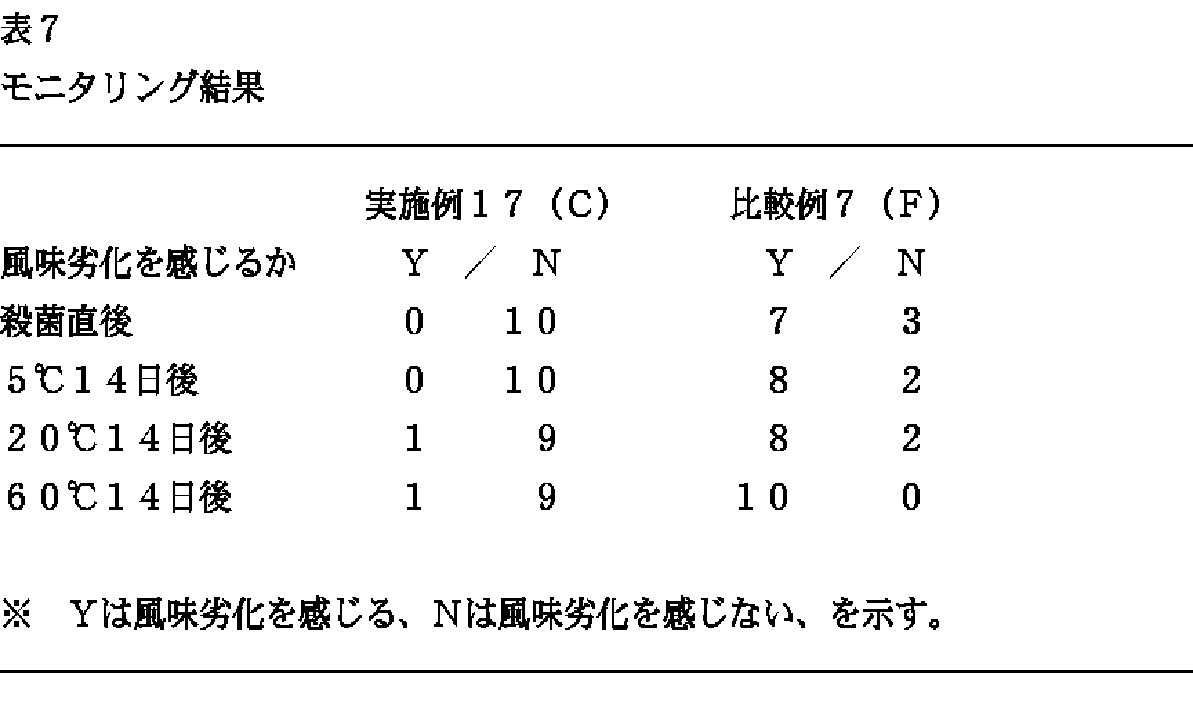
(C)は殺菌直後、5℃で14日静置後、20℃で14日静置後、または60℃で14日静置後に、開缶し官能検査による風味劣化のモニタリングを10名で行った結果、次の表7の評価を得た。また評価されたプロファイルは列挙すると、油っぽさがない、すっきりしている、飲みやすい、であった。(C)の評価を表7に示す。
【0037】
比較例7
上記(A)のかわりに、アスコルビン酸を含有しない油脂(菜種を原料とした精製油で上昇融点22℃の硬化油)(D)を利用する他は本例と同様にして、水中油型乳化物(E)、及び殺菌済みコーヒー飲料を得た(F)。
(F)を殺菌直後、5℃で14日静置後、20℃で14日静置後、または60℃で14日静置後に開缶し、官能検査による風味劣化のモニタリングを10名で行った結果、殺菌直後に実施例と比較して風味劣化を感じると判断する者が7名、5℃で14日後で実施例と比較して風味劣化を感じると判断する者8名、20℃で14日後で実施例と比較して風味劣化を感じると判断する者8名、60℃で14日後で実施例と比較して風味劣化を感じると判断する者10名であった。また、プロファイルを羅列すると、本例製品に比べて脂っこい、脂肪感がある、重たく、口に残る、後味が悪い、などであった。
【0039】
比較例8
比較例6の水中油型乳化物(E)の水相に、実施例8のアスコルビン酸含有製菓用油脂(A)に含有している相当量のアスコルビン酸を添加して、後は比較例6と同様な処理、評価を行った。結果は比較6と同様であった。
【0040】
【発明の効果】
本発明により、製菓用油脂の油性感を改善し、チョコレート類など製菓用油脂利用食品の油性感を改善する製菓用油脂を提供できるようになった。[0001]
BACKGROUND OF THE INVENTION
TECHNICAL FIELD The present invention relates to a confectionery fat, a process for producing a confectionery fat and a product using the same, and more particularly to a confectionery fat and oil having an improved oily feeling and a product using the same.
[0002]
[Prior art]
Chocolate, a typical oily confectionery, is typically made from cocoa mass, cocoa butter, sugar, powdered milk, and the like. Cocoa butter consists mainly of 1,3-saturated, 2-saturated triglycerides such as POSt, StOSt, POP (where P: palmitic acid, O: oleic acid, St: stearic acid), and is typically eaten as a confectionery. About 32% is present in typical chocolate. In addition, other fats and oils (hard butter) are often used instead of part or all of cocoa butter for the purpose of improving the physical properties of chocolate and saving manufacturing costs, and hard butter is mainly referred to as CBE 1,3. There are those that are rich in trisaturated fats and oils that are saturated at the second and second positions, and those that are lauric or highly elaidic acid type called CBR. There are also so-called white chocolates that use almost no cacao component (hereinafter referred to as chocolates, including so-called quasi-chocolates, etc., regardless of the laws and standards of each country).
[0003]
In addition, recent chocolate confectionery is not only eaten alone, but there are also an increasing number of products such as combination confectionery that is combined with other foods such as baked confectionery, whipped chocolate, and low-melting chocolate limited to winter.
In order to manufacture such a new chocolate confectionery, the opportunity to improve the physical properties of chocolate using hard butter is increasing.
In particular, when the oil content is increased by adding hard butter to improve the physical properties, the oily feeling (oily texture / oil smell) tends to increase.
There is a tendency to dislike the oily feeling of oily confectionery, etc., in connection with the recent increase in diet orientation. According to the inventor's knowledge, in general, the higher the oil content, the stronger the oily feeling, and the same oil content. However, for example, sweet chocolate and white chocolate tend to be more oily than white chocolate.
Similarly, in creams (when put in sand cream or milk beverages), the oiliness tends to increase over time, and tends to increase when exposed to light or heat for a long time. is there. As a recent trend, it is particularly prominent when products are handled at convenience stores that sell all day.
[0004]
[Problems to be solved by the invention]
An object of the present invention is to improve the oily feeling of oily confectionery and milk beverages using chocolate, cream and the like, and to provide confectionery fats and oils suitable therefor.
[0005]
[Means for solving the problems]
As a result of intensive studies to solve the above problems, the present inventors, as a result, hard butter containing ascorbic acid, which is inherently poorly soluble in fats and oils, in oils and fats greatly increases the oily feeling of hard butter products such as chocolate. The present invention has been completed by finding that it can be reduced.
That is, one aspect of the present invention is a confectionery fat / oil containing at least one organic acid selected from ascorbic acid, erythorbic acid, lactic acid, tartaric acid, citric acid and malic acid. It is good to contain ~ 60ppm.
This invention also adds a solution of at least one organic acid selected from ascorbic acid, erythorbic acid, lactic acid, tartaric acid, citric acid, and malic acid to confectionery fats or fats thereof, and is dried under heating and reduced pressure It is a manufacturing method of confectionery fats and oils that are essential to do.
Another aspect of the present invention is a confectionery oil-based product containing at least one organic acid selected from ascorbic acid, erythorbic acid, lactic acid, tartaric acid, citric acid, and malic acid. The product used can be chocolates, in particular white chocolate, milk chocolate or whipped chocolate. Moreover, the effect of this invention expresses so well that this oil-and-fat use product for confectionery has a higher oil content from 30%. Further, the confectionery oil-and-fat product may be an emulsion.
[0006]
DETAILED DESCRIPTION OF THE INVENTION
The organic acid used in the present invention may be one generally used for foods and pharmaceuticals, and may be used alone or in combination of two or more.
The content of the organic acid is preferably 2 ppm or more in the confectionery fat, and if it is too small, the effect of reducing the oily feeling is poor. Moreover, since the said organic acid is generally low oil solubility, it is difficult to contain it too much, and it is usually less than 60 ppm. In addition, these organic acids are not sufficiently effective in a non-dissolved state in which they are simply dispersed in confectionery fats and oils, and preferably, after being mixed with fats and oils in an aqueous solution as described in the next section. It is better to dry the water while.
[0007]
For the confectionery fats and oils, the known hard butter can be used when the food to be used is chocolates, and the part fats and oils thereof (for example, palm middle melting point fraction rich in POP, shea fat fractionation oil rich in StOSt) , StLSt fat, where L represents linoleic acid), or a liquid oil that adjusts the melting point and hardness of the hard butter. The origins of oils and fats are vegetable oils such as soybean oil, rapeseed oil, corn oil, cottonseed oil, peanut oil, sunflower oil, rice oil, safflower oil, safflower oil, olive oil, sesame oil, palm oil, palm oil, palm kernel oil, and beef fat. It may be animal fats such as pork fat, and may be a single processed oil or fat subjected to separation, hydrogenation, transesterification or the like, or a combination thereof, if necessary. Moreover, when the confectionery fat-and-oil-use food is a cream fat, a fat having a melting point of 5 ° C. or higher is usually used.
[0008]
As a preferred method for producing confectionery fats and oils containing the organic acid of the present invention, for example, when obtaining fats and oils containing ascorbic acid, ascorbic acid solution, Usually, ascorbic acid aqueous solution is added, and drying or desolvation is preferably performed while stirring under conditions of a temperature of 50 to 180 ° C. and a vacuum of 0.5 to 100 Torr. The concentration of the ascorbic acid solution can be 0.1 to 22%, and preferably 1 to 10%. If the amount is too small, the amount of solvent such as water with respect to fats and oils increases, resulting in poor production efficiency. If the amount is too large, crystals of ascorbic acid will precipitate, making it difficult to contain in oils and fats. If the temperature is too low, it takes a long time to dry or remove the solvent, and if it is too high, the ascorbic acid decomposes and the effect becomes poor. The higher the degree of vacuum, the shorter the drying time.
[0009]
In addition to the above organic acids, it may be used in combination with other antioxidants such as extracted tocopherol, ascorbyl palmitate, catechin, etc. In that case, the appropriate amount used is usually in the range of 10 to 2000 ppm, the addition of the organic acid May increase the effect. Since these antioxidants can be contained in fats and oils simply by being added and dissolved and dispersed in the fats and oils, any method can be adopted as the addition method.
[0010]
The fats and oils obtained by the production method of the present invention are particularly suitable for use in scenes where oily feeling is likely to be felt, and foods having a relatively high oil content (more than 30% oil content) and oily confectionery exposed to light for a long time. (For example, oil-impregnated food shelved at convenience stores that are open all day, such as cream), emulsions that are exposed to heat for a long time (for example, cream-containing beverages in a hot bender, typically cafe ole), etc. It works well, and the effect of reducing the oily feeling is obvious. Examples of the food with relatively high oil content include chocolates. Generally, this technique can be applied to those having an oil content of 30 to 70% such as ice-coated chocolate and whipped chocolate. Even with the same oily chocolate, white chocolate and milk chocolate are more effective than black chocolate and sweet chocolate.
[0011]
The method of using organic acid-containing confectionery fats and oils for their use is not particularly limited. For example, in the case of chocolates, it can be mixed with all other ingredients in the melted state, or added as additional oil after conching. it can. Examples of the emulsion include oil-in-water cream compositions and dairy beverages using the same.
[0012]
【Example】
EXAMPLES The present invention will be described in more detail with reference to the following examples, but the spirit of the present invention is not limited to the following examples. In the examples,% and part mean weight basis.
[0013]
Details of ascorbic acid and the like used in the following examples and comparative examples were as follows.
Ascorbic acid: manufactured by Wako Pure Chemical Industries, Ltd., trade name “L-ascorbic acid”, purity 99.5%
Erythorbic acid: manufactured by Wako Pure Chemical Industries, Ltd., trade name “Erythorbic acid”, purity 97.0%
Lactic acid: manufactured by Kishida Chemical Co., Ltd., trade name “DL-lactic acid”, total acid 90-92%
Tartaric acid: manufactured by Kishida Chemical Co., Ltd., trade name “DL-tartaric acid”, purity 99%
Citric acid: Product name "Citric acid (crystal)" manufactured by Roche Vitamin Japan Co., Ltd.
Malic acid: Wako Pure Chemical Industries, Ltd., trade name “malic acid”, purity 97.0%
Tocopherol: Eisai Co., Ltd., trade name: Emix 80
[0014]
Example 1 / Comparative Example 1 / Comparative Example 2
Production of hard butter containing ascorbic acid 0.2 parts by weight of 1% ascorbic acid aqueous solution is added to 100 parts by weight of hard butter at 70 ° C. (trade name “Melano NEW SS7” manufactured by Fuji Oil Co., Ltd.), temperature is 70 ° C., and the degree of vacuum is 40 Torr. Under the above conditions, dehydration was carried out for 20 minutes with stirring, followed by filtration with TOYO No. 5C filter paper (corresponding to 1 μm), and ascorbic acid-containing hard butter was produced as a filtrate.
Separately, 10 parts of ascorbic acid-containing hard butter prepared as described above was added to 90 parts of white chocolate (about 34% of Fuji Oil Co., Ltd.), the temperature of the product was adjusted to 31 ° C., and a seed agent ( Fuji Oil / “Chocoseed A” (trade name) was added 0.2% to the chocolate and tempered, cooled, and then aged for one week to obtain white chocolate (oil content: about 41%).
As Comparative Example 1, white chocolate (oil content of about 41%) was obtained in the same manner except that non-containing hard butter (“Melano NEW SS7”) was used instead of ascorbic acid-containing hard butter.
As comparative example 2, 10 parts of hard butter (trade name “Melano NEW SS7” manufactured by Fuji Oil Co., Ltd.) is added to 90 parts of dissolved raw white chocolate (about 34% oil manufactured by Fuji Oil Co., Ltd.), and the product temperature is raised to 31 ° C. The white chocolate was obtained in the same manner as in this example except that ascorbic acid was added in powder form so as to be 10 ppm with respect to the whole, stirred and mixed so as to fit the whole, and a seed agent was added thereto.
Table 1 shows the composition and evaluation of Example 1, Comparative Example 1, and Comparative Example 2.
[0015]
When the flavors of Example 1 and Comparative Examples 1 and 2 were compared immediately after aging, Comparative Examples 1 and 2 were more oily than Example 1.
Furthermore, when the flavors were compared after each white chocolate was kept at 30 cm under a fluorescent lamp for 1 week at room temperature (about 20 ° C.), Comparative Examples 1 and 2 had a strong oily feeling compared to Example 1, The difference in oily feeling was stronger than before aging. From this, ascorbic acid contributed to the reduction of oiliness when added by the method shown in Example 1, and the oiliness became weaker than that without addition. In addition, it became clear that when the addition method was added to hard butter as a powder, the oiliness reduction effect could not be exhibited.
[0017]
Example 2 and Comparative Example 3
The chocolate products of Example 2 and Comparative Example 3 of this example were obtained in the same manner as Example 1 and Comparative Example 1, except that milk chocolate (Fuji Oil Co., Ltd., oil content of about 34%) was used instead of white chocolate. When these were evaluated, the results were the same as in Example 1 and Comparative Example 1, respectively.
[0018]
Example 3 and Comparative Example 4
10 parts of ascorbic acid-containing hard butter prepared in Example 1 is added to 90 parts of melted sweet chocolate (Fuji Oil Co., Ltd., approximately 34%), and after tempering at the lowest point of 26 ° C and the reheat point of 28 ° C, cooling , Sweet chocolate (oil content about 41%) was obtained.
As Comparative Example 4, sweet chocolate was obtained in the same manner except that non-containing hard butter ("Melano NEW SS7") was used instead of ascorbic acid-containing hard butter. The oily feeling was strong and the oily feeling was stronger than that of the product of the present example with a larger difference in a state where it was kept at 30 cm under a fluorescent lamp at room temperature (about 20 ° C.) for one week. However, the difference between the comparative products in Examples 1 and 2 was greater than the difference between the products in Example 3 and Comparative Example 4.
Table 2 shows the composition and evaluation of Example 2 / Comparative Example 3 and Example 3 / Comparative Example 4.
[0019]
Example 4 and Comparative Example 5
28 parts of whole milk powder, 44 parts of sugar, 22 parts of ascorbic acid-containing hard butter prepared in the same manner as in Example 1, and a small amount of lecithin were mixed and refined, and then 6 parts of ascorbic acid-containing hard butter was added and conching. To obtain a white chocolate dough (oil content: about 41%). After adjusting the temperature to 31 ° C., it was prepared in the same manner as in Example 1 to obtain white chocolates.
As Comparative Example 5, white chocolates were obtained in the same manner except that non-containing hard butter was used instead of ascorbic acid-containing hard butter. The oily feeling was strong.
Table 3 shows the composition and evaluation of Example 4 and Comparative Example 5.
[0021]
The chocolates of Examples 1 to 4 and Comparative Examples 1 to 5 prepared and created as described above were collectively evaluated for texture and flavor by five panelists. As described above, Examples 1 to 4 were ascorbic acid. Since the contained hard butter was used, the chocolate was less oily. This was a feature not found in conventional chocolate made with hard butter containing no ascorbic acid. This was particularly noticeable with chocolate containing milk solids such as white chocolate and milk chocolate.
On the other hand, none of the products of the above comparative examples had the above characteristics.
[0023]
Example 5
80 parts of melted milk chocolate (Fuji Oil, approximately 34% oil content), 10 parts of hard butter (Fuji Oil, trade name “Melano NEWS7”, 10 parts of ascorbic acid-containing hard butter prepared in Example 1, propylene glycol stearin Acid ester (trade name “Riquemar PS100” manufactured by Riken Vitamin) 1 part was mixed and the product temperature was adjusted to 31 ° C. The seed agent (made by Fuji Oil / “Chocoseed A” product name) was added to chocolate. The tempering treatment was performed by adding 0.2%, and the product temperature was further lowered to 25 ° C. The chocolate was stirred at a medium speed with a Kenwood mixer (using a whipper) and foamed. 6.
[0024]
As Comparative Example 6, whipped chocolate (specific gravity) was prepared in the same composition and procedure as in this example, except that 20 parts of hard butter containing no ascorbic acid and containing no hard butter (trade name “Melano NEWSS7” manufactured by Fuji Oil Co., Ltd.) was used. Was prepared about 0.6).
[0025]
Example 6
Hard butter and white chocolate prepared by the same composition and procedure as in Example 1 were obtained except that erythorbic acid was used instead of ascorbic acid.
[0026]
Example 7
Hard butter and white chocolate prepared by the same composition and procedure as in Example 1 were obtained except that malic acid was used instead of ascorbic acid.
[0027]
Example 8
Hard butter and white chocolate prepared by the same composition and procedure as Example 1 were obtained except that lactic acid was used instead of ascorbic acid.
[0028]
Example 9
Hard butter and white chocolate prepared by the same composition and procedure as Example 1 were obtained except that tartaric acid was used instead of ascorbic acid.
[0029]
Example 10
Hard butter and white chocolate prepared by the same formulation and procedure as in Example 1 were obtained except that citric acid was used instead of ascorbic acid.
[0030]
When the texture and flavor of the chocolate prepared as described above were evaluated by five panelists, Example 5, Example 6, Example 7, Example 8, Example 9, and Example 10 were Comparative Example 6. The oily feeling was reduced compared to.
Table 4 shows the composition and evaluation of Example 5, Example 6, Example 7, Example 8, Example 9, Example 10, and Comparative Example 6.
[0031]
Example 11, Example 12, Example 13
A white chocolate prepared by the same formulation and procedure as Example 1 and Comparative Example 1 was obtained except that hard butter having an ascorbic acid content of 12 ppm, 6 ppm or 3 ppm was used. (Hard butter having an ascorbic acid content of 12 ppm, 6 ppm, and 3 ppm was used in the order of Example 11, Example 12, and Example 13.)
When these were compared with Comparative Example 1, the oiliness was improved at 3 ppm as compared with Comparative Example 1. However, the greater the amount of ascorbic acid, the greater the effect. The effect achieved was remarkable.
Table 5 shows the composition and evaluation of Example 11, Example 12, Example 13, and Comparative Example 1.
[0033]
Example 14, Example 15 and Example 16
White chocolate prepared by the same composition and procedure as Example 1 and Comparative Example 1 was obtained except that hard butter having a malic acid content of 60 ppm, 20 ppm or 10 ppm was used. (Hard butter having malic acid content of 60 ppm, 20 ppm, and 10 ppm was used in the order of Example 14, Example 15, and Example 16.)
When these were compared with Comparative Example 1, even when 10 ppm, the oily feeling was improved as compared with Comparative Example 1, the effect was larger as the amount of malic acid increased, and the oily feeling was reduced when 20 ppm and 60 ppm were contained. The effect achieved was remarkable.
Table 6 shows the composition and evaluation of Example 14, Example 15, Example 16, and Comparative Example 1.
[0035]
Example 17
Addition of 0.2 parts by weight of 1% ascorbic acid aqueous solution to 100 parts by weight of confectionery fats and oils at 70 ° C. (refined oil made from rapeseed and cured oil having a rising melting point of 22 ° C.) Then, dehydration was carried out for 20 minutes with stirring, and the mixture was filtered with TOYO No. 5C filter paper (corresponding to 1 μm) to prepare ascorbic acid-containing confectionery fats and oils (A) as a filtrate.
This ascorbic acid-added confectionery fat and oil 35%, casein Na 2%, lysolecithin 0.3%, polyglycerin fatty acid ester 0.5%, sucrose fatty acid ester 0.2%, metaphosphoric acid Na 0.1%, water 61.9% An oil-in-water emulsion was prepared by blending (B). That is, the above compound was pre-emulsified at 70 ° C. for 30 minutes, homogenized at a top stage of 0 MPa and a bottom stage of 10 MPa with a two-stage homogenizer, then sterilized at 150 ° C. for 4 seconds with a high-temperature instantaneous direct steam sterilizer, and further with a two-stage homogenizer. After homogenizing at 0 MPa at the upper stage and 10 MPa at the lower stage, it was rapidly cooled to 5 ° C. to obtain the oil-in-water emulsion (B).
This oil-in-water emulsion 2%, coffee extract 60% (Bx1.8 ° coffee extract), sugar 5%, sucrose fatty acid ester 0.05% (Ester P-1670 manufactured by Mitsubishi Chemical Foods), water A sterilized coffee drink was obtained with a blend of 32.95% (C). That is, after pre-emulsifying the above composition at 60 ° C. for 10 minutes, pH was adjusted to 6.2 with sodium bicarbonate, homogenized with a two-stage homogenizer at the upper stage of 0 MPa and the lower stage of 20 MPa, and then filled into a 190 ml can. Was sterilized with a hot water retort sterilizer at 121 ° C. for 30 minutes and then allowed to cool.
(C) is immediately after sterilization, left at 5 ° C. for 14 days, left at 20 ° C. for 14 days, or left at 60 ° C. for 14 days. As a result, the following evaluation in Table 7 was obtained. In addition, the profiles that were evaluated were not oily, clean, and easy to drink. Table 7 shows the evaluation of (C).
[0037]
Comparative Example 7
Oil-in-water emulsification in the same manner as in this example, except that (D) is used instead of the above (A), oil and fat not containing ascorbic acid (refined oil made from rapeseed and having a rising melting point of 22 ° C.) (D) The thing (E) and the sterilized coffee drink were obtained (F).
(F) was opened immediately after sterilization for 14 days at 5 ° C., left for 14 days at 20 ° C., or left for 14 days at 60 ° C., and monitoring of flavor deterioration by sensory test was performed by 10 persons. As a result, 7 persons judged to feel flavor deterioration compared with Examples immediately after sterilization, 8 persons judged to feel flavor deterioration compared to Examples after 5 days at 5 ° C., and 20 ° C. There were 8 persons who judged that the flavor deterioration was felt after 14 days compared to the examples, and 10 persons who judged that the flavor deterioration was felt compared with the examples after 14 days at 60 ° C. In addition, when the profiles were enumerated, it was greasy, fatty, heavy, remaining in the mouth, and poor aftertaste compared to the product of this example.
[0039]
Comparative Example 8
A considerable amount of ascorbic acid contained in the ascorbic acid-containing confectionery fat (A) of Example 8 was added to the aqueous phase of the oil-in-water emulsion (E) of Comparative Example 6; The same processing and evaluation were performed. The result was the same as in comparison 6.
[0040]
【The invention's effect】
According to the present invention, it has become possible to provide a confectionery fat and oil that improves the oily feeling of a confectionery fat and oil and improves the oily feeling of a confectionery fat and other food using chocolate.
Claims (2)
Priority Applications (3)
| Application Number | Priority Date | Filing Date | Title |
|---|---|---|---|
| JP2002355682A JP4457553B2 (en) | 2001-12-10 | 2002-12-06 | Confectionery fats and oils, production method thereof, and confectionery fats and oils products using the same |
| US10/456,630 US20040109929A1 (en) | 2002-12-06 | 2003-06-09 | Process for producing fat |
| US10/759,529 US20040234668A1 (en) | 2002-12-06 | 2004-01-20 | Oil and fat for producing confectionery, process for producing the same, and product using the same |
Applications Claiming Priority (3)
| Application Number | Priority Date | Filing Date | Title |
|---|---|---|---|
| JP2001-376236 | 2001-12-10 | ||
| JP2001376236 | 2001-12-10 | ||
| JP2002355682A JP4457553B2 (en) | 2001-12-10 | 2002-12-06 | Confectionery fats and oils, production method thereof, and confectionery fats and oils products using the same |
Publications (2)
| Publication Number | Publication Date |
|---|---|
| JP2003235447A JP2003235447A (en) | 2003-08-26 |
| JP4457553B2 true JP4457553B2 (en) | 2010-04-28 |
Family
ID=27790663
Family Applications (1)
| Application Number | Title | Priority Date | Filing Date |
|---|---|---|---|
| JP2002355682A Expired - Lifetime JP4457553B2 (en) | 2001-12-10 | 2002-12-06 | Confectionery fats and oils, production method thereof, and confectionery fats and oils products using the same |
Country Status (1)
| Country | Link |
|---|---|
| JP (1) | JP4457553B2 (en) |
Families Citing this family (7)
| Publication number | Priority date | Publication date | Assignee | Title |
|---|---|---|---|---|
| AU2003292637A1 (en) * | 2003-02-04 | 2004-08-30 | Fuji Oil Company, Limited | Process for producing chocolate |
| JP2005204653A (en) * | 2003-12-26 | 2005-08-04 | Fuji Oil Co Ltd | Production method of liquid cream |
| JP2006197830A (en) * | 2005-01-19 | 2006-08-03 | Fuji Oil Co Ltd | Chocolate for exposure food |
| JP2008022744A (en) * | 2006-07-19 | 2008-02-07 | Nisshin Oillio Group Ltd | Method for modifying oil and fat |
| WO2011040539A1 (en) * | 2009-09-30 | 2011-04-07 | 不二製油株式会社 | Method for reducing chloropropanols and formative substance thereof, glycidol fatty acid esters, in glyceride oils |
| JP7468008B2 (en) * | 2020-03-12 | 2024-04-16 | 不二製油株式会社 | Colored white chocolate-like food |
| EP4544915A1 (en) | 2022-06-24 | 2025-04-30 | Fuji Oil Holdings Inc. | Oil and fat composition |
-
2002
- 2002-12-06 JP JP2002355682A patent/JP4457553B2/en not_active Expired - Lifetime
Also Published As
| Publication number | Publication date |
|---|---|
| JP2003235447A (en) | 2003-08-26 |
Similar Documents
| Publication | Publication Date | Title |
|---|---|---|
| KR101676518B1 (en) | Oleaginous composition and oil-in-water type emulsifier containing oleaginous composition | |
| DE60128179T2 (en) | Foods containing vitamin K2 | |
| US11154068B2 (en) | Method for producing vegetable cheese-like food product | |
| WO2014087724A1 (en) | Powdered oil and fat, method for manufacturing same, and chocolate-like food using same | |
| EP3949743A1 (en) | Plant-based butter-like composition | |
| JP5312712B1 (en) | Milk beverage and method for producing the same | |
| CN105578887A (en) | Oil and fat composition for non-tempered chocolate and oil and fat composition for tempered chocolate | |
| JP4367136B2 (en) | Oils and fats, methods for producing the same, and products using the same | |
| JP6459161B2 (en) | Confectionery fats and foods using the same | |
| JP6507738B2 (en) | Water-in-oil type emulsified fat and oil composition for novel filling and topping | |
| JP7078198B1 (en) | Oil and fat composition for roux | |
| JP5936823B2 (en) | Luo oil | |
| JP2003235447A (en) | Confectionery fats and oils, production method thereof, and confectionery fats and oils products using the same | |
| JP6512566B2 (en) | Oil-and-fat composition for bubbles-containing chocolate | |
| JP7063696B2 (en) | Hard butter composition | |
| KR100368039B1 (en) | Water in oil emulsion containing mulberry leaf and method for preparing of the same | |
| WO2015005128A1 (en) | Frozen confectionery, and oil and fat for producing confectionery | |
| JP6516940B1 (en) | Method for producing oil composition | |
| TWI777036B (en) | Food, method for producing the same, and method for suppressing generation of odor over time in food | |
| JP7698957B2 (en) | Oil-in-water emulsion for frozen desserts, frozen desserts, and method for enhancing flavor of frozen desserts | |
| JP6901953B2 (en) | Water-in-oil oil / fat composition for filling | |
| JP2006197830A (en) | Chocolate for exposure food | |
| US20040234668A1 (en) | Oil and fat for producing confectionery, process for producing the same, and product using the same | |
| US20040109929A1 (en) | Process for producing fat | |
| JP6098046B2 (en) | Edible oil and fat, food containing the same and method for producing the same |
Legal Events
| Date | Code | Title | Description |
|---|---|---|---|
| A621 | Written request for application examination |
Free format text: JAPANESE INTERMEDIATE CODE: A621 Effective date: 20051114 |
|
| A977 | Report on retrieval |
Free format text: JAPANESE INTERMEDIATE CODE: A971007 Effective date: 20081008 |
|
| A131 | Notification of reasons for refusal |
Free format text: JAPANESE INTERMEDIATE CODE: A131 Effective date: 20081014 |
|
| A521 | Request for written amendment filed |
Free format text: JAPANESE INTERMEDIATE CODE: A523 Effective date: 20081215 |
|
| A131 | Notification of reasons for refusal |
Free format text: JAPANESE INTERMEDIATE CODE: A131 Effective date: 20090630 |
|
| A521 | Request for written amendment filed |
Free format text: JAPANESE INTERMEDIATE CODE: A523 Effective date: 20090831 |
|
| A131 | Notification of reasons for refusal |
Free format text: JAPANESE INTERMEDIATE CODE: A131 Effective date: 20090929 |
|
| A521 | Request for written amendment filed |
Free format text: JAPANESE INTERMEDIATE CODE: A523 Effective date: 20091130 |
|
| TRDD | Decision of grant or rejection written | ||
| A01 | Written decision to grant a patent or to grant a registration (utility model) |
Free format text: JAPANESE INTERMEDIATE CODE: A01 Effective date: 20100119 |
|
| A01 | Written decision to grant a patent or to grant a registration (utility model) |
Free format text: JAPANESE INTERMEDIATE CODE: A01 |
|
| A61 | First payment of annual fees (during grant procedure) |
Free format text: JAPANESE INTERMEDIATE CODE: A61 Effective date: 20100201 |
|
| R150 | Certificate of patent or registration of utility model |
Free format text: JAPANESE INTERMEDIATE CODE: R150 Ref document number: 4457553 Country of ref document: JP Free format text: JAPANESE INTERMEDIATE CODE: R150 |
|
| FPAY | Renewal fee payment (event date is renewal date of database) |
Free format text: PAYMENT UNTIL: 20130219 Year of fee payment: 3 |
|
| FPAY | Renewal fee payment (event date is renewal date of database) |
Free format text: PAYMENT UNTIL: 20130219 Year of fee payment: 3 |
|
| FPAY | Renewal fee payment (event date is renewal date of database) |
Free format text: PAYMENT UNTIL: 20130219 Year of fee payment: 3 |
|
| FPAY | Renewal fee payment (event date is renewal date of database) |
Free format text: PAYMENT UNTIL: 20130219 Year of fee payment: 3 |
|
| FPAY | Renewal fee payment (event date is renewal date of database) |
Free format text: PAYMENT UNTIL: 20140219 Year of fee payment: 4 |
|
| R250 | Receipt of annual fees |
Free format text: JAPANESE INTERMEDIATE CODE: R250 |
|
| R250 | Receipt of annual fees |
Free format text: JAPANESE INTERMEDIATE CODE: R250 |
|
| S531 | Written request for registration of change of domicile |
Free format text: JAPANESE INTERMEDIATE CODE: R313531 |
|
| R350 | Written notification of registration of transfer |
Free format text: JAPANESE INTERMEDIATE CODE: R350 |
|
| R250 | Receipt of annual fees |
Free format text: JAPANESE INTERMEDIATE CODE: R250 |
|
| S111 | Request for change of ownership or part of ownership |
Free format text: JAPANESE INTERMEDIATE CODE: R313111 |
|
| R371 | Transfer withdrawn |
Free format text: JAPANESE INTERMEDIATE CODE: R371 |
|
| S533 | Written request for registration of change of name |
Free format text: JAPANESE INTERMEDIATE CODE: R313533 |
|
| R350 | Written notification of registration of transfer |
Free format text: JAPANESE INTERMEDIATE CODE: R350 |
|
| S111 | Request for change of ownership or part of ownership |
Free format text: JAPANESE INTERMEDIATE CODE: R313111 |
|
| R350 | Written notification of registration of transfer |
Free format text: JAPANESE INTERMEDIATE CODE: R350 |
|
| EXPY | Cancellation because of completion of term |