JP4220249B2 - Cyclic amidine derivatives - Google Patents
Cyclic amidine derivatives Download PDFInfo
- Publication number
- JP4220249B2 JP4220249B2 JP2002583377A JP2002583377A JP4220249B2 JP 4220249 B2 JP4220249 B2 JP 4220249B2 JP 2002583377 A JP2002583377 A JP 2002583377A JP 2002583377 A JP2002583377 A JP 2002583377A JP 4220249 B2 JP4220249 B2 JP 4220249B2
- Authority
- JP
- Japan
- Prior art keywords
- group
- cyclic
- phenyl
- butyl
- tert
- Prior art date
- Legal status (The legal status is an assumption and is not a legal conclusion. Google has not performed a legal analysis and makes no representation as to the accuracy of the status listed.)
- Expired - Fee Related
Links
- 0 CC*c(cc(cc1*2CC(CC(C)CC(CC)C(C)C=C)CC2)C(C)=O)c1OCOC Chemical compound CC*c(cc(cc1*2CC(CC(C)CC(CC)C(C)C=C)CC2)C(C)=O)c1OCOC 0.000 description 16
- AWWZFOCSQDUJDE-UHFFFAOYSA-N CCC(C)Cc1cc(C)cc(C)c1C Chemical compound CCC(C)Cc1cc(C)cc(C)c1C AWWZFOCSQDUJDE-UHFFFAOYSA-N 0.000 description 1
- RJCLVZXDTKQCOR-CYZMBNFOSA-N CC[C@H](C)[C@@H](CNC1=N)[C@H]1c1ccccc1 Chemical compound CC[C@H](C)[C@@H](CNC1=N)[C@H]1c1ccccc1 RJCLVZXDTKQCOR-CYZMBNFOSA-N 0.000 description 1
Classifications
-
- C—CHEMISTRY; METALLURGY
- C07—ORGANIC CHEMISTRY
- C07D—HETEROCYCLIC COMPOUNDS
- C07D209/00—Heterocyclic compounds containing five-membered rings, condensed with other rings, with one nitrogen atom as the only ring hetero atom
- C07D209/02—Heterocyclic compounds containing five-membered rings, condensed with other rings, with one nitrogen atom as the only ring hetero atom condensed with one carbocyclic ring
- C07D209/44—Iso-indoles; Hydrogenated iso-indoles
-
- A—HUMAN NECESSITIES
- A61—MEDICAL OR VETERINARY SCIENCE; HYGIENE
- A61P—SPECIFIC THERAPEUTIC ACTIVITY OF CHEMICAL COMPOUNDS OR MEDICINAL PREPARATIONS
- A61P11/00—Drugs for disorders of the respiratory system
-
- A—HUMAN NECESSITIES
- A61—MEDICAL OR VETERINARY SCIENCE; HYGIENE
- A61P—SPECIFIC THERAPEUTIC ACTIVITY OF CHEMICAL COMPOUNDS OR MEDICINAL PREPARATIONS
- A61P11/00—Drugs for disorders of the respiratory system
- A61P11/06—Antiasthmatics
-
- A—HUMAN NECESSITIES
- A61—MEDICAL OR VETERINARY SCIENCE; HYGIENE
- A61P—SPECIFIC THERAPEUTIC ACTIVITY OF CHEMICAL COMPOUNDS OR MEDICINAL PREPARATIONS
- A61P13/00—Drugs for disorders of the urinary system
- A61P13/12—Drugs for disorders of the urinary system of the kidneys
-
- A—HUMAN NECESSITIES
- A61—MEDICAL OR VETERINARY SCIENCE; HYGIENE
- A61P—SPECIFIC THERAPEUTIC ACTIVITY OF CHEMICAL COMPOUNDS OR MEDICINAL PREPARATIONS
- A61P19/00—Drugs for skeletal disorders
- A61P19/02—Drugs for skeletal disorders for joint disorders, e.g. arthritis, arthrosis
-
- A—HUMAN NECESSITIES
- A61—MEDICAL OR VETERINARY SCIENCE; HYGIENE
- A61P—SPECIFIC THERAPEUTIC ACTIVITY OF CHEMICAL COMPOUNDS OR MEDICINAL PREPARATIONS
- A61P19/00—Drugs for skeletal disorders
- A61P19/08—Drugs for skeletal disorders for bone diseases, e.g. rachitism, Paget's disease
- A61P19/10—Drugs for skeletal disorders for bone diseases, e.g. rachitism, Paget's disease for osteoporosis
-
- A—HUMAN NECESSITIES
- A61—MEDICAL OR VETERINARY SCIENCE; HYGIENE
- A61P—SPECIFIC THERAPEUTIC ACTIVITY OF CHEMICAL COMPOUNDS OR MEDICINAL PREPARATIONS
- A61P25/00—Drugs for disorders of the nervous system
-
- A—HUMAN NECESSITIES
- A61—MEDICAL OR VETERINARY SCIENCE; HYGIENE
- A61P—SPECIFIC THERAPEUTIC ACTIVITY OF CHEMICAL COMPOUNDS OR MEDICINAL PREPARATIONS
- A61P25/00—Drugs for disorders of the nervous system
- A61P25/18—Antipsychotics, i.e. neuroleptics; Drugs for mania or schizophrenia
-
- A—HUMAN NECESSITIES
- A61—MEDICAL OR VETERINARY SCIENCE; HYGIENE
- A61P—SPECIFIC THERAPEUTIC ACTIVITY OF CHEMICAL COMPOUNDS OR MEDICINAL PREPARATIONS
- A61P29/00—Non-central analgesic, antipyretic or antiinflammatory agents, e.g. antirheumatic agents; Non-steroidal antiinflammatory drugs [NSAID]
-
- A—HUMAN NECESSITIES
- A61—MEDICAL OR VETERINARY SCIENCE; HYGIENE
- A61P—SPECIFIC THERAPEUTIC ACTIVITY OF CHEMICAL COMPOUNDS OR MEDICINAL PREPARATIONS
- A61P35/00—Antineoplastic agents
-
- A—HUMAN NECESSITIES
- A61—MEDICAL OR VETERINARY SCIENCE; HYGIENE
- A61P—SPECIFIC THERAPEUTIC ACTIVITY OF CHEMICAL COMPOUNDS OR MEDICINAL PREPARATIONS
- A61P43/00—Drugs for specific purposes, not provided for in groups A61P1/00-A61P41/00
-
- A—HUMAN NECESSITIES
- A61—MEDICAL OR VETERINARY SCIENCE; HYGIENE
- A61P—SPECIFIC THERAPEUTIC ACTIVITY OF CHEMICAL COMPOUNDS OR MEDICINAL PREPARATIONS
- A61P7/00—Drugs for disorders of the blood or the extracellular fluid
-
- A—HUMAN NECESSITIES
- A61—MEDICAL OR VETERINARY SCIENCE; HYGIENE
- A61P—SPECIFIC THERAPEUTIC ACTIVITY OF CHEMICAL COMPOUNDS OR MEDICINAL PREPARATIONS
- A61P7/00—Drugs for disorders of the blood or the extracellular fluid
- A61P7/02—Antithrombotic agents; Anticoagulants; Platelet aggregation inhibitors
-
- A—HUMAN NECESSITIES
- A61—MEDICAL OR VETERINARY SCIENCE; HYGIENE
- A61P—SPECIFIC THERAPEUTIC ACTIVITY OF CHEMICAL COMPOUNDS OR MEDICINAL PREPARATIONS
- A61P9/00—Drugs for disorders of the cardiovascular system
-
- A—HUMAN NECESSITIES
- A61—MEDICAL OR VETERINARY SCIENCE; HYGIENE
- A61P—SPECIFIC THERAPEUTIC ACTIVITY OF CHEMICAL COMPOUNDS OR MEDICINAL PREPARATIONS
- A61P9/00—Drugs for disorders of the cardiovascular system
- A61P9/04—Inotropic agents, i.e. stimulants of cardiac contraction; Drugs for heart failure
-
- A—HUMAN NECESSITIES
- A61—MEDICAL OR VETERINARY SCIENCE; HYGIENE
- A61P—SPECIFIC THERAPEUTIC ACTIVITY OF CHEMICAL COMPOUNDS OR MEDICINAL PREPARATIONS
- A61P9/00—Drugs for disorders of the cardiovascular system
- A61P9/08—Vasodilators for multiple indications
-
- A—HUMAN NECESSITIES
- A61—MEDICAL OR VETERINARY SCIENCE; HYGIENE
- A61P—SPECIFIC THERAPEUTIC ACTIVITY OF CHEMICAL COMPOUNDS OR MEDICINAL PREPARATIONS
- A61P9/00—Drugs for disorders of the cardiovascular system
- A61P9/10—Drugs for disorders of the cardiovascular system for treating ischaemic or atherosclerotic diseases, e.g. antianginal drugs, coronary vasodilators, drugs for myocardial infarction, retinopathy, cerebrovascula insufficiency, renal arteriosclerosis
-
- A—HUMAN NECESSITIES
- A61—MEDICAL OR VETERINARY SCIENCE; HYGIENE
- A61P—SPECIFIC THERAPEUTIC ACTIVITY OF CHEMICAL COMPOUNDS OR MEDICINAL PREPARATIONS
- A61P9/00—Drugs for disorders of the cardiovascular system
- A61P9/12—Antihypertensives
Landscapes
- Health & Medical Sciences (AREA)
- Chemical & Material Sciences (AREA)
- Organic Chemistry (AREA)
- Engineering & Computer Science (AREA)
- Bioinformatics & Cheminformatics (AREA)
- Life Sciences & Earth Sciences (AREA)
- Veterinary Medicine (AREA)
- General Chemical & Material Sciences (AREA)
- Medicinal Chemistry (AREA)
- Nuclear Medicine, Radiotherapy & Molecular Imaging (AREA)
- Chemical Kinetics & Catalysis (AREA)
- Pharmacology & Pharmacy (AREA)
- Public Health (AREA)
- Animal Behavior & Ethology (AREA)
- General Health & Medical Sciences (AREA)
- Cardiology (AREA)
- Heart & Thoracic Surgery (AREA)
- Physical Education & Sports Medicine (AREA)
- Rheumatology (AREA)
- Pulmonology (AREA)
- Orthopedic Medicine & Surgery (AREA)
- Neurosurgery (AREA)
- Diabetes (AREA)
- Hematology (AREA)
- Urology & Nephrology (AREA)
- Biomedical Technology (AREA)
- Neurology (AREA)
- Pain & Pain Management (AREA)
- Vascular Medicine (AREA)
- Hospice & Palliative Care (AREA)
- Immunology (AREA)
- Psychiatry (AREA)
- Pharmaceuticals Containing Other Organic And Inorganic Compounds (AREA)
- Plural Heterocyclic Compounds (AREA)
- Nitrogen Condensed Heterocyclic Rings (AREA)
- Pyrrole Compounds (AREA)
- Indole Compounds (AREA)
- Nitrogen And Oxygen Or Sulfur-Condensed Heterocyclic Ring Systems (AREA)
- Heterocyclic Carbon Compounds Containing A Hetero Ring Having Nitrogen And Oxygen As The Only Ring Hetero Atoms (AREA)
- Thiazole And Isothizaole Compounds (AREA)
Abstract
Description
技術分野
本発明は、新規なサイクリックアミジン誘導体およびその塩、ならびにそれらを含有する医薬組成物等に関する。
背景技術
最近の抗血栓症へのアプローチは、トロンビンへの酵素活性を阻害するものであり、これにはヘパリン、低分子ヘパリン、ヒルジン、アルガトロバン、ヒルログ等の化合物が含まれる。これらの化合物はすべてトロンビンの酵素活性を阻害する。従ってこれらの化合物はいずれもトロンビンの細胞に対する作用を特異的には阻害せず、フィブリン血餅形成も阻害する。そのため臨床においては出血傾向と言う副作用が常に付きまとっている。血栓症におけるトロンビンの役割は、その血液凝固活性に制限されず、血小板トロンビンレセプターの活性化の結果生じる血管損傷部位での血小板凝集塊形成にもあると思われる。
今一つの抗血栓症へのアプローチとしてはGPIIb/IIIaレセプターアンタゴニストとしてAbciximab、Eptifibatide、Tirofiban等が静注剤として利用されている。これらの化合物はトロンビン、ADP、コラーゲン、PAF等のあらゆる刺激に対して血小板凝集を抑制するため強力な抗血栓作用を示す反面、トロンビンの酵素活性阻害剤と同様、副作用としての出血傾向が付きまとう。そのため経口剤としての開発も進められてはいるが未だに上市された化合物はない。
冠動脈血管形成術といった侵襲的治療によって誘発された血管壁損傷に対する血管過増殖性応答である再狭窄は、トロンビンが直接的または間接的に細胞に作用することによって誘発された事象である可能性がある。損傷を受けた血管に血小板が粘着し成長因子の放出が起こり、平滑筋細胞増殖が誘発される。内皮細胞に対するトロンビンの作用によっても、間接的に平滑筋細胞が作用を受ける可能性がある。さらに、血管損傷部位では血小板粘着が起こりプロコアグラント活性が上昇する。その部位において生成されたトロンビンの高い局所的濃度のため平滑筋細胞は直接刺激される可能性もある。実際効力あるトロンビン阻害剤ヒルジンを用いた最近の研究では、トロンビンが再狭窄プロセスにおいて細胞増殖を引き起こすことが示唆されているが、トロンビンの効果が直接的な作用であるか間接的な作用であるかは解明されていない(Sarembock et al.,Circulation.1992,84:232−243)。トロンビンの細胞作用は、様々な病的症状を引き起こす可能性を持つものの、トロンビンの細胞作用を特異的に遮断する治療用作用物質は全く知られていない。
最近、トロンビンレセプター(PAR−1)がクローニングされ(Vu et al.,Cell,1991,64:1057−1068)、細胞トロンビンレセプターを標的とする作用物質を開発する重要な機会が生み出された。トロンビンレセプターのアミノ酸配列の詳細な検査によりレセプターの100残基アミノ末端ドメイン内に存在するトロンビンの結合部位と加水分解部位が明らかにされた。その後行ったレセプターのアミノ酸変異体の研究によって、トロンビンレセプターのこの部位をトロンビンが限定加水分解することがレセプターの活性化に必要であることが立証された(Vu et al.,Nature,1991,353:674−677)。トロンビンレセプターが加水分解の結果、新たに生じるアミノ酸配列に対応した合成ペプチド(「トロンビンレセプター活性化ペプチド、thrombin receptor activating peptide;TRAP」と呼ばれる)が、トロンビンによる加水分解がない状態のレセプターを活性化し得る。この事はレセプターの分解によってアミノ末端に生じる新しいアミノ酸配列(「連結型リガンドペプチド、tethered ligand peptide」と呼ばれる)がリガンドとして機能し遠位の結合部位において相互作用することを示唆している。TRAPの更なる研究により血小板、内皮細胞、繊維芽細胞及び平滑筋細胞の中に存在するトロンビンレセプターの類似性が確認された(Hung et al.,J.Cell.Biol.1992,116:827−832,Ngaiza,Jaffe,Biochem.Biophys.Res.Commun.1991,179:1656−1661)。
TRAPの構造活性研究からペンタペプチドPhe−Leu−Leu−Arg−Asnは、トロンビン又はTRAPのいずれかで活性化された血小板トロンビンレセプターの弱い拮抗体であることが示唆された(Vssallo.et al.,J.Biol.Chem.,1992,267:6081−6085(1992))。レセプターの拮抗に対する異なるアプローチがその他のグループにより研究されてきた。一つ目はトロンビンレセプターのトロンビン結合ドメインに対する抗体を作成する試みである。これらの抗体は有効かつ特異的に血小板のトロンビンによる活性化を抑制し、トロンビンレセプターの拮抗体として作用する(Hung et al.,J.Clin.Invest.1992,89:1350−1353)。二つ目はTRAPからのペプチド誘導体の開発である(steven M.S.,J.Med.Chem.1996,39:4879−4887,William J.H.,Bioorg.Med.Chem.Lett.1998,8:1649−1654,David F.M.,Bioorg.Med.Chem.Lett.1999,9:255−260)。最後にレセプターバインディングを中心とした各種アッセイ系を利用したハイスループットスクリーニングの実施により見出された低分子化合物の開発である(Andrew W.S.et al.,Bioorg.Med Chem.Lett.1999,9:2073−2078,Scherig Plough WO99/26943.Halord S.et al.,ACS meeting in Oct.2001)。
発明の開示
このように、トロンビン受容体に拮抗作用を有する化合物は、トロンビンが関与する疾患の治療や予防において優れた作用効果を発揮するものと期待されており、従って、例えば血栓症、血管再狭窄、深部静脈血栓症、肺塞栓症、脳梗塞、心疾患、播種性血管内血液凝固症候群、高血圧、炎症性疾患、リウマチ、喘息、糸球体腎炎、骨粗鬆症、神経疾患、悪性腫瘍、等の治療や予防に有効であると期待することができる。薬理活性、トロンビン受容体に対する受容体特異性、安全性、投与量、経口有用性、等の点を満足させるトロンビン受容体拮抗剤の提供が待望されている。
しかしながら、従来のトロンビン受容体拮抗剤は、受容体に対する特異性や経口有効性等の点で充分ではなかった。
本発明の目的は、優れたトロンビン受容体阻害活性を有し、トロンビン受容体拮抗剤として有用な化合物を探索し、見出すことにある。
本発明者らは、上記事情に鑑み精力的に研究を重ねた結果、下式一般式(I)で表される新規なサイクリックアミジン誘導体を合成することに成功し、更に予想外にも、これらの化合物またはその塩が、優れたトロンビン受容体阻害活性を有し、トロンビン受容体拮抗剤として有用であることを見出し、本発明を完成するに至った。
本発明は、
<1> 式
<前記置換基群a>下記置換基群a’から選ばれる少なくとも1の基でそれぞれ置換されていてもよいC1−6アルキル基、アルキリデン基、C2−6アルケニル基、C2−6アルキニル基、アシル基、カルボキシル基、カルバモイル基、C1−6アルコキシカルボニル基、C1−6アルキルアミノカルボニル基、水酸基、C1−6アルコキシ基、C3−8環状アルキルオキシ基、アミノ基、C1−6アルキルアミノ基、C3−8環状アルキルアミノ基、アシルアミノ基、スルホニルアミノ基、スルホニル基、スルファモイル基、C3−8環状アルキル基、5乃至14員非芳香族複素環式基、C6−14芳香族炭化水素環式基および5乃至14員芳香族複素環式基からなる群;
<前記置換基群a’>C1−6アルキル基、C2−6アルケニル基、C2−6アルキニル基、シアノ基、アシル基、カルボキシル基、カルバモイル基、C1−6アルコキシカルボニル基、C1−6アルキルアミノカルボニル基、水酸基、C1−6アルコキシ基、C3−8環状アルキルオキシ基、アミノ基、C1−6アルキルアミノ基、C3−8環状アルキルアミノ基、アシルアミノ基、ウレイド基、ウレニレン基、スルホニルアミノ基、スルホニル基、スルファモイル基、ハロゲン原子、C3−8環状アルキル基、含ヘテロ環状アルキル基、5乃至14員非芳香族複素環式基、C6−14芳香族炭化水素環式基および5乃至14員芳香族複素環式基からなる群を示し、更に、前記C6−14芳香族炭化水素環式基および5乃至14員芳香族複素環式基は、それぞれC1−6アルキル基、シアノ基、アシル基、カルボキシル基、カルバモイル基、C1−6アルコキシカルボニル基、C1−6アルキルアミノカルボニル基、水酸基、C1−6アルコキシ基、C3−8環状アルキルオキシ基、ニトロ基、アミノ基、C1−6アルキルアミノ基、C3−8環状アルキルアミノ基、アシルアミノ基、ウレイド基、ウレニレン基、スルホニルアミノ基、スルホニル基、スルファモイル基、ハロゲン原子およびC3−8環状アルキル基からなる群より選ばれる少なくとも1の基で置換されていてもよい;
<前記置換基群b>下記置換基群b’から選ばれる少なくとも1の基でそれぞれ置換されていてもよいC1−6アルキル基、C2−6アルケニル基、C2−6アルキニル基、アシル基、カルボキシル基、カルバモイル基、C1−6アルコキシカルボニル基、C1−6アルキルアミノカルボニル基、水酸基、C1−6アルコキシ基、C3−8環状アルキルオキシ基、アミノ基、C1−6アミノアルキル基、C1−6アルキルアミノ基、C3−8環状アルキルアミノ基、アシルアミノ基、ウレイド基、スルホニルアミノ基、スルホニル基、スルファモイル基、C3−8環状アルキル基、5乃至14員非芳香族複素環式基、C6−14芳香族炭化水素環式基および5乃至14員芳香族複素環式基からなる群;
<前記置換基群b’>C1−6アルキル基、C2−6アルケニル基、C2−6アルキニル基、オキソ基、シアノ基、C1−6シアノアシル基、C2−7アシル基、C1−6アルカノイル基、ベンゾイル基、アラルカノイル基、C1−6アルコキシアルキルカルボニル基、C1−6ヒドロキシアルキルカルボニル基、カルボキシル基、C1−6カルボキシルアルキル基、C1−6カルボキシルアルキルオキシ基、カルバモイル基、カルバモイルアルキルオキシ基、C1−6アルコキシカルボニル基、C1−10アルコキシカルボニルC1−6アルキル基、C1−10アルコキシカルボニルC1−6アルキルオキシ基、C1−6モノアルキルアミノカルボニル基、C2−6ジアルキルアミノカルボニル基、水酸基、C1−6アルコキシ基、C1−10アルコキシアルキル基、C1−10アラルキルオキシアルキル基、C1−6ヒドロキシアルキル基、C3−8環状アルキルオキシ基、アミノ基、C1−6アルキルアミノ基、C3−8環状アルキルアミノ基、アシルアミノ基、ウレイド基、ウレイレン基、C1−6アルキルスルホニルアミノ基、フェニルスルホニルアミノ基、C1−6アルキルスルホニル基、フェニルスルホニル基、C1−6モノアルキルアミノスルホニル基、C2−6ジアルキルアミノスルホニル基、スルファモイル基、ハロゲノ基、C3−8環状アルキル基、5乃至14員非芳香族複素環式基、C6−14芳香族炭化水素環式基、5乃至14員芳香族複素環式基、含ヘテロ環状アミノカルボニル基、含ヘテロ環状アミノスルホニル基およびイソキサゾリニル基からなる群を示し、更に、前記5乃至14員非芳香族複素環式基、C6−14芳香族炭化水素環式基、5乃至14員芳香族複素環式基およびイソキサゾリニル基は、独立に、C1−6アルキル基、オキソ基、シアノ基、アシル基、カルボキシル基、カルバモイル基、C1−6アルコキシカルボニル基、C1−6アルキルアミノカルボニル基、水酸基、C1−6アルコキシ基、C3−8環状アルキルオキシ基、ニトロ基、アミノ基、C1−6アミノアルキル基、C1−6アルキルアミノ基、C1−6ジアルキルアミノ基、C3−8環状アルキルアミノ基、アシルアミノ基、ウレイド基、ウレイレン基、アルキルスルホニルアミノ基、アルキルスルホニル基、スルファモイル基、ハロゲノ基およびC3−8環状アルキル基からなる群より選ばれる少なくとも1の基で置換されていてもよい;
<前記置換基群e>C1−6アルキル基、シアノ基、アシル基、カルボキシル基、カルバモイル基、C1−6アルコキシカルボニル基、C1−6アルキルアミノカルボニル基、水酸基、C1−6アルコキシ基、C3−8環状アルキルオキシ基、アミノ基、C1−6アルキルアミノ基、C3−8環状アルキルアミノ基、アシルアミノ基、ウレイド基、ウレニレン基、スルホニルアミノ基、スルホニル基、スルファモイル基、ハロゲン原子およびC3−8環状アルキル基からなる群;
<前記置換基群f>(1)水素原子、(2)シアノ基、(3)ハロゲン原子、(4)オキソ基ならびに(5)それぞれ下記置換基群f’から選ばれる少なくとも1の基で置換されていてもよいC1−6アルキル基、アルケニル基、アルキニル基、アシル基、C1−6アルカノイル基、カルボキシル基、カルバモイル基、C1−6アルコキシカルボニル基、C1−6アルキルアミノカルボニル基、水酸基、C1−6アルコキシ基、C3−8環状アルキルオキシ基、アミノ基、イミノ基、C1−6アミノアルキル基、C1−6アルキルアミノ基、C3−8環状アルキルアミノ基、アシルアミノ基、ウレイド基、スルホニルアミノ基、スルホニル基、スルファモイル基、C3−8環状アルキル基、5乃至14員非芳香族複素環式基、C6−14芳香族炭化水素環式基および5乃至14員芳香族複素環式基からなる群;
<前記置換基群f’>C1−6アルキル基、オキソ基、シアノ基、アシル基、カルボキシル基、カルバモイル基、C1−6アルコキシカルボニル基、ベンジルオキシカルボニル基、C1−6アルキルアミノカルボニル基、水酸基、C1−6アルコキシ基、C3−8環状アルキルオキシ基、アミノ基、C1−6アルキルアミノ基、C3−8環状アルキルアミノ基、アシルアミノ基、ウレイド基、ウレニレン基、C1−6アルキルスルホニルアミノ基、C1−6アルキルスルホニル基、スルファモイル基、ハロゲノ基、C3−8環状アルキル基、5乃至14員非芳香族複素環式基、C6−14芳香族炭化水素環式基および5乃至14員芳香族複素環式基からなる群;
<前記置換基群g>C1−6アルキル基、シアノ基、アシル基、カルボキシル基、カルバモイル基、C1−6アルコキシカルボニル基、C1−6アルキルアミノカルボニル基、スルホニル基、スルファモイル基、ハロゲノ基およびC3−8環状アルキル基からなる群。]
で表わされる化合物またはその塩;
<2> R1、R2およびR3は同一または相異なって水素原子、C1−6アルキル基、C1−6アルコキシ基、アリールC1−6アルキル基およびアリールC1−6アルキリデン基からなる群から選ばれるいずれか1の基を示し、R4、R5およびR7は同一または相異なって水素原子、C1−6アルキル基および水酸基からなる群から選ばれるいずれか1の基を示し、zは0または1を示し、さらに、R2とR4は結合してC,NおよびOから選ばれる1乃至5個の原子を有する5〜6員環を形成してもよく、R4およびR5は結合により一緒になって単結合を形成してもよい;R6は水素原子、C1−6アルキル基およびアシルオキシ基で置換されていてもよいC1−6アルキルオキシカルボニル基からなる群から選ばれるいずれか1の基を示し;nは1を示し;Y1は単結合または−(CH2)m−〔式中、mは1乃至3の整数を示す〕を示し;Y2は単結合または−CO−を示し;Arは水素原子または式
<前記置換基群f”>C1−6アルキル基、オキソ基、シアノ基、アシル基、カルボキシル基およびC1−6アルコキシ基からなる群;
から選ばれる少なくとも1の基で置換されていてもよいC1−6アルキル基、アシル基、C1−6アルカノイル基、カルボキシル基、カルバモイル基、C1−6アルコキシカルボニル基、C1−6アルキルアミノカルボニル基、水酸基、C1−6アルコキシ基、C3−8環状アルキルオキシ基、アミノ基、C1−6アルキルアミノ基、スルホニル基および5乃至14員非芳香族複素環式基からなる群から選ばれる少なくとも1の基で置換されていてもよい、5乃至8員複素環を形成していてもよい。〕で表わされる基を示す、<1>記載の化合物またはその塩;
<3> Y1が−CH2−である<1>記載の化合物またはその塩;
<4> Y2が−CO−である<1>記載の化合物またはその塩;
<5> Y1が−CH2−で、Y2が−CO−である<1>記載の化合物またはその塩;
<6> Y1が単結合で、Y2が単結合で、Arが水素原子である<1>記載の化合物またはその塩;
<7> Arが式
<8> R10およびR14が水素原子である<7>記載の化合物またはその塩。
<9> Arが(1)式
<10> R10およびR14が水素原子である<9>記載の化合物またはその塩;
<11> Arが式
<前記置換基群h>下記置換基群h’から選ばれる少なくとも1の基でそれぞれ置換されていてもよいC1−6アルキル基、C2−6アルケニル基、C2−6アルキニル基、アシル基、C1−6アルコキシカルボニル基、アミノカルボニル基、C1−6アルキルアミノカルボニル基、C3−8環状アルキル基、C1−6アミノアルキル基、スルホニル基、C3−8環状アルキルアミノ基、5乃至14員非芳香族複素環式基、C6−14芳香族炭化水素環式基および5乃至14員芳香族複素環式基からなる群;
<前記置換基群h’>C1−6アルキル基、C2−6アルケニル基、C2−6アルキニル基、オキソ基、シアノ基、C1−6シアノアルキル基、C2−7アシル基、C1−6アルカノイル基、ベンゾイル基、アラルカノイル基、C1−6アルコキシアルキルカルボニル基、C1−6ヒドロキシアルキルカルボニル基、カルボキシル基、C1−6カルボキシルアルキル基、C1−6カルボキシルアルキルオキシ基、カルバモイル基、カルバモイルアルキルオキシ基、C1−6アルコキシカルボニル基、C1−10アルコキシカルボニルC1−6アルキル基、C1−10アルコキシカルボニルC1−6アルキルオキシ基、C1−6モノアルキルアミノカルボニル基、C2−6ジアルキルアミノカルボニル基、水酸基、C1−6アルコキシ基、C1−10アルコキシアルキル基、C1−10アラルキルオキシアルキル基、C1−6ヒドロキシアルキル基、C3−8環状アルキルオキシ基、アミノ基、C1−6アルキルアミノ基、C3−8環状アルキルアミノ基、アシルアミノ基、ウレイド基、ウレイレン基、C1−6アルキルスルホニルアミノ基、フェニルスルホニルアミノ基、C1−6アルキルスルホニル基、フェニルスルホニル基、C1−6モノアルキルアミノスルホニル基、C2−6ジアルキルアミノスルホニル基、スルファモイル基、ハロゲノ基、C3−8環状アルキル基、5乃至14員非芳香族複素環式基、C6−14芳香族炭化水素環式基、5乃至14員芳香族複素環式基、含ヘテロ環状アミノカルボニル基、含ヘテロ環状アミノスルホニル基およびイソキサゾリニル基からなる群を示し、更に、前記5乃至14員非芳香族複素環式基、C6−14芳香族炭化水素環式基、5乃至14員芳香族複素環式基およびイソキサゾリニル基は、独立に、C1−6アルキル基、オキソ基、シアノ基、アシル基、カルボキシル基、カルバモイル基、C1−6アルコキシカルボニル基、C1−6アルキルアミノカルボニル基、水酸基、C1−6アルコキシ基、C3−8環状アルキルオキシ基、ニトロ基、アミノ基、C1−6アミノアルキル基、C1−6アルキルアミノ基、C1−6ジアルキルアミノ基、C3−8環状アルキルアミノ基、アシルアミノ基、ウレイド基、ウレイレン基、アルキルスルホニルアミノ基、アルキルスルホニル基、スルファモイル基、ハロゲノ基およびC3−8環状アルキル基からなる群から選ばれる少なくとも1の基で置換されていてもよい。]
で表される基である<1>記載の化合物またはその塩;
<12> Arが式
で表される基である<1>記載の化合物またはその塩;
<13> Arが式
<前記置換基群i>下記置換基群i’から選ばれる少なくとも1の基でそれぞれ置換されていてもよいC1−6アルキル基、C2−6アルケニル基、C2−6アルキニル基、アシル基、カルバモイル基、C1−6アルコキシカルボニル基、C1−6アルキルアミノカルボニル基、C1−6アミノアルキル基、スルホニル基、スルファモイル基、C3−8環状アルキル基、5乃至14員非芳香族複素環式基、C6−14芳香族炭化水素環式基および5乃至14員芳香族複素環式基からなる群;
<前記置換基群i’>C1−6アルキル基、C2−6アルケニル基、C2−6アルキニル基、オキソ基、シアノ基、C1−6シアノアルキル基、C2−7アシル基、C1−6アルカノイル基、ベンゾイル基、アラルカノイル基、C1−6アルコキシアルキルカルボニル基、C1−6ヒドロキシアルキルカルボニル基、カルボキシル基、C1−6カルボキシルアルキル基、C1−6カルボキシルアルキルオキシ基、カルバモイル基、カルバモイルアルキルオキシ基、C1−6アルコキシカルボニル基、C1−10アルコキシカルボニルC1−6アルキル基、C1−10アルコキシカルボニルC1−6アルキルオキシ基、C1−6モノアルキルアミノカルボニル基、C2−6ジアルキルアミノカルボニル基、水酸基、C1−6アルコキシ基、C1−10アルコキシアルキル基、C1−10アラルキルオキシアルキル基、C1−6ヒドロキシアルキル基、C3−8環状アルキルオキシ基、アミノ基、C1−6アルキルアミノ基、C3−8環状アルキルアミノ基、アシルアミノ基、ウレイド基、ウレイレン基、C1−6アルキルスルホニルアミノ基、フェニルスルホニルアミノ基、C1−6アルキルスルホニル基、フェニルスルホニル基、C1−6モノアルキルアミノスルホニル基、C2−6ジアルキルアミノスルホニル基、スルファモイル基、ハロゲノ基、C3−8環状アルキル基、5乃至14員非芳香族複素環式基、C6−14芳香族炭化水素環式基、5乃至14員芳香族複素環式基、含ヘテロ環状アミノカルボニル基、含ヘテロ環状アミノスルホニル基およびイソキサゾリニル基からなる群を示し、更に、前記5乃至14員非芳香族複素環式基、C6−14芳香族炭化水素環式基、5乃至14員芳香族複素環式基およびイソキサゾリニル基は、独立に、C1−6アルキル基、オキソ基、シアノ基、アシル基、カルボキシル基、カルバモイル基、C1−6アルコキシカルボニル基、C1−6アルキルアミノカルボニル基、水酸基、C1−6アルコキシ基、C3−8環状アルキルオキシ基、ニトロ基、アミノ基、C1−6アミノアルキル基、C1−6アルキルアミノ基、C1−6ジアルキルアミノ基、C3−8環状アルキルアミノ基、アシルアミノ基、ウレイド基、ウレイレン基、アルキルスルホニルアミノ基、アルキルスルホニル基、スルファモイル基、ハロゲノ基およびC3−8環状アルキル基からなる群から選ばれる少なくとも1の基で置換されていてもよい。]
で表わされる基である<1>記載の化合物またはその塩;
<14> <1>記載の化合物またはその塩を含有してなる医薬組成物;
<15> トロンビン受容体の拮抗剤である<14>記載の組成物;
<16> トロンビンのPAR1受容体の拮抗剤である<14>記載の組成物;
<17> 血小板凝集阻害剤である<14>記載の組成物;
<18> 平滑筋細胞の増殖阻害剤である<14>記載の組成物;
<19> 内皮細胞、繊維芽細胞、腎細胞、骨肉腫細胞、筋細胞、ガン細胞および/またはグリア細胞の増殖阻害剤である<14>記載の組成物;
<20> 血栓症、血管再狭窄、深部静脈血栓症、肺塞栓症、脳梗塞、心疾患、播種性血管内血液凝固症候群、高血圧、炎症性疾患、リウマチ、喘息、糸球体腎炎、骨粗鬆症、神経疾患および/または悪性腫瘍の治療剤または予防剤である<14>記載の組成物;
<21> トロンビン受容体拮抗剤の製造のための<1>記載の化合物またはその塩の使用;
<22> トロンビン受容体拮抗剤がPAR1受容体拮抗剤である<21>記載の使用;
<23> 血小板凝集阻害剤の製造のための<1>記載の化合物またはその塩の使用;
<24> トロンビン受容体が関与する疾患の患者に、治療上有効量の<1>記載の化合物またはその塩を投与する、前記疾患の治療方法;
<25> 内皮細胞、繊維芽細胞、腎細胞、骨肉腫細胞、筋細胞、ガン細胞および/またはグリア細胞の増殖性疾患を有する患者に、治療上有効量の<1>記載の化合物またはその塩を投与する、前記疾患の治療方法;
にある。
発明を実施するための最良の形態
以下、本発明の内容について詳細に説明する。
本明細書中においては、化合物の構造式が便宜上一定の異性体を表すことがあるが、本発明には化合物の構造上生ずる総ての幾何異性体、不斉炭素に基づく光学異性体、立体異性体、互変異性体等の異性体および異性体混合物を含み、便宜上の式の記載に限定されるものではなく、いずれか一方の異性体でも混合物でもよい。従って、本発明化合物には、分子内に不斉炭素原子を有し光学活性体およびラセミ体が存在することがあり得るが、本発明においては限定されず、いずれもが含まれる。また、結晶多形が存在することもあるが同様に限定されず、いずれかの結晶形が単一であってもまたは結晶形混合物であってもよい。本発明にかかる化合物またはその塩は、無水物であっても水和物をはじめとする溶媒和物であってもよく、いずれも本明細書の特許請求の範囲に含まれる。また、本発明にかかる化合物が生体内で分解されて生じる代謝物、ならびに、本発明にかかる化合物またはその塩のプロドラッグも本明細書の特許請求の範囲に包含される。
以下に、本明細書において記載する記号、用語等の意義を説明し、本発明を詳細に説明する。
本明細書において用いる「および/または」なる語句は、「および」の場合と「または」の場合の両者を含む意味で用いられる。
本明細書において用いる「ハロゲン原子」としては、例えばフッ素原子、塩素原子、臭素原子、ヨウ素原子、等の原子があげられ、好ましくはフッ素原子、塩素原子、臭素原子である。
本明細書において用いる「C1−6アルキル基」とは、炭素数が1ないし6個のアルキル基を示し、好適な基としては例えばメチル基、エチル基、n−プロピル基、iso−プロピル基、n−ブチル基、iso−ブチル基、sec−ブチル基、tert−ブチル基、n−ペンチル基、1,1−ジメチルプロピル基、1,2−ジメチルプロピル基、2,2−ジメチルプロピル基、1−エチルプロピル基、2−エチルプロピル基、n−ヘキシル基、1−メチル−2−エチルプロピル基、1−エチル−2−メチルプロピル基、1,1,2−トリメチルプロピル基、1−プロピルプロピル基、1−メチルブチル基、2−メチルブチル基、1,1−ジメチルブチル基、1,2−ジメチルブチル基、2,2−ジメチルブチル基、1,3−ジメチルブチル基、2,3−ジメチルブチル基、2−エチルブチル基、2−メチルペンチル基、3−メチルペンチル基、等の直鎖または分枝状アルキル基があげられ、より好ましくはメチル基、エチル基、n−プロピル基、iso−プロピル基、n−ブチル基、iso−ブチル基、sec−ブチル基、tert−ブチル基、n−ペンチル基、等である。
本明細書において用いる「C2−6アルケニル基」とは、炭素数2ないし6個のアルケニル基を示し、好適な基として例えばビニル基、アリル基、1−プロペニル基、2−プロペニル基、イソプロペニル基、2−メチル−1−プロペニル基、3−メチル−1−プロペニル基、2−メチル−2−プロペニル基、3−メチル−2−プロペニル基、1−ブテニル基、2−ブテニル基、3−ブテニル基、1−ペンテニル基、1−ヘキセニル基、1,3−ヘキサンジエニル基、1,6−ヘキサンジエニル基、等があげられる。
本明細書において用いる「C2−6アルキニル基」とは、炭素数が2ないし6個のアルキニル基を示し、好適な基として例えばエチニル基、1−プロピニル基、2−プロピニル基、1−ブチニル基、2−ブチニル基、3−ブチニル基、3−メチル−1−プロピニル基、1−エチニル−2プロピニル基、2−メチル−3−プロピニル基、1−ペンチニル基、1−ヘキシニル基、1,3−ヘキサンジインイル基、1,6−ヘキサンジインイル基、等があげられる。
本明細書において用いる「C3−8シクロ(環状)アルキル基」とは、3ないし8個の炭素原子で構成されたシクロアルキル基を示し、例えばシクロプロピル基、シクロブチル基、シクロペンチル基、シクロヘキシル基、シクロヘプチル基、シクロオクチル基、等があげられる。
本明細書において用いる「C3−8シクロ(環状)アルケニル基」とは、3ないし8個の炭素原子で構成されたC3−8シクロアルケニル基を示し、例えばシクロプロペン−1−イル、シクロプロペン−3−イル、シクロブテン−1−イル、シクロブテン−3−イル、1,3−シクロブタジエン−1−イル、シクロペンテン−1−イル、シクロペンテン−3−イル、シクロペンテン−4−イル、1,3−シクロペンタジエン−1−イル、1,3−シクロペンタジエン−2−イル、1,3−シクロペンタジエン−5−イル、シクロヘキセン−1−イル、シクロヘキセン−3−イル、シクロヘキセン−4−イル、1,3−シクロヘキサジエン−1−イル、1,3−シクロヘキサジエン−2−イル、1,3−シクロヘキサジエン−5−イル、1,4−シクロヘキサジエン−3−イル、1,4−シクロヘキサジエン−1−イル、シクロヘプテン−1−イル、シクロヘプテン−3−イル、シクロヘプテン−4−イル、シクロヘプテン−5−イル、1,3−シクロヘプテン−2−イル、1,3−シクロヘプテン−1−イル、1,3−シクロヘプタジエン−5−イル、1,3−シクロヘプタジエン−6−イル、1,4−シクロヘプタジエン−3−イル、1,4−シクロヘプタジエン−2−イル、1,4−シクロヘプタジエン−1−イル、1,4−シクロヘプタジエン−6−イル、1,3,5−シクロヘプタトリエン−3−イル、1,3,5−シクロヘプタトリエン−2−イル、1,3,5−シクロヘプタトリエン−1−イル、1,3,5−シクロヘプタトリエン−7−イル、シクロオクテン−1−イル、シクロオクテン−3−イル、シクロオクテン−4−イル、シクロオクテン−5−イル、1,3−シクロオクタジエン−2−イル、1,3−シクロオクタジエン−1−イル、1,3−シクロオクタジエン−5−イル、1,3−シクロオクタジエン−6−イル、1,4−シクロオクタジエン−3−イル、1,4−シクロオクタジエン−2−イル、1,4−シクロオクタジエン−1−イル、1,4−シクロオクタジエン−6−イル、1,4−シクロオクタジエン−7−イル、1,5−シクロオクタジエン−3−イル、1,5−シクロオクタジエン−2−イル、1,3,5−シクロオクタトリエン−3−イル、1,3,5−シクロオクタトリエン−2−イル、1,3,5−シクロオクタトリエン−1−イル、1,3,5−シクロオクタトリエン−7−イル、1,3,6−シクロオクタトリエン−2−イル、1,3,6−シクロオクタトリエン−1−イル、1,3,6−シクロオクタトリエン−5−イル、1,3,6−シクロオクタトリエン−6−イル基、等があげられる。
本明細書において用いる「C1−6アルコキシ基」とは、炭素数1ないし6のアルコキシ基を示し、好適な基としては例えばメトキシ基、エトキシ基、n−プロポキシ基、iso−プロポキシ基、sec−プロポキシ基、n−ブトキシ基、iso−ブトキシ基、sec−ブトキシ基、tert−ブトキシ基、n−ペンチルオキシ基、iso−ペンチルオキシ基、sec−ペンチルオキシ基、n−ヘキソキシ基、iso−ヘキソキシ基、1,1−ジメチルプロピルオキシ基、1,2−ジメチルプロポキシ基、2,2−ジメチルプロピルオキシ基、2−エチルプロポキシ基、1−メチル−2−エチルプロポキシ基、1−エチル−2−メチルプロポキシ基、1,1,2−トリメチルプロポキシ基、1,1,2−トリメチルプロポキシ基、1,1−ジメチルブトキシ基、1,2−ジメチルブトキシ基、2,2−ジメチルブトキシ基、2,3−ジメチルブチルオキシ基、1,3−ジメチルブチルオキシ基、2−エチルブトキシ基、1,3−ジメチルブトキシ基、2−メチルペントキシ基、3−メチルペントキシ基、ヘキシルオキシ基、等があげられる。
本明細書において用いる「C2−6アルケニルオキシ基」とは、炭素数2ないし6のアルケニルオキシ基を示し、好適な基としては例えばビニロキシ基、アリロキシ基、1−プロペニルオキシ基、2−プロペニルオキシ基、イソプロペニルオキシ基、2−メチル−1−プロペニルオキシ基、3−メチル−1−プロペニルオキシ基、2−メチル−2−プロペニルオキシ基、3−メチル−2−プロペニルオキシ基、1−ブテニルオキシ基、2−ブテニルオキシ基、3−ブテニルオキシ基、1−ペンテニルオキシ基、1−ヘキセニルオキシ基、1,3−ヘキサンジエニルオキシ基、1,6−ヘキサンジエニルオキシ基、等があげられる。
本明細書において用いる「アシル基」とは、カルボン酸のカルボキシル基からOH基を除いた原子団を示し、好ましくはC2−7アシル基(炭素数2乃至7のカルボン酸(より好ましくは脂肪酸)のカルボキシル基からOH基を除いた原子団)であり、好適な基としては例えばアセチル基、プロピオニル基、ブチロイル基、ベンゾイル基、等があげられる。
本明細書における「C6−14芳香族炭化水素環式基」とは、6ないし14個の炭素原子で構成された芳香族炭化水素環式基をいい、単環式基、ならびに、二環式基や三環式基等の縮合環が含まれる。当該基における具体的な例をあげると、フェニル基、インデニル基、1−ナフチル基、2−ナフチル基、アズレニル基、ヘプタレニル基、ビフェニル基、インダセニル基、アセナフチル基、フルオレニル基、フェナレニル基、フェナントレニル基、アントラセニル基、シクロペンタシクロオクテニル基、ベンゾシクロオクテニル基、等があげられる。
本明細書における「5乃至14員芳香族複素環式基」とは、窒素原子、硫黄原子および酸素原子からなる群から選ばれる複素原子を1個以上含んでなる単環式、二環式または三環式の5乃至14員芳香族複素環式基をいう。当該基における具体的な例をあげると、(i)例えば含窒素芳香族複素環式基としてはピロリル基、ピリジル基、ピリダジニル基、ピリミジニル基、ピラジニル基、トリアゾリル基、テトラゾリル基、ベンゾトリアゾリル基、ピラゾリル基、イミダゾリル基、ベンツイミダゾリル基、インドリル基、イソインドリル基、インドリジニル基、プリニル基、インダゾリル基、キノリル基、イソキノリル基、キノリジル基、フタラジル基、ナフチリジニル基、キノキサリル基、キナゾリニル基、シンノリニル基、プテリジニル基、イミダゾトリアジニル基、ピラジノピリダジニル基、アクリジニル基、フェナントリジニル基、カルバゾリル基、カルバゾリニル基、ペリミジニル基、フェナントロリニル基、フェナシニル基、イミダゾピリジニル基、イミダゾピリミジニル基、ピラゾロピリジニル基、ピラゾロピリジニル基、等;(ii)含硫黄芳香族複素環式基としてはチエニル基、ベンゾチエニル基、等;(iii)含酸素芳香族複素環式基としてはフリル基、ピラニル基、シクロペンタピラニル基、ベンゾフリル基、イソベンゾフリル基、等;(iv)2個以上の異種複素原子を含んでなる芳香族複素環式基としてはチアゾリル基、イソチアゾリル基、ベンゾチアゾリル基、ベンズチアジアゾリル基、フェノチアジニル基、イソキサゾリル基、フラザニル基、フェノキサジニル基、オキサゾリル基、イソキサゾイル基、ベンゾオキサゾリル基、オキサジアゾリル基、ピラゾロオキサゾリル基、イミダゾチアゾリル基、チエノフラニル基、フロピロリル基、ピリドオキサジニル基、等があげられる。
本明細書において用いる「5乃至14員非芳香族複素環式基」とは、窒素原子、硫黄原子および酸素原子からなる群から選ばれる複素原子を1個以上含んでなる単環式、二環式または三環式の5乃至14員非芳香族複素環式基をいう。当該基における具体的な例をあげると、例えばピロリジル基、ピロリル基、ピペリジル基、ピペラジル基、イミダゾリル基、ピラゾリジル基、イミダゾリジル基、モルホリル基、テトラヒドロフリル基、テトラヒドロピラニル基、アジリジニル基、オキシラニル基、オキサチオラニル基、等があげられる。また、当該非芳香族複素環式基には、ピリドン環から誘導される基や、非芳香族性の縮合環(例えばフタルイミド環、スクシンイミド環、等から誘導される基)も含まれる。
本明細書中における「5乃至8員複素環」とは、5乃至8員の芳香族または非芳香族の複素環を示す。
本明細書における「アリール」とは、芳香族炭化水素の環に結合する水素原子が1個離脱した残りの原子団をいい、フェニル基、トリル基、キシリル基、ビフェニル基、ナフチル基、アントリル基、フェナントリル基、等があげられる。
本明細書中における「アルキリデン基」とは、脂肪族炭化水素(好ましくは炭素数1〜6のアルカン)の同一炭素原子から水素2原子が失われて生じる2価の基を示し、エチリデン基等があげられる。
また、本明細書中において表される「置換基を有していてもよい」とは、「置換可能な部位に、任意に組み合わせて1または複数個の置換基を有してもよい」と同意義である。
本明細書中において「ヘテロ原子」とは、具体的には酸素原子、硫黄原子、窒素原子、リン、砒素、アンチモン、ケイ素、ゲルマニウム、スズ、鉛、ホウ素、水銀などが挙げられ、好ましくは酸素原子、硫黄原子、窒素原子である。
本明細書中において「n−」とはノルマルタイプまたは1級置換基であることを意味し、「sec−」とは2級置換基であることを意味し、「t−」とは3級置換基であることを意味し、「i−」とはイソタイプの置換基であることを意味する。
前記一般式(I)で表わされる本発明の化合物におけるR1、R2、R3、R4、R5、R7、z、n、R6、Y1、Y2、Arの意義は前記定義の如くであるが、nとしては1が好ましく、A環はピロリジン環がより好ましい。
また、R1、R2およびR3としては、水素原子、C1−6アルキル基、C1−6アルコキシ基、アリールC1−6アルキル基およびアリールC1−6アルキリデン基からなる群から選ばれるいずれか1の基が好ましい。さらに、R4、R5およびR7としては、水素原子、C1−6アルキル基および水酸基からなる群から選ばれるいずれか1の基が好ましい。なお、R1が単結合でA環に結合している場合はR7の数(z)は1が好ましく、他方、R1が二重結合でA環に結合している場合はR7の数(z)は0が好ましい。また、R2とR4は結合してC,NおよびOから選ばれる1乃至5個の原子を有する5〜6員環を形成していてもよく、R4およびR5は結合により一緒になって単結合を形成していてもよい。
R6としては水素原子、C1−6アルキル基およびアシルオキシ基で置換されていてもよいC1−6アルキルオキシカルボニル基からなる群から選ばれるいずれか1の基が好ましい。
さらに、Y1としては単結合または−(CH2)m−〔式中、mは1乃至3の整数を示す〕が好ましく、Y2としては単結合または−CO−が好ましく、中でも(i)Y1が−CH2−、Y2が−CO−である組み合わせ、(ii)Y1およびY2が単結合である組み合わせがより好ましい。
また、Arとしては水素原子または式
なお、(i)(Y1が−CH2−、Y2が−CO−)の場合はArが前記一般式(II)で表わされる基であることが好ましく、(ii)(Y1およびY2が単結合)の場合はArが水素原子であることが好ましい。
また、R10、R11、R12、R13およびR14は同一または相異なって水素原子、C1−6アルキル基、水酸基、C1−6アルコキシ基、C1−6アルキルアミノ基、C3−8環状アルキルアミノ基、アシルアミノ基、5乃至14員非芳香族複素環式基およびC1−6アルキルオキシカルボニルオキシ基からなる群から選ばれるいずれか1の基であることが好ましく、中でもR10およびR14は水素原子であることがより好ましい。さらに、R11とR12、または、R12とR13は結合して、(i)N、SおよびOから選ばれる1乃至4個の複素原子を含有していてもよく、かつ(ii)シアノ基、オキソ基ならびにそれぞれ下記置換基群f”:
<前記置換基群f”>C1−6アルキル基、オキソ基、シアノ基、アシル基、カルボキシル基およびC1−6アルコキシ基からなる群;
から選ばれる少なくとも1の基で置換されていてもよいC1−6アルキル基、アシル基、C1−6アルカノイル基、カルボキシル基、カルバモイル基、C1−6アルコキシカルボニル基、C1−6アルキルアミノカルボニル基、水酸基、C1−6アルコキシ基、C3−8環状アルキルオキシ基、アミノ基、C1−6アルキルアミノ基、スルホニル基および5乃至14員非芳香族複素環式基からなる群から選ばれる少なくとも1の基で置換されていてもよい、5乃至8員複素環を形成していてもよい。なお、前記(ii)の群としては、シアノ基、オキソ基、C1−6アルキル基、シアノC1−6アルキル基、C1−6アシル基、カルボキシル基、C1−6アルコキシカルボニル基、C1−6アルキルアミノカルボニル基、水酸基、C1−6アルコキシ基からなる群が好ましい。
このようにR10およびR14は水素原子であるArの中でより好適な例としては、式
が挙げられる。
本明細書における「塩」とは、本発明にかかる化合物と塩を形成し、且つ薬理学的に許容されるものであれば特に限定されないが、好ましくはハロゲン化水素酸塩(例えばフッ化水素酸塩、塩酸塩、臭化水素酸塩、ヨウ化水素酸塩等)、無機酸塩(例えば硫酸塩、硝酸塩、過塩素酸塩、リン酸塩、炭酸塩、重炭酸塩等)有機カルボン酸塩(例えば酢酸塩、トリフルオロ酢酸塩、シュウ酸塩、マレイン酸塩、酒石酸塩、フマル酸塩、クエン酸塩等)、有機スルホン酸塩(例えばメタンスルホン酸塩、トリフルオロメタンスルホン酸塩、エタンスルホン酸塩、ベンゼンスルホン酸塩、トルエンスルホン酸塩、カンファースルホン酸塩等)、アミノ酸塩(例えばアスパラギン酸塩、グルタミン酸塩等)、四級アミン塩、アルカリ金属塩(例えばナトリウム塩、カリウム塩等)、アルカリ土類金属塩(マグネシウム塩、カルシウム塩等)等があげられ、当該「薬理学的に許容できる塩」として、より好ましくは塩酸塩、シュウ酸塩、トリフルオロ酢酸塩、等である。
次に、本発明の化合物またはその塩の製造法について述べる。前記一般式(I)で表わされる本発明の化合物またはその塩の製造方法としては様々な方法が考えられ、通常の有機合成手段を用いて合成することができるが、以下にその代表的な製造法を挙げる。
[代表的な製造方法]
飽和環状アミジン誘導体の一般的合成方法を以下の製造法IからKに示す。
<製造法I>
(スキームI)
工程1は、ラクタムからイミデートへの変換方法である。ジクロロメタン中室温でトリメチルオキソニウムテトラフルオロボーレートを作用させることにより(I−b)を得ることができる。
工程2は、アミノ基での置換反応である。アルコール溶媒中塩化アンモニウムあるいはアルキルアミン塩酸塩とともに加熱還流することにより(I−c)を得ることができる。
工程3は、フェナシルブロマイドとのカップリング反応であり、以下の2種類の方法により行うことができる。1)(I−c)のアセトニトリル溶液に、等量のDBUを作用させ塩フリーにした後、フェナシルブロマイドを作用させる方法またはアルコール溶媒中、塩基性イオン交換樹脂で塩フリーにした後、アルコールとアセトニトリルの混合溶媒中、フェナシルブロミドを作用させる方法いずれかにより(I−d)を得ることができる。
また、(I−c)であらわされる環状アミジンは、製造法Jに示した方法によっても合成可能である。
<製造法J>
(スキームJ)
工程1は、チオラクタムの合成方法である。テトラヒドロフラン等の溶媒中ローソン試薬を作用させることにより(J−a)を得ることができる。
工程2は、硫黄原子のアルキル化の方法である。ジメチルホルムアミド等の溶媒中炭酸カリウムの存在下、メチルヨーダイドあるいはエチルヨーダイドを作用させることにより(J−b)を得ることができる。
工程3は、アミノ基への置換反応の方法であり、スキームI工程2と同様の方法により(I−c)を得ることができる。
ここで、製造法IおよびJの原料となるラクタム(I−a)は、主にHansen,Donald W.D.,Jr.,et al.WO96/35677に記載の方法のスキームI−1あるいはI−2に示した方法により行うことができるが、他にピログルタミン酸誘導体、ピログルタミノール誘導体[C.Najera et.al.,Tetrahedron:Asymmetry,10,p2245(1999)]、アルコキシカルボニル置換誘導体[T.S.Mansour et.al.,Bioorg.Med.Chem.Lett.,1,p757(1991)、K.J.Lindstrom et.al.,Syn.Commun.,20,p2335(1990)]、アミノ基置換誘導体[S.Ranganathan et.al.,Tetrahedron Lett.,29,p3111(1988)]、あるいは双環性化合物の合成法として、ポーソン−カンド反応を利用するM.E.Kraftt et.al.,J.Org.Chem.,57,p5277(1992)等に記載の方法を用いて合成することができる。あるいはこれらから常法による各種変換反応を行った化合物を利用することもできる。
(スキームI−1)
さらに(I−a)であらわされるラクタムよりスキームI−3およびI−4に示す方法でアルキル基やアルキリデン基の導入が可能である。
(スキームI−3)
工程1は、ラクタムの窒素原子をBoc基で保護する方法である。ジクロロメタン中トリエチルアミンおよびジメチルアミノピリジンの存在下ジ第3ブチルジカーボネートを作用させることにより(I3−a)を得ることができる。
工程2は、アルキル化の方法である。テトラヒドロフラン中リチウムヘキサメチルジシラザンを用いてアニオンを発生させた後アルキルハライドを作用させることにより(I3−b)を得ることができる。
工程3は、保護基を除去する方法である。ジクロロメタンで希釈したトリフルオロ酢酸に溶解することにより脱保護を行い(I3−c)を得ることができる。
得られた化合物(I3−c)は、製造法IおよびJで示した方法により最終目的化合物へと導かれる。
(スキームI−4)
工程1は、アルデヒドを用いる縮合である。テトラヒドロフラン中リチウムヘキサメチルジシラザンを用いてアニオンを発生させた後、アルデヒドを作用させる。芳香族アルデヒドを用いた場合は、後処理中に脱水反応も進行し(I4−a)であらわされる化合物を得ることができる。一方、飽和アルデヒドを用いた場合には、アルコールを単離後、さらに以下の二工程の変換を行う。1)ジクロロメタン中トリエチルアミンの存在下メシルクロライドを作用させメシレートを得る。2)アセトニトリル等の溶媒中DBUで処理することにより(I4−a)を得ることができる。
工程2および4は、保護基を除去する方法であり、スキームI−3工程2と同様の方法に従い行うことができる。
工程3は、二重結合の還元の方法であり、アルコール溶媒中パラジウム炭素の存在化水素添加反応を行い(I4−c)を得ることができる。
得られた化合物(I4−b)および(I4−d)は製造法IおよびJで示した方法に従い最終目的化合物へと導かれる。また、ニトリル基を利用し直接アミジンを得ることも可能である。
<製造法K>
(スキームK)
ここで用いる反応は、いずれもスキームI−2に示した方法と同様の手法を用いることにより行うことができる。
以下からは、前記の製造法で使用する出発原料の一般的合成法を述べていく。
<製造法AP>
アミノフェノール誘導体合成の共通原料となる中間体(AP1−c),(AP1−d),(AP1−e),(AP2−b),(AP2−c)および(AP2−d)を合成する方法である。
(スキームAP−1)
工程1は、フリーデルクラフトアシル化の工程である。(AP1−a)をジクロロメタンおよびトルエン等の溶媒中、塩化アルミニウム、塩化亜鉛および塩化第二スズ等のルイス酸存在下、アセチルクロリドと−70℃から室温で反応させることにより(AP1−b)を得ることができる。
工程2は、ニトロ化の工程である。トルエン、ヘキサン、エーテルおよび無水酢酸等の溶媒中、発煙硝酸あるいは濃硝酸と反応させることにより(AP1−c)を得ることができる。または、硝酸ナトリウムと塩酸から硝酸を発生させて反応させることもできる。
工程3は、(AP1−c)の水酸基に種々の構造の置換基R2を導入する工程である。ジメチルホルムアミド、アセトニトリル、テトラヒドロフラン、ジクロロメタンまたはアセトン等の溶媒中、炭酸カリウム、炭酸セシウム、炭酸水素ナトリウム、トリアルキルアミン、ピリジン誘導体および水素化ナトリウム等の塩基存在下、種々のハライド、メシレートおよびトシレートを反応させて(AP1−d)を得ることができる。式中R2は製造法MOの工程1で定義したR6と同義である。
工程4は、ニトロ基の還元工程である。テトラヒドロフラン、酢酸エチル、メタノールおよびエタノール等の溶媒中、パラジウム炭素等の触媒存在下、水素雰囲気下で反応させ(AP1−e)を得ることができる。あるいは、含水メタノールや含水エタノール等の溶媒中、塩化アンモニウム存在下、溶媒の還流温度で鉄を加えて反応させる方法によっても(AP1−e)を得ることができる。
(スキームAP−2)
工程1は、フェノール性水酸基のパラ位をブロム化する工程である。メタノール、エタノールおよびクロロホルム等の溶媒中、臭素と反応させる。あるいはアセトニトリル、ジメチルホルムアミド等の溶媒中、N−ブロモスクシンイミドと作用させることにより(AP2−a)を得ることができる。
工程2は、ニトロ化の工程である。トルエン、ヘキサン、エーテルおよび無水酢酸等の溶媒中、発煙硝酸あるいは濃硝酸と反応させることにより(AP2−b)を得ることができる。または、硝酸ナトリウムと塩酸から硝酸を発生させて反応させることもできる。
工程3は、(AP2−b)の水酸基に種々の構造の置換基R2を導入する工程である。ジメチルホルムアミド、アセトニトリル、テトラヒドロフラン、ジクロロメタンまたはアセトン等の溶媒中、炭酸カリウム、炭酸セシウム、炭酸水素ナトリウム、トリアルキルアミン、ピリジン誘導体および水素化ナトリウム等の塩基存在下、種々のハライド、メシレートおよびトシレートを反応させて(AP2−c)を得ることができる。式中R2は製造法MOの工程1で定義したR6と同義である。
工程4は、ニトロ基の還元工程である。含水メタノールや含水エタノール等の溶媒中、塩化アンモニウム存在下、溶媒の還流温度で鉄を加えて反応させる方法によっても(AP2−d)を得ることができる。
以下の製造法PPから製造法BOLに、製造法APで合成した化合物を原料とした各種アミノフェノール誘導体の一般的製造法を示す。
<製造法PP>
工程1は化合物(PP−a)のアミノ基をビスクロロエチルアミン塩酸塩で処理してピペラジン環を形成する工程である。好ましくは、化合物(PP−a)にビスクロロエチルアミン塩酸塩を1,2−ジクロロベンゼン中加熱還流下で作用させ、発生する塩酸ガスを除去しながら反応を行い(PP−b)を得る。
式中R1は水素原子および置換されていてもよいアルキル基、置換されていてもよい環状アルキル基、置換されていてもよいアルコキシ基、置換されていてもよいアルキルアミノ基等を表す。R2は水素原子、置換されていてもよいアルキル基等を表す。
なお、製造法PPの式中を通してピペラジンに限定され記されているが、特にこれに限定されるものではなく窒素原子を複数含む5〜8員環の環形成も含まれるものとする。
工程2は化合物(PP−b)のピペラジンの2級アミンの部位に置換基R3を導入する工程である。化合物(PP−b)にジクロロメタン、テトラヒドロフラン等の適切な溶媒中、炭酸カリウムおよび炭酸水素ナトリウム等の無機塩基、またはトリアルキルアミン、ピリジン誘導体等の有機塩基存在下で試薬R3−X1(X1はハロゲン)を反応させR3の導入された化合物(PP−c)を得ることができる。試薬R3−X1のR3は置換されていてもよいアルキル、末端または分枝上にシアノ基を有する置換されていてもよいアルキル、末端または分枝上に保護もしくは置換されたカルボン酸を有するアルキル、末端または分枝上に保護もしくは置換された水酸基を有するアルキル、末端または分枝上に保護もしくは置換されたアミノ基を有するアルキル、各種置換されていてもよいスルフォニル、各種置換されていてもよいアシル、各種置換されていてもよいカルバモイル等を意味する。また、化合物(PP−b)に置換基R3を導入する試薬として、上記R3−X1以外にも、ジ−t−ブチルジカーボネート、各種置換されていてもよいイソシアナートがある。また、各種置換されていてもよいアルデヒドまたはケトンと、トリアセトキシ水素化ホウ素ナトリウムまたはシアノ水素化ホウ素ナトリウム等を用い、化合物(PP−b)を還元アミノ化反応に付し置換基R3を導入することもできる。
本製造法で得られた化合物(PP−c)は、製造法Aに従い最終目的化合物へと導かれる。
<製造法MO>
工程1は化合物(MO−a)のアミノ基をZ1−Y1−Y2−Y3−Z2で表される試薬で処理して窒素原子を含む環を形成する工程である。
化合物(MO−a)をジメチルホルムアミド、テトラヒドロフランおよびジクロロメタン等の適切な溶媒中、炭酸カリウム、炭酸水素ナトリウムおよび炭酸セシウム等の無機塩基、またはトリアルキルアミン、ピリジン誘導体等の有機塩基存在下で試薬Z1−Y1−Y2−Y3−Z2を反応させることにより、化合物(MO−b)を得ることができる。
ここでZ1−Y1−Y2−Y3−Z2中のZ1およびZ2は、ハロゲンおよびスルフォネート等の脱離基を意味する。Y1およびY3は、アルキルやアルコキシ等で任意に置換されていてもよいメチレン、カルボニル、カルボキシル、スルホニル、アミドを意味する。−Y2−で表される部分で主鎖を形成する元素は、炭素、酸素、窒素および硫黄があげられ、この主鎖の長さは特に限定されない。さらに−Y2−の主鎖を形成する上記元素上からは可能ならば、置換されていてもよいアルキル、置換されていてもよいアルコキシ、置換されていてもよいアルコキシアルキル、置換されていてもよいヒドロキシアルキル、ヒドロキシ、カルボニル、保護または置換されていてもよいカルボキシル、保護または置換されていてもよいカルボキシルアルキル、保護または置換されていてもよいアミン、保護または置換されていてもよいアミノアルキル等が置換基として存在してもよい。またさらに−Y2−の主鎖上にオキソ基が存在し主鎖上の炭素原子や硫黄原子と一緒になって、カルボニル、スルフォニル、スルフィニルを形成していてもよい。
式中R1は、製造法PPの工程1中で記載したR1と同義である。式中R6は、置換されていてもよいアルキル、水酸基の保護基たとえばメトキシメチル基、テトラヒドロピラニル基およびトリアルキルシリル基等、さらに、末端または分枝上にシアノ基を有するアルキル、末端または分枝上に保護もしくは置換されたカルボン酸を有するアルキル、末端または分枝上に保護もしくは置換されたカルボン酸を有するアリールアルキル、末端または分枝上に保護もしくは置換された水酸基を有するアルキル、末端または分枝上に保護もしくは置換された水酸基を有するアリールアルキル、末端または分枝上に保護もしくは置換されたアミノ基を有するアルキル、末端または分枝上に保護もしくは置換されたアミノ基を有するアリールアルキル、各種置換されていてもよいスルフォニル、各種置換されていてもよいアシル、各種置換されていてもよいカルバモイル等を意味する。
工程2は化合物(MO−b)のR6がフェノール性水酸基の保護基となっている場合の脱保護の工程である。たとえばR6がメトキシメチル基であった場合、化合物(MO−b)を5規定塩酸―アセトンまたは10%過塩素酸水―テトラヒドロフラン等の酸性混合溶媒で処理し、化合物(MO−c)を得ることができる。
工程3は化合物(MO−c)のフェノール性水酸基に新たに置換基R7を導入する工程である。
R7は本製造法MOの工程1で定義したR6と同義である。
以下に述べる試薬R7−X2のX2がハロゲンおよびスルホネート等の脱離基の場合、以下のようにして化合物(MO−d)を合成することができる。化合物(MO−c)をジメチルホルムアミド、アセトニトリル、ジエチルエーテル、テトラヒドロフランおよびジクロロメタン等の適切な溶媒中、炭酸カリウム、炭酸水素ナトリウムおよび炭酸セシウム等の無機塩基存在下、またはトリアルキルアミン、ピリジン誘導体等の有機塩基存在下あるいは水素化ナトリウム存在下で試薬R7−X2を反応させることにより、化合物(MO−d)を得ることができる。
また化合物(MO−d)のR7がメチル基となる場合は、化合物(MO−c)にジエチルエーテル中にジアゾメタンを作用させるか、アセトニトリル−ジイソプロピルエチルアミン−メタノール中にトリメチルシリルジアゾメタンを作用させることにより高収率に(MO−d)を得ることができる。
さらに試薬R7−X2のX2が水酸基である場合には、テトラヒドロフランおよびトルエン等の適切な溶媒中、化合物(MO−c)と試薬R7−X2を公知の光延反応させることにより化合物(MO−d)を得ることもできる。
本製造法MOにおいて、R6およびR7はその導入後の適切な段階で当該研究者が容易に予想のつく方法により、定義されていない構造へと変換を受ける場合があるものとする。また、工程1で環化して得られた−N−Y1−Y2−Y3(−N)の部分も同様に、定義されていない構造へと変換を受ける場合があるものとする(−N−Y1−Y2−Y3(−N)の部分の変換は後述するいくつかの製造法例に記載されている)。
本製造法で得られた化合物(MO−b)、(MO−c)および(MO−d)は、製造法Aに従い最終目的化合物へと導かれる。
<製造法PR>
製造法PRは、ピロリジン誘導体の一般的合成法である。
(スキームPR−1)
工程1は化合物(PR1−a)の水酸基に置換基R10を導入する工程である。反応は、適切なアルカリ性含水有機溶媒中、相関移動触媒の存在下、試薬R10−X3を用いて行う。望ましくは、50%水酸化ナトリウム水溶液とトルエンの混合溶媒中、テトラブチルアンモニウムブロミドの存在下に、試薬R10−X3を化合物(PR1−a)に反応させて行い化合物(PR1−b)を得る。ここで、X3はハロゲンおよびスルホネート等の脱離基である。
工程2は化合物(PR1−b)を製造法MOの工程2と同様に処理して、化合物(PR1−c)を得る工程である。
工程3は化合物(PR1−c)のフェノール性水酸基に新たな置換基R11を導入する工程である。化合物(PR1−c)を製造法MOの工程3のR7導入法と同様の処理をして、R11の導入された化合物(PR1−d)を得ることができる。
工程4は化合物(PR1−a)を製造法MOの工程2と同様に処理して、化合物(PR1−e)を得る工程である。
工程5は化合物(PR1−e)のフェノール性水酸基の方のみに、選択的に置換基R11を導入する工程である。化合物(PR1−e)の2つの水酸基の反応性の差を利用して、製造法MOの工程3のR7導入法と同様の処理をして、R11の導入された化合物(PR1−f)を得ることができる。
工程6は化合物(PR1−f)を本スキームPR−1の工程1と同様の処理をして、化合物(PR1−d)を得る工程である。
本スキームPR−1で得られた化合物(PR1−b)および(PR1−d)は製造法Aに従い最終目的化合物へと導かれる。
(スキームPR−2)
工程1は化合物(PR1−a)の水酸基を置換基R14(FまたはCN)で置き換える工程である。
R14がフルオロの場合:化合物(PR1−a)をジクロロメタン中、ジエチルアミノサルファトリフルオリド(DAST)で処理することにより化合物(PR2−a:R14=F)を得る。R14がシアノの場合:化合物(PR1−a)をジクロロメタン等の適切な溶媒中、トリエチルアミン等の塩基存在下に、メタンスルフォニルクロリド等のアシルクロリド試薬で水酸基を脱離基に変換する。続いて、この中間体にシアン化水素の塩を反応させてシアノ基を導入する。好ましくは、ジメチルホルムアミドにその中間体を加え、テトラブチルアンモニウムヨード存在下に、シアン化ナトリウムを反応させて化合物(PR2−a:R14=CN)を得る。
工程2は化合物(PR2−a)(R14=FまたはCN)を製造法MOの工程2と同様に処理して、化合物(PR2−b)(R14=FまたはCN)を得る工程である。
工程3は化合物(PR2−b)(R14=FまたはCN)のフェノール性水酸基に置換基R15を導入する工程である。化合物(PR2−b)を製造法MOの工程3のR7導入法と同様の処理をして、R15の導入された化合物(PR2−c)(R14=FまたはCN)を得ることができる。
工程4はR14=CNの化合物(PR2−c)をアルカリ加水分解によりシアノ基をカルボキシ基に変換し化合物(PR2−d)へと変換する工程である。好ましくは、R14=CNの化合物(PR2−c)を水酸化ナトリウム水溶液とエタノールの混合溶媒中で加熱還流して反応させ、化合物(PR2−d)を得ることができる。
工程5は化合物(PR2−d)のカルボン酸を常法によりエステル化したリアミド化し置換基R18を導入する工程である。化合物(PR2−d)のカルボン酸を、クロロギ酸エステルを用いた酸混合物法やオギザリルクロリドを用いた酸クロリド法等の常法を用い活性種に変換したのち、アルコールやアミンと反応させることにより(PR2−e)へと変換できる。または、(PR2−d)を適切な塩基存在下、相当するアルキルハライド試薬と反応させても、ジメチルアミノピリジン存在下t−ブチルアルコール中、ジ第3ブチルジカーボネートと反応させてもエステル化できる。また、(PR2−d)をアルコールやアミンとペプチド化縮合剤を用いて脱水反応を行っても(PR2−e)へと変換できる。その他、既知の可能な反応を用いても合成できる。R18は各種アミノ基、各種アルコキシ基を意味する。
工程6は化合物(PR2−a:R14=CN)を、工程4と同様のアルカリ加水分解に続いて工程5のエステル化と同様の処理をした後に、アセトフェノンのカルボニル基をケタール保護する工程である。化合物(PR2−a:R14=CN)が、カルボン酸のエステルへと導かれた後、酸性条件下でオルトぎ酸メチル等のケタール化試薬と反応させて化合物(PR2−f)を得る。好ましくは、カンファースルホン酸やパラトルエンスルホン酸等の酸触媒とモレキュラーシブス3A存在下、メタノール中オルトぎ酸メチルとカルボニル基を反応させて化合物(PR2−f)を得る。
工程7は化合物(PR2−f)のエステル基を還元してヒドロキシメチル基に変換後、アセトフェノンのカルボニル基のケタール保護のみ選択的に脱保護する工程である。まず、化合物(PR2−f)をテトラヒドロフラン、ジエチルエーテル等の適切な溶媒中、水素化リチウムアルミニウム等のエステルを還元する試薬で反応させ、ヒドロキシメチル基に変換する。つづいて、穏和な酸性条件、望ましくは、酢酸―テトラヒドロフラン―水(4:1:1)の混合酸溶媒条件下で、フェノール性水酸基のメトキシメチル基を残したまま、カルボニル基のケタール保護基のみ選択的脱保護し化合物(PR2−g)を得る。
工程8は化合物(PR2−g)の水酸基を置換基R19(シアノ基、または各種アルコキシ基)に変換する工程である。
R19がシアノ基の場合:工程1のR14がシアノ基の場合の変換と同様に処理して、化合物(PR2−g)のヒドロキシメチル基をシアノメチル基へと変換した化合物(PR2−h)を得る。R19はシアノ基を意味する。
R19が各種アルコキシ基の場合:化合物(PR2−g)をスキームPR−1の工程1と同様の処理をして、各種アルコキシ基へと変換された化合物(PR2−h)を得る。R19はスキームPR−1のOR10と同義である。
工程9は化合物(PR2−h)のフェノール性水酸基の保護基であるメトキシメチル基の脱保護後、置換基R20を導入する工程である。まず化合物(PR2−h)を製造法MOの工程2と同様の処理をして、メトキシメチル基をはずす。つづいて、製造法MOの工程3のR7導入法と同様の処理をして、R20の導入された化合物(PR2−i)を得る。
本スキームPR−2で得られた化合物(PR2−c)、(PR2−e)および(PR2−i)は製造法Aに従い最終目的化合物へと導かれる。
(スキームPR−3)
工程1は化合物(PR3−a)をスキームPR−1の工程1と同様に処理して、置換基R24が一つ導入された化合物(PR3−b)と置換基R24が二つ導入された化合物(PR3−c)を得る工程である。あるいはR24がメトキシメチル基等の場合、化合物(PR3−a)に、過剰のメトキシメチルクロリドをジイソプロピルエチルアミン存在下に反応させて化合物(PR3−b)、(PR3−c)を得ることもできる。化合物(PR3−b)と(PR3−c)はシリカゲルカラムクロマトグラフィーにより分離できる。
工程2は化合物(PR3−b)を工程1と同様の処理をして、新たに置換基R25の導入された化合物(PR3−d)を得る工程である。
工程3は化合物(PR3−b)の水酸基の立体の反転反応を行い化合物(PR3−e)を得る工程である。化合物(PR3−b)をジクロロメタン中、トリエチルアミン、ジメチルアミノピリジン存在下、m−ニトロベンゼンスルホニルクロリドを反応させる。つぎに、ジメチルスルホキシド中加熱条件下、酢酸セシウムで処理し水酸基の反転したアセテート体を得る。これを、メタノール中に炭酸カリウムで処理し水酸基の反転した化合物(PR3−e)を得る。
スキームPR−3で得られた化合物(PR3−b)、(PR3−c)および(PR3−d)は製造法Aに従い最終目的化合物へと導かれる。また、(PR3−e)に関しては本スキームの工程2と同様の処理をされた後、製造法Aに従い最終目的化合物へと導かれる。
(スキームPR−4)
工程1は化合物(PR4−a)を1,4−ジオキサン溶媒中加熱条件下、Lawesson’s試薬処理し、チオアミド(PR4−b)を得る工程である。
工程2は化合物(PR4−b)をエチル O−トリフルオロメタンスルフォニルヒドロキシアセテート、トリフェニルホスフィン、トリエチルアミンで処理し、化合物(PR4−c)を得る工程。
工程3は化合物(PR4−c)を1,2−ジクロロエタン中、酢酸存在下で、トリアセトキシ水素化ホウ素ナトリウムと反応させエナミンの還元を行うことにより化合物(PR4−d)を得る工程である。
工程4は化合物(PR4−d)を、置換基R26が影響を受けないような適切な条件下でカルボン酸誘導体(PR4−e)へと導く工程。一般的には、アルコール中もしくはアルコールーテトラヒドロフラン混合溶媒中で、水酸化ナトリウム水溶液や水酸化リチウム水溶液等で処理してアルカリ加水分解を行い(PR4−e)を得る。
工程5は化合物(PR4−e)を第3ブタノール中、ジメチルアミノピリジン存在下で、ジ第3ブチルジカーボネートで処理して第3ブチルエステル化された(PR4−f)へと導く工程である。
本スキーム(PR−4)で得られた化合物(PR4−c),(PR4−d)および(PR4−f)は製造法Aに従い最終目的化合物へと導かれる。
(スキームPR−5)
工程1は化合物(PR5−a)をトルエン溶媒中加熱条件下、触媒量のロジウム(II)アセテートダイマーと既知試薬のジエチルジアゾマロネートで処理し、化合物(PR5−b)を得る工程である。
工程2は化合物(PR5−b)をエタノール中加熱条件下、当量のナトリウムエトキシド、アクリル酸エチルで処理し、環化した化合物(PR5−c)を得る工程である。
工程3は化合物(PR5−c)をエタノール中加熱条件下、5規定塩酸で処理し、保護基メトキシメチル基のはずれた化合物(PR5−d)を得る工程である。
工程4は化合物(PR5−d)を、新たな置換基R27の導入された化合物(PR5−e)へと導く工程。製造法MOの工程3のR7導入法と同様の処理をして、化合物(PR5−e)を得ることができる。
工程5は化合物(PR5−e)をジクロロメタン中、1,2−ビス(トリメチルシロキシ)エタン、トリエチルシリルトリフラートで処理し、(PR5−e)のアセチルのカルボニルをケタール保護した(PR5−f)を得る工程である。
工程6は化合物(PR5−f)のラクタム部分カルボニル基を還元しメチレンに変換する工程である。(PR5−f)をテトラヒドロフラン等の適切な溶媒中、カルボニルハイドライドトリス(トリフェニルフォスフィン)ロジウム(I)、ジフェニルシランで反応させることにより化合物(PR5−g)を得ることができる。
工程7は化合物(PR5−g)を5%塩酸―テトラヒドロフラン中反応させることにより、ケタールの脱保護した化合物(PR5−h)を得ることができる。
本スキームPR−5で得られた化合物(PR5−d),(PR5−e)および(PR5−h)は、製造法Aに従い最終目的化合物へと導かれる。
<製造法PS>
工程1は化合物(PS−a)をホルムアルデヒドと反応させイミンとした後に、エノールエーテル構造を有するジエンとヘテロDiels−Alder反応を行いオキソピペリジン環を形成する工程である。好ましくは、化合物(PS−a)をジクロロメタン中硫酸マグネシウム存在下、37%ホルマリンと反応させイミンとし反応液をセライト濾過する。この濾液に2−トリメチルシリルオキシ−1,3−ブタジエンとトルエンを加え、−70℃に冷却した後に、ジエチルアルミニウムクロリド1Mヘキサン溶液を滴下し以後昇温する。反応終了後、テトラヒドロフラン溶液に置換し1N−塩酸で処理しシリルエノールエーテルをケトンへと変換し化合物(PS−b)を得ることができる。
工程2は化合物(PS−b)をジメトキシエタンー第3ブタノール中、第3ブトキシカリウム存在下、パラトルエンスルホニルメチルイソシアニド(TosMIC)で処理し、オキソ基がシアノ基に変換された化合物(PS−c)を得る工程である。
工程3は化合物(PS−b)のカルボニルに種々の有機金属試薬を反応させ、置換基R29の付加した3級アルコール体(PS−d)を得る工程である。たとえば、化合物(PS−b)にメチルマグネシウムブロミドをジエチルエーテル中で反応させて、メチル基の付加した(PS−d)を得ることができる。R29はアルキル、アルケニルおよびアルキニルである。
工程4は化合物(PS−b)を、還元試薬で処理してアルコール化合物(PS−e)へと導く工程である。種々の還元試薬が使用可能であるが、好ましくは、メタノールージクロロメタン混合溶媒中に水素化ホウ素ナトリウムで処理し化合物(PS−e)を得ることができる。
工程5は化合物(PS−e)を製造法PRのスキームPR−1の工程1と同様に処理して、水酸基に新たな置換基R30の導入された化合物(PS−f)を得る工程である。置換基R30は、製造法MOで定義したR6およびR7と同義である。
工程6は化合物(PS−b)のカルボニル基に対しHorner−Emmons反応を行い、増炭した不飽和エステル(PS−g)を得る工程である。ジエチルホスホノ酢酸第3ブチルエステルを1,2−ジメトキシエタン中、水素化ナトリウムで処理した後に、1,2−ジメトキシエタンに溶解させた化合物(PS−b)を加え化合物(PS−g)を得ることができる。
工程7は不飽和エステルの1,4還元を行う工程である。化合物(PS−g)をジクロロメタンーメタノールの混合溶媒中、触媒量の塩化ニッケル(II)6水和物存在下、水素化ホウ素ナトリウムで処理したり、メタノール中でマグネシウムと反応させる事等により不飽和エステルの選択的な1,4還元を行うことができ、化合物(PS−h)を得ることができる。
また、ピペリジン誘導体は以下の工程8から10を行っても合成できる。
工程8は化合物(PS−i)に工程1と同様の処理行い、オキソピペリジン環の形成と、フェノール性水酸基の保護基であるメトキシメチル基の脱保護を同時に達成した化合物(PS−j)を得る工程である。
工程9は化合物(PS−j)を製造法MOの工程3のR7導入法と同様に処理して、置換基R28で置換された化合物(PS−k)を得る工程である。
工程10は化合物(PS−k)のアセトフェノンのカルボニルを選択的に保護する工程である。化合物(PS−k)をテトラヒドロフラン中、トリエチルアミンを加え−70度に冷却した後、トリフルオロメタンスルホン酸第3ブチルジメチルシリルで処理する。反応の様子を薄層カラムクロマトグラフィーで調べつつ必要ならば徐々に昇温する。低温下に水を加え反応停止し化合物(PS−m)を得ることができる。
この後、化合物(PS−m)は工程2,3,4と同様の処理を行うことが可能である。または直接、製造法Aにならってアシルブロミドに変換し最終目的化合物へと導くこともできる。
本製造法で得られた化合物(PS−b),(PS−c),(PS−d),(PS−e),(PS−f),(PS−g),(PS−h),(PS−j)および(PS−k)は、製造法Aに従い最終目的化合物へと導かれる。
<製造法AN>
(スキームAN−1)
工程1は化合物(AN1−a)のアミノ基に置換基R31を一つないしは二つ導入する工程である。化合物(AN1−a)を、製造法MOの工程3の水酸基に対するR7導入法とほぼ同様の処理をして、化合物(AN1−b)と(AN1−c)を得ることができる。R31がアシル基やスルフォニル基を介して結合せず、単純なアルキル基でアニリンのアミノ基に結合している場合(試薬としてR31−IやR31−Brを用いる場合等)、置換基R31導入にあたっては加温条件下で長時間反応が必要なこともある。なお、化合物(AN1−b)と(AN1−c)はシリカゲルカラムクロマトグラフィーにより容易に分離精製できる。
工程2は化合物(AN1−b)を工程1と同様の処理をして、新たな置換基R32を導入した化合物(AN1−d)を得る工程である。
工程3は化合物(AN1−c)と(AN1−d)を、製造法MOの工程2と同様の処理をして、それぞれ化合物(AN1−e)と(AN1−f)を得る工程である。
工程4は化合物(AN1−e)と(AN1−f)を、製造法MOの工程3のR7導入法と同様の処理をしてそれぞれ化合物(AN1−g)と(AN1−h)を得る工程である。
工程5は出発原料として化合物(AN1−i)を用い、工程1と同様の処理をすることにより、置換基R31とR33の入った化合物(AN1−j)を得る工程である。また、この方法によっても化合物(AN1−g)を得ることができる。
工程6は化合物(AN1−j)を工程2と同様の処理をすることにより、化合物(AN1−h)を得る工程である。
工程7は化合物(AN1−i)をスキームPR−2の工程6のケタール化反応ステップと同様の処理をして、化合物(AN1−k)を得る工程である。
工程8は化合物(AN1−k)に、アルデヒドあるいはケトン(R34−(C=O)−R35であらわされる)と還元剤を用いて還元アミノ化反応を行うことにより、化合物(AN1−m)を得る工程である。
化合物(AN1−k)に、メタノールー酢酸の混合溶媒中でシアノ水素化ホウ素ナトリウムを作用させるか、1,2−ジクロロエタンー酢酸の混合溶媒中でトリアセトキシ水素化ホウ素ナトリウムを作用させることにより、ケタール保護基も脱保護された化合物(AN1−m)を一気に得ることができる。R34とR35はどちらか一方が水素であってもよく、さらにR34とR35が一緒になって環を形成していてもよい。
工程9は化合物(AN1−i)にケタール保護することなく、アルデヒドあるいはケトン(R34−(C=O)−R35であらわされる)と還元剤を用いて還元アミノ化反応を行うことにより、化合物(AN1−m)を得ることができる場合の工程である。通常この場合、1,2−ジクロロエタンー酢酸の混合溶媒中でトリアセトキシ水素化ホウ素ナトリウムを作用させる。
本スキームAN−1で得られた化合物(AN1−b),(AN1−c),(AN1−d),(AN1−e),(AN1−f),(AN1−g),(AN1−h),(AN1−j)および(AN1−m)は、製造法Aに従い最終目的化合物へと導かれる。
(スキームAN−2)
工程1は化合物(AN2−a)を、製造法PRのスキームPR−2の工程6のケタール化反応ステップと同様の処理をして、カルボニルの保護された化合物(AN2−b)を得る工程である。
工程2は化合物(AN2−b)を還元剤で処理し、アミド基をメチレンアミノ基に変換したり(−N−CO−→−N−CH2−)、エステルをアルコールへと変換する(−CO−O−→−CH2−OH,−O−CO−→−OH)工程である。好ましくは化合物(AN2−b)を、ジエチルエーテル中、水素化リチウムアルミニウムで処理することにより、化合物(AN2−c)を得ることができる。置換基R39とR10は、それぞれR37とR38が上記の変換を受けたあとの構造と定義される。
工程3は化合物(AN2−c)を、製造法PRのスキームPR−2の工程7のケタール脱保護反応のステップと同様の処理をして、化合物(AN2−d)を得る工程である。
工程4は化合物(AN2−d)が置換基R39あるいはR40上に水酸基を有している場合にのみ行う工程であり、その水酸基に新たな置換基が導入され、結果として置換基R41およびR42へと変換された化合物(AN2−e)を得ることができる。
本工程で行う反応は、製造法PRのスキームPR−1の工程1と同様にして行う。本スキームAN−2で得られた化合物(AN2−d)および(AN2−e)は、製造法Aに従い最終目的化合物へと導かれる。
<製造法BO>
製造法BOにおいて以下に示すスキームBO−1,2,3,4は、ベンズオキサジン誘導体の一般的合成法を表す。
(スキームBO−1)
工程1はアミノ基のアシル化の方法である。テトラヒドロフラン、塩化メチレン、アセトニトリル等の溶液中、ピリジン、トリエチルアミン等の塩基存在下、各種アシルクロリドを室温で作用させることあるいは、ピリジン溶液中、各種酸無水物を作用させるいずれかを選択することにより(BO1−b)を得ることができる。
工程2はアルコールの保護基のメトキシメチル基の脱保護の方法である。テトラヒドロフラン、アセトン溶媒中、希塩酸水溶液、10%過塩素酸水溶液を室温で作用させることにより(BO1−c)を得ることができる。
工程3は水酸基、アミノ基のアルキル化の方法である。ジメチルホルムアミド溶液中、炭酸カリウム、炭酸セシウム、水素化ナトリウム等の塩基存在下、各種ジハライド、ジメシレート、ジトシレートを室温から150℃までの加熱条件下で作用させることにより(BO1−d)を得ることができる。
工程4は脱アシル化の方法である。メタノール、エタノール、テトラヒドロフラン等の溶媒中、水酸化ナトリウム水溶液で室温から溶媒の還流温度で作用させることあるいは、塩酸水溶液で室温から溶媒の還流温度で作用させることにより(BO1−e)を得ることができる。
本スキームBO−1で得られた化合物(BO1−d)および(BO1−e)は、製造法Aに従い最終目的化合物へと導かれる。
(スキームBO−2)
工程1は、水酸基のアルキル化の方法である。ジメチルホルムアミド溶液中、各種ジハライド、ジメシレート、ジトシレートを室温から150℃までの加熱条件下で作用させることにより(BO2−b)を得ることができる。
工程2はオキサジン環を形成させる方法。ジメチルホルムアミド溶液中、炭酸カリウム、炭酸セシウム、水素化ナトリウム等の塩基存在下、各種ジハライド、ジメシレート、ジトシレートを室温から150℃までの加熱条件下で作用させる。続いて、エタノール、メタノール溶液中、触媒量のパラジウム炭素存在下、水素雰囲気中、室温で作用させることにより(BO2−c)を得ることができる。
本スキームBO−2で得られた化合物(BO2−c)は、製造法Aに従い最終目的化合物へと導かれる。
(スキームBO−3)
工程1はアミノ基のアルキル化、アシル化、置換カルバモイル化およびウレタン化等の方法であり、以下の1から4の方法がある。
1.ジメチルホルムアミド溶液中、炭酸カリウム、炭酸セシウム、水素化ナトリウム等の塩基存在下、各種ハライド、メシレート、トシレートを室温から150℃までの加熱条件下で作用させることにより(BO3−b)を得ることができる。
2.テトラヒドロフラン、塩化メチレン、アセトニトリル等の溶液中、ピリジン、トリエチルアミン等の塩基存在下、各種アシルクロリド、各種スルフォニルクロリド、各種イソシアネートを室温で作用させることあるいは、ピリジン溶液中、各種酸無水物を作用させるいずれかを選択することにより(BO3−b)を得ることができる。
3.メタノール、エタノール溶媒中、触媒量の4−ジメチルアミノピリジン存在下、エチル N−(1−シアノ)イミノフォルメートと室温から溶媒の還流温度で作用させることにより(BO3−b)を得ることができる。
4.メタノール、エタノール溶媒中、触媒量のp−トルエンスルフォン酸、カンファースルフォン酸存在下、オルトギ酸トリメチル、オルトギ酸トリエチルを作用させ、アセチル基をケタール保護し上記1から3の方法を用い各種置換基導入した後、酸性条件下で脱保護することにより(BO3−b)を得ることができる。
本スキームBO−3で得られた化合物(BO3−b)は、製造法Aに従い最終目的化合物へと導かれる。
(スキームBO−4)
工程1はアルキル化の方法である。TAWADA,H.;SUGIYAMA,Y.;IKEDA,H.;YAMAMOTO,Y.;MEGURO,K.;Chem Pharm Bull,38(5),1238−1245(1990)の方法、あるいはメタノール、エタノール、トルエン溶媒中、炭酸カリウム、炭酸セシウム、炭酸水素ナトリウム等の塩基存在下、室温から溶媒の還流温度でアリルブロミド、マレイン酸無水物等を作用させた後、メタノール、エタノール溶媒中、炭酸カリウムトリエチルアミン等の塩基存在下、室温から溶媒の還流温度で作用させることにより(BO4−b)を得ることができる。
工程2はアミノ基のアルキル化、アシル化、置換カルバモイル化およびウレタン化等の工程である。スキームBO−3の工程1と同様の処理をして(BO4−c)を得る。本スキームBO−4で得られた化合物(BO4−b)および(BO4−c)は、製造法Aに従い最終目的化合物へと導かれる。
<製造法BOL>
工程1はオキサゾール環を形成する方法である。テトラヒドロフラン、塩化メチレン、アセトニトリル溶媒中、トリエチルアミン等の塩基存在下、各種酸クロリドと作用させ、次にエタノール、メタノール、テトラヒドロフラン、メチルエチルケトン等の溶媒中、希塩酸水溶液、p−トルエンスルホン酸と作用させることにより(BOL−b)を得ることができる。
製造法BOLで得られたベンズオキサゾールエタノン誘導体(BOL−b)は製造法Aの方法に従って最終化合物へと導かれる。
<製造法CA>
製造法CAにおいて以下に示すスキームCA−1,2,3は、カテコール誘導体の一般的合成法を表す。
(スキームCA−1)
工程1は化合物(CA1−a)の水酸基をメトキシメチル化する方法である。ジメチルホルムアミド中で(CA1−a)と水素化ナトリウムを室温にて処理した後に,メトキシメチルクロリド(MOM−C1)を作用させることで(CA1−b)が得られる。
工程2は(CA1−b)のメトキシメチル基の置換基効果を利用したオルトリチオ化をへてホルミル基を導入する方法である。ジエチルエーテル溶媒中氷冷下(CA1−b)にテトラメチルエチレンジアミン存在下n−ブチルリチウムで処理した後、ジメチルホルムアミドまたはN−ホルミルモルホリン等のホルミル化剤によりオルトホルミル化体(CA1−c)を得る。
工程3は(CA1−c)のメトキシメチル基のパラ位をブロム化する方法である。メタノール中室温で(CA1−c)と臭素を反応させる、この際系中に発生した臭化水素によりメトキシメチル基は脱離して(CA1−d)を得る。
工程4は(CA1−d)の水酸基に種々の置換基導入する方法である。製造法MOの工程3のR7導入と同様の手法により化合物(CA1−e)を得る。
工程5はホルミル基から水酸基へ酸化的に変換する方法。ジクロルメタン中(CA1−e)を室温または加温してメタクロル過安息香酸を作用させた後、精製したエステルをメタノール中で炭酸カリウムを用いて加水分解して(CA1−f)を得る。
工程6は本スキームCA−1の工程4と同様の方法で置換基R3が導入された化合物(CA1−g)を得る。
工程7はR2が水酸基の保護基となっている場合の置換基R4への変換方法である。製造法MOの工程2と工程3の連続処理と同様にして化合物(CA1−h)を得る。
本スキームCA−1で得られた化合物(CA1−g)および(CA1−h)は、製造法Aに従い最終目的化合物へと導かれる。
(スキームCA−2)
工程8はR2が脱離可能な水酸基の保護基である場合の、カテコール体への変換法である。R2がメトキシメチル基の場合は(CA1−f)を6規定塩酸で処理することでジオール(カテコール)(CA2−a)が得られる。
工程9はカテコールのアルキル化により環化させる方法。(CA2−a)をジメチルホルムアミド、アセトニトリル又はアセトン等の溶媒中炭酸カリウム、炭酸セシウム又は水素化ナトリウム等の塩基存在下、1,2−ジブロモエチル誘導体と作用させて縮合ジオキサン環(CA2−b)を得られる。また、(CA2−a)とアセトンを五酸化リン存在下で処理してアセトナイド体として五員環生成物(CA2−b)が得られる。
本スキームCA−2で得られた化合物(CA2−b)は、製造法Aに従い最終目的化合物へと導かれる。
(スキームCA−3)
工程10はカテコール(CA3−a)を原料としてスキームCA−1の工程4と同様の方法で(CA3−b)を得る工程である。
工程11は(CA3−b)にスキームCA−1の工程3と同様の方法で、置換基を持たない水酸基のパラ位に選択的にブロム化した(CA3−c)を得る工程である。
工程12はスキームCA−1の工程4と同様の方法でR6の導入された(CA3−d)を得る工程である。
スキームCA−3で得られた(CA3−d)は製造法Aの方法に従って最終目的化合物へと導かれる。
<製造法CO>
製造法COのスキームCO−1,CO−2,CO−3,CO−4,CO−5,CO−6,CO−7,CO−8およびCO−9はフェノールおよびフェノキシ誘導体の一般的合成法を表す。
(スキームCO−1)
工程1はフリーデルクラフトアシル化の方法である。塩化メチレン、トルエン溶媒中、塩化アルミニウム、塩化亜鉛、塩化第二スズ等のルイス酸存在下、アセチルクロリドと−70℃から室温で作用させることにより(CO1−b)を得る。
工程2はアルキル化、カーボネート化、スルホネート化等の方法である。
1.ジメチルホルムアミド溶液中、炭酸カリウム、炭酸セシウム、水素化ナトリウム等の塩基存在下、各種ハライド、メシレート、トシレートを室温から150℃までの加熱条件下で作用させることにより(CO1−c)を得る。
2.テトラヒドロフラン、塩化メチレン、アセトニトリル等の溶液中、ピリジン、トリエチルアミン等塩基存在下、各種アシルクロリド、スルフォニルクロリド、イソシアネートを−15℃から室温で作用させることあるいは、ピリジン溶液中、各種酸無水物を作用させるいずれかを選択することにより(CO1−c)を得る。
3.テトラヒドロフラン、塩化メチレン、アセトニトリル等の溶液中、ピリジン、トリエチルアミン等塩基存在下、クロルギ酸フェニルを作用させた後、各種アミンと作用させることにより(CO1−c)を得る。
本スキームCO−1で得られた化合物(CO1−b)および(CO1−c)は、製造法Aに従い最終目的化合物へと導かれる。または(CO1−a)を製造法AのスキームA−4の(A4−c)の変換に適用してもよい。
(スキームCO−2)
工程1はStilleカップリング法を用いた各種芳香環置換基の導入方法である。トルエン、キシレン等の溶媒中、触媒量のテトラキストリフェニルホスフィンパラジウム存在下、各種芳香環置換トリブチルスズを窒素雰囲気下、溶媒の還流温度で作用させ(CO2−b)を得る。
本スキームCO−2で得られた化合物(CO2−b)は、製造法Aに従い最終目的化合物へと導かれる。
(スキームCO−3)
工程1はアルキルハライドを導入する方法である。メタノール、エタノール溶媒中、水素化ホウ素ナトリウムを作用させた後、ジメチルフォルムアミド中、ピリジン、トリエチルアミン等の塩基存在下メタンスルフォニルクロリド等を作用させ(CO3−b)を得る。
工程2はアミノ化の方法である。
1.メタノール、エタノール、アセトニトリル、テトラヒドロフラン溶媒中、各種アミンを作用させ(CO3−c)を得る。
2.ジメチルフォルムアミド溶媒中、炭酸カリウム、水素化ナトリウム等の塩基存在下、各種アミンと作用させることにより(CO3−c)を得る。
3.Xが水酸基の場合、トルエン溶媒中、1,8−ジアザビシクロ[5,4,0]ウンデ−7−セン等の塩基存在下、ジフェニルホスホリルアジドを作用させアジド体を得た後、テトラヒドロフラン−水溶媒中、トリアルキルホスフィン、トリフェニルホスフィン等と作用させることにより(CO3−c)を得る。
工程3はR2がR2が水酸基の保護基の場合の置換基R2’への変換方法である。製造法MOの工程2と工程3の連続処理と同様にして化合物(CO3−d)を得る。
本スキームCO−3で得られた化合物(CO3−c)および(CO3−d)は、製造法Aに従い最終目的化合物へと導かれる。
(スキームCO−4)
工程1はWittig反応を利用したアルキル化の方法である。塩化メチレン、テトラヒドロフラン溶媒中、各種ホスホラン誘導体を作用させる。あるいは、テトラヒドロフラン、ジメチルフォルムアミド溶媒中、カリウム第3ブトキシド、水素化ナトリウム等の塩基存在下、各種ホスフォニウム塩、ホスフォネートと作用させるいずれかの方法により(CO4−b)を得る。
工程2はオレフィンの還元を行う工程である。酢酸エチル、テトラヒドロフラン、メタノール中でパラジウム炭素存在下、水素雰囲気下で作用させたり、メタノール中マグネシウムと反応させる事等に還元を行うことができ、化合物(CO4−c)を得ることができる。
工程3はR2が水酸基の保護基の場合の置換基R2’への変換方法である。製造法MOの工程2と工程3の連続処理と同様にして化合物(CO4−d)を得る。
本スキームCO−4で得られた化合物(CO4−b),(CO4−c)および(CO4−d)は、製造法Aに従い最終目的化合物へと導かれる。
(スキームCO−5)
工程1はフェニルのパラ位をブロム化する方法である。メタノール、エタノール溶媒中、臭素と作用させる。あるいは、アセトニトリル溶媒中、N−ブロモスクシンイミドと作用させる。この2種のいずれかの方法により(CO5−a)を得る事ができる。
工程2はフリーデルクラフトを利用したアルキル化の方法である。H.katsuki et al.,Synthesis 603(1999)の方法により、ベンゼン、ジクロロエタン溶媒中、スカンジウムトリフレート存在下、各種アルキルメシレートを作用させることにより(CO5−b)得る。
工程3は水酸基に種々の置換基R3を導入する方法である。製造法MOの工程3のR7導入法と同様の処理をして化合物(CO5−c)を得る。
本スキームCO−5で得られた化合物(CO5−b)および(CO5−c)は、製造法Aに従い最終目的化合物へと導かれる。
(スキームCO−6)
工程1は(CA1−b)のメトキシメチル基の置換基効果を利用したオルトリチオ化をへてカルボキシル基を導入する方法である。ジエチルエーテル溶媒中氷冷下(CA1−b)にテトラメチルエチレンジアミン存在下n−ブチルリチウムで処理した後、アルキルジカーボネートを作用させ(CO6−a)を得る。
工程2はアルコールの保護基のメトキシメチル基の脱保護の方法である。テトラヒドロフラン、アセトン溶媒中、希塩酸水溶液、10%過塩素酸水溶液を室温で作用させることにより(CO6−b)を得る。
工程3は水酸基に種々の置換基R3を導入する方法である。製造法MOの工程3のR7導入法と同様の処理をして化合物(CO6−c)を得る。
工程4はカルボキシル基の還元、アルキル化の方法である。ジエチルエーテル、テトラヒドロフラン溶媒中、氷冷下で水素化リチウムアルミニウムを作用させた後、工程3と同様の方法により(CO6−d)を得る。
本スキームCO−6で得られた化合物(CO6−b),(CO6−c)および(CO6−d)は、製造法Aに従い最終目的化合物へと導かれる。
(スキームCO−7)
工程1はWittig反応に続くハイドロボレーション反応による水酸基の導入方法である。テトラヒドロフラン溶媒中、カリウム第3ブトキシド存在下、メチルトリフェニルホスホニウムブロミドと作用させる。その後、テトラヒドロフラン溶媒中、ボラン−テトラヒドロフランと作用させ30%過酸化水素水溶液と作用させ(CO7−a)を得る。
工程2は水酸基に置換基R3を導入する工程である。製造法MOの工程3のR7導入法と同様の処理をして化合物(CO7−b)を得る。
工程3は増炭反応の方法である。テトラヒドロフラン溶媒中、トリトンB存在下、メチルメチルチオメチルスルフォキシドと溶媒の還流温度で作用させた後、メタノール、エタノール溶媒中で希塩酸水溶液と作用させ(CO7−c)を得る。
工程4は酸化の方法である。Mangzho Zhao et al.,Tetrahedron Lett.39,5323(1998)に記載の方法あるいはRyoji Noyori et al.,J.Am.Chem.Soc.,119,12386(1997)に記載の方法を利用して化合物(CO7−c)を得る。
工程5はR2が水素原子の場合のフラン環の形成方法である。ジメチルフォルムアミド溶媒中、炭酸カリウム存在下、ブロモ酢酸エステルを溶媒の還流温度で作用させ(CO7−d)を得る。
本スキームCO−7で得られた化合物(CO7−a),(CO7−b),(CO7−c)および(CO7−d)は、製造法Aに従い最終目的化合物へと導かれる。
(スキームCO−8)
工程1は水酸基のアルキル化の方法である。J.M.Janusz et al.,J,Med.Chem.41,1112(1998)の方法に従い、ジメチルホルムアミド、アセトニトリル又はアセトン等の溶媒中、ヨウ化ナトリウム存在下、炭酸カリウム、炭酸セシウム又は水素化ナトリウム等の塩基存在下、種々のアリルハライド、アリルメシレート、アリルトシレートを作用させて(CO8−b)を得る。
工程2はフラン環およびチオフェン環を形成する方法である。J.M.Janusz st al.,J.Med.Chem.41,1112(1998)の方法あるいは、マグネシウムクロリド中210℃で作用させ(CO8−c)を得る。
工程3はフリーデルクラフトアシル化の方法である。塩化メチレン、トルエン溶媒中、塩化アルミニウム、塩化亜鉛、塩化第二スズ等のルイス酸存在下、アセチルクロリドと−70℃から室温で作用させることにより(CO8−d)を得る。
工程4はブロム化の方法である。メタノール、エタノール溶媒中、ブロミンと作用させる。あるいはアセトニトリル、ジメチルホルムアミド溶媒中、N−ブロモスクシンイミドと作用させることにより(CO8−e)および(CO8−g)を得る。
工程5はフラン環およびチオフェン環を形成する方法である。J.Schwaltz et al.,J.Org.Chem.59,940(1994)の方法に従い、ジメチルアセトアミド溶媒中、シクロペンタジエニルジクロロチタン存在下、水素化ホウ素ナトリウムで75℃で作用させることにより(CO8−g)を得る。
本スキームCO−8で得られた化合物(CO8−d)および(CO8−g)は、製造法Aに従い最終目的化合物へと導かれる。
(スキームCO−9)
工程1はアルキル化の方法である。テトラヒドロフラン、ジメチルホルムアミド溶媒中、カリウム第3ブトキシド、水素化ナトリウム存在下、各種アルキルハライド、メシレート、トシレートを作用させ(CO9−b)を得る。
工程2は還元の方法である。テトラヒドロフラン溶媒中、ジイソブチルアルミニウムハイドライドと作用させ(CO9−c)を得る。
工程3はWittig反応を利用した増炭の方法である。塩化メチレン、テトラヒドロフラン溶媒中、各種ホスホラン誘導体を作用させる。あるいは、テトラヒドロフラン、ジメチルフォルムアミド溶媒中、カリウム第3ブトキシド、水素化ナトリウム等の塩基存在下、各種ホスフォニウム塩、ホスフォネートと作用させる2種のいずれかの方法により(CO9−d)を得る。
本スキームCO−9で得られた化合物(CO9−b)および(CO9−d)は、製造法Aに従い最終目的化合物へと導かれる。
以上が本発明の化合物またはその塩の製造方法の代表例であるが、本発明化合物の製造における原料化合物・各種試薬は、塩や水和物を形成していてもよく、反応を阻害しない限りにおいて特に限定されるものではない。また、本発明に係る化合物(I)がフリー体として得られる場合、前記の化合物(I)が形成していてもよい塩の状態に常法に従って変換することができる。また、本発明に係る化合物(I)について得られる種々の異性体(例えば幾何異性体、不斉炭素に基づく光学異性体、立体異性体、互変異性体、等)は、通常の分離手段、例えば再結晶、ジアステレオマー塩法、酵素分割法、種々のクロマトグラフィー(例えば薄層クロマトグラフィー、カラムクロマトグラフィー、ガスクロマトグラフィー、等)を用いることにより精製し、単離することができる。
前記式(I)で表わされる本発明の化合物またはその塩は、優れたトロンビン受容体拮抗作用を有し、特にトロンビンのPAR1受容体に対して選択的に拮抗作用を示すものである。そして、本発明の化合物またはその塩は、優れた血小板凝集抑制作用および平滑筋細胞の増殖抑制作用を示し、且つ、経口有効性が高い。このように、本発明の化合物またはその塩によれば、トロンビンのフィブリノーゲンをフィブリンに変換する触媒活性を阻害することなくトロンビンによる血小板凝集などの細胞応答を抑制することができ、また、冠動脈血管形成術等により血管壁に損傷が生じたときに起こる血管平滑筋増殖に対してもPAR1選択的阻害に基づいて抑制することが可能となる。
従って、本発明の化合物またはその塩を用いることにより、(i)トロンビン受容体の拮抗剤(特にトロンビンのPAR1受容体の拮抗剤)、(ii)血小板凝集阻害剤、(iii)平滑筋細胞の増殖阻害剤、(iv)内皮細胞、繊維芽細胞、腎細胞、骨肉腫細胞、筋細胞、ガン細胞および/またはグリア細胞の増殖阻害剤、(v)血栓症、血管再狭窄、深部静脈血栓症、肺塞栓症、脳梗塞、心疾患、播種性血管内血液凝固症候群、高血圧、炎症性疾患、リウマチ、喘息、糸球体腎炎、骨粗鬆症、神経疾患および/または悪性腫瘍の治療剤または予防剤、といった医薬組成物(製剤)が得られる。
また、本発明の化合物またはその塩を投与することにより、トロンビン受容体が関与する疾患の患者の治療、例えば内皮細胞、繊維芽細胞、腎細胞、骨肉腫細胞、筋細胞、ガン細胞および/またはグリア細胞の増殖性疾患を有する患者の治療が可能である。
前記式(I)で表わされる本発明の化合物もしくはその塩またはそれらの水和物は、慣用される方法により製剤化することが可能である。好ましい剤形としては錠剤、散剤、細粒剤、顆粒剤、被覆錠剤、カプセル剤、シロップ剤、トローチ剤、吸入剤、坐剤、注射剤、軟膏剤、眼軟膏剤、点眼剤、点鼻剤、点耳剤、パップ剤、ローション剤等があげられる。製剤化には、通常用いられる賦形剤、結合剤、崩壊剤、滑沢剤、着色剤、矯味矯臭剤や、および必要により安定化剤、乳化剤、吸収促進剤、界面活性剤、pH調整剤、防腐剤、抗酸化剤などを使用することができ、一般に医薬品製剤の原料として用いられる成分を配合して常法により製剤化可能である。
これらの成分としては例えば(1)大豆油、牛脂、合成グリセライド等の動植物油;(2)流動パラフィン、スクワラン、固形パラフィン等の炭化水素;(3)ミリスチン酸オクチルドデシル、ミリスチン酸イソプロピル等のエステル油;(4)セトステアリルアルコール、ベヘニルアルコール等の高級アルコール;(5)シリコン樹脂;(6)シリコン油;(7)ポリオキシエチレン脂肪酸エステル、ソルビタン脂肪酸エステル、グリセリン脂肪酸エステル、ポリオキシエチレンソルビタン脂肪酸エステル、ポリオキシエチレン硬化ひまし油、ポリオキシエチレンポリオキシプロピレンブロックコポリマー等の界面活性剤;(8)ヒドロキシエチルセルロース、ポリアクリル酸、カルボキシビニルポリマー、ポリエチレングリコール、ポリビニルピロリドン、メチルセルロースなどの水溶性高分子;(9)エタノール、イソプロパノールなどの低級アルコール;(10)グリセリン、プロピレングリコール、ジプロピレングリコール、ソルビトールなどの多価アルコール;(11)グルコース、ショ糖などの糖;(12)無水ケイ酸、ケイ酸アルミニウムマグネシウム、ケイ酸アルミニウムなどの無機粉体;(13)精製水などがあげられる。
▲1▼賦形剤としては、例えば乳糖、コーンスターチ、白糖、ブドウ糖、マンニトール、ソルビット、結晶セルロース、二酸化ケイ素等;▲2▼結合剤としては、例えばポリビニルアルコール、ポリビニルエーテル、メチルセルロース、エチルセルロース、アラビアゴム、トラガント、ゼラチン、シェラック、ヒドロキシプロピルセルロース、ヒドロキシプロピルメチルセルロース、ポリビニルピロリドン、ポリプロピレングリコール・ポリオキシエチレン・ブロックポリマー、メグルミン、クエン酸カルシウム、デキストリン、ペクチン等;▲3▼崩壊剤としては、例えば澱粉、寒天、ゼラチン末、結晶セルロース、炭酸カルシウム、炭酸水素ナトリウム、クエン酸カルシウム、デキストリン、ペクチン、カルボキシメチルセルロース・カルシウム等;▲4▼滑沢剤としては、例えばステアリン酸マグネシウム、タルク、ポリエチレングリコール、シリカ、硬化植物油、等;▲5▼着色剤としては医薬品に添加することが許可されているものであれば、いかなるものでもよく;▲6▼矯味矯臭剤としては、ココア末、ハッカ脳、芳香散、ハッカ油、竜脳、桂皮末等;▲7▼抗酸化剤としては、アスコルビン酸、α−トコフェロール、等、医薬品に添加することが許可されているものがそれぞれ用いられる。
(i)経口製剤は、本発明にかかる化合物またはその塩に賦形剤、さらに必要に応じて結合剤、崩壊剤、滑沢剤、着色剤、矯味矯臭剤などを加えた後、常法により散剤、細粒剤、顆粒剤、錠剤、被覆錠剤、カプセル剤等とする。(ii)錠剤・顆粒剤の場合には、糖衣、ゼラチン衣、その他必要により適宜コーティングすることはもちろん差支えない。(iii)シロップ剤、注射用製剤、点眼剤、等の液剤の場合は、pH調整剤、溶解剤、等張化剤、等と、必要に応じて溶解補助剤、安定化剤、緩衝剤、懸濁化剤、抗酸化剤、等を加えて、常法により製剤化する。該液剤の場合、凍結乾燥物とすることも可能で、また、注射剤は静脈、皮下、筋肉内に投与することができる。懸濁化剤における好適な例としては、メチルセルロース、ポリソルベート80、ヒドロキシエチルセルロース、アラビアゴム、トラガント末、カルボキシメチルセルロースナトリウム、ポリオキシエチレンソルビタンモノラウレート、等;溶解補助剤における好適な例としては、ポリオキシエチレン硬化ヒマシ油、ポリソルベート80、ニコチン酸アミド、ポリオキシエチレンソルビタンモノラウレート等;安定化剤における好適な例としては、亜硫酸ナトリウム、メタ亜硫酸ナトリウム、エーテル等;保存剤における好適な例としては、パラオキシ安息香酸メチル、パラオキシ安息香酸エチル、ソルビン酸、フェノール、クレゾール、クロロクレゾール等があげられる。また、(iv)外用剤の場合は、特に製法が限定されず、常法により製造することができる。使用する基剤原料としては、医薬品、医薬部外品、化粧品等に通常使用される各種原料を用いることが可能で、例えば動植物油、鉱物油、エステル油、ワックス類、高級アルコール類、脂肪酸類、シリコン油、界面活性剤、リン脂質類、アルコール類、多価アルコール類、水溶性高分子類、粘土鉱物類、精製水などの原料が挙げられ、必要に応じ、pH調整剤、抗酸化剤、キレート剤、防腐防黴剤、着色料、香料などを添加することができる。さらに、必要に応じて分化誘導作用を有する成分、血流促進剤、殺菌剤、消炎剤、細胞賦活剤、ビタミン類、アミノ酸、保湿剤、角質溶解剤、等の成分を配合することもできる。
本発明にかかる医薬の投与量は、症状の程度、年齢、性別、体重、投与形態・塩の種類、薬剤に対する感受性差、疾患の具体的な種類、等に応じて異なるが、通常、成人の場合は1日あたり経口投与で約30μgないし1000mg、好ましくは100μgないし500mg、さらに好ましくは100μgないし100mgを、注射投与で約1ないし3000μg/kg、好ましくは3ないし1000μg/kgを、それぞれ1回または数回に分けて投与する。
実施例
以下に前記式(I)で表わされる本発明の化合物またはその塩における好適な実施態様をあげるが、以下の実施例および試験例は例示的なものであって、本発明にかかる化合物またはその塩は以下の具体例に制限されない。当業者はこれらの実施態様に様々な変更を加えて本発明を実施することができ、かかる変更態様も本明細書の特許請求の範囲に包含される。
<実施例1>
1−(3,5−ジ−第3ブチル 4−ヒドロキシ−フェニル)−2−(2−イミノ−4−プロピル−ピロリジン−1−イル)−エタノン;臭化水素酸塩
1H−NMR(CDCl3)δ(ppm)
0.93(3H,t,J=7.2Hz)1.44〜1.54(2H,m)2.17(2H,q,J=7.2Hz)3.72(3H,s)5.82(1H,d,J=15.6Hz)6.97(1H,dt,J=15.6Hz,7.2Hz)
(工程2)メチル 3−(ニトロメチル)ヘキサノエイト
1H−NMR(CDCl3)δ(ppm)
0.92(3H,t,J=.8Hz)1.29−1.48(4H,m)2.45(2H,d,J=6.4Hz)2.57−2.68(1H,m)3.69(3H,s)4.43(1H,dd,J=14.0Hz,6.0Hz)4.50(1H,dd,J=14.0,6.8Hz)
(工程3)4−プロピル−2−ピロリジノン
1H−NMR(CDCl3)δ(ppm)
0.92(3H,t,J=7.2Hz)1.27−1.53(4H,m)1.93−2.05(1H,m)2.37−2.53(2H,m)3.01(1H,dd,J=9.2Hz,6.4Hz)3.48(1H,dd,J=9.2Hz,9.2Hz)5.67−5.97(1H,m)
(工程4)5−メトキシ−3−プロピル−3,4−ジヒドロ−2H−ピロール
1H−NMR(CDCl3)δ(ppm)
0.90(3H,t,J=7.2Hz)1.21−1.50(4H,m)2.13(1H,dd,J=16.4Hz,16.8Hz)2.34−2.48(1H,m)2.57(1H,dd,J=16.4Hz,9.2Hz)3.24(1H,dd,J=13.6Hz,6.0Hz)3.71−3.90(4H,m)
(工程5)(4−プロピルテトラヒドロ−1H−2−ピロリデン)アンモニウム クロリド
1H−NMR(DMSO−d6)δ(ppm)
0.86(3H,t,J=7.2Hz)1.12−1.52(4H,m)2.34−2.60(1H and DMSO,m)2.78−2.93(1H,m)3.05−3.22(2H,m)3.54−3.70(1H,m)
(実施例1:最終工程)
(4−プロピルテトラヒドロ−1H−2−ピロリデン)アンモニウム クロリド(257mg,1.58mmol)、1,8−ジアザビシクロ[5,4,0]ウンデ−7−セン(236ul,1.58mmol)のアセトニトリル(15ml)溶液に、氷冷下2−ブロモ−1−[3,5−ジ(第3ブチル)−4−ヒドロキシフェニル]−1−エタノン(569mg,1.74mmol)を加え室温で15時間攪拌した。反応中に析出した結晶を濾取し標記化合物100mgを淡黄色結晶として得た。また、母液の溶媒を減圧留去し残渣をシリカゲルカラムクロマトグラフィー(酢酸エチル:メタノール)にて精製し、更に目的化合物64mgを淡黄色結晶として得た。
1H−NMR(DMSO−d6)δ(ppm)
0.88(3H,t,J=7.2Hz),1.10−1.63(23H,m),2.50−2.68(1H,m),3.08(1H,dd,J=17.6Hz,8.4Hz),3.63−3.80(1H,m),5.13(2H,s),7.71(2H,s),8.03(1H,brs),8.71(1H,s),9.20(1H,s).
MS:m/e(ESI)373.2(MH+)
<実施例2>
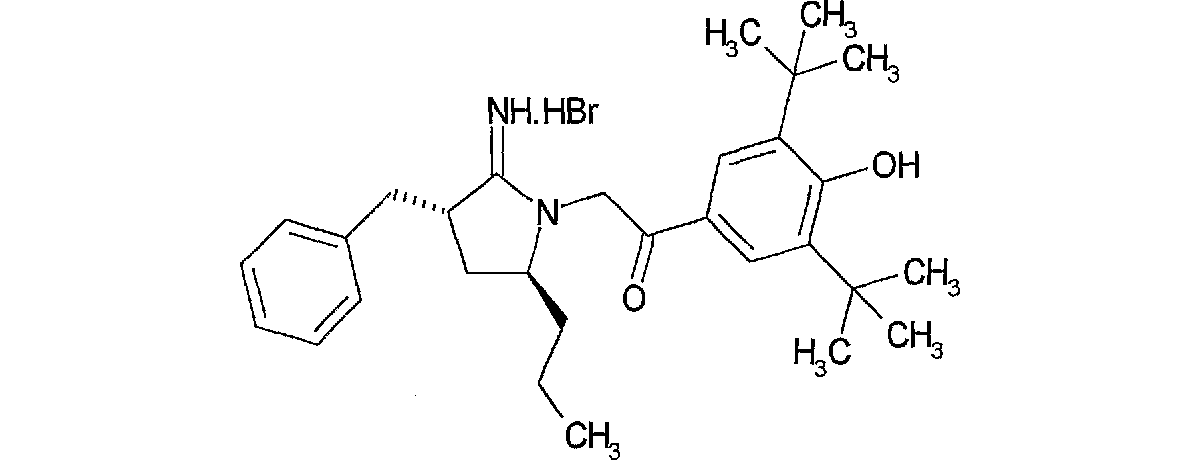
2−((3R,4R)−3−ベンジル−2−イミノ−4−プロピル−ピロリジン−1−イル)−1−(3,5−ジ−第3ブチル 4−ヒドロキシ−フェニル)−エタノン;臭化水素酸塩
1H−NMR(CDCl3)δ(ppm)
0.93(3H,t,J=7.2Hz)1.28−1.50(4H,m)1.52(9H,s)2.14−2.32(2H,m)2.61(1H,dd,J=15.0Hz,7.0Hz)3.30(1H,dd,J=10.8Hz,7.2Hz)3.87(1H,dd,J=10.8Hz,8.0Hz)
(工程2)第3ブチル 3−ベンジル−2−オキソ−4−プロピル−1−ピロリジンカルボキシレート
1H−NMR(CDCl3)δ(ppm)
0.80(3H,t,J=7.2Hz)1.10−1.40(4H,m)1.52(9H,s)1.87−1.95(1H,m)2.44−2.52(1H,m)2.90(1H,dd,J=14.4Hz,7.2Hz)3.10(1H,dd,J=14.4Hz,5.2Hz)3.15(1H,dd,J=10.8Hz,8.0Hz)3.71(1H,dd,J=10.8Hz,8.0Hz)7.15−7.33(5H,m)
(工程3)3−ベンジル−4−プロピル−2−ピロリジノン
1H−NMR(CDCl3)δ(ppm)
0.79(3H,t,J=7.2Hz)1.08−1.36(4H,m)2.04−2.21(1H,m)2.28−2.40(1H,m)2.81−2.96(2H,m)3.09(1H,dd,J=14.0Hz,4.8Hz)3.29(1H,dd,J=8.4Hz,8.4Hz)5.73(1H,brs)7.15−7.36(5H,m)
(工程4)4−ベンジル−3−プロピル−3,4−ジヒドロ−2H−5−ピロリル メチル エーテル
1H−NMR(CDCl3)δ(ppm)
0.75(3H,t,J=7.2Hz)1.02−1.28(4H,m)2.02−2.16(1H,m)2.55−2.66(1H,m)2.69(1H,dd,J=13.2Hz,8.4Hz)2.99(1H,dd,J=13.2Hz,4.8Hz)3.10(1H,dd,J=13.2Hz,5.2Hz)3.58(1H,dd,J=13.2Hz,8.8Hz)3.83(3H,s)7.05−7.40(5H,m)
(工程5)(3−ベンジル−4−プロピルテトラヒドロ−1H−2−ピロリデン )アンモニウム クロリド
1H−NMR(DMSO−d6)δ(ppm)
0.62(3H,t,J=7.2Hz)0.87−1.20(4H,m)2.01−2.15(1H,m)2.72−2.85(1H,m)2.88−2.98(1H,m)3.05−3.25(1H,m)3.50−3.62(1H,m)7.19−7.40(5H,m)
(実施例2:最終工程)
A法
水酸化ナトリウム水溶液で処理した塩基性樹脂DIAION SA10A(14.5g)を水およびメタノールで十分に洗浄後、dl−[(3S,4R)−4−ベンジル−3−プロピル−3,4−ジヒドロ−2H−5−ピロールアミン塩酸塩(1.63g,7.5mmol)のメタノール(30ml)溶液に加え30分撹拌した。樹脂を濾去後、溶媒を減圧留去しdl−[(3S,4R)−4−ベンジル−3−プロピル−3,4−ジヒドロ−2H−5−ピロールアミン(1.45g)を得た。
引き続き、上記dl−[(3S,4R)−4−ベンジル−3−プロピル−3,4−ジヒドロ−2H−5−ピロールアミンおよびフェナシルブロマイド(2.7g,8.3mmol)のエタノール溶液を6時間加熱還流した。溶媒を減圧留去後、エーテルより結晶化し標記化合物(2.54g)を白色アモルファスとして得た。
B法
(3−ベンジル−4−プロピルテトラヒドロ−1H−2−ピロリデン)アンモニウム クロリド(223mg,1.03mmpol)の、1,8−ジアザビシクロ[5,4,0]ウンデ−7−セン(154ul,1.03mmol)のアセトニトリル(10ml)溶液に、氷冷下2−ブロモ−1−[3,5−ジ(第3ブチル)−4−ヒドロキシフェニル]−1−エタノン(405mg,1.03mmol)を加え室温で7時間、更に60℃で3時間攪拌した。溶媒を減圧留去し残渣をシリカゲルカラムクロマトグラフィー(酢酸エチル:メタノール)にて精製し、更に標記化合物107mgを白色アモルファスとして得た。
1H−NMR(DMSO−d6)δ(ppm)
0.61(3H,t,J=7.2Hz),0.85−1.30(5H,m),1.41(18H,s),2.05−2.16(1H,m),2.75−2.88(1H,m),3.02−3.28(2H,m),3.75−3.86(1H,m),5.17(2H,s),7.20−7.42(5H,m),7.73(2H,s),8.05(1H,s),8.94(1H,s),9.41(1H,s).
MS:m/e(ESI)463.2(MH+)
<実施例3>
N−{3−第3ブチル 2−ヒドロキシ−5−[2−((3S,4S)−2−イミノ−3−フェニル−4−プロピル−ピロリジン−1−イル)−アセチル]−フェニル}−N−メチル−メタンスルフォンアミド;臭化水素酸塩
この油状物(13.27g,61mmol)のジメチルスルフォキシド(80ml)溶液に無水炭酸カリウム(4.21g,30mmol)を加え、90℃に加熱した。撹拌下ニトロメタン(4.95ml,91mmol)のジメチルスルフォキシド(40ml)溶液を40分かけて滴下した。3時間攪拌後、反応液を酢酸水溶液に注ぎ、酢酸エチルで抽出した。有機層を1N−塩酸、飽和炭酸ナトリウム水溶液、飽和食塩水で洗浄後、無水硫酸マグネシウムで乾燥し溶媒を減圧留去した。残渣をシリカゲルカラムクロマトグラフィー(溶媒:n−ヘキサン−酢酸エチル)にて精製し黄色油状物6.40gを得た。
この油状物(12.3g,44mmol)のエタノール(200ml)溶液に酸化白金(1.2g)を加え水素気流下室温で15時間攪拌した。反応液を濾過後、溶媒を減圧留去し、残渣を110℃で1時間加熱した。残渣に水を加え酢酸エチルで抽出した。有機層を1N−塩酸、飽和炭酸ナトリウム水溶液、飽和食塩水で洗浄後、無水硫酸マグネシウムで乾燥し溶媒を減圧留去した。残渣をシリカゲルカラムクロマトグラフィー(溶媒:n−ヘキサン−酢酸エチル)にて精製し白色固体5.95gを得た。
この固体(5.95g,29mmol)の塩化メチレン(100ml)溶液にトリメチルオキソニウムテトラフルオロボーレート(5.2g,35mmol)を加え室温で15時間攪拌した。反応液に飽和重曹水溶液を加え、クロロホルムで抽出した。有機層を無水硫酸マグネシウムで乾燥後、減圧留去した。残渣を酢酸エチルに溶解しアルミナ−シリカゲルで濾過後、減圧留去し、淡黄色油状物6.91gを得た。
この油状物(6.31g,29mmol)のメタノール(60ml)溶液に塩化アンモニウム(1.56g,29mmol)を加え21時間加熱還流した。反応液を減圧留去し、残渣に酢酸エチルを加え析出物を濾取し標記化合物5.40gを粗生成物として白色固体として得た。
1H−NMR(DMSO−d6)δ(ppm)
0.77(3H,t,J=7.2Hz)1.09−1.25(2H,m)1.35−1.47(2H,m)2.39(1H,m)3.26(1H,m)3.77(1H,dd,J=10.8Hz,8.8Hz)3.96(1H,d,J=8.8Hz)7.22−7.44(5H,m)8.52(1H,brs)9.05(1H,brs)
(実施例3:最終工程)
[(3S,4R)−3−フェニル−4−プロピルテトラヒドロ−1H−2−ピロリリデン]アンモニウム クロリド(800mg,3.5mmol)、1,8−ジアザビシクロ[5.4.0]ウンデ−7−セン(0.52ml,3.5mmol)のアセトニトリル(10ml)溶液に、フェナシルブロマイド(1.32g,3.5mmol)を加え60℃で9時間攪拌した。反応を減圧留去し残渣をシリカゲルカラムクロマトグラフィー(溶媒:酢酸エチル:メタノール)にて精製し、酢酸エチル−ジイソプロピルエーテルで結晶化し目的化合物710mgを微クリーム色粉末として得た。
1H−NMR(DMSO−d6)δ:
0.83(3H,t,J=7.6Hz),1.20−1.33(2H,m),1.40(9H,s),1.47−1.58(2H,m),2.42(1H,m),3.16(3H,s),3.46(1H,m),3.93(1H,m),4.16(1H,d,J=7.2Hz),5.27(2H,s),7.35−7.50(5H,m),7.82(1H,s),7.94(1H,s),8.89(1H,s),9.01(1H,s),10.03(1H,brs).
<実施例4>
1−(3,5−ジ−第3ブチル 4−ヒドロキシ−フェニル)−2−[(3S,4S)−2−イミノ−4−(2−メトキシ−エチル)−3−フェニル−ピロリジン−1−イル]−エタノン;臭化水素酸塩
この油状物(4.17g,14mmol)のジメチルスルフォキシド(15ml)溶液に無水炭酸カリウム(0.93g,6.7mmol)を加え、90℃に加熱した。撹拌下ニトロメタン(1.1ml,20mmol)のジメチルスルフォキシド(10ml)溶液を40分かけて滴下した。3時間攪拌後、反応液を1N−塩酸に注ぎ、酢酸エチルで抽出した。有機層を水、飽和炭酸ナトリウム水溶液、飽和食塩水で洗浄後、無水硫酸マグネシウムで乾燥し溶媒を減圧留去した。残渣をシリカゲルカラムクロマトグラフィー(溶媒:n−ヘキサン−酢酸エチル)にて精製し黄色油状物3.07gを得た。
この油状物(3.07g,8.3mmol)のエタノール(50ml)溶液に濃塩酸(6.9ml,83mmol)、亜鉛(2.7g,42mmol)を加え室温で1時間攪拌した。反応液を氷冷し5N−水酸化ナトリウム水溶液(17ml,85mmol)を加え室温で11時間撹拌した。反応液をセライトで濾過後、溶媒を減圧留去し、残渣を120℃で1時間加熱した。残渣をシリカゲルカラムクロマトグラフィー(溶媒:n−ヘキサン−酢酸エチル)にて精製し微黄色油状物1.03gを得た。
この微黄色油状物(1.03g,3.5mmol)のメタノール(20ml)溶液に10%パラジウム炭素(1.0g)、ギ酸アンモニウム(1.1g,18mmol)を加え6時間加熱還流した。反応液を濾過し、減圧留去した。残渣をシリカゲルカラムクロマトグラフィー(溶媒:酢酸エチル−メタノール)にて精製し白色固体669mgを得た。
この固体(600mg,2.9mmol)の塩化メチレン(10ml)溶液にトリメチルオキソニウムテトラフルオロボーレート(1.1g,7.0mmol)を加え室温で15時間攪拌した。反応液を飽和重曹水溶液に注ぎ、クロロホルムで抽出した。有機層を無水硫酸マグネシウムで乾燥後、減圧留去した。残渣をシリカゲルカラムクロマトグラフィー(溶媒:n−ヘキサン−酢酸エチル)にて精製し無色油状物515mgを得た。
この油状物(515mg,2.2mmol)のメタノール(5ml)溶液に塩化アンモニウム(118mg,2.2mmol)を加え21時間加熱還流した。反応液を減圧留去し、残渣に酢酸エチルを加え析出物を濾取し標記化合物471mgを粗生成物として白色粉末として得た。
1H−NMR(DMSO−d6)δ(ppm)
1.62−1.78(2H,m)2.42−2.56(1H and DMSO,m)3.11(3H,s)3.18−3.42(3H and H20,m)3.78(1H,dd,J=10.8Hz,8.8Hz)4.04(1H,d,J=8.8Hz)7.26−7.32(2H,m)7.34−7.45(3H,m)
(実施例4:最終工程)
[(3S,4R)−4−(2−メトキシエチル)−3−フェニルテトラヒドロ−1H−2−ピロリリデン]アンモニウム クロリド(300mg,1.3mmol)、1,8−ジアザビシクロ[5.4.0]ウンデ−7−セン(0.19ml,1.3mmol)のアセトニトリル(5ml)溶液に、フェナシルブロマイド(408mg,1.3mmol)を加え60℃で5時間攪拌した。反応を減圧留去し残渣をシリカゲルカラムクロマトグラフィー(溶媒:酢酸エチル:メタノール)にて精製し、酢酸エチル−ジイソプロピルエーテルで結晶化し目的化合物273mgを微クリーム色粉末として得た。
1H−NMR(DMSO−d6)δ:
1.43(18H,s),1.44−1.60(2H,m),2.55(1H,m),3.15(3H,s),3.24−3.42(3H,m),3.51(1H,dd,J=6.8,10.4Hz),3.90(1H,dd,J=7.6,10.4Hz),4.24(2H,d,J=7.2Hz),5.30(2H,s),7.36−7.50(5H,m),7.78(2H,s),8.07(1H,brs),8.86(1H,brs),8.96(1H,brs).
<実施例5>
1−(3,5−ジ−第3ブチル 4−ヒドロキシ−フェニル)−2−[(3S,4S)−2−イミノ−4−(3−メトキシ−プロピル)−3−フェニル−ピロリジン−1−イル]−エタノン;臭化水素酸塩
この油状物(4.05g,12.5mmol)のジメチルスルフォキシド(15ml)溶液に無水炭酸カリウム(0.86g,6.3mmol)を加え、80℃に加熱した。撹拌下ニトロメタン(1.0ml,19mmol)のジメチルスルフォキシド(15ml)溶液を55分かけて滴下した。2時間30分攪拌後、反応液を1N−塩酸に注ぎ、酢酸エチルで抽出した。有機層を水、飽和炭酸ナトリウム水溶液、飽和食塩水で洗浄後、無水硫酸マグネシウムで乾燥し溶媒を減圧留去した。残渣をシリカゲルカラムクロマトグラフィー(溶媒:n−ヘキサン−酢酸エチル)にて精製し淡黄色油状物2.04gを得た。
この油状物(2.04g,5.5mmol)のエタノール(35ml)溶液に濃塩酸(4.6ml,55mmol)、亜鉛(1.8g,28mmol)を加え室温で20分撹拌後、60℃で1時間攪拌した。反応液を氷冷し5N−水酸化ナトリウム水溶液(12ml,60mmol)を加え室温で15分撹拌した。反応液をセライトで濾過後、溶媒を減圧留去し、残渣を110℃で1時間加熱した。残渣をシリカゲルカラムクロマトグラフィー(溶媒:n−ヘキサン−酢酸エチル)にて精製し微黄色油状物1.03gを得た。
この微黄色油状物(1.03g,3.3mmol)のメタノール(20ml)溶液に10%パラジウム炭素(1.0g)、ギ酸アンモニウム(1.05g,17mmol)を加え6時間加熱還流した。反応液を濾過し、減圧留去した。残渣をシリカゲルカラムクロマトグラフィー(溶媒:酢酸エチル−メタノール)にて精製し白色固体649mgを得た。
この固体(600mg,2.7mmol)の塩化メチレン(10ml)溶液にトリメチルオキソニウムテトラフルオロボーレート(973mg,6.6mmol)を加え室温で15時間攪拌した。反応液を飽和重曹水溶液に注ぎ、クロロホルムで抽出した。有機層を無水硫酸マグネシウムで乾燥後、減圧留去した。残渣をシリカゲルカラムクロマトグラフィー(溶媒:n−ヘキサン−酢酸エチル)にて精製し無色油状物503mgを得た。
この油状物(503mg,2.0mmol)のメタノール(5ml)溶液に塩化アンモニウム(109mg,2.0mmol)を加え19時間加熱還流した。反応液を減圧留去し、残渣に酢酸エチルを加え析出物を濾取し標記化合物410mgを粗生成物として白色粉末として得た。
1H−NMR(DMSO−d6)δ(ppm)
1.32−1.54(4H,m)2.41(1H,m)3.15(3H,s)3.22(2H,t,J=6.0Hz)3.27(1H,dd,J=10.8Hz,8.0Hz)3.80(1H,dd,J=10.8Hz,8.8Hz)3.99(1H,d,J=8.8Hz)7.27−7.31(2H,m)7.34−7.45(3H,m)
(実施例5:最終工程)
[(3S,4R)−4−(3−メトキシプルピル)−3−フェニルテトラヒドロ−1H−2−ピロリリデン]アンモニウム クロリド(300mg,1.2mmol)、1,8−ジアザビシクロ[5.4.0]ウンデ−7−セン(0.18ml,1.2mmol)のアセトニトリル(5ml)溶液に、フェナシルブロマイド(386mg,1.2mmol)を加え60℃で5時間攪拌した。反応を減圧留去し残渣をシリカゲルカラムクロマトグラフィー(溶媒:酢酸エチル:メタノール)にて精製し、酢酸エチル−ジイソプロピルエーテルで結晶化し目的化合物273mgを白色綿状結晶として得た。
1H−NMR(DMSO−d6)δ:
1.43(18H,s),1.44−1.62(4H,m),2.42(1H,m),3.18(3H,s),3.26(2H,t,J=6.0Hz),3.36(1H,m),3.46(1H,dd,J=6.0,10.8Hz),3.92(1H,dd,J=7.6,10.8Hz),4.16(2H,d,J=7.2Hz),5.29(2H,s),7.36−7.50(5H,m),7.78(2H,s),8.07(1H,brs),8.86(1H,brs),8.96(1H,brs).
<実施例6>
1−(3,5−ジ−第3ブチル 4−ヒドロキシ−フェニル)−2−((3S,4S)−2−イミノ−4−メトキシメチル−3−フェニル−ピロリジン−1−イル)−エタノン;臭化水素酸塩
この油状物(3.89g,13.8mmol)のジメチルスルフォキシド(15ml)溶液に無水炭酸カリウム(0.95g,6.9mmol)を加え、90℃に加熱した。撹拌下ニトロメタン(1.1ml,21mmol)のジメチルスルフォキシド(20ml)溶液を40分かけて滴下した。3時間30分攪拌後、反応液に酢酸(2ml)および水を加え酢酸エチルで抽出した。有機層を1N−塩酸、飽和炭酸ナトリウム水溶液、飽和食塩水で洗浄後、無水硫酸マグネシウムで乾燥し溶媒を減圧留去した。残渣をシリカゲルカラムクロマトグラフィー(溶媒:n−ヘキサン−酢酸エチル)にて精製し微黄色油状物3.28gを得た。
この油状物(3.28g,9.6mmol)のエタノール(65ml)溶液に濃塩酸(8.0ml,96mmol)、亜鉛(5.0g,77mmol)を加え室温で1時間撹拌した。反応液を氷冷し5N−水酸化ナトリウム水溶液(19ml,95mmol)を加え反応液をセライトで濾過後、溶媒を減圧留去した。残渣に水を加え酢酸エチルで抽出した。有機層を1N−塩酸、飽和炭酸ナトリウム水溶液、飽和食塩水で洗浄後、無水硫酸マグネシウムで乾燥し溶媒を減圧留去した。残渣をシリカゲルカラムクロマトグラフィー(溶媒:n−ヘキサン−酢酸エチル)にて精製し標記化合物1.73gを無色油状物として得た。
1H−NMR(CDCl3)δ(ppm)
2.78(1H,m)3.36(1H,dd,J=9.6Hz,8.0Hz)3.47−3.60(4H,m)4.47(1H,d,J=12.0Hz)4.54(1H,d,J=12.0Hz)6.06(1H,brs)7.17−7.21(2H,m)7.24−7.38(8H,m)
(工程2)(3S,4R)−4−(ヒドロキシメチル)−3−フェニルテトラヒドロ−1H−2−ピロロン
1H−NMR(CDCl3)δ(ppm)
1.90(1H,brs)2.69(1H,m)3.32(1H,dd,J=10.0Hz,8.0Hz)3.46(1H,d,J=9.2Hz)3.56(1H,t,J=8.8Hz)3.67(1H,m)3.75(1H,m)6.50(1H,brs)7.19−7.30(3H,m)7.32−7.38(2H,m)
(工程3)[(3S,4R)−4−(メトキシメチル)−3−フェニルテトラヒドロ−1H−2−ピロリリデン]アンモニウム クロリド
この油状物(431mg,2.0mmol)のメタノール(5ml)溶液に塩化アンモニウム(105mg,2.0mmol)を加え5時間加熱還流した。残渣をシリカゲルカラムクロマトグラフィー(溶媒:酢酸エチル:メタノール)にて精製し標記化合物335mgを無色ガラス状固体として得た。
1H−NMR(DMSO−d6)δ(ppm)
2.64(1H,m)3.26(3H,s)3.37−3.46(3H,m)3.83(1H,dd,J=10.2Hz,8.8Hz)4.07(1H,d,J=8.8Hz)7.26−7.30(2H,m)7.33−7.44(3H,m)
(実施例6:最終工程)
[(3S,4R)−4−(メトキシメチル)−3−フェニルテトラヒドロ−1H−2−ピロリリデン]アンモニウム クロリド(333mg,1.5mmol)、1,8−ジアザビシクロ[5.4.0]ウンデ−7−セン(0.22ml,1.5mmol)のアセトニトリル(5ml)溶液に、フェナシルブロマイド(481mg,1.5mmol)を加え60℃で5時間攪拌した。反応を減圧留去し残渣をシリカゲルカラムクロマトグラフィー(溶媒:酢酸エチル:メタノール)にて精製し、酢酸エチル−ジイソプロピルエーテルで結晶化し目的化合物217mgを暗クリーム色粉末として得た。
1H−NMR(DMSO−d6)δ:
1.44(18H,s),2.63(1H,m),3.31(3H,s),3.44−3.64(3H,m),3.96(1H,dd,J=8.0,10.8Hz),4.24(1H,d,J=7.2Hz),5.27(1H,d,J=18.0Hz),5.34(1H,d,J=18.0Hz),7.39(1H,m),7.42−7.52(4H,m),7.78(2H,s),8.07(1H,brs),8.97(1H,m),9.06(1H,brs).
以下の実施例化合物は各種2−イミノピロリジン誘導体と各種2−ブロモ−1−エタノン誘導体から前記実施例1の最終工程と同様の方法で合成した。
実施例7
2−(3−ベンジル−2−イミノ−ピロリジン−1−イル)−1−(3,5−ジ−第3ブチル−4−ヒドロキシ−フェニル)−エタノン;臭化水素酸塩
1.40(18H,s),1.70−2.12(2H,m),2.68−2.81(1H,m),3.17−3.64(4H,m),5.18(2H,s),7.15−7.40(5H,m),7.73(2H,s),7.96−8.08(1H,m),8.90−9.00(1H,m),9.35−9.47(1H,m).
MS:m/e(ESI)421.2(MH+)
実施例8
2−(3−ベンジル−2−イミノ−4−イソブチル−ピロリジン−1−イル)−1−(3,5−ジ−第3ブチル−4−ヒドロキシ−フェニル)−エタノン;臭化水素酸塩
0.43(3H,d,J=6.2Hz),0.65(3H,d,J=6.2Hz),1.00−1.30(3H,m),1.41(18H,s),2.12−2.22(1H,m),2.81(1H,dd,J=10.7,J=13.2Hz),3.01−3.09(1H,m),3.14−3.24(2H,m),3.87(1H,dd,J=8.8,J=10.7Hz),5.16(2H,s),7.21−7.40(5H,m),7.73(2H,s),8.06(1H,s),8.92(1H,s),9.37(1H,s).
MS:m/e(ESI)477.2(MH+)
実施例9
2−(3−ベンジル−4−ブチル−2−イミノ−ピロリジン−1−イル)−1−(3,5−ジ−第3ブチル−4−ヒドロキシ−フェニル)−エタノン;臭化水素酸塩
0.68(3H,t,J=7.2Hz),0.80−1.30(6H,m),1.41(18H,s),2.02−2.15(1H,m),2.78−2.84(1H,dd,J=10.6,J=13.2Hz),3.02−3.09(1H,m),3.16−3.27(2H,m),3.81(1H,dd,J=7.2,J=10.6Hz),5.15(2H,s),7.24−7.38(5H,m),7.73(2H,s),8.90(1H,s),9.35(1H,s).
MS:m/e(ESI)477.2(MH+)
実施例10
2−(3−ベンジル−2−メチルイミノ−4−プロピル−ピロリジン−1−イル)−1−(3,5−ジ−第3ブチル−4−ヒドロキシ−フェニル)−エタノン;臭化水素酸塩
0.64(3H,t,J=7.6Hz),0.92−1.36(4H,m),1.40(18H,s),2.09(1H,dd,J=5.6,J=10.6Hz),2.78(1H,dd,J=10.6Hz,J=12.6Hz),3.03(3H,s),3.13(1H,dd,J=3.6Hz,J=12.6Hz),3.23(1H,d,J=12.6Hz),3.42(1H,dd,J=5.0Hz,J=10.6Hz),3.92(1H,dd,J=5.0Hz,J=10.6Hz),5.15(2H,s),7.24−7.42(5H,m),7.73(2H,s).
MS:m/e(ESI)477.3(MH+)
実施例11
N−{5−[2−(3−ベンジル−2−イミノ−4−プロピル−ピロリジン−1−イル)−アセチル]−3−第3ブチル−2−ヒドロキシ−フェニル}−N−メチル−メタンスルフォンアミド;臭化水素酸塩
0.62(3H,t,J=7.8Hz),0.80−2.20(14H,m),2.82(1H,t,J=10.9Hz),3.00−3.40(9H,m),3.74−3.86(1H,m),5.11(2H,brs),7.20−7.40(5H,m),7.77(1H,brs),7.88(1H,brs),8.97(1H,brs),9.38(1H,brs),10.01(1H,brs).
MS:m/e(ESI)514.3(MH+)
実施例12
1−(3,5−ジ−第3ブチル−4−ヒドロキシ−フェニル)−2−[3−(3−エチル−ペンチル)−2−イミノ−ピロリジン−1−イル]−エタノン;臭化水素酸塩
0.84(6H,t,J=7.2Hz),1.17−1.55(8H,m),1.40(18H,s),1.74−1.90(2H,m),2.23−2.34(1H,m),3.08−3.19(1H,m),3.53−3.70(2H,m),5.16(2H,s),7.72(2H,s),8.04(1H,s),8.76(1H,s),9.10(1H,s).
MS:m/e(ESI)429.3(MH+)
実施例13
2−(3−ベンジル−2−イミノ−4−プロピル−ピロリジン−1−イル)−1−(3,5−ジ−第3ブチル−4−ヒドロキシ−フェニル)−エタノン;臭化水素酸塩
0.69(3H,t,J=7.6Hz),0.82−1.50(5H,m),1.41(18H,s),2.86−3.00(1H,m),3.05−3.20(1H,m),3.41−3.45(1H,m),3.57−3.64(2H,m),5.24(2H,s),7.20−7.42(5H,m),7.74(2H,s).
実施例14
1−(3,5−ジ−第3ブチル−4−ヒドロキシ−フェニル)−2−(3−イミノ−8−オキサ−2−アザ−スピロ[4.5]デシ−2−イル)−エタノン;臭化水素酸塩
1.39(18H,s),1.55−1.77(4H,m),2.88(2H,s),3.37−3.70(6H,m),5.17(2H,s),7.71(2H,s),7.93−8.11(1H,m),8.83(1H,brs),9.30(1H,brs).
MS:m/e(ESI)401.2(MH+)
実施例15
4−ベンジル−1−[2−(3,5−ジ−第3ブチル−4−ヒドロキシ−フェニル)−2−オキソ−エチル]−5−イミノ−ピロリジン−2−カルボン酸 エチルエステル;トリフルオロ酢酸塩
1.14(3H,t,J=7.0Hz),1.43(18H,s),2.05−2.13(1H,m),2.21−2.26(1H,m),2.78(1H,dd,J=11.2Hz,13.2Hz),3.36(1H,dd,J=3.2Hz,10.0Hz),4.02−4.20(2H,m),4.63(1H,dd,J=4.8Hz,8.8Hz),5.17(1H,d,J=18.4Hz),5.32(1H,d,J=18.4Hz),7.23−7.42(5H,m),7.74(2H,s),8.07(1H,s),9.33(1H,s),9.77(1H,s).
実施例16
1−(3,5−ジ−第3ブチル−4−ヒドロキシ−フェニル)−2−(3−イミノ−2−アザ−スピロ[4.5]デシ−2−イル)−エタノン;臭化水素酸塩
1.20−1.65(28H,s),2.77(2H,s),3.44(2H,s),5.15(2H,s),7.72(2H,s),7.92−8.11(1H,m),8.76(1H,brs),9.21(1H,brs).
MS:m/e(ESI)399.2(MH+)
実施例17
N−{1−[2−(3,5−ジ−第3ブチル−4−ヒドロキシ−フェニル)−2−オキソ−エチル]−2−イミノ−ピロリジン−3−イル}−2−エチル−ブチルアミド;臭化水素酸塩
0.80(3H,t,J=7.2Hz),0.83(3H,t,J=7.6Hz),1.40(18H,s),1.41−1.56(m,4H),1.99−2.10(2H,m),2.40−2.46(1H,m),3.55−3.70(2H,m),5.07(1H,q,J=8.0Hz),5.21(2H,s),7.73(2H,s),8.05(1H,br),8.67(1H,d,J=7.6Hz),8.78(1H,br),8.95(1H,br).
実施例18
2−(3−ベンジル−2−イミノ−4,4−ジメチル−ピロリジン−1−イル)−1−(3,5−ジ−第3ブチル−4−ヒドロキシ−フェニル)−エタノン;臭化水素酸塩
0.82(3H.s),1.05(3H.s),1.40(18.s),2.47(2H.s),2.85(1H.m),5.15(2H.s),7.20−7.38(5H.m),7.72(2H.s).
実施例19
1−(3,5−ジ−第3ブチル−4−ヒドロキシ−フェニル)−2−[3−(4−エチル−4−ヒドロキシ−ヘキシル)−2−イミノ−ピロリジン−1−イル]−エタノン;臭化水素酸塩
0.77(6H,t,J=7.2Hz),1.22−1.42(8H,m),1.40(18H,s),1.49−1.56(1H,m),1.71−1.89(2H,m),2.21−2.33(1H,m),3.09−3.19(1H,m),3.53−3.66(1H,m),5.14(s,2H),7.71(2H,s),8.05(1H,br),8.74(1H,br),9.06(1H,br).
実施例20
2−(5−ベンズヒドロキシメチル−3−ベンジル−2−イミノ−ピロリジン−1−イル)−1−(3,5−ジ−第3ブチル−4−ヒドロキシ−フェニル)−エタノン;臭化水素酸塩
1.40(18H,s),1.77−2.00(2H,m),2.70(1H,t,J=12.4Hz),3.40−3.60(2H,m),4.10−4.16(1H,m),5.06(1H,d,J=18.0Hz),5.17(1H,d,J=18.0Hz),5.39(1H,s),7.10−7.40(15H,m),7.69(2H,s),8.04(1H,s),8.97(1H,s),9.40(1H,s).
実施例21
2−(3−ベンジル−5−ヒドロキシメチル−2−イミノ−ピロリジン−1−イル)−1−(3,5−ジ−第3ブチル−4−ヒドロキシ−フェニル)−エタノン;トリフルオロ酢酸塩
1.43(18H,s),1.91(2H,m),2.69(1H,t,J=12.4Hz),3.50(1H,m),3.68(1H,m),3.89(1H,m),4.99(1H,t,J=5.2Hz),5.15(1H,d,J=18.4Hz),5.20(1H,d,J=18.4Hz),7.24−7.40(5H,m),7.77(2H,s),8.07(1H,s),8.94(1H,s),9.35(1H,s).
実施例22
2−[2−(3−ベンジル−2−イミノ−4−プロピル−ピロリジン−1−イル)−アセチルアミノ]−N−第3ブチル−ベンズアミド;臭化水素酸塩
0.53−1.30(7H,m),1.399(9H,s),2.15−2.26(1H,m),2.84(1H,dd,J=13.5,10.5Hz),3.04−3.18(1H,m),3.23−3.39(2H,m),3.86(1H,dd,J=10.5,8.4Hz),4.41(2H,s),7.17(1H,t,J=7.7Hz),7.21−7.39(6H,m),7.49(1H,brt,J=7.7Hz),7.72(1H,d,J=7.7Hz),8.15(1H,s),8.29(1H,brd,J=8.1Hz),11.43(1H,brs).
MS:m/e(ESI)449.2(MH+)
実施例23
1−(3,5−ジ−第3ブチル−4−ヒドロキシ−フェニル)−2−[3−(2−フルオロ−ベンジル)−2−イミノ−4−プロピル−ピロリジン−1−イル]−エタノン;臭化水素酸塩
0.63(3H,t,J=7.2Hz),0.93−1.32(4H,m),1.40(18H,s),2.01−2.12(1H,m),2.93(1H,dd,J=13.2,10.8Hz),3.08−3.15(1H,m),3.19−3.28(2H,m),3.81(1H,dd,J=11.2,7.2Hz),5.14(2H,s),7.20(1H,d,J=7.2Hz),7.24(1H,d,J=8.8Hz),7.35(1H,dd,J=8.2,7.2Hz),7.43(1H,dd,J=8.8,8.2Hz),7.71(2H,s),8.80−9.01(1H,brs),9.30−9.42(1H,brs).
実施例24
2−[3−(2−ベンジルオキシ−エチル)−2−イミノ−ピロリジン−1−イル]−1−(3,5−ジ−第3ブチル−4−ヒドロキシ−フェニル)−エタノン ;臭化水素酸塩
1.39(18H,s),1.75−1.86(1H,m),1.87−1.98(1H,m),2.11−2.32(2H,m),3.24−3.33(1H,m),3.53−3.66(4H,m),4.48(2H,ABq,J=10.0Hz),5.16(2H,s),7.26−7.37(5H,m),7.73(2H,s),8.79(1H,br),9.14(1H,br).
実施例25
1−(3,5−ジ−第3ブチル−4−ヒドロキシ−フェニル)−2−[2−イミノ−3−(2−メトキシ−ベンジル)−4−プロピル−ピロリジン−1−イル]−エタノン;臭化水素酸塩
0.61(3H,t,J=7.2Hz),0.90−1.20(4H,m),1.41(18H,s),2.00−2.12(1H,m),2.80−2.90(1H,m),3.10−3.46(4H,m),3.81(3H,s),5.18(2H,s),6.90−6.96(1H,m),7.22−7.30(2H,m),7.73(2H,s),8.80−8.90(1H,brs),9.24−9.30(1H,brs).
実施例26
2−(4−ベンジル−2−イミノ−3−プロピル−ピロリジン−1−イル)−1−(3,5−ジ−第3ブチル−4−ヒドロキシ−フェニル)−エタノン;臭化水素酸塩
0.79(3H,t,J=7.2Hz),1.12−1.48(2H,m),1.42(18H,s),1.48−1.70(2H,m),2.73−2.86(3H,m),3.25−3.38(3H,m),3.78(1H,dd,J=11.2,7.2Hz),5.15(1H,d,J=14.4Hz),5.20(1H,d,J=14.4Hz),7.20−7.36(3H,m),7.74(2H,s),8.06(1H,s),8.82(1H,brd,J=4.8Hz),9.19(1H,brd,J=4.4Hz).
実施例27
4−ベンジル−1−[2−(3,5−ジ−第3ブチル−4−ヒドロキシ−フェニル)−2−オキソ−エチル]−5−イミノ−ピロリジン−3−カルボン酸 メチルエステル;臭化水素酸塩
1.43(18H,s),2.94(1H,dd,J=13.6,10.8Hz),3.14(1H,quintet,J=4.0Hz),3.27−3.36(1H,m),3.53(3H,s),3.74−3.82(2H,s),3.96(1H,dd,J=11.2,8.4Hz),5.22(1H,d,J=18.0Hz),5.28(1H,d,J=18.0Hz)7.25−7.40(5H,m),7.75(2H,s),8.08(1H,brs),9.26(1H,brs),9.75(1H,brs).
実施例28
1−(3,5−ジ−第3ブチル−4−ヒドロキシ−フェニル)−2−{3−[(2−エチル−ブチル)−メチル−アミノ]−2−イミノ−ピロリジン−1−イル}−エタノン;臭化水素酸塩
0.85(3H,t,J=7.2Hz),0.87(3H,t,J=7.2Hz),1.20−1.48(7H,m),1.43(18H,s),2.29−2.43(2H,m),3.54−3.60(1H,m),3.68−3.75(1H,m),4.18−4.24(1H,m),5.69(1H,d,J=15.9Hz),6.03(1H,d,J=15.9Hz),7.93(2H,s).
実施例29
1−(3,5−ジ−第3ブチル−4−ヒドロキシ−フェニル)−2−[3−(2−エチル−ブチルアミノ)−2−イミノ−ピロリジン−1−イル]−エタノン;2塩酸塩
0.82(3H,t,J=7.2Hz),0.83(3H,t,J=7.2Hz),1.13−1.42(6H,m),1.40(18H,s),1.58−1.64(1H,m),2.03−2.12(1H,m),2.37−2.44(1H,m),2.70−2.78(1H,m),3.07−3.15(1H,m),3.94−3.99(1H,m),5.33(2H,s),7.73(2H,s),8.37(2H,br).
実施例30
N−{1−[2−(3,5−ジ−第3ブチル−4−ヒドロキシ−フェニル)−2−オキソ−エチル]−2−イミノ−ピロリジン−3−イル}−N−(2−エチル−ブチル)−アセトアミド;臭化水素酸塩
0.84(3H,t,J=7.4Hz),0.89(3H,t,J=7.4Hz),1.19−1.48(6H,m),1.39(18H,s),1.49−1.56(1H,m),2.01(3H,s),2.26−2.34(2H,m),3.52−3.69(2H,m),4.67−4.74(1H,m),5.23(2H,s),7.74(2H,s),8.03(1H,br),8.81(1H,br),9.03(1H,br).
実施例31
2−(3−ベンジル−4,4−ジエチル−2−イミノ−ピロリジン−1−イル)−1−(3,5−ジ−第3ブチル−4−ヒドロキシ−フェニル)−エタノン;臭化水素酸塩
1.09(3H.t.J=6.0Hz),1.20(3H.t.J=6.0Hz),1.40(18H.s),1.45−1.60(4H.m),2.91(1H.d.J=10.0Hz),3.12(1H.d.J=10.0Hz),3.32(1H.d.J=10.0Hz),3.58(1H.d.J=10.0Hz),5.23(2H.s),7.25(2H.m),7.30(3H.m),7.83(2H.s).
MS:m/e(ESI)477.2(MH+)
実施例32
2−(3−ベンジル−2−イミノ−5−プロピル−ピロリジン−1−イル)−1−(3,5−ジ−第3ブチル−4−ヒドロキシ−フェニル)−エタノン;臭化水素酸塩
0.82(3H,t,J=7.2Hz),1.00−1.30(3H,m),1.43(18H,s),1.50(1H,td,J=6.8Hz,13.2Hz),1.72(1H,m),2.26(1H,td,J=8.8Hz,13.2Hz),2.78(1H,dd,J=10.4Hz,13.6Hz),3.53(1H,m),3.75(1H,m),5.03(1H,d,J=18.0Hz),5.27(1H,d,J=18.0Hz),7.25−7.40(5H,m),7.78(2H,s),8.06(1H,s),8.91(1H,s),9.30(1H,s).
実施例33
2−(3−ベンジル−2−イミノ−5−プロピル−ピロリジン−1−イル)−1−(3,5−ジ−第3ブチル−4−ヒドロキシ−フェニル)−エタノン;臭化水素酸塩
0.84(3H,t,J=7.2Hz),1.05−1.35(3H,m),1.43(18H,s),1.65−1.85(2H,m),1.98(1H,m),2.75(1H,dd,J=11.2Hz,13.2Hz),3.28(1H,dd,J=4.0Hz,13.2Hz),3.52(1H,m),3.83(1H,m),5.06(1H,d,J=18.4Hz),5.25(1H,d,J=18.4Hz),7.20−7.40(5H,m),7.79(2H,s),8.06(1H,s),8.90(1H,s),9.35(1H,s).
実施例34
2−(4−ベンジル−5−イミノ−2,2−ジメチル−ピロリジン−1−イル)−1−(3,5−ジ−第3ブチル−4−ヒドロキシ−フェニル)−エタノン;臭化水素酸塩
1.21(3H,s),1.22(3H,s),1.44(18H,s),1.74(dd,J=8.0Hz,12.8Hz),1.98(1H,dd,J=8.8Hz,12.8Hz),2.70(1H,dd,J=11.2Hz,13.2Hz),3.45(1H,dd,J=3.6Hz,13.2Hz),3.64(1H,m),5.03(1H,d,J=18.8Hz),5.13(1H,d,J=18.8Hz),7.25−7.40(5H,m),7.81(2H,s),8.04(1H,s),8.78(1H,s),9.16(1H,s).
実施例35
2−(3−ベンジル−2−イミノ−4−メトキシメチル−ピロリジン−1−イル)−1−(3,5−ジ−第3ブチル−4−ヒドロキシ−フェニル)−エタノン;臭化水素酸塩
1.43(18H,s),2.42(1H,m),2.87(1H,m),3.06(3H,s),3.08−3.16(2H,m),3.21−3.37(3H,m)3.76(1H,dd,J=10.8,7.6Hz),5.19(1H,d,J=18.4Hz),7.29(1H,m),7.32−7.40(4H,m),7.76(2H,s),8.07(1H,s),9.12(1H,brd,J=8.0Hz),9.65(1H,brd,J=6.8Hz).
実施例36
2−(4−ベンジル−2−イミノ−ピロリジン−1−イル)−1−(3,5−ジ−第3ブチル−4−ヒドロキシ−フェニル)−エタノン;臭化水素酸塩
1.42(18H,s),2.72(1H,dd,J=17.6,4.8Hz),2.85(1H,m),3.06(1H,dd,J=17.6,7.6Hz),3.40(1H,dd,J=10.4,5.2Hz),3.68(1H,dd,J=10.4,6.8Hz),5.17(2H,s),7.20−7.36(5H,m),7.74(2H,s),8.07(1H,s),8.80(1H,m),9.25(1H,m).
実施例37
4−ベンジル−1−[2−(3,5−ジ−第3ブチル−4−ヒドロキシ−フェニル)−2−オキソ−エチル]−5−イミノ−ピロリジン−2−カルボン酸 メチルエステル;トリフルオロ酢酸塩
1.43(18H,s),1.89(1H,td,J=4.0Hz,13.6Hz),2.56(1H,td,J=10.0Hz,13.6Hz),2.66(1H,dd,J=10.8Hz,13.6Hz),3.28(1H,dd,J=4.0Hz,13.6Hz),3.61(1H,m),3.68(3H,s),4.58(1H,dd,J=4.0Hz,13.6Hz),5.13(2H,d,J=18.8Hz),5.38(1H,d,J=18.8Hz),7.20−7.40(5H,m),7.73(2H,s),8.08(1H,s),9.41(1H,s),9.93(1H,s).
実施例38
4−ベンジル−1−[2−(3,5−ジ−第3ブチル−4−ヒドロキシ−フェニル)−2−オキソ−エチル]−5−イミノ−ピロリジン−2−カルボン酸 メチルエステル;トリフルオロ酢酸塩
1.43(18H,s),2.11(1H,m),2.24(1H,m),2.78(1H,t,J=12.4Hz),3.60(1H,m),3.64(3H,s),4.64(1H,m),5.17(1H,d,J=18.0Hz),5.33(1H,d,J=18.0Hz),7.20−7.40(5H,m),7.74(2H,s),8.08(1H,s),9.38(1H,s),9.81(1H,s).
実施例39
4−ベンジル−1−[2−(3,5−ジ−第3ブチル−4−ヒドロキシ−フェニル)−2−オキソ−エチル]−5−イミノ−ピロリジン−2−カルボン酸 エチルエステル;トリフルオロ酢酸塩
1.16(3H,t,J=7.2Hz),2.56(1H,m),2.67(1H,dd,J=12.4Hz,12.8Hz),3.27(1H,m),3.59(1H,m),4.04−4.20(2H,m),4.57(1H,dd,J=4.0Hz,10.0Hz),5.13(1H,d,J=18.4Hz),5.35(1H,d,J=18.4Hz),7.20−7.40(5H,m),7.73(2H,s),8.08(1H,s),9.33(1H,s),9.85(1H,s).
実施例40
1−(3,5−ジ−第3ブチル−4−ヒドロキシ−フェニル)−2−(2−イミノ−3−フェニル−ピロリジン−1−イル)−エタノン;臭化水素酸塩
1.42(18H,s),2.03(1H,m),2.67(1H,m),3.72(1H,m),3.81(1H,m),4.51(1H,dd,J=9.6,5.6Hz),5.33(2H,s),7.36(1H,m),7.40−7.51(4H,m),7.77(2H,s),8.07(1H,brs),9.03(1H,brs).
実施例41
1−(3,5−ジ−第3ブチル−4−ヒドロキシ−フェニル)−2−(2−イミノ−4−フェニル−ピロリジン−1−イル)−エタノン;臭化水素酸塩
1.41(18H,s),3.05(1H,dd,J=17.6,7.6Hz),3.46(1H,dd,J=17.6,9.2Hz),3.67(1H,dd,J=10.4,6.4Hz),3.85(1H,m),4.03(1H,dd,J=10.4,8.4Hz),5.26(2H,s),7.29(1H,m),7.33−7.41(4H,m),7.75(2H,s),8.06(1H,brs),9.00(1H,brs),9.45(1H,brs).
実施例42
N−{1−[2−(3,5−ジ−第3ブチル−4−ヒドロキシ−フェニル)−2−オキソ−エチル]−2−イミノ−ピロリジン−3−イルメチル}−イソブチルアミド;臭化水素酸塩
1.02(6H,t,J=6.8Hz),1.40(18H,s),1.89−1.98(1H,m),2.16−2.26(1H,m),2.41(1H,sept,J=6.8Hz),3.30−3.38(2H,m),3.48−3.62(3H,m),5.17(2H,s),7.72(2H,s),7.99−8.09(2H,m),8.83(1H,br),9.26(1H,br).
実施例43
2−{3−[2−(1−アセチル−ピペリジン−4−イル)−エチル]−2−イミノ−ピロリジン−1−イル}−1−(3,5−ジ−第3ブチル−4−ヒドロキシ−フェニル)−エタノン;臭化水素酸塩
0.88−0.97(1H,m),0.90−0.99(1H,m),1.27−1.33(1H,m),1.34−1.55(5H,m),1.39(18H,s),1.61−1.74(1H,m),1.80−1.90(1H,m),1.96(3H,s),2.93−3.03(1H,m),3.10−3.19(1H,m),3.52−3.64(2H,m),3.72−3.82(1H,m),4.31−4.38(1H,m),5.24(2H,s),7.72(2H,s),8.75(1H,br),9.09(1H,br).
実施例44
2−(4−ベンジル−5−イミノ−2,2−ジメチル−2,5−ジヒドロ−ピロール−1−イル)−1−(3,5−ジ−第3ブチル−4−ヒドロキシ−フェニル)−エタノン;臭化水素酸塩
1.03(3H,t,J=7Hz),1.37(6H,s),1.48(18H,s),1.55−1.62(2H,m),2.40(2H,m),3.80(2H,s),5.77(2H,s),5.80(brs,1H),7.15(2H,d,J=7Hz),7.28−7.39(3H,m),7.93(2H,s).
MS:m/e(ESI)489.3(MH+)
実施例45
2−(3−ベンジル−4−第3ブトキシメチル−2−イミノ−ピロリジン−1−イル)−1−(3,5−ジ−第3ブチル−4−ヒドロキシ−フェニル)−エタノン;臭化水素酸塩
1.00(9H,s),1.43(18H,s),2.30(1H,m),2.86(1H,dd,J=14.4,11.2Hz),3.01−3.16(2H,m),3.19−3.40(3H,m),3.74(1H,dd,J=10.4,8.0Hz),5.17(2H,s),7.24−7.42(5H,m),7.75(2H,s),8.07(1H,s),8.94(1H,brs),9.40(1H,brm).
実施例46
2−(3−ベンジル−4−ヒドロキシメチル−2−イミノ−ピロリジン−1−イル)−1−(3,5−ジ−第3ブチル−4−ヒドロキシ−フェニル)−エタノン;臭化水素酸塩
1.43(18H,s),2.25(1H,m),2.88(1H,dd,J=14.8,11.2Hz),3.13−3.27(4H,m),3.41(1H,dd,J=10.8,8.0Hz),3.72(1H,dd,J=11.2,8.0Hz),5.17(2H,s),7.26−7.40(5H,m),7.75(2H,s),8.08(1H,s),8.91(1H,brm),9.40(1H,brm).
実施例47
1−(3,5−ジ−第3ブチル−4−ヒドロキシ−フェニル)−2−[2−イミノ−3−(2−ピペリジン−4−イル−エチル)−ピロリジン−1−イル]−エタノン;2臭化水素酸塩
1.18−1.38(6H,m),1.45−1.58(2H,m),1.76−1.91(4H,m),2.22−2.32(1H,m),2.85(2H,brt,J=11.2Hz),3.12−3.21(1H,m),3.54−3.65(2H,m),5.18(2H,s),7.72(2H,s),8.06(1H,br),8.79(1H,br),9.14(1H,br).
実施例48
2−(3−ベンジル−5−ヒドロキシメチル−2−イミノ−ピロリジン−1−イル)−1−(3,5−ジ−第3ブチル−4−ヒドロキシ−フェニル)−エタノン;臭化水素酸塩
1.40(18H,s),1.88(1H,m),2.03(1H,dd,J=6.0Hz,13.2Hz),2.90(1H,dd,J=10.8Hz,13.2Hz),3.12(1H,dd,J=4.0Hz,13.2Hz),3.40(1H,m),3.81(2H,t,J=10.4Hz),3.98(1H,m),4.68(1H,d,J=10.4Hz),5.15(1H,d,J=18.4Hz),5.31(1H,d,J=18.4Hz),7.25−7.40(5H,m)7.78(2H,s).
実施例49
2−(3−ベンジリデン−2−イミノ−ピロリジン−1−イル)−1−(3,5−ジ−第3ブチル−4−ヒドロキシ−フェニル)−エタノン;塩酸塩
1.41(18H,s),3.20−3.26(2H,m),3.77(2H,t,J=6.8Hz),5.32(2H,s),7.46−7.60(5H,m),7.65−7.68(1H,brs),7.75(2H,s),8.74−8.88(1H,brs),9.20−9.32(1H,brs).
実施例50
1−(3,5−ジ−第3ブチル−4−ヒドロキシ−フェニル)−2−(2−イミノ−3−フェニル−4−プロピル−ピロリジン−1−イル)−エタノン;塩酸塩
0.84(3H,t,J=7.6Hz),1.20−1.32(2H,m),1.44(18H,s),1.46−1.58(2H,m),2.42(1H,m),3.45(1H,dd,J=6.8,10.8Hz),3.92(1H,dd,J=8.4,10.8Hz),4.15(1H,d,J=6.8Hz),5.30(2H,s),7.36−7.50(5H,m),7.78(2H,s),8.08(1H,brs),8.86(1H,brs),8.95(1H,brs).
実施例51
N−(2−{1−[2−(3,5−ジ−第3ブチル−4−ヒドロキシ−フェニル)−2−オキソ−エチル]−2−イミノ−ピロリジン−3−イル}−エチル)−アセトアミド;臭化水素酸塩
1.40(18H,s),1.80−2.00(2H,br),1.89(3H,s),2.16−2.40(2H,m),3.10−3.18(1H,m),3.32−3.41(1H,m),3.45−3.58(2H,m),3.68−3.80(1H,m),5.05(1H,d,J=18.2Hz),5.75(1H,d,J=18.2Hz),5.79(1H,s),7.79(2H,s).
MS:m/e(ESI)416.2(MH+)
実施例52
1−(3,5−ジ−第3ブチル−4−ヒドロキシ−フェニル)−2−[1−(3−エチル−ペンチル)−2−イミノ−ピロリジン−3−イル]−エタノン;塩酸塩
0.86(6H,t,J=7Hz),1.23−1.60(7H,m),1.93(1H,m),2.46(1H,m),3.47−3.56(3H,m),3.64−3.77(3H,m),3.83(1H,td,J=10,6Hz),1.45(18H,s),5.80(1Hs),7.80(2H,s),9.03(1H,s),9.66(1H,s).
MS:m/e(ESI)429.3(MH+)
実施例53
2−(5−ベンジル−2−イミノ−3−プロピル−ピロリジン−1−イル)−1−(3,5−ジ−第3ブチル−4−ヒドロキシ−フェニル)−エタノン;臭化水素酸塩
0.90(3H,t,J=7.2Hz),1.10−1.40(3H,m),1.44(18H,s),1.58(1H,m),1.80(1H,m),2.22(1H,m),2.61(1H,dd,J=6.4Hz,13.2Hz),3.10(1H,m),3.18(1H,dd,J=4.0Hz,13.2Hz),4.11(1H,m),5.18(1H,d,J=18.8Hz),5.34(1H,d,J=18.8Hz),7.20−7.35(5H,m),7.78(2H,s),8.06(1H,s),8.83(1H,s),9.08(1H,s).
実施例54
2−(5−ベンジル−2−イミノ−3−プロピル−ピロリジン−1−イル)−1−(3,5−ジ−第3ブチル−4−ヒドロキシ−フェニル)−エタノン;臭化水 素酸塩
0.88(3H,t,J=7.2Hz),1.10−1.40(3H,m),1.44(18H,s),1.80(2H,m),2.03(1H,m),2.71(1H,dd,J=9.6Hz,13.2Hz),3.02(1H,m),3.10(1H,dd,J=4.0Hz,13.2Hz),4.10(1H,m),5.18(1H,d,J=18.8Hz),5.28(1H,d,J=18.8Hz),7.20−7.35(5H,m),7.77(2H,s),8.06(1H,s),8.82(1H,s),9.05(1H,s).
実施例55
2−[3−(2−クロロ−ベンジル)−2−イミノ−4−プロピル−ピロリジン−1−イル]−1−(3,5−ジ−第3ブチル−4−ヒドロキシ−フェニル)−エタノン;臭化水素酸塩
0.60(3H,t,J=7.2Hz),0.80−1.26(4H,m),1.41(18H,s),2.06−2.16(1H,m),2.99−3.07(1H,m),3.16−3.38(3H,m),3.84−3.92(1H,m),5.18(2H,s),7.30−7.40(2H,m),7.46−7.52(2H,m),7.73(2H,s),9.25−9.30(1H,brs).
実施例56
2−(4−ベンジル−3−イミノ−5−プロピル−3H−イソキサゾール−2−イル)−1−(3,5−ジ−第3ブチル−4−ヒドロキシ−フェニル)−エタノン;臭化水素酸塩
0.86(3H,t,J=7Hz),1.47(18H,s),1.48−1.60(2H,m),2.43(2H,t,J=7Hz),3.74(2H,s),6.40(2H,s),7.18(2H,d,J=7Hz),7.27(1H,t,J=7Hz),7.35(2H,t,J=7Hz),7.89(2H,s).
MS:m/e(ESI)463.3(MH+)
実施例57
1−(3,5−ジ−第3ブチル−4−ヒドロキシ−フェニル)−2−(2−イミノ−4−プロピル−3−チオフェン−3−イルメチル−ピロリジン−1−イル)−エタノン;臭化水素酸塩
0.71(3H,t,J=6.0Hz),1.10(2H,m),1.33(1H,m),1.40(18H,s),1.60(2H,m),3.20(2H,m),3.65(1H,m),5.36(1H,d,J=14.0Hz),5.47(1H,d,J=14.0Hz),7.05(1H,d,J=4.5Hz),7.09(1H,brs),7.20(1H,d,J=4.5Hz),7.80(2H,s).
MS:m/e(ESI)469.2(MH+)
実施例58
1−(3,5−ジ−第3ブチル−4−ヒドロキシ−フェニル)−2−[2−イミノ−3−(2−イソプロポキシ−エチル)−ピロリジン−1−イル]−エタノン;臭化水素酸塩
1.09(3H,d,J=6.0Hz),1.10(3H,d,J=6.0Hz),1.40(18H,s),1.68−1.75(1H,m),1.89−1.98(1H,m),2.04−2.10(1H,m),2.22−2.31(1H,m),3.20−3.29(1H,m),3.42−3.48(1H,m),3.50−3.66(4H,m),5.15(2H,s),7.71(2H,s),8.05(1H,br),8.77(1H,br),9.09(1H,br).
実施例59
1−(3,5−ジ−第3ブチル−4−ヒドロキシ−フェニル)−2−[2−イミノ−3−(2−ニトロ−ベンジル)−4−プロピル−ピロリジン−1−イル]−エタノン;臭化水素酸塩
0.67(3H,t,J=6.8Hz),0.90−1.35(4H,m),1.48(18H,s),2.20−2.30(1H,m),3.20−3.27(1H,m),3.40−3.55(2H,m),3.60−3.73(1H,m),4.04−4.11(1H,m),5.38(1H,d,J=18Hz),5.73(1H,d,J=18Hz),5.84(1H,s),7.41(1H,t,J=7.4Hz),7.61(1H,t,J=7.4Hz),7.89(2H,s),7.92(1H,d,J=8.0Hz),8.03(1H,d,J=8.0Hz).
MS:m/e(ESI)508.3(MH+)
実施例60
2−[3−(2−アミノ−ベンジル)−2−イミノ−4−プロピル−ピロリジン−1−イル]−1−(3,5−ジ−第3ブチル−4−ヒドロキシ−フェニル)−エタノン;臭化水素酸塩
0.61(3H,t,J=7.2Hz),0.80−1.32(4H,m),1.47(18H,s),2.17−2.26(1H,m),2.58−2.67(1H,m),3.18(1H,dd,J=3.6Hz,J=10.4Hz),3.58−3.78(2H,m),3.92(1H,dd,J=8.0Hz,J=13.6Hz),5.21(1H,d,J=18Hz),5.81(1H,d,J=18Hz),5.84(1H,s),6.59−6.64(2H,m),6.96−7.05(2H,m),7.89(2H,s).
実施例61
1−(3,5−ジ−第3ブチル−4−ヒドロキシ−フェニル)−2−[5−(2−エチル−ブチル)−1−イミノ−3a,6a−ジメチル−ヘキサヒドロ−シクロペンタ[c]ピロール−2−イル]−エタノン;臭化水素酸塩
0.81(6H,t,J=7.2Hz),1.04(1H,q,12.0Hz),1.17−1.32(8H,m),1.40(18H,s),1.92−2.03(1H,m),2.09−2.16(1H,m),2.29−2.36(1H,m),2.81(1H,brt,J=8.4Hz),3.76(1H,dd,J=2.0,11.2Hz),3.59(1H,q,J=9.2Hz),3.79(1H,dd,J=8.4,11.2Hz),5.10(2H,s),7.71(2H,s),8.65(1H,br),9.14(1H,br).
実施例62
1−(3,5−ジ−第3ブチル−4−ヒドロキシ−フェニル)−2−(2−イミノ−4−プロピル−3−チアゾール−2−イルメチル−ピロリジン−1−イル)−エタノン;臭化水素酸塩
0.75(3H,t,J=6.0Hz),1.14(2H,m),1.23(1H,m),1.35(2H,m),1.40(18H,s),3.26(2H,m),3.47(2H,d,J=6.0Hz),3.76(1H,m),5.13(2H,s),7.68(1H,d,J=4.5Hz),7.70(2H,s),7.78(1H,d,J=4.5Hz).
MS:m/e(ESI)470.2(MH+)
実施例63
1−(3,5−ジ−第3ブチル−4−ヒドロキシ−フェニル)−2−(2−イミノ−4−プロピル−3−チオフェン−2−イルメチル−ピロリジン−1−イル)−エタノン;臭化水素酸塩
0.73(3H,t,J=6.0Hz),1.12(2H,m),1.30(3H,m),1.40(18H,s),3.07(2H,m),3.25(2H,d,J=6.0Hz),3.75(1H,m),5.12(2H,s),7.01(2H,m),7.42(1H,d,J=4.5Hz),7.70(2H,s).
MS:m/e(ESI)469.2(MH+)
実施例64
1−(3,5−ジ−第3ブチル−4−ヒドロキシ−フェニル)−2−[3−(4−フルオロ−ベンジル)−2−イミノ−4−プロピル−ピロリジン−1−イル]−エタノン;臭化水素酸塩
0.64(3H,t,J=7.2Hz),0.88−1.35(4H,m),1.40(18H,s),2.05−2.15(1H,m),2.85(1H,dd,J=12.8,10.8Hz),3.00−3.08(1H,m),3.15(1H,dd,J=12.8,,5.1Hz),3.22(1H,dd,J=12.8,4.6Hz),3.81(1H,dd,J=12.8,9.2Hz),5.15(2H,s).
実施例65
1−(3,5−ジ−第3ブチル−4−ヒドロキシ−フェニル)−2−[5−(2−エチル−2−ヒドロキシ−ブチル)−1−イミノ−ヘキサヒドロ−シクロペンタ[c]ピロール−2−イル]−エタノン;臭化水素酸塩
0.76(3H,t,J=6.9HZ),0.77(3H,t,J=6.9Hz),1.09−1.14(1H,m),1.20−1.27(1H,m),1.48−1.61(6H,m),1.92−2.02(1H,m),2.14−2.22(1H,m),2.39−2.48(1H,m),2.73−2.82(1H,m),3.33−3.35(1H,m),3.54(1H,dd,J=8.7,17.4Hz),3.77−3.82(1H,m),5.13(2H,s),7.73(2H,s),8.02(1H,br),8.64(1H,br),9.14(1H,br).
実施例66
1−(3,5−ジ−第3ブチル−4−ヒドロキシ−フェニル)−2−(1−イミノ−5−メトキシ−ヘキサヒドロ−シクロペンタ[c]ピロール−2−イル)−エタノン;臭化水素酸塩
1.39(18H,s),1.76(1H,brd,J=17.0Hz),1.95−2.03(2H,m),2.13(1H,brd,J=14.2Hz),2.87−2.97(1H,br),3.15(3H,s),3.40−3.46(1H,m),3.58−3.66(1H,m),3.83−3.87(2H,m),5.16−5.20(2H,m),7.73(2H,s),8.02(1H,br),8.61(1H,br),9.14(1H,br).
実施例67
1−(3,5−ジ−第3ブチル−4−ヒドロキシ−フェニル)−2−(1−イミノ−5−メトキシ−ヘキサヒドロ−シクロペンタ[c]ピロール−2−イル)−エタノン;臭化水素酸塩
1.39(18H,s),1.61−1.69(1H,m),1.90−2.07(2H,m),2.09−2.19(1H,m),2.90−2.99(1H,br),3.21(3H,s),3.30−3.38(1H,m),3.61−3.70(1H,m),3.85(1H,t,J=8.7Hz),3.93(1H,m),5.22(2H,s),7.71(2H,s),8.04(1H,br),8.72(1H,br),9.23(1H,br).
実施例68
2−[2−(3,5−ジ−第3ブチル−4−ヒドロキシ−フェニル)−2−オキソ−エチル]−1−イミノ−6−フェニル−ヘキサヒドロ−シクロペンタ[c]ピロール−5−オン;臭化水素酸塩
1.38(18H,s),1.84−1.93(1H,m),2.55(1H,dd,J=4.6,18.4Hz),2.82(1H,dd,J=9.2,20.0Hz),3.63(1H,dd,J=4.5,10.8Hz),3.88(1H,d,=6.0Hz),3.95−4.40(2H,m),5.21(2H,s),7.25−7.43(5H,m),7.74(2H,s),9.25(1H,br),9.50(1H,br).
実施例69
1−(3,5−ジ−第3ブチル−4−ヒドロキシ−フェニル)−2−[2−イミノ−3−(3−イソプロポキシ−ベンジル)−5−プロピル−ピロリジン−1−イル]−エタノン;臭化水素酸塩
0.82(3H,t,J=7.2Hz),1.00−1.40(3H,m),1.27(6H,d,J=6Hz),1.43(18H,s),1.52(1H,m),1,71(1H,m),2.27(1H,m),2.75(1H,dd,J=10.4Hz,13.2Hz),3.30(1H,m),3.53(1H,m),3.74(1H,m),4.69(1H,m),5.02(1H,d,J=19.2H),5.26(1H,d,J=19.2Hz),6.82(2H,m),6.86(1H,s),7.25(1H,t,J=7.6Hz),7.78(2H,s),8.06(1H,s),8.89(1H,s),9.26(1H,s).
実施例70
1−(3,5−ジ−第3ブチル−4−ヒドロキシ−フェニル)−2−[2−イミノ−3−(3−イソプロポキシ−ベンジル)−5−プロピル−ピロリジン−1−イル]−エタノン;塩酸塩
0.84(3H,t,J=7.2Hz),1.00−1.40(3H,m),1.27(6H,d,J=6.0Hz),1.43(18H,s),1.72(1H,m),1.79(1H,m),2.00(1H,m),2.73(1H,t,J=12.0Hz),3.21(1H,m),3.52(1H,m),3.81(1H,m),4.63(1H,m),5.05(1H,d,J=18.8Hz),5.25(1H,d,J=18.8Hz),6.82(1H,d,J=7.6Hz),6.87(1H,d,J=7.6Hz),6.89(1H,s),7.25(1H,t,J=7.6Hz),7.78(2H,s),8.06(1H,s),8.88(1H,s),9.30(1H,s).
実施例71
1−(3,5−ジ−第3ブチル−4−ヒドロキシ−フェニル)−2−[2−イミノ−3−(4−イソプロポキシ−ベンジル)−5−プロピル−ピロリジン−1−イル]−エタノン;臭化水素酸塩
0.81(3H,t,J=7.2Hz),1.00−1.40(3H,m),1.26(6H,d,J=6Hz),1.43(18H,s),1.51(1H,m),1,70(1H,m),2.26(1H,m),2.73(1H,dd,J=10.0Hz,13.6Hz),3.24(1H,m),3.47(1H,m),3.74(1H,m),4.59(1H,m),5.01(1H,d,J=18.4H),5.26(1H,d,J=18.4Hz),6.89(2H,d,J=7.2Hz),7.18(1H,d,J=7.2Hz),7.78(2H,s),8.06(1H,s),8.87(1H,s),9.26(1H,s).
実施例72
1−(3,5−ジ−第3ブチル−4−ヒドロキシ−フェニル)−2−[2−イミ ノ−3−(4−イソプロポキシ−ベンジル)−5−プロピル−ピロリジン−1−イル]−エタノン;臭化水素酸塩
0.84(3H,t,J=7.2Hz),1.00−1.40(3H,m),1.26(6H,d,J=6.0Hz),1.43(18H,s),1.71(1H,m),1.77(1H,m),1.98(1H,m),2.68(1H,dd,J=10.8Hz,13.2Hz),3.18(1H,dd,J=3.6Hz,13.2Hz),3.45(1H,m),3.81(1H,m),4.59(1H,m),5.04(1H,d,J=18.8Hz),5.23(1H,d,J=18.8Hz),6.89(2H,d,J=8.4Hz),7.22(2H,d,J=8.4Hz),7.78(2H,s),8.05(1H,s),8.87(1H,s),9.30(1H,s).
実施例73
2−[3−ベンジル−2−イミノ−4−(2−メトキシ−エチル)−ピロリジン−1−イル]−1−(3,5−ジ−第3ブチル−4−ヒドロキシ−フェニル)−エタノン;臭化水素酸塩
1.43(18H,s),1.44−1.60(2H,m),2.25(1H,m),2.87(1H,dd,J=11.2,14.4Hz),3.01(3H,s),3.02−3.25(5H,m),3.82(1H,dd,J=7.6,11.6Hz),5.19(2H,s),7.25−7.40(5H,m),7.75(2H,s),8.06(1H,brs),8.96(1H,brs),9.43(1H,brs).
実施例74
2−(3−ベンジル−4−エトキシメチル−2−イミノ−ピロリジン−1−イル)−1−(3,5−ジ−第3ブチル−4−ヒドロキシ−フェニル)−エタノン;臭化水素酸塩
0.98(3H,t,J=6.8Hz),1.43(18H,s),1.44−1.60(2H,m),2.44(1H,m),2.88(1H,dd,J=10.4,14.4Hz),3.10−3.40(7H,m),3.76(1H,dd,J=7.6,10.8Hz),5.15(1H,d,J=18.0Hz),5.20(1H,d,J=18.0Hz),7.25−7.40(5H,m),7.75(2H,s),8.06(1H,brs),8.96(1H,brs),9.42(1H,brs).
実施例75
2−(4−ベンジル−3−イミノ−2−アザ−スピロ[4.4]ノナ−2−イル)−1−(3,5−ジ−第3ブチル−4−ヒドロキシ−フェニル)−エタノン;臭化水素酸塩
1.40(18H,s),1.35−1.55(8H,m),3.03(2H,brs),3.25(2H,m),3.57(1H,d,J=8.0Hz),5.13(2H,s),7.23(1H,m),7.32(2H,t,J=8.0Hz),7.38(2H,d,J=8.0Hz),7.72(2H,s).
実施例76
1−(3,5−ジ−第3ブチル−4−ヒドロキシ−フェニル)−2−[1−イミノ−5−(4−ニトロ−フェノキシ)−ヘキサヒドロ−シクロペンタ[c]ピロール−2−イル]−エタノン;臭化水素酸塩
1.39(18H,s),1.91−2.01(1H,m),2.19−2.27(2H,m),2.32−2.36(1H,m),3.08−3.14(1H,m),3.43(1H,dd,J=2.0,8.4Hz),3.42−3.53(2H,m),5.17(2H,s),5.22(1H,brs),7.16(2H,d,J=12.4Hz),7.73(2H,s),8.05(1H,br),8.22(2H,d,J=12.0Hz),8.78(1H,brs),9.27(1H,brs).
実施例77
2−[5−(4−アミノ−フェノキシ)−1−イミノ−ヘキサヒドロ−シクロペンタ[c]ピロール−2−イル]−1−(3,5−ジ−第3ブチル−4−ヒドロキシ−フェニル)−エタノン;臭化水素酸塩
1.31(18H,s),1.76−1.84(1H,m),2.01−2.14(2H,m),2.16−2.28(1H,m),2.89−3.06(2H,m),3.51−3.58(1H,m),3.65−3.74(1H,m),3.82−3.90(1H,m),4.83(2H,s),6.49(2H,d,J=8.8Hz),6.66(2H,d,J=8.8Hz),7.14(2H,s),7.40(2H,br).
実施例78
N−(4−{2−[2−(3,5−ジ−第3ブチル−4−ヒドロキシ−フェニル)−2−オキソ−エチル]−1−イミノ−オクタヒドロ−シクロペンタ[c]ピロール−5−イルオキシ}−フェニル)−アセトアミド;臭化水素酸塩
1.39(18H,s),1.82−1.91(1H,m),2.09−2.18(2H,m),2.46−2.34(1H,m),3.05−3.12(1H,m),3.40(1H,dd,J=2.4,12.0Hz),3.77(1H,dd,J=10.0,12.4Hz),3.88(1H,dd,J=6.8,12.0Hz),4.94(1H,br),5.14(2H,s),6.87(2H,d,J=12.4Hz),7.46(2H,d,J=11.6Hz),7.72(2H,s),8.75(1H,br),9.23(1H,br),9.80(1H,br).
実施例79
1−(3,5−ジ−第3ブチル−4−ヒドロキシ−フェニル)−2−(2−イミノ−3−イソプロピル−4−プロピル−ピロリジン−1−イル)−エタノン;臭化水素酸塩
0.92(3H,t,J=6.8Hz),0.98(3H,d,J=6.4Hz),1.04(3H,d,J=6.4Hz),1.23−1.42(3H,m),1.42(18H,s),2.20−2.36(2H,m),2.73(1H,brs),3.30(1H,d,J=11.2Hz),3.60(1H,m),3.79(1H,dd,J=8.0,10.4Hz),5.16(1H,d,J=18.4Hz),5.22(1H,d,J=18.4Hz),7.74(2H,s),8.05(1H,brs),8.80(1H,brs),9.10(1H,brs).
実施例80
1−(3,5−ジ−第3ブチル−4−ヒドロキシ−フェニル)−2−(2−イミノ−3−イソプロピル−4−プロピル−ピロリジン−1−イル)−エタノン;臭化水素酸塩
0.92(3H,t,J=7.2Hz),1.05(3H,d,J=6.8Hz),1.11(3H,d,J=6.8Hz),1.23−1.34(2H,m),1.42(18H,s),1.55(1H,m),2.20−2.36(2H,m),2.17(1H,m),2.68(1H,m),2.96(1H,dd,J=3.2,8.8Hz),3.44(1H,t,J=10.0Hz),3.55−3.64(2H,m),5.18(1H,d,J=18.0Hz),5.24(1H,d,J=18.0Hz),7.75(2H,s),8.04(1H,brs),8.86(1H,brs),8.96(1H,brs).
実施例81
2−(3−ベンジリデン−2−イミノ−4−プロピル−ピロリジン−1−イル)−1−(3,5−ジ−第3ブチル−4−ヒドロキシ−フェニル)−エタノン;臭化水素酸塩
0.85(3H,t,J=7.2Hz),1.20−1.55(4H,m),1.41(18H,s),3.49(1H,d,J=10.6Hz),3.70−3.80(1H,m),3.90(1H,dd,J=10.6,6.8Hz),5.27(1H,d,J=18.0Hz),5.34(1H,d,J=18.0Hz),7.46(1H,dd,J=7.2,7.2Hz),7.52(2H,t,J=7.2Hz),7.59(2H,t,J=7.2Hz),7.64(1H,brs),7.75(2H,s).
実施例82
2−(3−ベンジル−2−イミノ−5−メトキシメチル−ピロリジン−1−イル)−1−(3,5−ジ−第3ブチル−4−ヒドロキシ−フェニル)−エタノン;臭化水素酸塩
1.43(18H,s),1.83(1H,m),1.97(1H,m),2.71(1H,t,J=12.0Hz),3.15(3H,s),3.36(2H,m),3.52(2H,m),4.04(1H,m),5.08(1H,d,J=17.6Hz),5.20(1H,d,J=17.6Hz),7.25−7.40(5H,m),7.76(2H,s),8.05(1H,s),8.99(1H,s),9.40(1H,s).
実施例83
4−ベンジル−1−[2−(3,5−ジ−第3ブチル−4−ヒドロキシ−フェニル)−2−オキソ−エチル]−5−イミノ−ピロリジン−2−カルボン酸 アミド;臭化水素酸塩
1.42(18H,s),1.77(1HX0.5,td,J=4.4,13.6Hz),1.96(1HX0.5,m),2.17(1HX0.5,m),2.45(1HX0.5,m),2.75(1H,m),3.27(1H,m),3.55(1H,m),4.38(1HX0.5,dd,J=4.4,9.2Hz),4.44(1HX0.5,dd,J=4.8,8.4Hz),4.95(1H,d,J=18.8Hz),5.30(1HX0,5,d,J=18.8Hz),5.32(1HX0.5,d,J=18.8Hz),7.20−7.40(5H,m),7.46(1HX0.5,s),7.66(1HX0.5,s),7.73(2HX0.5,s),7.74(2HX0.5,s),8.06(1H,s),9.17(1HX0.5,s),9.19(1HX0.5,s),9.60(1HX0.5,s),9.62(1HX0.5,s).
実施例84
(4−{1−[2−(3,5−ジ−第3ブチル−4−ヒドロキシ−フェニル)−2−オキソ−エチル]−2−イミノ−4−プロピル−ピロリジン−3−イルメチル}−フェニル)−カルバミン酸第3ブチルエステル;臭化水素酸塩
0.67(3H,t,J=6.8Hz),1.12−1.50(4H,m),1.40(18H,s),1.46(9H,s),2.06−2.14(1H,m),2.72−2.82(1H,m),2.97−3.11(2H,m),3.18−3.26(1H,m),3.71−3.84(1H,m),5.14(2H,s),7.18(2H,d,J=8.2Hz),7.41(2H,d,J=8.2Hz),7.71(2H,s),9.35(2H,s).
MS:m/e(ESI)578.3(MH+)
実施例85
2−[3−(4−アミノ−ベンジル)−2−イミノ−4−プロピル−ピロリジン−1−イル]−1−(3,5−ジ−第3ブチル−4−ヒドロキシ−フェニル)−エタノン;2塩酸塩
0.64(3H,t,J=7.2Hz),0.85−1.30(4H,m),1.40(18H,s),2.04−2.13(1H,m),2.85(1H,dd,J=10.6Hz.J=12.8Hz),3.06−3.12(1H,m),3.18−3.28(2H,m),3.83(1H,dd,J=7.6Hz.J=10.6Hz),,5.22(2H,s),7.29(2H,d,J=8.4Hz),7.41(2H,d,J=8.4Hz),7.73(2H,s),8.05(1H,s),9.73(1H,s).
MS:m/e(ESI)478.2(MH+)
実施例86
N−(4−{1−[2−(3,5−ジ−第3ブチル−4−ヒドロキシ−フェニル)−2−オキソ−エチル]−2−イミノ−4−プロピル−ピロリジン−3−イルメチル}−フェニル)−アセトアミド;臭化水素酸塩
0.65(3H,t,J=7.2Hz),0.90−1.30(4H,m),1.40(18H,s),2.02(3H,s),2.06−2.16(1H,m),2.74−2.82(1H,m),3.00−3.18(2H,m),3.20−3.26(1H,m),3.73−3.82(1H,m),5.13(2H,s),7.23(2H,d,J=8.6Hz),7.54(2H,d,J=8.6Hz),7.72(2H,s).
MS:m/e(ESI)520.3(MH+)
実施例87
1−(3,5−ジ−第3ブチル−4−ヒドロキシ−フェニル)−2−(2−イミノ−4−プロピル−3−ピリジン−2−イルメチレン−ピロリジン−1−イル) −エタノン;臭化水素酸塩
0.89(3H,t,J=6.0Hz),1.34−1.40(5H,m),1.40(18H,s),3.50(2H,d,J=10.0Hz),5.30(1H,s).7.42(1H,d,J=8.0Hz),7.60(1H,s).7.71(2H,s),7.92(1H,t,J=8.0Hz),8.73(1H,d,J=8.0Hz).
MS:m/e(ESI)462.2(MH+)
実施例88
5−{1−[2−(3,5−ジ−第3ブチル−4−ヒドロキシ−フェニル)−2−オキソ−エチル]−2−イミノ−4−プロピル−ピロリジン−3−イリデンメチル}−チオフェン−2−カルボン酸 メチルエステル;臭化水素酸塩
0.93(3H,t,J=6.0Hz),1.35−1.60(5H,m),1.40(18H,s),3.54(2H,d,J=10.0Hz),3.85(3H.s),5.28(1H,s),7.47(1H,d,J=4.5Hz),7.73(2H,s),7.86(1H,s),7.88(1H,d,J=4.5Hz).
実施例89
1−(3,5−ジ−第3ブチル−4−ヒドロキシ−フェニル)−2−[(3S,4S)−2−イミノ−3−(2−メトキシ−フェニル)−4−プロピル−ピロリジン−1−イル]−エタノン;臭化水素酸塩
0.84(3H,t,J=7.2Hz),1.20−1.32(2H,m),1.44(18H,s),1.40−1.56(2H,m),2.42(1H,m),3.41(1H,dd,J=6.4,10.8Hz),3.86(3H,s),3.86(1H,m),4.24(1H,d,J=7.2Hz),5.28(2H,s),7.03(1H,t,J=7.6Hz),7.10(1H,d,J=7.6Hz),7.37(1H,d,J=7.6Hz),7.78(2H,s),8.06(1H,brs),8.83(1H,brs),8.87(1H,brs).
実施例90
1−(3,5−ジ−第3ブチル−4−ヒドロキシ−フェニル)−2−[2−イミノ−3−(4−メトキシ−ベンジリデン)−4−プロピル−ピロリジン−1−イル]−エタノン;臭化水素酸塩
0.86(3H,t,J=7.2Hz),1.10−1.50(4H,m),1.29(18H,s),3.30−3.38(1H,m),3.39−3.46(1H,m),3.56−3.65(1H,m),3.81(3H,s),4.88(1H,d,J=17.2Hz),4.95(1H,d,J=17.2Hz),7.07(2H,d,J=8.8Hz),7.34(2H,br),7.51(1H,s),7.52(2H,d,J=8.8Hz).
MS:m/e(ESI)491.2(MH+)
実施例91
1−(3,5−ジ−第3ブチル−4−ヒドロキシ−フェニル)−2−[2−イミノ−3−(2−イソプロポキシ−ベンジリデン)−4−プロピル−ピロリジン−1−イル]−エタノン;臭化水素酸塩
0.74(3H,t,J=7.2Hz),1.10−1.50(4H,m),1.30(6H,t,J=6.0Hz),1.41(18H,s),3.42(1H,dd,J=2.0Hz,J=11.2Hz),3.58−3.69(1H,m),3.87(1H,dd,J=7.6Hz,J=11.2Hz),4.66−4.76(1H,m),5.28(1H,d,J=18.4Hz),5.34(1H,d,J=18.4Hz),7.01(1H,t,J=7.2Hz),7.14(1H,d,J=8.0Hz),7.36−7.44(1H,m),7.54(1H,d,J=6.8Hz),7.76(3H,s),8.71(1H,br),9.34(1H,br).
MS:m/e(ESI)519.2(MH+)
実施例92
1−(3,5−ジ−第3ブチル−4−ヒドロキシ−フェニル)−2−[3−(2,4−ジメトキシ−ベンジリデン)−2−イミノ−4−プロピル−ピロリジン−1−イル]−エタノン;臭化水素酸塩
0.82(3H,t,J=7.2Hz),1.20−1.40(4H,m),1.41(18H,s),3.42(1H,d,J=10.4Hz),3.80−3.85(1H,m),3.55−3.65(1H,m),3.83(3H,s),3.87(3H,s),5.23(1H,d,J=18.0Hz),5.29(1H,d,J=18.0Hz),6.66(1H,d,J=8.8Hz),6.67(1H,s),7.53(1H,d,J=8.8Hz),7.70(1H,s),7.74(2H,s),8.54−8.65(1H,brs),9.15−9.22(1H,brs).
実施例93
1−(3,5−ジ−第3ブチル−4−ヒドロキシ−フェニル)−2−[3−(2−ヒドロキシメチル−ベンジル)−2−イミノ−4−プロピル−ピロリジン−1−イル]−エタノン;臭化水素酸塩
0.58(3H,t,J=7.6Hz),0.80−1.35(4H,m),1.41(18H,s),2.10−2.20(1H,m),2.80(1H,dd,J=12.8,12.8Hz),3.10−3.40(3H,m),3.90(1H,dd,J=10.0,7.2Hz),4.58(2H,s),5.18(2H,s),5.10−5.22(1H,m),7.20−7.32(3H,m),7.40(1H,dd,J=4.8,4.0Hz),7.73(2H,s),8.90−9.00(1H,brs),9.25−9.35(1H,brs).
実施例94
1−(3,5−ジ−第3ブチル−4−ヒドロキシ−フェニル)−2−[(3S,4S)−2−イミノ−3−(4−メトキシ−フェニル)−4−プロピル−ピロリジン−1−イル]−エタノン;臭化水素酸塩
0.83(3H,t,J=7.6Hz),1.15−1.30(2H,m),1.43(18H,s),1.40−1.55(2H,m),2.40(1H,m),3.43(1H,dd,J=8.8,10.4Hz),3.78(3H,s),3.88(1H,dd,J=8.4,10.4Hz),4.08(1H,d,J=7.2Hz),5.27(2H,s),7.02(2H,d,J=8.4Hz),7.34(2H,d,J=8.4Hz),7.77(2H,s),8.07(1H,brs),8.73(1H,brs),8.92(1H,brs).
実施例95
4−(3−ベンジル−2−イミノ−4−プロピル−ピロリジン−1−イルメチル)−2,6−ジ第3ブチル−フェノール;臭化水素酸塩
0.62(3H,t,J=7.2Hz),0.95(2H,m),1.11(2H,m),1.37(18H,s),2.06(1H,m),2.84(1H,dd,J=8.8Hz,13.2Hz),3.05−3.16(3H,m),3.55(1H,dd,J=7.6Hz,11.2Hz),4.52(1H,d,J=19.2Hz),4.55(1H,d,J=19.2Hz),6.98(2H,s),7.22(1H,s),7.20−7.35(5H,m),9.28(1H,s),9.46(1H,s).
実施例96
2−(3−ベンジル−2−イミノ−4−プロピル−ピロリジン−1−イル)−1−(3,5−ジ−第3ブチル−4−ヒドロキシ−フェニル)−エタノン 0−メチル−オキシム;臭化水素酸塩
0.43(3H,t,J=6.8Hz),0.55−0.80(4H,m),1.38(18H,s),1.81(1H,m),2,41(1H,m),2.77(1H,m),2.84(1H,m),2.99(1H,dd,J=3.6,12.8Hz),3.28(1H,m),3.55(1H,dd,J=7.2,10.8Hz),3.94(3H,s),4.71(1H,d,J=16.4Hz),4.83(1H,d,J=16.4Hz),7.15−7.35(7H,m),7.41(1H,s),9.34(1H,s),9.69(1H,s).
実施例97
1−(3,5−ジ−第3ブチル−4−ヒドロキシ−フェニル)−2−[2−イミノ−3−(4−メチル−ベンジリデン)−4−プロピル−ピロリジン−1−イル]−エタノン;臭化水素酸塩
0.86(3H,t,J=7.2Hz),1.20−1.60(4H,m),1.41(18H,s),2.36(3H,s),3.49(1H,d,J=10.6Hz),3.68−3.76(1H,m),3.89(1H,dd,J=6.8Hz,J=10.6Hz),5.28(1H,d,J=18.4Hz),5.34(1H,d,J=18.4Hz),7.34(2H,d,J=8.2Hz),7.49(2H,d,J=8.2Hz),7.61(1H,s),7.75(2H,s),8.07(1H,s),8.76(1H,s),9.21(1H,s).
MS:m/e(ESI)475.3(MH+)
実施例98
1−(3,5−ジ−第3ブチル−4−ヒドロキシ−フェニル)−2−[2−イミノ−3−(4−イソプロポキシ−ベンジリデン)−4−プロピル−ピロリジン−1−イル]−エタノン;臭化水素酸塩
0.88(3H,t,J=7.2Hz),1.20−1.60(4H,m),1.27(3H,d,J=2.2Hz),1.29(3H,d,J=2.2Hz),1.41(18H,s),3.48(1H,d,J=10.8Hz),3.63−3.70(1H,m),3.87(1H,dd,J=6.8Hz,J=10.8Hz),4.67−4.76(1H,m),5.26(1H,d,J=18.6Hz),5.33(1H,d,J=18.6Hz),7.06(2H,d,J=8.8Hz),7.52(2H,d,J=8.8Hz),7.57(1H,s),7.75(2H,s),8.06(1H,s),8.69(1H,s),9.15(1H,s).
MS:m/e(ESI)]519.4(MH+)
実施例99
1−(3,5−ジ−第3ブチル−4−ヒドロキシ−フェニル)−2−[2−イミノ−3−(4−ニトロ−ベンジリデン)−4−プロピル−ピロリジン−1−イル]−エタノン;臭化水素酸塩
0.83(3H,t,J=7.2Hz),1.00−1.50(4H,m),1.40(18H,s),3.52(1H,d,J=11.2Hz),3.75−3.83(1H,m),3.93(1H,dd,J=11.2,6.8Hz),5.20−5.35(2H,m),7.71(2H,s),7.74(1H,s),7.83(2H,d,J=8.8Hz),8.34(2H,d,J=8.8Hz).
実施例100
1−(3,5−ジ−第3ブチル−4−ヒドロキシ−フェニル)−2−[2−イミノ−3−(4−メチル−ベンジリデン)−ピロリジン−1−イル]−エタノン;臭化水素酸塩
1.41(18H,s),2.36(3H,s),3.18−3.28(2H,m),3.73−3.80(2H,m),5.29(2H,s),7.33(2H,d,J=8.0Hz),7.43(2H,d,J=8.0Hz),7.62(1H,s),7.73(2H,s).
実施例101
2−(3−ベンジル−2−エチルイミノ−4−プロピル−ピロリジン−1−イル)−1−(3,5−ジ−第3ブチル−4−ヒドロキシ−フェニル)−エタノン;臭化水素酸塩
0.67(3H,t,J=7.2Hz),0.96−1.25(2H,m),1.16(3H,t,J=7.2Hz),1.30(2H,q,J=7.2Hz),1.43(18H,s),2.09(1H,dd,J=7.2Hz,13.2Hz),2.82(1H,dd,J=10.8Hz,13.6Hz),3.09(1H,dd,J=3.6Hz,13.6Hz),3.25(1H,d,J=11.2Hz),3.43(1H,m),3.52(1H,m),3.93(1H,dd,J=6.8Hz,11.2Hz),5.16(1h,d,J=18.4Hz),5.21(1H,d,J=18.4Hz),7.25−7.45(5H,m),7.76(2H,s),8.08(1H,s),8.94(1H,s).
実施例102
2−[3−ベンジル−2−(2−ヒドロキシ−エチルイミノ)−4−プロピル−ピロリジン−1−イル]−1−(3,5−ジ−第3ブチル−4−ヒドロキシ−フェニル)−エタノン;臭化水素酸塩
0.64(3H,t,J=7.2Hz),0.96−1.22(2H,m),1.31(2H,q,J=7.2Hz),1.43(18H,s),2.09(1H,dd,J=7.2Hz,13.2Hz),2.81(1H,dd,J=12.0Hz,13.6Hz),3.14(1H,dd,J=3.6Hz,13.6Hz),3.27(1H,d,J=11.2Hz),3.35−3.60(5H,m),3.97(1H,dd,J=6.8Hz,10.8Hz),5.02(1H,t,J=4.8Hz),5.20(1h,d,J=18.4Hz),5.27(1H,d,J=18.4Hz),7.25−7.45(5H,m),7.77(2H,s),8.08(1H,s),9.04(1H,s).
実施例103
2−[3−ベンジル−2−(2−メトキシ−エチルイミノ)−4−プロピル−ピロリジン−1−イル]−1−(3,5−ジ−第3ブチル−4−ヒドロキシ−フェニル)−エタノン;臭化水素酸塩
0.66(3H,t,J=7.2Hz),0.96−1.06(1H,m),1.10−1.23(1H,m),1.31(2H,q,J=7.2Hz),1.43(18H,s),2.09(1H,m),2.82(1H,dd,J=10.4Hz,13.6Hz),3.14(1H,dd,J=4.0Hz,13.6Hz),3.27(1H,d,J=10.8Hz),3.28(3H,s),3.35−3.65(5H,m),3.96(1H,dd,J=6.8Hz,10.8Hz),5.20(1h,d,J=18.4Hz),5.26(1H,d,J=18.4Hz),7.25−7.45(5H,m),7.77(2H,s),8.08(1H,s),9.14(1H,s).
実施例104
[1−[2−(3,5−ジ−第3ブチル−4−ヒドロキシ−フェニル)−2−オキソ−エチル]−4−(ヒドロキシ−フェニル−メチル)−5−イミノ−ピロリジン−3−イル]−酢酸メチルエステル;臭化水素酸塩
1.46(18H,s),2.32(1H,dd,J=18,9Hz),2.36(1H,dd,J=18,10Hz),2.90(1H,t,J=8Hz),3.04(1H,m),3.18(1H,dd,J=10,8Hz),3.45(3H,s),3.77(1H,dd,J=10,9Hz),5.01(1H,d,J=9Hz),5.34(1H,d,J=18Hz),5.76(1H,d,J=18Hz),5.85(1H,s),7.27−7.43(5H,m),7.87(2H,s),8.75(1H,s),9.80(1H,s).
MS:m/e(ESI)509.4(MH+)
実施例105
4−{1−[2−(3,5−ジ−第3ブチル−4−ヒドロキシ−フェニル)−2−オキソ−エチル]−2−イミノ−4−プロピル−ピロリジン−3−イルメチル}−ベンゾニトリル;臭化水素酸塩
0.63(3H,t,J=7.2Hz),0.80−1.30(4H,m),1.38(18H,s),2.05−2.16(1H,m),2.96(1H,dd,J=12.8,10.0Hz),3.07−3.12(1H,m),3.20−3.35(2H,m),3.83(1H,dd,J=10.0,7.2Hz),5.09(2H,s),7.56(2H,d,J=8.4Hz),7.66(2H,s),7.84(2H,d,J=8.4Hz).
実施例106
1−(3,5−ジ−第3ブチル−4−ヒドロキシ−フェニル)−2−[2−イミノ−3−(3−メトキシ−ベンジリデン)−4−プロピル−ピロリジン−1−イル]−エタノン;臭化水素酸塩
0.85(3H,t,J=7.2Hz),1.20−1.58(4H,m),1.41(18H,s),3.49(1H,d,J=11.2Hz),3.70−3.80(1H,m),3.81(3H,s),3.89(1H,dd,J=11.2,7.2Hz),5.25(1H,d,J=18.4Hz),5.32(1H,d,J=18.4Hz),7.05(1H,dd,J=8.6,2.0Hz),7.09(1H,brs),7.16(1H,dd,J=8.6,1.2Hz),7.44(1H,dd,J=8.6,8.6Hz),7.59(1H,s),7.72(2H,s).
実施例107
4−{3−[2−(3,5−ジ−第3ブチル−4−ヒドロキシ−フェニル)−2−オキソ−エチル]−2−イミノ−5−プロピル−シクロペンチリデンメチル}−安息香酸メチルエステル;臭化水素酸塩
0.83(3H,t,J=7.2Hz),1.20−1.50(4H,m),1.41(18H,s),3.51(1H,d,J=10.6Hz),3.75−3.84(1H,m),3.87(3H,s),3.92(1H,dd,J=6.8Hz,J=10.6Hz),5.31(1H,d,J=18.4Hz),5.37(1H,d,J=18.4Hz),7.73(2H,d,J=8.8Hz),7.76(2H,s),8.07(2H,d,J=8.8Hz),8.07(1H,s),8.91(1H,s),9.35(1H,s).
MS:m/e(ESI)519.4(MH+)
実施例108
4−{1−[2−(3,5−ジ−第3ブチル−4−ヒドロキシ−フェニル)−2−オキソ−エチル]−2−イミノ−4−プロピル−ピロリジン−3−イリデンメチル}−安息香酸;塩酸塩
0.83(3H,t,J=7.2Hz),1.22−1.53(4H,m),1.41(18H,s),3.50(1H,d,J=10.6Hz),3.74−3.83(1H,m),3.91(1H,dd,J=6.4Hz,J=10.6Hz),5.31(1H,d,J=18.6Hz),5.38(1H,d,J=18.6Hz),7.70(2H,d,J=8.4Hz),7.75(2H,s),7.79(1H,s),8.04(2H,d,J=8.4Hz).
MS:m/e(ESI)505.4(MH+)
実施例109
1−(3,5−ジ−第3ブチル−4−ヒドロキシ−フェニル)−2−[2−イミノ−3−(6−メチル−ピリジン−2−イルメチレン)−4−プロピル−ピロリ ジン−1−イル]−エタノン;臭化水素酸塩
0.90(3H,t,J=7.2Hz),1.20−1.80(4H,m),1.41(18H,s),2.53(3H,s),3.51(1H,d,J=10.8Hz),3.88(1H,dd,J=6.4Hz,J=10.8Hz),4.04−4.12(1H,m),5.29(1H,d,J=18.4Hz),5.36(1H,d,J=18.4Hz),7.30(1H,d,J=7.8Hz),7.33(1H,d,J=7.8Hz),7.60(1H,d,J=1.6Hz),7.75(2H,s),7.81(1H,t,J=7.8Hz),8.85(1H,s),9.30(1H,s).
MS:m/e(ESI)476.3(MH+)
実施例110
1−(3,5−ジ−第3ブチル−4−ヒドロキシ−フェニル)−2−[2−イミノ−3−(2−メトキシ−ベンジリデン)−4−プロピル−ピロリジン−1−イル]−エタノン;臭化水素酸塩
0.76(3H,t,J=7.2Hz),1.15−1.48(4H,m),1.41(18H,s),3.40−3.45(2H,m),3.80−3.90(1H,m),3.87(3H,s),5.23(1H,d,J=18.4Hz),5.29(1H,d,J=18.4Hz),7.05(1H,dd,J=8.0,8.0Hz),7.14(1H,d,J=8.4Hz),7.45(1H,dd,J=8.4,8.0Hz),7.56(1H,d,J=8.0Hz),7.72(2H,s),7.77(1H,s).
実施例111
4−(3−ベンジル−2−イミノ−4−プロピル−ピロリジン−1−イル)−3−(3,5−ジ−第3ブチル−4−ヒドロキシ−フェニル)−ブト−2−エンニトリル;塩酸塩
0.39(3H,t,J=6.8Hz),0.45−0.70(2H,m),1.30−1.50(20H,m),1.81(1H,m),2.45(1H,m),2.80(2H,m),3.00(1H,m),3.57(1H,m),4.71(1H,d,J=16.4Hz),5.27(1H,d,J=16.4Hz),6.22(1H,s),7.15−7.35(7H,m),7.59(1H,s),9.77(1H,s),9.93(1H,s).
実施例112
4−(3−ベンジル−2−イミノ−4−プロピル−ピロリジン−1−イル)−3−(3,5−ジ−第3ブチル−4−ヒドロキシ−フェニル)−ブト−2−エンニトリル;塩酸塩
0.49(3H,t,J=6.8Hz),0.50−0.85(4H,m),1.40(18H,s),1.93(1H,m),2.88(1H,m),3.02(2H,m),3.60(1H,m),4.62(1H,d,J=17.6Hz),4.91(1H,d,J=17.6Hz),5.73(1H,s),7.20−7.40(7H,m),7.59(1H,s),9.55(1H,s),9.81(1H,s).
実施例113
N−{3−ベンジル−1−[2−(3,5−ジ−第3ブチル−4−ヒドロキシ−フェニル)−2−オキソ−エチル]−4−プロピル−ピロリジン−2−イリデン}−メタンスルフォンアミド
0.61(3H,t,J=7.2Hz),0.88−1.30(4H,m),1.42(18H,s),2.03(1H,q,J=7.2Hz),2.64(1H,dd,J=11.2Hz,12.8Hz),3.08(1H,d,J=11.2Hz),3.35(1H,m),3.48(d,J=11.2Hz),3.75(1H,dd,J=7.2Hz,11.2Hz),4.91(1H,d,J=17.6Hz),4.96(1H,d,J=17.6Hz),7.20−7.35(5H,m),7.77(2H,s),7.98(1H,s).
実施例114
1−(3,5−ジ−第3ブチル−4−ヒドロキシ−フェニル)−2−(2−イミノ−4−プロピル−3−ピリジン−3−イル−ピロリジン−1−イル)−エタノン;臭化水素酸塩
0.90(3H,s),1.29−1.38(2H,m),11.47(18H,s),1.59−1.66(2H,m),2.63(1H,hex,J=8Hz),3.62(1H,dd,J=11,8Hz),4.01(1H,dd,J=11,8Hz),4.30(1H,d,J=8Hz),5.25(2H,s),7.57(1H,ddd,J=8,5,1Hz),7.91(2H,s),8.00(1H,dt,J=8,1Hz),8.59(1H,dd,J=5,1Hz),8.66(1H,br.d,J=1Hz).
MS:m/e(ESI)450.3(MH+)
実施例115
1−(3,5−ジ−第3ブチル−4−ヒドロキシ−フェニル)−2−(2−イミノ−4−プロピル−3−チオフェン−2−イル−ピロリジン−1−イル)−エタノン;臭化水素酸塩
0.89(3H,t,J=7Hz),1.23−1.35(3H,m),1.47(18H,s),1.62−1.73(1H,m),2.75−2.84(1H,m),3.64(1H,t,J=10Hz),3.81(1H,dd,J=10,8Hz),4.37(1H,d,J=10Hz),5.56(1H,d,J=19Hz),5.86(1H,s),6.06(1H,d,J=19Hz),6.35(1H,s),7.08(1H,dd,J=10,8Hz),7.18(1H,dd,J=8,2Hz),7.39(1H,dd,J=5,2Hz),7.92(2H,s),10.83(1H,s).
MS:m/e(ESI)455.3(MH+)
実施例116
4−{1−[2−(3,5−ジ−第3ブチル−4−ヒドロキシ−フェニル)−2 −オキソ−エチル]−2−イミノ−4−プロピル−ピロリジン−3−イリデンメチル}−N,N−ジメチル−ベンズアミド;臭化水素酸塩
0.85(3H,t,J=7.2Hz),1.20−1.53(4H,m),1.41(18H,s),2.91(3H,s),2.99(3H,s),3.50(1H,d,J=10.4Hz),3.72−3.79(1H,m),3.91(1H,dd,J=7.2Hz,J=10.4Hz),5.28(1H,d,J=18.2Hz),5.35(1H,d,J=18.2Hz),7.54(2H,d,J=8.4Hz),7.63(2H,d,J=8.4Hz),7.65(1H,s),7.76(2H,s),8.08(1H,s),8.82(1H,s),9.28(1H,s).
MS:m/e(ESI)532.4(MH+)
実施例117
1−(3,5−ジ−第3ブチル−4−ヒドロキシ−フェニル)−2−[2−イミノ−3−(3−イソプロポキシ−ベンジリデン)−4−プロピル−ピロリジン−1−イル]−エタノン;臭化水素酸塩
0.85(3H,t,J=6.8Hz),1.20−1.30(6H,m),1.20−1.50(4H,m),1.41(18H,s),3.49(1H,d,J=11.0Hz),3.70−3.78(1H,m),3.88(1H,dd,J=11.0,6.8Hz),4.60−4.70(1H,m),5.25(1H,d,J=18.0Hz),5.32(1H,d,J=18.0Hz),7.03(1H,d,J=8.8Hz),7.06(1H,brs),7.12(1H,d,J=7.2Hz),7.42(1H,dd,J=8.8,7.2Hz),7.58(1H,s),7.73(2H,s).
実施例118
{3−ベンジル−1−[2−(3,5−ジ−第3ブチル−4−ヒドロキシ−フェニル)−2−オキソ−エチル]−4−プロピル−ピロリジン−2−イリデンアミノ}−酢酸第3ブチルエステル;臭化水素酸塩
0.65(3H,t,J=7.2Hz),0.92−1.40(4H,m),1.43(18H,s),1.45(9H,s),2.10(1H,q,J=7.2Hz),2.79(1H,dd,J=11,2Hz,13.6Hz),3.05(1H,dd,J=4.4Hz,13.6Hz),3.29(1H,m),3.36(1H,m),3.94(1H,dd,J=6.0Hz,11.2Hz),4.28(2H,s),5.22(1H,d,J=18.4Hz),5.27(1H,d,J=18.4Hz),7.25−7.50(5H,m),7.76(2H,s).
実施例119
2−[3−ベンジル−4−プロピル−2−(2,2,2−トリフルオロ−エチルイミノ)−ピロリジン−1−イル]−1−(3,5−ジ−第3ブチル−4−ヒドロキシ−フェニル)−エタノン;臭化水素酸塩
0.85(3HX0.5,t,J=7Hz),0.89(3HX0.5,t,J=7Hz),1.0−1.5(4H,m),1.43(18H,s),2.07−2.20(1H,s),2.80−2.90(1H,m),2.95−2.20(1H,m),3.20−3.40(2H,m),3.80(1H,m),4.40−4.80(2H,m),4.85(1HX0.5,d,J=18Hz),5.18(1HX0.5,d,J=18Hz),5,22(1HX0.5,d,J=18Hz),5.41(1HX0.5,d,J=18Hz),7.25−7.50(5H,m),7.70(2HX0.5,s),7.75(2HX0.5,s),8.10(1HX0.5,s),8.12(1HX0.5,s),10.22(1HX0.5,s),10.65(1HX0.5,s).
実施例120
{3−ベンジル−1−[2−(3,5−ジ−第3ブチル−4−ヒドロキシ−フェニル)−2−オキソ−エチル]−4−プロピル−ピロリジン−2−イリデンアミノ}−酢酸;塩酸塩
0.66(3H,t,J=7.2Hz),0.92−1.40(4H,m),1.43(18H,s),2.09(1H,q,J=7.2Hz),2.80(1H,dd,J=11,2Hz,13.6Hz),3.07(1H,dd,J=4.0Hz,13.6Hz),3.31(1H,m),3.39(1H,m),3.95(1H,dd,J=6.4Hz,11.2Hz),4.22(2H,m),5.32(2H,s),7.25−7.45(5H,m),7.70(2H,s),8.08(1H,s),9.62(1H,s),13.37(1H,s).
実施例121
1−(3,5−ジ−第3ブチル−4−ヒドロキシ−フェニル)−2−[3−(ヒドロキシ−フェニル−メチル)−2−イミノ−4−プロピル−ピロリジン−1−イル]−エタノン;臭化水素酸塩
0.59(3H,t,J=7Hz),0.64−0.73(1H,m),0.88−1.04(3H,m),1.47(18H,s).2.17(1H,brs),3.27−3.33(3H,m),3.72−3.81(1H,s),4.93(1H,d,J=8Hz),5.57(1H,d,J=18Hz),5.73(1H,d,J=18Hz),5.87(1H,s),7.29−7.44(5H,m),7.90(2H,s),8.43(1H,s),9.87(1H,s).
MS:m/e(ESI)479.3(MH+)
実施例122
1−(3,5−ジ−第3ブチル−4−ヒドロキシ−フェニル)−2−(2−イミノ−4−プロピル−3−ピリジン−2−イル−ピロリジン−1−イル)−エタノン;臭化水素酸塩
0.94(3H,t,J=7Hz),1.28−1.40(4H,m),1.47(18H,s),3.04(1H,m),3.66(1H,t,J=9Hz),3.89(1H,t,J=9Hz),4.22(1H,d,J=9Hz),5.41(1H,d,J=18Hz),5.86(1H,s),6.17(1H,d,J=18Hz),7.36(1H,dd,J=8,6Hz),7.45(1H,d,J=8Hz),7.83(1H,t,J=8Hz),7.93(2H,s),8.06(1H,brs),8.63(1H,d,J=6Hz),10.54(1H,brs).
MS:m/e(ESI)450.3(MH+)
実施例123
2−[(3S,4S)−3−(3−クロロ−4−メトキシ−フェニル)−2−イ ミノ−4−プロピル−ピロリジン−1−イル]−1−(3,5−ジ−第3ブチル−4−ヒドロキシ−フェニル)−エタノン;臭化水素酸塩
0.83(3H,t,J=7.2Hz),1.16−1.30(2H,m),1.43(18H,s),1.40−1.55(2H,m),2.44(1H,m),3.44(1H,dd,J=6.8,10.8Hz),3.89(3H,s),3.89(1H,m),4.15(1H,d,J=8.0Hz),5.27(2H,s),7.24(1H,d,J=8.8Hz),7.38(1H,dd,J=2.0,8.8Hz),7.52(1H,d,J=2.0Hz),7.77(2H,s),8.07(1H,s),8.78(1H,brs),8.93(1H,brs).
実施例124
2−{3−ベンジル−1−[2−(3,5−ジ−第3ブチル−4−ヒドロキシ−フェニル)−2−オキソ−エチル]−4−プロピル−ピロリジン−2−イリデンアミノ}−アセトアミド;臭化水素酸塩
0.64(3H,t,J=7.2Hz),0.95−1.40(4H,m),1.43(18H,s),1.45(9H,s),2.09(1H,q,J=7.2Hz),2.78(1H,dd,J=11,2Hz,13.6Hz),3.08(1H,dd,J=3.6Hz,13.6Hz),3.29(2H,m)3.98(1H,dd,J=6.0Hz,10.6Hz),4.04(2H,s),5.22(1H,d,J=18.4Hz),5.28(1H,d,J=18.4Hz),7.25−7.45(5H,m),7.67(1H,s),7.76(2H,s),8.07(1H,s),9.29(1H,s).
実施例125
2−[3−(3−ベンジル−3H−イミダゾール−4−イル)−2−イミノ−4−プロピル−ピロリジン−1−イル]−1−(3,5−ジ−第3ブチル−4−ヒドロキシ−フェニル)−エタノン;臭化水素酸塩
0.67(3H,t,J=7Hz),0.84−1.33(4H,m),1.47(18H,s),2.20(1H,m),3.33(1H,dd,J=10,6Hz),3.79(1H,dd,J=10,7Hz),4.13(1H,d,J=7Hz),5.31(1H,d,16Hz),5.48(1H,d,J=16Hz),5.54(1H,d,J=18Hz),5.85(2H,s),5.89(1H,d,J=18Hz),6.99(1H,s),7.13−7.40(5H,m),7.42(1H,s),7.88(2H,s).
MS:m/e(ESI)529.3(MH+)
実施例126
1−(3,5−ジ−第3ブチル−4−ヒドロキシ−フェニル)−2−[3−(3H−イミダゾール−4−イル)−2−イミノ−4−プロピル−ピロリジン−1−イル]−エタノン;臭化水素酸塩
0.88(3H,t,J=7Hz),1.23−1.33(2H,m),1.45(18H,s),1.48−1.56(1H,m),1.60−1.71(1H,m),2.80(1H,m),3.56(1H,t,J=9Hz),3.79(1H,t,J=9Hz),4.09(1H,d,J=9Hz),5.28(1H,d,J=18Hz),5.86(1H,brs),6.02(1H,d,J=18Hz),7.02(1H,s),7.44(1H,s),7.88(1H,s),9.67(1H,brs).
MS:m/e(ESI)439.2(MH+)
実施例127
N−(3−第3ブチル−2−ヒドロキシ−5−{2−[(3S,4R)−2−イミノ−4−(2−メトキシ−エチル)−3−フェニル−ピロリジン−1−イル]−アセチル}−フェニル)−N−メチル−メタンスルフォンアミド;臭化水素酸塩
1.38(9H,s),1.72−1.82(2H,m),2.75−2.87(1H,m),3.12(3H,s),3.15(3H,s),3.10−3.20(2H,m),3.30−3.42(1H,m),3.34(3H,s),3.50(1H,dd,J=10.8,6.8Hz),3.89(1H,dd,J=10.4,8.0Hz),4.23(1H,d,J=6.8Hz),5.24(2H,s),7.33−7.54(5H,m),7.80(1H,s),7.91(1H,s),8.87(1H,brs),8.98(1H,brs),10.02(1H,brs).
MS:m/e(ESI)516.3(MH+)
実施例128
N−(3−エチル−2−ヒドロキシ−5−{2−[(3S,4R)−2−イミノ−4−(2−メトキシ−エチル)−3−フェニル−ピロリジン−1−イル]−アセチル}−フェニル)−N−メチル−メタンスルフォンアミド;臭化水素酸塩
1.19(3H,t,J=6.8Hz),1.54(9H,s),1.74−1.82(2H,m),2.78(q,2H,J=6.8Hz),3.09(3H,s),3.14(3H,s).
MS:m/e(ESI)488.2(MH+)
実施例129
4−{1−[2−(3,5−ジ−第3ブチル−4−ヒドロキシ−フェニル)−2−オキソ−エチル]−(3S,4R)−2−イミノ−4−プロピル−ピロリジン−3−イル}−安息香酸 エチルエステル;臭化水素酸塩
0.82(3H,t,J=7.2Hz),1.24(2H,m),1.33(3H,t,J=7.2Hz),1.43(18H,s),1.53(2H,m),2.46(1H,q,J=7.2Hz),3.48(1H,dd,J=7.2Hz,10.4Hz),3.92(1H,dd,J=8.0Hz,10.8Hz),4.31(1H,m),4.35(2H,q,J=7.2Hz),5.30(2H,s),7.58(2H,d,J=8.0Hz),7.78(2H,s),8.03(2H,d,J=8.0Hz),8.09(1H,s),8.90(1H,s),8.99(1H,s).
実施例130
2−((3S,4R)−4−ベンジルオキシメチル−2−イミノ−3−フェニル−ピロリジン−1−イル)−1−(3,5−ジ−第3ブチル−4−ヒドロキシ−フェニル)−エタノン;臭化水素酸塩
1.43(18H,s),2.69(1H,m),3.58(3H,m),3.97(1H,dd,J=8.0Hz,11.2Hz),4.29(1H,d,J=5.2Hz),4.53(1H,d,J=17.2Hz),4.55(1H,d,J=17.2Hz),5.27(1H,d,J=18.4Hz),5.34(1H,d,J=18.4Hz),7.30−7.50(10H,m),7.78(2H,s),8.09(1H,s),8.97(1H,s),9.04(1H,s).
実施例131
1−(3,5−ジ−第3ブチル−4−ヒドロキシ−フェニル)−2−((3S,4R)−4−ヒドロキシメチル−2−イミノ−3−フェニル−ピロリジン−1− イル)−エタノン;臭化水素酸塩
1.44(18H,s),2.46(1H,m),3.53(3H,m),3.92(1H,dd,J=8.0Hz,11.2Hz),4.27(1H,d,J=5.2Hz),5.12(1H,t,J=5.2Hz),5.32(2H,s),7.35−7.50(5H,m),7.79(2H,s),8.08(1H,s),8.95(1H,s),9.06(1H,s).
実施例132
4−{1−[2−(3,5−ジ−第3ブチル−4−ヒドロキシ−フェニル)−2−オキソ−エチル]−(3S,4R)−2−イミノ−4−プロピル−ピロリジン−3−イル}−N,N−ジメチル−ベンズアミド;臭化水素酸塩
0.83(3H,t,J=7.2Hz),1.25(2H,m),1.43(18H,s),1.53(2H,m),2.45(1H,m),2.94(3H,s),3.00(3H,s),3.47(1H,dd,J=6.8Hz,10.4Hz),3.92(1H,dd,J=8.4Hz,10.4Hz),4.22(1H,d,J=6.8Hz),5.30(2H,s),7.49(4H,s),7.78(2H,s),8.09(1H,s),8.90(1H,s),8.96(1H,s),
実施例133
4−{1−[2−(3,5−ジ−第3ブチル−4−ヒドロキシ−フェニル)−2−オキソ−エチル]−(3S,4R)−2−イミノ−4−プロピル−ピロリジン−3−イル}−安息香酸 第3ブチルエステル;臭化水素酸塩
0.82(3H,t,J=7.2Hz),1.23(2H,m),1.43(18H,s),1.52(2H,m),1.56(9H,s),2.45(1H,m),3.47(1H,dd,J=7.6Hz,10.8Hz),3.91(1H,dd,J=8.0Hz,10.8Hz),4.29(1H,d,J=7.6Hz),5.30(2H,s),7.55(2H,d,J=8.4Hz),7.78(2H,s),7.97(2H,d,J=8.4Hz),8.09(1H,s),8.84(1H,s),8.98(1H,s).
実施例134
4−{1−[2−(3,5−ジ−第3ブチル−4−ヒドロキシ−フェニル)−2−オキソ−エチル]−2−イミノ−4−プロピル−ピロリジン−3−イル}−安息香酸;塩酸塩
0.83(3H,t,J=7.2Hz),1.25(2H,m),1.43(18H,s),1.53(2H,m),1.56(9H,s),2.46(1H,m),3.47(1H,dd,J=7.2Hz,10.8Hz),3.92(1H,dd,J=8.0Hz,10.8Hz),4.29(1H,d,J=7.2Hz),5.32(2H,s),7.55(2H,d,J=8.4Hz),7.78(2H,s),8.01(2H,d,J=8.4Hz),8.05(1H,s),8.92(1H,s),9.06(1H,s),13.05(1H,s).
実施例135
N−{3−第3ブチル−2−ヒドロキシ−5−[2−(2−イミノ−3−フェニル−4−プロピル−ピロリジン−1−イル)−アセチル]−ベンジル}−N−メチル−アセトアミド;臭化水素酸塩
0.80(3H,t,J=7.2Hz),1.06−1.54(4H,m),1.36(9H,s),2.10(3H,s),2.10−2.45(1H,m),3.09(3H,s),3.88−3.91(1H,m),4.14(1H,d,J=7.2Hz),4.46(2H,s),5.25(2H,s),7.32−7.48(5H,m),7.80(1H,d,J=2.0Hz),7.88(1H,d,J=2.0Hz),8.85(1H,s).
実施例136
1−(3,5−ジ−第3ブチル−4−ヒドロキシ−フェニル)−2−(3−ヒドロキシ−2−イミノ−3−フェニル−4−プロピル−ピロリジン−1−イル)−エタノン;臭化水素酸塩
0.79(3H,t,J=7Hz),1.08−1.17(2H,m),1.46(18H,s),1.47−1.56(2H,),2.61(1H,td,J=9,7Hz),3.74(1H,t,J=9Hz),3.78(1H,t,J=9Hz),5.00(1H,d,J=18Hz),5.85(1H,s),5.91(1H,s),6.22(1H,d,J=18Hz),7.01(1H,s),7.33(1H,t,J=8Hz),7.40(2H,t,J=8Hz),7.55(2H,d,J=8Hz),7.88(2H,s),9.22(1H,s).
MS:m/e(ESI)465.2(MH+)
実施例137
1−(3,5−ジ−第3ブチル−4−ヒドロキシ−フェニル)−2−(2−イミノ−4−フェニル−3−プロピル−ピロリジン−1−イル)−エタノン;臭化水素酸塩
0.89(3H,t,J=7.6Hz),1.32−1.52(2H,m),1.43(18H,s),1.75−1.83(2H,m),3.21(1H,m),3.57(1H,m),3.64(1H,m),4.08(1H,dd,J=8.8,10.8Hz),5.24(2H,s),7.31(1H,m),7.34−7.44(4H,m),7.77(2H,s),8.07(1H,s),8.99(1H,s),9.23(1H,s).
実施例138
1−(3,5−ジ−第3ブチル−4−ヒドロキシ−フェニル)−2−[(3S,4R)−3−(3−エトキシ−フェニル)−2−イミノ−4−プロピル−ピロリジン−1−イル]−エタノン;臭化水素酸塩
0.84(3H,t,J=7.2Hz),1.20−1.32(2H,m),1.36(3H,t,J=6.8Hz),1.44(18H,s),1.48−1.58(2H,m),2.44(1H,m),3.45(1H,dd,J=6.4,10.0Hz),3.92(1H,t,J=10.0Hz),4.02−4.14(3H,m),5.29(2H,s),6.91−7.02(3H,m),7.36(1H,t,J=8.0Hz),7.77(2H,s),8.07(1H,s),8.83(1H,s),8.95(1H,s).
実施例139
N−(4−{1−[2−(3,5−ジ−第3ブチル−4−ヒドロキシ−フェニル)−2−オキソ−エチル]−(3S,4R)−2−イミノ−4−プロピル−ピロリジン−3−イル}−フェニル)−アセトアミド;臭化水素酸塩
0.83(3H,t,J=6.8Hz),1.15−1.30(2H,m),1.43(18H,s),1.36−1.60(2H,m),2.06(3H,s),2.42(1H,m),3.43(1H,dd,J=6.8,10.4Hz),3.89(1H,dd,J=7.6,10.4Hz),4.08(1H,d,J=7.6Hz),5.29(2H,s),7.32(2H,d,J=8.8Hz),7.64(2H,d,J=8.8Hz),7.77(2H,s),8.07(1H,brs),8.78(1H,s),8.95(1H,brs),10.06(1H,s).
実施例140
N−(4−{1−[2−(3,5−ジ−第3ブチル−4−ヒドロキシ−フェニル)−2−オキソ−エチル]−(3S,4R)−2−イミノ−4−プロピル−ピロリジン−3−イル}−フェニル)−メタンスルフォンアミド;臭化水素酸塩
0.83(3H,t,J=7.2Hz),1.12−1.30(2H,m),1.43(18H,s),1.32−1.60(2H,m),2.41(1H,m),3.03(3H,s),3.45(1H,dd,J=7.2,10.0Hz),3.90(1H,m),4.11(1H,d,J=7.6Hz),5.30(2H,s),7.26(2H,d,J=8.0Hz),7.38(2H,d,J=8.0Hz),7.78(2H,s),8.07(1H,s),8.81(1H,s),8.97(1H,brs),9.89(1H,s).
実施例141
4−{1−[2−(3,5−ジ−第3ブチル−4−ヒドロキシ−フェニル)−2−オキソ−エチル]−2−イミノ−4−プロピル−ピロリジン−3−イル}−N−メチル−ベンズアミド;臭化水素酸塩
0.83(3H,t,J=7.2Hz),1.24(2H,m),1.43(18H,s),1.53(2H,m),2.44(1H,q,J=7.2Hz),2.80(3H,d,J=4.4Hz),3.47(1H,dd,J=6.4Hz,10.8Hz),3.92(1H,dd,J=7.6Hz,10.8Hz),4.23(1H,d,J=7.2Hz),5.30(2H,s),7.51(2H,d,J=8.4Hz),7.78(2H,s),7.91(2H,D,J=8.4Hz),8.09(1H,s),8.48(1H,q,J=4.4Hz),8.90(1H,s),8.97(1H,s).
実施例142
1−(3,5−ジ−第3ブチル−4−ヒドロキシ−フェニル)−2−[2−イミノ−3−(2−メトキシ−フェニル)−4−プロピル−ピロリジン−1−イル]−エタノン;臭化水素酸塩
0.85(3H,t,J=7Hz),1.20−1.27(2H,m),1.49(18H,s),1.58−1.78(2H,m),2.81(1H,m),3.57(1H,t,J=9Hz),3.85(1H,dd,J=9,8Hz),3.89(3H,s),4.14(1H,d,J=9Hz),5.57(1H,d,J=18Hz),5.87(1H,s),5.90(1H,s),6.12(1H,d,J=18Hz),6.97(1H,d,J=8Hz),7.03(1H,t,J=8Hz),7.20(1H,dd,J=8,2Hz),7.40(1H,td,J=8,2Hz),7.95(2H,s).
MS:m/e(ESI)479.3(MH+)
実施例143
N−[3−(4−{1−[2−(3,5−ジ−第3ブチル−4−ヒドロキシ−フェニル)−2−オキソ−エチル]−(3S,4S)−2−イミノ−4−プロピル−ピロリジン−3−イル}−フェノキシ)−プロピル]−アセトアミド;臭化水素酸塩
0.81(3H,t,J=7.2Hz),1.10−1.28(2H,m),1.30−1.50(2H,m),1.40(18H,s),1.78(3H,s),1.78−1.86(2H,m),2.34−2.40(1H,m),3.17(2H,dd,J=12.8,6.4Hz),3.41(1H,dd,J=11.1,7.6Hz),3.87(1H,dd,J=10.4,7.6Hz),3.96(2H,t,J=6.0Hz),4.06(1H,d,J=7.2Hz),5.23(2H,s),6.98(2H,d,J=8.8Hz),7.30(2H,d,J=8.8Hz),7.72(2H,s),7.85−7.95(1H,brs),8.68−8.71(1H,brs).
実施例144
4−{1−[2−(3,5−ジ−第3ブチル−4−ヒドロキシ−フェニル)−2−オキソ−エチル]−(3S,4R)−2−イミノ−4−プロピル−ピロリジン−3−イル}−N−メチル−ベンゼンスルフォンアミド;臭化水素酸塩
0.83(3H,t,J=7.2Hz),1.20−1.30(2H,m),1.44(18H,s),1.38−1.60(2H,m),2.45(1H,m),2.45(3H,d,J=6.0Hz),3.48(1H,dd,J=6.0,10.4Hz),3.93(1H,dd,J=7.2,10.4Hz),4.13(1H,d,J=7.2Hz),5.31(2H,s),7.54(1H,q,J=6.0Hz),7.66(2H,d,J=8.4Hz),7.78(2H,s),7.86(2H,d,J=8.4Hz),8.96(1H,brs),9.00(1H,brm).
実施例145
(4−{1−[2−(3,5−ジ−第3ブチル−4−ヒドロキシ−フェニル)−2−オキソ−エチル]−(3S,4R)−2−イミノ−4−プロピル−ピロリジン−3−イル}−フェニル)−カルバミン酸 メチルエステル;臭化水素酸塩
0.83(3H,t,J=7.2Hz),1.20−1.30(2H,m),1.43(18H,s),1.40−1.55(2H,m),2.41(1H,m),3.33(3H,s),3.43(1H,dd,J=7.2,10.4Hz),3.89(1H,dd,J=8.0,10.4Hz),4.07(1H,d,J=8.0Hz),5.27(2H,s),7.32(2H,d,J=8.4Hz),7.52(2H,d,J=8.4Hz),7.77(2H,s),8.07(1H,brs),8.77(1H,brs),8.93(1H,brs),9.76(1H,s).
実施例146
1−(3,5−ジ−第3ブチル−4−ヒドロキシ−フェニル)−2−[(3S,4R)−3−(4−エトキシ−フェニル)−2−イミノ−4−プロピル−ピロリジン−1−イル]−エタノン;臭化水素酸塩
0.83(3H,t,J=7.2Hz),1.17−1.30(2H,m),1.34(3H,t,J=6.8Hz),1.43(18H,s),1.38−1.56(2H,m),2.40(1H,m),3.43(1H,dd,J=7.2,11.2Hz),3.88(1H,dd,J=7.6,11.2Hz),4.00−4.12(3H,m),5.28(2H,s),7.00(2H,d,J=8.8Hz),7.32(2H,d,J=8.8Hz),7.77(2H,s),8.07(1H,s),8.74(1H,s),8.93(1H,brs).
実施例147
2−((3R,4S)−4−アジドメチル−2−イミノ−3−フェニル−ピロリジン−1−イル)−1−(3,5−ジ−第3ブチル−4−ヒドロキシ−フェニル)−エタノン;臭化水素酸塩
1.44(18H,s),2.65(1H,m),3.53(1H,dd,J=4.4Hz,11.2Hz),3.67(2H,d,J=6.4Hz),3.98(1H,dd,J=8.0Hz,11.2Hz),4.27(1H,d,J=4.4Hz),5.27(1H,d,J=18.0Hz),5.34(1H,d,J=18.0Hz),7.35−7.55(5H,m),7.78(2H,s),8.09(1H,s),9.00(1H,s),9.09(1H,s).
実施例148
2−((3S,4S)−4−アミノメチル−2−イミノ−3−フェニル−ピロリジン−1−イル)−1−(3,5−ジ−第3ブチル−4−ヒドロキシ−フェニル)−エタノン;臭化水素酸塩
1.39(18H,s),2.45(1H,m),2.85(2H,d,J=6.0Hz),3.57(1H,dd,J=4.4Hz,11.2Hz),3.92(1H,dd,J=8.0Hz,11.2Hz),4.27(1H,d,J=4.4Hz),5.18(2H,s),7.36−7.50(5H,m),7.64(2H,s).
実施例149
1−[(3R,4S)−2−(3,5−ジ−第3ブチル−4−ヒドロキシ−フェニル)−2−オキソ−エチル]−5−イミノ−4−フェニル−ピロリジン−3−カルボン酸 メチルエステル;臭化水素酸塩
1.43(18H,s),3.46(1H,td,J=5.6Hz,8.8Hz),3.71(3H,s),3.98(1H,dd,J=5.6Hz,11.2Hz),4.10(1H,dd,J=8.8Hz,11.2Hz),4.77(1H,d,J=5.6Hz),5.28(1H,d,J=18.4Hz),5.37(1H,d,J=18.4Hz),7.38−7.55(5H,m),7.78(2H,s),8.09(1H,s),9.08(1H,s),9.15(1H,s).
実施例150
1−[(3R,4S)−2−(3,5−ジ−第3ブチル−4−ヒドロキシ−フェニル)−2−オキソ−エチル]−5−イミノ−4−フェニル−ピロリジン−3−カルボン酸 アミド;臭化水素酸塩
1.43(18H,s),3.20(1H,td,J=5.2Hz,8.8Hz),3.76(1H,dd,J=5.2Hz,11.2Hz),4.05(1H,dd,J=8.8Hz,11.2Hz),4.64(1H,d,J=5.2Hz),5.29(1H,d,J=18.4Hz),5.36(1H,d,J=18.4Hz),7.30(1H,s),7.38−7.55(5H,m),7.64(1H,s),7.78(2H,s),8.09(1H,s),9.05(1H,s),9.11(1H,s).
実施例151
1−[(3R,4S)−2−(3,5−ジ−第3ブチル−4−ヒドロキシ−フェニル)−2−オキソ−エチル]−5−イミノ−4−フェニル−ピロリジン−3−カルボン酸 メチルアミド;臭化水素酸塩
1.43(18H,s),2.61(3H,d,J=4.8Hz),3.19(1H,td,J=5.6Hz,8.4Hz),3.74(1H,dd,J=5.6Hz,10.8Hz),4.03(1H,dd,J=8.4Hz,10.8Hz),4.64(1H,d,J=5.6Hz),5.29(1H,d,J=18.4Hz),5.35(1H,d,J=18.4Hz),7.37−7.55(5H,m),7.78(2H,s),8.09(1H,s),8.13(1H,q,J=4.8Hz),9.06(1H,s),9.09(1H,s).
実施例152
N−[2−(4−{1−[2−(3,5−ジ−第3ブチル−4−ヒドロキシ−フェニル)−2−オキソ−エチル]−(3S,4S)−2−イミノ−4−プロピル−ピロリジン−3−イル}−フェノキシ)−エチル]−メタンスルフォンアミド;臭化水素酸塩
0.81(3H,t,J=7.2Hz),1.15−1.28(2H,m),1.41(18H,s),1.40−1.51(2H,m),1.85−1.93(2H,m),2.35−2.42(1H,m),2.89(3H,s),3.09(2H,t,J=5.6Hz),3.38−3.45(1H,m),3.80−3.90(1H,m),4.03(2H,t,J=6.0Hz),4.06(1H,d,J=8.4Hz),5.25(2H,s),7.00(2H,d,J=8.4Hz),7.04−7.10(1H,m),7.31(2H,d,J=8.4Hz),7.75(2H,s),8.00−8.10(0.5H,brs),8.67−8.75(1H,brs),8.85−8.95(0.5H,brs).
実施例153
1−(3,5−ジ−第3ブチル−4−ヒドロキシ−フェニル)−2−{(3S,4S)−2−イミノ−3−[4−(2−メトキシ−エトキシ)−フェニル]−4−プロピル−ピロリジン−1−イル}−エタノン;臭化水素酸塩
0.81(3H,t,J=7.6Hz),1.18−1.27(2H,m),1.41(18H,s),1.38−1.52(2H,m),2.35−2.42(1H,m),3.28(3H,s),3.38−3.52(1H,m),3.64(2H,dd,J=4.4,3.2Hz),3.86(1H,dd,J=10.8,7.8Hz),4.05(1H,d,J=7.8Hz),4.08(2H,dd,J=4.4,3.2Hz),5.22(2H,s),7.00(2H,d,J=8.8Hz),7.31(2H,d,J=8.8Hz),7.75(2H,s).
実施例154
N−(2−{1−[2−(3,5−ジ−第3ブチル−4−ヒドロキシ−フェニル)−2−オキソ−エチル]−2−イミノ−4−プロピル−ピロリジン−3−イル}−フェニル)−メタンスルフォンアミド;臭化水素酸塩
0.92(3H,t,J=7Hz),1.21−1.32(2H,m),1.45(18H,s),1.48−1.60(2H,m),2.57(1H,dt,J=8,7Hz),3.35(3H,s),3.52(1H,dd,J=10,7Hz),4.04(1H,dd,J=10,8Hz),4.50(1H,d,J=7Hz),4.63(1H,d,J=19Hz),5.60(1H,d,J=19Hz),5.87(1H,s),7.03(1H,s),7.31(1H,d,J=7Hz),7.42(1H,t,J=7Hz),7.49(1H,td,J=7,2Hz),7.76(2H,s),7.87(1H,dd,J=7,2Hz),9.13(1H,s),10.61(1H,s).
MS:m/e(ESI)542.2(MH+)
実施例155
N−(2−{1−[2−(3,5−ジ−第3ブチル−4−ヒドロキシ−フェニル)−2−オキソ−エチル]−2−イミノ−4−プロピル−ピロリジン−3−イル}−フェニル)−アセトアミド;臭化水素酸塩
0.83(3H,t,J=7Hz),1.18−1.27(2H,m),1.48(18H,s),1.47−1.56(2H,m),2.20(3H,s),2.60(1H,m),3.54(1H,dd,J=10,7Hz),4.05(1H,dd,J=10,8Hz),4.55(1H,d,J=6Hz),5.08(1H,d,J=18Hz),5.88(1H,s),5.89(1H,d,J=18Hz),7.27−7.38(3H,m),7.51(1H,d,J=8Hz),7.89(2H,s),8.20(1H,s),8.86(1H,s),8.99(1H,s).
MS:m/e(ESI)506.3(MH+)
実施例156
酢酸2−{1−[2−(3,5−ジ−第3ブチル−4−ヒドロキシ−フェニル)−2−オキソ−エチル]−2−イミノ−4−プロピル−ピロリジン−3−イル}−ベンジル エステル;臭化水素酸塩
0.86(3H,t,J=7Hz),1.19−1.27(2H,m),1.48(18H,s),1.53−1.64(2H,m),2.07(3H,s),2.83(1H,m),3.64(1H,t,J=9Hz),3.91(1H,dd,J=10,9Hz),4.38(1H,d,J=9Hz),5.08(1H,d,J=13Hz),5.28(1H,d,J=13Hz),5.77(1H,d,J=19Hz),5.83(1H,d,J=19Hz),5.87(1H,s),6.40(1H,s),7.37−7.51(4H,m),7.93(2H,s),10.78(1H,s).
MS:m/e(ESI)521.2(MH+)
実施例157
1−(3,5−ジ−第3ブチル−4−ヒドロキシ−フェニル)−2−[2−イミノ−4−プロピル−3−(2−ピロリジン−1−イル−フェニル)−ピロリジン−1−イル]−エタノン;臭化水素酸塩
0.87(3H,t,J=7Hz),1.23−1.36(2H,m),1.48(18H,s),1.50−1.63(2H,m),1.93−2.05(4H,m),2.60(1H,m),2.96−3.02(2H,m),1.37−3.23(2H,m),3.54(1H,t,J=9Hz),3.91(1H,dd,J=10,9Hz),4.64(2H,br.d),5.19(1H,d,J=7Hz),7.11(1H,ddd,J=7,6,2Hz),7.34−7.41(3H,m).7.90(2H,s).
MS:m/e(ESI)518.2(MH+)
実施例158
1−(3,5−ジ−第3ブチル−4−ヒドロキシ−フェニル)−2−{3−[4−(3−ヒドロキシ−プロポキシ)−フェニル]−2−イミノ−4−プロピル−ピロリジン−1−イル}−エタノン;塩酸塩
0.80(3H,t,J=7.2Hz),1.18−1.40(2H,m),1.41(18H,s),1.43−1.53(2H,m),2.35−2.42(1H,m),3.41(1H,dd,J=10.8,7.6Hz),3.70(2H,t,J=5.2Hz),3.85(1H,dd,J=10.8,8.4Hz),3.99(2H,t,J=5.2Hz),4.06(1H,d,J=8.0Hz),4.80−4.88(1H,m),5.24(2H,s),7.00(2H,d,J=8.8Hz),7.30(2H,d,J=8.8Hz),7.74(2H,s),8.68−8.72(1H,brs),8.80−8.95(1H,brs).
実施例159
1−[2−(3,5−ジ−第3ブチル−4−ヒドロキシ−フェニル)−2−オキソ−エチル]−(3R,4S)−5−イミノ−4−フェニル−ピロリジン−3−カルボン酸 ジメチルアミド;臭化水素酸塩
1.43(18H,s),2.85(3H,s),2.87(3H,s),3.21(1H,td,J=4.4Hz,8.4Hz),3.77(1H,m),4.18(1H,dd,J=8.4Hz,10.8Hz),4.76(1H,d,J=4.4Hz),5.28(1H,d,J=18.4Hz),5.35(1H,d,J=18.4Hz),7.37−7.55(5H,m),7.78(2H,s),8.09(1H,s),9.15(1H,s).
実施例160
N−{1−[2−(3,5−ジ−第3ブチル−4−ヒドロキシ−フェニル)−2−オキソ−エチル]−(3R,4S)−5−イミノ−4−フェニル−ピロリジン−3−イルメチル}−N−メチル−メタンスルフォンアミド;臭化水素酸塩
1.44(18H,s),2.72(3H,s),2.75(1H,m),2.93(3H,s),3.21(1H,dd,J=7.2Hz,13.6Hz),3.35(1H,m),3.48(1H,dd,J=4.0Hz,11.2Hz),3.99(1H,dd,J=7.2Hz,11.2Hz),4.32(1H,d,J=4.0Hz),5.33(2H,s),7.36−7.52(5H,m),7.79(2H,s),8.09(1H,s),9.03(1H,s),9.21(1H,s).
実施例161
{1−[2−(3,5−ジ−第3ブチル−4−ヒドロキシ−フェニル)−2−オキソ−エチル]−(3R,4S)−5−イミノ−4−フェニル−ピロリジン−3−イルメチル}−メチルカルバミン酸 ベンジルエステル;臭化水素酸塩
1.44(18H,s),2.76(3H,s),2.80(1H,m),3.50(1H,dd,J=5.2Hz,11.2Hz),3.92(1H,dd,J=7.6Hz,11.2Hz),4.22(1H,m),5.08(2H,s),5.30(2H,s),7.25−7.55(10H,m),7.78(2H,s),8.09(1H,s),9.00(2H,s).
実施例162
1−(3,5−ジ−第3ブチル−4−ヒドロキシ−フェニル)−2−((3S,4S)−2−イミノ−4−メチルアミノメチル−3−フェニル−ピロリジン−1−イル)−エタノン;臭化水素酸塩
1.42(18H,s),2.31(3H,s),2.71(2H,m),3.53(1H,dd,J=4.4Hz,11.2Hz),3.93(1H,dd,J=7.6Hz,11.2Hz),4.31(1H,d,J=4.4Hz)5.24(2H,s),7.35−7.55(6H,m),7.72(2H,s),9.09(1H,s).
実施例163
1−(3,5−ジ−第3ブチル−4−ヒドロキシ−フェニル)−2−[3−(2−ヒドロキシメチル−フェニル)−2−イミノ−4−プロピル−ピロリジン−1−イル]−エタノン;臭化水素酸塩
0.84(3H,t,J=7Hz),1.19−1.28(2H,m),1.46(18H,s),1.57−1.64(2H,m),2.83(1H,m),3.50(1H,dd,J=10,7Hz),4.02(1H,dd,J=10,9Hz),4.53(1H,d,J=13Hz),4.72(1H,d,J=7Hz),4.93(1H,d,J=13Hz),5.23(1H,d,J=18Hz),5.83(1H,s),6.02(1H,d,J=18Hz),7.27−7.41(4H,m),7.89(2H,s).
MS:m/e(ESI)479.2(MH+)
実施例164
1−(3,5−ジ−第3ブチル−4−ヒドロキシ−フェニル)−2−[2−イミノ−3−(2−メトキシメチル−フェニル)−4−プロピル−ピロリジン−1− イル]−エタノン;臭化水素酸塩
0.88(3H,t,J=7Hz),1.22−1.30(2H,m),1.48(18H,s),1.57−1.64(2H,m),2.87(1H,m),3.47(3H,s),3.56(1H,dd,J=10,7Hz),4.05(1H,t,J=10Hz),4.19(1H,d,J=7Hz),4.33(1H,d,J=11Hz),4.64(1H,d,J=11Hz),5.87(2H,brs),5.89(1H,s),7.31−7.50(4H,m),7.96(2H,s).
MS:m/e(ESI)493.3(MH+)
実施例165
4−{5−[2−(4−ベンジル−3−イミノ−5−プロピル−3H−イソキサゾール−2−イル)−アセチル]−3−第3ブチル−2−メトキシ−フェノキシ}−ブチルアミド;臭化水素酸塩
0.91(3H,t,J=7Hz),1.38(9H,s),1.60(2H,m),2.18(2H,m),2.42−2.51(4H,m),3.69(1H,d,J=18Hz),3.78(1H,d,J=18Hz),3.96(3H,s),4.15(1H,m),4.27(1H,m),5.93(1H,brs),6.32(1H,brs),6.70(1H,s),7.17(2H,d,J=8Hz),7.22−7.33(3H,m),7.61(1H,s),7.63(1H,s).
MS:m/e(ESI)522.3(MH+)
実施例166
4−(3−第3ブチル−2−ヒドロキシ−5−{2−[2−イミノ−4−(2−メトキシ−エチル)−3−フェニル−ピロリジン−1−イル]−アセチル}−フェノキシ)−ブチルアミド;臭化水素酸塩
1.38(9H,s),1.82(2H,m),2.11(2H,quint,J=6Hz),2.43(2H,t,J=6Hz),2.75(1H,m),3.18(3H,s),3.31−3.37(2H,m),3.74(1H,dd,J=9,8Hz),3.95(1H,d,J=10,9Hz),4.06(1H,d,J=9Hz),4.20(2H,t,J=6Hz),5.48(1H,d,J=19Hz),5.70(1H,d,J=19Hz),5.71(1H,s),7.22(1H,s),7.28(1H,s),7.30−7.41(5H,m),7.61(1H,s),7.62(1H,s),11.36(2H,s).
MS:m/e(ESI)510.2(MH+)
実施例167
1−(3,5−ジ−第3ブチル−4−ヒドロキシ−フェニル)−2−[3−(3−エチル−ペンチル)−2−メチルイミノ−2H−ピリジン−1−イル]−エタノン;臭化水素酸塩
0.79(6H,t,J=7Hz),1.15−1.23(1H,m),1.23−1.32(6H,m),1.43(18H,s),2.58(2H,m),2.99(3H,s),4.66(2H,s),6.83(1H,dd,J=8,5Hz),7.42(1H,dd,J=8,2Hz),7.83(2H,s),8.06(1H,dd,J=5,2Hz).
MS:m/e(ESI)453.3(MH+)
実施例168
(4−{3−第3ブチル−5−[2−(2−イミノ−3−フェニル−4−プロピル−ピロリジン−1−イル)−アセチル]−ベンジル}−ピペラジン−1−イル)−酢酸 エチルエステル;臭化水素酸塩
実施例169
{2−第3ブチル−6−ジメチルアミノ−4−[2−(2−イミノ−3−フェニル−4−プロピル−ピロリジン−1−イル)−アセチル]−フェノキシ}−酢酸;臭化水素酸塩
実施例170
{2−第3ブチル−4−[2−(2−イミノ−3−フェニル−4−プロピル−ピロリジン−1−イル)−アセチル]−6−ピロリジン−1−イル−フェノキシ}−酢酸;臭化水素酸塩
実施例171
4−{3−第3ブチル−5−[2−(2−イミノ−3−フェニル−4−プロピル−ピロリジン−1−イル)−アセチル]−2−メトキシ−フェノキシ}−ブチルアミド;臭化水素酸塩
実施例172
4−{3−第3ブチル−2−ヒドロキシ−5−[2−(2−イミノ−3−フェニル−4−プロピル−ピロリジン−1−イル)−アセチル]−フェノキシ}−ブチルアミド;臭化水素酸塩
実施例173
(1−{3−第3ブチル−2−ヒドロキシ−5−[2−(2−イミノ−3−フェニル−4−プロピル−ピロリジン−1−イル)−アセチル]−フェニル}−ピロリジン−3−イルオキシ)−酢酸;臭化水素酸塩
実施例174
[4−(3−第3ブチル−5−{2−[2−イミノ−4−(2−メトキシ−エチル)−3−フェニル−ピロリジン−1−イル]−アセチル}−ベンジル)−ピペラジン−1−イル]−酢酸 エチルエステル;臭化水素酸塩
実施例175
(2−第3ブチル−6−ジメチルアミノ−4−{2−[2−イミノ−4−(2−メトキシ−エチル)−3−フェニル−ピロリジン−1−イル]−アセチル}−フ ェノキシ)−酢酸;臭化水素酸塩
実施例176
(2−第3ブチル−4−{2−[2−イミノ−4−(2−メトキシ−エチル)−3−フェニル−ピロリジン−1−イル]−アセチル}−6−ピロリジン−1−イル−フェノキシ)−酢酸;臭化水素酸塩
実施例177
4−(3−第3ブチル−5−{2−[2−イミノ−4−(2−メトキシ−エチル)−3−フェニル−ピロリジン−1−イル]−アセチル}−2−メトキシ−フェノキシ)−ブチルアミド;臭化水素酸塩
実施例178
4−(3−第3ブチル−2−ヒドロキシ−5−{2−[2−イミノ−4−(2−メトキシ−エチル)−3−フェニル−ピロリジン−1−イル]−アセチル}−フェノキシ)−ブチルアミド;臭化水素酸塩
実施例179
[1−(3−第3ブチル−2−ヒドロキシ−5−{2−[2−イミノ−4−(2−メトキシ−エチル)−3−フェニル−ピロリジン−1−イル]−アセチル}−フェニル)−ピロリジン−3−イルオキシ]−酢酸;臭化水素酸塩
試験例
本発明の化合物およびその塩の生化学的活性および医薬としての作用効果(トロンビン受容体結合能、血小板凝集抑制作用、平滑筋細胞の増殖抑制作用)を、以下の方法により評価した。
<試験例1>
[レセプターバインディングアッセイ]
1週間以内に薬物を服用していない健常人より採血を行い、凝固阻止剤として3.8%クエン酸(血液9に対して1の割合)を添加した。室温下、100gで10分間遠心することで多血小板血漿(PRP:platelet rich plasma)を得た。PRPを遠心して得た血小板沈渣をDounce homogenizerでホモジナイズし、40,000gで60分間遠心し血小板膜を得た。得られた血小板膜は、10mM MgCl2と1mM EGTA(エチレングリコール四酢酸)を含む50mMトリス塩酸緩衝液(緩衝液1)に1%の濃度になるようにDMSO(ジメチルスルホキサイド)を添加した溶液で懸濁し、−80℃で保存した。緩衝液1にウシアルブミンおよびDMSOをそれぞれ0.1%および20%となるように添加して、被検化合物の調製液とした。この調製液で種々の濃度に希釈した被検化合物(20μl)を96穴のマルチスクリーンプレートに添加した。その後、緩衝液1にて希釈した25nMの[3H]Ala−(4−fluoro)Phe−Arg−(cyclohexyl)Ala−(homo)Arg−Tyr−NH2(high affinity TRAP)80μlを添加して良く混和した。さらに、あらかじめ調製しておいた血小板膜溶液(0.4mg/ml)100μlを添加して混和した後、37℃で1時間インキュベーションした。反応液を吸引濾過後に、200μlの緩衝液1にて三回洗浄した。その後、液体シンチレーター30μlを添加してトップカウンター(パッカード)によりプレートの放射活性を測定し、被検化合物存在時の放射活性から非特異的結合分を差し引いた値を、特異的結合値(化合物非存在時の結合から非特異的結合分を差し引いた値)で除することにより結合率を求め、IC50値を算出した。なお、非特異的な結合は10μMのhigh affinity TRAPを添加した値とした。得られた結果を表1に示す。
<試験例2>
[多血小板血漿を利用した血小板凝集抑制作用]
1週間以内に薬物を服用していない健常人より採血を行い、凝固阻止剤として3.8%クエン酸(血液9に対して1の割合)を添加した。室温下、100gで10分間遠心することで多血小板血漿(PRP:platelet rich plasma)を得た。PRPを除去した血液をさらに1000gで10分間遠心することで乏血小板血漿(PPP:platelet poor plasma)を得た。血小板数は、多項目自動血球計数装置(K4500、シスメックス)で測定し、約30万/μlとなるようにPRPをPPPで希釈した。血小板凝集能は、アグリゴメーター(エムシーメディカル)を用いて次のようにして調べた。PRP(175μl)にFibrin重合阻止剤としてGPRP−NH2(最終濃度1mM、25μl)を添加し、さらにCa非含有タイロード液(コントロール)あるいは種々の濃度の被験化合物溶液(25μl)を添加して37℃で3分間保温した後、25μlの最大凝集を引き起こす最小濃度のトロンビン(最終濃度:0.5〜1.5units/mlのうちの至適濃度)を加え血小板凝集を惹起した。実験によっては、PRPとCa非含有タイロード液(コントロール)あるいは種々の濃度の検体調製液をあらかじめ37℃で3分間プレインキュベーションを行った後、血小板凝集の反応を行った。トロンビン添加後、6分間の凝集反応を調べ、凝集曲線の曲線下面積を比較することにより抑制率を求めIC50値を算出した。得られた結果を表1に示す。
<試験例3>
[ラット平滑筋細胞増殖アッセイ]
雄性SDラット大動脈からexplant法にて血管平滑筋細胞(rSMC)を単離した。増殖培地には、10%の牛胎児血清(GibcoBRL)、ストレプトマイシンおよびペニシリンを含むDMEM培地(Sigma)を用い、37℃、5%CO2存在下で継代培養した。増殖培地にて1x10⁴cells/mlの濃度に懸濁したrSMC100μlを96穴プレートに加え培養を開始した。三日後にDMEM培地100μlにて二回洗浄した後、培地を0.1%アルブミンを含むDMEM培地(飢餓培地)100μlに交換して血清飢餓を開始した。血清飢餓二日後に培地を交換し、飢餓培地80μlおよび飢餓培地にて種々の濃度に希釈した被検化合物の10μlを添加し、さらに飢餓培地で溶解したトロンビン(最終濃度0.1units/ml)10μlを添加してさらに2日間インキュベーションした。
7.5mg/mlとなるようにDPBSで溶解したMTT(3−[4,5−dimethylthiazol−2−yl]−2,5−diphenyl−tetrazolium bromide)を20μl添加し、さらに4時間インキュベーションを行った。培地を吸引除去して50μlの10%SDS/0.029%ammonia溶液を添加してCO2インキュベーター内で2時間静置して細胞を完全に溶解した。細胞増殖の指標としてOD590nmをプレートリーダー(EL340、BIO−TEK instruments Inc.)で測定し、コントロールOD値(化合物非存在時のOD値)から被検化合物存在時のOD値を差し引いた値を、コントロールOD値からブランクOD値(トロンビン非刺激でのOD値)を差し引いた値で除することにより抑制率を求め、IC50値を算出した。得られた結果を表1に示す。
産業上の利用可能性
本発明により、前記式(I)で表わされる新規なサイクリックアミジン誘導体およびその塩を提供することができる。そして、前記式(I)で表わされる本発明の化合物およびその塩は、優れたトロンビン受容体拮抗作用を有し、特にトロンビンのPAR1受容体に対して選択的に拮抗作用を示すものである。従って、本発明の化合物またはその塩によれば、トロンビンのフィブリノーゲンをフィブリンに変換する触媒活性を阻害することなくトロンビンによる血小板凝集などの細胞応答を抑制することができ、また、冠動脈血管形成術等により血管壁に損傷が生じたときに起こる血管平滑筋増殖に対してもPAR1選択的阻害に基づいて抑制することが可能となる。
よって、本発明の化合物またはその塩は、トロンビン受容体の拮抗剤(特にトロンビンのPAR1受容体の拮抗剤)、血小板凝集阻害剤(抗血栓薬)、平滑筋細胞の増殖阻害剤として有用であり、また、血管形成術中または術後の再狭窄、不安定狭心症、安定狭心症、心筋梗塞、脳梗塞、末梢動脈閉塞等の治療薬または予防薬として有用であり、更に、深部静脈血栓症、肺塞栓症、心房細動に伴う脳塞栓症等の静脈性血栓症、糸球体腎炎症候群等の治療薬または予防薬や、抗炎症剤、抗再狭窄剤としても有用である。Technical field
The present invention relates to a novel cyclic amidine derivative and a salt thereof, and a pharmaceutical composition containing them.
Background art
Recent approaches to antithrombosis are those that inhibit enzyme activity towards thrombin, including compounds such as heparin, low molecular heparin, hirudin, argatroban, hirurog. All of these compounds inhibit the enzymatic activity of thrombin. Therefore, none of these compounds specifically inhibits the action of thrombin on cells and also inhibits fibrin clot formation. Therefore, there is always a side effect called bleeding tendency in the clinic. The role of thrombin in thrombosis is not limited to its blood clotting activity, but may also be in the formation of platelet aggregates at sites of vascular injury resulting from platelet thrombin receptor activation.
As another approach to antithrombosis, abciximab, eptifibatide, tirofiban, etc. are used as intravenous agents as GPIIb / IIIa receptor antagonists. These compounds exhibit strong antithrombotic action to suppress platelet aggregation against all stimuli such as thrombin, ADP, collagen, PAF and the like, but have a tendency to bleed as a side effect as well as thrombin enzyme activity inhibitors. Therefore, although development as an oral preparation has been promoted, there is still no compound on the market.
Restenosis, a vascular hyperproliferative response to vascular wall injury induced by invasive treatments such as coronary angioplasty, can be an event induced by the action of thrombin directly or indirectly on cells is there. Platelets adhere to damaged blood vessels, causing growth factor release, and inducing smooth muscle cell proliferation. Smooth muscle cells may also be indirectly affected by the action of thrombin on endothelial cells. Furthermore, platelet adhesion occurs at the site of vascular injury and procoagulant activity increases. Smooth muscle cells may also be directly stimulated due to the high local concentration of thrombin generated at that site. Recent studies with the really effective thrombin inhibitor hirudin suggest that thrombin causes cell proliferation in the restenosis process, but the effect of thrombin is either a direct or indirect effect Has not been elucidated (Salembock et al., Circulation. 1992,84: 232-243). Although the cellular action of thrombin has the potential to cause various pathological conditions, no therapeutic agent is known that specifically blocks the cellular action of thrombin.
Recently, the thrombin receptor (PAR-1) has been cloned (Vu et al., Cell, 1991,64: 1057-1068), an important opportunity to develop agents that target cellular thrombin receptors. Detailed examination of the amino acid sequence of the thrombin receptor revealed the binding and hydrolysis sites of thrombin present in the 100-residue amino terminal domain of the receptor. Subsequent studies of amino acid variants of the receptor demonstrated that thrombin limited hydrolysis of this site of the thrombin receptor is necessary for receptor activation (Vu et al., Nature, 1991, 353). : 674-677). As a result of hydrolysis of the thrombin receptor, a synthetic peptide corresponding to a newly generated amino acid sequence (referred to as “thrombin receptor activating peptide; TRAP”) activates the receptor in a state without hydrolysis by thrombin. obtain. This suggests that a new amino acid sequence (called “tethered ligand peptide”) generated at the amino terminus by degradation of the receptor functions as a ligand and interacts at a distal binding site. Further studies of TRAP confirmed the similarity of thrombin receptors present in platelets, endothelial cells, fibroblasts and smooth muscle cells (Hung et al., J. Cell. Biol. 1992,116: 827-832, Ngaiza, Jaffe, Biochem. Biophys. Res. Commun. 1991,179: 1656-1661).
Structure activity studies of TRAP suggested that the pentapeptide Phe-Leu-Leu-Arg-Asn is a weak antagonist of platelet thrombin receptor activated by either thrombin or TRAP (Vssallo. Et al. , J. Biol. Chem., 1992,267: 6081-6085 (1992)). Different approaches to receptor antagonism have been studied by other groups. The first is an attempt to produce an antibody against the thrombin binding domain of the thrombin receptor. These antibodies effectively and specifically inhibit platelet activation by thrombin and act as thrombin receptor antagonists (Hung et al., J. Clin. Invest. 1992,89: 1350-1353). The second is the development of peptide derivatives from TRAP (Steven MS, J. Med. Chem. 1996,39: 4879-4887, William J .; H. Bioorg. Med. Chem. Lett. 1998,8: 1649-1654, David F .; M.M. Bioorg. Med. Chem. Lett. 1999,9: 255-260). Finally, it is the development of low molecular weight compounds found by conducting high-throughput screening using various assay systems centered on receptor binding (Andrew WS et al., Bioorg. Med Chem. Lett. 1999,9: 2073-2078, Scherig Plow WO 99/26943. Hallord S. et al. , ACS meeting in Oct. 2001).
Disclosure of the invention
Thus, a compound having an antagonistic action on the thrombin receptor is expected to exert an excellent action and effect in the treatment and prevention of diseases involving thrombin, and thus, for example, thrombosis, vascular restenosis, deep For treatment and prevention of venous thrombosis, pulmonary embolism, cerebral infarction, heart disease, disseminated intravascular coagulation syndrome, hypertension, inflammatory disease, rheumatism, asthma, glomerulonephritis, osteoporosis, neurological disease, malignant tumor, etc. Can be expected to be effective. There is a need to provide a thrombin receptor antagonist that satisfies pharmacological activity, receptor specificity for thrombin receptor, safety, dosage, oral utility, and the like.
However, conventional thrombin receptor antagonists are not sufficient in terms of specificity to the receptor and oral efficacy.
An object of the present invention is to search and find a compound having excellent thrombin receptor inhibitory activity and useful as a thrombin receptor antagonist.
As a result of intensive research in view of the above circumstances, the present inventors succeeded in synthesizing a novel cyclic amidine derivative represented by the following general formula (I), and unexpectedly, It has been found that these compounds or salts thereof have excellent thrombin receptor inhibitory activity and are useful as thrombin receptor antagonists, and have completed the present invention.
The present invention
<1> Formula
<Substituent group a> C which may be substituted with at least one group selected from the following substituent group a '1-6Alkyl group, alkylidene group, C2-6Alkenyl group, C2-6Alkynyl group, acyl group, carboxyl group, carbamoyl group, C1-6Alkoxycarbonyl group, C1-6Alkylaminocarbonyl group, hydroxyl group, C1-6Alkoxy group, C3-8Cyclic alkyloxy group, amino group, C1-6Alkylamino group, C3-8Cyclic alkylamino group, acylamino group, sulfonylamino group, sulfonyl group, sulfamoyl group, C3-8Cyclic alkyl group, 5- to 14-membered non-aromatic heterocyclic group, C6-14A group consisting of an aromatic hydrocarbon cyclic group and a 5- to 14-membered aromatic heterocyclic group;
<Substituent group a '> C1-6Alkyl group, C2-6Alkenyl group, C2-6Alkynyl group, cyano group, acyl group, carboxyl group, carbamoyl group, C1-6Alkoxycarbonyl group, C1-6Alkylaminocarbonyl group, hydroxyl group, C1-6Alkoxy group, C3-8Cyclic alkyloxy group, amino group, C1-6Alkylamino group, C3-8Cyclic alkylamino group, acylamino group, ureido group, urelenylene group, sulfonylamino group, sulfonyl group, sulfamoyl group, halogen atom, C3-8Cyclic alkyl group, heterocyclic alkyl group, 5- to 14-membered non-aromatic heterocyclic group, C6-14A group consisting of an aromatic hydrocarbon cyclic group and a 5- to 14-membered aromatic heterocyclic group;6-14The aromatic hydrocarbon cyclic group and the 5- to 14-membered aromatic heterocyclic group are each represented by C1-6Alkyl group, cyano group, acyl group, carboxyl group, carbamoyl group, C1-6Alkoxycarbonyl group, C1-6Alkylaminocarbonyl group, hydroxyl group, C1-6Alkoxy group, C3-8Cyclic alkyloxy group, nitro group, amino group, C1-6Alkylamino group, C3-8Cyclic alkylamino group, acylamino group, ureido group, urelenylene group, sulfonylamino group, sulfonyl group, sulfamoyl group, halogen atom and C3-8Optionally substituted with at least one group selected from the group consisting of cyclic alkyl groups;
<Substituent group b> C which may be substituted with at least one group selected from the following substituent group b '1-6Alkyl group, C2-6Alkenyl group, C2-6Alkynyl group, acyl group, carboxyl group, carbamoyl group, C1-6Alkoxycarbonyl group, C1-6Alkylaminocarbonyl group, hydroxyl group, C1-6Alkoxy group, C3-8Cyclic alkyloxy group, amino group, C1-6Aminoalkyl group, C1-6Alkylamino group, C3-8Cyclic alkylamino group, acylamino group, ureido group, sulfonylamino group, sulfonyl group, sulfamoyl group, C3-8Cyclic alkyl group, 5- to 14-membered non-aromatic heterocyclic group, C6-14A group consisting of an aromatic hydrocarbon cyclic group and a 5- to 14-membered aromatic heterocyclic group;
<Substituent group b '> C1-6Alkyl group, C2-6Alkenyl group, C2-6Alkynyl group, oxo group, cyano group, C1-6Cyanoacyl group, C2-7Acyl group, C1-6Alkanoyl group, benzoyl group, aralkanoyl group, C1-6Alkoxyalkylcarbonyl group, C1-6Hydroxyalkylcarbonyl group, carboxyl group, C1-6Carboxyalkyl group, C1-6Carboxylalkyloxy group, carbamoyl group, carbamoylalkyloxy group, C1-6Alkoxycarbonyl group, C1-10Alkoxycarbonyl C1-6Alkyl group, C1-10Alkoxycarbonyl C1-6Alkyloxy group, C1-6Monoalkylaminocarbonyl group, C2-6Dialkylaminocarbonyl group, hydroxyl group, C1-6Alkoxy group, C1-10An alkoxyalkyl group, C1-10Aralkyloxyalkyl group, C1-6Hydroxyalkyl group, C3-8Cyclic alkyloxy group, amino group, C1-6Alkylamino group, C3-8Cyclic alkylamino group, acylamino group, ureido group, ureylene group, C1-6Alkylsulfonylamino group, phenylsulfonylamino group, C1-6Alkylsulfonyl group, phenylsulfonyl group, C1-6Monoalkylaminosulfonyl group, C2-6Dialkylaminosulfonyl group, sulfamoyl group, halogeno group, C3-8Cyclic alkyl group, 5- to 14-membered non-aromatic heterocyclic group, C6-14A group consisting of an aromatic hydrocarbon cyclic group, a 5- to 14-membered aromatic heterocyclic group, a heterocyclic aminocarbonyl group, a heterocyclic aminosulfonyl group and an isoxazolinyl group, and the 5- to 14-membered non-aromatic group Group heterocyclic group, C6-14The aromatic hydrocarbon cyclic group, the 5- to 14-membered aromatic heterocyclic group and the isoxazolinyl group independently represent C1-6Alkyl group, oxo group, cyano group, acyl group, carboxyl group, carbamoyl group, C1-6Alkoxycarbonyl group, C1-6Alkylaminocarbonyl group, hydroxyl group, C1-6Alkoxy group, C3-8Cyclic alkyloxy group, nitro group, amino group, C1-6Aminoalkyl group, C1-6Alkylamino group, C1-6Dialkylamino group, C3-8Cyclic alkylamino group, acylamino group, ureido group, ureylene group, alkylsulfonylamino group, alkylsulfonyl group, sulfamoyl group, halogeno group and C3-8Optionally substituted with at least one group selected from the group consisting of cyclic alkyl groups;
<Substituent group e> C1-6Alkyl group, cyano group, acyl group, carboxyl group, carbamoyl group, C1-6Alkoxycarbonyl group, C1-6Alkylaminocarbonyl group, hydroxyl group, C1-6Alkoxy group, C3-8Cyclic alkyloxy group, amino group, C1-6Alkylamino group, C3-8Cyclic alkylamino group, acylamino group, ureido group, urelenylene group, sulfonylamino group, sulfonyl group, sulfamoyl group, halogen atom and C3-8A group consisting of cyclic alkyl groups;
<Substituent group f> (1) hydrogen atom, (2) cyano group, (3) halogen atom, (4) oxo group and (5) each substituted with at least one group selected from the following substituent group f ′ C which may be done1-6Alkyl group, alkenyl group, alkynyl group, acyl group, C1-6Alkanoyl group, carboxyl group, carbamoyl group, C1-6Alkoxycarbonyl group, C1-6Alkylaminocarbonyl group, hydroxyl group, C1-6Alkoxy group, C3-8Cyclic alkyloxy group, amino group, imino group, C1-6Aminoalkyl group, C1-6Alkylamino group, C3-8Cyclic alkylamino group, acylamino group, ureido group, sulfonylamino group, sulfonyl group, sulfamoyl group, C3-8Cyclic alkyl group, 5- to 14-membered non-aromatic heterocyclic group, C6-14A group consisting of an aromatic hydrocarbon cyclic group and a 5- to 14-membered aromatic heterocyclic group;
<Substituent group f '> C1-6Alkyl group, oxo group, cyano group, acyl group, carboxyl group, carbamoyl group, C1-6Alkoxycarbonyl group, benzyloxycarbonyl group, C1-6Alkylaminocarbonyl group, hydroxyl group, C1-6Alkoxy group, C3-8Cyclic alkyloxy group, amino group, C1-6Alkylamino group, C3-8Cyclic alkylamino group, acylamino group, ureido group, urelenylene group, C1-6Alkylsulfonylamino group, C1-6Alkylsulfonyl group, sulfamoyl group, halogeno group, C3-8Cyclic alkyl group, 5- to 14-membered non-aromatic heterocyclic group, C6-14A group consisting of an aromatic hydrocarbon cyclic group and a 5- to 14-membered aromatic heterocyclic group;
<Substituent group g> C1-6Alkyl group, cyano group, acyl group, carboxyl group, carbamoyl group, C1-6Alkoxycarbonyl group, C1-6Alkylaminocarbonyl group, sulfonyl group, sulfamoyl group, halogeno group and C3-8A group consisting of cyclic alkyl groups. ]
Or a salt thereof;
<2> R1, R2And R3Are the same or different and are hydrogen atoms, C1-6Alkyl group, C1-6Alkoxy group, aryl C1-6Alkyl groups and aryl C1-6Represents any one group selected from the group consisting of alkylidene groups, and R4, R5And R7Are the same or different and are hydrogen atoms, C1-61 represents any one group selected from the group consisting of an alkyl group and a hydroxyl group, z represents 0 or 1, and R2And R4May combine to form a 5- to 6-membered ring having 1 to 5 atoms selected from C, N and O;4And R5May join together to form a single bond; R6Is a hydrogen atom, C1-6C which may be substituted with an alkyl group and an acyloxy group1-6Represents any one group selected from the group consisting of alkyloxycarbonyl groups; n represents 1; Y1Is a single bond or-(CH2)m-Wherein m represents an integer from 1 to 3; Y2Represents a single bond or —CO—; Ar represents a hydrogen atom or a formula
<Substituent group f ″> C1-6Alkyl group, oxo group, cyano group, acyl group, carboxyl group and C1-6A group consisting of alkoxy groups;
C which may be substituted with at least one group selected from1-6Alkyl group, acyl group, C1-6Alkanoyl group, carboxyl group, carbamoyl group, C1-6Alkoxycarbonyl group, C1-6Alkylaminocarbonyl group, hydroxyl group, C1-6Alkoxy group, C3-8Cyclic alkyloxy group, amino group, C1-6A 5- to 8-membered heterocyclic ring which may be substituted with at least one group selected from the group consisting of an alkylamino group, a sulfonyl group and a 5- to 14-membered non-aromatic heterocyclic group may be formed. Or a salt thereof according to <1>, which represents a group represented by the formula:
<3> Y1Is -CH2-The compound or salt thereof according to <1>,
<4> Y2<1> or a salt thereof, wherein is -CO-;
<5> Y1Is -CH2-, Y2<1> or a salt thereof, wherein is -CO-;
<6> Y1Is a single bond, Y2Is a single bond and Ar is a hydrogen atom, or a compound or a salt thereof according to <1>;
<7> Ar is the formula
<8> R10And R14<7> or a salt thereof, wherein is a hydrogen atom.
<9> Ar is the formula (1)
<10> R10And R14<9> or a salt thereof, wherein is a hydrogen atom;
<11> Ar is a formula
<Substituent group h> C which may be substituted with at least one group selected from the following substituent group h '1-6Alkyl group, C2-6Alkenyl group, C2-6Alkynyl group, acyl group, C1-6Alkoxycarbonyl group, aminocarbonyl group, C1-6Alkylaminocarbonyl group, C3-8Cyclic alkyl group, C1-6Aminoalkyl group, sulfonyl group, C3-8Cyclic alkylamino group, 5- to 14-membered non-aromatic heterocyclic group, C6-14A group consisting of an aromatic hydrocarbon cyclic group and a 5- to 14-membered aromatic heterocyclic group;
<Substituent group h '> C1-6Alkyl group, C2-6Alkenyl group, C2-6Alkynyl group, oxo group, cyano group, C1-6Cyanoalkyl group, C2-7Acyl group, C1-6Alkanoyl group, benzoyl group, aralkanoyl group, C1-6Alkoxyalkylcarbonyl group, C1-6Hydroxyalkylcarbonyl group, carboxyl group, C1-6Carboxyalkyl group, C1-6Carboxylalkyloxy group, carbamoyl group, carbamoylalkyloxy group, C1-6Alkoxycarbonyl group, C1-10Alkoxycarbonyl C1-6Alkyl group, C1-10Alkoxycarbonyl C1-6Alkyloxy group, C1-6Monoalkylaminocarbonyl group, C2-6Dialkylaminocarbonyl group, hydroxyl group, C1-6Alkoxy group, C1-10An alkoxyalkyl group, C1-10Aralkyloxyalkyl group, C1-6Hydroxyalkyl group, C3-8Cyclic alkyloxy group, amino group, C1-6Alkylamino group, C3-8Cyclic alkylamino group, acylamino group, ureido group, ureylene group, C1-6Alkylsulfonylamino group, phenylsulfonylamino group, C1-6Alkylsulfonyl group, phenylsulfonyl group, C1-6Monoalkylaminosulfonyl group, C2-6Dialkylaminosulfonyl group, sulfamoyl group, halogeno group, C3-8Cyclic alkyl group, 5- to 14-membered non-aromatic heterocyclic group, C6-14A group consisting of an aromatic hydrocarbon cyclic group, a 5- to 14-membered aromatic heterocyclic group, a heterocyclic aminocarbonyl group, a heterocyclic aminosulfonyl group and an isoxazolinyl group, and the 5- to 14-membered non-aromatic group Group heterocyclic group, C6-14The aromatic hydrocarbon cyclic group, the 5- to 14-membered aromatic heterocyclic group and the isoxazolinyl group independently represent C1-6Alkyl group, oxo group, cyano group, acyl group, carboxyl group, carbamoyl group, C1-6Alkoxycarbonyl group, C1-6Alkylaminocarbonyl group, hydroxyl group, C1-6Alkoxy group, C3-8Cyclic alkyloxy group, nitro group, amino group, C1-6Aminoalkyl group, C1-6Alkylamino group, C1-6Dialkylamino group, C3-8Cyclic alkylamino group, acylamino group, ureido group, ureylene group, alkylsulfonylamino group, alkylsulfonyl group, sulfamoyl group, halogeno group and C3-8It may be substituted with at least one group selected from the group consisting of cyclic alkyl groups. ]
<1> or a salt thereof, which is a group represented by:
<12> Ar is a formula
<1> or a salt thereof, which is a group represented by:
<13> Ar is a formula
<Substituent group i> C which may be substituted with at least one group selected from the following substituent group i '1-6Alkyl group, C2-6Alkenyl group, C2-6Alkynyl group, acyl group, carbamoyl group, C1-6Alkoxycarbonyl group, C1-6Alkylaminocarbonyl group, C1-6Aminoalkyl group, sulfonyl group, sulfamoyl group, C3-8Cyclic alkyl group, 5- to 14-membered non-aromatic heterocyclic group, C6-14A group consisting of an aromatic hydrocarbon cyclic group and a 5- to 14-membered aromatic heterocyclic group;
<Substituent group i '> C1-6Alkyl group, C2-6Alkenyl group, C2-6Alkynyl group, oxo group, cyano group, C1-6Cyanoalkyl group, C2-7Acyl group, C1-6Alkanoyl group, benzoyl group, aralkanoyl group, C1-6Alkoxyalkylcarbonyl group, C1-6Hydroxyalkylcarbonyl group, carboxyl group, C1-6Carboxyalkyl group, C1-6Carboxylalkyloxy group, carbamoyl group, carbamoylalkyloxy group, C1-6Alkoxycarbonyl group, C1-10Alkoxycarbonyl C1-6Alkyl group, C1-10Alkoxycarbonyl C1-6Alkyloxy group, C1-6Monoalkylaminocarbonyl group, C2-6Dialkylaminocarbonyl group, hydroxyl group, C1-6Alkoxy group, C1-10An alkoxyalkyl group, C1-10Aralkyloxyalkyl group, C1-6Hydroxyalkyl group, C3-8Cyclic alkyloxy group, amino group, C1-6Alkylamino group, C3-8Cyclic alkylamino group, acylamino group, ureido group, ureylene group, C1-6Alkylsulfonylamino group, phenylsulfonylamino group, C1-6Alkylsulfonyl group, phenylsulfonyl group, C1-6Monoalkylaminosulfonyl group, C2-6Dialkylaminosulfonyl group, sulfamoyl group, halogeno group, C3-8Cyclic alkyl group, 5- to 14-membered non-aromatic heterocyclic group, C6-14A group consisting of an aromatic hydrocarbon cyclic group, a 5- to 14-membered aromatic heterocyclic group, a heterocyclic aminocarbonyl group, a heterocyclic aminosulfonyl group and an isoxazolinyl group, and the 5- to 14-membered non-aromatic group Group heterocyclic group, C6-14The aromatic hydrocarbon cyclic group, the 5- to 14-membered aromatic heterocyclic group and the isoxazolinyl group independently represent C1-6Alkyl group, oxo group, cyano group, acyl group, carboxyl group, carbamoyl group, C1-6Alkoxycarbonyl group, C1-6Alkylaminocarbonyl group, hydroxyl group, C1-6Alkoxy group, C3-8Cyclic alkyloxy group, nitro group, amino group, C1-6Aminoalkyl group, C1-6Alkylamino group, C1-6Dialkylamino group, C3-8Cyclic alkylamino group, acylamino group, ureido group, ureylene group, alkylsulfonylamino group, alkylsulfonyl group, sulfamoyl group, halogeno group and C3-8It may be substituted with at least one group selected from the group consisting of cyclic alkyl groups. ]
<1> or a salt thereof, which is a group represented by:
<14> A pharmaceutical composition comprising the compound or salt thereof according to <1>;
<15> The composition according to <14>, which is an antagonist of a thrombin receptor;
<16> The composition according to <14>, which is an antagonist of thrombin PAR1 receptor;
<17> The composition according to <14>, which is a platelet aggregation inhibitor;
<18> The composition according to <14>, which is a smooth muscle cell proliferation inhibitor;
<19> The composition according to <14>, which is an inhibitor of proliferation of endothelial cells, fibroblasts, kidney cells, osteosarcoma cells, muscle cells, cancer cells and / or glial cells;
<20> Thrombosis, vascular restenosis, deep vein thrombosis, pulmonary embolism, cerebral infarction, heart disease, disseminated intravascular blood coagulation syndrome, hypertension, inflammatory disease, rheumatism, asthma, glomerulonephritis, osteoporosis, nerve <14> the composition according to <14>, which is a therapeutic or preventive agent for diseases and / or malignant tumors;
<21> Use of the compound according to <1> or a salt thereof for the production of a thrombin receptor antagonist;
<22> The use according to <21>, wherein the thrombin receptor antagonist is a PAR1 receptor antagonist;
<23> Use of the compound according to <1> or a salt thereof for the production of a platelet aggregation inhibitor;
<24> A method for treating a disease, comprising administering a therapeutically effective amount of the compound according to <1> or a salt thereof to a patient having a disease involving a thrombin receptor;
<25> A therapeutically effective amount of the compound or salt thereof according to <1> in a patient having a proliferative disease of endothelial cells, fibroblasts, kidney cells, osteosarcoma cells, muscle cells, cancer cells and / or glial cells A method of treating the disease,
It is in.
BEST MODE FOR CARRYING OUT THE INVENTION
Hereinafter, the contents of the present invention will be described in detail.
In the present specification, the structural formula of a compound may represent a certain isomer for convenience, but in the present invention, all geometrical isomers generated from the structure of the compound, optical isomers based on asymmetric carbon, stereo It includes isomers such as isomers and tautomers and isomer mixtures, and is not limited to the description of the formula for convenience, and may be either one isomer or a mixture. Accordingly, the compound of the present invention may have an asymmetric carbon atom in the molecule, and an optically active substance and a racemate may exist. However, the present invention is not limited and includes both. In addition, crystal polymorphism may exist, but it is not limited in the same manner, and either crystal form may be single or a crystal form mixture. The compound according to the present invention or a salt thereof may be an anhydride or a solvate including a hydrate, and both are included in the scope of the claims of this specification. In addition, metabolites generated by degradation of the compound according to the present invention in vivo, and prodrugs of the compound according to the present invention or salts thereof are also encompassed in the scope of the claims herein.
Hereinafter, the meanings of symbols, terms, and the like described in this specification will be described, and the present invention will be described in detail.
As used herein, the term “and / or” is used to mean including both “and” and “or” cases.
Examples of the “halogen atom” used in the present specification include atoms such as a fluorine atom, a chlorine atom, a bromine atom and an iodine atom, and preferably a fluorine atom, a chlorine atom and a bromine atom.
As used herein, “C1-6“Alkyl group” means an alkyl group having 1 to 6 carbon atoms, and suitable groups include, for example, methyl group, ethyl group, n-propyl group, iso-propyl group, n-butyl group, iso-butyl group. , Sec-butyl group, tert-butyl group, n-pentyl group, 1,1-dimethylpropyl group, 1,2-dimethylpropyl group, 2,2-dimethylpropyl group, 1-ethylpropyl group, 2-ethylpropyl Group, n-hexyl group, 1-methyl-2-ethylpropyl group, 1-ethyl-2-methylpropyl group, 1,1,2-trimethylpropyl group, 1-propylpropyl group, 1-methylbutyl group, 2- Methylbutyl group, 1,1-dimethylbutyl group, 1,2-dimethylbutyl group, 2,2-dimethylbutyl group, 1,3-dimethylbutyl group, 2,3-dimethylbutyl group, 2- Examples thereof include linear or branched alkyl groups such as butyl group, 2-methylpentyl group, and 3-methylpentyl group, and more preferably methyl group, ethyl group, n-propyl group, iso-propyl group, n- A butyl group, an iso-butyl group, a sec-butyl group, a tert-butyl group, an n-pentyl group, and the like.
As used herein, “C2-6“Alkenyl group” means an alkenyl group having 2 to 6 carbon atoms, and suitable groups include, for example, vinyl group, allyl group, 1-propenyl group, 2-propenyl group, isopropenyl group, 2-methyl-1-propenyl. Group, 3-methyl-1-propenyl group, 2-methyl-2-propenyl group, 3-methyl-2-propenyl group, 1-butenyl group, 2-butenyl group, 3-butenyl group, 1-pentenyl group, 1 -A hexenyl group, a 1, 3- hexane dienyl group, a 1, 6- hexane dienyl group, etc. are mention | raise | lifted.
As used herein, “C2-6The term “alkynyl group” means an alkynyl group having 2 to 6 carbon atoms, and examples of suitable groups include ethynyl group, 1-propynyl group, 2-propynyl group, 1-butynyl group, 2-butynyl group and 3-butynyl. Group, 3-methyl-1-propynyl group, 1-ethynyl-2propynyl group, 2-methyl-3-propynyl group, 1-pentynyl group, 1-hexynyl group, 1,3-hexanediinyl group, 1,6 -Hexanediinyl group and the like.
As used herein, “C3-8“Cyclo (cyclic) alkyl group” means a cycloalkyl group composed of 3 to 8 carbon atoms, such as cyclopropyl group, cyclobutyl group, cyclopentyl group, cyclohexyl group, cycloheptyl group, cyclooctyl group, etc. Can be given.
As used herein, “C3-8“Cyclo (cyclic) alkenyl group” means a C composed of 3 to 8 carbon atoms.3-8Represents a cycloalkenyl group, such as cyclopropen-1-yl, cyclopropen-3-yl, cyclobuten-1-yl, cyclobuten-3-yl, 1,3-cyclobutadiene-1-yl, cyclopenten-1-yl, Cyclopenten-3-yl, cyclopenten-4-yl, 1,3-cyclopentadien-1-yl, 1,3-cyclopentadien-2-yl, 1,3-cyclopentadien-5-yl, cyclohexen-1-yl , Cyclohexen-3-yl, cyclohexen-4-yl, 1,3-cyclohexadien-1-yl, 1,3-cyclohexadien-2-yl, 1,3-cyclohexadien-5-yl, 1,4- Cyclohexadien-3-yl, 1,4-cyclohexadien-1-yl, cyclohepten-1-yl, cyclohepte -3-yl, cyclohepten-4-yl, cyclohepten-5-yl, 1,3-cyclohepten-2-yl, 1,3-cyclohepten-1-yl, 1,3-cycloheptadien-5-yl, 1 , 3-cycloheptadien-6-yl, 1,4-cycloheptadien-3-yl, 1,4-cycloheptadien-2-yl, 1,4-cycloheptadien-1-yl, 1,4 -Cycloheptadien-6-yl, 1,3,5-cycloheptatrien-3-yl, 1,3,5-cycloheptatrien-2-yl, 1,3,5-cycloheptatrien-1-yl 1,3,5-cycloheptatrien-7-yl, cycloocten-1-yl, cycloocten-3-yl, cycloocten-4-yl, cycloocten-5-yl, 1,3-cyclooctadie -2-yl, 1,3-cyclooctadien-1-yl, 1,3-cyclooctadien-5-yl, 1,3-cyclooctadien-6-yl, 1,4-cyclooctadiene-3 -Yl, 1,4-cyclooctadien-2-yl, 1,4-cyclooctadien-1-yl, 1,4-cyclooctadien-6-yl, 1,4-cyclooctadien-7-yl 1,5-cyclooctadien-3-yl, 1,5-cyclooctadien-2-yl, 1,3,5-cyclooctatrien-3-yl, 1,3,5-cyclooctatriene-2 -Yl, 1,3,5-cyclooctatrien-1-yl, 1,3,5-cyclooctatrien-7-yl, 1,3,6-cyclooctatrien-2-yl, 1,3,6 -Cyclooctatrien-1-yl, 1,3,6 -Cyclooctatrien-5-yl, 1,3,6-cyclooctatrien-6-yl group, and the like.
As used herein, “C1-6“Alkoxy group” means an alkoxy group having 1 to 6 carbon atoms, and suitable groups include, for example, methoxy group, ethoxy group, n-propoxy group, iso-propoxy group, sec-propoxy group, n-butoxy group, iso -Butoxy group, sec-butoxy group, tert-butoxy group, n-pentyloxy group, iso-pentyloxy group, sec-pentyloxy group, n-hexoxy group, iso-hexoxy group, 1,1-dimethylpropyloxy group 1,2-dimethylpropoxy group, 2,2-dimethylpropyloxy group, 2-ethylpropoxy group, 1-methyl-2-ethylpropoxy group, 1-ethyl-2-methylpropoxy group, 1,1,2- Trimethylpropoxy group, 1,1,2-trimethylpropoxy group, 1,1-dimethylbutoxy group, 1,2-dimethyl Butoxy group, 2,2-dimethylbutoxy group, 2,3-dimethylbutyloxy group, 1,3-dimethylbutyloxy group, 2-ethylbutoxy group, 1,3-dimethylbutoxy group, 2-methylpentoxy group, 3-methylpentoxy group, hexyloxy group, and the like.
As used herein, “C2-6“Alkenyloxy group” means an alkenyloxy group having 2 to 6 carbon atoms, and suitable groups include, for example, vinyloxy group, allyloxy group, 1-propenyloxy group, 2-propenyloxy group, isopropenyloxy group, 2- Methyl-1-propenyloxy group, 3-methyl-1-propenyloxy group, 2-methyl-2-propenyloxy group, 3-methyl-2-propenyloxy group, 1-butenyloxy group, 2-butenyloxy group, 3- Examples include butenyloxy group, 1-pentenyloxy group, 1-hexenyloxy group, 1,3-hexanedienyloxy group, 1,6-hexanedienyloxy group, and the like.
As used herein, “acyl group” refers to an atomic group obtained by removing an OH group from a carboxyl group of a carboxylic acid, preferably C2-7An acyl group (an atomic group obtained by removing an OH group from a carboxyl group of a carboxylic acid having 2 to 7 carbon atoms (more preferably a fatty acid)), and suitable groups include, for example, an acetyl group, a propionyl group, a butyroyl group, a benzoyl group, Etc.
In this specification, “C6-14“Aromatic hydrocarbon cyclic group” means an aromatic hydrocarbon cyclic group composed of 6 to 14 carbon atoms, such as a monocyclic group, bicyclic group, tricyclic group, etc. Condensed rings are included. Specific examples of the group include phenyl group, indenyl group, 1-naphthyl group, 2-naphthyl group, azulenyl group, heptaenyl group, biphenyl group, indacenyl group, acenaphthyl group, fluorenyl group, phenalenyl group, phenanthrenyl group. , Anthracenyl group, cyclopentacyclooctenyl group, benzocyclooctenyl group, and the like.
In the present specification, the “5- to 14-membered aromatic heterocyclic group” means a monocyclic, bicyclic, or monocyclic group containing one or more heteroatoms selected from the group consisting of a nitrogen atom, a sulfur atom and an oxygen atom. Refers to a tricyclic 5- to 14-membered aromatic heterocyclic group. Specific examples of the group include (i) nitrogen-containing aromatic heterocyclic groups such as pyrrolyl, pyridyl, pyridazinyl, pyrimidinyl, pyrazinyl, triazolyl, tetrazolyl, benzotriazolyl Group, pyrazolyl group, imidazolyl group, benzimidazolyl group, indolyl group, isoindolyl group, indolizinyl group, purinyl group, indazolyl group, quinolyl group, isoquinolyl group, quinolidyl group, phthalazyl group, naphthyridinyl group, quinoxalyl group, quinazolinyl group, cinnolinyl group Pteridinyl group, imidazotriazinyl group, pyrazinopyridazinyl group, acridinyl group, phenanthridinyl group, carbazolyl group, carbazolinyl group, perimidinyl group, phenanthrolinyl group, phenacinyl group, imidazopyridinyl group , A midazopyrimidinyl group, a pyrazolopyridinyl group, a pyrazolopyridinyl group, etc .; (ii) as a sulfur-containing aromatic heterocyclic group, a thienyl group, a benzothienyl group, etc .; (iii) an oxygen-containing aromatic Examples of the heterocyclic group include a furyl group, a pyranyl group, a cyclopentapyranyl group, a benzofuryl group, an isobenzofuryl group, and the like; (iv) an aromatic heterocyclic group containing two or more hetero atoms Thiazolyl group, isothiazolyl group, benzothiazolyl group, benzthiadiazolyl group, phenothiazinyl group, isoxazolyl group, furazanyl group, phenoxazinyl group, oxazolyl group, isoxazoyl group, benzoxazolyl group, oxadiazolyl group, pyrazolooxazolyl group, Imidazothiazolyl group, thienofuranyl group, furopyrrolyl group, pyridooxazinyl group, etc. It is below.
As used herein, “5- to 14-membered non-aromatic heterocyclic group” means a monocyclic or bicyclic ring containing one or more heteroatoms selected from the group consisting of a nitrogen atom, a sulfur atom and an oxygen atom. Refers to a formula or tricyclic 5- to 14-membered non-aromatic heterocyclic group. Specific examples of the group include, for example, pyrrolidyl group, pyrrolyl group, piperidyl group, piperazyl group, imidazolyl group, pyrazolidyl group, imidazolidyl group, morpholyl group, tetrahydrofuryl group, tetrahydropyranyl group, aziridinyl group, oxiranyl group. Oxathiolanyl group, and the like. The non-aromatic heterocyclic group also includes a group derived from a pyridone ring and a non-aromatic condensed ring (for example, a group derived from a phthalimide ring, a succinimide ring, etc.).
In the present specification, the “5- to 8-membered heterocycle” refers to a 5- to 8-membered aromatic or non-aromatic heterocycle.
In the present specification, “aryl” refers to the remaining atomic group from which one hydrogen atom bonded to an aromatic hydrocarbon ring is removed, and includes a phenyl group, a tolyl group, a xylyl group, a biphenyl group, a naphthyl group, and an anthryl group. , A phenanthryl group, and the like.
In the present specification, “alkylidene group” refers to a divalent group generated by loss of two hydrogen atoms from the same carbon atom of an aliphatic hydrocarbon (preferably an alkane having 1 to 6 carbon atoms), such as an ethylidene group Can be given.
Further, “may have a substituent” represented in the present specification means “may have one or more substituents in any combination at substitutable sites”. It is the same meaning.
In the present specification, the “heteroatom” specifically includes an oxygen atom, a sulfur atom, a nitrogen atom, phosphorus, arsenic, antimony, silicon, germanium, tin, lead, boron, mercury, etc., preferably oxygen Atoms, sulfur atoms, nitrogen atoms.
In the present specification, “n-” means normal type or primary substituent, “sec-” means secondary substituent, and “t-” means tertiary. It means a substituent, and “i-” means an isotype substituent.
R in the compound of the present invention represented by the general formula (I)1, R2, R3, R4, R5, R7, Z, n, R6, Y1, Y2, Ar is as defined above, but n is preferably 1, and the A ring is more preferably a pyrrolidine ring.
R1, R2And R3As a hydrogen atom, C1-6Alkyl group, C1-6Alkoxy group, aryl C1-6Alkyl groups and aryl C1-6Any one group selected from the group consisting of alkylidene groups is preferred. In addition, R4, R5And R7As a hydrogen atom, C1-6Any one group selected from the group consisting of an alkyl group and a hydroxyl group is preferred. R1Is bonded to ring A by a single bond, R7The number (z) of is preferably 1, while R1Is bonded to ring A by a double bond, R7The number (z) of is preferably 0. R2And R4May combine to form a 5- to 6-membered ring having 1 to 5 atoms selected from C, N and O, and R4And R5May be joined together by a bond to form a single bond.
R6As hydrogen atom, C1-6C which may be substituted with an alkyl group and an acyloxy group1-6Any one group selected from the group consisting of alkyloxycarbonyl groups is preferred.
Y1As a single bond or — (CH2)m-Wherein m is an integer from 1 to 3, is preferably Y2Is preferably a single bond or —CO—, among which (i) Y1Is -CH2-, Y2A combination wherein is —CO—, (ii) Y1And Y2A combination in which is a single bond is more preferred.
Ar represents a hydrogen atom or a formula
(I) (Y1Is -CH2-, Y2Is -CO-), Ar is preferably a group represented by the general formula (II), and (ii) (Y1And Y2Is a single bond), Ar is preferably a hydrogen atom.
R10, R11, R12, R13And R14Are the same or different and are hydrogen atoms, C1-6Alkyl group, hydroxyl group, C1-6Alkoxy group, C1-6Alkylamino group, C3-8Cyclic alkylamino group, acylamino group, 5- to 14-membered non-aromatic heterocyclic group and C1-6It is preferably any one group selected from the group consisting of alkyloxycarbonyloxy groups, among which R10And R14Is more preferably a hydrogen atom. In addition, R11And R12Or R12And R13May be bonded to each other and (i) contain 1 to 4 heteroatoms selected from N, S and O, and (ii) a cyano group, an oxo group and the following substituent group f ″:
<Substituent group f ″> C1-6Alkyl group, oxo group, cyano group, acyl group, carboxyl group and C1-6A group consisting of alkoxy groups;
C which may be substituted with at least one group selected from1-6Alkyl group, acyl group, C1-6Alkanoyl group, carboxyl group, carbamoyl group, C1-6Alkoxycarbonyl group, C1-6Alkylaminocarbonyl group, hydroxyl group, C1-6Alkoxy group, C3-8Cyclic alkyloxy group, amino group, C1-6A 5- to 8-membered heterocyclic ring which may be substituted with at least one group selected from the group consisting of an alkylamino group, a sulfonyl group and a 5- to 14-membered non-aromatic heterocyclic group may be formed. The group (ii) includes cyano group, oxo group, C1-6Alkyl group, cyano C1-6Alkyl group, C1-6Acyl group, carboxyl group, C1-6Alkoxycarbonyl group, C1-6Alkylaminocarbonyl group, hydroxyl group, C1-6The group consisting of alkoxy groups is preferred.
R like this10And R14As a more preferable example of Ar, which is a hydrogen atom,
Is mentioned.
The “salt” in the present specification is not particularly limited as long as it forms a salt with the compound according to the present invention and is pharmacologically acceptable, but is preferably a hydrohalide salt (for example, hydrogen fluoride). Acid salts, hydrochlorides, hydrobromides, hydroiodides, etc.), inorganic acid salts (eg sulfates, nitrates, perchlorates, phosphates, carbonates, bicarbonates, etc.) organic carboxylic acids Salts (eg acetate, trifluoroacetate, oxalate, maleate, tartrate, fumarate, citrate, etc.), organic sulfonates (eg methanesulfonate, trifluoromethanesulfonate, ethane) Sulfonates, benzenesulfonates, toluenesulfonates, camphorsulfonates, etc.), amino acid salts (eg aspartate, glutamate, etc.), quaternary amine salts, alkali metal salts (eg, sodium Um salt, potassium salt, etc.), alkaline earth metal salts (magnesium salt, calcium salt, etc.), etc., and the “pharmacologically acceptable salt” is more preferably hydrochloride, oxalate, trifluoro Acetate, etc.
Next, a method for producing the compound of the present invention or a salt thereof will be described. Various methods are conceivable as a method for producing the compound of the present invention represented by the above general formula (I) or a salt thereof, and can be synthesized using a normal organic synthesis means. List the law.
[Typical production methods]
A general synthesis method of a saturated cyclic amidine derivative is shown in the following production methods I to K.
<Production Method I>
(Scheme I)
Step 1 is a method for converting lactam to imidate. (Ib) can be obtained by the action of trimethyloxonium tetrafluoroborate in dichloromethane at room temperature.
Step 2 is a substitution reaction with an amino group. (Ic) can be obtained by heating to reflux together with ammonium chloride or alkylamine hydrochloride in an alcohol solvent.
Step 3 is a coupling reaction with phenacyl bromide and can be performed by the following two methods. 1) A method in which an equivalent amount of DBU is allowed to act on an acetonitrile solution of (Ic) to make it salt-free, then phenacyl bromide is allowed to act, or salt-free with a basic ion exchange resin in an alcohol solvent, and then alcohol. (Id) can be obtained by any of the methods in which phenacyl bromide is allowed to act in a mixed solvent of acetonitrile and acetonitrile.
The cyclic amidine represented by (Ic) can also be synthesized by the method shown in Production Method J.
<Production method J>
(Scheme J)
Step 1 is a method for synthesizing thiolactam. (Ja) can be obtained by reacting a Lawson reagent in a solvent such as tetrahydrofuran.
Step 2 is a method for alkylating a sulfur atom. (Jb) can be obtained by allowing methyl iodide or ethyl iodide to act in the presence of potassium carbonate in a solvent such as dimethylformamide.
Step 3 is a method of substitution reaction with an amino group, and (Ic) can be obtained by the same method as in Scheme I, Step 2.
Here, lactam (Ia) as a raw material of production methods I and J is mainly produced by Hansen, Donald W. et al. D. , Jr. , Et al. Although it can be carried out by the method shown in scheme I-1 or I-2 of the method described in WO96 / 35677, other pyroglutamic acid derivatives, pyroglutaminol derivatives [C. Najera et. al. Tetrahedron: Asymmetry, 10, p2245 (1999)], alkoxycarbonyl substituted derivatives [T. S. Mansour et. al. Bioorg. Med. Chem. Lett. , 1, p757 (1991), K .; J. et al. Lindstrom et. al. , Syn. Commun. , 20, p2335 (1990)], amino group-substituted derivatives [S. Ranganathan et. al. Tetrahedron Lett. , 29, p3111 (1988)], or as a method for synthesizing a bicyclic compound, M. using the Pawson-Kand reaction. E. Kraftt et. al. , J .; Org. Chem. , 57, p5277 (1992) and the like. Alternatively, compounds obtained by performing various conversion reactions according to conventional methods can be used.
(Scheme I-1)
Furthermore, an alkyl group or an alkylidene group can be introduced from the lactam represented by (Ia) by the method shown in Schemes I-3 and I-4.
(Scheme I-3)
Step 1 is a method of protecting a lactam nitrogen atom with a Boc group. (I3-a) can be obtained by reacting di-tert-butyl dicarbonate in the presence of triethylamine and dimethylaminopyridine in dichloromethane.
Step 2 is an alkylation method. (I3-b) can be obtained by generating an anion using lithium hexamethyldisilazane in tetrahydrofuran and then reacting with an alkyl halide.
Step 3 is a method for removing the protecting group. (I3-c) can be obtained by deprotection by dissolving in trifluoroacetic acid diluted with dichloromethane.
The obtained compound (I3-c) is led to the final target compound by the methods shown in Production Methods I and J.
(Scheme I-4)
Step 1 is a condensation using an aldehyde. After anion is generated using lithium hexamethyldisilazane in tetrahydrofuran, an aldehyde is allowed to act. When an aromatic aldehyde is used, a dehydration reaction proceeds during post-treatment, and a compound represented by (I4-a) can be obtained. On the other hand, when a saturated aldehyde is used, the following two steps of conversion are further carried out after isolating the alcohol. 1) Mesyl chloride is obtained by the action of mesyl chloride in the presence of triethylamine in dichloromethane. 2) (I4-a) can be obtained by treatment with DBU in a solvent such as acetonitrile.
Steps 2 and 4 are methods for removing the protecting group, and can be performed according to the same method as in step 2 in Scheme I-3.
Step 3 is a method of reducing a double bond, and (I4-c) can be obtained by performing a hydrogenation reaction of palladium carbon in an alcohol solvent.
The resulting compounds (I4-b) and (I4-d) are led to the final target compounds according to the methods shown in Production Methods I and J. It is also possible to obtain amidine directly using a nitrile group.
<Production method K>
(Scheme K)
Any of the reactions used here can be carried out by using a method similar to the method shown in Scheme I-2.
In the following, a general synthesis method of starting materials used in the above production method will be described.
<Production method AP>
Method for synthesizing intermediates (AP1-c), (AP1-d), (AP1-e), (AP2-b), (AP2-c) and (AP2-d) which are common raw materials for aminophenol derivative synthesis It is.
(Scheme AP-1)
Step 1 is a Friedel Kraft acylation step. (AP1-b) is reacted with acetyl chloride in a solvent such as dichloromethane and toluene in the presence of a Lewis acid such as aluminum chloride, zinc chloride and stannic chloride at -70 ° C at room temperature. Obtainable.
Step 2 is a nitration step. (AP1-c) can be obtained by reacting with fuming nitric acid or concentrated nitric acid in a solvent such as toluene, hexane, ether and acetic anhydride. Alternatively, the reaction can be performed by generating nitric acid from sodium nitrate and hydrochloric acid.
Step 3 is a step of introducing substituents R2 having various structures into the hydroxyl group of (AP1-c). Reaction of various halides, mesylate and tosylate in the presence of bases such as potassium carbonate, cesium carbonate, sodium bicarbonate, trialkylamine, pyridine derivatives and sodium hydride in solvents such as dimethylformamide, acetonitrile, tetrahydrofuran, dichloromethane or acetone (AP1-d) can be obtained. In the formula, R2 has the same meaning as R6 defined in Step 1 of Production Process MO.
Step 4 is a nitro group reduction step. (AP1-e) can be obtained by reacting in a solvent such as tetrahydrofuran, ethyl acetate, methanol and ethanol in the presence of a catalyst such as palladium on carbon in a hydrogen atmosphere. Alternatively, (AP1-e) can also be obtained by a method of adding iron in a solvent such as aqueous methanol or aqueous ethanol in the presence of ammonium chloride and adding iron at the reflux temperature of the solvent.
(Scheme AP-2)
Step 1 is a step of brominating the para position of the phenolic hydroxyl group. Reaction with bromine in a solvent such as methanol, ethanol and chloroform. Alternatively, (AP2-a) can be obtained by reacting with N-bromosuccinimide in a solvent such as acetonitrile or dimethylformamide.
Step 2 is a nitration step. (AP2-b) can be obtained by reacting with fuming nitric acid or concentrated nitric acid in a solvent such as toluene, hexane, ether and acetic anhydride. Alternatively, the reaction can be performed by generating nitric acid from sodium nitrate and hydrochloric acid.
Step 3 is a step of introducing substituents R2 having various structures into the hydroxyl group of (AP2-b). Reaction of various halides, mesylate and tosylate in the presence of bases such as potassium carbonate, cesium carbonate, sodium bicarbonate, trialkylamine, pyridine derivatives and sodium hydride in solvents such as dimethylformamide, acetonitrile, tetrahydrofuran, dichloromethane or acetone (AP2-c) can be obtained. In the formula, R2 has the same meaning as R6 defined in Step 1 of Production Process MO.
Step 4 is a nitro group reduction step. (AP2-d) can also be obtained by a method of reacting by adding iron in a solvent such as hydrous methanol or hydrous ethanol in the presence of ammonium chloride at the reflux temperature of the solvent.
From the following production method PP to production method BOL, general production methods of various aminophenol derivatives using a compound synthesized by production method AP as a raw material are shown.
<Production method PP>
Step 1 is a step in which the amino group of compound (PP-a) is treated with bischloroethylamine hydrochloride to form a piperazine ring. Preferably, bischloroethylamine hydrochloride is allowed to act on compound (PP-a) in 1,2-dichlorobenzene under heating and reflux, and the reaction is carried out while removing the generated hydrochloric acid gas to obtain (PP-b).
In the formula, R1 represents a hydrogen atom and an optionally substituted alkyl group, an optionally substituted cyclic alkyl group, an optionally substituted alkoxy group, an optionally substituted alkylamino group, and the like. R2 represents a hydrogen atom, an optionally substituted alkyl group or the like.
In addition, although it is limited and described in piperazine through the formula of manufacturing method PP, it is not limited to this especially, The ring formation of 5-8 membered ring containing two or more nitrogen atoms shall also be included.
Step 2 is a step of introducing the substituent R3 into the secondary amine site of the piperazine of the compound (PP-b). The compound (PP-b) is mixed with a reagent R3-X1 (X1 is a halogen atom) in an appropriate solvent such as dichloromethane or tetrahydrofuran in the presence of an inorganic base such as potassium carbonate or sodium hydrogen carbonate or an organic base such as a trialkylamine or a pyridine derivative. ) To obtain a compound (PP-c) having R3 introduced therein. R3 of the reagent R3-X1 is optionally substituted alkyl, optionally substituted alkyl having a cyano group on the terminal or branch, alkyl having protected or substituted carboxylic acid on the terminal or branch, Alkyl having a hydroxyl group protected or substituted on the terminal or branch, alkyl having an amino group protected or substituted on the terminal or branch, optionally substituted sulfonyl, variously substituted acyl And variously substituted carbamoyl and the like. Moreover, as a reagent which introduce | transduces substituent R3 into a compound (PP-b), there exist di-t-butyl dicarbonate and isocyanate which may be variously substituted besides said R3-X1. Further, the substituent (R3) is introduced by subjecting the compound (PP-b) to a reductive amination reaction using various optionally substituted aldehydes or ketones and sodium triacetoxyborohydride or sodium cyanoborohydride. You can also
The compound (PP-c) obtained by this production method is led to the final target compound according to Production Method A.
<Manufacturing method MO>
Step 1 is a step in which the amino group of compound (MO-a) is treated with a reagent represented by Z1-Y1-Y2-Y3-Z2 to form a ring containing a nitrogen atom.
The compound (MO-a) is added in a suitable solvent such as dimethylformamide, tetrahydrofuran and dichloromethane in the presence of an inorganic base such as potassium carbonate, sodium hydrogen carbonate and cesium carbonate, or an organic base such as a trialkylamine or a pyridine derivative. Compound (MO-b) can be obtained by reacting -Y1-Y2-Y3-Z2.
Here, Z1 and Z2 in Z1-Y1-Y2-Y3-Z2 mean leaving groups such as halogen and sulfonate. Y1 and Y3 mean methylene, carbonyl, carboxyl, sulfonyl, amide, which may be optionally substituted with alkyl, alkoxy or the like. Examples of the element that forms the main chain at the portion represented by -Y2- include carbon, oxygen, nitrogen, and sulfur, and the length of the main chain is not particularly limited. Further, from above the element that forms the main chain of -Y2-, if possible, alkyl which may be substituted, alkoxy which may be substituted, alkoxyalkyl which may be substituted, or may be substituted. Hydroxyalkyl, hydroxy, carbonyl, carboxyl which may be protected or substituted, carboxylalkyl which may be protected or substituted, amine which may be protected or substituted, aminoalkyl which may be protected or substituted, etc. It may be present as a substituent. Furthermore, an oxo group may be present on the main chain of -Y2- and may be combined with a carbon atom or sulfur atom on the main chain to form carbonyl, sulfonyl or sulfinyl.
In the formula, R1 has the same meaning as R1 described in Step 1 of Production Process PP. In the formula, R6 represents an optionally substituted alkyl, a hydroxyl protecting group such as a methoxymethyl group, a tetrahydropyranyl group and a trialkylsilyl group, and further an alkyl having a cyano group on the terminal or branch, a terminal or Alkyl having a protected or substituted carboxylic acid on the branch, arylalkyl having a protected or substituted carboxylic acid on the terminal or branch, alkyl having a hydroxyl group protected or substituted on the terminal or branch, terminal or Arylalkyl having a hydroxyl group protected or substituted on a branch, alkyl having a protected or substituted amino group on a terminal or branch, arylalkyl having an amino group protected or substituted on a terminal or branch, Variously substituted sulfonyls, variously substituted Acyl means a variety of optionally substituted carbamoyl and the like.
Step 2 is a deprotection step when R6 of the compound (MO-b) is a protecting group for a phenolic hydroxyl group. For example, when R6 is a methoxymethyl group, the compound (MO-b) is treated with an acidic mixed solvent such as 5N hydrochloric acid-acetone or 10% aqueous perchloric acid-tetrahydrofuran to obtain the compound (MO-c). Can do.
Step 3 is a step of newly introducing a substituent R7 into the phenolic hydroxyl group of the compound (MO-c).
R7 has the same meaning as R6 defined in step 1 of this production method MO.
When X2 of the reagent R7-X2 described below is a leaving group such as halogen and sulfonate, the compound (MO-d) can be synthesized as follows. Compound (MO-c) in a suitable solvent such as dimethylformamide, acetonitrile, diethyl ether, tetrahydrofuran and dichloromethane, in the presence of an inorganic base such as potassium carbonate, sodium bicarbonate and cesium carbonate, or a trialkylamine, pyridine derivative, etc. The compound (MO-d) can be obtained by reacting the reagent R7-X2 in the presence of an organic base or sodium hydride.
Further, when R7 of the compound (MO-d) is a methyl group, the compound (MO-c) can be reacted with diazomethane in diethyl ether or trimethylsilyldiazomethane in acetonitrile-diisopropylethylamine-methanol. (MO-d) can be obtained in a yield.
Further, when X2 of the reagent R7-X2 is a hydroxyl group, the compound (MO-d) is obtained by subjecting the compound (MO-c) and the reagent R7-X2 to a known Mitsunobu reaction in a suitable solvent such as tetrahydrofuran and toluene. You can also get
In this production method MO, R6 and R7 may be converted into an undefined structure at a suitable stage after the introduction by a method that the researcher can easily predict. Similarly, the —N—Y 1 —Y 2 —Y 3 (—N) moiety obtained by cyclization in Step 1 may be converted to an undefined structure (—N—Y 1). The conversion of the portion of -Y2-Y3 (-N) is described in several examples of production methods described later).
The compounds (MO-b), (MO-c) and (MO-d) obtained by this production method are led to the final target compound according to the production method A.
<Production method PR>
Production method PR is a general synthesis method of pyrrolidine derivatives.
(Scheme PR-1)
Step 1 is a step of introducing substituent R10 into the hydroxyl group of compound (PR1-a). The reaction is carried out using the reagent R10-X3 in the presence of a phase transfer catalyst in a suitable alkaline aqueous organic solvent. Desirably, the compound (PR1-b) is obtained by reacting the reagent R10-X3 with the compound (PR1-a) in the presence of tetrabutylammonium bromide in a mixed solvent of 50% aqueous sodium hydroxide and toluene. Here, X3 is a leaving group such as halogen and sulfonate.
Step 2 is a step in which compound (PR1-c) is obtained by treating compound (PR1-b) in the same manner as in step 2 of production method MO.
Step 3 is a step of introducing a new substituent R11 into the phenolic hydroxyl group of the compound (PR1-c). The compound (PR1-d) into which R11 has been introduced can be obtained by treating the compound (PR1-c) in the same manner as in the R7 introduction method in Step 3 of Production Process MO.
Step 4 is a step in which compound (PR1-e) is obtained by treating compound (PR1-a) in the same manner as in step 2 of production method MO.
Step 5 is a step in which substituent R11 is selectively introduced only into the phenolic hydroxyl group of compound (PR1-e). Using the difference in reactivity between the two hydroxyl groups of compound (PR1-e), the same treatment as in the method of introducing R7 in step 3 of production method MO was performed to obtain compound (PR1-f) having R11 introduced therein. Obtainable.
Step 6 is a step of obtaining compound (PR1-d) by treating compound (PR1-f) in the same manner as in step 1 of this scheme PR-1.
The compounds (PR1-b) and (PR1-d) obtained in this scheme PR-1 are led to the final target compound according to production method A.
(Scheme PR-2)
Step 1 is a step of replacing the hydroxyl group of compound (PR1-a) with substituent R14 (F or CN).
When R14 is fluoro: Compound (PR2-a: R14 = F) is obtained by treating compound (PR1-a) with diethylaminosulfur trifluoride (DAST) in dichloromethane. When R14 is cyano: The compound (PR1-a) is converted to a leaving group with an acyl chloride reagent such as methanesulfonyl chloride in the presence of a base such as triethylamine in an appropriate solvent such as dichloromethane. Subsequently, the intermediate is reacted with a salt of hydrogen cyanide to introduce a cyano group. Preferably, the intermediate is added to dimethylformamide, and sodium cyanide is reacted in the presence of tetrabutylammonium iodide to obtain a compound (PR2-a: R14 = CN).
Step 2 is a step in which compound (PR2-b) (R14 = F or CN) is obtained by treating compound (PR2-a) (R14 = F or CN) in the same manner as in Step 2 of production method MO.
Step 3 is a step of introducing substituent R15 into the phenolic hydroxyl group of compound (PR2-b) (R14 = F or CN). Compound (PR2-b) can be treated in the same manner as in the R7 introduction method in Step 3 of production method MO to obtain compound (PR2-c) into which R15 has been introduced (R14 = F or CN).
Step 4 is a step of converting the compound (PR2-c) in which R14 = CN is converted into a compound (PR2-d) by converting a cyano group into a carboxy group by alkaline hydrolysis. Preferably, the compound (PR2-d) can be obtained by reacting the compound (PR2-c) in which R14 = CN is heated to reflux in a mixed solvent of an aqueous sodium hydroxide solution and ethanol.
Step 5 is a step of introducing a substituent R18 by reamidation in which the carboxylic acid of the compound (PR2-d) is esterified by a conventional method. The carboxylic acid of the compound (PR2-d) is converted to an active species using a conventional method such as an acid mixture method using chloroformate or an acid chloride method using oxalyl chloride, and then reacted with an alcohol or an amine. Can be converted into (PR2-e). Alternatively, it can be esterified by reacting (PR2-d) with a corresponding alkyl halide reagent in the presence of a suitable base, or by reacting with ditertiary butyl dicarbonate in t-butyl alcohol in the presence of dimethylaminopyridine. . Alternatively, (PR2-d) can be converted to (PR2-e) by dehydration using alcohol or amine and a peptide condensing agent. In addition, it can be synthesized using known possible reactions. R18 means various amino groups and various alkoxy groups.
Step 6 is a step of subjecting the compound (PR2-a: R14 = CN) to the ketal protection of the carbonyl group of acetophenone after the same alkali hydrolysis as in Step 4 followed by the same treatment as the esterification in Step 5. . After the compound (PR2-a: R14 = CN) is led to an ester of carboxylic acid, the compound (PR2-f) is obtained by reacting with a ketalizing reagent such as methyl orthoformate under acidic conditions. Preferably, a compound (PR2-f) is obtained by reacting methyl orthoformate and carbonyl group in methanol in the presence of an acid catalyst such as camphorsulfonic acid or paratoluenesulfonic acid and molecular sieves 3A.
Step 7 is a step of selectively deprotecting only the ketal protection of the carbonyl group of acetophenone after reducing the ester group of compound (PR2-f) to convert it to a hydroxymethyl group. First, the compound (PR2-f) is reacted with a reagent for reducing an ester such as lithium aluminum hydride in an appropriate solvent such as tetrahydrofuran or diethyl ether to convert it into a hydroxymethyl group. Subsequently, only the ketal protecting group of the carbonyl group is left under a mildly acidic condition, preferably a mixed acid solvent condition of acetic acid-tetrahydrofuran-water (4: 1: 1), leaving the methoxymethyl group of the phenolic hydroxyl group. Selective deprotection yields compound (PR2-g).
Step 8 is a step of converting the hydroxyl group of the compound (PR2-g) into a substituent R19 (cyano group or various alkoxy groups).
When R19 is a cyano group: The same treatment as in the case where R14 in Step 1 is a cyano group is performed to obtain a compound (PR2-h) in which the hydroxymethyl group of the compound (PR2-g) is converted to a cyanomethyl group. . R19 means a cyano group.
When R19 is various alkoxy groups: The compound (PR2-g) is treated in the same manner as in Step 1 of Scheme PR-1 to obtain a compound (PR2-h) converted into various alkoxy groups. R19 has the same meaning as OR10 in Scheme PR-1.
Step 9 is a step of introducing substituent R20 after deprotection of the methoxymethyl group, which is a protecting group for the phenolic hydroxyl group of compound (PR2-h). First, the compound (PR2-h) is treated in the same manner as in step 2 of production method MO to remove the methoxymethyl group. Subsequently, the same treatment as in the R7 introduction method in Step 3 of the production method MO is performed to obtain the compound (PR2-i) into which R20 is introduced.
The compounds (PR2-c), (PR2-e) and (PR2-i) obtained in this scheme PR-2 are led to the final target compound according to the production method A.
(Scheme PR-3)
In step 1, compound (PR3-a) is treated in the same manner as in step 1 of scheme PR-1, and compound (PR3-b) into which one substituent R24 is introduced and compound into which two substituents R24 are introduced This is a step of obtaining (PR3-c). Alternatively, when R24 is a methoxymethyl group or the like, compound (PR3-b) or (PR3-c) can also be obtained by reacting compound (PR3-a) with excess methoxymethyl chloride in the presence of diisopropylethylamine. Compounds (PR3-b) and (PR3-c) can be separated by silica gel column chromatography.
Step 2 is a step in which compound (PR3-b) is treated in the same manner as in step 1 to obtain compound (PR3-d) into which substituent R25 is newly introduced.
Step 3 is a step of obtaining a compound (PR3-e) by performing a steric inversion reaction of the hydroxyl group of the compound (PR3-b). The compound (PR3-b) is reacted with m-nitrobenzenesulfonyl chloride in dichloromethane in the presence of triethylamine and dimethylaminopyridine. Next, it is treated with cesium acetate under heating conditions in dimethyl sulfoxide to obtain an acetate body in which the hydroxyl group is inverted. This is treated with potassium carbonate in methanol to obtain a compound (PR3-e) having an inverted hydroxyl group.
Compounds (PR3-b), (PR3-c) and (PR3-d) obtained in scheme PR-3 are led to the final target compound according to production method A. In addition, (PR3-e) is treated in the same manner as in step 2 of this scheme, and then led to the final target compound according to production method A.
(Scheme PR-4)
Step 1 is a step in which compound (PR4-a) is treated with Lawesson's reagent under heating conditions in a 1,4-dioxane solvent to obtain thioamide (PR4-b).
Step 2 is a step of treating compound (PR4-b) with ethyl O-trifluoromethanesulfonylhydroxyacetate, triphenylphosphine, triethylamine to obtain compound (PR4-c).
Step 3 is a step of obtaining compound (PR4-d) by reacting compound (PR4-c) with sodium triacetoxyborohydride in 1,2-dichloroethane in the presence of acetic acid to reduce enamine.
Step 4 is a step of converting compound (PR4-d) to carboxylic acid derivative (PR4-e) under appropriate conditions such that substituent R26 is not affected. Generally, alkali hydrolysis is performed by treating with an aqueous sodium hydroxide solution or an aqueous lithium hydroxide solution in an alcohol or alcohol-tetrahydrofuran mixed solvent to obtain (PR4-e).
Step 5 is a step in which compound (PR4-e) is treated with di-tert-butyl dicarbonate in tert-butanol in the presence of dimethylaminopyridine to give tert-butyl esterified (PR4-f). .
The compounds (PR4-c), (PR4-d) and (PR4-f) obtained in this scheme (PR-4) are led to the final target compound according to the production method A.
(Scheme PR-5)
Step 1 is a step of treating compound (PR5-a) with a catalytic amount of rhodium (II) acetate dimer and a known reagent, diethyl diazomalonate, under heating conditions in a toluene solvent to obtain compound (PR5-b).
Step 2 is a step of treating compound (PR5-b) with an equivalent amount of sodium ethoxide and ethyl acrylate under heating conditions in ethanol to obtain cyclized compound (PR5-c).
Step 3 is a step of treating compound (PR5-c) with 5N hydrochloric acid under heating in ethanol to obtain compound (PR5-d) from which the protecting group methoxymethyl group is removed.
Step 4 is a step of leading compound (PR5-d) to compound (PR5-e) into which a new substituent R27 has been introduced. The compound (PR5-e) can be obtained by the same treatment as in the R7 introduction method in Step 3 of Production Method MO.
In step 5, compound (PR5-e) was treated with 1,2-bis (trimethylsiloxy) ethane and triethylsilyl triflate in dichloromethane, and acetyl carbonyl of (PR5-e) was ketal protected (PR5-f). It is a process to obtain.
Step 6 is a step in which the lactam partial carbonyl group of compound (PR5-f) is reduced and converted to methylene. Compound (PR5-g) can be obtained by reacting (PR5-f) with carbonyl hydride tris (triphenylphosphine) rhodium (I) or diphenylsilane in an appropriate solvent such as tetrahydrofuran.
In Step 7, the ketal deprotected compound (PR5-h) can be obtained by reacting the compound (PR5-g) in 5% hydrochloric acid-tetrahydrofuran.
The compounds (PR5-d), (PR5-e) and (PR5-h) obtained in this scheme PR-5 are led to the final target compound according to production method A.
<Production method PS>
Step 1 is a step of forming an oxopiperidine ring by reacting the compound (PS-a) with formaldehyde to give an imine and then performing a hetero Diels-Alder reaction with a diene having an enol ether structure. Preferably, the compound (PS-a) is reacted with 37% formalin in the presence of magnesium sulfate in dichloromethane to form an imine, and the reaction solution is filtered through Celite. 2-Trimethylsilyloxy-1,3-butadiene and toluene are added to this filtrate, and after cooling to -70 ° C, a 1M hexane solution of diethylaluminum chloride is added dropwise and the temperature is raised. After completion of the reaction, the solution is replaced with a tetrahydrofuran solution and treated with 1N-hydrochloric acid to convert silyl enol ether into a ketone to obtain the compound (PS-b).
In step 2, compound (PS-b) was treated with paratoluenesulfonylmethyl isocyanide (TosMIC) in dimethoxyethane-tertiary butanol in the presence of tertiary butoxypotassium to convert the oxo group to a cyano group (PS- c).
Step 3 is a step of reacting carbonyl of the compound (PS-b) with various organometallic reagents to obtain a tertiary alcohol (PS-d) having a substituent R29 added thereto. For example, the compound (PS-b) can be reacted with methylmagnesium bromide in diethyl ether to obtain a methyl group-added (PS-d). R29 is alkyl, alkenyl and alkynyl.
Step 4 is a step of treating the compound (PS-b) with a reducing reagent to lead to the alcohol compound (PS-e). Various reducing reagents can be used. Preferably, the compound (PS-e) can be obtained by treatment with sodium borohydride in a methanol-dichloromethane mixed solvent.
Step 5 is a step of treating compound (PS-e) in the same manner as in step 1 of scheme PR-1 of production method PR to obtain compound (PS-f) in which a new substituent R30 is introduced into the hydroxyl group. . The substituent R30 is synonymous with R6 and R7 defined in the production method MO.
Step 6 is a step of performing Horner-Emmons reaction on the carbonyl group of the compound (PS-b) to obtain a carbon-unsaturated unsaturated ester (PS-g). Diethylphosphonoacetic acid tert-butyl ester was treated with sodium hydride in 1,2-dimethoxyethane, and then compound (PS-b) dissolved in 1,2-dimethoxyethane was added to give compound (PS-g). Obtainable.
Step 7 is a step of performing 1,4 reduction of the unsaturated ester. The compound (PS-g) is treated with sodium borohydride in the presence of a catalytic amount of nickel (II) chloride hexahydrate in a dichloromethane-methanol mixed solvent or reacted with magnesium in methanol. Selective 1,4 reduction of a saturated ester can be performed, and a compound (PS-h) can be obtained.
Piperidine derivatives can also be synthesized by performing the following steps 8 to 10.
In step 8, compound (PS-j) was treated in the same manner as in step 1 to obtain compound (PS-j) that simultaneously formed an oxopiperidine ring and deprotected the methoxymethyl group, which is a protecting group for the phenolic hydroxyl group. It is a process to obtain.
Step 9 is a step of treating compound (PS-j) in the same manner as in the introduction of R7 in step 3 of production method MO to obtain compound (PS-k) substituted with substituent R28.
Step 10 is a step of selectively protecting carbonyl of acetophenone of compound (PS-k). The compound (PS-k) is treated with tributyldimethylsilyl trifluoromethanesulfonate after adding triethylamine in tetrahydrofuran and cooling to -70 ° C. While examining the reaction by thin layer column chromatography, the temperature is gradually raised if necessary. The reaction can be stopped by adding water at a low temperature to obtain the compound (PS-m).
Thereafter, the compound (PS-m) can be treated in the same manner as in Steps 2, 3, and 4. Alternatively, it can be directly converted into an acyl bromide following the production method A to lead to the final target compound.
Compounds (PS-b), (PS-c), (PS-d), (PS-e), (PS-f), (PS-g), (PS-h), obtained by this production method, (PS-j) and (PS-k) are led to the final target compound according to production method A.
<Production method AN>
(Scheme AN-1)
Step 1 is a step of introducing one or two substituents R31 into the amino group of compound (AN1-a). Compound (AN1-b) and (AN1-c) can be obtained by treating compound (AN1-a) in substantially the same manner as in the method of introducing R7 to the hydroxyl group in step 3 of production method MO. When R31 is not bonded via an acyl group or a sulfonyl group, but is bonded to the amino group of aniline with a simple alkyl group (such as when R31-I or R31-Br is used as a reagent), when introducing the substituent R31 May require a long reaction under warming conditions. The compounds (AN1-b) and (AN1-c) can be easily separated and purified by silica gel column chromatography.
Step 2 is a step of treating compound (AN1-b) in the same manner as in step 1 to obtain compound (AN1-d) into which a new substituent R32 has been introduced.
Step 3 is a step of treating compounds (AN1-c) and (AN1-d) in the same manner as in step 2 of production method MO to obtain compounds (AN1-e) and (AN1-f), respectively.
Process 4 is a process in which compounds (AN1-e) and (AN1-f) are treated in the same manner as in the introduction of R7 in process 3 of production process MO to obtain compounds (AN1-g) and (AN1-h), respectively. It is.
Step 5 is a step of using compound (AN1-i) as a starting material and carrying out the same treatment as in Step 1 to obtain compound (AN1-j) containing substituents R31 and R33. In addition, the compound (AN1-g) can also be obtained by this method.
Step 6 is a step of obtaining compound (AN1-h) by treating compound (AN1-j) in the same manner as in step 2.
Process 7 is a process in which compound (AN1-k) is obtained by treating compound (AN1-i) in the same manner as the ketalization reaction step in process 6 of Scheme PR-2.
In Step 8, compound (AN1-m) is subjected to reductive amination reaction using aldehyde or ketone (represented by R34- (C = O) -R35) and a reducing agent to give compound (AN1-m). It is a process to obtain.
The compound (AN1-k) is allowed to react with sodium cyanoborohydride in a mixed solvent of methanol-acetic acid or sodium triacetoxyborohydride in a mixed solvent of 1,2-dichloroethane-acetic acid. A compound (AN1-m) in which the protecting group is also deprotected can be obtained at once. Either one of R34 and R35 may be hydrogen, and R34 and R35 may be combined to form a ring.
In step 9, the compound (AN1-i) is subjected to a reductive amination reaction using an aldehyde or ketone (represented by R34- (C = O) -R35) and a reducing agent without ketal protection. This is a process when AN1-m) can be obtained. Usually, in this case, sodium triacetoxyborohydride is allowed to act in a mixed solvent of 1,2-dichloroethane-acetic acid.
Compounds (AN1-b), (AN1-c), (AN1-d), (AN1-e), (AN1-f), (AN1-g), (AN1-h) obtained in this scheme AN-1 ), (AN1-j) and (AN1-m) are led to the final target compound according to Production Method A.
(Scheme AN-2)
Step 1 is a step in which compound (AN2-a) is treated in the same manner as the ketalization reaction step in step 6 of scheme PR-2 of production method PR to obtain a carbonyl-protected compound (AN2-b). is there.
In Step 2, the compound (AN2-b) is treated with a reducing agent to convert an amide group into a methyleneamino group (—N—CO— → —N—CH2—) or an ester into an alcohol (—CO -O->-CH2-OH, -O-CO ---- OH) step. Preferably, compound (AN2-c) can be obtained by treating compound (AN2-b) with lithium aluminum hydride in diethyl ether. Substituents R39 and R10 are defined as structures after R37 and R38 have undergone the above transformation, respectively.
Step 3 is a step in which compound (AN2-c) is obtained by subjecting compound (AN2-c) to a treatment similar to the step of ketal deprotection in step 7 of scheme PR-2 of production method PR.
Step 4 is a step performed only when compound (AN2-d) has a hydroxyl group on substituent R39 or R40. A new substituent is introduced into the hydroxyl group, and as a result, substituents R41 and R42 are introduced. And converted compound (AN2-e).
The reaction performed in this step is performed in the same manner as in step 1 of scheme PR-1 of production method PR. Compounds (AN2-d) and (AN2-e) obtained in this scheme AN-2 are led to the final target compound according to production method A.
<Manufacturing method BO>
In the production method BO, the scheme BO-1, 2, 3, 4 shown below represents a general synthesis method of a benzoxazine derivative.
(Scheme BO-1)
Step 1 is a method for acylating an amino group. By selecting either the action of various acyl chlorides at room temperature in the presence of a base such as pyridine or triethylamine in a solution of tetrahydrofuran, methylene chloride, acetonitrile or the like, or by selecting the action of various acid anhydrides in the pyridine solution ( BO1-b) can be obtained.
Step 2 is a method for deprotecting the methoxymethyl group of the alcohol protecting group. (BO1-c) can be obtained by allowing a 10% aqueous solution of dilute hydrochloric acid in tetrahydrofuran or acetone to act at room temperature.
Step 3 is a method for alkylating a hydroxyl group and an amino group. (BO1-d) can be obtained by allowing various dihalides, dimesylates, and ditosylate to act under heating conditions from room temperature to 150 ° C. in the presence of a base such as potassium carbonate, cesium carbonate, sodium hydride in a dimethylformamide solution. it can.
Step 4 is a method of deacylation. (BO1-e) can be obtained by reacting with an aqueous sodium hydroxide solution at room temperature to the reflux temperature of the solvent in a solvent such as methanol, ethanol, tetrahydrofuran, or by reacting with an aqueous hydrochloric acid solution at room temperature to the reflux temperature of the solvent. it can.
The compounds (BO1-d) and (BO1-e) obtained in this scheme BO-1 are led to the final target compound according to the production method A.
(Scheme BO-2)
Step 1 is a method for alkylating a hydroxyl group. (BO2-b) can be obtained by allowing various dihalides, dimesylates, and ditosylate to act under heating conditions from room temperature to 150 ° C. in a dimethylformamide solution.
Step 2 is a method of forming an oxazine ring. In a dimethylformamide solution, various dihalides, dimesylates, and ditosylate are allowed to act under heating conditions from room temperature to 150 ° C. in the presence of a base such as potassium carbonate, cesium carbonate, or sodium hydride. Subsequently, (BO2-c) can be obtained by reacting in an ethanol or methanol solution in the presence of a catalytic amount of palladium carbon in a hydrogen atmosphere at room temperature.
The compound (BO2-c) obtained in this scheme BO-2 is led to the final target compound according to Production Method A.
(Scheme BO-3)
Step 1 is a method such as alkylation, acylation, substitution carbamoylation or urethanization of an amino group, and includes the following methods 1 to 4.
1. (BO3-b) can be obtained by reacting various halides, mesylate, and tosylate under heating conditions from room temperature to 150 ° C. in the presence of a base such as potassium carbonate, cesium carbonate, sodium hydride in a dimethylformamide solution. it can.
2. In a solution of tetrahydrofuran, methylene chloride, acetonitrile, etc., in the presence of a base such as pyridine, triethylamine, etc., various acyl chlorides, various sulfonyl chlorides, various isocyanates are allowed to act at room temperature, or various acid anhydrides are allowed to act in a pyridine solution. (BO3-b) can be obtained by selecting.
3. (BO3-b) can be obtained by reacting with ethyl N- (1-cyano) iminoformate at room temperature to the reflux temperature of the solvent in the presence of a catalytic amount of 4-dimethylaminopyridine in a methanol or ethanol solvent. .
4). In the presence of catalytic amounts of p-toluenesulfonic acid and camphorsulfonic acid in methanol and ethanol solvent, trimethyl orthoformate and triethyl orthoformate are allowed to act to protect the acetyl group with ketal and introduce various substituents using the methods 1 to 3 above. Then, (BO3-b) can be obtained by deprotection under acidic conditions.
The compound (BO3-b) obtained in this scheme BO-3 is led to the final target compound according to Production Method A.
(Scheme BO-4)
Step 1 is an alkylation method. TAWADA, H.M. SUGIYAMA, Y .; IKEDA, H .; YAMAMOTO, Y .; MEGURO, K .; Chem Pharm Bull, 38 (5), 1238-1245 (1990), or in the presence of a base such as potassium carbonate, cesium carbonate, sodium bicarbonate in methanol, ethanol, toluene solvent, from room temperature to the reflux temperature of the solvent. After reacting allyl bromide, maleic anhydride, etc., (BO4-b) can be obtained by reacting at room temperature to the reflux temperature of the solvent in a methanol or ethanol solvent in the presence of a base such as potassium carbonate triethylamine. .
Step 2 is a step such as alkylation, acylation, substituted carbamoylation, and urethanization of an amino group. (BO4-c) is obtained by the same treatment as in Step 1 of Scheme BO-3. Compounds (BO4-b) and (BO4-c) obtained in this scheme BO-4 are led to the final target compound according to production method A.
<Manufacturing method BOL>
Step 1 is a method of forming an oxazole ring. By reacting with various acid chlorides in the presence of a base such as triethylamine in a solvent such as tetrahydrofuran, methylene chloride, or acetonitrile, and then reacting with a dilute hydrochloric acid solution or p-toluenesulfonic acid in a solvent such as ethanol, methanol, tetrahydrofuran, or methyl ethyl ketone. (BOL-b) can be obtained.
The benzoxazole ethanone derivative (BOL-b) obtained by the production method BOL is led to the final compound according to the production method A.
<Production method CA>
In the production method CA, schemes CA-1, 2, and 3 shown below represent general synthesis methods of catechol derivatives.
(Scheme CA-1)
Step 1 is a method of methoxymethylating the hydroxyl group of the compound (CA1-a). (CA1-b) is obtained by treating (CA1-a) and sodium hydride in dimethylformamide at room temperature and then reacting with methoxymethyl chloride (MOM-C1).
Step 2 is a method in which a formyl group is introduced through orthotrithiolation utilizing the substituent effect of the methoxymethyl group in (CA1-b). After treatment with n-butyllithium in the presence of tetramethylethylenediamine under ice-cooling in a diethyl ether solvent (CA1-b), the orthoformylate (CA1-c) is converted with a formylating agent such as dimethylformamide or N-formylmorpholine. obtain.
Step 3 is a method of brominating the para-position of the methoxymethyl group of (CA1-c). (CA1-c) and bromine are reacted in methanol at room temperature. At this time, the methoxymethyl group is eliminated by hydrogen bromide generated in the system to obtain (CA1-d).
Step 4 is a method of introducing various substituents into the hydroxyl group of (CA1-d). Compound (CA1-e) is obtained in the same manner as in the introduction of R7 in Step 3 of Production Process MO.
Step 5 is a method of oxidatively converting a formyl group to a hydroxyl group. (CA1-e) in dichloromethane is heated to room temperature or warmed to react with methachloroperbenzoic acid, and then the purified ester is hydrolyzed with potassium carbonate in methanol to obtain (CA1-f).
Step 6 obtains a compound (CA1-g) having a substituent R3 introduced therein in the same manner as in Step 4 of Scheme CA-1.
Step 7 is a conversion method to the substituent R4 when R2 is a hydroxyl-protecting group. Compound (CA1-h) is obtained in the same manner as in the continuous treatment of Step 2 and Step 3 of Production Method MO.
The compounds (CA1-g) and (CA1-h) obtained in this scheme CA-1 are led to the final target compound according to production method A.
(Scheme CA-2)
Step 8 is a conversion method to a catechol body when R2 is a detachable hydroxyl protecting group. When R2 is a methoxymethyl group, diol (catechol) (CA2-a) is obtained by treating (CA1-f) with 6N hydrochloric acid.
Step 9 is a method of cyclization by catechol alkylation. (CA2-a) is reacted with a 1,2-dibromoethyl derivative in the presence of a base such as potassium carbonate, cesium carbonate or sodium hydride in a solvent such as dimethylformamide, acetonitrile or acetone to form a condensed dioxane ring (CA2-b) Can be obtained. Further, (CA2-a) and acetone are treated in the presence of phosphorus pentoxide to obtain a 5-membered ring product (CA2-b) as an acetonide form.
The compound (CA2-b) obtained in this scheme CA-2 is led to the final target compound according to Production Method A.
(Scheme CA-3)
Step 10 is a step of obtaining (CA3-b) by the same method as in step 4 of scheme CA-1 using catechol (CA3-a) as a raw material.
Step 11 is a step of obtaining (CA3-c) selectively brominated at the para position of the hydroxyl group having no substituent in the same manner as in Step 3 of Scheme CA-1 in (CA3-b).
Step 12 is a step of obtaining (CA3-d) into which R6 has been introduced in the same manner as in Step 4 of Scheme CA-1.
(CA3-d) obtained in scheme CA-3 is led to the final target compound according to the method of production method A.
<Production method CO>
Scheme of production CO CO-1, CO-2, CO-3, CO-4, CO-5, CO-6, CO-7, CO-8 and CO-9 are general synthetic methods of phenol and phenoxy derivatives Represents.
(Scheme CO-1)
Step 1 is a Friedel Kraft acylation method. (CO1-b) is obtained by reacting with acetyl chloride at −70 ° C. at room temperature in the presence of a Lewis acid such as aluminum chloride, zinc chloride or stannic chloride in a methylene chloride or toluene solvent.
Step 2 is a method such as alkylation, carbonate formation, sulfonate formation and the like.
1. (CO1-c) is obtained by allowing various halides, mesylate, and tosylate to act under heating conditions from room temperature to 150 ° C. in the presence of a base such as potassium carbonate, cesium carbonate, sodium hydride in a dimethylformamide solution.
2. In a solution of tetrahydrofuran, methylene chloride, acetonitrile, etc., in the presence of a base such as pyridine, triethylamine, various acyl chlorides, sulfonyl chlorides and isocyanates are allowed to act at -15 ° C. to room temperature, or various acid anhydrides are allowed to act in a pyridine solution. (CO1-c) is obtained by selecting either.
3. (CO1-c) is obtained by reacting phenyl chloroformate in a solution of tetrahydrofuran, methylene chloride, acetonitrile or the like in the presence of a base such as pyridine or triethylamine and then reacting with various amines.
The compounds (CO1-b) and (CO1-c) obtained in this scheme CO-1 are led to the final target compound according to the production method A. Alternatively, (CO1-a) may be applied to the conversion of (A4-c) in scheme A-4 of production method A.
(Scheme CO-2)
Step 1 is a method for introducing various aromatic ring substituents using the Stille coupling method. In the presence of a catalytic amount of tetrakistriphenylphosphine palladium in a solvent such as toluene or xylene, various aromatic ring-substituted tributyltins are allowed to act at the reflux temperature of the solvent in a nitrogen atmosphere to obtain (CO2-b).
The compound (CO2-b) obtained in this scheme CO-2 is led to the final target compound according to the production method A.
(Scheme CO-3)
Step 1 is a method of introducing an alkyl halide. After allowing sodium borohydride to act in methanol or ethanol solvent, methanesulfonyl chloride or the like is allowed to act in dimethylformamide in the presence of a base such as pyridine or triethylamine to obtain (CO3-b).
Step 2 is a method of amination.
1. Various amines are allowed to act in methanol, ethanol, acetonitrile, tetrahydrofuran solvent to obtain (CO3-c).
2. (CO3-c) is obtained by reacting with various amines in the presence of a base such as potassium carbonate or sodium hydride in a dimethylformamide solvent.
3. When X is a hydroxyl group, diphenylphosphoryl azide is allowed to act in the presence of a base such as 1,8-diazabicyclo [5,4,0] unde-7-cene in a toluene solvent to obtain an azide, followed by a tetrahydrofuran-water solvent. (CO3-c) is obtained by reacting with trialkylphosphine, triphenylphosphine and the like.
Step 3 is a method for converting R2 into a substituent R2 'when R2 is a hydroxyl-protecting group. The compound (CO3-d) is obtained in the same manner as in the continuous treatment of Step 2 and Step 3 of Production Method MO.
The compounds (CO3-c) and (CO3-d) obtained in this scheme CO-3 are led to the final target compound according to production method A.
(Scheme CO-4)
Step 1 is an alkylation method using a Wittig reaction. Various phosphorane derivatives are allowed to act in methylene chloride and tetrahydrofuran. Alternatively, (CO4-b) is obtained by any method of reacting with various phosphonium salts or phosphonates in the presence of a base such as potassium tert-butoxide or sodium hydride in a tetrahydrofuran or dimethylformamide solvent.
Step 2 is a step of reducing the olefin. Reduction can be performed by reacting in ethyl acetate, tetrahydrofuran or methanol in the presence of palladium carbon in a hydrogen atmosphere, or by reacting with magnesium in methanol, whereby the compound (CO4-c) can be obtained.
Step 3 is a conversion method to the substituent R2 'when R2 is a hydroxyl-protecting group. The compound (CO4-d) is obtained in the same manner as in the continuous treatment of Step 2 and Step 3 of Production Method MO.
The compounds (CO4-b), (CO4-c) and (CO4-d) obtained in this scheme CO-4 are led to the final target compound according to the production method A.
(Scheme CO-5)
Step 1 is a method of brominating the para position of phenyl. It reacts with bromine in methanol or ethanol solvent. Alternatively, it is reacted with N-bromosuccinimide in acetonitrile solvent. (CO5-a) can be obtained by either of these two methods.
Step 2 is an alkylation method using Friedel Craft. H. Katsuki et al. (CO5-b) by the action of various alkyl mesylates in the presence of scandium triflate in a benzene or dichloroethane solvent by the method of Synthesis 603 (1999).
Step 3 is a method of introducing various substituents R3 into the hydroxyl group. The compound (CO5-c) is obtained by carrying out the same treatment as in R7 introduction method in Step 3 of Production Method MO.
The compounds (CO5-b) and (CO5-c) obtained in this scheme CO-5 are led to the final target compound according to production method A.
(Scheme CO-6)
Step 1 is a method in which a carboxyl group is introduced through ortho-triation using the substituent effect of the methoxymethyl group of (CA1-b). After treatment with n-butyllithium in the presence of tetramethylethylenediamine under ice-cooling in a diethyl ether solvent (CA1-b), alkyldicarbonate is allowed to act to obtain (CO6-a).
Step 2 is a method for deprotecting the methoxymethyl group of the alcohol protecting group. (CO6-b) is obtained by allowing a dilute hydrochloric acid aqueous solution and a 10% perchloric acid aqueous solution to act at room temperature in tetrahydrofuran and acetone solvents.
Step 3 is a method of introducing various substituents R3 into the hydroxyl group. The compound (CO6-c) is obtained by the same treatment as in the R7 introduction method in Step 3 of Production Method MO.
Step 4 is a method for reducing or alkylating a carboxyl group. Lithium aluminum hydride is allowed to act in an ice-cold solvent in diethyl ether and tetrahydrofuran, and (CO6-d) is obtained in the same manner as in Step 3.
The compounds (CO6-b), (CO6-c) and (CO6-d) obtained in this scheme CO-6 are led to the final target compound according to the production method A.
(Scheme CO-7)
Step 1 is a method for introducing a hydroxyl group by a hydroboration reaction following the Wittig reaction. In the presence of potassium tert-butoxide in a tetrahydrofuran solvent, it is allowed to act with methyltriphenylphosphonium bromide. Thereafter, it is reacted with borane-tetrahydrofuran in a tetrahydrofuran solvent to obtain (CO7-a) by reacting with a 30% aqueous hydrogen peroxide solution.
Step 2 is a step of introducing a substituent R3 into the hydroxyl group. The compound (CO7-b) is obtained by carrying out the same treatment as in the R7 introduction method in Step 3 of Production Method MO.
Step 3 is a method of carbon increase reaction. After reacting with methylmethylthiomethyl sulfoxide and the reflux temperature of the solvent in the presence of Triton B in a tetrahydrofuran solvent, it is reacted with a dilute hydrochloric acid aqueous solution in methanol or ethanol solvent to obtain (CO7-c).
Step 4 is an oxidation method. Mangzho Zhao et al. Tetrahedron Lett. 39, 5323 (1998) or Ryoji Noyori et al. , J .; Am. Chem. Soc. , 119, 12386 (1997) to obtain the compound (CO7-c).
Step 5 is a method for forming a furan ring when R2 is a hydrogen atom. In the presence of potassium carbonate in a dimethylformamide solvent, bromoacetate is allowed to act at the reflux temperature of the solvent to give (CO7-d).
The compounds (CO7-a), (CO7-b), (CO7-c) and (CO7-d) obtained in this scheme CO-7 are led to the final target compound according to the production method A.
(Scheme CO-8)
Step 1 is a method for alkylating a hydroxyl group. J. et al. M.M. Janusz et al. , J, Med. Chem. 41, 1112 (1998), in the presence of sodium iodide and in the presence of a base such as potassium carbonate, cesium carbonate, or sodium hydride in a solvent such as dimethylformamide, acetonitrile, or acetone, and various allyl halides and allyl mesylate. Then, allyl tosylate is allowed to act to obtain (CO8-b).
Step 2 is a method for forming a furan ring and a thiophene ring. J. et al. M.M. Janusz st al. , J .; Med. Chem. 41, 1112 (1998) or in magnesium chloride at 210 ° C. to obtain (CO8-c).
Step 3 is a Friedel Kraft acylation method. (CO8-d) is obtained by reacting with acetyl chloride at −70 ° C. at room temperature in the presence of a Lewis acid such as aluminum chloride, zinc chloride or stannic chloride in a methylene chloride or toluene solvent.
Step 4 is a bromination method. It reacts with bromine in methanol or ethanol solvent. Alternatively, (CO8-e) and (CO8-g) are obtained by reacting with N-bromosuccinimide in acetonitrile or dimethylformamide solvent.
Step 5 is a method of forming a furan ring and a thiophene ring. J. et al. Schwaltz et al. , J .; Org. Chem. (CO8-g) is obtained by acting at 75 ° C. with sodium borohydride in the presence of cyclopentadienyldichlorotitanium in a dimethylacetamide solvent according to the method of 59,940 (1994).
The compounds (CO8-d) and (CO8-g) obtained in this scheme CO-8 are led to the final target compound according to the production method A.
(Scheme CO-9)
Step 1 is an alkylation method. (CO9-b) is obtained by allowing various alkyl halides, mesylate, and tosylate to act in tetrahydrofuran, dimethylformamide solvent in the presence of potassium tert-butoxide and sodium hydride.
Step 2 is a reduction method. Reaction with diisobutylaluminum hydride in tetrahydrofuran solvent to give (CO9-c).
Step 3 is a method of increasing carbon using the Wittig reaction. Various phosphorane derivatives are allowed to act in methylene chloride and tetrahydrofuran. Alternatively, (CO9-d) is obtained by one of two methods of reacting with various phosphonium salts and phosphonates in the presence of a base such as potassium tert-butoxide or sodium hydride in a tetrahydrofuran or dimethylformamide solvent.
The compounds (CO9-b) and (CO9-d) obtained in this scheme CO-9 are led to the final target compound according to the production method A.
The above is a representative example of the method for producing the compound of the present invention or a salt thereof, but the raw material compounds and various reagents in the production of the compound of the present invention may form salts and hydrates, as long as they do not inhibit the reaction. However, there is no particular limitation. Moreover, when the compound (I) according to the present invention is obtained as a free form, it can be converted into a salt state that may be formed by the compound (I) according to a conventional method. In addition, various isomers (for example, geometric isomers, optical isomers based on asymmetric carbon, stereoisomers, tautomers, etc.) obtained for the compound (I) according to the present invention can be obtained by conventional separation means, For example, it can be purified and isolated by using recrystallization, diastereomeric salt method, enzyme resolution method, and various chromatography (for example, thin layer chromatography, column chromatography, gas chromatography, etc.).
The compound of the present invention represented by the formula (I) or a salt thereof has an excellent thrombin receptor antagonistic action, and particularly shows an antagonistic action selectively on the PAR1 receptor of thrombin. The compound of the present invention or a salt thereof exhibits excellent platelet aggregation inhibitory action and smooth muscle cell proliferation inhibitory action, and has high oral efficacy. Thus, according to the compound of the present invention or a salt thereof, it is possible to suppress cellular responses such as platelet aggregation by thrombin without inhibiting the catalytic activity of converting fibrinogen of thrombin into fibrin, and coronary artery angiogenesis It is also possible to suppress vascular smooth muscle proliferation that occurs when a blood vessel wall is damaged by surgery or the like based on PAR1 selective inhibition.
Therefore, by using the compound of the present invention or a salt thereof, (i) an antagonist of thrombin receptor (particularly an antagonist of thrombin PAR1 receptor), (ii) an inhibitor of platelet aggregation, (iii) of a smooth muscle cell Growth inhibitors, (iv) endothelial cells, fibroblasts, kidney cells, osteosarcoma cells, muscle cells, cancer cells and / or glial cell growth inhibitors, (v) thrombosis, vascular restenosis, deep vein thrombosis , Pulmonary embolism, cerebral infarction, heart disease, disseminated intravascular coagulation syndrome, hypertension, inflammatory disease, rheumatism, asthma, glomerulonephritis, osteoporosis, neurological disease and / or malignant tumor treatment or prevention agent, etc. A pharmaceutical composition (formulation) is obtained.
Further, by administering the compound of the present invention or a salt thereof, treatment of a patient having a disease involving a thrombin receptor, such as endothelial cells, fibroblasts, kidney cells, osteosarcoma cells, muscle cells, cancer cells and / or Treatment of patients with proliferative diseases of glial cells is possible.
The compound of the present invention represented by the above formula (I) or a salt thereof or a hydrate thereof can be formulated by a conventional method. Preferred dosage forms include tablets, powders, fine granules, granules, coated tablets, capsules, syrups, troches, inhalants, suppositories, injections, ointments, eye ointments, eye drops, nasal drops , Ear drops, poultices, lotions and the like. For formulation, commonly used excipients, binders, disintegrants, lubricants, colorants, flavoring agents, and if necessary, stabilizers, emulsifiers, absorption promoters, surfactants, pH adjusters Preservatives, antioxidants, and the like can be used, and it can be formulated by a conventional method by blending components generally used as raw materials for pharmaceutical preparations.
Examples of these components include (1) animal and vegetable oils such as soybean oil, beef tallow and synthetic glycerides; (2) hydrocarbons such as liquid paraffin, squalane and solid paraffin; and (3) esters such as octyldodecyl myristate and isopropyl myristate. (4) Higher alcohols such as cetostearyl alcohol and behenyl alcohol; (5) silicone resin; (6) silicone oil; (7) polyoxyethylene fatty acid ester, sorbitan fatty acid ester, glycerin fatty acid ester, polyoxyethylene sorbitan fatty acid ester , Surfactants such as polyoxyethylene hydrogenated castor oil, polyoxyethylene polyoxypropylene block copolymer; (8) hydroxyethyl cellulose, polyacrylic acid, carboxyvinyl polymer, polyethylene glycol, poly Water-soluble polymers such as nylpyrrolidone and methylcellulose; (9) lower alcohols such as ethanol and isopropanol; (10) polyhydric alcohols such as glycerin, propylene glycol, dipropylene glycol and sorbitol; (11) glucose and sucrose; Sugar; (12) inorganic powder such as silicic anhydride, magnesium magnesium silicate, aluminum silicate; (13) purified water.
(1) Examples of excipients include lactose, corn starch, sucrose, glucose, mannitol, sorbitol, crystalline cellulose, silicon dioxide, etc. (2) Examples of binders include polyvinyl alcohol, polyvinyl ether, methylcellulose, ethylcellulose, gum arabic , Tragacanth, gelatin, shellac, hydroxypropylcellulose, hydroxypropylmethylcellulose, polyvinylpyrrolidone, polypropylene glycol polyoxyethylene block polymer, meglumine, calcium citrate, dextrin, pectin, etc .; (3) Examples of disintegrating agents include starch, Agar, gelatin powder, crystalline cellulose, calcium carbonate, sodium bicarbonate, calcium citrate, dextrin, pectin, carboxymethylcellulose (4) Lubricants such as magnesium stearate, talc, polyethylene glycol, silica, hydrogenated vegetable oil, etc .; (5) Colorants that are permitted to be added to pharmaceuticals (6) As flavoring agents, cocoa powder, mint brain, fragrance powder, mint oil, dragon brain, cinnamon powder, etc .; (7) As antioxidants, ascorbic acid, α-tocopherol, etc. Those that are permitted to be added to pharmaceuticals are used.
(I) The oral preparation is prepared by adding an excipient to the compound according to the present invention or a salt thereof, and further adding a binder, a disintegrant, a lubricant, a coloring agent, a flavoring agent, and the like as necessary. Powders, fine granules, granules, tablets, coated tablets, capsules, etc. (Ii) In the case of tablets / granules, it is of course possible to coat appropriately with sugar coating, gelatin coating, etc. if necessary. (Iii) In the case of liquids such as syrups, injectable preparations, eye drops, etc., pH adjusters, solubilizers, tonicity agents, etc., and if necessary, solubilizers, stabilizers, buffering agents, Add a suspending agent, antioxidant, etc., and formulate it by a conventional method. In the case of the solution, it can be a lyophilized product, and the injection can be administered intravenously, subcutaneously or intramuscularly. Preferable examples of the suspending agent include methyl cellulose, polysorbate 80, hydroxyethyl cellulose, gum arabic, tragacanth powder, sodium carboxymethyl cellulose, polyoxyethylene sorbitan monolaurate, and the like; Oxyethylene hydrogenated castor oil, polysorbate 80, nicotinic acid amide, polyoxyethylene sorbitan monolaurate, etc .; Examples of suitable stabilizers include sodium sulfite, sodium metasulfite, ether and the like; Examples of suitable preservatives include , Methyl paraoxybenzoate, ethyl paraoxybenzoate, sorbic acid, phenol, cresol, chlorocresol and the like. Moreover, in the case of (iv) external preparation, a manufacturing method in particular is not limited, It can manufacture by a conventional method. As a base material to be used, various raw materials usually used for pharmaceuticals, quasi drugs, cosmetics and the like can be used. For example, animal and vegetable oils, mineral oils, ester oils, waxes, higher alcohols, fatty acids , Silicone oils, surfactants, phospholipids, alcohols, polyhydric alcohols, water-soluble polymers, clay minerals, purified water, etc., pH adjusters, antioxidants as necessary Chelating agents, antiseptic / antifungal agents, coloring agents, fragrances and the like can be added. Furthermore, components having differentiation-inducing action, blood flow promoters, bactericides, anti-inflammatory agents, cell activators, vitamins, amino acids, humectants, keratolytic agents, and the like can be blended as necessary.
The dosage of the medicament according to the present invention varies depending on the degree of symptoms, age, sex, body weight, dosage form / salt type, sensitivity difference to the drug, specific type of disease, etc. In this case, about 30 μg to 1000 mg, preferably 100 μg to 500 mg, more preferably 100 μg to 100 mg, or about 1 to 3000 μg / kg, preferably 3 to 1000 μg / kg is administered once orally by oral administration per day. Divide into several doses.
Example
Preferred embodiments of the compound of the present invention represented by the above formula (I) or a salt thereof will be described below, but the following examples and test examples are illustrative, and the compound according to the present invention or a salt thereof. Is not limited to the following specific examples. Those skilled in the art can make various modifications to these embodiments to implement the present invention, and such modifications are also included in the scope of the claims herein.
<Example 1>
1- (3,5-di-tert-butyl 4-hydroxy-phenyl) -2- (2-imino-4-propyl-pyrrolidin-1-yl) -ethanone; hydrobromide
1H-NMR (CDCl3) δ (ppm)
0.93 (3H, t, J = 7.2 Hz) 1.44~1.54 (2H, m) 2.17 (2H, q, J = 7.2 Hz) 3.72 (3H, s) 5.82 (1H, d, J = 15.6 Hz) 6.97 (1H, dt, J = 15.6 Hz, 7.2 Hz)
(Process 2)Methyl 3- (nitromethyl) hexanoate
1H-NMR (CDCl3) δ (ppm)
0.92 (3H, t, J = 0.8 Hz) 1.29-1.48 (4H, m) 2.45 (2H, d, J = 6.4 Hz) 2.57-2.68 (1 H, m ) 3.69 (3H, s) 4.43 (1H, dd, J = 14.0 Hz, 6.0 Hz) 4.50 (1H, dd, J = 14.0, 6.8 Hz)
(Process 3)4-propyl-2-pyrrolidinone
1H-NMR (CDCl3) δ (ppm)
0.92 (3H, t, J = 7.2 Hz) 1.27-1.53 (4H, m) 1.93-2.05 (1 H, m) 2.37-2.53 (2H, m) 3.01 (1H, dd, J = 9.2 Hz, 6.4 Hz) 3.48 (1H, dd, J = 9.2 Hz, 9.2 Hz) 5.67-5.97 (1H, m)
(Process 4)5-Methoxy-3-propyl-3,4-dihydro-2H-pyrrole
1H-NMR (CDCl3) δ (ppm)
0.90 (3H, t, J = 7.2 Hz) 1.21-1.50 (4H, m) 2.13 (1H, dd, J = 16.4 Hz, 16.8 Hz) 2.34-2. 48 (1H, m) 2.57 (1H, dd, J = 16.4 Hz, 9.2 Hz) 3.24 (1H, dd, J = 13.6 Hz, 6.0 Hz) 3.71-3.90 ( 4H, m)
(Process 5)(4-Propyltetrahydro-1H-2-pyrrolidene) ammonium chloride
1H-NMR (DMSO-d6) δ (ppm)
0.86 (3H, t, J = 7.2 Hz) 1.12-1.52 (4H, m) 2.34-2.60 (1H and DMSO, m) 2.78-2.93 (1H, m) 3.05-3.22 (2H, m) 3.54-3.70 (1H, m)
(Example 1: Final process)
(4-Propyltetrahydro-1H-2-pyrrolidene) ammonium chloride (257 mg, 1.58 mmol), 1,8-diazabicyclo [5,4,0] unde-7-cene (236 ul, 1.58 mmol) in acetonitrile (15 ml) ) 2-Bromo-1- [3,5-di (tert-butyl) -4-hydroxyphenyl] -1-ethanone (569 mg, 1.74 mmol) was added to the solution under ice-cooling, and the mixture was stirred at room temperature for 15 hours. Crystals precipitated during the reaction were collected by filtration to obtain 100 mg of the title compound as pale yellow crystals. Further, the solvent of the mother liquor was distilled off under reduced pressure, and the residue was purified by silica gel column chromatography (ethyl acetate: methanol) to obtain 64 mg of the objective compound as pale yellow crystals.
1H-NMR (DMSO-d6) δ (ppm)
0.88 (3H, t, J = 7.2 Hz), 1.10-1.63 (23H, m), 2.50-2.68 (1H, m), 3.08 (1H, dd, J = 17.6 Hz, 8.4 Hz), 3.63-3.80 (1H, m), 5.13 (2H, s), 7.71 (2H, s), 8.03 (1H, brs), 8.71 (1H, s), 9.20 (1H, s).
MS: m / e (ESI) 373.2 (MH +)
<Example 2>
2-((3R, 4R) -3-benzyl-2-imino-4-propyl-pyrrolidin-1-yl) -1- (3,5-di-tert-butyl 4-hydroxy-phenyl) -ethanone; odor Hydride
1H-NMR (CDCl3) δ (ppm)
0.93 (3H, t, J = 7.2 Hz) 1.28-1.50 (4H, m) 1.52 (9H, s) 2.14-2.32 (2H, m) 2.61 ( 1H, dd, J = 15.0 Hz, 7.0 Hz) 3.30 (1H, dd, J = 10.8 Hz, 7.2 Hz) 3.87 (1H, dd, J = 10.8 Hz, 8.0 Hz)
(Process 2)Tertiary butyl 3-benzyl-2-oxo-4-propyl-1-pyrrolidinecarboxylate
1H-NMR (CDCl3) δ (ppm)
0.80 (3H, t, J = 7.2 Hz) 1.10-1.40 (4H, m) 1.52 (9H, s) 1.87-1.95 (1H, m) 2.44- 2.52 (1H, m) 2.90 (1 H, dd, J = 14.4 Hz, 7.2 Hz) 3.10 (1 H, dd, J = 14.4 Hz, 5.2 Hz) 3.15 (1 H, dd, J = 10.8 Hz, 8.0 Hz) 3.71 (1H, dd, J = 10.8 Hz, 8.0 Hz) 7.15-7.33 (5H, m)
(Process 3)3-Benzyl-4-propyl-2-pyrrolidinone
1H-NMR (CDCl3) δ (ppm)
0.79 (3H, t, J = 7.2 Hz) 1.08-1.36 (4H, m) 2.04-2.21 (1H, m) 2.28-2.40 (1H, m) 2.81-2.96 (2H, m) 3.09 (1H, dd, J = 14.0 Hz, 4.8 Hz) 3.29 (1H, dd, J = 8.4 Hz, 8.4 Hz) 73 (1H, brs) 7.15-7.36 (5H, m)
(Process 4)4-Benzyl-3-propyl-3,4-dihydro-2H-5-pyrrolyl methyl ether
1H-NMR (CDCl3) δ (ppm)
0.75 (3H, t, J = 7.2 Hz) 1.02-1.28 (4H, m) 2.02-2.16 (1H, m) 2.55-2.66 (1H, m) 2.69 (1H, dd, J = 13.2 Hz, 8.4 Hz) 2.99 (1H, dd, J = 13.2 Hz, 4.8 Hz) 3.10 (1H, dd, J = 13.2 Hz, 5.2 Hz) 3.58 (1 H, dd, J = 13.2 Hz, 8.8 Hz) 3.83 (3 H, s) 7.05-7.40 (5 H, m)
(Process 5)(3-Benzyl-4-propyltetrahydro-1H-2-pyrrolidene ) Ammonium chloride
1H-NMR (DMSO-d6) δ (ppm)
0.62 (3H, t, J = 7.2 Hz) 0.87-1.20 (4H, m) 2.01-2.15 (1H, m) 2.72-2.85 (1H, m) 2.88-2.98 (1H, m) 3.05-3.25 (1H, m) 3.50-3.62 (1H, m) 7.19-7.40 (5H, m)
(Example 2: Final process)
Method A
A basic resin DIAION SA10A (14.5 g) treated with an aqueous sodium hydroxide solution was thoroughly washed with water and methanol, and then dl-[(3S, 4R) -4-benzyl-3-propyl-3,4-dihydro- 2H-5-pyrrolamine hydrochloride (1.63 g, 7.5 mmol) was added to a methanol (30 ml) solution and stirred for 30 minutes. After removing the resin by filtration, the solvent was distilled off under reduced pressure to obtain dl-[(3S, 4R) -4-benzyl-3-propyl-3,4-dihydro-2H-5-pyrrolamine (1.45 g).
Subsequently, an ethanol solution of the above dl-[(3S, 4R) -4-benzyl-3-propyl-3,4-dihydro-2H-5-pyrrolamine and phenacyl bromide (2.7 g, 8.3 mmol) was added. Heated to reflux for hours. After the solvent was distilled off under reduced pressure, it was crystallized from ether to obtain the title compound (2.54 g) as a white amorphous.
Method B
(3-Benzyl-4-propyltetrahydro-1H-2-pyrrolidene) ammonium chloride (223 mg, 1.03 mmpol) of 1,8-diazabicyclo [5,4,0] unde-7-cene (154 ul, 1.03 mmol) ) In acetonitrile (10 ml) under ice-cooling, 2-bromo-1- [3,5-di (tert-butyl) -4-hydroxyphenyl] -1-ethanone (405 mg, 1.03 mmol) was added at room temperature. The mixture was stirred for 7 hours and further at 60 ° C. for 3 hours. The solvent was distilled off under reduced pressure, and the residue was purified by silica gel column chromatography (ethyl acetate: methanol) to obtain 107 mg of the title compound as a white amorphous product.
1H-NMR (DMSO-d6) δ (ppm)
0.61 (3H, t, J = 7.2 Hz), 0.85-1.30 (5H, m), 1.41 (18H, s), 2.05-2.16 (1H, m), 2.75-2.88 (1H, m), 3.02-3.28 (2H, m), 3.75-3.86 (1H, m), 5.17 (2H, s), 7. 20-7.42 (5H, m), 7.73 (2H, s), 8.05 (1H, s), 8.94 (1H, s), 9.41 (1H, s).
MS: m / e (ESI) 463.2 (MH +)
<Example 3>
N- {3-tert-butyl 2-hydroxy-5- [2-((3S, 4S) -2-imino-3-phenyl-4-propyl-pyrrolidin-1-yl) -acetyl] -phenyl} -N -Methyl-methanesulfonamide; hydrobromide
To a solution of this oil (13.27 g, 61 mmol) in dimethyl sulfoxide (80 ml) was added anhydrous potassium carbonate (4.21 g, 30 mmol), and the mixture was heated to 90 ° C. While stirring, a solution of nitromethane (4.95 ml, 91 mmol) in dimethyl sulfoxide (40 ml) was added dropwise over 40 minutes. After stirring for 3 hours, the reaction solution was poured into an aqueous acetic acid solution and extracted with ethyl acetate. The organic layer was washed with 1N hydrochloric acid, saturated aqueous sodium carbonate solution and saturated brine, dried over anhydrous magnesium sulfate, and the solvent was evaporated under reduced pressure. The residue was purified by silica gel column chromatography (solvent: n-hexane-ethyl acetate) to obtain 6.40 g of a yellow oil.
Platinum oil (1.2 g) was added to a solution of this oily substance (12.3 g, 44 mmol) in ethanol (200 ml), and the mixture was stirred at room temperature for 15 hours under a hydrogen stream. After filtering the reaction solution, the solvent was distilled off under reduced pressure, and the residue was heated at 110 ° C. for 1 hour. Water was added to the residue and extracted with ethyl acetate. The organic layer was washed with 1N hydrochloric acid, saturated aqueous sodium carbonate solution and saturated brine, dried over anhydrous magnesium sulfate, and the solvent was evaporated under reduced pressure. The residue was purified by silica gel column chromatography (solvent: n-hexane-ethyl acetate) to obtain 5.95 g of a white solid.
Trimethyloxonium tetrafluoroborate (5.2 g, 35 mmol) was added to a solution of this solid (5.95 g, 29 mmol) in methylene chloride (100 ml), and the mixture was stirred at room temperature for 15 hours. A saturated aqueous sodium bicarbonate solution was added to the reaction mixture, and the mixture was extracted with chloroform. The organic layer was dried over anhydrous magnesium sulfate and evaporated under reduced pressure. The residue was dissolved in ethyl acetate, filtered through alumina-silica gel, and evaporated under reduced pressure to give 6.91 g of a pale yellow oil.
To a solution of this oil (6.31 g, 29 mmol) in methanol (60 ml) was added ammonium chloride (1.56 g, 29 mmol), and the mixture was heated to reflux for 21 hours. The reaction mixture was evaporated under reduced pressure, ethyl acetate was added to the residue, and the precipitate was collected by filtration to give 5.40 g of the title compound as a crude product as a white solid.
1H-NMR (DMSO-d6) δ (ppm)
0.77 (3H, t, J = 7.2 Hz) 1.09-1.25 (2H, m) 1.35-1.47 (2H, m) 2.39 (1H, m) 3.26 ( 1H, m) 3.77 (1H, dd, J = 10.8 Hz, 8.8 Hz) 3.96 (1H, d, J = 8.8 Hz) 7.22-7.44 (5H, m) 8. 52 (1H, brs) 9.05 (1H, brs)
(Example 3: Final process)
[(3S, 4R) -3-phenyl-4-propyltetrahydro-1H-2-pyrrolidene] ammonium chloride (800 mg, 3.5 mmol), 1,8-diazabicyclo [5.4.0] unde-7-cene ( Phenacyl bromide (1.32 g, 3.5 mmol) was added to a solution of 0.52 ml, 3.5 mmol) in acetonitrile (10 ml), and the mixture was stirred at 60 ° C. for 9 hours. The reaction was evaporated under reduced pressure, and the residue was purified by silica gel column chromatography (solvent: ethyl acetate: methanol) and crystallized from ethyl acetate-diisopropyl ether to obtain 710 mg of the target compound as a fine cream powder.
1H-NMR (DMSO-d6) δ:
0.83 (3H, t, J = 7.6 Hz), 1.20-1.33 (2H, m), 1.40 (9H, s), 1.47-1.58 (2H, m), 2.42 (1H, m), 3.16 (3H, s), 3.46 (1H, m), 3.93 (1H, m), 4.16 (1H, d, J = 7.2 Hz) , 5.27 (2H, s), 7.35-7.50 (5H, m), 7.82 (1H, s), 7.94 (1H, s), 8.89 (1H, s), 9.01 (1H, s), 10.03 (1H, brs).
<Example 4>
1- (3,5-di-tert-butyl 4-hydroxy-phenyl) -2-[(3S, 4S) -2-imino-4- (2-methoxy-ethyl) -3-phenyl-pyrrolidine-1- Il] -ethanone; hydrobromide
To a solution of this oil (4.17 g, 14 mmol) in dimethyl sulfoxide (15 ml) was added anhydrous potassium carbonate (0.93 g, 6.7 mmol), and the mixture was heated to 90 ° C. While stirring, a solution of nitromethane (1.1 ml, 20 mmol) in dimethyl sulfoxide (10 ml) was added dropwise over 40 minutes. After stirring for 3 hours, the reaction mixture was poured into 1N hydrochloric acid and extracted with ethyl acetate. The organic layer was washed with water, saturated aqueous sodium carbonate solution and saturated brine, dried over anhydrous magnesium sulfate, and the solvent was evaporated under reduced pressure. The residue was purified by silica gel column chromatography (solvent: n-hexane-ethyl acetate) to obtain 3.07 g of a yellow oil.
Concentrated hydrochloric acid (6.9 ml, 83 mmol) and zinc (2.7 g, 42 mmol) were added to a solution of this oily substance (3.07 g, 8.3 mmol) in ethanol (50 ml), and the mixture was stirred at room temperature for 1 hour. The reaction mixture was ice-cooled, 5N aqueous sodium hydroxide solution (17 ml, 85 mmol) was added, and the mixture was stirred at room temperature for 11 hr. The reaction mixture was filtered through celite, the solvent was evaporated under reduced pressure, and the residue was heated at 120 ° C. for 1 hr. The residue was purified by silica gel column chromatography (solvent: n-hexane-ethyl acetate) to obtain 1.03 g of a slightly yellow oil.
10% palladium carbon (1.0 g) and ammonium formate (1.1 g, 18 mmol) were added to a methanol (20 ml) solution of this slightly yellow oily substance (1.03 g, 3.5 mmol), and the mixture was heated to reflux for 6 hours. The reaction solution was filtered and evaporated under reduced pressure. The residue was purified by silica gel column chromatography (solvent: ethyl acetate-methanol) to obtain 669 mg of a white solid.
Trimethyloxonium tetrafluoroborate (1.1 g, 7.0 mmol) was added to a solution of this solid (600 mg, 2.9 mmol) in methylene chloride (10 ml), and the mixture was stirred at room temperature for 15 hours. The reaction solution was poured into a saturated aqueous sodium bicarbonate solution and extracted with chloroform. The organic layer was dried over anhydrous magnesium sulfate and evaporated under reduced pressure. The residue was purified by silica gel column chromatography (solvent: n-hexane-ethyl acetate) to obtain 515 mg of a colorless oil.
To a solution of this oil (515 mg, 2.2 mmol) in methanol (5 ml) was added ammonium chloride (118 mg, 2.2 mmol), and the mixture was heated to reflux for 21 hours. The reaction solution was evaporated under reduced pressure, ethyl acetate was added to the residue, and the precipitate was collected by filtration to give 471 mg of the title compound as a white product as a crude product.
1H-NMR (DMSO-d6) δ (ppm)
1.62-1.78 (2H, m) 2.42-2.56 (1H and DMSO, m) 3.11 (3H, s) 3.18-3.42 (3H and H20, m) 78 (1H, dd, J = 10.8 Hz, 8.8 Hz) 4.04 (1H, d, J = 8.8 Hz) 7.26-7.32 (2H, m) 7.34-7.45 ( 3H, m)
(Example 4: Final process)
[(3S, 4R) -4- (2-methoxyethyl) -3-phenyltetrahydro-1H-2-pyrrolidene] ammonium chloride (300 mg, 1.3 mmol), 1,8-diazabicyclo [5.4.0] unde Phenacyl bromide (408 mg, 1.3 mmol) was added to a solution of −7-cene (0.19 ml, 1.3 mmol) in acetonitrile (5 ml), and the mixture was stirred at 60 ° C. for 5 hours. The reaction was evaporated under reduced pressure, and the residue was purified by silica gel column chromatography (solvent: ethyl acetate: methanol) and crystallized from ethyl acetate-diisopropyl ether to obtain 273 mg of the target compound as a fine cream powder.
1H-NMR (DMSO-d6) δ:
1.43 (18H, s), 1.44 to 1.60 (2H, m), 2.55 (1H, m), 3.15 (3H, s), 3.24-3.42 (3H, m), 3.51 (1H, dd, J = 6.8, 10.4 Hz), 3.90 (1H, dd, J = 7.6, 10.4 Hz), 4.24 (2H, d, J = 7.2 Hz), 5.30 (2H, s), 7.36-7.50 (5H, m), 7.78 (2H, s), 8.07 (1H, brs), 8.86 ( 1H, brs), 8.96 (1H, brs).
<Example 5>
1- (3,5-di-tert-butyl 4-hydroxy-phenyl) -2-[(3S, 4S) -2-imino-4- (3-methoxy-propyl) -3-phenyl-pyrrolidine-1- Il] -ethanone; hydrobromide
To a solution of this oil (4.05 g, 12.5 mmol) in dimethyl sulfoxide (15 ml) was added anhydrous potassium carbonate (0.86 g, 6.3 mmol), and the mixture was heated to 80 ° C. Under stirring, a solution of nitromethane (1.0 ml, 19 mmol) in dimethyl sulfoxide (15 ml) was added dropwise over 55 minutes. After stirring for 2 hours and 30 minutes, the reaction mixture was poured into 1N hydrochloric acid and extracted with ethyl acetate. The organic layer was washed with water, saturated aqueous sodium carbonate solution and saturated brine, dried over anhydrous magnesium sulfate, and the solvent was evaporated under reduced pressure. The residue was purified by silica gel column chromatography (solvent: n-hexane-ethyl acetate) to obtain 2.04 g of a pale yellow oil.
Concentrated hydrochloric acid (4.6 ml, 55 mmol) and zinc (1.8 g, 28 mmol) were added to a solution of this oil (2.04 g, 5.5 mmol) in ethanol (35 ml), and the mixture was stirred at room temperature for 20 minutes. Stir for hours. The reaction mixture was ice-cooled, 5N aqueous sodium hydroxide solution (12 ml, 60 mmol) was added, and the mixture was stirred at room temperature for 15 min. The reaction mixture was filtered through celite, the solvent was evaporated under reduced pressure, and the residue was heated at 110 ° C. for 1 hr. The residue was purified by silica gel column chromatography (solvent: n-hexane-ethyl acetate) to obtain 1.03 g of a slightly yellow oil.
10% palladium carbon (1.0 g) and ammonium formate (1.05 g, 17 mmol) were added to a methanol (20 ml) solution of this slightly yellow oil (1.03 g, 3.3 mmol), and the mixture was heated to reflux for 6 hours. The reaction solution was filtered and evaporated under reduced pressure. The residue was purified by silica gel column chromatography (solvent: ethyl acetate-methanol) to obtain 649 mg of a white solid.
Trimethyloxonium tetrafluoroborate (973 mg, 6.6 mmol) was added to a solution of this solid (600 mg, 2.7 mmol) in methylene chloride (10 ml), and the mixture was stirred at room temperature for 15 hours. The reaction solution was poured into a saturated aqueous sodium bicarbonate solution and extracted with chloroform. The organic layer was dried over anhydrous magnesium sulfate and evaporated under reduced pressure. The residue was purified by silica gel column chromatography (solvent: n-hexane-ethyl acetate) to obtain 503 mg of a colorless oil.
To a solution of this oily substance (503 mg, 2.0 mmol) in methanol (5 ml) was added ammonium chloride (109 mg, 2.0 mmol), and the mixture was heated to reflux for 19 hours. The reaction mixture was evaporated under reduced pressure, ethyl acetate was added to the residue, and the precipitate was collected by filtration to give 410 mg of the title compound as a crude product as a white powder.
1H-NMR (DMSO-d6) δ (ppm)
1.32-1.54 (4H, m) 2.41 (1H, m) 3.15 (3H, s) 3.22 (2H, t, J = 6.0 Hz) 3.27 (1H, dd, J = 10.8 Hz, 8.0 Hz) 3.80 (1 H, dd, J = 10.8 Hz, 8.8 Hz) 3.99 (1 H, d, J = 8.8 Hz) 7.27-7.31 ( 2H, m) 7.34-7.45 (3H, m)
(Example 5: Final process)
[(3S, 4R) -4- (3-methoxypurpyr) -3-phenyltetrahydro-1H-2-pyrrolidene] ammonium chloride (300 mg, 1.2 mmol), 1,8-diazabicyclo [5.4.0] Phenacyl bromide (386 mg, 1.2 mmol) was added to a solution of unde-7-cene (0.18 ml, 1.2 mmol) in acetonitrile (5 ml), and the mixture was stirred at 60 ° C. for 5 hours. The reaction was evaporated under reduced pressure, and the residue was purified by silica gel column chromatography (solvent: ethyl acetate: methanol) and crystallized from ethyl acetate-diisopropyl ether to obtain 273 mg of the target compound as white flocculent crystals.
1H-NMR (DMSO-d6) δ:
1.43 (18H, s), 1.44 to 1.62 (4H, m), 2.42 (1H, m), 3.18 (3H, s), 3.26 (2H, t, J = 6.0 Hz), 3.36 (1 H, m), 3.46 (1 H, dd, J = 6.0, 10.8 Hz), 3.92 (1 H, dd, J = 7.6, 10.8 Hz) ), 4.16 (2H, d, J = 7.2 Hz), 5.29 (2H, s), 7.36-7.50 (5H, m), 7.78 (2H, s), 8. 07 (1H, brs), 8.86 (1H, brs), 8.96 (1H, brs).
<Example 6>
1- (3,5-di-tert-butyl 4-hydroxy-phenyl) -2-((3S, 4S) -2-imino-4-methoxymethyl-3-phenyl-pyrrolidin-1-yl) -ethanone; Hydrobromide
To a solution of this oil (3.89 g, 13.8 mmol) in dimethyl sulfoxide (15 ml) was added anhydrous potassium carbonate (0.95 g, 6.9 mmol), and the mixture was heated to 90 ° C. While stirring, a solution of nitromethane (1.1 ml, 21 mmol) in dimethyl sulfoxide (20 ml) was added dropwise over 40 minutes. After stirring for 3 hours and 30 minutes, acetic acid (2 ml) and water were added to the reaction mixture, and the mixture was extracted with ethyl acetate. The organic layer was washed with 1N hydrochloric acid, saturated aqueous sodium carbonate solution and saturated brine, dried over anhydrous magnesium sulfate, and the solvent was evaporated under reduced pressure. The residue was purified by silica gel column chromatography (solvent: n-hexane-ethyl acetate) to obtain 3.28 g of a slightly yellow oil.
Concentrated hydrochloric acid (8.0 ml, 96 mmol) and zinc (5.0 g, 77 mmol) were added to a solution of this oil (3.28 g, 9.6 mmol) in ethanol (65 ml), and the mixture was stirred at room temperature for 1 hour. The reaction mixture was ice-cooled, 5N aqueous sodium hydroxide solution (19 ml, 95 mmol) was added, the reaction mixture was filtered through celite, and the solvent was evaporated under reduced pressure. Water was added to the residue and extracted with ethyl acetate. The organic layer was washed with 1N hydrochloric acid, saturated aqueous sodium carbonate solution and saturated brine, dried over anhydrous magnesium sulfate, and the solvent was evaporated under reduced pressure. The residue was purified by silica gel column chromatography (solvent: n-hexane-ethyl acetate) to obtain 1.73 g of the title compound as a colorless oil.
1H-NMR (CDCl3) δ (ppm)
2.78 (1H, m) 3.36 (1 H, dd, J = 9.6 Hz, 8.0 Hz) 3.47-3.60 (4H, m) 4.47 (1 H, d, J = 12. 0 Hz) 4.54 (1 H, d, J = 12.0 Hz) 6.06 (1 H, brs) 7.17-7.21 (2 H, m) 7.24-7.38 (8 H, m)
(Process 2)(3S, 4R) -4- (hydroxymethyl) -3-phenyltetrahydro-1H-2-pyrrolone
1H-NMR (CDCl3) δ (ppm)
1.90 (1H, brs) 2.69 (1H, m) 3.32 (1H, dd, J = 10.0 Hz, 8.0 Hz) 3.46 (1H, d, J = 9.2 Hz) 56 (1H, t, J = 8.8 Hz) 3.67 (1H, m) 3.75 (1H, m) 6.50 (1H, brs) 7.19-7.30 (3H, m) 32-7.38 (2H, m)
(Process 3)[(3S, 4R) -4- (methoxymethyl) -3-phenyltetrahydro-1H-2-pyrrolidene] ammonium chloride
To a solution of this oily substance (431 mg, 2.0 mmol) in methanol (5 ml) was added ammonium chloride (105 mg, 2.0 mmol), and the mixture was heated to reflux for 5 hours. The residue was purified by silica gel column chromatography (solvent: ethyl acetate: methanol) to obtain 335 mg of the title compound as a colorless glassy solid.
1H-NMR (DMSO-d6) δ (ppm)
2.64 (1H, m) 3.26 (3H, s) 3.37-3.46 (3H, m) 3.83 (1H, dd, J = 10.2 Hz, 8.8 Hz) 4.07 ( 1H, d, J = 8.8 Hz) 7.26-7.30 (2H, m) 7.33-7.44 (3H, m)
(Example 6: Final process)
[(3S, 4R) -4- (methoxymethyl) -3-phenyltetrahydro-1H-2-pyrrolidene] ammonium chloride (333 mg, 1.5 mmol), 1,8-diazabicyclo [5.4.0] unde-7 -Phenacyl bromide (481 mg, 1.5 mmol) was added to a solution of sene (0.22 ml, 1.5 mmol) in acetonitrile (5 ml), and the mixture was stirred at 60 ° C for 5 hours. The reaction was evaporated under reduced pressure, and the residue was purified by silica gel column chromatography (solvent: ethyl acetate: methanol) and crystallized from ethyl acetate-diisopropyl ether to obtain 217 mg of the target compound as a dark cream powder.
1H-NMR (DMSO-d6) δ:
1.44 (18H, s), 2.63 (1H, m), 3.31 (3H, s), 3.44-3.64 (3H, m), 3.96 (1H, dd, J = 8.0, 10.8 Hz), 4.24 (1H, d, J = 7.2 Hz), 5.27 (1H, d, J = 18.0 Hz), 5.34 (1H, d, J = 18) .0Hz), 7.39 (1H, m), 7.42-7.52 (4H, m), 7.78 (2H, s), 8.07 (1H, brs), 8.97 (1H, m), 9.06 (1H, brs).
The following Example compounds were synthesized from various 2-iminopyrrolidine derivatives and various 2-bromo-1-ethanone derivatives in the same manner as in the final step of Example 1.
Example 7
2- (3-Benzyl-2-imino-pyrrolidin-1-yl) -1- (3,5-di-tert-butyl-4-hydroxy-phenyl) -ethanone; hydrobromide
1.40 (18H, s), 1.70-2.12 (2H, m), 2.68-2.81 (1H, m), 3.17-3.64 (4H, m), 5. 18 (2H, s), 7.15-7.40 (5H, m), 7.73 (2H, s), 7.96-8.08 (1H, m), 8.90-9.00 ( 1H, m), 9.35-9.47 (1H, m).
MS: m / e (ESI) 421.2 (MH +)
Example 8
2- (3-Benzyl-2-imino-4-isobutyl-pyrrolidin-1-yl) -1- (3,5-di-tert-butyl-4-hydroxy-phenyl) -ethanone; hydrobromide
0.43 (3H, d, J = 6.2 Hz), 0.65 (3H, d, J = 6.2 Hz), 1.00-1.30 (3H, m), 1.41 (18H, s ), 2.12-2.22 (1H, m), 2.81 (1H, dd, J = 10.7, J = 13.2 Hz), 3.01-3.09 (1H, m), 3 .14-3.24 (2H, m), 3.87 (1H, dd, J = 8.8, J = 10.7 Hz), 5.16 (2H, s), 7.21-7.40 ( 5H, m), 7.73 (2H, s), 8.06 (1H, s), 8.92 (1H, s), 9.37 (1H, s).
MS: m / e (ESI) 477.2 (MH +)
Example 9
2- (3-Benzyl-4-butyl-2-imino-pyrrolidin-1-yl) -1- (3,5-di-tert-butyl-4-hydroxy-phenyl) -ethanone; hydrobromide
0.68 (3H, t, J = 7.2 Hz), 0.80-1.30 (6H, m), 1.41 (18H, s), 2.02-2.15 (1H, m), 2.78-2.84 (1H, dd, J = 10.6, J = 13.2 Hz), 3.02-3.09 (1H, m), 3.16-3.27 (2H, m) 3.81 (1H, dd, J = 7.2, J = 10.6 Hz), 5.15 (2H, s), 7.24-7.38 (5H, m), 7.73 (2H, s), 8.90 (1H, s), 9.35 (1H, s).
MS: m / e (ESI) 477.2 (MH +)
Example 10
2- (3-Benzyl-2-methylimino-4-propyl-pyrrolidin-1-yl) -1- (3,5-di-tert-butyl-4-hydroxy-phenyl) -ethanone; hydrobromide
0.64 (3H, t, J = 7.6 Hz), 0.92-1.36 (4H, m), 1.40 (18H, s), 2.09 (1H, dd, J = 5.6) , J = 10.6 Hz), 2.78 (1H, dd, J = 10.6 Hz, J = 12.6 Hz), 3.03 (3H, s), 3.13 (1H, dd, J = 3. 6 Hz, J = 12.6 Hz), 3.23 (1H, d, J = 12.6 Hz), 3.42 (1 H, dd, J = 5.0 Hz, J = 10.6 Hz), 3.92 (1H , Dd, J = 5.0 Hz, J = 10.6 Hz), 5.15 (2H, s), 7.24-7.42 (5H, m), 7.73 (2H, s).
MS: m / e (ESI) 477.3 (MH +)
Example 11
N- {5- [2- (3-Benzyl-2-imino-4-propyl-pyrrolidin-1-yl) -acetyl] -3-tert-butyl-2-hydroxy-phenyl} -N-methyl-methanesulfone Amide; hydrobromide
0.62 (3H, t, J = 7.8 Hz), 0.80-2.20 (14H, m), 2.82 (1H, t, J = 10.9 Hz), 3.00-3.40 (9H, m), 3.74-3.86 (1H, m), 5.11 (2H, brs), 7.20-7.40 (5H, m), 7.77 (1H, brs), 7.88 (1H, brs), 8.97 (1H, brs), 9.38 (1H, brs), 10.01 (1H, brs).
MS: m / e (ESI) 514.3 (MH +)
Example 12
1- (3,5-di-tert-butyl-4-hydroxy-phenyl) -2- [3- (3-ethyl-pentyl) -2-imino-pyrrolidin-1-yl] -ethanone; hydrobromic acid salt
0.84 (6H, t, J = 7.2 Hz), 1.17-1.55 (8H, m), 1.40 (18H, s), 1.74-1.90 (2H, m), 2.23-2.34 (1H, m), 3.08-3.19 (1H, m), 3.53-3.70 (2H, m), 5.16 (2H, s), 7. 72 (2H, s), 8.04 (1H, s), 8.76 (1H, s), 9.10 (1H, s).
MS: m / e (ESI) 429.3 (MH +)
Example 13
2- (3-Benzyl-2-imino-4-propyl-pyrrolidin-1-yl) -1- (3,5-di-tert-butyl-4-hydroxy-phenyl) -ethanone; hydrobromide
0.69 (3H, t, J = 7.6 Hz), 0.82-1.50 (5H, m), 1.41 (18H, s), 2.86-3.00 (1H, m), 3.05-3.20 (1H, m), 3.41-3.45 (1H, m), 3.57-3.64 (2H, m), 5.24 (2H, s), 7. 20-7.42 (5H, m), 7.74 (2H, s).
Example 14
1- (3,5-di-tert-butyl-4-hydroxy-phenyl) -2- (3-imino-8-oxa-2-aza-spiro [4.5] dec-2-yl) -ethanone; Hydrobromide
1.39 (18H, s), 1.55-1.77 (4H, m), 2.88 (2H, s), 3.37-3.70 (6H, m), 5.17 (2H, s), 7.71 (2H, s), 7.93-8.11 (1H, m), 8.83 (1H, brs), 9.30 (1H, brs).
MS: m / e (ESI) 401.2 (MH +)
Example 15
4-Benzyl-1- [2- (3,5-di-tert-butyl-4-hydroxy-phenyl) -2-oxo-ethyl] -5-imino-pyrrolidine-2-carboxylic acid ethyl ester; trifluoroacetic acid salt
1.14 (3H, t, J = 7.0 Hz), 1.43 (18H, s), 2.05-2.13 (1H, m), 2.21-2.26 (1H, m), 2.78 (1H, dd, J = 11.2 Hz, 13.2 Hz), 3.36 (1H, dd, J = 3.2 Hz, 10.0 Hz), 4.02-4.20 (2H, m) 4.63 (1H, dd, J = 4.8 Hz, 8.8 Hz), 5.17 (1H, d, J = 18.4 Hz), 5.32 (1H, d, J = 18.4 Hz), 7.23-7.42 (5H, m), 7.74 (2H, s), 8.07 (1H, s), 9.33 (1H, s), 9.77 (1H, s).
Example 16
1- (3,5-di-tert-butyl-4-hydroxy-phenyl) -2- (3-imino-2-aza-spiro [4.5] dec-2-yl) -ethanone; hydrobromic acid salt
1.20-1.65 (28H, s), 2.77 (2H, s), 3.44 (2H, s), 5.15 (2H, s), 7.72 (2H, s), 7 .92-8.11 (1H, m), 8.76 (1H, brs), 9.21 (1H, brs).
MS: m / e (ESI) 399.2 (MH +)
Example 17
N- {1- [2- (3,5-di-tert-butyl-4-hydroxy-phenyl) -2-oxo-ethyl] -2-imino-pyrrolidin-3-yl} -2-ethyl-butyramide; Hydrobromide
0.80 (3H, t, J = 7.2 Hz), 0.83 (3H, t, J = 7.6 Hz), 1.40 (18H, s), 1.41-1.56 (m, 4H) ), 1.99-2.10 (2H, m), 2.40-2.46 (1H, m), 3.55-3.70 (2H, m), 5.07 (1H, q, J = 8.0 Hz), 5.21 (2H, s), 7.73 (2H, s), 8.05 (1H, br), 8.67 (1H, d, J = 7.6 Hz), 8. 78 (1H, br), 8.95 (1H, br).
Example 18
2- (3-Benzyl-2-imino-4,4-dimethyl-pyrrolidin-1-yl) -1- (3,5-di-tert-butyl-4-hydroxy-phenyl) -ethanone; hydrobromic acid salt
0.82 (3H.s), 1.05 (3H.s), 1.40 (18.s), 2.47 (2H.s), 2.85 (1H.m), 5.15 (2H S), 7.20-7.38 (5H.m), 7.72 (2H.s).
Example 19
1- (3,5-di-tert-butyl-4-hydroxy-phenyl) -2- [3- (4-ethyl-4-hydroxy-hexyl) -2-imino-pyrrolidin-1-yl] -ethanone; Hydrobromide
0.77 (6H, t, J = 7.2 Hz), 1.22-1.42 (8H, m), 1.40 (18H, s), 1.49-1.56 (1H, m), 1.71-1.89 (2H, m), 2.21-2.33 (1H, m), 3.09-3.19 (1H, m), 3.53-3.66 (1H, m ), 5.14 (s, 2H), 7.71 (2H, s), 8.05 (1H, br), 8.74 (1H, br), 9.06 (1H, br).
Example 20
2- (5-Benzhydroxymethyl-3-benzyl-2-imino-pyrrolidin-1-yl) -1- (3,5-di-tert-butyl-4-hydroxy-phenyl) -ethanone; hydrobromic acid salt
1.40 (18H, s), 1.77-2.00 (2H, m), 2.70 (1H, t, J = 12.4 Hz), 3.40-3.60 (2H, m), 4.10-4.16 (1H, m), 5.06 (1H, d, J = 18.0 Hz), 5.17 (1H, d, J = 18.0 Hz), 5.39 (1H, s ), 7.10-7.40 (15H, m), 7.69 (2H, s), 8.04 (1H, s), 8.97 (1H, s), 9.40 (1H, s) .
Example 21
2- (3-Benzyl-5-hydroxymethyl-2-imino-pyrrolidin-1-yl) -1- (3,5-di-tert-butyl-4-hydroxy-phenyl) -ethanone; trifluoroacetate
1.43 (18H, s), 1.91 (2H, m), 2.69 (1H, t, J = 12.4 Hz), 3.50 (1H, m), 3.68 (1H, m) , 3.89 (1H, m), 4.99 (1H, t, J = 5.2 Hz), 5.15 (1H, d, J = 18.4 Hz), 5.20 (1H, d, J = 18.4 Hz), 7.24-7.40 (5H, m), 7.77 (2H, s), 8.07 (1H, s), 8.94 (1H, s), 9.35 (1H) , S).
Example 22
2- [2- (3-Benzyl-2-imino-4-propyl-pyrrolidin-1-yl) -acetylamino] -N-tert-butyl-benzamide; hydrobromide
0.53-1.30 (7H, m), 1.399 (9H, s), 2.15-2.26 (1H, m), 2.84 (1H, dd, J = 13.5, 10 .5 Hz), 3.04-3.18 (1 H, m), 3.23-3.39 (2 H, m), 3.86 (1 H, dd, J = 10.5, 8.4 Hz), 4 .41 (2H, s), 7.17 (1H, t, J = 7.7 Hz), 7.21-7.39 (6H, m), 7.49 (1H, brt, J = 7.7 Hz) , 7.72 (1H, d, J = 7.7 Hz), 8.15 (1H, s), 8.29 (1H, brd, J = 8.1 Hz), 11.43 (1H, brs).
MS: m / e (ESI) 449.2 (MH +)
Example 23
1- (3,5-di-tert-butyl-4-hydroxy-phenyl) -2- [3- (2-fluoro-benzyl) -2-imino-4-propyl-pyrrolidin-1-yl] -ethanone; Hydrobromide
0.63 (3H, t, J = 7.2 Hz), 0.93-1.32 (4H, m), 1.40 (18H, s), 2.01-2.12 (1H, m), 2.93 (1H, dd, J = 13.2, 10.8 Hz), 3.08-3.15 (1H, m), 3.19-3.28 (2H, m), 3.81 (1H , Dd, J = 11.2, 7.2 Hz), 5.14 (2H, s), 7.20 (1H, d, J = 7.2 Hz), 7.24 (1H, d, J = 8. 8 Hz), 7.35 (1H, dd, J = 8.2, 7.2 Hz), 7.43 (1H, dd, J = 8.8, 8.2 Hz), 7.71 (2H, s), 8.80-9.01 (1H, brs), 9.30-9.42 (1H, brs).
Example 24
2- [3- (2-Benzyloxy-ethyl) -2-imino-pyrrolidin-1-yl] -1- (3,5-di-tert-butyl-4-hydroxy-phenyl) -ethanone Hydrobromide
1.39 (18H, s), 1.75-1.86 (1H, m), 1.87-1.98 (1H, m), 2.11-2.32 (2H, m), 3. 24-3.33 (1H, m), 3.53-3.66 (4H, m), 4.48 (2H, ABq, J = 10.0 Hz), 5.16 (2H, s), 7. 26-7.37 (5H, m), 7.73 (2H, s), 8.79 (1H, br), 9.14 (1H, br).
Example 25
1- (3,5-di-tert-butyl-4-hydroxy-phenyl) -2- [2-imino-3- (2-methoxy-benzyl) -4-propyl-pyrrolidin-1-yl] -ethanone; Hydrobromide
0.61 (3H, t, J = 7.2 Hz), 0.90-1.20 (4H, m), 1.41 (18H, s), 2.00-2.12 (1H, m), 2.80-2.90 (1H, m), 3.10-3.46 (4H, m), 3.81 (3H, s), 5.18 (2H, s), 6.90-6. 96 (1H, m), 7.22-7.30 (2H, m), 7.73 (2H, s), 8.80-8.90 (1H, brs), 9.24-9.30 ( 1H, brs).
Example 26
2- (4-Benzyl-2-imino-3-propyl-pyrrolidin-1-yl) -1- (3,5-di-tert-butyl-4-hydroxy-phenyl) -ethanone; hydrobromide
0.79 (3H, t, J = 7.2 Hz), 1.12-1.48 (2H, m), 1.42 (18H, s), 1.48-1.70 (2H, m), 2.73-2.86 (3H, m), 3.25-3.38 (3H, m), 3.78 (1H, dd, J = 11.2, 7.2 Hz), 5.15 (1H , D, J = 14.4 Hz), 5.20 (1H, d, J = 14.4 Hz), 7.20-7.36 (3H, m), 7.74 (2H, s), 8.06 (1H, s), 8.82 (1H, brd, J = 4.8 Hz), 9.19 (1H, brd, J = 4.4 Hz).
Example 27
4-Benzyl-1- [2- (3,5-di-tert-butyl-4-hydroxy-phenyl) -2-oxo-ethyl] -5-imino-pyrrolidine-3-carboxylic acid methyl ester; hydrogen bromide Acid salt
1.43 (18H, s), 2.94 (1H, dd, J = 13.6, 10.8 Hz), 3.14 (1H, quintet, J = 4.0 Hz), 3.27-3.36 (1H, m), 3.53 (3H, s), 3.74-3.82 (2H, s), 3.96 (1H, dd, J = 11.2, 8.4 Hz), 5.22 (1H, d, J = 18.0 Hz), 5.28 (1 H, d, J = 18.0 Hz) 7.25-7.40 (5H, m), 7.75 (2H, s), 8. 08 (1H, brs), 9.26 (1H, brs), 9.75 (1H, brs).
Example 28
1- (3,5-di-tert-butyl-4-hydroxy-phenyl) -2- {3-[(2-ethyl-butyl) -methyl-amino] -2-imino-pyrrolidin-1-yl}- Ethanone; hydrobromide
0.85 (3H, t, J = 7.2 Hz), 0.87 (3H, t, J = 7.2 Hz), 1.20-1.48 (7H, m), 1.43 (18H, s ), 2.29-2.43 (2H, m), 3.54-3.60 (1H, m), 3.68-3.75 (1H, m), 4.18-4.24 (1H) M), 5.69 (1H, d, J = 15.9 Hz), 6.03 (1H, d, J = 15.9 Hz), 7.93 (2H, s).
Example 29
1- (3,5-di-tert-butyl-4-hydroxy-phenyl) -2- [3- (2-ethyl-butylamino) -2-imino-pyrrolidin-1-yl] -ethanone; dihydrochloride
0.82 (3H, t, J = 7.2 Hz), 0.83 (3H, t, J = 7.2 Hz), 1.13-1.42 (6H, m), 1.40 (18H, s ), 1.58-1.64 (1H, m), 2.03-2.12 (1H, m), 2.37-2.44 (1H, m), 2.70-2.78 (1H) M), 3.07-3.15 (1H, m), 3.94-3.99 (1H, m), 5.33 (2H, s), 7.73 (2H, s), 8. 37 (2H, br).
Example 30
N- {1- [2- (3,5-di-tert-butyl-4-hydroxy-phenyl) -2-oxo-ethyl] -2-imino-pyrrolidin-3-yl} -N- (2-ethyl -Butyl) -acetamide; hydrobromide
0.84 (3H, t, J = 7.4 Hz), 0.89 (3H, t, J = 7.4 Hz), 1.19-1.48 (6H, m), 1.39 (18H, s) ), 1.49-1.56 (1H, m), 2.01 (3H, s), 2.26-2.34 (2H, m), 3.52-3.69 (2H, m), 4.67-4.74 (1H, m), 5.23 (2H, s), 7.74 (2H, s), 8.03 (1H, br), 8.81 (1H, br), 9 .03 (1H, br).
Example 31
2- (3-Benzyl-4,4-diethyl-2-imino-pyrrolidin-1-yl) -1- (3,5-di-tert-butyl-4-hydroxy-phenyl) -ethanone; hydrobromic acid salt
1.09 (3H.t.J = 6.0Hz), 1.20 (3H.t.J = 6.0Hz), 1.40 (18H.s), 1.45-1.60 (4H.m) ), 2.91 (1H.d.J = 10.0 Hz), 3.12 (1H.d.J = 10.0 Hz), 3.32 (1H.d.J = 10.0 Hz), 3.58 (1H.d.J = 10.0 Hz), 5.23 (2H.s), 7.25 (2H.m), 7.30 (3H.m), 7.83 (2H.s).
MS: m / e (ESI) 477.2 (MH +)
Example 32
2- (3-Benzyl-2-imino-5-propyl-pyrrolidin-1-yl) -1- (3,5-di-tert-butyl-4-hydroxy-phenyl) -ethanone; hydrobromide
0.82 (3H, t, J = 7.2 Hz), 1.00-1.30 (3H, m), 1.43 (18H, s), 1.50 (1H, td, J = 6.8 Hz) , 13.2 Hz), 1.72 (1 H, m), 2.26 (1 H, td, J = 8.8 Hz, 13.2 Hz), 2.78 (1 H, dd, J = 10.4 Hz, 13. 6 Hz), 3.53 (1 H, m), 3.75 (1 H, m), 5.03 (1 H, d, J = 18.0 Hz), 5.27 (1 H, d, J = 18.0 Hz) 7.25-7.40 (5H, m), 7.78 (2H, s), 8.06 (1H, s), 8.91 (1H, s), 9.30 (1H, s).
Example 33
2- (3-Benzyl-2-imino-5-propyl-pyrrolidin-1-yl) -1- (3,5-di-tert-butyl-4-hydroxy-phenyl) -ethanone; hydrobromide
0.84 (3H, t, J = 7.2 Hz), 1.05-1.35 (3H, m), 1.43 (18H, s), 1.65-1.85 (2H, m), 1.98 (1H, m), 2.75 (1H, dd, J = 11.2 Hz, 13.2 Hz), 3.28 (1H, dd, J = 4.0 Hz, 13.2 Hz), 3.52 (1H, m), 3.83 (1H, m), 5.06 (1H, d, J = 18.4 Hz), 5.25 (1H, d, J = 18.4 Hz), 7.20-7 .40 (5H, m), 7.79 (2H, s), 8.06 (1H, s), 8.90 (1H, s), 9.35 (1H, s).
Example 34
2- (4-Benzyl-5-imino-2,2-dimethyl-pyrrolidin-1-yl) -1- (3,5-di-tert-butyl-4-hydroxy-phenyl) -ethanone; hydrobromic acid salt
1.21 (3H, s), 1.22 (3H, s), 1.44 (18H, s), 1.74 (dd, J = 8.0 Hz, 12.8 Hz), 1.98 (1H, dd, J = 8.8 Hz, 12.8 Hz), 2.70 (1 H, dd, J = 11.2 Hz, 13.2 Hz), 3.45 (1 H, dd, J = 3.6 Hz, 13.2 Hz) 3.64 (1H, m), 5.03 (1H, d, J = 18.8 Hz), 5.13 (1H, d, J = 18.8 Hz), 7.25-7.40 (5H, m), 7.81 (2H, s), 8.04 (1H, s), 8.78 (1H, s), 9.16 (1H, s).
Example 35
2- (3-Benzyl-2-imino-4-methoxymethyl-pyrrolidin-1-yl) -1- (3,5-di-tert-butyl-4-hydroxy-phenyl) -ethanone; hydrobromide
1.43 (18H, s), 2.42 (1H, m), 2.87 (1H, m), 3.06 (3H, s), 3.08-3.16 (2H, m), 3 21-3.37 (3H, m) 3.76 (1H, dd, J = 10.8, 7.6 Hz), 5.19 (1H, d, J = 18.4 Hz), 7.29 (1H , M), 7.32-7.40 (4H, m), 7.76 (2H, s), 8.07 (1H, s), 9.12 (1H, brd, J = 8.0 Hz), 9.65 (1H, brd, J = 6.8 Hz).
Example 36
2- (4-Benzyl-2-imino-pyrrolidin-1-yl) -1- (3,5-di-tert-butyl-4-hydroxy-phenyl) -ethanone; hydrobromide
1.42 (18H, s), 2.72 (1H, dd, J = 17.6, 4.8 Hz), 2.85 (1H, m), 3.06 (1H, dd, J = 17.6) , 7.6 Hz), 3.40 (1H, dd, J = 10.4, 5.2 Hz), 3.68 (1H, dd, J = 10.4, 6.8 Hz), 5.17 (2H, s), 7.20-7.36 (5H, m), 7.74 (2H, s), 8.07 (1H, s), 8.80 (1H, m), 9.25 (1H, m) ).
Example 37
4-Benzyl-1- [2- (3,5-di-tert-butyl-4-hydroxy-phenyl) -2-oxo-ethyl] -5-imino-pyrrolidine-2-carboxylic acid methyl ester; trifluoroacetic acid salt
1.43 (18H, s), 1.89 (1H, td, J = 4.0 Hz, 13.6 Hz), 2.56 (1H, td, J = 10.0 Hz, 13.6 Hz), 2.66 (1H, dd, J = 10.8 Hz, 13.6 Hz), 3.28 (1H, dd, J = 4.0 Hz, 13.6 Hz), 3.61 (1H, m), 3.68 (3H, s), 4.58 (1H, dd, J = 4.0 Hz, 13.6 Hz), 5.13 (2H, d, J = 18.8 Hz), 5.38 (1H, d, J = 18.8 Hz) ), 7.20-7.40 (5H, m), 7.73 (2H, s), 8.08 (1H, s), 9.41 (1H, s), 9.93 (1H, s) .
Example 38
4-Benzyl-1- [2- (3,5-di-tert-butyl-4-hydroxy-phenyl) -2-oxo-ethyl] -5-imino-pyrrolidine-2-carboxylic acid methyl ester; trifluoroacetic acid salt
1.43 (18H, s), 2.11 (1H, m), 2.24 (1H, m), 2.78 (1H, t, J = 12.4 Hz), 3.60 (1H, m) , 3.64 (3H, s), 4.64 (1H, m), 5.17 (1H, d, J = 18.0 Hz), 5.33 (1H, d, J = 18.0 Hz), 7 20-7.40 (5H, m), 7.74 (2H, s), 8.08 (1H, s), 9.38 (1H, s), 9.81 (1H, s).
Example 39
4-Benzyl-1- [2- (3,5-di-tert-butyl-4-hydroxy-phenyl) -2-oxo-ethyl] -5-imino-pyrrolidine-2-carboxylic acid ethyl ester; trifluoroacetic acid salt
1.16 (3H, t, J = 7.2 Hz), 2.56 (1H, m), 2.67 (1H, dd, J = 12.4 Hz, 12.8 Hz), 3.27 (1H, m ), 3.59 (1H, m), 4.04-4.20 (2H, m), 4.57 (1H, dd, J = 4.0 Hz, 10.0 Hz), 5.13 (1H, d) , J = 18.4 Hz), 5.35 (1H, d, J = 18.4 Hz), 7.20-7.40 (5H, m), 7.73 (2H, s), 8.08 (1H) , S), 9.33 (1H, s), 9.85 (1H, s).
Example 40
1- (3,5-di-tert-butyl-4-hydroxy-phenyl) -2- (2-imino-3-phenyl-pyrrolidin-1-yl) -ethanone; hydrobromide
1.42 (18H, s), 2.03 (1H, m), 2.67 (1H, m), 3.72 (1H, m), 3.81 (1H, m), 4.51 (1H , Dd, J = 9.6, 5.6 Hz), 5.33 (2H, s), 7.36 (1H, m), 7.40-7.51 (4H, m), 7.77 (2H) , S), 8.07 (1H, brs), 9.03 (1H, brs).
Example 41
1- (3,5-di-tert-butyl-4-hydroxy-phenyl) -2- (2-imino-4-phenyl-pyrrolidin-1-yl) -ethanone; hydrobromide
1.41 (18H, s), 3.05 (1H, dd, J = 17.6, 7.6 Hz), 3.46 (1H, dd, J = 17.6, 9.2 Hz), 3.67 (1H, dd, J = 10.4, 6.4 Hz), 3.85 (1H, m), 4.03 (1H, dd, J = 10.4, 8.4 Hz), 5.26 (2H, s), 7.29 (1H, m), 7.33-7.41 (4H, m), 7.75 (2H, s), 8.06 (1H, brs), 9.00 (1H, brs) ), 9.45 (1H, brs).
Example 42
N- {1- [2- (3,5-di-tert-butyl-4-hydroxy-phenyl) -2-oxo-ethyl] -2-imino-pyrrolidin-3-ylmethyl} -isobutyramide; hydrogen bromide Acid salt
1.02 (6H, t, J = 6.8 Hz), 1.40 (18H, s), 1.89-1.98 (1H, m), 2.16-2.26 (1H, m), 2.41 (1H, sept, J = 6.8 Hz), 3.30-3.38 (2H, m), 3.48-3.62 (3H, m), 5.17 (2H, s), 7.72 (2H, s), 7.9-8.09 (2H, m), 8.83 (1H, br), 9.26 (1H, br).
Example 43
2- {3- [2- (1-Acetyl-piperidin-4-yl) -ethyl] -2-imino-pyrrolidin-1-yl} -1- (3,5-di-tert-butyl-4-hydroxy -Phenyl) -ethanone; hydrobromide
0.88-0.97 (1H, m), 0.90-0.99 (1H, m), 1.27-1.33 (1H, m), 1.34-1.55 (5H, m) ), 1.39 (18H, s), 1.61-1.74 (1H, m), 1.80-1.90 (1H, m), 1.96 (3H, s), 2.93- 3.03 (1H, m), 3.10-3.19 (1H, m), 3.52-3.64 (2H, m), 3.72-3.82 (1H, m), 4. 31-4.38 (1H, m), 5.24 (2H, s), 7.72 (2H, s), 8.75 (1H, br), 9.09 (1H, br).
Example 44
2- (4-Benzyl-5-imino-2,2-dimethyl-2,5-dihydro-pyrrol-1-yl) -1- (3,5-di-tert-butyl-4-hydroxy-phenyl)- Ethanone; hydrobromide
1.03 (3H, t, J = 7 Hz), 1.37 (6H, s), 1.48 (18H, s), 1.55-1.62 (2H, m), 2.40 (2H, m), 3.80 (2H, s), 5.77 (2H, s), 5.80 (brs, 1H), 7.15 (2H, d, J = 7 Hz), 7.28-7.39. (3H, m), 7.93 (2H, s).
MS: m / e (ESI) 489.3 (MH +)
Example 45
2- (3-benzyl-4-tert-butoxymethyl-2-imino-pyrrolidin-1-yl) -1- (3,5-di-tert-butyl-4-hydroxy-phenyl) -ethanone; hydrogen bromide Acid salt
1.00 (9H, s), 1.43 (18H, s), 2.30 (1H, m), 2.86 (1H, dd, J = 14.4, 11.2 Hz), 3.01- 3.16 (2H, m), 3.19-3.40 (3H, m), 3.74 (1H, dd, J = 10.4, 8.0 Hz), 5.17 (2H, s), 7.24-7.42 (5H, m), 7.75 (2H, s), 8.07 (1H, s), 8.94 (1H, brs), 9.40 (1H, brm).
Example 46
2- (3-Benzyl-4-hydroxymethyl-2-imino-pyrrolidin-1-yl) -1- (3,5-di-tert-butyl-4-hydroxy-phenyl) -ethanone; hydrobromide
1.43 (18H, s), 2.25 (1H, m), 2.88 (1H, dd, J = 14.8, 11.2 Hz), 3.13-3.27 (4H, m), 3.41 (1H, dd, J = 10.8, 8.0 Hz), 3.72 (1H, dd, J = 11.2, 8.0 Hz), 5.17 (2H, s), 7.26 -7.40 (5H, m), 7.75 (2H, s), 8.08 (1H, s), 8.91 (1H, brm), 9.40 (1H, brm).
Example 47
1- (3,5-di-tert-butyl-4-hydroxy-phenyl) -2- [2-imino-3- (2-piperidin-4-yl-ethyl) -pyrrolidin-1-yl] -ethanone; Dihydrobromide
1.18-1.38 (6H, m), 1.45-1.58 (2H, m), 1.76-1.91 (4H, m), 2.22-2.32 (1H, m ), 2.85 (2H, brt, J = 11.2 Hz), 3.12-3.21 (1H, m), 3.54-3.65 (2H, m), 5.18 (2H, s) ), 7.72 (2H, s), 8.06 (1H, br), 8.79 (1H, br), 9.14 (1H, br).
Example 48
2- (3-Benzyl-5-hydroxymethyl-2-imino-pyrrolidin-1-yl) -1- (3,5-di-tert-butyl-4-hydroxy-phenyl) -ethanone; hydrobromide
1.40 (18H, s), 1.88 (1H, m), 2.03 (1H, dd, J = 6.0 Hz, 13.2 Hz), 2.90 (1H, dd, J = 10.8 Hz) , 13.2 Hz), 3.12 (1H, dd, J = 4.0 Hz, 13.2 Hz), 3.40 (1H, m), 3.81 (2H, t, J = 10.4 Hz), 3 .98 (1H, m), 4.68 (1H, d, J = 10.4 Hz), 5.15 (1H, d, J = 18.4 Hz), 5.31 (1H, d, J = 18.0. 4 Hz), 7.25-7.40 (5H, m) 7.78 (2H, s).
Example 49
2- (3-Benzylidene-2-imino-pyrrolidin-1-yl) -1- (3,5-di-tert-butyl-4-hydroxy-phenyl) -ethanone; hydrochloride
1.41 (18H, s), 3.20-3.26 (2H, m), 3.77 (2H, t, J = 6.8 Hz), 5.32 (2H, s), 7.46- 7.60 (5H, m), 7.65-7.68 (1H, brs), 7.75 (2H, s), 8.74-8.88 (1H, brs), 9.20-9. 32 (1H, brs).
Example 50
1- (3,5-di-tert-butyl-4-hydroxy-phenyl) -2- (2-imino-3-phenyl-4-propyl-pyrrolidin-1-yl) -ethanone; hydrochloride
0.84 (3H, t, J = 7.6 Hz), 1.20-1.32 (2H, m), 1.44 (18H, s), 1.46-1.58 (2H, m), 2.42 (1H, m), 3.45 (1H, dd, J = 6.8, 10.8 Hz), 3.92 (1H, dd, J = 8.4, 10.8 Hz), 4.15 (1H, d, J = 6.8 Hz), 5.30 (2H, s), 7.36-7.50 (5H, m), 7.78 (2H, s), 8.08 (1H, brs) ), 8.86 (1H, brs), 8.95 (1H, brs).
Example 51
N- (2- {1- [2- (3,5-di-tert-butyl-4-hydroxy-phenyl) -2-oxo-ethyl] -2-imino-pyrrolidin-3-yl} -ethyl)- Acetamide; hydrobromide
1.40 (18H, s), 1.80-2.00 (2H, br), 1.89 (3H, s), 2.16-2.40 (2H, m), 3.10-3. 18 (1H, m), 3.32-3.41 (1H, m), 3.45-3.58 (2H, m), 3.68-3.80 (1H, m), 5.05 ( 1H, d, J = 18.2 Hz), 5.75 (1H, d, J = 18.2 Hz), 5.79 (1H, s), 7.79 (2H, s).
MS: m / e (ESI) 416.2 (MH +)
Example 52
1- (3,5-di-tert-butyl-4-hydroxy-phenyl) -2- [1- (3-ethyl-pentyl) -2-imino-pyrrolidin-3-yl] -ethanone; hydrochloride
0.86 (6H, t, J = 7 Hz), 1.23-1.60 (7H, m), 1.93 (1H, m), 2.46 (1H, m), 3.47-3. 56 (3H, m), 3.64-3.77 (3H, m), 3.83 (1 H, td, J = 10, 6 Hz), 1.45 (18 H, s), 5.80 (1 Hs) , 7.80 (2H, s), 9.03 (1H, s), 9.66 (1H, s).
MS: m / e (ESI) 429.3 (MH +)
Example 53
2- (5-Benzyl-2-imino-3-propyl-pyrrolidin-1-yl) -1- (3,5-di-tert-butyl-4-hydroxy-phenyl) -ethanone; hydrobromide
0.90 (3H, t, J = 7.2 Hz), 1.10-1.40 (3H, m), 1.44 (18H, s), 1.58 (1H, m), 1.80 ( 1H, m), 2.22 (1H, m), 2.61 (1H, dd, J = 6.4 Hz, 13.2 Hz), 3.10 (1H, m), 3.18 (1H, dd, J = 4.0 Hz, 13.2 Hz), 4.11 (1 H, m), 5.18 (1 H, d, J = 18.8 Hz), 5.34 (1 H, d, J = 18.8 Hz), 7.20-7.35 (5H, m), 7.78 (2H, s), 8.06 (1H, s), 8.83 (1H, s), 9.08 (1H, s).
Example 54
2- (5-Benzyl-2-imino-3-propyl-pyrrolidin-1-yl) -1- (3,5-di-tert-butyl-4-hydroxy-phenyl) -ethanone; water bromide Borate
0.88 (3H, t, J = 7.2 Hz), 1.10-1.40 (3H, m), 1.44 (18H, s), 1.80 (2H, m), 2.03 ( 1H, m), 2.71 (1H, dd, J = 9.6 Hz, 13.2 Hz), 3.02 (1H, m), 3.10 (1H, dd, J = 4.0 Hz, 13.2 Hz) ), 4.10 (1H, m), 5.18 (1H, d, J = 18.8 Hz), 5.28 (1H, d, J = 18.8 Hz), 7.20-7.35 (5H) M), 7.77 (2H, s), 8.06 (1H, s), 8.82 (1H, s), 9.05 (1H, s).
Example 55
2- [3- (2-Chloro-benzyl) -2-imino-4-propyl-pyrrolidin-1-yl] -1- (3,5-di-tert-butyl-4-hydroxy-phenyl) -ethanone; Hydrobromide
0.60 (3H, t, J = 7.2 Hz), 0.80-1.26 (4H, m), 1.41 (18H, s), 2.06-2.16 (1H, m), 2.99-3.07 (1H, m), 3.16-3.38 (3H, m), 3.84-3.92 (1H, m), 5.18 (2H, s), 7. 30-7.40 (2H, m), 7.46-7.52 (2H, m), 7.73 (2H, s), 9.25-9.30 (1H, brs).
Example 56
2- (4-Benzyl-3-imino-5-propyl-3H-isoxazol-2-yl) -1- (3,5-di-tert-butyl-4-hydroxy-phenyl) -ethanone; hydrobromic acid salt
0.86 (3H, t, J = 7 Hz), 1.47 (18H, s), 1.48-1.60 (2H, m), 2.43 (2H, t, J = 7 Hz), 3. 74 (2H, s), 6.40 (2H, s), 7.18 (2H, d, J = 7 Hz), 7.27 (1H, t, J = 7 Hz), 7.35 (2H, t, J = 7 Hz), 7.89 (2H, s).
MS: m / e (ESI) 463.3 (MH +)
Example 57
1- (3,5-di-tert-butyl-4-hydroxy-phenyl) -2- (2-imino-4-propyl-3-thiophen-3-ylmethyl-pyrrolidin-1-yl) -ethanone; bromide Hydronate
0.71 (3H, t, J = 6.0 Hz), 1.10 (2H, m), 1.33 (1H, m), 1.40 (18H, s), 1.60 (2H, m) 3.20 (2H, m), 3.65 (1 H, m), 5.36 (1 H, d, J = 14.0 Hz), 5.47 (1 H, d, J = 14.0 Hz), 7 .05 (1H, d, J = 4.5 Hz), 7.09 (1H, brs), 7.20 (1 H, d, J = 4.5 Hz), 7.80 (2H, s).
MS: m / e (ESI) 469.2 (MH +)
Example 58
1- (3,5-di-tert-butyl-4-hydroxy-phenyl) -2- [2-imino-3- (2-isopropoxy-ethyl) -pyrrolidin-1-yl] -ethanone; hydrogen bromide Acid salt
1.09 (3H, d, J = 6.0 Hz), 1.10 (3H, d, J = 6.0 Hz), 1.40 (18H, s), 1.68-1.75 (1 H, m ), 1.89-1.98 (1H, m), 2.04-2.10 (1H, m), 2.22-2.31 (1H, m), 3.20-3.29 (1H) M), 3.42-3.48 (1H, m), 3.50-3.66 (4H, m), 5.15 (2H, s), 7.71 (2H, s), 8. 05 (1H, br), 8.77 (1H, br), 9.09 (1H, br).
Example 59
1- (3,5-di-tert-butyl-4-hydroxy-phenyl) -2- [2-imino-3- (2-nitro-benzyl) -4-propyl-pyrrolidin-1-yl] -ethanone; Hydrobromide
0.67 (3H, t, J = 6.8 Hz), 0.90-1.35 (4H, m), 1.48 (18H, s), 2.20-2.30 (1H, m), 3.20-3.27 (1H, m), 3.40-3.55 (2H, m), 3.60-3.73 (1H, m), 4.04-4.11 (1H, m ), 5.38 (1H, d, J = 18 Hz), 5.73 (1H, d, J = 18 Hz), 5.84 (1H, s), 7.41 (1H, t, J = 7.4 Hz) ), 7.61 (1H, t, J = 7.4 Hz), 7.89 (2H, s), 7.92 (1H, d, J = 8.0 Hz), 8.03 (1H, d, J = 8.0 Hz).
MS: m / e (ESI) 508.3 (MH +)
Example 60
2- [3- (2-amino-benzyl) -2-imino-4-propyl-pyrrolidin-1-yl] -1- (3,5-di-tert-butyl-4-hydroxy-phenyl) -ethanone; Hydrobromide
0.61 (3H, t, J = 7.2 Hz), 0.80-1.32 (4H, m), 1.47 (18H, s), 2.17-2.26 (1H, m), 2.58-2.67 (1H, m), 3.18 (1 H, dd, J = 3.6 Hz, J = 10.4 Hz), 3.58-3.78 (2H, m), 3.92 (1H, dd, J = 8.0 Hz, J = 13.6 Hz), 5.21 (1H, d, J = 18 Hz), 5.81 (1H, d, J = 18 Hz), 5.84 (1H, s), 6.59-6.64 (2H, m), 6.96-7.05 (2H, m), 7.89 (2H, s).
Example 61
1- (3,5-di-tert-butyl-4-hydroxy-phenyl) -2- [5- (2-ethyl-butyl) -1-imino-3a, 6a-dimethyl-hexahydro-cyclopenta [c] pyrrole -2-yl] -ethanone; hydrobromide
0.81 (6H, t, J = 7.2 Hz), 1.04 (1H, q, 12.0 Hz), 1.17-1.32 (8H, m), 1.40 (18H, s), 1.92-2.03 (1H, m), 2.09-2.16 (1H, m), 2.29-2.36 (1H, m), 2.81 (1H, brt, J = 8 .4 Hz), 3.76 (1H, dd, J = 2.0, 11.2 Hz), 3.59 (1H, q, J = 9.2 Hz), 3.79 (1H, dd, J = 8. 4, 11.2 Hz), 5.10 (2H, s), 7.71 (2H, s), 8.65 (1H, br), 9.14 (1H, br).
Example 62
1- (3,5-di-tert-butyl-4-hydroxy-phenyl) -2- (2-imino-4-propyl-3-thiazol-2-ylmethyl-pyrrolidin-1-yl) -ethanone; bromide Hydrogenate
0.75 (3H, t, J = 6.0 Hz), 1.14 (2H, m), 1.23 (1H, m), 1.35 (2H, m), 1.40 (18H, s) , 3.26 (2H, m), 3.47 (2H, d, J = 6.0 Hz), 3.76 (1H, m), 5.13 (2H, s), 7.68 (1H, d) , J = 4.5 Hz), 7.70 (2H, s), 7.78 (1H, d, J = 4.5 Hz).
MS: m / e (ESI) 470.2 (MH +)
Example 63
1- (3,5-di-tert-butyl-4-hydroxy-phenyl) -2- (2-imino-4-propyl-3-thiophen-2-ylmethyl-pyrrolidin-1-yl) -ethanone; bromide Hydrogenate
0.73 (3H, t, J = 6.0 Hz), 1.12 (2H, m), 1.30 (3H, m), 1.40 (18H, s), 3.07 (2H, m) , 3.25 (2H, d, J = 6.0 Hz), 3.75 (1H, m), 5.12 (2H, s), 7.01 (2H, m), 7.42 (1H, d , J = 4.5 Hz), 7.70 (2H, s).
MS: m / e (ESI) 469.2 (MH +)
Example 64
1- (3,5-di-tert-butyl-4-hydroxy-phenyl) -2- [3- (4-fluoro-benzyl) -2-imino-4-propyl-pyrrolidin-1-yl] -ethanone; Hydrobromide
0.64 (3H, t, J = 7.2 Hz), 0.88-1.35 (4H, m), 1.40 (18H, s), 2.05-2.15 (1H, m), 2.85 (1H, dd, J = 12.8, 10.8 Hz), 3.00-3.08 (1H, m), 3.15 (1H, dd, J = 12.8 ,, 5.1 Hz) ), 3.22 (1H, dd, J = 12.8, 4.6 Hz), 3.81 (1H, dd, J = 12.8, 9.2 Hz), 5.15 (2H, s).
Example 65
1- (3,5-di-tert-butyl-4-hydroxy-phenyl) -2- [5- (2-ethyl-2-hydroxy-butyl) -1-imino-hexahydro-cyclopenta [c] pyrrole-2 -Yl] -ethanone; hydrobromide
0.76 (3H, t, J = 6.9HZ), 0.77 (3H, t, J = 6.9 Hz), 1.09-1.14 (1H, m), 1.20-1.27 (1H, m), 1.48-1.61 (6H, m), 1.92-2.02 (1H, m), 2.14-2.22 (1H, m), 2.39-2 .48 (1H, m), 2.73-2.82 (1H, m), 3.33-3.35 (1H, m), 3.54 (1H, dd, J = 8.7,17. 4 Hz), 3.77-3.82 (1H, m), 5.13 (2H, s), 7.73 (2H, s), 8.02 (1H, br), 8.64 (1H, br) ), 9.14 (1H, br).
Example 66
1- (3,5-di-tert-butyl-4-hydroxy-phenyl) -2- (1-imino-5-methoxy-hexahydro-cyclopenta [c] pyrrol-2-yl) -ethanone; hydrobromic acid salt
1.39 (18H, s), 1.76 (1H, brd, J = 17.0 Hz), 1.95-2.03 (2H, m), 2.13 (1H, brd, J = 14.2 Hz) ), 2.87-2.97 (1H, br), 3.15 (3H, s), 3.40-3.46 (1H, m), 3.58-3.66 (1H, m), 3.83-3.87 (2H, m), 5.16-5.20 (2H, m), 7.73 (2H, s), 8.02 (1H, br), 8.61 (1H, br), 9.14 (1H, br).
Example 67
1- (3,5-di-tert-butyl-4-hydroxy-phenyl) -2- (1-imino-5-methoxy-hexahydro-cyclopenta [c] pyrrol-2-yl) -ethanone; hydrobromic acid salt
1.39 (18H, s), 1.61-1.69 (1H, m), 1.90-2.07 (2H, m), 2.09-2.19 (1H, m), 2. 90-2.99 (1H, br), 3.21 (3H, s), 3.30-3.38 (1H, m), 3.61-3.70 (1H, m), 3.85 ( 1H, t, J = 8.7 Hz), 3.93 (1H, m), 5.22 (2H, s), 7.71 (2H, s), 8.04 (1H, br), 8.72 (1H, br), 9.23 (1H, br).
Example 68
2- [2- (3,5-di-tert-butyl-4-hydroxy-phenyl) -2-oxo-ethyl] -1-imino-6-phenyl-hexahydro-cyclopenta [c] pyrrol-5-one; Hydrobromide
1.38 (18H, s), 1.84-1.93 (1H, m), 2.55 (1H, dd, J = 4.6, 18.4 Hz), 2.82 (1H, dd, J = 9.2, 20.0 Hz), 3.63 (1H, dd, J = 4.5, 10.8 Hz), 3.88 (1H, d, = 6.0 Hz), 3.95-4.40. (2H, m), 5.21 (2H, s), 7.25-7.43 (5H, m), 7.74 (2H, s), 9.25 (1H, br), 9.50 ( 1H, br).
Example 69
1- (3,5-di-tert-butyl-4-hydroxy-phenyl) -2- [2-imino-3- (3-isopropoxy-benzyl) -5-propyl-pyrrolidin-1-yl] -ethanone Hydrobromide
0.82 (3H, t, J = 7.2 Hz), 1.00-1.40 (3H, m), 1.27 (6H, d, J = 6 Hz), 1.43 (18H, s), 1.52 (1H, m), 1,71 (1H, m), 2.27 (1H, m), 2.75 (1H, dd, J = 10.4 Hz, 13.2 Hz), 3.30 ( 1H, m), 3.53 (1H, m), 3.74 (1H, m), 4.69 (1H, m), 5.02 (1H, d, J = 19.2H), 5.26 (1H, d, J = 19.2 Hz), 6.82 (2H, m), 6.86 (1H, s), 7.25 (1H, t, J = 7.6 Hz), 7.78 (2H , S), 8.06 (1H, s), 8.89 (1H, s), 9.26 (1H, s).
Example 70
1- (3,5-di-tert-butyl-4-hydroxy-phenyl) -2- [2-imino-3- (3-isopropoxy-benzyl) -5-propyl-pyrrolidin-1-yl] -ethanone Hydrochloride
0.84 (3H, t, J = 7.2 Hz), 1.00-1.40 (3H, m), 1.27 (6H, d, J = 6.0 Hz), 1.43 (18H, s ), 1.72 (1H, m), 1.79 (1H, m), 2.00 (1H, m), 2.73 (1H, t, J = 12.0 Hz), 3.21 (1H, m), 3.52 (1H, m), 3.81 (1H, m), 4.63 (1H, m), 5.05 (1H, d, J = 18.8 Hz), 5.25 (1H) , D, J = 18.8 Hz), 6.82 (1H, d, J = 7.6 Hz), 6.87 (1H, d, J = 7.6 Hz), 6.89 (1H, s), 7 .25 (1H, t, J = 7.6 Hz), 7.78 (2H, s), 8.06 (1H, s), 8.88 (1H, s), 9.30 (1H, s).
Example 71
1- (3,5-di-tert-butyl-4-hydroxy-phenyl) -2- [2-imino-3- (4-isopropoxy-benzyl) -5-propyl-pyrrolidin-1-yl] -ethanone Hydrobromide
0.81 (3H, t, J = 7.2 Hz), 1.00-1.40 (3H, m), 1.26 (6H, d, J = 6 Hz), 1.43 (18H, s), 1.51 (1H, m), 1,70 (1H, m), 2.26 (1H, m), 2.73 (1H, dd, J = 10.0 Hz, 13.6 Hz), 3.24 ( 1H, m), 3.47 (1H, m), 3.74 (1H, m), 4.59 (1H, m), 5.01 (1H, d, J = 18.4H), 5.26 (1H, d, J = 18.4 Hz), 6.89 (2H, d, J = 7.2 Hz), 7.18 (1H, d, J = 7.2 Hz), 7.78 (2H, s) , 8.06 (1H, s), 8.87 (1H, s), 9.26 (1H, s).
Example 72
1- (3,5-di-tert-butyl-4-hydroxy-phenyl) -2- [2-imi No-3- (4-Isopropoxy-benzyl) -5-propyl-pyrrolidin-1-yl] -ethanone; hydrobromide
0.84 (3H, t, J = 7.2 Hz), 1.00-1.40 (3H, m), 1.26 (6H, d, J = 6.0 Hz), 1.43 (18H, s ), 1.71 (1H, m), 1.77 (1H, m), 1.98 (1H, m), 2.68 (1H, dd, J = 10.8 Hz, 13.2 Hz), 3. 18 (1H, dd, J = 3.6 Hz, 13.2 Hz), 3.45 (1H, m), 3.81 (1H, m), 4.59 (1H, m), 5.04 (1H, d, J = 18.8 Hz), 5.23 (1H, d, J = 18.8 Hz), 6.89 (2H, d, J = 8.4 Hz), 7.22 (2H, d, J = 8) .4 Hz), 7.78 (2H, s), 8.05 (1H, s), 8.87 (1H, s), 9.30 (1H, s).
Example 73
2- [3-Benzyl-2-imino-4- (2-methoxy-ethyl) -pyrrolidin-1-yl] -1- (3,5-di-tert-butyl-4-hydroxy-phenyl) -ethanone; Hydrobromide
1.43 (18H, s), 1.44-1.60 (2H, m), 2.25 (1H, m), 2.87 (1H, dd, J = 11.2, 14.4 Hz), 3.01 (3H, s), 3.02-3.25 (5H, m), 3.82 (1H, dd, J = 7.6, 11.6 Hz), 5.19 (2H, s), 7.25-7.40 (5H, m), 7.75 (2H, s), 8.06 (1H, brs), 8.96 (1H, brs), 9.43 (1H, brs).
Example 74
2- (3-Benzyl-4-ethoxymethyl-2-imino-pyrrolidin-1-yl) -1- (3,5-di-tert-butyl-4-hydroxy-phenyl) -ethanone; hydrobromide
0.98 (3H, t, J = 6.8 Hz), 1.43 (18H, s), 1.44-1.60 (2H, m), 2.44 (1H, m), 2.88 ( 1H, dd, J = 10.4, 14.4 Hz), 3.10-3.40 (7 H, m), 3.76 (1 H, dd, J = 7.6, 10.8 Hz), 5.15 (1H, d, J = 18.0 Hz), 5.20 (1H, d, J = 18.0 Hz), 7.25-7.40 (5H, m), 7.75 (2H, s), 8 .06 (1H, brs), 8.96 (1H, brs), 9.42 (1H, brs).
Example 75
2- (4-Benzyl-3-imino-2-aza-spiro [4.4] non-2-yl) -1- (3,5-di-tert-butyl-4-hydroxy-phenyl) -ethanone; Hydrobromide
1.40 (18H, s), 1.35 to 1.55 (8H, m), 3.03 (2H, brs), 3.25 (2H, m), 3.57 (1H, d, J = 8.0 Hz), 5.13 (2H, s), 7.23 (1H, m), 7.32 (2H, t, J = 8.0 Hz), 7.38 (2H, d, J = 8. 0 Hz), 7.72 (2H, s).
Example 76
1- (3,5-di-tert-butyl-4-hydroxy-phenyl) -2- [1-imino-5- (4-nitro-phenoxy) -hexahydro-cyclopenta [c] pyrrol-2-yl]- Ethanone; hydrobromide
1.39 (18H, s), 1.91-2.01 (1H, m), 2.19-2.27 (2H, m), 2.32-2.36 (1H, m), 3. 08-3.14 (1H, m), 3.43 (1H, dd, J = 2.0, 8.4 Hz), 3.42-3.53 (2H, m), 5.17 (2H, s) ), 5.22 (1H, brs), 7.16 (2H, d, J = 12.4 Hz), 7.73 (2H, s), 8.05 (1H, br), 8.22 (2H, d, J = 12.0 Hz), 8.78 (1H, brs), 9.27 (1H, brs).
Example 77
2- [5- (4-Amino-phenoxy) -1-imino-hexahydro-cyclopenta [c] pyrrol-2-yl] -1- (3,5-di-tert-butyl-4-hydroxy-phenyl)- Ethanone; hydrobromide
1.31 (18H, s), 1.76-1.84 (1H, m), 2.01-2.14 (2H, m), 2.16-2.28 (1H, m), 2. 89-3.06 (2H, m), 3.51-3.58 (1H, m), 3.65-3.74 (1H, m), 3.82-3.90 (1H, m), 4.83 (2H, s), 6.49 (2H, d, J = 8.8 Hz), 6.66 (2H, d, J = 8.8 Hz), 7.14 (2H, s), 7. 40 (2H, br).
Example 78
N- (4- {2- [2- (3,5-di-tert-butyl-4-hydroxy-phenyl) -2-oxo-ethyl] -1-imino-octahydro-cyclopenta [c] pyrrole-5 Yloxy} -phenyl) -acetamide; hydrobromide
1.39 (18H, s), 1.82-1.91 (1H, m), 2.09-2.18 (2H, m), 2.46-2.34 (1H, m), 3. 05-3.12 (1H, m), 3.40 (1H, dd, J = 2.4, 12.0 Hz), 3.77 (1H, dd, J = 10.0, 12.4 Hz), 3 .88 (1H, dd, J = 6.8, 12.0 Hz), 4.94 (1H, br), 5.14 (2H, s), 6.87 (2H, d, J = 12.4 Hz) 7.46 (2H, d, J = 11.6 Hz), 7.72 (2H, s), 8.75 (1H, br), 9.23 (1H, br), 9.80 (1H, br) ).
Example 79
1- (3,5-di-tert-butyl-4-hydroxy-phenyl) -2- (2-imino-3-isopropyl-4-propyl-pyrrolidin-1-yl) -ethanone; hydrobromide
0.92 (3H, t, J = 6.8 Hz), 0.98 (3H, d, J = 6.4 Hz), 1.04 (3H, d, J = 6.4 Hz), 1.23-1 .42 (3H, m), 1.42 (18H, s), 2.20-2.36 (2H, m), 2.73 (1H, brs), 3.30 (1H, d, J = 11) .2 Hz), 3.60 (1 H, m), 3.79 (1 H, dd, J = 8.0, 10.4 Hz), 5.16 (1 H, d, J = 18.4 Hz), 5.22 (1H, d, J = 18.4 Hz), 7.74 (2H, s), 8.05 (1H, brs), 8.80 (1H, brs), 9.10 (1H, brs).
Example 80
1- (3,5-di-tert-butyl-4-hydroxy-phenyl) -2- (2-imino-3-isopropyl-4-propyl-pyrrolidin-1-yl) -ethanone; hydrobromide
0.92 (3H, t, J = 7.2 Hz), 1.05 (3H, d, J = 6.8 Hz), 1.11 (3H, d, J = 6.8 Hz), 1.23-1 .34 (2H, m), 1.42 (18H, s), 1.55 (1H, m), 2.20-2.36 (2H, m), 2.17 (1H, m), 2. 68 (1H, m), 2.96 (1H, dd, J = 3.2, 8.8 Hz), 3.44 (1H, t, J = 10.0 Hz), 3.55-3.64 (2H M), 5.18 (1H, d, J = 18.0 Hz), 5.24 (1 H, d, J = 18.0 Hz), 7.75 (2H, s), 8.04 (1 H, brs). ), 8.86 (1H, brs), 8.96 (1H, brs).
Example 81
2- (3-Benzylidene-2-imino-4-propyl-pyrrolidin-1-yl) -1- (3,5-di-tert-butyl-4-hydroxy-phenyl) -ethanone; hydrobromide
0.85 (3H, t, J = 7.2 Hz), 1.20-1.55 (4H, m), 1.41 (18H, s), 3.49 (1H, d, J = 10.6 Hz) ), 3.70-3.80 (1H, m), 3.90 (1H, dd, J = 10.6, 6.8 Hz), 5.27 (1H, d, J = 18.0 Hz), 5 .34 (1H, d, J = 18.0 Hz), 7.46 (1 H, dd, J = 7.2, 7.2 Hz), 7.52 (2H, t, J = 7.2 Hz), 7. 59 (2H, t, J = 7.2 Hz), 7.64 (1H, brs), 7.75 (2H, s).
Example 82
2- (3-Benzyl-2-imino-5-methoxymethyl-pyrrolidin-1-yl) -1- (3,5-di-tert-butyl-4-hydroxy-phenyl) -ethanone; hydrobromide
1.43 (18H, s), 1.83 (1H, m), 1.97 (1H, m), 2.71 (1H, t, J = 12.0 Hz), 3.15 (3H, s) 3.36 (2H, m), 3.52 (2H, m), 4.04 (1 H, m), 5.08 (1 H, d, J = 17.6 Hz), 5.20 (1 H, d) , J = 17.6 Hz), 7.25-7.40 (5H, m), 7.76 (2H, s), 8.05 (1H, s), 8.99 (1H, s), 9. 40 (1H, s).
Example 83
4-Benzyl-1- [2- (3,5-di-tert-butyl-4-hydroxy-phenyl) -2-oxo-ethyl] -5-imino-pyrrolidine-2-carboxylic acid amide; hydrobromic acid salt
1.42 (18H, s), 1.77 (1HX0.5, td, J = 4.4, 13.6 Hz), 1.96 (1HX0.5, m), 2.17 (1HX0.5, m ), 2.45 (1HX0.5, m), 2.75 (1H, m), 3.27 (1H, m), 3.55 (1H, m), 4.38 (1HX0.5, dd, J = 4.4, 9.2 Hz), 4.44 (1HX0.5, dd, J = 4.8, 8.4 Hz), 4.95 (1H, d, J = 18.8 Hz), 5.30. (1HX0, 5, d, J = 18.8 Hz), 5.32 (1HX0.5, d, J = 18.8 Hz), 7.20-7.40 (5H, m), 7.46 (1HX0. 5, s), 7.66 (1HX0.5, s), 7.73 (2HX0.5, s), 7.74 (2HX0.5, s), 8.06 (1H, s), 9.1 (1HX0.5, s), 9.19 (1HX0.5, s), 9.60 (1HX0.5, s), 9.62 (1HX0.5, s).
Example 84
(4- {1- [2- (3,5-di-tert-butyl-4-hydroxy-phenyl) -2-oxo-ethyl] -2-imino-4-propyl-pyrrolidin-3-ylmethyl} -phenyl ) -Carbamic acid tert-butyl ester; hydrobromide
0.67 (3H, t, J = 6.8 Hz), 1.12-1.50 (4H, m), 1.40 (18H, s), 1.46 (9H, s), 2.06- 2.14 (1H, m), 2.72-2.82 (1H, m), 2.97-3.11 (2H, m), 3.18-3.26 (1H, m), 3. 71-3.84 (1H, m), 5.14 (2H, s), 7.18 (2H, d, J = 8.2 Hz), 7.41 (2H, d, J = 8.2 Hz), 7.71 (2H, s), 9.35 (2H, s).
MS: m / e (ESI) 578.3 (MH +)
Example 85
2- [3- (4-amino-benzyl) -2-imino-4-propyl-pyrrolidin-1-yl] -1- (3,5-di-tert-butyl-4-hydroxy-phenyl) -ethanone; Dihydrochloride
0.64 (3H, t, J = 7.2 Hz), 0.85-1.30 (4H, m), 1.40 (18H, s), 2.04-2.13 (1H, m), 2.85 (1H, dd, J = 10.6 Hz. J = 12.8 Hz), 3.06-3.12 (1H, m), 3.18-3.28 (2H, m), 3.83 (1H, dd, J = 7.6 Hz. J = 10.6 Hz), 5.22 (2H, s), 7.29 (2H, d, J = 8.4 Hz), 7.41 (2H, d , J = 8.4 Hz), 7.73 (2H, s), 8.05 (1H, s), 9.73 (1H, s).
MS: m / e (ESI) 478.2 (MH +)
Example 86
N- (4- {1- [2- (3,5-di-tert-butyl-4-hydroxy-phenyl) -2-oxo-ethyl] -2-imino-4-propyl-pyrrolidin-3-ylmethyl} -Phenyl) -acetamide; hydrobromide
0.65 (3H, t, J = 7.2 Hz), 0.90-1.30 (4H, m), 1.40 (18H, s), 2.02 (3H, s), 2.06- 2.16 (1H, m), 2.74-2.82 (1H, m), 3.00-3.18 (2H, m), 3.20-3.26 (1H, m), 3. 73-3.82 (1H, m), 5.13 (2H, s), 7.23 (2H, d, J = 8.6 Hz), 7.54 (2H, d, J = 8.6 Hz), 7.72 (2H, s).
MS: m / e (ESI) 520.3 (MH +)
Example 87
1- (3,5-di-tert-butyl-4-hydroxy-phenyl) -2- (2-imino-4-propyl-3-pyridin-2-ylmethylene-pyrrolidin-1-yl) -Ethanone; hydrobromide
0.89 (3H, t, J = 6.0 Hz), 1.34-1.40 (5H, m), 1.40 (18H, s), 3.50 (2H, d, J = 10.0 Hz) ), 5.30 (1H, s). 7.42 (1H, d, J = 8.0 Hz), 7.60 (1H, s). 7.71 (2H, s), 7.92 (1H, t, J = 8.0 Hz), 8.73 (1H, d, J = 8.0 Hz).
MS: m / e (ESI) 462.2 (MH +)
Example 88
5- {1- [2- (3,5-di-tert-butyl-4-hydroxy-phenyl) -2-oxo-ethyl] -2-imino-4-propyl-pyrrolidine-3-ylidenemethyl} -thiophene 2-carboxylic acid methyl ester; hydrobromide
0.93 (3H, t, J = 6.0 Hz), 1.35 to 1.60 (5H, m), 1.40 (18H, s), 3.54 (2H, d, J = 10.0 Hz) ), 3.85 (3H.s), 5.28 (1H, s), 7.47 (1H, d, J = 4.5 Hz), 7.73 (2H, s), 7.86 (1H, s), 7.88 (1H, d, J = 4.5 Hz).
Example 89
1- (3,5-di-tert-butyl-4-hydroxy-phenyl) -2-[(3S, 4S) -2-imino-3- (2-methoxy-phenyl) -4-propyl-pyrrolidine-1 -Yl] -ethanone; hydrobromide
0.84 (3H, t, J = 7.2 Hz), 1.20-1.32 (2H, m), 1.44 (18H, s), 1.40-1.56 (2H, m), 2.42 (1H, m), 3.41 (1 H, dd, J = 6.4, 10.8 Hz), 3.86 (3 H, s), 3.86 (1 H, m), 4.24 ( 1H, d, J = 7.2 Hz), 5.28 (2H, s), 7.03 (1H, t, J = 7.6 Hz), 7.10 (1H, d, J = 7.6 Hz), 7.37 (1H, d, J = 7.6 Hz), 7.78 (2H, s), 8.06 (1H, brs), 8.83 (1H, brs), 8.87 (1H, brs) .
Example 90
1- (3,5-di-tert-butyl-4-hydroxy-phenyl) -2- [2-imino-3- (4-methoxy-benzylidene) -4-propyl-pyrrolidin-1-yl] -ethanone; Hydrobromide
0.86 (3H, t, J = 7.2 Hz), 1.10-1.50 (4H, m), 1.29 (18H, s), 3.30-3.38 (1H, m), 3.39-3.46 (1H, m), 3.56-3.65 (1H, m), 3.81 (3H, s), 4.88 (1H, d, J = 17.2 Hz), 4.95 (1H, d, J = 17.2 Hz), 7.07 (2H, d, J = 8.8 Hz), 7.34 (2H, br), 7.51 (1H, s), 7. 52 (2H, d, J = 8.8 Hz).
MS: m / e (ESI) 491.2 (MH +)
Example 91
1- (3,5-di-tert-butyl-4-hydroxy-phenyl) -2- [2-imino-3- (2-isopropoxy-benzylidene) -4-propyl-pyrrolidin-1-yl] -ethanone Hydrobromide
0.74 (3H, t, J = 7.2 Hz), 1.10-1.50 (4H, m), 1.30 (6H, t, J = 6.0 Hz), 1.41 (18 H, s ), 3.42 (1H, dd, J = 2.0 Hz, J = 11.2 Hz), 3.58-3.69 (1H, m), 3.87 (1H, dd, J = 7.6 Hz, J = 111.2 Hz), 4.66-4.76 (1 H, m), 5.28 (1 H, d, J = 18.4 Hz), 5.34 (1 H, d, J = 18.4 Hz), 7.01 (1H, t, J = 7.2 Hz), 7.14 (1H, d, J = 8.0 Hz), 7.36-7.44 (1H, m), 7.54 (1H, d , J = 6.8 Hz), 7.76 (3H, s), 8.71 (1H, br), 9.34 (1H, br).
MS: m / e (ESI) 519.2 (MH +)
Example 92
1- (3,5-di-tert-butyl-4-hydroxy-phenyl) -2- [3- (2,4-dimethoxy-benzylidene) -2-imino-4-propyl-pyrrolidin-1-yl]- Ethanone; hydrobromide
0.82 (3H, t, J = 7.2 Hz), 1.20-1.40 (4H, m), 1.41 (18H, s), 3.42 (1H, d, J = 10.4 Hz) ), 3.80-3.85 (1H, m), 3.55-3.65 (1H, m), 3.83 (3H, s), 3.87 (3H, s), 5.23 ( 1H, d, J = 18.0 Hz), 5.29 (1H, d, J = 18.0 Hz), 6.66 (1H, d, J = 8.8 Hz), 6.67 (1H, s), 7.53 (1H, d, J = 8.8 Hz), 7.70 (1H, s), 7.74 (2H, s), 8.54-8.65 (1H, brs), 9.15- 9.22 (1H, brs).
Example 93
1- (3,5-di-tert-butyl-4-hydroxy-phenyl) -2- [3- (2-hydroxymethyl-benzyl) -2-imino-4-propyl-pyrrolidin-1-yl] -ethanone Hydrobromide
0.58 (3H, t, J = 7.6 Hz), 0.80-1.35 (4H, m), 1.41 (18H, s), 2.10-2.20 (1H, m), 2.80 (1H, dd, J = 12.8, 12.8 Hz), 3.10-3.40 (3H, m), 3.90 (1H, dd, J = 10.0, 7.2 Hz) , 4.58 (2H, s), 5.18 (2H, s), 5.10-5.22 (1H, m), 7.20-7.32 (3H, m), 7.40 (1H , Dd, J = 4.8, 4.0 Hz), 7.73 (2H, s), 8.90-9.00 (1H, brs), 9.25-9.35 (1H, brs).
Example 94
1- (3,5-di-tert-butyl-4-hydroxy-phenyl) -2-[(3S, 4S) -2-imino-3- (4-methoxy-phenyl) -4-propyl-pyrrolidine-1 -Yl] -ethanone; hydrobromide
0.83 (3H, t, J = 7.6 Hz), 1.15-1.30 (2H, m), 1.43 (18H, s), 1.40-1.55 (2H, m), 2.40 (1H, m), 3.43 (1H, dd, J = 8.8, 10.4 Hz), 3.78 (3H, s), 3.88 (1H, dd, J = 8.4) , 10.4 Hz), 4.08 (1H, d, J = 7.2 Hz), 5.27 (2H, s), 7.02 (2H, d, J = 8.4 Hz), 7.34 (2H , D, J = 8.4 Hz), 7.77 (2H, s), 8.07 (1H, brs), 8.73 (1H, brs), 8.92 (1H, brs).
Example 95
4- (3-Benzyl-2-imino-4-propyl-pyrrolidin-1-ylmethyl) -2,6-ditert-butyl-phenol; hydrobromide
0.62 (3H, t, J = 7.2 Hz), 0.95 (2H, m), 1.11 (2H, m), 1.37 (18H, s), 2.06 (1H, m) , 2.84 (1H, dd, J = 8.8 Hz, 13.2 Hz), 3.05-3.16 (3H, m), 3.55 (1H, dd, J = 7.6 Hz, 11.2 Hz) ), 4.52 (1H, d, J = 19.2 Hz), 4.55 (1H, d, J = 19.2 Hz), 6.98 (2H, s), 7.22 (1H, s), 7.20-7.35 (5H, m), 9.28 (1H, s), 9.46 (1H, s).
Example 96
2- (3-Benzyl-2-imino-4-propyl-pyrrolidin-1-yl) -1- (3,5-di-tert-butyl-4-hydroxy-phenyl) -ethanone 0-methyl-oxime; odor Hydride
0.43 (3H, t, J = 6.8 Hz), 0.55-0.80 (4H, m), 1.38 (18H, s), 1.81 (1H, m), 2, 41 ( 1H, m), 2.77 (1H, m), 2.84 (1H, m), 2.99 (1H, dd, J = 3.6, 12.8 Hz), 3.28 (1H, m) , 3.55 (1H, dd, J = 7.2, 10.8 Hz), 3.94 (3H, s), 4.71 (1H, d, J = 16.4 Hz), 4.83 (1H, d, J = 16.4 Hz), 7.15-7.35 (7H, m), 7.41 (1H, s), 9.34 (1H, s), 9.69 (1H, s).
Example 97
1- (3,5-di-tert-butyl-4-hydroxy-phenyl) -2- [2-imino-3- (4-methyl-benzylidene) -4-propyl-pyrrolidin-1-yl] -ethanone; Hydrobromide
0.86 (3H, t, J = 7.2 Hz), 1.20-1.60 (4H, m), 1.41 (18H, s), 2.36 (3H, s), 3.49 ( 1H, d, J = 10.6 Hz), 3.68-3.76 (1H, m), 3.89 (1H, dd, J = 6.8 Hz, J = 10.6 Hz), 5.28 (1H , D, J = 18.4 Hz), 5.34 (1H, d, J = 18.4 Hz), 7.34 (2H, d, J = 8.2 Hz), 7.49 (2H, d, J = 8.2 Hz), 7.61 (1H, s), 7.75 (2H, s), 8.07 (1H, s), 8.76 (1H, s), 9.21 (1H, s).
MS: m / e (ESI) 475.3 (MH +)
Example 98
1- (3,5-di-tert-butyl-4-hydroxy-phenyl) -2- [2-imino-3- (4-isopropoxy-benzylidene) -4-propyl-pyrrolidin-1-yl] -ethanone Hydrobromide
0.88 (3H, t, J = 7.2 Hz), 1.20-1.60 (4H, m), 1.27 (3H, d, J = 2.2 Hz), 1.29 (3H, d , J = 2.2 Hz), 1.41 (18 H, s), 3.48 (1 H, d, J = 10.8 Hz), 3.63-3.70 (1 H, m), 3.87 (1 H , Dd, J = 6.8 Hz, J = 10.8 Hz), 4.67-4.76 (1H, m), 5.26 (1H, d, J = 18.6 Hz), 5.33 (1H, d, J = 18.6 Hz), 7.06 (2H, d, J = 8.8 Hz), 7.52 (2H, d, J = 8.8 Hz), 7.57 (1H, s), 7. 75 (2H, s), 8.06 (1H, s), 8.69 (1H, s), 9.15 (1H, s).
MS: m / e (ESI)] 519.4 (MH +)
Example 99
1- (3,5-di-tert-butyl-4-hydroxy-phenyl) -2- [2-imino-3- (4-nitro-benzylidene) -4-propyl-pyrrolidin-1-yl] -ethanone; Hydrobromide
0.83 (3H, t, J = 7.2 Hz), 1.00-1.50 (4H, m), 1.40 (18H, s), 3.52 (1H, d, J = 11.2 Hz) ), 3.75-3.83 (1H, m), 3.93 (1H, dd, J = 11.2, 6.8 Hz), 5.20-5.35 (2H, m), 7.71 (2H, s), 7.74 (1H, s), 7.83 (2H, d, J = 8.8 Hz), 8.34 (2H, d, J = 8.8 Hz).
Example 100
1- (3,5-di-tert-butyl-4-hydroxy-phenyl) -2- [2-imino-3- (4-methyl-benzylidene) -pyrrolidin-1-yl] -ethanone; hydrobromic acid salt
1.41 (18H, s), 2.36 (3H, s), 3.18-3.28 (2H, m), 3.73-3.80 (2H, m), 5.29 (2H, s), 7.33 (2H, d, J = 8.0 Hz), 7.43 (2H, d, J = 8.0 Hz), 7.62 (1H, s), 7.73 (2H, s) .
Example 101
2- (3-Benzyl-2-ethylimino-4-propyl-pyrrolidin-1-yl) -1- (3,5-di-tert-butyl-4-hydroxy-phenyl) -ethanone; hydrobromide
0.67 (3H, t, J = 7.2 Hz), 0.96-1.25 (2H, m), 1.16 (3H, t, J = 7.2 Hz), 1.30 (2H, q , J = 7.2 Hz), 1.43 (18 H, s), 2.09 (1 H, dd, J = 7.2 Hz, 13.2 Hz), 2.82 (1 H, dd, J = 10.8 Hz, 13.6 Hz), 3.09 (1 H, dd, J = 3.6 Hz, 13.6 Hz), 3.25 (1 H, d, J = 11.2 Hz), 3.43 (1 H, m), 3. 52 (1H, m), 3.93 (1H, dd, J = 6.8 Hz, 11.2 Hz), 5.16 (1 h, d, J = 18.4 Hz), 5.21 (1H, d, J = 18.4 Hz), 7.25-7.45 (5H, m), 7.76 (2H, s), 8.08 (1H, s), 8.94 (1H, s).
Example 102
2- [3-benzyl-2- (2-hydroxy-ethylimino) -4-propyl-pyrrolidin-1-yl] -1- (3,5-di-tert-butyl-4-hydroxy-phenyl) -ethanone; Hydrobromide
0.64 (3H, t, J = 7.2 Hz), 0.96-1.22 (2H, m), 1.31 (2H, q, J = 7.2 Hz), 1.43 (18H, s ), 2.09 (1H, dd, J = 7.2 Hz, 13.2 Hz), 2.81 (1H, dd, J = 12.0 Hz, 13.6 Hz), 3.14 (1H, dd, J = 3.6 Hz, 13.6 Hz), 3.27 (1 H, d, J = 11.2 Hz), 3.35-3.60 (5 H, m), 3.97 (1 H, dd, J = 6.8 Hz) , 10.8 Hz), 5.02 (1 H, t, J = 4.8 Hz), 5.20 (1 h, d, J = 18.4 Hz), 5.27 (1 H, d, J = 18.4 Hz) , 7.25-7.45 (5H, m), 7.77 (2H, s), 8.08 (1H, s), 9.04 (1H, s).
Example 103
2- [3-benzyl-2- (2-methoxy-ethylimino) -4-propyl-pyrrolidin-1-yl] -1- (3,5-di-tert-butyl-4-hydroxy-phenyl) -ethanone; Hydrobromide
0.66 (3H, t, J = 7.2 Hz), 0.96-1.06 (1H, m), 1.10-1.23 (1H, m), 1.31 (2H, q, J = 7.2 Hz), 1.43 (18 H, s), 2.09 (1 H, m), 2.82 (1 H, dd, J = 10.4 Hz, 13.6 Hz), 3.14 (1 H, dd) , J = 4.0 Hz, 13.6 Hz), 3.27 (1H, d, J = 10.8 Hz), 3.28 (3H, s), 3.35-3.65 (5H, m), 3 .96 (1H, dd, J = 6.8 Hz, 10.8 Hz), 5.20 (1 h, d, J = 18.4 Hz), 5.26 (1H, d, J = 18.4 Hz), 7. 25-7.45 (5H, m), 7.77 (2H, s), 8.08 (1H, s), 9.14 (1H, s).
Example 104
[1- [2- (3,5-Di-tert-butyl-4-hydroxy-phenyl) -2-oxo-ethyl] -4- (hydroxy-phenyl-methyl) -5-imino-pyrrolidin-3-yl ] -Acetic acid methyl ester; hydrobromide
1.46 (18H, s), 2.32 (1H, dd, J = 18, 9 Hz), 2.36 (1H, dd, J = 18, 10 Hz), 2.90 (1H, t, J = 8 Hz) ), 3.04 (1H, m), 3.18 (1H, dd, J = 10, 8 Hz), 3.45 (3H, s), 3.77 (1H, dd, J = 10, 9 Hz), 5.01 (1H, d, J = 9 Hz), 5.34 (1H, d, J = 18 Hz), 5.76 (1H, d, J = 18 Hz), 5.85 (1H, s), 7. 27-7.43 (5H, m), 7.87 (2H, s), 8.75 (1H, s), 9.80 (1H, s).
MS: m / e (ESI) 509.4 (MH +)
Example 105
4- {1- [2- (3,5-di-tert-butyl-4-hydroxy-phenyl) -2-oxo-ethyl] -2-imino-4-propyl-pyrrolidin-3-ylmethyl} -benzonitrile Hydrobromide
0.63 (3H, t, J = 7.2 Hz), 0.80-1.30 (4H, m), 1.38 (18H, s), 2.05-2.16 (1H, m), 2.96 (1H, dd, J = 12.8, 10.0 Hz), 3.07-3.12 (1H, m), 3.20-3.35 (2H, m), 3.83 (1H , Dd, J = 10.0, 7.2 Hz), 5.09 (2H, s), 7.56 (2H, d, J = 8.4 Hz), 7.66 (2H, s), 7.84 (2H, d, J = 8.4 Hz).
Example 106
1- (3,5-di-tert-butyl-4-hydroxy-phenyl) -2- [2-imino-3- (3-methoxy-benzylidene) -4-propyl-pyrrolidin-1-yl] -ethanone; Hydrobromide
0.85 (3H, t, J = 7.2 Hz), 1.20-1.58 (4H, m), 1.41 (18H, s), 3.49 (1H, d, J = 11.2 Hz) ), 3.70-3.80 (1H, m), 3.81 (3H, s), 3.89 (1H, dd, J = 11.2, 7.2 Hz), 5.25 (1H, d) , J = 18.4 Hz), 5.32 (1H, d, J = 18.4 Hz), 7.05 (1H, dd, J = 8.6, 2.0 Hz), 7.09 (1H, brs) 7.16 (1H, dd, J = 8.6, 1.2 Hz), 7.44 (1H, dd, J = 8.6, 8.6 Hz), 7.59 (1H, s), 7. 72 (2H, s).
Example 107
4- {3- [2- (3,5-di-tert-butyl-4-hydroxy-phenyl) -2-oxo-ethyl] -2-imino-5-propyl-cyclopentylidenemethyl} -methyl benzoate Ester; hydrobromide
0.83 (3H, t, J = 7.2 Hz), 1.20-1.50 (4H, m), 1.41 (18H, s), 3.51 (1H, d, J = 10.6 Hz) ), 3.75-3.84 (1H, m), 3.87 (3H, s), 3.92 (1H, dd, J = 6.8 Hz, J = 10.6 Hz), 5.31 (1H) , D, J = 18.4 Hz), 5.37 (1H, d, J = 18.4 Hz), 7.73 (2H, d, J = 8.8 Hz), 7.76 (2H, s), 8 .07 (2H, d, J = 8.8 Hz), 8.07 (1H, s), 8.91 (1H, s), 9.35 (1H, s).
MS: m / e (ESI) 519.4 (MH +)
Example 108
4- {1- [2- (3,5-di-tert-butyl-4-hydroxy-phenyl) -2-oxo-ethyl] -2-imino-4-propyl-pyrrolidine-3-ylidenemethyl} -benzoic acid Hydrochloride
0.83 (3H, t, J = 7.2 Hz), 1.22-1.53 (4H, m), 1.41 (18H, s), 3.50 (1H, d, J = 10.6 Hz) ), 3.74-3.83 (1H, m), 3.91 (1H, dd, J = 6.4 Hz, J = 10.6 Hz), 5.31 (1H, d, J = 18.6 Hz) , 5.38 (1H, d, J = 18.6 Hz), 7.70 (2H, d, J = 8.4 Hz), 7.75 (2H, s), 7.79 (1H, s), 8 .04 (2H, d, J = 8.4 Hz).
MS: m / e (ESI) 505.4 (MH +)
Example 109
1- (3,5-di-tert-butyl-4-hydroxy-phenyl) -2- [2-imino-3- (6-methyl-pyridin-2-ylmethylene) -4-propyl-pyrrole Gin-1-yl] -ethanone; hydrobromide
0.90 (3H, t, J = 7.2 Hz), 1.20-1.80 (4H, m), 1.41 (18H, s), 2.53 (3H, s), 3.51 ( 1H, d, J = 10.8 Hz), 3.88 (1H, dd, J = 6.4 Hz, J = 10.8 Hz), 4.04-4.12 (1H, m), 5.29 (1H , D, J = 18.4 Hz), 5.36 (1H, d, J = 18.4 Hz), 7.30 (1H, d, J = 7.8 Hz), 7.33 (1H, d, J = 7.8 Hz), 7.60 (1 H, d, J = 1.6 Hz), 7.75 (2 H, s), 7.81 (1 H, t, J = 7.8 Hz), 8.85 (1 H, s), 9.30 (1H, s).
MS: m / e (ESI) 476.3 (MH +)
Example 110
1- (3,5-di-tert-butyl-4-hydroxy-phenyl) -2- [2-imino-3- (2-methoxy-benzylidene) -4-propyl-pyrrolidin-1-yl] -ethanone; Hydrobromide
0.76 (3H, t, J = 7.2 Hz), 1.15-1.48 (4H, m), 1.41 (18H, s), 3.40-3.45 (2H, m), 3.80-3.90 (1H, m), 3.87 (3H, s), 5.23 (1H, d, J = 18.4 Hz), 5.29 (1 H, d, J = 18.4 Hz) ), 7.05 (1H, dd, J = 8.0, 8.0 Hz), 7.14 (1H, d, J = 8.4 Hz), 7.45 (1H, dd, J = 8.4) 8.0 Hz), 7.56 (1H, d, J = 8.0 Hz), 7.72 (2H, s), 7.77 (1H, s).
Example 111
4- (3-Benzyl-2-imino-4-propyl-pyrrolidin-1-yl) -3- (3,5-di-tert-butyl-4-hydroxy-phenyl) -but-2-enenitrile; hydrochloride
0.39 (3H, t, J = 6.8 Hz), 0.45-0.70 (2H, m), 1.30-1.50 (20H, m), 1.81 (1H, m), 2.45 (1H, m), 2.80 (2H, m), 3.00 (1H, m), 3.57 (1H, m), 4.71 (1H, d, J = 16.4 Hz) 5.27 (1H, d, J = 16.4 Hz), 6.22 (1H, s), 7.15-7.35 (7H, m), 7.59 (1H, s), 9.77. (1H, s), 9.93 (1H, s).
Example 112
4- (3-Benzyl-2-imino-4-propyl-pyrrolidin-1-yl) -3- (3,5-di-tert-butyl-4-hydroxy-phenyl) -but-2-enenitrile; hydrochloride
0.49 (3H, t, J = 6.8 Hz), 0.50-0.85 (4H, m), 1.40 (18H, s), 1.93 (1H, m), 2.88 ( 1H, m), 3.02 (2H, m), 3.60 (1H, m), 4.62 (1H, d, J = 17.6 Hz), 4.91 (1H, d, J = 17.7. 6Hz), 5.73 (1H, s), 7.20-7.40 (7H, m), 7.59 (1H, s), 9.55 (1H, s), 9.81 (1H, s) ).
Example 113
N- {3-Benzyl-1- [2- (3,5-di-tert-butyl-4-hydroxy-phenyl) -2-oxo-ethyl] -4-propyl-pyrrolidin-2-ylidene} -methanesulfone Amide
0.61 (3H, t, J = 7.2 Hz), 0.88-1.30 (4H, m), 1.42 (18H, s), 2.03 (1H, q, J = 7.2 Hz) ), 2.64 (1H, dd, J = 11.2 Hz, 12.8 Hz), 3.08 (1H, d, J = 11.2 Hz), 3.35 (1H, m), 3.48 (d , J = 11.2 Hz), 3.75 (1H, dd, J = 7.2 Hz, 11.2 Hz), 4.91 (1H, d, J = 17.6 Hz), 4.96 (1H, d, J = 17.6 Hz), 7.20-7.35 (5H, m), 7.77 (2H, s), 7.98 (1H, s).
Example 114
1- (3,5-di-tert-butyl-4-hydroxy-phenyl) -2- (2-imino-4-propyl-3-pyridin-3-yl-pyrrolidin-1-yl) -ethanone; bromide Hydronate
0.90 (3H, s), 1.29-1.38 (2H, m), 11.47 (18H, s), 1.59-1.66 (2H, m), 2.63 (1H, hex, J = 8 Hz), 3.62 (1H, dd, J = 11, 8 Hz), 4.01 (1H, dd, J = 11, 8 Hz), 4.30 (1H, d, J = 8 Hz), 5.25 (2H, s), 7.57 (1H, ddd, J = 8, 5, 1 Hz), 7.91 (2H, s), 8.00 (1H, dt, J = 8, 1 Hz), 8.59 (1H, dd, J = 5, 1 Hz), 8.66 (1H, br. D, J = 1 Hz).
MS: m / e (ESI) 450.3 (MH +)
Example 115
1- (3,5-di-tert-butyl-4-hydroxy-phenyl) -2- (2-imino-4-propyl-3-thiophen-2-yl-pyrrolidin-1-yl) -ethanone; bromide Hydronate
0.89 (3H, t, J = 7 Hz), 1.23-1.35 (3H, m), 1.47 (18H, s), 1.62-1.73 (1H, m), 2. 75-2.84 (1H, m), 3.64 (1H, t, J = 10 Hz), 3.81 (1H, dd, J = 10, 8 Hz), 4.37 (1H, d, J = 10 Hz) ), 5.56 (1 H, d, J = 19 Hz), 5.86 (1 H, s), 6.06 (1 H, d, J = 19 Hz), 6.35 (1 H, s), 7.08 ( 1H, dd, J = 10, 8 Hz), 7.18 (1H, dd, J = 8, 2 Hz), 7.39 (1H, dd, J = 5, 2 Hz), 7.92 (2H, s), 10.83 (1H, s).
MS: m / e (ESI) 455.3 (MH +)
Example 116
4- {1- [2- (3,5-di-tert-butyl-4-hydroxy-phenyl) -2 -Oxo-ethyl] -2-imino-4-propyl-pyrrolidine-3-ylidenemethyl} -N, N-dimethyl-benzamide; hydrobromide
0.85 (3H, t, J = 7.2 Hz), 1.20-1.53 (4H, m), 1.41 (18H, s), 2.91 (3H, s), 2.99 ( 3H, s), 3.50 (1H, d, J = 10.4 Hz), 3.72-3.79 (1H, m), 3.91 (1H, dd, J = 7.2 Hz, J = 10) .4 Hz), 5.28 (1 H, d, J = 18.2 Hz), 5.35 (1 H, d, J = 18.2 Hz), 7.54 (2 H, d, J = 8.4 Hz), 7 .63 (2H, d, J = 8.4 Hz), 7.65 (1H, s), 7.76 (2H, s), 8.08 (1H, s), 8.82 (1H, s), 9.28 (1H, s).
MS: m / e (ESI) 532.4 (MH +)
Example 117
1- (3,5-di-tert-butyl-4-hydroxy-phenyl) -2- [2-imino-3- (3-isopropoxy-benzylidene) -4-propyl-pyrrolidin-1-yl] -ethanone Hydrobromide
0.85 (3H, t, J = 6.8 Hz), 1.20-1.30 (6H, m), 1.20-1.50 (4H, m), 1.41 (18H, s), 3.49 (1H, d, J = 11.0 Hz), 3.70-3.78 (1 H, m), 3.88 (1 H, dd, J = 11.0, 6.8 Hz), 4.60 -4.70 (1H, m), 5.25 (1H, d, J = 18.0 Hz), 5.32 (1H, d, J = 18.0 Hz), 7.03 (1H, d, J = 8.8 Hz), 7.06 (1 H, brs), 7.12 (1 H, d, J = 7.2 Hz), 7.42 (1 H, dd, J = 8.8, 7.2 Hz), 7. 58 (1H, s), 7.73 (2H, s).
Example 118
{3-Benzyl-1- [2- (3,5-di-tert-butyl-4-hydroxy-phenyl) -2-oxo-ethyl] -4-propyl-pyrrolidin-2-ylideneamino} -tert-butyl acetate Ester; hydrobromide
0.65 (3H, t, J = 7.2 Hz), 0.92-1.40 (4H, m), 1.43 (18H, s), 1.45 (9H, s), 2.10 ( 1H, q, J = 7.2 Hz), 2.79 (1H, dd, J = 11, 2 Hz, 13.6 Hz), 3.05 (1H, dd, J = 4.4 Hz, 13.6 Hz), 3 .29 (1H, m), 3.36 (1H, m), 3.94 (1H, dd, J = 6.0 Hz, 11.2 Hz), 4.28 (2H, s), 5.22 (1H) , D, J = 18.4 Hz), 5.27 (1H, d, J = 18.4 Hz), 7.25-7.50 (5H, m), 7.76 (2H, s).
Example 119
2- [3-Benzyl-4-propyl-2- (2,2,2-trifluoro-ethylimino) -pyrrolidin-1-yl] -1- (3,5-di-tert-butyl-4-hydroxy- Phenyl) -ethanone; hydrobromide
0.85 (3HX0.5, t, J = 7 Hz), 0.89 (3HX0.5, t, J = 7 Hz), 1.0-1.5 (4H, m), 1.43 (18H, s ), 2.07-2.20 (1H, s), 2.80-2.90 (1H, m), 2.95-2.20 (1H, m), 3.20-3.40 (2H) M), 3.80 (1H, m), 4.40-4.80 (2H, m), 4.85 (1HX0.5, d, J = 18 Hz), 5.18 (1HX0.5, d , J = 18 Hz), 5, 22 (1HX0.5, d, J = 18 Hz), 5.41 (1HX0.5, d, J = 18 Hz), 7.25-7.50 (5H, m), 7 .70 (2HX0.5, s), 7.75 (2HX0.5, s), 8.10 (1HX0.5, s), 8.12 (1HX0.5, s), 10.22 (1HX0 5, s), 10.65 (1HX0.5, s).
Example 120
{3-Benzyl-1- [2- (3,5-di-tert-butyl-4-hydroxy-phenyl) -2-oxo-ethyl] -4-propyl-pyrrolidine-2-ylideneamino} -acetic acid; hydrochloride
0.66 (3H, t, J = 7.2 Hz), 0.92-1.40 (4H, m), 1.43 (18H, s), 2.09 (1H, q, J = 7.2 Hz) ), 2.80 (1H, dd, J = 11, 2 Hz, 13.6 Hz), 3.07 (1H, dd, J = 4.0 Hz, 13.6 Hz), 3.31 (1H, m), 3 .39 (1H, m), 3.95 (1H, dd, J = 6.4 Hz, 11.2 Hz), 4.22 (2H, m), 5.32 (2H, s), 7.25-7 .45 (5H, m), 7.70 (2H, s), 8.08 (1H, s), 9.62 (1H, s), 13.37 (1H, s).
Example 121
1- (3,5-di-tert-butyl-4-hydroxy-phenyl) -2- [3- (hydroxy-phenyl-methyl) -2-imino-4-propyl-pyrrolidin-1-yl] -ethanone; Hydrobromide
0.59 (3H, t, J = 7 Hz), 0.64-0.73 (1H, m), 0.88-1.04 (3H, m), 1.47 (18H, s). 2.17 (1H, brs), 3.27-3.33 (3H, m), 3.72-3.81 (1H, s), 4.93 (1H, d, J = 8 Hz), 5. 57 (1H, d, J = 18 Hz), 5.73 (1H, d, J = 18 Hz), 5.87 (1H, s), 7.29-7.44 (5H, m), 7.90 ( 2H, s), 8.43 (1H, s), 9.87 (1H, s).
MS: m / e (ESI) 479.3 (MH +)
Example 122
1- (3,5-di-tert-butyl-4-hydroxy-phenyl) -2- (2-imino-4-propyl-3-pyridin-2-yl-pyrrolidin-1-yl) -ethanone; bromide Hydronate
0.94 (3H, t, J = 7 Hz), 1.28-1.40 (4H, m), 1.47 (18H, s), 3.04 (1H, m), 3.66 (1H, t, J = 9 Hz), 3.89 (1H, t, J = 9 Hz), 4.22 (1H, d, J = 9 Hz), 5.41 (1H, d, J = 18 Hz), 5.86 ( 1H, s), 6.17 (1H, d, J = 18 Hz), 7.36 (1H, dd, J = 8, 6 Hz), 7.45 (1H, d, J = 8 Hz), 7.83 ( 1H, t, J = 8 Hz), 7.93 (2H, s), 8.06 (1H, brs), 8.63 (1H, d, J = 6 Hz), 10.54 (1H, brs).
MS: m / e (ESI) 450.3 (MH +)
Example 123
2-[(3S, 4S) -3- (3-Chloro-4-methoxy-phenyl) -2-y Mino-4-propyl-pyrrolidin-1-yl] -1- (3,5-di-tert-butyl-4-hydroxy-phenyl) -ethanone; hydrobromide
0.83 (3H, t, J = 7.2 Hz), 1.16-1.30 (2H, m), 1.43 (18H, s), 1.40-1.55 (2H, m), 2.44 (1H, m), 3.44 (1 H, dd, J = 6.8, 10.8 Hz), 3.89 (3 H, s), 3.89 (1 H, m), 4.15 ( 1H, d, J = 8.0 Hz), 5.27 (2H, s), 7.24 (1H, d, J = 8.8 Hz), 7.38 (1H, dd, J = 2.0, 8 .8 Hz), 7.52 (1 H, d, J = 2.0 Hz), 7.77 (2 H, s), 8.07 (1 H, s), 8.78 (1 H, brs), 8.93 ( 1H, brs).
Example 124
2- {3-benzyl-1- [2- (3,5-di-tert-butyl-4-hydroxy-phenyl) -2-oxo-ethyl] -4-propyl-pyrrolidin-2-ylideneamino} -acetamide; Hydrobromide
0.64 (3H, t, J = 7.2 Hz), 0.95-1.40 (4H, m), 1.43 (18H, s), 1.45 (9H, s), 2.09 ( 1H, q, J = 7.2 Hz), 2.78 (1H, dd, J = 11, 2 Hz, 13.6 Hz), 3.08 (1H, dd, J = 3.6 Hz, 13.6 Hz), 3 .29 (2H, m) 3.98 (1H, dd, J = 6.0 Hz, 10.6 Hz), 4.04 (2H, s), 5.22 (1H, d, J = 18.4 Hz), 5.28 (1H, d, J = 18.4 Hz), 7.25-7.45 (5H, m), 7.67 (1H, s), 7.76 (2H, s), 8.07 ( 1H, s), 9.29 (1H, s).
Example 125
2- [3- (3-Benzyl-3H-imidazol-4-yl) -2-imino-4-propyl-pyrrolidin-1-yl] -1- (3,5-di-tert-butyl-4-hydroxy -Phenyl) -ethanone; hydrobromide
0.67 (3H, t, J = 7 Hz), 0.84-1.33 (4H, m), 1.47 (18H, s), 2.20 (1H, m), 3.33 (1H, dd, J = 10, 6 Hz), 3.79 (1H, dd, J = 10, 7 Hz), 4.13 (1H, d, J = 7 Hz), 5.31 (1H, d, 16 Hz), 5. 48 (1 H, d, J = 16 Hz), 5.54 (1 H, d, J = 18 Hz), 5.85 (2 H, s), 5.89 (1 H, d, J = 18 Hz), 6.99 ( 1H, s), 7.13-7.40 (5H, m), 7.42 (1H, s), 7.88 (2H, s).
MS: m / e (ESI) 529.3 (MH +)
Example 126
1- (3,5-di-tert-butyl-4-hydroxy-phenyl) -2- [3- (3H-imidazol-4-yl) -2-imino-4-propyl-pyrrolidin-1-yl]- Ethanone; hydrobromide
0.88 (3H, t, J = 7 Hz), 1.23-1.33 (2H, m), 1.45 (18H, s), 1.48-1.56 (1 H, m), 1. 60-1.71 (1H, m), 2.80 (1H, m), 3.56 (1H, t, J = 9 Hz), 3.79 (1H, t, J = 9 Hz), 4.09 ( 1H, d, J = 9 Hz), 5.28 (1H, d, J = 18 Hz), 5.86 (1H, brs), 6.02 (1H, d, J = 18 Hz), 7.02 (1H, s), 7.44 (1H, s), 7.88 (1H, s), 9.67 (1H, brs).
MS: m / e (ESI) 439.2 (MH +)
Example 127
N- (3-tert-butyl-2-hydroxy-5- {2-[(3S, 4R) -2-imino-4- (2-methoxy-ethyl) -3-phenyl-pyrrolidin-1-yl]- Acetyl} -phenyl) -N-methyl-methanesulfonamide; hydrobromide
1.38 (9H, s), 1.72-1.82 (2H, m), 2.75-2.87 (1H, m), 3.12 (3H, s), 3.15 (3H, s), 3.10-3.20 (2H, m), 3.30-3.42 (1H, m), 3.34 (3H, s), 3.50 (1H, dd, J = 10. 8, 6.8 Hz), 3.89 (1H, dd, J = 10.4, 8.0 Hz), 4.23 (1H, d, J = 6.8 Hz), 5.24 (2H, s), 7.33-7.54 (5H, m), 7.80 (1H, s), 7.91 (1H, s), 8.87 (1H, brs), 8.98 (1H, brs), 10 .02 (1H, brs).
MS: m / e (ESI) 516.3 (MH +)
Example 128
N- (3-ethyl-2-hydroxy-5- {2-[(3S, 4R) -2-imino-4- (2-methoxy-ethyl) -3-phenyl-pyrrolidin-1-yl] -acetyl} -Phenyl) -N-methyl-methanesulfonamide; hydrobromide
1.19 (3H, t, J = 6.8 Hz), 1.54 (9H, s), 1.74-1.82 (2H, m), 2.78 (q, 2H, J = 6.8 Hz) ), 3.09 (3H, s), 3.14 (3H, s).
MS: m / e (ESI) 488.2 (MH +)
Example 129
4- {1- [2- (3,5-di-tert-butyl-4-hydroxy-phenyl) -2-oxo-ethyl]-(3S, 4R) -2-imino-4-propyl-pyrrolidine-3 -Yl} -benzoic acid ethyl ester; hydrobromide
0.82 (3H, t, J = 7.2 Hz), 1.24 (2H, m), 1.33 (3H, t, J = 7.2 Hz), 1.43 (18H, s), 1. 53 (2H, m), 2.46 (1H, q, J = 7.2 Hz), 3.48 (1H, dd, J = 7.2 Hz, 10.4 Hz), 3.92 (1H, dd, J = 8.0 Hz, 10.8 Hz), 4.31 (1 H, m), 4.35 (2 H, q, J = 7.2 Hz), 5.30 (2 H, s), 7.58 (2 H, d) , J = 8.0 Hz), 7.78 (2H, s), 8.03 (2H, d, J = 8.0 Hz), 8.09 (1H, s), 8.90 (1H, s), 8.99 (1H, s).
Example 130
2-((3S, 4R) -4-benzyloxymethyl-2-imino-3-phenyl-pyrrolidin-1-yl) -1- (3,5-di-tert-butyl-4-hydroxy-phenyl)- Ethanone; hydrobromide
1.43 (18H, s), 2.69 (1H, m), 3.58 (3H, m), 3.97 (1H, dd, J = 8.0 Hz, 11.2 Hz), 4.29 ( 1H, d, J = 5.2 Hz), 4.53 (1H, d, J = 17.2 Hz), 4.55 (1H, d, J = 17.2 Hz), 5.27 (1H, d, J = 18.4 Hz), 5.34 (1 H, d, J = 18.4 Hz), 7.30-7.50 (10 H, m), 7.78 (2 H, s), 8.09 (1 H, s) ), 8.97 (1H, s), 9.04 (1H, s).
Example 131
1- (3,5-di-tert-butyl-4-hydroxy-phenyl) -2-((3S, 4R) -4-hydroxymethyl-2-imino-3-phenyl-pyrrolidine-1- Il) -ethanone; hydrobromide
1.44 (18H, s), 2.46 (1H, m), 3.53 (3H, m), 3.92 (1H, dd, J = 8.0 Hz, 11.2 Hz), 4.27 ( 1H, d, J = 5.2 Hz), 5.12 (1H, t, J = 5.2 Hz), 5.32 (2H, s), 7.35-7.50 (5H, m), 7. 79 (2H, s), 8.08 (1H, s), 8.95 (1H, s), 9.06 (1H, s).
Example 132
4- {1- [2- (3,5-di-tert-butyl-4-hydroxy-phenyl) -2-oxo-ethyl]-(3S, 4R) -2-imino-4-propyl-pyrrolidine-3 -Yl} -N, N-dimethyl-benzamide; hydrobromide
0.83 (3H, t, J = 7.2 Hz), 1.25 (2H, m), 1.43 (18H, s), 1.53 (2H, m), 2.45 (1H, m) , 2.94 (3H, s), 3.00 (3H, s), 3.47 (1H, dd, J = 6.8 Hz, 10.4 Hz), 3.92 (1H, dd, J = 8. 4 Hz, 10.4 Hz), 4.22 (1 H, d, J = 6.8 Hz), 5.30 (2 H, s), 7.49 (4 H, s), 7.78 (2 H, s), 8 .09 (1H, s), 8.90 (1H, s), 8.96 (1H, s),
Example 133
4- {1- [2- (3,5-di-tert-butyl-4-hydroxy-phenyl) -2-oxo-ethyl]-(3S, 4R) -2-imino-4-propyl-pyrrolidine-3 -Yl} -benzoic acid tert-butyl ester; hydrobromide
0.82 (3H, t, J = 7.2 Hz), 1.23 (2H, m), 1.43 (18H, s), 1.52 (2H, m), 1.56 (9H, s) 2.45 (1H, m), 3.47 (1H, dd, J = 7.6 Hz, 10.8 Hz), 3.91 (1H, dd, J = 8.0 Hz, 10.8 Hz), 4. 29 (1H, d, J = 7.6 Hz), 5.30 (2H, s), 7.55 (2H, d, J = 8.4 Hz), 7.78 (2H, s), 7.97 ( 2H, d, J = 8.4 Hz), 8.09 (1H, s), 8.84 (1H, s), 8.98 (1H, s).
Example 134
4- {1- [2- (3,5-di-tert-butyl-4-hydroxy-phenyl) -2-oxo-ethyl] -2-imino-4-propyl-pyrrolidin-3-yl} -benzoic acid Hydrochloride
0.83 (3H, t, J = 7.2 Hz), 1.25 (2H, m), 1.43 (18H, s), 1.53 (2H, m), 1.56 (9H, s) 2.46 (1 H, m), 3.47 (1 H, dd, J = 7.2 Hz, 10.8 Hz), 3.92 (1 H, dd, J = 8.0 Hz, 10.8 Hz), 4. 29 (1H, d, J = 7.2 Hz), 5.32 (2H, s), 7.55 (2H, d, J = 8.4 Hz), 7.78 (2H, s), 8.01 ( 2H, d, J = 8.4 Hz), 8.05 (1H, s), 8.92 (1H, s), 9.06 (1H, s), 13.05 (1H, s).
Example 135
N- {3-tert-butyl-2-hydroxy-5- [2- (2-imino-3-phenyl-4-propyl-pyrrolidin-1-yl) -acetyl] -benzyl} -N-methyl-acetamide; Hydrobromide
0.80 (3H, t, J = 7.2 Hz), 1.06-1.54 (4H, m), 1.36 (9H, s), 2.10 (3H, s), 2.10- 2.45 (1H, m), 3.09 (3H, s), 3.88-3.91 (1H, m), 4.14 (1H, d, J = 7.2 Hz), 4.46 ( 2H, s), 5.25 (2H, s), 7.32-7.48 (5H, m), 7.80 (1H, d, J = 2.0 Hz), 7.88 (1H, d, J = 2.0 Hz), 8.85 (1H, s).
Example 136
1- (3,5-di-tert-butyl-4-hydroxy-phenyl) -2- (3-hydroxy-2-imino-3-phenyl-4-propyl-pyrrolidin-1-yl) -ethanone; bromide Hydronate
0.79 (3H, t, J = 7 Hz), 1.08-1.17 (2H, m), 1.46 (18H, s), 1.47-1.56 (2H,), 2.61 (1H, td, J = 9, 7 Hz), 3.74 (1H, t, J = 9 Hz), 3.78 (1H, t, J = 9 Hz), 5.00 (1H, d, J = 18 Hz) , 5.85 (1H, s), 5.91 (1H, s), 6.22 (1H, d, J = 18 Hz), 7.01 (1H, s), 7.33 (1H, t, J = 8 Hz), 7.40 (2H, t, J = 8 Hz), 7.55 (2H, d, J = 8 Hz), 7.88 (2H, s), 9.22 (1H, s).
MS: m / e (ESI) 465.2 (MH +)
Example 137
1- (3,5-di-tert-butyl-4-hydroxy-phenyl) -2- (2-imino-4-phenyl-3-propyl-pyrrolidin-1-yl) -ethanone; hydrobromide
0.89 (3H, t, J = 7.6 Hz), 1.32-1.52 (2H, m), 1.43 (18H, s), 1.75-1.83 (2H, m), 3.21 (1H, m), 3.57 (1H, m), 3.64 (1H, m), 4.08 (1H, dd, J = 8.8, 10.8 Hz), 5.24 ( 2H, s), 7.31 (1H, m), 7.34-7.44 (4H, m), 7.77 (2H, s), 8.07 (1H, s), 8.99 (1H , S), 9.23 (1H, s).
Example 138
1- (3,5-di-tert-butyl-4-hydroxy-phenyl) -2-[(3S, 4R) -3- (3-ethoxy-phenyl) -2-imino-4-propyl-pyrrolidine-1 -Yl] -ethanone; hydrobromide
0.84 (3H, t, J = 7.2 Hz), 1.20-1.32 (2H, m), 1.36 (3H, t, J = 6.8 Hz), 1.44 (18 H, s) ), 1.48-1.58 (2H, m), 2.44 (1H, m), 3.45 (1H, dd, J = 6.4, 10.0 Hz), 3.92 (1H, t , J = 10.0 Hz), 4.02-4.14 (3H, m), 5.29 (2H, s), 6.91-7.02 (3H, m), 7.36 (1H, t , J = 8.0 Hz), 7.77 (2H, s), 8.07 (1H, s), 8.83 (1H, s), 8.95 (1H, s).
Example 139
N- (4- {1- [2- (3,5-di-tert-butyl-4-hydroxy-phenyl) -2-oxo-ethyl]-(3S, 4R) -2-imino-4-propyl- Pyrrolidin-3-yl} -phenyl) -acetamide; hydrobromide
0.83 (3H, t, J = 6.8 Hz), 1.15-1.30 (2H, m), 1.43 (18H, s), 1.36-1.60 (2H, m), 2.06 (3H, s), 2.42 (1H, m), 3.43 (1H, dd, J = 6.8, 10.4 Hz), 3.89 (1H, dd, J = 7.6) , 10.4 Hz), 4.08 (1H, d, J = 7.6 Hz), 5.29 (2H, s), 7.32 (2H, d, J = 8.8 Hz), 7.64 (2H) , D, J = 8.8 Hz), 7.77 (2H, s), 8.07 (1H, brs), 8.78 (1H, s), 8.95 (1H, brs), 10.06 ( 1H, s).
Example 140
N- (4- {1- [2- (3,5-di-tert-butyl-4-hydroxy-phenyl) -2-oxo-ethyl]-(3S, 4R) -2-imino-4-propyl- Pyrrolidin-3-yl} -phenyl) -methanesulfonamide; hydrobromide
0.83 (3H, t, J = 7.2 Hz), 1.12-1.30 (2H, m), 1.43 (18H, s), 1.32-1.60 (2H, m), 2.41 (1H, m), 3.03 (3H, s), 3.45 (1H, dd, J = 7.2, 10.0 Hz), 3.90 (1H, m), 4.11 ( 1H, d, J = 7.6 Hz), 5.30 (2H, s), 7.26 (2H, d, J = 8.0 Hz), 7.38 (2H, d, J = 8.0 Hz), 7.78 (2H, s), 8.07 (1H, s), 8.81 (1H, s), 8.97 (1H, brs), 9.89 (1H, s).
Example 141
4- {1- [2- (3,5-di-tert-butyl-4-hydroxy-phenyl) -2-oxo-ethyl] -2-imino-4-propyl-pyrrolidin-3-yl} -N- Methyl-benzamide; hydrobromide
0.83 (3H, t, J = 7.2 Hz), 1.24 (2H, m), 1.43 (18H, s), 1.53 (2H, m), 2.44 (1H, q, J = 7.2 Hz), 2.80 (3H, d, J = 4.4 Hz), 3.47 (1H, dd, J = 6.4 Hz, 10.8 Hz), 3.92 (1H, dd, J = 7.6 Hz, 10.8 Hz), 4.23 (1 H, d, J = 7.2 Hz), 5.30 (2 H, s), 7.51 (2 H, d, J = 8.4 Hz), 7 .78 (2H, s), 7.91 (2H, D, J = 8.4 Hz), 8.09 (1H, s), 8.48 (1H, q, J = 4.4 Hz), 8.90 (1H, s), 8.97 (1H, s).
Example 142
1- (3,5-di-tert-butyl-4-hydroxy-phenyl) -2- [2-imino-3- (2-methoxy-phenyl) -4-propyl-pyrrolidin-1-yl] -ethanone; Hydrobromide
0.85 (3H, t, J = 7 Hz), 1.20-1.27 (2H, m), 1.49 (18H, s), 1.58-1.78 (2H, m), 2. 81 (1H, m), 3.57 (1H, t, J = 9 Hz), 3.85 (1H, dd, J = 9, 8 Hz), 3.89 (3H, s), 4.14 (1H, d, J = 9 Hz), 5.57 (1H, d, J = 18 Hz), 5.87 (1H, s), 5.90 (1H, s), 6.12 (1H, d, J = 18 Hz) 6.97 (1H, d, J = 8 Hz), 7.03 (1H, t, J = 8 Hz), 7.20 (1H, dd, J = 8, 2 Hz), 7.40 (1H, td, J = 8, 2 Hz), 7.95 (2H, s).
MS: m / e (ESI) 479.3 (MH +)
Example 143
N- [3- (4- {1- [2- (3,5-di-tert-butyl-4-hydroxy-phenyl) -2-oxo-ethyl]-(3S, 4S) -2-imino-4 -Propyl-pyrrolidin-3-yl} -phenoxy) -propyl] -acetamide; hydrobromide
0.81 (3H, t, J = 7.2 Hz), 1.10-1.28 (2H, m), 1.30-1.50 (2H, m), 1.40 (18H, s), 1.78 (3H, s), 1.78-1.86 (2H, m), 2.34-2.40 (1H, m), 3.17 (2H, dd, J = 12.8, 6 .4 Hz), 3.41 (1H, dd, J = 11.1, 7.6 Hz), 3.87 (1H, dd, J = 10.4, 7.6 Hz), 3.96 (2H, t, J = 6.0 Hz), 4.06 (1H, d, J = 7.2 Hz), 5.23 (2H, s), 6.98 (2H, d, J = 8.8 Hz), 7.30 ( 2H, d, J = 8.8 Hz), 7.72 (2H, s), 7.85-7.95 (1H, brs), 8.68-8.71 (1H, brs).
Example 144
4- {1- [2- (3,5-di-tert-butyl-4-hydroxy-phenyl) -2-oxo-ethyl]-(3S, 4R) -2-imino-4-propyl-pyrrolidine-3 -Yl} -N-methyl-benzenesulfonamide; hydrobromide
0.83 (3H, t, J = 7.2 Hz), 1.20-1.30 (2H, m), 1.44 (18H, s), 1.38-1.60 (2H, m), 2.45 (1H, m), 2.45 (3H, d, J = 6.0 Hz), 3.48 (1H, dd, J = 6.0, 10.4 Hz), 3.93 (1H, dd , J = 7.2, 10.4 Hz), 4.13 (1H, d, J = 7.2 Hz), 5.31 (2H, s), 7.54 (1H, q, J = 6.0 Hz) 7.66 (2H, d, J = 8.4 Hz), 7.78 (2H, s), 7.86 (2H, d, J = 8.4 Hz), 8.96 (1H, brs), 9 .00 (1H, brm).
Example 145
(4- {1- [2- (3,5-di-tert-butyl-4-hydroxy-phenyl) -2-oxo-ethyl]-(3S, 4R) -2-imino-4-propyl-pyrrolidine- 3-yl} -phenyl) -carbamic acid methyl ester; hydrobromide
0.83 (3H, t, J = 7.2 Hz), 1.20-1.30 (2H, m), 1.43 (18H, s), 1.40-1.55 (2H, m), 2.41 (1H, m), 3.33 (3H, s), 3.43 (1H, dd, J = 7.2, 10.4 Hz), 3.89 (1H, dd, J = 8.0) , 10.4 Hz), 4.07 (1H, d, J = 8.0 Hz), 5.27 (2H, s), 7.32 (2H, d, J = 8.4 Hz), 7.52 (2H , D, J = 8.4 Hz), 7.77 (2H, s), 8.07 (1H, brs), 8.77 (1H, brs), 8.93 (1H, brs), 9.76 ( 1H, s).
Example 146
1- (3,5-di-tert-butyl-4-hydroxy-phenyl) -2-[(3S, 4R) -3- (4-ethoxy-phenyl) -2-imino-4-propyl-pyrrolidine-1 -Yl] -ethanone; hydrobromide
0.83 (3H, t, J = 7.2 Hz), 1.17-1.30 (2H, m), 1.34 (3H, t, J = 6.8 Hz), 1.43 (18 H, s ), 1.38-1.56 (2H, m), 2.40 (1H, m), 3.43 (1H, dd, J = 7.2, 11.2 Hz), 3.88 (1H, dd) , J = 7.6, 11.2 Hz), 4.00-4.12 (3H, m), 5.28 (2H, s), 7.00 (2H, d, J = 8.8 Hz), 7 .32 (2H, d, J = 8.8 Hz), 7.77 (2H, s), 8.07 (1H, s), 8.74 (1H, s), 8.93 (1H, brs).
Example 147
2-((3R, 4S) -4-azidomethyl-2-imino-3-phenyl-pyrrolidin-1-yl) -1- (3,5-di-tert-butyl-4-hydroxy-phenyl) -ethanone; Hydrobromide
1.44 (18H, s), 2.65 (1H, m), 3.53 (1H, dd, J = 4.4 Hz, 11.2 Hz), 3.67 (2H, d, J = 6.4 Hz) ), 3.98 (1H, dd, J = 8.0 Hz, 11.2 Hz), 4.27 (1H, d, J = 4.4 Hz), 5.27 (1H, d, J = 18.0 Hz) , 5.34 (1H, d, J = 18.0 Hz), 7.35-7.55 (5H, m), 7.78 (2H, s), 8.09 (1H, s), 9.00. (1H, s), 9.09 (1H, s).
Example 148
2-((3S, 4S) -4-aminomethyl-2-imino-3-phenyl-pyrrolidin-1-yl) -1- (3,5-di-tert-butyl-4-hydroxy-phenyl) -ethanone Hydrobromide
1.39 (18H, s), 2.45 (1H, m), 2.85 (2H, d, J = 6.0 Hz), 3.57 (1H, dd, J = 4.4 Hz, 11.2 Hz) ), 3.92 (1H, dd, J = 8.0 Hz, 11.2 Hz), 4.27 (1H, d, J = 4.4 Hz), 5.18 (2H, s), 7.36-7. .50 (5H, m), 7.64 (2H, s).
Example 149
1-[(3R, 4S) -2- (3,5-di-tert-butyl-4-hydroxy-phenyl) -2-oxo-ethyl] -5-imino-4-phenyl-pyrrolidine-3-carboxylic acid Methyl ester; hydrobromide
1.43 (18H, s), 3.46 (1H, td, J = 5.6 Hz, 8.8 Hz), 3.71 (3H, s), 3.98 (1H, dd, J = 5.6 Hz) , 11.2 Hz), 4.10 (1H, dd, J = 8.8 Hz, 11.2 Hz), 4.77 (1H, d, J = 5.6 Hz), 5.28 (1H, d, J = 18.4 Hz), 5.37 (1 H, d, J = 18.4 Hz), 7.38-7.55 (5 H, m), 7.78 (2 H, s), 8.09 (1 H, s) , 9.08 (1H, s), 9.15 (1H, s).
Example 150
1-[(3R, 4S) -2- (3,5-di-tert-butyl-4-hydroxy-phenyl) -2-oxo-ethyl] -5-imino-4-phenyl-pyrrolidine-3-carboxylic acid Amide; hydrobromide
1.43 (18H, s), 3.20 (1H, td, J = 5.2 Hz, 8.8 Hz), 3.76 (1H, dd, J = 5.2 Hz, 11.2 Hz), 4.05 (1H, dd, J = 8.8 Hz, 11.2 Hz), 4.64 (1H, d, J = 5.2 Hz), 5.29 (1H, d, J = 18.4 Hz), 5.36 ( 1H, d, J = 18.4 Hz), 7.30 (1H, s), 7.38-7.55 (5H, m), 7.64 (1H, s), 7.78 (2H, s) , 8.09 (1H, s), 9.05 (1H, s), 9.11 (1H, s).
Example 151
1-[(3R, 4S) -2- (3,5-di-tert-butyl-4-hydroxy-phenyl) -2-oxo-ethyl] -5-imino-4-phenyl-pyrrolidine-3-carboxylic acid Methylamide; hydrobromide
1.43 (18H, s), 2.61 (3H, d, J = 4.8 Hz), 3.19 (1H, td, J = 5.6 Hz, 8.4 Hz), 3.74 (1H, dd) , J = 5.6 Hz, 10.8 Hz), 4.03 (1H, dd, J = 8.4 Hz, 10.8 Hz), 4.64 (1H, d, J = 5.6 Hz), 5.29 ( 1H, d, J = 18.4 Hz), 5.35 (1H, d, J = 18.4 Hz), 7.37-7.55 (5H, m), 7.78 (2H, s), 8. 09 (1H, s), 8.13 (1H, q, J = 4.8 Hz), 9.06 (1H, s), 9.09 (1H, s).
Example 152
N- [2- (4- {1- [2- (3,5-di-tert-butyl-4-hydroxy-phenyl) -2-oxo-ethyl]-(3S, 4S) -2-imino-4 -Propyl-pyrrolidin-3-yl} -phenoxy) -ethyl] -methanesulfonamide; hydrobromide
0.81 (3H, t, J = 7.2 Hz), 1.15-1.28 (2H, m), 1.41 (18H, s), 1.40-1.51 (2H, m), 1.85-1.93 (2H, m), 2.35-2.42 (1H, m), 2.89 (3H, s), 3.09 (2H, t, J = 5.6 Hz), 3.38-3.45 (1H, m), 3.80-3.90 (1H, m), 4.03 (2H, t, J = 6.0 Hz), 4.06 (1H, d, J = 8.4 Hz), 5.25 (2 H, s), 7.00 (2 H, d, J = 8.4 Hz), 7.04-7.10 (1 H, m), 7.31 (2 H, d) , J = 8.4 Hz), 7.75 (2H, s), 8.00-8.10 (0.5 H, brs), 8.67-8.75 (1 H, brs), 8.85-8. .95 (0.5H, brs).
Example 153
1- (3,5-di-tert-butyl-4-hydroxy-phenyl) -2-{(3S, 4S) -2-imino-3- [4- (2-methoxy-ethoxy) -phenyl] -4 -Propyl-pyrrolidin-1-yl} -ethanone; hydrobromide
0.81 (3H, t, J = 7.6 Hz), 1.18-1.27 (2H, m), 1.41 (18H, s), 1.38-1.52 (2H, m), 2.35-2.42 (1H, m), 3.28 (3H, s), 3.38-3.52 (1H, m), 3.64 (2H, dd, J = 4.4,3) .2 Hz), 3.86 (1H, dd, J = 10.8, 7.8 Hz), 4.05 (1H, d, J = 7.8 Hz), 4.08 (2H, dd, J = 4. 4, 3.2 Hz), 5.22 (2H, s), 7.00 (2H, d, J = 8.8 Hz), 7.31 (2H, d, J = 8.8 Hz), 7.75 ( 2H, s).
Example 154
N- (2- {1- [2- (3,5-di-tert-butyl-4-hydroxy-phenyl) -2-oxo-ethyl] -2-imino-4-propyl-pyrrolidin-3-yl} -Phenyl) -methanesulfonamide; hydrobromide
0.92 (3H, t, J = 7 Hz), 1.21-1.32 (2H, m), 1.45 (18H, s), 1.48-1.60 (2H, m), 2. 57 (1H, dt, J = 8, 7 Hz), 3.35 (3H, s), 3.52 (1H, dd, J = 10, 7 Hz), 4.04 (1H, dd, J = 10, 8 Hz) ), 4.50 (1H, d, J = 7 Hz), 4.63 (1H, d, J = 19 Hz), 5.60 (1H, d, J = 19 Hz), 5.87 (1H, s), 7.03 (1H, s), 7.31 (1H, d, J = 7 Hz), 7.42 (1H, t, J = 7 Hz), 7.49 (1H, td, J = 7, 2 Hz), 7.76 (2H, s), 7.87 (1H, dd, J = 7, 2 Hz), 9.13 (1H, s), 10.61 (1H, s).
MS: m / e (ESI) 542.2 (MH +)
Example 155
N- (2- {1- [2- (3,5-di-tert-butyl-4-hydroxy-phenyl) -2-oxo-ethyl] -2-imino-4-propyl-pyrrolidin-3-yl} -Phenyl) -acetamide; hydrobromide
0.83 (3H, t, J = 7 Hz), 1.18-1.27 (2H, m), 1.48 (18H, s), 1.47-1.56 (2H, m), 2. 20 (3H, s), 2.60 (1H, m), 3.54 (1H, dd, J = 10, 7 Hz), 4.05 (1H, dd, J = 10, 8 Hz), 4.55 ( 1H, d, J = 6 Hz), 5.08 (1H, d, J = 18 Hz), 5.88 (1H, s), 5.89 (1H, d, J = 18 Hz), 7.27-7. 38 (3H, m), 7.51 (1H, d, J = 8 Hz), 7.89 (2H, s), 8.20 (1H, s), 8.86 (1H, s), 8.99 (1H, s).
MS: m / e (ESI) 506.3 (MH +)
Example 156
Acetic acid 2- {1- [2- (3,5-di-tert-butyl-4-hydroxy-phenyl) -2-oxo-ethyl] -2-imino-4-propyl-pyrrolidin-3-yl} -benzyl Ester; hydrobromide
0.86 (3H, t, J = 7 Hz), 1.19-1.27 (2H, m), 1.48 (18H, s), 1.53-1.64 (2H, m), 2. 07 (3H, s), 2.83 (1H, m), 3.64 (1H, t, J = 9 Hz), 3.91 (1H, dd, J = 10, 9 Hz), 4.38 (1H, d, J = 9 Hz), 5.08 (1H, d, J = 13 Hz), 5.28 (1H, d, J = 13 Hz), 5.77 (1H, d, J = 19 Hz), 5.83 ( 1H, d, J = 19 Hz), 5.87 (1H, s), 6.40 (1H, s), 7.37-7.51 (4H, m), 7.93 (2H, s), 10 .78 (1H, s).
MS: m / e (ESI) 521.2 (MH +)
Example 157
1- (3,5-di-tert-butyl-4-hydroxy-phenyl) -2- [2-imino-4-propyl-3- (2-pyrrolidin-1-yl-phenyl) -pyrrolidin-1-yl ] -Ethanone; hydrobromide
0.87 (3H, t, J = 7 Hz), 1.23-1.36 (2H, m), 1.48 (18H, s), 1.50-1.63 (2H, m), 1. 93-2.05 (4H, m), 2.60 (1H, m), 2.96-3.02 (2H, m), 1.37-3.23 (2H, m), 3.54 ( 1H, t, J = 9 Hz), 3.91 (1H, dd, J = 10, 9 Hz), 4.64 (2H, br.d), 5.19 (1H, d, J = 7 Hz), 7. 11 (1H, ddd, J = 7, 6, 2 Hz), 7.34-7.41 (3H, m). 7.90 (2H, s).
MS: m / e (ESI) 518.2 (MH +)
Example 158
1- (3,5-di-tert-butyl-4-hydroxy-phenyl) -2- {3- [4- (3-hydroxy-propoxy) -phenyl] -2-imino-4-propyl-pyrrolidine-1 -Yl} -ethanone; hydrochloride
0.80 (3H, t, J = 7.2 Hz), 1.18-1.40 (2H, m), 1.41 (18H, s), 1.43-1.53 (2H, m), 2.35-2.42 (1H, m), 3.41 (1H, dd, J = 10.8, 7.6 Hz), 3.70 (2H, t, J = 5.2 Hz), 3.85 (1H, dd, J = 10.8, 8.4 Hz), 3.99 (2H, t, J = 5.2 Hz), 4.06 (1H, d, J = 8.0 Hz), 4.80− 4.88 (1H, m), 5.24 (2H, s), 7.00 (2H, d, J = 8.8 Hz), 7.30 (2H, d, J = 8.8 Hz), 7. 74 (2H, s), 8.68-8.72 (1H, brs), 8.80-8.95 (1H, brs).
Example 159
1- [2- (3,5-Di-tert-butyl-4-hydroxy-phenyl) -2-oxo-ethyl]-(3R, 4S) -5-imino-4-phenyl-pyrrolidine-3-carboxylic acid Dimethylamide; hydrobromide
1.43 (18H, s), 2.85 (3H, s), 2.87 (3H, s), 3.21 (1H, td, J = 4.4 Hz, 8.4 Hz), 3.77 ( 1H, m), 4.18 (1H, dd, J = 8.4 Hz, 10.8 Hz), 4.76 (1H, d, J = 4.4 Hz), 5.28 (1H, d, J = 18) .4 Hz), 5.35 (1 H, d, J = 18.4 Hz), 7.37-7.55 (5 H, m), 7.78 (2 H, s), 8.09 (1 H, s), 9.15 (1H, s).
Example 160
N- {1- [2- (3,5-di-tert-butyl-4-hydroxy-phenyl) -2-oxo-ethyl]-(3R, 4S) -5-imino-4-phenyl-pyrrolidine-3 -Ylmethyl} -N-methyl-methanesulfonamide; hydrobromide
1.44 (18H, s), 2.72 (3H, s), 2.75 (1H, m), 2.93 (3H, s), 3.21 (1H, dd, J = 7.2 Hz, 13.6 Hz), 3.35 (1 H, m), 3.48 (1 H, dd, J = 4.0 Hz, 11.2 Hz), 3.99 (1 H, dd, J = 7.2 Hz, 11.2 Hz) ), 4.32 (1H, d, J = 4.0 Hz), 5.33 (2H, s), 7.36-7.52 (5H, m), 7.79 (2H, s), 8. 09 (1H, s), 9.03 (1H, s), 9.21 (1H, s).
Example 161
{1- [2- (3,5-Di-tert-butyl-4-hydroxy-phenyl) -2-oxo-ethyl]-(3R, 4S) -5-imino-4-phenyl-pyrrolidin-3-ylmethyl } -Methylcarbamic acid benzyl ester; hydrobromide
1.44 (18H, s), 2.76 (3H, s), 2.80 (1H, m), 3.50 (1H, dd, J = 5.2 Hz, 11.2 Hz), 3.92 ( 1H, dd, J = 7.6 Hz, 11.2 Hz), 4.22 (1H, m), 5.08 (2H, s), 5.30 (2H, s), 7.25-7.55 ( 10H, m), 7.78 (2H, s), 8.09 (1H, s), 9.00 (2H, s).
Example 162
1- (3,5-di-tert-butyl-4-hydroxy-phenyl) -2-((3S, 4S) -2-imino-4-methylaminomethyl-3-phenyl-pyrrolidin-1-yl)- Ethanone; hydrobromide
1.42 (18H, s), 2.31 (3H, s), 2.71 (2H, m), 3.53 (1H, dd, J = 4.4 Hz, 11.2 Hz), 3.93 ( 1H, dd, J = 7.6 Hz, 11.2 Hz), 4.31 (1H, d, J = 4.4 Hz) 5.24 (2H, s), 7.35-7.55 (6H, m) , 7.72 (2H, s), 9.09 (1H, s).
Example 163
1- (3,5-di-tert-butyl-4-hydroxy-phenyl) -2- [3- (2-hydroxymethyl-phenyl) -2-imino-4-propyl-pyrrolidin-1-yl] -ethanone Hydrobromide
0.84 (3H, t, J = 7 Hz), 1.19-1.28 (2H, m), 1.46 (18H, s), 1.57-1.64 (2H, m), 2. 83 (1H, m), 3.50 (1H, dd, J = 10, 7 Hz), 4.02 (1H, dd, J = 10, 9 Hz), 4.53 (1H, d, J = 13 Hz), 4.72 (1H, d, J = 7 Hz), 4.93 (1H, d, J = 13 Hz), 5.23 (1H, d, J = 18 Hz), 5.83 (1H, s), 6. 02 (1H, d, J = 18 Hz), 7.27-7.41 (4H, m), 7.89 (2H, s).
MS: m / e (ESI) 479.2 (MH +)
Example 164
1- (3,5-di-tert-butyl-4-hydroxy-phenyl) -2- [2-imino-3- (2-methoxymethyl-phenyl) -4-propyl-pyrrolidine-1- Il] -ethanone; hydrobromide
0.88 (3H, t, J = 7 Hz), 1.22-1.30 (2H, m), 1.48 (18H, s), 1.57-1.64 (2H, m), 2. 87 (1H, m), 3.47 (3H, s), 3.56 (1H, dd, J = 10, 7 Hz), 4.05 (1H, t, J = 10 Hz), 4.19 (1H, d, J = 7 Hz), 4.33 (1H, d, J = 11 Hz), 4.64 (1H, d, J = 11 Hz), 5.87 (2H, brs), 5.89 (1H, s) , 7.31-7.50 (4H, m), 7.96 (2H, s).
MS: m / e (ESI) 493.3 (MH +)
Example 165
4- {5- [2- (4-Benzyl-3-imino-5-propyl-3H-isoxazol-2-yl) -acetyl] -3-tert-butyl-2-methoxy-phenoxy} -butyramide; bromide Hydronate
0.91 (3H, t, J = 7 Hz), 1.38 (9H, s), 1.60 (2H, m), 2.18 (2H, m), 2.42-2.51 (4H, m), 3.69 (1H, d, J = 18 Hz), 3.78 (1H, d, J = 18 Hz), 3.96 (3H, s), 4.15 (1H, m), 4.27 (1H, m), 5.93 (1H, brs), 6.32 (1H, brs), 6.70 (1H, s), 7.17 (2H, d, J = 8 Hz), 7.22- 7.33 (3H, m), 7.61 (1H, s), 7.63 (1H, s).
MS: m / e (ESI) 522.3 (MH +)
Example 166
4- (3-tert-butyl-2-hydroxy-5- {2- [2-imino-4- (2-methoxy-ethyl) -3-phenyl-pyrrolidin-1-yl] -acetyl} -phenoxy)- Butyramide; hydrobromide
1.38 (9H, s), 1.82 (2H, m), 2.11 (2H, quint, J = 6 Hz), 2.43 (2H, t, J = 6 Hz), 2.75 (1H, m), 3.18 (3H, s), 3.31-3.37 (2H, m), 3.74 (1H, dd, J = 9, 8 Hz), 3.95 (1H, d, J = 10, 9 Hz), 4.06 (1 H, d, J = 9 Hz), 4.20 (2 H, t, J = 6 Hz), 5.48 (1 H, d, J = 19 Hz), 5.70 (1 H, d, J = 19 Hz), 5.71 (1H, s), 7.22 (1H, s), 7.28 (1H, s), 7.30-7.41 (5H, m), 7.61. (1H, s), 7.62 (1H, s), 11.36 (2H, s).
MS: m / e (ESI) 510.2 (MH +)
Example 167
1- (3,5-di-tert-butyl-4-hydroxy-phenyl) -2- [3- (3-ethyl-pentyl) -2-methylimino-2H-pyridin-1-yl] -ethanone; bromide Hydronate
0.79 (6H, t, J = 7 Hz), 1.15-1.23 (1H, m), 1.23-1.32 (6H, m), 1.43 (18H, s), 2. 58 (2H, m), 2.99 (3H, s), 4.66 (2H, s), 6.83 (1H, dd, J = 8, 5 Hz), 7.42 (1H, dd, J = 8, 2 Hz), 7.83 (2H, s), 8.06 (1 H, dd, J = 5, 2 Hz).
MS: m / e (ESI) 453.3 (MH +)
Example 168
(4- {3-tert-butyl-5- [2- (2-imino-3-phenyl-4-propyl-pyrrolidin-1-yl) -acetyl] -benzyl} -piperazin-1-yl) -ethyl acetate Ester; hydrobromide
Example 169
{2-tert-butyl-6-dimethylamino-4- [2- (2-imino-3-phenyl-4-propyl-pyrrolidin-1-yl) -acetyl] -phenoxy} -acetic acid; hydrobromide
Example 170
{2-tert-butyl-4- [2- (2-imino-3-phenyl-4-propyl-pyrrolidin-1-yl) -acetyl] -6-pyrrolidin-1-yl-phenoxy} -acetic acid; bromide Hydronate
Example 171
4- {3-tert-butyl-5- [2- (2-imino-3-phenyl-4-propyl-pyrrolidin-1-yl) -acetyl] -2-methoxy-phenoxy} -butyramide; hydrobromic acid salt
Example 172
4- {3-tert-butyl-2-hydroxy-5- [2- (2-imino-3-phenyl-4-propyl-pyrrolidin-1-yl) -acetyl] -phenoxy} -butyramide; hydrobromic acid salt
Example 173
(1- {3-tert-butyl-2-hydroxy-5- [2- (2-imino-3-phenyl-4-propyl-pyrrolidin-1-yl) -acetyl] -phenyl} -pyrrolidin-3-yloxy ) -Acetic acid; hydrobromide
Example 174
[4- (3-tert-butyl-5- {2- [2-imino-4- (2-methoxy-ethyl) -3-phenyl-pyrrolidin-1-yl] -acetyl} -benzyl) -piperazine-1 -Yl] -acetic acid ethyl ester; hydrobromide
Example 175
(2-tert-butyl-6-dimethylamino-4- {2- [2-imino-4- (2-methoxy-ethyl) -3-phenyl-pyrrolidin-1-yl] -acetyl} -fur Enoxy) -acetic acid; hydrobromide
Example 176
(2-tert-butyl-4- {2- [2-imino-4- (2-methoxy-ethyl) -3-phenyl-pyrrolidin-1-yl] -acetyl} -6-pyrrolidin-1-yl-phenoxy ) -Acetic acid; hydrobromide
Example 177
4- (3-tert-butyl-5- {2- [2-imino-4- (2-methoxy-ethyl) -3-phenyl-pyrrolidin-1-yl] -acetyl} -2-methoxy-phenoxy)- Butyramide; hydrobromide
Example 178
4- (3-tert-butyl-2-hydroxy-5- {2- [2-imino-4- (2-methoxy-ethyl) -3-phenyl-pyrrolidin-1-yl] -acetyl} -phenoxy)- Butyramide; hydrobromide
Example 179
[1- (3-tert-butyl-2-hydroxy-5- {2- [2-imino-4- (2-methoxy-ethyl) -3-phenyl-pyrrolidin-1-yl] -acetyl} -phenyl) -Pyrrolidin-3-yloxy] -acetic acid; hydrobromide
Test example
The biochemical activity and pharmaceutical effect (thrombin receptor binding ability, platelet aggregation inhibitory action, smooth muscle cell proliferation inhibitory action) of the compounds of the present invention and salts thereof were evaluated by the following methods.
<Test Example 1>
[Receptor binding assay]
Blood was collected from a healthy person who did not take the drug within 1 week, and 3.8% citric acid (1 ratio to blood 9) was added as a coagulation inhibitor. Platelet rich plasma (PRP) was obtained by centrifugation at 100 g for 10 minutes at room temperature. Platelet sediment obtained by centrifuging PRP was homogenized with Dounce homogenizer, and centrifuged at 40,000 g for 60 minutes to obtain a platelet membrane. The resulting platelet membrane was 10 mM MgCl2And suspended in a solution of DMSO (dimethyl sulfoxide) added to 50 mM Tris-HCl buffer (buffer 1) containing 1 mM EGTA (ethylene glycol tetraacetic acid) to a concentration of 1%, and stored at −80 ° C. did. Bovine albumin and DMSO were added to Buffer 1 so as to be 0.1% and 20%, respectively, to prepare a test compound preparation solution. A test compound (20 μl) diluted to various concentrations with this preparation solution was added to a 96-well multiscreen plate. Thereafter, 25 nM [diluted with buffer 1]3H] Ala- (4-fluoro) Phe-Arg- (cyclohexyl) Ala- (homo) Arg-Tyr-NH2(High affinity TRAP) 80 μl was added and mixed well. Further, 100 μl of a platelet membrane solution (0.4 mg / ml) prepared in advance was added and mixed, followed by incubation at 37 ° C. for 1 hour. The reaction solution was subjected to suction filtration, and then washed three times with 200 μl of buffer solution 1. Thereafter, 30 μl of liquid scintillator was added, and the radioactivity of the plate was measured with a top counter (Packard). The value obtained by subtracting the nonspecific binding from the radioactivity in the presence of the test compound was used as the specific binding value (compound non-compound). The binding rate is obtained by dividing by the value obtained by subtracting the nonspecific binding from the binding at the time of presence, and the IC50The value was calculated. The non-specific binding was a value obtained by adding 10 μM high affinity TRAP. The obtained results are shown in Table 1.
<Test Example 2>
[Inhibition of platelet aggregation using platelet-rich plasma]
Blood was collected from a healthy person who did not take the drug within 1 week, and 3.8% citric acid (1 ratio to blood 9) was added as a coagulation inhibitor. Platelet rich plasma (PRP) was obtained by centrifugation at 100 g for 10 minutes at room temperature. Platelet poor plasma (PPP) was obtained by further centrifuging the blood from which PRP had been removed at 1000 g for 10 minutes. The platelet count was measured with a multi-item automatic blood cell counter (K4500, Sysmex), and PRP was diluted with PPP so as to be about 300,000 / μl. Platelet aggregation ability was examined using an aggregometer (MC Medical) as follows. GPRP-NH as a Fibrin polymerization inhibitor in PRP (175 μl)2(Final concentration: 1 mM, 25 μl), Ca-free Tyrode solution (control) or various concentrations of test compound solution (25 μl) and incubation at 37 ° C. for 3 minutes, followed by 25 μl maximum aggregation The minimum concentration of thrombin to cause (final concentration: optimal concentration of 0.5 to 1.5 units / ml) was added to induce platelet aggregation. Depending on the experiment, PRP and Ca-free Tyrode solution (control) or specimen preparation solutions of various concentrations were preincubated in advance at 37 ° C. for 3 minutes, and then platelet aggregation reaction was performed. After adding thrombin, the aggregation reaction for 6 minutes was examined, and the inhibition rate was calculated by comparing the area under the curve of the aggregation curve.50The value was calculated. The obtained results are shown in Table 1.
<Test Example 3>
[Rat smooth muscle cell proliferation assay]
Vascular smooth muscle cells (rSMC) were isolated from male SD rat aorta by the expand method. As the growth medium, DMEM medium (Sigma) containing 10% fetal bovine serum (GibcoBRL), streptomycin and penicillin was used.2Subcultured in the presence. 1x10 in growth medium4The culture was started by adding 100 μl of rSMC suspended at a concentration of cells / ml to the 96-well plate. Three days later, after washing twice with 100 μl of DMEM medium, the medium was replaced with 100 μl of DMEM medium (starvation medium) containing 0.1% albumin to start serum starvation. Two days after serum starvation, the medium was changed, 80 μl of starvation medium and 10 μl of test compound diluted to various concentrations in starvation medium were added, and 10 μl of thrombin (final concentration 0.1 units / ml) dissolved in starvation medium was further added. And further incubated for 2 days.
20 μl of MTT (3- [4,5-dimethylthiazol-2-yl] -2,5-diphenyl-tetrazolium bromide) dissolved in DPBS to 7.5 mg / ml was added and further incubated for 4 hours. . Aspirate the medium and add 50 μl of 10% SDS / 0.029% ammonia solution to add CO.2The cells were completely lysed by standing in an incubator for 2 hours. As an index of cell proliferation, OD590nm was measured with a plate reader (EL340, BIO-TEK instruments Inc.), and a value obtained by subtracting the OD value in the presence of the test compound from the control OD value (OD value in the absence of the compound), The control OD value is divided by the value obtained by subtracting the blank OD value (OD value with no thrombin stimulation), and the inhibition rate is obtained.50The value was calculated. The obtained results are shown in Table 1.
Industrial applicability
According to the present invention, a novel cyclic amidine derivative represented by the formula (I) and a salt thereof can be provided. The compound of the present invention represented by the above formula (I) and a salt thereof have an excellent thrombin receptor antagonistic action, and in particular, selectively show an antagonistic action on the PAR1 receptor of thrombin. Therefore, according to the compound of the present invention or a salt thereof, the cellular response such as platelet aggregation by thrombin can be suppressed without inhibiting the catalytic activity of converting thrombin fibrinogen into fibrin, and coronary artery angioplasty etc. This makes it possible to suppress vascular smooth muscle proliferation that occurs when a blood vessel wall is damaged based on the selective inhibition of PAR1.
Therefore, the compounds of the present invention or salts thereof are useful as thrombin receptor antagonists (particularly thrombin PAR1 receptor antagonists), platelet aggregation inhibitors (antithrombotic agents), and smooth muscle cell proliferation inhibitors. It is also useful as a therapeutic or prophylactic agent for restenosis, unstable angina, stable angina, myocardial infarction, cerebral infarction, peripheral artery occlusion during or after angioplasty, and deep vein thrombosis It is also useful as a therapeutic or prophylactic agent for venous thrombosis such as cerebral embolism associated with infectious disease, pulmonary embolism, and atrial fibrillation, glomerulonephritis syndrome, an anti-inflammatory agent, and an anti-restenosis agent.
Claims (17)
R1、R2、R3、R4、R5およびR7は同一または相異なって(1)水素原子、(2)シアノ基、(3)ハロゲン原子または(4)下記置換基群aから選ばれるいずれか1の基を示し、
zは0または1を示し、
さらに、R2とR4は結合してC,NおよびOから選ばれる1乃至5個の原子を有する5〜6員環を形成してもよく、
R4およびR5は結合により一緒になって単結合を形成してもよい;
R6は(1)水素原子、(2)C1−6アルキル基、(3)アシル基、(4)カルバモイル基、(5)水酸基、(6)C1−6アルコキシ基、(7)C1−6アルキルオキシカルボニルオキシ基、(8)C3−8環状アルキル基、(9)アシルオキシ基で置換されていてもよいC1−6アルキルオキシカルボニル基または(10)それぞれ下記置換基群eから選ばれる少なくとも1の基で置換されていてもよいC6−14芳香族炭化水素環式基もしくは5乃至14員芳香族複素環式基を示し;
nは1を示し;
Y1は−CH 2 −を示し;
Y2 は−CO−を示し;
Arは式
R 10 およびR14は同一または相異なって(1)水素原子、(2)シアノ基、(3)ハロゲン原子、(4)ニトロ基または(5)下記置換基群bから選ばれるいずれか1の基を示し;
R 11 およびR 13 は同一または相異なって(1)シアノ基、(2)ハロゲン原子、(3)ニトロ基または(4)下記置換基群bから選ばれるいずれか1の基を示し;
R 12 は(1)水酸基または(2)カルボキシル基で置換されていてもよいC 1−6 アルコキシ基を示す。〕で表わされる基を示す。
<前記置換基群a>下記置換基群a’から選ばれる少なくとも1の基でそれぞれ置換されていてもよいC1−6アルキル基、アルキリデン基、C2−6アルケニル基、C2−6アルキニル基、アシル基、カルボキシル基、カルバモイル基、C1−6アルコキシカルボニル基、C1−6アルキルアミノカルボニル基、水酸基、C1−6アルコキシ基、C3−8環状アルキルオキシ基、アミノ基、C1−6アルキルアミノ基、C3−8環状アルキルアミノ基、アシルアミノ基、スルホニルアミノ基、スルホニル基、スルファモイル基、C3−8環状アルキル基、5乃至14員非芳香族複素環式基、C6−14芳香族炭化水素環式基および5乃至14員芳香族複素環式基からなる群;
<前記置換基群a’>C1−6アルキル基、C2−6アルケニル基、C2−6アルキニル基、シアノ基、アシル基、カルボキシル基、カルバモイル基、C1−6アルコキシカルボニル基、C1−6アルキルアミノカルボニル基、水酸基、C1−6アルコキシ基、C3−8環状アルキルオキシ基、アミノ基、C1−6アルキルアミノ基、C3−8環状アルキルアミノ基、アシルアミノ基、ウレイド基、ウレニレン基、スルホニルアミノ基、スルホニル基、スルファモイル基、ハロゲン原子、C3−8環状アルキル基、含ヘテロ環状アルキル基、5乃至14員非芳香族複素環式基、C6−14芳香族炭化水素環式基および5乃至14員芳香族複素環式基からなる群を示し、更に、前記C6−14芳香族炭化水素環式基および5乃至14員芳香族複素環式基は、それぞれC1−6アルキル基、シアノ基、アシル基、カルボキシル基、カルバモイル基、C1−6アルコキシカルボニル基、C1−6アルキルアミノカルボニル基、水酸基、C1−6アルコキシ基、C3−8環状アルキルオキシ基、ニトロ基、アミノ基、C1−6アルキルアミノ基、C3−8環状アルキルアミノ基、アシルアミノ基、ウレイド基、ウレニレン基、スルホニルアミノ基、スルホニル基、スルファモイル基、ハロゲン原子およびC3−8環状アルキル基からなる群より選ばれる少なくとも1の基で置換されていてもよい;
<前記置換基群b>下記置換基群b’から選ばれる少なくとも1の基でそれぞれ置換されていてもよいC1−6アルキル基、C2−6アルケニル基、C2−6アルキニル基、アシル基、カルボキシル基、カルバモイル基、C1−6アルコキシカルボニル基、C1−6アルキルアミノカルボニル基、水酸基、C1−6アルコキシ基、C3−8環状アルキルオキシ基、アミノ基、C1−6アミノアルキル基、C1−6アルキルアミノ基、C3−8環状アルキルアミノ基、アシルアミノ基、ウレイド基、スルホニルアミノ基、スルホニル基、スルファモイル基、C3−8環状アルキル基、5乃至14員非芳香族複素環式基、C6−14芳香族炭化水素環式基および5乃至14員芳香族複素環式基からなる群;
<前記置換基群b’>C1−6アルキル基、C2−6アルケニル基、C2−6アルキニル基、オキソ基、シアノ基、C1−6シアノアシル基、C2−7アシル基、C1−6アルカノイル基、ベンゾイル基、アラルカノイル基、C1−6アルコキシアルキルカルボニル基、C1−6ヒドロキシアルキルカルボニル基、カルボキシル基、C1−6カルボキシルアルキル基、C1−6カルボキシルアルキルオキシ基、カルバモイル基、カルバモイルアルキルオキシ基、C1−6アルコキシカルボニル基、C1−10アルコキシカルボニルC1−6アルキル基、C1−10アルコキシカルボニルC1−6アルキルオキシ基、C1−6モノアルキルアミノカルボニル基、C2−6ジアルキルアミノカルボニル基、水酸基、C1−6アルコキシ基、C1−10アルコキシアルキル基、C1−10アラルキルオキシアルキル基、C1−6ヒドロキシアルキル基、C3−8環状アルキルオキシ基、アミノ基、C1−6アルキルアミノ基、C3−8環状アルキルアミノ基、アシルアミノ基、ウレイド基、ウレイレン基、C1−6アルキルスルホニルアミノ基、フェニルスルホニルアミノ基、C1−6アルキルスルホニル基、フェニルスルホニル基、C1−6モノアルキルアミノスルホニル基、C2−6ジアルキルアミノスルホニル基、スルファモイル基、ハロゲノ基、C3−8環状アルキル基、5乃至14員非芳香族複素環式基、C6−14芳香族炭化水素環式基、5乃至14員芳香族複素環式基、含ヘテロ環状アミノカルボニル基、含ヘテロ環状アミノスルホニル基およびイソキサゾリニル基からなる群を示し、更に、前記5乃至14員非芳香族複素環式基、C6−14芳香族炭化水素環式基、5乃至14員芳香族複素環式基およびイソキサゾリニル基は、独立に、C1−6アルキル基、オキソ基、シアノ基、アシル基、カルボキシル基、カルバモイル基、C1−6アルコキシカルボニル基、C1−6アルキルアミノカルボニル基、水酸基、C1−6アルコキシ基、C3−8環状アルキルオキシ基、ニトロ基、アミノ基、C1−6アミノアルキル基、C1−6アルキルアミノ基、C1−6ジアルキルアミノ基、C3−8環状アルキルアミノ基、アシルアミノ基、ウレイド基、ウレイレン基、アルキルスルホニルアミノ基、アルキルスルホニル基、スルファモイル基、ハロゲノ基およびC3−8環状アルキル基からなる群より選ばれる少なくとも1の基で置換されていてもよい;
<前記置換基群e>C1−6アルキル基、シアノ基、アシル基、カルボキシル基、カルバモイル基、C1−6アルコキシカルボニル基、C1−6アルキルアミノカルボニル基、水酸基、C1−6アルコキシ基、C3−8環状アルキルオキシ基、アミノ基、C1−6アルキルアミノ基、C3−8環状アルキルアミノ基、アシルアミノ基、ウレイド基、ウレニレン基、スルホニルアミノ基、スルホニル基、スルファモイル基、ハロゲン原子およびC3−8環状アルキル基からなる群。]
で表わされる化合物またはその塩。formula
R 1 , R 2 , R 3 , R 4 , R 5 and R 7 are the same or different and are (1) a hydrogen atom, (2) a cyano group, (3) a halogen atom or (4) from the following substituent group a. Any one selected group,
z represents 0 or 1,
Furthermore, R 2 and R 4 may combine to form a 5- to 6-membered ring having 1 to 5 atoms selected from C, N and O,
R 4 and R 5 may be joined together by a bond to form a single bond;
R 6 is (1) hydrogen atom, (2) C 1-6 alkyl group, (3) acyl group, (4) carbamoyl group, (5) hydroxyl group, (6) C 1-6 alkoxy group, (7) C 1-6 alkyloxycarbonyloxy group, (8) C 3-8 cyclic alkyl group, (9) C 1-6 alkyloxycarbonyl group optionally substituted with acyloxy group, or (10) each of the following substituent groups e A C 6-14 aromatic hydrocarbon cyclic group or a 5- to 14-membered aromatic heterocyclic group optionally substituted with at least one group selected from:
n represents 1 ;
Y 1 represents —CH 2 — ;
Y 2 is - CO - indicates;
Ar is the formula
R 10 Contact and R 14 are the same or different (1) hydrogen atom, (2) cyano group, (3) a halogen atom, any one selected from (4) nitro or (5) the following substituent group b 1 It indicates the group;
R 11 and R 13 are the same or different and each represents (1) a cyano group, (2) a halogen atom, (3) a nitro group, or (4) any one group selected from the following substituent group b;
R 12 represents (1) a hydroxyl group or (2) a C 1-6 alkoxy group which may be substituted with a carboxyl group . A group represented by].
<Substituent group a> C 1-6 alkyl group, alkylidene group, C 2-6 alkenyl group, C 2-6 alkynyl each optionally substituted with at least one group selected from the following substituent group a ′ Group, acyl group, carboxyl group, carbamoyl group, C 1-6 alkoxycarbonyl group, C 1-6 alkylaminocarbonyl group, hydroxyl group, C 1-6 alkoxy group, C 3-8 cyclic alkyloxy group, amino group, C 1-6 alkylamino group, C 3-8 cyclic alkylamino group, acylamino group, sulfonylamino group, sulfonyl group, sulfamoyl group, C 3-8 cyclic alkyl group, 5- to 14-membered non-aromatic heterocyclic group, C The group consisting of 6-14 aromatic hydrocarbon cyclic groups and 5- to 14-membered aromatic heterocyclic groups;
<Substituent group a ′> C 1-6 alkyl group, C 2-6 alkenyl group, C 2-6 alkynyl group, cyano group, acyl group, carboxyl group, carbamoyl group, C 1-6 alkoxycarbonyl group, C 1-6 alkylaminocarbonyl group, hydroxyl group, C 1-6 alkoxy group, C 3-8 cyclic alkyloxy group, amino group, C 1-6 alkylamino group, C 3-8 cyclic alkylamino group, acylamino group, ureido Group, urelenylene group, sulfonylamino group, sulfonyl group, sulfamoyl group, halogen atom, C 3-8 cyclic alkyl group, heterocyclic alkyl group, 5- to 14-membered non-aromatic heterocyclic group, C 6-14 aromatic A group consisting of a hydrocarbon cyclic group and a 5- to 14-membered aromatic heterocyclic group; and the C 6-14 aromatic hydrocarbon cyclic group and a 5- to 14-membered aromatic group. The aromatic heterocyclic group includes a C 1-6 alkyl group, a cyano group, an acyl group, a carboxyl group, a carbamoyl group, a C 1-6 alkoxycarbonyl group, a C 1-6 alkylaminocarbonyl group, a hydroxyl group, and a C 1- 6 alkoxy group, C 3-8 cyclic alkyloxy group, nitro group, amino group, C 1-6 alkylamino group, C 3-8 cyclic alkylamino group, acylamino group, ureido group, urelenylene group, sulfonylamino group, sulfonyl Optionally substituted with at least one group selected from the group consisting of a group, a sulfamoyl group, a halogen atom and a C 3-8 cyclic alkyl group;
<Substituent group b> C 1-6 alkyl group, C 2-6 alkenyl group, C 2-6 alkynyl group, acyl each optionally substituted with at least one group selected from the following substituent group b ′ Group, carboxyl group, carbamoyl group, C 1-6 alkoxycarbonyl group, C 1-6 alkylaminocarbonyl group, hydroxyl group, C 1-6 alkoxy group, C 3-8 cyclic alkyloxy group, amino group, C 1-6 Aminoalkyl group, C 1-6 alkylamino group, C 3-8 cyclic alkylamino group, acylamino group, ureido group, sulfonylamino group, sulfonyl group, sulfamoyl group, C 3-8 cyclic alkyl group, 5-14 member non A group consisting of an aromatic heterocyclic group, a C 6-14 aromatic hydrocarbon cyclic group and a 5- to 14-membered aromatic heterocyclic group;
<Substituent group b ′> C 1-6 alkyl group, C 2-6 alkenyl group, C 2-6 alkynyl group, oxo group, cyano group, C 1-6 cyanoacyl group, C 2-7 acyl group, C 1-6 alkanoyl group, benzoyl group, aralkanoyl group, C 1-6 alkoxyalkylcarbonyl group, C 1-6 hydroxyalkylcarbonyl group, carboxyl group, C 1-6 carboxylalkyl group, C 1-6 carboxylalkyloxy group, Carbamoyl group, carbamoylalkyloxy group, C 1-6 alkoxycarbonyl group, C 1-10 alkoxycarbonyl C 1-6 alkyl group, C 1-10 alkoxycarbonyl C 1-6 alkyloxy group, C 1-6 monoalkylamino Carbonyl group, C 2-6 dialkylaminocarbonyl group, hydroxyl group, C 1-6 alkoxy Group, C 1-10 alkoxyalkyl group, C 1-10 aralkyloxyalkyl group, C 1-6 hydroxyalkyl group, C 3-8 cyclic alkyloxy group, amino group, C 1-6 alkylamino group, C 3- 8 a cyclic alkylamino group, an acylamino group, a ureido group, ureylene group, C 1-6 alkylsulfonylamino group, phenylsulfonylamino group, C 1-6 alkylsulfonyl group, phenylsulfonyl group, C 1-6 monoalkylamino sulfonyl group , C 2-6 dialkylaminosulfonyl group, sulfamoyl group, halogeno group, C 3-8 cyclic alkyl group, 5 to 14-membered non-aromatic heterocyclic group, C 6-14 aromatic hydrocarbon cyclic group, 5 to 14-membered aromatic heterocyclic group, heterocyclic aminocarbonyl group, heterocyclic aminosulfonyl group and Represents the group consisting Zoriniru group, further, the 5 to 14-membered non-aromatic heterocyclic group, C 6-14 aromatic hydrocarbon cyclic group, 5 to 14 membered aromatic heterocyclic group and isoxazolinyl group, Independently, C 1-6 alkyl group, oxo group, cyano group, acyl group, carboxyl group, carbamoyl group, C 1-6 alkoxycarbonyl group, C 1-6 alkylaminocarbonyl group, hydroxyl group, C 1-6 alkoxy group C 3-8 cyclic alkyloxy group, nitro group, amino group, C 1-6 aminoalkyl group, C 1-6 alkylamino group, C 1-6 dialkylamino group, C 3-8 cyclic alkylamino group, acylamino Group, ureido group, ureylene group, alkylsulfonylamino group, alkylsulfonyl group, sulfamoyl group, halogeno group and C 3-8 cyclic alkyl group Optionally substituted with at least one group selected from the group consisting of:
<Substituent group e> C 1-6 alkyl group, cyano group, acyl group, carboxyl group, carbamoyl group, C 1-6 alkoxycarbonyl group, C 1-6 alkylaminocarbonyl group, hydroxyl group, C 1-6 alkoxy Group, C 3-8 cyclic alkyloxy group, amino group, C 1-6 alkylamino group, C 3-8 cyclic alkylamino group, acylamino group, ureido group, urelenylene group, sulfonylamino group, sulfonyl group, sulfamoyl group, A group consisting of a halogen atom and a C 3-8 cyclic alkyl group. ]
Or a salt thereof.
R4、R5およびR7は同一または相異なって水素原子、C1−6アルキル基および水酸基からなる群から選ばれるいずれか1の基を示し、
zは0または1を示し、
さらに、R2とR4は結合してC,NおよびOから選ばれる1乃至5個の原子を有する5〜6員環を形成してもよく、
R4およびR5は結合により一緒になって単結合を形成してもよい;
R6は水素原子、C1−6アルキル基およびアシルオキシ基で置換されていてもよいC1−6アルキルオキシカルボニル基からなる群から選ばれるいずれか1の基を示し;
nは1を示し;
Y1は−CH 2 −を示し;
Y2 は−CO−を示し;
Arは式
R 10 およびR14は同一または相異なって水素原子、C1−6アルキル基、水酸基、C1−6アルコキシ基、C1−6アルキルアミノ基、C3−8環状アルキルアミノ基、アシルアミノ基、5乃至14員非芳香族複素環式基およびC1−6アルキルオキシカルボニルオキシ基からなる群から選ばれるいずれか1の基を示し;
R 11 およびR 13 は同一または相異なってC 1−6 アルキル基、水酸基、C 1−6 アルコキシ基、C 1−6 アルキルアミノ基、C 3−8 環状アルキルアミノ基、アシルアミノ基、5乃至14員非芳香族複素環式基およびC 1−6 アルキルオキシカルボニルオキシ基からなる群から選ばれるいずれか1の基を示し;
R 12 は水酸基およびC 1−6 アルコキシ基からなる群から選ばれるいずれか1の基を示す。〕で表わされる基を示す、請求項1記載の化合物またはその塩。R 1 , R 2 and R 3 are the same or different and are selected from the group consisting of a hydrogen atom, a C 1-6 alkyl group, a C 1-6 alkoxy group, an aryl C 1-6 alkyl group and an aryl C 1-6 alkylidene group. Any one selected group,
R 4 , R 5 and R 7 are the same or different and each represents one group selected from the group consisting of a hydrogen atom, a C 1-6 alkyl group and a hydroxyl group;
z represents 0 or 1,
Furthermore, R 2 and R 4 may combine to form a 5- to 6-membered ring having 1 to 5 atoms selected from C, N and O,
R 4 and R 5 may be joined together by a bond to form a single bond;
R 6 represents any one group selected from the group consisting of hydrogen atom, C 1-6 optionally substituted with an alkyl group and an acyloxy group C 1-6 alkyloxycarbonyl group;
n represents 1;
Y 1 represents —CH 2 — ;
Y 2 represents —CO—;
Ar is the formula
R 10 Contact and R 14 are the same or different and a hydrogen atom, C 1-6 alkyl groups, hydroxyl group, C 1-6 alkoxy, C 1-6 alkylamino group, C 3-8 cyclic alkyl group, an acylamino group , indicates any one group selected from the group consisting of 5 to 14-membered non-aromatic heterocyclic group and a C 1-6 alkyloxycarbonyl group;
R 11 and R 13 are the same or different and are a C 1-6 alkyl group, a hydroxyl group, a C 1-6 alkoxy group, a C 1-6 alkylamino group, a C 3-8 cyclic alkylamino group, an acylamino group, 5 to 14 Any one group selected from the group consisting of a member non-aromatic heterocyclic group and a C 1-6 alkyloxycarbonyloxy group;
R 12 represents any one group selected from the group consisting of a hydroxyl group and a C 1-6 alkoxy group. The compound or its salt of Claim 1 which shows group represented by these.
R 1 、R 2 、R 3 、R 4 、R 5 およびR 7 は同一または相異なって(1)水素原子、(2)シアノ基、(3)ハロゲン原子または(4)下記置換基群aから選ばれるいずれか1の基を示し、
zは0または1を示し、
さらに、R 2 とR 4 は結合してC,NおよびOから選ばれる1乃至5個の原子を有する5〜6員環を形成してもよく、
R 4 およびR 5 は結合により一緒になって単結合を形成してもよい;
R 6 は(1)水素原子、(2)C 1−6 アルキル基、(3)アシル基、(4)カルバモイル基、(5)水酸基、(6)C 1−6 アルコキシ基、(7)C 1−6 アルキルオキシカルボニルオキシ基、(8)C 3−8 環状アルキル基、(9)アシルオキシ基で置換されていてもよいC 1−6 アルキルオキシカルボニル基または(10)それぞれ下記置換基群eから選ばれる少なくとも1の基で置換されていてもよいC 6−14 芳香族炭化水素環式基もしくは5乃至14員芳香族複素環式基を示し;
nは1を示し;
Y 1 は−CH 2 −を示し;
Y 2 は−CO−を示し;
Arは式
R11およびR13は同一または相異なって(1)シアノ基、(2)ハロゲン原子、(3)ニトロ基または(4)下記置換基群bから選ばれるいずれか1の基を示し;
R15は(1)水素原子または(2)下記置換基群hから選ばれるいずれか1の基を示す。
<前記置換基群h>下記置換基群h’から選ばれる少なくとも1の基でそれぞれ置換されていてもよいC1−6アルキル基、C2−6アルケニル基、C2−6アルキニル基、アシル基、C1−6アルコキシカルボニル基、アミノカルボニル基、C1−6アルキルアミノカルボニル基、C3−8環状アルキル基、C1−6アミノアルキル基、スルホニル基、C3−8環状アルキルアミノ基、5乃至14員非芳香族複素環式基、C6−14芳香族炭化水素環式基および5乃至14員芳香族複素環式基からなる群;
<前記置換基群h’>C1−6アルキル基、C2−6アルケニル基、C2−6アルキニル基、オキソ基、シアノ基、C1−6シアノアルキル基、C2−7アシル基、C1−6アルカノイル基、ベンゾイル基、アラルカノイル基、C1−6アルコキシアルキルカルボニル基、C1−6ヒドロキシアルキルカルボニル基、カルボキシル基、C1−6カルボキシルアルキル基、C1−6カルボキシルアルキルオキシ基、カルバモイル基、カルバモイルアルキルオキシ基、C1−6アルコキシカルボニル基、C1−10アルコキシカルボニルC1−6アルキル基、C1−10アルコキシカルボニルC1−6アルキルオキシ基、C1−6モノアルキルアミノカルボニル基、C2−6ジアルキルアミノカルボニル基、水酸基、C1−6アルコキシ基、C1−10アルコキシアルキル基、C1−10アラルキルオキシアルキル基、C1−6ヒドロキシアルキル基、C3−8環状アルキルオキシ基、アミノ基、C1−6アルキルアミノ基、C3−8環状アルキルアミノ基、アシルアミノ基、ウレイド基、ウレイレン基、C1−6アルキルスルホニルアミノ基、フェニルスルホニルアミノ基、C1−6アルキルスルホニル基、フェニルスルホニル基、C1−6モノアルキルアミノスルホニル基、C2−6ジアルキルアミノスルホニル基、スルファモイル基、ハロゲノ基、C3−8環状アルキル基、5乃至14員非芳香族複素環式基、C6−14芳香族炭化水素環式基、5乃至14員芳香族複素環式基、含ヘテロ環状アミノカルボニル基、含ヘテロ環状アミノスルホニル基およびイソキサゾリニル基からなる群を示し、更に、前記5乃至14員非芳香族複素環式基、C6−14芳香族炭化水素環式基、5乃至14員芳香族複素環式基およびイソキサゾリニル基は、独立に、C1−6アルキル基、オキソ基、シアノ基、アシル基、カルボキシル基、カルバモイル基、C1−6アルコキシカルボニル基、C1−6アルキルアミノカルボニル基、水酸基、C1−6アルコキシ基、C3−8環状アルキルオキシ基、ニトロ基、アミノ基、C1−6アミノアルキル基、C1−6アルキルアミノ基、C1−6ジアルキルアミノ基、C3−8環状アルキルアミノ基、アシルアミノ基、ウレイド基、ウレイレン基、アルキルスルホニルアミノ基、アルキルスルホニル基、スルファモイル基、ハロゲノ基およびC3−8環状アルキル基からなる群から選ばれる少なくとも1の基で置換されていてもよい。〕で表される基を示す。
<前記置換基群a>下記置換基群a’から選ばれる少なくとも1の基でそれぞれ置換されていてもよいC 1−6 アルキル基、アルキリデン基、C 2−6 アルケニル基、C 2−6 アルキニル基、アシル基、カルボキシル基、カルバモイル基、C 1−6 アルコキシカルボニル基、C 1−6 アルキルアミノカルボニル基、水酸基、C 1−6 アルコキシ基、C 3−8 環状アルキルオキシ基、アミノ基、C 1−6 アルキルアミノ基、C 3−8 環状アルキルアミノ基、アシルアミノ基、スルホニルアミノ基、スルホニル基、スルファモイル基、C 3−8 環状アルキル基、5乃至14員非芳香族複素環式基、C 6−14 芳香族炭化水素環式基および5乃至14員芳香族複素環式基からなる群;
<前記置換基群a’>C 1−6 アルキル基、C 2−6 アルケニル基、C 2−6 アルキニル基、シアノ基、アシル基、カルボキシル基、カルバモイル基、C 1−6 アルコキシカルボニル基、C 1−6 アルキルアミノカルボニル基、水酸基、C 1−6 アルコキシ基、C 3−8 環状アルキルオキシ基、アミノ基、C 1−6 アルキルアミノ基、C 3−8 環状アルキルアミノ基、アシルアミノ基、ウレイド基、ウレニレン基、スルホニルアミノ基、スルホニル基、スルファモイル基、ハロゲン原子、C 3−8 環状アルキル基、含ヘテロ環状アルキル基、5乃至14員非芳香族複素環式基、C 6−14 芳香族炭化水素環式基および5乃至14員芳香族複素環式基からなる群を示し、更に、前記C 6−14 芳香族炭化水素環式基および5乃至14員芳香族複素環式基は、それぞれC 1−6 アルキル基、シアノ基、アシル基、カルボキシル基、カルバモイル基、C 1−6 アルコキシカルボニル基、C 1−6 アルキルアミノカルボニル基、水酸基、C 1−6 アルコキシ基、C 3−8 環状アルキルオキシ基、ニトロ基、アミノ基、C 1−6 アルキルアミノ基、C 3−8 環状アルキルアミノ基、アシルアミノ基、ウレイド基、ウレニレン基、スルホニルアミノ基、スルホニル基、スルファモイル基、ハロゲン原子およびC 3−8 環状アルキル基からなる群より選ばれる少なくとも1の基で置換されていてもよい;
<前記置換基群e>C 1−6 アルキル基、シアノ基、アシル基、カルボキシル基、カルバモイル基、C 1−6 アルコキシカルボニル基、C 1−6 アルキルアミノカルボニル基、水酸基、C 1−6 アルコキシ基、C 3−8 環状アルキルオキシ基、アミノ基、C 1−6 アルキルアミノ基、C 3−8 環状アルキルアミノ基、アシルアミノ基、ウレイド基、ウレニレン基、スルホニルアミノ基、スルホニル基、スルファモイル基、ハロゲン原子およびC 3 −8 環状アルキル基からなる群。]
で表される化合物またはその塩。 formula
R 1 , R 2 , R 3 , R 4 , R 5 and R 7 are the same or different and are (1) a hydrogen atom, (2) a cyano group, (3) a halogen atom or (4) from the following substituent group a. Any one selected group,
z represents 0 or 1,
Furthermore, R 2 and R 4 may combine to form a 5- to 6-membered ring having 1 to 5 atoms selected from C, N and O,
R 4 and R 5 may be joined together by a bond to form a single bond;
R 6 is (1) hydrogen atom, (2) C 1-6 alkyl group, (3) acyl group, (4) carbamoyl group, (5) hydroxyl group, (6) C 1-6 alkoxy group, (7) C 1-6 alkyloxycarbonyloxy group, (8) C 3-8 cyclic alkyl group, (9) C 1-6 alkyloxycarbonyl group optionally substituted with acyloxy group, or (10) each of the following substituent groups e A C 6-14 aromatic hydrocarbon cyclic group or a 5- to 14-membered aromatic heterocyclic group optionally substituted with at least one group selected from :
n represents 1;
Y 1 represents —CH 2 —;
Y 2 represents —CO—;
Ar is the formula
R 11 and R 13 are the same or different and each represents (1) a cyano group, (2) a halogen atom, (3) a nitro group, or (4) any one group selected from the following substituent group b;
R 15 is shows the any one group selected from (1) hydrogen atom or (2) the following substituent group h.
<Substituent group h> C 1-6 alkyl group, C 2-6 alkenyl group, C 2-6 alkynyl group, acyl each optionally substituted with at least one group selected from the following substituent group h ′ Group, C 1-6 alkoxycarbonyl group, aminocarbonyl group, C 1-6 alkylaminocarbonyl group, C 3-8 cyclic alkyl group, C 1-6 aminoalkyl group, sulfonyl group, C 3-8 cyclic alkylamino group A group consisting of a 5 to 14-membered non-aromatic heterocyclic group, a C 6-14 aromatic hydrocarbon cyclic group and a 5 to 14-membered aromatic heterocyclic group;
<Substituent group h ′> C 1-6 alkyl group, C 2-6 alkenyl group, C 2-6 alkynyl group, oxo group, cyano group, C 1-6 cyanoalkyl group, C 2-7 acyl group, C 1-6 alkanoyl group, benzoyl group, aralkanoyl group, C 1-6 alkoxyalkylcarbonyl group, C 1-6 hydroxyalkylcarbonyl group, carboxyl group, C 1-6 carboxylalkyl group, C 1-6 carboxylalkyloxy group , Carbamoyl group, carbamoylalkyloxy group, C 1-6 alkoxycarbonyl group, C 1-10 alkoxycarbonyl C 1-6 alkyl group, C 1-10 alkoxycarbonyl C 1-6 alkyloxy group, C 1-6 monoalkyl Aminocarbonyl group, C 2-6 dialkylaminocarbonyl group, hydroxyl group, C 1-6 alkoxy Si group, C 1-10 alkoxyalkyl group, C 1-10 aralkyloxyalkyl group, C 1-6 hydroxyalkyl group, C 3-8 cyclic alkyloxy group, amino group, C 1-6 alkylamino group, C 3 -8 cyclic alkylamino group, acylamino group, ureido group, ureylene group, C 1-6 alkylsulfonylamino group, phenylsulfonylamino group, C 1-6 alkylsulfonyl group, phenylsulfonyl group, C 1-6 monoalkylaminosulfonyl Group, C 2-6 dialkylaminosulfonyl group, sulfamoyl group, halogeno group, C 3-8 cyclic alkyl group, 5- to 14-membered non-aromatic heterocyclic group, C 6-14 aromatic hydrocarbon cyclic group, 5 To 14-membered aromatic heterocyclic group, heterocyclic aminocarbonyl group, heterocyclic aminosulfonyl group and iso Represents the group consisting Sazoriniru group, further, the 5 to 14-membered non-aromatic heterocyclic group, C 6-14 aromatic hydrocarbon cyclic group, 5 to 14 membered aromatic heterocyclic group and isoxazolinyl group, Independently, C 1-6 alkyl group, oxo group, cyano group, acyl group, carboxyl group, carbamoyl group, C 1-6 alkoxycarbonyl group, C 1-6 alkylaminocarbonyl group, hydroxyl group, C 1-6 alkoxy group C 3-8 cyclic alkyloxy group, nitro group, amino group, C 1-6 aminoalkyl group, C 1-6 alkylamino group, C 1-6 dialkylamino group, C 3-8 cyclic alkylamino group, acylamino Group, ureido group, ureylene group, alkylsulfonylamino group, alkylsulfonyl group, sulfamoyl group, halogeno group and C 3-8 cyclic alkyl group It may be substituted with at least one group selected from the group consisting of: ] Is represented.
<Substituent group a> C 1-6 alkyl group, alkylidene group, C 2-6 alkenyl group, C 2-6 alkynyl each optionally substituted with at least one group selected from the following substituent group a ′ Group, acyl group, carboxyl group, carbamoyl group, C 1-6 alkoxycarbonyl group, C 1-6 alkylaminocarbonyl group, hydroxyl group, C 1-6 alkoxy group, C 3-8 cyclic alkyloxy group, amino group, C 1-6 alkylamino group, C 3-8 cyclic alkylamino group, acylamino group, sulfonylamino group, sulfonyl group, sulfamoyl group, C 3-8 cyclic alkyl group, 5- to 14-membered non-aromatic heterocyclic group, C The group consisting of 6-14 aromatic hydrocarbon cyclic groups and 5- to 14-membered aromatic heterocyclic groups;
<Substituent group a ′> C 1-6 alkyl group, C 2-6 alkenyl group, C 2-6 alkynyl group, cyano group, acyl group, carboxyl group, carbamoyl group, C 1-6 alkoxycarbonyl group, C 1-6 alkylaminocarbonyl group, hydroxyl group, C 1-6 alkoxy group, C 3-8 cyclic alkyloxy group, amino group, C 1-6 alkylamino group, C 3-8 cyclic alkylamino group, acylamino group, ureido Group, urelenylene group, sulfonylamino group, sulfonyl group, sulfamoyl group, halogen atom, C 3-8 cyclic alkyl group, heterocyclic alkyl group, 5- to 14-membered non-aromatic heterocyclic group, C 6-14 aromatic A group consisting of a hydrocarbon cyclic group and a 5- to 14-membered aromatic heterocyclic group; and the C 6-14 aromatic hydrocarbon cyclic group and a 5- to 14-membered aromatic group. The aromatic heterocyclic group includes a C 1-6 alkyl group, a cyano group, an acyl group, a carboxyl group, a carbamoyl group, a C 1-6 alkoxycarbonyl group, a C 1-6 alkylaminocarbonyl group, a hydroxyl group, and a C 1- 6 alkoxy group, C 3-8 cyclic alkyloxy group, nitro group, amino group, C 1-6 alkylamino group, C 3-8 cyclic alkylamino group, acylamino group, ureido group, urelenylene group, sulfonylamino group, sulfonyl Optionally substituted with at least one group selected from the group consisting of a group , a sulfamoyl group, a halogen atom and a C 3-8 cyclic alkyl group;
<Substituent group e> C 1-6 alkyl group, cyano group, acyl group, carboxyl group, carbamoyl group, C 1-6 alkoxycarbonyl group, C 1-6 alkylaminocarbonyl group, hydroxyl group, C 1-6 alkoxy Group, C 3-8 cyclic alkyloxy group, amino group, C 1-6 alkylamino group, C 3-8 cyclic alkylamino group, acylamino group, ureido group, urelenylene group, sulfonylamino group, sulfonyl group, sulfamoyl group, halogen atoms and C 3 -8 group consisting of the cyclic alkyl group. ]
In or a salt thereof.
で表される基である請求項4記載の化合物またはその塩。Ar is the formula
The compound or its salt of Claim 4 which is group represented by these.
<前記置換基群i>下記置換基群i’から選ばれる少なくとも1の基でそれぞれ置換されていてもよいC1−6アルキル基、C2−6アルケニル基、C2−6アルキニル基、アシル基、カルバモイル基、C1−6アルコキシカルボニル基、C1−6アルキルアミノカルボニル基、C1−6アミノアルキル基、スルホニル基、スルファモイル基、C3−8環状アルキル基、5乃至14員非芳香族複素環式基、C6−14芳香族炭化水素環式基および5乃至14員芳香族複素環式基からなる群;
<前記置換基群i’>C1−6アルキル基、C2−6アルケニル基、C2−6アルキニル基、オキソ基、シアノ基、C1−6シアノアルキル基、C2−7アシル基、C1−6アルカノイル基、ベンゾイル基、アラルカノイル基、C1−6アルコキシアルキルカルボニル基、C1−6ヒドロキシアルキルカルボニル基、カルボキシル基、C1−6カルボキシルアルキル基、C1−6カルボキシルアルキルオキシ基、カルバモイル基、カルバモイルアルキルオキシ基、C1−6アルコキシカルボニル基、C1−10アルコキシカルボニルC1−6アルキル基、C1−10アルコキシカルボニルC1−6アルキルオキシ基、C1−6モノアルキルアミノカルボニル基、C2−6ジアルキルアミノカルボニル基、水酸基、C1−6アルコキシ基、C1−10アルコキシアルキル基、C1−10アラルキルオキシアルキル基、C1−6ヒドロキシアルキル基、C3−8環状アルキルオキシ基、アミノ基、C1−6アルキルアミノ基、C3−8環状アルキルアミノ基、アシルアミノ基、ウレイド基、ウレイレン基、C1−6アルキルスルホニルアミノ基、フェニルスルホニルアミノ基、C1−6アルキルスルホニル基、フェニルスルホニル基、C1−6モノアルキルアミノスルホニル基、C2−6ジアルキルアミノスルホニル基、スルファモイル基、ハロゲノ基、C3−8環状アルキル基、5乃至14員非芳香族複素環式基、C6−14芳香族炭化水素環式基、5乃至14員芳香族複素環式基、含ヘテロ環状アミノカルボニル基、含ヘテロ環状アミノスルホニル基およびイソキサゾリニル基からなる群を示し、更に、前記5乃至14員非芳香族複素環式基、C6−14芳香族炭化水素環式基、5乃至14員芳香族複素環式基およびイソキサゾリニル基は、独立に、C1−6アルキル基、オキソ基、シアノ基、アシル基、カルボキシル基、カルバモイル基、C1−6アルコキシカルボニル基、C1−6アルキルアミノカルボニル基、水酸基、C1−6アルコキシ基、C3−8環状アルキルオキシ基、ニトロ基、アミノ基、C1−6アミノアルキル基、C1−6アルキルアミノ基、C1−6ジアルキルアミノ基、C3−8環状アルキルアミノ基、アシルアミノ基、ウレイド基、ウレイレン基、アルキルスルホニルアミノ基、アルキルスルホニル基、スルファモイル基、ハロゲノ基およびC3−8環状アルキル基からなる群から選ばれる少なくとも1の基で置換されていてもよい。]
で表わされる基である請求項4記載の化合物またはその塩。Ar is the formula
<Substituent group i> C 1-6 alkyl group, C 2-6 alkenyl group, C 2-6 alkynyl group, acyl each optionally substituted with at least one group selected from the following substituent group i ′ Group, carbamoyl group, C 1-6 alkoxycarbonyl group, C 1-6 alkylaminocarbonyl group, C 1-6 aminoalkyl group, sulfonyl group, sulfamoyl group, C 3-8 cyclic alkyl group, 5- to 14-membered non-aromatic A group consisting of an aromatic group, a C 6-14 aromatic hydrocarbon cyclic group and a 5- to 14-membered aromatic heterocyclic group;
<Substituent group i ′> C 1-6 alkyl group, C 2-6 alkenyl group, C 2-6 alkynyl group, oxo group, cyano group, C 1-6 cyanoalkyl group, C 2-7 acyl group, C 1-6 alkanoyl group, benzoyl group, aralkanoyl group, C 1-6 alkoxyalkylcarbonyl group, C 1-6 hydroxyalkylcarbonyl group, carboxyl group, C 1-6 carboxylalkyl group, C 1-6 carboxylalkyloxy group , Carbamoyl group, carbamoylalkyloxy group, C 1-6 alkoxycarbonyl group, C 1-10 alkoxycarbonyl C 1-6 alkyl group, C 1-10 alkoxycarbonyl C 1-6 alkyloxy group, C 1-6 monoalkyl Aminocarbonyl group, C 2-6 dialkylaminocarbonyl group, hydroxyl group, C 1-6 alkoxy Si group, C 1-10 alkoxyalkyl group, C 1-10 aralkyloxyalkyl group, C 1-6 hydroxyalkyl group, C 3-8 cyclic alkyloxy group, amino group, C 1-6 alkylamino group, C 3 -8 cyclic alkylamino group, acylamino group, ureido group, ureylene group, C 1-6 alkylsulfonylamino group, phenylsulfonylamino group, C 1-6 alkylsulfonyl group, phenylsulfonyl group, C 1-6 monoalkylaminosulfonyl Group, C 2-6 dialkylaminosulfonyl group, sulfamoyl group, halogeno group, C 3-8 cyclic alkyl group, 5- to 14-membered non-aromatic heterocyclic group, C 6-14 aromatic hydrocarbon cyclic group, 5 To 14-membered aromatic heterocyclic group, heterocyclic aminocarbonyl group, heterocyclic aminosulfonyl group and iso Represents the group consisting Sazoriniru group, further, the 5 to 14-membered non-aromatic heterocyclic group, C 6-14 aromatic hydrocarbon cyclic group, 5 to 14 membered aromatic heterocyclic group and isoxazolinyl group, Independently, C 1-6 alkyl group, oxo group, cyano group, acyl group, carboxyl group, carbamoyl group, C 1-6 alkoxycarbonyl group, C 1-6 alkylaminocarbonyl group, hydroxyl group, C 1-6 alkoxy group C 3-8 cyclic alkyloxy group, nitro group, amino group, C 1-6 aminoalkyl group, C 1-6 alkylamino group, C 1-6 dialkylamino group, C 3-8 cyclic alkylamino group, acylamino Group, ureido group, ureylene group, alkylsulfonylamino group, alkylsulfonyl group, sulfamoyl group, halogeno group and C 3-8 cyclic alkyl group It may be substituted with at least one group selected from the group consisting of: ]
The compound or its salt of Claim 4 which is group represented by these.
N−{3−第3ブチル2−ヒドロキシ−5−[2−((3S,4S)−2−イミノ−3−フェニル−4−プロピル−ピロリジン−1−イル)−アセチル]−フェニル}−N−メチル−メタンスルフォンアミド;N- {3-tert-butyl 2-hydroxy-5- [2-((3S, 4S) -2-imino-3-phenyl-4-propyl-pyrrolidin-1-yl) -acetyl] -phenyl} -N -Methyl-methanesulfonamide;
1−(3,5−ジ−第3ブチル4−ヒドロキシ−フェニル)−2−[(3S,4S)−2−イミノ−4−(2−メトキシ−エチル)−3−フェニル−ピロリジン−1−イル]−エタノン;1- (3,5-di-tert-butyl 4-hydroxy-phenyl) -2-[(3S, 4S) -2-imino-4- (2-methoxy-ethyl) -3-phenyl-pyrrolidine-1- Il] -Ethanon;
1−(3,5−ジ−第3ブチル4−ヒドロキシ−フェニル)−2−[(3S,4S)−2−イミノ−4−(3−メトキシ−プロピル)−3−フェニル−ピロリジン−1−イル]−エタノン;1- (3,5-di-tert-butyl 4-hydroxy-phenyl) -2-[(3S, 4S) -2-imino-4- (3-methoxy-propyl) -3-phenyl-pyrrolidine-1- Il] -Ethanon;
1−(3,5−ジ−第3ブチル4−ヒドロキシ−フェニル)−2−((3S,4S)−2−イミノ−4−メトキシメチル−3−フェニル−ピロリジン−1−イル)−エタノン;1- (3,5-di-tert-butyl 4-hydroxy-phenyl) -2-((3S, 4S) -2-imino-4-methoxymethyl-3-phenyl-pyrrolidin-1-yl) -ethanone;
2−(3−ベンジル−2−イミノ−4−イソブチル−ピロリジン−1−イル)−1−(3,5−ジ−第3ブチル−4−ヒドロキシ−フェニル)−エタノン;2- (3-Benzyl-2-imino-4-isobutyl-pyrrolidin-1-yl) -1- (3,5-di-tert-butyl-4-hydroxy-phenyl) -ethanone;
2−(3−ベンジル−4−ブチル−2−イミノ−ピロリジン−1−イル)−1−(3,5−ジ−第3ブチル−4−ヒドロキシ−フェニル)−エタノン;2- (3-benzyl-4-butyl-2-imino-pyrrolidin-1-yl) -1- (3,5-di-tert-butyl-4-hydroxy-phenyl) -ethanone;
1−(3,5−ジ−第3ブチル−4−ヒドロキシ−フェニル)−2−[3−(2−フルオロ−ベンジル)−2−イミノ−4−プロピル−ピロリジン−1−イル]−エタノン;1- (3,5-di-tert-butyl-4-hydroxy-phenyl) -2- [3- (2-fluoro-benzyl) -2-imino-4-propyl-pyrrolidin-1-yl] -ethanone;
2−(3−ベンジル−2−イミノ−4−メトキシメチル−ピロリジン−1−イル)−1−(3,5−ジ−第3ブチル−4−ヒドロキシ−フェニル)−エタノン;2- (3-Benzyl-2-imino-4-methoxymethyl-pyrrolidin-1-yl) -1- (3,5-di-tert-butyl-4-hydroxy-phenyl) -ethanone;
1−(3,5−ジ−第3ブチル−4−ヒドロキシ−フェニル)−2−(2−イミノ−3−フェニル−4−プロピル−ピロリジン−1−イル)−エタノン;1- (3,5-di-tert-butyl-4-hydroxy-phenyl) -2- (2-imino-3-phenyl-4-propyl-pyrrolidin-1-yl) -ethanone;
2−[3−(2−クロロ−ベンジル)−2−イミノ−4−プロピル−ピロリジン−1−イル]−1−(3,5−ジ−第3ブチル−4−ヒドロキシ−フェニル)−エタノン;2- [3- (2-Chloro-benzyl) -2-imino-4-propyl-pyrrolidin-1-yl] -1- (3,5-di-tert-butyl-4-hydroxy-phenyl) -ethanone;
1−(3,5−ジ−第3ブチル−4−ヒドロキシ−フェニル)−2−(2−イミノ−4−プロピル−3−チオフェン−3−イルメチル−ピロリジン−1−イル)−エタノン;1- (3,5-di-tert-butyl-4-hydroxy-phenyl) -2- (2-imino-4-propyl-3-thiophen-3-ylmethyl-pyrrolidin-1-yl) -ethanone;
1−(3,5−ジ−第3ブチル−4−ヒドロキシ−フェニル)−2−(2−イミノ−4−プロピル−3−チアゾール−2−イルメチル−ピロリジン−1−イル)−エタノン;1- (3,5-di-tert-butyl-4-hydroxy-phenyl) -2- (2-imino-4-propyl-3-thiazol-2-ylmethyl-pyrrolidin-1-yl) -ethanone;
1−(3,5−ジ−第3ブチル−4−ヒドロキシ−フェニル)−2−(2−イミノ−4−プロピル−3−チオフェン−2−イルメチル−ピロリジン−1−イル)−エタノン;1- (3,5-di-tert-butyl-4-hydroxy-phenyl) -2- (2-imino-4-propyl-3-thiophen-2-ylmethyl-pyrrolidin-1-yl) -ethanone;
2−[3−ベンジル−2−イミノ−4−(2−メトキシ−エチル)−ピロリジン−1−イル]−1−(3,5−ジ−第3ブチル−4−ヒドロキシ−フェニル)−エタノン;2- [3-Benzyl-2-imino-4- (2-methoxy-ethyl) -pyrrolidin-1-yl] -1- (3,5-di-tert-butyl-4-hydroxy-phenyl) -ethanone;
2−(3−ベンジル−4−エトキシメチル−2−イミノ−ピロリジン−1−イル)−1−(3,5−ジ−第3ブチル−4−ヒドロキシ−フェニル)−エタノン;2- (3-benzyl-4-ethoxymethyl-2-imino-pyrrolidin-1-yl) -1- (3,5-di-tert-butyl-4-hydroxy-phenyl) -ethanone;
1−(3,5−ジ−第3ブチル−4−ヒドロキシ−フェニル)−2−[3−(2−ヒドロキシメチル−ベンジル)−2−イミノ−4−プロピル−ピロリジン−1−イル]−エタノン;1- (3,5-di-tert-butyl-4-hydroxy-phenyl) -2- [3- (2-hydroxymethyl-benzyl) -2-imino-4-propyl-pyrrolidin-1-yl] -ethanone ;
1−(3,5−ジ−第3ブチル−4−ヒドロキシ−フェニル)−2−[(3S,4S)−1- (3,5-di-tert-butyl-4-hydroxy-phenyl) -2-[(3S, 4S)- 2−イミノ−3−(4−メトキシ−フェニル)−4−プロピル−ピロリジン−1−イル]−エタノン;2-imino-3- (4-methoxy-phenyl) -4-propyl-pyrrolidin-1-yl] -ethanone;
1−(3,5−ジ−第3ブチル−4−ヒドロキシ−フェニル)−2−(2−イミノ−4−プロピル−3−ピリジン−3−イル−ピロリジン−1−イル)−エタノン;1- (3,5-di-tert-butyl-4-hydroxy-phenyl) -2- (2-imino-4-propyl-3-pyridin-3-yl-pyrrolidin-1-yl) -ethanone;
1−(3,5−ジ−第3ブチル−4−ヒドロキシ−フェニル)−2−(2−イミノ−4−プロピル−3−チオフェン−2−イル−ピロリジン−1−イル)−エタノン;1- (3,5-di-tert-butyl-4-hydroxy-phenyl) -2- (2-imino-4-propyl-3-thiophen-2-yl-pyrrolidin-1-yl) -ethanone;
1−(3,5−ジ−第3ブチル−4−ヒドロキシ−フェニル)−2−[3−(ヒドロキシ−フェニル−メチル)−2−イミノ−4−プロピル−ピロリジン−1−イル]−エタノン;および1- (3,5-di-tert-butyl-4-hydroxy-phenyl) -2- [3- (hydroxy-phenyl-methyl) -2-imino-4-propyl-pyrrolidin-1-yl] -ethanone; and
1−(3,5−ジ−第3ブチル−4−ヒドロキシ−フェニル)−2−(2−イミノ−4−プロピル−3−ピリジン−2−イル−ピロリジン−1−イル)−エタノン1- (3,5-di-tert-butyl-4-hydroxy-phenyl) -2- (2-imino-4-propyl-3-pyridin-2-yl-pyrrolidin-1-yl) -ethanone
からなる群から選ばれる化合物またはその塩。A compound selected from the group consisting of:
Applications Claiming Priority (5)
| Application Number | Priority Date | Filing Date | Title |
|---|---|---|---|
| JP2001121829 | 2001-04-19 | ||
| JP2001121829 | 2001-04-19 | ||
| JP2001269422 | 2001-09-05 | ||
| JP2001269422 | 2001-09-05 | ||
| PCT/JP2002/003949 WO2002085850A1 (en) | 2001-04-19 | 2002-04-19 | Cyclic amidine derivative |
Publications (2)
| Publication Number | Publication Date |
|---|---|
| JPWO2002085850A1 JPWO2002085850A1 (en) | 2004-08-12 |
| JP4220249B2 true JP4220249B2 (en) | 2009-02-04 |
Family
ID=26613890
Family Applications (6)
| Application Number | Title | Priority Date | Filing Date |
|---|---|---|---|
| JP2002585394A Expired - Fee Related JP4251872B2 (en) | 2001-04-19 | 2002-04-19 | 2-Iminoimidazole derivative (2) |
| JP2002583382A Expired - Fee Related JP3795458B2 (en) | 2001-04-19 | 2002-04-19 | 2-Iminopyrrolidine derivatives |
| JP2002583377A Expired - Fee Related JP4220249B2 (en) | 2001-04-19 | 2002-04-19 | Cyclic amidine derivatives |
| JP2002585396A Expired - Fee Related JP4445201B2 (en) | 2001-04-19 | 2002-04-19 | 2-Iminoimidazole derivative (1) |
| JP2006041255A Expired - Fee Related JP4464928B2 (en) | 2001-04-19 | 2006-02-17 | Method for producing 2-iminopyrrolidine derivative |
| JP2006041270A Expired - Fee Related JP4516922B2 (en) | 2001-04-19 | 2006-02-17 | 2-Iminopyrrolidine derivatives |
Family Applications Before (2)
| Application Number | Title | Priority Date | Filing Date |
|---|---|---|---|
| JP2002585394A Expired - Fee Related JP4251872B2 (en) | 2001-04-19 | 2002-04-19 | 2-Iminoimidazole derivative (2) |
| JP2002583382A Expired - Fee Related JP3795458B2 (en) | 2001-04-19 | 2002-04-19 | 2-Iminopyrrolidine derivatives |
Family Applications After (3)
| Application Number | Title | Priority Date | Filing Date |
|---|---|---|---|
| JP2002585396A Expired - Fee Related JP4445201B2 (en) | 2001-04-19 | 2002-04-19 | 2-Iminoimidazole derivative (1) |
| JP2006041255A Expired - Fee Related JP4464928B2 (en) | 2001-04-19 | 2006-02-17 | Method for producing 2-iminopyrrolidine derivative |
| JP2006041270A Expired - Fee Related JP4516922B2 (en) | 2001-04-19 | 2006-02-17 | 2-Iminopyrrolidine derivatives |
Country Status (21)
| Country | Link |
|---|---|
| US (6) | US7476688B2 (en) |
| EP (6) | EP1391451B1 (en) |
| JP (6) | JP4251872B2 (en) |
| KR (2) | KR100749795B1 (en) |
| CN (3) | CN1321996C (en) |
| AT (3) | ATE538090T1 (en) |
| AU (1) | AU2005202135B2 (en) |
| BR (1) | BR0208985A (en) |
| CA (1) | CA2446924C (en) |
| CZ (1) | CZ303865B6 (en) |
| DE (2) | DE60233043D1 (en) |
| ES (1) | ES2462995T3 (en) |
| HU (1) | HUP0400467A3 (en) |
| IL (2) | IL158491A0 (en) |
| MX (1) | MXPA03009497A (en) |
| NO (1) | NO327849B1 (en) |
| NZ (1) | NZ528820A (en) |
| PL (1) | PL368109A1 (en) |
| RU (1) | RU2270192C2 (en) |
| WO (4) | WO2002088094A1 (en) |
| ZA (1) | ZA200308064B (en) |
Families Citing this family (99)
| Publication number | Priority date | Publication date | Assignee | Title |
|---|---|---|---|---|
| US6346510B1 (en) * | 1995-10-23 | 2002-02-12 | The Children's Medical Center Corporation | Therapeutic antiangiogenic endostatin compositions |
| US7235567B2 (en) | 2000-06-15 | 2007-06-26 | Schering Corporation | Crystalline polymorph of a bisulfate salt of a thrombin receptor antagonist |
| BR0209129A (en) | 2001-04-18 | 2005-12-20 | Euro Celtique Sa | Compounds, pharmaceutical compositions, methods for treating pain, methods for modulating a pharmacological response and uses of compounds. |
| US7476688B2 (en) | 2001-04-19 | 2009-01-13 | Eisai R&D Management Co., Ltd. | Cyclic amidine derivatives |
| US8048917B2 (en) | 2005-04-06 | 2011-11-01 | Xenoport, Inc. | Prodrugs of GABA analogs, compositions and uses thereof |
| US7232924B2 (en) | 2001-06-11 | 2007-06-19 | Xenoport, Inc. | Methods for synthesis of acyloxyalkyl derivatives of GABA analogs |
| US6818787B2 (en) | 2001-06-11 | 2004-11-16 | Xenoport, Inc. | Prodrugs of GABA analogs, compositions and uses thereof |
| US7186855B2 (en) | 2001-06-11 | 2007-03-06 | Xenoport, Inc. | Prodrugs of GABA analogs, compositions and uses thereof |
| US7049333B2 (en) * | 2002-06-04 | 2006-05-23 | Sanofi-Aventis Deutschland Gmbh | Substituted thiophenes: compositions, processes of making, and uses in disease treatment and diagnosis |
| AU2003252259A1 (en) * | 2002-07-26 | 2004-02-16 | Nihon Nohyaku Co., Ltd. | Novel haloalkylsulfonanilide derivatives, herbicides and usage thereof |
| JP4549970B2 (en) * | 2003-02-19 | 2010-09-22 | エーザイ・アール・アンド・ディー・マネジメント株式会社 | Method for producing cyclic benzamidine derivative |
| JP4786147B2 (en) * | 2003-06-26 | 2011-10-05 | 武田薬品工業株式会社 | Cannabinoid receptor modulator |
| ATE536889T1 (en) | 2003-07-08 | 2011-12-15 | Accumetrics Inc | CONTROLLED PLATEMBOCYTE ACTIVATION TO MONITOR TREATMENT OF ADP ANTAGONISTS |
| US20070243632A1 (en) * | 2003-07-08 | 2007-10-18 | Coller Barry S | Methods for measuring platelet reactivity of patients that have received drug eluting stents |
| US7468437B2 (en) | 2003-09-30 | 2008-12-23 | Merck & Co., Inc. | Phenyl pyrrolidine ether tachykinin receptor antagonists |
| US7759387B2 (en) | 2003-10-08 | 2010-07-20 | Piramal Life Sciences Limited | Fibrinogen receptor antagonists and their use |
| JP4749702B2 (en) * | 2003-11-28 | 2011-08-17 | 第一三共株式会社 | Cyclic amine derivatives having a heteroaryl ring |
| BRPI0416960A (en) * | 2003-11-28 | 2007-02-21 | Sankyo Co | cyclically amine derivative having heteroaryl ring |
| US7301036B2 (en) * | 2003-12-19 | 2007-11-27 | Merck & Co., Inc. | Cyclic guanidines, compositions containing such compounds and methods of use |
| JPWO2005084679A1 (en) * | 2004-03-04 | 2007-11-29 | エーザイ・アール・アンド・ディー・マネジメント株式会社 | Composition containing benzamidine derivative and method for stabilizing benzamidine derivative |
| JP2007538046A (en) * | 2004-05-19 | 2007-12-27 | ノイロサーチ アクティーゼルスカブ | Novel azabicycloaryl derivatives |
| KR20070062520A (en) * | 2004-08-16 | 2007-06-15 | 에자이 알앤드디 매니지먼트 가부시키가이샤 | Method for preparing isoindole derivatives |
| JP4787757B2 (en) * | 2004-08-17 | 2011-10-05 | エーザイ・アール・アンド・ディー・マネジメント株式会社 | Method for producing dibromofluorobenzene derivative |
| JP2008510726A (en) * | 2004-08-20 | 2008-04-10 | エントレメッド インコーポレイテッド | Compositions and methods comprising proteinase activated receptor antagonists |
| WO2006041119A1 (en) * | 2004-10-13 | 2006-04-20 | Eisai R & D Management Co., Ltd. | Hydrazide derivatives |
| EP1813282A4 (en) * | 2004-11-09 | 2011-03-02 | Eisai R&D Man Co Ltd | MEDICAMENT CONTAINING A THROMBIN RECEPTOR ANTAGONIST AS AN ACTIVE INGREDIENT FOR THE TREATMENT OF ANGIOSPASMS CAUSED BY SUB-ARACHNOIDAL HEMORRHAGE |
| JP2007084440A (en) * | 2004-11-09 | 2007-04-05 | Eisai R & D Management Co Ltd | A therapeutic agent for vasospasm associated with subarachnoid hemorrhage containing thrombin receptor antagonist as an active ingredient |
| JPWO2006051623A1 (en) * | 2004-11-09 | 2008-05-29 | エーザイ株式会社 | A therapeutic agent for vasospasm associated with subarachnoid hemorrhage containing thrombin receptor antagonist as an active ingredient |
| DE102004061748A1 (en) * | 2004-12-22 | 2006-07-06 | Bayer Healthcare Ag | Azetidine-substituted pyrazolines |
| DE102004061750A1 (en) * | 2004-12-22 | 2006-07-06 | Bayer Healthcare Ag | Heteroaryl-substituted pyrazolines |
| US7786330B2 (en) | 2005-02-28 | 2010-08-31 | Asahi Glass Company, Limited | Process for producing 1,2-dialkoxy-3-fluorobenzene |
| CN100366595C (en) * | 2005-02-28 | 2008-02-06 | 北京金源化学集团有限公司 | Process for preparing 1,2-di alkoxy-3-fluorobenzene from intermediate 2-fluoro-6-halogeno phenol |
| JPWO2006109846A1 (en) * | 2005-04-06 | 2008-11-20 | 武田薬品工業株式会社 | Triazole derivatives and uses thereof |
| US7595169B2 (en) * | 2005-04-27 | 2009-09-29 | Accumetrics, Inc. | Method for determining percent platelet aggregation |
| US20090306059A1 (en) * | 2005-05-13 | 2009-12-10 | Tomio Kimura | Cyclic amine derivative having substituted alkyl group |
| JP2007001974A (en) * | 2005-05-27 | 2007-01-11 | Sankyo Co Ltd | Medicinal composition containing cyclic amine derivative having heteroaryl ring |
| US8921406B2 (en) | 2005-08-21 | 2014-12-30 | AbbVie Deutschland GmbH & Co. KG | 5-ring heteroaromatic compounds and their use as binding partners for 5-HT5 receptors |
| NZ566240A (en) * | 2005-09-15 | 2011-05-27 | Ucb Pharma Sa | 4-substituted pyrrolidin-2-ones and their use |
| KR20080082661A (en) * | 2006-01-12 | 2008-09-11 | 노키아 코포레이션 | Pilot mixing within communication systems |
| JP2009523816A (en) * | 2006-01-19 | 2009-06-25 | アボット・ラボラトリーズ | 2-Imino-benzimidazoles |
| WO2007102563A1 (en) * | 2006-03-02 | 2007-09-13 | Eisai R & D Management Co., Ltd. | Method for determination of the effect of thrombin receptor antagonist by determination of inflammatory marker |
| CA2647423C (en) * | 2006-03-24 | 2015-02-17 | Eisai R&D Management Co., Ltd. | Triazolone derivative |
| TWI367112B (en) | 2006-06-30 | 2012-07-01 | Schering Corp | Immediate-release tablet formulations of a thrombin receptor antagonist |
| DE102006036023A1 (en) * | 2006-08-02 | 2008-02-07 | Sanofi-Aventis | Imino-imidazo-pyridine derivatives with antithrombotic activity |
| JPWO2008023438A1 (en) | 2006-08-25 | 2010-01-07 | 旭硝子株式会社 | Process for producing 1,2-dialkoxy-3-fluorobenzene |
| WO2008026527A1 (en) * | 2006-08-28 | 2008-03-06 | Kaneka Corporation | Method for producing 3-cyanopyrrolidine derivative or salt thereof |
| GB2446652A (en) * | 2007-02-16 | 2008-08-20 | Inion Ltd | Osteogenic compounds |
| WO2008128038A2 (en) * | 2007-04-13 | 2008-10-23 | The Scripps Research Institute | Methods and compositions for treating cardiac dysfunctions |
| KR20100017576A (en) * | 2007-05-03 | 2010-02-16 | 아큐메트릭스, 인크. | Methods of measuring inhibition of platelet aggregation by thrombin receptor antagonists |
| TWI417100B (en) * | 2007-06-07 | 2013-12-01 | Astrazeneca Ab | Oxadiazole derivatives and their use as metabotropic glutamate receptor potentiators-842 |
| WO2009038157A1 (en) * | 2007-09-21 | 2009-03-26 | Eisai R & D Management Co., Ltd. | 2,3-dihydroiminoisoindole derivative |
| DE502008003324D1 (en) * | 2007-11-30 | 2011-06-01 | Bayer Schering Pharma Ag | HETEROARYL-SUBSTITUTED PIPERIDINE |
| EP2241315B1 (en) * | 2008-01-11 | 2013-12-11 | Eisai R&D Management Co., Ltd. | Pharmaceutical composition, use of 2-iminopyrrolidine derivative for production of pharmaceutical composition, and kit for treatment or amelioration of heart diseases |
| SI2242740T1 (en) | 2008-02-05 | 2013-03-29 | Sanofi | Sf5 derivatives as par1 inhibitors, production thereof, and use as medicaments |
| BRPI0907487A2 (en) * | 2008-02-05 | 2015-07-14 | Sanofi Aventis | Triazole salts as par1 inhibitors, production thereof and use as medicines |
| PL2240179T3 (en) * | 2008-02-05 | 2017-08-31 | Sanofi | Imidazopyridazine as par1 inhibitors, their manufacture and their application as medicine |
| CN101981034B (en) * | 2008-02-05 | 2013-08-14 | 赛诺菲-安万特 | Triazolopyridazines as PAR1 inhibitors, their preparation and their use for the preparation of medicaments |
| EP2268620A4 (en) * | 2008-03-27 | 2011-08-10 | Burnham Inst Medical Research | INHIBITORS OF NF-KAPPA B ACTIVATION INDUCED BY ANTIGEN RECEPTOR |
| US20100056519A1 (en) * | 2008-07-15 | 2010-03-04 | Serebruany Victor L | Composition and method for reducing platelet activation and for the treatment of thrombotic events |
| US8759520B2 (en) | 2008-12-08 | 2014-06-24 | Boehringer Ingelheim International Gmbh | Compounds for treating cancer |
| WO2011015381A1 (en) * | 2009-08-05 | 2011-02-10 | Celltrend Gmbh | Method for prognosis of pulmonary arterial hypertension by detecting anti-par1-antibodies |
| WO2011035332A1 (en) | 2009-09-21 | 2011-03-24 | Chemocentryx, Inc. | Pyrrolidinone carboxamide derivatives as chemerin-r ( chemr23 ) modulators |
| US8673890B2 (en) * | 2009-10-29 | 2014-03-18 | Janssen Pharmaceutica Nv | 2,3-dihydro-1H-isoindol-1-imine derivatives useful as thrombin PAR-1 receptor antagonist |
| WO2011128421A1 (en) | 2010-04-16 | 2011-10-20 | Sanofi | Tricyclic pyridyl-vinyl pyrroles as par1 inhibitors |
| WO2011128420A1 (en) | 2010-04-16 | 2011-10-20 | Sanofi | Pyridyl-vinyl pyrazoloquinolines as par1 inhibitors |
| CN102241621A (en) * | 2010-05-11 | 2011-11-16 | 江苏恒瑞医药股份有限公司 | 5,5-disubstituted-2-iminopyrrolidine derivatives, preparation method thereof, and medical applications thereof |
| JPWO2012014889A1 (en) * | 2010-07-29 | 2013-09-12 | エーザイ・アール・アンド・ディー・マネジメント株式会社 | Method for producing phthalonitrile derivative |
| CN102442965B (en) * | 2010-09-30 | 2013-12-11 | 天津药物研究院 | PAR-1 (protease-activated receptor-1) antagonists for treating thrombotic diseases, as well as preparation and application thereof |
| CN102757396B (en) * | 2011-04-28 | 2014-10-15 | 天津药物研究院 | Exocyclic imine compound containing benzo five-membered heterocycle, preparation method and application of exocyclic imine compound |
| KR101939710B1 (en) | 2011-12-21 | 2019-01-17 | 노비라 테라퓨틱스, 인코포레이티드 | Hepatitis b antiviral agents |
| JP6243844B2 (en) * | 2012-09-20 | 2017-12-06 | エーザイ・アール・アンド・ディー・マネジメント株式会社 | Preventive and therapeutic agent for pulmonary hypertension containing thrombin receptor antagonist as an active ingredient |
| WO2014131847A1 (en) | 2013-02-28 | 2014-09-04 | Janssen R&D Ireland | Sulfamoyl-arylamides and the use thereof as medicaments for the treatment of hepatitis b |
| HRP20181863T1 (en) | 2013-05-17 | 2018-12-28 | Janssen Sciences Ireland Uc | Sulphamoylthiophenamide derivatives and the use thereof as medicaments for the treatment of hepatitis b |
| JO3583B1 (en) | 2013-05-17 | 2020-07-05 | Janssen Sciences Ireland Uc | Sulphamoylpyrrolamide derivatives and the use thereof as medicaments for the treatment of hepatitis b |
| EP3461827B1 (en) | 2013-09-26 | 2022-02-23 | Cadent Therapeutics, Inc. | Selective octahydro-cyclopenta[c]pyrrole negative modulators of nr2b |
| EP3527569B1 (en) | 2014-02-03 | 2021-08-25 | Vitae Pharmaceuticals, LLC | Dihydropyrrolopyridine inhibitors of ror-gamma for use in treating drye eye |
| CN104086501B (en) * | 2014-07-23 | 2016-02-17 | 张远强 | A kind of PAR-1 antagonist, Preparation Method And The Use |
| TWI675032B (en) | 2014-10-14 | 2019-10-21 | 美商維它藥物公司 | Dihydropyrrolopyridine inhibitors of ror-gamma |
| US9663515B2 (en) | 2014-11-05 | 2017-05-30 | Vitae Pharmaceuticals, Inc. | Dihydropyrrolopyridine inhibitors of ROR-gamma |
| US9845308B2 (en) | 2014-11-05 | 2017-12-19 | Vitae Pharmaceuticals, Inc. | Isoindoline inhibitors of ROR-gamma |
| WO2016085224A2 (en) * | 2014-11-25 | 2016-06-02 | Institute For Basic Science | N-heterocyclic carbene nitric oxide radical and application thereof |
| KR101657054B1 (en) | 2014-11-25 | 2016-09-19 | 기초과학연구원 | N-Heterocyclic Carbene Nitric Oxide Radicals and application of the same |
| JPWO2016114386A1 (en) * | 2015-01-15 | 2017-10-19 | 国立研究開発法人国立精神・神経医療研究センター | Treatment for advanced immune demyelinating disease |
| ES2856931T3 (en) | 2015-08-05 | 2021-09-28 | Vitae Pharmaceuticals Llc | ROR-gamma modulators |
| EP3868750A1 (en) | 2015-11-20 | 2021-08-25 | Vitae Pharmaceuticals, LLC | Modulators of ror-gamma |
| TW202220968A (en) | 2016-01-29 | 2022-06-01 | 美商維它藥物有限責任公司 | Modulators of ror-gamma |
| KR20180129943A (en) | 2016-04-15 | 2018-12-05 | 노비라 테라퓨틱스, 인코포레이티드 | Formulations and methods involving capsid assembly inhibitors |
| US9481674B1 (en) | 2016-06-10 | 2016-11-01 | Vitae Pharmaceuticals, Inc. | Dihydropyrrolopyridine inhibitors of ROR-gamma |
| WO2019018975A1 (en) | 2017-07-24 | 2019-01-31 | Vitae Pharmaceuticals, Inc. | Inhibitors of ror gamma |
| MA49685A (en) | 2017-07-24 | 2021-04-14 | Vitae Pharmaceuticals Llc | MMR gamma INHIBITORS |
| US10844044B2 (en) | 2018-06-14 | 2020-11-24 | Vanderbilt University | WDR5 inhibitors and modulators |
| CN109053546B (en) * | 2018-07-05 | 2021-04-27 | 中国科学院兰州化学物理研究所 | A kind of phthalide derivative and its preparation method and application |
| US10807959B2 (en) | 2018-08-16 | 2020-10-20 | Vanderbilt University | WDR5-MLL1 inhibitors and modulators |
| US20240043389A1 (en) * | 2020-09-01 | 2024-02-08 | Albert Einstein College Of Medicine | Compounds and methods for inhibition of bax-mediated cell death |
| KR102517368B1 (en) * | 2020-09-03 | 2023-03-31 | 경희대학교 산학협력단 | Salts of novel imidazole derivatives with antifungal activity and uses thereof |
| CN114181088B (en) * | 2021-12-21 | 2024-05-17 | 大连大学 | Ionic liquid [ TEA ] [ TfOH ]2Method for preparing alpha-halogenated acetophenone compound by catalysis |
| KR102782945B1 (en) * | 2022-05-24 | 2025-03-18 | 주식회사 이노보테라퓨틱스 | Benzofuranyl hydroxyphenyl methanone oxime derivative and the use thereof |
| CN115521266A (en) * | 2022-10-25 | 2022-12-27 | 广东医科大学 | A kind of preparation method of vinyl isoxazolidine derivative |
| CN116675677B (en) * | 2023-08-02 | 2023-09-26 | 中国林业科学研究院林产化学工业研究所 | C8 urushiol derivative and preparation method and application thereof |
Family Cites Families (63)
| Publication number | Priority date | Publication date | Assignee | Title |
|---|---|---|---|---|
| FR8129E (en) | 1906-03-09 | 1908-01-20 | Zeiss Carl Soc | Barrel lining fitted with a telescopic sight |
| US6087380A (en) * | 1949-11-24 | 2000-07-11 | Boehringer Ingelheim Pharma Kg | Disubstituted bicyclic heterocycles, the preparations and the use thereof as pharmaceutical compositions |
| JPS4842875B1 (en) | 1969-01-29 | 1973-12-14 | ||
| US3717648A (en) * | 1970-10-21 | 1973-02-20 | Sterling Drug Inc | 1-phenyl-azacarbocyclic-2-imines |
| US4118504A (en) * | 1970-11-05 | 1978-10-03 | Carlo Erba | Isoindoline derivatives for treating pain |
| DE2154525A1 (en) | 1970-11-05 | 1972-06-15 | Carlo Erba S.P.A., Mailand (Italien) | Isoindoline derivatives and processes for their preparation |
| GB1344663A (en) | 1970-11-10 | 1974-01-23 | Erba Carlo Spa | Isoindoline compounds |
| ZA722407B (en) * | 1971-05-13 | 1973-01-31 | Richardson Merrell Inc | Substituted cycloalkyl lactamimides |
| JPS512868B2 (en) | 1971-09-30 | 1976-01-29 | ||
| US3773788A (en) * | 1971-11-26 | 1973-11-20 | Standard Oil Co | Method for the preparation of n-(substituted phenyl)-2-iminopyrrolidines |
| US3920688A (en) * | 1973-02-05 | 1975-11-18 | Monsanto Co | 2-imino derivatives of substituted imidazoles |
| US3859302A (en) * | 1973-02-05 | 1975-01-07 | Monsanto Co | Preparation of 2-imino-imidazole derivatives |
| US3904395A (en) * | 1973-02-05 | 1975-09-09 | Monsanto Co | 2-Imino derivatives of substituted imidazoles |
| US3887577A (en) * | 1973-07-05 | 1975-06-03 | Monsanto Co | Process for the preparation of 2-imino derivatives of substituted imidazoles |
| US4126621A (en) * | 1973-08-09 | 1978-11-21 | Richardson-Merrell Inc. | Substituted cycloalkyl lactamimides |
| DE2430354A1 (en) | 1974-06-25 | 1976-01-15 | Basf Ag | NEW SUBSTITUTED 1-AMINO-ISOINDOLES, PROCESS FOR THEIR MANUFACTURING AND THESE PHARMACEUTICAL PREPARATIONS |
| JPS5122720A (en) | 1974-08-19 | 1976-02-23 | Sumitomo Chemical Co | JUKYOBAIFUANTEIGATADOFUTAROSHIANINGANRYONO SEIZOHO |
| GB1476949A (en) * | 1974-11-20 | 1977-06-16 | Wyeth John & Brother Ltd | Imidazo-1,2-a-benzimidazole and pyrimido-1,2-a-benzimidazole derivatives their preparation and their pharmaceutical compositions |
| GB1484615A (en) * | 1974-11-23 | 1977-09-01 | Lepetit Spa | Tricyclic n-containing derivatives |
| US4004016A (en) | 1975-08-11 | 1977-01-18 | E. R. Squibb & Sons, Inc. | Amino-benzimidazole derivatives |
| JPS5371063A (en) | 1976-12-03 | 1978-06-24 | Grelan Pharmaceut Co Ltd | Preparation of 4-(1-9x9-2-isoindolinyl)acetophenone |
| WO1983002920A1 (en) | 1982-02-27 | 1983-09-01 | Kabashima, Kazuo | Coloring method and color-forming material |
| JPS6222760A (en) | 1985-07-24 | 1987-01-30 | Sankyo Co Ltd | Isoindoline derivative and agricultural and horticultural germicide containing said derivative as active constituent |
| US5002941A (en) | 1985-12-12 | 1991-03-26 | Smithkline Beecham Corporation | Pyrrolo(1,2-a)imidazole and imidazo(1,2-a)pyridine derivatives and their use as 5-lipoxygenase pathway inhibitors |
| FR2595521B1 (en) * | 1986-03-07 | 1988-10-21 | Electricite De France | TELECOUNTING DEVICE |
| ES2005450A6 (en) | 1987-11-16 | 1989-03-01 | Gema Sa | N,N'-carboxyl-bis-(4-ethyl-2,3-dioxo)-piperazine, process for the preparation thereof and use thereof. |
| JP2805867B2 (en) * | 1989-07-19 | 1998-09-30 | 日本電気株式会社 | Electrophotographic photoreceptor |
| US5145818A (en) * | 1989-12-29 | 1992-09-08 | Mitsui Petrochemical Industries, Ltd. | Olefin polymerization catalyst and process for the polymerization of olefins |
| US5258387A (en) * | 1990-08-21 | 1993-11-02 | Hoffmann-La Roche Inc. | Tricyclic pyridone derivatives |
| CA2048003A1 (en) | 1990-08-21 | 1992-02-22 | Serge Burner | Tricyclic pyridone derivatives |
| CA2099489C (en) * | 1991-01-03 | 1999-08-10 | Kim Kujawa | Data collection network aparatus and method |
| DE69213296T2 (en) * | 1991-04-16 | 1997-03-20 | Philips Electronics Nv | SMD resistor |
| AU669427B2 (en) * | 1993-02-26 | 1996-06-06 | Otsuka Pharmaceutical Co., Ltd. | Thiazole or imidazole derivatives as maillard reaction inhibbitors |
| JPH0732103A (en) | 1993-07-19 | 1995-02-03 | Sumitomo Metal Ind Ltd | Molten metal casting nozzle |
| KR100342275B1 (en) * | 1993-10-21 | 2002-12-05 | 지.디. 썰 엘엘씨 | Amidino derivatives useful as nitric oxide synthase inhibitors |
| ATE245638T1 (en) | 1994-08-12 | 2003-08-15 | Toyama Chemical Co Ltd | NEW QUINOLONE OR NAPHTHYRIDONE CARBOXYLIC ACID DERIVATIVES OR SALTS THEREOF |
| US5629322A (en) | 1994-11-15 | 1997-05-13 | Merck & Co., Inc. | Cyclic amidine analogs as inhibitors of nitric oxide synthase |
| JP3666922B2 (en) | 1995-02-21 | 2005-06-29 | 山本化成株式会社 | Carboxylate, method for producing the same, and thermosensitive recording material using the salt compound |
| TW401408B (en) | 1995-07-21 | 2000-08-11 | Fujisawa Pharmaceutical Co | Heterocyclic compounds having prostaglandin I2 agonism |
| AU3440597A (en) | 1996-07-02 | 1998-01-21 | Novartis Ag | N-phenylimino heterocyclic derivatives and their use as herbicides |
| JP2707239B2 (en) | 1996-07-26 | 1998-01-28 | 日本バイエルアグロケム株式会社 | Cyanoalkyl-heterocyclic compounds and insecticides |
| UA62939C2 (en) | 1996-10-02 | 2004-01-15 | Янссен Фармацевтика Н.В. | 2-cyanoiminoimidazole derivatives for inhibition of pde iv |
| US5977134A (en) | 1996-12-05 | 1999-11-02 | Merck & Co., Inc. | Inhibitors of farnesyl-protein transferase |
| FR2757053B1 (en) | 1996-12-12 | 1999-01-22 | Oreal | USE OF DERIVATIVES OF DI-IMINO-ISOINDOLINE OR 3-AMINO-ISOINDOLONE FOR DYING KERATINIC FIBERS AND DYE COMPOSITIONS CONTAINING THEM |
| PE121699A1 (en) | 1997-02-18 | 1999-12-08 | Boehringer Ingelheim Pharma | BICYCLE HETERO CYCLES DISSTITUTED AS INHIBITORS OF THROMBIN |
| US6187799B1 (en) * | 1997-05-23 | 2001-02-13 | Onyx Pharmaceuticals | Inhibition of raf kinase activity using aryl ureas |
| EP1007037A4 (en) * | 1997-06-26 | 2004-10-06 | Lilly Co Eli | Antithrombotic agents |
| US6465484B1 (en) * | 1997-09-26 | 2002-10-15 | Merck & Co., Inc. | Angiogenesis inhibitors |
| TWI236476B (en) | 1997-11-25 | 2005-07-21 | Schering Corp | Thrombin receptor antagonists |
| JP2002502844A (en) * | 1998-02-03 | 2002-01-29 | ベーリンガー インゲルハイム ファルマ コマンディトゲゼルシャフト | 5-membered heterocyclic fused benzo derivatives, their preparation and their use as pharmaceuticals |
| US6114532A (en) * | 1998-02-03 | 2000-09-05 | Boehringer Ingelheim Pharma Kg | Bicyclic heterocycles, the preparation thereof, and their use as pharmaceuticals |
| US6194447B1 (en) * | 1998-07-02 | 2001-02-27 | Neurosearch A/S | Bis (benzimidazole) derivatives serving as potassium blocking agents |
| DE69924493T2 (en) | 1998-07-02 | 2005-09-15 | Neurosearch A/S | KALIUM CHANNEL BLOCKING MEDIUM |
| CN1198803C (en) | 1999-03-05 | 2005-04-27 | 第一三得利制药株式会社 | Heterocyclic compounds having effect of activating nicoting acetylchloine alpha 4 beta 2 receptor |
| US6376530B1 (en) * | 1999-05-10 | 2002-04-23 | Merck & Co., Inc. | Cyclic amidines useful as NMDA NR2B antagonists |
| JP3647338B2 (en) * | 1999-11-11 | 2005-05-11 | 富士通株式会社 | Image signal resolution conversion method and apparatus |
| ATE329901T1 (en) * | 2000-11-10 | 2006-07-15 | Lilly Co Eli | 3-SUBSTITUTED OXINDOL DERIVATIVES AS BETA-3 AGONISTS |
| JP2002155060A (en) | 2000-11-15 | 2002-05-28 | Japan Tobacco Inc | Imidazole compound and application thereof |
| US7476688B2 (en) * | 2001-04-19 | 2009-01-13 | Eisai R&D Management Co., Ltd. | Cyclic amidine derivatives |
| JP4151310B2 (en) | 2001-05-22 | 2008-09-17 | Dic株式会社 | Curable unsaturated resin composition |
| US6726177B2 (en) * | 2002-07-02 | 2004-04-27 | Value Valves Co., Ltd. | Valve with improved junk ring structure |
| JP3725843B2 (en) * | 2002-07-05 | 2005-12-14 | ローム株式会社 | Reflective sensor |
| JP4549970B2 (en) * | 2003-02-19 | 2010-09-22 | エーザイ・アール・アンド・ディー・マネジメント株式会社 | Method for producing cyclic benzamidine derivative |
-
2002
- 2002-04-19 US US10/475,060 patent/US7476688B2/en not_active Expired - Fee Related
- 2002-04-19 IL IL15849102A patent/IL158491A0/en unknown
- 2002-04-19 BR BR0208985-8A patent/BR0208985A/en not_active IP Right Cessation
- 2002-04-19 AT AT05022069T patent/ATE538090T1/en active
- 2002-04-19 CA CA2446924A patent/CA2446924C/en not_active Expired - Fee Related
- 2002-04-19 AT AT02724628T patent/ATE534627T1/en active
- 2002-04-19 JP JP2002585394A patent/JP4251872B2/en not_active Expired - Fee Related
- 2002-04-19 CN CNB2005100804032A patent/CN1321996C/en not_active Expired - Fee Related
- 2002-04-19 EP EP02724628A patent/EP1391451B1/en not_active Expired - Lifetime
- 2002-04-19 WO PCT/JP2002/003952 patent/WO2002088094A1/en not_active Ceased
- 2002-04-19 KR KR1020057009505A patent/KR100749795B1/en not_active Expired - Fee Related
- 2002-04-19 AT AT02720534T patent/ATE425964T1/en not_active IP Right Cessation
- 2002-04-19 NZ NZ528820A patent/NZ528820A/en not_active IP Right Cessation
- 2002-04-19 ES ES11166172.4T patent/ES2462995T3/en not_active Expired - Lifetime
- 2002-04-19 KR KR1020037013674A patent/KR100749794B1/en not_active Expired - Fee Related
- 2002-04-19 US US10/475,188 patent/US7244730B2/en not_active Expired - Fee Related
- 2002-04-19 DE DE60233043T patent/DE60233043D1/en not_active Expired - Lifetime
- 2002-04-19 WO PCT/JP2002/003949 patent/WO2002085850A1/en not_active Ceased
- 2002-04-19 EP EP02718622A patent/EP1391456B1/en not_active Expired - Lifetime
- 2002-04-19 CN CNB2005100804047A patent/CN100402499C/en not_active Expired - Fee Related
- 2002-04-19 US US10/475,118 patent/US7304083B2/en not_active Expired - Fee Related
- 2002-04-19 JP JP2002583382A patent/JP3795458B2/en not_active Expired - Fee Related
- 2002-04-19 PL PL02368109A patent/PL368109A1/en unknown
- 2002-04-19 EP EP05022069A patent/EP1614680B1/en not_active Expired - Lifetime
- 2002-04-19 JP JP2002583377A patent/JP4220249B2/en not_active Expired - Fee Related
- 2002-04-19 MX MXPA03009497A patent/MXPA03009497A/en active IP Right Grant
- 2002-04-19 DE DE60231608T patent/DE60231608D1/en not_active Expired - Lifetime
- 2002-04-19 JP JP2002585396A patent/JP4445201B2/en not_active Expired - Fee Related
- 2002-04-19 WO PCT/JP2002/003950 patent/WO2002088092A1/en not_active Ceased
- 2002-04-19 EP EP02720536A patent/EP1394152A4/en not_active Withdrawn
- 2002-04-19 CN CNB028085655A patent/CN1243735C/en not_active Expired - Fee Related
- 2002-04-19 WO PCT/JP2002/003961 patent/WO2002085855A1/en not_active Ceased
- 2002-04-19 CZ CZ20032824A patent/CZ303865B6/en not_active IP Right Cessation
- 2002-04-19 EP EP02720534A patent/EP1386912B1/en not_active Expired - Lifetime
- 2002-04-19 RU RU2003133664/04A patent/RU2270192C2/en not_active IP Right Cessation
- 2002-04-19 US US10/475,045 patent/US20040242627A1/en not_active Abandoned
- 2002-04-19 EP EP11166172.4A patent/EP2385039B1/en not_active Expired - Lifetime
- 2002-04-19 HU HU0400467A patent/HUP0400467A3/en unknown
-
2003
- 2003-10-16 ZA ZA2003/08064A patent/ZA200308064B/en unknown
- 2003-10-16 NO NO20034632A patent/NO327849B1/en not_active IP Right Cessation
- 2003-10-19 IL IL158491A patent/IL158491A/en not_active IP Right Cessation
-
2005
- 2005-05-17 AU AU2005202135A patent/AU2005202135B2/en not_active Ceased
- 2005-06-22 US US11/158,941 patent/US20050245592A1/en not_active Abandoned
-
2006
- 2006-02-17 JP JP2006041255A patent/JP4464928B2/en not_active Expired - Fee Related
- 2006-02-17 JP JP2006041270A patent/JP4516922B2/en not_active Expired - Fee Related
-
2008
- 2008-07-17 US US12/175,015 patent/US20090215795A1/en not_active Abandoned
Also Published As
Similar Documents
| Publication | Publication Date | Title |
|---|---|---|
| US7476688B2 (en) | Cyclic amidine derivatives | |
| JP2006225393A5 (en) | ||
| JP2006206595A5 (en) | ||
| EA005686B1 (en) | Pyrrolidine derivatives as cyclic amp-specific phosphodiesterase inhibitors | |
| RU2142453C1 (en) | DERIVATIVES OF 1-[ω-(3,4-DIHYDRO-2-NAPHTHALINYL)ALKYL]- -CYCLIC AMINE AND PHARMACEUTICAL COMPOSITION CONTAINING THEREOF | |
| WO2007029078A2 (en) | Succinimide and glutarimide derivatives as adrenergic receptor antagonists |
Legal Events
| Date | Code | Title | Description |
|---|---|---|---|
| A621 | Written request for application examination |
Free format text: JAPANESE INTERMEDIATE CODE: A621 Effective date: 20050112 |
|
| A711 | Notification of change in applicant |
Free format text: JAPANESE INTERMEDIATE CODE: A712 Effective date: 20060814 |
|
| A131 | Notification of reasons for refusal |
Free format text: JAPANESE INTERMEDIATE CODE: A131 Effective date: 20080819 |
|
| A521 | Request for written amendment filed |
Free format text: JAPANESE INTERMEDIATE CODE: A523 Effective date: 20081007 |
|
| TRDD | Decision of grant or rejection written | ||
| A01 | Written decision to grant a patent or to grant a registration (utility model) |
Free format text: JAPANESE INTERMEDIATE CODE: A01 Effective date: 20081104 |
|
| A01 | Written decision to grant a patent or to grant a registration (utility model) |
Free format text: JAPANESE INTERMEDIATE CODE: A01 |
|
| A61 | First payment of annual fees (during grant procedure) |
Free format text: JAPANESE INTERMEDIATE CODE: A61 Effective date: 20081113 |
|
| FPAY | Renewal fee payment (event date is renewal date of database) |
Free format text: PAYMENT UNTIL: 20111121 Year of fee payment: 3 |
|
| R150 | Certificate of patent or registration of utility model |
Free format text: JAPANESE INTERMEDIATE CODE: R150 |
|
| LAPS | Cancellation because of no payment of annual fees |