JP4129727B2 - HIP processing method, salt core and HIP post-processing method of aluminum alloy casting or magnesium alloy casting with molten salt medium - Google Patents
HIP processing method, salt core and HIP post-processing method of aluminum alloy casting or magnesium alloy casting with molten salt medium Download PDFInfo
- Publication number
- JP4129727B2 JP4129727B2 JP2002246026A JP2002246026A JP4129727B2 JP 4129727 B2 JP4129727 B2 JP 4129727B2 JP 2002246026 A JP2002246026 A JP 2002246026A JP 2002246026 A JP2002246026 A JP 2002246026A JP 4129727 B2 JP4129727 B2 JP 4129727B2
- Authority
- JP
- Japan
- Prior art keywords
- salt
- hip
- casting
- alloy casting
- nitrate
- Prior art date
- Legal status (The legal status is an assumption and is not a legal conclusion. Google has not performed a legal analysis and makes no representation as to the accuracy of the status listed.)
- Expired - Fee Related
Links
Landscapes
- Molds, Cores, And Manufacturing Methods Thereof (AREA)
Description
【0001】
【発明の属する技術分野】
本発明は、アルミ合金鋳物やマグネシウム合金鋳物において発生する引け巣、空孔を解消もしくは低減するHIP処理方法、この処理方法に用いる塩、その塩を用いた塩中子並びにHIPの後処理方法に関するものである。
【0002】
【従来の技術】
従来からアルミ合金鋳物やマグネシウム合金鋳物の鋳造方法として、砂型、金型を用いた重力鋳造、低圧鋳造および高圧のダイカスト、スクイ−ズダイカストなどがある。
しかし、上記のどの鋳造プロセスにおいても鋳巣の問題があり、鋳造技術者達は各種鋳造条件等の改善を図ってきているが信頼性に欠けるものである。
そのため、例えば航空機等に使用されるアルミ合金鋳物部品等はアルゴン等の気体を媒体としたHIP(Hot Isostatic Press;熱間静水圧プレス)処理が施されている。
【0003】
【発明が解決しようとする課題】
上記したように、アルミ合金鋳物やマグネシウム合金鋳物の内部には大なり小なり鋳巣の発生は避けがたいのが現状である。一方、ニッケル合金やチタン合金の航空機部品などにおいては、アルゴンや窒素などのガスを圧力媒体としたいわゆるHIP(熱間静水圧プレス)処理にて、内部の巣の低減をおこない部品の信頼性の向上が図られている。
しかし、これらに用いられているHIP装置は高価で、かつ、1回の処理時間が長く、また使用するガスが高くランニングコストが高いためアルミ合金鋳物やマグネシウム合金鋳物などの内部に発生する鋳巣の低減処理には用いにくい。
その解決策として溶融塩を用いたHIP処理を先に特許出願して提案したが一般に鋳造される鋳物の多くは、砂を用いた中子が用いられている場合が多く、溶融塩を用いたHIP処理前には、その砂中子の砂を鋳物から完全に排除する必要がある。すなわち、砂が鋳物に付着しているとその砂がHIP装置内に入り、バルブ等の隙間に入ると装置の作動不良を生じる。
【0004】
本発明は上記課題を解決するために成されたもので、機械装置の構成材である耐熱合金鋼製圧力容器に対し、使用温度(600℃以下)状態でほとんど腐食性がなく、かつ被処理物に対し安定でかつ安全な塩を得ることにある。また溶融塩媒体HIP処理の処理効率を向上させることにある。
【0005】
【課題を解決するための手段】
上記の目的を達成するために、本発明におけるアルミ合金鋳物又はマグネシウム合金鋳物の溶融塩媒体によるHIP処理方法は、アルミ合金鋳物又はマグネシウム合金鋳物を鋳造時に融点が200℃を超えて280℃以下の範囲の硝酸ナトリウム、硝酸カリウム、亜硝酸ナトリウムの混合塩を原料とし、鋳造用塩中子として成形し、続けて融点が200℃を超えて280℃以下の硝酸ナトリウム、硝酸カリウム、亜硝酸ナトリウムの混合塩からなる溶融塩を熱及び圧力媒体としてHIP処理をすることを特徴とする。
【0006】
また本発明における塩中子としては、前記アルミ合金鋳物又はマグネシウム合金鋳物の溶融塩媒体によるHIP処理方法に用いられる塩中子であって、融点が200℃を超えて280℃以下の範囲の硝酸ナトリウム、硝酸カリウム、亜硝酸ナトリウムの混合塩からなる溶融塩を金型等に流し込み、凝固固化後に該金型から離型して得たことを特徴とする。
【0007】
さらに本発明におけるHIP後処理方法は、融点が200℃を超えて280℃以下の範囲の硝酸ナトリウム、硝酸カリウム、亜硝酸ナトリウムの混合塩からなる溶融塩を金型等に流し込み、凝固固化後に該金型から離型して得た塩中子を用い、鋳造したアルミ合金鋳物又はマグネシウム合金鋳物を、融点が200℃を超えて280℃以下の硝酸ナトリウム、硝酸カリウム、亜硝酸ナトリウムの混合塩からなる溶融塩を熱及び圧力媒体としてHIP処理をし、必要に応じて熱処理を施した後鋳物を水洗し、その水を硝酸塩濃縮法にて濃縮して、溶融塩HIPに戻すことを特徴とする。
【0008】
【作用】
すなわち、アルミ合金鋳物やマグネシウム合金鋳物において、固体状態で静水圧をかけ内部に存在する引け巣等を押しつぶす温度は高くても600℃以下であればよく、その温度および大気中で安定なものとして、鋼のオーステンパー処理時のソルトバスに用いる塩類が考えられる。一般的に用いられる塩としては硝酸ナトリウム、硝酸カリウム、硝酸バリウムなどの単味または混合塩、それに安定剤として重クロム酸ナトリウムや重クロム酸カリウム等を添加したものや塩化バリウム、塩化ナトリウム、塩化カリウムの単体もしくは混合塩、水酸化カリウム、水酸化ナトリウムなどの単体もしくは混合塩などがある。これらの塩において塩化物系のものは鋼への腐食等の問題、水酸化物系のものは融点が高いためHIP装置内における凝固や被処理物の取扱いが困難で使用しにくい。
そのため、硝酸ナトリウム、硝酸カリウム、亜硝酸ナトリウムの混合塩で、使用温度において機械装置の構成材である耐熱合金鋼に対しほとんど腐食性がなく、かつ被処理物に対し安定でかつ安全であることが試験の結果判明した。
【0009】
先に出願した特許願では、本系塩で融点が140℃〜200℃の塩を推奨したがアルミ鋳物の中子として使用する場合は、融点がある程度高くないと鋳造時に塩中子が溶解する危険性がある。しかし、HIPと同一組成でHIPとして循環させるためには、融点が200℃を超えて280℃以下が望ましいことがわかった。
また水洗後、その水に含まれる硝酸塩がそのまま外部に排出された場合は、環境に対する影響が危惧されるため、その水洗水を硝酸塩濃縮法にて30倍以上に濃縮し、HIP装置にもどすことにより、塩を装置外部に出さないことが重要である。
この方法で溶融塩を媒体とし、予熱後熱静水圧プレスすることにより鋳物内部の鋳巣の低減、解消が省エネルギーで、かつ安全安価に行うことができる。
【0010】
【実施例】
まず基礎試験として、鋳造アルミ材料はAC4Cとし、硝酸塩(硝酸ナトリウム、硝酸カリウムの混合塩)で融点が145℃、195℃、220℃、280℃のものを用い、各々温度を上げ液体状態にした後、金型に流しこみ凝固させたものを塩中子とし、鋳造テストを実施した。その結果を表1に示す。
【0011】
【表1】
○;形状等に問題なし。
△;ごく一部の中子が溶融し、形状があまくなったもの。
▲;中子が溶融し、製品形状が不合格と判断されたもの。
以上の結果から、鋳造用塩中子に用いる塩の融点はある程度高いものが必要である。しかし、溶融塩HIPとしては融点300℃以上の塩ではHIP装置自体の構成が難しいので、望ましくない。
【0013】
次に融点が280℃の硝酸塩浴(500℃)にて、AC4C、ADC12の2種類で重量約100gのアルミ鋳造品を供試材とし5時間浸漬させ、この塩のアルミ材への侵食等の影響調査を行った。方法として浸漬前の重量と5時間保持後、水洗―乾燥後の重量変化(g)を測定した。その結果を表2に示す。
【0014】
【表2】
上記結果から明らかなように、本成分の塩は全くアルミ鋳物に対し影響を及ぼすことがないことが判明した。
また、水洗時まで液体状態を保つため、水洗浴につけて付着した塩の除去が容易であった。
【0016】
【発明の効果】
以上説明したように本発明では、溶融塩を熱及び圧力媒体として用い予備加熱後静水圧プレス処理することにより、鋳物の内部に存在する鋳巣を解消もしくは低減することができ、これにより信頼性の高い鋳物を安全で効率よく得られる。
又、同一組成の塩を用い鋳造用塩中子とすることにより、HIP処理全体として、装置、処理が容易になり、また塩を装置外に出さないようにすることにより、環境に対しても配慮したHIP処理方法となった。 [0001]
BACKGROUND OF THE INVENTION
The present invention, shrinkage cavity generated in aluminum alloy casting or magnesium alloy castings, HIP processing method for eliminating or reducing the voids, salts used in this treatment method, the post-processing how the salt core and HIP with a salt thereof it relates to.
[0002]
[Prior art]
Conventional casting methods of aluminum alloy castings and magnesium alloy castings include sand casting, gravity casting using a mold, low pressure casting, high pressure die casting, and squeeze die casting.
However, in any of the above casting processes, there is a problem of a cast hole, and casting engineers have attempted to improve various casting conditions and the like, but are unreliable.
Therefore, for example, aluminum alloy casting parts used for aircrafts and the like are subjected to HIP (Hot Isostatic Press) treatment using a gas such as argon as a medium.
[0003]
[Problems to be solved by the invention]
As described above, the present situation is that it is difficult to avoid the occurrence of a cast hole inside or outside the aluminum alloy casting or the magnesium alloy casting. On the other hand, in nickel alloy and titanium alloy aircraft parts, the internal nest is reduced by the so-called HIP (hot isostatic pressing) process using a gas such as argon or nitrogen as a pressure medium, and the reliability of the parts is reduced. Improvements are being made.
However, the HIP apparatus used for these is expensive, has a long processing time, and uses a high gas and has a high running cost. Therefore, a cast hole generated inside an aluminum alloy casting or a magnesium alloy casting. It is difficult to use for reduction processing.
As a solution, HIP treatment using molten salt was previously filed and proposed, but most of the castings that are generally cast often use sand cores. Prior to HIP processing, the sand core sand must be completely removed from the casting. That is, if the sand adheres to the casting, the sand enters the HIP device, and if the sand enters a gap such as a valve, the device malfunctions.
[0004]
The present invention has been made to solve the above-mentioned problems, and is hardly corrosive at the operating temperature (600 ° C. or lower) with respect to a heat-resistant alloy steel pressure vessel which is a constituent material of a mechanical device, and to be treated. The object is to obtain a salt that is stable and safe for objects. Another object is to improve the processing efficiency of the molten salt medium HIP processing.
[0005]
[Means for Solving the Problems]
To achieve the above object, HIP processing method by molten salt medium aluminum alloy casting or magnesium alloy casting of the present invention, 280 ° C. or less above the melting point is 200 ° C. to concrete when cast aluminum alloy casting or a magnesium alloy casting A mixed salt of sodium nitrate, potassium nitrate, and sodium nitrite in the range of is used as a raw material, and molded as a salt core for casting, followed by mixing of sodium nitrate, potassium nitrate, and sodium nitrite with a melting point exceeding 200 ° C and lower than 280 ° C HIP treatment is performed using molten salt composed of salt as a heat and pressure medium.
[0006]
The salt core in the present invention is a salt core used in the HIP processing method using the molten salt medium of the aluminum alloy casting or the magnesium alloy casting, and has a melting point of more than 200 ° C. and 280 ° C. or less. A molten salt comprising a mixed salt of sodium, potassium nitrate and sodium nitrite is poured into a mold or the like, and is obtained by releasing from the mold after solidification and solidification.
[0007]
Furthermore, in the HIP post-treatment method of the present invention, a molten salt composed of a mixed salt of sodium nitrate, potassium nitrate, and sodium nitrite having a melting point exceeding 200 ° C. and not higher than 280 ° C. is poured into a mold or the like. Using a salt core obtained by releasing from a mold, a cast aluminum alloy casting or magnesium alloy casting is melted with a mixed salt of sodium nitrate, potassium nitrate, and sodium nitrite having a melting point exceeding 200 ° C and not higher than 280 ° C. the HIP treating the salt as the heat and pressure medium, casting was washed with water after being subjected to heat treatment if necessary, and concentrating the water in nitrate concentration method, and returning the solvent Torushio HIP.
[0008]
[Action]
That is, in aluminum alloy castings and magnesium alloy castings, the temperature for crushing shrinkage cavities and the like existing inside by applying hydrostatic pressure in a solid state may be at most 600 ° C., and is stable at that temperature and in the atmosphere. The salt used for the salt bath at the time of austempering steel can be considered. Commonly used salts include simple or mixed salts such as sodium nitrate, potassium nitrate and barium nitrate, and those added with sodium dichromate and potassium dichromate as stabilizers, and barium chloride, sodium chloride and potassium chloride. Or a single salt or mixed salt of potassium hydroxide, sodium hydroxide, or the like. Among these salts, chloride-based ones have problems such as corrosion to steel, and hydroxide-based ones have a high melting point, so that it is difficult to solidify and handle the object to be processed in the HIP apparatus.
Therefore, it is a mixed salt of sodium nitrate, potassium nitrate, and sodium nitrite, and is hardly corrosive to the heat-resistant alloy steel that is a component of machinery at the operating temperature, and is stable and safe for the workpiece. The results of the test were found.
[0009]
In the patent application filed earlier, a salt having a melting point of 140 ° C. to 200 ° C. was recommended with the present salt, but when used as the core of an aluminum casting, the salt core dissolves during casting unless the melting point is high to some extent. There is a risk. However, in order to circulate as HIP with the same composition as HIP, it turned out that melting | fusing point exceeds 200 degreeC and 280 degrees C or less is desirable.
Also, if the nitrate contained in the water is discharged to the outside after washing, there is a concern about the impact on the environment. Concentrate the washing water 30 times or more by the nitrate concentration method and return it to the HIP device. It is important not to let salt out of the device.
By this method, the molten salt is used as a medium, and hot isostatic pressing is performed after preheating, thereby reducing or eliminating the voids in the casting with energy saving and safe and inexpensive.
[0010]
【Example】
First, as a basic test, cast aluminum material is AC4C, and nitrates (mixed salt of sodium nitrate and potassium nitrate) with melting points of 145 ° C, 195 ° C, 220 ° C, and 280 ° C are used. A casting test was carried out using a salt core that was poured into a mold and solidified. The results are shown in Table 1.
[0011]
[Table 1]
○: There is no problem in the shape.
Δ: A part of the core is melted and the shape is increased.
▲; The core was melted and the product shape was judged to be rejected.
From the above results, the melting point of the salt used for the casting salt core needs to be high to some extent. However, as the molten salt HIP, a salt having a melting point of 300 ° C. or higher is not desirable because it is difficult to configure the HIP apparatus itself.
[0013]
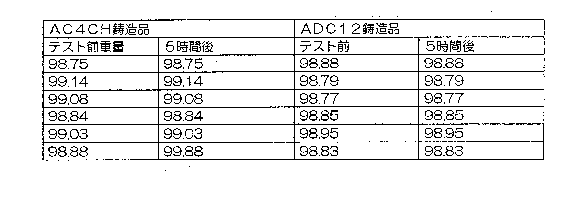
Next, in a nitrate bath (500 ° C.) having a melting point of 280 ° C., an aluminum cast product having a weight of about 100 g of AC4C and ADC12 was immersed for 5 hours as a test material, and this salt eroded the aluminum material. An impact survey was conducted. As a method, the weight before immersion and the weight change (g) after being washed and dried after holding for 5 hours were measured. The results are shown in Table 2.
[0014]
[Table 2]
As is apparent from the above results, it has been found that the salt of this component has no influence on the aluminum casting.
Also, in order to keep the liquid state until the water washing, removal of salt adhering immersed in water washing bath it was easy.
[0016]
【The invention's effect】
As described above, in the present invention, by using the molten salt as a heat and pressure medium and performing isostatic pressing after preheating, the cast hole existing in the casting can be eliminated or reduced, thereby improving reliability. High castings can be obtained safely and efficiently.
Also, by using a salt core for casting with the same composition of salt, the entire HIP process becomes easier and the equipment can be processed easily. It became the HIP processing method in consideration.
Claims (3)
融点が200℃を超えて280℃以下の範囲の硝酸ナトリウム、硝酸カリウム、亜硝酸ナトリウムの混合塩からなる溶融塩を金型等に流し込み、凝固固化後に該金型から離型して得たことを特徴とする塩中子。 A salt core used in the HIP processing method with a molten salt medium of an aluminum alloy casting or a magnesium alloy casting according to claim 1 ,
A molten salt composed of a mixed salt of sodium nitrate, potassium nitrate, and sodium nitrite having a melting point exceeding 200 ° C. and not higher than 280 ° C. was poured into a mold and solidified and solidified to be released from the mold. Characteristic salt core.
Priority Applications (4)
| Application Number | Priority Date | Filing Date | Title |
|---|---|---|---|
| JP2002246026A JP4129727B2 (en) | 2002-08-27 | 2002-08-27 | HIP processing method, salt core and HIP post-processing method of aluminum alloy casting or magnesium alloy casting with molten salt medium |
| US10/260,282 US20030075248A1 (en) | 2001-10-02 | 2002-10-01 | Method and apparatus for reducing blow holes existing in a light alloy cast by HIP, and molten salt and a salt core used for the method |
| EP02022131A EP1300483A3 (en) | 2001-10-02 | 2002-10-02 | Method and apparatus for reducing blow holes existing in a light alloy cast by HIP, and molten salt and a salt core used for the method |
| CN02151890A CN1427090A (en) | 2001-10-02 | 2002-10-02 | Method and device for reducing porosity in light alloy castings and molten salt and salt cores used |
Applications Claiming Priority (1)
| Application Number | Priority Date | Filing Date | Title |
|---|---|---|---|
| JP2002246026A JP4129727B2 (en) | 2002-08-27 | 2002-08-27 | HIP processing method, salt core and HIP post-processing method of aluminum alloy casting or magnesium alloy casting with molten salt medium |
Publications (2)
| Publication Number | Publication Date |
|---|---|
| JP2004082162A JP2004082162A (en) | 2004-03-18 |
| JP4129727B2 true JP4129727B2 (en) | 2008-08-06 |
Family
ID=32054005
Family Applications (1)
| Application Number | Title | Priority Date | Filing Date |
|---|---|---|---|
| JP2002246026A Expired - Fee Related JP4129727B2 (en) | 2001-10-02 | 2002-08-27 | HIP processing method, salt core and HIP post-processing method of aluminum alloy casting or magnesium alloy casting with molten salt medium |
Country Status (1)
| Country | Link |
|---|---|
| JP (1) | JP4129727B2 (en) |
Families Citing this family (1)
| Publication number | Priority date | Publication date | Assignee | Title |
|---|---|---|---|---|
| DE102012217939A1 (en) * | 2012-10-01 | 2014-04-03 | Mahle International Gmbh | Process for the production of cores for the casting production of workpieces |
-
2002
- 2002-08-27 JP JP2002246026A patent/JP4129727B2/en not_active Expired - Fee Related
Also Published As
| Publication number | Publication date |
|---|---|
| JP2004082162A (en) | 2004-03-18 |
Similar Documents
| Publication | Publication Date | Title |
|---|---|---|
| US4134777A (en) | Method for rapid removal of cores made of Y2 O3 from directionally solidified eutectic and superalloy materials | |
| JP3355189B2 (en) | Permanent mold casting of reactive melt | |
| GB2266677A (en) | A method of leaching ceramic, eg alumina, cores from turbine blade castings | |
| US6146477A (en) | Metal alloy product and method for producing same | |
| US4875517A (en) | Method of producing salt cores for use in die casting | |
| CN108580850B (en) | Preparation method of AlTi composite casting | |
| JP6514237B2 (en) | Process for preparing molten metal for casting at low to zero superheat temperatures | |
| Wallace et al. | High-quality aluminum turbocharger impellers produced by thixocasting | |
| WO2003080880A2 (en) | Cast adc12 aluminium alloy and a braking system made from said cast alloy | |
| CN103909227A (en) | Processing method of common casting pieces | |
| JP6975421B2 (en) | Aluminum alloy manufacturing method | |
| CN1995419B (en) | Method for preparing ultra-fine grain deformed aluminum alloy | |
| JP2004082162A (en) | HIP processing method and salt core of aluminum alloy casting or magnesium alloy casting by molten salt medium, HIP post-processing method and HIP processing method by molten salt medium | |
| EP1300483A2 (en) | Method and apparatus for reducing blow holes existing in a light alloy cast by HIP, and molten salt and a salt core used for the method | |
| US4119437A (en) | Method for removing Y2 O3 or Sm2 O3 cores from castings | |
| CN104550839A (en) | Aluminizing hot tinning aluminum iron bi-metal low-pressure casting process | |
| CN101660051A (en) | Method for recovering magnesium chips safely | |
| JP4341020B2 (en) | Aluminum alloy casting manufacturing method | |
| CN101130843B (en) | High-strength heat-resistant magnesium alloy and its melting method | |
| CN1781628A (en) | Method for reducing blow holes existing in a light alloy cast and a salt core used for the method | |
| Runge et al. | The science of successfully anodizing die cast substrates | |
| JP2019005758A (en) | Die-cast product, method for producing the same, and die casting machine | |
| Kashani et al. | Effects of hot isostatic pressing on the tensile properties of A356 cast alloy | |
| JP2004291017A (en) | Salt core for casting light alloy casting, method for producing the same, and method for producing light alloy casting | |
| JPS63256239A (en) | Method for disintegrating ceramic shell mold |
Legal Events
| Date | Code | Title | Description |
|---|---|---|---|
| A621 | Written request for application examination |
Free format text: JAPANESE INTERMEDIATE CODE: A621 Effective date: 20040728 |
|
| A131 | Notification of reasons for refusal |
Free format text: JAPANESE INTERMEDIATE CODE: A131 Effective date: 20071130 |
|
| A521 | Request for written amendment filed |
Free format text: JAPANESE INTERMEDIATE CODE: A523 Effective date: 20071227 |
|
| A02 | Decision of refusal |
Free format text: JAPANESE INTERMEDIATE CODE: A02 Effective date: 20080201 |
|
| A521 | Request for written amendment filed |
Free format text: JAPANESE INTERMEDIATE CODE: A523 Effective date: 20080212 |
|
| A911 | Transfer to examiner for re-examination before appeal (zenchi) |
Free format text: JAPANESE INTERMEDIATE CODE: A911 Effective date: 20080402 |
|
| TRDD | Decision of grant or rejection written | ||
| A01 | Written decision to grant a patent or to grant a registration (utility model) |
Free format text: JAPANESE INTERMEDIATE CODE: A01 Effective date: 20080425 |
|
| A01 | Written decision to grant a patent or to grant a registration (utility model) |
Free format text: JAPANESE INTERMEDIATE CODE: A01 |
|
| A61 | First payment of annual fees (during grant procedure) |
Free format text: JAPANESE INTERMEDIATE CODE: A61 Effective date: 20080508 |
|
| R150 | Certificate of patent or registration of utility model |
Ref document number: 4129727 Country of ref document: JP Free format text: JAPANESE INTERMEDIATE CODE: R150 Free format text: JAPANESE INTERMEDIATE CODE: R150 |
|
| FPAY | Renewal fee payment (event date is renewal date of database) |
Free format text: PAYMENT UNTIL: 20110530 Year of fee payment: 3 |
|
| FPAY | Renewal fee payment (event date is renewal date of database) |
Free format text: PAYMENT UNTIL: 20130530 Year of fee payment: 5 |
|
| FPAY | Renewal fee payment (event date is renewal date of database) |
Free format text: PAYMENT UNTIL: 20130530 Year of fee payment: 5 |
|
| FPAY | Renewal fee payment (event date is renewal date of database) |
Free format text: PAYMENT UNTIL: 20140530 Year of fee payment: 6 |
|
| LAPS | Cancellation because of no payment of annual fees |