JP4040719B2 - Process for producing 5-alkoxyhydantoin compound - Google Patents
Process for producing 5-alkoxyhydantoin compound Download PDFInfo
- Publication number
- JP4040719B2 JP4040719B2 JP16028497A JP16028497A JP4040719B2 JP 4040719 B2 JP4040719 B2 JP 4040719B2 JP 16028497 A JP16028497 A JP 16028497A JP 16028497 A JP16028497 A JP 16028497A JP 4040719 B2 JP4040719 B2 JP 4040719B2
- Authority
- JP
- Japan
- Prior art keywords
- group
- general formula
- alkyl group
- reaction
- compound
- Prior art date
- Legal status (The legal status is an assumption and is not a legal conclusion. Google has not performed a legal analysis and makes no representation as to the accuracy of the status listed.)
- Expired - Fee Related
Links
Classifications
-
- Y—GENERAL TAGGING OF NEW TECHNOLOGICAL DEVELOPMENTS; GENERAL TAGGING OF CROSS-SECTIONAL TECHNOLOGIES SPANNING OVER SEVERAL SECTIONS OF THE IPC; TECHNICAL SUBJECTS COVERED BY FORMER USPC CROSS-REFERENCE ART COLLECTIONS [XRACs] AND DIGESTS
- Y02—TECHNOLOGIES OR APPLICATIONS FOR MITIGATION OR ADAPTATION AGAINST CLIMATE CHANGE
- Y02P—CLIMATE CHANGE MITIGATION TECHNOLOGIES IN THE PRODUCTION OR PROCESSING OF GOODS
- Y02P20/00—Technologies relating to chemical industry
- Y02P20/50—Improvements relating to the production of bulk chemicals
- Y02P20/52—Improvements relating to the production of bulk chemicals using catalysts, e.g. selective catalysts
Landscapes
- Low-Molecular Organic Synthesis Reactions Using Catalysts (AREA)
- Plural Heterocyclic Compounds (AREA)
Description
【0001】
【発明の属する技術分野】
カラー写真用機能材料や医農薬の合成中間体として有用な5−アルコキシヒダントイン化合物の製造法に関する。
【0002】
【従来の技術】
5−アルコキシヒダントイン類の合成法としては、これまでに幾つか知られている。例えば5−無置換ヒダントインをハロゲン化したのち、アルコール類によって置換する方法(例えば特開平7−300463号、特開平7−300464号、特開平4−330064号、特開平8−134043号)、尿素誘導体とグリオキシル酸誘導体の反応によって5−ヒドロキシヒダントインとし、アシル化したのち、アルコールと反応させる方法(例えば特公平2−38588号参照)などを挙げることができる。
これらの方法において用いられるアルコール類は、もっぱら低分子量の低級アルコールである場合が多く、これらをヒダントインに対して過剰に用いて反応するのが一般的である。反応の後処理において、蒸留、水洗等により除去しにくい高沸点の分子量の大きなアルコール類を用いる時には、煩雑な後処理を避けるために、ヒダントインとほぼ等モルのアルコール類を用いて反応するが、等モルのアルコールでは反応の変換率が上がらずに低収率になることが多い。
そのため、特に高沸点のアルコールを用いる場合にさらなる反応条件の改良が望まれている。
【0003】
【発明が解決しようとする課題】
本発明の目的は、5−アルコキシヒダントイン化合物を簡便に、且つ収率よく製造する方法を提供するものである。
【0004】
【課題を解決するための手段】
本発明は、
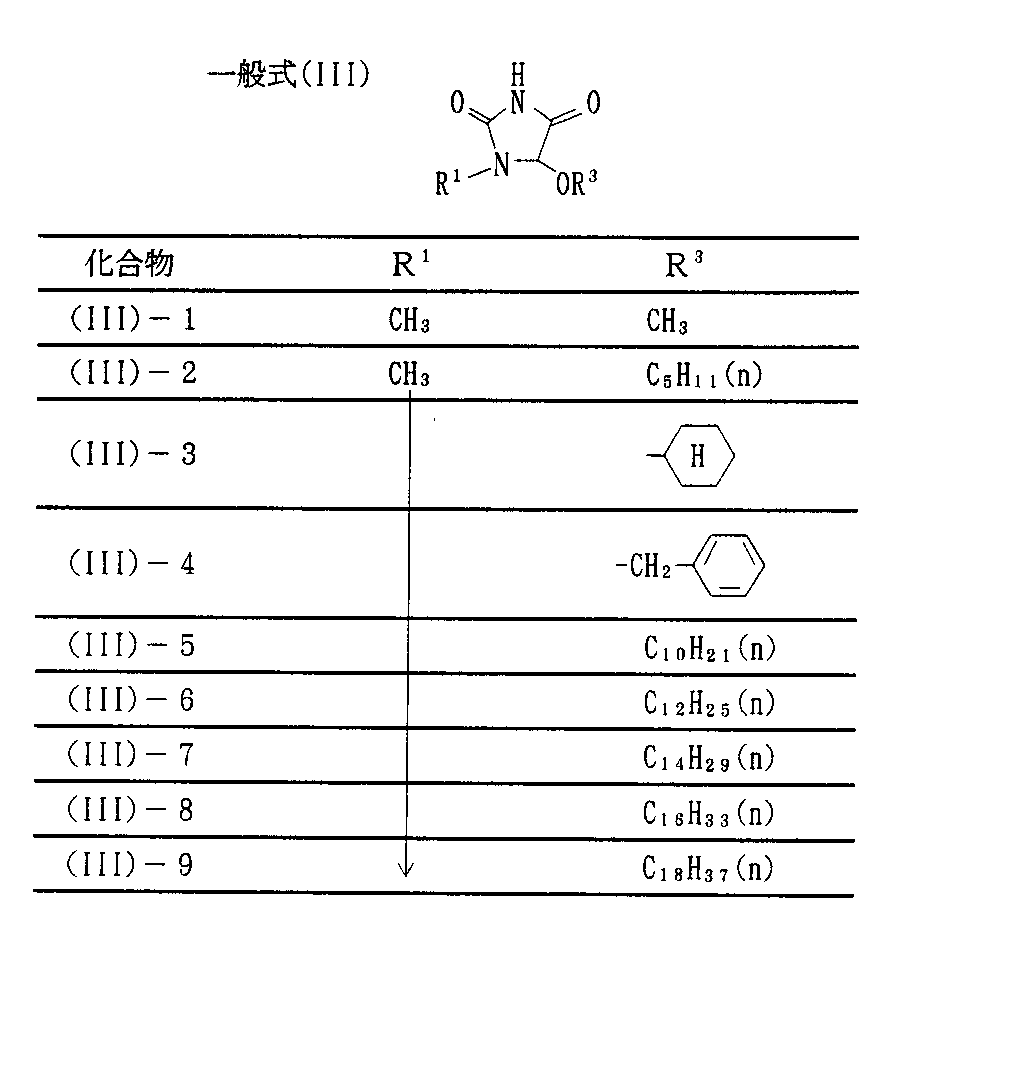
(1)一般式(I)で表される5−アルコキシヒダントイン化合物と一般式(II)で表されるアルコール類を反応させることを特徴とする一般式(III) で表される5−アルコキシヒダントイン化合物の製造方法、
【0005】
【化4】
(式中、R1 、R2 はそれぞれ独立にアルキル基またはアリール基を表す。)
【0007】
【化5】
(式中、R3 はアルキル基またはアリール基を表す。)
【0009】
【化6】
(式中、R1 、R3 は一般式(I)、一般式(II)におけるものと同義である。)
【0011】
(2)酸を触媒として用いることを特徴とする前項1に記載の製造方法、
(3)R2 が炭素数1〜4のアルキル基を表し、R3 が炭素数6〜18のアルキル基を表わすことを特徴とする前項1に記載の製造方法、
を提供するものである。
【0012】
【発明の実施の形態】
以下に本発明の製造方法について詳しく説明する。
本明細書中、アルキル基とは直鎖状、分岐鎖状、環状のアルキル基を表し、これらは芳香族基、カルボキシル基、アルコキシカルボニル基(例えばメトキシカルボニル)、シアノ基、ハロゲン原子(例えば塩素原子、臭素原子)、アルコキシ基(例えばメトキシ)、ヒドロキシル基、ニトロ基、アミノ基、アルキルチオ基(例えばメチルチオ)、アルキルスルホニル基(例えばメタンスルホニル)などで置換されていてもよい。
【0013】
本明細書中、芳香族化合物とは、(4n+2)個(但し、nは整数を表す)のπ電子を有する環状化合物を表し、ベンゼン、ナフタレンなどの炭化水素化合物の他、窒素原子、硫黄原子、酸素原子などから選ばれるヘテロ原子を含む好ましくは3〜6員環、特に好ましくは5〜6員環の複素芳香族環化合物(例えばピリジン、ピリミジン、ピロール、インドール、チオフェン、フラン)をも含むものである。
【0014】
この時芳香環は、置換基によって置換されていてもよく、その例としては、ハロゲン原子(例えばフッ素原子、塩素原子)、アルキル基(例えばメチル、エチル)、アリール基(例えばフェニル、ナフチル)、シアノ基、カルボキシル基、アルコキシカルボニル基(例えばメトキシカルボニル)、アリーロキシカルボニル基(例えばフェノキシカルボニル)、置換または無置換のカルバモイル基(例えばカルバモイル、N−フェニルカルバモイル、N,N−ジメチルカルバモイル)、アルキルカルボニル基(例えばアセチル)、アリールカルボニル基(例えばベンゾイル)、ニトロ基、置換または無置換のアミノ基(例えばアミノ、ジメチルアミノ、アニリノ)、アシルアミノ基(例えばアセトアミド、エトキシカルボニルアミノ)、スルホンアミド基(例えばメタンスルホンアミド)、イミド基(例えばスクシンイミド、フタルイミド)、イミノ基(例えばベンジリデンアミノ)、ヒドロキシ基、アルコキシ基(例えばメトキシ)、アリーロキシ基(例えばフェノキシ)、アシロキシ基(例えばアセトキシ)、アルキルスルホニルオキシ基(例えばメタンスルホニルオキシ)、アリールスルホニルオキシ基(例えばベンゼンスルホニルオキシ)、スルホ基、置換または無置換のスルファモイル基(例えばスルファモイル、N−フェニルスルファモイル)、アルキルチオ基(例えばメチルチオ)、アリールチオ基(例えばフェニルチオ)、アルキルスルホニル基(例えばメタンスルホニル)、アリールスルホニル基(例えばベンゼンスルホニル)などを挙げることができる。
【0015】
R1 は好ましくは炭素数1〜18のアルキル基(例えばメチル、エチル、ベンジル)または好ましくは炭素数6〜26のアリール基(例えばフェニル、ナフチル)を表し、さらに好ましくは、炭素数1〜18のアルキル基を表す。
R2 は好ましくは炭素数1〜18のアルキル基(例えばメチル、エチル)、または好ましくは炭素数6〜26のアリール基(例えばフェニル)を表し、さらに好ましくは炭素数1〜6のアルキル基、特に好ましくは炭素数1〜4のアルキル基を表す。
R3 は、好ましくは炭素数1〜18のアルキル基(例えばメチル、エチル、ドデシル、ヘキサデシル、オクタデシル)、または好ましくは炭素数6〜26のアリール基(例えばフェニル)を表し、さらに好ましくは炭素数6〜18のアルキル基、特に好ましくは炭素数12〜18のアルキル基を表す。
反応溶媒を用いずに反応を行なうこともできるが、好ましくは有機溶媒が用いられ、好ましくはトルエンなどの芳香族炭化水素系溶媒、アセトニトリル、スルホラン、N,N−ジメチルアセトアミドなどのアミド系溶媒、酢酸エチルなどのエステル系溶媒、ヘキサン、ヘプタンなどの脂肪族炭化水素系溶媒などが用いられるが、特に好ましくは芳香族炭化水素系溶媒が用いられる。
酸を用いると反応が加速される場合が多く、酸を用いる方が好ましい。酸としては、プロトン酸(例えば硫酸、メタンスルホン酸、p−トルエンスルホン酸、塩酸)とルイス酸のいずれを用いることもでき、併用することも可能である。好ましくはプロトン酸が用いられる。
ここでいうルイス酸としては、周期律表 IIIA族、IVA族、VA族、IB族、IIB族、 IIIB族、IVB族、VB族、VIB族、VII B族、VIIIB族の元素のハロゲン化物、アルコキシド化合物が挙げられる。
酸は、一般式(I)のヒダントイン化合物に対して、10-6〜10モル、好ましくは10-3〜1モル用いられる。一般式(II)で表されるアルコール類は、一般式(I)で表されるヒダントイン類に対して、好ましくは0.5〜10モル、さらに好ましくは0.8〜5モル、特に好ましくは0.9〜1.2モル用いられる。
反応温度は0〜200℃、好ましくは80〜150℃である。
反応時間は好ましくは0.5〜5時間である。反応で生成するR2 OHで表されるアルコールがR3 OHで表わされるアルコールよりも低沸点の場合には、反応で生成するR2 OHを反応系から除去しながら行なう方が、反応の効率の点から好ましい。除去法としては、単に溶媒と共沸させて除去させるのが最も容易であるが、モレキュラーシーブなどで、低分子のアルコールを除去することも可能である。
次に、一般式(I)と一般式(III)で表わされるヒダントイン化合物を例示するが、本発明はこれらに限定されるものではない。
【0016】
【表1】
【表2】
【表3】
【表4】
【表5】
【表6】
【表7】
【表8】
【実施例】
次に実施例にて本発明をさらに詳細に説明する。
実施例1.(I)−18とヘキサデカノールとの反応による (III)−15の合成
特公平2−38588号に記載の方法に準じて合成した化合物(I)−18 23.4g(0.1モル)、ヘキサデカノール24.2g(0.1モル)、p−トルエンスルホン酸3.0g(0.015モル)にトルエン200mlを加え、途中、低沸点成分を少しずつ留去しながら、3時間加熱還流した。トルエン留去後、アセトニトリル30mlを加え、この溶液を水250mlに滴下し、析出した結晶を濾過し、(III) −15を無色結晶として41.4g(収率96%)得た。融点68〜69℃
1H−NMR(200MHZ ;CDCl3)
実施例2.実施例1と異なる条件による (III)−15の合成
p−トルエンスルホン酸の替わりに等モルの硫酸を用いて反応と後処理を行ない、収率95%にて (III)−15を得た。
【0026】
実施例3.実施例1と異なる条件による (III)−15の合成
p−トルエンスルホン酸の替わりに等モルのメタンスルホン酸を用いて反応と後処理を行ない、収率95%にて (III)−15を得た。
【0027】
実施例4.
同様の方法にて合成した一般式(III) で表される化合物の代表例について融点を以下に示す。
【発明の効果】
本発明によれば、アルコールの交換によって、高収率で5−アルコキシヒダントイン類が製造できる。[0001]
BACKGROUND OF THE INVENTION
The present invention relates to a method for producing a 5-alkoxyhydantoin compound useful as a color photographic functional material or a synthetic intermediate for medical and agricultural chemicals.
[0002]
[Prior art]
Several methods for synthesizing 5-alkoxyhydantoins have been known so far. For example, a method of halogenating 5-unsubstituted hydantoin and then substituting with alcohols (for example, JP-A-7-300463, JP-A-7-3004644, JP-A-4-330064, JP-A-8-134043), urea Examples thereof include a method in which 5-hydroxyhydantoin is converted to 5-hydroxyhydantoin by a reaction between the derivative and a glyoxylic acid derivative and then reacted with an alcohol (for example, see Japanese Patent Publication No. 2-38588).
In many cases, the alcohols used in these methods are exclusively low-molecular-weight lower alcohols, and these are generally used in an excess with respect to hydantoin for reaction. In the post-treatment of the reaction, when using a high-boiling molecular weight alcohol having a high boiling point which is difficult to remove by distillation, washing with water, etc., in order to avoid complicated post-treatment, the reaction is performed with hydantoin using approximately equimolar alcohols. An equimolar amount of alcohol often results in a low yield without increasing the conversion of the reaction.
Therefore, further improvement of reaction conditions is desired especially when a high-boiling alcohol is used.
[0003]
[Problems to be solved by the invention]
The object of the present invention is to provide a method for producing a 5-alkoxyhydantoin compound conveniently and in a high yield.
[0004]
[Means for Solving the Problems]
The present invention
(1) A 5-alkoxyhydantoin represented by the general formula (III) characterized by reacting a 5-alkoxyhydantoin compound represented by the general formula (I) with an alcohol represented by the general formula (II) A method for producing the compound,
[0005]
[Formula 4]
(In the formula, R 1 and R 2 each independently represents an alkyl group or an aryl group.)
[0007]
[Chemical formula 5]
(In the formula, R 3 represents an alkyl group or an aryl group.)
[0009]
[Chemical 6]
(In the formula, R 1 and R 3 have the same meanings as in general formula (I) and general formula (II).)
[0011]
(2) The production method according to item 1 above, wherein an acid is used as a catalyst;
(3) R 2 represents an alkyl group having 1 to 4 carbon atoms, and R 3 represents an alkyl group having 6 to 18 carbon atoms,
Is to provide.
[0012]
DETAILED DESCRIPTION OF THE INVENTION
The production method of the present invention will be described in detail below.
In this specification, an alkyl group represents a linear, branched, or cyclic alkyl group, which is an aromatic group, a carboxyl group, an alkoxycarbonyl group (for example, methoxycarbonyl), a cyano group, or a halogen atom (for example, chlorine). Atoms, bromine atoms), alkoxy groups (eg methoxy), hydroxyl groups, nitro groups, amino groups, alkylthio groups (eg methylthio), alkylsulfonyl groups (eg methanesulfonyl) and the like.
[0013]
In this specification, the aromatic compound represents a cyclic compound having (4n + 2) (where n represents an integer) π electrons, and in addition to hydrocarbon compounds such as benzene and naphthalene, a nitrogen atom and a sulfur atom And a heteroaromatic ring compound having a heteroatom selected from oxygen atoms, preferably 3-6 membered ring, particularly preferably 5-6 membered ring (for example, pyridine, pyrimidine, pyrrole, indole, thiophene, furan). It is a waste.
[0014]
At this time, the aromatic ring may be substituted with a substituent. Examples thereof include a halogen atom (for example, a fluorine atom and a chlorine atom), an alkyl group (for example, methyl and ethyl), an aryl group (for example, phenyl and naphthyl), Cyano group, carboxyl group, alkoxycarbonyl group (for example, methoxycarbonyl), aryloxycarbonyl group (for example, phenoxycarbonyl), substituted or unsubstituted carbamoyl group (for example, carbamoyl, N-phenylcarbamoyl, N, N-dimethylcarbamoyl), alkyl Carbonyl group (eg acetyl), arylcarbonyl group (eg benzoyl), nitro group, substituted or unsubstituted amino group (eg amino, dimethylamino, anilino), acylamino group (eg acetamide, ethoxycarbonylamino), sulfo An amide group (eg methanesulfonamide), an imide group (eg succinimide, phthalimide), an imino group (eg benzylideneamino), a hydroxy group, an alkoxy group (eg methoxy), an aryloxy group (eg phenoxy), an acyloxy group (eg acetoxy), Alkylsulfonyloxy group (for example, methanesulfonyloxy), arylsulfonyloxy group (for example, benzenesulfonyloxy), sulfo group, substituted or unsubstituted sulfamoyl group (for example, sulfamoyl, N-phenylsulfamoyl), alkylthio group (for example, methylthio) An arylthio group (for example, phenylthio), an alkylsulfonyl group (for example, methanesulfonyl), an arylsulfonyl group (for example, benzenesulfonyl), and the like.
[0015]
R 1 preferably represents an alkyl group having 1 to 18 carbon atoms (for example, methyl, ethyl, benzyl) or preferably an aryl group having 6 to 26 carbon atoms (for example, phenyl or naphthyl), more preferably 1 to 18 carbon atoms. Represents an alkyl group.
R 2 preferably represents an alkyl group having 1 to 18 carbon atoms (for example, methyl or ethyl), or preferably an aryl group having 6 to 26 carbon atoms (for example, phenyl), more preferably an alkyl group having 1 to 6 carbon atoms, Particularly preferably, it represents an alkyl group having 1 to 4 carbon atoms.
R 3 preferably represents an alkyl group having 1 to 18 carbon atoms (for example, methyl, ethyl, dodecyl, hexadecyl, octadecyl) or preferably an aryl group having 6 to 26 carbon atoms (for example, phenyl), and more preferably An alkyl group having 6 to 18 carbon atoms, particularly preferably an alkyl group having 12 to 18 carbon atoms, is represented.
Although the reaction can be carried out without using a reaction solvent, an organic solvent is preferably used, preferably an aromatic hydrocarbon solvent such as toluene, an amide solvent such as acetonitrile, sulfolane, N, N-dimethylacetamide, An ester solvent such as ethyl acetate and an aliphatic hydrocarbon solvent such as hexane and heptane are used, and an aromatic hydrocarbon solvent is particularly preferably used.
When an acid is used, the reaction is often accelerated, and it is preferable to use an acid. As the acid, any of a protonic acid (for example, sulfuric acid, methanesulfonic acid, p-toluenesulfonic acid, hydrochloric acid) and a Lewis acid can be used, and they can be used in combination. Protonic acid is preferably used.
As the Lewis acid here, halides of elements of Group IIIA, Group IVA, Group VA, Group IB, Group IIB, Group IIIB, Group IVB, Group VB, Group VIB, Group VIIB, Group VIIIB, An alkoxide compound is mentioned.
The acid is used in an amount of 10 −6 to 10 mol, preferably 10 −3 to 1 mol, relative to the hydantoin compound of the general formula (I). The alcohol represented by the general formula (II) is preferably 0.5 to 10 mol, more preferably 0.8 to 5 mol, particularly preferably the hydantoin represented by the general formula (I). 0.9-1.2 mol is used.
The reaction temperature is 0 to 200 ° C, preferably 80 to 150 ° C.
The reaction time is preferably 0.5 to 5 hours. When the alcohol represented by R 2 OH produced by the reaction has a lower boiling point than the alcohol represented by R 3 OH, the reaction is more efficiently carried out while removing R 2 OH produced by the reaction from the reaction system. From the point of view, it is preferable. As the removal method, it is easiest to simply remove it by azeotropy with a solvent, but it is also possible to remove low molecular weight alcohol by molecular sieve or the like.
Next, although hydantoin compounds represented by general formula (I) and general formula (III) are exemplified, the present invention is not limited to these.
[0016]
[Table 1]
[Table 2]
[Table 3]
[Table 4]
[Table 5]
[Table 6]
[Table 7]
[Table 8]
【Example】
Next, the present invention will be described in more detail with reference to examples.
Example 1. Synthesis of (III) -15 by reaction of (I) -18 with hexadecanol Compound (I) -18 synthesized according to the method described in JP-B-2-38588 23.4 g (0.1 mol) 200 ml of toluene was added to 24.2 g (0.1 mol) of hexadecanol and 3.0 g (0.015 mol) of p-toluenesulfonic acid, and heated for 3 hours while gradually distilling off low-boiling components. Refluxed. After toluene was distilled off, 30 ml of acetonitrile was added, this solution was added dropwise to 250 ml of water, and the precipitated crystals were filtered to obtain 41.4 g (yield 96%) of (III) -15 as colorless crystals. Melting point 68-69 ° C
1 H-NMR (200MH Z; CDCl 3)
Example 2 Synthesis of (III) -15 under different conditions from Example 1 The reaction and post-treatment were carried out using equimolar sulfuric acid instead of p-toluenesulfonic acid to obtain (III) -15 at a yield of 95%. .
[0026]
Example 3 FIG. Synthesis of (III) -15 under conditions different from Example 1 The reaction and post-treatment were carried out using equimolar methanesulfonic acid instead of p-toluenesulfonic acid, and (III) -15 was obtained at a yield of 95%. Obtained.
[0027]
Example 4
The melting point of a typical example of the compound represented by formula (III) synthesized by the same method is shown below.
【The invention's effect】
According to the present invention, 5-alkoxyhydantoins can be produced with high yield by alcohol exchange.
Claims (3)
Priority Applications (1)
| Application Number | Priority Date | Filing Date | Title |
|---|---|---|---|
| JP16028497A JP4040719B2 (en) | 1997-06-17 | 1997-06-17 | Process for producing 5-alkoxyhydantoin compound |
Applications Claiming Priority (1)
| Application Number | Priority Date | Filing Date | Title |
|---|---|---|---|
| JP16028497A JP4040719B2 (en) | 1997-06-17 | 1997-06-17 | Process for producing 5-alkoxyhydantoin compound |
Publications (2)
| Publication Number | Publication Date |
|---|---|
| JPH115782A JPH115782A (en) | 1999-01-12 |
| JP4040719B2 true JP4040719B2 (en) | 2008-01-30 |
Family
ID=15711669
Family Applications (1)
| Application Number | Title | Priority Date | Filing Date |
|---|---|---|---|
| JP16028497A Expired - Fee Related JP4040719B2 (en) | 1997-06-17 | 1997-06-17 | Process for producing 5-alkoxyhydantoin compound |
Country Status (1)
| Country | Link |
|---|---|
| JP (1) | JP4040719B2 (en) |
-
1997
- 1997-06-17 JP JP16028497A patent/JP4040719B2/en not_active Expired - Fee Related
Also Published As
| Publication number | Publication date |
|---|---|
| JPH115782A (en) | 1999-01-12 |
Similar Documents
| Publication | Publication Date | Title |
|---|---|---|
| AU634689B2 (en) | An intermediate for the manufacture of trans-6-{2-(substituted-pyrrol-1-yl)aklyl} pyran-2-ones | |
| SK33993A3 (en) | Process for synthesis of (4r-cis)-1,1-dimethylethyl- -6-cyanomethyl-2,2-dimethyl-1,3-dioxane-4-acetate | |
| Katritzky et al. | Aminoalkylbenzotriazoles: reagents for the aminoalkylation of electron rich heterocycles | |
| KR100481570B1 (en) | Intermediates for the preparation of 2-imidazoline-5-ones | |
| KR100519420B1 (en) | Process for preparing heteroarylcarboxyamides and esters | |
| FI101535B (en) | Process for the preparation of (4-amino-3,5-dichloro-6-fluoro-2-pyridinyloxy) acetic acid ester | |
| KR102221534B1 (en) | Process for the synthesis of substituted gamma lactams | |
| JPH115782A (en) | Production of 5-alkoxyhydrantoin | |
| KR102608785B1 (en) | Development of synthetic method for oxazolidin-2-one derivatives | |
| CN111517938A (en) | Synthesis of heptatomic bridged ring derivatives and preparation method thereof | |
| JP5870114B2 (en) | Enantiomerically pure binaphthol derivative and method for producing the same (ENANTIOMERICALLY PURE BINAPHTOL DERIVATEIVES AND METHOD FOR PREPARING THE SAE) | |
| WO2011158813A1 (en) | Method for producing n-substituted-2-amino-4-(hydroxymethylphosphinyl)-2-butenoic acid | |
| JP2002212170A (en) | Triazine tristyryl compounds and triazine trialdehyde compounds | |
| KR100212636B1 (en) | Novel Process for Preparation of Herbicidal Pyrimidyloxybenzoic Acid Oxime Esters | |
| JP6498614B2 (en) | Process for producing optically active carboxylic acid ester | |
| US6555695B1 (en) | Process for the preparation of ethyl 2,3-dihydrobenzo[1,4]dioxin-2-carboxylate | |
| JPS5888361A (en) | 3-amino-1,4-bis(alkoxycarbonyl)maleimide compound and its preparation | |
| SU1046240A1 (en) | Process for preparing ethers of beta-alkoxyacrylic or beta-alkoxymethacrylic acid | |
| WO2006123648A1 (en) | Process for producing 3-substituted thiophene | |
| JPH0667941B2 (en) | 6-Aryloxy-1H-pyrazolo [1,5-b] -1,2,4-triazole compound | |
| WO2004090013A1 (en) | Process for producing cyclic lactic acid oligomer | |
| JPS59225164A (en) | Preparation of 4-hydroxy-6-methylnicotinic acid | |
| JPH08310996A (en) | Production of benzoic acid group-bearing (meth)acrylic ester | |
| JPH0710847B2 (en) | Process for producing pyridone-3-carboxamide compound | |
| EP1544196A1 (en) | Process for the production of gamma-keto acetals |
Legal Events
| Date | Code | Title | Description |
|---|---|---|---|
| A621 | Written request for application examination |
Free format text: JAPANESE INTERMEDIATE CODE: A621 Effective date: 20040204 |
|
| RD02 | Notification of acceptance of power of attorney |
Free format text: JAPANESE INTERMEDIATE CODE: A7422 Effective date: 20040204 |
|
| A711 | Notification of change in applicant |
Free format text: JAPANESE INTERMEDIATE CODE: A712 Effective date: 20061204 |
|
| TRDD | Decision of grant or rejection written | ||
| A977 | Report on retrieval |
Free format text: JAPANESE INTERMEDIATE CODE: A971007 Effective date: 20071019 |
|
| A01 | Written decision to grant a patent or to grant a registration (utility model) |
Free format text: JAPANESE INTERMEDIATE CODE: A01 Effective date: 20071023 |
|
| A61 | First payment of annual fees (during grant procedure) |
Free format text: JAPANESE INTERMEDIATE CODE: A61 Effective date: 20071108 |
|
| FPAY | Renewal fee payment (event date is renewal date of database) |
Free format text: PAYMENT UNTIL: 20101116 Year of fee payment: 3 |
|
| R150 | Certificate of patent or registration of utility model |
Free format text: JAPANESE INTERMEDIATE CODE: R150 |
|
| FPAY | Renewal fee payment (event date is renewal date of database) |
Free format text: PAYMENT UNTIL: 20111116 Year of fee payment: 4 |
|
| FPAY | Renewal fee payment (event date is renewal date of database) |
Free format text: PAYMENT UNTIL: 20121116 Year of fee payment: 5 |
|
| LAPS | Cancellation because of no payment of annual fees |