JP3928131B2 - Method for controlling optical activity of solid thin film - Google Patents
Method for controlling optical activity of solid thin film Download PDFInfo
- Publication number
- JP3928131B2 JP3928131B2 JP2003338151A JP2003338151A JP3928131B2 JP 3928131 B2 JP3928131 B2 JP 3928131B2 JP 2003338151 A JP2003338151 A JP 2003338151A JP 2003338151 A JP2003338151 A JP 2003338151A JP 3928131 B2 JP3928131 B2 JP 3928131B2
- Authority
- JP
- Japan
- Prior art keywords
- thin film
- solid thin
- general formula
- optical activity
- group
- Prior art date
- Legal status (The legal status is an assumption and is not a legal conclusion. Google has not performed a legal analysis and makes no representation as to the accuracy of the status listed.)
- Expired - Lifetime
Links
Images


Landscapes
- Electrochromic Elements, Electrophoresis, Or Variable Reflection Or Absorption Elements (AREA)
- Optical Record Carriers And Manufacture Thereof (AREA)
Description
本発明は、固体薄膜の光学活性の制御方法に係り、特に、温度によって主鎖が可逆的な右らせんと左らせんとの間の構造変化を起こし、可逆的な右旋性と左旋性との間の変化を伴なう変旋光現象を示す光学活性ポリシランを含有する固体薄膜の光学活性の制御方法に関する。 The present invention relates to a method for controlling the optical activity of a solid thin film, and in particular, the main chain undergoes a structural change between a reversible right-handed helix and a left-handed helix depending on the temperature. The present invention relates to a method for controlling the optical activity of a solid thin film containing an optically active polysilane that exhibits a photorotation phenomenon accompanied by a change between the two.
21世紀の情報通信において、大量のデジタル情報を簡便に、高速に、安価に、軽量のメディアに記録する超小型の記録方式の登場が待ち望まれている。家電業界においては、デジタル放送の本格的な営業放送に向けて、例えば、デジタルビデオ、DVD−RAM、ハードディスク磁気記録などデジタル情報記録デバイスが今後急速に伸びていくと予測されている。 In the information communication of the 21st century, the advent of an ultra-small recording system that records a large amount of digital information on a lightweight medium simply, at high speed and at low cost is awaited. In the home appliance industry, digital information recording devices such as digital video, DVD-RAM, and hard disk magnetic recording are expected to grow rapidly in the future for full-fledged commercial broadcasting of digital broadcasting.
MO方式では、光磁気書き込み前後で0.15゜程度の微少な光カー回転角変化(光学活性の変化角)が生じる。このため、良好なコントラスト/ノイズ比を達成するためには、反射鏡をメディア裏面に形成し、光磁気書き込み前後で0.3゜程度に増幅したカー回転角変化を利用することが必要である。0.3゜という小さな回転角変化を検出するため、MO方式では磁気ヘッドに比べて精密で大型の検出機構を必要とする。MO方式の読出し・書き込み速度は、30ミリ秒程度であり、磁気記録のそれに比べて3〜5倍ほど遅い。その理由の一つは、ビームスプリッターを含む検出ヘッド部が重く大きいことにあり、サーボトラック速度も遅くなるためとされている。また、レーザー光源と磁気ヘッドを二つ用意する必要があり、装置全体の小型化には限界がある。 In the MO method, a slight optical Kerr rotation angle change (optical activity change angle) of about 0.15 ° occurs before and after magneto-optical writing. For this reason, in order to achieve a good contrast / noise ratio, it is necessary to use a Kerr rotation angle change amplified to about 0.3 ° before and after magneto-optical writing by forming a reflecting mirror on the back side of the medium. . In order to detect a rotation angle change as small as 0.3 °, the MO method requires a precise and large detection mechanism as compared with a magnetic head. The read / write speed of the MO method is about 30 milliseconds, which is about 3 to 5 times slower than that of magnetic recording. One of the reasons is that the detection head unit including the beam splitter is heavy and large, and the servo track speed is also slowed down. Further, it is necessary to prepare two laser light sources and a magnetic head, and there is a limit to downsizing the entire apparatus.
書き込み前後で0.3゜よりも非常に大きな旋光度変化を伴う薄膜材料が実現すれば、記録装置の小型化が図れるのみならず、ハードディスクに匹敵する高速での書き込み読み出しが可能となる。 If a thin film material with an optical rotation change much greater than 0.3 ° before and after writing is realized, not only the recording apparatus can be miniaturized, but also high speed writing and reading comparable to a hard disk becomes possible.
旋光性を変化させ得る材料として、任意の温度で溶液中螺旋巻き性が反転される光学活性ポリシランが提案されている(例えば、特許文献1参照)。デバイス開発の上で最も重要となるのは、薄膜における光学活性状態を任意に制御することであるにもかかわらず、そうした方法は未だ得られていない。
本発明は、光学活性ポリシランを含有する固体薄膜の光学活性を、外部刺激に対応して任意に制御する方法を提供することを目的とする。 An object of the present invention is to provide a method for arbitrarily controlling the optical activity of a solid thin film containing an optically active polysilane in response to an external stimulus.
本発明の一態様にかかる固体薄膜の光学活性の制御方法は、下記一般式(1)で表わされる繰り返し単位を有し、重量平均分子量に応じたらせん反転温度を示す光学活性ポリシランを溶媒に溶解して、前記光学活性ポリシランと前記溶媒とからなる溶液を調製する工程、
前記溶液を基板上にキャストして、塗膜を形成する工程、
前記塗膜を常温常圧で保持して前記溶媒を揮発させることにより、前記光学活性ポリシランからなる固体塗膜を基板上に形成する工程、および
前記固体薄膜を、前記らせん反転温度を越えて昇温し、円偏光二色性の符号を反転させ、前記固体薄膜の光学活性を可逆的に反転させることによって書き込みを行なう工程
を具備することを特徴とする。

Casting the solution on a substrate to form a coating film;
By evaporating the solvent and holding the coating at room temperature and atmospheric pressure, the step of forming a solid coating film formed from the optically active polysilane on the substrate, and the solid film, the temperature beyond the helix inversion temperature It is characterized by comprising a step of performing writing by warming, reversing the sign of circular dichroism, and reversibly reversing the optical activity of the solid thin film .
(上記一般式(1)中、R1 *はγ−位が不斉中心であるキラルアルキル基であり、R2 *はR1 *とは化学構造を異にする、γ−位が不斉中心であるキラルアルキル基であり、nは30以上1000以下である。)
本発明の他の態様にかかる固体薄膜の光学活性の制御方法は、下記一般式(2)で表わされる繰り返し単位を有し、重量平均分子量に応じたらせん反転温度を示す光学活性ポリシランを溶媒に溶解して、前記光学活性ポリシランと前記溶媒とからなる溶液を調製する工程、
前記溶液を基板上にキャストして、塗膜を形成する工程、
前記塗膜を常温常圧で保持して前記溶媒を揮発させることにより、前記光学活性ポリシランからなる固体塗膜を基板上に形成する工程、および
前記固体薄膜を、前記らせん反転温度を越えて昇温し、円偏光二色性の符号を反転させ、前記固体薄膜の光学活性を可逆的に反転させることによって記録を行なう工程
を具備することを特徴とする。
The method for controlling the optical activity of a solid thin film according to another embodiment of the present invention uses an optically active polysilane having a repeating unit represented by the following general formula (2) and having a helical inversion temperature according to the weight average molecular weight as a solvent. Dissolving and preparing a solution comprising the optically active polysilane and the solvent;
Casting the solution on a substrate to form a coating film;
By evaporating the solvent and holding the coating at room temperature and atmospheric pressure, the step of forming a solid coating film formed from the optically active polysilane on the substrate, and the solid film, the temperature beyond the helix inversion temperature It comprises heating, reversing the sign of circular dichroism, and reversibly reversing the optical activity of the solid thin film to perform recording.
(上記一般式(2)中、R1 *はγ−位が不斉中心であるキラルアルキル基であり、Rはγ−位が分岐したアキラルアルキル基またはβ−位が分岐した炭素数が5以上のアキラルアルキル基であり、nは30以上1000以下である。) (In the above general formula (2), R 1 * is a chiral alkyl group in which the γ-position is an asymmetric center, and R is an achiral alkyl group in which the γ-position is branched or a carbon number in which the β-position is branched has 5 carbon atoms. The above achiral alkyl group, and n is 30 or more and 1000 or less.)
本発明によれば、光学活性ポリシランを含有する固体薄膜の光学活性を、外部刺激に対応して任意に制御する方法が提供される。 According to the present invention, there is provided a method for arbitrarily controlling the optical activity of a solid thin film containing an optically active polysilane in response to an external stimulus.
以下、本発明の実施形態を説明する。 Embodiments of the present invention will be described below.
本発明者らは、前記一般式(1)あるいは前記一般式(2)で表わされる繰り返し単位を有する光学活性ポリシランからなる薄膜は、重量平均分子量(Mw)に依存したらせん反転温度を有することを見出した。 The present inventors have found that a thin film comprising an optically active polysilane having a repeating unit represented by the general formula (1) or the general formula (2) has a helical inversion temperature depending on the weight average molecular weight (Mw). I found it.
前記一般式(1)におけるR1 *,R2 *としては、γ−位が不斉中心であるキラルアルキル基であれば特に限定されず、化学構造の異なる任意の基を用いることができる。例えば、R1 *としては(S)−3,7−ジメチルオクチル基または(R)−3,7−ジメチルオクチル基を導入することができ、R2 *としては、(R)−3−メチルペンチル基または(S)−3−メチルペンチル基を導入することができる。 R 1 * and R 2 * in the general formula (1) are not particularly limited as long as the γ-position is a chiral alkyl group having an asymmetric center, and arbitrary groups having different chemical structures can be used. For example, the R 1 * can be introduced (S)-3,7-dimethyl octyl group, or (R)-3,7-dimethyl octyl group, as R 2 * are, (R)-3-methyl A pentyl group or a (S) -3-methylpentyl group can be introduced.
前記一般式(2)におけるRとしては、γ−位が分岐したアキラルアルキル基またはβ−位が分岐した炭素数が5以上のアキラルアルキル基であれば何等限定されず、任意の基を導入することができる。特に、R1 *としては(S)−3,7−ジメチルオクチル基または(R)−3,7−ジメチルオクチル基が好ましく、Rとしては3−メチルブチル基、2−エチルブチル基、またはシクロペンタンエチル基が好ましい。 R in the general formula (2) is not limited as long as it is an achiral alkyl group branched at the γ-position or an achiral alkyl group branched at the β-position and having 5 or more carbon atoms, and an arbitrary group is introduced. be able to. In particular, R 1 * is preferably (S) -3,7-dimethyloctyl group or (R) -3,7-dimethyloctyl group, and R is 3-methylbutyl group, 2-ethylbutyl group, or cyclopentaneethyl. Groups are preferred.
上述したいずれの一般式で表わされる繰り返し単位を有するポリシランも、溶液中らせん反転を起こして、光学活性強度および符号が反転する光学活性ポリシランである。こうした光学活性ポリシランからなる固体薄膜を基板上に形成し、その温度を制御することによって、固体薄膜の光学活性強度および符号を反転させることができる。らせん反転温度は、光学活性ポリシランの重量平均分子量に依存するので、この分子量を制御することによって、らせん反転温度を最適化することができる。 The polysilane having a repeating unit represented by any one of the above general formulas is an optically active polysilane that undergoes a spiral inversion in the solution to invert the optical activity intensity and sign. By forming a solid thin film made of such optically active polysilane on a substrate and controlling the temperature, the optical activity intensity and sign of the solid thin film can be reversed. Since the helical inversion temperature depends on the weight average molecular weight of the optically active polysilane, the helical inversion temperature can be optimized by controlling this molecular weight.
光学活性ポリシランを含有する固体薄膜は、ポリシランの溶液を基板上にキャストし、常温常圧で保持して、溶媒を蒸発除去させることにより形成することができる。こうして膜厚100〜1000nm程度の固体薄膜が形成されるが、本発明の効果は、固体薄膜の膜厚によらず発揮される。 The solid thin film containing optically active polysilane can be formed by casting a solution of polysilane on a substrate, holding it at room temperature and normal pressure, and evaporating and removing the solvent. Thus, a solid thin film having a thickness of about 100 to 1000 nm is formed, but the effect of the present invention is exhibited regardless of the thickness of the solid thin film.
後述するように、光学活性ポリシランの分子量が小さすぎる場合には、らせん反転を生じさせることができず、一方、分子量が過剰に大きい場合には、らせん反転温度の分子量依存性は著しく減少する傾向を有する。したがって、上記一般式(1)および(2)における重合度nは、30以上1000以下に規定される。分子量としては、8000程度以上30万程度以下である。より好ましくは、重合度nは20以上500以下である。 As will be described later, if the molecular weight of the optically active polysilane is too small, spiral inversion cannot be caused. On the other hand, if the molecular weight is excessively large, the dependence of the spiral inversion temperature on the molecular weight tends to decrease significantly. Have Therefore, the degree of polymerization n in the general formulas (1) and (2) is defined as 30 or more and 1000 or less. The molecular weight is about 8000 or more and about 300,000 or less. More preferably, the degree of polymerization n is 20 or more and 500 or less.
かかる光学活性ポリシランからなる固体薄膜を、らせん反転温度を越えて高い温度に昇温することによって、高分子主鎖のらせんの巻き性を可逆に反転させ、誘起されるマクロなコレステリックらせん構造の巻き性をも可逆に反転させることができる。これによって、その励起子キラリティ効果による大きな円偏光二色性の符号を、可逆に反転させることが可能となった。らせん反転温度よりも高い温度にある固体薄膜を、らせん反転温度を越えて降温した場合も同様に、円偏光二色性の可逆的な反転を生じさせることが可能である。固体薄膜の光学活性が可逆的に反転することによって記録の書き込みが行なわれ、スッチとしての効果が得られる。 By heating the solid thin film made of such optically active polysilane to a high temperature exceeding the spiral inversion temperature, the spiral property of the polymer main chain is reversed reversibly, and the macroscopic cholesteric helical structure is wound. Sex can also be reversed reversibly. As a result, the sign of large circular dichroism due to the exciton chirality effect can be reversed reversibly. Similarly, when a solid thin film at a temperature higher than the helical inversion temperature is lowered beyond the helical inversion temperature, it is possible to cause reversible inversion of circular dichroism. Recording is written by reversibly reversing the optical activity of the solid thin film, and the effect as a switch is obtained.
また、円偏光二色性の符号を反転させた固体薄膜を、らせん反転温度を越えて急冷することによって、らせんの巻き性すなわち円偏光二色性の符号を固定化記録することが可能である。この場合には、メモリーとして作用する。 In addition, it is possible to fix and record the helical winding property, that is, the circular dichroic sign, by rapidly cooling the solid thin film with the circular dichroic sign reversed over the spiral inversion temperature. . In this case, it acts as a memory.
固定化されたらせんの巻き性は、らせん反転温度を越えて、固体薄膜を昇温することによって容易に反転して初期状態に戻すことができる。したがって、記録の書き換えを行なうことが可能であり、リライタブルである。 The winding property of the immobilized helix exceeds the helix inversion temperature, and can be easily reversed and returned to the initial state by raising the temperature of the solid thin film. Therefore, the recording can be rewritten and is rewritable.
本発明の実施形態にかかる方法においては、分子量に依存したらせん反転温度を有する特定の光学活性ポリシランを用い、その固体薄膜の温度を適切に制御するので、高密度かつ高性能に固体薄膜の光学活性を任意に制御することが可能となった。 In the method according to the embodiment of the present invention, a specific optically active polysilane having a helical inversion temperature depending on the molecular weight is used, and the temperature of the solid thin film is appropriately controlled. It became possible to control the activity arbitrarily.
以下、具体例を示して本発明より詳細に説明するが、本発明はこれら実施例に限定されるものではない。 Hereinafter, although a specific example is shown and it demonstrates in detail from this invention, this invention is not limited to these Examples.
まず、以下のような手法により、ポリシランの原料モノマーとしての(S)−3,7−ジメチルオクチル−(3−メチルブチル)ジクロロシランを合成した。 First, (S) -3,7-dimethyloctyl- (3-methylbutyl) dichlorosilane as a raw material monomer for polysilane was synthesized by the following method.
乾燥した三口フラスコ(300ml)にマグネシウム3.9g(0.16mol)を収容し、フラスコ内をアルゴンで置換した。さらに、THF(テトラヒドロフラン)50mlを加えて70℃に加熱した。その後、これにジブロモブタンを少量加えて攪拌し、マグネシウム表面を活性化した。1−ブロモ−(S)−3,7−ジメチルオクチル28.8g(0.13mol)を滴下ロートから滴下して2時間攪拌した後、室温まで冷却してグリニヤル試薬を得た。 3.9 g (0.16 mol) of magnesium was placed in a dry three-necked flask (300 ml), and the inside of the flask was replaced with argon. Furthermore, 50 ml of THF (tetrahydrofuran) was added and heated to 70 ° C. Thereafter, a small amount of dibromobutane was added thereto and stirred to activate the magnesium surface. 28.8 g (0.13 mol) of 1-bromo- (S) -3,7-dimethyloctyl was dropped from the dropping funnel and stirred for 2 hours, and then cooled to room temperature to obtain a Grignard reagent.
一方、乾燥した三口フラスコ(300ml)にTHF(50ml)、および3−メチルブチルトリクロロシラン32.9g(0.16mol)を収容して、60℃に昇温させた。ここに、先に得られたグリニヤル試薬のTHF溶液をゆっくり滴下した。生成物を加圧ろ過して粗生成物35.64gを得た。これを、減圧蒸留器(0.8mHg)により、蒸留分別した。 On the other hand, THF (50 ml) and 32.9 g (0.16 mol) of 3-methylbutyltrichlorosilane were placed in a dry three-necked flask (300 ml), and the temperature was raised to 60 ° C. Here, the THF solution of the Grignard reagent obtained earlier was slowly dropped. The product was filtered under pressure to obtain 35.64 g of a crude product. This was fractionated by distillation with a vacuum distillation apparatus (0.8 mHg).
こうして合成された化合物は、(S)−3,7−ジメチルオクチル−(3−メチルブチル)ジクロロシランであることが、NMRにより確認された。 It was confirmed by NMR that the compound thus synthesized was (S) -3,7-dimethyloctyl- (3-methylbutyl) dichlorosilane.
得られた(S)−3,7−ジメチルオクチル−(3−メチルブチル)ジクロロシランを原料として、以下のような手法によりポリシランを合成した。 Using the obtained (S) -3,7-dimethyloctyl- (3-methylbutyl) dichlorosilane as a raw material, polysilane was synthesized by the following method.
まず、反応容器である三口フラスコ(500ml)内を十分脱気し、アルゴンガス置換した。その中に18−クラウンエーテル−6(34.0mg)を収容し、120℃(油浴上)で加熱した。金属ナトリウム0.3g(12.84mmol)と脱水トルエン50mlとを反応容器に加えて、攪拌しながら前述の原料モノマー2.0g(6.42mmol)をゆっくり滴下した。粘度が高くなるたびに、脱水トルエンを加えることによって粘度を低下させた。こうして2時間攪拌した後、反応混合溶液を加圧ろ過した。 First, the inside of the three-necked flask (500 ml) as a reaction vessel was sufficiently degassed and replaced with argon gas. 18-crown ether-6 (34.0 mg) was accommodated in it, and it heated at 120 degreeC (on an oil bath). Metal sodium (0.3 g, 12.84 mmol) and dehydrated toluene (50 ml) were added to the reaction vessel, and the above-mentioned raw material monomer (2.0 g, 6.42 mmol) was slowly added dropwise with stirring. Each time the viscosity increased, the viscosity was reduced by adding dehydrated toluene. After stirring for 2 hours in this way, the reaction mixture solution was filtered under pressure.
精製前のポリマーは、分子量約80万と約5万にピークを有する二峰性であった。 The polymer before purification was bimodal with peaks at molecular weights of about 800,000 and about 50,000.
合成工程の終了したポリマーのトルエン溶液から、以下のような手法により高分子量のフラクションから順次分別を行なった。まず、少量のイソプロピルアルコールを添加することにより、高分子量成分を沈澱させた。生成した沈澱は、遠心分離、加圧ろ過により濾別し、真空乾燥して分別サンプルとした。 From the toluene solution of the polymer after completion of the synthesis process, fractionation was sequentially performed from the high molecular weight fraction by the following method. First, a high molecular weight component was precipitated by adding a small amount of isopropyl alcohol. The produced precipitate was separated by centrifugation and pressure filtration, and vacuum dried to obtain a fractionated sample.
残留した溶液には少量のエタノールを加えて、次の分子量のフラクションを分離した。さらに、分子量が小さくなるにしたがって、添加する溶媒をメタノール、水に変更し、同様に分別を行なった。その際、添加する溶媒の量を増減して生成する沈殿量を調節することにより、分子量分布を制御した数種類のサンプルポリマーを得た。 A small amount of ethanol was added to the remaining solution to separate the next molecular weight fraction. Furthermore, as the molecular weight decreased, the solvent to be added was changed to methanol and water, and fractionation was performed in the same manner. At that time, several types of sample polymers with controlled molecular weight distributions were obtained by adjusting the amount of precipitate produced by increasing or decreasing the amount of solvent to be added.
得られた各サンプルについて、重量平均分子量(Mw)をGPCにより測定し、その結果を重合度(n)とともに下記表1にまとめる。
得られたサンプルについて、10℃/分の昇降温速度で示差走査熱量分析(DSC)を行ない、固体中でのらせん反転温度の分子量依存性を調べた。サンプル6のDSCサーモグラムを図1に示す。図1のグラフにおいて、縦軸はらせん反転に伴なう熱の出入りを表わしており、曲線aおよび曲線bは、それぞれ、昇温時および降温時の結果であり、サンプル6のポリマーは、60℃近傍にらせん反転温度を有していることがわかる。 The obtained sample was subjected to differential scanning calorimetry (DSC) at a temperature increase / decrease rate of 10 ° C./min to examine the molecular weight dependence of the helical inversion temperature in the solid. The DSC thermogram of sample 6 is shown in FIG. In the graph of FIG. 1, the vertical axis represents the heat input / output associated with the spiral inversion. Curves a and b are the results at the time of temperature rise and temperature drop, respectively. It can be seen that it has a helical inversion temperature in the vicinity of ° C.
残りのサンプルについても、同様にしてらせん反転温度を測定し、その分子量依存性を図2に示す。例えば、重量平均分子量が25.0×10³のサンプル4のポリマーのらせん反転温度は、89℃程度である。 For the remaining samples, the helical inversion temperature was measured in the same manner, and the molecular weight dependency is shown in FIG. For example, the helical inversion temperature of the polymer of Sample 4 having a weight average molecular weight of 25.0 × 10 3 is about 89 ° C.
図2のグラフに示されるように、本実施例で合成されたポリシランの場合には、重量平均分子量7000(n=24程度)以下の場合には、らせん反転は観察されず、らせん反転温度は分子量3万程度(n=105程度)まで、分子量に正に依存して増大している。分子量がそれ以上に大きくなると、らせん反転温度の分子量依存性は著しく小さくなり、らせん反転温度はほぼ一定となる傾向が見られた。すなわち、分子量を7000から3万まで変えることによって、らせん反転温度を40℃程度から110℃程度の所定の温度に制御できることが確認された。 As shown in the graph of FIG. 2, in the case of the polysilane synthesized in the present example, when the weight average molecular weight is 7000 (n = about 24) or less, no spiral inversion is observed, and the spiral inversion temperature is The molecular weight increases to about 30,000 (n = 105) depending on the molecular weight. When the molecular weight was further increased, the molecular weight dependence of the spiral inversion temperature was remarkably reduced, and the spiral inversion temperature tended to be almost constant. That is, it was confirmed that by changing the molecular weight from 7000 to 30,000, the helical inversion temperature can be controlled to a predetermined temperature of about 40 ° C. to 110 ° C.
サンプル4のポリマーを、良溶媒であるクロロホルムに溶解し、2mmol/Lの溶液を調製した。この溶液を石英基板上にキャストし、常温常圧で溶媒を徐々に蒸発させてキャストフィルムの薄膜サンプルを得た。 The polymer of sample 4 was dissolved in chloroform as a good solvent to prepare a 2 mmol / L solution. This solution was cast on a quartz substrate, and the solvent was gradually evaporated at room temperature and normal pressure to obtain a thin film sample of a cast film.
この薄膜サンプルをホットステージ上に載置し、精密に温度制御しながら円偏光二色性を測定した。スペクトルの温度依存性を、図3のグラフに示す。図3中、曲線c1,d1,e1,f1,およびg1は、それぞれ、35℃、70℃、80℃、90℃、および100℃の場合の結果である。らせん反転温度(89℃程度)を越えて温度を昇降温させることによって、円偏光二色性の符号が可逆に反転することが明確に示されている。 This thin film sample was placed on a hot stage, and circular dichroism was measured while precisely controlling the temperature. The temperature dependence of the spectrum is shown in the graph of FIG. In FIG. 3, curves c 1 , d 1 , e 1 , f 1 , and g 1 are results at 35 ° C., 70 ° C., 80 ° C., 90 ° C., and 100 ° C., respectively. It is clearly shown that the sign of circular dichroism is reversed reversibly by raising and lowering the temperature beyond the helical inversion temperature (about 89 ° C.).
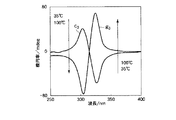
100℃に昇温することにより円偏光二色性の符号が反転した薄膜を、35℃に急冷して円偏光二色性スペクトルを測定し、その結果を図4のグラフに示す。図4中、曲線c2およびg2は、それぞれ、35℃および100℃の結果である。急冷後のスペクトルは、急冷前に示したスペクトルからほとんど変化していないことが明らかである。この急冷後のサンプルを室温で数日間保存ところ、円偏光二色性の符号は反転することはなく、らせんの巻き性すなわち円偏光二色性の符号を固定化記録できることが示された。 The thin film in which the sign of circular dichroism was reversed by raising the temperature to 100 ° C. was rapidly cooled to 35 ° C., and the circular dichroism spectrum was measured. The result is shown in the graph of FIG. In FIG. 4, curves c 2 and g 2 are the results at 35 ° C. and 100 ° C., respectively. It is clear that the spectrum after quenching has hardly changed from the spectrum shown before quenching. When the sample after quenching was stored at room temperature for several days, the sign of circular dichroism was not reversed, and it was shown that the spiral winding property, that is, the sign of circular dichroism could be fixedly recorded.
円偏光二色性の符号が固定された薄膜を、さらに100℃に昇温して円偏光二色性スペクトルを測定し、その結果を図5のグラフに示す。図5中、曲線c3およびg3は、それぞれ、35℃および100℃の結果である。図示するように、らせんの巻き性すなわち円偏光二色性の符号は再び反転しており、記録の書き換えが可能であることが示された。 The thin film on which the sign of circular dichroism was fixed was further heated to 100 ° C. to measure the circular dichroism spectrum, and the result is shown in the graph of FIG. In FIG. 5, curves c 3 and g 3 are the results at 35 ° C. and 100 ° C., respectively. As shown in the drawing, the sign of spiral winding, that is, circular dichroism is reversed again, indicating that the recording can be rewritten.
以上説明したように、本発明の実施形態にかかる方法により、特定の光学活性ポリシランを含有する固体薄膜の光学活性を、熱的に可逆的に反転(スイッチ)し、その後、これを固定化(メモリー)し、さらに、初期の光学活性に戻す(リライタブル)といった制御が可能である。 As described above, by the method according to the embodiment of the present invention, the optical activity of a solid thin film containing a specific optically active polysilane is thermally reversibly reversed (switched), and then fixed ( Memory) and control to return to the initial optical activity (rewritable) is possible.
同様の結果は、重量平均分子量の異なる他のサンプルについても確認された。ただし、すでに説明したように、各サンプルは分子量に応じて異なるらせん反転温度を有しているので、昇降温する温度範囲はそれぞれ異なる。 Similar results were confirmed for other samples with different weight average molecular weights. However, as already explained, each sample has a different spiral inversion temperature depending on the molecular weight, and therefore the temperature range for raising and lowering the temperature is different.
また、(S)−3,7−ジメチルオクチル基を(R)−3,7−ジメチルオクチル基に変更した以外は、前述と同様の原料モノマーを重合させてなるポリシランを用いた場合も、同様の効果が得られた。さらに、3−メチルブチル基を、2−エチルブチル基、シクロペンタンエチル基、(R)−3−メチルペンチル基、または(S)−3−メチルペンチル基に変更した以外は、前述と同様の原料モノマーを重合させてなるポリシランを用いた場合も、同様の効果が確認された。 The same applies to the case of using polysilane obtained by polymerizing the same raw material monomer as described above except that (S) -3,7-dimethyloctyl group is changed to (R) -3,7-dimethyloctyl group. The effect of was obtained. Further, the same raw material monomer as described above except that the 3-methylbutyl group is changed to a 2-ethylbutyl group, a cyclopentaneethyl group, a (R) -3-methylpentyl group, or a (S) -3-methylpentyl group The same effect was confirmed when using polysilane obtained by polymerizing.
本発明は、熱駆動型光学活性スイッチ素子・情報記録媒体材料に適用して、高密度かつ高性能な光学活性あるいは光学不活性な光機能デバイスを構築することができる。 The present invention can be applied to a heat-driven optically active switching element / information recording medium material to construct a high-density and high-performance optically active or optically inactive optical device.
Claims (10)
下記一般式(1)で表わされる繰り返し単位を有し、重量平均分子量に応じたらせん反転温度を示す光学活性ポリシランを溶媒に溶解して、前記光学活性ポリシランと前記溶媒とからなる溶液を調製する工程、
前記溶液を基板上にキャストして、塗膜を形成する工程、
前記塗膜を常温常圧で保持して前記溶媒を揮発させることにより、前記光学活性ポリシランからなる固体塗膜を基板上に形成する工程、および
前記固体薄膜を、前記らせん反転温度を越えて昇温し、円偏光二色性の符号を反転させ、前記固体薄膜の光学活性を可逆的に反転させることによって書き込みを行なう工程
を具備することを特徴とする方法。
An optically active polysilane having a repeating unit represented by the following general formula (1) and exhibiting a helical inversion temperature according to the weight average molecular weight is dissolved in a solvent to prepare a solution comprising the optically active polysilane and the solvent. Process,
Casting the solution on a substrate to form a coating film;
By evaporating the solvent and holding the coating at room temperature and atmospheric pressure, the step of forming a solid coating film formed from the optically active polysilane on the substrate, and the solid film, the temperature beyond the helix inversion temperature A method comprising the step of performing writing by heating, reversing the sign of circular dichroism, and reversibly reversing the optical activity of the solid thin film .
下記一般式(2)で表わされる繰り返し単位を有し、重量平均分子量に応じたらせん反転温度を示す光学活性ポリシランを溶媒に溶解して、前記光学活性ポリシランと前記溶媒とからなる溶液を調製する工程、
前記溶液を基板上にキャストして、塗膜を形成する工程、
前記塗膜を常温常圧で保持して前記溶媒を揮発させることにより、前記光学活性ポリシランからなる固体塗膜を基板上に形成する工程、および
前記固体薄膜を、前記らせん反転温度を越えて昇温し、円偏光二色性の符号を反転させ、前記固体薄膜の光学活性を可逆的に反転させることによって記録を行なう工程
を具備することを特徴とする方法。
An optically active polysilane having a repeating unit represented by the following general formula (2) and exhibiting a helical inversion temperature according to the weight average molecular weight is dissolved in a solvent to prepare a solution comprising the optically active polysilane and the solvent. Process,
Casting the solution on a substrate to form a coating film;
By evaporating the solvent and holding the coating at room temperature and atmospheric pressure, the step of forming a solid coating film formed from the optically active polysilane on the substrate, and the solid film, the temperature beyond the helix inversion temperature A method comprising recording by heating, reversing the sign of circular dichroism, and reversibly reversing the optical activity of the solid thin film .
Priority Applications (1)
| Application Number | Priority Date | Filing Date | Title |
|---|---|---|---|
| JP2003338151A JP3928131B2 (en) | 2003-09-29 | 2003-09-29 | Method for controlling optical activity of solid thin film |
Applications Claiming Priority (1)
| Application Number | Priority Date | Filing Date | Title |
|---|---|---|---|
| JP2003338151A JP3928131B2 (en) | 2003-09-29 | 2003-09-29 | Method for controlling optical activity of solid thin film |
Publications (2)
| Publication Number | Publication Date |
|---|---|
| JP2005107007A JP2005107007A (en) | 2005-04-21 |
| JP3928131B2 true JP3928131B2 (en) | 2007-06-13 |
Family
ID=34533752
Family Applications (1)
| Application Number | Title | Priority Date | Filing Date |
|---|---|---|---|
| JP2003338151A Expired - Lifetime JP3928131B2 (en) | 2003-09-29 | 2003-09-29 | Method for controlling optical activity of solid thin film |
Country Status (1)
| Country | Link |
|---|---|
| JP (1) | JP3928131B2 (en) |
-
2003
- 2003-09-29 JP JP2003338151A patent/JP3928131B2/en not_active Expired - Lifetime
Also Published As
| Publication number | Publication date |
|---|---|
| JP2005107007A (en) | 2005-04-21 |
Similar Documents
| Publication | Publication Date | Title |
|---|---|---|
| JP3651980B2 (en) | Novel side group polymers and their use for optical components | |
| Müller et al. | Interplay of chiral side chains and helical main chains in polyisocyanates | |
| US5024784A (en) | Device for reversible optical data storage using polymeric liquid crystals | |
| JP3928131B2 (en) | Method for controlling optical activity of solid thin film | |
| WO2006080647A1 (en) | Photochromic monomers, photochromic polymers based on the same, photochromic recording media comprising the photochromic polymers, and 3d read/write optical memory comprising the recording media | |
| Boiko et al. | Kinetically controlled phase transitions in liquid‐crystalline polymers. III. Influence of the molecular weight and annealing temperature on two‐dimensional K phase formation in a side‐chain polyacrylate | |
| JP5481672B2 (en) | Information recording material and information recording method using dianthracene amorphous polymer | |
| JP2005345652A (en) | Optical recording material, optical recording medium, and optical recording and reproducing device | |
| JP2004310999A (en) | Optical recording medium and manufacturing method of optical recording medium | |
| JP4113123B2 (en) | Rewritable optical recording material with excellent solubility | |
| JP2012045864A (en) | Optical information recording medium using liquid crystal polymer, optical information recording method, and method for manufacturing optical information recording medium | |
| JP3056249B2 (en) | Liquid crystalline polymers and methods for photo-induced alignment of them for reversible information storage | |
| JP5194648B2 (en) | Thermoplastic resin composition, method for producing the same, and optical actuator material | |
| US6716373B2 (en) | Optically active polysilane, optically active film, and method of controlling optical characteristics of solid thin film | |
| JPH10212324A (en) | Highly inducible birefringent photoaddressable side chain polymer | |
| JPH0658507B2 (en) | Optical element | |
| JP2794469B2 (en) | Organic polymer liquid crystal | |
| JP4051445B2 (en) | Method for manufacturing liquid crystal recording medium | |
| JPWO2004113469A1 (en) | Optical recording material | |
| Bobrovsky et al. | Photochromic liquid-crystalline copolymers bearing cinnamic acid-based chiral side groups | |
| JP4691725B2 (en) | Optical information recording medium | |
| Oriol et al. | Synthesis and characterization of reactive liquid crystalline Schiff bases, Rh (I) complexes, and their derived polymers | |
| JP5071922B2 (en) | Liquid crystal material capable of recording and erasing color image by temperature or light, and recording method or information recording apparatus using the same | |
| Galli et al. | Azobenzene containing polymers: what is yet viable with aged liquid crystals | |
| JP2007002137A (en) | Azobenzene monomer, polymer thereof, and refractive index modulation material using the same |
Legal Events
| Date | Code | Title | Description |
|---|---|---|---|
| A131 | Notification of reasons for refusal |
Free format text: JAPANESE INTERMEDIATE CODE: A131 Effective date: 20061017 |
|
| A521 | Request for written amendment filed |
Free format text: JAPANESE INTERMEDIATE CODE: A523 Effective date: 20061208 |
|
| TRDD | Decision of grant or rejection written | ||
| A01 | Written decision to grant a patent or to grant a registration (utility model) |
Free format text: JAPANESE INTERMEDIATE CODE: A01 Effective date: 20070123 |
|
| A61 | First payment of annual fees (during grant procedure) |
Free format text: JAPANESE INTERMEDIATE CODE: A61 Effective date: 20070221 |
|
| R150 | Certificate of patent or registration of utility model |
Ref document number: 3928131 Country of ref document: JP Free format text: JAPANESE INTERMEDIATE CODE: R150 Free format text: JAPANESE INTERMEDIATE CODE: R150 |
|
| S111 | Request for change of ownership or part of ownership |
Free format text: JAPANESE INTERMEDIATE CODE: R313117 |
|
| FPAY | Renewal fee payment (event date is renewal date of database) |
Free format text: PAYMENT UNTIL: 20100316 Year of fee payment: 3 |
|
| R350 | Written notification of registration of transfer |
Free format text: JAPANESE INTERMEDIATE CODE: R350 |
|
| EXPY | Cancellation because of completion of term |