JP3774573B2 - Toner for electrostatic image development - Google Patents
Toner for electrostatic image development Download PDFInfo
- Publication number
- JP3774573B2 JP3774573B2 JP24368398A JP24368398A JP3774573B2 JP 3774573 B2 JP3774573 B2 JP 3774573B2 JP 24368398 A JP24368398 A JP 24368398A JP 24368398 A JP24368398 A JP 24368398A JP 3774573 B2 JP3774573 B2 JP 3774573B2
- Authority
- JP
- Japan
- Prior art keywords
- toner
- acid
- weight
- binder resin
- group
- Prior art date
- Legal status (The legal status is an assumption and is not a legal conclusion. Google has not performed a legal analysis and makes no representation as to the accuracy of the status listed.)
- Expired - Fee Related
Links
Landscapes
- Developing Agents For Electrophotography (AREA)
Description
【0001】
【発明の属する技術分野】
本発明は、電子写真、静電記録のような画像形成方法における静電荷潜像を顕像化するための静電荷像現像用トナーに関する。
【0002】
【従来の技術】
静電荷像現像用トナーは、現像される静電潜像の極性に応じて、正又は負の電荷を有する必要がある。トナーに電荷を保有せしめるためには、トナーの成分である樹脂の摩擦帯電性を利用することもできるが、この方法ではトナーの帯電が安定しないので、濃度の立ち上がりが遅く、カブリが生じ易い。そこで、所望の摩擦帯電性をトナーに付与するために帯電制御剤を添加することが行われている。
【0003】
今日、当該技術分野で知られている帯電制御剤としては、下記に挙げるものがある。負摩擦帯電性の帯電制御剤としては、モノアゾ染料の金属錯塩、ヒドロキシカルボン酸、ジカルボン酸、芳香族ジオール等の金属錯塩、酸成分を含む樹脂等が知られており、正摩擦帯電性の帯電制御剤としては、ニグロシン染料、アジン染料、トリフェニルメタン系染顔料、4級アンモニウム塩、4級アンモニウム塩を側鎖に有するポリマー等が知られている。
【0004】
しかしながら、これらの帯電制御剤の殆どは、濃色であり、カラートナーには使えないものが多い。そして、カラートナーにも適用可能な、無色、白色或いは淡色のものの殆どは、性能的に不充分なものが多い。例えば、ハイライトの均一性が得られなかったり、耐久試験での画像濃度の変動が大きい等の欠点を有する。
この他、帯電制御剤によっては、トナー中に含有させた場合に以下に列挙するような欠点を生じるものもある。例えば、画像濃度とカブリのバランスが取りにくい、高湿環境で充分な画像濃度が得られにくい、結着樹脂への分散性が悪い、トナーの保存安定性、定着性、耐オフセット性に悪影響を与える等である。
【0005】
従来、芳香族カルボン酸類の金属錯体や金属塩を帯電制御剤として使用することについては、特開昭53−127726号公報、特開昭57−111541号公報、特開昭57−124357号公報、特開昭57−104940号公報、特開昭61−69073号公報、特開昭61−69073号公報、特開昭61−73963、特開昭61−267058号公報、特開昭62−105156号公報、特開昭62−145255号公報、特開昭62−163061号公報、特開昭63−208865号公報、特開平3−276166号公報、特開平4−84141号公報、特開平8−160668号公報を始めとして、いくつかの提案がなされている。
しかしながら、これらの公報に提案されている芳香族カルボン酸類の金属錯体や金属塩は、いずれも摩擦帯電付与という観点からは優れたものであるが、高速機における長期耐久時おいても安定した現像性が得られるものは少ない。更に、他の原材料の影響を受け易く、使用に際して他の原材料への制約が発生するものも多い。以上のようなすべての項目を満足し得る芳香族カルボン酸類の金属錯体や金属塩からなる帯電制御剤は知られていないのが現状である。
【0006】
【発明が解決しようとする課題】
従って、本発明の目的は、低湿下で使用しても、高湿下で使用しても高い品質の画像が安定して得られ、経時においても画像欠陥を生じない静電荷像現像用トナーを提供することにある。
本発明の別の目的は、補給タイプの高速機に用いられる現像器において劣化したトナーが発生しにくく、優れた現像性が得られる静電荷像現像用トナーを提供することにある。
更に、本発明の目的は、長期耐久においても静電荷潜像に忠実な画像が継続して得られる静電荷像現像用トナーを提供することにある。
【0007】
【課題を解決するための手段】
上記目的は、以下の本発明によって達成される。即ち、本発明は、少なくとも、結着樹脂、着色剤、及び帯電制御剤として有機金属化合物を含有するトナーにおいて、該有機金属化合物が金属元素としてチタンを有し、配位子として芳香族ポリオールを配位しており、かつ、下記式(1)及び(2)
【0008】
【発明の実施の形態】
以下に、好ましい実施の形態を挙げて、本発明を具体的に説明する。
本発明者らは、上記した従来技術の課題を解決すべく鋭意検討の結果、チタンを含有する特定の有機錯化合物を帯電制御剤として用いることによって、帯電の立ち上がりのよさを保持しつつ、高湿環境下においても高い帯電量が得られ、低湿環境下においても帯電過剰となることのないトナーとすることができることを知見して本発明に至った。又、本発明で使用する特定の有機チタン錯化合物は、透明性に優れ、カラートナーに使用した場合に、色調に影響を及ぼさず、鮮明な色彩画像が得られるカラートナーが得られることもわかった。
【0009】
更に、本発明者らは、上記のような特徴を有するトナーを得ることができる本発明で使用する有機チタン錯化合物を、磁性体を含有する磁性トナーに適用したり、或いは、一成分現像方法に適用する一成分現像剤トナーに適用した場合においても、優れた現像性が得られることを見いだした。即ち、少ない摩擦帯電の機会で、素速い帯電の立ち上がりと、高い帯電量を必要とする磁性トナーや一成分現像用トナーに好適な帯電制御剤の選択は難しいが、上記した有機チタン錯化合物は、これらの要件を満たすことのできる好適な負帯電制御剤となり得る。従って、本発明の静電荷像現像用トナーは、一成分現像方法に用いられるトナーとしても、非磁性の一成分現像方法に用いられるトナーとしても好適なものとなる。
【0010】
又、本発明者らの検討の結果、上記のような特徴を有するトナーが得られるという機能を有する特定の有機チタン錯化合物を、更に、酸価を有する結着樹脂と共に用いると、水分子の持つ極性を利用できるので、帯電が強調される効果への寄与を更に大きくすることができることがわかった。又、その際に、結着樹脂の酸価が1mgKOH/g以上100mgKOH/g以下のものを使用すると好ましいこともわかった。
又、更に、融点が互いに異なるワックス、或いは組成の異なるワックスを2種類以上併用すると、本発明で使用する有機チタン錯化合物の結着樹脂に対する分散性を非常に良好にすることが可能になり、トナーの耐久性、帯電均一性を向上させることができることもわかった。例えば、融点の異なる2種類以上のワックスを用いる場合には、その中の少なくとも2種類のワックスの融点の差が、10℃以上100℃以下あるものを使用することが好ましいことがわかった。
【0011】
以上述べたように、本発明の静電荷像現像用トナーは、荷電制御剤として特定の有機チタン錯化合物を使用することによって、低湿、高湿環境下においてもトナーの帯電量が充分になるだけでなく、画像形成において、長期耐久での画像濃度の低下が抑えられ、安定して高い画像濃度が得られる。更に、本発明者らの検討の結果、磁性トナーとする場合には、着色剤として、種々の異種元素を有する磁性酸化鉄を含有させると、最適な特性を有する磁性トナーが得られることもわかった。又、その際に、種々の異種元素の含有量として、鉄元素基準で異種元素を0.05重量%以上10重量%以下で含有している磁性酸化鉄を用いることが好ましいこともわかった。即ち、異種元素の酸化物、水酸化物、或いは異種元素を取り込んだ磁性酸化鉄や、異種元素を混晶させた磁性酸化鉄は、水分子を吸着し、水分子の極性を利用した帯電の強調を効果的に行うことができるので、最適な特性を有する磁性トナーとなると考えている。又、この場合も、先に述べた特定の酸価を有する結着樹脂を用いる態様によって、一層効果的に帯電強調を行うことが可能なトナーとできることがわかった。
【0012】
以下、トナーの荷電制御剤として用いた場合に、上記で説明した優れた効果を発揮し得る特定の有機チタン錯化合物について説明する。
一般に、有機チタン錯化合物は、チタンイオンが六配位をとり易いことと、カルボキシル基、水酸基等の酸素が配位し易いこと等から、チタンイオンにカルボキシル基等が配位する機会が多くなる。従って、有機チタン錯化合物は、結着樹脂として、官能基にカルボキシル基を有するスチレン系樹脂やポリエステル系樹脂等の、酸価を有する結着樹脂を用いると結着樹脂中へのなじみがよく、分散性に優れたものとなるため、荷電制御剤としてトナー中に含有させた場合に、トナー粒子中からの脱落が抑制され、帯電均一化と帯電の耐久安定性が得られる。更に、トナーの透明性への影響も小さくなるので、カラートナーとした場合に、鮮やかな色彩を表現するのに好ましいものとなる。
【0013】
そこで、本発明の静電荷像現像用トナーにおいては、荷電制御剤として、有機金属化合物が金属元素としてチタンを有し、配位子として芳香族ポリオールを配位してなるチタン錯体或いはチタン錯塩を使用する。即ち、このような特定の有機チタン錯化合物は、摩擦帯電能力に優れ、高い帯電量が得られるので、高い帯電量を必要とする磁性トナーにとって好適な荷電制御剤となり得る。更に、上記した特定の有機チタン錯化合物自体の良好な分散性に加えて、結着樹脂として酸価を有するものを用いれば、磁性体の分散性向上に対して高い機能が発揮されるので、トナーに対して、より高い耐久性、帯電均一性が付与される。
更に、本発明で使用する上記の有機チタン錯化合物は、トナーを構成する結着樹脂の表面張力に何らかの影響を及ぼし、特に、複数種のワックスと併用した場合に、非常に離型性に優れたトナーが得られる。又、ワックスとして、互いの融点の差が10℃以上100℃以下である融点の異なる2種類以上のワックスを少なくとも含有するものや、組成の異なる2種類以上のワックスを含有するものを使用すれば、耐オフセット性に優れるばかりでなく、感光体への融着防止に効果のあるトナーが得られる。更に、酸価を有する結着樹脂と共に用いた場合に、上記した効果は特に著しい。
【0014】
以下、本発明の静電荷像現像用トナーにおいて帯電制御剤として使用する、芳香族ポリオールのチタン錯体或いはチタン錯塩について具体的に説明する。本発明の目的を達成し得る帯電制御剤は、例えば、下記の一般式(1)及び(2)で表わされる芳香族ポリオールのチタン錯体或いは錯塩である。
【0015】
【化1】
上記一般式(1)中、Arは、無置換の、又は、置換基として、アルキル基及びシクロアルキル基のいずれかを有する単環、二環及び三環から選択されるいずれかの一つの芳香族残基を表わし、又、C1は、1価の水素イオン、ナトリウムイオン及びアンモニウムイオンから選択されるいずれか一つのカチオンを表わし、nは、2を表わす。式(2)中、Arは、無置換の、又は、置換基として、アルキル基、アルアルキル基、アルケニル基、アリールオキシ基、水酸基及びカルボキシル基のいずれかを有する単環、二環及び三環から選択されるいずれかの芳香族残基を表わし、又、C1は1価のナトリウムイオン及びトリエチルアンモニウムイオンから選択されるいずれか一つのカチオンを表わし、nは、2又は3を表わす。
【0017】
本発明において、帯電制御剤として使用する、上記したような一般式で表される芳香族ポリオールのチタン錯体或いはチタン錯塩は、トナー中に複数含有されてもよいが、その際、配位子となる芳香族ポリオール類は、同じものであっても異なるものであってもよい。又、ポリオール、中性配位子の配位数の異なる錯化合物の混合物であってもよい。上記したような芳香族ポリオールのチタン錯体或いはチタン錯塩を結着樹脂中へ含有させた場合における分散性向上の観点或いは帯電性向上の観点からは、芳香族残基Arとしては、ベンゼン環、ナフタレン環、アントラセン環、フェナントレン環が好ましく、更に、その置換基としては、アルキル基、カルボキシル基、水酸基が好ましく、中性配位子Lとしては水が好ましく、1価のカチオンであるC1としては、水素、ナトリウム、カリウム、アンモニウム、アルキルアンモニウムの各イオンであるものを使用することが好ましい。
【0018】
更に、本発明の静電荷像現像用トナーを構成する帯電制御剤として好ましい芳香族ポリオールのチタン錯体或いはチタン錯塩として、下記の一般式(5)、(6)、(5)、又は(6)’で表わせるチタン錯体又はチタン錯塩を挙げることができる。
【0019】
【化2】
上記一般式(5)及び(6)、或いは(5)’及び(6)’において、A環は芳香環を表し、Rは、水素原子、アルキル基、アリール基、アルアルキル基、シクロアルキル基、アルケニル基、アルコキシ基、アリールオキシ基、水酸基、アシルオキシ基、アルコキシカルボニル基、アリールオキシカルボニル基、アシル基、カルボキシル基、ハロゲン、ニトロ基、アミノ基、カルバモイル基のいずれかを表わし、相互に連結して脂肪族環、複素環を形成していてもよく、これらの環に置換基を有していてもよく、置換基はRに準じ、l及びl’(エル)は1〜8の整数を表わし、l及びl’(エル)が2以上の場合には2以上のRは同一又は異なってもよく、Cは、1価のカチオン、水素、アルカリ金属、アンモニウム、アルキルアンモニウムを表わし、nは2又は3を表わし、mは0又は2を表わす。
上記一般式で表される各錯体又は錯塩において配位子となる芳香族ポリオール類は、同じ物であっても異なるものであってもよい。又、ポリオール、中性配位子の配位数の異なる錯化合物の混合物であってもよい。結着樹脂中への、上記一般式で表される各錯体又は錯塩の分散性向上の観点或いは帯電性向上の観点から、置換基Rが、アルキル基、アルケニル基、カルボキシル基、水酸基のいずれかであることが好ましく、Cとしては、水素、ナトリウム、カリウム、アンモニウム、アルキルアンモニウムのいずれかのイオンであることが好ましい。特に好ましいのは、カウンターイオンを有さない、一般式(6)及び(6)’においてn=2の場合のチタン中性錯体であり、優れた環境安定性が得られ、結着樹脂中への分散性にも優れ、良好な耐久性が得られる。
【0021】
本発明に用いられる有機チタン錯体或いは錯塩は、六配位の錯化合物である。このような、錯化合物の構造の代表的なものを、以下の一般化学式(7)〜(10)でその構造を例示する。以下の構造の中には配位子Lを持たないものも含む。
【0022】
【化4】
本発明で使用する上記したような有機チタン錯化合物は、下記の方法によって得られる。3価のチタン錯化合物の場合には、三塩化チタンを用い、4価のチタン錯化合物の場合は、チタンイソプロポキシド、アルキルチタンアルコキシド、アリールチタンアルコキシド等を用い、水、アルコール、又はアルコール水溶液に溶解し、芳香族ポリオール及びこれらのアルカリ金属塩を添加するか、或いは芳香族ポリオールとアルカリ剤を添加することにより合成される。これらの有機チタン錯化合物は、アルコール水溶液等で再結晶し、アルコール洗浄で精製する。又、チタン錯塩の場合は、生成物を鉱酸、アルカリ剤、アミン剤で処理することにより種々のカウンターイオンを持つ錯塩が得られる。本発明においては、チタン錯塩のカウンターイオンに水素イオン、アルカリ金属イオン、アンモニウムイオン等、複数種有しているものも含む。
【0024】
以下に、本発明に用いられる有機チタン錯化合物の具体例を挙げるが、ここでは、示性式を示す。但し、水分子を2個配位しているものも含まれるが、ここでは水分子の記載を省略する。又、カウンターイオンは複数種有するものも含むが、ここでは一番多いカウンターイオンのみを記載する。
【0025】
【化5】
【化6】
【化7】
【化8】
【化9】
【化10】
【化11】
【化12】
【化13】
【化14】
【化15】
【化16】
【化17】
【化18】
【化19】
上記に例示したような本発明で使用する有機チタン錯化合物をトナーに含有させる方法としては、トナー内部に添加する方法と、外添する方法とがある。内添する場合の好ましい添加量としては、結着樹脂100重量部に対して0.1〜10重量部、より好ましくは、0.5〜5重量部の範囲で用いる。又、外添する場合は、結着樹脂100重量部に対して0.01〜5重量部程度とすることが好ましく、特に、メカノケミカル的にトナー表面に固着させるのが好ましい。
又、本発明の静電荷像現像用トナーを構成する帯電制御剤として使用する有機チタン錯化合物は、従来の技術で述べたような公知の帯電制御剤と組み合わせて使用することもできる。この際に使用する公知の帯電制御剤としては、例えば、他の有機金属錯体、金属塩、キレート化合物があり、モノアゾ金属錯体、アセチルアセトン金属錯体、ヒドロキシカルボン酸金属錯体、ポリカルボン酸金属錯体、ポリオール金属錯体等が挙げられる。その他には、カルボン酸の金属塩、カルボン酸無水物、エステル類等のカルボン酸誘導体や芳香族系化合物の縮合体等も挙げられる。又、ビスフェノール類、カリックスアレーン等のフェノール誘導体等も用いられる。
【0042】
本発明の静電荷像現像用トナーを構成する結着樹脂の種類としては、例えば、スチレン系樹脂、スチレン系共重合樹脂、ポリエステル樹脂、ポリオール樹脂、ポリ塩化ビニル樹脂、フェノール樹脂、天然変性フェノール樹脂、天然樹脂変性マレイン酸樹脂、アクリル樹脂、メタクリル樹脂、ポリ酢酸ビニル、シリコーン樹脂、ポリウレタン樹脂、ポリアミド樹脂、フラン樹脂、エポキシ樹脂、キシレン樹脂、ポリビニルブチラール、テルペン樹脂、クマロンインデン樹脂、石油系樹脂等が挙げられる。
【0043】
スチレン系共重合体のスチレンモノマーに対するコモノマーとしては、例えば、ビニルトルエン等のスチレン誘導体;例えば、アクリル酸、アクリル酸メチル、アクリル酸エチル、アクリル酸ブチル、アクリル酸ドデシル、アクリル酸オクチル、アクリル酸−2−エチルヘキシル、アクリル酸フェニル等のアクリル酸エステル類;例えば、メタクリル酸、メタクリル酸メチル、メタクリル酸エチル、メタクリル酸ブチル、メタクリル酸オクチル等のメタクリル酸エステル類;例えば、マレイン酸、マレイン酸ブチル、マレイン酸メチル、マレイン酸ジメチル等のような二重結合を有するジカルボン酸類;例えば、アクリルアミド、アクリロニトリル、メタクリロニトリル、ブタジエン、塩化ビニル;例えば、酢酸ビニル、安息香酸ビニル等のようなビニルエステル類;例えば、エチレン、プロピレン、ブチレン等のようなエチレン系オレフィン類;例えば、ビニルメチルケトン、ビニルヘキシルケトン等のようなビニルケトン類;例えば、ビニルメチルエーテル、ビニルエチルエーテル、ビニルイソブチルエーテル等のようなビニルエーテル類;等のビニル系単量体が単独若しくは2つ以上用いられる。
【0044】
結着樹脂を作製する場合に必要に応じて使用される架橋剤としては、主として2個以上の重合可能な二重結合を有する化合物が用いられ、例えば、ジビニルベンゼン、ジビニルナフタレン等のような芳香族ジビニル化合物;例えば、エチレングリコールジアクリレート、エチレングリコールジメタクリレート、1,3−ブタンジオールジメタクリレート等のような二重結合を2個有するカルボン酸エステル;ジビニルアニリン、ジビニルエーテル、ジビニルスルフィド、ジビニルスルホン等のジビニル化合物;及び3個以上のビニル基を有する化合物等が、単独若しくは混合物として用いられる。
【0045】
結着樹脂として、スチレン−アクリル系樹脂を使用する場合は、トナーの分子量分布が、THF可溶分のGPCによる分子量分布で、分子量3千〜5万の領域に少なくとも1つピークが存在し、且つ、分子量10万以上の領域に少なくとも1つピークが存在し、更に、分子量分布10万以下の成分が50〜90%となるような結着樹脂を使用することが好ましい。
一方、結着樹脂がポリエステル系の樹脂の場合は、同様のトナーの分子量分布で、分子量3千〜5万の領域に少なくとも1つピークが存在し、且つ、分子量10万以下の成分が60〜100%となるような結着樹脂を使用することが好ましい。更に好ましくは、分子量5千〜2万の領域に、少なくとも1つピークが存在するものを使用することが好ましい。
【0046】
帯電制御剤として有機チタン錯化合物を含有した本発明の静電荷像現像用トナーは、本発明者らの検討の結果、高湿或いは低湿環境下においても帯電特性の変動が少なく、安定した現像特性を保持できると同時に、酸価を有する結着樹脂を用いた場合には、特に、帯電制御剤の分散性が非常によくなる上に、トナーからの有機チタン錯化合物の欠落が少なくなるため、得られるトナーが、耐久安定性に優れたものとなる。
又、このような形態の本発明の静電荷像現像用トナーは、現像剤担持体との摩擦帯電プロセスにおいて、優れた帯電付与能力を示すようになることも明らかになった。即ち、酸価有する結着樹脂と、先に説明した有機チタン錯化合物とを含有したトナーについて、現像剤担持体材質との接触による帯電能力をみると、現像剤坦持体表面との少ない接触でも大きな帯電量が発生することがわかった。
【0047】
上記のような優れた効果が得られる本発明において好適な結着樹脂としては、その酸価が、1.0mgKOH/g以上100mgKOH/g以下のもの、好ましくは、1.0mgKOH/g以上70mgKOH/g以下のもの、更に好ましくは、1.0mgKOH/g以上50mgKOH/g以下のもの、特に、酸価が2.0mgKOH/g以上40mgKOH/g以下の範囲にある結着樹脂を使用することが好ましい。即ち、結着樹脂の酸価が1.0mgKOH/g未満の場合は、帯電制御剤として使用する有機チタン錯化合物との相互作用による現像安定性や耐久安定効果を充分には発揮しきれず、一方、100mgKOH/gを超える場合は、結着樹脂の吸湿性が強くなり、画像濃度が低下し、カブリが増加する傾向がある。
【0048】
本発明において、トナー組成物を構成する重合体成分全体の酸価は、以下の方法により求めた。
<酸価の測定>
基本操作はJIS K−0070に準じ、以下の▲1▼〜▲5▼の手順に従って行なった。
▲1▼ 測定するトナーを含む組成物試料は、予め重合体(樹脂)成分以外の添加物を除去して測定用試料を調製するか、予め重合体以外の成分の酸価及び含有量を求めておく。上記のような試料の粉砕品0.5〜2.0(g)を精秤し、重合体成分の重さをW(g)とする。
▲2▼ 300(ml)のビーカーに、上記試料を入れ、トルエン/エタノール(4/1)の混合液150(ml)を加えて溶解する。
▲3▼ ▲2▼で得られた溶液について、0.1mol/lのKOHのエタノール溶液を用いて電位差滴定装置で滴定する。この際、例えば、京都電子株式会社製の電位差滴定装置AT―400(win workstation)と、ABP−410電動ビュレットを用いての自動滴定が利用できる。
▲4▼ ▲3▼の滴定に要したKOH溶液の使用量をS(ml)とし、同時に、試料を入れずに上記と同様の操作を行なった溶液をブランクとして、▲3▼と同様にして滴定を行なって、この時のKOH溶液の使用量をB(ml)とする。
▲5▼ 上記で得られた滴定量等を使用して、次式により酸価を計算する。尚、色中のfは、KOH溶液のファクターである。
【数1】
本発明において、重合体成分(結着樹脂)の酸価を調整するモノマーとしては、例えば、アクリル酸、メタクリル酸、α−エチルアクリル酸、クロトン酸、ケイヒ酸、ビニル酢酸、イソクロトン酸、チグリン酸、アンゲリカ酸等のアクリル酸、及びそのα−或いはβ−アルキル誘導体、フマル酸、マレイン酸、シトラコン酸、アルケニルコハク酸、イタコン酸、メサコン酸、ジメチルマレイン酸、ジメチルフマル酸等の不飽和ジカルボン酸、及びそのモノエステル誘導体又は無水物等があり、このようなモノマーを単独、或いは混合して、他のモノマーと共重合させることにより所望の重合体を作ることかできる。この中でも、特に不飽和ジカルボン酸のモノエステル誘導体を用いることが、結着樹脂の酸価の値を適宜にコントロールする上からは好ましい。
【0050】
より具体的には、例えば、マレイン酸モノメチル、マレイン酸モノエチル、マレイン酸モノブチル、マレイン酸モノオクチル、マレイン酸モノアリル、マレイン酸モノフェニル、フマル酸モノメチル、フマル酸モノエチル、フマル酸モノブチル、フマル酸モノフェニル等のようなα,β−不飽和ジカルボン酸のモノエステル類;n−ブテニルコハク酸モノブチル、n−オクテニルコハク酸モノメチル、n−ブテニルマロン酸モノエチル、n−ドデセニルグルタル酸モノメチル、n−ブテニルアジピン酸モノブチル等のようなアルケニルジカルボン酸のモノエステル類等が挙げられる。
【0051】
以上のようなカルボキシル基含有モノマーは、結着樹脂を構成している全モノマーに対して0.1〜20重量部、好ましくは0.2〜15重量部程度添加すればよい。上記のようなジカルボン酸のモノエステルモノマーが選択される理由は、水系の懸濁液に対して、溶解度が低く、有機溶媒や他のモノマーへの溶解度の高いエステルの形で用いることが好ましいからである。
【0052】
本発明においては、上記のような方法で得られた共重合体中のカルボン酸基及びカルボン酸エステル部位を、アルカリ処理を行ってケン化させることもできる。即ち、アルカリのカチオン成分と反応させて、カルボン酸基或いはカルボン酸エステル部位を極性官能基に変化させてもよい。
この際に行なうアルカリ処理は、結着樹脂を製造後、重合時に使用した溶媒中にアルカリを水溶液で投入し、攪拌しながら行なえばよい。ここで用いることのできるアルカリとしては、Na、K、Ca、Li、Mg、Ba等のアルカリ金属及びアルカリ土類金属の水酸化物;Zn、Ag、Pb、Ni等の遷移金属の水酸化物;アンモニウム塩、アルキルアンモニウム塩、ピリジウム塩等の4級アンモニウム塩の水酸化物等があり、特に好ましい例として、水酸化ナトリウムや水酸化カリウムが挙げられる。
【0053】
本発明において酸価を最適なものとするために行なう結着樹脂に対する上記のケン化反応は、例えば、結着樹脂として用いる共重合体中のカルボン酸基及びカルボン酸エステル部位の全てに渡って行われる必要はなく、部分的にケン化反応が進行して、その部分が極性官能基に変わっていればよい。
又、ケン化反応に用いるアルカリの量は、結着樹脂中の極性基の種類、分散方法、構成モノマーの種類等により一概に決定し難いのであるが、結着樹脂の酸価の0.02〜5倍当量であればよい。
【0054】
上記したような結着樹脂を含んで構成される樹脂組成物(本発明の静電荷像現像用トナー)は、保存性の観点から、ガラス転移温度(Tg)が45〜75℃、更に好ましくは50〜70℃の範囲内にあるように調製されているとよい。即ち、Tgが45℃より低いと、高温雰囲気下でトナーが劣化し易く、又、定着時にオフセットが発生し易くなる。一方、Tgが75℃を超えると、定着性が低下する傾向がある。
【0055】
本発明で使用する結着樹脂の合成方法として用いることのできる重合法としては、溶液重合法、乳化重合法や懸濁重合法等がある。
このうち、乳化重合法は、水に殆ど不溶の重合性単量体(重合性モノマー)を乳化剤で小さい粒子として水相中に分散させ、水溶性の重合開始剤を用いて重合を行う方法である。この方法では反応熱の調節が容易であり、重合の行われる相(重合体と単量体からなる油相)と水相とが別であることから、停止反応速度が小さく、その結果、重合濃度が大きく、高重合度のものが得られる。更に、重合プロセスが比較的簡単であること、及び重合生成物が微細粒子であるために、トナーの製造において、着色剤及び荷電制御剤その他の添加物との混合が容易であるので、着色樹脂組成物であるトナーを製造する方法として有利な点が多い。
【0056】
しかしながら、上記の乳化重合法では、乳化剤を添加する必要があるので、得られる重合体が不純物を含んだものになり易く、重合体を取り出す場合には、塩析等の操作が必要となる。この不便を避けるためには、乳化剤を使用することのない懸濁重合を適用することが好都合である。
懸濁重合においては、水系溶媒100重量部に対して、重合性モノマー100重量部以下、好ましくは10〜90重量部で行うのがよい。この際に使用可能な分散剤としては、ポリビニルアルコール、ポリビニルアルコール部分ケン化物、リン酸カルシウム等が用いられる。そして、その使用量としては、一般的には、水系溶媒100重量部に対して0.05〜1重量部の範囲で用いられる。又、重合温度は50〜95℃の範囲が適当であるが、使用する重合開始剤、目的とする重合体によって適宜に選択すればよい。
【0057】
本発明の静電荷像現像用トナーを構成する結着樹脂を重合法によって作製する場合には、以下に例示するような多官能性の重合開始剤を単独で、或いは単官能性重合開始剤と併用して重合性単量体と共に用いることが好ましい。
多官能構造を有する多官能性の重合開始剤の具体例としては、例えば、1,1−ジ−t−ブチルパーオキシ−3,3,5−トリメチルシクロヘキサン、1,3−ビス−(t−ブチルパーオキシイソプロピル)ベンゼン、2,5−ジメチル−2,5−(t−ブチルパーオキシ)ヘキサン、2,5−ジメチル−2,5−ジ−(t−ブチルパーオキシ)ヘキサン、トリス(t−ブチルパーオキシ)トリアジン、1,1−ジ−t−ブチルパーオキシシクロヘキサン、2,2−ジ−t−ブチルパーオキシブタン、4,4−ジ−t−ブチルパーオキシバレリックアシッド−n−ブチルエステル、ジ−t−ブチルパーオキシヘキサハイドロテレフタレート、ジ−t−ブチルパーオキシアゼレート、ジ−t−ブチルパーオキシトリメチルアジペート、2,2−ビス−(4,4−ジ−t−ブチルパーオキシシクロヘキシル)プロパン、2,2−t−ブチルパーオキシオクタン及び各種ポリマーオキサイド等の、1分子内に2つ以上のパーオキサイド基等の重合開始機能を有する官能基を持つ多官能性の重合開始剤、及びジアリルパーオキシジカーボネート、t−ブチルパーオキシマレイン酸、t−ブチルパーオキシアリルカーボネート及びt−ブチルパーオキシイソプロピルフマレート等の1分子内に、パーオキサイド基等の重合開始機能を有する官能基と、重合性の不飽和基の両方を有する多官能性重合開始剤が挙げられる。
これらの内、より好ましいものとしては、1,1−ジ−t−ブチルパーオキシ−3,3,5−トリメチルシクロヘキサン、1,1−ジ−t−ブチルパーオキシシクロヘキサン、ジ−t−ブチルパーオキシヘキサハイドロテレフタレート、ジ−t−ブチルパーオキシアゼレート及び2,2−ビス−(4,4−ジ−t−ブチルパーオキシシクロヘキサン)プロパン、及びt−ブチルパーオキシアリルカーボネートが挙げられる。
【0058】
これらの多官能性重合開始剤は、トナー用バインダーとして要求される種々の性能を満足するためには、単官能性重合開始剤と併用されることが好ましい。特に、多官能性重合開始剤の半減期10時間を得るための分解温度よりも低い半減期10時間を有する重合開始剤と併用することが好ましい。
具体的には、ベンゾイルパーオキシド、1,1−ジ(t−ブチルパーオキシ)−3,3,5−トリメチルシクロヘキサン、n−ブチル−4,4−ジ(t−ブチルパーオキシ)バレレート、ジクミルパーオキシド、α,α’−ビス(t−ブチルパーオキシジイソプロピル)べンゼン、t−ブチルパーオキシクメン、ジ−t−ブチルパーオキシド等の有機過酸化物、アゾビスイソブチロニトリル、ジアゾアミノアゾベンゼン等のアゾ及びジアゾ化合物等が挙げられる。
【0059】
これらの単官能性重合開始剤は、前記多官能性重合開始剤と同時にモノマー中に添加してもよいが、多官能性重合開始剤の効率を適正に保つためには、重合工程において多官能性重合開始剤の示す半減期を経過した後に添加するのが好ましい。
これらの開始剤は、効率の点からモノマー100重量部に対し0.05〜2重量部用いるのが好ましい。
【0060】
本発明の所期の目的を良好に達成するための結着樹脂としては、以下に例示するような架橋性モノマーで架橋されているものを使用することも好ましい。
架橋性モノマーとしては、主として2個以上の重合可能な二重結合を有するモノマーが用いられる。芳香族ジビニル化合物(例えば、ジビニルベンゼン、ジビニルナフタレン等);アルキル鎖で結ばれたジアクリレート化合物類(例えば、エチレングリコールジアクリレート、1,3−ブチレングリコールジアクリレート、1,4−ブタンジオールジアクリレート、1,5−ペンタンジオールアクリレート、1,6−ヘキサンジオールジアクリレート、ネオペンチルグリコールジアクリレート、及び以上の化合物のアクリレートをメタクリレートに代えたもの)エーテル結合を含むアルキル鎖で結ばれたジアクリレート化合物類(例えば、ジエチレングリコールジアクリレート、トリエチレングルコールジアクリレート、テトラエチレングリコールジアクリレート、ポリエチレングリコール#400ジアクリレート、ポリエチレングリコール#600ジアクリレート、ジプロピレングリコールジアクリレート、及び以上の化合物のアクリレートをメタクリレー卜に代えたもの);芳香族基及びエーテル結合を含む鎖で結ばれたジアクリレート化合物類(例えば、ポリオキシエチレン(2)−2,2−ビス(4−ヒドロキシフェニル)プロパンジアクリレート、ポリオキシエチレン(4)−2,2−ビス(4−ヒドロキシフェニル)プロパンジアクリレート、及び、以上の化合物のアクリレートをメタクリレートに代えたもの);ポリエステル型ジアクリレート化合物類(例えば、商品名MANDA(日本化薬製))等が挙げられる。多官能の架橋剤としては、ぺンタエリスリトールアクリレート、トリメチロールエタントリアクリレート、トリメチロールプロパントリアクリレート、テトラメチロールプロパントリアクリレート、テトラメチロールメタンテトラアクリレート、オリゴエステルアクリレート、及び以上の化合物のアクリレートをメタアクリレートに代えたもの;トリアリルシアヌレート、トリアリルトリメリテート等が挙げられる。
【0061】
これらの架橋剤は、他のモノマー成分100重量部に対して、0.0001〜1重量部、好ましくは0.001〜0.5重量部の範囲で用いることが好ましい。
これらの架橋性モノマーのうち、トナーの定着性、耐オフセット性の点から好適に用いられるものとして、芳香族ジビニル化合物(中でも特にジビニルベンゼン)、芳香族基及びエーテル結合を含む鎖で結ばれたジアクリレート化合物類が挙げられる。
【0062】
その他の合成方法としては、塊状重合方法、溶液重合方法を用いることができる。しかしながら、塊状重合法では、高温で重合させて停止反応速度を速めることで、任意の重合体を得ることができるが、反応をコントロールしにくいという問題点がある。その点、溶液重合法では、溶媒によるラジカルの連鎖移動の差を利用して、又、開始剤量や反応温度を調整することで任意の重合体を温和な条件で容易に得ることができるので、樹脂組成物中の低分子量体を得る方法として特に好ましい。特に、重合開始剤の使用量を最小限に抑え、開始剤が残留することによる影響を極力抑えるという点で、加圧条件下での溶液重合法も好ましい。
本発明で使用する結着樹脂を得るための他のコモノマーとしては、次のようなものが挙げられる。
【0063】
例えば、スチレン;o−メチルスチレン、m−メチルスチレン、p−メチルスチレン、p−メトキシスチレン、p−フェニルスチレン、p−クロルスチレン、3,4−ジクロルスチレン、p−エチルスチレン、2,4−ジメチルスチレン、p−n−ブチルスチレン、p−tert−ブチルスチレン、p−n−ヘキシルスチレン、p−n−オクチルスチレン、p−n−ノニルスチレン、p−n−デシルスチレン、p−n−1ドデシルスチレンのようなスチレン誘導体;エチレン、プロピレン、ブチレン、イソブチレンのようなエチレン不飽和モノオレフィン類;ブタジエン、イソプレンのような不飽和ポリエン類;塩化ビニル、塩化ビニリデン、臭化ビニル、フッ化ビニルのようなハロゲン化ビニル類;酢酸ビニル、プロピオン酸ビニル、ベンゾエ酸ビニルのようなビニルエステル類;メタクリル酸メチル、メタクリル酸エチル、メタクリル酸プロピル、メタクリル酸n−ブチル、メタクリル酸イソブチル、メタクリル酸n−オクチル、メタクリル酸ドデシル、メタクリル酸−2−エチルヘキシル、メタクリル酸ステアリル、メタクリル酸フェニル、メタクリル酸ジメチルアミノエチル、メタクリル酸ジエチルアミノエチルのようなα−メチレン脂肪族モノカルボン酸エステル類;アクリル酸メチル、アクリル酸エチル、アクリル酸n−ブチル、アクリル酸イソブチル、アクリル酸プロピル、アクリル酸−1−オクチル、アクリル酸ドデシル、アクリル酸−2−エチルヘキシル、アクリル酸ステアリル、アクリル酸−2−クロルエチル、アクリル酸フェニルのようなアクリル酸エステル類、ビニルメチルエーテル、ビニルエチルエーテル、ビニルイソブチルエーテルのようなビニルエーテル類;ビニルメチルケトン、ビニルヘキシルケトン、メチルイソプロぺニルケトンのようなビニルケトン類;N−ビニルピロール、N−ビニルカルバゾール、N−ビニルインドール、N−ビニルピロリドンのようなN−ビニル化合物;ビニルナフタリン類;アクリロニトリル、メタクリロニトリル、アクリルアミドのようなアクリル酸誘導体若しくはメタクリル酸誘導体が挙げられる。これらのビニルモノマーは、単独若しくは2つ以上のモノマーを混合して用いられる。
これらの中でも、スチレン系共重合体、スチレンアクリル系共重合体となるようなモノマーの組み合わせが好ましい。
【0064】
又、本発明の静電荷像現像用トナーにおいては、少なくともスチレン系重合体成分又はスチレン系共重合体成分を65重量部以上含有する結着樹脂を使用することが混合性の点で好ましい。
結着樹脂を製造する方法として、溶液重合法により高分子量重合体と低分子量重合体を別々に合成した後に、これらを溶液状態で混合し、次いで脱溶剤する溶液ブレンド法、又、押出機等により溶融混練するドライブレンド法、溶液重合法等により得られた低分子量重合体を溶解した高分子量重合体を構成するモノマーに溶解し、懸濁重合を行い、水洗・乾燥し、樹脂組成物を得る二段階重合法等も挙げられる。しかしながら、ドライブレンド法では、均一な分散、相溶の点で問題があり、又、二段階重合法だと均一な分散性等に利点が多いものの、低分子量分を高分子量分以上に増量することが困難であり、低分子量重合体成分の存在下では、分子量の大きい高分子量重合体の合成が困難であるだけでなく、不必要な低分子量重合体が副生成する等の問題点が有ることから、該溶液ブレンド法が最も好適である。又、低分子量重合体成分に所定の酸価を導入する方法としては、水系の重合法に比べ酸価の設定が容易である溶液重合が好ましい。
ポリエステル樹脂を用いることで、最適な酸価を得ることも可能である。
【0065】
次に、結着樹脂にポリエステル樹脂を使用する場合について説明する。ポリエステル樹脂は、一般に、ポリカルボン酸(一般的には2価)と多価アルコールとの縮重合によって得られる。以下、ポリエステル樹脂の組成について説明する。2価のアルコール成分としては、エチレングリコール、プロピレングリコール、1,3−ブタンジオール、1,4−ブタンジオール、2,3−ブタンジオール、ジエチレングリコール、トリエチレングリコール、1,5−ペンタンジオール、1,6−ヘキサンジオール、ネオペンチルグリコール、2−エチル−1,3−ヘキサンジオール、水素化ビスフェノールA、又は下記一般式(A)で表されるビスフェノール及びその誘導体;又、下記一般式(B)で示されるジオール類等がが挙げられる。
【0066】
【化21】
2価の酸成分としては、例えば、フタル酸、テレフタル酸、イソフタル酸、無水フタル酸等のベンゼンジカルボン酸類又はその無水物、低級アルキルエステル:こはく酸、アジピン酸、セバシン酸、アゼライン酸等のアルキルジカルボン酸類又はその無水物、低級アルキルエステル:n−ドデセニルコハク酸、n−ドデシルコハク酸等のアルケニルコハク酸類若しくはアルキルコハク酸類、又はその無水物、低級アルキルエステル;フマル酸、マレイン酸、シトラコン酸、イタコン酸等の不飽和ジカルボン酸類又はその無水物、低級アルキルエステル等のジカルボン酸類及びその誘導体が挙げられる。
【0068】
本発明の静電荷像現像用トナーの結着樹脂として使用するポリエステル樹脂の場合は、架橋成分としても働く3価以上のアルコール成分と3価以上の酸成分を併用することが好ましい。
3価以上の多価アルコール成分としては、例えば、ソルビトール、1,2,3,6−へキサンテトロール、1,4−ソルビタン、ペンタエリスリトール、ジペンタエリスリトール、トリペンタエリスリトール、1,2,4−ブタントリオール、1,2,5−ペンタントリオール、グリセロール、2−メチルプロパントリオール、2−メチル−1,2,4−ブタントリオール、トリメチロールエタン、トリメチロールプロパン、1,3,5−トリヒドロキシベンゼン等が挙げられる。
【0069】
又、本発明で使用し得る3価以上の多価カルボン酸成分としては、例えば、トリメリット酸、ピロメリット酸、1,2,4−ベンゼントリカルボン酸、1,2,5−ベンゼントリカルボン酸、2,5,7−ナフタレントリカルボン酸、1,2,4−ナフタレントリカルボン酸、1,2,4−ブタントリカルボン酸、1,2,5−ヘキサントリカルボン酸、1,3−ジカルボキシル−2−メチル−2−メチレンカルボキシプロパン、テトラ(メチレンカルボキシル)メタン、1,2,7,8−オクタンテトラカルボン酸、エンポール三量体酸、及びこれらの無水物、低級アルキルエステル;下記式で表されるテトラカルボン酸等、及びこれらの無水物、低級アルキルエステル等の多価カルボン酸類及びその誘導体が挙げられる。
【0070】
【化22】
本発明の静電荷像現像用トナーを構成する結着樹脂として用いるポリエステル樹脂を形成する場合には、アルコール成分を40〜60mol%、好ましくは45〜55mol%用い、酸成分を60〜40mol%。好ましくは55〜45mol%用いて、縮重合させることが好ましい。又、3価以上の多価の成分は、全成分中の1〜60mol%であることが好ましい。尚、本発明で使用するポリエステル樹脂も、通常一般に知られている縮重合によって得られる。
【0072】
本発明の静電荷像現像用トナーは、着色剤として、磁性体を用いることが好ましい。本発明において好適な磁性体としては、例えば、マグネタイト、マグヘマイト、フェライ卜等の酸化鉄:鉄、コバルト、ニッケルのような金属、或いはこれらの金属とアルミニウム、コバルト、銅、鉛、マグネシウム、錫、亜鉛、アンチモン、ベリリウム、ビスマス、カドミウム、カルシウム、マンガン、セレン、チタン、タングステン、バナジウムのような金属との合金、及びその混合物が用いられ、その磁性体表面或いは内部に非鉄元素を含有するものが好ましい。
【0073】
本発明においては、更に、磁性体として、異種元素を含有するマグネタイト、マグヘマイト、フェライト等の磁性酸化鉄及びその混合物が好ましく用いられる。特に、異種元素の含有量が、鉄元素基準で異種元素を0.05重量%以上10重量%以下で含有している磁性酸化鉄を用いることが好ましい。
中でも、リチウム、ベリリウム、ボロン、マグネシウム、アルミニウム、シリコン、リン、ゲルマニウム、チタン、ジルコニウム、錫、鉛、亜鉛、カルシウム、バリウム、スカンジウム、バナジウム、クロム、マンガン、コバルト、銅、ニッケル、ガリウム、カドミウム、インジウム、銀、パラジウム、金、水銀、白金、タングステン、モリブデン、ニオブ、オスミウム、ストロンチウム、イットリウム、テクネチウム、ルテニウム、ロジウム、ビスマスから選ばれる少なくとも一つ以上の異種元素を含有する磁性酸化鉄を用いることが好ましい。これらの中でも特に、異種元素として、リチウム、ベリリウム、ボロン、マグネシウム、アルミニウム、シリコン、リン、ゲルマニウム、ジルコニウム、錫、第4周期の遷移金属元素を使用することが好ましい。これらの異種元素は、酸化鉄結晶格子の中に取り込まれた構造のものでもよいし、酸化物として酸化鉄中に取り込まれていてもよい。更に、磁性酸化鉄表面に酸化物或いは水酸化物として存在したものでもよい。いずれの場合も、酸化物として含有されているのが好ましい。
【0074】
これらの元素は、磁性体生成時に上記に挙げた種々の元素の塩を混在させ、その状態でpH調整を行なうことにより、粒子中の取り込むことができる。又、磁性体粒子生成後にpH調整、或いは各々の元素の塩を添加してpH調整することにより粒子表面に析出させることができる。
【0075】
上記のようにして得られる各種の異種元素を有する磁性体は、結着樹脂に対して馴染みがよく、非常に分散性がよい。更に、この分散性のよさが、本発明で用いる有機チタン錯化合物の分散性を向上させ、この結果、本発明の静電荷像現像用トナー中に帯電制御剤として含有させた有機チタン錯化合物の効果が充分に発揮される。つまり、磁性体が分散メディアとして働き、有機チタン錯化合物の分散を磁性体の分散性のよさが援助し、有機チタン錯化合物の分散性を向上させるのである。更に、これらの磁性体は、水分子を吸着し、有機チタン錯化合物が、水分子による帯電に対して強調を発揮し易くする効果を持っている。又、この効果は、異種元素を含有する磁性体を、酸価を有する結着樹脂と共に用いると一層効果的に発揮される。
【0076】
又、これらの磁性体は、粒度分布が揃うと、その結着樹脂中への分散性とあいまって、トナーの帯電性を更に安定化することができる。又、近年はトナー粒径の小径化が進んできており、重量平均粒径10μm以下のような場合でも、帯電均一性が促進され、トナーの凝集性も軽減され、画像濃度の向上、カブリの改善等現像性が向上する。特に、重量平均粒径8.0μm以下のトナーにおいてはその効果は顕著であり、このようなトナーを用いれば極めて高精細な画像が得られる。しかし、この場合には、重量平均粒径が2.5μm以上である方が充分な画像濃度が得られるので好ましい。一方で、トナーの小粒径化が進むと、荷電制御材の遊離も生じ易くなるが、本発明のトナーは、帯電均一性に優れているので、荷電制御材として添加する有機チタン錯化合物の遊離が多少存在してもスリーブ汚染の影響を受けにくくなる。
【0077】
本発明においては、磁性酸化鉄の鉄元素を基準として異種元素の含有率が、0.05〜10重量%であるものを使用することが好ましい。更に好ましくは、異種元素の含有率が0.1〜7重量%であり、特に好ましくは0.2〜6重量%、更には、0.3〜5重量%の磁性酸化鉄を使用することが好ましい。即ち、異種元素の含有率が0.05重量%より少ないと、これら元素の含有効果が得らず、良好な分散性、帯電均一性が得られにくくなる。一方、異種元素の含有率が10重量%よりも多くなると、電荷の放出が多くなって帯電不足を生じ、画像を形成した場合に、画像濃度が低くなったり、カブリが増加することがある。
【0078】
又、これら異種元素の磁性酸化鉄中における含有分布においては、磁性体の表面に近い方に多く異種元素が存在しているものを使用することが好ましい。例えば、磁性酸化鉄を溶解していった場合に、鉄元素の溶解率が20%になった時点の表面部分にある異種元素の溶解量を測定した場合に、その溶解率が、磁性酸化鉄中における全異種元素の存在量の20%〜100%であるものを使用することが好ましい。更には、上記溶解率が、25%〜100%であるものが好ましく、30%〜100%であるものが特に好ましい。このように、磁性酸化鉄中における異種元素の表面存在量を多くすることによって、磁性体のトナー中における分散効果や電気的拡散効果をより向上させることが可能となる。
【0079】
本発明において使用する上記に挙げたような磁性体は、平均粒径1.0μm以下のものが好ましく、更には、0.1〜0.5μmのものが好ましい。又、BET比表面積が2〜40mm2/gのものを用いるとよい。形状については特に制限はなく、任意の形状のものを用いることができる。磁気特性としては、磁場795.8kA/m下で飽和磁化が10〜200Am2/kg、残留磁化が1〜100Am2/kg、抗磁力が1〜30kA/mのものが好適である。更に、これらの磁性体は、結着樹脂100重量部に対し、20〜200重量部の割合で用いられる。
【0080】
本発明において使用する磁性酸化鉄中の各元素量は、蛍光X線分析装置SYSTEM3080(理学電機工業(株)社製)を使用し、JIS K0119 蛍光X線分析通則に従って、蛍光X線分析を行なうことにより測定した。又、元素分布については、磁性体を塩酸溶解しながら、溶解の各段階において元素量をプラズマ発光分光(ICP)で測定定量し、各元素の全溶時の濃度に対する各段階における溶解時の各元素濃度から、その溶解率を求めた。
【0081】
又、磁性体の個数平均径は、透過電子顕微鏡により拡大撮影した写真をデジタイザー等で測定することにより求めることができる。本発明において、磁性体の磁気特性は、「振動試料型磁力計VSM−3S−15」(東英工業社製)を用いて外部磁場795.8kA/mの下で測定した値である。更に、磁性体の比表面積は、BET法に従って、比表面積測定装置オートソープ1(湯浅アイオニクス社製)を用いて試科表面に窒素ガスを吸着させ、BET多点法を用いて比表面積を算出した。
【0082】
本発明の静電荷像現像用トナーは、更に、互いの融点の差が10℃以上100℃以下である融点の異なる2種類以上のワックス、或いは、組成の異なる2種類以上のワックスを含有させることが好ましい。この際に用いられるワックスとしては、次のようなものがに挙げられる。
例えば、低分子量ポリエチレン、低分子量ポリプロピレン、ポリオレフィン共重合物、ポリオレフィンワックス、マイクロクリスタリンワックス、パラフィンワックス、サゾールワックス等の脂肪族炭化水素系ワックス;酸化ポリエチレンワックス等の脂肪族炭化水素系ワックスの酸化物;又は、それらのブロック共重合物:キャンデリラワックス、カルナバワックス、木ろう、ホホバろう等の植物系ワックス;みつろう、ラノリン、鯨ろう等の動物系ワックス;オゾケライト、セレシン、ぺトロラタム等の鉱物系ワックス;モンタン酸エステルワックス、カスターワックス等の脂肪酸エステルを主成分とするワックス類;脱酸カルナバワックス等の脂肪酸エステル類を一部又は全部を脱酸化したもの等が挙げられる。
【0083】
更に、パルミチン酸、ステアリン酸、モンタン酸、或いは更に長鎖のアルキル基を有する長鎖アルキルカルボン酸類等の飽和直鎖脂肪酸類;ブラシジン酸、エレオステアリン酸、バリナリン酸等の不飽和脂肪酸類;ステアリルアルコール、エイコシルアルコール、ベヘニルアルコール、カルナウビルアルコール、セリルアルコール、メリシルアルコール、或いは更に長鎖のアルキル基を有する長鎖アルキルアルコール類等の飽和アルコール類;ソルビトール等の多価アルコール類;リノール酸アミド、オレイン酸アミド、ラウリン酸アミド等の脂肪酸アミド類;メチレンビスステアリン酸アミド、エチレンビスカプリン酸アミド、エチレンビスラウリン酸アミド、ヘキサメチレンビスステアリン酸アミド等の飽和脂肪酸ビスアミド類;エチレンビスオレイン酸アミド、ヘキサメチレンビスオレイン酸アミド、N,N’−ジオレイルアジピン酸アミド、N,N’−ジオレイルセバシン酸アミド等の不飽和脂肪酸アミド類;m−キシレンビスステアリン酸アミド、N,N’−ジステアリルイソフタル酸アミド等の芳香族系ビスアミド類;ステアリン酸カルシウム、ラウリン酸カルシウム、ステアリン酸亜鉛、ステアリン酸マグネシウム等の脂肪酸金属塩(一般に金属石けんといわれているもの);脂肪族炭化水素系ワックスにスチレンやアクリル酸等のビニル系モノマーを用いてグラフト化させたワックス類;ベヘニン酸モノグリセリド等の脂肪酸と多価アルコールの部分エステル化物;植物性油脂の水素添加等によって得られるヒドロキシル基を有するメチルエステル化合物等が挙げられる。
【0084】
中でも本発明において好ましく用いられるワックスとしては、オレフィンを高圧下でラジ力ル重合したポリオレフィン;高分子量ポリオレフィン重合時に得られる低分子量副生成物を精製したポリオレフィン;低圧下でチーグラー触媒、メタロセン触媒等の触媒を用いて重合したポリオレフィン;放射線、電磁波、光等を利用して重合したポリオレフィン;高分子量ポリオレフィンを熱分解して得られる低分子量ポリオレフィン;パラフィンワックス、マイクロクリスタリンワックス、フィッシャートロプシュワックス;ジントール法、ヒドロコール法、アーゲ法等により合成される合成炭化水素ワックス;炭素数1個の化合物をモノマーとする合成ワックス、水酸基、カルボキシル基等の官能基を有する炭化水素系ワックス;炭化水素系ワックスと官能基を有する炭化水素系ワックスとの混合物;更に、これらのワックスを母体としてスチレン、マレイン酸エステル、アクリレート、メタクリレート、無水マレイン酸等のビニルモノマーでグラフト変性したワックス等である。
【0085】
又、これらのワックスを、プレス発汗法、溶剤法、再結晶法、真空蒸留法、超臨界ガス抽出法、融液晶析法等を用いて分子量分布をシャープにしたものや、低分子量固形脂肪酸、低分子量固形アルコール、低分子量固形化合物、その他の不純物を除去したものも好ましく用いられる。
本発明のトナーにおいては、これらのワックス総含有量は、結着樹脂100重量部に対し、0.2〜20重量部で用いられ、好ましくは0.5〜10重量部で用いるのが効果的である。
【0086】
本発明においては、ワックスの融点を、DSCにおいて測定されるワックスの吸熱ピークの最大ピークのピークトップの温度をもって、ワックスの融点とした。
本発明においてワックスの示差走査熱量計によるDSC測定では、高精度の内熱式入力補償型の示差走査熱量計で測定することが好ましい。例えば、パーキンエルマー社製のDSC−7が利用できる。
測定方法は、ASTM D3418−82に準じて行う。本発明で用いたDSC曲線は、1回昇温、降温させ前履歴を取った後、温度速度10℃/minで、昇温させた時に測定されるDSC曲線を用いた。
【0087】
本発明で使用する有機チタン錯化合物は、2種類以上の異なるワックスと共に用いると、更に優れた効果が得られる。即ち、ワックスを添加すると、トナーに対して可塑化作用と離型作用が発揮されるが、2種類以上の異なるワックスを同時に用いると、どちらかの作用が強調されるようになる。本発明者らが検討した結果、この状態のトナー内に本発明で使用する有機チタン錯化合物が存在すると、これらの効果が更に際だって現れるようになり、夫々のワックスを単独に用いたときよりも、その作用が効果的に働くようになることがわかった。例えば、2種類の異なるワックスを同時に用いると、一方のワックスによってトナーが可塑化され、有機チタン錯化合物の分散がよくなり、それにつれて、もう一つのワックスの働きによって離型性がより鮮明に現れるようになる。更に、この時に、酸価を有する結着樹脂と共に用いると、なお一層効果的であることもわかった。この優れた離型効果により、本発明のトナーを画像形成に用いた場合には、感光体への融着、定着部材への汚れ、搬送部への汚れ等を軽減することができる。
【0088】
ここで、本発明のトナーに含有させる2種以上のワックスについての選択であるが、本発明者らが検討した結果、下記のことがわかった。例えば、同様構造のワックスを2種類用いる場合には、相対的に、融点の低いワックスが可塑化作用を発揮し、融点の高いワックスが離型作用を発揮する。更に、この時に、融点の差が10℃〜100℃である場合に、この機能分離が効果的に発現する。10℃未満では、機能分離効果が表れにくく、100℃を超える場合には相互作用による機能の強調が行われにくい。
【0089】
又、相対的に、枝別れ構造のものや、官能基等の極性基を有するものや、主成分とは異なる成分で変成されたもの等が可塑作用を発揮するのに対し、より直鎖構造のものや、官能基等を有さない無極性のものや、未変成のストレートなものは離型作用を発揮する。更に、好ましい組み合わせとしては、例えば、エチレンを主成分とするポリエチレンホモポリマーやコポリマーと、エチレン以外のオレフィンを主成分とするポリオレフィンホモポリマーやコポリマーの組み合わせ、ポリオレフィンとグラフト変成ポリオレフィンの組み合わせ、アルコールワックスや脂肪酸ワックス或いはエステルワックスと、炭化水素系ワックスの組み合わせ、フィシャートロプシュワックスやポリオレフィンワックスと、パラフィンワックスやマイクロクリスタリンワックスの組み合わせ、フィッシャートロプシュワックスとポリオレフィンワックスの組み合わせ、パラフィンワックスとマイクロクリスタリンワックスの組み合わせ、カルナバワックスやキャンデリラワックスやライスワックス或いはモンタンワックスと、炭化水素系ワックスの組み合わせ等が挙げられる。
【0090】
本発明のトナーに使用できる着色剤としては、任意の適宜な顔料又は染料を使用できるが、例えば、下記のものが挙げられる。例えば、顔料としては、カーボンブラック、アニリンブラック、アセチレンブラック、ナフトールイエロー、ハンザイエロー、ローダミンレーキ、アリザリンレーキ、ベンガラ、フタロシアニンブルー、インダンスレンブルー等がある。これらは定着画像の光学濃度を維持するために必要な量が用いられ、一般的には結着樹脂100重量部に対して、0.1〜20重量部、好ましくは0.2〜10重量部、添加することが好ましい。又、同様の目的で、更に染料が用いられる。例えば、アゾ系染料、アントラキノン系染料、キサンテン系染料、メチン系染料が挙げられ、結着樹脂100重量部に対して、0.1〜20重量部、更には0.3〜10重量部の範囲で添加することが好ましい。
【0091】
上記のような構成を有する本発明のトナーには、更に、シリカ、アルミナ、酸化チタン等の無機酸化物や、カーボンブラック、フッ化カーボン等、粒径の細かい粒子の無機微粉末を添加することが好ましい。
又、添加させるシリカ、アルミナ、酸化チタンは、トナー表面に分散させた時に細かい粒子となるものの方が流動性付与性が高くなるので好ましい。平均粒径としては5〜100nmのものが好ましく、更に、5〜50nmのものが好ましい。又、BET法で測定した窒素吸着による比表面積が30m2/g以上、特に60〜400m2/gの範囲のものが母体微粉体として好ましく、表面処理された状態の微粉体としては、20m2/g以上、特に40〜300m2/gの範囲のものが好ましい。
【0092】
本発明のトナーにおいては、これらの無機微粉末を、トナー母体重量に対して、0.03〜5wt%の範囲の添加量で添加すると、適切な表面被覆率になるので好ましい。。又、本発明に用いる無機微粉体は、疎水化度が、メタノールウエッタビリティーで30%以上の値を示すものが好ましく、更に好ましくは50%以上のものである。疎水化処理剤としては、含ケイ素表面処理剤であるシラン化合物とシリコーンオイルが好ましい。
【0093】
例えば、ジメチルジメトキシシラン、トリメチルエトキシシラン、ブチルトリメトキシシラン等のようなアルキルアルコキシシランや、ジメチルジクロルシラン、トリメチルクロルシラン、アリルジメチルクロルシラン、ヘキサメチルジシラザン、アリルフェニルジクロルシラン、ベンジルジメチルクロルシラン、ビニルトリエトキシシラン、γ−メタクリルオキシプロピルトリメトキシシラン、ビニルトリアセトキシシラン、ジビニルクロルシラン、ジメチルビニルクロルシラン等のシランカップリング剤を用いることができる。
【0094】
又、以下の正帯電性のものも、帯電量の調整等のため用いてもよい。アミノプロピルトリメトキシシラン、アミノプロピルトリエトキシシラン、ジメチルアミノプロピルトリメトキシシラン、ジエチルアミノプロピルトリメトキシシラン、ジプロピルアミノプロピルトリメトキシシラン、ジブチルアミノプロピルトリメトキシシラン等のシランカップリング剤や、アミノ変性のシリコーンオイル等を用いることができる。
【0095】
本発明のトナーは、キャリアと混合して二成分系現像剤として用ることができる。この際に使用するキャリアの電流値は、キャリア表面の凹凸度合い、被覆する樹脂の量を調整して20〜200μAにするのが好ましい。
キャリア表面を被覆する樹脂としては、スチレン−アクリル酸エステル共重合体、スチレン−メタクリル酸エステル共重合体、アクリル酸エステル共重合体、メタクリル酸エステル共重合体、シリコーン樹脂、フッ素含有樹脂、ポリアミド樹脂、アイオノマー樹脂、ポリフェニレンサルファイド樹脂等、或いは、これらの混合物を用いることができる。
【0096】
上記に挙げた被覆材料を被覆するキャリアコアの磁性材料としては、フェライト、鉄過剰型フェライト、マグネタイト、γ−酸化鉄等の酸化物や、鉄、コバルト、ニッケルのような金属或いはこれらの合金を用いることができる。又、これらの磁性材料に含まれる元素としては、鉄、コバルト、ニッケル、アルミニウム、銅、鉛、マグネシウム、スズ、亜鉛、アンチモン、ベリリウム、ビスマス、カドミウム、カルシウム、マンガン、セレン、チタン、タングステン、バナジウム等が挙げられる。
【0097】
本発明で用いられる各種特性付与を目的とした添加剤としては、例えば、以下のようなものが用いられる。
(1)研磨剤
金属酸化物(例えば、チタン酸ストロンチウム、酸化セリウム、酸化アルミニウム、酸化マグネシウム、酸化クロム等)、窒化物(例えば、窒化ケイ素等)、炭化物(例えば、炭化ケイ素等)、金属塩(例えば、硫酸カルシウム、硫酸バリウム、炭酸カルシウム)等。
(2)滑剤
フッ素系樹脂粉末(例えば、ポリフッ化ビニリデン、ポリテトラフルオロエチレン等)、脂肪酸金属塩(例えば、ステアリン酸亜鉛、ステアリン酸カルシウム等)等。
(3)荷電制御性粒子
金属酸化物(例えば、酸化錫、酸化チタン、酸化亜鉛、酸化ケイ素、酸化アルミニウム等)、カーボンブラック、樹脂微粒子等。
これら添加剤は、トナー粒子100重量部に対して、0.05〜10重量部の割合で用いられ、より好ましくは、0.1〜5重量部で用いる。これら添加剤は、単独で用いても、又、複数併用してもよい。
【0098】
本発明のトナーの製造方法としては、特定の有機チタン錯化合物を含む上述したような所定のトナー構成材料をボールミルその他の混合機により充分混合した後、熱ロールニーダー、エクストルーダーの熱混練機を用いてよく混練し、冷却固化後、機械的な粉砕、分級によって所望の粒径のトナーを得る一般的に行なわれている粉砕法を用いることが好ましい。又、その他の方法としては、結着樹脂を構成すべき重合性単量体に所定のトナー構成材料を混合して乳化懸濁液とした後に、重合させてトナーを得る重合法を利用したトナー製造方法;或いは、コア材、シェル材から成るいわゆるマイクロカプセルトナーの製造方法において、コア材又はシェル材、或いはこれらの両方に所定のトナー構成材料を含有させる方法;結着樹脂溶液中に所定のトナー構成材料を分散させた後、噴霧乾燥することによりトナーを得る方法等の方法が応用できる。更に、必要に応じて、所望の添加剤をヘンシェルミキサー等の混合機により充分に混合して外添させて、本発明のトナーを製造する。
【0099】
【実施例】
次に、実施例及び比較例を挙げて、本発明を更に具体的に説明する。尚、本発明は何らこれらに限定されるものではない。
実施例及び比較例に用いた結着樹脂を表1に、ワックスを表2に、磁性体を表3に示した。尚、結着樹脂として使用したスチレン系樹脂は溶液重合法により合成し、ポリエステル樹脂は脱水縮合法により合成した。
【0100】
又、磁性体は、マグネタイト生成時に内部に存在する元素の塩を添加し、pHを調整しながらマグネタイト粒子を生成させ、表3に示す磁性体α〜θを得た。磁性体αは珪酸塩を、磁性体βは珪酸塩とアルミニウム塩を、磁性体γは燐酸塩を、磁性体δはマグネシウム塩を添加してマグネタイト粒子を製造した。磁性体εは亜鉛塩を添加して、マグネタイト粒子を生成させた後、珪酸塩を添加しpHを調整して、磁性体を得た。磁性体ζは燐酸塩を添加して、マグネタイト粒子を生成させた後、珪酸塩を添加しpHを調整して、マグネタイト粒子表面にシリカを析出させて磁性体を得た。特に塩を添加せずにマグネタイト粒子を生成させ、磁性体θを得た。磁性体θ生成後、ジルコニウム塩を添加してpHを調整しマグネタイト粒子表面に、ジルコニアを析出させて磁性体ηを得た。
【0101】
【表1】
表1:結着樹脂
【表2】
表2:ワックス
【表3】
表3:磁性体
[実施例1]
・結着樹脂B 100重量部
・磁性体α 90重量部
・下記式で表される化合物(41) 2重量部
・ワックスa 3重量部
・ワックスb 2重量部
【0105】
【化23】
上記材料をヘンシェルミキサーで前混合した後、130℃に設定した二軸混練押し出し機によって溶融混練した。次に得られた混練物を冷却し、カッターミルで粗粉砕した後、ジェット気流を用いた微粉砕機で粉砕し、得られた微粉砕粉末をコアンダ効果を利用した多分割分級機を用いて分級し、体積平均粒径7.6μmのトナーを得た。更に、上記で得たトナー100重量部に対して、ヘキサメチルジシラザン20wt%で疎水化処理したBET260m2/gのシリカを1.0重量部とチタン酸ストロンチウム3.0重量部を外添混合して、本実施例のトナー1とした。
【0107】
このトナー1を用いて、市販の電子写真複写機NP−6750(キヤノン社製)に搭載して、23℃/5%Rhの環境下に引き続き30℃/80%Rhの環境下で、各々50,000枚、計100,000枚の耐久の複写試験を行った。その結果、いずれの環境下においても画像濃度が高く、カブリのない高精細な画像が得られた。その詳細を表5及び表6に示した。
その際、画像濃度は、マクベス濃度計(マクベス社製)でSPIフィルターを使用して反射濃度の測定を行い、5mm丸(5φ)の画像を測定した。
【0108】
カブリは、反射濃度計(リフレクトメーターモデルTC−6DS東京電色社製)を用いて測定を行い、画像形成後の白地部反射濃度最悪値をDs、画像形成前の被転写材の反射平均濃度をDrとし、Ds−Drをカブリ量とし、この量によってカブリの評価を行った。即ち、数値の少ない方が、カブリの発生がなく、画像品位に優れた画像であることになる。
【0109】
耐久における画質の安定性の評価としては、画像比率が5〜100%の5%毎の20階調の網点画像を複写し、何階調表現できるかで評価した。即ち、階調数が多いほど高精細の複写ができたことになる。
【0110】
感光ドラムへのトナーの融着は、耐久の複写の途中、及び耐久終了後に、感光体ドラムを外してドラムを目視で観察し、次のA〜Dの基準で評価した。
A:感光ドラムに融着が見られない
B:感光ドラムの端部に融着が見られるが、画像上には影響は現れていない
C:感光ドラムに融着の発生、消失を繰り返す
D:感光ドラムに融着が発生し成長する
【0111】
[実施例2〜実施例10]
表4に記載した各処方とする以外は実施例1と同様にして、トナー2〜トナー10を夫々作成した。得られたトナー2〜トナー10を用いて実施例1と同様の試験を行ない、その評価結果を表5及び表6に示した。
【0112】
[比較例1〜3]
表4に記載した各処方とする以外は実施例1と同様にして、トナー11〜トナー13を夫々作成した。得られたトナー11〜トナー13を用いて実施例1と同様の試験を行ない、その評価結果を表5及び表6に示した。尚、表4中の有機錯化合物81〜83は以下のものである。
【0113】
【化24】
【表4】
表4:トナー処方(重量部)
【表5】
表5:評価結果(23℃/5%RH下での評価)
【表6】
表6:評価結果(30℃/80%RH下での評価)
[実施例11]
・結着樹脂H 100重量部
・銅フタロシアニン 4重量部
・下記式で表される化合物(11) 2重量部
【0118】
【化25】
【0119】
得られたトナー14について、次に示す各評価試験を行った。
<画像評価試験>
市販のカラープリンターLBP−2030(キヤノン社製)を用い、15℃/10%RH、及び30℃/80%RHの各環境下において、夫々3,000枚プリントを行って、画像濃度の安定性、カブリの発生及び画質について下記の方法で評価した。
【0120】
画像濃度の安定性は、15℃/10%RH、及び30℃/80%RHの各環境下における初期及び3,000枚耐久後の画像について、「マクベス反射濃度計」(マクベス社製)を用いて測定した。
カブリは、「反射濃度計」(東京電色技術センター社製)を用いて、転写紙の反射濃度と、ベタ白をコピーした後の転写紙の反射濃度とを夫々測定し、その差分をカブリ値としてカブリの発生を評価した。差の値が小さい方がカブリがよいことになる。具体的なカブリの測定は、画像形成前の被転写材、及び画像形成後の被転写材の白地部について、反射濃度計(リフレクトメーターモデルTC−6DS 東京電色社製)を用いて反射濃度を9箇所で測定し、夫々の平均値を求め、画像形成前後での反射濃度の差をカブリとして評価した。
画質は、孤立ドットを100個画像形成し、100個のうちの何ドットを表すことできたかを数え、これによって評価した。即ち、ドット再現数が多い方が高画質といえる。上記のようにして行なった画像評価試験の評価結果を表7及び表8にまとめて示した。
【0121】
[実施例12]
・結着樹脂H 100重量部
・ジメチルキナクリドン 5重量部
・下記式で表される化合物(30) 2重量部
【0122】
【化26】
上記材料をヘンシェルミキサーで予備混合した後、100℃に設定した二軸混練押出機にて混練した。得られた混練物を冷却しカッターミルで粗粉砕した後、ジェット気流を用いた粉砕機を用いて微粉砕し、コアンダ効果を利用した多分割分級機を用いて分級し、体積平均径8.5μmの分級品を得た。熱分解法で製造されたγ型アルミナ微粉体100重量部にn−ブチルトリメトキシラン10wt%、ジメチルシリコーン5wt%で処理した疎水性アルミナ(メタノールウエッタビリティ70%、BET比表面積82m2/g)1.5重量部を加え外添混合して本実施例のトナー15を得た。
このトナー15を用い、実施例11と同様のランニング試験を行った。表7及び表8に、画像濃度、カブリ、画質の現像性評価結果をまとめて示した。
【0124】
[実施例13]
・結着樹脂H 100重量部
・ジスアゾ顔料(CI PY17) 3重量部
・下記式で表される化合物(52) 2重量部
【0125】
【化27】
上記材料をヘンシェルミキサーで予備混合した後、100℃に設定した二軸混練押出機にて混練した。得られた混練物を冷却しカッターミルで粗粉砕した後、ジェット気流を用いた粉砕機を用いて微粉砕し、コアンダ効果を利用した多分割分級機を用いて分級し、体積平均径8.4μmの分級品を得た。火焔分解法で製造されたδ型アルミナ微粉体100重量部を、n−ブチルトリメトキシラン10wt%、ジメチルシリコーン5wt%で疎水化処理した疎水性アルミナ(メタノールウエッタビリティ75%、BET比表面積77m2/g)1.5重量部を加えて外添混合して本実施例のトナー16を得た。
このトナー16を用い、実施例11と同様のランニング試験を行った。表7及び表8に、画像濃度、カブリ、画質の現像性評価結果をまとめて示した。
【0127】
[実施例14]
・結着樹脂H 100重量部
・カーボンブラック 4重量部
・下記式で表される化合物(56) 2重量部
【0128】
【化28】
上記材料をヘンシェルミキサーで予備混合した後、100℃に設定した二軸混練押出機にて混練した。得られた混練物を冷却し、カッターミルで粗粉砕した後、ジェット気流を用いた粉砕機を用いて微粉砕し、コアンダ効果を利用した多分割分級機を用いて分級し、体積平均径8.7μmの分級品を得た。
得られた分級微粉体100重量部に、硫酸法で製造されたルチル型チタニア微粉体100重量部を、イソブチルトリメトキシラン10wt%とジメチルシリコーン10wt%で疎水化処理した疎水性チタニア(メタノールウエッタビリティ70%、BET比表面積59m2/g)1.5重量部を外添混合して本実施例のトナー17を得た。
このトナー17を用い、実施例11と同様のランニング試験を行った。表7及び表8に、画像濃度、カブリ、画質の現像性評価結果をまとめて示した。
【0130】
【表7】
表7:評価結果(15℃/10%RH下での評価)
【表8】
表8:評価結果(30℃/80%RH下での評価)
【発明の効果】
以上説明したように、本発明によれば、複写機、プリンター等の高速機における高速現像において、優れた現像性が得られる静電荷像現像用トナーが提供される。又、本発明によれば、どのような電子写真出力装置においても、感光ドラムへのトナー融着に起因する画像汚れの発生を抑制できる静電荷像現像用トナーが提供される。更に、本発明によれば、トナーを使用する環境条件にかかわらず高画質画像の得られる静電荷像現像用トナーが提供され、更に、経時(耐久)よってもその状態が変化せず、長期にわたり潜像に忠実な画像が得られる静電荷像現像用トナーが提供される。[0001]
BACKGROUND OF THE INVENTION
The present invention relates to an electrostatic image developing toner for developing an electrostatic latent image in an image forming method such as electrophotography and electrostatic recording.
[0002]
[Prior art]
The electrostatic image developing toner needs to have a positive or negative charge depending on the polarity of the electrostatic latent image to be developed. In order to retain the charge in the toner, it is possible to use the triboelectric chargeability of the resin, which is a component of the toner. However, since this method does not stabilize the charging of the toner, the rise of density is slow and fogging is likely to occur. Therefore, a charge control agent is added in order to impart a desired triboelectric chargeability to the toner.
[0003]
Today, the following charge control agents are known in the art. Known negative triboelectric charge control agents include metal complex salts of monoazo dyes, metal complex salts of hydroxycarboxylic acids, dicarboxylic acids, aromatic diols, and resins containing acid components. As the control agent, nigrosine dyes, azine dyes, triphenylmethane dyes and pigments, polymers having a quaternary ammonium salt or a quaternary ammonium salt in the side chain are known.
[0004]
However, most of these charge control agents are dark and many cannot be used for color toners. Most of colorless, white, or light color toners that can be applied to color toners are insufficient in performance. For example, there are drawbacks such as failure to obtain uniformity in highlights and large fluctuations in image density in the durability test.
In addition, some charge control agents may cause the following disadvantages when incorporated in the toner. For example, it is difficult to balance the image density and fog, it is difficult to obtain a sufficient image density in a high humidity environment, the dispersibility in the binder resin is poor, the toner storage stability, the fixing property, and the offset resistance are adversely affected. Etc.
[0005]
Conventionally, regarding the use of a metal complex or metal salt of aromatic carboxylic acid as a charge control agent, JP-A No. 53-127726, JP-A No. 57-111541, JP-A No. 57-124357, JP-A-57-104940, JP-A-61-69073, JP-A-61-69073, JP-A-61-73963, JP-A-61-267058, JP-A-62-105156 JP-A-62-145255, JP-A-62-130661, JP-A-63-208865, JP-A-3-276166, JP-A-4-84141, JP-A-8-160668. Several proposals have been made, including the Gazette.
However, the metal complexes and metal salts of aromatic carboxylic acids proposed in these publications are all excellent from the viewpoint of imparting triboelectric charging, but stable development even during long-term durability in high-speed machines. There are few things that can be obtained. Furthermore, it is easily affected by other raw materials, and there are many cases where restrictions are imposed on other raw materials during use. The present condition is that the charge control agent which consists of a metal complex and metal salt of aromatic carboxylic acids which can satisfy all the above items is not known.
[0006]
[Problems to be solved by the invention]
Accordingly, an object of the present invention is to provide a toner for developing an electrostatic charge image that can stably obtain a high-quality image even when used under low humidity or high humidity and does not cause image defects over time. It is to provide.
Another object of the present invention is to provide a toner for developing an electrostatic charge image that is unlikely to generate deteriorated toner in a developing unit used in a replenishing type high-speed machine and that has excellent developability.
Furthermore, an object of the present invention is to provide a toner for developing an electrostatic image, which can continuously obtain an image faithful to the electrostatic latent image even during long-term durability.
[0007]
[Means for Solving the Problems]
The above object is achieved by the present invention described below. That is, the present invention provides a toner containing at least a binder resin, a colorant, and an organometallic compound as a charge control agent, wherein the organometallic compound has titanium as a metal element, and an aromatic polyol as a ligand. It is coordinated and the following formula (1) as well as ( 2 )
[0008]
DETAILED DESCRIPTION OF THE INVENTION
Hereinafter, the present invention will be specifically described with reference to preferred embodiments.
As a result of intensive studies to solve the above-described problems of the prior art, the present inventors have used a specific organic complex compound containing titanium as a charge control agent, while maintaining a good charge rising property. The present inventors have found that a high charge amount can be obtained even in a humid environment and that the toner can be prevented from being overcharged even in a low humidity environment. In addition, the specific organotitanium complex compound used in the present invention is excellent in transparency, and when used in a color toner, it is also found that a color toner can be obtained in which a clear color image is obtained without affecting the color tone. It was.
[0009]
Furthermore, the present inventors applied the organic titanium complex compound used in the present invention, which can obtain a toner having the above-described characteristics, to a magnetic toner containing a magnetic material, or a one-component development method. It has been found that excellent developability can be obtained even when applied to a one-component developer toner applied to the above. In other words, it is difficult to select a suitable charge control agent for magnetic toners and one-component developing toners that require rapid charging start-up and a high charge amount with little frictional charging. Therefore, it can be a suitable negative charge control agent that can satisfy these requirements. Therefore, the toner for developing an electrostatic charge image of the present invention is suitable as a toner used in a one-component developing method and a toner used in a non-magnetic one-component developing method.
[0010]
Further, as a result of the study by the present inventors, when a specific organic titanium complex compound having a function of obtaining a toner having the above characteristics is further used together with a binder resin having an acid value, It was found that since the polarity possessed can be used, the contribution to the effect of electrification can be further increased. In this case, it was also found preferable to use a binder resin having an acid value of 1 mgKOH / g or more and 100 mgKOH / g or less.
Furthermore, when two or more kinds of waxes having different melting points or different compositions are used in combination, the dispersibility of the organic titanium complex compound used in the present invention in the binder resin can be made very good. It was also found that toner durability and charging uniformity can be improved. For example, when two or more types of waxes having different melting points are used, it has been found that it is preferable to use one having a difference in melting point between at least two types of waxes of 10 to 100 ° C.
[0011]
As described above, the toner for developing an electrostatic charge image of the present invention uses a specific organic titanium complex compound as a charge control agent, so that the charge amount of the toner is sufficient even in a low humidity and high humidity environment. In addition, in image formation, a decrease in image density during long-term durability is suppressed, and a high image density can be stably obtained. Furthermore, as a result of studies by the present inventors, it has been found that when a magnetic toner is used, a magnetic toner having optimum characteristics can be obtained by including magnetic iron oxide having various different elements as a colorant. It was. In this case, it was also found that it is preferable to use magnetic iron oxide containing different elements in an amount of 0.05% by weight or more and 10% by weight or less based on the iron element as the content of various different elements. That is, oxides, hydroxides of different elements, magnetic iron oxides incorporating different elements, and magnetic iron oxides mixed with different elements adsorb water molecules and charge using the polarity of water molecules. Since the emphasis can be effectively performed, it is considered that the magnetic toner has optimum characteristics. Also in this case, it has been found that the toner using the binder resin having a specific acid value described above can be more effectively charged and emphasized.
[0012]
Hereinafter, specific organotitanium complex compounds capable of exhibiting the excellent effects described above when used as a charge control agent for toner will be described.
In general, in an organic titanium complex compound, the titanium ion is likely to be hexacoordinated, and oxygen such as a carboxyl group and a hydroxyl group is easily coordinated. . Therefore, the organic titanium complex compound has a good familiarity in the binder resin when a binder resin having an acid value, such as a styrene resin or a polyester resin having a carboxyl group as a functional group, is used as the binder resin. Since it becomes excellent in dispersibility, when it is contained in the toner as a charge control agent, dropping from the toner particles is suppressed, and uniform charge and stable durability of charge can be obtained. Further, since the influence on the transparency of the toner is reduced, when a color toner is used, it is preferable for expressing a vivid color.
[0013]
Therefore, in the electrostatic charge image developing toner of the present invention, as a charge control agent, a titanium complex or a titanium complex salt in which an organometallic compound has titanium as a metal element and an aromatic polyol is coordinated as a ligand. use. That is, such a specific organotitanium complex compound is excellent in frictional charging ability and provides a high charge amount, and therefore can be a charge control agent suitable for a magnetic toner that requires a high charge amount. Furthermore, in addition to the good dispersibility of the specific organic titanium complex compound itself, if a binder resin having an acid value is used, a high function is exhibited for improving the dispersibility of the magnetic material. Higher durability and charge uniformity are imparted to the toner.
Furthermore, the above-mentioned organotitanium complex compound used in the present invention has some influence on the surface tension of the binder resin constituting the toner, and is particularly excellent in releasability when used in combination with a plurality of types of waxes. Toner is obtained. Further, as the wax, a wax containing at least two kinds of waxes having different melting points and having two or more kinds of waxes having different compositions is used. In addition to being excellent in offset resistance, a toner that is effective in preventing fusion to the photoreceptor can be obtained. Further, when used together with a binder resin having an acid value, the above-described effects are particularly remarkable.
[0014]
The aromatic polyol titanium complex or titanium complex salt used as a charge control agent in the electrostatic image developing toner of the present invention will be specifically described below. Charge control capable of achieving the object of the present invention Agent For example, the following general formula (1) as well as ( 2) Titanium complex or complex salt of aromatic polyol represented In The
[0015]
[Chemical 1]
The above general formula (1 )During , Ar is Unsubstituted or As a substituent, an alkyl group as well as Cycloalkyl Any one selected from monocyclic, bicyclic and tricyclic having any of the groups Represents an aromatic residue, and , C 1 is monovalent Any one selected from hydrogen ion, sodium ion and ammonium ion Kachio The table Wow And n is 2 Representation The In the formula (2), Ar is unsubstituted or monocyclic, bicyclic and tricyclic having any of an alkyl group, an aralkyl group, an alkenyl group, an aryloxy group, a hydroxyl group and a carboxyl group as a substituent. C1 represents any one cation selected from monovalent sodium ion and triethylammonium ion, and n represents 2 or 3 Represents.
[0017]
In the present invention, a plurality of aromatic polyol titanium complexes or titanium complex salts represented by the above general formula used as a charge control agent may be contained in the toner. The aromatic polyols may be the same or different. Moreover, the mixture of the complex compound from which the coordination number of a polyol and a neutral ligand differs may be sufficient. From the viewpoint of improving dispersibility or improving chargeability when the titanium complex or titanium complex salt of the aromatic polyol as described above is contained in the binder resin, the aromatic residue Ar may be a benzene ring or naphthalene. Ring, anthracene ring and phenanthrene ring are preferable, and as the substituent, an alkyl group, a carboxyl group and a hydroxyl group are preferable, water is preferable as the neutral ligand L, and C1 which is a monovalent cation is C1. It is preferable to use those that are hydrogen, sodium, potassium, ammonium, and alkylammonium ions.
[0018]
Furthermore, the following general formula (5), (6), (5), or (6) is used as a titanium complex or titanium complex salt of an aromatic polyol that is preferable as a charge control agent constituting the electrostatic image developing toner of the present invention. A titanium complex or a titanium complex salt represented by 'can be mentioned.
[0019]
[Chemical 2]
In the general formulas (5) and (6) or (5) ′ and (6) ′, the A ring represents an aromatic ring, and R represents a hydrogen atom, an alkyl group, an aryl group, an aralkyl group, or a cycloalkyl group. Represents an alkenyl group, alkoxy group, aryloxy group, hydroxyl group, acyloxy group, alkoxycarbonyl group, aryloxycarbonyl group, acyl group, carboxyl group, halogen, nitro group, amino group, carbamoyl group, and linked together And may form an aliphatic ring or a heterocyclic ring, and these rings may have a substituent, the substituent conforms to R, and l and l ′ (el) are integers of 1 to 8. In the case where l and l ′ (el) are 2 or more, two or more Rs may be the same or different, and C represents a monovalent cation, hydrogen, an alkali metal, ammonium, or alkylammonium. N represents 2 or 3, and m represents 0 or 2.
The aromatic polyols serving as a ligand in each complex or complex salt represented by the above general formula may be the same or different. Moreover, the mixture of the complex compound from which the coordination number of a polyol and a neutral ligand differs may be sufficient. From the viewpoint of improving the dispersibility of each complex or complex salt represented by the above general formula in the binder resin or improving the chargeability, the substituent R is any one of an alkyl group, an alkenyl group, a carboxyl group, and a hydroxyl group. C is preferably an ion of hydrogen, sodium, potassium, ammonium, or alkylammonium. Particularly preferred is a titanium neutral complex having no counter ion and having n = 2 in the general formulas (6) and (6) ′, which can provide excellent environmental stability and into the binder resin. Is excellent in dispersibility, and good durability is obtained.
[0021]
The organic titanium complex or complex salt used in the present invention is a hexacoordinate complex compound. Typical structures of such complex compounds are exemplified by the following general chemical formulas (7) to (10). The following structures include those having no ligand L.
[0022]
[Formula 4]
The organotitanium complex compound used in the present invention is obtained by the following method. In the case of a trivalent titanium complex compound, titanium trichloride is used. In the case of a tetravalent titanium complex compound, titanium isopropoxide, alkyl titanium alkoxide, aryl titanium alkoxide or the like is used, and water, alcohol, or an aqueous alcohol solution is used. It is synthesized by adding an aromatic polyol and an alkali metal salt thereof, or adding an aromatic polyol and an alkali agent. These organic titanium complex compounds are recrystallized with an alcohol aqueous solution or the like and purified by washing with alcohol. In the case of a titanium complex salt, complex salts having various counter ions can be obtained by treating the product with a mineral acid, an alkali agent, and an amine agent. In this invention, what has multiple types, such as a hydrogen ion, an alkali metal ion, an ammonium ion, is included in the counter ion of a titanium complex salt.
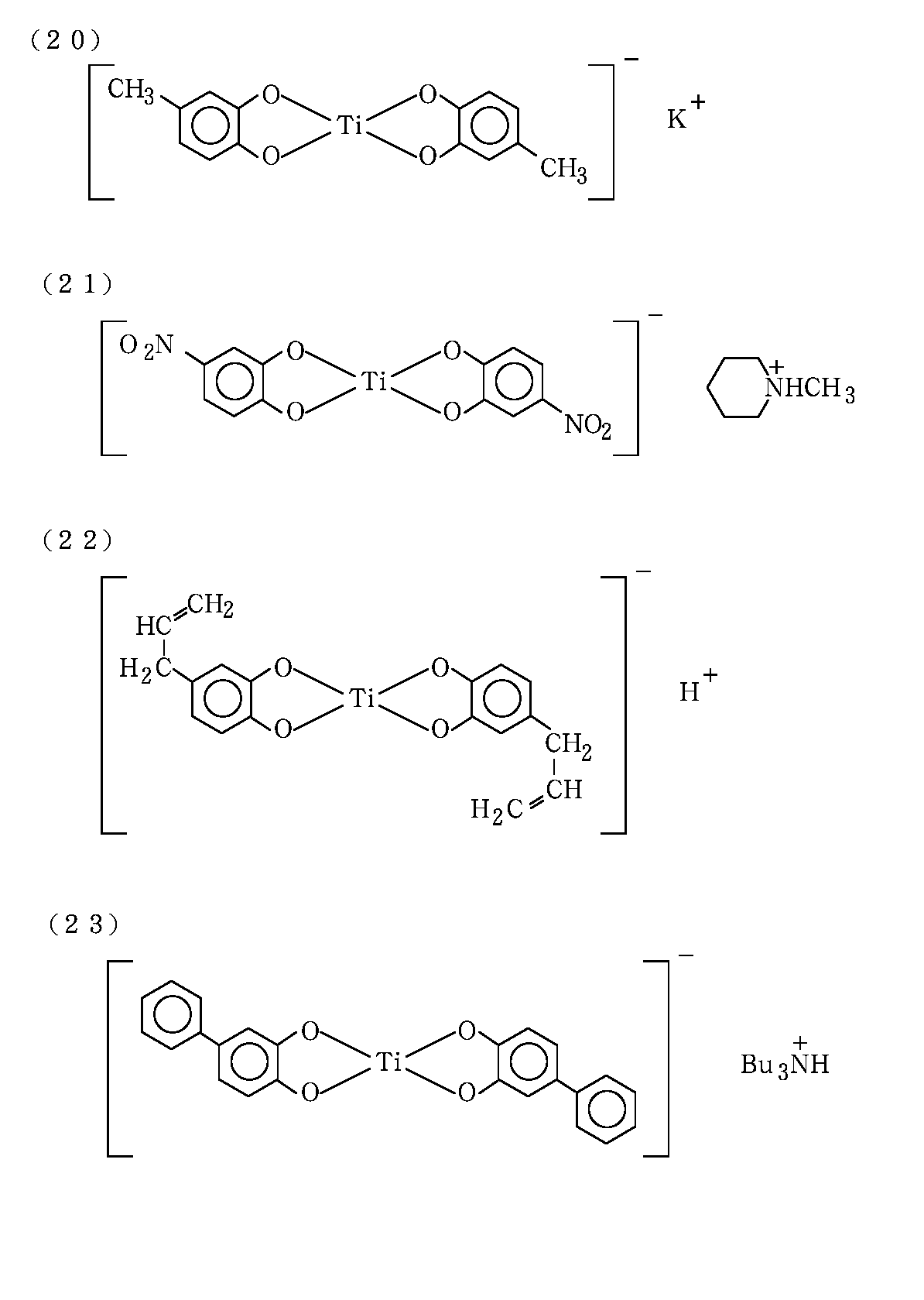
[0024]
Specific examples of the organotitanium complex compound used in the present invention will be given below. However, although the case where two water molecules are coordinated is included, the description of the water molecules is omitted here. Although the counter ions include those having a plurality of types, only the most counter ions are described here.
[0025]
[Chemical formula 5]
[Chemical 6]
[Chemical 7]
[Chemical 8]
[Chemical 9]
[Chemical Formula 10]
Embedded image
Embedded image
Embedded image
Embedded image
Embedded image
Embedded image
Embedded image
Embedded image
Embedded image
As a method for incorporating the organic titanium complex compound used in the present invention as exemplified above into the toner, there are a method of adding it inside the toner and a method of adding it externally. A preferable addition amount in the case of internal addition is 0.1 to 10 parts by weight, and more preferably 0.5 to 5 parts by weight with respect to 100 parts by weight of the binder resin. In addition, when externally added, the amount is preferably about 0.01 to 5 parts by weight with respect to 100 parts by weight of the binder resin, and particularly preferably mechanochemically fixed to the toner surface.
The organic titanium complex compound used as the charge control agent constituting the toner for developing an electrostatic charge image of the present invention can be used in combination with a known charge control agent as described in the prior art. Known charge control agents used at this time include, for example, other organometallic complexes, metal salts, and chelate compounds. Monoazo metal complexes, acetylacetone metal complexes, hydroxycarboxylic acid metal complexes, polycarboxylic acid metal complexes, polyols A metal complex etc. are mentioned. In addition, carboxylic acid derivatives such as metal salts of carboxylic acids, carboxylic acid anhydrides and esters, and condensates of aromatic compounds are also included. Moreover, phenol derivatives such as bisphenols and calixarene are also used.
[0042]
Examples of the binder resin constituting the toner for developing an electrostatic charge image of the present invention include, for example, a styrene resin, a styrene copolymer resin, a polyester resin, a polyol resin, a polyvinyl chloride resin, a phenol resin, and a naturally modified phenol resin. , Natural resin modified maleic acid resin, acrylic resin, methacrylic resin, polyvinyl acetate, silicone resin, polyurethane resin, polyamide resin, furan resin, epoxy resin, xylene resin, polyvinyl butyral, terpene resin, coumarone indene resin, petroleum resin Etc.
[0043]
As a comonomer for the styrene monomer of the styrene copolymer, for example, a styrene derivative such as vinyltoluene; for example, acrylic acid, methyl acrylate, ethyl acrylate, butyl acrylate, dodecyl acrylate, octyl acrylate, acrylic acid- Acrylic esters such as 2-ethylhexyl and phenyl acrylate; for example, methacrylic esters such as methacrylic acid, methyl methacrylate, ethyl methacrylate, butyl methacrylate, octyl methacrylate; and the like; for example, maleic acid, butyl maleate, Dicarboxylic acids having a double bond such as methyl maleate and dimethyl maleate; for example, acrylamide, acrylonitrile, methacrylonitrile, butadiene, vinyl chloride; for example, vinyl acetate, vinyl benzoate, etc. Such vinyl esters; for example, ethylene-based olefins such as ethylene, propylene, butylene, etc .; for example, vinyl ketones such as vinyl methyl ketone, vinyl hexyl ketone, etc .; for example, vinyl methyl ether, vinyl ethyl ether, vinyl isobutyl ether Vinyl ethers such as etc .; vinyl monomers such as etc. are used alone or in combination of two or more.
[0044]
As the cross-linking agent used as necessary when preparing the binder resin, compounds having two or more polymerizable double bonds are mainly used. For example, aromatic compounds such as divinylbenzene and divinylnaphthalene are used. Carboxylic acid ester having two double bonds such as ethylene glycol diacrylate, ethylene glycol dimethacrylate, 1,3-butanediol dimethacrylate, etc .; divinylaniline, divinyl ether, divinyl sulfide, divinyl sulfone And the like, and compounds having three or more vinyl groups are used alone or as a mixture.
[0045]
When a styrene-acrylic resin is used as the binder resin, the molecular weight distribution of the toner is a molecular weight distribution by GPC of a THF-soluble component, and there is at least one peak in a region having a molecular weight of 3,000 to 50,000, In addition, it is preferable to use a binder resin in which at least one peak exists in a region having a molecular weight of 100,000 or more and a component having a molecular weight distribution of 100,000 or less is 50 to 90%.
On the other hand, in the case where the binder resin is a polyester-based resin, the same molecular weight distribution of the toner has at least one peak in a region having a molecular weight of 3,000 to 50,000 and a component having a molecular weight of 100,000 or less. It is preferable to use a binder resin that is 100%. More preferably, one having at least one peak in a molecular weight region of 5,000 to 20,000 is preferably used.
[0046]
The electrostatic image developing toner of the present invention containing an organotitanium complex compound as a charge control agent, as a result of the study by the present inventors, has little variation in charging characteristics even in a high or low humidity environment, and stable development characteristics. In particular, when a binder resin having an acid value is used, the dispersibility of the charge control agent becomes very good and the loss of the organic titanium complex compound from the toner is reduced. The toner obtained is excellent in durability and stability.
It has also been clarified that the electrostatic image developing toner of the present invention having such a form exhibits excellent charge imparting ability in the tribocharging process with the developer carrying member. That is, the toner containing the binder resin having an acid value and the organic titanium complex compound described above has little contact with the surface of the developer carrier when the charging ability by contact with the developer carrier material is seen. However, it was found that a large amount of charge was generated.
[0047]
As a binder resin suitable for the present invention in which the above excellent effects can be obtained, the acid value thereof is 1.0 mgKOH / g or more and 100 mgKOH / g or less, preferably 1.0 mgKOH / g or more and 70 mgKOH / g. g or less, more preferably 1.0 mg KOH / g or more and 50 mg KOH / g or less, particularly preferably a binder resin having an acid value in the range of 2.0 mg KOH / g or more and 40 mg KOH / g or less. . That is, when the acid value of the binder resin is less than 1.0 mgKOH / g, the development stability and durability stability effect due to the interaction with the organic titanium complex compound used as the charge control agent cannot be fully exhibited. When it exceeds 100 mgKOH / g, the hygroscopicity of the binder resin becomes strong, the image density tends to decrease, and the fog tends to increase.
[0048]
In the present invention, the acid value of the whole polymer component constituting the toner composition was determined by the following method.
<Measurement of acid value>
The basic operation was performed according to the following procedures (1) to (5) according to JIS K-0070.
(1) The composition sample containing the toner to be measured is prepared in advance by removing additives other than the polymer (resin) component, or the acid value and content of components other than the polymer are obtained in advance. Keep it. The crushed product 0.5-2.0 (g) of the sample as described above is precisely weighed, and the weight of the polymer component is defined as W (g).
(2) Put the above sample into a 300 (ml) beaker, and add 150 ml of toluene / ethanol (4/1) mixture to dissolve.
(3) The solution obtained in (2) is titrated with a potentiometric titrator using a 0.1 mol / l KOH ethanol solution. At this time, for example, automatic titration using a potentiometric titrator AT-400 (win workstation) manufactured by Kyoto Electronics Co., Ltd. and an ABP-410 electric burette can be used.
(4) The amount of KOH solution used for the titration in (3) is S (ml), and at the same time, the same operation as described above is performed without using a sample. Titration is performed, and the amount of KOH solution used at this time is defined as B (ml).
(5) The acid value is calculated by the following formula using the titer obtained above. Note that f in the color is a factor of the KOH solution.
[Expression 1]
In the present invention, examples of the monomer for adjusting the acid value of the polymer component (binder resin) include acrylic acid, methacrylic acid, α-ethylacrylic acid, crotonic acid, cinnamic acid, vinyl acetic acid, isocrotonic acid, and tiglic acid. , Acrylic acid such as angelic acid, and α- or β-alkyl derivatives thereof, fumaric acid, maleic acid, citraconic acid, alkenyl succinic acid, itaconic acid, mesaconic acid, dimethylmaleic acid, dimethylfumaric acid, etc. , And monoester derivatives or anhydrides thereof, and such a monomer can be used alone or in combination and copolymerized with other monomers to produce a desired polymer. Among these, it is particularly preferable to use a monoester derivative of an unsaturated dicarboxylic acid from the viewpoint of appropriately controlling the acid value of the binder resin.
[0050]
More specifically, for example, monomethyl maleate, monoethyl maleate, monobutyl maleate, monooctyl maleate, monoallyl maleate, monophenyl maleate, monomethyl fumarate, monoethyl fumarate, monobutyl fumarate, monophenyl fumarate Monoesters of α, β-unsaturated dicarboxylic acids such as: monobutyl n-butenyl succinate, monomethyl n-octenyl succinate, monoethyl n-butenylmalonate, monomethyl n-dodecenylglutarate, monobutyl n-butenyladipate And monoesters of alkenyldicarboxylic acid such as
[0051]
The carboxyl group-containing monomer as described above may be added in an amount of 0.1 to 20 parts by weight, preferably about 0.2 to 15 parts by weight, based on all monomers constituting the binder resin. The reason why the monoester monomer of dicarboxylic acid as described above is selected is that it is preferably used in the form of an ester having low solubility in an aqueous suspension and high solubility in an organic solvent or other monomer. It is.
[0052]
In the present invention, the carboxylic acid group and the carboxylic acid ester moiety in the copolymer obtained by the method as described above can be saponified by alkali treatment. That is, the carboxylic acid group or the carboxylic acid ester moiety may be changed to a polar functional group by reacting with an alkaline cation component.
The alkali treatment performed at this time may be carried out while the binder resin is produced and then an alkali is added as an aqueous solution to the solvent used during the polymerization and stirring. Examples of the alkali that can be used here include hydroxides of alkali metals and alkaline earth metals such as Na, K, Ca, Li, Mg, and Ba; hydroxides of transition metals such as Zn, Ag, Pb, and Ni. There are hydroxides of quaternary ammonium salts such as ammonium salts, alkylammonium salts, pyridium salts and the like, and particularly preferred examples include sodium hydroxide and potassium hydroxide.
[0053]
In the present invention, the above saponification reaction performed on the binder resin to optimize the acid value is, for example, over all the carboxylic acid groups and carboxylic acid ester sites in the copolymer used as the binder resin. It is not necessary to be performed, and it is sufficient that the saponification reaction proceeds partially and the portion is changed to a polar functional group.
The amount of alkali used in the saponification reaction is difficult to determine in general depending on the type of polar group in the binder resin, the dispersion method, the type of constituent monomer, etc., but it is 0.02 of the acid value of the binder resin. It may be ˜5 times equivalent.
[0054]
The resin composition comprising the binder resin as described above (the toner for developing an electrostatic charge image of the present invention) has a glass transition temperature (Tg) of 45 to 75 ° C., more preferably from the viewpoint of storage stability. It is good to have prepared so that it may exist in the range of 50-70 degreeC. That is, when Tg is lower than 45 ° C., the toner is likely to be deteriorated in a high temperature atmosphere, and offset is liable to occur during fixing. On the other hand, when Tg exceeds 75 ° C., the fixability tends to decrease.
[0055]
Examples of the polymerization method that can be used as a method for synthesizing the binder resin used in the present invention include a solution polymerization method, an emulsion polymerization method, and a suspension polymerization method.
Among them, the emulsion polymerization method is a method in which a polymerizable monomer (polymerizable monomer) almost insoluble in water is dispersed as small particles in an aqueous phase with an emulsifier, and polymerization is performed using a water-soluble polymerization initiator. is there. In this method, the reaction heat can be easily adjusted, and the phase in which the polymerization is carried out (the oil phase consisting of the polymer and the monomer) and the aqueous phase are separate, so that the termination reaction rate is low, resulting in polymerization. A high concentration and high polymerization degree can be obtained. Further, since the polymerization process is relatively simple and the polymerization product is fine particles, it is easy to mix with the colorant, the charge control agent and other additives in the production of the toner. There are many advantages as a method for producing a toner which is a composition.
[0056]
However, in the above emulsion polymerization method, since it is necessary to add an emulsifier, the resulting polymer tends to contain impurities, and when taking out the polymer, an operation such as salting out is required. To avoid this inconvenience, it is advantageous to apply suspension polymerization without using an emulsifier.
The suspension polymerization is preferably carried out at 100 parts by weight or less, preferably 10-90 parts by weight of the polymerizable monomer with respect to 100 parts by weight of the aqueous solvent. Examples of the dispersant that can be used in this case include polyvinyl alcohol, partially saponified polyvinyl alcohol, and calcium phosphate. And as the usage-amount, it is generally used in 0.05-1 weight part with respect to 100 weight part of aqueous solvents. The polymerization temperature is suitably in the range of 50 to 95 ° C., and may be appropriately selected depending on the polymerization initiator used and the target polymer.
[0057]
When the binder resin constituting the toner for developing an electrostatic charge image of the present invention is produced by a polymerization method, a polyfunctional polymerization initiator as exemplified below alone or a monofunctional polymerization initiator and It is preferable to use together with a polymerizable monomer.
Specific examples of the polyfunctional polymerization initiator having a polyfunctional structure include, for example, 1,1-di-t-butylperoxy-3,3,5-trimethylcyclohexane, 1,3-bis- (t- Butylperoxyisopropyl) benzene, 2,5-dimethyl-2,5- (t-butylperoxy) hexane, 2,5-dimethyl-2,5-di- (t-butylperoxy) hexane, tris (t -Butylperoxy) triazine, 1,1-di-t-butylperoxycyclohexane, 2,2-di-t-butylperoxybutane, 4,4-di-t-butylperoxyvaleric acid-n- Butyl ester, di-t-butylperoxyhexahydroterephthalate, di-t-butylperoxyazelate, di-t-butylperoxytrimethyladipate, 2,2- Start of polymerization of two or more peroxide groups in one molecule such as su- (4,4-di-t-butylperoxycyclohexyl) propane, 2,2-t-butylperoxyoctane and various polymer oxides Polyfunctional polymerization initiator having a functional group having a function, and one molecule such as diallyl peroxydicarbonate, t-butylperoxymaleic acid, t-butylperoxyallylcarbonate, and t-butylperoxyisopropyl fumarate Among them, a polyfunctional polymerization initiator having both a functional group having a polymerization initiation function such as a peroxide group and a polymerizable unsaturated group can be mentioned.
Of these, more preferred are 1,1-di-t-butylperoxy-3,3,5-trimethylcyclohexane, 1,1-di-t-butylperoxycyclohexane, di-t-butylperoxide. Examples include oxyhexahydroterephthalate, di-t-butylperoxyazelate and 2,2-bis- (4,4-di-t-butylperoxycyclohexane) propane, and t-butylperoxyallyl carbonate.
[0058]
These polyfunctional polymerization initiators are preferably used in combination with a monofunctional polymerization initiator in order to satisfy various performances required as a binder for toner. In particular, it is preferably used in combination with a polymerization initiator having a half-life of 10 hours that is lower than the decomposition temperature for obtaining a half-life of 10 hours of the polyfunctional polymerization initiator.
Specifically, benzoyl peroxide, 1,1-di (t-butylperoxy) -3,3,5-trimethylcyclohexane, n-butyl-4,4-di (t-butylperoxy) valerate, dichroic Organic peroxides such as milperoxide, α, α'-bis (t-butylperoxydiisopropyl) benzene, t-butylperoxycumene, di-t-butylperoxide, azobisisobutyronitrile, diazo Examples include azo and diazo compounds such as aminoazobenzene.
[0059]
These monofunctional polymerization initiators may be added to the monomer at the same time as the polyfunctional polymerization initiator. However, in order to keep the efficiency of the polyfunctional polymerization initiator properly, the polyfunctional polymerization initiator is used in the polymerization step. It is preferably added after the half-life indicated by the polymerizable polymerization initiator has elapsed.
These initiators are preferably used in an amount of 0.05 to 2 parts by weight with respect to 100 parts by weight of the monomer from the viewpoint of efficiency.
[0060]
As the binder resin for satisfactorily achieving the intended purpose of the present invention, it is also preferable to use a resin crosslinked with a crosslinkable monomer as exemplified below.
As the crosslinkable monomer, a monomer having two or more polymerizable double bonds is mainly used. Aromatic divinyl compounds (eg, divinylbenzene, divinylnaphthalene, etc.); diacrylate compounds linked by alkyl chains (eg, ethylene glycol diacrylate, 1,3-butylene glycol diacrylate, 1,4-butanediol diacrylate) 1,5-pentanediol acrylate, 1,6-hexanediol diacrylate, neopentylglycol diacrylate, and acrylates of the above compounds replaced with methacrylate) diacrylate compounds linked by alkyl chains containing ether linkages (E.g., diethylene glycol diacrylate, triethylene glycol diacrylate, tetraethylene glycol diacrylate, polyethylene glycol # 400 diacrylate, polyethylene glycol 600 diacrylate, dipropylene glycol diacrylate, and acrylates of the above compounds replaced with methacrylates; diacrylate compounds linked by a chain containing an aromatic group and an ether bond (eg, polyoxyethylene (2 ) -2,2-bis (4-hydroxyphenyl) propane diacrylate, polyoxyethylene (4) -2,2-bis (4-hydroxyphenyl) propane diacrylate, and acrylates of the above compounds are replaced with methacrylate. Polyester type diacrylate compounds (for example, trade name MANDA (manufactured by Nippon Kayaku)) and the like. Multifunctional cross-linking agents include pentaerythritol acrylate, trimethylol ethane triacrylate, trimethylol propane triacrylate, tetramethylol propane triacrylate, tetramethylol methane tetraacrylate, oligoester acrylate, and methacrylates of the above compounds. Examples thereof include triallyl cyanurate and triallyl trimellitate.
[0061]
These crosslinking agents are preferably used in the range of 0.0001 to 1 part by weight, preferably 0.001 to 0.5 part by weight, relative to 100 parts by weight of the other monomer components.
Among these crosslinkable monomers, those which are preferably used from the viewpoint of toner fixing property and offset resistance, are bonded with an aromatic divinyl compound (particularly divinylbenzene), a chain containing an aromatic group and an ether bond. Diacrylate compounds are mentioned.
[0062]
As other synthesis methods, a bulk polymerization method and a solution polymerization method can be used. However, in the bulk polymerization method, an arbitrary polymer can be obtained by polymerizing at a high temperature to increase the termination reaction rate, but there is a problem that the reaction is difficult to control. In that respect, in the solution polymerization method, any polymer can be easily obtained under mild conditions by utilizing the difference in radical chain transfer by the solvent and adjusting the amount of initiator and reaction temperature. Particularly preferred as a method for obtaining a low molecular weight product in a resin composition. In particular, a solution polymerization method under a pressurized condition is also preferable in that the amount of the polymerization initiator used is minimized and the influence of the remaining initiator is minimized.
Examples of other comonomers for obtaining the binder resin used in the present invention include the following.
[0063]
For example, styrene; o-methylstyrene, m-methylstyrene, p-methylstyrene, p-methoxystyrene, p-phenylstyrene, p-chlorostyrene, 3,4-dichlorostyrene, p-ethylstyrene, 2,4 -Dimethylstyrene, pn-butylstyrene, p-tert-butylstyrene, pn-hexylstyrene, pn-octylstyrene, pn-nonylstyrene, pn-decylstyrene, pn- 1 Styrene derivatives such as dodecylstyrene; Ethylene unsaturated monoolefins such as ethylene, propylene, butylene and isobutylene; Unsaturated polyenes such as butadiene and isoprene; Vinyl chloride, vinylidene chloride, vinyl bromide and vinyl fluoride Vinyl halides such as: vinyl acetate, vinyl propionate, ben Vinyl esters such as vinyl acrylate; methyl methacrylate, ethyl methacrylate, propyl methacrylate, n-butyl methacrylate, isobutyl methacrylate, n-octyl methacrylate, dodecyl methacrylate, 2-ethylhexyl methacrylate, methacryl Α-methylene aliphatic monocarboxylic acid esters such as stearyl acid, phenyl methacrylate, dimethylaminoethyl methacrylate, diethylaminoethyl methacrylate; methyl acrylate, ethyl acrylate, n-butyl acrylate, isobutyl acrylate, acrylic Acrylic esters such as propyl acrylate, 1-octyl acrylate, dodecyl acrylate, 2-ethylhexyl acrylate, stearyl acrylate, 2-chloroethyl acrylate, phenyl acrylate Vinyl ethers such as vinyl methyl ether, vinyl ethyl ether, vinyl isobutyl ether; vinyl ketones such as vinyl methyl ketone, vinyl hexyl ketone, methyl isopropenyl ketone; N-vinyl pyrrole, N-vinyl carbazole, N-vinyl N-vinyl compounds such as indole and N-vinylpyrrolidone; vinyl naphthalenes; acrylic acid derivatives or methacrylic acid derivatives such as acrylonitrile, methacrylonitrile, and acrylamide. These vinyl monomers are used alone or in admixture of two or more monomers.
Among these, a combination of monomers that becomes a styrene copolymer or a styrene acrylic copolymer is preferable.
[0064]
In the toner for developing an electrostatic charge image of the present invention, it is preferable from the viewpoint of mixing property to use a binder resin containing at least 65 parts by weight of a styrene polymer component or a styrene copolymer component.
As a method for producing a binder resin, a high molecular weight polymer and a low molecular weight polymer are synthesized separately by a solution polymerization method, then mixed in a solution state, and then solvent-removed, or an extruder, etc. The resin composition is dissolved in a monomer constituting the high molecular weight polymer obtained by dissolving the low molecular weight polymer obtained by melt blending, dry blending method, solution polymerization method, etc., suspension polymerization, washing with water and drying. Examples thereof include a two-stage polymerization method to be obtained. However, the dry blend method has problems in terms of uniform dispersion and compatibility, and the two-stage polymerization method has many advantages in uniform dispersibility, but the low molecular weight component is increased beyond the high molecular weight component. In the presence of a low molecular weight polymer component, it is difficult not only to synthesize a high molecular weight polymer having a large molecular weight, but also to produce unnecessary low molecular weight polymers as by-products. Therefore, the solution blend method is most suitable. In addition, as a method for introducing a predetermined acid value into the low molecular weight polymer component, solution polymerization, in which the acid value can be easily set as compared with the aqueous polymerization method, is preferable.
It is also possible to obtain an optimum acid value by using a polyester resin.
[0065]
Next, a case where a polyester resin is used as the binder resin will be described. The polyester resin is generally obtained by polycondensation of a polycarboxylic acid (generally divalent) and a polyhydric alcohol. Hereinafter, the composition of the polyester resin will be described. Examples of the divalent alcohol component include ethylene glycol, propylene glycol, 1,3-butanediol, 1,4-butanediol, 2,3-butanediol, diethylene glycol, triethylene glycol, 1,5-pentanediol, 1, 6-hexanediol, neopentyl glycol, 2-ethyl-1,3-hexanediol, hydrogenated bisphenol A, or a bisphenol represented by the following general formula (A) and derivatives thereof; And the diols shown.
[0066]
Embedded image
Examples of the divalent acid component include benzenedicarboxylic acids such as phthalic acid, terephthalic acid, isophthalic acid, and phthalic anhydride or anhydrides thereof, and lower alkyl esters: alkyls such as succinic acid, adipic acid, sebacic acid, and azelaic acid. Dicarboxylic acids or anhydrides thereof, lower alkyl esters: alkenyl succinic acids or alkyl succinic acids such as n-dodecenyl succinic acid and n-dodecyl succinic acid, or anhydrides, lower alkyl esters thereof; fumaric acid, maleic acid, citraconic acid, itacone Examples thereof include unsaturated dicarboxylic acids such as acids or anhydrides thereof, dicarboxylic acids such as lower alkyl esters, and derivatives thereof.
[0068]
In the case of the polyester resin used as the binder resin of the toner for developing an electrostatic charge image of the present invention, it is preferable to use a trivalent or higher alcohol component that also functions as a crosslinking component and a trivalent or higher acid component.
Examples of the trihydric or higher polyhydric alcohol component include sorbitol, 1,2,3,6-hexanetetrol, 1,4-sorbitan, pentaerythritol, dipentaerythritol, tripentaerythritol, 1,2,4. -Butanetriol, 1,2,5-pentanetriol, glycerol, 2-methylpropanetriol, 2-methyl-1,2,4-butanetriol, trimethylolethane, trimethylolpropane, 1,3,5-trihydroxy Examples include benzene.
[0069]
Examples of the trivalent or higher polyvalent carboxylic acid component that can be used in the present invention include trimellitic acid, pyromellitic acid, 1,2,4-benzenetricarboxylic acid, 1,2,5-benzenetricarboxylic acid, 2,5,7-naphthalenetricarboxylic acid, 1,2,4-naphthalenetricarboxylic acid, 1,2,4-butanetricarboxylic acid, 1,2,5-hexanetricarboxylic acid, 1,3-dicarboxyl-2-methyl -2-methylenecarboxypropane, tetra (methylenecarboxyl) methane, 1,2,7,8-octanetetracarboxylic acid, empole trimer acid, and their anhydrides, lower alkyl esters; tetra represented by the following formula Examples thereof include carboxylic acids and the like, and anhydrides and polyvalent carboxylic acids such as lower alkyl esters and derivatives thereof.
[0070]
Embedded image
When forming the polyester resin used as the binder resin constituting the toner for developing an electrostatic charge image of the present invention, the alcohol component is used in an amount of 40 to 60 mol%, preferably 45 to 55 mol%, and the acid component is used in an amount of 60 to 40 mol%. The polycondensation is preferably performed using 55 to 45 mol%. Moreover, it is preferable that the polyvalent component more than trivalence is 1-60 mol% in all the components. The polyester resin used in the present invention can also be obtained by a generally known condensation polymerization.
[0072]
The toner for developing an electrostatic charge image of the present invention preferably uses a magnetic material as a colorant. Examples of the magnetic material suitable in the present invention include, for example, iron oxides such as magnetite, maghemite, and ferri iron: metals such as iron, cobalt, and nickel, or these metals and aluminum, cobalt, copper, lead, magnesium, tin, Alloys with metals such as zinc, antimony, beryllium, bismuth, cadmium, calcium, manganese, selenium, titanium, tungsten, vanadium, and mixtures thereof are used. preferable.
[0073]
In the present invention, magnetic iron oxides such as magnetite, maghemite, and ferrite containing different elements and mixtures thereof are preferably used as the magnetic material. In particular, it is preferable to use magnetic iron oxide containing a different element in an amount of 0.05 wt% or more and 10 wt% or less based on the iron element.
Among them, lithium, beryllium, boron, magnesium, aluminum, silicon, phosphorus, germanium, titanium, zirconium, tin, lead, zinc, calcium, barium, scandium, vanadium, chromium, manganese, cobalt, copper, nickel, gallium, cadmium, Use magnetic iron oxide containing at least one different element selected from indium, silver, palladium, gold, mercury, platinum, tungsten, molybdenum, niobium, osmium, strontium, yttrium, technetium, ruthenium, rhodium, and bismuth. Is preferred. Among these, it is particularly preferable to use lithium, beryllium, boron, magnesium, aluminum, silicon, phosphorus, germanium, zirconium, tin, and a fourth-period transition metal element as the different elements. These different elements may have a structure incorporated in the iron oxide crystal lattice, or may be incorporated in the iron oxide as an oxide. Further, it may exist as an oxide or hydroxide on the surface of magnetic iron oxide. In any case, it is preferably contained as an oxide.
[0074]
These elements can be incorporated into the particles by mixing salts of the above-mentioned various elements at the time of producing the magnetic substance and adjusting the pH in this state. Moreover, it can be made to deposit on the particle | grain surface by adjusting pH after magnetic body particle | grains production | generation or adding salt of each element and adjusting pH.
[0075]
The magnetic material having various different elements obtained as described above is familiar to the binder resin and very dispersible. Further, this good dispersibility improves the dispersibility of the organotitanium complex compound used in the present invention. As a result, the organotitanium complex compound contained as a charge control agent in the electrostatic image developing toner of the present invention is improved. The effect is fully demonstrated. That is, the magnetic substance acts as a dispersion medium, and the dispersibility of the organic titanium complex compound is aided by the good dispersibility of the magnetic substance, thereby improving the dispersibility of the organic titanium complex compound. Furthermore, these magnetic substances have an effect of adsorbing water molecules, and the organic titanium complex compound has an effect of easily exerting an emphasis on charging by water molecules. Further, this effect is more effectively exhibited when a magnetic material containing a different element is used together with a binder resin having an acid value.
[0076]
Further, when these magnetic materials have a uniform particle size distribution, the chargeability of the toner can be further stabilized in combination with the dispersibility in the binder resin. In recent years, the toner particle diameter has been reduced, and even when the weight average particle diameter is 10 μm or less, the charging uniformity is promoted, the toner cohesion is reduced, the image density is improved, and the fog is reduced. Development such as improvement is improved. In particular, the effect is remarkable in a toner having a weight average particle diameter of 8.0 μm or less, and an extremely high-definition image can be obtained by using such a toner. However, in this case, it is preferable that the weight average particle diameter is 2.5 μm or more because sufficient image density can be obtained. On the other hand, if the toner particle size is reduced, the charge control material is likely to be liberated. However, since the toner of the present invention is excellent in charge uniformity, the organic titanium complex compound added as the charge control material can be used. Even if there is some liberation, it is less susceptible to sleeve contamination.
[0077]
In the present invention, it is preferable to use a magnetic iron oxide whose content of different elements is 0.05 to 10% by weight based on the iron element. More preferably, the content of the different elements is 0.1 to 7% by weight, particularly preferably 0.2 to 6% by weight, and more preferably 0.3 to 5% by weight of magnetic iron oxide. preferable. That is, if the content of different elements is less than 0.05% by weight, the effect of containing these elements cannot be obtained, and it becomes difficult to obtain good dispersibility and charging uniformity. On the other hand, if the content of the different element is more than 10% by weight, the discharge of charge increases, resulting in insufficient charging. When an image is formed, the image density may be lowered or fog may be increased.
[0078]
Further, in the distribution of inclusion of these different elements in the magnetic iron oxide, it is preferable to use a distribution in which many different elements exist closer to the surface of the magnetic body. For example, when magnetic iron oxide is dissolved, when the amount of dissolution of a different element on the surface portion when the dissolution rate of iron element reaches 20% is measured, It is preferable to use those that are 20% to 100% of the amount of all the different elements present. Furthermore, the above-mentioned dissolution rate is preferably 25% to 100%, particularly preferably 30% to 100%. Thus, by increasing the surface abundance of the different elements in the magnetic iron oxide, it is possible to further improve the dispersion effect and electrical diffusion effect of the magnetic substance in the toner.
[0079]
The above-described magnetic materials used in the present invention preferably have an average particle size of 1.0 μm or less, and more preferably 0.1 to 0.5 μm. Also, BET specific surface area is 2-40mm 2 / G may be used. There is no restriction | limiting in particular about a shape, The thing of arbitrary shapes can be used. As magnetic characteristics, saturation magnetization is 10 to 200 Am under a magnetic field of 795.8 kA / m. 2 / Kg, residual magnetization 1-100Am 2 / Kg and a coercive force of 1 to 30 kA / m are preferable. Further, these magnetic materials are used in a ratio of 20 to 200 parts by weight with respect to 100 parts by weight of the binder resin.
[0080]
The amount of each element in the magnetic iron oxide used in the present invention is measured by fluorescent X-ray analysis using a fluorescent X-ray analyzer SYSTEM3080 (manufactured by Rigaku Denki Kogyo Co., Ltd.) according to JIS K0119 general rules for fluorescent X-ray analysis. Was measured. Regarding element distribution, while dissolving the magnetic substance with hydrochloric acid, the amount of element at each stage of dissolution is measured and quantified by plasma emission spectroscopy (ICP), and each element at the time of dissolution at each stage relative to the concentration at the time of total dissolution of each element. The dissolution rate was determined from the element concentration.
[0081]
The number average diameter of the magnetic material can be obtained by measuring a photograph taken with a transmission electron microscope with a digitizer or the like. In the present invention, the magnetic property of the magnetic material is a value measured under an external magnetic field of 795.8 kA / m using a “vibrating sample magnetometer VSM-3S-15” (manufactured by Toei Kogyo Co., Ltd.). Furthermore, the specific surface area of the magnetic material is determined by adsorbing nitrogen gas on the surface of the trial using a specific surface area measuring device Auto Soap 1 (manufactured by Yuasa Ionics) according to the BET method, and using the BET multipoint method. Calculated.
[0082]
The toner for developing an electrostatic charge image of the present invention further contains two or more kinds of waxes having different melting points, or two or more kinds of waxes having different compositions, each having a difference in melting point between 10 ° C. and 100 ° C. Is preferred. Examples of the wax used at this time include the following.
For example, aliphatic hydrocarbon waxes such as low molecular weight polyethylene, low molecular weight polypropylene, polyolefin copolymer, polyolefin wax, microcrystalline wax, paraffin wax and sazol wax; oxidation of aliphatic hydrocarbon waxes such as oxidized polyethylene wax Or block copolymers thereof: plant waxes such as candelilla wax, carnauba wax, wood wax, jojoba wax, etc .; animal waxes such as beeswax, lanolin, whale wax; minerals such as ozokerite, ceresin, petrolatum, etc. Waxes mainly composed of fatty acid esters such as montanic acid ester wax and caster wax; and those obtained by partially or fully deoxidizing fatty acid esters such as deoxidized carnauba wax.
[0083]
Further, saturated linear fatty acids such as palmitic acid, stearic acid, montanic acid, or long-chain alkyl carboxylic acids having a long-chain alkyl group; unsaturated fatty acids such as brassic acid, eleostearic acid, and valinalic acid; Saturated alcohols such as stearyl alcohol, eicosyl alcohol, behenyl alcohol, carnauvir alcohol, seryl alcohol, melyl alcohol, or long chain alkyl alcohols having a long chain alkyl group; polyhydric alcohols such as sorbitol; linol Fatty acid amides such as acid amide, oleic acid amide, lauric acid amide; saturated fatty acid bisamides such as methylene bis stearic acid amide, ethylene biscapric acid amide, ethylene bis lauric acid amide, hexamethylene bis stearic acid amide; Unsaturated fatty acid amides such as bisoleic acid amide, hexamethylene bisoleic acid amide, N, N′-dioleyl adipic acid amide, N, N′-dioleyl sebacic acid amide; m-xylene bisstearic acid amide, N , N′-distearylisophthalic acid amides and the like; Bisamides of fatty acids such as calcium stearate, calcium laurate, zinc stearate and magnesium stearate (generally called metal soap); Aliphatic hydrocarbons Waxes grafted with vinyl-based monomers such as styrene and acrylic acid on waxes; partially esterified products of fatty acids such as behenic monoglyceride and polyhydric alcohols; hydroxyl groups obtained by hydrogenation of vegetable oils and fats, etc. Examples include methyl ester compounds .
[0084]
Among them, the wax preferably used in the present invention includes polyolefins obtained by radical polymerization of olefins under high pressure; polyolefins obtained by purifying low molecular weight by-products obtained during polymerization of high molecular weight polyolefins; Ziegler catalysts, metallocene catalysts, etc. under low pressure. Polyolefins polymerized using a catalyst; polyolefins polymerized using radiation, electromagnetic waves, light, etc .; low molecular weight polyolefins obtained by pyrolyzing high molecular weight polyolefins; paraffin wax, microcrystalline wax, Fischer-Tropsch wax; Synthetic hydrocarbon waxes synthesized by hydrocol method, age method, etc .; synthetic waxes having a compound having one carbon atom as monomers, hydrocarbon waxes having functional groups such as hydroxyl groups and carboxyl groups; hydrocarbon waxes Mixture of hydrocarbon wax having a box and a functionality; further, styrene these waxes as a matrix, maleic acid ester, acrylate, methacrylate, wax grafted modified with vinyl monomers such as maleic anhydride.
[0085]
In addition, these waxes have a sharp molecular weight distribution using a press perspiration method, a solvent method, a recrystallization method, a vacuum distillation method, a supercritical gas extraction method, a fused liquid crystal deposition method, a low molecular weight solid fatty acid, Low molecular weight solid alcohols, low molecular weight solid compounds, and those from which other impurities have been removed are also preferably used.
In the toner of the present invention, the total wax content is 0.2 to 20 parts by weight, preferably 0.5 to 10 parts by weight, based on 100 parts by weight of the binder resin. It is.
[0086]
In the present invention, the melting point of the wax is defined as the melting point of the wax, which is the peak top temperature of the endothermic peak of the wax measured by DSC.
In the present invention, in the DSC measurement using a differential scanning calorimeter for wax, it is preferable to perform measurement using a differential scanning calorimeter of high accuracy internal heat type input compensation type. For example, DSC-7 manufactured by Perkin Elmer can be used.
The measurement method is performed according to ASTM D3418-82. The DSC curve used in the present invention was the DSC curve measured when the temperature was raised at a temperature rate of 10 ° C./min after raising and lowering the temperature once and taking the previous history.
[0087]
When the organic titanium complex compound used in the present invention is used together with two or more kinds of different waxes, a further excellent effect can be obtained. That is, when a wax is added, a plasticizing action and a releasing action are exerted on the toner, but when two or more different waxes are used simultaneously, either action is emphasized. As a result of investigations by the present inventors, when the organotitanium complex compound used in the present invention is present in the toner in this state, these effects become more prominent, compared with the case where each wax is used alone. However, it turned out that the action comes to work effectively. For example, when two different waxes are used at the same time, the toner is plasticized by one wax, and the dispersion of the organic titanium complex compound is improved. It becomes like this. Furthermore, it was also found that the use with a binder resin having an acid value was even more effective. Due to this excellent releasing effect, when the toner of the present invention is used for image formation, it is possible to reduce the fusing to the photosensitive member, the fouling on the fixing member, the fouling on the conveying portion, and the like.
[0088]
Here, as for selection of two or more kinds of waxes to be contained in the toner of the present invention, as a result of studies by the present inventors, the following was found. For example, when two types of waxes having the same structure are used, a wax having a relatively low melting point exhibits a plasticizing action, and a wax having a high melting point exhibits a releasing action. Furthermore, at this time, when the difference in melting point is 10 ° C. to 100 ° C., this functional separation is effectively exhibited. When the temperature is lower than 10 ° C., the function separation effect is hardly exhibited, and when the temperature exceeds 100 ° C., the function is not easily emphasized by the interaction.
[0089]
In addition, relatively linear structures, those having a polar group such as a functional group, and those modified with a component different from the main component exhibit a plastic action, but have a more linear structure. , Non-polar ones having no functional groups, etc., and unmodified straight ones exhibit a releasing action. Furthermore, preferred combinations include, for example, polyethylene homopolymers and copolymers based on ethylene and polyolefin homopolymers and copolymers based on olefins other than ethylene, combinations of polyolefins and graft-modified polyolefins, alcohol waxes and the like. Combinations of fatty acid wax or ester wax and hydrocarbon wax, Fischer-Tropsch wax or polyolefin wax, paraffin wax or microcrystalline wax, Fischer Tropsch wax and polyolefin wax, paraffin wax and microcrystalline wax, carnauba Wax, candelilla wax, rice wax or montan wax , A combination of hydrocarbon wax.
[0090]
As the colorant that can be used in the toner of the present invention, any appropriate pigment or dye can be used, and examples thereof include the following. Examples of the pigment include carbon black, aniline black, acetylene black, naphthol yellow, hansa yellow, rhodamine lake, alizarin lake, bengara, phthalocyanine blue, and indanthrene blue. These are used in an amount necessary for maintaining the optical density of the fixed image, and generally 0.1 to 20 parts by weight, preferably 0.2 to 10 parts by weight with respect to 100 parts by weight of the binder resin. It is preferable to add. Further, a dye is further used for the same purpose. Examples include azo dyes, anthraquinone dyes, xanthene dyes, and methine dyes, and ranges from 0.1 to 20 parts by weight, more preferably from 0.3 to 10 parts by weight, with respect to 100 parts by weight of the binder resin. It is preferable to add at.
[0091]
To the toner of the present invention having the above-described configuration, an inorganic oxide such as silica, alumina or titanium oxide, or fine inorganic particles such as carbon black or carbon fluoride may be added. Is preferred.
In addition, silica, alumina, and titanium oxide to be added are preferably fine particles when dispersed on the toner surface because the fluidity imparting property is enhanced. The average particle diameter is preferably 5 to 100 nm, and more preferably 5 to 50 nm. The specific surface area by nitrogen adsorption measured by BET method is 30m. 2 / G or more, especially 60-400m 2 / G is preferable as the base fine powder, and as the fine powder in the surface-treated state, 20 m 2 / G or more, especially 40-300m 2 Those in the range of / g are preferred.
[0092]
In the toner of the present invention, it is preferable to add these inorganic fine powders in an addition amount in the range of 0.03 to 5 wt% with respect to the weight of the toner base material because an appropriate surface coverage is obtained. . In addition, the inorganic fine powder used in the present invention preferably has a degree of hydrophobicity of 30% or more in terms of methanol wettability, more preferably 50% or more. As the hydrophobizing agent, a silane compound and silicone oil which are silicon-containing surface treating agents are preferable.
[0093]
For example, alkyl alkoxysilanes such as dimethyldimethoxysilane, trimethylethoxysilane, butyltrimethoxysilane, dimethyldichlorosilane, trimethylchlorosilane, allyldimethylchlorosilane, hexamethyldisilazane, allylphenyldichlorosilane, benzyldimethyl Silane coupling agents such as chlorosilane, vinyltriethoxysilane, γ-methacryloxypropyltrimethoxysilane, vinyltriacetoxysilane, divinylchlorosilane, and dimethylvinylchlorosilane can be used.
[0094]
The following positively chargeable ones may also be used for adjusting the charge amount. Silane coupling agents such as aminopropyltrimethoxysilane, aminopropyltriethoxysilane, dimethylaminopropyltrimethoxysilane, diethylaminopropyltrimethoxysilane, dipropylaminopropyltrimethoxysilane, dibutylaminopropyltrimethoxysilane, and amino-modified Silicone oil or the like can be used.
[0095]
The toner of the present invention can be mixed with a carrier and used as a two-component developer. The current value of the carrier used at this time is preferably 20 to 200 μA by adjusting the degree of unevenness of the carrier surface and the amount of resin to be coated.
Examples of the resin covering the carrier surface include styrene-acrylic acid ester copolymer, styrene-methacrylic acid ester copolymer, acrylic acid ester copolymer, methacrylic acid ester copolymer, silicone resin, fluorine-containing resin, and polyamide resin. , Ionomer resin, polyphenylene sulfide resin, or the like, or a mixture thereof can be used.
[0096]
Examples of the magnetic material of the carrier core that covers the above-mentioned coating materials include oxides such as ferrite, iron-rich ferrite, magnetite, and γ-iron oxide, metals such as iron, cobalt, and nickel, or alloys thereof. Can be used. The elements contained in these magnetic materials are iron, cobalt, nickel, aluminum, copper, lead, magnesium, tin, zinc, antimony, beryllium, bismuth, cadmium, calcium, manganese, selenium, titanium, tungsten, vanadium. Etc.
[0097]
As the additive for the purpose of imparting various properties used in the present invention, for example, the following are used.
(1) Abrasive
Metal oxide (eg, strontium titanate, cerium oxide, aluminum oxide, magnesium oxide, chromium oxide, etc.), nitride (eg, silicon nitride, etc.), carbide (eg, silicon carbide, etc.), metal salt (eg, calcium sulfate) , Barium sulfate, calcium carbonate).
(2) Lubricant
Fluorine resin powder (for example, polyvinylidene fluoride, polytetrafluoroethylene, etc.), fatty acid metal salt (for example, zinc stearate, calcium stearate, etc.), etc.
(3) Charge controllable particles
Metal oxide (for example, tin oxide, titanium oxide, zinc oxide, silicon oxide, aluminum oxide, etc.), carbon black, resin fine particles and the like.
These additives are used in a ratio of 0.05 to 10 parts by weight, more preferably 0.1 to 5 parts by weight, with respect to 100 parts by weight of the toner particles. These additives may be used alone or in combination.
[0098]
As a method for producing the toner of the present invention, a predetermined toner constituting material containing a specific organotitanium complex compound is sufficiently mixed by a ball mill or other mixer, and then a heat roll kneader or an extruder heat kneader is used. It is preferable to use a commonly used pulverization method in which a toner having a desired particle diameter is obtained by kneading well, cooling and solidifying, and then mechanically pulverizing and classifying. In addition, as another method, a toner using a polymerization method in which a predetermined toner constituent material is mixed with a polymerizable monomer to constitute a binder resin to form an emulsion suspension and then polymerized to obtain a toner. Manufacturing method; Or, in a manufacturing method of a so-called microcapsule toner comprising a core material and a shell material, a method in which a predetermined toner constituent material is contained in the core material and / or the shell material; A method such as a method of obtaining toner by spray drying after dispersing the toner constituting material can be applied. Furthermore, if necessary, desired additives are sufficiently mixed by a mixer such as a Henschel mixer and externally added to produce the toner of the present invention.
[0099]
【Example】
Next, the present invention will be described more specifically with reference to examples and comparative examples. In addition, this invention is not limited to these at all.
Table 1 shows binder resins used in Examples and Comparative Examples, Table 2 shows waxes, and Table 3 shows magnetic materials. The styrene resin used as the binder resin was synthesized by a solution polymerization method, and the polyester resin was synthesized by a dehydration condensation method.
[0100]
Moreover, the magnetic substance added the salt of the element which exists in the inside at the time of magnetite production | generation, produced | generated the magnetite particle | grains, adjusting pH, and obtained magnetic bodies (alpha)-(theta) shown in Table 3. Magnetite particles were produced by adding silicate to magnetic substance α, adding silicate and aluminum salt to magnetic substance β, adding phosphate to magnetic substance γ, and adding magnesium salt to magnetic substance δ. For the magnetic body ε, zinc salt was added to generate magnetite particles, and then silicate was added to adjust pH to obtain a magnetic body. The magnetic substance ζ was prepared by adding phosphate to generate magnetite particles, and then adjusting the pH by adding silicate to precipitate silica on the surface of the magnetite particles to obtain a magnetic substance. In particular, magnetite particles were generated without adding salt to obtain a magnetic body θ. After the production of the magnetic body θ, a zirconium salt was added to adjust the pH, and zirconia was precipitated on the surface of the magnetite particles to obtain a magnetic body η.
[0101]
[Table 1]
Table 1: Binder resin
[Table 2]
Table 2: Wax
[Table 3]
Table 3: Magnetic material
[Example 1]
・ Binder resin B 100 parts by weight
・ 90 parts by weight of magnetic material α
-2 weight part of compounds (41) represented by a following formula
・ 3 parts by weight of wax a
・ 2 parts by weight of wax b
[0105]
Embedded image
The above materials were premixed with a Henschel mixer and then melt kneaded with a twin-screw kneading extruder set at 130 ° C. Next, the obtained kneaded product is cooled, coarsely pulverized with a cutter mill, then pulverized with a fine pulverizer using a jet stream, and the obtained finely pulverized powder is used with a multi-division classifier utilizing the Coanda effect. Classification was performed to obtain a toner having a volume average particle diameter of 7.6 μm. Further, BET260m was hydrophobized with 20 wt% of hexamethyldisilazane with respect to 100 parts by weight of the toner obtained above. 2 Toner 1 of this example was prepared by externally mixing 1.0 part by weight of / g silica and 3.0 parts by weight of strontium titanate.
[0107]
Using this toner 1, it is mounted on a commercially available electrophotographic copying machine NP-6750 (manufactured by Canon Inc.), and each of them is placed under an environment of 23 ° C./5% Rh followed by 30 ° C./80% Rh. Durability copying test was conducted on a total of 100,000 sheets, 1,000 sheets. As a result, a high-definition image with high image density and no fog was obtained in any environment. The details are shown in Tables 5 and 6.
At that time, the image density was measured with a Macbeth densitometer (manufactured by Macbeth Co., Ltd.) using an SPI filter, and a 5 mm round (5φ) image was measured.
[0108]
The fog is measured using a reflection densitometer (reflectometer model TC-6DS manufactured by Tokyo Denshoku Co., Ltd.), Ds is the worst value of the white background reflection density after image formation, and the reflection average density of the transfer material before image formation is Was set to Dr, Ds-Dr was set to the fogging amount, and the fogging was evaluated based on this amount. That is, the smaller the numerical value, the less the fog and the better the image quality.
[0109]
As an evaluation of the stability of image quality in durability, a halftone dot image having 5 gradations every 5% with an image ratio of 5 to 100% was copied and evaluated by how many gradations can be expressed. That is, the higher the number of gradations, the higher the precision of copying.
[0110]
Toner fusion to the photosensitive drum was evaluated according to the following criteria A to D, after removing the photosensitive drum and visually observing the drum during and after durable copying.
A: No fusing is seen on the photosensitive drum
B: Fusion is observed at the end of the photosensitive drum, but no effect appears on the image.
C: Repeated generation and disappearance of fusion on the photosensitive drum
D: Fusion occurs on the photosensitive drum and grows
[0111]
[Examples 2 to 10]
Toner 2 to toner 10 were prepared in the same manner as in Example 1 except that the formulations shown in Table 4 were used. The same tests as in Example 1 were performed using the obtained toner 2 to toner 10, and the evaluation results are shown in Tables 5 and 6.
[0112]
[Comparative Examples 1-3]
Toners 11 to 13 were prepared in the same manner as in Example 1 except that the formulations shown in Table 4 were used. The same tests as in Example 1 were performed using the obtained toner 11 to toner 13, and the evaluation results are shown in Tables 5 and 6. In addition, the organic complex compounds 81-83 in Table 4 are as follows.
[0113]
Embedded image
[Table 4]
Table 4: Toner prescription (parts by weight)
[Table 5]
Table 5: Evaluation results (evaluation under 23 ° C./5% RH)
[Table 6]
Table 6: Evaluation results (evaluation under 30 ° C./80% RH)
[Example 11]
・ Binder resin H 100 parts by weight
・ Copper phthalocyanine 4 parts by weight
-Compound (11) represented by the following formula: 2 parts by weight
[0118]
Embedded image
[0119]
The obtained toner 14 was subjected to the following evaluation tests.
<Image evaluation test>
Using a commercially available color printer LBP-2030 (manufactured by Canon Inc.), printing each on 3,000 sheets in each environment of 15 ° C./10% RH and 30 ° C./80% RH, the stability of image density The occurrence of fog and the image quality were evaluated by the following methods.
[0120]
The stability of the image density is determined by applying “Macbeth reflection densitometer” (manufactured by Macbeth Co., Ltd.) for the initial and 3,000-sheet endurance images at 15 ° C / 10% RH and 30 ° C / 80% RH And measured.
The fog is measured using a reflection densitometer (manufactured by Tokyo Denshoku Technology Center Co., Ltd.) to measure the reflection density of the transfer paper and the reflection density of the transfer paper after copying the solid white. The occurrence of fog was evaluated as a value. The smaller the difference value, the better the fog. Specifically, the fog is measured by using a reflection densitometer (reflectometer model TC-6DS manufactured by Tokyo Denshoku Co., Ltd.) for the transfer material before image formation and the white portion of the transfer material after image formation. Were measured at nine locations, the average value of each was obtained, and the difference in reflection density before and after image formation was evaluated as fog.
The image quality was evaluated by forming an image of 100 isolated dots and counting how many dots out of 100 were represented. That is, it can be said that the higher the dot reproduction number, the higher the image quality. Tables 7 and 8 collectively show the evaluation results of the image evaluation test performed as described above.
[0121]
[Example 12]
・ Binder resin H 100 parts by weight
・ Dimethylquinacridone 5 parts by weight
-Compound (30) represented by the following formula: 2 parts by weight
[0122]
Embedded image
The above materials were premixed with a Henschel mixer and then kneaded with a twin-screw kneading extruder set at 100 ° C. The obtained kneaded product is cooled and coarsely pulverized with a cutter mill, and then finely pulverized with a pulverizer using a jet stream, and classified with a multi-division classifier utilizing the Coanda effect. A 5 μm classified product was obtained. Hydrophobic alumina (methanol wettability 70%, BET specific surface area 82m) treated with 10wt% n-butyltrimethoxylane and 5wt% dimethyl silicone on 100 parts by weight of γ-type alumina fine powder produced by pyrolysis method 2 / G) Toner 15 of this example was obtained by adding 1.5 parts by weight and externally mixing.
Using this toner 15, a running test similar to that in Example 11 was performed. Tables 7 and 8 collectively show the developability evaluation results of image density, fog, and image quality.
[0124]
[Example 13]
・ Binder resin H 100 parts by weight
・ Disazo pigment (CI PY17) 3 parts by weight
-Compound (52) represented by the following formula: 2 parts by weight
[0125]
Embedded image
The above materials were premixed with a Henschel mixer and then kneaded with a twin-screw kneading extruder set at 100 ° C. The obtained kneaded product is cooled and coarsely pulverized with a cutter mill, and then finely pulverized with a pulverizer using a jet stream, and classified with a multi-division classifier utilizing the Coanda effect. A 4 μm classified product was obtained. Hydrophobic alumina obtained by hydrophobizing 100 parts by weight of δ-type alumina fine powder produced by flame decomposition method with 10 wt% of n-butyltrimethoxylane and 5 wt% of dimethyl silicone (methanol wettability 75%, BET specific surface area 77m 2 / G) Toner 16 of this example was obtained by adding 1.5 parts by weight and externally mixing.
Using this toner 16, a running test similar to that in Example 11 was performed. Tables 7 and 8 collectively show the developability evaluation results of image density, fog, and image quality.
[0127]
[Example 14]
・ Binder resin H 100 parts by weight
・ Carbon black 4 parts by weight
-2 weight part of compounds (56) represented by a following formula
[0128]
Embedded image
The above materials were premixed with a Henschel mixer and then kneaded with a twin-screw kneading extruder set at 100 ° C. The obtained kneaded product is cooled, coarsely pulverized by a cutter mill, finely pulverized using a pulverizer using a jet stream, classified using a multi-division classifier utilizing the Coanda effect, and a volume average diameter of 8 A 7 μm classified product was obtained.
Hydrophobic titania (methanol wettability) obtained by subjecting 100 parts by weight of the obtained classified fine powder to 100 parts by weight of rutile-type titania fine powder produced by the sulfuric acid method with 10 wt% of isobutyltrimethoxylane and 10 wt% of dimethyl silicone. 70%, BET specific surface area 59m 2 / G) Toner 17 of this example was obtained by externally mixing 1.5 parts by weight.
Using this toner 17, a running test similar to that in Example 11 was performed. Tables 7 and 8 collectively show the developability evaluation results of image density, fog, and image quality.
[0130]
[Table 7]
Table 7: Evaluation results (evaluation under 15 ° C./10% RH)
[Table 8]
Table 8: Evaluation results (evaluation under 30 ° C./80% RH)
【The invention's effect】
As described above, according to the present invention, there is provided an electrostatic image developing toner capable of obtaining excellent developability in high-speed development in a high-speed machine such as a copying machine or a printer. In addition, according to the present invention, in any electrophotographic output device, there is provided an electrostatic image developing toner capable of suppressing the occurrence of image contamination due to toner fusion to a photosensitive drum. Furthermore, according to the present invention, there is provided a toner for developing an electrostatic image capable of obtaining a high-quality image regardless of the environmental conditions in which the toner is used. An electrostatic charge image developing toner capable of obtaining an image faithful to a latent image is provided.
Claims (5)
Priority Applications (1)
| Application Number | Priority Date | Filing Date | Title |
|---|---|---|---|
| JP24368398A JP3774573B2 (en) | 1998-08-28 | 1998-08-28 | Toner for electrostatic image development |
Applications Claiming Priority (1)
| Application Number | Priority Date | Filing Date | Title |
|---|---|---|---|
| JP24368398A JP3774573B2 (en) | 1998-08-28 | 1998-08-28 | Toner for electrostatic image development |
Publications (2)
| Publication Number | Publication Date |
|---|---|
| JP2000075556A JP2000075556A (en) | 2000-03-14 |
| JP3774573B2 true JP3774573B2 (en) | 2006-05-17 |
Family
ID=17107443
Family Applications (1)
| Application Number | Title | Priority Date | Filing Date |
|---|---|---|---|
| JP24368398A Expired - Fee Related JP3774573B2 (en) | 1998-08-28 | 1998-08-28 | Toner for electrostatic image development |
Country Status (1)
| Country | Link |
|---|---|
| JP (1) | JP3774573B2 (en) |
Families Citing this family (9)
| Publication number | Priority date | Publication date | Assignee | Title |
|---|---|---|---|---|
| JP2002072540A (en) * | 2000-09-04 | 2002-03-12 | Canon Inc | Magnetic toner and method for producing the same |
| JP2002072546A (en) * | 2000-09-04 | 2002-03-12 | Canon Inc | Magnetic toner |
| JP4422877B2 (en) * | 2000-09-06 | 2010-02-24 | キヤノン株式会社 | toner |
| JP2002091057A (en) * | 2000-09-20 | 2002-03-27 | Canon Inc | Developer, image forming method and process cartridge |
| JP4422888B2 (en) * | 2000-12-18 | 2010-02-24 | キヤノン株式会社 | Dry toner, image forming method and process cartridge |
| GB0602821D0 (en) | 2006-02-10 | 2006-03-22 | Inovink Ltd | Improvements in and relating to printing |
| JP5995669B2 (en) * | 2012-11-15 | 2016-09-21 | キヤノン株式会社 | toner |
| US9837679B2 (en) * | 2014-11-26 | 2017-12-05 | Lockheed Martin Advanced Energy Storage, Llc | Metal complexes of substituted catecholates and redox flow batteries containing the same |
| US10253051B2 (en) * | 2015-03-16 | 2019-04-09 | Lockheed Martin Energy, Llc | Preparation of titanium catecholate complexes in aqueous solution using titanium tetrachloride or titanium oxychloride |
-
1998
- 1998-08-28 JP JP24368398A patent/JP3774573B2/en not_active Expired - Fee Related
Also Published As
| Publication number | Publication date |
|---|---|
| JP2000075556A (en) | 2000-03-14 |
Similar Documents
| Publication | Publication Date | Title |
|---|---|---|
| JP5127562B2 (en) | toner | |
| JP3774573B2 (en) | Toner for electrostatic image development | |
| JP3976917B2 (en) | Negative triboelectric charging toner and developing method | |
| JP4306871B2 (en) | Negative friction charge toner | |
| JP4289964B2 (en) | toner | |
| JP3907327B2 (en) | toner | |
| JP3927722B2 (en) | toner | |
| JP4773862B2 (en) | toner | |
| JP4227309B2 (en) | Magnetic toner | |
| JP3950573B2 (en) | toner | |
| JP3950574B2 (en) | toner | |
| JP3710336B2 (en) | toner | |
| JP3715841B2 (en) | toner | |
| JP4095260B2 (en) | toner | |
| JP3990839B2 (en) | toner | |
| JP4468232B2 (en) | toner | |
| JPH05333590A (en) | Developing agent for developing electrostatic charge image | |
| JP3817410B2 (en) | toner | |
| JP4551849B2 (en) | Positively chargeable magnetic toner | |
| JP3880354B2 (en) | Developer | |
| JP3884889B2 (en) | Dry toner | |
| JP3634572B2 (en) | Toner for electrostatic image development | |
| JPH05113692A (en) | Toner for electrostatic image development | |
| JP2003302784A (en) | Magnetic toner | |
| JP3839999B2 (en) | Positively chargeable toner |
Legal Events
| Date | Code | Title | Description |
|---|---|---|---|
| A621 | Written request for application examination |
Free format text: JAPANESE INTERMEDIATE CODE: A621 Effective date: 20040603 |
|
| A131 | Notification of reasons for refusal |
Free format text: JAPANESE INTERMEDIATE CODE: A131 Effective date: 20050823 |
|
| A521 | Written amendment |
Free format text: JAPANESE INTERMEDIATE CODE: A523 Effective date: 20051021 |
|
| A131 | Notification of reasons for refusal |
Free format text: JAPANESE INTERMEDIATE CODE: A131 Effective date: 20051122 |
|
| A521 | Written amendment |
Free format text: JAPANESE INTERMEDIATE CODE: A523 Effective date: 20060120 |
|
| TRDD | Decision of grant or rejection written | ||
| A01 | Written decision to grant a patent or to grant a registration (utility model) |
Free format text: JAPANESE INTERMEDIATE CODE: A01 Effective date: 20060214 |
|
| A61 | First payment of annual fees (during grant procedure) |
Free format text: JAPANESE INTERMEDIATE CODE: A61 Effective date: 20060220 |
|
| R150 | Certificate of patent or registration of utility model |
Free format text: JAPANESE INTERMEDIATE CODE: R150 |
|
| FPAY | Renewal fee payment (event date is renewal date of database) |
Free format text: PAYMENT UNTIL: 20100224 Year of fee payment: 4 |
|
| FPAY | Renewal fee payment (event date is renewal date of database) |
Free format text: PAYMENT UNTIL: 20100224 Year of fee payment: 4 |
|
| FPAY | Renewal fee payment (event date is renewal date of database) |
Free format text: PAYMENT UNTIL: 20110224 Year of fee payment: 5 |
|
| FPAY | Renewal fee payment (event date is renewal date of database) |
Free format text: PAYMENT UNTIL: 20120224 Year of fee payment: 6 |
|
| FPAY | Renewal fee payment (event date is renewal date of database) |
Free format text: PAYMENT UNTIL: 20130224 Year of fee payment: 7 |
|
| FPAY | Renewal fee payment (event date is renewal date of database) |
Free format text: PAYMENT UNTIL: 20140224 Year of fee payment: 8 |
|
| LAPS | Cancellation because of no payment of annual fees |