JP3761925B2 - Stable plasmin solution - Google Patents
Stable plasmin solution Download PDFInfo
- Publication number
- JP3761925B2 JP3761925B2 JP15933095A JP15933095A JP3761925B2 JP 3761925 B2 JP3761925 B2 JP 3761925B2 JP 15933095 A JP15933095 A JP 15933095A JP 15933095 A JP15933095 A JP 15933095A JP 3761925 B2 JP3761925 B2 JP 3761925B2
- Authority
- JP
- Japan
- Prior art keywords
- plasmin
- solution
- α2pi
- activity
- plasmin solution
- Prior art date
- Legal status (The legal status is an assumption and is not a legal conclusion. Google has not performed a legal analysis and makes no representation as to the accuracy of the status listed.)
- Expired - Lifetime
Links
- 229940012957 plasmin Drugs 0.000 title claims description 68
- YMAWOPBAYDPSLA-UHFFFAOYSA-N glycylglycine Chemical compound [NH3+]CC(=O)NCC([O-])=O YMAWOPBAYDPSLA-UHFFFAOYSA-N 0.000 claims description 20
- 239000000203 mixture Substances 0.000 claims description 13
- 108010008488 Glycylglycine Proteins 0.000 claims description 10
- 229940043257 glycylglycine Drugs 0.000 claims description 10
- DHMQDGOQFOQNFH-UHFFFAOYSA-N Glycine Chemical compound NCC(O)=O DHMQDGOQFOQNFH-UHFFFAOYSA-N 0.000 claims description 8
- 235000001014 amino acid Nutrition 0.000 claims description 8
- 150000001413 amino acids Chemical class 0.000 claims description 8
- KDXKERNSBIXSRK-UHFFFAOYSA-N Lysine Natural products NCCCCC(N)C(O)=O KDXKERNSBIXSRK-UHFFFAOYSA-N 0.000 claims description 6
- 239000004472 Lysine Substances 0.000 claims description 6
- 150000005846 sugar alcohols Polymers 0.000 claims description 6
- FFEARJCKVFRZRR-BYPYZUCNSA-N L-methionine Chemical compound CSCC[C@H](N)C(O)=O FFEARJCKVFRZRR-BYPYZUCNSA-N 0.000 claims description 5
- 229930182817 methionine Natural products 0.000 claims description 5
- 235000006109 methionine Nutrition 0.000 claims description 5
- 238000000034 method Methods 0.000 claims description 5
- 239000004475 Arginine Substances 0.000 claims description 4
- 239000004471 Glycine Substances 0.000 claims description 4
- QNAYBMKLOCPYGJ-REOHCLBHSA-N L-alanine Chemical compound C[C@H](N)C(O)=O QNAYBMKLOCPYGJ-REOHCLBHSA-N 0.000 claims description 4
- ODKSFYDXXFIFQN-BYPYZUCNSA-P L-argininium(2+) Chemical compound NC(=[NH2+])NCCC[C@H]([NH3+])C(O)=O ODKSFYDXXFIFQN-BYPYZUCNSA-P 0.000 claims description 4
- CKLJMWTZIZZHCS-REOHCLBHSA-N L-aspartic acid Chemical compound OC(=O)[C@@H](N)CC(O)=O CKLJMWTZIZZHCS-REOHCLBHSA-N 0.000 claims description 4
- KDXKERNSBIXSRK-YFKPBYRVSA-N L-lysine Chemical compound NCCCC[C@H](N)C(O)=O KDXKERNSBIXSRK-YFKPBYRVSA-N 0.000 claims description 4
- 235000004279 alanine Nutrition 0.000 claims description 4
- ODKSFYDXXFIFQN-UHFFFAOYSA-N arginine Natural products OC(=O)C(N)CCCNC(N)=N ODKSFYDXXFIFQN-UHFFFAOYSA-N 0.000 claims description 4
- 235000003704 aspartic acid Nutrition 0.000 claims description 4
- OQFSQFPPLPISGP-UHFFFAOYSA-N beta-carboxyaspartic acid Natural products OC(=O)C(N)C(C(O)=O)C(O)=O OQFSQFPPLPISGP-UHFFFAOYSA-N 0.000 claims description 4
- 230000000087 stabilizing effect Effects 0.000 claims 2
- 108010088842 Fibrinolysin Proteins 0.000 description 61
- 239000000243 solution Substances 0.000 description 31
- PEDCQBHIVMGVHV-UHFFFAOYSA-N Glycerine Chemical compound OCC(O)CO PEDCQBHIVMGVHV-UHFFFAOYSA-N 0.000 description 27
- 230000000694 effects Effects 0.000 description 22
- 230000027455 binding Effects 0.000 description 13
- 239000000523 sample Substances 0.000 description 11
- 239000003153 chemical reaction reagent Substances 0.000 description 10
- 238000005259 measurement Methods 0.000 description 10
- 230000020764 fibrinolysis Effects 0.000 description 7
- 239000000758 substrate Substances 0.000 description 7
- 108090000790 Enzymes Proteins 0.000 description 6
- 102000004190 Enzymes Human genes 0.000 description 6
- 229940088598 enzyme Drugs 0.000 description 6
- 239000002532 enzyme inhibitor Substances 0.000 description 6
- 108010038807 Oligopeptides Proteins 0.000 description 5
- 102000015636 Oligopeptides Human genes 0.000 description 5
- 108091005804 Peptidases Proteins 0.000 description 5
- 239000004365 Protease Substances 0.000 description 5
- 230000023555 blood coagulation Effects 0.000 description 5
- 230000002401 inhibitory effect Effects 0.000 description 5
- 239000002504 physiological saline solution Substances 0.000 description 5
- 239000000126 substance Substances 0.000 description 5
- 102100037486 Reverse transcriptase/ribonuclease H Human genes 0.000 description 4
- 238000011088 calibration curve Methods 0.000 description 4
- 238000003860 storage Methods 0.000 description 4
- LYCAIKOWRPUZTN-UHFFFAOYSA-N Ethylene glycol Chemical compound OCCO LYCAIKOWRPUZTN-UHFFFAOYSA-N 0.000 description 3
- HEMHJVSKTPXQMS-UHFFFAOYSA-M Sodium hydroxide Chemical compound [OH-].[Na+] HEMHJVSKTPXQMS-UHFFFAOYSA-M 0.000 description 3
- 238000002835 absorbance Methods 0.000 description 3
- 201000010099 disease Diseases 0.000 description 3
- 208000037265 diseases, disorders, signs and symptoms Diseases 0.000 description 3
- 238000004519 manufacturing process Methods 0.000 description 3
- SLXKOJJOQWFEFD-UHFFFAOYSA-N 6-aminohexanoic acid Chemical compound NCCCCCC(O)=O SLXKOJJOQWFEFD-UHFFFAOYSA-N 0.000 description 2
- 102000004411 Antithrombin III Human genes 0.000 description 2
- 108090000935 Antithrombin III Proteins 0.000 description 2
- 108010016626 Dipeptides Proteins 0.000 description 2
- VEXZGXHMUGYJMC-UHFFFAOYSA-N Hydrochloric acid Chemical compound Cl VEXZGXHMUGYJMC-UHFFFAOYSA-N 0.000 description 2
- 108010022999 Serine Proteases Proteins 0.000 description 2
- 102000012479 Serine Proteases Human genes 0.000 description 2
- 229960002684 aminocaproic acid Drugs 0.000 description 2
- 229960005348 antithrombin iii Drugs 0.000 description 2
- 238000006243 chemical reaction Methods 0.000 description 2
- XKUKSGPZAADMRA-UHFFFAOYSA-N glycyl-glycyl-glycine Chemical compound NCC(=O)NCC(=O)NCC(O)=O XKUKSGPZAADMRA-UHFFFAOYSA-N 0.000 description 2
- 239000000137 peptide hydrolase inhibitor Substances 0.000 description 2
- 238000002360 preparation method Methods 0.000 description 2
- 230000001105 regulatory effect Effects 0.000 description 2
- 239000011550 stock solution Substances 0.000 description 2
- 102000008946 Fibrinogen Human genes 0.000 description 1
- 108010049003 Fibrinogen Proteins 0.000 description 1
- WHUUTDBJXJRKMK-UHFFFAOYSA-N Glutamic acid Natural products OC(=O)C(N)CCC(O)=O WHUUTDBJXJRKMK-UHFFFAOYSA-N 0.000 description 1
- 206010020608 Hypercoagulation Diseases 0.000 description 1
- DEFJQIDDEAULHB-IMJSIDKUSA-N L-alanyl-L-alanine Chemical compound C[C@H](N)C(=O)N[C@@H](C)C(O)=O DEFJQIDDEAULHB-IMJSIDKUSA-N 0.000 description 1
- 102000035195 Peptidases Human genes 0.000 description 1
- 239000002202 Polyethylene glycol Substances 0.000 description 1
- 229940124158 Protease/peptidase inhibitor Drugs 0.000 description 1
- 208000007536 Thrombosis Diseases 0.000 description 1
- 208000024248 Vascular System injury Diseases 0.000 description 1
- 208000012339 Vascular injury Diseases 0.000 description 1
- 230000003213 activating effect Effects 0.000 description 1
- 239000000654 additive Substances 0.000 description 1
- 108010056243 alanylalanine Proteins 0.000 description 1
- 239000012472 biological sample Substances 0.000 description 1
- 230000015572 biosynthetic process Effects 0.000 description 1
- 239000008280 blood Substances 0.000 description 1
- 210000004369 blood Anatomy 0.000 description 1
- 230000036765 blood level Effects 0.000 description 1
- 230000015271 coagulation Effects 0.000 description 1
- 238000005345 coagulation Methods 0.000 description 1
- 230000001276 controlling effect Effects 0.000 description 1
- 229940042399 direct acting antivirals protease inhibitors Drugs 0.000 description 1
- 229940079593 drug Drugs 0.000 description 1
- 239000003814 drug Substances 0.000 description 1
- 238000006911 enzymatic reaction Methods 0.000 description 1
- 229940125532 enzyme inhibitor Drugs 0.000 description 1
- 238000011156 evaluation Methods 0.000 description 1
- 229940012952 fibrinogen Drugs 0.000 description 1
- 239000003527 fibrinolytic agent Substances 0.000 description 1
- 230000003480 fibrinolytic effect Effects 0.000 description 1
- 239000012530 fluid Substances 0.000 description 1
- 235000013922 glutamic acid Nutrition 0.000 description 1
- 239000004220 glutamic acid Substances 0.000 description 1
- 125000000291 glutamic acid group Chemical group N[C@@H](CCC(O)=O)C(=O)* 0.000 description 1
- 108010067216 glycyl-glycyl-glycine Proteins 0.000 description 1
- 230000002489 hematologic effect Effects 0.000 description 1
- 230000007062 hydrolysis Effects 0.000 description 1
- 238000006460 hydrolysis reaction Methods 0.000 description 1
- 230000003301 hydrolyzing effect Effects 0.000 description 1
- 230000003027 hypercoagulation Effects 0.000 description 1
- 238000001727 in vivo Methods 0.000 description 1
- 239000003112 inhibitor Substances 0.000 description 1
- 208000019423 liver disease Diseases 0.000 description 1
- 230000007774 longterm Effects 0.000 description 1
- 125000003588 lysine group Chemical group [H]N([H])C([H])([H])C([H])([H])C([H])([H])C([H])([H])C([H])(N([H])[H])C(*)=O 0.000 description 1
- 125000001360 methionine group Chemical group N[C@@H](CCSC)C(=O)* 0.000 description 1
- 229920001223 polyethylene glycol Polymers 0.000 description 1
- 238000004393 prognosis Methods 0.000 description 1
- 238000011160 research Methods 0.000 description 1
- 238000012216 screening Methods 0.000 description 1
- 239000003001 serine protease inhibitor Substances 0.000 description 1
- 239000012086 standard solution Substances 0.000 description 1
- 208000024891 symptom Diseases 0.000 description 1
- 238000002560 therapeutic procedure Methods 0.000 description 1
Images
Landscapes
- Measuring Or Testing Involving Enzymes Or Micro-Organisms (AREA)
- Peptides Or Proteins (AREA)
- Investigating Or Analysing Biological Materials (AREA)
- Enzymes And Modification Thereof (AREA)
Description
【0001】
【産業上の利用分野】
本発明は、血液凝固線溶因子の測定試薬等に有用な安定なプラスミン溶液に関する。
【0002】
【従来の技術】
生体内における酵素反応は、その活性化物質やその反応を阻害する阻害物質により制御・調整され、機能の調節が図られている。例えば、血液凝固機構においては、血管損傷部位以外での血液凝固反応や、過度の凝固亢進・線溶亢進を阻害する酵素阻害物質が存在し、これにより血液凝固・線溶の制御・調節が行われている。血栓形成の進展状態を検査する血液学的検査においては、酵素阻害物質の測定は重要であり、凝固・線溶の状態を示す良い指標となることから、アンチトロンビンIII(ATIII)、α2−プラスミンインヒビター(α2PI)などの酵素阻害物質の測定が行われている。
【0003】
これらのうち、α2PIは、血液の線維素溶解現象を調節する線溶阻止因子の中でも最も重要な因子であることが明らかにされ、生体内の線溶亢進状態を知るための指標として注目されている。また、その血液中レベルは汎発性血管内血液凝固症(DIC)、肝疾患で顕著に低下するなど種々の疾患、症状により変動するため、これら疾患のスクリーニング、病体解析、予後判定及び線溶療法時の薬効判定の指標となっている。
【0004】
従来、このような酵素阻害物質の測定法としては、測定対象である酵素阻害物質と過剰量の酵素とを反応させ、残存する酵素を測定することにより酵素阻害物質を測定することが行われている。例えば、生体試料(検体)中のα2PI量を測定する場合には、α2PIが酵素プラスミンを阻害することを利用して、一定量のプラスミンを検体中のα2PIと反応させた後、残存するプラスミンの活性を測定することにより、α2PI量を求めることが行われている。そして、この場合に、プラスミンの活性は、発色性合成基質の加水分解速度を吸光度変化をもって測定する方法などにより求められている。
【0005】
しかし、このような酵素阻害物質の多くはセリンプロテアーゼインヒビターであり、このような酵素阻害物質を測定するための酵素はセリンプロテアーゼである。セリンプロテアーゼ等のプロテアーゼの多くは、自己の分子内に自己の基質となる部位が存在するため、溶液中で速やかに分解を起こし、プロテアーゼ活性あるいはプロテアーゼインヒビターとの結合活性の低下が認められることがある。例えば、α2PIの測定に用いられるプラスミンは、ヒト由来のものでは、37℃に1時間放置するとプロテアーゼ活性の72%が失活し、H鎖、L鎖共に分解が生じる(K.N.N.Reddy,Biochem.Biophys.Res.Commun.,92,1016−1022(1980))。
【0006】
一方、プラスミンのプロテアーゼ活性は、フィブリノーゲン、ε−アミノカプロン酸、高イオン強度、グリセロールの添加(J.Jespersen,Thromb.Res.,37,395−404(1986))、更に、ε−アミノカプロン酸やリジンの添加(K.N.N.Reddy,Progress inFibrinolysis,374−379(1981))等により、安定性が向上することが知られている。
しかしながら、これらの方法では極めて短時間の安定化が図れるのみであり、例えば37℃で1時間放置すると、活性は著しく低下してしまう。また、50%グリセロールのように、プロテアーゼ活性の安定性が比較的保てるものであっても、プロテアーゼインヒビターとの結合活性が低下するなどの問題があった(M.Shimokawa,Analytical Science,10,533−536(1994))。
【0007】
このため、このような酵素阻害物質の測定試薬は、プラスミンを溶液状態で保存できないことから、凍結乾燥品として製造されており、測定の際には用時調製が必要であり、経済性や操作性、迅速性などの点で問題があった。
また、従来用いられているプラスミン溶液では、粘性が高いことや、プラスミン活性及びプラスミンのα2PI結合活性が著しく低下するため、α2PIの測定試薬として自動分析機器に応用することは困難であった。
【0008】
【発明が解決しようとする課題】
従って、本発明の目的は、プラスミンを溶液状態で保存してもプラスミン活性及びプラスミンのα2PIとの結合活性が、長期間安定に維持できるプラスミン溶液を提供することにある。
【0009】
【課題を解決するための手段】
かかる実情において、本発明者らは鋭意研究を行った結果、プラスミンが基質を切断することにより生じる特定のアミノ酸からなるオリゴペプチドを用いれば、プラスミンが長期間安定で、α2PI測定用試薬等として有用なプラスミン溶液が得られることを見出し、本発明を完成した。
【0010】
すなわち、本発明は、プラスミン、グリシルグリシン及び多価アルコール(全組成中に5〜30%)を含有するプラスミン溶液を提供するものである。
【0011】
本発明で用いられるプラスミンとしては、メチオニル型(そのN末がメチオニンである)、グルタミル型(そのN末がグルタミン酸である)、リジル型(そのN末がリジンである)などのいずれでも良く、クロモジェニックス社などから市販されているものを使用することができる。これらのプラスミンは単独又は混合物として用いることができ、活性として0.1〜10nkat/ml、特に0.3〜5nkat/mlとなるような範囲で用いるのが好ましい。なお、1nkatは、1秒間に1nmolのプラスミン合成基質(S−2251)を分解するプラスミン量をいう。
【0012】
本発明で用いられるアミノ酸のオリゴペプチドとしては、リジン、アルギニン、グリシン、アラニン、アスパラギン酸及びメチオニンから選ばれるアミノ酸の1種又は2種以上を組合わせたジペプチド、トリペプチド等が挙げられる。これらのうち、1種のアミノ酸からなるジペプチド又はトリペプチドが好ましく、特にグリシルグリシン、グリシルグリシルグリシン、アラニルアラニンが好ましい。
【0013】
これらのオリゴペプチドは、1種又は2種以上を組合わせて用いることができる。オリゴペプチドは、全組成中に1〜20重量%(以下、単に%で示す)、特に5〜20%配合するのが好ましい。また、溶液中のプラスミンに対して1〜2000mg/nkat、特に10〜700mg/nkatの範囲で配合するのが好ましい。
【0014】
また、これらのオリゴペプチドと、リジン、アルギニン、グリシン、アラニン、アスパラギン酸及びメチオニンから選ばれる1種又は2種以上のアミノ酸を組合わせて用いることができ、より安定なプラスミン溶液を得ることができる。この場合には、これらのアミノ酸は全組成中に1〜20%、特に5〜20%配合するのが好ましい。
【0015】
本発明のプラスミン溶液には、更に多価アルコールを配合することができ、より安定なプラスミン溶液を得ることができる。ここで、多価アルコールとしては、グリセロール、エチレングリコール、ポリエチレングリコール等が好ましい。多価アルコールを配合する場合には、全組成中に1〜50%、特に5〜30%配合するのが好ましい。
【0016】
本発明のプラスミン溶液は、α2PIの測定試薬、プラスミンの標準液等として有用なものである。測定試薬とする場合には、通常用いられる発色性合成基質を使用することにより、検体中のα2PIを精度良く定量することができる。発色性合成基質としては、特に制限されず、例えばクロモジェニック社製のS−2251(H−D−Val−Leu−Lys−パラニトロアニリン)、S−2403(Glu−Phe−Lys−パラニトロアニリン)などを好適に使用することができる。
【0017】
【発明の効果】
本発明のプラスミン溶液は、長期間保存してもプラスミン活性及びα2PIとの結合活性が低下することなく、安定に維持され、α2PIの測定試薬等として有用である。また、溶液の状態で安定に保存することができるため、測定時にそのまま使用することができ、経済性及び操作性に優れ、簡便かつ迅速に測定を行うことができる。更に、粘性が低いため、自動分析機器にも好適に使用することができる。
【0018】
【実施例】
次に、実施例を挙げて本発明を更に説明するが、本発明はこれら実施例に限定されるものではない。
【0019】
実施例1
下記組成の第1試薬250μl に、正常血漿検体(所定量のα2PIを含む)又は生理食塩液をそれぞれ3μl 加え、37℃で5分間反応させ、次いで下記組成の第2試薬100μl を添加した後、波長405nmでの吸光度の1分間当たりの変化量を測定した。生理食塩液を用いた時の吸光度の変化量はプラスミン活性を示し、プラスミンの合成基質(S−2251)を加水分解する力価を示している。また、生理食塩液のプラスミン活性から正常血漿検体を反応させた時のプラスミンの残存活性を減じた値がプラスミンのα2PI結合活性を示している。
なお、第2試薬のそれぞれのプラスミン溶解液は、表2に示す添加物を添加した20%グリセロール溶液を用いた。これら溶液は水酸化ナトリウム又は塩酸でpH7.4に調整し、プラスミンを溶解した後、半分を用いて作成当日に測定を行い、残り半分は密閉して37℃で4日間放置した後測定を行った。なお、比較として、50%グリセロール及び20%グリセロールを用いた。結果を表2に示す。
【0020】
【表1】
【表2】
表2の結果から明らかなように、グリシルグリシンを含有する本発明のプラスミン溶液は、プラスミン活性及びα2PI結合活性が低下することなく、安定に維持された。また、プラスミン溶液の粘性も低いものであった。
【0023】
実施例2
表3に示す組成の各種プラスミン溶液を用い、実施例1と同様にして、製造時及び37℃で2日間保存した後のプラスミン活性及びプラスミンのα2PI結合活性を測定した。結果を表3に示す。
【0024】
【表3】
表3の結果から明らかなように、グリシルグリシンを含有する本発明のプラスミン溶液は、プラスミン活性及びα2PI結合活性が低下することなく、安定に維持された。また、プラスミン溶液の粘性も低いものであった。
【0026】
実施例3
表4に示す組成の各種プラスミン溶液を用い、実施例1と同様にして、製造時及び37℃で25日間保存した後のプラスミン活性及びプラスミンのα2PI結合活性を測定した。なお、生理食塩液及び正常血漿検体の液量は5μl とした。結果を表4に示す。
【0027】
【表4】
表4の結果から明らかなように、グリシルグリシンを含有する本発明のプラスミン溶液は、プラスミン活性及びα2PI結合活性が低下することなく、安定に維持された。また、プラスミン溶液の粘性も低いものであった。
【0029】
実施例4
表5に示す組成の各種プラスミン溶液を用い、実施例1と同様にして、製造時及び37℃で9日間保存した後のプラスミン活性及びプラスミンα2PI結合活性を測定した。なお、生理食塩液及び正常血漿液検体の液量は5μl とした。結果を表5に示す。
【0030】
【表5】
表5の結果から明らかなように、グリシルグリシンを含有する本発明のプラスミン溶液は、プラスミン活性及びα2PI結合活性が低下することなく、安定に維持された。
また、No.2の10%グリシルグリシン及び10%グリセロールを含有するプラスミン溶液の粘度は、VISCOMATE(ヤマイチ電機工業社製)を用いて25℃において測定したときに1.89cpであった。これに対し、50%グリセロールを含有するプラスミン溶液の25℃における粘度は6.98cpであった。本発明のプラスミン溶液は粘性も低いものであり、自動分析機器にも使用可能である。
【0032】
実施例5
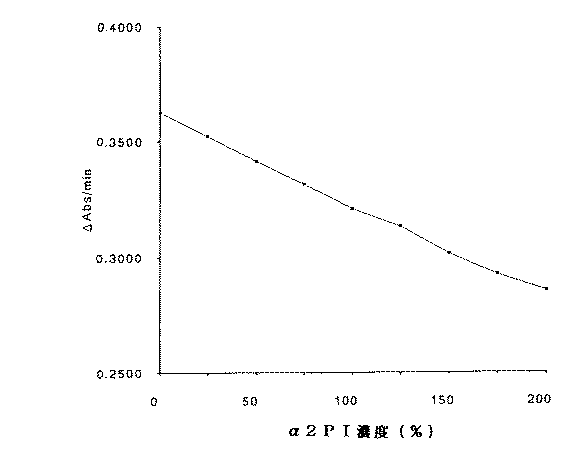
10%グリセロールを含む10%グリシルグリシンのプラスミン溶液を用い、実施例1と同様にして、0〜200%濃度のα2PI検体(n=2測定)及び50又は100%濃度のα2PI検体(n=10測定)の活性測定を行い、検量線性及び再現性の検討をした。なお、検量線性の検討では、正常血漿検体の原液を200%濃度のα2PIとして設定したため、検体量は10μlとした。また、再現性の検討では、正常血漿検体の原液を100%濃度のα2PIとして設定したため、検体量は5μlとした。結果を図1及び表6に示す。
【0033】
【表6】
図1の結果より、検量線性は良好であり、表6の結果より、再現性も良好であった。
【図面の簡単な説明】
【図1】実施例5において、検量線性を検討したときの、α2PI濃度と測定値(ΔAbs/min)の関係を示す図である。[0001]
[Industrial application fields]
The present invention relates to a stable plasmin solution useful as a reagent for measuring blood coagulation and fibrinolytic factors.
[0002]
[Prior art]
The enzyme reaction in the living body is controlled and adjusted by its activating substance and an inhibiting substance that inhibits the reaction, and the function is regulated. For example, in the blood coagulation mechanism, there are enzyme inhibitors that inhibit blood coagulation reactions and excessive hypercoagulation / fibrinolysis outside the site of vascular injury, thereby controlling and regulating blood coagulation / fibrinolysis. It has been broken. In hematological examinations that examine the progress of thrombus formation, measurement of enzyme inhibitors is important and is a good indicator of coagulation / fibrinolysis, so antithrombin III (ATIII), α2-plasmin An enzyme inhibitor such as an inhibitor (α2PI) is measured.
[0003]
Of these, α2PI has been revealed to be the most important factor among fibrinolysis-inhibiting factors that regulate blood fibrinolysis, and has attracted attention as an index for knowing the state of hyperfibrinolysis in vivo. Yes. In addition, the blood level varies depending on various diseases and symptoms such as generalized intravascular blood coagulation (DIC) and a significant decrease in liver disease. Therefore, screening for these diseases, analysis of disease, prognosis and fibrinolysis It is an index for drug efficacy evaluation at the time of therapy.
[0004]
Conventionally, as a method for measuring such an enzyme inhibitory substance, an enzyme inhibitory substance is measured by reacting an enzyme inhibitory substance to be measured with an excessive amount of enzyme and measuring the remaining enzyme. Yes. For example, when measuring the amount of α2PI in a biological sample (specimen), utilizing the fact that α2PI inhibits the enzyme plasmin, after reacting a certain amount of plasmin with α2PI in the sample, The amount of α2PI is determined by measuring the activity. In this case, the activity of plasmin is determined by a method of measuring the hydrolysis rate of the chromogenic synthetic substrate by changing the absorbance.
[0005]
However, many of such enzyme inhibitors are serine protease inhibitors, and the enzyme for measuring such enzyme inhibitors is serine protease. Many proteases, such as serine proteases, have a site that becomes their own substrate in their own molecules, so that they rapidly degrade in solution, and a decrease in protease activity or binding activity with protease inhibitors may be observed. is there. For example, in the case of plasmin used for the measurement of α2PI, human-derived plasmin loses 72% of protease activity when left at 37 ° C. for 1 hour, and both H chain and L chain are degraded (KNN Reddy, Biochem. Biophys. Res. Commun., 92, 1016-1022 (1980)).
[0006]
On the other hand, the protease activity of plasmin is obtained by adding fibrinogen, ε-aminocaproic acid, high ionic strength, glycerol (J. Jespersen, Thromb. Res., 37, 395-404 (1986)), ε-aminocaproic acid and lysine. (KNN Reddy, Progress in Fibrinolysis, 374-379 (1981)) and the like are known to improve the stability.
However, these methods can only stabilize for a very short time. For example, if left at 37 ° C. for 1 hour, the activity is significantly reduced. In addition, even when the protease activity stability is relatively maintained, such as 50% glycerol, there is a problem that the binding activity with the protease inhibitor is reduced (M. Shimokawa, Analytical Science, 10, 533). -536 (1994)).
[0007]
For this reason, measurement reagents for such enzyme inhibitors are manufactured as lyophilized products because plasmin cannot be stored in solution, and preparations are required at the time of measurement. There were problems in terms of performance and speed.
In addition, the conventionally used plasmin solution has high viscosity, and plasmin activity and α2PI binding activity of plasmin are remarkably reduced. Therefore, it has been difficult to apply it as an α2PI measuring reagent to an automatic analyzer.
[0008]
[Problems to be solved by the invention]
Accordingly, an object of the present invention is to provide a plasmin solution in which plasmin activity and plasmin binding activity with α2PI can be stably maintained for a long time even when plasmin is stored in a solution state.
[0009]
[Means for Solving the Problems]
In this situation, the present inventors have conducted intensive research. As a result, if an oligopeptide consisting of a specific amino acid produced by plasmin cleaving the substrate is used, plasmin is stable for a long period of time and useful as a reagent for measuring α2PI The present invention was completed.
[0010]
That is, the present invention provides a plasmin solution containing plasmin , glycylglycine and a polyhydric alcohol (5 to 30% in the total composition).
[0011]
The plasmin used in the present invention may be any of methionyl type (the N-terminal is methionine), glutamyl type (the N-terminal is glutamic acid), lysyl type (the N-terminal is lysine), etc. Those commercially available from Chromogenics and the like can be used. These plasmins can be used alone or as a mixture, and are preferably used in the range of 0.1 to 10 nkat / ml, particularly 0.3 to 5 nkat / ml as the activity. In addition, 1nkat means the amount of plasmin that decomposes 1 nmol of plasmin synthetic substrate (S-2251) per second.
[0012]
Examples of the oligopeptides of amino acids used in the present invention include dipeptides, tripeptides, and the like in which one or more amino acids selected from lysine, arginine, glycine, alanine, aspartic acid and methionine are combined. Among these, a dipeptide or tripeptide consisting of one kind of amino acid is preferable, and glycylglycine, glycylglycylglycine, and alanylalanine are particularly preferable.
[0013]
These oligopeptides can be used alone or in combination of two or more. The oligopeptide is preferably blended in the total composition in an amount of 1 to 20% by weight (hereinafter simply expressed as%), particularly 5 to 20%. Moreover, it is preferable to mix | blend in the range of 1-2000 mg / nkat with respect to the plasmin in a solution, especially 10-700 mg / nkat.
[0014]
Further, these oligopeptides can be used in combination with one or more amino acids selected from lysine, arginine, glycine, alanine, aspartic acid and methionine, and a more stable plasmin solution can be obtained. . In this case, these amino acids are preferably blended in an amount of 1 to 20%, particularly 5 to 20% in the total composition.
[0015]
The plasmin solution of the present invention can further contain a polyhydric alcohol, and a more stable plasmin solution can be obtained. Here, as the polyhydric alcohol, glycerol, ethylene glycol, polyethylene glycol and the like are preferable. When polyhydric alcohol is blended, it is preferable to blend 1 to 50%, particularly 5 to 30%, in the total composition.
[0016]
The plasmin solution of the present invention is useful as an α2PI measurement reagent, a plasmin standard solution, and the like. When used as a measurement reagent, α2PI in a sample can be accurately quantified by using a commonly used chromogenic synthetic substrate. The chromogenic synthetic substrate is not particularly limited, and examples thereof include S-2251 (HD-Val-Leu-Lys-paranitroaniline) and S-2403 (Glu-Phe-Lys-paranitroaniline) manufactured by Chromogen. Etc.) can be preferably used.
[0017]
【The invention's effect】
The plasmin solution of the present invention is stably maintained without being reduced in plasmin activity and α2PI binding activity even after long-term storage, and is useful as a reagent for measuring α2PI. Moreover, since it can be stably stored in the state of a solution, it can be used as it is at the time of measurement, is excellent in economy and operability, and can be measured simply and quickly. Furthermore, since the viscosity is low, it can be suitably used for an automatic analyzer.
[0018]
【Example】
EXAMPLES Next, although an Example is given and this invention is further demonstrated, this invention is not limited to these Examples.
[0019]
Example 1
After adding 3 μl of a normal plasma sample (containing a predetermined amount of α2PI) or physiological saline to 250 μl of the first reagent having the following composition, reacting at 37 ° C. for 5 minutes, and then adding 100 μl of the second reagent having the following composition, The amount of change per minute in absorbance at a wavelength of 405 nm was measured. The amount of change in absorbance when using a physiological saline solution shows plasmin activity, and shows the titer for hydrolyzing the synthetic substrate of plasmin (S-2251). Further, the value obtained by subtracting the residual activity of plasmin when the normal plasma specimen is reacted from the plasmin activity of physiological saline shows the α2PI binding activity of plasmin.
As each plasmin solution of the second reagent, a 20% glycerol solution to which the additives shown in Table 2 were added was used. These solutions were adjusted to pH 7.4 with sodium hydroxide or hydrochloric acid, dissolved in plasmin, then measured on the day of preparation using half, and the other half was sealed and left at 37 ° C for 4 days before measurement. It was. For comparison, 50% glycerol and 20% glycerol were used. The results are shown in Table 2.
[0020]
[Table 1]
[Table 2]
As is clear from the results in Table 2, the plasmin solution of the present invention containing glycylglycine was stably maintained without a decrease in plasmin activity and α2PI binding activity. Moreover, the viscosity of the plasmin solution was also low.
[0023]
Example 2
Using various plasmin solutions having the compositions shown in Table 3, plasmin activity and α2PI binding activity of plasmin after production and storage for 2 days at 37 ° C. were measured in the same manner as in Example 1. The results are shown in Table 3.
[0024]
[Table 3]
As is clear from the results in Table 3, the plasmin solution of the present invention containing glycylglycine was stably maintained without a decrease in plasmin activity and α2PI binding activity. Moreover, the viscosity of the plasmin solution was also low.
[0026]
Example 3
Using various plasmin solutions having the compositions shown in Table 4, plasmin activity and α2PI binding activity of plasmin after production and storage at 37 ° C. for 25 days were measured in the same manner as in Example 1. Note that the volume of the physiological saline solution and the normal plasma sample was 5 μl. The results are shown in Table 4.
[0027]
[Table 4]
As is clear from the results in Table 4, the plasmin solution of the present invention containing glycylglycine was stably maintained without a decrease in plasmin activity and α2PI binding activity. Moreover, the viscosity of the plasmin solution was also low.
[0029]
Example 4
Using various plasmin solutions having the compositions shown in Table 5, plasmin activity and plasmin α2PI binding activity after production and after storage at 37 ° C. for 9 days were measured in the same manner as in Example 1. The volume of the physiological saline solution and the normal plasma fluid sample was 5 μl. The results are shown in Table 5.
[0030]
[Table 5]
As is clear from the results in Table 5, the plasmin solution of the present invention containing glycylglycine was stably maintained without a decrease in plasmin activity and α2PI binding activity.
No. The viscosity of the plasmin solution containing 2 10% glycylglycine and 10% glycerol was 1.89 cp when measured at 25 ° C. using VISCOMATE (manufactured by Yamaichi Electric Industry Co., Ltd.). On the other hand, the viscosity at 25 ° C. of the plasmin solution containing 50% glycerol was 6.98 cp. The plasmin solution of the present invention has a low viscosity and can be used for an automatic analysis instrument.
[0032]
Example 5
Using a plasmin solution of 10% glycylglycine containing 10% glycerol, in the same manner as in Example 1, an α2PI sample having a concentration of 0 to 200% (n = 2 measurement) and an α2PI sample having a concentration of 50 or 100% (n = 10 measurements), and the calibration curve and reproducibility were examined. Note that in the examination of the calibration curve, since the stock solution of the normal plasma sample was set as α2PI having a concentration of 200%, the sample amount was set to 10 μl. In the reproducibility study, since the stock solution of the normal plasma sample was set as α2PI having a 100% concentration, the sample amount was 5 μl. The results are shown in FIG.
[0033]
[Table 6]
From the results in FIG. 1, the calibration curve was good, and from the results in Table 6, the reproducibility was also good.
[Brief description of the drawings]
FIG. 1 is a graph showing the relationship between α2PI concentration and measured value (ΔAbs / min) when calibration curve properties are examined in Example 5. FIG.
Claims (4)
Priority Applications (5)
| Application Number | Priority Date | Filing Date | Title |
|---|---|---|---|
| JP15933095A JP3761925B2 (en) | 1995-06-26 | 1995-06-26 | Stable plasmin solution |
| AU61383/96A AU6138396A (en) | 1995-06-26 | 1996-06-24 | Stable plasmin solution |
| PCT/JP1996/001738 WO1997001631A1 (en) | 1995-06-26 | 1996-06-24 | Stable plasmin solution |
| EP96918887A EP0835931A4 (en) | 1995-06-26 | 1996-06-24 | STABLE PLASMINE SOLUTION |
| US08/973,745 US5879923A (en) | 1995-06-26 | 1996-06-24 | Stable plasmin solution |
Applications Claiming Priority (1)
| Application Number | Priority Date | Filing Date | Title |
|---|---|---|---|
| JP15933095A JP3761925B2 (en) | 1995-06-26 | 1995-06-26 | Stable plasmin solution |
Publications (2)
| Publication Number | Publication Date |
|---|---|
| JPH099997A JPH099997A (en) | 1997-01-14 |
| JP3761925B2 true JP3761925B2 (en) | 2006-03-29 |
Family
ID=15691470
Family Applications (1)
| Application Number | Title | Priority Date | Filing Date |
|---|---|---|---|
| JP15933095A Expired - Lifetime JP3761925B2 (en) | 1995-06-26 | 1995-06-26 | Stable plasmin solution |
Country Status (1)
| Country | Link |
|---|---|
| JP (1) | JP3761925B2 (en) |
Families Citing this family (1)
| Publication number | Priority date | Publication date | Assignee | Title |
|---|---|---|---|---|
| US6355243B1 (en) * | 1999-11-13 | 2002-03-12 | Bayer Corporation | Method of thrombolysis by local delivery of active plasmin |
-
1995
- 1995-06-26 JP JP15933095A patent/JP3761925B2/en not_active Expired - Lifetime
Also Published As
| Publication number | Publication date |
|---|---|
| JPH099997A (en) | 1997-01-14 |
Similar Documents
| Publication | Publication Date | Title |
|---|---|---|
| Pangburn et al. | The C3 convertase of the alternative pathway of human complement. Enzymic properties of the bimolecular proteinase | |
| Fritz et al. | Protease inhibitors | |
| Lorand et al. | Transamidating enzymes: II. A continuous fluorescent method suited for automating measurements of factor XIII in plasma | |
| US5786137A (en) | Method for assaying components in an enzyme-protein substrate system | |
| US5879923A (en) | Stable plasmin solution | |
| US4234682A (en) | Method and reagent for determining biologically active heparin in plasma | |
| EP0094720B1 (en) | Process for assaying the activity of tissue plasminogen activator, and kit suitable for use in said process | |
| Kluft et al. | alpha 2-Antiplasmin Enschede: dysfunctional alpha 2-antiplasmin molecule associated with an autosomal recessive hemorrhagic disorder. | |
| US5985582A (en) | Thrombin-based assay for antithrombin III | |
| Bertina et al. | Spectrophotometric assays of prothrombin in plasma of patients using oral anticoagulants | |
| US5646007A (en) | Method for determination of antithrombin III activity and reagent kit therefor | |
| JP2676792B2 (en) | Method for measuring activity of serine protease or serine protease inhibitor | |
| Steven et al. | Evidence for an enzyme which cleaves the guanidinobenzoate moiety from active‐site titrants specifically designed to inhibit and quantify trypsin | |
| JPS59187800A (en) | Measurement of activated partial thromboplastin time | |
| Park et al. | Rapid purification and biochemical characteristics of lumbrokinase III from earthworm for use as a fibrinolytic agent | |
| Friberger | Synthetic peptide substrate assays in coagulation and fibrinolysis and their application on automates | |
| JPS6261600A (en) | Measurement of protease inhibitor | |
| CA1079166A (en) | Process for the quantitative determination of antithrombin iii | |
| Kessner et al. | Fluorometric microassay of plasminogen activators | |
| JPH099997A (en) | Stable plasmin solution | |
| Budzynski | Chromogenic substrates in coagulation and fibrinolytic assays | |
| JPH099998A (en) | Stable plasmin solution | |
| JP2966968B2 (en) | Method for measuring plasminogen activator and its inhibitor, and kit for its measurement | |
| Derkx et al. | Prorenin-renin conversion by the contact activation system in human plasma: role of plasma protease inhibitors | |
| JPH04350560A (en) | Functional measuring method for activity of protein s |
Legal Events
| Date | Code | Title | Description |
|---|---|---|---|
| A131 | Notification of reasons for refusal |
Free format text: JAPANESE INTERMEDIATE CODE: A131 Effective date: 20050301 |
|
| A521 | Written amendment |
Free format text: JAPANESE INTERMEDIATE CODE: A523 Effective date: 20050428 |
|
| A131 | Notification of reasons for refusal |
Free format text: JAPANESE INTERMEDIATE CODE: A131 Effective date: 20050712 |
|
| A521 | Written amendment |
Free format text: JAPANESE INTERMEDIATE CODE: A523 Effective date: 20050912 |
|
| A521 | Written amendment |
Free format text: JAPANESE INTERMEDIATE CODE: A821 Effective date: 20050912 |
|
| TRDD | Decision of grant or rejection written | ||
| A01 | Written decision to grant a patent or to grant a registration (utility model) |
Free format text: JAPANESE INTERMEDIATE CODE: A01 Effective date: 20060110 |
|
| A61 | First payment of annual fees (during grant procedure) |
Free format text: JAPANESE INTERMEDIATE CODE: A61 Effective date: 20060112 |
|
| R150 | Certificate of patent or registration of utility model |
Free format text: JAPANESE INTERMEDIATE CODE: R150 |
|
| FPAY | Renewal fee payment (event date is renewal date of database) |
Free format text: PAYMENT UNTIL: 20090120 Year of fee payment: 3 |
|
| S533 | Written request for registration of change of name |
Free format text: JAPANESE INTERMEDIATE CODE: R313533 |
|
| R350 | Written notification of registration of transfer |
Free format text: JAPANESE INTERMEDIATE CODE: R350 |
|
| FPAY | Renewal fee payment (event date is renewal date of database) |
Free format text: PAYMENT UNTIL: 20100120 Year of fee payment: 4 |
|
| FPAY | Renewal fee payment (event date is renewal date of database) |
Free format text: PAYMENT UNTIL: 20100120 Year of fee payment: 4 |
|
| FPAY | Renewal fee payment (event date is renewal date of database) |
Free format text: PAYMENT UNTIL: 20110120 Year of fee payment: 5 |
|
| FPAY | Renewal fee payment (event date is renewal date of database) |
Free format text: PAYMENT UNTIL: 20110120 Year of fee payment: 5 |
|
| FPAY | Renewal fee payment (event date is renewal date of database) |
Free format text: PAYMENT UNTIL: 20120120 Year of fee payment: 6 |
|
| FPAY | Renewal fee payment (event date is renewal date of database) |
Free format text: PAYMENT UNTIL: 20130120 Year of fee payment: 7 |
|
| FPAY | Renewal fee payment (event date is renewal date of database) |
Free format text: PAYMENT UNTIL: 20140120 Year of fee payment: 8 |
|
| R250 | Receipt of annual fees |
Free format text: JAPANESE INTERMEDIATE CODE: R250 |
|
| R250 | Receipt of annual fees |
Free format text: JAPANESE INTERMEDIATE CODE: R250 |
|
| EXPY | Cancellation because of completion of term |