JP3545461B2 - Bicyclic heterocycle-containing sulfonamide derivatives - Google Patents
Bicyclic heterocycle-containing sulfonamide derivatives Download PDFInfo
- Publication number
- JP3545461B2 JP3545461B2 JP20756894A JP20756894A JP3545461B2 JP 3545461 B2 JP3545461 B2 JP 3545461B2 JP 20756894 A JP20756894 A JP 20756894A JP 20756894 A JP20756894 A JP 20756894A JP 3545461 B2 JP3545461 B2 JP 3545461B2
- Authority
- JP
- Japan
- Prior art keywords
- ring
- indol
- chloro
- benzenesulfonamide
- group
- Prior art date
- Legal status (The legal status is an assumption and is not a legal conclusion. Google has not performed a legal analysis and makes no representation as to the accuracy of the status listed.)
- Expired - Fee Related
Links
- 0 C*c1c[n]c2c1cccc2N Chemical compound C*c1c[n]c2c1cccc2N 0.000 description 11
- RDSVSEFWZUWZHW-UHFFFAOYSA-N Brc1c2[nH]ccc2ccc1 Chemical compound Brc1c2[nH]ccc2ccc1 RDSVSEFWZUWZHW-UHFFFAOYSA-N 0.000 description 1
- FKXLWNFFDVCTEE-UHFFFAOYSA-N N#Cc1c[nH]c2c1cccc2[N+]([O-])=O Chemical compound N#Cc1c[nH]c2c1cccc2[N+]([O-])=O FKXLWNFFDVCTEE-UHFFFAOYSA-N 0.000 description 1
- SALQMMXSINGXMI-UHFFFAOYSA-N Nc(cc1)ccc1N=O Chemical compound Nc(cc1)ccc1N=O SALQMMXSINGXMI-UHFFFAOYSA-N 0.000 description 1
- WTFWZOSMUGZKNZ-UHFFFAOYSA-N Nc1cccc2c1[nH]cc2 Chemical compound Nc1cccc2c1[nH]cc2 WTFWZOSMUGZKNZ-UHFFFAOYSA-N 0.000 description 1
Classifications
-
- C—CHEMISTRY; METALLURGY
- C07—ORGANIC CHEMISTRY
- C07D—HETEROCYCLIC COMPOUNDS
- C07D231/00—Heterocyclic compounds containing 1,2-diazole or hydrogenated 1,2-diazole rings
- C07D231/54—Heterocyclic compounds containing 1,2-diazole or hydrogenated 1,2-diazole rings condensed with carbocyclic rings or ring systems
- C07D231/56—Benzopyrazoles; Hydrogenated benzopyrazoles
-
- A—HUMAN NECESSITIES
- A61—MEDICAL OR VETERINARY SCIENCE; HYGIENE
- A61P—SPECIFIC THERAPEUTIC ACTIVITY OF CHEMICAL COMPOUNDS OR MEDICINAL PREPARATIONS
- A61P35/00—Antineoplastic agents
-
- C—CHEMISTRY; METALLURGY
- C07—ORGANIC CHEMISTRY
- C07D—HETEROCYCLIC COMPOUNDS
- C07D209/00—Heterocyclic compounds containing five-membered rings, condensed with other rings, with one nitrogen atom as the only ring hetero atom
- C07D209/02—Heterocyclic compounds containing five-membered rings, condensed with other rings, with one nitrogen atom as the only ring hetero atom condensed with one carbocyclic ring
- C07D209/04—Indoles; Hydrogenated indoles
- C07D209/08—Indoles; Hydrogenated indoles with only hydrogen atoms or radicals containing only hydrogen and carbon atoms, directly attached to carbon atoms of the hetero ring
-
- C—CHEMISTRY; METALLURGY
- C07—ORGANIC CHEMISTRY
- C07D—HETEROCYCLIC COMPOUNDS
- C07D209/00—Heterocyclic compounds containing five-membered rings, condensed with other rings, with one nitrogen atom as the only ring hetero atom
- C07D209/02—Heterocyclic compounds containing five-membered rings, condensed with other rings, with one nitrogen atom as the only ring hetero atom condensed with one carbocyclic ring
- C07D209/04—Indoles; Hydrogenated indoles
- C07D209/10—Indoles; Hydrogenated indoles with substituted hydrocarbon radicals attached to carbon atoms of the hetero ring
- C07D209/12—Radicals substituted by oxygen atoms
-
- C—CHEMISTRY; METALLURGY
- C07—ORGANIC CHEMISTRY
- C07D—HETEROCYCLIC COMPOUNDS
- C07D209/00—Heterocyclic compounds containing five-membered rings, condensed with other rings, with one nitrogen atom as the only ring hetero atom
- C07D209/02—Heterocyclic compounds containing five-membered rings, condensed with other rings, with one nitrogen atom as the only ring hetero atom condensed with one carbocyclic ring
- C07D209/04—Indoles; Hydrogenated indoles
- C07D209/30—Indoles; Hydrogenated indoles with hetero atoms or with carbon atoms having three bonds to hetero atoms with at the most one bond to halogen, directly attached to carbon atoms of the hetero ring
-
- C—CHEMISTRY; METALLURGY
- C07—ORGANIC CHEMISTRY
- C07D—HETEROCYCLIC COMPOUNDS
- C07D209/00—Heterocyclic compounds containing five-membered rings, condensed with other rings, with one nitrogen atom as the only ring hetero atom
- C07D209/02—Heterocyclic compounds containing five-membered rings, condensed with other rings, with one nitrogen atom as the only ring hetero atom condensed with one carbocyclic ring
- C07D209/04—Indoles; Hydrogenated indoles
- C07D209/30—Indoles; Hydrogenated indoles with hetero atoms or with carbon atoms having three bonds to hetero atoms with at the most one bond to halogen, directly attached to carbon atoms of the hetero ring
- C07D209/32—Oxygen atoms
- C07D209/34—Oxygen atoms in position 2
-
- C—CHEMISTRY; METALLURGY
- C07—ORGANIC CHEMISTRY
- C07D—HETEROCYCLIC COMPOUNDS
- C07D209/00—Heterocyclic compounds containing five-membered rings, condensed with other rings, with one nitrogen atom as the only ring hetero atom
- C07D209/02—Heterocyclic compounds containing five-membered rings, condensed with other rings, with one nitrogen atom as the only ring hetero atom condensed with one carbocyclic ring
- C07D209/04—Indoles; Hydrogenated indoles
- C07D209/30—Indoles; Hydrogenated indoles with hetero atoms or with carbon atoms having three bonds to hetero atoms with at the most one bond to halogen, directly attached to carbon atoms of the hetero ring
- C07D209/42—Carbon atoms having three bonds to hetero atoms with at the most one bond to halogen, e.g. ester or nitrile radicals
-
- C—CHEMISTRY; METALLURGY
- C07—ORGANIC CHEMISTRY
- C07D—HETEROCYCLIC COMPOUNDS
- C07D401/00—Heterocyclic compounds containing two or more hetero rings, having nitrogen atoms as the only ring hetero atoms, at least one ring being a six-membered ring with only one nitrogen atom
- C07D401/02—Heterocyclic compounds containing two or more hetero rings, having nitrogen atoms as the only ring hetero atoms, at least one ring being a six-membered ring with only one nitrogen atom containing two hetero rings
- C07D401/12—Heterocyclic compounds containing two or more hetero rings, having nitrogen atoms as the only ring hetero atoms, at least one ring being a six-membered ring with only one nitrogen atom containing two hetero rings linked by a chain containing hetero atoms as chain links
-
- C—CHEMISTRY; METALLURGY
- C07—ORGANIC CHEMISTRY
- C07D—HETEROCYCLIC COMPOUNDS
- C07D403/00—Heterocyclic compounds containing two or more hetero rings, having nitrogen atoms as the only ring hetero atoms, not provided for by group C07D401/00
- C07D403/02—Heterocyclic compounds containing two or more hetero rings, having nitrogen atoms as the only ring hetero atoms, not provided for by group C07D401/00 containing two hetero rings
- C07D403/12—Heterocyclic compounds containing two or more hetero rings, having nitrogen atoms as the only ring hetero atoms, not provided for by group C07D401/00 containing two hetero rings linked by a chain containing hetero atoms as chain links
-
- C—CHEMISTRY; METALLURGY
- C07—ORGANIC CHEMISTRY
- C07D—HETEROCYCLIC COMPOUNDS
- C07D405/00—Heterocyclic compounds containing both one or more hetero rings having oxygen atoms as the only ring hetero atoms, and one or more rings having nitrogen as the only ring hetero atom
- C07D405/02—Heterocyclic compounds containing both one or more hetero rings having oxygen atoms as the only ring hetero atoms, and one or more rings having nitrogen as the only ring hetero atom containing two hetero rings
- C07D405/12—Heterocyclic compounds containing both one or more hetero rings having oxygen atoms as the only ring hetero atoms, and one or more rings having nitrogen as the only ring hetero atom containing two hetero rings linked by a chain containing hetero atoms as chain links
-
- C—CHEMISTRY; METALLURGY
- C07—ORGANIC CHEMISTRY
- C07D—HETEROCYCLIC COMPOUNDS
- C07D409/00—Heterocyclic compounds containing two or more hetero rings, at least one ring having sulfur atoms as the only ring hetero atoms
- C07D409/02—Heterocyclic compounds containing two or more hetero rings, at least one ring having sulfur atoms as the only ring hetero atoms containing two hetero rings
- C07D409/12—Heterocyclic compounds containing two or more hetero rings, at least one ring having sulfur atoms as the only ring hetero atoms containing two hetero rings linked by a chain containing hetero atoms as chain links
-
- C—CHEMISTRY; METALLURGY
- C07—ORGANIC CHEMISTRY
- C07D—HETEROCYCLIC COMPOUNDS
- C07D471/00—Heterocyclic compounds containing nitrogen atoms as the only ring hetero atoms in the condensed system, at least one ring being a six-membered ring with one nitrogen atom, not provided for by groups C07D451/00 - C07D463/00
- C07D471/02—Heterocyclic compounds containing nitrogen atoms as the only ring hetero atoms in the condensed system, at least one ring being a six-membered ring with one nitrogen atom, not provided for by groups C07D451/00 - C07D463/00 in which the condensed system contains two hetero rings
- C07D471/04—Ortho-condensed systems
-
- C—CHEMISTRY; METALLURGY
- C07—ORGANIC CHEMISTRY
- C07D—HETEROCYCLIC COMPOUNDS
- C07D487/00—Heterocyclic compounds containing nitrogen atoms as the only ring hetero atoms in the condensed system, not provided for by groups C07D451/00 - C07D477/00
- C07D487/02—Heterocyclic compounds containing nitrogen atoms as the only ring hetero atoms in the condensed system, not provided for by groups C07D451/00 - C07D477/00 in which the condensed system contains two hetero rings
- C07D487/04—Ortho-condensed systems
Landscapes
- Chemical & Material Sciences (AREA)
- Organic Chemistry (AREA)
- Health & Medical Sciences (AREA)
- Chemical Kinetics & Catalysis (AREA)
- General Chemical & Material Sciences (AREA)
- Medicinal Chemistry (AREA)
- Nuclear Medicine, Radiotherapy & Molecular Imaging (AREA)
- Pharmacology & Pharmacy (AREA)
- Life Sciences & Earth Sciences (AREA)
- Animal Behavior & Ethology (AREA)
- General Health & Medical Sciences (AREA)
- Public Health (AREA)
- Veterinary Medicine (AREA)
- Pharmaceuticals Containing Other Organic And Inorganic Compounds (AREA)
- Nitrogen Condensed Heterocyclic Rings (AREA)
- Indole Compounds (AREA)
- Plural Heterocyclic Compounds (AREA)
Description
【0001】
【産業上の利用分野】
本発明は新規なスルホンアミド誘導体、その製造法及び該化合物を有効成分とする医薬組成物に関する。
【0002】
【従来の技術】
癌の化学療法剤として従来用いられているものには、アルキル化剤のサイクロホスファミド、代謝拮抗剤のメトトレキセート、フルオロウラシル、抗生物質のアドリアマイシン、マイトマイシン、ブレオマイシン、植物由来のビンクリスチン、エトポシド、金属錯体のシスプラチンなど多くの薬剤があるが、いずれもその抗腫瘍効果は不十分であり、新しい抗腫瘍剤の開発が切望されている。
【0003】
また、芳香族スルホンアミド系抗腫瘍性化合物としては、4−アミノベンゼンスルホンアミド誘導体(特公昭43−3093)、2−スルファニルアミド−キノキサリン誘導体(特開昭62−426 )およびN−(2−アニリノ−3−ピリジニル)ベンゼンスルホンアミド誘導体(特開平5−39256 )が報告されている。芳香族スルホン酸エステル系抗腫瘍性化合物についてはまだ報告がない。
【0004】
【発明が解決しようとする課題】
本発明は、優れた抗腫瘍活性を有し、従来の抗腫瘍性 化合物とは基本骨格が異なる新規スルホンアミド誘導体の提供を目的とする。さらに該 化合物の製造法および該化合物を有効成分とする医薬組成物をも提供することを目的と する。
【0005】
【課題を解決するための手段】
本発明者らは、上記趣旨に鑑み、優れた抗腫瘍性化合物を求めて鋭意研究を行ってきた結果、二環式ヘテロ環を有する新規スルホンアミド誘導体が優れた抗腫瘍活性を有し、かつ低毒性であることを見出し、本発明を完成した。
【0006】
すなわち、本発明は一般式(I)
【0007】
【化8】
(式中、A環は置換基を有していてもよい、単環式または二環式芳香環を、B環は置換基を有していてもよい、6員環式不飽和炭化水素またはヘテロ原子として窒素原子を1個のみ含む不飽和6員ヘテロ環を、C環は置換基を有していてもよい、窒素原子を1または2個のみ含む5員ヘテロ環を、Wは単結合または−CH=CH−を、Xは−N(R 1 )−を、Yは炭素原子または窒素原子を、Zは−N(R2)−または窒素原子を、R1およびR2は同一または異なって水素原子または低級アルキル基を、意味する。但し、(1)A環が4−メチルベンゼンであり、Wが単結合であり、Xが−NH−であり、B環がメトキシベンゼンであり、かつC環が無置換のイミダゾールである組み合わせ、(2)A環が4−(アセトアミド)ベンゼンまたは4−アミノベンゼンであり、Wが単結合であり、Xが−NH−であり、B環が無置換のベンゼンであり、かつC環が無置換のピラゾールである組み合わせ、(3)Yが炭素原子でありC環がイミダゾリル基である化合物、(4)5,5’−ジメチル−7,7’−ビス(p−トルエンスルホンアミド)−2,2’−ビスインダゾール、および(5)2−アセチル−7−ベンゼンスルホンアミド−3−(2−ベンゼンスルホンアミドエチル)−6−メトキシインドールを除く)で表わされるスルホンアミド誘導体またはその薬理学的に許容される塩に関する。
【0009】
上記一般式(I)において、A環の意味する「置換基を有していてもよい、単環式または二環式芳香環」とは、芳香族炭化水素、または窒素原子、酸素原子および硫黄原子のうち少なくとも1個を含む芳香族ヘテロ環であり、当該環上には置換基1〜3個があってもよい。A環に含まれる主な芳香環を例示すると、ピロール、ピラゾール、イミダゾール、チオフェン、フラン、チアゾール、オキサゾール、ベンゼン、ピリジン、ピリミジン、ピラジン、ピリダジン、ナフタレン、キノリン、イソキノリン、フタラジン、ナフチリジン、キノキサリン、キナゾリン、シンノリン、インドール、イソインドール、インドリジン、インダゾール、ベンゾフラン、ベンゾチオフェン、ベンズオキサゾール、ベンズイミダゾール、ベンゾピラゾール、ベンゾチアゾールなどがある。上記芳香環は置換基1〜3個を有していてもよく、置換基が複数個ある場合には、同一または異なっていてもよい。置換基としては、例えば、低級アルキル基または低級シクロアルキル基で置換されていてもよいアミノ基、低級アルキル基、低級アルコキシ基、水酸基、ニトロ基、メルカプト基、シアノ基、低級アルキルチオ基、ハロゲン基、式−a−b[式中、aは単結合、−(CH2 )k −、−O−(CH2 )k −、−S−(CH2 )k −または−N(R3 )−(CH2 )k −を、kは1〜5の整数を、R3 は水素原子または低級アルキル基を、bは−CH2 −d(式中、dは低級アルキル基で置換されていてもよいアミノ基、ハロゲン基、水酸基、低級アルキルチオ基、シアノ基または低級アルコキシ基を意味する)を意味する]で示される基、式−a−e−f[式中、aは前記と同じ意味を、eは−S(O)−または−S(O)2 −を、fは低級アルキル基または低級アルコキシ基で置換されていてもよいアミノ基、低級アルキル基、トリフルオロメチル基、−(CH2 )m −bまたは−N(R4 )−(CH2 )m −b(式中、bは前記と同じ意味を示し、R4 は水素原子または低級アルキル基を、mは1〜5の整数を意味する)を意味する]で示される基、式−a−g−h[式中、aは前記と同じ意味を示し、gは−C(O)−または−C(S)−を、hは低級アルキル基で置換されていてもよいアミノ基、水酸基、低級アルキル基、低級アルコキシ基、−(CH2 )n −bまたは−N(R5 )−(CH2 )n −b(式中、bは前記と同じ意味を示し、R5 は水素原子または低級アルキル基を、nは1〜5の整数を意味する)を意味する]で示される基、式−a−N(R6 )−g−i[式中、aおよびgは前記と同じ意味を示し、R6 は水素原子または低級アルキル基を、iは水素原子、低級アルコキシ基またはf(fは前記と同じ意味を示す)を意味する]で示される基、式−a−N(R7 )−e−f(式中、a、eおよびfは前記と同じ意味を示し、R7 は水素原子または低級アルキル基を意味する)で示される基、または式−(CH2 )p −j−(CH2 )q −b(式中、jは酸素原子または硫黄原子を意味し、bは前記と同じ意味を示し、pおよびqは同一または異なって1〜5の整数を意味する)で示される基などを挙げることができる。
【0010】
上記置換基例において、アミノ基が2個のアルキル基で置換されている場合には、これらのアルキル基が結合して5または6員環を形成していてもよい。また、A環が水酸基またはメルカプト基を有する含窒素ヘテロ環である場合には、これらの基が共鳴構造をとることにより、オキソ基またはチオキソ基の形になっていてもよい。
B環の意味する「置換基を有していてもよい、6員環式不飽和炭化水素またはヘテロ原子として窒素原子を1個含む不飽和6員ヘテロ環」とは、一部が水素化されていてもよい、ベンゼンまたはピリジンであり、当該環上に置換基1または2個を有していてもよく、置換基が2個ある場合には同一または異なっていてもよい。
C環の意味する「置換基を有していてもよい、窒素原子を1または2個含む5員ヘテロ環」とは、一部が水素化されていてもよい、ピロール、ピラゾール、イミダゾールであり、当該環上に置換基1または2個を有していてもよく、置換基が2個ある場合には同一または異なっていてもよい。
B環およびC環が有していてもよい置換基としては、例えば、ハロゲン基、シアノ基、低級アルキル基、低級アルコキシ基、水酸基、オキソ基、式−C(O)−r(式中、rは水素原子、低級アルキル基で置換されていてもよいアミノ基、低級アルキル基、低級アルコキシ基または水酸基を意味する)、低級アルキル基で置換されていてもよいアミノ基、トリフルオロメチル基などを挙げることができる。
【0011】
上記一般式(I)において、R1、R2、A環、B環およびC環が有していてもよい置換基の定義中の低級アルキル基としては、炭素数1〜6の直鎖もしくは分岐状のアルキル基、例えばメチル基、エチル基、n−プロピル基、イソプロピル基、n−ブチル基、イソブチル基、sec−ブチル基、tert−ブチル基、n−ペンチル基(アミル基)、イソペンチル基、ネオペンチル基、tert−ペンチル基、1−メチルブチル基、2−メチルブチル基、1,2−ジメチルプロピル基、n−ヘキシル基、イソヘキシル基、1−メチルペンチル基、2−メチルペンチル基、3−メチルペンチル基、1,1−ジメチルブチル基、1,2−ジメチルブチル基、2,2−ジメチルブチル基、1,3−ジメチルブチル基、2,3−ジメチルブチル基、3,3−ジメチルブチル基、1−エチルブチル基、2−エチルブチル基、1,1,2−トリメチルプロピル基、1,2,2−トリメチルプロピル基、1−エチル−1−メチルプロピル基、1−エチル−2−メチルプロピル基などを意味する。これらのうち好ましい基としては、メチル基、エチル基、n−プロピル基、イソプロピル基、n−ブチル基、イソブチル基などを挙げることができ、これらのうち、最も好ましい基としてはメチル基、エチル基、n−プロピル基、イソプロピル基を挙げることができる。
特に、「R 1 およびR 2 における低級アルキル基」とは、炭素数1〜6の直鎖もしくは分岐状のアルキル基を意味する。
【0012】
A環が有していてもよい置換基の定義中の低級シクロアルキル基としては、シクロプロピル基、シクロペンチル基、シクロヘキシル基などを挙げることができる。 A環、B環およびC環が有していてもよい置換基の定義中の低級アルコキシ基とは、メトキシ基、エトキシ基、n−プロポキシ基、イソプロポキシ基、n−ブトキシ基、イソブトキシ基、tert−ブトキシ基など上記の低級アルキル基から誘導される低級アルコキシ基を意味するが、これらのうち最も好ましい基としてはメトキシ基、エトキシ基を挙げることができる。またハロゲン原子としてはフッ素原子、塩素原子、臭素原子などが挙げられる。
【0013】
上記一般式(I)で示されるスルホンアミド誘導体は酸または塩基と塩を形成する場合もある。本発明は化合物(I)の塩をも包含する。酸との塩としては、たとえば塩酸塩、臭化水素酸塩、硫酸塩等の無機酸塩や酢酸、乳酸、コハク酸、フマル酸、マレイン酸、クエン酸、安息香酸、メタンスルホン酸、p−トルエンスルホン酸などの有機酸との塩を挙げることができる。また、塩基との塩としては、ナトリウム塩、カリウム塩、カルシウム塩などの無機塩、トリエチルアミン、アルギニン、リジン等の有機塩基との塩を挙げることができる。
【0014】
また、これら化合物の水和物はもちろんのこと光学異性体が存在する場合はそれらすべてが含まれることはいうまでもない。また、本発明化合物は強い抗腫瘍活性を示すが、生体内で酸化、還元、加水分解、抱合などの代謝を受けて抗腫瘍活性を示す化合物をも包含する。またさらに、本発明は生体内で酸化、還元、加水分解などの代謝を受けて本発明化合物を生成する化合物をも包含する。
【0015】
次に本発明化合物(I)は種々の方法によって製造することができるが、それらのうち代表的な方法を示せば、以下の通りである。
1)一般式(II)
【0016】
【化9】
(式中、Aa環は保護されたまたは保護されていない置換基を有していてもよい、単環式または二環式芳香環を意味し、Wは前記と同じ意味を示す)で表わされるスルホン酸またはその反応性誘導体と一般式(III )
【0018】
【化10】
(式中、Ba環は保護されたまたは保護されていない置換基を有していてもよい、6員環式不飽和炭化水素またはヘテロ原子として窒素原子を1個のみ含む不飽和6員ヘテロ環を、Ca環は保護されたまたは保護されていない置換基を有していてもよい、窒素原子を1または2個のみ含む5員ヘテロ環を意味し、X、YおよびZは前記と同じ意味を示す)で表わされる化合物を反応させることにより製造することができる。
【0020】
スルホン酸(II)の反応性誘導体としては、例えばハロゲン化スルホニル、スルホン酸無水物、N−スルホニルイミダゾリドなどのような一般的によく利用される反応性誘導体を挙げることができるが、特に好適な例はハロゲン化スルホニルである。反応に使用する溶媒は特に限定されないが、原料物質を溶解し、かつこれらと容易に反応しないものが望ましく、例えばピリジン、テトラヒドロフラン、ジオキサン、ベンゼン、エチルエーテル、ジクロロメタン、ジメチルホルムアミド、あるいはこれらから選ばれた2種以上の混合溶媒などが利用され得る。また、本反応においてハロゲン化スルホニルを用いた場合の如く、反応の進行に伴い酸が遊離してくる場合には、適当な脱酸剤の存在下に行われるのが好ましいので、ピリジンのような塩基性溶媒の使用は特に好適である。中性溶媒を使用するときは、炭酸アルカリ、有機第3級アミンなどの塩基性物質を添加してもよい。勿論、使用し得る溶媒はここに挙げたものに限定されるものではない。一般に本反応は室温で進行するが、必要に応じて冷却または加熱してもよい。反応時間は通常10分〜20時間であるが、原料化合物の種類、反応温度によって任意に選ばれる。得られた生成物において、アミノ基または水酸基が保護されている場合には、所望により酸処理、アルカリ処理、接触還元など通常の脱保護法を行うことにより、遊離の水酸基またはアミノ基を有するスルホンアミド誘導体(I)を得ることが可能である。
【0021】
2)一般式(IV)
【0022】
【化11】
(式中、Aa環、Ba環、W、XおよびZは前記と同じ意味を示す)で表わされる化合物をハロゲン化剤と反応させることにより製造することができる。ハロゲン化剤としては、N−クロロコハク酸イミド、N−ブロモコハク酸イミド、1,3−ジブロモ−5,5−ジメチルヒダントイン、N−ブロモアセトアミド、塩素、臭素などを例示することができる。反応に使用する溶媒は特に限定されないが、通常ジクロロメタン、クロロホルム、四塩化炭素等の塩化アルキル化合物やクロロベンゼン、ジクロロベンゼン等の芳香族塩化物等が使用されるが、ジメチルホルムアミド、ジオキサン、ピリジン、アセトニトリル等の水溶性溶媒も使用することができる。反応温度はハロゲン化剤および基質の種類によって異なるが、通常−50℃から 100℃の間で行われる。得られた生成物において、アミノ基または水酸基が保護されている場合には、所望により酸処理、アルカリ処理、接触還元など通常の脱保護法を行うことにより、遊離の水酸基またはアミノ基を有するスルホンアミド誘導体(I)を得ることが可能である。
【0024】
3)一般式(V)
【0025】
【化12】
(式中、Aa環、Ba環、W、XおよびZは前記と同じ意味を示し、Eは脱水によりシアノ基へ変換可能な置換基を意味する)で表わされる化合物を脱水剤と反応させることにより製造することができる。脱水によりシアノ基へ変換可能な置換基としては、例えば(ヒドロキシイミノ)メチル基、カルバモイル基などを挙げることができる。また、原料のアルデヒドまたはカルボン酸からまずオキシムまたは酸アミドを合成し、これを単離することなく脱水剤と反応させることも可能である。脱水剤としてはニトリルの合成に一般に用いられる方法、例えば無水酢酸、塩化チオニル、オキシ塩化リン、二酸化セレン、1,3−ジシクロヘキシルカルボジイミドなどを挙げることができる。反応に使用する溶媒は特に限定されないが、原料物質を溶解し、かつこれらと容易に反応しないものが望ましく、例えばピリジン、エチルエーテル、ベンゼン、ジメチルホルムアミド、四塩化炭素、アセトニトリル、テトラヒドロフラン、あるいはこれらから選ばれた2種以上の混合溶媒などが利用され得る。反応温度は脱水剤および基質の種類によって異なるが、通常−50℃から 150℃の間で行われる。得られた生成物において、アミノ基または水酸基が保護されている場合には、所望により酸処理、アルカリ処理、接触還元など通常の脱保護法を行うことにより、遊離の水酸基またはアミノ基を有するスルホンアミド誘導体(I)を得ることが可能である。
【0027】
4)一般式(VI)
【0028】
【化13】
(式中、Ab環は、還元によりアミノ基へ変換可能な置換基を有し、他に保護されたまたは保護されていない置換基を有していてもよい、単環式または二環式芳香環を意味し、Ba環、Ca環、W、X、YおよびZは前記と同じ意味を示す)で表わされる化合物を還元剤と反応させることにより製造することができる。還元によりアミノ基へ変換可能な置換基としてはニトロ基、ニトロソ基、ヒドロキシアミノ基、アゾ基などがある。還元には、一般に用いられるニトロ基の還元法を使用することができるが、好ましい例としてはパラジウム−炭素、酸化白金等を触媒とした接触還元や亜鉛、鉄またはスズと酸による還元等を挙げることができる。接触還元は通常メタノール、テトラヒドロフラン、ジメチルホルムアミドなどの有機溶媒中、常圧または加圧下で行うことができる。得られた生成物において、水酸基が保護されている場合には、所望により酸処理、アルカリ処理、接触還元など通常の脱保護法を行うことにより、遊離の水酸基を有するスルホンアミド誘導体(I)を得ることが可能である。
【0030】
5)一般式(VII )
【0031】
【化14】
(式中、Ac環は、脱離基を環上または置換基中に有し、他に保護されたまたは保護されていない置換基を有していてもよい、単環式または二環式芳香環を意味し、Ba環、Ca環、W、X、YおよびZは前記と同じ意味を示す)で表わされる化合物を求核剤と反応させることにより製造することができる。脱離基としては、例えばハロゲン基、メタンスルホニルオキシ基、p−トルエンスルホニルオキシ基などを挙げることができる。求核剤としては、例えばアミン類、アルコール類、チオール類などを挙げることができる。アルコール類、チオール類などの場合にはアルカリ金属などとの塩の形で反応させてもよい。反応に使用する溶媒は特に限定されないが、原料物質を溶解し、かつこれらと容易に反応しないものが望ましく、例えば、テトラヒドロフラン、ジオキサン、ジメチルホルムアミド、水などが利用され得る。反応温度は基質の種類によって異なるが、通常−50℃から 150℃の間で行われる。得られた生成物において、アミノ基または水酸基が保護されている場合には、所望により酸処理、アルカリ処理、接触還元など通常の脱保護法を行うことにより、遊離の水酸基またはアミノ基を有するスルホンアミド誘導体(I)を得ることが可能である。
【0033】
次に本発明に用いられる原料化合物(II)およびその反応性誘導体ならびに(III)を製造する方法について説明する。原料化合物(II)およびその反応性誘導体には公知化合物および新規化合物が含まれる。新規化合物の場合、既に報告されている公知化合物の合成法を応用することにより、または、それらを組み合わせることにより製造することが可能である。例えば、新規スルホニルクロリドは Chem. Ber., 90, 841 (1957), J. Med. Chem., 6, 307 (1963), J. Chem. Soc.(c), 1968, 1265, Chem. Lett., 1992, 1483, J. Am. Chem. Soc., 59, 1837 (1937), J. Med. Chem., 23, 1376 (1980), J. Am. Chem. Soc., 70, 375 (1948), J. Am. Chem. Soc., 78, 2171 (1956) などに記載されている合成法を応用した方法により製造することができる。原料化合物(III )には公知化合物および新規化合物が含まれる。原料化合物(III)においてH−X−がアミノ基H2 N−を意味する場合には、当該ニトロ化合物を一般的に利用されるニトロ基の還元法で還元することによりH2 N体(III)を得ることができる。還元法の好ましい例としてはパラジウム−炭素を触媒とした接触還元や亜鉛末−塩酸による還元などがある。接触還元は通常メタノール、テトラヒドロフラン、ジメチルホルムアミドなどの有機溶媒中常圧または加圧下で行うことができる。
【0034】
原料化合物が新規化合物の場合、既に報告されている公知化合物の合成法を応用することにより、またはそれらを組み合わせることにより製造することが可能である。新規化合物は Can. J. Chem., 42, 1235 (1964), Chem. Abst., 59, 8855f (1963), Tetrahedron Lett., 30, 2129 (1989)などに記載された方法を応用して、例えば、次に示す経路で製造することが可能である。
【0035】
反応式1
【0036】
【化15】
式中、Qは同一または異なった置換基を意味し、Gはハロゲン基を意味し、tは0〜2の整数である。
反応式2
【0038】
【化16】
式中、Qおよびtは前記と同じ意味を示す。
反応式3
【0040】
【化17】
式中、Q、Gおよびtは前記と同じ意味を示し、DPPAはジフェニルホスホリルアジドを意味する。
反応式4
【0042】
【化18】
式中、Q、Gおよびtは前記と同じ意味を示し、DDQは2,3−ジクロロ−5,6−ジシアノ−1,4−ベンゾキノンを意味する。
【0044】
本発明化合物を医薬として使用する場合は、経口もしくは非経口的に投与される。投与量は、症状の程度、患者の年齢、性別、体重、感受性差、投与方法、投与時期、投与間隔、医薬製剤の性質、調剤、種類、有効成分の種類等によって異なり特に限定されないが、通常成人1日あたり10〜6000mg、好ましくは約50〜4000mg、さらに好ましくは 100〜3000mgでありこれを通常1日1〜3回に分けて投与する。
【0045】
経口用固形製剤を調製する場合は、主薬に賦形剤さらに必要に応じて結合剤、崩壊剤、滑沢剤、着色剤、矯味矯臭剤などを加えた後、常法により錠剤、被覆錠剤、顆粒剤、細粒剤、散剤、カプセル剤等とする。
賦形剤としては、例えば乳糖、コーンスターチ、白糖、ぶどう糖、ソルビット、結晶セルロース、二酸化ケイ素などが、結合剤としては、例えばポリビニルアルコール、エチルセルロース、メチルセルロース、アラビアゴム、ヒドロキシプロピルセルロース、ヒドロキシプロピルメチルセルロース等が、滑沢剤としては、例えばステアリン酸マグネシウム、タルク、シリカ等が、着色剤としては医薬品に添加することが許可されているものが、矯味矯臭剤としては、ココア末、ハッカ脳、芳香酸、ハッカ油、龍脳、桂皮末等が用いられる。これらの錠剤、顆粒剤には糖衣、ゼラチン衣、その他必要により適宜コーティングすることは勿論差し支えない。
注射剤を調製する場合には、必要により主薬にpH調整剤、緩衝剤、懸濁化剤、溶解補助剤、安定化剤、等張化剤、保存剤などを添加し、常法により静脈、皮下、筋肉内注射剤とする。その際必要により、常法により凍結乾燥物とすることもある。
懸濁化剤としては、例えばメチルセルロース、ポリソルベート80、ヒドロキシエチルセルロース、アラビアゴム、トラガント末、カルボキシメチルセルロースナトリウム、ポリオキシエチレンソルビタンモノラウレートなどを挙げることができる。
【0046】
溶解補助剤としては、例えばポリオキシエチレン硬化ヒマシ油、ポリソルベート80、ニコチン酸アミド、ポリオキシエチレンソルビタンモノラウレート、マクロゴール、ヒマシ油脂肪酸エチルエステルなどを挙げることができる。
また安定化剤としては、例えば亜硫酸ナトリウム、メタ亜硫酸ナトリウム等を、保存剤としては、例えばパラオキシ安息香酸メチル、パラオキシ安息香酸エチル、ソルビン酸、フェノール、クレゾール、クロロクレゾールなどを挙げることができる。
【0047】
【発明の効果】
次に本発明化合物の効果を記述するため薬理実験例を示す。薬効評価の対照化合物として、公知の二環式ヘテロ環含有スルホンアミドである2−スルファニルアミド−5−クロロキノキサリン(CQS;特開昭62−426)を使用した。
【0048】
実験例1 colon38 細胞(マウス結腸癌細胞)に対する in vitro 抗腫瘍試験
10%牛胎児血清、ペニシリン( 100単位/ml) 、ストレプトマイシン( 100μg /ml)、メルカプトエタノール(5×10−5M)およびピルビン酸ナトリウム(1mM)を含むRPMI1640培地(三光純薬)に浮遊させたcolon38 細胞を96穴平底マイクロプレートの各穴に 2.5×10³ 個(0.1ml )ずつ播種し、5%炭酸ガス含有の培養器中37℃で1日培養した。
【0049】
本発明化合物をジメチルスルホキシドにて20mg/mlの濃度に溶解し、10%牛胎児血清−RPMI1640培養液で 200μg /mlの濃度まで希釈した。これを最高濃度として10%牛胎児血清−RPMI1640培養液にて3倍系列希釈を行った。これを先に述べたcolon38 細胞の培養プレートの各穴に 0.1mlずつ加え、5%炭酸ガス含有培養器中37℃で3日間培養した。
【0050】
培養後、MTT[3−(4,5−ジメチルチアゾール−2−イル)−2,5−ジフェニルテトラゾリウムブロミド]溶液( 3.3mg/ml)を0.05mlずつ各穴に加え、さらに2時間培養した。各穴から上清を吸引除去後、生成したホルマザンをジメチルスルホキシド 0.1mlで溶解し、マイクロプレートリーダーで 540nmにおける吸光度を測定し、生細胞数の指標とした。以下の式より抑制率を算出し、50%抑制する被検化合物の濃度(IC50)を求めた。
【0051】
【数1】
T:被検化合物を添加した穴の吸光度
C:被検化合物を添加しなかった穴の吸光度
得られたIC50値を表1−1および表1−2に示す。
【0053】
【表1】
実験例2 colon38 (マウス結腸癌)に対する in vivo 抗腫瘍試験
BDF1 マウス(7週齢、雌)の体側皮下に約75mgのcolon38 を移植した。本発明の化合物を 3.5%ジメチルスルホキシドと 6.5%ツイーン80を含む生理食塩水に懸濁し、移植した翌日より1日1回所定量を8日間腹腔内投与した。対照群には 3.5%ジメチルスルホキシドと 6.5%ツイーン80を含む生理食塩水を腹腔内投与した。対照群は一群10匹、薬剤投与群は一群6匹で実験を行った。
移植後21日目に腫瘍を摘出し、腫瘍重量を測定した。対照群に対する薬剤投与群の腫瘍増殖抑制率を下記式より求めた。
【0055】
【数2】
T:被検化合物投与群の平均腫瘍重量
C:対照群の平均腫瘍重量
実験結果を表2に示す。
【0057】
【表3】
実験例3 HCT 116 (ヒト結腸癌)に対する in vivo 抗腫瘍試験
ヌ−ドマウス(BALB/c・nu/nu、7〜8週齢、雌)の体側皮下に5〜8x106 個のHCT116を移植した。移植後約100mm3の腫瘍体積になる約7日後より本発明化合物を 3.5%ジメチルスルホキシドと 6.5% ツイーン80を含む生理食塩水に懸濁し、1日1回所定量を4日間腹腔内投与した。対照群には3.5%ジメチルスルホキシドと 6.5% ツイーン80を含む生理食塩水を腹腔内投与した。対照群は一群10匹、薬剤投与群は一群5匹で実験を行った。投与開始後21日目に腫瘍を摘出し、腫瘍重量を測定した。対照群に対する薬剤投与群の腫瘍増殖抑制率を下記式より求めた。
【0059】
【数3】
T:被検化合物投与群の平均腫瘍重量
C:対照群の平均腫瘍重量
実験結果を表3に示す。
【0061】
【表4】
上記実験例から明らかなように本発明化合物は優れた抗腫瘍作用を有し、抗腫瘍剤として有用である。
【0063】
【実施例】
次に、本発明化合物の原料化合物の製造を示す製造例および発明化合物の代表的化合物について実施例を挙げるが、本発明がこれらのみに限定されるものではない。
製造例1
7−ブロモ−1H−インドール
【0064】
【化19】
2−ブロモニトロベンゼン5.05g(25ミリモル)のテトラヒドロフラン溶液(250ml)に窒素雰囲気下−40℃でビニルマグネシウムブロミド 1.0Mテトラヒドロフラン溶液 100ml( 100ミリモル)を加え、そのまま40分間攪拌した。反応混合物を飽和塩化アンモニウム水溶液 500ml中に注ぎ、エチルエーテルで抽出した。硫酸マグネシウムで乾燥、濃縮後、残渣をシリカゲルカラムクロマトグラフィーで精製し、表題化合物2.89gを得た。
1H−NMR(DMSO−d6) δ(ppm) : 6.56(1H, dd, J=2.9, 1.8Hz), 6.94(1H, t, J=7.8Hz), 7.30(1H, d, J=7.8Hz), 7.40(1H, t, J=2.9Hz), 7.56(1H, d, J=7.8Hz), 11.16−11.46(1H, br m)
【0066】
製造例2
7−アミノ−1H−インドール
【0067】
【化20】
1H−NMR(DMSO−d6) δ(ppm) : 5.01(2H, br s), 6.25−6.33(2H, m), 6.70(1H, dd,J=7.9, 7.3Hz), 6.78(1H, dd, J=7.9, 0.7Hz), 7.23(1H, t, J=2.7Hz), 10.48−10.72(1H, br m)
【0068】
製造例1および2と同様にして、2−ブロモニトロベンゼン誘導体から以下の原料化合物を合成した。
7−アミノ−4−メトキシ−1H−インドール
7−アミノ−4−ブロモ−1H−インドール
【0069】
製造例3
7−ブロモ−3−クロロ−4−メチル−1H−インドール
【0070】
【化21】
2−ブロモ−5−メチルニトロベンゼンから製造例1と同様にして合成した7−ブロモ−4−メチル−1H−インドール 5.8g(27.6ミリモル)のアセトニトリル溶液( 250ml)にN−クロロコハク酸イミド 4.0g(30.0ミリモル)を加え室温で一晩攪拌した。1N水酸化ナトリウム水溶液50mlを加え、酢酸エチルで抽出した。有機層を水洗、硫酸マグネシウムで乾燥、濃縮後、残渣をシリカゲルカラムクロマトグラフィーで精製し、表題化合物 6.7gを得た。
1H−NMR(CDCl3) δ(ppm) : 2.74(3H, s), 6.75−7.26(3H, m), 8.23(1H, br s)
【0072】
製造例4
7−アミノ−3−クロロ−4−メチル−1H−インドール
【0073】
【化22】
製造例3の化合物6.37g(26.1ミリモル)から製造例2と同様にして表題化合物 2.6gを得た。
1H−NMR(CDCl3) δ(ppm) : 2.70(3H, s), 6.39−7.14(3H, m), 8.15(1H, br s)
【0075】
製造例5
4−スルファモイルベンゼンスルホニルクロリド
【0076】
【化23】
4−アミノベンゼンスルホンアミド 6.4g(37.2ミリモル)を水12.5mlと濃塩酸 6.3mlの混液に加え攪拌した。これに亜硝酸ナトリウム2.56g(37.1ミリモル)の飽和水溶液を0℃以下で滴下した。反応液を二酸化イオウ飽和酢酸液(二酸化イオウを酢酸35mlに飽和させ、塩化第二銅・2水和物 1.5gを加えた液)に氷冷、攪拌下加えた。10分後反応液を氷水に注ぎ、沈澱を濾取、水洗した。沈澱をテトラヒドロフランに溶解し、硫酸マグネシウムで乾燥後、濃縮乾固し、表題化合物 3.5gを得た。
【0078】
製造例6
4−(スルファモイルメチル)ベンゼンスルホニルクロリド
【0079】
【化24】
4−ニトロフェニルメタンスルホンアミド 5.0g(23.1ミリモル)を90%酢酸に懸濁し、パラジウム−炭素存在下常温常圧で水素添加した。触媒を濾去後濃縮乾固し、4−アミノフェニルメタンスルホンアミド 4.3gを得た。これを水40mlと濃塩酸 4.1mlの混液に加え、攪拌した。0℃以下で亜硝酸ナトリウム1.63g(23.6ミリモル)の飽和水溶液を滴下した。反応液を二酸化イオウ飽和酢酸液(二酸化イオウを酢酸30mlに飽和させ、塩化第二銅・2水和物0.97gを加えた液)に氷冷、攪拌下加えた。室温で40分攪拌後反応液を氷水中に注ぎ、食塩を飽和させた。酢酸エチルで抽出し、硫酸マグネシウムで乾燥後、濃縮乾固し、表題化合物1.7gを得た。
1H−NMR(DMSO−d6) δ(ppm) : 4.26(2H, s), 7.32(2H, d, J=8.4Hz), 7.59(2H, d,J=8.4Hz)
【0081】
製造例5または6と同様にして以下の化合物を合成した。
4−(N−メチルスルファモイル)ベンゼンスルホニルクロリド
4−(N−エチルスルファモイル)ベンゼンスルホニルクロリド
4−(N−メトキシスルファモイル)ベンゼンスルホニルクロリド
4−[(メタンスルホンアミド)メチル]ベンゼンスルホニルクロリド
4−(N−メチルメタンスルホンアミド)ベンゼンスルホニルクロリド
4−(1−ピロリジニルスルホニル)ベンゼンスルホニルクロリド
4−(1−ピロリジニルカルボニル)ベンゼンスルホニルクロリド
3−シアノベンゼンスルホニルクロリド
4−(メチルスルホニル)ベンゼンスルホニルクロリド
4−[(N−メチルメタンスルホンアミド)メチル]ベンゼンスルホニルクロリド
【0082】
製造例7
3−シアノ−7−ニトロ−1H−インドール
【0083】
【化25】
3−ホルミル−7−ニトロ−1H−インドール 10.15g(53.4ミリモル)をジメチルホルムアミド 150mlに溶解し、ヒドロキシルアミン塩酸塩3.93g(56.0ミリモル)とピリジン 4.5ml(55.6ミリモル)を加えた。70−80℃で2時間加熱攪拌後、二酸化セレン 6.3g(56.8ミリモル)と硫酸マグネシウム約5gを加えた。70−80℃でさらに 2.5時間加熱後、不溶物を濾去し、濃縮した。水を加えて析出した結晶を濾取し、水、エチルエーテルで順次洗浄した。結晶をテトラヒドロフランとアセトンの混液に溶解し、不溶物を濾去した。濃縮後、酢酸エチルを加え結晶を濾取し、表題化合物8.61gを得た。
1H−NMR(DMSO−d6) δ(ppm) : 7.48(1H, t, J=8.1Hz), 8.17(1H, d, J=8.1Hz), 8.27(1H, d, J=8.1Hz), 8.47(1H, s), 12.70−13.00(1H, br)
【0085】
製造例8
7−アミノ−3−シアノ−1H−インドール
【0086】
【化26】
製造例7の化合物2.80g(15.0ミリモル)をメタノール 100mlに懸濁し、パラジウム−炭素存在下常温常圧で水素添加した。触媒を濾別後、濃縮乾固し、表題化合物2.31gを得た。
1H−NMR(DMSO−d6) δ(ppm) : 5.32, 5.34(2H, s+s), 6.47(1H, d, J=7.5Hz), 6.81(1H, d, J=7.9Hz), 6.94(1H, dd, J=7.9, 7.5Hz), 8.13(1H, s), 11.55−11.90(1H, br),
【0088】
製造例9
7−アミノ−3,4−ジクロロ−1H−インドール
【0089】
【化27】
2−ブロモ−5−クロロニトロベンゼンから製造例1と同様にして得られた7−ブロモ−4−クロロ−1H−インドールを製造例3と同様にしてまず塩素化し、ついで製造例2と同様にしてブロモ基をアミノ基へ変換することにより表題化合物を得た。
1H−NMR(DMSO−d6) δ(ppm) : 5.26(2H, s), 6.29(1H, d, J=8.1Hz), 6.74(1H, d,J=8.1Hz), 7.45−7.51(1H, m), 11.08−11.27(1H, m)
【0091】
同様にして、7−アミノ−4−tert−ブチルジメチルシリルオキシ−3−クロロ−1H−インドールを合成した。
【0092】
製造例10
7−アミノ−3−クロロ−1H−インドール
【0093】
【化28】
7−ニトロ−1H−インドール 1.076g (6.64ミリモル)をアセトニトリル 30ml に溶解し、N−クロロコハク酸イミド920mg (6.89ミリモル)を加えた。室温で36時間攪拌後、飽和重曹水を加え、沈殿を濾取、水洗し、3−クロロ−7−ニトロ−1H−インドール1.2gを得た。この粉末863mg (4.39ミリモル)をエタノール10mlに懸濁し、塩化第一スズ・2水和物4.95g (21.9ミリモル)と濃塩酸100 μl を加えた。30分間加熱還流後、飽和重曹水を加え、不溶物を濾去した。酢酸エチルを加えて抽出後、硫酸マグネシウムで乾燥、濃縮、シリカゲルカラムクロマトグラフィーで精製し、表題化合物490mg を得た。
表題化合物は3−クロロ−7−ニトロ−1H−インド−ルを白金−炭素触媒存在下常温常圧で水素添加しても得られた。
1H−NMR(DMSO−d6) δ(ppm) : 5.14(2H, s), 6.36(1H, dd, J=7.5, 1.0Hz), 6.68(1H, dd, J=7.9, 0.73Hz), 6.81(1H, dd, J=7.9, 7.5Hz), 7.39(1H, d, J=2.7Hz), 10.85(1H, br s)
【0095】
製造例11
4−(2−スルファモイルエチル)ベンゼンスルホニルクロリド
【0096】
【化29】
クロロスルホン酸 2.4g(36.5ミリモル)に、氷冷下2−フェニルエタンスルホンアミド 1.3g(7.3 ミリモル)を20分かけて加え、室温でさらに90分攪拌した。反応混合液を氷水に注ぎ、酢酸エチルで抽出し、飽和重曹水、飽和食塩水で順次洗浄後、硫酸マグネシウムで乾燥した。溶媒を減圧留去し、表題化合物 1.6gを得た。
1H−NMR(DMSO−d6) δ(ppm) : 2.97−3.02(2H, m), 3.21−3.26(2H, m), 7.21(2H, d, J=8.4Hz), 7.53(2H, d, J=8.4Hz)
【0098】
同様にして以下の原料化合物を合成した。
4−[2−(メチルスルホニル)エチル]ベンゼンスルホニルクロリド
4−[2−(N−メチルメタンスルホンアミド)エチル]ベンゼンスルホニルクロリド
4−[2−(メタンスルホンアミド)エチル]ベンゼンスルホニルクロリド
4−(N−メチルアセトアミド)ベンゼンスルホニルクロリド
【0099】
製造例12
5−ブロモ−7−ニトロ−1H−インドール
【0100】
【化30】
1−アセチル−5−ブロモ−7−ニトロインドリン5.05g(17.7ミリモル)をエタノール6mlと6N塩酸40mlの混液に加え、3時間加熱還流した。炭酸ナトリウムを加えて中和後、酢酸エチルで抽出し、水洗、硫酸マグネシウムで乾燥した。濃縮後、シリカゲルカラムクロマトグラフィーで精製し、5−ブロモ−7−ニトロインドリン4.13gを得た。この化合物 301mg(1.24ミリモル)をトルエン10mlに加え、次に2,3−ジクロロ−5,6−ジシアノ−1,4−ベンゾキノン 580mg(2.55ミリモル)を加えた。攪拌しながら 3.5時間加熱還流後、不溶物を濾去し、濃縮した。残渣をシリカゲルカラムクロマトグラフィーで精製し、表題化合物 252mgを得た。
【0102】
製造例13
5−ブロモ−3−ホルミル−7−ニトロ−1H−インドール
【0103】
【化31】
ジメチルホルムアミド 1.0g(14ミリモル)に窒素雰囲気下0℃でオキシ塩化リン 210mg( 1.4ミリモル)を加え、30分間攪拌した。製造例12の化合物 240mg( 1.0ミリモル)を0℃で加え、0℃で20分間、ついで 100℃で30分間攪拌した。反応混合液を氷冷後氷水に注ぎ、1N水酸化ナトリウム水溶液を加えpH7−8に保ちながら30分間攪拌した。生じた沈澱を濾取、水洗後、シリカゲルカラムクロマトグラフィーで精製し、表題化合物 239mgを得た。
1H−NMR(DMSO−d6) δ(ppm) : 8.31(1H, d, J=1.8Hz), 8.55(1H, s), 8.65(1H, d,J=1.8Hz), 10.05(1H, s), 12.89(1H, br s)
【0105】
製造例14
7−アミノ−5−ブロモ−3−シアノ−1H−インドール
【0106】
【化32】
製造例13の化合物から製造例7と同様にして得られた5−ブロモ−3−シアノ−7−ニトロ−1H−インドール 214mg( 0.8ミリモル)をメタノール10mlとテトラヒドロフラン10mlの混液に溶解した。酸化白金の存在下、3.0kg /cm2 で水素添加後、触媒を濾去、濃縮乾固し、表題化合物 189mgを得た。
1H−NMR(DMSO−d6) δ(ppm) : 5.68−5.71(2H, m), 6.60(1H, d, J=2.0Hz), 6.91(1H, d, J=2.0Hz), 8.16(1H, s)
【0108】
製造例15
3−アセチル−7−アミノ−1H−インドール
【0109】
【化33】
窒素雰囲気下、7−ニトロ−1H−インドール 1.2g( 7.5ミリモル)のジクロロメタン溶液(50ml)に0℃でジメチルアルミニウムクロリド 1.0Mヘキサン溶液11ml(11ミリモル)を加えた。ついで、0℃で塩化アセチル 2.1ml(29.5ミリモル)を加え、室温で4時間攪拌した。反応系に飽和塩化アンモニウム水を加え、生じた沈澱を濾取した。この沈澱を熱エタノールで十分に洗浄し、洗液を濾液と合わせ、濃縮した。残渣に水を加え、酢酸エチルで抽出、飽和食塩水で洗浄、硫酸マグネシウムで乾燥した。溶媒を減圧留去し、残渣をシリカゲルカラムクロマトグラフィーで精製し、3−アセチル−7−ニトロ−1H−インドールを得た。これをメタノール 100mlに溶解し、パラジウム−炭素存在下、常温常圧で水素添加した。触媒を濾去後濃縮乾固し、表題化合物 790mgを得た。
【0111】
実施例1
N−(1H−インドール−7−イル)−4−ニトロベンゼンスルホンアミド
【0112】
【化34】
製造例2の化合物1.50g(11.3ミリモル)をピリジン40mlに溶解し、室温攪拌下4−ニトロベンゼンスルホニルクロリド2.57g(11.6ミリモル)を加えた。室温で一晩攪拌後、溶媒を減圧留去し、残渣に酢酸エチルと 0.2N塩酸を加えた。有機層を分取、水洗、硫酸マグネシウムで乾燥後、溶媒を減圧留去し、残渣をシリカゲルカラムクトマトグラフィーで精製し、表題化合物3.50gを得た。
1H−NMR(DMSO−d6) δ(ppm) : 6.42(1H, dd, J=2.8, 2.0Hz), 6.66(1H, d, J=7.6Hz), 6.83(1H, dd, J=8.0, 7.6Hz), 7.31(1H, dd, J=3.2, 2.8Hz), 7.36(1H, d, J=8.0Hz), 7.94−8.02(2H, m), 8.30−8.38(2H, m), 10.23(1H, s), 10.74−10.87(1H, m)
【0114】
実施例2
N−(3−クロロ−1H−インドール−7−イル)−4−ニトロベンゼンスルホンアミド
【0115】
【化35】
実施例1の化合物8.98g(28.3ミリモル)をジクロロメタン 280mlとジメチルホルムアミド7mlの混合溶媒に溶解し、窒素雰囲気下攪拌しながらN−クロロコハク酸イミド4.16g(31.2ミリモル) を加えた。室温で 1.5時間攪拌後、水50mlを加え液量が約80mlになるまで濃縮した。酢酸エチルと 0.2N塩酸を加えて有機層を分取し、飽和重曹水、飽和食塩水で順次洗浄した。硫酸マグネシウムで乾燥後、溶媒を減圧留去し、残渣をシリカゲルカラムクロマトグラフィーで精製し、表題化合物7.98gを得た。
融点:199.5−200.5 ℃ (クロロホルムから再結晶)
1H−NMR(DMSO−d6) δ(ppm) : 6.72(1H, d, J=7.6Hz), 6.96(1H, dd, J=8.0, 7.6Hz), 7.31(1H, d, J=8.0Hz), 7.47−7.53(1H, m), 7.92−8.02(2H, m), 8.30−8.41(2H, m), 10.33(1H, s), 11.07−11.22(1H, m)
【0117】
実施例3
4−アミノ−N−(3−クロロ−1H−インドール−7−イル)ベンゼンスルホンアミド
【0118】
【化36】
実施例2の化合物7.98g(22.7ミリモル)をメタノール 220mlに溶解し、攪拌しながら加熱還流した。これに10分間隔で濃塩酸10mlと亜鉛末7.40gを3回加え、さらに10分間還流した。冷却後、大過剰の重曹を加えて中和し、不溶物を濾取した。濾液を濃縮後、残渣を酢酸エチルに溶解し、飽和重曹水、2N炭酸ナトリウム水溶液、飽和食塩水で順次洗浄した。硫酸マグネシウムで乾燥後、溶媒を減圧留去し、残渣をシリカゲルカラムクロマトグラフィーで精製し、表題化合物7.21gを得た。
融点:174.5−176 ℃(エタノール−n−ヘキサンから再結晶)
1H−NMR(DMSO−d6) δ(ppm) : 5.97(2H, br s), 6.48(2H, d, J=8.8Hz), 6.88(1H,d, J=7.6Hz), 6.95(1H, dd, J=8.0, 7.6Hz), 7.19(1H, d, J=8.0Hz), 7.36(2H,d, J=8.8Hz), 7.46(1H, d, J=2.4Hz), 9.56(1H, s), 10.86−10.98(1H, m)
【0120】
実施例4
N−(3−クロロ−1H−インドール−7−イル)−4−(メタンスルホンアミド)ベンゼンスルホンアミド
【0121】
【化37】
実施例3の化合物68mg( 0.211ミリモル)をピリジン1mlに溶解し、メタンスルホニルクロリド15μl ( 0.194ミリモル)を加えた。室温で一晩攪拌後、重曹水を加え、酢酸エチルで抽出した。有機層を希塩酸、水で順次洗浄後、硫酸マグネシウムで乾燥した。濃縮後、残渣をシリカゲル薄層クロマトグラフィーで精製し、表題化合物76mgを得た。
融点:213.5−214 ℃(分解)(エタノール−n−ヘキサンから再結晶)
1H−NMR(DMSO−d6) δ(ppm) : 3.08(3H, s), 6.83(1H, d, J=7.5Hz), 6.96(1H, dd, J=7.9, 7.7Hz), 7.23(2H, d, J=8.8Hz), 7.24(1H, d, J=7.5Hz), 7.47(1H, d,J=2.7Hz), 7.68(2H, d, J=8.8Hz), 9.92(1H, br s), 10.38(1H, br s), 10.99(1H, br s)
【0123】
実施例5
4−ブロモメチル−N−(1H−インドール−7−イル)ベンゼンスルホンアミド
【0124】
【化38】
4−ブロモメチルベンゼンスルホニルクロリドと製造例2の化合物を等モルのピリジン存在下テトラヒドロフラン中室温で反応させ、実施例1と同様に処理して表題化合物を得た。
1H−NMR(DMSO−d6) δ(ppm) : 4.70(2H, s), 6.40(1H, dd, J=3.1, 1.1Hz), 6.71(1H, ddd, J=7.4, 3.2, 0.92Hz), 6.81(1H, ddd, J=8.1, 7.4, 0.92Hz), 7.29−7.32(2H, m), 7.57(2H, d, J=8.2Hz), 7.73(2H, d, J=8.4Hz), 9.96(1H, br s), 10.75(1H, br s)
【0126】
実施例6
N−(1,3−ジヒドロ−2H−インドール−2−オン−7−イル)−4−メチルベンゼンスルホンアミド
【0127】
【化39】
実施例1と同様にして表題化合物を得た。
融点:246 ℃付近から徐々に分解し始め、267−269 ℃で急速に分解(ジオキサンから再結晶)
【0129】
実施例7
3−クロロ−N−(3−クロロ−1H−インドール−7−イル)ベンゼンスルホンアミド
【0130】
【化40】
実施例1と同様にして合成した3−クロロ−N−(1H−インドール−7−イル)ベンゼンスルホンアミド2.18g(7.11ミリモル)を実施例2と同様にして塩素化し、表題化合物1.86gを得た。
融点:180−181 ℃(ジクロロメタン−ジイソプロピルエーテルから再結晶)
1H−NMR(DMSO−d6) δ(ppm) : 6.73(1H, d, J=7.6Hz), 6.97(1H, dd, J=8.0, 7.6Hz), 7.30(1H, d, J=8.0Hz), 7.45−7.51(1H, m), 7.51−7.76(4H, m), 10.09(1H, s), 11.02−11.18(1H, m)
【0132】
実施例8
4−アミノ−N−(3,4−ジクロロ−1H−インドール−7−イル)ベンゼンスルホンアミド
【0133】
【化41】
実施例1と同様にして合成したN−(3,4−ジクロロ−1H−インドール−7−イル)−4−ニトロベンゼンスルホンアミド2.43g(6.29ミリモル)から実施例3と同様にして表題化合物2.03gを得た。
融点:205−206.5 ℃(分解)(エタノール−n−ヘキサンから再結晶)
1H−NMR(DMSO−d6) δ(ppm) : 6.00(2H, s), 6.50(2H, d, J=8.4Hz), 6.77(1H, d,J=8.0Hz), 6.94(1H, d, J=8.0Hz), 7.35(2H, d, J=8.4Hz), 7.51−7.58(1H, m),9.57(1H, s), 11.20−11.38(1H, m)
【0135】
実施例9
4−[N−(1H−インドール−7−イル)スルファモイル]安息香酸
【0136】
【化42】
実施例1と同様にして表題化合物を得た。
1H−NMR(DMSO−d6) δ(ppm) : 6.40(1H, dd, J=2.9, 1.9Hz), 6.67(1H, d, J=7.5Hz), 6.82(1H, dd, J=7.9, 7.5Hz), 7.31(1H, dd, J=2.9, 2.7Hz), 7.33(1H, d, J=7.9Hz), 7.81−7.88(2H, m), 7.99−8.07(2H, m), 10.07(1H, s), 10.73−10.83(1H, m), 13.30−13.58(1H, br)
【0138】
実施例10
N−(3−クロロ−1H−インドール−7−イル)−4−シアノベンゼンスルホンアミド
【0139】
【化43】
実施例1と同様にして合成した4−シアノ−N−(1H−インドール−7−イル)ベンゼンスルホンアミド 100mgから実施例2と同様にして表題化合物76mgを得た。
融点:210−211 ℃(酢酸エチル−n−ヘキサンから再結晶)
1H−NMR(DMSO−d6) δ(ppm) : 6.71(1H, dd, J=7.6, 0.8Hz), 6.96(1H, dd, J=8.0, 7.6Hz), 7.30(1H, d, J=8.0Hz), 7.48(1H, dd, J=2.4, 0.8Hz), 7.82−7.90(2H, m), 7.97−8.05(2H, m), 10.25(1H, s), 11.04−11.15(1H, m)
【0141】
実施例11
3−クロロ−N−(3−クロロ−4−メトキシ−1H−インドール−7−イル)ベンゼンスルホンアミド
【0142】
【化44】
実施例1と同様にして合成した3−クロロ−N−(4−メトキシ−1H−インドール−7−イル)ベンゼンスルホンアミド 100mgから実施例2と同様にして表題化合物52mgを得た。
1H−NMR(DMSO−d6) δ(ppm) : 3.79(3H, s), 6.37(1H, d, J=8.4Hz), 6.45(1H, d,J=8.4Hz), 7.24−7.31(1H, m), 7.48−7.77(4H, m), 9.76(1H, s), 11.06−11.17(1H, m)
【0144】
実施例12
3−クロロ−N−(3−クロロ−4−ヒドロキシ−1H−インドール−7−イル)ベンゼンスルホンアミド
【0145】
【化45】
実施例1と同様にして合成したN−(4−tert−ブチルジメチルシリルオキシ−3−クロロ−1H−インドール−7−イル)−3−クロロベンゼンスルホンアミド 220mg(0.47ミリモル)を40%フッ化水素水溶液−アセトニトリル(1:10)混液(2ml)に加えた。室温で一晩攪拌後、水を加えて酢酸エチルで抽出し、硫酸マグネシウムで乾燥した。濃縮後、残渣をシリカゲルカラムクロマトグラフィーで精製し、表題化合物 141mgを得た。
1H−NMR(DMSO−d6) δ(ppm) : 6.15(1H, dd, J=8.2, 1.5Hz), 6.26(1H, d, J=8.2Hz), 7.12(1H, s), 7.47−7.64(4H, m), 9.54(1H, s), 10.85(1H, s)
【0147】
実施例13
N−(1H−インダゾール−7−イル)−4−メトキシベンゼンスルホンアミド
【0148】
【化46】
実施例1と同様にして表題化合物を得た。
融点:155−156 ℃(酢酸エチル−n−ヘキサンから再結晶)
1H−NMR(DMSO−d6) δ(ppm) : 3.77(3H, s), 6.91−6.99(2H, m), 6.98−7.07(2H, m), 7.45−7.53(1H, m), 7.64−7.74(2H, m), 8.01−8.07(1H, m), 9.97(1H, s), 12.61−12.72(1H, m)
【0150】
実施例14
6−クロロ−N−(3−クロロ−1H−インドール−7−イル)−3−ピリジンスルホンアミド
【0151】
【化47】
6−クロロ−3−ピリジンスルホニルクロリドと製造例2の化合物を実施例1と同様に反応させて得られた6−クロロ−N−(1H−インドール−7−イル)−3−ピリジンスルホンアミドを実施例2と同様にして塩素化し、表題化合物を得た。
1H−NMR(DMSO−d6) δ(ppm) : 6.73(1H, d, J=7.7Hz), 6.97(1H, dd, J=7.9, 7.7Hz), 7.30(1H, d, J=7.9Hz), 7.46(1H, d, J=2.6Hz), 7.67(1H, d, J=8.4Hz), 8.03(1H, dd, J=8.4, 2.6Hz), 8.62(1H, d, J=2.6Hz), 10.18−10.34(1H, br), 11.06−11.17(1H, m)
【0153】
実施例15
N−(3−クロロ−1H−インドール−7−イル)−4−(メチルチオメチル)ベンゼンスルホンアミド
【0154】
【化48】
実施例5の化合物1.97g(5.37ミリモル)をテトラヒドロフラン10mlに溶解し、室温で15%ナトリウムメチルチオラート水溶液10ml(39.4ミリモル)と触媒量のメチルトリオクチルアンモニウムクロリドを加え一晩攪拌した。水20mlを加え、酢酸エチルで抽出し、有機層を水洗、硫酸マグネシウムで乾燥した。濃縮後、シリカゲルカラムクロマトグラフィーで精製し、N−(1H−インドール−7−イル)−4−(メチルチオメチル)ベンゼンスルホンアミド1.51gを得た。これを実施例2と同様にして塩素化し、表題化合物 839mgを得た。
1H−NMR(DMSO−d6) δ(ppm) : 1.87(3H, s), 3.70(2H, s), 6.77(1H, dd, J=7.6, 2.1Hz), 6.94(1H, dd, J=7.9, 7.7Hz), 7.24(1H, d, J=7.9Hz), 7.42(2H, d, J=8.2Hz), 7.47(1H, d, J=2.6Hz), 7.67(2H, d, J=8.4Hz), 9.96(1H, br s), 11.01(1H, br s)
【0156】
実施例16
3−クロロ−N−(3−ホルミル−1H−インドール−7−イル)ベンゼンスルホンアミド
【0157】
【化49】
ジメチルホルムアミド14.5ml中に窒素雰囲気下攪拌しながらオキシ塩化リン 1.3ml(13.9 ミリモル)を10℃以下で滴下した。約5℃で30分間攪拌後、実施例1と同様にして合成した3−クロロ−N−(1H−インドール−7−イル)ベンゼンスルホンアミド2.50g(8.15ミリモル)を3回に分けて加えた。約5℃でさらに30分間攪拌後、冷水 200mlを加えた。1N水酸化ナトリウム水溶液を加えて、反応混合物のpHを約14にし、ついで1N塩酸でpHを約2にした。酢酸エチルを加えて抽出し、有機層を飽和食塩水で洗浄した。硫酸マグネシウムで乾燥、濃縮後、残渣をシリカゲルカラムクロマトグラフィーで精製し、表題化合物1.45gを得た。
1H−NMR(DMSO−d6) δ(ppm) : 6.70(1H, dd, J=7.6, 0.8Hz), 7.06(1H, dd, J=8.0, 7.6Hz), 7.51−7.75(4H, m), 7.93(1H, d, J=8.0Hz), 8.22−8.28(1H, m), 9.93(1H, s), 10.17(1H, s), 11.86−11.98(1H, m)
【0159】
実施例17
3−クロロ−N−(3−シアノ−1H−インドール−7−イル)ベンゼンスルホンアミド
【0160】
【化50】
実施例16の化合物1.20g(3.58ミリモル)のジメチルホルムアミド溶液(18ml) に攪拌下70〜80℃でヒドロキシルアミン塩酸塩 274mg(3.94ミリモル)とピリジン0.32ml(3.96ミリモル)を加えた。そのまま 2.5時間攪拌した後、二酸化セレン 437mg(3.94ミリモル)と硫酸マグネシウム粉末約 100mgを加えた。さらに2時間同温で攪拌した後、溶媒を減圧留去し、残渣に酢酸エチルを加えて不溶物を濾取した。濾液を 0.1N塩酸、飽和食塩水で順次洗浄後、硫酸マグネシウムで乾燥した。溶媒を減圧留去後、残渣をシリカゲルカラムクロマトグラフィーで精製し、表題化合物 678mgを得た。
融点:204.5−205 ℃(酢酸エチル−n−ヘキサンから再結晶)
1H−NMR(DMSO−d6) δ(ppm) : 6.71(1H, d, J=7.6Hz), 7.08(1H, dd, J=8.0, 7.6Hz), 7.47(1H, d, J=8.0Hz), 7.50−7.76(4H, m), 8.17−8.25(1H, m), 10.21(1H, s), 11.92−12.09(1H, m)
【0162】
実施例18
6−クロロ−N−(3−シアノ−1H−インドール−7−イル)−3−ピリジンスルホンアミド
【0163】
【化51】
実施例1と同様にして表題化合物を得た。
1H−NMR(DMSO−d6) δ(ppm) : 6.77(1H, d, J=7.9Hz), 7.12(1H, t, J=7.9Hz), 7.50(1H, d, J=7.9Hz), 7.72(1H, d, J=8.4Hz), 8.06(1H, dd, J=8.4, 2.6Hz), 8.23(1H, d, J=2.6Hz), 8.65(1H, d, J=2.6Hz), 10.34−10.48(1H, br), 11.98−12.12(1H, m)
【0165】
実施例19
N−(3−クロロ−1H−インドール−7−イル)−4−スルファモイルベンゼンスルホンアミド
【0166】
【化52】
製造例5の化合物 767mg(3.0 ミリモル)と製造例2の化合物 264mg(2.0 ミリモル)を実施例1と同様に反応させ、処理し、N−(1H−インドール−7−イル)−4−スルファモイルベンゼンスルホンアミド 445mgを得た。これを実施例2と同様にして塩素化し、表題化合物 349mgを得た。
融点:220 ℃付近から部分的に黒く着色し始め、240 ℃付近より徐々に分解(エタノール−n−ヘキサンから再結晶)
1H−NMR(DMSO−d6) δ(ppm) : 6.75(1H, d, J=7.6Hz), 6.96(1H, dd, J=8.0, 7.6Hz), 7.29(1H, d, J=7.6Hz), 7.50(1H, d, J=2.8Hz), 7.58(2H, s), 7.90−7.98(4H, m), 10.23(1H, s), 11.07−11.17(1H, m)
【0168】
実施例20
3−クロロ−N−(8−イミダゾ[1,2−a]ピリジニル)ベンゼンスルホンアミド塩酸塩
【0169】
【化53】
2,3−ジアミノピリジン1.97g(18ミリモル)をテトラヒドロフランと水の混液に溶解し、3−クロロベンゼンスルホニルクロリド1.90g(9.0 ミリモル)のテトラヒドロフラン溶液を加えた。室温で一晩攪拌後、濃縮し、水とジクロロメタンを加えた。有機層を分取し、器壁をこすり、析出した結晶を濾取し、N−(2−アミノ−3−ピリジニル)−3−クロロベンゼンスルホンアミド1.41gを得た。この結晶 530mg(1.87ミリモル)をメタノールに溶解し、40%クロロアセトアルデヒド水溶液 367mg(1.87ミリモル)を加えた。4時間加熱還流後、濃縮乾固し、残渣にメタノール少量を加え、結晶を濾取し、表題化合物 373mgを得た。
融点:210 ℃付近より徐々に分解(エタノールから再結晶)
【0171】
実施例21
N−(3,4−ジクロロ−1H−インドール−7−イル)−4−スルファモイ ルベンゼンスルホンアミド
【0172】
【化54】
製造例5の化合物 429mg(1.68ミリモル)と製造例9の化合物 250mg(1.24ミリモル)を実施例1と同様に反応させ、処理し、表題化合物 200mgを得た。
融点: 282℃付近より着色し始め、徐々に分解(エタノール−エチルエーテルから再結晶)
1H−NMR(DMSO−d6) δ(ppm) : 6.62(1H, d, J=8.1Hz), 6.95(1H, d, J=8.1Hz), 7.53−7.62(3H, m), 7.87−7.99(4H, m), 10.17−10.33(1H, br), 11.44−11.56(1H, m)
【0174】
実施例22
N−(3−クロロ−1H−インドール−7−イル)−4−(メチルチオ)ベンゼンスルホンアミド
【0175】
【化55】
実施例1および2と同様にして表題化合物を得た。
1H−NMR(DMSO−d6) δ(ppm) : 2.48(3H, s), 6.82(1H, dd, J=7.9, 1.5Hz), 6.96(1H, dd, J=8.1, 7.5Hz), 7.25(1H, dd, J=7.9, 0.92Hz), 7.33(2H, d, J=8.8Hz), 7.49(1H, d, J=2.7Hz), 7.62(2H, d, J=8.6Hz), 9.96(1H, br s), 11.02(1H, br s)
【0177】
実施例23
N−(3−クロロ−1H−インドール−7−イル)−4−(メチルスルホニル)ベンゼンスルホンアミド
【0178】
【化56】
実施例22の化合物54.2mg(0.154 ミリモル)をメタノール2mlと水 1.2mlの混液に溶解し、室温でモリブデン酸アンモニウム・4水和物30mgと30%過酸化水素水 0.6mlを加えた。一晩攪拌後、水を加え、酢酸エチルで抽出、水洗、硫酸マグネシウムで乾燥した。濃縮後、残渣をシリカゲルカラムクロマトグラフィーで精製し、表題化合物29.4mgを得た。
融点: 250℃付近より着色し始め、 264−266℃で分解(エタノール−n−ヘキサンから再結晶)
1H−NMR(DMSO−d6) δ(ppm) : 3.28(3H, s), 6.75(1H, d, J=7.7Hz), 6.97(1H, dd, J=7.9, 7.7Hz), 7.30(1H, d, J=8.1Hz), 7.50(1H, d, J=2.7Hz), 7.97(2H, d,J=8.2Hz), 8.09(2H, d, J=8.4Hz), 10.29(1H, br s), 11.12(1H, br s)
【0180】
実施例24
N−(3−クロロ−1H−インドール−7−イル)−4−(メチルスルフィニル)ベンゼンスルホンアミド
【0181】
【化57】
実施例22の化合物19.9mg(0.056 ミリモル)をジクロロメタン2mlに溶解し、氷冷下攪拌しながらm−クロロ過安息香酸10mg(0.058 ミリモル)を加えた。1時間後、飽和重曹水を加え、酢酸エチルで抽出、水洗、硫酸マグネシウムで乾燥した。濃縮後、シリカゲル薄層クロマトグラフィーで精製し、表題化合物14.4mgを得た。
1H−NMR(DMSO−d6) δ(ppm) : 2.76(3H, s), 6.78(1H, dd, J=7.5, 1.1Hz), 6.96(1H, dt, Jd=0.55Hz, Jt=7.8Hz), 7.28(1H, dd, J=7.6, 0.82Hz), 7.48(1H, d, J=2.7Hz), 7.82(2H, d, J=8.6Hz), 7.89(2H, d, J=8.8Hz), 10.15(1H, br s), 11.06(1H, br s)
【0183】
実施例25
3−クロロ−N−(3−クロロ−1H−ピロロ[3,2−c]ピリジン−7−イル)ベンゼンスルホンアミド
【0184】
【化58】
実施例1および2と同様にして表題化合物を得た。
1H−NMR(DMSO−d6) δ(ppm) : 7.41−7.65(2H, m), 7.65−7.77(2H, m), 7.74−7.86(2H, m), 8.40−8.62(1H, br m), 12.38−12.58(1H, br), 13.56−13.74(1H, br)
【0186】
実施例26
4−アセトアミド−N−(3−クロロ−4−メチル−1H−インドール−7−イル)ベンゼンスルホンアミド
【0187】
【化59】
実施例1と同様にして表題化合物を得た。
融点:225 ℃付近から徐々に分解(エタノール−n−ヘキサンから再結晶)
1H−NMR(DMSO−d6) δ(ppm) : 2.03(3H, s), 2.56(3H, s), 6.54−6.60(2H, m), 7.33(1H, d, J=2.6Hz), 7.60(2H, d, J=9.0Hz), 7.64(2H, d, J=9.0Hz), 9.63(1H,br s), 10.24(1H, br s), 10.92(1H, br s)
【0189】
実施例27
4−アミノ−N−(3−クロロ−4−メチル−1H−インドール−7−イル)ベンゼンスルホンアミド
【0190】
【化60】
実施例26の化合物3.75g(9.9 ミリモル)を2N水酸化ナトリウム水溶液25mlに溶解し、100 ℃で2時間攪拌した。室温にもどした後、酢酸を加えてpH6にし、生じた沈澱を濾取、シリカゲルカラムクロマトグラフィーで精製し、表題化合物 1.1gを得た。
融点:230 ℃付近から徐々に分解(エタノール−n−ヘキサンから再結晶)
1H−NMR(DMSO−d6) δ(ppm) : 2.56(3H, s), 5.93(2H, br s), 6.46(2H, d, J=8.8Hz), 6.59(1H, d, J=7.8Hz), 6.64(1H, d, J=7.8Hz), 7.31(2H, d, J=8.8Hz), 7.36(1H, d, J=2.9Hz), 9.34(1H, br s), 10.88(1H, br s)
【0192】
実施例28
4−シアノ−N−(3−シアノ−1H−インドール−7−イル)ベンゼンスルホンアミド
【0193】
【化61】
実施例1と同様にして表題化合物を得た。
融点:250.5−252 ℃(酢酸エチル−n−ヘキサンから再結晶)
1H−NMR(DMSO−d6) δ(ppm) : 6.67(1H, d, J=7.7Hz), 7.05(1H, t, J=7.9Hz), 7.44(1H, d, J=7.7Hz), 7.78−7.87(2H, m), 7.97−8.05(2H, m), 8.16−8.23(1H, m), 10.28−10.43(1H, br), 11.92−12.09(1H, m)
【0195】
実施例29
4−カルバモイル−N−(3−クロロ−1H−インドール−7−イル)ベンゼンスルホンアミド
【0196】
【化62】
実施例10の化合物 1.0g(3.01ミリモル)をエタノール4.8ml に加えた液に攪拌しながら30%過酸化水素水 2.4mlと6N水酸化ナトリウム水溶液 360μl を各々3回に分けて加えた(反応温度約50℃)。50℃でさらに30分間攪拌後、希塩酸を加えて酸性にし、酢酸エチルで抽出した。有機層を分取、水洗、硫酸マグネシウムで乾燥後、濃縮し、残渣をシリカゲルカラムクロマトグラフィーで精製し、表題化合物 600mgを得た。
融点:248 ℃付近から着色、分解し始め、252.5−253.5 ℃で急速に分解(エタノール−n−ヘキサンから再結晶)
1H−NMR(DMSO−d6) δ(ppm) : 6.76(1H, d, J=7.5Hz), 6.95(1H, dd, J=8.1, 7.5Hz), 7.27(1H, d, J=8.1Hz), 7.49(1H, d, J=2.6Hz), 7.59(1H, br s), 7.76−7.83(2H, m), 7.91−7.98(2H, m), 8.12(1H, br s), 10.10(1H, s), 11.01−11.12(1H, m)
【0198】
実施例30
N−(4−ブロモ−1H−インドール−7−イル)−4−ニトロベンゼンスルホンアミド
【0199】
【化63】
実施例1と同様にして表題化合物を得た。
1H−NMR(DMSO−d6) δ(ppm) : 6.35−6.41(1H, m), 6.56(1H, d, J=8.4Hz), 7.06(1H, dd, J=8.4, 0.8Hz), 7.41−7.48(1H, m), 7.92−8.02(2H, m), 8.30−8.41(2H, m), 10.34(1H, s), 11.18−11.32(1H, m)
【0201】
実施例31
N−(3−クロロ−4−シアノ−1H−インドール−7−イル)−4−ニトロベンゼンスルホンアミド
【0202】
【化64】
実施例30の化合物 200mg(0.505 ミリモル)をN−メチルピロリドン0.8ml に溶解し、シアン化第一銅83mg(0.91ミリモル)を加えた。180−190 ℃で3時間攪拌後、氷水40mlを加え不溶物を濾取、水洗した。不溶物を熱エタノールと熱クロロホルムで抽出し、濃縮後、残渣をシリカゲル薄層クロマトグラフィーで精製し、N−(4−シアノ−1H−インドール−7−イル)−4−ニトロベンゼンスルホンアミド65mgを得た。これを実施例2と同様にして塩素化し、表題化合物42mgを得た。
1H−NMR(DMSO−d6) δ(ppm) : 6.98(1H, d, J=8.0Hz), 7.51(1H, d, J=8.0Hz), 7.79(1H, d, J=2.8Hz), 7.99−8.08(2H, m), 8.31−8.40(2H, m), 10.75−10.95(1H, br), 11.62−11.73(1H, m)
【0204】
実施例32
4−アミノ−N−(3−クロロ−4−シアノ−1H−インドール−7−イル)ベンゼンスルホンアミド
【0205】
【化65】
実施例31の化合物から実施例3と同様にして表題化合物を得た。
融点:232 ℃付近から徐々に分解し始め、249.5−255 ℃で急速に分解(エタノール−n−ヘキサンから再結晶)
1H−NMR(DMSO−d6) δ(ppm) : 6.09(2H, s), 6.52(2H, d, J=8.8Hz), 7.10(1H, d,J=8.4Hz), 7.46(2H, d, J=8.8Hz), 7.50(1H, d, J=8.4Hz), 7.72−7.79(1H, m),10.20(1H, s), 11.40−11.59(1H, m)
【0207】
実施例33
6−アミノ−N−(3−クロロ−1H−インドール−7−イル)−3−ピリジンスルホンアミド
【0208】
【化66】
実施例14の化合物2.48g(7.25ミリモル)とヨウ化リチウム679mg (5.07ミリモル)をエタノール25mlに加えた。液体アンモニア10mlを加えて封管中120 ℃で26時間加熱後、濃縮した。残渣を酢酸エチルに溶解し、飽和重曹水、水で順次洗浄、硫酸マグネシウムで乾燥した。濃縮後、残渣をシリカゲルカラムクロマトグラフィーで精製し、表題化合物982mg を得た。
融点:206−207 ℃(酢酸エチル−n−ヘキサンから再結晶)
1H−NMR(DMSO−d6) δ(ppm) : 6.37(1H, d, J=8.8Hz), 6.83−6.94(1H, m), 6.88(2H, br s), 6.99(1H, dd, J=7.9, 7.7Hz), 7.25(1H, dd, J=7.9, 0.7Hz), 7.48(1H, d, J=2.7Hz), 7.56(1H, dd, J=8.8, 2.4Hz), 8.14(1H, d, J=2.4Hz), 9.70(1H, s), 10.92−11.03(1H, m)
【0210】
実施例34
N−(3−クロロ−1H−インドール−7−イル)−4−(メチルスルフィニルメチル)ベンゼンスルホンアミド
【0211】
【化67】
実施例15の化合物を実施例24と同様に酸化して表題化合物を得た。
1H−NMR(DMSO−d6) δ(ppm) : 2.41(3H, s), 3.98(1H, d, J=12.6Hz), 4.18(1H, d, J=12.8Hz), 6.77(1H, d, J=7.5Hz), 6.94(1H, dd, J=7.9, 7.7Hz), 7.25(1H, d, J=7.9Hz), 7.43(2H, d, J=8.1Hz), 7.47(1H, d, J=2.8Hz), 7.73(2H, d, J=8.1Hz), 10.01(1H, br s), 11.03(1H, br s)
【0213】
実施例35
N−(3−クロロ−1H−インドール−7−イル)−4−(2−スルファモイルエチル)ベンゼンスルホンアミド
【0214】
【化68】
製造例11の化合物865mg(3.05ミリモル)と製造例2の化合物376mg(2.84ミリモル) を実施例1と同様に反応させ、処理して得られたN−(1H−インドール−7−イル)−4−(2−スルファモイルエチル)ベンゼンスルホンアミド957mg を実施例2と同様に塩素化して表題化合物 980mgを得た。
融点:217-219 ℃(分解)(エタノール−n−ヘキサンから再結晶)
1H-NMR(DMSO-d6) δ(ppm) : 3.01-3.06(2H, m), 3.23-3.28(2H, m), 6.81(1H, dd, J=7.5, 0.37Hz), 6.88(2H, br s), 6.95(1H, dd, J=8.1, 7.5Hz), 7.24(1H,dd, J=7.8, 0.37Hz), 7.42(2H, d, J=8.4Hz), 7.49(1H, d, J=2.6Hz), 7.68(2H,d, J=8.2Hz), 9.99(1H, br s), 11.02(1H, br s)
以上
【0216】
実施例36
N−(3−クロロ−1H−インドール−7−イル)−4−[2−(メチルスルホニル)エチル]ベンゼンスルホンアミド
【0217】
【化69】
実施例1および2と同様にして表題化合物を得た。
融点:180 ℃付近より着色し始め、201−203 ℃で分解(エタノール−n−ヘキサンから再結晶)
1H−NMR(DMSO−d6) δ(ppm) : 2.92(3H, s), 3.01−3.07(2H, m), 3.40−3.46(2H, m), 6.81(1H, d, J=7.9Hz), 6.94(1H, dd, J=7.9, 7.7Hz), 7.24(1H, d, J=7.7Hz), 7.45(2H, d, J=8.2Hz), 7.49(1H, d, J=2.7Hz), 7.68(2H, d, J=8.2Hz), 9.99(1H, br s), 11.03(1H, br s)
【0219】
実施例37
6−アミノ−N−(3−シアノ−1H−インドール−7−イル)−3−ピリジンスルホンアミド
【0220】
【化70】
実施例18の化合物を実施例33と同様にしてアミノ化し、表題化合物を得た。
融点:300 ℃以上(エタノール−n−ヘキサンから再結晶)
1H−NMR(DMSO−d6) δ(ppm) : 6.39(1H, d, J=9.0Hz), 6.88(1H, d, J=7.7Hz), 6.89(2H, s), 7.11(1H, dd, J=7.9, 7.7Hz), 7.41(1H, dd, J=7.9, 0.7Hz), 7.55(1H, dd, J=9.0, 2.6Hz), 8.12(1H, d, J=2.6Hz), 8.19(1H, s), 9.72−9.90(1H, br), 11.78−11.92(1H, m)
【0222】
実施例38
4−アセトアミド−3−クロロ−N−(3−クロロ−1H−インドール−7−イル)ベンゼンスルホンアミド
【0223】
【化71】
実施例1および2と同様にして表題化合物を得た。
1H−NMR(DMSO−d6) δ(ppm) : 2.14(3H, s), 6.77(1H, d, J=7.7Hz), 6.98(1H, dd, J=7.9, 7.7Hz), 7.29(1H, d, J=7.9Hz), 7.50(1H, d, J=2.7Hz), 7.64(1H, dd, J=8.6, 2.2Hz), 7.75(1H, d, J=2.2Hz), 8.04(1H, d, J=8.6Hz), 9.69(1H, brs), 10.04(1H, br s), 11.11(1H, br s)
【0225】
実施例39
N−(3−シアノ−1H−インドール−7−イル)−8−キノリンスルホンアミド
【0226】
【化72】
実施例1と同様にして表題化合物を得た。
1H−NMR(DMSO−d6) δ(ppm) : 6.68(1H, d, J=7.3Hz), 6.89(1H, dd, J=7.9, 7.7Hz), 7.25(1H, d, J=8.1Hz), 7.69−7.74(2H, m), 8.21(1H, d, J=2.9Hz), 8.30(1H, dd, J=8.2, 1.3Hz), 8.35(1H, dd, J=7.4, 1.4Hz), 8.54(1H, dd, J=8.3, 1.7Hz), 9.15(1H, dd, J=4.3, 1.7Hz), 10.04(1H, br s), 12.14(1H, br s)
【0228】
実施例40
5−クロロ−N−(3−シアノ−1H−インドール−7−イル)−2−チオフェンスルホンアミド
【0229】
【化73】
実施例1と同様にして表題化合物を得た。
1H−NMR(DMSO−d6) δ(ppm) : 6.88(1H, ddd, J=7.7, 2.2, 0.73Hz), 7.16(1H, dd, J=7.9, 7.7Hz), 7.20(1H, d, J=4.0Hz), 7.36(1H, d, J=4.2Hz), 7.51(1H, d,J=8.1Hz), 8.23(1H, d, J=3.1Hz), 10.42(1H, br s), 12.01(1H, br s)
【0231】
実施例41
N−(3−クロロ−1H−インドール−7−イル)−4−(メトキシカルボニルアミノ)ベンゼンスルホンアミド
【0232】
【化74】
実施例3の化合物38mg(0.18ミリモル)のピリジン溶液(1ml)にクロロギ酸メチル 170mg(1.8 ミリモル)を加え一晩室温で攪拌した。反応混合物を濃縮し、残渣をシリカゲルカラムクロマトグラフィーで精製し、表題化合物20mgを得た。
1H−NMR(DMSO−d6) δ(ppm) : 3.65(3H, s), 6.80(1H, d, J=7.7Hz), 6.93(1H, t,J=7.9Hz), 7.21(1H, dd, J=7.7, 0.37Hz), 7.45(1H, d, J=2.7Hz), 7.51(2H, d, J=9.0Hz), 7.63(2H, d, J=8.8Hz), 9.85(1H, br s), 10.07(1H, s), 10.97(1H, br s)
【0234】
実施例42
4−アセチル−N−(3−シアノ−1H−インドール−7−イル)ベンゼンスルホンアミド
【0235】
【化75】
実施例1と同様にして表題化合物を得た。
1H−NMR(DMSO−d6) δ(ppm) : 2.60(3H, s), 6.74(1H, d, J=7.7Hz), 7.05(1H, dd, J=7.9, 7.7Hz), 7.42(1H, d, J=7.9Hz), 7.81−7.88(2H, m), 8.03−8.10(2H, m), 8.21(1H, s), 10.18−10.50(1H, br), 11.92−12.07(1H, m)
【0237】
実施例43
N−(3−クロロ−1H−インドール−7−イル)−4−(N−メトキシスルファモイル)ベンゼンスルホンアミド
【0238】
【化76】
実施例1および2と同様にして表題化合物を得た。
1H−NMR(DMSO−d6) δ(ppm) : 3.65(3H, s), 6.73(1H, d, J=7.6Hz), 6.96(1H, dd, J=8.0, 7.6Hz), 7.30(1H, d, J=8.0Hz), 7.50(1H, d, J=2.4Hz), 7.98(4H, s), 10.29(1H, br s), 10.76(1H, br s), 11.12(1H, br s)
【0240】
実施例44
N−(3−シアノ−1H−インドール−7−イル)−β−スチレンスルホンアミド
【0241】
【化77】
実施例1と同様にして表題化合物を得た。
1H−NMR(DMSO−d6) δ(ppm) : 7.14−7.20(2H, m), 7.32(2H, s), 7.35−7.47(4H, m), 7.60−7.68(2H, m), 8.23(1H, s), 9.70−10.03(1H, br), 11.85−12.12(1H, br)
【0243】
実施例45
3−クロロ−N−(3−シアノ−1H−インドール−7−イル)−2−メチルベンゼンスルホンアミド
【0244】
【化78】
実施例1と同様にして表題化合物を得た。
1H−NMR(DMSO−d6) δ(ppm) : 2.61(3H, s), 6.69(1H, d, J=7.7Hz), 7.04(1H, t,J=7.9Hz), 7.36(1H, dd, J=8.1, 7.9Hz), 7.42(1H, d, J=7.9Hz), 7.73(1H, dd, J=8.1, 1.1Hz), 7.77(1H, dd, J=8.0, 0.82Hz), 8.25(1H, d, J=3.1Hz), 10.37(1H, s), 11.99(1H, br s)
【0246】
実施例46
N−(3−クロロ−1H−インドール−7−イル)−6−イソプロピルアミノ−3−ピリジンスルホンアミド
【0247】
【化79】
実施例14の化合物 400mg( 1.17 ミリモル)とイソプロピルアミン0.80ml(9.39 ミリモル)をジオキサン5mlに加え封管中 100℃で 7.5時間加熱した。濃縮後、酢酸エチルに溶解し、希クエン酸水、飽和重曹水、水で順次洗浄した。硫酸マグネシウムで乾燥後、濃縮し、残渣をシリカゲル薄層クロマトグラフィーで精製し、表題化合物 235mgを得た。
融点: 210℃付近から着色し始め、 213−215℃で分解(酢酸エチル−n−ヘキサンから再結晶)
1H−NMR(DMSO−d6) δ(ppm) : 1.09(6H, d, J=6.6Hz), 3.90−4.08(1H, m), 6.39(1H, d, J=9.0Hz), 6.90−7.05(2H, m), 7.24(1H, d, J=7.9Hz), 7.33(1H, d, J=7.7Hz), 7.48(1H, d, J=2.4Hz), 7.54(1H, dd, J=9.0, 2.6Hz), 8.22(1H, d, J=2.6Hz), 9.65−9.84(1H, br), 10.88−11.04(1H, m)
【0249】
実施例47
N−(3−クロロ−1H−インドール−7−イル)−6−[[2−(ジメチルアミノ)エチル]アミノ]−3−ピリジンスルホンアミド
【0250】
【化80】
実施例14の化合物とN,N−ジメチルエチレンジアミンから実施例46と同様にして表題化合物を得た。
1H−NMR(DMSO−d6) δ(ppm) : 2.14(6H, s), 2.35(2H, t, J=6.6Hz), 3.24−3.44(2H, m), 6.48(1H, d, J=9.0Hz), 6.92(1H, d, J=7.7Hz), 6.99(1H, dd, J=7.9, 7.7Hz), 7.22(1H, d, J=7.9Hz), 7.27−7.39(1H, m), 7.47(1H, d, J=2.4Hz), 7.54(1H, dd, J=9.0, 2.6Hz), 8.21(1H, d, J=2.6Hz), 10.91−11.03(1H, m)
【0252】
実施例48
N−(3−シアノ−1H−インドール−7−イル)−2−フランスルホンアミド
【0253】
【化81】
実施例1と同様にして表題化合物を得た。
1H−NMR(DMSO−d6) δ(ppm) : 6.62(1H, ddd, J=3.7, 1.8, 0.37Hz), 6.78(1H, d,J=7.5Hz), 7.04(1H, d, J=3.5Hz), 7.12(1H, t, J=7.9Hz), 7.49(1H, d, J=8.1Hz), 7.99−8.00(1H, m), 8.23(1H, d, J=3.1Hz), 10.49(1H, br s), 12.04(1H, br s)
【0255】
実施例49
N−(3−クロロ−1H−インドール−7−イル)−4−[(ジメチルアミノスルホニル)アミノ]ベンゼンスルホンアミド
【0256】
【化82】
実施例3の化合物とジメチルスルファモイルクロリドから実施例1と同様にして表題化合物を得た。
1H−NMR(DMSO−d6) δ(ppm) : 2.66(6H, s), 6.81(1H, dd, J=7.7, 0.92Hz), 6.95(1H, dd, J=7.9, 7.7Hz), 7.20(2H, d, J=8.8Hz), 7.23(1H, d, J=8.1Hz), 7.47(1H, d, J=2.7Hz), 7.64(2H, d, J=8.8Hz), 10.98(1H, br s)
【0258】
実施例50
N−(3−メチル−1H−インドール−7−イル)−4−(メチルスルホニル)ベンゼンスルホンアミド
【0259】
【化83】
3−ホルミル−7−ニトロ−1H−インドール 300mg(1.58ミリモル)の2−プロパノール懸濁液(25ml)に水素化ホウ素ナトリウム 580mg(15.3ミリモル)と10%パラジウム−炭素 150mgを加え、6時間還流した。反応系に水を加えた後、触媒を濾取した。濾液を酢酸エチルで抽出し、飽和食塩水で洗浄後、硫酸マグネシウムで乾燥した。溶媒を減圧留去し、残渣をピリジン5mlに溶解した。これを4−(メチルスルホニル)ベンゼンスルホニルクロリド 170mg(0.67ミリモル)と実施例1と同様に反応させ、処理し、表題化合物 149mgを得た。
1H−NMR(DMSO−d6) δ(ppm) : 2.18(3H, s), 3.24(3H, s), 6.69(1H, d, J=7.7Hz), 6.81(1H, t, J=7.7Hz), 7.06(1H, br s), 7.25(1H, d, J=7.8Hz), 7.95(2H, d, J=8.8Hz), 8.04(2H, d, J=8.2Hz), 10.14(1H, br s), 10.40(1H, br s)
【0261】
実施例51
3−シアノ−N−(3−シアノ−1H−インドール−7−イル)ベンゼンスルホンアミド
【0262】
【化84】
実施例1と同様にして表題化合物を得た。
1H−NMR(DMSO−d6) δ(ppm) : 6.71(1H, d, J=7.2Hz), 7.09(1H, dd, J=8.0, 7.6Hz), 7.49(1H, d, J=8.0Hz), 7.74(1H, dd, J=8.0, 7.6Hz), 7.94(1H, d, J=8.0Hz), 8.11−8.14(2H, m), 8.23(1H, d, J=2.8Hz), 10.30(1H, br s), 12.05(1H, br s)
【0264】
実施例52
N−(3−クロロ−1H−インドール−7−イル)−4−(N−メチルメタンスルホンアミド)ベンゼンスルホンアミド
【0265】
【化85】
実施例1および2と同様にして表題化合物を得た。
融点: 199−201℃(分解)(エタノール−n−ヘキサンから再結晶)
1H−NMR(DMSO−d6) δ(ppm) : 2.98(3H, s), 3.24(3H, s), 6.83(1H, dd, J=7.7, 0.37Hz), 6.96(1H, dd, J=7.9, 7.7Hz), 7.26(1H, dd, J=7.9, 0.55Hz), 7.48(1H, d, J=2.7Hz), 7.50−7.54(2H, m), 7.72−7.76(2H, m), 10.04(1H, br s), 11.02(1H, br s)
【0267】
実施例53
N−(3−クロロ−1H−インドール−7−イル)−4−[(メタンスルホンアミド)メチル]ベンゼンスルホンアミド
【0268】
【化86】
実施例1および2と同様にして表題化合物を得た。
融点: 180℃付近より着色し始め、 189−191℃で分解(エタノール−n−ヘキサンから再結晶)
1H−NMR(DMSO−d6) δ(ppm) : 2.81(3H, s), 4.19(2H, d, J=6.0Hz), 6.79(1H, d,J=7.7Hz), 6.94(1H, dd, J=7.9, 7.7Hz), 7.24(1H, d, J=7.9Hz), 7.47(2H, d,J=8.8Hz), 7.47−7.49(1H, m), 7.64(1H, t, J=6.4Hz), 7.72(2H, d, J=8.4Hz),10.00(1H, s), 11.03(1H, br s)
【0270】
実施例54
N−(3−クロロ−1H−インドール−7−イル)−4−(1−ピロリジニル スルホニル)ベンゼンスルホンアミド
【0271】
【化87】
4−(1−ピロリジニルスルホニル)ベンゼンスルホニルクロリドと製造例10の化合物から実施例1と同様にして表題化合物を得た。
1H−NMR(DMSO−d6) δ(ppm) : 1.55−1.59(4H, m), 3.07−3.11(4H, m), 6.71(1H, d, J=7.6Hz), 6.95(1H, ddd, J=8.2, 7.4, 1.2Hz), 7.30(1H, d, J=8.0Hz), 7.46(1H, d, J=2.4Hz), 7.89(2H, d, J=8.8Hz), 7.92(2H, d, J=8.4Hz), 10.18(1H, br s), 11.03(1H, br s)
【0273】
実施例55
N−(3−シアノ−1H−インドール−7−イル)−1−メチル−4−イミダゾールスルホンアミド
【0274】
【化88】
実施例1と同様にして表題化合物を得た。
1H−NMR(DMSO−d6) δ(ppm) : 3.61(3H, s), 7.00(1H, dd, J=7.7, 0.92Hz), 7.07(1H, dd, J=7.9, 7.7Hz), 7.35(1H, d, J=7.9Hz), 7.75−7.76(2H, m), 8.19(1H,d, J=3.1Hz), 10.03(1H, br s), 11.92(1H, br s)
【0276】
実施例56
N−(3−クロロ−1H−インドール−7−イル)−6−[(2−ヒドロキシエチル)アミノ]−3−ピリジンスルホンアミド
【0277】
【化89】
実施例14の化合物と2−アミノエタノールから実施例46と同様にして表題化合物を得た。
1H−NMR(DMSO−d6) δ(ppm) : 3.24−3.40(2H, m), 3.42−3.52(2H, m), 4.66−4.77(1H, m), 6.48(1H, d, J=9.3Hz), 6.92(1H, d, J=7.7Hz), 7.00(1H, t, J=7.7Hz), 7.24(1H, d, J=7.7Hz), 7.40−7.62(2H, m), 7.48(1H, d, J=2.2Hz), 8.22(1H,d, J=2.6Hz), 9.63−9.90(1H, br), 10.90−11.07(1H, m)
【0279】
実施例57
N−(3−クロロ−1H−インドール−7−イル)−6−メルカプト−3−ピリジンスルホンアミド
【0280】
【化90】
実施例14の化合物 340mg(0.99ミリモル)とチオウレア 151mg(1.98ミリモル)をエタノール5mlに加え、2時間加熱還流した。濃縮後、残渣に水 1.6mlと炭酸ナトリウム57mgを加え、室温で10分間攪拌した。水酸化ナトリウム85mgを加え、さらに10分間攪拌後、不溶物を濾去した。塩酸酸性にして生じた沈澱を濾取し、水洗後、テトラヒドロフランに溶解し、硫酸マグネシウムで乾燥した。濃縮後、残渣をシリカゲル薄層クロマトグラフィーで精製し、表題化合物 121mgを得た。
1H−NMR(DMSO−d6) δ(ppm) : 6.84(1H, d, J=7.6Hz), 7.03(1H, t, J=7.6Hz), 7.28(1H, d, J=9.2Hz), 7.31(1H, d, J=7.6Hz), 7.44(1H, dd, J=9.2, 2.4Hz), 7.48(1H, d, J=2.6Hz), 7.68(1H, d, J=2.4Hz), 9.58−9.80(1H, br), 11.08−11.19(1H, m)
【0282】
実施例58
7−(4−クロロベンゼンスルホンアミド)−1H−インドール−2−カルボン酸
【0283】
【化91】
実施例1と同様にして表題化合物を得た。
1H−NMR(DMSO−d6) δ(ppm) : 6.65(1H, d, J=7.6Hz), 6.87(1H, dd, J=8.0, 7.6Hz), 7.00(1H, s), 7.26(1H, d, J=8.0Hz), 7.56−7.65(2H, m), 7.68−7.77(2H, m), 9.62−10.00(1H, br), 11.40−11.74(1H, br)
【0285】
実施例59
N−(3−クロロ−1H−インドール−7−イル)−6−シクロプロピルアミノ−3−ピリジンスルホンアミド
【0286】
【化92】
実施例46と同様にして表題化合物を得た。
融点:228 ℃付近から着色し始め、233.5−235 ℃で分解(酢酸エチル−n−ヘキサンから再結晶)
1H−NMR(DMSO−d6) δ(ppm) : 0.36−0.46(2H, m), 0.63−0.75(2H, m), 2.44−2.64(1H, m), 6.45−6.64(1H, m), 6.93(1H, d, J=7.7Hz), 7.00(1H, dd, J=7.9, 7.7Hz), 7.24(1H, d, J=7.9Hz), 7.49(1H, d, J=2.7Hz), 7.57−7.73(2H, m), 8.25(1H, d, J=2.6Hz), 9.68−9.90(1H, br), 10.92−11.04(1H, m)
【0288】
実施例60
N−(3−シアノ−1H−インドール−7−イル)−5−メチル−3−ピリジンスルホンアミド
【0289】
【化93】
実施例1と同様にして表題化合物を得た。
融点: 288℃付近から徐々に分解(エタノール−n−ヘキサンから再結晶)
1H−NMR(DMSO−d6) δ(ppm) : 2.33(3H, s), 6.75(1H, d, J=7.7Hz), 7.09(1H, dd, J=7.9, 7.7Hz), 7.48(1H, d, J=7.9Hz), 7.87−7.91(1H, m), 8.22(1H, d, J=3.1Hz), 8.58−8.67(2H, m), 10.28(1H, br s), 11.95−12.08(1H, m)
【0291】
実施例61
N−(3−クロロ−1H−インドール−7−イル)−4−(N−メチルスルファモイル)ベンゼンスルホンアミド
【0292】
【化94】
実施例1および2と同様にして表題化合物を得た。
1H−NMR(DMSO−d6) δ(ppm) : 2.39(3H, d, J=5.2Hz), 6.71(1H, dd, J=7.8, 2.0Hz), 6.96(1H, dd, J=8.0, 7.6Hz), 7.30(1H, d, J=8.0Hz), 7.48(1H, d, J=2.8Hz), 7.68(1H, q, J=4.9Hz), 7.87−7.93(4H, m), 10.20(1H, br s), 11.08(1H, br s)
【0294】
実施例62
N−(3−クロロ−1H−インドール−7−イル)−4−[2−(メタンスルホンアミド)エチル]ベンゼンスルホンアミド
【0295】
【化95】
実施例1および2と同様にして表題化合物を得た。
1H−NMR(DMSO−d6) δ(ppm) : 2.73−2.81(5H, m),3.13−3.19(2H, m), 6.82(1H, d,J=7.7Hz), 6.95(1H, dd, J=8.1, 7.7Hz), 7.09(1H, t, J=5.9Hz), 7.24(1H, d, J=8.1Hz), 7.39(2H, d, J=8.2Hz), 7.48(1H, d, J=2.7Hz), 7.68(2H, d, J=8.4Hz), 9.97(1H, br s), 11.02(1H, br s)
【0297】
実施例63
N−(3−クロロ−1H−インドール−7−イル)−4−(スルファモイルメチル)ベンゼンスルホンアミド
【0298】
【化96】
製造例6の化合物 389mg(1.44ミリモル)と製造例2の化合物 159mg( 1.2ミリモル)を実施例1と同様に反応させ、処理し、N−(1H−インドール−7−イル)−4−(スルファモイルメチル)ベンゼンスルホンアミド 233mgを得た。これを実施例2と同様にして塩素化し、表題化合物 160mgを得た。
融点: 237−238.5℃(分解)(エタノール−n−ヘキサンから再結晶)
1H−NMR(DMSO−d6) δ(ppm) : 4.33(2H, s), 6.84(1H, dd, J=7.7, 0.73Hz), 6.93(2H, s), 6.92−6.97(1H, m), 7.24(1H, dd, J=7.9, 0.37Hz), 7.48(1H, d, J=2.7Hz), 7.48−7.52(2H, m), 7.75−7.79(2H, m), 10.08(1H, br s), 11.04(1H, br s)
【0300】
実施例64
N−(3−クロロ−1H−インドール−7−イル)−4−チオカルバモイルベンゼンスルホンアミド
【0301】
【化97】
実施例10の化合物 400mg(1.21ミリモル)をジメチルホルムアミド10mlに溶解し、トリエチルアミン 0.5mlを加えた。浴温60−70℃で硫化水素を45分間通じた。濃縮後、残渣を酢酸エチルに溶解し、希塩酸、飽和重曹水、水で順次洗浄、硫酸マグネシウムで乾燥した。溶媒を減圧留去後、残渣をシリカゲルカラムクロマトグラフィーで精製し、表題化合物 355mgを得た。
融点: 223−225℃(分解)(エタノール−n−ヘキサンから再結晶)
1H−NMR(DMSO−d6) δ(ppm) : 6.81(1H, d, J=7.7Hz), 6.96(1H, dd, J=7.9, 7.7Hz), 7.27(1H, d, J=7.9Hz), 7.50(1H, d, J=2.7Hz), 7.73−7.80(2H, m), 7.86−7.93(2H, m), 9.58−9.73(1H, br m), 10.02−10.18(1H, br m), 10.15(1H, s), 11.03−11.12(1H, m)
【0303】
実施例65
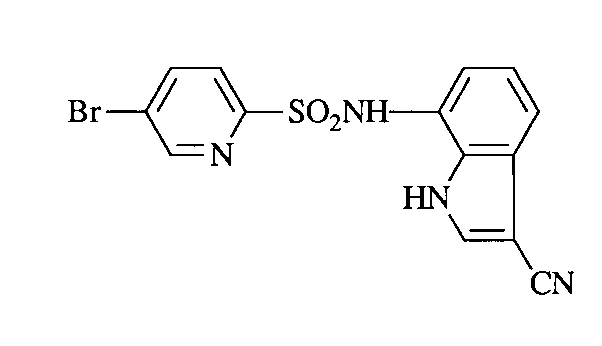
5−ブロモ−N−(3−シアノ−1H−インドール−7−イル)−2−ピリジンスルホンアミド
【0304】
【化98】
実施例1と同様にして表題化合物を得た。
融点: 245.5−246.5℃(分解)(酢酸エチル−n−ヘキサンから再結晶)
1H−NMR(DMSO−d6) δ(ppm) : 6.82(1H, d, J=7.7Hz), 7.07(1H, dd, J=7.9, 7.7Hz), 7.44(1H, d, J=7.9Hz), 7.80(1H, d, J=8.2Hz), 8.23(1H, d, J=2.2Hz), 8.29(1H, dd, J=8.2, 2.2Hz), 8.92(1H, d, J=2.2Hz), 10.42−10.67(1H, br), 11.93−12.08(1H, m)
【0306】
実施例66
N−(3−シアノ−1H−インドール−7−イル)−2−ナフタレンスルホンアミド
【0307】
【化99】
実施例1と同様にして表題化合物を得た。
1H−NMR(DMSO−d6) δ(ppm) : 6.74(1H, dd, J=7.6, 2.8Hz), 7.00(1H, dd, J=7.9, 7.7Hz), 7.39(1H, dd, J=8.0, 0.46Hz), 7.61−7.72(2H, m), 7.80(1H, dd, J=8.6, 1.8Hz), 8.01(1H, d, J=8.1Hz), 8.08(1H, s), 8.10(1H, s), 8.21(1H, d,J=2.9Hz), 8.34(1H, d, J=1.6Hz), 10.23(1H, br s), 12.01(1H, br s)
【0309】
実施例67
N−(3−アセチル−1H−インドール−7−イル)−3−クロロベンゼンスルホンアミド
【0310】
【化100】
実施例1と同様にして表題化合物を得た。
1H−NMR(DMSO−d6) δ(ppm) : 2.44(3H, s), 6.65(1H, d, J=7.5Hz), 7.01(1H, dd, J=7.9, 7.7Hz), 7.53−7.63(2H, m), 7.69−7.73(2H, m), 8.01(1H, dd, J=8.1,0.73Hz), 8.26(1H, d, J=2.9Hz), 10.10(1H, s), 11.75(1H, br s)
【0312】
実施例68
4−アミノ−N−(5−ブロモ−3−シアノ−1H−インドール−7−イル)ベンゼンスルホンアミド
【0313】
【化101】
4−ニトロベンゼンスルホニルクロリドと製造例14の化合物から実施例1と同様にして得られたN−(5−ブロモ−3−シアノ−1H−インドール−7−イル)−4−ニトロベンゼンスルホンアミドを酸化白金存在下常温常圧で水素添加し、表題化合物を得た。
1H−NMR(DMSO−d6) δ(ppm) : 6.07(2H, br s), 6.52(2H, d, J=8.4Hz), 6.97−6.99(1H, m), 7.36(2H, dd, J=8.7, 1.6Hz), 7.51(1H, br s), 8.25(1H, s), 9.93(1H, d, J=5.5Hz), 11.97(1H, br s)
【0315】
実施例69
N−(3−クロロ−1H−インドール−7−イル)−4−(N−エチルスルファモイル)ベンゼンスルホンアミド
【0316】
【化102】
実施例1および2と同様にして表題化合物を得た。
融点: 213−215℃(エタノール−n−ヘキサンから再結晶)
1H−NMR(DMSO−d6) δ(ppm) : 0.90(3H, t, J=7.2Hz), 2.76(2H, dq, Jd=5.8Hz, Jq=7.2Hz), 6.70(1H, d, J=7.4Hz), 6.95(1H, dd, J=8.0, 7.6Hz), 7.29(1H, d, J=8.0Hz), 7.47(1H, d, J=2.8Hz), 7.78(1H, t, J=5.6Hz), 7.90(4H, s), 10.18(1H, br s), 11.06(1H, br s)
【0318】
実施例70
N−(3−クロロ−1H−インドール−7−イル)−4−(エタンスルホンアミド)ベンゼンスルホンアミド
【0319】
【化103】
実施例4と同様にして表題化合物を得た。
融点: 214−215℃(分解)(エタノール−n−ヘキサンから再結晶)
1H−NMR(DMSO−d6) δ(ppm) : 1.14(3H, t, J=7.3Hz), 3.16(2H, q, J=7.3Hz), 6.82(1H, d, J=7.5Hz), 6.96(1H, dd, J=7.9, 7.7Hz), 7.23(2H, d, J=8.8Hz), 7.24(1H, d, J=7.5Hz), 7.47(1H, d, J=2.6Hz), 7.66(2H, d, J=8.8Hz), 9.90(1H,br s), 10.37(1H, br s), 10.96(1H, br s)
【0321】
実施例71
N−(3−クロロ−1H−インドール−7−イル ) −6−[(2−シアノエチル)アミノ]−3−ピリジンスルホンアミド
【0322】
【化104】
実施例46と同様にして表題化合物を得た。
1H−NMR(DMSO−d6) δ(ppm) : 2.72(2H, t, J=6.4Hz),3.46−3.55(2H, m), 6.53(1H, d, J=9.0Hz), 6.90(1H, d, J=7.7Hz), 6.99(1H, dd, J=7.9, 7.7Hz), 7.25(1H, d, J=7.9Hz), 7.48(1H, d, J=2.6Hz), 7.61(1H, dd, J=9.0, 2.4Hz), 7.78−7.87(1H, m), 8.25(1H, d, J=2.4Hz), 9.70−9.95(1H, br), 10.92−11.04(1H, m)
【0324】
実施例72
N−(3−クロロ−1H−インドール−7−イル ) −4− ( N−メチルカルバモイル)ベンゼンスルホンアミド
【0325】
【化105】
実施例9の化合物 533mg(1.68ミリモル)をジメチルホルムアミド5mlとジメチルスルホキシド 2.5mlの混液に溶解し、メチルアミン塩酸塩171mg (2.53ミリモル)、トリエチルアミン 705μl (5.06ミリモル)を加えた。ジフェニルホスホリルアジド 436μl (2.02ミリモル)を加えて室温で一晩攪拌後濃縮した。酢酸エチルで抽出し、希塩酸、飽和重曹水、水で順次洗浄後、硫酸マグネシウムで乾燥した。濃縮後、残渣をシリカゲルカラムクロマトグラフィーで精製し、N−(1H−インドール−7−イル)−4−(N−メチルカルバモイル)ベンゼンスルホンアミド 465mgを得た。これを実施例2と同様に塩素化し、表題化合物413mg を得た。
融点:252−253 ℃(分解)(エタノール−n−ヘキサンから再結晶)
1H−NMR(DMSO−d6) δ(ppm) : 2.76(3H, d, J=4.6Hz), 6.74(1H, d, J=7.7Hz), 6.94(1H, dd, J =7.9, 7.7Hz), 7.27(1H, d, J=7.9Hz), 7.49(1H, d, J=2.7Hz), 7.76−7.83(2H, m), 7.87−7.94(2H, m), 8.61(1H, q, J=4.6Hz), 10.10(1H, s), 11.03−11.13(1H, m)
【0327】
実施例73
N−(3−クロロ−1H−インドール−7−イル)−4−(メチルスルホニルメチル)ベンゼンスルホンアミド
【0328】
【化106】
実施例34の化合物 510mgを30%過酸化水素水により実施例23と同様に酸化して表題化合物 307mgを得た。
融点: 225℃付近より着色し始め、 235℃付近から徐々に分解(エタノール−n−ヘキサンから再結晶)
1H−NMR(DMSO−d6) δ(ppm) : 2.88(3H, s), 4.57(2H, s), 6.77(1H, d, J=7.6Hz), 6.94(1H, dd, J=7.9, 7.7Hz), 7.25(1H, d, J=8.0Hz), 7.47(1H, d, J=2.7Hz), 7.51−7.56(2H, m), 7.73−7.78(2H, m), 10.05(1H, br s), 11.04(1H, br s)
【0330】
実施例74
N−(3−クロロ−1H−インドール−7−イル)−4−(N,N−ジメチルスルファモイル)ベンゼンスルホンアミド
【0331】
【化107】
実施例1および2と同様にして表題化合物を得た。
1H−NMR(DMSO−d6) δ(ppm) : 2.57(6H, s), 6.71(1H, dd, J=7.4, 0.6Hz), 6.97(1H, dd, J=8.0, 7.6Hz), 7.31(1H, d, J=8.0Hz), 7.47(1H, d, J=2.8Hz), 7.86(2H, d, J=8.4Hz), 7.91(2H, d, J=8.4Hz), 10.19(1H, br s), 11.04(1H, br s)
【0333】
実施例75
N−(3−クロロ−1H−インドール−7−イル)−4−(1−ピロリジニルカルボニル)ベンゼンスルホンアミド
【0334】
【化108】
実施例1と同様にして表題化合物を得た。
1H−NMR(DMSO−d6) δ(ppm) : 1.79(2H, dt, Jd=12.8Hz, Jt=6.4Hz), 1.85(2H, dt, Jd=13.6Hz, Jt=6.8Hz), 3.22(2H, t, J=6.4Hz) , 3.44(2H, t, J=6.8Hz), 6.78(1H, d, J=7.2Hz), 6.96(1H, dd, J=8.0, 7.2Hz), 7.28(1H, d, J=8.0Hz), 7.47(1H, d, J=2.4Hz), 7.60(2H, d, J=8.0Hz), 7.74(2H, d, J=8.4Hz), 10.06(1H,br s), 11.01(1H, br s)
【0336】
実施例76
3−クロロ−N−(3−クロロ−1H−インドール−7−イル)−N−メチルベンゼンスルホンアミド
【0337】
【化109】
実施例7の化合物 120mg(0.352 ミリモル)をジメチルホルムアミド10mlに溶解し、水素化ナトリウム(60%)19.2mg(0.479 ミリモル)を加えた。室温で30分間攪拌後ヨウ化メチル30μl (0.482 ミリモル)を加えた。2時間後水を加え、酢酸エチルで抽出し、有機層を水洗、硫酸マグネシウムで乾燥した。濃縮後、残渣をシリカゲル薄層クロマトグラフィーで精製し、表題化合物87mgを得た。
1H−NMR(DMSO−d6) δ(ppm) : 3.26(3H, s), 6.51(1H, dd, J=7.6, 0.64Hz), 7.00(1H, dd, J=7.9, 7.7Hz), 7.47(1H, d, J=8.1Hz), 7.53(1H, d, J=2.7Hz), 7.54−7.59(2H, m), 7.65(1H, t, J=7.9Hz), 7.84(1H, ddd, J=8.1, 2.1, 1.1Hz), 11.62(1H, br s)
【0339】
実施例77
N−(3,4−ジクロロ−1H−インドール−7−イル)−4−(スルファモイルメチル)ベンゼンスルホンアミド
【0340】
【化110】
実施例1と同様にして表題化合物を得た。
融点: 297℃付近から徐々に分解(エタノール−n−ヘキサンから再結晶)
1H−NMR(DMSO−d6) δ(ppm) : 4.34(2H, s), 6.72(1H, d, J=8.1Hz), 6.93(2H, s), 6.94(1H, d, J=8.1Hz), 7.51(2H, d, J=8.1Hz), 7.57(1H, dd, J=2.7, 0.55Hz), 7.75(2H, d, J=8.2Hz), 10.10(1H, br s), 11.44(1H, br s)
【0342】
実施例78
N−(3−シアノ−1H−インドール−7−イル)−4−[2−(メチルスルホニル)エチル]ベンゼンスルホンアミド
【0343】
【化111】
実施例1と同様にして表題化合物を得た。
1H−NMR(DMSO−d6) δ(ppm) : 2.94(3H, s), 3.03−3.08(2H, m), 3.42−3.47(2H, m), 6.77(1H, dd, J=7.7, 0.37Hz), 7.05(1H, t, J=7.9Hz), 7.41(1H, d, J=8.1Hz), 7.46(2H, d, J=8.2Hz), 7.66(2H, d, J=8.2Hz), 8.20(1H, s), 10.09(1H, br s), 11.92(1H, br s)
【0345】
実施例79
N−(3−クロロ−1H−インドール−7−イル)−4−(N−メチルアセトアミド ) ベンゼンスルホンアミド
【0346】
【化112】
実施例1および2と同様にして表題化合物を得た。
1H−NMR(DMSO−d6) δ(ppm) : 1.84(3H, br s), 3.16(3H, s), 6.81(1H, d, J=7.7Hz), 6.96(1H, dd, J=8.0, 7.6Hz), 7.27(1H, d, J=7.9Hz), 7.45−7.49(2H, m),7.47(1H, d, J=2.7Hz), 7.70−7.75(2H, m), 10.02(1H, br s), 11.01(1H, br s)
【0348】
実施例80
N−(3−クロロ−1H−インドール−7−イル)−6−ヒドロキシ−3−ピリジンスルホンアミド
【0349】
【化113】
氷冷下氷酢酸2mlに実施例33の化合物100mg (0.31ミリモル)を溶かした液に、亜硝酸ナトリウム32mg(0.46ミリモル)の水溶液1mlを滴下して加えた。1時間攪拌後、重曹水を加えてpH約8にし、さらに10分間攪拌した。酢酸エチルで抽出し、水洗、硫酸マグネシウムで乾燥した。濃縮後、残渣をシリカゲル薄層クロマトグラフィーで精製し、表題化合物54mgを得た。
融点: 244−245℃(分解)(酢酸エチル−n−ヘキサンから再結晶)
1H−NMR(DMSO−d6) δ(ppm) : 6.39(1H, d, J=9.5Hz), 6.88(1H, d, J=7.7Hz), 7.04(1H, dd, J=7.9, 7.7Hz), 7.32(1H, d, J=7.9Hz), 7.50(1H, d, J=2.7Hz), 7.58(1H, dd, J=9.5, 3.1Hz), 7.64(1H, d, J=3.1Hz), 9.76−9.94(1H, br), 11.01−11.13(1H, m), 11.98−12.15(1H, br)
【0351】
実施例81
N−(3−クロロ−1H−インドール−7−イル)−4−[2−(N−メチルメタンスルホンアミド)エチル]ベンゼンスルホンアミド
【0352】
【化114】
実施例1および2と同様にして表題化合物を得た。
1H−NMR(DMSO−d6) δ(ppm) : 2.69(3H, s), 2.76(3H, s), 2.86(2H, t, J=7.5Hz), 3.26(2H, t, J=7.5Hz), 6.78(1H, dd, J=7.4, 0.55Hz), 6.94(1H, t, J=7.7Hz), 7.24(1H, dd, J=7.7, 0.37Hz), 7.39(2H, d, J=8.2Hz), 7.48(1H, d, J=2.6Hz), 7.66(2H, d, J=8.2Hz), 9.94(1H, br s), 11.02(1H, br s)
【0354】
実施例82
N−(3−クロロ−1H−インドール−7−イル)−4−(トリフルオロメタンスルホンアミド)ベンゼンスルホンアミド
【0355】
【化115】
実施例3の化合物62mg(0.19 ミリモル) のピリジン溶液(5ml) に0 ℃でトリフルオロメタンスルホン酸無水物 128μl(0.76ミリモル)を加え、そのまま終夜攪拌した。減圧下に反応液を濃縮し、pH7 のリン酸緩衝液を加え、酢酸エチルで抽出後、飽和食塩水で洗浄し、硫酸マグネシウムで乾燥した。減圧下に溶媒を留去し、シリカゲルカラムクロマトグラフィーで精製し、表題化合物20mgを得た。
1H−NMR(DMSO−d6) δ(ppm) : 6.79(1H, d, J=7.7Hz), 6.94(1H, dd, J=7.9, 7.7Hz), 7.16(2H, d, J=8.6Hz), 7.23(1H, d, J=7.9Hz), 7.46(1H, d, J=2.7Hz), 7.58(2H, d, J=8.1Hz), 9.84(1H, br s), 10.98(1H, br s)
【0357】
実施例83
N−(3−クロロ−1H−インドール−7−イル)−4−[(N−メチルメタンスルホンアミド)メチル]ベンゼンスルホンアミド
【0358】
【化116】
実施例1および2と同様にして表題化合物を得た。
融点: 200.5−202℃(エタノールから再結晶)
1H−NMR(DMSO−d6) δ(ppm) : 2.63(3H, s), 2.94(3H, s), 4.27(2H, s), 6.80(1H, d, J=7.3Hz), 6.95(1H, dd, J=8.1, 7.5Hz), 7.25(1H, d, J=7.9Hz), 7.45(2H, d, J=8.2Hz), 7.47(1H, d, J=2.7Hz), 7.74(2H, d, J=8.2Hz), 10.00(1H, s),11.00(1H, br s)
実施例84 3−クロロ−N−(3−クロロ−1H−ピロロ[2,3−c]ピリジン−7−イル)ベンゼンスルホンアミド
【0360】
【化117】
2−ブロモ−3−ニトロピリジンから製造例1と同様にして合成した7−ブロモ−1H−ピロロ[2,3−c]ピリジン600mg(3.05ミリモル)、銅粉194mg および塩化第一銅 603mgを濃アンモニア水84mlに加え、封管中120 ℃で15時間加熱後、処理し、7−アミノ−1H−ピロロ[2,3−c]ピリジン170mg を得た。これを実施例1および2と同様に反応、処理し、表題化合物57mgを得た。
1H−NMR(DMSO−d6) δ(ppm) : 6.93(1H, d, J=6.6Hz), 7.45(1H, dd, J=6.6, 5.8Hz), 7.53(1H, dd, J=8.0, 7.6Hz), 7.61(1H, d, J=7.6Hz), 7.73(1H, d, J=2.8Hz), 7.85(1H, d, J=8.0Hz), 7.96(1H, d, J=1.2Hz), 11.90−12.10(1H, m), 12.72(1H, br s)[0001]
[Industrial applications]
The present invention is a novelSulfonamide derivatives,The present invention relates to a method for producing the compound and a pharmaceutical composition containing the compound as an active ingredient.
[0002]
[Prior art]
Conventionally used as chemotherapeutic agents for cancer include cyclophosphamide, an alkylating agent, methotrexate, an antimetabolite, fluorouracil, antibiotics adriamycin, mitomycin, bleomycin, vincristine, etoposide, and metal complexes derived from plants Although there are many drugs such as cisplatin, their antitumor effects are insufficient, and development of new antitumor agents is eagerly awaited.
[0003]
Examples of aromatic sulfonamide-based antitumor compounds include 4-aminobenzenesulfonamide derivatives (JP-B-43-3093), 2-sulfanylamide-quinoxaline derivatives (JP-A-62-426) and N- (2- Anilino-3-pyridinyl) benzenesulfonamide derivatives (JP-A-5-39256) have been reported. There are no reports on aromatic sulfonate-based antitumor compounds.
[0004]
[Problems to be solved by the invention]
The present invention has excellent antitumor activity and differs in basic skeleton from conventional antitumor compoundsNew sulfonamide derivativesThe purpose is to provide. It is another object of the present invention to provide a method for producing the compound and a pharmaceutical composition containing the compound as an active ingredient.
[0005]
[Means for Solving the Problems]
In view of the above, the present inventors have intensively studied for an excellent antitumor compound, and as a result, have a bicyclic heterocycle.New sulfonamide derivativesHave excellent antitumor activity and low toxicity, and completed the present invention.
[0006]
That is, the present invention provides a compound represented by the general formula (I)
[0007]
Embedded image
(Wherein, ring A may have a substituent, a monocyclic or bicyclic aromatic ring, ring B may have a substituent, 6-membered cyclic unsaturated hydrocarbon or An unsaturated 6-membered heterocycle containing only one nitrogen atom as a heteroatom, a C-ring being an optionally substituted 5-membered heterocycle containing only 1 or 2 nitrogen atoms, and W being a single bond Or -CH = CH-X is -N (R 1 )-, Y represents a carbon atom or a nitrogen atom, and Z represents —N (RTwo)-Or a nitrogen atom1And RTwoRepresents the same or different hydrogen atoms or lower alkyl groups. However, (1) a combination in which Ring A is 4-methylbenzene, W is a single bond, X is -NH-, Ring B is methoxybenzene, and Ring C is unsubstituted imidazole, (2) ring A is 4- (acetamido) benzene or 4-aminobenzene, W is a single bond, X is -NH-, ring B is unsubstituted benzene, and ring C is A combination that is a substituted pyrazole, (3A compound wherein Y is a carbon atom and the C ring is an imidazolyl group;4) 5,5'-dimethyl-7,7'-bis (p-toluenesulfonamide) -2,2'-bisindazole, and (5) Except 2-acetyl-7-benzenesulfonamido-3- (2-benzenesulfonamidoethyl) -6-methoxyindole)Sulfonamide derivativeOr a pharmacologically acceptable salt thereof.
[0009]
In the above general formula (I), the “optionally substituted monocyclic or bicyclic aromatic ring” represented by ring A is an aromatic hydrocarbon or a nitrogen atom, an oxygen atom and a sulfur atom. It is an aromatic hetero ring containing at least one of the atoms, and there may be 1 to 3 substituents on the ring. Examples of the main aromatic ring contained in the ring A include pyrrole, pyrazole, imidazole, thiophene, furan, thiazole, oxazole, benzene, pyridine, pyrimidine, pyrazine, pyridazine, naphthalene, quinoline, isoquinoline, phthalazine, naphthyridine, quinoxaline, quinazoline Cinnoline, indole, isoindole, indolizine, indazole, benzofuran, benzothiophene, benzoxazole, benzimidazole, benzopyrazole, benzothiazole and the like. The aromatic ring may have 1 to 3 substituents, and when there are a plurality of substituents, they may be the same or different. Examples of the substituent include an amino group, a lower alkyl group, a lower alkoxy group, a hydroxyl group, a nitro group, a mercapto group, a cyano group, a lower alkylthio group, and a halogen group which may be substituted with a lower alkyl group or a lower cycloalkyl group. Wherein a is a single bond,-(CH2 )k -, -O- (CH2 )k -, -S- (CH2 )k -Or -N (R3 )-(CH2 )k -, K is an integer of 1 to 5, R3 Represents a hydrogen atom or a lower alkyl group, and b represents -CH2 -D (in the formula, d represents an amino group, a halogen group, a hydroxyl group, a lower alkylthio group, a cyano group or a lower alkoxy group which may be substituted with a lower alkyl group); -A-ef (wherein a has the same meaning as described above, and e is -S (O)-or -S (O)2 -, And f is an amino group, a lower alkyl group, a trifluoromethyl group, a-(CH2 )m -B or -N (R4 )-(CH2 )m -B (wherein b has the same meaning as described above;4 Represents a hydrogen atom or a lower alkyl group, m represents an integer of 1 to 5)], a group represented by the formula -agh wherein a represents the same meaning as described above, g Is -C (O)-or -C (S)-, and h is an amino group, a hydroxyl group, a lower alkyl group, a lower alkoxy group, and-(CH2 )n -B or -N (R5 )-(CH2 )n -B (wherein b has the same meaning as described above;5 Represents a hydrogen atom or a lower alkyl group, and n represents an integer of 1 to 5), and a group represented by the formula -aN (R6 ) -Gi [wherein a and g have the same meanings as described above;6 Represents a hydrogen atom or a lower alkyl group, i represents a hydrogen atom, a lower alkoxy group or f (where f has the same meaning as described above)], a formula -a-N (R7 ) -Ef (wherein a, e and f have the same meaning as described above;7 Represents a hydrogen atom or a lower alkyl group) or a group represented by the formula-(CH2 )p -J- (CH2 )q A group represented by -b (in the formula, j represents an oxygen atom or a sulfur atom, b represents the same meaning as described above, and p and q are the same or different and represent an integer of 1 to 5), and the like. be able to.
[0010]
In the above substituent examples, when the amino group is substituted with two alkyl groups, these alkyl groups may combine to form a 5- or 6-membered ring. When the ring A is a nitrogen-containing heterocyclic ring having a hydroxyl group or a mercapto group, these groups may have a resonance structure to form an oxo group or a thioxo group.
The term "optionally substituted 6-membered cyclic unsaturated hydrocarbon or unsaturated 6-membered heterocyclic ring containing one nitrogen atom as a hetero atom", which is meant by ring B, is partially hydrogenated. Benzene or pyridine, which may have one or two substituents on the ring, and when there are two substituents, they may be the same or different.
The “optionally substituted 5-membered heterocycle containing one or two nitrogen atoms” represented by ring C is pyrrole, pyrazole, imidazole, which may be partially hydrogenated. May have one or two substituents on the ring, and when there are two substituents, they may be the same or different.
Examples of the substituent which the ring B and the ring C may have include, for example, a halogen group, a cyano group, a lower alkyl group, a lower alkoxy group, a hydroxyl group, an oxo group, a formula -C (O) -r (in the formula, r represents a hydrogen atom, an amino group optionally substituted with a lower alkyl group, a lower alkyl group, a lower alkoxy group or a hydroxyl group), an amino group optionally substituted with a lower alkyl group, a trifluoromethyl group, etc. Can be mentioned.
[0011]
In the above general formula (I), R1, RTwoAs the lower alkyl group in the definition of the substituent which the ring A, ring B and ring C may have, a straight-chain or branched alkyl group having 1 to 6 carbon atoms, for example, a methyl group, an ethyl group, n-propyl group, isopropyl group, n-butyl group, isobutyl group, sec-butyl group, tert-butyl group, n-pentyl group (amyl group), isopentyl group, neopentyl group, tert-pentyl group, 1-methylbutyl group A 2-methylbutyl group, a 1,2-dimethylpropyl group, an n-hexyl group, an isohexyl group, a 1-methylpentyl group, a 2-methylpentyl group, a 3-methylpentyl group, a 1,1-dimethylbutyl group, 2-dimethylbutyl group, 2,2-dimethylbutyl group, 1,3-dimethylbutyl group, 2,3-dimethylbutyl group, 3,3-dimethylbutyl group, 1-ethylbutyl group, 2-E Rubuchiru group, 1,1,2-trimethyl propyl group, 1,2,2-trimethyl propyl group, 1-ethyl-1-methylpropyl group, means such as 1-ethyl-2-methylpropyl group. Among these, preferred groups include a methyl group, an ethyl group, an n-propyl group, an isopropyl group, an n-butyl group and an isobutyl group, and among these, the most preferred groups are a methyl group and an ethyl group. , N-propyl group and isopropyl group.
In particular, "R 1 And R Two In "a lower alkyl group" means a linear or branched alkyl group having 1 to 6 carbon atoms..
[0012]
Examples of the lower cycloalkyl group in the definition of the substituent that the ring A may have include a cyclopropyl group, a cyclopentyl group, and a cyclohexyl group. The lower alkoxy group in the definition of the substituent which ring A, ring B and ring C may have is a methoxy group, an ethoxy group, an n-propoxy group, an isopropoxy group, an n-butoxy group, an isobutoxy group, It means a lower alkoxy group derived from the above lower alkyl group such as a tert-butoxy group. Among these, the most preferred groups include a methoxy group and an ethoxy group. Examples of the halogen atom include a fluorine atom, a chlorine atom, and a bromine atom.
[0013]
Represented by the above general formula (I)Sulfonamide derivativeMay form a salt with an acid or a base. The present invention also includes a salt of compound (I). Examples of the salt with an acid include inorganic acid salts such as hydrochloride, hydrobromide and sulfate, acetic acid, lactic acid, succinic acid, fumaric acid, maleic acid, citric acid, benzoic acid, methanesulfonic acid, p- Salts with organic acids such as toluenesulfonic acid can be mentioned. Examples of the salt with a base include inorganic salts such as sodium salt, potassium salt and calcium salt, and salts with organic bases such as triethylamine, arginine and lysine.
[0014]
Needless to say, when optical isomers are present as well as hydrates of these compounds, all of them are included. In addition, the compounds of the present invention exhibit strong antitumor activity, but also include compounds which exhibit antitumor activity by undergoing metabolism such as oxidation, reduction, hydrolysis and conjugation in vivo. Furthermore, the present invention also includes a compound that undergoes metabolism such as oxidation, reduction, or hydrolysis in a living body to produce the compound of the present invention.
[0015]
Next, the compound (I) of the present invention can be produced by various methods. Representative methods among them are as follows.
1) General formula (II)
[0016]
Embedded image
(Wherein, the Aa ring means a monocyclic or bicyclic aromatic ring, which may have a protected or unprotected substituent, and W has the same meaning as described above) Sulfonic acid or a reactive derivative thereof and a compound of the general formula (III)
[0018]
Embedded image
(Wherein the Ba ring may have a protected or unprotected substituent, a 6-membered cyclic unsaturated hydrocarbon or an unsaturated 6-membered heterocycle containing only one nitrogen atom as a heteroatom) A Ca ring means a 5-membered heterocyclic ring containing only one or two nitrogen atoms which may have a protected or unprotected substituent, and X, Y and Z have the same meanings as described above. Can be produced by reacting a compound represented by the following formula:
[0020]
Examples of the reactive derivative of sulfonic acid (II) include commonly used reactive derivatives such as, for example, sulfonyl halide, sulfonic anhydride, N-sulfonylimidazolide, etc., and particularly preferred. A particular example is a sulfonyl halide. The solvent used in the reaction is not particularly limited, but is preferably one that dissolves the raw materials and does not easily react with them, for example, pyridine, tetrahydrofuran, dioxane, benzene, ethyl ether, dichloromethane, dimethylformamide, or selected from these. In addition, a mixed solvent of two or more kinds may be used. In the case where an acid is liberated with the progress of the reaction as in the case of using a sulfonyl halide in this reaction, the reaction is preferably carried out in the presence of a suitable deoxidizing agent. The use of basic solvents is particularly preferred. When a neutral solvent is used, a basic substance such as an alkali carbonate or an organic tertiary amine may be added. Of course, the solvents that can be used are not limited to those listed here. Generally, this reaction proceeds at room temperature, but may be cooled or heated as necessary. The reaction time is usually from 10 minutes to 20 hours, but may be arbitrarily selected depending on the type of the starting compound and the reaction temperature. In the obtained product, when an amino group or a hydroxyl group is protected, a free hydroxyl group or an amino group is obtained by performing a normal deprotection method such as an acid treatment, an alkali treatment, and a catalytic reduction, if desired.Sulfonamide derivative (I)It is possible to obtain
[0021]
2) General formula (IV)
[0022]
Embedded image
(Wherein Aa ring, Ba ring, W, X and Z have the same meanings as described above), and can be produced by reacting with a halogenating agent. Examples of the halogenating agent include N-chlorosuccinimide, N-bromosuccinimide, 1,3-dibromo-5,5-dimethylhydantoin, N-bromoacetamide, chlorine, and bromine. The solvent used in the reaction is not particularly limited, but usually an alkyl chloride compound such as dichloromethane, chloroform, carbon tetrachloride, or an aromatic chloride such as chlorobenzene or dichlorobenzene is used. And the like can also be used. The reaction temperature varies depending on the type of the halogenating agent and the substrate, but is usually between -50 ° C and 100 ° C. In the obtained product, when an amino group or a hydroxyl group is protected, a free hydroxyl group or an amino group is obtained by performing a normal deprotection method such as an acid treatment, an alkali treatment, and a catalytic reduction, if desired.Sulfonamide derivative (I)It is possible to obtain
[0024]
3) General formula (V)
[0025]
Embedded image
(Wherein, Aa ring, Ba ring, W, X and Z have the same meaning as described above, and E represents a substituent convertible to a cyano group by dehydration). Can be manufactured. Examples of the substituent that can be converted to a cyano group by dehydration include a (hydroxyimino) methyl group and a carbamoyl group. It is also possible to first synthesize an oxime or acid amide from the starting aldehyde or carboxylic acid and react it with a dehydrating agent without isolation. Examples of the dehydrating agent include methods generally used for synthesizing nitriles, such as acetic anhydride, thionyl chloride, phosphorus oxychloride, selenium dioxide, and 1,3-dicyclohexylcarbodiimide. The solvent used for the reaction is not particularly limited, but those which dissolve the raw materials and do not easily react with them, for example, pyridine, ethyl ether, benzene, dimethylformamide, carbon tetrachloride, acetonitrile, tetrahydrofuran, or A mixture of two or more selected solvents may be used. The reaction temperature varies depending on the type of the dehydrating agent and the substrate, but is usually between -50 ° C and 150 ° C. In the obtained product, when an amino group or a hydroxyl group is protected, a free hydroxyl group or an amino group is obtained by performing a normal deprotection method such as an acid treatment, an alkali treatment, and a catalytic reduction, if desired.Sulfonamide derivative (I)It is possible to obtain
[0027]
4) General formula (VI)
[0028]
Embedded image
(Wherein, the Ab ring has a substituent convertible to an amino group by reduction, and may further have a protected or unprotected substituent, a monocyclic or bicyclic aromatic group. A Ba ring, a Ca ring, W, X, Y and Z have the same meanings as defined above) with a reducing agent. Examples of the substituent that can be converted to an amino group by reduction include a nitro group, a nitroso group, a hydroxyamino group, and an azo group. For the reduction, a commonly used reduction method of a nitro group can be used, and preferred examples include catalytic reduction using palladium-carbon, platinum oxide or the like as a catalyst or reduction with zinc, iron or tin and an acid. be able to. The catalytic reduction can be usually performed in an organic solvent such as methanol, tetrahydrofuran, dimethylformamide or the like under normal pressure or under pressure. In the obtained product, when a hydroxyl group is protected, it has a free hydroxyl group by performing a normal deprotection method such as an acid treatment, an alkali treatment, and a catalytic reduction, if desired.Sulfonamide derivative (I)It is possible to obtain
[0030]
5) General formula (VII)
[0031]
Embedded image
(Wherein the Ac ring has a leaving group on the ring or in the substituent, and may have another protected or unprotected substituent, a monocyclic or bicyclic aromatic group. A Ba ring, a Ca ring, W, X, Y and Z have the same meanings as described above) with a nucleophile. Examples of the leaving group include a halogen group, a methanesulfonyloxy group, and a p-toluenesulfonyloxy group. Examples of the nucleophile include amines, alcohols, and thiols. In the case of alcohols and thiols, the reaction may be carried out in the form of a salt with an alkali metal or the like. The solvent used for the reaction is not particularly limited, but it is preferable that the solvent dissolves the starting materials and does not easily react with them. For example, tetrahydrofuran, dioxane, dimethylformamide, water and the like can be used. The reaction temperature varies depending on the type of the substrate, but is usually between -50 ° C and 150 ° C. In the obtained product, when an amino group or a hydroxyl group is protected, a free hydroxyl group or an amino group is obtained by performing a normal deprotection method such as an acid treatment, an alkali treatment, and a catalytic reduction, if desired.Sulfonamide derivative (I)It is possible to obtain
[0033]
Next, a method for producing the starting compound (II), its reactive derivative, and (III) used in the present invention will be described. The starting compound (II) and its reactive derivatives include known compounds and novel compounds. In the case of a novel compound, it can be produced by applying a known method for synthesizing a known compound or by combining them. For example, the new sulfonyl chloride is Chem. Ber.,90, 841 (1957), J. Med. Chem.,6, 307 (1963), J. Chem. Soc. (C),1968, 1265, Chem. Lett.,1992, 1483, J. Am. Chem. Soc.,59, 1837 (1937), J. Med. Chem.,twenty three, 1376 (1980), J. Am. Chem. Soc.,70, 375 (1948), J. Am. Chem. Soc.,78, 2171 (1956), and the like. The starting compound (III) includes known compounds and novel compounds. In the starting compound (III), HX- is an amino group HTwo In the case where N- is meant, the nitro compound is reduced by a generally used reduction method of a nitro group to form H-.Two N-form (III) can be obtained. Preferred examples of the reduction method include catalytic reduction using palladium-carbon as a catalyst and reduction using zinc dust-hydrochloric acid. Catalytic reduction can usually be carried out in an organic solvent such as methanol, tetrahydrofuran or dimethylformamide at normal pressure or under pressure.You.
[0034]
When the starting compound is a novel compound, it can be produced by applying a known method for synthesizing a known compound or by combining them. Novel compounds are described in Can. J. Chem. ,42, 1235 (1964), Chem. Abst. ,59, 8855f (1963), Tetrahedron Lett. ,30, 2129 (1989) and the like, for example, can be produced by the following route.
[0035]
Reaction formula 1
[0036]
Embedded image
In the formula, Q represents the same or different substituent, G represents a halogen group, and t is an integer of 0 to 2.
Reaction formula 2
[0038]
Embedded image
In the formula, Q and t have the same meaning as described above.
Reaction formula 3
[0040]
Embedded image
In the formula, Q, G and t have the same meaning as described above, and DPPA means diphenylphosphoryl azide.
Reaction formula 4
[0042]
Embedded image
In the formula, Q, G and t have the same meanings as described above, and DDQ means 2,3-dichloro-5,6-dicyano-1,4-benzoquinone.
[0044]
When the compound of the present invention is used as a medicine, it is administered orally or parenterally. The dosage varies depending on the degree of symptoms, age, sex, weight, sensitivity difference of the patient, administration method, administration timing, administration interval, properties of the pharmaceutical preparation, preparation, type, type of the active ingredient, etc. The daily dose for an adult is 10 to 6000 mg, preferably about 50 to 4000 mg, more preferably 100 to 3000 mg, which is usually administered once to three times a day.
[0045]
When preparing a solid preparation for oral use, a tablet, coated tablet, and the like are added by a conventional method after adding an excipient and a binder, a disintegrant, a lubricant, a coloring agent, a flavoring agent, and the like as needed to the base drug. Granules, fine granules, powders, capsules, etc.
As an excipient, for example, lactose, corn starch, sucrose, glucose, sorbitol, crystalline cellulose, silicon dioxide, etc., as a binder, for example, polyvinyl alcohol, ethyl cellulose, methyl cellulose, gum arabic, hydroxypropyl cellulose, hydroxypropyl methyl cellulose, etc. As lubricants, for example, magnesium stearate, talc, silica, etc., those which are permitted to be added to pharmaceuticals as coloring agents, as flavoring agents, cocoa powder, peppermint brain, aromatic acids, Mint oil, dragon brain, cinnamon powder and the like are used. These tablets and granules may be sugar-coated, gelatin-coated or appropriately coated as needed.
When preparing an injection, a pH adjuster, a buffer, a suspending agent, a solubilizer, a stabilizing agent, an isotonic agent, a preservative, and the like are added to the main drug as necessary, and intravenous, Subcutaneous or intramuscular injection. At that time, if necessary, the product may be freeze-dried by a conventional method.
Examples of the suspending agent include methylcellulose, polysorbate 80, hydroxyethylcellulose, gum arabic, tragacanth powder, sodium carboxymethylcellulose, polyoxyethylene sorbitan monolaurate and the like.
[0046]
Examples of the solubilizer include polyoxyethylene hydrogenated castor oil, polysorbate 80, nicotinamide, polyoxyethylene sorbitan monolaurate, macrogol, and castor oil fatty acid ethyl ester.
Examples of the stabilizer include sodium sulfite and sodium metasulfite, and examples of the preservative include methyl parahydroxybenzoate, ethyl paraoxybenzoate, sorbic acid, phenol, cresol, and chlorocresol.
[0047]
【The invention's effect】
Next, pharmacological experiments will be described to describe the effects of the compound of the present invention. As a control compound for evaluating efficacy, 2-sulfanylamide-5-chloroquinoxaline (CQS; JP-A-62-426), which is a known bicyclic heterocycle-containing sulfonamide, was used.
[0048]
Experimental example 1colon38 Cells (mouse colon cancer cells) in vitro Antitumor test
10% fetal calf serum, penicillin (100 units / ml), streptomycin (100 μg / ml), mercaptoethanol (5 × 10⁻⁵M) and colon38 cells suspended in RPMI1640 medium (Sanko Junyaku) containing sodium pyruvate (1 mM) were added to each well of a 96-well flat-bottom microplate at 2.5 × 10 53 Individual (0.1 ml) was inoculated and cultured at 37 ° C. for 1 day in an incubator containing 5% carbon dioxide.
[0049]
The compound of the present invention was dissolved in dimethyl sulfoxide to a concentration of 20 mg / ml, and diluted with a 10% fetal bovine serum-RPMI1640 culture solution to a concentration of 200 μg / ml. Using this as the highest concentration, a 3-fold serial dilution was performed with a 10% fetal calf serum-RPMI1640 culture solution. This was added in an amount of 0.1 ml to each well of the culture plate of colon38 cells described above, and cultured at 37 ° C. for 3 days in a 5% carbon dioxide-containing incubator.
[0050]
After the culture, 0.05 ml of an MTT [3- (4,5-dimethylthiazol-2-yl) -2,5-diphenyltetrazolium bromide] solution (3.3 mg / ml) was added to each well, and the cells were further cultured for 2 hours. did. After removing the supernatant from each well by suction, the produced formazan was dissolved in 0.1 ml of dimethyl sulfoxide, and the absorbance at 540 nm was measured with a microplate reader to obtain an index of the number of living cells. The inhibition rate was calculated from the following equation, and the concentration of the test compound that inhibited 50% (IC50).
[0051]
(Equation 1)
T: Absorbance of the well to which the test compound was added
C: Absorbance of the well where no test compound was added
The obtained IC50The values are shown in Table 1-1 and Table 1-2.
[0053]
[Table 1]
Experimental example 2colon38 (Mouse colon cancer) in vivo Antitumor test
BDF1 About 75 mg of colon38 was implanted subcutaneously on the body side of a mouse (7 weeks old, female). The compound of the present invention was suspended in a physiological saline containing 3.5% dimethyl sulfoxide and 6.5% Tween 80, and a predetermined amount was intraperitoneally administered once a day from the day after transplantation for 8 days. To the control group, physiological saline containing 3.5% dimethyl sulfoxide and 6.5% Tween 80 was intraperitoneally administered. The experiment was conducted with a control group consisting of 10 animals and a drug administration group consisting of 6 animals.
On day 21 after transplantation, the tumor was excised and the tumor weight was measured. The tumor growth inhibition rate of the drug-administered group relative to the control group was determined by the following formula.
[0055]
(Equation 2)
T: Average tumor weight of the test compound administration group
C: average tumor weight of control group
Table 2 shows the experimental results.
[0057]
[Table 3]
Experimental example 3HCT 116 (Human colon cancer) in vivo Antitumor test
5-8 × 10 5 subcutaneously on the body side of nude mice (BALB / c · nu / nu, 7-8 weeks old, female)6 HCT116 were transplanted. About 100mm after transplant3The compound of the present invention was suspended in a physiological saline solution containing 3.5% dimethyl sulfoxide and 6.5% Tween 80 from about 7 days after the tumor volume was reached, and a predetermined amount was intraperitoneally administered once a day for 4 days. To the control group, physiological saline containing 3.5% dimethyl sulfoxide and 6.5% Tween 80 was intraperitoneally administered. The experiment was conducted with a control group consisting of 10 animals and a drug administration group consisting of 5 animals. On day 21 after the start of the administration, the tumor was excised and the weight of the tumor was measured. The tumor growth inhibition rate of the drug-administered group relative to the control group was determined by the following formula.
[0059]
(Equation 3)
T: Average tumor weight of the test compound administration group
C: average tumor weight of control group
Table 3 shows the experimental results.
[0061]
[Table 4]
As is clear from the above experimental examples, the compound of the present invention has an excellent antitumor effect and is useful as an antitumor agent.
[0063]
【Example】
Next, Production Examples showing the production of the starting compounds of the compounds of the present invention and Examples of typical compounds of the invention compounds will be given below, but the present invention is not limited thereto.
Production Example 1
7-bromo-1H-indole
[0064]
Embedded image
To a solution of 5.05 g (25 mmol) of 2-bromonitrobenzene in 250 ml of tetrahydrofuran was added 100 ml (100 mmol) of a 1.0 M solution of vinylmagnesium bromide in -40 ° C under a nitrogen atmosphere, and the mixture was stirred for 40 minutes. The reaction mixture was poured into 500 ml of a saturated aqueous solution of ammonium chloride and extracted with ethyl ether. After drying over magnesium sulfate and concentration, the residue was purified by silica gel column chromatography to obtain 2.89 g of the title compound.
1H-NMR (DMSO-d6) Δ (ppm): 6.56 (1H, dd, J = 2.9, 1.8 Hz), 6.94 (1H, t, J = 7.8 Hz), 7.30 (1H, d, J = 7.8 Hz), 7.40 (1H, t, J = 2.9 Hz), 7.56 (1H, d, J = 7.8 Hz), 11.16-11.46 (1H, brm)
[0066]
Production Example 2
7-amino-1H-indole
[0067]
Embedded image
1H-NMR (DMSO-d65.) δ (ppm): 5.01 (2H, brs), 6.25-6.33 (2H, m), 6.70 (1H, dd, J = 7.9, 7.3 Hz), 6. 78 (1H, dd, J = 7.9, 0.7 Hz), 7.23 (1H, t, J = 2.7 Hz), 10.48-10.72 (1H, brm)
[0068]
The following starting compounds were synthesized from 2-bromonitrobenzene derivatives in the same manner as in Production Examples 1 and 2.
7-amino-4-methoxy-1H-indole
7-amino-4-bromo-1H-indole
[0069]
Production Example 3
7-bromo-3-chloro-4-methyl-1H-indole
[0070]
Embedded image
N-chlorosuccinimide was added to a solution of 5.8 g (27.6 mmol) of 7-bromo-4-methyl-1H-indole synthesized from 2-bromo-5-methylnitrobenzene in the same manner as in Production Example 1 (250 ml) in acetonitrile. 4.0 g (30.0 mmol) was added, and the mixture was stirred at room temperature overnight. 50 ml of a 1N aqueous sodium hydroxide solution was added, and the mixture was extracted with ethyl acetate. The organic layer was washed with water, dried over magnesium sulfate, and concentrated, and the residue was purified by silica gel column chromatography to obtain 6.7 g of the title compound.
1H-NMR (CDCl3) Δ (ppm): 2.74 (3H, s), 6.75-7.26 (3H, m), 8.23 (1H, br s)
[0072]
Production Example 4
7-amino-3-chloro-4-methyl-1H-indole
[0073]
Embedded image
2.6 g of the title compound was obtained in the same manner as in Production Example 2 from 6.37 g (26.1 mmol) of the compound of Production Example 3.
1H-NMR (CDCl3) Δ (ppm): 2.70 (3H, s), 6.39-7.14 (3H, m), 8.15 (1H, br s)
[0075]
Production Example 5
4-sulfamoylbenzenesulfonyl chloride
[0076]
Embedded image
6.4 g (37.2 mmol) of 4-aminobenzenesulfonamide was added to a mixture of 12.5 ml of water and 6.3 ml of concentrated hydrochloric acid and stirred. To this, a saturated aqueous solution of 2.56 g (37.1 mmol) of sodium nitrite was added dropwise at 0 ° C or lower. The reaction solution was added to a sulfur dioxide saturated acetic acid solution (a solution in which sulfur dioxide was saturated with 35 ml of acetic acid and 1.5 g of cupric chloride dihydrate was added) under ice-cooling and stirring. After 10 minutes, the reaction solution was poured into ice water, and the precipitate was collected by filtration and washed with water. The precipitate was dissolved in tetrahydrofuran, dried over magnesium sulfate, and concentrated to dryness to give the title compound (3.5 g).
[0078]
Production Example 6
4- (sulfamoylmethyl) benzenesulfonyl chloride
[0079]
Embedded image
5.0 g (23.1 mmol) of 4-nitrophenylmethanesulfonamide was suspended in 90% acetic acid, and hydrogenated at room temperature and normal pressure in the presence of palladium-carbon. The catalyst was removed by filtration and concentrated to dryness to obtain 4.3 g of 4-aminophenylmethanesulfonamide. This was added to a mixture of 40 ml of water and 4.1 ml of concentrated hydrochloric acid and stirred. At 0 ° C. or lower, a saturated aqueous solution of 1.63 g (23.6 mmol) of sodium nitrite was added dropwise. The reaction solution was added to a saturated acetic acid solution of sulfur dioxide (a solution obtained by saturating sulfur dioxide with 30 ml of acetic acid and adding 0.97 g of cupric chloride dihydrate) under ice cooling and stirring. After stirring at room temperature for 40 minutes, the reaction solution was poured into ice water to saturate the salt. The mixture was extracted with ethyl acetate, dried over magnesium sulfate, and concentrated to dryness to give 1.7 g of the title compound.
1H-NMR (DMSO-d6) (Ppm): 4.26 (2H, s), 7.32 (2H, d, J = 8.4 Hz), 7.59 (2H, d, J = 8.4 Hz)
[0081]
The following compounds were synthesized as in Production Example 5 or 6.
4- (N-methylsulfamoyl) benzenesulfonyl chloride
4- (N-ethylsulfamoyl) benzenesulfonyl chloride
4- (N-methoxysulfamoyl) benzenesulfonyl chloride
4-[(methanesulfonamido) methyl] benzenesulfonyl chloride
4- (N-methylmethanesulfonamido) benzenesulfonyl chloride
4- (1-pyrrolidinylsulfonyl) benzenesulfonyl chloride
4- (1-pyrrolidinylcarbonyl) benzenesulfonyl chloride
3-cyanobenzenesulfonyl chloride
4- (methylsulfonyl) benzenesulfonyl chloride
4-[(N-methylmethanesulfonamido) methyl] benzenesulfonyl chloride
[0082]
Production Example 7
3-cyano-7-nitro-1H-indole
[0083]
Embedded image
10.15 g (53.4 mmol) of 3-formyl-7-nitro-1H-indole was dissolved in 150 ml of dimethylformamide, and 3.93 g (56.0 mmol) of hydroxylamine hydrochloride and 4.5 ml of pyridine (55.6) were dissolved. Mmol). After heating and stirring at 70 to 80 ° C. for 2 hours, 6.3 g (56.8 mmol) of selenium dioxide and about 5 g of magnesium sulfate were added. After heating at 70-80 ° C for an additional 2.5 hours, insolubles were removed by filtration and concentrated. Water was added, and the precipitated crystals were collected by filtration and washed sequentially with water and ethyl ether. The crystals were dissolved in a mixture of tetrahydrofuran and acetone, and insolubles were removed by filtration. After concentration, ethyl acetate was added and the crystals were collected by filtration to obtain 8.61 g of the title compound.
1H-NMR (DMSO-d6) Δ (ppm): 7.48 (1H, t, J = 8.1 Hz), 8.17 (1H, d, J = 8.1 Hz), 8.27 (1H, d, J = 8.1 Hz) , 8.47 (1H, s), 12.70-13.00 (1H, br)
[0085]
Production Example 8
7-amino-3-cyano-1H-indole
[0086]
Embedded image
2.80 g (15.0 mmol) of the compound of Production Example 7 was suspended in 100 ml of methanol, and hydrogenated at room temperature and normal pressure in the presence of palladium-carbon. After the catalyst was separated by filtration, the filtrate was concentrated to dryness to obtain 2.31 g of the title compound.
1H-NMR (DMSO-d6) Δ (ppm): 5.32, 5.34 (2H, s + s), 6.47 (1H, d, J = 7.5 Hz), 6.81 (1H, d, J = 7.9 Hz), 6 .94 (1H, dd, J = 7.9, 7.5 Hz), 8.13 (1H, s), 11.55-11.90 (1H, br),
[0088]
Production Example 9
7-amino-3,4-dichloro-1H-indole
[0089]
Embedded image
7-Bromo-4-chloro-1H-indole obtained from 2-bromo-5-chloronitrobenzene in the same manner as in Preparation Example 1 is first chlorinated in the same manner as in Preparation Example 3, and then chlorinated in the same manner as in Preparation Example 2. The title compound was obtained by converting the bromo group to an amino group.
1H-NMR (DMSO-d6) Δ (ppm): 5.26 (2H, s), 6.29 (1H, d, J = 8.1 Hz), 6.74 (1H, d, J = 8.1 Hz), 7.45-7 .51 (1H, m), 11.08-11.27 (1H, m)
[0091]
Similarly, 7-amino-4-tert-butyldimethylsilyloxy-3-chloro-1H-indole was synthesized.
[0092]
Production Example 10
7-amino-3-chloro-1H-indole
[0093]
Embedded image
1.076 g (6.64 mmol) of 7-nitro-1H-indole was dissolved in 30 ml of acetonitrile, and 920 mg (6.89 mmol) of N-chlorosuccinimide was added. After stirring at room temperature for 36 hours, saturated aqueous sodium hydrogen carbonate was added, and the precipitate was collected by filtration and washed with water to obtain 1.2 g of 3-chloro-7-nitro-1H-indole. 863 mg (4.39 mmol) of this powder was suspended in 10 ml of ethanol, and 4.95 g (21.9 mmol) of stannous chloride dihydrate and 100 μl of concentrated hydrochloric acid were added. After heating at reflux for 30 minutes, saturated aqueous sodium hydrogen carbonate was added, and the insolubles were removed by filtration. Ethyl acetate was added and the mixture was extracted, dried over magnesium sulfate, concentrated, and purified by silica gel column chromatography to obtain 490 mg of the title compound.
The title compound was obtained by hydrogenating 3-chloro-7-nitro-1H-indole at room temperature and normal pressure in the presence of a platinum-carbon catalyst.
1H-NMR (DMSO-d6) Δ (ppm): 5.14 (2H, s), 6.36 (1H, dd, J = 7.5, 1.0 Hz), 6.68 (1H, dd, J = 7.9, 0.0). 73 Hz), 6.81 (1H, dd, J = 7.9, 7.5 Hz), 7.39 (1H, d, J = 2.7 Hz), 10.85 (1H, br s)
[0095]
Production Example 11
4- (2-sulfamoylethyl) benzenesulfonyl chloride
[0096]
Embedded image
1.3 g (7.3 mmol) of 2-phenylethanesulfonamide was added to 2.4 g (36.5 mmol) of chlorosulfonic acid under ice cooling over 20 minutes, and the mixture was further stirred at room temperature for 90 minutes. The reaction mixture was poured into ice water, extracted with ethyl acetate, washed sequentially with saturated aqueous sodium hydrogen carbonate and saturated brine, and dried over magnesium sulfate. The solvent was distilled off under reduced pressure to obtain 1.6 g of the title compound.
1H-NMR (DMSO-d6) Δ (ppm): 2.97-3.02 (2H, m), 3.21-3.26 (2H, m), 7.21 (2H, d, J = 8.4 Hz), 7.53 (2H, d, J = 8.4Hz)
[0098]
Similarly, the following starting compounds were synthesized.
4- [2- (methylsulfonyl) ethyl] benzenesulfonyl chloride
4- [2- (N-methylmethanesulfonamido) ethyl] benzenesulfonyl chloride
4- [2- (methanesulfonamido) ethyl] benzenesulfonyl chloride
4- (N-methylacetamido) benzenesulfonyl chloride
[0099]
Production Example 12
5-bromo-7-nitro-1H-indole
[0100]
Embedded image
5.05 g (17.7 mmol) of 1-acetyl-5-bromo-7-nitroindoline was added to a mixture of 6 ml of ethanol and 40 ml of 6N hydrochloric acid, and the mixture was refluxed for 3 hours. After neutralization by adding sodium carbonate, the mixture was extracted with ethyl acetate, washed with water and dried over magnesium sulfate. After concentration, the residue was purified by silica gel column chromatography to obtain 4.13 g of 5-bromo-7-nitroindoline. 301 mg (1.24 mmol) of this compound was added to 10 ml of toluene, and then 580 mg (2.55 mmol) of 2,3-dichloro-5,6-dicyano-1,4-benzoquinone was added. After heating under reflux for 3.5 hours with stirring, insolubles were removed by filtration and concentrated. The residue was purified by silica gel column chromatography to obtain 252 mg of the title compound.
[0102]
Production Example 13
5-bromo-3-formyl-7-nitro-1H-indole
[0103]
Embedded image
To 1.0 g (14 mmol) of dimethylformamide was added 210 mg (1.4 mmol) of phosphorus oxychloride at 0 ° C. under a nitrogen atmosphere, followed by stirring for 30 minutes. 240 mg (1.0 mmol) of the compound of Production Example 12 was added at 0 ° C., and the mixture was stirred at 0 ° C. for 20 minutes and then at 100 ° C. for 30 minutes. The reaction mixture was cooled on ice and poured into ice water, and stirred for 30 minutes while maintaining the pH at 7-8 by adding a 1N aqueous sodium hydroxide solution. The resulting precipitate was collected by filtration, washed with water, and purified by silica gel column chromatography to obtain 239 mg of the title compound.
1H-NMR (DMSO-d6) Δ (ppm): 8.31 (1H, d, J = 1.8 Hz), 8.55 (1H, s), 8.65 (1H, d, J = 1.8 Hz), 10.05 (1H) , S), 12.89 (1H, br s)
[0105]
Production Example 14
7-amino-5-bromo-3-cyano-1H-indole
[0106]
Embedded image
214 mg (0.8 mmol) of 5-bromo-3-cyano-7-nitro-1H-indole obtained from the compound of Production Example 13 in the same manner as in Production Example 7 was dissolved in a mixture of 10 ml of methanol and 10 ml of tetrahydrofuran. 3.0 kg / cm in the presence of platinum oxide2 After hydrogenation with, the catalyst was removed by filtration and concentrated to dryness to obtain 189 mg of the title compound.
1H-NMR (DMSO-d6) Δ (ppm): 5.68-5.71 (2H, m), 6.60 (1H, d, J = 2.0 Hz), 6.91 (1H, d, J = 2.0 Hz), 8 .16 (1H, s)
[0108]
Production Example 15
3-acetyl-7-amino-1H-indole
[0109]
Embedded image
Under a nitrogen atmosphere, 11 ml (11 mmol) of a 1.0 M dimethylaluminum chloride hexane solution was added to a dichloromethane solution (50 ml) of 1.2 g (7.5 mmol) of 7-nitro-1H-indole at 0 ° C. Then, 2.1 ml (29.5 mmol) of acetyl chloride was added at 0 ° C., and the mixture was stirred at room temperature for 4 hours. Saturated aqueous ammonium chloride was added to the reaction system, and the resulting precipitate was collected by filtration. The precipitate was thoroughly washed with hot ethanol, and the washing was combined with the filtrate and concentrated. Water was added to the residue, extracted with ethyl acetate, washed with brine, and dried over magnesium sulfate. The solvent was distilled off under reduced pressure, and the residue was purified by silica gel column chromatography to obtain 3-acetyl-7-nitro-1H-indole. This was dissolved in 100 ml of methanol, and hydrogenated at normal temperature and normal pressure in the presence of palladium-carbon. After removing the catalyst by filtration, the filtrate was concentrated to dryness to obtain 790 mg of the title compound.
[0111]
Example 1
N- (1H-indol-7-yl) -4-nitrobenzenesulfonamide
[0112]
Embedded image
1.50 g (11.3 mmol) of the compound of Production Example 2 was dissolved in 40 ml of pyridine, and 2.57 g (11.6 mmol) of 4-nitrobenzenesulfonyl chloride was added under stirring at room temperature. After stirring at room temperature overnight, the solvent was distilled off under reduced pressure, and ethyl acetate and 0.2N hydrochloric acid were added to the residue. The organic layer was separated, washed with water and dried over magnesium sulfate. The solvent was distilled off under reduced pressure, and the residue was purified by silica gel column chromatography to obtain 3.50 g of the title compound.
1H-NMR (DMSO-d6) Δ (ppm): 6.42 (1H, dd, J = 2.8, 2.0 Hz), 6.66 (1H, d, J = 7.6 Hz), 6.83 (1H, dd, J = 8.0, 7.6 Hz), 7.31 (1H, dd, J = 3.2, 2.8 Hz), 7.36 (1H, d, J = 8.0 Hz), 7.94-8.02 (2H, m), 8.30-8.38 (2H, m), 10.23 (1H, s), 10.74-10.87 (1H, m)
[0114]
Example 2
N- (3-chloro-1H-indol-7-yl) -4-nitrobenzenesulfonamide
[0115]
Embedded image
8.98 g (28.3 mmol) of the compound of Example 1 was dissolved in a mixed solvent of 280 ml of dichloromethane and 7 ml of dimethylformamide, and 4.16 g (31.2 mmol) of N-chlorosuccinimide was added with stirring under a nitrogen atmosphere. Was. After stirring at room temperature for 1.5 hours, 50 ml of water was added, and the mixture was concentrated until the liquid volume became about 80 ml. Ethyl acetate and 0.2N hydrochloric acid were added to separate the organic layer, which was washed sequentially with saturated aqueous sodium hydrogen carbonate and saturated saline. After drying over magnesium sulfate, the solvent was distilled off under reduced pressure, and the residue was purified by silica gel column chromatography to obtain 7.98 g of the title compound.
Melting point: 199.5-200.5 ° C (recrystallized from chloroform)
1H-NMR (DMSO-d6) Δ (ppm): 6.72 (1H, d, J = 7.6 Hz), 6.96 (1H, dd, J = 8.0, 7.6 Hz), 7.31 (1H, d, J = 8.0 Hz), 7.47-7.53 (1H, m), 7.92-8.02 (2H, m), 8.30-8.41 (2H, m), 10.33 (1H, m) s), 11.07-11.22 (1H, m)
[0117]
Example 3
4-amino-N- (3-chloro-1H-indol-7-yl) benzenesulfonamide
[0118]
Embedded image
7.98 g (22.7 mmol) of the compound of Example 2 was dissolved in 220 ml of methanol and heated to reflux while stirring. At 10 minute intervals, 10 ml of concentrated hydrochloric acid and 7.40 g of zinc dust were added three times, and the mixture was further refluxed for 10 minutes. After cooling, a large excess of sodium bicarbonate was added to neutralize, and the insolubles were collected by filtration. After concentration of the filtrate, the residue was dissolved in ethyl acetate and washed sequentially with saturated aqueous sodium bicarbonate, 2N aqueous sodium carbonate and saturated brine. After drying over magnesium sulfate, the solvent was distilled off under reduced pressure, and the residue was purified by silica gel column chromatography to obtain 7.21 g of the title compound.
Melting point: 174.5-176 ° C (recrystallized from ethanol-n-hexane)
1H-NMR (DMSO-d6) Δ (ppm): 5.97 (2H, brs), 6.48 (2H, d, J = 8.8 Hz), 6.88 (1H, d, J = 7.6 Hz), 6.95 ( 1H, dd, J = 8.0, 7.6 Hz), 7.19 (1H, d, J = 8.0 Hz), 7.36 (2H, d, J = 8.8 Hz), 7.46 (1H) , D, J = 2.4 Hz), 9.56 (1H, s), 10.86-10.98 (1H, m)
[0120]
Example 4
N- (3-chloro-1H-indol-7-yl) -4- (methanesulfonamide) benzenesulfonamide
[0121]
Embedded image
68 mg (0.211 mmol) of the compound of Example 3 was dissolved in 1 ml of pyridine, and 15 μl (0.194 mmol) of methanesulfonyl chloride was added. After stirring at room temperature overnight, aqueous sodium bicarbonate was added, and the mixture was extracted with ethyl acetate. The organic layer was washed sequentially with dilute hydrochloric acid and water, and then dried over magnesium sulfate. After concentration, the residue was purified by silica gel thin-layer chromatography to obtain 76 mg of the title compound.
Melting point: 213.5-214 ° C (decomposition) (recrystallized from ethanol-n-hexane)
1H-NMR (DMSO-d6) Δ (ppm): 3.08 (3H, s), 6.83 (1H, d, J = 7.5 Hz), 6.96 (1H, dd, J = 7.9, 7.7 Hz), 7 .23 (2H, d, J = 8.8 Hz), 7.24 (1H, d, J = 7.5 Hz), 7.47 (1H, d, J = 2.7 Hz), 7.68 (2H, d, J = 8.8 Hz), 9.92 (1H, br s), 10.38 (1H, br s), 10.99 (1H, br s)
[0123]
Example 5
4-bromomethyl-N- (1H-indol-7-yl) benzenesulfonamide
[0124]
Embedded image
4-Bromomethylbenzenesulfonyl chloride and the compound of Production Example 2 were reacted in tetrahydrofuran at room temperature in the presence of an equimolar amount of pyridine, and treated in the same manner as in Example 1 to obtain the title compound.
1H-NMR (DMSO-d6) Δ (ppm): 4.70 (2H, s), 6.40 (1H, dd, J = 3.1, 1.1 Hz), 6.71 (1H, ddd, J = 7.4,3. 2, 0.92 Hz), 6.81 (1H, ddd, J = 8.1, 7.4, 0.92 Hz), 7.29-7.32 (2H, m), 7.57 (2H, d , J = 8.2 Hz), 7.73 (2H, d, J = 8.4 Hz), 9.96 (1H, br s), 10.75 (1H, br s)
[0126]
Example 6
N- (1,3-dihydro-2H-indol-2-one-7-yl) -4-methylbenzenesulfonamide
[0127]
Embedded image
The title compound was obtained in the same manner as in Example 1.
Melting point: Decomposed gradually from around 246 ° C, rapidly decomposed at 267-269 ° C (recrystallized from dioxane)
[0129]
Example 7
3-chloro-N- (3-chloro-1H-indol-7-yl) benzenesulfonamide
[0130]
Embedded image
2.18 g (7.11 mmol) of 3-chloro-N- (1H-indol-7-yl) benzenesulfonamide synthesized in the same manner as in Example 1 were chlorinated in the same manner as in Example 2 to give the title compound 1. .86 g were obtained.
Melting point: 180-181 ° C (recrystallized from dichloromethane-diisopropyl ether)
1H-NMR (DMSO-d6) Δ (ppm): 6.73 (1H, d, J = 7.6 Hz), 6.97 (1H, dd, J = 8.0, 7.6 Hz), 7.30 (1H, d, J = 8.0Hz), 7.45-7.51 (1H, m), 7.51-7.76 (4H, m), 10.09 (1H, s), 11.02-11.18 (1H, m)
[0132]
Example 8
4-amino-N- (3,4-dichloro-1H-indol-7-yl) benzenesulfonamide
[0133]
Embedded image
The title was obtained in the same manner as in Example 3 from 2.43 g (6.29 mmol) of N- (3,4-dichloro-1H-indol-7-yl) -4-nitrobenzenesulfonamide synthesized in the same manner as in Example 1. 2.03 g of the compound was obtained.
Melting point: 205-206.5 ° C (decomposition) (recrystallized from ethanol-n-hexane)
1H-NMR (DMSO-d6) Δ (ppm): 6.00 (2H, s), 6.50 (2H, d, J = 8.4 Hz), 6.77 (1H, d, J = 8.0 Hz), 6.94 (1H) , D, J = 8.0 Hz), 7.35 (2H, d, J = 8.4 Hz), 7.51-7.58 (1H, m), 9.57 (1H, s), 11.20 -11.38 (1H, m)
[0135]
Example 9
4- [N- (1H-indol-7-yl) sulfamoyl] benzoic acid
[0136]
Embedded image
The title compound was obtained in the same manner as in Example 1.
1H-NMR (DMSO-d6) Δ (ppm): 6.40 (1H, dd, J = 2.9, 1.9 Hz), 6.67 (1H, d, J = 7.5 Hz), 6.82 (1H, dd, J = 7.9, 7.5 Hz), 7.31 (1H, dd, J = 2.9, 2.7 Hz), 7.33 (1H, d, J = 7.9 Hz), 7.81-7.88 (2H, m), 7.99-8.07 (2H, m), 10.07 (1H, s), 10.73-10.83 (1H, m), 13.30-13.58 (1H , Br)
[0138]
Example 10
N- (3-chloro-1H-indol-7-yl) -4-cyanobenzenesulfonamide
[0139]
Embedded image
76 mg of the title compound was obtained in the same manner as in Example 2 from 100 mg of 4-cyano-N- (1H-indol-7-yl) benzenesulfonamide synthesized in the same manner as in Example 1.
Melting point: 210-211 ° C (recrystallized from ethyl acetate-n-hexane)
1H-NMR (DMSO-d6) Δ (ppm): 6.71 (1H, dd, J = 7.6, 0.8 Hz), 6.96 (1H, dd, J = 8.0, 7.6 Hz), 7.30 (1H, d, J = 8.0 Hz), 7.48 (1H, dd, J = 2.4, 0.8 Hz), 7.82-7.90 (2H, m), 7.97-8.05 (2H) , M), 10.25 (1H, s), 11.04-11.15 (1H, m)
[0141]
Example 11
3-chloro-N- (3-chloro-4-methoxy-1H-indol-7-yl) benzenesulfonamide
[0142]
Embedded image
52 mg of the title compound was obtained in the same manner as in Example 2 from 100 mg of 3-chloro-N- (4-methoxy-1H-indol-7-yl) benzenesulfonamide synthesized in the same manner as in Example 1.
1H-NMR (DMSO-d6) Δ (ppm): 3.79 (3H, s), 6.37 (1H, d, J = 8.4 Hz), 6.45 (1H, d, J = 8.4 Hz), 7.24-7 .31 (1H, m), 7.48-7.77 (4H, m), 9.76 (1H, s), 11.06-11.17 (1H, m)
[0144]
Example 12
3-chloro-N- (3-chloro-4-hydroxy-1H-indol-7-yl) benzenesulfonamide
[0145]
Embedded image
N- (4-tert-butyldimethylsilyloxy-3-chloro-1H-indol-7-yl) -3-chlorobenzenesulfonamide (220 mg, 0.47 mmol) synthesized in the same manner as in Example 1 was used as a 40% fluorinated compound. The mixture was added to a mixed solution (2 ml) of a hydrogen hydride aqueous solution-acetonitrile (1:10). After stirring at room temperature overnight, water was added, extracted with ethyl acetate, and dried over magnesium sulfate. After concentration, the residue was purified by silica gel column chromatography to obtain 141 mg of the title compound.
1H-NMR (DMSO-d6) Δ (ppm): 6.15 (1H, dd, J = 8.2, 1.5 Hz), 6.26 (1H, d, J = 8.2 Hz), 7.12 (1H, s), 7 .47-7.64 (4H, m), 9.54 (1H, s), 10.85 (1H, s)
[0147]
Example 13
N- (1H-indazol-7-yl) -4-methoxybenzenesulfonamide
[0148]
Embedded image
The title compound was obtained in the same manner as in Example 1.
Melting point: 155-156 ° C (recrystallized from ethyl acetate-n-hexane)
1H-NMR (DMSO-d6) Δ (ppm): 3.77 (3H, s), 6.91-6.99 (2H, m), 6.98-7.07 (2H, m), 7.45-7.53 (1H) , M), 7.64-7.74 (2H, m), 8.01-8.07 (1H, m), 9.97 (1H, s), 12.61-12.72 (1H, m) )
[0150]
Example 14
6-chloro-N- (3-chloro-1H-indol-7-yl) -3-pyridinesulfonamide
[0151]
Embedded image
6-chloro-3-N- (1H-indol-7-yl) -3-pyridinesulfonamide obtained by reacting 6-chloro-3-pyridinesulfonyl chloride with the compound of Production Example 2 in the same manner as in Example 1 was used. The title compound was obtained by chlorination in the same manner as in Example 2.
1H-NMR (DMSO-d6) Δ (ppm): 6.73 (1H, d, J = 7.7 Hz), 6.97 (1H, dd, J = 7.9, 7.7 Hz), 7.30 (1H, d, J = 7.9 Hz), 7.46 (1H, d, J = 2.6 Hz), 7.67 (1H, d, J = 8.4 Hz), 8.03 (1H, dd, J = 8.4, 2) 2.6 Hz), 8.62 (1H, d, J = 2.6 Hz), 10.18-10.34 (1H, br), 11.06-11.17 (1H, m)
[0153]
Example 15
N- (3-chloro-1H-indol-7-yl) -4- (methylthiomethyl) benzenesulfonamide
[0154]
Embedded image
1.97 g (5.37 mmol) of the compound of Example 5 was dissolved in 10 ml of tetrahydrofuran, 10 ml (39.4 mmol) of a 15% aqueous solution of sodium methylthiolate and a catalytic amount of methyltrioctylammonium chloride were added at room temperature, and the mixture was stirred overnight. did. 20 ml of water was added, and the mixture was extracted with ethyl acetate. The organic layer was washed with water and dried over magnesium sulfate. After concentration, the residue was purified by silica gel column chromatography to obtain 1.51 g of N- (1H-indol-7-yl) -4- (methylthiomethyl) benzenesulfonamide. This was chlorinated in the same manner as in Example 2 to obtain 839 mg of the title compound.
1H-NMR (DMSO-d6) Δ (ppm): 1.87 (3H, s), 3.70 (2H, s), 6.77 (1H, dd, J = 7.6, 2.1 Hz), 6.94 (1H, dd) , J = 7.9, 7.7 Hz), 7.24 (1H, d, J = 7.9 Hz), 7.42 (2H, d, J = 8.2 Hz), 7.47 (1H, d, J = 2.6 Hz), 7.67 (2H, d, J = 8.4 Hz), 9.96 (1H, brs), 11.01 (1H, brs)
[0156]
Example 16
3-chloro-N- (3-formyl-1H-indol-7-yl) benzenesulfonamide
[0157]
Embedded image
In 14.5 ml of dimethylformamide, 1.3 ml (13.9 mmol) of phosphorus oxychloride was added dropwise at 10 ° C. or lower while stirring under a nitrogen atmosphere. After stirring at about 5 ° C. for 30 minutes, 2.50 g (8.15 mmol) of 3-chloro-N- (1H-indol-7-yl) benzenesulfonamide synthesized in the same manner as in Example 1 was divided into three portions. Added. After stirring at about 5 ° C. for another 30 minutes, 200 ml of cold water was added. A 1N aqueous sodium hydroxide solution was added to bring the pH of the reaction mixture to about 14, then to about 2 with 1N hydrochloric acid. Ethyl acetate was added for extraction, and the organic layer was washed with saturated saline. After drying over magnesium sulfate and concentration, the residue was purified by silica gel column chromatography to obtain 1.45 g of the title compound.
1H-NMR (DMSO-d6) Δ (ppm): 6.70 (1H, dd, J = 7.6, 0.8 Hz), 7.06 (1H, dd, J = 8.0, 7.6 Hz), 7.51-7. 75 (4H, m), 7.93 (1H, d, J = 8.0 Hz), 8.22-8.28 (1H, m), 9.93 (1H, s), 10.17 (1H, s), 11.86-11.98 (1H, m)
[0159]
Example 17
3-chloro-N- (3-cyano-1H-indol-7-yl) benzenesulfonamide
[0160]
Embedded image
A solution of 1.20 g (3.58 mmol) of the compound of Example 16 in dimethylformamide (18 ml) was stirred at 70-80 ° C. at 274 mg (3.94 mmol) of hydroxylamine hydrochloride and 0.32 ml (3.96 mmol) of pyridine. ) Was added. After stirring for 2.5 hours as it was, 437 mg (3.94 mmol) of selenium dioxide and about 100 mg of magnesium sulfate powder were added. After further stirring at the same temperature for 2 hours, the solvent was distilled off under reduced pressure, ethyl acetate was added to the residue, and the insoluble matter was collected by filtration. The filtrate was washed sequentially with 0.1N hydrochloric acid and saturated saline, and then dried over magnesium sulfate. After evaporating the solvent under reduced pressure, the residue was purified by silica gel column chromatography to obtain 678 mg of the title compound.
Melting point: 204.5-205 ° C (recrystallized from ethyl acetate-n-hexane)
1H-NMR (DMSO-d6) Δ (ppm): 6.71 (1H, d, J = 7.6 Hz), 7.08 (1H, dd, J = 8.0, 7.6 Hz), 7.47 (1H, d, J = 8.0Hz), 7.50-7.76 (4H, m), 8.17-8.25 (1H, m), 10.21 (1H, s), 11.92-12.09 (1H, m)
[0162]
Example 18
6-chloro-N- (3-cyano-1H-indol-7-yl) -3-pyridinesulfonamide
[0163]
Embedded image
The title compound was obtained in the same manner as in Example 1.
1H-NMR (DMSO-d6) Δ (ppm): 6.77 (1H, d, J = 7.9 Hz), 7.12 (1H, t, J = 7.9 Hz), 7.50 (1H, d, J = 7.9 Hz) , 7.72 (1H, d, J = 8.4 Hz), 8.06 (1H, dd, J = 8.4, 2.6 Hz), 8.23 (1H, d, J = 2.6 Hz), 8.65 (1H, d, J = 2.6 Hz), 10.34-10.48 (1H, br), 11.98-12.12 (1H, m)
[0165]
Example 19
N- (3-chloro-1H-indol-7-yl) -4-sulfamoylbenzenesulfonamide
[0166]
Embedded image
767 mg (3.0 mmol) of the compound of Preparation Example 5 and 264 mg (2.0 mmol) of the compound of Preparation Example 2 were reacted and treated in the same manner as in Example 1 to give N- (1H-indol-7-yl)- 445 mg of 4-sulfamoylbenzenesulfonamide were obtained. This was chlorinated in the same manner as in Example 2 to obtain 349 mg of the title compound.
Melting point: Partially starts to be colored black at around 220 ° C, and gradually decomposes at around 240 ° C (recrystallized from ethanol-n-hexane)
1H-NMR (DMSO-d6) Δ (ppm): 6.75 (1H, d, J = 7.6 Hz), 6.96 (1H, dd, J = 8.0, 7.6 Hz), 7.29 (1H, d, J = 7.6 Hz), 7.50 (1H, d, J = 2.8 Hz), 7.58 (2H, s), 7.90-7.98 (4H, m), 10.23 (1H, s) , 11.07-11.17 (1H, m)
[0168]
Example 20
3-chloro-N- (8-imidazo [1,2-a] pyridinyl) benzenesulfonamide hydrochloride
[0169]
Embedded image
1.97 g (18 mmol) of 2,3-diaminopyridine was dissolved in a mixture of tetrahydrofuran and water, and a solution of 1.90 g (9.0 mmol) of 3-chlorobenzenesulfonyl chloride in tetrahydrofuran was added. After stirring at room temperature overnight, the mixture was concentrated, and water and dichloromethane were added. The organic layer was separated, the vessel wall was rubbed, and the precipitated crystals were collected by filtration to obtain 1.41 g of N- (2-amino-3-pyridinyl) -3-chlorobenzenesulfonamide. 530 mg (1.87 mmol) of these crystals were dissolved in methanol, and 367 mg (1.87 mmol) of a 40% aqueous chloroacetaldehyde solution was added. After heating under reflux for 4 hours, the mixture was concentrated to dryness, a small amount of methanol was added to the residue, and the crystals were collected by filtration to obtain 373 mg of the title compound.
Melting point: Decomposed gradually from around 210 ° C (recrystallized from ethanol)
[0171]
Example 21
N- (3,4-dichloro-1H-indol-7-yl) -4-sulfamoi Rubenzenesulfonamide
[0172]
Embedded image
429 mg (1.68 mmol) of the compound of Production Example 5 and 250 mg (1.24 mmol) of the compound of Production Example 9 were reacted and treated in the same manner as in Example 1 to obtain 200 mg of the title compound.
Melting point: Starting to color from around 282 ° C, gradually decomposed (recrystallized from ethanol-ethyl ether)
1H-NMR (DMSO-d6) Δ (ppm): 6.62 (1H, d, J = 8.1 Hz), 6.95 (1H, d, J = 8.1 Hz), 7.53-7.62 (3H, m), 7 .87-7.99 (4H, m), 10.17-10.33 (1H, br), 11.44-11.56 (1H, m)
[0174]
Example 22
N- (3-chloro-1H-indol-7-yl) -4- (methylthio) benzenesulfonamide
[0175]
Embedded image
The title compound was obtained in the same manner as in Examples 1 and 2.
1H-NMR (DMSO-d6) Δ (ppm): 2.48 (3H, s), 6.82 (1H, dd, J = 7.9, 1.5 Hz), 6.96 (1H, dd, J = 8.1, 7. 5 Hz), 7.25 (1H, dd, J = 7.9, 0.92 Hz), 7.33 (2H, d, J = 8.8 Hz), 7.49 (1H, d, J = 2.7 Hz) ), 7.62 (2H, d, J = 8.6 Hz), 9.96 (1H, br s), 11.02 (1H, br s)
[0177]
Example 23
N- (3-chloro-1H-indol-7-yl) -4- (methylsulfonyl) benzenesulfonamide
[0178]
Embedded image
54.2 mg (0.154 mmol) of the compound of Example 22 was dissolved in a mixture of 2 ml of methanol and 1.2 ml of water, and 30 mg of ammonium molybdate tetrahydrate and 0.6 ml of 30% hydrogen peroxide solution were added at room temperature. added. After stirring overnight, water was added, extracted with ethyl acetate, washed with water, and dried over magnesium sulfate. After concentration, the residue was purified by silica gel column chromatography to obtain 29.4 mg of the title compound.
Melting point: begins to color around 250 ° C, decomposes at 264-266 ° C (recrystallized from ethanol-n-hexane)
1H-NMR (DMSO-d6) Δ (ppm): 3.28 (3H, s), 6.75 (1H, d, J = 7.7 Hz), 6.97 (1H, dd, J = 7.9, 7.7 Hz), 7 .30 (1H, d, J = 8.1 Hz), 7.50 (1H, d, J = 2.7 Hz), 7.97 (2H, d, J = 8.2 Hz), 8.09 (2H, d, J = 8.4 Hz), 10.29 (1H, br s), 11.12 (1H, br s)
[0180]
Example 24
N- (3-chloro-1H-indol-7-yl) -4- (methylsulfinyl) benzenesulfonamide
[0181]
Embedded image
19.9 mg (0.056 mmol) of the compound of Example 22 was dissolved in 2 ml of dichloromethane, and 10 mg (0.058 mmol) of m-chloroperbenzoic acid was added with stirring under ice cooling. One hour later, saturated aqueous sodium hydrogen carbonate was added, extracted with ethyl acetate, washed with water, and dried over magnesium sulfate. After concentration, the residue was purified by silica gel thin-layer chromatography to obtain 14.4 mg of the title compound.
1H-NMR (DMSO-d6) Δ (ppm): 2.76 (3H, s), 6.78 (1H, dd, J = 7.5, 1.1 Hz), 6.96 (1H, dt, Jd = 0.55 Hz, Jt = 7.8 Hz), 7.28 (1H, dd, J = 7.6, 0.82 Hz), 7.48 (1H, d, J = 2.7 Hz), 7.82 (2H, d, J = 8) .6 Hz), 7.89 (2H, d, J = 8.8 Hz), 10.15 (1H, br s), 11.06 (1H, br s)
[0183]
Example 25
3-chloro-N- (3-chloro-1H-pyrrolo [3,2-c] pyridin-7-yl) benzenesulfonamide
[0184]
Embedded image
The title compound was obtained in the same manner as in Examples 1 and 2.
1H-NMR (DMSO-d6) Δ (ppm): 7.41-7.65 (2H, m), 7.65-7.77 (2H, m), 7.74-7.86 (2H, m), 8.40-8 .62 (1H, br m), 12.38-12.58 (1H, br), 13.56-13.74 (1H, br)
[0186]
Example 26
4-acetamido-N- (3-chloro-4-methyl-1H-indol-7-yl) benzenesulfonamide
[0187]
Embedded image
The title compound was obtained in the same manner as in Example 1.
Melting point: Decomposed gradually from around 225 ° C (recrystallized from ethanol-n-hexane)
1H-NMR (DMSO-d6) Δ (ppm): 2.03 (3H, s), 2.56 (3H, s), 6.54-6.60 (2H, m), 7.33 (1H, d, J = 2.6 Hz) ), 7.60 (2H, d, J = 9.0 Hz), 7.64 (2H, d, J = 9.0 Hz), 9.63 (1H, brs), 10.24 (1H, brs) ), 10.92 (1H, brs)
[0189]
Example 27
4-amino-N- (3-chloro-4-methyl-1H-indol-7-yl) benzenesulfonamide
[0190]
Embedded image
3.75 g (9.9 mmol) of the compound of Example 26 was dissolved in 25 ml of a 2N aqueous sodium hydroxide solution and stirred at 100 ° C. for 2 hours. After returning to room temperature, acetic acid was added to adjust the pH to 6, and the resulting precipitate was collected by filtration and purified by silica gel column chromatography to obtain 1.1 g of the title compound.
Melting point: Decomposed gradually from around 230 ° C (recrystallized from ethanol-n-hexane)
1H-NMR (DMSO-d6) Δ (ppm): 2.56 (3H, s), 5.93 (2H, brs), 6.46 (2H, d, J = 8.8 Hz), 6.59 (1H, d, J = 7.8 Hz), 6.64 (1H, d, J = 7.8 Hz), 7.31 (2H, d, J = 8.8 Hz), 7.36 (1H, d, J = 2.9 Hz), 9.34 (1H, br s), 10.88 (1H, br s)
[0192]
Example 28
4-cyano-N- (3-cyano-1H-indol-7-yl) benzenesulfonamide
[0193]
Embedded image
The title compound was obtained in the same manner as in Example 1.
Melting point: 250.5-252 ° C (recrystallized from ethyl acetate-n-hexane)
1H-NMR (DMSO-d6) Δ (ppm): 6.67 (1H, d, J = 7.7 Hz), 7.05 (1H, t, J = 7.9 Hz), 7.44 (1H, d, J = 7.7 Hz) , 7.78-7.87 (2H, m), 7.97-8.05 (2H, m), 8.16-8.23 (1H, m), 10.28-10.43 (1H, m) br), 11.92-12.09 (1H, m)
[0195]
Example 29
4-carbamoyl-N- (3-chloro-1H-indol-7-yl) benzenesulfonamide
[0196]
Embedded image
While stirring 1.0 g (3.01 mmol) of the compound of Example 10 in 4.8 ml of ethanol, 2.4 ml of 30% aqueous hydrogen peroxide and 360 μl of 6N sodium hydroxide aqueous solution were divided into three portions while stirring. (Reaction temperature about 50 ° C.). After stirring at 50 ° C. for another 30 minutes, the mixture was acidified by adding dilute hydrochloric acid, and extracted with ethyl acetate. The organic layer was separated, washed with water, dried over magnesium sulfate and concentrated, and the residue was purified by silica gel column chromatography to give the title compound (600 mg).
Melting point: starts to color and decompose at around 248 ° C, rapidly decomposes at 252.5-253.5 ° C (recrystallized from ethanol-n-hexane)
1H-NMR (DMSO-d6) Δ (ppm): 6.76 (1H, d, J = 7.5 Hz), 6.95 (1H, dd, J = 8.1, 7.5 Hz), 7.27 (1H, d, J = 8.1 Hz), 7.49 (1H, d, J = 2.6 Hz), 7.59 (1H, brs), 7.76-7.83 (2H, m), 7.91-7.98 (2H, m), 8.12 (1H, brs), 10.10 (1H, s), 11.01-11.12 (1H, m)
[0198]
Example 30
N- (4-bromo-1H-indol-7-yl) -4-nitrobenzenesulfonamide
[0199]
Embedded image
The title compound was obtained in the same manner as in Example 1.
1H-NMR (DMSO-d6) Δ (ppm): 6.35-6.41 (1H, m), 6.56 (1H, d, J = 8.4 Hz), 7.06 (1H, dd, J = 8.4, 0. 8Hz), 7.41-7.48 (1H, m), 7.92-8.02 (2H, m), 8.30-8.41 (2H, m), 10.34 (1H, s) , 11.18-11.32 (1H, m)
[0201]
Example 31
N- (3-chloro-4-cyano-1H-indol-7-yl) -4-nitrobenzenesulfonamide
[0202]
Embedded image
200 mg (0.505 mmol) of the compound of Example 30 was dissolved in 0.8 ml of N-methylpyrrolidone, and 83 mg (0.91 mmol) of cuprous cyanide was added. After stirring at 180-190 ° C for 3 hours, 40 ml of ice water was added, and the insoluble matter was collected by filtration and washed with water. The insolubles were extracted with hot ethanol and hot chloroform, and after concentration, the residue was purified by silica gel thin layer chromatography to obtain 65 mg of N- (4-cyano-1H-indol-7-yl) -4-nitrobenzenesulfonamide. Was. This was chlorinated in the same manner as in Example 2 to obtain the title compound (42 mg).
1H-NMR (DMSO-d6) Δ (ppm): 6.98 (1H, d, J = 8.0 Hz), 7.51 (1H, d, J = 8.0 Hz), 7.79 (1H, d, J = 2.8 Hz) , 7.99-8.08 (2H, m), 8.31-8.40 (2H, m), 10.75-10.95 (1H, br), 11.62-11.73 (1H, m)
[0204]
Example 32
4-amino-N- (3-chloro-4-cyano-1H-indol-7-yl) benzenesulfonamide
[0205]
Embedded image
The title compound was obtained from the compound of Example 31 in the same manner as in Example 3.
Melting point: Decomposed gradually from around 232 ° C, rapidly decomposed at 249.5-255 ° C (recrystallized from ethanol-n-hexane)
1H-NMR (DMSO-d6) Δ (ppm): 6.09 (2H, s), 6.52 (2H, d, J = 8.8 Hz), 7.10 (1H, d, J = 8.4 Hz), 7.46 (2H) , D, J = 8.8 Hz), 7.50 (1H, d, J = 8.4 Hz), 7.72-7.79 (1H, m), 10.20 (1H, s), 11.40 -11.59 (1H, m)
[0207]
Example 33
6-amino-N- (3-chloro-1H-indol-7-yl) -3-pyridinesulfonamide
[0208]
Embedded image
2.48 g (7.25 mmol) of the compound of Example 14 and 679 mg (5.07 mmol) of lithium iodide were added to 25 ml of ethanol. After adding 10 ml of liquid ammonia and heating at 120 ° C. for 26 hours in a sealed tube, the mixture was concentrated. The residue was dissolved in ethyl acetate, washed sequentially with saturated aqueous sodium hydrogen carbonate and water, and dried over magnesium sulfate. After concentration, the residue was purified by silica gel column chromatography to obtain 982 mg of the title compound.
Melting point: 206-207 ° C (recrystallized from ethyl acetate-n-hexane)
1H-NMR (DMSO-d6) Δ (ppm): 6.37 (1H, d, J = 8.8 Hz), 6.83-6.94 (1H, m), 6.88 (2H, brs), 6.99 (1H, dd, J = 7.9, 7.7 Hz), 7.25 (1H, dd, J = 7.9, 0.7 Hz), 7.48 (1H, d, J = 2.7 Hz), 7.56 (1H, dd, J = 8.8, 2.4 Hz), 8.14 (1H, d, J = 2.4 Hz), 9.70 (1H, s), 10.92-11.03 (1H, m)
[0210]
Example 34
N- (3-chloro-1H-indol-7-yl) -4- (methylsulfinylmethyl) benzenesulfonamide
[0211]
Embedded image
The title compound was obtained by oxidizing the compound of Example 15 in the same manner as in Example 24.
1H-NMR (DMSO-d6) Δ (ppm): 2.41 (3H, s), 3.98 (1H, d, J = 12.6 Hz), 4.18 (1H, d, J = 12.8 Hz), 6.77 (1H) , D, J = 7.5 Hz), 6.94 (1H, dd, J = 7.9, 7.7 Hz), 7.25 (1H, d, J = 7.9 Hz), 7.43 (2H, d, J = 8.1 Hz), 7.47 (1H, d, J = 2.8 Hz), 7.73 (2H, d, J = 8.1 Hz), 10.01 (1H, brs), 11 .03 (1H, brs)
[0213]
Example 35
N- (3-chloro-1H-indol-7-yl) -4- (2-sulfamoylethyl) benzenesulfonamide
[0214]
Embedded image
N- (1H-indol-7-yl) -4 obtained by reacting the compound of Preparation 11 with 865 mg (3.05 mmol) and the compound of Preparation 2 376 mg (2.84 mmol) in the same manner as in Example 1 and treating. 957 mg of-(2-sulfamoylethyl) benzenesulfonamide was chlorinated in the same manner as in Example 2 to obtain 980 mg of the title compound.
Melting point: 217-219 ° C (decomposition) (recrystallized from ethanol-n-hexane)
1H-NMR (DMSO-d6) δ (ppm): 3.01-3.06 (2H, m), 3.23-3.28 (2H, m), 6.81 (1H, dd, J = 7.5, 0.37Hz), 6.88 (2H, br s), 6.95 (1H, m dd, J = 8.1, 7.5Hz), 7.24 (1H, dd, J = 7.8, 0.37Hz), 7.42 (2H, d, J = 8.4Hz), 7.49 (1H, d, J = 2.6Hz), 7.68 ( 2H, d, J = 8.2Hz), 9.99 (1H, br s), 11.02 (1H, br s)
that's all
[0216]
Example 36
N- (3-chloro-1H-indol-7-yl) -4- [2- (methylsulfonyl) ethyl] benzenesulfonamide
[0217]
Embedded image
The title compound was obtained in the same manner as in Examples 1 and 2.
Melting point: begins to color around 180 ° C, decomposes at 201-203 ° C (recrystallized from ethanol-n-hexane)
1H-NMR (DMSO-d6) Δ (ppm): 2.92 (3H, s), 3.01-3.07 (2H, m), 3.40-3.46 (2H, m), 6.81 (1H, d, J) = 7.9 Hz), 6.94 (1H, dd, J = 7.9, 7.7 Hz), 7.24 (1H, d, J = 7.7 Hz), 7.45 (2H, d, J = 8.2 Hz), 7.49 (1H, d, J = 2.7 Hz), 7.68 (2H, d, J = 8.2 Hz), 9.99 (1H, brs), 11.03 (1H , Brs)
[0219]
Example 37
6-amino-N- (3-cyano-1H-indol-7-yl) -3-pyridinesulfonamide
[0220]
Embedded image
The compound of Example 18 was aminated in the same manner as in Example 33 to obtain the title compound.
Melting point: 300 ° C or higher (recrystallized from ethanol-n-hexane)
1H-NMR (DMSO-d6) Δ (ppm): 6.39 (1H, d, J = 9.0 Hz), 6.88 (1H, d, J = 7.7 Hz), 6.89 (2H, s), 7.11 (1H) , Dd, J = 7.9, 7.7 Hz), 7.41 (1H, dd, J = 7.9, 0.7 Hz), 7.55 (1H, dd, J = 9.0, 2.6 Hz). ), 8.12 (1H, d, J = 2.6 Hz), 8.19 (1H, s), 9.72-9.90 (1H, br), 11.78-11.92 (1H, m )
[0222]
Example 38
4-acetamido-3-chloro-N- (3-chloro-1H-indol-7-yl) benzenesulfonamide
[0223]
Embedded image
The title compound was obtained in the same manner as in Examples 1 and 2.
1H-NMR (DMSO-d6) Δ (ppm): 2.14 (3H, s), 6.77 (1H, d, J = 7.7 Hz), 6.98 (1H, dd, J = 7.9, 7.7 Hz), 7 .29 (1H, d, J = 7.9 Hz), 7.50 (1H, d, J = 2.7 Hz), 7.64 (1H, dd, J = 8.6, 2.2 Hz), 7. 75 (1H, d, J = 2.2 Hz), 8.04 (1H, d, J = 8.6 Hz), 9.69 (1H, brs), 10.04 (1H, brs), 11.11 (1H, brs)
[0225]
Example 39
N- (3-cyano-1H-indol-7-yl) -8-quinoline sulfonamide
[0226]
Embedded image
The title compound was obtained in the same manner as in Example 1.
1H-NMR (DMSO-d6) Δ (ppm): 6.68 (1H, d, J = 7.3 Hz), 6.89 (1H, dd, J = 7.9, 7.7 Hz), 7.25 (1H, d, J = 8.1 Hz), 7.69-7.74 (2H, m), 8.21 (1H, d, J = 2.9 Hz), 8.30 (1H, dd, J = 8.2, 1.3 Hz) ), 8.35 (1H, dd, J = 7.4, 1.4 Hz), 8.54 (1H, dd, J = 8.3, 1.7 Hz), 9.15 (1H, dd, J = 4.3, 1.7 Hz), 10.04 (1H, br s), 12.14 (1H, br s)
[0228]
Example 40
5-chloro-N- (3-cyano-1H-indol-7-yl) -2-thiophenesulfonamide
[0229]
Embedded image
The title compound was obtained in the same manner as in Example 1.
1H-NMR (DMSO-d6) Δ (ppm): 6.88 (1H, ddd, J = 7.7, 2.2, 0.73 Hz), 7.16 (1H, dd, J = 7.9, 7.7 Hz), 7. 20 (1H, d, J = 4.0 Hz), 7.36 (1H, d, J = 4.2 Hz), 7.51 (1H, d, J = 8.1 Hz), 8.23 (1H, d , J = 3.1 Hz), 10.42 (1H, br s), 12.01 (1H, br s)
[0231]
Example 41
N- (3-chloro-1H-indol-7-yl) -4- (methoxycarbonylamino) benzenesulfonamide
[0232]
Embedded image
To a pyridine solution (1 ml) of 38 mg (0.18 mmol) of the compound of Example 3 was added 170 mg (1.8 mmol) of methyl chloroformate, and the mixture was stirred overnight at room temperature. The reaction mixture was concentrated, and the residue was purified by silica gel column chromatography to give the title compound (20 mg).
1H-NMR (DMSO-d6) Δ (ppm): 3.65 (3H, s), 6.80 (1H, d, J = 7.7 Hz), 6.93 (1H, t, J = 7.9 Hz), 7.21 (1H) , Dd, J = 7.7, 0.37 Hz), 7.45 (1H, d, J = 2.7 Hz), 7.51 (2H, d, J = 9.0 Hz), 7.63 (2H, d, J = 8.8 Hz), 9.85 (1H, br s), 10.07 (1H, s), 10.97 (1H, br s)
[0234]
Example 42
4-acetyl-N- (3-cyano-1H-indol-7-yl) benzenesulfonamide
[0235]
Embedded image
The title compound was obtained in the same manner as in Example 1.
1H-NMR (DMSO-d6) Δ (ppm): 2.60 (3H, s), 6.74 (1H, d, J = 7.7 Hz), 7.05 (1H, dd, J = 7.9, 7.7 Hz), 7 .42 (1H, d, J = 7.9 Hz), 7.81-7.88 (2H, m), 8.03-8.10 (2H, m), 8.21 (1H, s), 10 .18-10.50 (1H, br), 11.92-12.07 (1H, m)
[0237]
Example 43
N- (3-chloro-1H-indol-7-yl) -4- (N-methoxysulfamoyl) benzenesulfonamide
[0238]
Embedded image
The title compound was obtained in the same manner as in Examples 1 and 2.
1H-NMR (DMSO-d6) Δ (ppm): 3.65 (3H, s), 6.73 (1H, d, J = 7.6 Hz), 6.96 (1H, dd, J = 8.0, 7.6 Hz), 7 10.30 (1H, d, J = 8.0 Hz), 7.50 (1H, d, J = 2.4 Hz), 7.98 (4H, s), 10.29 (1H, br s), 10. 76 (1H, br s), 11.12 (1H, br s)
[0240]
Example 44
N- (3-cyano-1H-indol-7-yl) -β-styrenesulfonamide
[0241]
Embedded image
The title compound was obtained in the same manner as in Example 1.
1H-NMR (DMSO-d6) Δ (ppm): 7.14 to 7.20 (2H, m), 7.32 (2H, s), 7.35 to 7.47 (4H, m), 7.60 to 7.68 (2H) , M), 8.23 (1H, s), 9.70-10.03 (1H, br), 11.85-12.12 (1H, br)
[0243]
Example 45
3-chloro-N- (3-cyano-1H-indol-7-yl) -2-methylbenzenesulfonamide
[0244]
Embedded image
The title compound was obtained in the same manner as in Example 1.
1H-NMR (DMSO-d6) Δ (ppm): 2.61 (3H, s), 6.69 (1H, d, J = 7.7 Hz), 7.04 (1H, t, J = 7.9 Hz), 7.36 (1H) , Dd, J = 8.1, 7.9 Hz), 7.42 (1H, d, J = 7.9 Hz), 7.73 (1H, dd, J = 8.1, 1.1 Hz), 7. 77 (1H, dd, J = 8.0, 0.82 Hz), 8.25 (1H, d, J = 3.1 Hz), 10.37 (1H, s), 11.99 (1H, br s)
[0246]
Example 46
N- (3-chloro-1H-indol-7-yl) -6-isopropylamino-3-pyridinesulfonamide
[0247]
Embedded image
400 mg (1.17 mmol) of the compound of Example 14 and 0.80 ml (9.39 mmol) of isopropylamine were added to 5 ml of dioxane, and the mixture was heated at 100 ° C. in a sealed tube for 7.5 hours. After concentration, the residue was dissolved in ethyl acetate, and washed sequentially with dilute aqueous citric acid, saturated aqueous sodium hydrogen carbonate and water. After drying over magnesium sulfate and concentration, the residue was purified by silica gel thin layer chromatography to obtain 235 mg of the title compound.
Melting point: begins to color around 210 ° C, decomposes at 213-215 ° C (recrystallized from ethyl acetate-n-hexane)
1H-NMR (DMSO-d6) (Ppm): 1.09 (6H, d, J = 6.6 Hz), 3.90-4.08 (1H, m), 6.39 (1H, d, J = 9.0 Hz), 6 .90-7.05 (2H, m), 7.24 (1H, d, J = 7.9 Hz), 7.33 (1H, d, J = 7.7 Hz), 7.48 (1H, d, J = 2.4 Hz), 7.54 (1H, dd, J = 9.0, 2.6 Hz), 8.22 (1H, d, J = 2.6 Hz), 9.65-9.84 (1H) , Br), 10.88-11.04 (1H, m)
[0249]
Example 47
N- (3-chloro-1H-indol-7-yl) -6-[[2- (dimethylamino) ethyl] amino] -3-pyridinesulfonamide
[0250]
Embedded image
The title compound was obtained from the compound of Example 14 and N, N-dimethylethylenediamine in the same manner as in Example 46.
1H-NMR (DMSO-d6) Δ (ppm): 2.14 (6H, s), 2.35 (2H, t, J = 6.6 Hz), 3.24-3.44 (2H, m), 6.48 (1H, d) , J = 9.0 Hz), 6.92 (1H, d, J = 7.7 Hz), 6.99 (1H, dd, J = 7.9, 7.7 Hz), 7.22 (1H, d, J = 7.9 Hz), 7.27-7.39 (1H, m), 7.47 (1H, d, J = 2.4 Hz), 7.54 (1H, dd, J = 9.0, 2) 0.6 Hz), 8.21 (1H, d, J = 2.6 Hz), 10.91-11.03 (1H, m)
[0252]
Example 48
N- (3-cyano-1H-indol-7-yl) -2-furansulfonamide
[0253]
Embedded image
The title compound was obtained in the same manner as in Example 1.
1H-NMR (DMSO-d6) Δ (ppm): 6.62 (1H, ddd, J = 3.7, 1.8, 0.37 Hz), 6.78 (1H, d, J = 7.5 Hz), 7.04 (1H, d, J = 3.5 Hz), 7.12 (1H, t, J = 7.9 Hz), 7.49 (1H, d, J = 8.1 Hz), 7.99-8.00 (1H, m) ), 8.23 (1H, d, J = 3.1 Hz), 10.49 (1H, br s), 12.04 (1H, br s)
[0255]
Example 49
N- (3-chloro-1H-indol-7-yl) -4-[(dimethylaminosulfonyl) amino] benzenesulfonamide
[0256]
Embedded image
The title compound was obtained in the same manner as in Example 1 from the compound of Example 3 and dimethylsulfamoyl chloride.
1H-NMR (DMSO-d6) Δ (ppm): 2.66 (6H, s), 6.81 (1H, dd, J = 7.7, 0.92 Hz), 6.95 (1H, dd, J = 7.9, 7. 7.20 (2H, d, J = 8.8 Hz), 7.23 (1H, d, J = 8.1 Hz), 7.47 (1H, d, J = 2.7 Hz), 7. 64 (2H, d, J = 8.8 Hz), 10.98 (1H, brs)
[0258]
Example 50
N- (3-methyl-1H-indol-7-yl) -4- (methylsulfonyl) benzenesulfonamide
[0259]
Embedded image
To a suspension of 3-formyl-7-nitro-1H-indole (300 mg, 1.58 mmol) in 2-propanol (25 ml) were added 580 mg (15.3 mmol) of sodium borohydride and 150 mg of 10% palladium-carbon, Refluxed for 6 hours. After adding water to the reaction system, the catalyst was collected by filtration. The filtrate was extracted with ethyl acetate, washed with saturated saline, and dried over magnesium sulfate. The solvent was distilled off under reduced pressure, and the residue was dissolved in 5 ml of pyridine. This was reacted with 170 mg (0.67 mmol) of 4- (methylsulfonyl) benzenesulfonyl chloride in the same manner as in Example 1 and treated to obtain 149 mg of the title compound.
1H-NMR (DMSO-d6) Δ (ppm): 2.18 (3H, s), 3.24 (3H, s), 6.69 (1H, d, J = 7.7 Hz), 6.81 (1H, t, J = 7) 0.76), 7.06 (1H, brs), 7.25 (1H, d, J = 7.8 Hz), 7.95 (2H, d, J = 8.8 Hz), 8.04 (2H, d, J = 8.2 Hz), 10.14 (1H, br s), 10.40 (1H, br s)
[0261]
Example 51
3-cyano-N- (3-cyano-1H-indol-7-yl) benzenesulfonamide
[0262]
Embedded image
The title compound was obtained in the same manner as in Example 1.
1H-NMR (DMSO-d6) (Ppm): 6.71 (1H, d, J = 7.2 Hz), 7.09 (1H, dd, J = 8.0, 7.6 Hz), 7.49 (1H, d, J = 8.0 Hz), 7.74 (1H, dd, J = 8.0, 7.6 Hz), 7.94 (1H, d, J = 8.0 Hz), 8.11-8.14 (2H, m ), 8.23 (1H, d, J = 2.8 Hz), 10.30 (1H, br s), 12.05 (1H, br s)
[0264]
Example 52
N- (3-chloro-1H-indol-7-yl) -4- (N-methylmethanesulfonamide) benzenesulfonamide
[0265]
Embedded image
The title compound was obtained in the same manner as in Examples 1 and 2.
Melting point: 199-201 ° C (decomposition) (recrystallized from ethanol-n-hexane)
1H-NMR (DMSO-d6) (Ppm): 2.98 (3H, s), 3.24 (3H, s), 6.83 (1H, dd, J = 7.7, 0.37 Hz), 6.96 (1H, dd) , J = 7.9, 7.7 Hz), 7.26 (1H, dd, J = 7.9, 0.55 Hz), 7.48 (1H, d, J = 2.7 Hz), 7.50− 7.54 (2H, m), 7.72-7.76 (2H, m), 10.04 (1H, brs), 11.02 (1H, brs)
[0267]
Example 53
N- (3-chloro-1H-indol-7-yl) -4-[(methanesulfonamido) methyl] benzenesulfonamide
[0268]
Embedded image
The title compound was obtained in the same manner as in Examples 1 and 2.
Melting point: starts to color from around 180 ° C, decomposes at 189-191 ° C (recrystallized from ethanol-n-hexane)
1H-NMR (DMSO-d6) Δ (ppm): 2.81 (3H, s), 4.19 (2H, d, J = 6.0 Hz), 6.79 (1H, d, J = 7.7 Hz), 6.94 (1H) , Dd, J = 7.9, 7.7 Hz), 7.24 (1H, d, J = 7.9 Hz), 7.47 (2H, d, J = 8.8 Hz), 7.47-7. 49 (1H, m), 7.64 (1H, t, J = 6.4 Hz), 7.72 (2H, d, J = 8.4 Hz), 10.00 (1H, s), 11.03 ( 1H, brs)
[0270]
Example 54
N- (3-chloro-1H-indol-7-yl) -4- (1-pyrrolidinyl Sulfonyl) benzenesulfonamide
[0271]
Embedded image
The title compound was obtained in the same manner as in Example 1 from 4- (1-pyrrolidinylsulfonyl) benzenesulfonyl chloride and the compound of Production Example 10.
1H-NMR (DMSO-d6) (Ppm): 1.55-1.59 (4H, m), 3.07-3.11 (4H, m), 6.71 (1H, d, J = 7.6 Hz), 6.95 (1H, ddd, J = 8.2, 7.4, 1.2 Hz), 7.30 (1H, d, J = 8.0 Hz), 7.46 (1H, d, J = 2.4 Hz), 7.89 (2H, d, J = 8.8 Hz), 7.92 (2H, d, J = 8.4 Hz), 10.18 (1H, br s), 11.03 (1H, br s)
[0273]
Example 55
N- (3-cyano-1H-indol-7-yl) -1-methyl-4-imidazolesulfonamide
[0274]
Embedded image
The title compound was obtained in the same manner as in Example 1.
1H-NMR (DMSO-d6) Δ (ppm): 3.61 (3H, s), 7.00 (1H, dd, J = 7.7, 0.92 Hz), 7.07 (1H, dd, J = 7.9, 7. 7 Hz), 7.35 (1H, d, J = 7.9 Hz), 7.75-7.76 (2H, m), 8.19 (1H, d, J = 3.1 Hz), 10.03 ( 1H, br s), 11.92 (1H, br s)
[0276]
Example 56
N- (3-chloro-1H-indol-7-yl) -6-[(2-hydroxyethyl) amino] -3-pyridinesulfonamide
[0277]
Embedded image
The title compound was obtained in the same manner as in Example 46 from the compound of Example 14 and 2-aminoethanol.
1H-NMR (DMSO-d6) Δ (ppm): 3.24-3.40 (2H, m), 3.42-3.52 (2H, m), 4.66-4.77 (1H, m), 6.48 (1H) , D, J = 9.3 Hz), 6.92 (1H, d, J = 7.7 Hz), 7.00 (1H, t, J = 7.7 Hz), 7.24 (1H, d, J = 7.7 Hz), 7.40-7.62 (2H, m), 7.48 (1H, d, J = 2.2 Hz), 8.22 (1H, d, J = 2.6 Hz), 9. 63-9.90 (1H, br), 10.90-11.07 (1H, m)
[0279]
Example 57
N- (3-chloro-1H-indol-7-yl) -6-mercapto-3-pyridinesulfonamide
[0280]
Embedded image
340 mg (0.99 mmol) of the compound of Example 14 and 151 mg (1.98 mmol) of thiourea were added to 5 ml of ethanol, and the mixture was heated under reflux for 2 hours. After concentration, 1.6 ml of water and 57 mg of sodium carbonate were added to the residue, and the mixture was stirred at room temperature for 10 minutes. After adding 85 mg of sodium hydroxide and further stirring for 10 minutes, the insoluble matter was removed by filtration. The precipitate formed by acidification with hydrochloric acid was collected by filtration, washed with water, dissolved in tetrahydrofuran, and dried over magnesium sulfate. After concentration, the residue was purified by silica gel thin-layer chromatography to obtain 121 mg of the title compound.
1H-NMR (DMSO-d6) Δ (ppm): 6.84 (1H, d, J = 7.6 Hz), 7.03 (1H, t, J = 7.6 Hz), 7.28 (1H, d, J = 9.2 Hz) , 7.31 (1H, d, J = 7.6 Hz), 7.44 (1H, dd, J = 9.2, 2.4 Hz), 7.48 (1H, d, J = 2.6 Hz), 7.68 (1H, d, J = 2.4 Hz), 9.58-9.80 (1H, br), 11.08-11.19 (1H, m)
[0282]
Example 58
7- (4-chlorobenzenesulfonamide) -1H-indole-2-carboxylic acid
[0283]
Embedded image
The title compound was obtained in the same manner as in Example 1.
1H-NMR (DMSO-d6) Δ (ppm): 6.65 (1H, d, J = 7.6 Hz), 6.87 (1H, dd, J = 8.0, 7.6 Hz), 7.00 (1H, s), 7 .26 (1H, d, J = 8.0 Hz), 7.56-7.65 (2H, m), 7.68-7.77 (2H, m), 9.62-10.00 (1H, br), 11.40-11.74 (1H, br)
[0285]
Example 59
N- (3-chloro-1H-indol-7-yl) -6-cyclopropylamino-3-pyridinesulfonamide
[0286]
Embedded image
The title compound was obtained in the same manner as in Example 46.
Melting point: Coloring starts at around 228 ° C and decomposed at 233.5-235 ° C (recrystallized from ethyl acetate-n-hexane)
1H-NMR (DMSO-d6) (Ppm): 0.36-0.46 (2H, m), 0.63-0.75 (2H, m), 2.44-2.64 (1H, m), 6.45-6. .64 (1H, m), 6.93 (1H, d, J = 7.7 Hz), 7.00 (1H, dd, J = 7.9, 7.7 Hz), 7.24 (1H, d, J = 7.9 Hz), 7.49 (1H, d, J = 2.7 Hz), 7.57-7.73 (2H, m), 8.25 (1H, d, J = 2.6 Hz), 9.68-9.90 (1H, br), 10.92-11.04 (1H, m)
[0288]
Example 60
N- (3-cyano-1H-indol-7-yl) -5-methyl-3-pyridinesulfonamide
[0289]
Embedded image
The title compound was obtained in the same manner as in Example 1.
Melting point: Decomposed gradually from around 288 ° C (recrystallized from ethanol-n-hexane)
1H-NMR (DMSO-d6) (Ppm): 2.33 (3H, s), 6.75 (1H, d, J = 7.7 Hz), 7.09 (1H, dd, J = 7.9, 7.7 Hz), 7 .48 (1H, d, J = 7.9 Hz), 7.87-7.91 (1H, m), 8.22 (1H, d, J = 3.1 Hz), 8.58-8.67 ( 2H, m), 10.28 (1H, brs), 11.95-12.08 (1H, m)
[0291]
Example 61
N- (3-chloro-1H-indol-7-yl) -4- (N-methylsulfamoyl) benzenesulfonamide
[0292]
Embedded image
The title compound was obtained in the same manner as in Examples 1 and 2.
1H-NMR (DMSO-d6) Δ (ppm): 2.39 (3H, d, J = 5.2 Hz), 6.71 (1H, dd, J = 7.8, 2.0 Hz), 6.96 (1H, dd, J = 8.0, 7.6 Hz), 7.30 (1H, d, J = 8.0 Hz), 7.48 (1H, d, J = 2.8 Hz), 7.68 (1H, q, J = 4) 9.9 Hz), 7.87-7.93 (4H, m), 10.20 (1H, brs), 11.08 (1H, brs)
[0294]
Example 62
N- (3-chloro-1H-indol-7-yl) -4- [2- (methanesulfonamido) ethyl] benzenesulfonamide
[0295]
Embedded image
The title compound was obtained in the same manner as in Examples 1 and 2.
1H-NMR (DMSO-d6) Δ (ppm): 2.73-2.81 (5H, m), 3.13-3.19 (2H, m), 6.82 (1H, d, J = 7.7 Hz), 6.95 (1H, dd, J = 8.1, 7.7 Hz), 7.09 (1H, t, J = 5.9 Hz), 7.24 (1H, d, J = 8.1 Hz), 7.39 ( 2H, d, J = 8.2 Hz), 7.48 (1H, d, J = 2.7 Hz), 7.68 (2H, d, J = 8.4 Hz), 9.97 (1H, br s) , 11.02 (1H, brs)
[0297]
Example 63
N- (3-chloro-1H-indol-7-yl) -4- (sulfamoylmethyl) benzenesulfonamide
[0298]
Embedded image
389 mg (1.44 mmol) of the compound of Preparation Example 6 and 159 mg (1.2 mmol) of the compound of Preparation Example 2 were reacted and treated in the same manner as in Example 1 to give N- (1H-indol-7-yl)-. 233 mg of 4- (sulfamoylmethyl) benzenesulfonamide were obtained. This was chlorinated in the same manner as in Example 2 to obtain 160 mg of the title compound.
Melting point: 237-238.5 ° C (decomposition) (recrystallized from ethanol-n-hexane)
1H-NMR (DMSO-d6) Δ (ppm): 4.33 (2H, s), 6.84 (1H, dd, J = 7.7, 0.73 Hz), 6.93 (2H, s), 6.92-6.97 (1H, m), 7.24 (1H, dd, J = 7.9, 0.37 Hz), 7.48 (1H, d, J = 2.7 Hz), 7.48-7.52 (2H, m), 7.75-7.79 (2H, m), 10.08 (1H, brs), 11.04 (1H, brs)
[0300]
Example 64
N- (3-chloro-1H-indol-7-yl) -4-thiocarbamoylbenzenesulfonamide
[0301]
Embedded image
400 mg (1.21 mmol) of the compound of Example 10 was dissolved in 10 ml of dimethylformamide, and 0.5 ml of triethylamine was added. Hydrogen sulfide was passed in at a bath temperature of 60-70 ° C for 45 minutes. After concentration, the residue was dissolved in ethyl acetate, washed sequentially with dilute hydrochloric acid, saturated aqueous sodium hydrogen carbonate and water, and dried over magnesium sulfate. After evaporating the solvent under reduced pressure, the residue was purified by silica gel column chromatography to obtain 355 mg of the title compound.
Melting point: 223-225 ° C (decomposition) (recrystallized from ethanol-n-hexane)
1H-NMR (DMSO-d6) Δ (ppm): 6.81 (1H, d, J = 7.7 Hz), 6.96 (1H, dd, J = 7.9, 7.7 Hz), 7.27 (1H, d, J = 7.9 Hz), 7.50 (1H, d, J = 2.7 Hz), 7.73-7.80 (2H, m), 7.86-7.93 (2H, m), 9.58- 9.73 (1H, brm), 10.02-10.18 (1H, brm), 10.15 (1H, s), 11.03-11.12 (1H, m)
[0303]
Example 65
5-bromo-N- (3-cyano-1H-indol-7-yl) -2-pyridinesulfonamide
[0304]
Embedded image
The title compound was obtained in the same manner as in Example 1.
Melting point: 245.5-246.5 ° C (decomposition) (recrystallized from ethyl acetate-n-hexane)
1H-NMR (DMSO-d6) Δ (ppm): 6.82 (1H, d, J = 7.7 Hz), 7.07 (1H, dd, J = 7.9, 7.7 Hz), 7.44 (1H, d, J = 7.9 Hz), 7.80 (1H, d, J = 8.2 Hz), 8.23 (1H, d, J = 2.2 Hz), 8.29 (1H, dd, J = 8.2, 2) .2 Hz), 8.92 (1H, d, J = 2.2 Hz), 10.42-10.67 (1H, br), 11.93-12.08 (1H, m)
[0306]
Example 66
N- (3-cyano-1H-indol-7-yl) -2-naphthalenesulfonamide
[0307]
Embedded image
The title compound was obtained in the same manner as in Example 1.
1H-NMR (DMSO-d6) (Ppm): 6.74 (1H, dd, J = 7.6, 2.8 Hz), 7.00 (1H, dd, J = 7.9, 7.7 Hz), 7.39 (1H, dd, J = 8.0, 0.46 Hz), 7.61-7.72 (2H, m), 7.80 (1H, dd, J = 8.6, 1.8 Hz), 8.01 (1H) , D, J = 8.1 Hz), 8.08 (1H, s), 8.10 (1H, s), 8.21 (1H, d, J = 2.9 Hz), 8.34 (1H, d) , J = 1.6 Hz), 10.23 (1H, br s), 12.01 (1H, br s)
[0309]
Example 67
N- (3-acetyl-1H-indol-7-yl) -3-chlorobenzenesulfonamide
[0310]
Embedded image
The title compound was obtained in the same manner as in Example 1.
1H-NMR (DMSO-d6) (Ppm): 2.44 (3H, s), 6.65 (1H, d, J = 7.5 Hz), 7.01 (1H, dd, J = 7.9, 7.7 Hz), 7 .53-7.63 (2H, m), 7.69-7.73 (2H, m), 8.01 (1H, dd, J = 8.1, 0.73 Hz), 8.26 (1H, m) d, J = 2.9 Hz), 10.10 (1H, s), 11.75 (1H, br s)
[0312]
Example 68
4-amino-N- (5-bromo-3-cyano-1H-indol-7-yl) benzenesulfonamide
[0313]
Embedded image
N- (5-bromo-3-cyano-1H-indol-7-yl) -4-nitrobenzenesulfonamide obtained from 4-nitrobenzenesulfonyl chloride and the compound of Production Example 14 in the same manner as in Example 1 was converted to platinum oxide. Hydrogenation was performed at normal temperature and normal pressure in the presence to obtain the title compound.
1H-NMR (DMSO-d6) Δ (ppm): 6.07 (2H, brs), 6.52 (2H, d, J = 8.4 Hz), 6.97-6.99 (1H, m), 7.36 (2H, br) dd, J = 8.7, 1.6 Hz), 7.51 (1H, brs), 8.25 (1H, s), 9.93 (1H, d, J = 5.5 Hz), 11.97 (1H, brs)
[0315]
Example 69
N- (3-chloro-1H-indol-7-yl) -4- (N-ethylsulfamoyl) benzenesulfonamide
[0316]
Embedded image
The title compound was obtained in the same manner as in Examples 1 and 2.
Melting point: 213-215 ° C (recrystallized from ethanol-n-hexane)
1H-NMR (DMSO-d6) Δ (ppm): 0.90 (3H, t, J = 7.2 Hz), 2.76 (2H, dq, Jd = 5.8 Hz, Jq = 7.2 Hz), 6.70 (1H, d, J = 7.4 Hz), 6.95 (1H, dd, J = 8.0, 7.6 Hz), 7.29 (1H, d, J = 8.0 Hz), 7.47 (1H, d, J) = 2.8 Hz), 7.78 (1H, t, J = 5.6 Hz), 7.90 (4H, s), 10.18 (1H, br s), 11.06 (1H, br s)
[0318]
Example 70
N- (3-chloro-1H-indol-7-yl) -4- (ethanesulfonamide) benzenesulfonamide
[0319]
Embedded image
The title compound was obtained in the same manner as in Example 4.
Melting point: 214-215 ° C (decomposition) (recrystallized from ethanol-n-hexane)
1H-NMR (DMSO-d6) Δ (ppm): 1.14 (3H, t, J = 7.3 Hz), 3.16 (2H, q, J = 7.3 Hz), 6.82 (1H, d, J = 7.5 Hz) , 6.96 (1H, dd, J = 7.9, 7.7 Hz), 7.23 (2H, d, J = 8.8 Hz), 7.24 (1H, d, J = 7.5 Hz), 7.47 (1H, d, J = 2.6 Hz), 7.66 (2H, d, J = 8.8 Hz), 9.90 (1H, br s), 10.37 (1H, br s), 10.96 (1H, brs)
[0321]
Example 71
N- (3-chloro-1H-indol-7-yl ) -6-[(2-cyanoethyl) amino] -3-pyridinesulfonamide
[0322]
Embedded image
The title compound was obtained in the same manner as in Example 46.
1H-NMR (DMSO-d6) Δ (ppm): 2.72 (2H, t, J = 6.4 Hz), 3.46-3.55 (2H, m), 6.53 (1H, d, J = 9.0 Hz), 6 .90 (1H, d, J = 7.7 Hz), 6.99 (1H, dd, J = 7.9, 7.7 Hz), 7.25 (1H, d, J = 7.9 Hz), 7. 48 (1H, d, J = 2.6 Hz), 7.61 (1H, dd, J = 9.0, 2.4 Hz), 7.78-7.87 (1H, m), 8.25 (1H , D, J = 2.4 Hz), 9.70-9.95 (1H, br), 10.92-11.04 (1H, m)
[0324]
Example 72
N- (3-chloro-1H-indol-7-yl ) -4- ( N-methylcarbamoyl) benzenesulfonamide
[0325]
Embedded image
533 mg (1.68 mmol) of the compound of Example 9 was dissolved in a mixture of 5 ml of dimethylformamide and 2.5 ml of dimethylsulfoxide, and 171 mg (2.53 mmol) of methylamine hydrochloride and 705 μl (5.06 mmol) of triethylamine were added. Was. 436 μl (2.02 mmol) of diphenylphosphoryl azide was added, and the mixture was stirred at room temperature overnight and concentrated. The mixture was extracted with ethyl acetate, washed sequentially with diluted hydrochloric acid, saturated aqueous sodium hydrogen carbonate and water, and dried over magnesium sulfate. After concentration, the residue was purified by silica gel column chromatography to obtain 465 mg of N- (1H-indol-7-yl) -4- (N-methylcarbamoyl) benzenesulfonamide. This was chlorinated in the same manner as in Example 2 to obtain 413 mg of the title compound.
Melting point: 252-253 ° C (decomposition) (recrystallized from ethanol-n-hexane)
1H-NMR (DMSO-d6) Δ (ppm): 2.76 (3H, d, J = 4.6 Hz), 6.74 (1H, d, J = 7.7 Hz), 6.94 (1H, dd, J = 7.9, 7.7 Hz), 7.27 (1H, d, J = 7.9 Hz), 7.49 (1H, d, J = 2.7 Hz), 7.76-7.83 (2H, m), 7. 87-7.94 (2H, m), 8.61 (1H, q, J = 4.6 Hz), 10.10 (1H, s), 11.03-11.13 (1H, m)
[0327]
Example 73
N- (3-chloro-1H-indol-7-yl) -4- (methylsulfonylmethyl) benzenesulfonamide
[0328]
Embedded image
510 mg of the compound of Example 34 was oxidized with 30% aqueous hydrogen peroxide in the same manner as in Example 23 to obtain 307 mg of the title compound.
Melting point: begins to color around 225 ° C, gradually decomposes around 235 ° C (recrystallized from ethanol-n-hexane)
1H-NMR (DMSO-d6) (Ppm): 2.88 (3H, s), 4.57 (2H, s), 6.77 (1H, d, J = 7.6 Hz), 6.94 (1H, dd, J = 7) 7.9, 7.7 Hz), 7.25 (1H, d, J = 8.0 Hz), 7.47 (1H, d, J = 2.7 Hz), 7.51-7.56 (2H, m) , 7.73-7.78 (2H, m), 10.05 (1H, br s), 11.04 (1H, br s)
[0330]
Example 74
N- (3-chloro-1H-indol-7-yl) -4- (N, N-dimethylsulfamoyl) benzenesulfonamide
[0331]
Embedded image
The title compound was obtained in the same manner as in Examples 1 and 2.
1H-NMR (DMSO-d6) Δ (ppm): 2.57 (6H, s), 6.71 (1H, dd, J = 7.4, 0.6 Hz), 6.97 (1H, dd, J = 8.0, 7. 6 Hz), 7.31 (1H, d, J = 8.0 Hz), 7.47 (1H, d, J = 2.8 Hz), 7.86 (2H, d, J = 8.4 Hz), 7. 91 (2H, d, J = 8.4 Hz), 10.19 (1H, br s), 11.04 (1H, br s)
[0333]
Example 75
N- (3-chloro-1H-indol-7-yl) -4- (1-pyrrolidinylcarbonyl) benzenesulfonamide
[0334]
Embedded image
The title compound was obtained in the same manner as in Example 1.
1H-NMR (DMSO-d6) Δ (ppm): 1.79 (2H, dt, Jd = 12.8 Hz, Jt = 6.4 Hz), 1.85 (2H, dt, Jd = 13.6 Hz, Jt = 6.8 Hz), 3. 22 (2H, t, J = 6.4 Hz), 3.44 (2H, t, J = 6.8 Hz), 6.78 (1H, d, J = 7.2 Hz), 6.96 (1H, dd) , J = 8.0, 7.2 Hz), 7.28 (1H, d, J = 8.0 Hz), 7.47 (1H, d, J = 2.4 Hz), 7.60 (2H, d, J = 8.0 Hz), 7.74 (2H, d, J = 8.4 Hz), 10.06 (1H, brs), 11.01 (1H, brs)
[0336]
Example 76
3-chloro-N- (3-chloro-1H-indol-7-yl) -N-methylbenzenesulfonamide
[0337]
Embedded image
120 mg (0.352 mmol) of the compound of Example 7 was dissolved in 10 ml of dimethylformamide, and 19.2 mg (0.479 mmol) of sodium hydride (60%) was added. After stirring at room temperature for 30 minutes, 30 μl (0.482 mmol) of methyl iodide was added. Two hours later, water was added, and the mixture was extracted with ethyl acetate. The organic layer was washed with water and dried over magnesium sulfate. After concentration, the residue was purified by silica gel thin-layer chromatography to obtain 87 mg of the title compound.
1H-NMR (DMSO-d6) Δ (ppm): 3.26 (3H, s), 6.51 (1H, dd, J = 7.6, 0.64 Hz), 7.00 (1H, dd, J = 7.9, 7. 7 Hz), 7.47 (1H, d, J = 8.1 Hz), 7.53 (1H, d, J = 2.7 Hz), 7.54-7.59 (2H, m), 7.65 ( 1H, t, J = 7.9 Hz), 7.84 (1H, ddd, J = 8.1, 2.1, 1.1 Hz), 11.62 (1H, brs)
[0339]
Example 77
N- (3,4-dichloro-1H-indol-7-yl) -4- (sulfamoylmethyl) benzenesulfonamide
[0340]
Embedded image
The title compound was obtained in the same manner as in Example 1.
Melting point: Decomposed gradually from around 297 ° C (recrystallized from ethanol-n-hexane)
1H-NMR (DMSO-d6) Δ (ppm): 4.34 (2H, s), 6.72 (1H, d, J = 8.1 Hz), 6.93 (2H, s), 6.94 (1H, d, J = 8) .1 Hz), 7.51 (2H, d, J = 8.1 Hz), 7.57 (1H, dd, J = 2.7, 0.55 Hz), 7.75 (2H, d, J = 8.5 Hz). 2Hz), 10.10 (1H, br s), 11.44 (1H, br s)
[0342]
Example 78
N- (3-cyano-1H-indol-7-yl) -4- [2- (methylsulfonyl) ethyl] benzenesulfonamide
[0343]
Embedded image
The title compound was obtained in the same manner as in Example 1.
1H-NMR (DMSO-d6) Δ (ppm): 2.94 (3H, s), 3.03-3.08 (2H, m), 3.42-3.47 (2H, m), 6.77 (1H, dd, J) = 7.7, 0.37 Hz), 7.05 (1H, t, J = 7.9 Hz), 7.41 (1H, d, J = 8.1 Hz), 7.46 (2H, d, J = 8.2 Hz), 7.66 (2H, d, J = 8.2 Hz), 8.20 (1H, s), 10.09 (1H, brs), 11.92 (1H, brs)
[0345]
Example 79
N- (3-chloro-1H-indol-7-yl) -4- (N-methylacetamide ) Benzenesulfonamide
[0346]
Embedded image
The title compound was obtained in the same manner as in Examples 1 and 2.
1H-NMR (DMSO-d6) Δ (ppm): 1.84 (3H, brs), 3.16 (3H, s), 6.81 (1H, d, J = 7.7 Hz), 6.96 (1H, dd, J = 8.0, 7.6 Hz), 7.27 (1H, d, J = 7.9 Hz), 7.45-7.49 (2H, m), 7.47 (1H, d, J = 2.7 Hz) ), 7.70-7.75 (2H, m), 10.02 (1H, brs), 11.01 (1H, brs)
[0348]
Example 80
N- (3-chloro-1H-indol-7-yl) -6-hydroxy-3-pyridinesulfonamide
[0349]
Embedded image
1 ml of an aqueous solution of 32 mg (0.46 mmol) of sodium nitrite was added dropwise to a solution of 100 mg (0.31 mmol) of the compound of Example 33 dissolved in 2 ml of glacial acetic acid under ice cooling. After stirring for 1 hour, aqueous sodium bicarbonate was added to adjust the pH to about 8, and the mixture was further stirred for 10 minutes. The mixture was extracted with ethyl acetate, washed with water and dried over magnesium sulfate. After concentration, the residue was purified by silica gel thin-layer chromatography to obtain 54 mg of the title compound.
Melting point: 244 ° -245 ° C. (decomposition) (recrystallized from ethyl acetate-n-hexane)
1H-NMR (DMSO-d6) Δ (ppm): 6.39 (1H, d, J = 9.5 Hz), 6.88 (1H, d, J = 7.7 Hz), 7.04 (1H, dd, J = 7.9, 7.7 Hz), 7.32 (1H, d, J = 7.9 Hz), 7.50 (1H, d, J = 2.7 Hz), 7.58 (1H, dd, J = 9.5, 3) .1 Hz), 7.64 (1H, d, J = 3.1 Hz), 9.76-9.94 (1H, br), 11.11-11.13 (1H, m), 11.98-12 .15 (1H, br)
[0351]
Example 81
N- (3-chloro-1H-indol-7-yl) -4- [2- (N-methylmethanesulfonamido) ethyl] benzenesulfonamide
[0352]
Embedded image
The title compound was obtained in the same manner as in Examples 1 and 2.
1H-NMR (DMSO-d6) (Ppm): 2.69 (3H, s), 2.76 (3H, s), 2.86 (2H, t, J = 7.5 Hz), 3.26 (2H, t, J = 7) 0.5 Hz), 6.78 (1H, dd, J = 7.4, 0.55 Hz), 6.94 (1H, t, J = 7.7 Hz), 7.24 (1H, dd, J = 7. 7, 0.37 Hz), 7.39 (2H, d, J = 8.2 Hz), 7.48 (1H, d, J = 2.6 Hz), 7.66 (2H, d, J = 8.2 Hz) ), 9.94 (1H, brs), 11.02 (1H, brs)
[0354]
Example 82
N- (3-chloro-1H-indol-7-yl) -4- (trifluoromethanesulfonamide) benzenesulfonamide
[0355]
Embedded image
To a pyridine solution (5 ml) of 62 mg (0.19 mmol) of the compound of Example 3 was added 128 μl (0.76 mmol) of trifluoromethanesulfonic anhydride at 0 ° C., and the mixture was stirred overnight. The reaction solution was concentrated under reduced pressure, a phosphate buffer of pH 7 was added, extracted with ethyl acetate, washed with saturated saline, and dried over magnesium sulfate. The solvent was distilled off under reduced pressure, and the residue was purified by silica gel column chromatography to obtain 20 mg of the title compound.
1H-NMR (DMSO-d6) Δ (ppm): 6.79 (1H, d, J = 7.7 Hz), 6.94 (1H, dd, J = 7.9, 7.7 Hz), 7.16 (2H, d, J = 8.6 Hz), 7.23 (1H, d, J = 7.9 Hz), 7.46 (1H, d, J = 2.7 Hz), 7.58 (2H, d, J = 8.1 Hz), 9.84 (1H, brs), 10.98 (1H, brs)
[0357]
Example 83
N- (3-chloro-1H-indol-7-yl) -4-[(N-methylmethanesulfonamido) methyl] benzenesulfonamide
[0358]
Embedded image
The title compound was obtained in the same manner as in Examples 1 and 2.
Melting point: 200.5-202 ° C (recrystallized from ethanol)
1H-NMR (DMSO-d6) Δ (ppm): 2.63 (3H, s), 2.94 (3H, s), 4.27 (2H, s), 6.80 (1H, d, J = 7.3 Hz), 6. 95 (1H, dd, J = 8.1, 7.5 Hz), 7.25 (1H, d, J = 7.9 Hz), 7.45 (2H, d, J = 8.2 Hz), 7.47 (1H, d, J = 2.7 Hz), 7.74 (2H, d, J = 8.2 Hz), 10.00 (1H, s), 11.00 (1H, br s)
Example 843-chloro-N- (3-chloro-1H-pyrrolo [2,3-c] pyridin-7-yl) benzenesulfonamide
[0360]
Embedded image
600 mg (3.05 mmol) of 7-bromo-1H-pyrrolo [2,3-c] pyridine synthesized from 2-bromo-3-nitropyridine in the same manner as in Production Example 1, 194 mg of copper powder and 603 mg of cuprous chloride Was added to 84 ml of concentrated aqueous ammonia, heated at 120 ° C. for 15 hours in a sealed tube, and treated to obtain 170 mg of 7-amino-1H-pyrrolo [2,3-c] pyridine. This was reacted and treated in the same manner as in Examples 1 and 2, to obtain 57 mg of the title compound.
1H-NMR (DMSO-d6) Δ (ppm): 6.93 (1H, d, J = 6.6 Hz), 7.45 (1H, dd, J = 6.6, 5.8 Hz), 7.53 (1H, dd, J = 8.0, 7.6 Hz), 7.61 (1H, d, J = 7.6 Hz), 7.73 (1H, d, J = 2.8 Hz), 7.85 (1H, d, J = 8) 2.0 Hz), 7.96 (1H, d, J = 1.2 Hz), 11.90-12.10 (1H, m), 12.72 (1H, brs)
Claims (13)
1)4−アミノ−N−(3−クロロ−1H−インドール−7−イル)ベンゼンスルホンアミド
2)N−(3−クロロ−1H−インドール−7−イル)−4−(メタンスルホンアミド)ベンゼンスルホンアミド
3)N−(3−クロロ−1H−インドール−7−イル)−4−シアノベンゼンスルホンアミド
4)6−クロロ−N−(3−クロロ−1H−インドール−7−イル)−3−ピリジンスルホンアミド
5)3−クロロ−N−(3−シアノ−1H−インドール−7−イル)ベンゼンスルホンアミド
6)N−(3−クロロ−1H−インドール−7−イル)−4−スルファモイルベンゼンスルホンアミド
7)N−(3,4−ジクロロ−1H−インドール−7−イル)−4−スルファモイルベンゼンスルホンアミド
8)N−(3−クロロ−1H−インドール−7−イル)−4−(メチルスルホニル)ベンゼンスルホンアミド
9)4−シアノ−N−(3−シアノ−1H−インドール−7−イル)ベンゼンスルホンアミド
10)4−カルバモイル−N−(3−クロロ−1H−インドール−7−イル)ベンゼンスルホンアミド
11)6−アミノ−N−(3−クロロ−1H−インドール−7−イル)−3−ピリジンスルホンアミド
12)N−(3−クロロ−1H−インドール−7−イル)−4−(2−スルファモイルエチル)ベンゼンスルホンアミド
13)N−(3−クロロ−1H−インドール−7−イル)−4−[2−(メチルスルホニル)エチル]ベンゼンスルホンアミド
14)6−アミノ−N−(3−シアノ−1H−インドール−7−イル)−3−ピリジンスルホンアミド
15)N−(3−クロロ−1H−インドール−7−イル)−6−イソプロピルアミノ−3−ピリジンスルホンアミド
16)N−(3−クロロ−1H−インドール−7−イル)−6−[[2−(ジメチルアミノ)エチル]アミノ]−3−ピリジンスルホンアミド
17)3−シアノ−N−(3−シアノ−1H−インドール−7−イル)ベンゼンスルホンアミド
18)N−(3−クロロ−1H−インドール−7−イル)−4−(N−メチルメタンスルホンアミド)ベンゼンスルホンアミド
19)N−(3−クロロ−1H−インドール−7−イル)−4−[(メタンスルホンアミド)メチル]ベンゼンスルホンアミド
20)N−(3−クロロ−1H−インドール−7−イル)−6−シクロプロピルアミノ−3−ピリジンスルホンアミド
21)N−(3−シアノ−1H−インドール−7−イル)−5−メチル−3−ピリジンスルホンアミド
22)N−(3−クロロ−1H−インドール−7−イル)−4−(N−メチルスルファモイル)ベンゼンスルホンアミド
23)N−(3−クロロ−1H−インドール−7−イル)−4−[2−(メタンスルホンアミド)エチル]ベンゼンスルホンアミド
24)N−(3−クロロ−1H−インドール−7−イル)−4−(スルファモイルメチル)ベンゼンスルホンアミド
25)N−(3−クロロ−1H−インドール−7−イル)−4−チオカルバモイルベンゼンスルホンアミド
26)5−ブロモ−N−(3−シアノ−1H−インドール−7−イル)−2−ピリジンスルホンアミド
27)N−(3−クロロ−1H−インドール−7−イル)−4−(N−エチルスルファモイル)ベンゼンスルホンアミド
28)N−(3−クロロ−1H−インドール−7−イル)−4−(エタンスルホンアミド)ベンゼンスルホンアミド
29)N−(3−クロロ−1H−インドール−7−イル)−4−(N−メチルカルバモイル)ベンゼンスルホンアミド
30)N−(3−クロロ−1H−インドール−7−イル)−4−(メチルスルホニルメチル)ベンゼンスルホンアミド
31)N−(3,4−ジクロロ−1H−インドール−7−イル)−4−(スルファモイルメチル)ベンゼンスルホンアミド
32)N−(3−クロロ−1H−インドール−7−イル)−4−(N−メチルアセトアミド)ベンゼンスルホンアミド
33)N−(3−クロロ−1H−インドール−7−イル)−6−ヒドロキシ−3−ピリジンスルホンアミド
34)N−(3−クロロ−1H−インドール−7−イル)−4−[2−(N−メチルメタンスルホンアミド)エチル]ベンゼンスルホンアミド
35)4−カルバモイルメチル−N−(3−クロロ−1H−インドール−7−イル)ベンゼンスルホンアミド
36)N−(3−クロロ−1H−インドール−7−イル)−4−[(N−メチルメタンスルホンアミド)メチル]ベンゼンスルホンアミド
37)N−(3−クロロ−1H−インドール−7−イル)−4−ヒドロキシベンゼンスルホンアミド
38)N−(3−クロロ−1H−インドール−7−イル)−5−スルファモイル−2−ピリジンスルホンアミド
39)6−アセトアミド−N−(3−クロロ−1H−インドール−7−イル)−3−ピリジンスルホンアミド
40)N−(3−クロロ−1H−インドール−7−イル)−1−メチル−4−イミダゾールスルホンアミド
41)N−(3−クロロ−1H−インドール−7−イル)−6−ホルムアミド−3−ピリジンスルホンアミド
42)N−(3−クロロ−1H−インドール−7−イル)−5−スルファモイルメチル−2−ピリジンスルホンアミド。A compound selected from the following group or a pharmacologically acceptable salt thereof:
1) 4-amino-N- (3-chloro-1H-indol-7-yl) benzenesulfonamide 2) N- (3-chloro-1H-indol-7-yl) -4- (methanesulfonamido) benzene Sulfonamide 3) N- (3-Chloro-1H-indol-7-yl) -4-cyanobenzenesulfonamide 4) 6-Chloro-N- (3-chloro-1H-indol-7-yl) -3- Pyridinesulfonamide 5) 3-chloro-N- (3-cyano-1H-indol-7-yl) benzenesulfonamide 6) N- (3-chloro-1H-indol-7-yl) -4-sulfamoyl Benzenesulfonamide 7) N- (3,4-dichloro-1H-indol-7-yl) -4-sulfamoylbenzenesulfonamide 8) N- (3-chloro-1H-yne Yl-7-yl) -4- (methylsulfonyl) benzenesulfonamide 9) 4-cyano-N- (3-cyano-1H-indol-7-yl) benzenesulfonamide 10) 4-carbamoyl-N- ( 3-chloro-1H-indol-7-yl) benzenesulfonamide 11) 6-amino-N- (3-chloro-1H-indol-7-yl) -3-pyridinesulfonamide 12) N- (3-chloro) -1H-indol-7-yl) -4- (2-sulfamoylethyl) benzenesulfonamide 13) N- (3-chloro-1H-indol-7-yl) -4- [2- (methylsulfonyl) Ethyl] benzenesulfonamide 14) 6-amino-N- (3-cyano-1H-indol-7-yl) -3-pyridinesulfonamide 15) N- (3- B-1H-Indol-7-yl) -6-isopropylamino-3-pyridinesulfonamide 16) N- (3-chloro-1H-indol-7-yl) -6-[[2- (dimethylamino) ethyl ] Amino] -3-pyridinesulfonamide 17) 3-cyano-N- (3-cyano-1H-indol-7-yl) benzenesulfonamide 18) N- (3-chloro-1H-indol-7-yl) -4- (N-methylmethanesulfonamido) benzenesulfonamide 19) N- (3-chloro-1H-indol-7-yl) -4-[(methanesulfonamido) methyl] benzenesulfonamide 20) N- ( 3-Chloro-1H-indol-7-yl) -6-cyclopropylamino-3-pyridinesulfonamide 21) N- (3-cyano-1H-yne Dol-7-yl) -5-methyl-3-pyridinesulfonamide 22) N- (3-chloro-1H-indol-7-yl) -4- (N-methylsulfamoyl) benzenesulfonamide 23) N -(3-Chloro-1H-indol-7-yl) -4- [2- (methanesulfonamido) ethyl] benzenesulfonamide 24) N- (3-chloro-1H-indol-7-yl) -4- (Sulfamoylmethyl) benzenesulfonamide 25) N- (3-chloro-1H-indol-7-yl) -4-thiocarbamoylbenzenesulfonamide 26) 5-bromo-N- (3-cyano-1H-indole -7-yl) -2-pyridinesulfonamide 27) N- (3-chloro-1H-indol-7-yl) -4- (N-ethylsulfamoyl) ben 28) N- (3-Chloro-1H-indol-7-yl) -4- (ethanesulfonamido) benzenesulfonamide 29) N- (3-Chloro-1H-indol-7-yl) -4 -(N-methylcarbamoyl) benzenesulfonamide 30) N- (3-chloro-1H-indol-7-yl) -4- (methylsulfonylmethyl) benzenesulfonamide 31) N- (3,4-dichloro-1H -Indol-7-yl) -4- (sulfamoylmethyl) benzenesulfonamide 32) N- (3-Chloro-1H-indol-7-yl) -4- (N-methylacetamido) benzenesulfonamide 33) N- (3-chloro-1H-indol-7-yl) -6-hydroxy-3-pyridinesulfonamide 34) N- (3-chloro -1H-indol-7-yl) -4- [2- (N-methylmethanesulfonamido) ethyl] benzenesulfonamide 35) 4-carbamoylmethyl-N- (3-chloro-1H-indol-7-yl) Benzenesulfonamide 36) N- (3-chloro-1H-indol-7-yl) -4-[(N-methylmethanesulfonamido) methyl] benzenesulfonamide 37) N- (3-chloro-1H-indole- 7-yl) -4-hydroxybenzenesulfonamide 38) N- (3-chloro-1H-indol-7-yl) -5-sulfamoyl-2-pyridinesulfonamide 39) 6-acetamido-N- (3-chloro -1H-indol-7-yl) -3-pyridinesulfonamide 40) N- (3-chloro-1H-indol-7-yl ) -1-Methyl-4-imidazolesulfonamide 41) N- (3-chloro-1H-indol-7-yl) -6-formamide-3-pyridinesulfonamide 42) N- (3-chloro-1H-indole -7-yl) -5-sulfamoylmethyl-2-pyridinesulfonamide.
Priority Applications (3)
| Application Number | Priority Date | Filing Date | Title |
|---|---|---|---|
| JP20756894A JP3545461B2 (en) | 1993-09-10 | 1994-08-31 | Bicyclic heterocycle-containing sulfonamide derivatives |
| US08/433,493 US5721246A (en) | 1993-09-10 | 1994-09-08 | Heterobicyclic sulfonamide and sulfonic ester derivatives |
| FI952272A FI109690B (en) | 1993-09-10 | 1995-05-10 | Process for the preparation of pharmacologically active sulfonamide |
Applications Claiming Priority (3)
| Application Number | Priority Date | Filing Date | Title |
|---|---|---|---|
| JP24861493 | 1993-09-10 | ||
| JP5-248614 | 1993-09-10 | ||
| JP20756894A JP3545461B2 (en) | 1993-09-10 | 1994-08-31 | Bicyclic heterocycle-containing sulfonamide derivatives |
Publications (2)
| Publication Number | Publication Date |
|---|---|
| JPH07165708A JPH07165708A (en) | 1995-06-27 |
| JP3545461B2 true JP3545461B2 (en) | 2004-07-21 |
Family
ID=26516331
Family Applications (1)
| Application Number | Title | Priority Date | Filing Date |
|---|---|---|---|
| JP20756894A Expired - Fee Related JP3545461B2 (en) | 1993-09-10 | 1994-08-31 | Bicyclic heterocycle-containing sulfonamide derivatives |
Country Status (3)
| Country | Link |
|---|---|
| US (1) | US5721246A (en) |
| JP (1) | JP3545461B2 (en) |
| FI (1) | FI109690B (en) |
Families Citing this family (71)
| Publication number | Priority date | Publication date | Assignee | Title |
|---|---|---|---|---|
| JP4130700B2 (en) * | 1996-02-26 | 2008-08-06 | エーザイ・アール・アンド・ディー・マネジメント株式会社 | Antitumor agent-containing composition |
| US5939451A (en) * | 1996-06-28 | 1999-08-17 | Hoffmann-La Roche Inc. | Use of sulfonamides |
| JP2000247949A (en) * | 1999-02-26 | 2000-09-12 | Eisai Co Ltd | Indole compound containing sulfonamide |
| US6653309B1 (en) | 1999-04-26 | 2003-11-25 | Vertex Pharmaceuticals Incorporated | Inhibitors of IMPDH enzyme technical field of the invention |
| US6521658B1 (en) | 1999-05-28 | 2003-02-18 | Abbott Laboratories | Cell proliferation inhibitors |
| RU2248969C2 (en) * | 1999-12-14 | 2005-03-27 | Ниппон Синяку Ко., Лтд. | Nitrogen-containing heterocyclic derivatives, pharmaceutical composition based on thereof and anticancer agent |
| KR100767000B1 (en) * | 2000-02-03 | 2007-10-15 | 에자이 알앤드디 매니지먼트 가부시키가이샤 | Integrin Expression Inhibitors |
| TWI283575B (en) * | 2000-10-31 | 2007-07-11 | Eisai Co Ltd | Medicinal compositions for concomitant use as anticancer agent |
| WO2002066073A1 (en) * | 2001-02-21 | 2002-08-29 | Eisai C0. Ltd. | Method of examining effect of angionegesis inhibitor mediated by the inhibition of integrin expression |
| EP1433479B8 (en) * | 2001-09-05 | 2008-01-23 | Eisai R&D Management Co., Ltd. | Appetite-stimulating agents and remedies for anorexia |
| TW589181B (en) * | 2001-09-05 | 2004-06-01 | Eisai Co Ltd | Lymphocytic activation inhibitor and remedial agent for autoimmune disease |
| JP4542783B2 (en) * | 2002-03-05 | 2010-09-15 | エーザイ・アール・アンド・ディー・マネジメント株式会社 | Antitumor agent comprising a combination of a sulfonamide-containing heterocyclic compound and an angiogenesis inhibitor |
| GB0215650D0 (en) * | 2002-07-05 | 2002-08-14 | Cyclacel Ltd | Bisarylsufonamide compounds |
| GB0224830D0 (en) * | 2002-10-24 | 2002-12-04 | Sterix Ltd | Compound |
| WO2004091664A1 (en) * | 2003-04-18 | 2004-10-28 | Eisai Co., Ltd. | Cytoplasmic malate dehydrogenase inhibitor |
| DE602004010900D1 (en) * | 2003-05-08 | 2008-02-07 | Eisai R&D Man Co Ltd | MEDICAL COMPOSITIONS CONTAIN N- (3-CHLORO-1H-INDOL-7-YL) -4-SULFAMOYL-BENZENESULFONAMIDE AND OTHER CYTOSTATICS |
| WO2005054216A1 (en) * | 2003-12-01 | 2005-06-16 | Reverse Proteomics Research Institute Co., Ltd. | Novel anticancer agent “sulcoxin” |
| ATE538384T1 (en) | 2004-07-02 | 2012-01-15 | Eisai R&D Man Co Ltd | METHODS FOR ANALYZING PROTEIN STRUCTURE-AFFINITY RELATIONSHIPS |
| EP1797877A4 (en) | 2004-09-13 | 2010-12-15 | Eisai Co Ltd | Joint use of sulfonamide based compound with angiogenesis inhibitor |
| US8772269B2 (en) | 2004-09-13 | 2014-07-08 | Eisai R&D Management Co., Ltd. | Use of sulfonamide-including compounds in combination with angiogenesis inhibitors |
| JPWO2006054456A1 (en) * | 2004-11-17 | 2008-05-29 | エーザイ・アール・アンド・ディー・マネジメント株式会社 | Crystals of bicyclic heterocycle-containing sulfonamide compounds |
| WO2006090928A1 (en) * | 2005-02-28 | 2006-08-31 | Eisai R & D Management Co., Ltd. | Novel use of sulfonamide compound in combination with angiogenesis inhibitor |
| US20080286282A1 (en) * | 2005-02-28 | 2008-11-20 | Eisai R & D Management Co., Ltd. | Novel Use of Sulfonamide Compound in Combination with Angiogenesis Inhibitor |
| JPWO2006090930A1 (en) * | 2005-02-28 | 2008-07-24 | エーザイ・アール・アンド・ディー・マネジメント株式会社 | New combination of sulfonamide compounds |
| JP5094394B2 (en) * | 2005-04-20 | 2012-12-12 | 武田薬品工業株式会社 | Fused heterocyclic compounds |
| US7601715B2 (en) * | 2005-06-22 | 2009-10-13 | Bristol-Myers Squibb Company | Process for preparing triazole substituted azaindoleoxoacetic piperazine derivatives and novel salt forms produced therein |
| DK2395004T3 (en) | 2005-06-22 | 2016-03-21 | Plexxikon Inc | Pyrrolo [2,3-b] pyridine derivatives as protein kinase inhibitors |
| US7625896B2 (en) * | 2005-11-25 | 2009-12-01 | Hoffman-La Roche Inc. | Pyridylsulfonamide derivatives |
| JPWO2007123274A1 (en) | 2006-04-20 | 2009-09-10 | エーザイ・アール・アンド・ディー・マネジメント株式会社 | Novel sensitivity markers for sulfonamide compounds |
| UA97257C2 (en) * | 2006-10-19 | 2012-01-25 | Такеда Фармасьютикал Компани Лимитед | Indole derivatives |
| ES2705599T3 (en) * | 2007-04-16 | 2019-03-26 | Abbvie Inc | Indoles substituted in position 7 as inhibitors of mcl-1 |
| JP5323834B2 (en) * | 2007-08-17 | 2013-10-23 | エルジー・ライフ・サイエンシーズ・リミテッド | Indole compounds as cell necrosis inhibitors |
| CA2708281A1 (en) | 2007-12-11 | 2009-08-27 | Viamet Pharmaceuticals, Inc. | Metalloenzyme inhibitors using metal binding moieties in combination with targeting moieties |
| KR101229822B1 (en) | 2008-03-04 | 2013-02-05 | 연세대학교 산학협력단 | Pharmaceutical Compositions for Inhibiting Angiogenesis |
| CA2758071C (en) | 2009-04-06 | 2018-01-09 | Agios Pharmaceuticals, Inc. | Pyruvate kinase m2 modulators, therapeutic compositions and related methods of use |
| SG10201403696UA (en) | 2009-06-29 | 2014-10-30 | Agios Pharmaceuticals Inc | Therapeutic compounds and compositions |
| US8329724B2 (en) | 2009-08-03 | 2012-12-11 | Hoffmann-La Roche Inc. | Process for the manufacture of pharmaceutically active compounds |
| TWI410408B (en) * | 2010-03-16 | 2013-10-01 | Purzer Pharmaceutical Co Ltd | Benzenesulfonamide derivatives and the pharmaceutical composition thereof |
| CA2821975A1 (en) | 2010-12-17 | 2012-06-21 | Shunqi Yan | N-(4-(azetidine-1-carbonyl)phenyl)-(hetero-) arylsulfonamide derivatives as pyruvate kinase m2 pkm2 modulators |
| WO2012088314A1 (en) | 2010-12-21 | 2012-06-28 | Agios Pharmaceuticals, Inc. | Bicyclic pkm2 activators |
| JP6272754B2 (en) | 2011-05-03 | 2018-01-31 | アジオス ファーマシューティカルズ, インコーポレイテッド | Method of using pyruvate kinase activator |
| WO2012151448A1 (en) | 2011-05-03 | 2012-11-08 | Agios Pharmaceuticals, Inc. | Pyruvate kinase activators for use in therapy |
| CA2890664A1 (en) | 2012-11-08 | 2014-05-15 | Agios Pharmaceuticals, Inc. | Therapeutic compounds and compositions and their use as pkm2 modulators |
| RS64777B1 (en) | 2015-06-11 | 2023-11-30 | Agios Pharmaceuticals Inc | Methods of using pyruvate kinase activators |
| JP7366031B2 (en) | 2017-09-22 | 2023-10-20 | カイメラ セラピューティクス, インコーポレイテッド | Proteolytic agents and their use |
| WO2019060693A1 (en) | 2017-09-22 | 2019-03-28 | Kymera Therapeutics, Inc. | Crbn ligands and uses thereof |
| IL315310A (en) | 2017-12-26 | 2024-10-01 | Kymera Therapeutics Inc | IRAK joints and used in them |
| EP3737666A4 (en) | 2018-01-12 | 2022-01-05 | Kymera Therapeutics, Inc. | Protein degraders and uses thereof |
| US11512080B2 (en) | 2018-01-12 | 2022-11-29 | Kymera Therapeutics, Inc. | CRBN ligands and uses thereof |
| JP2021511290A (en) | 2018-01-25 | 2021-05-06 | デイナ ファーバー キャンサー インスティチュート,インコーポレイテッド | Sulfonamide derivatives for proteolysis |
| EP3817822A4 (en) | 2018-07-06 | 2022-07-27 | Kymera Therapeutics, Inc. | PROTEIN DEGRADING AGENTS AND THEIR USES |
| WO2020010177A1 (en) | 2018-07-06 | 2020-01-09 | Kymera Therapeutics, Inc. | Tricyclic crbn ligands and uses thereof |
| JP7623943B2 (en) | 2018-11-30 | 2025-01-29 | カイメラ セラピューティクス, インコーポレイテッド | IRAK degraders and their uses |
| US11485750B1 (en) | 2019-04-05 | 2022-11-01 | Kymera Therapeutics, Inc. | STAT degraders and uses thereof |
| WO2020251971A1 (en) | 2019-06-10 | 2020-12-17 | Kymera Therapeutics, Inc. | Smarca degraders and uses thereof |
| WO2020251972A1 (en) | 2019-06-10 | 2020-12-17 | Kymera Therapeutics, Inc. | Smarca degraders and uses thereof |
| BR112021026517A2 (en) | 2019-06-28 | 2022-05-10 | Kymera Therapeutics Inc | Irak degraders and uses thereof |
| WO2021011868A1 (en) | 2019-07-17 | 2021-01-21 | Kymera Therapeutics, Inc. | Irak degraders and uses thereof |
| EP4072591A4 (en) | 2019-12-10 | 2024-06-05 | Kymera Therapeutics, Inc. | IRAQ DEGRADATION AGENTS AND THEIR USES |
| JP2023509366A (en) | 2019-12-17 | 2023-03-08 | カイメラ セラピューティクス, インコーポレイテッド | IRAK dissolving agents and their uses |
| WO2021127283A2 (en) | 2019-12-17 | 2021-06-24 | Kymera Therapeutics, Inc. | Irak degraders and uses thereof |
| CN115297931A (en) | 2019-12-23 | 2022-11-04 | 凯麦拉医疗公司 | SMARCA degrading agents and uses thereof |
| IL296451B2 (en) | 2020-03-19 | 2026-05-01 | Kymera Therapeutics Inc | Mdm2 degraders and uses thereof |
| TW202210483A (en) | 2020-06-03 | 2022-03-16 | 美商凱麥拉醫療公司 | Crystalline forms of irak degraders |
| WO2022120355A1 (en) | 2020-12-02 | 2022-06-09 | Ikena Oncology, Inc. | Tead degraders and uses thereof |
| EP4259144A4 (en) | 2020-12-09 | 2025-08-20 | Kymera Therapeutics Inc | SMARCA DECORATORS AND USES THEREOF |
| WO2022147465A1 (en) | 2020-12-30 | 2022-07-07 | Kymera Therapeutics, Inc. | Irak degraders and uses thereof |
| TW202245788A (en) | 2021-02-15 | 2022-12-01 | 美商凱麥拉醫療公司 | Irak4 degraders and uses thereof |
| AU2022271290A1 (en) | 2021-05-07 | 2023-11-23 | Kymera Therapeutics, Inc. | Cdk2 degraders and uses thereof |
| EP4422635A4 (en) | 2021-10-29 | 2025-11-26 | Kymera Therapeutics Inc | IRAQ-4 DEGRADER AND SYNTHESIS OF IT |
| IL314437A (en) | 2022-01-31 | 2024-09-01 | Kymera Therapeutics Inc | Irak degraders and uses thereof |
Family Cites Families (4)
| Publication number | Priority date | Publication date | Assignee | Title |
|---|---|---|---|---|
| NL179697B (en) * | 1952-08-16 | Philips Nv | DEVICE FOR IGNITION AND FEEDING A GAS / OR VAPOR DISCHARGE LAMP. | |
| DE3509333A1 (en) * | 1985-03-15 | 1986-09-18 | Hoechst Ag, 6230 Frankfurt | SUBSTITUTED BENZIMIDAZOLE DERIVATIVES, METHOD FOR THE PRODUCTION THEREOF, PHARMACEUTICAL PREPARATIONS CONTAINING THEM AND THEIR USE AS AN INGESTIC ACID INHIBITOR |
| JP2750441B2 (en) * | 1988-02-24 | 1998-05-13 | 川研ファインケミカル株式会社 | Method for producing 7-hydroxyindole-2-carboxylic acid compound |
| ES2069137T3 (en) * | 1990-07-30 | 1995-05-01 | Takeda Chemical Industries Ltd | DERIVATIVES OF IMIDAZOPYRIDINE AND ITS USE. |
-
1994
- 1994-08-31 JP JP20756894A patent/JP3545461B2/en not_active Expired - Fee Related
- 1994-09-08 US US08/433,493 patent/US5721246A/en not_active Expired - Lifetime
-
1995
- 1995-05-10 FI FI952272A patent/FI109690B/en not_active IP Right Cessation
Also Published As
| Publication number | Publication date |
|---|---|
| FI952272A0 (en) | 1995-05-10 |
| US5721246A (en) | 1998-02-24 |
| FI109690B (en) | 2002-09-30 |
| FI952272A7 (en) | 1995-07-06 |
| JPH07165708A (en) | 1995-06-27 |
Similar Documents
| Publication | Publication Date | Title |
|---|---|---|
| EP0673937B1 (en) | Bicyclic heterocyclic sulfonamide and sulfonic ester derivatives | |
| US5721246A (en) | Heterobicyclic sulfonamide and sulfonic ester derivatives | |
| JP4039856B2 (en) | Integrin expression inhibitor | |
| US6469043B1 (en) | Sulfonamide-containing indole compounds | |
| ES2376161T3 (en) | SUBSTITUTE INDOLES AND THEIR USE AS AN INTEGRINE ANTAGONISTS. | |
| JPWO2001056607A1 (en) | Integrin expression inhibitors | |
| HUP0104280A2 (en) | Tetrahydrobenzazepine derivatives useful as modulators of dopamine d3 receptors, process for their preparation, medicaments containing them | |
| WO1999042442A1 (en) | Aminoguanidine hydrazone derivatives, process for producing the same and drugs thereof | |
| JP4007743B2 (en) | Angiogenesis inhibitor | |
| JPH01104038A (en) | Aralkylaminoalkoxyphenyl derivative, manufacture and composition | |
| WO2007036131A1 (en) | Carzole sulphamide derivatives and their preparation method | |
| KR100767002B1 (en) | Integrin Expression Inhibitors | |
| JP2000191641A (en) | Aminoguanidinehydrazone derivative, its production, and pharmaceutical preparation containing the same |
Legal Events
| Date | Code | Title | Description |
|---|---|---|---|
| A131 | Notification of reasons for refusal |
Free format text: JAPANESE INTERMEDIATE CODE: A131 Effective date: 20040106 |
|
| A521 | Request for written amendment filed |
Free format text: JAPANESE INTERMEDIATE CODE: A523 Effective date: 20040212 |
|
| TRDD | Decision of grant or rejection written | ||
| A01 | Written decision to grant a patent or to grant a registration (utility model) |
Free format text: JAPANESE INTERMEDIATE CODE: A01 Effective date: 20040402 |
|
| A61 | First payment of annual fees (during grant procedure) |
Free format text: JAPANESE INTERMEDIATE CODE: A61 Effective date: 20040408 |
|
| R150 | Certificate of patent or registration of utility model |
Free format text: JAPANESE INTERMEDIATE CODE: R150 |
|
| S111 | Request for change of ownership or part of ownership |
Free format text: JAPANESE INTERMEDIATE CODE: R313111 |
|
| R350 | Written notification of registration of transfer |
Free format text: JAPANESE INTERMEDIATE CODE: R350 |
|
| R250 | Receipt of annual fees |
Free format text: JAPANESE INTERMEDIATE CODE: R250 |
|
| FPAY | Renewal fee payment (event date is renewal date of database) |
Free format text: PAYMENT UNTIL: 20080416 Year of fee payment: 4 |
|
| FPAY | Renewal fee payment (event date is renewal date of database) |
Free format text: PAYMENT UNTIL: 20090416 Year of fee payment: 5 |
|
| FPAY | Renewal fee payment (event date is renewal date of database) |
Free format text: PAYMENT UNTIL: 20090416 Year of fee payment: 5 |
|
| FPAY | Renewal fee payment (event date is renewal date of database) |
Free format text: PAYMENT UNTIL: 20100416 Year of fee payment: 6 |
|
| FPAY | Renewal fee payment (event date is renewal date of database) |
Free format text: PAYMENT UNTIL: 20100416 Year of fee payment: 6 |
|
| FPAY | Renewal fee payment (event date is renewal date of database) |
Free format text: PAYMENT UNTIL: 20110416 Year of fee payment: 7 |
|
| FPAY | Renewal fee payment (event date is renewal date of database) |
Free format text: PAYMENT UNTIL: 20120416 Year of fee payment: 8 |
|
| FPAY | Renewal fee payment (event date is renewal date of database) |
Free format text: PAYMENT UNTIL: 20120416 Year of fee payment: 8 |
|
| FPAY | Renewal fee payment (event date is renewal date of database) |
Free format text: PAYMENT UNTIL: 20130416 Year of fee payment: 9 |
|
| LAPS | Cancellation because of no payment of annual fees |