JP2025041294A - Inkjet ink and image forming method - Google Patents
Inkjet ink and image forming method Download PDFInfo
- Publication number
- JP2025041294A JP2025041294A JP2023148487A JP2023148487A JP2025041294A JP 2025041294 A JP2025041294 A JP 2025041294A JP 2023148487 A JP2023148487 A JP 2023148487A JP 2023148487 A JP2023148487 A JP 2023148487A JP 2025041294 A JP2025041294 A JP 2025041294A
- Authority
- JP
- Japan
- Prior art keywords
- polymerizable compound
- mass
- ink
- less
- pigment
- Prior art date
- Legal status (The legal status is an assumption and is not a legal conclusion. Google has not performed a legal analysis and makes no representation as to the accuracy of the status listed.)
- Pending
Links
Landscapes
- Ink Jet (AREA)
- Ink Jet Recording Methods And Recording Media Thereof (AREA)
- Inks, Pencil-Leads, Or Crayons (AREA)
Abstract
Description
本発明は、インクジェットインクおよび画像形成方法に関する。 The present invention relates to an inkjet ink and an image forming method.
インクジェット記録方式は、簡易かつ安価に画像を形成できることから、各種印刷分野で用いられている。インクジェット記録方式に用いるインクとして、活性線により重合する重合性化合物(以下、活性線重合性化合物と称する)を液体成分とする、活性線により硬化するインクジェットインク(以下、活性線硬化型インクジェットインクと称する)が知られている。活性線硬化型インクジェットインクは、活性線が照射されると、活性線重合性化合物の重合により硬化して、色材を記録媒体に強固に付着させる。この硬化膜の形成により、所望の画像を形成できることが知られている。 The inkjet recording method is used in various printing fields because it can form images easily and inexpensively. Known inks for use in inkjet recording methods include inkjet inks that are cured by actinic radiation (hereinafter referred to as actinic radiation-curable inkjet inks), which contain a polymerizable compound that polymerizes when exposed to actinic radiation (hereinafter referred to as actinic radiation-polymerizable compound) as a liquid component. When actinic radiation-curable inkjet inks are irradiated with actinic radiation, they are cured by polymerization of the actinic radiation-polymerizable compound, and the coloring material is firmly attached to the recording medium. It is known that the desired image can be formed by the formation of this cured film.
例えば、特許文献1には、単官能の重合性化合物および多官能の重合性化合物を含有する活性エネルギー線硬化型組成物が開示されている。特許文献1によれば、上記組成物を用いて形成された塗膜(平均厚み10μm)に、積算光量1500mJ/cm2の活性エネルギー線を照射してなる硬化物の積層体(3層)は、延伸性および強度に優れていたとされている。また、特許文献1によれば、上記組成物はインクジェットインクとしても用いられ得るとされている。 For example, Patent Document 1 discloses an active energy ray curable composition containing a monofunctional polymerizable compound and a polyfunctional polymerizable compound. According to Patent Document 1, a laminate (3 layers) of a cured product obtained by irradiating a coating film (average thickness 10 μm) formed using the composition with an integrated light amount of 1500 mJ/ cm2 of active energy rays was excellent in stretchability and strength. Furthermore, Patent Document 1 discloses that the composition can be used as an inkjet ink.
特許文献1のように、活性線硬化型インクジェットインクが知られている。 Actinic radiation curable inkjet inks are known, as shown in Patent Document 1.
ところで、活性線硬化型インクジェットインクによって画像が形成された記録媒体は、持ち運びや収納の際に折り曲げられることがある。このとき、形成された画像にひび割れが生じることがあった。そのため、活性線硬化型インクジェットインクは、記録媒体を折り曲げた際に、ひび割れ(折り割れ)が生じにくい画像を形成できることが望ましい。 Incidentally, recording media on which images are formed using actinic radiation-curable inkjet inks may be folded when transporting or storing. In such cases, cracks may form in the formed image. For this reason, it is desirable for actinic radiation-curable inkjet inks to be capable of forming images that are less susceptible to cracks (fold cracks) when the recording media is folded.
また、形成された画像が記録媒体から剥がれることを抑制するために、活性線硬化型インクジェットインクには、耐擦性が高められた画像を形成することが求められる In addition, in order to prevent the formed image from peeling off from the recording medium, actinic radiation curable inkjet inks are required to form images with enhanced abrasion resistance.
さらに、射出安定性が高められた活性線硬化型インクジェットインクへの要望が存在する。 Furthermore, there is a demand for actinic radiation curable inkjet inks with improved ejection stability.
本発明は上記事情に鑑みてなされたものであり、活性線により硬化するインクジェットインクであって、画像の折り割れを生じにくくしつつ、耐擦性が高い画像を形成でき、かつ射出安定性が高められたインクジェットインク、およびこれを用いた画像形成方法を提供することを目的とする。 The present invention has been made in consideration of the above circumstances, and aims to provide an inkjet ink that is cured by actinic radiation, that is capable of forming an image that is highly resistant to abrasion while reducing the risk of image cracking, and that has improved ejection stability, and an image forming method using the inkjet ink.
上記課題を解決するための、本発明の一態様は、下記[1]~[10]のインクジェットインクに関する。
[1]活性線により重合する重合性化合物を含むインクジェットインクであって、
前記重合性化合物の全質量に対する、融点が25℃以上の重合性化合物の含有量は、3質量%未満であり、
前記重合性化合物における1分子あたりのエチレンオキサイド基の数の加重平均値(質量基準)をXとし、前記重合性化合物における1分子あたりのプロピレンオキサイド基の数の加重平均値(質量基準)をYとしたとき、式(1)を満たす、
活性線により硬化するインクジェットインク。
3.5≦X+Y≦9 (1)
[2]前記式(1)において、Xは1.5以上7以下である、[1]に記載のインクジェットインク。
[3]前記重合性化合物における、1分子あたりのエチレンオキサイド基およびプロピレンオキサイド基の繰り返し数の加重平均値(質量基準)は2以上10以下である、[1]または[2]に記載のインクジェットインク。
[4]前記インクジェットインクは、60℃における粘度が10mPa・s以上25mPa・s以下である、[1]~[3]のいずれかに記載のインクジェットインク。
[5]前記重合性化合物における重合性基の当量の加重平均値(質量基準)は、160g/eq以上300g/eq以下である、[1]~[4]のいずれかに記載のインクジェットインク。
[6]前記重合性化合物は、単官能の重合性化合物を含み、
前記単官能の重合性化合物の含有量は、前記インクジェットインクの全質量に対して5質量%より多く、40質量%以下である、
[1]~[5]のいずれかに記載のインクジェットインク。
[7]前記単官能の重合性化合物は、分子内にベンゼン環を有する化合物を含む、[6]に記載のインクジェットインク。
[8]前記ベンゼン環を有する単官能の重合性化合物における1分子あたりのエチレンオキサイド基の数の加重平均値(質量基準)は2以上である、[7]に記載のインクジェットインク。
[9]前記ベンゼン環を有する単官能の重合性化合物における1分子あたりのエチレンオキサイド基の数の加重平均値(質量基準)は4以上である、[8]に記載のインクジェットインク。
[10]顔料をさらに含み、
前記顔料が黄顔料のとき、前記重合性化合物における重合性基の当量の加重平均値(質量基準)は、160g/eq以上200g/eq以下であり、
前記顔料が黒顔料のとき、前記重合性化合物における重合性基の当量の加重平均値(質量基準)は、160g/eq以上210g/eq以下であり、
前記顔料が赤顔料のとき、前記重合性化合物における重合性基の当量の加重平均値(質量基準)は、200g/eq以上250g/eq以下である、
または前記顔料が青顔料のとき、前記重合性化合物における重合性基の当量の加重平均値(質量基準)は、200g/eq以上260g/eq以下である、
[1]~[9]のいずれかに記載のインクジェットインク。
In order to solve the above problems, one aspect of the present invention relates to an ink-jet ink as set forth in the following items [1] to [10].
[1] An inkjet ink containing a polymerizable compound that is polymerized by actinic radiation,
the content of the polymerizable compound having a melting point of 25° C. or higher relative to the total mass of the polymerizable compounds is less than 3 mass %,
When a weighted average value (based on mass) of the number of ethylene oxide groups per molecule in the polymerizable compound is defined as X and a weighted average value (based on mass) of the number of propylene oxide groups per molecule in the polymerizable compound is defined as Y, Formula (1) is satisfied.
Inkjet ink that cures with actinic radiation.
3.5≦X+Y≦9 (1)
[2] The ink-jet ink according to [1], wherein in formula (1), X is 1.5 or more and 7 or less.
[3] The ink-jet ink according to [1] or [2], wherein the weighted average (mass basis) number of repeating ethylene oxide groups and propylene oxide groups per molecule in the polymerizable compound is 2 or more and 10 or less.
[4] The ink-jet ink according to any one of [1] to [3], wherein the ink-jet ink has a viscosity at 60° C. of 10 mPa·s or more and 25 mPa·s or less.
[5] The ink-jet ink according to any one of [1] to [4], wherein the weighted average equivalent weight (based on mass) of the polymerizable group in the polymerizable compound is 160 g/eq or more and 300 g/eq or less.
[6] The polymerizable compound includes a monofunctional polymerizable compound,
the content of the monofunctional polymerizable compound is more than 5% by mass and not more than 40% by mass with respect to the total mass of the ink-jet ink;
The ink-jet ink according to any one of [1] to [5].
[7] The ink-jet ink according to [6], wherein the monofunctional polymerizable compound includes a compound having a benzene ring in the molecule.
[8] The ink-jet ink according to [7], wherein the weighted average (mass basis) number of ethylene oxide groups per molecule in the monofunctional polymerizable compound having a benzene ring is 2 or more.
[9] The ink-jet ink according to [8], wherein the weighted average number (by mass) of ethylene oxide groups per molecule in the monofunctional polymerizable compound having a benzene ring is 4 or more.
[10] Further comprising a pigment,
when the pigment is a yellow pigment, a weighted average value (mass basis) of the equivalent weight of the polymerizable group in the polymerizable compound is 160 g/eq or more and 200 g/eq or less;
when the pigment is a black pigment, the weighted average equivalent weight (by mass) of the polymerizable group in the polymerizable compound is 160 g/eq or more and 210 g/eq or less;
When the pigment is a red pigment, the weighted average equivalent weight (mass basis) of the polymerizable group in the polymerizable compound is 200 g/eq or more and 250 g/eq or less.
or when the pigment is a blue pigment, the weighted average equivalent weight (mass basis) of the polymerizable group in the polymerizable compound is 200 g/eq or more and 260 g/eq or less;
The inkjet ink according to any one of [1] to [9].
上記課題を解決するための、本発明の別態様は、下記[11]の画像形成方法に関する。
[11][1]~[10]のいずれかに記載のインクジェットインクをインクジェットヘッドから吐出して記録媒体の表面に付与する工程と、
前記付与されたインクジェットインクに活性線を照射して、前記インクジェットインクを硬化させる工程と、
を有する、画像形成方法。
In order to solve the above problems, another aspect of the present invention relates to an image forming method according to the following item [11].
[11] A step of applying the ink-jet ink according to any one of [1] to [10] from an ink-jet head to a surface of a recording medium;
irradiating the applied inkjet ink with actinic radiation to cure the inkjet ink;
The image forming method according to claim 1,
本発明によれば、活性線により硬化するインクジェットインクであって、画像の折り割れを生じにくくしつつ、耐擦性が高い画像を形成でき、かつ射出安定性が高められたインクジェットインク、およびこれを用いた画像形成方法を提供することができる。 The present invention provides an inkjet ink that is cured by actinic radiation, which is capable of forming an image that is highly resistant to abrasion while reducing the risk of image cracking and has improved ejection stability, and an image forming method using the inkjet ink.
以下、本発明の実施形態について詳細に説明する。なお、本発明は、以下の形態に限定されるものではない。 The following describes in detail an embodiment of the present invention. Note that the present invention is not limited to the following embodiment.
1.インクジェットインク
本実施形態における、活性線により硬化するインクジェットインク(以下、活性線硬化型インクジェットインクと称する)は、活性線により重合する重合性化合物(以下、活性線重合性化合物と称する)を含み、活性線重合性化合物における1分子あたりのエチレンオキサイド基の数の加重平均値(質量基準)をXとし、前記重合性化合物における1分子あたりのプロピレンオキサイド基の数の加重平均値(質量基準)をYとしたとき、式(1)を満たす。また、活性線重合性化合物の全質量に対する、融点が25℃以上の重合性化合物の含有量は、3質量%未満である。
3.5≦X+Y≦9 (1)
1. Inkjet Ink An inkjet ink that is cured by actinic radiation (hereinafter referred to as actinic radiation-curable inkjet ink) in this embodiment contains a polymerizable compound that is polymerized by actinic radiation (hereinafter referred to as actinic radiation polymerizable compound), and satisfies formula (1) when the weighted average (by mass) of the number of ethylene oxide groups per molecule in the actinic radiation polymerizable compound is X and the weighted average (by mass) of the number of propylene oxide groups per molecule in the polymerizable compound is Y. Furthermore, the content of the polymerizable compound having a melting point of 25° C. or higher relative to the total mass of the actinic radiation polymerizable compound is less than 3 mass%.
3.5≦X+Y≦9 (1)
本発明者らは、インクに含まれる活性線重合性化合物が上記式(1)を満たすことで、記録媒体を折り曲げた際の画像のひび割れ(以下、折り割れと称する)を生じにくくすることができ、かつ耐擦性が高い画像を形成できることを見出した。 The inventors have discovered that by using an actinic radiation-polymerizable compound contained in an ink that satisfies the above formula (1), it is possible to reduce the occurrence of cracks in an image when the recording medium is folded (hereinafter referred to as "fold cracks"), and to form an image with high abrasion resistance.
式(1)におけるX+Yが3.5以上であることで、活性線重合性化合物の重合鎖に含まれる、エチレンオキサイド基(以下、EO基と称する)およびプロピレンオキサイド基(以下、PO基と称する)がより多くなる。EO基およびPO基は分子運動性を高めるため、X+Yが3.5以上であることで硬化膜(画像)の柔軟性が十分に高まり、記録媒体を折り曲げたときに画像が記録媒体に追従しやすくなる。これにより、画像の折割れを生じにくくすることができる。 When X+Y in formula (1) is 3.5 or more, the polymer chain of the actinic radiation polymerizable compound contains more ethylene oxide groups (hereinafter referred to as EO groups) and propylene oxide groups (hereinafter referred to as PO groups). EO groups and PO groups increase molecular mobility, so when X+Y is 3.5 or more, the flexibility of the cured film (image) is sufficiently increased, and the image easily follows the recording medium when the recording medium is folded. This makes it possible to prevent the image from cracking when folded.
一方、X+Yを高めすぎて、画像の柔軟性を過剰に高めると、硬化膜の硬度が低下して、画像の耐擦過性が低下してしまう。そのため、X+Yが9以下にすることで、硬化膜の柔軟性を高めすぎずに、硬化膜の硬度を低下させにくくできる。これにより、画像の耐擦性を高めることができる。 On the other hand, if X+Y is increased too much and the flexibility of the image is excessively increased, the hardness of the cured film decreases, and the scratch resistance of the image decreases. Therefore, by setting X+Y to 9 or less, the hardness of the cured film can be made less likely to decrease without increasing the flexibility of the cured film too much. This can increase the scratch resistance of the image.
また、X+Yが9以下であることで、活性線重合性化合物の分子どうしで水素結合が過剰に形成されて分子の運動性が低下することによって生じる、インクの粘度の過剰な高まりを抑制できる。これにより、射出安定性を高めることができる。 In addition, by making X+Y 9 or less, it is possible to suppress an excessive increase in the viscosity of the ink, which occurs when excessive hydrogen bonds are formed between the molecules of the actinic radiation polymerizable compound, reducing the mobility of the molecules. This makes it possible to improve the ejection stability.
さらに、活性線重合性化合物の全質量に対する、融点が25℃以上の重合性化合物の含有量が、3質量%未満であることで、射出安定性を高めることもできる。融点が25℃以上の重合性化合物は、常温またはインク吐出時のインクを加熱した温度において、インクの粘度を高めやすい。これに対し、上記含有量を3質量%未満とすることで、射出安定性を高めることができる。 Furthermore, ejection stability can be improved by making the content of polymerizable compounds with a melting point of 25°C or higher less than 3% by mass relative to the total mass of the actinic radiation polymerizable compounds. Polymerizable compounds with a melting point of 25°C or higher tend to increase the viscosity of the ink at room temperature or at the temperature at which the ink is heated during ink ejection. In contrast, ejection stability can be improved by making the content less than 3% by mass.
なお、本明細書において、1分子あたりのEO基の数の加重平均値Xは、活性線重合性化合物に含まれる重合性化合物1分子に含まれるEO基の数に、当該重合性化合物の活性線重合性化合物における質量比率を乗じて算出される値を、各重合性化合物について合計した値のことをいう。同様に、1分子あたりのPO基の数の加重平均値Yは、活性線重合性化合物に含まれる重合性化合物1分子に含まれるPO基の数に、当該重合性化合物の活性線重合性化合物における質量比率を乗じて算出される値を、各重合性化合物について合計した値のことをいう。 In this specification, the weighted average value X of the number of EO groups per molecule refers to the value calculated by multiplying the number of EO groups contained in one molecule of the polymerizable compound contained in the actinic ray polymerizable compound by the mass ratio of the polymerizable compound in the actinic ray polymerizable compound, and the total value for each polymerizable compound. Similarly, the weighted average value Y of the number of PO groups per molecule refers to the value calculated by multiplying the number of PO groups contained in one molecule of the polymerizable compound contained in the actinic ray polymerizable compound by the mass ratio of the polymerizable compound in the actinic ray polymerizable compound, and the total value for each polymerizable compound.
以下、上記知見に基づく本発明の活性線硬化型インクジェットインクについて、より詳細に説明する。 The actinic radiation-curable inkjet ink of the present invention based on the above findings will be described in more detail below.
1-1.活性線重合性化合物
活性線重合性化合物は、活性線の照射により重合および架橋する化合物である。活性線の例には、電子線、紫外線、α線、γ線およびエックス線などが含まれる。これらのうち、紫外線および電子線が好ましく、紫外線がより好ましい。
1-1. Actinic ray polymerizable compound An actinic ray polymerizable compound is a compound that polymerizes and crosslinks when irradiated with actinic rays. Examples of actinic rays include electron beams, ultraviolet rays, α rays, γ rays, and X-rays. Of these, ultraviolet rays and electron beams are preferred, and ultraviolet rays are more preferred.
上述のように、活性線重合性化合物における1分子あたりのEO基の数の加重平均値(質量基準)をXとし、前記重合性化合物における1分子あたりのPO基の数の加重平均値(質量基準)をYとしたとき、式(1)を満たす。
3.5≦X+Y≦9 (1)
As described above, when the weighted average value (based on mass) of the number of EO groups per molecule in the actinic ray-polymerizable compound is designated as X and the weighted average value (based on mass) of the number of PO groups per molecule in the polymerizable compound is designated as Y, the formula (1) is satisfied.
3.5≦X+Y≦9 (1)
上記式(1)におけるX+Yは、3.5以上8以下であることが好ましく、3.5以上7以下であることがより好ましい。X+Yが3.5以上であることで、硬化膜の柔軟性をより高めて画像の折割れをより生じにくくすることができる。また、X+Yが8以下であることで、硬化膜の硬度をより低下しにくくして、画像の耐擦性を高めることができる。さらに、X+Yが8以下であることで、インク粘度がより高まりにくくなる。 In the above formula (1), X+Y is preferably 3.5 or more and 8 or less, and more preferably 3.5 or more and 7 or less. When X+Y is 3.5 or more, the flexibility of the cured film can be increased, making it more difficult for the image to crack when folded. Furthermore, when X+Y is 8 or less, the hardness of the cured film is less likely to decrease, making it possible to improve the abrasion resistance of the image. Furthermore, when X+Y is 8 or less, the ink viscosity is less likely to increase.
上記式(1)において、Xは1.5以上7以下であることが好ましく、1.5以上6以下であることがより好ましい。EO基は、PO基よりも分子運動性が高いため、EO基の数がより多いことで、硬化膜の柔軟性をより高めることができる。そのため、Xが1.5以上であることで、画像の折割れをより生じにくくすることができる。また、Xが7以下であることで、硬化膜の硬度をより低下しにくくして、画像の耐擦性をより高められる。 In the above formula (1), X is preferably 1.5 or more and 7 or less, and more preferably 1.5 or more and 6 or less. Since EO groups have higher molecular mobility than PO groups, a larger number of EO groups can increase the flexibility of the cured film. Therefore, when X is 1.5 or more, it is possible to make the image less likely to crack when folded. Furthermore, when X is 7 or less, it is possible to make it more difficult for the hardness of the cured film to decrease, and to increase the abrasion resistance of the image.
活性線重合性化合物における、1分子あたりのEO基およびPO基の繰り返し数の加重平均値(質量基準)は、2以上10以下であることが好ましく、2以上8以下であることがより好ましい。 In the actinic radiation polymerizable compound, the weighted average (mass basis) of the number of repeating EO groups and PO groups per molecule is preferably 2 or more and 10 or less, and more preferably 2 or more and 8 or less.
本明細書において、1分子あたりのEO基およびPO基の繰り返し数とは、分子鎖において連続するEO基またはPO基の数のことをいう。1分子内に、EO基またはPO基が連続してなるユニットが複数含まれるときは、上記繰り返し数は、EO基またはPO基が連続している数の合計を、上記ユニットの数で除した値となる。また、上記繰り返し数の加重平均値は、活性線重合性化合物に含まれる重合性化合物1分子あたりの上記繰り返し数に、当該重合性化合物の活性線重合性化合物における質量比率を乗じて算出される値を、各重合性化合物について合計した値のことをいう。 In this specification, the number of repeats of EO groups and PO groups per molecule refers to the number of consecutive EO or PO groups in a molecular chain. When a molecule contains multiple units of consecutive EO or PO groups, the number of repeats is the total number of consecutive EO or PO groups divided by the number of units. The weighted average number of repeats refers to the total value for each polymerizable compound calculated by multiplying the number of repeats per polymerizable compound contained in the actinic radiation polymerizable compound by the mass ratio of the polymerizable compound in the actinic radiation polymerizable compound.
上記繰り返し数の加重平均値が2以上であることで、EO基またはPO基が重合鎖中において連続しているため、分子運動性が高い部位を長くして、硬化物の柔軟性をより高めることができる。これにより画像の折割れをより抑制できる。また、上記繰り返し数の加重平均値が10以下であることで、硬化膜の硬度をより低下しにくくして、画像の耐擦性をより高められる。 When the weighted average value of the above repetition numbers is 2 or more, the EO or PO groups are continuous in the polymer chain, making it possible to lengthen the portion with high molecular mobility and further increase the flexibility of the cured product. This makes it possible to further suppress cracking of the image. In addition, when the weighted average value of the above repetition numbers is 10 or less, it becomes more difficult for the hardness of the cured film to decrease, and the abrasion resistance of the image can be further increased.
本実施形態において、活性線重合性化合物は、EO基を有する活性線重合性化合物またはPO基を有する活性線重合性化合物を含む。EO基を有する活性線重合性化合物、およびPO基を有する活性線重合性化合物の例には、ラジカル重合性化合物およびカチオン重合性化合物が含まれる。これらのうち、ラジカル重合性化合物が好ましい。ラジカル重合性化合物は、ラジカル重合可能なエチレン性不飽和結合を有する化合物である。ラジカル重合性化合物は、インク中に1種のみ含まれてもよいし、2種以上が組み合わされて含まれてもよい。 In this embodiment, the actinic radiation polymerizable compound includes an actinic radiation polymerizable compound having an EO group or an actinic radiation polymerizable compound having a PO group. Examples of the actinic radiation polymerizable compound having an EO group and the actinic radiation polymerizable compound having a PO group include radical polymerizable compounds and cationic polymerizable compounds. Of these, radical polymerizable compounds are preferred. The radical polymerizable compound is a compound having an ethylenically unsaturated bond capable of radical polymerization. The ink may contain only one type of radical polymerizable compound, or two or more types may be combined.
ラジカル重合性化合物の例には、不飽和カルボン酸エステル、および(メタ)アクリレートが含まれる。これらのうち、(メタ)アクリレートが好ましい。なお、本明細書において、「(メタ)アクリレート」は、アクリレートまたはメタアクリレートを意味し、「(メタ)アクリル」は、アクリルまたはメタクリルを意味する。 Examples of radically polymerizable compounds include unsaturated carboxylic acid esters and (meth)acrylates. Of these, (meth)acrylates are preferred. In this specification, "(meth)acrylate" means acrylate or methacrylate, and "(meth)acrylic" means acrylic or methacrylic.
EO基を有する(メタ)アクリレートの例には、ポリエチレングリコールジアクリレート、1,6-ヘキサンジオールジ(メタ)アクリレートのEO変性体、ペンタエリスリトールテトラアクリレートのEO変性体、ジペンタエリスリトールペンタアクリレートのEO変性体、ジペンタエリスリトールヘキサアクリレートのEO変性体、トリメチロールプロパントリ(メタ)アクリレートのEO変性体、フェノールアクリレートのEO変性体、ノニルフェノール(メタ)アクリレートのEO変性体、クレゾール(メタ)アクリレートのEO変性体、ビスフェノールAジアクリレートのEO変性体などが含まれる。 Examples of (meth)acrylates having an EO group include polyethylene glycol diacrylate, EO-modified 1,6-hexanediol di(meth)acrylate, EO-modified pentaerythritol tetraacrylate, EO-modified dipentaerythritol pentaacrylate, EO-modified dipentaerythritol hexaacrylate, EO-modified trimethylolpropane tri(meth)acrylate, EO-modified phenol acrylate, EO-modified nonylphenol (meth)acrylate, EO-modified cresol (meth)acrylate, and EO-modified bisphenol A diacrylate.
PO基を有する(メタ)アクリレートの例には、トリプロピレングリコールジアクリレート、ネオペンチルグリコールジアクリレートのPO変性体、トリメチロールプロパントリアクリレートのPO変性体、グリセリルトリアクリレートのPO変性体、ビスフェノールAジアクリレートのPO変性体、ノニルフェノールアクリレートのPO変性体などが含まれる。 Examples of (meth)acrylates having a PO group include tripropylene glycol diacrylate, PO-modified neopentyl glycol diacrylate, PO-modified trimethylolpropane triacrylate, PO-modified glyceryl triacrylate, PO-modified bisphenol A diacrylate, and PO-modified nonylphenol acrylate.
活性線重合性化合物は、EO基を有するカチオン重合性化合物およびPO基を有するカチオン重合性化合物を含んでもよい。 The actinic radiation polymerizable compound may include a cationic polymerizable compound having an EO group and a cationic polymerizable compound having a PO group.
EO基を有する活性線重合性化合物およびPO基を有する活性線重合性化合物の含有量は、活性線重合性化合物の全質量に対して、65質量%以上であることが好ましい。上記含有量の上限値は、特に限定されず、例えば、100質量%である。 The content of the actinic radiation polymerizable compound having an EO group and the actinic radiation polymerizable compound having a PO group is preferably 65% by mass or more based on the total mass of the actinic radiation polymerizable compounds. The upper limit of the content is not particularly limited and is, for example, 100% by mass.
本実施形態では、活性線重合性化合物は、式(1)を満たす限りにおいて、EO基およびPO基を含まない重合性化合物を含んでも良い。 In this embodiment, the actinic radiation polymerizable compound may include a polymerizable compound that does not contain an EO group or a PO group, so long as formula (1) is satisfied.
EO基およびPO基を含まない重合性化合物の例には、ラジカル重合性化合物およびカチオン重合性化合物が含まれる。これらのうち、ラジカル重合性化合物が好ましい。 Examples of polymerizable compounds that do not contain EO groups or PO groups include radically polymerizable compounds and cationic polymerizable compounds. Of these, radically polymerizable compounds are preferred.
上記ラジカル重合性化合物の例には、不飽和カルボン酸エステル、および(メタ)アクリレートが含まれる。これらのうち、(メタ)アクリレートが好ましい。上記(メタ)アクリレートは、単官能であってもよいし、多官能であってもよい。 Examples of the radical polymerizable compound include unsaturated carboxylic acid esters and (meth)acrylates. Of these, (meth)acrylates are preferred. The (meth)acrylates may be monofunctional or polyfunctional.
単官能の(メタ)アクリレートの例には、イソアミルアクリレート、ステアリルアクリレート、ラウリルアクリレート、オクチルアクリレート、デシルアクリレート、イソミリスチルアクリレート、イソステアリルアクリレート、2-エチルヘキシル-ジグリコールアクリレート、ブトキシエチルアクリレート、フェノキシエチルアクリレート、クミルフェノキシルエチルアクリレート、テトラヒドロフルフリルアクリレート、イソボルニルアクリレート、2-ヒドロキシエチルアクリレート、2-ヒドロキシプロピルアクリレート、2-ヒドロキシブチルアクリレート、およびt-ブチルシクロヘキシルアクリレートなどが含まれる。 Examples of monofunctional (meth)acrylates include isoamyl acrylate, stearyl acrylate, lauryl acrylate, octyl acrylate, decyl acrylate, isomyristyl acrylate, isostearyl acrylate, 2-ethylhexyl-diglycol acrylate, butoxyethyl acrylate, phenoxyethyl acrylate, cumylphenoxylethyl acrylate, tetrahydrofurfuryl acrylate, isobornyl acrylate, 2-hydroxyethyl acrylate, 2-hydroxypropyl acrylate, 2-hydroxybutyl acrylate, and t-butylcyclohexyl acrylate.
2官能の(メタ)アクリレートの例には、1,4-ブタンジオールジ(メタ)アクリレート、1,6-ヘキサンジオールジ(メタ)アクリレート、1,9-ノナンジオールジ(メタ)アクリレート、ネオペンチルグリコールジ(メタ)アクリレート、ヒドロキシピバリン酸ネオペンチルグリコールジ(メタ)アクリレート、ポリテトラメチレングリコールジ(メタ)アクリレートなどが含まれる。 Examples of bifunctional (meth)acrylates include 1,4-butanediol di(meth)acrylate, 1,6-hexanediol di(meth)acrylate, 1,9-nonanediol di(meth)acrylate, neopentyl glycol di(meth)acrylate, hydroxypivalic acid neopentyl glycol di(meth)acrylate, polytetramethylene glycol di(meth)acrylate, etc.
3官能以上の(メタ)アクリレートの例には、トリメチロールプロパントリ(メタ)アクリレート、ペンタエリスリトールトリ(メタ)アクリレート、ペンタエリスリトールテトラ(メタ)アクリレート、ジペンタエリスリトールヘキサ(メタ)アクリレートなどが含まれる。 Examples of trifunctional or higher (meth)acrylates include trimethylolpropane tri(meth)acrylate, pentaerythritol tri(meth)acrylate, pentaerythritol tetra(meth)acrylate, dipentaerythritol hexa(meth)acrylate, etc.
カチオン重合性化合物の例には、エポキシ化合物、ビニルエーテル化合物などが含まれる。 Examples of cationic polymerizable compounds include epoxy compounds, vinyl ether compounds, etc.
上記エポキシ化合物の例には、3,4-エポキシシクロヘキシルメチル-3′,4′-エポキシシクロヘキサンカルボキシレート、ビス(3,4-エポキシシクロヘキシルメチル)アジペート、ε-カプロラクトン変性3,4-エポキシシクロヘキシルメチル3′,4′-エポキシシクロヘキサンカルボキシレート、1-メチル-4-(2-メチルオキシラニル)-7-オキサビシクロ[4,1,0]ヘプタン、2-(3,4-エポキシシクロヘキシル-5,5-スピロ-3,4-エポキシ)シクロヘキサノン-メタ-ジオキサン、およびビス(2,3-エポキシシクロペンチル)エーテル、1,4-ブタンジオールのジグリシジルエーテル、1,6-ヘキサンジオールのジグリシジルエーテル、グリセリンのトリグリシジルエーテルなどが含まれる。 Examples of the epoxy compounds include 3,4-epoxycyclohexylmethyl-3',4'-epoxycyclohexanecarboxylate, bis(3,4-epoxycyclohexylmethyl)adipate, ε-caprolactone-modified 3,4-epoxycyclohexylmethyl 3',4'-epoxycyclohexanecarboxylate, 1-methyl-4-(2-methyloxiranyl)-7-oxabicyclo[4,1,0]heptane, 2-(3,4-epoxycyclohexyl-5,5-spiro-3,4-epoxy)cyclohexanone-meta-dioxane, and bis(2,3-epoxycyclopentyl)ether, diglycidyl ether of 1,4-butanediol, diglycidyl ether of 1,6-hexanediol, triglycidyl ether of glycerin, and the like.
上記ビニルエーテル化合物の例には、エチルビニルエーテル、n-ブチルビニルエーテル、イソブチルビニルエーテル、オクタデシルビニルエーテル、シクロヘキシルビニルエーテル、ヒドロキシブチルビニルエーテル、2-エチルヘキシルビニルエーテル、シクロヘキサンジメタノールモノビニルエーテル、n-プロピルビニルエーテル、イソプロピルビニルエーテル、イソプロペニルエーテル-o-プロピレンカーボネート、ドデシルビニルエーテル、ジエチレングリコールモノビニルエーテル、およびオクタデシルビニルエーテルなどを含むモノビニルエーテル化合物、ならびにエチレングリコールジビニルエーテル、ジエチレングリコールジビニルエーテル、トリエチレングリコールジビニルエーテル、プロピレングリコールジビニルエーテル、ジプロピレングリコールジビニルエーテル、ブタンジオールジビニルエーテル、ヘキサンジオールジビニルエーテル、シクロヘキサンジメタノールジビニルエーテル、およびトリメチロールプロパントリビニルエーテルなどを含むジまたはトリビニルエーテル化合物などが含まれる。 Examples of the vinyl ether compounds include monovinyl ether compounds including ethyl vinyl ether, n-butyl vinyl ether, isobutyl vinyl ether, octadecyl vinyl ether, cyclohexyl vinyl ether, hydroxybutyl vinyl ether, 2-ethylhexyl vinyl ether, cyclohexanedimethanol monovinyl ether, n-propyl vinyl ether, isopropyl vinyl ether, isopropenyl ether-o-propylene carbonate, dodecyl vinyl ether, diethylene glycol monovinyl ether, and octadecyl vinyl ether, as well as di- or trivinyl ether compounds including ethylene glycol divinyl ether, diethylene glycol divinyl ether, triethylene glycol divinyl ether, propylene glycol divinyl ether, dipropylene glycol divinyl ether, butanediol divinyl ether, hexanediol divinyl ether, cyclohexanedimethanol divinyl ether, and trimethylolpropane trivinyl ether.
活性線重合性化合物における重合性基の当量の加重平均値(質量基準)は、160g/eq以上300g/eq以下であることが好ましく、180g/eq以上300g/eq以下であることがより好ましく、200g/eq以上300g/eq以下であることがさらに好ましい。160g/eq以上であることで、活性線重合性化合物の重合体の架橋度を適度に下げて、硬化膜の柔軟性をより高めることができる。これにより、画像の折割れをより抑制できる。300g/eq以下であることで、上記重合体の架橋度を下げすぎずに、硬化膜の硬化度をより高めて、画像の剥がれをより抑制できる。 The weighted average equivalent weight (mass basis) of the polymerizable group in the actinic radiation polymerizable compound is preferably 160 g/eq or more and 300 g/eq or less, more preferably 180 g/eq or more and 300 g/eq or less, and even more preferably 200 g/eq or more and 300 g/eq or less. By being 160 g/eq or more, the degree of crosslinking of the polymer of the actinic radiation polymerizable compound can be appropriately reduced, and the flexibility of the cured film can be further increased. This can further suppress fold cracking of the image. By being 300 g/eq or less, the degree of crosslinking of the polymer is not reduced too much, and the degree of hardening of the cured film can be further increased, and peeling of the image can be further suppressed.
なお、上記重合性基の当量の加重平均値(質量基準)は、活性線硬化型インクジェットインクが着色剤として黄顔料を含むときは、160g/eq以上200g/eq以下であることが好ましい。また、上記重合性基の当量の加重平均値(質量基準)は、活性線硬化型インクジェットインクが着色剤として黒顔料を含むときは、160g/eq以上210g/eq以下であることが好ましい。また、上記重合性基の当量の加重平均値(質量基準)は、活性線硬化型インクジェットインクが着色剤として赤顔料を含むときは、200g/eq以上250g/eq以下であることが好ましい。また、上記重合性基の当量の加重平均値(質量基準)は、活性線硬化型インクジェットインクが着色剤として青顔料を含むときは、200g/eq以上260g/eq以下であることが好ましい。黄顔料および黒顔料は、活性線を吸収しやすい。そのため、黄顔料または黒顔料を用いるときは、活性線硬化型インクジェットインクを十分に硬化させやすくするため、その他の顔料(たとえば赤顔料および青顔料)を用いるときよりも上記加重平均値を低くすることが好ましい。 In addition, the weighted average value (mass basis) of the equivalent weight of the polymerizable group is preferably 160 g/eq or more and 200 g/eq or less when the actinic ray curable inkjet ink contains a yellow pigment as a colorant. In addition, the weighted average value (mass basis) of the equivalent weight of the polymerizable group is preferably 160 g/eq or more and 210 g/eq or less when the actinic ray curable inkjet ink contains a black pigment as a colorant. In addition, the weighted average value (mass basis) of the equivalent weight of the polymerizable group is preferably 200 g/eq or more and 250 g/eq or less when the actinic ray curable inkjet ink contains a red pigment as a colorant. In addition, the weighted average value (mass basis) of the equivalent weight of the polymerizable group is preferably 200 g/eq or more and 260 g/eq or less when the actinic ray curable inkjet ink contains a blue pigment as a colorant. Yellow pigments and black pigments are easy to absorb actinic rays. Therefore, when using a yellow or black pigment, in order to facilitate sufficient curing of the actinic radiation-curable inkjet ink, it is preferable to set the weighted average value lower than when other pigments (e.g., red and blue pigments) are used.
上記重合性基の当量は、活性線重合性化合物が、例えば、アクリレートであるときは、アクリル当量のことをいう。そして、上記重合性基の当量の加重平均値は、各重合性化合物の重合性基の当量に、活性線重合性化合物における各重合性化合物の質量比率を乗じた値の合計値のことをいう。 When the actinic radiation polymerizable compound is, for example, an acrylate, the equivalent weight of the polymerizable group refers to the acrylic equivalent weight. The weighted average weight of the polymerizable group refers to the sum of the values obtained by multiplying the equivalent weight of the polymerizable group of each polymerizable compound by the mass ratio of each polymerizable compound in the actinic radiation polymerizable compound.
活性線重合性化合物は、単官能の重合性化合物を含み、かつ上記単官能の重合性化合物の含有量が活性線硬化型インクジェットインクの全質量に対して5質量%よりも多く、40質量%以下であることが好ましい。単官能の重合性化合物を5質量%よりも多く含むことで、活性線重合性化合物の重合体の架橋度を適度に下げて、硬化膜の柔軟性をより高めることができる。これにより画像の折割れをより抑制できる。また、単官能の重合性化合物の上記含有量が40質量%以下であることで、上記架橋度が下がりすぎず、画像の耐擦性の低下を抑制できる。 The actinic radiation polymerizable compound preferably contains a monofunctional polymerizable compound, and the content of the monofunctional polymerizable compound is more than 5% by mass and 40% by mass or less with respect to the total mass of the actinic radiation curable inkjet ink. By containing more than 5% by mass of the monofunctional polymerizable compound, the degree of crosslinking of the polymer of the actinic radiation polymerizable compound can be appropriately reduced, and the flexibility of the cured film can be further increased. This can further suppress creases in the image. In addition, by having the content of the monofunctional polymerizable compound be 40% by mass or less, the degree of crosslinking is not reduced too much, and a decrease in the abrasion resistance of the image can be suppressed.
このとき、活性線重合性化合物は、多官能の重合性化合物をさらに含むことが好ましい。これにより、画像の耐擦過性の低下をさらに抑制できる。単官能の重合性化合物と、多官能の重合性化合物との含有質量比(単官能/多官能の重量比)は0~0.6であることが好ましく、0.1~0.4であることがより好ましい。 In this case, it is preferable that the actinic radiation polymerizable compound further contains a polyfunctional polymerizable compound. This can further suppress the deterioration of the scratch resistance of the image. The content mass ratio of the monofunctional polymerizable compound to the polyfunctional polymerizable compound (monofunctional/polyfunctional weight ratio) is preferably 0 to 0.6, and more preferably 0.1 to 0.4.
上記単官能の重合性化合物は、分子内にベンゼン環を有する化合物を含むことが好ましい。分子内にベンゼン環を有することで、ベンゼン環どうしの相互作用(π-π相互作用)によりベンゼン環のスタック構造が形成され、硬化膜の硬度がより高まると考えられる。そのため、単官能の重合性化合物が、分子内にベンゼン環を有することで、画像の折割れをより抑制しつつ、画像の耐擦性をより高められる。 The monofunctional polymerizable compound preferably contains a compound having a benzene ring in the molecule. It is believed that the presence of a benzene ring in the molecule leads to the formation of a stack structure of benzene rings due to interaction between the benzene rings (π-π interaction), which further increases the hardness of the cured film. Therefore, the monofunctional polymerizable compound having a benzene ring in the molecule can further suppress folding cracks in the image while further increasing the abrasion resistance of the image.
上記分子内にベンゼン環を有する単官能の重合性化合物は、分子内にベンゼン環を1個以上2個以下含むことが好ましい。このような重合性化合物は、ベンゼン環のスタックにより硬化膜の強度を高めることができる。 The monofunctional polymerizable compound having a benzene ring in the molecule preferably contains one or more and two or less benzene rings in the molecule. Such polymerizable compounds can increase the strength of the cured film by stacking the benzene rings.
上記分子内にベンゼン環を有する単官能の重合性化合物は、EO基またはPO基を含んでいてもよいし、含んでいなくてもよいが、EO基またはPO基を含むことが好ましく、EO基を含むことがより好ましい。 The monofunctional polymerizable compound having a benzene ring in the molecule may or may not contain an EO group or a PO group, but preferably contains an EO group or a PO group, and more preferably contains an EO group.
上記ベンゼン環を有する単官能の重合性化合物がEO基を含むとき、上記ベンゼン環を有する単官能の重合性化合物における1分子あたりのEO基の数の加重平均値(質量基準)は、2以上であることが好ましく、4以上であることがより好ましい。EO基およびPO基は、硬化膜の柔軟性を高めることができる。単官能性の重合性化合物がベンゼン環とEO基およびPO基とを兼ね備えると、ベンゼン環のスタックによる硬化膜の強度の向上と、EO基またはPO基による硬化膜の柔軟性の向上と、を両立させることができる。さらに、ベンゼン環のスタックは、EO基またはPO基により柔軟性を高められた硬化膜が延伸するときには一時的に分離して硬化膜を延伸させやすくし、折られた硬化膜をより破断しにくくする(折割れ耐性をより高める)。一方で、一時的に分離したベンゼン環は、延伸が解消されたときに再度スタックするため、延伸による硬化膜の強度低下も生じにくいと考えられる。このようにして、上記重合性化合物は、硬化膜の強度を低下させずに、硬化膜の柔軟性をさらに高めつつ、画像の折割れもさらに抑制すると考えられる。上記EO基数の加重平均値の上限値は、8あることが好ましい。上記1分子あたりのEO基の数の加重平均値は、上記ベンゼン環を有する、単官能の重合性化合物1分子に含まれるEO基の数に、当該単官能の重合性化合物の活性線重合性化合物における質量比率を乗じて算出される値を、各単官能の重合性化合物(ベンゼン環含有)について合計した値のことをいう。 When the monofunctional polymerizable compound having a benzene ring contains an EO group, the weighted average number (by mass) of EO groups per molecule in the monofunctional polymerizable compound having a benzene ring is preferably 2 or more, more preferably 4 or more. The EO group and the PO group can increase the flexibility of the cured film. When a monofunctional polymerizable compound has both a benzene ring and an EO group and a PO group, it is possible to achieve both an improvement in the strength of the cured film due to the stack of benzene rings and an improvement in the flexibility of the cured film due to the EO group or the PO group. Furthermore, when the cured film, whose flexibility has been increased by the EO group or the PO group, is stretched, the stack of benzene rings temporarily separates to make the cured film easier to stretch, and makes the folded cured film less likely to break (improves resistance to folding and cracking). On the other hand, the temporarily separated benzene rings stack again when the stretching is released, so it is thought that the strength of the cured film is less likely to decrease due to stretching. In this way, the polymerizable compound is believed to further increase the flexibility of the cured film without reducing the strength of the cured film, while further suppressing image cracking. The upper limit of the weighted average number of EO groups is preferably 8. The weighted average number of EO groups per molecule refers to the total value of each monofunctional polymerizable compound (containing a benzene ring) calculated by multiplying the number of EO groups contained in one molecule of the monofunctional polymerizable compound having a benzene ring by the mass ratio of the monofunctional polymerizable compound in the actinic radiation polymerizable compound.
このとき、上記ベンゼン環を有する、単官能の重合性化合物における1分子あたりのEO基の繰り返し数の加重平均値(質量基準)は、2以上であることが好ましく、4以上であることがより好ましい。ベンゼン環同士をスタックさせやすくする観点からは、上記繰り返し数の加重平均値(質量基準)の上限値は、8であることが好ましい。 In this case, the weighted average value (mass basis) of the number of repetitions of EO groups per molecule in the monofunctional polymerizable compound having the above benzene ring is preferably 2 or more, more preferably 4 or more. From the viewpoint of making it easier to stack the benzene rings, the upper limit of the weighted average value (mass basis) of the number of repetitions is preferably 8.
分子内にベンゼン環を有する単官能の重合性化合物の例には、ラジカル重合性化合物およびカチオン重合性化合物が含まれる。これらのうち、ラジカル重合性化合物が好ましい。上記ラジカル重合性化合物は、(メタ)アクリレートであることが好ましい。 Examples of monofunctional polymerizable compounds having a benzene ring in the molecule include radically polymerizable compounds and cationic polymerizable compounds. Of these, radically polymerizable compounds are preferred. The radically polymerizable compound is preferably a (meth)acrylate.
分子内にベンゼン環を有する単官能の(メタ)アクリレートの例には、フェノキシエチルアクリレート、2-ヒドロキシ-3-フェノキシプロピルアクリレート、クミルフェノキシルエチルアクリレート、フェノールアクリレート、ノニルフェノール(メタ)アクリレート、クレゾール(メタ)アクリレート、およびこれらのEOまたはPO変性体などが含まれる。 Examples of monofunctional (meth)acrylates having a benzene ring in the molecule include phenoxyethyl acrylate, 2-hydroxy-3-phenoxypropyl acrylate, cumylphenoxylethyl acrylate, phenol acrylate, nonylphenol (meth)acrylate, cresol (meth)acrylate, and EO or PO modified versions of these.
分子内にベンゼン環を有する単官能の重合性化合物の含有量は、活性線重合性化合物の全質量に対して0質量%以上40質量%以下であることが好ましく、5質量%以上25質量%以下であることがより好ましい。5質量%であることで、硬化膜の硬化度をより高めて、画像の剥がれをより抑制できる。25質量%以下であることで、硬化膜の柔軟性の低下をより抑制して、画像の折割れをより抑制できる。 The content of the monofunctional polymerizable compound having a benzene ring in the molecule is preferably 0% by mass or more and 40% by mass or less, and more preferably 5% by mass or more and 25% by mass or less, based on the total mass of the active radiation polymerizable compound. By making it 5% by mass, the degree of hardening of the cured film can be further increased, and peeling of the image can be further suppressed. By making it 25% by mass or less, the decrease in flexibility of the cured film can be further suppressed, and folding cracks of the image can be further suppressed.
上述のように、本実施形態における、活性線重合性化合物は、活性線重合性化合物の全質量に対する、融点が25℃以上の重合性化合物の含有量は、3質量%未満である。射出安定性をより高める観点から、融点が25℃以上の重合性化合物の上記含有量は、1質量%未満であることが好ましく、0.1質量%未満であることがより好ましく、0質量%であることがさらに好ましい。 As described above, in the present embodiment, the content of polymerizable compounds having a melting point of 25° C. or higher is less than 3% by mass relative to the total mass of the active ray polymerizable compounds. From the viewpoint of further improving the injection stability, the content of polymerizable compounds having a melting point of 25° C. or higher is preferably less than 1% by mass, more preferably less than 0.1% by mass, and even more preferably 0% by mass.
融点が25℃以上の重合性化合物の例には、オクタデシルアクリレート、イソシアヌル酸トリス(2-アクリロイルオキシエチル)、ベヘニルアクリレートなどが含まれる。 Examples of polymerizable compounds with a melting point of 25°C or higher include octadecyl acrylate, tris(2-acryloyloxyethyl) isocyanurate, and behenyl acrylate.
上記融点が25℃以上であるか否かは、当該重合性化合物が25℃で液状である(流動性を有する)か、または固体状である(流動性を有さない)かによって判断することができる。また、熱分析方法(DSC、DTA)などによって測定してもよい。 Whether the melting point is 25°C or higher can be determined by whether the polymerizable compound is liquid (has fluidity) or solid (has no fluidity) at 25°C. It may also be measured by thermal analysis methods (DSC, DTA, etc.).
活性線重合性化合物の重量平均分子量(Mw)は、160以上300以下であることが好ましく、200以上300以下であることがより好ましい。上記重量平均分子量は、ゲルパーミエーションクロマトグラフィ(GPC)を用いて測定できる。 The weight average molecular weight (Mw) of the actinic radiation polymerizable compound is preferably 160 or more and 300 or less, and more preferably 200 or more and 300 or less. The weight average molecular weight can be measured using gel permeation chromatography (GPC).
活性線重合性化合物の含有量は、活性線硬化型インクジェットインクの全質量に対して、1質量%以上97質量%以下とすることができ、30質量%以上95質量%以下であることが好ましく、50質量%以上95質量%以下であることがより好ましく、70質量%以上95質量%以下であることがさらに好ましい。 The content of the actinic radiation polymerizable compound can be from 1% by mass to 97% by mass, preferably from 30% by mass to 95% by mass, more preferably from 50% by mass to 95% by mass, and even more preferably from 70% by mass to 95% by mass, based on the total mass of the actinic radiation curable inkjet ink.
1-2.その他
本実施形態に係る活性線硬化型インクジェットインク組成物は、本発明の効果を奏する範囲において、ゲル化剤、着色剤、界面活性剤、重合禁止剤、および保湿剤などのその他の成分をさらに含有してもよい
1-2. Others The actinic ray curable inkjet ink composition according to this embodiment may further contain other components such as a gelling agent, a colorant, a surfactant, a polymerization inhibitor, and a moisturizing agent, as long as the effects of the present invention are achieved.
(ゲル化剤)
本実施形態では、活性線硬化型インクジェットインクは、ゲル化剤を含んでもよい。活性線硬化型インクジェットインクがゲル化剤を含むことにより、インクは(活性線の照射前に)ゾルゲル相転移する。具体的には、ゲル化剤は、ゲル化剤を含むインクを加熱したとき(たとえば80℃)、インクに含有される活性線重合性化合物に溶解し、かつ、常温付近(たとえば35℃)では、インク中で結晶化してインクをゲル化させる化合物のことをいう。
(Gelling Agent)
In this embodiment, the actinic ray curable inkjet ink may contain a gelling agent. When the actinic ray curable inkjet ink contains a gelling agent, the ink undergoes a sol-gel phase transition (before irradiation with actinic rays). Specifically, the gelling agent is a compound that dissolves in the actinic ray polymerizable compound contained in the ink when the ink containing the gelling agent is heated (e.g., 80° C.), and crystallizes in the ink at around room temperature (e.g., 35° C.), gelling the ink.
ゲル化剤は、インク中で結晶化して、板状に結晶化したゲル化剤によって形成された三次元空間に活性線重合性化合物が内包される構造を形成することが好ましい(このような構造を、以下「カードハウス構造」という。)。カードハウス構造が形成されると、液体状の活性線重合性化合物が上記空間内に保持されるため、インクのゲル化性がより高まる。これにより、インクが記録媒体に付着して形成されたドットがより濡れ広がりにくくなり、インクのピニング性が高まる。 The gelling agent preferably crystallizes in the ink, forming a structure in which the actinic radiation polymerizable compound is encapsulated in a three-dimensional space formed by the gelling agent crystallized into plate-like shapes (such a structure will be referred to as a "house of cards structure" below). When a house of cards structure is formed, the liquid actinic radiation polymerizable compound is held within the space, further enhancing the gelling properties of the ink. This makes it more difficult for the ink to wet and spread when formed on the recording medium, improving the pinning properties of the ink.
結晶化によるカードハウス構造を、より形成しやすくすることができるゲル化剤の例には、脂肪族ケトン、脂肪族エステル、グリセロール系化合物、ペンタエリスリトール系化合物、石油系ワックス、植物系ワックス、動物系ワックス、鉱物系ワックス、硬化ヒマシ油、変性ワックス、高級脂肪酸、高級アルコール、ヒドロキシステアリン酸、N-置換脂肪酸アミドおよび特殊脂肪酸アミドを含む脂肪酸アミド、高級アミン、ショ糖脂肪酸のエステル、合成ワックス、ジベンジリデンソルビトール、ダイマー酸ならびにダイマージオールなどが含まれる。 Examples of gelling agents that can facilitate the formation of a house-of-cards structure through crystallization include aliphatic ketones, aliphatic esters, glycerol-based compounds, pentaerythritol-based compounds, petroleum-based waxes, vegetable-based waxes, animal-based waxes, mineral-based waxes, hydrogenated castor oil, modified waxes, higher fatty acids, higher alcohols, hydroxystearic acid, fatty acid amides including N-substituted fatty acid amides and special fatty acid amides, higher amines, esters of sucrose fatty acids, synthetic waxes, dibenzylidene sorbitol, dimer acids and dimer diols.
これらのうち、極性を高めて活性線重合性化合物への溶解性をより高める観点から、ゲル化剤は、脂肪族ケトン、脂肪族エステル、高級脂肪酸、および高級アルコールであることが好ましく、脂肪族ケトン、脂肪族エステルがより好ましい。なお、ゲル化剤は、1種のみ含まれていてもよく、2種以上が組み合わされて含まれていてもよい。 Of these, from the viewpoint of increasing polarity and further increasing solubility in actinic radiation polymerizable compounds, the gelling agent is preferably an aliphatic ketone, an aliphatic ester, a higher fatty acid, or a higher alcohol, and more preferably an aliphatic ketone or an aliphatic ester. Note that only one type of gelling agent may be included, or two or more types may be included in combination.
脂肪族ケトンの例には、ジベヘニルケトン、ジステアリルケトン、ジエイコシルケトン、ジパルミチルケトン、ジラウリルケトン、ジミリスチルケトン、ミリスチルパルミチルケトンおよびパルミチルステアリルケトンなどが含まれる。 Examples of aliphatic ketones include dibehenyl ketone, distearyl ketone, dieicosyl ketone, dipalmityl ketone, dilauryl ketone, dimyristyl ketone, myristyl palmityl ketone, and palmityl stearyl ketone.
脂肪族エステルの例としては、ベヘニン酸ベヘニル、イコサン酸イコシル、ステアリン酸ステアリル、ステアリン酸パルミチル、ミリスチン酸ミリスチル、ミリスチン酸セチル、パルミチン酸オレイルなどのモノアルコールの脂肪酸エステル、グリセリン脂肪酸エステル、ソルビタン脂肪酸エステル、プロピレングリコール脂肪酸エステル、エチレングリコール脂肪酸エステル、およびポリオキシエチレン脂肪酸エステルなどの多価アルコールの脂肪酸エステルが含まれる。 Examples of fatty esters include fatty acid esters of monoalcohols such as behenyl behenate, icosanoic acid ethyl ester, stearyl stearate, palmityl stearate, myristyl myristate, cetyl myristate, and oleyl palmitate, and fatty acid esters of polyhydric alcohols such as glycerin fatty acid esters, sorbitan fatty acid esters, propylene glycol fatty acid esters, ethylene glycol fatty acid esters, and polyoxyethylene fatty acid esters.
高級脂肪酸の例には、ベヘン酸、アラキジン酸、ステアリン酸、パルミチン酸、ミリスチン酸、ラウリン酸、オレイン酸、およびエルカ酸が含まれる。 Examples of higher fatty acids include behenic acid, arachidic acid, stearic acid, palmitic acid, myristic acid, lauric acid, oleic acid, and erucic acid.
高級アルコールの例には、ステアリルアルコールおよびベヘニルアルコールが含まれる。 Examples of higher alcohols include stearyl alcohol and behenyl alcohol.
脂肪族ケトンおよび脂肪族エステルの中でも、ゲル化性をより高める観点から、下記一般式(G1)で表される脂肪族ケトン、または下記一般式(G2)で表される脂肪族エステルであることがより好ましい。 Among the aliphatic ketones and aliphatic esters, from the viewpoint of further enhancing gelling properties, it is more preferable to use an aliphatic ketone represented by the following general formula (G1) or an aliphatic ester represented by the following general formula (G2).
一般式(G1):Ra-CO-Rb
一般式(G2):Rc-COO-Rd
General formula (G1): R a -CO-R b
General formula (G2): R c -COO-R d
一般式(G1)において、RaおよびRbは、独立して炭素数12以上22以下の、直鎖状の炭化水素基を示し、一般式(G2)において、RcおよびRdは、独立して炭素数12以上22以下の、直鎖状の炭化水素基を表す。 In general formula (G1), R a and R b independently represent a linear hydrocarbon group having 12 to 22 carbon atoms, and in general formula (G2), R c and R d independently represent a linear hydrocarbon group having 12 to 22 carbon atoms.
一般式(G1)および(G2)において、Ra~Rdの炭素数が12以上であることで、一般式(G1)および一般式(G2)で表されるゲル化剤の結晶性がより高まり、かつ、上記カードハウス構造においてより十分な空間が生じる。そのため、活性線重合性化合物(A)が上記空間内に十分に内包されやすくなり、インクのゲル化性およびピニング性がより向上する。 In general formulas (G1) and (G2), when R a to R d each have 12 or more carbon atoms, the crystallinity of the gelling agent represented by general formula (G1) and general formula (G2) is increased, and more sufficient spaces are generated in the house-of-card structure, which makes it easier for the actinic radiation polymerizable compound (A) to be sufficiently encapsulated in the spaces, thereby further improving the gelling and pinning properties of the ink.
また、Ra~Rdの炭素数が22以下であることで、一般式(G1)および一般式(G2)で表されるゲル化剤の融点が高まり過ぎず、ゲル化剤の溶解性が高まる。 Furthermore, when the carbon number of R a to R d is 22 or less, the melting point of the gelling agent represented by general formula (G1) and general formula (G2) does not become too high, and the solubility of the gelling agent is increased.
一般式(G1)で表される脂肪族ケトンの例には、ジベヘニルケトン(炭素数:21-22)、ジステアリルケトン(炭素数:17-18)、ジエイコシルケトン(炭素数:19-20)、ジパルミチルケトン(炭素数:15-16)、ジミリスチルケトン(炭素数:13-14)、ジラウリルケトン(炭素数:11-12)、ラウリルミリスチルケトン(炭素数:11-14)、ラウリルパルミチルケトン(11-16)、ミリスチルパルミチルケトン(13-16)、ミリスチルステアリルケトン(13-18)、ミリスチルベヘニルケトン(13-22)、パルミチルステアリルケトン(15-18)、バルミチルベヘニルケトン(15-22)およびステアリルベヘニルケトン(17-22)などが含まれる。なお、上記括弧内の炭素数は、カルボニル基で分断される2つの炭化水素基それぞれの炭素数を表す。 Examples of aliphatic ketones represented by general formula (G1) include dibehenyl ketone (carbon number: 21-22), distearyl ketone (carbon number: 17-18), dieicosyl ketone (carbon number: 19-20), dipalmityl ketone (carbon number: 15-16), dimyristyl ketone (carbon number: 13-14), dilauryl ketone (carbon number: 11-12), lauryl myristyl ketone (carbon number: 11-14), lauryl palmityl ketone (11-16), myristyl palmityl ketone (13-16), myristyl stearyl ketone (13-18), myristyl behenyl ketone (13-22), palmityl stearyl ketone (15-18), palmityl behenyl ketone (15-22) and stearyl behenyl ketone (17-22). The number of carbon atoms in the parentheses above indicates the number of carbon atoms in each of the two hydrocarbon groups separated by the carbonyl group.
一般式(G2)で表される脂肪族エステルの例には、ベヘニン酸ベヘニル(炭素数:21-22)、イコサン酸イコシル(炭素数:19-20)、ステアリン酸ステアリル(炭素数:17-18)、ステアリン酸パルミチル(炭素数:17-16)、ステアリン酸ラウリル(炭素数:17-12)、パルミチン酸セチル(炭素数:15-16)、パルミチン酸ステアリル(炭素数:15-18)、ミリスチン酸ミリスチル(炭素数:13-14)、ミリスチン酸セチル(炭素数:13-16)、ミリスチン酸オクチルドデシル(炭素数:13-20)、オレイン酸ステアリル(炭素数:17-18)、エルカ酸ステアリル(炭素数:21-18)、リノール酸ステアリル(炭素数:17-18)、オレイン酸ベヘニル(炭素数:18-22)およびリノール酸アラキジル(炭素数:17-20)などが含まれる。なお、上記括弧内の炭素数は、エステル基で分断される2つの炭化水素基それぞれの炭素数を表す。 Examples of aliphatic esters represented by general formula (G2) include behenyl behenate (carbon number: 21-22), icosanoic acid icosyl (carbon number: 19-20), stearyl stearate (carbon number: 17-18), palmityl stearate (carbon number: 17-16), lauryl stearate (carbon number: 17-12), cetyl palmitate (carbon number: 15-16), stearyl palmitate (carbon number: 15-18), myristyl These include myristyl phosphate (carbon number: 13-14), cetyl myristate (carbon number: 13-16), octyldodecyl myristate (carbon number: 13-20), stearyl oleate (carbon number: 17-18), stearyl erucate (carbon number: 21-18), stearyl linoleate (carbon number: 17-18), behenyl oleate (carbon number: 18-22), and arachidyl linoleate (carbon number: 17-20). The number of carbons in the parentheses above indicates the number of carbons in each of the two hydrocarbon groups separated by the ester group.
ゲル化剤の含有量は、活性線硬化型インクジェットインクの全質量に対して、0.5質量%以上10質量%以下であることが好ましく、1.5質量%以上8質量%以下であることがより好ましい。上記含有量が1.5質量%以上であると、インクのゲル化性およびピニング性をより高めることができる。また、上記含有量が8質量%以下であると、ゲル化剤の活性線重合性化合物への溶解性をより高めることができる。 The content of the gelling agent is preferably 0.5% by mass or more and 10% by mass or less, and more preferably 1.5% by mass or more and 8% by mass or less, based on the total mass of the actinic radiation curable inkjet ink. If the content is 1.5% by mass or more, the gelling property and pinning property of the ink can be further improved. Furthermore, if the content is 8% by mass or less, the solubility of the gelling agent in the actinic radiation polymerizable compound can be further improved.
(着色剤)
着色剤は、染料または顔料であるが、インクの構成成分に対して良好な分散性を有し、かつ対候性に優れることから、顔料が好ましい。顔料は、形成すべき画像の色彩などに応じて、たとえば、黄(イエロー)顔料、赤顔料、青顔料、黒顔料および白顔料から選択することができる。
(Coloring Agent)
The colorant may be a dye or a pigment, with pigments being preferred since they have good dispersibility in the components of the ink and are weather resistant. The pigment may be selected from, for example, yellow pigments, red pigments, blue pigments, black pigments, and white pigments depending on the color of the image to be formed.
黄顔料の例には、Pigment Yellow(PY) 1、3、12、13、14、17、34、35、37、55、74、81、83、93、94,95、97、108、109、110、137、138、139、153、154、155、157、166、167、168、180、185、193などが含まれる。これらのうち、インク組成物中の不純物量をより低減して、絶縁膜の電気抵抗値をより高める観点からは、PY185、PY150が好ましい。 Examples of yellow pigments include Pigment Yellow (PY) 1, 3, 12, 13, 14, 17, 34, 35, 37, 55, 74, 81, 83, 93, 94, 95, 97, 108, 109, 110, 137, 138, 139, 153, 154, 155, 157, 166, 167, 168, 180, 185, and 193. Of these, PY185 and PY150 are preferred from the viewpoint of further reducing the amount of impurities in the ink composition and further increasing the electrical resistance value of the insulating film.
赤顔料の例には、Pigment Red(PR) 3、5、19、22、31、38、43、48:1、48:2、48:3、48:4、48:5、49:1、53:1、57:1、57:2、58:4、63:1、81、81:1、81:2、81:3、81:4、88、104、108、112、122、123、144、146、149、166、168、169、170、177、178、179、184、185、202、208、216、226、257、Pigment Violet(PV) 3、19、23、29、30、37、50、88、Pigment Orange(PO) 13、16、20、36、などが含まれる。これらのうち、インク組成物中の不純物量をより低減して、絶縁膜の電気抵抗値をより高める観点からは、PR122、PV19が好ましい。 Examples of red pigments include Pigment Red (PR) 3, 5, 19, 22, 31, 38, 43, 48:1, 48:2, 48:3, 48:4, 48:5, 49:1, 53:1, 57:1, 57:2, 58:4, 63:1, 81, 81:1, 81:2, 81:3, 81:4, 88, 104, 108, 112, 122, 123, 144, 146, 149, 166, 168, 169, 170, 177, 178, 179, 184, 185, 202, 208, 216, 226, 257, Pigment Violet (PV) 3, 19, 23, 29, 30, 37, 50, 88, Pigment Orange (PO) 13, 16, 20, 36, etc. Among these, PR122 and PV19 are preferred from the viewpoint of further reducing the amount of impurities in the ink composition and further increasing the electrical resistance value of the insulating film.
青顔料の例には、Pigment Blue(PB) 1、15、15:1、15:2、15:3、15:4、15:6、16、17:1、22、27、28、29、36、60などが含まれる。これらのうち、インク組成物中の不純物量をより低減して、絶縁膜の電気抵抗値をより高める観点からは、PB15:3、PB15:4が好ましい。 Examples of blue pigments include Pigment Blue (PB) 1, 15, 15:1, 15:2, 15:3, 15:4, 15:6, 16, 17:1, 22, 27, 28, 29, 36, and 60. Of these, PB15:3 and PB15:4 are preferred from the viewpoint of further reducing the amount of impurities in the ink composition and further increasing the electrical resistance value of the insulating film.
黒顔料の例には、C.I.Pigment Black(以下、単に「PBk」ともいう。)7、PBk26、およびPBk28などが含まれる。 Examples of black pigments include C.I. Pigment Black (hereinafter simply referred to as "PBk") 7, PBk26, and PBk28.
白顔料は、白色インクが硬化してなる硬化膜に白色を呈させる顔料であればよい。白顔料の例には、酸化チタン、酸化亜鉛、炭酸カルシウム、硫酸バリウム、および水酸化アルミニウムなどの無機顔料が含まれる。これらのうち、酸化チタンが好ましい。 The white pigment may be any pigment that imparts a white color to the cured film formed by curing the white ink. Examples of white pigments include inorganic pigments such as titanium oxide, zinc oxide, calcium carbonate, barium sulfate, and aluminum hydroxide. Of these, titanium oxide is preferred.
上記酸化チタンの結晶形態は、ルチル型、アナターゼ型およびブルーカイト型のいずれでもよいが、白顔料をより小粒径化しやすくする観点からは、比重が小さいアナターゼ型が好ましく、形成される画像の隠蔽性をより高める観点からは、可視光領域における屈折率が大きいルチル型が好ましい。 The crystal form of the titanium oxide may be any of rutile, anatase, and brookite types, but from the viewpoint of making it easier to make the white pigment into a smaller particle size, the anatase type, which has a low specific gravity, is preferred, and from the viewpoint of further increasing the concealment of the image formed, the rutile type, which has a large refractive index in the visible light region, is preferred.
着色剤の含有量は、インク組成物の全質量に対して0.1質量%以上10質量%以下であることが好ましく、1質量%以上5質量%以下であることがより好ましい。白顔料の含有量は、3質量%以上8質量%以下であることが好ましい。 The colorant content is preferably 0.1% by mass or more and 10% by mass or less, and more preferably 1% by mass or more and 5% by mass or less, based on the total mass of the ink composition. The white pigment content is preferably 3% by mass or more and 8% by mass or less.
(顔料分散剤)
上記活性線硬化型インクは、顔料を分散させるための顔料分散剤を含んでもよい。顔料分散剤の例には、水酸基含有カルボン酸エステル、長鎖ポリアミノアマイドと高分子量酸エステルの塩、高分子量ポリカルボン酸の塩、長鎖ポリアミノアマイドと極性酸エステルの塩、高分子量不飽和酸エステル、高分子共重合物、変性ポリウレタン、変性ポリアクリレート、ポリエーテルエステル型アニオン系活性剤、ナフタレンスルホン酸ホルマリン縮合物塩、芳香族スルホン酸ホルマリン縮合物塩、ポリオキシエチレンアルキル燐酸エステル、ポリオキシエチレンノニルフェニルエーテル、およびステアリルアミンアセテートなどが含まれる。
(Pigment Dispersant)
The actinic radiation curable ink may contain a pigment dispersant for dispersing the pigment. Examples of the pigment dispersant include hydroxyl group-containing carboxylate ester, salt of long chain polyaminoamide and high molecular weight acid ester, salt of high molecular weight polycarboxylate, salt of long chain polyaminoamide and polar acid ester, high molecular weight unsaturated acid ester, polymer copolymer, modified polyurethane, modified polyacrylate, polyether ester type anionic surfactant, naphthalene sulfonate formalin condensate salt, aromatic sulfonate formalin condensate salt, polyoxyethylene alkyl phosphate ester, polyoxyethylene nonylphenyl ether, and stearylamine acetate.
顔料分散剤の含有量は、顔料の全質量に対して10質量%以上200質量%以下であることが好ましく、20質量%以上100質量%以下であることがより好ましい。分散剤の含有量が顔料の全質量に対して10質量%以上であると、顔料の分散安定性が高まり、分散剤の含有量が顔料の全質量に対して200質量%以下であると、インクジェットヘッドからのインクの吐出性が安定しやすくなる。 The content of the pigment dispersant is preferably 10% by mass or more and 200% by mass or less, and more preferably 20% by mass or more and 100% by mass or less, based on the total mass of the pigment. When the content of the dispersant is 10% by mass or more based on the total mass of the pigment, the dispersion stability of the pigment is improved, and when the content of the dispersant is 200% by mass or less based on the total mass of the pigment, the ejection of the ink from the inkjet head becomes more stable.
(活性線重合開始剤)
本実施の形態において、活性線硬化型インクジェットインクは、活性線重合開始剤(以下、単に「重合開始剤」と称する。)を含んでもよい。重合開始剤は、活性線の照射により、上述の活性線重合性化合物の重合を開始できるものであればよい。例えば、活性線硬化型インクジェットインクがラジカル重合性化合物を有するときは、重合開始剤はラジカル重合開始剤とすることができ、上記活性線硬化型インクがカチオン重合性化合物を有するときは、重合開始剤はカチオン系の重合開始剤(光酸発生剤)とすることができる。なお、電子線の照射により活性線硬化型インクジェットインクを硬化させるときなど、重合開始剤がなくても活性線硬化型インクジェットインクが十分に硬化できるときは、重合開始剤は不要である。
(Actinic Radiation Polymerization Initiator)
In the present embodiment, the actinic ray curable inkjet ink may contain an actinic ray polymerization initiator (hereinafter, simply referred to as a "polymerization initiator"). The polymerization initiator may be any one that can initiate polymerization of the actinic ray polymerizable compound by irradiation with actinic rays. For example, when the actinic ray curable inkjet ink contains a radical polymerizable compound, the polymerization initiator may be a radical polymerization initiator, and when the actinic ray curable ink contains a cationic polymerizable compound, the polymerization initiator may be a cationic polymerization initiator (photoacid generator). Note that when the actinic ray curable inkjet ink can be sufficiently cured without a polymerization initiator, such as when the actinic ray curable inkjet ink is cured by irradiation with electron beams, the polymerization initiator is not necessary.
ラジカル重合開始剤には、分子内結合開裂型のラジカル重合開始剤と分子内水素引き抜き型のラジカル重合開始剤とが含まれる。 Radical polymerization initiators include intramolecular bond cleavage type radical polymerization initiators and intramolecular hydrogen abstraction type radical polymerization initiators.
分子内結合開裂型のラジカル重合開始剤の例には、ジエトキシアセトフェノン、2-ヒドロキシ-2-メチル-1-フェニルプロパン-1-オン、ベンジルジメチルケタール、1-(4-イソプロピルフェニル)-2-ヒドロキシ-2-メチルプロパン-1-オン、4-(2-ヒドロキシエトキシ)フェニル-(2-ヒドロキシ-2-プロピル)ケトン、1-ヒドロキシシクロヘキシル-フェニルケトン、2-メチル-2-モルホリノ(4-メチルチオフェニル)プロパン-1-オン、および2-ベンジル-2-ジメチルアミノ-1-(4-モルホリノフェニル)-ブタノンなどを含むアセトフェノン系の開始剤、ベンゾイン、ベンゾインメチルエーテル、およびベンゾインイソプロピルエーテルなどを含むベンゾイン類、2,4,6-トリメチルベンゾインジフェニルホスフィンオキシドなどを含むアシルホスフィンオキシド系の開始剤、ならびに、ベンジルおよびメチルフェニルグリオキシエステルなどが含まれる。 Examples of intramolecular bond cleavage type radical polymerization initiators include acetophenone-based initiators including diethoxyacetophenone, 2-hydroxy-2-methyl-1-phenylpropan-1-one, benzyl dimethyl ketal, 1-(4-isopropylphenyl)-2-hydroxy-2-methylpropan-1-one, 4-(2-hydroxyethoxy)phenyl-(2-hydroxy-2-propyl)ketone, 1-hydroxycyclohexyl-phenyl ketone, 2-methyl-2-morpholino(4-methylthiophenyl)propan-1-one, and 2-benzyl-2-dimethylamino-1-(4-morpholinophenyl)-butanone, benzoins including benzoin, benzoin methyl ether, and benzoin isopropyl ether, acylphosphine oxide-based initiators including 2,4,6-trimethylbenzoin diphenylphosphine oxide, and benzyl and methylphenyl glyoxyesters.
分子内水素引き抜き型のラジカル重合開始剤の例には、ベンゾフェノン、o-ベンゾイル安息香酸メチル、4-フェニルベンゾフェノン、4,4’-ジクロロベンゾフェノン、ヒドロキシベンゾフェノン、4-ベンゾイル-4’-メチル-ジフェニルサルファイド、アクリル化ベンゾフェノン、3,3’,4,4’-テトラ(t-ブチルペルオキシカルボニル)ベンゾフェノン、および3,3’-ジメチル-4-メトキシベンゾフェノンなどを含むベンゾフェノン系の開始剤、2-イソプロピルチオキサントン、2,4-ジメチルチオキサントン、2,4-ジエチルチオキサントン、2,4-ジクロロチオキサントンなどを含むチオキサントン系の開始剤、ミヒラーケトン、4,4’-ジエチルアミノベンゾフェノンなどを含むアミノベンゾフェノン系の開始剤、10-ブチル-2-クロロアクリドン、2-エチルアンスラキノン、9,10-フェナンスレンキノン、ならびにカンファーキノンなどが含まれる。 Examples of intramolecular hydrogen abstraction type radical polymerization initiators include benzophenone-based initiators including benzophenone, o-benzoylmethylbenzoate, 4-phenylbenzophenone, 4,4'-dichlorobenzophenone, hydroxybenzophenone, 4-benzoyl-4'-methyl-diphenyl sulfide, acrylated benzophenone, 3,3',4,4'-tetra(t-butylperoxycarbonyl)benzophenone, and 3,3'-dimethyl-4-methoxybenzophenone; thioxanthone-based initiators including 2-isopropylthioxanthone, 2,4-dimethylthioxanthone, 2,4-diethylthioxanthone, and 2,4-dichlorothioxanthone; aminobenzophenone-based initiators including Michler's ketone and 4,4'-diethylaminobenzophenone; 10-butyl-2-chloroacridone, 2-ethylanthraquinone, 9,10-phenanthrenequinone, and camphorquinone.
カチオン系の重合開始剤の例には、光酸発生剤が含まれる。光酸発生剤の例には、ジアゾニウム、アンモニウム、ヨードニウム、スルホニウム、およびホスホニウムなどを含む芳香族オニウム化合物のB(C6F5)4 -、PF6 -、AsF6 -、SbF6 -、CF3SO3 -塩など、スルホン酸を発生するスルホン化物、ハロゲン化水素を光発生するハロゲン化物、ならびに鉄アレン錯体などが含まれる。 Examples of the cationic polymerization initiator include photoacid generators, such as B(C 6 F 5 ) 4 − , PF 6 − , AsF 6 − , SbF 6 − , and CF 3 SO 3 − salts of aromatic onium compounds including diazonium, ammonium, iodonium, sulfonium, and phosphonium, sulfonates that generate sulfonic acid, halides that photogenerate hydrogen halide, and iron-allene complexes.
重合開始剤の含有量は、活性線(例えば紫外線)の照射によって活性線硬化型インクジェットインクが十分に硬化し、記録媒体の表面への塗布性を低下させない範囲であれば、特に限定されない。例えば、重合開始剤の含有量は、活性線硬化型インクジェットインクの全質量に対して、0.1質量%以上20質量%以下であることが好ましく、1質量%以上10質量%以下であることがより好ましい。 The content of the polymerization initiator is not particularly limited as long as the actinic ray curable inkjet ink is sufficiently cured by irradiation with actinic rays (e.g., ultraviolet rays) and does not deteriorate the coatability on the surface of a recording medium. For example, the content of the polymerization initiator is preferably 0.1% by mass or more and 20% by mass or less, and more preferably 1% by mass or more and 10% by mass or less, based on the total mass of the actinic ray curable inkjet ink.
(重合禁止剤)
本実施の形態において、活性線硬化型インクジェットインクは、重合禁止剤を含んでもよい。
(Polymerization inhibitor)
In this embodiment, the actinic ray curable inkjet ink may contain a polymerization inhibitor.
重合禁止剤の例には、(アルキル)フェノール、ハイドロキノン、カテコール、レゾルシン、p-メトキシフェノール、t-ブチルカテコール、t-ブチルハイドロキノン、ピロガロール、1,1-ピクリルヒドラジル、フェノチアジン、p-ベンゾキノン、ニトロソベンゼン、2,5-ジ-t-ブチル-p-ベンゾキノン、ジチオベンゾイルジスルフィド、ピクリン酸、クペロン、アルミニウムN-ニトロソフェニルヒドロキシルアミン、トリ-p-ニトロフェニルメチル、N-(3-オキシアニリノ-1,3-ジメチルブチリデン)アニリンオキシド、ジブチルクレゾール、シクロヘキサノンオキシムクレゾール、グアヤコール、o-イソプロピルフェノール、ブチルアルドキシム、メチルエチルケトキシム、シクロヘキサノンオキシムなどが含まれる。 Examples of polymerization inhibitors include (alkyl)phenols, hydroquinone, catechol, resorcinol, p-methoxyphenol, t-butylcatechol, t-butylhydroquinone, pyrogallol, 1,1-picrylhydrazyl, phenothiazine, p-benzoquinone, nitrosobenzene, 2,5-di-t-butyl-p-benzoquinone, dithiobenzoyl disulfide, picric acid, cupferron, aluminum N-nitrosophenylhydroxylamine, tri-p-nitrophenylmethyl, N-(3-oxyanilino-1,3-dimethylbutylidene)aniline oxide, dibutylcresol, cyclohexanone oxime cresol, guaiacol, o-isopropylphenol, butylaldoxime, methyl ethyl ketoxime, cyclohexanone oxime, etc.
上記重合禁止剤の含有量は、特に限定されないが、活性線硬化型インクジェットインクの全質量に対して0.05質量%以上10.00質量%以下であることが好ましい。 The content of the polymerization inhibitor is not particularly limited, but is preferably 0.05% by mass or more and 10.00% by mass or less based on the total mass of the actinic radiation-curable inkjet ink.
(界面活性剤)
本実施の形態において、活性線硬化型インクジェットインクは、表面張力を調整するための界面活性剤を含んでもよい。
(Surfactant)
In this embodiment, the actinic ray curable inkjet ink may contain a surfactant for adjusting the surface tension.
界面活性剤の例には、ジアルキルスルホコハク酸塩類、アルキルナフタレンスルホン酸塩類および脂肪酸塩類を含むアニオン性界面活性剤、ポリオキシエチレンアルキルエーテル類、ポリオキシエチレンアルキルアリルエーテル類、アセチレングリコール類およびポリオキシエチレン・ポリオキシプロピレンブロックコポリマー類を含むノニオン性界面活性剤、アルキルアミン塩類および第四級アンモニウム塩類を含むカチオン性界面活性剤、シリコーン系の界面活性剤、ならびにフッ素系の界面活性剤が含まれる。 Examples of surfactants include anionic surfactants including dialkyl sulfosuccinates, alkyl naphthalene sulfonates, and fatty acid salts, nonionic surfactants including polyoxyethylene alkyl ethers, polyoxyethylene alkyl allyl ethers, acetylene glycols, and polyoxyethylene-polyoxypropylene block copolymers, cationic surfactants including alkylamine salts and quaternary ammonium salts, silicone surfactants, and fluorine-based surfactants.
界面活性剤の含有量は、特に限定されないが、活性線硬化型インクジェットインクの全質量に対して0.001質量%以上10質量%以下であることが好ましく、0.001質量%以上1.0質量%以下であることがより好ましい。 The amount of surfactant contained is not particularly limited, but is preferably 0.001% by mass or more and 10% by mass or less, and more preferably 0.001% by mass or more and 1.0% by mass or less, relative to the total mass of the actinic radiation-curable inkjet ink.
本実施形態において、活性線硬化型インクジェットインクは、上記成分以外に、必要に応じて、定着樹脂、粘度調整剤、比抵抗調整剤、皮膜形成剤、紫外線吸収剤、酸化防止剤、退色防止剤、防黴剤、防錆剤などを含んでもよい。 In this embodiment, in addition to the above components, the actinic radiation curable inkjet ink may contain fixing resins, viscosity adjusters, resistivity adjusters, film-forming agents, UV absorbers, antioxidants, anti-fading agents, anti-fungal agents, anti-rust agents, etc., as necessary.
1-4.活性線硬化型インクジェットインクの物性
活性線硬化型インクの60℃における粘度は、10mPa・s以上25mPa・s以下であることが好ましく、10mPa・s以上15mPa・s以下であることがより好ましい。これにより、インクジェットヘッドにおいて、インクを加熱してインクを射出する際の射出性を高めることができる。本実施形態では、式(1)を満たすようにすることで、上記粘度を上記範囲に調整できる。また、インクがゲル化剤を含むときは、ゲル化剤の含有量を調整することによっても、上記範囲の粘度に調整できる。
1-4. Physical Properties of Actinic Ray Curable Inkjet Ink The viscosity of the actinic ray curable ink at 60°C is preferably 10 mPa·s or more and 25 mPa·s or less, and more preferably 10 mPa·s or more and 15 mPa·s or less. This makes it possible to improve the ejection properties when the ink is heated and ejected from the inkjet head. In this embodiment, the viscosity can be adjusted to fall within the above range by satisfying formula (1). Furthermore, when the ink contains a gelling agent, the viscosity can also be adjusted to fall within the above range by adjusting the content of the gelling agent.
活性線硬化型インクがゲル化剤を含むとき、上記活性線硬化型インクの80℃における粘度は、6mPa・s以上25mPa・s以下であることが好ましく、7mPa・s以上15mPa・s以下であることがより好ましい。これにより、インクジェットヘッドにおいて、インクを加熱してインクを射出する際の射出性を高めることができる。 When the actinic ray curable ink contains a gelling agent, the viscosity of the actinic ray curable ink at 80°C is preferably 6 mPa·s or more and 25 mPa·s or less, and more preferably 7 mPa·s or more and 15 mPa·s or less. This can improve the ejection properties when the ink is heated and ejected from the inkjet head.
上記粘度は、レオメータによって測定することができる。例えば、上記プレコート剤を100℃に加熱し、ストレス制御型レオメータ(AntonPaar社製、Physica MCR301(コーンプレートの直径:75mm、コーン角:1.0°)によって粘度を測定しながら、剪断速度11.7(1/s)、降温速度0.1℃/sの条件で20℃までインクを冷却して、粘度の温度変化曲線を得る。上記粘度は、得られた温度変化曲線から、80℃における粘度を読み取ることで、求めることができる。 The viscosity can be measured by a rheometer. For example, the precoat agent is heated to 100°C, and the viscosity is measured by a stress-controlled rheometer (Physica MCR301 manufactured by Anton Paar (diameter of cone plate: 75 mm, cone angle: 1.0°) while the ink is cooled to 20°C under conditions of a shear rate of 11.7 (1/s) and a temperature drop rate of 0.1°C/s to obtain a temperature change curve of the viscosity. The viscosity can be obtained by reading the viscosity at 80°C from the obtained temperature change curve.
1-5.活性線硬化型インクジェットインクの調製方法
活性線硬化型インクジェットインクは、上述した活性線重合性化合物と、ゲル化剤と、任意のその他の成分とを、加熱下において混合することにより調製することができる。この際、得られた混合液を所定のフィルターで濾過することが好ましい。なお、顔料を含有するインクを調製する際は、顔料、活性線重合性化合物を含む顔料分散液を調製し、その後、顔料分散液と他の成分とを混合することが好ましい。顔料分散液は、分散剤をさらに含んでもよい。
1-5. Method for preparing actinic ray curable inkjet ink The actinic ray curable inkjet ink can be prepared by mixing the actinic ray polymerizable compound, gelling agent, and any other components under heating. At this time, it is preferable to filter the obtained mixture through a predetermined filter. When preparing an ink containing a pigment, it is preferable to prepare a pigment dispersion containing the pigment and the actinic ray polymerizable compound, and then mix the pigment dispersion with other components. The pigment dispersion may further contain a dispersant.
上記顔料分散液は、活性線重合性化合物に顔料を分散して調製することができる。顔料の分散は、例えば、ボールミル、サンドミル、アトライター、ロールミル、アジテータ、ヘンシェルミキサ、コロイドミル、超音波ホモジナイザー、パールミル、湿式ジェットミル、ペイントシェーカーなどを用いて行えばよい。このとき、分散剤を添加してもよい。 The pigment dispersion can be prepared by dispersing a pigment in an actinic radiation polymerizable compound. The pigment can be dispersed using, for example, a ball mill, a sand mill, an attritor, a roll mill, an agitator, a Henschel mixer, a colloid mill, an ultrasonic homogenizer, a pearl mill, a wet jet mill, a paint shaker, or the like. A dispersant may be added at this time.
なお、複数種の活性線重合性化合物を用いる場合、活性線重合性化合物を先に混合して活性線重合性組成物を作製してから、活性線重合性組成物と、ゲル化剤と、任意のその他の成分とを、加熱下において混合してもよい。 When multiple types of actinic radiation polymerizable compounds are used, the actinic radiation polymerizable compounds may be mixed first to prepare an actinic radiation polymerizable composition, and then the actinic radiation polymerizable composition, the gelling agent, and any other components may be mixed under heating.
2.画像形成方法
図1は、本実施形態に係る画像形成方法を表すフローチャートである。本実施形態に係る画像形成方法は、上述の活性線硬化型インクジェットインクの液滴をインクジェットヘッドから吐出して記録媒体の表面に付与する工程(工程S10)と、上記付与された前記活性線硬化型インクジェットインクの液滴に活性線を照射して硬化させる工程(工程S20)と、を有する。
1 is a flow chart showing an image forming method according to the present embodiment. The image forming method according to the present embodiment includes a step (step S10) of ejecting droplets of the actinic ray curable inkjet ink from an inkjet head onto the surface of a recording medium, and a step (step S20) of irradiating the applied droplets of the actinic ray curable inkjet ink with actinic rays to cure them.
2-1.活性線硬化型インクジェットインクを記録媒体に付与する工程(工程S10)
本工程では、上述の活性線硬化型インクジェットインクを、インクジェットヘッドから吐出して記録媒体の表面(形成すべき画像に応じた位置)に付与する。
2-1. Step of applying actinic radiation curable inkjet ink to a recording medium (step S10)
In this process, the actinic radiation curable inkjet ink described above is ejected from an inkjet head and applied to the surface of a recording medium (at a position corresponding to the image to be formed).
インクジェットヘッドからの吐出方式は、オンデマンド方式とコンティニュアス方式のいずれでもよい。オンデマンド方式のインクジェットヘッドは、シングルキャビティー型、ダブルキャビティー型、ベンダー型、ピストン型、シェアーモード型およびシェアードウォール型などの電気-機械変換方式、ならびにサーマルインクジェット型およびバブルジェット(「バブルジェット」はキヤノン社の登録商標)型などの電気-熱変換方式などのいずれでもよい。また、インクジェットヘッドは、スキャン式およびライン式のいずれのインクジェットヘッドでもよい。 The ejection method from the inkjet head may be either an on-demand method or a continuous method. On-demand inkjet heads may be of electro-mechanical conversion type, such as single cavity type, double cavity type, bender type, piston type, share mode type, and shared wall type, or of electro-thermal conversion type, such as thermal inkjet type and bubble jet type ("Bubble Jet" is a registered trademark of Canon Inc.). In addition, the inkjet head may be of either a scanning type or a line type.
上記活性線硬化型インクの液滴は、インクがゲル化剤を含むときは、加熱されてゾル化した状態でインクジェットヘッドから吐出されるため、インクジェットヘッドに充填されたときのインクの温度を、インクのゲル化温度+10℃以上、ゲル化温度+30℃以下に設定することが好ましい。インクジェットヘッド内の上記活性線硬化型インクの温度が、ゲル化温度+10℃以上であると、インクジェットヘッド内もしくはノズル表面でインクがゲル化することによる吐出性の低下が生じにくい。一方、インクジェットヘッド内のインクの温度がゲル化温度+30℃以下であると、高温による成分の劣化が生じにくい。 When the ink contains a gelling agent, the droplets of the actinic ray curable ink are ejected from the inkjet head in a heated, solvated state. Therefore, it is preferable to set the temperature of the ink when filled into the inkjet head to the gelling temperature of the ink + 10°C or higher and the gelling temperature + 30°C or lower. If the temperature of the actinic ray curable ink in the inkjet head is the gelling temperature + 10°C or higher, the ink is less likely to gel inside the inkjet head or on the nozzle surface, resulting in a decrease in ejection performance. On the other hand, if the temperature of the ink in the inkjet head is the gelling temperature + 30°C or lower, the components are less likely to deteriorate due to high temperatures.
活性線硬化型インクジェットインクの加熱方法は、特に制限されない。例えば、ヘッドキャリッジを構成するインクタンク、供給パイプおよびヘッド直前の前室インクタンクなどのインク供給系、フィルター付き配管ならびにピエゾヘッドなどの少なくともいずれかをパネルヒーター、リボンヒーターおよび保温水などによって加熱することができる。 The method of heating the actinic radiation curable inkjet ink is not particularly limited. For example, at least one of the ink supply system, such as the ink tank constituting the head carriage, the supply pipe, and the anterior ink tank immediately before the head, the piping with a filter, and the piezo head, can be heated by a panel heater, a ribbon heater, or warm water.
活性線硬化型インクジェットインクの吐出液滴量は、記録速度および画質をより高める観点から、2pL以上20pL以下であることが好ましい。 The amount of droplets of actinic radiation curable inkjet ink ejected is preferably 2 pL or more and 20 pL or less, in order to further increase the recording speed and image quality.
記録媒体は、特に制限されず、通常の非コート紙、コート紙などの他、合成紙ユポ(「ユポ」は株式会社ユポ・コーポレーションの登録商標)、軟包装に用いられる各種プラスチックおよびそのフィルムを用いることができる。各種プラスチックフィルムとしては、例えば、PPフィルム、PETフィルム、OPSフィルム、OPPフィルム、ONyフィルム、PVCフィルム、PEフィルム、TACフィルムがある。その他のプラスチックとしては、ポリカーボネート、(メタ)アクリル樹脂、ABS、ポリアセタール、PVA、ゴム類などを使用できる。 There are no particular limitations on the recording medium, and in addition to ordinary uncoated paper and coated paper, synthetic paper Yupo ("Yupo" is a registered trademark of Yupo Corporation), various plastics used in soft packaging, and their films can be used. Examples of various plastic films include PP film, PET film, OPS film, OPP film, ONy film, PVC film, PE film, and TAC film. Other plastics that can be used include polycarbonate, (meth)acrylic resin, ABS, polyacetal, PVA, and rubbers.
活性線硬化型インクジェットインクの記録媒体への付与は、吐出されたインクをそのまま記録媒体に着弾させて付与してもよいし、上記吐出されたインクを中間転写体に着弾させて中間画像を形成し、上記中間画像を中間転写体から記録媒体に転写して付与してもよい。 The actinic radiation curable inkjet ink can be applied to a recording medium by directly impacting the ejected ink on the recording medium, or by impacting the ejected ink on an intermediate transfer body to form an intermediate image, and then transferring the intermediate image from the intermediate transfer body to the recording medium.
2-2.活性線硬化型インクジェットインクを硬化させる工程(工程S20)
本工程では、工程S10で記録媒体に付与した活性線硬化型インクジェットインクの液滴に活性線を照射して上記液滴を硬化させる。これにより、上記活性線硬化型インクジェットインクの硬化膜からなる画像が形成される。
2-2. Step of curing the actinic ray curable inkjet ink (step S20)
In this process, the droplets of the actinic ray-curable inkjet ink applied to the recording medium in step S10 are irradiated with actinic rays to cure the droplets, thereby forming an image made of a cured film of the actinic ray-curable inkjet ink.
活性線は、例えば、電子線、紫外線、α線、γ線、およびエックス線などから選択することができるが、紫外線または電子線であることが好ましい。上記紫外線は、360nm以上410nm以下にピーク波長を有する光であることが好ましい。また、上記紫外線は、LED光源から照射されることが好ましい。LEDは従来の光源(例えばメタルハライドランプなど)と比較して、輻射熱が少ない。したがって、LEDは、活性線照射時に、インクが溶け難く、光沢ムラなどを生じさせにくい。 The actinic radiation can be selected from, for example, electron beams, ultraviolet rays, alpha rays, gamma rays, and X-rays, but is preferably ultraviolet rays or electron beams. The ultraviolet rays are preferably light having a peak wavelength of 360 nm or more and 410 nm or less. The ultraviolet rays are preferably irradiated from an LED light source. LEDs emit less radiant heat compared to conventional light sources (such as metal halide lamps). Therefore, when exposed to actinic radiation, LEDs are less likely to melt the ink and less likely to cause uneven gloss.
3.画像形成装置
以下、上述の画像形成方法を実施することができる画像形成装置100について説明する。
3. Image Forming Apparatus Hereinafter, an image forming apparatus 100 capable of carrying out the above-described image forming method will be described.
図2は、本実施形態に関する画像形成装置100の構成を示す模式図である。図2に示されるように、画像形成装置100は、インクジェットヘッド110、搬送部120、および照射部130を有する。なお、図2において、矢印は記録媒体の搬送方向を示す。 Figure 2 is a schematic diagram showing the configuration of an image forming apparatus 100 according to this embodiment. As shown in Figure 2, the image forming apparatus 100 has an inkjet head 110, a transport unit 120, and an irradiation unit 130. Note that in Figure 2, the arrow indicates the transport direction of the recording medium.
インクジェットヘッド110は、ノズル111の吐出口が設けられたノズル面113を、画像を形成する際に搬送部120に対向する面に有しており、搬送部120によって搬送される記録媒体200に対して活性線硬化型インクジェットインクを吐出する。活性線硬化型インクジェットインクの吐出性を高める観点から、インクジェットヘッド110は、インクの温度を調整してインクを低粘度に調整するための温度調整手段を有してもよい。温度調整手段の例には、パネルヒーター、リボンヒーターおよび保温水による加熱手段が含まれる。 The inkjet head 110 has a nozzle surface 113 on which the nozzles 111 are provided, on a surface facing the transport unit 120 when forming an image, and ejects actinic ray curable inkjet ink onto the recording medium 200 transported by the transport unit 120. From the viewpoint of improving the ejection properties of the actinic ray curable inkjet ink, the inkjet head 110 may have a temperature adjustment means for adjusting the temperature of the ink to adjust the ink to a low viscosity. Examples of the temperature adjustment means include a panel heater, a ribbon heater, and a heating means using warm water.
インクジェットヘッド110は、記録媒体の搬送方向に直行する方向の幅が記録媒体200よりも小さいスキャン式のインクジェットヘッドでもよく、記録媒体の搬送方向に直行する方向の幅が記録媒体200よりも大きいライン式のインクジェットヘッドでもよい。 The inkjet head 110 may be a scan-type inkjet head whose width in the direction perpendicular to the recording medium transport direction is smaller than the recording medium 200, or a line-type inkjet head whose width in the direction perpendicular to the recording medium transport direction is larger than the recording medium 200.
ノズル111は、ノズル面113に吐出口を有する。ノズル111の数は、画像形成に使用するインクの数(例えば4つ)以上であればよい。 The nozzles 111 have ejection openings on the nozzle surface 113. The number of nozzles 111 may be equal to or greater than the number of inks used in image formation (e.g., four).
搬送部120は、画像を形成する際に、インクジェットヘッド110の鉛直方向直下において、インクジェットヘッド110に対向する記録媒体200が移動するように、記録媒体200を搬送する。たとえば、搬送部120は、駆動ローラ121および従動ローラ122、ならびに搬送ベルト123を有する。 When forming an image, the transport unit 120 transports the recording medium 200 so that the recording medium 200 facing the inkjet head 110 moves directly below the inkjet head 110 in the vertical direction. For example, the transport unit 120 has a drive roller 121, a driven roller 122, and a transport belt 123.
照射部130は、搬送部120の上面に活性線を照射する。これにより、搬送される記録媒体200上に着弾した活性線硬化型インクジェットインクの液滴に活性線を照射して、液滴を硬化させることができる。照射部130は、インクジェットヘッド110よりも下流側で搬送部120の直上に配設することができる。 The irradiation unit 130 irradiates the upper surface of the transport unit 120 with active rays. This allows the droplets of active ray-curable inkjet ink that have landed on the transported recording medium 200 to be irradiated with active rays, thereby hardening the droplets. The irradiation unit 130 can be disposed downstream of the inkjet head 110 and directly above the transport unit 120.
画像形成装置100は、上記構成以外にも、吐出前の活性線硬化型インクを貯蔵するためのインクタンク(不図示)、インクタンクとインクジェットヘッド110とをインクが流通可能に連通するインク流路(不図示)、ならびに、インクジェットヘッド110、搬送部120、および照射部130の動作を制御する制御部(不図示)を有していてもよい。 In addition to the above configuration, the image forming device 100 may also have an ink tank (not shown) for storing actinic radiation curable ink before ejection, an ink flow path (not shown) that connects the ink tank and the inkjet head 110 so that the ink can flow, and a control unit (not shown) that controls the operation of the inkjet head 110, the transport unit 120, and the irradiation unit 130.
また、画像形成装置100は、中間転写体および転写部(いずれも不図示)を有してもよい。このとき、インクジェットヘッド110は、中間転写体に対して活性線硬化型インクジェットインクを吐出して中間転写体の表面に着弾させ、活性線硬化型インクジェットインクの液滴が集合してなる中間画像を中間転写体の表面に形成する。その後、転写部は、中間転写体の表面から記録媒体の表面へと、中間画像を転写する。そして、照射部130は、記録媒体の表面に転写された中間画像に活性線を照射して、活性線硬化型インクジェットインクの液滴を硬化させる。 The image forming apparatus 100 may also have an intermediate transfer body and a transfer unit (neither shown). At this time, the inkjet head 110 ejects actinic radiation curable inkjet ink onto the intermediate transfer body, causing it to land on the surface of the intermediate transfer body, and an intermediate image consisting of a collection of droplets of actinic radiation curable inkjet ink is formed on the surface of the intermediate transfer body. Thereafter, the transfer unit transfers the intermediate image from the surface of the intermediate transfer body to the surface of the recording medium. Then, the irradiation unit 130 irradiates the intermediate image transferred to the surface of the recording medium with actinic radiation, thereby curing the droplets of actinic radiation curable inkjet ink.
以下において、実施例を参照して本発明を説明する。実施例によって、本発明の範囲は限定して解釈されない。 The present invention will be described below with reference to examples. The scope of the present invention is not to be construed as being limited by the examples.
1.材料の用意/合成
活性線硬化型インクジェットインクの調製に用いた材料を以下に示す。
1. Preparation/Synthesis of Materials The materials used in the preparation of actinic radiation-curable inkjet inks are shown below.
1-1.顔料分散液
9質量部の顔料分散剤(EFKA-7701、BASF社製)と、71質量部のトリプロピレングリコールジアクリレートとをステンレスビーカーに入れ、ホットプレート上で65℃に加熱しながら1時間加熱撹拌した。そして、室温まで冷却し、撹拌後のステンレスビーカー内に、20質量部の下記いずれかの顔料を加えた後、200gジルコニアビーズ(直径0.3mm、株式会社ニッカトー製)と共にガラス瓶に入れ密栓した。この顔料含有液を、ペイントシェーカーを用いて分散処理した後、ジルコニアビーズを取り除き、顔料分散液を得た。なお、分散処理の時間は、シアン顔料およびブラック顔料を用いたときは4時間、マゼンタ顔料およびイエロー顔料を用いたときは6時間であった。
・シアン顔料:Pigment Blue 15:4(クロモファインブルー6332JC、大日精化工業株式会社製)
・マゼンタ顔料:Pigment Violet19およびRed202の混晶(CINQUASIA MAGENTA RT-355D、BASF社製)
・イエロー顔料:Pigment Yellow 185(D1155、BASF社製)
・ブラック顔料:Pigment Black 7(#52、三菱ケミカル株式会社製)
1-1. Pigment dispersion 9 parts by mass of a pigment dispersant (EFKA-7701, manufactured by BASF) and 71 parts by mass of tripropylene glycol diacrylate were placed in a stainless steel beaker and heated and stirred for 1 hour while heating to 65°C on a hot plate. Then, the mixture was cooled to room temperature, and 20 parts by mass of any of the pigments listed below were added to the stainless steel beaker after stirring, and then the mixture was placed in a glass bottle together with 200 g of zirconia beads (diameter 0.3 mm, manufactured by Nikkato Corporation) and sealed. This pigment-containing liquid was subjected to a dispersion treatment using a paint shaker, and the zirconia beads were removed to obtain a pigment dispersion. The dispersion treatment time was 4 hours when a cyan pigment and a black pigment were used, and 6 hours when a magenta pigment and a yellow pigment were used.
Cyan pigment: Pigment Blue 15:4 (Chromofine Blue 6332JC, manufactured by Dainichiseika Color & Chemicals Mfg. Co., Ltd.)
Magenta pigment: mixed crystal of Pigment Violet 19 and Red 202 (CINQUASIA MAGENTA RT-355D, manufactured by BASF)
Yellow pigment: Pigment Yellow 185 (D1155, manufactured by BASF)
Black pigment: Pigment Black 7 (#52, manufactured by Mitsubishi Chemical Corporation)
1-2.活性線重合性化合物
(単官能の活性線重合性化合物)
m1:4EO変性ノニルフェノールアクリレート
(EO基の数:4、EO基の繰り返し数(平均):4、分子量:450、アクリル当量:450g/eq、融点:25℃未満)
m2:ラウリルアクリレート
(EO基またはPO基の数:0、分子量:240、アクリル当量:240g/eq、融点:25℃未満℃)
m3:4EO変性フェノールアクリレート
(EO基の数:4、EO基の繰り返し数(平均):4、分子量:324、アクリル当量:324g/eq、融点:25℃未満)
m4:オクタデシルアクリレート
(EO基またはPO基の数:0、分子量:324、アクリル当量:324g/eq、融点:30℃)
m5:8EO変性ノニルフェノールアクリレート
(EO基の数:8、EO基の繰り返し数(平均):8、分子量:626、アクリル当量:624g/eq、融点:25℃未満)
m6:2.5PO変性ノニルフェノールアクリレート
(PO基の数:2.5、PO基の繰り返し数(平均):2.5、分子量:419、アクリル当量:419g/eq、融点:25℃未満)
m7:(5-エチル-1,3-ジオキサン-5-イル)メチルアクリレート
(EO基またはPO基の数:0、分子量:200、アクリル当量:200g/eq、融点:25℃未満)
m8:イソボルニルアクリレート
(EO基またはPO基の数:0、分子量:208、アクリル当量:208g/eq、融点:25℃未満)
m9:EO変性フェノールアクリレート
(EO基の数:1、EO基の繰り返し数(平均):1、分子量:192、アクリル当量:192g/eq、融点:25℃未満)
m10:2EO変性フェノールアクリレート
(EO基の数:2、EO基の繰り返し数(平均):2、分子量:236、アクリル当量:236g/eq、融点:25℃未満)
1-2. Actinic radiation polymerizable compound (monofunctional actinic radiation polymerizable compound)
m1: 4EO-modified nonylphenol acrylate (number of EO groups: 4, number of repeating EO groups (average): 4, molecular weight: 450, acrylic equivalent: 450 g/eq, melting point: less than 25° C.)
m2: Lauryl acrylate (number of EO or PO groups: 0, molecular weight: 240, acrylic equivalent: 240 g/eq, melting point: less than 25° C.)
m3: 4EO-modified phenol acrylate (number of EO groups: 4, number of repeating EO groups (average): 4, molecular weight: 324, acrylic equivalent: 324 g/eq, melting point: less than 25° C.)
m4: octadecyl acrylate (number of EO or PO groups: 0, molecular weight: 324, acrylic equivalent: 324 g/eq, melting point: 30° C.)
m5: 8EO-modified nonylphenol acrylate (number of EO groups: 8, number of repeating EO groups (average): 8, molecular weight: 626, acrylic equivalent: 624 g/eq, melting point: less than 25° C.)
m6: 2.5PO-modified nonylphenol acrylate (number of PO groups: 2.5, number of repeating PO groups (average): 2.5, molecular weight: 419, acrylic equivalent: 419 g/eq, melting point: less than 25° C.)
m7: (5-ethyl-1,3-dioxane-5-yl)methyl acrylate (number of EO or PO groups: 0, molecular weight: 200, acrylic equivalent: 200 g/eq, melting point: less than 25° C.)
m8: Isobornyl acrylate (number of EO or PO groups: 0, molecular weight: 208, acrylic equivalent: 208 g/eq, melting point: less than 25° C.)
m9: EO-modified phenol acrylate (number of EO groups: 1, number of repeating EO groups (average): 1, molecular weight: 192, acrylic equivalent: 192 g/eq, melting point: less than 25° C.)
m10: 2EO-modified phenol acrylate (number of EO groups: 2, number of repeating EO groups (average): 2, molecular weight: 236, acrylic equivalent: 236 g/eq, melting point: less than 25° C.)
(多官能の活性線重合性化合物)
M1:ポリエステルアクリレート
(8官能、EO基の数:8、EO基の繰り返し数(平均):1、分子量561、アクリル当量:70g/eq、融点:25℃未満)
M2:トリプロピレングリコールジアクリレート
(2官能、PO基の数:3、PO基の繰り返し数(平均):3、分子量:300、アクリル当量:150g/eq、融点:25℃未満)
M3:PO変性ネオペンチルグリコールジアクリレート
(2官能、PO基の数:5、PO基の繰り返し数(平均):2.5、分子量:503、アクリル当量251g/eq、融点:25℃未満)
M4:3EO変性トリメチロールプロパントリアクリレート
(3官能、EO基の数:9、EO基の繰り返し数(平均):3、分子量:692、アクリル当量:231g/eq、融点:25℃未満)
M5:14EO変性ポリエチレングリコールジアクリレート#600
(2官能、EO基の数:14、EO基の繰り返し数(平均):14、分子量:708、アクリル当量:354g/eq、融点:25℃未満)
M6:3PO変性トリメチロールプロパントリアクリレート
(3官能、PO基の数:3、PO基の繰り返し数(平均):1、分子量:470、アクリル当量:157g/eq、融点:25℃未満)
M7:3PO変性グリセリルトリアクリレート
(3官能、PO基の数:3、PO基の繰り返し数(平均):1、分子量429、アクリル当量:143g/eq、融点:25℃未満)
M8:デカンジオールジアクリレート
(2官能、EO基またはPO基の数:0、分子量:282、アクリル当量:141g/eq、融点:25℃未満)
M9:トリシクロデカンジメタノールジアクリレート
(2官能、EO基またはPO基の数:0、分子量:304、アクリル当量:152g/eq、融点:25℃未満)
M10:9EO変性トリメチロールプロパントリアクリレート
(3官能、EO基の数:9、EO基の繰り返し数(平均):3、分子量:693、アクリル当量:231g/eq、融点:25℃未満)
M11:ジトリメチロールプロパンテトラアクリレート
(4官能、EO基またはPO基の数:0、分子量:466、アクリル当量:117g/eq、融点:25℃未満)
M12:イソシアヌル酸トリス(2-アクリロイルオキシエチル)
(3官能、EO基またはPO基の数:0、分子量:423、アクリル当量:141g/eq、融点:53℃)
(Polyfunctional actinic radiation polymerizable compound)
M1: polyester acrylate (8 functional groups, number of EO groups: 8, number of repeating EO groups (average): 1, molecular weight: 561, acrylic equivalent: 70 g/eq, melting point: less than 25° C.)
M2: Tripropylene glycol diacrylate (bifunctional, number of PO groups: 3, number of repeating PO groups (average): 3, molecular weight: 300, acrylic equivalent: 150 g/eq, melting point: less than 25° C.)
M3: PO-modified neopentyl glycol diacrylate (bifunctional, number of PO groups: 5, number of repeating PO groups (average): 2.5, molecular weight: 503, acrylic equivalent: 251 g/eq, melting point: less than 25° C.)
M4: 3EO-modified trimethylolpropane triacrylate (trifunctional, number of EO groups: 9, number of repeating EO groups (average): 3, molecular weight: 692, acrylic equivalent: 231 g/eq, melting point: less than 25° C.)
M5: 14EO modified polyethylene glycol diacrylate #600
(Difunctional, number of EO groups: 14, number of repeating EO groups (average): 14, molecular weight: 708, acrylic equivalent: 354 g/eq, melting point: less than 25° C.)
M6: 3PO-modified trimethylolpropane triacrylate (trifunctional, number of PO groups: 3, number of repeating PO groups (average): 1, molecular weight: 470, acrylic equivalent: 157 g/eq, melting point: less than 25° C.)
M7: 3PO-modified glyceryl triacrylate (trifunctional, number of PO groups: 3, number of repeating PO groups (average): 1, molecular weight: 429, acrylic equivalent: 143 g/eq, melting point: less than 25° C.)
M8: Decanediol diacrylate (bifunctional, number of EO or PO groups: 0, molecular weight: 282, acrylic equivalent: 141 g/eq, melting point: less than 25° C.)
M9: Tricyclodecane dimethanol diacrylate (bifunctional, number of EO or PO groups: 0, molecular weight: 304, acrylic equivalent: 152 g/eq, melting point: less than 25° C.)
M10: 9EO-modified trimethylolpropane triacrylate (trifunctional, number of EO groups: 9, number of repeating EO groups (average): 3, molecular weight: 693, acrylic equivalent: 231 g/eq, melting point: less than 25° C.)
M11: ditrimethylolpropane tetraacrylate (four functional groups, number of EO or PO groups: 0, molecular weight: 466, acrylic equivalent: 117 g/eq, melting point: less than 25° C.)
M12: Tris(2-acryloyloxyethyl) isocyanurate
(Trifunctional, number of EO or PO groups: 0, molecular weight: 423, acrylic equivalent: 141 g/eq, melting point: 53° C.)
上記活性線重合性化合物のうち、m4およびM12の融点は、カタログ値を用いており、それ以外の活性線重合性化合物の融点は、室温(25℃)で液体であることを確認することで、25℃未満とした。 Of the above actinic radiation polymerizable compounds, the melting points of m4 and M12 are based on the catalog values, and the melting points of the other actinic radiation polymerizable compounds were determined to be less than 25°C by confirming that they are liquid at room temperature (25°C).
1-3.ゲル化剤
G1:ベヘン酸ベヘニル(WEP-3、日油株式会社製)
G2:ステアリン酸ステアリル(エキセパールSS、花王株式会社製)
1-3. Gelling agent G1: Behenyl behenate (WEP-3, NOF Corporation)
G2: Stearyl stearate (Excepar SS, manufactured by Kao Corporation)
1-4.活性線重合開始剤
・開始剤1(Omnirad 819、IGM Resins B.V.社製)
・開始剤2(Speedcure 2-ITX、Arkema社製)
1-4. Actinic radiation polymerization initiator Initiator 1 (Omnirad 819, manufactured by IGM Resins B.V.)
Initiator 2 (Speedcure 2-ITX, manufactured by Arkema)
1-5.重合禁止剤
Irgasutab UV-10(BASF社製)
1-5. Polymerization inhibitor Irgasutab UV-10 (manufactured by BASF)
1-6.界面活性剤
KF-352A(信越化学工業株式会社製)
1-6. Surfactant KF-352A (Shin-Etsu Chemical Co., Ltd.)
2.活性線硬化型インクジェットインクの調製
表1~7に示した組成になるように、顔料分散液と、活性線重合性化合物と、ゲル化剤と、重合開始剤と、重合禁止剤と、界面活性剤と、をステンレスビーカーに入れ、これを105℃で45分間撹拌した。その後、ADVANTEC社製テフロン(登録商標)3μmメンブランフィルターで濾過することにより活性線硬化型インクジェットインク1~34を得た。なお、表1~7における「ベンゼン環」の表記は、分子内にベンゼン環を含む活性線重合性化合物が含まれているか否かを示すものである。また、表1~7における「単官能のEO基数」の表記は、ベンゼン環を含む単官能の活性線重合性化合物における1分子辺りのエチレンオキサイド基の数の加重平均値(質量基準)を示すものである。
2. Preparation of actinic radiation curable inkjet inks The pigment dispersion, actinic radiation polymerizable compound, gelling agent, polymerization initiator, polymerization inhibitor, and surfactant were placed in a stainless steel beaker so as to obtain the compositions shown in Tables 1 to 7, and the mixture was stirred at 105° C. for 45 minutes. The mixture was then filtered through a 3 μm Teflon (registered trademark) membrane filter manufactured by Advantec Corporation to obtain actinic radiation curable inkjet inks 1 to 34. The notation "benzene ring" in Tables 1 to 7 indicates whether or not an actinic radiation polymerizable compound containing a benzene ring is contained in the molecule. The notation "number of monofunctional EO groups" in Tables 1 to 7 indicates the weighted average value (by mass) of the number of ethylene oxide groups per molecule in a monofunctional actinic radiation polymerizable compound containing a benzene ring.


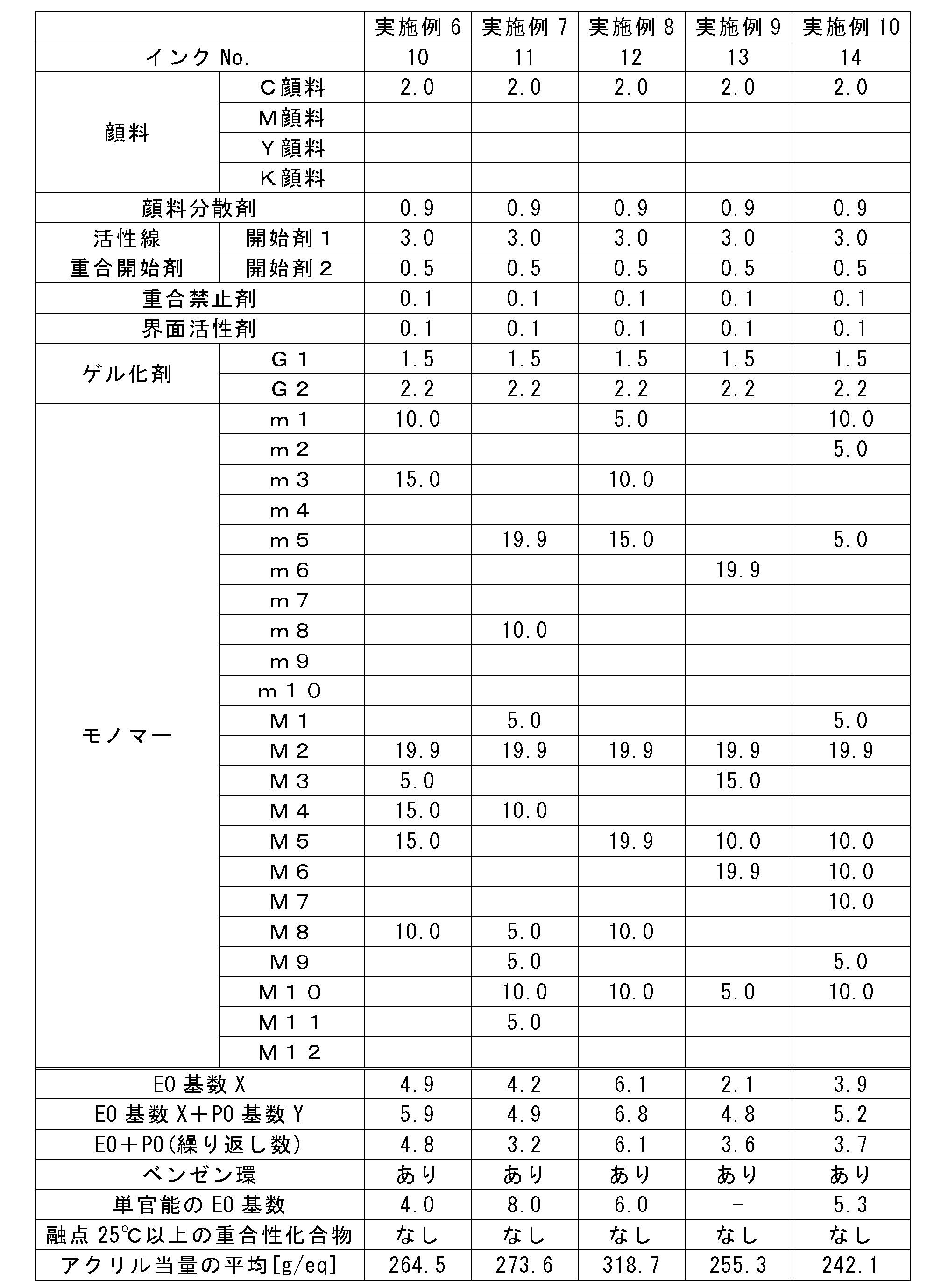
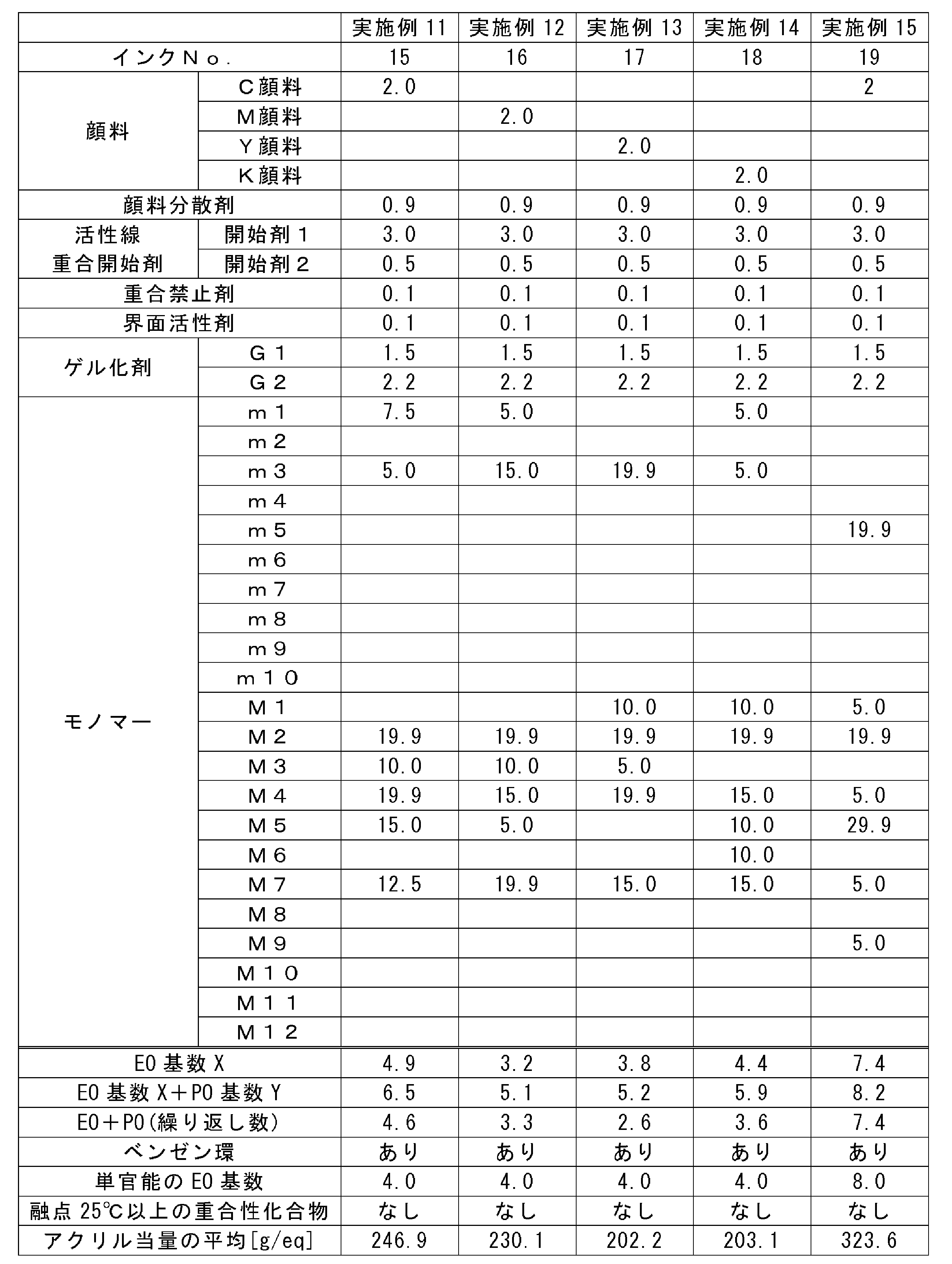
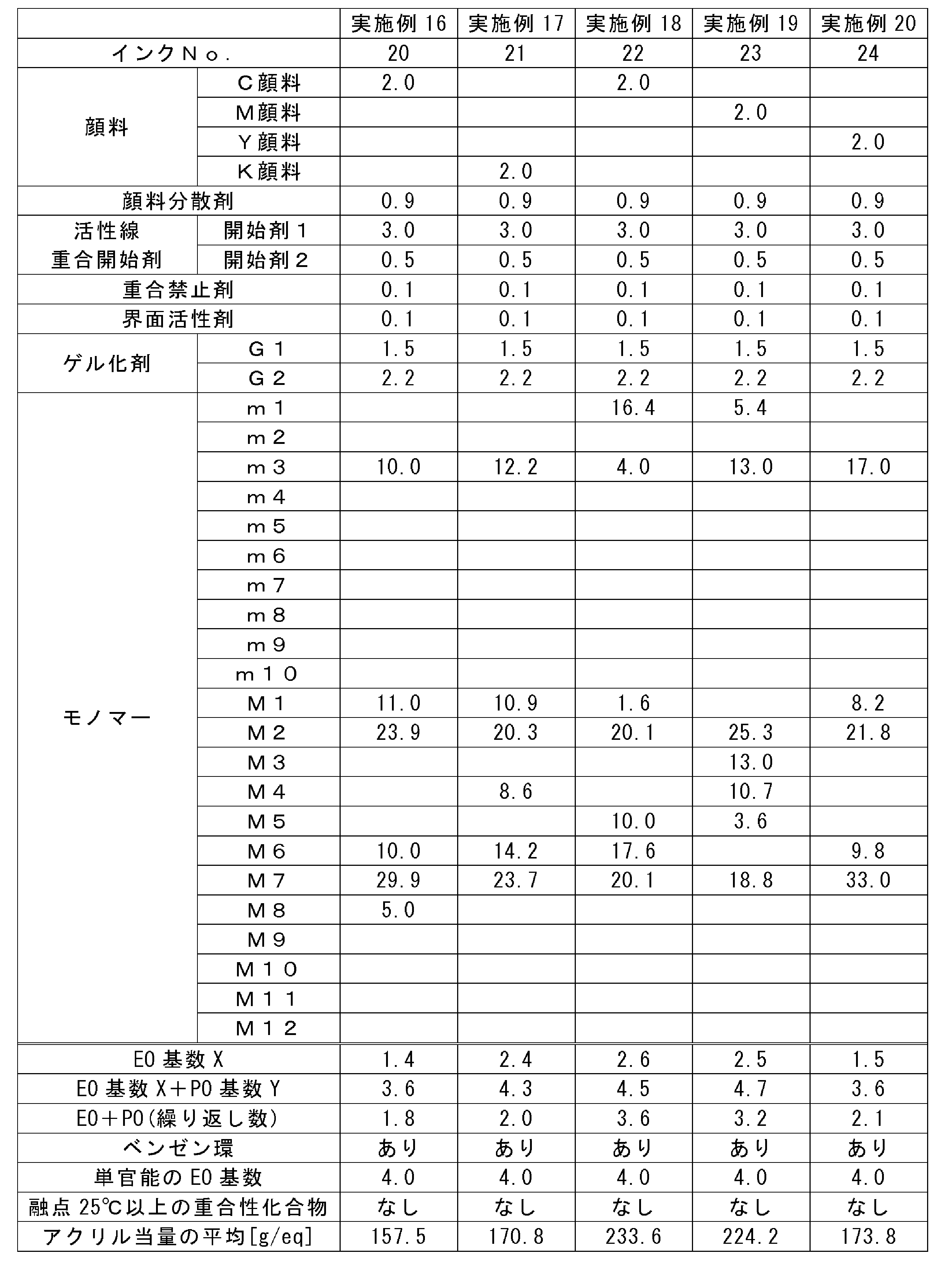

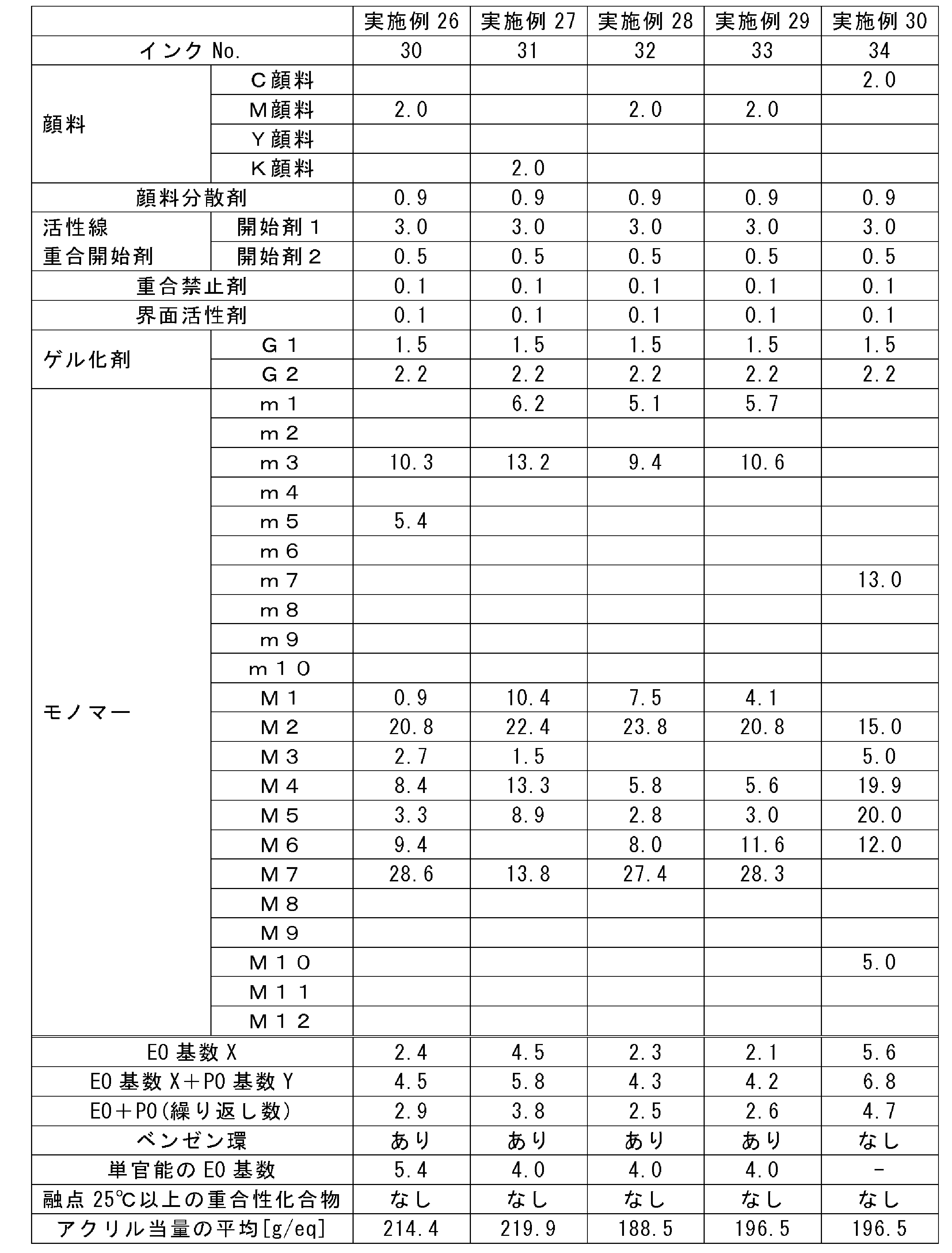
3.画像の形成
活性線硬化型インクジェットインク1~34のいずれかを用いて、ライン型インクジェット記録装置を用いて単色画像を形成した。インクジェット記録装置のインクジェットヘッドの温度は80℃に設定した。記録媒体(OKトップコート+127g、王子製紙株式会社製)に、5cm×5cmのベタ画像を印字した。画像を形成した後、記録装置の下流部に配置したLEDランプ(Phoseon Technology社製395nm、水冷LED)で、画像に紫外線を照射してインクを硬化した。吐出用記録ヘッドは、ピエゾヘッドを用いた。吐出条件は1滴の液滴量が、9.0plとなる条件で、液的速度約6m/sで出射させて、1200dpi×1200dpiの解像度で記録した。記録速度は500mm/sとした。画像形成は、23℃、55%RHの環境下で行った。dpiとは、1インチ(2.54cm)当たりのドット数を表す。
3. Formation of an image A single-color image was formed using any one of the actinic radiation curable inkjet inks 1 to 34 using a line-type inkjet recording device. The temperature of the inkjet head of the inkjet recording device was set to 80° C. A solid image of 5 cm×5 cm was printed on a recording medium (OK Topcoat+127 g, manufactured by Oji Paper Co., Ltd.). After the image was formed, the image was irradiated with ultraviolet light by an LED lamp (Phoseon Technology, 395 nm, water-cooled LED) disposed downstream of the recording device to cure the ink. A piezo head was used as the ejection recording head. The ejection conditions were such that the amount of liquid per droplet was 9.0 pl, and the ink was ejected at a liquid velocity of about 6 m/s, and recorded at a resolution of 1200 dpi×1200 dpi. The recording speed was 500 mm/s. The image was formed in an environment of 23° C. and 55% RH. dpi stands for dots per inch (2.54 cm).
4.評価
(折り割れ)
紙折り機(AFV-564FKT、株式会社ホリゾン製)を用いて、記録媒体に形成された画像に対して山折りした。その後、画像の状態を観察し、割れによる記録媒体の露出が生じていない部分(非露出部分)の面積の割合を、画像解析によって求めた。以下の基準に沿って折り割れ性を評価した。
5:画像の割れが確認されなかった
4:画像に割れが確認でき、白地の露出はわずかだった
3:画像に割れが確認でき、半分未満の領域で白地の露出があった
2:画像に割れが確認でき、半分以上の領域で白地の露出があった
1:画像に割れが確認でき、全領域で白地の露出があった
4. Evaluation (Cracks)
Using a paper folder (AFV-564FKT, manufactured by Horizon Co., Ltd.), the image formed on the recording medium was folded in half. The state of the image was then observed, and the ratio of the area of the portion of the recording medium that was not exposed due to cracks (non-exposed portion) was determined by image analysis. The fold crack resistance was evaluated according to the following criteria.
5: No cracks were observed in the image. 4: Cracks were observed in the image, with only a small amount of white background exposed. 3: Cracks were observed in the image, with less than half of the area showing white background exposed. 2: Cracks were observed in the image, with more than half of the area showing white background exposed. 1: Cracks were observed in the image, with the entire area showing white background exposed.
(断裁剥離(画像の耐擦性))
卓上断裁機(PC-P430、株式会社ホリゾン製)を用いて、記録媒体の画像形成部分を断裁した。断裁された部分を指でこすり、塗膜(画像)の剥がれ具合について、以下の基準に沿って評価した。
5:塗膜に剥がれが生じなかった
4:剥がれがあるが目視で視認できなかった
3:剥がれがあるが目視で視認しにくかった
2:剥がれがあり目視で視認できた
1:大きく剥がれがあり明らかに視認できた
(Cutting and peeling (abrasion resistance of image))
The image-forming portion of the recording medium was cut using a tabletop cutter (PC-P430, manufactured by Horizon Co., Ltd.) The cut portion was rubbed with a finger, and the degree of peeling of the coating film (image) was evaluated according to the following criteria.
5: No peeling of the coating occurred 4: Peeling occurred but was not visible to the naked eye 3: Peeling occurred but was difficult to detect with the naked eye 2: Peeling occurred and was visible to the naked eye 1: Large peeling occurred and was clearly visible
(粘度)
得られた活性線硬化型インクジェットインク1~34について、60℃における粘度を求めた。上記粘度は、モジューラーコンパクトレオメータ(MCR302e、アントンパール社製)を用いて、振動モードにて90℃から30℃まで温度を変化させながら測定した粘度変化曲線において、温度が60℃になったときの複素粘度から求めた。測定された粘度をもとに、以下の基準に沿って評価した。
2:粘度は10~25mPa・sだった
1:粘度は10~25mPa・sの範囲外だった
(viscosity)
The viscosity at 60° C. was determined for the obtained actinic ray curable inkjet inks 1 to 34. The above viscosity was determined from the complex viscosity at the temperature of 60° C. in a viscosity change curve measured while changing the temperature from 90° C. to 30° C. in vibration mode using a modular compact rheometer (MCR302e, manufactured by Anton Paar). Based on the measured viscosity, evaluation was performed according to the following criteria.
2: Viscosity was 10-25 mPa·s. 1: Viscosity was outside the range of 10-25 mPa·s.
(射出性)
<評価基準>
各試料の画像出力物について、10枚目と100枚目印刷時の100%印字部の白ヌケのスジ(吐出不良による白スジ)がないかを目視確認した。
2:白ヌケの発生はなかった、または、1,2箇所白ヌケがあったが、実用上問題ないレベルだった
1:白ヌケが多数発生して、実用上問題があった
(Ejectibility)
<Evaluation criteria>
The image output of each sample was visually checked for the presence of blank streaks (white streaks due to ejection defects) in the 100% printed portion when the 10th and 100th sheets were printed.
2: No white spots occurred, or there were white spots in one or two places, but they were not problematic for practical use. 1: Many white spots occurred, which caused problems for practical use.
各評価結果を表8~表14にまとめて示した。 The evaluation results are summarized in Tables 8 to 14.
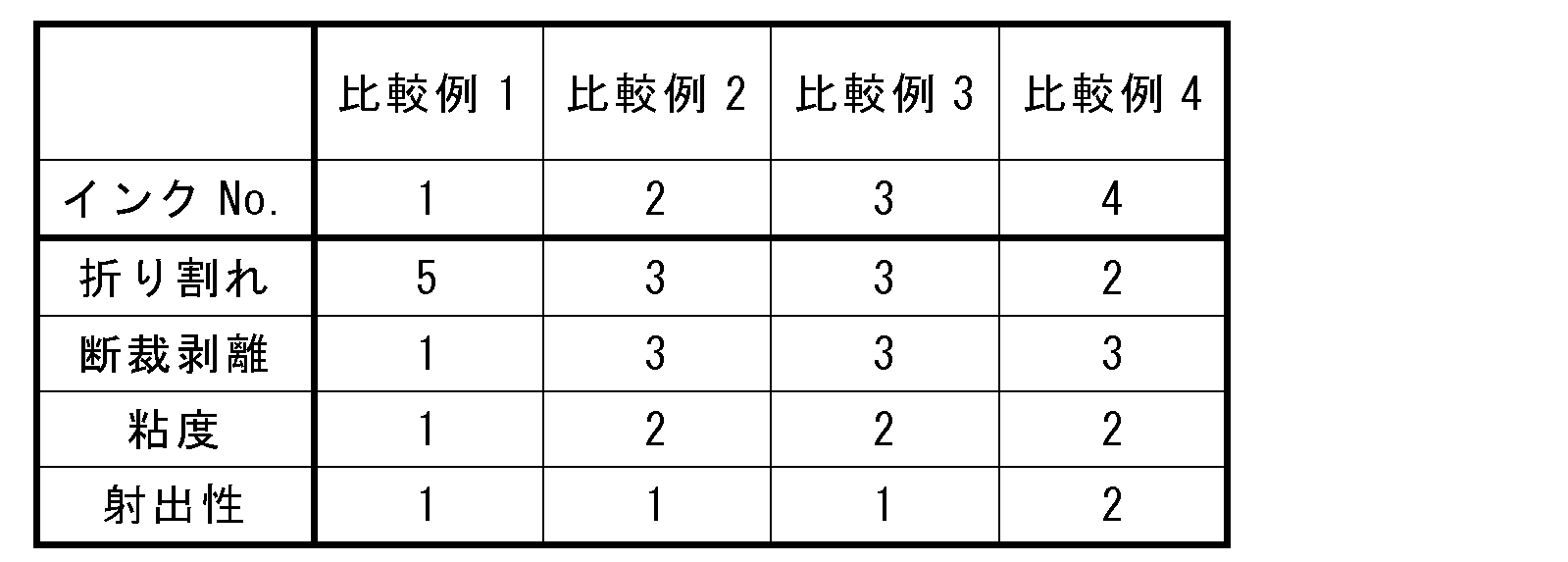
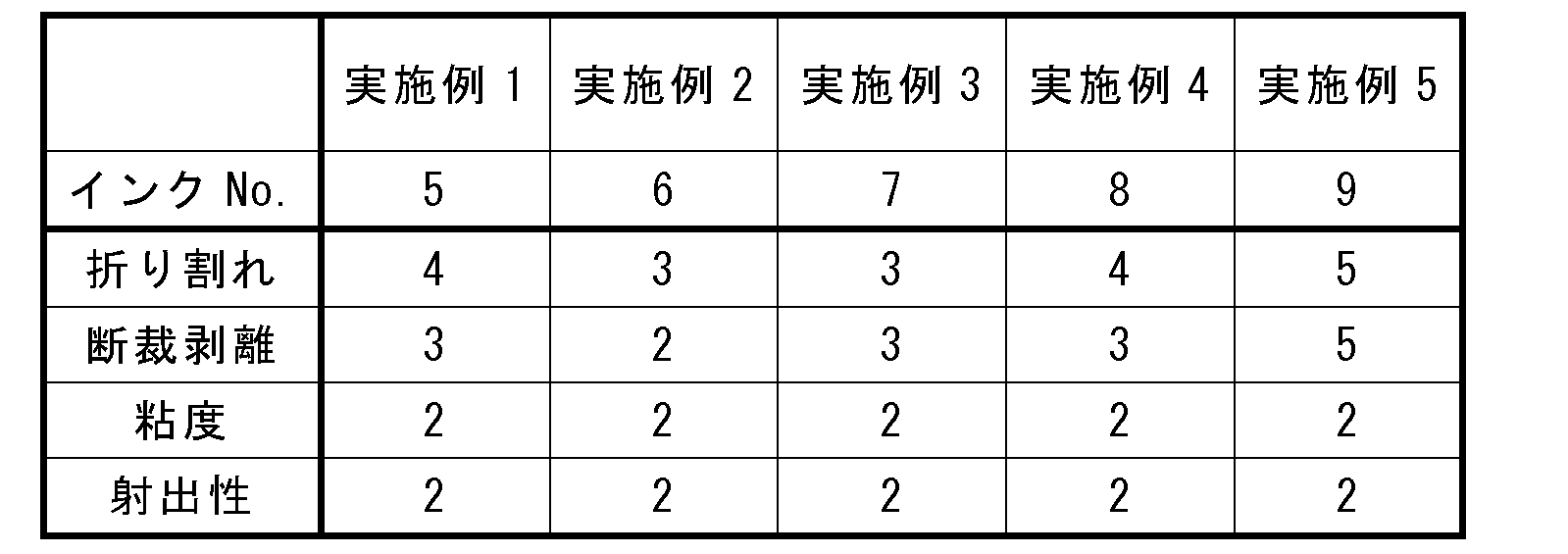
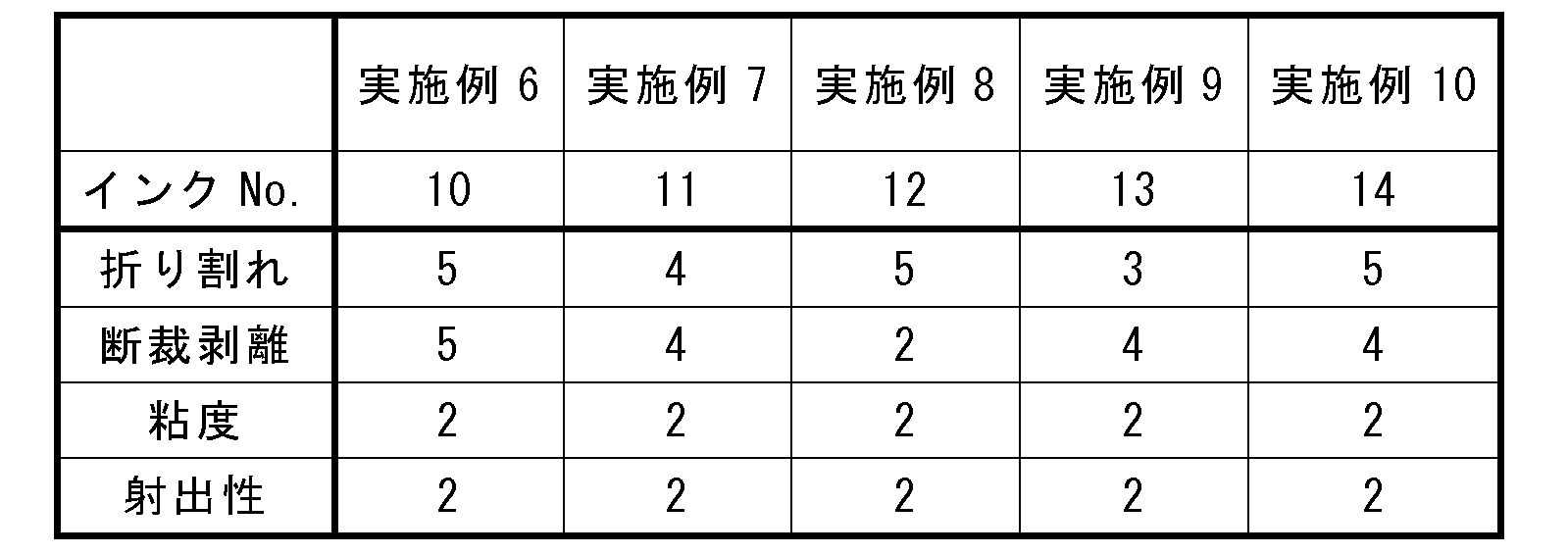
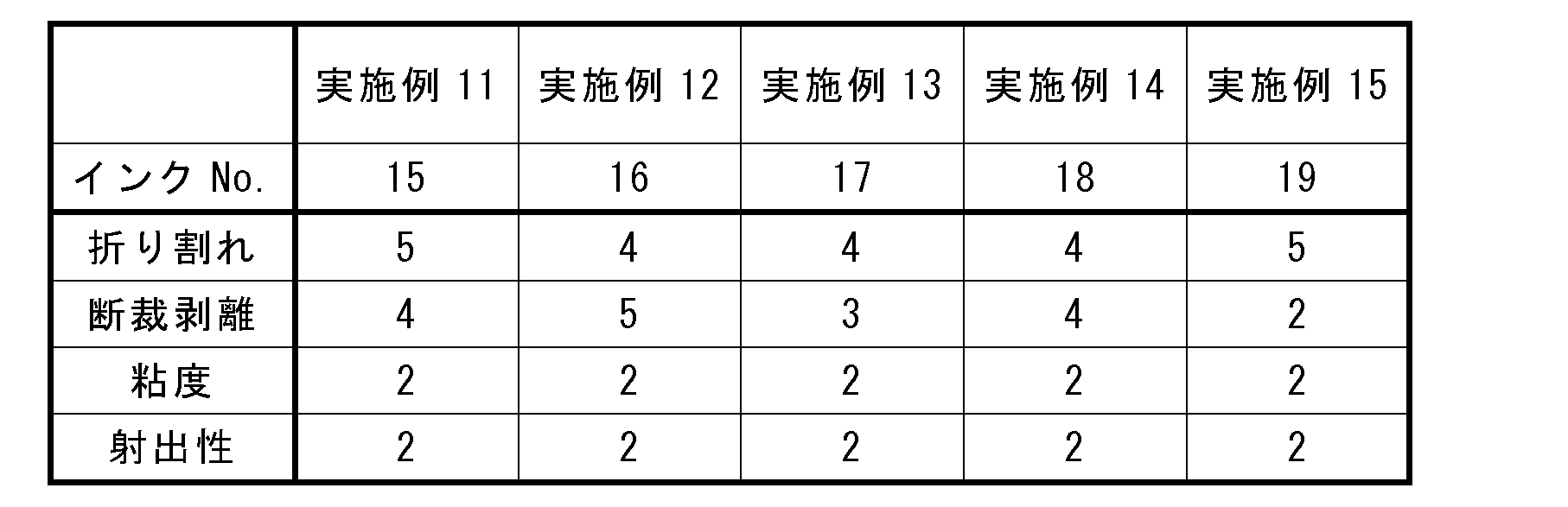
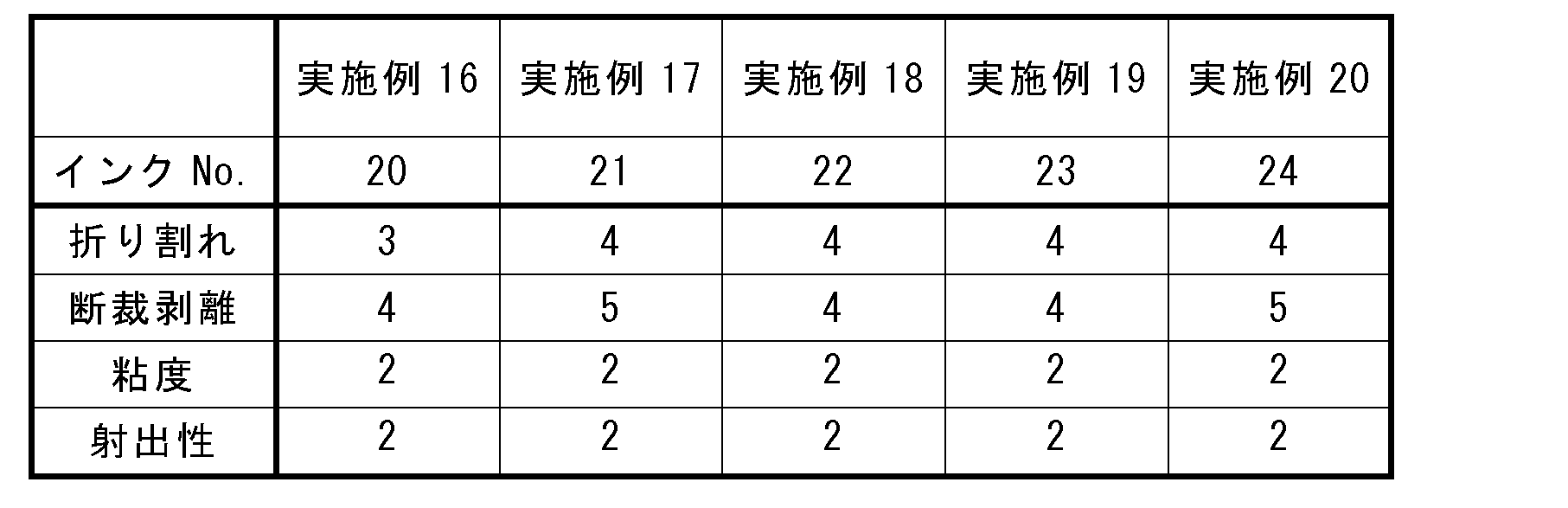
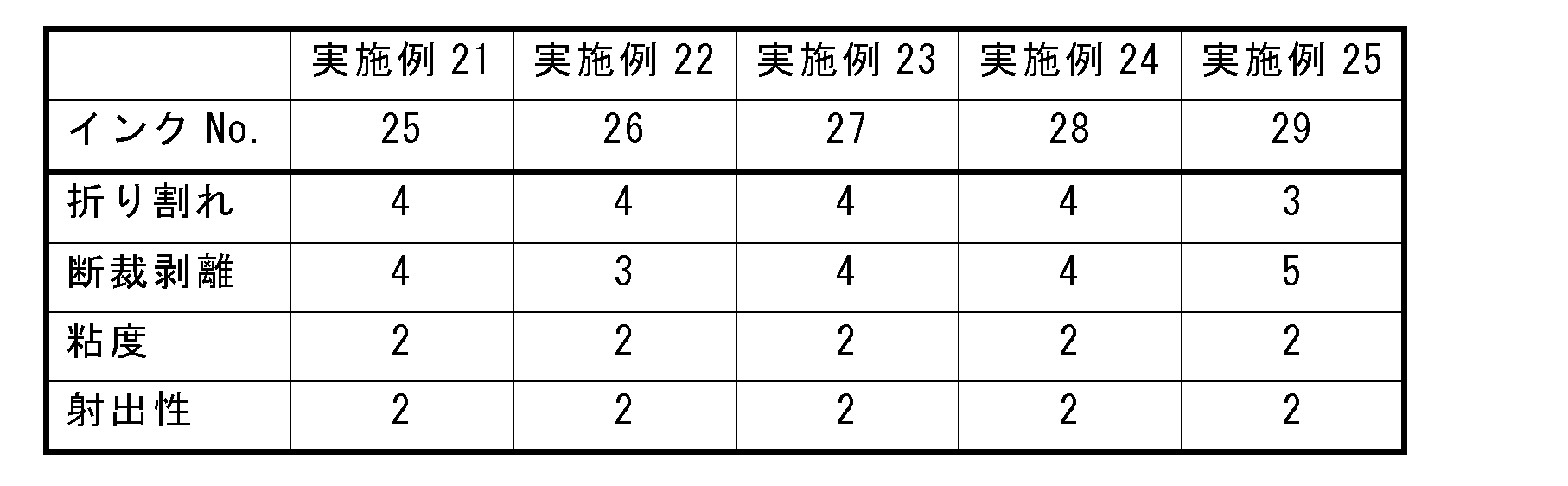
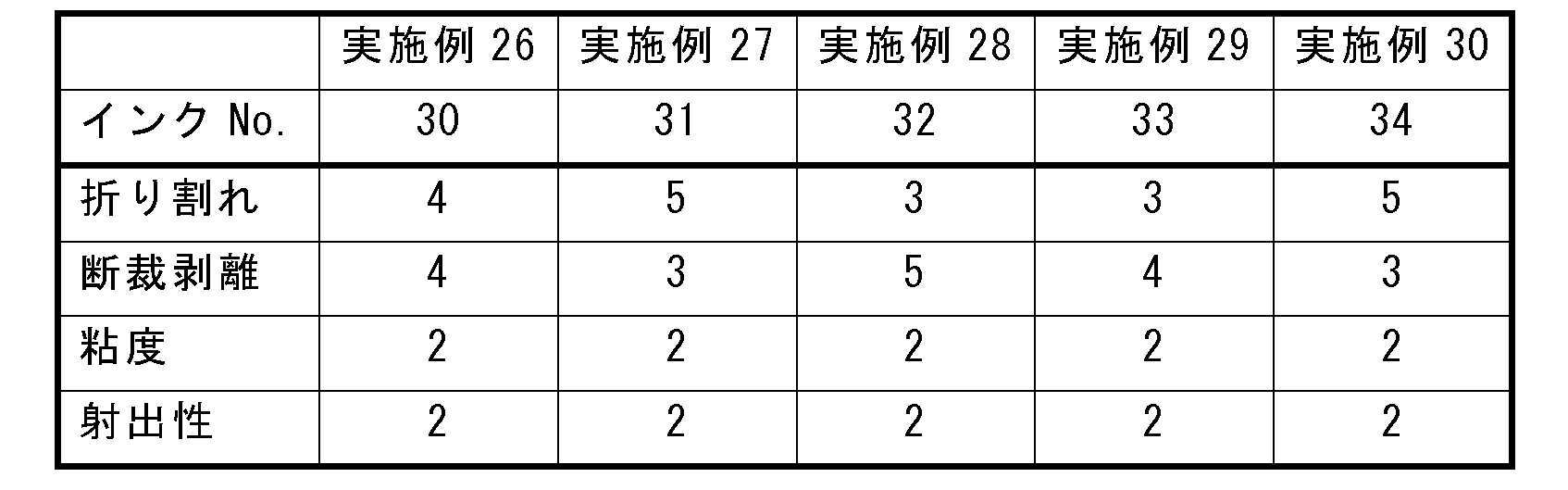
インク5~34の結果から、活性線重合性化合物が式(1)を満たし、かつ融点が25℃以上の活性線重合性化合物の願湯量が3質量%未満であることで、画像の折割れを抑制でき、画像の剥がれを抑制でき、かつ射出安定性を高められることがわかった。 The results for inks 5 to 34 show that when the actinic radiation polymerizable compound satisfies formula (1) and the desired amount of the actinic radiation polymerizable compound having a melting point of 25°C or higher is less than 3 mass%, it is possible to suppress image cracking and peeling, and to improve ejection stability.
本発明のインクジェットインクは、記録媒体を折り曲げた際に画像のひび割れを生じにくくしつつ、記録媒体から剥がれにくい画像を形成でき、かつ射出安定性が高めることができる。そのため、本発明は画像形成分野において有用である。 The inkjet ink of the present invention can form an image that is not easily peeled off from the recording medium while preventing cracks from occurring when the recording medium is folded, and can also improve ejection stability. Therefore, the present invention is useful in the field of image formation.
100 画像形成装置
110 インクジェットヘッド
120 搬送部
130 照射部
REFERENCE SIGNS LIST 100 Image forming apparatus 110 Inkjet head 120 Conveyor section 130 Irradiation section
Claims (11)
前記重合性化合物の全質量に対する、融点が25℃以上の重合性化合物の含有量は、3質量%未満であり、
前記重合性化合物における1分子あたりのエチレンオキサイド基の数の加重平均値(質量基準)をXとし、前記重合性化合物における1分子あたりのプロピレンオキサイド基の数の加重平均値(質量基準)をYとしたとき、式(1)を満たす、
活性線により硬化するインクジェットインク。
3.5≦X+Y≦9 (1) An ink-jet ink containing a polymerizable compound that is polymerized by actinic radiation,
the content of the polymerizable compound having a melting point of 25° C. or higher relative to the total mass of the polymerizable compounds is less than 3 mass %,
When a weighted average value (based on mass) of the number of ethylene oxide groups per molecule in the polymerizable compound is defined as X and a weighted average value (based on mass) of the number of propylene oxide groups per molecule in the polymerizable compound is defined as Y, Formula (1) is satisfied.
Inkjet ink that cures with actinic radiation.
3.5≦X+Y≦9 (1)
前記単官能の重合性化合物の含有量は、前記インクジェットインクの全質量に対して5質量%より多く、40質量%以下である、
請求項1に記載のインクジェットインク。 The polymerizable compound includes a monofunctional polymerizable compound,
the content of the monofunctional polymerizable compound is more than 5% by mass and not more than 40% by mass with respect to the total mass of the ink-jet ink;
The ink-jet ink of claim 1.
前記顔料が黄顔料のとき、前記重合性化合物における重合性基の当量の加重平均値(質量基準)は、160g/eq以上200g/eq以下であり、
前記顔料が黒顔料のとき、前記重合性化合物における重合性基の当量の加重平均値(質量基準)は、160g/eq以上210g/eq以下であり、
前記顔料が赤顔料のとき、前記重合性化合物における重合性基の当量の加重平均値(質量基準)は、200g/eq以上250g/eq以下である、
または前記顔料が青顔料のとき、前記重合性化合物における重合性基の当量の加重平均値(質量基準)は、200g/eq以上260g/eq以下である、
請求項1に記載のインクジェットインク。 Further comprising a pigment,
when the pigment is a yellow pigment, a weighted average value (mass basis) of the equivalent weight of the polymerizable group in the polymerizable compound is 160 g/eq or more and 200 g/eq or less;
when the pigment is a black pigment, the weighted average equivalent weight (by mass) of the polymerizable group in the polymerizable compound is 160 g/eq or more and 210 g/eq or less;
When the pigment is a red pigment, the weighted average equivalent weight (mass basis) of the polymerizable group in the polymerizable compound is 200 g/eq or more and 250 g/eq or less.
or when the pigment is a blue pigment, the weighted average equivalent weight (mass basis) of the polymerizable group in the polymerizable compound is 200 g/eq or more and 260 g/eq or less;
The ink-jet ink of claim 1.
前記付与されたインクジェットインクに活性線を照射して、前記インクジェットインクを硬化させる工程と、
を有する、画像形成方法。
A step of applying the ink-jet ink according to any one of claims 1 to 10 from an ink-jet head onto a surface of a recording medium;
irradiating the applied inkjet ink with actinic radiation to cure the inkjet ink;
The image forming method according to claim 1,
Priority Applications (3)
| Application Number | Priority Date | Filing Date | Title |
|---|---|---|---|
| JP2023148487A JP2025041294A (en) | 2023-09-13 | 2023-09-13 | Inkjet ink and image forming method |
| US18/825,049 US20250084271A1 (en) | 2023-09-13 | 2024-09-05 | Inkjet ink and image forming method |
| EP24199984.6A EP4524210A1 (en) | 2023-09-13 | 2024-09-12 | Inkjet ink and image forming method |
Applications Claiming Priority (1)
| Application Number | Priority Date | Filing Date | Title |
|---|---|---|---|
| JP2023148487A JP2025041294A (en) | 2023-09-13 | 2023-09-13 | Inkjet ink and image forming method |
Publications (1)
| Publication Number | Publication Date |
|---|---|
| JP2025041294A true JP2025041294A (en) | 2025-03-26 |
Family
ID=95105046
Family Applications (1)
| Application Number | Title | Priority Date | Filing Date |
|---|---|---|---|
| JP2023148487A Pending JP2025041294A (en) | 2023-09-13 | 2023-09-13 | Inkjet ink and image forming method |
Country Status (1)
| Country | Link |
|---|---|
| JP (1) | JP2025041294A (en) |
-
2023
- 2023-09-13 JP JP2023148487A patent/JP2025041294A/en active Pending
Similar Documents
| Publication | Publication Date | Title |
|---|---|---|
| JP5991371B2 (en) | Ink jet ink set and image forming method using the same | |
| JP5573485B2 (en) | Inkjet recording method and inkjet recording apparatus | |
| JP6933210B2 (en) | Active ray-curable inkjet ink and image formation method | |
| WO2012023368A1 (en) | Active ray-curable ink and active ray-curable inkjet recording method | |
| JP6819298B2 (en) | Inkjet ink and image formation method | |
| JP6763395B2 (en) | Ink set and image formation method | |
| JP7243166B2 (en) | Image forming method | |
| US9587123B2 (en) | Active light beam-curable inkjet magenta ink and inkjet recording method | |
| JP6733659B2 (en) | Actinic ray curable inkjet ink containing two kinds of eutectic waxes and inkjet recording method | |
| US20240417580A1 (en) | Inkjet ink and method for producing cured film | |
| JP5703954B2 (en) | Inkjet recording method | |
| JP6992747B2 (en) | Ink set and inkjet recording method | |
| JP2017132861A (en) | Active ray curing type inkjet ink and inkjet image formation method | |
| JP6809457B2 (en) | Activated light curable inkjet ink, cured film manufacturing method and inkjet image forming method | |
| JP7665952B2 (en) | Actinic radiation curable ink, image forming method and printed matter | |
| JP6627782B2 (en) | Ink set and image forming method | |
| EP3309227B1 (en) | Inkjet ink and image forming method | |
| JP7665951B2 (en) | Actinic radiation curable ink, image forming method and printed matter | |
| JP2025041523A (en) | Inkjet ink and image forming method | |
| EP4524210A1 (en) | Inkjet ink and image forming method | |
| US20260055284A1 (en) | Ink, inkjet recording method, and inkjet recording system | |
| JP2025022458A (en) | Actinic radiation curable inkjet ink and image forming method | |
| JP2026047739A (en) | Inkjet ink and image forming method | |
| JP2024172197A (en) | Inkjet ink and image forming method | |
| JP2026081500A (en) | Image forming system |