JP2025041250A - Taste analysis device and taste analysis method - Google Patents
Taste analysis device and taste analysis method Download PDFInfo
- Publication number
- JP2025041250A JP2025041250A JP2023148432A JP2023148432A JP2025041250A JP 2025041250 A JP2025041250 A JP 2025041250A JP 2023148432 A JP2023148432 A JP 2023148432A JP 2023148432 A JP2023148432 A JP 2023148432A JP 2025041250 A JP2025041250 A JP 2025041250A
- Authority
- JP
- Japan
- Prior art keywords
- food
- drink
- taste
- information
- luminescence
- Prior art date
- Legal status (The legal status is an assumption and is not a legal conclusion. Google has not performed a legal analysis and makes no representation as to the accuracy of the status listed.)
- Pending
Links
Images


Landscapes
- Investigating, Analyzing Materials By Fluorescence Or Luminescence (AREA)
Abstract
Description
本発明は、味覚解析装置、および味覚の解析方法に関する。 The present invention relates to a taste analysis device and a taste analysis method.
味覚とは、人間の舌にある味蕾によって主に感知される感覚であり、一般的に、甘味、酸味、塩味、苦味、うま味の五つ(五味)に分けられている。従来、各種センサなどにより飲食物中の特定の成分を検知したり、その濃度を解析することで、味覚を推定することが行われている。また、例えば有機酸や、アミノ酸、糖などの特定の成分の含有量を測定するとともに、二酸化炭素測定機などによって炭酸度も測定し、より詳細に味覚を推定するプログラムやシステムが提案されている(例えば、特許文献1および2)。 Taste is a sensation that is primarily sensed by the taste buds on the human tongue, and is generally divided into five tastes: sweet, sour, salty, bitter, and umami. Conventionally, taste has been estimated by detecting specific components in food and drink using various sensors and analyzing their concentrations. In addition, programs and systems have been proposed that measure the content of specific components such as organic acids, amino acids, and sugars, as well as the carbonation level using a carbon dioxide meter, to estimate taste in more detail (for example, Patent Documents 1 and 2).
しかしながら、上記特許文献に記載された方法では、五味やその他の要素のそれぞれについて互いに異なる成分を、飲食物の中から検出し、定量する必要がある。したがって、多くのセンサが必要であったり、これらを分離するための複雑な処理や装置が必要であった。また、これらの解析に時間がかかるなどの課題もあった。さらに、当該方法では、着目していない成分については、味覚の推定に使用しない。したがって、味覚に影響を及ぼす新規の成分や未知の成分が含まれている場合などには、味覚を正確に推定できない、という課題もあった。 However, the method described in the above patent document requires the detection and quantification of different components for each of the five tastes and other elements in food and drink. This requires many sensors, as well as complex processing and devices to separate them. There are also issues such as the time required for these analyses. Furthermore, this method does not use components that are not of interest in estimating taste. Therefore, there is also the issue that taste cannot be accurately estimated when new or unknown components that affect taste are included.
本発明は、上記の課題に対して、簡便にデータを取得し、かつ対象となる飲食物の味覚を正確に解析することが可能な解析方法、およびこれに用いる味覚解析装置の提供を目的とする。 In response to the above-mentioned problems, the present invention aims to provide an analysis method that can easily acquire data and accurately analyze the taste of target foods and beverages, and a taste analysis device used therefor.
上記目的を達成するための本発明の一態様は、励起によって光を発し、かつ飲食物との相互作用によって発光挙動が変化する発光プローブの発光情報を取得するための発光情報取得部と、前記発光プローブを励起させるための励起手段と、前記発光情報に基づき、前記飲食物の味覚を解析する解析部と、を含む、味覚解析装置を提供する。 To achieve the above object, one aspect of the present invention provides a taste analysis device including a luminescence information acquisition unit for acquiring luminescence information of a luminescent probe that emits light upon excitation and whose luminescence behavior changes upon interaction with food or drink, an excitation means for exciting the luminescent probe, and an analysis unit for analyzing the taste of the food or drink based on the luminescence information.
上記目的を達成するための本発明の一態様はさらに、励起によって光を発し、かつ飲食物との相互作用によって発光挙動が変化する発光プローブを、前記飲食物と相互作用していない状態で励起させ、単独発光情報を取得する工程と、前記発光プローブおよび前記飲食物を相互作用させる工程と、前記飲食物と相互作用状態にある前記発光プローブを励起させて、相互作用発光情報を取得する工程と、前記単独発光情報および前記相互作用発光情報に基づき、前記飲食物の味覚を解析する工程と、を含む、味覚の解析方法を提供する。 To achieve the above object, one aspect of the present invention further provides a taste analysis method including the steps of exciting a luminescent probe that emits light upon excitation and whose luminescence behavior changes upon interaction with food or drink while not interacting with the food or drink, and acquiring independent luminescence information, allowing the luminescent probe to interact with the food or drink, exciting the luminescent probe in an interacting state with the food or drink, and acquiring interaction luminescence information, and analyzing the taste of the food or drink based on the independent luminescence information and the interaction luminescence information.
本発明の一実施形態によれば、簡便にデータを取得可能であり、かつ、飲食物の味覚を詳細に解析することが可能な味覚の解析方法、およびこれに使用可能な味覚解析装置が提供される。 According to one embodiment of the present invention, a taste analysis method that can easily acquire data and can perform detailed analysis of the taste of food and drink, and a taste analysis device that can be used for this method are provided.
以下、本発明の一実施の形態について詳細に説明する。ただし、本発明は当該実施の形態に限定されない。なお、以下では先に味覚の解析方法について説明し、その後、これに用いることが可能な味覚解析装置について説明する。 One embodiment of the present invention will be described in detail below. However, the present invention is not limited to this embodiment. Note that the taste analysis method will be described first, and then a taste analysis device that can be used for this will be described.
1.味覚の解析方法
本実施形態の味覚の解析方法のフローを図1に示す。本実施形態では、励起によって光を発し、かつ飲食物との相互作用によって発光挙動が変化する発光プローブを準備し、当該発光プローブを励起させたときの単独発光情報を取得する(S10、以下「単独発光情報取得工程」とも称する)。続いて、当該発光プローブと飲食物とを相互作用させる(S11、以下「相互作用工程」とも称する)。さらに、飲食物と相互作用状態にある発光プローブを励起させて、相互作用発光情報を取得する(S12、以下「相互作用発光情報取得工程」とも称する)。その後、単独発光情報および相互作用発光情報から、飲食物の味覚を解析する(S13、以下「解析工程」とも称する)。ただし、すでに単独発光情報が既知である場合などには、単独発光情報取得工程S11は必ずしも行わなくてもよい。また、相互作用発光情報取得工程S12と、単独発光情報取得工程S10とを同時に行ってもよい。
1. Taste Analysis Method FIG. 1 shows the flow of the taste analysis method of this embodiment. In this embodiment, a luminescent probe that emits light by excitation and whose luminescence behavior changes due to interaction with food and drink is prepared, and single luminescence information is obtained when the luminescent probe is excited (S10, hereinafter also referred to as the "single luminescence information acquisition step"). Next, the luminescent probe and food and drink are allowed to interact (S11, hereinafter also referred to as the "interaction step"). Furthermore, the luminescent probe in an interacting state with the food and drink is excited to acquire interaction luminescence information (S12, hereinafter also referred to as the "interaction luminescence information acquisition step"). Then, the taste of the food and drink is analyzed from the single luminescence information and the interaction luminescence information (S13, hereinafter also referred to as the "analysis step"). However, in cases where the single luminescence information is already known, the single luminescence information acquisition step S11 does not necessarily have to be performed. In addition, the interaction luminescence information acquisition step S12 and the single luminescence information acquisition step S10 may be performed simultaneously.
一方、図2に示すように、解析工程S13の前に、飲食物の化学的情報および/または物理的情報を取得する工程(S14、以下「飲食物情報取得工程」とも称する)を別途行ってもよい。この場合、解析工程S13では、単独発光情報取得工程S10で取得した単独発光情報および発光情報取得工程S12で取得した相互作用発光情報だけでなく、飲食物情報取得工程S14で取得した飲食物の化学的情報および/または物理的情報によっても、飲食物の味覚を解析することが可能となり、より詳細な解析が可能となる。 On the other hand, as shown in FIG. 2, a step of acquiring chemical and/or physical information of the food and drink (S14, hereinafter also referred to as the "food and drink information acquisition step") may be performed separately before the analysis step S13. In this case, in the analysis step S13, it becomes possible to analyze the taste of the food and drink not only from the single luminescence information acquired in the single luminescence information acquisition step S10 and the interaction luminescence information acquired in the luminescence information acquisition step S12, but also from the chemical information and/or physical information of the food and drink acquired in the food and drink information acquisition step S14, enabling a more detailed analysis.
本実施形態の味覚の解析方法では、対象となる飲食物に含まれる個々の成分を特定するのではなく、当該飲食物との相互作用によって発光状態が変化する発光プローブの発光状態を特定する。したがって、簡便な方法で飲食物の味覚を解析でき、さらにはその解析を短時間で行うことができる。また特定の成分のみに着目するのではないことから、飲食物の味覚を総合的に解析できる。したがって、飲食物の味覚について、より正確な解析が可能である。以下、本実施形態の解析方法の各工程について説明する。なお、以下の説明では、図3に示す96穴のウェルプレート100を用いて12種類の飲食物を解析する場合を例に説明する。ただし、本発明は当該実施形態に限定されない。
In the taste analysis method of this embodiment, the individual components contained in the target food or drink are not identified, but the luminescence state of the luminescent probe, whose luminescence state changes due to interaction with the food or drink, is identified. Therefore, the taste of food or drink can be analyzed in a simple manner, and the analysis can be performed in a short time. In addition, since the focus is not on a specific component, the taste of food or drink can be analyzed comprehensively. Therefore, the taste of food or drink can be analyzed more accurately. Each step of the analysis method of this embodiment will be described below. Note that the following description will be given by taking as an example a case in which 12 types of food or drink are analyzed using a 96-
(単独発光情報取得工程)
単独発光情報工程S10では、発光プローブを準備してこれを励起させ、飲食物と相互作用していない状態の発光プローブの発光情報(単独発光情報)を取得する。飲食物の解析に、複数の発光プローブを使用する場合、個々の発光プローブについて、単独発光情報を個別に取得してもよいが、複数の発光プローブについて、同時に単独発光情報を得ることが、効率などの観点で好ましい。本実施形態では、16種類の発光プローブ(図示せず)を準備し、図3に示す96穴のウェルプレート100の各行(r1行~r8行)に、異なる発光プローブを配置する。同一の行には、それぞれ同じ発光プローブを配置している。ただし、当該方法は任意に変更できる。例えば全てのウェルに同一の発光プローブを配置してもよい。また、本実施形態ではウェルプレートを使用しているが、発光プローブや飲食物を保持可能であれば、これらを保持する部材(保持部材)はウェルプレートに限定されず、例えば平板などであってもよく、後述するが、有機EL素子などであってもよい。
(Single light emission information acquisition process)
In the single luminescence information step S10, a luminescent probe is prepared and excited to obtain luminescence information (single luminescence information) of the luminescent probe in a state where it is not interacting with food or drink. When multiple luminescent probes are used for analyzing food or drink, single luminescence information may be obtained for each luminescent probe individually, but it is preferable to obtain single luminescence information for multiple luminescent probes simultaneously in terms of efficiency, etc. In this embodiment, 16 types of luminescent probes (not shown) are prepared, and different luminescent probes are arranged in each row (r1 row to r8 row) of a 96-
本実施形態において、発光プローブをウェルプレート100の所定の位置に配置する方法は、発光プローブの種類などに応じて適宜選択される。例えば、液体状の発光プローブを使用する場合、ディスペンサーなどを用いて注入してもよい。また、自動分注機を用いたり、インクジェット印刷によって配置してもよい。
In this embodiment, the method of placing the luminescent probe at a predetermined position on the
発光プローブの励起方法は、発光プローブの種類などによって適宜選択されるが、本実施形態では、発光プローブに励起光を照射し、発光プローブを励起させる。そして、各発光プローブが発する光の情報を単独発光情報として取得する。このとき、上記ウェルプレートに入れた発光プローブについて、順に励起させて単独発光情報を取得してもよいが、通常、ウェルプレートに配置した全ての発光プローブを同時に励起させて、複数の単独発光情報を一度に取得することが、解析効率などの観点で好ましい。 The method of exciting the luminescent probe is appropriately selected depending on the type of luminescent probe, etc., but in this embodiment, the luminescent probe is irradiated with excitation light to excite the luminescent probe. Then, information on the light emitted by each luminescent probe is obtained as single luminescence information. At this time, the luminescent probes placed in the well plate may be excited in sequence to obtain single luminescence information, but it is usually preferable from the standpoint of analysis efficiency, etc. to simultaneously excite all of the luminescent probes placed in the well plate to obtain multiple single luminescence information at once.
また、発光プローブを励起させるための励起光や、単独発光情報として取得するデータの種類は、解析の手法などに応じて適宜選択される。例えば、特定の励起光(単一波長の励起光)を照射し、これによって、各発光プローブが発する光の強度や波長(発光情報)を、分光光度計などを用いて測定し、これを単独発光情報としてもよい。さらに、得られた光を例えば3刺激値(例えばCIE表色系のXYZ)に分解し、XYZそれぞれについての3つのデータを単独発光情報として取得してもよい。また、特定の励起光を照射した場合に、発光プローブが発する光の分光分布の経時変化や、経時での色度変化を、連続的または断続的に分光光度計などで測定し、これを単独発光情報としてもよい。 The type of excitation light for exciting the luminescent probes and the type of data acquired as the independent luminescence information are appropriately selected according to the analysis method. For example, a specific excitation light (single-wavelength excitation light) may be irradiated, and the intensity and wavelength (luminescence information) of the light emitted by each luminescent probe may be measured using a spectrophotometer or the like, and this may be used as independent luminescence information. Furthermore, the obtained light may be decomposed into, for example, tristimulus values (for example, XYZ of the CIE color system), and three pieces of data for each of XYZ may be acquired as independent luminescence information. In addition, when a specific excitation light is irradiated, the change over time in the spectral distribution of the light emitted by the luminescent probe and the change in chromaticity over time may be measured continuously or intermittently using a spectrophotometer or the like, and this may be used as independent luminescence information.
さらに、発光プローブが発する光の色度変化などを取得してもよい。この場合、単一の波長の励起光を短時間のみ照射し、これを受けて発光プローブが発する光をCCDカメラ、CMOSカメラなどで画像や動画として取得してもよい。得られた画像や動画から色度などを特定し、経時の色度変化に関するデータなどを単独発光情報としてもよい。 Furthermore, the change in chromaticity of the light emitted by the luminescent probe may be acquired. In this case, excitation light of a single wavelength may be irradiated for only a short period of time, and the light emitted by the luminescent probe in response to this may be acquired as an image or video using a CCD camera, CMOS camera, or the like. The chromaticity may be identified from the acquired image or video, and data on the change in chromaticity over time may be used as single luminescence information.
また、励起光の波長は、発光プローブの種類や、解析する飲食物の種類に応じて適宜選択され、例えば波長300nm以上700nm以下の光とすることができる。このような光によれば、飲食物に影響を及ぼし難い。また、特別な光源などが不要である。 The wavelength of the excitation light is appropriately selected depending on the type of luminescent probe and the type of food or drink to be analyzed, and can be, for example, light with a wavelength of 300 nm or more and 700 nm or less. Such light is unlikely to affect food or drink. Also, no special light source is required.
・発光プローブについて
本実施形態で使用する発光プローブは、励起されて光を発し、かつ飲食物との相互作用によって発光挙動が変化する物質であればよい。本実施形態では、励起光の照射によって励起されて発光し、かつ飲食物との相互作用によって発光挙動が変化する化合物を発光プローブとする。なお、本明細書において、発光プローブの発光挙動が、飲食物と相互作用によって変化するとは、発光プローブ中の原子や分子構造、電子状態などが、飲食物と相互作用することで化学的または物理的に変化し、発光プローブが発する光(例えばスペクトルや寿命など)が変化することをいう。
Luminescent probes used in this embodiment may be any substance that emits light when excited and changes its luminescence behavior when interacting with food or drink. In this embodiment, the luminescent probe is a compound that emits light when excited by irradiation with excitation light and changes its luminescence behavior when interacting with food or drink. In this specification, the luminescent probe's luminescence behavior changes when interacting with food or drink refers to the fact that the atoms, molecular structure, electronic state, etc. in the luminescent probe change chemically or physically when interacting with food or drink, causing a change in the light emitted by the luminescent probe (e.g., spectrum, lifetime, etc.).
当該発光プローブの構造は特に制限されず、本実施形態で準備する発光プローブは、分子中に、励起光の照射によって励起されて発光する発光部を1つ以上有する化合物である。当該発光プローブは、上記発光部を複数有していてもよい。1つの発光プローブ(分子)が複数の発光部を有する場合、複数の発光部の種類は同一であってもよく、異なっていてもよい。 The structure of the luminescent probe is not particularly limited, and the luminescent probe prepared in this embodiment is a compound having one or more luminescent parts in the molecule that are excited by irradiation with excitation light and emit light. The luminescent probe may have multiple luminescent parts. When one luminescent probe (molecule) has multiple luminescent parts, the types of the multiple luminescent parts may be the same or different.
また、励起光の照射によって励起された発光プローブが発する光は、発光プローブ中の一つの発光部が単独で発する光であってもよく、発光プローブ内の複数の発光部が相互作用して発する光であってもよい。発光プローブが発する光の例には、蛍光、りん光、エキシマー発光、エキサイプレックス発光、熱活性化遅延蛍光、励起状態分子内プロトン発光、三重項三重項消滅発光、ねじれ型分子内電荷移動発光、および凝集誘起発光などが含まれる。1つの発光プローブが発する光の種類は1つのみであってもよいが、1つの発光プローブが、複数種類の光を発生させると、より複雑な発光情報が得られやすくなる。 The light emitted by the luminescent probe excited by irradiation with excitation light may be light emitted by one luminescent moiety in the luminescent probe alone, or may be light emitted by the interaction of multiple luminescent moieties in the luminescent probe. Examples of light emitted by luminescent probes include fluorescence, phosphorescence, excimer luminescence, exciplex luminescence, thermally activated delayed fluorescence, excited-state intramolecular proton luminescence, triplet triplet annihilation luminescence, twisted intramolecular charge transfer luminescence, and aggregation-induced luminescence. One luminescent probe may emit only one type of light, but if one luminescent probe generates multiple types of light, more complex luminescence information can be obtained.
また、本実施形態の発光プローブは、核酸構造と、当該核酸構造の主鎖に結合した、1つ以上の発光部(以下、「発色団」や「発光団」とも称する)と、を有する。なお、本明細書において、核酸構造には、DNAやRNA由来の構造だけでなく、ホスホロチオエートオリゴデオキシヌクレオチド、2’-O-(2-メトキシ)エチル-修飾核酸、siRNA、架橋型核酸、ペプチド核酸、aTNA、SNA、GNA、LNA、およびモルフォリノ・アンチセンス核酸からなる群より選択される一種以上の化合物由来の構造も含むものとする。以下では、発光プローブが、ペントースまたはヘキソース由来の糖構造、および当該糖構造に結合したリン酸エステル結合を含む構造単位を1つ以上有する主鎖と、当該糖構造に結合した、1つ以上の発光部(発色団または発光団)と、を有する化合物である場合を例に説明する。 The luminescent probe of this embodiment has a nucleic acid structure and one or more luminescent moieties (hereinafter also referred to as "chromophore" or "luminophore") bound to the main chain of the nucleic acid structure. In this specification, the nucleic acid structure includes not only structures derived from DNA or RNA, but also structures derived from one or more compounds selected from the group consisting of phosphorothioate oligodeoxynucleotides, 2'-O-(2-methoxy)ethyl-modified nucleic acids, siRNA, crosslinked nucleic acids, peptide nucleic acids, aTNA, SNA, GNA, LNA, and morpholino antisense nucleic acids. In the following, an example will be described in which the luminescent probe is a compound having a main chain having a pentose or hexose-derived sugar structure and one or more structural units containing a phosphate ester bond bound to the sugar structure, and one or more luminescent moieties (chromophore or luminophore) bound to the sugar structure.
当該発光プローブの主鎖は、ペントースまたはヘキソース由来の糖構造と、当該糖構造に結合したリン酸エステル結合と、を含む構造単位を1つ以上有していればよい。当該主鎖は、上記構造単位を1つのみ含んでいてもよく、複数含んでいてもよい。すなわち、糖構造と、当該糖構造に結合したリン酸エステル結合とを1つずつ有する構造であってもよく、糖構造と、リン酸エステル結合とを交互に含む構造であってもよい。通常、当該発光プローブの主鎖の両末端は、糖構造となるため、リン酸エステル結合の数より糖構造が一つ多くなる。なお、発光プローブの主鎖が、複数の構造単位を含む場合、複数の構造単位は互いに同一であってもよく、異なっていてもよい。 The main chain of the luminescent probe may have one or more structural units including a sugar structure derived from a pentose or hexose and a phosphate ester bond bonded to the sugar structure. The main chain may include only one of the structural units, or may include multiple structural units. That is, the main chain may have a structure including one sugar structure and one phosphate ester bond bonded to the sugar structure, or may have a structure including sugar structures and phosphate ester bonds alternately. Usually, both ends of the main chain of the luminescent probe are sugar structures, so that the number of sugar structures is one more than the number of phosphate ester bonds. When the main chain of the luminescent probe includes multiple structural units, the multiple structural units may be the same as or different from each other.
当該発光プローブの主鎖が含む上記構造単位の数は、飲食物の種類などに応じて適宜選択されるが、2以上6以下が好ましい。上記構造単位の量が多くなると、発光プローブが、飲食物に特異的に作用しやすくなる。ただし、発光プローブを、飲食物の様々な構造などと相互作用させて、多量のデータを得ることも好ましい。したがって、発光プローブと飲食物とが、適度な(過剰でない)特異性を有することが好ましく、上記構造単位の数は6以下であることが好ましい。 The number of the structural units contained in the main chain of the luminescent probe is appropriately selected depending on the type of food or drink, but is preferably 2 to 6. As the amount of the structural units increases, the luminescent probe is more likely to act specifically on food or drink. However, it is also preferable to obtain a large amount of data by allowing the luminescent probe to interact with various structures of food or drink. Therefore, it is preferable that the luminescent probe and food or drink have appropriate (not excessive) specificity, and the number of the structural units is preferably 6 or less.
発光プローブの主鎖は、本実施形態の目的および効果を損なわない範囲において、ペントースまたはヘキソース由来の糖構造およびリン酸エステル結合を含む構造単位以外の構造を一部に含んでいてもよい。また、主鎖の両端の構造は特に制限されず、例えばOH基や、アルコキシ基など、各種構造とすることができる。 The main chain of the luminescent probe may partially contain structures other than the structural units containing the pentose or hexose-derived sugar structure and the phosphate ester bond, as long as the purpose and effect of this embodiment are not impaired. In addition, the structures at both ends of the main chain are not particularly limited, and can be various structures, such as OH groups and alkoxy groups.
ここで、ペントースの例には、リボース、デオキシリボース、キシロースが含まれる。一方、ヘキソースの例には、アロース、グルコース、マンノースなどが含まれる。これらの中でも特に、糖構造がリボースまたはデオキシリボース由来の構造であると、発光プローブの主鎖が、DNAやRNAの主鎖と同様の構造になり、飲食物中のDNAやRNAと相互作用しやすくなる点で好ましい。 Here, examples of pentoses include ribose, deoxyribose, and xylose. On the other hand, examples of hexoses include allose, glucose, mannose, and the like. Among these, a sugar structure derived from ribose or deoxyribose is particularly preferable in that the main chain of the luminescent probe has a structure similar to that of DNA or RNA, and is more likely to interact with DNA or RNA in food and drink.
発光プローブの主鎖が、リボースまたはデオキシリボース由来の構造を含む場合、リン酸エステル結合は、リボースまたはデオキシリボースの3位の炭素、および5位の炭素に結合することが好ましい。また、後述の発色団または発光団は、リボースまたはデオキシリボースの1位の位置に結合していることが好ましい。すなわち、本実施形態の発光プローブは、下記の一般式(1a)または(1b)で表される構造を含むことが好ましい。

一方、発光プローブの発光部(発色団または発光団)は、単一の励起光に対し、単独で所定の種類の光を発する、もしくは複数の発色団または発光団が作用することによって所定の光を発する構造であればよい。当該発色団または発光団は、上記主鎖の糖構造に、当該糖構造がβ体となるように結合していることが好ましい。なお、本明細書では、「発色団」とは、波長300nm以上の光の吸収を示す構造をいい、「発光団」とは、波長300nm以上の光を吸収して発光を示す構造をいう。 On the other hand, the light-emitting portion (chromophore or luminophore) of the luminescent probe may have a structure that emits a specific type of light by itself in response to a single excitation light, or emits a specific light by the action of multiple chromophores or luminophores. It is preferable that the chromophore or luminophore is bound to the sugar structure of the main chain so that the sugar structure is in a β form. In this specification, "chromophore" refers to a structure that absorbs light with a wavelength of 300 nm or more, and "luminophore" refers to a structure that absorbs light with a wavelength of 300 nm or more and emits light.
1つの発光プローブが有する発色団または発光団の数は、1であってもよく、2以上であってもよい。ただし、発光プローブが複数種類の発光を呈しやすいとの観点で、2以上が好ましく、3以上6以下がさらに好ましい。発光プローブが複数の発色団または発光団を有する場合、これらは互いに同じであってもよく、異なっていてもよい。発光プローブでは、通常、主鎖中の一つの糖構造に、一つの発色団または発光団が結合する。したがって、発光プローブが、複数の発色団または発光団を有する場合、主鎖中の糖構造の数も複数であることが好ましい。すなわち、発光プローブ中の発色団または発光団の数は、上述のシグナル発生部の主鎖中の糖構造(またはペプチド構造)の数と同数、もしくはこれより少ないことが好ましい。 The number of chromophores or luminophores in one luminescent probe may be one or two or more. However, from the viewpoint that the luminescent probe is likely to exhibit multiple types of luminescence, two or more is preferable, and three to six is even more preferable. When the luminescent probe has multiple chromophores or luminophores, these may be the same as or different from each other. In a luminescent probe, one chromophore or luminophore is usually bound to one sugar structure in the main chain. Therefore, when a luminescent probe has multiple chromophores or luminophores, it is preferable that the number of sugar structures in the main chain is also multiple. In other words, it is preferable that the number of chromophores or luminophores in the luminescent probe is the same as or less than the number of sugar structures (or peptide structures) in the main chain of the signal generating part described above.
ここで、発光プローブが、複数の発色団または発光団を有する場合、発色団または発光団は、発光プローブの主鎖(糖構造)にまんべんなく配置されていてもよい。一方で、図4に示すように、発光プローブの一部の領域(図4では先端から10番目までの糖構造)のみに発色団または発光団が結合していてもよい。このような発光プローブは、発色団または発光団が結合しており、発光に寄与する領域(以下、「シグナル発生部」とも称する)と、発色団または発光団が殆ど結合しておらず、発光に寄与しない領域(以下、「基部」とも称する)とを有する。この場合、基部側の糖構造には、天然核酸塩基が結合していてもよい。本明細書において、天然型の核酸塩基とは、アデニン、グアニン、シトシン、チミン、およびウラシルをいう。なお、シグナル発生部側の糖構造の一部に天然核酸塩基が結合していてもよい。ただし、シグナル発生部側では、天然型の核酸塩基の割合が、シグナル発生部の糖構造の総数に対して50%以下が好ましく、25%以下がより好ましい。 Here, when the luminescent probe has multiple chromophores or luminophores, the chromophores or luminophores may be evenly arranged in the main chain (sugar structure) of the luminescent probe. On the other hand, as shown in FIG. 4, the chromophores or luminophores may be bound only to a part of the region of the luminescent probe (the 10th sugar structure from the tip in FIG. 4). Such a luminescent probe has a region (hereinafter also referred to as the "signal generating part") to which the chromophore or luminophore is bound and contributes to light emission, and a region (hereinafter also referred to as the "base") to which almost no chromophore or luminophore is bound and does not contribute to light emission. In this case, a natural nucleic acid base may be bound to the sugar structure on the base side. In this specification, the natural nucleic acid base refers to adenine, guanine, cytosine, thymine, and uracil. In addition, a natural nucleic acid base may be bound to a part of the sugar structure on the signal generating part side. However, on the signal generating part side, the ratio of natural nucleic acid bases to the total number of sugar structures in the signal generating part is preferably 50% or less, and more preferably 25% or less.
通常、シグナル発生部は、先端から10番目までの糖構造に配置されていることが好ましい。ただし、飲食物がタンパク質やリポソームのような分子サイズが大きいものを含む場合には、シグナル発生部が、先端から10番目以降の糖構造にかけて続いてもよい。ここで、当該シグナル発生部では、発色団または発光団が結合した糖構造の50%以上がβ体であることが好ましい。一般に、DNAは、リン酸エステル結合およびデオキシリボース由来の構造を含む主鎖(デオキシリボース)に塩基が結合した構造を有するが、天然のDNAでは、主鎖中のデオキシリボースが全てβ体となっている。そのため、シグナル発生部(発色団または発光団が結合した領域)の糖構造のうちの50%以上がβ体であると、DNAやRNAなど、自然界に存在する物質との構造の類似性が高いといえる。このような発光プローブは、飲食物と混合したときに、立体障害などが生じ難く、内部に入り込んだり、飲食物の形状に沿ったりすることが可能である。したがって、飲食物について、より詳細に解析することが可能である。 In general, the signal generating part is preferably arranged in the first 10 sugar structures from the tip. However, when the food or drink contains a large molecular size such as a protein or liposome, the signal generating part may continue from the tip to the 10th sugar structure and beyond. Here, in the signal generating part, it is preferable that 50% or more of the sugar structures to which the chromophore or luminophore is bound are β-forms. In general, DNA has a structure in which bases are bound to a main chain (deoxyribose) that contains a phosphate ester bond and a structure derived from deoxyribose, but in natural DNA, all of the deoxyribose in the main chain is β-form. Therefore, if 50% or more of the sugar structures in the signal generating part (region to which the chromophore or luminophore is bound) are β-forms, it can be said that the structure is highly similar to substances that exist in nature, such as DNA and RNA. When such a luminescent probe is mixed with food or drink, it is unlikely to cause steric hindrance, and it is possible to penetrate inside or conform to the shape of the food or drink. Therefore, it is possible to analyze the food or drink in more detail.
また、発光プローブのシグナル発生部では、発色団または発光団が結合した糖構造のうち、80%以上がβ体であることがより好ましく、全てがβ体であることがさらに好ましい。上記発色団または発光団が結合した糖構造がβ体であるか、α体であるかは、NMR解析、またはX線結晶構造解析などによって確認できる。 In addition, in the signal generating portion of the luminescent probe, it is more preferable that 80% or more of the sugar structures to which the chromophore or luminophore is bound are β-forms, and it is even more preferable that all of them are β-forms. Whether the sugar structures to which the chromophore or luminophore is bound are β-forms or α-forms can be confirmed by NMR analysis, X-ray crystal structure analysis, or the like.
ここで、蛍光を発する発色団または発光団の例には、フルオレセイン、ローダミン、ホウ素ジピロメテンなど由来の構造が含まれる。りん光を発する発色団または発光団の例には、イリジウム錯体、白金錯体など由来の構造が含まれる。エキシマー発光する発色団または発光団の例には、ピレン、アントラセン、ペリレンなど由来の構造が含まれる。エキサイプレックス発光する発色団または発光団の例には、ピレン-ジメチルアニリンなど由来の構造が含まれる。熱活性化遅延蛍光を発する発色団または発光団の例には、4CzIPN、DABNAなど由来の構造が含まれる。励起状態分子内プロトン発光を発する発色団または発光団の例には、ヒドロキシフェニルベンゾオキサゾールなど由来の構造が含まれる。三重項三重項消滅発光を発する発色団または発光団の例には、9,10-ジフェニルアントラセン、ルブレンなど由来の構造が含まれる。ねじれ型分子内電荷移動発光を発する発色団または発光団の例には、ジアミノアントラセン、ジアミノナフタレンなど由来の構造が含まれる。凝集有機発光を発する発色団または発光団の例には、テトラフェニルエテン、ヘキサフェニルシロールなど由来の構造が含まれる。 Here, examples of chromophores or luminophores that emit fluorescence include structures derived from fluorescein, rhodamine, boron dipyrromethene, and the like. Examples of chromophores or luminophores that emit phosphorescence include structures derived from iridium complexes and platinum complexes. Examples of chromophores or luminophores that emit excimer emission include structures derived from pyrene, anthracene, perylene, and the like. Examples of chromophores or luminophores that emit exciplex emission include structures derived from pyrene-dimethylaniline, and the like. Examples of chromophores or luminophores that emit thermally activated delayed fluorescence include structures derived from 4CzIPN, DABNA, and the like. Examples of chromophores or luminophores that emit excited state intramolecular proton emission include structures derived from hydroxyphenylbenzoxazole, and the like. Examples of chromophores or luminophores that emit triplet triplet annihilation emission include structures derived from 9,10-diphenylanthracene, rubrene, and the like. Examples of chromophores or luminophores that emit twisted intramolecular charge transfer luminescence include structures derived from diaminoanthracene, diaminonaphthalene, etc. Examples of chromophores or luminophores that emit aggregate organic luminescence include structures derived from tetraphenylethene, hexaphenylsilole, etc.
さらに、有機ELの発光材料もしくはホスト、電子輸送材料、正孔輸送材料、発光材料として使われている化合物も、上記発色団または発光団の材料として好適に利用できる。このような化合物の具体例としては、「最先端の有機EL」(シーエムシー出版社)、有機EL材料技術(シーエムシー出版社)、有機ELのすべて(日本実業出版社)、未来を拓く多彩な色素材料(化学同人者)などに記載の化合物が含まれる。 Furthermore, compounds used as light-emitting materials or hosts, electron transport materials, hole transport materials, and light-emitting materials in organic electroluminescence can also be suitably used as materials for the above-mentioned chromophores or luminophores. Specific examples of such compounds include those described in "State-of-the-art Organic EL" (CMC Publishing), Organic EL Material Technology (CMC Publishing), All About Organic EL (Nihon Jitsugyo Publishing), and Diverse Dye Materials Opening Up the Future (Kagaku Dojinsha).
有機EL用の各種化合物が上記発光プローブのシグナル発生部の発色団や発光団に相応しい理由は、以下の通りである。例えば、電子輸送材料はアニオンラジカルになりやすい電子受容性の芳香族化合物を含有してなる物質であるため、飲食物中の電子豊富な化合物と強い相互作用を起こす。逆に正孔輸送材料はカチオンラジカルになりやすい電子供与性の芳香族化合物を含有してなる物質であるため、飲食物中の電子欠乏性の化合物と強い相互作用を起こす。有機ELの発光材料はその両方の性質を持ち、かつ、発光量子収率が高い物質であることから、強い発光信号が得られる。なお、リン光発光材料や遅延蛍光発光材料を用いることもできる。これらは、従来の蛍光発光よりもナノ秒~μ秒程度、時間的に遅れたところで発光するため、センシング材料としては時間のファクターも次元数に含めることができ、後述のように、解析を機械学習や深層学習などを利用して行う場合には、データを多次元化できるため好適である。 The reasons why various compounds for organic electroluminescence are suitable as chromophores or luminophores in the signal generating portion of the above-mentioned luminescent probe are as follows. For example, electron transport materials are substances containing electron-accepting aromatic compounds that easily become anion radicals, so they have a strong interaction with electron-rich compounds in food and drink. Conversely, hole transport materials are substances containing electron-donating aromatic compounds that easily become cation radicals, so they have a strong interaction with electron-deficient compounds in food and drink. Organic electroluminescence emitting materials have both properties and are substances with high luminescence quantum yields, so strong luminescence signals can be obtained. Phosphorescent materials and delayed fluorescent materials can also be used. These emit light at a time delayed by about nanoseconds to μseconds compared to conventional fluorescent emission, so as a sensing material, the factor of time can also be included in the number of dimensions, and as described later, when analysis is performed using machine learning or deep learning, the data can be multidimensionalized, which is preferable.
以下に、有機EL材料の代表例を挙げる。これらは上述の一般式(1a)および(1b)におけるYとなり得る分子群である。また、さらに連結基などを介してYとなっていてもよい。 Representative examples of organic EL materials are given below. These are molecular groups that can be Y in the above general formulas (1a) and (1b). Y can also be formed via a linking group or the like.
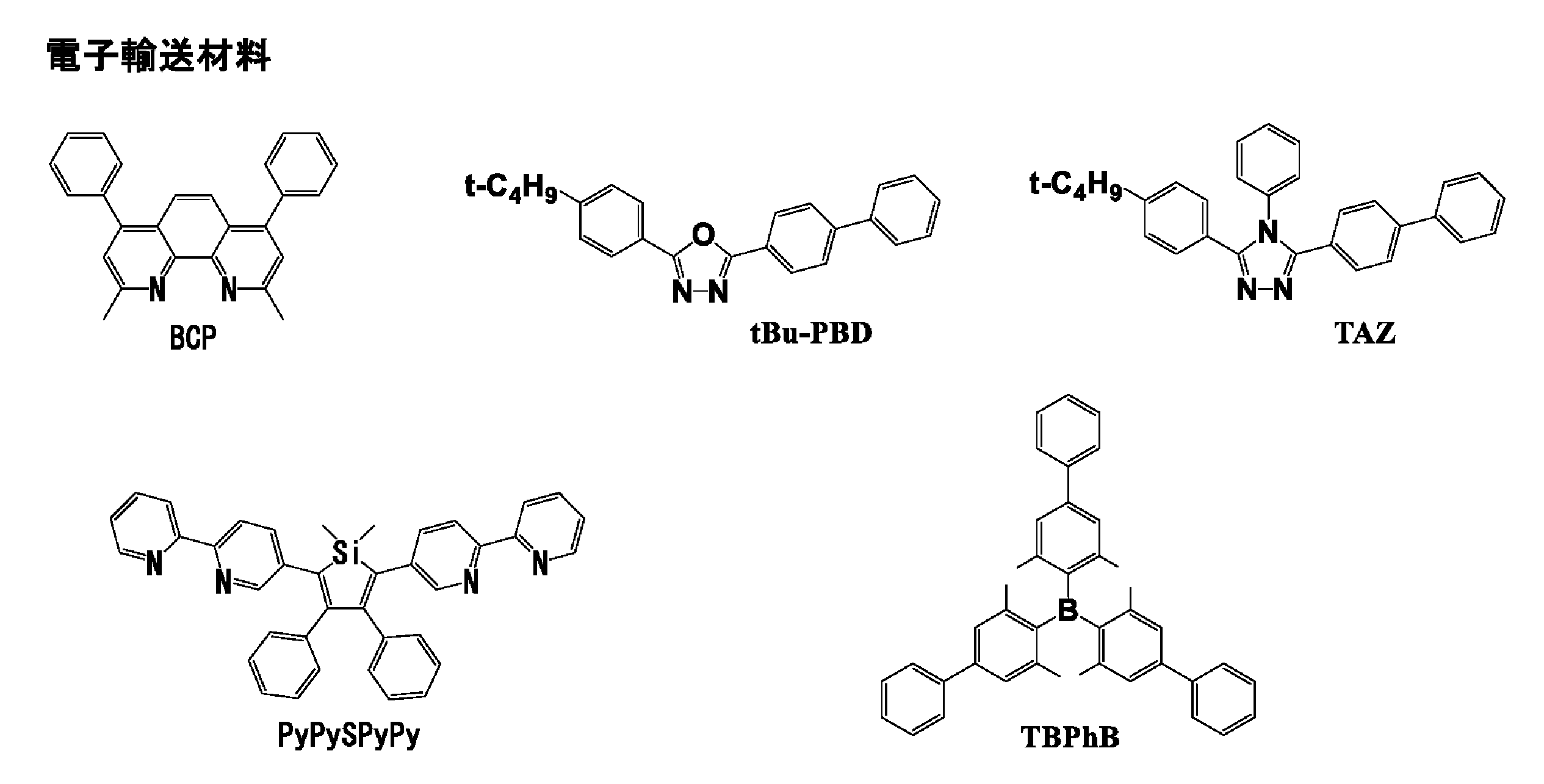
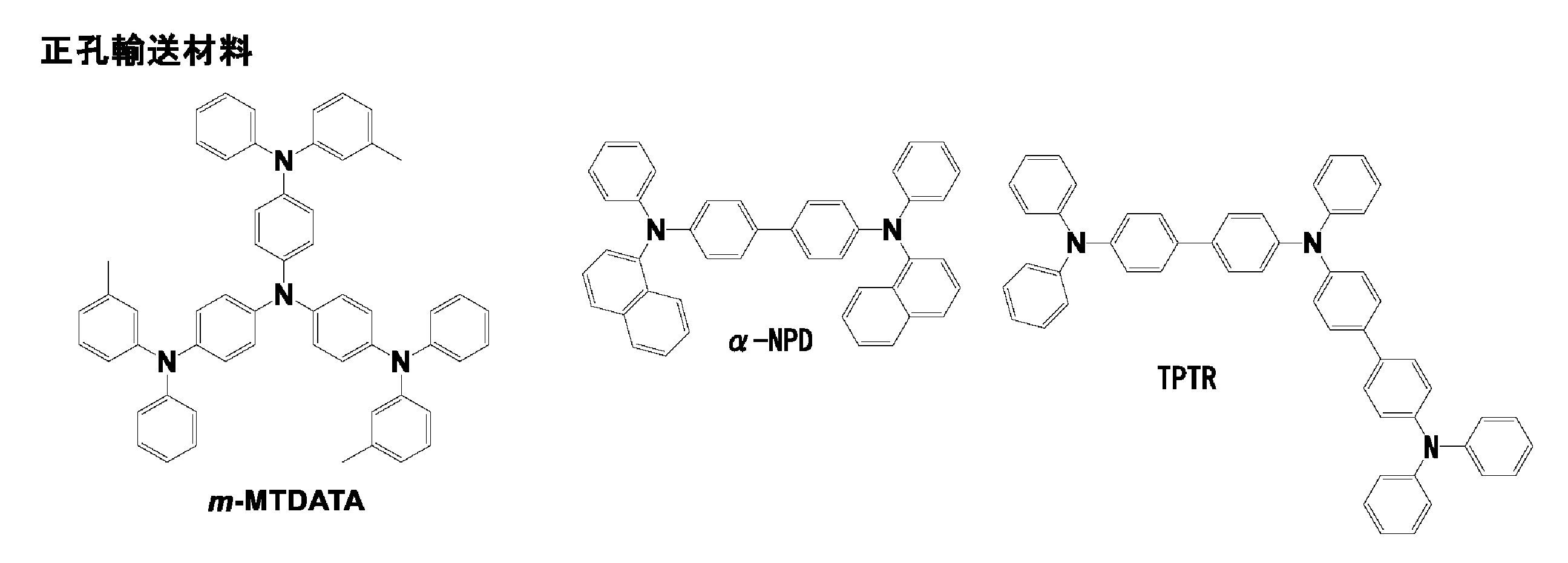


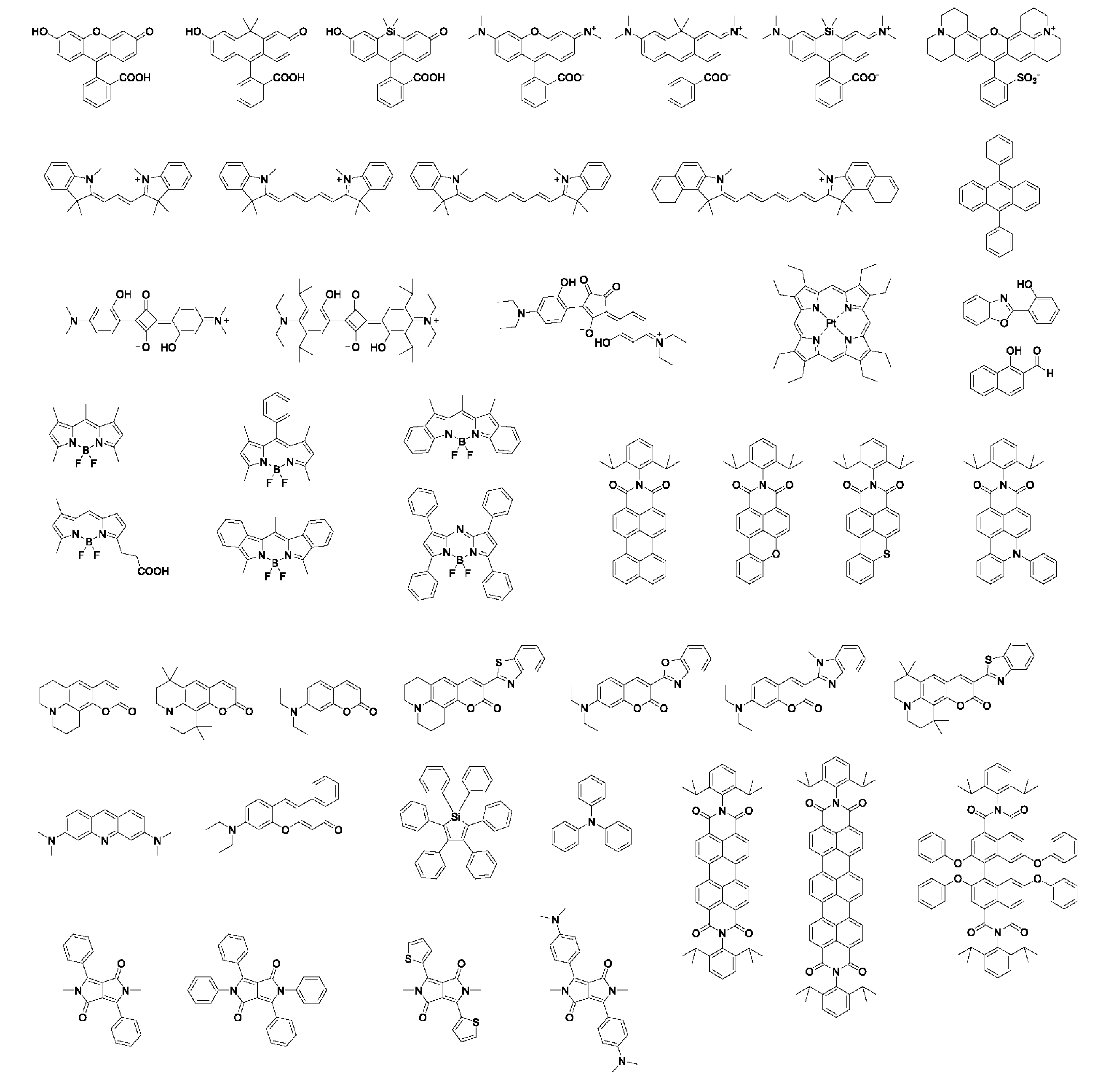
また、上記以外の発色団または発光団の例には、以下のものが含まれる。
さらに、本実施形態で使用する発光プローブは、非発光性のモノマー由来の構造を有していてもよい。このような非発光性モノマー由来の構造は、例えば飲食物と発光プローブとの相互作用をコントロールする部位として機能することが可能である。代表的な機能とそれを実現するモノマー構造の例を示す。 Furthermore, the luminescent probe used in this embodiment may have a structure derived from a non-luminescent monomer. Such a structure derived from a non-luminescent monomer can function as a site that controls the interaction between food and drink and the luminescent probe. Examples of representative functions and monomer structures that realize them are shown below.
A1)金属イオンを捕捉する化合物
代表的にはキレートを形成する配位子構造を有するものが挙げられ、配位の形式としては、N,N配位,N,O配位,O,O配位,N,S配位,O,S配位,S,S配位,N,Se配位,O,Se配位,S,Se配位,Se,Se配位などが含まれる。具体例には、2,2’-ビピリジン、フェナントロリン、1,8-ジアミノナフタレン、アミノ酸、クリプタンド、クラウンエーテル、8-ヒドロキシキノリン、3-メルカプトプロパノール、3-メルカプトプロピオン酸、チオカテコール、サリチルアルデヒド、アセト酢酸エステル、βジケトンなどが含まれる。
A1) Compounds Capturing Metal Ions Representative examples include compounds having a ligand structure that forms a chelate, and the coordination type includes N,N coordination, N,O coordination, O,O coordination, N,S coordination, O,S coordination, S,S coordination, N,Se coordination, O,Se coordination, S,Se coordination, Se,Se coordination, etc. Specific examples include 2,2'-bipyridine, phenanthroline, 1,8-diaminonaphthalene, amino acids, cryptands, crown ethers, 8-hydroxyquinoline, 3-mercaptopropanol, 3-mercaptopropionic acid, thiocatechol, salicylaldehyde, acetoacetic esters, β-diketones, etc.
A2)照射する光の波長によって分子形状が変化する化合物
代表例には、アゾベンゼン、スチルベン、フルギド、ジアリールエテン、スピロピラン、スピロオキサジン、ジヒドロピレン、フェノキシキノン、ビインデニリデンジオン、コバルト錯体、イミダゾール二量体などが含まれる。
A2) Compounds whose molecular shape changes depending on the wavelength of light irradiated. Representative examples include azobenzene, stilbene, fulgide, diarylethene, spiropyran, spirooxazine, dihydropyrene, phenoxyquinone, biindenylidenedione, cobalt complexes, and imidazole dimers.
A3)ルイス酸として働く化合物
代表的には、13族元素や遷移金属などが挙げられ、具体例には、トリアリールボラン、トリアルキルボラン、トリアルコキシボラン、トリフルオロボラン、トリクロロボラン、トリブロモボランなどが含まれる。
A3) Compounds that act as Lewis acids Representative examples include Group 13 elements and transition metals, and specific examples include triarylborane, trialkylborane, trialkoxyborane, trifluoroborane, trichloroborane, and tribromoborane.
A4)ルイス塩基として働く化合物
代表的には、15,16族元素などが挙げられ、具体例には、アリールアミン、アルキルアミン、アリールホスフィン、アルキルホスフィン、アリールエーテル、アルキルエーテル、アリールスルフィド、アルキルスルフィドなどが含まれる。
A4) Compounds that act as Lewis bases Representative examples include Group 15 and 16 elements, and specific examples include arylamines, alkylamines, arylphosphines, alkylphosphines, aryl ethers, alkyl ethers, aryl sulfides, and alkyl sulfides.
A5)ペプチドやタンパク質と相互作用する化合物
代表的には、核酸塩基、遷移金属錯体、オキソ酸などが挙げられ、具体例には、アデニン、チミン、グアニン、チミン、シトシン、亜鉛錯体、銅錯体、ニッケル錯体、コバルト錯体、タングステン酸、モリブデン酸、リン酸などが含まれる。
A5) Compounds that interact with peptides or proteins Representative examples include nucleic acid bases, transition metal complexes, and oxoacids. Specific examples include adenine, thymine, guanine, thymine, cytosine, zinc complexes, copper complexes, nickel complexes, cobalt complexes, tungstic acid, molybdic acid, and phosphate.
A6)疎水性-疎水性相互作用を形成する化合物
代表例には、直鎖アルカン、直鎖アルケン、直鎖アルキン、分岐アルカン、分岐アルケン、分岐アルキン、芳香環、ヘテロ芳香環などが含まれる。
A6) Compounds that form hydrophobic-hydrophobic interactions Representative examples include straight-chain alkanes, straight-chain alkenes, straight-chain alkynes, branched alkanes, branched alkenes, branched alkynes, aromatic rings, heteroaromatic rings, and the like.
A7)双極子-双極子もしくは四極子-四極子相互作用を形成する化合物
代表例には、ハロゲン化アルキル、ハロゲン化アリール、ニトリル、ニトロアレーン、アニリン、アニソール、複素環式化合物などが含まれる。
A7) Compounds that form dipole-dipole or quadrupole-quadrupole interactions Representative examples include alkyl halides, aryl halides, nitriles, nitroarenes, anilines, anisoles, heterocyclic compounds, and the like.
なお、本実施形態では、発光プローブが発色団または発光団として、蛍光を発する構造、エキシマー発光を発する構造、およびエキサイプレックス発光を発する構造から選ばれる、少なくとも一つの構造を含むことが好ましく、蛍光を発する構造を少なくとも含むことが好ましい。発光プローブが蛍光を発する場合、検出しやすく、かつ解析しやすいという利点がある。 In this embodiment, the luminescent probe preferably contains, as a chromophore or luminophore, at least one structure selected from a structure that emits fluorescence, a structure that emits excimer emission, and a structure that emits exciplex emission, and preferably contains at least a structure that emits fluorescence. When the luminescent probe emits fluorescence, this has the advantage that it is easy to detect and analyze.
さらに、上記発光プローブは、波長300~400nmの光の照射によって、複数種類の発光を呈することが好ましい。発光プローブが、当該波長の光の照射によって、複数種類の発光を呈すると、飲食物を解析する際、特別な光源が不要であり、かつ飲食物にダメージを及ぼし難くなる。 Furthermore, it is preferable that the luminescent probe exhibits multiple types of luminescence when irradiated with light having a wavelength of 300 to 400 nm. If the luminescent probe exhibits multiple types of luminescence when irradiated with light of the wavelength, a special light source is not required when analyzing food and drink, and damage to the food and drink is reduced.
ただし、励起光源にLEDや有機EL素子を用いる場合には可視光域での励起が有利となるため、そのような場合には上記発光プローブの吸収波長は400~700nmが有効となり、そのような色素を用いることもできる。 However, when using an LED or an organic EL element as the excitation light source, excitation in the visible light range is advantageous, and in such cases, the absorption wavelength of the above-mentioned luminescent probe is effective at 400 to 700 nm, and such dyes can also be used.
上記発光プローブの分子量(シグナル発生部および基部を有する場合は、シグナル発生部の分子量)は、発光プローブが有する発色団や発光団の種類、主鎖の長さなどに応じて適宜選択されるが、通常500以上10000以下が好ましく、500以上4000以下がより好ましい。発光プローブの分子量が10000以下であると、飲食物に対する特異性が適度に低くなり、飲食物の複数の箇所に非特異的に反応させたりすることが可能となる。 The molecular weight of the luminescent probe (the molecular weight of the signal generating part if it has a signal generating part and a base) is appropriately selected depending on the type of chromophore or luminophore possessed by the luminescent probe, the length of the main chain, etc., but is usually preferably 500 to 10,000, more preferably 500 to 4,000. When the molecular weight of the luminescent probe is 10,000 or less, the specificity to food and drink is appropriately low, making it possible to react nonspecifically with multiple sites in food and drink.
なお、上記の説明では、シグナル発生部の核酸構造の主鎖を構成する構造単位が、DNAやRNAのようなペントースまたはヘキソース由来の糖構造およびリン酸エステル結合を含む構造単位を有していたが、上述のように、これらに限定されない。他の構造単位の代表例としては下記のようなペプチド核酸型の構造単位が挙げられる。

ペプチド核酸はDNA/RNAと同様、市販の自動合成装置(ペプチド合成装置)を用いることで網羅的な合成が可能である。ペプチド核酸は、電荷を持たず静電反発が無いことから、飲食物とより強い会合体を形成することができる。さらに、ヌクレアーゼやプロテアーゼといった酵素に耐性がある。さらに、比較的大スケールでの合成が可能である。ただし、非イオン性構造のため、水中では凝集して溶解性が低下することがある。したがって、シグナル発生部がペプチド核酸由来の構造を有する場合には、シグナル発生部に連結する基部の種類を適切に選択したり、溶媒を選択したりすることが好ましい。 Like DNA/RNA, peptide nucleic acids can be comprehensively synthesized using a commercially available automated synthesizer (peptide synthesizer). Since peptide nucleic acids have no charge and no electrostatic repulsion, they can form stronger associations with food and drink. In addition, they are resistant to enzymes such as nucleases and proteases. Furthermore, they can be synthesized on a relatively large scale. However, because of their non-ionic structure, they may aggregate in water and lose their solubility. Therefore, when the signal generating part has a structure derived from peptide nucleic acid, it is preferable to appropriately select the type of base to be linked to the signal generating part and to select the solvent.
ここで、上記発光プローブの製造方法は、発光プローブの構造に応じて適宜選択される。例えば上述の糖構造を有する発光プローブは、以下の方法で製造できる。ペントースまたはヘキソースに上記発色団または発光団、およびリン酸エステルを結合させたモノマーを準備する。当該モノマーをDNA/RNA合成機などにより、ホスホロアミダイド法を利用して、所望の配列で重合することにより合成できる。このような方法によれば、例えば図5の模式図に示すように、発色団または発光団の種類(図5においては、A、B、Cで表す)が異なる複数種類のモノマー(図5においては3種類)を準備し、当該モノマーの配列順序を変えて所望の数結合させる(図5では3つ結合)ことができる。つまり、発色団または発光団の種類が異なる、複数種類のモノマーから、多種多様な発光プローブを合成可能である。図5に示す例では、27通りの発光プローブを合成可能である。使用するモノマーの種類や、モノマーの結合数を変更すれば、非常に多くの種類の発光プローブを合成することが可能である。 Here, the method for producing the luminescent probe is appropriately selected according to the structure of the luminescent probe. For example, the luminescent probe having the above-mentioned sugar structure can be produced by the following method. A monomer is prepared in which the chromophore or luminophore and a phosphate ester are bound to a pentose or hexose. The monomer can be synthesized by polymerizing the monomer in a desired sequence using the phosphoramidite method with a DNA/RNA synthesizer or the like. According to this method, as shown in the schematic diagram of FIG. 5, for example, multiple types of monomers (three types in FIG. 5) with different types of chromophore or luminophore (represented by A, B, and C in FIG. 5) can be prepared, and the monomers can be bonded in the desired number by changing the sequence order (three bonds in FIG. 5). In other words, a wide variety of luminescent probes can be synthesized from multiple types of monomers with different types of chromophore or luminophore. In the example shown in FIG. 5, 27 types of luminescent probes can be synthesized. By changing the type of monomer used and the number of monomers bonded, a very large number of luminescent probes can be synthesized.
なお、当該ホスホロアミダイド法を行う際には、通常、モノマーの一部、例えば糖構造のヒドロキシル基(例えばリボースまたはデオキシリボースの3位の炭素に結合するヒドロキシル基)、もしくはリン酸由来のヒドロキシ基を粒子状の担体(本明細書では、「担体粒子」とも称する)に担持させて重合反応を行う。当該担体粒子は、例えば多孔質ガラス、多孔質シリカゲル、またはポリスチレンなど、なお多孔質ガラスにはシリカゲルやアルミナなどの金属酸化物の多孔質体を含む。発光プローブの合成(モノマーの重合)後、当該担体を除去し、発光プローブのみを取得してもよいが、発光プローブを担体粒子に担持させた状態で使用してもよい。さらに、上記発光プローブと液体とを混合し、これをインクとして使用してもよい。 When the phosphoramidite method is carried out, a part of the monomer, for example, a hydroxyl group of a sugar structure (for example, a hydroxyl group bonded to the carbon at the 3rd position of ribose or deoxyribose) or a hydroxyl group derived from phosphoric acid is usually supported on a particulate carrier (also referred to as a "carrier particle" in this specification) and a polymerization reaction is carried out. The carrier particle is, for example, porous glass, porous silica gel, or polystyrene, and porous glass includes porous bodies of metal oxides such as silica gel and alumina. After synthesis of the luminescent probe (polymerization of the monomer), the carrier may be removed to obtain only the luminescent probe, or the luminescent probe may be used in a state where it is supported on the carrier particle. Furthermore, the luminescent probe may be mixed with a liquid and used as an ink.
上記発光プローブは、自然界に存在する物質(例えばDNAやRNA)などと類似の主鎖構造を有する。そのため、各種飲食物と容易に相互作用することが可能であり、当該発光プローブによれば、飲食物の状態を詳細に把握することが可能である。また、上述の発光プローブは、特定の波長の光の照射によって発光する。そのため、飲食物の状態に応じて、様々な発光データを得ることが可能であり、飲食物を非常に詳細に分析することが可能である。 The luminescent probe has a main chain structure similar to that of substances present in nature (e.g., DNA and RNA). Therefore, it can easily interact with various foods and beverages, and the luminescent probe can be used to grasp the state of the food and beverage in detail. In addition, the luminescent probe emits light when irradiated with light of a specific wavelength. Therefore, it is possible to obtain various luminescence data depending on the state of the food and beverage, and it is possible to analyze the food and beverage in great detail.
その効果発現メカニズムを図6A~図6Dに模式的に示す。まず、理解を促す目的で発光プローブを図6Aに示す4つの糖構造と4つの発光団を有する分子とする。4つあるRは全てピレン(図6中、Py)でも、ジメチルアミノビフェニル(図6中のN)であっても、その混合でもよい。また4つのRのうち、一つまたは二つは水素原子であってもよい。このような分子構造によって、複合型の発光プローブという形態が構築できる。 The mechanism by which this effect manifests itself is shown diagrammatically in Figures 6A to 6D. First, to facilitate understanding, the luminescent probe is a molecule having the four sugar structures and four luminophores shown in Figure 6A. All four R's may be pyrene (Py in Figure 6), dimethylaminobiphenyl (N in Figure 6), or a mixture of both. Furthermore, one or two of the four R's may be hydrogen atoms. With such a molecular structure, a composite luminescent probe can be constructed.
本実施形態においては、発光プローブが飲食物と複雑な相互作用を起こすことが、多次元で、かつ、大量のデータを光や色のシグナルとして発生することが特徴である。その概念を最もシンプルに具体的に示したものが図6B~図6Dであり、狙いとしては大きく分けて3つを想定している。 The feature of this embodiment is that the complex interactions between the luminescent probe and food and drink generate large amounts of multidimensional data as light and color signals. Figures 6B to 6D show this concept in the simplest and most specific way, and there are three main aims.
例えば、上記のRが全てピレンの場合を想定してみると、この発光プローブが存在する液中、または媒体中に、飲食物を接触させ紫外光で励起した場合、その飲食物に含まれ、かつ該発光プローブ中に存在するピレンとピレンの間に挿入される成分であって、ピレンの蛍光を消光させないバンドギャップの広い成分(例えば脂肪族化合物など)が存在する場合には、該発光プローブからは図6Bの左図に示すピレンのモノマー発光が観測される。 For example, if we consider a case where all of the R's above are pyrene, when food or drink is brought into contact with the liquid or medium in which this luminescent probe is present and excited with ultraviolet light, if there is a component (such as an aliphatic compound) contained in the food or drink that is inserted between the pyrenes present in the luminescent probe and has a wide band gap that does not quench the fluorescence of pyrene, monomeric pyrene emission as shown in the left diagram in Figure 6B will be observed from the luminescent probe.
飲食物の中に全くピレンと相互作用する成分が含まれない場合は、図6Bの中央図のようにピレンのエキシマー発光が得られる。また、検体の中にピレンと相互作用するピレンのバンドギャップに近いエネルギー準位を持つ成分(蛍光性物質)が存在する場合には、図6Bの右図のように、ピレンと当該成分(該蛍光物質)によるエキサイプレックス発光が得られる。 If the food or drink does not contain any components that interact with pyrene, excimer emission from pyrene is obtained, as shown in the center of Figure 6B. Furthermore, if the sample contains a component (fluorescent substance) that interacts with pyrene and has an energy level close to the band gap of pyrene, exciplex emission from pyrene and the component (fluorescent substance) is obtained, as shown in the right diagram of Figure 6B.
さらに飲食物の中にナトリウムイオンやカルシウムイオンのような成分(金属イオン)が存在する場合には、発光プローブの主鎖部分に存在するリン酸基との間でキレートを形成するが、図6Dに示すように金属イオンの大きさによってピレンとピレンの分子間距離が変化するため、エキシマー発光自体も発光色(発光スペクトル)が変化する。 Furthermore, when metal ions such as sodium ions or calcium ions are present in food or drink, they form a chelate with the phosphate group present in the main chain of the luminescent probe. As shown in Figure 6D, the intermolecular distance between pyrene molecules changes depending on the size of the metal ion, and the color of the excimer emission (emission spectrum) also changes.
また、図6Aに示す構造のRがジメチルアミノビフェニル(N)の場合は、図6Cのような酸と塩基の近接による蛍光色素(N)の発光色(スペクトル)変化がおこる。これは鉱酸(硫酸や硝酸など)とアルカリ金属のようなオン/オフのスイッチングのような酸塩基イオン対形成とは異なる。この場合、検体側に含まれる物質の酸性度(プロトンの供出しやすさ)によってNとの接近距離が連続的に変化する。したがって、この発光現象をシグナルに使うことはダイナミックレンジの拡張に繋がる。またNはルイス塩基であるため、プロトン性の酸性物質以外でもルイス酸性の物質(例えばトリアリールボランやトリアルキルアルミニウム、テトラアルコキシチタンなど)とも同様の相互作用を起こす。そのため、このような成分が飲食物に含まれている際にも特異的な発光色変化を起こす。 In addition, when R in the structure shown in Figure 6A is dimethylaminobiphenyl (N), the emission color (spectrum) of the fluorescent dye (N) changes due to the proximity of the acid and base as shown in Figure 6C. This is different from the on/off switching of an acid-base ion pair such as mineral acids (such as sulfuric acid and nitric acid) and alkali metals. In this case, the proximity distance to N changes continuously depending on the acidity (ease of donating protons) of the substance contained in the sample. Therefore, using this emission phenomenon as a signal leads to an expansion of the dynamic range. In addition, since N is a Lewis base, it interacts in a similar way with Lewis acidic substances (such as triarylborane, trialkylaluminum, and tetraalkoxytitanium) in addition to protic acidic substances. Therefore, when such ingredients are contained in food or drink, a specific emission color change occurs.
次に、発光プローブのRが一つおきにピレン(Py)とジメチルアミノビフェニル(N)の場合は、上記とは違って検体とピレン、ならびにジメチルアミノビフェニルとの間で何も相互作用がない場合には、ピレンとジメチルアミノビフェニルとのエキサイプレックス発光が観測される。一方、相互作用する場合には前記と同様に検体成分とピレンおよび/またはジメチルアミノビフェニルとの混合エキサイプレックスによる複雑な発光が得られる。 Next, when every other R in the luminescent probe is pyrene (Py) and dimethylaminobiphenyl (N), exciplex luminescence between pyrene and dimethylaminobiphenyl is observed if there is no interaction between the sample and pyrene or dimethylaminobiphenyl, unlike the above. On the other hand, if there is interaction, complex luminescence due to mixed exciplexes between the sample components and pyrene and/or dimethylaminobiphenyl is obtained, as described above.
また、4つのRのうち内側の一つまたは二つが水素原子の場合は、発光プローブ自体からはエキシマー発光やエキサイプレックス発光は起こらないか、またはその寄与は小さく、ほぼモノマー発光が観測されるが、水素原子の立体障害が小さいため、飲食物中と発光団のRとの間の相互作用は増強され、発光シグナルの変化は増強されることになる。 In addition, when one or two of the four inner R's are hydrogen atoms, excimer or exciplex emission does not occur from the luminescent probe itself, or the contribution of such emission is small, and monomer emission is observed. However, because the steric hindrance of the hydrogen atoms is small, the interaction between the food or drink and the R of the luminophore is enhanced, and the change in the luminescence signal is enhanced.
図6A中のPyやNが、通常の蛍光性物質ではなく、リン光性化合物や熱励起型遅延蛍光化合物である場合は、励起した直後よりも数十ナノ秒から数マイクロ秒遅れたタイミングで発光が出てくる。そのため、発光色ではなく「時間」というファクターがダイナミックレンジを拡張することとなり、図6B~図6Dのような機構に加え、このような現象も本実施形態には適用可能となる。 If the Py or N in Figure 6A is not a normal fluorescent substance but a phosphorescent compound or a thermally excited delayed fluorescent compound, light will be emitted several tens of nanoseconds to several microseconds after excitation. Therefore, it is the factor of "time" rather than the color of the emitted light that expands the dynamic range, and in addition to the mechanisms shown in Figures 6B to 6D, this phenomenon can also be applied to this embodiment.
このような分子間相互作用およびそれによる発光色や発光スペクトルの微妙な変化、または数マイクロ秒という発光の遅れなど、さらには主鎖構造に起因する金属キレート形成によってもたらされる発光現象のごく微妙な変化は、これまで人間が理解するための分析情報としては適用が不可能であった。しかし、近年一般的に使用可能となった人工知能(AI)やそれを活用した機械学習やインフォマティクスを利用することを前提とすると、このような人智の理解を超えた多用な発光現象が対象とする飲食物に対応した状態記述データになる。 Until now, such intermolecular interactions and the resulting subtle changes in luminescence color and spectrum, as well as delays in luminescence of several microseconds, and even the extremely subtle changes in luminescence phenomena brought about by metal chelate formation due to the main chain structure, have not been applicable as analytical information for humans to understand. However, assuming the use of artificial intelligence (AI), which has become widely available in recent years, and the machine learning and informatics that utilize it, such diverse luminescence phenomena that are beyond human comprehension can become state description data corresponding to the target food and drink.
(相互作用工程)
相互作用工程S11では、対象となる飲食物を、上述の単独発光情報を取得した発光プローブと相互作用させる。本実施形態では、12種類の飲食物を、上述の96穴ウェルプレート100の各列(c1列~c12列)に、それぞれ配置する。本実施形態では、同一の列に、同一の飲食物を配置しているが、当該配置方法に限定されない。
(Interaction process)
In the interaction step S11, the target food and drink is allowed to interact with the luminescent probe from which the above-mentioned single luminescence information has been obtained. In this embodiment, 12 types of food and drink are arranged in each row (row c1 to row c12) of the above-mentioned 96-
なお、飲食物と発光プローブの相互作用方法は特に限定されず、例えばウェルプレート内で混合するだけであってもよいが、必要に応じて加熱したり、相互作用促進のための薬品を添加したりしてもよい。さらに、所定時間静置することで、相互作用を促進させてもよい。 The method of interaction between food and drink and the luminescent probe is not particularly limited. For example, they may be simply mixed in a well plate, but if necessary, they may be heated or a chemical may be added to promote the interaction. Furthermore, the interaction may be promoted by leaving them to stand for a predetermined period of time.
・飲食物について
本実施形態の方法を適用可能な飲食物は、発光プローブと相互作用可能であればよく、飲料であってもよく、野菜や肉、魚など、素材そのものや、加工前や調理前の原材料であってもよい。また、加工中または調理中のものであってもよく、加工済のものや調理済みのものであってもよい。さらに一定期間保存後のものなどであってもよい。また、当該飲食物は、液体状であってもよく、固体状であってもよく、ペースト状などであってもよい。ただし、液体状であるほうが、発光プローブと相互作用しやすい。また飲食物に複数の材料が含まれている場合に、液体状のほうが、複数の材料が均一に混ざりやすく、全体の味覚を解析しやすい。したがって、固体状の成分については、細かく刻んだり、すりつぶしたりし、これらから液体成分を抽出して発光プローブと相互作用させてもよい。
- Food and drink The food and drink to which the method of the present embodiment can be applied may be any food and drink that can interact with the luminescent probe, and may be a beverage, a vegetable, meat, fish, or other raw material itself, or raw materials before processing or cooking. The food and drink may be in the process of processing or cooking, or may be processed or cooked. Furthermore, the food and drink may be stored for a certain period of time. The food and drink may be in a liquid state, a solid state, a paste state, or the like. However, the liquid state is more likely to interact with the luminescent probe. In addition, when a food and drink contains multiple ingredients, the liquid state makes it easier for the multiple ingredients to mix evenly, and makes it easier to analyze the overall taste. Therefore, the solid ingredients may be finely chopped or crushed, and liquid ingredients may be extracted from these and allowed to interact with the luminescent probe.
(相互作用発光情報取得工程)
相互作用発光情報取得工程S12では、飲食物および発光プローブを相互作用させた状態で発光プローブを励起させ(本実施形態では励起光を照射し)、発光プローブが発する相互作用発光情報を取得する。本工程でも、上述の各ウェルに配置した、飲食物と相互作用状態の発光プローブの相互作用発光情報を個別に取得してもよいが、全てのウェルプレートの発光プローブの相互作用発光情報を一度に取得することが、解析効率などの観点でより好ましい。
(Interaction luminescence information acquisition step)
In the interaction luminescence information acquisition step S12, the luminescent probe is excited (irradiated with excitation light in this embodiment) while the food or drink and the luminescent probe are interacting with each other, and interaction luminescence information emitted by the luminescent probe is acquired. In this step, the interaction luminescence information of the luminescent probe interacting with the food or drink placed in each well described above may be acquired individually, but it is more preferable to acquire the interaction luminescence information of the luminescent probes in all well plates at once in terms of analysis efficiency, etc.
また、取得する相互作用発光情報の種類は特に制限されず、通常、上述の単独発光情報と同種の情報を取得することが好ましい。例えば、特定の励起光(単一波長の励起光)を照射し、これによって、各発光プローブが発する光の強度や波長(発光情報)を、分光光度計などによって検出してもよい。さらに、得られた光を例えば3刺激値(例えばCIE表色系のXYZ)に分解し、XYZそれぞれについての3つのデータを相互作用発光情報として取得してもよい。また、特定の励起光を照射した場合に、発光プローブが発する光の分光分布の経時変化や、経時での色度変化を、連続的または断続的に分光光度計などで検出してもよい。 The type of interaction luminescence information to be acquired is not particularly limited, and it is usually preferable to acquire the same type of information as the above-mentioned single luminescence information. For example, a specific excitation light (single wavelength excitation light) may be irradiated, and the intensity and wavelength (luminescence information) of the light emitted by each luminescent probe may be detected by a spectrophotometer or the like. Furthermore, the obtained light may be decomposed into, for example, tristimulus values (for example, XYZ of the CIE color system), and three pieces of data for each of XYZ may be acquired as interaction luminescence information. In addition, when a specific excitation light is irradiated, the change over time in the spectral distribution of the light emitted by the luminescent probe and the change in chromaticity over time may be detected continuously or intermittently by a spectrophotometer or the like.
さらに、発光プローブが発する光の色度変化などを取得してもよい。この場合、単一の波長の励起光を短時間のみ照射し、これを受けて発光プローブが発する光をCCDカメラ、CMOSカメラなどで画像や動画として取得してもよい。得られた画像や動画から色度などを特定し、経時の色度変化に関するデータなどを相互作用発光情報としてもよい。 Furthermore, the change in chromaticity of the light emitted by the luminescent probe may be acquired. In this case, excitation light of a single wavelength may be irradiated for only a short period of time, and the light emitted by the luminescent probe in response to this may be acquired as an image or video using a CCD camera, CMOS camera, or the like. The chromaticity may be identified from the acquired image or video, and data on the change in chromaticity over time may be used as interaction luminescence information.
なお、相互作用発光情報の取得は、飲食物および発光プローブの相互作用が十分に進んだ状態で行うことが好ましい。したがって、例えば上記3刺激値XYZを相互作用発光情報として取得する場合などには、以下の方法で相互作用発光情報を取得することが好ましい。まず、発光プローブが発する光の3刺激値XYZを複数回取得する。なお、複数回とは、異なるタイミングで、それぞれ3刺激値XYZを取得することを意味する。そして、複数回取得した3刺激値XYZから、3刺激値XYZそれぞれの経時変化を特定する。特定した経時変化から、各刺激値について、10分間の値の変動割合が±10%以下となる範囲を特定する。変動割合とは、(特定の時点tにおける刺激値a)と(特定の時点tより10分前の刺激値b)との差を、(特定の時点tより10分前の刺激値a)で除した割合、すなわち{(a-b)/a}×100で算出される値をいう。通常、各刺激値の変動割合は、飲食物および発光プローブの相互作用が進むにつれ小さくなる。そして、少なくとも1つの刺激値の10分間の変動割合が±10%以下になった後に取得した3刺激値XYZを、相互作用発光情報として取得することが好ましい。なお、どのデータを相互作用発光情報とするかは、後述の解析工程にて判断してもよい。
It is preferable to obtain the interaction luminescence information when the interaction between the food and drink and the luminescent probe has progressed sufficiently. Therefore, for example, when obtaining the above-mentioned tristimulus value XYZ as the interaction luminescence information, it is preferable to obtain the interaction luminescence information by the following method. First, the tristimulus value XYZ of the light emitted by the luminescent probe is obtained multiple times. Note that multiple times means obtaining the tristimulus value XYZ at different times. Then, from the tristimulus values XYZ obtained multiple times, the change over time of each tristimulus value XYZ is specified. From the specified change over time, the range in which the fluctuation rate of the value for 10 minutes is ±10% or less is specified for each stimulus value. The fluctuation rate is the rate obtained by dividing the difference between (stimulus value a at a specific time t) and (
(飲食物情報取得工程)
上述のように、本実施形態では、飲食物の化学的情報および/または物理的情報を取得する飲食物情報取得工程S14をさらに行ってもよい。当該飲食物情報取得工程で取得する化学的情報の例には、飲食物中の特定成分(例えば、味覚や香りに影響を及ぼす物質)の構造や濃度などに関する情報などが含まれる。また、物理的情報の例には、飲食物の色や、粘度、硬さなどが含まれる。本工程S14では、飲食物から、これらの情報を一種類取得してもよく、複数種類取得してもよい。
(Food and drink information acquisition process)
As described above, in this embodiment, a food and drink information acquisition step S14 may be further performed to acquire chemical information and/or physical information of the food and drink. Examples of chemical information acquired in the food and drink information acquisition step include information on the structure and concentration of specific components in the food and drink (e.g., substances that affect the taste or aroma). Examples of physical information include the color, viscosity, hardness, etc. of the food and drink. In this step S14, one type of information or multiple types of information may be acquired from the food and drink.
飲食物から化学的情報や物理的情報を取得する方法は特に制限されず、所望の情報に合わせて公知のセンサなどを用いて行うことができる。公知のセンサの例には、成分分析用の各種装置、色分析用の各種装置、味覚センサなどが含まれる。成分分析では、例えばタンパク質、脂質、炭水化物、脂肪酸、ケトン遊離脂肪酸、乳脂肪分などの含有量を特定可能である。色分析では、分光測色計(例えばコニカミノルタ社製、分光測色計測装置 CM-700dなど)によって、飲食物の色をデータかすることができる。また、味覚センサ(例えばinsent社、味覚センサTS5000Zや、Alpha MOS社製 ASTREEなど)では、五味に関するデータを取得できる。 There are no particular limitations on the method of acquiring chemical or physical information from food and drink, and it can be done using a known sensor or the like according to the desired information. Examples of known sensors include various devices for component analysis, various devices for color analysis, and taste sensors. Ingredient analysis can identify the content of, for example, protein, lipid, carbohydrate, fatty acid, ketone free fatty acid, milk fat, etc. In color analysis, a spectrophotometer (such as the spectrophotometric measuring device CM-700d manufactured by Konica Minolta) can collect data on the color of food and drink. Furthermore, a taste sensor (such as the taste sensor TS5000Z manufactured by insent or the ASTREE manufactured by Alpha MOS) can acquire data on the five tastes.
(解析工程)
本工程における解析工程S13では、上記単独発光情報取得工程S10で取得した単独発光情報と、上記相互作用発光情報取得工程S12で取得した相互作用発光情報と、を解析用データとして用い、飲食物の味覚について解析を行ってもよい。一方で、上述の飲食物情報取得工程S14を行う場合には、当該工程で取得した化学的情報および/または物理的情報を利用して、飲食物の味覚をさらに細かく解析してもよい。なお、解析によって導き出す情報の種類は特に制限されず、例えば飲食物の五味それぞれに関する情報であってもよく、これらをまとめた官能的な評価であってもよい。また、五味以外の要素、例えば味の濃さ、におい、後味、舌触りなどであってもよい。
(Analysis process)
In the analysis step S13 in this process, the single luminescence information acquired in the single luminescence information acquisition step S10 and the interaction luminescence information acquired in the interaction luminescence information acquisition step S12 may be used as analysis data to analyze the taste of the food and drink. On the other hand, when the food and drink information acquisition step S14 is performed, the taste of the food and drink may be analyzed in more detail using the chemical information and/or physical information acquired in the step. The type of information derived by the analysis is not particularly limited, and may be, for example, information on each of the five tastes of the food and drink, or a sensory evaluation that combines these. In addition, elements other than the five tastes, such as flavor intensity, odor, aftertaste, and texture, may also be included.
ここで、当該解析を行う場合には、標準データと解析用データとを単純に比較してもよいが、例えば標準データと解析用データとの比較結果を距離行列に変換して、ヒートマップ(重みづけなし)で解析したり、当該距離行列を主成分分析(PCAとも称される、異方性を重視した重みづけ)したり、DLによる分析(等方性を重視した重みづけ)などを行ってもよい。 When performing this analysis, the standard data and the analysis data may be simply compared, but for example, the comparison result between the standard data and the analysis data may be converted into a distance matrix and analyzed using a heat map (unweighted), or the distance matrix may be subjected to principal component analysis (also known as PCA, weighting that emphasizes anisotropy) or DL analysis (weighting that emphasizes isotropy).
一方、予め構築された学習済モデルなどで、上記解析用データを解析してもよい。学習済モデルは、例えば、後述の機械学習工程などによって作成することができるが、使用する学習済モデルは、後述の機械学習工程で作成するものに限定されない。学習済モデルを用いると、飲食物の味覚について、より適切な解析を行うことができる。 On the other hand, the above analysis data may be analyzed using a pre-constructed trained model. The trained model may be created, for example, by the machine learning process described below, but the trained model used is not limited to the one created by the machine learning process described below. Using a trained model allows for more appropriate analysis of the taste of food and drink.
なお、学習済モデルを参照する場合、上述の解析用データを学習済モデルに当てはめることで、飲食物がどのような味覚であるか、蓄積されたデータなどから判定(予測)することができる。なお、予測結果は、例えば、分類、回帰、クラスタリング、異常検出(外れ値検出)などとして得てもよい。 When referring to a trained model, the above-mentioned analysis data can be applied to the trained model to determine (predict) the taste of a food or drink from accumulated data, etc. The prediction results may be obtained, for example, as classification, regression, clustering, anomaly detection (outlier detection), etc.
(機械学習工程)
本実施形態の解析方法は、解析用データを機械学習し、学習済モデルを生成する学習工程をさらに有していてもよい。
(Machine learning process)
The analysis method of this embodiment may further include a learning step of performing machine learning on the analysis data to generate a learned model.
例えば、当該機械学習工程では、上述の解析用データに基づいて、予測モデルを複数構築してもよい。そして、複数の予測モデルの結果を組み合わせることで、飲食物の味覚に関する様々な情報を予測可能な学習済モデルを作成する。 For example, in the machine learning process, multiple predictive models may be constructed based on the above-mentioned analysis data. Then, the results of the multiple predictive models are combined to create a trained model that can predict various information related to the taste of food and beverages.
上記予測モデルは、飲食物の味覚(例えば五味や官能評価など)が予め判明している場合などには、解析用データの特徴を説明変数とし、その味覚を目的変数とする機械学習をそれぞれ行うことで構築可能である。説明変数としては、上述の解析用データの特徴を表す数値、およびそれらから計算された数値を用いることができる。上述の単独発光情報や相互作用発光情報が分光スペクトルである場合には、説明変数として、波長毎の光の強度などを採用できる。また、上記飲食物の化学的情報および/または物理的情報を取得した場合には、これらの情報を説明変数として使用できる。 When the taste of a food or drink (e.g., the five tastes or sensory evaluation) is known in advance, the above prediction model can be constructed by performing machine learning with the characteristics of the analysis data as explanatory variables and the taste as the objective variable. As explanatory variables, numerical values representing the characteristics of the analysis data described above and numerical values calculated from them can be used. When the above-mentioned single emission information or interaction emission information is a spectroscopic spectrum, the light intensity for each wavelength can be used as an explanatory variable. Furthermore, when chemical information and/or physical information of the above-mentioned food or drink is obtained, this information can be used as explanatory variables.
一方、目的変数は、解析の目的に応じて適宜選択可能であり、飲食物の味覚の一つの要素に限らず、複数の要素としてもよい On the other hand, the objective variable can be selected appropriately depending on the purpose of the analysis, and is not limited to one element of the taste of food and drink, but may be multiple elements.
本工程で行う機械学習は、教師あり学習であってもよいし、教師なし学習であってもよい。なお、教師あり学習とは、正解ラベルのついた学習データから「入力と出力との関係」を学習する学習方法をいう。教師なし学習とは、正解ラベルのない学習データから「データ群の構造」を学習する学習方法をいう。 The machine learning performed in this process may be supervised learning or unsupervised learning. Note that supervised learning refers to a learning method that learns the "relationship between input and output" from training data with correct answer labels. Unsupervised learning refers to a learning method that learns the "structure of a data group" from training data without correct answer labels.
また、機械学習は、強化学習、深層学習または深層強化学習であってもよい。なお、強化学習とは、試行錯誤をすることで「最適な行動系列」を学習する学習方法をいう。深層学習とは、多量のデータから、データに含まれる特徴を段階的により深く(深層で)学習する学習方法をいう。深層強化学習とは、強化学習と深層学習を組み合わせた学習方法をいう。 Machine learning may be reinforcement learning, deep learning, or deep reinforcement learning. Reinforcement learning is a learning method that learns an "optimal action sequence" through trial and error. Deep learning is a learning method that learns the features contained in data in a step-by-step manner (at a deeper level) from a large amount of data. Deep reinforcement learning is a learning method that combines reinforcement learning and deep learning.
機械学習には、一般的な解析手法(アルゴリズム)を適用できる。機械学習には、例えば、線形回帰(重回帰分析、部分最小二乗(PLS)回帰、LASSO回帰、Ridge回帰、主成分回帰(PCR)など)、ランダムフォレスト、決定木、サポートベクターマシン(SVM)、サポートベクター回帰(SVR)、ニューラルネットワーク、判別分析などにより選択される解析手法により構築された予測モデルを適用可能である。 General analytical methods (algorithms) can be applied to machine learning. For example, predictive models constructed by analytical methods selected from linear regression (multiple regression analysis, partial least squares (PLS) regression, LASSO regression, Ridge regression, principal component regression (PCR), etc.), random forest, decision tree, support vector machine (SVM), support vector regression (SVR), neural network, discriminant analysis, etc. can be applied to machine learning.
・その他
上記では、単独発光情報取得工程S10および相互作用発光情報取得工程S13をそれぞれ別のタイミングで行うことを説明した。ただし、相互作用工程S12において、図3に示すウェルプレート100の一列(例えばc1列)に飲食物を添加せず、残りの列(例えばc2列~c12列)に飲食物を添加してもよい。このように発光プローブと飲食物とを配置し、各発光プローブを励起させると、c1列で取得される発光情報が単独発光情報となり、c2列~c12列で取得される発光情報が相互作用発光情報となる。
Others In the above, it has been described that the single luminescence information acquisition step S10 and the interaction luminescence information acquisition step S13 are performed at different times. However, in the interaction step S12, food and drink may not be added to one row (e.g., row c1) of the
・他の実施形態
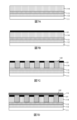
上述の説明では、図3に示すウェルプレートを使用して、単独発光情報や相互作用発光情報を取得することを説明した。ただし、有機EL素子などを応用して、単独発光情報や相互作用発光情報を得てもよい。当該実施形態について、図7A~図7Dの工程図(概略断面図)を用いて説明する。当該実施形態では、透明基板111、透明電極112(例えばITO膜など)、正孔輸送層113(例えばポリ芳香族ジアミンなど)、ポリスチレンなどの受容層兼ホスト層114を形成した積層体を準備する(図7A)。透明基板111や透明電極112、正孔輸送層113などは、公知の有機EL素子と同様である。一方、受容層兼ホスト層114は、上述の飲食物や発光プローブを受容することが可能であればよい。
Other embodiments In the above description, the well plate shown in FIG. 3 is used to obtain single emission information and interaction emission information. However, single emission information and interaction emission information may be obtained by applying an organic EL element or the like. The embodiment will be described using the process diagrams (schematic cross-sectional views) of FIG. 7A to FIG. 7D. In the embodiment, a laminate is prepared in which a
そして、このような積層体の受容層114の所望の領域に、飲食物121を任意の方法で塗布する(図7B)。続いて、飲食物121を塗布した受容層114の所望の位置に、上述の発光プローブをインクジェット法などによりパターン状に塗布する(図7C)。これにより、発光プローブを塗布した領域が発光層122となる。当該発光層122では、発光プローブおよび飲食物が相互作用する。なお、図示していないが、当該実施形態においても、飲食物を塗布していない領域に、発光プローブを塗布することで、単独発光情報を取得することも可能である。そして、当該発光層122上に透明電極112と対になる対向電極層115を配置し、有機EL素子とする。そして、当該有機EL素子の発光層122中の発光プローブを、常法によって励起させて相互作用発光情報を取得し(上述の工程S13)、解析工程S14で解析する。
Then, food and
なお、上記では、受容層114に、先に飲食物を先に塗布することを説明したが、発光プローブを先に塗布し、その後、飲食物を塗布してもよい。また、有機EL素子の構成は当該構成に限定されず、任意に変形することが可能である。
In the above, it has been described that the food or drink is applied to the
2.解析装置
上述の味覚の解析方法は、発光プローブを励起させるための励起手段(例えば励起光源や有機EL素子の場合には電源供給手段)と、発光プローブの発光情報(単独発光情報や相互作用発光情報)を取得するための発光情報取得部と、当該発光情報に基づいて、飲食物の味覚を解析するための解析部を有していればよい。
2. Analysis Device The above-mentioned taste analysis method may include an excitation means for exciting the luminescent probe (for example, an excitation light source or a power supply means in the case of an organic EL element), a luminescence information acquisition unit for acquiring luminescence information of the luminescent probe (single luminescence information or interaction luminescence information), and an analysis unit for analyzing the taste of food and drink based on the luminescence information.
励起手段は、発光プローブを励起することが可能であればよい。上記励起光源の例には、スーパーコンティニューム光源(光ファイバーの非線形効果を利用して非常に広い波長範囲にわたって、位相の揃った強い光を出す広帯域パルス光源であり、「SC光源」とも称される)やLEDなどが含まれる。これらの励起光源によれば、光量を大きくでき、発光情報が明瞭になりやすい。 The excitation means may be any means capable of exciting the luminescent probe. Examples of the above-mentioned excitation light source include a supercontinuum light source (a broadband pulse light source that utilizes the nonlinear effect of optical fibers to emit strong, phase-aligned light over a very wide wavelength range, also known as an "SC light source") and an LED. These excitation light sources can increase the amount of light, making it easier to clarify the luminescence information.
一方、発光情報取得部は、励起された発光プローブが発する発光情報を取得するための構成であり、取得する発光情報に合わせて、その種類は適宜選択される。例えば、発光情報取得部は、分光光度計や紫外可視光吸収計などであってもよく、蛍光指紋測定装置であってもよい。さらに、円二色性分散計や高速液体クロマトグラフ(HPLC)などであってもよい。CCDカメラやCMOSカメラなどであってもよい。また、発光情報取得部は、これらを2種以上組み合わせたものであってもよい。 On the other hand, the luminescence information acquisition unit is configured to acquire luminescence information emitted by the excited luminescent probe, and the type of the unit is appropriately selected according to the luminescence information to be acquired. For example, the luminescence information acquisition unit may be a spectrophotometer or an ultraviolet-visible light absorptiometer, or may be a fluorescent fingerprint measurement device. It may also be a circular dichroism spectrometer or a high-performance liquid chromatograph (HPLC), or may be a CCD camera or a CMOS camera. The luminescence information acquisition unit may also be a combination of two or more of these.
また、取得した発光情報(単独発光情報や相互作用発光情報)や、必要に応じて飲食物の化学的情報や物理的情報を解析する解析部は、一般的な情報処理装置、例えばパーソナルコンピュータなどとすることができる。このような解析部としては、プログラムやデータ、学習済モデルなどを記憶するハードディスクドライブ(HDD)、ソリッドステートドライブ(SSD)、リードオンリーメモリ(ROM)などの記憶手段、プログラムの実行や計算処理などを行う中央処理装置(CPU)を備えた一般的なコンピュータ(汎用コンピュータ)を用いることができる。また、当該コンピュータは、キーボードやマウスなどの入力手段、モニタやプリンタなどの出力手段をさらに有していてもよい。 The analysis unit that analyzes the acquired luminescence information (single luminescence information and interaction luminescence information) and, if necessary, chemical and physical information of the food and drink, can be a general information processing device, such as a personal computer. Such an analysis unit can be a general computer (general-purpose computer) equipped with a storage means such as a hard disk drive (HDD), solid state drive (SSD), or read-only memory (ROM) that stores programs, data, trained models, etc., and a central processing unit (CPU) that executes programs and performs calculations. The computer may further have input means such as a keyboard and mouse, and output means such as a monitor and printer.
なお、解析装置は、上述のウェルプレートや、有機EL素子(例えば、透明基板、透明電極、電子輸送層、受容層などを含む積層体)を、発光プローブや飲食物を内部に保持するための保持部材として有していてもよい。 The analysis device may have the above-mentioned well plate or an organic EL element (e.g., a laminate including a transparent substrate, a transparent electrode, an electron transport layer, a receptor layer, etc.) as a holding member for holding the luminescent probe or food or drink inside.
さらに、上述の飲食物の化学的情報および/または物理的情報を取得するためのセンサなどをさらに備えていてもよい。センサの種類は特に制限されず、所望の情報に基づいて適宜選択される。例えば公知の味覚センサなどであってもよい。さらに、公知のクロマトグラフィ用の装置、粘度測定装置、色度計など、いずれであってもよい。 The device may further include a sensor for acquiring chemical and/or physical information about the food and drink. The type of sensor is not particularly limited and is appropriately selected based on the desired information. For example, the sensor may be a known taste sensor. Furthermore, the sensor may be any of known chromatography devices, viscosity measuring devices, colorimeters, etc.
また、解析装置は、上述の発光プレートや飲食物を所望の位置に配置するためのインクジェット印刷部などをさらに有していてもよい。 The analysis device may further include an inkjet printing unit for placing the above-mentioned luminescent plate and food and drink at desired positions.
1.官能評価試験
市販の13種類の牛乳を準備した。そして、当該牛乳について、30名の評価者によって、官能試験を行った。具体的には、1つの牛乳の濃さ、甘さ、香りの強さ、後味の強さ、および好ましさを基準値(評価0)とした。そして、残りの12種類の牛乳(A~L)について、それぞれ濃さ、甘さ、香りの強さ、後味の強さ、および好ましさについて、多重比較法を用いて、各評価項目において有意差があるかどうかを評価し、基準値に対して相対的に-3から3までの7段階で評価した。結果を表1に示す。
1. Sensory Evaluation Test Thirteen types of commercially available milk were prepared. Then, sensory tests were conducted on the milk by 30 evaluators. Specifically, the thickness, sweetness, aroma, aftertaste, and preference of one milk were set as the reference value (evaluation 0). Then, the remaining 12 types of milk (A to L) were evaluated for thickness, sweetness, aroma, aftertaste, and preference using a multiple comparison method to determine whether there was a significant difference in each evaluation item, and were rated on a 7-point scale from -3 to 3 relative to the reference value. The results are shown in Table 1.

2.発光プローブの合成
以下の方法で、発光プローブ1~16を合成した。全ての反応は、特段の断りのない限り、オーブン乾燥したガラス器具内で窒素雰囲気のもと行った。全ての化学製品は、Aldrich又はTCI又は関東化学から購入し、さらに精製することなくそのまま使用した。
2. Synthesis of Luminescent Probes Luminescent probes 1 to 16 were synthesized as follows. All reactions were carried out in oven-dried glassware under a nitrogen atmosphere unless otherwise noted. All chemical products were purchased from Aldrich, TCI, or Kanto Chemical, and were used as is without further purification.
(1)モノマー1の合成
下記反応式に基づき、中間体1~6を経て、リン酸エステルを含む主鎖と、当該主鎖に結合した発光団を有するモノマー1を合成した。

・中間体1の合成
チミジン(15.0g、61.9mmol)とイミダゾール(16.9g、248mmol)をDMF(124mL)に溶解し、tertブチルジメチルシリルクロリド(19.6g、130mmol)を加え室温下17時間攪拌した。反応液に水を加えて酢酸エチルで分液抽出を行った。得られた有機相を硫酸マグネシウムで乾燥し、溶媒を留去することで無色固体として目的の中間体1を得た(28.3g、97%)。
Synthesis of intermediate 1 Thymidine (15.0 g, 61.9 mmol) and imidazole (16.9 g, 248 mmol) were dissolved in DMF (124 mL), tert-butyldimethylsilyl chloride (19.6 g, 130 mmol) was added, and the mixture was stirred at room temperature for 17 hours. Water was added to the reaction solution, and the mixture was separated and extracted with ethyl acetate. The obtained organic phase was dried over magnesium sulfate, and the solvent was distilled off to obtain the desired intermediate 1 as a colorless solid (28.3 g, 97%).
・中間体2の合成
中間体1(28.3g、60.1mmol)と硫酸アンモニウム(12.7g、96.2mmol)をヘキサメチルジシラザン(314mL、1.50mol)に溶解し、3時間加熱還流を行ったのち、反応液に水を加えて酢酸エチルで分液抽出を行った。得られた有機相を硫酸マグネシウムで乾燥し、溶媒を留去して得られた粗生成物をシリカゲルカラムクロマトグラフィーにより精製し目的の中間体2を褐色液体として得た(13.2g、64%)。
Synthesis of intermediate 2 Intermediate 1 (28.3 g, 60.1 mmol) and ammonium sulfate (12.7 g, 96.2 mmol) were dissolved in hexamethyldisilazane (314 mL, 1.50 mol), and the mixture was heated under reflux for 3 hours. Water was then added to the reaction solution, and the mixture was subjected to liquid separation and extraction with ethyl acetate. The organic phase was dried over magnesium sulfate, and the crude product obtained by distilling off the solvent was purified by silica gel column chromatography to obtain the desired intermediate 2 as a brown liquid (13.2 g, 64%).
・中間体4の合成
中間体2(10.1g、29.3mmol)、1-ブロモピレン(8.24g、29.3mmol)、トリス(ジベンジリデンアセトン)ジパラジウム(0)(671mg、733μmol)、トリtertブチルホスホニウムテトラフルオロボラート(850mg、2.93mmol)、ジシクロヘキシルメチルアミン(9.35mL、44.0mmol)、1,4-ジオキサン(100mL)の混合物を90℃で1時間加熱した。水を加えて反応を停止し、酢酸エチルで分液抽出を行った。得られた有機相を硫酸マグネシウムで乾燥し溶媒を留去することで得られた中間体3を含む粗生成物をそのまま次の反応に用いた。
Synthesis of intermediate 4 A mixture of intermediate 2 (10.1 g, 29.3 mmol), 1-bromopyrene (8.24 g, 29.3 mmol), tris(dibenzylideneacetone)dipalladium(0) (671 mg, 733 μmol), tri-tert-butylphosphonium tetrafluoroborate (850 mg, 2.93 mmol), dicyclohexylmethylamine (9.35 mL, 44.0 mmol), and 1,4-dioxane (100 mL) was heated at 90° C. for 1 hour. Water was added to stop the reaction, and separation and extraction were performed with ethyl acetate. The obtained organic phase was dried over magnesium sulfate, and the solvent was distilled off to obtain a crude product containing intermediate 3, which was used as it was in the next reaction.
中間体3を含む粗生成物に対し、THF100mL、1MテトラブチルアンモニウムフルオリドTHF溶液(117mL、117mmol)、酢酸(6.74mL、117mmol)を加え40℃で2時間攪拌した。水を加えて反応を停止し、酢酸エチルで分液抽出を行った。得られた有機相を硫酸マグネシウムで乾燥し溶媒を留去することで得られた粗生成物をシリカゲルカラムクロマトグラフィーにより精製することで目的の中間体4を薄褐色固体として得た(5.87g、63%)。 100 mL of THF, 1 M tetrabutylammonium fluoride THF solution (117 mL, 117 mmol), and acetic acid (6.74 mL, 117 mmol) were added to the crude product containing intermediate 3, and the mixture was stirred at 40°C for 2 hours. Water was added to stop the reaction, and separation and extraction were performed with ethyl acetate. The resulting organic phase was dried over magnesium sulfate, and the solvent was distilled off to obtain a crude product, which was purified by silica gel column chromatography to obtain the desired intermediate 4 as a light brown solid (5.87 g, 63%).
・中間体5の合成
トリアセチルホウ酸ナトリウム(11.8g、55.8mmol)および酢酸(7.87mL、138mmol)をアセトニトリル93mLに溶かした溶液を0℃に冷却し、中間体4(5.87g、18.6mmol)をTHF(62mL)に溶かした溶液を滴下した。滴下終了後室温に昇温し15分攪拌したのち水を加えた反応を停止した。酢酸エチルで分液抽出を行い得られた有機相を硫酸マグネシウムで乾燥し溶媒を留去することで粗生成物を得た。シリカゲルカラムクロマトグラフィーおよび逆相HPLCにより精製することで目的の中間体5を無色固体として得た(3.44g、58%)。
Synthesis of intermediate 5 A solution of sodium triacetylborate (11.8 g, 55.8 mmol) and acetic acid (7.87 mL, 138 mmol) dissolved in acetonitrile (93 mL) was cooled to 0 ° C., and a solution of intermediate 4 (5.87 g, 18.6 mmol) dissolved in THF (62 mL) was added dropwise. After the dropwise addition, the temperature was raised to room temperature and the mixture was stirred for 15 minutes, and then water was added to stop the reaction. The organic phase obtained by liquid separation and extraction with ethyl acetate was dried over magnesium sulfate, and the solvent was distilled off to obtain a crude product. The desired intermediate 5 was obtained as a colorless solid (3.44 g, 58%) by purifying it by silica gel column chromatography and reverse phase HPLC.
・中間体6の合成
中間体5(3.44g、10.8mmol)、4,4’-ジメトキシトリチルクロリド(4.40g、13.0mmol)、エチルジイソプロピルアミン(2.82mL、16.2mmol)、脱水ピリジン(54mL)の混合物を室温下4時間攪拌したのちメタノールを加えることで反応を停止した。溶媒を留去し得られた粗生成物をシリカゲルカラムクロマトグラフィーで精製することで目的の中間体6を無色粘性固体として得た(5.71g、85%)。
Synthesis of intermediate 6 A mixture of intermediate 5 (3.44 g, 10.8 mmol), 4,4'-dimethoxytrityl chloride (4.40 g, 13.0 mmol), ethyldiisopropylamine (2.82 mL, 16.2 mmol), and dehydrated pyridine (54 mL) was stirred at room temperature for 4 hours, and then methanol was added to terminate the reaction. The solvent was distilled off, and the resulting crude product was purified by silica gel column chromatography to obtain the desired intermediate 6 as a colorless viscous solid (5.71 g, 85%).
・モノマー1の合成
中間体6(5.71g、9.20mmol)、エチルジイソプロピルアミン(6.42mL、36.8mmol)、脱水ジクロロメタン(92mL)の混合物に2-シアノエチルジイソプロピルクロロホスホロアミジト(3.08mL、13.8mmol)を0℃で滴下した。室温に昇温し3時間攪拌したのち溶媒を留去し粗生成物を得た。シリカゲルカラムクロマトグラフィーにより精製することで目的のモノマー1を無色固体として得た(4.64g、61%)。
Synthesis of Monomer 1 2-Cyanoethyldiisopropylchlorophosphoramidite (3.08 mL, 13.8 mmol) was added dropwise to a mixture of intermediate 6 (5.71 g, 9.20 mmol), ethyldiisopropylamine (6.42 mL, 36.8 mmol), and dehydrated dichloromethane (92 mL) at 0°C. The mixture was warmed to room temperature and stirred for 3 hours, after which the solvent was distilled off to obtain a crude product. The product was purified by silica gel column chromatography to obtain the target Monomer 1 as a colorless solid (4.64 g, 61%).
(2)モノマー2の準備
モノマー2は、下記に示す構造の試薬をGlen Research社(Sterling、ヴァージニア州)から購入した。

(3)発光プローブ1~16の合成
常法に従い、下記表2に示すように、モノマー1およびモノマー2の混合配列オリゴヌクレオチド16種(Seq1~16)の合成を行った。DNA合成試薬は、Glen Research社(Sterling、ヴァージニア州)から購入した。また、全てのオリゴヌクレオチドは、日本テクノサービス社製 DNA/RNA合成機 NTS T-シリーズにてホスホロアミダイトベースのカップリング手法のための標準プロトコルを用いて合成した。自動合成により得られた各発光プローブ担持体をアンモニウム水室温2時間で反応させ粒子状担体より切り出し、遠心乾燥装置で溶媒を乾固したのち超純水を加えることで各発光プローブ1~16を含む第1成分1~16を得た。当該発光プローブ1~15は、特定の励起光(波長350nmの光)によって、蛍光およびエキシマー発光を発することが確認された。なお、発光プローブ16は、蛍光もエキシマー発光も示さなかった。
(3) Synthesis of Luminescent Probes 1 to 16 Sixteen types of mixed sequence oligonucleotides (Seq1 to 16) of monomer 1 and monomer 2 were synthesized according to a conventional method, as shown in Table 2 below. DNA synthesis reagents were purchased from Glen Research (Sterling, Virginia). All oligonucleotides were synthesized using a standard protocol for phosphoramidite-based coupling techniques with a DNA/RNA synthesizer NTS T-series manufactured by Nippon Techno Service Co., Ltd. Each luminescent probe carrier obtained by automatic synthesis was reacted with ammonium water at room temperature for 2 hours, excised from the particulate carrier, and the solvent was dried using a centrifugal dryer, followed by adding ultrapure water to obtain first components 1 to 16 containing each of the luminescent probes 1 to 16. It was confirmed that the luminescent probes 1 to 15 emit fluorescence and excimer emission by specific excitation light (light with a wavelength of 350 nm). Note that the luminescent probe 16 did not exhibit fluorescence or excimer emission.

3.味覚解析
3-1.実施例
牛乳の味覚に関する解析を、以下の方法で行った。なお、解析装置として、発光プローブの発光情報を取得するための発光情報取得部と、発光プローブを励起させるための励起手段と、発光情報に基づき、前記飲食物の味覚を解析する解析部発光情報取得部とを含む装置を用いた。なお、発光情報取得部および励起手段としては、Tecan社製 マイクロプレートリーダーSparkを使用した。また、解析部には、上記発光情報取得部および励起手段に接続された情報処理装置(コンピュータ)を用いた。
3. Taste Analysis 3-1. Example Analysis of the taste of milk was performed by the following method. The analysis device used included a luminescence information acquisition unit for acquiring luminescence information from the luminescent probe, an excitation means for exciting the luminescent probe, and an analysis unit luminescence information acquisition unit for analyzing the taste of the food or drink based on the luminescence information. The luminescence information acquisition unit and the excitation means used were a microplate reader Spark manufactured by Tecan. The analysis unit used an information processing device (computer) connected to the luminescence information acquisition unit and the excitation means.
(1)単独発光情報取得工程
96穴(12列×8行)のウェルを2つ準備した。そして、発光プローブ1を、1つ目のウェルの第1行目(12列)に注入した。続いて、発光プローブ2を2行目に注入し、同様に発光プローブ3~8を3行目~8行目に一行ずつ注入した。同様に、2つ目ウェルに、発光プローブ9~16をそれぞれ1行ずつ注入した。そして、この状態で、上記発光情報取得部(Tecan社製 マイクロプレートリーダーSpark)を用いて、各ウェルに注入した発光プローブを励起させ、そのスペクトル(単独発光情報)を得た。
(1) Single luminescence information acquisition step Two wells with 96 holes (12 columns x 8 rows) were prepared. Luminescent probe 1 was injected into the first row (12 columns) of the first well. Luminescent probe 2 was then injected into the second row, and luminescent probes 3 to 8 were similarly injected into the third to eighth rows, one row at a time. Similarly, luminescent probes 9 to 16 were each injected into one row at a time into the second well. In this state, the luminescent probes injected into each well were excited using the luminescence information acquisition unit (Microplate Reader Spark, manufactured by Tecan Corp.), and their spectra (single luminescence information) were obtained.
(2)相互作用工程
上記単独発光情報を取得した2つのウェルの列ごとに、上述の官能評価を行った牛乳A~Lを滴下した。具体的には、2つのウェルの第1の列(8穴×2)には、全て牛乳Aを滴下した。続いて、第2の列(8穴×2)には牛乳Bを滴下し、第3の列から第12の列には、牛乳CからLをそれぞれ滴下した。
(2) Interaction step Milks A to L, which had been subjected to the above-mentioned sensory evaluation, were dropped into each of the two rows of wells from which the above-mentioned single luminescence information was obtained. Specifically, milk A was dropped into the first row of two wells (8 wells x 2). Then, milk B was dropped into the second row (8 wells x 2), and milks C to L were dropped into the third row to the twelfth row, respectively.
(3)相互作用発光情報取得工程
牛乳滴下後のウェルについて、単独発光情報取得工程と同様に、発光情報取得部によって、スペクトル(相互作用発光情報)を得た。このとき、スペクトルの測定は、互いに異なるタイミングで複数回行った。
(3) Interaction luminescence information acquisition step: After the milk was dripped into the well, a spectrum (interaction luminescence information) was obtained by the luminescence information acquisition unit in the same manner as in the single luminescence information acquisition step. At this time, the spectrum was measured multiple times at different times.
(4)機械学習工程および解析工程
上記単独情報取得工程および相互作用発光情報工程で取得したスペクトルを、CIE表色系の3刺激値XYZに変換した。なお、相互作用発光情報工程で取得した複数のスペクトルの3刺激値については、3刺激値それぞれの経時変化を特定した。そして、少なくとも1つの刺激値の10分間の変動割合が±10%以内になった後のデータ(3刺激値)を、相互作用発光情報として採用した。
(4) Machine Learning Process and Analysis Process The spectra acquired in the above-mentioned single information acquisition process and interaction emission information process were converted into tristimulus values XYZ of the CIE color system. For the tristimulus values of the multiple spectra acquired in the interaction emission information process, the time-dependent changes of each tristimulus value were identified. Then, the data (tristimulus value) after the fluctuation rate of at least one stimulus value for 10 minutes became within ±10% was adopted as the interaction emission information.
そして、牛乳A~Iのデータを用いて、機械学習を行った。具体的には、牛乳A~Iについて得られたデータ3×16個(=3刺激値(X,Y,Z)×発光プローブ16種)を説明変数とし、先に行った官能評価の結果を目的変数として、PLS回帰により予測式を作成した。 Then, machine learning was performed using the data from milks A to I. Specifically, a prediction formula was created by PLS regression using the 3 x 16 pieces of data (= tristimulus values (X, Y, Z) x 16 types of luminescent probes) obtained for milks A to I as explanatory variables and the results of the sensory evaluation performed earlier as objective variables.
次いで、作成した予測式を用いて、残りの牛乳J~Lについて、濃さ、甘味、香りの強さ、後味の強さについて予測し、官能評価との結果と照らし合わせた。結果を表3に示す。なお、評価は以下の基準で行った。
A:官能評価との相関係数が0.9以上
B:官能評価との相関係数が0.7以上0.9未満
C:官能評価との相関係数が0.7未満
Next, the remaining milks J to L were predicted for richness, sweetness, aroma, and aftertaste using the prediction formula, and compared with the results of the sensory evaluation. The results are shown in Table 3. The evaluation was performed according to the following criteria.
A: The correlation coefficient with the sensory evaluation is 0.9 or more. B: The correlation coefficient with the sensory evaluation is 0.7 or more and less than 0.9. C: The correlation coefficient with the sensory evaluation is less than 0.7.
さらに、上記結果に基づき、総合の予測精度を、以下の基準で判断した。
◎:上記評価におけるAが3つ以上
〇:上記評価におけるAが1つ以上2以下
△:上記評価におけるAが0
Furthermore, based on the above results, the overall prediction accuracy was judged based on the following criteria.
◎: 3 or more A's in the above evaluation. ◯: 1 to 2 A's in the above evaluation. △: 0 A's in the above evaluation.
3-2.比較例
以下の味覚センサを用いて、牛乳A~Lについて、それぞれの装置が特定可能な複数種類のデータを測定した。
装置A:insent社製 味覚センサー TS5000Z
装置B:Alpha MOS社製 ASTREE
そして、牛乳A~Iについて、それぞれの装置A、Bによって測定された値を説明変数、先の官能評価の結果を目的変数として、PLS回帰により装置ごとに予測式を作成した。次いで、作成した予測式を用いて、残りの牛乳J~Lについて、濃さ、甘味、香りの強さ、後味の強さについて予測した。そして、実施例と同様に、官能評価の結果と照らし合わせた。結果を表3に示す。
3-2. Comparative Example Using the following taste sensors, multiple types of data that each device can identify were measured for milk A to L.
Device A: insent taste sensor TS5000Z
Device B: ASTREE manufactured by Alpha MOS
Then, for milks A to I, the values measured by devices A and B were used as explanatory variables, and the results of the sensory evaluation were used as objective variables to create a prediction equation for each device using PLS regression. Next, the created prediction equations were used to predict the strength, sweetness, aroma intensity, and aftertaste intensity for the remaining milks J to L. Then, similar to the examples, the results were compared with the results of the sensory evaluation. The results are shown in Table 3.
3-3.結果

上記表3に示すように、実施例の方法によれば、予測精度が非常に良好であり、特に濃さ、甘味、好ましさについては相関係数が0.9であった。一方、装置Aおよび装置Bを用いた比較例では、いずれも予測精度が低く、いずれの項目においても、相関係数が0.7以下であった。 As shown in Table 3 above, the method of the embodiment had very good prediction accuracy, with the correlation coefficients being 0.9 for strength, sweetness, and liking in particular. On the other hand, in the comparative examples using device A and device B, the prediction accuracy was low, with the correlation coefficients being 0.7 or less for all items.
本発明によれば、簡便にデータを取得可能であり、かつ飲食物の味覚を詳細に解析することが可能な味覚の解析方法、およびこれに使用可能な味覚解析装置が提供される。当該味覚の解析方法および味覚解析装置は、食品の製造や加工、品質管理などの分野において非常に有用である。 The present invention provides a taste analysis method that can easily acquire data and can analyze the taste of food and drink in detail, and a taste analysis device that can be used for this method. The taste analysis method and taste analysis device are extremely useful in fields such as food manufacturing, processing, and quality control.
100 ウェルプレート
111 透明基板
112 透明電極
113 正孔輸送層
114 受容層
115 対向電極層
122 発光層
REFERENCE SIGNS
Claims (8)
前記発光プローブを励起させるための励起手段と、
前記発光情報に基づき、前記飲食物の味覚を解析する解析部と、
を含む、味覚解析装置。 a luminescence information acquisition unit for acquiring luminescence information of a luminescent probe that emits light upon excitation and whose luminescence behavior changes upon interaction with food and drink;
an excitation means for exciting the luminescent probe;
an analysis unit that analyzes the taste of the food or drink based on the light emission information;
A taste analysis device comprising:
請求項1に記載の味覚解析装置。 The apparatus further includes a holding member for holding the light-emitting probe and the food or drink therein.
The taste analysis device according to claim 1 .
請求項1に記載の味覚解析装置。 The luminescent probe is a compound containing a nucleic acid structure.
The taste analysis device according to claim 1 .
前記解析部は、前記発光情報、ならびに前記化学的情報および/または物理的情報に基づき、前記飲食物の味覚を解析する、
請求項1に記載の味覚解析装置。 Further comprising a sensor for acquiring chemical and/or physical information of the food and drink;
The analysis unit analyzes the taste of the food or drink based on the luminescence information and the chemical information and/or physical information.
The taste analysis device according to claim 1 .
請求項1に記載の味覚解析装置。 The analysis unit analyzes the taste of the food and drink using a pre-constructed trained model.
The taste analysis device according to claim 1 .
前記発光プローブおよび前記飲食物を相互作用させる工程と、
前記飲食物と相互作用状態にある前記発光プローブを励起させて、相互作用発光情報を取得する工程と、
前記単独発光情報および前記相互作用発光情報に基づき、前記飲食物の味覚を解析する工程と、
を含む、
味覚の解析方法。 a step of exciting a luminescent probe that emits light upon excitation and whose luminescence behavior changes upon interaction with food or drink, in a state where the luminescent probe is not interacting with the food or drink, and acquiring independent luminescence information;
Allowing the luminescent probe and the food or drink to interact with each other;
A step of exciting the luminescent probe that is in an interactive state with the food or drink and acquiring interaction luminescence information;
analyzing the taste of the food or drink based on the single luminescence information and the interaction luminescence information;
Including,
How to analyze taste.
請求項6に記載の味覚の解析方法。 In the step of acquiring the interaction luminescence information, tristimulus values of the excitation light of the luminescent probe in an interaction state with the food or drink are acquired multiple times, and the tristimulus value at a predetermined timing after a fluctuation rate of at least one of the tristimulus values over 10 minutes becomes ±10% or less is acquired as the interaction luminescence information.
The method for analyzing taste according to claim 6.
前記飲食物の味覚を解析する工程では、前記単独発光情報、前記相互作用発光情報、ならびに前記化学的情報および/または物理的情報に基づき、解析を行う、
請求項6に記載の味覚の解析方法。
The method further comprises obtaining chemical and/or physical information of the food or beverage;
In the step of analyzing the taste of the food or drink, the analysis is performed based on the single luminescence information, the interaction luminescence information, and the chemical information and/or physical information.
The method for analyzing taste according to claim 6.
Priority Applications (1)
| Application Number | Priority Date | Filing Date | Title |
|---|---|---|---|
| JP2023148432A JP2025041250A (en) | 2023-09-13 | 2023-09-13 | Taste analysis device and taste analysis method |
Applications Claiming Priority (1)
| Application Number | Priority Date | Filing Date | Title |
|---|---|---|---|
| JP2023148432A JP2025041250A (en) | 2023-09-13 | 2023-09-13 | Taste analysis device and taste analysis method |
Publications (1)
| Publication Number | Publication Date |
|---|---|
| JP2025041250A true JP2025041250A (en) | 2025-03-26 |
Family
ID=95105121
Family Applications (1)
| Application Number | Title | Priority Date | Filing Date |
|---|---|---|---|
| JP2023148432A Pending JP2025041250A (en) | 2023-09-13 | 2023-09-13 | Taste analysis device and taste analysis method |
Country Status (1)
| Country | Link |
|---|---|
| JP (1) | JP2025041250A (en) |
-
2023
- 2023-09-13 JP JP2023148432A patent/JP2025041250A/en active Pending
Similar Documents
| Publication | Publication Date | Title |
|---|---|---|
| Qin et al. | A ratiometric supramolecular fluorescent probe for on-site determination of cyfluthrin in real food samples | |
| Kumar et al. | DNA binding studies and site selective fluorescence sensitization of an anthryl probe | |
| Widengren et al. | Single-molecule detection and identification of multiple species by multiparameter fluorescence detection | |
| Yang et al. | A novel type of fluorescent boronic acid that shows large fluorescence intensity changes upon binding with a carbohydrate in aqueous solution at physiological pH | |
| Maeda et al. | Alkynylpyrenes as improved pyrene‐based biomolecular probes with the advantages of high fluorescence quantum yields and long absorption/emission wavelengths | |
| Wu et al. | Europium (III) as a circularly polarized luminescence probe of DNA structure | |
| Venzke et al. | Preparation of fluorescent bisamides: A new class of fingermarks developers | |
| Oncul et al. | The effects of thermal quenching on the excited-state intramolecular proton transfer reaction in 3-hydroxyflavones | |
| Singh et al. | A polyelectrolyte based supramolecular assembly for ratiometric sensing of ATP with very high discrimination from pyrophosphate | |
| Long et al. | Green synthesis of N, S dual heteroatom-doped fluorescent carbon dots (N, S-CDs) and their applications in gentamicin sensing and dual-switch anti-counterfeiting encryption | |
| Koppayithodi et al. | Highly selective and quantitative point‐of‐care diagnostic method for adrenaline | |
| Nguyen et al. | EPR based distance measurement in Cu-porphyrin–DNA | |
| US20250163508A1 (en) | Analysis system, plate, and analysis method | |
| JP2025041250A (en) | Taste analysis device and taste analysis method | |
| Mohan et al. | Fabrication of eco-friendly hydrogel strips for the simultaneous quantification of heavy metal ions in aqueous environment | |
| Yamagami et al. | Synthesis and properties of V-shaped xanthene dyes with tunable and predictable absorption and emission wavelengths | |
| Baumes et al. | Fluorimetric detection and discrimination of α-amino acids based on tricyclic basic dyes and cucurbiturils supramolecular assembly | |
| Klymchenko et al. | Multiparametric probing of microenvironment with solvatochromic fluorescent dyes | |
| Liu et al. | A novel rhodamine B derivative as a “turn-on” fluorescent sensor for Cu2+ with high selectivity and sensitivity | |
| Greco et al. | Synthesis and site-specific incorporation of a simple fluorescent pyrimidine | |
| Erdemir et al. | Smart and user-friendly food quality monitoring using a red-emitting fluorescent probe for volatile primary amine detection | |
| Anslyn | Supramolecular and chemical cascade approaches to molecular sensing | |
| US20250193977A1 (en) | Composite light emission signal generation material for state sensing, light-emitting substance carrier, ink for state sensing, measurement chip, and analysis method | |
| Kick et al. | DNA microarrays for hybridization detection by surface plasmon resonance spectroscopy | |
| Füchtbauer et al. | Lighting Up DNA with the Environment‐Sensitive Bright Adenine Analogue qAN4 |
Legal Events
| Date | Code | Title | Description |
|---|---|---|---|
| A621 | Written request for application examination |
Free format text: JAPANESE INTERMEDIATE CODE: A621 Effective date: 20251224 |