JP2024137125A - Gelling agent, liquid composition and hydrogel - Google Patents
Gelling agent, liquid composition and hydrogel Download PDFInfo
- Publication number
- JP2024137125A JP2024137125A JP2023048520A JP2023048520A JP2024137125A JP 2024137125 A JP2024137125 A JP 2024137125A JP 2023048520 A JP2023048520 A JP 2023048520A JP 2023048520 A JP2023048520 A JP 2023048520A JP 2024137125 A JP2024137125 A JP 2024137125A
- Authority
- JP
- Japan
- Prior art keywords
- cellulose
- liquid composition
- cellulose oligomer
- polysaccharide
- aqueous solution
- Prior art date
- Legal status (The legal status is an assumption and is not a legal conclusion. Google has not performed a legal analysis and makes no representation as to the accuracy of the status listed.)
- Pending
Links
Classifications
-
- A—HUMAN NECESSITIES
- A61—MEDICAL OR VETERINARY SCIENCE; HYGIENE
- A61K—PREPARATIONS FOR MEDICAL, DENTAL OR TOILETRY PURPOSES
- A61K47/00—Medicinal preparations characterised by the non-active ingredients used, e.g. carriers or inert additives; Targeting or modifying agents chemically bound to the active ingredient
- A61K47/30—Macromolecular organic or inorganic compounds, e.g. inorganic polyphosphates
- A61K47/36—Polysaccharides; Derivatives thereof, e.g. gums, starch, alginate, dextrin, hyaluronic acid, chitosan, inulin, agar or pectin
-
- A—HUMAN NECESSITIES
- A61—MEDICAL OR VETERINARY SCIENCE; HYGIENE
- A61K—PREPARATIONS FOR MEDICAL, DENTAL OR TOILETRY PURPOSES
- A61K47/00—Medicinal preparations characterised by the non-active ingredients used, e.g. carriers or inert additives; Targeting or modifying agents chemically bound to the active ingredient
- A61K47/30—Macromolecular organic or inorganic compounds, e.g. inorganic polyphosphates
- A61K47/36—Polysaccharides; Derivatives thereof, e.g. gums, starch, alginate, dextrin, hyaluronic acid, chitosan, inulin, agar or pectin
- A61K47/38—Cellulose; Derivatives thereof
-
- A—HUMAN NECESSITIES
- A61—MEDICAL OR VETERINARY SCIENCE; HYGIENE
- A61K—PREPARATIONS FOR MEDICAL, DENTAL OR TOILETRY PURPOSES
- A61K9/00—Medicinal preparations characterised by special physical form
- A61K9/06—Ointments; Bases therefor; Other semi-solid forms, e.g. creams, sticks, gels
-
- C—CHEMISTRY; METALLURGY
- C09—DYES; PAINTS; POLISHES; NATURAL RESINS; ADHESIVES; COMPOSITIONS NOT OTHERWISE PROVIDED FOR; APPLICATIONS OF MATERIALS NOT OTHERWISE PROVIDED FOR
- C09K—MATERIALS FOR MISCELLANEOUS APPLICATIONS, NOT PROVIDED FOR ELSEWHERE
- C09K3/00—Materials not provided for elsewhere
-
- C—CHEMISTRY; METALLURGY
- C12—BIOCHEMISTRY; BEER; SPIRITS; WINE; VINEGAR; MICROBIOLOGY; ENZYMOLOGY; MUTATION OR GENETIC ENGINEERING
- C12M—APPARATUS FOR ENZYMOLOGY OR MICROBIOLOGY; APPARATUS FOR CULTURING MICROORGANISMS FOR PRODUCING BIOMASS, FOR GROWING CELLS OR FOR OBTAINING FERMENTATION OR METABOLIC PRODUCTS, i.e. BIOREACTORS OR FERMENTERS
- C12M3/00—Tissue, human, animal or plant cell, or virus culture apparatus
Landscapes
- Health & Medical Sciences (AREA)
- Chemical & Material Sciences (AREA)
- Life Sciences & Earth Sciences (AREA)
- Engineering & Computer Science (AREA)
- General Health & Medical Sciences (AREA)
- Veterinary Medicine (AREA)
- Organic Chemistry (AREA)
- Medicinal Chemistry (AREA)
- Pharmacology & Pharmacy (AREA)
- Epidemiology (AREA)
- Animal Behavior & Ethology (AREA)
- Public Health (AREA)
- Zoology (AREA)
- Biomedical Technology (AREA)
- Inorganic Chemistry (AREA)
- Wood Science & Technology (AREA)
- Bioinformatics & Cheminformatics (AREA)
- Sustainable Development (AREA)
- Microbiology (AREA)
- Biotechnology (AREA)
- Virology (AREA)
- Materials Engineering (AREA)
- Biochemistry (AREA)
- General Engineering & Computer Science (AREA)
- Genetics & Genomics (AREA)
- Cell Biology (AREA)
- Medicinal Preparation (AREA)
- Apparatus Associated With Microorganisms And Enzymes (AREA)
Abstract
Description
本発明は、ゲル化剤、ゲル化可能な液体組成物、及び、該液体組成物がゲル化してなるハイドロゲルに関する。 The present invention relates to a gelling agent, a gellable liquid composition, and a hydrogel formed by gelling the liquid composition.
セルロース又はその誘導体と、ヒアルロン酸等の多糖類とを含む組成物により形成されるゲルが知られている。例えば、特許文献1には、ヒアルロン酸とカルボキシメチルセルロースを含有するpH3.5以下の水溶液を凍結し、次いで解凍することにより、ヒアルロン酸とカルボキシメチルセルロースからなる共架橋ゲル組成物を製造することが開示されている。 Gels formed from compositions containing cellulose or a derivative thereof and polysaccharides such as hyaluronic acid are known. For example, Patent Document 1 discloses that an aqueous solution containing hyaluronic acid and carboxymethylcellulose and having a pH of 3.5 or less is frozen and then thawed to produce a co-crosslinked gel composition consisting of hyaluronic acid and carboxymethylcellulose.
一方、特許文献2には、細胞を培養するための培地に添加される培地添加剤として、平均重合度が5~20であるセルロースオリゴマーを用いることが開示されている。セルロースオリゴマーは、グルコースがβ-1,4-グリコシド結合により連結された構造を持つオリゴ糖である。特許文献2においてセルロースオリゴマーは培地中に細胞を浮遊させるために添加されており、セルロースオリゴマーを多糖類と組み合わせることでゲル化させることは開示されていない。 On the other hand, Patent Document 2 discloses the use of a cellulose oligomer with an average degree of polymerization of 5 to 20 as a medium additive added to a medium for culturing cells. Cellulose oligomers are oligosaccharides with a structure in which glucose is linked by β-1,4-glycosidic bonds. In Patent Document 2, the cellulose oligomer is added to suspend cells in the medium, and there is no disclosure of gelling by combining the cellulose oligomer with a polysaccharide.
本発明者らは、上記セルロースオリゴマーの新たな用途を検討していくなかで、セルロースオリゴマーがヒアルロン酸等の多糖類との相互作用によりハイドロゲルを形成することを見い出した。 While investigating new applications of the above-mentioned cellulose oligomer, the present inventors discovered that the cellulose oligomer forms a hydrogel through interaction with polysaccharides such as hyaluronic acid.
本発明の実施形態は、上記知見に基づくものであり、多糖類をゲル化させることができる新規なゲル化剤、及び、多糖類を含むゲル化可能な液体組成物、及び該液体組成物がゲル化してなるハイドロゲルを提供することを目的とする。 Embodiments of the present invention are based on the above findings, and aim to provide a novel gelling agent capable of gelling polysaccharides, a gellable liquid composition containing polysaccharides, and a hydrogel formed by gelling the liquid composition.
本発明は以下に示される実施形態を含む。
[1] 多糖類をゲル化させるためのゲル化剤であって、平均重合度が5以上20以下であるセルロースオリゴマーを含む、ゲル化剤。
[2] 平均重合度が5以上20以下であるセルロースオリゴマーと、多糖類と、水を含む、ゲル化可能な液体組成物。
[3] 前記セルロースオリゴマーと前記多糖類を含むアルカリ水溶液である、酸で中和することによりゲル化可能な[2]に記載の液体組成物。
[4] 前記セルロースオリゴマーと前記多糖類を含むアルカリ水溶液を酸で中和することにより前記セルロースオリゴマーを析出させてなる、[2]に記載の液体組成物。
[5] 前記多糖類が非セルロース系多糖類である、[2]又は[3]に記載の液体組成物。
[6] 前記多糖類が、グリコサミノグリカン、及び、α-1,4-グリコシド結合とα-1,6-グリコシド結合によって重合したグルコース及び/又はグルコース誘導体のみで構成される水溶性多糖からなる群から選択された少なくとも1種である、[2]又は[3]に記載の液体組成物。
[7] 前記多糖類100質量部に対して前記セルロースオリゴマーを0.5~100質量部含む、[2]~[6]のいずれか1項に記載の液体組成物。
[8] [2]~[7]のいずれか1項に記載の液体組成物がゲル化してなるハイドロゲル。
The present invention includes the embodiments set forth below.
[1] A gelling agent for gelling a polysaccharide, comprising a cellulose oligomer having an average degree of polymerization of 5 or more and 20 or less.
[2] A gellable liquid composition comprising a cellulose oligomer having an average degree of polymerization of 5 or more and 20 or less, a polysaccharide, and water.
[3] The liquid composition according to [2], which is an alkaline aqueous solution containing the cellulose oligomer and the polysaccharide and can be gelled by neutralizing with an acid.
[4] The liquid composition according to [2], wherein the cellulose oligomer is precipitated by neutralizing an alkaline aqueous solution containing the cellulose oligomer and the polysaccharide with an acid.
[5] The liquid composition according to [2] or [3], wherein the polysaccharide is a non-cellulosic polysaccharide.
[6] The liquid composition according to [2] or [3], wherein the polysaccharide is at least one selected from the group consisting of glycosaminoglycans and water-soluble polysaccharides composed only of glucose and/or glucose derivatives polymerized through α-1,4-glycosidic bonds and α-1,6-glycosidic bonds.
[7] The liquid composition according to any one of [2] to [6], comprising 0.5 to 100 parts by mass of the cellulose oligomer per 100 parts by mass of the polysaccharide.
[8] A hydrogel obtained by gelling the liquid composition according to any one of [2] to [7].
本発明の実施形態によれば、多糖類をゲル化させることができる新規なゲル化剤、多糖類を含むゲル化可能な液体組成物、及び、該液体組成物がゲル化してなるハイドロゲルを提供することができる。 According to an embodiment of the present invention, it is possible to provide a novel gelling agent capable of gelling polysaccharides, a gellable liquid composition containing polysaccharides, and a hydrogel formed by gelling the liquid composition.
[ゲル化剤]
実施形態に係るゲル化剤は、多糖類をゲル化させるためのゲル化剤であって、平均重合度が5~20のセルロースオリゴマーを含む。
[Gelling agent]
The gelling agent according to the embodiment is a gelling agent for gelling polysaccharides, and contains a cellulose oligomer having an average degree of polymerization of 5 to 20.
セルロースオリゴマーは、グルコースがβ-1,4-グリコシド結合により連結された構造を持つオリゴ糖であり、セロオリゴ糖とも称される。セルロースオリゴマーは、置換基を有しないものでもよく、また、還元末端のアノマー位に置換基を持つものでもよい。 Cellulose oligomers are oligosaccharides in which glucose units are linked by β-1,4-glycosidic bonds, and are also called cellooligosaccharides. Cellulose oligomers may have no substituents, or may have a substituent at the anomeric position of the reducing end.
本実施形態では、セルロースオリゴマーとして、平均重合度(DP)(一分子中に存在するグルコース単位の数の平均値)が5~20であるものを用いる。平均重合度(DP)は、より均一なゲルが形成可能という観点から、5~18であることが好ましく、より好ましくは6~15であり、更に好ましくは6~10であり、更に好ましくは7~9である。セルロースオリゴマーの平均重合度は、セルロースオリゴマーの質量比に応じた重合度の加重平均値である。セルロースオリゴマーは、通常、重合度の異なる化合物の混合物であり、例えば重合度4~20のものを含んでもよく、重合度5~18のものを含んでもよく、重合度5~13のものを含んでもよい。 In this embodiment, the cellulose oligomer used has an average degree of polymerization (DP) (the average number of glucose units present in one molecule) of 5 to 20. From the viewpoint of forming a more uniform gel, the average degree of polymerization (DP) is preferably 5 to 18, more preferably 6 to 15, even more preferably 6 to 10, and even more preferably 7 to 9. The average degree of polymerization of the cellulose oligomer is a weighted average value of the degrees of polymerization according to the mass ratio of the cellulose oligomer. The cellulose oligomer is usually a mixture of compounds with different degrees of polymerization, and may include, for example, those with a degree of polymerization of 4 to 20, those with a degree of polymerization of 5 to 18, or those with a degree of polymerization of 5 to 13.
セルロースオリゴマーとしては、下記一般式(1)で表される化合物を用いることが好ましい。
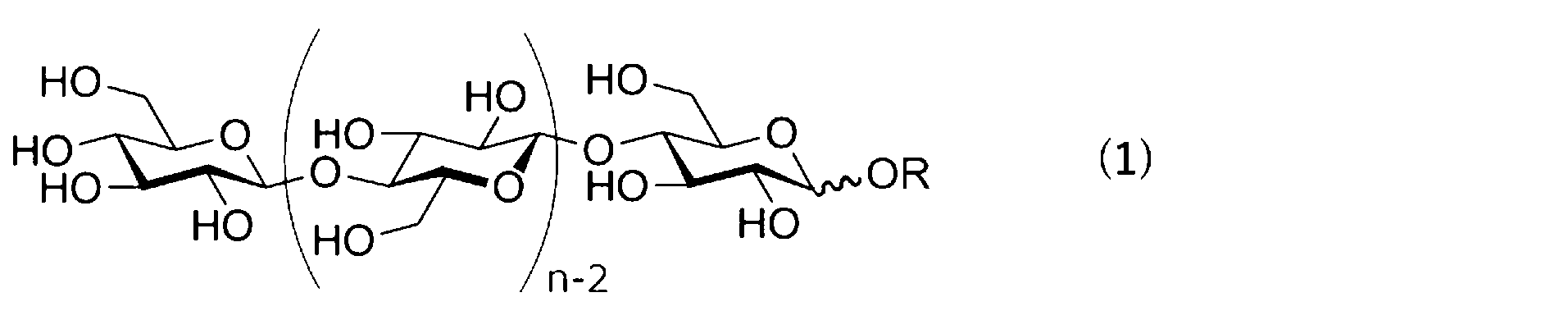
式(1)中、Rは、水素原子、又は水素原子の代わりに導入される置換基を表す。なお、還元末端の一位の炭素(アノマー炭素)とOR基との間の結合における波線は、OR基の立体配位がα体、β体、又はα体とβ体の混合物であることを示す。OR基の立体配位は好ましくはβ体である。 In formula (1), R represents a hydrogen atom or a substituent introduced in place of a hydrogen atom. The wavy line in the bond between the carbon at position 1 (anomeric carbon) of the reducing end and the OR group indicates that the configuration of the OR group is α, β, or a mixture of α and β. The configuration of the OR group is preferably β.
式(1)中、nは平均重合度であって5~20の数を表す。nは、好ましくは5~18であり、より好ましくは6~15であり、更に好ましくは6~10であり、更に好ましくは7~9である。 In formula (1), n is the average degree of polymerization and is a number from 5 to 20. n is preferably from 5 to 18, more preferably from 6 to 15, even more preferably from 6 to 10, and even more preferably from 7 to 9.
セルロースオリゴマーの合成方法は、特に限定されない。例えば、α-グルコース-1-リン酸(以下、αG1Pということがある。)と、グルコース、セロビオース及びそれらの誘導体からなる群から選択される少なくとも一種のプライマーとを、セロデキストリンホスホリラーゼ(以下、CDPということがある。)と反応させる方法が挙げられる。この反応は、CDPの逆反応を利用した合成方法であり、αG1Pをグルコース供与体とし、グルコース、セロビオース及びそれらの誘導体からなる群から選択される少なくとも一種をプライマー(即ち、グルコース受容体)として、これらをCDPと反応させることにより、プライマーに対してαG1Pがモノマーとして逐次的に重合される。なお、プライマーにおけるアノマー位のヒドロキシ基の水素原子を置換基に替えておくことで、様々な置換基を持つセルロースオリゴマーを合成することができる。 The method for synthesizing cellulose oligomers is not particularly limited. For example, a method of reacting α-glucose-1-phosphate (hereinafter sometimes referred to as αG1P) with at least one primer selected from the group consisting of glucose, cellobiose, and their derivatives with cellodextrin phosphorylase (hereinafter sometimes referred to as CDP) is exemplified. This reaction is a synthesis method utilizing the reverse reaction of CDP, in which αG1P is used as a glucose donor, and at least one primer selected from the group consisting of glucose, cellobiose, and their derivatives is used as a primer (i.e., glucose acceptor), and these are reacted with CDP, whereby αG1P is sequentially polymerized as a monomer with respect to the primer. Note that by replacing the hydrogen atom of the hydroxyl group at the anomeric position in the primer with a substituent, cellulose oligomers with various substituents can be synthesized.
セルロースオリゴマーとしては、上記のようにCDPを用いて合成したものをそのまま用いてもよく、あるいはアルカリ水溶液に溶解したものを用いてもよく、あるいはまた自己集合化したものを用いてもよい。 The cellulose oligomer may be synthesized using CDP as described above and used as is, or may be dissolved in an alkaline aqueous solution, or may be self-assembled.
自己集合化したセルロースオリゴマーは、次のようにして調製することができる。すなわち、セルロースオリゴマーをアルカリ水溶液に溶解させた水溶液を調製し、得られた水溶液を酸で中和する。これにより、セルロースオリゴマーは不溶性となって析出し、その際、攪拌・振動等しながら又は静置した状態でインキュベーションすることにより、セルロースオリゴマーは自己集合化する。すなわち、セルロースオリゴマーの分子が整列してセルロースII型の結晶構造を持つセルロースオリゴマー集合体となる。一実施形態において、セルロースオリゴマーは、式(1)で表される化合物を構成成分とするセルロースII型の結晶構造を持つセルロースオリゴマー集合体でもよい。 The self-assembled cellulose oligomer can be prepared as follows. That is, an aqueous solution is prepared by dissolving the cellulose oligomer in an alkaline aqueous solution, and the resulting aqueous solution is neutralized with an acid. As a result, the cellulose oligomer becomes insoluble and precipitates, and the cellulose oligomer self-assembles by incubating the solution while stirring, shaking, or in a stationary state. That is, the molecules of the cellulose oligomer are aligned to form a cellulose oligomer aggregate having a cellulose II type crystal structure. In one embodiment, the cellulose oligomer may be a cellulose oligomer aggregate having a cellulose II type crystal structure, the constituent of which is a compound represented by formula (1).
セルロースオリゴマー集合体は、シート状の構造(セルロースナノシート)を持つものでもよい。ここで、シート状の構造は、細長いリボン状の構造(セルロースナノリボン)を包含する概念である。 The cellulose oligomer aggregate may have a sheet-like structure (cellulose nanosheet). Here, the sheet-like structure is a concept that includes a long, thin ribbon-like structure (cellulose nanoribbon).
一実施形態において、ゲル化剤は、上記セルロースオリゴマーの水分散体でもよい。すなわち、ゲル化剤は、上記セルロースオリゴマー集合体が水に分散した分散液でもよい。あるいは、一実施形態において、ゲル化剤は、上記セルロースオリゴマーをアルカリ水溶液に溶解させた水溶液でもよい。あるいは、一実施形態において、ゲル化剤は、セルロースオリゴマーの水分散体や水溶液を凍結乾燥等により乾燥してなる粉末状でもよい。 In one embodiment, the gelling agent may be an aqueous dispersion of the cellulose oligomer. That is, the gelling agent may be a dispersion liquid in which the cellulose oligomer aggregate is dispersed in water. Alternatively, in one embodiment, the gelling agent may be an aqueous solution in which the cellulose oligomer is dissolved in an alkaline aqueous solution. Alternatively, in one embodiment, the gelling agent may be in the form of a powder obtained by drying the aqueous dispersion or solution of the cellulose oligomer by freeze-drying or the like.
ゲル化剤が上記の水分散体である場合、セルロースオリゴマーの含有量(濃度)は、特に限定されず、例えば0.10~15%(w/v)であることが好ましく、より好ましくは0.12~5.0%(w/v)であり、更に好ましくは0.12~1.0%(w/v)である。 When the gelling agent is the above-mentioned aqueous dispersion, the content (concentration) of the cellulose oligomer is not particularly limited, and is preferably, for example, 0.10 to 15% (w/v), more preferably 0.12 to 5.0% (w/v), and even more preferably 0.12 to 1.0% (w/v).
ゲル化剤が上記の水溶液である場合、セルロースオリゴマーの含有量(濃度)は、特に限定されず、例えば0.12~1.3%(w/v)であることが好ましく、より好ましくは0.14~0.70%(w/v)である。 When the gelling agent is the above-mentioned aqueous solution, the content (concentration) of the cellulose oligomer is not particularly limited, but is preferably, for example, 0.12 to 1.3% (w/v), and more preferably 0.14 to 0.70% (w/v).
本明細書において、「%(w/v)」は、質量体積パーセント濃度であり、100mLの体積にしめる対象物質の質量(g)である。 In this specification, "% (w/v)" refers to the mass volume percent concentration, which is the mass (g) of the target substance per 100 mL of volume.
ゲル化剤には、セルロースオリゴマー、及び、分散媒ないし溶媒としての水とともに、例えば、アルカリ剤、緩衝剤、無機塩等の様々な添加剤が含まれてもよい。 The gelling agent may contain cellulose oligomer and water as a dispersion medium or solvent, as well as various additives such as alkaline agents, buffers, and inorganic salts.
アルカリ剤としては、例えば、水酸化ナトリウム、水酸化カリウム、水酸化リチウム等が挙げられる。 Examples of alkaline agents include sodium hydroxide, potassium hydroxide, and lithium hydroxide.
緩衝剤としては、例えば、リン酸緩衝生理食塩水(PBS)、2-モルホリノエタンスルホン酸(MES)緩衝液、トリスヒドロキシメチルアミノメタン(Tris)緩衝液、3-モルホリノプロパンスルホン酸(MOPS)緩衝液、4-(2-ヒドロキシエチル)-1-ピペラジンエタンスルホン酸(HEPES)緩衝液等を構成する緩衝剤が挙げられる。 Examples of buffers include phosphate buffered saline (PBS), 2-morpholinoethanesulfonic acid (MES) buffer, trishydroxymethylaminomethane (Tris) buffer, 3-morpholinopropanesulfonic acid (MOPS) buffer, 4-(2-hydroxyethyl)-1-piperazineethanesulfonic acid (HEPES) buffer, etc.
無機塩としては、例えば、塩化ナトリウム、塩化カリウム、塩化リチウム等が挙げられる。 Examples of inorganic salts include sodium chloride, potassium chloride, and lithium chloride.
上記ゲル化剤は、多糖類をゲル化させるために用いられる。多糖類としては、非セルロース系多糖類が好ましく用いられる。より好ましくは、多糖類としては、(A)グリコサミノグリカン、及び、(B)α-1,4-グリコシド結合とα-1,6-グリコシド結合によって重合したグルコース及び/又はグルコース誘導体のみで構成される水溶性多糖が挙げられ、これらはいずれか1種用いても2種以上併用してもよい。これらの多くは細胞外マトリックスの構成多糖であり、本実施形態において好適に用いられる。 The gelling agent is used to gel polysaccharides. As polysaccharides, non-cellulosic polysaccharides are preferably used. More preferably, as polysaccharides, there are (A) glycosaminoglycans and (B) water-soluble polysaccharides composed only of glucose and/or glucose derivatives polymerized by α-1,4-glycosidic bonds and α-1,6-glycosidic bonds, and any one of these may be used alone or in combination of two or more. Many of these are constituent polysaccharides of the extracellular matrix, and are preferably used in this embodiment.
上記(A)のグリコサミノグリカンは、糖のヒドロキシ基がアミノ基で置換された構造を持つアミノ糖を有する多糖である。グリコサミノグリカンとしては、例えば、ヒアルロン酸、コンドロイチン硫酸、ヘパリン、ケラタン硫酸、ヘパラン硫酸等が挙げられる。 The glycosaminoglycan (A) is a polysaccharide having an amino sugar in which the hydroxyl group of the sugar is replaced with an amino group. Examples of glycosaminoglycans include hyaluronic acid, chondroitin sulfate, heparin, keratan sulfate, and heparan sulfate.
上記(B)の水溶性多糖は、グルコース及び/又はグルコース誘導体がα-1,4-グリコシド結合とα-1,6-グリコシド結合によって重合した構造を持つ多糖類であり、例えば、デキストラン及びその誘導体(例えば、カルボキシメチルデキストラン(CM-Dex)等)、プルラン等が挙げられる。 The water-soluble polysaccharide (B) above is a polysaccharide having a structure in which glucose and/or glucose derivatives are polymerized through α-1,4-glycosidic bonds and α-1,6-glycosidic bonds, and examples thereof include dextran and its derivatives (e.g., carboxymethyldextran (CM-Dex), etc.), pullulan, etc.
なお、本明細書において、上記の多糖類は、それらがアニオン性基を有する場合、そのナトリウム塩等の塩も包括する概念である。 In this specification, the above polysaccharides include their salts, such as sodium salts, when they have anionic groups.
一実施形態において、多糖類は、ヒアルロン酸、コンドロイチン硫酸、ヘパリン、カルボキシメチルデキストラン、及びプルランからなる群から選択される少なくとも1種であることが好ましい。 In one embodiment, the polysaccharide is preferably at least one selected from the group consisting of hyaluronic acid, chondroitin sulfate, heparin, carboxymethyl dextran, and pullulan.
[液体組成物]
実施形態に係る液体組成物は、上記ゲル化剤を含むものであり、従って、平均重合度が5以上20以下であるセルロースオリゴマーと、多糖類と、水を含む、ゲル化可能な液体組成物である。
[Liquid composition]
The liquid composition according to the embodiment contains the above-mentioned gelling agent, and is therefore a gellable liquid composition that contains a cellulose oligomer having an average degree of polymerization of 5 or more and 20 or less, a polysaccharide, and water.
該液体組成物において、セルロースオリゴマー及び多糖類については上述したとおりであり、説明は省略する。 In the liquid composition, the cellulose oligomer and polysaccharide are as described above, and a detailed explanation is omitted.
該液体組成物において、セルロースオリゴマーの含有量は、多糖類100質量部に対して0.5~100質量部であることが好ましい。セルロースオリゴマーは多糖類の水溶液をゲル化させるためのゲル化剤として用いられるため、セルロースオリゴマーの含有量は、多糖類の含有量に対して同量以下であることが好ましい。セルロースオリゴマーの含有量は、多糖類100質量部に対して1~80質量部であることが好ましく、より好ましくは2~70質量部であり、更に好ましくは3~60質量部であり、更に好ましくは4~50質量部である。 In the liquid composition, the content of the cellulose oligomer is preferably 0.5 to 100 parts by mass per 100 parts by mass of the polysaccharide. Since the cellulose oligomer is used as a gelling agent for gelling an aqueous solution of the polysaccharide, the content of the cellulose oligomer is preferably equal to or less than the content of the polysaccharide. The content of the cellulose oligomer is preferably 1 to 80 parts by mass per 100 parts by mass of the polysaccharide, more preferably 2 to 70 parts by mass, even more preferably 3 to 60 parts by mass, and even more preferably 4 to 50 parts by mass.
一実施形態において、多糖類としてヒアルロン酸を用いる場合、セルロースオリゴマーの含有量は、ヒアルロン酸100質量部に対して5~100質量部であることが好ましく、より好ましくは8~80質量部であり、更に好ましくは10~60質量部であり、更に好ましくは15~40質量部である。 In one embodiment, when hyaluronic acid is used as the polysaccharide, the content of the cellulose oligomer is preferably 5 to 100 parts by mass, more preferably 8 to 80 parts by mass, even more preferably 10 to 60 parts by mass, and even more preferably 15 to 40 parts by mass, per 100 parts by mass of hyaluronic acid.
該液体組成物において、セルロースオリゴマーの含有量(濃度)は、特に限定されず、例えば0.10~1.0%(w/v)であることが好ましく、より好ましくは0.12~0.50%(w/v)であり、更に好ましくは0.15~0.40%(w/v)であり、更に好ましくは0.18~0.35%(w/v)であり、更に好ましくは0.20~0.30%(w/v)である。 In the liquid composition, the content (concentration) of the cellulose oligomer is not particularly limited, and is preferably, for example, 0.10 to 1.0% (w/v), more preferably 0.12 to 0.50% (w/v), even more preferably 0.15 to 0.40% (w/v), even more preferably 0.18 to 0.35% (w/v), and even more preferably 0.20 to 0.30% (w/v).
該液体組成物において、多糖類の含有量(濃度)は、特に限定されず、例えば0.30~10.0%(w/v)でもよく、0.50~8.0%(w/v)でもよく、0.60~6.0%(w/v)でもよく、0.80~5.0%(w/v)でもよい。一実施形態において、多糖類としてヒアルロン酸を用いる場合、液体組成物におけるヒアルロン酸の含有量(濃度)は、特に限定されないが、0.50~1.5%(w/v)であることが好ましく、より好ましくは0.60~1.3%(w/v)であり、更に好ましくは0.80~1.2%(w/v)である。 In the liquid composition, the content (concentration) of the polysaccharide is not particularly limited and may be, for example, 0.30 to 10.0% (w/v), 0.50 to 8.0% (w/v), 0.60 to 6.0% (w/v), or 0.80 to 5.0% (w/v). In one embodiment, when hyaluronic acid is used as the polysaccharide, the content (concentration) of hyaluronic acid in the liquid composition is not particularly limited, but is preferably 0.50 to 1.5% (w/v), more preferably 0.60 to 1.3% (w/v), and even more preferably 0.80 to 1.2% (w/v).
該液体組成物において、セルロースオリゴマーは、アルカリ水溶液中に溶解された形態で含まれてもよく、セルロースオリゴマー集合体として水に分散した形態で含まれてもよい。 In the liquid composition, the cellulose oligomer may be contained in a form dissolved in an alkaline aqueous solution, or may be contained in a form dispersed in water as a cellulose oligomer aggregate.
例えば、一実施形態において、液体組成物は、セルロースオリゴマーと多糖類を含むアルカリ水溶液でもよい。その場合、該液体組成物は、酸で中和することによりゲル化させることができる。 For example, in one embodiment, the liquid composition may be an alkaline aqueous solution containing cellulose oligomers and polysaccharides. In that case, the liquid composition can be gelled by neutralizing it with an acid.
また、一実施形態において、液体組成物は、水に分散したセルロースオリゴマー集合体と、水に溶解した多糖類とを含むものでもよい。その場合、ゲル化可能な液体組成物は、セルロースオリゴマーと多糖類を含むアルカリ水溶液を、酸で中和することにより、セルロースオリゴマーを析出させて得られる。 In one embodiment, the liquid composition may contain cellulose oligomer aggregates dispersed in water and polysaccharides dissolved in water. In this case, the gellable liquid composition is obtained by precipitating the cellulose oligomers by neutralizing an alkaline aqueous solution containing the cellulose oligomers and polysaccharides with an acid.
該液体組成物には、セルロースオリゴマー、多糖類、及び水とともに、例えば、アルカリ剤、緩衝剤、無機塩、有機低分子化合物、タンパク質等の様々な添加剤が含まれてもよい。アルカリ剤、緩衝剤及び無機塩については上述したとおりであり、説明は省略する。 The liquid composition may contain various additives, such as alkaline agents, buffering agents, inorganic salts, organic low molecular weight compounds, proteins, etc., in addition to the cellulose oligomer, polysaccharide, and water. The alkaline agents, buffering agents, and inorganic salts are as described above, and will not be described here.
[ハイドロゲル]
上記液体組成物は、ゲル化することでハイドロゲルを形成することができる。そのため、実施形態に係るハイドロゲルは、上記液体組成物がゲル化してなるものである。よって、該ハイドロゲルは、上記セルロースオリゴマーと、上記多糖類と、水を含み、更に上記液体組成物に含まれる様々な添加剤を含んでもよい。なお、該ハイドロゲルにおけるセルロースオリゴマー及び多糖類の含有量及び両者の割合は、液体組成物において上述したとおりであり、説明は省略する。
[Hydrogel]
The liquid composition can form a hydrogel by gelling. Therefore, the hydrogel according to the embodiment is formed by gelling the liquid composition. Therefore, the hydrogel contains the cellulose oligomer, the polysaccharide, and water, and may further contain various additives contained in the liquid composition. The contents of the cellulose oligomer and the polysaccharide in the hydrogel and the ratio of the two are as described above in the liquid composition, and therefore the explanation is omitted.
ここで、ハイドロゲルとは、水を分散媒とする分散系が流動性を失って固化したものをいう。詳細には、後述するゲル化評価試験において、バイアルを反転倒立させて10分経過後に分散系がバイアル底部に全く流れ落ちておらずバイアル上部に全て保持されていれば、ゲル化している(すなわち、ハイドロゲルが形成されている)と判断する。 Here, hydrogel refers to a dispersion system in which water is the dispersion medium that has lost its fluidity and solidified. More specifically, in the gelation evaluation test described below, if the vial is inverted and 10 minutes have passed, and none of the dispersion system has flowed down to the bottom of the vial but is entirely retained at the top of the vial, it is determined that gelation has occurred (i.e., a hydrogel has been formed).
上記液体組成物は、ゲル化能に関して温度応答性を有する。すなわち、上記液体組成物は、加熱することによりゲル化し(又は、低温環境にある場合よりも速くゲル化させることができ)、その後に冷却してもゲル状態を維持することができる。 The liquid composition has temperature responsiveness with respect to its gelling ability. That is, the liquid composition gels when heated (or can be made to gel faster than when in a low-temperature environment), and can maintain the gel state even when subsequently cooled.
上記ハイドロゲルは、セルロースオリゴマーと多糖類との相互作用により両者が複合化して形成されるものである。詳細には、ハイドロゲルにおいて、セルロースオリゴマーは、自己集合化してなるセルロースオリゴマー集合体として含まれており、該セルロースオリゴマー集合体が凝集することで多糖類の分子鎖間を連結する架橋剤(物理的架橋)として機能すると考えられる。 The hydrogel is formed by the interaction between the cellulose oligomer and the polysaccharide, resulting in a complex between the two. In detail, the cellulose oligomer is contained in the hydrogel as a cellulose oligomer aggregate formed by self-assembly, and it is considered that the aggregation of the cellulose oligomer aggregate functions as a cross-linking agent (physical cross-linking) that connects the molecular chains of the polysaccharide.
ハイドロゲルを形成するための方法としては、例えば、セルロースオリゴマーを自己集合化させてセルロースオリゴマー集合体の水分散体としてから、該水分散体と多糖類又はその水溶液とを混ぜてもよい。但し、好ましくは、セルロースオリゴマーと多糖類を含むアルカリ水溶液を酸で中和することによりセルロースオリゴマーを析出させることである。これにより、より均一なハイドロゲルを形成することができる。 One method for forming a hydrogel is, for example, to self-assemble cellulose oligomers to form an aqueous dispersion of cellulose oligomer aggregates, and then mix the aqueous dispersion with a polysaccharide or an aqueous solution thereof. However, it is preferable to precipitate the cellulose oligomers by neutralizing an alkaline aqueous solution containing the cellulose oligomers and polysaccharides with an acid. This allows a more uniform hydrogel to be formed.
図1は、一実施形態に係るゲル化の推測メカニズムを示す概念図である。ここでは、アルカリ水溶液を中和させてハイドロゲルを形成する場合について説明する。セルロースオリゴマーと多糖類を溶解させたアルカリ水溶液に、酸を添加して中和(中性pH化)する。その際、酸には緩衝剤を添加しておいてもよい。中和後の水溶液を高温環境(例えば37℃)に所定時間(例えば24時間)置いた場合、水溶液の流動性が失われてハイドロゲルが形成される。これに対し、中和後の水溶液を低温環境(例えば4℃)に所定時間(例えば24時間)置いた場合、水溶液は流動性を維持し、ゾルが形成される。そして、該ゾルを高温環境(例えば37℃)に所定時間(例えば24時間)置くと、流動性が失われてハイドロゲルが形成される。 Figure 1 is a conceptual diagram showing a speculated mechanism of gelation according to one embodiment. Here, a case where an alkaline aqueous solution is neutralized to form a hydrogel will be described. An acid is added to an alkaline aqueous solution in which cellulose oligomers and polysaccharides are dissolved to neutralize (neutralize pH). At this time, a buffering agent may be added to the acid. When the neutralized aqueous solution is placed in a high-temperature environment (e.g., 37°C) for a predetermined time (e.g., 24 hours), the fluidity of the aqueous solution is lost and a hydrogel is formed. In contrast, when the neutralized aqueous solution is placed in a low-temperature environment (e.g., 4°C) for a predetermined time (e.g., 24 hours), the aqueous solution maintains its fluidity and a sol is formed. Then, when the sol is placed in a high-temperature environment (e.g., 37°C) for a predetermined time (e.g., 24 hours), the fluidity is lost and a hydrogel is formed.
かかるゲル化のメカニズムは次のように推測される。上記アルカリ水溶液を中和することにより、セルロースオリゴマーは不溶性となって析出し、自己集合化してセルロースオリゴマー集合体が形成される。その際、水溶液中には多糖類が存在するため、図1に示すように、セルロースオリゴマーの自己集合と多糖類の分子鎖との間で相互作用が生じるとともに、高温環境下ではセルロースオリゴマー集合体が凝集し、該凝集体が多糖類の分子鎖間を連結する架橋剤として働くと考えられる。そのため、多糖類の分子鎖と該凝集体により、三次元網目を持つハイドロゲルが形成される。 The mechanism of this gelation is presumed to be as follows. By neutralizing the alkaline aqueous solution, the cellulose oligomers become insoluble and precipitate, and then self-assemble to form cellulose oligomer aggregates. At this time, since polysaccharides are present in the aqueous solution, an interaction occurs between the self-assembly of the cellulose oligomers and the molecular chains of the polysaccharides, as shown in Figure 1, and the cellulose oligomer aggregates aggregate in a high-temperature environment, and the aggregates act as cross-linking agents that connect the molecular chains of the polysaccharides. Therefore, a hydrogel with a three-dimensional network is formed by the molecular chains of the polysaccharides and the aggregates.
一方、低温環境下では、セルロースオリゴマー集合体と多糖類の分子鎖との間での相互作用は生じるものの、セルロースオリゴマー集合体の凝集が起こらず(又はその凝集速度が遅いことから所定時間内では流動性を失うほどの十分な凝集が生じず)、流動性を持つゾルが形成されると考えられる。該ゾルを高温環境に置くと、セルロースオリゴマー集合体の凝集が促進されて、多糖類の分子鎖間を連結する架橋構造が形成され、三次元網目を持つハイドロゲルが形成されると考えられる。 On the other hand, in a low-temperature environment, although interactions occur between the cellulose oligomer aggregates and the polysaccharide molecular chains, the cellulose oligomer aggregates do not aggregate (or the aggregation rate is so slow that sufficient aggregation to cause loss of fluidity does not occur within a specified time), and it is believed that a fluid sol is formed. When the sol is placed in a high-temperature environment, the aggregation of the cellulose oligomer aggregates is promoted, a cross-linked structure is formed that connects the polysaccharide molecular chains, and a hydrogel with a three-dimensional network is formed.
上記液体組成物をゲル化させる温度は特に限定されず、例えば15℃以上でもよく、20℃以上でもよく、25℃以上でもよい。ゲル化させる温度の上限も特に限定されず、例えば60℃以下でもよく、50℃以下でもよい。上記液体組成物をゲル化させる時間は特に限定されず、10時間以上でもよく、15時間以上でもよく、18時間以上でもよい。 The temperature at which the liquid composition is gelled is not particularly limited, and may be, for example, 15°C or higher, 20°C or higher, or 25°C or higher. The upper limit of the gelling temperature is also not particularly limited, and may be, for example, 60°C or lower, or 50°C or lower. The time period during which the liquid composition is gelled is not particularly limited, and may be 10 hours or more, 15 hours or more, or 18 hours or more.
[用途]
実施形態に係るハイドロゲルの用途は特に限定されず、例えば細胞培養の足場が挙げられる。また、ハイドロゲル中に薬物や有用蛋白を入れて、体内でのそれらの分布をコントロールするためのドラッグデリバリーシステム用途が挙げられる。
[Application]
The uses of the hydrogel according to the embodiment are not particularly limited, and examples thereof include a scaffold for cell culture, and a drug delivery system for controlling the distribution of drugs or useful proteins in the body by placing them in the hydrogel.
以下、実施例により更に説明するが、本発明はこれらに限定されるものではない。 The following provides further explanation using examples, but the present invention is not limited to these.
[セルロースオリゴマーの合成]
T.Serizawaら,Polym.J.,2016年,48,539-544に記載の方法に従い(D-グルコースをプライマーとして使用)、下記式で表される、平均重合度が9(n=9)のセルロースオリゴマー(グルコース由来)を合成した。また、T.Serizawaら,Langmuir,2017年,33,13415-13422に記載の方法に従い(セロビオースをプライマーとして使用)、下記式で表される、平均重合度が7(n=7)のセルロースオリゴマー(セロビオース由来)を合成した。

According to the method described in T. Serizawa et al., Polym. J., 2016, 48, 539-544 (using D-glucose as a primer), a cellulose oligomer (derived from glucose) having an average degree of polymerization of 9 (n = 9) represented by the following formula was synthesized. Also, according to the method described in T. Serizawa et al., Langmuir, 2017, 33, 13415-13422 (using cellobiose as a primer), a cellulose oligomer (derived from cellobiose) having an average degree of polymerization of 7 (n = 7) represented by the following formula was synthesized.
詳細には、200mmol/LのαG1P、50mmol/LのD-グルコース又はセロビオース、及び0.2U/mLのセロデキストリンホスホリラーゼ(CDP)を、500mmol/Lの2-[4-(2-ヒドロキシエチル)-1-ピペラジニル]エタンスルホン酸(HEPES)緩衝液(pH7.5)中で混合し、60℃で3日間インキュベートした。生成物を含む反応液を遠心(15000rpm、10分間以上、4℃)し、上清を取り除いた後、超純水を加えて生成物を再分散させ、遠心(同条件)する操作を繰り返すことで、上清の置換率が99.999%以上となるまで精製して、セルロースオリゴマーを得た。 In detail, 200 mmol/L αG1P, 50 mmol/L D-glucose or cellobiose, and 0.2 U/mL cellodextrin phosphorylase (CDP) were mixed in 500 mmol/L 2-[4-(2-hydroxyethyl)-1-piperazinyl]ethanesulfonic acid (HEPES) buffer (pH 7.5) and incubated at 60°C for 3 days. The reaction solution containing the product was centrifuged (15,000 rpm, 10 minutes or more, 4°C) and the supernatant was removed. Ultrapure water was then added to redisperse the product, and the centrifugation (same conditions) was repeated to purify the product until the replacement rate of the supernatant reached 99.999% or more, yielding a cellulose oligomer.
生成物の平均重合度は、プロトン核磁気共鳴(NMR)装置により測定した。試料は、凍結乾燥した12mg以上の生成物を600μLの4質量%重水酸化ナトリウム重水溶液に溶解させることで調製した。NMR装置は、ADVANCE III HD500(Bruker Biospin、磁場強度:500MHz、積算回数16回)を用いた。平均重合度は、セルロースオリゴマーの還元末端のアノマー位(δ~5.1、4.5)及びそれ以外のアノマー位(δ~4.3)のプロトンの積分値をもとに算出した。 The average degree of polymerization of the product was measured using a proton nuclear magnetic resonance (NMR) device. Samples were prepared by dissolving 12 mg or more of the freeze-dried product in 600 μL of 4% by mass sodium deuterium hydroxide deuterium oxide solution. The NMR device used was an ADVANCE III HD500 (Bruker Biospin, magnetic field strength: 500 MHz, 16 accumulations). The average degree of polymerization was calculated based on the integral value of the protons at the anomeric positions (δ-5.1, 4.5) of the reducing end of the cellulose oligomer and the other anomeric positions (δ-4.3).
[多糖類]
実施例で使用した多糖類は以下のとおりである。
・ヒアルロン酸:ナカライテスク社製
・CM-Dex:東京化成工業社製
・コンドロイチン硫酸Cナトリウム:ナカライテスク社製
・ヘパリンナトリウム:ナカライテスク社製
[Polysaccharides]
The polysaccharides used in the examples are as follows:
Hyaluronic acid: manufactured by Nacalai Tesque, Inc. CM-Dex: manufactured by Tokyo Chemical Industry Co., Ltd. Chondroitin sulfate C sodium: manufactured by Nacalai Tesque, Inc. Heparin sodium: manufactured by Nacalai Tesque, Inc.
[試験例1:実施例1~3,比較例1~4]
容器としては1mLマイティーバイアルを用いた。セルロースオリゴマーとヒアルロン酸を溶解させた1mol/LのNaOH水溶液を、1mol/LのHCl水溶液で中和して、300μLの水溶液を調製した。その際、HCl水溶液にはリン酸緩衝成分を添加しておくことで、中和後の水溶液がリン酸緩衝生理食塩水(PBS、[NaCl]137mmol/L)となるようにした。また、中和後の水溶液におけるセルロースオリゴマー及びヒアルロン酸の濃度は下記表1になるようにした。また、セルロースオリゴマーの種類は表1に示すとおりである。得られた水溶液を25℃の雰囲気で24時間静置した後、ゲル化評価を行った。
[Test Example 1: Examples 1 to 3, Comparative Examples 1 to 4]
A 1 mL mighty vial was used as the container. A 1 mol/L NaOH aqueous solution in which cellulose oligomer and hyaluronic acid were dissolved was neutralized with a 1 mol/L HCl aqueous solution to prepare a 300 μL aqueous solution. At this time, a phosphate buffer component was added to the HCl aqueous solution so that the aqueous solution after neutralization became phosphate buffered saline (PBS, [NaCl] 137 mmol/L). In addition, the concentrations of the cellulose oligomer and hyaluronic acid in the aqueous solution after neutralization were set to be as shown in Table 1 below. In addition, the type of cellulose oligomer is as shown in Table 1. The obtained aqueous solution was left to stand for 24 hours in an atmosphere of 25 ° C., and then gelation evaluation was performed.
ゲル化評価は、静置後のバイアルを反転倒立させ、反転倒立してから10分後に水溶液(分散系)がバイアル底部に全く流れ落ちておらずバイアル上部に全て保持されていればゲル化したと判断した。表1には、ゲル化したものを「ゲル」、ゲル化しなかったものを「ゾル」と示した。 To evaluate gelation, the vial was inverted after standing, and if 10 minutes after inversion, none of the aqueous solution (dispersion) had flowed to the bottom of the vial and was entirely retained at the top of the vial, it was judged to have gelled. In Table 1, gelled solutions are indicated as "gels" and non-gelled solutions are indicated as "sols."

結果は表1に示すとおりである。セルロースオリゴマーを配合していない比較例1ではゲル化しなかった。ヒアルロン酸を配合していない比較例2と3及び比較例4についてもゲル化しなかった。これに対し、セルロースオリゴマーとヒアルロン酸を併用した実施例1~3ではゲル化しており、セルロースオリゴマーとヒアルロン酸との相互作用により両者が複合化したハイドロゲルが得られた。 The results are shown in Table 1. No gelation occurred in Comparative Example 1, which did not contain cellulose oligomer. No gelation occurred in Comparative Examples 2, 3, and 4, which did not contain hyaluronic acid. In contrast, gelation occurred in Examples 1 to 3, which used a combination of cellulose oligomer and hyaluronic acid, and a hydrogel was obtained in which the cellulose oligomer and hyaluronic acid were combined due to their interaction.
図2は反転倒立から24時間後の状態を示す写真であり、実施例1~3であると24時間経過後も流れ落ちておらず、ゲル状態が維持されていた。セルロースオリゴマーの種類を比較した場合、セロビオース由来のセルロースオリゴマーを用いた実施例1と2は、グルコース由来のセルロースオリゴマーを用いた実施例3に対して透明性が高く均一なゲルが形成されていた。 Figure 2 is a photograph showing the state 24 hours after inversion, and in Examples 1 to 3, the gel state was maintained and did not flow even after 24 hours. When comparing the types of cellulose oligomer, Examples 1 and 2, which used cellulose oligomers derived from cellobiose, formed a more transparent and uniform gel than Example 3, which used cellulose oligomers derived from glucose.
[試験例2:比較例5,6]
1mLマイティーバイアルに、カルボキシメチルセルロースナトリウム(ナカライテスク社製)とヒアルロン酸を溶解させた300μLの水溶液を調製した。その際、該水溶液におけるカルボキシメチルセルロースナトリウムの濃度は、比較例5では0.20%(w/v)とし、比較例6では0.30%(w/v)とした。また、ヒアルロン酸の濃度は、比較例5,6ともに1.0%(w/v)とした。得られた水溶液を25℃の雰囲気で24時間静置した後、試験例1と同様にしてゲル化評価を行った。
[Test Example 2: Comparative Examples 5 and 6]
In a 1mL mighty vial, 300μL of aqueous solution is prepared by dissolving sodium carboxymethylcellulose (manufactured by Nacalai Tesque) and hyaluronic acid. At that time, the concentration of sodium carboxymethylcellulose in the aqueous solution is 0.20% (w/v) in Comparative Example 5, and 0.30% (w/v) in Comparative Example 6. The concentration of hyaluronic acid is 1.0% (w/v) in both Comparative Examples 5 and 6. The aqueous solution obtained is left to stand in an atmosphere of 25°C for 24 hours, and then gelation evaluation is performed in the same manner as in Test Example 1.
その結果、セルロースオリゴマーの代わりにカルボキシメチルセルロースナトリウムを用いた比較例5,6では、いずれも静置後のバイアルを反転倒立してから10分後に水溶液が流れ落ちる様子が確認され、ゲル化しなかった。 As a result, in Comparative Examples 5 and 6, in which sodium carboxymethylcellulose was used instead of cellulose oligomer, the aqueous solution was observed to flow down 10 minutes after the vials were inverted after standing, and no gelation occurred.
[試験例3:実施例4~6]
中和後の水溶液におけるヒアルロン酸の濃度を、実施例4では0.40%(w/v)とし、実施例5では0.60%(w/v)とし、実施例6では0.80%(w/v)とし、その他は実施例1と同様にして、中和後の水溶液を得て、25℃の雰囲気で24時間静置した後、ゲル化評価を行った。その結果、実施例4~6では、静置後のバイアルを反転倒立してから10分後に水溶液が流れ落ちておらず、ゲル化していた。また、実施例4~6では反転倒立から24時間経過後にも流れ落ちておらず、ゲル状態が維持されていた。
[Test Example 3: Examples 4 to 6]
The concentration of hyaluronic acid in the aqueous solution after neutralization is 0.40% (w/v) in Example 4, 0.60% (w/v) in Example 5, and 0.80% (w/v) in Example 6, and the rest is the same as in Example 1, to obtain the aqueous solution after neutralization, and after standing for 24 hours in an atmosphere of 25°C, gelation evaluation is performed. As a result, in Examples 4 to 6, the aqueous solution does not flow down after 10 minutes from the vial after standing is inverted and inverted, and gelation occurs. In addition, in Examples 4 to 6, the aqueous solution does not flow down even after 24 hours from the inversion and inversion, and the gel state is maintained.
[試験例4:実施例7~9,比較例7~12:静置温度依存性]
1mLマイティーバイアルにおいて、セルロースオリゴマーとヒアルロン酸を溶解させた1mol/LのNaOH水溶液を、リン酸緩衝成分を添加した1mol/LのHCl水溶液で中和して、中和後の水溶液がリン酸緩衝生理食塩水(PBS、[NaCl]137mmol/L)である300μLの水溶液を調製した。その際、中和後の水溶液におけるセルロースオリゴマー(セロビオース由来)の濃度が0.20%(w/v)、かつヒアルロン酸の濃度が1.0%(w/v)となるようにした。得られた水溶液を、実施例7では4℃の雰囲気で、実施例8では25℃の雰囲気で、実施例9では37℃の雰囲気で、それぞれ24時間静置した後、試験例1と同様のゲル化評価を行った。
[Test Example 4: Examples 7 to 9, Comparative Examples 7 to 12: Stationary Temperature Dependence]
In a 1mL mighty vial, 1mol/L NaOH aqueous solution in which cellulose oligomer and hyaluronic acid are dissolved is neutralized with 1mol/L HCl aqueous solution in which phosphate buffer components are added, and 300μL aqueous solution of phosphate buffered saline (PBS, [NaCl] 137mmol/L) is prepared after neutralization.At this time, the concentration of cellulose oligomer (derived from cellobiose) in the aqueous solution after neutralization is 0.20% (w/v), and the concentration of hyaluronic acid is 1.0% (w/v).The obtained aqueous solution is left for 24 hours in an atmosphere of 4°C in Example 7, in an atmosphere of 25°C in Example 8, and in an atmosphere of 37°C in Example 9, and then the same gelation evaluation as in Test Example 1 is carried out.
比較例7~9ではセルロースオリゴマーを添加せず、その他は実施例7~9と同様にして水溶液を調製し、得られた水溶液を、比較例7では4℃の雰囲気で、比較例8では25℃の雰囲気で、比較例9では37℃の雰囲気で、それぞれ24時間静置した後、試験例1と同様のゲル化評価を行った。 In Comparative Examples 7 to 9, cellulose oligomer was not added, and otherwise the aqueous solutions were prepared in the same manner as in Examples 7 to 9. The resulting aqueous solutions were allowed to stand for 24 hours in an atmosphere of 4°C in Comparative Example 7, 25°C in Comparative Example 8, and 37°C in Comparative Example 9, and then gelation evaluation was performed in the same manner as in Test Example 1.
比較例10~12ではヒアルロン酸を添加せず、その他は実施例7~9と同様にして水溶液を調製し、得られた水溶液を、比較例10では4℃の雰囲気で、比較例11では25℃の雰囲気で、比較例12では37℃の雰囲気で、それぞれ24時間静置した後、試験例1と同様のゲル化評価を行った。 In Comparative Examples 10 to 12, hyaluronic acid was not added, and otherwise aqueous solutions were prepared in the same manner as in Examples 7 to 9. The resulting aqueous solutions were allowed to stand for 24 hours in an atmosphere of 4°C in Comparative Example 10, 25°C in Comparative Example 11, and 37°C in Comparative Example 12, and then gelation evaluation was performed in the same manner as in Test Example 1.
結果は下記表2に示すとおりである。セルロースオリゴマーを添加せずにヒアルロン酸のみを配合した比較例7~9では4℃、25℃及び37℃のいずれの雰囲気に静置してもゲル化しなかった。同様に、ヒアルロン酸を添加せずにセルロースオリゴマーのみを配合した比較例10~12では4℃、25℃及び37℃のいずれの雰囲気に静置してもゲル化しなかった。これに対し、セルロースオリゴマーとヒアルロン酸を配合した場合、4℃で静置した実施例7ではゲル化しなかったものの、25℃及び37℃で静置した実施例8,9では、反転倒立から10分経過後はもちろんのこと、反転倒立から24時間経過後にもゲル状態が維持されていた。これにより、静置温度によりゲル化を制御できることが分かった。また、静置温度の上昇に伴ってゲルの白濁が強くなる傾向が見られた。このことから、セルロースオリゴマー集合体の凝集がゲル化に寄与している可能性が示唆された。 The results are shown in Table 2 below. Comparative Examples 7 to 9, which contained only hyaluronic acid without adding cellulose oligomer, did not gel when left at 4°C, 25°C, or 37°C. Similarly, Comparative Examples 10 to 12, which contained only cellulose oligomer without adding hyaluronic acid, did not gel when left at 4°C, 25°C, or 37°C. In contrast, when cellulose oligomer and hyaluronic acid were added, Example 7, which was left at 4°C, did not gel, but Examples 8 and 9, which were left at 25°C and 37°C, maintained a gel state not only 10 minutes after inversion but also 24 hours after inversion. This shows that gelation can be controlled by the temperature at which it is left. In addition, there was a tendency for the gel to become more cloudy as the temperature at which it is left at rest increased. This suggests that the aggregation of cellulose oligomer aggregates may contribute to gelation.
上記のゲル化しなかった実施例7のゾルを含むバイアルを正立させた後、37℃の雰囲気で24時間静置してから同様のゲル化評価を行ったところ、ゾルがゲル化しており反転倒立から24時間経過後にもゲル状態が維持されていた。更に、このゲル状態にあるバイアルを正立させた後、4℃の雰囲気に24時間静置してから反転倒立させたところ、反転倒立から24時間経過後にゲル状態が維持されていた。このように4℃で静置して得られた液体状態の生成物(ゾル)を37℃で静置することによりゲル化することが分かった。また、このようにゲル化した後には、4℃に戻しても液体状態には戻らなかった。すなわち、一度形成したゲルは温度変化に対して安定であることが分かった。このことから、一度凝集したセルロースオリゴマー集合体は温度を下げても分散しないことが示唆された。

[試験例5:静置時間依存性]
上記実施例1と同様にして中和後の水溶液(ヒアルロン酸濃度:1.0%(w/v)、セルロースオリゴマー(セロビオース由来)濃度:0.20%(w/v)、NaCl濃度:137mmol/L(PBS条件))を調製した。得られた中和後の水溶液を、25℃の雰囲気で、下記表3に示す静置時間にてそれぞれ静置し、試験例1と同様のゲル化評価を行った。
[Test Example 5: Standing Time Dependence]
A neutralized aqueous solution (hyaluronic acid concentration: 1.0% (w/v), cellulose oligomer (derived from cellobiose) concentration: 0.20% (w/v), NaCl concentration: 137 mmol/L (PBS condition)) was prepared in the same manner as in Example 1. The obtained neutralized aqueous solutions were allowed to stand in an atmosphere of 25° C. for the standing times shown in Table 3 below, and gelation evaluation was performed in the same manner as in Test Example 1.
結果は下記表3に示すとおりであり、実施例1の配合では18時間以上静置することでゲル化することが分かった。セルロースオリゴマーの自己集合化にかかる時間はより短いと考えられることから、セルロースオリゴマー集合体の凝集がゲル化に寄与している可能性が支持された。 The results are shown in Table 3 below, and it was found that the formulation of Example 1 gelled when left to stand for 18 hours or more. Since it is believed that the time required for the cellulose oligomers to self-assemble is shorter, this supports the possibility that the aggregation of cellulose oligomer aggregates contributes to gelation.

[試験例6:ハイドロゲルの安定性評価]
上記実施例1と同様にして中和後の水溶液(ヒアルロン酸濃度:1.0%(w/v)、セルロースオリゴマー(セロビオース由来)濃度:0.20%(w/v)、NaCl濃度:137mmol/L(PBS条件))を調製し、得られた中和後の水溶液を、25℃の雰囲気で24時間静置して実施例10のハイドロゲルを作製した。また、セルロースオリゴマー濃度を1.0%(w/v)とし、その他は実施例10と同様にして、実施例11のハイドロゲルを作製した。次いで、実施例10,11の各バイアルに超純水600μLを注入し、それぞれハイドロゲル上に超純水の層を形成した後、25℃の雰囲気に静置し、静置開始直後から60日経過までハイドロゲルの状態を観察した。
[Test Example 6: Evaluation of stability of hydrogel]
A neutralized aqueous solution (hyaluronic acid concentration: 1.0% (w/v), cellulose oligomer (derived from cellobiose) concentration: 0.20% (w/v), NaCl concentration: 137 mmol/L (PBS condition)) was prepared in the same manner as in Example 1 above, and the obtained neutralized aqueous solution was left to stand for 24 hours in an atmosphere at 25°C to produce the hydrogel of Example 10. In addition, the hydrogel of Example 11 was produced by setting the cellulose oligomer concentration to 1.0% (w/v) and otherwise following the same procedures as in Example 10. Next, 600 μL of ultrapure water was poured into each vial of Examples 10 and 11, and a layer of ultrapure water was formed on each hydrogel, followed by standing in an atmosphere at 25°C, and the state of the hydrogel was observed from immediately after the start of standing for 60 days.
その結果、実施例10,11ともに、ハイドロゲルは超純水の添加後、少なくとも2ヶ月はゲル状態が維持されていた。セルロースオリゴマー濃度が1.0%(w/v)である実施例11では、静置開始から6日経過頃からバイアル内でハイドロゲルが浮き上がってくる様子が観察された。このことから、実施例11では、浸透圧により内部の塩が流出していることが示唆された。但し、ハイドロゲルの形状自体は変化無く維持されていた。そのため、実施例10,11のハイドロゲルは、超純水に対して安定であり、超純水への浸漬で崩れないほど強いネットワーク構造が構築されている可能性が示唆された。 As a result, in both Examples 10 and 11, the hydrogels maintained a gel state for at least two months after the addition of ultrapure water. In Example 11, in which the cellulose oligomer concentration was 1.0% (w/v), the hydrogel was observed floating up in the vial about six days after the start of leaving it still. This suggests that in Example 11, the salt inside was flowing out due to osmotic pressure. However, the shape of the hydrogel itself was maintained without change. Therefore, it was suggested that the hydrogels of Examples 10 and 11 are stable in ultrapure water, and that a network structure strong enough not to collapse when immersed in ultrapure water may have been constructed.
[試験例7:実施例12:低温長期静置]
上記実施例7と同様にして中和後の水溶液(ヒアルロン酸濃度:1.0%(w/v)、セルロースオリゴマー(セロビオース由来)濃度:0.20%(w/v)、NaCl濃度:137mmol/L(PBS条件))を調製し、得られた中和後の水溶液を、4℃の雰囲気で24時間静置した。これを反転倒立させたところ、水溶液は流れ落ち、ゲル化していなかった。反転倒立させたまま4℃で24時間静置した後、バイアルの口に溜まった水溶液を落として再度正立させた状態とし、4℃の雰囲気に静置させた。すると、中和後から合計2週間静置した時点で白濁している様子が観察された。そこで、これを反転倒立させてゲル化評価を行ったところ、10分後に流れ落ちることなく、ゲル化していた。更に反転倒立させたまま25℃で24時間静置したところ、24時間経過後にもゲル状態が維持されていた。このことから、4℃で静置した場合でも、静置時間を長くすることでゲル化することが分かった。4℃という低温環境では、セルロースオリゴマー集合体の凝集にかかる時間が長いためであると考えられる。
[Test Example 7: Example 12: Low-temperature long-term standing]
A neutralized aqueous solution (hyaluronic acid concentration: 1.0% (w/v), cellulose oligomer (derived from cellobiose) concentration: 0.20% (w/v), NaCl concentration: 137 mmol/L (PBS condition)) was prepared in the same manner as in Example 7 above, and the obtained neutralized aqueous solution was left standing in an atmosphere at 4 ° C. for 24 hours. When this was inverted and inverted, the aqueous solution flowed down and did not gel. After leaving it standing in an inverted and inverted state for 24 hours at 4 ° C., the aqueous solution accumulated in the mouth of the vial was dropped, and the vial was placed in an upright state again and left standing in an atmosphere at 4 ° C. Then, it was observed that it became cloudy when it was left standing for a total of 2 weeks after neutralization. Therefore, when this was inverted and gelation evaluation was performed, it did not flow down after 10 minutes and gelled. When it was further left standing in an inverted and inverted state at 25 ° C. for 24 hours, the gel state was maintained even after 24 hours. From this, it was found that even when left standing at 4 ° C., gelation occurred by extending the standing time. This is believed to be because in a low-temperature environment of 4° C., it takes a long time for the cellulose oligomer aggregates to aggregate.
[試験例8:実施例13~17及び比較例13~15]
下記表4に従い、ヒアルロン酸1.0%(w/v)の代わりに、CM-Dex、コンドロイチン硫酸Cナトリウム、及びヘパリンナトリウムを濃度5.0%(w/v)とし、かつセルロースオリゴマー(セロビオース由来)の濃度を表4に記載のとおりとし、その他は試験例1と同様にして、中和後の水溶液を調製し、得られた水溶液を25℃の雰囲気で24時間静置した後、ゲル化評価を行った。
[Test Example 8: Examples 13 to 17 and Comparative Examples 13 to 15]
According to Table 4 below, instead of hyaluronic acid 1.0% (w/v), CM-Dex, chondroitin sulfate C sodium, and heparin sodium were used at a concentration of 5.0% (w/v), and the concentration of cellulose oligomer (derived from cellobiose) was as shown in Table 4. The rest of the procedure was the same as in Test Example 1, and a neutralized aqueous solution was prepared. The obtained aqueous solution was allowed to stand in an atmosphere of 25°C for 24 hours, and then a gelation evaluation was performed.
結果は下記表4に示すとおりである。多糖類としてCM-Dex、コンドロイチン硫酸Cナトリウム、及びヘパリンナトリウムのいずれを用いた場合も、セルロースオリゴマーを配合していない比較例13~15ではゲル化しなかった。これに対し、これら多糖類とともにセルロースオリゴマーを配合した実施例13~17であると、反転倒立から10分後に水溶液が流れ落ちておらずゲル化していた。 The results are shown in Table 4 below. When CM-Dex, sodium chondroitin sulfate C, or sodium heparin was used as the polysaccharide, gelation did not occur in Comparative Examples 13 to 15, which did not contain cellulose oligomer. In contrast, in Examples 13 to 17, which contained cellulose oligomer along with these polysaccharides, the aqueous solution did not flow off and gelled 10 minutes after inversion.

なお、明細書に記載の種々の数値範囲は、それぞれそれらの上限値と下限値を任意に組み合わせることができ、それら全ての組み合わせが好ましい数値範囲として本明細書に記載されているものとする。また、「X~Y」との数値範囲の記載は、X以上Y以下を意味する。 The various numerical ranges described in the specification can be arbitrarily combined with their respective upper and lower limit values, and all such combinations are considered to be preferred numerical ranges described in this specification. In addition, a numerical range described as "X to Y" means greater than or equal to X and less than or equal to Y.
以上、本発明のいくつかの実施形態を説明したが、これら実施形態は、例として提示したものであり、発明の範囲を限定することは意図していない。これら実施形態は、その他の様々な形態で実施されることが可能であり、発明の要旨を逸脱しない範囲で、種々の省略、置き換え、変更を行うことができる。これら実施形態やその省略、置き換え、変更などは、発明の範囲や要旨に含まれると同様に、特許請求の範囲に記載された発明とその均等の範囲に含まれるものである。 Although several embodiments of the present invention have been described above, these embodiments are presented as examples and are not intended to limit the scope of the invention. These embodiments can be implemented in various other forms, and various omissions, substitutions, and modifications can be made without departing from the gist of the invention. These embodiments and their omissions, substitutions, modifications, etc. are included within the scope and gist of the invention as well as the invention and its equivalents as set forth in the claims.
Claims (8)
Priority Applications (3)
| Application Number | Priority Date | Filing Date | Title |
|---|---|---|---|
| JP2023048520A JP2024137125A (en) | 2023-03-24 | 2023-03-24 | Gelling agent, liquid composition and hydrogel |
| CN202480019772.1A CN120882830A (en) | 2023-03-24 | 2024-03-22 | gelling agents, liquid compositions and hydrogels |
| PCT/JP2024/011311 WO2024203856A1 (en) | 2023-03-24 | 2024-03-22 | Gelling agent, liquid composition, and hydrogel |
Applications Claiming Priority (1)
| Application Number | Priority Date | Filing Date | Title |
|---|---|---|---|
| JP2023048520A JP2024137125A (en) | 2023-03-24 | 2023-03-24 | Gelling agent, liquid composition and hydrogel |
Publications (1)
| Publication Number | Publication Date |
|---|---|
| JP2024137125A true JP2024137125A (en) | 2024-10-07 |
Family
ID=92906361
Family Applications (1)
| Application Number | Title | Priority Date | Filing Date |
|---|---|---|---|
| JP2023048520A Pending JP2024137125A (en) | 2023-03-24 | 2023-03-24 | Gelling agent, liquid composition and hydrogel |
Country Status (3)
| Country | Link |
|---|---|
| JP (1) | JP2024137125A (en) |
| CN (1) | CN120882830A (en) |
| WO (1) | WO2024203856A1 (en) |
Family Cites Families (4)
| Publication number | Priority date | Publication date | Assignee | Title |
|---|---|---|---|---|
| JP2009185228A (en) * | 2008-02-08 | 2009-08-20 | Asahi Kasei Chemicals Corp | Gelling agent |
| JP2018512109A (en) * | 2014-12-23 | 2018-05-17 | イー・アイ・デュポン・ドウ・ヌムール・アンド・カンパニーE.I.Du Pont De Nemours And Company | Cellulose produced by enzymes |
| JP6604581B2 (en) * | 2015-01-15 | 2019-11-13 | Jxtgエネルギー株式会社 | Cellulose nanostructure and method for producing the same |
| CN109983067B (en) * | 2016-11-16 | 2022-11-15 | 营养与生物科学美国4公司 | Cellulose/polysaccharide composite |
-
2023
- 2023-03-24 JP JP2023048520A patent/JP2024137125A/en active Pending
-
2024
- 2024-03-22 WO PCT/JP2024/011311 patent/WO2024203856A1/en active Pending
- 2024-03-22 CN CN202480019772.1A patent/CN120882830A/en active Pending
Also Published As
| Publication number | Publication date |
|---|---|
| CN120882830A (en) | 2025-10-31 |
| WO2024203856A1 (en) | 2024-10-03 |
Similar Documents
| Publication | Publication Date | Title |
|---|---|---|
| Zhao et al. | Freeze-thaw induced gelation of alginates | |
| Draget et al. | Chitosan cross-linked with Mo (VI) polyoxyanions: a new gelling system | |
| CN102604141B (en) | Method for preparing antibacterial film of quaternarized chitosan iodine complex | |
| CN110790885B (en) | Polyvinyl alcohol/chitosan quaternary ammonium salt antibacterial self-healing hydrogel and preparation method and application thereof | |
| JP2009537597A (en) | Polymer mixtures of anionic and cationic polysaccharides and their use | |
| Peniche et al. | Chitosan based polyelectrolyte complexes | |
| CN101602814B (en) | Carboxymethyl curdlan gum physical hydrogel and preparation method thereof | |
| CN102585303A (en) | Chitosan/polylysine in-situ gel and preparation method thereof | |
| CN107099042A (en) | A kind of preparation method of temperature sensitive type injection aquagel | |
| CN113372575B (en) | Temperature-sensitive hydrogel based on colloidal polysaccharide and cellulose derivative and preparation method and application thereof | |
| CN100522247C (en) | Injectable temperature-sensitive chitosan/methyl cellulose gel and its preparation process | |
| CN114042034A (en) | A kind of injectable thermosensitive drug sustained-release carrier hydrogel and preparation method thereof | |
| WO2017084300A1 (en) | Hyaluronic acid-methyl cellulose composite gel, and preparation and application thereof | |
| CN114805856B (en) | An injectable pH/ROS dual-responsive hydrogel and its preparation method and application | |
| CN108926574A (en) | A kind of hydridization anti-bacterial hydrogel and preparation method thereof | |
| Ding et al. | Tunable thermosensitive behavior of multiple responsive chitin | |
| CN110339155A (en) | Thiolated chitosan/gelatin/β-sodium glycerophosphate composite hydrogel and preparation method thereof | |
| Qiao et al. | Konjac glucomannan/xanthan synergistic interaction gel: Effect of the fine structure of xanthan on enthalpy driven assembly behavior and gel strength | |
| JP2024137125A (en) | Gelling agent, liquid composition and hydrogel | |
| CN105694030A (en) | Oligo-polyamino acid and sodium alginate combined hybrid antibacterial hydrogel | |
| Qian et al. | Regulation of physicochemical properties of alginate-based hydrogels and preliminary applications in wound healing | |
| Wu et al. | Stable thermosensitive in situ gel-forming systems based on the lyophilizate of chitosan/α, β-glycerophosphate salts | |
| CN103524748A (en) | Polyamino acid graft copolymer, preparation method thereof and injectable hydrogel | |
| CN114891239A (en) | Boron-nitrogen internal coordination borate hydrogel and preparation method thereof | |
| Chang et al. | Preparation and properties of a novel thermosensitive N-trimethyl chitosan hydrogel |
Legal Events
| Date | Code | Title | Description |
|---|---|---|---|
| A521 | Request for written amendment filed |
Free format text: JAPANESE INTERMEDIATE CODE: A523 Effective date: 20230330 |