JP2024037726A - Medication for treatment with anti-TIGIT and anti-PD-L1 antagonist antibodies - Google Patents
Medication for treatment with anti-TIGIT and anti-PD-L1 antagonist antibodies Download PDFInfo
- Publication number
- JP2024037726A JP2024037726A JP2023197066A JP2023197066A JP2024037726A JP 2024037726 A JP2024037726 A JP 2024037726A JP 2023197066 A JP2023197066 A JP 2023197066A JP 2023197066 A JP2023197066 A JP 2023197066A JP 2024037726 A JP2024037726 A JP 2024037726A
- Authority
- JP
- Japan
- Prior art keywords
- antagonist antibody
- antibody
- subject
- amino acid
- tigit
- Prior art date
- Legal status (The legal status is an assumption and is not a legal conclusion. Google has not performed a legal analysis and makes no representation as to the accuracy of the status listed.)
- Withdrawn
Links
Classifications
-
- C—CHEMISTRY; METALLURGY
- C07—ORGANIC CHEMISTRY
- C07K—PEPTIDES
- C07K16/00—Immunoglobulins [IG], e.g. monoclonal or polyclonal antibodies
- C07K16/18—Immunoglobulins [IG], e.g. monoclonal or polyclonal antibodies against material from animals or humans
- C07K16/28—Immunoglobulins [IG], e.g. monoclonal or polyclonal antibodies against material from animals or humans against receptors, cell surface antigens or cell surface determinants
- C07K16/2803—Immunoglobulins [IG], e.g. monoclonal or polyclonal antibodies against material from animals or humans against receptors, cell surface antigens or cell surface determinants against the immunoglobulin superfamily
- C07K16/2827—Immunoglobulins [IG], e.g. monoclonal or polyclonal antibodies against material from animals or humans against receptors, cell surface antigens or cell surface determinants against the immunoglobulin superfamily against B7 molecules, e.g. CD80, CD86
-
- A—HUMAN NECESSITIES
- A61—MEDICAL OR VETERINARY SCIENCE; HYGIENE
- A61P—SPECIFIC THERAPEUTIC ACTIVITY OF CHEMICAL COMPOUNDS OR MEDICINAL PREPARATIONS
- A61P35/00—Antineoplastic agents
-
- C—CHEMISTRY; METALLURGY
- C07—ORGANIC CHEMISTRY
- C07K—PEPTIDES
- C07K16/00—Immunoglobulins [IG], e.g. monoclonal or polyclonal antibodies
- C07K16/18—Immunoglobulins [IG], e.g. monoclonal or polyclonal antibodies against material from animals or humans
- C07K16/28—Immunoglobulins [IG], e.g. monoclonal or polyclonal antibodies against material from animals or humans against receptors, cell surface antigens or cell surface determinants
- C07K16/2803—Immunoglobulins [IG], e.g. monoclonal or polyclonal antibodies against material from animals or humans against receptors, cell surface antigens or cell surface determinants against the immunoglobulin superfamily
-
- C—CHEMISTRY; METALLURGY
- C12—BIOCHEMISTRY; BEER; SPIRITS; WINE; VINEGAR; MICROBIOLOGY; ENZYMOLOGY; MUTATION OR GENETIC ENGINEERING
- C12N—MICROORGANISMS OR ENZYMES; COMPOSITIONS THEREOF; PROPAGATING, PRESERVING, OR MAINTAINING MICROORGANISMS; MUTATION OR GENETIC ENGINEERING; CULTURE MEDIA
- C12N15/00—Mutation or genetic engineering; DNA or RNA concerning genetic engineering, vectors, e.g. plasmids, or their isolation, preparation or purification; Use of hosts therefor
- C12N15/09—Recombinant DNA-technology
- C12N15/10—Processes for the isolation, preparation or purification of DNA or RNA
- C12N15/1096—Processes for the isolation, preparation or purification of DNA or RNA cDNA Synthesis; Subtracted cDNA library construction, e.g. RT, RT-PCR
-
- C—CHEMISTRY; METALLURGY
- C12—BIOCHEMISTRY; BEER; SPIRITS; WINE; VINEGAR; MICROBIOLOGY; ENZYMOLOGY; MUTATION OR GENETIC ENGINEERING
- C12Q—MEASURING OR TESTING PROCESSES INVOLVING ENZYMES, NUCLEIC ACIDS OR MICROORGANISMS; COMPOSITIONS OR TEST PAPERS THEREFOR; PROCESSES OF PREPARING SUCH COMPOSITIONS; CONDITION-RESPONSIVE CONTROL IN MICROBIOLOGICAL OR ENZYMOLOGICAL PROCESSES
- C12Q1/00—Measuring or testing processes involving enzymes, nucleic acids or microorganisms; Compositions therefor; Processes of preparing such compositions
- C12Q1/68—Measuring or testing processes involving enzymes, nucleic acids or microorganisms; Compositions therefor; Processes of preparing such compositions involving nucleic acids
- C12Q1/6813—Hybridisation assays
- C12Q1/6816—Hybridisation assays characterised by the detection means
- C12Q1/6825—Nucleic acid detection involving sensors
-
- G—PHYSICS
- G01—MEASURING; TESTING
- G01N—INVESTIGATING OR ANALYSING MATERIALS BY DETERMINING THEIR CHEMICAL OR PHYSICAL PROPERTIES
- G01N33/00—Investigating or analysing materials by specific methods not covered by groups G01N1/00 - G01N31/00
- G01N33/48—Biological material, e.g. blood, urine; Haemocytometers
- G01N33/50—Chemical analysis of biological material, e.g. blood, urine; Testing involving biospecific ligand binding methods; Immunological testing
- G01N33/5005—Chemical analysis of biological material, e.g. blood, urine; Testing involving biospecific ligand binding methods; Immunological testing involving human or animal cells
-
- A—HUMAN NECESSITIES
- A61—MEDICAL OR VETERINARY SCIENCE; HYGIENE
- A61K—PREPARATIONS FOR MEDICAL, DENTAL OR TOILETRY PURPOSES
- A61K39/00—Medicinal preparations containing antigens or antibodies
- A61K2039/505—Medicinal preparations containing antigens or antibodies comprising antibodies
-
- A—HUMAN NECESSITIES
- A61—MEDICAL OR VETERINARY SCIENCE; HYGIENE
- A61K—PREPARATIONS FOR MEDICAL, DENTAL OR TOILETRY PURPOSES
- A61K39/00—Medicinal preparations containing antigens or antibodies
- A61K2039/54—Medicinal preparations containing antigens or antibodies characterised by the route of administration
-
- A—HUMAN NECESSITIES
- A61—MEDICAL OR VETERINARY SCIENCE; HYGIENE
- A61K—PREPARATIONS FOR MEDICAL, DENTAL OR TOILETRY PURPOSES
- A61K39/00—Medicinal preparations containing antigens or antibodies
- A61K2039/545—Medicinal preparations containing antigens or antibodies characterised by the dose, timing or administration schedule
-
- C—CHEMISTRY; METALLURGY
- C07—ORGANIC CHEMISTRY
- C07K—PEPTIDES
- C07K2317/00—Immunoglobulins specific features
- C07K2317/50—Immunoglobulins specific features characterized by immunoglobulin fragments
- C07K2317/54—F(ab')2
-
- C—CHEMISTRY; METALLURGY
- C07—ORGANIC CHEMISTRY
- C07K—PEPTIDES
- C07K2317/00—Immunoglobulins specific features
- C07K2317/50—Immunoglobulins specific features characterized by immunoglobulin fragments
- C07K2317/55—Fab or Fab'
-
- C—CHEMISTRY; METALLURGY
- C07—ORGANIC CHEMISTRY
- C07K—PEPTIDES
- C07K2317/00—Immunoglobulins specific features
- C07K2317/50—Immunoglobulins specific features characterized by immunoglobulin fragments
- C07K2317/56—Immunoglobulins specific features characterized by immunoglobulin fragments variable (Fv) region, i.e. VH and/or VL
-
- C—CHEMISTRY; METALLURGY
- C07—ORGANIC CHEMISTRY
- C07K—PEPTIDES
- C07K2317/00—Immunoglobulins specific features
- C07K2317/50—Immunoglobulins specific features characterized by immunoglobulin fragments
- C07K2317/56—Immunoglobulins specific features characterized by immunoglobulin fragments variable (Fv) region, i.e. VH and/or VL
- C07K2317/567—Framework region [FR]
-
- C—CHEMISTRY; METALLURGY
- C07—ORGANIC CHEMISTRY
- C07K—PEPTIDES
- C07K2317/00—Immunoglobulins specific features
- C07K2317/60—Immunoglobulins specific features characterized by non-natural combinations of immunoglobulin fragments
- C07K2317/62—Immunoglobulins specific features characterized by non-natural combinations of immunoglobulin fragments comprising only variable region components
- C07K2317/622—Single chain antibody (scFv)
-
- C—CHEMISTRY; METALLURGY
- C07—ORGANIC CHEMISTRY
- C07K—PEPTIDES
- C07K2317/00—Immunoglobulins specific features
- C07K2317/70—Immunoglobulins specific features characterized by effect upon binding to a cell or to an antigen
- C07K2317/76—Antagonist effect on antigen, e.g. neutralization or inhibition of binding
Landscapes
- Health & Medical Sciences (AREA)
- Chemical & Material Sciences (AREA)
- Immunology (AREA)
- Life Sciences & Earth Sciences (AREA)
- Organic Chemistry (AREA)
- General Health & Medical Sciences (AREA)
- Genetics & Genomics (AREA)
- Molecular Biology (AREA)
- Medicinal Chemistry (AREA)
- Engineering & Computer Science (AREA)
- Biochemistry (AREA)
- Proteomics, Peptides & Aminoacids (AREA)
- Biophysics (AREA)
- Zoology (AREA)
- Biomedical Technology (AREA)
- Wood Science & Technology (AREA)
- Biotechnology (AREA)
- Physics & Mathematics (AREA)
- Bioinformatics & Cheminformatics (AREA)
- General Engineering & Computer Science (AREA)
- Analytical Chemistry (AREA)
- Microbiology (AREA)
- Chemical Kinetics & Catalysis (AREA)
- Animal Behavior & Ethology (AREA)
- Pharmacology & Pharmacy (AREA)
- Public Health (AREA)
- Veterinary Medicine (AREA)
- General Chemical & Material Sciences (AREA)
- Nuclear Medicine, Radiotherapy & Molecular Imaging (AREA)
- Hematology (AREA)
- Urology & Nephrology (AREA)
- General Physics & Mathematics (AREA)
- Plant Pathology (AREA)
- Food Science & Technology (AREA)
- Cell Biology (AREA)
- Tropical Medicine & Parasitology (AREA)
- Bioinformatics & Computational Biology (AREA)
- Crystallography & Structural Chemistry (AREA)
- Pathology (AREA)
- Medicines Containing Antibodies Or Antigens For Use As Internal Diagnostic Agents (AREA)
Abstract
Description
配列表
本出願は、ASCII形式で電子的に提出された配列表を含み、その全体が参照により本明細書に援用される。2019年2月25日に作成された前記ASCIIコピーは、50474-183WO4_Sequence_Listing_02.25.19_ST25という名称であり、24,206バイトのサイズである。
SEQUENCE LISTING This application contains a sequence listing submitted electronically in ASCII format, which is incorporated herein by reference in its entirety. The ASCII copy created on February 25, 2019 is named 50474-183WO4_Sequence_Listing_02.25.19_ST25 and is 24,206 bytes in size.
本発明は、がん(例えば、肺癌)の治療に関する。より具体的には、本発明は、抗Ig及びITIMドメインを有するT細胞免疫受容体(TIGIT)アンタゴニスト抗体と抗プログラム細胞死受容体リガンド1(PD-L1)アンタゴニスト抗体の併用投与による、がん(例えば、肺癌)患者の治療に関する。 The present invention relates to the treatment of cancer (eg, lung cancer). More specifically, the present invention provides methods for treating cancer by the combined administration of T cell immunoreceptor (TIGIT) antagonist antibodies having anti-Ig and ITIM domains and anti-programmed cell death receptor ligand 1 (PD-L1) antagonist antibodies. (e.g., lung cancer) for the treatment of patients.
がんは、細胞亜集団の無秩序な増殖を特徴とする。がんは、先進国における主要な死因であり、開発途上国では2番目に多い死因であり、毎年1,400万件を超える新規のがん症例が診断され、800万件を超えるがんによる死亡が発生している。このため、がん治療の社会的負担は重大であり、増大し続けている。 Cancer is characterized by uncontrolled proliferation of cell subpopulations. Cancer is the leading cause of death in developed countries and the second leading cause of death in developing countries, with over 14 million new cancer cases diagnosed and over 8 million cancer deaths each year. Deaths are occurring. Therefore, the social burden of cancer treatment is significant and continues to increase.
特に肺癌は、世界中のがんによる死亡の主因であり続けており、2012年のすべての新規がんのおよそ13%を占めている。米国では2017年に、肺癌の新規症例は222,500人、肺癌による死亡は155,870人と推定された。非小細胞肺癌(NSCLC)は、主要なサブタイプであり、全症例のおよそ85%を占める。進行した疾患での全体的な5年生存率は2%~4%である。NSCLC患者の予後不良因子として、初期診断時に疾患が進行期にあること、パフォーマンスステータスの低下、及び意図しない体重減少の履歴が挙げられる。NSCLC患者の半数以上が遠隔再発と診断されており、これが生存見通しの悪化の一因となっている。 Lung cancer in particular continues to be the leading cause of cancer deaths worldwide, accounting for approximately 13% of all new cancers in 2012. In 2017, there were an estimated 222,500 new cases of lung cancer and 155,870 deaths from lung cancer in the United States. Non-small cell lung cancer (NSCLC) is the predominant subtype, accounting for approximately 85% of all cases. The overall 5-year survival rate for advanced disease is 2% to 4%. Poor prognostic factors for NSCLC patients include advanced stage of the disease at initial diagnosis, poor performance status, and history of unintentional weight loss. More than half of NSCLC patients are diagnosed with distant recurrence, contributing to poor survival prospects.
進行性NSCLC患者の第一選択治療には改善がなされ、生存期間の延長及び疾患関連症状の軽減がもたらされたが、それにもかかわらず、ほぼすべての患者が疾患の進行を経験している。特にがん免疫療法は、病勢コントロールを長期化させ得る。第二選択治療での転移性NSCLC設定では、PD-L1/PD-1遮断抗体(例えば、アテゾリズマブ、ニボルマブ、及びペンブロリズマブ)が、未選択またはPD-L1選択のいずれかの進行性NSCLC患者に対して臨床的に有意なベネフィットをもたらしたが;しかしながら、抗PD-L1/PD-1治療に際して、かなりの割合の患者は依然として未応答のままであるか、または進行しており、そのような治療に対するエスケープのメカニズムは未だ解明されていない。 Although improvements have been made in first-line treatment for patients with advanced NSCLC, resulting in increased survival and reduced disease-related symptoms, nearly all patients experience disease progression. . Cancer immunotherapy, in particular, can prolong disease control. In the metastatic NSCLC setting in second-line therapy, PD-L1/PD-1 blocking antibodies (e.g., atezolizumab, nivolumab, and pembrolizumab) are being used in patients with advanced NSCLC who are either unselected or PD-L1 selected. However, upon anti-PD-L1/PD-1 therapy, a significant proportion of patients remain unresponsive or have progressed; The escape mechanism for this has not yet been elucidated.
したがって、当技術分野では、より好ましいベネフィット-リスク特性を達成するがん(例えば、肺癌、例えば、NSCLC)の治療のための有効な免疫療法及びその投薬方法の開発に関する未だ満たされていない必要性が存在する。 Accordingly, there is an unmet need in the art for the development of effective immunotherapies and methods of dosing thereof for the treatment of cancer (e.g., lung cancer, e.g., NSCLC) that achieve a more favorable benefit-risk profile. exists.
本発明は、抗TIGITアンタゴニスト抗体(例えば、本明細書に開示の抗TIGITアンタゴニスト抗体、例えば、チラゴルマブ)と抗PD-L1アンタゴニスト抗体(例えば、アテゾリズマブ)の併用投与による、がん(例えば、肺癌、例えば、NSCLC、例えば、扁平上皮もしくは非扁平上皮NSCLC、例えば、局所進行切除不能NSCLC(例えば、IIIB期NSCLC)、または再発性もしくは転移性NSCLC)(例えば、IV期NSCLC))を有する対象の治療方法に関する。 The present invention provides methods for treating cancer (e.g., lung cancer) by the combined administration of an anti-TIGIT antagonist antibody (e.g., an anti-TIGIT antagonist antibody disclosed herein, e.g., tilagolumab) and an anti-PD-L1 antagonist antibody (e.g., atezolizumab). For example, treatment of a subject with NSCLC, e.g., squamous or non-squamous NSCLC, e.g., locally advanced unresectable NSCLC (e.g., stage IIIB NSCLC), or recurrent or metastatic NSCLC (e.g., stage IV NSCLC) Regarding the method.
第1の態様では、本発明は、1回以上の投薬サイクルで、抗TIGITアンタゴニスト抗体を3週間ごとに約30mg~約1200mgの固定用量で、及び抗PD-L1アンタゴニスト抗体を3週間ごとに約80mg~約1600mgの固定用量で対象に投与することを含む、肺癌に罹患している対象の治療方法を特徴とする。 In a first aspect, the invention provides an anti-TIGIT antagonist antibody at a fixed dose of about 30 mg to about 1200 mg every three weeks and an anti-PD-L1 antagonist antibody at a fixed dose of about 30 mg to about 1200 mg every three weeks in one or more dosing cycles. Features a method of treating a subject suffering from lung cancer, comprising administering to the subject a fixed dose of 80 mg to about 1600 mg.
第1の態様のいくつかの実施形態では、方法は、抗TIGITアンタゴニスト抗体を3週間ごとに約30mg~約600mgの固定用量で対象に投与することを含む。いくつかの実施形態では、方法は、抗TIGITアンタゴニスト抗体を3週間ごとに約600mgの固定用量で対象に投与することを含む。 In some embodiments of the first aspect, the method comprises administering to the subject an anti-TIGIT antagonist antibody at a fixed dose of about 30 mg to about 600 mg every three weeks. In some embodiments, the method comprises administering the anti-TIGIT antagonist antibody to the subject at a fixed dose of about 600 mg every three weeks.
第1の態様のいくつかの実施形態では、抗TIGITアンタゴニスト抗体は、以下の超可変領域(HVR)を含む:SNSAAWNのアミノ酸配列(配列番号1)を有するHVR-H1配列;KTYYRFKWYSDYAVSVKGのアミノ酸配列(配列番号2)を有するHVR-H2配列;ESTTYDLLAGPFDYのアミノ酸配列(配列番号3)を有するHVR-H3配列;KSSQTVLYSSNNKKYLAのアミノ酸配列(配列番号4)を有するHVR-L1配列;WASTRESのアミノ酸配列(配列番号5)を有するHVR-L2配列;及びQQYYSTPFTのアミノ酸配列(配列番号6)を有するHVR-L3配列。いくつかの実施形態では、抗TIGITアンタゴニスト抗体は、以下の軽鎖可変領域のフレームワーク領域(FR)をさらに含む:DIVMTQSPDSLAVSLGERATINCのアミノ酸配列(配列番号7)を有するFR-L1;WYQQKPGQPPNLLIYのアミノ酸配列(配列番号8)を有するFR-L2;GVPDRFSGSGSGTDFTLTISSLQAEDVAVYYCのアミノ酸配列(配列番号9)を有するFR-L3;及びFGPGTKVEIKのアミノ酸配列(配列番号10)を有するFR-L4。いくつかの実施形態では、抗TIGITアンタゴニスト抗体は、以下の重鎖可変領域FRをさらに含む:X1VQLQQSGPGLVKPSQTLSLTCAISGDSVSのアミノ酸配列(配列番号11)を有するFR-H1(式中、X1は、QまたはEである);WIRQSPSRGLEWLGのアミノ酸配列(配列番号12)を有するFR-H2;RITINPDTSKNQFSLQLNSVTPEDTAVFYCTRのアミノ酸配列(配列番号13)を有するFR-H3;及びWGQGTLVTVSSのアミノ酸配列(配列番号14)を有するFR-H4。いくつかの実施形態では、X1はQである。いくつかの実施形態では、X1はEである。 In some embodiments of the first aspect, the anti-TIGIT antagonist antibody comprises the following hypervariable region (HVR): an HVR-H1 sequence having an amino acid sequence of SNSAAWN (SEQ ID NO: 1); an amino acid sequence of KTYYRFKWYSDYAVSVKG ( HVR-H2 sequence having the amino acid sequence (SEQ ID NO: 2); HVR-H3 sequence having the amino acid sequence ESTTYDLLAGPFDY (SEQ ID NO: 3); HVR-L1 sequence having the amino acid sequence KSSQTVLYSSNNKKYLA (SEQ ID NO: 4); 5); and an HVR-L3 sequence having the amino acid sequence of QQYYSTPFT (SEQ ID NO: 6). In some embodiments, the anti-TIGIT antagonist antibody further comprises the following light chain variable region framework regions (FRs): FR-L1, which has the amino acid sequence of DIVMTQSPDSLAVSLGERATINC (SEQ ID NO: 7); FR-L2 having the amino acid sequence GVPDRFSGSGSGTDFTLTISSLQAEDVAVYYC (SEQ ID NO: 9); and FR-L4 having the amino acid sequence FGPGTKVEIK (SEQ ID NO: 10). In some embodiments, the anti-TIGIT antagonist antibody further comprises the following heavy chain variable region FR: FR-H1 having the amino acid sequence of X 1 VQLQQSGPGLVKPSQTLSLTCAISGDSVS (SEQ ID NO: 11), where X 1 is FR-H2 having the amino acid sequence of WIRQSPSRGLEWLG (SEQ ID NO: 12); FR-H3 having the amino acid sequence of RITINPDTSKNQFSLQLNSVTPEDTAVFYCTR (SEQ ID NO: 13); and FR-H4 having the amino acid sequence of WGQGTLVTVSS (SEQ ID NO: 14) . In some embodiments, X 1 is Q. In some embodiments, X 1 is E.
第1の態様のいくつかの実施形態では、抗TIGITアンタゴニスト抗体は:(a)配列番号17もしくは18のアミノ酸配列に対して少なくとも95%の配列同一性を有するアミノ酸配列を含む重鎖可変(VH)ドメイン;(b)配列番号19のアミノ酸配列に対して少なくとも95%の配列同一性を有するアミノ酸配列を含む軽鎖可変(VL)ドメイン;または(c)(a)のVHドメイン及び(b)のVLドメインを含む。 In some embodiments of the first aspect, the anti-TIGIT antagonist antibody: (a) comprises a variable heavy chain (VH (b) a light chain variable (VL) domain comprising an amino acid sequence having at least 95% sequence identity to the amino acid sequence of SEQ ID NO: 19; or (c) the VH domain of (a) and (b) Contains the VL domain of
第1の態様のいくつかの実施形態では、抗TIGITアンタゴニスト抗体は、配列番号17または18のアミノ酸配列を有するVHドメイン及び配列番号19のアミノ酸配列を有するVLドメインを含む。 In some embodiments of the first aspect, the anti-TIGIT antagonist antibody comprises a VH domain having the amino acid sequence of SEQ ID NO: 17 or 18 and a VL domain having the amino acid sequence of SEQ ID NO: 19.
第1の態様のいくつかの実施形態では、抗TIGITアンタゴニスト抗体は、モノクローナル抗体である。いくつかの実施形態では、抗TIGITアンタゴニスト抗体は、ヒト抗体(例えば、モノクローナルヒト抗体)である。 In some embodiments of the first aspect, the anti-TIGIT antagonist antibody is a monoclonal antibody. In some embodiments, the anti-TIGIT antagonist antibody is a human antibody (eg, a monoclonal human antibody).
第1の態様のいくつかの実施形態では、抗TIGITアンタゴニスト抗体は、全長抗体である。第1の態様のいくつかの実施形態では、抗TIGITアンタゴニスト抗体は、チラゴルマブである。 In some embodiments of the first aspect, the anti-TIGIT antagonist antibody is a full-length antibody. In some embodiments of the first aspect, the anti-TIGIT antagonist antibody is tiragolumab.
第1の態様のいくつかの実施形態では、抗TIGITアンタゴニスト抗体は、Fab、Fab’、Fab’-SH、Fv、単鎖可変断片(scFv)、及び(Fab’)2フラグメントからなる群から選択されるTIGITに結合する抗体断片である。 In some embodiments of the first aspect, the anti-TIGIT antagonist antibody is selected from the group consisting of Fab, Fab', Fab'-SH, Fv, single chain variable fragment (scFv), and (Fab') 2 fragment. This is an antibody fragment that binds to TIGIT.
第1の態様のいくつかの実施形態では、抗TIGITアンタゴニスト抗体は、IgGクラス抗体である。いくつかの実施形態では、IgGクラス抗体は、IgG1サブクラス抗体である。 In some embodiments of the first aspect, the anti-TIGIT antagonist antibody is an IgG class antibody. In some embodiments, the IgG class antibody is an IgG1 subclass antibody.
第1の態様のいくつかの実施形態では、方法は、抗PD-L1抗体を3週間ごとに約1200mgの固定用量で対象に投与することを含む。 In some embodiments of the first aspect, the method comprises administering the anti-PD-L1 antibody to the subject at a fixed dose of about 1200 mg every three weeks.
第1の態様のいくつかの実施形態では、抗PD-L1アンタゴニスト抗体は、アテゾリズマブ(MPDL3280A)、YW243.55.S70、MSB0010718C、MDX-1105、またはMEDI4736である。いくつかの実施形態では、抗PD-L1アンタゴニスト抗体はアテゾリズマブである。 In some embodiments of the first aspect, the anti-PD-L1 antagonist antibody is atezolizumab (MPDL3280A), YW243.55. S70, MSB0010718C, MDX-1105, or MEDI4736. In some embodiments, the anti-PD-L1 antagonist antibody is atezolizumab.
第1の態様のいくつかの実施形態では、抗PD-L1アンタゴニスト抗体は、以下のHVRを含む:GFTFSDSWIHのアミノ酸配列(配列番号20)を有するHVR-H1配列;AWISPYGGSTYYADSVKGのアミノ酸配列(配列番号21)を有するHVR-H2配列;RHWPGGFDYのアミノ酸配列(配列番号22)を有するHVR-H3配列;RASQDVSTAVAのアミノ酸配列(配列番号23)を有するHVR-L1配列;SASFLYSのアミノ酸配列(配列番号24)を有するHVR-L2配列;及びQQYLYHPATのアミノ酸配列(配列番号25)を有するHVR-L3配列。いくつかの実施形態では、抗PD-L1アンタゴニスト抗体は:(a)配列番号26のアミノ酸配列に対して少なくとも95%の配列同一性を有するアミノ酸配列を含む重鎖可変(VH)ドメイン;(b)配列番号27のアミノ酸配列に対して少なくとも95%の配列同一性を有するアミノ酸配列を含む軽鎖可変(VL)ドメイン;または(c)(a)のVHドメイン及び(b)のVLドメインを含む。 In some embodiments of the first aspect, the anti-PD-L1 antagonist antibody comprises the following HVR: an HVR-H1 sequence having an amino acid sequence of GFTFSDSWIH (SEQ ID NO: 20); an amino acid sequence of AWISPYGGSTYYADSVKG (SEQ ID NO: 21) ); HVR-H3 sequence having the amino acid sequence RHWPGGFDY (SEQ ID NO: 22); HVR-L1 sequence having the amino acid sequence RASQDVSTAVA (SEQ ID NO: 23); and an HVR-L3 sequence having the amino acid sequence of QQYLYHPAT (SEQ ID NO: 25). In some embodiments, the anti-PD-L1 antagonist antibody has: (a) a heavy chain variable (VH) domain comprising an amino acid sequence that has at least 95% sequence identity to the amino acid sequence of SEQ ID NO: 26; (b ) a light chain variable (VL) domain comprising an amino acid sequence having at least 95% sequence identity to the amino acid sequence of SEQ ID NO: 27; or (c) comprising the VH domain of (a) and the VL domain of (b). .
第1の態様のいくつかの実施形態では、抗PD-L1アンタゴニスト抗体は、配列番号26のアミノ酸配列を有するVHドメイン及び配列番号27のアミノ酸配列を有するVLドメインを含む。 In some embodiments of the first aspect, the anti-PD-L1 antagonist antibody comprises a VH domain having the amino acid sequence of SEQ ID NO:26 and a VL domain having the amino acid sequence of SEQ ID NO:27.
第1の態様のいくつかの実施形態では、抗PD-L1アンタゴニスト抗体は、モノクローナル抗体である。いくつかの実施形態では、抗PD-L1アンタゴニスト抗体は、ヒト化抗体(例えば、モノクローナルヒト化抗体)である。 In some embodiments of the first aspect, the anti-PD-L1 antagonist antibody is a monoclonal antibody. In some embodiments, the anti-PD-L1 antagonist antibody is a humanized antibody (eg, a monoclonal humanized antibody).
第1の態様のいくつかの実施形態では、抗PD-L1アンタゴニスト抗体は、全長抗体である。 In some embodiments of the first aspect, the anti-PD-L1 antagonist antibody is a full-length antibody.
第1の態様のいくつかの実施形態では、抗PD-L1アンタゴニスト抗体は、Fab、Fab’、Fab’-SH、Fv、単鎖可変断片(scFv)、及び(Fab’)2フラグメントからなる群から選択される、PD-L1に結合する抗体断片である。 In some embodiments of the first aspect, the anti-PD-L1 antagonist antibody is of the group consisting of Fab, Fab', Fab'-SH, Fv, single chain variable fragment (scFv), and (Fab')2 fragment. An antibody fragment that binds to PD-L1 selected from
第1の態様のいくつかの実施形態では、抗PD-L1アンタゴニスト抗体は、IgGクラス抗体である。いくつかの実施形態では、IgGクラス抗体は、IgG1サブクラス抗体である。 In some embodiments of the first aspect, the anti-PD-L1 antagonist antibody is an IgG class antibody. In some embodiments, the IgG class antibody is an IgG1 subclass antibody.
第1の態様のいくつかの実施形態では、方法は、抗TIGITアンタゴニスト抗体を3週間ごとに約600mgの固定用量で、及び抗PD-L1アンタゴニスト抗体を3週間ごとに約1200mgの固定用量で対象に投与することを含む。 In some embodiments of the first aspect, the method subjects the subject to an anti-TIGIT antagonist antibody at a fixed dose of about 600 mg every three weeks and an anti-PD-L1 antagonist antibody at a fixed dose of about 1200 mg every three weeks. including administering to
第1の態様のいくつかの実施形態では、1回以上の投薬サイクルのそれぞれの長さは、21日間である。 In some embodiments of the first aspect, the length of each of the one or more dosing cycles is 21 days.
第1の態様のいくつかの実施形態では、方法は、抗TIGITアンタゴニスト抗体及び抗PD-L1アンタゴニスト抗体を、1回以上の投薬サイクルのそれぞれの約1日目に対象に投与することを含む。 In some embodiments of the first aspect, the method comprises administering to the subject an anti-TIGIT antagonist antibody and an anti-PD-L1 antagonist antibody on about day 1 of each of one or more dosing cycles.
第1の態様のいくつかの実施形態では、方法は、抗PD-L1アンタゴニスト抗体の前に抗TIGITアンタゴニスト抗体を対象に投与することを含む。いくつかの実施形態では、方法は、抗TIGITアンタゴニスト抗体の投与後の第1の観察期間及び抗PD-L1アンタゴニスト抗体の投与後の第2の観察期間を含む。いくつかの実施形態では、第1の観察期間及び第2の観察期間の長さはそれぞれ、約30分間~約60分間である。 In some embodiments of the first aspect, the method comprises administering to the subject an anti-TIGIT antagonist antibody prior to an anti-PD-L1 antagonist antibody. In some embodiments, the method includes a first observation period after administration of the anti-TIGIT antagonist antibody and a second observation period after administration of the anti-PD-L1 antagonist antibody. In some embodiments, the length of the first observation period and the second observation period are each about 30 minutes to about 60 minutes.
第1の態様のいくつかの実施形態では、方法は、抗TIGITアンタゴニスト抗体の前に抗PD-L1アンタゴニスト抗体を対象に投与することを含む。いくつかの実施形態では、方法は、抗PD-L1アンタゴニスト抗体の投与後の第1の観察期間及び抗TIGITアンタゴニスト抗体の投与後の第2の観察期間を含む。いくつかの実施形態では、第1の観察期間及び第2の観察期間の長さはそれぞれ、約30分間~約60分間である。 In some embodiments of the first aspect, the method comprises administering to the subject an anti-PD-L1 antagonist antibody before the anti-TIGIT antagonist antibody. In some embodiments, the method includes a first observation period after administration of the anti-PD-L1 antagonist antibody and a second observation period after administration of the anti-TIGIT antagonist antibody. In some embodiments, the length of the first observation period and the second observation period are each about 30 minutes to about 60 minutes.
第1の態様のいくつかの実施形態では、方法は、抗TIGITアンタゴニスト抗体と抗PD-L1アンタゴニスト抗体を、同時に対象に投与することを含む。 In some embodiments of the first aspect, the method comprises simultaneously administering to the subject an anti-TIGIT antagonist antibody and an anti-PD-L1 antagonist antibody.
第1の態様のいくつかの実施形態では、方法は、抗TIGITアンタゴニスト抗体と抗PD-L1アンタゴニスト抗体を、対象に静脈内投与することを含む。いくつかの実施形態では、方法は、60±10分間にわたる静脈内注入によって抗TIGITアンタゴニスト抗体を対象に投与することを含む。いくつかの実施形態では、方法は、60±15分間にわたる静脈内注入によって抗PD-L1アンタゴニスト抗体を対象に投与することを含む。 In some embodiments of the first aspect, the method comprises intravenously administering an anti-TIGIT antagonist antibody and an anti-PD-L1 antagonist antibody to the subject. In some embodiments, the method comprises administering the anti-TIGIT antagonist antibody to the subject by intravenous infusion over 60±10 minutes. In some embodiments, the method comprises administering the anti-PD-L1 antagonist antibody to the subject by intravenous infusion over 60±15 minutes.
第1の態様のいくつかの実施形態では、対象から採取した腫瘍試料は、検出可能なPD-L1発現レベルを有すると判定されている。 In some embodiments of the first aspect, the tumor sample obtained from the subject has been determined to have a detectable level of PD-L1 expression.
第1の態様のいくつかの実施形態では、検出可能なPD-L1発現レベルは、検出可能なPD-L1タンパク質発現レベルである。いくつかの実施形態では、検出可能なPD-L1タンパク質発現レベルが、免疫組織化学(IHC)アッセイによって測定されている。いくつかの実施形態では、IHCアッセイにおいて、抗PD-L1抗体22C3、SP142、SP263、または28-8を使用する。 In some embodiments of the first aspect, the detectable PD-L1 expression level is a detectable PD-L1 protein expression level. In some embodiments, detectable PD-L1 protein expression levels are measured by immunohistochemistry (IHC) assay. In some embodiments, anti-PD-L1 antibodies 22C3, SP142, SP263, or 28-8 are used in an IHC assay.
第1の態様のいくつかの実施形態では、IHCアッセイにおいて、抗PD-L1抗体22C3を使用する。いくつかの実施形態では、腫瘍試料は、1%以上の腫瘍細胞陽性率(TPS)を有すると判定されている。いくつかの実施形態では、TPSは、1%以上かつ50%未満である。いくつかの実施形態では、TPSは、50%以上である。 In some embodiments of the first aspect, anti-PD-L1 antibody 22C3 is used in an IHC assay. In some embodiments, the tumor sample is determined to have a tumor cell positivity (TPS) of 1% or greater. In some embodiments, the TPS is greater than or equal to 1% and less than 50%. In some embodiments, the TPS is 50% or greater.
第1の態様のいくつかの実施形態では、IHCアッセイにおいて、抗PD-L1抗体SP142を使用する。いくつかの実施形態では、腫瘍試料は、腫瘍試料中の腫瘍細胞の1%以上において検出可能なPD-L1発現レベルを有すると判定されている。いくつかの実施形態では、腫瘍試料は、腫瘍試料中の腫瘍細胞の1%以上かつ5%未満において検出可能なPD-L1発現レベルを有すると判定されている。いくつかの実施形態では、腫瘍試料は、腫瘍試料中の腫瘍細胞の5%以上かつ50%未満において検出可能なPD-L1発現レベルを有すると判定されている。いくつかの実施形態では、腫瘍試料は、腫瘍試料中の腫瘍細胞の50%以上において検出可能なPD-L1発現レベルを有すると判定されている。いくつかの実施形態では、腫瘍試料は、腫瘍試料の1%以上を構成する腫瘍浸潤免疫細胞において検出可能なPD-L1発現レベルを有すると判定されている。いくつかの実施形態では、腫瘍試料は、腫瘍試料の1%以上5%未満を構成する腫瘍浸潤免疫細胞において検出可能なPD-L1発現レベルを有すると判定されている。いくつかの実施形態では、腫瘍試料は、腫瘍試料の5%以上10%未満を構成する腫瘍浸潤免疫細胞において検出可能なPD-L1発現レベルを有すると判定されている。いくつかの実施形態では、腫瘍試料は、腫瘍試料の10%以上を構成する腫瘍浸潤免疫細胞において検出可能なPD-L1発現レベルを有すると判定されている。 In some embodiments of the first aspect, anti-PD-L1 antibody SP142 is used in an IHC assay. In some embodiments, the tumor sample is determined to have a detectable level of PD-L1 expression in 1% or more of the tumor cells in the tumor sample. In some embodiments, the tumor sample is determined to have detectable PD-L1 expression levels in 1% or more and less than 5% of the tumor cells in the tumor sample. In some embodiments, the tumor sample is determined to have detectable PD-L1 expression levels in 5% or more and less than 50% of the tumor cells in the tumor sample. In some embodiments, the tumor sample is determined to have detectable PD-L1 expression levels in 50% or more of the tumor cells in the tumor sample. In some embodiments, the tumor sample is determined to have detectable levels of PD-L1 expression in tumor-infiltrating immune cells that make up 1% or more of the tumor sample. In some embodiments, the tumor sample is determined to have detectable PD-L1 expression levels in tumor-infiltrating immune cells that make up 1% or more and less than 5% of the tumor sample. In some embodiments, the tumor sample is determined to have detectable PD-L1 expression levels in tumor-infiltrating immune cells that make up 5% or more and less than 10% of the tumor sample. In some embodiments, the tumor sample is determined to have detectable levels of PD-L1 expression in tumor-infiltrating immune cells that make up 10% or more of the tumor sample.
第1の態様のいくつかの実施形態では、検出可能なPD-L1発現レベルは、検出可能なPD-L1核酸発現レベルである。いくつかの実施形態では、検出可能なPD-L1核酸発現レベルが、RNA-seq、RT-qPCR、qPCR、マルチプレックスqPCRもしくはRT-qPCR、マイクロアレイ分析、SAGE、MassARRAY技術、ISH、またはそれらの組み合わせにより測定されている。 In some embodiments of the first aspect, the detectable PD-L1 expression level is a detectable PD-L1 nucleic acid expression level. In some embodiments, detectable PD-L1 nucleic acid expression levels are determined by RNA-seq, RT-qPCR, qPCR, multiplex qPCR or RT-qPCR, microarray analysis, SAGE, MassARRAY technology, ISH, or a combination thereof. It is measured by
第1の態様のいくつかの実施形態では、肺癌は、非小細胞肺癌(NSCLC)である。いくつかの実施形態では、NSCLCは、扁平上皮NSCLCである。いくつかの実施形態では、NSCLCは、非扁平上皮NSCLCである。いくつかの実施形態では、NSCLCは、局所進行切除不能NSCLCである。いくつかの実施形態では、NSCLCは、IIIB期NSCLCである。いくつかの実施形態では、NSCLCは、再発性または転移性NSCLCである。いくつかの実施形態では、NSCLCは、IV期NSCLCである。いくつかの実施形態では、対象は、IV期NSCLCを以前に治療されていない。 In some embodiments of the first aspect, the lung cancer is non-small cell lung cancer (NSCLC). In some embodiments, the NSCLC is squamous NSCLC. In some embodiments, the NSCLC is non-squamous NSCLC. In some embodiments, the NSCLC is locally advanced unresectable NSCLC. In some embodiments, the NSCLC is stage IIIB NSCLC. In some embodiments, the NSCLC is recurrent or metastatic NSCLC. In some embodiments, the NSCLC is stage IV NSCLC. In some embodiments, the subject has not been previously treated for stage IV NSCLC.
第1の態様のいくつかの実施形態では、対象は、増感性上皮成長因子受容体(EGFR)遺伝子変異または未分化リンパ腫キナーゼ(ALK)遺伝子再構成を有していない。 In some embodiments of the first aspect, the subject does not have an enhancing epidermal growth factor receptor (EGFR) gene mutation or an anaplastic lymphoma kinase (ALK) gene rearrangement.
第1の態様のいくつかの実施形態では、対象は、NSCLCの肺リンパ上皮腫様癌サブタイプを有していない。 In some embodiments of the first aspect, the subject does not have the pulmonary lymphoepithelioma subtype of NSCLC.
第1の態様のいくつかの実施形態では、対象は、活動性エプスタイン・バーウイルス(EBV)感染症または既知のもしくは疑われる慢性活動性EBV感染症に罹患していない。いくつかの実施形態では、対象は、EBV IgMに関して陰性であるか、またはEBV PCRで陰性である。いくつかの実施形態では、対象は、EBV IgMに関して陰性であり、及びEBV PCRで陰性である。いくつかの実施形態では、対象は、EBV IgGに関して陽性であるか、またはエプスタイン・バー核抗原(EBNA)に関して陽性である。いくつかの実施形態では、対象は、EBV IgGに関して陽性であり、及びEBNAに関して陽性である。 In some embodiments of the first aspect, the subject does not have an active Epstein-Barr virus (EBV) infection or a known or suspected chronic active EBV infection. In some embodiments, the subject is negative for EBV IgM or negative by EBV PCR. In some embodiments, the subject is negative for EBV IgM and negative for EBV PCR. In some embodiments, the subject is positive for EBV IgG or positive for Epstein-Barr nuclear antigen (EBNA). In some embodiments, the subject is positive for EBV IgG and positive for EBNA.
第1の態様のいくつかの実施形態では、対象は、EBV IgGに関して陰性であるか、またはEBNAに関して陰性である。いくつかの実施形態では、対象は、EBV IgGに関して陰性であり、及びEBNAに関して陰性である。 In some embodiments of the first aspect, the subject is negative for EBV IgG or negative for EBNA. In some embodiments, the subject is negative for EBV IgG and negative for EBNA.
第1の態様のいくつかの実施形態では、治療は臨床応答をもたらす。いくつかの実施形態では、臨床応答は、参照の奏効率(ORR)と比較した、対象のORRの増加である。いくつかの実施形態では、参照のORRは、抗PD-L1アンタゴニスト抗体を含むが抗TIGITアンタゴニスト抗体を含まない治療を受けた対象の集団のORR中央値である。いくつかの実施形態では、臨床応答は、参照の無増悪生存期間(PFS)と比較した、対象のPFS期間の増加である。いくつかの実施形態では、参照のPFS期間は、抗PD-L1アンタゴニスト抗体を含むが抗TIGITアンタゴニスト抗体を含まない治療を受けた対象の集団のPFS期間中央値である。 In some embodiments of the first aspect, the treatment results in a clinical response. In some embodiments, the clinical response is an increase in the subject's ORR compared to a reference response rate (ORR). In some embodiments, the reference ORR is the median ORR of a population of subjects treated with anti-PD-L1 antagonist antibodies but without anti-TIGIT antagonist antibodies. In some embodiments, the clinical response is an increase in the subject's progression free survival (PFS) compared to a reference PFS. In some embodiments, the reference PFS period is the median PFS period of a population of subjects treated with an anti-PD-L1 antagonist antibody but not an anti-TIGIT antagonist antibody.
第2の態様では、本発明は、抗TIGITアンタゴニスト抗体を3週間ごとに600mgの固定用量で、及びアテゾリズマブを3週間ごとに1200mgの固定用量で、1回以上の投薬サイクルで対象に投与することを含む、NSCLCに罹患している対象の治療方法を特徴とし、抗TIGITアンタゴニスト抗体は:配列番号17または18のアミノ酸配列を有するVHドメイン及び配列番号19のアミノ酸配列を有するVLドメインを含む。 In a second aspect, the invention provides for administering to a subject an anti-TIGIT antagonist antibody at a fixed dose of 600 mg every three weeks and atezolizumab at a fixed dose of 1200 mg every three weeks in one or more dosing cycles. The anti-TIGIT antagonist antibody comprises: a VH domain having the amino acid sequence of SEQ ID NO: 17 or 18 and a VL domain having the amino acid sequence of SEQ ID NO: 19.
第3の態様では、本発明は、(a)対象から腫瘍試料を採取し;(b)抗PD-L1抗体22C3を使用したIHCアッセイにより腫瘍試料中のPD-L1のタンパク質発現レベルを検出し、そこからTPSを決定し;(c)1%以上50%未満であると決定されたTPSに基づいて、対象を、抗TIGITアンタゴニスト抗体を3週間ごとに600mgの固定用量で投与し、及びアテゾリズマブを3週間ごとに1200mgの固定用量で投与する1回以上の投薬サイクルを含む治療から恩恵を受ける可能性が高い対象として識別し、その場合、抗TIGITアンタゴニスト抗体は:配列番号17または18のアミノ酸配列を有するVHドメイン、及び配列番号19のアミノ酸配列を有するVLドメインを含み;ならびに(d)識別した対象に療法を施すことを含む、NSCLCに罹患している対象の治療方法を特徴とする。 In a third aspect, the invention provides for: (a) obtaining a tumor sample from a subject; (b) detecting the protein expression level of PD-L1 in the tumor sample by IHC assay using anti-PD-L1 antibody 22C3. (c) Based on the TPS determined to be greater than or equal to 1% and less than 50%, the subject is administered an anti-TIGIT antagonist antibody at a fixed dose of 600 mg every 3 weeks, and atezolizumab. has been identified as a subject likely to benefit from treatment comprising one or more dosing cycles administered at a fixed dose of 1200 mg every 3 weeks, in which case the anti-TIGIT antagonist antibody is: an amino acid of SEQ ID NO: 17 or 18. and (d) administering therapy to the identified subject.
第4の態様では、本発明は、(a)対象から腫瘍試料を採取し;(b)抗PD-L1抗体22C3を使用したIHCアッセイにより腫瘍試料中のPD-L1のタンパク質発現レベルを検出し、そこからTPSを決定し;(c)50%以上であると決定されたTPSに基づいて、対象を、抗TIGITアンタゴニスト抗体を3週間ごとに600mgの固定用量で投与し、及びアテゾリズマブを3週間ごとに1200mgの固定用量で投与する1回以上の投薬サイクルを含む治療から恩恵を受ける可能性が高い対象として識別し、その場合、抗TIGITアンタゴニスト抗体は:配列番号17または18のアミノ酸配列を有するVHドメイン、及び配列番号19のアミノ酸配列を有するVLドメインを含み;ならびに(d)識別した対象に治療を施すことを含む、NSCLCに罹患している対象の治療方法を特徴とする。 In a fourth aspect, the invention provides for: (a) obtaining a tumor sample from a subject; (b) detecting the protein expression level of PD-L1 in the tumor sample by IHC assay using anti-PD-L1 antibody 22C3. (c) Based on the TPS determined to be greater than or equal to 50%, the subject is administered anti-TIGIT antagonist antibody at a fixed dose of 600 mg every 3 weeks and atezolizumab for 3 weeks. identified as a subject likely to benefit from a treatment comprising one or more dosing cycles administered at a fixed dose of 1200 mg per dose, in which case the anti-TIGIT antagonist antibody: has the amino acid sequence of SEQ ID NO: 17 or 18. and (d) administering the treatment to the identified subject.
第5の態様では、本発明は、(a)対象由来の腫瘍試料から、抗PD-L1抗体22C3を使用したIHCアッセイによりTPSを決定し;及び(b)1%以上50%未満であると決定されたTPSに基づいて、対象に対して、抗TIGITアンタゴニスト抗体を3週間ごとに600mgの固定用量で投与し、及びアテゾリズマブを3週間ごとに1200mgの固定用量で投与する1回以上の投薬サイクルを含む療法を選択することを含む、NSCLCに罹患している対象に対する療法の選択方法を特徴とし、その場合、抗TIGITアンタゴニスト抗体は:配列番号17または18のアミノ酸配列を有するVHドメイン及び配列番号19のアミノ酸配列を有するVLドメインを含む。 In a fifth aspect, the invention provides: (a) determining TPS from a tumor sample from a subject by IHC assay using anti-PD-L1 antibody 22C3; and (b) being greater than or equal to 1% and less than 50%. Based on the determined TPS, the subject is administered one or more dosing cycles in which the anti-TIGIT antagonist antibody is administered at a fixed dose of 600 mg every 3 weeks and atezolizumab is administered at a fixed dose of 1200 mg every 3 weeks. a method of selecting a therapy for a subject suffering from NSCLC, the anti-TIGIT antagonist antibody comprising: a VH domain having the amino acid sequence of SEQ ID NO: 17 or 18; It contains a VL domain with a 19 amino acid sequence.
第6の態様では、本発明は、(a)対象由来の腫瘍試料から、抗PD-L1抗体22C3を使用したIHCアッセイによりTPSを決定し;及び(b)50%以上であると決定されたTPSに基づいて、対象に対して、抗TIGITアンタゴニスト抗体を3週間ごとに600mgの固定用量で投与し、及びアテゾリズマブを3週間ごとに1200mgの固定用量で投与する1回以上の投薬サイクルを含む療法を選択することを含む、NSCLCに罹患している対象に対する療法の選択方法を特徴とし、その場合、抗TIGITアンタゴニスト抗体は:配列番号17または18のアミノ酸配列を有するVHドメイン及び配列番号19のアミノ酸配列を有するVLドメインを含む。 In a sixth aspect, the invention provides for: (a) determining TPS from a tumor sample from a subject by IHC assay using anti-PD-L1 antibody 22C3; and (b) determining TPS to be greater than or equal to 50%. TPS-based therapy comprising one or more dosing cycles in which the subject is administered an anti-TIGIT antagonist antibody at a fixed dose of 600 mg every 3 weeks and atezolizumab at a fixed dose of 1200 mg every 3 weeks. characterized by a method of selecting a therapy for a subject suffering from NSCLC, wherein the anti-TIGIT antagonist antibody comprises: a VH domain having an amino acid sequence of SEQ ID NO: 17 or 18; and an amino acid sequence of SEQ ID NO: 19. It contains a VL domain with the sequence.
第7の態様では、本発明は、チラゴルマブを3週間ごとに600mgの固定用量で、及びアテゾリズマブを3週間ごとに1200mgの固定用量で、1回以上の投薬サイクルで対象に投与することを含む、NSCLCに罹患している対象の治療方法を特徴とする。 In a seventh aspect, the invention comprises administering to the subject tiragolumab at a fixed dose of 600 mg every 3 weeks and atezolizumab at a fixed dose of 1200 mg every 3 weeks in one or more dosing cycles. Features a method of treating a subject suffering from NSCLC.
第8の態様では、本発明は、(a)対象から腫瘍試料を採取し;(b)抗PD-L1抗体22C3を使用したIHCアッセイにより腫瘍試料中のPD-L1のタンパク質発現レベルを検出し、そこからTPSを決定し;(c)1%以上50%未満であると決定されたTPSに基づいて、対象を、チラゴルマブを3週間ごとに600mgの固定用量で投与し、及びアテゾリズマブを3週間ごとに1200mgの固定用量で投与する1回以上の投薬サイクルを含む治療から恩恵を受ける可能性が高い対象として識別し;ならびに(d)識別した対象に療法を施すことを含む、NSCLCに罹患している対象の治療方法を特徴とする。 In an eighth aspect, the invention provides for: (a) obtaining a tumor sample from a subject; (b) detecting the protein expression level of PD-L1 in the tumor sample by IHC assay using anti-PD-L1 antibody 22C3. (c) Based on the TPS determined to be greater than or equal to 1% and less than 50%, the subject is administered tiragolumab at a fixed dose of 600 mg every 3 weeks and atezolizumab for 3 weeks; (d) administering the therapy to the identified subject; and (d) administering the therapy to the identified subject. It features a method of treatment for patients with
第9の態様では、本発明は、(a)対象から腫瘍試料を採取し;(b)抗PD-L1抗体22C3を使用したIHCアッセイにより腫瘍試料中のPD-L1のタンパク質発現レベルを検出し、そこからTPSを決定し;(c)50%以上であると決定されたTPSに基づいて、対象を、チラゴルマブを3週間ごとに600mgの固定用量で投与し、及びアテゾリズマブを3週間ごとに1200mgの固定用量で投与する1回以上の投薬サイクルを含む治療から恩恵を受ける可能性が高い対象として識別し;ならびに(d)識別した対象に療法を施すことを含む、NSCLCに罹患している対象の治療方法を特徴とする。 In a ninth aspect, the invention provides for: (a) obtaining a tumor sample from a subject; (b) detecting the protein expression level of PD-L1 in the tumor sample by IHC assay using anti-PD-L1 antibody 22C3. (c) Based on the TPS determined to be greater than or equal to 50%, the subject is administered tiragolumab at a fixed dose of 600 mg every 3 weeks and atezolizumab at a fixed dose of 1200 mg every 3 weeks. (d) administering the therapy to the identified subject; and (d) administering the therapy to the identified subject. It is characterized by a treatment method.
第10の態様では、本発明は、(a)対象由来の腫瘍試料から、抗PD-L1抗体22C3を使用したIHCアッセイによりTPSを決定し;及び(b)1%以上50%未満であると決定されたTPSに基づいて、対象に対して、チラゴルマブを3週間ごとに600mgの固定用量で投与し、及びアテゾリズマブを3週間ごとに1200mgの固定用量で投与する1回以上の投薬サイクルを含む療法を選択することを含む、NSCLCに罹患している対象に対する療法の選択方法を特徴とする。 In a tenth aspect, the invention provides: (a) determining TPS from a tumor sample from a subject by IHC assay using anti-PD-L1 antibody 22C3; and (b) being greater than or equal to 1% and less than 50%. A therapy comprising one or more dosing cycles in which the subject is administered tiragolumab at a fixed dose of 600 mg every 3 weeks and atezolizumab at a fixed dose of 1200 mg every 3 weeks, based on the determined TPS. Features a method for selecting a therapy for a subject suffering from NSCLC, the method comprising selecting a therapy for a subject suffering from NSCLC.
第11の態様では、本発明は、(a)対象由来の腫瘍試料から、抗PD-L1抗体22C3を使用したIHCアッセイによりTPSを決定し;及び(b)50%以上であると決定されたTPSに基づいて、対象に対して、チラゴルマブを3週間ごとに600mgの固定用量で投与し、及びアテゾリズマブを3週間ごとに1200mgの固定用量で投与する1回以上の投薬サイクルを含む療法を選択することを含む、NSCLCに罹患している対象に対する療法の選択方法を特徴とする。 In an eleventh aspect, the invention provides for: (a) determining TPS from a tumor sample from a subject by IHC assay using anti-PD-L1 antibody 22C3; and (b) determining TPS to be greater than or equal to 50%. Based on the TPS, the subject selects a therapy that includes one or more dosing cycles in which tiragolumab is administered at a fixed dose of 600 mg every 3 weeks and atezolizumab is administered at a fixed dose of 1200 mg every 3 weeks. The present invention features a method for selecting a therapy for a subject suffering from NSCLC, including:
第12の態様では、本発明は、NSCLCに罹患している対象に対する療法の選択方法を特徴とし、方法は、(a)対象由来の試料の上皮成長因子受容体(EGFR)遺伝子及び未分化リンパ腫キナーゼ(ALK)遺伝子の変異状態を検出し、増感性EGFR遺伝子変異またはALK遺伝子再構成が存在しないことを検出し;及び(b)増感性EGFR遺伝子変異またはALK遺伝子再構成を有さない対象に基づいて、対象に対して、抗TIGITアンタゴニスト抗体を3週間ごとに600mgの固定用量で投与し、及びアテゾリズマブを3週間ごとに1200mgの固定用量で投与する1回以上の投薬サイクルを含む療法を選択することを含み、抗TIGITアンタゴニスト抗体は、配列番号17または18のアミノ酸配列を有するVHドメイン及び配列番号19のアミノ酸配列を有するVLドメインを含む。 In a twelfth aspect, the invention features a method for selecting a therapy for a subject suffering from NSCLC, the method comprising: (a) determining the epidermal growth factor receptor (EGFR) gene and anaplastic lymphoma in a sample from the subject; detecting the mutation status of a sensitizing EGFR gene mutation or ALK gene rearrangement; and (b) detecting the mutational status of a sensitizing EGFR gene mutation or ALK gene rearrangement; Based on the subject's selection of a therapy comprising one or more dosing cycles in which the anti-TIGIT antagonist antibody is administered at a fixed dose of 600 mg every 3 weeks and atezolizumab is administered at a fixed dose of 1200 mg every 3 weeks. The anti-TIGIT antagonist antibody comprises a VH domain having the amino acid sequence of SEQ ID NO: 17 or 18 and a VL domain having the amino acid sequence of SEQ ID NO: 19.
第13の態様では、本発明は、NSCLCに罹患している対象に対する療法の選択方法を特徴とし、方法は、(a)対象由来の腫瘍試料を生検し、肺リンパ上皮腫様癌以外のNSCLCのサブタイプを検出し、及び(b)NSCLCの肺リンパ上皮腫様癌サブタイプを有さない対象に基づいて、対象に対して、抗TIGITアンタゴニスト抗体を3週間ごとに600mgの固定用量で投与し、及びアテゾリズマブを3週間ごとに1200mgの固定用量で投与する1回以上の投薬サイクルを含む療法を選択することを含み、抗TIGITアンタゴニスト抗体は、配列番号17または18のアミノ酸配列を有するVHドメイン及び配列番号19のアミノ酸配列を有するVLドメインを含む。 In a thirteenth aspect, the invention features a method for selecting a therapy for a subject suffering from NSCLC, the method comprising: (a) biopsying a tumor sample from the subject and detecting a tumor other than lung lymphoepithelioma-like carcinoma; detecting the subtype of NSCLC, and (b) subjecting the subject to an anti-TIGIT antagonist antibody at a fixed dose of 600 mg every 3 weeks based on the subject not having the pulmonary lymphoepithelioma-like carcinoma subtype of NSCLC. administering and selecting a therapy comprising one or more dosing cycles in which atezolizumab is administered at a fixed dose of 1200 mg every 3 weeks, wherein the anti-TIGIT antagonist antibody has the amino acid sequence of SEQ ID NO: 17 or 18. domain and a VL domain having the amino acid sequence of SEQ ID NO:19.
第14の態様では、本発明は、NSCLCに罹患している対象に対する療法の選択方法を特徴とし、方法は、(a)対象由来の試料中のエプスタイン・バーウイルス(EBV)IgM、EBV IgG、エプスタイン・バー核抗原(EBNA)、及びエプスタイン・バーウイルス粒子の1つ以上の存在を検出し、ならびに(i)EBV IgG及び/またはEBNAに対して陰性であるか、または(ii)EBV IgG及び/またはEBNAに陽性、ならびにEBV IgM及びエプスタイン・バーウイルス粒子の両方に陰性である対象に基づいて、(b)対象に対して、抗TIGITアンタゴニスト抗体を3週間ごとに600mgの固定用量で投与し、及びアテゾリズマブを3週間ごとに1200mgの固定用量で投与する1回以上の投薬サイクルを含む療法を選択することを含み、抗TIGITアンタゴニスト抗体は、配列番号17または18のアミノ酸配列を有するVHドメイン;及び配列番号19のアミノ酸配列を有するVLドメインを含む。 In a fourteenth aspect, the invention features a method for selecting a therapy for a subject suffering from NSCLC, the method comprising: (a) Epstein-Barr virus (EBV) IgM, EBV IgG, in a sample from the subject; detects the presence of one or more of Epstein-Barr nuclear antigen (EBNA), and Epstein-Barr virus particles, and is (i) negative for EBV IgG and/or EBNA, or (ii) EBV IgG and (b) administering to the subject an anti-TIGIT antagonist antibody at a fixed dose of 600 mg every 3 weeks; , and one or more dosing cycles in which atezolizumab is administered at a fixed dose of 1200 mg every three weeks, wherein the anti-TIGIT antagonist antibody has a VH domain having the amino acid sequence of SEQ ID NO: 17 or 18; and a VL domain having the amino acid sequence of SEQ ID NO: 19.
第15の態様では、本発明は、NSCLCに罹患している対象に対する療法の選択方法を特徴とし、方法は、(a)対象由来の試料の上皮成長因子受容体(EGFR)遺伝子及び未分化リンパ腫キナーゼ(ALK)遺伝子の変異状態を検出し、増感性EGFR遺伝子変異またはALK遺伝子再構成が存在しないことを検出し;及び(b)増感性EGFR遺伝子変異またはALK遺伝子再構成を有さない対象に基づいて、対象に対して、チラゴルマブを3週間ごとに600mgの固定用量で投与し、及びアテゾリズマブを3週間ごとに1200mgの固定用量で投与する1回以上の投薬サイクルを含む療法を選択することを含む。 In a fifteenth aspect, the invention features a method for selecting a therapy for a subject suffering from NSCLC, the method comprising: (a) determining the epidermal growth factor receptor (EGFR) gene and anaplastic lymphoma in a sample from the subject; detecting the mutation status of a sensitizing EGFR gene mutation or ALK gene rearrangement; and (b) detecting the mutational status of a sensitizing EGFR gene mutation or ALK gene rearrangement; Based on this, the subject selects a therapy that includes one or more dosing cycles in which tiragolumab is administered at a fixed dose of 600 mg every 3 weeks and atezolizumab is administered at a fixed dose of 1200 mg every 3 weeks. include.
第16の態様では、本発明は、NSCLCに罹患している対象に対する療法の選択方法を特徴とし、方法は、(a)対象由来の腫瘍試料を生検し、肺リンパ上皮腫様癌以外のNSCLCのサブタイプを検出し、及び(b)NSCLCの肺リンパ上皮腫様癌サブタイプを有さない対象に基づいて、対象に対して、チラゴルマブを3週間ごとに600mgの固定用量で投与し、及びアテゾリズマブを3週間ごとに1200mgの固定用量で投与する1回以上の投薬サイクルを含む療法を選択することを含む。 In a sixteenth aspect, the invention features a method for selecting a therapy for a subject suffering from NSCLC, the method comprising: (a) biopsying a tumor sample from the subject and detecting a tumor other than lung lymphoepithelioma-like carcinoma; detecting a subtype of NSCLC, and (b) administering to the subject tiragolumab at a fixed dose of 600 mg every 3 weeks based on the subject not having the pulmonary lymphoepithelioma subtype of NSCLC; and selecting a therapy comprising one or more dosing cycles in which atezolizumab is administered at a fixed dose of 1200 mg every three weeks.
第17の態様では、本発明は、NSCLCに罹患している対象に対する療法の選択方法を特徴とし、方法は、(a)対象由来の試料中のエプスタイン・バーウイルス(EBV)IgM、EBV IgG、エプスタイン・バー核抗原(EBNA)、及びエプスタイン・バーウイルス粒子の1つ以上の存在を検出し、ならびに(i)EBV IgG及び/またはEBNAに対して陰性であるか、または(ii)EBV IgG及び/またはEBNAに陽性、ならびにEBV IgM及びエプスタイン・バーウイルス粒子の両方に陰性である対象に基づいて、(b)対象に対して、チラゴルマブを3週間ごとに600mgの固定用量で投与し、及びアテゾリズマブを3週間ごとに1200mgの固定用量で投与する1回以上の投薬サイクルを含む療法を選択することを含む。 In a seventeenth aspect, the invention features a method for selecting a therapy for a subject suffering from NSCLC, the method comprising: (a) Epstein-Barr virus (EBV) IgM, EBV IgG, in a sample from the subject; detects the presence of one or more of Epstein-Barr nuclear antigen (EBNA), and Epstein-Barr virus particles, and is (i) negative for EBV IgG and/or EBNA, or (ii) EBV IgG and Based on the subject being positive for EBNA and negative for both EBV IgM and Epstein-Barr virus particles, (b) administering to the subject tiragolumab at a fixed dose of 600 mg every 3 weeks, and atezolizumab; selecting a therapy comprising one or more dosing cycles in which the drug is administered at a fixed dose of 1200 mg every 3 weeks.
第2、第3、第4、第5、第6、第7、第8、第9、第10、第11、第13、第14、第16、及び第17の態様のいずれかのいくつかの実施形態では、対象は、増感性上皮成長因子受容体(EGFR)遺伝子変異または未分化リンパ腫キナーゼ(ALK)遺伝子再構成を有していない。 Any of the second, third, fourth, fifth, sixth, seventh, eighth, ninth, tenth, eleventh, thirteenth, fourteenth, sixteenth, and seventeenth aspects In embodiments of , the subject does not have an sensitizing epidermal growth factor receptor (EGFR) gene mutation or an anaplastic lymphoma kinase (ALK) gene rearrangement.
第2、第3、第4、第5、第6、第7、第8、第9、第10、第11、第12、第14、第15、及び第17の態様のいずれかのいくつかの実施形態では、対象は、NSCLCの肺リンパ上皮腫様癌のサブタイプを有していない。 Any of the second, third, fourth, fifth, sixth, seventh, eighth, ninth, tenth, eleventh, twelfth, fourteenth, fifteenth, and seventeenth aspects In an embodiment of , the subject does not have the pulmonary lymphoepithelioma subtype of NSCLC.
第2、第3、第4、第5、第6、第7、第8、第9、第10、第11、第12、第13、第15、及び第16の態様のいずれかのいくつかの実施形態では、対象は、活動性EBV感染または既知のもしくは疑われる慢性活動性EBV感染を有していない。いくつかの実施形態では、対象は、EBV IgMに関して陰性であるか、またはEBV PCRで陰性である。いくつかの実施形態では、対象は、EBV IgMに関して陰性であり、及びEBV PCRで陰性である。いくつかの実施形態では、対象は、EBV IgGに関して陽性であるか、またはEBNAに関して陽性である。いくつかの実施形態では、対象は、EBV IgGに関して陽性であり、及びEBNAに関して陽性である。 Any of the second, third, fourth, fifth, sixth, seventh, eighth, ninth, tenth, eleventh, twelfth, thirteenth, fifteenth, and sixteenth aspects In embodiments, the subject does not have an active EBV infection or a known or suspected chronic active EBV infection. In some embodiments, the subject is negative for EBV IgM or negative by EBV PCR. In some embodiments, the subject is negative for EBV IgM and negative for EBV PCR. In some embodiments, the subject is positive for EBV IgG or positive for EBNA. In some embodiments, the subject is positive for EBV IgG and positive for EBNA.
第2、第3、第4、第5、第6、第7、第8、第9、第10、第11、第12、第13、第15、及び第16の態様のいずれかのいくつかの実施形態では、対象は、EBV IgGに関して陰性であるか、またはEBNAに関して陰性である。いくつかの実施形態では、対象は、EBV IgGに関して陰性であり、及びEBNAに関して陰性である。 Any of the second, third, fourth, fifth, sixth, seventh, eighth, ninth, tenth, eleventh, twelfth, thirteenth, fifteenth, and sixteenth aspects In embodiments, the subject is negative for EBV IgG or negative for EBNA. In some embodiments, the subject is negative for EBV IgG and negative for EBNA.
第18の態様では、本発明は、肺癌に罹患している対象の治療方法において使用するための抗TIGITアンタゴニスト抗体及び抗PD-L1アンタゴニスト抗体を特徴とし、方法は、抗TIGITアンタゴニスト抗体を3週間ごとに約30mg~約1200mgの固定用量で、及び抗PD-L1アンタゴニスト抗体を3週間ごとに約80mg~約1600mgの固定用量で、1回以上の投薬サイクルで対象に投与することを含む。 In an eighteenth aspect, the invention features an anti-TIGIT antagonist antibody and an anti-PD-L1 antagonist antibody for use in a method of treating a subject suffering from lung cancer, the method comprising: and the anti-PD-L1 antagonist antibody at a fixed dose of about 80 mg to about 1600 mg every three weeks in one or more dosing cycles.
第18の態様のいくつかの実施形態では、抗TIGITアンタゴニスト抗体を、3週間ごとに約30mg~約600mgの固定用量で対象に投与する。いくつかの実施形態では、抗TIGITアンタゴニスト抗体を、3週間ごとに約600mgの固定用量で対象に投与する。 In some embodiments of the eighteenth aspect, the anti-TIGIT antagonist antibody is administered to the subject at a fixed dose of about 30 mg to about 600 mg every three weeks. In some embodiments, the anti-TIGIT antagonist antibody is administered to the subject at a fixed dose of about 600 mg every three weeks.
第18の態様のいくつかの実施形態では、抗TIGITアンタゴニスト抗体は、以下のHVRを含む:SNSAAWNのアミノ酸配列(配列番号1)を有するHVR-H1配列;KTYYRFKWYSDYAVSVKGのアミノ酸配列(配列番号2)を有するHVR-H2配列;ESTTYDLLAGPFDYのアミノ酸配列(配列番号3)を有するHVR-H3配列;KSSQTVLYSSNNKKYLAのアミノ酸配列(配列番号4)を有するHVR-L1配列;WASTRESのアミノ酸配列(配列番号5)を有するHVR-L2配列;QQYYSTPFTのアミノ酸配列(配列番号6)を有するHVR-L3配列。いくつかの実施形態では、抗TIGITアンタゴニスト抗体は、以下の軽鎖可変領域FRをさらに含む:DIVMTQSPDSLAVSLGERATINCのアミノ酸配列(配列番号7)を有するFR-L1;WYQQKPGQPPNLLIYのアミノ酸配列(配列番号8)を有するFR-L2;GVPDRFSGSGSGTDFTLTISSLQAEDVAVYYCのアミノ酸配列(配列番号9)を有するFR-L3;及びFGPGTKVEIKのアミノ酸配列(配列番号10)を有するFR-L4。いくつかの実施形態では、抗TIGITアンタゴニスト抗体は、以下の重鎖可変領域FRをさらに含む:X1VQLQQSGPGLVKPSQTLSLTCAISGDSVSのアミノ酸配列(配列番号11)を有するFR-H1(式中、X1は、QまたはEである);WIRQSPSRGLEWLGのアミノ酸配列(配列番号12)を有するFR-H2;RITINPDTSKNQFSLQLNSVTPEDTAVFYCTRのアミノ酸配列(配列番号13)を有するFR-H3;及びWGQGTLVTVSSのアミノ酸配列(配列番号14)を有するFR-H4。いくつかの実施形態では、X1はQである。いくつかの実施形態では、X1はEである。 In some embodiments of the eighteenth aspect, the anti-TIGIT antagonist antibody comprises the following HVR: an HVR-H1 sequence having the amino acid sequence of SNSAAWN (SEQ ID NO: 1); HVR-H2 sequence having the amino acid sequence ESTTYDLLAGPFDY (SEQ ID NO: 3); HVR-L1 sequence having the amino acid sequence KSSQTVLYSSNNKKYLA (SEQ ID NO: 4); HVR having the amino acid sequence WASTRES (SEQ ID NO: 5) -L2 sequence; HVR-L3 sequence having the amino acid sequence of QQYYSTPFT (SEQ ID NO: 6). In some embodiments, the anti-TIGIT antagonist antibody further comprises the following light chain variable region FR: FR-L1 having the amino acid sequence of DIVMTQSPDSLAVSLGERATINC (SEQ ID NO: 7); having the amino acid sequence of WYQQKPGQPPNLLIY (SEQ ID NO: 8) FR-L2; FR-L3 having the amino acid sequence of GVPDRFSGSGSGTDFTLTISSLQAEDVAVYYC (SEQ ID NO: 9); and FR-L4 having the amino acid sequence of FGPGTKVEIK (SEQ ID NO: 10). In some embodiments, the anti-TIGIT antagonist antibody further comprises the following heavy chain variable region FR: FR-H1 having the amino acid sequence (SEQ ID NO: 11 ) of FR-H2 having the amino acid sequence of WIRQSPSRGLEWLG (SEQ ID NO: 12); FR-H3 having the amino acid sequence of RITINPDTSKNQFSLQLNSVTPEDTAVFYCTR (SEQ ID NO: 13); and FR-H4 having the amino acid sequence of WGQGTLVTVSS (SEQ ID NO: 14) . In some embodiments, X 1 is Q. In some embodiments, X 1 is E.
第18の態様のいくつかの実施形態では、抗TIGITアンタゴニスト抗体は:(a)配列番号17もしくは18のアミノ酸配列に対して少なくとも95%の配列同一性を有するアミノ酸配列を含む重鎖可変(VH)ドメイン;(b)配列番号19のアミノ酸配列に対して少なくとも95%の配列同一性を有するアミノ酸配列を含む軽鎖可変(VL)ドメイン;または(c)(a)のVHドメイン及び(b)のVLドメインを含む。 In some embodiments of the eighteenth aspect, the anti-TIGIT antagonist antibody: (a) comprises a variable heavy chain (VH (b) a light chain variable (VL) domain comprising an amino acid sequence having at least 95% sequence identity to the amino acid sequence of SEQ ID NO: 19; or (c) the VH domain of (a) and (b) Contains the VL domain of
第18の態様のいくつかの実施形態では、抗TIGITアンタゴニスト抗体は、配列番号17または18のアミノ酸配列を有するVHドメイン及び配列番号19のアミノ酸配列を有するVLドメインを含む。 In some embodiments of the eighteenth aspect, the anti-TIGIT antagonist antibody comprises a VH domain having the amino acid sequence of SEQ ID NO: 17 or 18 and a VL domain having the amino acid sequence of SEQ ID NO: 19.
第18の態様のいくつかの実施形態では、抗TIGITアンタゴニスト抗体は、モノクローナル抗体である。いくつかの実施形態では、抗TIGITアンタゴニスト抗体は、ヒト抗体(例えば、モノクローナルヒト抗体)である。 In some embodiments of the eighteenth aspect, the anti-TIGIT antagonist antibody is a monoclonal antibody. In some embodiments, the anti-TIGIT antagonist antibody is a human antibody (eg, a monoclonal human antibody).
第18の態様のいくつかの実施形態では、抗TIGITアンタゴニスト抗体は、全長抗体である。第18の態様のいくつかの実施形態では、抗TIGITアンタゴニスト抗体は、チラゴルマブである。 In some embodiments of the eighteenth aspect, the anti-TIGIT antagonist antibody is a full-length antibody. In some embodiments of the eighteenth aspect, the anti-TIGIT antagonist antibody is tiragolumab.
第18の態様のいくつかの実施形態では、抗TIGITアンタゴニスト抗体は、Fab、Fab’、Fab’-SH、Fv、単鎖可変断片(scFv)、及び(Fab’)2フラグメントからなる群から選択されるTIGITに結合する抗体断片である。 In some embodiments of the eighteenth aspect, the anti-TIGIT antagonist antibody is selected from the group consisting of Fab, Fab', Fab'-SH, Fv, single chain variable fragment (scFv), and (Fab') 2 fragment. This is an antibody fragment that binds to TIGIT.
第18の態様のいくつかの実施形態では、抗TIGITアンタゴニスト抗体は、IgGクラス抗体である。いくつかの実施形態では、IgGクラス抗体は、IgG1サブクラス抗体である。 In some embodiments of the eighteenth aspect, the anti-TIGIT antagonist antibody is an IgG class antibody. In some embodiments, the IgG class antibody is an IgG1 subclass antibody.
第18の態様のいくつかの実施形態では、抗PD-L1アンタゴニスト抗体を、3週間ごとに約1200mgの固定用量で対象に投与する。 In some embodiments of the eighteenth aspect, the anti-PD-L1 antagonist antibody is administered to the subject at a fixed dose of about 1200 mg every three weeks.
第18の態様のいくつかの実施形態では、抗PD-L1アンタゴニスト抗体は、アテゾリズマブ(MPDL3280A)、YW243.55.S70、MSB0010718C、MDX-1105、またはMEDI4736である。いくつかの実施形態では、抗PD-L1アンタゴニスト抗体はアテゾリズマブである。 In some embodiments of the eighteenth aspect, the anti-PD-L1 antagonist antibody is atezolizumab (MPDL3280A), YW243.55. S70, MSB0010718C, MDX-1105, or MEDI4736. In some embodiments, the anti-PD-L1 antagonist antibody is atezolizumab.
第18の態様のいくつかの実施形態では、抗PD-L1アンタゴニスト抗体は、以下のHVRを含む:GFTFSDSWIHのアミノ酸配列(配列番号20)を有するHVR-H1配列;AWISPYGGSTYYADSVKGのアミノ酸配列(配列番号21)を有するHVR-H2配列;RHWPGGFDYのアミノ酸配列(配列番号22)を有するHVR-H3配列;RASQDVSTAVAのアミノ酸配列(配列番号23)を有するHVR-L1配列;SASFLYSのアミノ酸配列(配列番号24)を有するHVR-L2配列;及びQQYLYHPATのアミノ酸配列(配列番号25)を有するHVR-L3配列。いくつかの実施形態では、抗PD-L1アンタゴニスト抗体は:(a)配列番号26のアミノ酸配列に対して少なくとも95%の配列同一性を有するアミノ酸配列を含む重鎖可変(VH)ドメイン;(b)配列番号27のアミノ酸配列に対して少なくとも95%の配列同一性を有するアミノ酸配列を含む軽鎖可変(VL)ドメイン;または(c)(a)のVHドメイン及び(b)のVLドメインを含む。 In some embodiments of the eighteenth aspect, the anti-PD-L1 antagonist antibody comprises the following HVR: an HVR-H1 sequence having an amino acid sequence of GFTFSDSWIH (SEQ ID NO: 20); an amino acid sequence of AWISPYGGSTYYADSVKG (SEQ ID NO: 21) ); HVR-H3 sequence having the amino acid sequence RHWPGGFDY (SEQ ID NO: 22); HVR-L1 sequence having the amino acid sequence RASQDVSTAVA (SEQ ID NO: 23); and an HVR-L3 sequence having the amino acid sequence of QQYLYHPAT (SEQ ID NO: 25). In some embodiments, the anti-PD-L1 antagonist antibody has: (a) a heavy chain variable (VH) domain comprising an amino acid sequence that has at least 95% sequence identity to the amino acid sequence of SEQ ID NO: 26; (b ) a light chain variable (VL) domain comprising an amino acid sequence having at least 95% sequence identity to the amino acid sequence of SEQ ID NO: 27; or (c) comprising the VH domain of (a) and the VL domain of (b). .
第18の態様のいくつかの実施形態では、抗PD-L1アンタゴニスト抗体は、配列番号26のアミノ酸配列を有するVHドメイン及び配列番号27のアミノ酸配列を有するVLドメインを含む。 In some embodiments of the eighteenth aspect, the anti-PD-L1 antagonist antibody comprises a VH domain having the amino acid sequence of SEQ ID NO:26 and a VL domain having the amino acid sequence of SEQ ID NO:27.
第18の態様のいくつかの実施形態では、抗PD-L1アンタゴニスト抗体は、モノクローナル抗体である。いくつかの実施形態では、抗PD-L1アンタゴニスト抗体は、ヒト化抗体(例えば、モノクローナルヒト化抗体)である。 In some embodiments of the eighteenth aspect, the anti-PD-L1 antagonist antibody is a monoclonal antibody. In some embodiments, the anti-PD-L1 antagonist antibody is a humanized antibody (eg, a monoclonal humanized antibody).
第18の態様のいくつかの実施形態では、抗PD-L1アンタゴニスト抗体は、全長抗体である。 In some embodiments of the eighteenth aspect, the anti-PD-L1 antagonist antibody is a full-length antibody.
第18の態様のいくつかの実施形態では、抗PD-L1アンタゴニスト抗体は、Fab、Fab’、Fab’-SH、Fv、単鎖可変断片(scFv)、及び(Fab’)2フラグメントからなる群から選択される、PD-L1に結合する抗体断片である。 In some embodiments of the eighteenth aspect, the anti-PD-L1 antagonist antibody is of the group consisting of Fab, Fab', Fab'-SH, Fv, single chain variable fragment (scFv), and (Fab') 2 fragment. An antibody fragment that binds to PD-L1 selected from
第18の態様のいくつかの実施形態では、抗PD-L1アンタゴニスト抗体は、IgGクラス抗体である。いくつかの実施形態では、IgGクラス抗体は、IgG1サブクラス抗体である。 In some embodiments of the eighteenth aspect, the anti-PD-L1 antagonist antibody is an IgG class antibody. In some embodiments, the IgG class antibody is an IgG1 subclass antibody.
第18の態様のいくつかの実施形態では、抗TIGITアンタゴニスト抗体を、3週間ごとに約600mgの固定用量で対象に投与し、抗PD-L1アンタゴニスト抗体を、3週間ごとに約1200mgの固定用量で対象に投与する。 In some embodiments of the eighteenth aspect, the anti-TIGIT antagonist antibody is administered to the subject at a fixed dose of about 600 mg every three weeks, and the anti-PD-L1 antagonist antibody is administered at a fixed dose of about 1200 mg every three weeks. and administer it to the subject.
第18の態様のいくつかの実施形態では、1回以上の投薬サイクルのそれぞれの長さは、21日間である。 In some embodiments of the eighteenth aspect, the length of each of the one or more dosing cycles is 21 days.
第18の態様のいくつかの実施形態では、抗TIGITアンタゴニスト抗体及び抗PD-L1アンタゴニスト抗体を、1回以上の投薬サイクルのそれぞれの約1日目に対象に投与する。 In some embodiments of the eighteenth aspect, the anti-TIGIT antagonist antibody and the anti-PD-L1 antagonist antibody are administered to the subject on about day 1 of each of the one or more dosing cycles.
第18の態様のいくつかの実施形態では、抗TIGITアンタゴニスト抗体を、抗PD-L1アンタゴニスト抗体の前に対象に投与する。いくつかの実施形態では、第1の観察期間が抗TIGITアンタゴニスト抗体の投与後であり、第2の観察期間が抗PD-L1アンタゴニスト抗体の投与後である。いくつかの実施形態では、第1の観察期間及び第2の観察期間の長さはそれぞれ、約30分間~約60分間である。 In some embodiments of the eighteenth aspect, the anti-TIGIT antagonist antibody is administered to the subject before the anti-PD-L1 antagonist antibody. In some embodiments, the first observation period is after administration of the anti-TIGIT antagonist antibody and the second observation period is after administration of the anti-PD-L1 antagonist antibody. In some embodiments, the length of the first observation period and the second observation period are each about 30 minutes to about 60 minutes.
第18の態様のいくつかの実施形態では、抗PD-L1アンタゴニスト抗体を、抗TIGITアンタゴニスト抗体の前に対象に投与する。いくつかの実施形態では、第1の観察期間が抗PD-L1アンタゴニスト抗体の投与後であり、第2の観察期間が抗TIGITアンタゴニスト抗体の投与後である。いくつかの実施形態では、第1の観察期間及び第2の観察期間の長さはそれぞれ、約30分間~約60分間である。 In some embodiments of the eighteenth aspect, the anti-PD-L1 antagonist antibody is administered to the subject before the anti-TIGIT antagonist antibody. In some embodiments, the first observation period is after administration of the anti-PD-L1 antagonist antibody and the second observation period is after administration of the anti-TIGIT antagonist antibody. In some embodiments, the length of the first observation period and the second observation period are each about 30 minutes to about 60 minutes.
第18の態様のいくつかの実施形態では、抗TIGITアンタゴニスト抗体を、抗PD-L1アンタゴニスト抗体と同時に対象に投与する。 In some embodiments of the eighteenth aspect, the anti-TIGIT antagonist antibody is administered to the subject at the same time as the anti-PD-L1 antagonist antibody.
第18の態様のいくつかの実施形態では、抗TIGITアンタゴニスト抗体及び抗PD-L1アンタゴニスト抗体を、対象に静脈内投与する。いくつかの実施形態では、60±10分間にわたる静脈内注入によって抗TIGITアンタゴニスト抗体を対象に投与する。いくつかの実施形態では、60±15分間にわたる静脈内注入によって抗PD-L1アンタゴニスト抗体を対象に投与する。 In some embodiments of the eighteenth aspect, the anti-TIGIT antagonist antibody and the anti-PD-L1 antagonist antibody are administered intravenously to the subject. In some embodiments, the anti-TIGIT antagonist antibody is administered to the subject by intravenous infusion over 60±10 minutes. In some embodiments, the anti-PD-L1 antagonist antibody is administered to the subject by intravenous infusion over 60±15 minutes.
第18の態様のいくつかの実施形態では、対象から得られた腫瘍試料は、検出可能なPD-L1発現レベルを有すると判定されている。 In some embodiments of the eighteenth aspect, the tumor sample obtained from the subject has been determined to have a detectable level of PD-L1 expression.
第18の態様のいくつかの実施形態では、検出可能なPD-L1発現レベルは、検出可能なPD-L1タンパク質発現レベルである。いくつかの実施形態では、検出可能なPD-L1タンパク質発現レベルが、免疫組織化学(IHC)アッセイによって測定されている。いくつかの実施形態では、IHCアッセイにおいて、抗PD-L1抗体22C3、SP142、SP263、または28-8を使用する。 In some embodiments of the eighteenth aspect, the detectable PD-L1 expression level is a detectable PD-L1 protein expression level. In some embodiments, detectable PD-L1 protein expression levels are measured by immunohistochemistry (IHC) assay. In some embodiments, anti-PD-L1 antibodies 22C3, SP142, SP263, or 28-8 are used in an IHC assay.
第18の態様のいくつかの実施形態では、IHCアッセイにおいて、抗PD-L1抗体22C3を使用する。いくつかの実施形態では、腫瘍試料は、1%以上の腫瘍細胞陽性率(TPS)を有すると判定されている。いくつかの実施形態では、TPSは、1%以上かつ50%未満である。いくつかの実施形態では、TPSは、50%以上である。 Some embodiments of the eighteenth aspect use anti-PD-L1 antibody 22C3 in an IHC assay. In some embodiments, the tumor sample is determined to have a tumor cell positivity (TPS) of 1% or greater. In some embodiments, the TPS is greater than or equal to 1% and less than 50%. In some embodiments, the TPS is 50% or greater.
第18の態様のいくつかの実施形態では、IHCアッセイにおいて、抗PD-L1抗体SP142を使用する。いくつかの実施形態では、腫瘍試料は、腫瘍試料中の腫瘍細胞の1%以上において検出可能なPD-L1発現レベルを有すると判定されている。いくつかの実施形態では、腫瘍試料は、腫瘍試料中の腫瘍細胞の1%以上5%未満において検出可能なPD-L1発現レベルを有すると判定されている。いくつかの実施形態では、腫瘍試料は、腫瘍試料中の腫瘍細胞の5%以上50%未満において検出可能なPD-L1発現レベルを有すると判定されている。いくつかの実施形態では、腫瘍試料は、腫瘍試料中の腫瘍細胞の50%以上において検出可能なPD-L1発現レベルを有すると判定されている。いくつかの実施形態では、腫瘍試料は、腫瘍試料の1%以上を構成する腫瘍浸潤免疫細胞において検出可能なPD-L1発現レベルを有すると判定されている。いくつかの実施形態では、腫瘍試料は、腫瘍試料の1%以上5%未満を構成する腫瘍浸潤免疫細胞において検出可能なPD-L1発現レベルを有すると判定されている。いくつかの実施形態では、腫瘍試料は、腫瘍試料の5%以上10%未満を構成する腫瘍浸潤免疫細胞において検出可能なPD-L1発現レベルを有すると判定されている。いくつかの実施形態では、腫瘍試料は、腫瘍試料の10%以上を構成する腫瘍浸潤免疫細胞において検出可能なPD-L1発現レベルを有すると判定されている。 In some embodiments of the eighteenth aspect, anti-PD-L1 antibody SP142 is used in an IHC assay. In some embodiments, the tumor sample is determined to have a detectable level of PD-L1 expression in 1% or more of the tumor cells in the tumor sample. In some embodiments, the tumor sample is determined to have detectable PD-L1 expression levels in 1% or more and less than 5% of the tumor cells in the tumor sample. In some embodiments, the tumor sample is determined to have detectable PD-L1 expression levels in 5% or more and less than 50% of the tumor cells in the tumor sample. In some embodiments, the tumor sample is determined to have detectable PD-L1 expression levels in 50% or more of the tumor cells in the tumor sample. In some embodiments, the tumor sample is determined to have detectable levels of PD-L1 expression in tumor-infiltrating immune cells that make up 1% or more of the tumor sample. In some embodiments, the tumor sample is determined to have detectable PD-L1 expression levels in tumor-infiltrating immune cells that make up 1% or more and less than 5% of the tumor sample. In some embodiments, the tumor sample is determined to have detectable PD-L1 expression levels in tumor-infiltrating immune cells that make up 5% or more and less than 10% of the tumor sample. In some embodiments, the tumor sample is determined to have detectable levels of PD-L1 expression in tumor-infiltrating immune cells that make up 10% or more of the tumor sample.
第18の態様のいくつかの実施形態では、検出可能なPD-L1発現レベルは、検出可能なPD-L1核酸発現レベルである。いくつかの実施形態では、検出可能なPD-L1核酸発現レベルが、RNA-seq、RT-qPCR、qPCR、マルチプレックスqPCRもしくはRT-qPCR、マイクロアレイ分析、SAGE、MassARRAY技術、ISH、またはそれらの組み合わせにより測定されている。 In some embodiments of the eighteenth aspect, the detectable PD-L1 expression level is a detectable PD-L1 nucleic acid expression level. In some embodiments, detectable PD-L1 nucleic acid expression levels are determined by RNA-seq, RT-qPCR, qPCR, multiplex qPCR or RT-qPCR, microarray analysis, SAGE, MassARRAY technology, ISH, or a combination thereof. It is measured by
第18の態様のいくつかの実施形態では、肺癌は、非小細胞肺癌(NSCLC)である。いくつかの実施形態では、NSCLCは、扁平上皮NSCLCである。いくつかの実施形態では、NSCLCは、非扁平上皮NSCLCである。いくつかの実施形態では、NSCLCは、局所進行切除不能NSCLCである。いくつかの実施形態では、NSCLCは、IIIB期NSCLCである。いくつかの実施形態では、NSCLCは、再発性または転移性NSCLCである。いくつかの実施形態では、NSCLCは、IV期NSCLCである。いくつかの実施形態では、対象は、IV期NSCLCを以前に治療されていない。 In some embodiments of the eighteenth aspect, the lung cancer is non-small cell lung cancer (NSCLC). In some embodiments, the NSCLC is squamous NSCLC. In some embodiments, the NSCLC is non-squamous NSCLC. In some embodiments, the NSCLC is locally advanced unresectable NSCLC. In some embodiments, the NSCLC is stage IIIB NSCLC. In some embodiments, the NSCLC is recurrent or metastatic NSCLC. In some embodiments, the NSCLC is stage IV NSCLC. In some embodiments, the subject has not been previously treated for stage IV NSCLC.
第18の態様のいくつかの実施形態では、対象は、増感性上皮成長因子受容体(EGFR)遺伝子変異または未分化リンパ腫キナーゼ(ALK)遺伝子再構成を有していない。 In some embodiments of the eighteenth aspect, the subject does not have an enhancing epidermal growth factor receptor (EGFR) gene mutation or anaplastic lymphoma kinase (ALK) gene rearrangement.
第7の態様のいくつかの実施形態では、対象は、NSCLCの肺リンパ上皮腫様癌サブタイプを有していない。 In some embodiments of the seventh aspect, the subject does not have the pulmonary lymphoepithelioma subtype of NSCLC.
第18の態様のいくつかの実施形態では、対象は、活動性EBV感染症または既知のもしくは疑われる慢性活動性EBV感染症に罹患していない。いくつかの実施形態では、対象は、EBV IgMに関して陰性であるか、またはEBV PCRで陰性である。いくつかの実施形態では、対象は、EBV IgMに関して陰性であり、及びEBV PCRで陰性である。いくつかの実施形態では、対象は、EBV IgGに関して陽性であるか、またはEBNAに関して陽性である。いくつかの実施形態では、対象は、EBV IgGに関して陽性であり、及びEBNAに関して陽性である。 In some embodiments of the eighteenth aspect, the subject does not have an active EBV infection or a known or suspected chronic active EBV infection. In some embodiments, the subject is negative for EBV IgM or negative by EBV PCR. In some embodiments, the subject is negative for EBV IgM and negative for EBV PCR. In some embodiments, the subject is positive for EBV IgG or positive for EBNA. In some embodiments, the subject is positive for EBV IgG and positive for EBNA.
第18の態様のいくつかの実施形態では、対象は、EBV IgGに関して陰性であるか、またはEBNAに関して陰性である。いくつかの実施形態では、対象は、EBV IgGに関して陰性であり、及びEBNAに関して陰性である。 In some embodiments of the eighteenth aspect, the subject is negative for EBV IgG or negative for EBNA. In some embodiments, the subject is negative for EBV IgG and negative for EBNA.
第18の態様のいくつかの実施形態では、抗TIGITアンタゴニスト抗体及び抗PD-L1アンタゴニスト抗体を投与して、臨床応答を生じさせる。いくつかの実施形態では、臨床応答は、参照の奏効率(ORR)と比較した、対象のORRの増加である。いくつかの実施形態では、参照のORRは、抗PD-L1アンタゴニスト抗体を含むが抗TIGITアンタゴニスト抗体を含まない治療を受けた対象の集団のORR中央値である。いくつかの実施形態では、臨床応答は、参照の無増悪生存期間(PFS)と比較した、対象のPFS期間の増加である。いくつかの実施形態では、参照のPFS期間は、抗PD-L1アンタゴニスト抗体を含むが抗TIGITアンタゴニスト抗体を含まない治療を受けた対象の集団のPFS期間中央値である。 In some embodiments of the eighteenth aspect, anti-TIGIT antagonist antibodies and anti-PD-L1 antagonist antibodies are administered to produce a clinical response. In some embodiments, the clinical response is an increase in the subject's ORR compared to a reference response rate (ORR). In some embodiments, the reference ORR is the median ORR of a population of subjects treated with anti-PD-L1 antagonist antibodies but without anti-TIGIT antagonist antibodies. In some embodiments, the clinical response is an increase in the subject's progression free survival (PFS) compared to a reference PFS. In some embodiments, the reference PFS period is the median PFS period of a population of subjects treated with an anti-PD-L1 antagonist antibody but not an anti-TIGIT antagonist antibody.
第19の態様では、本発明は、NSCLCに罹患している対象の治療方法において使用するための抗TIGITアンタゴニスト抗体及びアテゾリズマブを特徴とし、方法は、抗TIGITアンタゴニスト抗体を3週間ごとに600mgの固定用量で、及びアテゾリズマブを3週間ごとに1200mgの固定用量で、1回以上の投薬サイクルで対象に投与することを含み、抗TIGITアンタゴニスト抗体は:配列番号17または18のアミノ酸配列を有するVHドメイン及び配列番号19のアミノ酸配列を有するVLドメインを含む。 In a nineteenth aspect, the invention features an anti-TIGIT antagonist antibody and atezolizumab for use in a method of treating a subject suffering from NSCLC, the method comprising administering a fixed dose of 600 mg of the anti-TIGIT antagonist antibody every three weeks. and administering atezolizumab to the subject at a fixed dose of 1200 mg every 3 weeks in one or more dosing cycles, wherein the anti-TIGIT antagonist antibody has: a VH domain having the amino acid sequence of SEQ ID NO: 17 or 18; It contains a VL domain having the amino acid sequence of SEQ ID NO: 19.
第20の態様では、本発明は、NSCLCに罹患している対象の治療方法において使用するためのチラゴルマブ及びアテゾリズマブを特徴とし、方法は、チラゴルマブを3週間ごとに600mgの固定用量で、及びアテゾリズマブを3週間ごとに1200mgの固定用量で、1回以上の投薬サイクルで対象に投与することを含む。 In a twentieth aspect, the invention features tiragolumab and atezolizumab for use in a method of treating a subject suffering from NSCLC, the method comprising: tiragolumab at a fixed dose of 600 mg every 3 weeks; involves administering to the subject a fixed dose of 1200 mg every 3 weeks in one or more dosing cycles.
第21の態様では、本発明は、肺癌に罹患している対象の治療方法において使用するための医薬品の製造における抗TIGITアンタゴニスト抗体及び抗PD-L1アンタゴニスト抗体の使用を特徴とし、方法は、医薬品を1回以上の投薬サイクルで対象に投与することを含み、その場合、抗TIGITアンタゴニスト抗体を3週間ごとに約30mg~約1200mgの固定用量で、及び抗PD-L1アンタゴニスト抗体を3週間ごとに約80mg~約1600mgの固定用量で投与するために医薬品を製剤化する。 In a twenty-first aspect, the invention features the use of an anti-TIGIT antagonist antibody and an anti-PD-L1 antagonist antibody in the manufacture of a medicament for use in a method of treating a subject suffering from lung cancer, the method comprising: in one or more dosing cycles, wherein the anti-TIGIT antagonist antibody at a fixed dose of about 30 mg to about 1200 mg every three weeks and the anti-PD-L1 antagonist antibody every three weeks. The pharmaceutical product is formulated for administration in fixed doses of about 80 mg to about 1600 mg.
第22の態様では、本発明は、肺癌に罹患している対象の治療方法において使用するための医薬品の製造における抗TIGITアンタゴニスト抗体の使用を特徴とし、方法は、医薬品及び抗PD-L1アンタゴニスト抗体を1回以上の投薬サイクルで対象に投与することを含み、その場合、抗TIGITアンタゴニスト抗体を3週間ごとに約30mg~約1200mgの固定用量で投与するために医薬品を製剤化し、抗PD-L1アンタゴニスト抗体を3週間ごとに約80mg~約1600mgの固定用量で投与する。 In a twenty-second aspect, the invention features the use of an anti-TIGIT antagonist antibody in the manufacture of a medicament for use in a method of treating a subject suffering from lung cancer, the method comprising a medicament and an anti-PD-L1 antagonist antibody. in one or more dosing cycles, wherein the medicament is formulated to administer the anti-TIGIT antagonist antibody at a fixed dose of about 30 mg to about 1200 mg every three weeks, and the anti-PD-L1 The antagonist antibody is administered at a fixed dose of about 80 mg to about 1600 mg every three weeks.
第23の態様では、本発明は、肺癌に罹患している対象の治療方法において使用するための医薬品の製造における抗PD-L1アンタゴニスト抗体の使用を特徴とし、方法は、医薬品及び抗TIGITアンタゴニスト抗体を1回以上の投薬サイクルで対象に投与することを含み、その場合、抗PD-L1アンタゴニスト抗体を3週間ごとに約80mg~約1600mgの固定用量で投与するために医薬品を製剤化し、抗TIGITアンタゴニスト抗体を3週間ごとに約30mg~約1200mgの固定用量で投与する。 In a twenty-third aspect, the invention features the use of an anti-PD-L1 antagonist antibody in the manufacture of a medicament for use in a method of treating a subject suffering from lung cancer, the method comprising a medicament and an anti-TIGIT antagonist antibody. in one or more dosing cycles, wherein the medicament is formulated for administration of the anti-PD-L1 antagonist antibody at a fixed dose of about 80 mg to about 1600 mg every three weeks, and the anti-TIGIT The antagonist antibody is administered at a fixed dose of about 30 mg to about 1200 mg every three weeks.
第21、第22、及び第23の態様のいずれかのいくつかの実施形態では、抗TIGITアンタゴニスト抗体を、3週間ごとに約30mg~約600mgの固定用量で対象に投与する。いくつかの実施形態では、抗TIGITアンタゴニスト抗体を、3週間ごとに約600mgの固定用量で対象に投与する。 In some embodiments of any of the twenty-first, twenty-second, and twenty-third aspects, the anti-TIGIT antagonist antibody is administered to the subject at a fixed dose of about 30 mg to about 600 mg every three weeks. In some embodiments, the anti-TIGIT antagonist antibody is administered to the subject at a fixed dose of about 600 mg every three weeks.
第21、第22、及び第23の態様のいずれかのいくつかの実施形態では、抗TIGITアンタゴニスト抗体は、以下の超可変領域(HVR)を含む:SNSAAWNのアミノ酸配列(配列番号1)を有するHVR-H1配列;KTYYRFKWYSDYAVSVKGのアミノ酸配列(配列番号2)を有するHVR-H2配列;ESTTYDLLAGPFDYのアミノ酸配列(配列番号3)を有するHVR-H3配列;KSSQTVLYSSNNKKYLAのアミノ酸配列(配列番号4)を有するHVR-L1配列;WASTRESのアミノ酸配列(配列番号5)を有するHVR-L2配列;及びQQYYSTPFTのアミノ酸配列(配列番号6)を有するHVR-L3配列。いくつかの実施形態では、抗TIGITアンタゴニスト抗体は、以下の軽鎖可変領域のフレームワーク領域(FR)をさらに含む:DIVMTQSPDSLAVSLGERATINCのアミノ酸配列(配列番号7)を有するFR-L1;WYQQKPGQPPNLLIYのアミノ酸配列(配列番号8)を有するFR-L2;GVPDRFSGSGSGTDFTLTISSLQAEDVAVYYCのアミノ酸配列(配列番号9)を有するFR-L3;及びFGPGTKVEIKのアミノ酸配列(配列番号10)を有するFR-L4。いくつかの実施形態では、抗TIGITアンタゴニスト抗体は、以下の重鎖可変領域FRをさらに含む:X1VQLQQSGPGLVKPSQTLSLTCAISGDSVSのアミノ酸配列(配列番号11)を有するFR-H1(式中、X1は、QまたはEである);WIRQSPSRGLEWLGのアミノ酸配列(配列番号12)を有するFR-H2;RITINPDTSKNQFSLQLNSVTPEDTAVFYCTRのアミノ酸配列(配列番号13)を有するFR-H3;及びWGQGTLVTVSSのアミノ酸配列(配列番号14)を有するFR-H4。いくつかの実施形態では、X1はQである。いくつかの実施形態では、X1はEである。 In some embodiments of any of the twenty-first, twenty-second, and twenty-third aspects, the anti-TIGIT antagonist antibody comprises the following hypervariable region (HVR): has the amino acid sequence of SNSAAWN (SEQ ID NO: 1) HVR-H1 sequence; HVR-H2 sequence having the amino acid sequence KTYYRFKWYSDYAVSVKG (SEQ ID NO: 2); HVR-H3 sequence having the amino acid sequence ESTTYDLLAGPFDY (SEQ ID NO: 3); HVR-H3 having the amino acid sequence KSSQTVLYSSNNKKYLA (SEQ ID NO: 4) L1 sequence; HVR-L2 sequence having the amino acid sequence of WASTRES (SEQ ID NO: 5); and HVR-L3 sequence having the amino acid sequence of QQYYSTPFT (SEQ ID NO: 6). In some embodiments, the anti-TIGIT antagonist antibody further comprises the following light chain variable region framework regions (FRs): FR-L1 having the amino acid sequence of DIVMTQSPDSLAVSLGERATINC (SEQ ID NO: 7); FR-L2 having the amino acid sequence GVPDRFSGSGSGTDFTLTISSLQAEDVAVYYC (SEQ ID NO: 9); and FR-L4 having the amino acid sequence FGPGTKVEIK (SEQ ID NO: 10). In some embodiments, the anti-TIGIT antagonist antibody further comprises the following heavy chain variable region FR: FR-H1 having the amino acid sequence (SEQ ID NO: 11 ) of FR-H2 having the amino acid sequence of WIRQSPSRGLEWLG (SEQ ID NO: 12); FR-H3 having the amino acid sequence of RITINPDTSKNQFSLQLNSVTPEDTAVFYCTR (SEQ ID NO: 13); and FR-H4 having the amino acid sequence of WGQGTLVTVSS (SEQ ID NO: 14) . In some embodiments, X 1 is Q. In some embodiments, X 1 is E.
第21、第22、及び第23の態様のいずれかのいくつかの実施形態では、抗TIGITアンタゴニスト抗体は:(a)配列番号17もしくは18のアミノ酸配列に対して少なくとも95%の配列同一性を有するアミノ酸配列を含む重鎖可変(VH)ドメイン;(b)配列番号19のアミノ酸配列に対して少なくとも95%の配列同一性を有するアミノ酸配列を含む軽鎖可変(VL)ドメイン;または(c)(a)のVHドメイン及び(b)のVLドメインを含む。 In some embodiments of any of the twenty-first, twenty-second, and twenty-third aspects, the anti-TIGIT antagonist antibody: (a) has at least 95% sequence identity to the amino acid sequence of SEQ ID NO: 17 or 18; (b) a light chain variable (VL) domain comprising an amino acid sequence having at least 95% sequence identity to the amino acid sequence of SEQ ID NO: 19; or (c) Contains the VH domain (a) and the VL domain (b).
第21、第22、及び第23の態様のいずれかのいくつかの実施形態では、抗TIGITアンタゴニスト抗体は、モノクローナル抗体である。いくつかの実施形態では、抗TIGITアンタゴニスト抗体は、ヒト抗体(例えば、モノクローナルヒト抗体)である。 In some embodiments of any of the twenty-first, twenty-second, and twenty-third aspects, the anti-TIGIT antagonist antibody is a monoclonal antibody. In some embodiments, the anti-TIGIT antagonist antibody is a human antibody (eg, a monoclonal human antibody).
第21、第22、及び第23の態様のいずれかのいくつかの実施形態では、抗TIGITアンタゴニスト抗体は、全長抗体である。第21、第22、及び第23の態様のいずれかのいくつかの実施形態では、抗TIGITアンタゴニスト抗体は、チラゴルマブである。 In some embodiments of any of the twenty-first, twenty-second, and twenty-third aspects, the anti-TIGIT antagonist antibody is a full-length antibody. In some embodiments of any of the twenty-first, twenty-second, and twenty-third aspects, the anti-TIGIT antagonist antibody is tiragolumab.
第21、第22、及び第23の態様のいずれかのいくつかの実施形態では、抗TIGITアンタゴニスト抗体は、Fab、Fab’、Fab’-SH、Fv、単鎖可変断片(scFv)、及び(Fab’)2フラグメントからなる群から選択されるTIGITに結合する抗体断片である。 In some embodiments of any of the twenty-first, twenty-second, and twenty-third aspects, the anti-TIGIT antagonist antibody comprises Fab, Fab', Fab'-SH, Fv, single chain variable fragment (scFv), and ( Fab') is an antibody fragment that binds to TIGIT selected from the group consisting of two fragments.
第21、第22、及び第23の態様のいずれかのいくつかの実施形態では、抗TIGITアンタゴニスト抗体は、IgGクラス抗体である。いくつかの実施形態では、IgGクラス抗体は、IgG1サブクラス抗体である。 In some embodiments of any of the twenty-first, twenty-second, and twenty-third aspects, the anti-TIGIT antagonist antibody is an IgG class antibody. In some embodiments, the IgG class antibody is an IgG1 subclass antibody.
第21、第22、及び第23の態様のいずれかのいくつかの実施形態では、抗PD-L1アンタゴニスト抗体を、3週間ごとに約1200mgの固定用量で対象に投与する。 In some embodiments of any of the twenty-first, twenty-second, and twenty-third aspects, the anti-PD-L1 antagonist antibody is administered to the subject at a fixed dose of about 1200 mg every three weeks.
第21、第22、及び第23の態様のいずれかのいくつかの実施形態では、抗PD-L1アンタゴニスト抗体は、アテゾリズマブ(MPDL3280A)、YW243.55.S70、MSB0010718C、MDX-1105、またはMEDI4736である。いくつかの実施形態では、抗PD-L1アンタゴニスト抗体はアテゾリズマブである。 In some embodiments of any of the twenty-first, twenty-second, and twenty-third aspects, the anti-PD-L1 antagonist antibody is atezolizumab (MPDL3280A), YW243.55. S70, MSB0010718C, MDX-1105, or MEDI4736. In some embodiments, the anti-PD-L1 antagonist antibody is atezolizumab.
第21、第22、及び第23の態様のいずれかのいくつかの実施形態では、抗PD-L1アンタゴニスト抗体は、以下のHVRを含む:GFTFSDSWIHのアミノ酸配列(配列番号20)を有するHVR-H1配列;AWISPYGGSTYYADSVKGのアミノ酸配列(配列番号21)を有するHVR-H2配列;RHWPGGFDYのアミノ酸配列(配列番号22)を有するHVR-H3配列;RASQDVSTAVAのアミノ酸配列(配列番号23)を有するHVR-L1配列;SASFLYSのアミノ酸配列(配列番号24)を有するHVR-L2配列;及びQQYLYHPATのアミノ酸配列(配列番号25)を有するHVR-L3配列。いくつかの実施形態では、抗PD-L1アンタゴニスト抗体は:(a)配列番号26のアミノ酸配列に対して少なくとも95%の配列同一性を有するアミノ酸配列を含む重鎖可変(VH)ドメイン;(b)配列番号27のアミノ酸配列に対して少なくとも95%の配列同一性を有するアミノ酸配列を含む軽鎖可変(VL)ドメイン;または(c)(a)のVHドメイン及び(b)のVLドメインを含む。いくつかの実施形態では、抗PD-L1アンタゴニスト抗体は、配列番号26のアミノ酸配列を有するVHドメイン及び配列番号27のアミノ酸配列を有するVLドメインを含む。 In some embodiments of any of the twenty-first, twenty-second, and twenty-third aspects, the anti-PD-L1 antagonist antibody comprises the following HVR: HVR-H1 having the amino acid sequence of GFTFSDSWIH (SEQ ID NO: 20). Sequence; HVR-H2 sequence having the amino acid sequence AWISPYGGSTYYADSVKG (SEQ ID NO: 21); HVR-H3 sequence having the amino acid sequence RHWPGGFDY (SEQ ID NO: 22); HVR-L1 sequence having the amino acid sequence RASQDVSTAVA (SEQ ID NO: 23); HVR-L2 sequence having the amino acid sequence of SASFLYS (SEQ ID NO: 24); and HVR-L3 sequence having the amino acid sequence of QQYLYHPAT (SEQ ID NO: 25). In some embodiments, the anti-PD-L1 antagonist antibody has: (a) a heavy chain variable (VH) domain comprising an amino acid sequence that has at least 95% sequence identity to the amino acid sequence of SEQ ID NO: 26; (b ) a light chain variable (VL) domain comprising an amino acid sequence having at least 95% sequence identity to the amino acid sequence of SEQ ID NO: 27; or (c) comprising the VH domain of (a) and the VL domain of (b). . In some embodiments, the anti-PD-L1 antagonist antibody comprises a VH domain having the amino acid sequence of SEQ ID NO:26 and a VL domain having the amino acid sequence of SEQ ID NO:27.
第21、第22、及び第23の態様のいずれかのいくつかの実施形態では、抗PD-L1アンタゴニスト抗体は、モノクローナル抗体である。いくつかの実施形態では、抗PD-L1アンタゴニスト抗体は、ヒト化抗体(例えば、モノクローナルヒト化抗体)である。 In some embodiments of any of the twenty-first, twenty-second, and twenty-third aspects, the anti-PD-L1 antagonist antibody is a monoclonal antibody. In some embodiments, the anti-PD-L1 antagonist antibody is a humanized antibody (eg, a monoclonal humanized antibody).
第21、第22、及び第23の態様のいずれかのいくつかの実施形態では、抗PD-L1アンタゴニスト抗体は、全長抗体である。 In some embodiments of any of the twenty-first, twenty-second, and twenty-third aspects, the anti-PD-L1 antagonist antibody is a full-length antibody.
第21、第22、及び第23の態様のいずれかのいくつかの実施形態では、抗PD-L1アンタゴニスト抗体は、Fab、Fab’、Fab’-SH、Fv、単鎖可変断片(scFv)、及び(Fab’)2フラグメントからなる群から選択されるPD-L1に結合する抗体断片である。 In some embodiments of any of the twenty-first, twenty-second, and twenty-third aspects, the anti-PD-L1 antagonist antibody is a Fab, Fab', Fab'-SH, Fv, single chain variable fragment (scFv), and (Fab') 2 fragments that bind to PD-L1.
第21、第22、及び第23の態様のいずれかのいくつかの実施形態では、抗PD-L1アンタゴニスト抗体は、IgGクラス抗体である。いくつかの実施形態では、IgGクラス抗体は、IgG1サブクラス抗体である。 In some embodiments of any of the twenty-first, twenty-second, and twenty-third aspects, the anti-PD-L1 antagonist antibody is an IgG class antibody. In some embodiments, the IgG class antibody is an IgG1 subclass antibody.
第21、第22、及び第23の態様のいずれかのいくつかの実施形態では、抗TIGITアンタゴニスト抗体を、3週間ごとに約600mgの固定用量で対象に投与し、抗PD-L1アンタゴニスト抗体を、3週間ごとに約1200mgの固定用量で対象に投与する。 In some embodiments of any of the twenty-first, twenty-second, and twenty-third aspects, the anti-TIGIT antagonist antibody is administered to the subject at a fixed dose of about 600 mg every three weeks; , administered to subjects at a fixed dose of approximately 1200 mg every three weeks.
第21、第22、及び第23の態様のいずれかのいくつかの実施形態では、1回以上の投薬サイクルのそれぞれの長さは、21日間である。 In some embodiments of any of the twenty-first, twenty-second, and twenty-third aspects, the length of each of the one or more dosing cycles is 21 days.
第18の態様のいくつかの実施形態では、抗TIGITアンタゴニスト抗体及び抗PD-L1アンタゴニスト抗体を、1回以上の投薬サイクルのそれぞれの約1日目に対象に投与する。 In some embodiments of the eighteenth aspect, the anti-TIGIT antagonist antibody and the anti-PD-L1 antagonist antibody are administered to the subject on about day 1 of each of the one or more dosing cycles.
第21、第22、及び第23の態様のいずれかのいくつかの実施形態では、抗TIGITアンタゴニスト抗体を、抗PD-L1アンタゴニスト抗体の前に対象に投与する。いくつかの実施形態では、第1の観察期間が抗TIGITアンタゴニスト抗体の投与後であり、第2の観察期間が抗PD-L1アンタゴニスト抗体の投与後である。いくつかの実施形態では、第1の観察期間及び第2の観察期間の長さはそれぞれ、約30分間~約60分間である。 In some embodiments of any of the twenty-first, twenty-second, and twenty-third aspects, the anti-TIGIT antagonist antibody is administered to the subject before the anti-PD-L1 antagonist antibody. In some embodiments, the first observation period is after administration of the anti-TIGIT antagonist antibody and the second observation period is after administration of the anti-PD-L1 antagonist antibody. In some embodiments, the length of the first observation period and the second observation period are each about 30 minutes to about 60 minutes.
第21、第22、及び第23の態様のいずれかのいくつかの実施形態では、抗PD-L1アンタゴニスト抗体を、抗TIGITアンタゴニスト抗体の前に対象に投与する。いくつかの実施形態では、第1の観察期間が抗PD-L1アンタゴニスト抗体の投与後であり、第2の観察期間が抗TIGITアンタゴニスト抗体の投与後である。いくつかの実施形態では、第1の観察期間及び第2の観察期間の長さはそれぞれ、約30分間~約60分間である。 In some embodiments of any of the twenty-first, twenty-second, and twenty-third aspects, the anti-PD-L1 antagonist antibody is administered to the subject before the anti-TIGIT antagonist antibody. In some embodiments, the first observation period is after administration of the anti-PD-L1 antagonist antibody and the second observation period is after administration of the anti-TIGIT antagonist antibody. In some embodiments, the length of the first observation period and the second observation period are each about 30 minutes to about 60 minutes.
第21の態様のいくつかの実施形態では、抗TIGITアンタゴニスト抗体を、抗PD-L1アンタゴニスト抗体と同時に対象に投与する。 In some embodiments of the twenty-first aspect, the anti-TIGIT antagonist antibody is administered to the subject at the same time as the anti-PD-L1 antagonist antibody.
第21、第22、及び第23の態様のいずれかのいくつかの実施形態では、抗TIGITアンタゴニスト抗体及び抗PD-L1アンタゴニスト抗体を、対象に静脈内投与する。いくつかの実施形態では、60±10分間にわたる静脈内注入によって抗TIGITアンタゴニスト抗体を対象に投与する。いくつかの実施形態では、60±15分間にわたる静脈内注入によって抗PD-L1アンタゴニスト抗体を対象に投与する。 In some embodiments of any of the twenty-first, twenty-second, and twenty-third aspects, the anti-TIGIT antagonist antibody and the anti-PD-L1 antagonist antibody are administered intravenously to the subject. In some embodiments, the anti-TIGIT antagonist antibody is administered to the subject by intravenous infusion over 60±10 minutes. In some embodiments, the anti-PD-L1 antagonist antibody is administered to the subject by intravenous infusion over 60±15 minutes.
第21、第22、及び第23の態様のいくつかの実施形態では、対象から採取した腫瘍試料は、検出可能なPD-L1発現レベルを有すると判定されている。 In some embodiments of the twenty-first, twenty-second, and twenty-third aspects, the tumor sample obtained from the subject has been determined to have a detectable level of PD-L1 expression.
第21、第22、及び第23の態様のいくつかの実施形態では、検出可能なPD-L1発現レベルは、検出可能なPD-L1タンパク質発現レベルである。いくつかの実施形態では、検出可能なPD-L1タンパク質発現レベルが、免疫組織化学(IHC)アッセイによって測定されている。いくつかの実施形態では、IHCアッセイにおいて、抗PD-L1抗体22C3、SP142、SP263、または28-8を使用する。 In some embodiments of the twenty-first, twenty-second, and twenty-third aspects, the detectable PD-L1 expression level is a detectable PD-L1 protein expression level. In some embodiments, detectable PD-L1 protein expression levels are measured by immunohistochemistry (IHC) assay. In some embodiments, anti-PD-L1 antibodies 22C3, SP142, SP263, or 28-8 are used in an IHC assay.
第21、第22、及び第23の態様のいずれかのいくつかの実施形態では、IHCアッセイにおいて、抗PD-L1抗体22C3を使用する。いくつかの実施形態では、腫瘍試料は、1%以上の腫瘍細胞陽性率(TPS)を有すると判定されている。いくつかの実施形態では、TPSは、1%以上かつ50%未満である。いくつかの実施形態では、TPSは、50%以上である。 In some embodiments of any of the twenty-first, twenty-second, and twenty-third aspects, anti-PD-L1 antibody 22C3 is used in an IHC assay. In some embodiments, the tumor sample is determined to have a tumor cell positivity (TPS) of 1% or greater. In some embodiments, the TPS is greater than or equal to 1% and less than 50%. In some embodiments, the TPS is 50% or greater.
第21、第22、及び第23の態様のいずれかのいくつかの実施形態では、IHCアッセイにおいて、抗PD-L1抗体SP142を使用する。いくつかの実施形態では、腫瘍試料は、腫瘍試料中の腫瘍細胞の1%以上において検出可能なPD-L1発現レベルを有すると判定されている。いくつかの実施形態では、腫瘍試料は、腫瘍試料中の腫瘍細胞の1%以上かつ5%未満において検出可能なPD-L1発現レベルを有すると判定されている。いくつかの実施形態では、腫瘍試料は、腫瘍試料中の腫瘍細胞の5%以上かつ50%未満において検出可能なPD-L1発現レベルを有すると判定されている。いくつかの実施形態では、腫瘍試料は、腫瘍試料中の腫瘍細胞の50%以上において検出可能なPD-L1発現レベルを有すると判定されている。いくつかの実施形態では、腫瘍試料は、腫瘍試料の1%以上を構成する腫瘍浸潤免疫細胞において検出可能なPD-L1発現レベルを有すると判定されている。いくつかの実施形態では、腫瘍試料は、腫瘍試料の1%以上かつ5%未満を構成する腫瘍浸潤免疫細胞において検出可能なPD-L1発現レベルを有すると判定されている。いくつかの実施形態では、腫瘍試料は、腫瘍試料の5%以上かつ10%未満を構成する腫瘍浸潤免疫細胞において検出可能なPD-L1発現レベルを有すると判定されている。いくつかの実施形態では、腫瘍試料は、腫瘍試料の10%以上を構成する腫瘍浸潤免疫細胞において検出可能なPD-L1発現レベルを有すると判定されている。 In some embodiments of any of the twenty-first, twenty-second, and twenty-third aspects, anti-PD-L1 antibody SP142 is used in an IHC assay. In some embodiments, the tumor sample is determined to have a detectable level of PD-L1 expression in 1% or more of the tumor cells in the tumor sample. In some embodiments, the tumor sample is determined to have detectable PD-L1 expression levels in 1% or more and less than 5% of the tumor cells in the tumor sample. In some embodiments, the tumor sample is determined to have detectable PD-L1 expression levels in 5% or more and less than 50% of the tumor cells in the tumor sample. In some embodiments, the tumor sample is determined to have detectable PD-L1 expression levels in 50% or more of the tumor cells in the tumor sample. In some embodiments, the tumor sample is determined to have detectable levels of PD-L1 expression in tumor-infiltrating immune cells that make up 1% or more of the tumor sample. In some embodiments, the tumor sample is determined to have detectable PD-L1 expression levels in tumor-infiltrating immune cells that make up 1% or more and less than 5% of the tumor sample. In some embodiments, the tumor sample is determined to have detectable PD-L1 expression levels in tumor-infiltrating immune cells that make up 5% or more and less than 10% of the tumor sample. In some embodiments, the tumor sample is determined to have detectable levels of PD-L1 expression in tumor-infiltrating immune cells that make up 10% or more of the tumor sample.
第21、第22、及び第23の態様のいくつかの実施形態では、検出可能なPD-L1発現レベルは、検出可能なPD-L1核酸発現レベルである。いくつかの実施形態では、検出可能なPD-L1核酸発現レベルが、RNA-seq、RT-qPCR、qPCR、マルチプレックスqPCRもしくはRT-qPCR、マイクロアレイ分析、SAGE、MassARRAY技術、ISH、またはそれらの組み合わせにより測定されている。 In some embodiments of the twenty-first, twenty-second, and twenty-third aspects, the detectable PD-L1 expression level is a detectable PD-L1 nucleic acid expression level. In some embodiments, detectable PD-L1 nucleic acid expression levels are determined by RNA-seq, RT-qPCR, qPCR, multiplex qPCR or RT-qPCR, microarray analysis, SAGE, MassARRAY technology, ISH, or a combination thereof. It is measured by
第21、第22、及び第23の態様のいずれかのいくつかの実施形態では、肺癌は、非小細胞肺癌(NSCLC)である。 In some embodiments of any of the twenty-first, twenty-second, and twenty-third aspects, the lung cancer is non-small cell lung cancer (NSCLC).
第19、第20、第21、第22、及び第23の態様のいずれかのいくつかの実施形態では、NSCLCは扁平上皮NSCLCである。いくつかの実施形態では、NSCLCは、非扁平上皮NSCLCである。いくつかの実施形態では、NSCLCは、局所進行切除不能NSCLCである。いくつかの実施形態では、NSCLCは、IIIB期NSCLCである。いくつかの実施形態では、NSCLCは、再発性または転移性NSCLCである。いくつかの実施形態では、NSCLCは、IV期NSCLCである。いくつかの実施形態では、対象は、IV期NSCLCを以前に治療されていない。 In some embodiments of any of the nineteenth, twentieth, twenty-first, twenty-second, and twenty-third aspects, the NSCLC is a squamous NSCLC. In some embodiments, the NSCLC is non-squamous NSCLC. In some embodiments, the NSCLC is locally advanced unresectable NSCLC. In some embodiments, the NSCLC is stage IIIB NSCLC. In some embodiments, the NSCLC is recurrent or metastatic NSCLC. In some embodiments, the NSCLC is stage IV NSCLC. In some embodiments, the subject has not been previously treated for stage IV NSCLC.
第19、第20、第21、第22、及び第23の態様のいずれかのいくつかの実施形態では、対象は、増感性上皮成長因子受容体(EGFR)遺伝子変異または未分化リンパ腫キナーゼ(ALK)遺伝子再構成を有していない。 In some embodiments of any of the nineteenth, twentieth, twenty-first, twenty-second, and twenty-third aspects, the subject has a sensitizing epidermal growth factor receptor (EGFR) gene mutation or an anaplastic lymphoma kinase (ALK ) does not have a genetic rearrangement.
第19、第20、第21、第22、及び第23の態様のいずれかのいくつかの実施形態では、対象は、NSCLCの肺リンパ上皮腫様癌サブタイプを有していない。 In some embodiments of any of the nineteenth, twentieth, twenty-first, twenty-second, and twenty-third aspects, the subject does not have the pulmonary lymphoepithelioma subtype of NSCLC.
第19、第20、第21、第22、及び第23の態様のいずれかのいくつかの実施形態では、対象は、活動性EBV感染症または既知のもしくは疑われる慢性活動性EBV感染症に罹患していない。いくつかの実施形態では、対象は、EBV IgMに関して陰性であるか、またはEBV PCRで陰性である。いくつかの実施形態では、対象は、EBV IgMに関して陰性であり、及びEBV PCRで陰性である。いくつかの実施形態では、対象は、EBV IgGに関して陽性であるか、またはEBNAに関して陽性である。いくつかの実施形態では、対象は、EBV IgGに関して陽性であり、及びEBNAに関して陽性である。 In some embodiments of any of the nineteenth, twentieth, twenty-first, twenty-second, and twenty-third aspects, the subject has an active EBV infection or a known or suspected chronic active EBV infection. I haven't. In some embodiments, the subject is negative for EBV IgM or negative by EBV PCR. In some embodiments, the subject is negative for EBV IgM and negative for EBV PCR. In some embodiments, the subject is positive for EBV IgG or positive for EBNA. In some embodiments, the subject is positive for EBV IgG and positive for EBNA.
第19、第20、第21、第22、及び第23の態様のいずれかのいくつかの実施形態では、対象は、EBV IgGに関して陰性であるか、またはEBNAに関して陰性である。いくつかの実施形態では、対象は、EBV IgGに関して陰性であり、及びEBNAに関して陰性である。 In some embodiments of any of the nineteenth, twentieth, twenty-first, twenty-second, and twenty-third aspects, the subject is negative for EBV IgG or negative for EBNA. In some embodiments, the subject is negative for EBV IgG and negative for EBNA.
第19、第20、第21、第22、及び第23の態様のいずれかのいくつかの実施形態では、抗TIGITアンタゴニスト抗体及び抗PD-L1アンタゴニスト抗体を投与して、臨床応答を生じさせる。いくつかの実施形態では、臨床応答は、参照の奏効率(ORR)と比較した、対象のORRの増加である。いくつかの実施形態では、参照のORRは、抗PD-L1アンタゴニスト抗体を含むが抗TIGITアンタゴニスト抗体を含まない治療を受けた対象の集団のORR中央値である。いくつかの実施形態では、臨床応答は、参照の無増悪生存期間(PFS)と比較した、対象のPFS期間の増加である。いくつかの実施形態では、参照のPFS期間は、抗PD-L1アンタゴニスト抗体を含むが抗TIGITアンタゴニスト抗体を含まない治療を受けた対象の集団のPFS期間中央値である。 In some embodiments of any of the nineteenth, twentieth, twenty-first, twenty-second, and twenty-third aspects, anti-TIGIT antagonist antibodies and anti-PD-L1 antagonist antibodies are administered to produce a clinical response. In some embodiments, the clinical response is an increase in the subject's ORR compared to a reference response rate (ORR). In some embodiments, the reference ORR is the median ORR of a population of subjects treated with anti-PD-L1 antagonist antibodies but without anti-TIGIT antagonist antibodies. In some embodiments, the clinical response is an increase in the subject's progression free survival (PFS) compared to a reference PFS. In some embodiments, the reference PFS period is the median PFS period of a population of subjects treated with an anti-PD-L1 antagonist antibody but not an anti-TIGIT antagonist antibody.
第24の態様では、本発明は、NSCLCに罹患している対象の治療方法において使用するための医薬品の製造における抗TIGITアンタゴニスト抗体及びアテゾリズマブの使用を特徴とし、方法は、医薬品を1回以上の投薬サイクルで対象に投与することを含み、その場合、抗TIGITアンタゴニスト抗体を3週間ごとに600mgの固定用量で、及びアテゾリズマブを3週間ごとに1200mgの固定用量で投与するために医薬品を製剤化し、抗TIGITアンタゴニスト抗体は:配列番号17または18のアミノ酸配列を有するVHドメイン及び配列番号19のアミノ酸配列を有するVLドメインを含む。 In a twenty-fourth aspect, the invention features the use of an anti-TIGIT antagonist antibody and atezolizumab in the manufacture of a medicament for use in a method of treating a subject suffering from NSCLC, the method comprising administering the medicament to one or more administering to the subject in a dosing cycle, wherein the medicament is formulated for administration of the anti-TIGIT antagonist antibody at a fixed dose of 600 mg every three weeks and atezolizumab at a fixed dose of 1200 mg every three weeks; The anti-TIGIT antagonist antibody comprises: a VH domain having the amino acid sequence of SEQ ID NO: 17 or 18 and a VL domain having the amino acid sequence of SEQ ID NO: 19.
第25の態様では、本発明は、NSCLCに罹患している対象の治療方法において使用するための医薬品の製造における抗TIGITアンタゴニスト抗体の使用を特徴とし、方法は、医薬品及びアテゾリズマブを1回以上の投薬サイクルで対象に投与することを含み、その場合、抗TIGITアンタゴニスト抗体を3週間ごとに600mgの固定用量で投与するために医薬品を製剤化し、アテゾリズマブを3週間ごとに1200mgの固定用量で投与し、抗TIGITアンタゴニスト抗体は:配列番号17または18のアミノ酸配列を有するVHドメイン及び配列番号19のアミノ酸配列を有するVLドメインを含む。 In a twenty-fifth aspect, the invention features the use of an anti-TIGIT antagonist antibody in the manufacture of a medicament for use in a method of treating a subject suffering from NSCLC, the method comprising administering the medicament and atezolizumab to one or more doses of atezolizumab. administering to the subject in a dosing cycle, in which the medicament is formulated to administer the anti-TIGIT antagonist antibody at a fixed dose of 600 mg every 3 weeks and atezolizumab is administered at a fixed dose of 1200 mg every 3 weeks. , an anti-TIGIT antagonist antibody comprising: a VH domain having the amino acid sequence of SEQ ID NO: 17 or 18 and a VL domain having the amino acid sequence of SEQ ID NO: 19.
第26の態様では、本発明は、NSCLCに罹患している対象の治療方法において使用するための医薬品の製造におけるアテゾリズマブの使用を特徴とし、方法は、医薬品及び抗TIGITアンタゴニスト抗体を1回以上の投薬サイクルで対象に投与することを含み、その場合、アテゾリズマブを3週間ごとに1200mgの固定用量で投与するために医薬品を製剤化し、抗TIGITアンタゴニスト抗体を3週間ごとに600mgの固定用量で投与し、抗TIGITアンタゴニスト抗体は:配列番号17または18のアミノ酸配列を有するVHドメイン及び配列番号19のアミノ酸配列を有するVLドメインを含む。 In a twenty-sixth aspect, the invention features the use of atezolizumab in the manufacture of a medicament for use in a method of treating a subject suffering from NSCLC, the method comprising combining the medicament and an anti-TIGIT antagonist antibody with one or more doses of administering to the subject in a dosing cycle, where the drug is formulated to be administered atezolizumab at a fixed dose of 1200 mg every 3 weeks and the anti-TIGIT antagonist antibody is administered at a fixed dose of 600 mg every 3 weeks. , an anti-TIGIT antagonist antibody comprising: a VH domain having the amino acid sequence of SEQ ID NO: 17 or 18 and a VL domain having the amino acid sequence of SEQ ID NO: 19.
第27の態様では、本発明は、NSCLCに罹患している対象の治療方法において使用するための医薬品の製造におけるチラゴルマブ及びアテゾリズマブの使用を特徴とし、方法は、医薬品を1回以上の投薬サイクルで対象に投与することを含み、その場合、チラゴルマブを3週間ごとに600mgの固定用量で、及びアテゾリズマブを3週間ごとに1200mgの固定用量で投与するために医薬品を製剤化する。 In a twenty-seventh aspect, the invention features the use of tiragolumab and atezolizumab in the manufacture of a medicament for use in a method of treating a subject suffering from NSCLC, the method comprising administering the medicament in one or more dosing cycles. administering to a subject, where the medicament is formulated for administration of tiragolumab at a fixed dose of 600 mg every three weeks and atezolizumab at a fixed dose of 1200 mg every three weeks.
第28の態様では、本発明は、NSCLCに罹患している対象の治療方法において使用するための医薬品の製造におけるチラゴルマブの使用を特徴とし、方法は、医薬品及びアテゾリズマブを1回以上の投薬サイクルで対象に投与することを含み、その場合、チラゴルマブを3週間ごとに600mgの固定用量で投与するために医薬品を製剤化し、アテゾリズマブを3週間ごとに1200mgの固定用量で投与する。 In a twenty-eighth aspect, the invention features the use of tiragolumab in the manufacture of a medicament for use in a method of treating a subject suffering from NSCLC, the method comprising administering the medicament and atezolizumab in one or more dosing cycles. administering to a subject, where the medicament is formulated for administration of tiragolumab at a fixed dose of 600 mg every three weeks and atezolizumab is administered at a fixed dose of 1200 mg every three weeks.
第29の態様では、本発明は、NSCLCに罹患している対象の治療方法において使用するための医薬品の製造におけるアテゾリズマブの使用を特徴とし、方法は、医薬品及びチラゴルマブを1回以上の投薬サイクルで対象に投与することを含み、その場合、アテゾリズマブを3週間ごとに1200mgの固定用量で投与するために医薬品を製剤化し、チラゴルマブを3週間ごとに600mgの固定用量で投与する。 In a twenty-ninth aspect, the invention features the use of atezolizumab in the manufacture of a medicament for use in a method of treating a subject suffering from NSCLC, the method comprising administering the medicament and tiragolumab in one or more dosing cycles. administering to a subject, where the medicament is formulated to be administered atezolizumab at a fixed dose of 1200 mg every 3 weeks and tiragolumab is administered at a fixed dose of 600 mg every 3 weeks.
第24、第25、第26、第27、及び第28、及び第29の態様のいずれかのいくつかの実施形態では、対象は、NSCLCの肺リンパ上皮腫様癌サブタイプを有していない。 In some embodiments of any of the twenty-fourth, twenty-fifth, twenty-sixth, twenty-seventh, and twenty-eighth, and twenty-ninth aspects, the subject does not have the pulmonary lymphoepithelioma-like carcinoma subtype of NSCLC. .
第24、第25、第26、第27、第28、及び第29の態様のいずれかのいくつかの実施形態では、対象は、増感性上皮成長因子受容体(EGFR)遺伝子変異または未分化リンパ腫キナーゼ(ALK)遺伝子再構成を有していない。 In some embodiments of any of the twenty-fourth, twenty-fifth, twenty-sixth, twenty-seventh, twenty-eighth, and twenty-ninth aspects, the subject has a sensitizing epidermal growth factor receptor (EGFR) gene mutation or anaplastic lymphoma. Does not have a kinase (ALK) gene rearrangement.
第24、第25、第26、第27、第28、及び第29の態様のいずれかのいくつかの実施形態では、対象は、活動性EBV感染症または既知のもしくは疑われる慢性活動性EBV感染症に罹患していない。いくつかの実施形態では、対象は、EBV IgMに関して陰性であるか、またはEBV PCRで陰性である。いくつかの実施形態では、対象は、EBV IgMに関して陰性であり、及びEBV PCRで陰性である。いくつかの実施形態では、対象は、EBV IgGに関して陽性であるか、またはEBNAに関して陽性である。いくつかの実施形態では、対象は、EBV IgGに関して陽性であり、及びEBNAに関して陽性である。 In some embodiments of any of the twenty-fourth, twenty-fifth, twenty-sixth, twenty-seventh, twenty-eighth, and twenty-ninth aspects, the subject has an active EBV infection or a known or suspected chronic active EBV infection. Not suffering from disease. In some embodiments, the subject is negative for EBV IgM or negative by EBV PCR. In some embodiments, the subject is negative for EBV IgM and negative for EBV PCR. In some embodiments, the subject is positive for EBV IgG or positive for EBNA. In some embodiments, the subject is positive for EBV IgG and positive for EBNA.
第24、第25、第26、第27、第28、及び第29の態様のいずれかのいくつかの実施形態では、対象は、EBV IgGに関して陰性であるか、またはEBNAに関して陰性である。いくつかの実施形態では、対象は、EBV IgGに関して陰性であり、及びEBNAに関して陰性である。 In some embodiments of any of the twenty-fourth, twenty-fifth, twenty-sixth, twenty-seventh, twenty-eighth, and twenty-ninth aspects, the subject is negative for EBV IgG or negative for EBNA. In some embodiments, the subject is negative for EBV IgG and negative for EBNA.
第30の態様では、本発明は、抗TIGITアンタゴニスト抗体、抗PD-L1アンタゴニスト抗体、ならびに第1、第2、第3、第4、第7、第8、及び第9の態様のいずれかの実施形態のいずれか1つの方法に従って、肺癌に罹患している対象に抗TIGITアンタゴニスト抗体及び抗PD-L1アンタゴニスト抗体を投与するための指示書を含む添付文書を備えたキットを特徴とする。 In a thirtieth aspect, the invention provides an anti-TIGIT antagonist antibody, an anti-PD-L1 antagonist antibody, and an anti-TIGIT antagonist antibody, and an anti-PD-L1 antagonist antibody, The method of any one of the embodiments features a kit comprising a package insert that includes instructions for administering an anti-TIGIT antagonist antibody and an anti-PD-L1 antagonist antibody to a subject suffering from lung cancer.
I.一般的技法
本明細書において記載または参照する技法及び手順は、当業者に一般的によく理解されており、また、従来の方法論、例えば、Sambrook et al.,Molecular Cloning:A Laboratory Manual 3d edition(2001)Cold Spring Harbor Laboratory Press,Cold Spring Harbor,N.Y.;Current Protocols in Molecular Biology(F.M.Ausubel,et al.eds.,(2003));the series Methods in Enzymology(Academic Press,Inc.):PCR 2:A Practical Approach(M.J.MacPherson,B.D.Hames and G.R.Taylor eds.(1995)),Harlow and Lane,eds.(1988)Antibodies,A Laboratory Manual,and Animal Cell Culture(R.I.Freshney,ed.(1987));Oligonucleotide Synthesis(M.J.Gait,ed.,1984);Methods in Molecular Biology,Humana Press;Cell Biology:A Laboratory Notebook(J.E.Cellis,ed.,1998)Academic Press;Animal Cell Culture(R.I.Freshney),ed.,1987);Introduction to Cell and Tissue Culture(J.P.Mather and P.E.Roberts,1998)Plenum Press;Cell and Tissue Culture:Laboratory Procedures(A.Doyle,J.B.Griffiths,and D.G.Newell,eds.,1993-8)J.Wiley and Sons;Handbook of Experimental Immunology(D.M.Weir and C.C.Blackwell,eds.);Gene Transfer Vectors for Mammalian Cells(J.M.Miller and M.P.Calos,eds.,1987);PCR:The Polymerase Chain Reaction,(Mullis et al.,eds.,1994);Current Protocols in Immunology(J.E.Coligan et al.,eds.,1991);Short Protocols in Molecular Biology(Wiley and Sons, 1999);Immunobiology(C.A.Janeway and P.Travers,1997);Antibodies(P.Finch,1997);Antibodies:A Practical Approach(D.Catty.,ed.,IRL Press,1988-1989);Monoclonal Antibodies:A Practical Approach(P.Shepherd and C.Dean,eds.,Oxford University Press,2000);Using Antibodies:A Laboratory Manual(E.Harlow and D.Lane(Cold Spring Harbor Laboratory Press,1999);The Antibodies(M.Zanetti and J.D.Capra,eds.,Harwood Academic Publishers,1995);及びCancer:Principles and Practice of Oncology(V.T.DeVita et al.,eds.,J.B.Lippincott Company,1993)に記載され、広範に利用されている方法論を使用して、一般的に用いられている。
I. GENERAL TECHNIQUES The techniques and procedures described or referenced herein are generally well understood by those of skill in the art and may be similar to conventional methodologies, such as those described by Sambrook et al. , Molecular Cloning: A Laboratory Manual 3d edition (2001) Cold Spring Harbor Laboratory Press, Cold Spring Harbor, N.C. Y. Current Protocols in Molecular Biology (F.M. Ausubel, et al. eds., (2003)); the series Methods in Enzymology (Academic Press, In c.): PCR 2: A Practical Approach (M.J. MacPherson, B. D. Hames and G. R. Taylor eds. (1995)), Harlow and Lane, eds. (1988) Antibodies, A Laboratory Manual, and Animal Cell Culture (R.I. Freshney, ed. (1987)); Oligonucleotide Synthesis (M.J. Gait, ed., 1984); Methods in Molecular Biology, Humana Press; Cell Biology: A Laboratory Notebook (J.E. Cellis, ed., 1998) Academic Press; Animal Cell Culture (R.I. Freshney), ed. , 1987); Introduction to Cell and Tissue Culture (J.P. Mather and P.E. Roberts, 1998) Plenum Press; Cell and Tissue Culture: Laborat ory Procedures (A. Doyle, J.B. Griffiths, and D.G. .Newell, eds., 1993-8) J. Wiley and Sons; Handbook of Experimental Immunology (DM. Weir and C. C. Blackwell, eds.); Gene Transfer Vectors for Mammalian Cell ls (J.M. Miller and M.P. Calos, eds., 1987); PCR: The Polymerase Chain Reaction, (Mullis et al., eds., 1994); Current Protocols in Immunology (J.E. Coligan et al., eds., 1991); S hort Protocols in Molecular Biology (Wiley and Sons, 1999 ); Immunobiology (C.A. Janeway and P. Travers, 1997); Antibodies (P. Finch, 1997); Antibodies: A Practical Approach (D. Catty., ed., IRL P ress, 1988-1989); Monoclonal Antibodies : A Practical Approach (P. Shepherd and C. Dean, eds., Oxford University Press, 2000); Using Antibodies: A Laboratory Manual (E. Harlo W and D. Lane (Cold Spring Harbor Laboratory Press, 1999); The Antibodies ( M. Zanetti and J.D. Capra, eds., Harwood Academic Publishers, 1995); and Cancer: Principles and Practice of Oncology (V.T. DeVita et al. al., eds., J.B. Lippincott Company, 1993) is commonly used, using a methodology that is described and widely utilized.
II.定義
本明細書に記載の本発明の態様及び実施形態は、態様及び実施形態「を含む」、「からなる」、及び「から本質的になる」を含むことが理解されるべきである。本明細書中で使用する場合、単数形「a」、「an」、及び「the」は、特に断りのない限り、複数の対象を含む。
II. DEFINITIONS Aspects and embodiments of the invention described herein are to be understood to include "comprising,""consistingof," and "consisting essentially of" aspects and embodiments. As used herein, the singular forms "a,""an," and "the" include plural referents unless the context clearly dictates otherwise.
本明細書中で使用する用語「約」とは、当業者であれば容易に理解するそれぞれの値の通常の誤差範囲を指す。本明細書中の「約」値またはパラメータへの言及は、その値またはパラメータ自体を対象とする実施形態を含む(かつ説明する)。例えば、「約X」について言及する記述は、「X」の記述を含む。 As used herein, the term "about" refers to the normal margin of error for the respective value as readily understood by those skilled in the art. References herein to “about” a value or parameter include (and describe) embodiments that are directed to that value or parameter itself. For example, a statement referring to "about X" includes a statement of "X".
本明細書中で使用するバイオマーカーの「量」、「レベル」または「発現レベル」は、生体試料中で検出可能なレベルである。「発現」とは、一般的に、情報(例えば、遺伝子コード情報及び/またはエピジェネティック情報)が、細胞内に存在し、そこで作用する構造に変換されるプロセスを指す。したがって、本明細書中で使用する場合、「発現」とは、ポリヌクレオチドへの転写、ポリペプチドへの翻訳、またはさらにポリヌクレオチド修飾及び/またはポリペプチド修飾(例えば、ポリペプチドの翻訳後修飾)を指し得る。転写されたポリヌクレオチド、翻訳されたポリペプチド、またはポリヌクレオチド修飾及び/またはポリペプチド修飾(例えば、ポリペプチドの翻訳後修飾)の断片も、それらが選択的スプライシングによって生成された転写産物もしくは分解された転写産物に由来するか、または例えばタンパク質分解によるポリペプチドの翻訳後プロセシングに由来するかどうかにかかわらず、発現されたものとみなすべきである。「発現した遺伝子」には、mRNAとしてポリヌクレオチドに転写され、その後、ポリペプチドに翻訳される遺伝子、及びRNAに転写されるが、ポリペプチドに翻訳されない遺伝子(例えば、転移及びリボソームRNA)も含まれる。発現レベルは、当業者に公知の方法によって、及び本明細書に開示する方法によっても測定することができる。バイオマーカー(例えば、PD-L1)の発現レベルまたは量を用いて、がん(例えば、肺癌、例えば、NSCLC、例えば、扁平上皮または非扁平上皮NSCLC、例えば、局所進行切除不能NSCLC(例えば、IIIB期NSCLC)、または再発性もしくは転移性NSCLC(例えば、IV期NSCLC))に罹患しており、特定の療法(例えば、抗TIGITアンタゴニスト抗体及び抗PD-L1アンタゴニスト抗体の1回以上の投薬サイクルを含む療法)に応答するか、またはそこからベネフィットを得る可能性が高い対象を識別する/特徴決定することができる。 As used herein, an "amount," "level," or "expression level" of a biomarker is a detectable level in a biological sample. "Expression" generally refers to the process by which information (eg, genetic code information and/or epigenetic information) is converted into structures that reside and act within a cell. Thus, as used herein, "expression" refers to transcription into a polynucleotide, translation into a polypeptide, or further polynucleotide modification and/or polypeptide modification (e.g., post-translational modification of a polypeptide). can refer to. Fragments of transcribed polynucleotides, translated polypeptides, or polynucleotide modifications and/or polypeptide modifications (e.g., post-translational modifications of polypeptides) also include transcripts generated by alternative splicing or fragments that have been degraded. The polypeptide should be considered expressed regardless of whether it originates from a derived transcript or from post-translational processing of the polypeptide, e.g. by proteolysis. "Expressed genes" also include genes that are transcribed into polynucleotides as mRNA and then translated into polypeptides, and genes that are transcribed into RNA but not translated into polypeptides (e.g., transfer and ribosomal RNA). It will be done. Expression levels can be measured by methods known to those skilled in the art and also by methods disclosed herein. The expression level or amount of a biomarker (e.g., PD-L1) can be used to detect cancer (e.g., lung cancer, e.g., NSCLC, e.g., squamous or non-squamous NSCLC, e.g., locally advanced unresectable NSCLC (e.g., IIIB stage NSCLC) or recurrent or metastatic NSCLC (e.g., stage IV NSCLC)) and are receiving one or more cycles of certain therapies (e.g., anti-TIGIT antagonist antibodies and anti-PD-L1 antagonist antibodies). Subjects who are likely to respond to or benefit from therapy (including therapy) can be identified/characterized.
試料中の本明細書に記載の様々なバイオマーカーの存在及び/または発現レベル/量は、いくつかの方法論によって分析することができ、免疫組織化学(「IHC」)、ウェスタンブロット分析、免疫沈降、分子結合アッセイ、ELISA、ELIFA、蛍光活性化細胞選別(「FACS」)、MassARRAY、プロテオミクス、定量的血液ベースアッセイ(例えば、血清ELISA)、生化学的酵素活性アッセイ、in situハイブリダイゼーション、蛍光in situハイブリダイゼーション(FISH)、サザン分析、ノーザン分析、全ゲノムシーケンシング、超並列DNAシーケンシング(例えば、次世代シーケンシング)、NANOSTRING(登録商標)、定量的リアルタイムPCR(qRT-PCR)及び例えば、分岐DNA、SISBA、TMAなどの他の増幅型検出法を含むポリメラーゼ連鎖反応(PCR)、RNA-Seq、マイクロアレイ分析、遺伝子発現プロファイリング、及び/または遺伝子発現連鎖解析(「SAGE」)、ならびにタンパク質、遺伝子、及び/または組織アレイ分析によって実施することができる多種多様なアッセイのうちのいずれか1つを含むが、これらに限定されないこれらの方法論の多くは、当技術分野で公知であり、当業者に理解されている。遺伝子及び遺伝子産物の状態を評価するための一般的なプロトコールは、例えば、Ausubel et al.,eds.,1995,Current Protocols In Molecular Biology,Units 2(ノーザンブロッティング)、4(サザンブロッティング)、15(イムノブロッティング)、及び18(PCR分析)において見出される。多重化免疫アッセイ、例えば、Rules Based MedicineまたはMeso Scale Discovery(「MSD」)から入手可能な多重化免疫アッセイもまた、使用してもよい。 The presence and/or expression level/amount of the various biomarkers described herein in a sample can be analyzed by several methodologies, including immunohistochemistry (“IHC”), Western blot analysis, immunoprecipitation. , molecular binding assays, ELISA, ELIFA, fluorescence-activated cell sorting (“FACS”), MassARRAY, proteomics, quantitative blood-based assays (e.g., serum ELISA), biochemical enzyme activity assays, in situ hybridization, fluorescence in situ in situ hybridization (FISH), Southern analysis, Northern analysis, whole genome sequencing, massively parallel DNA sequencing (e.g., next generation sequencing), NANOSTRING®, quantitative real-time PCR (qRT-PCR) and, for example, Polymerase chain reaction (PCR), RNA-Seq, microarray analysis, gene expression profiling, and/or gene expression linkage analysis (“SAGE”), including branched DNA, other amplified detection methods such as SISBA, TMA, and protein, Many of these methodologies are known in the art and within the skill of those skilled in the art, including, but not limited to, any one of a wide variety of assays that can be performed by genetic and/or tissue array analysis. is understood. General protocols for assessing the status of genes and gene products are described, for example, in Ausubel et al. , eds. , 1995, Current Protocols In Molecular Biology, Units 2 (Northern blotting), 4 (Southern blotting), 15 (Immunoblotting), and 18 (PCR analysis). Multiplexed immunoassays, such as those available from Rules Based Medicine or Meso Scale Discovery ("MSD"), may also be used.
本明細書中で使用する「TIGIT」または「Ig及びITIMドメインを有するT細胞免疫受容体(T-cell immunoreceptor with Ig and ITIM domains)」とは、特に断りのない限り、霊長類(例えば、ヒト)及びげっ歯類(例えば、マウス及びラット)などの哺乳類を含む、任意の脊椎動物源由来の任意の天然のTIGITを指す。TIGITはまた、当技術分野において、DKFZp667A205、FLJ39873、Vセット及び免疫グロブリンドメイン含有タンパク質9、Vセット及び膜貫通ドメイン含有タンパク質3、VSIG9、VSTM3、ならびにWUCAMとしても知られている。本用語は、「全長」の未プロセシングTIGIT(例えば、配列番号30のアミノ酸配列を有する全長ヒトTIGIT)、及び細胞内でのプロセシングから生じる任意の形態のTIGIT(例えば、配列番号31のアミノ酸配列を有する、シグナル配列を有さない未プロセシングヒトTIGIT)を包含する。本用語はまた、TIGITの天然のバリアント、例えば、スプライスバリアントまたは対立遺伝子バリアントを包含する。例示的なヒトTIGITのアミノ酸配列は、例えば、UniProt登録番号Q495A1に見出し得る。 As used herein, "TIGIT" or "T-cell immunoreceptor with Ig and ITIM domains" refers to a T-cell immunoreceptor with Ig and ITIM domains, unless otherwise specified. ) and mammals such as rodents (e.g., mice and rats). TIGIT is also known in the art as DKFZp667A205, FLJ39873, V-set and immunoglobulin domain-containing protein 9, V-set and transmembrane domain-containing protein 3, VSIG9, VSTM3, and WUCAM. The term refers to "full-length" unprocessed TIGIT (e.g., full-length human TIGIT having the amino acid sequence of SEQ ID NO: 30), and any form of TIGIT that results from processing within a cell (e.g., having the amino acid sequence of SEQ ID NO: 31). unprocessed human TIGIT with no signal sequence). The term also encompasses natural variants of TIGIT, such as splice variants or allelic variants. An exemplary human TIGIT amino acid sequence can be found, for example, at UniProt accession number Q495A1.
本明細書中で使用する用語「PD-L1」または「プログラム細胞死リガンド1」とは、特に断りのない限り、霊長類(例えば、ヒト)及びげっ歯類(例えば、マウス及びラット)などの哺乳類を含む任意の脊椎動物供給源由来の任意の天然のPD-L1を指す。PD-L1はまた、当技術分野において、CD274分子、CD274抗原、B7ホモログ1、PDCD1リガンド1、PDCD1LG1、PDCD1L1、B7H1、PDL1、プログラム死リガンド1、B7-H1、及びB7-Hとしても知られている。本用語はまた、PD-L1の天然に存在するバリアント、例えばスプライスバリアント、または対立遺伝子バリアントを包含する。例示的なヒトPD-L1のアミノ酸配列は、UniProt登録番号Q9NZQ7(配列番号32)に見出し得る。 As used herein, the term "PD-L1" or "programmed cell death ligand 1" means, unless otherwise specified, the term "PD-L1" or "programmed cell death ligand 1", which refers to Refers to any naturally occurring PD-L1 from any vertebrate source, including mammals. PD-L1 is also known in the art as CD274 molecule, CD274 antigen, B7 homolog 1, PDCD1 ligand 1, PDCD1LG1, PDCD1L1, B7H1, PDL1, programmed death ligand 1, B7-H1, and B7-H. ing. The term also encompasses naturally occurring variants of PD-L1, such as splice variants or allelic variants. An exemplary human PD-L1 amino acid sequence can be found at UniProt accession number Q9NZQ7 (SEQ ID NO: 32).
用語「アンタゴニスト」は、最も広義に使用され、本明細書において開示する天然ポリペプチドの生物学的活性を部分的または完全に遮断、阻害、または中和する任意の分子を含む。適切なアンタゴニスト分子として、具体的には、アンタゴニスト抗体またはアンタゴニスト抗体断片(例えば、抗原結合断片)、天然ポリペプチドの断片またはアミノ酸配列バリアント、ペプチド、アンチセンスオリゴヌクレオチド、有機小分子が挙げられる。ポリペプチドのアンタゴニストの同定方法は、ポリペプチドを候補アンタゴニスト分子と接触させ、ポリペプチドに通常関連する1つ以上の生物学的活性の検出可能な変化を測定することを含み得る。 The term "antagonist" is used in its broadest sense and includes any molecule that partially or completely blocks, inhibits, or neutralizes the biological activity of the naturally occurring polypeptides disclosed herein. Suitable antagonist molecules include, in particular, antagonist antibodies or antagonist antibody fragments (eg, antigen-binding fragments), fragments or amino acid sequence variants of natural polypeptides, peptides, antisense oligonucleotides, small organic molecules. Methods for identifying antagonists of polypeptides can include contacting the polypeptide with a candidate antagonist molecule and measuring a detectable change in one or more biological activities normally associated with the polypeptide.
用語「抗TIGITアンタゴニスト抗体」とは、十分な親和性でTIGITに結合し、それによりTIGITの生物学的活性を実質的または完全に阻害することができる抗体またはその抗原結合断片もしくはバリアントを指す。例えば、抗TIGITアンタゴニスト抗体は、PVR、PVRL2、及び/またはPVRL3によるシグナル伝達を遮断して、T細胞による機能的応答(例えば、増殖、サイトカイン産生、標的細胞死滅)を、抗原刺激に対する不全状態から回復させ得る。いくつかの例では、抗TIGITアンタゴニスト抗体が、別のTIGIT活性に影響を及ぼすことなく1つのTIGIT活性をアンタゴナイズし得ることが、当業者には理解されるであろう。例えば、本明細書に記載の特定の方法または使用において使用するための抗TIGITアンタゴニスト抗体は、PVR相互作用、PVRL3相互作用、またはPVRL2相互作用のうちの1つに応答して、例えば、他のTIGIT相互作用のいずれにも影響を及ぼさないか、または最小限の影響に留めつつ、TIGIT活性をアンタゴナイズする抗TIGITアンタゴニスト抗体である。一実施形態では、無関係の非TIGITタンパク質への抗TIGITアンタゴニスト抗体の結合の程度は、例えば、放射免疫測定法(RIA)による測定で、TIGITへの抗体結合の約10%未満である。特定の実施形態では、TIGITに結合する抗TIGITアンタゴニスト抗体は、≦1μM、≦100nM、≦10nM、≦1nM、≦0.1nM、≦0.01nM、または≦0.001nM(例えば、10-8M以下、例えば、10-8M~10-13M、例えば、10-9M~10-13M)の解離定数(KD)を有する。特定の実施形態では、抗TIGITアンタゴニスト抗体は、異なる種に由来するTIGIT間で保存されているTIGITのエピトープ、または異種間反応性を可能にするTIGIT上のエピトープに結合する。一実施形態では、抗TIGITアンタゴニスト抗体は、チラゴルマブである。 The term "anti-TIGIT antagonist antibody" refers to an antibody or antigen-binding fragment or variant thereof that is capable of binding TIGIT with sufficient affinity and thereby substantially or completely inhibiting the biological activity of TIGIT. For example, anti-TIGIT antagonist antibodies block signaling by PVR, PVRL2, and/or PVRL3, reducing functional responses by T cells (e.g., proliferation, cytokine production, target cell killing) from a failed state to antigenic stimulation. It can be restored. Those skilled in the art will appreciate that in some instances, an anti-TIGIT antagonist antibody may antagonize one TIGIT activity without affecting another TIGIT activity. For example, anti-TIGIT antagonist antibodies for use in certain methods or uses described herein may respond to one of a PVR interaction, a PVRL3 interaction, or a PVRL2 interaction, e.g. An anti-TIGIT antagonist antibody that antagonizes TIGIT activity while having no or minimal effect on any TIGIT interaction. In one embodiment, the extent of binding of the anti-TIGIT antagonist antibody to an unrelated non-TIGIT protein is less than about 10% of the antibody binding to TIGIT, as determined, for example, by radioimmunoassay (RIA). In certain embodiments, the anti-TIGIT antagonist antibody that binds TIGIT is ≦1 μM, ≦100 nM, ≦10 nM, ≦1 nM, ≦0.1 nM, ≦0.01 nM, or ≦0.001 nM (e.g., 10 −8 M It has a dissociation constant (K D ) of, for example, 10 −8 M to 10 −13 M, eg, 10 −9 M to 10 −13 M). In certain embodiments, the anti-TIGIT antagonist antibody binds to an epitope on TIGIT that is conserved between TIGITs from different species or that allows for cross-species reactivity. In one embodiment, the anti-TIGIT antagonist antibody is tiragolumab.
用語「抗PD-L1アンタゴニスト抗体」とは、十分な親和性でPD-L1に結合し、それによりPD-L1の生物学的活性を実質的または完全に阻害する(例えば、PD-L1とその結合パートナー、例えば、PD-1、B7-1のうちの1つ以上との相互作用から生じるシグナル伝達を排除または妨害する)ことができる抗体またはその抗原結合断片もしくはバリアントを指す。例えば、抗PD-L1アンタゴニスト抗体は、PD-L1を介するシグナル伝達を媒介するTリンパ球上で発現する細胞表面タンパク質を介してまたはそれにより、負の共刺激シグナルを低減し、機能障害性T細胞の機能障害性を、より低下させ得る(例えば、抗原認識へのエフェクター応答を増強する)。いくつかの実施形態では、抗PD-L1アンタゴニスト抗体は、PD-L1のその結合パートナーへの結合を阻害する分子である。特定の態様では、抗PD-L1アンタゴニスト抗体は、PD-1及び/またはB7-1へのPD-L1の結合を阻害する。一実施形態では、無関係の非PD-L1タンパク質への抗PD-L1アンタゴニスト抗体の結合の程度は、例えば放射免疫測定法(RIA)による測定で、PD-L1への抗体結合の約10%未満である。特定の実施形態では、PD-L1に結合する抗PD-L1アンタゴニスト抗体は、≦1μM、≦100nM、≦10nM、≦1nM、≦0.1nM、≦0.01nM、または≦0.001nM(例えば、10-8M以下、例えば、10-8M~10-13M、例えば、10-9M~10-13M)の解離定数(KD)を有する。特定の実施形態では、抗PD-L1アンタゴニスト抗体は、異なる種に由来するPD-L1間で保存されているPD-L1のエピトープに結合する。いくつかの実施形態では、抗PD-L1アンタゴニスト抗体は、MPDL3280A(アテゾリズマブ)、MDX-1105、MEDI4736(デュルバルマブ)、YW243.55.S70、またはMSB0010718C(アベルマブ)である。特定の態様では、抗PD-L1アンタゴニスト抗体は、アテゾリズマブである。 The term "anti-PD-L1 antagonist antibody" means that it binds to PD-L1 with sufficient affinity and thereby substantially or completely inhibits the biological activity of PD-L1 (e.g., Refers to an antibody or antigen-binding fragment or variant thereof that is capable of eliminating or interfering with signal transduction resulting from interaction with one or more of its binding partners, eg, PD-1, B7-1. For example, anti-PD-L1 antagonist antibodies reduce negative costimulatory signals through or by cell surface proteins expressed on T lymphocytes that mediate PD-L1-mediated signaling, resulting in dysfunctional T Cellular dysfunction may be further reduced (eg, by enhancing effector responses to antigen recognition). In some embodiments, an anti-PD-L1 antagonist antibody is a molecule that inhibits the binding of PD-L1 to its binding partner. In certain aspects, anti-PD-L1 antagonist antibodies inhibit binding of PD-L1 to PD-1 and/or B7-1. In one embodiment, the extent of binding of the anti-PD-L1 antagonist antibody to an unrelated non-PD-L1 protein is less than about 10% of the antibody binding to PD-L1, as determined, for example, by radioimmunoassay (RIA). It is. In certain embodiments, the anti-PD-L1 antagonist antibody that binds to PD-L1 is ≦1 μM, ≦100 nM, ≦10 nM, ≦1 nM, ≦0.1 nM, ≦0.01 nM, or ≦0.001 nM (e.g., It has a dissociation constant (K D ) of 10 −8 M or less, eg, 10 −8 M to 10 −13 M, eg, 10 −9 M to 10 −13 M). In certain embodiments, the anti-PD-L1 antagonist antibody binds to an epitope of PD-L1 that is conserved among PD-L1 from different species. In some embodiments, the anti-PD-L1 antagonist antibody is MPDL3280A (atezolizumab), MDX-1105, MEDI4736 (durvalumab), YW243.55. S70, or MSB0010718C (Avelumab). In certain embodiments, the anti-PD-L1 antagonist antibody is atezolizumab.
本明細書中で使用する場合、「投与する」とは、ある用量の化合物(例えば、抗TIGITアンタゴニスト抗体または抗PD-L1アンタゴニスト抗体)または組成物(例えば、医薬組成物、例えば、抗TIGIT抗体及び/または抗PD-L1抗体を含む医薬組成物)を対象に与える方法を意味する。本明細書に記載の方法において利用する化合物及び/または組成物は、例えば、静脈内(例えば、静脈内注入により)、皮下、筋肉内、皮内、経皮的、動脈内、腹腔内、病巣内、頭蓋内、関節内、前立腺内、胸膜内、気管内、鼻腔内、硝子体内、膣内、直腸内、局所的(topically)、腫瘍内、腹膜内、結膜下、小胞内、経粘膜、心膜内、臍帯内、眼球内、経口、局所的(topically)、局所的(locally)、吸入、注射、注入、持続注入、標的細胞に直接的に流す局所灌流、カテーテル、洗浄、クリーム、または脂質組成物で投与することができる。投与方法は、様々な要因(例えば、投与する化合物または組成物、及び治療する病態、疾患、または障害の重症度)に応じて多様であり得る。 As used herein, "administering" refers to a dose of a compound (e.g., an anti-TIGIT antagonist antibody or an anti-PD-L1 antagonist antibody) or a composition (e.g., a pharmaceutical composition, e.g., an anti-TIGIT antibody). and/or a pharmaceutical composition comprising an anti-PD-L1 antibody) to a subject. The compounds and/or compositions utilized in the methods described herein can be administered, for example, intravenously (e.g., by intravenous infusion), subcutaneously, intramuscularly, intradermally, percutaneously, intraarterially, intraperitoneally, focally, etc. Internal, intracranial, intraarticular, intraprostatic, intrapleural, intratracheal, intranasal, intravitreal, intravaginal, intrarectal, topically, intratumoral, intraperitoneal, subconjunctival, intravesicular, transmucosal. , intrapericardial, intraumbilical, intraocular, oral, topically, locally, inhalation, injection, infusion, continuous infusion, local irrigation directed to target cells, catheter, irrigation, cream, or can be administered in a lipid composition. Methods of administration may vary depending on various factors, such as the compound or composition being administered and the severity of the condition, disease, or disorder being treated.
本明細書における治療薬(例えば、抗TIGITアンタゴニスト抗体または抗PD-L1アンタゴニスト抗体)の「固定」用量または「一定」用量とは、患者の体重または体表面積(BSA)に依らない、ヒト患者に投与する用量を指す。したがって、この固定用量または一定用量は、治療薬のmg/kg用量またはmg/m2用量としてではなく、むしろ絶対量(例えば、mg)として提供される。 A "fixed" or "constant" dose of a therapeutic agent (e.g., an anti-TIGIT antagonist antibody or an anti-PD-L1 antagonist antibody) herein refers to a "fixed" or "constant" dose of a therapeutic agent (e.g., an anti-TIGIT antagonist antibody or an anti-PD-L1 antagonist antibody) that is not dependent on the patient's weight or body surface area (BSA). Refers to the dose administered. Accordingly, this fixed or constant dose is not provided as a mg/kg or mg/ m2 dose of therapeutic agent, but rather as an absolute amount (eg, mg).
本明細書中で使用する場合、用語「治療」とは、臨床病理の経過中に治療されている個体または細胞の自然経過を改変するように設計された臨床的介入を指す。治療の望ましい効果には、疾患進行速度の遅延または減速、疾患状態の回復または緩和、及び寛解または予後の改善が含まれる。例えば、個体は、がん細胞の増殖の低減(またはその破壊)、疾患から生じる症状の軽減、疾患を患っている個体の生活の質の向上、疾患を治療するのに必要な他の医薬品の用量の減少、疾患の進行の遅延、及び/または個体の生存期間の延長を含むがこれらに限定されない、がんと関連する1つ以上の症状が軽減または排除される場合、良好に「治療される」。 As used herein, the term "therapy" refers to a clinical intervention designed to alter the natural history of the individual or cells being treated during the course of clinical pathology. Desirable effects of treatment include slowing or slowing the rate of disease progression, reversing or alleviating disease status, and remission or improving prognosis. For example, an individual may be able to reduce the growth of cancer cells (or destroy them), reduce symptoms resulting from the disease, improve the quality of life of individuals with the disease, or obtain other medications needed to treat the disease. A cancer is successfully “treated” if one or more symptoms associated with the cancer are reduced or eliminated, including but not limited to dose reduction, slowing of disease progression, and/or prolonging the survival of an individual. '.
本明細書中で使用する場合、「併用して」とは、1つの治療法を別の治療法に加えて施行することを指す。したがって、「併用して」とは、個体に対して、1つの治療法を別の治療法の施行前、施行中、または施行後に施行することを指す。 As used herein, "in combination" refers to administering one treatment modality in addition to another. Thus, "in combination" refers to administering one treatment to an individual before, during, or after another treatment.
「障害」または「疾患」とは、ある程度の異常な細胞増殖、例えば、がん、例えば、肺癌、例えば、NSCLC、例えば、扁平上皮または非扁平上皮NSCLC、例えば局所進行切除不能NSCLC(例えば、IIIB期NSCLC)、または再発性もしくは転移性NSCLC(例えば、IV期NSCLC))に関連する障害を含むがこれらに限定されない、治療からベネフィットを得るであろう任意の状態である。 A "disorder" or "disease" refers to any degree of abnormal cell proliferation, such as cancer, e.g., lung cancer, e.g., NSCLC, e.g., squamous or non-squamous NSCLC, e.g., locally advanced unresectable NSCLC (e.g., IIIB any condition that would benefit from treatment, including, but not limited to, disorders associated with stage IV NSCLC), or recurrent or metastatic NSCLC (eg, stage IV NSCLC).
免疫機能不全に関しての用語「機能不全」とは、抗原刺激に対する免疫応答性が低下した状態を指す。 The term "dysfunction" with respect to immune dysfunction refers to a state of decreased immune responsiveness to antigenic stimulation.
本明細書中で使用する場合、用語「機能不全」には、抗原認識に対する不応性または無応答性、特に、抗原認識を下流のT細胞エフェクター機能、例えば増殖、サイトカイン産生(例えばγインターフェロン)、及び/または標的細胞死滅に変換する能力の障害も含まれる。 As used herein, the term "dysfunction" includes refractoriness or unresponsiveness to antigen recognition, in particular the ability of T cell effector functions downstream of antigen recognition, such as proliferation, cytokine production (e.g. gamma interferon), and/or impairment of the ability to convert into target cell killing.
用語「がん」及び「がん性」とは、一般的には無秩序な細胞増殖を特徴とする哺乳類における生理学的状態を指すか、または説明する。がんの例として、癌腫、リンパ腫、芽細胞腫、肉腫、及び白血病、またはリンパ系悪性腫瘍が挙げられるが、これらに限定されない。そのようながんのさらに特定の例として、肺癌、例えば、非小細胞肺癌(NSCLC)、例えば、扁平上皮または非扁平上皮NSCLC、例えば、局所進行切除不能NSCLC(例えば、IIIB期NSCLC)、または再発性もしくは転移性NSCLC(例えば、IV期NSCLC)、肺の腺癌、または扁平上皮癌(例えば、上皮扁平上皮癌);食道癌;腹膜癌;肝細胞癌;胃腸癌及び胃腸間質癌を含む胃癌;膵臓癌;膠芽腫;子宮頸癌;卵巣癌;肝癌;膀胱癌(例えば、尿路上皮性膀胱癌(UBC)、筋層浸潤性膀胱癌(MIBC)、及びBCG難治性非筋層浸潤性膀胱癌(NMIBC));尿路癌;肝癌;乳癌(例えば、HER2+乳癌、ならびにエストロゲン受容体(ER-)陰性、プロゲステロン受容体(PR-)陰性、及びHER2(HER2-)陰性の三種陰性乳癌(TNBC));結腸癌;直腸癌;結腸直腸癌;子宮内膜癌または子宮癌;唾液腺癌;腎臓癌または腎癌(例えば、腎細胞癌(RCC));前立腺癌;外陰癌;甲状腺癌;肝細胞癌;肛門癌;陰茎癌;表在拡大型黒色腫、悪性黒子黒色腫、末端黒子型黒色腫、及び結節性黒色腫を含むメラノーマ;多発性骨髄腫及びB細胞リンパ腫(低悪性度/濾胞性非ホジキンリンパ腫(NHL)を含む);小リンパ球性(SL)NHL;中悪性度/濾胞性NHL;中悪性度びまん性NHL;高悪性度免疫芽球性NHL;高悪性度リンパ芽球性NHL;高悪性度小型非切れこみ核細胞性NHL、巨大腫瘤病変NHL、マントル細胞リンパ腫、AIDS関連リンパ腫、及びワルデンシュトレーム型マクログロブリン血症;慢性リンパ性白血病(CLL);急性リンパ芽球性白血病(ALL);急性骨髄性白血病(AML);有毛細胞白血病;慢性骨髄芽球性白血病(CML);移植後リンパ増殖性障害(PTLD);骨髄異形成症候群(MDS)、ならびに母斑症に関連する異常な血管増殖、浮腫(例えば、脳腫瘍に関連する浮腫)、メーグス症候群、脳癌、頭頸部癌、及び関連する転移が挙げられるが、これらに限定されない。 The terms "cancer" and "cancerous" refer to or describe the physiological condition in mammals that is generally characterized by uncontrolled cell growth. Examples of cancer include, but are not limited to, carcinoma, lymphoma, blastoma, sarcoma, and leukemia, or lymphoid malignancies. More specific examples of such cancers include lung cancer, e.g. non-small cell lung cancer (NSCLC), e.g. squamous or non-squamous NSCLC, e.g. locally advanced unresectable NSCLC (e.g. stage IIIB NSCLC), or recurrent or metastatic NSCLC (e.g., stage IV NSCLC), adenocarcinoma of the lung, or squamous cell carcinoma (e.g., epithelial squamous cell carcinoma); esophageal cancer; peritoneal cancer; including gastric cancer; pancreatic cancer; glioblastoma; cervical cancer; ovarian cancer; liver cancer; bladder cancer (e.g., urothelial bladder cancer (UBC), muscle invasive bladder cancer (MIBC), and BCG-refractory non-muscular invasive bladder cancer (NMIBC); urinary tract cancer; liver cancer; breast cancer (e.g., HER2+ breast cancer, as well as estrogen receptor (ER-) negative, progesterone receptor (PR-) negative, and HER2 (HER2-) negative Type 3 negative breast cancer (TNBC); colon cancer; rectal cancer; colorectal cancer; endometrial or uterine cancer; salivary gland cancer; kidney or renal cancer (e.g., renal cell carcinoma (RCC)); prostate cancer; vulvar cancer ; thyroid cancer; hepatocellular carcinoma; anal cancer; penile cancer; melanoma, including superficial melanoma, lentigo maligna, acral lentiginous melanoma, and nodular melanoma; multiple myeloma and B-cell lymphoma ( low-grade/follicular non-Hodgkin lymphoma (NHL); small lymphocytic (SL) NHL; intermediate-grade/follicular NHL; intermediate-grade diffuse NHL; high-grade immunoblastic NHL; High-grade lymphoblastic NHL; high-grade small non-cleaved nuclear cell NHL, bulky NHL, mantle cell lymphoma, AIDS-related lymphoma, and Waldenström macroglobulinemia; chronic lymphocytic leukemia (CLL) ); acute lymphoblastic leukemia (ALL); acute myeloid leukemia (AML); hairy cell leukemia; chronic myeloblastic leukemia (CML); post-transplant lymphoproliferative disorder (PTLD); myelodysplastic syndrome ( MDS), as well as abnormal vascular proliferation associated with nevus diseases, edema (e.g., edema associated with brain tumors), Meigs syndrome, brain cancer, head and neck cancer, and associated metastases.
用語「腫瘍」とは、悪性または良性に関わらず、すべての腫瘍性細胞の成長及び増殖、ならびにすべての前がん性及びがん性の細胞及び組織を指す。用語「がん」、「がん性」、「細胞増殖性障害」、「増殖性障害」、及び「腫瘍」は、本明細書中で言及される場合、相互排他的ではない。 The term "tumor" refers to all neoplastic cell growth and proliferation, as well as all precancerous and cancerous cells and tissues, whether malignant or benign. The terms "cancer," "cancerous," "cell proliferative disorder," "proliferative disorder," and "tumor" when referred to herein are not mutually exclusive.
「腫瘍免疫」とは、腫瘍が免疫認識及びクリアランスを回避するプロセスを指す。したがって、治療概念として、腫瘍免疫は、そのような回避が減弱され、腫瘍が免疫系によって認識及び攻撃される場合に「治療される」。腫瘍認識の例として、腫瘍結合、腫瘍退縮、及び腫瘍クリアランスが挙げられる。 "Tumor immunity" refers to the process by which tumors evade immune recognition and clearance. Therefore, as a therapeutic concept, tumor immunity is "treated" when such evasion is attenuated and the tumor is recognized and attacked by the immune system. Examples of tumor recognition include tumor binding, tumor regression, and tumor clearance.
本明細書中で使用する場合、「転移」は、その原発部位から体内の他の場所へのがんの拡散を意味する。がん細胞は、原発腫瘍から離脱し、リンパ管及び血管に浸透し、血流を通じて循環し、体内の他の場所の正常組織内の遠位病巣で成長する(転移する)ことができる。転移は、局所的または遠位であり得る。転移は、腫瘍細胞が原発腫瘍から離脱し、血流を通じて移動し、遠位部位で停止することを条件とする逐次プロセスである。新規部位で細胞は血液供給を確立し、増殖して生命を脅かす細胞塊を形成し得る。腫瘍細胞内の刺激性分子経路と阻害性分子経路の両方がこの挙動を調節し、遠隔部位における腫瘍細胞と宿主細胞との間の相互作用もまた重要である。 As used herein, "metastasis" refers to the spread of cancer from its primary site to other locations within the body. Cancer cells can break away from the primary tumor, penetrate lymphatics and blood vessels, circulate through the bloodstream, and grow (metastasize) in distant foci within normal tissue elsewhere in the body. Metastases can be local or distant. Metastasis is a sequential process in which tumor cells break away from the primary tumor, migrate through the bloodstream, and are arrested at a distal site. At the new site, the cells establish a blood supply and can proliferate to form life-threatening cell clumps. Both stimulatory and inhibitory molecular pathways within tumor cells regulate this behavior, and interactions between tumor cells and host cells at distant sites are also important.
用語「抗がん療法」とは、がん(例えば、肺癌、例えば、NSCLC、例えば、扁平上皮または非扁平上皮NSCLC、例えば、局所進行切除不能NSCLC(例えば、IIIB期NSCLC)、または再発性もしくは転移性NSCLC(例えば、IV期NSCLC))の治療に有用な療法を指す。抗がん治療薬の例として、例えば、免疫調節薬(例えば、免疫調節薬(例えば、1つ以上の免疫共抑制性受容体(例えば、TIGIT、PD-L1、PD-1、CTLA-4、LAG3、TIM3、BTLA、及び/またはVISTAから選択される1つ以上の免疫共抑制性受容体)を低減または阻害する薬剤、例えば、CTLA-4アンタゴニスト、例えば、抗CTLA-4アンタゴニスト抗体(例えば、イピリムマブ(YERVOY(登録商標)))、抗TIGITアンタゴニスト抗体、または抗PD-L1アンタゴニスト抗体、あるいは1つ以上の免疫共刺激性受容体(例えば、CD226、OX-40、CD28、CD27、CD137、HVEM、及び/またはGITRから選択される1つ以上の免疫共刺激性受容体)を増大または活性化する薬剤、例えば、OX-40アゴニスト、例えばOX-40アゴニスト抗体)、化学療法剤、成長阻害剤、細胞傷害剤、放射線療法で使用される薬剤、抗血管新生剤、アポトーシス剤、抗チューブリン剤、及びがんを治療するためのその他の薬剤が挙げられるが、これらに限定されない。これらの組み合わせも、本発明に含まれる。 The term "anticancer therapy" refers to cancer (e.g., lung cancer, e.g., NSCLC, e.g., squamous or non-squamous NSCLC, e.g., locally advanced unresectable NSCLC (e.g., stage IIIB NSCLC), or recurrent or Refers to therapies useful in the treatment of metastatic NSCLC (eg, stage IV NSCLC). Examples of anti-cancer therapeutics include, for example, immunomodulatory agents (e.g., immunomodulatory agents (e.g., one or more immunoco-inhibitory receptors (e.g., TIGIT, PD-L1, PD-1, CTLA-4, one or more immunoco-inhibitory receptors selected from LAG3, TIM3, BTLA, and/or VISTA), e.g., CTLA-4 antagonists, e.g., anti-CTLA-4 antagonist antibodies (e.g., ipilimumab (YERVOY®), an anti-TIGIT antagonist antibody, or an anti-PD-L1 antagonist antibody, or one or more immune costimulatory receptors (e.g., CD226, OX-40, CD28, CD27, CD137, HVEM and/or one or more immune costimulatory receptors selected from GITR), e.g. OX-40 agonists, e.g. OX-40 agonist antibodies), chemotherapeutic agents, growth inhibitors. including, but not limited to, cytotoxic agents, agents used in radiotherapy, anti-angiogenic agents, apoptotic agents, anti-tubulin agents, and other agents for treating cancer; combinations thereof. are also included in the present invention.
本明細書中で使用する用語「細胞傷害性薬剤」とは、細胞機能を阻害もしくは阻止する、及び/または細胞死もしくは破壊を引き起こす物質を指す。細胞傷害性薬剤として、放射性同位体(例えば、At211、I131、I125、Y90、Re186、Re188、Sm153、Bi212、P32、Pb212、及びLuの放射性同位体);化学療法剤もしくは化学療法薬(例えば、メトトレキサート、アドリアマイシン、ビンカアルカロイド(ビンクリスチン、ビンブラスチン、エトポシド)、ドキソルビシン、メルファラン、マイトマイシンC、クロラムブシル、ダウノルビシン、または他のインターカレート剤);成長阻害剤;核酸分解酵素等の酵素及びその断片;抗生物質;毒素、例えば、細菌、真菌、植物、または動物起源の低分子毒素または酵素活性毒素(その断片及び/またはバリアントを含む);ならびに以下に記載する様々な抗腫瘍薬または抗がん薬が挙げられるが、これらに限定されない。 The term "cytotoxic agent" as used herein refers to a substance that inhibits or prevents cell function and/or causes cell death or destruction. As cytotoxic agents, radioisotopes (e.g. radioisotopes of At 211 , I 131 , I 125 , Y 90 , Re 186 , Re 188 , Sm 153 , Bi 212 , P 32 , Pb 212 , and Lu); Chemotherapeutic agents or drugs (e.g., methotrexate, adriamycin, vinca alkaloids (vincristine, vinblastine, etoposide), doxorubicin, melphalan, mitomycin C, chlorambucil, daunorubicin, or other intercalating agents); growth inhibitors; nucleic acids Enzymes and fragments thereof, such as degrading enzymes; antibiotics; toxins, such as small molecule toxins or enzyme-activated toxins of bacterial, fungal, plant, or animal origin, including fragments and/or variants thereof; and various as described below. Examples include, but are not limited to, anti-tumor drugs or anti-cancer drugs.
「化学療法剤」は、がんの治療に有用な化学化合物を含む。化学療法剤の例として、エルロチニブ(TARCEVA(登録商標)、Genentech/OSI Pharm.)、ボルテゾミブ(VELCADE(登録商標)、Millennium Pharm.)、ジスルフィラム、没食子酸エピガロカテキン、サリノスポラミドA、カーフィルゾミブ、17-AAG(ゲルダナマイシン)、ラディシコール、乳酸デヒドロゲナーゼA(LDH-A)、フルベストラント(FASLODEX(登録商標)、AstraZeneca)、スニチブ(sunitib)(SUTENT(登録商標)、Pfizer/Sugen)、レトロゾール(FEMARA(登録商標)、Novartis)、メシル酸イマチニブ(GLEEVEC(登録商標)、Novartis)、フィナスネート(finasunate)(VATALANIB(登録商標)、Novartis)、オキサリプラチン(ELOXATIN(登録商標)、Sanofi)、5-FU(5-フルオロウラシル)、ロイコボリン、ラパマイシン(シロリムス、RAPAMUNE(登録商標)、Wyeth)、ラパチニブ(TYKERB(登録商標)、GSK572016、Glaxo Smith Kline)、ロナファミブ(Lonafamib)(SCH 66336)、ソラフェニブ(NEXAVAR(登録商標)、Bayer Labs)、ゲフィチニブ(IRESSA(登録商標)、AstraZeneca)、AG1478、アルキル化剤、例えばチオテパ及びCYTOXAN(登録商標)シクロホスファミド;アルキルスルホネート、例えばブスルファン、インプロスルファン、及びピポスルファン;アジリジン、例えばベンゾドーパ(benzodopa)、カルボコン、メツレドーパ(meturedopa)、及びウレドーパ(uredopa);アルトレタミン、トリエチレンメラミン、トリエチレンホスホラミド、トリエチレンチオホスホルアミド、及びトリメチロメラミンを含む、エチレンイミン及びメチラメラミン(methylamelamine);アセトゲニン(特に、ブラタシン及びブラタシノン);カンプトテシン(トポテカン及びイリノテカンを含む);ブリオスタチン;カリスタチン;CC-1065(そのアゾゼレシン、カルゼレシン、及びビゼレシン合成類似体を含む);クリプトフィシン(特に、クリプトフィシン1及びクリプトフィシン8);副腎皮質ステロイド(プレドニゾン及びプレドニゾロンを含む);酢酸シプロテロン;フィナステリド及びデュタステリドを含む5α-還元酵素);ボリノスタット、ロミデプシン、パノビノスタット、バルプロ酸、モセチノスタットドラスタチン;アルデスロイキン、タルクデュオカルマイシン(合成類似体KW-2189及びCB1-TM1を含む);エロイテロビン(eleutherobin);パンクラチスタチン;サルコジクチイン;スポンジスタチン(spongistatin);ナイトロジェンマスタード、例えばクロラムブシル、クロマファジン(chlomaphazine)、クロロホスファミド、エストラムスチン、イホスファミド、メクロレタミン、メクロレタミンオキシド塩酸塩(mechlorethamine oxide hydrochloride)、メルファラン、ノベムビシン(novembichin)、フェネステリン(phenesterine)、プレドニムスチン、トロホスファミド、ウラシルマスタード;ニトロソ尿素、例えばカルムスチン、クロロゾトシン、フォテムスチン、ロムスチン、ニムスチン、及びラニムヌスチン(ranimnustine);抗生物質、例えば、エンジイン抗生物質(例えば、カリケアマイシン、特にカリケアマイシンγ1I及びカリケアマイシンω1I(Angew Chem.Intl. Ed.Engl. 1994 33:183-186);ダイネミシンAを含むダイネミシン;クロドロネートなどのビスホスホネート;エスペラミシン;ならびにネオカルジノスタチンクロモフォア及び関連色素タンパク質エネジイン抗生物質発色団)、アクラシノマイシン、アクチノマイシン、オースラマイシン(authramycin)、アザセリン、ブレオマイシン、カクチノマイシン、カラビシン、カミノマイシン(caminomycin)、カルジノフィリン、クロモマイシニス、ダクチノマイシン、ダウノルビシン、デトルビシン、6-ジアゾ-5-オキソ-L-ノルロイシン、ADRIAMYCIN(登録商標)(ドキソルビシン)、モルホリノ-ドキソルビシン、シアノモルホリノ-ドキソルビシン、2-ピロリノ-ドキソルビシン、及びデオキシドキソルビシン)、エピルビシン、エソルビシン、イダルビシン、マルセロマイシン、マイトマイシンCなどのマイトマイシン、ミコフェノール酸、ノガラマイシン、オリボマイシン、ペプロマイシン、ポトフィロマイシン、ピューロマイシン、ケラマイシン、ロドルビシン、ストレプトニグリン、ストレプトゾシン、ツベルシジン、ウベニメックス、ジノスタチン、ゾルビシン、メトトレキサート及び5-フルオロウラシル(5-FU)などの代謝拮抗薬;デノプテリン、メトトレキサート、プテロプテリン、トリメトレキサートなどの葉酸類似体;フルダラビン、6-メルカプトプリン、チアミプリン、チオグアニンなどのプリン類似体;アンシタビン、アザシチジン、6-アザウリジン、カルモフール、シタラビン、ジデオキシウリジン、ドキシフルリジン、エノシタビン、フロキシウリジンなどのピリミジン類似体;カルステロン、プロピオン酸ドロモスタノロン、エピチオスタノール、メピチオスタン、テストラクトンなどのアンドロゲン;アミノグルテチミド、ミトタン、トリロスタンなどの抗副腎剤;フロリン酸などの葉酸補液;アセグラトン;アルドホスファミドグリコシド;アミノレブリン酸;エニルウラシル;アムサクリン;ベストラブシル;ビサントレン;エダトレキサート;デフォファミン(defofamine);デメコルシン;ジアジクオン;エルホミチン(elfomithine);酢酸エリプチニウム;エポチロン;エトグルシド;硝酸ガリウム;ヒドロキシウレア;レンチナン;ロニダイニン、マイタンシン及びアンサミトシンなどのマイタンシノイド;ミトグアゾン、ミトキサントロン、モピダンノール(mopidamnol)、ニトラエリン、ペントスタチン;フェナメト;ピラルビシン;ロソキサントロン;ポドフィリン酸;2-エチルヒドラジド;プロカルバジン;PSK(登録商標)多糖複合体(JHS Natural Products,Eugene,Oreg.)、ラゾキサン;リゾキシン;シゾフィラン;スピロゲルマニウム;テヌアゾン酸;トリアジコン;2,2’,2’’-トリクロロトリエチルアミン;トリコテセン(特にT-2トキシン、ベラキュリンA、ロリジンA、及びアングイジン);ウレタン;ビンデシン;ダカルバジン;マンノムスチン;ミトブロニトール;ミトラクトール;ピポブロマン;ガシトシン(gacytosine);アラビノシド(「Ara-C」);シクロホスファミド;チオテパ;タキソイド、例えば、TAXOL(パクリタキセル;Bristol-Myers Squibb Oncology,Princeton,N.J.)、ABRAXANE(登録商標)(発色団フリー)、パクリタキセルのアルブミン改変ナノ粒子製剤(American Pharmaceutical Partners,Schaumberg,Ill.)、及びTAXOTERE(登録商標)(ドセタキセル、ドキセタキセル(doxetaxel);Sanofi-Aventis);クロランブシル(chloranmbucil);GEMZAR(登録商標)(ゲムシタビン);6-チオグアニン;メルカプトプリン;メトトレキサート;シスプラチン及びカルボプラチンなどの白金類似体;ビンブラスチン;エトポシド(VP-16);イホスファミド;ミトキサントロン;ビンクリスチン;NAVELBINE(登録商標)(ビノレルビン);ノバントロン;テニポシド;エダトレキサート;ダウノマイシン;アミノプテリン;カペシタビン(XELODA(登録商標));イバンドロネート;CPT-11;トポイソメラーゼ阻害剤RFS2000;ジフルオロメチルオルニチン(DMFO);レチノイン酸などのレチノイド;ならびに上記のうちのいずれかの薬学的に許容される塩、酸、及び誘導体が挙げられる。 "Chemotherapeutic agent" includes chemical compounds useful in the treatment of cancer. Examples of chemotherapeutic agents include erlotinib (TARCEVA®, Genentech/OSI Pharm.), bortezomib (VELCADE®, Millennium Pharm.), disulfiram, epigallocatechin gallate, salinosporamide A, carfilzomib, 17- AAG (geldanamycin), radicicol, lactate dehydrogenase A (LDH-A), fulvestrant (FASLODEX®, AstraZeneca), sunitib (SUTENT®, Pfizer/Sugen), letrozole (FEMARA®, Novartis), imatinib mesylate (GLEEVEC®, Novartis), finasunate (VATALANIB®, Novartis), oxaliplatin (ELOXATIN®, Sanofi), 5-FU (5-Fluorouracil), Leucovorin, Rapamycin (Sirolimus, RAPAMUNE®, Wyeth), Lapatinib (TYKERB®, GSK572016, Glaxo Smith Kline), Lonafamib (SCH 66336), Sora Phenib ( NEXAVAR®, Bayer Labs), gefitinib (IRESSA®, AstraZeneca), AG1478, alkylating agents such as thiotepa and CYTOXAN® cyclophosphamide; alkylsulfonates such as busulfan, improsulfan, and piposulfan; aziridines such as benzodopa, carbocone, meturedopa, and uredopa; ethylene, including altretamine, triethylenemelamine, triethylenephosphoramide, triethylenethiophosphoramide, and trimethylomelamine imines and methylamelamine; acetogenins (especially buratacin and buratacinone); camptothecin (including topotecan and irinotecan); bryostatin; kallistatin; CC-1065 (including its azozelesin, calzelesin, and vizeresin synthetic analogs); (in particular, cryptophycin 1 and cryptophycin 8); corticosteroids (including prednisone and prednisolone); cyproterone acetate; 5α-reductase, including finasteride and dutasteride); statins; aldesleukin, talc duocarmycin (including synthetic analogues KW-2189 and CB1-TM1); eleuterobin; pancratistatin; sarcodictiin; spongistatin; nitrogen mustards, such as chlorambucil, Chromafazine, chlorophosphamide, estramustine, ifosfamide, mechlorethamine, mechlorethamine oxide hydrochloride, melphalan, novembichin, phenesterine nesterine), prednimustine, trophosfamide, uracil mustard; Nitrosoureas, such as carmustine, chlorozotocin, fotemustine, lomustine, nimustine, and ranimnustine; antibiotics, such as enediyne antibiotics, such as calicheamicin, especially calicheamicin γ1I and calicheamicin ω1I (Angew Chem. Intl. Ed. Engl. 1994 33:183-186); dynemicins, including dynemicin A; bisphosphonates such as clodronate; esperamicin; ), azaserine, bleomycin, cactinomycin, carabicin, caminomycin, cardinophilin, chromomycinis, dactinomycin, daunorubicin, detruubicin, 6-diazo-5-oxo-L-norleucine, ADRIAMYCIN® ( doxorubicin), morpholino-doxorubicin, cyanomorpholino-doxorubicin, 2-pyrrolino-doxorubicin, and deoxydoxorubicin), epirubicin, esorubicin, idarubicin, marcellomycin, mitomycin such as mitomycin C, mycophenolic acid, nogaramycin, olibomycin, peplomycin, pot Antimetabolites such as filomycin, puromycin, keramycin, rhodorubicin, streptonigrin, streptozocin, tubercidin, ubenimex, dinostatin, zorubicin, methotrexate and 5-fluorouracil (5-FU); denopterin, methotrexate, pteropterin, trimetrexate folic acid analogs such as fludarabine, 6-mercaptopurine, thiamipurine, thioguanine; pyrimidine analogs such as ancitabine, azacitidine, 6-azauridine, carmofur, cytarabine, dideoxyuridine, doxifluridine, enocitabine, floxuridine; carsterone, Androgens such as dromostanolone propionate, epithiostanol, mepithiostane, testolactone; anti-adrenal agents such as aminoglutethimide, mitotane, trilostane; folic acid replacement fluids such as fluoric acid; acegratone; aldophosphamide glycoside; aminolevulinic acid; eniluracil ; amsacrine; bestrabcil; bisanthrene; edatrexate; defofamine; demecolcine; diaziquone; elfomithine; elliptinium acetate; epothilone; Mitoguazone, mitoxantrone, mopidamnol, nitraerin, pentostatin; phenamet; pirarubicin; rosoxantrone; podophyllic acid; 2-ethylhydrazide; procarbazine; PSK® polysaccharide complex (JHS Natural Products, Eugene, Oreg. .. ), razoxane; rhizoxin; schizophyllan; spirogermanium; thenuazonic acid; triazicon; 2,2',2''-trichlorotriethylamine; trichothecenes (particularly T-2 toxin, veraculin A, loridine A, and anguidine); urethane; vindesine; dacarbazine; mannomustine; mitobronitol; mitolactol; pipobroman; gacytosine; arabinoside (“Ara-C”); cyclophosphamide; thiotepa; taxoids, such as TAXOL (paclitaxel; Bristol-Myers Squibb Oncology, Princ eton, N.J. ), ABRAXANE® (chromophore-free), albumin-modified nanoparticle formulations of paclitaxel (American Pharmaceutical Partners, Schaumberg, Ill.), and TAXOTERE® (docetaxel, doxetaxel). ;Sanofi-Aventis) ; chloranmbucil; GEMZAR® (gemcitabine); 6-thioguanine; mercaptopurine; methotrexate; platinum analogs such as cisplatin and carboplatin; vinblastine; etoposide (VP-16); ifosfamide; mitoxantrone; vincristine; NAVELBINE® (vinorelbine); Novantrone; teniposide; edatrexate; daunomycin; aminopterin; capecitabine (XELODA®); ibandronate; CPT-11; topoisomerase inhibitor RFS2000; difluoromethylornithine (DMFO); retinoin Retinoids such as acids; and pharmaceutically acceptable salts, acids, and derivatives of any of the above.
化学療法剤としてはまた、(i)抗エストロゲン剤及び選択的エストロゲン受容体調節剤(SERM)などの、腫瘍に対してホルモン作用を調節または阻害するように作用する抗ホルモン剤、例えば、タモキシフェン(NOLVADEX(登録商標);クエン酸タモキシフェンを含む)、ラロキシフェン、ドロロキシフェン、イドキシフェン、4-ヒドロキシタモキシフェン、トリオキシフェン、ケオキシフェン、LY117018、オナプリストン、及びFARESTON(登録商標)(クエン酸トレミフェン);(ii)副腎におけるエストロゲン産生を調節するアロマターゼ酵素を阻害する、アロマターゼ阻害剤、例えば、4(5)-イミダゾール、アミノグルテチミド、MEGASE(登録商標)(酢酸メゲストロール)、AROMASIN(登録商標)(エキセメスタン;Pfizer)、ホルメスタン、ファドロゾール、RIVISOR(登録商標)(ボロゾール)、FEMARA(登録商標)(レトロゾール;Novartis)、及びARIMIDEX(登録商標)(アナストロゾール;AstraZeneca);(iii)抗アンドロゲン剤、例えば、フルタミド、ニルタミド、ビカルタミド、ロイプロリド、及びゴセレリン;ブセレリン、トリプトレリン、酢酸メドロキシプロゲステロン、ジエチルスチルベストロール、プレマリン、フルオキシメステロン、すべてのトランスレチオニン酸、フェンレチニド、ならびにトロキサシタビン(1,3-ジオキソランヌクレオシドシトシン類似体);(iv)タンパク質キナーゼ阻害剤(例えば、AF-802(CH-5424802またはアレクチニブとしても知られる)などの未分化リンパ腫キナーゼ(Alk)阻害剤);(v)脂質キナーゼ阻害剤;(vi)アンチセンスオリゴヌクレオチド、特に、異常な細胞増殖に関与するシグナル伝達経路における遺伝子の発現を阻害するアンチセンスオリゴヌクレオチド、例えば、PKC-α、Ralf、及びH-Ras;(vii)リボザイム、例えば、VEGF発現阻害剤(例えば、ANGIOZYME(登録商標))及びHER2発現阻害剤;(viii)遺伝子療法ワクチンなどのワクチン、例えば、ALLOVECTIN(登録商標)、LEUVECTIN(登録商標)、及びVAXID(登録商標);PROLEUKIN(登録商標)、rIL-2;トポイソメラーゼ1阻害剤、例えば、LURTOTECAN(登録商標);ABARELIX(登録商標)rmRH;ならびに(ix)上記のいずれかの薬学的に許容される塩、酸、及び誘導体が挙げられる。 Chemotherapeutic agents also include (i) antihormonal agents that act to modulate or inhibit hormonal action on tumors, such as antiestrogens and selective estrogen receptor modulators (SERMs), such as tamoxifen ( NOLVADEX® (including tamoxifen citrate), raloxifene, droloxifene, idoxifene, 4-hydroxy tamoxifen, trioxifene, keoxifene, LY117018, onapristone, and FARESTON® (toremifene citrate); ii) Aromatase inhibitors that inhibit the aromatase enzyme that regulates estrogen production in the adrenal glands, such as 4(5)-imidazole, aminoglutethimide, MEGASE® (megestrol acetate), AROMASIN® (exemestane; Pfizer), formestane, fadrozole, RIVISOR® (vorozole), FEMARA® (letrozole; Novartis), and ARIMIDEX® (anastrozole; AstraZeneca); (iii) antiandrogens agents such as flutamide, nilutamide, bicalutamide, leuprolide, and goserelin; buserelin, triptorelin, medroxyprogesterone acetate, diethylstilbestrol, Premarin, fluoxymesterone, all trans-rethionic acids, fenretinide, and troxacitabine (1, (iv) protein kinase inhibitors (e.g., anaplastic lymphoma kinase (Alk) inhibitors such as AF-802 (also known as CH-5424802 or alectinib)); (v) lipids Kinase inhibitors; (vi) antisense oligonucleotides, especially those that inhibit the expression of genes in signal transduction pathways involved in abnormal cell proliferation, such as PKC-α, Ralf, and H-Ras; ( vii) ribozymes, such as VEGF expression inhibitors (e.g. ANGIOZYME®) and HER2 expression inhibitors; (viii) vaccines, such as gene therapy vaccines, e.g. ALLOVECTIN®, LEUVECTIN®, and VAXID®; PROLEUKIN®, rIL-2; topoisomerase 1 inhibitors, such as LURTOTECAN®; ABARELIX® rmRH; and (ix) a pharmaceutically acceptable agent of any of the foregoing. Examples include salts, acids, and derivatives.
化学療法剤としてはまた、抗体、例えば、アレムツズマブ(Campath)、ベバシズマブ(AVASTIN(登録商標)、Genentech);セツキシマブ(ERBITUX(登録商標)、Imclone);パニツムマブ(VECTIBIX(登録商標)、Amgen)、リツキシマブ(RITUXAN(登録商標)、Genentech/Biogen Idec)、ペルツズマブ(OMNITARG(登録商標)、2C4、Genentech)、トラスツズマブ(HERCEPTIN(登録商標)、Genentech)、トシツモマブ(Bexxar、Corixia)、及び抗体薬物複合体、ゲムツズマブオゾガマイシン(MYLOTARG(登録商標)、Wyeth)が挙げられる。本発明の化合物と併用する薬剤としての治療可能性を有する追加のヒト化モノクローナル抗体として:アポリズマブ、アセリズマブ、アトリズマブ、バピネオズマブ、ビバツズマブメルタンシン、カンツズマブメルタンシン、セデリズマブ、セルトリズマブペゴール、シドフシツズマブ、シドツズマブ、ダクリズマブ、エクリズマブ、エファリズマブ、エプラツズマブ、エルリズマブ、フェルビズマブ、フォントリズマブ、ゲムツズマブオゾガマイシン、イノツズマブオゾガマイシン、イピリムマブ、ラベツズマブ、リンツズマブ、マツズマブ、メポリズマブ、モタビズマブ、モトビズマブ、ナタリズマブ、ニモツズマブ、ノロビズマブ、ヌマビズマブ、オクレリズマブ、オマリズマブ、パリビズマブ、パスコリズマブ、ペクフシツズマブ、ペクツズマブ、パキセリズマブ、ラリビズマブ、ラニビズマブ、レスリビズマブ、レスリズマブ、レシビズマブ、ロベリズマブ、ルプリズマブ、シブロツズマブ、シプリズマブ、ソンツズマブ、タカツズマブテトラキセタン、タドシズマブ、タリズマブ、テフィバズマブ、トシリズマブ、トラリズマブ、ツコツズマブセルモロイキン、ツクシツズマブ、ウマビズマブ、ウルトキサズマブ、ウステキヌマブ、ビジリズマブ、及びインターロイキン-12 p40タンパク質を認識するように遺伝子改変された排他的にヒト配列の組換え全長IgG1λ抗体である、抗インターロイキン-12(ABT-874/J695、Wyeth Research and Abbott Laboratories)が挙げられる。 Chemotherapeutic agents also include antibodies such as alemtuzumab (Campath), bevacizumab (AVASTIN®, Genentech); cetuximab (ERBITUX®, Imclone); panitumumab (VECTIBIX®, Amgen), rituximab (RITUXAN®, Genentech/Biogen Idec), pertuzumab (OMNITARG®, 2C4, Genentech), trastuzumab (HERCEPTIN®, Genentech), tositumomab (Bexxar, Corixia), and antibodies drug complex, Gemtuzumab ozogamicin (MYLOTARG®, Wyeth). Additional humanized monoclonal antibodies with therapeutic potential as agents in combination with compounds of the invention include: apolizumab, acerizumab, atolizumab, bapineuzumab, bivacuzumab mertansine, cantuzumab mertansine, cedelizumab, certolizumab pe Gol, sidofusituzumab, siduzumab, daclizumab, eculizumab, efalizumab, epratuzumab, erlizumab, felbizumab, fontolizumab, gemtuzumab ozogamicin, inotuzumab ozogamicin, ipilimumab, labetuzumab, lintuzumab, matuzumab, mepolizumab, motavizumab, Motobizumab, natalizumab, nimotuzumab, norovizumab, numavizumab, ocrelizumab, omalizumab, palivizumab, pascolizumab, pecufusituzumab, pectuzumab, paxelizumab, laribizumab, ranibizumab, reslibizumab, reslizumab, lecibizumab, lobelizumab, luplizumab, sibrotuzumab, ciplizumab, sontuzumab, ta Katuzumab tetraxetane , tadocizumab, talizumab, tefibazumab, tocilizumab, tralizumab, tukotzumab selmoleukin, tuxituzumab, umavizumab, ultoxazumab, ustekinumab, vigilizumab, and a set of exclusively human sequences genetically modified to recognize the interleukin-12 p40 protein. Examples include anti-interleukin-12 (ABT-874/J695, Wyeth Research and Abbott Laboratories), which is a recombinant full-length IgG1λ antibody.
化学療法剤としてはまた、EGFRに結合するか、さもなければそれと直接相互作用し、そのシグナル伝達活性を阻止または低下させる化合物を指す「EGFR阻害剤」も挙げられ、これは「EGFRアンタゴニスト」とも呼ばれる。そのような薬剤の例として、EGFRに結合する抗体及び小分子が挙げられる。EGFRに結合する抗体の例として、MAb579(ATCC CRL HB8506)、MAb455(ATCC CRL HB8507)、MAb225(ATCC CRL 8508)、MAb528(ATCC CRL 8509)(米国特許第4,943,533号,Mendelsohn et al.を参照のこと)、ならびにそのバリアント、例えば、キメラ化225(C225またはセツキシマブ;ERBUTIX(登録商標))及び再成形ヒト225(H225)(WO96/40210,Imclone Systems Inc.を参照のこと);IMC-11F8,完全ヒトEGFR標的化抗体(Imclone);II型変異型EGFRに結合する抗体(米国特許第5,212,290号);米国特許第5,891,996号に記載されるようにEGFRに結合するヒト化抗体及びキメラ抗体;ならびにEGFRに結合するヒト抗体、例えばABX-EGFまたはパニツムマブ(WO98/50433,Abgenix/Amgenを参照のこと);EMD55900(Stragliotto et al.Eur.J.Cancer 32A:636-640(1996));EGFRに対するヒト化EGFR抗体であり、EGFR結合についてEGF及びTGF-αの両方と競合するEMD7200(マツズマブ)(EMD/Merck);ヒトEGFR抗体、HuMax-EGFR(GenMab);E1.1、E2.4、E2.5、E6.2、E6.4、E2.11、E6.3、及びE7.6. 3として公知であり、米国特許第6,235,883号に記載される完全ヒト抗体;MDX-447(Medarex Inc);ならびにmAb806またはヒト化mAb806(Johns et al., J. Biol.Chem.279(29):30375-30384(2004))が挙げられる。抗EGFR抗体を細胞傷害剤と複合体化し、それにより免疫複合体を生成してもよい(例えば、EP659,439A2,Merck Patent GmbHを参照のこと)。EGFRアンタゴニストとして、米国特許第5,616,582号、第5,457,105号、第5,475,001号、第5,654,307号、第5,679,683号、第6,084,095号、第6,265,410号、第6,455,534号、第6,521,620号、第6,596,726号、第6,713,484号、第5,770,599号、第6,140,332号、第5,866,572号、第6,399,602号、第 6,344,459号、第6,602,863号、第6,391,874号、第6,344,455号、第5,760,041号、第6,002,008号、及び第5,747,498号、ならびに以下のPCT公開:WO98/14451、WO98/50038、WO99/09016、及びWO99/24037に記載される化合物などの小分子が挙げられる。特定の小分子EGFRアンタゴニストとして、OSI-774(CP-358774、エルロチニブ、TARCEVA(登録商標) Genentech/OSI Pharmaceuticals);PD183805(CI1033、2-プロペンアミド、N-[4-[(3-クロロ-4-フルオロフェニル)アミノ]-7-[3-(4-モルホリニル)プロポキシ]-6-キナゾリニル]-,ジヒドロクロリド、Pfizer Inc.);ZD1839、ゲフィチニブ(IRESSA(登録商標))4-(3’-クロロ-4’-フルオロアニリノ)-7-メトキシ-6-(3-モルホリノプロポキシ)キナゾリン、AstraZeneca);ZM105180((6-アミノ-4-(3-メチルフェニル-アミノ)-キナゾリン、Zeneca);BIBX-1382(N8-(3-クロロ-4-フルオロ-フェニル)-N2-(1-メチル-ピペリジン-4-イル)-ピリミド[5,4-d]ピリミジン-2,8-ジアミン、Boehringer Ingelheim);PKI-166((R)-4-[4-[(1-フェニルエチル)アミノ]-1H-ピロロ[2,3-d]ピリミジン-6-イル]-フェノール);(R)-6-(4-ヒドロキシフェニル)-4-[(1-フェニルエチル)アミノ]-7H-ピロロ[2,3-d]ピリミジン);CL-387785(N-[4-[(3-ブロモフェニル)アミノ]-6-キナゾリニル]-2-ブチンアミド);EKB-569(N-[4-[(3-クロロ-4-フルオロフェニル)アミノ]-3-シアノ-7-エトキシ-6-キナゾリニル]-4-(ジメチルアミノ)-2-ブチンアミド)(Wyeth);AG1478(Pfizer);AG1571(SU5271、Pfizer);及びデュアルEGFR/HER2チロシンキナーゼ阻害剤、例えば、ラパチニブ(TYKERB(登録商標)、GSK572016またはN-[3-クロロ-4-[(3-フルオロフェニル)メトキシ]フェニル]-6[5[[[2メチルスルホニル)エチル]アミノ]メチル]-2-フラニル]-4-キナゾリンアミン)が挙げられる。 Chemotherapeutic agents also include "EGFR inhibitors," which refer to compounds that bind to or otherwise directly interact with EGFR and block or reduce its signaling activity, which are also referred to as "EGFR antagonists." Called. Examples of such agents include antibodies and small molecules that bind EGFR. Examples of antibodies that bind to EGFR include MAb579 (ATCC CRL HB8506), MAb455 (ATCC CRL HB8507), MAb225 (ATCC CRL 8508), MAb528 (ATCC CRL 8509) (U.S. Pat. No. 4,943,533, Mende lsohn et al. ), and variants thereof, such as chimerized 225 (C225 or cetuximab; ERBUTIX®) and reshaped human 225 (H225) (see WO 96/40210, Imclone Systems Inc.); IMC-11F8, fully human EGFR targeting antibody (Imclone); antibody that binds type II mutant EGFR (U.S. Patent No. 5,212,290); as described in U.S. Patent No. 5,891,996 Humanized and chimeric antibodies that bind to EGFR; and human antibodies that bind to EGFR, such as ABX-EGF or panitumumab (see WO98/50433, Abgenix/Amgen); EMD55900 (Stragliotto et al. Eur. J. Cancer 32A:636-640 (1996)); EMD7200 (matuzumab) (EMD/Merck), a humanized EGFR antibody that competes with both EGF and TGF-α for EGFR binding; human EGFR antibody, HuMax-EGFR ( GenMab); E1.1, E2.4, E2.5, E6.2, E6.4, E2.11, E6.3, and E7.6. MDX-447 (Medarex Inc); and mAb806 or humanized mAb806 (Johns et al., J. Biol. Chem. 279). (29):30375-30384 (2004)). Anti-EGFR antibodies may be conjugated with cytotoxic agents, thereby generating immune complexes (see, eg, EP 659,439A2, Merck Patent GmbH). As EGFR antagonists, U.S. Pat. ,095, No. 6,265,410, No. 6,455,534, No. 6,521,620, No. 6,596,726, No. 6,713,484, No. 5,770,599 No. 6,140,332, No. 5,866,572, No. 6,399,602, No. 6,344,459, No. 6,602,863, No. 6,391,874, Nos. 6,344,455, 5,760,041, 6,002,008, and 5,747,498, as well as the following PCT publications: WO98/14451, WO98/50038, WO99/09016 , and small molecules such as the compounds described in WO 99/24037. Specific small molecule EGFR antagonists include OSI-774 (CP-358774, erlotinib, TARCEVA® Genentech/OSI Pharmaceuticals); PD183805 (CI1033, 2-propenamide, N-[4-[(3-chloro-4 -fluorophenyl)amino]-7-[3-(4-morpholinyl)propoxy]-6-quinazolinyl]-, dihydrochloride, Pfizer Inc.); ZD1839, gefitinib (IRESSA®) 4-(3'- ZM105180 ((6-amino-4-(3-methylphenyl-amino)-quinazoline, Zeneca); BIBX-1382 (N8-(3-chloro-4-fluoro-phenyl)-N2-(1-methyl-piperidin-4-yl)-pyrimido[5,4-d]pyrimidine-2,8-diamine, Boehringer Ingelheim ); PKI-166 ((R)-4-[4-[(1-phenylethyl)amino]-1H-pyrrolo[2,3-d]pyrimidin-6-yl]-phenol); (R)-6 -(4-hydroxyphenyl)-4-[(1-phenylethyl)amino]-7H-pyrrolo[2,3-d]pyrimidine); CL-387785(N-[4-[(3-bromophenyl)amino] ]-6-quinazolinyl]-2-butynamide); EKB-569(N-[4-[(3-chloro-4-fluorophenyl)amino]-3-cyano-7-ethoxy-6-quinazolinyl]-4- (dimethylamino)-2-butinamide) (Wyeth); AG1478 (Pfizer); AG1571 (SU5271, Pfizer); and dual EGFR/HER2 tyrosine kinase inhibitors, such as lapatinib (TYKERB®, GSK572016 or N-[ 3-chloro-4-[(3-fluorophenyl)methoxy]phenyl]-6[5[[[2methylsulfonyl)ethyl]amino]methyl]-2-furanyl]-4-quinazolineamine).
化学療法剤としてはまた、「チロシンキナーゼ阻害剤」、例えば、前段落に記載のEGFR標的化薬物;AF-802(CH-5424802またはアレクチニブとしても知られる)、ASP3026、X396、LDK378、AP26113、クリゾチニブ(XALKORI(登録商標))、及びセリチニブ(ZYKADIA(登録商標))などの未分化リンパ腫キナーゼ(Alk)阻害剤を含むインスリン受容体チロシンキナーゼの阻害剤;小分子HER2チロシンキナーゼ阻害剤、例えば、Takedaから入手可能なTAK165;ErbB2受容体チロシンキナーゼの経口選択的阻害剤であるCP-724,714(Pfizer及びOSI);デュアルHER阻害剤、例えば、EGFRと優先的に結合するが、HER2及びEGFR過剰発現細胞の両方を阻害するEKB-569(Wyethから入手可能);ラパチニブ(GSK572016;Glaxo-SmithKlineから入手可能)、経口HER2及びEGFRチロシンキナーゼ阻害剤;PKI-166(Novartisから入手可能);汎HER阻害剤、例えば、カネルチニブ(CI-1033;Pharmacia);Raf-1阻害剤、例えば、Raf-1シグナル伝達を阻害するISIS Pharmaceuticalsから入手可能なアンチセンス薬剤ISIS-5132;非HER標的化チロシンキナーゼ阻害剤、例えば、メシル酸イマチニブ(GLEEVEC(登録商標)、Glaxo SmithKlineから入手可能);多重標的化チロシンキナーゼ阻害剤、例えば、スニチニブ(SUTENT(登録商標)、Pfizerから入手可能);VEGF受容体チロシンキナーゼ阻害剤、例えば、バタラニブ(PTK787/ZK222584、Novartis/Schering AGから入手可能);MAPK細胞外調節キナーゼI阻害剤CI-1040(Pharmaciaから入手可能);キナゾリン、例えば、PD153035,4-(3-クロロアニリノ)キナゾリン;ピリドピリミジン;ピリミドピリミジン;ピロロピリミジン、例えば、CGP59326、CGP60261、及びCGP62706;ピラゾロピリミジン、4-(フェニルアミノ)-7H-ピロロ[2,3-d]ピリミジン;クルクミン(ジフェルロイルメタン、4,5-ビス(4-フルオロアニリノ)フタルイミド);ニトロチオフェン部分を含有するチルホスチン;PD-0183805(Warner-Lamber);アンチセンス分子(例えば、HERコード核酸に結合するアンチセンス分子);キノキサリン(米国特許第5,804,396号);トリホスチン(米国特許第5,804,396号);ZD6474(Astra Zeneca);PTK-787(Novartis/Schering AG);CI-1033(Pfizer)などの汎HER阻害剤;Affinitac(ISIS3521、Isis/Lilly);メシル酸イマチニブ(GLEEVEC(登録商標));PKI166(Novartis);GW2016(Glaxo SmithKline);CI-1033(Pfizer);EKB-569(Wyeth);セマキシニブ(Pfizer);ZD6474(AstraZeneca);PTK-787(Novartis/Schering AG);INC-1C11(Imclone)、ラパマイシン(シロリムス、RAPAMUNE(登録商標));または以下の特許公報のいずれかに記載される阻害剤が挙げられる:米国特許第5,804,396号;WO1999/09016(American Cyanamid);WO1998/43960(American Cyanamid);WO1997/38983(Warner Lambert);WO1999/06378(Warner Lambert);WO1999/06396(Warner Lambert);WO1996/30347(Pfizer,Inc);WO1996/33978(Zeneca);WO1996/3397(Zeneca)及びWO1996/33980(Zeneca)。 Chemotherapeutic agents also include "tyrosine kinase inhibitors", such as the EGFR-targeting drugs described in the previous paragraph; AF-802 (also known as CH-5424802 or alectinib), ASP3026, X396, LDK378, AP26113, crizotinib (XALKORI®), and anaplastic lymphoma kinase (Alk) inhibitors such as ceritinib (ZYKADIA®); small molecule HER2 tyrosine kinase inhibitors, such as Takeda CP-724,714 (Pfizer and OSI), an oral selective inhibitor of the ErbB2 receptor tyrosine kinase; a dual HER inhibitor, e.g., preferentially binds EGFR but inhibits HER2 and EGFR excess EKB-569 (available from Wyeth) that inhibits both expressing cells; lapatinib (GSK572016; available from Glaxo-SmithKline), an oral HER2 and EGFR tyrosine kinase inhibitor; PKI-166 (available from Novartis); pan-HER inhibitors, such as canertinib (CI-1033; Pharmacia); Raf-1 inhibitors, such as ISIS-5132, an antisense drug available from ISIS Pharmaceuticals that inhibits Raf-1 signaling; non-HER-targeted tyrosine kinase inhibitors; agents, such as imatinib mesylate (GLEEVEC®, available from Glaxo SmithKline); multi-targeted tyrosine kinase inhibitors, such as sunitinib (SUTENT®, available from Pfizer); VEGF receptor tyrosine kinase inhibitors, such as vatalanib (PTK787/ZK222584, available from Novartis/Schering AG); MAPK extracellular regulated kinase I inhibitor CI-1040 (available from Pharmacia); quinazolines, such as PD153035,4-(3-chloroanilino ) quinazoline; pyridopyrimidine; pyrimidopyrimidine; pyrrolopyrimidine, such as CGP59326, CGP60261, and CGP62706; Tylphostin containing a nitrothiophene moiety; PD-0183805 (Warner-Lamber); antisense molecules (e.g., antisense molecules that bind to HER-encoded nucleic acids); ); Quinoxaline (U.S. Pat. No. 5,804,396); Triphostine (U.S. Pat. No. 5,804,396); ZD6474 (Astra Zeneca); PTK-787 (Novartis/Schering AG); CI-1033 (Pfizer) Pan-HER inhibitors such as Affinitac (ISIS3521, Isis/Lilly); Imatinib mesylate (GLEEVEC®); PKI166 (Novartis); GW2016 (Glaxo SmithKline); CI-1033 (Pfizer); EK B-569 (Wyeth ); semaxinib (Pfizer); ZD6474 (AstraZeneca); PTK-787 (Novartis/Schering AG); INC-1C11 (Imclone); rapamycin (sirolimus, RAPAMUNE®); or any of the following patent publications: U.S. Patent No. 5,804,396; WO1999/09016 (American Cyanamid); WO1998/43960 (American Cyanamid); WO1997/38983 (Warner Lambert); WO1999/06 378 (Warner Lambert); WO1999/06396 (Warner Lambert); WO1996/30347 (Pfizer, Inc); WO1996/33978 (Zeneca); WO1996/3397 (Zeneca) and WO1996/33980 (Zeneca) .
化学療法剤としてはまた、デキサメタゾン、インターフェロン、コルヒチン、メトプリン、シクロスポリン、アンホテリシン、メトロニダゾール、アレムツズマブ、アリトレチノイン、アロプリノール、アミホスチン、三酸化ヒ素、アスパラギナーゼ、BCG生菌、ベバクジマブ、ベキサロテン、クラドリビン、クロファラビン、ダルベポエチンα、デニロイキン、デクスラゾキサン、エポエチンα、エルロチニブ、フィルグラスチム、酢酸ヒストレリン、イブリツモマブ、インターフェロンα-2a、インターフェロンα-2b、レナリドミド、レバミゾール、メスナ、メトキサレン、ナンドロロン、ネララビン、ノフェツモマブ、オプレルベキン、パリフェルミン、パミドロネート、ペガデマーゼ、ペグアスパルガーゼ、ペグフィルグラスチム、ペメトレキセド二ナトリウム、プリカマイシン、ポルフィマーナトリウム、キナクリン、ラスブリカーゼ、サルグラモスチム、テモゾロミド、VM-26、6-TG、トレミフェン、トレチノイン、ATRA、バルルビシン、ゾレドロネート、及びゾレドロン酸、ならびにその薬学的に許容される塩が挙げられる。 Chemotherapeutic agents also include dexamethasone, interferon, colchicine, metoprine, cyclosporine, amphotericin, metronidazole, alemtuzumab, alitretinoin, allopurinol, amifostine, arsenic trioxide, asparaginase, live BCG, bevacizimab, bexarotene, cladribine, clofarabine, darbepoetin alfa. , denileukin, dexrazoxane, epoetin alfa, erlotinib, filgrastim, histrelin acetate, ibritumomab, interferon alfa-2a, interferon alfa-2b, lenalidomide, levamisole, mesna, methoxsalen, nandrolone, nelarabine, nofetumomab, oprelvekin, palifermin, pamidronate, Pegademase, pegaspargase, pegfilgrastim, pemetrexed disodium, plicamycin, porfimer sodium, quinacrine, rasburicase, sargramostim, temozolomide, VM-26, 6-TG, toremifene, tretinoin, ATRA, valrubicin, zoledronate, and zoledron Acids, as well as their pharmaceutically acceptable salts.
化学療法剤としてはまた、ヒドロコルチゾン、酢酸ヒドロコルチゾン、酢酸コルチゾン、ピバリン酸チクソコルトール、トリアムシノロンアセトニド、トリアムシノロンアルコール、モメタゾン、アムシノニド、ブデソニド、デソニド、フルオシノニド、フルオシノロンアセトニド、ベタメタゾン、リン酸ベタメタゾンナトリウム、デキサメタゾン、リン酸デキサメタゾンナトリウム、フルオコルトロン、ヒドロコルチゾン-17-ブチレート、ヒドロコルチゾン-17-バレレート、ジプロピオン酸アクロメタゾン、吉草酸ベタメタゾン、ジプロピオン酸ベタメタゾン、プレドニカルベート、クロベタゾン-17-ブチレート、クロベタゾ-ル-17-プロピオネート、カプロン酸フルオコルトロン、ピバリン酸フルオコルトロン及び酢酸フルプレドニデン;フェニルアラニン-グルタミン-グリシン(FEG)及びそのD異性型(feG)(IMULAN BioTherapeutics,LLC)などの免疫選択的抗炎症ペプチド(ImSAID);アザチオプリン、シクロスポリン(シクロスポリンA)、D-ペニシラミン、金塩、ヒドロキシクロロキン、レフルノミドミノサイクリン、スルファサラジンなどの抗リウマチ薬、エタネルセプト(Enbrel)、インフリキシマブ(Remicade)、アダリムマブ(Humira)、セルトリズマブペゴール(Cimzia)、ゴリムマブ(Simponi)などの腫瘍壊死因子α(TNFα)遮断剤、アナキンラ(Kineret)などのインターロイキン1(IL-1)遮断剤、アバタセプト(Orencia)などのT細胞共刺激遮断剤、トシリズマブ(ACTEMERA(登録商標))などのインターロイキン6(IL-6)遮断剤;レブリキズマブなどのインターロイキン13(IL-13)遮断剤;ロンタリズマブなどのインターフェロンα(IFN)遮断剤;rhuMAbβ7などのβ7インテグリン遮断剤;抗M1プライムなどのIgE経路遮断剤;抗リンホトキシンα(LTa)などの分泌ホモ三量体LTa3及び膜結合ヘテロ三量体LTa1/β2遮断剤;放射性同位体(例えば、At211、I131、I125、Y90、Re186、Re188、Sm153、Bi212、P32、Pb212及びLuの放射性同位体);チオプラチン、PS-341、フェニルブチレート、ET-18-OCH3、またはファルネシルトランスフェラーゼ阻害剤(L-739749、L-744832)などの様々な治験薬;ケルセチン、レスベラトロール、ピセアタンノール、没食子酸エピガロカテキン、テアフラビン、フラバノール、プロシアニジン、ベツリン酸及びその誘導体などのポリフェノール類;クロロキンなどのオートファジー阻害剤;δ9-テトラヒドロカンナビノール(ドロナビノール、MARINOL(登録商標));β-ラパコン;ラパコール;コルヒチン;ベツリン酸;アセチルカンプトテシン;スコポレクチン、及び9-アミノカンプトテシン);ポドフィロトキシン;テガフール(UFTORAL(登録商標));ベキサロテン(TARGRETIN(登録商標));クロドロネート(例えば、BONEFOS(登録商標)またはOSTAC(登録商標))、エチドロネート(DIDROCAL(登録商標))、NE-58095、ゾレドロン酸/ゾレドロネート(ZOMETA(登録商標))、アレンドロネート(FOSAMAX(登録商標))、パミドロネート(AREDIA(登録商標))、チルドロネート(SKELID(登録商標))、またはリセドロネート(ACTONEL(登録商標))などのビスホスホネート;ならびに上皮成長因子受容体(EGF-R);THERATOPE(登録商標)ワクチンなどのワクチン;ペリフォシン、COX-2阻害剤(例えば、セレコキシブまたはエトリコキシブ)、プロテオソーム阻害剤(例えば、PS341);CCI-779;ティピファニブ(R11577);オラフェニブ、ABT510;オブリメルセンナトリウム(GENASENSE(登録商標))などのBcl-2阻害剤;ピクサントロン;ロナファーニブ(SCH6636、SARASAR(商標))などのファルネシルトランスフェラーゼ阻害剤;ならびに上記のいずれかの薬学的に許容される塩、酸、または誘導体;ならびに上記のうちの2つ以上の組み合わせ、例えば、CHOP(シクロホスファミド、ドキソルビシン、ビンクリスチン、及びプレドニゾロンの併用療法の略称);ならびにFOLFOX(オキサリプラチン(ELOXATIN(商標))を5-FU及びロイコボリンと併用する治療レジメンの略称)が挙げられる。 Chemotherapeutic agents also include hydrocortisone, hydrocortisone acetate, cortisone acetate, thixocortol pivalate, triamcinolone acetonide, triamcinolone alcohol, mometasone, amcinonide, budesonide, desonide, fluocinonide, fluocinolone acetonide, betamethasone, betamethasone sodium phosphate , dexamethasone, dexamethasone sodium phosphate, fluocortolon, hydrocortisone-17-butyrate, hydrocortisone-17-valerate, aclomethasone dipropionate, betamethasone valerate, betamethasone dipropionate, predonicarbate, clobetasone-17-butyrate, clobetazo- immunoselective anti-inflammatories such as phenylalanine-glutamine-glycine (FEG) and its D-isomer form (feG) (IMULAN BioTherapeutics, LLC); Peptides (ImSAID); antirheumatic drugs such as azathioprine, cyclosporine (cyclosporine A), D-penicillamine, gold salts, hydroxychloroquine, leflunomidominocycline, sulfasalazine, etanercept (Enbrel), infliximab (Remicade), adalimumab (Humira), Certoliz Tumor necrosis factor alpha (TNFα) blockers such as mabpegol (Cimzia), golimumab (Simponi), interleukin-1 (IL-1) blockers such as anakinra (Kineret), T cell co-stimulation such as abatacept (Orencia) blockers, interleukin 6 (IL-6) blockers such as tocilizumab (ACTEMERA®); interleukin 13 (IL-13) blockers such as lebrikizumab; interferon alpha (IFN) blockers such as rontalizumab; rhuMAbβ7 β7 integrin blockers such as; IgE pathway blockers such as anti-M1 prime; secreted homotrimeric LTa3 and membrane-bound heterotrimeric LTa1/β2 blockers such as anti-lymphotoxin alpha (LTa); radioisotopes such as radioactive isotopes of At211, I131, I125, Y90, Re186, Re188, Sm153, Bi212, P32, Pb212 and Lu); thioplatin, PS-341, phenylbutyrate, ET-18-OCH3, or farnesyltransferase inhibitor (L -739749, L-744832); polyphenols such as quercetin, resveratrol, piceatannol, epigallocatechin gallate, theaflavins, flavanols, procyanidins, betulinic acid and its derivatives; Phuzzy inhibitors; δ9-tetrahydrocannabinol (dronabinol, MARINOL®); β-lapachone; lapachone; colchicine; betulinic acid; acetylcamptothecin; scopolectin, and 9-aminocamptothecin); podophyllotoxin; tegafur (UFTORAL) Bexarotene (TARGRETIN®); Clodronate (e.g. BONEFOS® or OSTAC®), Etidronate (DIDROCAL®), NE-58095, Zoledronic Acid/Zoledronate ( bisphosphonates such as ZOMETA®), alendronate (FOSAMAX®), pamidronate (AREDIA®), tiludronate (SKELID®), or risedronate (ACTONEL®); and Epidermal growth factor receptor (EGF-R); vaccines such as THERATOPE® vaccine; perifosine, COX-2 inhibitors (e.g. celecoxib or etoricoxib), proteosome inhibitors (e.g. PS341); CCI-779; tipifarnib (R11577); orafenib, ABT510; Bcl-2 inhibitors such as oblimersen sodium (GENASENSE®); pixantrone; farnesyltransferase inhibitors such as lonafarnib (SCH6636, SARASAR®); and any of the above. pharmaceutically acceptable salts, acids, or derivatives; and combinations of two or more of the above, such as CHOP (abbreviation for combination therapy of cyclophosphamide, doxorubicin, vincristine, and prednisolone); Platin (abbreviation for a treatment regimen that combines ELOXATIN™ with 5-FU and leucovorin).
化学療法剤には、鎮静効果、解熱効果、及び抗炎症効果を有する非ステロイド性抗炎症薬も含まれる。NSAIDには、酵素シクロオキシゲナーゼの非選択的阻害剤が含まれる。NSAIDの具体的な例として、アスピリン、プロピオン酸誘導体、例えば、イブプロフェン、フェノプロフェン、ケトプロフェン、フルルビプロフェン、オキサプロジン、及びナプロキセン、酢酸誘導体、例えば、インドメタシン、スリンダク、エトドラク、ジクロフェナク、エノール酸誘導体、例えば、ピロキシカム、メロキシカム、テノキシカム、ドロキシカム、ロルノキシカム、及びイソキシカム、フェナム酸誘導体、例えば、メフェナム酸、メクロフェナム酸、フルフェナム酸、トルフェナム酸、ならびにCOX-2阻害剤、例えば、セレコキシブ、エトリコキシブ、ルミラコキシブ、パレコキシブ、ロフェコキシブ、ロフェコキシブ、及びバルデコキシブが挙げられる。NSAIDは、リウマチ性関節炎、変形性関節炎、炎症性関節症、強直性脊椎症、乾癬性関節炎、ライター症候群、急性痛風、月経困難症、転移性骨痛、頭痛、及び片頭痛、術後痛、炎症及び組織傷害に起因する軽度から中度の疼痛、発熱、腸閉塞、及び腎疝痛などの病態の症状緩和のために必要とされ得る。 Chemotherapeutic agents also include non-steroidal anti-inflammatory drugs that have sedative, antipyretic, and anti-inflammatory effects. NSAIDs include non-selective inhibitors of the enzyme cyclooxygenase. Specific examples of NSAIDs include aspirin, propionic acid derivatives such as ibuprofen, fenoprofen, ketoprofen, flurbiprofen, oxaprozin, and naproxen, acetic acid derivatives such as indomethacin, sulindac, etodolac, diclofenac, enolic acid derivatives. , such as piroxicam, meloxicam, tenoxicam, droxicam, lornoxicam, and isoxicam, fenamic acid derivatives, such as mefenamic acid, meclofenamic acid, flufenamic acid, tolfenamic acid, and COX-2 inhibitors, such as celecoxib, etoricoxib, lumiracoxib, parecoxib. , rofecoxib, rofecoxib, and valdecoxib. NSAIDs can be used to treat rheumatoid arthritis, osteoarthritis, inflammatory arthropathy, ankylosing spondylopathy, psoriatic arthritis, Reiter's syndrome, acute gout, dysmenorrhea, metastatic bone pain, headaches, migraines, postoperative pain, It may be required for symptomatic relief of conditions such as mild to moderate pain, fever, intestinal obstruction, and renal colic due to inflammation and tissue injury.
化合物、例えば抗TIGITアンタゴニスト抗体もしくは抗PD-L1アンタゴニスト抗体、またはその組成物(例えば医薬組成物)の「有効量」とは、少なくとも所望の治療結果、例えば、特定の疾患または障害(例えば、がん、例えば、肺癌、例えば、NSCLC、例えば、扁平上皮または非扁平上皮NSCLC、例えば、局所進行切除不能NSCLC(例えば、IIIB期NSCLC)、または再発性もしくは転移性NSCLC(例えば、IV期NSCLC))の全生存期間または無増悪生存期間の測定可能な増加を達成するのに必要な最小量である。本明細書における有効量は、患者の疾患状態、年齢、性別、及び体重、ならびに対象における所望の応答を誘発する抗体の能力などの要因に応じて異なり得る。有効量とは、治療上有益な効果が治療の任意の毒性効果または有害効果を上回る量でもある。予防的使用の場合、有益なまたは所望の結果には、疾患の生化学的、組織学的、及び/または行動症状、その合併症、ならびに疾患の発症中に現れる中間病理学的表現型を含む、疾患のリスクの排除もしくは低減、疾患の重症度の軽減、または疾患の発生の遅延などの結果が含まれる。治療的使用の場合、有益または望ましい結果には、疾患に起因する1つ以上の症状の軽減(例えば、がん関連の痛みの軽減または遅延、症候性骨関連事象(SSE)、欧州がん治療研究機構(EORTC)による健康関連の生活の質に関する質問票(EORTC QLQ-C30、例えば、疲労、吐き気、嘔吐、疼痛、呼吸困難、不眠症、食欲不振、便秘、下痢、または身体的感情的、認知的、または社会的機能の一般的なレベル)、例えば、10点の痛みの重症度(最悪で測定)の数値評価スケール(NRS)で測定される痛みの軽減、及び/または肺癌(SILC)スケール(例えば、咳、呼吸困難及び胸痛の悪化までの時間(TTD))において症状によって評価される健康関連の生活の質(HRQoL)質問票あたりの肺癌に関連する症状の軽減、疾患を患っている患者の生活の質の向上、疾患の治療に必要な他の薬物の用量の減少、ターゲティングなどによる別の薬物の効果の増強、疾患の進行の遅延(例えば、無増悪生存期間またはX線撮影無増悪生存期間(rPFS);明確な臨床進行の遅延(例えば、がん関連の痛みの進行、症候性骨関連事象、米国東海岸がん臨床試験グループ(ECOG)パフォーマンスステータス(PS)の悪化(例えば、疾患が患者の日常生活能力に与える影響)、及び/または次の全身性抗がん療法の開始)、及び/または肺特異的抗原進行までの時間の遅延)、及び/または生存期間の延長などの臨床結果が含まれる。がんや腫瘍の場合、有効量の薬物は、がん細胞の数を減少させ;腫瘍のサイズを縮小し;末梢器官へのがん細胞の浸潤を阻害し(すなわち、ある程度遅延させるか、望ましくは停止させ);腫瘍転移を阻害し(すなわち、ある程度遅延させ、望ましくは停止させ);腫瘍成長をある程度阻害し;障害に関連する1つ以上の症状をある程度緩和する効果を有し得る。有効量は、1回以上の投与で投与することができる。本発明の目的では、薬物、化合物、または医薬組成物の有効量は、予防的または治療的治療を直接または間接的に達成するために十分な量である。臨床分野において理解されるように、薬物、化合物、または医薬組成物の有効量は、別の薬物、化合物、または医薬組成物と併用して達成しても、しなくてもよい。したがって、「有効量」は、1つ以上の治療薬の投与に関して考慮してもよく、単一の薬剤は、それを1つ以上の他の薬剤と併用して望ましい結果が達成され得るか、または達成される場合には、有効量で与えられるとみなされ得る。 An "effective amount" of a compound, e.g., an anti-TIGIT antagonist antibody or an anti-PD-L1 antagonist antibody, or a composition (e.g., a pharmaceutical composition) thereof, is one that achieves at least the desired therapeutic result, e.g., for a particular disease or disorder, e.g. e.g., lung cancer, e.g., NSCLC, e.g., squamous or non-squamous NSCLC, e.g., locally advanced unresectable NSCLC (e.g., stage IIIB NSCLC), or recurrent or metastatic NSCLC (e.g., stage IV NSCLC). is the minimum dose required to achieve a measurable increase in overall survival or progression-free survival. Effective amounts herein may vary depending on factors such as the patient's disease state, age, sex, and weight, as well as the ability of the antibody to elicit a desired response in the subject. An effective amount is also one in which any toxic or detrimental effects of the treatment are outweighed by the therapeutically beneficial effects. For prophylactic use, beneficial or desired outcomes include biochemical, histological, and/or behavioral manifestations of the disease, its complications, and intermediate pathological phenotypes that appear during the development of the disease. outcomes such as eliminating or reducing the risk of a disease, reducing the severity of a disease, or delaying the onset of a disease. For therapeutic use, beneficial or desired outcomes include alleviation of one or more symptoms caused by the disease (e.g., reduction or delay of cancer-related pain, symptomatic bone-related events (SSE), European Cancer Treatment EORTC Health-Related Quality of Life Questionnaire (EORTC QLQ-C30), such as fatigue, nausea, vomiting, pain, dyspnea, insomnia, anorexia, constipation, diarrhea, or physical and emotional general level of cognitive or social functioning), pain relief as measured by the 10-point Numeric Rating Scale (NRS) for pain severity (measured at worst), and/or lung cancer (SILC). Reduction of symptoms associated with lung cancer per health-related quality of life (HRQoL) questionnaire, assessed by symptoms on scales (e.g. time to worsening (TTD) of cough, dyspnea and chest pain); improve the quality of life of patients with cancer, reduce the dose of other drugs needed to treat the disease, enhance the effect of another drug, such as through targeting, or delay disease progression (e.g., improve progression-free survival or radiographic Progression-free survival (rPFS); defined delays in clinical progression (e.g., progression of cancer-related pain, symptomatic bone-related events, worsening of East Coast Cancer Trials Group (ECOG) performance status (PS)) e.g., the impact of the disease on the patient's ability to live a daily life) and/or the initiation of subsequent systemic anticancer therapy), and/or the delay in time to lung-specific antigen progression), and/or the delay in survival. These include clinical outcomes such as prolongation.In the case of cancer and tumors, an effective amount of the drug will reduce the number of cancer cells; reduce the size of the tumor; and inhibit the invasion of cancer cells into peripheral organs. inhibit tumor metastasis (i.e., delay or desirably halt it to some degree); inhibit tumor growth to some extent; alleviate one or more symptoms associated with the disorder to some degree; An effective amount can be administered in one or more administrations.For the purposes of this invention, an effective amount of a drug, compound, or pharmaceutical composition may have a mitigating effect. As understood in the clinical arts, an effective amount of a drug, compound, or pharmaceutical composition is an amount sufficient to achieve the desired effect, directly or indirectly. Thus, an "effective amount" may be considered with respect to the administration of one or more therapeutic agents, and a single agent may be achieved by combining it with one or more other agents. An effective amount may be considered to be given if the desired result can be or is achieved in combination with.
「免疫原性」とは、免疫応答を誘発する特定の物質の能力を指す。腫瘍は免疫原性であり、腫瘍免疫原性の増強により、免疫応答による腫瘍細胞のクリアランスが支援される。腫瘍免疫原性の増強の例として、TIGIT及び/またはPD-L1アンタゴニスト(例えば、抗TIGITアンタゴニスト抗体及び/または抗PDL-1アンタゴニスト抗体)による治療が挙げられるが、これらに限定されない。 "Immunogenicity" refers to the ability of a particular substance to elicit an immune response. Tumors are immunogenic, and enhanced tumor immunogenicity supports clearance of tumor cells by the immune response. Examples of enhancing tumor immunogenicity include, but are not limited to, treatment with TIGIT and/or PD-L1 antagonists (eg, anti-TIGIT antagonist antibodies and/or anti-PDL-1 antagonist antibodies).
「個体応答」または「応答」は、(1)疾患の進行(例えば、がん、例えば、肺癌、例えば、NSCLC、例えば、扁平上皮もしくは非扁平上皮NSCLC、例えば、局所進行切除不能NSCLC(例えば、IIIB期NSCLC)、または再発性もしくは転移性NSCLC(例えば、IV期NSCLC)の進行)のある程度の阻害;(2)腫瘍サイズの縮小;(3)隣接する末梢器官及び/または組織へのがん細胞浸潤の阻害(すなわち、低減、減速または完全停止);(4)転移の阻害(すなわち、低減、減速または完全停止);(5)疾患または障害(例えば、がん、例えば、肺癌、例えば、NSCLC、例えば、扁平上皮もしくは非扁平上皮NSCLC、例えば、局所進行切除不能NSCLC(例えば、IIIB期NSCLC)、または再発性もしくは転移性NSCLC(例えば、IV期NSCLC))に関連する1つ以上の症状のある程度の軽減;(6)全生存期間及び無増悪生存期間を含む生存期間の長さの増加または延長;及び/または(9)治療後の所与の時点での死亡率の低下を含むがこれらに限定されない、対象へのベネフィットを示す任意の評価項目を用いて評価することができる。 "Individual response" or "response" refers to (1) disease progression (e.g., cancer, e.g., lung cancer, e.g., NSCLC, e.g., squamous or non-squamous NSCLC, e.g., locally advanced unresectable NSCLC (e.g., (2) reduction in tumor size; (3) cancer to adjacent peripheral organs and/or tissues; (4) inhibition of metastasis (i.e., reduced, slowed or completely stopped); (5) disease or disorder (e.g., cancer, e.g., lung cancer, e.g., one or more symptoms associated with NSCLC, e.g., squamous or non-squamous NSCLC, e.g., locally advanced unresectable NSCLC (e.g., stage IIIB NSCLC), or recurrent or metastatic NSCLC (e.g., stage IV NSCLC) (6) an increase or prolongation in the length of survival, including overall survival and progression-free survival; and/or (9) a reduction in mortality at a given time point after treatment. Evaluation can be made using any evaluation item that indicates benefit to the subject, but is not limited to these.
本明細書中で使用する場合、「完全奏効」または「CR」とは、全標的病巣の消滅を指す。 As used herein, "complete response" or "CR" refers to disappearance of all target lesions.
本明細書中で使用する場合、「部分奏効」または「PR」とは、ベースラインSLDを参照として、標的病巣の最長径の合計(SLD)における少なくとも30%の低下を指す。 As used herein, "partial response" or "PR" refers to at least a 30% reduction in the sum of the longest dimension (SLD) of target lesions, with reference to baseline SLD.
本明細書中で使用する場合、「奏効率」(ORR)とは、完全奏効(CR)率と部分奏効(PR)率の合計を指す。 As used herein, "response rate" (ORR) refers to the sum of complete response (CR) and partial response (PR) rates.
本明細書中で使用する場合、「奏効期間」(DOR)は、記録された奏効の最初の発生から疾患の進行まで、または治療の最後の投与から30日以内のいずれかの原因による死亡のうち、どちらか最初に発生した方と定義される。 As used herein, "duration of response" (DOR) is from the first occurrence of a recorded response to disease progression or death from any cause within 30 days of the last dose of treatment. It is defined as whichever occurs first.
「持続的応答」とは、治療の休止後における腫瘍成長の低減に関する持続的効果を指す。例えば、腫瘍サイズは、投与期の開始時のサイズと比較して同じままであるか、またはより小さくなり得る。いくつかの実施形態では、持続的応答は、治療期間と少なくとも同じ期間、治療期間の少なくとも1.5倍、2.0倍、2.5倍、または3.0倍の期間を有する。 "Durable response" refers to a sustained effect in reducing tumor growth after cessation of treatment. For example, the tumor size may remain the same or become smaller compared to the size at the beginning of the administration period. In some embodiments, the sustained response has a duration at least as long as the treatment period, at least 1.5 times, 2.0 times, 2.5 times, or 3.0 times the treatment period.
本明細書中で使用する場合、用語「生存」とは、患者が生存していることを指し、全生存及び無増悪生存を含む。 As used herein, the term "survival" refers to the patient being alive and includes overall survival and progression-free survival.
本明細書中で使用する場合、「全生存」(OS)とは、特定の期間、例えば、診断または治療の時点から1年または5年後に生存している、群内の対象の割合を指す。 As used herein, "overall survival" (OS) refers to the proportion of subjects in a group who are alive after a specified period of time, e.g., 1 year or 5 years from the time of diagnosis or treatment. .
本明細書中で使用する場合、「無増悪生存」(PFS)とは、治療する疾患(例えば、がん、例えば、肺癌、例えば、NSCLC、例えば、扁平上皮もしくは非扁平上皮NSCLC、例えば、局所進行切除不能NSCLC(例えば、IIIB期NSCLC)、または再発性もしくは転移性NSCLC(例えば、IV期NSCLC))が悪化しない、治療中及び治療後の期間を指す。無増悪生存は、患者が完全奏効または部分奏効を経験した時間量、及び患者が不変を経験した時間量を含み得る。 As used herein, "progression-free survival" (PFS) refers to the disease being treated (e.g., cancer, e.g., lung cancer, e.g., NSCLC, e.g., squamous or non-squamous NSCLC, e.g., local Refers to the period during and after treatment during which advanced unresectable NSCLC (eg, stage IIIB NSCLC), or recurrent or metastatic NSCLC (eg, stage IV NSCLC) does not worsen. Progression-free survival can include the amount of time a patient experiences a complete response or partial response, and the amount of time a patient experiences continuation.
本明細書中で使用する場合、「不変」または「SD」とは、治療開始以来の最小のSLDを参照として、PRと認定するほどの十分な標的病巣の収縮も、PDと認定するほどの十分な増大もないことを指す。 As used herein, "unchanged" or "SD" means that the target lesion has contracted enough to qualify as PR, but not enough to qualify as PD, with reference to the minimum SLD since the start of treatment. Indicates that there is no sufficient increase.
本明細書中で使用する場合、「進行性疾患」または「PD」とは、治療開始以来に記録された最小のSLDを参照として、標的病変のSLDの少なくとも20%の増大、または1つ以上の新規病変の存在を指す。 As used herein, "progressive disease" or "PD" means an increase of at least 20% in the SLD of the target lesion, or one or more refers to the presence of new lesions.
本明細書中で使用する場合、障害または疾患の「進行の遅延」とは、疾患または障害(例えば、がん、例えば、肺癌、例えば、NSCLC、例えば、扁平上皮もしくは非扁平上皮NSCLC、例えば、局所進行切除不能NSCLC(例えば、IIIB期NSCLC)、または再発性もしくは転移性NSCLC(例えば、IV期NSCLC))の発症を延滞させ、妨害し、遅延させ、減速させ、安定化し、及び/または延期することを意味する。この遅延は、病歴及び/または治療する個体に応じて異なる期間であり得る。当業者には明らかであるように、十分な、または著しい遅延は、事実上、個体が疾患を発症しないという点で予防を包含し得る。例えば、末期がんでは、中枢神経系(CNS)転移の発生が遅延する場合がある。 As used herein, "delaying the progression" of a disorder or disease refers to a disease or disorder (e.g., cancer, e.g., lung cancer, e.g., NSCLC, e.g., squamous or non-squamous NSCLC, e.g., delaying, preventing, delaying, slowing, stabilizing, and/or postponing the onset of locally advanced unresectable NSCLC (e.g., stage IIIB NSCLC), or recurrent or metastatic NSCLC (e.g., stage IV NSCLC) It means to do. This delay may be of different duration depending on the medical history and/or the individual being treated. As will be apparent to those skilled in the art, sufficient or significant delay may encompass prevention in that the individual does not, in fact, develop the disease. For example, in terminal cancer, the development of central nervous system (CNS) metastases may be delayed.
本明細書中で使用する場合、用語「がんの再発を低減または阻害する」とは、腫瘍もしくはがんの再発、または腫瘍もしくはがんの進行を低減または阻害することを意味する。 As used herein, the term "reducing or inhibiting cancer recurrence" means reducing or inhibiting recurrence of a tumor or cancer, or progression of a tumor or cancer.
「低減または阻害する」とは、20%、30%、40%、50%、60%、70%、75%、80%、85%、90%、95%、またはそれ以上の全体的な減少を引き起こす能力を意味する。低減または阻害するとは、治療する障害の症状(例えば、がん、例えば、肺癌、例えば、NSCLC、例えば、扁平上皮もしくは非扁平上皮NSCLC、例えば、局所進行切除不能NSCLC(例えば、IIIB期NSCLC)、または再発性もしくは転移性NSCLC(例えば、IV期NSCLC))、転移の存在もしくはサイズ、または原発腫瘍のサイズを指し得る。 "Reduce or inhibit" means an overall reduction of 20%, 30%, 40%, 50%, 60%, 70%, 75%, 80%, 85%, 90%, 95%, or more. means the ability to cause Reduce or inhibit symptoms of the disorder being treated (e.g., cancer, e.g., lung cancer, e.g., NSCLC, e.g., squamous or non-squamous NSCLC, e.g., locally advanced unresectable NSCLC (e.g., stage IIIB NSCLC); or recurrent or metastatic NSCLC (eg, stage IV NSCLC)), the presence or size of metastases, or the size of the primary tumor.
「生存期間が延長すること」とは、治療する患者において、未治療の患者と比べて(例えば、医薬品を用いて治療しない患者と比べて)、または指定レベルでバイオマーカーを発現しない患者と比べて、及び/または認可されている抗腫瘍剤で治療した患者と比べて、全生存期間または無増悪生存期間が増加することを意味する。奏効とは、完全奏効(CR)または部分奏効(PR)を含む、測定可能な応答を指す。 "Prolonged survival" in treated patients compared to untreated patients (e.g., compared to patients not treated with a drug) or compared to patients who do not express the biomarker at a specified level. and/or increased overall survival or progression-free survival compared to patients treated with approved antineoplastic agents. Response refers to a measurable response, including complete response (CR) or partial response (PR).
用語「検出すること」及び「検出」とは、本明細書においては最も広義に用いられ、標的分子の質的測定及び量的測定の両方を含む。検出には、単に試料中の標的分子の存在を同定することだけでなく、標的分子が検出可能なレベルで試料中に存在するかどうかを判定することが含まれる。検出は、直接的であっても、間接的であってもよい。 The terms "detecting" and "detecting" are used herein in the broadest sense and include both qualitative and quantitative measurements of a target molecule. Detection includes not only identifying the presence of a target molecule in a sample, but also determining whether the target molecule is present in the sample at detectable levels. Detection may be direct or indirect.
本明細書中で使用する場合、「腫瘍細胞陽性率」(TPS)は、免疫組織化学(IHC)アッセイ、例えば、抗体22C3を用いたPD-L1のIHCアッセイ染色に関して、試料の染色後、試料中に存在するすべての生存腫瘍細胞に対して、任意の強度で部分的または完全な膜染色(細胞質染色を除く)を示す生存腫瘍細胞の割合である。したがって、PD-L1 IHC 22C3 pharmDxアッセイ(Dako)を使用して、例えば、式TPS=(PD-L1陽性腫瘍細胞の数)/(PD-L1陽性及びPD-L1陰性腫瘍細胞の総数)によってTPSを計算してもよく、その場合、腫瘍細胞とすべての非腫瘍細胞(例えば、腫瘍浸潤性免疫細胞、正常細胞、壊死細胞、及び壊死細胞片)のPD-L1細胞質染色を、評価及びスコアリングから除外する。 As used herein, "tumor cell positivity" (TPS) refers to an immunohistochemistry (IHC) assay, e.g., IHC assay staining of PD-L1 with antibody 22C3, after staining the sample. It is the percentage of viable tumor cells that exhibit partial or complete membranous staining (excluding cytoplasmic staining) at any intensity relative to all viable tumor cells present. Therefore, using the PD-L1 IHC 22C3 pharmDx assay (Dako), e.g. TPS = (number of PD-L1 positive tumor cells) / (total number of PD-L1 positive and PD-L1 negative tumor cells) may be calculated, in which the PD-L1 cytoplasmic staining of tumor cells and all non-tumor cells (e.g., tumor-infiltrating immune cells, normal cells, necrotic cells, and necrotic cell debris) is evaluated and scored. Exclude from
本明細書中で使用する場合、「腫瘍浸潤免疫細胞」とは、腫瘍またはその試料中に存在する任意の免疫細胞を指す。腫瘍浸潤免疫細胞には、腫瘍内免疫細胞、腫瘍周囲免疫細胞、他の腫瘍間質細胞(例えば、線維芽細胞)、またはこれらの任意の組み合わせが含まれるが、これらに限定されない。そのような腫瘍浸潤免疫細胞は、例えば、Tリンパ球(例えば、CD8+Tリンパ球及び/またはCD4+Tリンパ球)、Bリンパ球、または顆粒球(例えば、好中球、好酸球、及び好塩基球)、単球、マクロファージ、樹状細胞(例えば、互いに組み合う樹状細胞)、組織球、及びナチュラルキラー細胞を含む他の骨髄系細胞であり得る。 As used herein, "tumor-infiltrating immune cells" refers to any immune cells present in a tumor or sample thereof. Tumor-infiltrating immune cells include, but are not limited to, intratumoral immune cells, peritumoral immune cells, other tumor stromal cells (eg, fibroblasts), or any combination thereof. Such tumor-infiltrating immune cells include, for example, T lymphocytes (e.g., CD8+ T lymphocytes and/or CD4+ T lymphocytes), B lymphocytes, or granulocytes (e.g., neutrophils, eosinophils, and basophils). ), monocytes, macrophages, dendritic cells (eg, interlocking dendritic cells), histiocytes, and other myeloid cells, including natural killer cells.
本明細書中で使用する用語「バイオマーカー」とは、試料中で検出することができる指標、例えば、予測指標、診断指標、及び/または予後指標を指す。バイオマーカーは、特定の分子的、病理学的、組織学的、及び/または臨床的特性によって特徴づけられる特定のサブタイプの疾患または障害(例えば、がん、例えば、肺癌、例えば、NSCLC、例えば、扁平上皮もしくは非扁平上皮NSCLC、例えば、局所進行切除不能NSCLC(例えば、IIIB期NSCLC)、または再発性もしくは転移性NSCLC(例えば、IV期NSCLC))の指標として機能し得る。いくつかの実施形態では、バイオマーカーは、遺伝子である。バイオマーカーには、ポリペプチド、ポリヌクレオチド(例えば、DNA及び/またはRNA)、ポリヌクレオチドコピー数(例えば、DNAコピー数)の改変、ポリペプチド及びポリヌクレオチド修飾(例えば、翻訳後修飾)、炭水化物、及び/または糖脂質系分子マーカーが含まれるが、これらに限定されない。いくつかの実施形態では、バイオマーカーは、PD-L1である。 As used herein, the term "biomarker" refers to an indicator that can be detected in a sample, such as a predictive, diagnostic, and/or prognostic indicator. A biomarker is a disease or disorder of a particular subtype characterized by specific molecular, pathological, histological, and/or clinical characteristics (e.g., cancer, e.g., lung cancer, e.g., NSCLC, e.g. , squamous or non-squamous NSCLC, such as locally advanced unresectable NSCLC (eg, stage IIIB NSCLC), or recurrent or metastatic NSCLC (eg, stage IV NSCLC)). In some embodiments, the biomarker is a gene. Biomarkers include polypeptides, polynucleotides (e.g., DNA and/or RNA), alterations in polynucleotide copy number (e.g., DNA copy number), polypeptide and polynucleotide modifications (e.g., post-translational modifications), carbohydrates, and/or glycolipid-based molecular markers, but are not limited to these. In some embodiments, the biomarker is PD-L1.
用語「抗体」には、モノクローナル抗体(免疫グロブリンFc領域を有する全長抗体を含む)、ポリエピトープ特異性を有する抗体組成物、多重特異性抗体(例えば、二重特異性抗体、ダイアボディ、及び単鎖分子、ならびに抗体断片(例えば、Fab、F(ab’)2、及びFv)が含まれる。用語「免疫グロブリン」(Ig)は、本明細書中では「抗体」と同じ意味で用いられる。 The term "antibody" includes monoclonal antibodies (including full-length antibodies with an immunoglobulin Fc region), antibody compositions with polyepitopic specificity, multispecific antibodies (e.g., bispecific antibodies, diabodies, and monospecific antibodies). The term "immunoglobulin" (Ig) is used herein interchangeably with "antibody".
基本的な4鎖抗体ユニットは、2本の同一の軽(L)鎖及び2本の同一の重(H)鎖からなるヘテロ四量体糖タンパク質である。IgM抗体は、5つの基本的なヘテロ四量体ユニットに加えて、J鎖と呼ばれる追加のポリペプチドからなり、10個の抗原結合部位を含有しているが、一方でIgA抗体は、2~5個の基本的な4鎖ユニットから構成されており、このユニットは、重合してJ鎖と組み合わさった多価集合体を形成することができる。IgGの場合、4鎖ユニットは、一般的に、約150,000ダルトンである。各L鎖は、1つのジスルフィド共有結合によってH鎖に連結され、一方、2本のH鎖は、H鎖アイソタイプに応じて1つ以上のジスルフィド結合によって互いに連結される。H鎖及びL鎖はそれぞれ、規則的に離間した鎖間ジスルフィド架橋も有する。各H鎖は、N末端に可変ドメイン(VH)、続いてα鎖及びγ鎖の各々について3つの定常ドメイン(CH)、ならびにμ及びεアイソタイプについて4つのCHドメインを有する。各L鎖は、N末端に可変ドメイン(VL)を有し、続いてその反対側の端部に定常ドメインを有する。VLは、VHと整合しており、CLは、重鎖の第1の定常ドメイン(CH1)と整合している。特定のアミノ酸残基が軽鎖可変ドメインと重鎖可変ドメインとの間に界面を形成すると考えられている。VHとVLが一緒に対合することにより、単一の抗原結合部位を形成する。異なるクラスの抗体の構造及び特性については、例えば、Basic and Clinical Immunology,8th Edition,Daniel P.Sties,Abba I.Terr and Tristram G.Parsolw(eds),Appleton & Lange,Norwalk,CT,1994,page 71 and Chapter 6を参照のこと。任意の脊椎動物種のL鎖を、定常ドメインのアミノ酸配列に基づいて、κ及びλと呼ばれる2つの明確に区別されるタイプの1つに割り当てることができる。それらの重鎖の定常ドメイン(CH)のアミノ酸配列に応じて、免疫グロブリンを、異なるクラスまたはアイソタイプに割り当てることができる。5つのクラスの免疫グロブリン:IgA、IgD、IgE、IgG、及びIgMが存在し、それぞれ、α、δ、ε、γ、及びμと表記される重鎖を有する。γ及びαクラスは、CH配列及び機能における比較的わずかな相違に基づいてさらにサブクラスに分類され、例えば、ヒトは、以下のサブクラス:IgG1、IgG2A、IgG2B、IgG3、IgG4、IgA1及びIgA2を発現する。 The basic four-chain antibody unit is a heterotetrameric glycoprotein consisting of two identical light (L) chains and two identical heavy (H) chains. IgM antibodies consist of five basic heterotetrameric units plus an additional polypeptide called the J chain and contain 10 antigen-binding sites, whereas IgA antibodies contain 2 to 10 antigen-binding sites. It is composed of five basic four-chain units that can be polymerized to form multivalent aggregates in combination with J chains. For IgG, a four-chain unit is generally about 150,000 Daltons. Each L chain is linked to a H chain by one covalent disulfide bond, while the two H chains are linked to each other by one or more disulfide bonds depending on the H chain isotype. The heavy and light chains each also have regularly spaced interchain disulfide bridges. Each heavy chain has a variable domain (V H ) at the N-terminus, followed by three constant domains (C H ) for each of the α and γ chains, and four C H domains for the μ and ε isotypes. Each light chain has a variable domain (V L ) at its N-terminus, followed by a constant domain at its opposite end. The V L is aligned with the V H and the C L is aligned with the first constant domain of the heavy chain (C H 1). It is believed that specific amino acid residues form an interface between the light and heavy chain variable domains. V H and V L pair together to form a single antigen binding site. For information on the structure and properties of different classes of antibodies, see, for example, Basic and Clinical Immunology, 8th Edition, Daniel P. Sties, Abba I. Terr and Tristram G. See Parsolw (eds), Appleton & Lange, Norwalk, CT, 1994, page 71 and Chapter 6. The light chains of any vertebrate species can be assigned to one of two distinct types, called κ and λ, based on the amino acid sequence of the constant domain. Depending on the amino acid sequence of the constant domain (CH) of their heavy chains, immunoglobulins can be assigned to different classes or isotypes. There are five classes of immunoglobulins: IgA, IgD, IgE, IgG, and IgM, each with heavy chains designated α, δ, ε, γ, and μ, respectively. The γ and α classes are further divided into subclasses based on relatively minor differences in CH sequence and function; for example, humans express the following subclasses: IgG1, IgG2A, IgG2B, IgG3, IgG4, IgA1 and IgA2. .
用語「超可変領域」または「HVR」とは、配列が超可変性であり、及び/または構造的に定義されたループを形成する抗体可変ドメインの領域を指す。一般的に、抗体は、6つのHVRを含み;3つがVHに存在し(H1、H2、H3)、3つがVLに存在する(L1、L2、L3)。天然抗体では、H3及びL3は、これらの6つのHVRのうちで最も高い多様性を呈し、特にH3が、抗体に優れた特異性を与える上で特有の役割を果たすと考えられている。例えば、Xu et al.,Immunity 13:37-45(2000);Johnson and Wu,in Methods in Molecular Biology 248:1-25(Lo,ed.,Human Press,Totowa,NJ,2003)を参照のこと。実際には、重鎖のみからなる天然ラクダ科抗体は、軽鎖の非存在下で機能的であり、安定している。例えば、Hamers-Casterman et al., Nature 363:446-448(1993);Sheriff et al., Nature Struct. Biol.3:733-736(1996)を参照のこと。 The term "hypervariable region" or "HVR" refers to a region of an antibody variable domain that is hypervariable in sequence and/or forms structurally defined loops. Generally, antibodies contain six HVRs; three in the VH (H1, H2, H3) and three in the VL (L1, L2, L3). In natural antibodies, H3 and L3 exhibit the highest diversity of these six HVRs, with H3 in particular believed to play a unique role in conferring superior specificity to antibodies. For example, Xu et al. , Immunity 13:37-45 (2000); Johnson and Wu, in Methods in Molecular Biology 248:1-25 (Lo, ed., Human Press, Totowa, NJ, 2003). In fact, natural camelid antibodies consisting only of heavy chains are functional and stable in the absence of light chains. For example, Hamers-Casterman et al. , Nature 363:446-448 (1993); Sheriff et al. , Nature Struct. Biol. 3:733-736 (1996).
いくつかのHVR描写が、本明細書に使用され、及び包含される。Kabat相補性決定領域(CDR)は、配列可変性に基づくものであり、最も一般的に使用されている(Kabat et al.,Sequences of Proteins of Immunological Interest,5th Ed. Public Health Service,National Institutes of Health,Bethesda,MD.(1991)。一方、Chothiaは構造ループの位置を参照する(Chothia and Lesk,J.Mol.Biol.196:901-917(1987))。AbM HVRは、Kabat HVRとChothia構造的ループとの間の折衷案を表し、Oxford MolecularのAbM抗体モデリングソフトウェアによって使用されている。「contact」HVRは、入手可能な複雑な結晶構造解析に基づいている。これらのHVRのそれぞれに由来する残基を以下に記載する。
ループ Kabat AbM Chothia Contact
L1 L24-L34 L24-L34 L26-L32 L30-L36
L2 L50-L56 L50-L56 L50-L52 L46-L55
L3 L89-L97 L89-L97 L91-L96 L89-L96
H1 H31-H35B H26-H35B H26-H32 H30-H35B (Kabatナンバリング)
H1 H31-H35 H26-H35 H26-H32 H30-H35 (Chothiaナンバリング)
H2 H50-H65 H50-H58 H53-H55 H47-H58
H3 H95-H102 H95-H102 H96-H101 H93-H101
Several HVR depictions are used and included herein. Kabat complementarity determining regions (CDRs) are based on sequence variability and are the most commonly used (Kabat et al., Sequences of Proteins of Immunological Interest, 5th Ed. Public Health Service ce, National Institutes of Health, Bethesda, MD. (1991). Chothia, on the other hand, refers to the position of structural loops (Chothia and Lesk, J. Mol. Biol. 196:901-917 (1987)). AbM HVR refers to Kabat HVR and Chothia The 'contact' HVRs represent a compromise between structural loops and are used by Oxford Molecular's AbM antibody modeling software, which is based on the complex crystal structure analysis available. The derived residues are listed below.
Loop Kabat AbM Chothia Contact
L1 L24-L34 L24-L34 L26-L32 L30-L36
L2 L50-L56 L50-L56 L50-L52 L46-L55
L3 L89-L97 L89-L97 L91-L96 L89-L96
H1 H31-H35B H26-H35B H26-H32 H30-H35B (Kabat numbering)
H1 H31-H35 H26-H35 H26-H32 H30-H35 (Chothia numbering)
H2 H50-H65 H50-H58 H53-H55 H47-H58
H3 H95-H102 H95-H102 H96-H101 H93-H101
HVRは、以下のような「拡張型HVR」を含み得る:VL内の24~36または24~34(L1)、46~56または50~56(L2)、及び89~97または89~96(L3)、ならびにVH内の26~35(H1)、50~65または49~65(H2)、及び93~102、94~102、または95~102(H3)。可変ドメイン残基は、これらの定義のそれぞれについて、上記のKabat et al.に従ってナンバリングされている。 HVRs may include "enhanced HVRs" such as: 24-36 or 24-34 (L1), 46-56 or 50-56 (L2), and 89-97 or 89-96 (L2) in the VL. L3), and 26-35 (H1), 50-65 or 49-65 (H2), and 93-102, 94-102, or 95-102 (H3) in the VH. Variable domain residues are defined as per Kabat et al., supra, for each of these definitions. numbered according to.
表記「Kabatのような可変ドメイン残基ナンバリング」または「Kabatのようなアミノ酸位置ナンバリング」及びその変形は、上記のKabat et al.における抗体の編成物の重鎖可変ドメインまたは軽鎖可変ドメインに使用されるナンバリングシステムを指す。このナンバリングシステムを使用して、実際の直鎖状アミノ酸配列は、可変ドメインのFRもしくはHVRの短縮、またはそれへの挿入に対応する、より少ないアミノ酸または追加のアミノ酸を含み得る。例えば、重鎖可変ドメインは、H2の残基52の後に単一のアミノ酸インサート(Kabatによる残基52a)、及び重鎖FR残基82の後に挿入残基(例えば、Kabatによる残基82a、82b、及び82cなど)を含み得る。残基のKabatナンバリングは、所与の抗体に対して、抗体の配列と「標準的な」Kabatでナンバリングした配列との相同領域におけるアラインメントによって決定してもよい。 The notation "Kabat-like variable domain residue numbering" or "Kabat-like amino acid position numbering" and variations thereof are used in Kabat et al., supra. Refers to the numbering system used for heavy chain variable domains or light chain variable domains of antibody compositions. Using this numbering system, the actual linear amino acid sequence may contain fewer or additional amino acids corresponding to truncations of, or insertions into, the FRs or HVRs of the variable domain. For example, the heavy chain variable domain contains a single amino acid insert after residue 52 of H2 (residue 52a by Kabat) and a residue inserted after heavy chain FR residue 82 (e.g., residues 82a, 82b by Kabat). , and 82c). Kabat numbering of residues may be determined for a given antibody by alignment of the antibody's sequence with a "standard" Kabat numbered sequence in regions of homology.
用語「可変」とは、可変ドメインのある特定のセグメントが、抗体間で広範囲にわたって配列が異なるという事実を指す。Vドメインは、抗原結合を媒介し、特定の抗体の、その特定の抗原に対する特異性を規定する。しかしながら、可変性は、可変ドメイン全体に均等に分布しているわけではない。むしろ、それは、軽鎖及び重鎖の両方の可変ドメインにおいて、超可変領域(HVR)と呼ばれる3つのセグメントに集中している。可変ドメインのより高度に保存された部分は、フレームワーク領域(FR)と呼ばれる。天然の重鎖及び軽鎖の可変ドメインは、各々4つのFR領域を含み、これらは主に、3つのHVRによって接続されたβシート立体配置をとり、HVRはループを形成してβシート構造を接続し、及びいくつかの場合ではβシート構造の一部を形成する。各鎖内のHVRは、FR領域によって近接して互いに結び付いており、他方の鎖のHVRと共に、抗体の抗原結合部位の形成に寄与する(Kabat et al.,Sequences of Immunological Interest,Fifth Edition,National Institute of Health,Bethesda,MD(1991)を参照のこと)。定常ドメインは、抗原への抗体の結合に直接関与しないが、抗体依存性細胞傷害性に抗体を関与させるなど、様々なエフェクター機能を示す。 The term "variable" refers to the fact that certain segments of the variable domains differ extensively in sequence between antibodies. The V domain mediates antigen binding and defines the specificity of a particular antibody for its particular antigen. However, variability is not evenly distributed throughout the variable domain. Rather, it is concentrated in three segments called hypervariable regions (HVRs) in both the light and heavy chain variable domains. The more highly conserved portions of variable domains are called framework regions (FR). Natural heavy and light chain variable domains each contain four FR regions, which mainly adopt a β-sheet configuration connected by three HVRs, which form a loop to form a β-sheet structure. connect and in some cases form part of the β-sheet structure. The HVRs within each chain are closely linked to each other by the FR region and, together with the HVR of the other chain, contribute to the formation of the antigen-binding site of the antibody (Kabat et al., Sequences of Immunological Interest, Fifth Edition, National Institute of Health, Bethesda, MD (1991)). Constant domains are not directly involved in antibody binding to antigen, but exhibit various effector functions, such as implicating the antibody in antibody-dependent cytotoxicity.
抗体の「可変領域」または「可変ドメイン」とは、抗体の重鎖または軽鎖のアミノ末端ドメインを指す。重鎖及び軽鎖の可変ドメインは、それぞれ、「VH」及び「VL」と呼ばれる場合がある。これらのドメインは、一般的に、抗体の最も可変性の高い部分であり(同じクラスの他の抗体と比べて)、抗原結合部位を含有する。 A "variable region" or "variable domain" of an antibody refers to the amino-terminal domain of the heavy or light chain of an antibody. The heavy and light chain variable domains are sometimes referred to as "VH" and "VL", respectively. These domains are generally the most variable parts of the antibody (compared to other antibodies of the same class) and contain the antigen binding site.
「フレームワーク」または「FR」とは、超可変領域(HVR)残基以外の可変ドメイン残基を指す。可変ドメインのFRは、一般的に、4つのFRドメイン:FR1、FR2、FR3、及びFR4からなる。したがって、HVR及びFR配列は、一般的に、VH(またはVL)内において以下の配列として出現する:FR1-H1(L1)-FR2-H2(L2)-FR3-H3(L3)-FR4。 "Framework" or "FR" refers to variable domain residues other than hypervariable region (HVR) residues. Variable domain FRs generally consist of four FR domains: FR1, FR2, FR3, and FR4. Thus, HVR and FR sequences generally occur within a VH (or VL) as the following sequence: FR1-H1(L1)-FR2-H2(L2)-FR3-H3(L3)-FR4.
用語「全長抗体」、「インタクトな抗体」または「全抗体」は、同じ意味で用いられ、抗体断片とは対照的に、実質的にインタクトな形態の抗体を指す。具体的には、全抗体には、Fc領域を含む重鎖及び軽鎖を有する抗体が含まれる。定常ドメインは、天然配列の定常ドメイン(例えば、ヒト天然配列の定常ドメイン)またはそのアミノ酸配列バリアントであってもよい。いくつかの場合では、インタクトな抗体は、1つ以上のエフェクター機能を有し得る。 The terms "full-length antibody," "intact antibody," or "whole antibody" are used interchangeably and refer to a substantially intact form of an antibody, as opposed to an antibody fragment. Specifically, whole antibodies include antibodies that have heavy and light chains that include an Fc region. The constant domain may be a native sequence constant domain (eg, a human native sequence constant domain) or an amino acid sequence variant thereof. In some cases, an intact antibody may have one or more effector functions.
「抗体断片」は、インタクトな抗体の一部分、好ましくは、インタクトな抗体の抗原結合領域及び/または可変領域を含む。抗体断片の例として、Fab、Fab′、F(ab′)2、及びFv断片;ダイアボディ;直鎖状抗体(米国特許第5,641,870号実施例2;Zapata et al.,Protein Eng.8(10):1057-1062[1995]を参照のこと);単鎖抗体分子;ならびに抗体断片から形成された多重特異性抗体が挙げられる。抗体のパパイン消化により、「Fab」フラグメントと呼ばれる2つの同一の抗原結合断片と、容易に結晶化する能力を反映して命名された残りの「Fc」フラグメントとが得られた。Fabフラグメントは、L鎖全体に加えて、H鎖の可変領域ドメイン(VH)、及び1つの重鎖の第1の定常ドメイン(CH1)からなる。各Fabフラグメントは、抗原結合に関しては一価であり、すなわち、単一の抗原結合部位を有する。抗体のペプシン処理により、単一の大きなF(ab’)2フラグメントが得られ、これは、異なる抗原結合活性を有する2つのFabフラグメントがジスルフィド結合したものにほぼ相当し、依然として抗原に架橋することが可能である。Fab’フラグメントは、抗体のヒンジ領域由来の1つ以上のシステインを含め、CH1ドメインのカルボキシ末端に数個の追加の残基を有する点で、Fabフラグメントとは異なる。Fab′-SHは、定常ドメインのシステイン残基(複数可)が遊離チオール基を保有しているFab′の本明細書における呼称である。F(ab’)2抗体断片は、元来、間にヒンジシステインを有するFab’フラグメントのペアとして産生された。抗体断片の他の化学的カップリングもまた、公知である。 An "antibody fragment" comprises a portion of an intact antibody, preferably the antigen binding region and/or variable region of an intact antibody. Examples of antibody fragments include Fab, Fab', F(ab') 2 , and Fv fragments; diabodies; linear antibodies (U.S. Pat. No. 5,641,870 Example 2; Zapata et al., Protein Eng. 8(10):1057-1062 [1995]); single chain antibody molecules; as well as multispecific antibodies formed from antibody fragments. Papain digestion of antibodies yielded two identical antigen-binding fragments, termed "Fab" fragments, and a remaining "Fc" fragment, named to reflect its ability to readily crystallize. Fab fragments consist of the entire light chain, plus the variable region domain of the heavy chain (V H ), and the first constant domain of one heavy chain (C H 1). Each Fab fragment is monovalent with respect to antigen binding, ie, has a single antigen binding site. Pepsin treatment of antibodies yields a single large F(ab') 2 fragment, which roughly corresponds to two disulfide-linked Fab fragments with different antigen-binding activities and still capable of cross-linking to antigen. is possible. Fab' fragments differ from Fab fragments in having several additional residues at the carboxy terminus of the C H 1 domain, including one or more cysteines from the hinge region of the antibody. Fab'-SH is the designation herein for Fab' in which the cysteine residue(s) of the constant domain carries a free thiol group. F(ab') 2 antibody fragments were originally produced as pairs of Fab' fragments with hinge cysteines between them. Other chemical couplings of antibody fragments are also known.
Fcフラグメントは、ジスルフィドによって互いに結び付けられたH鎖両方のカルボキシ末端部分を含む。抗体のエフェクター機能は、Fc領域内の配列によって決定され、この領域はまた、特定の細胞型に認められるFc受容体(FcR)によって認識される。 Fc fragments contain the carboxy-terminal portions of both heavy chains linked together by disulfides. The effector functions of antibodies are determined by sequences within the Fc region, which is also recognized by Fc receptors (FcR) found on specific cell types.
本発明の抗体の「機能性断片」は、インタクトな抗体の一部分を含み、これには、一般的に、インタクトな抗体の抗原結合領域もしくは可変領域、またはFcR結合能力を保持するかもしくは改変されたFcR結合能力を有する抗体のFc領域が含まれる。抗体断片の例として、直鎖抗体、単鎖抗体分子、及び抗体断片から形成された多重特異性抗体が挙げられる。 A "functional fragment" of an antibody of the invention includes a portion of an intact antibody, which generally includes the antigen-binding region or variable region of an intact antibody, or which retains or has been modified to have FcR-binding ability. This includes the Fc region of an antibody that has FcR binding ability. Examples of antibody fragments include linear antibodies, single chain antibody molecules, and multispecific antibodies formed from antibody fragments.
「Fv」は、完全な抗原認識部位及び抗原結合部位を含有する最小の抗体断片である。この断片は、1つの重鎖可変領域ドメインと1つの軽鎖可変領域ドメインが、非共有結合で緊密に結合した二量体からなる。これらの2つのドメインの折り畳みにより、抗原結合のためのアミノ酸残基を提供し、抗体に抗原結合特異性を付与する、6つの超可変ループ(H鎖及びL鎖からそれぞれ3つのループ)が生じる。しかしながら、単一の可変ドメイン(または抗原に特異的なHVRを3つしか含まないFvの半体)でさえも、全結合部位よりも低い親和性ではあるが、抗原を認識し、それに結合する能力を有する。 "Fv" is the smallest antibody fragment that contains a complete antigen recognition and binding site. This fragment consists of a dimer of one heavy chain variable region domain and one light chain variable region domain in tight, non-covalent association. Folding of these two domains results in six hypervariable loops (three loops each from the H and L chains) that provide the amino acid residues for antigen binding and confer antigen-binding specificity to the antibody. . However, even a single variable domain (or half of an Fv containing only three antigen-specific HVRs) recognizes and binds to the antigen, albeit with lower affinity than the entire binding site. have the ability.
「sFv」または「scFv」とも略される「単鎖Fv」は、単一のポリペプチド鎖に接続されたVH及びVL抗体ドメインを含む抗体断片である。好ましくは、sFvポリペプチドは、VHドメインとVLドメインとの間にポリペプチドリンカーをさらに含み、これによりsFvは、抗原結合のための所望の構造を形成することができる。sFvの概説については、Pluckthun in The Pharmacology of Monoclonal Antibodies,vol.113,Rosenburg and Moore eds.,Springer-Verlag,New York,pp.269-315(1994)を参照のこと。 A "single chain Fv", also abbreviated as "sFv" or "scFv", is an antibody fragment that comprises V H and V L antibody domains connected into a single polypeptide chain. Preferably, the sFv polypeptide further comprises a polypeptide linker between the V H and V L domains, allowing the sFv to form the desired structure for antigen binding. For an overview of sFv, see Pluckthun in The Pharmacology of Monoclonal Antibodies, vol. 113, Rosenburg and Moore eds. , Springer-Verlag, New York, pp. See 269-315 (1994).
本明細書中の用語「Fc領域」は、免疫グロブリン重鎖のC末端領域を定義するのに用いられ、これには天然配列のFc領域及びバリアント型Fc領域が含まれる。免疫グロブリン重鎖のFc領域の境界は、多様であり得るが、ヒトIgG重鎖Fc領域は、通常、Cys226位のアミノ酸残基から、またはPro230から、そのカルボキシル末端に及ぶと定義される。Fc領域のC末端リジン(EUナンバリングシステムによる残基447)は、例えば、抗体の産生もしくは精製の間に、または抗体の重鎖をコードする核酸を組換え改変することによって、除去してもよい。したがって、インタクトな抗体の組成物には、K447残基をすべて除去した抗体母集団、K447残基を除去していない抗体母集団、及びK447残基を有する抗体と有さない抗体との混合物を含む抗体母集団が含まれ得る。本発明の抗体における使用に好適な天然配列のFc領域として、ヒトIgG1、IgG2(IgG2A、IgG2B)、IgG3及びIgG4が挙げられる。本明細書中に特に明記されない限り、Fc領域または定常領域内のアミノ酸残基のナンバリングは、Kabat et al.,Sequences of Proteins of Immunological Interest,5th Ed.Public Health Service,National Institutes of Health,Bethesda,MD,1991に記載されているように、EUインデックスとも呼ばれるEUナンバリングシステムに従う。 The term "Fc region" herein is used to define the C-terminal region of an immunoglobulin heavy chain, and includes native sequence Fc regions and variant Fc regions. Although the boundaries of the Fc region of an immunoglobulin heavy chain can vary, the human IgG heavy chain Fc region is usually defined as extending from the amino acid residue at position Cys226, or from Pro230, to its carboxyl terminus. The C-terminal lysine (residue 447 according to the EU numbering system) of the Fc region may be removed, for example, during production or purification of the antibody or by recombinantly modifying the nucleic acid encoding the heavy chain of the antibody. . Therefore, an intact antibody composition includes an antibody population with all K447 residues removed, an antibody population without K447 residues, and a mixture of antibodies with and without the K447 residue. Antibody populations comprising: Native sequence Fc regions suitable for use in antibodies of the invention include human IgG1, IgG2 (IgG2A, IgG2B), IgG3 and IgG4. Unless otherwise specified herein, the numbering of amino acid residues within the Fc region or constant region is as described in Kabat et al. , Sequences of Proteins of Immunological Interest, 5th Ed. The EU numbering system, also referred to as the EU index, is followed as described in Public Health Service, National Institutes of Health, Bethesda, MD, 1991.
用語「ダイアボディ」とは、短いリンカー(約5~10残基)をVHドメインとVLドメインとの間に用いてsFvフラグメント(前出の段落を参照のこと)を構築することにより、鎖内ではなく鎖間のVドメイン対合を達成し、それによって二価断片、すなわち、2つの抗原結合部位を有する断片を生じさせることによって調製した小さな抗体断片を指す。二重特異性ダイアボディは、2つの抗体のVH及びVLドメインが異なるポリペプチド鎖に存在している、2つの「交差」sFvフラグメントのヘテロ二量体である。ダイアボディは、例えば、EP404,097;WO93/11161;Hollinger et al.,Proc.Natl.Acad.Sci.USA 90:6444-6448(1993)にさらに詳述されている。 The term "diabody" refers to the use of short linkers (approximately 5-10 residues) between the V H and V L domains to construct sFv fragments (see paragraph above). Refers to small antibody fragments prepared by achieving interchain rather than intrachain V domain pairing, thereby generating bivalent fragments, ie, fragments with two antigen binding sites. Bispecific diabodies are heterodimers of two "crossover" sFv fragments in which the V H and V L domains of the two antibodies are present on different polypeptide chains. Diabodies are described, for example, in EP 404,097; WO 93/11161; Hollinger et al. , Proc. Natl. Acad. Sci. USA 90:6444-6448 (1993).
本明細書中のモノクローナル抗体には、具体的には、重鎖及び/または軽鎖の一部分が、特定の種に由来するか、または特定の抗体クラスもしくはサブクラスに属する抗体における対応する配列と同一または同種である一方で、鎖(複数可)の残りが、別の種に由来するか、または別の抗体クラスもしくはサブクラスに属する抗体における対応する配列と同一または同種である「キメラ」抗体(免疫グロブリン)が含まれ、ならびにそのような抗体の断片も、それらが所望の生物学的活性を呈する限りにおいて含まれる(米国特許第4,816,567号;Morrison et al.,Proc.Natl.Acad.Sci.USA,81:6851-6855(1984))。本明細書における目的のキメラ抗体には、PRIMATIZED(登録商標)抗体が含まれ、この抗体の抗原結合領域は、例えば、マカクザルを目的の抗原で免疫化することによって産生される抗体に由来する。本明細書中で使用する場合、「ヒト化抗体」は、「キメラ抗体」のサブセットとして用いられる。 Monoclonal antibodies herein specifically include those in which a portion of the heavy chain and/or light chain is identical to the corresponding sequence in an antibody derived from a particular species or belonging to a particular antibody class or subclass. or homologous while the remainder of the chain(s) is identical or homologous to the corresponding sequence in an antibody derived from another species or belonging to another antibody class or subclass (i.e., (U.S. Pat. No. 4,816,567; Morrison et al., Proc. Natl. Acad. Sci. USA, 81:6851-6855 (1984)). Chimeric antibodies of interest herein include PRIMATIZED® antibodies, the antigen binding region of which is derived from, for example, an antibody produced by immunizing a macaque monkey with an antigen of interest. As used herein, "humanized antibodies" are used as a subset of "chimeric antibodies."
抗体の「クラス」とは、その重鎖によって保有される定常ドメインまたは定常領域の型を指す。抗体には5つの主要なクラス:IgA、IgD、IgE、IgG、及びIgMがあり、これらのうちのいくつかは、サブクラス(アイソタイプ)、例えば、IgG1、IgG2、IgG3、IgG4、IgA1、及びIgA2にさらに分類され得る。免役グロブリンの異なるクラスに対応する重鎖定常ドメインは、それぞれ、α、δ、ε、γ、及びμと呼ばれる。 The "class" of an antibody refers to the type of constant domain or region possessed by its heavy chain. There are five major classes of antibodies: IgA, IgD, IgE, IgG, and IgM, and some of these have subclasses (isotypes), such as IgG 1 , IgG 2 , IgG 3 , IgG 4 , IgA 1 , and IgA 2 . The heavy chain constant domains corresponding to different classes of immunoglobulins are called α, δ, ε, γ, and μ, respectively.
「親和性」とは、分子(例えば、抗体)の単一の結合部位とその結合パートナー(例えば、抗原、例えば、TIGITまたはPD-L1)との間の、非共有性相互作用の合計の強度を指す。特に明記されない限り、本明細書中で使用する場合、「結合親和性」とは、結合ペアのメンバー(例えば、抗体及び抗原)間の1:1の相互作用を反映する、本来の結合親和性を指す。分子Xの、そのパートナーYに対する親和性は一般的に、解離定数(KD)によって表すことができる。親和性は、本明細書に記載の方法を含む、当技術分野で公知の一般的な方法によって測定することができる。結合親和性を測定するための具体的な例証的及び例示的実施形態を、以下に記載する。 "Affinity" refers to the total strength of noncovalent interactions between a single binding site of a molecule (e.g., an antibody) and its binding partner (e.g., an antigen, e.g., TIGIT or PD-L1). refers to Unless otherwise specified, "binding affinity" as used herein refers to the inherent binding affinity that reflects a 1:1 interaction between members of a binding pair (e.g., antibody and antigen). refers to The affinity of molecule X for its partner Y can generally be expressed by a dissociation constant (K D ). Affinity can be measured by common methods known in the art, including those described herein. Specific illustrative and exemplary embodiments for measuring binding affinity are described below.
「Fc受容体」または「FcR」は、抗体のFc領域に結合する受容体を表す。好ましいFcRは、天然配列ヒトFcRである。さらに、好ましいFcRは、IgG抗体(γ受容体)に結合するFcRであり、これには、FcγRI、FcγRII、及びFcγRIIIサブクラスの受容体(これらの受容体のアレルバリアント及びオルタナティブスプライシング型を含む)が含まれ、FcγRII受容体には、FcγRIIA(「活性化受容体」)及びFcγRIIB(「阻害受容体」)が含まれ、これらは同様のアミノ酸配列を有し、主にそれらの細胞質ドメインにおいて異なっている。活性化受容体FcγRIIAは、その細胞質ドメインに免疫受容体チロシン活性化モチーフ(ITAM)を含有する。阻害性受容体FcγRIIBは、その細胞質側ドメイン内に免疫受容体チロシンベース阻害モチーフ(ITIM)を含有する(M.Daeron,Annu.Rev.Immunol.15:203-234(1997)を参照のこと。FCRは、Ravetch and Kinet,Annu.Rev.Immunol.9:457-92(1991);Capel et al.,Immunomethods 4:25-34(1994);及びde Haas et al.,J.Lab. Clin.Med.126:330-41(1995)に概説されている。他のFcRは、将来同定されるものを含め、用語「FcR」によって本明細書に包含される。 "Fc receptor" or "FcR" refers to a receptor that binds to the Fc region of an antibody. Preferred FcRs are native sequence human FcRs. Additionally, preferred FcRs are those that bind IgG antibodies (gamma receptors), including receptors of the FcγRI, FcγRII, and FcγRIII subclasses, including allelic variants and alternatively spliced forms of these receptors. FcγRII receptors include FcγRIIA (an “activating receptor”) and FcγRIIB (an “inhibitory receptor”), which have similar amino acid sequences and differ primarily in their cytoplasmic domains. There is. Activating receptor FcγRIIA contains an immunoreceptor tyrosine activation motif (ITAM) in its cytoplasmic domain. The inhibitory receptor FcγRIIB contains an immunoreceptor tyrosine-based inhibition motif (ITIM) in its cytoplasmic domain (see M. Daeron, Annu. Rev. Immunol. 15:203-234 (1997)). FCR is described in Ravetch and Kinet, Annu. Rev. Immunol. 9:457-92 (1991); Capel et al., Immunomethods 4:25-34 (1994); and de Haas et al., J. Lab. Clin. .. Med. 126:330-41 (1995).Other FcRs, including those identified in the future, are encompassed herein by the term "FcR."
「ヒト抗体」とは、ヒトによって産生された抗体のアミノ酸配列に対応するアミノ酸配列を有する抗体、及び/または本明細書に開示のヒト抗体の作製手法のいずれかを用いて作製された抗体である。ヒト抗体のこの定義からは、特に、非ヒト抗原結合残基を有するヒト化抗体が除外される。ヒト抗体は、ファージディスプレイライブラリーを含む当技術分野で公知の様々な手法を用いて産生することができる。Hoogenboom and Winter,J.Mol.Biol.,227:381(1991);Marks et al.,J.Mol.Biol.,222:581(1991)。Cole et al.,Monoclonal Antibodies and Cancer Therapy,Alan R.Liss,p.77(1985);Boerner et al.,J.Immunol.,147(1):86-95(1991)に記載の方法も、ヒトモノクローナル抗体の調製に利用可能である。van Dijk and van de Winkel,Curr.Opin. Pharmacol.,5:368-74(2001)も参照のこと。ヒト抗体は、抗原チャレンジに応答してそのような抗体を産生するように改変されているが、その内在性遺伝子座が無効化されているトランスジェニック動物、例えば、免疫化異種マウスに抗原を投与することにより調製することができる(例えば、XENOMOUSE(商標)技術に関しては、米国特許第6,075,181号及び第6,150,584号を参照のこと)。また、例えば、ヒトB細胞ハイブリドーマ技術により生成したヒト抗体に関するLi et al.,Proc.Natl.Acad.Sci.USA,103:3557-3562(2006)も参照のこと。 "Human antibody" refers to an antibody having an amino acid sequence corresponding to that of an antibody produced by a human, and/or an antibody produced using any of the human antibody production methods disclosed herein. be. This definition of human antibody specifically excludes humanized antibodies having non-human antigen binding residues. Human antibodies can be produced using a variety of techniques known in the art, including phage display libraries. Hoogenboom and Winter, J. Mol. Biol. , 227:381 (1991); Marks et al. , J. Mol. Biol. , 222:581 (1991). Cole et al. , Monoclonal Antibodies and Cancer Therapy, Alan R. Liss, p. 77 (1985); Boerner et al. , J. Immunol. , 147(1):86-95 (1991) can also be used for the preparation of human monoclonal antibodies. van Dijk and van de Winkel, Curr. Open. Pharmacol. , 5:368-74 (2001). Human antibodies have been modified to produce such antibodies in response to antigen challenge, but the antigen is administered to transgenic animals in which the endogenous locus has been disabled, e.g., immunized xenogeneic mice. (See, eg, US Pat. Nos. 6,075,181 and 6,150,584 for XENOMOUSE™ technology). Also, for example, Li et al. regarding human antibodies produced by human B cell hybridoma technology. , Proc. Natl. Acad. Sci. See also USA, 103:3557-3562 (2006).
非ヒト(例えば、マウス)抗体の「ヒト化」形態は、非ヒト免疫グロブリンに由来する最小配列を含むキメラ抗体である。一実施形態では、ヒト化抗体は、レシピエントのHVR(以下で定義する)由来の残基が、所望の特異性、親和性、及び/または能力を有するマウス、ラット、ウサギ、または非ヒト霊長類などの非ヒト種(ドナー抗体)のHVR由来の残基で置き換えられている、ヒト免疫グロブリン(レシピエント抗体)である。いくつかの例では、ヒト免疫グロブリンのフレームワーク(「FR」)残基を、対応する非ヒト残基で置き換える。さらに、ヒト化抗体は、レシピエント抗体にもドナー抗体にも見出されない残基を含んでいてもよい。これらの改変を、結合親和性などの抗体の性能をさらに改良するために行ってもよい。一般的に、ヒト化抗体は、少なくとも1つ、通常2つの可変ドメインの実質的にすべてを含み、その場合、すべてまたは実質的にすべての超可変ループが、非ヒト免疫グロブリン配列の超可変ループに対応し、すべてまたは実質的にすべてのFR領域が、ヒト免疫グロブリン配列のFR領域に対応するが、FR領域には、結合親和性、異性体化、免疫原性などの抗体の性能を向上させる1つ以上の個々のFR残基置換が含まれ得る。FRにおけるこれらのアミノ酸置換の数は、通常、H鎖において6以下であり、L鎖において3以下である。ヒト化抗体はまた、場合により、免疫グロブリン定常領域(Fc)、通常はヒト免疫グロブリン定常領域の少なくとも一部分を含む。さらなる詳細については、例えば、Jones et al.,Nature 321:522-525(1986);Riechmann et al.,Nature 332:323-329(1988);及びPresta,Curr.Op. Struct.Biol.2:593-596(1992)を参照のこと。また、例えば、Vaswani and Hamilton,Ann.Allergy,Asthma & Immunol.1:105-115(1998);Harris,Biochem. Soc.Transactions 23:1035-1038(1995);Hurle and Gross,Curr.Op.Biotech.5:428-433(1994);及び米国特許第6,982,321号及び第7,087,409号も参照のこと。 A "humanized" form of a non-human (eg, murine) antibody is a chimeric antibody that contains minimal sequence derived from non-human immunoglobulin. In one embodiment, the humanized antibody is derived from a mouse, rat, rabbit, or non-human primate in which residues from the recipient HVR (defined below) have the desired specificity, affinity, and/or capacity. A human immunoglobulin (recipient antibody) that has been replaced with residues from the HVR of a non-human species (donor antibody), such as a human immunoglobulin. In some examples, framework ("FR") residues of a human immunoglobulin are replaced with corresponding non-human residues. Additionally, humanized antibodies may contain residues that are found in neither the recipient antibody nor the donor antibody. These modifications may be made to further improve antibody performance, such as binding affinity. Generally, a humanized antibody will contain substantially all of the variable domains of at least one, and usually two, where all or substantially all hypervariable loops are hypervariable loops of non-human immunoglobulin sequences. , all or substantially all of the FR regions correspond to FR regions of human immunoglobulin sequences, but the FR regions have additional properties that improve the performance of the antibody, such as binding affinity, isomerization, and immunogenicity. may include one or more individual FR residue substitutions that cause The number of these amino acid substitutions in the FR is usually 6 or less in the H chain and 3 or less in the L chain. Humanized antibodies also optionally include at least a portion of an immunoglobulin constant region (Fc), usually a human immunoglobulin constant region. For further details see, eg, Jones et al. , Nature 321:522-525 (1986); Riechmann et al. , Nature 332:323-329 (1988); and Presta, Curr. Op. Struct. Biol. 2:593-596 (1992). Also, for example, Vaswani and Hamilton, Ann. Allergy, Asthma & Immunol. 1:105-115 (1998); Harris, Biochem. Soc. Transactions 23:1035-1038 (1995); Hurle and Gross, Curr. Op. Biotech. 5:428-433 (1994); and U.S. Patent Nos. 6,982,321 and 7,087,409.
本明細書に開示の様々な抗体を記載するために使用する場合の用語「単離された抗体」とは、抗体を発現させた細胞または細胞培養物から同定され、分離及び/または回収された抗体を意味する。その天然環境の混入成分は、通常、ポリペプチドの診断的または治療的使用を妨害する物質であり、酵素、ホルモン、及び他のタンパク質性または非タンパク質性の溶質が挙げられ得る。いくつかの実施形態では、例えば、電気泳動法(例えば、SDS-PAGE、等電点電気泳動(IEF)、キャピラリー電気泳動)またはクロマトグラフ法(例えば、イオン交換または逆相HPLC)による測定で95%超または99%超の純度まで、抗体を精製する。抗体純度の評価方法の概説については、例えば、Flatman et al.,J.Chromatogr. B848:79-87(2007)を参照のこと。好ましい実施形態では、抗体を、(1)スピニングカップシーケネーターを使用してN末端もしくは内部アミノ酸配列の少なくとも15個の残基を得るのに十分な程度まで、または(2)クマシーブルーもしくは好ましくは銀染色を使用して非還元条件または還元条件下でSDS-PAGEによって均質になるまで精製する。単離された抗体には、組換え細胞内のin situの抗体が含まれるが、これは、ポリペプチド天然環境の少なくとも1つの成分が存在しないためである。しかしながら、通常、少なくとも1つの精製工程により、単離されたポリペプチドを調製する。 The term "isolated antibody," as used to describe various antibodies disclosed herein, refers to antibodies that have been identified, separated, and/or recovered from the cells or cell cultures in which the antibody was expressed. means antibody. Contaminant components of its natural environment are materials that would normally interfere with diagnostic or therapeutic uses of the polypeptide and may include enzymes, hormones, and other proteinaceous or non-proteinaceous solutes. In some embodiments, for example, 95 The antibody is purified to greater than % or greater than 99% purity. For an overview of methods for assessing antibody purity, see, eg, Flatman et al. , J. Chromatogr. See B848:79-87 (2007). In a preferred embodiment, the antibody is isolated (1) to an extent sufficient to obtain at least 15 residues of the N-terminus or internal amino acid sequence using a spinning cup sequencer, or (2) coomassie blue or preferably Purify to homogeneity by SDS-PAGE under non-reducing or reducing conditions using silver staining. Isolated antibody includes the antibody in situ within recombinant cells since at least one component of the polypeptide's natural environment will not be present. However, isolated polypeptides are usually prepared by at least one purification step.
本明細書中で使用する場合の用語「モノクローナル抗体」とは、実質的に同種の抗体集団から得られる抗体を指し、すなわち、その集団に含まれる個々の抗体は、可能性のある自然発生的な変異及び/または翻訳後修飾(例えば、異性化、アミド化)が少量存在し得ることを除けば、同一である。モノクローナル抗体は、高度に特異的であり、単一の抗原部位を対象としている。ポリクローナル抗体製剤が、通常、異なる決定基(エピトープ)を対象とする異なる抗体を含むのとは対照的に、各モノクローナル抗体は、抗原上の単一の決定基を対象とする。それらの特異性に加えて、モノクローナル抗体は、ハイブリドーマ培養により合成され、他の免疫グロブリンが混入されていないという点で、有利である。修飾語「モノクローナル」とは、実質的に同種の抗体集団から得られるという抗体の特徴を示しており、任意の特定の方法によって抗体を産生する必要があるものと解釈すべきではない。例えば、本発明に従って使用するモノクローナル抗体は、例えば、ハイブリドーマ法(例えば、Kohler and Milstein.,Nature,256:495-97(1975);Hongo et al.,Hybridoma, 14(3):253-260(1995),Harlow et al.,Antibodies:A Laboratory Manual,(Cold Spring Harbor Laboratory Press,2nd ed.1988);Hammerling et al.,in:Monoclonal Antibodies and T-Cell Hybridomas 563-681(Elsevier,N.Y.,1981)),組換えDNA法(例えば、米国特許第4,816,567号を参照のこと)、ファージディスプレイ法(例えば、Clackson et al.,Nature,352:624-628(1991);Marks et al.,J.Mol.Biol.222:581-597(1992);Sidhu et al.,J.Mol.Biol.338(2):299-310(2004);Lee et al.,J.Mol.Biol.340(5):1073-1093(2004);Fellouse,Proc.Natl.Acad.Sci.USA 101(34):12467-12472(2004);及びLee et al.,J.Immunol. Methods 284(1-2):119-132(2004)を参照のこと)、ならびにヒト免疫グロブリン遺伝子座またはヒト免疫グロブリン配列をコードする遺伝子の一部またはすべてを有する動物においてヒトまたはヒト様抗体を産生するための技術(例えば、WO1998/24893;WO1996/34096;WO1996/33735;WO1991/10741;Jakobovits et al.,Proc.Natl.Acad.Sci.USA 90:2551(1993);Jakobovits et al.,Nature 362:255-258(1993);Bruggemann et al.,Year in Immunol. 7:33(1993);米国特許第5,545,807号;第5,545,806号;第5,569,825号;第5,625,126号;第5,633,425号;及び第5,661,016号;Marks et al.,Bio/Technology 10:779-783(1992);Lonberg et al.,Nature 368:856-859(1994);Morrison,Nature 368:812-813(1994);Fishwild et al.,Nature Biotechnol. 14:845-851(1996);Neuberger,Nature Biotechnol.14:826(1996);及びLonberg and Huszar,Intern.Rev.Immunol.13:65-93(1995)を参照のこと)を含む様々な技術によって作製し得る。 The term "monoclonal antibody" as used herein refers to an antibody that is obtained from a substantially homogeneous population of antibodies; that is, the individual antibodies within that population are are identical, except that minor mutations and/or post-translational modifications (eg, isomerization, amidation) may be present. Monoclonal antibodies are highly specific, being directed against a single antigenic site. In contrast to polyclonal antibody formulations, which typically include different antibodies directed against different determinants (epitopes), each monoclonal antibody is directed against a single determinant on the antigen. In addition to their specificity, monoclonal antibodies are advantageous in that they are synthesized by hybridoma culture and are not contaminated with other immunoglobulins. The modifier "monoclonal" indicates the character of the antibody as being obtained from a substantially homogeneous population of antibodies, and is not to be construed as requiring the antibody to be produced by any particular method. For example, monoclonal antibodies for use in accordance with the present invention can be used, for example, by hybridoma methods (eg, Kohler and Milstein., Nature, 256:495-97 (1975); Hongo et al., Hybridoma, 14(3):253-260) ( 1995), Harlow et al., Antibodies: A Laboratory Manual, (Cold Spring Harbor Laboratory Press, 2nd ed. 1988); Hammerling et al., in: Monoclonal Antibodies and T-Cell Hybridomas 563-681 (Elsevier, N. Y., 1981)), recombinant DNA methods (see, e.g., U.S. Pat. No. 4,816,567), phage display methods (e.g., Clackson et al., Nature, 352:624-628 (1991)). ; Marks et al., J. Mol. Biol. 222:581-597 (1992); Sidhu et al., J. Mol. Biol. 338(2): 299-310 (2004); Lee et al., J .Mol.Biol.340(5):1073-1093 (2004); Fellouse, Proc. Natl. Acad. Sci. USA 101(34):12467-12472 (2004); and Lee et al., J. Immunol. Methods 284(1-2):119-132 (2004)), as well as human or human-like antibodies in animals that have some or all of the genes encoding human immunoglobulin loci or human immunoglobulin sequences. techniques for producing (e.g. WO1998/24893; WO1996/34096; WO1996/33735; WO1991/10741; Jakobovits et al., Proc. Natl. Acad. Sci. USA 90:2551 (1993); ts et al., Nature 362:255-258 (1993); Bruggemann et al., Year in Immunol. 7:33 (1993); US Pat. No. 5,545,807; No. 5,545,806; No. 5,569,825 No. 5,625,126; No. 5,633,425; and No. 5,661,016; Marks et al. , Bio/Technology 10:779-783 (1992); Lonberg et al. , Nature 368:856-859 (1994); Morrison, Nature 368:812-813 (1994); Fishwild et al. , Nature Biotechnol. 14:845-851 (1996); Neuberger, Nature Biotechnol. 14:826 (1996); and Lonberg and Huszar, Intern. Rev. Immunol. 13:65-93 (1995)).
本明細書中で使用する場合、用語「結合する」、「~に特異的に結合する」、または「~に特異的である」とは、標的と抗体との結合などの測定可能で再現性のある相互作用を指し、これは、生体分子を含む分子の異種集団の存在下における標的の存在を決定づけるものである。例えば、標的(これはエピトープであり得る)に特異的に結合する抗体とは、他の標的への結合に比べて、高い親和性、結合力で、より容易に、及び/またはより長い持続時間でこの標的に結合する抗体である。一実施形態では、抗体が無関係の標的に結合する程度は、例えば、放射免疫測定法(RIA)による測定において、標的に対する抗体の結合の約10%未満である。特定の実施形態では、標的に特異的に結合する抗体は、1μM以下、100nM以下、10nM以下、1nM以下、または0.1nM以下の解離定数(KD)を有する。特定の実施形態では、抗体は、異なる種由来のタンパク質間で保存されているタンパク質上のエピトープに特異的に結合する。別の実施形態では、特異的結合は、排他的結合を含み得るが、必ずしもそれを必要としない。本明細書中で使用する場合の用語、例えば、標的に対して10-4M以下、代替として10-5M以下、代替として10-6M以下、代替として10-7M以下、代替として10-8M以下、代替として10-9M以下、代替として10-10M以下、代替として10-11M以下、代替として10-12M以下のKD、または10-4M~10-6Mもしくは10-6M~10-10Mもしくは10-7M~10-9MのKDを有する分子によって表すことができる。当業者には理解されるように、親和性及びKDの値は、逆相関している。抗原に対する高い親和性は、低KD値によって測定される。一実施形態では、用語「特異的結合」とは、ある分子がいずれの他のポリペプチドまたはポリペプチドエピトープにも実質的に結合することなく特定のポリペプチド上の特定のポリペプチドまたはエピトープに結合する結合を指す。 As used herein, the terms "bind", "specifically bind to", or "specific for" refer to measurable and reproducible binding, such as binding of an antibody to a target. refers to certain interactions that determine the presence of a target in the presence of a heterogeneous population of molecules, including biomolecules. For example, an antibody that specifically binds to a target (which may be an epitope) is one that binds with higher affinity, avidity, more easily, and/or for a longer duration than it binds to other targets. This is the antibody that binds to this target. In one embodiment, the extent to which the antibody binds to an unrelated target is less than about 10% of the antibody's binding to the target, as determined by, for example, radioimmunoassay (RIA). In certain embodiments, antibodies that specifically bind to a target have a dissociation constant (K D ) of 1 μM or less, 100 nM or less, 10 nM or less, 1 nM or less, or 0.1 nM or less. In certain embodiments, the antibody specifically binds to an epitope on a protein that is conserved between proteins from different species. In another embodiment, specific binding may include, but does not necessarily require, exclusive binding. As used herein, terms such as 10 −4 M or less, alternatively 10 −5 M or less, alternatively 10 −6 M or less, alternatively 10 −7 M or less, alternatively 10 − K D of 8 M or less, alternatively 10 −9 M or less, alternatively 10 −10 M or less, alternatively 10 −11 M or less, alternatively 10 −12 M or less, or 10 −4 M to 10 −6 M or It can be represented by a molecule with a K D of 10 −6 M to 10 −10 M or 10 −7 M to 10 −9 M. As will be appreciated by those skilled in the art, affinity and K D values are inversely related. High affinity for an antigen is measured by a low KD value. In one embodiment, the term "specific binding" means that a molecule binds to a particular polypeptide or epitope on a particular polypeptide without substantially binding to any other polypeptide or polypeptide epitope. refers to the bond that
本明細書中で使用する場合、語句「実質的に低減した」または「実質的に異なる」とは、当業者であれば2つの値の間の差異を、前記値(例えば、KD値)によって測定される生物学的特徴に関して統計的に有意であるとみなすような、2つの数値(一般的に、一方はある分子に関連し、他方は参照/比較用分子に関連する)間の十分に高い度合いの差異を表す。前記2つの値の間の差異は、例えば、参照/比較用分子の値の関数として、約10%超、約20%超、約30%超、約40%超、及び/または約50%超である。 As used herein, the phrases "substantially reduced" or "substantially different" mean that one of skill in the art would define the difference between two values (e.g., the K D value) the sufficient distance between two numerical values (generally one associated with a molecule and the other associated with a reference/comparison molecule) to be considered statistically significant with respect to the biological characteristic measured by the represents a high degree of difference. The difference between the two values is, for example, greater than about 10%, greater than about 20%, greater than about 30%, greater than about 40%, and/or greater than about 50% as a function of the value of the reference/comparison molecule. It is.
本明細書中で使用する場合、用語「実質的に同様の」または「実質的に同じ」とは、当業者であれば2つの値の間の差異を、前記値(例えば、KD値)によって測定される生物学的特徴に関して生物学的及び/または統計的有意性がほとんどないか、またはまったくないとみなすような、2つの数値(例えば、一方は本発明の抗体に関連し、他方は参照/比較用抗体に関連する)間の十分に高い度合いの類似性を表す。前記2つの値の間の差異は、例えば、参照/比較の値の関数として、約50%未満、約40%未満、約30%未満、約20%未満、及び/または約10%未満である。 As used herein, the terms "substantially similar" or "substantially the same" mean that one of ordinary skill in the art would understand the difference between two values (e.g., K D value). Two numerical values (e.g., one related to an antibody of the invention and the other reference/comparison antibody)). The difference between the two values is, for example, less than about 50%, less than about 40%, less than about 30%, less than about 20%, and/or less than about 10% as a function of the reference/comparison value. .
参照ポリペプチド配列に対する「アミノ酸配列同一性の割合(%)」は、配列をアラインメントし、場合によりギャップを導入して、最大の配列同一性の割合を達成した後の、及び保存的置換を配列同一性の一部として考慮しない場合の、参照ポリペプチド配列におけるアミノ酸残基と同一である候補配列におけるアミノ酸残基の割合として定義される。アミノ酸配列同一性の割合を決定することを目的としたアラインメントは、当技術分野の技術範囲内の様々な方法、例えば、BLAST、BLAST-2、ALIGN、またはMegalign(DNASTAR)ソフトウェアなどの、公的に利用可能なコンピュータソフトウェアを使用して、達成することができる。当業者であれば、比較する配列の全長にわたって最大のアラインメントを得るために必要とされる任意のアルゴリズムを含む、配列をアラインメントするための適切なパラメータを決定することができる。しかしながら、本明細書における目的のために、アミノ酸配列同一性の割合の値を、配列比較コンピュータプログラムALIGN-2を使用して生成する。ALIGN-2配列比較コンピュータプログラムは、Genentech,Inc.によって記述され、ソースコードは、ユーザ文書と共に米国著作権庁,Washington D.C.,20559に提出されており、米国著作権番号TXU510087の下に登録されている。ALIGN-2プログラムは、Genentech,Inc.,South San Francisco,Californiaから公的に利用可能であるか、またはソースコードからコンパイルし得る。ALIGN-2プログラムは、デジタルUNIX V4.0Dを含むUNIXオペレーティングシステムで使用する場合はコンパイルすべきである。すべての配列比較パラメータは、ALIGN-2プログラムによって設定され、変更はない。 "Percent amino acid sequence identity" to a reference polypeptide sequence is calculated after aligning the sequences and optionally introducing gaps to achieve the maximum percentage sequence identity, and after making conservative substitutions. It is defined as the percentage of amino acid residues in a candidate sequence that are identical to amino acid residues in a reference polypeptide sequence, when not considered as part of the identity. Alignments aimed at determining percent amino acid sequence identity can be performed using a variety of methods within the skill of the art, such as the publicly available BLAST, BLAST-2, ALIGN, or Megalign (DNASTAR) software. This can be accomplished using computer software available. Those skilled in the art can determine appropriate parameters for aligning sequences, including any algorithms needed to obtain maximal alignment over the entire length of the sequences being compared. However, for purposes herein, percent amino acid sequence identity values are generated using the sequence comparison computer program ALIGN-2. The ALIGN-2 sequence comparison computer program is available from Genentech, Inc. The source code, along with user documentation, was written by the United States Copyright Office, Washington D.C. C. , 20559 and is registered under U.S. Copyright No. TXU510087. The ALIGN-2 program is available from Genentech, Inc. , South San Francisco, California, or may be compiled from source code. The ALIGN-2 program should be compiled for use with UNIX operating systems, including Digital UNIX V4.0D. All sequence comparison parameters were set by the ALIGN-2 program and remain unchanged.
アミノ酸配列比較のためにALIGN-2を用いる場合、所与のアミノ酸配列Bに対する、それとの、またはそれと対比した所与のアミノ酸配列Aのアミノ酸配列同一性の割合(あるいは、これは、所与のアミノ酸配列Bに対する、それとの、またはそれと対比した、ある特定のアミノ酸配列同一性の割合を有するか、またはそれを含む、所与のアミノ酸配列Aと表現することができる)は、以下のように算出される:
100×分数X/Y
式中、Xは、配列アラインメントプログラムALIGN-2によって、そのプログラムのA及びBのアラインメントにおいて完全な一致としてスコア化されたアミノ酸残基の数であり、Yは、B中のアミノ酸残基の総数である。アミノ酸配列Aの長さがアミノ酸配列Bの長さと等しくない場合、Bに対するAのアミノ酸配列同一性の割合は、Aに対するBのアミノ酸配列同一性の割合と等しくはならないことが理解されるだろう。特に明記されない限り、本明細書中で使用するすべてのアミノ酸配列同一性の割合の値は、直前の段落に記載したようにALIGN-2コンピュータプログラムを使用して得られる。
When using ALIGN-2 for amino acid sequence comparisons, the percent amino acid sequence identity of a given amino acid sequence A to, with, or against a given amino acid sequence B (alternatively, this is A given amino acid sequence A having or containing a certain percentage of amino acid sequence identity to, with, or relative to amino acid sequence B) can be expressed as follows: Calculated:
100 x fraction X/Y
where X is the number of amino acid residues scored as a perfect match by the sequence alignment program ALIGN-2 in that program's alignment of A and B, and Y is the total number of amino acid residues in B. It is. It will be appreciated that if the length of amino acid sequence A is not equal to the length of amino acid sequence B, then the percentage amino acid sequence identity of A to B will not be equal to the percentage amino acid sequence identity of B to A. . Unless otherwise specified, all percentage amino acid sequence identity values used herein are obtained using the ALIGN-2 computer program as described in the immediately preceding paragraph.
本明細書中で使用する場合、「対象」または「個体」とは、ヒトまたは非ヒト哺乳類、例えば、ウシ、ウマ、イヌ、ヒツジ、またはネコなどを含むがこれらに限定されない、哺乳類を意味する。いくつかの実施形態では、対象はヒトである。患者もまた、本明細書中では対象である。 As used herein, "subject" or "individual" means a mammal, including, but not limited to, a human or non-human mammal, such as a cow, horse, dog, sheep, or cat. . In some embodiments, the subject is a human. Patients are also of interest herein.
本明細書中で使用する用語「試料」とは、例えば、物理的、生化学的、化学的、及び/または生理学的特性に基づいて、特徴決定及び/または同定しようとする細胞実体及び/または他の分子実体を含有する、目的の対象及び/または個体から得られるか、またはそれに由来する組成物を指す。例えば、語句「腫瘍試料」、「疾患試料」及びその変型は、特徴決定しようとする細胞実体及び/または分子実体を含むことが予想されるか、または知られている目的の対象から得られる任意の試料を指す。いくつかの実施形態では、試料は、腫瘍組織試料(例えば、肺癌腫瘍組織試料、例えば、NSCLC腫瘍組織試料、例えば、扁平上皮または非扁平上皮NSCLC腫瘍組織試料、例えば、局所進行切除不能NSCLC腫瘍組織試料(例えば、IIIB期NSCLC腫瘍組織試料)、または再発性もしくは転移性NSCLC腫瘍組織試料(例えば、IV期NSCLC腫瘍組織試料)である。他の試料として、初代または培養細胞または細胞株、細胞上清、細胞溶解物、血小板、血清、血漿、硝子体液、リンパ液、滑液、卵胞液、精液、羊水、乳、全血、血液由来細胞、尿、脳脊髄液、唾液、痰、涙液、汗、粘液、糞便、腫瘍溶解物、及び組織培養培地、組織抽出物、例えば、均質化した組織、細胞抽出物、ならびにそれらの組み合わせが挙げられるが、これらに限定されない。 As used herein, the term "sample" refers to the cellular entity and/or to be characterized and/or identified, e.g., based on physical, biochemical, chemical, and/or physiological properties. Refers to a composition obtained or derived from a subject and/or individual of interest that contains other molecular entities. For example, the terms "tumor sample," "disease sample," and variations thereof refer to any sample obtained from a subject of interest that is expected or known to contain the cellular and/or molecular entities to be characterized. refers to the sample. In some embodiments, the sample is a tumor tissue sample (e.g., a lung cancer tumor tissue sample, e.g., an NSCLC tumor tissue sample, e.g., a squamous or non-squamous NSCLC tumor tissue sample, e.g., a locally advanced unresectable NSCLC tumor tissue). A sample (e.g., a stage IIIB NSCLC tumor tissue sample), or a recurrent or metastatic NSCLC tumor tissue sample (e.g., a stage IV NSCLC tumor tissue sample). Other samples include primary or cultured cells or cell lines, cell-based serum, cell lysate, platelets, serum, plasma, vitreous humor, lymph, synovial fluid, follicular fluid, semen, amniotic fluid, milk, whole blood, blood-derived cells, urine, cerebrospinal fluid, saliva, sputum, lacrimal fluid, sweat , mucus, feces, tumor lysate, and tissue culture media, tissue extracts such as homogenized tissue, cell extracts, and combinations thereof.
本明細書中で使用する場合、「参照試料」、「参照細胞」、「参照組織」、「対照試料」、「対照細胞」、または「対照組織」とは、比較目的のために使用する試料、細胞、組織、標準物、またはレベルを指す。一実施形態では、参照試料、参照細胞、参照組織、対照試料、対照細胞、または対照組織を、同じ対象または個体の身体の健常な及び/または罹患していない部分(例えば、組織または細胞)から採取する。例えば、罹患細胞または組織に隣接する健常な及び/または罹患していない細胞または組織(例えば、腫瘍に隣接する細胞または組織)。別の実施形態では、参照試料を、同じ対象の身体の治療されていない組織及び/または細胞から採取する。さらに別の実施形態では、参照試料、参照細胞、参照組織、対照試料、対照細胞、または対照組織を、対象ではない対象の身体の健常な及び/または罹患していない部分(例えば、組織または細胞)から採取する。さらに別の実施形態では、参照試料、参照細胞、参照組織、対照試料、対照細胞、または対照組織を、対象ではない個体の身体の治療されていない組織及び/または細胞から採取する。 As used herein, "reference sample," "reference cell," "reference tissue," "control sample," "control cell," or "control tissue" refers to a sample used for comparative purposes. , refers to a cell, tissue, standard, or level. In one embodiment, the reference sample, reference cell, reference tissue, control sample, control cell, or control tissue is from a healthy and/or unaffected part of the body (e.g., tissue or cells) of the same subject or individual. Collect. For example, healthy and/or non-diseased cells or tissues adjacent to diseased cells or tissues (eg, cells or tissues adjacent to a tumor). In another embodiment, the reference sample is taken from untreated tissue and/or cells of the same subject's body. In yet another embodiment, the reference sample, reference cell, reference tissue, control sample, control cell, or control tissue is a reference sample, reference cell, reference tissue, control sample, control cell, or control tissue that is a healthy and/or unaffected part of a subject's body (e.g., tissue or cell ). In yet another embodiment, the reference sample, reference cell, reference tissue, control sample, control cell, or control tissue is obtained from untreated tissue and/or cells of the body of an individual who is not the subject.
本明細書中で使用する場合、用語「タンパク質」とは、特に明記されない限り、霊長類(例えば、ヒト)ならびにげっ歯類(例えば、マウス及びラット)などの哺乳類を含む任意の脊椎動物源由来の任意の天然タンパク質を指す。本用語は、「全長」の未プロセシングタンパク質、及び細胞内でのプロセシングから得られるタンパク質の任意の形態を包含する。本用語はまた、タンパク質の天然のバリアント、例えば、スプライスバリアントまたは対立遺伝子バリアントも包含する。 As used herein, the term "protein" means, unless otherwise specified, derived from any vertebrate source, including mammals such as primates (e.g., humans) and rodents (e.g., mice and rats). refers to any naturally occurring protein. The term encompasses "full-length" unprocessed proteins and any form of the protein that results from processing within a cell. The term also encompasses natural variants of the protein, such as splice variants or allelic variants.
本明細書中で同じ意味で使用する「ポリヌクレオチド」または「核酸」とは、任意の長さのヌクレオチドのポリマーを指し、これにはDNA及びRNAが含まれる。ヌクレオチドは、デオキシリボヌクレオチド、リボヌクレオチド、修飾ヌクレオチドもしくは塩基、及び/またはそれらの類似体、あるいはDNAもしくはRNAポリメラーゼにより、または合成反応によりポリマーに組み込むことができる任意の基質であり得る。したがって、例えば、本明細書中で定義するポリヌクレオチドとして、単鎖及び二本鎖DNA、単鎖及び二本鎖領域を含むDNA、単鎖及び二本鎖RNA、ならびに単鎖及び二本鎖領域を含むRNA、単鎖もしくはより一般的には二本鎖であり得るか、または単鎖及び二本鎖領域を含み得るDNA及びRNAを含むハイブリッド分子が挙げられるが、これらに限定されない。さらに、本明細書中で使用する用語「ポリヌクレオチド」は、RNAもしくはDNA、またはRNA及びDNAの両方を含む三本鎖領域を指す。そのような領域内の鎖は、同じ分子由来であっても異なる分子由来であってもよい。これらの領域は、これらの分子のうちの1つ以上のすべてを含み得るが、より一般的には、これらの分子のうちのいくつかの領域のみを含む。三重らせん領域の分子のうちの1つは、多くの場合、オリゴヌクレオチドである。用語「ポリヌクレオチド」及び「核酸」には、具体的には、mRNA及びcDNAが含まれる。 "Polynucleotide" or "nucleic acid," as used interchangeably herein, refers to a polymer of nucleotides of any length, including DNA and RNA. The nucleotides can be deoxyribonucleotides, ribonucleotides, modified nucleotides or bases, and/or analogs thereof, or any substrate that can be incorporated into a polymer by a DNA or RNA polymerase or by a synthetic reaction. Thus, for example, polynucleotides as defined herein include single- and double-stranded DNA, DNA containing single- and double-stranded regions, single- and double-stranded RNA, and single- and double-stranded regions. hybrid molecules comprising DNA and RNA, which may be single-stranded or more commonly double-stranded, or may contain single- and double-stranded regions. Additionally, the term "polynucleotide" as used herein refers to triple-stranded regions comprising RNA or DNA, or both RNA and DNA. The chains within such a region may be from the same molecule or from different molecules. These regions may include all of one or more of these molecules, but more commonly only regions of some of these molecules. One of the molecules in the triple helix region is often an oligonucleotide. The terms "polynucleotide" and "nucleic acid" specifically include mRNA and cDNA.
ポリヌクレオチドは、メチル化ヌクレオチド及びそれらの類似体などの修飾ヌクレオチドを含み得る。存在する場合、ヌクレオチド構造への修飾を、ポリマーの組立て前または後に付与してもよい。ヌクレオチドの配列を、非ヌクレオチド成分により中断させてもよい。ポリヌクレオチドを、合成後に、例えば標識との複合体化によりさらに修飾してもよい。他のタイプの修飾として、例えば、天然ヌクレオチドのうちの1つ以上を類似体と置換する「キャップ」、ヌクレオチド間修飾、例えば、非電荷性結合(例えば、メチルホスホン酸塩、ホスホトリエステル、ホスホアミデート、カルバメートなど)及び電荷性結合(例えば、ホスホロチオエート、ホスホロジチオエートなど)による修飾、懸垂部分、例えばタンパク質(例えば、ヌクレアーゼ、毒素、抗体、シグナルペプチド、ポリ-L-リジンなど)などを含むもの、インターカレーター(例えば、アクリジン、ソラレンなど)によるもの、キレート剤(例えば、金属、放射活性金属、ホウ素、酸化金属など)を含むもの、アルキル化剤を含むもの、修飾結合(例えば、αアノマー核酸など)によるもの、ならびにポリヌクレオチド(複数可)の未修飾形態が挙げられる。さらに、糖内に通常存在するヒドロキシル基のうちのいずれかを、例えば、ホスホン酸基、リン酸基により置換するか、標準保護基により保護するか、もしくは活性化させて追加のヌクレオチドへの追加の結合を準備してもよく、または固体もしくは半固体支持体に複合体化させてもよい。5′末端及び3′末端OHを、リン酸化するか、またはアミンもしくは1~20個の炭素原子の有機キャッピング基部分と置換することができる。他のヒドロキシルもまた、標準保護基に誘導体化してもよい。ポリヌクレオチドは、例えば、2’-O-メチル-、2’-O-アリル、2’-フルオロ-または2’-アジド-リボース、炭素環糖の類似体、α-アノマー糖、アラビノース、キシロースまたはリキソースなどのエピマー糖、ピラノース糖、フラノース糖、セドヘプツロース、アクリル酸類似体、及びメチルリボシドなどの脱塩基ヌクレオシド類似体を含む、当技術分野で一般的に公知であるリボース糖またはデオキシリボース糖の類似形態も含むことができる。1つ以上のホスホジエステル結合を、代替の連結基に置き換えてもよい。これらの代替の連結基として、リン酸を、P(O)S(「チオエート」)、P(S)S(「ジチオエート」)、“(O)NR2(「アミデート」)、P(O)R、P(O)OR’、CO、またはCH2(「ホルムアセタール」)(式中、各RまたはR’は、独立して、Hであるか、または場合によりエーテル(-O-)結合を含有する置換もしくは非置換アルキル(1-20C)、アリール、アルケニル、シクロアルキル、シクロアルケニル、もしくはアラルジルである)に置き換える実施形態が挙げられるが、これらに限定されない。ポリヌクレオチド内のすべての結合が同一である必要はない。前述の説明は、RNA及びDNAを含む、本明細書において言及するすべてのポリヌクレオチドに当てはまる。 Polynucleotides may include modified nucleotides such as methylated nucleotides and analogs thereof. Modifications to the nucleotide structure, if present, may be applied before or after assembly of the polymer. The sequence of nucleotides may be interrupted by non-nucleotide components. Polynucleotides may be further modified after synthesis, eg, by conjugation with a label. Other types of modifications include, for example, "caps" that replace one or more of the naturally occurring nucleotides with analogues, internucleotide modifications, such as uncharged bonds (e.g., methylphosphonates, phosphotriesters, phosphoaminonucleotides), date, carbamate, etc.) and charged bonds (e.g., phosphorothioate, phosphorodithioate, etc.), pendant moieties such as proteins (e.g., nucleases, toxins, antibodies, signal peptides, poly-L-lysine, etc.). with intercalators (e.g., acridine, psoralen, etc.), with chelating agents (e.g., metals, radioactive metals, boron, metal oxides, etc.), with alkylating agents, with modified bonds (e.g., alpha anomers). nucleic acids, etc.), as well as unmodified forms of polynucleotide(s). Furthermore, any of the hydroxyl groups normally present in the sugar can be substituted, for example by a phosphonate group, a phosphate group, protected by standard protecting groups, or activated to add additional nucleotides. or may be complexed to a solid or semi-solid support. The 5' and 3' terminal OH can be phosphorylated or replaced with an amine or organic capping group moiety of 1 to 20 carbon atoms. Other hydroxyls may also be derivatized to standard protecting groups. The polynucleotide can be, for example, 2'-O-methyl-, 2'-O-allyl, 2'-fluoro- or 2'-azido-ribose, carbocyclic sugar analogs, α-anomeric sugars, arabinose, xylose or Analogous forms of ribose or deoxyribose sugars commonly known in the art, including epimeric sugars such as lyxose, pyranose sugars, furanose sugars, sedoheptulose, acrylic acid analogs, and abasic nucleoside analogs such as methylriboside. can also be included. One or more phosphodiester bonds may be replaced with alternative linking groups. These alternative linking groups include phosphoric acid, P(O)S (“thioate”), P(S)S (“dithioate”), “(O)NR 2 (“amidate”), P(O) R, P(O)OR', CO, or CH 2 ("formacetal"), where each R or R' is, independently, H or optionally an ether (-O-) bond is a substituted or unsubstituted alkyl (1-20C), aryl, alkenyl, cycloalkyl, cycloalkenyl, or araldyl) containing, but not limited to, embodiments in which the substituted or unsubstituted alkyl (1-20C) containing Not all linkages within a polynucleotide need be identical. The foregoing description applies to all polynucleotides referred to herein, including RNA and DNA.
本明細書中で使用する「担体」には、用いる用量及び濃度において、それに曝露される細胞または哺乳類にとって無毒である、薬学的に許容される担体、賦形剤、または安定剤が含まれる。多くの場合、生理的に許容される担体は、pH緩衝水溶液である。生理学的に許容される担体の例として、リン酸、クエン酸、及び他の有機酸などの緩衝液;アスコルビン酸を含む抗酸化剤;低分子量(約10残基未満)ポリペプチド;血清アルブミン、ゼラチン、または免疫グロブリンなどのタンパク質;ポリビニルピロリドンなどの親水性ポリマー;グリシン、グルタミン、アスパラギン、アルギニン、またはリジンなどのアミノ酸;グルコース、マンノース、またはデキストリンを含む、単糖類、二糖類、及び他の炭水化物;EDTAなどのキレート剤;マンニトールまたはソルビトールなどの糖アルコール;ナトリウムなどの塩形成対イオン;及び/またはTWEEN(商標)、ポリエチレングリコール(PEG)、及びPLURONICS(商標)などの非イオン性界面活性剤が挙げられる。 As used herein, "carrier" includes pharmaceutically acceptable carriers, excipients, or stabilizers that are nontoxic to cells or mammals exposed thereto at the doses and concentrations employed. Often the physiologically acceptable carrier is a pH buffered aqueous solution. Examples of physiologically acceptable carriers include buffers such as phosphoric acid, citric acid, and other organic acids; antioxidants, including ascorbic acid; low molecular weight (less than about 10 residues) polypeptides; serum albumin, proteins such as gelatin or immunoglobulins; hydrophilic polymers such as polyvinylpyrrolidone; amino acids such as glycine, glutamine, asparagine, arginine, or lysine; monosaccharides, disaccharides, and other carbohydrates, including glucose, mannose, or dextrin. ; chelating agents such as EDTA; sugar alcohols such as mannitol or sorbitol; salt-forming counterions such as sodium; and/or nonionic surfactants such as TWEEN™, polyethylene glycol (PEG), and PLURONICS™. can be mentioned.
語句「薬学的に許容される」とは、物質または組成物が、製剤に含まれる他の成分及び/またはそれを用いて治療する哺乳類と、化学的及び/または毒物学的に適合性でなければならないことを示す。 The term "pharmaceutically acceptable" means that the substance or composition must be chemically and/or toxicologically compatible with the other ingredients contained in the formulation and/or with the mammals to be treated with it. Indicates that the
用語「医薬製剤」とは、調製物の中に含有される活性成分の生物学的活性が有効になるような形態であり、製剤を投与するであろう対象にとって許容できないほど有毒である追加の成分を含有しない、調製物を指す。 The term "pharmaceutical preparation" means a form in which the biological activity of the active ingredient contained within the preparation is effected and no additional additives are present that are unacceptably toxic to the subject to whom the preparation will be administered. Refers to a preparation that does not contain any ingredients.
「製品」とは、少なくとも1つの試薬、例えば、疾患または障害(例えば、がん、例えば、肺癌、例えば、NSCLC、例えば、扁平上皮もしくは非扁平上皮NSCLC、例えば、局所進行切除不能NSCLC(例えば、IIIB期NSCLC)、または再発性もしくは転移性NSCLC(例えば、IV期NSCLC))を治療するための医薬品、及び添付文書を含む、任意の製品(例えば、パッケージまたは容器)またはキットである。特定の実施形態では、本明細書に記載の方法を実施するためのユニットとして、製品またはキットを、販売促進、流通、または販売する。 "Product" means at least one reagent, e.g., a disease or disorder (e.g., cancer, e.g., lung cancer, e.g., NSCLC, e.g., squamous or non-squamous NSCLC, e.g., locally advanced unresectable NSCLC (e.g., Any product (e.g., package or container) or kit comprising a pharmaceutical product and package insert for treating recurrent or metastatic NSCLC (e.g., stage IIIB NSCLC), or recurrent or metastatic NSCLC (e.g., stage IV NSCLC). In certain embodiments, products or kits are promoted, distributed, or sold as a unit for practicing the methods described herein.
「添付文書」とは、指示、用法、用量、投与、禁忌、パッケージ製品と併用する他の医薬品、及び/またはそのような医薬品の使用に関する警告に関する情報を含む、医薬品の商用パッケージに通例同梱される指示書を指す。 "Insert Documentation" means the information normally included in the commercial packaging of a medicinal product that contains information regarding instructions, usage, dosage, administration, contraindications, other medicinal products to be used in conjunction with the packaged product, and/or warnings regarding the use of such medicinal products; Refers to the instructions provided.
III.治療方法及び使用
本明細書において、有効量の抗TIGITアンタゴニスト抗体及び抗PD-L1アンタゴニスト抗体の1回以上の投薬サイクルを対象に投与することを含む、対象におけるがん(例えば、肺癌、例えば、NSCLC、例えば、扁平上皮もしくは非扁平上皮NSCLC、例えば、局所進行切除不能NSCLC(例えば、IIIB期NSCLC)、または再発性もしくは転移性NSCLC(例えば、IV期NSCLC))の治療方法及び使用を提供する。
III. Methods of Treatment and Uses [0025] The treatment methods herein include administering to the subject one or more dosing cycles of an effective amount of an anti-TIGIT antagonist antibody and an anti-PD-L1 antagonist antibody for cancer (e.g., lung cancer, etc.) in a subject. Provided are methods and uses for the treatment of NSCLC, e.g., squamous or non-squamous NSCLC, e.g., locally advanced unresectable NSCLC (e.g., stage IIIB NSCLC), or recurrent or metastatic NSCLC (e.g., stage IV NSCLC). .
投与計画及び投与
本明細書に記載する本発明の治療方法及び使用は、一態様では、がん(例えば、肺癌、例えば、非小細胞肺癌(NSCLC)、例えば、扁平上皮もしくは非扁平上皮NSCLC、例えば、局所進行切除不能NSCLC(例えば、IIIB期NSCLC)、または再発性もしくは転移性NSCLC(例えば、IV期NSCLC))に罹患している対象に、有効量の抗TIGITアンタゴニスト抗体(例えば、本明細書に開示の抗TIGITアンタゴニスト抗体、例えば、チラゴルマブ)及び有効量の抗PD-L1アンタゴニスト抗体(例えば、アテゾリズマブ)を1回以上の投薬サイクルで投与し、それにより対象を治療することを含む。
DOSAGE SCHEMES AND ADMINISTRATION The therapeutic methods and uses of the invention described herein, in one aspect, are effective in treating cancer (e.g., lung cancer, e.g., non-small cell lung cancer (NSCLC), e.g., squamous or non-squamous NSCLC); For example, an effective amount of an anti-TIGIT antagonist antibody (e.g., as described herein and an effective amount of an anti-TIGIT antagonist antibody (e.g., atezolizumab) disclosed herein in one or more dosing cycles, thereby treating the subject.
いくつかの例では、抗TIGITアンタゴニスト抗体(例えば、本明細書に開示の抗TIGITアンタゴニスト抗体、例えば、チラゴルマブ)の有効量は、3週間ごとに、約30mg~約1200mg(例えば、約30mg~約1100mg、例えば、約60mg~約1000mg、例えば、約100mg~約900mg、例えば、約200mg~約800mg、例えば、約300mg~約800mg、例えば、約400mg~約800mg、例えば、約400mg~約750mg、例えば、約450mg~約750mg、例えば、約500mg~約700mg、例えば、約550mg~約650mg、例えば600mg±10mg、例えば600±6mg、例えば600±5mg、例えば600±3mg、例えば600±1mg、例えば600±0.5mg、例えば600mg)の固定用量である。いくつかの例では、抗TIGITアンタゴニスト抗体(例えば、本明細書に開示の抗TIGITアンタゴニスト抗体、例えば、チラゴルマブ)の有効量は、3週間ごとに、約30mg~約600mg(例えば、約50mg~約600mg、例えば、約60mg~約600mg、例えば、約100mg~約600mg、例えば、約200mg~約600mg、例えば、約200mg~約550mg、例えば、約250mg~約500mg、例えば、約300mg~約450mg、例えば、約350mg~約400mg、例えば、約375mg)の固定用量である。いくつかの例では、抗TIGITアンタゴニスト抗体(例えば、本明細書に開示の抗TIGITアンタゴニスト抗体、例えば、チラゴルマブ)の有効量は、3週間ごとに約600mgの固定用量である。いくつかの例では、抗TIGITアンタゴニスト抗体(例えば、本明細書に開示の抗TIGITアンタゴニスト抗体、例えば、チラゴルマブ)の有効量は、3週間ごとに600mgの固定用量である。いくつかの例では、併用療法(例えば、抗PD-L1アンタゴニスト抗体、例えば、アテゾリズマブとの併用治療)で投与する固定用量の抗TIGITアンタゴニスト抗体(例えば、本明細書に開示の抗TIGITアンタゴニスト抗体、例えば、チラゴルマブ)は、単剤療法として投与する抗TIGITアンタゴニスト抗体の標準用量に比べて低減され得る。 In some examples, an effective amount of an anti-TIGIT antagonist antibody (e.g., an anti-TIGIT antagonist antibody disclosed herein, e.g., tiragolumab) is about 30 mg to about 1200 mg (e.g., about 30 mg to about 1100 mg, such as about 60 mg to about 1000 mg, such as about 100 mg to about 900 mg, such as about 200 mg to about 800 mg, such as about 300 mg to about 800 mg, such as about 400 mg to about 800 mg, such as about 400 mg to about 750 mg, For example, about 450 mg to about 750 mg, such as about 500 mg to about 700 mg, such as about 550 mg to about 650 mg, such as 600 mg ± 10 mg, such as 600 ± 6 mg, such as 600 ± 5 mg, such as 600 ± 3 mg, such as 600 ± 1 mg, such as 600±0.5 mg, e.g. 600 mg). In some examples, an effective amount of an anti-TIGIT antagonist antibody (e.g., an anti-TIGIT antagonist antibody disclosed herein, e.g., tiragolumab) is about 30 mg to about 600 mg (e.g., about 50 mg to about 600 mg, such as about 60 mg to about 600 mg, such as about 100 mg to about 600 mg, such as about 200 mg to about 600 mg, such as about 200 mg to about 550 mg, such as about 250 mg to about 500 mg, such as about 300 mg to about 450 mg, For example, a fixed dose of about 350 mg to about 400 mg, such as about 375 mg). In some examples, an effective amount of an anti-TIGIT antagonist antibody (eg, an anti-TIGIT antagonist antibody disclosed herein, eg, tiragolumab) is a fixed dose of about 600 mg every three weeks. In some examples, an effective amount of an anti-TIGIT antagonist antibody (eg, an anti-TIGIT antagonist antibody disclosed herein, eg, tiragolumab) is a fixed dose of 600 mg every three weeks. In some examples, a fixed dose of an anti-TIGIT antagonist antibody (e.g., an anti-TIGIT antagonist antibody disclosed herein, For example, tiragolumab) can be reduced compared to standard doses of anti-TIGIT antagonist antibodies administered as monotherapy.
いくつかの例では、抗PD-L1アンタゴニスト抗体(例えば、アテゾリズマブ)の有効量は、3週間ごとに、約80mg~約1600mg(例えば、約100mg~約1600mg、例えば、約200mg~約1600mg、例えば、約300mg~約1600mg、例えば、約400mg~約1600mg、例えば、約500mg~約1600mg、例えば、約600mg~約1600mg、例えば、約700mg~約1600mg、例えば、約800mg~約1600mg、例えば、約900mg~約1500mg、例えば、約1000mg~約1400mg、例えば、約1050mg~約1350mg、例えば、約1100mg~約1300mg、例えば、約1150mg~約1250mg、例えば、約1175mg~約1225mg、例えば、約1190mg~約1210mg、例えば、1200mg±5mg、例えば、1200±2.5mg、例えば、1200±1.0mg、例えば、1200±0.5mg、例えば、1200)の固定用量である。いくつかの例では、抗PD-L1アンタゴニスト抗体(例えば、アテゾリズマブ)の有効量は、3週間ごとに約1200mgの固定用量である。いくつかの例では、抗PD-L1アンタゴニスト抗体(例えば、アテゾリズマブ)の有効量は、3週間ごとに1200mgの固定用量である。いくつかの例では、併用療法(例えば、抗TIGITアンタゴニスト抗体、例えば、本明細書に開示の抗TIGITアンタゴニスト抗体、例えば、チラゴルマブとの併用治療)で投与する抗PD-L1アンタゴニスト抗体(例えば、アテゾリズマブ)の固定用量は、単剤療法として投与する抗PD-L1アンタゴニスト抗体の標準用量に比べて低減され得る。 In some examples, an effective amount of an anti-PD-L1 antagonist antibody (e.g., atezolizumab) is about 80 mg to about 1600 mg (e.g., about 100 mg to about 1600 mg, e.g., about 200 mg to about 1600 mg, e.g. , about 300 mg to about 1600 mg, such as about 400 mg to about 1600 mg, such as about 500 mg to about 1600 mg, such as about 600 mg to about 1600 mg, such as about 700 mg to about 1600 mg, such as about 800 mg to about 1600 mg, such as about 900 mg to about 1500 mg, such as about 1000 mg to about 1400 mg, such as about 1050 mg to about 1350 mg, such as about 1100 mg to about 1300 mg, such as about 1150 mg to about 1250 mg, such as about 1175 mg to about 1225 mg, such as about 1190 mg to A fixed dose of about 1210 mg, such as 1200 mg±5 mg, such as 1200±2.5 mg, such as 1200±1.0 mg, such as 1200±0.5 mg, such as 1200). In some examples, an effective amount of anti-PD-L1 antagonist antibody (eg, atezolizumab) is a fixed dose of about 1200 mg every three weeks. In some examples, the effective amount of anti-PD-L1 antagonist antibody (eg, atezolizumab) is a fixed dose of 1200 mg every 3 weeks. In some examples, an anti-PD-L1 antagonist antibody (e.g., atezolizumab) administered in combination therapy (e.g., combination therapy with an anti-TIGIT antagonist antibody, e.g., an anti-TIGIT antagonist antibody disclosed herein, e.g., tiragolumab). ) may be reduced compared to standard doses of anti-PD-L1 antagonist antibodies administered as monotherapy.
いくつかの例では、抗PD-L1アンタゴニスト抗体(例えば、アテゾリズマブ)の有効量は、3週間ごとに、対象の体重あたり約0.01mg/kg~約50mg/kg(例えば、約0.01mg/kg~約45mg/kg、例えば、約0.1mg/kg~約40mg/kg、例えば、約1mg/kg~約35mg/kg、例えば、約2.5mg/kg~約30mg/kg、例えば、約5mg/kg~約25mg/kg、例えば、約10mg/kg~約20mg/kg、例えば、約12.5mg/kg~約15mg/kg、例えば、約15±2mg/kg、約15±1mg/kg、約15±0.5mg/kg、約15±0.2mg/kg、または約15±0.1mg/kg、例えば、約15mg/kg)の用量である。いくつかの例では、抗PD-L1アンタゴニスト抗体(例えば、アテゾリズマブ)の有効量は、3週間ごとに、対象の体重あたり約0.01mg/kg~約15mg/kg(例えば、約0.1mg/kg~約15mg/kg、例えば、約0.5mg/kg~約15mg/kg、例えば、約1mg/kg~約15mg/kg、例えば、約2.5mg/kg~約15mg/kg、例えば、約5mg/kg~約15mg/kg、例えば、約7.5mg/kg~約15mg/kg、例えば、約10mg/kg~約15mg/kg、例えば、約12.5mg/kg~約15mg/kg、例えば、約14mg/kg~約15mg/kg、例えば、約15±1mg/kg、例えば、約15±0.5mg/kg、例えば、約15±0.2mg/kg、例えば、約15±0.1mg/kg、例えば、約15mg/kg)の用量である。いくつかの例では、抗PD-L1アンタゴニスト抗体(例えば、アテゾリズマブ)の有効量は、3週間ごとに投与する約15mg/kgの用量である。いくつかの例では、併用療法(例えば、抗TIGITアンタゴニスト抗体、例えば、本明細書に開示の抗TIGITアンタゴニスト抗体、例えば、チラゴルマブとの併用治療)で投与する抗PD-L1アンタゴニスト抗体(例えば、アテゾリズマブ)の用量は、単剤療法として投与する抗PD-L1アンタゴニスト抗体の標準用量に比べて低減され得る。 In some examples, an effective amount of an anti-PD-L1 antagonist antibody (e.g., atezolizumab) is about 0.01 mg/kg to about 50 mg/kg (e.g., about 0.01 mg/kg) of the subject's body weight every 3 weeks. kg to about 45 mg/kg, such as about 0.1 mg/kg to about 40 mg/kg, such as about 1 mg/kg to about 35 mg/kg, such as about 2.5 mg/kg to about 30 mg/kg, such as about 5 mg/kg to about 25 mg/kg, such as about 10 mg/kg to about 20 mg/kg, such as about 12.5 mg/kg to about 15 mg/kg, such as about 15±2 mg/kg, about 15±1 mg/kg. , about 15±0.5 mg/kg, about 15±0.2 mg/kg, or about 15±0.1 mg/kg, such as about 15 mg/kg). In some examples, an effective amount of an anti-PD-L1 antagonist antibody (e.g., atezolizumab) is about 0.01 mg/kg to about 15 mg/kg (e.g., about 0.1 mg/kg) of the subject's body weight every 3 weeks. kg to about 15 mg/kg, such as about 0.5 mg/kg to about 15 mg/kg, such as about 1 mg/kg to about 15 mg/kg, such as about 2.5 mg/kg to about 15 mg/kg, such as about 5 mg/kg to about 15 mg/kg, such as about 7.5 mg/kg to about 15 mg/kg, such as about 10 mg/kg to about 15 mg/kg, such as about 12.5 mg/kg to about 15 mg/kg, such as , about 14 mg/kg to about 15 mg/kg, such as about 15±1 mg/kg, such as about 15±0.5 mg/kg, such as about 15±0.2 mg/kg, such as about 15±0.1 mg. eg, about 15 mg/kg). In some examples, an effective amount of an anti-PD-L1 antagonist antibody (eg, atezolizumab) is a dose of about 15 mg/kg administered every three weeks. In some examples, an anti-PD-L1 antagonist antibody (e.g., atezolizumab) administered in combination therapy (e.g., combination therapy with an anti-TIGIT antagonist antibody, e.g., an anti-TIGIT antagonist antibody disclosed herein, e.g., tiragolumab). ) may be reduced compared to standard doses of anti-PD-L1 antagonist antibodies administered as monotherapy.
本発明の方法及び使用のいずれかにおいて、抗TIGITアンタゴニスト抗体(例えば、本明細書に開示の抗TIGITアンタゴニスト抗体、例えば、チラゴルマブ)及び抗PD-L1アンタゴニスト抗体(例えば、アテゾリズマブ)を、1回以上の投薬サイクル(例えば、1、2、3、4、5、6、7、8、9、10、11、12、13、14、15、16、17、18、19、20、21、22、23、24、25、26、27、28、29、30、31、32、33、34、35、36、37、38、39、40、41、42、43、44、45、46、47、48、49、または50回以上の投薬サイクル)で投与してもよい。いくつかの例では、抗TIGITアンタゴニスト抗体(例えば、本明細書に開示の抗TIGITアンタゴニスト抗体、例えば、チラゴルマブ)及び抗PD-L1アンタゴニスト抗体(例えば、アテゾリズマブ)の投薬サイクルを、臨床的有用性が損なわれるまで(例えば、疾患の進行の確認、薬剤耐性、死亡、または許容できない毒性)継続する。いくつかの例では、各投薬サイクルの長さは、約18~24日間(例えば、15日間、16日間、17日間、18日間、19日間、20日間、21日間、22日間、23日間、または24日間)である。いくつかの例では、各投薬サイクルの長さは約21日間である。いくつかの例では、抗TIGITアンタゴニスト抗体(例えば、本明細書に開示の抗TIGITアンタゴニスト抗体、例えば、チラゴルマブ)を、各投薬サイクルの約1日目(例えば、1日目±3日)に投与する。例えば、抗TIGITアンタゴニスト抗体(例えば、本明細書に開示の抗TIGITアンタゴニスト抗体、例えば、チラゴルマブ)を、各21日サイクルの1日目に約600mgの固定用量で(すなわち、3週間ごとに約600mgの固定用量で)静脈内投与する。同様に、いくつかの例では、抗PD-L1アンタゴニスト抗体(例えば、アテゾリズマブ)を、各投薬サイクルの約1日目(例えば、1日目±3日)に投与する。例えば、抗PD-L1アンタゴニスト抗体(例えば、アテゾリズマブ)を、各21日サイクルの1日目に約1200mgの固定用量で(すなわち、3週間ごとに約1200mgの固定用量で)静脈内投与する。いくつかの例では、抗TIGITアンタゴニスト抗体(例えば、本明細書に開示の抗TIGITアンタゴニスト抗体、例えば、チラゴルマブ)及び抗PD-L1アンタゴニスト抗体(例えば、アテゾリズマブ)の両方を、各投薬サイクルの約1日目(例えば、1日目±3日)に投与する。例えば、抗TIGITアンタゴニスト抗体(例えば、本明細書に開示の抗TIGITアンタゴニスト抗体、例えば、チラゴルマブ)を、各21日サイクルの1日目に約600mgの固定用量で(すなわち、3週間ごとに約600mgの固定用量で)静脈内投与し、抗PD-L1アンタゴニスト抗体(例えば、アテゾリズマブ)を、各21日サイクルの1日目に約1200mgの固定用量で(すなわち、3週間ごとに約1200mgの固定用量で)静脈内投与する。 In any of the methods and uses of the invention, an anti-TIGIT antagonist antibody (e.g., an anti-TIGIT antagonist antibody disclosed herein, e.g., tiragolumab) and an anti-PD-L1 antagonist antibody (e.g., atezolizumab) are administered one or more times. dosing cycles (e.g., 1, 2, 3, 4, 5, 6, 7, 8, 9, 10, 11, 12, 13, 14, 15, 16, 17, 18, 19, 20, 21, 22, 23, 24, 25, 26, 27, 28, 29, 30, 31, 32, 33, 34, 35, 36, 37, 38, 39, 40, 41, 42, 43, 44, 45, 46, 47, (48, 49, or 50 or more dosing cycles). In some examples, dosing cycles of an anti-TIGIT antagonist antibody (e.g., an anti-TIGIT antagonist antibody disclosed herein, e.g., tiragolumab) and an anti-PD-L1 antagonist antibody (e.g., atezolizumab) are determined to have clinical utility. Continue until impaired (e.g., confirmed disease progression, drug resistance, death, or unacceptable toxicity). In some examples, the length of each dosing cycle is about 18 to 24 days (e.g., 15 days, 16 days, 17 days, 18 days, 19 days, 20 days, 21 days, 22 days, 23 days, or 24 days). In some examples, the length of each dosing cycle is about 21 days. In some examples, an anti-TIGIT antagonist antibody (e.g., an anti-TIGIT antagonist antibody disclosed herein, e.g., tiragolumab) is administered on about day 1 (e.g., day 1 ± 3 days) of each dosing cycle. do. For example, an anti-TIGIT antagonist antibody (e.g., an anti-TIGIT antagonist antibody disclosed herein, e.g., tilagolumab) is administered at a fixed dose of about 600 mg on day 1 of each 21 day cycle (i.e., about 600 mg every 3 weeks). at a fixed dose) administered intravenously. Similarly, in some examples, an anti-PD-L1 antagonist antibody (eg, atezolizumab) is administered on about day 1 (eg, day 1 ± 3 days) of each dosing cycle. For example, an anti-PD-L1 antagonist antibody (eg, atezolizumab) is administered intravenously at a fixed dose of about 1200 mg on day 1 of each 21 day cycle (ie, at a fixed dose of about 1200 mg every 3 weeks). In some examples, both an anti-TIGIT antagonist antibody (e.g., an anti-TIGIT antagonist antibody disclosed herein, e.g., tiragolumab) and an anti-PD-L1 antagonist antibody (e.g., atezolizumab) are administered for about 1 day of each dosing cycle. (eg, day 1 ± 3 days). For example, an anti-TIGIT antagonist antibody (e.g., an anti-TIGIT antagonist antibody disclosed herein, e.g., tilagolumab) is administered at a fixed dose of about 600 mg on day 1 of each 21 day cycle (i.e., about 600 mg every 3 weeks). and an anti-PD-L1 antagonist antibody (e.g., atezolizumab) at a fixed dose of about 1200 mg on day 1 of each 21-day cycle (i.e., a fixed dose of about 1200 mg every 3 weeks). ) Administer intravenously.
いくつかの例では、抗TIGITアンタゴニスト抗体(例えば、本明細書に開示の抗TIGITアンタゴニスト抗体、例えば、チラゴルマブ)を、約60±10分間(例えば、約50分間、約51分間、約52分間、約53分間、約54分間、約55分間、約56分間、約57分間、約58分間、約59分間、約60分間、約61分間、約62分間、約63分間、約64分間、約65分間、約66分間、約67分間、約68分間、約69分間、または約70分間)にわたる静脈内注入によって対象に投与する。いくつかの例では、抗PD-L1アンタゴニスト抗体(例えば、アテゾリズマブ)を、約60±15分間(例えば、約45分間、約46分間、約47分間、約48分間、約49分間、約50分間、約51分間、約52分間、約53分間、約54分間、約55分間、約56分間、約57分間、約58分間、約59分間、約60分間、約61分間、約62分間、約63分間、約64分間、約65分間、約66分間、約67分間、約68分間、約69分間、約70分間、約71分間、約72分間、約73分間、約74分間、または約75分間)にわたる静脈内注入によって対象に投与する。 In some examples, an anti-TIGIT antagonist antibody (e.g., an anti-TIGIT antagonist antibody disclosed herein, e.g., tiragolumab) is administered for about 60±10 minutes (e.g., about 50 minutes, about 51 minutes, about 52 minutes). Approximately 53 minutes, approximately 54 minutes, approximately 55 minutes, approximately 56 minutes, approximately 57 minutes, approximately 58 minutes, approximately 59 minutes, approximately 60 minutes, approximately 61 minutes, approximately 62 minutes, approximately 63 minutes, approximately 64 minutes, approximately 65 The subject is administered by intravenous infusion over a period of 1 minute, about 66 minutes, about 67 minutes, about 68 minutes, about 69 minutes, or about 70 minutes). In some examples, the anti-PD-L1 antagonist antibody (e.g., atezolizumab) is administered for about 60 ± 15 minutes (e.g., about 45 minutes, about 46 minutes, about 47 minutes, about 48 minutes, about 49 minutes, about 50 minutes). , about 51 minutes, about 52 minutes, about 53 minutes, about 54 minutes, about 55 minutes, about 56 minutes, about 57 minutes, about 58 minutes, about 59 minutes, about 60 minutes, about 61 minutes, about 62 minutes, about 63 minutes, about 64 minutes, about 65 minutes, about 66 minutes, about 67 minutes, about 68 minutes, about 69 minutes, about 70 minutes, about 71 minutes, about 72 minutes, about 73 minutes, about 74 minutes, or about 75 minutes Administer to the subject by intravenous infusion over a period of 1 minute.
いくつかの例では、抗TIGITアンタゴニスト抗体(例えば、本明細書に開示の抗TIGITアンタゴニスト抗体、例えば、チラゴルマブ)を、抗PD-L1アンタゴニスト抗体(例えば、アテゾリズマブ)の前に対象に投与する。いくつかの例では、方法は、例えば、抗TIGITアンタゴニスト抗体の投与後かつ抗PD-L1アンタゴニスト抗体の投与前に介在する第1の観察期間を含む。いくつかの例では、方法は、抗PD-L1アンタゴニスト抗体の投与後の第2の観察期間をさらに含む。いくつかの例では、方法は、抗TIGITアンタゴニスト抗体の投与後の第1の観察期間及び抗PD-L1アンタゴニスト抗体の投与後の第2の観察期間を含む。いくつかの例では、第1の観察期間及び第2の観察期間の長さはそれぞれ、約30分間~約60分間である。第1及び第2の観察期間の長さがそれぞれ約60分間である場合、方法は、第1及び第2の観察期間中に抗TIGITアンタゴニスト抗体及び抗PD-L1アンタゴニスト抗体を投与した後に、それぞれ、約30±10分間において、対象のバイタルサイン(例えば、脈拍数、呼吸数、血圧、及び体温)を記録することを含み得る。第1及び第2の観察期間の長さがそれぞれ約30分間である場合、方法は、第1及び第2の観察期間中に抗TIGITアンタゴニスト抗体及び抗PD-L1アンタゴニスト抗体を投与した後に、それぞれ、約15±10分間において、対象のバイタルサイン(例えば、脈拍数、呼吸数、血圧、及び体温)を記録することを含み得る。 In some examples, an anti-TIGIT antagonist antibody (eg, an anti-TIGIT antagonist antibody disclosed herein, eg, tiragolumab) is administered to the subject before an anti-PD-L1 antagonist antibody (eg, atezolizumab). In some examples, the method includes a first observation period intervening, for example, after administration of the anti-TIGIT antagonist antibody and before administration of the anti-PD-L1 antagonist antibody. In some examples, the method further includes a second observation period after administration of the anti-PD-L1 antagonist antibody. In some examples, the method includes a first observation period after administration of the anti-TIGIT antagonist antibody and a second observation period after administration of the anti-PD-L1 antagonist antibody. In some examples, the length of the first observation period and the second observation period are each about 30 minutes to about 60 minutes. When the length of the first and second observation periods are each about 60 minutes, the method includes administering the anti-TIGIT antagonist antibody and the anti-PD-L1 antagonist antibody during the first and second observation periods, respectively. , may include recording the subject's vital signs (eg, pulse rate, respiratory rate, blood pressure, and body temperature) for about 30±10 minutes. When the length of the first and second observation periods are each about 30 minutes, the method includes administering the anti-TIGIT antagonist antibody and the anti-PD-L1 antagonist antibody during the first and second observation periods, respectively. , may include recording the subject's vital signs (eg, pulse rate, respiratory rate, blood pressure, and body temperature) for about 15±10 minutes.
いくつかの例では、抗PD-L1アンタゴニスト抗体(例えば、アテゾリズマブ)を、抗TIGITアンタゴニスト抗体(例えば、本明細書に開示の抗TIGITアンタゴニスト抗体、例えば、チラゴルマブ)の前に投与する。いくつかの例では、方法は、例えば、抗PD-L1アンタゴニスト抗体の投与後かつ抗TIGITアンタゴニスト抗体の投与前に介在する第1の観察期間を含む。いくつかの例では、方法は、抗TIGITアンタゴニスト抗体の投与後の第2の観察期間を含む。いくつかの例では、方法は、抗PD-L1アンタゴニスト抗体の投与後の第1の観察期間及び抗TIGITアンタゴニスト抗体の投与後の第2の観察期間を含む。いくつかの例では、第1の観察期間及び第2の観察期間の長さはそれぞれ、約30分間~約60分間である。第1及び第2の観察期間の長さがそれぞれ約60分間である場合、方法は、第1及び第2の観察期間中に抗PD-L1アンタゴニスト抗体及び抗TIGITアンタゴニスト抗体を投与した後に、それぞれ、約30±10分間において、対象のバイタルサイン(例えば、脈拍数、呼吸数、血圧、及び体温)を記録することを含み得る。第1及び第2の観察期間の長さがそれぞれ約30分間である場合、方法は、第1及び第2の観察期間中に抗PD-L1アンタゴニスト抗体及び抗TIGITアンタゴニスト抗体を投与した後に、それぞれ、約15±10分間において、対象のバイタルサイン(例えば、脈拍数、呼吸数、血圧、及び体温)を記録することを含み得る。 In some examples, an anti-PD-L1 antagonist antibody (eg, atezolizumab) is administered before an anti-TIGIT antagonist antibody (eg, an anti-TIGIT antagonist antibody disclosed herein, eg, tiragolumab). In some examples, the method includes a first observation period intervening, for example, after administration of the anti-PD-L1 antagonist antibody and before administration of the anti-TIGIT antagonist antibody. In some examples, the method includes a second observation period after administration of the anti-TIGIT antagonist antibody. In some examples, the method includes a first observation period after administration of the anti-PD-L1 antagonist antibody and a second observation period after administration of the anti-TIGIT antagonist antibody. In some examples, the length of the first observation period and the second observation period are each about 30 minutes to about 60 minutes. When the length of the first and second observation periods are each about 60 minutes, the method includes administering the anti-PD-L1 antagonist antibody and the anti-TIGIT antagonist antibody during the first and second observation periods, respectively. , may include recording the subject's vital signs (eg, pulse rate, respiratory rate, blood pressure, and body temperature) for about 30±10 minutes. When the length of the first and second observation periods are each about 30 minutes, the method includes administering the anti-PD-L1 antagonist antibody and the anti-TIGIT antagonist antibody during the first and second observation periods, respectively. , may include recording the subject's vital signs (eg, pulse rate, respiratory rate, blood pressure, and body temperature) for about 15±10 minutes.
他の例では、抗TIGITアンタゴニスト抗体(例えば、本明細書に開示の抗TIGITアンタゴニスト抗体、例えば、チラゴルマブ)及び抗PD-L1アンタゴニスト抗体(例えば、アテゾリズマブ)を対象に同時に投与する。いくつかの例では、方法は、例えば、抗TIGITアンタゴニスト抗体及び抗PD-L1アンタゴニスト抗体の投与後に観察期間を含む。いくつかの例では、観察期間の長さはそれぞれ、約30分間~約60分間である。観察期間の長さがそれぞれ約60分間である場合、方法は、観察期間中に抗PD-L1アンタゴニスト抗体及び抗TIGITアンタゴニスト抗体を投与した後に、それぞれ、約30±10分間において、対象のバイタルサイン(例えば、脈拍数、呼吸数、血圧、及び体温)を記録することを含み得る。観察期間の長さがそれぞれ約30分間である場合、方法は、観察期間中に抗PD-L1アンタゴニスト抗体及び抗TIGITアンタゴニスト抗体を投与した後に、それぞれ、約15±10分間において、対象のバイタルサイン(例えば、脈拍数、呼吸数、血圧、及び体温)を記録することを含み得る。 In other examples, an anti-TIGIT antagonist antibody (eg, an anti-TIGIT antagonist antibody disclosed herein, eg, tiragolumab) and an anti-PD-L1 antagonist antibody (eg, atezolizumab) are administered to the subject simultaneously. In some examples, the method includes an observation period following administration of, eg, an anti-TIGIT antagonist antibody and an anti-PD-L1 antagonist antibody. In some examples, each observation period is about 30 minutes to about 60 minutes in length. When the length of the observation period is about 60 minutes each, the method includes measuring the subject's vital signs about 30±10 minutes after administering the anti-PD-L1 antagonist antibody and the anti-TIGIT antagonist antibody, respectively, during the observation period. (e.g., pulse rate, respiratory rate, blood pressure, and body temperature). When the length of the observation period is about 30 minutes each, the method includes measuring the subject's vital signs about 15±10 minutes after administering the anti-PD-L1 antagonist antibody and the anti-TIGIT antagonist antibody, respectively, during the observation period. (e.g., pulse rate, respiratory rate, blood pressure, and body temperature).
別の態様では、本発明は、3週間ごとに600mgの固定用量の抗TIGITアンタゴニスト抗体を、及び3週間ごとに1200mgの固定用量のアテゾリズマブを、1回以上の投薬サイクルで対象に投与することによる、NSCLC(例えば、扁平上皮もしくは非扁平上皮NSCLC、例えば、局所進行切除不能NSCLC(例えば、IIIB期NSCLC)、または再発性もしくは転移性NSCLC(例えば、IV期NSCLC))に罹患している対象の治療方法を提供し、その場合、抗TIGITアンタゴニスト抗体は、以下にさらに詳細に記載するように、配列番号17または18のアミノ酸配列を有するVHドメイン及び配列番号19のアミノ酸配列を有するVLドメインを含む。 In another aspect, the invention provides a method for administering to a subject a fixed dose of 600 mg of anti-TIGIT antagonist antibody every 3 weeks and a fixed dose of atezolizumab of 1200 mg every 3 weeks in one or more dosing cycles. , of a subject suffering from NSCLC (e.g., squamous or non-squamous NSCLC, e.g., locally advanced unresectable NSCLC (e.g., stage IIIB NSCLC), or recurrent or metastatic NSCLC (e.g., stage IV NSCLC)). provides a method of treatment, wherein the anti-TIGIT antagonist antibody comprises a VH domain having the amino acid sequence of SEQ ID NO: 17 or 18 and a VL domain having the amino acid sequence of SEQ ID NO: 19, as described in further detail below. .
別の態様では、本発明は、3週間ごとに600mgの固定用量のチラゴルマブを、及び3週間ごとに1200mgの固定用量のアテゾリズマブを、1回以上の投薬サイクルで対象に投与することによる、NSCLC(例えば、扁平上皮もしくは非扁平上皮NSCLC、例えば、局所進行切除不能NSCLC(例えば、IIIB期NSCLC)、または再発性もしくは転移性NSCLC(例えば、IV期NSCLC))に罹患している対象の治療方法を提供する。 In another aspect, the invention provides methods for treating NSCLC ( For example, a method of treating a subject suffering from squamous or non-squamous NSCLC, such as locally advanced unresectable NSCLC (e.g., stage IIIB NSCLC), or recurrent or metastatic NSCLC (e.g., stage IV NSCLC). provide.
別の態様では、本発明は、がん(例えば、肺癌、例えば、非小細胞肺癌(NSCLC)、例えば、扁平上皮もしくは非扁平上皮NSCLC、例えば、局所進行切除不能NSCLC(例えば、IIIB期NSCLC)、または再発性もしくは転移性NSCLC(例えば、IV期NSCLC))に罹患している対象の治療方法において使用するための抗TIGITアンタゴニスト抗体(例えば、本明細書に開示の抗TIGITアンタゴニスト抗体、例えば、チラゴルマブ)及び抗PD-L1アンタゴニスト抗体(例えば、アテゾリズマブ)を提供し、方法は、有効量の抗TIGITアンタゴニスト抗体及び有効量の抗PD-L1アンタゴニスト抗体を1回以上の投薬サイクルで対象に投与することを含む。 In another aspect, the invention provides cancer (e.g., lung cancer, e.g., non-small cell lung cancer (NSCLC), e.g., squamous or non-squamous NSCLC, e.g., locally advanced unresectable NSCLC (e.g., stage IIIB NSCLC) , or recurrent or metastatic NSCLC (e.g., stage IV NSCLC)). tiragolumab) and an anti-PD-L1 antagonist antibody (e.g., atezolizumab), the method comprises administering to a subject an effective amount of an anti-TIGIT antagonist antibody and an effective amount of an anti-PD-L1 antagonist antibody in one or more dosing cycles. Including.
いくつかの例では、抗TIGITアンタゴニスト抗体(例えば、本明細書に開示の抗TIGITアンタゴニスト抗体、例えば、チラゴルマブ)の有効量は、3週間ごとに、約30mg~約1200mg(例えば、約30mg~約1100mg、例えば、約60mg~約1000mg、例えば、約100mg~約900mg、例えば、約200mg~約800mg、例えば、約300mg~約800mg、例えば、約400mg~約800mg、例えば、約400mg~約750mg、例えば、約450mg~約750mg、例えば、約500mg~約700mg、例えば、約550mg~約650mg、例えば600mg±10mg、例えば600±6mg、例えば600±5mg、例えば600±3mg、例えば600±1mg、例えば600±0.5mg、例えば600mg)の固定用量である。いくつかの例では、抗TIGITアンタゴニスト抗体(例えば、本明細書に開示の抗TIGITアンタゴニスト抗体、例えば、チラゴルマブ)の有効量は、3週間ごとに、約30mg~約600mg(例えば、約50mg~約600mg、例えば、約60mg~約600mg、例えば、約100mg~約600mg、例えば、約200mg~約600mg、例えば、約200mg~約550mg、例えば、約250mg~約500mg、例えば、約300mg~約450mg、例えば、約350mg~約400mg、例えば、約375mg)の固定用量である。いくつかの例では、抗TIGITアンタゴニスト抗体(例えば、本明細書に開示の抗TIGITアンタゴニスト抗体、例えば、チラゴルマブ)の有効量は、3週間ごとに約600mgの固定用量である。いくつかの例では、抗TIGITアンタゴニスト抗体(例えば、本明細書に開示の抗TIGITアンタゴニスト抗体、例えば、チラゴルマブ)の有効量は、3週間ごとに600mgの固定用量である。いくつかの例では、併用療法(例えば、抗PD-L1アンタゴニスト抗体、例えば、アテゾリズマブとの併用治療)で投与しようとする固定用量の抗TIGITアンタゴニスト抗体(例えば、本明細書に開示の抗TIGITアンタゴニスト抗体、例えば、チラゴルマブ)は、単剤療法として投与しようとする抗TIGITアンタゴニスト抗体の標準用量に比べて低減され得る。 In some examples, an effective amount of an anti-TIGIT antagonist antibody (e.g., an anti-TIGIT antagonist antibody disclosed herein, e.g., tiragolumab) is about 30 mg to about 1200 mg (e.g., about 30 mg to about 1100 mg, such as about 60 mg to about 1000 mg, such as about 100 mg to about 900 mg, such as about 200 mg to about 800 mg, such as about 300 mg to about 800 mg, such as about 400 mg to about 800 mg, such as about 400 mg to about 750 mg, For example, about 450 mg to about 750 mg, such as about 500 mg to about 700 mg, such as about 550 mg to about 650 mg, such as 600 mg ± 10 mg, such as 600 ± 6 mg, such as 600 ± 5 mg, such as 600 ± 3 mg, such as 600 ± 1 mg, such as 600±0.5 mg, e.g. 600 mg). In some examples, an effective amount of an anti-TIGIT antagonist antibody (e.g., an anti-TIGIT antagonist antibody disclosed herein, e.g., tiragolumab) is about 30 mg to about 600 mg (e.g., about 50 mg to about 600 mg, such as about 60 mg to about 600 mg, such as about 100 mg to about 600 mg, such as about 200 mg to about 600 mg, such as about 200 mg to about 550 mg, such as about 250 mg to about 500 mg, such as about 300 mg to about 450 mg, For example, a fixed dose of about 350 mg to about 400 mg, such as about 375 mg). In some examples, an effective amount of an anti-TIGIT antagonist antibody (eg, an anti-TIGIT antagonist antibody disclosed herein, eg, tiragolumab) is a fixed dose of about 600 mg every three weeks. In some examples, an effective amount of an anti-TIGIT antagonist antibody (eg, an anti-TIGIT antagonist antibody disclosed herein, eg, tiragolumab) is a fixed dose of 600 mg every three weeks. In some examples, a fixed dose of an anti-TIGIT antagonist antibody (e.g., an anti-TIGIT antagonist disclosed herein) to be administered in a combination therapy (e.g., combination therapy with an anti-PD-L1 antagonist antibody, e.g., atezolizumab) The antibody, eg, tiragolumab) can be reduced compared to the standard dose of anti-TIGIT antagonist antibody to be administered as monotherapy.
いくつかの例では、抗PD-L1アンタゴニスト抗体(例えば、アテゾリズマブ)の有効量は、3週間ごとに、約80mg~約1600mg(例えば、約100mg~約1600mg、例えば、約200mg~約1600mg、例えば、約300mg~約1600mg、例えば、約400mg~約1600mg、例えば、約500mg~約1600mg、例えば、約600mg~約1600mg、例えば、約700mg~約1600mg、例えば、約800mg~約1600mg、例えば、約900mg~約1500mg、例えば、約1000mg~約1400mg、例えば、約1050mg~約1350mg、例えば、約1100mg~約1300mg、例えば、約1150mg~約1250mg、例えば、約1175mg~約1225mg、例えば、約1190mg~約1210mg、例えば、1200mg±5mg、例えば、1200±2.5mg、例えば、1200±1.0mg、例えば、1200±0.5mg、例えば、1200)の固定用量である。いくつかの例では、抗PD-L1アンタゴニスト抗体(例えば、アテゾリズマブ)の有効量は、3週間ごとに約1200mgの固定用量である。いくつかの例では、抗PD-L1アンタゴニスト抗体(例えば、アテゾリズマブ)の有効量は、3週間ごとに1200mgの固定用量である。いくつかの例では、併用療法(例えば、抗TIGITアンタゴニスト抗体、例えば、本明細書に開示の抗TIGITアンタゴニスト抗体、例えば、チラゴルマブとの併用治療)で投与しようとする抗PD-L1アンタゴニスト抗体(例えば、アテゾリズマブ)の固定用量は、単剤療法として投与しようとする抗PD-L1アンタゴニスト抗体の標準用量に比べて低減され得る。 In some examples, an effective amount of an anti-PD-L1 antagonist antibody (e.g., atezolizumab) is about 80 mg to about 1600 mg (e.g., about 100 mg to about 1600 mg, e.g., about 200 mg to about 1600 mg, e.g. , about 300 mg to about 1600 mg, such as about 400 mg to about 1600 mg, such as about 500 mg to about 1600 mg, such as about 600 mg to about 1600 mg, such as about 700 mg to about 1600 mg, such as about 800 mg to about 1600 mg, such as about 900 mg to about 1500 mg, such as about 1000 mg to about 1400 mg, such as about 1050 mg to about 1350 mg, such as about 1100 mg to about 1300 mg, such as about 1150 mg to about 1250 mg, such as about 1175 mg to about 1225 mg, such as about 1190 mg to A fixed dose of about 1210 mg, such as 1200 mg±5 mg, such as 1200±2.5 mg, such as 1200±1.0 mg, such as 1200±0.5 mg, such as 1200). In some examples, an effective amount of anti-PD-L1 antagonist antibody (eg, atezolizumab) is a fixed dose of about 1200 mg every three weeks. In some examples, the effective amount of anti-PD-L1 antagonist antibody (eg, atezolizumab) is a fixed dose of 1200 mg every 3 weeks. In some examples, anti-PD-L1 antagonist antibodies (e.g., anti-PD-L1 antagonist antibodies, e.g. , atezolizumab) can be reduced compared to standard doses of anti-PD-L1 antagonist antibodies to be administered as monotherapy.
いくつかの例では、抗PD-L1アンタゴニスト抗体(例えば、アテゾリズマブ)の有効量は、3週間ごとに、対象の体重あたり約0.01mg/kg~約50mg/kg(例えば、約0.01mg/kg~約45mg/kg、例えば、約0.1mg/kg~約40mg/kg、例えば、約1mg/kg~約35mg/kg、例えば、約2.5mg/kg~約30mg/kg、例えば、約5mg/kg~約25mg/kg、例えば、約10mg/kg~約20mg/kg、例えば、約12.5mg/kg~約15mg/kg、例えば、約15±2mg/kg、約15±1mg/kg、約15±0.5mg/kg、約15±0.2mg/kg、または約15±0.1mg/kg、例えば、約15mg/kg)の用量である。いくつかの例では、抗PD-L1アンタゴニスト抗体(例えば、アテゾリズマブ)の有効量は、3週間ごとに、対象の体重あたり約0.01mg/kg~約15mg/kg(例えば、約0.1mg/kg~約15mg/kg、例えば、約0.5mg/kg~約15mg/kg、例えば、約1mg/kg~約15mg/kg、例えば、約2.5mg/kg~約15mg/kg、例えば、約5mg/kg~約15mg/kg、例えば、約7.5mg/kg~約15mg/kg、例えば、約10mg/kg~約15mg/kg、例えば、約12.5mg/kg~約15mg/kg、例えば、約14mg/kg~約15mg/kg、例えば、約15±1mg/kg、例えば、約15±0.5mg/kg、例えば、約15±0.2mg/kg、例えば、約15±0.1mg/kg、例えば、約15mg/kg)の用量である。いくつかの例では、抗PD-L1アンタゴニスト抗体(例えば、アテゾリズマブ)の有効量は、3週間ごとに投与する約15mg/kgの用量である。いくつかの例では、併用療法(例えば、抗TIGITアンタゴニスト抗体、例えば、本明細書に開示の抗TIGITアンタゴニスト抗体、例えば、チラゴルマブとの併用治療)で投与する抗PD-L1アンタゴニスト抗体(例えば、アテゾリズマブ)の用量は、単剤療法として投与する抗PD-L1アンタゴニスト抗体の標準用量に比べて低減され得る。 In some examples, an effective amount of an anti-PD-L1 antagonist antibody (e.g., atezolizumab) is about 0.01 mg/kg to about 50 mg/kg (e.g., about 0.01 mg/kg) of the subject's body weight every 3 weeks. kg to about 45 mg/kg, such as about 0.1 mg/kg to about 40 mg/kg, such as about 1 mg/kg to about 35 mg/kg, such as about 2.5 mg/kg to about 30 mg/kg, such as about 5 mg/kg to about 25 mg/kg, such as about 10 mg/kg to about 20 mg/kg, such as about 12.5 mg/kg to about 15 mg/kg, such as about 15±2 mg/kg, about 15±1 mg/kg. , about 15±0.5 mg/kg, about 15±0.2 mg/kg, or about 15±0.1 mg/kg, such as about 15 mg/kg). In some examples, an effective amount of an anti-PD-L1 antagonist antibody (e.g., atezolizumab) is about 0.01 mg/kg to about 15 mg/kg (e.g., about 0.1 mg/kg) of the subject's body weight every 3 weeks. kg to about 15 mg/kg, such as about 0.5 mg/kg to about 15 mg/kg, such as about 1 mg/kg to about 15 mg/kg, such as about 2.5 mg/kg to about 15 mg/kg, such as about 5 mg/kg to about 15 mg/kg, such as about 7.5 mg/kg to about 15 mg/kg, such as about 10 mg/kg to about 15 mg/kg, such as about 12.5 mg/kg to about 15 mg/kg, such as , about 14 mg/kg to about 15 mg/kg, such as about 15±1 mg/kg, such as about 15±0.5 mg/kg, such as about 15±0.2 mg/kg, such as about 15±0.1 mg. eg, about 15 mg/kg). In some examples, an effective amount of an anti-PD-L1 antagonist antibody (eg, atezolizumab) is a dose of about 15 mg/kg administered every three weeks. In some examples, an anti-PD-L1 antagonist antibody (e.g., atezolizumab) administered in combination therapy (e.g., combination therapy with an anti-TIGIT antagonist antibody, e.g., an anti-TIGIT antagonist antibody disclosed herein, e.g., tiragolumab). ) may be reduced compared to standard doses of anti-PD-L1 antagonist antibodies administered as monotherapy.
抗TIGITアンタゴニスト抗体(例えば、本明細書に開示の抗TIGITアンタゴニスト抗体、例えば、チラゴルマブ)及び抗PD-L1アンタゴニスト抗体(例えば、アテゾリズマブ)を、1回以上の投薬サイクル(例えば、1、2、3、4、5、6、7、8、9、10、11、12、13、14、15、16、17、18、19、20、21、22、23、24、25、26、27、28、29、30、31、32、33、34、35、36、37、38、39、40、41、42、43、44、45、46、47、48、49、または50回以上の投薬サイクル)で投与してもよい。いくつかの例では、抗TIGITアンタゴニスト抗体(例えば、本明細書に開示の抗TIGITアンタゴニスト抗体、例えば、チラゴルマブ)及び抗PD-L1アンタゴニスト抗体(例えば、アテゾリズマブ)の投薬サイクルを、臨床的有用性が損なわれるまで(例えば、疾患の進行の確認、薬剤耐性、死亡、または許容できない毒性)継続する。いくつかの例では、各投薬サイクルの長さは、約18~24日間(例えば、15日間、16日間、17日間、18日間、19日間、20日間、21日間、22日間、23日間、または24日間)である。いくつかの例では、各投薬サイクルの長さは約21日間である。いくつかの例では、抗TIGITアンタゴニスト抗体(例えば、本明細書に開示の抗TIGITアンタゴニスト抗体、例えば、チラゴルマブ)を、各投薬サイクルの約1日目(例えば、1日目±3日)に投与する。例えば、抗TIGITアンタゴニスト抗体(例えば、本明細書に開示の抗TIGITアンタゴニスト抗体、例えば、チラゴルマブ)を、各21日サイクルの1日目に約600mgの固定用量で(すなわち、3週間ごとに約600mgの固定用量で)静脈内投与する。同様に、いくつかの例では、抗PD-L1アンタゴニスト抗体(例えば、アテゾリズマブ)を、各投薬サイクルの約1日目(例えば、1日目±3日)に投与する。例えば、抗PD-L1アンタゴニスト抗体(例えば、アテゾリズマブ)を、各21日サイクルの1日目に約1200mgの固定用量で(すなわち、3週間ごとに約1200mgの固定用量で)静脈内投与する。いくつかの例では、抗TIGITアンタゴニスト抗体(例えば、本明細書に開示の抗TIGITアンタゴニスト抗体、例えば、チラゴルマブ)及び抗PD-L1アンタゴニスト抗体(例えば、アテゾリズマブ)の両方を、各投薬サイクルの約1日目(例えば、1日目±3日)に投与する。例えば、抗TIGITアンタゴニスト抗体(例えば、本明細書に開示の抗TIGITアンタゴニスト抗体、例えば、チラゴルマブ)を、各21日サイクルの1日目に約600mgの固定用量で(すなわち、3週間ごとに約600mgの固定用量で)静脈内投与し、抗PD-L1アンタゴニスト抗体(例えば、アテゾリズマブ)を、各21日サイクルの1日目に約1200mgの固定用量で(すなわち、3週間ごとに約1200mgの固定用量で)静脈内投与する。 An anti-TIGIT antagonist antibody (e.g., an anti-TIGIT antagonist antibody disclosed herein, e.g., tilagolumab) and an anti-PD-L1 antagonist antibody (e.g., atezolizumab) are administered for one or more dosing cycles (e.g., 1, 2, 3). , 4, 5, 6, 7, 8, 9, 10, 11, 12, 13, 14, 15, 16, 17, 18, 19, 20, 21, 22, 23, 24, 25, 26, 27, 28 , 29, 30, 31, 32, 33, 34, 35, 36, 37, 38, 39, 40, 41, 42, 43, 44, 45, 46, 47, 48, 49, or 50 or more dosing cycles ) may be administered. In some examples, dosing cycles of anti-TIGIT antagonist antibodies (e.g., anti-TIGIT antagonist antibodies disclosed herein, e.g., tiragolumab) and anti-PD-L1 antagonist antibodies (e.g., atezolizumab) are Continue until impaired (e.g., confirmed disease progression, drug resistance, death, or unacceptable toxicity). In some examples, the length of each dosing cycle is about 18 to 24 days (e.g., 15 days, 16 days, 17 days, 18 days, 19 days, 20 days, 21 days, 22 days, 23 days, or 24 days). In some examples, the length of each dosing cycle is about 21 days. In some examples, an anti-TIGIT antagonist antibody (e.g., an anti-TIGIT antagonist antibody disclosed herein, e.g., tiragolumab) is administered on about day 1 (e.g., day 1 ± 3 days) of each dosing cycle. do. For example, an anti-TIGIT antagonist antibody (e.g., an anti-TIGIT antagonist antibody disclosed herein, e.g., tilagolumab) is administered at a fixed dose of about 600 mg on day 1 of each 21 day cycle (i.e., about 600 mg every 3 weeks). (at a fixed dose) administered intravenously. Similarly, in some examples, an anti-PD-L1 antagonist antibody (eg, atezolizumab) is administered on about day 1 (eg, day 1 ± 3 days) of each dosing cycle. For example, an anti-PD-L1 antagonist antibody (eg, atezolizumab) is administered intravenously at a fixed dose of about 1200 mg on day 1 of each 21 day cycle (ie, at a fixed dose of about 1200 mg every 3 weeks). In some examples, both an anti-TIGIT antagonist antibody (e.g., an anti-TIGIT antagonist antibody disclosed herein, e.g., tiragolumab) and an anti-PD-L1 antagonist antibody (e.g., atezolizumab) are administered for about 1 time each dosing cycle. (eg, day 1 ± 3 days). For example, an anti-TIGIT antagonist antibody (e.g., an anti-TIGIT antagonist antibody disclosed herein, e.g., tilagolumab) is administered at a fixed dose of about 600 mg on day 1 of each 21 day cycle (i.e., about 600 mg every 3 weeks). and an anti-PD-L1 antagonist antibody (e.g., atezolizumab) at a fixed dose of about 1200 mg on day 1 of each 21-day cycle (i.e., a fixed dose of about 1200 mg every 3 weeks). ) Administer intravenously.
いくつかの例では、抗TIGITアンタゴニスト抗体(例えば、本明細書に開示の抗TIGITアンタゴニスト抗体、例えば、チラゴルマブ)を、約60±10分間(例えば、約50分間、約51分間、約52分間、約53分間、約54分間、約55分間、約56分間、約57分間、約58分間、約59分間、約60分間、約61分間、約62分間、約63分間、約64分間、約65分間、約66分間、約67分間、約68分間、約69分間、または約70分間)にわたる静脈内注入によって対象に投与する。いくつかの例では、抗PD-L1アンタゴニスト抗体(例えば、アテゾリズマブ)を、約60±15分間(例えば、約45分間、約46分間、約47分間、約48分間、約49分間、約50分間、約51分間、約52分間、約53分間、約54分間、約55分間、約56分間、約57分間、約58分間、約59分間、約60分間、約61分間、約62分間、約63分間、約64分間、約65分間、約66分間、約67分間、約68分間、約69分間、約70分間、約71分間、約72分間、約73分間、約74分間、または約75分間)にわたる静脈内注入によって対象に投与する。 In some examples, an anti-TIGIT antagonist antibody (e.g., an anti-TIGIT antagonist antibody disclosed herein, e.g., tiragolumab) is administered for about 60±10 minutes (e.g., about 50 minutes, about 51 minutes, about 52 minutes). Approximately 53 minutes, approximately 54 minutes, approximately 55 minutes, approximately 56 minutes, approximately 57 minutes, approximately 58 minutes, approximately 59 minutes, approximately 60 minutes, approximately 61 minutes, approximately 62 minutes, approximately 63 minutes, approximately 64 minutes, approximately 65 The subject is administered by intravenous infusion over a period of 1 minute, about 66 minutes, about 67 minutes, about 68 minutes, about 69 minutes, or about 70 minutes). In some examples, the anti-PD-L1 antagonist antibody (e.g., atezolizumab) is administered for about 60 ± 15 minutes (e.g., about 45 minutes, about 46 minutes, about 47 minutes, about 48 minutes, about 49 minutes, about 50 minutes). , about 51 minutes, about 52 minutes, about 53 minutes, about 54 minutes, about 55 minutes, about 56 minutes, about 57 minutes, about 58 minutes, about 59 minutes, about 60 minutes, about 61 minutes, about 62 minutes, about 63 minutes, about 64 minutes, about 65 minutes, about 66 minutes, about 67 minutes, about 68 minutes, about 69 minutes, about 70 minutes, about 71 minutes, about 72 minutes, about 73 minutes, about 74 minutes, or about 75 minutes Administer to the subject by intravenous infusion over a period of 5 minutes.
いくつかの例では、抗TIGITアンタゴニスト抗体(例えば、本明細書に開示の抗TIGITアンタゴニスト抗体、例えば、チラゴルマブ)を、抗PD-L1アンタゴニスト抗体(例えば、アテゾリズマブ)の前に対象に投与する。いくつかの例では、方法は、例えば、抗TIGITアンタゴニスト抗体の投与後かつ抗PD-L1アンタゴニスト抗体の投与前に介在する第1の観察期間を含む。いくつかの例では、方法は、抗PD-L1アンタゴニスト抗体の投与後の第2の観察期間をさらに含む。いくつかの例では、方法は、抗TIGITアンタゴニスト抗体の投与後の第1の観察期間及び抗PD-L1アンタゴニスト抗体の投与後の第2の観察期間を含む。いくつかの例では、第1の観察期間及び第2の観察期間の長さはそれぞれ、約30分間~約60分間である。第1及び第2の観察期間の長さがそれぞれ約60分間である場合、方法は、第1及び第2の観察期間中に抗TIGITアンタゴニスト抗体及び抗PD-L1アンタゴニスト抗体を投与した後に、それぞれ、約30±10分間において、対象のバイタルサイン(例えば、脈拍数、呼吸数、血圧、及び体温)を記録することを含み得る。第1及び第2の観察期間の長さがそれぞれ約30分間である場合、方法は、第1及び第2の観察期間中に抗TIGITアンタゴニスト抗体及び抗PD-L1アンタゴニスト抗体を投与した後に、それぞれ、約15±10分間において、対象のバイタルサイン(例えば、脈拍数、呼吸数、血圧、及び体温)を記録することを含み得る。 In some examples, an anti-TIGIT antagonist antibody (eg, an anti-TIGIT antagonist antibody disclosed herein, eg, tiragolumab) is administered to the subject before an anti-PD-L1 antagonist antibody (eg, atezolizumab). In some examples, the method includes a first observation period intervening, for example, after administration of the anti-TIGIT antagonist antibody and before administration of the anti-PD-L1 antagonist antibody. In some examples, the method further includes a second observation period after administration of the anti-PD-L1 antagonist antibody. In some examples, the method includes a first observation period after administration of the anti-TIGIT antagonist antibody and a second observation period after administration of the anti-PD-L1 antagonist antibody. In some examples, the length of the first observation period and the second observation period are each about 30 minutes to about 60 minutes. When the length of the first and second observation periods are each about 60 minutes, the method includes administering the anti-TIGIT antagonist antibody and the anti-PD-L1 antagonist antibody during the first and second observation periods, respectively. , may include recording the subject's vital signs (eg, pulse rate, respiratory rate, blood pressure, and body temperature) for about 30±10 minutes. When the length of the first and second observation periods are each about 30 minutes, the method includes administering the anti-TIGIT antagonist antibody and the anti-PD-L1 antagonist antibody during the first and second observation periods, respectively. , may include recording the subject's vital signs (eg, pulse rate, respiratory rate, blood pressure, and body temperature) for about 15±10 minutes.
いくつかの例では、抗PD-L1アンタゴニスト抗体(例えば、アテゾリズマブ)を、抗TIGITアンタゴニスト抗体(例えば、本明細書に開示の抗TIGITアンタゴニスト抗体、例えば、チラゴルマブ)の前に投与する。いくつかの例では、方法は、例えば、抗PD-L1アンタゴニスト抗体の投与後かつ抗TIGITアンタゴニスト抗体の投与前に介在する第1の観察期間を含む。いくつかの例では、方法は、抗TIGITアンタゴニスト抗体の投与後の第2の観察期間を含む。いくつかの例では、方法は、抗PD-L1アンタゴニスト抗体の投与後の第1の観察期間及び抗TIGITアンタゴニスト抗体の投与後の第2の観察期間を含む。いくつかの例では、第1の観察期間及び第2の観察期間の長さはそれぞれ、約30分間~約60分間である。第1及び第2の観察期間の長さがそれぞれ約60分間である場合、方法は、第1及び第2の観察期間中に抗PD-L1アンタゴニスト抗体及び抗TIGITアンタゴニスト抗体を投与した後に、それぞれ、約30±10分間において、対象のバイタルサイン(例えば、脈拍数、呼吸数、血圧、及び体温)を記録することを含み得る。第1及び第2の観察期間の長さがそれぞれ約30分間である場合、方法は、第1及び第2の観察期間中に抗PD-L1アンタゴニスト抗体及び抗TIGITアンタゴニスト抗体を投与した後に、それぞれ、約15±10分間において、対象のバイタルサイン(例えば、脈拍数、呼吸数、血圧、及び体温)を記録することを含み得る。 In some examples, an anti-PD-L1 antagonist antibody (eg, atezolizumab) is administered before an anti-TIGIT antagonist antibody (eg, an anti-TIGIT antagonist antibody disclosed herein, eg, tiragolumab). In some examples, the method includes a first observation period intervening, for example, after administration of the anti-PD-L1 antagonist antibody and before administration of the anti-TIGIT antagonist antibody. In some examples, the method includes a second observation period after administration of the anti-TIGIT antagonist antibody. In some examples, the method includes a first observation period after administration of the anti-PD-L1 antagonist antibody and a second observation period after administration of the anti-TIGIT antagonist antibody. In some examples, the length of the first observation period and the second observation period are each about 30 minutes to about 60 minutes. When the length of the first and second observation periods are each about 60 minutes, the method includes administering the anti-PD-L1 antagonist antibody and the anti-TIGIT antagonist antibody during the first and second observation periods, respectively. , may include recording the subject's vital signs (eg, pulse rate, respiratory rate, blood pressure, and body temperature) for about 30±10 minutes. When the length of the first and second observation periods are each about 30 minutes, the method includes administering the anti-PD-L1 antagonist antibody and the anti-TIGIT antagonist antibody during the first and second observation periods, respectively. , may include recording the subject's vital signs (eg, pulse rate, respiratory rate, blood pressure, and body temperature) for about 15±10 minutes.
他の例では、抗TIGITアンタゴニスト抗体(例えば、本明細書に開示の抗TIGITアンタゴニスト抗体、例えば、チラゴルマブ)及び抗PD-L1アンタゴニスト抗体(例えば、アテゾリズマブ)を対象に同時に投与する。いくつかの例では、方法は、例えば、抗TIGITアンタゴニスト抗体及び抗PD-L1アンタゴニスト抗体の投与後に観察期間を含む。いくつかの例では、観察期間の長さはそれぞれ、約30分間~約60分間である。観察期間の長さがそれぞれ約60分間である場合、方法は、観察期間中に抗PD-L1アンタゴニスト抗体及び抗TIGITアンタゴニスト抗体を投与した後に、それぞれ、約30±10分間において、対象のバイタルサイン(例えば、脈拍数、呼吸数、血圧、及び体温)を記録することを含み得る。観察期間の長さがそれぞれ約30分間である場合、方法は、観察期間中に抗PD-L1アンタゴニスト抗体及び抗TIGITアンタゴニスト抗体を投与した後に、それぞれ、約15±10分間において、対象のバイタルサイン(例えば、脈拍数、呼吸数、血圧、及び体温)を記録することを含み得る。 In other examples, an anti-TIGIT antagonist antibody (eg, an anti-TIGIT antagonist antibody disclosed herein, eg, tiragolumab) and an anti-PD-L1 antagonist antibody (eg, atezolizumab) are administered to the subject simultaneously. In some examples, the method includes an observation period following administration of, eg, an anti-TIGIT antagonist antibody and an anti-PD-L1 antagonist antibody. In some examples, each observation period is about 30 minutes to about 60 minutes in length. When the length of the observation period is about 60 minutes each, the method includes measuring the subject's vital signs about 30±10 minutes after administering the anti-PD-L1 antagonist antibody and the anti-TIGIT antagonist antibody, respectively, during the observation period. (e.g., pulse rate, respiratory rate, blood pressure, and body temperature). When the length of the observation period is about 30 minutes each, the method includes measuring the subject's vital signs about 15±10 minutes after administering the anti-PD-L1 antagonist antibody and the anti-TIGIT antagonist antibody, respectively, during the observation period. (e.g., pulse rate, respiratory rate, blood pressure, and body temperature).
別の態様では、本発明は、がん(例えば、肺癌、例えば、非小細胞肺癌(NSCLC)、例えば、扁平上皮もしくは非扁平上皮NSCLC、例えば、局所進行切除不能NSCLC(例えば、IIIB期NSCLC)、または再発性もしくは転移性NSCLC(例えば、IV期NSCLC))に罹患している対象の治療方法に使用するための抗TIGITアンタゴニスト抗体(例えば、本明細書に開示の抗TIGITアンタゴニスト抗体、例えば、チラゴルマブ)及び抗PD-L1アンタゴニスト抗体(例えば、アテゾリズマブ)を提供し、その場合、方法は、対象に3週間ごとに600mgの固定用量で抗TIGITアンタゴニスト抗体を、3週間ごとに1200mgの固定用量でアテゾリズマブを1回以上の投薬サイクルで投与することを含み、抗TIGITアンタゴニスト抗体は、以下にさらに詳細に記載するように:配列番号17または18のアミノ酸配列を有するVHドメイン;及び配列番号19のアミノ酸配列を有するVLドメインを含む。 In another aspect, the invention provides cancer (e.g., lung cancer, e.g., non-small cell lung cancer (NSCLC), e.g., squamous or non-squamous NSCLC, e.g., locally advanced unresectable NSCLC (e.g., stage IIIB NSCLC) , or recurrent or metastatic NSCLC (e.g., stage IV NSCLC)). tiragolumab) and an anti-PD-L1 antagonist antibody (e.g., atezolizumab), in which the method provides the subject with an anti-TIGIT antagonist antibody at a fixed dose of 600 mg every 3 weeks and an anti-TIGIT antagonist antibody at a fixed dose of 1200 mg every 3 weeks. administering atezolizumab in one or more dosing cycles, the anti-TIGIT antagonist antibody as described in further detail below: a VH domain having an amino acid sequence of SEQ ID NO: 17 or 18; and an amino acid sequence of SEQ ID NO: 19. It contains a VL domain with the sequence.
別の態様では、本発明は、がん(例えば、肺癌、例えば、非小細胞肺癌(NSCLC)、例えば、扁平上皮もしくは非扁平上皮NSCLC、例えば、局所進行切除不能NSCLC(例えば、IIIB期NSCLC)、または再発性もしくは転移性NSCLC(例えば、IV期NSCLC))に罹患している対象の治療方法において使用するための抗TIGITアンタゴニスト抗体(例えば、本明細書に開示の抗TIGITアンタゴニスト抗体、例えば、チラゴルマブ)及び抗PD-L1アンタゴニスト抗体(例えば、アテゾリズマブ)を提供し、方法は、有効量の抗TIGITアンタゴニスト抗体及び有効量の抗PD-L1アンタゴニスト抗体を1回以上の投薬サイクルで対象に投与することを含む。 In another aspect, the invention provides cancer (e.g., lung cancer, e.g., non-small cell lung cancer (NSCLC), e.g., squamous or non-squamous NSCLC, e.g., locally advanced unresectable NSCLC (e.g., stage IIIB NSCLC) , or recurrent or metastatic NSCLC (e.g., stage IV NSCLC)). tiragolumab) and an anti-PD-L1 antagonist antibody (e.g., atezolizumab), the method comprises administering to a subject an effective amount of an anti-TIGIT antagonist antibody and an effective amount of an anti-PD-L1 antagonist antibody in one or more dosing cycles. Including.
別の態様では、本発明は、がん(例えば、肺癌、例えば、非小細胞肺癌(NSCLC)、例えば、扁平上皮もしくは非扁平上皮NSCLC、例えば、局所進行切除不能NSCLC(例えば、IIIB期NSCLC)、または再発性もしくは転移性NSCLC(例えば、IV期NSCLC))に罹患している対象の治療方法において使用するための医薬品の製造または調製における抗TIGITアンタゴニスト抗体(例えば、本明細書に開示の抗TIGITアンタゴニスト抗体、例えば、チラゴルマブ)及び抗PD-L1アンタゴニスト抗体(例えば、アテゾリズマブ)の使用を提供し、方法は、医薬品を1回以上の投薬サイクルで対象に投与することを含み、その場合、医薬品を、有効量の抗TIGITアンタゴニスト抗体及び有効量の抗PD-L1アンタゴニストを投与するために製剤化する。 In another aspect, the invention provides cancer (e.g., lung cancer, e.g., non-small cell lung cancer (NSCLC), e.g., squamous or non-squamous NSCLC, e.g., locally advanced unresectable NSCLC (e.g., stage IIIB NSCLC) or anti-TIGIT antagonist antibodies (e.g., the anti-TIGIT antibodies disclosed herein) in the manufacture or preparation of a medicament for use in a method of treating a subject suffering from recurrent or metastatic NSCLC (e.g., stage IV NSCLC)). TIGIT antagonist antibodies (e.g., tiragolumab) and anti-PD-L1 antagonist antibodies (e.g., atezolizumab), the method comprises administering the pharmaceutical agent to a subject in one or more dosing cycles, wherein the pharmaceutical agent is formulated to administer an effective amount of an anti-TIGIT antagonist antibody and an effective amount of an anti-PD-L1 antagonist.
別の態様では、本発明は、がん(例えば、肺癌、例えば、非小細胞肺癌(NSCLC)、例えば、扁平上皮もしくは非扁平上皮NSCLC、例えば、局所進行切除不能NSCLC(例えば、IIIB期NSCLC)、または再発性もしくは転移性NSCLC(例えば、IV期NSCLC))に罹患している対象の治療方法において使用するための医薬品の製造における抗TIGITアンタゴニスト抗体の使用を提供し、方法は、医薬品及び抗PD-L1アンタゴニスト抗体を1回以上の投薬サイクルで対象に投与することを含み、その場合、医薬品を、有効量の抗TIGITアンタゴニスト抗体及び有効量の抗PD-L1アンタゴニスト抗体を投与するために製剤化する。 In another aspect, the invention provides cancer (e.g., lung cancer, e.g., non-small cell lung cancer (NSCLC), e.g., squamous or non-squamous NSCLC, e.g., locally advanced unresectable NSCLC (e.g., stage IIIB NSCLC) , or recurrent or metastatic NSCLC (e.g., stage IV NSCLC)); administering a PD-L1 antagonist antibody to a subject in one or more dosing cycles, wherein the medicament is formulated to administer an effective amount of an anti-TIGIT antagonist antibody and an effective amount of an anti-PD-L1 antagonist antibody. become
別の態様では、本発明は、がん(例えば、肺癌、例えば、非小細胞肺癌(NSCLC)、例えば、扁平上皮もしくは非扁平上皮NSCLC、例えば、局所進行切除不能NSCLC(例えば、IIIB期NSCLC)、または再発性もしくは転移性NSCLC(例えば、IV期NSCLC))に罹患している対象の治療方法において使用するための医薬品の製造における抗PD-L1アンタゴニスト抗体の使用を提供し、方法は、医薬品及び抗TIGITアンタゴニスト抗体を1回以上の投薬サイクルで対象に投与することを含み、その場合、医薬品を、有効量の抗PD-L1アンタゴニスト抗体及び有効量の抗TIGITアンタゴニスト抗体を投与するために製剤化する。 In another aspect, the invention provides cancer (e.g., lung cancer, e.g., non-small cell lung cancer (NSCLC), e.g., squamous or non-squamous NSCLC, e.g., locally advanced unresectable NSCLC (e.g., stage IIIB NSCLC) , or in the manufacture of a medicament for use in a method of treating a subject suffering from recurrent or metastatic NSCLC (e.g., stage IV NSCLC), the method comprising: and administering the anti-TIGIT antagonist antibody to the subject in one or more dosing cycles, wherein the medicament is formulated to administer an effective amount of the anti-PD-L1 antagonist antibody and an effective amount of the anti-TIGIT antagonist antibody. become
いくつかの例では、抗TIGITアンタゴニスト抗体(例えば、本明細書に開示の抗TIGITアンタゴニスト抗体、例えば、チラゴルマブ)の有効量は、3週間ごとに、約30mg~約1200mg(例えば、約30mg~約1100mg、例えば、約60mg~約1000mg、例えば、約100mg~約900mg、例えば、約200mg~約800mg、例えば、約300mg~約800mg、例えば、約400mg~約800mg、例えば、約400mg~約750mg、例えば、約450mg~約750mg、例えば、約500mg~約700mg、例えば、約550mg~約650mg、例えば600mg±10mg、例えば600±6mg、例えば600±5mg、例えば600±3mg、例えば600±1mg、例えば600±0.5mg、例えば600mg)の固定用量である。いくつかの例では、抗TIGITアンタゴニスト抗体(例えば、本明細書に開示の抗TIGITアンタゴニスト抗体、例えば、チラゴルマブ)の有効量は、3週間ごとに、約30mg~約600mg(例えば、約50mg~約600mg、例えば、約60mg~約600mg、例えば、約100mg~約600mg、例えば、約200mg~約600mg、例えば、約200mg~約550mg、例えば、約250mg~約500mg、例えば、約300mg~約450mg、例えば、約350mg~約400mg、例えば、約375mg)の固定用量である。いくつかの例では、抗TIGITアンタゴニスト抗体(例えば、本明細書に開示の抗TIGITアンタゴニスト抗体、例えば、チラゴルマブ)の有効量は、3週間ごとに約600mgの固定用量である。いくつかの例では、抗TIGITアンタゴニスト抗体(例えば、本明細書に開示の抗TIGITアンタゴニスト抗体、例えば、チラゴルマブ)の有効量は、3週間ごとに600mgの固定用量である。いくつかの例では、併用療法(例えば、抗PD-L1アンタゴニスト抗体、例えば、アテゾリズマブとの併用治療)で投与しようとする固定用量の抗TIGITアンタゴニスト抗体(例えば、本明細書に開示の抗TIGITアンタゴニスト抗体、例えば、チラゴルマブ)は、単剤療法として投与しようとする抗TIGITアンタゴニスト抗体の標準用量に比べて低減され得る。 In some examples, an effective amount of an anti-TIGIT antagonist antibody (e.g., an anti-TIGIT antagonist antibody disclosed herein, e.g., tiragolumab) is about 30 mg to about 1200 mg (e.g., about 30 mg to about 1100 mg, such as about 60 mg to about 1000 mg, such as about 100 mg to about 900 mg, such as about 200 mg to about 800 mg, such as about 300 mg to about 800 mg, such as about 400 mg to about 800 mg, such as about 400 mg to about 750 mg, For example, about 450 mg to about 750 mg, such as about 500 mg to about 700 mg, such as about 550 mg to about 650 mg, such as 600 mg ± 10 mg, such as 600 ± 6 mg, such as 600 ± 5 mg, such as 600 ± 3 mg, such as 600 ± 1 mg, such as 600±0.5 mg, e.g. 600 mg). In some examples, an effective amount of an anti-TIGIT antagonist antibody (e.g., an anti-TIGIT antagonist antibody disclosed herein, e.g., tiragolumab) is about 30 mg to about 600 mg (e.g., about 50 mg to about 600 mg, such as about 60 mg to about 600 mg, such as about 100 mg to about 600 mg, such as about 200 mg to about 600 mg, such as about 200 mg to about 550 mg, such as about 250 mg to about 500 mg, such as about 300 mg to about 450 mg, For example, a fixed dose of about 350 mg to about 400 mg, such as about 375 mg). In some examples, an effective amount of an anti-TIGIT antagonist antibody (eg, an anti-TIGIT antagonist antibody disclosed herein, eg, tiragolumab) is a fixed dose of about 600 mg every three weeks. In some examples, an effective amount of an anti-TIGIT antagonist antibody (eg, an anti-TIGIT antagonist antibody disclosed herein, eg, tiragolumab) is a fixed dose of 600 mg every three weeks. In some instances, a fixed dose of an anti-TIGIT antagonist antibody (e.g., an anti-TIGIT antagonist disclosed herein) to be administered in a combination therapy (e.g., combination therapy with an anti-PD-L1 antagonist antibody, e.g., atezolizumab) The antibody, eg, tiragolumab) may be reduced compared to the standard dose of anti-TIGIT antagonist antibody to be administered as monotherapy.
いくつかの例では、抗PD-L1アンタゴニスト抗体(例えば、アテゾリズマブ)の有効量は、3週間ごとに、約80mg~約1600mg(例えば、約100mg~約1600mg、例えば、約200mg~約1600mg、例えば、約300mg~約1600mg、例えば、約400mg~約1600mg、例えば、約500mg~約1600mg、例えば、約600mg~約1600mg、例えば、約700mg~約1600mg、例えば、約800mg~約1600mg、例えば、約900mg~約1500mg、例えば、約1000mg~約1400mg、例えば、約1050mg~約1350mg、例えば、約1100mg~約1300mg、例えば、約1150mg~約1250mg、例えば、約1175mg~約1225mg、例えば、約1190mg~約1210mg、例えば、1200mg±5mg、例えば、1200±2.5mg、例えば、1200±1.0mg、例えば、1200±0.5mg、例えば、1200)の固定用量である。いくつかの例では、抗PD-L1アンタゴニスト抗体(例えば、アテゾリズマブ)の有効量は、3週間ごとに約1200mgの固定用量である。いくつかの例では、抗PD-L1アンタゴニスト抗体(例えば、アテゾリズマブ)の有効量は、3週間ごとに1200mgの固定用量である。いくつかの例では、併用療法(例えば、抗TIGITアンタゴニスト抗体、例えば、本明細書に開示の抗TIGITアンタゴニスト抗体、例えば、チラゴルマブとの併用治療)で投与しようとする抗PD-L1アンタゴニスト抗体(例えば、アテゾリズマブ)の固定用量は、単剤療法として投与しようとする抗PD-L1アンタゴニスト抗体の標準用量に比べて低減され得る。 In some examples, an effective amount of an anti-PD-L1 antagonist antibody (e.g., atezolizumab) is about 80 mg to about 1600 mg (e.g., about 100 mg to about 1600 mg, e.g., about 200 mg to about 1600 mg, e.g. , about 300 mg to about 1600 mg, such as about 400 mg to about 1600 mg, such as about 500 mg to about 1600 mg, such as about 600 mg to about 1600 mg, such as about 700 mg to about 1600 mg, such as about 800 mg to about 1600 mg, such as about 900 mg to about 1500 mg, such as about 1000 mg to about 1400 mg, such as about 1050 mg to about 1350 mg, such as about 1100 mg to about 1300 mg, such as about 1150 mg to about 1250 mg, such as about 1175 mg to about 1225 mg, such as about 1190 mg to A fixed dose of about 1210 mg, such as 1200 mg±5 mg, such as 1200±2.5 mg, such as 1200±1.0 mg, such as 1200±0.5 mg, such as 1200). In some examples, an effective amount of anti-PD-L1 antagonist antibody (eg, atezolizumab) is a fixed dose of about 1200 mg every three weeks. In some examples, the effective amount of anti-PD-L1 antagonist antibody (eg, atezolizumab) is a fixed dose of 1200 mg every 3 weeks. In some examples, anti-PD-L1 antagonist antibodies (e.g., anti-PD-L1 antagonist antibodies, e.g. , atezolizumab) can be reduced compared to standard doses of anti-PD-L1 antagonist antibodies to be administered as monotherapy.
いくつかの例では、抗PD-L1アンタゴニスト抗体(例えば、アテゾリズマブ)の有効量は、3週間ごとに、対象の体重あたり約0.01mg/kg~約50mg/kg(例えば、約0.01mg/kg~約45mg/kg、例えば、約0.1mg/kg~約40mg/kg、例えば、約1mg/kg~約35mg/kg、例えば、約2.5mg/kg~約30mg/kg、例えば、約5mg/kg~約25mg/kg、例えば、約10mg/kg~約20mg/kg、例えば、約12.5mg/kg~約15mg/kg、例えば、約15±2mg/kg、約15±1mg/kg、約15±0.5mg/kg、約15±0.2mg/kg、または約15±0.1mg/kg、例えば、約15mg/kg)の用量である。いくつかの例では、抗PD-L1アンタゴニスト抗体(例えば、アテゾリズマブ)の有効量は、3週間ごとに、対象の体重あたり約0.01mg/kg~約15mg/kg(例えば、約0.1mg/kg~約15mg/kg、例えば、約0.5mg/kg~約15mg/kg、例えば、約1mg/kg~約15mg/kg、例えば、約2.5mg/kg~約15mg/kg、例えば、約5mg/kg~約15mg/kg、例えば、約7.5mg/kg~約15mg/kg、例えば、約10mg/kg~約15mg/kg、例えば、約12.5mg/kg~約15mg/kg、例えば、約14mg/kg~約15mg/kg、例えば、約15±1mg/kg、例えば、約15±0.5mg/kg、例えば、約15±0.2mg/kg、例えば、約15±0.1mg/kg、例えば、約15mg/kg)の用量である。いくつかの例では、抗PD-L1アンタゴニスト抗体(例えば、アテゾリズマブ)の有効量は、3週間ごとに投与する約15mg/kgの用量である。いくつかの例では、併用療法(例えば、抗TIGITアンタゴニスト抗体、例えば、本明細書に開示の抗TIGITアンタゴニスト抗体、例えば、チラゴルマブとの併用治療)で投与する抗PD-L1アンタゴニスト抗体(例えば、アテゾリズマブ)の用量は、単剤療法として投与する抗PD-L1アンタゴニスト抗体の標準用量に比べて低減され得る。 In some examples, an effective amount of an anti-PD-L1 antagonist antibody (e.g., atezolizumab) is about 0.01 mg/kg to about 50 mg/kg (e.g., about 0.01 mg/kg) of the subject's body weight every 3 weeks. kg to about 45 mg/kg, such as about 0.1 mg/kg to about 40 mg/kg, such as about 1 mg/kg to about 35 mg/kg, such as about 2.5 mg/kg to about 30 mg/kg, such as about 5 mg/kg to about 25 mg/kg, such as about 10 mg/kg to about 20 mg/kg, such as about 12.5 mg/kg to about 15 mg/kg, such as about 15±2 mg/kg, about 15±1 mg/kg. , about 15±0.5 mg/kg, about 15±0.2 mg/kg, or about 15±0.1 mg/kg, such as about 15 mg/kg). In some examples, an effective amount of an anti-PD-L1 antagonist antibody (e.g., atezolizumab) is about 0.01 mg/kg to about 15 mg/kg (e.g., about 0.1 mg/kg) of the subject's body weight every 3 weeks. kg to about 15 mg/kg, such as about 0.5 mg/kg to about 15 mg/kg, such as about 1 mg/kg to about 15 mg/kg, such as about 2.5 mg/kg to about 15 mg/kg, such as about 5 mg/kg to about 15 mg/kg, such as about 7.5 mg/kg to about 15 mg/kg, such as about 10 mg/kg to about 15 mg/kg, such as about 12.5 mg/kg to about 15 mg/kg, such as , about 14 mg/kg to about 15 mg/kg, such as about 15±1 mg/kg, such as about 15±0.5 mg/kg, such as about 15±0.2 mg/kg, such as about 15±0.1 mg. eg, about 15 mg/kg). In some examples, an effective amount of an anti-PD-L1 antagonist antibody (eg, atezolizumab) is a dose of about 15 mg/kg administered every three weeks. In some examples, an anti-PD-L1 antagonist antibody (e.g., atezolizumab) administered in combination therapy (e.g., combination therapy with an anti-TIGIT antagonist antibody, e.g., an anti-TIGIT antagonist antibody disclosed herein, e.g., tiragolumab). ) may be reduced compared to standard doses of anti-PD-L1 antagonist antibodies administered as monotherapy.
本発明の使用のいずれかにおいて、抗TIGITアンタゴニスト抗体(例えば、本明細書に開示の抗TIGITアンタゴニスト抗体、例えば、チラゴルマブ)及び抗PD-L1アンタゴニスト抗体(例えば、アテゾリズマブ)を含む医薬品を、1回以上の投薬サイクル(例えば、1、2、3、4、5、6、7、8、9、10、11、12、13、14、15、16、17、18、19、20、21、22、23、24、25、26、27、28、29、30、31、32、33、34、35、36、37、38、39、40、41、42、43、44、45、46、47、48、49、または50回以上の投薬サイクル)で投与してもよい。いくつかの例では、抗TIGITアンタゴニスト抗体(例えば、本明細書に開示の抗TIGITアンタゴニスト抗体、例えば、チラゴルマブ)及び抗PD-L1アンタゴニスト抗体(例えば、アテゾリズマブ)を含む医薬品の投薬サイクルを、臨床的有用性が損なわれるまで(例えば、疾患の進行の確認、薬剤耐性、死亡、または許容できない毒性)継続する。いくつかの例では、各投薬サイクルの長さは、約18~24日間(例えば、15日間、16日間、17日間、18日間、19日間、20日間、21日間、22日間、23日間、または24日間)である。いくつかの例では、各投薬サイクルの長さは約21日間である。いくつかの例では、抗TIGITアンタゴニスト抗体(例えば、本明細書に開示の抗TIGITアンタゴニスト抗体、例えば、チラゴルマブ)を含む医薬品を、各投薬サイクルの約1日目(例えば、1日目±3日)に投与する。例えば、抗TIGITアンタゴニスト抗体(例えば、本明細書に開示の抗TIGITアンタゴニスト抗体、例えば、チラゴルマブ)を含む医薬品を、各21日サイクルの1日目に約600mgの固定用量で(すなわち、3週間ごとに約600mgの固定用量で)静脈内投与する。同様に、いくつかの例では、抗PD-L1アンタゴニスト抗体(例えば、アテゾリズマブ)を含む医薬品を、各投薬サイクルの約1日目(例えば、1日目±3日)に投与する。例えば、抗PD-L1アンタゴニスト抗体(例えば、アテゾリズマブ)を含む医薬品を、各21日サイクルの1日目に約1200mgの固定用量で(すなわち、3週間ごとに約1200mgの固定用量で)静脈内投与する。いくつかの例では、抗TIGITアンタゴニスト抗体(例えば、本明細書に開示の抗TIGITアンタゴニスト抗体、例えば、チラゴルマブ)及び抗PD-L1アンタゴニスト抗体(例えば、アテゾリズマブ)の両方を含む医薬品を、各投薬サイクルの約1日目(例えば、1日目±3日)に投与する。例えば、抗TIGITアンタゴニスト抗体(例えば、本明細書に開示の抗TIGITアンタゴニスト抗体、例えば、チラゴルマブ)を含む医薬品を、各21日サイクルの1日目に約600mgの固定用量で(すなわち、3週間ごとに約600mgの固定用量で)静脈内投与し、抗PD-L1アンタゴニスト抗体(例えば、アテゾリズマブ)を含む医薬品を、各21日サイクルの1日目に約1200mgの固定用量で(すなわち、3週間ごとに約1200mgの固定用量で)静脈内投与する。 In any of the uses of the invention, a pharmaceutical agent comprising an anti-TIGIT antagonist antibody (e.g., an anti-TIGIT antagonist antibody disclosed herein, e.g., tiragolumab) and an anti-PD-L1 antagonist antibody (e.g., atezolizumab) is administered once. Dosing cycles of , 23, 24, 25, 26, 27, 28, 29, 30, 31, 32, 33, 34, 35, 36, 37, 38, 39, 40, 41, 42, 43, 44, 45, 46, 47 , 48, 49, or 50 or more dosing cycles). In some examples, the dosing cycle of a pharmaceutical agent comprising an anti-TIGIT antagonist antibody (e.g., an anti-TIGIT antagonist antibody disclosed herein, e.g., tiragolumab) and an anti-PD-L1 antagonist antibody (e.g., atezolizumab) Continue until usefulness is compromised (eg, confirmed disease progression, drug resistance, death, or unacceptable toxicity). In some examples, the length of each dosing cycle is about 18 to 24 days (e.g., 15 days, 16 days, 17 days, 18 days, 19 days, 20 days, 21 days, 22 days, 23 days, or 24 days). In some examples, the length of each dosing cycle is about 21 days. In some examples, a medicament comprising an anti-TIGIT antagonist antibody (e.g., an anti-TIGIT antagonist antibody disclosed herein, e.g., tiragolumab) is administered on about day 1 (e.g., day 1 ± 3 days) of each dosing cycle. ). For example, a pharmaceutical product comprising an anti-TIGIT antagonist antibody (e.g., an anti-TIGIT antagonist antibody disclosed herein, e.g., tilagolumab) is administered at a fixed dose of about 600 mg on day 1 of each 21-day cycle (i.e., every 3 weeks). (at a fixed dose of approximately 600 mg) intravenously. Similarly, in some examples, a pharmaceutical agent comprising an anti-PD-L1 antagonist antibody (eg, atezolizumab) is administered on about day 1 of each dosing cycle (eg, day 1 ± 3 days). For example, a pharmaceutical product comprising an anti-PD-L1 antagonist antibody (e.g., atezolizumab) is administered intravenously at a fixed dose of about 1200 mg on day 1 of each 21-day cycle (i.e., at a fixed dose of about 1200 mg every 3 weeks). do. In some examples, a pharmaceutical product that includes both an anti-TIGIT antagonist antibody (e.g., an anti-TIGIT antagonist antibody disclosed herein, e.g., tiragolumab) and an anti-PD-L1 antagonist antibody (e.g., atezolizumab) is administered each dosing cycle. (eg, day 1 ± 3 days). For example, a pharmaceutical product comprising an anti-TIGIT antagonist antibody (e.g., an anti-TIGIT antagonist antibody disclosed herein, e.g., tilagolumab) is administered at a fixed dose of about 600 mg on day 1 of each 21-day cycle (i.e., every 3 weeks). at a fixed dose of approximately 600 mg on day 1 of each 21-day cycle (i.e., every 3 weeks), and the drug containing an anti-PD-L1 antagonist antibody (e.g., atezolizumab) is administered intravenously at a fixed dose of approximately 1200 mg on day 1 of each 21-day cycle (i.e., every 3 weeks). (at a fixed dose of approximately 1200 mg) intravenously.
いくつかの例では、抗TIGITアンタゴニスト抗体(例えば、本明細書に開示の抗TIGITアンタゴニスト抗体、例えば、チラゴルマブ)を含む医薬品を、約60±10分間(例えば、約50分間、約51分間、約52分間、約53分間、約54分間、約55分間、約56分間、約57分間、約58分間、約59分間、約60分間、約61分間、約62分間、約63分間、約64分間、約65分間、約66分間、約67分間、約68分間、約69分間、または約70分間)にわたる静脈内注入によって対象に投与する。いくつかの例では、抗PD-L1アンタゴニスト抗体(例えば、アテゾリズマブ)を含む医薬品を、約60±15分間(例えば、約45分間、約46分間、約47分間、約48分間、約49分間、約50分間、約51分間、約52分間、約53分間、約54分間、約55分間、約56分間、約57分間、約58分間、約59分間、約60分間、約61分間、約62分間、約63分間、約64分間、約65分間、約66分間、約67分間、約68分間、約69分間、約70分間、約71分間、約72分間、約73分間、約74分間、または約75分間)にわたる静脈内注入によって対象に投与する。 In some examples, a medicament comprising an anti-TIGIT antagonist antibody (e.g., an anti-TIGIT antagonist antibody disclosed herein, e.g., tiragolumab) is administered for about 60±10 minutes (e.g., about 50 minutes, about 51 minutes, about 52 minutes, approximately 53 minutes, approximately 54 minutes, approximately 55 minutes, approximately 56 minutes, approximately 57 minutes, approximately 58 minutes, approximately 59 minutes, approximately 60 minutes, approximately 61 minutes, approximately 62 minutes, approximately 63 minutes, approximately 64 minutes , about 65 minutes, about 66 minutes, about 67 minutes, about 68 minutes, about 69 minutes, or about 70 minutes). In some examples, a pharmaceutical agent comprising an anti-PD-L1 antagonist antibody (e.g., atezolizumab) is administered for about 60 ± 15 minutes (e.g., about 45 minutes, about 46 minutes, about 47 minutes, about 48 minutes, about 49 minutes). Approximately 50 minutes, approximately 51 minutes, approximately 52 minutes, approximately 53 minutes, approximately 54 minutes, approximately 55 minutes, approximately 56 minutes, approximately 57 minutes, approximately 58 minutes, approximately 59 minutes, approximately 60 minutes, approximately 61 minutes, approximately 62 minutes, approximately 63 minutes, approximately 64 minutes, approximately 65 minutes, approximately 66 minutes, approximately 67 minutes, approximately 68 minutes, approximately 69 minutes, approximately 70 minutes, approximately 71 minutes, approximately 72 minutes, approximately 73 minutes, approximately 74 minutes, or approximately 75 minutes) by intravenous infusion.
いくつかの例では、抗TIGITアンタゴニスト抗体(例えば、本明細書に開示の抗TIGITアンタゴニスト抗体、例えば、チラゴルマブ)を含む医薬品を、抗PD-L1アンタゴニスト抗体(例えば、アテゾリズマブ)を含む医薬品の前に対象に投与する。いくつかの例では、方法は、例えば、抗TIGITアンタゴニスト抗体を含む医薬品の投与後かつ抗PD-L1アンタゴニスト抗体を含む医薬品の投与前に介在する第1の観察期間を含む。いくつかの例では、方法は、抗PD-L1アンタゴニスト抗体の投与後の第2の観察期間をさらに含む。いくつかの例では、方法は、抗TIGITアンタゴニスト抗体を含む医薬品の投与後の第1の観察期間及び抗PD-L1アンタゴニスト抗体を含む医薬品の投与後の第2の観察期間を含む。いくつかの例では、第1の観察期間及び第2の観察期間の長さはそれぞれ、約30分間~約60分間である。第1及び第2の観察期間の長さがそれぞれ約60分間である場合、方法は、第1及び第2の観察期間中に抗TIGITアンタゴニスト抗体を含む医薬品及び抗PD-L1アンタゴニスト抗体を含む医薬品を投与した後に、それぞれ、約30±10分間において、対象のバイタルサイン(例えば、脈拍数、呼吸数、血圧、及び体温)を記録することを含み得る。第1及び第2の観察期間の長さがそれぞれ約30分間である場合、方法は、第1及び第2の観察期間中に抗PD-L1アンタゴニスト抗体及び抗TIGITアンタゴニスト抗体を投与した後に、それぞれ、約15±10分間において、対象のバイタルサイン(例えば、脈拍数、呼吸数、血圧、及び体温)を記録することを含み得る。 In some examples, a pharmaceutical agent comprising an anti-TIGIT antagonist antibody (e.g., an anti-TIGIT antagonist antibody disclosed herein, e.g., tiragolumab) is administered before a pharmaceutical agent comprising an anti-PD-L1 antagonist antibody (e.g., atezolizumab). Administer to subject. In some examples, the method includes a first observation period intervening, for example, after administration of a pharmaceutical agent comprising an anti-TIGIT antagonist antibody and before administration of a pharmaceutical agent comprising an anti-PD-L1 antagonist antibody. In some examples, the method further includes a second observation period after administration of the anti-PD-L1 antagonist antibody. In some examples, the method includes a first observation period following administration of a pharmaceutical agent comprising an anti-TIGIT antagonist antibody and a second observation period following administration of a pharmaceutical agent comprising an anti-PD-L1 antagonist antibody. In some examples, the length of the first observation period and the second observation period are each about 30 minutes to about 60 minutes. Where the length of the first and second observation periods is each about 60 minutes, the method comprises: during the first and second observation periods, a pharmaceutical product comprising an anti-TIGIT antagonist antibody and a pharmaceutical product comprising an anti-PD-L1 antagonist antibody; may include recording the subject's vital signs (eg, pulse rate, respiratory rate, blood pressure, and body temperature) for about 30±10 minutes after each administration. When the length of the first and second observation periods are each about 30 minutes, the method includes administering the anti-PD-L1 antagonist antibody and the anti-TIGIT antagonist antibody during the first and second observation periods, respectively. , may include recording the subject's vital signs (eg, pulse rate, respiratory rate, blood pressure, and body temperature) for about 15±10 minutes.
いくつかの例では、抗PD-L1アンタゴニスト抗体(例えば、アテゾリズマブ)を含む医薬品を、抗TIGITアンタゴニスト抗体(例えば、本明細書に開示の抗TIGITアンタゴニスト抗体、例えば、チラゴルマブ)の前に投与する。いくつかの例では、方法は、例えば、抗PD-L1アンタゴニスト抗体を含む医薬品の投与後かつ抗TIGITアンタゴニスト抗体を含む医薬品の投与前に介在する第1の観察期間を含む。いくつかの例では、方法は、抗TIGITアンタゴニスト抗体を含む医薬品の投与後の第2の観察期間を含む。いくつかの例では、方法は、抗PD-L1アンタゴニスト抗体を含む医薬品の投与後の第1の観察期間及び抗TIGITアンタゴニスト抗体を含む医薬品の投与後の第2の観察期間を含む。いくつかの例では、第1の観察期間及び第2の観察期間の長さはそれぞれ、約30分間~約60分間である。第1及び第2の観察期間の長さがそれぞれ約60分間である場合、方法は、第1及び第2の観察期間中に抗PD-L1アンタゴニスト抗体を含む医薬品及び抗TIGITアンタゴニスト抗体を含む医薬品を投与した後に、それぞれ、約30±10分間において、対象のバイタルサイン(例えば、脈拍数、呼吸数、血圧、及び体温)を記録することを含み得る。第1及び第2の観察期間の長さがそれぞれ約30分間である場合、方法は、第1及び第2の観察期間中に抗PD-L1アンタゴニスト抗体を含む医薬品及び抗TIGITアンタゴニスト抗体を含む医薬品を投与した後に、それぞれ、約15±10分間において、対象のバイタルサイン(例えば、脈拍数、呼吸数、血圧、及び体温)を記録することを含み得る。 In some examples, a pharmaceutical agent comprising an anti-PD-L1 antagonist antibody (eg, atezolizumab) is administered before an anti-TIGIT antagonist antibody (eg, an anti-TIGIT antagonist antibody disclosed herein, eg, tiragolumab). In some examples, the method includes a first observation period intervening, for example, after administration of a pharmaceutical agent comprising an anti-PD-L1 antagonist antibody and before administration of a pharmaceutical agent comprising an anti-TIGIT antagonist antibody. In some examples, the method includes a second observation period following administration of the pharmaceutical agent comprising the anti-TIGIT antagonist antibody. In some examples, the method includes a first observation period after administration of a pharmaceutical agent comprising an anti-PD-L1 antagonist antibody and a second observation period after administration of a pharmaceutical agent comprising an anti-TIGIT antagonist antibody. In some examples, the length of the first observation period and the second observation period are each about 30 minutes to about 60 minutes. When the length of the first and second observation periods is about 60 minutes each, the method provides a method for detecting a medicament comprising an anti-PD-L1 antagonist antibody and a medicament comprising an anti-TIGIT antagonist antibody during the first and second observation periods. may include recording the subject's vital signs (eg, pulse rate, respiratory rate, blood pressure, and body temperature) for about 30±10 minutes after each administration. Where the length of the first and second observation periods is about 30 minutes each, the method comprises: during the first and second observation periods, a pharmaceutical product comprising an anti-PD-L1 antagonist antibody and a pharmaceutical product comprising an anti-TIGIT antagonist antibody; may include recording the subject's vital signs (eg, pulse rate, respiratory rate, blood pressure, and body temperature) for about 15±10 minutes after each administration.
他の例では、抗TIGITアンタゴニスト抗体(例えば、本明細書に開示の抗TIGITアンタゴニスト抗体、例えば、チラゴルマブ)を含む医薬品及び抗PD-L1アンタゴニスト抗体(例えば、アテゾリズマブ)を含む医薬品を対象に同時に投与する。いくつかの例では、方法は、例えば、抗TIGITアンタゴニスト抗体を含む医薬品及び抗PD-L1アンタゴニスト抗体を含む医薬品の投与後に観察期間を含む。いくつかの例では、観察期間の長さはそれぞれ、約30分間~約60分間である。観察期間の長さがそれぞれ約60分間である場合、方法は、観察期間中に抗PD-L1アンタゴニスト抗体を含む医薬品及び抗TIGITアンタゴニスト抗体を含む医薬品を投与した後に、それぞれ、約30±10分間において、対象のバイタルサイン(例えば、脈拍数、呼吸数、血圧、及び体温)を記録することを含み得る。観察期間の長さがそれぞれ約30分間である場合、方法は、観察期間中に抗PD-L1アンタゴニスト抗体を含む医薬品及び抗TIGITアンタゴニスト抗体を含む医薬品を投与した後に、それぞれ、約15±10分間において、対象のバイタルサイン(例えば、脈拍数、呼吸数、血圧、及び体温)を記録することを含み得る。 In other examples, a medicament comprising an anti-TIGIT antagonist antibody (e.g., an anti-TIGIT antagonist antibody disclosed herein, e.g., tiragolumab) and a medicament comprising an anti-PD-L1 antagonist antibody (e.g., atezolizumab) are administered simultaneously to the subject. do. In some examples, the method includes an observation period after administration of, eg, a pharmaceutical agent comprising an anti-TIGIT antagonist antibody and a pharmaceutical agent comprising an anti-PD-L1 antagonist antibody. In some examples, each observation period is about 30 minutes to about 60 minutes in length. When the length of the observation period is about 60 minutes each, the method includes administering the drug comprising an anti-PD-L1 antagonist antibody and the drug comprising an anti-TIGIT antagonist antibody for about 30 ± 10 minutes, respectively, during the observation period. may include recording the subject's vital signs (eg, pulse rate, respiratory rate, blood pressure, and body temperature). If the length of the observation period is about 30 minutes each, the method includes administering the drug comprising an anti-PD-L1 antagonist antibody and the drug comprising an anti-TIGIT antagonist antibody for about 15 ± 10 minutes, respectively, during the observation period. may include recording the subject's vital signs (eg, pulse rate, respiratory rate, blood pressure, and body temperature).
別の態様では、本発明は、がん(例えば、肺癌、例えば、非小細胞肺癌(NSCLC)、例えば、扁平上皮もしくは非扁平上皮NSCLC、例えば、局所進行切除不能NSCLC(例えば、IIIB期NSCLC)、または再発性もしくは転移性NSCLC(例えば、IV期NSCLC))に罹患している対象の治療方法において使用するための医薬品の製造または調製における抗TIGITアンタゴニスト抗体(例えば、本明細書に開示の抗TIGITアンタゴニスト抗体、例えば、チラゴルマブ)及び抗PD-L1アンタゴニスト抗体(例えば、アテゾリズマブ)の使用を提供し、方法は、医薬品を1回以上の投薬サイクルで対象に投与することを含み、その場合、医薬品を、抗TIGITアンタゴニスト抗体を3週間ごとに約30mg~約1200mgの固定用量で、及び抗PD-L1アンタゴニスト抗体を3週間ごとに約80mg~約1600mgの固定用量で投与するために製剤化する。 In another aspect, the invention provides cancer (e.g., lung cancer, e.g., non-small cell lung cancer (NSCLC), e.g., squamous or non-squamous NSCLC, e.g., locally advanced unresectable NSCLC (e.g., stage IIIB NSCLC) or anti-TIGIT antagonist antibodies (e.g., the anti-TIGIT antibodies disclosed herein) in the manufacture or preparation of a medicament for use in a method of treating a subject suffering from recurrent or metastatic NSCLC (e.g., stage IV NSCLC)). TIGIT antagonist antibodies (e.g., tiragolumab) and anti-PD-L1 antagonist antibodies (e.g., atezolizumab), the method comprises administering the pharmaceutical agent to a subject in one or more dosing cycles, where the pharmaceutical agent is formulated for administration of the anti-TIGIT antagonist antibody at a fixed dose of about 30 mg to about 1200 mg every three weeks and the anti-PD-L1 antagonist antibody at a fixed dose of about 80 mg to about 1600 mg every three weeks.
別の態様では、本発明は、がん(例えば、肺癌、例えば、非小細胞肺癌(NSCLC)、例えば、扁平上皮もしくは非扁平上皮NSCLC、例えば、局所進行切除不能NSCLC(例えば、IIIB期NSCLC)、または再発性もしくは転移性NSCLC(例えば、IV期NSCLC))に罹患している対象の治療方法において使用するための医薬品の製造における抗PD-L1アンタゴニスト抗体の使用を提供し、方法は、医薬品及び抗TIGITアンタゴニスト抗体を1回以上の投薬サイクルで対象に投与することを含み、その場合、医薬品を、抗PD-L1アンタゴニスト抗体を3週間ごとに約80mg~約1600mgの固定用量で、及び抗TIGITアンタゴニスト抗体を3週間ごとに約30mg~約1200mgの固定用量で投与するために製剤化する。 In another aspect, the invention provides cancer (e.g., lung cancer, e.g., non-small cell lung cancer (NSCLC), e.g., squamous or non-squamous NSCLC, e.g., locally advanced unresectable NSCLC (e.g., stage IIIB NSCLC) , or in the manufacture of a medicament for use in a method of treating a subject suffering from recurrent or metastatic NSCLC (e.g., stage IV NSCLC), the method comprising: and an anti-TIGIT antagonist antibody to the subject in one or more dosing cycles, wherein the medicament is administered to the subject at a fixed dose of about 80 mg to about 1600 mg every three weeks of the anti-TIGIT antagonist antibody; TIGIT antagonist antibodies are formulated for administration at fixed doses of about 30 mg to about 1200 mg every three weeks.
別の態様では、本発明は、がん(例えば、肺癌、例えば、非小細胞肺癌(NSCLC)、例えば、扁平上皮もしくは非扁平上皮NSCLC、例えば、局所進行切除不能NSCLC(例えば、IIIB期NSCLC)、または再発性もしくは転移性NSCLC(例えば、IV期NSCLC))に罹患している対象の治療方法において使用するための医薬品の製造における抗TIGITアンタゴニスト抗体の使用を提供し、方法は、医薬品及び抗PD-L1アンタゴニスト抗体を1回以上の投薬サイクルで対象に投与することを含み、その場合、医薬品を、抗TIGITアンタゴニスト抗体を3週間ごとに約30mg~約1200mgの固定用量で、及び抗PD-L1アンタゴニスト抗体を3週間ごとに約80mg~約1600mgの固定用量で投与するために製剤化する。 In another aspect, the invention provides cancer (e.g., lung cancer, e.g., non-small cell lung cancer (NSCLC), e.g., squamous or non-squamous NSCLC, e.g., locally advanced unresectable NSCLC (e.g., stage IIIB NSCLC) Provided is the use of an anti-TIGIT antagonist antibody in the manufacture of a medicament for use in a method of treating a subject suffering from recurrent or metastatic NSCLC (e.g., stage IV NSCLC); administering the PD-L1 antagonist antibody to the subject in one or more dosing cycles, wherein the medicament is administered to the subject at a fixed dose of about 30 mg to about 1200 mg of the anti-TIGIT antagonist antibody every three weeks; L1 antagonist antibodies are formulated for administration at fixed doses of about 80 mg to about 1600 mg every three weeks.
別の態様では、本発明は、がん(例えば、肺癌、例えば、非小細胞肺癌(NSCLC)、例えば、扁平上皮もしくは非扁平上皮NSCLC、例えば、局所進行切除不能NSCLC(例えば、IIIB期NSCLC)、または再発性もしくは転移性NSCLC(例えば、IV期NSCLC))に罹患している対象の治療方法に使用するための医薬品の製造における抗TIGITアンタゴニスト抗体及びアテゾリズマブの使用を提供し、方法は、医薬品を1回以上の投薬サイクルで対象に投与することを含み、その場合、医薬品を、抗TIGITアンタゴニスト抗体を3週間ごとに600mgの固定用量で、及びアテゾリズマブを3週間ごとに1200mgの固定用量で投与するために製剤化し、抗TIGITアンタゴニスト抗体は、以下にさらに詳細に記載するように:配列番号17または18のアミノ酸配列を有するVHドメイン;及び配列番号19のアミノ酸配列を有するVLドメインを含む。 In another aspect, the invention provides cancer (e.g., lung cancer, e.g., non-small cell lung cancer (NSCLC), e.g., squamous or non-squamous NSCLC, e.g., locally advanced unresectable NSCLC (e.g., stage IIIB NSCLC) , or recurrent or metastatic NSCLC (e.g., stage IV NSCLC)). in one or more dosing cycles, in which the medicament is administered at a fixed dose of 600 mg every 3 weeks of the anti-TIGIT antagonist antibody and atezolizumab at a fixed dose of 1200 mg every 3 weeks. An anti-TIGIT antagonist antibody formulated to contain: a VH domain having the amino acid sequence of SEQ ID NO: 17 or 18; and a VL domain having the amino acid sequence of SEQ ID NO: 19, as described in further detail below.
別の態様では、本発明は、がん(例えば、肺癌、例えば、非小細胞肺癌(NSCLC)、例えば、扁平上皮もしくは非扁平上皮NSCLC、例えば、局所進行切除不能NSCLC(例えば、IIIB期NSCLC)、または再発性もしくは転移性NSCLC(例えば、IV期NSCLC))に罹患している対象の治療方法に使用するための医薬品の製造における抗TIGITアンタゴニスト抗体の使用を提供し、方法は、医薬品及びアテゾリズマブを1回以上の投薬サイクルで対象に投与することを含み、その場合、医薬品を、抗TIGITアンタゴニスト抗体を3週間ごとに600mgの固定用量で投与するために製剤化し、及びアテゾリズマブを3週間ごとに1200mgの固定用量で投与し、抗TIGITアンタゴニスト抗体は、以下にさらに詳細に記載するように:配列番号17または18のアミノ酸配列を有するVHドメイン;及び配列番号19のアミノ酸配列を有するVLドメインを含む。 In another aspect, the invention provides cancer (e.g., lung cancer, e.g., non-small cell lung cancer (NSCLC), e.g., squamous or non-squamous NSCLC, e.g., locally advanced unresectable NSCLC (e.g., stage IIIB NSCLC) , or recurrent or metastatic NSCLC (e.g., stage IV NSCLC)). in one or more dosing cycles, wherein the medicament is formulated for administration of the anti-TIGIT antagonist antibody at a fixed dose of 600 mg every 3 weeks, and atezolizumab every 3 weeks. Administered at a fixed dose of 1200 mg, the anti-TIGIT antagonist antibody comprises: a VH domain having the amino acid sequence of SEQ ID NO: 17 or 18; and a VL domain having the amino acid sequence of SEQ ID NO: 19, as described in further detail below. .
別の態様では、本発明は、がん(例えば、肺癌、例えば、非小細胞肺癌(NSCLC)、例えば、扁平上皮もしくは非扁平上皮NSCLC、例えば、局所進行切除不能NSCLC(例えば、IIIB期NSCLC)、または再発性もしくは転移性NSCLC(例えば、IV期NSCLC))に罹患している対象の治療方法に使用するための医薬品の製造におけるアテゾリズマブの使用を提供し、方法は、医薬品及び抗TIGITアンタゴニスト抗体を1回以上の投薬サイクルで対象に投与することを含み、その場合、医薬品を、アテゾリズマブを3週間ごとに1200mgの固定用量で投与するために製剤化し、及び抗TIGITアンタゴニスト抗体を3週間ごとに600mgの固定用量で投与し、抗TIGITアンタゴニスト抗体は、以下にさらに詳細に記載するように:配列番号17または18のアミノ酸配列を有するVHドメイン;及び配列番号19のアミノ酸配列を有するVLドメインを含む。 In another aspect, the invention provides cancer (e.g., lung cancer, e.g., non-small cell lung cancer (NSCLC), e.g., squamous or non-squamous NSCLC, e.g., locally advanced unresectable NSCLC (e.g., stage IIIB NSCLC) , or recurrent or metastatic NSCLC (e.g., stage IV NSCLC)); in one or more dosing cycles, wherein the pharmaceutical product is formulated for administration of atezolizumab at a fixed dose of 1200 mg every 3 weeks and the anti-TIGIT antagonist antibody every 3 weeks. Administered at a fixed dose of 600 mg, the anti-TIGIT antagonist antibody comprises: a VH domain having the amino acid sequence of SEQ ID NO: 17 or 18; and a VL domain having the amino acid sequence of SEQ ID NO: 19, as described in further detail below. .
別の態様では、本発明は、がん(例えば、肺癌、例えば、非小細胞肺癌(NSCLC)、例えば、扁平上皮もしくは非扁平上皮NSCLC、例えば、局所進行切除不能NSCLC(例えば、IIIB期NSCLC)、または再発性もしくは転移性NSCLC(例えば、IV期NSCLC))に罹患している対象の治療方法において使用するための医薬品の製造におけるチラゴルマブ及びアテゾリズマブの使用を提供し、方法は、医薬品を1回以上の投薬サイクルで対象に投与することを含み、その場合、医薬品を、チラゴルマブを3週間ごとに600mgの固定用量で、及びアテゾリズマブを3週間ごとに1200mgの固定用量で投与するために製剤化する。 In another aspect, the invention provides cancer (e.g., lung cancer, e.g., non-small cell lung cancer (NSCLC), e.g., squamous or non-squamous NSCLC, e.g., locally advanced unresectable NSCLC (e.g., stage IIIB NSCLC) , or recurrent or metastatic NSCLC (e.g., stage IV NSCLC)). or more, wherein the medicinal product is formulated for administration of tiragolumab at a fixed dose of 600 mg every three weeks and atezolizumab at a fixed dose of 1200 mg every three weeks. .
別の態様では、本発明は、がん(例えば、肺癌、例えば、非小細胞肺癌(NSCLC)、例えば、扁平上皮もしくは非扁平上皮NSCLC、例えば、局所進行切除不能NSCLC(例えば、IIIB期NSCLC)、または再発性もしくは転移性NSCLC(例えば、IV期NSCLC))に罹患している対象の治療方法において使用するための医薬品の製造におけるチラゴルマブの使用を提供し、方法は、医薬品及びアテゾリズマブを1回以上の投薬サイクルで対象に投与することを含み、その場合、医薬品を、チラゴルマブを3週間ごとに600mgの固定用量で投与するために製剤化し、及びアテゾリズマブを3週間ごとに1200mgの固定用量で投与する。 In another aspect, the invention provides cancer (e.g., lung cancer, e.g., non-small cell lung cancer (NSCLC), e.g., squamous or non-squamous NSCLC, e.g., locally advanced unresectable NSCLC (e.g., stage IIIB NSCLC) , or recurrent or metastatic NSCLC (e.g., stage IV NSCLC)); or more, wherein the pharmaceutical product is formulated to be administered at a fixed dose of 600 mg every three weeks, and atezolizumab is administered at a fixed dose of 1200 mg every three weeks, do.
別の態様では、本発明は、がん(例えば、肺癌、例えば、非小細胞肺癌(NSCLC)、例えば、扁平上皮もしくは非扁平上皮NSCLC、例えば、局所進行切除不能NSCLC(例えば、IIIB期NSCLC)、または再発性もしくは転移性NSCLC(例えば、IV期NSCLC))に罹患している対象の治療方法において使用するための医薬品の製造におけるアテゾリズマブの使用を提供し、方法は、医薬品及びチラゴルマブを1回以上の投薬サイクルで対象に投与することを含み、その場合、医薬品を、アテゾリズマブを3週間ごとに1200mgの固定用量で投与するために製剤化し、及びチラゴルマブを3週間ごとに600mgの固定用量で投与する。 In another aspect, the invention provides cancer (e.g., lung cancer, e.g., non-small cell lung cancer (NSCLC), e.g., squamous or non-squamous NSCLC, e.g., locally advanced unresectable NSCLC (e.g., stage IIIB NSCLC) , or recurrent or metastatic NSCLC (e.g., stage IV NSCLC)); or more, wherein the drug is formulated to be administered atezolizumab at a fixed dose of 1200 mg every 3 weeks, and tiragolumab is administered at a fixed dose of 600 mg every 3 weeks to the subject. do.
本明細書に記載の方法、使用、または使用のための組成物のいずれかにおいて、抗TIGITアンタゴニスト抗体(例えば、本明細書に開示の抗TIGITアンタゴニスト抗体、例えば、チラゴルマブ)及び抗PD-L1抗体(例えば、アテゾリズマブ)、またはその医薬品を、1つ以上の追加の抗がん治療薬(複数可)(例えば、化学療法剤、細胞傷害剤、成長阻害剤、放射線療法/放射線治療、及び/または本明細書中の上記で詳述したような抗ホルモン剤)と併用して(別々にまたは一緒に)投与してもよい。 In any of the methods, uses, or compositions for use described herein, an anti-TIGIT antagonist antibody (e.g., an anti-TIGIT antagonist antibody disclosed herein, e.g., tiragolumab) and an anti-PD-L1 antibody (e.g., atezolizumab), or that drug with one or more additional anticancer treatment(s) (e.g., chemotherapeutic agents, cytotoxic agents, growth inhibitory agents, radiotherapy/radiotherapy, and/or It may also be administered in combination (separately or together) with anti-hormonal agents (such as those detailed hereinabove).
本明細書に記載の方法、使用、または使用のための組成物のいずれかにおいて、抗TIGITアンタゴニスト抗体(例えば、本明細書に開示の抗TIGITアンタゴニスト抗体、例えば、チラゴルマブ)及び抗PD-L1抗体(例えば、アテゾリズマブ)、またはその医薬品は、肺癌に罹患している対象を治療するためのものである。いくつかの例では、肺癌は、NSCLCである。がんは、早期または後期であり得る。いくつかの例では、NSCLCは、扁平上皮NSCLCである。いくつかの例では、NSCLCは、非扁平上皮NSCLCである。いくつかの例では、NSCLCは、局所進行切除不能NSCLCである。いくつかの例では、NSCLCは、IIIB期NSCLCである。いくつかの例では、NSCLCは、再発性または転移性NSCLCである。いくつかの例では、NSCLCは、IV期NSCLCである。いくつかの例では、対象は、IV期NSCLCを以前に治療されていない。 In any of the methods, uses, or compositions for use described herein, an anti-TIGIT antagonist antibody (e.g., an anti-TIGIT antagonist antibody disclosed herein, e.g., tiragolumab) and an anti-PD-L1 antibody (eg, atezolizumab), or the medicament for treating a subject suffering from lung cancer. In some examples, the lung cancer is NSCLC. Cancer can be early or late stage. In some examples, the NSCLC is squamous NSCLC. In some instances, the NSCLC is non-squamous NSCLC. In some instances, the NSCLC is locally advanced unresectable NSCLC. In some examples, the NSCLC is stage IIIB NSCLC. In some instances, the NSCLC is recurrent or metastatic NSCLC. In some examples, the NSCLC is stage IV NSCLC. In some instances, the subject has not been previously treated for stage IV NSCLC.
いくつかの例では、本明細書に記載の方法、使用、または使用のための組成物のいずれかにおいて、対象は、増感性上皮成長因子受容体(EGFR)遺伝子変異または未分化リンパ腫キナーゼ(ALK)遺伝子再構成を有していない。いくつかの例では、対象は、米国東海岸がん臨床試験グループ(ECOG)パフォーマンスステータス(PS)が、0または1である。 In some examples, in any of the methods, uses, or compositions for use described herein, the subject has a sensitizing epidermal growth factor receptor (EGFR) gene mutation or an anaplastic lymphoma kinase (ALK ) does not have a genetic rearrangement. In some examples, the subject has an East Coast Cancer Clinical Trials Group (ECOG) performance status (PS) of 0 or 1.
いくつかの例では、本明細書に記載の方法、使用、または使用のための組成物のいずれかにおいて、対象は、NSCLCの肺リンパ上皮腫様癌サブタイプを有さない。 In some examples, in any of the methods, uses, or compositions for use described herein, the subject does not have the pulmonary lymphoepithelioma subtype of NSCLC.
いくつかの例では、本明細書に記載の方法、使用、または使用のための組成物のいずれかにおいて、対象は、活動性エプスタイン・バーウイルス(EBV)感染症または既知のもしくは疑われる慢性活動性EBV感染症に罹患していない。いくつかの例では、対象は、EBV IgMに関して陰性であり、及び/またはEBV PCRで陰性である。いくつかの例では、対象はEBV IgMに関して陰性であり、及び/またはEBV PCRで陰性であり、ならびにEBV IgGに関して陽性であり、及び/またはエプスタイン・バー核抗原(EBNA)に関して陽性である。他の例では、対象は、EBV IgGに関して陰性であり、及び/またはEBNAに関して陰性である。 In some examples, in any of the methods, uses, or compositions for use described herein, the subject has an active Epstein-Barr virus (EBV) infection or a known or suspected chronic infection. Not suffering from sexual EBV infection. In some instances, the subject is negative for EBV IgM and/or negative for EBV PCR. In some instances, the subject is negative for EBV IgM and/or negative for EBV PCR and positive for EBV IgG and/or positive for Epstein-Barr nuclear antigen (EBNA). In other examples, the subject is negative for EBV IgG and/or negative for EBNA.
いくつかの例では、本明細書に記載の方法、使用、または使用のための組成物のいずれかにおいて、対象は、PD-L1で選択された腫瘍を有する(例えば、22C3抗体を用いたIHCによって決定される最小TPS≧1%の腫瘍PD-L1発現)。いくつかの例では、PD-L1で選択された腫瘍とは、免疫組織化学(IHC)アッセイにより、検出可能なPD-L1タンパク質発現レベルを有すると判定された腫瘍である。いくつかの例では、IHCアッセイにおいて、抗PD-L1抗体22C3、SP142、SP263、または28-8を使用する。いくつかの例では、IHCアッセイにおいて、抗PD-L1抗体22C3を使用する。いくつかの例では、腫瘍試料は、1%以上の腫瘍細胞陽性率(TPS)を有すると判定される。いくつかの例では、TPSは、1%以上かつ50%未満である。いくつかの例では、TPSは、50%以上である。 In some examples, in any of the methods, uses, or compositions for use described herein, the subject has a tumor selected for PD-L1 (e.g., IHC with the 22C3 antibody). Minimum TPS ≧1% tumor PD-L1 expression as determined by). In some examples, a PD-L1 selected tumor is a tumor determined to have detectable PD-L1 protein expression levels by immunohistochemistry (IHC) assay. In some examples, anti-PD-L1 antibodies 22C3, SP142, SP263, or 28-8 are used in an IHC assay. In some examples, anti-PD-L1 antibody 22C3 is used in an IHC assay. In some examples, the tumor sample is determined to have a tumor cell positivity (TPS) of 1% or greater. In some examples, the TPS is greater than or equal to 1% and less than 50%. In some examples, the TPS is 50% or more.
いくつかの例では、本明細書に記載の方法、使用、または使用のための組成物のいずれかにおいて、IHCアッセイにおいて抗PD-L1抗体SP142を使用する。いくつかの例では、腫瘍試料は、腫瘍試料中の腫瘍細胞の1%以上において検出可能なPD-L1発現レベルを有すると判定されている。いくつかの例では、腫瘍試料は、腫瘍試料中の腫瘍細胞の1%以上かつ5%未満において検出可能なPD-L1発現レベルを有すると判定されている。いくつかの例では、腫瘍試料は、腫瘍試料中の腫瘍細胞の5%以上かつ50%未満において検出可能なPD-L1発現レベルを有すると判定されている。いくつかの例では、腫瘍試料は、腫瘍試料中の腫瘍細胞の50%以上において検出可能なPD-L1発現レベルを有すると判定されている。いくつかの例では、腫瘍試料は、腫瘍試料の1%以上を構成する腫瘍浸潤性免疫細胞において検出可能なPD-L1発現レベルを有すると判定されている。いくつかの例では、腫瘍試料は、腫瘍試料の1%以上かつ5%未満を構成する腫瘍浸潤性免疫細胞において検出可能なPD-L1発現レベルを有すると判定されている。いくつかの例では、腫瘍試料は、腫瘍試料の5%以上かつ10%未満を構成する腫瘍浸潤性免疫細胞において検出可能なPD-L1発現レベルを有すると判定されている。いくつかの例では、腫瘍試料は、腫瘍試料の10%以上を構成する腫瘍浸潤性免疫細胞において検出可能なPD-L1発現レベルを有すると判定されている。 In some examples, any of the methods, uses, or compositions for use described herein use anti-PD-L1 antibody SP142 in an IHC assay. In some instances, the tumor sample is determined to have detectable PD-L1 expression levels in 1% or more of the tumor cells in the tumor sample. In some instances, the tumor sample is determined to have detectable PD-L1 expression levels in 1% or more and less than 5% of the tumor cells in the tumor sample. In some instances, the tumor sample is determined to have detectable PD-L1 expression levels in 5% or more and less than 50% of the tumor cells in the tumor sample. In some instances, the tumor sample is determined to have detectable PD-L1 expression levels in 50% or more of the tumor cells in the tumor sample. In some instances, the tumor sample is determined to have detectable PD-L1 expression levels in tumor-infiltrating immune cells that make up 1% or more of the tumor sample. In some instances, the tumor sample is determined to have detectable PD-L1 expression levels in tumor-infiltrating immune cells that make up 1% or more and less than 5% of the tumor sample. In some instances, the tumor sample is determined to have detectable PD-L1 expression levels in tumor-infiltrating immune cells that make up 5% or more and less than 10% of the tumor sample. In some instances, the tumor sample is determined to have detectable PD-L1 expression levels in tumor-infiltrating immune cells that make up 10% or more of the tumor sample.
いくつかの例では、本明細書に記載の方法、使用、または使用のための組成物のいずれかにおいて、検出可能なPD-L1発現レベルは、検出可能なPD-L1核酸発現レベルである。いくつかの例では、検出可能なPD-L1核酸発現レベルが、RNA-seq、RT-qPCR、qPCR、マルチプレックスqPCRもしくはRT-qPCR、マイクロアレイ分析、SAGE、MassARRAY技術、ISH、またはそれらの組み合わせにより測定されている。 In some examples, in any of the methods, uses, or compositions for use described herein, the detectable PD-L1 expression level is a detectable PD-L1 nucleic acid expression level. In some examples, detectable PD-L1 nucleic acid expression levels are determined by RNA-seq, RT-qPCR, qPCR, multiplex qPCR or RT-qPCR, microarray analysis, SAGE, MassARRAY technology, ISH, or a combination thereof. Measured.
いくつかの例では、本明細書に記載の方法、使用、または使用のための組成物のいずれかにおいて、抗TIGITアンタゴニスト抗体及び抗PD-L1アンタゴニスト抗体を投与して、臨床応答を生じさせる。いくつかの例では、臨床応答は、参照の奏効率(ORR)と比較した、対象のORRの増加である。いくつかの例では、参照のORRは、抗PD-L1アンタゴニスト抗体を含むが抗TIGITアンタゴニスト抗体を含まない治療を受けた対象の集団のORR中央値である。いくつかの例では、臨床応答は、参照の無増悪生存期間(PFS)と比較した、対象のPFS期間の増加である。いくつかの例では、参照のPFS期間は、抗PD-L1アンタゴニスト抗体を含むが抗TIGITアンタゴニスト抗体を含まない治療を受けた対象の集団のPFS期間中央値である。 In some examples, anti-TIGIT antagonist antibodies and anti-PD-L1 antagonist antibodies are administered in any of the methods, uses, or compositions for use described herein to produce a clinical response. In some examples, the clinical response is an increase in the subject's ORR as compared to a reference response rate (ORR). In some examples, the reference ORR is the median ORR of a population of subjects treated with anti-PD-L1 antagonist antibodies but without anti-TIGIT antagonist antibodies. In some examples, the clinical response is an increase in the subject's progression free survival (PFS) compared to the reference PFS. In some examples, the reference PFS period is the median PFS period of a population of subjects treated with an anti-PD-L1 antagonist antibody but not an anti-TIGIT antagonist antibody.
IV.診断方法及び使用
本発明は、がん(例えば、肺癌、例えば、非小細胞肺癌(NSCLC)、例えば、扁平上皮もしくは非扁平上皮NSCLC、例えば、局所進行切除不能NSCLC(例えば、IIIB期NSCLC)、または再発性もしくは転移性NSCLC(例えば、IV期NSCLC))に罹患している対象のための療法の選択方法を提供し、療法は、対象から採取した試料中の1つ以上のバイオマーカーの存在及び/または発現レベル/発現量を測定することを含む診断方法によって導かれる。
IV. DIAGNOSTIC METHODS AND USE The present invention relates to cancer (e.g., lung cancer, e.g., non-small cell lung cancer (NSCLC), e.g., squamous or non-squamous NSCLC, e.g., locally advanced unresectable NSCLC (e.g., stage IIIB NSCLC), or recurrent or metastatic NSCLC (e.g., stage IV NSCLC)), wherein the therapy comprises the presence of one or more biomarkers in a sample taken from the subject. and/or by a diagnostic method comprising measuring expression levels/amounts.
本明細書ではさらに、がん(例えば、肺癌、例えば、非小細胞肺癌(NSCLC)、例えば、扁平上皮もしくは非扁平上皮NSCLC、例えば、局所進行切除不能NSCLC(例えば、IIIB期NSCLC)、または再発性もしくは転移性NSCLC(例えば、IV期NSCLC))に罹患しており、抗TIGITアンタゴニスト抗体及び抗PD-L1アンタゴニスト抗体を含む治療からベネフィットを受ける可能性がある対象の識別方法を提供し、識別は、対象から採取した試料中の1つ以上のバイオマーカーの存在及び/または発現レベル/発現量を測定することを含む診断方法によって導かれる。 Further herein, cancer (e.g., lung cancer, e.g., non-small cell lung cancer (NSCLC), e.g., squamous or non-squamous NSCLC, e.g., locally advanced unresectable NSCLC (e.g., stage IIIB NSCLC), or recurrent Provided are methods for identifying subjects with NSCLC (e.g., stage IV NSCLC) who may benefit from treatment comprising an anti-TIGIT antagonist antibody and an anti-PD-L1 antagonist antibody; is guided by a diagnostic method that includes determining the presence and/or expression level/amount of one or more biomarkers in a sample taken from a subject.
本明細書ではさらに、がん(例えば、肺癌、例えば、非小細胞肺癌(NSCLC)、例えば、扁平上皮もしくは非扁平上皮NSCLC、例えば、局所進行切除不能NSCLC(例えば、IIIB期NSCLC)、または再発性もしくは転移性NSCLC(例えば、IV期NSCLC))に罹患している対象の療法に対する応答性の評価方法を提供し、さらなる療法は、対象から採取した試料中の1つ以上のバイオマーカーの存在及び/または発現レベル/発現量を測定することを含む診断方法によって導かれる。 Further herein, cancer (e.g., lung cancer, e.g., non-small cell lung cancer (NSCLC), e.g., squamous or non-squamous NSCLC, e.g., locally advanced unresectable NSCLC (e.g., stage IIIB NSCLC), or recurrent provides a method for assessing the responsiveness of a subject suffering from metastatic or metastatic NSCLC (e.g., stage IV NSCLC) to therapy, wherein the additional therapy is determined by the presence of one or more biomarkers in a sample taken from the subject. and/or by a diagnostic method comprising measuring expression levels/amounts.
本明細書ではさらに、がん(例えば、肺癌、例えば、非小細胞肺癌(NSCLC)、例えば、扁平上皮もしくは非扁平上皮NSCLC、例えば、局所進行切除不能NSCLC(例えば、IIIB期NSCLC)、または再発性もしくは転移性NSCLC(例えば、IV期NSCLC))に罹患している対象の療法の最適化方法を提供し、さらなる療法は、対象から採取した試料中の1つ以上のバイオマーカーの存在及び/または発現レベル/発現量を測定することを含む診断方法によって導かれる。 Further herein, cancer (e.g., lung cancer, e.g., non-small cell lung cancer (NSCLC), e.g., squamous or non-squamous NSCLC, e.g., locally advanced unresectable NSCLC (e.g., stage IIIB NSCLC), or recurrent provides a method for optimizing the therapy of a subject suffering from metastatic or metastatic NSCLC (e.g., stage IV NSCLC), wherein the further therapy is based on the presence of one or more biomarkers in a sample taken from the subject and/or or by a diagnostic method that includes measuring expression levels/amounts.
本明細書に記載の方法において使用するためのバイオマーカーには、腫瘍組織でのPD-L1及びTIGIT発現、WGS及び/またはNGSにより同定される、腫瘍組織由来及び/または血液中の循環腫瘍DNA由来の生殖細胞系列変異及び体細胞系列変異(突然変異荷重、MSI、及びMMR欠損を含むが、これらに限定されない)、ならびに血漿由来サイトカインが含まれ得るが、これらに限定されない。いくつかの例では、バイオマーカーは、PD-L1である。 Biomarkers for use in the methods described herein include PD-L1 and TIGIT expression in tumor tissue, circulating tumor DNA from tumor tissue and/or in the blood, identified by WGS and/or NGS. These may include, but are not limited to, derived germline and somatic mutations (including, but not limited to, mutational burden, MSI, and MMR defects), as well as plasma-derived cytokines. In some examples, the biomarker is PD-L1.
いくつかの例では、方法は、対象由来の試料中のバイオマーカー(例えば、PD-L1)の存在及び/または発現レベル/発現量を測定し、抗TIGITアンタゴニスト抗体(例えば、本明細書に開示の抗TIGITアンタゴニスト抗体、例えば、チラゴルマブ)を1回以上の投薬サイクルで3週間ごとに約30mg~約1200mgの固定用量で、及び抗PD-L1アンタゴニスト抗体、例えば、アテゾリズマブ)を1回以上の投薬サイクルで3週間ごとに約80mg~約1600mgの固定用量で、対象に投与することを含む。いくつかの例では、方法は、対象由来の試料中のバイオマーカー(例えば、PD-L1)の存在及び/または発現レベル/発現量を測定し、抗TIGITアンタゴニスト抗体(例えば、本明細書に開示の抗TIGITアンタゴニスト抗体、例えば、チラゴルマブ)を1回以上の投薬サイクルで3週間ごとに約600mgの固定用量で、及び抗PD-L1アンタゴニスト抗体、例えば、アテゾリズマブ)を3週間ごとに約1200mgの固定用量で、対象に投与することを含む。 In some examples, the method measures the presence and/or expression level/amount of a biomarker (e.g., PD-L1) in a sample from a subject, and determines the presence and/or expression level/amount of an anti-TIGIT antagonist antibody (e.g., as disclosed herein). an anti-TIGIT antagonist antibody, e.g., tiragolumab) at a fixed dose of about 30 mg to about 1200 mg every three weeks in one or more dosing cycles, and an anti-PD-L1 antagonist antibody, e.g., atezolizumab) at a fixed dose of about 30 mg to about 1200 mg every three weeks in one or more dosing cycles. comprising administering to the subject a fixed dose of about 80 mg to about 1600 mg every three weeks in a cycle. In some examples, the method measures the presence and/or expression level/amount of a biomarker (e.g., PD-L1) in a sample from a subject, and determines the presence and/or expression level/amount of an anti-TIGIT antagonist antibody (e.g., as disclosed herein). anti-TIGIT antagonist antibody, e.g., tiragolumab) at a fixed dose of about 600 mg every three weeks in one or more dosing cycles, and an anti-PD-L1 antagonist antibody, e.g., atezolizumab) at a fixed dose of about 1200 mg every three weeks. including administering to a subject in a dose.
バイオマーカー(例えば、PD-L1)の存在及び/または発現レベル/発現量は、タンパク質、タンパク質断片、DNA、mRNA、cDNA、及び/または遺伝子のコピー数を含むがこれらに限定されない、当技術分野で公知の任意の適切な基準に基づいて定性的及び/または定量的に決定することができる。 The presence and/or expression level/amount of a biomarker (e.g., PD-L1) is known in the art, including but not limited to protein, protein fragment, DNA, mRNA, cDNA, and/or gene copy number. can be determined qualitatively and/or quantitatively based on any suitable criteria known in the art.
いくつかの例では、バイオマーカーの発現レベルまたは発現量は、対象由来の腫瘍試料中の検出可能なPD-L1タンパク質発現レベルである。いくつかの例では、PD-L1のタンパク質発現レベルが、免疫組織化学(IHC)アッセイによって測定されている。いくつかの例では、IHCアッセイにおいて、抗PD-L1抗体22C3、SP142、SP263、または28-8を使用する。特定の例では、IHCアッセイにおいて、抗PD-L1抗体22C3を使用する。いくつかの例では、腫瘍試料の腫瘍細胞陽性率(TPS)は、約1%以上(例えば、約1%以上、約2%以上、約3%以上、約4%以上、約5%以上、約10%以上、約15%以上、約20%以上、約25%以上、約30%以上、約35%以上、約40%以上、約50%以上、約55%以上、約60%以上、約65%以上、約70%以上、約80%以上、約85%以上、約90%以上、約95%以上、または約99%以上)であると測定されている。例えば、いくつかの例では、腫瘍試料は、検出可能なPD-L1タンパク質発現レベル、及び約1%~約99%未満(例えば、約1%~約95%未満、約1%~約90%未満、約1%~約85%未満、約1%~約80%未満、約1%~約75%未満、約1%~約70%未満、約1%~約65%未満、約1%~約60%未満、約1%~約55%未満、約1%~約50%未満、約1%~約40%未満、約1%~約35%未満、約1%~約30%未満、約1%~約25%未満、約1%~約20%未満、約1%~約15%未満、約1%~約10%未満、約1%~約5%未満、約5%~約95%未満、約5%~約90%未満、約5%~約85%未満、約5%~約80%未満、約5%~約75%未満、約5%~約70%未満、約5%~約65%未満、約5%~約60%未満、約5%~約55%未満、約5%~約50%未満、約5%~約40%未満、約5%~約35%未満、約5%~約30%未満、約5%~約25%未満、約5%~約20%未満、約5%~約15%未満、約5%~約10%未満、約10%~約95%未満、約10%~約90%未満、約10%~約85%未満、約10%~約80%未満、約10%~約75%未満、約10%~約70%未満、約10%~約65%未満、約10%~約60%未満、約10%~約55%未満、約10%~約50%未満、約10%~約40%未満、約10%~約35%未満、約10%~約30%未満、約10%~約25%未満、約10%~約20%未満、約10%~約15%未満)のTPSを有する。いくつかの例では、TPSは、1%以上かつ50%未満(例えば、約1%~約49%、約1%~約45%、約1%~約40%、約1%~約35%、約1%~約30%、約1%~約25%、約1%~約20%、約1%~約15%、約1%~約10%、約1%~約5%、または約1%~約2.5%)である。いくつかの例では、TPSは、50%以上(例えば、約50%~約99%、約50%~約90%、約50%~約85%、約50%~約80%、約50%~約75%、約50%~約70%、約50%~約65%、約50%~約60%、または約50%~約55%)である。 In some examples, the expression level or amount of the biomarker is a detectable PD-L1 protein expression level in a tumor sample from the subject. In some examples, protein expression levels of PD-L1 have been measured by immunohistochemistry (IHC) assays. In some examples, anti-PD-L1 antibodies 22C3, SP142, SP263, or 28-8 are used in an IHC assay. In a particular example, anti-PD-L1 antibody 22C3 is used in an IHC assay. In some examples, the tumor cell positivity rate (TPS) of the tumor sample is about 1% or more (e.g., about 1% or more, about 2% or more, about 3% or more, about 4% or more, about 5% or more, About 10% or more, about 15% or more, about 20% or more, about 25% or more, about 30% or more, about 35% or more, about 40% or more, about 50% or more, about 55% or more, about 60% or more, (about 65% or more, about 70% or more, about 80% or more, about 85% or more, about 90% or more, about 95% or more, or about 99% or more). For example, in some instances, the tumor sample has a detectable PD-L1 protein expression level and about 1% to less than about 99% (e.g., about 1% to less than about 95%, about 1% to about 90% less than about 1% to less than about 85%, about 1% to less than about 80%, about 1% to less than about 75%, about 1% to less than about 70%, about 1% to less than about 65%, about 1% ~ Less than about 60%, about 1% to less than about 55%, about 1% to less than about 50%, about 1% to less than about 40%, about 1% to less than about 35%, about 1% to less than about 30% , about 1% to less than about 25%, about 1% to less than about 20%, about 1% to less than about 15%, about 1% to less than about 10%, about 1% to less than about 5%, about 5% to less Less than about 95%, about 5% to less than about 90%, about 5% to less than about 85%, about 5% to less than about 80%, about 5% to less than about 75%, about 5% to less than about 70%, About 5% to less than about 65%, about 5% to less than about 60%, about 5% to less than about 55%, about 5% to less than about 50%, about 5% to less than about 40%, about 5% to about less than 35%, about 5% to less than about 30%, about 5% to less than about 25%, about 5% to less than about 20%, about 5% to less than about 15%, about 5% to less than about 10%, about 10% to less than about 95%, about 10% to less than about 90%, about 10% to less than about 85%, about 10% to less than about 80%, about 10% to less than about 75%, about 10% to about 70 %, about 10% to less than about 65%, about 10% to less than about 60%, about 10% to less than about 55%, about 10% to less than about 50%, about 10% to less than about 40%, about 10% % to less than about 35%, about 10% to less than about 30%, about 10% to less than about 25%, about 10% to less than about 20%, about 10% to less than about 15%). In some examples, the TPS is greater than or equal to 1% and less than 50% (e.g., about 1% to about 49%, about 1% to about 45%, about 1% to about 40%, about 1% to about 35%). , about 1% to about 30%, about 1% to about 25%, about 1% to about 20%, about 1% to about 15%, about 1% to about 10%, about 1% to about 5%, or (about 1% to about 2.5%). In some examples, the TPS is 50% or more (e.g., about 50% to about 99%, about 50% to about 90%, about 50% to about 85%, about 50% to about 80%, about 50% to about 75%, about 50% to about 70%, about 50% to about 65%, about 50% to about 60%, or about 50% to about 55%).
いくつかの例では、IHCアッセイにおいて、抗PD-L1抗体SP142を使用する。いくつかの例では、対象由来の腫瘍試料は、腫瘍試料中の腫瘍細胞の1%以上(例えば、約1%以上、約2%以上、約3%以上、約4%以上、約5%以上、約10%以上、約15%以上、約20%以上、約25%以上、約30%以上、約35%以上、約40%以上、約50%以上、約55%以上、約60%以上、約65%以上、約70%以上、約80%以上、約85%以上、約90%以上、約95%以上、または約99%以上)において、検出可能なPD-L1発現レベルを有すると測定されている。例えば、いくつかの例では、腫瘍試料は、例えば面積で、腫瘍試料の約1%~約99%未満(例えば、約1%~約95%未満、約1%~約90%未満、約1%~約85%未満、約1%~約80%未満、約1%~約75%未満、約1%~約70%未満、約1%~約65%未満、約1%~約60%未満、約1%~約55%未満、約1%~約50%未満、約1%~約40%未満、約1%~約35%未満、約1%~約30%未満、約1%~約25%未満、約1%~約20%未満、約1%~約15%未満、約1%~約10%未満、約1%~約5%未満、約5%~約95%未満、約5%~約90%未満、約5%~約85%未満、約5%~約80%未満、約5%~約75%未満、約5%~約70%未満、約5%~約65%未満、約5%~約60%未満、約5%~約55%未満、約5%~約50%未満、約5%~約40%未満、約5%~約35%未満、約5%~約30%未満、約5%~約25%未満、約5%~約20%未満、約5%~約15%未満、約5%~約10%未満、約10%~約95%未満、約10%~約90%未満、約10%~約85%未満、約10%~約80%未満、約10%~約75%未満、約10%~約70%未満、約10%~約65%未満、約10%~約60%未満、約10%~約55%未満、約10%~約50%未満、約10%~約40%未満、約10%~約35%未満、約10%~約30%未満、約10%~約25%未満、約10%~約20%未満、約10%~約15%未満)を構成する腫瘍細胞において、検出可能なPD-L1発現レベルを有する。 In some examples, anti-PD-L1 antibody SP142 is used in an IHC assay. In some examples, the tumor sample from the subject contains 1% or more (e.g., about 1% or more, about 2% or more, about 3% or more, about 4% or more, about 5% or more) of the tumor cells in the tumor sample. , about 10% or more, about 15% or more, about 20% or more, about 25% or more, about 30% or more, about 35% or more, about 40% or more, about 50% or more, about 55% or more, about 60% or more , about 65% or more, about 70% or more, about 80% or more, about 85% or more, about 90% or more, about 95% or more, or about 99% or more). Measured. For example, in some instances, the tumor sample is about 1% to less than about 99% (e.g., about 1% to less than about 95%, about 1% to less than about 90%, about 1 % to less than about 85%, about 1% to less than about 80%, about 1% to less than about 75%, about 1% to less than about 70%, about 1% to less than about 65%, about 1% to about 60% less than about 1% to less than about 55%, about 1% to less than about 50%, about 1% to less than about 40%, about 1% to less than about 35%, about 1% to less than about 30%, about 1% ~ Less than about 25%, about 1% to less than about 20%, about 1% to less than about 15%, about 1% to less than about 10%, about 1% to less than about 5%, about 5% to less than about 95% , about 5% to less than about 90%, about 5% to less than about 85%, about 5% to less than about 80%, about 5% to less than about 75%, about 5% to less than about 70%, about 5% to less less than about 65%, about 5% to less than about 60%, about 5% to less than about 55%, about 5% to less than about 50%, about 5% to less than about 40%, about 5% to less than about 35%, About 5% to less than about 30%, about 5% to less than about 25%, about 5% to less than about 20%, about 5% to less than about 15%, about 5% to less than about 10%, about 10% to about Less than 95%, about 10% to less than about 90%, about 10% to less than about 85%, about 10% to less than about 80%, about 10% to less than about 75%, about 10% to less than about 70%, about 10% to less than about 65%, about 10% to less than about 60%, about 10% to less than about 55%, about 10% to less than about 50%, about 10% to less than about 40%, about 10% to about 35% %, from about 10% to less than about 30%, from about 10% to less than about 25%, from about 10% to less than about 20%, from about 10% to less than about 15%). - has an L1 expression level.
いくつかの例では、対象由来の腫瘍試料は、腫瘍試料中の腫瘍細胞の1%以上かつ5%未満において検出可能なPD-L1発現レベルを有すると判定されている。いくつかの例では、対象由来の腫瘍試料は、腫瘍試料中の腫瘍細胞の5%以上かつ50%未満において検出可能なPD-L1発現レベルを有すると判定されている。いくつかの例では、対象由来の腫瘍試料は、腫瘍試料中の腫瘍細胞の50%以上において検出可能なPD-L1発現レベルを有すると判定されている。 In some instances, a tumor sample from a subject is determined to have a detectable level of PD-L1 expression in 1% or more and less than 5% of the tumor cells in the tumor sample. In some instances, a tumor sample from the subject is determined to have a detectable level of PD-L1 expression in 5% or more and less than 50% of the tumor cells in the tumor sample. In some instances, a tumor sample from the subject is determined to have a detectable level of PD-L1 expression in 50% or more of the tumor cells in the tumor sample.
いくつかの例では、対象由来の腫瘍試料は、例えば面積で、腫瘍試料の1%以上(例えば、約1%以上、約2%以上、約3%以上、約4%以上、約5%以上、約10%以上、約15%以上、約20%以上、約25%以上、約30%以上、約35%以上、約40%以上、約50%以上、約55%以上、約60%以上、約65%以上、約70%以上、約80%以上、約85%以上、約90%以上、約95%以上、または約99%以上)を構成する腫瘍浸潤性免疫細胞において、検出可能なPD-L1発現レベルを有すると測定されている。例えば、いくつかの例では、腫瘍試料は、例えば面積で、腫瘍試料の約1%~約99%未満(例えば、約1%~約95%未満、約1%~約90%未満、約1%~約85%未満、約1%~約80%未満、約1%~約75%未満、約1%~約70%未満、約1%~約65%未満、約1%~約60%未満、約1%~約55%未満、約1%~約50%未満、約1%~約40%未満、約1%~約35%未満、約1%~約30%未満、約1%~約25%未満、約1%~約20%未満、約1%~約15%未満、約1%~約10%未満、約1%~約5%未満、約5%~約95%未満、約5%~約90%未満、約5%~約85%未満、約5%~約80%未満、約5%~約75%未満、約5%~約70%未満、約5%~約65%未満、約5%~約60%未満、約5%~約55%未満、約5%~約50%未満、約5%~約40%未満、約5%~約35%未満、約5%~約30%未満、約5%~約25%未満、約5%~約20%未満、約5%~約15%未満、約5%~約10%未満、約10%~約95%未満、約10%~約90%未満、約10%~約85%未満、約10%~約80%未満、約10%~約75%未満、約10%~約70%未満、約10%~約65%未満、約10%~約60%未満、約10%~約55%未満、約10%~約50%未満、約10%~約40%未満、約10%~約35%未満、約10%~約30%未満、約10%~約25%未満、約10%~約20%未満、約10%~約15%未満)を構成する腫瘍浸潤性免疫細胞において、検出可能なPD-L1発現レベルを有する。 In some examples, the tumor sample from the subject comprises 1% or more (e.g., about 1% or more, about 2% or more, about 3% or more, about 4% or more, about 5% or more) of the tumor sample, e.g., by area. , about 10% or more, about 15% or more, about 20% or more, about 25% or more, about 30% or more, about 35% or more, about 40% or more, about 50% or more, about 55% or more, about 60% or more , about 65% or more, about 70% or more, about 80% or more, about 85% or more, about 90% or more, about 95% or more, or about 99% or more) have been determined to have PD-L1 expression levels. For example, in some instances, the tumor sample is about 1% to less than about 99% (e.g., about 1% to less than about 95%, about 1% to less than about 90%, about 1 % to less than about 85%, about 1% to less than about 80%, about 1% to less than about 75%, about 1% to less than about 70%, about 1% to less than about 65%, about 1% to about 60% less than about 1% to less than about 55%, about 1% to less than about 50%, about 1% to less than about 40%, about 1% to less than about 35%, about 1% to less than about 30%, about 1% ~ Less than about 25%, about 1% to less than about 20%, about 1% to less than about 15%, about 1% to less than about 10%, about 1% to less than about 5%, about 5% to less than about 95% , about 5% to less than about 90%, about 5% to less than about 85%, about 5% to less than about 80%, about 5% to less than about 75%, about 5% to less than about 70%, about 5% to less less than about 65%, about 5% to less than about 60%, about 5% to less than about 55%, about 5% to less than about 50%, about 5% to less than about 40%, about 5% to less than about 35%, About 5% to less than about 30%, about 5% to less than about 25%, about 5% to less than about 20%, about 5% to less than about 15%, about 5% to less than about 10%, about 10% to about Less than 95%, about 10% to less than about 90%, about 10% to less than about 85%, about 10% to less than about 80%, about 10% to less than about 75%, about 10% to less than about 70%, about 10% to less than about 65%, about 10% to less than about 60%, about 10% to less than about 55%, about 10% to less than about 50%, about 10% to less than about 40%, about 10% to about 35% %, about 10% to less than about 30%, about 10% to less than about 25%, about 10% to less than about 20%, about 10% to less than about 15%) with possible PD-L1 expression levels.
いくつかの例では、対象由来の腫瘍試料は、腫瘍試料の1%以上かつ5%未満を構成する腫瘍浸潤性免疫細胞において検出可能なPD-L1発現レベルを有すると判定されている。いくつかの例では、対象由来の腫瘍試料は、腫瘍試料の5%以上かつ10%未満を構成する腫瘍浸潤性免疫細胞において検出可能なPD-L1発現レベルを有すると判定されている。いくつかの例では、対象由来の腫瘍試料は、腫瘍試料の10%以上を構成する腫瘍浸潤性免疫細胞において検出可能なPD-L1発現レベルを有すると判定されている。 In some instances, a tumor sample from a subject is determined to have detectable levels of PD-L1 expression in tumor-infiltrating immune cells that make up 1% or more and less than 5% of the tumor sample. In some instances, a tumor sample from a subject is determined to have detectable levels of PD-L1 expression in tumor-infiltrating immune cells that make up 5% or more and less than 10% of the tumor sample. In some instances, a tumor sample from a subject is determined to have detectable levels of PD-L1 expression in tumor-infiltrating immune cells that make up 10% or more of the tumor sample.
いくつかの例では、バイオマーカーの発現レベルまたは発現量は、対象由来の腫瘍試料中の検出可能なPD-L1核酸発現レベルである。いくつかの例では、PD-L1の核酸発現レベルが、RNA-seq、RT-qPCR、qPCR、マルチプレックスqPCR、またはRT-qPCR、マイクロアレイ分析、遺伝子発現連鎖解析(SAGE)、MassARRAY(登録商標)技術、in situハイブリダイゼーション(ISH)、またはそれらの組み合わせにより測定されている。 In some examples, the expression level or amount of the biomarker is a detectable PD-L1 nucleic acid expression level in a tumor sample from the subject. In some examples, nucleic acid expression levels of PD-L1 can be determined by RNA-seq, RT-qPCR, qPCR, multiplex qPCR, or RT-qPCR, microarray analysis, gene expression linkage analysis (SAGE), MassARRAY®. technology, in situ hybridization (ISH), or a combination thereof.
いくつかの例では、対象由来の試料中のバイオマーカー(例えば、PD-L1)の存在及び/または発現レベル/発現量に基づいて、例えば、PD-L1が個体を選択するためのバイオマーカーである場合、その対象を抗TIGITアンタゴニスト抗体及び抗PD-L1アンタゴニスト抗体による治療に適格であるとして選択する。いくつかの例では、試料は、組織試料、全血試料、血清試料、及び血漿試料からなる群から選択される。いくつかの例では、組織試料は、腫瘍試料である。いくつかの例では、腫瘍試料には、腫瘍浸潤性免疫細胞、腫瘍細胞、間質細胞、及びこれらの任意の組み合わせが含まれる。 In some examples, based on the presence and/or expression level/amount of a biomarker (e.g., PD-L1) in a sample from a subject, e.g., PD-L1 is a biomarker for selecting an individual. In some cases, the subject is selected as eligible for treatment with an anti-TIGIT antagonist antibody and an anti-PD-L1 antagonist antibody. In some examples, the sample is selected from the group consisting of a tissue sample, a whole blood sample, a serum sample, and a plasma sample. In some examples, the tissue sample is a tumor sample. In some examples, the tumor sample includes tumor-infiltrating immune cells, tumor cells, stromal cells, and any combination thereof.
一態様では、本発明は、対象から腫瘍試料を採取し、抗PD-L1抗体22C3を使用したIHCアッセイで腫瘍試料中のPD-L1のタンパク質発現レベルを検出し、そこからTPSを決定し、1%以上であると決定されたTPSに基づいて、抗TIGITアンタゴニスト抗体を3週間ごとに600mgの固定用量で投与し、アテゾリズマブを3週間ごとに1200mgの固定用量で投与する1回以上の投薬サイクルを含む療法からベネフィットを受ける可能性が高いものとして対象を識別することによる、がん(例えば、肺癌、例えば、非小細胞肺癌(NSCLC)、例えば、扁平上皮もしくは非扁平上皮NSCLC、例えば、局所進行切除不能NSCLC(例えば、IIIB期NSCLC)、または再発性もしくは転移性NSCLC(例えば、IV期NSCLC))に罹患している対象に対する治療の選択方法を提供し、その場合、抗TIGITアンタゴニスト抗体は:配列番号17または18のアミノ酸配列を有するVHドメイン、及び配列番号19のアミノ酸配列を有するVLドメインを含む。いくつかの例では、方法はさらに、識別した対象に療法を施すことを含む。別の態様では、本発明は、対象から腫瘍試料を採取し、抗PD-L1抗体22C3を使用したIHCアッセイで腫瘍試料中のPD-L1のタンパク質発現レベルを検出し、そこからTPSを決定し、1%以上であると決定されたTPSに基づいて、チラゴルマブを3週間ごとに600mgの固定用量で投与し、アテゾリズマブを3週間ごとに1200mgの固定用量で投与する1回以上の投薬サイクルを含む療法からベネフィットを受ける可能性が高いものとして対象を識別することによる、がん(例えば、肺癌、例えば、非小細胞肺癌(NSCLC)、例えば、扁平上皮もしくは非扁平上皮NSCLC、例えば、局所進行切除不能NSCLC(例えば、IIIB期NSCLC)、または再発性もしくは転移性NSCLC(例えば、IV期NSCLC))に罹患している対象に対する治療の選択方法を提供する。いくつかの例では、療法は、1つ以上の追加の抗がん治療薬(複数可)(例えば、免疫調節薬(例えば、1つ以上の免疫共抑制性受容体(例えば、TIGIT、PD-L1、PD-1、CTLA-4、LAG3、TIM3、BTLA、及び/またはVISTAから選択される1つ以上の免疫共抑制性受容体)、例えば、CTLA-4アンタゴニスト、例えば、抗CTLA-4アンタゴニスト抗体(例えば、イピリムマブ(YERVOY(登録商標)))、または1つ以上の免疫共刺激性受容体(例えば、CD226、OX-40、CD28、CD27、CD137、HVEM、及び/またはGITRから選択される1つ以上の免疫共刺激性受容体)を増大または活性化する薬剤、例えば、OX-40アゴニスト、例えば、OX-40アゴニスト抗体)、化学療法剤、細胞傷害剤、成長阻害剤、放射線療法/放射線治療、及び/または本明細書中の上記で詳述したような抗ホルモン剤)をさらに含むか、または併用して(別々にまたは一緒に)投与してもよい。 In one aspect, the invention provides for obtaining a tumor sample from a subject, detecting the protein expression level of PD-L1 in the tumor sample by IHC assay using anti-PD-L1 antibody 22C3, and determining the TPS therefrom; One or more dosing cycles in which the anti-TIGIT antagonist antibody is administered at a fixed dose of 600 mg every 3 weeks and atezolizumab is administered at a fixed dose of 1200 mg every 3 weeks based on a TPS determined to be 1% or greater. cancer (e.g., lung cancer, e.g., non-small cell lung cancer (NSCLC), e.g., squamous or non-squamous NSCLC, e.g., local provides a method of treatment selection for a subject suffering from advanced unresectable NSCLC (e.g., stage IIIB NSCLC), or recurrent or metastatic NSCLC (e.g., stage IV NSCLC), wherein the anti-TIGIT antagonist antibody is : Contains a VH domain having the amino acid sequence of SEQ ID NO: 17 or 18, and a VL domain having the amino acid sequence of SEQ ID NO: 19. In some examples, the method further includes administering therapy to the identified subject. In another aspect, the invention provides for obtaining a tumor sample from a subject, detecting the protein expression level of PD-L1 in the tumor sample by IHC assay using anti-PD-L1 antibody 22C3, and determining the TPS therefrom. , comprising one or more dosing cycles in which tiragolumab is administered at a fixed dose of 600 mg every 3 weeks and atezolizumab is administered at a fixed dose of 1200 mg every 3 weeks, based on a TPS determined to be 1% or greater. Cancer (e.g., lung cancer, e.g., non-small cell lung cancer (NSCLC), e.g., squamous or non-squamous NSCLC, e.g., locally advanced resection) by identifying subjects as likely to benefit from therapy. Methods of selecting a treatment for a subject suffering from disabling NSCLC (eg, stage IIIB NSCLC), or recurrent or metastatic NSCLC (eg, stage IV NSCLC) are provided. In some examples, therapy includes one or more additional anticancer therapeutic agent(s) (e.g., an immunomodulatory agent (e.g., one or more immunoco-inhibitory receptors (e.g., TIGIT, PD- one or more immunoco-inhibitory receptors selected from L1, PD-1, CTLA-4, LAG3, TIM3, BTLA, and/or VISTA), e.g., a CTLA-4 antagonist, e.g., an anti-CTLA-4 antagonist an antibody (e.g., ipilimumab (YERVOY®)), or one or more immune costimulatory receptors (e.g., selected from CD226, OX-40, CD28, CD27, CD137, HVEM, and/or GITR) agents that increase or activate one or more immune costimulatory receptors (e.g., OX-40 agonists, e.g., OX-40 agonist antibodies), chemotherapeutic agents, cytotoxic agents, growth inhibitory agents, radiotherapy/ Radiation therapy, and/or anti-hormonal agents as detailed hereinabove) may also be included or administered in combination (separately or together).
別の態様では、本発明は、対象から腫瘍試料を採取し、抗PD-L1抗体22C3を使用したIHCアッセイで腫瘍試料中のPD-L1のタンパク質発現レベルを検出し、そこからTPSを決定し、1%以上かつ50%未満であると決定されたTPSに基づいて、抗TIGITアンタゴニスト抗体を3週間ごとに600mgの固定用量で投与し、アテゾリズマブを3週間ごとに1200mgの固定用量で投与する1回以上の投薬サイクルを含む療法からベネフィットを受ける可能性が高いものとして対象を識別することによる、がん(例えば、肺癌、例えば、非小細胞肺癌(NSCLC)、例えば、扁平上皮もしくは非扁平上皮NSCLC、例えば、局所進行切除不能NSCLC(例えば、IIIB期NSCLC)、または再発性もしくは転移性NSCLC(例えば、IV期NSCLC))に罹患している対象に対する治療の選択方法を提供し、その場合、抗TIGITアンタゴニスト抗体は:配列番号17または18のアミノ酸配列を有するVHドメイン、及び配列番号19のアミノ酸配列を有するVLドメインを含む。別の態様では、本発明は、対象から腫瘍試料を採取し、抗PD-L1抗体22C3を使用したIHCアッセイで腫瘍試料中のPD-L1のタンパク質発現レベルを検出し、そこからTPSを決定し、1%以上かつ50%未満であると決定されたTPSに基づいて、チラゴルマブを3週間ごとに600mgの固定用量で投与し、アテゾリズマブを3週間ごとに1200mgの固定用量で投与する1回以上の投薬サイクルを含む療法からベネフィットを受ける可能性が高いものとして対象を識別することによる、がん(例えば、肺癌、例えば、非小細胞肺癌(NSCLC)、例えば、扁平上皮もしくは非扁平上皮NSCLC、例えば、局所進行切除不能NSCLC(例えば、IIIB期NSCLC)、または再発性もしくは転移性NSCLC(例えば、IV期NSCLC))に罹患している対象に対する治療の選択方法を提供する。いくつかの例では、方法はさらに、識別した対象に療法を施すことを含む。いくつかの例では、療法は、1つ以上の追加の抗がん治療薬(複数可)(例えば、免疫調節薬(例えば、1つ以上の免疫共抑制性受容体(例えば、TIGIT、PD-L1、PD-1、CTLA-4、LAG3、TIM3、BTLA、及び/またはVISTAから選択される1つ以上の免疫共抑制性受容体)、例えば、CTLA-4アンタゴニスト、例えば、抗CTLA-4アンタゴニスト抗体(例えば、イピリムマブ(YERVOY(登録商標)))、または1つ以上の免疫共刺激性受容体(例えば、CD226、OX-40、CD28、CD27、CD137、HVEM、及び/またはGITRから選択される1つ以上の免疫共刺激性受容体)を増大または活性化する薬剤、例えば、OX-40アゴニスト、例えば、OX-40アゴニスト抗体)、化学療法剤、細胞傷害剤、成長阻害剤、放射線療法/放射線治療、及び/または本明細書中の上記で詳述したような抗ホルモン剤)をさらに含むか、または併用して(別々にまたは一緒に)投与してもよい。 In another aspect, the invention provides for obtaining a tumor sample from a subject, detecting the protein expression level of PD-L1 in the tumor sample by IHC assay using anti-PD-L1 antibody 22C3, and determining the TPS therefrom. , the anti-TIGIT antagonist antibody is administered at a fixed dose of 600 mg every 3 weeks, and atezolizumab is administered at a fixed dose of 1200 mg every 3 weeks, based on the TPS determined to be 1% or more and less than 50%. cancer (e.g., lung cancer, e.g., non-small cell lung cancer (NSCLC), e.g., squamous or non-squamous Provided are methods for selecting treatment for a subject suffering from NSCLC, e.g., locally advanced unresectable NSCLC (e.g., stage IIIB NSCLC), or recurrent or metastatic NSCLC (e.g., stage IV NSCLC); The anti-TIGIT antagonist antibody comprises: a VH domain having the amino acid sequence of SEQ ID NO: 17 or 18, and a VL domain having the amino acid sequence of SEQ ID NO: 19. In another aspect, the invention provides for obtaining a tumor sample from a subject, detecting the protein expression level of PD-L1 in the tumor sample by IHC assay using anti-PD-L1 antibody 22C3, and determining the TPS therefrom. , one or more doses of tiragolumab administered at a fixed dose of 600 mg every 3 weeks and atezolizumab at a fixed dose of 1200 mg every 3 weeks, based on a TPS determined to be greater than or equal to 1% and less than 50%. cancer (e.g., lung cancer, e.g., non-small cell lung cancer (NSCLC), e.g., squamous or non-squamous NSCLC, e.g. , locally advanced unresectable NSCLC (eg, stage IIIB NSCLC), or recurrent or metastatic NSCLC (eg, stage IV NSCLC)). In some examples, the method further includes administering therapy to the identified subject. In some examples, therapy includes one or more additional anticancer therapeutic agent(s) (e.g., an immunomodulatory agent (e.g., one or more immunoco-inhibitory receptors (e.g., TIGIT, PD- one or more immunoco-inhibitory receptors selected from L1, PD-1, CTLA-4, LAG3, TIM3, BTLA, and/or VISTA), e.g., a CTLA-4 antagonist, e.g., an anti-CTLA-4 antagonist an antibody (e.g., ipilimumab (YERVOY®)), or one or more immune costimulatory receptors (e.g., selected from CD226, OX-40, CD28, CD27, CD137, HVEM, and/or GITR) agents that increase or activate one or more immune costimulatory receptors (e.g., OX-40 agonists, e.g., OX-40 agonist antibodies), chemotherapeutic agents, cytotoxic agents, growth inhibitory agents, radiotherapy/ Radiation therapy, and/or anti-hormonal agents as detailed hereinabove) may also be included or administered in combination (separately or together).
別の態様では、本発明は、対象から腫瘍試料を採取し、抗PD-L1抗体22C3を使用したIHCアッセイで腫瘍試料中のPD-L1のタンパク質発現レベルを検出し、そこからTPSを決定し、50%以上であると決定されたTPSに基づいて、抗TIGITアンタゴニスト抗体を3週間ごとに600mgの固定用量で投与し、アテゾリズマブを3週間ごとに1200mgの固定用量で投与する1回以上の投薬サイクルを含む療法からベネフィットを受ける可能性が高いものとして対象を識別することによる、がん(例えば、肺癌、例えば、非小細胞肺癌(NSCLC)、例えば、扁平上皮もしくは非扁平上皮NSCLC、例えば、局所進行切除不能NSCLC(例えば、IIIB期NSCLC)、または再発性もしくは転移性NSCLC(例えば、IV期NSCLC))に罹患している対象に対する治療の選択方法を提供し、その場合、抗TIGITアンタゴニスト抗体は:配列番号17または18のアミノ酸配列を有するVHドメイン、及び配列番号19のアミノ酸配列を有するVLドメインを含む。別の態様では、本発明は、対象から腫瘍試料を採取し、抗PD-L1抗体22C3を使用したIHCアッセイで腫瘍試料中のPD-L1のタンパク質発現レベルを検出し、そこからTPSを決定し、50%以上であると決定されたTPSに基づいて、チラゴルマブを3週間ごとに600mgの固定用量で投与し、アテゾリズマブを3週間ごとに1200mgの固定用量で投与する1回以上の投薬サイクルを含む療法からベネフィットを受ける可能性が高いものとして対象を識別することによる、がん(例えば、肺癌、例えば、非小細胞肺癌(NSCLC)、例えば、扁平上皮もしくは非扁平上皮NSCLC、例えば、局所進行切除不能NSCLC(例えば、IIIB期NSCLC)、または再発性もしくは転移性NSCLC(例えば、IV期NSCLC))に罹患している対象に対する治療の選択方法を提供する。いくつかの例では、方法はさらに、識別した対象に療法を施すことを含む。いくつかの例では、療法は、1つ以上の追加の抗がん治療薬(複数可)(例えば、免疫調節薬(例えば、1つ以上の免疫共抑制性受容体(例えば、TIGIT、PD-L1、PD-1、CTLA-4、LAG3、TIM3、BTLA、及び/またはVISTAから選択される1つ以上の免疫共抑制性受容体)、例えば、CTLA-4アンタゴニスト、例えば、抗CTLA-4アンタゴニスト抗体(例えば、イピリムマブ(YERVOY(登録商標)))、または1つ以上の免疫共刺激性受容体(例えば、CD226、OX-40、CD28、CD27、CD137、HVEM、及び/またはGITRから選択される1つ以上の免疫共刺激性受容体)を増大または活性化する薬剤、例えば、OX-40アゴニスト、例えば、OX-40アゴニスト抗体)、化学療法剤、細胞傷害剤、成長阻害剤、放射線療法/放射線治療、及び/または本明細書中の上記で詳述したような抗ホルモン剤)をさらに含むか、または併用して(別々にまたは一緒に)投与してもよい。 In another aspect, the invention provides for obtaining a tumor sample from a subject, detecting the protein expression level of PD-L1 in the tumor sample by IHC assay using anti-PD-L1 antibody 22C3, and determining the TPS therefrom. , one or more doses of anti-TIGIT antagonist antibody administered at a fixed dose of 600 mg every 3 weeks and atezolizumab administered at a fixed dose of 1200 mg every 3 weeks, based on TPS determined to be 50% or greater. cancer (e.g., lung cancer, e.g., non-small cell lung cancer (NSCLC), e.g., squamous or non-squamous NSCLC, e.g. Provided are methods of treatment selection for subjects suffering from locally advanced unresectable NSCLC (e.g., stage IIIB NSCLC), or recurrent or metastatic NSCLC (e.g., stage IV NSCLC), in which the anti-TIGIT antagonist antibody comprises: a VH domain having the amino acid sequence of SEQ ID NO: 17 or 18, and a VL domain having the amino acid sequence of SEQ ID NO: 19. In another aspect, the invention provides for obtaining a tumor sample from a subject, detecting the protein expression level of PD-L1 in the tumor sample by IHC assay using anti-PD-L1 antibody 22C3, and determining the TPS therefrom. , comprising one or more dosing cycles in which tiragolumab is administered at a fixed dose of 600 mg every 3 weeks and atezolizumab is administered at a fixed dose of 1200 mg every 3 weeks, based on TPS determined to be 50% or greater. Cancer (e.g., lung cancer, e.g., non-small cell lung cancer (NSCLC), e.g., squamous or non-squamous NSCLC, e.g., locally advanced resection) by identifying subjects as likely to benefit from therapy. Methods of selecting a treatment for a subject suffering from disabling NSCLC (eg, stage IIIB NSCLC), or recurrent or metastatic NSCLC (eg, stage IV NSCLC) are provided. In some examples, the method further includes administering therapy to the identified subject. In some examples, therapy includes one or more additional anticancer therapeutic agent(s) (e.g., an immunomodulatory agent (e.g., one or more immunoco-inhibitory receptors (e.g., TIGIT, PD- one or more immunoco-inhibitory receptors selected from L1, PD-1, CTLA-4, LAG3, TIM3, BTLA, and/or VISTA), e.g., a CTLA-4 antagonist, e.g., an anti-CTLA-4 antagonist an antibody (e.g., ipilimumab (YERVOY®)), or one or more immune costimulatory receptors (e.g., selected from CD226, OX-40, CD28, CD27, CD137, HVEM, and/or GITR) agents that increase or activate one or more immune costimulatory receptors (e.g., OX-40 agonists, e.g., OX-40 agonist antibodies), chemotherapeutic agents, cytotoxic agents, growth inhibitory agents, radiotherapy/ Radiation therapy, and/or anti-hormonal agents as detailed hereinabove) may also be included or administered in combination (separately or together).
いくつかの例では、本発明は、対象から腫瘍試料を採取し、抗PD-L1抗体22C3を使用したIHCアッセイで腫瘍試料中のPD-L1のタンパク質発現レベルを検出し、そこからTPSを決定し、1%以上であると決定されたTPSに基づいて、抗TIGITアンタゴニスト抗体を3週間ごとに600mgの固定用量で投与し、アテゾリズマブを3週間ごとに1200mgの固定用量で投与する1回以上の投薬サイクルを含む療法からベネフィットを受ける可能性が高いものとして対象を識別することによる、抗TIGITアンタゴニスト抗体及び抗PD-L1アンタゴニスト抗体を含む療法からベネフィットを受け得る、がん(例えば、肺癌、例えば、非小細胞肺癌(NSCLC)、例えば、扁平上皮もしくは非扁平上皮NSCLC、例えば、局所進行切除不能NSCLC(例えば、IIIB期NSCLC)、または再発性もしくは転移性NSCLC(例えば、IV期NSCLC))に罹患している対象の識別方法を提供し、その場合、抗TIGITアンタゴニスト抗体は:配列番号17または18のアミノ酸配列を有するVHドメイン、及び配列番号19のアミノ酸配列を有するVLドメインを含む。いくつかの例では、本発明は、対象から腫瘍試料を採取し、抗PD-L1抗体22C3を使用したIHCアッセイで腫瘍試料中のPD-L1のタンパク質発現レベルを検出し、そこからTPSを決定し、1%以上であると決定されたTPSに基づいて、チラゴルマブを3週間ごとに600mgの固定用量で投与し、アテゾリズマブを3週間ごとに1200mgの固定用量で投与する1回以上の投薬サイクルを含む療法からベネフィットを受ける可能性が高いものとして対象を識別することによる、抗TIGITアンタゴニスト抗体及び抗PD-L1アンタゴニスト抗体を含む療法からベネフィットを受け得る、がん(例えば、肺癌、例えば、非小細胞肺癌(NSCLC)、例えば、扁平上皮もしくは非扁平上皮NSCLC、例えば、局所進行切除不能NSCLC(例えば、IIIB期NSCLC)、または再発性もしくは転移性NSCLC(例えば、IV期NSCLC))に罹患している対象の識別方法を提供する。いくつかの例では、方法はさらに、識別した対象に療法を施すことを含む。いくつかの例では、療法は、1つ以上の追加の抗がん治療薬(複数可)(例えば、免疫調節薬(例えば、1つ以上の免疫共抑制性受容体(例えば、TIGIT、PD-L1、PD-1、CTLA-4、LAG3、TIM3、BTLA、及び/またはVISTAから選択される1つ以上の免疫共抑制性受容体)、例えば、CTLA-4アンタゴニスト、例えば、抗CTLA-4アンタゴニスト抗体(例えば、イピリムマブ(YERVOY(登録商標)))、または1つ以上の免疫共刺激性受容体(例えば、CD226、OX-40、CD28、CD27、CD137、HVEM、及び/またはGITRから選択される1つ以上の免疫共刺激性受容体)を増大または活性化する薬剤、例えば、OX-40アゴニスト、例えば、OX-40アゴニスト抗体)、化学療法剤、細胞傷害剤、成長阻害剤、放射線療法/放射線治療、及び/または本明細書中の上記で詳述したような抗ホルモン剤)をさらに含むか、または併用して(別々にまたは一緒に)投与してもよい。 In some examples, the present invention provides methods for obtaining a tumor sample from a subject, detecting the protein expression level of PD-L1 in the tumor sample with an IHC assay using anti-PD-L1 antibody 22C3, and determining the TPS therefrom. and one or more doses of anti-TIGIT antagonist antibody administered at a fixed dose of 600 mg every 3 weeks and atezolizumab at a fixed dose of 1200 mg every 3 weeks, based on TPS determined to be 1% or greater. cancer (e.g., lung cancer, , non-small cell lung cancer (NSCLC), e.g., squamous or non-squamous NSCLC, e.g., locally advanced unresectable NSCLC (e.g., stage IIIB NSCLC), or recurrent or metastatic NSCLC (e.g., stage IV NSCLC)). A method is provided for identifying a subject suffering from a disease, wherein the anti-TIGIT antagonist antibody comprises: a VH domain having the amino acid sequence of SEQ ID NO: 17 or 18, and a VL domain having the amino acid sequence of SEQ ID NO: 19. In some examples, the present invention provides methods for obtaining a tumor sample from a subject, detecting the protein expression level of PD-L1 in the tumor sample with an IHC assay using anti-PD-L1 antibody 22C3, and determining the TPS therefrom. and one or more dosing cycles in which tiragolumab is administered at a fixed dose of 600 mg every 3 weeks and atezolizumab is administered at a fixed dose of 1200 mg every 3 weeks, based on a TPS determined to be 1% or greater. cancer (e.g., lung cancer, If you have cellular lung cancer (NSCLC), e.g. squamous or non-squamous NSCLC, e.g. locally advanced unresectable NSCLC (e.g. stage IIIB NSCLC), or recurrent or metastatic NSCLC (e.g. stage IV NSCLC) Provides a method for identifying objects that are present. In some examples, the method further includes administering therapy to the identified subject. In some examples, therapy includes one or more additional anticancer therapeutic agent(s) (e.g., an immunomodulatory agent (e.g., one or more immunoco-inhibitory receptors (e.g., TIGIT, PD- one or more immunoco-inhibitory receptors selected from L1, PD-1, CTLA-4, LAG3, TIM3, BTLA, and/or VISTA), e.g., a CTLA-4 antagonist, e.g., an anti-CTLA-4 antagonist an antibody (e.g., ipilimumab (YERVOY®)), or one or more immune costimulatory receptors (e.g., selected from CD226, OX-40, CD28, CD27, CD137, HVEM, and/or GITR) agents that increase or activate one or more immune costimulatory receptors (e.g., OX-40 agonists, e.g., OX-40 agonist antibodies), chemotherapeutic agents, cytotoxic agents, growth inhibitory agents, radiotherapy/ Radiation therapy, and/or anti-hormonal agents as detailed hereinabove) may also be included or administered in combination (separately or together).
いくつかの例では、本発明は、対象から腫瘍試料を採取し、抗PD-L1抗体22C3を使用したIHCアッセイで腫瘍試料中のPD-L1のタンパク質発現レベルを検出し、そこからTPSを決定し、1%以上かつ50%未満であると決定されたTPSに基づいて、抗TIGITアンタゴニスト抗体を3週間ごとに600mgの固定用量で投与し、アテゾリズマブを3週間ごとに1200mgの固定用量で投与する1回以上の投薬サイクルを含む療法からベネフィットを受ける可能性が高いものとして対象を識別することによる、抗TIGITアンタゴニスト抗体及び抗PD-L1アンタゴニスト抗体を含む療法からベネフィットを受け得る、がん(例えば、肺癌、例えば、非小細胞肺癌(NSCLC)、例えば、扁平上皮もしくは非扁平上皮NSCLC、例えば、局所進行切除不能NSCLC(例えば、IIIB期NSCLC)、または再発性もしくは転移性NSCLC(例えば、IV期NSCLC))に罹患している対象の識別方法を提供し、その場合、抗TIGITアンタゴニスト抗体は:配列番号17または18のアミノ酸配列を有するVHドメイン、及び配列番号19のアミノ酸配列を有するVLドメインを含む。いくつかの例では、本発明は、対象から腫瘍試料を採取し、抗PD-L1抗体22C3を使用したIHCアッセイで腫瘍試料中のPD-L1のタンパク質発現レベルを検出し、そこからTPSを決定し、1%以上かつ50%未満であると決定されたTPSに基づいて、チラゴルマブを3週間ごとに600mgの固定用量で投与し、アテゾリズマブを3週間ごとに1200mgの固定用量で投与する1回以上の投薬サイクルを含む療法からベネフィットを受ける可能性が高いものとして対象を識別することによる、抗TIGITアンタゴニスト抗体及び抗PD-L1アンタゴニスト抗体を含む療法からベネフィットを受け得る、がん(例えば、肺癌、例えば、非小細胞肺癌(NSCLC)、例えば、扁平上皮もしくは非扁平上皮NSCLC、例えば、局所進行切除不能NSCLC(例えば、IIIB期NSCLC)、または再発性もしくは転移性NSCLC(例えば、IV期NSCLC))に罹患している対象の識別方法を提供する。いくつかの例では、方法はさらに、識別した対象に療法を施すことを含む。いくつかの例では、療法は、1つ以上の追加の抗がん治療薬(複数可)(例えば、免疫調節薬(例えば、1つ以上の免疫共抑制性受容体(例えば、TIGIT、PD-L1、PD-1、CTLA-4、LAG3、TIM3、BTLA、及び/またはVISTAから選択される1つ以上の免疫共抑制性受容体)、例えば、CTLA-4アンタゴニスト、例えば、抗CTLA-4アンタゴニスト抗体(例えば、イピリムマブ(YERVOY(登録商標)))、または1つ以上の免疫共刺激性受容体(例えば、CD226、OX-40、CD28、CD27、CD137、HVEM、及び/またはGITRから選択される1つ以上の免疫共刺激性受容体)を増大または活性化する薬剤、例えば、OX-40アゴニスト、例えば、OX-40アゴニスト抗体)、化学療法剤、細胞傷害剤、成長阻害剤、放射線療法/放射線治療、及び/または本明細書中の上記で詳述したような抗ホルモン剤)をさらに含むか、または併用して(別々にまたは一緒に)投与してもよい。 In some examples, the present invention provides methods for obtaining a tumor sample from a subject, detecting the protein expression level of PD-L1 in the tumor sample with an IHC assay using anti-PD-L1 antibody 22C3, and determining the TPS therefrom. and the anti-TIGIT antagonist antibody is administered at a fixed dose of 600 mg every 3 weeks and atezolizumab is administered at a fixed dose of 1200 mg every 3 weeks based on the TPS determined to be greater than or equal to 1% and less than 50%. Cancer (e.g. , lung cancer, e.g., non-small cell lung cancer (NSCLC), e.g., squamous or non-squamous NSCLC, e.g., locally advanced unresectable NSCLC (e.g., stage IIIB NSCLC), or recurrent or metastatic NSCLC (e.g., stage IV NSCLC)), wherein the anti-TIGIT antagonist antibody comprises: a VH domain having the amino acid sequence of SEQ ID NO: 17 or 18; and a VL domain having the amino acid sequence of SEQ ID NO: 19. include. In some examples, the present invention provides methods for obtaining a tumor sample from a subject, detecting the protein expression level of PD-L1 in the tumor sample with an IHC assay using anti-PD-L1 antibody 22C3, and determining the TPS therefrom. and one or more doses of tiragolumab administered at a fixed dose of 600 mg every 3 weeks and atezolizumab at a fixed dose of 1200 mg every 3 weeks based on TPS determined to be 1% or more and less than 50%. cancer (e.g., lung cancer, For example, non-small cell lung cancer (NSCLC), e.g., squamous or non-squamous NSCLC, e.g., locally advanced unresectable NSCLC (e.g., stage IIIB NSCLC), or recurrent or metastatic NSCLC (e.g., stage IV NSCLC). Provides a method for identifying a subject suffering from. In some examples, the method further includes administering therapy to the identified subject. In some examples, therapy includes one or more additional anticancer therapeutic agent(s) (e.g., an immunomodulatory agent (e.g., one or more immunoco-inhibitory receptors (e.g., TIGIT, PD- one or more immunoco-inhibitory receptors selected from L1, PD-1, CTLA-4, LAG3, TIM3, BTLA, and/or VISTA), e.g., a CTLA-4 antagonist, e.g., an anti-CTLA-4 antagonist an antibody (e.g., ipilimumab (YERVOY®)), or one or more immune costimulatory receptors (e.g., selected from CD226, OX-40, CD28, CD27, CD137, HVEM, and/or GITR) agents that increase or activate one or more immune costimulatory receptors (e.g., OX-40 agonists, e.g., OX-40 agonist antibodies), chemotherapeutic agents, cytotoxic agents, growth inhibitory agents, radiotherapy/ Radiation therapy, and/or anti-hormonal agents as detailed hereinabove) may also be included or administered in combination (separately or together).
いくつかの例では、本発明は、対象から腫瘍試料を採取し、抗PD-L1抗体22C3を使用したIHCアッセイで腫瘍試料中のPD-L1のタンパク質発現レベルを検出し、そこからTPSを決定し、50%以上であると決定されたTPSに基づいて、抗TIGITアンタゴニスト抗体を3週間ごとに600mgの固定用量で投与し、アテゾリズマブを3週間ごとに1200mgの固定用量で投与する1回以上の投薬サイクルを含む療法からベネフィットを受ける可能性が高いものとして対象を識別することによる、抗TIGITアンタゴニスト抗体及び抗PD-L1アンタゴニスト抗体を含む療法からベネフィットを受け得る、がん(例えば、肺癌、例えば、非小細胞肺癌(NSCLC)、例えば、扁平上皮もしくは非扁平上皮NSCLC、例えば、局所進行切除不能NSCLC(例えば、IIIB期NSCLC)、または再発性もしくは転移性NSCLC(例えば、IV期NSCLC))に罹患している対象の識別方法を提供し、その場合、抗TIGITアンタゴニスト抗体は:配列番号17または18のアミノ酸配列を有するVHドメイン、及び配列番号19のアミノ酸配列を有するVLドメインを含む。いくつかの例では、本発明は、対象から腫瘍試料を採取し、抗PD-L1抗体22C3を使用したIHCアッセイで腫瘍試料中のPD-L1のタンパク質発現レベルを検出し、そこからTPSを決定し、50%以上であると決定されたTPSに基づいて、チラゴルマブを3週間ごとに600mgの固定用量で投与し、アテゾリズマブを3週間ごとに1200mgの固定用量で投与する1回以上の投薬サイクルを含む療法からベネフィットを受ける可能性が高いものとして対象を識別することによる、抗TIGITアンタゴニスト抗体及び抗PD-L1アンタゴニスト抗体を含む療法からベネフィットを受け得る、がん(例えば、肺癌、例えば、非小細胞肺癌(NSCLC)、例えば、扁平上皮もしくは非扁平上皮NSCLC、例えば、局所進行切除不能NSCLC(例えば、IIIB期NSCLC)、または再発性もしくは転移性NSCLC(例えば、IV期NSCLC))に罹患している対象の識別方法を提供する。いくつかの例では、方法はさらに、識別した対象に療法を施すことを含む。いくつかの例では、療法は、1つ以上の追加の抗がん治療薬(複数可)(例えば、免疫調節薬(例えば、1つ以上の免疫共抑制性受容体(例えば、TIGIT、PD-L1、PD-1、CTLA-4、LAG3、TIM3、BTLA、及び/またはVISTAから選択される1つ以上の免疫共抑制性受容体)、例えば、CTLA-4アンタゴニスト、例えば、抗CTLA-4アンタゴニスト抗体(例えば、イピリムマブ(YERVOY(登録商標)))、または1つ以上の免疫共刺激性受容体(例えば、CD226、OX-40、CD28、CD27、CD137、HVEM、及び/またはGITRから選択される1つ以上の免疫共刺激性受容体)を増大または活性化する薬剤、例えば、OX-40アゴニスト、例えば、OX-40アゴニスト抗体)、化学療法剤、細胞傷害剤、成長阻害剤、放射線療法/放射線治療、及び/または本明細書中の上記で詳述したような抗ホルモン剤)をさらに含むか、または併用して(別々にまたは一緒に)投与してもよい。 In some examples, the present invention provides methods for obtaining a tumor sample from a subject, detecting the protein expression level of PD-L1 in the tumor sample with an IHC assay using anti-PD-L1 antibody 22C3, and determining the TPS therefrom. and one or more doses of anti-TIGIT antagonist antibody administered at a fixed dose of 600 mg every 3 weeks and atezolizumab at a fixed dose of 1200 mg every 3 weeks, based on TPS determined to be 50% or greater. cancer (e.g., lung cancer, , non-small cell lung cancer (NSCLC), e.g., squamous or non-squamous NSCLC, e.g., locally advanced unresectable NSCLC (e.g., stage IIIB NSCLC), or recurrent or metastatic NSCLC (e.g., stage IV NSCLC)). A method is provided for identifying a subject suffering from a disease, wherein the anti-TIGIT antagonist antibody comprises: a VH domain having the amino acid sequence of SEQ ID NO: 17 or 18, and a VL domain having the amino acid sequence of SEQ ID NO: 19. In some examples, the present invention provides methods for obtaining a tumor sample from a subject, detecting the protein expression level of PD-L1 in the tumor sample with an IHC assay using anti-PD-L1 antibody 22C3, and determining the TPS therefrom. and one or more dosing cycles in which tiragolumab is administered at a fixed dose of 600 mg every 3 weeks and atezolizumab is administered at a fixed dose of 1200 mg every 3 weeks, based on the TPS determined to be 50% or greater. cancer (e.g., lung cancer, If you have cellular lung cancer (NSCLC), e.g. squamous or non-squamous NSCLC, e.g. locally advanced unresectable NSCLC (e.g. stage IIIB NSCLC), or recurrent or metastatic NSCLC (e.g. stage IV NSCLC) Provides a method for identifying objects that are present. In some examples, the method further includes administering therapy to the identified subject. In some examples, therapy includes one or more additional anticancer therapeutic agent(s) (e.g., an immunomodulatory agent (e.g., one or more immunoco-inhibitory receptors (e.g., TIGIT, PD- one or more immunoco-inhibitory receptors selected from L1, PD-1, CTLA-4, LAG3, TIM3, BTLA, and/or VISTA), e.g., a CTLA-4 antagonist, e.g., an anti-CTLA-4 antagonist an antibody (e.g., ipilimumab (YERVOY®)), or one or more immune costimulatory receptors (e.g., selected from CD226, OX-40, CD28, CD27, CD137, HVEM, and/or GITR) agents that increase or activate one or more immune costimulatory receptors (e.g., OX-40 agonists, e.g., OX-40 agonist antibodies), chemotherapeutic agents, cytotoxic agents, growth inhibitory agents, radiotherapy/ Radiation therapy, and/or anti-hormonal agents as detailed hereinabove) may also be included or administered in combination (separately or together).
いくつかの例では、本発明は、対象から腫瘍試料を採取し、抗PD-L1抗体22C3を使用したIHCアッセイで腫瘍試料中のPD-L1のタンパク質発現レベルを検出し、そこからTPSを決定し、1%以上であると決定されたTPSに基づいて、抗TIGITアンタゴニスト抗体を3週間ごとに600mgの固定用量で投与し、アテゾリズマブを3週間ごとに1200mgの固定用量で投与する1回以上の投薬サイクルを含む療法からベネフィットを受ける可能性が高いものとして対象を識別することによる、抗TIGITアンタゴニスト抗体及び抗PD-L1アンタゴニスト抗体を含む療法に対する、がん(例えば、肺癌、例えば、非小細胞肺癌(NSCLC)、例えば、扁平上皮もしくは非扁平上皮NSCLC、例えば、局所進行切除不能NSCLC(例えば、IIIB期NSCLC)、または再発性もしくは転移性NSCLC(例えば、IV期NSCLC))に罹患している対象の応答性の評価方法を提供し、その場合、抗TIGITアンタゴニスト抗体は:配列番号17または18のアミノ酸配列を有するVHドメイン、及び配列番号19のアミノ酸配列を有するVLドメインを含む。いくつかの例では、本発明は、対象から腫瘍試料を採取し、抗PD-L1抗体22C3を使用したIHCアッセイで腫瘍試料中のPD-L1のタンパク質発現レベルを検出し、そこからTPSを決定し、1%以上であると決定されたTPSに基づいて、チラゴルマブを3週間ごとに600mgの固定用量で投与し、アテゾリズマブを3週間ごとに1200mgの固定用量で投与する1回以上の投薬サイクルを含む療法からベネフィットを受ける可能性が高いものとして対象を識別することによる、抗TIGITアンタゴニスト抗体及び抗PD-L1アンタゴニスト抗体を含む療法に対する、がん(例えば、肺癌、例えば、非小細胞肺癌(NSCLC)、例えば、扁平上皮もしくは非扁平上皮NSCLC、例えば、局所進行切除不能NSCLC(例えば、IIIB期NSCLC)、または再発性もしくは転移性NSCLC(例えば、IV期NSCLC))に罹患している対象の応答性の評価方法を提供する。いくつかの例では、方法はさらに、識別した対象に療法を施すことを含む。いくつかの例では、療法は、1つ以上の追加の抗がん治療薬(複数可)(例えば、免疫調節薬(例えば、1つ以上の免疫共抑制性受容体(例えば、TIGIT、PD-L1、PD-1、CTLA-4、LAG3、TIM3、BTLA、及び/またはVISTAから選択される1つ以上の免疫共抑制性受容体)、例えば、CTLA-4アンタゴニスト、例えば、抗CTLA-4アンタゴニスト抗体(例えば、イピリムマブ(YERVOY(登録商標)))、または1つ以上の免疫共刺激性受容体(例えば、CD226、OX-40、CD28、CD27、CD137、HVEM、及び/またはGITRから選択される1つ以上の免疫共刺激性受容体)を増大または活性化する薬剤、例えば、OX-40アゴニスト、例えば、OX-40アゴニスト抗体)、化学療法剤、細胞傷害剤、成長阻害剤、放射線療法/放射線治療、及び/または本明細書中の上記で詳述したような抗ホルモン剤)をさらに含むか、または併用して(別々にまたは一緒に)投与してもよい。 In some examples, the present invention provides methods for obtaining a tumor sample from a subject, detecting the protein expression level of PD-L1 in the tumor sample with an IHC assay using anti-PD-L1 antibody 22C3, and determining the TPS therefrom. and one or more doses of anti-TIGIT antagonist antibody administered at a fixed dose of 600 mg every 3 weeks and atezolizumab at a fixed dose of 1200 mg every 3 weeks, based on TPS determined to be 1% or greater. cancer (e.g., lung cancer, e.g., non-small cell suffering from lung cancer (NSCLC), e.g. squamous or non-squamous NSCLC, e.g. locally advanced unresectable NSCLC (e.g. stage IIIB NSCLC), or recurrent or metastatic NSCLC (e.g. stage IV NSCLC)) A method of assessing responsiveness in a subject is provided, wherein the anti-TIGIT antagonist antibody comprises: a VH domain having the amino acid sequence of SEQ ID NO: 17 or 18, and a VL domain having the amino acid sequence of SEQ ID NO: 19. In some examples, the present invention provides methods for obtaining a tumor sample from a subject, detecting the protein expression level of PD-L1 in the tumor sample with an IHC assay using anti-PD-L1 antibody 22C3, and determining the TPS therefrom. and one or more dosing cycles in which tiragolumab is administered at a fixed dose of 600 mg every 3 weeks and atezolizumab is administered at a fixed dose of 1200 mg every 3 weeks, based on a TPS determined to be 1% or greater. cancer (e.g., lung cancer, e.g., non-small cell lung cancer (NSCLC) ), e.g., locally advanced unresectable NSCLC (e.g., stage IIIB NSCLC), or recurrent or metastatic NSCLC (e.g., stage IV NSCLC)). Provide a method for evaluating gender. In some examples, the method further includes administering therapy to the identified subject. In some examples, therapy includes one or more additional anticancer therapeutic agent(s) (e.g., an immunomodulatory agent (e.g., one or more immunoco-inhibitory receptors (e.g., TIGIT, PD- one or more immunoco-inhibitory receptors selected from L1, PD-1, CTLA-4, LAG3, TIM3, BTLA, and/or VISTA), e.g., a CTLA-4 antagonist, e.g., an anti-CTLA-4 antagonist an antibody (e.g., ipilimumab (YERVOY®)), or one or more immune costimulatory receptors (e.g., selected from CD226, OX-40, CD28, CD27, CD137, HVEM, and/or GITR) agents that increase or activate one or more immune costimulatory receptors (e.g., OX-40 agonists, e.g., OX-40 agonist antibodies), chemotherapeutic agents, cytotoxic agents, growth inhibitory agents, radiotherapy/ Radiation therapy, and/or anti-hormonal agents as detailed hereinabove) may also be included or administered in combination (separately or together).
いくつかの例では、本発明は、対象から腫瘍試料を採取し、抗PD-L1抗体22C3を使用したIHCアッセイで腫瘍試料中のPD-L1のタンパク質発現レベルを検出し、そこからTPSを決定し、1%以上かつ50%未満であると決定されたTPSに基づいて、抗TIGITアンタゴニスト抗体を3週間ごとに600mgの固定用量で投与し、アテゾリズマブを3週間ごとに1200mgの固定用量で投与する1回以上の投薬サイクルを含む療法からベネフィットを受ける可能性が高いものとして対象を識別することによる、抗TIGITアンタゴニスト抗体及び抗PD-L1アンタゴニスト抗体を含む療法に対する、がん(例えば、肺癌、例えば、非小細胞肺癌(NSCLC)、例えば、扁平上皮もしくは非扁平上皮NSCLC、例えば、局所進行切除不能NSCLC(例えば、IIIB期NSCLC)、または再発性もしくは転移性NSCLC(例えば、IV期NSCLC))に罹患している対象の応答性の評価方法を提供し、その場合、抗TIGITアンタゴニスト抗体は:配列番号17または18のアミノ酸配列を有するVHドメイン、及び配列番号19のアミノ酸配列を有するVLドメインを含む。いくつかの例では、本発明は、対象から腫瘍試料を採取し、抗PD-L1抗体22C3を使用したIHCアッセイで腫瘍試料中のPD-L1のタンパク質発現レベルを検出し、そこからTPSを決定し、1%以上50%未満であると決定されたTPSに基づいて、チラゴルマブを3週間ごとに600mgの固定用量で投与し、アテゾリズマブを3週間ごとに1200mgの固定用量で投与する1回以上の投薬サイクルを含む療法からベネフィットを受ける可能性が高いものとして対象を識別することによる、抗TIGITアンタゴニスト抗体及び抗PD-L1アンタゴニスト抗体を含む療法に対する、がん(例えば、肺癌、例えば、非小細胞肺癌(NSCLC)、例えば、扁平上皮もしくは非扁平上皮NSCLC、例えば、局所進行切除不能NSCLC(例えば、IIIB期NSCLC)、または再発性もしくは転移性NSCLC(例えば、IV期NSCLC))に罹患している対象の応答性の評価方法を提供する。いくつかの例では、方法はさらに、識別した対象に療法を施すことを含む。いくつかの例では、療法は、1つ以上の追加の抗がん治療薬(複数可)(例えば、免疫調節薬(例えば、1つ以上の免疫共抑制性受容体(例えば、TIGIT、PD-L1、PD-1、CTLA-4、LAG3、TIM3、BTLA、及び/またはVISTAから選択される1つ以上の免疫共抑制性受容体)、例えば、CTLA-4アンタゴニスト、例えば、抗CTLA-4アンタゴニスト抗体(例えば、イピリムマブ(YERVOY(登録商標)))、または1つ以上の免疫共刺激性受容体(例えば、CD226、OX-40、CD28、CD27、CD137、HVEM、及び/またはGITRから選択される1つ以上の免疫共刺激性受容体)を増大または活性化する薬剤、例えば、OX-40アゴニスト、例えば、OX-40アゴニスト抗体)、化学療法剤、細胞傷害剤、成長阻害剤、放射線療法/放射線治療、及び/または本明細書中の上記で詳述したような抗ホルモン剤)をさらに含むか、または併用して(別々にまたは一緒に)投与してもよい。 In some examples, the present invention provides methods for obtaining a tumor sample from a subject, detecting the protein expression level of PD-L1 in the tumor sample with an IHC assay using anti-PD-L1 antibody 22C3, and determining the TPS therefrom. and the anti-TIGIT antagonist antibody is administered at a fixed dose of 600 mg every 3 weeks and atezolizumab is administered at a fixed dose of 1200 mg every 3 weeks based on the TPS determined to be greater than or equal to 1% and less than 50%. Cancer (e.g., lung cancer, , non-small cell lung cancer (NSCLC), e.g., squamous or non-squamous NSCLC, e.g., locally advanced unresectable NSCLC (e.g., stage IIIB NSCLC), or recurrent or metastatic NSCLC (e.g., stage IV NSCLC)). Provided is a method for assessing responsiveness in a diseased subject, wherein the anti-TIGIT antagonist antibody comprises: a VH domain having the amino acid sequence of SEQ ID NO: 17 or 18, and a VL domain having the amino acid sequence of SEQ ID NO: 19. . In some examples, the present invention provides methods for obtaining a tumor sample from a subject, detecting the protein expression level of PD-L1 in the tumor sample with an IHC assay using anti-PD-L1 antibody 22C3, and determining the TPS therefrom. and one or more doses of tiragolumab administered at a fixed dose of 600 mg every 3 weeks and atezolizumab at a fixed dose of 1200 mg every 3 weeks based on TPS determined to be 1% or more and less than 50%. cancer (e.g., lung cancer, e.g., non-small cell suffering from lung cancer (NSCLC), e.g. squamous or non-squamous NSCLC, e.g. locally advanced unresectable NSCLC (e.g. stage IIIB NSCLC), or recurrent or metastatic NSCLC (e.g. stage IV NSCLC)) A method for evaluating object responsiveness is provided. In some examples, the method further includes administering therapy to the identified subject. In some examples, therapy includes one or more additional anticancer therapeutic agent(s) (e.g., an immunomodulatory agent (e.g., one or more immunoco-inhibitory receptors (e.g., TIGIT, PD- one or more immunoco-inhibitory receptors selected from L1, PD-1, CTLA-4, LAG3, TIM3, BTLA, and/or VISTA), e.g., a CTLA-4 antagonist, e.g., an anti-CTLA-4 antagonist an antibody (e.g., ipilimumab (YERVOY®)), or one or more immune costimulatory receptors (e.g., selected from CD226, OX-40, CD28, CD27, CD137, HVEM, and/or GITR) agents that increase or activate one or more immune costimulatory receptors (e.g., OX-40 agonists, e.g., OX-40 agonist antibodies), chemotherapeutic agents, cytotoxic agents, growth inhibitory agents, radiotherapy/ Radiation therapy, and/or anti-hormonal agents as detailed hereinabove) may also be included or administered in combination (separately or together).
いくつかの例では、本発明は、対象から腫瘍試料を採取し、抗PD-L1抗体22C3を使用したIHCアッセイで腫瘍試料中のPD-L1のタンパク質発現レベルを検出し、そこからTPSを決定し、50%以上であると決定されたTPSに基づいて、抗TIGITアンタゴニスト抗体を3週間ごとに600mgの固定用量で投与し、アテゾリズマブを3週間ごとに1200mgの固定用量で投与する1回以上の投薬サイクルを含む療法からベネフィットを受ける可能性が高いものとして対象を識別することによる、抗TIGITアンタゴニスト抗体及び抗PD-L1アンタゴニスト抗体を含む療法に対する、がん(例えば、肺癌、例えば、非小細胞肺癌(NSCLC)、例えば、扁平上皮もしくは非扁平上皮NSCLC、例えば、局所進行切除不能NSCLC(例えば、IIIB期NSCLC)、または再発性もしくは転移性NSCLC(例えば、IV期NSCLC))に罹患している対象の応答性の評価方法を提供し、その場合、抗TIGITアンタゴニスト抗体は:配列番号17または18のアミノ酸配列を有するVHドメイン、及び配列番号19のアミノ酸配列を有するVLドメインを含む。いくつかの例では、本発明は、対象から腫瘍試料を採取し、抗PD-L1抗体22C3を使用したIHCアッセイで腫瘍試料中のPD-L1のタンパク質発現レベルを検出し、そこからTPSを決定し、50%以上であると決定されたTPSに基づいて、チラゴルマブを3週間ごとに600mgの固定用量で投与し、アテゾリズマブを3週間ごとに1200mgの固定用量で投与する1回以上の投薬サイクルを含む療法からベネフィットを受ける可能性が高いものとして対象を識別することによる、抗TIGITアンタゴニスト抗体及び抗PD-L1アンタゴニスト抗体を含む療法に対する、がん(例えば、肺癌、例えば、非小細胞肺癌(NSCLC)、例えば、扁平上皮もしくは非扁平上皮NSCLC、例えば、局所進行切除不能NSCLC(例えば、IIIB期NSCLC)、または再発性もしくは転移性NSCLC(例えば、IV期NSCLC))に罹患している対象の応答性の評価方法を提供する。いくつかの例では、方法はさらに、識別した対象に療法を施すことを含む。いくつかの例では、療法は、1つ以上の追加の抗がん治療薬(複数可)(例えば、免疫調節薬(例えば、1つ以上の免疫共抑制性受容体(例えば、TIGIT、PD-L1、PD-1、CTLA-4、LAG3、TIM3、BTLA、及び/またはVISTAから選択される1つ以上の免疫共抑制性受容体)、例えば、CTLA-4アンタゴニスト、例えば、抗CTLA-4アンタゴニスト抗体(例えば、イピリムマブ(YERVOY(登録商標)))、または1つ以上の免疫共刺激性受容体(例えば、CD226、OX-40、CD28、CD27、CD137、HVEM、及び/またはGITRから選択される1つ以上の免疫共刺激性受容体)を増大または活性化する薬剤、例えば、OX-40アゴニスト、例えば、OX-40アゴニスト抗体)、化学療法剤、細胞傷害剤、成長阻害剤、放射線療法/放射線治療、及び/または本明細書中の上記で詳述したような抗ホルモン剤)をさらに含むか、または併用して(別々にまたは一緒に)投与してもよい。 In some examples, the present invention provides methods for obtaining a tumor sample from a subject, detecting the protein expression level of PD-L1 in the tumor sample with an IHC assay using anti-PD-L1 antibody 22C3, and determining the TPS therefrom. and one or more doses of anti-TIGIT antagonist antibody administered at a fixed dose of 600 mg every 3 weeks and atezolizumab at a fixed dose of 1200 mg every 3 weeks, based on TPS determined to be 50% or greater. cancer (e.g., lung cancer, e.g., non-small cell suffering from lung cancer (NSCLC), e.g. squamous or non-squamous NSCLC, e.g. locally advanced unresectable NSCLC (e.g. stage IIIB NSCLC), or recurrent or metastatic NSCLC (e.g. stage IV NSCLC)) A method of assessing responsiveness in a subject is provided, wherein the anti-TIGIT antagonist antibody comprises: a VH domain having the amino acid sequence of SEQ ID NO: 17 or 18, and a VL domain having the amino acid sequence of SEQ ID NO: 19. In some examples, the present invention provides methods for obtaining a tumor sample from a subject, detecting the protein expression level of PD-L1 in the tumor sample with an IHC assay using anti-PD-L1 antibody 22C3, and determining the TPS therefrom. and one or more dosing cycles in which tiragolumab is administered at a fixed dose of 600 mg every 3 weeks and atezolizumab is administered at a fixed dose of 1200 mg every 3 weeks, based on the TPS determined to be 50% or greater. cancer (e.g., lung cancer, e.g., non-small cell lung cancer (NSCLC) ), e.g., locally advanced unresectable NSCLC (e.g., stage IIIB NSCLC), or recurrent or metastatic NSCLC (e.g., stage IV NSCLC)). Provide a method for evaluating gender. In some examples, the method further includes administering therapy to the identified subject. In some examples, therapy includes one or more additional anticancer therapeutic agent(s) (e.g., an immunomodulatory agent (e.g., one or more immunoco-inhibitory receptors (e.g., TIGIT, PD- one or more immunoco-inhibitory receptors selected from L1, PD-1, CTLA-4, LAG3, TIM3, BTLA, and/or VISTA), e.g., a CTLA-4 antagonist, e.g., an anti-CTLA-4 antagonist an antibody (e.g., ipilimumab (YERVOY®)), or one or more immune costimulatory receptors (e.g., selected from CD226, OX-40, CD28, CD27, CD137, HVEM, and/or GITR) agents that increase or activate one or more immune costimulatory receptors (e.g., OX-40 agonists, e.g., OX-40 agonist antibodies), chemotherapeutic agents, cytotoxic agents, growth inhibitory agents, radiotherapy/ Radiation therapy, and/or anti-hormonal agents as detailed hereinabove) may also be included or administered in combination (separately or together).
いくつかの例では、本発明は、対象から腫瘍試料を採取し、抗PD-L1抗体22C3を使用したIHCアッセイで腫瘍試料中のPD-L1のタンパク質発現レベルを検出し、そこからTPSを決定し、1%以上であると決定されたTPSに基づいて、抗TIGITアンタゴニスト抗体を3週間ごとに600mgの固定用量で投与し、アテゾリズマブを3週間ごとに1200mgの固定用量で投与する1回以上の投薬サイクルを含む療法からベネフィットを受ける可能性が高いものとして対象を識別することによる、がん(例えば、肺癌、例えば、非小細胞肺癌(NSCLC)、例えば、扁平上皮もしくは非扁平上皮NSCLC、例えば、局所進行切除不能NSCLC(例えば、IIIB期NSCLC)、または再発性もしくは転移性NSCLC(例えば、IV期NSCLC))に罹患している対象における、抗TIGITアンタゴニスト抗体及び抗PD-L1アンタゴニスト抗体を含む療法の最適化方法を提供し、その場合、抗TIGITアンタゴニスト抗体は:配列番号17または18のアミノ酸配列を有するVHドメイン、及び配列番号19のアミノ酸配列を有するVLドメインを含む。いくつかの例では、本発明は、対象から腫瘍試料を採取し、抗PD-L1抗体22C3を使用したIHCアッセイで腫瘍試料中のPD-L1のタンパク質発現レベルを検出し、そこからTPSを決定し、1%以上であると決定されたTPSに基づいて、チラゴルマブを3週間ごとに600mgの固定用量で投与し、アテゾリズマブを3週間ごとに1200mgの固定用量で投与する1回以上の投薬サイクルを含む療法からベネフィットを受ける可能性が高いものとして対象を識別することによる、がん(例えば、肺癌、例えば、非小細胞肺癌(NSCLC)、例えば、扁平上皮もしくは非扁平上皮NSCLC、例えば、局所進行切除不能NSCLC(例えば、IIIB期NSCLC)、または再発性もしくは転移性NSCLC(例えば、IV期NSCLC))に罹患している対象における、抗TIGITアンタゴニスト抗体及び抗PD-L1アンタゴニスト抗体を含む療法の最適化方法を提供する。いくつかの例では、方法はさらに、識別した対象に療法を施すことを含む。いくつかの例では、療法は、1つ以上の追加の抗がん治療薬(複数可)(例えば、免疫調節薬(例えば、1つ以上の免疫共抑制性受容体(例えば、TIGIT、PD-L1、PD-1、CTLA-4、LAG3、TIM3、BTLA、及び/またはVISTAから選択される1つ以上の免疫共抑制性受容体)、例えば、CTLA-4アンタゴニスト、例えば、抗CTLA-4アンタゴニスト抗体(例えば、イピリムマブ(YERVOY(登録商標)))、または1つ以上の免疫共刺激性受容体(例えば、CD226、OX-40、CD28、CD27、CD137、HVEM、及び/またはGITRから選択される1つ以上の免疫共刺激性受容体)を増大または活性化する薬剤、例えば、OX-40アゴニスト、例えば、OX-40アゴニスト抗体)、化学療法剤、細胞傷害剤、成長阻害剤、放射線療法/放射線治療、及び/または本明細書中の上記で詳述したような抗ホルモン剤)をさらに含むか、または併用して(別々にまたは一緒に)投与してもよい。 In some examples, the present invention provides methods for obtaining a tumor sample from a subject, detecting the protein expression level of PD-L1 in the tumor sample with an IHC assay using anti-PD-L1 antibody 22C3, and determining the TPS therefrom. and one or more doses of anti-TIGIT antagonist antibody administered at a fixed dose of 600 mg every 3 weeks and atezolizumab at a fixed dose of 1200 mg every 3 weeks, based on TPS determined to be 1% or greater. cancer (e.g., lung cancer, e.g., non-small cell lung cancer (NSCLC), e.g., squamous or non-squamous NSCLC, e.g. , locally advanced unresectable NSCLC (e.g., stage IIIB NSCLC), or recurrent or metastatic NSCLC (e.g., stage IV NSCLC)), including anti-TIGIT antagonist antibodies and anti-PD-L1 antagonist antibodies. A method of optimizing therapy is provided, wherein an anti-TIGIT antagonist antibody comprises: a VH domain having the amino acid sequence of SEQ ID NO: 17 or 18, and a VL domain having the amino acid sequence of SEQ ID NO: 19. In some examples, the present invention provides methods for obtaining a tumor sample from a subject, detecting the protein expression level of PD-L1 in the tumor sample with an IHC assay using anti-PD-L1 antibody 22C3, and determining the TPS therefrom. and one or more dosing cycles in which tiragolumab is administered at a fixed dose of 600 mg every 3 weeks and atezolizumab is administered at a fixed dose of 1200 mg every 3 weeks, based on a TPS determined to be 1% or greater. cancer (e.g., lung cancer, e.g., non-small cell lung cancer (NSCLC), e.g., squamous or non-squamous NSCLC, e.g., locally advanced Optimization of a therapy comprising an anti-TIGIT antagonist antibody and an anti-PD-L1 antagonist antibody in a subject suffering from unresectable NSCLC (e.g., stage IIIB NSCLC), or recurrent or metastatic NSCLC (e.g., stage IV NSCLC) provide a method for In some examples, the method further includes administering therapy to the identified subject. In some examples, therapy includes one or more additional anticancer therapeutic agent(s) (e.g., an immunomodulatory agent (e.g., one or more immunoco-inhibitory receptors (e.g., TIGIT, PD- one or more immunoco-inhibitory receptors selected from L1, PD-1, CTLA-4, LAG3, TIM3, BTLA, and/or VISTA), e.g., a CTLA-4 antagonist, e.g., an anti-CTLA-4 antagonist an antibody (e.g., ipilimumab (YERVOY®)), or one or more immune costimulatory receptors (e.g., selected from CD226, OX-40, CD28, CD27, CD137, HVEM, and/or GITR) agents that increase or activate one or more immune costimulatory receptors (e.g., OX-40 agonists, e.g., OX-40 agonist antibodies), chemotherapeutic agents, cytotoxic agents, growth inhibitory agents, radiotherapy/ Radiation therapy, and/or anti-hormonal agents as detailed hereinabove) may also be included or administered in combination (separately or together).
いくつかの例では、本発明は、対象から腫瘍試料を採取し、抗PD-L1抗体22C3を使用したIHCアッセイで腫瘍試料中のPD-L1のタンパク質発現レベルを検出し、そこからTPSを決定し、1%以上かつ50%未満であると決定されたTPSに基づいて、抗TIGITアンタゴニスト抗体を3週間ごとに600mgの固定用量で投与し、アテゾリズマブを3週間ごとに1200mgの固定用量で投与する1回以上の投薬サイクルを含む療法からベネフィットを受ける可能性が高いものとして対象を識別することによる、がん(例えば、肺癌、例えば、非小細胞肺癌(NSCLC)、例えば、扁平上皮もしくは非扁平上皮NSCLC、例えば、局所進行切除不能NSCLC(例えば、IIIB期NSCLC)、または再発性もしくは転移性NSCLC(例えば、IV期NSCLC))に罹患している対象における、抗TIGITアンタゴニスト抗体及び抗PD-L1アンタゴニスト抗体を含む療法の最適化方法を提供し、その場合、抗TIGITアンタゴニスト抗体は:配列番号17または18のアミノ酸配列を有するVHドメイン、及び配列番号19のアミノ酸配列を有するVLドメインを含む。いくつかの例では、本発明は、対象から腫瘍試料を採取し、抗PD-L1抗体22C3を使用したIHCアッセイで腫瘍試料中のPD-L1のタンパク質発現レベルを検出し、そこからTPSを決定し、1%以上かつ50%未満であると決定されたTPSに基づいて、チラゴルマブを3週間ごとに600mgの固定用量で投与し、アテゾリズマブを3週間ごとに1200mgの固定用量で投与する1回以上の投薬サイクルを含む療法からベネフィットを受ける可能性が高いものとして対象を識別することによる、がん(例えば、肺癌、例えば、非小細胞肺癌(NSCLC)、例えば、扁平上皮もしくは非扁平上皮NSCLC、例えば、局所進行切除不能NSCLC(例えば、IIIB期NSCLC)、または再発性もしくは転移性NSCLC(例えば、IV期NSCLC))に罹患している対象における、抗TIGITアンタゴニスト抗体及び抗PD-L1アンタゴニスト抗体を含む療法の最適化方法を提供する。いくつかの例では、方法はさらに、識別した対象に療法を施すことを含む。いくつかの例では、療法は、1つ以上の追加の抗がん治療薬(複数可)(例えば、免疫調節薬(例えば、1つ以上の免疫共抑制性受容体(例えば、TIGIT、PD-L1、PD-1、CTLA-4、LAG3、TIM3、BTLA、及び/またはVISTAから選択される1つ以上の免疫共抑制性受容体)、例えば、CTLA-4アンタゴニスト、例えば、抗CTLA-4アンタゴニスト抗体(例えば、イピリムマブ(YERVOY(登録商標)))、または1つ以上の免疫共刺激性受容体(例えば、CD226、OX-40、CD28、CD27、CD137、HVEM、及び/またはGITRから選択される1つ以上の免疫共刺激性受容体)を増大または活性化する薬剤、例えば、OX-40アゴニスト、例えば、OX-40アゴニスト抗体)、化学療法剤、細胞傷害剤、成長阻害剤、放射線療法/放射線治療、及び/または本明細書中の上記で詳述したような抗ホルモン剤)をさらに含むか、または併用して(別々にまたは一緒に)投与してもよい。 In some examples, the present invention provides methods for obtaining a tumor sample from a subject, detecting the protein expression level of PD-L1 in the tumor sample with an IHC assay using anti-PD-L1 antibody 22C3, and determining the TPS therefrom. and the anti-TIGIT antagonist antibody is administered at a fixed dose of 600 mg every 3 weeks and atezolizumab is administered at a fixed dose of 1200 mg every 3 weeks based on the TPS determined to be greater than or equal to 1% and less than 50%. cancer (e.g., lung cancer, e.g., non-small cell lung cancer (NSCLC), e.g., squamous or non-squamous Anti-TIGIT antagonist antibodies and anti-PD-L1 in subjects suffering from epithelial NSCLC, such as locally advanced unresectable NSCLC (e.g., stage IIIB NSCLC), or recurrent or metastatic NSCLC (e.g., stage IV NSCLC) A method of optimizing a therapy comprising an antagonist antibody is provided, wherein the anti-TIGIT antagonist antibody comprises: a VH domain having the amino acid sequence of SEQ ID NO: 17 or 18, and a VL domain having the amino acid sequence of SEQ ID NO: 19. In some examples, the present invention provides methods for obtaining a tumor sample from a subject, detecting the protein expression level of PD-L1 in the tumor sample with an IHC assay using anti-PD-L1 antibody 22C3, and determining the TPS therefrom. and one or more doses of tiragolumab administered at a fixed dose of 600 mg every 3 weeks and atezolizumab at a fixed dose of 1200 mg every 3 weeks based on TPS determined to be 1% or more and less than 50%. cancer (e.g., lung cancer, e.g., non-small cell lung cancer (NSCLC), e.g., squamous or non-squamous NSCLC; For example, anti-TIGIT antagonist antibodies and anti-PD-L1 antagonist antibodies in subjects suffering from locally advanced unresectable NSCLC (e.g., stage IIIB NSCLC), or recurrent or metastatic NSCLC (e.g., stage IV NSCLC). Provides a method for optimizing therapy including In some examples, the method further includes administering therapy to the identified subject. In some examples, therapy includes one or more additional anticancer therapeutic agent(s) (e.g., an immunomodulatory agent (e.g., one or more immunoco-inhibitory receptors (e.g., TIGIT, PD- one or more immunoco-inhibitory receptors selected from L1, PD-1, CTLA-4, LAG3, TIM3, BTLA, and/or VISTA), e.g., a CTLA-4 antagonist, e.g., an anti-CTLA-4 antagonist an antibody (e.g., ipilimumab (YERVOY®)), or one or more immune costimulatory receptors (e.g., selected from CD226, OX-40, CD28, CD27, CD137, HVEM, and/or GITR) agents that increase or activate one or more immune costimulatory receptors (e.g., OX-40 agonists, e.g., OX-40 agonist antibodies), chemotherapeutic agents, cytotoxic agents, growth inhibitory agents, radiotherapy/ Radiation therapy, and/or anti-hormonal agents as detailed hereinabove) may also be included or administered in combination (separately or together).
いくつかの例では、本発明は、対象から腫瘍試料を採取し、抗PD-L1抗体22C3を使用したIHCアッセイで腫瘍試料中のPD-L1のタンパク質発現レベルを検出し、そこからTPSを決定し、50%以上であると決定されたTPSに基づいて、抗TIGITアンタゴニスト抗体を3週間ごとに600mgの固定用量で投与し、アテゾリズマブを3週間ごとに1200mgの固定用量で投与する1回以上の投薬サイクルを含む療法からベネフィットを受ける可能性が高いものとして対象を識別することによる、がん(例えば、肺癌、例えば、非小細胞肺癌(NSCLC)、例えば、扁平上皮もしくは非扁平上皮NSCLC、例えば、局所進行切除不能NSCLC(例えば、IIIB期NSCLC)、または再発性もしくは転移性NSCLC(例えば、IV期NSCLC))に罹患している対象における、抗TIGITアンタゴニスト抗体及び抗PD-L1アンタゴニスト抗体を含む療法の最適化方法を提供し、その場合、抗TIGITアンタゴニスト抗体は:配列番号17または18のアミノ酸配列を有するVHドメイン、及び配列番号19のアミノ酸配列を有するVLドメインを含む。いくつかの例では、本発明は、対象から腫瘍試料を採取し、抗PD-L1抗体22C3を使用したIHCアッセイで腫瘍試料中のPD-L1のタンパク質発現レベルを検出し、そこからTPSを決定し、50%以上であると決定されたTPSに基づいて、チラゴルマブを3週間ごとに600mgの固定用量で投与し、アテゾリズマブを3週間ごとに1200mgの固定用量で投与する1回以上の投薬サイクルを含む療法からベネフィットを受ける可能性が高いものとして対象を識別することによる、がん(例えば、肺癌、例えば、非小細胞肺癌(NSCLC)、例えば、扁平上皮もしくは非扁平上皮NSCLC、例えば、局所進行切除不能NSCLC(例えば、IIIB期NSCLC)、または再発性もしくは転移性NSCLC(例えば、IV期NSCLC))に罹患している対象における、抗TIGITアンタゴニスト抗体及び抗PD-L1アンタゴニスト抗体を含む療法の最適化方法を提供する。いくつかの例では、方法はさらに、識別した対象に療法を施すことを含む。いくつかの例では、療法は、1つ以上の追加の抗がん治療薬(複数可)(例えば、免疫調節薬(例えば、1つ以上の免疫共抑制性受容体(例えば、TIGIT、PD-L1、PD-1、CTLA-4、LAG3、TIM3、BTLA、及び/またはVISTAから選択される1つ以上の免疫共抑制性受容体)、例えば、CTLA-4アンタゴニスト、例えば、抗CTLA-4アンタゴニスト抗体(例えば、イピリムマブ(YERVOY(登録商標)))、または1つ以上の免疫共刺激性受容体(例えば、CD226、OX-40、CD28、CD27、CD137、HVEM、及び/またはGITRから選択される1つ以上の免疫共刺激性受容体)を増大または活性化する薬剤、例えば、OX-40アゴニスト、例えば、OX-40アゴニスト抗体)、化学療法剤、細胞傷害剤、成長阻害剤、放射線療法/放射線治療、及び/または本明細書中の上記で詳述したような抗ホルモン剤)をさらに含むか、または併用して(別々にまたは一緒に)投与してもよい。 In some examples, the present invention provides methods for obtaining a tumor sample from a subject, detecting the protein expression level of PD-L1 in the tumor sample with an IHC assay using anti-PD-L1 antibody 22C3, and determining the TPS therefrom. and one or more doses of anti-TIGIT antagonist antibody administered at a fixed dose of 600 mg every 3 weeks and atezolizumab at a fixed dose of 1200 mg every 3 weeks, based on TPS determined to be 50% or greater. cancer (e.g., lung cancer, e.g., non-small cell lung cancer (NSCLC), e.g., squamous or non-squamous NSCLC, e.g. , locally advanced unresectable NSCLC (e.g., stage IIIB NSCLC), or recurrent or metastatic NSCLC (e.g., stage IV NSCLC)), including anti-TIGIT antagonist antibodies and anti-PD-L1 antagonist antibodies. A method of optimizing therapy is provided, wherein an anti-TIGIT antagonist antibody comprises: a VH domain having the amino acid sequence of SEQ ID NO: 17 or 18, and a VL domain having the amino acid sequence of SEQ ID NO: 19. In some examples, the present invention provides methods for obtaining a tumor sample from a subject, detecting the protein expression level of PD-L1 in the tumor sample with an IHC assay using anti-PD-L1 antibody 22C3, and determining the TPS therefrom. and one or more dosing cycles in which tiragolumab is administered at a fixed dose of 600 mg every 3 weeks and atezolizumab is administered at a fixed dose of 1200 mg every 3 weeks, based on the TPS determined to be 50% or greater. cancer (e.g., lung cancer, e.g., non-small cell lung cancer (NSCLC), e.g., squamous or non-squamous NSCLC, e.g., locally advanced Optimization of a therapy comprising an anti-TIGIT antagonist antibody and an anti-PD-L1 antagonist antibody in a subject suffering from unresectable NSCLC (e.g., stage IIIB NSCLC), or recurrent or metastatic NSCLC (e.g., stage IV NSCLC) provide a method for In some examples, the method further includes administering therapy to the identified subject. In some examples, therapy includes one or more additional anticancer therapeutic agent(s) (e.g., an immunomodulatory agent (e.g., one or more immunoco-inhibitory receptors (e.g., TIGIT, PD- one or more immunoco-inhibitory receptors selected from L1, PD-1, CTLA-4, LAG3, TIM3, BTLA, and/or VISTA), e.g., a CTLA-4 antagonist, e.g., an anti-CTLA-4 antagonist an antibody (e.g., ipilimumab (YERVOY®)), or one or more immune costimulatory receptors (e.g., selected from CD226, OX-40, CD28, CD27, CD137, HVEM, and/or GITR) agents that increase or activate one or more immune costimulatory receptors (e.g., OX-40 agonists, e.g., OX-40 agonist antibodies), chemotherapeutic agents, cytotoxic agents, growth inhibitory agents, radiotherapy/ Radiation therapy, and/or anti-hormonal agents as detailed hereinabove) may also be included or administered in combination (separately or together).
本明細書ではさらに、がん(例えば、肺癌、例えば、非小細胞肺癌(NSCLC)、例えば、扁平上皮もしくは非扁平上皮NSCLC、例えば、局所進行切除不能NSCLC(例えば、IIIB期NSCLC)、または再発性もしくは転移性NSCLC(例えば、IV期NSCLC))に罹患している対象に対する療法の選択方法を提供し、療法は、対象から採取した試料中のEGFR及びALKの変異状態を検出することを含む診断方法によって導かれる。 Further herein, cancer (e.g., lung cancer, e.g., non-small cell lung cancer (NSCLC), e.g., squamous or non-squamous NSCLC, e.g., locally advanced unresectable NSCLC (e.g., stage IIIB NSCLC), or recurrent Provided are methods for selecting a therapy for a subject suffering from metastatic or metastatic NSCLC (e.g., stage IV NSCLC), the therapy comprising detecting EGFR and ALK mutational status in a sample obtained from the subject. Guided by diagnostic methods.
いくつかの例では、方法は、対象由来の試料中のEGFR及びALKの変異状態を検出し、増感性EGFR遺伝子変異またはALK遺伝子再構成が存在しないことを検出し、増感性EGFR遺伝子変異またはALK遺伝子再構成を有さない対象に基づいて、対象に対して、3週間ごとに約30mg~約1200mgの固定用量の抗TIGITアンタゴニスト抗体(例えば、本明細書に開示の抗TIGITアンタゴニスト抗体、例えば、チラゴルマブ)、及び3週間ごとに約80mg~約1600mgの固定用量の抗PD-L1アンタゴニスト抗体(例えば、アテゾリズマブ)の1回以上の投薬サイクルを含む療法を選択することを含む。いくつかの例では、方法は、対象由来の試料中のEGFR及びALKの変異状態を検出し、増感性EGFR遺伝子変異またはALK遺伝子再構成が存在しないことを検出し、増感性EGFR遺伝子変異またはALK遺伝子再構成を有さない対象に基づいて、対象に対して、3週間ごとに約600mgの固定用量の抗TIGITアンタゴニスト抗体(例えば、本明細書に開示の抗TIGITアンタゴニスト抗体、例えば、チラゴルマブ)、及び3週間ごとに約1200mgの固定用量の抗PD-L1アンタゴニスト抗体(例えば、アテゾリズマブ)の1回以上の投薬サイクルを含む療法を選択することを含む。 In some examples, the method detects the mutational status of EGFR and ALK in a sample from the subject, detects the absence of a sensitizing EGFR gene mutation or ALK gene rearrangement, and detects the presence of a sensitizing EGFR gene mutation or ALK gene rearrangement. Based on subjects who do not have a genetic rearrangement, subjects are given a fixed dose of about 30 mg to about 1200 mg of an anti-TIGIT antagonist antibody (e.g., an anti-TIGIT antagonist antibody disclosed herein, e.g., every 3 weeks). tiragolumab) and one or more dosing cycles of an anti-PD-L1 antagonist antibody (eg, atezolizumab) at a fixed dose of about 80 mg to about 1600 mg every 3 weeks. In some examples, the method detects the mutational status of EGFR and ALK in a sample from the subject, detects the absence of a sensitizing EGFR gene mutation or ALK gene rearrangement, and detects the presence of a sensitizing EGFR gene mutation or ALK gene rearrangement. A fixed dose of an anti-TIGIT antagonist antibody (e.g., an anti-TIGIT antagonist antibody disclosed herein, e.g., tiragolumab) every three weeks to the subject, based on the subject not having the genetic rearrangement; and one or more dosing cycles of an anti-PD-L1 antagonist antibody (eg, atezolizumab) at a fixed dose of about 1200 mg every three weeks.
EGFR及びALKの変異状態を検出する方法は当技術分野で周知であり、次世代シーケンシング法、例えば、標的化遺伝子プルダウン法、及びその全体が参照により本明細書に援用されるFrampton et al.(Nature Biotechnology.31(11):1023-1033,2013)に記載されている配列決定法を用いた臨床試料(例えば、腫瘍生検または血液試料(例えば、血液中の循環腫瘍DNA))由来DNAの配列決定が挙げられるが、これに限定されない。そのような次世代シーケンシング法を本明細書に開示の方法のいずれかと共に使用することにより、様々な変異(例えば、挿入、欠失、塩基置換、遺伝子増幅、及び/またはホモ接合性遺伝子欠失)を検出することができ、その一方で、小型試料(例えば、小針生検、穿刺吸引、及び/またはセルブロック法による)または固定化試料(例えば、ホルマリン固定パラフィン包埋(FFPE)試料)を使用することが可能になる。EGFR及びALKの変異状態を検出する他の方法として、蛍光in situハイブリダイゼーション(FISH)及び免疫組織化学(IHC)法が挙げられる。ALKの変異状態を検出するための例示的な方法は、その全体が参照により本明細書に援用される米国特許第9,651,555号に開示されている。いくつかの例では、VENTANA(登録商標)抗ALK(D5F3)IHCアッセイを使用して、ALK遺伝子の変異状態を判定する。 Methods for detecting the mutational status of EGFR and ALK are well known in the art and include next generation sequencing methods, such as targeted gene pulldown methods, and those described by Frampton et al., herein incorporated by reference in their entirety. (Nature Biotechnology. 31(11):1023-1033, 2013) from clinical samples (e.g., tumor biopsies or blood samples (e.g., circulating tumor DNA in blood)) including, but not limited to, sequencing. By using such next-generation sequencing methods with any of the methods disclosed herein, various mutations (e.g., insertions, deletions, base substitutions, gene amplifications, and/or homozygous gene deletions) can be detected. loss), while small samples (e.g., by small needle biopsy, fine needle aspiration, and/or cell block techniques) or fixed samples (e.g., formalin-fixed paraffin-embedded (FFPE) samples). becomes possible to use. Other methods for detecting the mutational status of EGFR and ALK include fluorescence in situ hybridization (FISH) and immunohistochemistry (IHC) methods. Exemplary methods for detecting the mutational status of ALK are disclosed in US Pat. No. 9,651,555, which is incorporated herein by reference in its entirety. In some examples, the VENTANA® anti-ALK (D5F3) IHC assay is used to determine the mutational status of the ALK gene.
いくつかの例では、対象由来の試料中のEGFR及びALKの変異状態を使用して、3週間ごとに約30mg~約1200mgの固定用量での抗TIGITアンタゴニスト抗体及び抗PD-L1アンタゴニスト抗体(例えば、本明細書に開示の抗TIGITアンタゴニスト抗体、例えば、チラゴルマブ)の1回以上の投薬サイクル、及び3週間ごとに約80mg~約1600mgの固定用量での抗PD-L1アンタゴニスト抗体、例えば、アテゾリズマブ)の1回以上の投薬サイクルを含む療法に適格であるとして対象を識別または選択する(例えば、増感性EGFR遺伝子変異またはALK遺伝子再構成が存在しないことを、本明細書に記載の抗TIGITアンタゴニスト抗体及び抗PD-L1アンタゴニスト抗体の1回以上の投薬サイクルを含む療法の候補者となる個体を識別または選択するために用いてもよい。いくつかの例では、試料は、組織試料、全血試料、血清試料、及び血漿試料からなる群から選択される。いくつかの例では、組織試料は、腫瘍試料である。 In some examples, the mutational status of EGFR and ALK in a sample from a subject is used to administer anti-TIGIT antagonist antibodies and anti-PD-L1 antagonist antibodies (e.g., at fixed doses of about 30 mg to about 1200 mg every 3 weeks). , one or more dosing cycles of an anti-TIGIT antagonist antibody disclosed herein (e.g., tiragolumab) and an anti-PD-L1 antagonist antibody (e.g., atezolizumab) at a fixed dose of about 80 mg to about 1600 mg every three weeks. Identifying or selecting a subject as eligible for therapy comprising one or more dosing cycles of an anti-TIGIT antagonist antibody described herein (e.g., the absence of a sensitizing EGFR gene mutation or ALK gene rearrangement) and one or more cycles of dosing of an anti-PD-L1 antagonist antibody. In some examples, the sample may include a tissue sample, a whole blood sample, , a serum sample, and a plasma sample. In some examples, the tissue sample is a tumor sample.
一態様では、本発明は、対象由来の試料のEGFR遺伝子及びALK遺伝子の変異状態を検出し、増感性EGFR遺伝子変異またはALK遺伝子再構成が存在しないことを検出し;増感性EGFR遺伝子変異またはALK遺伝子再構成を有さない対象に基づいて、抗TIGITアンタゴニスト抗体を3週間ごとに600mgの固定用量で投与し、アテゾリズマブを3週間ごとに1200mgの固定用量で投与する1回以上の投薬サイクルを含む療法を選択することによる、がん(例えば、肺癌、例えば、非小細胞肺癌(NSCLC)、例えば、扁平上皮もしくは非扁平上皮NSCLC、例えば、局所進行切除不能NSCLC(例えば、IIIB期NSCLC)、または再発性もしくは転移性NSCLC(例えば、IV期NSCLC))に罹患している対象の治療の選択方法を提供し、その場合、抗TIGITアンタゴニスト抗体は、配列番号17または18のアミノ酸配列を有するVHドメイン及び配列番号19のアミノ酸配列を有するVLドメインを含む。別の態様では、本発明は、対象由来の試料に由来するEGFR遺伝子及びALK遺伝子の変異状態を検出し、増感性EGFR遺伝子変異またはALK遺伝子再構成が存在しないことを検出し;増感性EGFR遺伝子変異またはALK遺伝子再構成を有さない対象に基づいて、チラゴルマブを3週間ごとに600mgの固定用量で投与し、アテゾリズマブを3週間ごとに1200mgの固定用量で投与する1回以上の投薬サイクルを含む療法を選択することによる、がん(例えば、肺癌、例えば、非小細胞肺癌(NSCLC)、例えば、扁平上皮もしくは非扁平上皮NSCLC、例えば、局所進行切除不能NSCLC(例えば、IIIB期NSCLC)、または再発性もしくは転移性NSCLC(例えば、IV期NSCLC))に罹患している対象の治療の選択方法を提供する。いくつかの例では、方法はさらに、識別した対象に療法を施すことを含む。いくつかの例では、療法は、1つ以上の追加の抗がん治療薬(複数可)(例えば、免疫調節薬(例えば、1つ以上の免疫共抑制性受容体(例えば、TIGIT、PD-L1、PD-1、CTLA-4、LAG3、TIM3、BTLA、及び/またはVISTAから選択される1つ以上の免疫共抑制性受容体)、例えば、CTLA-4アンタゴニスト、例えば、抗CTLA-4アンタゴニスト抗体(例えば、イピリムマブ(YERVOY(登録商標)))、または1つ以上の免疫共刺激性受容体(例えば、CD226、OX-40、CD28、CD27、CD137、HVEM、及び/またはGITRから選択される1つ以上の免疫共刺激性受容体)を増大または活性化する薬剤、例えば、OX-40アゴニスト、例えば、OX-40アゴニスト抗体)、化学療法剤、細胞傷害剤、成長阻害剤、放射線療法/放射線治療、及び/または本明細書中の上記で詳述したような抗ホルモン剤)をさらに含むか、または併用して(別々にまたは一緒に)投与してもよい。 In one aspect, the invention detects the mutational status of the EGFR and ALK genes of a sample from a subject and detects the absence of a sensitizing EGFR gene mutation or ALK gene rearrangement; One or more dosing cycles in which the anti-TIGIT antagonist antibody is administered at a fixed dose of 600 mg every 3 weeks and atezolizumab is administered at a fixed dose of 1200 mg every 3 weeks, based on subjects who do not have the genetic rearrangement. cancer (e.g., lung cancer, e.g., non-small cell lung cancer (NSCLC), e.g., squamous or non-squamous NSCLC, e.g., locally advanced unresectable NSCLC (e.g., stage IIIB NSCLC), or provides a method for selecting a treatment for a subject suffering from recurrent or metastatic NSCLC (e.g., stage IV NSCLC), wherein the anti-TIGIT antagonist antibody comprises a VH domain having the amino acid sequence of SEQ ID NO: 17 or 18. and a VL domain having the amino acid sequence of SEQ ID NO: 19. In another aspect, the invention provides for detecting the mutational status of EGFR and ALK genes from a sample from a subject and detecting the absence of a sensitizing EGFR gene mutation or ALK gene rearrangement; Includes one or more dosing cycles in which tiragolumab is administered at a fixed dose of 600 mg every 3 weeks and atezolizumab is administered at a fixed dose of 1200 mg every 3 weeks based on subjects who do not have mutations or ALK gene rearrangements. cancer (e.g., lung cancer, e.g., non-small cell lung cancer (NSCLC), e.g., squamous or non-squamous NSCLC, e.g., locally advanced unresectable NSCLC (e.g., stage IIIB NSCLC), or Provided are methods for selecting treatment for a subject suffering from recurrent or metastatic NSCLC (eg, stage IV NSCLC). In some examples, the method further includes administering therapy to the identified subject. In some examples, therapy includes one or more additional anticancer therapeutic agent(s) (e.g., an immunomodulatory agent (e.g., one or more immunoco-inhibitory receptors (e.g., TIGIT, PD- one or more immunoco-inhibitory receptors selected from L1, PD-1, CTLA-4, LAG3, TIM3, BTLA, and/or VISTA), e.g., a CTLA-4 antagonist, e.g., an anti-CTLA-4 antagonist an antibody (e.g., ipilimumab (YERVOY®)), or one or more immune costimulatory receptors (e.g., selected from CD226, OX-40, CD28, CD27, CD137, HVEM, and/or GITR) agents that increase or activate one or more immune costimulatory receptors (e.g., OX-40 agonists, e.g., OX-40 agonist antibodies), chemotherapeutic agents, cytotoxic agents, growth inhibitory agents, radiotherapy/ Radiation therapy, and/or anti-hormonal agents as detailed hereinabove) may also be included or administered in combination (separately or together).
本明細書に記載の方法のいずれかのいくつかの例では、変異は、増感性EGFR変異である。増感性EGFR変異は当技術分野で周知であり、その全体が参照により本明細書に援用される米国公開第US2018/0235968号、及びJuan et al.(Therapeutic Advances in Medical Oncology.9(3):201-216,2017)に記載されているものが含まれる。いくつかの例では、増感性EGFR変異は、エクソン18~21のいずれか1つにおける変異(例えば、エクソン18、エクソン19、エクソン20、及び/またはエクソン21の変異)である。いくつかの例では、増感性EGFR変異は、エクソン19の欠失(del19)である。他の例では、増感性EGFR変異は、エクソン21のL858R点変異である。いくつかの例では、増感性EGFR変異は、エクソン18のG719X点変異であり、「X」は、最も一般的には、C、A、またはSである。いくつかの例では、増感性EGFR変異は、エクソン18のG719S点変異である。いくつかの例では、増感性EGFR変異は、エクソン18のG719A点変異である。いくつかの例では、増感性EGFR変異は、エクソン18のS720F点変異である。いくつかの例では、増感性EGFR変異は、エクソン21のL861Q点変異である。いくつかの例では、増感性EGFR変異は、エクソン21のL861R点変異である。他の例では、増感性EGFR変異は、T790M点変異である。いくつかの例では、増感性EGFR変異は、E709X点変異であり、「X」は、最も一般的には、K、A、またはHである。いくつかの例では、増感性EGFR変異は、S768I点変異である。 In some examples of any of the methods described herein, the mutation is a sensitizing EGFR mutation. Sensitizing EGFR mutations are well known in the art and are described in United States Publication No. US2018/0235968, which is incorporated herein by reference in its entirety, and Juan et al. (Therapeutic Advances in Medical Oncology. 9(3):201-216, 2017). In some examples, the sensitizing EGFR mutation is a mutation in any one of exons 18-21 (eg, a mutation in exon 18, exon 19, exon 20, and/or exon 21). In some examples, the sensitizing EGFR mutation is a deletion in exon 19 (del19). In other examples, the sensitizing EGFR mutation is the L858R point mutation in exon 21. In some examples, the sensitizing EGFR mutation is a G719X point mutation in exon 18, where "X" is most commonly C, A, or S. In some examples, the sensitizing EGFR mutation is the G719S point mutation in exon 18. In some examples, the sensitizing EGFR mutation is the G719A point mutation in exon 18. In some examples, the sensitizing EGFR mutation is the S720F point mutation in exon 18. In some examples, the sensitizing EGFR mutation is an exon 21 L861Q point mutation. In some examples, the sensitizing EGFR mutation is an exon 21 L861R point mutation. In other examples, the sensitizing EGFR mutation is the T790M point mutation. In some examples, the sensitizing EGFR mutation is the E709X point mutation, where "X" is most commonly K, A, or H. In some examples, the sensitizing EGFR mutation is the S768I point mutation.
本明細書に記載の方法のいずれかのいくつかの例では、変異は、ALK遺伝子再構成である。ALK遺伝子再構成は当技術分野で周知であり、その全体が参照により本明細書に援用される米国特許第9,651,555号及びDu et al.(Thoracic Cancer.9:423-430,2018)に記載されているものが含まれる。いくつかの例では、ALK遺伝子再構成により、下流のシグナル伝達経路を活性化する発がん性ALKチロシンキナーゼが生成され、細胞の増殖及び生存率が増加する。いくつかの例では、ALK遺伝子再構成は、融合がん遺伝子の形成をもたらす、EML4、KIF5B、KLC1、TFG、TPR、HIP1、STRN、DCTN1、SQSTM1、NPM1、BCL11A、BIRC6、RANBP2、ATIC、CLTC、TMP4、及びMSNからなる群から選択される遺伝子によるALK再構成である。いくつかの例では、ALK遺伝子再構成は、融合がん遺伝子EML4-ALKの形成をもたらす、ALKによるEML4再構成である。 In some examples of any of the methods described herein, the mutation is an ALK gene rearrangement. ALK gene rearrangement is well known in the art and is described in U.S. Pat. No. 9,651,555 and Du et al., herein incorporated by reference in their entirety. (Thoracic Cancer. 9:423-430, 2018). In some instances, ALK gene rearrangement produces oncogenic ALK tyrosine kinase that activates downstream signaling pathways, increasing cell proliferation and survival. In some examples, ALK gene rearrangement results in the formation of fusion oncogenes, EML4, KIF5B, KLC1, TFG, TPR, HIP1, STRN, DCTN1, SQSTM1, NPM1, BCL11A, BIRC6, RANBP2, ATIC, CLTC. , TMP4, and MSN. In some instances, the ALK gene rearrangement is EML4 rearrangement with ALK, resulting in the formation of the fusion oncogene EML4-ALK.
本明細書ではさらに、非小細胞肺癌(NSCLC)(例えば、扁平上皮もしくは非扁平上皮NSCLC、例えば、局所進行切除不能NSCLC(例えば、IIIB期NSCLC)、または再発性もしくは転移性NSCLC(例えば、IV期NSCLC))に罹患している対象に対する療法の選択方法を提供し、療法は、対象から採取した試料中のNSCLCのサブタイプ(例えば、扁平上皮NSCLCもしくは非扁平上皮NSCLC、例えば、局所進行切除不能NSCLC(例えば、IIIB期NSCLC)、または再発性もしくは転移性NSCLC(例えば、IV期NSCLC))を検出することを含む診断方法によって導かれる。 Further described herein is non-small cell lung cancer (NSCLC) (e.g., squamous or non-squamous NSCLC, e.g., locally advanced unresectable NSCLC (e.g., stage IIIB NSCLC), or recurrent or metastatic NSCLC (e.g., IV provides a method for selecting a therapy for a subject suffering from a subtype of NSCLC (e.g., squamous NSCLC or non-squamous NSCLC, e.g., locally advanced resection) in a sample taken from the subject. NSCLC (e.g., stage IIIB NSCLC), or recurrent or metastatic NSCLC (e.g., stage IV NSCLC)).
いくつかの例では、方法は、対象由来の試料中のNSCLCの肺リンパ上皮腫様癌サブタイプ以外のNSCLCのサブタイプを検出し、NSCLCの肺リンパ上皮腫様癌サブタイプを有さない対象に基づいて、対象に対して、3週間ごとに約30mg~約1200mgの固定用量の抗TIGITアンタゴニスト抗体(例えば、本明細書に開示の抗TIGITアンタゴニスト抗体、例えば、チラゴルマブ)の1回以上の投薬サイクル、及び3週間ごとに約80mg~約1600mgの固定用量の抗PD-L1アンタゴニスト抗体、例えば、アテゾリズマブ)の1回以上の投薬サイクルを含む療法を選択することを含む。いくつかの例では、方法は、NSCLCの肺リンパ上皮腫様癌サブタイプ以外のNSCLCのサブタイプを検出し、NSCLCの肺リンパ上皮腫様癌サブタイプを有さない対象に基づいて、対象に対して、3週間ごとに約600mgの固定用量の抗TIGITアンタゴニスト抗体(例えば、本明細書に開示の抗TIGITアンタゴニスト抗体、例えば、チラゴルマブ)の1回以上の投薬サイクル、及び3週間ごとに約1200mgの固定用量の抗PD-L1アンタゴニスト抗体(例えば、アテゾリズマブ)の1回以上の投薬サイクルを含む療法を選択することを含む。 In some examples, the method detects a subtype of NSCLC other than the lung lymphoepithelioma-like carcinoma subtype of NSCLC in a sample from the subject, and detects a subtype of NSCLC other than the lung lymphoepithelioma-like carcinoma subtype of NSCLC in a subject that does not have the lung lymphoepithelioma-like carcinoma subtype of NSCLC. administering to the subject one or more fixed doses of an anti-TIGIT antagonist antibody (e.g., an anti-TIGIT antagonist antibody disclosed herein, e.g., tiragolumab) every three weeks from about 30 mg to about 1200 mg. and one or more cycles of dosing of an anti-PD-L1 antagonist antibody, such as atezolizumab, at a fixed dose of about 80 mg to about 1600 mg every three weeks. In some examples, the method detects a subtype of NSCLC other than the lung lymphoepithelioma-like carcinoma subtype of NSCLC and detects a subtype of NSCLC in the subject based on subjects who do not have the lung lymphoepithelioma-like carcinoma subtype of NSCLC. versus one or more dosing cycles of a fixed dose of an anti-TIGIT antagonist antibody (e.g., an anti-TIGIT antagonist antibody disclosed herein, e.g., tilagolumab) of about 600 mg every 3 weeks and about 1200 mg every 3 weeks. including selecting a therapy comprising one or more dosing cycles of a fixed dose of an anti-PD-L1 antagonist antibody (eg, atezolizumab).
NSCLCのサブタイプの検出方法は当技術分野で周知であり、組織病理学的基準、または分子的特徴(例えば、バイオマーカー(例えば、特定の遺伝子または前記遺伝子によりコードされるタンパク質)の1つまたは組み合わせの発現を特徴とするサブタイプ)による判定方法が挙げられるが、これらに限定されない。いくつかの例では、試料は、組織試料、全血試料、血清試料、及び血漿試料からなる群から選択される。いくつかの例では、組織試料は、腫瘍試料である。 Methods for detecting subtypes of NSCLC are well known in the art and include histopathological criteria, or molecular features such as one of the biomarkers (e.g., a particular gene or the protein encoded by said gene) or Examples include, but are not limited to, determination methods based on subtypes characterized by the expression of combinations. In some examples, the sample is selected from the group consisting of a tissue sample, a whole blood sample, a serum sample, and a plasma sample. In some examples, the tissue sample is a tumor sample.
いくつかの例では、対象から採取した試料から判定するNSCLCのサブタイプ(例えば、扁平上皮もしくは非扁平上皮NSCLC、例えば、局所進行切除不能NSCLC(例えば、IIIB期NSCLC)、または再発性もしくは転移性NSCLC(例えば、IV期NSCLC))を用いて、3週間ごとに約30mg~約1200mgの固定用量の抗TIGITアンタゴニスト抗体及び抗PD-L1アンタゴニスト抗体(例えば、本明細書に開示の抗TIGITアンタゴニスト抗体、例えば、チラゴルマブ)の1回以上の投薬サイクル、及び3週間ごとに約80mg~約1600mgの固定用量の抗PD-L1アンタゴニスト抗体(例えば、アテゾリズマブ)の1回以上の投薬サイクルを含む療法に適格であるとして対象を識別または選択する(例えば、NSCLCの肺リンパ上皮腫様癌サブタイプがないことを、本明細書に記載の抗TIGITアンタゴニスト抗体及び抗PD-L1アンタゴニスト抗体の1回以上の投薬サイクルを含む療法の候補となる個体の識別及び選択に用いてもよい。 In some examples, a subtype of NSCLC (e.g., squamous or non-squamous NSCLC, e.g., locally advanced unresectable NSCLC (e.g., stage IIIB NSCLC), or recurrent or metastatic NSCLC, as determined from a sample taken from the subject) NSCLC (e.g., stage IV NSCLC)) at a fixed dose of about 30 mg to about 1200 mg every 3 weeks of an anti-TIGIT antagonist antibody and an anti-PD-L1 antagonist antibody (e.g., an anti-TIGIT antagonist antibody disclosed herein). , e.g., tiragolumab) and one or more dosing cycles of an anti-PD-L1 antagonist antibody (e.g., atezolizumab) at a fixed dose of about 80 mg to about 1600 mg every 3 weeks. identifying or selecting a subject as free of the pulmonary lymphoepithelioma subtype of NSCLC (e.g., the absence of one or more doses of an anti-TIGIT antagonist antibody and an anti-PD-L1 antagonist antibody described herein); It may be used to identify and select individuals who are candidates for therapy involving cycles.
一態様では、本発明は、肺リンパ上皮腫様癌以外のNSCLCのサブタイプを検出し;NSCLCの肺リンパ上皮腫様癌サブタイプを有さない対象に基づいて、対象に対して、3週間ごとに600mgの固定用量で投与する抗TIGITアンタゴニスト抗体及び3週間ごとに1200mgの固定用量で投与するアテゾリズマブの1回以上の投薬サイクルを含む療法を選択することによる、NSCLC(例えば、扁平上皮もしくは非扁平上皮NSCLC、例えば局所進行切除不能NSCLC(例えば、IIIB期NSCLC)、または再発性もしくは転移性NSCLC(例えば、IV期NSCLC))に罹患している対象に対する療法の選択方法を提供し、その場合、抗TIGITアンタゴニスト抗体は、配列番号17または18のアミノ酸配列を有するVHドメイン及び配列番号19のアミノ酸配列を有するVLドメインを含む。別の態様では、本発明は、対象由来の腫瘍試料を生検し、肺リンパ上皮腫様癌以外のNSCLCのサブタイプを検出し;NSCLCの肺リンパ上皮腫様癌サブタイプを有さない対象に基づいて、対象に対して、3週間ごとに600mgの固定用量で投与する抗TIGITアンタゴニスト抗体及び3週間ごとに1200mgの固定用量で投与するアテゾリズマブの1回以上の投薬サイクルを含む療法を選択することによる、NSCLC(例えば、扁平上皮もしくは非扁平上皮NSCLC、例えば局所進行切除不能NSCLC(例えば、IIIB期NSCLC)、または再発性もしくは転移性NSCLC(例えば、IV期NSCLC))に罹患している対象に対する療法の選択方法を提供し、その場合、抗TIGITアンタゴニスト抗体は、配列番号17または18のアミノ酸配列を有するVHドメイン及び配列番号19のアミノ酸配列を有するVLドメインを含む。一態様では、本発明は、肺リンパ上皮腫様癌以外のNSCLCのサブタイプを検出し;NSCLCの肺リンパ上皮腫様癌サブタイプを有さない対象に基づいて、対象に対して、3週間ごとに600mgの固定用量で投与するチラゴルマブ及び3週間ごとに1200mgの固定用量で投与するアテゾリズマブの1回以上の投薬サイクルを含む療法を選択することによる、NSCLC(例えば、扁平上皮もしくは非扁平上皮NSCLC、例えば局所進行切除不能NSCLC(例えば、IIIB期NSCLC)、または再発性もしくは転移性NSCLC(例えば、IV期NSCLC))に罹患している対象に対する療法の選択方法を提供する。別の態様では、本発明は、対象由来の腫瘍試料を生検し、肺リンパ上皮腫様癌以外のNSCLCのサブタイプを検出し;NSCLCの肺リンパ上皮腫様癌サブタイプを有さない対象に基づいて、対象に対して、3週間ごとに600mgの固定用量で投与するチラゴルマブ及び3週間ごとに1200mgの固定用量で投与するアテゾリズマブの1回以上の投薬サイクルを含む療法を選択することによる、NSCLC(例えば、扁平上皮もしくは非扁平上皮NSCLC、例えば局所進行切除不能NSCLC(例えば、IIIB期NSCLC)、または再発性もしくは転移性NSCLC(例えば、IV期NSCLC))に罹患している対象に対する療法の選択方法を提供する。いくつかの例では、方法はさらに、識別した対象に療法を施すことを含む。いくつかの例では、療法は、1つ以上の追加の抗がん治療薬(複数可)(例えば、免疫調節薬(例えば、1つ以上の免疫共抑制性受容体(例えば、TIGIT、PD-L1、PD-1、CTLA-4、LAG3、TIM3、BTLA、及び/またはVISTAから選択される1つ以上の免疫共抑制性受容体)、例えば、CTLA-4アンタゴニスト、例えば、抗CTLA-4アンタゴニスト抗体(例えば、イピリムマブ(YERVOY(登録商標)))、または1つ以上の免疫共刺激性受容体(例えば、CD226、OX-40、CD28、CD27、CD137、HVEM、及び/またはGITRから選択される1つ以上の免疫共刺激性受容体)を増大または活性化する薬剤、例えば、OX-40アゴニスト、例えば、OX-40アゴニスト抗体)、化学療法剤、細胞傷害剤、成長阻害剤、放射線療法/放射線治療、及び/または本明細書中の上記で詳述したような抗ホルモン剤)をさらに含むか、または併用して(別々にまたは一緒に)投与してもよい。 In one aspect, the invention detects a subtype of NSCLC other than a lung lymphoepithelioma-like carcinoma; the method detects a subtype of NSCLC other than a lung lymphoepithelioma-like carcinoma; NSCLC (e.g., squamous or non Provided are methods for selecting therapy for a subject suffering from squamous NSCLC, such as locally advanced unresectable NSCLC (e.g., stage IIIB NSCLC), or recurrent or metastatic NSCLC (e.g., stage IV NSCLC); , the anti-TIGIT antagonist antibody comprises a VH domain having the amino acid sequence of SEQ ID NO: 17 or 18 and a VL domain having the amino acid sequence of SEQ ID NO: 19. In another aspect, the invention biopsies a tumor sample from a subject and detects a subtype of NSCLC other than lung lymphoepitheliomatoid carcinoma; a subject who does not have a lung lymphoepitheliomatoid carcinoma subtype of NSCLC. Selecting for the subject a therapy comprising one or more dosing cycles of an anti-TIGIT antagonist antibody administered at a fixed dose of 600 mg every 3 weeks and atezolizumab administered at a fixed dose of 1200 mg every 3 weeks based on Possibly a subject suffering from NSCLC (e.g., squamous or non-squamous NSCLC, e.g., locally advanced unresectable NSCLC (e.g., stage IIIB NSCLC), or recurrent or metastatic NSCLC (e.g., stage IV NSCLC)) wherein the anti-TIGIT antagonist antibody comprises a VH domain having the amino acid sequence of SEQ ID NO: 17 or 18 and a VL domain having the amino acid sequence of SEQ ID NO: 19. In one aspect, the invention detects a subtype of NSCLC other than a lung lymphoepithelioma-like carcinoma; the method detects a subtype of NSCLC other than a lung lymphoepithelioma-like carcinoma; NSCLC (e.g., squamous or non-squamous NSCLC) by selecting a therapy comprising one or more dosing cycles of tiragolumab administered at a fixed dose of 600 mg every 3 weeks and atezolizumab administered at a fixed dose of 1200 mg every 3 weeks. , eg, locally advanced unresectable NSCLC (eg, stage IIIB NSCLC), or recurrent or metastatic NSCLC (eg, stage IV NSCLC)). In another aspect, the invention biopsies a tumor sample from a subject and detects a subtype of NSCLC other than lung lymphoepitheliomatoid carcinoma; a subject who does not have a lung lymphoepitheliomatoid carcinoma subtype of NSCLC. by selecting for the subject a therapy comprising one or more dosing cycles of tiragolumab administered at a fixed dose of 600 mg every 3 weeks and atezolizumab administered at a fixed dose of 1200 mg every 3 weeks, based on of therapy for a subject suffering from NSCLC (e.g., squamous or non-squamous NSCLC, e.g., locally advanced unresectable NSCLC (e.g., stage IIIB NSCLC), or recurrent or metastatic NSCLC (e.g., stage IV NSCLC)). Provide a selection method. In some examples, the method further includes administering therapy to the identified subject. In some examples, therapy includes one or more additional anticancer therapeutic agent(s) (e.g., an immunomodulatory agent (e.g., one or more immunoco-inhibitory receptors (e.g., TIGIT, PD- one or more immunoco-inhibitory receptors selected from L1, PD-1, CTLA-4, LAG3, TIM3, BTLA, and/or VISTA), e.g., a CTLA-4 antagonist, e.g., an anti-CTLA-4 antagonist an antibody (e.g., ipilimumab (YERVOY®)), or one or more immune costimulatory receptors (e.g., selected from CD226, OX-40, CD28, CD27, CD137, HVEM, and/or GITR) agents that increase or activate one or more immune costimulatory receptors (e.g., OX-40 agonists, e.g., OX-40 agonist antibodies), chemotherapeutic agents, cytotoxic agents, growth inhibitory agents, radiotherapy/ Radiation therapy, and/or anti-hormonal agents as detailed hereinabove) may also be included or administered in combination (separately or together).
本明細書ではさらに、がん(例えば、肺癌、例えば、非小細胞肺癌(NSCLC)、例えば、扁平上皮もしくは非扁平上皮NSCLC、例えば、局所進行切除不能NSCLC(例えば、IIIB期NSCLC)、または再発性もしくは転移性NSCLC(例えば、IV期NSCLC))に罹患している対象に対する療法の選択方法を提供し、療法は、対象から採取した試料中の活動性または慢性活動性EBV感染症の1つ以上の指標の存在を検出することを含む診断方法によって導かれる。 Further herein, cancer (e.g., lung cancer, e.g., non-small cell lung cancer (NSCLC), e.g., squamous or non-squamous NSCLC, e.g., locally advanced unresectable NSCLC (e.g., stage IIIB NSCLC), or recurrent provides a method for selecting a therapy for a subject suffering from stage IV NSCLC (e.g., stage IV NSCLC), wherein the therapy is one of active or chronic active EBV infection in a sample taken from the subject. guided by a diagnostic method that includes detecting the presence of the above indicators.
本明細書に記載の方法で使用するための活動性または慢性活動性EBV感染症の指標として、対象由来の試料(例えば、血液または血清試料)中に検出されるEBV IgM、EBV IgG、エプスタイン・バー核抗原(EBNA)、及びエプスタイン・バーウイルス粒子が挙げられるが、これらに限定されない。 As an indicator of active or chronic active EBV infection for use in the methods described herein, EBV IgM, EBV IgG, Epstein These include, but are not limited to, Barr nuclear antigen (EBNA), and Epstein-Barr virus particles.
いくつかの例では、方法は、対象由来の試料中の、EBV IgM、EBV IgG、エプスタイン・バー核抗原(EBNA)、及びエプスタイン・バーウイルス粒子を含む、活動性または慢性活動性EBV感染症の1つ以上の指標の存在を検出し、(a)EBV IgG及び/またはEBNAに関して陰性であるか、(b)EBV IgG及び/またはEBNAに関して陽性であり、かつEBV IgM及びエプスタイン・バーウイルス粒子の両方に関して陰性であるか、または(c)EBV IgG、EBV IgM、EBNA、及びエプスタイン・バーウイルス粒子に関して陰性である対象に基づいて、対象に対して、3週間ごとに約30mg~約1200mgの固定用量の抗TIGITアンタゴニスト抗体(例えば、本明細書に開示の抗TIGITアンタゴニスト抗体、例えばチラゴルマブ)の1回以上の投薬サイクル、及び3週間ごとに約80mg~約1600mgの固定用量の抗PD-L1アンタゴニスト抗体(例えば、アテゾリズマブ)の1回以上の投薬サイクルを含む療法を選択することを含む。いくつかの例では、方法は、対象由来の試料中の、EBV IgM、EBV IgG、エプスタイン・バー核抗原(EBNA)、及びエプスタイン・バーウイルス粒子を含む、活動性または慢性活動性EBV感染症の1つ以上の指標の存在を検出し、(a)EBV IgG及び/またはEBNAに関して陰性であるか、(b)EBV IgG及び/またはEBNAに関して陽性であり、かつEBV IgM及びエプスタイン・バーウイルス粒子の両方に関して陰性であるか、または(c)EBV IgG、EBV IgM、EBNA、及びエプスタイン・バーウイルス粒子に関して陰性である対象に基づいて、対象に対して、3週間ごとに約600mgの固定用量の抗TIGITアンタゴニスト抗体(例えば、本明細書に開示の抗TIGITアンタゴニスト抗体、例えばチラゴルマブ)の1回以上の投薬サイクル、及び3週間ごとに1200mgの固定用量の抗PD-L1アンタゴニスト抗体(例えば、アテゾリズマブ)の1回以上の投薬サイクルを含む療法を選択することを含む。 In some examples, the method comprises detecting an active or chronic active EBV infection, including EBV IgM, EBV IgG, Epstein-Barr nuclear antigen (EBNA), and Epstein-Barr virus particles in a sample from the subject. Detecting the presence of one or more indicators of (a) negative for EBV IgG and/or EBNA, or (b) positive for EBV IgG and/or EBNA and of EBV IgM and Epstein-Barr virus particles; A fixed dose of about 30 mg to about 1200 mg every 3 weeks for subjects based on subjects who are negative for both or (c) negative for EBV IgG, EBV IgM, EBNA, and Epstein-Barr virus particles. one or more dosing cycles of a dose of an anti-TIGIT antagonist antibody (e.g., an anti-TIGIT antagonist antibody disclosed herein, e.g., tilagolumab) and a fixed dose of an anti-PD-L1 antagonist of about 80 mg to about 1600 mg every 3 weeks. including selecting a therapy that includes one or more dosing cycles of the antibody (eg, atezolizumab). In some examples, the method comprises detecting an active or chronic active EBV infection, including EBV IgM, EBV IgG, Epstein-Barr nuclear antigen (EBNA), and Epstein-Barr virus particles in a sample from the subject. Detecting the presence of one or more indicators of (a) negative for EBV IgG and/or EBNA, or (b) positive for EBV IgG and/or EBNA and of EBV IgM and Epstein-Barr virus particles; Based on subjects who are negative for both or (c) negative for EBV IgG, EBV IgM, EBNA, and Epstein-Barr virus particles, subjects receive a fixed dose of approximately 600 mg of anti-inflammatory agents every 3 weeks. one or more dosing cycles of a TIGIT antagonist antibody (e.g., an anti-TIGIT antagonist antibody disclosed herein, e.g., tiragolumab) and a fixed dose of 1200 mg every 3 weeks of an anti-PD-L1 antagonist antibody (e.g., atezolizumab). including selecting a therapy that includes one or more dosing cycles.
対象由来の試料中のEBV IgM、EBV IgG、エプスタイン・バー核抗原(EBNA)、及びエプスタイン・バーウイルス粒子を含む、活動性または慢性活動性EBV感染症の1つ以上の指標の存在の検出方法は、当技術分野で周知であり、血清学的診断を含む方法が挙げられるが、これらに限定されない(例えば、EBV DNA(例えば、EBVウイルス粒子の検出のための血液試料のPCR分析によって)またはEBV抗原もしくは抗EBV抗体の検出(例えば、異好抗体を使用したEBNA、EBV IgM、またはEBV IgGの検出)。いくつかの例では、試料は、全血試料、血清試料、及び血漿試料からなる群から選択される。 A method for detecting the presence of one or more indicators of active or chronic active EBV infection, including EBV IgM, EBV IgG, Epstein-Barr nuclear antigen (EBNA), and Epstein-Barr virus particles, in a sample from a subject. methods are well known in the art and include, but are not limited to, serological diagnosis (e.g., by PCR analysis of blood samples for the detection of EBV DNA (e.g., EBV virions) or Detection of EBV antigens or anti-EBV antibodies (e.g., detection of EBNA, EBV IgM, or EBV IgG using heterophilic antibodies). In some instances, the sample consists of a whole blood sample, a serum sample, and a plasma sample. selected from the group.
いくつかの例では、対象由来の試料中の活動性または慢性活動性EBV感染症の1つ以上の指標の存在または非存在を用いて、3週間ごとに約30mg~約1200mgの固定用量の抗TIGITアンタゴニスト抗体及び抗PD-L1アンタゴニスト抗体(例えば、本明細書に開示の抗TIGITアンタゴニスト抗体、例えば、チラゴルマブ)の1回以上の投薬サイクル、及び3週間ごとに約80mg~約1600mgの固定用量の抗PD-L1アンタゴニスト抗体(例えば、アテゾリズマブ)の1回以上の投薬サイクルを含む療法に適格であるとして対象を識別または選択する(例えば、対象は(a)EBV IgG及び/またはEBNAに関して陰性であるか、(b)EBV IgG及び/またはEBNAに関して陽性であり、かつEBV IgM及びエプスタイン・バーウイルス粒子の両方に関して陰性であるか、または(c)EBV IgG、EBV IgM、EBNA、及びエプスタイン・バーウイルス粒子に関して陰性であり、本明細書に記載の抗TIGITアンタゴニスト抗体及び抗PD-L1アンタゴニスト抗体の1回以上の投薬サイクルを含む療法の候補として識別または選択される。 In some examples, the presence or absence of one or more indicators of active or chronic active EBV infection in a sample from the subject is used to administer a fixed dose of about 30 mg to about 1200 mg of the anti-inflammatory agent every 3 weeks. one or more dosing cycles of a TIGIT antagonist antibody and an anti-PD-L1 antagonist antibody (e.g., an anti-TIGIT antagonist antibody disclosed herein, e.g., tilagolumab) and a fixed dose of about 80 mg to about 1600 mg every 3 weeks. Identifying or selecting a subject as eligible for therapy that includes one or more dosing cycles of an anti-PD-L1 antagonist antibody (e.g., atezolizumab) (e.g., the subject is (a) negative for EBV IgG and/or EBNA or (b) positive for EBV IgG and/or EBNA and negative for both EBV IgM and Epstein-Barr virus particles, or (c) EBV IgG, EBV IgM, EBNA, and Epstein-Barr virus. negative for particles and are identified or selected as candidates for therapy comprising one or more dosing cycles of anti-TIGIT antagonist antibodies and anti-PD-L1 antagonist antibodies as described herein.
一態様では、本発明は、対象由来の試料中のエプスタイン・バーウイルス(EBV)IgM、EBV IgG、エプスタイン・バー核抗原(EBNA)、及びエプスタイン・バーウイルス粒子の1つ以上の存在を検出し、(a)EBV IgG及び/またはEBNAに関して陰性であるか、(b)EBV IgG及び/またはEBNAに関して陽性であり、かつEBV IgM及びエプスタイン・バーウイルス粒子の両方に関して陰性であるか、または(c)EBV IgG、EBV IgM、EBNA、及びエプスタイン・バーウイルス粒子に関して陰性である対象に基づいて、対象に対して、1回以上の投薬サイクルで、抗TIGITアンタゴニスト抗体を3週間ごとに600mgの固定用量で投与し、アテゾリズマブを3週間ごとに1200mgの固定用量で投与することを含む療法を選択することによる、がん(例えば、肺癌、例えば、非小細胞肺癌(NSCLC)、例えば、扁平上皮もしくは非扁平上皮NSCLC、例えば、局所進行切除不能NSCLC(例えば、IIIB期NSCLC)、または再発性もしくは転移性NSCLC(例えば、IV期NSCLC))に罹患している対象に対する療法の選択方法を提供し、その場合、抗TIGITアンタゴニスト抗体は、配列番号17または18のアミノ酸配列を有するVHドメイン及び配列番号19のアミノ酸配列を有するVLドメインを含む。別の態様では、本発明は、(a)EBV IgG及び/またはEBNAに関して陰性であるか、(b)EBV IgG及び/またはEBNAに関して陽性であり、かつEBV IgM及びエプスタイン・バーウイルス粒子の両方に関して陰性であるか、または(c)EBV IgG、EBV IgM、EBNA、及びエプスタイン・バーウイルス粒子に関して陰性である対象に基づいて、対象由来の試料中のエプスタイン・バーウイルス(EBV)IgM、EBV IgG、エプスタイン・バー核抗原(EBNA)、及びエプスタイン・バーウイルス粒子の1つ以上の存在を検出し、対象に対して、1回以上の投薬サイクルで、チラゴルマブを3週間ごとに600mgの固定用量で投与し、アテゾリズマブを3週間ごとに1200mgの固定用量で投与することを含む療法を選択することによる、がん(例えば、肺癌、例えば、非小細胞肺癌(NSCLC)、例えば、扁平上皮もしくは非扁平上皮NSCLC、例えば、局所進行切除不能NSCLC(例えば、IIIB期NSCLC)、または再発性もしくは転移性NSCLC(例えば、IV期NSCLC))に罹患している対象に対する療法の選択方法を提供する。いくつかの例では、方法はさらに、識別した対象に療法を施すことを含む。いくつかの例では、療法は、1つ以上の追加の抗がん治療薬(複数可)(例えば、免疫調節薬(例えば、1つ以上の免疫共抑制性受容体(例えば、TIGIT、PD-L1、PD-1、CTLA-4、LAG3、TIM3、BTLA、及び/またはVISTAから選択される1つ以上の免疫共抑制性受容体)、例えば、CTLA-4アンタゴニスト、例えば、抗CTLA-4アンタゴニスト抗体(例えば、イピリムマブ(YERVOY(登録商標)))、または1つ以上の免疫共刺激性受容体(例えば、CD226、OX-40、CD28、CD27、CD137、HVEM、及び/またはGITRから選択される1つ以上の免疫共刺激性受容体)を増大または活性化する薬剤、例えば、OX-40アゴニスト、例えば、OX-40アゴニスト抗体)、化学療法剤、細胞傷害剤、成長阻害剤、放射線療法/放射線治療、及び/または本明細書中の上記で詳述したような抗ホルモン剤)をさらに含むか、または併用して(別々にまたは一緒に)投与してもよい。 In one aspect, the invention detects the presence of one or more of Epstein-Barr virus (EBV) IgM, EBV IgG, Epstein-Barr nuclear antigen (EBNA), and Epstein-Barr virus particles in a sample from a subject. , (a) negative for EBV IgG and/or EBNA, (b) positive for EBV IgG and/or EBNA and negative for both EBV IgM and Epstein-Barr virus particles, or (c ) Subjects receive a fixed dose of 600 mg of anti-TIGIT antagonist antibody every 3 weeks in one or more dosing cycles based on subjects testing negative for EBV IgG, EBV IgM, EBNA, and Epstein-Barr virus particles. cancer (e.g., lung cancer, e.g., non-small cell lung cancer (NSCLC), e.g., squamous or Provided are methods for selecting a therapy for a subject suffering from squamous NSCLC, e.g., locally advanced unresectable NSCLC (e.g., stage IIIB NSCLC), or recurrent or metastatic NSCLC (e.g., stage IV NSCLC); In this case, the anti-TIGIT antagonist antibody comprises a VH domain having the amino acid sequence of SEQ ID NO: 17 or 18 and a VL domain having the amino acid sequence of SEQ ID NO: 19. In another aspect, the invention provides a method that is (a) negative for EBV IgG and/or EBNA, or (b) positive for EBV IgG and/or EBNA, and for both EBV IgM and Epstein-Barr virus particles. or (c) Epstein-Barr virus (EBV) IgM, EBV IgG in a sample from the subject, based on the subject being negative for EBV IgG, EBV IgM, EBNA, and Epstein-Barr virus particles; Detects the presence of one or more of Epstein-Barr nuclear antigen (EBNA) and Epstein-Barr virus particles and administers tiragolumab at a fixed dose of 600 mg every 3 weeks to the subject in one or more dosing cycles cancer (e.g., lung cancer, e.g., non-small cell lung cancer (NSCLC), e.g., squamous or non-squamous Methods are provided for selecting a therapy for a subject suffering from NSCLC, such as locally advanced unresectable NSCLC (eg, stage IIIB NSCLC), or recurrent or metastatic NSCLC (eg, stage IV NSCLC). In some examples, the method further includes administering therapy to the identified subject. In some examples, therapy includes one or more additional anticancer therapeutic agent(s) (e.g., an immunomodulatory agent (e.g., one or more immunoco-inhibitory receptors (e.g., TIGIT, PD- one or more immunoco-inhibitory receptors selected from L1, PD-1, CTLA-4, LAG3, TIM3, BTLA, and/or VISTA), e.g., a CTLA-4 antagonist, e.g., an anti-CTLA-4 antagonist an antibody (e.g., ipilimumab (YERVOY®)), or one or more immune costimulatory receptors (e.g., selected from CD226, OX-40, CD28, CD27, CD137, HVEM, and/or GITR) agents that increase or activate one or more immune costimulatory receptors (e.g., OX-40 agonists, e.g., OX-40 agonist antibodies), chemotherapeutic agents, cytotoxic agents, growth inhibitory agents, radiotherapy/ Radiation therapy, and/or anti-hormonal agents as detailed hereinabove) may also be included or administered in combination (separately or together).
いくつかの例では、本明細書に記載の診断方法または使用のいずれかにおいて、がんは肺癌である。いくつかの例では、肺癌は、NSCLCである。がんは、早期または後期であり得る。いくつかの例では、NSCLCは、扁平上皮NSCLCである。いくつかの例では、NSCLCは、非扁平上皮NSCLCである。いくつかの例では、NSCLCは、局所進行切除不能NSCLCである。いくつかの例では、NSCLCは、IIIB期NSCLCである。いくつかの例では、NSCLCは、再発性または転移性NSCLCである。いくつかの例では、NSCLCは、IV期NSCLCである。いくつかの例では、対象は、IV期NSCLCを以前に治療されていない。 In some examples, in any of the diagnostic methods or uses described herein, the cancer is lung cancer. In some examples, the lung cancer is NSCLC. Cancer can be early or late stage. In some examples, the NSCLC is squamous NSCLC. In some instances, the NSCLC is non-squamous NSCLC. In some instances, the NSCLC is locally advanced unresectable NSCLC. In some examples, the NSCLC is stage IIIB NSCLC. In some instances, the NSCLC is recurrent or metastatic NSCLC. In some examples, the NSCLC is stage IV NSCLC. In some instances, the subject has not been previously treated for stage IV NSCLC.
いくつかの例では、本明細書に記載の診断方法または使用のいずれかにおいて、対象は、増感性上皮成長因子受容体(EGFR)遺伝子変異または未分化リンパ腫キナーゼ(ALK)遺伝子再構成を有していない。いくつかの例では、対象は、米国東海岸がん臨床試験グループ(ECOG)パフォーマンスステータス(PS)が、0または1である。 In some examples, in any of the diagnostic methods or uses described herein, the subject has an sensitizing epidermal growth factor receptor (EGFR) gene mutation or anaplastic lymphoma kinase (ALK) gene rearrangement. Not yet. In some examples, the subject has an East Coast Cancer Clinical Trials Group (ECOG) performance status (PS) of 0 or 1.
いくつかの例では、本明細書に記載の診断方法または使用のいずれかにおいて、対象は、NSCLCの肺リンパ上皮腫様癌サブタイプを有さない。 In some examples, in any of the diagnostic methods or uses described herein, the subject does not have the pulmonary lymphoepithelioma subtype of NSCLC.
いくつかの例では、本明細書に記載の診断方法または使用のいずれかにおいて、対象は、活動性EBV感染症または既知のもしくは疑われる慢性活動性EBV感染症に罹患していない。いくつかの例では、対象は、EBV IgMに関して陰性であり、及び/またはEBV PCRで陰性である。いくつかの例では、対象はEBV IgMに関して陰性であり、及び/またはEBV PCRで陰性であり、ならびにEBV IgGに関して陽性であり、及び/またはEBNAに関して陽性である。他の例では、対象は、EBV IgGに関して陰性であり、及び/またはEBNAに関して陰性である。 In some instances, in any of the diagnostic methods or uses described herein, the subject does not have an active EBV infection or a known or suspected chronic active EBV infection. In some instances, the subject is negative for EBV IgM and/or negative for EBV PCR. In some examples, the subject is negative for EBV IgM and/or negative for EBV PCR and positive for EBV IgG and/or positive for EBNA. In other examples, the subject is negative for EBV IgG and/or negative for EBNA.
V.本発明の方法及び使用において使用するための例示的な抗体
本明細書において、本発明の方法、使用、及び使用のための組成物に従って、がん(例えば、肺癌、例えば、非小細胞肺癌(NSCLC)、例えば、扁平上皮もしくは非扁平上皮NSCLC、例えば、局所進行切除不能NSCLC(例えば、IIIB期NSCLC)、または再発性もしくは転移性NSCLC(例えば、IV期NSCLC))に罹患している対象(例えば、ヒト)の治療に有用な例示的な抗TIGITアンタゴニスト抗体及び抗PD-L1アンタゴニスト抗体を記載する。
V. Exemplary antibodies for use in the methods and uses of the invention are described herein in accordance with the methods, uses, and compositions for use of the invention, including cancer (e.g., lung cancer, e.g., non-small cell lung cancer). NSCLC), e.g., squamous or non-squamous NSCLC, e.g., locally advanced unresectable NSCLC (e.g., stage IIIB NSCLC), or recurrent or metastatic NSCLC (e.g., stage IV NSCLC)) Exemplary anti-TIGIT antagonist antibodies and anti-PD-L1 antagonist antibodies useful in the treatment of humans (eg, humans) are described.
A.例示的な抗TIGITアンタゴニスト抗体
本発明は、対象(例えば、ヒト)におけるがん(例えば、肺癌、例えば、非小細胞肺癌(NSCLC)、例えば、扁平上皮もしくは非扁平上皮NSCLC、例えば、局所進行切除不能NSCLC(例えば、IIIB期NSCLC)、または再発性もしくは転移性NSCLC(例えば、IV期NSCLC))の治療に有用な抗TIGITアンタゴニスト抗体を提供する。
A. Exemplary Anti-TIGIT Antagonist Antibodies The present invention provides a method for treating cancer (e.g., lung cancer, e.g., non-small cell lung cancer (NSCLC), e.g., squamous or non-squamous NSCLC, e.g., locally advanced resection) in a subject (e.g., human). Provided are anti-TIGIT antagonist antibodies useful for the treatment of NSCLC (e.g., stage IIIB NSCLC), or recurrent or metastatic NSCLC (e.g., stage IV NSCLC).
いくつかの例では、抗TIGITアンタゴニスト抗体はチラゴルマブ(CAS登録番号:1918185-84-8)である。チラゴルマブ(Genentech)はMTIG7192Aとしても知られる。 In some examples, the anti-TIGIT antagonist antibody is Tiragolumab (CAS Registration Number: 1918185-84-8). Tiragolumab (Genentech) is also known as MTIG7192A.
特定の例では、抗TIGITアンタゴニスト抗体は:(a)SNSAAWNのアミノ酸配列(配列番号1)を有するHVR-H1;(b)KTYYRFKWYSDYAVSVKGのアミノ酸配列(配列番号2)を有するHVR-H2;(c)ESTTYDLLAGPFDYのアミノ酸配列(配列番号3)を有するHVR-H3;(d)KSSQTVLYSSNNKKYLAのアミノ酸配列(配列番号4)を有するHVR-L1;(e)WASTRESのアミノ酸配列(配列番号5)を有するHVR-L2;及び/または(f)QQYYSTPFTのアミノ酸配列(配列番号6)を有するHVR-L3、または上記のHVRの1つ以上及び配列番号1~6のいずれか1つに対して少なくとも約90%の配列同一性(例えば、90%、91%、92%、93%、94%、95%、96%、97%、98%、または99%の同一性)を有するその1つ以上のバリアントの組み合わせから選択される少なくとも1つ、2つ、3つ、4つ、5つ、または6つのHVRを含む。 In certain examples, the anti-TIGIT antagonist antibody is: (a) HVR-H1 having the amino acid sequence of SNSAAWN (SEQ ID NO: 1); (b) HVR-H2 having the amino acid sequence of KTYYRFKWYSDYAVSVKG (SEQ ID NO: 2); (c) HVR-H3 having the amino acid sequence of ESTTYDLLAGPFDY (SEQ ID NO: 3); (d) HVR-L1 having the amino acid sequence of KSSQTVLYSSNNKKYLA (SEQ ID NO: 4); (e) HVR-L2 having the amino acid sequence of WASTRES (SEQ ID NO: 5) and/or (f) HVR-L3 having the amino acid sequence of QQYYSTPFT (SEQ ID NO: 6), or at least about 90% sequence relative to one or more of the above HVRs and any one of SEQ ID NOs: 1-6. from a combination of one or more variants thereof having identity (e.g., 90%, 91%, 92%, 93%, 94%, 95%, 96%, 97%, 98%, or 99% identity) At least one, two, three, four, five, or six selected HVRs.
いくつかの例では、上記の抗TIGITアンタゴニスト抗体のいずれかは、(a)SNSAAWNのアミノ酸配列(配列番号1)を有するHVR-H1;(b)KTYYRFKWYSDYAVSVKGのアミノ酸配列(配列番号2)を有するHVR-H2;(c)ESTTYDLLAGPFDYのアミノ酸配列(配列番号3)を有するHVR-H3;(d)KSSQTVLYSSNNKKYLAのアミノ酸配列(配列番号4)を有するHVR-L1;(e)WASTRESのアミノ酸配列(配列番号5)を有するHVR-L2;及び(f)QQYYSTPFTのアミノ酸配列(配列番号6)を有するHVR-L3を含む。いくつかの例では、抗TIGITアンタゴニスト抗体は、配列番号17もしくは18の配列か、またはそれに対して少なくとも90%の配列同一性(例えば、少なくとも91%、92%、93%、94%、95%、96%、97%、98%、または99%の配列同一性)を有するアミノ酸配列を有するVHドメイン、及び/または配列番号19の配列か、またはそれに対して少なくとも90%の配列同一性(例えば、少なくとも91%、92%、93%、94%、95%、96%、97%、98%、または99%の配列同一性)を有するアミノ酸配列を有するVLドメインを含む。いくつかの例では、抗TIGITアンタゴニスト抗体は、配列番号17の配列か、またはそれに対して少なくとも90%の配列同一性(例えば、少なくとも91%、92%、93%、94%、95%、96%、97%、98%、または99%の配列同一性)を有するアミノ酸配列を有するVHドメイン、及び/または配列番号19の配列か、またはそれに対して少なくとも90%の配列同一性(例えば、少なくとも91%、92%、93%、94%、95%、96%、97%、98%、または99%の配列同一性)を有するアミノ酸配列を有するVLドメインを含む。いくつかの例では、抗TIGITアンタゴニスト抗体は、配列番号18の配列か、またはそれに対して少なくとも90%の配列同一性(例えば、少なくとも91%、92%、93%、94%、95%、96%、97%、98%、または99%の配列同一性)を有するアミノ酸配列を有するVHドメイン、及び/または配列番号19の配列か、またはそれに対して少なくとも90%の配列同一性(例えば、少なくとも91%、92%、93%、94%、95%、96%、97%、98%、または99%の配列同一性)を有するアミノ酸配列を有するVLドメインを含む。 In some examples, any of the anti-TIGIT antagonist antibodies described above comprises (a) HVR-H1 having the amino acid sequence of SNSAAWN (SEQ ID NO: 1); (b) HVR-H1 having the amino acid sequence of KTYYRFKWYSDYAVSVKG (SEQ ID NO: 2) -H2; (c) HVR-H3 having the amino acid sequence of ESTTYDLLAGPFDY (SEQ ID NO: 3); (d) HVR-L1 having the amino acid sequence of KSSQTVLYSSNNKKYLA (SEQ ID NO: 4); (e) the amino acid sequence of WASTRES (SEQ ID NO: 5) ); and (f) HVR-L3 having the amino acid sequence of QQYYSTPFT (SEQ ID NO: 6). In some examples, the anti-TIGIT antagonist antibody is the sequence of SEQ ID NO: 17 or 18, or at least 90% sequence identity thereto (e.g., at least 91%, 92%, 93%, 94%, 95% , 96%, 97%, 98%, or 99% sequence identity), and/or the sequence of SEQ ID NO: 19 or at least 90% sequence identity thereto (e.g. , at least 91%, 92%, 93%, 94%, 95%, 96%, 97%, 98%, or 99% sequence identity). In some examples, the anti-TIGIT antagonist antibody has the sequence SEQ ID NO: 17 or at least 90% sequence identity thereto (e.g., at least 91%, 92%, 93%, 94%, 95%, 96 %, 97%, 98%, or 99% sequence identity) and/or the sequence of SEQ ID NO: 19 or at least 90% sequence identity thereto (e.g. 91%, 92%, 93%, 94%, 95%, 96%, 97%, 98%, or 99% sequence identity). In some examples, the anti-TIGIT antagonist antibody has the sequence SEQ ID NO: 18 or at least 90% sequence identity thereto (e.g., at least 91%, 92%, 93%, 94%, 95%, 96 %, 97%, 98%, or 99% sequence identity) and/or the sequence of SEQ ID NO: 19 or at least 90% sequence identity thereto (e.g. 91%, 92%, 93%, 94%, 95%, 96%, 97%, 98%, or 99% sequence identity).
いくつかの例では、抗TIGITアンタゴニスト抗体は、以下の軽鎖可変領域のフレームワーク領域(FR)のうちの少なくとも1つ、2つ、3つ、または4つをさらに含む:DIVMTQSPDSLAVSLGERATINCのアミノ酸配列(配列番号7)を有するFR-L1;WYQQKPGQPPNLLIYのアミノ酸配列(配列番号8)を有するFR-L2;GVPDRFSGSGSGTDFTLTISSLQAEDVAVYYCのアミノ酸配列(配列番号9)を有するFR-L3;及び/またはFGPGTKVEIKのアミノ酸配列(配列番号10)を有するFR-L4、または、上記のFRの1つ以上及び配列番号7~10のいずれか1つに対して少なくとも約90%の配列同一性(例えば、90%、91%、92%、93%、94%、95%、96%、97%、98%、または99%の同一性)を有するその1つ以上のバリアントの組み合わせ。いくつかの例では、例えば、抗体は:DIVMTQSPDSLAVSLGERATINCのアミノ酸配列(配列番号7)を有するFR-L1;WYQQKPGQPPNLLIYのアミノ酸配列(配列番号8)を有するFR-L2;GVPDRFSGSGSGTDFTLTISSLQAEDVAVYYCのアミノ酸配列(配列番号9)を有するFR-L3;及びFGPGTKVEIKのアミノ酸配列(配列番号10)を有するFR-L4をさらに含む。 In some examples, the anti-TIGIT antagonist antibody further comprises at least one, two, three, or four of the following light chain variable region framework regions (FRs): the amino acid sequence of DIVMTQSPDSLAVSLGERATINC ( FR-L2 has the amino acid sequence of WYQQKPGQPPNLLIY (SEQ ID NO: 8); FR-L3 has the amino acid sequence of GVPDRFSGSGSGTDFTLISSLQAEDVAVYYC (SEQ ID NO: 9); and/or the amino acid sequence of FGPGTKVEIK (SEQ ID NO: 9); 10) or at least about 90% sequence identity (e.g., 90%, 91%, 92%) to one or more of the above FRs and any one of SEQ ID NOs: 7-10. , 93%, 94%, 95%, 96%, 97%, 98%, or 99% identity). In some examples, for example, the antibody has: FR-L1 having the amino acid sequence of DIVMTQSPDSLAVSLGERATINC (SEQ ID NO: 7); FR-L2 having the amino acid sequence of WYQQKPGQPPNLIY (SEQ ID NO: 8); and FR-L4 having the amino acid sequence of FGPGTKVEIK (SEQ ID NO: 10).
いくつかの例では、抗TIGITアンタゴニスト抗体は、以下の重鎖可変領域FRのうちの少なくとも1つ、2つ、3つ、または4つをさらに含む:X1VQLQQSGPGLVKPSQTLSLTCAISGDSVS(配列番号11)のアミノ酸配列を有するFR-H1(式中、X1はQまたはEである);WIRQSPSRGLEWLGのアミノ酸配列(配列番号12)を有するFR-H2;RITINPDTSKNQFSLQLNSVTPEDTAVFYCTR(配列番号13)のアミノ酸配列を有するFR-H3;及び/またはWGQGTLVTVSS(配列番号14)のアミノ酸配列を有するFR-H4、または上記のFRの1つ以上及び配列番号11~14に対して少なくとも約90%の配列同一性(例えば、90%、91%、92%、93%、94%、95%、96%、97%、98%、または99%の同一性)を有するその1つ以上のバリアントの組み合わせ。抗TIGITアンタゴニスト抗体は、例えば、以下の重鎖可変領域FRのうちの少なくとも1つ、2つ、3つ、または4つをさらに含み得る:EVQLQQSGPGLVKPSQTLSLTCAISGDSVS(配列番号15)のアミノ酸配列を有するFR-H1;WIRQSPSRGLEWLGのアミノ酸配列(配列番号12)を有するFR-H2;RITINPDTSKNQFSLQLNSVTPEDTAVFYCTR(配列番号13)のアミノ酸配列を有するFR-H3;及び/またはWGQGTLVTVSS(配列番号14)のアミノ酸配列を有するFR-H4、または上記のFRの1つ以上及び配列番号12~15に対して少なくとも約90%の配列同一性(例えば、90%、91%、92%、93%、94%、95%、96%、97%、98%、または99%の同一性)を有するその1つ以上のバリアントの組み合わせ。いくつかの例では、抗TIGITアンタゴニスト抗体は、EVQLQQSGPGLVKPSQTLSLTCAISGDSVSのアミノ酸配列(配列番号15)を有するFR-H1;WIRQSPSRGLEWLGのアミノ酸配列(配列番号12)を有するFR-H2;RITINPDTSKNQFSLQLNSVTPEDTAVFYCTRのアミノ酸配列(配列番号13)を有するFR-H3;及びWGQGTLVTVSSのアミノ酸配列(配列番号14)を有するFR-H4を含む。別の例では、例えば、抗TIGITアンタゴニスト抗体は、以下の重鎖可変領域FRのうちの少なくとも1つ、2つ、3つ、または4つをさらに含み得る:QVQLQQSGPGLVKPSQTLSLTCAISGDSVSのアミノ酸配列(配列番号16)を有するFR-H1;WIRQSPSRGLEWLGのアミノ酸配列(配列番号12)を有するFR-H2;RITINPDTSKNQFSLQLNSVTPEDTAVFYCTRのアミノ酸配列(配列番号13)を有するFR-H3;及び/またはWGQGTLVTVSSのアミノ酸配列(配列番号14)を有するFR-H4、または上記のFRの1つ以上及び配列番号12~14及び16のいずれか1つに対して少なくとも約90%の配列同一性(例えば、90%、91%、92%、93%、94%、95%、96%、97%、98%、または99%の同一性)を有するその1つ以上のバリアントの組み合わせ。いくつかの例では、抗TIGITアンタゴニスト抗体は、QVQLQQSGPGLVKPSQTLSLTCAISGDSVSのアミノ酸配列(配列番号16)を有するFR-H1;WIRQSPSRGLEWLGのアミノ酸配列(配列番号12)を有するFR-H2;RITINPDTSKNQFSLQLNSVTPEDTAVFYCTRのアミノ酸配列(配列番号13)を有するFR-H3;及びWGQGTLVTVSSのアミノ酸配列(配列番号14)を有するFR-H4を含む。 In some examples, the anti-TIGIT antagonist antibody further comprises at least one, two, three, or four of the following heavy chain variable region FRs: the amino acid sequence of X 1 VQLQQSGPGLVKPSQTLSLTCAISGDSVS (SEQ ID NO: 11) FR-H2 has the amino acid sequence of WIRQSPSRGLEWLG (SEQ ID NO: 12); FR-H3 has the amino acid sequence of RITINPDTSKNQFSLQLNSVTPEDTAVFYCTR (SEQ ID NO: 13); and FR-H4 having the amino acid sequence of WGQGTLVTVSS (SEQ ID NO: 14), or at least about 90% sequence identity (e.g., 90%, 91%) to one or more of the above FRs and SEQ ID NOs: 11-14. , 92%, 93%, 94%, 95%, 96%, 97%, 98%, or 99% identity). The anti-TIGIT antagonist antibody can further comprise, for example, at least one, two, three, or four of the following heavy chain variable region FRs: FR-H1 having the amino acid sequence of EVQLQQSGPGLVKPSQTLSLTCAISGDSVS (SEQ ID NO: 15); ; FR-H2 having the amino acid sequence of WIRQSPSRGLEWLG (SEQ ID NO: 12); FR-H3 having the amino acid sequence of RITINPDTSKNQFSLQLNSVTPEDTAVFYCTR (SEQ ID NO: 13); and/or FR-H4 having the amino acid sequence of WGQGTLVTVSS (SEQ ID NO: 14); at least about 90% sequence identity (e.g., 90%, 91%, 92%, 93%, 94%, 95%, 96%, 97%) to one or more of the above FRs and SEQ ID NOs: 12-15; , 98%, or 99% identity). In some examples, the anti-TIGIT antagonist antibody is FR-H1 having the amino acid sequence of EVQLQQSGPGLVKPSQTLSLTCAISGDSVS (SEQ ID NO: 15); FR-H2 having the amino acid sequence of WIRQSPSRGLEWLG (SEQ ID NO: 12); RITINPDTSKNQFSLQLNSVTPEDTAV Amino acid sequence of FYCTR (SEQ ID NO: 13 ); and FR-H4, which has the amino acid sequence of WGQGTLVTVSS (SEQ ID NO: 14). In another example, for example, an anti-TIGIT antagonist antibody can further comprise at least one, two, three, or four of the following heavy chain variable region FRs: the amino acid sequence of QVQLQQSGPGLVKPSQTLSLTCAISGDSVS (SEQ ID NO: 16) FR-H1 having the amino acid sequence WIRQSPSRGLEWLG (SEQ ID NO: 12); FR-H3 having the amino acid sequence RITINPDTSKNQFSLQLNSVTPEDTAVFYCTR (SEQ ID NO: 13); and/or having the amino acid sequence WGQGTLVTVSS (SEQ ID NO: 14) at least about 90% sequence identity (e.g., 90%, 91%, 92%, 93% , 94%, 95%, 96%, 97%, 98%, or 99% identity). In some examples, the anti-TIGIT antagonist antibody is FR-H1 having the amino acid sequence of QVQLQQSGPGLVKPSQTLSLTCAISGDSVS (SEQ ID NO: 16); FR-H2 having the amino acid sequence of WIRQSPSRGLEWLG (SEQ ID NO: 12); RITINPDTSKNQFSLQLNSVTPEDTAV Amino acid sequence of FYCTR (SEQ ID NO: 13 ); and FR-H4, which has the amino acid sequence of WGQGTLVTVSS (SEQ ID NO: 14).
別の態様では、上記に示す例のいずれかにあるようなVH、及び上記に示す例のいずれかにあるようなVLを含み、可変ドメイン配列の一方または両方が翻訳後修飾を有する、抗TIGITアンタゴニスト抗体を提供する。 In another aspect, an anti-TIGIT antibody comprising a VH as in any of the examples set forth above, and a VL as in any of the examples set forth above, wherein one or both of the variable domain sequences has a post-translational modification. Antagonist antibodies are provided.
いくつかの例では、上記の抗TIGITアンタゴニスト抗体のいずれか1つは、ヒトTIGITに加えて、ウサギTIGITに結合することができる。いくつかの例では、上記の抗TIGITアンタゴニスト抗体のいずれか1つは、ヒトTIGIT及びカニクイザル(cyno)TIGITの両方に結合することができる。いくつかの例では、上記の抗TIGITアンタゴニスト抗体のいずれか1つは、ヒトTIGIT、カニクイザルTIGIT、及びウサギTIGITに結合することができる。いくつかの例では、上記の抗TIGITアンタゴニスト抗体のいずれか1つは、ヒトTIGIT、カニクイザルTIGIT、及びウサギTIGITに結合することができるが、マウスTIGITには結合することができない。 In some examples, any one of the anti-TIGIT antagonist antibodies described above is capable of binding rabbit TIGIT in addition to human TIGIT. In some examples, any one of the anti-TIGIT antagonist antibodies described above is capable of binding both human TIGIT and cyno TIGIT. In some examples, any one of the anti-TIGIT antagonist antibodies described above is capable of binding human TIGIT, cynomolgus monkey TIGIT, and rabbit TIGIT. In some examples, any one of the anti-TIGIT antagonist antibodies described above is capable of binding human TIGIT, cynomolgus monkey TIGIT, and rabbit TIGIT, but not mouse TIGIT.
いくつかの例では、抗TIGITアンタゴニスト抗体は、約10nM以下のKDでヒトTIGITに結合し、約10nM以下のKDでカニクイザルTIGITに結合する(例えば、約0.1nM~約1nMのKDでヒトTIGITに、及び約0.5nM~約1nMのKDでカニクイザルTIGITに結合し、例えば、約0.1nM以下のKDでヒトTIGITに、及び約0.5nM以下のKDでカニクイザルTIGITに結合する)。 In some examples, the anti-TIGIT antagonist antibody binds human TIGIT with a K D of about 10 nM or less, and binds cynomolgus monkey TIGIT with a K D of about 10 nM or less (e.g., a K D of about 0.1 nM to about 1 nM). and to cynomolgus monkey TIGIT with a K D of about 0.5 nM to about 1 nM, e.g., to human TIGIT with a K D of about 0.1 nM or less, and to cynomolgus monkey TIGIT with a K D of about 0.5 nM or less. ).
いくつかの例では、抗TIGITアンタゴニスト抗体はTIGITに特異的に結合し、TIGITとポリオウイルス受容体(PVR)との相互作用を阻害または遮断する(例えば、アンタゴニスト抗体は、PVRへのTIGIT結合により媒介される細胞内シグナル伝達を阻害する)。いくつかの例では、アンタゴニスト抗体は、ヒトPVRへのヒトTIGITの結合を10nM以下(例えば、1nM~約10nM)のIC50値で阻害または遮断する。いくつかの例では、アンタゴニスト抗体は、カニクイザルPVRへのカニクイザルTIGITの結合を50nM以下(例えば、1nM~約50nM、例えば1nM~約5nM)のIC50値で阻害または遮断する。 In some instances, the anti-TIGIT antagonist antibody specifically binds TIGIT and inhibits or blocks the interaction of TIGIT with the poliovirus receptor (PVR) (e.g., the antagonist antibody specifically binds to TIGIT and inhibits or blocks the interaction of TIGIT with the poliovirus receptor (PVR). mediated intracellular signaling). In some examples, the antagonist antibody inhibits or blocks the binding of human TIGIT to human PVR with an IC50 value of 10 nM or less (eg, 1 nM to about 10 nM). In some examples, the antagonist antibody inhibits or blocks binding of cynomolgus monkey TIGIT to cynomolgus monkey PVR with an IC50 value of 50 nM or less (eg, 1 nM to about 50 nM, eg, 1 nM to about 5 nM).
いくつかの例では、本明細書に記載の方法または使用は、TIGITへの結合について上記の抗TIGITアンタゴニスト抗体のいずれかと競合する単離された抗TIGITアンタゴニスト抗体を使用または投与することを含み得る。例えば、方法は、TIGITへの結合について、以下の6つのHVRを有する抗TIGITアンタゴニスト抗体と競合する単離された抗TIGITアンタゴニスト抗体を投与することを含み得る:(a)SNSAAWNのアミノ酸配列(配列番号1)を有するHVR-H1;(b)KTYYRFKWYSDYAVSVKGのアミノ酸配列(配列番号2)を有するHVR-H2;(c)ESTTYDLLAGPFDYのアミノ酸配列(配列番号3)を有するHVR-H3;(d)KSSQTVLYSSNNKKYLAのアミノ酸配列(配列番号4)を有するHVR-L1;(e)WASTRESのアミノ酸配列(配列番号5)を有するHVR-L2;及び(f)QQYYSTPFTのアミノ酸配列(配列番号6)を有するHVR-L3。本明細書に記載の方法はまた、上記の抗TIGITアンタゴニスト抗体と同じエピトープに結合する単離された抗TIGITアンタゴニスト抗体を投与することを含み得る。 In some examples, the methods or uses described herein can include using or administering an isolated anti-TIGIT antagonist antibody that competes with any of the anti-TIGIT antagonist antibodies described above for binding to TIGIT. . For example, the method can include administering an isolated anti-TIGIT antagonist antibody that competes for binding to TIGIT with an anti-TIGIT antagonist antibody having the following six HVRs: (a) the amino acid sequence of SNSAAWN (sequence (b) HVR-H2 having the amino acid sequence KTYYRFKWYSDYAVSVKG (SEQ ID NO: 2); (c) HVR-H3 having the amino acid sequence ESTTYDLLAGPFDY (SEQ ID NO: 3); (d) KSSQTVLYSSNNKKYLA HVR-L1 having the amino acid sequence (SEQ ID NO: 4); (e) HVR-L2 having the amino acid sequence of WASTRES (SEQ ID NO: 5); and (f) HVR-L3 having the amino acid sequence of QQYYSTPFT (SEQ ID NO: 6). The methods described herein can also include administering an isolated anti-TIGIT antagonist antibody that binds to the same epitope as the anti-TIGIT antagonist antibody described above.
上記の例のいずれかによる抗TIGITアンタゴニスト抗体は、キメラ抗体、ヒト化抗体、またはヒト抗体を含むモノクローナル抗体であり得る。いくつかの例では、抗TIGITアンタゴニスト抗体はチラゴルマブである。一例では、抗TIGITアンタゴニスト抗体は、抗体断片、例えばFv、Fab、Fab′、scFv、ダイアボディ、またはF(ab′)2断片である。別の例では、抗体は、全長抗体、例えば、インタクトなIgG抗体(例えば、インタクトなIgG1抗体)、または本明細書中で定義するような他の抗体クラスもしくはアイソタイプである。 An anti-TIGIT antagonist antibody according to any of the above examples can be a chimeric antibody, a humanized antibody, or a monoclonal antibody, including a human antibody. In some examples, the anti-TIGIT antagonist antibody is tiragolumab. In one example, the anti-TIGIT antagonist antibody is an antibody fragment, such as an Fv, Fab, Fab', scFv, diabody, or F(ab') 2 fragment. In another example, the antibody is a full-length antibody, such as an intact IgG antibody (eg, an intact IgG1 antibody), or other antibody class or isotype as defined herein.
さらなる態様では、上記の例のいずれかによる抗TIGITアンタゴニスト抗体は、以下の1~6節に記載するような特徴のいずれかを、単独または組み合わせで組み込み得る。 In further aspects, anti-TIGIT antagonist antibodies according to any of the above examples may incorporate any of the features as described in sections 1-6 below, alone or in combination.
B.例示的な抗PD-L1アンタゴニスト抗体
本明細書において、有効量の抗PD-L1アンタゴニスト抗体を対象に投与することを含む、対象(例えば、ヒト)におけるがん(例えば、肺癌、例えば、NSCLC、例えば、扁平上皮もしくは非扁平上皮NSCLC、例えば、局所進行切除不能NSCLC(例えば、IIIB期NSCLC)、または再発性もしくは転移性NSCLC(例えば、IV期NSCLC))の治療方法を提供する。
B. Exemplary Anti-PD-L1 Antagonist Antibodies As described herein, cancer (e.g., lung cancer, e.g., NSCLC) in a subject (e.g., human) comprises administering to the subject an effective amount of an anti-PD-L1 antagonist antibody. For example, methods of treating squamous or non-squamous NSCLC, such as locally advanced unresectable NSCLC (eg, stage IIIB NSCLC), or recurrent or metastatic NSCLC (eg, stage IV NSCLC) are provided.
いくつかの例では、抗PD-L1アンタゴニスト抗体は、PD-L1の、そのリガンド結合パートナーへの結合を阻害する。特定の態様では、PD-L1結合パートナーは、PD-1及び/またはB7-1である。いくつかの例では、抗PD-L1アンタゴニスト抗体は、PD-L1とPD-1及び/またはPD-L1とB7-1との結合を阻害することができる。 In some examples, an anti-PD-L1 antagonist antibody inhibits the binding of PD-L1 to its ligand binding partner. In certain aspects, the PD-L1 binding partner is PD-1 and/or B7-1. In some examples, anti-PD-L1 antagonist antibodies can inhibit binding of PD-L1 to PD-1 and/or PD-L1 to B7-1.
いくつかの特定の例では、抗PD-L1抗体は、アテゾリズマブ(CAS登録番号:1422185-06-5)である。アテゾリズマブ(Genentech)は、MPDL3280Aとしても知られる。 In some specific examples, the anti-PD-L1 antibody is atezolizumab (CAS Registration Number: 1422185-06-5). Atezolizumab (Genentech) is also known as MPDL3280A.
いくつかの例では、抗PD-L1抗体(例えば、アテゾリズマブ)は、以下から選択される少なくとも1つ、2つ、3つ、4つ、5つ、または6つのHVRを含む:(a)HVR-H1配列がGFTFSDSWIH(配列番号20)であり;(b)HVR-H2配列がAWISPYGGSTYYADSVKG(配列番号21)であり;(c)HVR-H3配列がRHWPGGFDY(配列番号22)であり、(d)HVR-L1配列がRASQDVSTAVA(配列番号23)であり;(e)HVR-L2配列がSASFLYS(配列番号24)であり;及び(f)HVR-L3配列がQQYLYHPAT(配列番号25)である。 In some examples, the anti-PD-L1 antibody (e.g., atezolizumab) comprises at least one, two, three, four, five, or six HVRs selected from: (a) HVRs; -H1 sequence is GFTFSDSWIH (SEQ ID NO: 20); (b) HVR-H2 sequence is AWISPYGGSTYYADSVKG (SEQ ID NO: 21); (c) HVR-H3 sequence is RHWPGGFDY (SEQ ID NO: 22); (d) The HVR-L1 sequence is RASQDVSTAVA (SEQ ID NO: 23); (e) the HVR-L2 sequence is SASFLYS (SEQ ID NO: 24); and (f) the HVR-L3 sequence is QQYLYHPAT (SEQ ID NO: 25).
いくつかの例では、抗PD-L1抗体(例えば、アテゾリズマブ)は、重鎖及び軽鎖配列を含み:(a)重鎖可変(VH)領域配列は:EVQLVESGGGLVQPGGSLRLSCAASGFTFSDSWIHWVRQAPGKGLEWVAWISPYGGSTYYADSVKGRFTISADTSKNTAYLQMNSLRAEDTAVYYCARRHWPGGFDYWGQGTLVTVSS(配列番号26)のアミノ酸配列を有し;及び(b)軽鎖可変(VL)領域配列は:DIQMTQSPSSLSASVGDRVTITCRASQDVSTAVAWYQQKPGKAPKLLIYSASFLYSGVPSRFSGSGSGTDFTLTISSLQPEDFATYYCQQYLYHPATFGQGTKVEIKR(配列番号27)のアミノ酸配列を有する。 In some examples, the anti-PD-L1 antibody (e.g., atezolizumab) comprises a heavy chain and a light chain sequence: (a) the heavy chain variable (VH) region sequence is: EVQLVESGGGLVQPGGSLRLSCAASGFTFSDSWIHWVRQAPGKGLEWVAWISPYGGSTYYADSVKGRFTISADTSKN The amino acid sequence of TAYLQMNSLRAEDTAVYYCARRHWPGGFDYWGQGTLVTVSS (SEQ ID NO: 26) and (b) the light chain variable (VL) region sequence is: DIQMTQSPSSLSASVGDRVTITCRASQDVSTAVAWYQQKPGKAPKLLIYSASFLYSGVPSRFSGSGSGTDFTLTISSLQPEDFATYYCQQYLYHPATFGQGTKVEI It has the amino acid sequence of KR (SEQ ID NO: 27).
いくつかの例では、抗PD-L1抗体(例えば、アテゾリズマブ)は、重鎖及び軽鎖配列を含み:(a)重鎖は:EVQLVESGGGLVQPGGSLRLSCAASGFTFSDSWIHWVRQAPGKGLEWVAWISPYGGSTYYADSVKGRFTISADTSKNTAYLQMNSLRAEDTAVYYCARRHWPGGFDYWGQGTLVTVSSASTKGPSVFPLAPSSKSTSGGTAALGCLVKDYFPEPVTVSWNSGALTSGVHTFPAVLQSSGLYSLSSVVTVPSSSLGTQTYICNVNHKPSNTKVDKKVEPKSCDKTHTCPPCPAPELLGGPSVFLFPPKPKDTLMISRTPEVTCVVVDVSHEDPEVKFNWYVDGVEVHNAKTKPREEQYASTYRVVSVLTVLHQDWLNGKEYKCKVSNKALPAPIEKTISKAKGQPREPQVYTLPPSREEMTKNQVSLTCLVKGFYPSDIAVEWESNGQPENNYKTTPPVLDSDGSFFLYSKLTVDKSRWQQGNVFSCSVMHEALHNHYTQKSLSLSPG(配列番号28)のアミノ酸配列を有し;(b)軽鎖は:DIQMTQSPSSLSASVGDRVTITCRASQDVSTAVAWYQQKPGKAPKLLIYSASFLYSGVPSRFSGSGSGTDFTLTISSLQPEDFATYYCQQYLYHPATFGQGTKVEIKRTVAAPSVFIFPPSDEQLKSGTASVVCLLNNFYPREAKVQWKVDNALQSGNSQESVTEQDSKDSTYSLSSTLTLSKADYEKHKVYACEVTHQGLSSPVTKSFNRGEC(配列番号29)のアミノ酸配列を有する。 In some examples, the anti-PD-L1 antibody (e.g., atezolizumab) comprises a heavy chain and a light chain sequence: (a) the heavy chain is: EVQLVESGGGLVQPGGSLRLSCAASGFTFSDSWIHWVRQAPGKGLEWVAWISPYGGSTYYADSVKGRFTISADTSKNTAYLQMN SLRAEDTAVYYCARRHWPGGFDYWGQGTLVTVSSASTKGPSVFPLAPSSKSTSGGTAALGCLVKDYFPEPVTVSWNSGALTSGVHTFPAVLQSSGLYSLSSSVVTVPSSSLGTQTYICNVNHKPSN TKVDKKVEPKSCDKTHTCPPCPAPELLGGPSVFLFPPKPKDTLMISRTPEVTCVVVDVSHEDPEVKFNWYVDGVEVHNAKTKPREEQYASTYRVVSVLTVLHQDWLNGKEYKCKVSNKALPAPIE KTISKAKGQPREPQVYTLPPSREEMTKNQVSLTCLVKGFYPSDIAVEWESNGQPENNYKTTPPVLDSDGSFFLYSKLTVDKSRWQQGNVFSCSVMHEALHNHYTQKSLSLSPG (SEQ ID NO: 28); ( b) The light chain is: DIQMTQSPSSLSASVGDRVTITCRASQDVSTAVAWYQQKPGKAPKLLIYSASFLYSGVPSRFSGSGSGTDFTLISSLQPEDFATYYCQQYLYHPATFGQGTKVEIKRTVAAPSVFI It has the amino acid sequence of FPPSDEQLKSGTASVVCLLNNFYPREAKVQWKVDNALQSGNSQESVTEQDSKDSTYSLSSTLTLSKADYEKHKVYACEVTHQGLSSPVTKSFNRGEC (SEQ ID NO: 29).
いくつかの例では、抗PD-L1抗体は、(a)(配列番号26)の配列、またはそれに対して少なくとも約95%の配列同一性(例えば、少なくとも95%、96%、97%、98%、または99%の配列同一性)を有するアミノ酸配列を含むVHドメイン;(b)(配列番号27)の配列、またはそれに対して少なくとも約95%の配列同一性(例えば、少なくとも95%、96%、97%、98%、または99%の配列同一性)を有するアミノ酸配列を含むVLドメイン;あるいは(c)(a)のVHドメイン及び(b)のVLドメインを含む。他の例において、抗PD-L1アンタゴニスト抗体は、YW243.55.S70、MDX-1105、及びMEDI4736(デュルバルマブ)、ならびにMSB0010718C(アベルマブ)から選択される。抗体YW243.55.S70は、PCT公開第WO2010/077634号に記載される抗PD-L1である。MDX-1105、別名BMS-936559は、PCT公開第WO2007/005874号に記載される抗PD-L1抗体である。MEDI4736(デュルバルマブ)は、PCT公開第WO2011/066389号及び米国公開第2013/034559号に記載される抗PD-L1モノクローナル抗体である。本発明の方法に有用な抗PD-L1抗体の例、及びその作製方法は、参照により本明細書に援用される、PCT公開第WO2010/077634号、第WO2007/005874号、及び第WO2011/066389号、ならびに米国特許第8,217,149号、及び米国公開第2013/034559号に記載されている。そのような抗体を含有する組成物を含む、本発明において有用な抗PD-L1アンタゴニスト抗体(例えば、アテゾリズマブ)を、抗TIGITアンタゴニスト抗体と組み合わせて使用して、がん(例えば、肺癌、例えば、非小細胞肺癌(NSCLC)、例えば、扁平上皮もしくは非扁平上皮NSCLC、例えば、局所進行切除不能NSCLC(例えば、IIIB期NSCLC)、または再発性もしくは転移性NSCLC(例えば、IV期NSCLC))を治療してもよい。 In some examples, the anti-PD-L1 antibody has (a) the sequence of (SEQ ID NO: 26), or at least about 95% sequence identity thereto (e.g., at least 95%, 96%, 97%, 98 (b) a VH domain comprising an amino acid sequence having at least about 95% sequence identity (e.g., at least 95%, 96% sequence identity); %, 97%, 98%, or 99% sequence identity); or (c) the VH domain of (a) and the VL domain of (b). In other examples, the anti-PD-L1 antagonist antibody is YW243.55. S70, MDX-1105, and MEDI4736 (durvalumab), and MSB0010718C (avelumab). Antibody YW243.55. S70 is anti-PD-L1 described in PCT Publication No. WO2010/077634. MDX-1105, also known as BMS-936559, is an anti-PD-L1 antibody described in PCT Publication No. WO2007/005874. MEDI4736 (durvalumab) is an anti-PD-L1 monoclonal antibody described in PCT Publication No. WO2011/066389 and US Publication No. 2013/034559. Examples of anti-PD-L1 antibodies useful in the methods of the invention, and methods for their production, can be found in PCT Publication Nos. WO2010/077634, WO2007/005874, and WO2011/066389, which are incorporated herein by reference. No. 8,217,149, and US Publication No. 2013/034559. Anti-PD-L1 antagonist antibodies (e.g., atezolizumab) useful in the invention, including compositions containing such antibodies, can be used in combination with anti-TIGIT antagonist antibodies to treat cancer (e.g., lung cancer, e.g. Treating non-small cell lung cancer (NSCLC), e.g., squamous or non-squamous NSCLC, e.g., locally advanced unresectable NSCLC (e.g., stage IIIB NSCLC), or recurrent or metastatic NSCLC (e.g., stage IV NSCLC) You may.
いくつかの例では、抗PD-L1アンタゴニスト抗体は、モノクローナル抗体である。いくつかの例では、抗PD-L1アンタゴニスト抗体は、Fab、Fab’-SH、Fv、scFv、及び(Fab’)2フラグメントからなる群から選択される抗体断片である。いくつかの例では、抗PD-L1アンタゴニスト抗体は、ヒト化抗体である。いくつかの例では、抗PD-L1アンタゴニスト抗体は、ヒト抗体である。いくつかの例では、本明細書に記載の抗PD-L1アンタゴニスト抗体は、ヒトPD-L1に結合する。 In some examples, the anti-PD-L1 antagonist antibody is a monoclonal antibody. In some examples, the anti-PD-L1 antagonist antibody is an antibody fragment selected from the group consisting of Fab, Fab'-SH, Fv, scFv, and (Fab') 2 fragments. In some instances, the anti-PD-L1 antagonist antibody is a humanized antibody. In some examples, the anti-PD-L1 antagonist antibody is a human antibody. In some examples, the anti-PD-L1 antagonist antibodies described herein bind human PD-L1.
さらなる態様では、上記の例のいずれかによる抗PD-L1アンタゴニスト抗体は、以下の1~6節に記載するような特徴のいずれかを、単独または組み合わせで組み込み得る。 In further aspects, anti-PD-L1 antagonist antibodies according to any of the above examples may incorporate any of the features as described in sections 1-6 below, alone or in combination.
1. 抗体親和性
特定の例では、本明細書において提供する抗TIGITアンタゴニスト抗体及び/または抗PD-L1アンタゴニスト抗体は、1μM以下、100nM以下、10nM以下、1nM以下、0.1nM以下、0.01nM以下、または0.001nM以下(例えば、10-8M以下、例えば、10-8M~10-13M、例えば、10-9M~10-13M)の解離定数(KD)を有する。
1. Antibody Affinity In certain examples, the anti-TIGIT antagonist antibodies and/or anti-PD-L1 antagonist antibodies provided herein have an affinity of 1 μM or less, 100 nM or less, 10 nM or less, 1 nM or less, 0.1 nM or less, 0.01 nM or less , or has a dissociation constant (K D ) of 0.001 nM or less (eg, 10 −8 M or less, eg, 10 −8 M to 10 −13 M, eg, 10 −9 M to 10 −13 M).
一例では、KDを、放射標識抗原結合アッセイ(RIA)によって測定する。一例では、RIAを、目的の抗体及びその抗原のFabバージョンを用いて実施する。例えば、抗原に対するFabの溶液結合親和性は、非標識抗原のタイトレーション系列の存在下でFabを最小濃度の(125I)標識抗原で平衡化し、次いで結合した抗原を抗Fab抗体コーティングプレートで捕捉することにより測定する(例えば、Chen et al.,J.Mol.Biol.293:865-881(1999)を参照のこと)。アッセイのための条件を確立するために、MICROTITER(登録商標)マルチウェルプレート(Thermo Scientific)を、50mM炭酸ナトリウム(pH9.6)中の5μg/mLの捕捉用抗Fab抗体(Cappel Labs)で一晩コーティングし、その後、PBS中の2%(w/v)ウシ血清アルブミンにより、室温(およそ23℃)で2~5時間ブロッキングする。非吸着性プレート(Nunc番号269620)中で、100pMまたは26pMの[125I]-抗原を、目的とするFabの連続希釈液と混合する(例えば、Presta et al.,Cancer Res.57:4593-4599(1997)における抗VEGF抗体Fab-12の評価と一致する)。次いで、目的のFabを一晩インキュベートする;ただし、インキュベーションは、平衡に到達することを確実にするために、より長い期間(例えば、約65時間)継続してもよい。その後、混合物を、室温での(例えば、1時間にわたる)インキュベーションのために、捕捉用プレートに移す。次いで、溶液を除去し、プレートをPBS中の0.1%ポリソルベート20(TWEEN-20(登録商標))で8回洗浄する。プレートが乾燥したら、150μl/ウェルのシンチラント(scintillant)(MICROSCINT-20(商標);Packard)を添加し、プレートをTOPCOUNT(商標)ガンマ計数器(Packard)で10分間計数する。最大結合の20%以下をもたらす各Fabの濃度を、競合結合アッセイにおいて使用するために選定する。 In one example, K D is measured by radiolabeled antigen binding assay (RIA). In one example, RIA is performed using a Fab version of the antibody of interest and its antigen. For example, the solution binding affinity of a Fab for an antigen can be determined by equilibrating the Fab with a minimal concentration of ( 125I ) labeled antigen in the presence of a titration series of unlabeled antigen, and then capturing the bound antigen with an anti-Fab antibody coated plate. (see, eg, Chen et al., J. Mol. Biol. 293:865-881 (1999)). To establish conditions for the assay, MICROTITER® multiwell plates (Thermo Scientific) were incubated with 5 μg/mL of capture anti-Fab antibody (Cappel Labs) in 50 mM sodium carbonate (pH 9.6). Coat overnight and then block with 2% (w/v) bovine serum albumin in PBS for 2-5 hours at room temperature (approximately 23°C). Mix 100 pM or 26 pM of [ 125 I]-antigen with serial dilutions of the Fab of interest in a non-adsorbent plate (Nunc No. 269620) (e.g. Presta et al., Cancer Res. 57:4593- 4599 (1997)). The Fab of interest is then incubated overnight; however, incubation may continue for a longer period (eg, about 65 hours) to ensure that equilibrium is reached. The mixture is then transferred to a capture plate for incubation (eg, for 1 hour) at room temperature. The solution is then removed and the plates washed eight times with 0.1% polysorbate 20 (TWEEN-20®) in PBS. Once the plate is dry, 150 μl/well of scintillant (MICROSCINT-20™; Packard) is added and the plate is counted for 10 minutes in a TOPCOUNT™ gamma counter (Packard). The concentration of each Fab that results in 20% or less of maximal binding is selected for use in competitive binding assays.
別の例によれば、BIACORE(登録商標)表面プラズモン共鳴アッセイを使用してKDを測定する。例えば、BIACORE(登録商標)-2000またはBIACORE(登録商標)-3000(BIAcore,Inc.,Piscataway,NJ)を使用するアッセイを、約10の反応単位(RU)で、固定化された抗原CM5チップを用いて25℃で実施する。一例では、カルボキシメチル化デキストランバイオセンサーチップ(CM5、BIACORE,Inc.)を、供給業者の指示に従って、N-エチル-N’-(3-ジメチルアミノプロピル)-カルボジイミドヒドロクロリド(EDC)及びN-ヒドロキシスクシンイミド(NHS)を用いて活性化する。抗原を10mMの酢酸ナトリウム(pH4.8)で5μg/ml(約0.2μM)まで希釈した後、5μl/分の流速で注射して、およそ10反応単位(RU)のカップリングしたタンパク質を得る。抗原の注射後、1Mのエタノールアミンを注射して、未反応の基をブロッキングする。動態測定のために、Fabの2倍段階希釈液(0.78nM~500nM)を、0.05%ポリソルベート20(TWEEN-20(商標))界面活性剤を含むPBS(PBST)中、25℃で、およそ25μl/分の流速で注射する。会合速度(kon)及び解離速度(koff)を、単純な1対1Langmuir結合モデル(BIACORE(登録商標)Evaluation Software第3.2版)を使用して、会合センサグラム及び解離センサグラムを同時にフィッティングすることによって算出する。平衡解離定数(KD)を、比率koff/konとして算出する。例えば、Chen et al.,J.Mol.Biol.293:865-881(1999)を参照のこと。上記の表面プラズモン共鳴アッセイによって、会合速度が106M-1s-1を超える場合、この会合速度は、分光光度計、例えば、撹拌キュベットを備えるストップフロー搭載型分光光度計(Aviv Instruments)または8000シリーズSLM-AMINCO(商標)分光光度計(ThermoSpectronic)で測定されるような、pH7.2のPBS中、漸増濃度の抗原の存在下、25℃での20nMの抗抗原抗体(Fab型)の蛍光発光強度(励起=295nm;発光=340nm、バンドパス16nm)の増加または減少を測定する蛍光消光法を使用することによって測定することができる。 According to another example, the K D is measured using a BIACORE® surface plasmon resonance assay. For example, assays using the BIACORE®-2000 or BIACORE®-3000 (BIAcore, Inc., Piscataway, NJ) can be performed using approximately 10 reaction units (RU) on an immobilized antigen CM5 chip. It is carried out at 25°C using In one example, a carboxymethylated dextran biosensor chip (CM5, BIACORE, Inc.) was combined with N-ethyl-N'-(3-dimethylaminopropyl)-carbodiimide hydrochloride (EDC) and N- Activate using hydroxysuccinimide (NHS). The antigen is diluted to 5 μg/ml (approximately 0.2 μM) with 10 mM sodium acetate (pH 4.8) and then injected at a flow rate of 5 μl/min to yield approximately 10 response units (RU) of coupled protein. . After injection of antigen, 1M ethanolamine is injected to block unreacted groups. For kinetic measurements, 2-fold serial dilutions (0.78 nM to 500 nM) of Fabs were incubated at 25°C in PBS containing 0.05% polysorbate 20 (TWEEN-20™) surfactant (PBST). , at a flow rate of approximately 25 μl/min. The association rate (k on ) and the dissociation rate (k off ) were measured simultaneously in the associated and dissociated sensorgrams using a simple one-to-one Langmuir binding model (BIACORE® Evaluation Software version 3.2). Calculated by fitting. The equilibrium dissociation constant (K D ) is calculated as the ratio k off /k on . For example, Chen et al. , J. Mol. Biol. 293:865-881 (1999). If the association rate exceeds 10 6 M− 1 s− 1 according to the surface plasmon resonance assay described above, this association rate can be measured using a spectrophotometer, e.g., a stop-flow mounted spectrophotometer with a stirred cuvette (Aviv Instruments) or 20 nM of anti-antigen antibody (Fab type) in the presence of increasing concentrations of antigen in PBS at pH 7.2 at 25°C as measured on a 8000 series SLM-AMINCO™ spectrophotometer (ThermoSpectronic). It can be measured by using a fluorescence quenching method that measures the increase or decrease in fluorescence emission intensity (excitation = 295 nm; emission = 340 nm, bandpass 16 nm).
2. 抗体断片
特定の例では、本明細書において提供する抗TIGITアンタゴニスト抗体及び/または抗PD-L1アンタゴニスト抗体は、抗体断片である。抗体断片として、Fab、Fab’、Fab’-SH、F(ab’)2、Fv、及びscFvフラグメント、ならびに以下に記載する他の断片が挙げられるが、これらに限定されない。特定の抗体断片の概説については、Hudson et al. Nat.Med.9:129-134(2003)を参照のこと。scFvフラグメントの概説については、例えば、Pluckthun,in The Pharmacology of Monoclonal Antibodies,vol.113,Rosenburg and Moore eds.,(Springer-Verlag,New York),pp.269-315(1994)を参照のこと;また、WO93/16185;及び米国特許第5,571,894号及び第5,587,458号も参照のこと。サルベージ受容体結合エピトープ残基を含み、in vivo半減期が延長されたFab及びF(ab’)2フラグメントの考察については、米国特許第5,869,046号を参照のこと。
2. Antibody Fragments In certain examples, the anti-TIGIT antagonist antibodies and/or anti-PD-L1 antagonist antibodies provided herein are antibody fragments. Antibody fragments include, but are not limited to, Fab, Fab', Fab'-SH, F(ab') 2 , Fv, and scFv fragments, as well as other fragments described below. For a review of specific antibody fragments, see Hudson et al. Nat. Med. 9:129-134 (2003). For a review of scFv fragments, see, eg, Pluckthun, in The Pharmacology of Monoclonal Antibodies, vol. 113, Rosenburg and Moore eds. , (Springer-Verlag, New York), pp. 269-315 (1994); see also WO 93/16185; and US Pat. Nos. 5,571,894 and 5,587,458. See US Pat. No. 5,869,046 for a discussion of Fab and F(ab') 2 fragments that contain salvage receptor binding epitope residues and have extended in vivo half-lives.
ダイアボディは、二価または二重特異性であり得る2つの抗原結合部位を有する抗体断片である。例えば、EP404,097、WO1993/01161;Hudson et al.,Nat.Med.9:129-134(2003);及びHollinger et al.,Proc.Natl.Acad.Sci.USA 90:6444-6448(1993)を参照のこと。トリアボディ及びテトラボディもまた、Hudson et al.Nat.Med.9:129-134(2003)に記載されている。 Diabodies are antibody fragments with two antigen-binding sites that can be bivalent or bispecific. For example, EP 404,097, WO 1993/01161; Hudson et al. , Nat. Med. 9:129-134 (2003); and Hollinger et al. , Proc. Natl. Acad. Sci. See USA 90:6444-6448 (1993). Triabodies and tetrabodies are also described by Hudson et al. Nat. Med. 9:129-134 (2003).
単一ドメイン抗体は、抗体の重鎖可変ドメインのすべてもしくは一部分または軽鎖可変ドメインのすべてもしくは一部分を含む、抗体断片である。特定の実施形態では、単一ドメイン抗体は、ヒト単一ドメイン抗体である(Domantis,Inc.,Waltham,MA;例えば、米国特許第6,248,516B1号を参照のこと)。 Single domain antibodies are antibody fragments that contain all or a portion of the heavy chain variable domain or all or a portion of the light chain variable domain of an antibody. In certain embodiments, the single domain antibody is a human single domain antibody (Domantis, Inc., Waltham, MA; see, eg, US Pat. No. 6,248,516B1).
抗体断片は、本明細書に記載するように、インタクトな抗体のタンパク質消化、及び組換え宿主細胞(例えば、E.coliまたはファージ)による産生を含むがこれらに限定されない様々な技法により作製することができる。 Antibody fragments can be made by a variety of techniques, including, but not limited to, proteolytic digestion of intact antibodies and production by recombinant host cells (e.g., E. coli or phage), as described herein. Can be done.
3. キメラ抗体及びヒト化抗体
特定の例では、本明細書において提供する抗TIGITアンタゴニスト抗体及び/または抗PD-L1アンタゴニスト抗体は、キメラ抗体である。特定のキメラ抗体は、例えば、米国特許第4,816,567号;及びMorrison et al.,Proc.Natl.Acad.Sci.USA,81:6851-6855(1984))に記載されている。一実施例では、キメラ抗体は、非ヒト可変領域(例えば、マウス、ラット、ハムスター、ウサギ、または非ヒト霊長類、例えばサルに由来する可変領域)及びヒト定常領域を含む。さらなる実施例では、キメラ抗体は、クラスまたはサブクラスが親抗体のクラスまたはサブクラスから変化した、「クラススイッチした」抗体である。キメラ抗体には、その抗原結合断片が含まれる。
3. Chimeric and Humanized Antibodies In certain examples, the anti-TIGIT antagonist antibodies and/or anti-PD-L1 antagonist antibodies provided herein are chimeric antibodies. Certain chimeric antibodies are described, for example, in US Pat. No. 4,816,567; and Morrison et al. , Proc. Natl. Acad. Sci. USA, 81:6851-6855 (1984)). In one example, a chimeric antibody comprises a non-human variable region (eg, a variable region derived from a mouse, rat, hamster, rabbit, or non-human primate, eg, a monkey) and a human constant region. In a further example, a chimeric antibody is a "class-switched" antibody, in which the class or subclass has changed from that of the parent antibody. Chimeric antibodies include antigen-binding fragments thereof.
特定の例では、キメラ抗体は、ヒト化抗体である。一般的に、非ヒト抗体は、ヒト化して、親の非ヒト抗体の特異性及び親和性を保持する一方でヒトに対する免疫原性を低下させる。一般的に、ヒト化抗体は、HVR、例えば、CDR(またはその部分)が非ヒト抗体に由来し、FR(またはその部分)がヒト抗体配列に由来する1つ以上の可変ドメインを含む。ヒト化抗体はまた、場合によりヒト定常領域の少なくとも一部分も含む。いくつかの例では、ヒト化抗体内のいくつかのFR残基を、非ヒト抗体(例えば、HVR残基が由来する抗体)由来の対応する残基で置換して、例えば、抗体特異性または親和性を復元または改善する。 In certain examples, chimeric antibodies are humanized antibodies. Generally, non-human antibodies are humanized to reduce their immunogenicity to humans while retaining the specificity and affinity of the parent non-human antibody. Generally, humanized antibodies include one or more variable domains in which the HVRs, eg, CDRs (or portions thereof) are derived from a non-human antibody and the FRs (or portions thereof) are derived from human antibody sequences. Humanized antibodies also optionally include at least a portion of a human constant region. In some examples, some FR residues within a humanized antibody are replaced with corresponding residues from a non-human antibody (e.g., the antibody from which the HVR residues are derived) to improve, e.g., antibody specificity or Restore or improve affinity.
ヒト化抗体及びそれらの作製方法は、例えば、Almagro and Fransson,Front. Biosci.13:1619-1633,(2008)に概説され、例えば、Riechmann et al.,Nature 332:323-329(1988);Queen et al.,Proc.Nat’l Acad.Sci.USA 86:10029-10033(1989);米国特許第5,821,337号、第7,527,791号、第6,982,321号、及び第7,087,409号;Kashmiri et al.,Methods 36:25-34(2005)(特異性決定領域(SDR)グラフティングを記載する);Padlan,Mol.Immunol.28:489-498(1991)(「リサーフェイシング(resurfacing)」を記載する);Dall’Acqua et al.,Methods 36:43-60(2005)(「FRシャッフリング」を記載する);ならびにOsbourn et al.,Methods 36:61-68(2005)及びKlimka et al.,Br.J.Cancer,83:252-260(2000)(FRシャッフリングへの「誘導選択(guided selection)」アプローチを記載する)にさらに記載されている。 Humanized antibodies and methods for their production are described, for example, by Almagro and Fransson, Front. Biosci. 13:1619-1633, (2008) and, for example, Riechmann et al. , Nature 332:323-329 (1988); Queen et al. , Proc. Nat'l Acad. Sci. USA 86:10029-10033 (1989); US Patent Nos. 5,821,337, 7,527,791, 6,982,321, and 7,087,409; Kashmiri et al. , Methods 36:25-34 (2005) (describing specificity determining region (SDR) grafting); Padlan, Mol. Immunol. 28:489-498 (1991) (describing "resurfacing"); Dall'Acqua et al. , Methods 36:43-60 (2005) (describing "FR shuffling"); and Osbourn et al. , Methods 36:61-68 (2005) and Klimka et al. , Br. J. Cancer, 83:252-260 (2000) (describing a "guided selection" approach to FR shuffling).
ヒト化に使用し得るヒトフレームワーク領域には、以下のものが含まれるが、これらに限定されない:「最良適合」法を使用して選択されるフレームワーク領域(例えば、Sims et al. J.Immunol.151:2296(1993)を参照のこと);軽鎖または重鎖可変領域の特定のサブグループのヒト抗体のコンセンサス配列に由来するフレームワーク領域(例えば、Carter et al. Proc.Natl.Acad.Sci.USA,89:4285(1992);及びPresta et al. J.Immunol.,151:2623(1993)を参照のこと);ヒト成熟(体細胞変異)フレームワーク領域またはヒト生殖細胞株フレームワーク領域(例えば、Almagro and Fransson,Front.Biosci.13:1619-1633(2008)を参照のこと);及びFRライブラリーのスクリーニングに由来するフレームワーク領域(例えば、Baca et al.,J.Biol.Chem.272:10678-10684(1997)及びRosok et al.,J.Biol.Chem.271:22611-22618(1996)を参照のこと)。 Human framework regions that can be used for humanization include, but are not limited to: framework regions selected using a "best fit" method (e.g., those described by Sims et al. Immunol. 151:2296 (1993)); framework regions derived from human antibody consensus sequences of specific subgroups of light or heavy chain variable regions (e.g., Carter et al. Proc. Natl. Acad. Sci. USA, 89:4285 (1992); and Presta et al. J. Immunol., 151:2623 (1993)); human mature (somatic mutation) framework regions or human germline frames. work regions (see, e.g., Almagro and Fransson, Front. Biosci. 13:1619-1633 (2008)); and framework regions derived from screening of FR libraries (e.g., Baca et al., J. Biol. Chem. 272:10678-10684 (1997) and Rosok et al., J. Biol. Chem. 271:22611-22618 (1996)).
4. ヒト抗体
特定の例では、本明細書において提供する抗TIGITアンタゴニスト抗体及び/または抗PD-L1アンタゴニスト抗体は、ヒト抗体である。ヒト抗体は、当技術分野で公知の様々な技法を使用して産生することができる。ヒト抗体は、一般的に、van Dijk and van de Winkel,Curr.Opin.Pharmacol.5:368-74(2001)及びLonberg,Curr.Opin.Immunol.20:450-459(2008)に記載されている。
4. Human Antibodies In certain examples, the anti-TIGIT antagonist antibodies and/or anti-PD-L1 antagonist antibodies provided herein are human antibodies. Human antibodies can be produced using a variety of techniques known in the art. Human antibodies are generally described in van Dijk and van de Winkel, Curr. Open. Pharmacol. 5:368-74 (2001) and Lonberg, Curr. Open. Immunol. 20:450-459 (2008).
ヒト抗体は、抗原チャレンジに応答してインタクトなヒト抗体またはヒト可変領域を有するインタクトな抗体を産生するように改変されたトランスジェニック動物に免疫原を投与することによって、調製してもよい。そのような動物は、通常、ヒト免役グロブリン遺伝子座のすべてまたは一部分を保有しており、それは、内在性免役グロブリン遺伝子座を置き換えるか、または染色体外に存在しているか、もしくは動物の染色体中に無作為に組み込まれている。そのようなトランスジェニックマウスにおいて、内在性免役グロブリン遺伝子座は一般的に、不活性化されている。トランスジェニック動物からヒト抗体を得るための方法の概説については、Lonberg,Nat.Biotech.23:1117-1125(2005)を参照のこと。例えば、XENOMOUSE(商標)技術を記載した米国特許第6,075,181号及び第6,150,584号;HuMab(登録商標)技術を記載した米国特許第5,770,429号;K-M MOUSE(登録商標)技術を記載した米国特許第7,041,870号;ならびにVELOCIMOUSE(登録商標)技術を記載した米国特許出願公開第US2007/0061900号も参照のこと。そのような動物によって生成されるインタクトな抗体由来のヒト可変領域を、例えば、異なるヒト定常領域と組み合わせることによって、さらに改変してもよい。 Human antibodies may be prepared by administering an immunogen to transgenic animals that have been modified to produce intact human antibodies or intact antibodies with human variable regions in response to antigenic challenge. Such animals usually possess all or a portion of the human immunoglobulin loci, which either replace the endogenous immunoglobulin loci or are located extrachromosomally or within the animal's chromosomes. inserted at random. In such transgenic mice, endogenous immunoglobulin loci are generally inactivated. For a review of methods for obtaining human antibodies from transgenic animals, see Lonberg, Nat. Biotech. 23:1117-1125 (2005). For example, US Pat. Nos. 6,075,181 and 6,150,584 describing XENOMOUSE™ technology; US Pat. See also US Patent No. 7,041,870, which describes MOUSE® technology; and United States Patent Application Publication No. US 2007/0061900, which describes VELOCIMOUSE® technology. Human variable regions derived from intact antibodies produced by such animals may be further modified, for example, by combining with different human constant regions.
ヒト抗体はまた、ハイブリドーマベースの方法によって作製することもできる。ヒトモノクローナル抗体の産生のためのヒト骨髄腫細胞株及びマウス-ヒトヘテロ骨髄腫細胞株が記載されている。(例えば、Kozbor J.Immunol.,133:3001(1984);Brodeur et al.,Monoclonal Antibody Production Techniques and Applications,pp.51-63(Marcel Dekker,Inc.,New York,1987);及びBoerner et al.,J.Immunol.,147:86(1991)を参照のこと)。また、ヒトB細胞ハイブリドーマ技術を介して生成されたヒト抗体が、Li et al.,Proc.Natl.Acad.Sci.USA,103:3557-3562(2006)に記載されている。さらなる方法として、例えば、米国特許第7,189,826号(ハイブリドーマ細胞株からのモノクローナルヒトIgM抗体の産生について記載)及びNi,Xiandai Mianyixue,26(4):265-268(2006)(ヒト-ヒトハイブリドーマについて記載)に記載されている方法が挙げられる。ヒトハイブリドーマ技術(Trioma technology)はまた、Vollmers and Brandlein,Histology and Histopathology,20(3):927-937(2005)及びVollmers and Brandlein,Methods and Findings in Experimental and Clinical Pharmacology,27(3):185-91(2005)にも記載されている。 Human antibodies can also be produced by hybridoma-based methods. Human myeloma cell lines and mouse-human heteromyeloma cell lines for the production of human monoclonal antibodies have been described. (For example, Kozbor J. Immunol., 133:3001 (1984); Brodeur et al., Monoclonal Antibody Production Techniques and Applications, pp. 51-63 (M Arcel Dekker, Inc., New York, 1987); and Boerner et al. ., J. Immunol., 147:86 (1991)). Human antibodies produced via human B cell hybridoma technology have also been described by Li et al. , Proc. Natl. Acad. Sci. USA, 103:3557-3562 (2006). Additional methods include, for example, U.S. Pat. Examples include the method described in ``Human Hybridomas''. Human hybridoma technology is also described by Vollmers and Brandlein, Histology and Histopathology, 20(3):927-937 (2005) and Vollmers and Brandlein, Methods and Findings in Experimental and Clinical Pharmacology, 27(3): 185- 91 (2005).
ヒト抗体はまた、Fvクローン可変ドメイン配列をヒト由来ファージディスプレイライブラリーから単離することによって生成してもよい。次いで、そのような可変ドメイン配列を、所望のヒト定常ドメインと組み合わせてもよい。抗体ライブラリーからヒト抗体を選択するための技法を、以下に記載する。 Human antibodies may also be produced by isolating Fv clone variable domain sequences from human-derived phage display libraries. Such variable domain sequences may then be combined with the desired human constant domains. Techniques for selecting human antibodies from antibody libraries are described below.
5.ライブラリー由来抗体
本発明の抗TIGITアンタゴニスト及び/または抗PD-L1アンタゴニスト抗体は、所望の活性(複数可)を有する抗体についてコンビナトリアルライブラリーをスクリーニングすることによって単離してもよい。例えば、ファージディスプレイライブラリーを生成し、そのようなライブラリーを、所望の結合特性を保有する抗体についてスクリーニングするための、様々な方法が当技術分野で公知である。そのような方法は、例えば、Hoogenboom et al. in Methods in Molecular Biology 178:1-37(O’Brien et al.,ed.,Human Press,Totowa,NJ,2001)に概説されており、またさらに、例えば、McCafferty et al.,Nature 348:552-554;Clackson et al.,Nature 352:624-628(1991);Marks et al.,J.Mol.Biol.222:581-597(1992);Marks and Bradbury,in Methods in Molecular Biology 248:161-175(Lo,ed.,Human Press,Totowa,NJ,2003);Sidhu et al.,J.Mol.Biol.338(2):299-310(2004);Lee et al.,J.Mol.Biol.340(5):1073-1093(2004);Fellouse,Proc.Natl.Acad.Sci.USA 101(34):12467-12472(2004);及びLee et al.,J.Immunol.Methods 284(1-2):119-132(2004)に記載されている。
5. Library-Derived Antibodies Anti-TIGIT antagonist and/or anti-PD-L1 antagonist antibodies of the invention may be isolated by screening combinatorial libraries for antibodies with the desired activity(s). For example, various methods are known in the art for generating phage display libraries and screening such libraries for antibodies possessing desired binding properties. Such methods are described, for example, in Hoogenboom et al. in Methods in Molecular Biology 178:1-37 (O'Brien et al., ed., Human Press, Totowa, NJ, 2001), and further, eg, McCafferty et al. , Nature 348:552-554; Clackson et al. , Nature 352:624-628 (1991); Marks et al. , J. Mol. Biol. 222:581-597 (1992); Marks and Bradbury, in Methods in Molecular Biology 248:161-175 (Lo, ed., Human Press, Totowa, NJ, 2003); Sidhu e tal. , J. Mol. Biol. 338(2):299-310 (2004); Lee et al. , J. Mol. Biol. 340(5):1073-1093 (2004); Fellouse, Proc. Natl. Acad. Sci. USA 101(34):12467-12472 (2004); and Lee et al. , J. Immunol. Methods 284(1-2):119-132 (2004).
Winter et al.,Ann.Rev.Immunol.,12:433-455(1994)に記載されているように、特定のファージディスプレイ法では、VH及びVL遺伝子のレパートリーをポリメラーゼ連鎖反応(PCR)によって別個にクローニングし、ファージライブラリー中で無作為に組み換え、次いでそれを抗原結合ファージに関してスクリーニングすることができる。ファージには、一般的に、抗体断片を、単鎖Fv(scFv)フラグメントまたはFabフラグメントのいずれかとして提示させる。免疫化供給源由来のライブラリーは、ハイブリドーマの構築を必要とすることなく、高親和性抗体を免疫原に提供する。あるいは、Griffiths et al.,EMBO J,12:725-734(1993)に記載されるように、ナイーブレパートリーを(例えば、ヒトから)クローニングして、いかなる免疫化も伴うことなく、広範囲の非自己抗原及び自己抗原に対して、単一供給源の抗体を提供することができる。最後に、ナイーブライブラリーはまた、Hoogenboom and Winter,J.Mol.Biol.,227:381-388(1992)に記載されているように、幹細胞由来の再構成されていないV遺伝子セグメントをクローニングし、無作為配列を含有するPCRプライマーを使用して超可変CDR3領域をコードし、in vitroで再構成を達成することにより、合成的に作製することができる。ヒト抗体ファージライブラリーについて記載する特許公開として、例えば:米国特許第5,750,373号、ならびに米国特許公開第2005/0079574号、第2005/0119455号、第2005/0266000号、第2007/0117126号、第2007/0160598号、第2007/0237764号、第2007/0292936号、及び第2009/0002360号が挙げられる。 Winter et al. , Ann. Rev. Immunol. , 12:433-455 (1994), in which a repertoire of VH and VL genes is cloned separately by polymerase chain reaction (PCR) and randomly distributed in a phage library. and then screened for antigen-binding phage. Phage generally display antibody fragments as either single chain Fv (scFv) fragments or Fab fragments. Libraries derived from immunizing sources provide high affinity antibodies to the immunogen without the need for hybridoma construction. Alternatively, Griffiths et al. , EMBO J, 12:725-734 (1993), naive repertoires can be cloned (e.g., from humans) against a wide range of non-self and self-antigens without any immunization. can provide a single source of antibodies. Finally, naive libraries are also described by Hoogenboom and Winter, J. Mol. Biol. , 227:381-388 (1992) by cloning the stem cell-derived unrearranged V gene segments and using PCR primers containing random sequences encoding hypervariable CDR3 regions. However, they can be produced synthetically by achieving reconstitution in vitro. Patent publications describing human antibody phage libraries include, for example: U.S. Pat. No. 2007/0160598, No. 2007/0237764, No. 2007/0292936, and No. 2009/0002360.
ヒト抗体ライブラリーから単離された抗TIGITアンタゴニスト抗体及び/または抗PD-L1アンタゴニスト抗体または抗体断片は、本明細書中ではヒト抗体またはヒト抗体断片とみなされる。 Anti-TIGIT antagonist antibodies and/or anti-PD-L1 antagonist antibodies or antibody fragments isolated from human antibody libraries are considered herein to be human antibodies or human antibody fragments.
6. 抗体バリアント
特定の例では、本発明の抗TIGITアンタゴニスト抗体及び/または抗PD-L1アンタゴニスト抗体のアミノ酸配列バリアントが企図される。本明細書に詳細に記載するように、抗TIGITアンタゴニスト抗体及び抗PD-L1アンタゴニスト抗体は、所望の構造的及び機能的特性に基づいて最適化してもよい。例えば、抗体の結合親和性及び/または他の生物学的特性を向上させることが望ましい場合がある。抗体のアミノ酸配列バリアントは、抗体をコードするヌクレオチド配列中に適切な改変を導入することによって、またはペプチド合成によって、調製してもよい。そのような改変には、例えば、抗体のアミノ酸配列内の残基からの欠失、及び/または残基への挿入、及び/または残基の置換が含まれる。最終構築物が、所望の特徴、例えば、抗原結合性を有する限りにおいて、欠失、挿入、及び置換を任意に組み合わせて最終構築物に到達させることができる。
6. Antibody Variants In certain examples, amino acid sequence variants of anti-TIGIT antagonist antibodies and/or anti-PD-L1 antagonist antibodies of the invention are contemplated. As described in detail herein, anti-TIGIT antagonist antibodies and anti-PD-L1 antagonist antibodies may be optimized based on desired structural and functional properties. For example, it may be desirable to improve the binding affinity and/or other biological properties of antibodies. Amino acid sequence variants of antibodies may be prepared by introducing appropriate modifications into the nucleotide sequence encoding the antibody or by peptide synthesis. Such modifications include, for example, deletions from, and/or insertions into, and/or substitutions of residues within the amino acid sequence of the antibody. Any combination of deletions, insertions, and substitutions can be made to arrive at the final construct, so long as the final construct has the desired characteristics, such as antigen binding.
I.置換、挿入、及び欠失バリアント
特定の例では、1つ以上のアミノ酸置換を有する抗TIGITアンタゴニスト抗体及び/または抗PD-L1アンタゴニスト抗体バリアントを提供する。置換型変異生成に対する目的の部位には、HVR及びFRが含まれる。保存的置換を、表1において「好ましい置換」の見出しの下に示す。より実質的な変化を、表1において「例示的置換」の見出しの下に示し、アミノ酸側鎖クラスを参照して以下にさらに記載する。アミノ酸置換を目的の抗体内に導入し、その産物を、所望の活性、例えば、抗原結合の保持/向上、免疫原性の低減、またはADCCもしくはCDCの向上についてスクリーニングしてもよい。
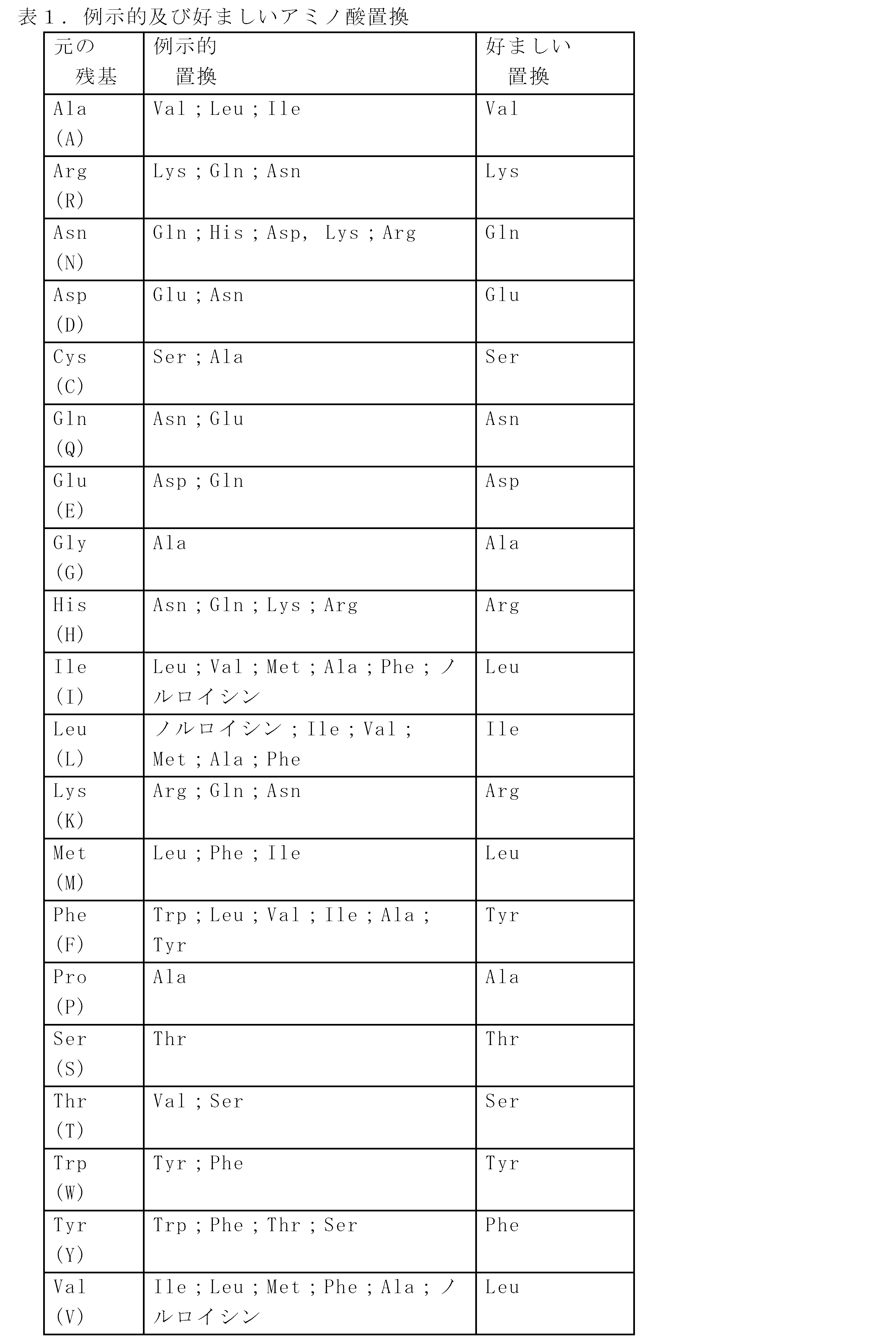
(1)疎水性:ノルロイシン、Met、Ala、Val、Leu、Ile;
(2)中性親水性:Cys、Ser、Thr、Asn、Gln;
(3)酸性:Asp、Glu;
(4)塩基性:His、Lys、Arg;
(5)鎖配向に影響を及ぼす残基:Gly、Pro;
(6)芳香族:Trp、Tyr、Phe。
I. Substitution, Insertion, and Deletion Variants Certain examples provide anti-TIGIT antagonist and/or anti-PD-L1 antagonist antibody variants having one or more amino acid substitutions. Sites of interest for substitutional mutagenesis include HVR and FR. Conservative substitutions are shown in Table 1 under the heading "Preferred Substitutions." More substantial changes are shown in Table 1 under the heading "Exemplary Substitutions" and are further described below with reference to amino acid side chain classes. Amino acid substitutions may be introduced into antibodies of interest and the products screened for desired activities, such as retention/enhancement of antigen binding, reduction of immunogenicity, or improvement of ADCC or CDC.
(1) Hydrophobic: norleucine, Met, Ala, Val, Leu, He;
(2) Neutral hydrophilicity: Cys, Ser, Thr, Asn, Gln;
(3) Acidic: Asp, Glu;
(4) Basicity: His, Lys, Arg;
(5) Residues that affect chain orientation: Gly, Pro;
(6) Aromatic: Trp, Tyr, Phe.
非保存的置換は、これらのクラスのうちの1つのメンバーを別のクラスと交換することを伴う。 Non-conservative substitutions involve exchanging a member of one of these classes for another.
置換型バリアントの1つのタイプは、親抗体(例えば、ヒト化抗体またはヒト抗体)の1つ以上の超可変領域残基を置換することを伴う。一般的に、さらなる研究のために選択する、得られるバリアント(複数可)は、親抗体と比べて、特定の生物学的特性が改変されて(例えば、向上して)おり(例えば、親和性の増大、免疫原性の低減)、及び/または親抗体の特定の生物学的特性が実質的に保持されている。例示的な置換型バリアントは親和性成熟抗体であり、これは、例えば、ファージディスプレイに基づく親和性成熟技法、例えば、本明細書に記載の技法を使用して簡便に生成し得る。簡潔に述べると、1つ以上のHVR残基を変異させ、バリアント抗体をファージ上に提示し、特定の生物学的活性(例えば、結合親和性)についてスクリーニングする。 One type of substitutional variant involves replacing one or more hypervariable region residues of a parent antibody (eg, a humanized or human antibody). Generally, the resulting variant(s) that are selected for further study have altered (e.g., improved) certain biological properties (e.g., improved affinity) compared to the parent antibody. (increased immunogenicity, decreased immunogenicity), and/or certain biological properties of the parent antibody are substantially retained. Exemplary substitutional variants are affinity matured antibodies, which can be conveniently produced using, eg, phage display-based affinity maturation techniques, eg, the techniques described herein. Briefly, one or more HVR residues are mutated and variant antibodies are displayed on phage and screened for specific biological activity (eg, binding affinity).
HVRにおいて改変(例えば、置換)を実施し、例えば、抗体親和性を向上させてもよい。そのような改変を、HVR「ホットスポット」、すなわち、体細胞成熟プロセス中に高頻度で変異を受けるコドンによってコードされる残基(例えば、Chowdhury,Methods Mol.Biol.207:179-196(2008)を参照のこと)において、及び/または抗原と接触する残基において実施し、得られたバリアント型VHまたはVLを、結合親和性について試験してもよい。二次ライブラリーの構築及び再選択による親和性成熟は、例えば、Hoogenboom et al. in Methods in Molecular Biology 178:1-37(O’Brien et al.,ed.,Human Press,Totowa,NJ,(2001))に記載されている。親和性成熟のいくつかの例では、成熟のために選択される可変遺伝子に、様々な方法のいずれか(例えば、エラープローンPCR法、鎖シャッフリング法、またはオリゴヌクレオチド特異的変異誘発法)によって多様性を導入する。次いで、二次ライブラリーを作製する。次いで、ライブラリーをスクリーニングし、所望の親和性を有する抗体バリアントを同定する。多様性を導入するための別の方法は、数個のHVR残基(例えば、1回に4~6個の残基)を無作為化するHVR指向性アプローチを含む。抗原結合に関与するHVR残基を、例えば、アラニンスキャニング変異誘発法またはモデリングを使用して、具体的に同定してもよい。特にCDR-H3及びCDR-L3は、多くの場合に標的とされる。 Modifications (eg, substitutions) may be made in the HVR, eg, to improve antibody affinity. Such modifications can be made by targeting HVR "hotspots," i.e., residues encoded by codons that undergo frequent mutations during somatic cell maturation processes (e.g., Chowdhury, Methods Mol. Biol. 207:179-196 (2008 ) and/or at residues in contact with the antigen and the resulting variant VH or VL may be tested for binding affinity. Affinity maturation by secondary library construction and reselection is described, for example, by Hoogenboom et al. in Methods in Molecular Biology 178:1-37 (O'Brien et al., ed., Human Press, Totowa, NJ, (2001)). In some examples of affinity maturation, the variable genes selected for maturation are mutated by any of a variety of methods (e.g., error-prone PCR, strand shuffling, or oligonucleotide-directed mutagenesis). Introducing sex. A secondary library is then created. The library is then screened to identify antibody variants with the desired affinity. Another method for introducing diversity involves HVR-directed approaches that randomize several HVR residues (eg, 4-6 residues at a time). HVR residues involved in antigen binding may be specifically identified using, for example, alanine scanning mutagenesis or modeling. CDR-H3 and CDR-L3 in particular are often targeted.
特定の例では、置換、挿入、または欠失を、そのような改変が抗体の抗原に結合する能力を実質的に低下させない限り、1つ以上のHVR内で実施してもよい。例えば、HVRにおいて、結合親和性を実質的に低下させない保存的変化(例えば、本明細書に提供する保存的置換)を実施してもよい。そのような改変は、例えば、HVR内の抗原接触残基の外側であってもよい。上記のバリアント型VH及びVL配列の特定の例では、各HVRは、改変されていないか、または1つ、2つ、または3つ以下のアミノ酸置換を有するかのいずれかである。 In certain instances, substitutions, insertions, or deletions may be made within one or more HVRs so long as such modifications do not substantially reduce the ability of the antibody to bind antigen. For example, conservative changes may be made in the HVR that do not substantially reduce binding affinity (eg, the conservative substitutions provided herein). Such modifications may be, for example, outside of antigen-contacting residues within the HVR. In certain examples of variant VH and VL sequences described above, each HVR is either unaltered or has one, two, or no more than three amino acid substitutions.
変異誘発のために標的化し得る抗体の残基または領域の同定に有用な方法は「アラニンスキャニング変異誘発法」と呼ばれ、Cunningham and Wells(1989)Science,244:1081-1085に記載されている。この方法では、標的残基(例えば、Arg、Asp、His、Lys、及びGluなどの荷電残基)の残基またはグループを同定し、中性または負に荷電されたアミノ酸(例えば、アラニンまたはポリアラニン)に置き換えて、抗体と抗原との相互作用が影響を受けたかどうかを判定する。最初の置換に対して機能的感受性を示すアミノ酸の部位に、さらなる置換を導入してもよい。あるいは、またはさらに、抗体と抗原との間の接触点を同定するための抗原-抗体複合体の結晶構造。そのような接触残基及び隣接残基を、置換の候補として標的とするか、または排除してもよい。バリアントをスクリーニングして、それらが所望の特性を保有するかどうかを判定してもよい。 A method useful for identifying residues or regions of antibodies that can be targeted for mutagenesis is called "alanine scanning mutagenesis" and is described in Cunningham and Wells (1989) Science, 244:1081-1085. . This method involves identifying residues or groups of target residues (e.g., charged residues such as Arg, Asp, His, Lys, and Glu) and neutral or negatively charged amino acids (e.g., alanine or polynucleotides). alanine) to determine whether the interaction between the antibody and antigen was affected. Additional substitutions may be introduced at amino acid sites that exhibit functional sensitivity to the first substitution. Alternatively, or in addition, crystal structures of antigen-antibody complexes to identify points of contact between antibodies and antigens. Such contact residues and adjacent residues may be targeted or eliminated as candidates for substitution. Variants may be screened to determine whether they possess the desired property.
アミノ酸配列の挿入には、1残基~100残基以上を含むポリペプチドの長さの範囲を有するアミノ末端及び/またはカルボキシル末端融合、及び単一のまたは多数のアミノ酸残基の配列内挿入が含まれる。末端挿入の例として、N末端メチオニル残基を有する抗体が挙げられる。抗体分子の他の挿入型バリアントには、抗体の血清半減期を増加させる酵素(例えば、ADEPTのための)またはポリペプチドに対する、抗体のN末端またはC末端への融合が含まれる。 Amino acid sequence insertions include amino-terminal and/or carboxyl-terminal fusions with polypeptide lengths ranging from 1 to 100 or more residues, and intrasequence insertions of single or multiple amino acid residues. included. Examples of terminal insertions include antibodies with an N-terminal methionyl residue. Other insertional variants of antibody molecules include fusions to the N-terminus or C-terminus of the antibody to enzymes (eg, for ADEPT) or polypeptides that increase the serum half-life of the antibody.
II.グリコシル化バリアント
特定の例では、本発明の抗TIGITアンタゴニスト抗体及び/または抗PD-L1アンタゴニスト抗体を改変して、抗体がグリコシル化する程度を増加または減少させることができる。本発明の抗TIGITアンタゴニスト抗体及び/または抗PD-L1アンタゴニスト抗体へのグリコシル化部位の付加または欠失は、1つ以上のグリコシル化部位を創出するかまたは除去するように、アミノ酸配列を改変することによって簡便に達成し得る。
II. Glycosylation Variants In certain instances, anti-TIGIT antagonist antibodies and/or anti-PD-L1 antagonist antibodies of the invention can be modified to increase or decrease the extent to which the antibody is glycosylated. Addition or deletion of glycosylation sites to anti-TIGIT antagonist antibodies and/or anti-PD-L1 antagonist antibodies of the invention alters the amino acid sequence to create or remove one or more glycosylation sites. This can be easily achieved by
抗体がFc領域を含む場合、そこに結合した炭水化物を改変してもよい。哺乳類細胞によって産生される天然抗体は、通常、一般的に、Fc領域のCH2ドメインのAsn297へN-結合によって結合する分岐した二分岐オリゴ糖を含む。例えば、Wright et al. TIBTECH 15:26-32(1997)を参照のこと。オリゴ糖には、様々な炭水化物、例えば、マンノース、N-アセチルグルコサミン(GlcNAc)、ガラクトース、及びシアル酸、ならびに二分岐オリゴ糖構造の「ステム」内のGlcNAcに結合するフコースが含まれ得る。いくつかの例では、特定の特性を向上させた抗体バリアントを作製するために、本発明の抗体内のオリゴ糖の修飾を実施する。 If the antibody includes an Fc region, the carbohydrates attached thereto may be modified. Natural antibodies produced by mammalian cells typically contain branched biantennary oligosaccharides that are typically linked by an N-linkage to Asn297 of the CH2 domain of the Fc region. For example, Wright et al. See TIBTECH 15:26-32 (1997). Oligosaccharides can include a variety of carbohydrates, such as mannose, N-acetylglucosamine (GlcNAc), galactose, and sialic acid, as well as fucose, which is attached to GlcNAc within the "stem" of the biantennary oligosaccharide structure. In some instances, modifications of oligosaccharides within antibodies of the invention are performed to generate antibody variants with improved particular properties.
一例では、Fc領域に結合した(直接的にまたは間接的に)フコースを欠く炭水化物構造を有する抗体バリアントを提供する。例えば、そのような抗体におけるフコースの量は、1%~80%、1%~65%、5%~65%、または20%~40%であってもよい。フコースの量は、例えば、WO2008/077546に記載されるように、MALDI-TOF質量分析法による測定で、Asn297に結合したすべての糖鎖構造(例えば、複合体、ハイブリッド、及び高マンノース構造)の合計に対する、Asn297における糖鎖内のフコースの平均量を算出することによって決定する。Asn297は、Fc領域内の約297位(Fc領域残基のEUナンバリング)に位置するアスパラギン残基を指すが;Asn297はまた、抗体における小規模な配列変異によっては、297位の上流または下流の約±3アミノ酸、すなわち、294~300位の間に位置していてもよい。そのようなフコシル化バリアントは、向上したADCC機能を有し得る。例えば、米国特許公開第US2003/0157108号(Presta,L.);第US2004/0093621号(Kyowa Hakko Kogyo Co.,Ltd)を参照のこと。「脱フコシル化」または「フコース欠損」抗体バリアントに関連する刊行物の例として:US2003/0157108;WO2000/61739;WO2001/29246;US2003/0115614;US2002/0164328;US2004/0093621;US2004/0132140;US2004/0110704;US2004/0110282;US2004/0109865;WO2003/085119;WO2003/084570;WO2005/035586;WO2005/035778;WO2005/053742;WO2002/031140;Okazaki et al.J.Mol.Biol.336:1239-1249(2004);Yamane-Ohnuki et al.Biotech.Bioeng.87:614(2004)が挙げられる。脱フコシル化抗体を産生することが可能な細胞株の例として、タンパク質フコシル化が欠損したLec13 CHO細胞(Ripka et al. Arch.Biochem.Biophys.249:533-545(1986);米国特許出願第US2003/0157108A1号、Presta,L;及びWO2004/056312A1、Adams et al.,特に実施例11で)、ならびにα-1,6-フコシルトランスフェラーゼ遺伝子、FUT8、ノックアウトCHO細胞などのノックアウト細胞株(例えば、Yamane-Ohnuki et al. Biotech.Bioeng.87:614(2004);Kanda,Y.et al.,Biotechnol.Bioeng.,94(4):680-688(2006);及びWO2003/085107を参照のこと)が挙げられる。 In one example, an antibody variant is provided that has a carbohydrate structure lacking fucose attached (directly or indirectly) to the Fc region. For example, the amount of fucose in such antibodies may be 1% to 80%, 1% to 65%, 5% to 65%, or 20% to 40%. The amount of fucose is measured by MALDI-TOF mass spectrometry, as described in WO2008/077546, for example, in all sugar chain structures (e.g., complexes, hybrids, and high-mannose structures) bound to Asn297. It is determined by calculating the average amount of fucose in the sugar chain at Asn297 with respect to the total. Asn297 refers to an asparagine residue located at approximately position 297 (EU numbering of Fc region residues) within the Fc region; however, Asn297 also refers to an asparagine residue located upstream or downstream of position 297, depending on minor sequence variations in the antibody. It may be located about ±3 amino acids, ie, between positions 294 and 300. Such fucosylation variants may have improved ADCC function. See, eg, US Patent Publications No. US 2003/0157108 (Presta, L.); US 2004/0093621 (Kyowa Hakko Kogyo Co., Ltd). Examples of publications related to "defucosylated" or "fucose-deficient" antibody variants include: US2003/0157108; WO2000/61739; WO2001/29246; US2003/0115614; US2002/0164328; US2004/0093621; US2004/0132140; US2004 /0110704; US2004/0110282; US2004/0109865; WO2003/085119; WO2003/084570; WO2005/035586; WO2005/035778; WO2005/053742; WO2002/031140; Okazaki et al. J. Mol. Biol. 336:1239-1249 (2004); Yamane-Ohnuki et al. Biotech. Bioeng. 87:614 (2004). An example of a cell line capable of producing defucosylated antibodies is Lec13 CHO cells deficient in protein fucosylation (Ripka et al. Arch. Biochem. Biophys. 249:533-545 (1986); U.S. Patent Application No. US2003/0157108A1, Presta, L; and WO2004/056312A1, Adams et al., in particular Example 11), as well as α-1,6-fucosyltransferase gene, FUT8, knockout cell lines such as knockout CHO cells (e.g. See Yamane-Ohnuki et al. Biotech. Bioeng. 87:614 (2004); Kanda, Y. et al., Biotechnol. ).
上記の観点から、いくつかの例では、本発明の方法は、抗TIGITアンタゴニスト抗体(例えば、本明細書に開示の抗TIGITアンタゴニスト抗体、例えば、チラゴルマブ)及び/またはアグリコシル化部位の変異を有する抗PD-L1アンタゴニスト抗体(例えば、アテゾリズマブ)バリアントを、分割・用量漸増投与計画で対象に投与することを含む。いくつかの例では、アグリコシル化部位の変異は、抗体のエフェクター機能を低下させる。いくつかの例では、アグリコシル化部位の変異は、置換型変異である。いくつかの例では、抗体は、エフェクター機能を低下させるFc領域における置換型変異を含む。いくつかの例では、置換型変異は、アミノ酸残基N297、L234、L235、及び/またはD265(EUナンバリング)における変異である。いくつかの例では、置換型変異は、N297G、N297A、L234A、L235A、D265A、及びP329Gからなる群から選択される。いくつかの例では、置換型変異は、アミノ酸残基N297における変異である。好ましい実施形態では、置換型変異は、N297Aである。 In view of the above, in some examples, the methods of the invention provide anti-TIGIT antagonist antibodies (e.g., anti-TIGIT antagonist antibodies disclosed herein, e.g., tiragolumab) and/or having mutations in aglycosylation sites. comprising administering an anti-PD-L1 antagonist antibody (eg, atezolizumab) variant to a subject in a divided and escalating dose regimen. In some instances, mutations in aglycosylation sites reduce the effector function of the antibody. In some instances, the aglycosylation site mutation is a substitution mutation. In some instances, the antibody comprises a substitution mutation in the Fc region that reduces effector function. In some examples, substitutional mutations are mutations at amino acid residues N297, L234, L235, and/or D265 (EU numbering). In some examples, the substitutional mutation is selected from the group consisting of N297G, N297A, L234A, L235A, D265A, and P329G. In some examples, the substitutional mutation is a mutation at amino acid residue N297. In a preferred embodiment, the substitutional mutation is N297A.
例えば、抗体のFc領域に結合した二分岐オリゴ糖がGlcNAcによって二分されている、二分岐オリゴ糖を有する抗TIGITアンタゴニスト抗体及び/または抗PD-L1アンタゴニスト抗体バリアントをさらに提供する。そのような抗体バリアントは、低減したフコシル化、及び/または向上したADCC機能を有し得る。そのような抗体バリアントの例は、例えば、WO2003/011878(Jean-Mairet et al.);米国特許第6,602,684号(Umana et al.);及びUS2005/0123546(Umana et al.)に記載されている。また、Fc領域に結合したオリゴ糖において少なくとも1つのガラクトース残基を有する抗体バリアントも提供する。そのような抗体バリアントは、向上したCDC機能を有し得る。そのような抗体バリアントは、例えば、WO1997/30087(Patel et al.);WO1998/58964(Raju,S.);及びWO1999/22764(Raju,S.)に記載されている。 Further provided are anti-TIGIT antagonist antibodies and/or anti-PD-L1 antagonist antibody variants having biantennary oligosaccharides, for example, where the biantennary oligosaccharide attached to the Fc region of the antibody is bisected by GlcNAc. Such antibody variants may have reduced fucosylation and/or improved ADCC function. Examples of such antibody variants can be found, for example, in WO2003/011878 (Jean-Mairet et al.); US Pat. No. 6,602,684 (Umana et al.); and US2005/0123546 (Umana et al.). Are listed. Also provided are antibody variants having at least one galactose residue in the oligosaccharide attached to the Fc region. Such antibody variants may have improved CDC function. Such antibody variants are described, for example, in WO1997/30087 (Patel et al.); WO1998/58964 (Raju, S.); and WO1999/22764 (Raju, S.).
III.Fc領域バリアント
特定の例では、1つ以上のアミノ酸改変を、本発明の抗TIGITアンタゴニスト(例えば、本明細書に開示の抗TIGITアンタゴニスト抗体、例えば、チラゴルマブ)抗体及び/または抗PD-L1アンタゴニスト抗体(例えば、アテゾリズマブ)のFc領域に導入し、それによりFc領域バリアントを生成する(例えば、US2012/0251531を参照のこと)。Fc領域バリアントは、1つ以上のアミノ酸位置にアミノ酸改変(例えば、置換)を含むヒトFc領域配列(例えば、ヒトIgG1、IgG2、IgG3またはIgG4 Fc領域)を含み得る。
III. Fc Region Variants In certain examples, one or more amino acid modifications can be added to an anti-TIGIT antagonist of the invention (e.g., an anti-TIGIT antagonist antibody disclosed herein, e.g., tiragolumab) and/or an anti-PD-L1 antagonist antibody. (eg, atezolizumab), thereby generating Fc region variants (see, eg, US2012/0251531). An Fc region variant can include a human Fc region sequence (eg, a human IgG1, IgG2, IgG3 or IgG4 Fc region) that includes an amino acid modification (eg, substitution) at one or more amino acid positions.
特定の例では、本発明は、すべてではないがいくつかのエフェクター機能を保有する抗TIGITアンタゴニスト抗体及び/または抗PD-L1アンタゴニスト抗体バリアントを企図し、このことにより、抗体のin vivoでの半減期が重要であるが、特定のエフェクター機能(補体及びADCCなど)が不要であるかまたは有害であるような用途に対して、抗体は望ましい候補となる。in vitro及び/またはin vivo細胞傷害性アッセイを実施して、CDC及び/またはADCC活性の低減/枯渇を確認することができる。例えば、Fc受容体(FcR)結合アッセイを実施することにより、抗体がFcγR結合を欠いている(したがって、ADCC活性を欠いている可能性が高い)が、FcRn結合能力を保持していることが保証され得る。ADCCを媒介するための初代細胞であるNK細胞が、Fc RIIIのみを発現する一方で、単球は、Fc RI、Fc RII、及びFc RIIIを発現する。造血細胞上でのFcR発現は、Ravetch and Kinet,Annu.Rev.Immunol.9:457-492(1991)の464ページの表3にまとめられている。目的とする分子のADCC活性を評価するためのin vitroアッセイの非限定的な例は、米国特許第5,500,362号(例えば、Hellstrom,I.et al. Proc.Nat’l Acad.Sci.USA 83:7059-7063(1986))及びHellstrom,I et al.,Proc.Nat’l Acad.Sci.USA 82:1499-1502(1985);第5,821,337号(Bruggemann,M.et al.,J.Exp.Med.166:1351-1361(1987))を参照のこと。あるいは、非放射性アッセイ方法を用いてもよい(例えば、フローサイトメトリーのためのACTI(商標)非放射性細胞傷害性アッセイ(CellTechnology,Inc.Mountain View,CA;及びCytoTox96(登録商標)非放射性細胞傷害性アッセイ(Promega,Madison,WI)を参照のこと。そのようなアッセイに有用なエフェクター細胞として、末梢血単核球(PBMC)及びナチュラルキラー(NK)細胞が挙げられる。あるいは、またはさらに、目的とする分子のADCC活性を、in vivoで、例えば、Clynes et al.Proc.Nat’l Acad.Sci.USA 95:652-656(1998)に開示される動物モデルにおいて評価してもよい。また、C1q結合アッセイを実施して、抗体がC1qに結合不可能であり、従ってCDC活性を欠いていることを確認してもよい。例えば、WO2006/029879及びWO2005/100402におけるC1q及びC3c結合ELISAを参照のこと。補体活性化を評価するために、CDCアッセイを実施してもよい(例えば、Gazzano-Santoro et al.J.Immunol.Methods 202:163(1996);Cragg,M.S.et al.,Blood 101:1045-1052(2003);及びCragg,M.S. and M.J.Glennie,Blood 103:2738-2743(2004)を参照のこと)。FcRn結合及びin vivoクリアランス/半減期の測定もまた、当技術分野で公知の方法を使用して実施することができる(例えば、Petkova,S.B.et al.,Int’l. Immunol.18(12):1759-1769(2006)を参照のこと)。 In certain instances, the invention contemplates anti-TIGIT antagonist antibodies and/or anti-PD-L1 antagonist antibody variants that retain some, but not all, effector functions, thereby reducing the in vivo halving of the antibody. Antibodies are desirable candidates for applications where phase is important but certain effector functions (such as complement and ADCC) are unnecessary or deleterious. In vitro and/or in vivo cytotoxicity assays can be performed to confirm reduction/depletion of CDC and/or ADCC activity. For example, by performing Fc receptor (FcR) binding assays, it can be determined that the antibody lacks FcγR binding (and therefore likely lacks ADCC activity), but retains FcRn binding ability. can be guaranteed. NK cells, the primary cells for mediating ADCC, express only Fc RIII, while monocytes express Fc RI, Fc RII, and Fc RIII. FcR expression on hematopoietic cells is described by Ravetch and Kinet, Annu. Rev. Immunol. 9:457-492 (1991), page 464, Table 3. Non-limiting examples of in vitro assays for assessing ADCC activity of molecules of interest include those described in U.S. Pat. No. 5,500,362 (e.g., Hellstrom, I. et al. Proc. Nat'l Acad. Sci. USA 83:7059-7063 (1986)) and Hellstrom, I et al. , Proc. Nat'l Acad. Sci. USA 82:1499-1502 (1985); No. 5,821,337 (Bruggemann, M. et al., J. Exp. Med. 166:1351-1361 (1987)). Alternatively, non-radioactive assay methods may be used (e.g., the ACTI™ non-radioactive cytotoxicity assay for flow cytometry (Cell Technology, Inc. Mountain View, CA; and the CytoTox96® non-radioactive cytotoxicity assay). (Promega, Madison, WI). Effector cells useful in such assays include peripheral blood mononuclear cells (PBMCs) and natural killer (NK) cells. Alternatively, or in addition, the objective The ADCC activity of a molecule may be assessed in vivo, for example in the animal model disclosed in Clynes et al. Proc. Nat'l Acad. Sci. USA 95:652-656 (1998). , a C1q binding assay may be performed to confirm that the antibody is unable to bind C1q and therefore lacks CDC activity. For example, the C1q and C3c binding ELISA in WO2006/029879 and WO2005/100402 See, CDC assays may be performed to assess complement activation (e.g., Gazzano-Santoro et al. J. Immunol. Methods 202:163 (1996); Cragg, M.S. et al. FcRn binding and in vivo clearance/halving. Phase measurements can also be performed using methods known in the art (e.g., Petkova, SB. et al., Int'l. Immunol. 18(12):1759-1769). (2006).
低下したエフェクター機能を有する抗体として、Fc領域残基238、265、269、270、297、327、及び329のうちの1つ以上の置換を有する抗体が挙げられる(米国特許第6,737,056号及び第8,219,149号)。そのようなFc変異体として、残基265及び297をアラニンに置換した、いわゆる「DANA」Fc変異体を含む、アミノ酸265位、269位、270位、297位、及び327位のうちの2つ以上において置換を有するFc変異体が挙げられる(米国特許第7,332,581号及び第8,219,149号)。 Antibodies with reduced effector function include antibodies with substitutions of one or more of Fc region residues 238, 265, 269, 270, 297, 327, and 329 (U.S. Pat. No. 6,737,056). No. 8,219,149). Such Fc variants include the so-called "DANA" Fc variant in which residues 265 and 297 are replaced with alanine, two of amino acids positions 265, 269, 270, 297, and 327. Fc variants having substitutions in the above are mentioned (US Pat. Nos. 7,332,581 and 8,219,149).
特定の例では、抗体内の野生型ヒトFc領域の329位におけるプロリンを、グリシンもしくはアルギニンか、またはFcのプロリン329とFcgRIIIのトリプトファン残基Trp87及びTrp110との間に形成される、Fc/Fcγ受容体界面内のプロリンサンドイッチを破壊するのに十分な大きさのアミノ酸残基で置換する(Sondermann et al.:Nature 406,267-273(20 Jul.2000))。特定の例では、抗体は、少なくとも1つのさらなるアミノ酸置換を有する。一例では、さらなるアミノ酸置換は、S228P、E233P、L234A、L235A、L235E、N297A、N297D、またはP331Sであり、さらに別の例では、少なくとも1つのさらなるアミノ酸置換は、ヒトIgG1 Fc領域のL234A及びL235A、またはヒトIgG4 Fc領域のS228P及びL235E(例えば、US2012/0251531を参照のこと)であり、またさらに別の例では、少なくとも1つのさらなるアミノ酸置換は、ヒトIgG1 Fc領域のL234A及びL235A及びP329Gである。 In a particular example, the proline at position 329 of the wild-type human Fc region in the antibody can be replaced with glycine or arginine, or with Fc/Fcγ, which is formed between proline 329 of the Fc and tryptophan residues Trp87 and Trp110 of FcgRIII. Substitute with an amino acid residue large enough to disrupt the proline sandwich within the receptor interface (Sondermann et al.: Nature 406, 267-273 (20 Jul. 2000)). In certain examples, the antibody has at least one additional amino acid substitution. In one example, the additional amino acid substitution is S228P, E233P, L234A, L235A, L235E, N297A, N297D, or P331S, and in yet another example, the at least one additional amino acid substitution is L234A and L235A of the human IgG1 Fc region, or S228P and L235E of the human IgG4 Fc region (see e.g. US2012/0251531), and in yet another example, the at least one additional amino acid substitution is L234A and L235A and P329G of the human IgG1 Fc region .
FcRへの結合が向上または低下した特定の抗体バリアントが記載されている(例えば、米国特許第6,737,056号;WO2004/056312、及びShields et al.,J.Biol.Chem.9(2):6591-6604(2001)を参照のこと)。 Certain antibody variants with increased or decreased binding to FcR have been described (e.g., U.S. Pat. No. 6,737,056; WO2004/056312, and Shields et al., J. Biol. Chem. 9 (2003). ):6591-6604 (2001)).
特定の例では、抗体バリアントは、ADCCを向上させる1つ以上のアミノ酸置換、例えば、Fc領域の298、333、及び/または334位(残基のEUナンバリング)での置換を有するFc領域を含む。 In certain examples, the antibody variant comprises an Fc region that has one or more amino acid substitutions that improve ADCC, e.g., substitutions at positions 298, 333, and/or 334 (EU numbering of residues) of the Fc region. .
いくつかの例では、例えば、米国特許第6,194,551号、WO99/51642、及びIdusogie et al. J.Immunol.164:4178-4184(2000)に記載されているように、C1q結合及び/または補体依存性細胞傷害(CDC)に変化をもたらす(すなわち、向上させるかまたは低下させるかのいずれかの)改変を、Fc領域に施す。 Some examples include, for example, U.S. Patent No. 6,194,551, WO 99/51642, and Idusogie et al. J. Immunol. 164:4178-4184 (2000) that alter (i.e., either increase or decrease) C1q binding and/or complement-dependent cytotoxicity (CDC). is applied to the Fc region.
半減期が延長され、胎児への母体IgGの移入を担う新生児型Fc受容体(FcRn)への結合が向上した抗体(Guyer et al.,J.Immunol.117:587(1976)及びKim et al.,J.Immunol.24:249(1994))が、US2005/0014934A1(Hinton et al.)に記載されている。それらの抗体は、FcRnへのFc領域の結合を向上させる1つ以上の置換を有するFc領域を含む。そのようなFcバリアントとして、Fc領域残基:238、256、265、272、286、303、305、307、311、312、317、340、356、360、362、376、378、380、382、413、424、または434のうちの1つ以上における置換、例えばFc領域残基434の置換を有するバリアントが挙げられる(米国特許第7,371,826号)。 Antibodies with extended half-life and improved binding to neonatal Fc receptors (FcRn), which are responsible for the transfer of maternal IgG to the fetus (Guyer et al., J. Immunol. 117:587 (1976) and Kim et al. ., J. Immunol. 24:249 (1994)) is described in US2005/0014934A1 (Hinton et al.). These antibodies include an Fc region that has one or more substitutions that improve binding of the Fc region to FcRn. Such Fc variants include Fc region residues: 238, 256, 265, 272, 286, 303, 305, 307, 311, 312, 317, 340, 356, 360, 362, 376, 378, 380, 382, Included are variants with substitutions at one or more of 413, 424, or 434, such as substitution of Fc region residue 434 (US Pat. No. 7,371,826).
また、Fc領域バリアントの他の例に関して、Duncan & Winter,Nature 322:738-40(1988);米国特許第5,648,260号;米国特許第5,624,821号;及びWO94/29351も参照のこと。 See also Duncan & Winter, Nature 322:738-40 (1988); US Pat. No. 5,648,260; US Pat. No. 5,624,821; and WO 94/29351 for other examples of Fc region variants. See.
いくつかの態様では、抗TIGITアンタゴニスト抗体(例えば、本明細書に開示の抗TIGITアンタゴニスト抗体、例えば、チラゴルマブ)及び/または抗PD-L1アンタゴニスト抗体(例えば、アテゾリズマブ)は、N297G変異を含むFc領域を含む。 In some embodiments, an anti-TIGIT antagonist antibody (e.g., an anti-TIGIT antagonist antibody disclosed herein, e.g., tiragolumab) and/or an anti-PD-L1 antagonist antibody (e.g., atezolizumab) has an Fc region that includes the N297G mutation. including.
いくつかの例では、抗TIGITアンタゴニスト抗体(例えば、本明細書に開示の抗TIGITアンタゴニスト抗体、例えば、チラゴルマブ)及び/または抗PD-L1アンタゴニスト抗体(例えば、アテゾリズマブ)は、1つ以上の重鎖定常ドメインを含み、1つ以上の重鎖定常ドメインは、第1のCH1(CH11)ドメイン、第1のCH2(CH21)ドメイン、第1のCH3(CH31)ドメイン、第2のCH1(CH12)ドメイン、第2のCH2(CH22)ドメイン、及び第2のCH3(CH32)ドメインから選択される。いくつかの例では、1つ以上の重鎖定常ドメインのうちの少なくとも1つを、別の重鎖定常ドメインと対合させる。いくつかの例では、CH31及びCH32ドメインは、各々、突起または空隙を含み、CH31ドメイン内の突起または空隙は、それぞれ、CH32ドメイン内の空隙または突起内に位置付けることができる。いくつかの例では、CH31及びCH32ドメインは、前記突起と空隙との間の境界面において接触する。いくつかの例では、CH21及びCH22ドメインは、各々、突起または空隙を含み、CH21ドメイン内の前記突起または空隙は、それぞれ、CH22ドメイン内の空隙または突起内に位置付けることができる。他の例では、CH21及びCH22ドメインは、前記突起と空隙との間の境界面において接触する。いくつかの例では、抗TIGITアンタゴニスト抗体(例えば、本明細書に開示の抗TIGITアンタゴニスト抗体、例えば、チラゴルマブ)及び/または抗PD-L1アンタゴニスト抗体(例えば、アテゾリズマブ)は、IgG1抗体である。 In some examples, an anti-TIGIT antagonist antibody (e.g., an anti-TIGIT antagonist antibody disclosed herein, e.g., tiragolumab) and/or an anti-PD-L1 antagonist antibody (e.g., atezolizumab) has one or more heavy chain constants. the one or more heavy chain constant domains include a first CH1 (CH1 1 ) domain, a first CH2 (CH2 1 ) domain, a first CH3 (CH3 1 ) domain, a second CH1 ( CH1 2 ) domain, a second CH2 (CH2 2 ) domain, and a second CH3 (CH3 2 ) domain. In some examples, at least one of the one or more heavy chain constant domains is paired with another heavy chain constant domain. In some examples, the CH3 1 and CH3 2 domains each include a protrusion or void, and the protrusion or void in the CH3 1 domain can be located within the void or protrusion, respectively, in the CH3 2 domain. In some examples, the CH3 1 and CH3 2 domains contact at the interface between the protrusion and the cavity. In some examples, the CH2 1 and CH2 2 domains each include a protrusion or void, and the protrusion or void in the CH2 1 domain can be located within the void or protrusion, respectively, in the CH2 2 domain. In other examples, the CH2 1 and CH2 2 domains contact at the interface between the protrusion and the cavity. In some examples, the anti-TIGIT antagonist antibody (eg, an anti-TIGIT antagonist antibody disclosed herein, eg, tiragolumab) and/or the anti-PD-L1 antagonist antibody (eg, atezolizumab) is an IgG1 antibody.
IV.システイン改変型抗体バリアント
特定の例では、抗体の1つ以上の残基をシステイン残基で置換したシステイン改変型抗TIGITアンタゴニスト抗体及び/または抗PD-L1アンタゴニスト抗体、例えば、「thioMAb」を作製することが望ましい。特定の例では、置換する残基を、抗体のアクセスしやすい部位に設定する。本明細書にさらに記載するように、それらの残基をシステインで置換することにより、反応性のチオール基がそれによって抗体のアクセスしやすい部位に配置され、これを用いて、抗体を、他の部分、例えば、薬物部分またはリンカー-薬物部分に複合体化して、免疫複合体を作出してもよい。特定の例では、以下の残基のうちの1つ以上を、システインで置換する:軽鎖のV205(Kabatナンバリング);重鎖のA118(EUナンバリング);及び重鎖Fc領域のS400(EUナンバリング)。システイン改変型抗体は、例えば、米国特許第7,521,541号に記載されるように生成してもよい。
IV. Cysteine Engineered Antibody Variants In certain examples, cysteine engineered anti-TIGIT antagonist antibodies and/or anti-PD-L1 antagonist antibodies, e.g., "thioMAbs," are generated in which one or more residues of the antibody are replaced with cysteine residues. This is desirable. In certain examples, the substituted residues are placed at easily accessible sites on the antibody. As further described herein, by replacing those residues with cysteine, a reactive thiol group is thereby placed at an easily accessible site on the antibody, which can be used to bind antibodies to other It may be conjugated to a moiety, such as a drug moiety or a linker-drug moiety, to create an immunoconjugate. In certain examples, one or more of the following residues are replaced with cysteine: V205 of the light chain (Kabat numbering); A118 of the heavy chain (EU numbering); and S400 of the heavy chain Fc region (EU numbering). ). Cysteine-engineered antibodies may be produced, for example, as described in US Pat. No. 7,521,541.
V.抗体誘導体
特定の例では、本明細書において提供する本発明の抗TIGITアンタゴニスト抗体(例えば、抗TIGITアンタゴニスト抗体(例えば、チラゴルマブ)またはそのバリアント)及び/または本発明の抗PD-L1アンタゴニスト抗体(例えば、アテゾリズマブまたはそのバリアント)を、当技術分野で公知であり、容易に入手可能な追加の非タンパク質部分を含むようにさらに改変する。抗体の誘導体化に好適な部分として、水溶性ポリマーが挙げられるが、これに限定されない。水溶性ポリマーの非限定的な例として、ポリエチレングリコール(PEG)、エチレングリコール/プロピレングリコールの共重合体、カルボキシメチルセルロース、デキストラン、ポリビニルアルコール、ポリビニルピロリドン、ポリ-1,3-ジオキソラン、ポリ-1,3,6-トリオキサン、エチレン/無水マレイン酸共重合体、ポリアミノ酸(ホモポリマーまたはランダム共重合体のいずれか)、及びデキストランまたはポリ(n-ビニルピロリドン)ポリエチレングリコール、プロプロピレン(propropylene)グリコールホモポリマー、プロリプロピレン(prolypropylene)オキシド/エチレンオキシド共重合体、ポリオキシエチル化ポリオール(例えば、グリセロール)、ポリビニルアルコール、ならびにそれらの混合物が挙げられるが、これらに限定されない。ポリエチレングリコールプロピオンアルデヒドは、水中でのその安定性のため、製造における利点を有し得る。ポリマーは、任意の分子量のものであってもよく、分岐していても非分岐であってもよい。抗体に結合したポリマーの数は、様々であってもよく、複数のポリマーが結合する場合、それらは、同じ分子または異なる分子であり得る。一般的に、誘導体化に使用するポリマーの数及び/またはタイプは、改善する抗体の特定の特性または機能、抗体誘導体を規定の条件下で療法において使用するかどうかなどを含むが、これらに限定されない考慮に基づいて、決定することができる。
V. Antibody Derivatives In certain examples, anti-TIGIT antagonist antibodies of the invention provided herein (e.g., anti-TIGIT antagonist antibodies (e.g., tiragolumab) or variants thereof) and/or anti-PD-L1 antagonist antibodies of the invention (e.g., , atezolizumab or variants thereof) are further modified to include additional non-protein moieties that are known and readily available in the art. Suitable moieties for derivatizing antibodies include, but are not limited to, water-soluble polymers. Non-limiting examples of water-soluble polymers include polyethylene glycol (PEG), ethylene glycol/propylene glycol copolymers, carboxymethylcellulose, dextran, polyvinyl alcohol, polyvinylpyrrolidone, poly-1,3-dioxolane, poly-1, 3,6-trioxane, ethylene/maleic anhydride copolymers, polyamino acids (either homopolymers or random copolymers), and dextran or poly(n-vinylpyrrolidone) polyethylene glycol, propopylene glycol homo Polymers include, but are not limited to, prolypropylene oxide/ethylene oxide copolymers, polyoxyethylated polyols (eg, glycerol), polyvinyl alcohol, and mixtures thereof. Polyethylene glycol propionaldehyde may have manufacturing advantages due to its stability in water. The polymer may be of any molecular weight and may be branched or unbranched. The number of polymers attached to an antibody can vary, and if multiple polymers are attached, they can be the same molecule or different molecules. In general, the number and/or type of polymers used for derivatization will depend on the particular properties or functions of the antibody being improved, including, but not limited to, whether the antibody derivative will be used in therapy under defined conditions. The decision can be made based on no consideration.
別の例では、放射線への曝露によって選択的に加熱され得る抗体と非タンパク質性部分の複合体を提供する。一例では、非タンパク質性部分は、カーボンナノチューブ(Kam et al.,Proc.Natl.Acad.Sci.USA 102:11600-11605(2005))である。放射線は、任意の波長のものであってもよく、通常の細胞を害さないが、抗体-非タンパク質性部分の近傍の細胞が死滅する温度まで非タンパク質性部分を加熱する波長が含まれるが、これらに限定されない。 Another example provides a conjugate of an antibody and a non-proteinaceous moiety that can be selectively heated by exposure to radiation. In one example, the non-proteinaceous moiety is a carbon nanotube (Kam et al., Proc. Natl. Acad. Sci. USA 102:11600-11605 (2005)). The radiation may be of any wavelength, including wavelengths that do not harm normal cells but heat the non-proteinaceous moiety to a temperature that kills cells in the vicinity of the antibody-non-proteinaceous moiety. Not limited to these.
組換え産生方法
本発明の抗TIGITアンタゴニスト抗体(例えば、本明細書に開示の抗TIGITアンタゴニスト抗体、例えばチラゴルマブ)及び/または抗PD-L1アンタゴニスト抗体(例えば、アテゾリズマブ)は、例えば、その全体が参照により本明細書に援用される米国特許第4,816,567号に記載されているような組換え方法及び組成物を使用して産生してもよい。
Recombinant Production Methods The anti-TIGIT antagonist antibodies of the invention (e.g., the anti-TIGIT antagonist antibodies disclosed herein, e.g., tiragolumab) and/or the anti-PD-L1 antagonist antibodies (e.g., atezolizumab) are, e.g. may be produced using recombinant methods and compositions such as those described in US Pat. No. 4,816,567, incorporated herein by reference.
抗TIGITアンタゴニスト抗体及び/または抗PD-L1アンタゴニスト抗体の組み換え産生のために、例えば、抗体をコードする核酸を単離し、宿主細胞内でのさらなるクローニング及び/または発現のために、1つ以上のベクター内に挿入する。そのような核酸は、慣例の手順を使用して(例えば、抗体の重鎖及び軽鎖をコードする遺伝子に特異的に結合することができるオリゴヌクレオチドプローブを使用することによって)、容易に単離し、配列決定し得る。 For recombinant production of anti-TIGIT antagonist antibodies and/or anti-PD-L1 antagonist antibodies, for example, a nucleic acid encoding the antibody is isolated and one or more antibodies are isolated for further cloning and/or expression in host cells. Insert into a vector. Such nucleic acids are easily isolated using routine procedures (e.g., by using oligonucleotide probes that can specifically bind to genes encoding the heavy and light chains of antibodies). , can be sequenced.
抗体をコードするベクターのクローニングまたは発現に好適な宿主細胞として、本明細書に記載の原核細胞または真核細胞が挙げられる。例えば、抗体は、特にグリコシル化及びFcエフェクター機能が必要とされない場合に、細菌において産生してもよい。細菌における抗体断片及びポリペプチドの発現については、例えば、米国特許第5,648,237号、第5,789,199号、及び第5,840,523号を参照のこと。(また、E.coliにおける抗体断片の発現を記載する、Charlton,Methods in Molecular Biology,Vol.248(B.K.C.Lo,ed.,Humana Press,Totowa,NJ,2003),pp.245-254も参照のこと)。発現後、抗体を細菌細胞ペーストから可溶性画分に単離してもよく、さらに精製することができる。 Suitable host cells for cloning or expressing antibody-encoding vectors include prokaryotic or eukaryotic cells as described herein. For example, antibodies may be produced in bacteria, particularly where glycosylation and Fc effector function are not required. For expression of antibody fragments and polypeptides in bacteria, see, eg, US Patent Nos. 5,648,237, 5,789,199, and 5,840,523. (Also describes the expression of antibody fragments in E. coli, Charlton, Methods in Molecular Biology, Vol. 248 (B. K. C. Lo, ed., Humana Press, Totowa, NJ, 2003), pp. 245 -254). After expression, antibodies may be isolated from the bacterial cell paste into a soluble fraction, which can be further purified.
原核生物に加えて、糸状菌または酵母などの真核微生物は、抗体コードベクターに好適なクローニング用または発現用宿主であり、これには、グリコシル化経路が「ヒト化」されており、部分的または完全ヒトグリコシル化パターンを有する抗体の産生をもたらす、真菌及び酵母株が含まれる。Gerngross,Nat.Biotech.22:1409-1414(2004)、及びLi et al.,Nat.Biotech.24:210-215(2006)を参照のこと。 In addition to prokaryotes, eukaryotic microorganisms such as filamentous fungi or yeast are suitable cloning or expression hosts for antibody-encoding vectors, which include "humanized" glycosylation pathways and partially or fungal and yeast strains that result in the production of antibodies with fully human glycosylation patterns. Gerngross, Nat. Biotech. 22:1409-1414 (2004), and Li et al. , Nat. Biotech. 24:210-215 (2006).
グリコシル化抗体の発現に好適な宿主細胞はまた、多細胞生物(無脊椎動物及び脊椎動物)にも由来する。無脊椎動物細胞の例として、植物細胞及び昆虫細胞が挙げられる。昆虫細胞と組み合わせて、特にSpodoptera frugiperda細胞の形質移入用に使用し得る多数のバキュロウイルス株が同定されている。 Suitable host cells for the expression of glycosylated antibodies are also derived from multicellular organisms (invertebrates and vertebrates). Examples of invertebrate cells include plant cells and insect cells. A number of baculovirus strains have been identified that can be used in combination with insect cells, particularly for the transfection of Spodoptera frugiperda cells.
植物細胞培養物もまた、宿主として利用することができる。例えば、米国特許第5,959,177号、第6,040,498号、第6,420,548号、第7,125,978号、及び第6,417,429号(トランスジェニック植物において抗体を産生するためのPLANTIBODIES(商標)技術が記載されている)を参照のこと。 Plant cell cultures can also be utilized as hosts. For example, U.S. Patent Nos. 5,959,177; 6,040,498; 6,420,548; PLANTIBODIES(TM) technology for producing PLANTIBODIES™ is described.
脊椎動物細胞もまた、宿主として使用してもよい。例えば、懸濁液中で増殖するように適合させた哺乳類細胞株が、有用であり得る。有用な哺乳類宿主細胞株の他の例は、SV40(COS-7)によって形質転換したサル腎臓CV1株;ヒト胚性腎臓株(例えば、Graham et al.,J.Gen Virol.36:59(1977)に記載の293または293細胞);ベビーハムスター腎細胞(BHK);マウスセルトリ細胞(例えば、Mather,Biol.Reprod.23:243-251(1980));サル腎細胞(CV1);アフリカミドリザル腎細胞(VERO-76);ヒト子宮頸癌細胞(HELA);イヌ腎細胞(MDCK;バッファローラット肝細胞(BRL3A);ヒト肺細胞(W138);ヒト肝細胞(Hep G2);マウス乳腺腫瘍(MMT060562);TRI細胞、例えばMather et al.,Annals NY Acad.Sci.383:44-68(1982);MRC5細胞;及びFS4細胞である。他の有用な哺乳類宿主細胞株として、DHFR-CHO細胞を含むチャイニーズハムスター卵巣(CHO)細胞(Urlaub et al.,Proc.Natl.Acad.Sci.USA 77:4216(1980));及びY0,NS0及びSp2/0などの骨髄腫細胞株が挙げられる。抗体産生に適した特定の哺乳類宿主細胞株の概説については、例えば、Yazaki及びWu,Methods in Molecular Biology,Vol.248(B.K.C.Lo,ed.,Humana Press,Totowa,NJ),pp.255-268(2003)を参照のこと。 Vertebrate cells may also be used as hosts. For example, mammalian cell lines adapted to grow in suspension may be useful. Other examples of useful mammalian host cell lines include the monkey kidney CV1 strain transformed with SV40 (COS-7); the human embryonic kidney line (e.g., Graham et al., J. Gen Virol. 36:59 (1977 ); baby hamster kidney cells (BHK); mouse Sertoli cells (e.g., Mather, Biol. Reprod. 23:243-251 (1980)); monkey kidney cells (CV1); African green monkey kidney cells (VERO-76); human cervical cancer cells (HELA); dog kidney cells (MDCK); buffalo rat hepatocytes (BRL3A); human lung cells (W138); human hepatocytes (Hep G2); mouse mammary tumor (MMT060562) ); TRI cells, such as Mather et al., Annals NY Acad. Sci. 383:44-68 (1982); MRC5 cells; and FS4 cells. Other useful mammalian host cell lines include DHFR-CHO cells. Antibodies include Chinese hamster ovary (CHO) cells (Urlaub et al., Proc. Natl. Acad. Sci. USA 77:4216 (1980)); and myeloma cell lines such as Y0, NS0 and Sp2/0. For a review of specific mammalian host cell lines suitable for production, see, eg, Yazaki and Wu, Methods in Molecular Biology, Vol. 248 (B.KC. Lo, ed., Humana Press, Totowa, NJ), pp. See .255-268 (2003).
免疫複合体
本発明は、化学療法剤もしくは化学療法薬、成長阻害剤、毒素(例えば、タンパク質毒素、細菌、真菌、植物、もしくは動物起源の酵素的に活性な毒素、またはその断片)、または放射性同位体などの1つ以上の細胞傷害剤と複合体化させた、本発明の抗TIGITアンタゴニスト抗体(例えば、本明細書に開示の抗TIGITアンタゴニスト抗体、例えば、チラゴルマブ)及び/または抗PD-L1アンタゴニスト抗体(例えば、アテゾリズマブ)を含む免疫複合体も提供する。
Immune Complexes The present invention relates to chemotherapeutic or chemotherapeutic agents, growth inhibitors, toxins (e.g., protein toxins, enzymatically active toxins of bacterial, fungal, plant, or animal origin, or fragments thereof), or radioactive An anti-TIGIT antagonist antibody of the invention (e.g., an anti-TIGIT antagonist antibody disclosed herein, e.g., tiragolumab) and/or anti-PD-L1 conjugated with one or more cytotoxic agents such as isotopes Immunoconjugates comprising an antagonist antibody (eg, atezolizumab) are also provided.
いくつかの例では、免疫複合体は、抗体を1つ以上の薬物に複合体化した抗体薬物複合体(ADC)であり、マイタンシノイド(米国特許第5,208,020号、第5,416,064号及び欧州特許第EP0425235B1号を参照のこと);モノメチルオーリスタチン薬物部分DE及びDFなどのオーリスタチン(MMAE及びMMAF)(米国特許第5,635,483号、第5,780,588号、及び第7,498,298号を参照のこと);ドラスタチン;カリケアマイシンまたはその誘導体(米国特許第5,712,374号、第5,714,586号、第5,739,116号、第5,767,285号、第5,770,701号、第5,770,710号、第5,773,001号、及び第5,877,296号;Hinman et al.,Cancer Res.53:3336-3342(1993);ならびにLode et al.,Cancer Res.58:2925-2928(1998)を参照のこと);ダウノマイシンまたはドキソルビシンなどのアントラサイクリン(Kratz et al.,Current Med.Chem.13:477-523(2006);Jeffrey et al.,Bioorganic & Med.Chem.Letters 16:358-362(2006);Torgov et al.,Bioconj.Chem.16:717-721(2005);Nagy et al.,Proc.Natl.Acad.Sci.USA 97:829-834(2000);Dubowchik et al.,Bioorg.& Med.Chem.Letters 12:1529-1532(2002);King et al.,J.Med.Chem.45:4336-4343(2002);及び米国特許第6,630,579号を参照のこと);メトトレキサート;ビンデシン;ドセタキセル、パクリタキセル、ラロタキセル、テセタキセル、及びオルタタキセルなどのタキサン;トリコテセン;ならびにCC1065が挙げられるが、これらに限定されない。 In some examples, the immunoconjugate is an antibody-drug conjugate (ADC) in which an antibody is conjugated to one or more drugs, including maytansinoids (U.S. Pat. No. 5,208,020; 416,064 and European Patent No. EP 0425235B1); auristatin (MMAE and MMAF) such as the monomethyl auristatin drug moieties DE and DF (U.S. Patent Nos. 5,635,483, 5,780,588 No. 5,712,374; No. 5,714,586; No. 5,739,116; , No. 5,767,285, No. 5,770,701, No. 5,770,710, No. 5,773,001, and No. 5,877,296; Hinman et al., Cancer Res. 53:3336-3342 (1993); and Lode et al., Cancer Res. 58:2925-2928 (1998)); anthracyclines such as daunomycin or doxorubicin (Kratz et al., Current Med. Chem. 13:477-523 (2006); Jeffrey et al., Bioorganic & Med. Chem. Letters 16:358-362 (2006); Torgov et al., Bioconj. Chem. 16:717-721 (2005 ) ; Nagy et al., Proc. Natl. Acad. Sci. USA 97:829-834 (2000); Dubowchik et al., Bioorg. & Med. Chem. Letters 12:1529-1532 (2002); King et al., J. Med. Chem. 45:4336-4343 (2002); and U.S. Patent No. 6,630,579); methotrexate; vindesine; taxanes such as docetaxel, paclitaxel, larotaxel, tesetaxel, and ortataxel; trichothecenes; Examples include, but are not limited to, CC1065.
別の例では、免疫複合体には、ジフテリアA鎖、ジフテリア毒素の非結合活性断片、外毒素A鎖(Pseudomonas aeruginosa由来)、リシンA鎖、アブリンA鎖、モデシンA鎖、α-サルシン、Aleurites fordiiタンパク質、ジアンシンタンパク質、Phytolaca americanaタンパク質(PAPI、PAPII、及びPAP-S)、momordica charantia阻害剤、クルシン、クロチン、sapaonaria officinalis阻害剤、ゲロニン、ミトゲリン、レストリクトシン、フェノマイシン、エノマイシン、及びトリコテセンを含むがこれらに限定されない酵素的に活性な毒素またはその断片に複合体化した、本明細書に記載の抗TIGITアンタゴニスト抗体(例えば、チラゴルマブ)または抗PD-L1アンタゴニスト抗体(例えば、アテゾリズマブ)が含まれる。 In another example, the immune complex includes diphtheria A chain, unbound active fragment of diphtheria toxin, exotoxin A chain (from Pseudomonas aeruginosa), ricin A chain, abrin A chain, modecin A chain, alpha-sarcin, Aleurites fordii protein, giansin protein, Phytolaca americana protein (PAPI, PAPII, and PAP-S), momordica charantia inhibitor, curcin, crotin, sapaonaria officinalis inhibitor, gelonin, mitogenin, restrictocin, phenomycin , enomycin, and trichothecenes An anti-TIGIT antagonist antibody (e.g., tiragolumab) or an anti-PD-L1 antagonist antibody (e.g., atezolizumab) described herein conjugated to an enzymatically active toxin or fragment thereof, including but not limited to included.
別の例では、免疫複合体は、放射性原子と複合体化して放射性複合体を形成した本明細書に記載の抗TIGITアンタゴニスト抗体(例えば、チラゴルマブ)及び/または本明細書に記載の抗PD-L1アンタゴニスト抗体(例えば、アテゾリズマブ)を含む。放射性複合体の産生のために、様々な放射性同位体が利用可能である。例として、At211、I131、I125、Y90、Re186、Re188、Sm153、Bi212、P32、Pb212及びLuの放射性同位体が挙げられる。放射性複合体を検出に使用する場合、それは、シンチグラフィー研究のための放射性原子、例えば、tc99mもしくはI123、または核磁気共鳴(NMR)画像法(磁気共鳴画像法、mriとしても知られる)用のスピン標識、例えば、ヨウ素-123(重出)、ヨウ素-131、インジウム-111、フッ素-19、炭素-13、窒素-15、酸素-17、ガドリニウム、マンガン、または鉄を含み得る。 In another example, the immunoconjugate comprises an anti-TIGIT antagonist antibody described herein (e.g., tiragolumab) and/or an anti-PD-PD antibody described herein complexed with a radioactive atom to form a radioactive conjugate. including L1 antagonist antibodies (eg, atezolizumab). A variety of radioactive isotopes are available for the production of radioactive conjugates. Examples include the radioisotopes At 211 , I 131 , I 125 , Y 90 , Re 186 , Re 188 , Sm 153 , Bi 212 , P 32 , Pb 212 and Lu. When a radioactive complex is used for detection, it is a radioactive atom, such as tc99m or I123, for scintigraphic studies, or nuclear magnetic resonance (NMR) imaging (also known as magnetic resonance imaging, mri) Spin labels may be included, such as iodine-123 (deuterium), iodine-131, indium-111, fluorine-19, carbon-13, nitrogen-15, oxygen-17, gadolinium, manganese, or iron.
抗体と細胞傷害剤の複合体は、N-スクシンイミジル-3-(2-ピリジルジチオ)プロピオネート(SPDP)、スクシンイミジル-4-(N-マレイミドメチル)シクロヘキサン-1-カルボキシレート(SMCC)、イミノチオラン(IT)、イミドエステルの二官能性誘導体(例えば、アジプイミド酸ジメチルHCl)、活性エステル(例えば、スベリン酸ジスクシンイミジル)、アルデヒド(例えば、グルタルアルデヒド)、ビス-アジド化合物(例えば、ビス(p-アジドベンゾイル)ヘキサンジアミン)、ビス-ジアゾニウム誘導体(例えば、ビス-(p-ジアゾニウムベンゾイル)-エチレンジアミン)、ジイソシアネート(例えば、トルエン2,6-ジイソシアネート)、及びビス-活性フッ素化合物(例えば、1,5-ジフルオロ-2,4-ジニトロベンゼン)などの様々な二官能性タンパク質カップリング剤を使用して作製してもよい。例えば、リシン免疫毒素は、Vitetta et al.,Science 238:1098(1987)に記載されているように調製することができる。炭素-14標識1-イソチオシアナトベンジル-3-メチルジエチレントリアミンペンタ酢酸(MX-DTPA)は、放射性ヌクレオチドを抗体と複合体化させるための、例示的なキレート剤である。WO94/11026を参照のこと。リンカーは、細胞内において細胞傷害性薬物の放出を容易にする「切断可能リンカー」であってもよい。例えば、酸不安定性リンカー、ペプチダーゼ感受性リンカー、感光性リンカー、ジメチルリンカー、またはジスルフィド含有リンカー(Chari et al.,Cancer Res.52:127-131(1992);米国特許第5,208,020号)を使用してもよい。 Conjugates of antibodies and cytotoxic agents include N-succinimidyl-3-(2-pyridyldithio)propionate (SPDP), succinimidyl-4-(N-maleimidomethyl)cyclohexane-1-carboxylate (SMCC), and iminothiolane (IT). ), difunctional derivatives of imidoesters (e.g. dimethyl adipimidate HCl), active esters (e.g. disuccinimidyl suberate), aldehydes (e.g. glutaraldehyde), bis-azide compounds (e.g. bis(p- azidobenzoyl)hexanediamine), bis-diazonium derivatives (e.g. bis-(p-diazoniumbenzoyl)-ethylenediamine), diisocyanates (e.g. toluene 2,6-diisocyanate), and bis-activated fluorine compounds (e.g. 1,5 -difluoro-2,4-dinitrobenzene). For example, ricin immunotoxins are described by Vitetta et al. , Science 238:1098 (1987). Carbon-14 labeled 1-isothiocyanatobenzyl-3-methyldiethylenetriaminepentaacetic acid (MX-DTPA) is an exemplary chelating agent for conjugating radionucleotides to antibodies. See WO94/11026. The linker may be a "cleavable linker" that facilitates release of the cytotoxic drug within the cell. For example, acid-labile linkers, peptidase-sensitive linkers, photosensitive linkers, dimethyl linkers, or disulfide-containing linkers (Chari et al., Cancer Res. 52:127-131 (1992); US Pat. No. 5,208,020). may be used.
本明細書における免疫複合体またはADCは、市販の(例えば、Pierce Biotechnology,Inc.,Rockford,IL.,U.S.Aから)BMPS、EMCS、GMBS、HBVS、LC-SMCC、MBS、MPBH、SBAP、SIA、SIAB、SMCC、SMPB、SMPH、スルホ-EMCS、スルホ-GMBS、スルホ-KMUS、スルホ-MBS、スルホ-SIAB、スルホ-SMCC、及びスルホ-SMPB、ならびにSVSB(スクシンイミジル-(4-ビニルスルホン)ベンゾエート)を含むが、これらに限定されない、架橋剤試薬で調製したそのような複合体を明白に企図するが、これらに限定されない。 The immunoconjugates or ADCs herein include commercially available (e.g., from Pierce Biotechnology, Inc., Rockford, IL., USA) BMPS, EMCS, GMBS, HBVS, LC-SMCC, MBS, MPBH, SBAP, SIA, SIAB, SMCC, SMPB, SMPH, sulfo-EMCS, sulfo-GMBS, sulfo-KMUS, sulfo-MBS, sulfo-SIAB, sulfo-SMCC, and sulfo-SMPB, and SVSB (succinimidyl-(4-vinyl Such conjugates prepared with crosslinker reagents, including, but not limited to, sulfone)benzoate) are expressly contemplated.
VI.医薬組成物及び製剤
本明細書に記載の抗TIGITアンタゴニスト抗体及び抗PD-L1アンタゴニスト抗体はいずれも、医薬組成物及び製剤中で使用することができる。抗TIGITアンタゴニスト抗体及び抗PD-L1アンタゴニスト抗体の医薬組成物及び製剤は、所望の純度を有するそのような抗体を1つ以上の任意の薬学的に許容される担体と、凍結乾燥製剤または水溶液の形態で混合することによって調製することができる(Remington’s Pharmaceutical Sciences 16th edition,Osol,A.Ed.(1980))。薬学的に許容される担体は、一般的に、それを用いる用量及び濃度においてレシピエントに対して非毒性であり:リン酸塩、クエン酸塩、及び他の有機酸などの緩衝剤;アスコルビン酸及びメチオニンを含む抗酸化剤;保存剤(塩化オクタデシルジメチルベンジルアンモニウム;塩化ヘキサメトニウム;塩化ベンザルコニウム;塩化ベンゼトニウム;フェノール、ブチル、もしくはベンジルアルコール;メチルもしくはプロピルパラベンなどのアルキルパラベン;カテコール;レゾルシノール;シクロヘキサノール;3-ペンタノール;及びm-クレゾールなど);低分子量(約10残基未満)のポリペプチド;血清アルブミン、ゼラチン、もしくは免疫グロブリンなどのタンパク質;ポリビニルピロリドンなどの親水性ポリマー;グリシン、グルタミン、アスパラギン、ヒスチジン、アルギニン、もしくはリジンなどのアミノ酸;グルコース、マンノース、もしくはデキストリンを含む単糖類、二糖類、及び他の炭水化物;EDTAなどのキレート剤;スクロース、マンニトール、トレハロース、もしくはソルビトールなどの糖類;ナトリウムなどの塩形成対イオン;金属錯体(例えば、Zn-タンパク質錯体);及び/またはポリエチレングリコール(PEG)などの非イオン性界面活性剤が挙げられるが、これらに限定されない。本明細書における例示的な薬学的に許容される担体として、さらに、介在性薬物分散剤、例えば、可溶性の中性活性ヒアルロニダーゼ糖タンパク質(sHASEGP)、例えば、ヒト可溶性PH-20ヒアルロニダーゼ糖タンパク質、例えば、rHuPH20(HYLENEX(登録商標)、Baxter International,Inc.)が挙げられる。rHuPH20を含む、特定の例示的なsHASEGP及び使用方法は、米国特許公開第2005/0260186号及び第2006/0104968号に記載されている。一態様では、sHASEGPを、コンドロイチナーゼなどの1つ以上のさらなるグリコサミノグリカナーゼと組み合わせる。
VI. Pharmaceutical Compositions and Formulations Both the anti-TIGIT and anti-PD-L1 antagonist antibodies described herein can be used in pharmaceutical compositions and formulations. Pharmaceutical compositions and formulations of anti-TIGIT antagonist antibodies and anti-PD-L1 antagonist antibodies can be prepared by combining such antibodies of the desired purity with one or more pharmaceutically acceptable carriers, either in a lyophilized formulation or in an aqueous solution. (Remington's Pharmaceutical Sciences 16th edition, Osol, A. Ed. (1980)). Pharmaceutically acceptable carriers are generally non-toxic to recipients at the doses and concentrations at which they are used: buffers such as phosphate, citrate, and other organic acids; ascorbic acid; and antioxidants, including methionine; preservatives (octadecyldimethylbenzylammonium chloride; hexamethonium chloride; benzalkonium chloride; benzethonium chloride; phenol, butyl, or benzyl alcohol; alkylparabens such as methyl or propylparaben; catechol; resorcinol) ; cyclohexanol; 3-pentanol; , glutamine, asparagine, histidine, arginine, or lysine; monosaccharides, disaccharides, and other carbohydrates, including glucose, mannose, or dextrin; chelating agents such as EDTA; such as sucrose, mannitol, trehalose, or sorbitol. Examples include, but are not limited to, sugars; salt-forming counterions such as sodium; metal complexes (eg, Zn-protein complexes); and/or nonionic surfactants such as polyethylene glycol (PEG). Exemplary pharmaceutically acceptable carriers herein further include intervening drug dispersants, e.g., soluble neutrally active hyaluronidase glycoprotein (sHASEGP), e.g., human soluble PH-20 hyaluronidase glycoprotein, e.g. , rHuPH20 (HYLENEX®, Baxter International, Inc.). Certain exemplary sHASEGPs and methods of use, including rHuPH20, are described in US Patent Publications Nos. 2005/0260186 and 2006/0104968. In one aspect, sHASEGP is combined with one or more additional glycosaminoglycanases, such as chondroitinase.
例示的な凍結乾燥抗体製剤は、米国特許第6,267,958号に記載されている。水性抗体製剤には、米国特許第6,171,586号及びWO2006/044908に記載されている製剤が含まれ、後者の製剤は、ヒスチジン-アセテート緩衝液を含む。 Exemplary lyophilized antibody formulations are described in US Pat. No. 6,267,958. Aqueous antibody formulations include those described in US Pat. No. 6,171,586 and WO2006/044908, the latter formulation containing a histidine-acetate buffer.
本明細書における製剤はまた、治療される特定の適応症に必要な2つ以上の活性成分、好ましくは互いに悪影響を及ぼさない相補的活性を有するものを含有してもよい。例えば、追加の治療薬(例えば、化学療法剤、細胞傷害剤、成長阻害剤、及び/または抗ホルモン剤、例えば、本明細書において上記で言及した治療薬)をさらに提供することが望ましい場合がある。そのような活性成分を、好適には、意図する目的のために有効な量で組み合わせて存在させる。 The formulations herein may also contain two or more active ingredients as necessary for the particular indication being treated, preferably those with complementary activities that do not adversely affect each other. For example, it may be desirable to further provide additional therapeutic agents (e.g., chemotherapeutic agents, cytotoxic agents, growth inhibitory agents, and/or antihormonal agents, e.g., the therapeutic agents mentioned herein above). be. Such active ingredients are preferably present in combination in an effective amount for the intended purpose.
活性成分は、例えば、コアセルベーション技術によって、または界面重合によって調製する、マイクロカプセル、例えば、それぞれ、コロイド状薬物送達系(例えば、リポソーム、アルブミンミクロスフェア、マイクロエマルジョン、ナノ粒子及びナノカプセル)中またはマクロエマルジョン中の、ヒドロキシメチルセルロースまたはゼラチン-マイクロカプセル及びポリ-(メチルメタクリレート)マイクロカプセル中に、封入してもよい。そのような技術は、Remington’s Pharmaceutical Sciences 16th edition,Osol,A.Ed.(1980)に開示されている。 The active ingredient can be present in microcapsules, e.g. colloidal drug delivery systems (e.g. liposomes, albumin microspheres, microemulsions, nanoparticles and nanocapsules), respectively, prepared by coacervation techniques or by interfacial polymerization. Alternatively, it may be encapsulated in hydroxymethylcellulose or gelatin microcapsules and poly(methyl methacrylate) microcapsules in macroemulsions. Such techniques are described in Remington's Pharmaceutical Sciences 16th edition, Osol, A. Ed. (1980).
徐放性製剤を調製してもよい。徐放性製剤の好適な例として、この抗体を含有する固体疎水性ポリマーの半透性マトリックスが挙げられ、これらのマトリックスは、成形物品、例えば、フィルム、またはマイクロカプセルの形態である。in vivo投与に使用する製剤は、一般的に、滅菌製剤である。滅菌状態は、例えば、滅菌濾過膜を介した濾過によって、容易に達成し得る。 Sustained release formulations may also be prepared. Suitable examples of sustained release formulations include semipermeable matrices of solid hydrophobic polymers containing the antibody, which matrices are in the form of shaped articles, such as films, or microcapsules. Formulations used for in vivo administration are generally sterile formulations. Sterility can be readily achieved, for example, by filtration through a sterile filter membrane.
VII.製品及びキット
本発明の別の態様では、上記の障害の治療、予防、及び/または診断に有用な物質を含有する製品またはキットを提供する。製品は、容器、及び容器上のまたは容器に関連付けられたラベルまたは添付文書を含む。好適な容器として、例えば、ボトル、バイアル、シリンジ、IV溶液バッグなどが挙げられる。容器は、ガラスまたはプラスチック等の多様な材料から形成され得る。容器は、単独でまたは別の組成物との組み合わせで病態の治療、予防、及び/または診断に有効な組成物を保持し、また、滅菌アクセスポートを有していてもよい(例えば、容器は、静脈注射溶液バッグであるか、または皮下注射針によって貫通可能な栓を有するバイアルであってもよい)。
VII. Articles of manufacture and kits Another aspect of the invention provides articles of manufacture or kits containing materials useful for the treatment, prevention, and/or diagnosis of the disorders described above. The product includes a container and a label or package insert on or associated with the container. Suitable containers include, for example, bottles, vials, syringes, IV solution bags, and the like. The container may be formed from a variety of materials such as glass or plastic. The container holds a composition effective for treating, preventing, and/or diagnosing a condition, alone or in combination with another composition, and may also have a sterile access port (e.g., the container , an intravenous solution bag, or a vial with a stopper pierceable by a hypodermic needle).
組成物中の少なくとも1つの活性薬剤は、本発明の抗TIGITアンタゴニスト抗体(例えば、本明細書に開示の抗TIGITアンタゴニスト抗体、例えばチラゴルマブ)である。ラベルまたは添付文書は、組成物を、選択した病態(例えば、がん、例えば、肺癌、例えば、非小細胞肺癌(NSCLC)、例えば、扁平上皮もしくは非扁平上皮NSCLC、例えば、局所進行切除不能NSCLC(例えば、IIIB期NSCLC)、または再発性もしくは転移性NSCLC(例えば、IV期NSCLC))の治療に用いることを示す。さらに、製品は、(a)組成物を内部に含む第1の容器を備えていてもよく、その場合、組成物は本発明の抗体を含み;及び(b)組成物を内部に含む第2の容器を備えていてもよく、その場合、組成物はさらなる細胞傷害剤または他の治療薬を含む。本発明のこの例における製品は、特定の病態を治療するためにこの組成物を使用することができることを示す添付文書をさらに備えていてもよい。あるいは、またはさらに、製品は、注射用静菌水(BWFI)、リン酸緩衝食塩水、リンガー溶液、及びデキストロース溶液などの薬学的に許容される緩衝剤を含む第2の(または第3の)容器をさらに含み得る。製品は、さらに、他の緩衝液、希釈剤、フィルター、針、及びシリンジを含む、市販の、及びユーザの立場から望ましい他の物質を備えていてもよい。 At least one active agent in the composition is an anti-TIGIT antagonist antibody of the invention (eg, an anti-TIGIT antagonist antibody disclosed herein, eg, tiragolumab). The label or package insert describes the composition as being suitable for the selected disease state (e.g., cancer, e.g., lung cancer, e.g., non-small cell lung cancer (NSCLC), e.g., squamous or non-squamous NSCLC, e.g., locally advanced unresectable NSCLC). (eg, stage IIIB NSCLC), or recurrent or metastatic NSCLC (eg, stage IV NSCLC)). Additionally, the article of manufacture may include (a) a first container containing a composition therein, where the composition includes an antibody of the invention; and (b) a second container containing the composition therein. , in which case the composition includes an additional cytotoxic agent or other therapeutic agent. The product in this example of the invention may further include a package insert indicating that the composition can be used to treat a particular medical condition. Alternatively, or in addition, the product comprises a second (or third) pharmaceutically acceptable buffer, such as bacteriostatic water for injection (BWFI), phosphate buffered saline, Ringer's solution, and dextrose solution. It may further include a container. The article of manufacture may further include other materials that are commercially available and desirable from a user standpoint, including other buffers, diluents, filters, needles, and syringes.
一例では、抗TIGITアンタゴニスト抗体(例えば、本明細書に開示の抗TIGITアンタゴニスト抗体、例えば、チラゴルマブ)、抗PD-L1アンタゴニスト抗体(例えば、アテゾリズマブ)、ならびに、がん(例えば、肺癌、例えば、非小細胞肺癌(NSCLC)、例えば、扁平上皮もしくは非扁平上皮NSCLC、例えば、局所進行切除不能NSCLC(例えば、IIIB期NSCLC)、または再発性もしくは転移性NSCLC(例えば、IV期NSCLC))に罹患している対象に、抗TIGITアンタゴニスト抗体を3週間ごとに約30mg~約1200mgの固定用量で、及び抗PD-L1アンタゴニスト抗体を3週間ごとに約80mg~約1600mgの固定用量で投与するための指示書を含む添付文書を備えたキットを提供する。いくつかの例では、添付文書は、がん(例えば、肺癌、例えば、非小細胞肺癌(NSCLC)、例えば、扁平上皮もしくは非扁平上皮NSCLC、例えば、局所進行切除不能NSCLC(例えば、IIIB期NSCLC)、または再発性もしくは転移性NSCLC(例えば、IV期NSCLC))に罹患している対象に、抗TIGITアンタゴニスト抗体を3週間ごとに約600mgの固定用量で、及び抗PD-L1アンタゴニスト抗体を3週間ごとに約1200mgの固定用量で投与するための指示書を含む。いくつかの例では、添付文書は、がん(例えば、肺癌、例えば、非小細胞肺癌(NSCLC)、例えば、扁平上皮もしくは非扁平上皮NSCLC、例えば、局所進行切除不能NSCLC(例えば、IIIB期NSCLC)、または再発性もしくは転移性NSCLC(例えば、IV期NSCLC))に罹患しており、PD-L1 TPSが1%以上かつ50%未満であると判定されている対象に、抗TIGITアンタゴニスト抗体を3週間ごとに約600mgの固定用量で、及び抗PD-L1アンタゴニスト抗体を3週間ごとに約1200mgの固定用量で投与するための指示書を含む。いくつかの例では、添付文書は、がん(例えば、肺癌、例えば、非小細胞肺癌(NSCLC)、例えば、扁平上皮もしくは非扁平上皮NSCLC、例えば、局所進行切除不能NSCLC(例えば、IIIB期NSCLC)、または再発性もしくは転移性NSCLC(例えば、IV期NSCLC))に罹患しており、PD-L1 TPSが50%以上であると判定されている対象に、抗TIGITアンタゴニスト抗体を3週間ごとに約600mgの固定用量で、及び抗PD-L1アンタゴニスト抗体を3週間ごとに約1200mgの固定用量で投与するための指示書を含む。いくつかの例では、添付文書は、がん(例えば、肺癌、例えば、非小細胞肺癌(NSCLC)、例えば、扁平上皮もしくは非扁平上皮NSCLC、例えば、局所進行切除不能NSCLC(例えば、IIIB期NSCLC)、または再発性もしくは転移性NSCLC(例えば、IV期NSCLC))に罹患しており、増感性EGFR遺伝子変異またはALK遺伝子再構成がないと判定されている対象に、抗TIGITアンタゴニスト抗体を3週間ごとに約600mgの固定用量で、及び抗PD-L1アンタゴニスト抗体を3週間ごとに約1200mgの固定用量で投与するための指示書を含む。いくつかの例では、添付文書は、NSCLC(例えば、扁平上皮もしくは非扁平上皮NSCLC、例えば、局所進行切除不能NSCLC(例えば、IIIB期NSCLC)、または再発性もしくは転移性NSCLC(例えば、IV期NSCLC))に罹患しており、肺リンパ上皮腫様癌以外のNSCLCのサブタイプに罹患していると判定されている対象に、抗TIGITアンタゴニスト抗体を3週間ごとに約600mgの固定用量で、及び抗PD-L1アンタゴニスト抗体を3週間ごとに約1200mgの固定用量で投与するための指示書を含む。いくつかの例では、添付文書は、がん(例えば、肺癌、例えば、非小細胞肺癌(NSCLC)、例えば、扁平上皮もしくは非扁平上皮NSCLC、例えば、局所進行切除不能NSCLC(例えば、IIIB期NSCLC)、または再発性もしくは転移性NSCLC(例えば、IV期NSCLC))に罹患しており、(a)EBV IgG及び/またはEBNAに関して陰性であるか、(b)EBV IgG及び/またはEBNAに関して陽性であり、EBV IgM及びエプスタイン・バーウイルス粒子の両方に関して陰性であるか、または(c)EBV IgG、EBV IgM、EBNA、及びエプスタイン・バーウイルス粒子に関して陰性であると判定されている対象に、抗TIGITアンタゴニスト抗体を3週間ごとに約600mgの固定用量で、及び抗PD-L1アンタゴニスト抗体を3週間ごとに約1200mgの固定用量で投与するための指示書を含む。 In one example, an anti-TIGIT antagonist antibody (e.g., an anti-TIGIT antagonist antibody disclosed herein, e.g., tiragolumab), an anti-PD-L1 antagonist antibody (e.g., atezolizumab), and a cancer (e.g., lung cancer, e.g., Small cell lung cancer (NSCLC), e.g. squamous or non-squamous NSCLC, e.g. locally advanced unresectable NSCLC (e.g. stage IIIB NSCLC), or recurrent or metastatic NSCLC (e.g. stage IV NSCLC)) instructions for administering an anti-TIGIT antagonist antibody at a fixed dose of about 30 mg to about 1200 mg every three weeks and an anti-PD-L1 antagonist antibody at a fixed dose of about 80 mg to about 1600 mg every three weeks to a subject who is Provide a kit with a package insert containing the following information: In some examples, the package insert may be related to cancer (e.g., lung cancer, e.g., non-small cell lung cancer (NSCLC), e.g., squamous or non-squamous NSCLC, e.g., locally advanced unresectable NSCLC (e.g., stage IIIB NSCLC). ), or recurrent or metastatic NSCLC (e.g., stage IV NSCLC)) are treated with an anti-TIGIT antagonist antibody at a fixed dose of approximately 600 mg every 3 weeks and an anti-PD-L1 antagonist antibody at a fixed dose of approximately 600 mg every 3 weeks. Contains instructions for dosing at a fixed dose of approximately 1200 mg per week. In some examples, the package insert may be related to cancer (e.g., lung cancer, e.g., non-small cell lung cancer (NSCLC), e.g., squamous or non-squamous NSCLC, e.g., locally advanced unresectable NSCLC (e.g., stage IIIB NSCLC). ), or recurrent or metastatic NSCLC (e.g., stage IV NSCLC)), and a PD-L1 TPS determined to be 1% or more and less than 50%, is treated with an anti-TIGIT antagonist antibody. Contains instructions for administering the anti-PD-L1 antagonist antibody at a fixed dose of about 600 mg every 3 weeks and a fixed dose of about 1200 mg every 3 weeks. In some examples, the package insert may be related to cancer (e.g., lung cancer, e.g., non-small cell lung cancer (NSCLC), e.g., squamous or non-squamous NSCLC, e.g., locally advanced unresectable NSCLC (e.g., stage IIIB NSCLC). ), or recurrent or metastatic NSCLC (e.g., stage IV NSCLC)) and have a determined PD-L1 TPS of 50% or higher, receive an anti-TIGIT antagonist antibody every 3 weeks. Contains instructions for administering the anti-PD-L1 antagonist antibody at a fixed dose of about 600 mg and every 3 weeks at a fixed dose of about 1200 mg. In some examples, the package insert may be related to cancer (e.g., lung cancer, e.g., non-small cell lung cancer (NSCLC), e.g., squamous or non-squamous NSCLC, e.g., locally advanced unresectable NSCLC (e.g., stage IIIB NSCLC). ), or recurrent or metastatic NSCLC (e.g., stage IV NSCLC)), and who have been determined to have no sensitizing EGFR gene mutations or ALK gene rearrangements, are treated with an anti-TIGIT antagonist antibody for 3 weeks. and instructions for administering the anti-PD-L1 antagonist antibody at a fixed dose of about 1200 mg every three weeks. In some examples, the package insert may be used to treat NSCLC (e.g., squamous or non-squamous NSCLC, e.g., locally advanced unresectable NSCLC (e.g., stage IIIB NSCLC), or recurrent or metastatic NSCLC (e.g., stage IV NSCLC). )) and determined to be suffering from a subtype of NSCLC other than pulmonary lymphoepithelioma-like carcinoma, an anti-TIGIT antagonist antibody at a fixed dose of approximately 600 mg every 3 weeks; Includes instructions for administering the anti-PD-L1 antagonist antibody at a fixed dose of approximately 1200 mg every 3 weeks. In some examples, the package insert may be related to cancer (e.g., lung cancer, e.g., non-small cell lung cancer (NSCLC), e.g., squamous or non-squamous NSCLC, e.g., locally advanced unresectable NSCLC (e.g., stage IIIB NSCLC). ) or recurrent or metastatic NSCLC (e.g., stage IV NSCLC)) and are (a) negative for EBV IgG and/or EBNA, or (b) positive for EBV IgG and/or EBNA. and (c) negative for EBV IgG, EBV IgM, EBNA, and Epstein-Barr virus particles. Includes instructions for administering the antagonist antibody at a fixed dose of about 600 mg every three weeks and the anti-PD-L1 antagonist antibody at a fixed dose of about 1200 mg every three weeks.
一例では、チラゴルマブ、アテゾリズマブ、ならびに、がん(例えば、肺癌、例えば、非小細胞肺癌(NSCLC)、例えば、扁平上皮もしくは非扁平上皮NSCLC、例えば、局所進行切除不能NSCLC(例えば、IIIB期NSCLC)、または再発性もしくは転移性NSCLC(例えば、IV期NSCLC))に罹患している対象に、チラゴルマブを3週間ごとに約30mg~約1200mgの固定用量で、及びアテゾリズマブを3週間ごとに約80mg~約1600mgの固定用量で投与するための指示書を含む添付文書を備えたキットを提供する。いくつかの例では、添付文書は、がん(例えば、肺癌、例えば、非小細胞肺癌(NSCLC)、例えば、扁平上皮もしくは非扁平上皮NSCLC、例えば、局所進行切除不能NSCLC(例えば、IIIB期NSCLC)、または再発性もしくは転移性NSCLC(例えば、IV期NSCLC))に罹患している対象に、チラゴルマブを3週間ごとに約600mgの固定用量で、及びアテゾリズマブを3週間ごとに約1200mgの固定用量で投与するための指示書を含む。いくつかの例では、添付文書は、がん(例えば、肺癌、例えば、非小細胞肺癌(NSCLC)、例えば、扁平上皮もしくは非扁平上皮NSCLC、例えば、局所進行切除不能NSCLC(例えば、IIIB期NSCLC)、または再発性もしくは転移性NSCLC(例えば、IV期NSCLC))に罹患しており、PD-L1 TPSが1%以上かつ50%未満であると判定されている対象に、チラゴルマブを3週間ごとに約600mgの固定用量で、及びアテゾリズマブを3週間ごとに約1200mgの固定用量で投与するための指示書を含む。いくつかの例では、添付文書は、がん(例えば、肺癌、例えば、非小細胞肺癌(NSCLC)、例えば、扁平上皮もしくは非扁平上皮NSCLC、例えば、局所進行切除不能NSCLC(例えば、IIIB期NSCLC)、または再発性もしくは転移性NSCLC(例えば、IV期NSCLC))に罹患しており、PD-L1 TPSが50%以上であると判定されている対象に、チラゴルマブを3週間ごとに約600mgの固定用量で、及びアテゾリズマブを3週間ごとに約1200mgの固定用量で投与するための指示書を含む。いくつかの例では、添付文書は、がん(例えば、肺癌、例えば、非小細胞肺癌(NSCLC)、例えば、扁平上皮もしくは非扁平上皮NSCLC、例えば、局所進行切除不能NSCLC(例えば、IIIB期NSCLC)、または再発性もしくは転移性NSCLC(例えば、IV期NSCLC))に罹患しており、増感性EGFR遺伝子変異またはALK遺伝子再構成がないと判定されている対象に、チラゴルマブを3週間ごとに約600mgの固定用量で、及びアテゾリズマブを3週間ごとに約1200mgの固定用量で投与するための指示書を含む。いくつかの例では、添付文書は、NSCLC(例えば、扁平上皮もしくは非扁平上皮NSCLC、例えば、局所進行切除不能NSCLC(例えば、IIIB期NSCLC)、または再発性もしくは転移性NSCLC(例えば、IV期NSCLC))に罹患しており、肺リンパ上皮腫様癌以外のNSCLCのサブタイプに罹患していると判定されている対象に、チラゴルマブを3週間ごとに約600mgの固定用量で、及びアテゾリズマブを3週間ごとに約1200mgの固定用量で投与するための指示書を含む。いくつかの例では、添付文書は、がん(例えば、肺癌、例えば、非小細胞肺癌(NSCLC)、例えば、扁平上皮もしくは非扁平上皮NSCLC、例えば、局所進行切除不能NSCLC(例えば、IIIB期NSCLC)、または再発性もしくは転移性NSCLC(例えば、IV期NSCLC))に罹患しており、(a)EBV IgG及び/またはEBNAに関して陰性であるか、(b)EBV IgG及び/またはEBNAに関して陽性であり、EBV IgM及びエプスタイン・バーウイルス粒子の両方に関して陰性であるか、または(c)EBV IgG、EBV IgM、EBNA、及びエプスタイン・バーウイルス粒子に関して陰性であると判定されている対象に、チラゴルマブを3週間ごとに約600mgの固定用量で、及びアテゾリズマブを3週間ごとに約1200mgの固定用量で投与するための指示書を含む。 In one example, tiragolumab, atezolizumab, and cancer (e.g., lung cancer, e.g., non-small cell lung cancer (NSCLC), e.g., squamous or non-squamous NSCLC, e.g., locally advanced unresectable NSCLC (e.g., stage IIIB NSCLC) , or recurrent or metastatic NSCLC (e.g., stage IV NSCLC)), tiragolumab at a fixed dose of about 30 mg to about 1200 mg every 3 weeks and atezolizumab at a fixed dose of about 80 mg to about 3 weeks every 3 weeks. A kit is provided with a package insert containing instructions for administering a fixed dose of about 1600 mg. In some examples, the package insert may be related to cancer (e.g., lung cancer, e.g., non-small cell lung cancer (NSCLC), e.g., squamous or non-squamous NSCLC, e.g., locally advanced unresectable NSCLC (e.g., stage IIIB NSCLC). ), or recurrent or metastatic NSCLC (e.g., stage IV NSCLC)) with tiragolumab at a fixed dose of about 600 mg every 3 weeks and atezolizumab at a fixed dose of about 1200 mg every 3 weeks. Contains instructions for administration. In some examples, the package insert may be related to cancer (e.g., lung cancer, e.g., non-small cell lung cancer (NSCLC), e.g., squamous or non-squamous NSCLC, e.g., locally advanced unresectable NSCLC (e.g., stage IIIB NSCLC). ), or recurrent or metastatic NSCLC (e.g., stage IV NSCLC)), with a determined PD-L1 TPS of 1% or more and less than 50%, with tiragolumab every 3 weeks. and instructions for administering atezolizumab at a fixed dose of about 1200 mg every three weeks. In some examples, the package insert may be related to cancer (e.g., lung cancer, e.g., non-small cell lung cancer (NSCLC), e.g., squamous or non-squamous NSCLC, e.g., locally advanced unresectable NSCLC (e.g., stage IIIB NSCLC). ), or recurrent or metastatic NSCLC (e.g., stage IV NSCLC)) and have a determined PD-L1 TPS of 50% or higher, receive tiragolumab at a dose of approximately 600 mg every 3 weeks. and instructions for administering atezolizumab at a fixed dose of approximately 1200 mg every 3 weeks. In some examples, the package insert may be related to cancer (e.g., lung cancer, e.g., non-small cell lung cancer (NSCLC), e.g., squamous or non-squamous NSCLC, e.g., locally advanced unresectable NSCLC (e.g., stage IIIB NSCLC). ), or recurrent or metastatic NSCLC (e.g., stage IV NSCLC)), and who have been determined to not have a sensitizing EGFR gene mutation or ALK gene rearrangement, receive tiragolumab approximately every 3 weeks. Contains instructions for administering atezolizumab at a fixed dose of 600 mg and every 3 weeks at a fixed dose of approximately 1200 mg. In some examples, the package insert provides information about NSCLC (e.g., squamous or non-squamous NSCLC, locally advanced unresectable NSCLC (e.g., stage IIIB NSCLC), or recurrent or metastatic NSCLC (e.g., stage IV NSCLC). )) and determined to be suffering from a subtype of NSCLC other than lung lymphoepithelioma-like carcinoma, tiragolumab at a fixed dose of approximately 600 mg every 3 weeks and atezolizumab at a fixed dose of 3 Contains instructions for dosing at a fixed dose of approximately 1200 mg per week. In some examples, the package insert may be related to cancer (e.g., lung cancer, e.g., non-small cell lung cancer (NSCLC), e.g., squamous or non-squamous NSCLC, e.g., locally advanced unresectable NSCLC (e.g., stage IIIB NSCLC). ) or recurrent or metastatic NSCLC (e.g., stage IV NSCLC)) and are (a) negative for EBV IgG and/or EBNA, or (b) positive for EBV IgG and/or EBNA. (c) negative for EBV IgG, EBV IgM, EBNA, and Epstein-Barr virus particles; Includes instructions for administering atezolizumab at a fixed dose of about 600 mg every 3 weeks and atezolizumab at a fixed dose of about 1200 mg every 3 weeks.
いくつかの例では、キットは、抗TIGITアンタゴニスト抗体(例えば、本明細書に開示の抗TIGITアンタゴニスト抗体、例えば、チラゴルマブ)、ならびに、がん(例えば、肺癌、例えば、非小細胞肺癌(NSCLC)、例えば、扁平上皮もしくは非扁平上皮NSCLC、例えば、局所進行切除不能NSCLC(例えば、IIIB期NSCLC)、または再発性もしくは転移性NSCLC(例えば、IV期NSCLC))に罹患している対象に、抗TIGITアンタゴニスト抗体を3週間ごとに約30mg~約1200mgの固定用量で、及び抗PD-L1アンタゴニスト抗体を3週間ごとに約80mg~約1600mgの固定用量で投与するための指示書を含む添付文書を備える。いくつかの例では、添付文書は、がん(例えば、肺癌、例えば、非小細胞肺癌(NSCLC)、例えば、扁平上皮もしくは非扁平上皮NSCLC、例えば、局所進行切除不能NSCLC(例えば、IIIB期NSCLC)、または再発性もしくは転移性NSCLC(例えば、IV期NSCLC))に罹患している対象に、抗TIGITアンタゴニスト抗体を3週間ごとに約600mgの固定用量で、及び抗PD-L1アンタゴニスト抗体を3週間ごとに約1200mgの固定用量で投与するための指示書を含む。いくつかの例では、添付文書は、がん(例えば、肺癌、例えば、非小細胞肺癌(NSCLC)、例えば、扁平上皮もしくは非扁平上皮NSCLC、例えば、局所進行切除不能NSCLC(例えば、IIIB期NSCLC)、または再発性もしくは転移性NSCLC(例えば、IV期NSCLC))に罹患しており、PD-L1 TPSが1%以上かつ50%未満であると判定されている対象に、抗TIGITアンタゴニスト抗体を3週間ごとに約600mgの固定用量で、及び抗PD-L1アンタゴニスト抗体を3週間ごとに約1200mgの固定用量で投与するための指示書を含む。いくつかの例では、添付文書は、がん(例えば、肺癌、例えば、非小細胞肺癌(NSCLC)、例えば、扁平上皮もしくは非扁平上皮NSCLC、例えば、局所進行切除不能NSCLC(例えば、IIIB期NSCLC)、または再発性もしくは転移性NSCLC(例えば、IV期NSCLC))に罹患しており、PD-L1 TPSが50%以上であると判定されている対象に、抗TIGITアンタゴニスト抗体を3週間ごとに約600mgの固定用量で、及び抗PD-L1アンタゴニスト抗体を3週間ごとに約1200mgの固定用量で投与するための指示書を含む。いくつかの例では、添付文書は、がん(例えば、肺癌、例えば、非小細胞肺癌(NSCLC)、例えば、扁平上皮もしくは非扁平上皮NSCLC、例えば、局所進行切除不能NSCLC(例えば、IIIB期NSCLC)、または再発性もしくは転移性NSCLC(例えば、IV期NSCLC))に罹患しており、増感性EGFR遺伝子変異またはALK遺伝子再構成がないと判定されている対象に、抗TIGITアンタゴニスト抗体を3週間ごとに約600mgの固定用量で、及び抗PD-L1アンタゴニスト抗体を3週間ごとに約1200mgの固定用量で投与するための指示書を含む。いくつかの例では、添付文書は、NSCLC(例えば、扁平上皮もしくは非扁平上皮NSCLC、例えば、局所進行切除不能NSCLC(例えば、IIIB期NSCLC)、または再発性もしくは転移性NSCLC(例えば、IV期NSCLC))に罹患しており、肺リンパ上皮腫様癌以外のNSCLCのサブタイプに罹患していると判定されている対象に、抗TIGITアンタゴニスト抗体を3週間ごとに約600mgの固定用量で、及び抗PD-L1アンタゴニスト抗体を3週間ごとに約1200mgの固定用量で投与するための指示書を含む。いくつかの例では、添付文書は、がん(例えば、肺癌、例えば、非小細胞肺癌(NSCLC)、例えば、扁平上皮もしくは非扁平上皮NSCLC、例えば、局所進行切除不能NSCLC(例えば、IIIB期NSCLC)、または再発性もしくは転移性NSCLC(例えば、IV期NSCLC))に罹患しており、(a)EBV IgG及び/またはEBNAに関して陰性であるか、(b)EBV IgG及び/またはEBNAに関して陽性であり、EBV IgM及びエプスタイン・バーウイルス粒子の両方に関して陰性であるか、または(c)EBV IgG、EBV IgM、EBNA、及びエプスタイン・バーウイルス粒子に関して陰性であると判定されている対象に、抗TIGITアンタゴニスト抗体を3週間ごとに約600mgの固定用量で、及び抗PD-L1アンタゴニスト抗体を3週間ごとに約1200mgの固定用量で投与するための指示書を含む。 In some examples, the kit provides an anti-TIGIT antagonist antibody (e.g., an anti-TIGIT antagonist antibody disclosed herein, e.g., tiragolumab) and a cancer (e.g., lung cancer, e.g., non-small cell lung cancer (NSCLC)). , for example, in a subject suffering from squamous or non-squamous NSCLC, such as locally advanced unresectable NSCLC (e.g., stage IIIB NSCLC), or recurrent or metastatic NSCLC (e.g., stage IV NSCLC)). A package insert containing instructions for administering the TIGIT antagonist antibody at a fixed dose of about 30 mg to about 1200 mg every three weeks and the anti-PD-L1 antagonist antibody at a fixed dose of about 80 mg to about 1600 mg every three weeks. Be prepared. In some examples, the package insert may be related to cancer (e.g., lung cancer, e.g., non-small cell lung cancer (NSCLC), e.g., squamous or non-squamous NSCLC, e.g., locally advanced unresectable NSCLC (e.g., stage IIIB NSCLC). ), or recurrent or metastatic NSCLC (e.g., stage IV NSCLC)) are treated with an anti-TIGIT antagonist antibody at a fixed dose of approximately 600 mg every 3 weeks and an anti-PD-L1 antagonist antibody at a fixed dose of approximately 600 mg every 3 weeks. Contains instructions for dosing at a fixed dose of approximately 1200 mg per week. In some examples, the package insert may be related to cancer (e.g., lung cancer, e.g., non-small cell lung cancer (NSCLC), e.g., squamous or non-squamous NSCLC, e.g., locally advanced unresectable NSCLC (e.g., stage IIIB NSCLC). ), or recurrent or metastatic NSCLC (e.g., stage IV NSCLC)), and a PD-L1 TPS determined to be 1% or more and less than 50%, is treated with an anti-TIGIT antagonist antibody. Contains instructions for administering the anti-PD-L1 antagonist antibody at a fixed dose of about 600 mg every 3 weeks and a fixed dose of about 1200 mg every 3 weeks. In some examples, the package insert may be related to cancer (e.g., lung cancer, e.g., non-small cell lung cancer (NSCLC), e.g., squamous or non-squamous NSCLC, e.g., locally advanced unresectable NSCLC (e.g., stage IIIB NSCLC). ), or recurrent or metastatic NSCLC (e.g., stage IV NSCLC)) and have a determined PD-L1 TPS of 50% or higher, receive an anti-TIGIT antagonist antibody every 3 weeks. Contains instructions for administering the anti-PD-L1 antagonist antibody at a fixed dose of about 600 mg and every 3 weeks at a fixed dose of about 1200 mg. In some examples, the package insert may be related to cancer (e.g., lung cancer, e.g., non-small cell lung cancer (NSCLC), e.g., squamous or non-squamous NSCLC, e.g., locally advanced unresectable NSCLC (e.g., stage IIIB NSCLC). ), or recurrent or metastatic NSCLC (e.g., stage IV NSCLC)), and who have been determined to have no sensitizing EGFR gene mutations or ALK gene rearrangements, are treated with an anti-TIGIT antagonist antibody for 3 weeks. and instructions for administering the anti-PD-L1 antagonist antibody at a fixed dose of about 1200 mg every three weeks. In some examples, the package insert may be used to treat NSCLC (e.g., squamous or non-squamous NSCLC, e.g., locally advanced unresectable NSCLC (e.g., stage IIIB NSCLC), or recurrent or metastatic NSCLC (e.g., stage IV NSCLC). )) and determined to be suffering from a subtype of NSCLC other than pulmonary lymphoepithelioma-like carcinoma, an anti-TIGIT antagonist antibody at a fixed dose of approximately 600 mg every 3 weeks; Includes instructions for administering the anti-PD-L1 antagonist antibody at a fixed dose of approximately 1200 mg every 3 weeks. In some examples, the package insert may be related to cancer (e.g., lung cancer, e.g., non-small cell lung cancer (NSCLC), e.g., squamous or non-squamous NSCLC, e.g., locally advanced unresectable NSCLC (e.g., stage IIIB NSCLC). ) or recurrent or metastatic NSCLC (e.g., stage IV NSCLC)) and are (a) negative for EBV IgG and/or EBNA, or (b) positive for EBV IgG and/or EBNA. and (c) negative for EBV IgG, EBV IgM, EBNA, and Epstein-Barr virus particles. Includes instructions for administering the antagonist antibody at a fixed dose of about 600 mg every three weeks and the anti-PD-L1 antagonist antibody at a fixed dose of about 1200 mg every three weeks.
いくつかの例では、キットは、チラゴルマブ、ならびに、がん(例えば、肺癌、例えば、非小細胞肺癌(NSCLC)、例えば、扁平上皮もしくは非扁平上皮NSCLC、例えば、局所進行切除不能NSCLC(例えば、IIIB期NSCLC)、または再発性もしくは転移性NSCLC(例えば、IV期NSCLC))に罹患している対象に、チラゴルマブを3週間ごとに約30mg~約1200mgの固定用量で、及びアテゾリズマブを3週間ごとに約80mg~約1600mgの固定用量で投与するための指示書を含む添付文書を備える。いくつかの例では、添付文書は、がん(例えば、肺癌、例えば、非小細胞肺癌(NSCLC)、例えば、扁平上皮もしくは非扁平上皮NSCLC、例えば、局所進行切除不能NSCLC(例えば、IIIB期NSCLC)、または再発性もしくは転移性NSCLC(例えば、IV期NSCLC))に罹患している対象に、チラゴルマブを3週間ごとに約600mgの固定用量で、及びアテゾリズマブを3週間ごとに約1200mgの固定用量で投与するための指示書を含む。いくつかの例では、添付文書は、がん(例えば、肺癌、例えば、非小細胞肺癌(NSCLC)、例えば、扁平上皮もしくは非扁平上皮NSCLC、例えば、局所進行切除不能NSCLC(例えば、IIIB期NSCLC)、または再発性もしくは転移性NSCLC(例えば、IV期NSCLC))に罹患しており、PD-L1 TPSが1%以上かつ50%未満であると判定されている対象に、チラゴルマブを3週間ごとに約600mgの固定用量で、及びアテゾリズマブを3週間ごとに約1200mgの固定用量で投与するための指示書を含む。いくつかの例では、添付文書は、がん(例えば、肺癌、例えば、非小細胞肺癌(NSCLC)、例えば、扁平上皮もしくは非扁平上皮NSCLC、例えば、局所進行切除不能NSCLC(例えば、IIIB期NSCLC)、または再発性もしくは転移性NSCLC(例えば、IV期NSCLC))に罹患しており、PD-L1 TPSが50%以上であると判定されている対象に、チラゴルマブを3週間ごとに約600mgの固定用量で、及びアテゾリズマブを3週間ごとに約1200mgの固定用量で投与するための指示書を含む。いくつかの例では、添付文書は、がん(例えば、肺癌、例えば、非小細胞肺癌(NSCLC)、例えば、扁平上皮もしくは非扁平上皮NSCLC、例えば、局所進行切除不能NSCLC(例えば、IIIB期NSCLC)、または再発性もしくは転移性NSCLC(例えば、IV期NSCLC))に罹患しており、増感性EGFR遺伝子変異またはALK遺伝子再構成がないと判定されている対象に、チラゴルマブを3週間ごとに約600mgの固定用量で、及びアテゾリズマブを3週間ごとに約1200mgの固定用量で投与するための指示書を含む。いくつかの例では、添付文書は、NSCLC(例えば、扁平上皮もしくは非扁平上皮NSCLC、例えば、局所進行切除不能NSCLC(例えば、IIIB期NSCLC)、または再発性もしくは転移性NSCLC(例えば、IV期NSCLC))に罹患しており、肺リンパ上皮腫様癌以外のNSCLCのサブタイプに罹患していると判定されている対象に、チラゴルマブを3週間ごとに約600mgの固定用量で、及びアテゾリズマブを3週間ごとに約1200mgの固定用量で投与するための指示書を含む。いくつかの例では、添付文書は、がん(例えば、肺癌、例えば、非小細胞肺癌(NSCLC)、例えば、扁平上皮もしくは非扁平上皮NSCLC、例えば、局所進行切除不能NSCLC(例えば、IIIB期NSCLC)、または再発性もしくは転移性NSCLC(例えば、IV期NSCLC))に罹患しており、(a)EBV IgG及び/またはEBNAに関して陰性であるか、(b)EBV IgG及び/またはEBNAに関して陽性であり、EBV IgM及びエプスタイン・バーウイルス粒子の両方に関して陰性であるか、または(c)EBV IgG、EBV IgM、EBNA、及びエプスタイン・バーウイルス粒子に関して陰性であると判定されている対象に、チラゴルマブを3週間ごとに約600mgの固定用量で、及びを3週間ごとに約1200mgの固定用量で投与するための指示書を含む。 In some examples, the kit comprises tiragolumab and cancer (e.g., lung cancer, e.g., non-small cell lung cancer (NSCLC), e.g., squamous or non-squamous NSCLC, e.g., locally advanced unresectable NSCLC (e.g., Tiragolumab at a fixed dose of about 30 mg to about 1200 mg every 3 weeks and atezolizumab every 3 weeks in subjects suffering from stage IIIB NSCLC) or recurrent or metastatic NSCLC (e.g., stage IV NSCLC)) and a package insert containing instructions for administration at fixed doses of about 80 mg to about 1600 mg. In some examples, the package insert may be related to cancer (e.g., lung cancer, e.g., non-small cell lung cancer (NSCLC), e.g., squamous or non-squamous NSCLC, e.g., locally advanced unresectable NSCLC (e.g., stage IIIB NSCLC). ), or recurrent or metastatic NSCLC (e.g., stage IV NSCLC)) with tiragolumab at a fixed dose of about 600 mg every 3 weeks and atezolizumab at a fixed dose of about 1200 mg every 3 weeks. Contains instructions for administration. In some examples, the package insert may be related to cancer (e.g., lung cancer, e.g., non-small cell lung cancer (NSCLC), e.g., squamous or non-squamous NSCLC, e.g., locally advanced unresectable NSCLC (e.g., stage IIIB NSCLC). ), or recurrent or metastatic NSCLC (e.g., stage IV NSCLC)), with a determined PD-L1 TPS of 1% or more and less than 50%, with tiragolumab every 3 weeks. and instructions for administering atezolizumab at a fixed dose of about 1200 mg every three weeks. In some examples, the package insert may be related to cancer (e.g., lung cancer, e.g., non-small cell lung cancer (NSCLC), e.g., squamous or non-squamous NSCLC, e.g., locally advanced unresectable NSCLC (e.g., stage IIIB NSCLC). ), or recurrent or metastatic NSCLC (e.g., stage IV NSCLC)) and have a determined PD-L1 TPS of 50% or higher, receive tiragolumab at a dose of approximately 600 mg every 3 weeks. and instructions for administering atezolizumab at a fixed dose of approximately 1200 mg every 3 weeks. In some examples, the package insert may be related to cancer (e.g., lung cancer, e.g., non-small cell lung cancer (NSCLC), e.g., squamous or non-squamous NSCLC, e.g., locally advanced unresectable NSCLC (e.g., stage IIIB NSCLC). ), or recurrent or metastatic NSCLC (e.g., stage IV NSCLC)) and who are determined not to have a sensitizing EGFR gene mutation or ALK gene rearrangement, receive tiragolumab every 3 weeks at approximately Contains instructions for administering atezolizumab at a fixed dose of 600 mg and every 3 weeks at a fixed dose of approximately 1200 mg. In some examples, the package insert provides information about NSCLC (e.g., squamous or non-squamous NSCLC, locally advanced unresectable NSCLC (e.g., stage IIIB NSCLC), or recurrent or metastatic NSCLC (e.g., stage IV NSCLC). )) and determined to be suffering from a subtype of NSCLC other than lung lymphoepithelioma-like carcinoma, tiragolumab at a fixed dose of approximately 600 mg every 3 weeks and atezolizumab at a fixed dose of 3 Contains instructions for dosing at a fixed dose of approximately 1200 mg per week. In some examples, the package insert may be related to cancer (e.g., lung cancer, e.g., non-small cell lung cancer (NSCLC), e.g., squamous or non-squamous NSCLC, e.g., locally advanced unresectable NSCLC (e.g., stage IIIB NSCLC). ) or recurrent or metastatic NSCLC (e.g., stage IV NSCLC)) and are (a) negative for EBV IgG and/or EBNA, or (b) positive for EBV IgG and/or EBNA. (c) negative for EBV IgG, EBV IgM, EBNA, and Epstein-Barr virus particles; Contains instructions for administering and at a fixed dose of about 600 mg every 3 weeks, and at a fixed dose of about 1200 mg every 3 weeks.
いくつかの例では、キットは、抗PD-L1アンタゴニスト抗体(例えば、アテゾリズマブ)、ならびに、がん(例えば、肺癌、例えば、非小細胞肺癌(NSCLC)、例えば、扁平上皮もしくは非扁平上皮NSCLC、例えば、局所進行切除不能NSCLC(例えば、IIIB期NSCLC)、または再発性もしくは転移性NSCLC(例えば、IV期NSCLC))に罹患している対象に、抗PD-L1アンタゴニスト抗体を3週間ごとに約80mg~約1600mgの固定用量で、及び抗TIGITアンタゴニスト抗体を3週間ごとに約30mg~約1200mgの固定用量で投与するための指示書を含む添付文書を備える。いくつかの例では、添付文書は、がん(例えば、肺癌、例えば、非小細胞肺癌(NSCLC)、例えば、扁平上皮もしくは非扁平上皮NSCLC、例えば、局所進行切除不能NSCLC(例えば、IIIB期NSCLC)、または再発性もしくは転移性NSCLC(例えば、IV期NSCLC))に罹患している対象に、抗PD-L1アンタゴニスト抗体を3週間ごとに約1200mgの固定用量で、及び抗TIGITアンタゴニスト抗体を3週間ごとに約600mgの固定用量で投与するための指示書を含む。いくつかの例では、添付文書は、がん(例えば、肺癌、例えば、非小細胞肺癌(NSCLC)、例えば、扁平上皮もしくは非扁平上皮NSCLC、例えば、局所進行切除不能NSCLC(例えば、IIIB期NSCLC)、または再発性もしくは転移性NSCLC(例えば、IV期NSCLC))に罹患しており、PD-L1 TPSが1%以上かつ50%未満であると判定されている対象に、抗TIGITアンタゴニスト抗体を3週間ごとに約600mgの固定用量で、及び抗PD-L1アンタゴニスト抗体を3週間ごとに約1200mgの固定用量で投与するための指示書を含む。いくつかの例では、添付文書は、がん(例えば、肺癌、例えば、非小細胞肺癌(NSCLC)、例えば、扁平上皮もしくは非扁平上皮NSCLC、例えば、局所進行切除不能NSCLC(例えば、IIIB期NSCLC)、または再発性もしくは転移性NSCLC(例えば、IV期NSCLC))に罹患しており、PD-L1 TPSが50%以上であると判定されている対象に、抗TIGITアンタゴニスト抗体を3週間ごとに約600mgの固定用量で、及び抗PD-L1アンタゴニスト抗体を3週間ごとに約1200mgの固定用量で投与するための指示書を含む。いくつかの例では、添付文書は、がん(例えば、肺癌、例えば、非小細胞肺癌(NSCLC)、例えば、扁平上皮もしくは非扁平上皮NSCLC、例えば、局所進行切除不能NSCLC(例えば、IIIB期NSCLC)、または再発性もしくは転移性NSCLC(例えば、IV期NSCLC))に罹患しており、増感性EGFR遺伝子変異またはALK遺伝子再構成がないと判定されている対象に、抗TIGITアンタゴニスト抗体を3週間ごとに約600mgの固定用量で、及び抗PD-L1アンタゴニスト抗体を3週間ごとに約1200mgの固定用量で投与するための指示書を含む。いくつかの例では、添付文書は、NSCLC(例えば、扁平上皮もしくは非扁平上皮NSCLC、例えば、局所進行切除不能NSCLC(例えば、IIIB期NSCLC)、または再発性もしくは転移性NSCLC(例えば、IV期NSCLC))に罹患しており、肺リンパ上皮腫様癌以外のNSCLCのサブタイプに罹患していると判定されている対象に、抗TIGITアンタゴニスト抗体を3週間ごとに約600mgの固定用量で、及び抗PD-L1アンタゴニスト抗体を3週間ごとに約1200mgの固定用量で投与するための指示書を含む。いくつかの例では、添付文書は、がん(例えば、肺癌、例えば、非小細胞肺癌(NSCLC)、例えば、扁平上皮もしくは非扁平上皮NSCLC、例えば、局所進行切除不能NSCLC(例えば、IIIB期NSCLC)、または再発性もしくは転移性NSCLC(例えば、IV期NSCLC))に罹患しており、(a)EBV IgG及び/またはEBNAに関して陰性であるか、(b)EBV IgG及び/またはEBNAに関して陽性であり、EBV IgM及びエプスタイン・バーウイルス粒子の両方に関して陰性であるか、または(c)EBV IgG、EBV IgM、EBNA、及びエプスタイン・バーウイルス粒子に関して陰性であると判定されている対象に、抗TIGITアンタゴニスト抗体を3週間ごとに約600mgの固定用量で、及び抗PD-L1アンタゴニスト抗体を3週間ごとに約1200mgの固定用量で投与するための指示書を含む。 In some examples, the kit provides an anti-PD-L1 antagonist antibody (e.g., atezolizumab) and a cancer (e.g., lung cancer, e.g., non-small cell lung cancer (NSCLC), e.g., squamous or non-squamous NSCLC, For example, a subject suffering from locally advanced unresectable NSCLC (e.g., stage IIIB NSCLC), or recurrent or metastatic NSCLC (e.g., stage IV NSCLC) may be treated with an anti-PD-L1 antagonist antibody about every 3 weeks. A package insert containing instructions for administering the anti-TIGIT antagonist antibody at a fixed dose of 80 mg to about 1600 mg and every 3 weeks at a fixed dose of about 30 mg to about 1200 mg is provided. In some examples, the package insert may be related to cancer (e.g., lung cancer, e.g., non-small cell lung cancer (NSCLC), e.g., squamous or non-squamous NSCLC, e.g., locally advanced unresectable NSCLC (e.g., stage IIIB NSCLC). ), or recurrent or metastatic NSCLC (e.g., stage IV NSCLC)) are treated with an anti-PD-L1 antagonist antibody at a fixed dose of approximately 1200 mg every 3 weeks and an anti-TIGIT antagonist antibody at a fixed dose of approximately 1200 mg every 3 weeks. Contains instructions for dosing at a fixed dose of approximately 600 mg per week. In some examples, the package insert may be related to cancer (e.g., lung cancer, e.g., non-small cell lung cancer (NSCLC), e.g., squamous or non-squamous NSCLC, e.g., locally advanced unresectable NSCLC (e.g., stage IIIB NSCLC). ), or recurrent or metastatic NSCLC (e.g., stage IV NSCLC)), and a PD-L1 TPS determined to be 1% or more and less than 50%, is treated with an anti-TIGIT antagonist antibody. Contains instructions for administering the anti-PD-L1 antagonist antibody at a fixed dose of about 600 mg every 3 weeks and a fixed dose of about 1200 mg every 3 weeks. In some examples, the package insert may be related to cancer (e.g., lung cancer, e.g., non-small cell lung cancer (NSCLC), e.g., squamous or non-squamous NSCLC, e.g., locally advanced unresectable NSCLC (e.g., stage IIIB NSCLC). ), or recurrent or metastatic NSCLC (e.g., stage IV NSCLC)) and have a determined PD-L1 TPS of 50% or higher, receive an anti-TIGIT antagonist antibody every 3 weeks. Contains instructions for administering the anti-PD-L1 antagonist antibody at a fixed dose of about 600 mg and every 3 weeks at a fixed dose of about 1200 mg. In some examples, the package insert may be related to cancer (e.g., lung cancer, e.g., non-small cell lung cancer (NSCLC), e.g., squamous or non-squamous NSCLC, e.g., locally advanced unresectable NSCLC (e.g., stage IIIB NSCLC). ), or recurrent or metastatic NSCLC (e.g., stage IV NSCLC)), and who have been determined to have no sensitizing EGFR gene mutations or ALK gene rearrangements, are treated with an anti-TIGIT antagonist antibody for 3 weeks. and instructions for administering the anti-PD-L1 antagonist antibody at a fixed dose of about 1200 mg every three weeks. In some examples, the package insert may be used to treat NSCLC (e.g., squamous or non-squamous NSCLC, e.g., locally advanced unresectable NSCLC (e.g., stage IIIB NSCLC), or recurrent or metastatic NSCLC (e.g., stage IV NSCLC). )) and determined to be suffering from a subtype of NSCLC other than pulmonary lymphoepithelioma-like carcinoma, an anti-TIGIT antagonist antibody at a fixed dose of approximately 600 mg every 3 weeks; Includes instructions for administering the anti-PD-L1 antagonist antibody at a fixed dose of approximately 1200 mg every 3 weeks. In some examples, the package insert may be related to cancer (e.g., lung cancer, e.g., non-small cell lung cancer (NSCLC), e.g., squamous or non-squamous NSCLC, e.g., locally advanced unresectable NSCLC (e.g., stage IIIB NSCLC). ) or recurrent or metastatic NSCLC (e.g., stage IV NSCLC)) and are (a) negative for EBV IgG and/or EBNA, or (b) positive for EBV IgG and/or EBNA. and (c) negative for EBV IgG, EBV IgM, EBNA, and Epstein-Barr virus particles. Includes instructions for administering the antagonist antibody at a fixed dose of about 600 mg every three weeks and the anti-PD-L1 antagonist antibody at a fixed dose of about 1200 mg every three weeks.
いくつかの例では、キットは、アテゾリズマブ、ならびに、がん(例えば、肺癌、例えば、非小細胞肺癌(NSCLC)、例えば、扁平上皮もしくは非扁平上皮NSCLC、例えば、局所進行切除不能NSCLC(例えば、IIIB期NSCLC)、または再発性もしくは転移性NSCLC(例えば、IV期NSCLC))に罹患している対象に、アテゾリズマブを3週間ごとに約80mg~約1600mgの固定用量で、及びチラゴルマブを3週間ごとに約30mg~約1200mgの固定用量で投与するための指示書を含む添付文書を備える。いくつかの例では、添付文書は、がん(例えば、肺癌、例えば、非小細胞肺癌(NSCLC)、例えば、扁平上皮もしくは非扁平上皮NSCLC、例えば、局所進行切除不能NSCLC(例えば、IIIB期NSCLC)、または再発性もしくは転移性NSCLC(例えば、IV期NSCLC))に罹患している対象に、アテゾリズマブを3週間ごとに約1200mgの固定用量で、及びチラゴルマブを3週間ごとに約600mgの固定用量で投与するための指示書を含む。いくつかの例では、添付文書は、がん(例えば、肺癌、例えば、非小細胞肺癌(NSCLC)、例えば、扁平上皮もしくは非扁平上皮NSCLC、例えば、局所進行切除不能NSCLC(例えば、IIIB期NSCLC)、または再発性もしくは転移性NSCLC(例えば、IV期NSCLC))に罹患しており、PD-L1 TPSが1%以上かつ50%未満であると判定されている対象に、チラゴルマブを3週間ごとに約600mgの固定用量で、及びアテゾリズマブを3週間ごとに約1200mgの固定用量で投与するための指示書を含む。いくつかの例では、添付文書は、がん(例えば、肺癌、例えば、非小細胞肺癌(NSCLC)、例えば、扁平上皮もしくは非扁平上皮NSCLC、例えば、局所進行切除不能NSCLC(例えば、IIIB期NSCLC)、または再発性もしくは転移性NSCLC(例えば、IV期NSCLC))に罹患しており、PD-L1 TPSが50%以上であると判定されている対象に、チラゴルマブを3週間ごとに約600mgの固定用量で、及びアテゾリズマブを3週間ごとに約1200mgの固定用量で投与するための指示書を含む。いくつかの例では、添付文書は、がん(例えば、肺癌、例えば、非小細胞肺癌(NSCLC)、例えば、扁平上皮もしくは非扁平上皮NSCLC、例えば、局所進行切除不能NSCLC(例えば、IIIB期NSCLC)、または再発性もしくは転移性NSCLC(例えば、IV期NSCLC))に罹患しており、増感性EGFR遺伝子変異またはALK遺伝子再構成がないと判定されている対象に、チラゴルマブを3週間ごとに約600mgの固定用量で、及びアテゾリズマブを3週間ごとに約1200mgの固定用量で投与するための指示書を含む。いくつかの例では、添付文書は、NSCLC(例えば、扁平上皮もしくは非扁平上皮NSCLC、例えば、局所進行切除不能NSCLC(例えば、IIIB期NSCLC)、または再発性もしくは転移性NSCLC(例えば、IV期NSCLC))に罹患しており、肺リンパ上皮腫様癌以外のNSCLCのサブタイプに罹患していると判定されている対象に、チラゴルマブを3週間ごとに約600mgの固定用量で、及びアテゾリズマブを3週間ごとに約1200mgの固定用量で投与するための指示書を含む。いくつかの例では、添付文書は、がん(例えば、肺癌、例えば、非小細胞肺癌(NSCLC)、例えば、扁平上皮もしくは非扁平上皮NSCLC、例えば、局所進行切除不能NSCLC(例えば、IIIB期NSCLC)、または再発性もしくは転移性NSCLC(例えば、IV期NSCLC))に罹患しており、(a)EBV IgG及び/またはEBNAに関して陰性であるか、(b)EBV IgG及び/またはEBNAに関して陽性であり、EBV IgM及びエプスタイン・バーウイルス粒子の両方に関して陰性であるか、または(c)EBV IgG、EBV IgM、EBNA、及びエプスタイン・バーウイルス粒子に関して陰性であると判定されている対象に、チラゴルマブを3週間ごとに約600mgの固定用量で、及びアテゾリズマブを3週間ごとに約1200mgの固定用量で投与するための指示書を含む。 In some examples, the kit comprises atezolizumab and cancer (e.g., lung cancer, e.g., non-small cell lung cancer (NSCLC), e.g., squamous or non-squamous NSCLC, e.g., locally advanced unresectable NSCLC (e.g., atezolizumab at a fixed dose of about 80 mg to about 1600 mg every 3 weeks and tiragolumab every 3 weeks for subjects suffering from stage IIIB NSCLC) or recurrent or metastatic NSCLC (e.g., stage IV NSCLC)) and a package insert containing instructions for administration in fixed doses of about 30 mg to about 1200 mg. In some examples, the package insert may be related to cancer (e.g., lung cancer, e.g., non-small cell lung cancer (NSCLC), e.g., squamous or non-squamous NSCLC, e.g., locally advanced unresectable NSCLC (e.g., stage IIIB NSCLC). ), or recurrent or metastatic NSCLC (e.g., stage IV NSCLC)), atezolizumab at a fixed dose of about 1200 mg every 3 weeks and tiragolumab at a fixed dose of about 600 mg every 3 weeks) Contains instructions for administration. In some examples, the package insert may be related to cancer (e.g., lung cancer, e.g., non-small cell lung cancer (NSCLC), e.g., squamous or non-squamous NSCLC, e.g., locally advanced unresectable NSCLC (e.g., stage IIIB NSCLC). ), or recurrent or metastatic NSCLC (e.g., stage IV NSCLC)), with a determined PD-L1 TPS of 1% or more and less than 50%, with tiragolumab every 3 weeks. and instructions for administering atezolizumab at a fixed dose of about 1200 mg every three weeks. In some examples, the package insert may be related to cancer (e.g., lung cancer, e.g., non-small cell lung cancer (NSCLC), e.g., squamous or non-squamous NSCLC, e.g., locally advanced unresectable NSCLC (e.g., stage IIIB NSCLC). ), or recurrent or metastatic NSCLC (e.g., stage IV NSCLC)) and have a determined PD-L1 TPS of 50% or higher, receive tiragolumab at a dose of approximately 600 mg every 3 weeks. and instructions for administering atezolizumab at a fixed dose of approximately 1200 mg every 3 weeks. In some examples, the package insert may be related to cancer (e.g., lung cancer, e.g., non-small cell lung cancer (NSCLC), e.g., squamous or non-squamous NSCLC, e.g., locally advanced unresectable NSCLC (e.g., stage IIIB NSCLC). ), or recurrent or metastatic NSCLC (e.g., stage IV NSCLC)), and who have been determined to not have a sensitizing EGFR gene mutation or ALK gene rearrangement, receive tiragolumab approximately every 3 weeks. Contains instructions for administering atezolizumab at a fixed dose of 600 mg and every 3 weeks at a fixed dose of approximately 1200 mg. In some examples, the package insert may be used to treat NSCLC (e.g., squamous or non-squamous NSCLC, e.g., locally advanced unresectable NSCLC (e.g., stage IIIB NSCLC), or recurrent or metastatic NSCLC (e.g., stage IV NSCLC). )) and determined to be suffering from a subtype of NSCLC other than pulmonary lymphoepithelioma-like carcinoma, tiragolumab at a fixed dose of approximately 600 mg every 3 weeks and atezolizumab at a fixed dose of 3 Contains instructions for dosing at a fixed dose of approximately 1200 mg per week. In some examples, the package insert may be related to cancer (e.g., lung cancer, e.g., non-small cell lung cancer (NSCLC), e.g., squamous or non-squamous NSCLC, e.g., locally advanced unresectable NSCLC (e.g., stage IIIB NSCLC). ) or recurrent or metastatic NSCLC (e.g., stage IV NSCLC)) and are (a) negative for EBV IgG and/or EBNA, or (b) positive for EBV IgG and/or EBNA. (c) negative for EBV IgG, EBV IgM, EBNA, and Epstein-Barr virus particles; Includes instructions for administering atezolizumab at a fixed dose of about 600 mg every 3 weeks and atezolizumab at a fixed dose of about 1200 mg every 3 weeks.
関連する例では、本発明は、本発明の抗TIGITアンタゴニスト抗体(例えば、本明細書に開示の抗TIGITアンタゴニスト抗体、例えば、チラゴルマブ)、抗PD-L1アンタゴニスト抗体(例えば、アテゾリズマブ)、ならびに、本明細書に開示の方法のいずれかに従って対象におけるがん(例えば、肺癌、例えば、非小細胞肺癌(NSCLC)、例えば、扁平上皮もしくは非扁平上皮NSCLC、例えば、局所進行切除不能NSCLC(例えば、IIIB期NSCLC)、または再発性もしくは転移性NSCLC(例えば、IV期NSCLC))を治療するために抗TIGITアンタゴニスト抗体及び抗PD-L1アンタゴニストを使用するための指示書を含む添付文書を備えたキットを特徴とする。上記の例のいずれかにおいて、対象は、例えば、ヒトであってもよい。本明細書に記載の抗TIGITアンタゴニスト抗体及び抗PD-L1アンタゴニスト抗体のいずれかがキットに含まれてもよいことが具体的に企図される。 In related examples, the invention provides anti-TIGIT antagonist antibodies of the invention (e.g., anti-TIGIT antagonist antibodies disclosed herein, e.g., tiragolumab), anti-PD-L1 antagonist antibodies (e.g., atezolizumab), as well as anti-TIGIT antagonist antibodies of the invention. Cancer (e.g., lung cancer, e.g., non-small cell lung cancer (NSCLC), e.g., squamous or non-squamous NSCLC, e.g., locally advanced unresectable NSCLC (e.g., IIIB NSCLC) or recurrent or metastatic NSCLC (e.g., stage IV NSCLC)). Features. In any of the above examples, the subject may be, for example, a human. It is specifically contemplated that any of the anti-TIGIT antagonist antibodies and anti-PD-L1 antagonist antibodies described herein may be included in the kit.
以下は、本発明の方法の実施例である。上記で示した一般的な説明を考慮して、様々な他の実施形態が実践され得ることが理解される。 The following are examples of the method of the invention. It is understood that various other embodiments may be practiced in light of the general description provided above.
実施例1.肺癌患者における抗PD-L1アンタゴニスト抗体と併用する抗TIGITアンタゴニスト抗体の有効性
肺癌(例えば、非小細胞肺癌(NSCLC)、例えば、扁平上皮もしくは非扁平上皮NSCLC、例えば、局所進行切除不能NSCLC(例えば、IIIB期NSCLC)、または再発性もしくは転移性NSCLC(例えば、IV期NSCLC))に罹患している患者における、抗PD-L1アンタゴニスト抗体(アテゾリズマブ)と併用した抗TIGITアンタゴニスト抗体(例えば、本明細書に開示の抗TIGIT抗体、例えばチラゴルマブ)による治療の有効性及び安全性を、アテゾリズマブと併用したプラセボと比較して評価するために、患者を、第II相国際多施設無作為化盲検プラセボ対照試験に登録する。適格となるには、患者は、(i)以前に局所進行切除不能または転移性NSCLCの治療を受けたことがなく、(ii)米国東海岸がん臨床試験グループ(ECOG)パフォーマンスステータス(PS)が0または1であり、(iii)PD-L1選択された腫瘍(例えば、腫瘍のPD-L1発現が、PD-L1 IHC 22C3 pharmDxアッセイによる測定で、腫瘍細胞陽性率(TPS)1%以上)、(iv)上皮成長因子受容体(EGFR)、または未分化リンパ腫キナーゼ(ALK)遺伝子変異を有さず、(v)NSCLCの肺リンパ上皮腫様癌サブタイプに罹患しておらず、及び(vi)活動性エプスタイン・バーウイルス(EBV)感染症または既知のもしくは疑われる慢性活動性EBV感染症に罹患していてはならない。
Example 1. Efficacy of an anti-TIGIT antagonist antibody in combination with an anti-PD-L1 antagonist antibody in lung cancer patients , stage IIIB NSCLC), or recurrent or metastatic NSCLC (e.g. stage IV NSCLC)) in combination with an anti-PD-L1 antagonist antibody (atezolizumab). To evaluate the efficacy and safety of treatment with anti-TIGIT antibodies disclosed in the 2016 study, e.g. Enroll in a controlled trial. To be eligible, patients must (i) have received no prior treatment for locally advanced unresectable or metastatic NSCLC and (ii) have an East Coast Cancer Trials Group (ECOG) performance status (PS) of 0. or 1, and (iii) PD-L1 selected tumors (e.g., tumor PD-L1 expression is 1% or more tumor cell positivity (TPS) as measured by PD-L1 IHC 22C3 pharmDx assay), ( iv) do not have epidermal growth factor receptor (EGFR) or anaplastic lymphoma kinase (ALK) gene mutations; (v) do not have the pulmonary lymphoepithelioma-like carcinoma subtype of NSCLC; and (vi) Must not have active Epstein-Barr virus (EBV) infection or known or suspected chronic active EBV infection.
患者が、EBV IgGに関して陽性の血清学を有し、及び/またはエプスタイン・バー核抗原(EBNA)に関して陽性である場合、適格性の検討にはEBV IgM検査及び/またはEBV PCRが必要である。患者が、EBV IgGに関して陽性の血清学を有し、及び/またはEBNAに関して陽性である場合、患者は、EBV IgMに関して陰性及び/またはEBV PCRで陰性でなければならない。その後全身性炎症反応症候群などの急性炎症事象を経験する患者に対し、試験治療を受けている間に、追加のEBV血清検査を実施する。 If the patient has positive serology for EBV IgG and/or is positive for Epstein-Barr Nuclear Antigen (EBNA), EBV IgM testing and/or EBV PCR will be required for eligibility consideration. If the patient has positive serology for EBV IgG and/or positive for EBNA, the patient must be negative for EBV IgM and/or negative for EBV PCR. For patients who subsequently experience an acute inflammatory event, such as systemic inflammatory response syndrome, additional EBV serology testing will be performed while receiving study treatment.
以下で詳細に記載するように、臨床試験は単一相からなる。 The clinical trial consists of a single phase, as described in detail below.
無作為化
この試験では、120名の患者を登録し、2つの治療群に1:1の比率(実験群及び対照群)で無作為化する。実験群では、患者に、アテゾリズマブと併用して抗TIGITアンタゴニスト抗体(例えば、本明細書に開示の抗TIGIT抗体、例えばチラゴルマブ)を投与する。対照群では、患者に、アテゾリズマブと併用してプラセボを投与する。無作為化は、PD-L1 IHC 22C3 pharmDxアッセイの結果(例えば、TPS1~49%とTPS50%)、NSCLCの組織診(例えば、非扁平上皮と扁平上皮)、及び患者のタバコ使用歴(例えば、有りまたは無し)に基づいて層別化する。これらの層別因子は、NSCLC患者の重要な予後因子として同定されている。これらの因子による前向き層別化により、抗TIGITアンタゴニスト抗体以外の原因による2つの治療群の差異が最小化される。
Randomization This study will enroll 120 patients and randomize them into two treatment groups in a 1:1 ratio (experimental group and control group). In the experimental group, patients receive an anti-TIGIT antagonist antibody (eg, an anti-TIGIT antibody disclosed herein, eg, tiragolumab) in combination with atezolizumab. In the control group, patients will receive a placebo in combination with atezolizumab. Randomization was based on PD-L1 IHC 22C3 pharmDx assay results (e.g., TPS 1-49% vs. TPS 50%), NSCLC histology (e.g., non-squamous vs. squamous), and patient history of tobacco use (e.g., Stratify based on presence or absence). These stratification factors have been identified as important prognostic factors for NSCLC patients. Prospective stratification by these factors will minimize differences between the two treatment groups due to causes other than anti-TIGIT antagonist antibodies.
試験治療用量及び投与
治療中、患者に、600mgの固定用量の抗TIGITアンタゴニスト抗体(例えば、本明細書に開示の抗TIGIT抗体、例えば、チラゴルマブ)またはプラセボ(平均体重ベースの用量7.5mg/kgに相当)を、3週間ごと(q3w)(21±3日)に静脈内注入により投与する。抗TIGITアンタゴニスト抗体(例えば、本明細書に開示の抗TIGITアンタゴニスト抗体、例えば、チラゴルマブ)またはプラセボは、21日間の各投薬サイクルの1日目に投与する。アテゾリズマブは、3週間ごと(21±3日)に1200mgの用量(平均体重ベースの用量15mg/kgに相当)で、静脈内注入により投与する。アテゾリズマブの用量は固定とし、体重によらない。アテゾリズマブは、21日間の各投薬サイクルの1日目に投与する。
Study Therapeutic Dosage and Administration During treatment, patients received a fixed dose of an anti-TIGIT antagonist antibody of 600 mg (e.g., an anti-TIGIT antibody disclosed herein, e.g., tiragolumab) or a placebo (dose of 7.5 mg/kg based on average body weight). ) is administered by intravenous infusion every three weeks (q3w) (21±3 days). An anti-TIGIT antagonist antibody (eg, an anti-TIGIT antagonist antibody disclosed herein, eg, tiragolumab) or placebo is administered on day 1 of each 21-day dosing cycle. Atezolizumab is administered by intravenous infusion at a dose of 1200 mg (equivalent to a mean body weight-based dose of 15 mg/kg) every 3 weeks (21±3 days). Atezolizumab dose is fixed and independent of body weight. Atezolizumab is administered on day 1 of each 21-day dosing cycle.
試験の1つの実験では、投与日に、抗TIGITアンタゴニスト抗体(例えば、本明細書に開示の抗TIGIT抗体、例えば、チラゴルマブ)またはプラセボを、アテゾリズマブの前に投与し、観察期間を介在させる。抗TIGIT抗体またはプラセボを最初に注入する前に、注入開始前の60分以内に患者のバイタルサイン(例えば、脈拍数、呼吸数、血圧、及び体温)を記録する。抗TIGIT抗体(例えば、本明細書に開示の抗TIGITアンタゴニスト抗体、例えば、チラゴルマブ)またはプラセボの最初の注入を、60(±10)分間にわたって投与する。この間、患者のバイタルサイン(脈拍数、呼吸数、血圧、及び体温)を、15分間隔で記録する。注入後、患者を60分間観察し、その間、上記のようにバイタルサインをモニタリングする。アテゾリズマブの最初の注入を、60(±15)分間にわたって行う。この間、患者のバイタルサインを、15分間隔で記録する。注入後、患者を60分間観察し、その間、上記のようにバイタルサインをモニタリングする。抗TIGITアンタゴニスト抗体(例えば、本明細書に開示の抗TIGIT抗体、例えば、チラゴルマブ)、プラセボ、またはアテゾリズマブの初回注入時に、注入に関連する有害事象が発生しない場合、その後の注入を、30(±10)分間にわたって行う。さらに、注入後の観察期間を30分間に短縮してもよい。バイタルサインの注入前の記録は、抗TIGITアンタゴニスト抗体(例えば、本明細書に開示の抗TIGIT抗体、例えば、チラゴルマブ)またはプラセボの注入開始前の60分以内に記録し続ける。 In one experiment of the study, on the day of dosing, an anti-TIGIT antagonist antibody (eg, an anti-TIGIT antibody disclosed herein, eg, tiragolumab) or a placebo is administered before atezolizumab, with an intervening observation period. Before the first infusion of anti-TIGIT antibody or placebo, record the patient's vital signs (eg, pulse rate, respiratory rate, blood pressure, and body temperature) within 60 minutes before starting the infusion. The first infusion of anti-TIGIT antibody (eg, anti-TIGIT antagonist antibody disclosed herein, eg, tiragolumab) or placebo is administered over 60 (±10) minutes. During this time, the patient's vital signs (pulse rate, respiratory rate, blood pressure, and body temperature) are recorded at 15 minute intervals. Following the injection, patients will be observed for 60 minutes, during which time vital signs will be monitored as described above. The first infusion of atezolizumab is given over 60 (±15) minutes. During this time, the patient's vital signs are recorded at 15 minute intervals. Following the injection, patients will be observed for 60 minutes, during which time vital signs will be monitored as described above. If no infusion-related adverse events occur during the first infusion of an anti-TIGIT antagonist antibody (e.g., an anti-TIGIT antibody disclosed herein, e.g., tiragolumab), placebo, or atezolizumab, subsequent infusions are 10) Do this for 10 minutes. Additionally, the post-injection observation period may be shortened to 30 minutes. Pre-infusion recordings of vital signs continue to be recorded within 60 minutes prior to initiation of infusion of anti-TIGIT antagonist antibody (eg, anti-TIGIT antibody disclosed herein, eg, tiragolumab) or placebo.
試験の別の実験では、投与日に、アテゾリズマブを、抗TIGITアンタゴニスト抗体(例えば、本明細書に開示の抗TIGIT抗体、例えば、チラゴルマブ)またはプラセボの前に投与し、観察期間を介在させる。アテゾリズマブを最初に注入する前に、注入開始前の60分以内に患者のバイタルサイン(例えば、脈拍数、呼吸数、血圧、及び体温)を記録する。アテゾリズマブの最初の注入を、60(±15)分間にわたって行う。この間、患者のバイタルサイン(脈拍数、呼吸数、血圧、及び体温)を、15分間隔で記録する。注入後、患者を60分間観察し、その間、上記のようにバイタルサインをモニタリングする。抗TIGIT抗体(例えば、本明細書に開示の抗TIGITアンタゴニスト抗体、例えば、チラゴルマブ)またはプラセボを、60(±10)分間にわたって投与する。この間、患者のバイタルサインを、15分間隔で記録する。注入後、患者を60分間観察し、その間、上記のようにバイタルサインをモニタリングする。アテゾリズマブ、プラセボ、または抗TIGITアンタゴニスト抗体(例えば、本明細書に開示の抗TIGIT抗体、例えば、チラゴルマブ)の初回注入時に、注入に関連する有害事象が発生しない場合、その後の注入を、30(±10)分間にわたって行う。さらに、注入後の観察期間を30分間に短縮してもよい。バイタルサインの注入前の記録は、アテゾリズマブの注入開始前の30分以内に記録し続ける。 In another experiment in the study, on the day of dosing, atezolizumab is administered before an anti-TIGIT antagonist antibody (eg, an anti-TIGIT antibody disclosed herein, eg, tiragolumab) or a placebo, with an intervening observation period. Prior to the first infusion of atezolizumab, record the patient's vital signs (eg, pulse rate, respiratory rate, blood pressure, and temperature) within 60 minutes before the start of the infusion. The first infusion of atezolizumab is given over 60 (±15) minutes. During this time, the patient's vital signs (pulse rate, respiratory rate, blood pressure, and body temperature) are recorded at 15 minute intervals. Following the injection, patients will be observed for 60 minutes, during which time vital signs will be monitored as described above. Anti-TIGIT antibodies (eg, anti-TIGIT antagonist antibodies disclosed herein, eg, tiragolumab) or placebo are administered over a period of 60 (±10) minutes. During this time, the patient's vital signs are recorded at 15 minute intervals. Following the injection, patients will be observed for 60 minutes, during which time vital signs will be monitored as described above. If no infusion-related adverse events occur during the first infusion of atezolizumab, placebo, or an anti-TIGIT antagonist antibody (e.g., an anti-TIGIT antibody disclosed herein, e.g., tiragolumab), subsequent infusions are 10) Do this for 10 minutes. Additionally, the post-injection observation period may be shortened to 30 minutes. Pre-infusion recording of vital signs will continue to be recorded within 30 minutes before the start of atezolizumab infusion.
治療は、臨床的有用性の欠如、X線写真データ、生検結果、及び臨床状態の統合評価後の疾患の進行に起因する症状の悪化、パフォーマンスステータスの低下、試験治療に関連する耐え難い毒性、またはプロトコールで承認された治療では管理できないクリティカルな部位での腫瘍の進行に至るまで継続する。 Treatment may result in lack of clinical benefit, worsening of symptoms due to disease progression after integrated assessment of radiographic data, biopsy results, and clinical status, decreased performance status, intolerable toxicity associated with the study treatment, or until tumor progression at a critical site that cannot be managed with protocol-approved therapy.
併用療法
特定の併用療法を許可する。併用療法には、プロトコールで指定された試験治療に加えて、試験治療開始の7日前から治療中止の訪問時までに、患者が使用する任意の医薬品(例えば、処方薬、市販薬、ワクチン、生薬またはホメオパシー薬剤、栄養補助食品)が含まれる。患者は、試験中に以下の併用療法を使用することが許可される。
Combination Therapies Certain combination therapies are permitted. Combination therapy includes the study treatment specified in the protocol plus any medications the patient is using (e.g., prescription drugs, over-the-counter drugs, vaccines, herbal medicines) from 7 days before the start of study treatment until the time of the treatment discontinuation visit. or homeopathic medicines, nutritional supplements). Patients will be allowed to use the following combination therapies during the study:
全身性コルチコステロイド及び他の免疫調節薬は、理論的には、抗TIGITアンタゴニスト抗体及び/またはアテゾリズマブによる治療の潜在的な有益な免疫学的効果を減弱させる可能性があるが、管理ガイドラインに沿って治療に当たる担当医の裁量で投与すべきである。アテゾリズマブ、抗TIGIT抗体(例えば、本明細書に開示の抗TIGIT抗体、例えば、チラゴルマブ)、またはプラセボの初回注入では、前投薬は許可されない。患者が、以前のアテゾリズマブ、抗TIGITアンタゴニスト抗体(例えば、本明細書に開示の抗TIGIT抗体、例えば、チラゴルマブ)、またはプラセボの注入時に、注入に伴う反応(IRR)を経験していた場合は、医療モニターとの相談後、治療に当たる担当医の裁量で、抗ヒスタミン薬の前投薬及び/または解熱剤をサイクル≧2で投与してもよい。起立性低血圧症または副腎皮質機能不全症に罹患している患者に対する、吸入コルチコステロイド及びミネラルコルチコイド(例えば、フルドロコルチゾン)の使用もまた、許可される。副腎不全症に対する、生理学的用量のコルチコステロイドは許可される。 Systemic corticosteroids and other immunomodulatory drugs could theoretically attenuate the potential beneficial immunological effects of treatment with anti-TIGIT antagonist antibodies and/or atezolizumab, but management guidelines Administration should be at the discretion of the treating physician. No premedication is allowed for the first injection of atezolizumab, an anti-TIGIT antibody (eg, an anti-TIGIT antibody disclosed herein, eg, tiragolumab), or placebo. If the patient has experienced an infusion-related reaction (IRR) during a previous infusion of atezolizumab, an anti-TIGIT antagonist antibody (e.g., an anti-TIGIT antibody disclosed herein, e.g., tiragolumab), or a placebo; After consultation with a medical monitor, antihistamine premedication and/or antipyretics may be administered for cycles ≧2 at the discretion of the treating physician. The use of inhaled corticosteroids and mineralocorticoids (eg, fludrocortisone) for patients suffering from orthostatic hypotension or adrenocorticism is also permitted. Physiological doses of corticosteroids are permitted for adrenal insufficiency.
腎機能に異常のある患者は、他のより一般的な病因(例えば、腎前性及び腎後性の原因、ならびにNSAIDを含む併用薬)について評価し、治療すべきである。確定診断と適切な治療を決定するには、腎生検が必要になる場合がある。代替の病因が同定されていない腎炎の徴候及び症状を呈する患者は、事象の重症度に応じて評価及び治療すべきである。患者がグレード1の腎事象を呈する場合、腎機能(例えば、クレアチニンレベル)をモニタリングし、正常範囲内及び/またはベースライン値に回復させる一方で、試験治療を継続してもよい。グレード2の事象が発生した患者は、試験治療を最大12週間差し控え、症状が解消するまでコルチコステロイドで治療すべきである。患者は、少なくとも1か月にわたるコルチコステロイドの漸減期間の後、等価用量≦10mg/日の経口プレドニゾンの試験治療を再開してもよい。グレード3またはグレード4の腎事象を経験する患者は、抗TIGIT抗体(例えば、チラゴルマブ)/プラセボ及びアテゾリズマブによる治療を永久に中止し、コルチコステロイド及び/または免疫抑制剤で治療すべきである。 Patients with abnormal renal function should be evaluated and treated for other more common etiologies (eg, prerenal and postrenal causes, and concomitant medications including NSAIDs). A kidney biopsy may be required to confirm the diagnosis and determine appropriate treatment. Patients presenting with signs and symptoms of nephritis for which no alternative etiology has been identified should be evaluated and treated depending on the severity of the event. If a patient presents with a Grade 1 renal event, study treatment may be continued while renal function (eg, creatinine levels) is monitored and restored to within normal limits and/or to baseline values. Patients who experience a Grade 2 event should withhold study treatment for up to 12 weeks and be treated with corticosteroids until symptoms resolve. Patients may resume study treatment with oral prednisone at an equivalent dose ≦10 mg/day after a corticosteroid taper period of at least 1 month. Patients who experience grade 3 or grade 4 renal events should permanently discontinue treatment with anti-TIGIT antibodies (eg, tiragolumab)/placebo and atezolizumab and be treated with corticosteroids and/or immunosuppressants.
食欲刺激剤として投与するメゲストロールは、患者が試験に登録している期間は許容される。経口避妊薬、ホルモン補充療法、予防的もしくは治療的抗凝固療法(例えば、安定用量レベルでの低分子量ヘパリンもしくはワルファリン)、または非悪性の適応症のための他の維持療法を使用する患者は、その使用を継続すべきである。カンナビノイドは、現地の規制に従って取得する場合、及び試験登録前に患者管理の確立された部分である場合にのみ許可される。 Megestrol administered as an appetite stimulant is tolerated while patients are enrolled in the study. Patients using oral contraceptives, hormone replacement therapy, prophylactic or therapeutic anticoagulant therapy (e.g., low molecular weight heparin or warfarin at stable dose levels), or other maintenance therapy for non-malignant indications Its use should continue. Cannabinoids are only permitted if obtained in accordance with local regulations and if they are an established part of patient management prior to trial enrollment.
特定の形態の放射線療法は、患者がベネフィットを得ている場合(例えば、既知の骨転移の治療)、及び腫瘍標的病変の評価を損なうことがなければ、疼痛緩和のために考慮してもよい。さらに、緩和的放射線療法の実施中、抗TIGITアンタゴニスト抗体(例えば、本明細書に開示の抗TIGIT抗体、例えば、チラゴルマブ)またはプラセボ及びアテゾリズマブ治療を継続することができる。3つ以下の病変を制御するために局所療法(例えば、手術、定位放射線手術、放射線療法、ラジオ波焼灼療法)を必要とする混合反応を経験している患者は、治験責任医師の裁量で、及び医療モニターとの相談後に、試験治療を継続する資格がある。その後の腫瘍評価では、固形腫瘍(RECIST)v1.1の奏効評価基準に従って、またはimmune-modified RECIST(imRECIST)基準(例えば、その全体が参照により本明細書に援用されるHodi et al. J.Clin.Oncol. e-pub,January 17,2018を参照のこと)に従って、総合奏効率を適切に決定する際に、局所治療を考慮する必要がある場合がある。 Certain forms of radiation therapy may be considered for pain relief if the patient is benefiting (e.g., treatment of known bone metastases) and if it does not compromise evaluation of the tumor target lesion. . Additionally, anti-TIGIT antagonist antibody (eg, an anti-TIGIT antibody disclosed herein, eg, tiragolumab) or placebo and atezolizumab treatment can be continued during palliative radiation therapy. Patients experiencing a mixed response requiring local therapy (e.g., surgery, stereotactic radiosurgery, radiotherapy, radiofrequency ablation) to control 3 or fewer lesions may, at the discretion of the investigator, and after consultation with a medical monitor, are eligible to continue study treatment. Subsequent tumor evaluations were performed according to Response Evaluation Criteria in Solid Tumors (RECIST) v1.1 or according to the immune-modified RECIST (imRECIST) criteria (eg, Hodi et al. In accordance with Clin. Oncol. e-pub, January 17, 2018), local treatment may need to be considered in appropriately determining the overall response rate.
登録前にデノスマブの投与を受けている患者は、スクリーニング中及び試験薬で積極的に治療中は、代わりにビスホスホネート療法を(その意思があり適格であれば)継続する。潜在的な免疫調節特性のため、ビスホスホネートの開始は試験の治療段階中は推奨されないが、そのような治療の開始は、試験治療の中断をもたらすべきではない。 Patients receiving denosumab prior to enrollment will instead continue on bisphosphonate therapy (if willing and eligible) during screening and active treatment with study drug. Although initiation of bisphosphonates is not recommended during the treatment phase of the study because of their potential immunomodulatory properties, initiation of such therapy should not result in discontinuation of study treatment.
いくつかの例では、抗ヒスタミン剤、解熱剤、及び/または鎮痛剤による前投薬は、治験責任医師の裁量で、2回目以降の抗TIGITアンタゴニスト抗体(例えば、本明細書に開示の抗TIGIT抗体、例えば、チラゴルマブ)またはプラセボ及びアテゾリズマブ注入に対してのみ行う。一般的に、治験担当医師は、臨床的に必要であれば、現地の標準慣行に従って、支持療法により患者ケアを管理することができる。注入に伴う症状を経験する患者は、現地の標準慣行に従って、アセトアミノフェン、イブプロフェン、ジフェンヒドラミン、及び/またはH2受容体アンタゴニスト(例えば、ファモチジン、シメチジン)、または同等の医薬品を用いて、対症的に治療され得る。呼吸困難、低血圧症、喘鳴、気管支痙攣、頻脈、酸素飽和度低下、または呼吸促拍によって現れる重度の注入関連事象は、臨床的に必要であれば、支持療法(例えば、酸素補充及びβ2アドレナリン作用性アゴニスト)によって管理すべきである。 In some instances, premedication with antihistamines, antipyretics, and/or analgesics may be used at the discretion of the investigator for subsequent anti-TIGIT antagonist antibodies (e.g., anti-TIGIT antibodies disclosed herein, e.g., (tiragolumab) or placebo and atezolizumab injections only. In general, investigators can manage patient care with supportive care if clinically necessary and in accordance with local standard practice. Patients who experience symptoms associated with the infusion should be treated symptomatically with acetaminophen, ibuprofen, diphenhydramine, and/or H2 receptor antagonists (e.g., famotidine, cimetidine), or equivalent medications, according to local standard practice. can be treated. Severe infusion-related events manifested by dyspnea, hypotension, wheezing, bronchospasm, tachycardia, oxygen desaturation, or rapid breathing should be treated with supportive care (e.g., supplemental oxygen and 2 adrenergic agonists).
有効性の評価項目
無作為化されたすべての患者の間で、合計でおよそ80の無増悪生存(PFS)事象が生じた場合に、主要有効性解析及び副次有効性解析を実施する。
Efficacy Endpoints Primary and secondary efficacy analyzes will be performed when a total of approximately 80 progression-free survival (PFS) events occur among all randomized patients.
アテゾリズマブと併用するプラセボと比較した、アテゾリズマブと併用する抗TIGITアンタゴニスト抗体(例えば、本明細書に開示の抗TIGIT抗体、例えば、チラゴルマブ)の有効性を評価するために、奏効率(ORR)を主要評価項目として測定し、その場合、ORRは、4週間以上間隔をあけて2回連続して完全奏効(CR)または部分奏効(PR)(RECIST v1.1に従って治験責任医師が判定)を経験した患者の割合として定義される。2つの試験群間のORRの差異を、90%信頼区間(CI)のPFSハザード比(HR)とともに推定する。2つの治療群間のORRを、Mantel-Haenszel検定を使用して、5%の両側有意水準で比較し、試験の層別化因子(すなわち、PD-L1 IHC 22C3 pharmDxアッセイの結果(例えば、TPS1~49%とTPS50%)、NSCLCの組織診(例えば、非扁平上皮と扁平上皮)、及び患者のタバコ使用歴(例えば、有りまたは無し)に基づいて層別化する。追加の主要有効性評価項目には、無増悪生存期間(PFS)がさらに含まれ、これは無作為化から最初に記録された疾患の進行または死亡の日付のいずれか早い方までの時間として定義される。層別化されたCox比例ハザードモデルを使用して、HRとその90%CIを推定する。治療群間のPFSを、両側層別対数順位検定を使用して比較する。カプランマイヤー法を用いて各治療群のPFS曲線及びPFS中央値を推定する。 To evaluate the efficacy of an anti-TIGIT antagonist antibody (e.g., an anti-TIGIT antibody disclosed herein, e.g., tiragolumab) in combination with atezolizumab compared to a placebo in combination with atezolizumab, objective response rate (ORR) is Measured as an endpoint, where ORR is the experience of two consecutive complete responses (CR) or partial responses (PR) (determined by the investigator according to RECIST v1.1) at least 4 weeks apart. Defined as the proportion of patients. The difference in ORR between the two study arms is estimated along with the PFS hazard ratio (HR) with 90% confidence interval (CI). The ORR between the two treatment groups was compared using the Mantel-Haenszel test at a 5% two-sided significance level and determined by the study stratification factors (i.e., PD-L1 IHC 22C3 pharmDx assay results (e.g., TPS1 ~49% and TPS 50%), stratifying based on NSCLC histology (e.g., non-squamous vs. squamous), and patient history of tobacco use (e.g., with or without). Additional primary efficacy evaluations Items further include progression-free survival (PFS), defined as the time from randomization to the earliest of the date of first recorded disease progression or death. Stratification Estimate the HR and its 90% CI using the Cox proportional hazards model. Compare PFS between treatment groups using a two-tailed stratified log-rank test. Estimate the PFS curve and median PFS of
副次有効性評価項目には、奏効率が最初に記録されてから疾患の進行(RECIST v1.1に従って治験責任医師が判定)に至るまでの時間として定義される奏効期間(DOR)、もしくは任意の原因による死亡のうちのいずれか早い方、または全生存期間(OS)(すなわち、無作為化から何らかの原因で死亡に至るまでの時間)が含まれ得る。層別Cox比例ハザードモデルを使用して、HRとその90%CIを推定する。治療群間のOSを、両側層別対数順位検定を使用して比較する。カプランマイヤー法を用いて各治療群のOS曲線及びOS中央値を推定する。 Secondary efficacy endpoints included duration of response (DOR), defined as the time from first recorded response rate to disease progression (determined by the investigator according to RECIST v1.1), or optional death from any cause, whichever comes first, or overall survival (OS) (ie, the time from randomization to death from any cause). A stratified Cox proportional hazards model will be used to estimate the HR and its 90% CI. OS between treatment groups will be compared using a two-tailed stratified log-rank test. The Kaplan-Meier method will be used to estimate the OS curve and median OS for each treatment group.
追加の探索的有効性評価項目には、immune-modified RECIST(imRECIST)基準に従って、ORR、DOR、及びPFSを評価することがさらに含まれ得(例えば、その全体が参照により本明細書に援用されるHodi et al. J.Clin.Oncol. e-pub,January 17,2018を参照のこと)、これは、CTLA-4阻害剤イピリムマブで治療したメラノーマ患者で観察された腫瘍変化パターンを説明するために元々設計された免疫関連応答基準の主要な原則に基づいている(例えば、その全体が参照により本明細書に援用されるWolchok et al.Clin.Can.Res.15(23):7412-20,2009を参照のこと)。 Additional exploratory validity endpoints may further include assessing ORR, DOR, and PFS according to the immune-modified RECIST (imRECIST) criteria (e.g., incorporated herein by reference in its entirety). Hodi et al. J. Clin. Oncol. e-pub, January 17, 2018), to explain the pattern of tumor changes observed in melanoma patients treated with the CTLA-4 inhibitor ipilimumab. (e.g., Wolchok et al. Clin. Can. Res. 15(23):7412-20, which is incorporated herein by reference in its entirety). , 2009).
アテゾリズマブと併用したプラセボと比較した、アテゾリズマブと併用した抗TIGITアンタゴニスト抗体(例えば、本明細書に開示の抗TIGIT抗体、例えば、チラゴルマブ)の安全性と忍容性を評価するために、有害事象の発生率、性質、及び重症度(AE)(例えば、米国国立がん研究所の有害事象の共通用語基準バージョン4.0(NCI CTCAE v4.0)に従って等級付けしたAE)を測定する。さらに、アテゾリズマブと併用したプラセボと比較した、アテゾリズマブと併用した抗TIGITアンタゴニスト抗体(例えば、本明細書に開示の抗TIGIT抗体、例えば、チラゴルマブ)の投与中及び投与後のベースラインからのバイタルサイン、身体所見、及び臨床検査結果の臨床的に有意な変化もまた、評価項目として測定する。さらなる有効性評価項目には、肺癌(SILC)スケール(例えば、咳、呼吸困難及び胸痛における悪化までの時間(TTD))の症状によって評価される、健康関連の生活の質(HRQoL)の変化、欧州がん研究・治療機構(EORTC)の生活の質に関する質問票C30(QLC-C-30)(例えば、HRQoLのベースラインからの平均変化と、全般的健康、身体機能、及び役割機能スケールで測定される日常機能)、及び健康経済モデリングのためのEuroQolの5水準で表現する5項目法(EQ-5D-5L)質問票(例えば、効用値の取得)、及び/またはアテゾリズマブと併用した抗TIGITアンタゴニスト抗体(例えば、本明細書に開示の抗TIGIT抗体、例えば、チラゴルマブ)またはアテゾリズマブと併用したプラセボの忍容性が含まれ得る。 To evaluate the safety and tolerability of anti-TIGIT antagonist antibodies (e.g., anti-TIGIT antibodies disclosed herein, e.g., tiragolumab) in combination with atezolizumab compared to placebo in combination with atezolizumab, adverse events The incidence, nature, and severity (AEs) (eg, AEs graded according to the National Cancer Institute's Common Terminology Criteria for Adverse Events version 4.0 (NCI CTCAE v4.0)) are determined. Additionally, vital signs from baseline during and after administration of an anti-TIGIT antagonist antibody (e.g., an anti-TIGIT antibody disclosed herein, e.g., tiragolumab) in combination with atezolizumab compared to placebo in combination with atezolizumab; Clinically significant changes in physical findings and laboratory test results will also be measured as endpoints. Additional efficacy endpoints included changes in health-related quality of life (HRQoL), as assessed by symptoms of lung cancer (SILC) scale (e.g. time to worsening (TTD) in cough, dyspnea and chest pain); European Organization for Research and Treatment of Cancer (EORTC) Quality of Life Questionnaire C30 (QLC-C-30) (e.g. mean change from baseline in HRQoL and general health, physical functioning, and role functioning scales) daily functioning) and the EuroQol 5-level 5-item method for health economic modeling (EQ-5D-5L) questionnaire (e.g., obtaining utility values), and/or Tolerability of a TIGIT antagonist antibody (eg, an anti-TIGIT antibody disclosed herein, eg, tiragolumab) or a placebo in combination with atezolizumab may be included.
バイオマーカー
無作為化試験におけるすべての患者の探索的バイオマーカー評価のために、保存された腫瘍組織、ならびに血清、血漿、全血、及び糞便を含む患者試料を採取する。PD-L1状態の評価に加えて、抵抗性、疾患の進行、及び抗TIGITアンタゴニスト抗体(例えば、本明細書に開示の抗TIGIT抗体、例えば、チラゴルマブ)及び/またはアテゾリズマブの臨床的有用性に関連するバイオマーカーを分析する。例えば、抗TIGITアンタゴニスト抗体(例えば、本明細書に開示の抗TIGIT抗体、例えば、チラゴルマブ)及び/またはアテゾリズマブの臨床的有用性及び安全性に関連する潜在的な予測及び予後バイオマーカーを分析する。
Biomarkers Patient samples, including archived tumor tissue and serum, plasma, whole blood, and feces, will be collected for exploratory biomarker evaluation in all patients in the randomized trial. In addition to assessing PD-L1 status, related to resistance, disease progression, and clinical utility of anti-TIGIT antagonist antibodies (e.g., anti-TIGIT antibodies disclosed herein, e.g., tiragolumab) and/or atezolizumab. Analyze biomarkers. For example, potential predictive and prognostic biomarkers related to the clinical utility and safety of anti-TIGIT antagonist antibodies (eg, anti-TIGIT antibodies disclosed herein, eg, tilagolumab) and/or atezolizumab are analyzed.
ベースラインで採取した腫瘍組織と血液試料(及び、治験責任医師が臨床的に実行可能と判断した場合、疾患の進行時に採取した腫瘍組織)を用いて、試験治療への応答を予測するための全エクソーム解析(WES)及び/または次世代シーケンシング(NGS)によって体細胞変異を同定することができ、その変異は、より重篤な疾患状態への進行に関連しているか、試験治療への抵抗性の獲得に関連しているか、有害事象の発症に対する感受性に関連しているか、または疾患生物学の知識と理解を高め得る。 Tumor tissue and blood samples collected at baseline (and tumor tissue collected at disease progression, if determined clinically feasible by the investigator) are used to predict response to study treatment. Whole-exome analysis (WES) and/or next-generation sequencing (NGS) can identify somatic mutations that are associated with progression to more severe disease states or are less likely to respond to experimental treatments. whether related to the acquisition of resistance, related to susceptibility to the development of adverse events, or may increase knowledge and understanding of disease biology.
バイオマーカーには、腫瘍組織でのPD-L1及びTIGIT発現、ならびにWGS及び/またはNGSにより同定される、腫瘍組織由来及び/または血液中の循環腫瘍DNA由来の生殖細胞系列変異及び体細胞系列変異(突然変異荷重、MSI、及びMMR欠損を含むが、これらに限定されない)、ならびに血漿由来サイトカインが含まれ得るが、これらに限定されない。 Biomarkers include PD-L1 and TIGIT expression in tumor tissue, as well as germline and somatic mutations from tumor tissue and/or circulating tumor DNA in the blood, identified by WGS and/or NGS. (including, but not limited to, mutational load, MSI, and MMR deficiency), and plasma-derived cytokines.
主要患者集団におけるORR、PFS、DOR、及び/またはOSに対するPD-L1/PD-1経路の効果を評価するために、有効性、安全性、PK、免疫原性、及び患者報告アウトカム(PRO)に対する、タンパク質、RNA、DNA、腫瘍変異量、及び腫瘍組織及び/または血液におけるその他の探索的バイオマーカーの間の関係性を評価してもよい。さらに、主要集団におけるORR、PFS、DOR、及び/またはOSに対するTIGIT経路の影響を評価するために、タンパク質及び/またはRNA発現により規定されるように、腫瘍がTIGITを発現している患者集団において、ORR、DOR、PFS、及びOSを評価してもよい。 Efficacy, safety, PK, immunogenicity, and patient-reported outcomes (PRO) to evaluate the effects of the PD-L1/PD-1 pathway on ORR, PFS, DOR, and/or OS in key patient populations. Relationships between proteins, RNA, DNA, tumor mutation burden, and other exploratory biomarkers in tumor tissue and/or blood may be evaluated. Furthermore, in order to assess the impact of the TIGIT pathway on ORR, PFS, DOR, and/or OS in key populations, in patient populations whose tumors express TIGIT, as defined by protein and/or RNA expression. , ORR, DOR, PFS, and OS may be evaluated.
これらのマーカー(例えば、TIGIT IHC状態)と試験治療効果との関連を理解するために、探索的バイオマーカー分析を実施してもよい。IHC及び/またはRNA分析によって判定されるように、腫瘍が高度にTIGITを発現している患者の集団において、有効性アウトカムを探索してもよい。WGSデータの探索的分析を、この試験に関して実施し、他の試験データと合わせて探索して、疾患の病理生物学に対する研究者の理解を深め、新規治療アプローチの開発を導いてもよい。 Exploratory biomarker analysis may be performed to understand the association of these markers (eg, TIGIT IHC status) with study treatment efficacy. Efficacy outcomes may be explored in a population of patients whose tumors highly express TIGIT, as determined by IHC and/or RNA analysis. Exploratory analyzes of WGS data may be performed on this trial and explored in conjunction with other trial data to improve researchers' understanding of the pathobiology of the disease and guide the development of novel therapeutic approaches.
免疫原性分析
抗TIGITアンタゴニスト抗体(例えば、本明細書に開示の抗TIGIT抗体、例えば、チラゴルマブ)及びアテゾリズマブに対する免疫応答を評価するために、治療により出現する抗薬物抗体(ADA)の発生率、ならびに安全性、有効性、及び薬物動態(PK)に対するそれらの潜在的影響を評価する(受けた治療に従って評価をグループ化する)。
Immunogenicity Analysis To assess the immune response to anti-TIGIT antagonist antibodies (e.g., anti-TIGIT antibodies disclosed herein, e.g., tiragolumab) and atezolizumab, the incidence of treatment-emergent anti-drug antibodies (ADA); and their potential impact on safety, efficacy, and pharmacokinetics (PK) (grouping assessments according to treatment received).
薬物動態分析
アテゾリズマブと併用投与する場合の抗TIGITアンタゴニスト抗体(例えば、本明細書に開示の抗TIGIT抗体、例えば、チラゴルマブ)の薬物動態を特徴決定するために、異なる時点において、対象由来の抗TIGITアンタゴニスト抗体の血清濃度を測定する。さらに、アテゾリズマブを抗TIGITアンタゴニスト抗体(例えば、チラゴルマブ)と併用投与した場合、またはプラセボと併用投与した場合のアテゾリズマブの薬物動態を特徴決定するために、試験中の異なる時点において、アテゾリズマブの血漿濃度を対象から取得する。PK分析は、記述統計量を使用して報告し、及び要約する。
Pharmacokinetic Analysis To characterize the pharmacokinetics of an anti-TIGIT antagonist antibody (e.g., an anti-TIGIT antibody disclosed herein, e.g., tiragolumab) when co-administered with atezolizumab, subject-derived anti-TIGIT Measure the serum concentration of antagonist antibodies. Additionally, plasma concentrations of atezolizumab were measured at different time points during the study to characterize the pharmacokinetics of atezolizumab when it was coadministered with an anti-TIGIT antagonist antibody (e.g., tiragolumab) or when coadministered with a placebo. Get from target. PK analyzes are reported and summarized using descriptive statistics.
IX.他の実施形態
本明細書中に記載する技術のいくつかの実施形態は、以下のナンバリングした実施形態のいずれかに従って定義され得る:
IX. Other Embodiments Some embodiments of the technology described herein may be defined according to any of the following numbered embodiments:
1.肺癌に罹患している対象の治療方法であって、前記方法が、1回以上の投薬サイクルで、抗TIGITアンタゴニスト抗体を3週間ごとに約30mg~約1200mgの固定用量で、及び抗PD-L1アンタゴニスト抗体を3週間ごとに約80mg~約1600mgの固定用量で前記対象に投与することを含む、前記治療方法。 1. A method of treating a subject suffering from lung cancer, the method comprising administering an anti-TIGIT antagonist antibody at a fixed dose of about 30 mg to about 1200 mg every 3 weeks in one or more dosing cycles; The method of treatment comprises administering to the subject an antagonist antibody at a fixed dose of about 80 mg to about 1600 mg every three weeks.
2.前記方法が、抗TIGITアンタゴニスト抗体を3週間ごとに約30mg~約600mgの固定用量で前記対象に投与することを含む、実施形態1に記載の方法。 2. The method of embodiment 1, wherein the method comprises administering to the subject an anti-TIGIT antagonist antibody at a fixed dose of about 30 mg to about 600 mg every three weeks.
3.前記方法が、抗TIGITアンタゴニスト抗体を3週間ごとに約600mgの固定用量で前記対象に投与することを含む、実施形態1または2に記載の方法。 3. 3. The method of embodiment 1 or 2, wherein the method comprises administering to the subject an anti-TIGIT antagonist antibody at a fixed dose of about 600 mg every three weeks.
4.前記抗TIGITアンタゴニスト抗体が、以下の超可変領域(HVR):
SNSAAWNのアミノ酸配列(配列番号1)を有するHVR-H1配列;
KTYYRFKWYSDYAVSVKGのアミノ酸配列(配列番号2)を有するHVR-H2配列;
ESTTYDLLAGPFDYのアミノ酸配列(配列番号3)を有するHVR-H3配列;
KSSQTVLYSSNNKKYLAのアミノ酸配列(配列番号4)を有するHVR-L1配列;
WASTRESのアミノ酸配列(配列番号5)を有するHVR-L2配列;及び
QQYYSTPFTのアミノ酸配列(配列番号6)を有するHVR-L3配列
を含む、実施形態1~3のいずれか一項に記載の方法。
4. The anti-TIGIT antagonist antibody has the following hypervariable region (HVR):
HVR-H1 sequence having the amino acid sequence of SNSAAWN (SEQ ID NO: 1);
HVR-H2 sequence having the amino acid sequence (SEQ ID NO: 2) of KTYYRFKWYSDYAVSVKG;
HVR-H3 sequence having the amino acid sequence of ESTTYDLLAGPFDY (SEQ ID NO: 3);
HVR-L1 sequence having the amino acid sequence of KSSQTVLYSSNNKKYLA (SEQ ID NO: 4);
The method according to any one of embodiments 1 to 3, comprising an HVR-L2 sequence having an amino acid sequence of WASTRES (SEQ ID NO: 5); and an HVR-L3 sequence having an amino acid sequence of QQYYSTPFT (SEQ ID NO: 6).
5.前記抗TIGITアンタゴニスト抗体が、以下の軽鎖可変領域のフレームワーク領域(FR):
DIVMTQSPDSLAVSLGERATINCのアミノ酸配列(配列番号7)を有するFR-L1;
WYQQKPGQPPNLLIYのアミノ酸配列(配列番号8)を有するFR-L2;
GVPDRFSGSGSGTDFTLTISSLQAEDVAVYYCのアミノ酸配列(配列番号9)を有するFR-L3;及び
FGPGTKVEIKのアミノ酸配列(配列番号10)を有するFR-L4
を含む、実施形態1~4のいずれか一項に記載の方法。
5. The anti-TIGIT antagonist antibody has the following light chain variable region framework region (FR):
FR-L1 having the amino acid sequence of DIVMTQSPDSLAVSLGERATINC (SEQ ID NO: 7);
FR-L2 having the amino acid sequence of WYQQKPGQPPNLLIY (SEQ ID NO: 8);
FR-L3 having the amino acid sequence of GVPDRFSGSGSGTDFTLTISSLQAEDVAVYYYC (SEQ ID NO: 9); and FR-L4 having the amino acid sequence of FGPGTKVEIK (SEQ ID NO: 10)
The method of any one of embodiments 1-4, comprising:
6.前記抗TIGITアンタゴニスト抗体が、以下の重鎖可変領域のFR:
X1VQLQQSGPGLVKPSQTLSLTCAISGDSVS(配列番号11)のアミノ酸配列を有するFR-H1(式中、X1が、QまたはEである);
WIRQSPSRGLEWLGのアミノ酸配列(配列番号12)を有するFR-H2;
RITINPDTSKNQFSLQLNSVTPEDTAVFYCTRのアミノ酸配列(配列番号13)を有するFR-H3;及び
WGQGTLVTVSSのアミノ酸配列(配列番号14)を有するFR-H4
を含む、実施形態1~5のいずれか一項に記載の方法。
6. The anti-TIGIT antagonist antibody has the following heavy chain variable region FRs:
FR-H1 having the amino acid sequence of X 1 VQLQQSGPGLVKPSQTLSLTCAISGDSVS (SEQ ID NO: 11) (wherein X 1 is Q or E);
FR-H2 having the amino acid sequence of WIRQSPSRGLEWLG (SEQ ID NO: 12);
FR-H3 having the amino acid sequence of RITINPDTSKNQFSLQLNSVTPEDTAVFYCTR (SEQ ID NO: 13); and FR-H4 having the amino acid sequence of WGQGTLVTVSS (SEQ ID NO: 14)
The method of any one of embodiments 1-5, comprising:
7.式中、X1がQである、実施形態6に記載の方法。 7. 7. The method of embodiment 6, wherein X 1 is Q.
8.式中、X1がEである、実施形態6に記載の方法。 8. 7. The method of embodiment 6, wherein X 1 is E.
9.前記抗TIGITアンタゴニスト抗体が:
(a)配列番号17もしくは18のアミノ酸配列に対して少なくとも95%の配列同一性を有するアミノ酸配列を含む重鎖可変(VH)ドメイン;
(b)配列番号19のアミノ酸配列に対して少なくとも95%の配列同一性を有するアミノ酸配列を含む軽鎖可変(VL)ドメイン;または
(c)(a)のVHドメイン及び(b)のVLドメイン
を含む、実施形態1~8のいずれか一項に記載の方法。
9. The anti-TIGIT antagonist antibody:
(a) a heavy chain variable (VH) domain comprising an amino acid sequence having at least 95% sequence identity to the amino acid sequence of SEQ ID NO: 17 or 18;
(b) a light chain variable (VL) domain comprising an amino acid sequence having at least 95% sequence identity to the amino acid sequence of SEQ ID NO: 19; or (c) the VH domain of (a) and the VL domain of (b). 9. The method of any one of embodiments 1-8, comprising:
10.前記抗TIGITアンタゴニスト抗体が:
配列番号17または18のアミノ酸配列を有するVHドメイン;及び
配列番号19のアミノ酸配列を有するVLドメイン
を含む、実施形態1~9のいずれか一項に記載の方法。
10. The anti-TIGIT antagonist antibody:
The method according to any one of embodiments 1 to 9, comprising: a VH domain having the amino acid sequence of SEQ ID NO: 17 or 18; and a VL domain having the amino acid sequence of SEQ ID NO: 19.
11.前記抗TIGITアンタゴニスト抗体がモノクローナル抗体である、実施形態1~10のいずれか一項に記載の方法。 11. The method of any one of embodiments 1-10, wherein the anti-TIGIT antagonist antibody is a monoclonal antibody.
12.前記抗TIGITアンタゴニスト抗体がヒト抗体である、実施形態1~11のいずれか一項に記載の方法。 12. The method of any one of embodiments 1-11, wherein the anti-TIGIT antagonist antibody is a human antibody.
13.前記抗TIGITアンタゴニスト抗体が全長抗体である、実施形態1~12のいずれか一項に記載の方法。 13. The method of any one of embodiments 1-12, wherein the anti-TIGIT antagonist antibody is a full-length antibody.
14.前記抗TIGITアンタゴニスト抗体がチラゴルマブである、実施形態1~6及び8~13のいずれか一項に記載の方法。 14. The method of any one of embodiments 1-6 and 8-13, wherein the anti-TIGIT antagonist antibody is tiragolumab.
15.前記抗TIGITアンタゴニスト抗体が、Fab、Fab’、Fab’-SH、Fv、単鎖可変フラグメント(scFv)、及び(Fab’)2フラグメントからなる群から選択される、TIGITに結合する抗体断片である、実施形態1~12のいずれか一項に記載の方法。 15. The anti-TIGIT antagonist antibody is an antibody fragment that binds to TIGIT and is selected from the group consisting of Fab, Fab', Fab'-SH, Fv, single chain variable fragment (scFv), and (Fab') 2 fragment. , the method of any one of embodiments 1-12.
16.前記抗TIGITアンタゴニスト抗体がIgGクラス抗体である、実施形態1~15のいずれか一項に記載の方法。 16. 16. The method of any one of embodiments 1-15, wherein the anti-TIGIT antagonist antibody is an IgG class antibody.
17.前記抗TIGITアンタゴニスト抗体がIgG1サブクラス抗体である、実施形態1~16のいずれか一項に記載の方法。 17. 17. The method of any one of embodiments 1-16, wherein the anti-TIGIT antagonist antibody is an IgG1 subclass antibody.
18.前記方法が、抗PD-L1抗体を3週間ごとに約1200mgの固定用量で前記対象に投与することを含む、実施形態1~17のいずれか一項に記載の方法。 18. 18. The method of any one of embodiments 1-17, wherein the method comprises administering to the subject an anti-PD-L1 antibody at a fixed dose of about 1200 mg every three weeks.
19.前記抗PD-L1アンタゴニスト抗体が、アテゾリズマブ(MPDL3280A)、YW243.55.S70、MSB0010718C、MDX-1105、またはMEDI4736である、実施形態1~18のいずれか一項に記載の方法。 19. The anti-PD-L1 antagonist antibodies include atezolizumab (MPDL3280A), YW243.55. The method of any one of embodiments 1-18, wherein the method is S70, MSB0010718C, MDX-1105, or MEDI4736.
20.前記抗PD-L1アンタゴニスト抗体がアテゾリズマブである、実施形態1~19のいずれか一項に記載の方法。 20. 20. The method of any one of embodiments 1-19, wherein the anti-PD-L1 antagonist antibody is atezolizumab.
21.前記抗PD-L1アンタゴニスト抗体が、以下のHVR:
GFTFSDSWIHのアミノ酸配列(配列番号20)を有するHVR-H1配列;
AWISPYGGSTYYADSVKGのアミノ酸配列(配列番号21)を有するHVR-H2配列;
RHWPGGFDYのアミノ酸配列(配列番号22)を有するHVR-H3配列;
RASQDVSTAVAのアミノ酸配列(配列番号23)を有するHVR-L1配列;
SASFLYSのアミノ酸配列(配列番号24)を有するHVR-L2配列;及び
QQYLYHPATのアミノ酸配列(配列番号25)を有するHVR-L3配列
を含む、実施形態1~20のいずれか一項に記載の方法。
21. The anti-PD-L1 antagonist antibody has the following HVR:
HVR-H1 sequence having the amino acid sequence of GFTFSDSWIH (SEQ ID NO: 20);
HVR-H2 sequence having the amino acid sequence of AWISPYGGSTYYADSVKG (SEQ ID NO: 21);
HVR-H3 sequence having the amino acid sequence of RHWPGGFDY (SEQ ID NO: 22);
HVR-L1 sequence having the amino acid sequence of RASQDVSTAVA (SEQ ID NO: 23);
21. The method of any one of embodiments 1-20, comprising an HVR-L2 sequence having an amino acid sequence of SASFLYS (SEQ ID NO: 24); and an HVR-L3 sequence having an amino acid sequence of QQYLYHPAT (SEQ ID NO: 25).
22.前記抗PD-L1アンタゴニスト抗体が:
(a)配列番号26のアミノ酸配列に対して少なくとも95%の配列同一性を有するアミノ酸配列を含む重鎖可変(VH)ドメイン;
(b)配列番号27のアミノ酸配列に対して少なくとも95%の配列同一性を有するアミノ酸配列を含む軽鎖可変(VL)ドメイン;または
(c)(a)のVHドメイン及び(b)のVLドメイン
を含む、実施形態1~21のいずれか一項に記載の方法。
22. The anti-PD-L1 antagonist antibody:
(a) a heavy chain variable (VH) domain comprising an amino acid sequence having at least 95% sequence identity to the amino acid sequence of SEQ ID NO: 26;
(b) a light chain variable (VL) domain comprising an amino acid sequence having at least 95% sequence identity to the amino acid sequence of SEQ ID NO: 27; or (c) the VH domain of (a) and the VL domain of (b). 22. The method of any one of embodiments 1-21, comprising:
23.前記抗PD-L1アンタゴニスト抗体が:
配列番号26のアミノ酸配列を有するVHドメイン;及び
配列番号27のアミノ酸配列を有するVLドメイン
を含む、実施形態1~22のいずれか一項に記載の方法。
23. The anti-PD-L1 antagonist antibody:
23. The method of any one of embodiments 1-22, comprising: a VH domain having the amino acid sequence of SEQ ID NO: 26; and a VL domain having the amino acid sequence of SEQ ID NO: 27.
24.前記抗PD-L1アンタゴニスト抗体がモノクローナル抗体である、実施形態1~23のいずれか一項に記載の方法。 24. 24. The method of any one of embodiments 1-23, wherein the anti-PD-L1 antagonist antibody is a monoclonal antibody.
25.前記抗PD-L1アンタゴニスト抗体がヒト化抗体である、実施形態1~24のいずれか一項に記載の方法。 25. 25. The method of any one of embodiments 1-24, wherein the anti-PD-L1 antagonist antibody is a humanized antibody.
26.前記抗PD-L1アンタゴニスト抗体が全長抗体である、実施形態1~25のいずれか一項に記載の方法。 26. 26. The method of any one of embodiments 1-25, wherein the anti-PD-L1 antagonist antibody is a full-length antibody.
27.前記抗PD-L1アンタゴニスト抗体が、Fab、Fab’、Fab’-SH、Fv、単鎖可変フラグメント(scFv)、及び(Fab’)2フラグメントからなる群から選択される、PD-L1に結合する抗体断片である、実施形態1~25のいずれか一項に記載の方法。 27. The anti-PD-L1 antagonist antibody binds to PD-L1 selected from the group consisting of Fab, Fab', Fab'-SH, Fv, single chain variable fragment (scFv), and (Fab') 2 fragment. The method according to any one of embodiments 1-25, wherein the method is an antibody fragment.
28.前記抗PD-L1アンタゴニスト抗体がIgGクラス抗体である、実施形態1~27のいずれか一項に記載の方法。 28. 28. The method of any one of embodiments 1-27, wherein the anti-PD-L1 antagonist antibody is an IgG class antibody.
29.前記抗PD-L1アンタゴニスト抗体がIgG1サブクラス抗体である、実施形態1~28のいずれか一項に記載の方法。 29. 29. The method of any one of embodiments 1-28, wherein the anti-PD-L1 antagonist antibody is an IgG1 subclass antibody.
30.前記方法が、前記抗TIGITアンタゴニスト抗体を3週間ごとに約600mgの固定用量で、及び前記抗PD-L1アンタゴニスト抗体を3週間ごとに約1200mgの固定用量で前記対象に投与することを含む、実施形態1~29のいずれか一項に記載の方法。 30. The method comprises administering to the subject the anti-TIGIT antagonist antibody at a fixed dose of about 600 mg every three weeks and the anti-PD-L1 antagonist antibody at a fixed dose of about 1200 mg every three weeks. 30. The method according to any one of aspects 1 to 29.
31.前記1回以上の投薬サイクルのそれぞれの長さが21日間である、実施形態1~30のいずれか一項に記載の方法。 31. 31. The method of any one of embodiments 1-30, wherein the length of each of the one or more dosing cycles is 21 days.
32.前記方法が、前記抗TIGITアンタゴニスト抗体及び前記抗PD-L1アンタゴニスト抗体を、前記1回以上の投薬サイクルのそれぞれの約1日目に前記対象に投与することを含む、実施形態1~31のいずれか一項に記載の方法。 32. Any of embodiments 1-31, wherein the method comprises administering the anti-TIGIT antagonist antibody and the anti-PD-L1 antagonist antibody to the subject on about day 1 of each of the one or more dosing cycles. The method described in paragraph (1).
33.前記方法が、前記抗TIGITアンタゴニスト抗体を、前記抗PD-L1アンタゴニスト抗体の前に、前記対象に投与することを含む、実施形態1~32のいずれか一項に記載の方法。 33. 33. The method of any one of embodiments 1-32, wherein the method comprises administering the anti-TIGIT antagonist antibody to the subject before the anti-PD-L1 antagonist antibody.
34.前記方法が、前記抗TIGITアンタゴニスト抗体の投与後の第1の観察期間及び前記抗PD-L1アンタゴニスト抗体の投与後の第2の観察期間を含む、実施形態1~33のいずれか一項に記載の方法。 34. According to any one of embodiments 1-33, the method comprises a first observation period after administration of the anti-TIGIT antagonist antibody and a second observation period after administration of the anti-PD-L1 antagonist antibody. the method of.
35.前記第1の観察期間及び前記第2の観察期間の長さがそれぞれ、約30分間~約60分間である、実施形態34に記載の方法。 35. 35. The method of embodiment 34, wherein the first observation period and the second observation period are each about 30 minutes to about 60 minutes in length.
36.前記方法が、前記抗PD-L1アンタゴニスト抗体を、前記抗TIGITアンタゴニスト抗体の前に、前記対象に投与することを含む、実施形態1~32のいずれか一項に記載の方法。 36. 33. The method of any one of embodiments 1-32, wherein the method comprises administering the anti-PD-L1 antagonist antibody to the subject before the anti-TIGIT antagonist antibody.
37.前記方法が、前記抗PD-L1アンタゴニスト抗体の投与後の第1の観察期間及び前記抗TIGITアンタゴニスト抗体の投与後の第2の観察期間を含む、実施形態1~32及び36のいずれか一項に記載の方法。 37. Any one of embodiments 1-32 and 36, wherein the method comprises a first observation period after administration of the anti-PD-L1 antagonist antibody and a second observation period after administration of the anti-TIGIT antagonist antibody. The method described in.
38.前記第1の観察期間及び前記第2の観察期間の長さがそれぞれ、約30分間~約60分間である、実施形態37に記載の方法。 38. 38. The method of embodiment 37, wherein the first observation period and the second observation period are each about 30 minutes to about 60 minutes in length.
39.前記方法が、前記抗TIGITアンタゴニスト抗体及び前記抗PD-L1アンタゴニスト抗体を、前記対象に同時に投与することを含む、実施形態1~32のいずれか一項に記載の方法。 39. 33. The method of any one of embodiments 1-32, wherein the method comprises simultaneously administering the anti-TIGIT antagonist antibody and the anti-PD-L1 antagonist antibody to the subject.
40.前記方法が、前記抗TIGITアンタゴニスト抗体及び前記抗PD-L1アンタゴニスト抗体を、前記対象に静脈内投与することを含む、実施形態1~39のいずれか一項に記載の方法。 40. 40. The method of any one of embodiments 1-39, wherein the method comprises intravenously administering the anti-TIGIT antagonist antibody and the anti-PD-L1 antagonist antibody to the subject.
41.前記方法が、60±10分間にわたる静脈内注入によって前記抗TIGITアンタゴニスト抗体を前記対象に投与することを含む、実施形態1~40のいずれか一項に記載の方法。 41. 41. The method of any one of embodiments 1-40, wherein the method comprises administering the anti-TIGIT antagonist antibody to the subject by intravenous infusion over 60±10 minutes.
42.前記方法が、60±15分間にわたる静脈内注入によって前記抗PD-L1アンタゴニスト抗体を前記対象に投与することを含む、実施形態1~41のいずれか一項に記載の方法。 42. 42. The method of any one of embodiments 1-41, wherein said method comprises administering said anti-PD-L1 antagonist antibody to said subject by intravenous infusion over 60±15 minutes.
43.前記対象から採取した腫瘍試料が、検出可能なPD-L1発現レベルを有すると判定されている、実施形態1~42のいずれか一項に記載の方法。 43. 43. The method of any one of embodiments 1-42, wherein the tumor sample obtained from the subject is determined to have a detectable level of PD-L1 expression.
44.前記検出可能なPD-L1発現レベルが、検出可能なPD-L1タンパク質発現レベルである、実施形態43に記載の方法。 44. 44. The method of embodiment 43, wherein the detectable PD-L1 expression level is a detectable PD-L1 protein expression level.
45.前記検出可能なPD-L1タンパク質発現レベルが、免疫組織化学(IHC)アッセイによって測定されている、実施形態44に記載の方法。 45. 45. The method of embodiment 44, wherein the detectable PD-L1 protein expression level is measured by an immunohistochemistry (IHC) assay.
46.前記IHCアッセイにおいて、抗PD-L1抗体22C3、SP142、SP263、または28-8を使用する、実施形態45に記載の方法。 46. 46. The method of embodiment 45, wherein anti-PD-L1 antibody 22C3, SP142, SP263, or 28-8 is used in said IHC assay.
47.前記IHCアッセイにおいて、抗PD-L1抗体22C3を使用する、実施形態45または46に記載の方法。 47. 47. The method of embodiment 45 or 46, wherein the IHC assay uses anti-PD-L1 antibody 22C3.
48.前記腫瘍試料が、1%以上の腫瘍細胞陽性率(TPS)を有すると判定されている、実施形態43~47のいずれか一項に記載の方法。 48. 48. The method of any one of embodiments 43-47, wherein the tumor sample is determined to have a tumor cell positivity rate (TPS) of 1% or greater.
49.前記TPSが、1%以上かつ50%未満である、実施形態48に記載の方法。 49. 49. The method of embodiment 48, wherein the TPS is greater than or equal to 1% and less than 50%.
50.前記TPSが、50%以上である、実施形態48に記載の方法。 50. 49. The method of embodiment 48, wherein the TPS is 50% or greater.
51.前記IHCアッセイにおいて、抗PD-L1抗体SP142を使用する、実施形態45または46に記載の方法。 51. 47. The method of embodiment 45 or 46, wherein the IHC assay uses anti-PD-L1 antibody SP142.
52.前記腫瘍試料が、前記腫瘍試料中の前記腫瘍細胞の1%以上において検出可能なPD-L1発現レベルを有すると判定されている、実施形態43~46及び51のいずれか一項に記載の方法。 52. 52. The method of any one of embodiments 43-46 and 51, wherein the tumor sample is determined to have a detectable PD-L1 expression level in 1% or more of the tumor cells in the tumor sample. .
53.前記腫瘍試料が、前記腫瘍試料中の前記腫瘍細胞の1%以上かつ5%未満において検出可能なPD-L1発現レベルを有すると判定されている、実施形態43~46、51、及び52のいずれか一項に記載の方法。 53. Any of embodiments 43-46, 51, and 52, wherein the tumor sample is determined to have a detectable PD-L1 expression level in 1% or more and less than 5% of the tumor cells in the tumor sample. The method described in paragraph (1).
54.前記腫瘍試料が、前記腫瘍試料中の前記腫瘍細胞の5%以上かつ50%未満において検出可能なPD-L1発現レベルを有すると判定されている、実施形態43~46、51、及び52のいずれか一項に記載の方法。 54. Any of embodiments 43-46, 51, and 52, wherein the tumor sample is determined to have a detectable PD-L1 expression level in 5% or more and less than 50% of the tumor cells in the tumor sample. The method described in paragraph (1).
55.前記腫瘍試料が、前記腫瘍試料中の前記腫瘍細胞の50%以上において検出可能なPD-L1発現レベルを有すると判定されている、実施形態43~46、51、及び52のいずれか一項に記載の方法。 55. Any one of embodiments 43-46, 51, and 52, wherein the tumor sample is determined to have a detectable PD-L1 expression level in 50% or more of the tumor cells in the tumor sample. Method described.
56.前記腫瘍試料が、前記腫瘍試料の1%以上を構成する腫瘍浸潤免疫細胞において検出可能なPD-L1発現レベルを有すると判定されている、実施形態43~46及び51~55のいずれか一項に記載の方法。 56. Any one of embodiments 43-46 and 51-55, wherein the tumor sample is determined to have a detectable level of PD-L1 expression in tumor-infiltrating immune cells comprising 1% or more of the tumor sample. The method described in.
57.前記腫瘍試料が、前記腫瘍試料の1%以上かつ5%未満を構成する腫瘍浸潤免疫細胞において検出可能なPD-L1発現レベルを有すると判定されている、実施形態43~46及び51~56のいずれか一項に記載の方法。 57. of embodiments 43-46 and 51-56, wherein said tumor sample is determined to have detectable PD-L1 expression levels in tumor-infiltrating immune cells comprising 1% or more and less than 5% of said tumor sample. The method described in any one of the above.
58.前記腫瘍試料が、前記腫瘍試料の5%以上かつ10%未満を構成する腫瘍浸潤免疫細胞において検出可能なPD-L1発現レベルを有すると判定されている、実施形態43~46及び51~56のいずれか一項に記載の方法。 58. of embodiments 43-46 and 51-56, wherein said tumor sample is determined to have detectable PD-L1 expression levels in tumor-infiltrating immune cells comprising 5% or more and less than 10% of said tumor sample. The method described in any one of the above.
59.前記腫瘍試料が、前記腫瘍試料の10%以上を構成する腫瘍浸潤免疫細胞において検出可能なPD-L1発現レベルを有すると判定されている、実施形態43~46及び51~56のいずれか一項に記載の方法。 59. Any one of embodiments 43-46 and 51-56, wherein the tumor sample is determined to have detectable PD-L1 expression levels in tumor-infiltrating immune cells comprising 10% or more of the tumor sample. The method described in.
60.前記検出可能なPD-L1発現レベルが、検出可能なPD-L1核酸発現レベルである、実施形態43に記載の方法。 60. 44. The method of embodiment 43, wherein the detectable PD-L1 expression level is a detectable PD-L1 nucleic acid expression level.
61.前記検出可能なPD-L1核酸発現レベルが、RNA-seq、RT-qPCR、qPCR、マルチプレックスqPCRもしくはRT-qPCR、マイクロアレイ分析、SAGE、MassARRAY技術、ISH、またはそれらの組み合わせにより測定されている、実施形態60に記載の方法。 61. the detectable PD-L1 nucleic acid expression level is measured by RNA-seq, RT-qPCR, qPCR, multiplex qPCR or RT-qPCR, microarray analysis, SAGE, MassARRAY technology, ISH, or a combination thereof; 61. The method of embodiment 60.
62.前記肺癌が、非小細胞肺癌(NSCLC)である、実施形態1~61のいずれか一項に記載の方法。 62. 62. The method of any one of embodiments 1-61, wherein the lung cancer is non-small cell lung cancer (NSCLC).
63.前記肺癌が、扁平上皮NSCLCである、実施形態1~62のいずれか一項に記載の方法。 63. 63. The method of any one of embodiments 1-62, wherein the lung cancer is squamous NSCLC.
64.前記肺癌が、非扁平上皮NSCLCである、実施形態1~62のいずれか一項に記載の方法。 64. 63. The method of any one of embodiments 1-62, wherein the lung cancer is non-squamous NSCLC.
65.前記肺癌が、局所進行切除不能NSCLCである、実施形態1~64のいずれか一項に記載の方法。 65. 65. The method of any one of embodiments 1-64, wherein the lung cancer is locally advanced unresectable NSCLC.
66.前記肺癌が、IIIB期NSCLCである、実施形態1~65のいずれか一項に記載の方法。 66. 66. The method of any one of embodiments 1-65, wherein the lung cancer is stage IIIB NSCLC.
67.前記肺癌が、再発性または転移性NSCLCである、実施形態1~64のいずれか一項に記載の方法。 67. 65. The method of any one of embodiments 1-64, wherein the lung cancer is recurrent or metastatic NSCLC.
68.前記肺癌が、IV期NSCLCである、実施形態1~64及び67のいずれか一項に記載の方法。 68. 68. The method of any one of embodiments 1-64 and 67, wherein the lung cancer is stage IV NSCLC.
69.前記対象が、IV期NSCLCを以前に治療されていない、実施形態1~68のいずれか一項に記載の方法。 69. 69. The method of any one of embodiments 1-68, wherein the subject has not been previously treated for stage IV NSCLC.
70.前記対象が、増感性上皮成長因子受容体(EGFR)遺伝子変異または未分化リンパ腫キナーゼ(ALK)遺伝子再構成を有していない、実施形態1~69のいずれか一項に記載の方法。 70. 70. The method of any one of embodiments 1-69, wherein the subject does not have an sensitizing epidermal growth factor receptor (EGFR) gene mutation or an anaplastic lymphoma kinase (ALK) gene rearrangement.
71.前記対象が、NSCLCの肺リンパ上皮腫様癌サブタイプを有していない、実施形態1~70のいずれか一項に記載の方法。 71. 71. The method of any one of embodiments 1-70, wherein the subject does not have the pulmonary lymphoepithelioma subtype of NSCLC.
72.前記対象が、活動性エプスタイン・バーウイルス(EBV)感染症または既知のもしくは疑われる慢性活動性EBV感染症に罹患していない、実施形態1~71のいずれか一項に記載の方法。 72. 72. The method of any one of embodiments 1-71, wherein the subject does not have an active Epstein-Barr virus (EBV) infection or a known or suspected chronic active EBV infection.
73.前記対象が、EBV IgMに関して陰性であるか、またはEBV PCRで陰性である、実施形態1~72のいずれか一項に記載の方法。 73. 73. The method of any one of embodiments 1-72, wherein the subject is negative for EBV IgM or negative by EBV PCR.
74.前記対象が、EBV IgMに関して陰性であり、及びEBV PCRで陰性である、実施形態1~73のいずれか一項に記載の方法。 74. 74. The method of any one of embodiments 1-73, wherein the subject is negative for EBV IgM and negative for EBV PCR.
75.前記対象が、EBV IgGに関して陽性であるか、またはエプスタイン・バー核抗原(EBNA)に関して陽性である、実施形態1~74のいずれか一項に記載の方法。 75. 75. The method of any one of embodiments 1-74, wherein the subject is positive for EBV IgG or positive for Epstein-Barr nuclear antigen (EBNA).
76.前記対象が、EBV IgGに関して陽性であり、及びEBNAに関して陽性である、実施形態1~75のいずれか一項に記載の方法。 76. 76. The method of any one of embodiments 1-75, wherein the subject is positive for EBV IgG and positive for EBNA.
77.前記対象が、EBV IgGに関して陰性であるか、またはEBNAに関して陰性である、実施形態1~74のいずれか一項に記載の方法。 77. 75. The method of any one of embodiments 1-74, wherein the subject is negative for EBV IgG or negative for EBNA.
78.前記対象が、EBV IgGに関して陰性であり、及びEBNAに関して陰性である、実施形態1~74及び77のいずれか一項に記載の方法。 78. 78. The method of any one of embodiments 1-74 and 77, wherein the subject is negative for EBV IgG and negative for EBNA.
79.前記治療が臨床応答をもたらす、実施形態1~78のいずれか一項に記載の方法。 79. 79. The method of any one of embodiments 1-78, wherein said treatment results in a clinical response.
80.前記臨床応答が、参照の奏効率(ORR)と比較した、前記対象のORRの増加である、実施形態79に記載の方法。 80. 80. The method of embodiment 79, wherein the clinical response is an increase in the subject's ORR as compared to a reference objective response rate (ORR).
81.前記参照のORRが、抗PD-L1アンタゴニスト抗体を含むが抗TIGITアンタゴニスト抗体を含まない治療を受けた対象の集団のORR中央値である、実施形態80に記載の方法。 81. 81. The method of embodiment 80, wherein the reference ORR is the median ORR of a population of subjects treated with anti-PD-L1 antagonist antibodies but not anti-TIGIT antagonist antibodies.
82.前記臨床応答が、参照の無増悪生存期間(PFS)と比較した、前記対象のPFS期間の増加である、実施形態79~81のいずれか一項に記載の方法。 82. 82. The method of any one of embodiments 79-81, wherein the clinical response is an increase in the subject's PFS period compared to a reference progression free survival (PFS).
83.前記参照のPFS期間が、抗PD-L1アンタゴニスト抗体を含むが抗TIGITアンタゴニスト抗体を含まない治療を受けた対象の集団のPFS期間中央値である、実施形態79~82のいずれか一項に記載の方法。 83. according to any one of embodiments 79-82, wherein the reference PFS period is the median PFS period of a population of subjects treated with an anti-PD-L1 antagonist antibody but not an anti-TIGIT antagonist antibody. the method of.
84.NSCLCに罹患している対象の治療方法であって、前記方法が、1回以上の投薬サイクルで、抗TIGITアンタゴニスト抗体を3週間ごとに600mgの固定用量で、及びアテゾリズマブを3週間ごとに1200mgの固定用量で前記対象に投与することを含み、前記抗TIGITアンタゴニスト抗体が:
配列番号17または18のアミノ酸配列を有するVHドメイン;及び
配列番号19のアミノ酸配列を有するVLドメイン
を含む、前記治療方法。
84. A method of treating a subject suffering from NSCLC, wherein the method comprises administering an anti-TIGIT antagonist antibody at a fixed dose of 600 mg every 3 weeks and atezolizumab at a fixed dose of 1200 mg every 3 weeks in one or more dosing cycles. administering to said subject a fixed dose, wherein said anti-TIGIT antagonist antibody:
The therapeutic method, comprising: a VH domain having the amino acid sequence of SEQ ID NO: 17 or 18; and a VL domain having the amino acid sequence of SEQ ID NO: 19.
85.NSCLCに罹患している対象の治療方法であって、前記方法が:
(a)前記対象から腫瘍試料を採取し;
(b)抗PD-L1抗体22C3を使用するIHCアッセイによって前記腫瘍試料中のPD-L1のタンパク質発現レベルを検出し、そこからTPSを決定し;
(c)1%以上かつ50%未満であると判定されている前記TPSに基づいて、前記対象を、3週間ごとに600mgの固定用量で投与する抗TIGITアンタゴニスト抗体及び3週間ごとに1200mgの固定用量で投与するアテゾリズマブの1回以上の投薬サイクルを含む療法からベネフィットを受ける可能性が高い対象として識別することを含み、前記抗TIGITアンタゴニスト抗体が:
配列番号17または18のアミノ酸配列を有するVHドメイン;及び
配列番号19のアミノ酸配列を有するVLドメイン
を含み;前記方法がさらに
(d)前記識別した対象に前記療法を施すことを含む、前記治療方法。
85. A method of treating a subject suffering from NSCLC, the method comprising:
(a) collecting a tumor sample from said subject;
(b) detecting the protein expression level of PD-L1 in the tumor sample by IHC assay using anti-PD-L1 antibody 22C3 and determining the TPS therefrom;
(c) administering to said subject an anti-TIGIT antagonist antibody at a fixed dose of 600 mg every 3 weeks and a fixed dose of 1200 mg every 3 weeks based on said TPS determined to be greater than or equal to 1% and less than 50%; identifying a subject as likely to benefit from a therapy comprising one or more dosing cycles of atezolizumab administered at a dose, wherein said anti-TIGIT antagonist antibody is:
a VH domain having the amino acid sequence of SEQ ID NO: 17 or 18; and a VL domain having the amino acid sequence of SEQ ID NO: 19; the method further comprising: (d) administering the therapy to the identified subject. .
86.NSCLCに罹患している対象の治療方法であって、前記方法が:
(a)前記対象から腫瘍試料を採取し;
(b)抗PD-L1抗体22C3を使用するIHCアッセイによって前記腫瘍試料中のPD-L1のタンパク質発現レベルを検出し、そこからTPSを決定し;
(c)50%以上であると判定されている前記TPSに基づいて、前記対象を、3週間ごとに600mgの固定用量で投与する抗TIGITアンタゴニスト抗体及び3週間ごとに1200mgの固定用量で投与するアテゾリズマブの1回以上の投薬サイクルを含む療法からベネフィットを受ける可能性が高い対象として識別することを含み、前記抗TIGITアンタゴニスト抗体が:
配列番号17または18のアミノ酸配列を有するVHドメイン;及び
配列番号19のアミノ酸配列を有するVLドメイン
を含み;前記方法がさらに
(d)前記識別した対象に前記療法を施すことを含む、前記治療方法。
86. A method of treating a subject suffering from NSCLC, the method comprising:
(a) collecting a tumor sample from said subject;
(b) detecting the protein expression level of PD-L1 in the tumor sample by IHC assay using anti-PD-L1 antibody 22C3 and determining the TPS therefrom;
(c) Based on said TPS determined to be greater than or equal to 50%, said subject is administered an anti-TIGIT antagonist antibody at a fixed dose of 600 mg every 3 weeks and a fixed dose of 1200 mg every 3 weeks. identifying a subject likely to benefit from a therapy comprising one or more dosing cycles of atezolizumab, wherein said anti-TIGIT antagonist antibody:
a VH domain having the amino acid sequence of SEQ ID NO: 17 or 18; and a VL domain having the amino acid sequence of SEQ ID NO: 19; the method further comprising: (d) administering the therapy to the identified subject. .
87.NSCLCに罹患している対象に対する療法の選択方法であって、前記方法が:
(a)抗PD-L1抗体22C3を使用するIHCアッセイにより、前記対象由来の腫瘍試料からTPSを決定し;及び
(b)1%以上かつ50%未満であると判定されている前記TPSに基づいて、前記対象に対して、3週間ごとに600mgの固定用量で投与する抗TIGITアンタゴニスト抗体及び3週間ごとに1200mgの固定用量で投与するアテゾリズマブの1回以上の投薬サイクルを含む療法を選択することを含み、前記抗TIGITアンタゴニスト抗体が:
配列番号17または18のアミノ酸配列を有するVHドメイン;及び
配列番号19のアミノ酸配列を有するVLドメイン
を含む、前記選択方法。
87. A method of selecting a therapy for a subject suffering from NSCLC, the method comprising:
(a) determining TPS from a tumor sample from said subject by IHC assay using anti-PD-L1 antibody 22C3; and (b) based on said TPS determined to be greater than or equal to 1% and less than 50%. selecting for said subject a therapy comprising one or more dosing cycles of an anti-TIGIT antagonist antibody administered at a fixed dose of 600 mg every 3 weeks and atezolizumab administered at a fixed dose of 1200 mg every 3 weeks; , wherein said anti-TIGIT antagonist antibody is:
The selection method, comprising: a VH domain having the amino acid sequence of SEQ ID NO: 17 or 18; and a VL domain having the amino acid sequence of SEQ ID NO: 19.
88.NSCLCに罹患している対象に対する療法の選択方法であって、前記方法が:
(a)抗PD-L1抗体22C3を使用するIHCアッセイにより、前記対象由来の腫瘍試料からTPSを決定し;及び
(b)50%以上であると判定されている前記TPSに基づいて、前記対象に対して、3週間ごとに600mgの固定用量で投与する抗TIGITアンタゴニスト抗体及び3週間ごとに1200mgの固定用量で投与するアテゾリズマブの1回以上の投薬サイクルを含む療法を選択することを含み、前記抗TIGITアンタゴニスト抗体が:
配列番号17または18のアミノ酸配列を有するVHドメイン;及び
配列番号19のアミノ酸配列を有するVLドメイン
を含む、前記選択方法。
88. A method of selecting a therapy for a subject suffering from NSCLC, the method comprising:
(a) determining TPS from a tumor sample from said subject by IHC assay using anti-PD-L1 antibody 22C3; and (b) determining said TPS from said subject based on said TPS determined to be greater than or equal to 50%. selecting a therapy comprising one or more dosing cycles of an anti-TIGIT antagonist antibody administered at a fixed dose of 600 mg every 3 weeks and atezolizumab administered at a fixed dose of 1200 mg every 3 weeks, The anti-TIGIT antagonist antibody:
The selection method, comprising: a VH domain having the amino acid sequence of SEQ ID NO: 17 or 18; and a VL domain having the amino acid sequence of SEQ ID NO: 19.
89.NSCLCに罹患している対象に対する療法の選択方法であって、前記方法が:
(a)前記対象由来の試料の上皮成長因子受容体(EGFR)遺伝子及び未分化リンパ腫キナーゼ(ALK)遺伝子の変異状態を検出し、増感性EGFR遺伝子変異またはALK遺伝子再構成がないことを検出し;及び
(b)前記対象に増感性EGFR遺伝子変異またはALK遺伝子再構成がないことに基づいて、前記対象に対して、3週間ごとに600mgの固定用量で投与する抗TIGITアンタゴニスト抗体及び3週間ごとに1200mgの固定用量で投与するアテゾリズマブの1回以上の投薬サイクルを含む療法を選択することを含み、前記抗TIGITアンタゴニスト抗体が:
配列番号17または18のアミノ酸配列を有するVHドメイン;及び
配列番号19のアミノ酸配列を有するVLドメイン
を含む、前記選択方法。
89. A method of selecting a therapy for a subject suffering from NSCLC, the method comprising:
(a) detecting the mutation status of the epidermal growth factor receptor (EGFR) gene and anaplastic lymphoma kinase (ALK) gene in the sample derived from the subject, and detecting the absence of sensitizing EGFR gene mutation or ALK gene rearrangement; and (b) an anti-TIGIT antagonist antibody administered to said subject at a fixed dose of 600 mg every 3 weeks and every 3 weeks based on said subject not having a sensitizing EGFR gene mutation or ALK gene rearrangement. selecting a therapy comprising one or more dosing cycles of atezolizumab administered at a fixed dose of 1200 mg, wherein said anti-TIGIT antagonist antibody is:
The selection method, comprising: a VH domain having the amino acid sequence of SEQ ID NO: 17 or 18; and a VL domain having the amino acid sequence of SEQ ID NO: 19.
90.NSCLCに罹患している対象に対する療法の選択方法であって、前記方法が:
(a)前記対象由来の腫瘍試料を生検し、肺リンパ上皮腫様癌以外のNSCLCのサブタイプを検出し;及び
(b)前記対象にNSCLCの肺リンパ上皮腫様癌サブタイプがないことに基づいて、前記対象に対して、3週間ごとに600mgの固定用量で投与する抗TIGITアンタゴニスト抗体及び3週間ごとに1200mgの固定用量で投与するアテゾリズマブの1回以上の投薬サイクルを含む療法を選択することを含み、前記抗TIGITアンタゴニスト抗体が:
配列番号17または18のアミノ酸配列を有するVHドメイン;及び
配列番号19のアミノ酸配列を有するVLドメイン
を含む、前記選択方法。
90. A method of selecting a therapy for a subject suffering from NSCLC, the method comprising:
(a) biopsying a tumor sample from said subject to detect a subtype of NSCLC other than lung lymphoepitheliomatoid carcinoma; and (b) said subject not having a lung lymphoepitheliomatoid carcinoma subtype of NSCLC. Selecting for said subject a therapy comprising one or more dosing cycles of an anti-TIGIT antagonist antibody administered at a fixed dose of 600 mg every 3 weeks and atezolizumab administered at a fixed dose of 1200 mg every 3 weeks, based on said anti-TIGIT antagonist antibody:
The selection method, comprising: a VH domain having the amino acid sequence of SEQ ID NO: 17 or 18; and a VL domain having the amino acid sequence of SEQ ID NO: 19.
91.NSCLCに罹患している対象に対する療法の選択方法であって、前記方法が:
(a)前記対象由来の試料中において、エプスタイン・バーウイルス(EBV)IgM、EBV IgG、エプスタイン・バー核抗原(EBNA)、及びエプスタイン・バーウイルス粒子のうち1つ以上の存在を検出し、及び
(b)前記対象が:
(i)EBV IgG及び/またはEBNAに関して陰性であるか;または
(ii)EBV IgG及び/またはEBNAに関して陽性であり、及びEBV IgMとエプスタイン・バーウイルス粒子の両方に関して陰性であることに基づいて、前記対象に対して、3週間ごとに600mgの固定用量で投与する抗TIGITアンタゴニスト抗体及び3週間ごとに1200mgの固定用量で投与するアテゾリズマブの1回以上の投薬サイクルを含む療法を選択することを含み、前記抗TIGITアンタゴニスト抗体が:
配列番号17または18のアミノ酸配列を有するVHドメイン;及び
配列番号19のアミノ酸配列を有するVLドメイン
を含む、前記選択方法。
91. A method of selecting a therapy for a subject suffering from NSCLC, the method comprising:
(a) detecting the presence of one or more of Epstein-Barr virus (EBV) IgM, EBV IgG, Epstein-Barr nuclear antigen (EBNA), and Epstein-Barr virus particles in a sample from the subject; and (b) the subject:
(i) negative for EBV IgG and/or EBNA; or (ii) positive for EBV IgG and/or EBNA and negative for both EBV IgM and Epstein-Barr virus particles; selecting for said subject a therapy comprising one or more dosing cycles of an anti-TIGIT antagonist antibody administered at a fixed dose of 600 mg every 3 weeks and atezolizumab administered at a fixed dose of 1200 mg every 3 weeks. , the anti-TIGIT antagonist antibody:
The selection method, comprising: a VH domain having the amino acid sequence of SEQ ID NO: 17 or 18; and a VL domain having the amino acid sequence of SEQ ID NO: 19.
92.NSCLCに罹患している対象の治療方法であって、前記方法が、チラゴルマブを3週間ごとに600mgの固定用量で、及びアテゾリズマブを3週間ごとに1200mgの固定用量で、1回以上の投薬サイクルで前記対象に投与することを含む、前記治療方法。 92. A method of treating a subject suffering from NSCLC, the method comprising: tiragolumab at a fixed dose of 600 mg every 3 weeks; and atezolizumab at a fixed dose of 1200 mg every 3 weeks in one or more dosing cycles. The method of treatment comprises administering to the subject.
93.NSCLCに罹患している対象の治療方法であって、前記方法が:
(a)前記対象から腫瘍試料を採取し;
(b)抗PD-L1抗体22C3を使用するIHCアッセイによって前記腫瘍試料中のPD-L1のタンパク質発現レベルを検出し、そこからTPSを決定し;
(c)1%以上かつ50%未満であると判定されている前記TPSに基づいて、前記対象を、3週間ごとに600mgの固定用量で投与するチラゴルマブ及び3週間ごとに1200mgの固定用量で投与するアテゾリズマブの1回以上の投薬サイクルを含む療法からベネフィットを受ける可能性が高い対象として識別し;及び
(d)前記識別した対象に前記療法を施すことを含む、前記治療方法。
93. A method of treating a subject suffering from NSCLC, the method comprising:
(a) collecting a tumor sample from said subject;
(b) detecting the protein expression level of PD-L1 in the tumor sample by IHC assay using anti-PD-L1 antibody 22C3 and determining the TPS therefrom;
(c) based on said TPS determined to be greater than or equal to 1% and less than 50%, said subject is administered tiragolumab at a fixed dose of 600 mg every 3 weeks and a fixed dose of 1200 mg every 3 weeks; (d) administering the therapy to the identified subject; and (d) administering the therapy to the identified subject.
94.NSCLCに罹患している対象の治療方法であって、前記方法が:
(a)前記対象から腫瘍試料を採取し;
(b)抗PD-L1抗体22C3を使用するIHCアッセイによって前記腫瘍試料中のPD-L1のタンパク質発現レベルを検出し、そこからTPSを決定し;
(c)50%以上であると判定されている前記TPSに基づいて、前記対象を、3週間ごとに600mgの固定用量で投与するチラゴルマブ及び3週間ごとに1200mgの固定用量で投与するアテゾリズマブの1回以上の投薬サイクルを含む療法からベネフィットを受ける可能性が高い対象として識別し;及び
(d)前記識別した対象に前記療法を施すことを含む、前記治療方法。
94. A method of treating a subject suffering from NSCLC, the method comprising:
(a) collecting a tumor sample from said subject;
(b) detecting the protein expression level of PD-L1 in said tumor sample by IHC assay using anti-PD-L1 antibody 22C3 and determining the TPS therefrom;
(c) Based on said TPS determined to be greater than or equal to 50%, said subject is treated with tiragolumab administered at a fixed dose of 600 mg every 3 weeks and atezolizumab administered at a fixed dose of 1200 mg every 3 weeks. (d) administering the therapy to the identified subject; and (d) administering the therapy to the identified subject.
95.NSCLCに罹患している対象に対する療法の選択方法であって、前記方法が:
(a)抗PD-L1抗体22C3を使用するIHCアッセイにより、前記対象由来の腫瘍試料からTPSを決定し;及び
(b)1%以上かつ50%未満であると判定されている前記TPSに基づいて、前記対象に対して、3週間ごとに600mgの固定用量で投与するチラゴルマブ及び3週間ごとに1200mgの固定用量で投与するアテゾリズマブの1回以上の投薬サイクルを含む療法を選択することを含む、前記選択方法。
95. A method of selecting a therapy for a subject suffering from NSCLC, the method comprising:
(a) determining TPS from a tumor sample from said subject by IHC assay using anti-PD-L1 antibody 22C3; and (b) based on said TPS determined to be greater than or equal to 1% and less than 50%. selecting for said subject a therapy comprising one or more dosing cycles of tiragolumab administered at a fixed dose of 600 mg every 3 weeks and atezolizumab administered at a fixed dose of 1200 mg every 3 weeks; Said selection method.
96.NSCLCに罹患している対象に対する療法の選択方法であって、前記方法が:
(a)抗PD-L1抗体22C3を使用するIHCアッセイにより、前記対象由来の腫瘍試料からTPSを決定し;及び
(b)50%以上であると判定されている前記TPSに基づいて、前記対象に対して、3週間ごとに600mgの固定用量で投与するチラゴルマブ及び3週間ごとに1200mgの固定用量で投与するアテゾリズマブの1回以上の投薬サイクルを含む療法を選択することを含む、前記選択方法。
96. A method of selecting a therapy for a subject suffering from NSCLC, the method comprising:
(a) determining TPS from a tumor sample from said subject by IHC assay using anti-PD-L1 antibody 22C3; and (b) determining said TPS from said subject based on said TPS determined to be greater than or equal to 50%. , selecting a therapy comprising one or more dosing cycles of tiragolumab administered at a fixed dose of 600 mg every 3 weeks and atezolizumab administered at a fixed dose of 1200 mg every 3 weeks.
97.NSCLCに罹患している対象に対する療法の選択方法であって、前記方法が:
(a)前記対象由来の試料の上皮成長因子受容体(EGFR)遺伝子及び未分化リンパ腫キナーゼ(ALK)遺伝子の変異状態を検出し、増感性EGFR遺伝子変異またはALK遺伝子再構成がないことを検出し;及び
(b)前記対象に増感性EGFR遺伝子変異またはALK遺伝子再構成がないことに基づいて、前記対象に対して、3週間ごとに600mgの固定用量で投与するチラゴルマブ及び3週間ごとに1200mgの固定用量で投与するアテゾリズマブの1回以上の投薬サイクルを含む療法を選択することを含む、前記選択方法。
97. A method of selecting a therapy for a subject suffering from NSCLC, the method comprising:
(a) detecting the mutation status of the epidermal growth factor receptor (EGFR) gene and anaplastic lymphoma kinase (ALK) gene in the sample derived from the subject, and detecting the absence of sensitizing EGFR gene mutation or ALK gene rearrangement; and (b) administering to said subject a fixed dose of 600 mg every 3 weeks and 1200 mg every 3 weeks based on the absence of a sensitizing EGFR gene mutation or ALK gene rearrangement in said subject. The method of selection comprises selecting a therapy comprising one or more dosing cycles of atezolizumab administered in a fixed dose.
98.NSCLCに罹患している対象に対する療法の選択方法であって、前記方法が:
(a)前記対象由来の腫瘍試料を生検し、肺リンパ上皮腫様癌以外のNSCLCのサブタイプを検出し;及び
(b)前記対象にNSCLCの肺リンパ上皮腫様癌サブタイプがないことに基づいて、前記対象に対して、3週間ごとに600mgの固定用量で投与するチラゴルマブ及び3週間ごとに1200mgの固定用量で投与するアテゾリズマブの1回以上の投薬サイクルを含む療法を選択することを含む、前記選択方法。
98. A method of selecting a therapy for a subject suffering from NSCLC, the method comprising:
(a) biopsying a tumor sample from said subject to detect a subtype of NSCLC other than lung lymphoepitheliomatoid carcinoma; and (b) said subject not having a lung lymphoepitheliomatoid carcinoma subtype of NSCLC. , selecting for said subject a therapy comprising one or more dosing cycles of tiragolumab administered at a fixed dose of 600 mg every 3 weeks and atezolizumab administered at a fixed dose of 1200 mg every 3 weeks. The selection method.
99.NSCLCに罹患している対象に対する療法の選択方法であって、前記方法が:
(a)前記対象由来の試料中において、エプスタイン・バーウイルス(EBV)IgM、EBV IgG、エプスタイン・バー核抗原(EBNA)、及びエプスタイン・バーウイルス粒子のうち1つ以上の存在を検出し、及び
(b)前記対象が:
(i)EBV IgG及び/またはEBNAに関して陰性であるか;または
(ii)EBV IgG及び/またはEBNAに関して陽性であり、及びEBV IgMとエプスタイン・バーウイルス粒子の両方に関して陰性であることに基づいて、前記対象に対して、3週間ごとに600mgの固定用量で投与するチラゴルマブ及び3週間ごとに1200mgの固定用量で投与するアテゾリズマブの1回以上の投薬サイクルを含む療法を選択することを含む、前記選択方法。
99. A method of selecting a therapy for a subject suffering from NSCLC, the method comprising:
(a) detecting the presence of one or more of Epstein-Barr virus (EBV) IgM, EBV IgG, Epstein-Barr nuclear antigen (EBNA), and Epstein-Barr virus particles in a sample from the subject; and (b) the subject:
(i) negative for EBV IgG and/or EBNA; or (ii) positive for EBV IgG and/or EBNA and negative for both EBV IgM and Epstein-Barr virus particles; selecting for said subject a therapy comprising one or more dosing cycles of tiragolumab administered at a fixed dose of 600 mg every 3 weeks and atezolizumab administered at a fixed dose of 1200 mg every 3 weeks; Method.
100.肺癌に罹患している対象の治療方法において使用するための抗TIGITアンタゴニスト抗体及び抗PD-L1アンタゴニスト抗体であって、前記方法が、前記抗TIGITアンタゴニスト抗体を3週間ごとに約30mg~約1200mgの固定用量で、及び前記抗PD-L1アンタゴニスト抗体を3週間ごとに約80mg~約1600mgの固定用量で、1回以上の投薬サイクルで前記対象に投与することを含む、前記抗TIGITアンタゴニスト抗体及び前記抗PD-L1アンタゴニスト抗体。 100. An anti-TIGIT antagonist antibody and an anti-PD-L1 antagonist antibody for use in a method of treating a subject suffering from lung cancer, the method comprising administering the anti-TIGIT antagonist antibody in doses of about 30 mg to about 1200 mg every three weeks. said anti-TIGIT antagonist antibody and said anti-TIGIT antagonist antibody, comprising administering said anti-PD-L1 antagonist antibody to said subject in one or more dosing cycles at a fixed dose of about 80 mg to about 1600 mg every three weeks. Anti-PD-L1 antagonist antibody.
101.前記抗TIGITアンタゴニスト抗体を、3週間ごとに約30mg~約600mgの固定用量で前記対象に投与する、実施形態100に記載の使用のための抗TIGITアンタゴニスト抗体及び抗PD-L1アンタゴニスト抗体。 101. Anti-TIGIT antagonist antibody and anti-PD-L1 antagonist antibody for use according to embodiment 100, wherein said anti-TIGIT antagonist antibody is administered to said subject at a fixed dose of about 30 mg to about 600 mg every three weeks.
102.前記抗TIGITアンタゴニスト抗体を、3週間ごとに約600mgの固定用量で前記対象に投与する、実施形態100または101に記載の使用のための抗TIGITアンタゴニスト抗体及び抗PD-L1アンタゴニスト抗体。 102. Anti-TIGIT antagonist antibody and anti-PD-L1 antagonist antibody for use according to embodiment 100 or 101, wherein said anti-TIGIT antagonist antibody is administered to said subject at a fixed dose of about 600 mg every three weeks.
103.前記抗TIGITアンタゴニスト抗体が、以下のHVR:
SNSAAWNのアミノ酸配列(配列番号1)を有するHVR-H1配列;
KTYYRFKWYSDYAVSVKGのアミノ酸配列(配列番号2)を有するHVR-H2配列;
ESTTYDLLAGPFDYのアミノ酸配列(配列番号3)を有するHVR-H3配列;
KSSQTVLYSSNNKKYLAのアミノ酸配列(配列番号4)を有するHVR-L1配列;
WASTRESのアミノ酸配列(配列番号5)を有するHVR-L2配列;及び
QQYYSTPFTのアミノ酸配列(配列番号6)を有するHVR-L3配列
を含む、実施形態100~102のいずれか一項に記載の使用のための抗TIGITアンタゴニスト抗体及び抗PD-L1アンタゴニスト抗体。
103. The anti-TIGIT antagonist antibody has the following HVR:
HVR-H1 sequence having the amino acid sequence of SNSAAWN (SEQ ID NO: 1);
HVR-H2 sequence having the amino acid sequence (SEQ ID NO: 2) of KTYYRFKWYSDYAVSVKG;
HVR-H3 sequence having the amino acid sequence of ESTTYDLLAGPFDY (SEQ ID NO: 3);
HVR-L1 sequence having the amino acid sequence of KSSQTVLYSSNNKKYLA (SEQ ID NO: 4);
The use according to any one of embodiments 100 to 102, comprising an HVR-L2 sequence having an amino acid sequence of WASTRES (SEQ ID NO: 5); and an HVR-L3 sequence having an amino acid sequence of QQYYSTPFT (SEQ ID NO: 6). Anti-TIGIT antagonist antibodies and anti-PD-L1 antagonist antibodies for.
104.前記抗TIGITアンタゴニスト抗体が、以下の軽鎖可変領域のFR:
DIVMTQSPDSLAVSLGERATINCのアミノ酸配列(配列番号7)を有するFR-L1;
WYQQKPGQPPNLLIYのアミノ酸配列(配列番号8)を有するFR-L2;
GVPDRFSGSGSGTDFTLTISSLQAEDVAVYYCのアミノ酸配列(配列番号9)を有するFR-L3;及び
FGPGTKVEIKのアミノ酸配列(配列番号10)を有するFR-L4
を含む、実施形態100~103のいずれか一項に記載の使用のための抗TIGITアンタゴニスト抗体及び抗PD-L1アンタゴニスト抗体。
104. The anti-TIGIT antagonist antibody has the following light chain variable region FRs:
FR-L1 having the amino acid sequence of DIVMTQSPDSLAVSLGERATINC (SEQ ID NO: 7);
FR-L2 having the amino acid sequence of WYQQKPGQPPNLLIY (SEQ ID NO: 8);
FR-L3 having the amino acid sequence of GVPDRFSGSGSGTDFTLTISSLQAEDVAVYYYC (SEQ ID NO: 9); and FR-L4 having the amino acid sequence of FGPGTKVEIK (SEQ ID NO: 10)
An anti-TIGIT antagonist antibody and an anti-PD-L1 antagonist antibody for use according to any one of embodiments 100-103, comprising:
105.前記抗TIGITアンタゴニスト抗体が、以下の重鎖可変領域のFR:
X1VQLQQSGPGLVKPSQTLSLTCAISGDSVSのアミノ酸配列(配列番号11)を有するFR-H1(式中、X1がQまたはEである);
WIRQSPSRGLEWLGのアミノ酸配列(配列番号12)を有するFR-H2;
RITINPDTSKNQFSLQLNSVTPEDTAVFYCTRのアミノ酸配列(配列番号13)を有するFR-H3;及び
WGQGTLVTVSSのアミノ酸配列(配列番号14)を有するFR-H4
を含む、実施形態100~104のいずれか一項に記載の使用のための抗TIGITアンタゴニスト抗体及び抗PD-L1アンタゴニスト抗体。
105. The anti-TIGIT antagonist antibody has the following heavy chain variable region FRs:
FR-H1 having the amino acid sequence (SEQ ID NO: 11) of X 1 VQLQQSGPGLVKPSQTLSLTCAISGDSVS (wherein X 1 is Q or E);
FR-H2 having the amino acid sequence of WIRQSPSRGLEWLG (SEQ ID NO: 12);
FR-H3 having the amino acid sequence of RITINPDTSKNQFSLQLNSVTPEDTAVFYCTR (SEQ ID NO: 13); and FR-H4 having the amino acid sequence of WGQGTLVTVSS (SEQ ID NO: 14)
An anti-TIGIT antagonist antibody and an anti-PD-L1 antagonist antibody for use according to any one of embodiments 100-104, comprising:
106.X1がQである、実施形態105に記載の使用のための抗TIGITアンタゴニスト抗体及び抗PD-L1アンタゴニスト抗体。 106. Anti-TIGIT antagonist antibodies and anti-PD-L1 antagonist antibodies for use according to embodiment 105, wherein X 1 is Q.
107.X1がEである、実施形態105に記載の抗TIGITアンタゴニスト抗体及び抗PD-L1アンタゴニスト抗体。 107. The anti-TIGIT antagonist antibody and anti-PD-L1 antagonist antibody of embodiment 105, wherein X 1 is E.
108.前記抗TIGITアンタゴニスト抗体が:
(a)配列番号17もしくは18のアミノ酸配列に対して少なくとも95%の配列同一性を有するアミノ酸配列を含む重鎖可変(VH)ドメイン;
(b)配列番号19のアミノ酸配列に対して少なくとも95%の配列同一性を有するアミノ酸配列を含む軽鎖可変(VL)ドメイン;または
(c)(a)のVHドメイン及び(b)のVLドメインを含む、実施形態100~107のいずれか一項に記載の使用のための抗TIGITアンタゴニスト抗体及び抗PD-L1アンタゴニスト抗体。
108. The anti-TIGIT antagonist antibody:
(a) a heavy chain variable (VH) domain comprising an amino acid sequence having at least 95% sequence identity to the amino acid sequence of SEQ ID NO: 17 or 18;
(b) a light chain variable (VL) domain comprising an amino acid sequence having at least 95% sequence identity to the amino acid sequence of SEQ ID NO: 19; or (c) the VH domain of (a) and the VL domain of (b). An anti-TIGIT antagonist antibody and an anti-PD-L1 antagonist antibody for use according to any one of embodiments 100-107, comprising:
109.前記抗TIGITアンタゴニスト抗体が:
配列番号17または18のアミノ酸配列を有するVHドメイン;及び
配列番号19のアミノ酸配列を有するVLドメインを含む、実施形態100~108のいずれか一項に記載の使用のための抗TIGITアンタゴニスト抗体及び抗PD-L1アンタゴニスト抗体。
109. The anti-TIGIT antagonist antibody:
an anti-TIGIT antagonist antibody for use according to any one of embodiments 100-108, comprising a VH domain having the amino acid sequence of SEQ ID NO: 17 or 18; and a VL domain having the amino acid sequence of SEQ ID NO: 19. PD-L1 antagonist antibody.
110.前記抗TIGITアンタゴニスト抗体がモノクローナル抗体である、実施形態100~109のいずれか一項に記載の使用のための抗TIGITアンタゴニスト抗体及び抗PD-L1アンタゴニスト抗体。 110. Anti-TIGIT antagonist antibodies and anti-PD-L1 antagonist antibodies for use according to any one of embodiments 100-109, wherein said anti-TIGIT antagonist antibodies are monoclonal antibodies.
111.前記抗TIGITアンタゴニスト抗体がヒト抗体である、実施形態100~110のいずれか一項に記載の使用のための抗TIGITアンタゴニスト抗体及び抗PD-L1アンタゴニスト抗体。 111. Anti-TIGIT antagonist antibodies and anti-PD-L1 antagonist antibodies for use according to any one of embodiments 100-110, wherein said anti-TIGIT antagonist antibodies are human antibodies.
112.前記抗TIGITアンタゴニスト抗体が全長抗体である、実施形態100~111のいずれか一項に記載の使用のための抗TIGITアンタゴニスト抗体及び抗PD-L1アンタゴニスト抗体。 112. Anti-TIGIT antagonist antibodies and anti-PD-L1 antagonist antibodies for use according to any one of embodiments 100-111, wherein said anti-TIGIT antagonist antibodies are full-length antibodies.
113.前記抗TIGITアンタゴニスト抗体がチラゴルマブである、実施形態100~105及び107~112のいずれか一項に記載の使用のための抗TIGITアンタゴニスト抗体及び抗PD-L1アンタゴニスト抗体。 113. Anti-TIGIT antagonist antibody and anti-PD-L1 antagonist antibody for use according to any one of embodiments 100-105 and 107-112, wherein said anti-TIGIT antagonist antibody is tiragolumab.
114.前記抗TIGITアンタゴニスト抗体が、Fab、Fab’、Fab’-SH、Fv、単鎖可変フラグメント(scFv)、及び(Fab’)2フラグメントからなる群から選択される、TIGITに結合する抗体断片である、実施形態100~111のいずれか一項に記載の使用のための抗TIGITアンタゴニスト抗体及び抗PD-L1アンタゴニスト抗体。 114. The anti-TIGIT antagonist antibody is an antibody fragment that binds to TIGIT and is selected from the group consisting of Fab, Fab', Fab'-SH, Fv, single chain variable fragment (scFv), and (Fab') 2 fragment. , an anti-TIGIT antagonist antibody and an anti-PD-L1 antagonist antibody for use according to any one of embodiments 100-111.
115.前記抗TIGITアンタゴニスト抗体がIgGクラス抗体である、実施形態100~114のいずれか一項に記載の使用のための抗TIGITアンタゴニスト抗体及び抗PD-L1アンタゴニスト抗体。 115. Anti-TIGIT antagonist antibodies and anti-PD-L1 antagonist antibodies for use according to any one of embodiments 100-114, wherein said anti-TIGIT antagonist antibodies are IgG class antibodies.
116.前記抗TIGITアンタゴニスト抗体がIgG1サブクラス抗体である、実施形態100~115のいずれか一項に記載の使用のための抗TIGITアンタゴニスト抗体及び抗PD-L1アンタゴニスト抗体。 116. Anti-TIGIT antagonist antibodies and anti-PD-L1 antagonist antibodies for use according to any one of embodiments 100-115, wherein said anti-TIGIT antagonist antibodies are IgG1 subclass antibodies.
117.前記抗PD-L1アンタゴニスト抗体を、3週間ごとに約1200mgの固定用量で前記対象に投与する、実施形態100~116のいずれか一項に記載の使用のための抗TIGITアンタゴニスト抗体及び抗PD-L1アンタゴニスト抗体。 117. An anti-TIGIT antagonist antibody and an anti-PD-L1 antagonist antibody for use according to any one of embodiments 100-116, wherein the anti-PD-L1 antagonist antibody is administered to the subject at a fixed dose of about 1200 mg every three weeks. L1 antagonist antibody.
118.前記抗PD-L1アンタゴニスト抗体が、アテゾリズマブ(MPDL3280A)、YW243.55.S70、MSB0010718C、MDX-1105、またはMEDI4736である、実施形態100~117のいずれか一項に記載の使用のための抗TIGITアンタゴニスト抗体及び抗PD-L1アンタゴニスト抗体。 118. The anti-PD-L1 antagonist antibodies include atezolizumab (MPDL3280A), YW243.55. The anti-TIGIT antagonist antibody and anti-PD-L1 antagonist antibody for use according to any one of embodiments 100-117, which is S70, MSB0010718C, MDX-1105, or MEDI4736.
119.前記抗PD-L1アンタゴニスト抗体がアテゾリズマブである、実施形態100~118のいずれか一項に記載の使用のための抗TIGITアンタゴニスト抗体及び抗PD-L1アンタゴニスト抗体。 119. Anti-TIGIT antagonist antibodies and anti-PD-L1 antagonist antibodies for use according to any one of embodiments 100-118, wherein said anti-PD-L1 antagonist antibody is atezolizumab.
120.前記抗PD-L1アンタゴニスト抗体が、以下のHVR:
GFTFSDSWIHのアミノ酸配列(配列番号20)を有するHVR-H1配列;
AWISPYGGSTYYADSVKGのアミノ酸配列(配列番号21)を有するHVR-H2配列;
RHWPGGFDYのアミノ酸配列(配列番号22)を有するHVR-H3配列;
RASQDVSTAVAのアミノ酸配列(配列番号23)を有するHVR-L1配列;
SASFLYSのアミノ酸配列(配列番号24)を有するHVR-L2配列;及び
QQYLYHPATのアミノ酸配列(配列番号25)を有するHVR-L3配列
を含む、実施形態100~119のいずれか一項に記載の使用のための抗TIGITアンタゴニスト抗体及び抗PD-L1アンタゴニスト抗体。
120. The anti-PD-L1 antagonist antibody has the following HVR:
HVR-H1 sequence having the amino acid sequence of GFTFSDSWIH (SEQ ID NO: 20);
HVR-H2 sequence having the amino acid sequence of AWISPYGGSTYYADSVKG (SEQ ID NO: 21);
HVR-H3 sequence having the amino acid sequence of RHWPGGFDY (SEQ ID NO: 22);
HVR-L1 sequence having the amino acid sequence of RASQDVSTAVA (SEQ ID NO: 23);
The use according to any one of embodiments 100 to 119, comprising an HVR-L2 sequence having an amino acid sequence of SASFLYS (SEQ ID NO: 24); and an HVR-L3 sequence having an amino acid sequence of QQYLYHPAT (SEQ ID NO: 25). Anti-TIGIT antagonist antibodies and anti-PD-L1 antagonist antibodies for.
121.前記抗PD-L1アンタゴニスト抗体が:
(a)配列番号26のアミノ酸配列に対して少なくとも95%の配列同一性を有するアミノ酸配列を含む重鎖可変(VH)ドメイン;
(b)配列番号27のアミノ酸配列に対して少なくとも95%の配列同一性を有するアミノ酸配列を含む軽鎖可変(VL)ドメイン;または
(c)(a)のVHドメイン及び(b)のVLドメイン
を含む、実施形態100~120のいずれか一項に記載の使用のための抗TIGITアンタゴニスト抗体及び抗PD-L1アンタゴニスト抗体。
121. The anti-PD-L1 antagonist antibody:
(a) a heavy chain variable (VH) domain comprising an amino acid sequence having at least 95% sequence identity to the amino acid sequence of SEQ ID NO: 26;
(b) a light chain variable (VL) domain comprising an amino acid sequence having at least 95% sequence identity to the amino acid sequence of SEQ ID NO: 27; or (c) the VH domain of (a) and the VL domain of (b). An anti-TIGIT antagonist antibody and an anti-PD-L1 antagonist antibody for use according to any one of embodiments 100-120, comprising:
122.前記抗PD-L1アンタゴニスト抗体が:
配列番号26のアミノ酸配列を有するVHドメイン;及び
配列番号27のアミノ酸配列を有するVLドメイン
を含む、実施形態100~121のいずれか一項に記載の使用のための抗TIGITアンタゴニスト抗体及び抗PD-L1アンタゴニスト抗体。
122. The anti-PD-L1 antagonist antibody:
an anti-TIGIT antagonist antibody and anti-PD- for use according to any one of embodiments 100-121, comprising a VH domain having the amino acid sequence of SEQ ID NO: 26; and a VL domain having the amino acid sequence of SEQ ID NO: 27. L1 antagonist antibody.
123.前記抗PD-L1アンタゴニスト抗体がモノクローナル抗体である、実施形態100~122のいずれか一項に記載の使用のための抗TIGITアンタゴニスト抗体及び抗PD-L1アンタゴニスト抗体。 123. Anti-TIGIT antagonist antibodies and anti-PD-L1 antagonist antibodies for use according to any one of embodiments 100-122, wherein said anti-PD-L1 antagonist antibodies are monoclonal antibodies.
124.前記抗PD-L1アンタゴニスト抗体がヒト化抗体である、実施形態100~123のいずれか一項に記載の使用のための抗TIGITアンタゴニスト抗体及び抗PD-L1アンタゴニスト抗体。 124. Anti-TIGIT antagonist antibodies and anti-PD-L1 antagonist antibodies for use according to any one of embodiments 100-123, wherein said anti-PD-L1 antagonist antibodies are humanized antibodies.
125.前記抗PD-L1アンタゴニスト抗体が全長抗体である、実施形態100~124のいずれか一項に記載の使用のための抗TIGITアンタゴニスト抗体及び抗PD-L1アンタゴニスト抗体。 125. Anti-TIGIT antagonist antibodies and anti-PD-L1 antagonist antibodies for use according to any one of embodiments 100-124, wherein said anti-PD-L1 antagonist antibodies are full-length antibodies.
126.前記抗PD-L1アンタゴニスト抗体が、Fab、Fab’、Fab’-SH、Fv、単鎖可変フラグメント(scFv)、及び(Fab’)2フラグメントからなる群から選択される、PD-L1に結合する抗体断片である、実施形態100~124のいずれか一項に記載の使用のための抗TIGITアンタゴニスト抗体及び抗PD-L1アンタゴニスト抗体。 126. The anti-PD-L1 antagonist antibody binds to PD-L1 selected from the group consisting of Fab, Fab', Fab'-SH, Fv, single chain variable fragment (scFv), and (Fab') 2 fragment. Anti-TIGIT antagonist antibodies and anti-PD-L1 antagonist antibodies for use according to any one of embodiments 100-124, which are antibody fragments.
127.前記抗PD-L1アンタゴニスト抗体がIgGクラス抗体である、実施形態100~126のいずれか一項に記載の使用のための抗TIGITアンタゴニスト抗体及び抗PD-L1アンタゴニスト抗体。 127. Anti-TIGIT antagonist antibodies and anti-PD-L1 antagonist antibodies for use according to any one of embodiments 100-126, wherein said anti-PD-L1 antagonist antibodies are IgG class antibodies.
128.前記抗PD-L1アンタゴニスト抗体がIgG1サブクラス抗体である、実施形態100~127のいずれか一項に記載の使用のための抗TIGITアンタゴニスト抗体及び抗PD-L1アンタゴニスト抗体。 128. Anti-TIGIT antagonist antibodies and anti-PD-L1 antagonist antibodies for use according to any one of embodiments 100-127, wherein said anti-PD-L1 antagonist antibodies are IgG1 subclass antibodies.
129.前記抗TIGITアンタゴニスト抗体を、3週間ごとに約600mgの固定用量で前記対象に投与し、前記抗PD-L1アンタゴニスト抗体を、3週間ごとに約1200mgの固定用量で前記対象に投与する、実施形態100~128のいずれか一項に記載の使用のための抗TIGITアンタゴニスト抗体及び抗PD-L1アンタゴニスト抗体。 129. Embodiments wherein the anti-TIGIT antagonist antibody is administered to the subject at a fixed dose of about 600 mg every three weeks, and the anti-PD-L1 antagonist antibody is administered to the subject at a fixed dose of about 1200 mg every three weeks. Anti-TIGIT antagonist antibody and anti-PD-L1 antagonist antibody for use according to any one of 100-128.
130.前記1回以上の投薬サイクルのそれぞれの長さが21日間である、実施形態100~129のいずれか一項に記載の使用のための抗TIGITアンタゴニスト抗体及び抗PD-L1アンタゴニスト抗体。 130. Anti-TIGIT antagonist antibodies and anti-PD-L1 antagonist antibodies for use according to any one of embodiments 100-129, wherein the length of each of said one or more dosing cycles is 21 days.
131.前記抗TIGITアンタゴニスト抗体及び抗PD-L1アンタゴニスト抗体を、前記1回以上の投薬サイクルのそれぞれ約1日目に前記対象に投与する、実施形態100~130のいずれか一項に記載の使用のための抗TIGITアンタゴニスト抗体及び抗PD-L1アンタゴニスト抗体。 131. For the use according to any one of embodiments 100-130, wherein the anti-TIGIT antagonist antibody and the anti-PD-L1 antagonist antibody are administered to the subject on about day 1 of each of the one or more dosing cycles. anti-TIGIT antagonist antibody and anti-PD-L1 antagonist antibody.
132.前記抗TIGITアンタゴニスト抗体を、前記抗PD-L1アンタゴニスト抗体の前に、前記対象に投与する、実施形態100~131のいずれか一項に記載の使用のための抗TIGITアンタゴニスト抗体及び抗PD-L1アンタゴニスト抗体。 132. Anti-TIGIT antagonist antibody and anti-PD-L1 for use according to any one of embodiments 100-131, wherein the anti-TIGIT antagonist antibody is administered to the subject before the anti-PD-L1 antagonist antibody. Antagonist antibody.
133.第1の観察期間が、前記抗TIGITアンタゴニスト抗体の投与後であり、第2の観察期間が、前記抗PD-L1アンタゴニスト抗体の投与後である、実施形態100~132のいずれか一項に記載の使用のための抗TIGITアンタゴニスト抗体及び抗PD-L1アンタゴニスト抗体。 133. according to any one of embodiments 100-132, wherein the first observation period is after administration of the anti-TIGIT antagonist antibody and the second observation period is after administration of the anti-PD-L1 antagonist antibody. Anti-TIGIT antagonist antibodies and anti-PD-L1 antagonist antibodies for use in.
134.前記第1の観察期間及び前記第2の観察期間の長さがそれぞれ、約30分間~約60分間である、実施形態133に記載の使用のための抗TIGITアンタゴニスト抗体及び抗PD-L1アンタゴニスト抗体。 134. An anti-TIGIT antagonist antibody and an anti-PD-L1 antagonist antibody for use according to embodiment 133, wherein the length of the first observation period and the second observation period is about 30 minutes to about 60 minutes, respectively. .
135.前記抗PD-L1アンタゴニスト抗体を、前記抗TIGITアンタゴニスト抗体の前に、前記対象に投与する、実施形態100~131のいずれか一項に記載の使用のための抗TIGITアンタゴニスト抗体及び抗PD-L1アンタゴニスト抗体。 135. Anti-TIGIT antagonist antibody and anti-PD-L1 for use according to any one of embodiments 100-131, wherein the anti-PD-L1 antagonist antibody is administered to the subject before the anti-TIGIT antagonist antibody. Antagonist antibody.
136.第1の観察期間が、前記抗PD-L1アンタゴニスト抗体の投与後であり、第2の観察期間が、前記抗TIGITアンタゴニスト抗体の投与後である、実施形態100~131及び135のいずれか一項に記載の使用のための抗TIGITアンタゴニスト抗体及び抗PD-L1アンタゴニスト抗体。 136. Any one of embodiments 100-131 and 135, wherein the first observation period is after administration of the anti-PD-L1 antagonist antibody and the second observation period is after administration of the anti-TIGIT antagonist antibody. Anti-TIGIT antagonist antibodies and anti-PD-L1 antagonist antibodies for use as described in .
137.前記第1の観察期間及び前記第2の観察期間の長さがそれぞれ、約30分間~約60分間である、実施形態136に記載の使用のための抗TIGITアンタゴニスト抗体及び抗PD-L1アンタゴニスト抗体。 137. An anti-TIGIT antagonist antibody and an anti-PD-L1 antagonist antibody for use according to embodiment 136, wherein the length of the first observation period and the second observation period is about 30 minutes to about 60 minutes, respectively. .
138.前記抗TIGITアンタゴニスト抗体を、前記抗PD-L1アンタゴニスト抗体と同時に、前記対象に投与する、実施形態100~131のいずれか一項に記載の使用のための抗TIGITアンタゴニスト抗体及び抗PD-L1アンタゴニスト抗体。 138. An anti-TIGIT antagonist antibody and an anti-PD-L1 antagonist for use according to any one of embodiments 100-131, wherein the anti-TIGIT antagonist antibody is administered to the subject at the same time as the anti-PD-L1 antagonist antibody. antibody.
139.前記抗TIGITアンタゴニスト抗体及び抗PD-L1アンタゴニスト抗体を、前記対象に静脈内投与する、実施形態100~138のいずれか一項に記載の使用のための抗TIGITアンタゴニスト抗体及び抗PD-L1アンタゴニスト抗体。 139. Anti-TIGIT antagonist antibodies and anti-PD-L1 antagonist antibodies for use according to any one of embodiments 100-138, wherein the anti-TIGIT antagonist antibodies and anti-PD-L1 antagonist antibodies are administered intravenously to the subject. .
140.前記抗TIGITアンタゴニスト抗体を、60±10分間にわたる静脈内注入により前記対象に投与する、実施形態100~139のいずれか一項に記載の使用のための抗TIGITアンタゴニスト抗体及び抗PD-L1アンタゴニスト抗体。 140. Anti-TIGIT antagonist antibodies and anti-PD-L1 antagonist antibodies for use according to any one of embodiments 100-139, wherein the anti-TIGIT antagonist antibodies are administered to the subject by intravenous infusion over 60±10 minutes. .
141.前記抗PD-L1アンタゴニスト抗体を、60±15分間にわたる静脈内注入により前記対象に投与する、実施形態100~140のいずれか一項に記載の使用のための抗TIGITアンタゴニスト抗体及び抗PD-L1アンタゴニスト抗体。 141. Anti-TIGIT antagonist antibody and anti-PD-L1 for use according to any one of embodiments 100-140, wherein the anti-PD-L1 antagonist antibody is administered to the subject by intravenous infusion over 60±15 minutes. Antagonist antibody.
142.前記対象から採取した腫瘍試料が、検出可能なPD-L1発現レベルを有すると判定されている、実施形態100~141のいずれか一項に記載の使用のための抗TIGITアンタゴニスト抗体及び抗PD-L1アンタゴニスト抗体。 142. Anti-TIGIT antagonist antibodies and anti-PD-L1 for use according to any one of embodiments 100-141, wherein the tumor sample obtained from the subject is determined to have a detectable level of PD-L1 expression. L1 antagonist antibody.
143.前記検出可能なPD-L1発現レベルが、検出可能なPD-L1タンパク質発現レベルである、実施形態142に記載の使用のための抗TIGITアンタゴニスト抗体及び抗PD-L1抗体。 143. Anti-TIGIT antagonist antibodies and anti-PD-L1 antibodies for use according to embodiment 142, wherein said detectable PD-L1 expression level is a detectable PD-L1 protein expression level.
144.前記検出可能なPD-L1タンパク質発現レベルが、免疫組織化学(IHC)アッセイによって測定されている、実施形態143に記載の使用のための抗TIGITアンタゴニスト抗体及び抗PD-L1アンタゴニスト抗体。 144. Anti-TIGIT antagonist antibodies and anti-PD-L1 antagonist antibodies for use according to embodiment 143, wherein said detectable PD-L1 protein expression level is measured by an immunohistochemistry (IHC) assay.
145.前記IHCアッセイにおいて抗PD-L1抗体22C3、SP142、SP263、または28-8を使用する、実施形態144に記載の使用のための抗TIGITアンタゴニスト抗体及び抗PD-L1アンタゴニスト抗体。 145. Anti-TIGIT antagonist antibodies and anti-PD-L1 antagonist antibodies for use according to embodiment 144, using anti-PD-L1 antibodies 22C3, SP142, SP263, or 28-8 in said IHC assay.
146.前記IHCアッセイにおいて抗PD-L1抗体22C3を使用する、実施形態144または145に記載の使用のための抗TIGITアンタゴニスト抗体及び抗PD-L1アンタゴニスト抗体。 146. Anti-TIGIT antagonist antibodies and anti-PD-L1 antagonist antibodies for use according to embodiment 144 or 145, using anti-PD-L1 antibody 22C3 in said IHC assay.
147.前記腫瘍試料が、1%以上の腫瘍細胞陽性率(TPS)を有すると判定されている、実施形態142~146のいずれか一項に記載の使用のための抗TIGITアンタゴニスト抗体及び抗PD-L1アンタゴニスト抗体。 147. An anti-TIGIT antagonist antibody and anti-PD-L1 for use according to any one of embodiments 142-146, wherein the tumor sample is determined to have a tumor cell positivity rate (TPS) of 1% or greater. Antagonist antibody.
148.前記TPSが、1%以上かつ50%未満である、実施形態147に記載の使用のための抗TIGITアンタゴニスト抗体及び抗PD-L1アンタゴニスト抗体。 148. Anti-TIGIT antagonist antibodies and anti-PD-L1 antagonist antibodies for use according to embodiment 147, wherein the TPS is 1% or more and less than 50%.
149.前記TPSが50%以上である、実施形態147に記載の使用のための抗TIGITアンタゴニスト抗体及び抗PD-L1アンタゴニスト抗体。 149. Anti-TIGIT antagonist antibody and anti-PD-L1 antagonist antibody for use according to embodiment 147, wherein said TPS is 50% or more.
150.前記IHCアッセイにおいて抗PD-L1抗体SP142を使用する、実施形態144または145のいずれか一項に記載の使用のための抗TIGITアンタゴニスト抗体及び抗PD-L1アンタゴニスト抗体。 150. Anti-TIGIT antagonist antibodies and anti-PD-L1 antagonist antibodies for use according to any one of embodiments 144 or 145, using anti-PD-L1 antibody SP142 in said IHC assay.
151.前記腫瘍試料が、前記腫瘍試料中の前記腫瘍細胞の1%以上において検出可能なPD-L1発現レベルを有すると判定されている、実施形態142~145及び150のいずれか一項に記載の使用のための抗TIGITアンタゴニスト抗体及び抗PD-L1アンタゴニスト抗体。 151. The use according to any one of embodiments 142-145 and 150, wherein the tumor sample is determined to have a detectable PD-L1 expression level in 1% or more of the tumor cells in the tumor sample. Anti-TIGIT antagonist antibodies and anti-PD-L1 antagonist antibodies for.
152.前記腫瘍試料が、前記腫瘍試料中の前記腫瘍細胞の1%以上かつ5%未満において検出可能なPD-L1発現レベルを有すると判定されている、実施形態142~145、150、及び151のいずれか一項に記載の使用のための抗TIGITアンタゴニスト抗体及び抗PD-L1アンタゴニスト抗体。 152. Any of embodiments 142-145, 150, and 151, wherein the tumor sample is determined to have a detectable PD-L1 expression level in 1% or more and less than 5% of the tumor cells in the tumor sample. Anti-TIGIT antagonist antibody and anti-PD-L1 antagonist antibody for the use according to item 1.
153.前記腫瘍試料が、前記腫瘍試料中の前記腫瘍細胞の5%以上かつ50%未満において検出可能なPD-L1発現レベルを有すると判定されている、実施形態142~145、150、及び151のいずれか一項に記載の使用のための抗TIGITアンタゴニスト抗体及び抗PD-L1アンタゴニスト抗体。 153. Any of embodiments 142-145, 150, and 151, wherein the tumor sample is determined to have a detectable PD-L1 expression level in 5% or more and less than 50% of the tumor cells in the tumor sample. Anti-TIGIT antagonist antibody and anti-PD-L1 antagonist antibody for the use according to item 1.
154.前記腫瘍試料が、前記腫瘍試料中の前記腫瘍細胞の50%以上において検出可能なPD-L1発現レベルを有すると判定されている、実施形態142~145、150、及び151のいずれか一項に記載の使用のための抗TIGITアンタゴニスト抗体及び抗PD-L1アンタゴニスト抗体。 154. Any one of embodiments 142-145, 150, and 151, wherein the tumor sample is determined to have a detectable PD-L1 expression level in 50% or more of the tumor cells in the tumor sample. Anti-TIGIT antagonist antibodies and anti-PD-L1 antagonist antibodies for the described uses.
155.前記腫瘍試料が、前記腫瘍試料中の1%以上を構成する腫瘍浸潤性免疫細胞において検出可能なPD-L1発現レベルを有すると判定されている、実施形態142~145及び150~154のいずれか一項に記載の使用のための抗TIGITアンタゴニスト抗体及び抗PD-L1アンタゴニスト抗体。 155. Any of embodiments 142-145 and 150-154, wherein the tumor sample is determined to have a detectable level of PD-L1 expression in tumor-infiltrating immune cells comprising 1% or more of the tumor sample. Anti-TIGIT antagonist antibodies and anti-PD-L1 antagonist antibodies for the use according to paragraph 1.
156.前記腫瘍試料が、前記腫瘍試料中の1%以上かつ5%未満を構成する腫瘍浸潤性免疫細胞において検出可能なPD-L1発現レベルを有すると判定されている、実施形態142~145及び150~155のいずれか一項に記載の使用のための抗TIGITアンタゴニスト抗体及び抗PD-L1アンタゴニスト抗体。 156. Embodiments 142-145 and 150-, wherein the tumor sample is determined to have a detectable PD-L1 expression level in tumor-infiltrating immune cells comprising 1% or more and less than 5% of the tumor sample. 155. Anti-TIGIT antagonist antibodies and anti-PD-L1 antagonist antibodies for use according to any one of 155.
157.前記腫瘍試料が、前記腫瘍試料中の5%以上かつ10%未満を構成する腫瘍浸潤性免疫細胞において検出可能なPD-L1発現レベルを有すると判定されている、実施形態142~145及び150~155のいずれか一項に記載の使用のための抗TIGITアンタゴニスト抗体及び抗PD-L1アンタゴニスト抗体。 157. Embodiments 142-145 and 150-, wherein the tumor sample is determined to have a detectable level of PD-L1 expression in tumor-infiltrating immune cells comprising 5% or more and less than 10% of the tumor sample. 155. Anti-TIGIT antagonist antibodies and anti-PD-L1 antagonist antibodies for use according to any one of 155.
158.前記腫瘍試料が、前記腫瘍試料中の10%以上を構成する腫瘍浸潤性免疫細胞において検出可能なPD-L1発現レベルを有すると判定されている、実施形態142~145及び150~155のいずれか一項に記載の使用のための抗TIGITアンタゴニスト抗体及び抗PD-L1アンタゴニスト抗体。 158. Any of embodiments 142-145 and 150-155, wherein the tumor sample is determined to have a detectable level of PD-L1 expression in tumor-infiltrating immune cells comprising 10% or more of the tumor sample. Anti-TIGIT antagonist antibodies and anti-PD-L1 antagonist antibodies for the use according to paragraph 1.
159.前記検出可能なPD-L1発現レベルが、検出可能なPD-L1核酸発現レベルである、実施形態142に記載の使用のための抗TIGITアンタゴニスト抗体及び抗PD-L1アンタゴニスト抗体。 159. Anti-TIGIT antagonist antibodies and anti-PD-L1 antagonist antibodies for use according to embodiment 142, wherein said detectable PD-L1 expression level is a detectable PD-L1 nucleic acid expression level.
160.前記検出可能なPD-L1核酸発現レベルが、RNA-seq、RT-qPCR、qPCR、マルチプレックスqPCRもしくはRT-qPCR、マイクロアレイ分析、SAGE、MassARRAY技術、ISH、またはそれらの組み合わせにより測定されている、実施形態159に記載の使用のための抗TIGITアンタゴニスト抗体及び抗PD-L1アンタゴニスト抗体。 160. the detectable PD-L1 nucleic acid expression level is measured by RNA-seq, RT-qPCR, qPCR, multiplex qPCR or RT-qPCR, microarray analysis, SAGE, MassARRAY technology, ISH, or a combination thereof; Anti-TIGIT antagonist antibodies and anti-PD-L1 antagonist antibodies for use according to embodiment 159.
161.前記肺癌が非小細胞肺癌(NSCLC)である、実施形態100~160のいずれか一項に記載の使用のための抗TIGITアンタゴニスト抗体及び抗PD-L1アンタゴニスト抗体。 161. Anti-TIGIT antagonist antibodies and anti-PD-L1 antagonist antibodies for use according to any one of embodiments 100-160, wherein said lung cancer is non-small cell lung cancer (NSCLC).
162.前記肺癌が扁平上皮NSCLCである、実施形態100~161のいずれか一項に記載の使用のための抗TIGITアンタゴニスト抗体及び抗PD-L1アンタゴニスト抗体。 162. Anti-TIGIT antagonist antibodies and anti-PD-L1 antagonist antibodies for use according to any one of embodiments 100-161, wherein said lung cancer is squamous NSCLC.
163.前記肺癌が非扁平上皮NSCLCである、実施形態100~161のいずれか一項に記載の使用のための抗TIGITアンタゴニスト抗体及び抗PD-L1アンタゴニスト抗体。 163. Anti-TIGIT antagonist antibodies and anti-PD-L1 antagonist antibodies for use according to any one of embodiments 100-161, wherein said lung cancer is non-squamous NSCLC.
164.前記肺癌が局所進行切除不能NSCLCである、実施形態100~163のいずれか一項に記載の使用のための抗TIGITアンタゴニスト抗体及び抗PD-L1アンタゴニスト抗体。 164. Anti-TIGIT antagonist antibody and anti-PD-L1 antagonist antibody for use according to any one of embodiments 100-163, wherein said lung cancer is locally advanced unresectable NSCLC.
165.前記肺癌がIIIB期NSCLCである、実施形態100~164のいずれか一項に記載の使用のための抗TIGITアンタゴニスト抗体及び抗PD-L1アンタゴニスト抗体。 165. Anti-TIGIT antagonist antibodies and anti-PD-L1 antagonist antibodies for use according to any one of embodiments 100-164, wherein said lung cancer is stage IIIB NSCLC.
166.前記肺癌が、再発性または転移性NSCLCである、実施形態100~163のいずれか一項に記載の使用のための抗TIGITアンタゴニスト抗体及び抗PD-L1アンタゴニスト抗体。 166. Anti-TIGIT antagonist antibodies and anti-PD-L1 antagonist antibodies for use according to any one of embodiments 100-163, wherein said lung cancer is recurrent or metastatic NSCLC.
167.前記肺癌がIV期NSCLCである、実施形態100~163及び166のいずれか一項に記載の使用のための抗TIGITアンタゴニスト抗体及び抗PD-L1アンタゴニスト抗体。 167. Anti-TIGIT antagonist antibodies and anti-PD-L1 antagonist antibodies for use according to any one of embodiments 100-163 and 166, wherein the lung cancer is stage IV NSCLC.
168.前記対象が、IV期NSCLCを以前に治療されていない、実施形態100~167のいずれか一項に記載の使用のための抗TIGITアンタゴニスト抗体及び抗PD-L1アンタゴニスト抗体。 168. Anti-TIGIT antagonist antibodies and anti-PD-L1 antagonist antibodies for use according to any one of embodiments 100-167, wherein said subject has not been previously treated for stage IV NSCLC.
169.前記対象が、増感性上皮成長因子受容体(EGFR)遺伝子変異または未分化リンパ腫キナーゼ(ALK)遺伝子再構成を有していない、実施形態100~168のいずれか一項に記載の使用のための抗TIGITアンタゴニスト抗体及び抗PD-L1アンタゴニスト抗体。 169. For the use according to any one of embodiments 100-168, wherein the subject does not have an sensitizing epidermal growth factor receptor (EGFR) gene mutation or an anaplastic lymphoma kinase (ALK) gene rearrangement. Anti-TIGIT antagonist antibody and anti-PD-L1 antagonist antibody.
170.前記対象が、NSCLCの肺リンパ上皮腫様癌サブタイプに罹患していない、実施形態100~169のいずれか一項に記載の使用のための抗TIGITアンタゴニスト抗体及び抗PD-L1アンタゴニスト抗体。 170. Anti-TIGIT antagonist antibodies and anti-PD-L1 antagonist antibodies for use according to any one of embodiments 100-169, wherein said subject does not suffer from the pulmonary lymphoepithelioma-like carcinoma subtype of NSCLC.
171.前記対象が、活動性EBV感染症または既知のもしくは疑われる慢性活動性EBV感染症に罹患していない、実施形態100~170のいずれか一項に記載の使用のための抗TIGITアンタゴニスト抗体及び抗PD-L1アンタゴニスト抗体。 171. Anti-TIGIT antagonist antibodies and anti-TIGIT antagonist antibodies for use according to any one of embodiments 100-170, wherein said subject does not have an active EBV infection or a known or suspected chronic active EBV infection. PD-L1 antagonist antibody.
172.前記対象が、EBV IgMに関して陰性であるか、またはEBV PCRで陰性である、実施形態100~171のいずれか一項に記載の使用のための抗TIGITアンタゴニスト抗体及び抗PD-L1アンタゴニスト抗体。 172. Anti-TIGIT antagonist antibodies and anti-PD-L1 antagonist antibodies for use according to any one of embodiments 100-171, wherein the subject is negative for EBV IgM or negative by EBV PCR.
173.前記対象が、EBV IgMに関して陰性であり、及びEBV PCRで陰性である、実施形態100~172のいずれか一項に記載の使用のための抗TIGITアンタゴニスト抗体及び抗PD-L1アンタゴニスト抗体。 173. Anti-TIGIT antagonist antibodies and anti-PD-L1 antagonist antibodies for use according to any one of embodiments 100-172, wherein the subject is negative for EBV IgM and negative by EBV PCR.
174.前記対象が、EBV IgGに関して陽性であるか、またはEBNAに関して陽性である、実施形態100~173のいずれか一項に記載の使用のための抗TIGITアンタゴニスト抗体及び抗PD-L1アンタゴニスト抗体。 174. Anti-TIGIT antagonist antibodies and anti-PD-L1 antagonist antibodies for use according to any one of embodiments 100-173, wherein the subject is positive for EBV IgG or positive for EBNA.
175.前記対象が、EBV IgGに関して陽性であり、及びEBNAに関して陽性である、実施形態100~174のいずれか一項に記載の使用のための抗TIGITアンタゴニスト抗体及び抗PD-L1アンタゴニスト抗体。 175. Anti-TIGIT antagonist antibodies and anti-PD-L1 antagonist antibodies for use according to any one of embodiments 100-174, wherein the subject is positive for EBV IgG and positive for EBNA.
176.前記対象が、EBV IgGに関して陰性であるか、またはEBNAに関して陰性である、実施形態100~173のいずれか一項に記載の使用のための抗TIGITアンタゴニスト抗体及び抗PD-L1アンタゴニスト抗体。 176. Anti-TIGIT antagonist antibodies and anti-PD-L1 antagonist antibodies for use according to any one of embodiments 100-173, wherein the subject is negative for EBV IgG or negative for EBNA.
177.前記対象が、EBV IgGに関して陰性であり、及びEBNAに関して陰性である、実施形態100~173及び176のいずれか一項に記載の使用のための抗TIGITアンタゴニスト抗体及び抗PD-L1アンタゴニスト抗体。 177. Anti-TIGIT antagonist antibodies and anti-PD-L1 antagonist antibodies for use according to any one of embodiments 100-173 and 176, wherein the subject is negative for EBV IgG and negative for EBNA.
178.前記抗TIGITアンタゴニスト抗体及び抗PD-L1アンタゴニスト抗体の投与が臨床応答をもたらす、実施形態100~177のいずれか一項に記載の使用のための抗TIGITアンタゴニスト抗体及び抗PD-L1アンタゴニスト抗体。 178. 178. Anti-TIGIT antagonist antibodies and anti-PD-L1 antagonist antibodies for use according to any one of embodiments 100-177, wherein administration of said anti-TIGIT antagonist antibodies and anti-PD-L1 antagonist antibodies results in a clinical response.
179.前記臨床応答が、参照の奏効率(ORR)と比較した、前記対象のORRの増加である、実施形態100~178のいずれか一項に記載の使用のための抗TIGITアンタゴニスト抗体及び抗PD-L1アンタゴニスト抗体。 179. Anti-TIGIT antagonist antibodies and anti-PD- for use according to any one of embodiments 100-178, wherein the clinical response is an increase in the ORR of the subject compared to a reference response rate (ORR). L1 antagonist antibody.
180.前記参照のORRが、抗PD-L1アンタゴニスト抗体を含むが抗TIGITアンタゴニスト抗体を含まない治療を受けた対象の集団のORR中央値である、実施形態100~179のいずれか一項に記載の使用のための抗TIGITアンタゴニスト抗体及び抗PD-L1アンタゴニスト抗体。 180. The use according to any one of embodiments 100-179, wherein the reference ORR is the median ORR of a population of subjects treated with anti-PD-L1 antagonist antibodies but not anti-TIGIT antagonist antibodies. Anti-TIGIT antagonist antibodies and anti-PD-L1 antagonist antibodies for.
181.前記臨床応答が、参照の無増悪生存期間(PFS)と比較した、前記対象のPFS期間の増加である、実施形態100~180のいずれか一項に記載の使用のための抗TIGITアンタゴニスト抗体及び抗PD-L1アンタゴニスト抗体。 181. an anti-TIGIT antagonist antibody for use according to any one of embodiments 100-180, wherein the clinical response is an increase in the period of PFS of the subject compared to a reference progression-free survival (PFS); Anti-PD-L1 antagonist antibody.
182.前記参照のPFS期間が、抗PD-L1アンタゴニスト抗体を含むが抗TIGITアンタゴニスト抗体を含まない治療を受けた対象の集団のPFS期間中央値である、実施形態100~181のいずれか一項に記載の使用のための抗TIGITアンタゴニスト抗体及び抗PD-L1アンタゴニスト抗体。 182. 182, wherein the reference PFS period is the median PFS period of a population of subjects treated with an anti-PD-L1 antagonist antibody but not an anti-TIGIT antagonist antibody. Anti-TIGIT antagonist antibodies and anti-PD-L1 antagonist antibodies for use in.
183.NSCLCに罹患している対象の治療方法において使用するための抗TIGITアンタゴニスト抗体及びアテゾリズマブであって、前記方法が、1回以上の投薬サイクルで、抗TIGITアンタゴニスト抗体を3週間ごとに600mgの固定用量で、及びアテゾリズマブを3週間ごとに1200mgの固定用量で前記対象に投与することを含み、前記抗TIGITアンタゴニスト抗体が:
配列番号17または18のアミノ酸配列を有するVHドメイン;及び
配列番号19のアミノ酸配列を有するVLドメインを含む、前記抗TIGITアンタゴニスト抗体及びアテゾリズマブ。
183. An anti-TIGIT antagonist antibody and atezolizumab for use in a method of treating a subject suffering from NSCLC, wherein the method comprises administering the anti-TIGIT antagonist antibody at a fixed dose of 600 mg every three weeks in one or more dosing cycles. and administering to said subject atezolizumab at a fixed dose of 1200 mg every 3 weeks, wherein said anti-TIGIT antagonist antibody:
The anti-TIGIT antagonist antibody and atezolizumab, comprising a VH domain having the amino acid sequence of SEQ ID NO: 17 or 18; and a VL domain having the amino acid sequence of SEQ ID NO: 19.
184.NSCLCに罹患している対象の治療方法において使用するためのチラゴルマブ及びアテゾリズマブであって、前記方法が、チラゴルマブを3週間ごとに600mgの固定用量で、及びアテゾリズマブを3週間ごとに1200mgの固定用量で、1回以上の投薬サイクルで前記対象に投与することを含む、前記チラゴルマブ及びアテゾリズマブ。 184. Tiragolumab and atezolizumab for use in a method of treating a subject suffering from NSCLC, the method comprising: tiragolumab at a fixed dose of 600 mg every three weeks; and atezolizumab at a fixed dose of 1200 mg every three weeks. , said tiragolumab and atezolizumab, comprising administering to said subject in one or more dosing cycles.
185.肺癌に罹患している対象の治療方法において使用するための医薬品の製造における抗TIGITアンタゴニスト抗体及び抗PD-L1アンタゴニスト抗体の使用であって、前記方法が、前記医薬品を1回以上の投薬サイクルで前記対象に投与することを含み、その場合、前記抗TIGITアンタゴニスト抗体を3週間ごとに約30mg~約1200mgの固定用量で、及び前記抗PD-L1アンタゴニスト抗体を3週間ごとに約80mg~約1600mgの固定用量で投与するために前記医薬品を製剤化する、前記使用。 185. Use of an anti-TIGIT antagonist antibody and an anti-PD-L1 antagonist antibody in the manufacture of a medicament for use in a method of treating a subject suffering from lung cancer, the method comprising administering the medicament in one or more dosing cycles. administering to said subject said anti-TIGIT antagonist antibody at a fixed dose of about 30 mg to about 1200 mg every three weeks and said anti-PD-L1 antagonist antibody at a fixed dose of about 80 mg to about 1600 mg every three weeks. said use in formulating said medicament for administration in a fixed dose of.
186.肺癌に罹患している対象の治療方法において使用するための医薬品の製造における抗TIGITアンタゴニスト抗体の使用であって、前記方法が、前記医薬品及び抗PD-L1アンタゴニスト抗体を1回以上の投薬サイクルで前記対象に投与することを含み、その場合、前記抗TIGITアンタゴニスト抗体を3週間ごとに約30mg~約1200mgの固定用量で投与するために前記医薬品を製剤化し、前記抗PD-L1アンタゴニスト抗体を3週間ごとに約80mg~約1600mgの固定用量で投与する、前記使用。 186. Use of an anti-TIGIT antagonist antibody in the manufacture of a medicament for use in a method of treating a subject suffering from lung cancer, said method comprising administering said medicament and an anti-PD-L1 antagonist antibody in one or more dosing cycles. administering to said subject, wherein said medicament is formulated for administration of said anti-TIGIT antagonist antibody at a fixed dose of about 30 mg to about 1200 mg every 3 weeks, said anti-PD-L1 antagonist antibody Said use, administered in a fixed dose of about 80 mg to about 1600 mg weekly.
187.肺癌に罹患している対象の治療方法において使用するための医薬品の製造における抗PD-L1アンタゴニスト抗体の使用であって、前記方法が、前記医薬品及び抗TIGITアンタゴニスト抗体を1回以上の投薬サイクルで前記対象に投与することを含み、その場合、前記抗PD-L1アンタゴニスト抗体を3週間ごとに約80mg~約1600mgの固定用量で投与するために前記医薬品を製剤化し、前記抗TIGITアンタゴニスト抗体を3週間ごとに約30mg~約1200mgの固定用量で投与する、前記使用。 187. Use of an anti-PD-L1 antagonist antibody in the manufacture of a medicament for use in a method of treating a subject suffering from lung cancer, said method comprising administering said medicament and an anti-TIGIT antagonist antibody in one or more dosing cycles. administering to said subject, wherein said medicament is formulated for administration of said anti-PD-L1 antagonist antibody at a fixed dose of about 80 mg to about 1600 mg every three weeks, and said anti-TIGIT antagonist antibody is administered at a fixed dose of about 80 mg to about 1600 mg every three weeks; The above use is administered in a fixed dose of about 30 mg to about 1200 mg weekly.
188.前記抗TIGITアンタゴニスト抗体を、3週間ごとに約30mg~約600mgの固定用量で前記対象に投与する、実施形態185~187のいずれか一項に記載の使用。 188. The use according to any one of embodiments 185-187, wherein the anti-TIGIT antagonist antibody is administered to the subject at a fixed dose of about 30 mg to about 600 mg every three weeks.
189.前記抗TIGITアンタゴニスト抗体を、3週間ごとに約600mgの固定用量で前記対象に投与する、実施形態185~188のいずれか一項に記載の使用。 189. The use according to any one of embodiments 185-188, wherein the anti-TIGIT antagonist antibody is administered to the subject at a fixed dose of about 600 mg every three weeks.
190.前記抗TIGITアンタゴニスト抗体が、以下の超可変領域(HVR):
SNSAAWNのアミノ酸配列(配列番号1)を有するHVR-H1配列;
KTYYRFKWYSDYAVSVKGのアミノ酸配列(配列番号2)を有するHVR-H2配列;
ESTTYDLLAGPFDYのアミノ酸配列(配列番号3)を有するHVR-H3配列;
KSSQTVLYSSNNKKYLAのアミノ酸配列(配列番号4)を有するHVR-L1配列;
WASTRESのアミノ酸配列(配列番号5)を有するHVR-L2配列;及び
QQYYSTPFTのアミノ酸配列(配列番号6)を有するHVR-L3配列
を含む、実施形態185~189のいずれか一項に記載の使用。
190. The anti-TIGIT antagonist antibody has the following hypervariable region (HVR):
HVR-H1 sequence having the amino acid sequence of SNSAAWN (SEQ ID NO: 1);
HVR-H2 sequence having the amino acid sequence (SEQ ID NO: 2) of KTYYRFKWYSDYAVSVKG;
HVR-H3 sequence having the amino acid sequence of ESTTYDLLAGPFDY (SEQ ID NO: 3);
HVR-L1 sequence having the amino acid sequence of KSSQTVLYSSNNKKYLA (SEQ ID NO: 4);
The use according to any one of embodiments 185-189, comprising an HVR-L2 sequence having an amino acid sequence of WASTRES (SEQ ID NO: 5); and an HVR-L3 sequence having an amino acid sequence of QQYYSTPFT (SEQ ID NO: 6).
191.前記抗TIGITアンタゴニスト抗体が、以下の軽鎖可変領域のフレームワーク領域(FR):
DIVMTQSPDSLAVSLGERATINCのアミノ酸配列(配列番号7)を有するFR-L1;
WYQQKPGQPPNLLIYのアミノ酸配列(配列番号8)を有するFR-L2;
GVPDRFSGSGSGTDFTLTISSLQAEDVAVYYCのアミノ酸配列(配列番号9)を有するFR-L3;及び
FGPGTKVEIKのアミノ酸配列(配列番号10)を有するFR-L4
を含む、実施形態185~190のいずれか一項に記載の使用。
191. The anti-TIGIT antagonist antibody has the following light chain variable region framework region (FR):
FR-L1 having the amino acid sequence of DIVMTQSPDSLAVSLGERATINC (SEQ ID NO: 7);
FR-L2 having the amino acid sequence of WYQQKPGQPPNLLIY (SEQ ID NO: 8);
FR-L3 having the amino acid sequence of GVPDRFSGSGSGTDFTLTISSLQAEDVAVYYYC (SEQ ID NO: 9); and FR-L4 having the amino acid sequence of FGPGTKVEIK (SEQ ID NO: 10)
The use according to any one of embodiments 185-190, comprising:
192.前記抗TIGITアンタゴニスト抗体が、以下の重鎖可変領域のFR:
X1VQLQQSGPGLVKPSQTLSLTCAISGDSVSのアミノ酸配列(配列番号11)を有するFR-H1(式中、X1がQまたはEである);
WIRQSPSRGLEWLGのアミノ酸配列(配列番号12)を有するFR-H2;
RITINPDTSKNQFSLQLNSVTPEDTAVFYCTR(配列番号13)のアミノ酸配列を有するFR-H3;及び
WGQGTLVTVSSのアミノ酸配列(配列番号14)を有するFR-H4
を含む、実施形態185~191のいずれか一項に記載の使用。
192. The anti-TIGIT antagonist antibody has the following heavy chain variable region FRs:
FR-H1 having the amino acid sequence (SEQ ID NO: 11) of X 1 VQLQQSGPGLVKPSQTLSLTCAISGDSVS (wherein X 1 is Q or E);
FR-H2 having the amino acid sequence of WIRQSPSRGLEWLG (SEQ ID NO: 12);
FR-H3 having the amino acid sequence of RITINPDTSKNQFSLQLNSVTPEDTAVFYCTR (SEQ ID NO: 13); and FR-H4 having the amino acid sequence of WGQGTLVTVSS (SEQ ID NO: 14)
The use according to any one of embodiments 185-191, comprising:
193.X1がQである、実施形態192に記載の使用。 193. The use according to embodiment 192, wherein X 1 is Q.
194.X1がEである、実施形態192に記載の使用。 194. The use according to embodiment 192, wherein X 1 is E.
195.前記抗TIGITアンタゴニスト抗体が:
(a)配列番号17もしくは18のアミノ酸配列に対して少なくとも95%の配列同一性を有するアミノ酸配列を含む重鎖可変(VH)ドメイン;
(b)配列番号19のアミノ酸配列に対して少なくとも95%の配列同一性を有するアミノ酸配列を含む軽鎖可変(VL)ドメイン;または
(c)(a)のVHドメイン及び(b)のVLドメイン
を含む、実施形態185~194のいずれか一項に記載の使用。
195. The anti-TIGIT antagonist antibody:
(a) a heavy chain variable (VH) domain comprising an amino acid sequence having at least 95% sequence identity to the amino acid sequence of SEQ ID NO: 17 or 18;
(b) a light chain variable (VL) domain comprising an amino acid sequence having at least 95% sequence identity to the amino acid sequence of SEQ ID NO: 19; or (c) the VH domain of (a) and the VL domain of (b). The use according to any one of embodiments 185-194, comprising:
196.前記抗TIGITアンタゴニスト抗体が:
(a)配列番号17もしくは18のアミノ酸配列に対して少なくとも95%の配列同一性を有するアミノ酸配列を含む重鎖可変(VH)ドメイン;
(b)配列番号19のアミノ酸配列に対して少なくとも95%の配列同一性を有するアミノ酸配列を含む軽鎖可変(VL)ドメイン;または
(c)(a)のVHドメイン及び(b)のVLドメイン
を含む、実施形態185~195のいずれか一項に記載の使用。
196. The anti-TIGIT antagonist antibody:
(a) a heavy chain variable (VH) domain comprising an amino acid sequence having at least 95% sequence identity to the amino acid sequence of SEQ ID NO: 17 or 18;
(b) a light chain variable (VL) domain comprising an amino acid sequence having at least 95% sequence identity to the amino acid sequence of SEQ ID NO: 19; or (c) the VH domain of (a) and the VL domain of (b). The use according to any one of embodiments 185-195, comprising:
197.前記抗TIGITアンタゴニスト抗体がモノクローナル抗体である、実施形態185~196のいずれか一項に記載の使用。 197. The use according to any one of embodiments 185-196, wherein the anti-TIGIT antagonist antibody is a monoclonal antibody.
198.前記抗TIGITアンタゴニスト抗体がヒト抗体である、実施形態185~197のいずれか一項に記載の使用。 198. The use according to any one of embodiments 185-197, wherein the anti-TIGIT antagonist antibody is a human antibody.
199.前記抗TIGITアンタゴニスト抗体が全長抗体である、実施形態185~198のいずれか一項に記載の使用。 199. The use according to any one of embodiments 185-198, wherein the anti-TIGIT antagonist antibody is a full-length antibody.
200.前記抗TIGITアンタゴニスト抗体がチラゴルマブである、実施形態185~192及び194~199のいずれか一項に記載の使用。 200. The use according to any one of embodiments 185-192 and 194-199, wherein the anti-TIGIT antagonist antibody is tiragolumab.
201.前記抗TIGITアンタゴニスト抗体が、Fab、Fab’、Fab’-SH、Fv、単鎖可変フラグメント(scFv)、及び(Fab’)2フラグメントからなる群から選択される、TIGITに結合する抗体断片である、実施形態185~198のいずれか一項に記載の使用。 201. The anti-TIGIT antagonist antibody is an antibody fragment that binds to TIGIT and is selected from the group consisting of Fab, Fab', Fab'-SH, Fv, single chain variable fragment (scFv), and (Fab') 2 fragment. , the use according to any one of embodiments 185-198.
202.前記抗TIGITアンタゴニスト抗体がIgGクラス抗体である、実施形態185~201のいずれか一項に記載の使用。 202. The use according to any one of embodiments 185-201, wherein the anti-TIGIT antagonist antibody is an IgG class antibody.
203.前記抗TIGITアンタゴニスト抗体がIgG1サブクラス抗体である、実施形態185~202のいずれか一項に記載の使用。 203. The use according to any one of embodiments 185-202, wherein the anti-TIGIT antagonist antibody is an IgG1 subclass antibody.
204.前記抗PD-L1アンタゴニスト抗体を、3週間ごとに約1200mgの固定用量で前記対象に投与する、実施形態185~203のいずれか一項に記載の使用。 204. The use according to any one of embodiments 185-203, wherein the anti-PD-L1 antagonist antibody is administered to the subject at a fixed dose of about 1200 mg every three weeks.
205.前記抗PD-L1アンタゴニスト抗体が、アテゾリズマブ(MPDL3280A)、YW243.55.S70、MSB0010718C、MDX-1105、またはMEDI4736である、実施形態185~204のいずれか一項に記載の使用。 205. The anti-PD-L1 antagonist antibodies include atezolizumab (MPDL3280A), YW243.55. The use according to any one of embodiments 185-204, wherein the use is S70, MSB0010718C, MDX-1105, or MEDI4736.
206.前記抗PD-L1アンタゴニスト抗体がアテゾリズマブである、実施形態185~205のいずれか一項に記載の使用。 206. The use according to any one of embodiments 185-205, wherein the anti-PD-L1 antagonist antibody is atezolizumab.
207.前記抗PD-L1アンタゴニスト抗体が、以下のHVR:
GFTFSDSWIHのアミノ酸配列(配列番号20)を有するHVR-H1配列;
AWISPYGGSTYYADSVKGのアミノ酸配列(配列番号21)を有するHVR-H2配列;
RHWPGGFDYのアミノ酸配列(配列番号22)を有するHVR-H3配列;
RASQDVSTAVAのアミノ酸配列(配列番号23)を有するHVR-L1配列;
SASFLYSのアミノ酸配列(配列番号24)を有するHVR-L2配列;及び
QQYLYHPATのアミノ酸配列(配列番号25)を有するHVR-L3配列
を含む、実施形態185~204のいずれか一項に記載の使用。
207. The anti-PD-L1 antagonist antibody has the following HVR:
HVR-H1 sequence having the amino acid sequence of GFTFSDSWIH (SEQ ID NO: 20);
HVR-H2 sequence having the amino acid sequence of AWISPYGGSTYYADSVKG (SEQ ID NO: 21);
HVR-H3 sequence having the amino acid sequence of RHWPGGFDY (SEQ ID NO: 22);
HVR-L1 sequence having the amino acid sequence of RASQDVSTAVA (SEQ ID NO: 23);
The use according to any one of embodiments 185-204, comprising an HVR-L2 sequence having an amino acid sequence of SASFLYS (SEQ ID NO: 24); and an HVR-L3 sequence having an amino acid sequence of QQYLYHPAT (SEQ ID NO: 25).
208.前記抗PD-L1アンタゴニスト抗体が:
(a)配列番号26のアミノ酸配列に対して少なくとも95%の配列同一性を有するアミノ酸配列を含む重鎖可変(VH)ドメイン;
(b)配列番号27のアミノ酸配列に対して少なくとも95%の配列同一性を有するアミノ酸配列を含む軽鎖可変(VL)ドメイン;または
(c)(a)のVHドメイン及び(b)のVLドメイン
を含む、実施形態185~207のいずれか一項に記載の使用。
208. The anti-PD-L1 antagonist antibody:
(a) a heavy chain variable (VH) domain comprising an amino acid sequence having at least 95% sequence identity to the amino acid sequence of SEQ ID NO: 26;
(b) a light chain variable (VL) domain comprising an amino acid sequence having at least 95% sequence identity to the amino acid sequence of SEQ ID NO: 27; or (c) the VH domain of (a) and the VL domain of (b). The use according to any one of embodiments 185-207, comprising:
209.前記抗PD-L1アンタゴニスト抗体が:
配列番号26のアミノ酸配列を有するVHドメイン;及び
配列番号27のアミノ酸配列を有するVLドメイン
を含む、実施形態185~208のいずれか一項に記載の使用。
209. The anti-PD-L1 antagonist antibody:
The use according to any one of embodiments 185-208, comprising: a VH domain having the amino acid sequence of SEQ ID NO: 26; and a VL domain having the amino acid sequence of SEQ ID NO: 27.
210.前記抗PD-L1アンタゴニスト抗体がモノクローナル抗体である、実施形態185~209のいずれか一項に記載の使用。 210. The use according to any one of embodiments 185-209, wherein the anti-PD-L1 antagonist antibody is a monoclonal antibody.
211.前記抗PD-L1アンタゴニスト抗体がヒト化抗体である、実施形態185~210のいずれか一項に記載の使用。 211. The use according to any one of embodiments 185-210, wherein the anti-PD-L1 antagonist antibody is a humanized antibody.
212.前記抗PD-L1アンタゴニスト抗体が全長抗体である、実施形態185~211のいずれか一項に記載の使用。 212. The use according to any one of embodiments 185-211, wherein the anti-PD-L1 antagonist antibody is a full-length antibody.
213.前記抗PD-L1アンタゴニスト抗体が、Fab、Fab’、Fab’-SH、Fv、単鎖可変フラグメント(scFv)、及び(Fab’)2フラグメントからなる群から選択される、PD-L1に結合する抗体断片である、実施形態185~211のいずれか一項に記載の使用。 213. The anti-PD-L1 antagonist antibody binds to PD-L1 selected from the group consisting of Fab, Fab', Fab'-SH, Fv, single chain variable fragment (scFv), and (Fab') 2 fragment. The use according to any one of embodiments 185-211, which is an antibody fragment.
214.前記抗PD-L1アンタゴニスト抗体がIgGクラス抗体である、実施形態185~213のいずれか一項に記載の使用。 214. The use according to any one of embodiments 185-213, wherein the anti-PD-L1 antagonist antibody is an IgG class antibody.
215.前記抗PD-L1アンタゴニスト抗体がIgG1サブクラス抗体である、実施形態185~214のいずれか一項に記載の使用。 215. The use according to any one of embodiments 185-214, wherein the anti-PD-L1 antagonist antibody is an IgG1 subclass antibody.
216.前記抗TIGITアンタゴニスト抗体を、3週間ごとに約600mgの固定用量で前記対象に投与し、前記抗PD-L1アンタゴニスト抗体を、3週間ごとに約1200mgの固定用量で前記対象に投与する、実施形態185~215のいずれか一項に記載の使用。 216. Embodiments wherein the anti-TIGIT antagonist antibody is administered to the subject at a fixed dose of about 600 mg every three weeks, and the anti-PD-L1 antagonist antibody is administered to the subject at a fixed dose of about 1200 mg every three weeks. The use according to any one of paragraphs 185 to 215.
217.前記1回以上の投薬サイクルのそれぞれの長さが21日間である、実施形態185~216のいずれか一項に記載の使用。 217. The use according to any one of embodiments 185-216, wherein the length of each of said one or more dosing cycles is 21 days.
218.前記抗TIGITアンタゴニスト抗体及び抗PD-L1アンタゴニスト抗体を、前記1回以上の投薬サイクルのそれぞれ約1日目に前記対象に投与する、実施形態185~217のいずれか一項に記載の使用。 218. The use according to any one of embodiments 185-217, wherein the anti-TIGIT antagonist antibody and the anti-PD-L1 antagonist antibody are administered to the subject on about day 1 of each of the one or more dosing cycles.
219.前記抗TIGITアンタゴニスト抗体を、前記抗PD-L1アンタゴニスト抗体の前に、前記対象に投与することを含む、実施形態185~218のいずれか一項に記載の使用。 219. The use according to any one of embodiments 185-218, comprising administering said anti-TIGIT antagonist antibody to said subject before said anti-PD-L1 antagonist antibody.
220.第1の観察期間が前記抗TIGITアンタゴニスト抗体の投与後であり、第2の観察期間が前記抗PD-L1アンタゴニスト抗体の投与後である、実施形態185~219のいずれか一項に記載の使用。 220. The use according to any one of embodiments 185-219, wherein the first observation period is after administration of the anti-TIGIT antagonist antibody and the second observation period is after administration of the anti-PD-L1 antagonist antibody. .
221.前記第1の観察期間及び前記第2の観察期間の長さがそれぞれ、約30分間~約60分間である、実施形態220に記載の使用。 221. The use of embodiment 220, wherein the first observation period and the second observation period are each about 30 minutes to about 60 minutes in length.
222.前記抗PD-L1アンタゴニスト抗体を、前記抗TIGITアンタゴニスト抗体の前に、前記対象に投与することを含む、実施形態185~218のいずれか一項に記載の使用。 222. The use according to any one of embodiments 185-218, comprising administering the anti-PD-L1 antagonist antibody to the subject before the anti-TIGIT antagonist antibody.
223.第1の観察期間が前記抗PD-L1アンタゴニスト抗体の投与後であり、第2の観察期間が前記抗TIGITアンタゴニスト抗体の投与後である、実施形態185~218及び222のいずれか一項に記載の使用。 223. as in any one of embodiments 185-218 and 222, wherein a first observation period is after administration of the anti-PD-L1 antagonist antibody and a second observation period is after administration of the anti-TIGIT antagonist antibody. Use of.
224.前記第1の観察期間及び前記第2の観察期間の長さがそれぞれ、約30分間~約60分間である、実施形態223に記載の使用。 224. 224. The use of embodiment 223, wherein the first observation period and the second observation period are each between about 30 minutes and about 60 minutes in length.
225.前記抗TIGITアンタゴニスト抗体を、前記抗PD-L1アンタゴニスト抗体と同時に、前記対象に投与する、実施形態185~218のいずれか一項に記載の使用。 225. The use according to any one of embodiments 185-218, wherein the anti-TIGIT antagonist antibody is administered to the subject simultaneously with the anti-PD-L1 antagonist antibody.
226.前記抗TIGITアンタゴニスト抗体及び抗PD-L1アンタゴニスト抗体を、前記対象に静脈内投与する、実施形態185~225のいずれか一項に記載の使用。 226. The use according to any one of embodiments 185-225, wherein the anti-TIGIT antagonist antibody and the anti-PD-L1 antagonist antibody are administered intravenously to the subject.
227.前記抗TIGITアンタゴニスト抗体を、60±10分間にわたる静脈内注入により前記対象に投与する、実施形態185~226のいずれか一項に記載の使用。 227. The use according to any one of embodiments 185-226, wherein the anti-TIGIT antagonist antibody is administered to the subject by intravenous infusion over 60±10 minutes.
228.前記抗PD-L1アンタゴニスト抗体を、60±15分間にわたる静脈内注入により前記対象に投与する、実施形態185~227のいずれか一項に記載の使用。 228. The use according to any one of embodiments 185-227, wherein the anti-PD-L1 antagonist antibody is administered to the subject by intravenous infusion over 60±15 minutes.
229.前記対象から採取した腫瘍試料が、検出可能なPD-L1発現レベルを有すると判定されている、実施形態185~228のいずれか一項に記載の使用。 229. The use according to any one of embodiments 185-228, wherein the tumor sample obtained from the subject is determined to have a detectable level of PD-L1 expression.
230.前記検出可能なPD-L1発現レベルが、検出可能なPD-L1タンパク質発現レベルである、実施形態229に記載の使用。 230. The use according to embodiment 229, wherein the detectable PD-L1 expression level is a detectable PD-L1 protein expression level.
231.前記検出可能なPD-L1タンパク質発現レベルが、免疫組織化学(IHC)アッセイによって測定される、実施形態230に記載の使用。 231. The use according to embodiment 230, wherein the detectable PD-L1 protein expression level is measured by an immunohistochemistry (IHC) assay.
232.前記IHCアッセイにおいて、抗PD-L1抗体22C3、SP142、SP263、または28-8を使用する、実施形態231に記載の使用。 232. The use according to embodiment 231, wherein anti-PD-L1 antibody 22C3, SP142, SP263, or 28-8 is used in said IHC assay.
233.前記IHCアッセイにおいて、抗PD-L1抗体22C3を使用する、実施形態231または232に記載の使用。 233. The use according to embodiment 231 or 232, wherein anti-PD-L1 antibody 22C3 is used in said IHC assay.
234.前記腫瘍試料が、1%以上の腫瘍細胞陽性率(TPS)を有すると判定されている、実施形態230~233のいずれか一項に記載の使用。 234. The use according to any one of embodiments 230-233, wherein the tumor sample is determined to have a tumor cell positivity rate (TPS) of 1% or greater.
235.前記TPSが、1%以上かつ50%未満である、実施形態234に記載の使用。 235. The use according to embodiment 234, wherein the TPS is greater than or equal to 1% and less than 50%.
236.前記TPSが50%以上である、実施形態234に記載の使用。 236. The use according to embodiment 234, wherein the TPS is 50% or greater.
237.前記IHCアッセイにおいて、抗PD-L1抗体SP142を使用する、実施形態231または232に記載の使用。 237. The use according to embodiment 231 or 232, wherein the anti-PD-L1 antibody SP142 is used in said IHC assay.
238.前記腫瘍試料が、前記腫瘍試料中の前記腫瘍細胞の1%以上において検出可能なPD-L1発現レベルを有すると判定されている、実施形態230~232及び237のいずれか一項に記載の使用。 238. The use according to any one of embodiments 230-232 and 237, wherein the tumor sample is determined to have a detectable PD-L1 expression level in 1% or more of the tumor cells in the tumor sample. .
239.前記腫瘍試料が、前記腫瘍試料中の前記腫瘍細胞の1%以上かつ5%未満において検出可能なPD-L1発現レベルを有すると判定されている、実施形態230~232、237、及び238のいずれか一項に記載の使用。 239. Any of embodiments 230-232, 237, and 238, wherein the tumor sample is determined to have a detectable PD-L1 expression level in 1% or more and less than 5% of the tumor cells in the tumor sample. The use described in paragraph (1) above.
240.前記腫瘍試料が、前記腫瘍試料中の前記腫瘍細胞の5%以上かつ50%未満において検出可能なPD-L1発現レベルを有すると判定されている、実施形態230~232、237、及び238のいずれか一項に記載の使用。 240. Any of embodiments 230-232, 237, and 238, wherein the tumor sample is determined to have a detectable PD-L1 expression level in 5% or more and less than 50% of the tumor cells in the tumor sample. The use described in paragraph (1) above.
241.前記腫瘍試料が、前記腫瘍試料中の前記腫瘍細胞の50%以上において検出可能なPD-L1発現レベルを有すると判定されている、実施形態230~232、237、及び238のいずれか一項に記載の使用。 241. Any one of embodiments 230-232, 237, and 238, wherein the tumor sample is determined to have a detectable PD-L1 expression level in 50% or more of the tumor cells in the tumor sample. Use as described.
242.前記腫瘍試料が、前記腫瘍試料の1%以上を構成する腫瘍浸潤免疫細胞において検出可能なPD-L1発現レベルを有すると判定されている、実施形態230~232及び237~241のいずれか一項に記載の使用。 242. Any one of embodiments 230-232 and 237-241, wherein the tumor sample is determined to have a detectable level of PD-L1 expression in tumor-infiltrating immune cells comprising 1% or more of the tumor sample. Uses as described in.
243.前記腫瘍試料が、前記腫瘍試料の1%以上かつ5%未満を構成する腫瘍浸潤免疫細胞において検出可能なPD-L1発現レベルを有すると判定されている、実施形態230~232及び237~242のいずれか一項に記載の使用。 243. of embodiments 230-232 and 237-242, wherein said tumor sample is determined to have a detectable level of PD-L1 expression in tumor-infiltrating immune cells comprising 1% or more and less than 5% of said tumor sample. Uses as described in any one of the clauses.
244.前記腫瘍試料が、前記腫瘍試料の5%以上かつ10%未満を構成する腫瘍浸潤免疫細胞において検出可能なPD-L1発現レベルを有すると判定されている、実施形態230~232及び237~242のいずれか一項に記載の使用。 244. of embodiments 230-232 and 237-242, wherein said tumor sample is determined to have detectable PD-L1 expression levels in tumor-infiltrating immune cells that constitute 5% or more and less than 10% of said tumor sample. Uses as described in any one of the clauses.
245.前記腫瘍試料が、前記腫瘍試料の10%以上を構成する腫瘍浸潤免疫細胞において検出可能なPD-L1発現レベルを有すると判定されている、実施形態230~232及び237~242のいずれか一項に記載の使用。 245. Any one of embodiments 230-232 and 237-242, wherein the tumor sample is determined to have a detectable level of PD-L1 expression in tumor-infiltrating immune cells comprising 10% or more of the tumor sample. Uses as described in.
246.前記検出可能なPD-L1発現レベルが、検出可能なPD-L1核酸発現レベルである、実施形態231に記載の使用。 246. The use according to embodiment 231, wherein the detectable PD-L1 expression level is a detectable PD-L1 nucleic acid expression level.
247.前記検出可能なPD-L1核酸発現レベルが、RNA-seq、RT-qPCR、qPCR、マルチプレックスqPCRもしくはRT-qPCR、マイクロアレイ分析、SAGE、MassARRAY技術、ISH、またはそれらの組み合わせにより測定されている、実施形態246に記載の使用。 247. the detectable PD-L1 nucleic acid expression level is measured by RNA-seq, RT-qPCR, qPCR, multiplex qPCR or RT-qPCR, microarray analysis, SAGE, MassARRAY technology, ISH, or a combination thereof; Use according to embodiment 246.
248.前記肺癌が、非小細胞肺癌(NSCLC)である、実施形態185~247のいずれか一項に記載の使用。 248. The use according to any one of embodiments 185-247, wherein the lung cancer is non-small cell lung cancer (NSCLC).
249.前記肺癌が、扁平上皮NSCLCである、実施形態185~248のいずれか一項に記載の使用。 249. The use according to any one of embodiments 185-248, wherein the lung cancer is squamous NSCLC.
250.前記肺癌が、非扁平上皮NSCLCである、実施形態185~248のいずれか一項に記載の使用。 250. The use according to any one of embodiments 185-248, wherein the lung cancer is non-squamous NSCLC.
251.前記肺癌が、局所進行切除不能NSCLCである、実施形態185~250のいずれか一項に記載の使用。 251. The use according to any one of embodiments 185-250, wherein the lung cancer is locally advanced unresectable NSCLC.
252.前記肺癌が、IIIB期NSCLCである、実施形態185~251のいずれか一項に記載の使用。 252. The use according to any one of embodiments 185-251, wherein the lung cancer is stage IIIB NSCLC.
253.前記肺癌が、再発性または転移性NSCLCである、実施形態185~251のいずれか一項に記載の使用。 253. The use according to any one of embodiments 185-251, wherein said lung cancer is recurrent or metastatic NSCLC.
254.前記肺癌が、IV期NSCLCである、実施形態185~251及び253のいずれか一項に記載の使用。 254. The use according to any one of embodiments 185-251 and 253, wherein the lung cancer is stage IV NSCLC.
255.前記対象が、IV期NSCLCを以前に治療されていない、実施形態185~254のいずれか一項に記載の使用。 255. The use according to any one of embodiments 185-254, wherein the subject has not been previously treated for stage IV NSCLC.
256.前記対象が、増感性上皮成長因子受容体(EGFR)遺伝子変異または未分化リンパ腫キナーゼ(ALK)遺伝子再構成を有していない、実施形態185~255のいずれか一項に記載の使用。 256. The use according to any one of embodiments 185-255, wherein the subject does not have an sensitizing epidermal growth factor receptor (EGFR) gene mutation or an anaplastic lymphoma kinase (ALK) gene rearrangement.
257.前記対象が、NSCLCの肺リンパ上皮腫様癌サブタイプを有していない、実施形態185~256のいずれか一項に記載の使用。 257. The use according to any one of embodiments 185-256, wherein the subject does not have the pulmonary lymphoepithelioma subtype of NSCLC.
258.前記対象が、活動性EBV感染症または既知のもしくは疑われる慢性活動性EBV感染症に罹患していない、実施形態185~257のいずれか一項に記載の使用。 258. The use according to any one of embodiments 185-257, wherein the subject does not have an active EBV infection or a known or suspected chronic active EBV infection.
259.前記対象が、EBV IgMに関して陰性であるか、またはEBV PCRで陰性である、実施形態185~258のいずれか一項に記載の使用。 259. The use according to any one of embodiments 185-258, wherein the subject is negative for EBV IgM or negative by EBV PCR.
260.前記対象が、EBV IgMに関して陰性であり、及びEBV PCRで陰性である、実施形態185~259のいずれか一項に記載の使用。 260. The use according to any one of embodiments 185-259, wherein the subject is negative for EBV IgM and negative for EBV PCR.
261.前記対象が、EBV IgGに関して陽性であるか、またはEBNAに関して陽性である、実施形態185~260のいずれか一項に記載の使用。 261. The use according to any one of embodiments 185-260, wherein the subject is positive for EBV IgG or positive for EBNA.
262.前記対象が、EBV IgGに関して陽性であり、及びEBNAに関して陽性である、実施形態185~261のいずれか一項に記載の使用。 262. The use according to any one of embodiments 185-261, wherein the subject is positive for EBV IgG and positive for EBNA.
263.前記対象が、EBV IgGに関して陰性であるか、またはEBNAに関して陰性である、実施形態185~260のいずれか一項に記載の使用。 263. The use according to any one of embodiments 185-260, wherein the subject is negative for EBV IgG or negative for EBNA.
264.前記対象が、EBV IgGに関して陰性であり、及びEBNAに関して陰性である、実施形態185~260及び263のいずれか一項に記載の使用。 264. The use according to any one of embodiments 185-260 and 263, wherein the subject is negative for EBV IgG and negative for EBNA.
265.前記抗TIGITアンタゴニスト抗体及び抗PD-L1アンタゴニスト抗体の投与により臨床応答を生じさせる、実施形態185~264のいずれか一項に記載の使用。 265. The use according to any one of embodiments 185-264, wherein administration of said anti-TIGIT antagonist antibody and anti-PD-L1 antagonist antibody produces a clinical response.
266.前記臨床応答が、参照の奏効率(ORR)と比較した、前記対象のORRの増加である、実施形態185~265のいずれか一項に記載の使用。 266. The use according to any one of embodiments 185-265, wherein the clinical response is an increase in the subject's ORR as compared to a reference objective response rate (ORR).
267.前記参照のORRが、抗PD-L1アンタゴニスト抗体を含むが抗TIGITアンタゴニスト抗体を含まない治療を受けた対象の集団のORR中央値である、実施形態185~266のいずれか一項に記載の使用。 267. The use according to any one of embodiments 185-266, wherein the reference ORR is the median ORR of a population of subjects treated with anti-PD-L1 antagonist antibodies but not anti-TIGIT antagonist antibodies. .
268.前記臨床応答が、参照の無増悪生存期間(PFS)と比較した、前記対象のPFS期間の増加である、実施形態185~267のいずれか一項に記載の使用。 268. The use according to any one of embodiments 185-267, wherein the clinical response is an increase in the subject's PFS period compared to a reference progression free survival (PFS).
269.前記参照のPFS期間が、抗PD-L1アンタゴニスト抗体を含むが抗TIGITアンタゴニスト抗体を含まない治療を受けた対象の集団のPFS期間中央値である、実施形態185~268のいずれか一項に記載の使用。 269. according to any one of embodiments 185-268, wherein the reference PFS period is the median PFS period of a population of subjects treated with an anti-PD-L1 antagonist antibody but not an anti-TIGIT antagonist antibody. Use of.
270.NSCLCに罹患している対象の治療方法において使用するための医薬品の製造における抗TIGITアンタゴニスト抗体及びアテゾリズマブの使用であって、前記方法が、前記医薬品を1回以上の投薬サイクルで前記対象に投与することを含み、その場合、前記医薬品を、抗TIGITアンタゴニスト抗体を3週間ごとに600mgの固定用量で、及びアテゾリズマブを3週間ごとに1200mgの固定用量で投与するために製剤化し、前記抗TIGITアンタゴニスト抗体が:
配列番号17または18のアミノ酸配列を有するVHドメイン;及び
配列番号19のアミノ酸配列を有するVLドメイン
を含む、前記使用。
270. Use of an anti-TIGIT antagonist antibody and atezolizumab in the manufacture of a medicament for use in a method of treating a subject suffering from NSCLC, said method comprising administering said medicament to said subject in one or more dosing cycles. wherein the medicament is formulated for administration of the anti-TIGIT antagonist antibody at a fixed dose of 600 mg every 3 weeks and atezolizumab at a fixed dose of 1200 mg every 3 weeks; but:
A VH domain having the amino acid sequence of SEQ ID NO: 17 or 18; and a VL domain having the amino acid sequence of SEQ ID NO: 19.
271.NSCLCに罹患している対象の治療方法において使用するための医薬品の製造におけるチラゴルマブ及びアテゾリズマブの使用であって、前記方法が、前記医薬品を1回以上の投薬サイクルで前記対象に投与することを含み、その場合、前記医薬品を、チラゴルマブを3週間ごとに600mgの固定用量で、及びアテゾリズマブを3週間ごとに1200mgの固定用量で投与するために製剤化する、前記使用。 271. The use of tiragolumab and atezolizumab in the manufacture of a medicament for use in a method of treating a subject suffering from NSCLC, said method comprising administering said medicament to said subject in one or more dosing cycles. , in which case said medicament is formulated for administration of tiragolumab at a fixed dose of 600 mg every three weeks and atezolizumab at a fixed dose of 1200 mg every three weeks.
272.抗TIGITアンタゴニスト抗体、抗PD-L1アンタゴニスト抗体、ならびに実施形態1~86及び92~94のいずれか一項に記載の方法に従って、肺癌に罹患している対象に前記抗TIGITアンタゴニスト抗体及び前記抗PD-L1アンタゴニスト抗体を投与するための指示書を含む添付文書を備えた、キット。 272. The anti-TIGIT antagonist antibody, the anti-PD-L1 antagonist antibody, and the method of any one of embodiments 1-86 and 92-94 are administered to a subject suffering from lung cancer. - A kit comprising a package insert containing instructions for administering the L1 antagonist antibody.
明確な理解を目的として、前述の発明を例示及び実施例によってある程度詳細に記載してきたが、これらの記載及び実施例は、本発明の範囲を限定するものとして解釈されるべきではない。本明細書中で引用するすべての特許及び科学文献の開示は、その全体が参照により明示的に援用される。 Although the foregoing invention has been described in some detail by way of illustration and example for purposes of clarity of understanding, these descriptions and examples are not to be construed as limiting the scope of the invention. The disclosures of all patent and scientific literature cited herein are expressly incorporated by reference in their entirety.
Claims (272)
SNSAAWNのアミノ酸配列(配列番号1)を有するHVR-H1配列;
KTYYRFKWYSDYAVSVKGのアミノ酸配列(配列番号2)を有するHVR-H2配列;
ESTTYDLLAGPFDYのアミノ酸配列(配列番号3)を有するHVR-H3配列;
KSSQTVLYSSNNKKYLAのアミノ酸配列(配列番号4)を有するHVR-L1配列;
WASTRESのアミノ酸配列(配列番号5)を有するHVR-L2配列;及び
QQYYSTPFTのアミノ酸配列(配列番号6)を有するHVR-L3配列
を含む、請求項1~3のいずれか一項に記載の方法。 The anti-TIGIT antagonist antibody has the following hypervariable region (HVR):
HVR-H1 sequence having the amino acid sequence of SNSAAWN (SEQ ID NO: 1);
HVR-H2 sequence having the amino acid sequence (SEQ ID NO: 2) of KTYYRFKWYSDYAVSVKG;
HVR-H3 sequence having the amino acid sequence of ESTTYDLLAGPFDY (SEQ ID NO: 3);
HVR-L1 sequence having the amino acid sequence of KSSQTVLYSSNNKKYLA (SEQ ID NO: 4);
The method according to any one of claims 1 to 3, comprising an HVR-L2 sequence having an amino acid sequence of WASTRES (SEQ ID NO: 5); and an HVR-L3 sequence having an amino acid sequence of QQYYSTPFT (SEQ ID NO: 6).
DIVMTQSPDSLAVSLGERATINCのアミノ酸配列(配列番号7)を有するFR-L1;
WYQQKPGQPPNLLIYのアミノ酸配列(配列番号8)を有するFR-L2;
GVPDRFSGSGSGTDFTLTISSLQAEDVAVYYCのアミノ酸配列(配列番号9)を有するFR-L3;及び
FGPGTKVEIKのアミノ酸配列(配列番号10)を有するFR-L4
をさらに含む、請求項4に記載の方法。 The anti-TIGIT antagonist antibody has the following light chain variable region framework region (FR):
FR-L1 having the amino acid sequence of DIVMTQSPDSLAVSLGERATINC (SEQ ID NO: 7);
FR-L2 having the amino acid sequence of WYQQKPGQPPNLLIY (SEQ ID NO: 8);
FR-L3 having the amino acid sequence of GVPDRFSGSGSGTDFTLTISSLQAEDVAVYYYC (SEQ ID NO: 9); and FR-L4 having the amino acid sequence of FGPGTKVEIK (SEQ ID NO: 10)
5. The method of claim 4, further comprising:
X1VQLQQSGPGLVKPSQTLSLTCAISGDSVSのアミノ酸配列(配列番号11)を有するFR-H1(式中、X1がQまたはEである);
WIRQSPSRGLEWLGのアミノ酸配列(配列番号12)を有するFR-H2;
RITINPDTSKNQFSLQLNSVTPEDTAVFYCTR(配列番号13)のアミノ酸配列を有するFR-H3;及び
WGQGTLVTVSSのアミノ酸配列(配列番号14)を有するFR-H4
をさらに含む、請求項4に記載の方法。 The anti-TIGIT antagonist antibody has the following heavy chain variable region FRs:
FR-H1 having the amino acid sequence (SEQ ID NO: 11) of X 1 VQLQQSGPGLVKPSQTLSLTCAISGDSVS (wherein X 1 is Q or E);
FR-H2 having the amino acid sequence of WIRQSPSRGLEWLG (SEQ ID NO: 12);
FR-H3 having the amino acid sequence of RITINPDTSKNQFSLQLNSVTPEDTAVFYCTR (SEQ ID NO: 13); and FR-H4 having the amino acid sequence of WGQGTLVTVSS (SEQ ID NO: 14)
5. The method of claim 4, further comprising:
(a)配列番号17もしくは18のアミノ酸配列に対して少なくとも95%の配列同一性を有するアミノ酸配列を含む重鎖可変(VH)ドメイン;
(b)配列番号19のアミノ酸配列に対して少なくとも95%の配列同一性を有するアミノ酸配列を含む軽鎖可変(VL)ドメイン;または
(c)(a)のVHドメイン及び(b)のVLドメイン
を含む、請求項4~8のいずれか一項に記載の方法。 The anti-TIGIT antagonist antibody:
(a) a heavy chain variable (VH) domain comprising an amino acid sequence having at least 95% sequence identity to the amino acid sequence of SEQ ID NO: 17 or 18;
(b) a light chain variable (VL) domain comprising an amino acid sequence having at least 95% sequence identity to the amino acid sequence of SEQ ID NO: 19; or (c) the VH domain of (a) and the VL domain of (b). The method according to any one of claims 4 to 8, comprising:
配列番号17または18のアミノ酸配列を有するVHドメイン;及び
配列番号19のアミノ酸配列を有するVLドメイン
を含む、請求項1~9のいずれか一項に記載の方法。 The anti-TIGIT antagonist antibody:
The method according to any one of claims 1 to 9, comprising: a VH domain having the amino acid sequence of SEQ ID NO: 17 or 18; and a VL domain having the amino acid sequence of SEQ ID NO: 19.
GFTFSDSWIHのアミノ酸配列(配列番号20)を有するHVR-H1配列;
AWISPYGGSTYYADSVKGのアミノ酸配列(配列番号21)を有するHVR-H2配列;
RHWPGGFDYのアミノ酸配列(配列番号22)を有するHVR-H3配列;
RASQDVSTAVAのアミノ酸配列(配列番号23)を有するHVR-L1配列;
SASFLYSのアミノ酸配列(配列番号24)を有するHVR-L2配列;及び
QQYLYHPATのアミノ酸配列(配列番号25)を有するHVR-L3配列
を含む、請求項1~18のいずれか一項に記載の方法。 The anti-PD-L1 antagonist antibody has the following HVR:
HVR-H1 sequence having the amino acid sequence of GFTFSDSWIH (SEQ ID NO: 20);
HVR-H2 sequence having the amino acid sequence of AWISPYGGSTYYADSVKG (SEQ ID NO: 21);
HVR-H3 sequence having the amino acid sequence of RHWPGGFDY (SEQ ID NO: 22);
HVR-L1 sequence having the amino acid sequence of RASQDVSTAVA (SEQ ID NO: 23);
The method according to any one of claims 1 to 18, comprising an HVR-L2 sequence having an amino acid sequence of SASFLYS (SEQ ID NO: 24); and an HVR-L3 sequence having an amino acid sequence of QQYLYHPAT (SEQ ID NO: 25).
(a)配列番号26のアミノ酸配列に対して少なくとも95%の配列同一性を有するアミノ酸配列を含む重鎖可変(VH)ドメイン;
(b)配列番号27のアミノ酸配列に対して少なくとも95%の配列同一性を有するアミノ酸配列を含む軽鎖可変(VL)ドメイン;または
(c)(a)のVHドメイン及び(b)のVLドメイン
を含む、請求項21に記載の方法。 The anti-PD-L1 antagonist antibody:
(a) a heavy chain variable (VH) domain comprising an amino acid sequence having at least 95% sequence identity to the amino acid sequence of SEQ ID NO: 26;
(b) a light chain variable (VL) domain comprising an amino acid sequence having at least 95% sequence identity to the amino acid sequence of SEQ ID NO: 27; or (c) the VH domain of (a) and the VL domain of (b). 22. The method of claim 21, comprising:
配列番号26のアミノ酸配列を有するVHドメイン;及び
配列番号27のアミノ酸配列を有するVLドメイン
を含む、請求項1~22のいずれか一項に記載の方法。 The anti-PD-L1 antagonist antibody:
23. The method according to any one of claims 1 to 22, comprising: a VH domain having the amino acid sequence of SEQ ID NO: 26; and a VL domain having the amino acid sequence of SEQ ID NO: 27.
配列番号17または18のアミノ酸配列を有するVHドメイン;及び
配列番号19のアミノ酸配列を有するVLドメイン
を含む、前記治療方法。 A method of treating a subject suffering from NSCLC, wherein the method comprises administering an anti-TIGIT antagonist antibody at a fixed dose of 600 mg every 3 weeks and atezolizumab at a fixed dose of 1200 mg every 3 weeks in one or more dosing cycles. administering to said subject a fixed dose, wherein said anti-TIGIT antagonist antibody:
The therapeutic method, comprising: a VH domain having the amino acid sequence of SEQ ID NO: 17 or 18; and a VL domain having the amino acid sequence of SEQ ID NO: 19.
(a)前記対象から腫瘍試料を採取し;
(b)抗PD-L1抗体22C3を使用するIHCアッセイによって前記腫瘍試料中のPD-L1のタンパク質発現レベルを検出し、そこからTPSを決定し;
(c)1%以上かつ50%未満であると判定されている前記TPSに基づいて、前記対象を、3週間ごとに600mgの固定用量で投与する抗TIGITアンタゴニスト抗体及び3週間ごとに1200mgの固定用量で投与するアテゾリズマブの1回以上の投薬サイクルを含む療法からベネフィットを受ける可能性が高い対象として識別することを含み、前記抗TIGITアンタゴニスト抗体が:
配列番号17または18のアミノ酸配列を有するVHドメイン;及び
配列番号19のアミノ酸配列を有するVLドメイン
を含み;前記方法がさらに
(d)前記識別した対象に前記療法を施すことを含む、前記治療方法。 A method of treating a subject suffering from NSCLC, the method comprising:
(a) collecting a tumor sample from said subject;
(b) detecting the protein expression level of PD-L1 in the tumor sample by IHC assay using anti-PD-L1 antibody 22C3 and determining the TPS therefrom;
(c) administering to said subject an anti-TIGIT antagonist antibody at a fixed dose of 600 mg every 3 weeks and a fixed dose of 1200 mg every 3 weeks based on said TPS determined to be greater than or equal to 1% and less than 50%; identifying a subject likely to benefit from a therapy comprising one or more dosing cycles of atezolizumab administered at a dose, wherein said anti-TIGIT antagonist antibody is:
a VH domain having the amino acid sequence of SEQ ID NO: 17 or 18; and a VL domain having the amino acid sequence of SEQ ID NO: 19; the method further comprising: (d) administering the therapy to the identified subject. .
(a)前記対象から腫瘍試料を採取し;
(b)抗PD-L1抗体22C3を使用するIHCアッセイによって前記腫瘍試料中の前記PD-L1のタンパク質発現レベルを検出し、そこからTPSを決定し;
(c)50%以上であると判定されている前記TPSに基づいて、前記対象を、3週間ごとに600mgの固定用量で投与する抗TIGITアンタゴニスト抗体及び3週間ごとに1200mgの固定用量で投与するアテゾリズマブの1回以上の投薬サイクルを含む療法からベネフィットを受ける可能性が高い対象として識別することを含み、前記抗TIGITアンタゴニスト抗体が:
配列番号17または18のアミノ酸配列を有するVHドメイン;及び
配列番号19のアミノ酸配列を有するVLドメイン
を含み;前記方法がさらに
(d)前記識別した対象に前記療法を施すことを含む、前記治療方法。 A method of treating a subject suffering from NSCLC, the method comprising:
(a) collecting a tumor sample from said subject;
(b) detecting the protein expression level of said PD-L1 in said tumor sample by IHC assay using anti-PD-L1 antibody 22C3 and determining TPS therefrom;
(c) Based on said TPS determined to be greater than or equal to 50%, said subject is administered an anti-TIGIT antagonist antibody at a fixed dose of 600 mg every 3 weeks and a fixed dose of 1200 mg every 3 weeks. identifying a subject likely to benefit from a therapy comprising one or more dosing cycles of atezolizumab, wherein said anti-TIGIT antagonist antibody:
a VH domain having the amino acid sequence of SEQ ID NO: 17 or 18; and a VL domain having the amino acid sequence of SEQ ID NO: 19; the method further comprising: (d) administering the therapy to the identified subject. .
(a)抗PD-L1抗体22C3を使用するIHCアッセイにより、前記対象由来の腫瘍試料からTPSを決定し;及び
(b)1%以上かつ50%未満であると判定されている前記TPSに基づいて、前記対象に対して、3週間ごとに600mgの固定用量で投与する抗TIGITアンタゴニスト抗体及び3週間ごとに1200mgの固定用量で投与するアテゾリズマブの1回以上の投薬サイクルを含む療法を選択することを含み、前記抗TIGITアンタゴニスト抗体が:
配列番号17または18のアミノ酸配列を有するVHドメイン;及び
配列番号19のアミノ酸配列を有するVLドメイン
を含む、前記選択方法。 A method of selecting a therapy for a subject suffering from NSCLC, the method comprising:
(a) determining TPS from a tumor sample from said subject by IHC assay using anti-PD-L1 antibody 22C3; and (b) based on said TPS determined to be greater than or equal to 1% and less than 50%. selecting for said subject a therapy comprising one or more dosing cycles of an anti-TIGIT antagonist antibody administered at a fixed dose of 600 mg every 3 weeks and atezolizumab administered at a fixed dose of 1200 mg every 3 weeks; , wherein said anti-TIGIT antagonist antibody is:
The selection method, comprising: a VH domain having the amino acid sequence of SEQ ID NO: 17 or 18; and a VL domain having the amino acid sequence of SEQ ID NO: 19.
(a)抗PD-L1抗体22C3を使用するIHCアッセイにより、前記対象由来の腫瘍試料からTPSを決定し;及び
(b)50%以上であると判定されている前記TPSに基づいて、前記対象に対して、3週間ごとに600mgの固定用量で投与する抗TIGITアンタゴニスト抗体及び3週間ごとに1200mgの固定用量で投与するアテゾリズマブの1回以上の投薬サイクルを含む療法を選択することを含み、前記抗TIGITアンタゴニスト抗体が:
配列番号17または18のアミノ酸配列を有するVHドメイン;及び
配列番号19のアミノ酸配列を有するVLドメイン
を含む、前記選択方法。 A method of selecting a therapy for a subject suffering from NSCLC, the method comprising:
(a) determining TPS from a tumor sample from said subject by IHC assay using anti-PD-L1 antibody 22C3; and (b) determining said TPS from said subject based on said TPS determined to be greater than or equal to 50%. selecting a therapy comprising one or more dosing cycles of an anti-TIGIT antagonist antibody administered at a fixed dose of 600 mg every 3 weeks and atezolizumab administered at a fixed dose of 1200 mg every 3 weeks, The anti-TIGIT antagonist antibody:
The selection method, comprising: a VH domain having the amino acid sequence of SEQ ID NO: 17 or 18; and a VL domain having the amino acid sequence of SEQ ID NO: 19.
(a)前記対象由来の試料の上皮成長因子受容体(EGFR)遺伝子及び未分化リンパ腫キナーゼ(ALK)遺伝子の変異状態を検出し、増感性EGFR遺伝子変異またはALK遺伝子再構成がないことを検出し;及び
(b)前記対象に増感性EGFR遺伝子変異またはALK遺伝子再構成がないことに基づいて、前記対象に対して、3週間ごとに600mgの固定用量で投与する抗TIGITアンタゴニスト抗体及び3週間ごとに1200mgの固定用量で投与するアテゾリズマブの1回以上の投薬サイクルを含む療法を選択することを含み、前記抗TIGITアンタゴニスト抗体が:
配列番号17または18のアミノ酸配列を有するVHドメイン;及び
配列番号19のアミノ酸配列を有するVLドメイン
を含む、前記選択方法。 A method of selecting a therapy for a subject suffering from NSCLC, the method comprising:
(a) detecting the mutation status of the epidermal growth factor receptor (EGFR) gene and anaplastic lymphoma kinase (ALK) gene in the sample derived from the subject, and detecting the absence of sensitizing EGFR gene mutation or ALK gene rearrangement; and (b) an anti-TIGIT antagonist antibody administered to said subject at a fixed dose of 600 mg every 3 weeks and every 3 weeks based on said subject not having a sensitizing EGFR gene mutation or ALK gene rearrangement. selecting a therapy comprising one or more dosing cycles of atezolizumab administered at a fixed dose of 1200 mg, wherein said anti-TIGIT antagonist antibody is:
The selection method, comprising: a VH domain having the amino acid sequence of SEQ ID NO: 17 or 18; and a VL domain having the amino acid sequence of SEQ ID NO: 19.
(a)前記対象由来の腫瘍試料を生検し、肺リンパ上皮腫様癌以外のNSCLCのサブタイプを検出し;及び
(b)前記対象にNSCLCの肺リンパ上皮腫様癌サブタイプがないことに基づいて、前記対象に対して、3週間ごとに600mgの固定用量で投与する抗TIGITアンタゴニスト抗体及び3週間ごとに1200mgの固定用量で投与するアテゾリズマブの1回以上の投薬サイクルを含む療法を選択することを含み、前記抗TIGITアンタゴニスト抗体が:
配列番号17または18のアミノ酸配列を有するVHドメイン;及び
配列番号19のアミノ酸配列を有するVLドメイン
を含む、前記選択方法。 A method of selecting a therapy for a subject suffering from NSCLC, the method comprising:
(a) biopsying a tumor sample from said subject to detect a subtype of NSCLC other than lung lymphoepitheliomatoid carcinoma; and (b) said subject not having a lung lymphoepitheliomatoid carcinoma subtype of NSCLC. Selecting for said subject a therapy comprising one or more dosing cycles of an anti-TIGIT antagonist antibody administered at a fixed dose of 600 mg every 3 weeks and atezolizumab administered at a fixed dose of 1200 mg every 3 weeks, based on said anti-TIGIT antagonist antibody:
The selection method, comprising: a VH domain having the amino acid sequence of SEQ ID NO: 17 or 18; and a VL domain having the amino acid sequence of SEQ ID NO: 19.
(a)前記対象由来の試料中において、エプスタイン・バーウイルス(EBV)IgM、EBV IgG、エプスタイン・バー核抗原(EBNA)、及びエプスタイン・バーウイルス粒子のうち1つ以上の存在を検出し、及び
(b)前記対象が:
(i)EBV IgG及び/またはEBNAに関して陰性であるか;または
(ii)EBV IgG及び/またはEBNAに関して陽性であり、及びEBV IgMとエプスタイン・バーウイルス粒子の両方に関して陰性であることに基づいて、前記対象に対して、3週間ごとに600mgの固定用量で投与する抗TIGITアンタゴニスト抗体及び3週間ごとに1200mgの固定用量で投与するアテゾリズマブの1回以上の投薬サイクルを含む療法を選択することを含み、前記抗TIGITアンタゴニスト抗体が:
配列番号17または18のアミノ酸配列を有するVHドメイン;及び
配列番号19のアミノ酸配列を有するVLドメイン
を含む、前記選択方法。 A method of selecting a therapy for a subject suffering from NSCLC, the method comprising:
(a) detecting the presence of one or more of Epstein-Barr virus (EBV) IgM, EBV IgG, Epstein-Barr nuclear antigen (EBNA), and Epstein-Barr virus particles in a sample from the subject; and (b) the subject:
(i) negative for EBV IgG and/or EBNA; or (ii) positive for EBV IgG and/or EBNA and negative for both EBV IgM and Epstein-Barr virus particles; selecting for said subject a therapy comprising one or more dosing cycles of an anti-TIGIT antagonist antibody administered at a fixed dose of 600 mg every 3 weeks and atezolizumab administered at a fixed dose of 1200 mg every 3 weeks. , the anti-TIGIT antagonist antibody:
The selection method, comprising: a VH domain having the amino acid sequence of SEQ ID NO: 17 or 18; and a VL domain having the amino acid sequence of SEQ ID NO: 19.
(a)前記対象から腫瘍試料を採取し;
(b)抗PD-L1抗体22C3を使用するIHCアッセイによって前記腫瘍試料中のPD-L1のタンパク質発現レベルを検出し、そこからTPSを決定し;
(c)1%以上かつ50%未満であると判定されている前記TPSに基づいて、前記対象を、3週間ごとに600mgの固定用量で投与するチラゴルマブ及び3週間ごとに1200mgの固定用量で投与するアテゾリズマブの1回以上の投薬サイクルを含む療法からベネフィットを受ける可能性が高い対象として識別し;及び
(d)前記識別した対象に前記療法を施すことを含む、前記治療方法。 A method of treating a subject suffering from NSCLC, the method comprising:
(a) collecting a tumor sample from said subject;
(b) detecting the protein expression level of PD-L1 in the tumor sample by IHC assay using anti-PD-L1 antibody 22C3 and determining the TPS therefrom;
(c) Based on said TPS determined to be greater than or equal to 1% and less than 50%, said subject is administered tiragolumab at a fixed dose of 600 mg every 3 weeks and a fixed dose of 1200 mg every 3 weeks; (d) administering the therapy to the identified subject; and (d) administering the therapy to the identified subject.
(a)前記対象から腫瘍試料を採取し;
(b)抗PD-L1抗体22C3を使用するIHCアッセイによって前記腫瘍試料中のPD-L1のタンパク質発現レベルを検出し、そこからTPSを決定し;
(c)50%以上であると判定されている前記TPSに基づいて、前記対象を、3週間ごとに600mgの固定用量で投与するチラゴルマブ及び3週間ごとに1200mgの固定用量で投与するアテゾリズマブの1回以上の投薬サイクルを含む療法からベネフィットを受ける可能性が高い対象として識別し;及び
(d)前記識別した対象に前記療法を施すことを含む、前記治療方法。 A method of treating a subject suffering from NSCLC, the method comprising:
(a) collecting a tumor sample from said subject;
(b) detecting the protein expression level of PD-L1 in the tumor sample by IHC assay using anti-PD-L1 antibody 22C3 and determining the TPS therefrom;
(c) Based on said TPS determined to be greater than or equal to 50%, said subject is treated with tiragolumab administered at a fixed dose of 600 mg every 3 weeks and atezolizumab administered at a fixed dose of 1200 mg every 3 weeks. (d) administering the therapy to the identified subject; and (d) administering the therapy to the identified subject.
(a)抗PD-L1抗体22C3を使用するIHCアッセイにより、前記対象由来の腫瘍試料からTPSを決定し;及び
(b)1%以上かつ50%未満であると判定されている前記TPSに基づいて、前記対象に対して、3週間ごとに600mgの固定用量で投与するチラゴルマブ及び3週間ごとに1200mgの固定用量で投与するアテゾリズマブの1回以上の投薬サイクルを含む療法を選択することを含む、前記選択方法。 A method of selecting a therapy for a subject suffering from NSCLC, the method comprising:
(a) determining TPS from a tumor sample from said subject by IHC assay using anti-PD-L1 antibody 22C3; and (b) based on said TPS determined to be greater than or equal to 1% and less than 50%. selecting for said subject a therapy comprising one or more dosing cycles of tiragolumab administered at a fixed dose of 600 mg every 3 weeks and atezolizumab administered at a fixed dose of 1200 mg every 3 weeks; Said selection method.
(a)抗PD-L1抗体22C3を使用するIHCアッセイにより、前記対象由来の腫瘍試料からTPSを決定し;及び
(b)50%以上であると判定されている前記TPSに基づいて、前記対象に対して、3週間ごとに600mgの固定用量で投与するチラゴルマブ及び3週間ごとに1200mgの固定用量で投与するアテゾリズマブの1回以上の投薬サイクルを含む療法を選択することを含む、前記選択方法。 A method of selecting a therapy for a subject suffering from NSCLC, the method comprising:
(a) determining TPS from a tumor sample from said subject by IHC assay using anti-PD-L1 antibody 22C3; and (b) determining said TPS from said subject based on said TPS determined to be greater than or equal to 50%. , selecting a therapy comprising one or more dosing cycles of tiragolumab administered at a fixed dose of 600 mg every 3 weeks and atezolizumab administered at a fixed dose of 1200 mg every 3 weeks.
(a)前記対象由来の試料の上皮成長因子受容体(EGFR)遺伝子及び未分化リンパ腫キナーゼ(ALK)遺伝子の変異状態を検出し、増感性EGFR遺伝子変異またはALK遺伝子再構成がないことを検出し;及び
(b)前記対象に増感性EGFR遺伝子変異またはALK遺伝子再構成がないことに基づいて、前記対象に対して、3週間ごとに600mgの固定用量で投与するチラゴルマブ及び3週間ごとに1200mgの固定用量で投与するアテゾリズマブの1回以上の投薬サイクルを含む療法を選択することを含む、前記選択方法。 A method of selecting a therapy for a subject suffering from NSCLC, the method comprising:
(a) detecting the mutation status of the epidermal growth factor receptor (EGFR) gene and anaplastic lymphoma kinase (ALK) gene in the sample derived from the subject, and detecting the absence of sensitizing EGFR gene mutation or ALK gene rearrangement; and (b) administering to said subject a fixed dose of 600 mg every 3 weeks and 1200 mg every 3 weeks based on said subject not having a sensitizing EGFR gene mutation or ALK gene rearrangement. The method of selection comprises selecting a therapy comprising one or more dosing cycles of atezolizumab administered in a fixed dose.
(a)前記対象由来の腫瘍試料を生検し、肺リンパ上皮腫様癌以外のNSCLCのサブタイプを検出し;及び
(b)前記対象にNSCLCの肺リンパ上皮腫様癌サブタイプがないことに基づいて、前記対象に対して、3週間ごとに600mgの固定用量で投与するチラゴルマブ及び3週間ごとに1200mgの固定用量で投与するアテゾリズマブの1回以上の投薬サイクルを含む療法を選択することを含む、前記選択方法。 A method of selecting a therapy for a subject suffering from NSCLC, the method comprising:
(a) biopsying a tumor sample from said subject to detect a subtype of NSCLC other than lung lymphoepitheliomatoid carcinoma; and (b) said subject not having a lung lymphoepitheliomatoid carcinoma subtype of NSCLC. , selecting for said subject a therapy comprising one or more dosing cycles of tiragolumab administered at a fixed dose of 600 mg every 3 weeks and atezolizumab administered at a fixed dose of 1200 mg every 3 weeks. The selection method.
(a)前記対象由来の試料中において、エプスタイン・バーウイルス(EBV)IgM、EBV IgG、エプスタイン・バー核抗原(EBNA)、及びエプスタイン・バーウイルス粒子のうち1つ以上の存在を検出し、及び
(b)前記対象が:
(i)EBV IgG及び/またはEBNAに関して陰性であるか;または
(ii)EBV IgG及び/またはEBNAに関して陽性であり、及びEBV IgMとエプスタイン・バーウイルス粒子の両方に関して陰性であることに基づいて、前記対象に対して、3週間ごとに600mgの固定用量で投与するチラゴルマブ及び3週間ごとに1200mgの固定用量で投与するアテゾリズマブの1回以上の投薬サイクルを含む療法を選択することを含む、前記選択方法。 A method of selecting a therapy for a subject suffering from NSCLC, the method comprising:
(a) detecting the presence of one or more of Epstein-Barr virus (EBV) IgM, EBV IgG, Epstein-Barr nuclear antigen (EBNA), and Epstein-Barr virus particles in a sample from the subject; and (b) the subject:
(i) negative for EBV IgG and/or EBNA; or (ii) positive for EBV IgG and/or EBNA and negative for both EBV IgM and Epstein-Barr virus particles; selecting for said subject a therapy comprising one or more dosing cycles of tiragolumab administered at a fixed dose of 600 mg every 3 weeks and atezolizumab administered at a fixed dose of 1200 mg every 3 weeks; Method.
SNSAAWNのアミノ酸配列(配列番号1)を有するHVR-H1配列;
KTYYRFKWYSDYAVSVKGのアミノ酸配列(配列番号2)を有するHVR-H2配列;
ESTTYDLLAGPFDYのアミノ酸配列(配列番号3)を有するHVR-H3配列;
KSSQTVLYSSNNKKYLAのアミノ酸配列(配列番号4)を有するHVR-L1配列;
WASTRESのアミノ酸配列(配列番号5)を有するHVR-L2配列;及び
QQYYSTPFTのアミノ酸配列(配列番号6)を有するHVR-L3配列
を含む、請求項100~102のいずれか一項に記載の使用のための抗TIGITアンタゴニスト抗体及び抗PD-L1アンタゴニスト抗体。 The anti-TIGIT antagonist antibody has the following HVR:
HVR-H1 sequence having the amino acid sequence of SNSAAWN (SEQ ID NO: 1);
HVR-H2 sequence having the amino acid sequence (SEQ ID NO: 2) of KTYYRFKWYSDYAVSVKG;
HVR-H3 sequence having the amino acid sequence of ESTTYDLLAGPFDY (SEQ ID NO: 3);
HVR-L1 sequence having the amino acid sequence of KSSQTVLYSSNNKKYLA (SEQ ID NO: 4);
The use according to any one of claims 100 to 102, comprising an HVR-L2 sequence with the amino acid sequence of WASTRES (SEQ ID NO: 5); and an HVR-L3 sequence with the amino acid sequence of QQYYSTPFT (SEQ ID NO: 6). Anti-TIGIT antagonist antibodies and anti-PD-L1 antagonist antibodies for.
DIVMTQSPDSLAVSLGERATINCのアミノ酸配列(配列番号7)を有するFR-L1;
WYQQKPGQPPNLLIYのアミノ酸配列(配列番号8)を有するFR-L2;
GVPDRFSGSGSGTDFTLTISSLQAEDVAVYYCのアミノ酸配列(配列番号9)を有するFR-L3;及び
FGPGTKVEIKのアミノ酸配列(配列番号10)を有するFR-L4
を含む、請求項103に記載の使用のための抗TIGITアンタゴニスト抗体及び抗PD-L1アンタゴニスト抗体。 The anti-TIGIT antagonist antibody has the following light chain variable region FRs:
FR-L1 having the amino acid sequence of DIVMTQSPDSLAVSLGERATINC (SEQ ID NO: 7);
FR-L2 having the amino acid sequence of WYQQKPGQPPNLLIY (SEQ ID NO: 8);
FR-L3 having the amino acid sequence of GVPDRFSGSGSGTDFTLTISSLQAEDVAVYYYC (SEQ ID NO: 9); and FR-L4 having the amino acid sequence of FGPGTKVEIK (SEQ ID NO: 10)
104. An anti-TIGIT antagonist antibody and an anti-PD-L1 antagonist antibody for use according to claim 103.
X1VQLQQSGPGLVKPSQTLSLTCAISGDSVSのアミノ酸配列(配列番号11)を有するFR-H1(式中、X1がQまたはEである);
WIRQSPSRGLEWLGのアミノ酸配列(配列番号12)を有するFR-H2;
RITINPDTSKNQFSLQLNSVTPEDTAVFYCTRのアミノ酸配列(配列番号13)を有するFR-H3;及び
WGQGTLVTVSSのアミノ酸配列(配列番号14)を有するFR-H4
をさらに含む、請求項103に記載の使用のための抗TIGITアンタゴニスト抗体及び抗PD-L1アンタゴニスト抗体。 The anti-TIGIT antagonist antibody has the following heavy chain variable region FRs:
FR-H1 having the amino acid sequence (SEQ ID NO: 11) of X 1 VQLQQSGPGLVKPSQTLSLTCAISGDSVS (wherein X 1 is Q or E);
FR-H2 having the amino acid sequence of WIRQSPSRGLEWLG (SEQ ID NO: 12);
FR-H3 having the amino acid sequence of RITINPDTSKNQFSLQLNSVTPEDTAVFYCTR (SEQ ID NO: 13); and FR-H4 having the amino acid sequence of WGQGTLVTVSS (SEQ ID NO: 14)
104. An anti-TIGIT antagonist antibody and an anti-PD-L1 antagonist antibody for use according to claim 103, further comprising:
(a)配列番号17もしくは18のアミノ酸配列に対して少なくとも95%の配列同一性を有するアミノ酸配列を含む重鎖可変(VH)ドメイン;
(b)配列番号19のアミノ酸配列に対して少なくとも95%の配列同一性を有するアミノ酸配列を含む軽鎖可変(VL)ドメイン;または
(c)(a)のVHドメイン及び(b)のVLドメイン
を含む、請求項103~107のいずれか一項に記載の使用のための抗TIGITアンタゴニスト抗体及び抗PD-L1アンタゴニスト抗体。 The anti-TIGIT antagonist antibody:
(a) a heavy chain variable (VH) domain comprising an amino acid sequence having at least 95% sequence identity to the amino acid sequence of SEQ ID NO: 17 or 18;
(b) a light chain variable (VL) domain comprising an amino acid sequence having at least 95% sequence identity to the amino acid sequence of SEQ ID NO: 19; or (c) the VH domain of (a) and the VL domain of (b). Anti-TIGIT antagonist antibody and anti-PD-L1 antagonist antibody for use according to any one of claims 103 to 107.
配列番号17または18のアミノ酸配列を有するVHドメイン;及び
配列番号19のアミノ酸配列を有するVLドメイン
を含む、請求項100~108のいずれか一項に記載の使用のための抗TIGITアンタゴニスト抗体及び抗PD-L1アンタゴニスト抗体。 The anti-TIGIT antagonist antibody:
Anti-TIGIT antagonist antibodies and anti-TIGIT antagonist antibodies for use according to any one of claims 100 to 108, comprising a VH domain having the amino acid sequence of SEQ ID NO: 17 or 18; and a VL domain having the amino acid sequence of SEQ ID NO: 19. PD-L1 antagonist antibody.
GFTFSDSWIHのアミノ酸配列(配列番号20)を有するHVR-H1配列;
AWISPYGGSTYYADSVKGのアミノ酸配列(配列番号21)を有するHVR-H2配列;
RHWPGGFDYのアミノ酸配列(配列番号22)を有するHVR-H3配列;
RASQDVSTAVAのアミノ酸配列(配列番号23)を有するHVR-L1配列;
SASFLYSのアミノ酸配列(配列番号24)を有するHVR-L2配列;及び
QQYLYHPATのアミノ酸配列(配列番号25)を有するHVR-L3配列
を含む、請求項100~117のいずれか一項に記載の使用のための抗TIGITアンタゴニスト抗体及び抗PD-L1アンタゴニスト抗体。 The anti-PD-L1 antagonist antibody has the following HVR:
HVR-H1 sequence having the amino acid sequence of GFTFSDSWIH (SEQ ID NO: 20);
HVR-H2 sequence having the amino acid sequence of AWISPYGGSTYYADSVKG (SEQ ID NO: 21);
HVR-H3 sequence having the amino acid sequence of RHWPGGFDY (SEQ ID NO: 22);
HVR-L1 sequence having the amino acid sequence of RASQDVSTAVA (SEQ ID NO: 23);
The use according to any one of claims 100 to 117, comprising an HVR-L2 sequence with the amino acid sequence of SASFLYS (SEQ ID NO: 24); and an HVR-L3 sequence with the amino acid sequence of QQYLYHPAT (SEQ ID NO: 25). Anti-TIGIT antagonist antibodies and anti-PD-L1 antagonist antibodies for.
(a)配列番号26のアミノ酸配列に対して少なくとも95%の配列同一性を有するアミノ酸配列を含む重鎖可変(VH)ドメイン;
(b)配列番号27のアミノ酸配列に対して少なくとも95%の配列同一性を有するアミノ酸配列を含む軽鎖可変(VL)ドメイン;または
(c)(a)のVHドメイン及び(b)のVLドメイン
を含む、請求項120に記載の使用のための抗TIGITアンタゴニスト抗体及び抗PD-L1アンタゴニスト抗体。 The anti-PD-L1 antagonist antibody:
(a) a heavy chain variable (VH) domain comprising an amino acid sequence having at least 95% sequence identity to the amino acid sequence of SEQ ID NO: 26;
(b) a light chain variable (VL) domain comprising an amino acid sequence having at least 95% sequence identity to the amino acid sequence of SEQ ID NO: 27; or (c) the VH domain of (a) and the VL domain of (b). 121. An anti-TIGIT antagonist antibody and an anti-PD-L1 antagonist antibody for use according to claim 120.
配列番号26のアミノ酸配列を有するVHドメイン;及び
配列番号27のアミノ酸配列を有するVLドメイン
を含む、請求項100~121のいずれか一項に記載の使用のための抗TIGITアンタゴニスト抗体及び抗PD-L1アンタゴニスト抗体。 The anti-PD-L1 antagonist antibody:
Anti-TIGIT antagonist antibody and anti-PD- for use according to any one of claims 100 to 121, comprising a VH domain with the amino acid sequence of SEQ ID NO: 26; and a VL domain with the amino acid sequence of SEQ ID NO: 27. L1 antagonist antibody.
配列番号17または18のアミノ酸配列を有するVHドメイン;及び
配列番号19のアミノ酸配列を有するVLドメイン
を含む、前記抗TIGITアンタゴニスト抗体及びアテゾリズマブ。 An anti-TIGIT antagonist antibody and atezolizumab for use in a method of treating a subject suffering from NSCLC, wherein the method comprises administering the anti-TIGIT antagonist antibody at a fixed dose of 600 mg every three weeks in one or more dosing cycles. and administering to said subject atezolizumab at a fixed dose of 1200 mg every 3 weeks, wherein said anti-TIGIT antagonist antibody:
The anti-TIGIT antagonist antibody and atezolizumab, comprising a VH domain having the amino acid sequence of SEQ ID NO: 17 or 18; and a VL domain having the amino acid sequence of SEQ ID NO: 19.
SNSAAWNのアミノ酸配列(配列番号1)を有するHVR-H1配列;
KTYYRFKWYSDYAVSVKGのアミノ酸配列(配列番号2)を有するHVR-H2配列;
ESTTYDLLAGPFDYのアミノ酸配列(配列番号3)を有するHVR-H3配列;
KSSQTVLYSSNNKKYLAのアミノ酸配列(配列番号4)を有するHVR-L1配列;
WASTRESのアミノ酸配列(配列番号5)を有するHVR-L2配列;及び
QQYYSTPFTのアミノ酸配列(配列番号6)を有するHVR-L3配列
を含む、請求項185~189のいずれか一項に記載の使用。 The anti-TIGIT antagonist antibody has the following hypervariable region (HVR):
HVR-H1 sequence having the amino acid sequence of SNSAAWN (SEQ ID NO: 1);
HVR-H2 sequence having the amino acid sequence (SEQ ID NO: 2) of KTYYRFKWYSDYAVSVKG;
HVR-H3 sequence having the amino acid sequence of ESTTYDLLAGPFDY (SEQ ID NO: 3);
HVR-L1 sequence having the amino acid sequence of KSSQTVLYSSNNKKYLA (SEQ ID NO: 4);
The use according to any one of claims 185 to 189, comprising an HVR-L2 sequence with the amino acid sequence of WASTRES (SEQ ID NO: 5); and an HVR-L3 sequence with the amino acid sequence of QQYYSTPFT (SEQ ID NO: 6).
DIVMTQSPDSLAVSLGERATINCのアミノ酸配列(配列番号7)を有するFR-L1;
WYQQKPGQPPNLLIYのアミノ酸配列(配列番号8)を有するFR-L2;
GVPDRFSGSGSGTDFTLTISSLQAEDVAVYYCのアミノ酸配列(配列番号9)を有するFR-L3;及び
FGPGTKVEIKのアミノ酸配列(配列番号10)を有するFR-L4
をさらに含む、請求項190に記載の使用。 The anti-TIGIT antagonist antibody has the following light chain variable region framework region (FR):
FR-L1 having the amino acid sequence of DIVMTQSPDSLAVSLGERATINC (SEQ ID NO: 7);
FR-L2 having the amino acid sequence of WYQQKPGQPPNLLIY (SEQ ID NO: 8);
FR-L3 having the amino acid sequence of GVPDRFSGSGSGTDFTLTISSLQAEDVAVYYYC (SEQ ID NO: 9); and FR-L4 having the amino acid sequence of FGPGTKVEIK (SEQ ID NO: 10)
191. The use according to claim 190, further comprising:
X1VQLQQSGPGLVKPSQTLSLTCAISGDSVSのアミノ酸配列(配列番号11)を有するFR-H1(式中、X1がQまたはEである);
WIRQSPSRGLEWLGのアミノ酸配列(配列番号12)を有するFR-H2;
RITINPDTSKNQFSLQLNSVTPEDTAVFYCTRのアミノ酸配列(配列番号13)を有するFR-H3;及び
WGQGTLVTVSSのアミノ酸配列(配列番号14)を有するFR-H4
をさらに含む、請求項190に記載の使用。 The anti-TIGIT antagonist antibody has the following heavy chain variable region FRs:
FR-H1 having the amino acid sequence (SEQ ID NO: 11) of X 1 VQLQQSGPGLVKPSQTLSLTCAISGDSVS (wherein X 1 is Q or E);
FR-H2 having the amino acid sequence of WIRQSPSRGLEWLG (SEQ ID NO: 12);
FR-H3 having the amino acid sequence of RITINPDTSKNQFSLQLNSVTPEDTAVFYCTR (SEQ ID NO: 13); and FR-H4 having the amino acid sequence of WGQGTLVTVSS (SEQ ID NO: 14)
191. The use according to claim 190, further comprising:
(a)配列番号17もしくは18のアミノ酸配列に対して少なくとも95%の配列同一性を有するアミノ酸配列を含む重鎖可変(VH)ドメイン;
(b)配列番号19のアミノ酸配列に対して少なくとも95%の配列同一性を有するアミノ酸配列を含む軽鎖可変(VL)ドメイン;または
(c)(a)のVHドメイン及び(b)のVLドメイン
を含む、請求項190~194のいずれか一項に記載の使用。 The anti-TIGIT antagonist antibody:
(a) a heavy chain variable (VH) domain comprising an amino acid sequence having at least 95% sequence identity to the amino acid sequence of SEQ ID NO: 17 or 18;
(b) a light chain variable (VL) domain comprising an amino acid sequence having at least 95% sequence identity to the amino acid sequence of SEQ ID NO: 19; or (c) the VH domain of (a) and the VL domain of (b). The use according to any one of claims 190 to 194, comprising:
(a)配列番号17もしくは18のアミノ酸配列に対して少なくとも95%の配列同一性を有するアミノ酸配列を含む重鎖可変(VH)ドメイン;
(b)配列番号19のアミノ酸配列に対して少なくとも95%の配列同一性を有するアミノ酸配列を含む軽鎖可変(VL)ドメイン;または
(c)(a)のVHドメイン及び(b)のVLドメイン
を含む、請求項185~195のいずれか一項に記載の使用。 The anti-TIGIT antagonist antibody:
(a) a heavy chain variable (VH) domain comprising an amino acid sequence having at least 95% sequence identity to the amino acid sequence of SEQ ID NO: 17 or 18;
(b) a light chain variable (VL) domain comprising an amino acid sequence having at least 95% sequence identity to the amino acid sequence of SEQ ID NO: 19; or (c) the VH domain of (a) and the VL domain of (b). The use according to any one of claims 185 to 195, comprising:
GFTFSDSWIHのアミノ酸配列(配列番号20)を有するHVR-H1配列;
AWISPYGGSTYYADSVKGのアミノ酸配列(配列番号21)を有するHVR-H2配列;
RHWPGGFDYのアミノ酸配列(配列番号22)を有するHVR-H3配列;
RASQDVSTAVAのアミノ酸配列(配列番号23)を有するHVR-L1配列;
SASFLYSのアミノ酸配列(配列番号24)を有するHVR-L2配列;及び
QQYLYHPATのアミノ酸配列(配列番号25)を有するHVR-L3配列
を含む、請求項185~204のいずれか一項に記載の使用。 The anti-PD-L1 antagonist antibody has the following HVR:
HVR-H1 sequence having the amino acid sequence of GFTFSDSWIH (SEQ ID NO: 20);
HVR-H2 sequence having the amino acid sequence of AWISPYGGSTYYADSVKG (SEQ ID NO: 21);
HVR-H3 sequence having the amino acid sequence of RHWPGGFDY (SEQ ID NO: 22);
HVR-L1 sequence having the amino acid sequence of RASQDVSTAVA (SEQ ID NO: 23);
205. The use according to any one of claims 185 to 204, comprising an HVR-L2 sequence with the amino acid sequence of SASFLYS (SEQ ID NO: 24); and an HVR-L3 sequence with the amino acid sequence of QQYLYHPAT (SEQ ID NO: 25).
(a)配列番号26のアミノ酸配列に対して少なくとも95%の配列同一性を有するアミノ酸配列を含む重鎖可変(VH)ドメイン;
(b)配列番号27のアミノ酸配列に対して少なくとも95%の配列同一性を有するアミノ酸配列を含む軽鎖可変(VL)ドメイン;または
(c)(a)のVHドメイン及び(b)のVLドメイン
を含む、請求項207に記載の使用。 The anti-PD-L1 antagonist antibody:
(a) a heavy chain variable (VH) domain comprising an amino acid sequence having at least 95% sequence identity to the amino acid sequence of SEQ ID NO: 26;
(b) a light chain variable (VL) domain comprising an amino acid sequence having at least 95% sequence identity to the amino acid sequence of SEQ ID NO: 27; or (c) the VH domain of (a) and the VL domain of (b). 208. The use according to claim 207, comprising:
配列番号26のアミノ酸配列を有するVHドメイン;及び
配列番号27のアミノ酸配列を有するVLドメイン
を含む、請求項185~208のいずれか一項に記載の使用。 The anti-PD-L1 antagonist antibody:
209. The use according to any one of claims 185 to 208, comprising: a VH domain with the amino acid sequence of SEQ ID NO: 26; and a VL domain with the amino acid sequence of SEQ ID NO: 27.
配列番号17または18のアミノ酸配列を有するVHドメイン;及び
配列番号19のアミノ酸配列を有するVLドメイン
を含む、前記使用。 Use of an anti-TIGIT antagonist antibody and atezolizumab in the manufacture of a medicament for use in a method of treating a subject suffering from NSCLC, said method comprising administering said medicament to said subject in one or more dosing cycles. wherein the medicament is formulated for administration of the anti-TIGIT antagonist antibody at a fixed dose of 600 mg every 3 weeks and atezolizumab at a fixed dose of 1200 mg every 3 weeks; but:
A VH domain having the amino acid sequence of SEQ ID NO: 17 or 18; and a VL domain having the amino acid sequence of SEQ ID NO: 19.
Priority Applications (1)
| Application Number | Priority Date | Filing Date | Title |
|---|---|---|---|
| JP2025170675A JP2026028252A (en) | 2018-02-26 | 2025-10-09 | Dosage for treatment with anti-TIGIT and anti-PD-L1 antagonist antibodies |
Applications Claiming Priority (8)
| Application Number | Priority Date | Filing Date | Title |
|---|---|---|---|
| US201862635484P | 2018-02-26 | 2018-02-26 | |
| US62/635,484 | 2018-02-26 | ||
| US201862641919P | 2018-03-12 | 2018-03-12 | |
| US62/641,919 | 2018-03-12 | ||
| US201962807469P | 2019-02-19 | 2019-02-19 | |
| US62/807,469 | 2019-02-19 | ||
| PCT/US2019/019603 WO2019165434A1 (en) | 2018-02-26 | 2019-02-26 | Dosing for treatment with anti-tigit and anti-pd-l1 antagonist antibodies |
| JP2020544763A JP7391027B2 (en) | 2018-02-26 | 2019-02-26 | Medication for treatment with anti-TIGIT and anti-PD-L1 antagonist antibodies |
Related Parent Applications (1)
| Application Number | Title | Priority Date | Filing Date |
|---|---|---|---|
| JP2020544763A Division JP7391027B2 (en) | 2018-02-26 | 2019-02-26 | Medication for treatment with anti-TIGIT and anti-PD-L1 antagonist antibodies |
Related Child Applications (1)
| Application Number | Title | Priority Date | Filing Date |
|---|---|---|---|
| JP2025170675A Division JP2026028252A (en) | 2018-02-26 | 2025-10-09 | Dosage for treatment with anti-TIGIT and anti-PD-L1 antagonist antibodies |
Publications (1)
| Publication Number | Publication Date |
|---|---|
| JP2024037726A true JP2024037726A (en) | 2024-03-19 |
Family
ID=65763801
Family Applications (3)
| Application Number | Title | Priority Date | Filing Date |
|---|---|---|---|
| JP2020544763A Active JP7391027B2 (en) | 2018-02-26 | 2019-02-26 | Medication for treatment with anti-TIGIT and anti-PD-L1 antagonist antibodies |
| JP2023197066A Withdrawn JP2024037726A (en) | 2018-02-26 | 2023-11-21 | Medication for treatment with anti-TIGIT and anti-PD-L1 antagonist antibodies |
| JP2025170675A Pending JP2026028252A (en) | 2018-02-26 | 2025-10-09 | Dosage for treatment with anti-TIGIT and anti-PD-L1 antagonist antibodies |
Family Applications Before (1)
| Application Number | Title | Priority Date | Filing Date |
|---|---|---|---|
| JP2020544763A Active JP7391027B2 (en) | 2018-02-26 | 2019-02-26 | Medication for treatment with anti-TIGIT and anti-PD-L1 antagonist antibodies |
Family Applications After (1)
| Application Number | Title | Priority Date | Filing Date |
|---|---|---|---|
| JP2025170675A Pending JP2026028252A (en) | 2018-02-26 | 2025-10-09 | Dosage for treatment with anti-TIGIT and anti-PD-L1 antagonist antibodies |
Country Status (11)
| Country | Link |
|---|---|
| US (1) | US20200399376A1 (en) |
| EP (1) | EP3759141A1 (en) |
| JP (3) | JP7391027B2 (en) |
| KR (1) | KR20200135313A (en) |
| CN (1) | CN111836831A (en) |
| AU (1) | AU2019225249A1 (en) |
| CA (1) | CA3092108A1 (en) |
| IL (1) | IL276872A (en) |
| MX (2) | MX2020008882A (en) |
| TW (1) | TWI874309B (en) |
| WO (1) | WO2019165434A1 (en) |
Families Citing this family (26)
| Publication number | Priority date | Publication date | Assignee | Title |
|---|---|---|---|---|
| EP3208612B1 (en) | 2008-04-09 | 2019-09-18 | Genentech, Inc. | Compositions and methods for the treatment of immune related diseases |
| RS64576B1 (en) | 2017-05-01 | 2023-10-31 | Agenus Inc | Anti-tigit antibodies and methods of use thereof |
| JP2022548978A (en) * | 2019-09-27 | 2022-11-22 | ジェネンテック, インコーポレイテッド | Dosing for Treatment with Drugs Anti-TIGIT and Anti-PD-L1 Antagonist Antibodies |
| JP2023502585A (en) * | 2019-11-05 | 2023-01-25 | メルク パテント ゲゼルシャフト ミット ベシュレンクテル ハフツング | Combined inhibition of PD-1, TGFβ, and TIGIT for the treatment of cancer |
| EP4096646A1 (en) * | 2020-01-27 | 2022-12-07 | Genentech, Inc. | Methods for treatment of cancer with an anti-tigit antagonist antibody |
| WO2022050954A1 (en) * | 2020-09-04 | 2022-03-10 | Genentech, Inc. | Dosing for treatment with anti-tigit and anti-pd-l1 antagonist antibodies |
| WO2021194481A1 (en) * | 2020-03-24 | 2021-09-30 | Genentech, Inc. | Dosing for treatment with anti-tigit and anti-pd-l1 antagonist antibodies |
| CN115916348A (en) * | 2020-06-18 | 2023-04-04 | 基因泰克公司 | Treatment with Anti-TIGIT Antibodies and PD-1 Axis Binding Antagonists |
| TW202216778A (en) | 2020-07-15 | 2022-05-01 | 美商安進公司 | Tigit and cd112r blockade |
| CA3192386A1 (en) * | 2020-09-10 | 2022-03-17 | Jim ABRAHAM | Metastasis predictor |
| TWI894360B (en) * | 2020-09-22 | 2025-08-21 | 大陸商南京聖和藥業股份有限公司 | Anti-TIGIT antibodies and bispecific antibodies and their applications |
| AU2021372706A1 (en) * | 2020-10-26 | 2023-06-08 | Akeso Biopharma, Inc. | Anti-tigit antibody, and pharmaceutical composition and use thereof |
| CN112679610B (en) * | 2020-11-24 | 2021-11-16 | 中国人民解放军军事科学院军事医学研究院 | Human anti-human TIGIT antibody and its application |
| PE20240659A1 (en) * | 2021-01-21 | 2024-04-04 | Beigene Switzerland Gmbh | CANCER TREATMENT METHODS USING ANTI-TIGIT ANTIBODIES IN COMBINATION WITH ANTI-PD1 ANTIBODIES |
| CA3212592A1 (en) * | 2021-03-26 | 2022-09-29 | Agnete Fredriksen | Therapeutic combination for treating cancer |
| TW202304965A (en) | 2021-05-04 | 2023-02-01 | 美商艾吉納斯公司 | Anti-tigit antibodies, anti-cd96 antibodies, and methods of use thereof |
| IL309804A (en) * | 2021-07-02 | 2024-02-01 | Laekna Therapeutics Shanghai Co Ltd | Depletion of activated hepatic stellate cells (HSCS) and their uses |
| TW202320848A (en) | 2021-07-28 | 2023-06-01 | 美商建南德克公司 | Methods and compositions for treating cancer |
| WO2023056403A1 (en) | 2021-09-30 | 2023-04-06 | Genentech, Inc. | Methods for treatment of hematologic cancers using anti-tigit antibodies, anti-cd38 antibodies, and pd-1 axis binding antagonists |
| WO2023108609A1 (en) * | 2021-12-17 | 2023-06-22 | Shanghai Nigene Biological Science And Technology Co., Ltd. | Tigit antibodies and uses thereof |
| IL317449A (en) | 2022-06-07 | 2025-02-01 | Genentech Inc | Method for determining the efficacy of a lung cancer treatment comprising an anti-pd-l1 antagonist and an anti-tigit antagonist antibody |
| WO2024083074A1 (en) * | 2022-10-17 | 2024-04-25 | Beigene, Ltd. | Formulations containing anti-tigit antibody and methods of use thereof |
| KR20250163916A (en) * | 2023-03-06 | 2025-11-21 | 제넨테크, 인크. | Prognosis and Treatment of Non-Small Cell Lung Cancer |
| WO2025049277A1 (en) * | 2023-08-25 | 2025-03-06 | Genentech, Inc. | Methods and compositions for treating non-small cell lung cancer comprising an anti-tigit antagonist antibody and a pd-1 axis binding antagonist |
| WO2025166550A1 (en) * | 2024-02-06 | 2025-08-14 | 香港北恒生物科技有限公司 | Engineered cell and use thereof |
| WO2025174933A1 (en) | 2024-02-14 | 2025-08-21 | Genentech, Inc. | Methods for treatment of pancreatic cancer with anti-pd-l1 ab, anti-tigit ab, gemcitabine and nab-placlitaxel |
Family Cites Families (139)
| Publication number | Priority date | Publication date | Assignee | Title |
|---|---|---|---|---|
| CU22545A1 (en) | 1994-11-18 | 1999-03-31 | Centro Inmunologia Molecular | OBTAINING A CHEMICAL AND HUMANIZED ANTIBODY AGAINST THE RECEPTOR OF THE EPIDERMAL GROWTH FACTOR FOR DIAGNOSTIC AND THERAPEUTIC USE |
| US4816567A (en) | 1983-04-08 | 1989-03-28 | Genentech, Inc. | Recombinant immunoglobin preparations |
| US4943533A (en) | 1984-03-01 | 1990-07-24 | The Regents Of The University Of California | Hybrid cell lines that produce monoclonal antibodies to epidermal growth factor receptor |
| US6548640B1 (en) | 1986-03-27 | 2003-04-15 | Btg International Limited | Altered antibodies |
| IL85035A0 (en) | 1987-01-08 | 1988-06-30 | Int Genetic Eng | Polynucleotide molecule,a chimeric antibody with specificity for human b cell surface antigen,a process for the preparation and methods utilizing the same |
| EP0307434B2 (en) | 1987-03-18 | 1998-07-29 | Scotgen Biopharmaceuticals, Inc. | Altered antibodies |
| US5770701A (en) | 1987-10-30 | 1998-06-23 | American Cyanamid Company | Process for preparing targeted forms of methyltrithio antitumor agents |
| US5606040A (en) | 1987-10-30 | 1997-02-25 | American Cyanamid Company | Antitumor and antibacterial substituted disulfide derivatives prepared from compounds possessing a methyl-trithio group |
| GB8823869D0 (en) | 1988-10-12 | 1988-11-16 | Medical Res Council | Production of antibodies |
| ES2052027T5 (en) | 1988-11-11 | 2005-04-16 | Medical Research Council | IMMUNOGLOBULINE VARIABLE DOMAIN SEQUENCE CLONING. |
| DE3920358A1 (en) | 1989-06-22 | 1991-01-17 | Behringwerke Ag | BISPECIFIC AND OLIGO-SPECIFIC, MONO- AND OLIGOVALENT ANTI-BODY CONSTRUCTS, THEIR PRODUCTION AND USE |
| CA2066428C (en) | 1989-09-08 | 2000-11-28 | Bert Vogelstein | Structural alterations of the egf receptor gene in human gliomas |
| CA2026147C (en) | 1989-10-25 | 2006-02-07 | Ravi J. Chari | Cytotoxic agents comprising maytansinoids and their therapeutic use |
| US5208020A (en) | 1989-10-25 | 1993-05-04 | Immunogen Inc. | Cytotoxic agents comprising maytansinoids and their therapeutic use |
| US5959177A (en) | 1989-10-27 | 1999-09-28 | The Scripps Research Institute | Transgenic plants expressing assembled secretory antibodies |
| ES2284161T3 (en) | 1990-01-12 | 2007-11-01 | Amgen Fremont Inc. | GENERATION OF XENOGENIC ANTIBODIES. |
| US6075181A (en) | 1990-01-12 | 2000-06-13 | Abgenix, Inc. | Human antibodies derived from immunized xenomice |
| US6150584A (en) | 1990-01-12 | 2000-11-21 | Abgenix, Inc. | Human antibodies derived from immunized xenomice |
| AU8507191A (en) | 1990-08-29 | 1992-03-30 | Genpharm International, Inc. | Transgenic non-human animals capable of producing heterologous antibodies |
| US5625126A (en) | 1990-08-29 | 1997-04-29 | Genpharm International, Inc. | Transgenic non-human animals for producing heterologous antibodies |
| US5633425A (en) | 1990-08-29 | 1997-05-27 | Genpharm International, Inc. | Transgenic non-human animals capable of producing heterologous antibodies |
| US5770429A (en) | 1990-08-29 | 1998-06-23 | Genpharm International, Inc. | Transgenic non-human animals capable of producing heterologous antibodies |
| US5661016A (en) | 1990-08-29 | 1997-08-26 | Genpharm International Inc. | Transgenic non-human animals capable of producing heterologous antibodies of various isotypes |
| US5545806A (en) | 1990-08-29 | 1996-08-13 | Genpharm International, Inc. | Ransgenic non-human animals for producing heterologous antibodies |
| ES2113940T3 (en) | 1990-12-03 | 1998-05-16 | Genentech Inc | ENRICHMENT METHOD FOR PROTEIN VARIANTS WITH ALTERED UNION PROPERTIES. |
| US5571894A (en) | 1991-02-05 | 1996-11-05 | Ciba-Geigy Corporation | Recombinant antibodies specific for a growth factor receptor |
| ATE255131T1 (en) | 1991-06-14 | 2003-12-15 | Genentech Inc | HUMANIZED HEREGULIN ANTIBODIES |
| GB9114948D0 (en) | 1991-07-11 | 1991-08-28 | Pfizer Ltd | Process for preparing sertraline intermediates |
| CA2116774C (en) | 1991-09-19 | 2003-11-11 | Paul J. Carter | Expression in e. coli antibody fragments having at least a cysteine present as a free thiol. use for the production of bifunctional f(ab') 2 antibodies |
| FI941572L (en) | 1991-10-07 | 1994-05-27 | Oncologix Inc | Combination and method of use of anti-erbB-2 monoclonal antibodies |
| DE69233528T2 (en) | 1991-11-25 | 2006-03-16 | Enzon, Inc. | Process for the preparation of multivalent antigen-binding proteins |
| GB9300059D0 (en) | 1992-01-20 | 1993-03-03 | Zeneca Ltd | Quinazoline derivatives |
| WO1993016185A2 (en) | 1992-02-06 | 1993-08-19 | Creative Biomolecules, Inc. | Biosynthetic binding protein for cancer marker |
| DE69303494T2 (en) | 1992-11-13 | 1997-01-16 | Idec Pharma Corp | THERAPEUTIC USE OF CHIMERIC AND LABELED ANTIBODIES AGAINST HUMAN B LYMPHOCYTIC LIMITED DIFFERENTIATION ANTIQUES FOR THE TREATMENT OF B CELL LYMPHOMA |
| US5635483A (en) | 1992-12-03 | 1997-06-03 | Arizona Board Of Regents Acting On Behalf Of Arizona State University | Tumor inhibiting tetrapeptide bearing modified phenethyl amides |
| US5780588A (en) | 1993-01-26 | 1998-07-14 | Arizona Board Of Regents | Elucidation and synthesis of selected pentapeptides |
| JPH08511420A (en) | 1993-06-16 | 1996-12-03 | セルテック・セラピューテイクス・リミテッド | Body |
| GB9314893D0 (en) | 1993-07-19 | 1993-09-01 | Zeneca Ltd | Quinazoline derivatives |
| DK0659439T3 (en) | 1993-12-24 | 2002-01-14 | Merck Patent Gmbh | immunoconjugates |
| IL112249A (en) | 1994-01-25 | 2001-11-25 | Warner Lambert Co | Pharmaceutical compositions containing di and tricyclic pyrimidine derivatives for inhibiting tyrosine kinases of the epidermal growth factor receptor family and some new such compounds |
| US5654307A (en) | 1994-01-25 | 1997-08-05 | Warner-Lambert Company | Bicyclic compounds capable of inhibiting tyrosine kinases of the epidermal growth factor receptor family |
| IL112248A0 (en) | 1994-01-25 | 1995-03-30 | Warner Lambert Co | Tricyclic heteroaromatic compounds and pharmaceutical compositions containing them |
| US5773001A (en) | 1994-06-03 | 1998-06-30 | American Cyanamid Company | Conjugates of methyltrithio antitumor agents and intermediates for their synthesis |
| US5804396A (en) | 1994-10-12 | 1998-09-08 | Sugen, Inc. | Assay for agents active in proliferative disorders |
| US5789199A (en) | 1994-11-03 | 1998-08-04 | Genentech, Inc. | Process for bacterial production of polypeptides |
| US5840523A (en) | 1995-03-01 | 1998-11-24 | Genetech, Inc. | Methods and compositions for secretion of heterologous polypeptides |
| DE69536015D1 (en) | 1995-03-30 | 2009-12-10 | Pfizer Prod Inc | Quinazolinone derivatives |
| US5641870A (en) | 1995-04-20 | 1997-06-24 | Genentech, Inc. | Low pH hydrophobic interaction chromatography for antibody purification |
| US5869046A (en) | 1995-04-14 | 1999-02-09 | Genentech, Inc. | Altered polypeptides with increased half-life |
| EP0822830B1 (en) | 1995-04-27 | 2008-04-02 | Amgen Fremont Inc. | Human anti-IL-8 antibodies, derived from immunized xenomice |
| GB9508565D0 (en) | 1995-04-27 | 1995-06-14 | Zeneca Ltd | Quiazoline derivative |
| GB9508538D0 (en) | 1995-04-27 | 1995-06-14 | Zeneca Ltd | Quinazoline derivatives |
| WO1996034096A1 (en) | 1995-04-28 | 1996-10-31 | Abgenix, Inc. | Human antibodies derived from immunized xenomice |
| US5747498A (en) | 1996-05-28 | 1998-05-05 | Pfizer Inc. | Alkynyl and azido-substituted 4-anilinoquinazolines |
| US5714586A (en) | 1995-06-07 | 1998-02-03 | American Cyanamid Company | Methods for the preparation of monomeric calicheamicin derivative/carrier conjugates |
| JPH11507535A (en) | 1995-06-07 | 1999-07-06 | イムクローン システムズ インコーポレイテッド | Antibodies and antibody fragments that suppress tumor growth |
| US5712374A (en) | 1995-06-07 | 1998-01-27 | American Cyanamid Company | Method for the preparation of substantiallly monomeric calicheamicin derivative/carrier conjugates |
| EP0836605B1 (en) | 1995-07-06 | 2002-02-06 | Novartis AG | Pyrrolopyrimidines and processes for the preparation thereof |
| US6267958B1 (en) | 1995-07-27 | 2001-07-31 | Genentech, Inc. | Protein formulation |
| US5760041A (en) | 1996-02-05 | 1998-06-02 | American Cyanamid Company | 4-aminoquinazoline EGFR Inhibitors |
| GB9603095D0 (en) | 1996-02-14 | 1996-04-10 | Zeneca Ltd | Quinazoline derivatives |
| GB9603256D0 (en) | 1996-02-16 | 1996-04-17 | Wellcome Found | Antibodies |
| JP3370340B2 (en) | 1996-04-12 | 2003-01-27 | ワーナー―ランバート・コンパニー | Irreversible inhibitors of tyrosine kinase |
| DE69716916T2 (en) | 1996-07-13 | 2003-07-03 | Glaxo Group Ltd., Greenford | CONDENSED HETEROCYCLIC COMPOUNDS AS PROTEIN KINASE INHIBITORS |
| ID18494A (en) | 1996-10-02 | 1998-04-16 | Novartis Ag | PIRAZOLA DISTRIBUTION IN THE SEQUENCE AND THE PROCESS OF MAKING IT |
| ATE549918T1 (en) | 1996-12-03 | 2012-04-15 | Amgen Fremont Inc | HUMAN ANTIBODIES THAT EXPRESSLY BIND HUMAN TNF ALPHA |
| UA73073C2 (en) | 1997-04-03 | 2005-06-15 | Уайт Холдінгз Корпорейшн | Substituted 3-cyan chinolines |
| US6002008A (en) | 1997-04-03 | 1999-12-14 | American Cyanamid Company | Substituted 3-cyano quinolines |
| US6235883B1 (en) | 1997-05-05 | 2001-05-22 | Abgenix, Inc. | Human monoclonal antibodies to epidermal growth factor receptor |
| US6171586B1 (en) | 1997-06-13 | 2001-01-09 | Genentech, Inc. | Antibody formulation |
| CA2293829C (en) | 1997-06-24 | 2011-06-14 | Genentech, Inc. | Methods and compositions for galactosylated glycoproteins |
| ZA986732B (en) | 1997-07-29 | 1999-02-02 | Warner Lambert Co | Irreversible inhibitiors of tyrosine kinases |
| ZA986729B (en) | 1997-07-29 | 1999-02-02 | Warner Lambert Co | Irreversible inhibitors of tyrosine kinases |
| TW436485B (en) | 1997-08-01 | 2001-05-28 | American Cyanamid Co | Substituted quinazoline derivatives |
| US6040498A (en) | 1998-08-11 | 2000-03-21 | North Caroline State University | Genetically engineered duckweed |
| DE69840412D1 (en) | 1997-10-31 | 2009-02-12 | Genentech Inc | METHODS AND COMPOSITIONS CONTAINING GLYCOPROTEIN GLYCOR FORMS |
| US6610833B1 (en) | 1997-11-24 | 2003-08-26 | The Institute For Human Genetics And Biochemistry | Monoclonal human natural antibodies |
| ES2375931T3 (en) | 1997-12-05 | 2012-03-07 | The Scripps Research Institute | HUMANIZATION OF ANTIBODY MURINO. |
| US6194551B1 (en) | 1998-04-02 | 2001-02-27 | Genentech, Inc. | Polypeptide variants |
| IL138608A0 (en) | 1998-04-02 | 2001-10-31 | Genentech Inc | Antibody variants and fragments thereof |
| AU3657899A (en) | 1998-04-20 | 1999-11-08 | James E. Bailey | Glycosylation engineering of antibodies for improving antibody-dependent cellular cytotoxicity |
| ES2188254T3 (en) | 1998-11-19 | 2003-06-16 | Warner Lambert Co | N- (4- (3-CHLORO-4-FLUORO-PHENYLAMINE) -7- (3-MORFOLIN-4-IL-PROPOXI) -QUIN AZOLIN-6-IL) -ACRILAMADA, AN IRREVERSIBLE THYROSINE KINASE INHIBITOR. |
| US6737056B1 (en) | 1999-01-15 | 2004-05-18 | Genentech, Inc. | Polypeptide variants with altered effector function |
| KR100940380B1 (en) | 1999-01-15 | 2010-02-02 | 제넨테크, 인크. | Polypeptide Variants with Altered Effector Function |
| PT1176195E (en) | 1999-04-09 | 2013-07-18 | Kyowa Hakko Kirin Co Ltd | Method for controlling the activity of immunologically functional molecule |
| PT1222292E (en) | 1999-10-04 | 2005-11-30 | Medicago Inc | METHOD FOR REGULATING THE TRANSCRIPTION OF EXOGENEOUS GENES IN THE PRESENCE OF NITROGEN |
| US7125978B1 (en) | 1999-10-04 | 2006-10-24 | Medicago Inc. | Promoter for regulating expression of foreign genes |
| CA2388245C (en) | 1999-10-19 | 2012-01-10 | Kyowa Kirin Co., Ltd. | The use of serum-free adapted rat cells for producing heterologous polypeptides |
| EP1240319A1 (en) | 1999-12-15 | 2002-09-18 | Genentech, Inc. | Shotgun scanning, a combinatorial method for mapping functional protein epitopes |
| ES2274823T3 (en) | 1999-12-29 | 2007-06-01 | Immunogen, Inc. | COTOTOXIC AGENTS THAT INCLUDE DOXORRUBICINAS AND DAUNORRUBICINAS AND ITS THERAPEUTIC USE. |
| US7064191B2 (en) | 2000-10-06 | 2006-06-20 | Kyowa Hakko Kogyo Co., Ltd. | Process for purifying antibody |
| DK2314686T4 (en) | 2000-10-06 | 2023-08-21 | Kyowa Kirin Co Ltd | Cells that form antibody complexes |
| US6946292B2 (en) | 2000-10-06 | 2005-09-20 | Kyowa Hakko Kogyo Co., Ltd. | Cells producing antibody compositions with increased antibody dependent cytotoxic activity |
| US6596541B2 (en) | 2000-10-31 | 2003-07-22 | Regeneron Pharmaceuticals, Inc. | Methods of modifying eukaryotic cells |
| IL155977A0 (en) | 2000-11-30 | 2003-12-23 | Medarex Inc | Transgenic transchromosomal rodents for making human antibodies |
| NZ581474A (en) | 2001-08-03 | 2011-04-29 | Glycart Biotechnology Ag | Antibody glycosylation variants having increased antibody-dependent cellular cytotoxicity |
| KR100988949B1 (en) | 2001-10-25 | 2010-10-20 | 제넨테크, 인크. | Glycoprotein Composition |
| US20040093621A1 (en) | 2001-12-25 | 2004-05-13 | Kyowa Hakko Kogyo Co., Ltd | Antibody composition which specifically binds to CD20 |
| AU2003236017B2 (en) | 2002-04-09 | 2009-03-26 | Kyowa Kirin Co., Ltd. | Drug containing antibody composition |
| AU2003236020B2 (en) | 2002-04-09 | 2009-03-19 | Kyowa Hakko Kirin Co., Ltd. | Cell with depression or deletion of the activity of protein participating in GDP-fucose transport |
| US20040110704A1 (en) | 2002-04-09 | 2004-06-10 | Kyowa Hakko Kogyo Co., Ltd. | Cells of which genome is modified |
| EP1502603A4 (en) | 2002-04-09 | 2006-12-13 | Kyowa Hakko Kogyo Kk | MEDICAMENT CONTAINING ANTIBODY COMPOSITION APPROPRIATE TO PATIENT SUFFERING FROM POLYMORPHISM FC gammma RIIIA |
| US20040259150A1 (en) | 2002-04-09 | 2004-12-23 | Kyowa Hakko Kogyo Co., Ltd. | Method of enhancing of binding activity of antibody composition to Fcgamma receptor IIIa |
| CA2481837A1 (en) | 2002-04-09 | 2003-10-16 | Kyowa Hakko Kogyo Co., Ltd. | Production process for antibody composition |
| CA2488441C (en) | 2002-06-03 | 2015-01-27 | Genentech, Inc. | Synthetic antibody phage libraries |
| US7361740B2 (en) | 2002-10-15 | 2008-04-22 | Pdl Biopharma, Inc. | Alteration of FcRn binding affinities or serum half-lives of antibodies by mutagenesis |
| EP1944320A1 (en) | 2002-12-16 | 2008-07-16 | Genentech, Inc. | Immunoglobulin variants and uses thereof |
| US20050079574A1 (en) | 2003-01-16 | 2005-04-14 | Genentech, Inc. | Synthetic antibody phage libraries |
| US20060104968A1 (en) | 2003-03-05 | 2006-05-18 | Halozyme, Inc. | Soluble glycosaminoglycanases and methods of preparing and using soluble glycosaminogly ycanases |
| US7871607B2 (en) | 2003-03-05 | 2011-01-18 | Halozyme, Inc. | Soluble glycosaminoglycanases and methods of preparing and using soluble glycosaminoglycanases |
| AU2004279742A1 (en) | 2003-10-08 | 2005-04-21 | Kyowa Hakko Kirin Co., Ltd. | Fused protein composition |
| JPWO2005035778A1 (en) | 2003-10-09 | 2006-12-21 | 協和醗酵工業株式会社 | Method for producing antibody composition using RNA that suppresses function of α1,6-fucosyltransferase |
| PT1692182E (en) | 2003-11-05 | 2010-05-13 | Roche Glycart Ag | Cd20 antibodies with increased fc receptor binding affinity and effector function |
| EP3434275A1 (en) | 2003-11-06 | 2019-01-30 | Seattle Genetics, Inc. | Assay for cancer cells based on the use of auristatin conjugates with antibodies |
| JPWO2005053742A1 (en) | 2003-12-04 | 2007-06-28 | 協和醗酵工業株式会社 | Medicament containing antibody composition |
| CA2561686C (en) | 2004-03-31 | 2014-12-02 | Genentech, Inc. | Humanized anti-tgf-beta antibodies |
| US7785903B2 (en) | 2004-04-09 | 2010-08-31 | Genentech, Inc. | Variable domain library and uses |
| PT1737891E (en) | 2004-04-13 | 2013-04-16 | Hoffmann La Roche | Anti-p-selectin antibodies |
| EP3042964A1 (en) | 2004-06-04 | 2016-07-13 | Genentech, Inc. | Egfr mutations |
| TWI309240B (en) | 2004-09-17 | 2009-05-01 | Hoffmann La Roche | Anti-ox40l antibodies |
| ES2579805T3 (en) | 2004-09-23 | 2016-08-16 | Genentech, Inc. | Antibodies and conjugates engineered with cysteine |
| JO3000B1 (en) | 2004-10-20 | 2016-09-05 | Genentech Inc | Antibody Formulations. |
| US8219149B2 (en) | 2005-06-29 | 2012-07-10 | Nokia Corporation | Mobile communication terminal |
| CA2612241C (en) | 2005-07-01 | 2018-11-06 | Medarex, Inc. | Human monoclonal antibodies to programmed death ligand 1 (pd-l1) |
| EP1957531B1 (en) | 2005-11-07 | 2016-04-13 | Genentech, Inc. | Binding polypeptides with diversified and consensus vh/vl hypervariable sequences |
| WO2007064919A2 (en) | 2005-12-02 | 2007-06-07 | Genentech, Inc. | Binding polypeptides with restricted diversity sequences |
| CA2651567A1 (en) | 2006-05-09 | 2007-11-22 | Genentech, Inc. | Binding polypeptides with optimized scaffolds |
| US20080226635A1 (en) | 2006-12-22 | 2008-09-18 | Hans Koll | Antibodies against insulin-like growth factor I receptor and uses thereof |
| CN100592373C (en) | 2007-05-25 | 2010-02-24 | 群康科技(深圳)有限公司 | Liquid crystal display panel driving device and driving method thereof |
| EP4209510B1 (en) | 2008-12-09 | 2024-01-31 | F. Hoffmann-La Roche AG | Anti-pd-l1 antibodies and their use to enhance t-cell function |
| NO2504364T3 (en) | 2009-11-24 | 2018-01-06 | ||
| ES2692268T5 (en) | 2011-03-29 | 2025-02-26 | Roche Glycart Ag | Antibody fc variants |
| DK2898329T3 (en) | 2012-09-24 | 2017-07-17 | Ventana Med Syst Inc | PROCEDURE FOR IDENTIFYING TREATMENT RESPONSIBLE NON-SMALL CELL LUNG CANCER USING ANAPLASTIC Lymphoma Kinase (ALK) AS MARKER |
| WO2014151006A2 (en) | 2013-03-15 | 2014-09-25 | Genentech, Inc. | Biomarkers and methods of treating pd-1 and pd-l1 related conditions |
| TWI888366B (en) | 2013-07-16 | 2025-07-01 | 美商建南德克公司 | Methods of treating cancer using pd-1 axis binding antagonists and tigit inhibitors |
| MY187045A (en) * | 2014-12-23 | 2021-08-27 | Bristol Myers Squibb Co | Antibodies to tigit |
| PH12022553648A1 (en) * | 2015-09-25 | 2024-03-11 | Genentech Inc | Anti-tigit antibodies and methods of use |
| CN116514976A (en) | 2016-03-04 | 2023-08-01 | Jn生物科学有限责任公司 | Antibodies to TIGIT |
| JP7461741B2 (en) * | 2016-06-20 | 2024-04-04 | カイマブ・リミテッド | Anti-PD-L1 and IL-2 Cytokines |
-
2019
- 2019-02-26 MX MX2020008882A patent/MX2020008882A/en unknown
- 2019-02-26 CA CA3092108A patent/CA3092108A1/en active Pending
- 2019-02-26 TW TW108106529A patent/TWI874309B/en active
- 2019-02-26 US US16/975,549 patent/US20200399376A1/en not_active Abandoned
- 2019-02-26 KR KR1020207024778A patent/KR20200135313A/en not_active Ceased
- 2019-02-26 CN CN201980018537.1A patent/CN111836831A/en active Pending
- 2019-02-26 WO PCT/US2019/019603 patent/WO2019165434A1/en not_active Ceased
- 2019-02-26 AU AU2019225249A patent/AU2019225249A1/en not_active Abandoned
- 2019-02-26 EP EP19710878.0A patent/EP3759141A1/en active Pending
- 2019-02-26 JP JP2020544763A patent/JP7391027B2/en active Active
-
2020
- 2020-08-23 IL IL276872A patent/IL276872A/en unknown
- 2020-08-25 MX MX2025002382A patent/MX2025002382A/en unknown
-
2023
- 2023-11-21 JP JP2023197066A patent/JP2024037726A/en not_active Withdrawn
-
2025
- 2025-10-09 JP JP2025170675A patent/JP2026028252A/en active Pending
Also Published As
| Publication number | Publication date |
|---|---|
| JP2021514969A (en) | 2021-06-17 |
| MX2025002382A (en) | 2025-04-02 |
| WO2019165434A1 (en) | 2019-08-29 |
| MX2020008882A (en) | 2021-01-08 |
| CA3092108A1 (en) | 2019-08-29 |
| TWI874309B (en) | 2025-03-01 |
| JP2026028252A (en) | 2026-02-19 |
| KR20200135313A (en) | 2020-12-02 |
| AU2019225249A1 (en) | 2020-09-17 |
| CN111836831A (en) | 2020-10-27 |
| EP3759141A1 (en) | 2021-01-06 |
| US20200399376A1 (en) | 2020-12-24 |
| IL276872A (en) | 2020-10-29 |
| TW202000702A (en) | 2020-01-01 |
| JP7391027B2 (en) | 2023-12-04 |
Similar Documents
| Publication | Publication Date | Title |
|---|---|---|
| JP7391027B2 (en) | Medication for treatment with anti-TIGIT and anti-PD-L1 antagonist antibodies | |
| TWI871732B (en) | Anti-tigit antibodies and methods of use | |
| JP2026009923A (en) | Dosages for treatment with anti-TIGIT and anti-PD-L1 antagonist antibodies | |
| US20220098318A1 (en) | Dosing for treatment with anti-tigit and anti-cd20 or anti-cd38 antibodies | |
| TW202132344A (en) | Diagnostic and therapeutic methods for treatment of hematologic cancers | |
| RU2817838C2 (en) | Anti-tigit antibodies and methods of use | |
| KR20240169042A (en) | Dosage regimen for treatment with anti-FCRH5/anti-CD3 bispecific antibodies | |
| KR20250040020A (en) | Dosage regimen for treatment with anti-FCRH5/anti-CD3 bispecific antibodies | |
| KR20250008898A (en) | Dosage regimen for treatment with anti-FCRH5/anti-CD3 bispecific antibodies | |
| HK40073483A (en) | Diagnostic and therapeutic methods for treatment of hematologic cancers | |
| HK40056589A (en) | Dosing for treatment with anti-tigit and anti-cd20 or anti-cd38 antibodies | |
| HK40039653A (en) | Dosing for treatment with anti-tigit antagonist antibody and anti-pd-l1 antagonist antibody |
Legal Events
| Date | Code | Title | Description |
|---|---|---|---|
| A521 | Request for written amendment filed |
Free format text: JAPANESE INTERMEDIATE CODE: A523 Effective date: 20231220 |
|
| A621 | Written request for application examination |
Free format text: JAPANESE INTERMEDIATE CODE: A621 Effective date: 20231220 |
|
| A131 | Notification of reasons for refusal |
Free format text: JAPANESE INTERMEDIATE CODE: A131 Effective date: 20241119 |
|
| A601 | Written request for extension of time |
Free format text: JAPANESE INTERMEDIATE CODE: A601 Effective date: 20241219 |
|
| A02 | Decision of refusal |
Free format text: JAPANESE INTERMEDIATE CODE: A02 Effective date: 20250610 |
|
| A761 | Written withdrawal of application |
Free format text: JAPANESE INTERMEDIATE CODE: A761 Effective date: 20251015 |