JP2024029745A - Method for analyzing the hydrogenation rate of hydrogenated diene polymers - Google Patents
Method for analyzing the hydrogenation rate of hydrogenated diene polymers Download PDFInfo
- Publication number
- JP2024029745A JP2024029745A JP2023104118A JP2023104118A JP2024029745A JP 2024029745 A JP2024029745 A JP 2024029745A JP 2023104118 A JP2023104118 A JP 2023104118A JP 2023104118 A JP2023104118 A JP 2023104118A JP 2024029745 A JP2024029745 A JP 2024029745A
- Authority
- JP
- Japan
- Prior art keywords
- hydrogenation rate
- hydrogenated diene
- hydrogenated
- vin
- polymer
- Prior art date
- Legal status (The legal status is an assumption and is not a legal conclusion. Google has not performed a legal analysis and makes no representation as to the accuracy of the status listed.)
- Pending
Links
Images

Landscapes
- Investigating Or Analysing Materials By Optical Means (AREA)
Abstract
Description
本発明は、水素添加ジエン系ポリマーの水素添加率を分析する方法に関する。 The present invention relates to a method for analyzing the hydrogenation rate of a hydrogenated diene polymer.
水素添加スチレンブタジエン共重合体、水素添加ブタジエン重合体などの水素添加ジエン系ポリマーは、タイヤなどに適用されるゴム組成物の材料などとして用いられ、一般に、1H NMR測定などを用いて特性の分析が行われている。しかし、従来の方法では、サンプルの準備、測定に時間を要するため、簡便な分析方法の提供が望まれている。 Hydrogenated diene polymers such as hydrogenated styrene-butadiene copolymers and hydrogenated butadiene polymers are used as materials for rubber compositions applied to tires, etc., and their characteristics are generally determined using 1H NMR measurements. Analysis is being conducted. However, since conventional methods require time for sample preparation and measurement, it is desired to provide a simple analysis method.
本発明は、前記課題を解決し、水素添加ジエン系ポリマーの水素添加率を簡便に分析することが可能な分析方法を提供することを目的とする。 An object of the present invention is to solve the above-mentioned problems and provide an analysis method that can easily analyze the hydrogenation rate of a hydrogenated diene polymer.
本発明は、赤外吸収分光法を用いて水素添加ジエン系ポリマーの水素添加率を分析する方法であって、
下記式(1)で表される検量線を用いることを特徴とする水素添加率を分析する方法に関する。
(1)2H-Vin=aA2915+b
(式中、Hは、水素添加ジエン系ポリマーの水素添加率(%)である。Vinは、水素添加ジエン系ポリマーのビニル比率(%)である。A2915は、CH2逆対称伸縮振動に帰属されるピークのピーク強度である。a,bは、定数である。)
The present invention is a method for analyzing the hydrogenation rate of a hydrogenated diene polymer using infrared absorption spectroscopy, comprising:
The present invention relates to a method for analyzing a hydrogenation rate, which is characterized by using a calibration curve expressed by the following formula (1).
(1) 2H-Vin=aA2915+b
(In the formula, H is the hydrogenation rate (%) of the hydrogenated diene-based polymer. Vin is the vinyl ratio (%) of the hydrogenated diene-based polymer. A2915 is attributed to CH 2 antisymmetric stretching vibration (a, b are constants.)
本発明は、赤外吸収分光法を用いて水素添加ジエン系ポリマーの水素添加率を分析する方法であって、前記式(1)で表される検量線を用いることを特徴とする水素添加率を分析する方法であるので、水素添加ジエン系ポリマーの水素添加率を簡便に分析できる。 The present invention is a method for analyzing the hydrogenation rate of a hydrogenated diene polymer using infrared absorption spectroscopy, the hydrogenation rate characterized by using a calibration curve represented by the above formula (1). Since this method analyzes the hydrogenation rate of a hydrogenated diene polymer, it is possible to easily analyze the hydrogenation rate.
本発明は、赤外吸収分光法を用いて水素添加ジエン系ポリマーの水素添加率を分析する方法であって、下記式(1)で表される検量線を用いることを特徴とする。
(1)2H-Vin=aA2915+b
(式中、Hは、水素添加ジエン系ポリマーの水素添加率(%)である。Vinは、水素添加ジエン系ポリマーのビニル比率(%)である。A2915は、CH2逆対称伸縮振動に帰属されるピークのピーク強度である。a及びbは、定数である。)
The present invention is a method for analyzing the hydrogenation rate of a hydrogenated diene polymer using infrared absorption spectroscopy, and is characterized by using a calibration curve represented by the following formula (1).
(1) 2H-Vin=aA2915+b
(In the formula, H is the hydrogenation rate (%) of the hydrogenated diene-based polymer. Vin is the vinyl ratio (%) of the hydrogenated diene-based polymer. A2915 is attributed to CH 2 antisymmetric stretching vibration (a and b are constants.)
例えば、先ず、ビニル比率(%)及び水素添加率(%)が既知の2種以上の水素添加ジエン系ポリマーに赤外吸収分光法を適用し、次いで、得られた各スペクトルの2915cm-1付近のCH2逆対称伸縮振動の各ピーク強度の値A2915(横軸)と、H(既知の各水素添加ジエン系ポリマーの各水素添加率(%))、Vin(既知の各水素添加ジエン系ポリマーの各ビニル比率(%))から算出される各2H-Vinの値(縦軸)との関係に基づいて、2H-Vin=aA2915+bのa及びb(定数)を求めて、検量線を作成する。
そして、例えば、ビニル比率(%)は既知であるが、水素添加率(%)が未知の水素添加ジエン系ポリマー試料について、赤外吸収分光法を用いて赤外吸収スペクトルを得、2915cm-1付近のCH2逆対称伸縮振動のピーク強度を測定した後、測定されたピーク強度の値を作成した検量線に適用して該試料の2H-Vin(H:試料の水素添加率(%)、Vin:試料のビニル比率(%))を得、更に試料の既知のビニル比率(%)を用いることで、未知の水素添加ジエン系ポリマー試料の水素添加率H(%)を算出できる。
このように、本発明の方法によれば、水素添加率が不明な水素添加ジエン系ポリマー試料の水素添加率を簡便に分析できる。
For example, first, infrared absorption spectroscopy is applied to two or more types of hydrogenated diene polymers whose vinyl ratio (%) and hydrogenation rate (%) are known, and then each spectrum obtained is around 2915 cm -1 . The value A2915 (horizontal axis) of each peak intensity of CH 2 antisymmetric stretching vibration of , H (each hydrogenation rate (%) of each known hydrogenated diene polymer), Vin (each known hydrogenated diene polymer Based on the relationship with each 2H-Vin value (vertical axis) calculated from each vinyl ratio (%)), calculate a and b (constants) of 2H-Vin=aA2915+b and create a calibration curve. .
For example, for a hydrogenated diene polymer sample whose vinyl ratio (%) is known but whose hydrogenation rate (%) is unknown, an infrared absorption spectrum was obtained using infrared absorption spectroscopy, and an infrared absorption spectrum of 2915 cm -1 After measuring the peak intensity of the CH 2 antisymmetric stretching vibration in the vicinity, the value of the measured peak intensity is applied to the prepared calibration curve to calculate the 2H-Vin of the sample (H: hydrogenation rate (%) of the sample, By obtaining Vin: vinyl ratio (%) of the sample and further using the known vinyl ratio (%) of the sample, the hydrogenation rate H (%) of the unknown hydrogenated diene polymer sample can be calculated.
As described above, according to the method of the present invention, the hydrogenation rate of a hydrogenated diene polymer sample whose hydrogenation rate is unknown can be easily analyzed.
以下、本発明の実施形態の一例を詳述するが、本発明はこのような実施形態に限定されることなく、種々の態様に変形して実施され得る。 Hereinafter, an example of an embodiment of the present invention will be described in detail, but the present invention is not limited to such an embodiment, and can be modified and implemented in various aspects.
本発明は、赤外吸収分光法を用いて、水素添加率が不明な水素添加ジエン系ポリマーの水素添加率を分析する方法で、特に下記式(1)で表される検量線を用いることにより、該水素添加率を分析する方法である。
(1)2H-Vin=aA2915+b
(式中、Hは、水素添加ジエン系ポリマーの水素添加率(%)である。Vinは、水素添加ジエン系ポリマーのビニル比率(%)である。A2915は、CH2逆対称伸縮振動に帰属されるピークのピーク強度である。a及びbは、定数である。)
The present invention is a method of analyzing the hydrogenation rate of a hydrogenated diene polymer whose hydrogenation rate is unknown using infrared absorption spectroscopy, and in particular, by using a calibration curve represented by the following formula (1). , is a method of analyzing the hydrogenation rate.
(1) 2H-Vin=aA2915+b
(In the formula, H is the hydrogenation rate (%) of the hydrogenated diene-based polymer. Vin is the vinyl ratio (%) of the hydrogenated diene-based polymer. A2915 is attributed to CH 2 antisymmetric stretching vibration (a and b are constants.)
分析対象として適用可能な水素添加ジエン系ポリマー、検量線の作成に使用可能な水素添加ジエン系ポリマーとしては、例えば、少なくとも1種の共役ジエンの単独重合体及び共重合体の水素化物、少なくとも1種の共役ジエンと少なくとも1種の芳香族ビニル化合物とからなる共重合体の水素化物などが挙げられる。少なくとも1種の共役ジエンと少なくとも1種の芳香族ビニル化合物とからなる共重合体は、ランダム共重合体、ブロック共重合体のいずれでもよい。なお、以下、少なくとも1種の共役ジエンの単独重合体及び共重合体、並びに、少なくとも1種の共役ジエンと少なくとも1種の芳香族ビニル化合物とからなる共重合体を「共役ジエン系(共)重合体」と総称する。 Hydrogenated diene polymers that can be used as analysis targets and hydrogenated diene polymers that can be used to create a calibration curve include, for example, hydrides of homopolymers and copolymers of at least one conjugated diene; Examples include hydrides of copolymers consisting of various conjugated dienes and at least one aromatic vinyl compound. The copolymer comprising at least one conjugated diene and at least one aromatic vinyl compound may be either a random copolymer or a block copolymer. Hereinafter, homopolymers and copolymers of at least one conjugated diene, and copolymers of at least one conjugated diene and at least one aromatic vinyl compound will be referred to as "conjugated diene-based (co) collectively referred to as "polymer".
共役ジエン系(共)重合体を構成する共役ジエンとしては、1,3-ブタジエン、イソプレン、2,3-ジメチル-1,3-ブタジエン、1,3-ペンタジエン、2-メチル-1,3-ペンタジエン、1,3-ヘキサジエン、4,5-ジエチル-1,3-オクタジエン、3-ブチル-1,3-オクタジエン、クロロプレンなどが挙げられるが、なかでも、1,3-ブタジエン、イソプレン、1,3-ペンタジエンが好ましく、1,3-ブタジエンがより好ましい。 Conjugated dienes constituting the conjugated diene (co)polymer include 1,3-butadiene, isoprene, 2,3-dimethyl-1,3-butadiene, 1,3-pentadiene, 2-methyl-1,3- Examples include pentadiene, 1,3-hexadiene, 4,5-diethyl-1,3-octadiene, 3-butyl-1,3-octadiene, chloroprene, among others, 1,3-butadiene, isoprene, 1, 3-pentadiene is preferred, and 1,3-butadiene is more preferred.
共役ジエン系(共)重合体を構成する芳香族ビニル化合物としては、スチレン、t-ブチルスチレン、α-メチルスチレン、p-メチルスチレン、ビニルキシレン、モノクロルスチレン、ジクロルスチレン、モノブロムスチレン、ジブロムスチレン、フルオロスチレン、p-t-ブチルスチレン、エチルスチレン、ビニルナフタレン、ジビニルベンゼン、1,1-ジフェニルスチレン、N,N-ジエチル-p-アミノエチルスチレン、N,N-ジエチル-p-アミノエチルスチレン、ビニルピリジンなどが挙げられる。なかでも、スチレン、α-メチルスチレンが好ましく、スチレンがより好ましい。 Aromatic vinyl compounds constituting the conjugated diene (co)polymer include styrene, t-butylstyrene, α-methylstyrene, p-methylstyrene, vinylxylene, monochlorostyrene, dichlorostyrene, monobromstyrene, and dichlorostyrene. Bromstyrene, fluorostyrene, pt-butylstyrene, ethylstyrene, vinylnaphthalene, divinylbenzene, 1,1-diphenylstyrene, N,N-diethyl-p-aminoethylstyrene, N,N-diethyl-p-amino Examples include ethylstyrene and vinylpyridine. Among these, styrene and α-methylstyrene are preferred, and styrene is more preferred.
共役ジエン系(共)重合体を構成する共役ジエンと芳香族ビニル化合物との質量比は特に限定されないが、好ましくは100:0~20:80、より好ましくは97:3~40:60である。 The mass ratio of the conjugated diene and the aromatic vinyl compound constituting the conjugated diene (co)polymer is not particularly limited, but is preferably 100:0 to 20:80, more preferably 97:3 to 40:60. .
水素添加ジエン系ポリマーは特に限定されず、例えば、25℃で固体状態でゴム成分等として使用可能なポリマー、25℃で液体状態で可塑剤等として使用可能な液状ポリマーなどが挙げられる。 The hydrogenated diene polymer is not particularly limited, and includes, for example, a polymer that can be used as a rubber component in a solid state at 25°C, and a liquid polymer that can be used as a plasticizer or the like in a liquid state at 25°C.
水素添加ジエン系ポリマーの水素添加率は特に限定されず、任意の水素添加率を測定可能である。タイヤ性能の観点からは、水素添加ジエン系ポリマーの水素添加率は、好ましくは60モル%以上、より好ましくは75モル%以上であり、また、好ましくは99モル%以下、より好ましくは98モル%以下である。ここで、水素添加ジエン系ポリマーの水素添加率は、ポリマー中の共役ジエン部に対して水素添加された割合である。
なお、水素添加率は、1H-NMRを測定して得られたスペクトルの不飽和結合部のスペクトル減少率から計算することができる。
The hydrogenation rate of the hydrogenated diene polymer is not particularly limited, and any hydrogenation rate can be measured. From the viewpoint of tire performance, the hydrogenation rate of the hydrogenated diene polymer is preferably 60 mol% or more, more preferably 75 mol% or more, and preferably 99 mol% or less, more preferably 98 mol%. It is as follows. Here, the hydrogenation rate of the hydrogenated diene polymer is the ratio of hydrogenation to the conjugated diene moieties in the polymer.
Note that the hydrogenation rate can be calculated from the spectral reduction rate of unsaturated bonds in the spectrum obtained by measuring 1 H-NMR.
水素添加ジエン系ポリマーがゴム成分のように分子量が高い場合、該ゴム成分は、架橋に寄与する成分であり、一般的に、重量平均分子量(Mw)が1万以上のポリマーで、アセトンにより抽出されないポリマー成分がゴム成分に該当する。前記ゴム成分は、常温(25℃)で固体状態である。 When the hydrogenated diene polymer has a high molecular weight such as a rubber component, the rubber component is a component that contributes to crosslinking, and is generally a polymer with a weight average molecular weight (Mw) of 10,000 or more and is extracted with acetone. Polymer components that are not used are rubber components. The rubber component is in a solid state at room temperature (25° C.).
ゴム成分の重量平均分子量は、好ましくは5万以上、より好ましくは15万以上、更に好ましくは20万以上であり、また、好ましくは200万以下、より好ましくは150万以下、更に好ましくは100万以下である。上記範囲内であると、タイヤ性能などの所望の性能を付与できる傾向がある。 The weight average molecular weight of the rubber component is preferably 50,000 or more, more preferably 150,000 or more, even more preferably 200,000 or more, and preferably 2,000,000 or less, more preferably 1,500,000 or less, still more preferably 1,000,000 or less. It is as follows. Within the above range, there is a tendency for desired performance such as tire performance to be imparted.
水素添加ジエン系ポリマーが、例えば、25℃で固体状態のゴム成分に該当する場合、水素添加ジエン系ポリマーの骨格を構成するゴム成分としては、イソプレン系ゴム、ブタジエンゴム(BR)、スチレンブタジエンゴム(SBR)、スチレンイソプレンブタジエンゴム(SIBR)、エチレンプロピレンジエンゴム(EPDM)、クロロプレンゴム(CR)、アクリロニトリルブタジエンゴム(NBR)などのジエン系ゴムが挙げられる。なかでも、分析精度の観点から、イソプレン系ゴム、BR、SBRが好ましく、BR、SBRがより好ましく、SBRが更に好ましい。これらは、単独で用いてもよく、2種以上を併用してもよい。 For example, when the hydrogenated diene polymer corresponds to a rubber component that is solid at 25°C, the rubber components that constitute the skeleton of the hydrogenated diene polymer include isoprene rubber, butadiene rubber (BR), and styrene-butadiene rubber. (SBR), styrene isoprene butadiene rubber (SIBR), ethylene propylene diene rubber (EPDM), chloroprene rubber (CR), and acrylonitrile butadiene rubber (NBR). Among these, from the viewpoint of analysis accuracy, isoprene rubber, BR, and SBR are preferred, BR and SBR are more preferred, and SBR is even more preferred. These may be used alone or in combination of two or more.
上記ジエン系ゴムは、非変性ジエン系ゴムでもよいし、変性ジエン系ゴムでもよい。
変性ジエン系ゴムとしては、シリカ等の充填剤と相互作用する官能基を有するジエン系ゴムであればよく、例えば、ジエン系ゴムの少なくとも一方の末端を、上記官能基を有する化合物(変性剤)で変性された末端変性ジエン系ゴム(末端に上記官能基を有する末端変性ジエン系ゴム)や、主鎖に上記官能基を有する主鎖変性ジエン系ゴムや、主鎖及び末端に上記官能基を有する主鎖末端変性ジエン系ゴム(例えば、主鎖に上記官能基を有し、少なくとも一方の末端を上記変性剤で変性された主鎖末端変性ジエン系ゴム)や、分子中に2個以上のエポキシ基を有する多官能化合物により変性(カップリング)され、水酸基やエポキシ基が導入された末端変性ジエン系ゴム等が挙げられる。
The diene rubber may be an unmodified diene rubber or a modified diene rubber.
The modified diene rubber may be any diene rubber having a functional group that interacts with a filler such as silica. For example, at least one end of the diene rubber may be modified with a compound having the above-mentioned functional group (modifier). terminal-modified diene rubber (end-modified diene rubber having the above functional group at the end), main chain modified diene rubber having the above functional group in the main chain, or main chain modified diene rubber having the above functional group in the main chain and the end. (e.g., main chain end-modified diene rubber having the above-mentioned functional group in the main chain and at least one end modified with the above-mentioned modifier), and Examples include end-modified diene rubbers that have been modified (coupled) with a polyfunctional compound having an epoxy group and have a hydroxyl group or an epoxy group introduced therein.
上記官能基としては、例えば、アミノ基、アミド基、シリル基、アルコキシシリル基、イソシアネート基、イミノ基、イミダゾール基、ウレア基、エーテル基、カルボニル基、オキシカルボニル基、メルカプト基、スルフィド基、ジスルフィド基、スルホニル基、スルフィニル基、チオカルボニル基、アンモニウム基、イミド基、ヒドラゾ基、アゾ基、ジアゾ基、カルボキシル基、ニトリル基、ピリジル基、アルコキシ基、水酸基、オキシ基、エポキシ基等が挙げられる。なお、これらの官能基は、置換基を有していてもよい。 Examples of the above functional groups include amino groups, amide groups, silyl groups, alkoxysilyl groups, isocyanate groups, imino groups, imidazole groups, urea groups, ether groups, carbonyl groups, oxycarbonyl groups, mercapto groups, sulfide groups, and disulfide groups. group, sulfonyl group, sulfinyl group, thiocarbonyl group, ammonium group, imide group, hydrazo group, azo group, diazo group, carboxyl group, nitrile group, pyridyl group, alkoxy group, hydroxyl group, oxy group, epoxy group, etc. . Note that these functional groups may have a substituent.
水素添加ジエン系ポリマーが25℃で液体状態の液状ジエン系ポリマーの場合、水素添加ジエン系ポリマーの骨格を構成する液状ジエン系ポリマーとしては、例えば、25℃で液体状態の液状スチレンブタジエン共重合体、液状ブタジエン重合体、液状イソプレン重合体、液状スチレンイソプレン共重合体、液状スチレンブタジエンスチレンブロック共重合体(液状SBSブロックポリマー)、液状スチレンイソプレンスチレンブロック共重合体(液状SISブロックポリマー)、液状ファルネセン重合体、液状ファルネセンブタジエン共重合体等が挙げられる。これらは、前記ゴム成分と同様、変性された液状ジエン系ポリマーでもよい。なかでも、分析精度の観点から、液状スチレンブタジエン共重合体、液状ブタジエン重合体、液状イソプレン重合体が好ましく、液状スチレンブタジエン共重合体、液状ブタジエン重合体がより好ましく、液状スチレンブタジエン共重合体が更に好ましい。 When the hydrogenated diene polymer is a liquid diene polymer that is in a liquid state at 25°C, the liquid diene polymer that constitutes the skeleton of the hydrogenated diene polymer is, for example, a liquid styrene-butadiene copolymer that is in a liquid state at 25°C. , liquid butadiene polymer, liquid isoprene polymer, liquid styrene isoprene copolymer, liquid styrene butadiene styrene block copolymer (liquid SBS block polymer), liquid styrene isoprene styrene block copolymer (liquid SIS block polymer), liquid farnesene Examples include polymers, liquid farnesene-butadiene copolymers, and the like. These may be modified liquid diene polymers like the rubber component. Among them, from the viewpoint of analysis accuracy, liquid styrene-butadiene copolymer, liquid butadiene polymer, and liquid isoprene polymer are preferable, liquid styrene-butadiene copolymer and liquid butadiene polymer are more preferable, and liquid styrene-butadiene copolymer is more preferable. More preferred.
液状ジエン系ポリマーの重量平均分子量(Mw)は、タイヤ性能の観点からは、2000以上が好ましく、3000以上がより好ましい。また、100000以下が好ましく、10000以下がより好ましく、7000以下が更に好ましい。 From the viewpoint of tire performance, the weight average molecular weight (Mw) of the liquid diene polymer is preferably 2,000 or more, more preferably 3,000 or more. Further, it is preferably 100,000 or less, more preferably 10,000 or less, and even more preferably 7,000 or less.
なお、本明細書において、重量平均分子量(Mw)は、ゲルパーミエーションクロマトグラフ(GPC)(東ソー(株)製GPC-8000シリーズ、検出器:示差屈折計、カラム:東ソー(株)製のTSKGEL SUPERMULTIPORE HZ-M)による測定値を基に標準ポリスチレン換算により求めた値である。 In this specification, weight average molecular weight (Mw) refers to gel permeation chromatograph (GPC) (GPC-8000 series manufactured by Tosoh Corporation, detector: differential refractometer, column: TSKGEL manufactured by Tosoh Corporation). This is a value calculated by standard polystyrene conversion based on the measured value by SUPERMULTIPORE HZ-M).
水素添加ジエン系ポリマーは、例えば、前記共役ジエン系(共)重合体を炭化水素溶媒中に溶解し、20~100kg/cm2の加圧水素下で水素化触媒の存在下で水素添加反応を実施することで製造できる。水素化触媒としては、パラジウム、ルテニウム等の貴金属をシリカ、カーボン、ケイソウ土等に担持した触媒、ロジウム、ルテニウム等の鎖体触媒、コバルト、ニッケル等の有機カルボン酸と有機アルミニウム又は有機リチウムからなる触媒、ジシクロペンタジエニルチタンジクロリド、ジシクロペンタジエニルジフェニルチタン等のチタン化合物とリチウム、アルミニウム、マグネシウムよりなる有機金属化合物からなる触媒などが挙げられる。 Hydrogenated diene polymers can be produced, for example, by dissolving the conjugated diene (co)polymer in a hydrocarbon solvent and carrying out a hydrogenation reaction under pressurized hydrogen of 20 to 100 kg/cm 2 in the presence of a hydrogenation catalyst. It can be manufactured by Hydrogenation catalysts include catalysts in which noble metals such as palladium and ruthenium are supported on silica, carbon, diatomaceous earth, etc., chain catalysts such as rhodium and ruthenium, organic carboxylic acids such as cobalt and nickel, and organic aluminum or organic lithium. Catalysts include catalysts made of titanium compounds such as dicyclopentadienyl titanium dichloride and dicyclopentadienyl diphenyl titanium, and organometallic compounds made of lithium, aluminum, and magnesium.
本発明の方法は、上記式(1)で表される検量線を用いる分析方法であるが、例えば、少なくともビニル比率(%)(水素添加ジエン系ポリマー中のビニル含有率(%))及び水素添加率(%)が既知の水素添加ジエン系ポリマー(例えば、以下の表1に示されるスチレン比率(%)、ビニル比率(%)及び水素添加率(%)が既知の水素添加スチレンブタジエン共重合体1~6)を用いて検量線を作成する。
The method of the present invention is an analysis method that uses the calibration curve represented by the above formula (1), and includes at least the vinyl ratio (%) (vinyl content (%) in the hydrogenated diene polymer) and hydrogen Hydrogenated diene polymers with known addition rates (%) (for example, hydrogenated styrene-butadiene copolymers with known styrene ratios (%), vinyl ratios (%), and hydrogenation ratios (%) shown in Table 1 below) Create a calibration
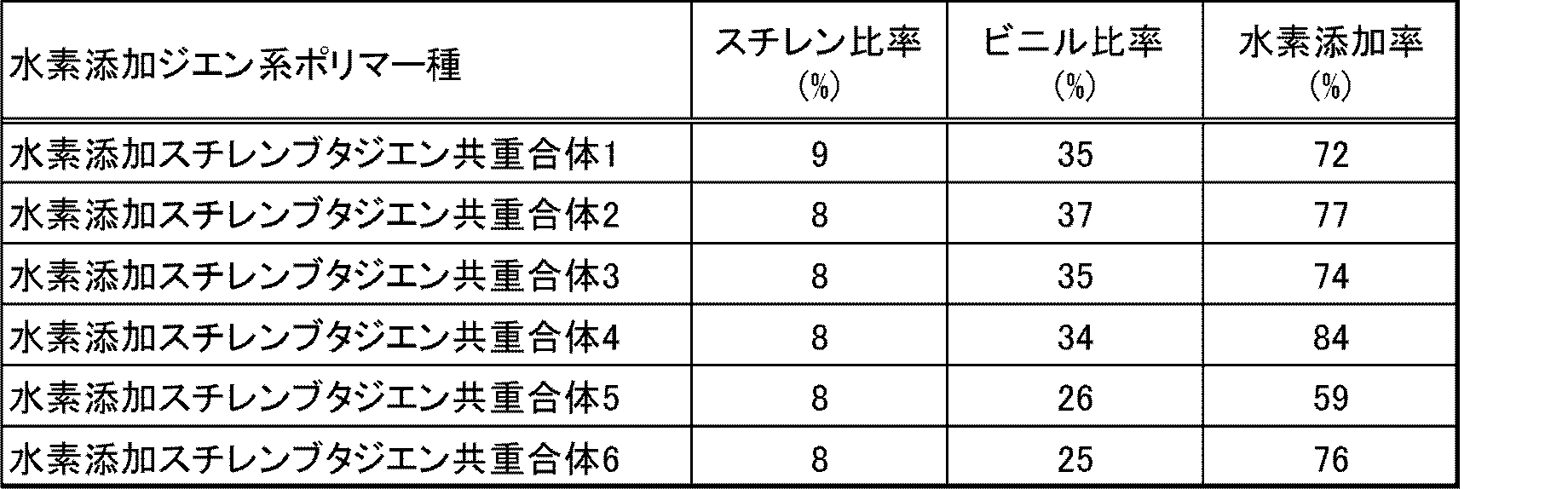
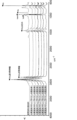
検量線を作成するに際し、先ず、スチレン比率(%)、ビニル比率(%)及び水素添加率(%)が既知の水素添加スチレンブタジエン共重合体1~6などに赤外吸収分光法を適用し、FT-IRなどを用いて、図1に示される水素添加スチレンブタジエン共重合体1~6などの各赤外吸収スペクトルを得る。
When creating a calibration curve, first, infrared absorption spectroscopy was applied to hydrogenated styrene-
赤外吸収分光法としては特に限定されず、透過法、ATR法(減衰全反射法:Attenuated Total Reflection Method)等が挙げられる。 Infrared absorption spectroscopy is not particularly limited, and examples thereof include transmission method, ATR method (Attenuated Total Reflection Method), and the like.
なかでも、ATR法が好ましい。
屈折率の大きい透明第1媒質(ATRプリズム)から屈折率の小さい透明第2媒質(被測定材料)に光が入射するとき、入射角が或る角度以上になると全部反射となる現象(ATR)が生じるが、全反射でも第2媒質中に光が全く入射しないというのではなく、第1媒質を通過した光は、第2媒質との境界面に沿って進み、且つその振幅が境界面からの距離に比例して指数関数的に急激に減少するエバネッセント場が存在し、このエバネッセント場に物質があると、その物質により特有の光吸収を受け、赤外吸収スペクトルが得られる。ATR法はこの原理を応用したものである。
Among these, the ATR method is preferred.
A phenomenon in which when light is incident from a transparent first medium (ATR prism) with a high refractive index to a transparent second medium (material to be measured) with a low refractive index, when the angle of incidence exceeds a certain angle, it is completely reflected (ATR) However, total internal reflection does not mean that no light enters the second medium at all; rather, the light that passes through the first medium travels along the interface with the second medium, and its amplitude increases from the interface. There is an evanescent field that rapidly decreases exponentially in proportion to the distance between the evanescent field and the evanescent field.If a substance exists in this evanescent field, the substance will absorb a characteristic light and an infrared absorption spectrum will be obtained. The ATR method is an application of this principle.
図1は、スチレン比率(%)、ビニル比率(%)及び水素添加率(%)が既知の水素添加スチレンブタジエン共重合体1~6、非水素添加スチレンブタジエン共重合体の各赤外吸収スペクトルを示しており、スペクトルには、スチレン単位(sty)、ビニル単位(vin)、トランス単位(trans)、CH2逆対称伸縮振動、CH2対称伸縮振動、CH2はさみ振動に帰属されるピークが見られる。
Figure 1 shows the infrared absorption spectra of hydrogenated styrene-
図1の赤外吸収スペクトルは、FT-IR測定などにより得ることができる。
FT-IR測定は特に限定されず、公知の装置を用いて可能であり、例えば、PerkinElmer社製Frontier、GeATRユニットMIRacleを用い、波数分解能4cm-1、積算回数16回で実施することができる。測定装置、測定条件は、適宜変更可能である。
The infrared absorption spectrum shown in FIG. 1 can be obtained by FT-IR measurement or the like.
FT-IR measurement is not particularly limited, and can be performed using a known device, for example, using a PerkinElmer Frontier GeATR unit MIRacle, with a wave number resolution of 4 cm −1 and an integration count of 16 times. The measuring device and measurement conditions can be changed as appropriate.
図1において、水素添加スチレンブタジエン共重合体1~6のスペクトルには、ビニル単位に帰属されるピークがほぼ確認されず、ビニル単位のほぼすべてが水素添加されていると考えられる。本発明の水素添加率の分析方法は、特に、ポリマーのミクロ構造のうち、ビニル比率(%)が既知の水素添加ジエン系ポリマーに好適に適用でき、特に水素添加スチレンブタジエン共重合体の場合は、ビニル比率(%)及びスチレン比率(%)が既知の試料に好適に適用できる。また、本発明の方法は、下記式(2)を満たす水素添加ジエン系ポリマー、すなわち水素添加率(%)の値がビニル比率(%)の値以上の水素添加ジエン系ポリマーに好適に適用できる。
(2)H≧Vin
(式中、Hは、水素添加ジエン系ポリマーの水素添加率(%)である。Vinは、水素添加ジエン系ポリマーのビニル比率(%)である。)
In FIG. 1, almost no peaks attributed to vinyl units are observed in the spectra of hydrogenated styrene-
(2) H≧Vin
(In the formula, H is the hydrogenation rate (%) of the hydrogenated diene polymer. Vin is the vinyl ratio (%) of the hydrogenated diene polymer.)
図1には、水素添加ジエン系ポリマーの水素添加率が高くなるにつれて965cm-1のtransのピーク強度が低下すること、2917cm-1,2848cm-1,1448cm-1のCH2のピーク強度が上昇することが示されており、本発明では、特に、2915cm-1付近のCH2逆対称伸縮振動のピーク強度を用いている。このようにピーク強度が高いピークを用いることで、分析精度を高めることができる。 Figure 1 shows that as the hydrogenation rate of the hydrogenated diene polymer increases, the trans peak intensity at 965 cm -1 decreases, and the CH 2 peak intensity at 2917 cm -1 , 2848 cm -1 , and 1448 cm -1 increases. In the present invention, in particular, the peak intensity of the CH 2 antisymmetric stretching vibration near 2915 cm −1 is used. By using a peak with such a high peak intensity, analysis accuracy can be improved.
次に、図1の各赤外吸収スペクトルに基づいて、各ポリマーについて、CH2逆対称伸縮振動に帰属されるピークのピーク強度(A2915)を測定し、また、表1に記載されている既知の水素添加率H(%)及びビニル比率Vin(%)の値から2H-Vinを算出する。以下の表2は、表1に、A2915、2H-Vinの値を併記したものである。 Next, based on each infrared absorption spectrum in FIG. 1, the peak intensity (A2915) of the peak attributed to the CH2 antisymmetric stretching vibration was measured for each polymer, and 2H-Vin is calculated from the hydrogenation rate H (%) and vinyl ratio Vin (%). Table 2 below shows the values of A2915 and 2H-Vin in addition to Table 1.
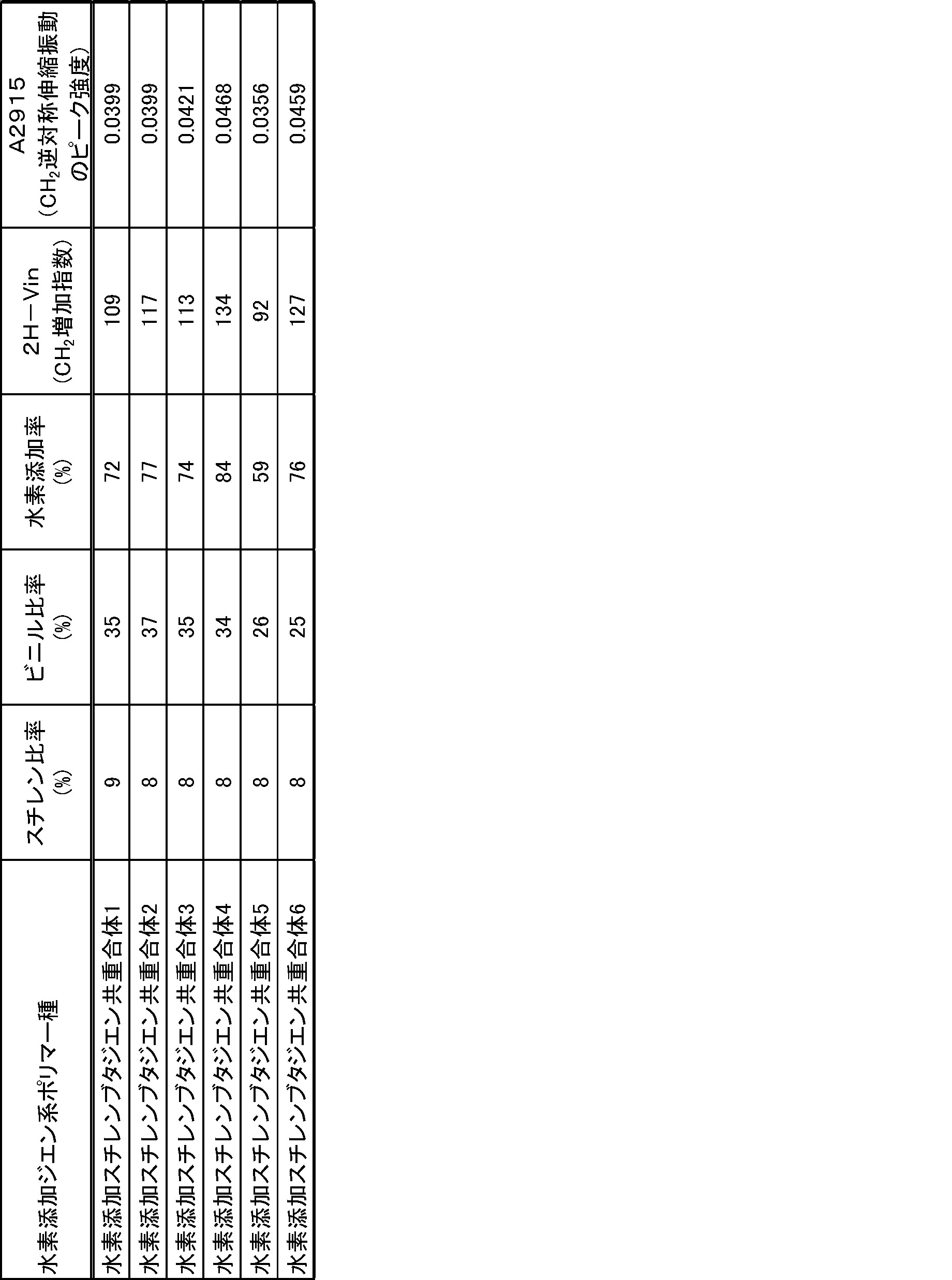
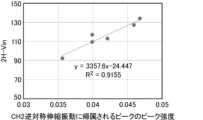
そして、図2は、表2の水素添加スチレンブタジエン共重合体1~6の各特性値について、CH2逆対称伸縮振動に帰属されるピークのピーク強度(A2915)と、2H-Vin(H:各スペクトルの水素添加率(%)、Vin:各スペクトルのビニル比率(%))とをプロットした図であって、プロットした値に基づいて、検量線「2H-Vin=aA2915+b」の定数a、bとして、それぞれ3357.6、-24.447を求めることができる。図2では、R2=0.9155の直線性の良い検量線が得られている。
横軸:2915cm-1付近のCH2逆対称伸縮振動に帰属されるピークの高さ(ベースラインは3095cm-1~2750cm-1)
縦軸:2×H(水素添加率(%))-Vin(ビニル比率(%))
FIG. 2 shows the peak intensity (A2915) of the peak attributed to the CH 2 antisymmetric stretching vibration and the 2H-Vin (H: It is a diagram plotting the hydrogenation rate (%) of each spectrum, Vin: vinyl ratio (%) of each spectrum, and based on the plotted values, the constant a of the calibration curve "2H-Vin=aA2915+b", As b, 3357.6 and -24.447 can be obtained, respectively. In FIG. 2, a calibration curve with good linearity of R 2 =0.9155 is obtained.
Horizontal axis: height of the peak attributed to CH 2 antisymmetric stretching vibration near 2915 cm -1 (baseline is 3095 cm -1 to 2750 cm -1 )
Vertical axis: 2×H (hydrogenation rate (%)) - Vin (vinyl ratio (%))
なお、本発明の方法において、ビニル比率(%)は、ビニル比率(vin(%))+シス比率(cis(%))+トランス比率(trans(%))=100%(共役ジエン単位100%)中のビニル比率(%)ではなく、ビニル比率(%)+シス比率(%)+トランス比率(%)+他の単量体比率(%)=100%(水素添加ジエン系ポリマー全体)中のビニル比率(%)であり、例えば、水素添加スチレンブタジエン共重合体のビニル比率(%)は、ビニル比率(%)+シス比率(%)+トランス比率(%)+スチレン比率(%)=100%(水素添加スチレンブタジエン共重合体全体)中のビニル比率(%)を意味する。
なお、シス比率(%)、トランス比率(%)、スチレン比率(%)などの他の単量体比率(%)も同様に、100%(水素添加スチレンブタジエン共重合体全体)中のシス比率(%)、トランス比率(%)、スチレン比率(%)などの他の単量体比率(%)を意味する。
In addition, in the method of the present invention, the vinyl ratio (%) is vinyl ratio (vin (%)) + cis ratio (cis (%)) + trans ratio (trans (%)) = 100% (conjugated diene unit 100%). ), not the vinyl ratio (%) + cis ratio (%) + trans ratio (%) + other monomer ratio (%) = 100% (in the entire hydrogenated diene polymer) For example, the vinyl ratio (%) of a hydrogenated styrene-butadiene copolymer is vinyl ratio (%) + cis ratio (%) + trans ratio (%) + styrene ratio (%) = It means the vinyl ratio (%) in 100% (total hydrogenated styrene-butadiene copolymer).
In addition, other monomer ratios (%) such as cis ratio (%), trans ratio (%), and styrene ratio (%) are also the cis ratio in 100% (the entire hydrogenated styrene-butadiene copolymer). (%), trans ratio (%), and other monomer ratios (%) such as styrene ratio (%).
本発明における「2×H-vin」に関しては、ジエン系ポリマーの水素添加が、シス結合(cis),トランス結合(trans)が1か所水素添加されると、CH2が2か所生成し、ビニル結合(vin)が1か所水素添加されると、CH2が1か所生成することから、CH2増加指数として以下の指数を定義したものである。
CH2増加指数
=Hcis×Rcis/100×2+Htrans×Rtrans/100×2+Hvin×Rvin/100
(全二重結合中の水素添加されたcisの割合(%)×2+全二重結合中の水素添加されたtransの割合(%)×2+全二重結合中の水素添加されたvinの割合(%))
=(Hall-Hvin×Rvin/100)×2+Hvin×Rvin/100
=(Hall-Rvin)×2+Rvin
=2×Hall-Rvin
Hvin,Htrans,Hcis:vin,trans,cisの水素添加率(%)
Hall:全水素添加率(%)
Rsty,Rvin,Rtrans,Rcis:sty,vin,trans,cisの比率(%)
Rsty+Rvin+Rtrans+Rcis=100(%)
以上から、本発明では、2×H-vinを用いている。
Regarding "2xH-vin" in the present invention, when a diene polymer is hydrogenated, when one cis bond (cis) and one trans bond (trans) are hydrogenated, CH 2 is generated at two locations. , when a vinyl bond (vin) is hydrogenated at one location, CH 2 is generated at one location, so the following index is defined as the CH 2 increase index.
CH2 increase index=H cis ×R cis /100×2+H trans ×R trans /100×2+H vin ×R vin /100
(Proportion of hydrogenated cis in all double bonds (%) x 2 + Proportion of hydrogenated trans in all double bonds (%) x 2 + Proportion of hydrogenated vin in all double bonds (%))
=(H all −H vin ×R vin /100)×2+H vin ×R vin /100
=(H all -R vin )×2+R vin
=2×H all −R vin
H vin , H trans , H cis : hydrogenation rate (%) of vin, trans, cis
H all : Total hydrogenation rate (%)
R sty , R vin , R trans , R cis : Ratio (%) of sty, vin, trans, cis
R sty +R vin +R trans +R cis =100(%)
From the above, the present invention uses 2×H-vin.
次いで、以下においては、前述の方法で作成された検量線「2H-Vin=3357.6×A2915-24.447」の有効性を検証する。 Next, in the following, the effectiveness of the calibration curve "2H-Vin=3357.6×A2915-24.447" created by the method described above will be verified.
例えば、水素添加率(%)が未知で、以下の表3に示す既知のスチレン比率(%)及びビニル比率(%)を持つ水素添加スチレンブタジエン共重合体7~10を用意する。 For example, hydrogenated styrene-butadiene copolymers 7 to 10 with unknown hydrogenation ratios (%) and known styrene ratios (%) and vinyl ratios (%) shown in Table 3 below are prepared.
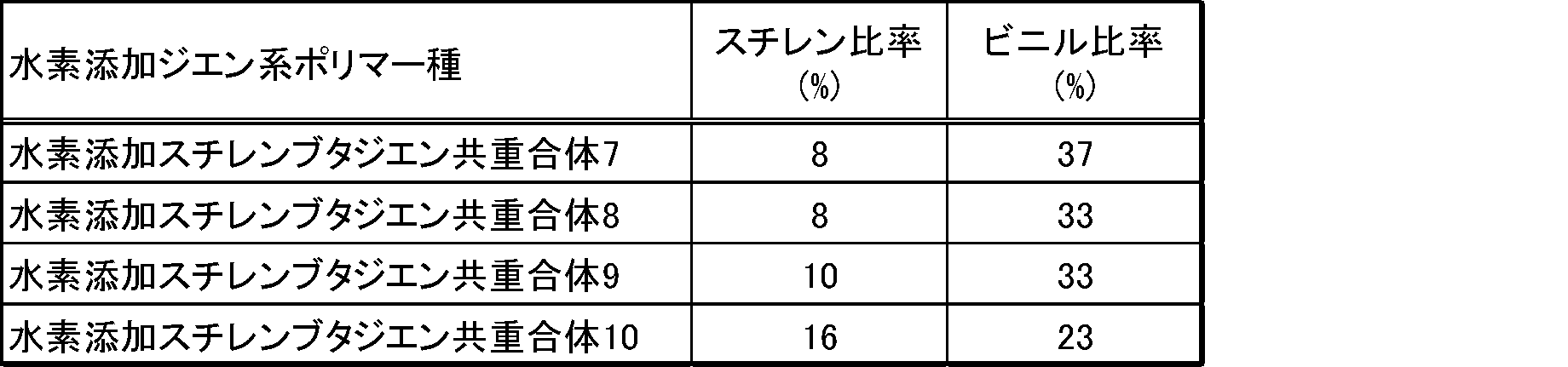
水素添加スチレンブタジエン共重合体7~10について、図1と同様に、赤外吸収スペクトルを得る。図3は、赤外吸収スペクトルの一例として、水素添加スチレンブタジエン共重合体7の赤外吸収スペクトルを示しており、前記と同様、CH2逆対称伸縮振動に帰属されるピークのピーク強度(A2915)を測定する。
いる。
Infrared absorption spectra were obtained for hydrogenated styrene-butadiene copolymers 7 to 10 in the same manner as in FIG. FIG. 3 shows an infrared absorption spectrum of hydrogenated styrene-butadiene copolymer 7 as an example of an infrared absorption spectrum, and similarly to the above, the peak intensity of the peak attributed to the CH 2 antisymmetric stretching vibration (A2915 ) to measure.
There is.
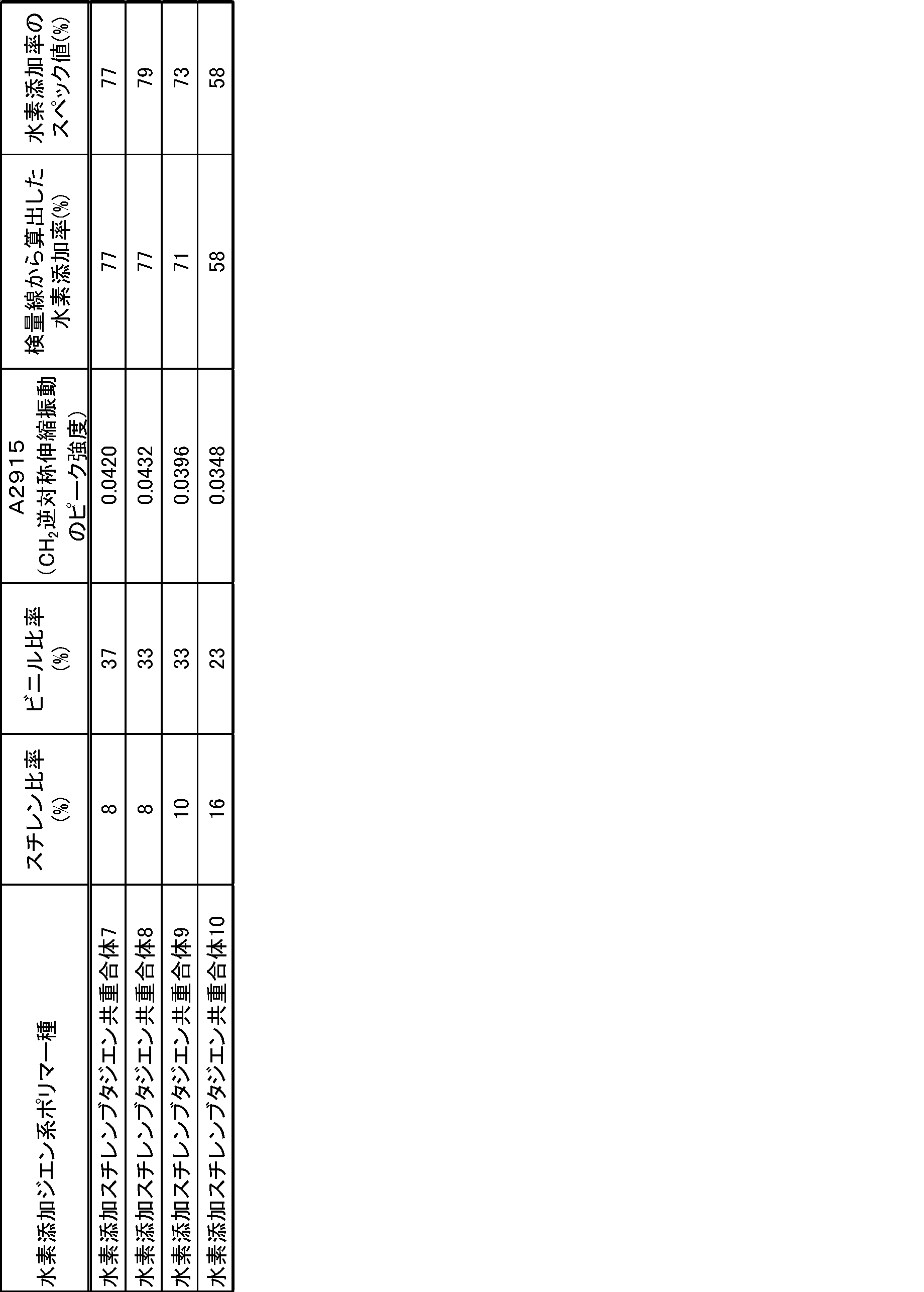
そして、得られた水素添加ジエン系ポリマーのCH2逆対称伸縮振動に帰属されるピークのピーク強度(A2915)、表3のビニル比率Vin(%)を、検量線「2H-Vin=3357.6×A2915-24.447」に適用することにより、水素添加スチレンブタジエン共重合体7~10の水素添加率H(%)をそれぞれ算出できる。 Then, the peak intensity (A2915) of the peak attributed to the CH 2 antisymmetric stretching vibration of the obtained hydrogenated diene polymer and the vinyl ratio Vin (%) in Table 3 were calculated using the calibration curve "2H-Vin=3357.6 ×A2915-24.447”, the hydrogenation rate H (%) of hydrogenated styrene-butadiene copolymers 7 to 10 can be calculated.
以下の表4は、表3に、上記で算出された水素添加率H(%)を追加し、更に水素添加スチレンブタジエン共重合体7~10のスペック値(製品値)を併記している。表4には、上記で算出した水素添加スチレンブタジエン共重合体7~10の水素添加率が、スペック値と±2%以内に収まっていることが示されている。この結果は、本発明の水素添加率を分析する方法の有効性を十分に示している。 In Table 4 below, the hydrogenation rate H (%) calculated above is added to Table 3, and the specification values (product values) of hydrogenated styrene-butadiene copolymers 7 to 10 are also listed. Table 4 shows that the hydrogenation rates of hydrogenated styrene-butadiene copolymers 7 to 10 calculated above are within ±2% of the specification value. This result fully demonstrates the effectiveness of the method of analyzing the hydrogenation rate of the present invention.
前述の方法では、水素添加スチレンブタジエン共重合体の例を説明しているが、水素添加ブタジエン重合体、水素添加イソプレン系重合体などの他の水素添加ジエン系ポリマーでも適用可能である。なかでも、水素添加スチレンブタジエン共重合体に好適に適用できる。 In the above method, an example of a hydrogenated styrene-butadiene copolymer is explained, but other hydrogenated diene polymers such as a hydrogenated butadiene polymer and a hydrogenated isoprene polymer can also be used. Among these, it can be suitably applied to hydrogenated styrene-butadiene copolymers.
また、本発明に適用可能な試料として、水素添加ジエン系ポリマーのみからなる試料だけでなく、これ以外に他の成分も含む試料も適用できる。他の成分としては、例えば、ゴム組成物の分野で公知の成分を任意に使用できる。 Further, as a sample applicable to the present invention, not only a sample consisting only of a hydrogenated diene polymer, but also a sample containing other components can be applied. As other components, for example, any components known in the field of rubber compositions can be used.
試料に配合可能な他の成分としては、フィラー(充填材)が挙げられる。
フィラー(充填材)としては特に限定されず、ゴム分野で公知の材料を使用でき、例えば、カーボンブラック、シリカ、炭酸カルシウム、タルク、アルミナ、クレイ、水酸化アルミニウム、酸化アルミニウム、マイカなどの無機フィラー;難分散性フィラー等が挙げられる。
Other components that can be added to the sample include fillers.
The filler is not particularly limited, and materials known in the rubber field can be used, such as inorganic fillers such as carbon black, silica, calcium carbonate, talc, alumina, clay, aluminum hydroxide, aluminum oxide, and mica. ; Examples include poorly dispersible fillers.
試料に配合可能な他の成分としては、シランカップリング剤、可塑剤(液体可塑剤(常温(25℃)で液体状態の可塑剤など)、樹脂(常温(25℃)で固体状態の樹脂など))等も挙げられる。上記液体可塑剤としては、オイル、液状樹脂などが挙げられる。上記樹脂としては、例えば、常温(25℃)で固体状態の芳香族ビニル重合体、クマロンインデン樹脂、クマロン樹脂、インデン樹脂、フェノール樹脂、ロジン樹脂、石油樹脂、テルペン系樹脂、アクリル系樹脂などが挙げられる。 Other components that can be added to the sample include silane coupling agents, plasticizers (liquid plasticizers (plasticizers that are liquid at room temperature (25°C), etc.), resins (resins that are solid at room temperature (25°C), etc.) )) etc. can also be mentioned. Examples of the liquid plasticizer include oil, liquid resin, and the like. Examples of the above resins include aromatic vinyl polymers that are solid at room temperature (25°C), coumaron indene resin, coumaron resin, indene resin, phenol resin, rosin resin, petroleum resin, terpene resin, acrylic resin, etc. can be mentioned.
試料が含む他の成分としては、老化防止剤、ステアリン酸、酸化亜鉛、ワックス、架橋剤(硫黄など)、加硫促進剤(スルフェンアミド系、グアニジン系、ベンゾチアゾール系加硫促進剤など)なども挙げられる。 Other components contained in the sample include anti-aging agents, stearic acid, zinc oxide, wax, cross-linking agents (such as sulfur), and vulcanization accelerators (sulfenamide-based, guanidine-based, benzothiazole-based vulcanization accelerators, etc.) etc. can also be mentioned.
本発明に適用する試料において、ゴム成分としての水素添加ジエン系ポリマー、可塑剤としての水素添加ジエン系ポリマー、他の成分などの各成分の含有量は、特に限定されず、適宜選択可能である。例えば、タイヤの各部材を分析対象の試料とする場合、各部材の成分として公知の含有量を適宜選択できる。 In the sample applied to the present invention, the content of each component such as a hydrogenated diene polymer as a rubber component, a hydrogenated diene polymer as a plasticizer, and other components is not particularly limited and can be selected as appropriate. . For example, when each member of a tire is used as a sample to be analyzed, known contents can be appropriately selected as the components of each member.
本発明は、水素添加ジエン系ポリマー含む試料であれば適用可能であり、例えば、タイヤ部材に適用できる。タイヤ部材としては特に限定されず、トレッド(キャップトレッド、ベーストレッド)、ベルト層、サイドウォール、ビードエイペックス、クリンチエイペックス、インナーライナー、アンダートレッド、ブレーカートッピング、プライトッピング等が挙げられる。 The present invention is applicable to any sample containing a hydrogenated diene polymer, for example, to tire members. Tire members are not particularly limited, and include a tread (cap tread, base tread), belt layer, sidewall, bead apex, clinch apex, inner liner, undertread, breaker topping, ply topping, and the like.
本発明(1)は、赤外吸収分光法を用いて水素添加ジエン系ポリマーの水素添加率を分析する方法であって、
下記式(1)で表される検量線を用いることを特徴とする水素添加率を分析する方法である。
(1)2H-Vin=aA2915+b
(式中、Hは、水素添加ジエン系ポリマーの水素添加率(%)である。Vinは、水素添加ジエン系ポリマーのビニル比率(%)である。A2915は、CH2逆対称伸縮振動に帰属されるピークのピーク強度である。a,bは、定数である。)
The present invention (1) is a method for analyzing the hydrogenation rate of a hydrogenated diene polymer using infrared absorption spectroscopy, comprising:
This is a method for analyzing the hydrogenation rate, which is characterized by using a calibration curve expressed by the following formula (1).
(1) 2H-Vin=aA2915+b
(In the formula, H is the hydrogenation rate (%) of the hydrogenated diene-based polymer. Vin is the vinyl ratio (%) of the hydrogenated diene-based polymer. A2915 is attributed to CH 2 antisymmetric stretching vibration (a, b are constants.)
本発明(2)は、赤外吸収分光法がATR法である本発明(1)記載の水素添加率を分析する方法である。 The present invention (2) is a method for analyzing the hydrogenation rate according to the present invention (1), wherein the infrared absorption spectroscopy is the ATR method.
本発明(3)は、水素添加ジエン系ポリマーが水素添加スチレンブタジエン共重合体である本発明(1)又は(2)記載の水素添加率を分析する方法である。 The present invention (3) is a method for analyzing the hydrogenation rate according to the present invention (1) or (2), wherein the hydrogenated diene polymer is a hydrogenated styrene-butadiene copolymer.
本発明(4)は、水素添加ジエン系ポリマーが下記式(2)を満たす本発明(1)~(3)のいずれかとの任意の組合せの水素添加率を分析する方法である。
(2)H≧Vin
(式中、Hは、水素添加ジエン系ポリマーの水素添加率(%)である。Vinは、水素添加ジエン系ポリマーのビニル比率(%)である。)
The present invention (4) is a method for analyzing the hydrogenation rate of any combination of present inventions (1) to (3) in which the hydrogenated diene polymer satisfies the following formula (2).
(2) H≧Vin
(In the formula, H is the hydrogenation rate (%) of the hydrogenated diene polymer. Vin is the vinyl ratio (%) of the hydrogenated diene polymer.)
本発明(5)は、水素添加ジエン系ポリマー及びフィラーを含む試料を赤外吸収分光法を用いて分析することで、前記水素添加ジエン系ポリマーの水素添加率を分析する本発明(1)~(4)のいずれかとの任意の組合せの水素添加率を分析する方法である。 The present invention (5) provides the present invention (1) to analyze the hydrogenation rate of the hydrogenated diene polymer by analyzing a sample containing the hydrogenated diene polymer and filler using infrared absorption spectroscopy. This method analyzes the hydrogenation rate in any combination with (4).
Claims (5)
下記式(1)で表される検量線を用いることを特徴とする水素添加率を分析する方法。
(1)2H-Vin=aA2915+b
(式中、Hは、水素添加ジエン系ポリマーの水素添加率(%)である。Vinは、水素添加ジエン系ポリマーのビニル比率(%)である。A2915は、CH2逆対称伸縮振動に帰属されるピークのピーク強度である。a,bは、定数である。) A method for analyzing the hydrogenation rate of a hydrogenated diene polymer using infrared absorption spectroscopy, the method comprising:
A method for analyzing a hydrogenation rate, characterized by using a calibration curve represented by the following formula (1).
(1) 2H-Vin=aA2915+b
(In the formula, H is the hydrogenation rate (%) of the hydrogenated diene-based polymer. Vin is the vinyl ratio (%) of the hydrogenated diene-based polymer. A2915 is attributed to CH 2 antisymmetric stretching vibration (a, b are constants.)
(2)H≧Vin
(式中、Hは、水素添加ジエン系ポリマーの水素添加率(%)である。Vinは、水素添加ジエン系ポリマーのビニル比率(%)である。) The method for analyzing hydrogenation rate according to claim 1 or 2, wherein the hydrogenated diene polymer satisfies the following formula (2).
(2) H≧Vin
(In the formula, H is the hydrogenation rate (%) of the hydrogenated diene polymer. Vin is the vinyl ratio (%) of the hydrogenated diene polymer.)
Priority Applications (3)
| Application Number | Priority Date | Filing Date | Title |
|---|---|---|---|
| US18/225,423 US12352691B2 (en) | 2022-08-22 | 2023-07-24 | Method of analyzing degree of hydrogenation of hydrogenated diene polymer |
| EP23190888.0A EP4328568B1 (en) | 2022-08-22 | 2023-08-10 | Method of analyzing degree of hydrogenation of hydrogenated diene polymer |
| CN202311053329.XA CN117607088A (en) | 2022-08-22 | 2023-08-21 | Method for analyzing hydrogenation rate of hydrogenated diene polymer |
Applications Claiming Priority (2)
| Application Number | Priority Date | Filing Date | Title |
|---|---|---|---|
| JP2022131921 | 2022-08-22 | ||
| JP2022131921 | 2022-08-22 |
Publications (1)
| Publication Number | Publication Date |
|---|---|
| JP2024029745A true JP2024029745A (en) | 2024-03-06 |
Family
ID=90104971
Family Applications (1)
| Application Number | Title | Priority Date | Filing Date |
|---|---|---|---|
| JP2023104118A Pending JP2024029745A (en) | 2022-08-22 | 2023-06-26 | Method for analyzing the hydrogenation rate of hydrogenated diene polymers |
Country Status (1)
| Country | Link |
|---|---|
| JP (1) | JP2024029745A (en) |
-
2023
- 2023-06-26 JP JP2023104118A patent/JP2024029745A/en active Pending
Similar Documents
| Publication | Publication Date | Title |
|---|---|---|
| KR101523627B1 (en) | Rubber composition for tire treads | |
| EP2810964B1 (en) | Branched conjugated diene copolymer, rubber composition and pneumatic tire | |
| JP5265202B2 (en) | Rubber composition and pneumatic tire using the same | |
| JP6190711B2 (en) | Process for producing modified conjugated diene polymer composition | |
| KR102820996B1 (en) | Conjugated diene polymer, method for producing conjugated diene polymer, conjugated diene polymer composition, and rubber composition | |
| TWI453224B (en) | Terminal modified conjugated diene-vinyl aromatic hydrocarbon copolymer and manufacturing method of the same | |
| EP2810963A1 (en) | Branched conjugated diene copolymer, rubber composition and pneumatic tire | |
| JPWO2012073838A1 (en) | Rubber composition for tire tread | |
| CN109071887B (en) | Rubber composition | |
| KR102527631B1 (en) | Conjugated diene polymer and method for producing the same, and rubber composition | |
| JP5632880B2 (en) | Rubber composition and pneumatic tire | |
| US20190256691A1 (en) | Conjugated diene-based polymer, conjugated diene-based polymer composition, and method for producing conjugated diene-based polymer | |
| JP4881563B2 (en) | Rubber composition and pneumatic tire using the same | |
| JP2010538109A (en) | Synthesis of liquid polymers and functionalized polymers | |
| JP2009001721A (en) | Rubber composition and pneumatic tire using the same | |
| US12091550B2 (en) | Pneumatic tire | |
| JP4881562B2 (en) | Rubber composition and pneumatic tire using the same | |
| JP2013166865A (en) | Rubber composition for tire tread | |
| JP2024029745A (en) | Method for analyzing the hydrogenation rate of hydrogenated diene polymers | |
| JP6939259B2 (en) | Rubber composition for tread and pneumatic tire | |
| US12352691B2 (en) | Method of analyzing degree of hydrogenation of hydrogenated diene polymer | |
| JP4726314B2 (en) | Modified conjugated diene polymer composition | |
| TWI882516B (en) | Hydrogenated conjugated diene polymer and method for producing hydrogenated conjugated diene polymer | |
| CN117607088A (en) | Method for analyzing hydrogenation rate of hydrogenated diene polymer | |
| JP2001302704A (en) | Method for producing modified polybutadiene, modified polybutadiene, and rubber composition |
Legal Events
| Date | Code | Title | Description |
|---|---|---|---|
| A621 | Written request for application examination |
Free format text: JAPANESE INTERMEDIATE CODE: A621 Effective date: 20260421 |