JP2022517841A - Video image transmission methods, devices, intelligent interactive tablets and storage media - Google Patents
Video image transmission methods, devices, intelligent interactive tablets and storage media Download PDFInfo
- Publication number
- JP2022517841A JP2022517841A JP2021542217A JP2021542217A JP2022517841A JP 2022517841 A JP2022517841 A JP 2022517841A JP 2021542217 A JP2021542217 A JP 2021542217A JP 2021542217 A JP2021542217 A JP 2021542217A JP 2022517841 A JP2022517841 A JP 2022517841A
- Authority
- JP
- Japan
- Prior art keywords
- image
- video
- semantic information
- communication terminal
- reconstructed
- Prior art date
- Legal status (The legal status is an assumption and is not a legal conclusion. Google has not performed a legal analysis and makes no representation as to the accuracy of the status listed.)
- Granted
Links
Images


Classifications
-
- H—ELECTRICITY
- H04—ELECTRIC COMMUNICATION TECHNIQUE
- H04N—PICTORIAL COMMUNICATION, e.g. TELEVISION
- H04N7/00—Television systems
- H04N7/14—Systems for two-way working
- H04N7/141—Systems for two-way working between two video terminals, e.g. videophone
- H04N7/147—Communication arrangements, e.g. identifying the communication as a video-communication, intermediate storage of the signals
-
- H—ELECTRICITY
- H04—ELECTRIC COMMUNICATION TECHNIQUE
- H04N—PICTORIAL COMMUNICATION, e.g. TELEVISION
- H04N7/00—Television systems
- H04N7/14—Systems for two-way working
- H04N7/15—Conference systems
-
- G—PHYSICS
- G06—COMPUTING OR CALCULATING; COUNTING
- G06F—ELECTRIC DIGITAL DATA PROCESSING
- G06F18/00—Pattern recognition
- G06F18/20—Analysing
- G06F18/25—Fusion techniques
- G06F18/251—Fusion techniques of input or preprocessed data
-
- G—PHYSICS
- G06—COMPUTING OR CALCULATING; COUNTING
- G06F—ELECTRIC DIGITAL DATA PROCESSING
- G06F18/00—Pattern recognition
- G06F18/20—Analysing
- G06F18/25—Fusion techniques
- G06F18/253—Fusion techniques of extracted features
-
- G—PHYSICS
- G06—COMPUTING OR CALCULATING; COUNTING
- G06N—COMPUTING ARRANGEMENTS BASED ON SPECIFIC COMPUTATIONAL MODELS
- G06N3/00—Computing arrangements based on biological models
- G06N3/02—Neural networks
- G06N3/04—Architecture, e.g. interconnection topology
- G06N3/045—Combinations of networks
-
- G—PHYSICS
- G06—COMPUTING OR CALCULATING; COUNTING
- G06N—COMPUTING ARRANGEMENTS BASED ON SPECIFIC COMPUTATIONAL MODELS
- G06N3/00—Computing arrangements based on biological models
- G06N3/02—Neural networks
- G06N3/04—Architecture, e.g. interconnection topology
- G06N3/045—Combinations of networks
- G06N3/0455—Auto-encoder networks; Encoder-decoder networks
-
- G—PHYSICS
- G06—COMPUTING OR CALCULATING; COUNTING
- G06N—COMPUTING ARRANGEMENTS BASED ON SPECIFIC COMPUTATIONAL MODELS
- G06N3/00—Computing arrangements based on biological models
- G06N3/02—Neural networks
- G06N3/04—Architecture, e.g. interconnection topology
- G06N3/0464—Convolutional networks [CNN, ConvNet]
-
- G—PHYSICS
- G06—COMPUTING OR CALCULATING; COUNTING
- G06N—COMPUTING ARRANGEMENTS BASED ON SPECIFIC COMPUTATIONAL MODELS
- G06N3/00—Computing arrangements based on biological models
- G06N3/02—Neural networks
- G06N3/08—Learning methods
-
- G—PHYSICS
- G06—COMPUTING OR CALCULATING; COUNTING
- G06V—IMAGE OR VIDEO RECOGNITION OR UNDERSTANDING
- G06V10/00—Arrangements for image or video recognition or understanding
- G06V10/70—Arrangements for image or video recognition or understanding using pattern recognition or machine learning
- G06V10/82—Arrangements for image or video recognition or understanding using pattern recognition or machine learning using neural networks
-
- G—PHYSICS
- G06—COMPUTING OR CALCULATING; COUNTING
- G06V—IMAGE OR VIDEO RECOGNITION OR UNDERSTANDING
- G06V20/00—Scenes; Scene-specific elements
- G06V20/40—Scenes; Scene-specific elements in video content
- G06V20/41—Higher-level, semantic clustering, classification or understanding of video scenes, e.g. detection, labelling or Markovian modelling of sport events or news items
-
- G—PHYSICS
- G06—COMPUTING OR CALCULATING; COUNTING
- G06V—IMAGE OR VIDEO RECOGNITION OR UNDERSTANDING
- G06V40/00—Recognition of biometric, human-related or animal-related patterns in image or video data
- G06V40/10—Human or animal bodies, e.g. vehicle occupants or pedestrians; Body parts, e.g. hands
- G06V40/107—Static hand or arm
-
- G—PHYSICS
- G06—COMPUTING OR CALCULATING; COUNTING
- G06V—IMAGE OR VIDEO RECOGNITION OR UNDERSTANDING
- G06V40/00—Recognition of biometric, human-related or animal-related patterns in image or video data
- G06V40/10—Human or animal bodies, e.g. vehicle occupants or pedestrians; Body parts, e.g. hands
- G06V40/16—Human faces, e.g. facial parts, sketches or expressions
-
- G—PHYSICS
- G06—COMPUTING OR CALCULATING; COUNTING
- G06V—IMAGE OR VIDEO RECOGNITION OR UNDERSTANDING
- G06V40/00—Recognition of biometric, human-related or animal-related patterns in image or video data
- G06V40/10—Human or animal bodies, e.g. vehicle occupants or pedestrians; Body parts, e.g. hands
- G06V40/16—Human faces, e.g. facial parts, sketches or expressions
- G06V40/174—Facial expression recognition
-
- H—ELECTRICITY
- H04—ELECTRIC COMMUNICATION TECHNIQUE
- H04N—PICTORIAL COMMUNICATION, e.g. TELEVISION
- H04N19/00—Methods or arrangements for coding, decoding, compressing or decompressing digital video signals
- H04N19/10—Methods or arrangements for coding, decoding, compressing or decompressing digital video signals using adaptive coding
- H04N19/102—Methods or arrangements for coding, decoding, compressing or decompressing digital video signals using adaptive coding characterised by the element, parameter or selection affected or controlled by the adaptive coding
-
- H—ELECTRICITY
- H04—ELECTRIC COMMUNICATION TECHNIQUE
- H04N—PICTORIAL COMMUNICATION, e.g. TELEVISION
- H04N19/00—Methods or arrangements for coding, decoding, compressing or decompressing digital video signals
- H04N19/10—Methods or arrangements for coding, decoding, compressing or decompressing digital video signals using adaptive coding
- H04N19/169—Methods or arrangements for coding, decoding, compressing or decompressing digital video signals using adaptive coding characterised by the coding unit, i.e. the structural portion or semantic portion of the video signal being the object or the subject of the adaptive coding
-
- H—ELECTRICITY
- H04—ELECTRIC COMMUNICATION TECHNIQUE
- H04N—PICTORIAL COMMUNICATION, e.g. TELEVISION
- H04N19/00—Methods or arrangements for coding, decoding, compressing or decompressing digital video signals
- H04N19/10—Methods or arrangements for coding, decoding, compressing or decompressing digital video signals using adaptive coding
- H04N19/169—Methods or arrangements for coding, decoding, compressing or decompressing digital video signals using adaptive coding characterised by the coding unit, i.e. the structural portion or semantic portion of the video signal being the object or the subject of the adaptive coding
- H04N19/17—Methods or arrangements for coding, decoding, compressing or decompressing digital video signals using adaptive coding characterised by the coding unit, i.e. the structural portion or semantic portion of the video signal being the object or the subject of the adaptive coding the unit being an image region, e.g. an object
- H04N19/172—Methods or arrangements for coding, decoding, compressing or decompressing digital video signals using adaptive coding characterised by the coding unit, i.e. the structural portion or semantic portion of the video signal being the object or the subject of the adaptive coding the unit being an image region, e.g. an object the region being a picture, frame or field
-
- H—ELECTRICITY
- H04—ELECTRIC COMMUNICATION TECHNIQUE
- H04N—PICTORIAL COMMUNICATION, e.g. TELEVISION
- H04N19/00—Methods or arrangements for coding, decoding, compressing or decompressing digital video signals
- H04N19/30—Methods or arrangements for coding, decoding, compressing or decompressing digital video signals using hierarchical techniques, e.g. scalability
- H04N19/39—Methods or arrangements for coding, decoding, compressing or decompressing digital video signals using hierarchical techniques, e.g. scalability involving multiple description coding [MDC], i.e. with separate layers being structured as independently decodable descriptions of input picture data
-
- H—ELECTRICITY
- H04—ELECTRIC COMMUNICATION TECHNIQUE
- H04N—PICTORIAL COMMUNICATION, e.g. TELEVISION
- H04N19/00—Methods or arrangements for coding, decoding, compressing or decompressing digital video signals
- H04N19/42—Methods or arrangements for coding, decoding, compressing or decompressing digital video signals characterised by implementation details or hardware specially adapted for video compression or decompression, e.g. dedicated software implementation
-
- H—ELECTRICITY
- H04—ELECTRIC COMMUNICATION TECHNIQUE
- H04N—PICTORIAL COMMUNICATION, e.g. TELEVISION
- H04N19/00—Methods or arrangements for coding, decoding, compressing or decompressing digital video signals
- H04N19/44—Decoders specially adapted therefor, e.g. video decoders which are asymmetric with respect to the encoder
-
- H—ELECTRICITY
- H04—ELECTRIC COMMUNICATION TECHNIQUE
- H04N—PICTORIAL COMMUNICATION, e.g. TELEVISION
- H04N19/00—Methods or arrangements for coding, decoding, compressing or decompressing digital video signals
- H04N19/46—Embedding additional information in the video signal during the compression process
-
- H—ELECTRICITY
- H04—ELECTRIC COMMUNICATION TECHNIQUE
- H04N—PICTORIAL COMMUNICATION, e.g. TELEVISION
- H04N19/00—Methods or arrangements for coding, decoding, compressing or decompressing digital video signals
- H04N19/70—Methods or arrangements for coding, decoding, compressing or decompressing digital video signals characterised by syntax aspects related to video coding, e.g. related to compression standards
-
- H—ELECTRICITY
- H04—ELECTRIC COMMUNICATION TECHNIQUE
- H04N—PICTORIAL COMMUNICATION, e.g. TELEVISION
- H04N21/00—Selective content distribution, e.g. interactive television or video on demand [VOD]
- H04N21/20—Servers specifically adapted for the distribution of content, e.g. VOD servers; Operations thereof
- H04N21/23—Processing of content or additional data; Elementary server operations; Server middleware
- H04N21/234—Processing of video elementary streams, e.g. splicing of video streams or manipulating encoded video stream scene graphs
-
- H—ELECTRICITY
- H04—ELECTRIC COMMUNICATION TECHNIQUE
- H04N—PICTORIAL COMMUNICATION, e.g. TELEVISION
- H04N21/00—Selective content distribution, e.g. interactive television or video on demand [VOD]
- H04N21/40—Client devices specifically adapted for the reception of or interaction with content, e.g. set-top-box [STB]; Operations thereof
- H04N21/43—Processing of content or additional data, e.g. demultiplexing additional data from a digital video stream; Elementary client operations, e.g. monitoring of home network or synchronising decoder's clock; Client middleware
- H04N21/44—Processing of video elementary streams, e.g. splicing a video clip retrieved from local storage with an incoming video stream or rendering scenes according to encoded video stream scene graphs
- H04N21/4402—Processing of video elementary streams, e.g. splicing a video clip retrieved from local storage with an incoming video stream or rendering scenes according to encoded video stream scene graphs involving reformatting operations of video signals for household redistribution, storage or real-time display
-
- H—ELECTRICITY
- H04—ELECTRIC COMMUNICATION TECHNIQUE
- H04N—PICTORIAL COMMUNICATION, e.g. TELEVISION
- H04N21/00—Selective content distribution, e.g. interactive television or video on demand [VOD]
- H04N21/40—Client devices specifically adapted for the reception of or interaction with content, e.g. set-top-box [STB]; Operations thereof
- H04N21/47—End-user applications
- H04N21/478—Supplemental services, e.g. displaying phone caller identification, shopping application
- H04N21/4788—Supplemental services, e.g. displaying phone caller identification, shopping application communicating with other users, e.g. chatting
-
- H—ELECTRICITY
- H04—ELECTRIC COMMUNICATION TECHNIQUE
- H04N—PICTORIAL COMMUNICATION, e.g. TELEVISION
- H04N7/00—Television systems
- H04N7/14—Systems for two-way working
- H04N7/141—Systems for two-way working between two video terminals, e.g. videophone
-
- H—ELECTRICITY
- H04—ELECTRIC COMMUNICATION TECHNIQUE
- H04N—PICTORIAL COMMUNICATION, e.g. TELEVISION
- H04N7/00—Television systems
- H04N7/14—Systems for two-way working
- H04N7/15—Conference systems
- H04N7/155—Conference systems involving storage of or access to video conference sessions
Landscapes
- Engineering & Computer Science (AREA)
- Theoretical Computer Science (AREA)
- Multimedia (AREA)
- Physics & Mathematics (AREA)
- General Physics & Mathematics (AREA)
- Signal Processing (AREA)
- General Health & Medical Sciences (AREA)
- Health & Medical Sciences (AREA)
- Evolutionary Computation (AREA)
- Artificial Intelligence (AREA)
- Data Mining & Analysis (AREA)
- Software Systems (AREA)
- General Engineering & Computer Science (AREA)
- Computing Systems (AREA)
- Life Sciences & Earth Sciences (AREA)
- Human Computer Interaction (AREA)
- Computational Linguistics (AREA)
- Mathematical Physics (AREA)
- Molecular Biology (AREA)
- Biophysics (AREA)
- Biomedical Technology (AREA)
- Oral & Maxillofacial Surgery (AREA)
- Computer Vision & Pattern Recognition (AREA)
- Medical Informatics (AREA)
- Databases & Information Systems (AREA)
- Bioinformatics & Cheminformatics (AREA)
- Bioinformatics & Computational Biology (AREA)
- Evolutionary Biology (AREA)
- Two-Way Televisions, Distribution Of Moving Picture Or The Like (AREA)
- Television Signal Processing For Recording (AREA)
- Compression Or Coding Systems Of Tv Signals (AREA)
Abstract
本発明はビデオ画像の伝送方法、装置、インテリジェントインタラクティブタブレット及び記憶媒体を開示する。該方法は、第1のビデオ通信端末により撮影されたビデオ画像を取得するステップと、該ビデオ画像の意味情報を抽出するステップと、第2のビデオ通信端末に該意味情報を送信するステップと、を含み、該意味情報は、該第2のビデオ通信端末で該ビデオ画像の再構築画像を再構築するために使用される。
【選択図】図2
The present invention discloses video image transmission methods, devices, intelligent interactive tablets and storage media. The method includes a step of acquiring a video image captured by the first video communication terminal, a step of extracting the semantic information of the video image, and a step of transmitting the semantic information to the second video communication terminal. The semantic information is used to reconstruct the reconstructed image of the video image in the second video communication terminal.
[Selection diagram] Fig. 2
Description
本発明は、2019年1月23日に中国特許庁に出願した出願番号が201910063004.7の中国特許出願に基づく優先権を主張し、該出願の全ての内容を本開示に援用する。 The present invention claims priority based on a Chinese patent application with an application number of 2019100663004.7 filed with the China Patent Office on January 23, 2019, the entire contents of which are incorporated herein by reference.
本発明は、画像処理技術の分野に関し、例えばビデオ通信のビデオ画像の伝送方法、装置、システム、インテリジェントインタラクティブタブレット(intelligent interactive tablet)及び記憶媒体に関する。 The present invention relates to the field of image processing technology, for example, relating to video image transmission methods, devices, systems, intelligent interactive tablets and storage media for video communication.
ネットワーク技術の発展及び需要の増大に伴い、ユーザは、ビデオ通信の画質に対して、解像度要求、忠実度要求及びリアルタイム伝送などのより高い要求を提出している。例えば、ビデオ会議では、リアルタイムのインタラクションが優れたエクスペリエンスの前提条件であり、一方、ビデオ画像が高解像度を有する必要があり、重要な画像情報(例えば顔の細部、体の動きの細部などの情報)を可能な限り保持する必要がある。 With the development of network technology and increasing demand, users are submitting higher demands such as resolution demand, fidelity demand and real-time transmission for the image quality of video communication. For example, in a video conference, real-time interaction is a prerequisite for a good experience, while video images need to have high resolution and important image information (eg facial details, body movement details, etc.). ) Should be retained as much as possible.
本発明を検討する際に、発明者は、以下のことを発見した。関連技術では、ビデオ画像が高解像度及び高忠実度を有することを確保するために、送信側のビデオ画像の圧縮率を低減する必要があるため、ネットワークを介して大量の画像データを伝送する必要があり、データの伝送効率が低く、リアルタイムの伝送を確保することができない。一方、リアルタイムの伝送が確保されている場合、通常、非可逆圧縮技術によりビデオ画像の圧縮率を向上させる必要があるが、ビデオ画像の情報が比較的に多く失い、ビデオ通信における画像の高解像度及び高忠実度への要求を満たすことができない。 In examining the present invention, the inventor discovered the following. In related technology, it is necessary to reduce the compression ratio of the video image on the transmitting side in order to ensure that the video image has high resolution and high fidelity, so it is necessary to transmit a large amount of image data over the network. Therefore, the data transmission efficiency is low, and real-time transmission cannot be ensured. On the other hand, when real-time transmission is ensured, it is usually necessary to improve the compression ratio of the video image by lossy compression technology, but relatively much information of the video image is lost, and the high resolution of the image in video communication. And the demand for high fidelity cannot be met.
従って、従来のビデオ通信におけるビデオ画像の伝送方式は、高解像度及び高忠実度の要求とリアルタイム伝送の要求とを両立することができない。 Therefore, the conventional video image transmission method in video communication cannot achieve both the requirements for high resolution and high fidelity and the requirements for real-time transmission.
従来のビデオ画像の伝送方式では高解像度及び高忠実度とリアルタイム伝送とを両立することができないという問題点を鑑み、ビデオ画像の伝送方法、装置、システム、インテリジェントインタラクティブタブレット及び記憶媒体を提供する。 In view of the problem that the conventional video image transmission method cannot achieve both high resolution and high fidelity and real-time transmission, a video image transmission method, an apparatus, a system, an intelligent interactive tablet, and a storage medium are provided.
本発明の第1の態様では、ビデオ画像の伝送方法であって、第1のビデオ通信端末により撮影されたビデオ画像を取得するステップと、前記ビデオ画像の意味情報を抽出するステップと、第2のビデオ通信端末に前記意味情報を送信するステップと、を含み、前記意味情報は、前記第2のビデオ通信端末で前記ビデオ画像の再構築画像を再構築するために使用される、方法を提供する。 In the first aspect of the present invention, there is a method of transmitting a video image, in which a step of acquiring a video image taken by a first video communication terminal, a step of extracting semantic information of the video image, and a second step. Provides a method comprising the step of transmitting the semantic information to the video communication terminal of the above, wherein the semantic information is used to reconstruct the reconstructed image of the video image in the second video communication terminal. do.
該態様の1つの実施例では、前記ビデオ画像の意味情報を抽出するステップは、訓練されたエンコーダにより前記ビデオ画像の意味情報を抽出するステップ、を含み、前記エンコーダは、画像の意味情報を認識する。 In one embodiment of the embodiment, the step of extracting the semantic information of the video image comprises the step of extracting the semantic information of the video image by a trained encoder, wherein the encoder recognizes the semantic information of the image. do.
該態様の1つの実施例では、前記エンコーダの入力は、画像であり、前記エンコーダの出力は、入力画像の意味情報としての入力画像に対応する低次元ベクトルである。 In one embodiment of the embodiment, the input of the encoder is an image and the output of the encoder is a low dimensional vector corresponding to the input image as semantic information of the input image.
該態様の1つの実施例では、前記エンコーダは、畳み込みニューラルネットワークである。 In one embodiment of the embodiment, the encoder is a convolutional neural network.
該態様の1つの実施例では、前記ビデオ画像の意味情報は、前記ビデオ画像における設定対象の意味情報、及び前記ビデオ画像の大域的な意味情報のうちの何れか1つを含む。 In one embodiment of the embodiment, the semantic information of the video image includes any one of the semantic information of the setting target in the video image and the global semantic information of the video image.
該態様の1つの実施例では、前記ビデオ画像における設定対象の意味情報を抽出するステップは、前記ビデオ画像における設定対象を認識し、前記設定対象のサブ画像を取得するステップと、訓練されたエンコーダに前記設定対象のサブ画像を入力するステップと、前記エンコーダの出力を取得し、前記ビデオ画像における前記設定対象の意味情報を取得するステップと、を含む。 In one embodiment of the embodiment, the step of extracting the semantic information of the setting target in the video image is a step of recognizing the setting target in the video image and acquiring a sub-image of the setting target, and a trained encoder. Includes a step of inputting the sub-image of the setting target and a step of acquiring the output of the encoder and acquiring the semantic information of the setting target in the video image.
該態様の1つの実施例では、前記設定対象は、人の顔又は人の体を含む。 In one embodiment of the embodiment, the setting object includes a human face or a human body.
該態様の1つの実施例では、前記設定対象が人の顔である場合、前記ビデオ画像における設定対象の意味情報を抽出するステップは、前記ビデオ画像における顔領域を認識し、顔サブ画像を取得するステップと、訓練されたエンコーダに前記顔サブ画像を入力するステップと、前記エンコーダの出力を取得し、前記ビデオ画像の顔意味情報を取得するステップと、を含む。 In one embodiment of the embodiment, when the setting target is a human face, the step of extracting the semantic information of the setting target in the video image recognizes the face region in the video image and acquires a face sub-image. A step of inputting the face sub-image into the trained encoder, and a step of acquiring the output of the encoder and acquiring the face meaning information of the video image.
該態様の1つの実施例では、前記設定対象が人の体である場合、前記ビデオ画像における設定対象の意味情報を抽出するステップは、前記ビデオ画像における体領域を認識し、体サブ画像を取得するステップと、訓練されたエンコーダに前記体サブ画像を入力するステップと、前記エンコーダの出力を取得し、前記ビデオ画像の体意味情報を取得するステップと、を含む。 In one embodiment of the embodiment, when the setting target is a human body, the step of extracting the semantic information of the setting target in the video image recognizes the body region in the video image and acquires the body sub-image. A step of inputting the body sub-image into the trained encoder, and a step of acquiring the output of the encoder and acquiring the body meaning information of the video image.
該態様の1つの実施例では、前記ビデオ画像の大域的な意味情報を抽出するステップは、訓練されたエンコーダに前記ビデオ画像を入力するステップと、前記エンコーダの出力を取得し、前記ビデオ画像の大域的な意味情報を取得するステップと、を含む。 In one embodiment of the embodiment, the steps of extracting the global semantic information of the video image include inputting the video image into a trained encoder and acquiring the output of the encoder to obtain the output of the video image. Includes steps to obtain global semantic information.
該態様の1つの実施例では、Nフレームごとに、設定された画像伝送モードを使用して、第2のビデオ通信端末に第1の参照画像を送信するステップ、をさらに含み、設定された画像伝送モードで伝送される前記第1の参照画像のデータ量は、前記意味情報のデータ量よりも大きく、Nは1よりも大きく、前記第1の参照画像は、前記第1のビデオ通信端末により撮影されたビデオ画像に属し、前記第1の参照画像は、前記第2のビデオ通信端末が前記意味情報及び前記第1の参照画像に基づいて前記ビデオ画像の再構築画像を再構築するために使用される。 One embodiment of the embodiment further comprises, for each N-frame, a step of transmitting a first reference image to a second video communication terminal using a set image transmission mode, the set image. The amount of data of the first reference image transmitted in the transmission mode is larger than the amount of data of the semantic information, N is larger than 1, and the first reference image is obtained by the first video communication terminal. The first reference image belongs to the captured video image so that the second video communication terminal can reconstruct the reconstructed image of the video image based on the semantic information and the first reference image. used.
該態様の1つの実施例では、前記意味情報が設定対象の意味情報である場合、前記第1の参照画像は、前記第2のビデオ通信端末が、受信された意味情報に基づいて前記設定対象の再構築サブ画像を取得して、前記再構築サブ画像と前記第1の参照画像とを融合して、前記ビデオ画像の再構築画像を取得するために使用される。 In one embodiment of the embodiment, when the semantic information is the semantic information to be set, the first reference image is the setting target based on the semantic information received by the second video communication terminal. It is used to acquire the reconstructed sub-image of the above and fuse the reconstructed sub-image with the first reference image to acquire the reconstructed image of the video image.
該態様の1つの実施例では、前記意味情報が大域的な意味情報である場合、前記第1の参照画像は、前記第2のビデオ通信端末が、受信された意味情報に基づいて初期再構築画像を取得して、前記初期再構築画像と前記第1の参照画像とを融合して、前記ビデオ画像の再構築画像を取得するために使用される。 In one embodiment of the embodiment, when the semantic information is global semantic information, the first reference image is initially reconstructed by the second video communication terminal based on the semantic information received. It is used to acquire an image and fuse the initial reconstructed image with the first reference image to obtain a reconstructed image of the video image.
該態様の1つの実施例では、前記意味情報が設定対象の意味情報である場合、前記ビデオ画像における設定対象の位置情報を取得するステップと、前記第2のビデオ通信端末に前記位置情報を送信するステップと、をさらに含み、前記位置情報は、前記第2のビデオ通信端末が、前記位置情報に基づいて前記設定対象の再構築サブ画像と前記第1の参照画像とを融合して、前記ビデオ画像の再構築画像を取得するために使用される。 In one embodiment of the embodiment, when the semantic information is the semantic information of the setting target, the step of acquiring the position information of the setting target in the video image and the position information being transmitted to the second video communication terminal. The location information is such that the second video communication terminal fuses the reconstructed sub-image to be set and the first reference image based on the location information. Used to get a reconstructed image of a video image.
該態様の1つの実施例では、設定された画像伝送モードを使用して、前記第2のビデオ通信端末に第2の参照画像を送信するステップ、をさらに含み、前記設定された画像伝送モードで伝送される前記第2の参照画像のデータ量は、前記意味情報のデータ量よりも大きく、前記第2の参照画像は、前記設定対象の画像、及び前記第1のビデオ通信端末の環境画像のうちの少なくとも1つであり、前記第2の参照画像は、前記第2のビデオ通信端末が前記意味情報及び前記第2の参照画像に基づいて前記ビデオ画像の再構築画像を再構築するために使用される。 One embodiment of the embodiment further comprises the step of transmitting a second reference image to the second video communication terminal using the set image transmission mode, in the set image transmission mode. The amount of data of the second reference image to be transmitted is larger than the amount of data of the semantic information, and the second reference image is an image to be set and an environment image of the first video communication terminal. The second reference image, which is at least one of them, is for the second video communication terminal to reconstruct the reconstructed image of the video image based on the semantic information and the second reference image. used.
本発明の第2の態様では、ビデオ画像の伝送方法であって、第1のビデオ通信端末により撮影されたビデオ画像の意味情報を受信するステップと、前記意味情報に基づいて画像を再構築し、前記ビデオ画像の再構築画像を取得するステップと、第2のビデオ通信端末の表示パネルにより前記再構築画像を表示するステップと、を含む、方法を提供する。 In the second aspect of the present invention, there is a method of transmitting a video image, in which a step of receiving semantic information of a video image taken by a first video communication terminal and an image are reconstructed based on the semantic information. Provided is a method including a step of acquiring a reconstructed image of the video image and a step of displaying the reconstructed image by a display panel of a second video communication terminal.
該態様の1つの実施例では、前記意味情報に基づいて画像を再構築し、前記ビデオ画像の再構築画像を取得するステップは、前記意味情報及び事前に訓練されたデコーダにより画像を再構築し、前記ビデオ画像の再構築画像を取得するステップ、を含む。 In one embodiment of the embodiment, the step of reconstructing an image based on the semantic information and acquiring the reconstructed image of the video image reconstructs the image with the semantic information and a pre-trained decoder. , A step of acquiring a reconstructed image of the video image.
該態様の1つの実施例では、前記デコーダの入力は、画像の意味情報であり、前記デコーダの出力は、入力された意味情報に基づいて再構築された画像である。 In one embodiment of the embodiment, the input of the decoder is the semantic information of the image, and the output of the decoder is the image reconstructed based on the input semantic information.
該態様の1つの実施例では、前記デコーダは、畳み込みニューラルネットワークである。 In one embodiment of the embodiment, the decoder is a convolutional neural network.
該態様の1つの実施例では、前記ビデオ画像の意味情報は、前記ビデオ画像における設定対象の意味情報、及び前記ビデオ画像の大域的な意味情報のうちの何れか1つを含む。該態様の1つの実施例では、前記設定対象は、人の顔又は人の体を含む。 In one embodiment of the embodiment, the semantic information of the video image includes any one of the semantic information of the setting target in the video image and the global semantic information of the video image. In one embodiment of the embodiment, the setting object includes a human face or a human body.
該態様の1つの実施例では、前記意味情報に基づいて画像を再構築し、前記ビデオ画像の再構築画像を取得するステップは、設定された画像伝送モードで直近に受信された第1の参照画像を取得するステップと、前記意味情報及び前記第1の参照画像に基づいて画像を再構築し、前記ビデオ画像の再構築画像を取得するステップと、をさらに含み、前記第1の参照画像は、前記第1のビデオ通信端末により撮影されて送信されたビデオ画像であり、設定された画像伝送モードで受信された前記第1の参照画像のデータ量は、前記意味情報のデータ量よりも大きい。 In one embodiment of the embodiment, the step of reconstructing the image based on the semantic information and acquiring the reconstructed image of the video image is the first reference received most recently in the set image transmission mode. The first reference image further includes a step of acquiring an image, a step of reconstructing an image based on the semantic information and the first reference image, and a step of acquiring a reconstructed image of the video image. The data amount of the first reference image received in the set image transmission mode, which is a video image captured and transmitted by the first video communication terminal, is larger than the data amount of the semantic information. ..
該態様の1つの実施例では、Nフレームごとに、設定された画像伝送モードで前記第1のビデオ通信端末からの第1の参照画像を受信するステップ、をさらに含み、Nは1よりも大きい。 One embodiment of the embodiment further comprises, for each N-frame, a step of receiving a first reference image from the first video communication terminal in a set image transmission mode, where N is greater than 1. ..
該態様の1つの実施例では、前記意味情報が設定対象の意味情報である場合、前記意味情報及び前記第1の参照画像に基づいて画像を再構築し、前記ビデオ画像の再構築画像を取得するステップは、訓練されたデコーダに前記意味情報を入力するステップと、前記デコーダの出力を取得し、前記設定対象の再構築サブ画像を取得するステップと、前記設定対象の再構築サブ画像と前記第1の参照画像とを融合し、前記ビデオ画像の再構築画像を取得するステップと、を含む。 In one embodiment of the embodiment, when the semantic information is the semantic information to be set, the image is reconstructed based on the semantic information and the first reference image, and the reconstructed image of the video image is acquired. The steps to be performed include inputting the semantic information into the trained decoder, acquiring the output of the decoder and acquiring the reconstructed sub-image to be set, the reconstructed sub-image to be set, and the reconstructed sub-image. Includes a step of fusing with a first reference image to obtain a reconstructed image of the video image.
該態様の1つの実施例では、前記意味情報が大域的な意味情報である場合、前記意味情報及び前記第1の参照画像に基づいて画像を再構築し、前記ビデオ画像の再構築画像を取得するステップは、訓練されたデコーダに前記意味情報を入力するステップと、前記デコーダの出力を取得し、初期再構築画像を取得するステップと、前記初期再構築画像と前記第1の参照画像とを融合し、前記ビデオ画像の再構築画像を取得するステップと、を含む。 In one embodiment of the embodiment, when the semantic information is global semantic information, the image is reconstructed based on the semantic information and the first reference image, and the reconstructed image of the video image is acquired. The steps include inputting the semantic information into the trained decoder, acquiring the output of the decoder and acquiring the initial reconstructed image, and the initial reconstructed image and the first reference image. Includes a step of fusing and acquiring a reconstructed image of the video image.
該態様の1つの実施例では、前記意味情報が顔意味情報である場合、前記デコーダの出力を取得し、顔の再構築サブ画像を取得し、前記意味情報が体意味情報である場合、前記デコーダの出力を取得し、体の再構築サブ画像を取得する。 In one embodiment of the embodiment, when the semantic information is facial semantic information, the output of the decoder is acquired, a face reconstruction sub-image is acquired, and when the semantic information is body semantic information, the said. Get the output of the decoder and get the reconstructed sub-image of the body.
該態様の1つの実施例では、前記第1のビデオ通信端末により送信された、前記ビデオ画像における前記設定対象の位置情報を受信するステップ、さらに含み、前記設定対象の再構築サブ画像と前記第1の参照画像とを融合し、前記ビデオ画像の再構築画像を取得するステップは、前記位置情報に基づいて前記設定対象の再構築サブ画像と前記第1の参照画像とを融合し、前記ビデオ画像の再構築画像を取得するステップ、を含む。 In one embodiment of the embodiment, the step of receiving the position information of the setting target in the video image transmitted by the first video communication terminal is further included, and the reconstruction sub-image of the setting target and the first embodiment are included. In the step of fusing the reference image of 1 and acquiring the reconstructed image of the video image, the reconstructed sub-image to be set and the first reference image are fused based on the position information, and the video is described. Image Reconstruction Includes the step of retrieving an image.
該態様の1つの実施例では、前記第1のビデオ通信端末により送信された位置情報を受信するステップは、前記第1のビデオ通信端末により送信された、前記ビデオ画像における顔領域の第1の位置情報を受信するステップと、前記第1のビデオ通信端末により送信された、前記ビデオ画像における体領域の第2の位置情報を受信するステップと、を含む。 In one embodiment of the embodiment, the step of receiving the position information transmitted by the first video communication terminal is the first step of the face region in the video image transmitted by the first video communication terminal. It includes a step of receiving position information and a step of receiving a second position information of a body region in the video image transmitted by the first video communication terminal.
該態様の1つの実施例では、前記位置情報に基づいて前記設定対象の再構築サブ画像と前記第1の参照画像とを融合する前に、前記設定対象の再構築サブ画像に対してエッジフェザリング処理を行うステップ、をさらに含む。 In one embodiment of the embodiment, an edge feather is applied to the reconstructed sub-image to be set before fusing the reconstructed sub-image to be set and the first reference image based on the position information. Further includes the step of performing the ring processing.
該態様の1つの実施例では、前記意味情報に基づいて画像を再構築し、前記ビデオ画像の再構築画像を取得するステップは、設定された画像伝送モードで受信された第2の参照画像を取得するステップと、前記意味情報及び前記第2の参照画像に基づいて画像を再構築し、前記ビデオ画像の再構築画像を取得するステップと、を含み、前記第2の参照画像は、設定対象の画像、及び前記第1のビデオ通信端末の環境画像のうちの少なくとも1つであり、設定された画像伝送モードで受信された前記第2の参照画像のデータ量は、前記意味情報のデータ量よりも大きい。 In one embodiment of the embodiment, the step of reconstructing the image based on the semantic information and acquiring the reconstructed image of the video image is a second reference image received in the set image transmission mode. The second reference image includes a step of reconstructing an image based on the semantic information and the second reference image and acquiring a reconstructed image of the video image, and the second reference image is a setting target. The data amount of the second reference image, which is at least one of the image of the above and the environment image of the first video communication terminal and is received in the set image transmission mode, is the data amount of the semantic information. Greater than.
本発明の第3の態様では、ビデオ画像の伝送方法であって、第1のビデオ通信端末が、撮影されたビデオ画像を取得し、前記ビデオ画像の意味情報を取得し、第2のビデオ通信端末に前記意味情報を送信するステップと、前記第2のビデオ通信端末が、前記意味情報を受信し、前記意味情報に基づいて画像を再構築し、前記ビデオ画像の再構築画像を取得し、第2のビデオ通信端末の表示パネルにより前記再構築画像を表示するステップと、を含む、方法を提供する。 In the third aspect of the present invention, there is a method of transmitting a video image, in which the first video communication terminal acquires a captured video image, acquires the semantic information of the video image, and performs a second video communication. The step of transmitting the semantic information to the terminal and the second video communication terminal receive the semantic information, reconstruct the image based on the semantic information, and acquire the reconstructed image of the video image. Provided is a method comprising displaying the reconstructed image by a display panel of a second video communication terminal.
本発明の第4の態様では、ビデオ画像の伝送装置であって、第1のビデオ通信端末により撮影されたビデオ画像を取得する画像取得モジュールと、前記ビデオ画像の意味情報を抽出する情報抽出モジュールと、第2のビデオ通信端末に前記意味情報を送信する送信モジュールと、を含み、前記意味情報は、前記第2のビデオ通信端末で前記ビデオ画像の再構築画像を再構築するために使用される、装置を提供する。 In the fourth aspect of the present invention, there is an image acquisition module for acquiring a video image captured by a first video communication terminal, which is a video image transmission device, and an information extraction module for extracting semantic information of the video image. And a transmission module that transmits the semantic information to the second video communication terminal, the semantic information being used to reconstruct the reconstructed image of the video image on the second video communication terminal. Provide the equipment.
該態様の1つの実施例では、前記情報抽出モジュールは、訓練されたエンコーダにより前記ビデオ画像の意味情報を抽出し、前記エンコーダは、画像の意味情報を認識する。 In one embodiment of the embodiment, the information extraction module extracts semantic information of the video image by a trained encoder, which recognizes the semantic information of the image.
該態様の1つの実施例では、前記エンコーダの入力は、画像であり、前記エンコーダの出力は、入力画像の意味情報としての入力画像に対応する低次元ベクトルである。 In one embodiment of the embodiment, the input of the encoder is an image and the output of the encoder is a low dimensional vector corresponding to the input image as semantic information of the input image.
該態様の1つの実施例では、前記ビデオ画像の意味情報は、前記ビデオ画像における設定対象の意味情報、及び前記ビデオ画像の大域的な意味情報のうちの何れか1つを含む。 In one embodiment of the embodiment, the semantic information of the video image includes any one of the semantic information of the setting target in the video image and the global semantic information of the video image.
該態様の1つの実施例では、Nフレームごとに、設定された画像伝送モードを使用して、第2のビデオ通信端末に第1の参照画像を送信する第1の参照画像送信モジュール、をさらに含み、設定された画像伝送モードで伝送される前記第1の参照画像のデータ量は、前記意味情報のデータ量よりも大きく、Nは1よりも大きく、前記第1の参照画像は、前記第1のビデオ通信端末により撮影されたビデオ画像に属し、前記第1の参照画像は、前記第2のビデオ通信端末が前記意味情報及び前記第1の参照画像に基づいて前記ビデオ画像の再構築画像を再構築するために使用される。 In one embodiment of the embodiment, a first reference image transmission module that transmits a first reference image to a second video communication terminal using a set image transmission mode for each N-frame. The amount of data of the first reference image including and transmitted in the set image transmission mode is larger than the amount of data of the semantic information, N is larger than 1, and the first reference image is the first. The first reference image belongs to the video image taken by the video communication terminal 1, and the first reference image is a reconstructed image of the video image based on the semantic information and the first reference image by the second video communication terminal. Used to rebuild.
該態様の1つの実施例では、設定された画像伝送モードを使用して、前記第2のビデオ通信端末に第2の参照画像を送信する第2の参照画像送信モジュール、をさらに含み、前記設定された画像伝送モードで伝送される前記第2の参照画像のデータ量は、前記意味情報のデータ量よりも大きく、前記第2の参照画像は、前記設定対象の画像、及び前記第1のビデオ通信端末の環境画像のうちの少なくとも1つであり、前記第2の参照画像は、前記第2のビデオ通信端末が前記意味情報及び前記第2の参照画像に基づいて前記ビデオ画像の再構築画像を再構築するために使用される。 One embodiment of the embodiment further comprises a second reference image transmission module that transmits a second reference image to the second video communication terminal using the set image transmission mode, said setting. The amount of data of the second reference image transmitted in the image transmission mode is larger than the amount of data of the semantic information, and the second reference image is the image to be set and the first video. It is at least one of the environmental images of the communication terminal, and the second reference image is a reconstructed image of the video image based on the semantic information and the second reference image by the second video communication terminal. Used to rebuild.
本発明の第5の態様では、ビデオ画像の伝送装置であって、第1のビデオ通信端末により撮影されたビデオ画像の意味情報を受信する情報受信モジュールと、前記意味情報に基づいて画像を再構築し、前記ビデオ画像の再構築画像を取得する画像再構築モジュールと、第2のビデオ通信端末の表示パネルにより前記再構築画像を表示する画像表示モジュールと、を含む、装置を提供する。 In a fifth aspect of the present invention, there is an information receiving module which is a video image transmission device and receives semantic information of a video image taken by a first video communication terminal, and re-images based on the semantic information. Provided is an apparatus including an image reconstruction module for constructing and acquiring a reconstructed image of the video image, and an image display module for displaying the reconstructed image by a display panel of a second video communication terminal.
該態様の1つの実施例では、前記画像再構築モジュールは、前記意味情報及び事前に訓練されたデコーダにより画像を再構築し、前記ビデオ画像の再構築画像を取得する。 In one embodiment of the embodiment, the image reconstruction module reconstructs an image with the semantic information and a pre-trained decoder to obtain a reconstructed image of the video image.
該態様の1つの実施例では、前記ビデオ画像の意味情報は、前記ビデオ画像における設定対象の意味情報、及び前記ビデオ画像の大域的な意味情報のうちの何れか1つを含む。 In one embodiment of the embodiment, the semantic information of the video image includes any one of the semantic information of the setting target in the video image and the global semantic information of the video image.
該態様の1つの実施例では、前記画像再構築モジュールは、設定された画像伝送モードで直近に受信された第1の参照画像を取得する第1の参照画像取得サブモジュールと、前記意味情報及び前記第1の参照画像に基づいて画像を再構築し、前記ビデオ画像の再構築画像を取得する第1の画像再構築サブモジュールと、をさらに含み、前記第1の参照画像は、前記第1のビデオ通信端末により撮影されて送信されたビデオ画像であり、設定された画像伝送モードで受信された前記第1の参照画像のデータ量は、前記意味情報のデータ量よりも大きい。 In one embodiment of the embodiment, the image reconstruction module comprises a first reference image acquisition submodule that acquires the most recently received reference image in a set image transmission mode, the semantic information, and the semantic information. The first reference image further comprises a first image reconstruction submodule that reconstructs an image based on the first reference image and obtains a reconstructed image of the video image, wherein the first reference image is the first. It is a video image taken and transmitted by the video communication terminal of the above, and the data amount of the first reference image received in the set image transmission mode is larger than the data amount of the semantic information.
該態様の1つの実施例では、Nフレームごとに、設定された画像伝送モードで前記第1のビデオ通信端末からの第1の参照画像を受信する第1の参照画像受信サブモジュール、をさらに含み、Nは1よりも大きい。 One embodiment of the embodiment further comprises a first reference image receiving submodule, which receives a first reference image from the first video communication terminal in a set image transmission mode for each N-frame. , N is greater than 1.
該態様の1つの実施例では、前記画像再構築モジュールは、設定された画像伝送モードで受信された第2の参照画像を取得する第2の参照画像取得サブモジュールと、前記意味情報及び前記第2の参照画像に基づいて画像を再構築し、前記ビデオ画像の再構築画像を取得する第2の画像再構築サブモジュールと、を含み、前記第2の参照画像は、設定対象の画像、及び前記第1のビデオ通信端末の環境画像のうちの少なくとも1つであり、設定された画像伝送モードで受信された前記第2の参照画像のデータ量は、前記意味情報のデータ量よりも大きい。 In one embodiment of the embodiment, the image reconstruction module comprises a second reference image acquisition submodule that acquires a second reference image received in a set image transmission mode, the semantic information, and the first. A second image reconstruction submodule that reconstructs an image based on the reference image of 2 and acquires a reconstructed image of the video image, and the second reference image is an image to be set and a second reference image. The amount of data of the second reference image, which is at least one of the environmental images of the first video communication terminal and is received in the set image transmission mode, is larger than the amount of data of the semantic information.
本発明の第6の態様では、ビデオ通信を行うことが可能な第1のビデオ通信端末及び第2のビデオ通信端末を含むビデオ画像の伝送システムであって、第1のビデオ通信端末は、撮影されたビデオ画像を取得し、前記ビデオ画像の意味情報を取得し、第2のビデオ通信端末に前記意味情報を送信し、前記第2のビデオ通信端末は、前記意味情報を受信し、前記意味情報に基づいて画像を再構築し、前記ビデオ画像の再構築画像を取得し、第2のビデオ通信端末の表示パネルにより前記再構築画像を表示する、ビデオ画像の伝送システムを提供する。 A sixth aspect of the present invention is a video image transmission system including a first video communication terminal and a second video communication terminal capable of performing video communication, wherein the first video communication terminal captures images. The video image is acquired, the semantic information of the video image is acquired, the semantic information is transmitted to the second video communication terminal, and the second video communication terminal receives the semantic information and has the meaning. Provided is a video image transmission system that reconstructs an image based on information, acquires a reconstructed image of the video image, and displays the reconstructed image by a display panel of a second video communication terminal.
本発明の第7の態様では、ビデオ画像を撮影する撮影装置と、表示パネルと、コンピュータプログラムが記憶されているメモリと、プロセッサと、を含むインテリジェントインタラクティブタブレットであって、前記プロセッサは、該コンピュータプログラムを実行する際に、前記撮影装置により撮影されたビデオ画像の意味情報を抽出し、他のインテリジェントインタラクティブタブレットに前記意味情報を送信するように構成され、前記プロセッサは、該コンピュータプログラムを実行する際に、他のインテリジェントインタラクティブタブレットにより送信されたビデオ画像の意味情報を受信し、前記意味情報に基づいて画像を再構築し、他のインテリジェントインタラクティブタブレットにより送信されたビデオ画像の再構築画像を取得し、前記表示パネルにより前記再構築画像を表示するように構成される、インテリジェントインタラクティブタブレットを提供する。 A seventh aspect of the present invention is an intelligent interactive tablet comprising a photographing device for capturing a video image, a display panel, a memory in which a computer program is stored, and a processor, wherein the processor is the computer. When executing the program, it is configured to extract the semantic information of the video image captured by the photographing device and transmit the semantic information to another intelligent interactive tablet, and the processor executes the computer program. Upon receiving the semantic information of the video image transmitted by another intelligent interactive tablet, the image is reconstructed based on the semantic information, and the reconstructed image of the video image transmitted by the other intelligent interactive tablet is acquired. To provide an intelligent interactive tablet configured to display the reconstructed image by the display panel.
本発明の第8の態様では、コンピュータプログラムが記憶されているコンピュータ読み取り可能な記憶媒体であって、プロセッサに該コンピュータプログラムを実行させる際に、上記の何れかの実施例のビデオ画像の伝送方法を実現する、記憶媒体を提供する。 An eighth aspect of the present invention is a computer-readable storage medium in which a computer program is stored, and a method for transmitting a video image according to any one of the above embodiments when a processor executes the computer program. To provide a storage medium that realizes the above.
以下は、図面及び実施例を参照しながら本発明を詳細に説明する。なお、ここで説明される具体的な実施例は、単に本発明を解釈するためのものであり、本発明を限定するものではない。 The present invention will be described in detail below with reference to the drawings and examples. It should be noted that the specific examples described here are merely for interpreting the present invention, and do not limit the present invention.
本明細書で言及される「実施例」は、実施例を参照しながら説明される特定の特徴、構造、又は特性が本発明の少なくとも1つの実施例に含まれてもよいことを意味する。本明細書の様々な箇所で出現する該用語は、必ずしも同一の実施例を意味することではなく、他の実施例と相互に排他的な独立した又は代替の実施例でもない。当業者により明確、暗黙的に理解できるように、本明細書に記載される実施例は他の実施例と組み合わせてもよい。 As used herein, "Example" means that a particular feature, structure, or property described with reference to an example may be included in at least one embodiment of the invention. The term, which appears in various parts of the specification, does not necessarily mean the same embodiment, nor is it an independent or alternative embodiment that is mutually exclusive with other embodiments. The embodiments described herein may be combined with other embodiments, as will be clearly and implicitly understood by those skilled in the art.
本発明に係るビデオ画像の伝送方法は図1に示すシステム環境に適用されてもよく、該システム環境では、少なくとも2つのコンピュータ装置100がネットワークを介して通信を行うことができるように接続されている。コンピュータ装置100は、ラップトップコンピュータ、携帯電話、カメラ電話、スマートフォン、携帯情報端末(PDA)、ナビゲーションデバイス、インテリジェントインタラクティブタブレット、ウェアラブルデバイス、スマートモーターサイクル、他のスマートホームデバイス、又はこれらのデバイスの何れか組み合わせであってもよい。
The method for transmitting a video image according to the present invention may be applied to the system environment shown in FIG. 1. In the system environment, at least two
本発明の実施例では、コンピュータ装置100には、例えばビデオ会議ソフトウェア、インスタントメッセージングソフトウェアなどのビデオ通信を実現するためのアプリケーションソフトウェアがインストールされ、このようなアプリケーションソフトウェアを介して少なくとも2つのコンピュータ装置100との間ビデオ通信を確立することができる。ビデオ通信では、何れか一方のコンピュータ装置100は、ビデオ画像の送信側として、ローカルエンドで収集されたビデオのフレーム画像を他方のコンピュータ装置100に送信してもよいし、ビデオ画像の受信側として、他のコンピュータ装置100により送信されたビデオのフレーム画像を受信して表示してもよい。
In the embodiment of the present invention, application software for realizing video communication such as video conference software and instant messaging software is installed in the
さらに、コンピュータ装置100には、例えばテキスト編集アプリケーションプログラム、ドキュメントプレゼンテーションアプリケーションプログラム、インスタントメッセージングアプリケーションプログラム、画像編集アプリケーションプログラム、ソーシャルアプリケーションプログラム、eコマースアプリケーションプログラム、検索アプリケーションプログラム、ブラウザアプリケーションプログラムなどの他のアプリケーションプログラムがさらにインストールされてもよい。ここで、テキスト編集アプリケーションプログラムは、例えば電子ホワイトボードアプリケーションプログラム、電子黒板アプリケーションプログラムを含み、ドキュメントプレゼンテーションアプリケーションプログラムは、例えば無線スクリーンプロジェクションアプリケーションを含む。
Further, the
幾つかの実施例では、インテリジェントインタラクティブタブレットをコンピュータ装置の一例としてもよい。インテリジェントインタラクティブタブレットは、タッチ技術により表示タブレットに表示される内容を制御し、人間とコンピュータとのインタラクションを実現する統合装置であってもよく、プロジェクタ、電子ホワイトボード、スクリーン、ステレオ、テレビ及びビデオ会議端末などの1つ以上の機能を統合してもよい。インテリジェントインタラクティブタブレットの表示パネルはタッチパネル(タッチスクリーン)であり、該タッチパネルは静電容量タッチパネル、電磁タッチパネル、又は赤外線タッチパネルなどを含んでもよい。該タッチパネルは、ユーザにより指又は入力装置を介して入力されたタッチ操作を受け付けてもよい。ここで、入力装置は、静電容量ペン、電磁ペン及び/又は赤外線ペンなどを含むが、これらに限定されない。 In some embodiments, the intelligent interactive tablet may be an example of a computer device. An intelligent interactive tablet may be an integrated device that uses touch technology to control what is displayed on the display tablet to enable human-computer interaction, including projectors, electronic whiteboards, screens, stereos, televisions and video conferences. One or more functions such as terminals may be integrated. The display panel of the intelligent interactive tablet is a touch panel (touch screen), and the touch panel may include a capacitive touch panel, an electromagnetic touch panel, an infrared touch panel, or the like. The touch panel may accept a touch operation input by the user via a finger or an input device. Here, the input device includes, but is not limited to, a capacitive pen, an electromagnetic pen and / or an infrared pen.
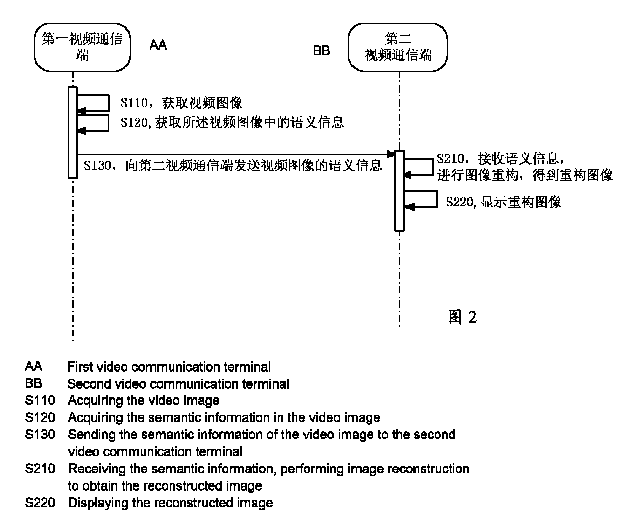
1つの実施例では、ビデオ画像の伝送方法を提供する。図2に示すように、該方法は、以下のステップを含む。 One embodiment provides a method of transmitting a video image. As shown in FIG. 2, the method comprises the following steps.
S110において、第1のビデオ通信端末は、ビデオ画像を取得し、該ビデオ画像は、該第1のビデオ通信端末により撮影されたビデオにおけるフレーム画像である。 In S110, the first video communication terminal acquires a video image, and the video image is a frame image in the video taken by the first video communication terminal.
ビデオ会議、ビデオ通話などのビデオ通信は、一般に、フレームごとにビデオ画像を伝送する。ここで、第1のビデオ通信端末は、ビデオ通信においてビデオ画像を送信する必要がある端末であり、ビデオ画像の送信端末であってもよい。第1のビデオ通信端末により取得されたビデオ画像は、第1のビデオ通信端末の撮影装置により撮影されたビデオ会議又はビデオ通話のシナリオにおけるビデオ画像である。 Video communications such as video conferences and video calls generally transmit video images frame by frame. Here, the first video communication terminal is a terminal that needs to transmit a video image in video communication, and may be a terminal for transmitting a video image. The video image acquired by the first video communication terminal is a video image in a video conference or video call scenario taken by the photographing device of the first video communication terminal.
ビデオ通信では、各ビデオ通信端末は、他のビデオ通信端末にビデオ画像を送信する必要があり、また、他のビデオ通信端末からビデオ画像を受信する必要がある。従って、ビデオ通信では、第1のビデオ通信端末は、ビデオ通信に参加する任意の端末であってもよい。 In video communication, each video communication terminal needs to transmit a video image to another video communication terminal, and also needs to receive a video image from the other video communication terminal. Therefore, in video communication, the first video communication terminal may be any terminal that participates in video communication.
S120において、第1のビデオ通信端末は、ビデオ画像の意味情報を抽出する。 In S120, the first video communication terminal extracts the semantic information of the video image.
画像は多数の画素により構成され、意味(semantic)は画像内の画素情報である。画像の意味情報を取得することは、画像の画素の深い特徴情報を抽出することを意味してもよく、これらの情報は、ビデオ画像の重要な細部を表すことができる。例えば、ビデオ会議のビデオ画像では、意味情報は、会議に参加する人の表情の特徴情報、身体の動きの特徴情報、又は例えば会議室のテーブルや椅子の情報などの会議の環境情報を含んでもよい。 An image is composed of a large number of pixels, and the semantic is pixel information in the image. Acquiring semantic information of an image may mean extracting deep feature information of pixels of an image, which can represent important details of a video image. For example, in a video image of a video conference, the semantic information may include facial expression feature information, body movement feature information, or conference environmental information such as conference room table and chair information. good.
本発明の幾つかの実施例では、ビデオ画像から取得された意味情報は、画像における設定対象(人の顔、人の体、テーブル、椅子など)の意味情報であってもよいし、画像のキー画素の特徴情報などの画像の大域的な意味情報であってもよい。 In some embodiments of the present invention, the semantic information obtained from the video image may be the semantic information of the setting target (human face, human body, table, chair, etc.) in the image, or the semantic information of the image. It may be global semantic information of an image such as feature information of a key pixel.
S130において、第1のビデオ通信端末は、第2のビデオ通信端末に意味情報を送信する。 In S130, the first video communication terminal transmits semantic information to the second video communication terminal.
ビデオ画像に含まれる全ての情報と比べて、ビデオ画像から取得された意味情報のデータ量は少ないため、ビデオ画像のリアルタイム伝送を比較的に容易に実現することができる。 Since the amount of semantic information data acquired from the video image is smaller than all the information contained in the video image, real-time transmission of the video image can be realized relatively easily.
S210において、第2のビデオ通信端末は、第1のビデオ通信端末により送信された意味情報を受信し、該意味情報に基づいて画像を再構築し、該ビデオ画像の再構築画像を取得する。 In S210, the second video communication terminal receives the semantic information transmitted by the first video communication terminal, reconstructs the image based on the semantic information, and acquires the reconstructed image of the video image.
ここで、画像の意味情報に基づいて画像圧縮及び画像再構築を行うことで、画像の浅い情報に基づいて圧縮符号化及び再構築を行う従来の方法に比べて、より多くの画像の細部を保留することができるため、ビデオ通信における画像へ高忠実度の要求とリアルタイム性の要求とを両立することができる。 Here, by performing image compression and image reconstruction based on the semantic information of the image, more details of the image can be obtained as compared with the conventional method of performing compression coding and reconstruction based on the shallow information of the image. Since it can be withheld, it is possible to achieve both the demand for high fidelity and the demand for real-time performance for images in video communication.
S220において、第2のビデオ通信端末は、再構築画像を表示する。 In S220, the second video communication terminal displays the reconstructed image.
上記の実施例のビデオ画像の伝送方法によれば、ビデオ通信において、送信端末がビデオ画像を送信する際に、該ビデオ画像の意味情報を取得し、受信端末に該意味情報を送信する。受信端末が該意味情報を受信した後に、該意味情報に基づいて送信端末のビデオ画像を再構築し、再構築画像を取得し、受信端末の表示パネルにより再構築画像を表示してもよい。これによって、ビデオ通信では、1つのビデオ画像を送信する際に非常に少量のデータを送信するだけでよいため、ネットワーク帯域幅への要求が非常に低く、リアルタイム伝送の要求を満たすことができる。また、意味情報に基づいてビデオ画像を圧縮/復元することで、ビデオ画像の受信側でより高品質の画像を再構築することができ、ビデオ通信における画像への高解像度及び高忠実度の要求を両立することができる。 According to the video image transmission method of the above embodiment, in video communication, when the transmitting terminal transmits the video image, the semantic information of the video image is acquired and the semantic information is transmitted to the receiving terminal. After the receiving terminal receives the semantic information, the video image of the transmitting terminal may be reconstructed based on the semantic information, the reconstructed image may be acquired, and the reconstructed image may be displayed on the display panel of the receiving terminal. As a result, in video communication, only a very small amount of data needs to be transmitted when transmitting one video image, so that the demand for network bandwidth is very low, and the demand for real-time transmission can be satisfied. In addition, by compressing / restoring a video image based on semantic information, a higher quality image can be reconstructed on the receiving side of the video image, and high resolution and high fidelity are required for the image in video communication. Can be compatible with each other.
1つの実施例では、ビデオ会議の例では、ローカルユーザ及びリモートユーザは、それぞれ、第1のビデオ通信端末及び第2のビデオ通信端末を介してビデオ会議に参加し、第1のビデオ通信端末は、ローカルユーザの会議におけるビデオ画像を伝送すべきビデオ画像として撮影する。図3に示すように、第1のビデオ通信端末から第2のビデオ通信端末に該ビデオ画像を伝送する実現プロセスは以下の通りである。 In one embodiment, in the video conference example, the local user and the remote user participate in the video conference via the first video communication terminal and the second video communication terminal, respectively, and the first video communication terminal is , Take a video image at a local user's conference as a video image to be transmitted. As shown in FIG. 3, the realization process for transmitting the video image from the first video communication terminal to the second video communication terminal is as follows.
ステップS302において、第1のビデオ通信端末では、ビデオ画像の意味情報を抽出する。 In step S302, the first video communication terminal extracts the semantic information of the video image.
第1のビデオ通信端末では、事前に訓練されたエンコーダによりビデオ画像の意味情報を抽出してもよい。幾つかの実施例では、エンコーダは、畳み込みニューラルネットワークを使用してもよい。該エンコーダの入力は、伝送すべきビデオ画像であり、その出力は、ビデオ画像に対応する低次元ベクトルである。 In the first video communication terminal, the semantic information of the video image may be extracted by a pre-trained encoder. In some embodiments, the encoder may use a convolutional neural network. The input of the encoder is a video image to be transmitted and its output is a low dimensional vector corresponding to the video image.
エンコーダは、変換関数fと見なされてもよく、該変換関数fは、伝送すべきビデオ画像Iを低次元ベクトルyに変換でき、即ちy=f(I)。yはビデオ画像Iの意味情報であり、yは64次元又は128次元のベクトルであってもよく、高品質の画像再構築を実現すると共に、伝送する必要なデータ量を低減できるように、ビデオ会議におけるビデオ画像の最も重要な情報を取り込むことができる。 The encoder may be regarded as a conversion function f, which can convert the video image I to be transmitted into a low-dimensional vector y, ie y = f (I). y is the semantic information of the video image I, where y may be a 64-dimensional or 128-dimensional vector so that high-quality image reconstruction can be achieved and the amount of data required to be transmitted can be reduced. It can capture the most important information of video images in a conference.
なお、本発明の実施例に係る低次元ベクトル及び意味情報は、ビデオ会議のシナリオにおけるビデオ画像を学習して抽出された、ビデオ画像における重要な細部を表すことができる情報である。これらの情報は、他のシナリオにおける意味情報と異なる。言い換えれば、本発明の実施例に係る低次元ベクトル及び意味情報は、人間の思考により理解される特徴情報ではなく、人間の思考により理解され得ない画像の深い情報である。 The low-dimensional vector and semantic information according to the embodiment of the present invention are information that can represent important details in the video image extracted by learning the video image in the scenario of the video conference. This information differs from the semantic information in other scenarios. In other words, the low-dimensional vector and semantic information according to the embodiment of the present invention are not characteristic information understood by human thinking, but deep information of an image that cannot be understood by human thinking.
ステップS303において、第1のビデオ通信端末は、抽出された意味情報を第2のビデオ通信端末に送信する。 In step S303, the first video communication terminal transmits the extracted semantic information to the second video communication terminal.
ビデオ画像の意味情報yは、非常に少ないデータ量により表現さればよく、例えば、意味情報yは、64次元の浮動小数点数ベクトルであってもよいため、各フレームのビデオ画像について、64*4=256byteのデータのみを送信する必要がある。ビデオフレームレートが30Hzである場合、必要な帯域幅は256*30=7680Bps=7.68KBpsである。よって、該画像伝送モードでは、ネットワーク環境への帯域幅の要求が低いことが分かった。 The semantic information y of the video image may be represented by a very small amount of data. For example, since the semantic information y may be a 64-dimensional floating point number vector, 64 * 4 for the video image of each frame. It is necessary to transmit only the data of = 256 bytes. When the video frame rate is 30 Hz, the required bandwidth is 256 * 30 = 7680 Bps = 7.68 KBps. Therefore, it was found that the demand for bandwidth to the network environment is low in the image transmission mode.
ステップS402において、第2のビデオ通信端末は、意味情報を受信し、意味情報に基づいて画像を再構築し、第1のビデオ通信端末のビデオ画像の再構築画像を取得する。 In step S402, the second video communication terminal receives the semantic information, reconstructs the image based on the semantic information, and acquires the reconstructed image of the video image of the first video communication terminal.
第2のビデオ通信端末が意味情報yを受信した後に、第2のビデオ通信端末は、意味情報yを事前に訓練されたデコーダの入力として、デコーダにより画像を再構築してもよい。デコーダは、変換関数gと見なされてもよく、該変換関数gは、低次元の意味情報yを再構築画像I’に変換でき、即ちI’=g(y)。 After the second video communication terminal receives the semantic information y, the second video communication terminal may reconstruct the image by the decoder using the semantic information y as an input of the pre-trained decoder. The decoder may be considered as a conversion function g, which conversion function g can convert the low-dimensional semantic information y into the reconstructed image I', i.e. I'= g (y).
1つの実施例では、上記の実施例のエンコーダ及びデコーダは、以下の条件を満たす必要がある。ビデオ会議のシナリオに適している。エンコーダfは、ビデオ画像に対してコンパクション(compaction)符号化を行い、低次元の意味情報を出力できる。デコーダgは、高品質の再構築画像を取得するために、原ビデオ画像の最も重要な情報(例えば顔の表情の細部、体の動きの細部など)を復元できる。 In one embodiment, the encoder and decoder of the above embodiment must satisfy the following conditions. Suitable for video conference scenarios. The encoder f can perform compaction coding on the video image and output low-dimensional semantic information. The decoder g can restore the most important information of the original video image (eg, facial expression details, body movement details, etc.) in order to obtain a high quality reconstructed image.
幾つかの実施例では、図4に示すように、Encoder-decoderネットワークに基づいてエンコーダf及びデコーダgを設計してもよい。ここで、左部分(即ち、ネットワークの下位層)は一連の畳み込み演算層により構成され(この図には2つの層のみが例示されているが、実際の状況では他の数の畳み込み演算層を設けてもよい)、中間層は1つの低次元ベクトルを出力し、この部分はエンコーダに相当し、低次元ベクトルはリモートエンド(即ち、受信側)に伝送される。右部分(即ち、ネットワークの上位層)はこの低次元ベクトルに基づいて一連の逆畳み込みにより再構築画像yを取得し、このプロセスはデコーダに相当する。即ち、エンコーダf及びデコーダgは、何れも畳み込みニューラルネットワークを採用してもよい。 In some embodiments, the encoder f and decoder g may be designed based on the Encoder-decoder network, as shown in FIG. Here, the left part (that is, the lower layer of the network) is composed of a series of convolution arithmetic layers (only two layers are illustrated in this figure, but in the actual situation, there are other numbers of convolution arithmetic layers. The middle layer outputs one low-dimensional vector, which corresponds to an encoder, and the low-dimensional vector is transmitted to the remote end (that is, the receiving side). The right part (ie, the upper layer of the network) obtains the reconstructed image y by a series of deconvolutions based on this low dimensional vector, and this process corresponds to the decoder. That is, both the encoder f and the decoder g may adopt a convolutional neural network.
上記のEncoder-decoderネットワークに基づいてエンコーダf及びデコーダgを設定し、ビデオ会議における画像データを訓練することで、より良い圧縮率を達成することができる。しかし、低次元ベクトルに画像の深い意味情報のみが含まれるため、再構築画像の解像度が低くなる可能性がある。上記の状況を回避するために、1つの実施例では、従来のEncoder-decoderネットワークを基礎にして、U-Netの考え方を採用してEncoder-decoderネットワークを最適化する。即ち、ネットワークの下位層(例えば図4における畳み込み層)により出力された特徴ベクトルの一部をさらに抽出して、中間層により出力された低次元ベクトルに結合する。これによって、リモートエンドに伝送されるデータの量が増加するが、この部分の情報が増加しても、リモートエンドに伝送する必要のあるデータ量は、従来の圧縮方法に比べて依然として遥かに少ない。 Better compression ratios can be achieved by setting the encoder f and decoder g based on the Encoder-decoder network described above and training the image data in the video conference. However, since the low-dimensional vector contains only the deep semantic information of the image, the resolution of the reconstructed image may be low. In order to avoid the above situation, in one embodiment, the Encoder-decoder network is optimized by adopting the U-Net concept based on the conventional Encoder-decoder network. That is, a part of the feature vector output by the lower layer of the network (for example, the convolution layer in FIG. 4) is further extracted and combined with the low-dimensional vector output by the intermediate layer. This increases the amount of data transmitted to the remote end, but even with this increase in information, the amount of data that needs to be transmitted to the remote end is still much less than with traditional compression methods. ..
U-Netによりネットワークを最適化することで、ネットワーク状態に応じて、ビデオ画像の圧縮率及び受信側で再構築された画質を動的に調整することができる。ネットワーク状態が良好である場合、ネットワークの下位層により出力された特徴ベクトルから比較的に多い情報を抽出して、中間層により出力された低次元ベクトルに結合することで、受信側で再構築された画像の品質を高くすることができる。ネットワークの状態が悪い場合、ネットワークの下位層により出力された特徴ベクトルから比較的に少ない情報を抽出して、中間層により出力された低次元ベクトルに結合し、或いは下位層により出力された特徴ベクトルから結合用の情報を抽出しないことで、ビデオ画像の送信側の画像圧縮率を高くすることができるため、ビデオ画像のリアルタイム伝送に役立つ。 By optimizing the network with U-Net, the compression rate of the video image and the image quality reconstructed on the receiving side can be dynamically adjusted according to the network state. When the network condition is good, it is reconstructed on the receiving side by extracting a relatively large amount of information from the feature vector output by the lower layer of the network and combining it with the low-dimensional vector output by the intermediate layer. The quality of the image can be improved. When the network condition is bad, relatively little information is extracted from the feature vector output by the lower layer of the network and combined with the low-dimensional vector output by the intermediate layer, or the feature vector output by the lower layer. By not extracting the information for joining from, the image compression rate on the transmitting side of the video image can be increased, which is useful for real-time transmission of the video image.
ステップS404において、第2のビデオ通信端末は、ビデオ画像の再構築画像を表示する。 In step S404, the second video communication terminal displays a reconstructed image of the video image.
本発明の1つの実施例では、図4及び上記の実施例に示すように、エンコーダfは、一連の畳み込み演算により構成されてもよく、デコーダgは、一連の逆畳み込み演算により構成されてもよい。 In one embodiment of the invention, as shown in FIG. 4 and the above embodiment, the encoder f may be configured by a series of convolution operations, and the decoder g may be configured by a series of deconvolution operations. good.
1つの実施例では、以下の最適化目標に従って、要件を満たすエンコーダf及びデコーダgを訓練してもよい。 In one embodiment, the encoder f and decoder g that meet the requirements may be trained according to the following optimization goals.

ここで、g(f(I))は、ビデオ画像Iがエンコーダfにより処理されて取得された意味情報がデコーダgにより復号されて復元されて取得された再構築画像を表し、
(外1)

Here, g (f (I)) represents a reconstructed image obtained by decoding and restoring the semantic information obtained by processing the video image I by the encoder f by the decoder g.
(Outside 1)
なお、上記の例におけるEncoder-decoderに加えて、生成モデル構築が条件を満たす他のエンコーダ及びデコーダを採用してもよい。 In addition to the Encoder-decoder in the above example, another encoder and decoder that satisfy the conditions for constructing the generated model may be adopted.
ビデオ会議のシナリオにおけるビデオ画像の場合、最も重要な画像情報は、人の表情、口の形状などの細部である。幾つかの実施例では、設定対象が人の顔である例では、第1のビデオ通信端末は、ビデオ画像における顔意味情報を抽出し、第2のビデオ通信端末は、ビデオ画像における人の顔の細部を復元するように、対応するデコーダにより顔意味情報に基づいて画像を再構築する。 For video images in a video conference scenario, the most important image information is details such as a person's facial expression, mouth shape, and so on. In some embodiments, in an example in which the setting target is a human face, the first video communication terminal extracts the facial meaning information in the video image, and the second video communication terminal is the human face in the video image. The corresponding decoder reconstructs the image based on the facial semantic information so as to restore the details of.
ビデオ会議におけるビデオ画像のより多くの細部を取得するために、人の体を設定対象としてもよい。第1のビデオ通信端末は、ビデオ画像から体意味情報を抽出する。人体意味情報は、顔の表情情報及び体の動き情報などの人そのものに関する情報を含む。第2のビデオ通信端末は、ビデオ画像における人の全体的な細部を復元するように、対応するデコーダにより体意味情報に基づいて画像を再構築する。 The human body may be set to capture more detail in the video image in a video conference. The first video communication terminal extracts body meaning information from a video image. The human body semantic information includes information about the person itself such as facial expression information and body movement information. The second video communication terminal reconstructs the image based on the body semantic information by the corresponding decoder so as to restore the entire human detail in the video image.
上記の実施例によれば、ビデオ会議における画像伝送のリアルタイム性を確保することができ、受信側で画像の細部を復元することができるが、伝送される意味情報のデータ量が少ないため、受信側の高解像度を確保することは困難である。上記の状況を考慮して、1つの実施例では、第1のビデオ通信端末は、Nフレームごとに(Nは1よりも大きく、Nの値は実際の状況に応じて調整されてもよい)、設定された画像伝送モードを使用して、第2のビデオ通信端末に第1の参照画像を送信する。該設定された画像伝送モードで伝送される該第1の参照画像のデータ量は、該意味情報のデータ量よりも大きい。ここで、第1の参照画像は、該第1のビデオ通信端末により撮影されたビデオ画像である。該第1の参照画像は、該第2のビデオ通信端末が該意味情報及び該第1の参照画像に基づいて該ビデオ画像の再構築画像を再構築するために使用される。 According to the above embodiment, the real-time property of image transmission in the video conference can be ensured, and the details of the image can be restored on the receiving side. It is difficult to ensure high resolution on the side. In consideration of the above situation, in one embodiment, the first video communication terminal is set every N frames (N is larger than 1 and the value of N may be adjusted according to the actual situation). , The set image transmission mode is used to transmit the first reference image to the second video communication terminal. The amount of data of the first reference image transmitted in the set image transmission mode is larger than the amount of data of the semantic information. Here, the first reference image is a video image taken by the first video communication terminal. The first reference image is used by the second video communication terminal to reconstruct the reconstructed image of the video image based on the semantic information and the first reference image.
例えば、第1のビデオ通信端末は、100フレームごとに第2のビデオ通信端末に完全な1つのフレームのビデオ画像を送信する。その後の99フレームのビデオ画像において、第2のビデオ通信端末は、ビデオ画像の低次元意味情報を受信した場合、この完全なビデオ画像の情報と組み合わせて画像を再構築し、より高い解像度の再構築画像を取得してもよい。 For example, the first video communication terminal transmits a complete one frame of video image to the second video communication terminal every 100 frames. In the subsequent 99 frames of video image, when the second video communication terminal receives the low-dimensional semantic information of the video image, it reconstructs the image in combination with the information of this complete video image, and reconstructs the image with higher resolution. You may get the construction image.
以下は、人の顔の意味情報及び人の体の意味情報をそれぞれ例にして説明する。図3に示すように、上記の第1のビデオ通信端末と第2のビデオ通信端末との間のビデオ画像の伝送は、以下のステップをさらに含む。 In the following, the semantic information of the human face and the semantic information of the human body will be described as examples. As shown in FIG. 3, the transmission of the video image between the first video communication terminal and the second video communication terminal described above further includes the following steps.
ステップS300において、第1のビデオ通信端末は、設定されたフレーム間隔に従って、設定された画像伝送モードにより、第2のビデオ通信端末に参照画像(本実施例では、第1の参照画像)を送信する。 In step S300, the first video communication terminal transmits a reference image (in this embodiment, the first reference image) to the second video communication terminal in the set image transmission mode according to the set frame interval. do.
ここで、参照画像は、第1のビデオ通信端末により撮影されたビデオ画像である。第1のビデオ通信端末は、ブロックに基づく画像圧縮方法を使用して、参照画像の画像符号化情報を取得してもよい。即ち、第1のビデオ通信端末と第2のビデオ通信端末との間では、意味情報に基づく画像伝送に加えて、他の画像伝送モードをさらに含む。該他の画像伝送モードは、間隔を置いて実行され、画像の圧縮率がより低く、伝送されるデータ量がより大きい。 Here, the reference image is a video image taken by the first video communication terminal. The first video communication terminal may acquire the image coding information of the reference image by using the image compression method based on the block. That is, in addition to image transmission based on semantic information, another image transmission mode is further included between the first video communication terminal and the second video communication terminal. The other image transmission modes are performed at intervals, the compression ratio of the image is lower, and the amount of data transmitted is larger.
ステップS401において、第2のビデオ通信端末は、参照画像を受信する。 In step S401, the second video communication terminal receives the reference image.
ビデオ会議では、第1のビデオ通信端末は、1つ以上のフレームの間隔を置いた方式で第2のビデオ通信端末に参照画像を送信する。第2のビデオ通信端末は、参照画像を取得した後に、ビデオ会議では、隣接するフレームのビデオ画像の画素の変化が一般に小さく、例えば、人の表情や身体に対応する画素のみが変化し、他の会議室の環境情報が変化しない。このため、第2のビデオ通信端末により受信された意味情報は、変化している画素の情報である可能性がある。よって、第2のビデオ通信端末は、少量の意味情報及びデータ量の大きい参照画像に基づいて、ビデオ画像を高度に復元することができ、第2のビデオ通信端末での再構築画像の解像度を向上させることができる。参照画像が間隔を置いて送信されるため、伝送帯域幅及びリアルタイム性への影響は少ない。 In a video conference, the first video communication terminal transmits a reference image to the second video communication terminal in a manner spaced by one or more frames. In the video conference, after the second video communication terminal acquires the reference image, the change in the pixel of the video image of the adjacent frame is generally small, for example, only the pixel corresponding to the human expression or the body changes, and the other The environmental information of the conference room does not change. Therefore, the semantic information received by the second video communication terminal may be the information of the changing pixel. Therefore, the second video communication terminal can highly restore the video image based on a small amount of semantic information and a large reference image with a large amount of data, and can reduce the resolution of the reconstructed image in the second video communication terminal. Can be improved. Since the reference images are transmitted at intervals, the effect on transmission bandwidth and real-time performance is small.
幾つかの実施例では、第2のビデオ通信端末によりリアルタイムで受信された意味情報がビデオ画像における設定対象の意味情報である場合、設定対象の再構築サブ画像を再構築してもよい。該設定対象の再構築サブ画像と該参照画像の再構築画像とを融合することで、第1のビデオ通信端末のビデオ画像の再構築画像を取得する。 In some embodiments, if the semantic information received in real time by the second video communication terminal is the semantic information of the setting target in the video image, the reconstruction sub-image of the setting target may be reconstructed. By fusing the reconstructed sub-image of the setting target and the reconstructed image of the reference image, the reconstructed image of the video image of the first video communication terminal is acquired.
他の幾つかの実施例では、第1のビデオ通信端末と第2のビデオ通信端末との間のビデオ画像の伝送は、以下のステップをさらに含む。 In some other embodiments, the transmission of the video image between the first video communication terminal and the second video communication terminal further comprises the following steps:
ステップS301において、第1のビデオ通信端末は、ビデオ画像に対して前処理を行う。 In step S301, the first video communication terminal performs preprocessing on the video image.
第1のビデオ通信端末によるビデオ画像の前処理は、該ビデオ画像における設定対象を認識し、該ビデオ画像における設定対象のサブ画像を取得することと、訓練されたエンコーダに該設定対象のサブ画像を入力し、該エンコーダの出力を取得し、該ビデオ画像における設定対象の意味情報を取得することと、該エンコーダを用いて入力画像における該設定対象の意味情報を認識して出力することとを含む。人の顔を設定対象とする例では、第1のビデオ通信端末は、ビデオ画像から顔領域を認識し、該ビデオ画像に対応する顔サブ画像を取得し、訓練されたエンコーダに顔サブ画像を入力し、該エンコーダの出力を取得する。これによって、該ビデオ画像の顔意味情報を取得する。 The preprocessing of the video image by the first video communication terminal recognizes the setting target in the video image, acquires the sub image of the setting target in the video image, and makes the trained encoder the sub image of the setting target. Is input, the output of the encoder is acquired, and the semantic information of the setting target in the video image is acquired, and the semantic information of the setting target in the input image is recognized and output by using the encoder. include. In the example in which the human face is set, the first video communication terminal recognizes the face area from the video image, acquires the face sub-image corresponding to the video image, and outputs the face sub-image to the trained encoder. Input and get the output of the encoder. As a result, the facial meaning information of the video image is acquired.
ステップS403において、第2のビデオ通信端末は、該設定対象の意味情報を受信し、受信された該設定対象の意味情報に基づいて該設定対象の再構築サブ画像を取得した後に、再構築された顔画像又は体画像に対して後処理を行ってもよい。後処理は、該設定対象の再構築サブ画像と該参照画像とを融合し、該ビデオ画像の再構築画像を取得することを含む。 In step S403, the second video communication terminal receives the semantic information of the setting target, acquires the reconstruction sub-image of the setting target based on the received semantic information of the setting target, and then is reconstructed. Post-processing may be performed on the face image or the body image. The post-processing includes fusing the reconstructed sub-image to be set and the reference image to obtain a reconstructed image of the video image.
人の顔を設定対象とする例では、第2のビデオ通信端末は、顔意味情報に基づいて顔の再構築画像を取得した後に、顔の再構築画像に対して後処理を行う。第2のビデオ通信端末による顔の再構築画像の後処理は、顔の再構築画像を該参照画像の再構築画像に重ね合わせて、第1のビデオ通信端末のビデオ画像の再構築画像を取得することを含む。 In the example in which the human face is set as the setting target, the second video communication terminal acquires the reconstructed image of the face based on the facial meaning information, and then performs post-processing on the reconstructed image of the face. In the post-processing of the reconstructed image of the face by the second video communication terminal, the reconstructed image of the face is superimposed on the reconstructed image of the reference image, and the reconstructed image of the video image of the first video communication terminal is acquired. Including doing.
1つの実施例の1つの態様では、第1のビデオ通信端末は、該ビデオ画像における設定対象の位置情報をさらに取得し、第2のビデオ通信端末に該位置情報を送信する。該位置情報は、第2のビデオ通信端末が該位置情報に基づいて該設定対象の再構築サブ画像を該参照画像に重ね合わせて、該ビデオ画像の再構築画像を取得するために使用される。 In one embodiment of one embodiment, the first video communication terminal further acquires the position information of the setting target in the video image and transmits the position information to the second video communication terminal. The position information is used by the second video communication terminal to superimpose the reconstructed sub-image to be set on the reference image based on the position information and acquire the reconstructed image of the video image. ..
1つの実施例では、人の顔を設定対象とする例では、第1のビデオ通信端末は、該ビデオ画像における顔領域の位置情報を取得し、第2のビデオ通信端末に該位置情報を送信する。第2のビデオ通信端末は、第1のビデオ通信端末により送信された顔の位置情報を受信した後に、顔の位置情報に基づいて顔の再構築画像を参照画像の再構築画像に重ね合わせて、第1のビデオ通信端末のビデオ画像の再構築画像を取得してもよい。 In one embodiment, in an example in which a human face is set as a setting target, the first video communication terminal acquires the position information of the face region in the video image and transmits the position information to the second video communication terminal. do. The second video communication terminal receives the position information of the face transmitted by the first video communication terminal, and then superimposes the reconstructed image of the face on the reconstructed image of the reference image based on the position information of the face. , The reconstructed image of the video image of the first video communication terminal may be acquired.
1つの実施例では、ビデオ画像の再構築画像の品質を向上させるために、本発明の1つの実施例では、上記のビデオ画像の伝送方法は、以下のステップをさらに含む。第2のビデオ通信端末は、位置情報に基づいて設定対象の再構築サブ画像と参照画像とを融合する前に、該設定対象の再構築サブ画像に対してエッジフェザリング(edge feathering)処理を行い、エッジフェザリング処理後の設定対象の再構築サブ画像と参照画像の再構築画像とを重ね合わせて、第1のビデオ通信端末のビデオ画像の再構築画像を取得してもよい。 Reconstruction of Video Image in One Example In one embodiment of the invention, the method of transmitting a video image further comprises the following steps in order to improve the quality of the reconstructed image. The second video communication terminal performs edge feathering processing on the reconstructed sub-image to be set before fusing the reconstructed sub-image to be set based on the position information with the reference image. Then, the reconstructed sub-image of the setting target after the edge feathering process and the reconstructed image of the reference image may be superimposed to obtain the reconstructed image of the video image of the first video communication terminal.
1つの実施例では、人の顔を設定対象とする例では、第2のビデオ通信端末は、画像の重ね合わせを行う前に、顔の再構築画像に対してエッジフェザリング処理を行い、エッジフェザリング処理後の顔の再構築画像と参照画像の再構築画像とを重ね合わせて、第1のビデオ通信端末のビデオ画像の再構築画像を取得する。本実施例によれば、より良い重ね合わせ効果と融合効果を得ることができ、第2のビデオ通信端末により表示される再構築画像の画質を向上させることができる。 In one embodiment, in an example in which a human face is set as a setting target, the second video communication terminal performs edge feathering processing on the reconstructed image of the face before superimposing the images, and the edge is performed. The reconstructed image of the face after the feathering process and the reconstructed image of the reference image are superposed to obtain the reconstructed image of the video image of the first video communication terminal. According to this embodiment, a better superposition effect and a fusion effect can be obtained, and the image quality of the reconstructed image displayed by the second video communication terminal can be improved.
他の幾つかの実施例では、ビデオ会議の完全な細部を取得するために、第1のビデオ通信端末によりビデオ画像から抽出された意味情報は、画像の大域的な意味情報であってもよく、該処理は対応するエンコーダにより実現されてもよい。第2ビデオ通信端末は、ビデオ画像の大域的な細部情報を復元するように、大域的な意味情報に基づいて画像を再構築する。大域的な意味情報に基づいて画像の伝送及び再構築を行う場合、第1のビデオ通信端末は、上記のビデオ画像の前処理を行う必要がなく、第2のビデオ通信端末は、再構築画像の後処理を行う必要がない。 In some other embodiments, the semantic information extracted from the video image by the first video communication terminal may be global semantic information of the image in order to obtain the complete details of the video conference. , The process may be realized by the corresponding encoder. The second video communication terminal reconstructs the image based on the global semantic information so as to restore the global detailed information of the video image. When transmitting and reconstructing an image based on global semantic information, the first video communication terminal does not need to perform preprocessing of the above video image, and the second video communication terminal is a reconstructed image. There is no need to perform post-processing.
なお、実際のシナリオの必要に応じて、人の顔の意味、人の体の意味又は画像の大域的な意味に基づいてエンコーダ及びデコーダを事前に訓練してもよい。例えば、顔画像を訓練データとし、要件を満たすようにエンコーダ及びデコーダを訓練する。或いは、体画像を訓練データとし、要件を満たすようにエンコーダ及びデコーダを訓練する。或いは、ビデオ画像全体を訓練データとし、要件を満たすようにエンコーダ及びデコーダを訓練する。 It should be noted that the encoder and decoder may be trained in advance based on the meaning of the human face, the meaning of the human body, or the global meaning of the image, as necessary in the actual scenario. For example, a face image is used as training data, and an encoder and a decoder are trained to meet the requirements. Alternatively, the body image is used as training data, and the encoder and decoder are trained to meet the requirements. Alternatively, the entire video image is used as training data, and the encoder and decoder are trained to meet the requirements.
他の実施例では、第1のビデオ通信端末は、設定された画像伝送モードを使用して、第2のビデオ通信端末に他のタイプの参照画像(即ち第2の参照画像)を送信してもよい。該設定された画像伝送モードで伝送される第2の参照画像のデータ量は、意味情報のデータ量よりも大きい。ここで、該第2の参照画像は、設定対象の画像、及び第1のビデオ通信端末の環境画像のうちの少なくとも1つであってもよい。第2の参照画像を伝送することで、第2のビデオ通信端末が該意味情報及び該第2の参照画像に基づいて該ビデオ画像の再構築画像を再構築する。 In another embodiment, the first video communication terminal uses the set image transmission mode to transmit another type of reference image (ie, the second reference image) to the second video communication terminal. May be good. The amount of data of the second reference image transmitted in the set image transmission mode is larger than the amount of data of semantic information. Here, the second reference image may be at least one of the image to be set and the environmental image of the first video communication terminal. By transmitting the second reference image, the second video communication terminal reconstructs the reconstructed image of the video image based on the semantic information and the second reference image.
例えば、第1のビデオ通信端末は、ビデオ会議のシナリオにおける参加者の高解像度写真及び/又は会議室の高解像度写真を第2の参照画像として事前に設定し、設定された画像伝送モードを使用して第2のビデオ通信端末に完全な第2の参照画像を送信する。第2のビデオ通信端末は、第2の参照画像を受信して保存し、各フレームのビデオ画像の意味情報を受信した後、第2の参照画像の細部情報を参照して画像を再構築してもよい。従って、意味情報が少ない場合であっても、第2のビデオ通信端末は、第2の参照画像に基づいて高解像度の再構築画像を再構築することができる。 For example, the first video communication terminal presets a high-resolution photograph of a participant and / or a high-resolution photograph of a conference room as a second reference image in a video conference scenario, and uses a set image transmission mode. Then, the complete second reference image is transmitted to the second video communication terminal. The second video communication terminal receives and stores the second reference image, receives the semantic information of the video image of each frame, and then reconstructs the image by referring to the detailed information of the second reference image. You may. Therefore, the second video communication terminal can reconstruct the high-resolution reconstructed image based on the second reference image even when the semantic information is small.
1つの実施例では、ビデオ画像を1つのフレームごとに個別に符号化/復号すると、フレーム間に不整合が発生する可能性があり、即ち、受信側で表示されたビデオ内容にスキップによる変化がある可能性がある。この状況を考慮して、1つの実施例では、ビデオ会議のシナリオにおけるビデオ画像の伝送は、実際に複数のネットワーク分岐を有する。エンコーダの入力は、現在のフレームのビデオ画像であるだけでなく、現在のフレームの前のMフレームのビデオ画像をさらに含む。よって、符号化後の低次元ベクトルには、現在のフレームの意味情報だけでなく、直前の1つ以上のフレームの意味情報がさらに含まれる。それに応じて、受信側のデコーダは、現在のフレームの意味情報及び直前の1つ以上のフレームの意味情報に基づいて、フレーム間で一貫性のあるビデオ画像を再構築する。本実施例によれば、受信側でのビデオ内容のスキップによる変化を回避することができる。 In one embodiment, encoding / decoding a video image individually for each frame can result in inconsistencies between frames, i.e., skip changes in the video content displayed on the receiver. There is a possibility. With this situation in mind, in one embodiment, the transmission of video images in a video conference scenario actually has multiple network branches. The encoder input is not only the video image of the current frame, but also includes the video image of the M frame before the current frame. Therefore, the encoded low-dimensional vector further includes not only the semantic information of the current frame but also the semantic information of one or more immediately preceding frames. Accordingly, the receiving decoder reconstructs a consistent video image between frames based on the semantic information of the current frame and the semantic information of one or more previous frames. According to this embodiment, it is possible to avoid a change due to skipping the video content on the receiving side.
従来の方式のビデオ画像の伝送方式と比べて、上記の実施例によれば、ビデオ会議において、各ビデオ通信端末で高解像度の再構築画像を取得することができる。殆どのビデオ画像の伝送する必要な意味情報のデータ量が非常に少ないため、ネットワーク環境が悪い場合であっても、伝送を迅速に完了することができ、リアルタイム性を確保することができる。意味情報及び参照画像に基づいて画像を再構築する場合、ビデオ画像の重要な情報(特に顔の細部、体の動きの細部など)を保留することができるため、優れたビデオ会議の体験を得ることができる。 Compared with the conventional method of transmitting a video image, according to the above embodiment, it is possible to acquire a high-resolution reconstructed image at each video communication terminal in a video conference. Since the amount of semantic information required for transmission of most video images is very small, transmission can be completed quickly even when the network environment is poor, and real-time performance can be ensured. When reconstructing an image based on semantic information and reference images, you can retain important information in the video image (especially facial details, body movement details, etc.) to get a great video conference experience. be able to.
上記のビデオ画像の伝送方法と同様に、本発明は、もう1つのビデオ画像の伝送方法の実施例をさらに提供する。本実施例では、第1のビデオ通信端末は、ビデオ画像の送信端末である。図5に示すように、第1のビデオ通信端末の観点から、ビデオ画像の伝送方法は、以下のステップを含む。 Similar to the video image transmission method described above, the present invention further provides an embodiment of another video image transmission method. In this embodiment, the first video communication terminal is a video image transmission terminal. As shown in FIG. 5, from the viewpoint of the first video communication terminal, the method of transmitting a video image includes the following steps.
S510において、第1のビデオ通信端末により撮影されたビデオ画像を取得する。 In S510, a video image taken by the first video communication terminal is acquired.
S510において、該ビデオ画像の意味情報を抽出する。 In S510, the semantic information of the video image is extracted.
S530において、第2のビデオ通信端末に該意味情報を送信する。該意味情報は、第2のビデオ通信端末が該意味情報を受信した後に該第2のビデオ通信端末の表示パネルにより該ビデオ画像の再構築画像を表示するために使用される。該再構築画像は、該第2のビデオ通信端末により該意味情報に基づいて再構築された画像である。 In S530, the semantic information is transmitted to the second video communication terminal. The semantic information is used to display a reconstructed image of the video image on the display panel of the second video communication terminal after the second video communication terminal receives the semantic information. The reconstructed image is an image reconstructed based on the semantic information by the second video communication terminal.
1つの実施例の幾つかの態様では、送信端末である第1のビデオ通信端末は、ビデオ画像の意味情報を抽出する方法として、訓練されたエンコーダにより該ビデオ画像の意味情報を抽出してもよい。該エンコーダは、画像の意味情報を認識するために使用される。該エンコーダの入力は、画像であり、その出力は、入力画像に対応する低次元ベクトル、即ち入力画像の意味情報である。例えば、該ビデオ画像の意味情報は、ビデオ画像における設定対象の意味情報、又はビデオ画像の大域的な意味情報であってもよい。このため、ビデオ画像の意味情報を抽出する方法は、以下の方式を含む。 In some embodiments of one embodiment, the first video communication terminal, which is the transmitting terminal, may extract the semantic information of the video image by a trained encoder as a method of extracting the semantic information of the video image. good. The encoder is used to recognize the semantic information of an image. The input of the encoder is an image, and its output is a low-dimensional vector corresponding to the input image, that is, semantic information of the input image. For example, the semantic information of the video image may be the semantic information of the setting target in the video image or the global semantic information of the video image. Therefore, the method for extracting the semantic information of the video image includes the following method.
方式1:該ビデオ画像における設定対象を認識し、該設定対象のサブ画像を取得し、訓練されたエンコーダに該設定対象のサブ画像を入力し、該エンコーダの出力を取得し、該ビデオ画像における該設定対象の意味情報を取得する。 Method 1: Recognize the setting target in the video image, acquire the sub image of the setting target, input the sub image of the setting target to the trained encoder, acquire the output of the encoder, and obtain the output of the encoder in the video image. The semantic information of the setting target is acquired.
方式2:訓練されたエンコーダに該ビデオ画像を入力し、該エンコーダの出力を取得し、該ビデオ画像の大域的な意味情報を取得する。 Method 2: The video image is input to the trained encoder, the output of the encoder is acquired, and the global semantic information of the video image is acquired.
ここで、設定対象は、実際の状況に応じて設定されてもよい。例えば、関心のある情報がビデオ通信における人の顔情報である場合、人の顔を設定対象とする。関心のある情報がビデオ通信における人の顔の表情や体の動きの情報である場合、人の体を設定対象とする。関心のある情報がビデオ通信におけるシナリオ情報全体である場合、ビデオ画像の大域的な意味情報を抽出する。これによって、ビデオ通信の様々な要件を満たすことができる。 Here, the setting target may be set according to the actual situation. For example, when the information of interest is human face information in video communication, the human face is set as the setting target. If the information of interest is information on a person's facial expression or body movement in video communication, the person's body is targeted for setting. If the information of interest is the entire scenario information in video communication, the global semantic information of the video image is extracted. This makes it possible to meet various requirements for video communication.
本発明の1つの実施例では、第1のビデオ通信端末がビデオ画像における設定対象の意味情報を抽出するステップは、該ビデオ画像における顔領域を認識し、顔サブ画像を取得することと、訓練されたエンコーダに顔サブ画像を入力することと、エンコーダの出力を取得し、ビデオ画像の顔意味情報を取得することとを含む。或いは、該ステップは、ビデオ画像における体領域を認識し、体サブ画像を取得することと、訓練されたエンコーダに体サブ画像を入力することと、エンコーダの出力を取得し、ビデオ画像の体意味情報を取得することとを含む。これによって、ビデオ画像における設定対象の意味情報の抽出効率及び正確度を向上させることができる。 In one embodiment of the present invention, the step of the first video communication terminal extracting the semantic information of the setting target in the video image is to recognize the face region in the video image, acquire the face sub-image, and train. It includes inputting a face sub-image into the encoded encoder and acquiring the output of the encoder to acquire the face meaning information of the video image. Alternatively, the step recognizes the body region in the video image and acquires the body sub-image, inputs the body sub-image to the trained encoder, acquires the output of the encoder, and means the body of the video image. Includes getting information. This makes it possible to improve the extraction efficiency and accuracy of the semantic information of the setting target in the video image.
ここで、第1のビデオ通信端末がビデオ画像の大域的な意味情報を抽出するステップは、ビデオ画像における設定対象を認識する必要がなく、画像伝送プロセスを簡素化し、より包括的な意味情報を取得し、受信側で忠実度がより高い再構築画像を取得することができる。 Here, the step of the first video communication terminal extracting the global semantic information of the video image does not need to recognize the setting target in the video image, simplifies the image transmission process, and provides more comprehensive semantic information. It can be acquired and a reconstructed image with higher fidelity can be acquired on the receiving side.
1つの実施例では、意味情報が人の顔の意味情報や人体の意味情報などの設定対象の意味情報である場合、第1のビデオ通信端末は、Nフレームごとに、設定された画像伝送モードを使用して、第2のビデオ通信端末に第1の参照画像を送信する。設定された画像伝送モードで伝送される第1の参照画像のデータ量は、意味情報のデータ量よりも大きく、Nは1よりも大きい。該第1の参照画像は、第1のビデオ通信端末により撮影されたビデオ画像に属する。該第1の参照画像を伝送することで、第2のビデオ通信端末は意味情報及び第1の参照画像に基づいてビデオ画像の再構築画像を再構築することができる。 In one embodiment, when the semantic information is the semantic information of the setting target such as the semantic information of the human face or the semantic information of the human body, the first video communication terminal has the image transmission mode set for each N frame. Is used to transmit the first reference image to the second video communication terminal. The amount of data of the first reference image transmitted in the set image transmission mode is larger than the amount of data of semantic information, and N is larger than 1. The first reference image belongs to a video image taken by the first video communication terminal. By transmitting the first reference image, the second video communication terminal can reconstruct the reconstructed image of the video image based on the semantic information and the first reference image.
第2のビデオ通信端末に第1の参照画像を送信することで、第2のビデオ通信端末は、設定対象の意味情報を受信した後に、意味情報に基づいて設定対象の再構築サブ画像を取得し、設定対象の再構築サブ画像と第1の参照画像の再構築画像とを重ね合わせて、ビデオ画像の再構築画像を取得する。 By transmitting the first reference image to the second video communication terminal, the second video communication terminal acquires the reconstruction sub-image of the setting target based on the semantic information after receiving the semantic information of the setting target. Then, the reconstructed sub-image to be set and the reconstructed image of the first reference image are superimposed to acquire the reconstructed image of the video image.
1つの実施例では、意味情報がビデオ画像における設定対象の意味情報である場合、第2のビデオ通信端末が高品質の再構築画像を取得するために、第1のビデオ通信端末は、第2のビデオ通信端末に上記の設定対象のビデオ画像における位置情報を送信する。該位置情報を送信することで、第2のビデオ通信端末は、該位置情報に基づいて設定対象の再構築サブ画像と第1の参照画像とを融合して、より正確なビデオ画像の再構築画像を取得する。 In one embodiment, when the semantic information is the semantic information to be set in the video image, the first video communication terminal has a second video communication terminal in order for the second video communication terminal to acquire a high quality reconstructed image. The position information in the video image to be set above is transmitted to the video communication terminal of. By transmitting the position information, the second video communication terminal fuses the reconstructed sub-image to be set and the first reference image based on the position information, and reconstructs a more accurate video image. Get an image.
第2のビデオ通信端末に第2の位置情報を送信することで、第2のビデオ通信端末は、第2の位置情報に基づいて再構築された人体の再構築画像と参照画像の再構築画像とを重ね合わせて、より正確なビデオ画像の再構築画像を取得する。 By transmitting the second position information to the second video communication terminal, the second video communication terminal uses the reconstructed image of the human body reconstructed based on the second position information and the reconstructed image of the reference image. And superimpose to get a more accurate reconstructed image of the video image.
上記のビデオ画像の伝送方法では、殆どのビデオ画像について、送信側は、ビデオ画像の重要な意味情報を抽出して送信するだけでよいため、参照画像により、再構築画像の解像度及び忠実度の要求を満たすことができると共に、ビデオ画像の伝送のリアルタイム性を保証することができる。 In the above video image transmission method, for most video images, the sender only needs to extract and transmit important semantic information of the video image, so that the reference image can be used to determine the resolution and fidelity of the reconstructed image. It is possible to meet the demand and guarantee the real-time performance of the transmission of video images.
上記のビデオ画像の伝送方法と同様に、本発明は、もう1つのビデオ画像の伝送方法の実施例をさらに提供する。本実施例では、第2のビデオ通信端末は、ビデオ画像の受信端末である。図6に示すように、第2のビデオ通信端末の観点から、ビデオ画像の伝送方法は、以下のステップを含む。 Similar to the video image transmission method described above, the present invention further provides an embodiment of another video image transmission method. In this embodiment, the second video communication terminal is a video image receiving terminal. As shown in FIG. 6, from the viewpoint of the second video communication terminal, the method of transmitting a video image includes the following steps.
S610において、第1のビデオ通信端末により送信されたビデオ画像の意味情報を受信する。該ビデオ画像は、該第1のビデオ通信端末により撮影されたビデオ画像である。 In S610, the semantic information of the video image transmitted by the first video communication terminal is received. The video image is a video image taken by the first video communication terminal.
S620において、該意味情報に基づいて画像を再構築し、該ビデオ画像の再構築画像を取得する。 In S620, the image is reconstructed based on the semantic information, and the reconstructed image of the video image is acquired.
S630において、第2のビデオ通信端末の表示パネルにより該再構築画像を表示する。 In S630, the reconstructed image is displayed by the display panel of the second video communication terminal.
幾つかの実施例では、該ビデオ画像の意味情報は、ビデオ画像における設定対象の意味情報、及びビデオ画像の大域的な意味情報のうちの何れか1つを含む。ここで、該設定対象は、人の顔又は人の体を含むが、これらに限定されず、実際のシナリオに応じて設定されてもよい。 In some embodiments, the semantic information of the video image includes any one of the semantic information to be set in the video image and the global semantic information of the video image. Here, the setting target includes, but is not limited to, a human face or a human body, and may be set according to an actual scenario.
1つの実施例では、送信される意味情報がビデオ画像における設定対象の意味情報である場合、受信側で画像をより良く再構築するために、第1のビデオ通信端末は、Nフレームごとに、設定された画像伝送モードを使用して、第2のビデオ通信端末に第1の参照画像を送信する。該第1の参照画像は、第1のビデオ通信端末により撮影されたビデオ画像に属し、且つ、設定された画像伝送モードで伝送される第1の参照画像のデータ量は、意味情報のデータ量よりも大きい。Nは1よりも大きい。第2のビデオ通信端末は、第1の参照画像及び現在受信された設定対象の意味情報に基づいて画像を再構築する。 In one embodiment, when the transmitted semantic information is the semantic information to be set in the video image, in order to better reconstruct the image on the receiving side, the first video communication terminal is set every N frames. The first reference image is transmitted to the second video communication terminal using the set image transmission mode. The first reference image belongs to a video image taken by the first video communication terminal, and the data amount of the first reference image transmitted in the set image transmission mode is the data amount of semantic information. Greater than. N is greater than 1. The second video communication terminal reconstructs the image based on the first reference image and the currently received semantic information of the setting target.
それに応じて、第2のビデオ通信端末は、Nフレームごとに、設定された画像伝送モードで第1のビデオ通信端末からの第1の参照画像を受信する。Nは1よりも大きい。 Accordingly, the second video communication terminal receives the first reference image from the first video communication terminal in the set image transmission mode every N frames. N is greater than 1.
以下は、人の顔の意味情報及び人の体の意味情報をそれぞれ例にして説明する。 In the following, the semantic information of the human face and the semantic information of the human body will be described as examples.
人の顔の意味情報に基づいてビデオ画像の送信及び再構築を行う場合、第2のビデオ通信端末は、第1のビデオ通信端末からの第1の参照画像の画像符号化情報を事前に受信する。該参照画像は、第1のビデオ通信端末により撮影されたビデオ画像であり、且つ該第1の参照画像の画像符号化情報のデータ量は、上記の実施例のビデオの顔意味情報/体意味情報のデータ量よりも大きい。 When transmitting and reconstructing a video image based on the semantic information of a human face, the second video communication terminal receives the image encoding information of the first reference image from the first video communication terminal in advance. do. The reference image is a video image taken by the first video communication terminal, and the amount of data of the image coding information of the first reference image is the face meaning information / body meaning of the video of the above embodiment. Greater than the amount of information data.
第2のビデオ通信端末は、該画像符号化情報に基づいて第1の参照画像を取得する。他のビデオ画像の顔意味情報/体意味情報を受信した場合、顔意味情報/体意味情報に基づいて顔再構築サブ画像/体再構築サブ画像を再構築し、顔再構築サブ画像/体再構築サブ画像と第1の参照画像とを融合し、他のビデオ画像の再構築画像を取得してもよい。ここで、顔意味情報/体意味情報に基づいて顔再構築サブ画像/体再構築サブ画像を再構築する実施プロセスは、以下の通りであってもよい。 The second video communication terminal acquires the first reference image based on the image coding information. When the face meaning information / body meaning information of another video image is received, the face reconstruction sub-image / body reconstruction sub-image is reconstructed based on the face meaning information / body meaning information, and the face reconstruction sub-image / body is reconstructed. The reconstructed sub-image and the first reference image may be fused to obtain a reconstructed image of another video image. Here, the implementation process for reconstructing the face reconstruction sub-image / body reconstruction sub-image based on the face meaning information / body meaning information may be as follows.
第2のビデオ通信端末は、第1のビデオ通信端末により送信された顔意味情報/体意味情報を受信した後に、訓練されたデコーダに顔意味情報/体意味情報を入力し、該デコーダの出力を取得し、顔再構築サブ画像/体再構築サブ画像を取得する。ここで、デコーダの入力は、画像意味情報であり、出力は入力意味情報に基づいて再構築された画像である。上記の実施例で説明したように、デコーダは畳み込みニューラルネットワークであってもよい。 The second video communication terminal receives the face meaning information / body meaning information transmitted by the first video communication terminal, then inputs the face meaning information / body meaning information to the trained decoder, and outputs the decoder. And get the face reconstruction sub-image / body reconstruction sub-image. Here, the input of the decoder is the image semantic information, and the output is the image reconstructed based on the input semantic information. As described in the above embodiment, the decoder may be a convolutional neural network.
1つの実施例では、設定対象の意味情報に基づいて画像を再構築する場合、より高品質な再構築画像を得るために、第2のビデオ通信端末は、第1のビデオ通信端末からの位置情報をさらに受信する。該位置情報は、ビデオ画像における設定対象の位置情報である。そして、該位置情報に基づいて設定対象の再構築サブ画像と第1の参照画像とを重ね合わせ、ビデオ画像の再構築画像を取得する。 In one embodiment, when the image is reconstructed based on the semantic information to be set, the second video communication terminal is positioned from the first video communication terminal in order to obtain a higher quality reconstructed image. Receive more information. The position information is the position information of the setting target in the video image. Then, the reconstructed sub-image to be set and the first reference image are superimposed based on the position information, and the reconstructed image of the video image is acquired.
1つの実施例では、顔意味情報に基づくビデオ画像の伝送及び再構築の例では、第2のビデオ通信端末は、第1のビデオ通信端末からの第1の位置情報を受信し、該第1の位置情報は、第1のビデオ通信端末のビデオ画像における顔領域の位置情報である。同様に、第2のビデオ通信端末は、第1の位置情報に基づいて顔の再構築画像と第1の参照画像とを重ね合わせ、ビデオ画像の再構築画像を取得する。 In one embodiment, in the example of transmitting and reconstructing a video image based on facial semantic information, the second video communication terminal receives the first position information from the first video communication terminal, and the first. The position information of is the position information of the face region in the video image of the first video communication terminal. Similarly, the second video communication terminal superimposes the reconstructed image of the face and the first reference image based on the first position information, and acquires the reconstructed image of the video image.
体意味情報に基づくビデオ画像の伝送及び再構築の例では、第2のビデオ通信端末は、第1のビデオ通信端末からの第2の位置情報を受信する。該第2の位置情報は、ビデオ画像における人体領域の位置情報である。同様に、第2のビデオ通信端末は、第2の位置情報に基づいて人体の再構築画像と第1の参照画像とを重ね合わせ、ビデオ画像の再構築画像を取得する。 In the example of transmission and reconstruction of a video image based on body semantic information, the second video communication terminal receives the second position information from the first video communication terminal. The second position information is the position information of the human body region in the video image. Similarly, the second video communication terminal superimposes the reconstructed image of the human body and the first reference image based on the second position information, and acquires the reconstructed image of the video image.
他の実施例では、第2のビデオ通信端末は、設定された画像伝送モードで受信された第2の参照画像をさらに取得する。該第2の参照画像は、設定対象の画像、及び第1のビデオ通信端末の環境画像のうちの少なくとも1つである。設定された画像伝送モードで受信された第2の参照画像のデータ量は、意味情報のデータ量よりも大きい。該意味情報及び第2の参照画像に基づいて画像を再構築し、ビデオ画像の再構築画像を取得する。実施プロセスについては、上記の実施例の説明を参照してもよい。 In another embodiment, the second video communication terminal further acquires a second reference image received in the set image transmission mode. The second reference image is at least one of the image to be set and the environmental image of the first video communication terminal. The amount of data of the second reference image received in the set image transmission mode is larger than the amount of data of semantic information. The image is reconstructed based on the semantic information and the second reference image, and the reconstructed image of the video image is acquired. For the implementation process, the description of the above embodiment may be referred to.
上記のビデオ画像の伝送方法によれば、ビデオ画像の受信側では、画像における重要な意味情報及びより完全な参照画像により画像を再構築することで、画像伝送のリアルタイム性の要求と解像度及び忠実度の要求とを両立することができる。 According to the video image transmission method described above, the receiving side of the video image reconstructs the image with important semantic information in the image and a more complete reference image, thereby requiring real-time image transmission and resolution and fidelity. It is possible to achieve both the demands of the degree.
なお、上記の方法の実施例では、フローチャートのステップは矢印で示す順番に表示されているが、これらのステップは必ずしも矢印で示す順序で順番に実行されることに限定されない。本明細書に明確な説明がない限り、これらのステップの実行には厳密な順序がなく、これらのステップは他の順序で実行されてもよい。さらに、方法の実施例のフローチャートのステップの少なくとも一部は、複数のサブステップ又は複数の段階を含んでもよい。これらのサブステップ又は段階は、必ずしも同時に実行されることに限定されず、異なる時間に実行されてもよい。また、これらのサブステップ又は段階の実行順序は必ずしも順番に実行されることに限定されず、他のステップ又は、他のステップのサブステップ若しくは段階の少なくとも一部と交互に実行されてもよい。 In the embodiment of the above method, the steps in the flowchart are displayed in the order indicated by the arrows, but these steps are not necessarily executed in the order indicated by the arrows. Unless expressly described herein, the execution of these steps is not in strict order and these steps may be performed in any other order. Further, at least some of the steps in the flow chart of the embodiment of the method may include multiple substeps or steps. These substeps or steps are not necessarily limited to being performed simultaneously, but may be performed at different times. Further, the execution order of these substeps or stages is not necessarily limited to being executed in order, and may be executed alternately with other steps or at least a part of substeps or stages of other steps.
上記の実施例に係るビデオ画像の伝送方法と同様に、本明細書は、ビデオ画像の伝送装置の実施例をさらに提供する。 Similar to the video image transmission method according to the above embodiment, the present specification further provides an embodiment of a video image transmission device.
図7に示すように、1つの実施例では、ビデオ画像の伝送装置は、以下のモジュールを含む。 As shown in FIG. 7, in one embodiment, the video image transmission device includes the following modules.
画像取得モジュール601は、第1のビデオ通信端末により撮影されたビデオ画像を取得する。
The
情報抽出モジュール602は、該ビデオ画像の意味情報を抽出する。
The
送信モジュール603は、第2のビデオ通信端末に該意味情報を送信する。該意味情報は、第2のビデオ通信端末でビデオ画像の再構築画像を再構築するために使用される。
The
本発明の1つの実施例では、情報抽出モジュール602は、訓練されたエンコーダによりビデオ画像の意味情報を抽出する。該エンコーダは、画像の意味情報を認識するために使用される。
In one embodiment of the invention, the
本発明の1つの実施例では、エンコーダの入力は、画像であり、エンコーダの出力は、入力画像の意味情報としての入力画像に対応する低次元ベクトルである。例えば、エンコーダは、畳み込みニューラルネットワークであってもよい。 In one embodiment of the invention, the encoder input is an image and the encoder output is a low-dimensional vector corresponding to the input image as semantic information of the input image. For example, the encoder may be a convolutional neural network.
そのうちの1つの実施例では、ビデオ画像の意味情報は、ビデオ画像における設定対象の意味情報、及びビデオ画像の大域的な意味情報のうちの何れか1つを含む。 In one of the embodiments, the semantic information of the video image includes any one of the semantic information of the setting target in the video image and the global semantic information of the video image.
抽出された意味情報が設定対象の意味情報である場合、情報抽出モジュール602は、対象情報抽出サブモジュールを含んでもよい。該対象情報抽出サブモジュールは、該ビデオ画像における設定対象を認識し、該設定対象のサブ画像を取得し、訓練されたエンコーダに該設定対象のサブ画像を入力し、該エンコーダの出力を取得し、該ビデオ画像における該設定対象の意味情報を取得する。
When the extracted semantic information is the semantic information to be set, the
ここで、設定対象は、人の顔又は人の体であってもよい。設定対象が人の顔である場合、該対象情報抽出サブモジュールは、顔情報抽出部を含む。該顔情報抽出部は、ビデオ画像における顔領域を認識し、顔サブ画像を取得し、訓練されたエンコーダに顔サブ画像を入力し、該エンコーダの出力を取得し、該ビデオ画像の顔意味情報を取得する。設定対象が人の体である場合、該対象情報抽出サブモジュールは、体情報抽出部を含む。該体情報抽出部は、ビデオ画像における体領域を認識し、体サブ画像を取得し、訓練されたエンコーダに体サブ画像を入力し、該エンコーダの出力を取得し、該ビデオ画像の体意味情報を取得する。 Here, the setting target may be a human face or a human body. When the setting target is a human face, the target information extraction submodule includes a face information extraction unit. The face information extraction unit recognizes the face region in the video image, acquires the face sub image, inputs the face sub image to the trained encoder, acquires the output of the encoder, and obtains the face meaning information of the video image. To get. When the setting target is a human body, the target information extraction submodule includes a body information extraction unit. The body information extraction unit recognizes the body region in the video image, acquires the body sub image, inputs the body sub image to the trained encoder, acquires the output of the encoder, and obtains the body meaning information of the video image. To get.
抽出された意味情報がビデオ画像の大域的な意味情報である場合、情報抽出モジュール602は、大域情報抽出サブモジュールを含んでもよい。該大域情報抽出サブモジュールは、訓練されたエンコーダに該ビデオ画像を入力し、該エンコーダの出力を取得し、該ビデオ画像の大域的な意味情報を取得する。
If the extracted semantic information is global semantic information of a video image, the
本発明の1つの実施例では、上記のビデオ画像の伝送装置は、以下のモジュールをさらに含む。 In one embodiment of the invention, the video image transmission device described above further comprises the following modules.
第1の参照画像送信モジュールは、Nフレームごとに、設定された画像伝送モードを使用して、第2のビデオ通信端末に第1の参照画像を送信する。設定された画像伝送モードで伝送される第1の参照画像のデータ量は、前記意味情報のデータ量よりも大きい。Nは1よりも大きい。 The first reference image transmission module transmits the first reference image to the second video communication terminal using the set image transmission mode every N frames. The amount of data of the first reference image transmitted in the set image transmission mode is larger than the amount of data of the semantic information. N is greater than 1.
該第1の参照画像は、第1のビデオ通信端末により撮影されたビデオ画像に属する。該第1の参照画像は、第2のビデオ通信端末が意味情報及び第1の参照画像に基づいてビデオ画像の再構築画像を再構築するために使用される。 The first reference image belongs to a video image taken by the first video communication terminal. The first reference image is used by the second video communication terminal to reconstruct the reconstructed image of the video image based on the semantic information and the first reference image.
意味情報が設定対象の意味情報である場合、第1の参照画像は、第2のビデオ通信端末が、受信された意味情報に基づいて設定対象の再構築サブ画像を取得して、再構築サブ画像と第1の参照画像とを融合して、ビデオ画像の再構築画像を取得するために使用されてもよい。 When the semantic information is the semantic information to be set, the first reference image is a reconstruction sub image in which the second video communication terminal acquires the reconstruction sub image to be set based on the received semantic information. The image may be fused with the first reference image and used to obtain a reconstructed image of the video image.
意味情報が大域的な意味情報である場合、第1の参照画像は、第2のビデオ通信端末が、受信された意味情報に基づいて初期再構築画像を取得して、初期再構築画像と第1の参照画像とを融合して、ビデオ画像の再構築画像を取得するために使用されてもよい。 When the semantic information is global semantic information, the first reference image is the initial reconstructed image and the first reference image in which the second video communication terminal acquires the initial reconstructed image based on the received semantic information. It may be used to obtain a reconstructed image of a video image by fusing with the reference image of 1.
他の実施例では、意味情報が設定対象の意味情報である場合、該ビデオ画像の伝送装置は、以下のモジュールをさらに含む。 In another embodiment, when the semantic information is the semantic information to be set, the video image transmission device further includes the following modules.
対象位置取得モジュールは、ビデオ画像における設定対象の位置情報を取得する。 The target position acquisition module acquires the position information of the setting target in the video image.
位置情報送信モジュールは、第2のビデオ通信端末に位置情報を送信する。該位置情報は、第2のビデオ通信端末が、位置情報に基づいて設定対象の再構築サブ画像と第1の参照画像とを融合して、ビデオ画像の再構築画像を取得するために使用される。 The location information transmission module transmits location information to the second video communication terminal. The position information is used by the second video communication terminal to obtain a reconstructed image of the video image by fusing the reconstructed sub-image to be set and the first reference image based on the position information. To.
本発明の1つの実施例では、上記のビデオ画像の伝送装置は、以下のモジュールをさらに含む。 In one embodiment of the invention, the video image transmission device described above further comprises the following modules.
第2の参照画像送信モジュールは、設定された画像伝送モードを使用して、第2のビデオ通信端末に第2の参照画像を送信する。該設定された画像伝送モードで伝送される第2の参照画像のデータ量は、意味情報のデータ量よりも大きい。 The second reference image transmission module transmits the second reference image to the second video communication terminal using the set image transmission mode. The amount of data of the second reference image transmitted in the set image transmission mode is larger than the amount of data of semantic information.
該第2の参照画像は、設定対象の画像、及び第1のビデオ通信端末の環境画像のうちの少なくとも1つである。第2の参照画像は、第2のビデオ通信端末が意味情報及び第2の参照画像に基づいてビデオ画像の再構築画像を再構築するために使用される。 The second reference image is at least one of the image to be set and the environmental image of the first video communication terminal. The second reference image is used by the second video communication terminal to reconstruct the reconstructed image of the video image based on the semantic information and the second reference image.
上記の実施例のビデオ画像の伝送装置によれば、ビデオ通信において、送信端末がビデオ画像を送信する際に、該ビデオ画像の意味情報を取得し、受信端末に該意味情報を送信する。受信端末が該意味情報を受信した後に、該意味情報に基づいて送信端末のビデオ画像を再構築し、再構築画像を取得し、受信端末の表示パネルにより再構築画像を表示してもよい。これによって、ビデオ通信では、1つのビデオ画像を送信する際に非常に少量のデータを送信するだけでよいため、ネットワーク帯域幅への要求が非常に低く、リアルタイム伝送の要求を満たすことができる。また、意味情報に基づいてビデオ画像を圧縮/復元することで、ビデオ画像の受信側でより高品質の画像を再構築することができ、ビデオ通信における画像への高解像度及び高忠実度の要求を両立することができる。 According to the video image transmission device of the above embodiment, in video communication, when the transmitting terminal transmits the video image, the semantic information of the video image is acquired and the semantic information is transmitted to the receiving terminal. After the receiving terminal receives the semantic information, the video image of the transmitting terminal may be reconstructed based on the semantic information, the reconstructed image may be acquired, and the reconstructed image may be displayed on the display panel of the receiving terminal. As a result, in video communication, only a very small amount of data needs to be transmitted when transmitting one video image, so that the demand for network bandwidth is very low, and the demand for real-time transmission can be satisfied. In addition, by compressing / restoring a video image based on semantic information, a higher quality image can be reconstructed on the receiving side of the video image, and high resolution and high fidelity are required for the image in video communication. Can be compatible with each other.
本発明の他の実施例では、図8に示すように、ビデオ画像の伝送装置は、以下のモジュールを含む。情報受信モジュール701は、第1のビデオ通信端末により撮影されたビデオ画像の意味情報を受信する。
In another embodiment of the invention, as shown in FIG. 8, the video image transmission device includes the following modules. The
画像再構築モジュール702は、該意味情報に基づいて画像を再構築し、該ビデオ画像の再構築画像を取得する。
The
画像表示モジュール703は、第2のビデオ通信端末の表示パネルにより該再構築画像を表示する。
The
本発明の1つの実施例では、画像再構築モジュール702は、意味情報及び事前に訓練されたデコーダにより画像を再構築し、ビデオ画像の再構築画像を取得する。
In one embodiment of the invention, the
本発明の1つの実施例では、ビデオ画像の意味情報は、ビデオ画像における設定対象の意味情報、及びビデオ画像の大域的な意味情報のうちの何れか1つを含む。 In one embodiment of the present invention, the semantic information of the video image includes any one of the semantic information of the setting target in the video image and the global semantic information of the video image.
ここで、デコーダの入力は、画像の意味情報であり、デコーダの出力は、入力された意味情報に基づいて再構築された画像である。幾つかのシナリオでは、デコーダは、畳み込みニューラルネットワークである。 Here, the input of the decoder is the semantic information of the image, and the output of the decoder is the image reconstructed based on the input semantic information. In some scenarios, the decoder is a convolutional neural network.
本発明の1つの実施例では、ビデオ画像の意味情報は、ビデオ画像における設定対象の意味情報、及びビデオ画像の大域的な意味情報のうちの何れか1つを含む。該設定対象は、例えば人の顔又は人の体などである。 In one embodiment of the present invention, the semantic information of the video image includes any one of the semantic information of the setting target in the video image and the global semantic information of the video image. The setting target is, for example, a human face or a human body.
本発明の1つの実施例では、画像再構築モジュール702は、以下のモジュールを含む。
In one embodiment of the invention, the
第1の参照画像取得サブモジュールは、設定された画像伝送モードで直近に受信された第1の参照画像を取得する。第1の参照画像は、第1のビデオ通信端末により撮影されて送信されたビデオ画像である。設定された画像伝送モードで受信された第1の参照画像のデータ量は、意味情報のデータ量よりも大きい。 The first reference image acquisition submodule acquires the most recently received first reference image in the set image transmission mode. The first reference image is a video image taken and transmitted by the first video communication terminal. The amount of data of the first reference image received in the set image transmission mode is larger than the amount of data of semantic information.
第1の画像再構築サブモジュールは、意味情報及び第1の参照画像に基づいて画像を再構築し、ビデオ画像の再構築画像を取得する。 The first image reconstruction submodule reconstructs the image based on the semantic information and the first reference image, and acquires the reconstructed image of the video image.
本発明の1つの実施例では、該ビデオ画像の伝送装置は、Nフレームごとに、設定された画像伝送モードで第1のビデオ通信端末からの第1の参照画像を受信する第1の参照画像受信サブモジュールをさらに含む。Nは1よりも大きい。 In one embodiment of the present invention, the video image transmission device receives a first reference image from a first video communication terminal in a set image transmission mode every N frames. Includes additional receive submodules. N is greater than 1.
1つの実施例では、受信された意味情報が設定対象の意味情報である場合、画像再構築モジュール702は、第1の再構築サブモジュールを含んでもよい。該第1の再構築サブモジュールは、訓練されたデコーダに意味情報を入力し、デコーダの出力を取得し、設定対象の再構築サブ画像を取得し、設定対象の再構築サブ画像と第1の参照画像とを融合し、ビデオ画像の再構築画像を取得する。
In one embodiment, the
1つの実施例では、該ビデオ画像の伝送装置は、第1のビデオ通信端末により送信された、ビデオ画像における設定対象の位置情報を受信する位置情報受信モジュールをさらに含む。該第1の再構築サブモジュールは、位置情報に基づいて設定対象の再構築サブ画像と第1の参照画像とを融合し、ビデオ画像の再構築画像を取得する。 In one embodiment, the video image transmission device further includes a position information receiving module that receives the position information of the setting target in the video image transmitted by the first video communication terminal. The first reconstruction submodule fuses the reconstruction subimage to be set with the first reference image based on the position information, and acquires the reconstruction image of the video image.
1つの実施例では、受信された意味情報が大域的な意味情報である場合、画像再構築モジュール702は、第2の再構築サブモジュールを含んでもよい。該第2の再構築サブモジュールは、訓練されたデコーダに意味情報を入力し、デコーダの出力を取得し、初期再構築画像を取得し、初期再構築画像と第1の参照画像とを融合し、ビデオ画像の再構築画像を取得する。
In one embodiment, the
本発明の1つの実施例では、画像再構築モジュール702は、以下のモジュールを含む。
In one embodiment of the invention, the
第2の参照画像取得サブモジュールは、設定された画像伝送モードで受信された第2の参照画像を取得する。第2の参照画像は、設定対象の画像、及び第1のビデオ通信端末の環境画像のうちの少なくとも1つである。設定された画像伝送モードで受信された第2の参照画像のデータ量は、意味情報のデータ量よりも大きい。 The second reference image acquisition submodule acquires a second reference image received in the set image transmission mode. The second reference image is at least one of the image to be set and the environmental image of the first video communication terminal. The amount of data of the second reference image received in the set image transmission mode is larger than the amount of data of semantic information.
第2の画像再構築サブモジュールは、意味情報及び第2の参照画像に基づいて画像を再構築し、ビデオ画像の再構築画像を取得する。 The second image reconstruction submodule reconstructs the image based on the semantic information and the second reference image, and acquires the reconstructed image of the video image.
上記の実施例のビデオ画像の伝送装置によれば、ビデオ通信において、送信端末がビデオ画像を送信する際に、該ビデオ画像の意味情報を取得し、受信端末に該意味情報を送信する。受信端末が該意味情報を受信した後に、該意味情報に基づいて送信端末のビデオ画像を再構築し、再構築画像を取得し、受信端末の表示パネルにより再構築画像を表示してもよい。これによって、ビデオ通信では、1つのビデオ画像を送信する際に非常に少量のデータを送信するだけでよいため、ネットワーク帯域幅への要求が非常に低く、リアルタイム伝送の要求を満たすことができる。また、意味情報に基づいてビデオ画像を圧縮/復元することで、ビデオ画像の受信側でより高品質の画像を再構築することができ、ビデオ通信における画像への高解像度及び高忠実度の要求を両立することができる。 According to the video image transmission device of the above embodiment, in video communication, when the transmitting terminal transmits the video image, the semantic information of the video image is acquired and the semantic information is transmitted to the receiving terminal. After the receiving terminal receives the semantic information, the video image of the transmitting terminal may be reconstructed based on the semantic information, the reconstructed image may be acquired, and the reconstructed image may be displayed on the display panel of the receiving terminal. As a result, in video communication, only a very small amount of data needs to be transmitted when transmitting one video image, so that the demand for network bandwidth is very low, and the demand for real-time transmission can be satisfied. In addition, by compressing / restoring a video image based on semantic information, a higher quality image can be reconstructed on the receiving side of the video image, and high resolution and high fidelity are required for the image in video communication. Can be compatible with each other.
本発明の1つの実施例では、図1に示すように、ビデオ画像の伝送システムは、ビデオ通信を行うことが可能に接続された第1のビデオ通信端末及び第2のビデオ通信端末を含む。第1のビデオ通信端末は、撮影されたビデオ画像を取得し、ビデオ画像の意味情報を取得し、第2のビデオ通信端末に意味情報を送信する。該第2のビデオ通信端末は、意味情報を受信し、意味情報に基づいて画像を再構築し、ビデオ画像の再構築画像を取得し、第2のビデオ通信端末の表示パネルにより再構築画像を表示する。 In one embodiment of the present invention, as shown in FIG. 1, the video image transmission system includes a first video communication terminal and a second video communication terminal connected so as to be capable of performing video communication. The first video communication terminal acquires the captured video image, acquires the semantic information of the video image, and transmits the semantic information to the second video communication terminal. The second video communication terminal receives semantic information, reconstructs an image based on the semantic information, acquires a reconstructed image of the video image, and displays the reconstructed image by the display panel of the second video communication terminal. indicate.
ビデオ画像の伝送装置及びシステムの実施例の態様について、ビデオ画像の伝送方法についての上記の説明を参照してもよく、ここでその説明を省略する。上記のビデオ画像伝送装置の各モジュールの全部又は一部は、ソフトウェア、ハードウェア、及びそれらの組み合わせにより実現されてもよい。上記のモジュールは、ハードウェアの形でインテリジェントインタラクティブタブレットのプロセッサに内蔵され、或いはインテリジェントインタラクティブタブレットのプロセッサと独立してもよいし、プロセッサが上記各モジュールに対応する操作を呼び出すようにソフトウェアの形でインテリジェントインタラクティブタブレットのメモリに記憶されてもよい。 The above description of the method of transmitting a video image may be referred to with respect to the embodiment of the video image transmission device and the system, and the description thereof will be omitted here. All or part of each module of the above video image transmission device may be realized by software, hardware, and a combination thereof. The above modules may be built into the processor of the intelligent interactive tablet in the form of hardware, or may be independent of the processor of the intelligent interactive tablet, or in the form of software so that the processor calls the operation corresponding to each of the above modules. It may be stored in the memory of the intelligent interactive tablet.
また、上記の例のビデオ画像の伝送装置の態様では、各プログラムモジュールの論理的分割は、一例に過ぎず、実際に応用する際に、必要に応じて、例えば対応するハードウェアの構成要求又はソフトウェアの実装の利便性を考慮して、該機能の割り当てを異なるプログラムモジュールにより実行されてもよい。即ち、上記の全部又は一部の機能を達成するように、ビデオ画像の伝送装置の内部構造を異なるプログラムモジュールに分割してもよい。 Further, in the aspect of the video image transmission device of the above example, the logical division of each program module is only an example, and when actually applied, for example, a corresponding hardware configuration requirement or a corresponding hardware configuration requirement or For the convenience of implementing the software, the assignment of the function may be executed by different program modules. That is, the internal structure of the video image transmission device may be divided into different program modules so as to achieve all or part of the above functions.
1つの実施例では、インテリジェントインタラクティブタブレットを提供する。その内部構造は、図9に示すものであってもよい。該インテリジェントインタラクティブタブレットは、システムバスを介して接続されたプロセッサ、メモリ、ネットワークインターフェイス、表示パネル、撮影装置、及び入力装置を含む。ここで、プロセッサは、計算及び制御の機能を提供するために使用される。メモリには、不揮発性記憶媒体、メモリが含まれ、不揮発性記憶媒体は、オペレーティングシステム及びコンピュータプログラムを格納し、メモリは、不揮発性記憶媒体におけるオペレーティングシステム及びコンピュータプログラムの実行のために環境を提供する。ネットワークインターフェイスは、ネットワーク接続を介して外部の端末と通信可能に接続するために使用される。コンピュータプログラムは、プロセッサにより実行される際にビデオ画像の伝送方法を実現する。表示パネルは、液晶ディスプレイ又は電子インクディスプレイであってもよい。撮影装置は、インテリジェントインタラクティブタブレットの前の環境又は人のビデオ画像を撮影することができる。入力装置は、表示パネルを覆うタッチ層であってもよいし、インテリジェントインタラクティブタブレットの筐体に設定されたボタン、トラックボール、又はタッチパッドであってもよいし、外部のキーボード、タッチパッド、又はマウスであってもよい。 One embodiment provides an intelligent interactive tablet. The internal structure may be that shown in FIG. The intelligent interactive tablet includes a processor, memory, network interface, display panel, photographing device, and input device connected via a system bus. Here, the processor is used to provide computational and control functions. The memory includes a non-volatile storage medium, a memory, the non-volatile storage medium stores an operating system and a computer program, and the memory provides an environment for executing the operating system and the computer program in the non-volatile storage medium. do. Network interfaces are used to make communicable connections with external terminals over network connections. A computer program implements a method of transmitting a video image when executed by a processor. The display panel may be a liquid crystal display or an electronic ink display. The imaging device can capture a video image of the environment or person in front of the intelligent interactive tablet. The input device may be a touch layer covering the display panel, a button, trackball, or touchpad set in the housing of the intelligent interactive tablet, an external keyboard, touchpad, or. It may be a mouse.
当業者にとって理解できるように、図9に示す構造は、本発明の実施例に関連する構造の一部のブロック図に過ぎず、本発明の実施例に係るインテリジェントインタラクティブタブレットを限定するものではない。インテリジェントインタラクティブタブレットは、図示されていない部材をさらに含んでもよいし、図示されている部材を含まなくてもよいし、他の部材と組み合わせてもよいし、異なる部材の配置方式を有してもよい。 As can be understood by those skilled in the art, the structure shown in FIG. 9 is only a block diagram of a part of the structure related to the embodiment of the present invention, and does not limit the intelligent interactive tablet according to the embodiment of the present invention. .. The intelligent interactive tablet may further include members not shown, may not include the members shown, may be combined with other members, or may have different member placement schemes. good.
本発明の1つの実施例では、ビデオ画像を撮影する撮影装置と、表示パネルと、コンピュータプログラムが記憶されているメモリと、プロセッサと、を含むインテリジェントインタラクティブタブレットをさらに提供する。プロセッサは、該コンピュータプログラムを実行する際に、撮影装置により撮影されたビデオ画像の意味情報を抽出し、他のインテリジェントインタラクティブタブレットに前記意味情報を送信するように構成されてもよい。また、プロセッサは、該コンピュータプログラムを実行する際に、他のインテリジェントインタラクティブタブレットにより送信されたビデオ画像の意味情報を受信し、意味情報に基づいて画像を再構築し、他のインテリジェントインタラクティブタブレットにより送信されたビデオ画像の再構築画像を取得し、表示パネルにより前記再構築画像を表示するように構成されてもよい。 One embodiment of the present invention further provides an intelligent interactive tablet that includes a photographing device for capturing video images, a display panel, a memory in which a computer program is stored, and a processor. The processor may be configured to extract the semantic information of the video image captured by the imaging device and transmit the semantic information to another intelligent interactive tablet when executing the computer program. Also, when the processor executes the computer program, it receives the semantic information of the video image transmitted by the other intelligent interactive tablet, reconstructs the image based on the semantic information, and transmits it by the other intelligent interactive tablet. The reconstructed image of the video image may be acquired and the reconstructed image may be displayed by the display panel.
他の実施例では、プロセッサがプログラムを実行する際に、上記のビデオ画像の伝送方法の他の実施例に係る対応するステップを実行するように構成されてもよい。 In other embodiments, the processor may be configured to perform the corresponding steps according to the other embodiments of the video image transmission method described above when executing the program.
本発明の1つの実施例では、コンピュータプログラムが記憶されているコンピュータ読み取り可能な記憶媒体をさらに提供する。プロセッサに該コンピュータプログラムを実行させる際に、第1のビデオ通信端末により撮影されたビデオ画像を取得し、ビデオ画像の意味情報を抽出し、第2のビデオ通信端末に意味情報を送信するように構成されてもよい。該意味情報は、第2のビデオ通信端末でビデオ画像の再構築画像を再構築するために使用される。 One embodiment of the invention further provides a computer-readable storage medium in which a computer program is stored. When the processor executes the computer program, the video image taken by the first video communication terminal is acquired, the semantic information of the video image is extracted, and the semantic information is transmitted to the second video communication terminal. It may be configured. The semantic information is used to reconstruct the reconstructed image of the video image in the second video communication terminal.
他の実施例では、プロセッサがプログラムを実行する際に、上記のビデオ画像の伝送方法の他の実施例に係るビデオ画像の送信端末で実行される対応するステップを実行するように構成されてもよい。 In another embodiment, when the processor executes the program, it may be configured to perform the corresponding step performed on the video image transmitting terminal according to another embodiment of the video image transmission method described above. good.
本発明のもう1つの実施例では、コンピュータプログラムが記憶されているコンピュータ読み取り可能な記憶媒体をさらに提供する。プロセッサに該コンピュータプログラムを実行させる際に、第1のビデオ通信端末により撮影されたビデオ画像の意味情報を受信し、意味情報に基づいて画像を再構築し、ビデオ画像の再構築画像を取得し、第2のビデオ通信端末の表示パネルにより再構築画像を表示するように構成されてもよい。 Another embodiment of the invention further provides a computer-readable storage medium in which a computer program is stored. When the processor executes the computer program, it receives the semantic information of the video image taken by the first video communication terminal, reconstructs the image based on the semantic information, and acquires the reconstructed image of the video image. , The display panel of the second video communication terminal may be configured to display the reconstructed image.
他の実施例では、プロセッサがプログラムを実行する際に、上記のビデオ画像の伝送方法の他の実施例に係るビデオ画像の受信端末で実行される対応するステップを実行するように構成されてもよい。 In another embodiment, when the processor executes the program, it may be configured to perform the corresponding step performed on the video image receiving terminal according to another embodiment of the video image transmission method described above. good.
当業者にとって理解できるように、上記の実施例の方法におけるプロセスの全部又は一部は、コンピュータプログラムを介して関連するハードウェアに指示することにより実施されてもよい。該コンピュータプログラムは、不揮発性のコンピュータ読み取り可能な記憶媒体に記憶されてもよい。コンピュータプログラムが実行される際に、上記の方法の各実施例のプロセスを含んでもよい。ここで、本発明に係る各実施例で使用されるメモリ、ストレージ、データベース、又は他の媒体は、不揮発性及び/又は揮発性のメモリを含んでもよい。不揮発性のメモリは、読み取り専用メモリ(ROM)、プログラミング可能なROM(PROM)、電気的にプログラミング可能なROM(EPROM)、電気的に消去可能なプログラミング可能なROM(EEPROM)、又はフラッシュメモリを含んでもよい。揮発性のメモリは、ランダムアクセスメモリ(RAM)又は外部キャッシュメモリを含んでもよい。非限定的な例として、RAMは、スタティックRAM(SRAM)、ダイナミックRAM(DRAM)、同期DRAM(SDRAM)、ダブルデータレートSDRAM(DDRSDRAM)、拡張型SDRAM(ESDRAM)、同期リンク(Synchlink)DRAM(SLDRAM)、メモリバス(Rambus)ダイレクトRAM(RDRAM)、ダイレクトメモリバスダイナミックRAM(DRDRAM)、及びメモリバスダイナミックRAM(RDRAM)などの様々な形式を有してもよい。 As will be appreciated by those skilled in the art, all or part of the process in the method of the above embodiment may be performed by instructing the relevant hardware via a computer program. The computer program may be stored in a non-volatile computer readable storage medium. When the computer program is executed, the process of each embodiment of the above method may be included. Here, the memory, storage, database, or other medium used in each embodiment of the present invention may include non-volatile and / or volatile memory. Non-volatile memory can be read-only memory (ROM), programmable ROM (PROM), electrically programmable ROM (EPROM), electrically erasable programmable ROM (EEPROM), or flash memory. It may be included. Volatile memory may include random access memory (RAM) or external cache memory. As a non-limiting example, the RAM is a static RAM (RAMM), a dynamic RAM (DRAM), a synchronous DRAM (SDID), a double data rate SDRAM (DDR SDRAM), an extended SDRAM (ESRAM), a synchronous link DRAM (Synchlink) DRAM ( It may have various formats such as SDRAM), memory bus (Rambus) direct RAM (RDRAM), direct memory bus dynamic RAM (DRRAM), and memory bus dynamic RAM (RDRAM).
上記の実施例の各技術的特徴は、任意に組み合わせてもよく、説明を簡潔にするために、上記の実施例における各技術的特徴の全ての可能な組み合わせを記載していない。しかし、組み合わせに矛盾がない限り、これらの技術的特徴の組み合わせは本明細書に記載される範囲内のものである。上記の各実施例は、それぞれの態様を詳細に説明しているが、詳細に説明されていない部分について、他の実施例の関連する説明を参照してもよい。 The technical features of the above examples may be combined arbitrarily, and for the sake of brevity, all possible combinations of the technical features of the above examples are not described. However, as long as the combinations are consistent, the combinations of these technical features are within the scope described herein. Each of the above embodiments describes each embodiment in detail, but for parts not described in detail, the related description of other examples may be referred to.
実施例における「含む」及び「有する」という用語及びそれらの任意の変形は、非排他的な包含をカバーすることを意図している。例えば、一連のステップ又は(モジュール)ユニットを含むプロセス、方法、システム、プロダクト、又はデバイスは、列挙されたステップ又はユニットに限定されず、列挙されていないステップ又はユニットをさらに含んでもよいし、これらのプロセス、方法、プロダクト又はデバイスに固有の他のステップ又はユニットを含んでもよい。 The terms "include" and "have" and any variations thereof in the examples are intended to cover non-exclusive inclusion. For example, a process, method, system, product, or device that includes a set of steps or (module) units is not limited to the listed steps or units and may further include unlisted steps or units. It may include other steps or units specific to the process, method, product or device of.
実施例で言及される「複数」は、2つ以上を意味する。「及び/又は」は、関連する対象の関連関係を説明するためものであり、例えば、「A及び/又はB」は、Aのみが存在すること、A及びBの両方が存在すること、及びBのみが存在することという3つのタイプの関係を意味してもよい。記号「/」は、通常、前後の関連対象が「又は」の関係にあることを意味する。 The "plurality" referred to in the examples means two or more. "And / or" is for explaining the relationship of the related object, for example, "A and / or B" means that only A exists, both A and B exist, and. It may mean three types of relationships that only B exists. The symbol "/" usually means that the preceding and following related objects are in a "or" relationship.
実施例で言及される「第1/第2」は、単に類似の対象を区別するためのものであり、対象の特定の順序を表すものではない。なお、「第1/第2」は、容認される場合に特定の順序又は前後順序を互いに変更してもよい。なお、「第1/第2」により区別される対象は、適切な場合に変更可能であるため、本明細書に記載された実施例は、本明細書に図示又は記載されたもの以外の順序で実施されてもよい。
The "first and second" referred to in the examples are merely for distinguishing similar objects and do not represent a specific order of objects. It should be noted that the "first and second" may change a specific order or a front-back order from each other when it is accepted. Since the objects distinguished by "first and second" can be changed when appropriate, the examples described in the present specification are in an order other than those shown or described in the present specification. It may be carried out at.
Claims (46)
第1のビデオ通信端末により撮影されたビデオ画像を取得するステップと、
前記ビデオ画像の意味情報を抽出するステップと、
第2のビデオ通信端末に前記意味情報を送信するステップと、を含み、
前記意味情報は、前記第2のビデオ通信端末で前記ビデオ画像の再構築画像を再構築するために使用される、方法。 It is a method of transmitting video images.
The step of acquiring the video image taken by the first video communication terminal,
The step of extracting the semantic information of the video image and
Including the step of transmitting the semantic information to the second video communication terminal.
The method of using the semantic information to reconstruct a reconstructed image of the video image in the second video communication terminal.
訓練されたエンコーダにより前記ビデオ画像の意味情報を抽出するステップ、を含み、
前記エンコーダは、画像の意味情報を認識する、請求項1に記載の方法。 The step of extracting the semantic information of the video image is
Including the step of extracting the semantic information of the video image by a trained encoder.
The method of claim 1, wherein the encoder recognizes semantic information of an image.
前記エンコーダの出力は、入力画像の意味情報としての入力画像に対応する低次元ベクトルである、請求項2に記載の方法。 The input of the encoder is an image.
The method according to claim 2, wherein the output of the encoder is a low-dimensional vector corresponding to an input image as semantic information of the input image.
前記ビデオ画像における設定対象の意味情報、及び
前記ビデオ画像の大域的な意味情報のうちの何れか1つを含む、請求項2に記載の方法。 The semantic information of the video image is
The method according to claim 2, further comprising any one of the semantic information of the setting target in the video image and the global semantic information of the video image.
前記ビデオ画像における設定対象を認識し、前記設定対象のサブ画像を取得するステップと、
訓練されたエンコーダに前記設定対象のサブ画像を入力するステップと、
前記エンコーダの出力を取得し、前記ビデオ画像における前記設定対象の意味情報を取得するステップと、を含む、請求項5に記載の方法。 The step of extracting the semantic information of the setting target in the video image is
A step of recognizing a setting target in the video image and acquiring a sub-image of the setting target,
The step of inputting the sub-image to be set into the trained encoder,
The method of claim 5, comprising the step of acquiring the output of the encoder and acquiring the semantic information of the setting target in the video image.
前記ビデオ画像における顔領域を認識し、顔サブ画像を取得するステップと、
訓練されたエンコーダに前記顔サブ画像を入力するステップと、
前記エンコーダの出力を取得し、前記ビデオ画像の顔意味情報を取得するステップと、を含む、請求項7に記載の方法。 When the setting target is a human face, the step of extracting the semantic information of the setting target in the video image is
The step of recognizing the face area in the video image and acquiring the face sub-image,
The step of inputting the face sub-image into the trained encoder,
The method of claim 7, comprising the step of acquiring the output of the encoder and acquiring the facial semantic information of the video image.
前記ビデオ画像における体領域を認識し、体サブ画像を取得するステップと、
訓練されたエンコーダに前記体サブ画像を入力するステップと、
前記エンコーダの出力を取得し、前記ビデオ画像の体意味情報を取得するステップと、を含む、請求項7に記載の方法。 When the setting target is a human body, the step of extracting the semantic information of the setting target in the video image is
The step of recognizing the body region in the video image and acquiring the body sub-image,
The step of inputting the body sub-image into the trained encoder,
The method of claim 7, comprising the step of acquiring the output of the encoder and acquiring the body semantic information of the video image.
訓練されたエンコーダに前記ビデオ画像を入力するステップと、
前記エンコーダの出力を取得し、前記ビデオ画像の大域的な意味情報を取得するステップと、を含む、請求項5に記載の方法。 The step of extracting the global semantic information of the video image is
The step of inputting the video image into the trained encoder,
The method of claim 5, comprising the step of acquiring the output of the encoder and acquiring the global semantic information of the video image.
設定された画像伝送モードで伝送される前記第1の参照画像のデータ量は、前記意味情報のデータ量よりも大きく、
Nは1よりも大きく、
前記第1の参照画像は、前記第1のビデオ通信端末により撮影されたビデオ画像に属し、
前記第1の参照画像は、前記第2のビデオ通信端末が前記意味情報及び前記第1の参照画像に基づいて前記ビデオ画像の再構築画像を再構築するために使用される、請求項5乃至10の何れかに記載の方法。 Each N-frame further comprises the step of transmitting a first reference image to a second video communication terminal using the set image transmission mode.
The amount of data of the first reference image transmitted in the set image transmission mode is larger than the amount of data of the semantic information.
N is greater than 1,
The first reference image belongs to a video image taken by the first video communication terminal.
The first reference image is used by the second video communication terminal to reconstruct the reconstructed image of the video image based on the semantic information and the first reference image. The method according to any one of 10.
前記ビデオ画像における設定対象の位置情報を取得するステップと、
前記第2のビデオ通信端末に前記位置情報を送信するステップと、をさらに含み、
前記位置情報は、前記第2のビデオ通信端末が、前記位置情報に基づいて前記設定対象の再構築サブ画像と前記第1の参照画像とを融合して、前記ビデオ画像の再構築画像を取得するために使用される、請求項12に記載の方法。 When the semantic information is the semantic information to be set,
The step of acquiring the position information of the setting target in the video image and
Further including the step of transmitting the location information to the second video communication terminal.
The position information is obtained by the second video communication terminal fusing the reconstructed sub-image to be set and the first reference image based on the position information to acquire the reconstructed image of the video image. 12. The method of claim 12.
前記設定された画像伝送モードで伝送される前記第2の参照画像のデータ量は、前記意味情報のデータ量よりも大きく、
前記第2の参照画像は、前記設定対象の画像、及び前記第1のビデオ通信端末の環境画像のうちの少なくとも1つであり、
前記第2の参照画像は、前記第2のビデオ通信端末が前記意味情報及び前記第2の参照画像に基づいて前記ビデオ画像の再構築画像を再構築するために使用される、請求項5乃至14の何れかに記載の方法。 Further comprising the step of transmitting a second reference image to the second video communication terminal using the set image transmission mode.
The amount of data of the second reference image transmitted in the set image transmission mode is larger than the amount of data of the semantic information.
The second reference image is at least one of the image to be set and the environmental image of the first video communication terminal.
The second reference image is used by the second video communication terminal to reconstruct the reconstructed image of the video image based on the semantic information and the second reference image. The method according to any one of 14.
第1のビデオ通信端末により撮影されたビデオ画像の意味情報を受信するステップと、
前記意味情報に基づいて画像を再構築し、前記ビデオ画像の再構築画像を取得するステップと、
第2のビデオ通信端末の表示パネルにより前記再構築画像を表示するステップと、を含む、方法。 It is a method of transmitting video images.
The step of receiving the semantic information of the video image taken by the first video communication terminal,
A step of reconstructing an image based on the semantic information and acquiring a reconstructed image of the video image,
A method comprising displaying the reconstructed image by a display panel of a second video communication terminal.
前記意味情報及び事前に訓練されたデコーダにより画像を再構築し、前記ビデオ画像の再構築画像を取得するステップ、を含む、請求項16に記載の方法。 The step of reconstructing the image based on the semantic information and acquiring the reconstructed image of the video image is
16. The method of claim 16, comprising reconstructing an image with the semantic information and a pre-trained decoder to obtain a reconstructed image of the video image.
前記デコーダの出力は、入力された意味情報に基づいて再構築された画像である、請求項17に記載の方法。 The input of the decoder is the semantic information of the image.
17. The method of claim 17, wherein the output of the decoder is an image reconstructed based on the input semantic information.
前記ビデオ画像における設定対象の意味情報、及び
前記ビデオ画像の大域的な意味情報のうちの何れか1つを含む、請求項17に記載の方法。 The semantic information of the video image is
The method according to claim 17, which comprises any one of the semantic information of the setting target in the video image and the global semantic information of the video image.
設定された画像伝送モードで直近に受信された第1の参照画像を取得するステップと、
前記意味情報及び前記第1の参照画像に基づいて画像を再構築し、前記ビデオ画像の再構築画像を取得するステップと、をさらに含み、
前記第1の参照画像は、前記第1のビデオ通信端末により撮影されて送信されたビデオ画像であり、
設定された画像伝送モードで受信された前記第1の参照画像のデータ量は、前記意味情報のデータ量よりも大きい、請求項21に記載の方法。 The step of reconstructing the image based on the semantic information and acquiring the reconstructed image of the video image is
The step of acquiring the first reference image received most recently in the set image transmission mode, and
Further including the step of reconstructing the image based on the semantic information and the first reference image and acquiring the reconstructed image of the video image.
The first reference image is a video image taken and transmitted by the first video communication terminal.
The method according to claim 21, wherein the amount of data of the first reference image received in the set image transmission mode is larger than the amount of data of the semantic information.
Nは1よりも大きい、請求項22に記載の方法。 For each N-frame, the step of receiving the first reference image from the first video communication terminal in the set image transmission mode is further included.
22. The method of claim 22, wherein N is greater than 1.
訓練されたデコーダに前記意味情報を入力するステップと、
前記デコーダの出力を取得し、前記設定対象の再構築サブ画像を取得するステップと、
前記設定対象の再構築サブ画像と前記第1の参照画像とを融合し、前記ビデオ画像の再構築画像を取得するステップと、を含む、請求項23に記載の方法。 When the semantic information is the semantic information to be set, the step of reconstructing the image based on the semantic information and the first reference image and acquiring the reconstructed image of the video image is a step.
Steps to enter the semantic information into a trained decoder,
The step of acquiring the output of the decoder and acquiring the reconstructed sub-image to be set,
23. The method of claim 23, comprising fusing the reconstructed sub-image to be set and the first reference image to obtain a reconstructed image of the video image.
訓練されたデコーダに前記意味情報を入力するステップと、
前記デコーダの出力を取得し、初期再構築画像を取得するステップと、
前記初期再構築画像と前記第1の参照画像とを融合し、前記ビデオ画像の再構築画像を取得するステップと、を含む、請求項23に記載の方法。 When the semantic information is global semantic information, the step of reconstructing the image based on the semantic information and the first reference image and acquiring the reconstructed image of the video image is
Steps to enter the semantic information into a trained decoder,
The step of acquiring the output of the decoder and acquiring the initial reconstructed image,
23. The method of claim 23, comprising fusing the initial reconstructed image with the first reference image to obtain a reconstructed image of the video image.
前記意味情報が体意味情報である場合、前記デコーダの出力を取得し、体の再構築サブ画像を取得する、請求項24に記載の方法。 When the semantic information is face semantic information, the output of the decoder is acquired, and the face reconstruction sub-image is acquired.
24. The method of claim 24, wherein when the semantic information is body semantic information, the output of the decoder is acquired and the reconstructed sub-image of the body is acquired.
前記設定対象の再構築サブ画像と前記第1の参照画像とを融合し、前記ビデオ画像の再構築画像を取得するステップは、
前記位置情報に基づいて前記設定対象の再構築サブ画像と前記第1の参照画像とを融合し、前記ビデオ画像の再構築画像を取得するステップ、を含む、請求項24に記載の方法。 A step of receiving the position information of the setting target in the video image transmitted by the first video communication terminal, further comprising.
The step of fusing the reconstructed sub-image to be set and the first reference image to acquire the reconstructed image of the video image is
24. The method of claim 24, comprising fusing the reconstructed sub-image to be set and the first reference image based on the location information to obtain a reconstructed image of the video image.
前記第1のビデオ通信端末により送信された、前記ビデオ画像における顔領域の第1の位置情報を受信するステップと、
前記第1のビデオ通信端末により送信された、前記ビデオ画像における体領域の第2の位置情報を受信するステップと、を含む、請求項27に記載の方法。 The step of receiving the location information transmitted by the first video communication terminal is
A step of receiving the first position information of the face region in the video image transmitted by the first video communication terminal, and
27. The method of claim 27, comprising the step of receiving a second position information of a body region in the video image transmitted by the first video communication terminal.
前記設定対象の再構築サブ画像に対してエッジフェザリング処理を行うステップ、をさらに含む、請求項27に記載の方法。 Before fusing the reconstructed sub-image to be set and the first reference image based on the position information,
27. The method of claim 27, further comprising a step of performing edge feathering on the reconstructed sub-image to be set.
設定された画像伝送モードで受信された第2の参照画像を取得するステップと、
前記意味情報及び前記第2の参照画像に基づいて画像を再構築し、前記ビデオ画像の再構築画像を取得するステップと、を含み、
前記第2の参照画像は、設定対象の画像、及び前記第1のビデオ通信端末の環境画像のうちの少なくとも1つであり、
設定された画像伝送モードで受信された前記第2の参照画像のデータ量は、前記意味情報のデータ量よりも大きい、請求項21乃至29の何れかに記載の方法。 The step of reconstructing the image based on the semantic information and acquiring the reconstructed image of the video image is
The step of acquiring the second reference image received in the set image transmission mode, and
Including a step of reconstructing an image based on the semantic information and the second reference image and acquiring a reconstructed image of the video image.
The second reference image is at least one of the image to be set and the environmental image of the first video communication terminal.
The method according to any one of claims 21 to 29, wherein the data amount of the second reference image received in the set image transmission mode is larger than the data amount of the semantic information.
第1のビデオ通信端末が、撮影されたビデオ画像を取得し、前記ビデオ画像の意味情報を取得し、第2のビデオ通信端末に前記意味情報を送信するステップと、
前記第2のビデオ通信端末が、前記意味情報を受信し、前記意味情報に基づいて画像を再構築し、前記ビデオ画像の再構築画像を取得し、第2のビデオ通信端末の表示パネルにより前記再構築画像を表示するステップと、を含む、方法。 It is a method of transmitting video images.
A step in which the first video communication terminal acquires the captured video image, acquires the semantic information of the video image, and transmits the semantic information to the second video communication terminal.
The second video communication terminal receives the semantic information, reconstructs an image based on the semantic information, acquires a reconstructed image of the video image, and uses the display panel of the second video communication terminal to obtain the reconstructed image. How to view the reconstructed image, including, and.
第1のビデオ通信端末により撮影されたビデオ画像を取得する画像取得モジュールと、
前記ビデオ画像の意味情報を抽出する情報抽出モジュールと、
第2のビデオ通信端末に前記意味情報を送信する送信モジュールと、を含み、
前記意味情報は、前記第2のビデオ通信端末で前記ビデオ画像の再構築画像を再構築するために使用される、装置。 It is a video image transmission device.
An image acquisition module that acquires video images taken by the first video communication terminal, and
An information extraction module that extracts the semantic information of the video image,
Includes a transmission module that transmits the semantic information to a second video communication terminal.
The semantic information is a device used for reconstructing a reconstructed image of the video image in the second video communication terminal.
前記エンコーダは、画像の意味情報を認識する、請求項32に記載の装置。 The information extraction module extracts the semantic information of the video image by a trained encoder.
The device according to claim 32, wherein the encoder recognizes semantic information of an image.
前記エンコーダの出力は、入力画像の意味情報としての入力画像に対応する低次元ベクトルである、請求項33に記載の装置。 The input of the encoder is an image.
33. The apparatus of claim 33, wherein the output of the encoder is a low-dimensional vector corresponding to the input image as semantic information of the input image.
前記ビデオ画像における設定対象の意味情報、及び
前記ビデオ画像の大域的な意味情報のうちの何れか1つを含む、請求項33に記載の装置。 The semantic information of the video image is
33. The apparatus of claim 33, comprising any one of the semantic information of the setting target in the video image and the global semantic information of the video image.
設定された画像伝送モードで伝送される前記第1の参照画像のデータ量は、前記意味情報のデータ量よりも大きく、
Nは1よりも大きく、
前記第1の参照画像は、前記第1のビデオ通信端末により撮影されたビデオ画像に属し、
前記第1の参照画像は、前記第2のビデオ通信端末が前記意味情報及び前記第1の参照画像に基づいて前記ビデオ画像の再構築画像を再構築するために使用される、請求項35に記載の装置。 A first reference image transmission module, which transmits a first reference image to a second video communication terminal using the set image transmission mode for each N-frame, is further included.
The amount of data of the first reference image transmitted in the set image transmission mode is larger than the amount of data of the semantic information.
N is greater than 1,
The first reference image belongs to a video image taken by the first video communication terminal.
35. The first reference image is used by the second video communication terminal to reconstruct the reconstructed image of the video image based on the semantic information and the first reference image. The device described.
前記設定された画像伝送モードで伝送される前記第2の参照画像のデータ量は、前記意味情報のデータ量よりも大きく、
前記第2の参照画像は、前記設定対象の画像、及び前記第1のビデオ通信端末の環境画像のうちの少なくとも1つであり、
前記第2の参照画像は、前記第2のビデオ通信端末が前記意味情報及び前記第2の参照画像に基づいて前記ビデオ画像の再構築画像を再構築するために使用される、請求項35に記載の装置。 A second reference image transmission module, which transmits a second reference image to the second video communication terminal using the set image transmission mode, is further included.
The amount of data of the second reference image transmitted in the set image transmission mode is larger than the amount of data of the semantic information.
The second reference image is at least one of the image to be set and the environmental image of the first video communication terminal.
35. The second reference image is used by the second video communication terminal to reconstruct the reconstructed image of the video image based on the semantic information and the second reference image. The device described.
第1のビデオ通信端末により撮影されたビデオ画像の意味情報を受信する情報受信モジュールと、
前記意味情報に基づいて画像を再構築し、前記ビデオ画像の再構築画像を取得する画像再構築モジュールと、
第2のビデオ通信端末の表示パネルにより前記再構築画像を表示する画像表示モジュールと、を含む、装置。 It is a video image transmission device.
An information receiving module that receives semantic information of a video image taken by a first video communication terminal, and
An image reconstruction module that reconstructs an image based on the semantic information and acquires a reconstructed image of the video image,
An apparatus including an image display module for displaying the reconstructed image by a display panel of a second video communication terminal.
前記ビデオ画像における設定対象の意味情報、及び
前記ビデオ画像の大域的な意味情報のうちの何れか1つを含む、請求項39に記載の装置。 The semantic information of the video image is
The device according to claim 39, which comprises any one of the semantic information of the setting target in the video image and the global semantic information of the video image.
設定された画像伝送モードで直近に受信された第1の参照画像を取得する第1の参照画像取得サブモジュールと、
前記意味情報及び前記第1の参照画像に基づいて画像を再構築し、前記ビデオ画像の再構築画像を取得する第1の画像再構築サブモジュールと、をさらに含み、
前記第1の参照画像は、前記第1のビデオ通信端末により撮影されて送信されたビデオ画像であり、
設定された画像伝送モードで受信された前記第1の参照画像のデータ量は、前記意味情報のデータ量よりも大きい、請求項40に記載の装置。 The image reconstruction module is
A first reference image acquisition submodule that acquires the most recently received first reference image in the set image transmission mode, and
It further comprises a first image reconstruction submodule that reconstructs the image based on the semantic information and the first reference image and obtains the reconstructed image of the video image.
The first reference image is a video image taken and transmitted by the first video communication terminal.
The device according to claim 40, wherein the amount of data of the first reference image received in the set image transmission mode is larger than the amount of data of the semantic information.
Nは1よりも大きい、請求項41に記載の装置。 Each N-frame further includes a first reference image receiving submodule that receives the first reference image from the first video communication terminal in a set image transmission mode.
41. The device of claim 41, wherein N is greater than 1.
設定された画像伝送モードで受信された第2の参照画像を取得する第2の参照画像取得サブモジュールと、
前記意味情報及び前記第2の参照画像に基づいて画像を再構築し、前記ビデオ画像の再構築画像を取得する第2の画像再構築サブモジュールと、を含み、
前記第2の参照画像は、設定対象の画像、及び前記第1のビデオ通信端末の環境画像のうちの少なくとも1つであり、
設定された画像伝送モードで受信された前記第2の参照画像のデータ量は、前記意味情報のデータ量よりも大きい、請求項40に記載の装置。 The image reconstruction module is
A second reference image acquisition submodule that acquires a second reference image received in the set image transmission mode, and
Includes a second image reconstruction submodule that reconstructs the image based on the semantic information and the second reference image and obtains the reconstructed image of the video image.
The second reference image is at least one of the image to be set and the environmental image of the first video communication terminal.
The device according to claim 40, wherein the amount of data of the second reference image received in the set image transmission mode is larger than the amount of data of the semantic information.
第1のビデオ通信端末は、撮影されたビデオ画像を取得し、前記ビデオ画像の意味情報を取得し、第2のビデオ通信端末に前記意味情報を送信し、
前記第2のビデオ通信端末は、前記意味情報を受信し、前記意味情報に基づいて画像を再構築し、前記ビデオ画像の再構築画像を取得し、第2のビデオ通信端末の表示パネルにより前記再構築画像を表示する、ビデオ画像の伝送システム。 A video image transmission system including a first video communication terminal and a second video communication terminal capable of performing video communication.
The first video communication terminal acquires the captured video image, acquires the semantic information of the video image, and transmits the semantic information to the second video communication terminal.
The second video communication terminal receives the semantic information, reconstructs an image based on the semantic information, acquires a reconstructed image of the video image, and uses the display panel of the second video communication terminal to obtain the reconstructed image. A video image transmission system that displays reconstructed images.
前記プロセッサは、前記コンピュータプログラムを実行する際に、前記撮影装置により撮影されたビデオ画像の意味情報を抽出し、他のインテリジェントインタラクティブタブレットに前記意味情報を送信するように構成され、
前記プロセッサは、前記コンピュータプログラムを実行する際に、他のインテリジェントインタラクティブタブレットにより送信されたビデオ画像の意味情報を受信し、前記意味情報に基づいて画像を再構築し、他のインテリジェントインタラクティブタブレットにより送信されたビデオ画像の再構築画像を取得し、前記表示パネルにより前記再構築画像を表示するように構成される、インテリジェントインタラクティブタブレット。 An intelligent interactive tablet that includes a imaging device that captures video images, a display panel, a memory that stores computer programs, and a processor.
The processor is configured to extract semantic information of a video image captured by the imaging device and transmit the semantic information to another intelligent interactive tablet when executing the computer program.
The processor receives semantic information of a video image transmitted by another intelligent interactive tablet when executing the computer program, reconstructs the image based on the semantic information, and transmits the image by another intelligent interactive tablet. An intelligent interactive tablet configured to acquire a reconstructed image of a video image and display the reconstructed image by the display panel.
プロセッサに前記コンピュータプログラムを実行させる際に、請求項1乃至30の何れかに記載の方法を実現する、記憶媒体。
A computer-readable storage medium that stores computer programs.
A storage medium that realizes the method according to any one of claims 1 to 30 when a processor is made to execute the computer program.
Applications Claiming Priority (3)
| Application Number | Priority Date | Filing Date | Title |
|---|---|---|---|
| CN201910063004.7 | 2019-01-23 | ||
| CN201910063004.7A CN109831638B (en) | 2019-01-23 | 2019-01-23 | Video image transmission method and device, interactive intelligent panel and storage medium |
| PCT/CN2019/127770 WO2020151443A1 (en) | 2019-01-23 | 2019-12-24 | Video image transmission method, device, interactive intelligent tablet and storage medium |
Publications (2)
| Publication Number | Publication Date |
|---|---|
| JP2022517841A true JP2022517841A (en) | 2022-03-10 |
| JP7250937B2 JP7250937B2 (en) | 2023-04-03 |
Family
ID=66861896
Family Applications (1)
| Application Number | Title | Priority Date | Filing Date |
|---|---|---|---|
| JP2021542217A Active JP7250937B2 (en) | 2019-01-23 | 2019-12-24 | Video image transmission method, apparatus, intelligent interactive tablet and storage medium |
Country Status (7)
| Country | Link |
|---|---|
| US (1) | US12309526B2 (en) |
| EP (1) | EP3902247A4 (en) |
| JP (1) | JP7250937B2 (en) |
| KR (1) | KR102594030B1 (en) |
| CN (1) | CN109831638B (en) |
| AU (1) | AU2019424397B2 (en) |
| WO (1) | WO2020151443A1 (en) |
Cited By (1)
| Publication number | Priority date | Publication date | Assignee | Title |
|---|---|---|---|---|
| WO2023195426A1 (en) * | 2022-04-05 | 2023-10-12 | パナソニック インテレクチュアル プロパティ コーポレーション オブ アメリカ | Decoding device, encoding device, decoding method, and encoding method |
Families Citing this family (20)
| Publication number | Priority date | Publication date | Assignee | Title |
|---|---|---|---|---|
| CN109831638B (en) | 2019-01-23 | 2021-01-08 | 广州视源电子科技股份有限公司 | Video image transmission method and device, interactive intelligent panel and storage medium |
| CN110312139A (en) * | 2019-06-18 | 2019-10-08 | 深圳前海达闼云端智能科技有限公司 | The method and apparatus of image transmitting, storage medium |
| CN112905132B (en) * | 2019-11-19 | 2023-07-18 | 华为技术有限公司 | Screen projection method and equipment |
| CN111246176A (en) * | 2020-01-20 | 2020-06-05 | 北京中科晶上科技股份有限公司 | Video transmission method for realizing banding |
| WO2021237464A1 (en) * | 2020-05-26 | 2021-12-02 | 华为技术有限公司 | Video image processing method and device |
| US11917320B2 (en) | 2020-11-23 | 2024-02-27 | Boe Technology Group Co., Ltd. | Method, device and system for sending virtual card, and readable storage medium |
| US11659193B2 (en) * | 2021-01-06 | 2023-05-23 | Tencent America LLC | Framework for video conferencing based on face restoration |
| CN114283091B (en) * | 2021-12-27 | 2022-08-09 | 国网黑龙江省电力有限公司伊春供电公司 | Power equipment image recovery system based on video fusion |
| CN114422795B (en) * | 2022-01-25 | 2025-09-16 | 阿里巴巴(中国)有限公司 | Face video encoding method, decoding method and device |
| CN114401406B (en) * | 2022-01-25 | 2025-09-05 | 阿里巴巴(中国)有限公司 | Facial video encoding method, decoding method and device |
| KR102573201B1 (en) * | 2022-08-19 | 2023-09-01 | (주)에이아이매틱스 | Image reconstruction technology-based video communication cost reduction system and method |
| CN117692094B (en) * | 2022-09-02 | 2026-03-20 | 北京邮电大学 | Encoding methods, decoding methods, encoding devices, decoding devices and electronic equipment |
| CN115883018B (en) * | 2022-11-03 | 2026-01-02 | 北京邮电大学 | Semantic communication system |
| CN116132693A (en) * | 2023-02-07 | 2023-05-16 | 深圳市网联安瑞网络科技有限公司 | Video conference image transmission coding method, system and application |
| CN116847091B (en) * | 2023-07-18 | 2024-04-26 | 华院计算技术(上海)股份有限公司 | Image coding method, system, equipment and medium |
| CN116634178B (en) * | 2023-07-26 | 2023-10-31 | 清华大学 | Security scene monitoring video coding and decoding method and system with extremely low code rate |
| CN117292245B (en) * | 2023-08-02 | 2024-11-26 | 清华大学 | Quality assessment method and system for face images oriented to face semantic encoding and decoding |
| WO2023230638A2 (en) * | 2023-09-06 | 2023-11-30 | Futurewei Technologies, Inc. | Reduced-latency communication using behavior prediction |
| CN120692415A (en) * | 2024-03-21 | 2025-09-23 | 华为技术有限公司 | Image transmission method and related device |
| CN118368035B (en) * | 2024-06-20 | 2024-09-27 | 鹏城实验室 | Semantic communication method, device, equipment and storage medium |
Citations (10)
| Publication number | Priority date | Publication date | Assignee | Title |
|---|---|---|---|---|
| JPH0832947A (en) * | 1994-07-11 | 1996-02-02 | Hitachi Ltd | Image communication device |
| JPH0998416A (en) * | 1995-09-29 | 1997-04-08 | Denso Corp | Image signal coding apparatus and image recognition apparatus |
| JP2004304794A (en) * | 2003-03-28 | 2004-10-28 | Eastman Kodak Co | Method for displaying movie |
| CN102271241A (en) * | 2011-09-02 | 2011-12-07 | 北京邮电大学 | Image communication method and system based on facial expression/action recognition |
| US20130322513A1 (en) * | 2012-05-29 | 2013-12-05 | Qualcomm Incorporated | Video transmission and reconstruction |
| JP2014529233A (en) * | 2012-03-29 | 2014-10-30 | テンセント テクノロジー (シェンツェン) カンパニー リミテッド | Communication method and device for video simulation images |
| JP2016537922A (en) * | 2013-12-20 | 2016-12-01 | バイドゥ オンライン ネットワーク テクノロジー (ベイジン) カンパニー リミテッド | Pseudo video call method and terminal |
| CN106559636A (en) * | 2015-09-25 | 2017-04-05 | 中兴通讯股份有限公司 | A kind of video communication method, apparatus and system |
| US20180131950A1 (en) * | 2015-04-30 | 2018-05-10 | Hangzhou Hikvision Digital Technology Co., Ltd. | Video coding and decoding methods and apparatus |
| JP2018201198A (en) * | 2017-05-26 | 2018-12-20 | Line株式会社 | Video compression method, video restoration method, and computer program |
Family Cites Families (18)
| Publication number | Priority date | Publication date | Assignee | Title |
|---|---|---|---|---|
| CN101141608B (en) * | 2007-09-28 | 2011-05-11 | 腾讯科技(深圳)有限公司 | Video instant communication system and method |
| US8686960B2 (en) | 2010-04-23 | 2014-04-01 | Lester F. Ludwig | Piecewise-linear and piecewise-affine transformations for high dimensional touchpad (HDTP) output decoupling and corrections |
| KR20120044732A (en) * | 2010-10-28 | 2012-05-08 | 지미디어(주) | Method and system for transmitting vector graphics image file |
| KR20130022434A (en) | 2011-08-22 | 2013-03-07 | (주)아이디피쉬 | Apparatus and method for emotion content service of communication terminal device, apparatus and method for emotion recognition therefor, apparatus and method for generating and matching emotion content using same |
| KR101347840B1 (en) * | 2012-03-29 | 2014-01-09 | 한국과학기술원 | Body gesture recognition method and apparatus |
| CN103517072B (en) * | 2012-06-18 | 2017-11-03 | 联想(北京)有限公司 | Video communication method and equipment |
| US9124765B2 (en) * | 2012-12-27 | 2015-09-01 | Futurewei Technologies, Inc. | Method and apparatus for performing a video conference |
| US9906691B2 (en) * | 2015-03-25 | 2018-02-27 | Tripurari Singh | Methods and system for sparse blue sampling |
| CN105120195B (en) | 2015-09-18 | 2019-04-26 | 谷鸿林 | Content recordal, playback system and method |
| US10225511B1 (en) | 2015-12-30 | 2019-03-05 | Google Llc | Low power framework for controlling image sensor mode in a mobile image capture device |
| WO2018061173A1 (en) | 2016-09-30 | 2018-04-05 | 株式会社オプティム | Tv conference system, tv conference method, and program |
| US10402658B2 (en) * | 2016-11-03 | 2019-09-03 | Nec Corporation | Video retrieval system using adaptive spatiotemporal convolution feature representation with dynamic abstraction for video to language translation |
| CN106454277B (en) * | 2016-11-30 | 2019-09-27 | 杭州联络互动信息科技股份有限公司 | Image analysis method and device for video surveillance |
| CN106878268A (en) * | 2016-12-28 | 2017-06-20 | 杰创智能科技股份有限公司 | The method and system of low-bandwidth high-quality transmitting, monitoring image |
| US11190784B2 (en) * | 2017-07-06 | 2021-11-30 | Samsung Electronics Co., Ltd. | Method for encoding/decoding image and device therefor |
| CN107977634A (en) * | 2017-12-06 | 2018-05-01 | 北京飞搜科技有限公司 | A kind of expression recognition method, device and equipment for video |
| CN108449569B (en) * | 2018-03-13 | 2019-04-05 | 重庆虚拟实境科技有限公司 | Virtual meeting method, system, device, computer device and storage medium |
| CN109831638B (en) * | 2019-01-23 | 2021-01-08 | 广州视源电子科技股份有限公司 | Video image transmission method and device, interactive intelligent panel and storage medium |
-
2019
- 2019-01-23 CN CN201910063004.7A patent/CN109831638B/en active Active
- 2019-12-24 KR KR1020217021786A patent/KR102594030B1/en active Active
- 2019-12-24 JP JP2021542217A patent/JP7250937B2/en active Active
- 2019-12-24 US US17/417,550 patent/US12309526B2/en active Active
- 2019-12-24 WO PCT/CN2019/127770 patent/WO2020151443A1/en not_active Ceased
- 2019-12-24 AU AU2019424397A patent/AU2019424397B2/en active Active
- 2019-12-24 EP EP19911814.2A patent/EP3902247A4/en active Pending
Patent Citations (11)
| Publication number | Priority date | Publication date | Assignee | Title |
|---|---|---|---|---|
| JPH0832947A (en) * | 1994-07-11 | 1996-02-02 | Hitachi Ltd | Image communication device |
| JPH0998416A (en) * | 1995-09-29 | 1997-04-08 | Denso Corp | Image signal coding apparatus and image recognition apparatus |
| JP2004304794A (en) * | 2003-03-28 | 2004-10-28 | Eastman Kodak Co | Method for displaying movie |
| CN102271241A (en) * | 2011-09-02 | 2011-12-07 | 北京邮电大学 | Image communication method and system based on facial expression/action recognition |
| JP2014529233A (en) * | 2012-03-29 | 2014-10-30 | テンセント テクノロジー (シェンツェン) カンパニー リミテッド | Communication method and device for video simulation images |
| US20130322513A1 (en) * | 2012-05-29 | 2013-12-05 | Qualcomm Incorporated | Video transmission and reconstruction |
| JP2015521454A (en) * | 2012-05-29 | 2015-07-27 | クゥアルコム・インコーポレイテッドQualcomm Incorporated | Video transmission and reconfiguration |
| JP2016537922A (en) * | 2013-12-20 | 2016-12-01 | バイドゥ オンライン ネットワーク テクノロジー (ベイジン) カンパニー リミテッド | Pseudo video call method and terminal |
| US20180131950A1 (en) * | 2015-04-30 | 2018-05-10 | Hangzhou Hikvision Digital Technology Co., Ltd. | Video coding and decoding methods and apparatus |
| CN106559636A (en) * | 2015-09-25 | 2017-04-05 | 中兴通讯股份有限公司 | A kind of video communication method, apparatus and system |
| JP2018201198A (en) * | 2017-05-26 | 2018-12-20 | Line株式会社 | Video compression method, video restoration method, and computer program |
Non-Patent Citations (2)
| Title |
|---|
| "知的符号化、モデルベース符号化とは何か?", エレクトロニクス9月別冊 解明・情報圧縮, JPN6023005640, 1 September 1997 (1997-09-01), JP, pages 40 - 43, ISSN: 0004996343 * |
| SOO-CHANG PEI,CHING-WEN KO,MING-SHING SU: "Global motion estimation in model-based image coding by tracking three-dimensional contour feature p", IEEE TRANSACTIONS ON CIRCUITS AND SYSTEMS FOR VIDEO TECHNOLOGY ( VOLUME: 8, ISSUE: 2, APR 1998), vol. 8, no. 2, JPN7023000629, 1 April 1998 (1998-04-01), US, pages 181 - 190, XP011014458, ISSN: 0004996344 * |
Cited By (1)
| Publication number | Priority date | Publication date | Assignee | Title |
|---|---|---|---|---|
| WO2023195426A1 (en) * | 2022-04-05 | 2023-10-12 | パナソニック インテレクチュアル プロパティ コーポレーション オブ アメリカ | Decoding device, encoding device, decoding method, and encoding method |
Also Published As
| Publication number | Publication date |
|---|---|
| AU2019424397A1 (en) | 2021-09-09 |
| WO2020151443A1 (en) | 2020-07-30 |
| JP7250937B2 (en) | 2023-04-03 |
| US12309526B2 (en) | 2025-05-20 |
| AU2019424397B2 (en) | 2023-04-27 |
| EP3902247A1 (en) | 2021-10-27 |
| AU2019424397A9 (en) | 2023-04-27 |
| KR102594030B1 (en) | 2023-10-24 |
| CN109831638B (en) | 2021-01-08 |
| CN109831638A (en) | 2019-05-31 |
| EP3902247A4 (en) | 2022-05-18 |
| KR20210100707A (en) | 2021-08-17 |
| US20220051024A1 (en) | 2022-02-17 |
Similar Documents
| Publication | Publication Date | Title |
|---|---|---|
| JP7250937B2 (en) | Video image transmission method, apparatus, intelligent interactive tablet and storage medium | |
| CN107168674B (en) | Screen casting annotation method and system | |
| CN108322727A (en) | A panoramic video transmission method and device | |
| CN113936119B (en) | A data rendering method, system and device | |
| CN103517029B (en) | Data processing method of video call, terminal and system | |
| CN111402399A (en) | Face driving and live broadcasting method and device, electronic equipment and storage medium | |
| EP2775704B1 (en) | A conference call terminal and method for operating user interface thereof | |
| CN100512420C (en) | Method and apparatus for composing images during video communications | |
| CN113206971A (en) | Image processing method and display device | |
| CN112788235A (en) | Image processing method, image processing device, terminal equipment and computer readable storage medium | |
| CN108900894B (en) | Video data processing method, device and system | |
| CN113822803A (en) | Image super-resolution processing method, device, equipment and computer readable storage medium | |
| Wei et al. | Toward generic cross-modal transmission strategy | |
| CN106791574B (en) | Video annotation method and device and video conference system | |
| CN114004750A (en) | Image processing method, device and system | |
| CN105407313A (en) | Video calling method, equipment and system | |
| CN112558854B (en) | Multi-picture split-screen mode customization method and device and computer equipment | |
| CN114915852A (en) | Video call interaction method and device, computer equipment and storage medium | |
| KR102718791B1 (en) | Device and method for real-time sign language interpretation with AR glasses | |
| CN116823869A (en) | Background replacement methods and electronic devices | |
| US20240185384A1 (en) | Video Bandwidth Optimization | |
| CN114640882A (en) | Video processing method and device, electronic equipment and computer readable storage medium | |
| CN115695889B (en) | Display device and floating window display method | |
| CN116977194A (en) | A video processing method, device, computer equipment, and storage medium | |
| CN115984152A (en) | Image processing method, device, equipment, medium and program product |
Legal Events
| Date | Code | Title | Description |
|---|---|---|---|
| A521 | Request for written amendment filed |
Free format text: JAPANESE INTERMEDIATE CODE: A523 Effective date: 20210720 |
|
| A621 | Written request for application examination |
Free format text: JAPANESE INTERMEDIATE CODE: A621 Effective date: 20210720 |
|
| A977 | Report on retrieval |
Free format text: JAPANESE INTERMEDIATE CODE: A971007 Effective date: 20220707 |
|
| A131 | Notification of reasons for refusal |
Free format text: JAPANESE INTERMEDIATE CODE: A131 Effective date: 20220816 |
|
| A521 | Request for written amendment filed |
Free format text: JAPANESE INTERMEDIATE CODE: A523 Effective date: 20221104 |
|
| TRDD | Decision of grant or rejection written | ||
| A01 | Written decision to grant a patent or to grant a registration (utility model) |
Free format text: JAPANESE INTERMEDIATE CODE: A01 Effective date: 20230221 |
|
| A61 | First payment of annual fees (during grant procedure) |
Free format text: JAPANESE INTERMEDIATE CODE: A61 Effective date: 20230322 |
|
| R150 | Certificate of patent or registration of utility model |
Ref document number: 7250937 Country of ref document: JP Free format text: JAPANESE INTERMEDIATE CODE: R150 |
|
| R250 | Receipt of annual fees |
Free format text: JAPANESE INTERMEDIATE CODE: R250 |