JP2021136899A - Virus proliferation method and method for searching for virus proliferation promoter - Google Patents
Virus proliferation method and method for searching for virus proliferation promoter Download PDFInfo
- Publication number
- JP2021136899A JP2021136899A JP2020036515A JP2020036515A JP2021136899A JP 2021136899 A JP2021136899 A JP 2021136899A JP 2020036515 A JP2020036515 A JP 2020036515A JP 2020036515 A JP2020036515 A JP 2020036515A JP 2021136899 A JP2021136899 A JP 2021136899A
- Authority
- JP
- Japan
- Prior art keywords
- bcl
- apoptosis
- cells
- influenza virus
- cell
- Prior art date
- Legal status (The legal status is an assumption and is not a legal conclusion. Google has not performed a legal analysis and makes no representation as to the accuracy of the status listed.)
- Pending
Links
Images
Landscapes
- Measuring Or Testing Involving Enzymes Or Micro-Organisms (AREA)
- Micro-Organisms Or Cultivation Processes Thereof (AREA)
Abstract
Description
本発明は細胞培養によるインフルエンザウイルスの増殖方法及びインフルエンザウイルス増殖促進剤の探索方法に関する。 The present invention relates to a method for growing influenza virus by cell culture and a method for searching for an influenza virus growth promoter.
インフルエンザは、インフルエンザウイルスによって引き起こされる感染症であり、飛沫感染や接触感染等により感染し、高熱、頭痛、筋肉痛、関節痛等の強い全身症状を伴う呼吸器感染症である。インフルエンザワクチンの接種はインフルエンザの重症化の防御に最良の手段となっている。 Influenza is an infectious disease caused by influenza virus, and is a respiratory infection that is transmitted by droplet infection, contact infection, or the like and is accompanied by strong systemic symptoms such as high fever, headache, muscle pain, and joint pain. Influenza vaccination is the best way to prevent the aggravation of influenza.
インフルエンザワクチンは、ワクチン製造用のインフルエンザウイルスを発育鶏卵の尿膜腔内に接種して培養増殖させ、漿尿液から遠心にて濃縮精製し、ウイルス粒子を界面活性剤等で処理し、ホルマリンで不活化した全粒子ワクチン又はウイルス粒子をエーテルや界面活性剤で破砕後更に精製を行ったスプリットワクチン又はサブユニットワクチンである。しかしながらインフルエンザワクチンを、胚を有する鶏卵から製造する場合、時間、労働及び費用を要し、急な大量生産ができないという供給安定性の面で問題がある。 Influenza vaccine is obtained by inoculating the influenza virus for vaccine production into the urinary membrane cavity of a growing chicken egg, culturing and proliferating it, concentrating and purifying it from serum urine by centrifugation, treating the virus particles with a surfactant, etc., and using formalin. It is a split vaccine or a subunit vaccine in which inactivated whole particle vaccine or virus particles are crushed with ether or a surfactant and then further purified. However, when the influenza vaccine is produced from chicken eggs having embryos, it takes time, labor and cost, and there is a problem in terms of supply stability that sudden mass production cannot be performed.
これに替わるウイルス生産方法として、インフルエンザウイルスを細胞培養において複製する手法が研究され、MDCK細胞がインフルエンザウイルスのin vitroでの複製のための適切な細胞であることが報告されている(非特許文献1)。また、特許文献1には、MDCK細胞の培養液中に分泌されるトリプシンインヒビターを除去又は低減した後に、細胞にインフルエンザウイルスを接種して、インフルエンザウイルス接種細胞を培養することによりウイルス生産量を増加できることが開示されている。 As an alternative virus production method, a method of replicating influenza virus in cell culture has been studied, and it has been reported that MDCK cells are suitable cells for in vitro replication of influenza virus (Non-Patent Documents). 1). Further, in Patent Document 1, after removing or reducing the trypsin inhibitor secreted in the culture medium of MDCK cells, the cells are inoculated with influenza virus and the influenza virus-infected cells are cultured to increase the virus production amount. It is disclosed that it can be done.
また、非特許文献2には、トリインフルエンザウイルス(A/Bratislava/79(H7N7))が、生体防御機能(アポトーシス)を利用して核外へ輸送され、効率的に増えることが開示され、インフルエンザウイルスの増殖には、培養細胞のアポトーシスが関与することが示唆されている。
In addition, Non-Patent
本発明はワクチンの材料となるインフルエンザウイルスを、細胞培養を用いてより効率よく増殖させる方法、及びインフルエンザウイルス増殖促進剤を探索する方法を提供することに関する。 The present invention relates to a method for more efficiently propagating an influenza virus, which is a material for a vaccine, by using cell culture, and a method for searching for an influenza virus growth promoter.
本発明者等は、鋭意研究を重ねた結果、インフルエンザウイルスを感染させた細胞において、アポトーシスに関連するBcl−2ファミリータンパク質の存在量がインフルエンザウイルスの増殖性に関与し、インフルエンザウイルスの増殖性が高い細胞においてはアポトーシス誘導因子が減少するのに対し、インフルエンザウイルスの増殖性が低い細胞においてはアポトーシス誘導因子のタンパク質量が維持されることを見出した。また、効率的にインフルエンザウイルスが増殖できる細胞株において、ウイルス感染に応じてアポトーシス抑制因子が活性化することも確認した。
すなわち、宿主細胞のアポトーシスを抑制することでインフルエンザウイルスの増殖性が向上し、ウイルス産生量を増加できること、またアポトーシスの制御能を指標としてインフルエンザウイルス増殖促進剤を探索できることを見出し、本発明を完成した。
As a result of diligent research, the present inventors have found that the abundance of Bcl-2 family proteins associated with apoptosis is involved in the proliferation of influenza virus in cells infected with influenza virus, and the proliferation of influenza virus is increased. It was found that the protein amount of the apoptosis-inducing factor is maintained in the cells with low proliferation of influenza virus, while the protein amount of the apoptosis-inducing factor is decreased in the cells having high proliferation. It was also confirmed that apoptosis suppressors are activated in response to virus infection in cell lines capable of efficiently multiplying influenza virus.
That is, they have found that the proliferation of influenza virus can be improved by suppressing apoptosis of host cells, the amount of virus produced can be increased, and an influenza virus growth promoter can be searched for using the ability to control apoptosis as an index, and the present invention has been completed. bottom.
すなわち、本発明は、以下の1)〜3)に係るものである。
1)細胞培養によってインフルエンザウイルスを増殖する方法であって、前記細胞のアポトーシスを抑制する工程を含む、方法。
2)1)の方法によってインフルエンザウイルスを増殖させ、細胞からウイルス粒子を回収する、インフルエンザウイルス粒子の調製方法。
3)以下の(1)〜(3)の工程を含む、インフルエンザウイルス増殖促進剤の評価又は選択方法。
(1)培養細胞に被験物質を接触させる工程、
(2)当該細胞におけるアポトーシス誘導因子若しくはアポトーシス抑制因子の発現レベル又は活性レベルを測定する工程、
(3)(2)で測定された結果に基づいて、アポトーシス誘導因子の発現レベル若しくは活性レベルを低下又は減少させるか、又はアポトーシス抑制因子の発現レベル若しくは活性レベルを増強又は増加させる被験物質をインフルエンザウイルス増殖促進剤として評価する工程。
That is, the present invention relates to the following 1) to 3).
1) A method for propagating influenza virus by cell culture, which comprises a step of suppressing apoptosis of the cells.
2) A method for preparing influenza virus particles, in which the influenza virus is propagated by the method 1) and the virus particles are recovered from the cells.
3) A method for evaluating or selecting an influenza virus growth promoter, which comprises the following steps (1) to (3).
(1) A step of bringing the test substance into contact with the cultured cells,
(2) A step of measuring the expression level or activity level of an apoptosis-inducing factor or an apoptosis-suppressing factor in the cell.
(3) Based on the results measured in (2), influenza is a test substance that lowers or decreases the expression level or activity level of an apoptosis-inducing factor, or enhances or increases the expression level or activity level of an apoptosis-suppressing factor. The process of evaluating as a virus growth promoter.
本発明のインフルエンザウイルスの増殖方法によれば、インフルエンザウイルスを効率よく増殖でき、ワクチン調製のためのインフルエンザウイルスを大量生産することができる。また、本発明のインフルエンザウイルス増殖促進剤の評価又は選択方法によれば、インフルエンザウイルスをよく増殖できるインフルエンザウイルス増殖促進剤を効率よく探索することができる。 According to the method for propagating influenza virus of the present invention, influenza virus can be efficiently propagated, and influenza virus for vaccine preparation can be mass-produced. Further, according to the method for evaluating or selecting an influenza virus growth promoter of the present invention, it is possible to efficiently search for an influenza virus growth promoter capable of promoting influenza virus well.
本発明において、インフルエンザウイルスとしては、A型、B型、C型、及びD型のいずれでも良いが、A型及びB型を好適に例示することができる。
また、インフルエンザウイルスのヘマグルチニン(赤血球凝集素 HA:haemagglutinin)の型(HA型)とノイラミニダーゼの型(NA型)も特に制限されない。例えば、H1N1株、H2N2株、H3N2株、H4N2株、H4N6株、H5N1株、H5N2株、H7N2株、H7N7株、H7N9株、H9N2株等の現在知られている亜型の他、将来単離・同定される亜型も包含される。
In the present invention, the influenza virus may be any of type A, type B, type C, and type D, but type A and type B can be preferably exemplified.
Further, the type of influenza virus hemagglutinin (hemagglutinin HA: haemagglutinin) (HA type) and the type of neuraminidase (NA type) are not particularly limited. For example, in addition to currently known subtypes such as H1N1 strain, H2N2 strain, H3N2 strain, H4N2 strain, H4N6 strain, H5N1 strain, H5N2 strain, H7N2 strain, H7N7 strain, H7N9 strain, H9N2 strain, and future isolation. The subtypes identified are also included.
また対象となるウイルスは、ヒトに感染できるものであればよく、他にブタやトリ、ウマ、ウシへの感染能力を有するウイルスでもよい。 The target virus may be any virus that can infect humans, and may also be a virus that has the ability to infect pigs, birds, horses, and cattle.
また、本発明のインフルエンザウイルスは、感染動物や患者等の感染個体から単離された株であってもよく、遺伝子工学的に培養細胞で樹立された組換えウイルスであってもよい。 In addition, the influenza virus of the present invention may be a strain isolated from an infected individual such as an infected animal or a patient, or may be a recombinant virus established in cultured cells by genetic engineering.
本発明において、アポトーシスとは、ミトコンドリアの正常な機能が損なわれる過程を含む、積極的、機能的な細胞死であり、細胞で増殖制御機構として管理・調節された能動的な細胞死、すなわち「プログラム細胞死」を意味する。
アポトーシスシグナルが細胞内に存在するミトコンドリアに伝達されると、外膜・内膜間隙に存在する多種多様なタンパク質や核酸因子が放出され、細胞内の他器官に影響を及ぼす。その一例として細胞質に放出されたシトクロムcは、その後様々な因子と作用し、アポトーシスに特異的な形態変化や生化学的変化を促す。斯様にアポトーシスにはミトコンドリアへのシグナル伝達と、ミトコンドリア外膜・内膜間隙に存在する多種多様なタンパク質や核酸因子の放出が重要であるが、これを左右している因子、即ち、Bcl−2ファミリータンパク質が存在する。Bcl−2ファミリーに属するタンパク質はBH(Bcl−2 homology)ドメインと呼ばれるアミノ酸配列を1つ以上有している。また、C末端側に疎水性の高いTM(transmembrane)領域を有しているため、ミトコンドリア膜上に移行し、アポトーシスを制御することが可能となる。
In the present invention, apoptosis is active and functional cell death including a process in which normal function of mitochondria is impaired, and active cell death controlled and regulated as a growth control mechanism in cells, that is, " It means "programmed cell death".
When the apoptotic signal is transmitted to the mitochondria existing in the cell, a wide variety of proteins and nucleic acid factors existing in the outer membrane / inner membrane space are released and affect other organs in the cell. As an example, cytochrome c released into the cytoplasm subsequently acts with various factors to promote apoptosis-specific morphological changes and biochemical changes. Thus, signal transduction to mitochondria and release of a wide variety of proteins and nucleic acid factors present in the outer and inner membrane spaces of mitochondria are important for apoptosis, and the factors that influence this, that is, Bcl- There are two family proteins. Proteins belonging to the Bcl-2 family have one or more amino acid sequences called BH (Bcl-2 homology) domains. In addition, since it has a highly hydrophobic TM (transmembrane) region on the C-terminal side, it can migrate onto the mitochondrial membrane and control apoptosis.
Bcl−2ファミリータンパク質には、アポトーシスの促進に関わるアポトーシス誘導因子とアポトーシスの抑制に関わるアポトーシス抑制因子の相反する二種類が存在する。
アポトーシス誘導因子としてBad、Bid、Bax及びBim等が知られており、これらは細胞質に存在するが、細胞死のシグナルによりミトコンドリアへと移動し、そこでミトコンドリア膜の開口を促し、シトクロムcをはじめとした多種多様なタンパク質や核酸因子の放出を促進する。細胞質内へ流出したシトクロムcはApaf−1と複合体を形成し、カスパーゼ9を活性化、さらにカスパーゼ3、6、7を活性化することでアポトーシスが起こると考えられている(Annu Rev Genet (2009)43:95-118)。一方、アポトーシスの抑制因子としてBcl−2やBCL−XL等が知られており、これらはミトコンドリアの外壁に存在してミトコンドリア膜の開口を抑制することでシトクロムcの放出を阻害し、アポトーシスを抑制する。
なお、アポトーシス誘導因子としては、上記Bad、Bid、Bax及びBimの他に、Bak、Diva、BCL−XS、Bik、Egl−1、Bcl−Xβ、Noxa、Puma、Bok−L及びBok−Sが知られている。また、アポトーシス抑制因子としては、上記Bcl−2、BCL−XLの他に、Mcl−1、CED−9、A1、Bfl−1、Bcl−w及びBcl−6が知られている。
There are two contradictory types of Bcl-2 family proteins, an apoptosis-inducing factor involved in promoting apoptosis and an apoptosis-suppressing factor involved in suppressing apoptosis.
Bad, Bid, Bax, Bim, etc. are known as apoptosis-inducing factors, and although they are present in the cytoplasm, they migrate to mitochondria by the signal of cell death, where they promote the opening of the mitochondrial membrane, including cytochrome c. Promotes the release of a wide variety of proteins and nucleic acid factors. It is thought that cytochrome c that has flowed out into the cytoplasm forms a complex with Apaf-1, activates caspase-9, and further activates
As the apoptosis inducer, the Bad, Bid, in addition to Bax and Bim, Bak, Diva, BCL- X S, Bik, Egl-1, Bcl-Xβ, Noxa, Puma, Bok-L and Bok-S It has been known. As the apoptosis inhibitor, in addition to the Bcl-2, BCL-X L , Mcl-1, CED-9, A1, Bfl-1, Bcl-w and Bcl-6 is known.
本発明においては、後述する実施例に記載のとおり、インフルエンザウイルスの増殖性が高い細胞においてアポトーシス誘導因子であるBimの分解が認められ、同様にアポトーシス誘導因子であるBCL−XS量が減少すること、また、アポトーシス抑制因子であるBCL−XL及びBcl−2のタンパク質量が明らかに増加することが確認され、インフルエンザウイルスの感染に伴いアポトーシスが抑制されていることを明らかにした。
また、Bimの分解はその上流でErkタンパク質の活性変化によって制御され、Erkがリン酸化されて活性化するとBimは分解されるが(Mol Cancer Ther.2009;8:3173-80)、Erk活性化阻害剤の添加によりBimの分解が抑制されると、インフルエンザウイルスの増殖性は著しく抑制されることも確認された。さらに、分解されずに細胞質に存在するBimはミトコンドリアへ移行するとBaxタンパク質と結合することでアポトーシスの誘導に働くため、Baxのミトコンドリアにおける存在量を減らす目的でBaxのミトコンドリアへの移行を阻害可能なペプチドをインフルエンザウイルスの感染細胞へ作用させたところ、インフルエンザウイルスの増殖性が亢進することも明らかにした。
したがって、培養細胞のアポトーシスを抑制することによって、インフルエンザウイルスの増殖性を高めることができる。またアポトーシスの制御能を指標としてインフルエンザウイルス増殖促進剤の探索が可能である。
In the present invention, as described in the examples below, the decomposition of Bim an apoptosis inducer at high cell proliferative influenza virus was observed, BCL-X S amount is an apoptosis-inducing factor similarly decreases it also, it was confirmed that the protein content of the BCL-X L and Bcl-2 is an apoptosis inhibitor increases obviously, apoptosis due to influenza virus infection revealed that it is suppressed.
In addition, the degradation of Bim is controlled by the change in the activity of the Erk protein upstream, and when Erk is phosphorylated and activated, Bim is degraded (Mol Cancer Ther. 2009; 8: 3173-80), but Erk activation. It was also confirmed that when the degradation of Bim was suppressed by the addition of an inhibitor, the proliferation of influenza virus was significantly suppressed. Furthermore, Bim, which is present in the cytoplasm without being decomposed, acts to induce apoptosis by binding to the Bax protein when it migrates to mitochondria, so that it is possible to inhibit the translocation of Bax to mitochondria for the purpose of reducing the abundance of Bax in mitochondria. It was also clarified that when the peptide was allowed to act on infected cells of influenza virus, the proliferation of influenza virus was enhanced.
Therefore, by suppressing the apoptosis of cultured cells, the proliferation of influenza virus can be enhanced. In addition, it is possible to search for influenza virus growth promoters using the ability to control apoptosis as an index.
本発明のインフルエンザウイルスの増殖方法において、「アポトーシスを抑制する」とは、インフルエンザウイルスが感染した細胞内において、アポトーシスを負に誘導できるものであればその手段は限定されないが、好ましくは、上記のアポトーシス誘導因子の発現を抑制すること、分解を促進すること若しくはアポトーシス誘導因子の機能発現に必要な細胞内局在性やタンパク質複合体の形成を調節する等によりその活性を低下すること、或いはアポトーシス抑制因子の発現を促進すること、分解を抑制すること若しくはアポトーシス抑制因子の機能発現に必要な細胞内局在性やタンパク質複合体の形成を調節する等によりその活性を高めることが挙げられる。
例えば、アポトーシス誘導因子に対する阻害剤又はアポトーシス抑制因子の活性化剤はインフルエンザウイルス増殖促進剤となり得、これらをインフルエンザウイルスの培養系に適用することにより、インフルエンザウイルスの増殖促進を図ることができる。
In the method for propagating an influenza virus of the present invention, "suppressing apoptosis" is not limited as long as it can negatively induce apoptosis in cells infected with the influenza virus, but the above-mentioned means are preferable. Reducing the activity of apoptosis-inducing factors by suppressing their expression, promoting their degradation, or regulating the intracellular localization and protein complex formation required for the functional expression of apoptosis-inducing factors, or apoptosis The activity can be enhanced by promoting the expression of the suppressor, suppressing the degradation, or regulating the intracellular localization and the formation of the protein complex necessary for the functional expression of the apoptosis suppressor.
For example, an inhibitor of an apoptosis-inducing factor or an activator of an apoptosis-suppressing factor can be an influenza virus growth-promoting agent, and by applying these to an influenza virus culture system, the growth of influenza virus can be promoted.
ここで、アポトーシス誘導因子阻害剤としては、Baxのミトコンドリア膜への移行を阻害するペプチド(例えばPeptide V5、Peptide P5(TOCRIS社))、Baxのミトコンドリアでの機能を阻害するBax channel blocker(TOCRIS社)、Bidが関与するBaxのミトコンドリア膜上での活性化を阻害するiMAC2(TOCRIS社)、Bimの分解を促進することが期待されるErk活性化剤(例えば12−O−Tetradecanoyl−phorbol−13−acetate(TPA;Sigma社)、Bimがミトコンドリア膜上でMcl−1と結合することを阻害するML311(TOCRIS社製)等が挙げられる。
また、アポトーシス抑制因子活性化剤としては、Bcl−2やBCL−XLの転写活性を向上させる薬剤等が挙げられる。
Here, as the apoptosis-inducing factor inhibitor, a peptide that inhibits the translocation of Bax to the mitochondrial membrane (for example, Peptide V5, Peptide P5 (TOCRIS)), and a Bax channel blocker (TOCRIS) that inhibits the function of Bax in mitochondria. ), IMAC2 (TOCRIS), which inhibits the activation of Bax on the mitochondrial membrane in which Bid is involved, and an Erk activator (for example, 12-O-Tetradecanoyl-phorbol-13) which is expected to promote the degradation of Bim. -Acete (TPA; Sigma), ML311 (manufactured by TOCRIS), which inhibits Bim from binding to Mcl-1 on the mitochondrial membrane, and the like.
As the apoptosis inhibitor activator, agents, etc. to enhance the transcriptional activity of Bcl-2 and BCL-X L can be mentioned.
本発明のインフルエンザウイルスの増殖方法において、インフルエンザウイルスの増殖は、具体的には、細胞培地中の細胞にインフルエンザウイルスを感染させる工程、及び当該感染細胞をウイルスが複製可能な条件下で培養する工程により行われるが、本発明においては、アポトーシスを抑制する工程、具体的にはアポトーシス誘導因子の発現又は活性を抑制する工程又はアポトーシス抑制因子の発現又は活性を促進する工程が、例えばウイルス感染前、ウイルス感染後、又はウイルス感染と同時に行われる。好適には、アポトーシス誘導因子阻害剤やアポトーシス抑制因子活性化剤を、ウイルス感染前、ウイルス感染後、又はウイルス感染と同時に培地に添加することが挙げられる。 In the method for growing an influenza virus of the present invention, the growth of the influenza virus is specifically a step of infecting cells in a cell medium with the influenza virus and a step of culturing the infected cells under conditions in which the virus can replicate. In the present invention, the step of suppressing apoptosis, specifically, the step of suppressing the expression or activity of an apoptosis-inducing factor or the step of promoting the expression or activity of an apoptosis-suppressing factor is performed, for example, before virus infection. It is performed after virus infection or at the same time as virus infection. Preferably, an apoptosis-inducing factor inhibitor or an apoptosis-suppressing factor activator is added to the medium before, after the virus infection, or at the same time as the virus infection.
インフルエンザウイルスの増殖に用いられる細胞としては、インフルエンザウイルスに感受性であれば如何なる細胞も使用できる。このような細胞として、例えば、MDCK細胞(イヌ腎臓由来の株化細胞)、Vero細胞(アフリカミドリザル腎臓由来の株化細胞)、PER.C6(ヒト網膜細胞由来の株化細胞)、SK−NEP−1細胞(ヒト腎臓由来の株化細胞)、A549(ヒト肺胞基底上皮腺癌細胞)、Duck embryo細胞(アヒル胚細胞)が挙げられる。これらの細胞は、ATCC(American Type Culture Collection)に、それぞれCCL−34、CCL−81、CCL−107、HTB−48、CCL−185、CCL−141等として登録されており、また、市販で購入することができる。また、インフルエンザウイルスに感受性を示すニワトリ由来の細胞として、CEF細胞(Chicken embryonic fibroblast cell: ニワトリ胚由来線維芽細胞)が使用できる。なお、CEF細胞には単離された細胞以外に発育鶏卵中に存在する細胞も含まれる。この他、インフルエンザウイルスの増殖には、インフルエンザウイルスを効率的に増殖させるために開発された細胞株を用いることもできる。斯かる細胞株としては、例えばEB66(登録商標)、DuckCelt−T17(登録商標)、EBx(登録商標)等が挙げられるが、これらに限定されるものではない。 As the cells used for the growth of influenza virus, any cell that is sensitive to influenza virus can be used. Examples of such cells include MDCK cells (cell lines derived from canine kidneys), Vero cells (cell lines derived from African green monkey kidneys), and PER. C6 (human retinal cell-derived cell line), SK-NEP-1 cell (human kidney-derived cell line), A549 (human alveolar basal epithelial adenocarcinoma cell), Duck embryo cell (duck embryo cell). Be done. These cells are registered in ATCC (American Type Culture Collection) as CCL-34, CCL-81, CCL-107, HTB-48, CCL-185, CCL-141, etc., respectively, and are purchased commercially. can do. In addition, CEF cells (Chicken embryonic fibroblast cells) can be used as chicken-derived cells that are susceptible to influenza virus. In addition to the isolated cells, CEF cells also include cells present in developing chicken eggs. In addition, for the growth of influenza virus, a cell line developed for efficient growth of influenza virus can also be used. Examples of such cell lines include, but are not limited to, EB66 (registered trademark), DuckCelt-T17 (registered trademark), EBx (registered trademark), and the like.
斯かる細胞を培養するための培地は、通常細胞培養に用いられる培地、例えば、ウシ胎児血清(FBS)含有MEM培地(Wako社製)、無血清培地(Serum−Free Medium)(ThermoFisher社製)等が挙げられるが何れを使用しても良い。 The medium for culturing such cells is a medium usually used for cell culture, for example, a fetal bovine serum (FBS) -containing MEM medium (manufactured by Wako), a serum-free medium (Serum-Free Medium) (manufactured by Thermo Fisher). Etc., but any of them may be used.
当該培地には、細胞の増殖効率を上げるために、非必須アミノ酸やL-グルタミンを添加することができる。また、インフルエンザウイルスの培養においては、ヘマグルチニンの開裂を促す目的でトリプシンやアセチル化トリプシン等のプロテアーゼを添加することができる。また、微生物のコンタミネーションを避けるために、ペニシリンやストレプトマイシン、ゲンタマイシン等の細胞培養に一般的に使用される抗生物質を添加してもよい。培地のpHは、適当な緩衝液(例えば、炭酸水素ナトリウム、HEPES)で動物細胞の増殖に適した6.5〜8、好ましくは、6.8〜7.3に調整される。 Non-essential amino acids and L-glutamine can be added to the medium in order to increase the growth efficiency of cells. In addition, in the culture of influenza virus, proteases such as trypsin and acetylated trypsin can be added for the purpose of promoting the cleavage of hemagglutinin. Further, in order to avoid contamination of microorganisms, antibiotics generally used for cell culture such as penicillin, streptomycin, and gentamicin may be added. The pH of the medium is adjusted to 6.5-8, preferably 6.8-7.3, suitable for the growth of animal cells with a suitable buffer (eg, sodium bicarbonate, HEPES).
細胞培養の方法としては、培養器の底に細胞を付着させた静止培養、細胞を培地中に浮遊させて培養する浮遊培養が挙げられるが、工業生産レベルで行なうときは、浮遊培養が好ましい。浮遊培養の方法としては、マイクロキャリアなどの担体に細胞を付着させてこれを浮遊させて培養する方法又は担体を用いずに細胞を浮遊させて培養する方法等が挙げられるが、何れの方法を用いても良い。 Examples of the cell culture method include static culture in which cells are attached to the bottom of an incubator and suspension culture in which cells are suspended in a medium and cultured, but suspension culture is preferable when performing at an industrial production level. Examples of the method of suspension culture include a method of attaching cells to a carrier such as a microcarrier and suspending and culturing the cells, a method of suspending and culturing cells without using a carrier, and the like. You may use it.
細胞培養物(培養した細胞と培地の混液)は、そのままインフルエンザウイルスの接種に使用することできるが、インフルエンザウイルスの接種に際しては、新鮮な培地又は適当な緩衝液、例えば、PBS、トリス緩衝液により細胞の洗浄が行なわれることが好ましい。
具体的には、スピナ−フラスコ等で培養増殖した細胞を低速遠心又は膜ろ過し、細胞と培養上清に分離し、遠心沈渣又は膜ろ過濃縮液の細胞に新鮮培地を加え、細胞を懸濁することにより培地交換が行われる。
The cell culture (mixture of cultured cells and medium) can be used as it is for inoculation of influenza virus, but when inoculating influenza virus, a fresh medium or an appropriate buffer, for example, PBS or Tris buffer, is used. It is preferred that the cells be washed.
Specifically, cells cultured and proliferated in a spinner flask or the like are subjected to low-speed centrifugation or membrane filtration, separated into cells and culture supernatant, and fresh medium is added to the cells of the centrifugal sediment or membrane filtration concentrate to suspend the cells. By doing so, the medium is exchanged.
斯くして得られる細胞培養物に、インフルエンザウイルス液が添加され、一定条件下で培養が行なわれる。ウイルス培養開始時の初期細胞密度は0.001〜100×106 cells/mLを用いることができるが、好ましくは0.01〜10×106 cells/mL、より好ましくは0.1〜10×106 cells/mLである。なお、細胞密度の測定は、血球計算盤等による一般的な方法に従って行えばよい。 Influenza virus solution is added to the cell culture thus obtained, and the culture is carried out under certain conditions. The initial cell density at the start of virus culture can be 0.001 to 100 × 10 6 cells / mL, but is preferably 0.01 to 10 × 10 6 cells / mL, more preferably 0.1 to 10 ×. It is 10 6 cells / mL. The cell density may be measured according to a general method using a blood cell calculator or the like.
培養条件は、細胞の種類、ウイルス接種量及び培養スケール・方法等の組み合わせにより適切に調節される。例えば、培養温度は、33℃〜39℃、好ましくは34〜38℃、培養期間は、1〜10日間、好ましくは3〜7日間、炭酸ガス濃度は3〜8%、好ましくは4〜5%、酸素濃度は、17〜25%、好ましくは20〜22%が使用される。 The culture conditions are appropriately adjusted by a combination of cell type, virus inoculation amount, culture scale, method, and the like. For example, the culture temperature is 33 ° C. to 39 ° C., preferably 34 to 38 ° C., the culture period is 1 to 10 days, preferably 3 to 7 days, and the carbon dioxide concentration is 3 to 8%, preferably 4 to 5%. , The oxygen concentration is 17 to 25%, preferably 20 to 22%.
本発明の方法によれば、インフルエンザウイルスを効率的に増殖させることができる。なお、培地中のウイルス含量は、モルモット等の赤血球を用いた赤血球凝集法(希釈倍数)やヘマグルチニンに対する抗体を用いたELISA法(μg/mL)、ウイルス感染価を測定するプラークアッセイやTCID50、ウイルスRNA量を測定できるリアルタイムPCR等により測定することができる。 According to the method of the present invention, influenza virus can be efficiently propagated. The virus content in the medium is the hemagglutination method (dilution multiple) using erythrocytes such as guinea pigs, the ELISA method (μg / mL) using an antibody against hemagglutinin, the plaque assay for measuring the virus infectivity titer, and TCID 50 . It can be measured by real-time PCR or the like, which can measure the amount of viral RNA.
培養終了後、ウイルス感染細胞の培養上清(ウイルス浮遊液)からウイルス粒子が回収され、濃縮、精製及び不活化することにより、不活化全粒ワクチンや不活化スプリットワクチン用のウイルス粒子を調製することができる。生ワクチンや弱毒化生ワクチンとして用いる場合は、濃縮及び精製後にインフルエンザワクチン用のウイルス粒子として調製することができる。 After completion of the culture, virus particles are collected from the culture supernatant (virus suspension) of virus-infected cells and concentrated, purified and inactivated to prepare virus particles for inactivated whole-grain vaccine and inactivated split vaccine. be able to. When used as a live vaccine or an attenuated live vaccine, it can be prepared as virus particles for influenza vaccine after concentration and purification.
ウイルス粒子の回収は、培養上清を清澄化すること、具体的には遠心分離又は濾過することにより行われ、次いで、濃縮のために、限外濾過が行われる。ウイルスの精製は、ショ糖密度勾配遠心分離等の超遠心分離や液体クロマトグラフィー等の手段を用いて行うことができる。精製ウイルス液は、不活化全粒ワクチンや不活化スプリットワクチンの場合、ホルマリン処理、紫外線照射、ベータプロピオラクトン、バイナリーエチレンイミン等により、不活化処理される。生ワクチンや弱毒化生ワクチンとして用いる場合は、上記精製ウイルス液をインフルエンザワクチン用のウイルス粒子として調製される。 Recovery of virus particles is performed by clarification of the culture supernatant, specifically by centrifugation or filtration, followed by extrafiltration for concentration. The virus can be purified by using means such as ultracentrifugation such as sucrose density gradient centrifugation and liquid chromatography. In the case of an inactivated whole-grain vaccine or an inactivated split vaccine, the purified virus solution is inactivated by formalin treatment, ultraviolet irradiation, beta-propiolactone, binary ethyleneimine, or the like. When used as a live vaccine or an attenuated live vaccine, the purified virus solution is prepared as virus particles for an influenza vaccine.
斯かるインフルエンザウイルス粒子に、適宜医薬として許容され得る担体(緩衝剤、乳化剤、保存剤(例えば、チメロサール)、等張化剤、pH調整剤、アジュバント(例えば、水酸化アルミニウムゲル)等を添加し、各種剤型のワクチンを調製することができる。 A pharmaceutically acceptable carrier (buffer, emulsifier, preservative (eg, Timerosar), tonicity agent, pH adjuster, adjuvant (eg, aluminum hydroxide gel), etc. is appropriately added to such influenza virus particles. , Various types of vaccines can be prepared.
本発明のインフルエンザウイルス増殖促進剤の評価又は選択方法は、以下の(1)〜(3)の工程により行われる。
(1)培養細胞に被験物質を接触させる工程、
(2)当該細胞におけるアポトーシス誘導因子若しくはアポトーシス抑制因子の発現レベル又は活性レベルを測定する工程、
(3)(2)で測定された結果に基づいて、アポトーシス誘導因子の発現レベル若しくは活性レベルを低下又は減少させるか、又はアポトーシス抑制因子の発現レベル若しくは活性レベルを増強又は増加させる被験物質をインフルエンザウイルス増殖促進剤として評価する工程。
The method for evaluating or selecting an influenza virus growth promoter of the present invention is carried out by the following steps (1) to (3).
(1) A step of bringing the test substance into contact with the cultured cells,
(2) A step of measuring the expression level or activity level of an apoptosis-inducing factor or an apoptosis-suppressing factor in the cell.
(3) Based on the results measured in (2), influenza is a test substance that lowers or decreases the expression level or activity level of an apoptosis-inducing factor, or enhances or increases the expression level or activity level of an apoptosis-suppressing factor. The process of evaluating as a virus growth promoter.
本発明の方法に用いられる細胞としては、アポトーシス誘導因子又はアポトーシス抑制因子が発現可能な細胞、すなわちアポトーシスを制御可能なBcl−2ファミリータンパク質を生来的に発現する細胞又は外来的に当該Bcl−2ファミリータンパク質を発現するように遺伝的に操作された組換え細胞が使用される。
Bcl−2ファミリータンパク質を生来的に発現する細胞としては、具体的にはイヌ腎臓尿細管上皮細胞由来細胞株(MDCK細胞)、アフリカミドリザル腎由来細胞株(COS7細胞)、スルファチドと呼ばれるインフルエンザウイルスの増殖性に影響を及ぼすことが報告されている糖脂質の生合成に必要な酵素(CGT,ceramide galactosyltransferase; 及びCST,cerebroside sulfotransferase)をCOS7細胞に遺伝子導入しスルファチドを強制発現させ樹立した細胞株であるSulCOS1細胞(J Virol. 2008; 82: 5940-5950)、アフリカミドリザル腎臓上皮細胞株(Vero細胞)、ヒト肺胞基底上皮細胞株(A549細胞)、ニワトリ胚由来線維芽細胞(CEF)などが挙げられる。本発明の方法に用いられる細胞は、望ましくはインフルエンザウイルスの感染が成立する細胞株及び初代培養細胞であるが、これらに限定されるものではない。
Bcl−2ファミリータンパク質を発現するように遺伝的に操作された組換え細胞は、Bcl−2ファミリータンパク質をコードする核酸が発現可能に宿主細胞に導入されている細胞、好ましくはBcl−2ファミリータンパク質をコードする遺伝子が恒常的に発現可能なように宿主細胞に導入されている細胞であり、Bcl−2ファミリータンパク質をコードする核酸が、染色体外要素として当該核酸が複製可能となるように導入されている細胞、又は当該核酸が染色体組み込みにより複製可能となるように導入されている細胞が挙げられる。ここで、核酸はDNA、RNA、mRNA、cDNA、cRNAの何れでも良い。当該Bcl−2ファミリータンパク質をコードする核酸が発現可能なように導入されている細胞は、前記Bcl−2ファミリータンパク質をコードする核酸と、用いられる宿主細胞におけるBcl−2ファミリータンパク質の発現に適したベクターとを連結させることにより得られたBcl−2ファミリータンパク質発現ベクターを宿主細胞に導入することにより得ることができる。宿主細胞へのBcl−2ファミリータンパク質をコードする核酸の導入は、当該分野で周知の形質転換、トランスフェクション等の方法、エレクトロポレーション法、リン酸カルシウム法、リポフェクション法、DEAEデキストラン法、パーティクルガン法、ウイルスを利用した方法等に準じて行なうことができる。
The cells used in the method of the present invention include cells capable of expressing an apoptosis-inducing factor or an apoptosis-suppressing factor, that is, cells naturally expressing the Bcl-2 family protein capable of controlling apoptosis, or exogenously concerned Bcl-2. Recombinant cells genetically engineered to express family proteins are used.
Specific examples of cells that naturally express the Bcl-2 family protein include canine kidney tubule epithelial cell-derived cell line (MDCK cell), African green monkey kidney-derived cell line (COS7 cell), and influenza virus called sulfatide. In a cell line established by forcibly expressing sulfatide by gene transfer into COS7 cells with enzymes (CGT, epithelium galactosyltransphase; and CST, cerebroside sulfotransphase) required for glycolipid biosynthesis that have been reported to affect proliferation. Some SulCOS1 cells (J Virol. 2008; 82: 5940-5950), African green monkey kidney epithelial cell line (Vero cell), human alveolar basal epithelial cell line (A549 cell), chicken embryo-derived fibroblast (CEF), etc. Can be mentioned. The cells used in the method of the present invention are preferably cell lines and primary cultured cells in which influenza virus infection is established, but are not limited thereto.
Recombinant cells genetically engineered to express the Bcl-2 family protein are cells in which the nucleic acid encoding the Bcl-2 family protein has been introduced into the host cell so that it can be expressed, preferably the Bcl-2 family protein. A cell that has been introduced into a host cell so that the gene encoding Bcl-2 family protein can be constitutively expressed, and a nucleic acid encoding a Bcl-2 family protein is introduced so that the nucleic acid can replicate as an extrachromosomal element. Examples include cells that have been introduced so that the nucleic acid can be replicated by chromosomal integration. Here, the nucleic acid may be any of DNA, RNA, mRNA, cDNA and cRNA. The cell into which the nucleic acid encoding the Bcl-2 family protein can be expressed is suitable for the expression of the nucleic acid encoding the Bcl-2 family protein and the Bcl-2 family protein in the host cell used. It can be obtained by introducing a Bcl-2 family protein expression vector obtained by ligating the vector into a host cell. The introduction of nucleic acids encoding Bcl-2 family proteins into host cells includes transformation, transfection and other methods, electroporation, calcium phosphate, lipofection, DEAE dextran, particle gun, etc., which are well known in the art. It can be performed according to a method using a virus or the like.
前記Bcl−2ファミリータンパク質をコードする核酸は、Bcl−2ファミリータンパク質をコードする核酸に対応する既知の塩基配列の情報に基づき、前記塩基配列から作製した適切なプライマー対を用いたPCR法及び/又は前記塩基配列から作製した適切なプローブとcDNAライブラリーとを用いたハイブリダイゼーション法等により得ることができる。また、前記Bcl−2ファミリータンパク質発現ベクターは、前記Bcl−2ファミリータンパク質をコードする核酸と、用いられる宿主細胞におけるBcl−2ファミリータンパク質の発現に適したベクターとを連結させることにより得られる。また、Bcl−2ファミリータンパク質をコードする核酸には、分子生物学的実験のために用いられるTag配列、修飾、特定のアミノ酸配列、別のタンパク質などをコードする核酸を連結させても良い。前記ベクターは、調製が容易であり、用いられる宿主細胞に効率よく導入でき、当該宿主細胞においてBcl−2ファミリータンパク質を発現させることができるベクターであればよく、好ましくは、大腸菌のプラスミド、酵母のプラスミド、レトロウイルスベクター、レンチウイルスベクター等の動物ウイルスベクターが望ましい。 The nucleic acid encoding the Bcl-2 family protein is a PCR method using an appropriate primer pair prepared from the base sequence based on the information of the known base sequence corresponding to the nucleic acid encoding the Bcl-2 family protein and / Alternatively, it can be obtained by a hybridization method or the like using an appropriate probe prepared from the base sequence and a cDNA library. The Bcl-2 family protein expression vector is obtained by linking a nucleic acid encoding the Bcl-2 family protein with a vector suitable for expression of the Bcl-2 family protein in the host cell used. In addition, a nucleic acid encoding a Bcl-2 family protein may be linked to a nucleic acid encoding a Tag sequence, modification, a specific amino acid sequence, another protein, etc. used for molecular biological experiments. The vector may be any vector that is easy to prepare, can be efficiently introduced into the host cell used, and can express the Bcl-2 family protein in the host cell, and is preferably an E. coli plasmid or yeast. Animal viral vectors such as plasmids, retroviral vectors, and lentiviral vectors are desirable.
また、前記宿主細胞としては、前記Bcl−2ファミリータンパク質をコードする核酸が効率よく発現され、かつ培養が容易なものであればよく、特に限定されないが、例えば、human embryonic kidney(HEK)細胞、アフリカツメガエル卵母細胞、チャイニーズハムスター卵巣細胞(CHO)、Sf−9 insect細胞、その他、株化された細胞や動物より単離された初代培養細胞等が挙げられる。また、本発明の方法に用いられる細胞として記載したMDCK細胞、COS7細胞、SulCOS1細胞、A549細胞、Vero細胞、CEF細胞を前記宿主細胞として用いても良い。 The host cell may be any cell as long as the nucleic acid encoding the Bcl-2 family protein is efficiently expressed and easily cultured, and is not particularly limited, but for example, a human embryonic kidney (HEK) cell. Examples include African Tumegael egg mother cells, Chinese hamster ovary cells (CHO), Sf-9 insect cells, and other established cells and primary cultured cells isolated from animals. In addition, MDCK cells, COS7 cells, SulCOS1 cells, A549 cells, Vero cells, and CEF cells described as cells used in the method of the present invention may be used as the host cells.
本発明の方法に使用される前記Bcl−2ファミリータンパク質発現可能細胞は、例えば、当該細胞におけるBcl−2ファミリータンパク質の機能の発現、タンパク質レベルでの発現、遺伝子レベルでの発現、蛍光・発光物質の導入、薬剤耐性遺伝子の導入等を指標として選択することができる。前記Bcl−2ファミリータンパク質をコードする核酸が発現可能に宿主細胞に導入されている細胞の選択には、適切な選択培地等を用いることができる。 The cells capable of expressing the Bcl-2 family protein used in the method of the present invention include, for example, expression of the function of the Bcl-2 family protein in the cell, expression at the protein level, expression at the gene level, and a fluorescent / luminescent substance. , Introduction of drug resistance gene, etc. can be selected as an index. An appropriate selection medium or the like can be used for selection of cells in which the nucleic acid encoding the Bcl-2 family protein has been introduced into the host cell so that it can be expressed.
Bcl−2ファミリータンパク質発現可能細胞の培養に用いられる培地としては、例えば、ウシ胎児血清(FBS)含有MEM培地(Wako社製)、無血清培地(Serum−Free Medium)(ThermoFisher社製)、DMEM培地、RPMI1640培地等が挙げられ、当該培地には、細胞の増殖効率を上げるために、非必須アミノ酸やL-グルタミンを添加することができる。また、Bcl−2ファミリータンパク質発現可能細胞の薬剤耐性遺伝子の導入等を指標として選択を行うためにG418硫酸塩やネオマイシンなど、Bcl−2ファミリータンパク質と同時に導入した遺伝子の選別に必要な薬剤を添加しても良い。また、微生物のコンタミネーションを避けるために、ペニシリンやストレプトマイシン、ゲンタマイシン等の細胞培養に一般的に使用される抗生物質を添加してもよい。培地のpHは、適当な緩衝液(例えば、炭酸水素ナトリウム、HEPES)で動物細胞の増殖に適した6.5〜8、好ましくは、6.8〜7.3に調整される。 Examples of the medium used for culturing Bcl-2 family protein-expressable cells include fetal bovine serum (FBS) -containing MEM medium (manufactured by Wako), serum-free medium (Serum-Free Medium) (manufactured by Thermo Fisher), and DMEM. Examples include a medium, RPMI1640 medium, and the like, and non-essential amino acids and L-glutamine can be added to the medium in order to increase the growth efficiency of cells. In addition, in order to make selection using the introduction of drug resistance genes in Bcl-2 family protein-expressable cells as an index, drugs necessary for selecting genes introduced at the same time as Bcl-2 family proteins, such as G418 sulfate and neomycin, are added. You may. Further, in order to avoid contamination of microorganisms, antibiotics generally used for cell culture such as penicillin, streptomycin, and gentamicin may be added. The pH of the medium is adjusted to 6.5-8, preferably 6.8-7.3, suitable for the growth of animal cells with a suitable buffer (eg, sodium bicarbonate, HEPES).
工程(1)において、被験物質と細胞との接触は、当該分野で公知の手段であればよく、例えば、当該被験物質の細胞培養培地への添加、または細胞への直接的な添加(例えば、滴下、塗布、散布、噴霧、パッチ等)が挙げられる。被験物質の濃度及び接触量は、被験物質の形態、化学的性質、細胞毒性等に基づいて適宜設定すればよい。例えば、適当な濃度に希釈した被験物質の所定量を、37℃、5%CO2の条件下で24〜48時間、該細胞に曝露することが挙げられる。 In step (1), the contact between the test substance and the cell may be any means known in the art, for example, addition of the test substance to the cell culture medium or direct addition to the cell (for example,). Dropping, coating, spraying, spraying, patching, etc.). The concentration and contact amount of the test substance may be appropriately set based on the form, chemical properties, cytotoxicity, etc. of the test substance. For example, a predetermined amount of the test substance diluted to an appropriate concentration may be exposed to the cells under the condition of 37 ° C. and 5% CO 2 for 24 to 48 hours.
尚、本発明において、被験物質としては、特に限定されず、天然に存在する物質(例えば動植物、海洋生物、微生物及びそれらの抽出物又はそれらに由来する天然成分等)、化学的又は生物学的方法等で人工的に合成した物質であってもよく、また化合物であっても、組成物若しくは混合物であってもよい。 In the present invention, the test substance is not particularly limited, and is a naturally occurring substance (for example, animals and plants, marine organisms, microorganisms and their extracts or natural components derived from them), chemical or biological. It may be a substance artificially synthesized by a method or the like, and may be a compound, a composition or a mixture.
工程(2)において、アポトーシス誘導因子若しくはアポトーシス抑制因子の発現又は活性は、例えば、被験物質を接触させる細胞群と接触させない群(対照細胞)を用意し、Bcl−2ファミリータンパク質の発現状態又は活性を遺伝子又はタンパク質レベル(例えばタンパク質発現量、タンパク質の生物活性、mRNA発現量、プロモーターの活性、タンパク質の細胞内局在性、タンパク質相互作用等)で測定し、必要に応じて当該測定値を定量化した後、両者間で比較することにより行うことができる。なお、対照細胞としては、被験物質を接触させない代わりに、対照物質を接触させたものを用いてもよい。測定は、当該分野で公知の方法に従って行えばよく、遺伝子発現解析方法としては、ドットブロット法、ノーザンブロット法、RNaseプロテクションアッセイ法、ルシフェラーゼ等によるレポーターアッセイ、RT−PCR法、DNAマイクロアレイ等を用いることができ、タンパク質発現の解析方法としては、ウェスタンブロッティング法、免疫染色法、ELISA、バインディングアッセイ、BRET、FRET、FACS等を用いることができる。 In step (2), for the expression or activity of the apoptosis-inducing factor or the apoptosis-suppressing factor, for example, a group in which the test substance is in contact with the cell group (control cell) is prepared, and the expression state or activity of the Bcl-2 family protein is prepared. Is measured at the gene or protein level (eg, protein expression level, protein biological activity, mRNA expression level, promoter activity, protein intracellular localization, protein interaction, etc.), and the measured value is quantified as necessary. This can be done by comparing the two after conversion. As the control cell, instead of contacting the test substance, cells contacted with the control substance may be used. The measurement may be carried out according to a method known in the art, and as a gene expression analysis method, a dot blotting method, a Northern blotting method, an RNase protection assay method, a reporter assay using luciferase or the like, an RT-PCR method, a DNA microarray, or the like is used. As a method for analyzing protein expression, Western blotting method, immunostaining method, ELISA, binding assay, BRET, FRET, FACS and the like can be used.
好適には、Bcl−2ファミリータンパク質をコードする遺伝子のプロモーター領域−レポーター遺伝子構築物を含む細胞における転写活性をレポーターアッセイにより測定すること、Bcl−2ファミリータンパク質を内在的に発現する細胞におけるmRNAの発現量を測定すること等が挙げられる。 Preferably, transcriptional activity in cells containing the promoter region-reporter gene construct of the gene encoding the Bcl-2 family protein is measured by a reporter assay, expression of mRNA in cells endogenously expressing the Bcl-2 family protein. For example, measuring the amount.
上記のように測定したアポトーシス誘導因子若しくはアポトーシス抑制因子の発現レベルや活性レベル(例えば、生物活性、細胞内局在性、タンパク質間相互作用等)に基づき、インフルエンザウイルス増殖促進剤を評価又は選択することができる。すなわち、被験物質を添加した細胞におけるアポトーシス誘導因子の発現レベル若しくは活性レベルが対照群(例えば被験物質を添加しない対照細胞)でのレベルと比較して低下又は減少している、或いはアポトーシス抑制因子の発現レベル若しくは活性レベルが対照群(例えば被験物質を添加しない対照細胞)でのレベルと比較して増強又は増加していれば、インフルエンザウイルス増殖促進剤として評価又は選択できる。なお、斯くしてインフルエンザウイルス増殖促進剤として評価又は選択された被験物質は、必要に応じてIn vitroやIn vivo試験においてインフルエンザウイルスの増殖促進能を調べることにより、インフルエンザウイルス増殖促進剤として機能することを確認することができる(工程(3))。 Evaluate or select an influenza virus growth promoter based on the expression level and activity level of the apoptosis-inducing factor or apoptosis-suppressing factor measured as described above (for example, biological activity, intracellular localization, protein-protein interaction, etc.). be able to. That is, the expression level or activity level of the apoptosis-inducing factor in the cells to which the test substance was added is decreased or decreased as compared with the level in the control group (for example, the control cell to which the test substance is not added), or the apoptosis-suppressing factor. If the expression level or activity level is enhanced or increased as compared with the level in the control group (for example, control cells to which no test substance is added), it can be evaluated or selected as an influenza virus growth promoter. The test substance thus evaluated or selected as an influenza virus growth promoter functions as an influenza virus growth promoter by examining the growth promoting ability of the influenza virus in an Invitro or Invivo test as necessary. It can be confirmed that (step (3)).
斯くして本発明の方法により探索されたインフルエンザウイルス増殖促進剤は、ワクチン製造において、インフルエンザウイルスの増殖を促進するための素材又は製剤として使用可能である。すなわち、斯かるインフルエンザウイルス増殖促進剤は、インフルエンザウイルスを宿主中で増殖する場合において、その培養系に添加(ウイルス感染前、ウイルス感染後、又はウイルス感染と同時)して使用することにより、ウイルスの増殖を促進できる。 The influenza virus growth-promoting agent thus searched for by the method of the present invention can be used as a material or a preparation for promoting the growth of influenza virus in vaccine production. That is, when such an influenza virus growth promoter propagates in a host, the virus is added to the culture system (before virus infection, after virus infection, or at the same time as virus infection). Can promote the growth of virus.
実施例1 インフルエンザウイルスの増殖性とアポトーシス誘導因子分解性の評価
(1)過去にウイルス増殖性の違いが報告されているCOS7細胞とSulCOS1細胞(J Virol. 2008; 82: 5940-5950)を用いてインフルエンザウイルスの増殖性の違いを評価した。各細胞を10%ウシ胎児血清(FBS)含有DMEM培地(Wako社製)にて37℃、5%CO2存在下で培養した。上記細胞を24ウェルプレートに播種し、コンフルエントの状態で試験に用いた。上述の24ウェルプレートに播種した各細胞をPBSで洗浄後、Serum free medium(SFM;Gibco社製)を400μL/ウェルで添加し、1時間馴化させた。
Example 1 Evaluation of Influenza Virus Proliferativeness and Apoptosis Inducing Factor Degradability (1) Using COS7 cells and SulCOS1 cells (J Virol. 2008; 82: 5940-5950) for which differences in viral proliferation have been reported in the past. We evaluated the difference in the proliferation of influenza virus. Each cell was cultured in DMEM medium (manufactured by Wako) containing 10% fetal bovine serum (FBS) at 37 ° C. in the presence of 5% CO 2. The cells were seeded on a 24-well plate and used in the test in a confluent state. After washing each cell seeded in the above-mentioned 24-well plate with PBS, Serum free medium (SFM; manufactured by Gibco) was added at 400 μL / well and allowed to acclimatize for 1 hour.
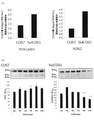
(2)上記細胞にA型インフルエンザウイルスであるH1N1pdmインフルエンザウイルス株(A/Shizuoka/830/2009)及びH3N2インフルエンザウイルス株(A/Memphis/1/1971)を感染価MOI(Multiplicity of infection)=0.005となるように感染させ、1時間インキュベートした。その後、SFMによる洗浄操作を行い、2.0μg/mL−アセチル化トリプシン(Sigma社製)含有SFM培養培地を500μL/ウェル量加え、23時間培養した。感染24時間後に培養上清を回収し、後述のフォーカスアッセイにより、インフルエンザウイルス量を定量した(図1A)。なお、以降の実施例においてインフルエンザウイルスの増殖性を評価する試験では、2.0μg/mL−アセチル化トリプシン含有SFM培養培地をインフルエンザウイルスの培養に用いた。 (2) Infectious titers MOI (Multiplicity of infection) = 0 for the above cells with H1N1 pdm influenza virus strain (A / Shizuoka / 830/2009) and H3N2 influenza virus strain (A / Memphis / 1/1971), which are influenza A viruses. Infected to .005 and incubated for 1 hour. Then, a washing operation with SFM was performed, 500 μL / well of SFM culture medium containing 2.0 μg / mL-acetylated trypsin (manufactured by Sigma) was added, and the cells were cultured for 23 hours. The culture supernatant was collected 24 hours after infection, and the amount of influenza virus was quantified by the focus assay described later (FIG. 1A). In the tests for evaluating the growth of influenza virus in the following examples, 2.0 μg / mL-acetylated trypsin-containing SFM culture medium was used for culturing influenza virus.
(3)フォーカスアッセイ
12ウェルプレートにMDCK細胞をコンフルエントとなるように5%FBSを添加したイーグル最小必須培地(MEM培地)で培養し、PBSで洗浄後、SFMに1時間馴化させた。COS7細胞及びSulCOS1細胞にインフルエンザウイルスを感染させ、感染後24時間で回収した培養上清を100−100000倍に希釈し、上記12ウェルプレートにて培養したMDCK細胞に500μL/ウェル量加え1時間インキュベートすることで、インフルエンザウイルスを感染させた。本試験は三重測定にて行った。感染後、SFMによる洗浄操作を行い、1.2w/v%−セオラス(旭化成ケミカルズ,RC591)及び2.0μg/mL−アセチル化トリプシン(Sigma社製)含有SFMを2.0mL/ウェルとなるように加え、30時間培養した。培養後、ウェルを4℃に冷やしたPBSで3回洗浄後、−20℃に冷やした100%メタノール(Wako社製)を加え、細胞を固定化した。固定化細胞は一次抗体:Anti−NP antibody(マウスハイブリドーマ(4E6)細胞培養上清(J Virol. 2008; 82: 5940-50にて使用実績あり))及び二次抗体:HRP linked goat Anti−mouse IgG+IgM抗体(Jackson Immuno Research Laboratries社製)にて反応させ、DEPDA反応液(1.2mM N,N−ジエチル−p−フェニレンジアミン二塩酸塩(富士フイルム和光純薬株式会社製)、0.003% 過酸化水素、2mM 4−クロロ−1−ナフトール(富士フイルム和光純薬株式会社製)を含む100mM クエン酸緩衝液(pH6.0))を用いHRPと反応させ、染色されたフォーカス数をカウントした。フォーカスアッセイは独立した三重測定で行った。グラフの値は三重測定の結果を平均値±標準誤差で示した。
(3) Focus Assay MDCK cells were cultured in 12-well plates in Eagle's minimum essential medium (MEM medium) supplemented with 5% FBS so as to be confluent, washed with PBS, and then acclimatized to SFM for 1 hour. Infect COS7 cells and SulCOS1 cells with influenza virus, dilute the culture supernatant collected 24 hours after
(4)ウエスタンブロットによるBimの検出
ウエスタンブロットによる解析は既報の方法(Biosci Biotechnol Biochem. 2018;82:1568-75)を一部改変し実施した。COS7細胞とSulCOS1細胞を12ウェルプレートでコンフルエントとなるように培養し、SFM培地で馴化後、インフルエンザウイルス(H1N1pdm)をMOI=3.0で感染させた。感染前の細胞(0時間)と、感染後3時間、5時間、7時間、9時間、12時間後にcOmplete(登録商標) Protease Inhibitor cocktail (Roche Diagnostics GmbH)とPhosSTOP phosphatase inhibitor(Roche Diagnostics GmbH)を製造業者のプロトコルに従い添加したLysis buffer(Sigma社製)を200μL/ウェル加えた。その後、スクレーパーを用い細胞溶解液を回収し、3,000×gで10分間遠心分離し、上清を回収した。細胞溶解液は最終タンパク質濃度が1.0mg/mL、還元剤としてDL−dithiothreitol(Sigma社製)の最終濃度が50mMとなるようにLaemmli Sample Buffer(Bio−Rad Laboratories,Inc.,Hercules,CA)を添加し、100℃で5分間処理した。各サンプル5μgのタンパク質量となるように4―15% gradient gel(Bio−Rad Laboratories, Inc)にアプライし、SDS−PAGEを行った。その後、泳動により分離されたタンパク質をpolyvinylidene fluoride membranes(メンブレン)に100Vで1時間転写し、PVDF Blocking Reagent for Can Get Signal(TOYOBO Co.,Ltd.,Osaka,Japan)で3時間振盪反応させた。その後メンブレンは1:1000倍にCan Get Signal Solution 1(TOYOBO Co.,Ltd.)で希釈した一次抗体と4℃で16時間反応させた。次いで、anti−rabbit IgG horseradish peroxidase-linked抗体(#7074)またはanti−mouse IgG horseradish peroxidase-linked抗体(#7076)(Cell Signaling Technology,Danvers,MA)を1:2000倍にCan Get Signal Solution 2(TOYOBO Co.,Ltd.)で希釈した抗体溶液と1時間反応させた。シグナルの検出にはECL Prime Western Blotting Detection System(GE Healthcare Japan,Tokyo,Japan)を用い、luminescence imager(Ez−capture II,ATTO Co.,Tokyo,Japan)により可視化した。Bimに対する一次抗体(#2819)はCell Signaling Technologyより購入した。
(4) Detection of Bim by Western blotting The analysis by Western blotting was carried out by partially modifying the previously reported method (Biosci Biotechnol Biochem. 2018; 82: 1568-75). COS7 cells and SulCOS1 cells were cultured in a 12-well plate to be confluent, acclimatized in SFM medium, and then infected with influenza virus (H1N1pdm) at MOI = 3.0. Pre-infection cells (0 hours) and 3 hours, 5 hours, 7 hours, 9 hours, 12 hours after infection, singlete (registered trademark) Protease Inhibitor cocktail (Roche Daignostics GmbH) and Phosphatase Inhibit (Phosphatase Inhibit) 200 μL / well of Lysis buffer (manufactured by Sigma) added according to the manufacturer's protocol was added. Then, the cytolytic solution was collected using a scraper, centrifuged at 3,000 × g for 10 minutes, and the supernatant was collected. The cytolytic solution has a final protein concentration of 1.0 mg / mL and a final concentration of DL-diothreitol (manufactured by Sigma) of 50 mM as a reducing agent. Was added and treated at 100 ° C. for 5 minutes. SDS-PAGE was performed by applying to a 4-15% gradient gel (Bio-Rad Laboratories, Inc) so that the amount of protein in each sample was 5 μg. Then, the protein separated by migration was transferred to polyvinylidene fluoride membranes (membrane) at 100 V for 1 hour, and PVDF Blocking Reagent for Can Get Signal (TOYOBO Co., Ltd., Osaka, Japan) was used for 3 hours. The membrane was then reacted with a primary antibody diluted 1: 1000-fold with Can Get Signal Solution 1 (TOYOBO Co., Ltd.) at 4 ° C. for 16 hours. Then, the anti-rabbit IgG horsadish peroxidase-linked antibody (# 7074) or the anti-mouse IgG horseradise-linked antibody (# 7076) (
(5)可視化したBimのタンパク質量を数値化したところ、COS7細胞では感染時間依存的な変動は認められなかったが、SulCOS1細胞においてはBimが感染から9時間以降、分解されていることが明らかとなった(図1B)。グラフの値はN=4の結果を平均値±標準誤差で示した。統計解析は一元配置分散分析およびTukey法による検定を行った。††, p<0.01(感染3時間に対し)。 (5) When the amount of visualized Bim protein was quantified, no time-dependent fluctuation was observed in COS7 cells, but it was clear that Bim was degraded in SulCOS1 cells after 9 hours from infection. (Fig. 1B). As for the values in the graph, the result of N = 4 is shown by the average value ± standard error. Statistical analysis was performed by one-way analysis of variance and Tukey's method. ††, p <0.01 (for 3 hours of infection).
(6)本検討の結果、SulCOS1細胞におけるインフルエンザウイルの増殖性が高いことと、Bimが分解されることが関連することが示された。また、Bimはアポトーシス誘導因子であり、インフルエンザウイルスの感染に伴いBimが分解され、アポトーシスが抑制されていることを明らかにした。 (6) As a result of this study, it was shown that the high proliferation of influenza virus in SulCOS1 cells is related to the degradation of Bim. In addition, it was clarified that Bim is an apoptosis-inducing factor, and that Bim is decomposed by influenza virus infection and apoptosis is suppressed.
実施例2 アポトーシス誘導因子の分解抑制によるインフルエンザウイルス増殖抑制効果
(1)癌研究の領域において、Bimの分解制御はその上流でErkタンパク質の活性変化によって制御されていることが報告されている(Mol Cancer Ther. 2009;8:3173-80)。上記文献によれば、Erkがリン酸化することで活性化するとBimは分解される。そこで、Erkの活性化阻害剤であるU0126(Sigma社製)をインフルエンザウイルス感染後のMDCK細胞に添加し、Bimの分解抑制効果を評価した。12ウェルにコンフルエントの状態に培養したMDCK細胞にインフルエンザウイルス(H3N2)をMOI=3.0で感染させ、感染1時間後から9時間後までU0126を10または50μM濃度で添加し、その後、実施例1(4)で示したウエスタンブロット法と同様の手法でErkの活性化とBimの分解を解析した。Erk(#9102)及びphоsphоErk(#9101)に対する一次抗体はCell Signaling Technologyより購入した。
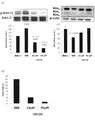
Example 2 Influenza virus growth inhibitory effect by suppressing the degradation of apoptosis-inducing factors (1) In the field of cancer research, it has been reported that the degradation control of Bim is regulated upstream by the change in Erk protein activity (Mol). Cancer Ther. 2009; 8: 3173-80). According to the above document, Bim is decomposed when Erk is activated by phosphorylation. Therefore, U0126 (manufactured by Sigma), which is an activation inhibitor of Erk, was added to MDCK cells after influenza virus infection, and the effect of suppressing the degradation of Bim was evaluated. MDCK cells cultured in a confluent state in 12 wells were infected with influenza virus (H3N2) at MOI = 3.0, and U0126 was added at a concentration of 10 or 50 μM from 1 hour to 9 hours after infection, followed by Examples. The activation of Erk and the degradation of Bim were analyzed by the same method as the Western blot method shown in 1 (4). Primary antibodies to Erk (# 9102) and phоsphоErk (# 9101) were purchased from Cell Signaling Technology.
(2)可視化したErkおよびphоsphоErk、Bimのタンパク質量を数値化したところ、ウイルス感染に伴いErkは活性化するのに対し、U0126を添加することでその活性化は抑制された(図2A左)。加えて、ウイルス感染に伴いBimは減少したが、U0126を添加することでその分解は抑制された(図2A右)。グラフの値はN=4の結果を平均値±標準誤差で示した。統計解析は一元配置分散分析およびTukey法による検定を行った。***, p<0.001(感染(−)に対し)、†††, p<0.001(対照に対し)。図2A右に記載の有意水準は感染(−)に対する値を示している。 (2) When the amount of visualized Erk, phоsphоErk, and Bim proteins was quantified, Erk was activated by virus infection, but the activation was suppressed by the addition of U0126 (Fig. 2A left). .. In addition, although Bim decreased with virus infection, its degradation was suppressed by the addition of U0126 (Fig. 2A right). As for the values in the graph, the result of N = 4 is shown by the average value ± standard error. Statistical analysis was performed by one-way analysis of variance and Tukey's method. ***, p <0.001 (for infection (-)), †††, p <0.001 (for control). The significance level shown on the right side of FIG. 2A indicates the value for infection (-).
(3)次に、U0126を添加した条件におけるインフルエンザウイルスの増殖性を評価した。24ウェルプレートにコンフルエントとなるように培養したMDCK細胞をSFMに1時間馴化後、インフルエンザウイルス(H3N2)をMOI=0.01で感染させた。感染1時間後にSFMで細胞を洗浄し、その後、2.0μg/mL−アセチル化トリプシン含有SFM培養培地またはU0126を10または50 μM濃度で添加し23時間培養した。感染24時間後に後述のHAアッセイにより培養上清中に存在するウイルス量を測定した。 (3) Next, the growth of influenza virus under the condition to which U0126 was added was evaluated. MDCK cells cultured to be confluent in a 24-well plate were acclimated to SFM for 1 hour and then infected with influenza virus (H3N2) at MOI = 0.01. Cells were washed with SFM 1 hour after infection, then 2.0 μg / mL-acetylated trypsin-containing SFM culture medium or U0126 was added at a concentration of 10 or 50 μM and cultured for 23 hours. Twenty-four hours after infection, the amount of virus present in the culture supernatant was measured by the HA assay described later.
(4)HAアッセイ
U底96ウェルプレートを用い、インフルエンザウイルス培養上清50μLを2−1024倍まで2倍ずつ、希釈系列を作製した。そこへ、0.7%モルモット赤血球含有PBS 50μLを加え、4℃で2時間静置した。その後、赤血球の凝集を確認し、凝集が認められない希釈濃度をHA価とした。
(4) HA Assay Using a U-bottom 96-well plate, 50 μL of influenza virus culture supernatant was prepared in 2-fold increments up to 2-1024 times. To this, 50 μL of PBS containing 0.7% guinea pig erythrocytes was added, and the mixture was allowed to stand at 4 ° C. for 2 hours. Then, agglutination of erythrocytes was confirmed, and the dilution concentration at which no agglutination was observed was defined as the HA value.
(5)本検討の結果、U0126を添加することでインフルエンザウイルスの増殖性は著しく低下することが示された。よって、Bimの分解を抑制することでインフルエンザウイルスの増殖性は抑制されることが示唆された。 (5) As a result of this study, it was shown that the addition of U0126 significantly reduced the proliferation of influenza virus. Therefore, it was suggested that the growth of influenza virus was suppressed by suppressing the degradation of Bim.
(6)実施例1の結果と本検討結果は、Bimの存在の有無や変化を調べることが培養細胞におけるインフルエンザウイルスの増殖性を評価する指標に成り得ることを示している。 (6) The results of Example 1 and the results of this study show that examining the presence or absence and changes in the presence of Bim can be an index for evaluating the proliferation of influenza virus in cultured cells.
実施例3 インフルエンザウイルス感染によるアポトーシス抑制系活性化効果の評価
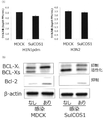
(1)実施例1の方法と同様の手法を用い、MDCK細胞とSulCOS1細胞におけるインフルエンザウイルスの増殖性を比較解析したところ、H1N1pdmおよびH3N2インフルエンザウイルスの増殖性は両細胞間に差は認められなかった(図3A)。グラフの値は三重測定の結果を平均値±標準誤差で示した。本結果から、MDCK細胞はSulCOS1細胞と同等のウイルス増殖能を有していると言える。
Example 3 Evaluation of the effect of activating the anti-proliferative system by influenza virus infection (1) When the proliferation of influenza virus in MDCK cells and SulCOS1 cells was compared and analyzed using the same method as in Example 1, H1N1pdm and H3N2 There was no difference in influenza virus proliferation between the two cells (Fig. 3A). The values in the graph show the results of triple measurement as mean ± standard error. From this result, it can be said that MDCK cells have the same viral replication ability as SulCOS1 cells.
(2)上述のウイルス増殖能が同等の2種の細胞を用い、Bcl−2ファミリータンパク質に属するアポトーシス関連因子のタンパク質量を解析した。BCL−XLおよびBCL−XS(#633901)、Bcl−2(#658701)、に対する一次抗体はBiolegend社より入手した。βActin(#4967)に対する一次抗体はCell Signaling Technologyより入手した。12ウェルプレートでコンフルエントの状態に培養したMDCK細胞とSulCOS1細胞にインフルエンザウイルス(H3N2)をMOI=3.0で感染させ、感染9時間後の細胞を回収し、その後、実施例1(4)で示したウエスタンブロット法と同様の手法で各タンパク質を可視化した。 (2) The protein amount of the apoptosis-related factor belonging to the Bcl-2 family protein was analyzed using the above-mentioned two types of cells having the same viral replication ability. BCL-X L and BCL-X S (# 633901) , Bcl-2 (# 658701), primary antibody against was obtained from Biolegend Corporation. The primary antibody against βActin (# 4967) was obtained from Cell Signaling Technology. MDCK cells and SulCOS1 cells cultured in a confluent state on a 12-well plate were infected with influenza virus (H3N2) at MOI = 3.0, and the cells were collected 9 hours after infection, and then in Example 1 (4). Each protein was visualized in the same manner as the Western blot method shown.
(3)本検討の結果、インフルエンザウイルス感染に伴いアポトーシス抑制に関与するBCL−XLおよびBcl−2のタンパク質量が明らかに増加し、アポトーシス誘導に関与するBCL−XS量は減少した。このことは、ウイルス増殖能が高いMDCK細胞とSulCOS1細胞で、インフルエンザウイルスの感染に伴いアポトーシスが抑制されていることを示している。 (3) The present study results, the amount of protein BCL-X L and Bcl-2 involved in apoptosis inhibition due to influenza virus infection is obviously increased, BCL-X S amount involved in apoptosis induction was reduced. This indicates that in MDCK cells and SulCOS1 cells, which have high viral replication ability, apoptosis is suppressed with influenza virus infection.
(4)以上より、細胞培養によってインフルエンザウイルスを効率的に増殖させる目的でアポトーシス誘導因子の活性を抑制する、またはアポトーシス抑制因子の活性化を誘導することが有用であることが明らかとなった。また、このことは、アポトーシス制御能を指標としてインフルエンザウイルス増殖促進剤の探索が可能であることを意味する。 (4) From the above, it was clarified that it is useful to suppress the activity of the apoptosis-inducing factor or induce the activation of the apoptosis-inducing factor for the purpose of efficiently propagating the influenza virus by cell culture. In addition, this means that it is possible to search for an influenza virus growth-promoting agent using the ability to control apoptosis as an index.
実施例4 Bax阻害剤(2種類)のインフルエンザウイルス増殖促進効果の検討
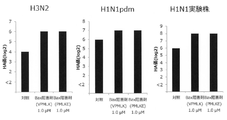
(1)実施例1の方法と同様の手法を用い、MDCK細胞におけるインフルエンザウイルスの増殖性についてBax阻害剤を添加した条件にて評価した。H3N2及びH1N1pdm、H1N1(実験株)インフルエンザウイルス株を感染価Moi=0.001となるように感染させ、1時間インキュベートした後、SFMによる洗浄操作を行い、Bax阻害剤(Bax inhibitor peptide (V5)(Val−Pro−Met−Leu−Lys(配列番号1)及び(P5)(Pro−Met−Leu−Lys−Glu(配列番号2);TOCRIS bioscience社製))を1.0 μM濃度で添加し、23時間培養した。感染後24時間に培養上清を回収し、HAアッセイにより、インフルエンザウイルスのHA価を測定した(図4)。
Example 4 Examination of influenza virus growth promoting effect of Bax inhibitors (2 types) (1) Using the same method as in Example 1, the condition of adding a Bax inhibitor for the growth of influenza virus in MDCK cells Evaluated. H3N2, H1N1pdm, and H1N1 (experimental strain) influenza virus strains were infected to an infectious value of Moi = 0.001, incubated for 1 hour, and then washed with SFM to perform a Bax inhibitor (Bax inhibitor peptide (V5)). (Val-Pro-Met-Leu-Lys (SEQ ID NO: 1) and (P5) (Pro-Met-Leu-Lys-Glu (SEQ ID NO: 2); manufactured by TOCRIS bioscience)) were added at a concentration of 1.0 μM. , 23 hours after infection. The culture supernatant was collected 24 hours after infection, and the HA titer of influenza virus was measured by HA assay (Fig. 4).
(2)本検討の結果、アポトーシスの抑制に働くBax阻害剤の添加はH3N2及びH1N1pdm、H1N1(実験株)インフルエンザウイルス株のHA価を増加させることが明らかとなった。 (2) As a result of this study, it was clarified that the addition of a Bax inhibitor acting to suppress apoptosis increases the HA titers of H3N2, H1N1pdm, and H1N1 (experimental strain) influenza virus strains.
(3)以上より、細胞培養によってインフルエンザウイルスを効率的に増殖させる目的でアポトーシス誘導因子の活性を抑制することが有用であることが明らかとなった。また、このことは、アポトーシス制御能を指標としてインフルエンザウイルス増殖促進剤の探索が可能であることを意味する。 (3) From the above, it was clarified that it is useful to suppress the activity of apoptosis-inducing factors for the purpose of efficiently propagating influenza virus by cell culture. In addition, this means that it is possible to search for an influenza virus growth-promoting agent using the ability to control apoptosis as an index.
Claims (7)
(1)培養細胞に被験物質を接触させる工程、
(2)当該細胞におけるアポトーシス誘導因子若しくはアポトーシス抑制因子の発現レベル又は活性レベルを測定する工程、
(3)(2)で測定された結果に基づいて、アポトーシス誘導因子の発現レベル若しくは活性レベルを低下又は減少させるか、又はアポトーシス抑制因子の発現レベル若しくは活性レベルを増強又は増加させる被験物質をインフルエンザウイルス増殖促進剤として評価する工程。 A method for evaluating or selecting an influenza virus growth promoter, which comprises the following steps (1) to (3).
(1) A step of bringing the test substance into contact with the cultured cells,
(2) A step of measuring the expression level or activity level of an apoptosis-inducing factor or an apoptosis-suppressing factor in the cell.
(3) Based on the results measured in (2), influenza is a test substance that lowers or decreases the expression level or activity level of an apoptosis-inducing factor, or enhances or increases the expression level or activity level of an apoptosis-suppressing factor. The process of evaluating as a virus growth promoter.
Priority Applications (1)
| Application Number | Priority Date | Filing Date | Title |
|---|---|---|---|
| JP2020036515A JP2021136899A (en) | 2020-03-04 | 2020-03-04 | Virus proliferation method and method for searching for virus proliferation promoter |
Applications Claiming Priority (1)
| Application Number | Priority Date | Filing Date | Title |
|---|---|---|---|
| JP2020036515A JP2021136899A (en) | 2020-03-04 | 2020-03-04 | Virus proliferation method and method for searching for virus proliferation promoter |
Publications (1)
| Publication Number | Publication Date |
|---|---|
| JP2021136899A true JP2021136899A (en) | 2021-09-16 |
Family
ID=77666687
Family Applications (1)
| Application Number | Title | Priority Date | Filing Date |
|---|---|---|---|
| JP2020036515A Pending JP2021136899A (en) | 2020-03-04 | 2020-03-04 | Virus proliferation method and method for searching for virus proliferation promoter |
Country Status (1)
| Country | Link |
|---|---|
| JP (1) | JP2021136899A (en) |
Cited By (3)
| Publication number | Priority date | Publication date | Assignee | Title |
|---|---|---|---|---|
| JP2021180992A (en) * | 2020-10-28 | 2021-11-25 | 株式会社三洋物産 | Game machine |
| JP2021180991A (en) * | 2020-09-08 | 2021-11-25 | 株式会社三洋物産 | Game machine |
| JP2021180994A (en) * | 2020-11-04 | 2021-11-25 | 株式会社三洋物産 | Game machine |
Citations (6)
| Publication number | Priority date | Publication date | Assignee | Title |
|---|---|---|---|---|
| JP2000511052A (en) * | 1996-05-23 | 2000-08-29 | メリアル | Avian immortal cells |
| JP2007510409A (en) * | 2003-11-03 | 2007-04-26 | プロバイオゲン アーゲー | Immortalized avian cell lines for virus production |
| WO2007132763A1 (en) * | 2006-05-11 | 2007-11-22 | Juridical Foundation The Chemo-Sero-Therapeutic Research Institute | Method for proliferation of influenza virus |
| JP2011522564A (en) * | 2008-06-10 | 2011-08-04 | サンガモ バイオサイエンシーズ, インコーポレイテッド | Methods and compositions for the generation of Bax- and Bak-deficient cell lines |
| JP2014501489A (en) * | 2009-07-06 | 2014-01-23 | アルナイラム ファーマシューティカルズ, インコーポレイテッド | Cell-based bioprocessing |
| JP6918320B2 (en) * | 2019-02-14 | 2021-08-11 | 花王株式会社 | Proliferation method |
-
2020
- 2020-03-04 JP JP2020036515A patent/JP2021136899A/en active Pending
Patent Citations (6)
| Publication number | Priority date | Publication date | Assignee | Title |
|---|---|---|---|---|
| JP2000511052A (en) * | 1996-05-23 | 2000-08-29 | メリアル | Avian immortal cells |
| JP2007510409A (en) * | 2003-11-03 | 2007-04-26 | プロバイオゲン アーゲー | Immortalized avian cell lines for virus production |
| WO2007132763A1 (en) * | 2006-05-11 | 2007-11-22 | Juridical Foundation The Chemo-Sero-Therapeutic Research Institute | Method for proliferation of influenza virus |
| JP2011522564A (en) * | 2008-06-10 | 2011-08-04 | サンガモ バイオサイエンシーズ, インコーポレイテッド | Methods and compositions for the generation of Bax- and Bak-deficient cell lines |
| JP2014501489A (en) * | 2009-07-06 | 2014-01-23 | アルナイラム ファーマシューティカルズ, インコーポレイテッド | Cell-based bioprocessing |
| JP6918320B2 (en) * | 2019-02-14 | 2021-08-11 | 花王株式会社 | Proliferation method |
Non-Patent Citations (1)
| Title |
|---|
| WURZER WALTER J. ET AL.: "Caspase 3 activation is essential for efficient influenza virus propagation", THE EMBO JOURNAL, vol. 22, no. 11, JPN6024002320, 2003, pages 2717 - 2728, ISSN: 0005373359 * |
Cited By (3)
| Publication number | Priority date | Publication date | Assignee | Title |
|---|---|---|---|---|
| JP2021180991A (en) * | 2020-09-08 | 2021-11-25 | 株式会社三洋物産 | Game machine |
| JP2021180992A (en) * | 2020-10-28 | 2021-11-25 | 株式会社三洋物産 | Game machine |
| JP2021180994A (en) * | 2020-11-04 | 2021-11-25 | 株式会社三洋物産 | Game machine |
Similar Documents
| Publication | Publication Date | Title |
|---|---|---|
| Long et al. | Host and viral determinants of influenza A virus species specificity | |
| Pinto et al. | BTN3A3 evasion promotes the zoonotic potential of influenza A viruses | |
| Munier et al. | A genetically engineered waterfowl influenza virus with a deletion in the stalk of the neuraminidase has increased virulence for chickens | |
| JP5322636B2 (en) | How to spread influenza virus | |
| Bussey et al. | PA residues in the 2009 H1N1 pandemic influenza virus enhance avian influenza virus polymerase activity in mammalian cells | |
| Clark et al. | Functional evolution of influenza virus NS1 protein in currently circulating human 2009 pandemic H1N1 viruses | |
| Imai et al. | The HA and NS genes of human H5N1 influenza A virus contribute to high virulence in ferrets | |
| Pena et al. | Restored PB1-F2 in the 2009 pandemic H1N1 influenza virus has minimal effects in swine | |
| Marjuki et al. | Three amino acid changes in PB1-F2 of highly pathogenic H5N1 avian influenza virus affect pathogenicity in mallard ducks | |
| Marjuki et al. | Higher polymerase activity of a human influenza virus enhances activation of the hemagglutinin-induced Raf/MEK/ERK signal cascade | |
| Nogales et al. | Reverse genetics of influenza B viruses | |
| Xing et al. | Differential regulation of antiviral and proinflammatory cytokines and suppression of Fas-mediated apoptosis by NS1 of H9N2 avian influenza virus in chicken macrophages | |
| Mostafa et al. | Replication kinetics, pathogenicity and virus-induced cellular responses of cattle-origin influenza A (H5N1) isolates from Texas, United States | |
| Zhang et al. | Isolation of swine influenza A virus in cell cultures and embryonated chicken eggs | |
| Ushirogawa et al. | Re-emergence of H3N2 strains carrying potential neutralizing mutations at the N-linked glycosylation site at the hemagglutinin head, post the 2009 H1N1 pandemic | |
| JP6918320B2 (en) | Proliferation method | |
| Kong et al. | The virulence modulator PA-X protein has minor effect on the pathogenicity of the highly pathogenic H7N9 avian influenza virus in mice | |
| JP7695830B2 (en) | How the influenza virus grows | |
| WO2020244605A1 (en) | Recombinant non-structural protein 1, recombinant influenza virus and immune composition containing recombinant non-structural protein 1, and use thereof for preparing influenza virus vaccine composition | |
| JP2021139700A (en) | Method for searching for virus growth inhibitor | |
| Bayoumi | Understanding the Replication Kinetics of Influenza a Viruses Under Chicken N6-Methyladenosine (m6A) Epitranscriptomic Pressure | |
| Turnbull et al. | Polygenic determinants OF H5N1 adaptation to bovine cells | |
| RU2735293C1 (en) | Method for assessing the reproductive activity of influenza viruses in a trivalent and quadrivalent live influenza vaccine | |
| Danilenko et al. | Human lung carcinoma (A-549) continuing cell line and human endothelial (ECV-304) continuing cell line responses to the influenza virus at different multiplicities of infection | |
| JP2022032289A (en) | Method for proliferation |
Legal Events
| Date | Code | Title | Description |
|---|---|---|---|
| A621 | Written request for application examination |
Free format text: JAPANESE INTERMEDIATE CODE: A621 Effective date: 20230224 |
|
| A977 | Report on retrieval |
Free format text: JAPANESE INTERMEDIATE CODE: A971007 Effective date: 20240117 |
|
| A131 | Notification of reasons for refusal |
Free format text: JAPANESE INTERMEDIATE CODE: A131 Effective date: 20240130 |
|
| A02 | Decision of refusal |
Free format text: JAPANESE INTERMEDIATE CODE: A02 Effective date: 20240723 |