JP2020037544A - Sulfonium compound, positive resist composition, and method for forming resist pattern - Google Patents
Sulfonium compound, positive resist composition, and method for forming resist pattern Download PDFInfo
- Publication number
- JP2020037544A JP2020037544A JP2018166172A JP2018166172A JP2020037544A JP 2020037544 A JP2020037544 A JP 2020037544A JP 2018166172 A JP2018166172 A JP 2018166172A JP 2018166172 A JP2018166172 A JP 2018166172A JP 2020037544 A JP2020037544 A JP 2020037544A
- Authority
- JP
- Japan
- Prior art keywords
- group
- carbon atoms
- carbon
- atom
- halogen atom
- Prior art date
- Legal status (The legal status is an assumption and is not a legal conclusion. Google has not performed a legal analysis and makes no representation as to the accuracy of the status listed.)
- Granted
Links
- 0 C*(*1)C1(C(C(C)(C)C)N)C(OC(*)(*)C(C(F)(F)F)(C(F)(F)F)[U])=O Chemical compound C*(*1)C1(C(C(C)(C)C)N)C(OC(*)(*)C(C(F)(F)F)(C(F)(F)F)[U])=O 0.000 description 11
- GXMJWLBEOIXPLL-UHFFFAOYSA-N COc(cccc1)c1[S+](c1ccccc1)c1ccccc1 Chemical compound COc(cccc1)c1[S+](c1ccccc1)c1ccccc1 GXMJWLBEOIXPLL-UHFFFAOYSA-N 0.000 description 1
- LYKHIYYBVFNWIE-UHFFFAOYSA-N Cs1(cc(cccc2[S+](c3ccccc3)c3ccccc3)c2[nH]1)=O Chemical compound Cs1(cc(cccc2[S+](c3ccccc3)c3ccccc3)c2[nH]1)=O LYKHIYYBVFNWIE-UHFFFAOYSA-N 0.000 description 1
Images
Classifications
-
- C—CHEMISTRY; METALLURGY
- C07—ORGANIC CHEMISTRY
- C07C—ACYCLIC OR CARBOCYCLIC COMPOUNDS
- C07C311/00—Amides of sulfonic acids, i.e. compounds having singly-bound oxygen atoms of sulfo groups replaced by nitrogen atoms, not being part of nitro or nitroso groups
- C07C311/01—Sulfonamides having sulfur atoms of sulfonamide groups bound to acyclic carbon atoms
- C07C311/02—Sulfonamides having sulfur atoms of sulfonamide groups bound to acyclic carbon atoms of an acyclic saturated carbon skeleton
- C07C311/08—Sulfonamides having sulfur atoms of sulfonamide groups bound to acyclic carbon atoms of an acyclic saturated carbon skeleton having the nitrogen atom of at least one of the sulfonamide groups bound to a carbon atom of a six-membered aromatic ring
-
- G—PHYSICS
- G03—PHOTOGRAPHY; CINEMATOGRAPHY; ANALOGOUS TECHNIQUES USING WAVES OTHER THAN OPTICAL WAVES; ELECTROGRAPHY; HOLOGRAPHY
- G03F—PHOTOMECHANICAL PRODUCTION OF TEXTURED OR PATTERNED SURFACES, e.g. FOR PRINTING, FOR PROCESSING OF SEMICONDUCTOR DEVICES; MATERIALS THEREFOR; ORIGINALS THEREFOR; APPARATUS SPECIALLY ADAPTED THEREFOR
- G03F7/00—Photomechanical, e.g. photolithographic, production of textured or patterned surfaces, e.g. printing surfaces; Materials therefor, e.g. comprising photoresists; Apparatus specially adapted therefor
- G03F7/004—Photosensitive materials
- G03F7/0045—Photosensitive materials with organic non-macromolecular light-sensitive compounds not otherwise provided for, e.g. dissolution inhibitors
-
- C—CHEMISTRY; METALLURGY
- C07—ORGANIC CHEMISTRY
- C07C—ACYCLIC OR CARBOCYCLIC COMPOUNDS
- C07C381/00—Compounds containing carbon and sulfur and having functional groups not covered by groups C07C301/00 - C07C337/00
- C07C381/12—Sulfonium compounds
-
- C—CHEMISTRY; METALLURGY
- C08—ORGANIC MACROMOLECULAR COMPOUNDS; THEIR PREPARATION OR CHEMICAL WORKING-UP; COMPOSITIONS BASED THEREON
- C08L—COMPOSITIONS OF MACROMOLECULAR COMPOUNDS
- C08L33/00—Compositions of homopolymers or copolymers of compounds having one or more unsaturated aliphatic radicals, each having only one carbon-to-carbon double bond, and only one being terminated by only one carboxyl radical, or of salts, anhydrides, esters, amides, imides or nitriles thereof; Compositions of derivatives of such polymers
- C08L33/04—Homopolymers or copolymers of esters
- C08L33/14—Homopolymers or copolymers of esters of esters containing halogen, nitrogen, sulfur, or oxygen atoms in addition to the carboxy oxygen
- C08L33/16—Homopolymers or copolymers of esters containing halogen atoms
-
- G—PHYSICS
- G03—PHOTOGRAPHY; CINEMATOGRAPHY; ANALOGOUS TECHNIQUES USING WAVES OTHER THAN OPTICAL WAVES; ELECTROGRAPHY; HOLOGRAPHY
- G03F—PHOTOMECHANICAL PRODUCTION OF TEXTURED OR PATTERNED SURFACES, e.g. FOR PRINTING, FOR PROCESSING OF SEMICONDUCTOR DEVICES; MATERIALS THEREFOR; ORIGINALS THEREFOR; APPARATUS SPECIALLY ADAPTED THEREFOR
- G03F7/00—Photomechanical, e.g. photolithographic, production of textured or patterned surfaces, e.g. printing surfaces; Materials therefor, e.g. comprising photoresists; Apparatus specially adapted therefor
- G03F7/004—Photosensitive materials
-
- G—PHYSICS
- G03—PHOTOGRAPHY; CINEMATOGRAPHY; ANALOGOUS TECHNIQUES USING WAVES OTHER THAN OPTICAL WAVES; ELECTROGRAPHY; HOLOGRAPHY
- G03F—PHOTOMECHANICAL PRODUCTION OF TEXTURED OR PATTERNED SURFACES, e.g. FOR PRINTING, FOR PROCESSING OF SEMICONDUCTOR DEVICES; MATERIALS THEREFOR; ORIGINALS THEREFOR; APPARATUS SPECIALLY ADAPTED THEREFOR
- G03F7/00—Photomechanical, e.g. photolithographic, production of textured or patterned surfaces, e.g. printing surfaces; Materials therefor, e.g. comprising photoresists; Apparatus specially adapted therefor
- G03F7/004—Photosensitive materials
- G03F7/0046—Photosensitive materials with perfluoro compounds, e.g. for dry lithography
-
- G—PHYSICS
- G03—PHOTOGRAPHY; CINEMATOGRAPHY; ANALOGOUS TECHNIQUES USING WAVES OTHER THAN OPTICAL WAVES; ELECTROGRAPHY; HOLOGRAPHY
- G03F—PHOTOMECHANICAL PRODUCTION OF TEXTURED OR PATTERNED SURFACES, e.g. FOR PRINTING, FOR PROCESSING OF SEMICONDUCTOR DEVICES; MATERIALS THEREFOR; ORIGINALS THEREFOR; APPARATUS SPECIALLY ADAPTED THEREFOR
- G03F7/00—Photomechanical, e.g. photolithographic, production of textured or patterned surfaces, e.g. printing surfaces; Materials therefor, e.g. comprising photoresists; Apparatus specially adapted therefor
- G03F7/004—Photosensitive materials
- G03F7/039—Macromolecular compounds which are photodegradable, e.g. positive electron resists
-
- G—PHYSICS
- G03—PHOTOGRAPHY; CINEMATOGRAPHY; ANALOGOUS TECHNIQUES USING WAVES OTHER THAN OPTICAL WAVES; ELECTROGRAPHY; HOLOGRAPHY
- G03F—PHOTOMECHANICAL PRODUCTION OF TEXTURED OR PATTERNED SURFACES, e.g. FOR PRINTING, FOR PROCESSING OF SEMICONDUCTOR DEVICES; MATERIALS THEREFOR; ORIGINALS THEREFOR; APPARATUS SPECIALLY ADAPTED THEREFOR
- G03F7/00—Photomechanical, e.g. photolithographic, production of textured or patterned surfaces, e.g. printing surfaces; Materials therefor, e.g. comprising photoresists; Apparatus specially adapted therefor
- G03F7/004—Photosensitive materials
- G03F7/039—Macromolecular compounds which are photodegradable, e.g. positive electron resists
- G03F7/0392—Macromolecular compounds which are photodegradable, e.g. positive electron resists the macromolecular compound being present in a chemically amplified positive photoresist composition
-
- G—PHYSICS
- G03—PHOTOGRAPHY; CINEMATOGRAPHY; ANALOGOUS TECHNIQUES USING WAVES OTHER THAN OPTICAL WAVES; ELECTROGRAPHY; HOLOGRAPHY
- G03F—PHOTOMECHANICAL PRODUCTION OF TEXTURED OR PATTERNED SURFACES, e.g. FOR PRINTING, FOR PROCESSING OF SEMICONDUCTOR DEVICES; MATERIALS THEREFOR; ORIGINALS THEREFOR; APPARATUS SPECIALLY ADAPTED THEREFOR
- G03F7/00—Photomechanical, e.g. photolithographic, production of textured or patterned surfaces, e.g. printing surfaces; Materials therefor, e.g. comprising photoresists; Apparatus specially adapted therefor
- G03F7/004—Photosensitive materials
- G03F7/039—Macromolecular compounds which are photodegradable, e.g. positive electron resists
- G03F7/0392—Macromolecular compounds which are photodegradable, e.g. positive electron resists the macromolecular compound being present in a chemically amplified positive photoresist composition
- G03F7/0395—Macromolecular compounds which are photodegradable, e.g. positive electron resists the macromolecular compound being present in a chemically amplified positive photoresist composition the macromolecular compound having a backbone with alicyclic moieties
-
- G—PHYSICS
- G03—PHOTOGRAPHY; CINEMATOGRAPHY; ANALOGOUS TECHNIQUES USING WAVES OTHER THAN OPTICAL WAVES; ELECTROGRAPHY; HOLOGRAPHY
- G03F—PHOTOMECHANICAL PRODUCTION OF TEXTURED OR PATTERNED SURFACES, e.g. FOR PRINTING, FOR PROCESSING OF SEMICONDUCTOR DEVICES; MATERIALS THEREFOR; ORIGINALS THEREFOR; APPARATUS SPECIALLY ADAPTED THEREFOR
- G03F7/00—Photomechanical, e.g. photolithographic, production of textured or patterned surfaces, e.g. printing surfaces; Materials therefor, e.g. comprising photoresists; Apparatus specially adapted therefor
- G03F7/20—Exposure; Apparatus therefor
- G03F7/2002—Exposure; Apparatus therefor with visible light or UV light, through an original having an opaque pattern on a transparent support, e.g. film printing, projection printing; by reflection of visible or UV light from an original such as a printed image
- G03F7/2004—Exposure; Apparatus therefor with visible light or UV light, through an original having an opaque pattern on a transparent support, e.g. film printing, projection printing; by reflection of visible or UV light from an original such as a printed image characterised by the use of a particular light source, e.g. fluorescent lamps or deep UV light
-
- G—PHYSICS
- G03—PHOTOGRAPHY; CINEMATOGRAPHY; ANALOGOUS TECHNIQUES USING WAVES OTHER THAN OPTICAL WAVES; ELECTROGRAPHY; HOLOGRAPHY
- G03F—PHOTOMECHANICAL PRODUCTION OF TEXTURED OR PATTERNED SURFACES, e.g. FOR PRINTING, FOR PROCESSING OF SEMICONDUCTOR DEVICES; MATERIALS THEREFOR; ORIGINALS THEREFOR; APPARATUS SPECIALLY ADAPTED THEREFOR
- G03F7/00—Photomechanical, e.g. photolithographic, production of textured or patterned surfaces, e.g. printing surfaces; Materials therefor, e.g. comprising photoresists; Apparatus specially adapted therefor
- G03F7/20—Exposure; Apparatus therefor
- G03F7/2002—Exposure; Apparatus therefor with visible light or UV light, through an original having an opaque pattern on a transparent support, e.g. film printing, projection printing; by reflection of visible or UV light from an original such as a printed image
- G03F7/2012—Exposure; Apparatus therefor with visible light or UV light, through an original having an opaque pattern on a transparent support, e.g. film printing, projection printing; by reflection of visible or UV light from an original such as a printed image using liquid photohardening compositions, e.g. for the production of reliefs such as flexographic plates or stamps
-
- G—PHYSICS
- G03—PHOTOGRAPHY; CINEMATOGRAPHY; ANALOGOUS TECHNIQUES USING WAVES OTHER THAN OPTICAL WAVES; ELECTROGRAPHY; HOLOGRAPHY
- G03F—PHOTOMECHANICAL PRODUCTION OF TEXTURED OR PATTERNED SURFACES, e.g. FOR PRINTING, FOR PROCESSING OF SEMICONDUCTOR DEVICES; MATERIALS THEREFOR; ORIGINALS THEREFOR; APPARATUS SPECIALLY ADAPTED THEREFOR
- G03F7/00—Photomechanical, e.g. photolithographic, production of textured or patterned surfaces, e.g. printing surfaces; Materials therefor, e.g. comprising photoresists; Apparatus specially adapted therefor
- G03F7/26—Processing photosensitive materials; Apparatus therefor
- G03F7/30—Imagewise removal using liquid means
- G03F7/32—Liquid compositions therefor, e.g. developers
- G03F7/322—Aqueous alkaline compositions
-
- C—CHEMISTRY; METALLURGY
- C07—ORGANIC CHEMISTRY
- C07C—ACYCLIC OR CARBOCYCLIC COMPOUNDS
- C07C2601/00—Systems containing only non-condensed rings
- C07C2601/12—Systems containing only non-condensed rings with a six-membered ring
- C07C2601/14—The ring being saturated
-
- C—CHEMISTRY; METALLURGY
- C07—ORGANIC CHEMISTRY
- C07C—ACYCLIC OR CARBOCYCLIC COMPOUNDS
- C07C2603/00—Systems containing at least three condensed rings
- C07C2603/56—Ring systems containing bridged rings
- C07C2603/58—Ring systems containing bridged rings containing three rings
- C07C2603/60—Ring systems containing bridged rings containing three rings containing at least one ring with less than six members
- C07C2603/66—Ring systems containing bridged rings containing three rings containing at least one ring with less than six members containing five-membered rings
- C07C2603/68—Dicyclopentadienes; Hydrogenated dicyclopentadienes
-
- C—CHEMISTRY; METALLURGY
- C07—ORGANIC CHEMISTRY
- C07C—ACYCLIC OR CARBOCYCLIC COMPOUNDS
- C07C2603/00—Systems containing at least three condensed rings
- C07C2603/56—Ring systems containing bridged rings
- C07C2603/58—Ring systems containing bridged rings containing three rings
- C07C2603/70—Ring systems containing bridged rings containing three rings containing only six-membered rings
- C07C2603/74—Adamantanes
-
- C—CHEMISTRY; METALLURGY
- C08—ORGANIC MACROMOLECULAR COMPOUNDS; THEIR PREPARATION OR CHEMICAL WORKING-UP; COMPOSITIONS BASED THEREON
- C08L—COMPOSITIONS OF MACROMOLECULAR COMPOUNDS
- C08L33/00—Compositions of homopolymers or copolymers of compounds having one or more unsaturated aliphatic radicals, each having only one carbon-to-carbon double bond, and only one being terminated by only one carboxyl radical, or of salts, anhydrides, esters, amides, imides or nitriles thereof; Compositions of derivatives of such polymers
- C08L33/04—Homopolymers or copolymers of esters
- C08L33/14—Homopolymers or copolymers of esters of esters containing halogen, nitrogen, sulfur, or oxygen atoms in addition to the carboxy oxygen
-
- C—CHEMISTRY; METALLURGY
- C08—ORGANIC MACROMOLECULAR COMPOUNDS; THEIR PREPARATION OR CHEMICAL WORKING-UP; COMPOSITIONS BASED THEREON
- C08L—COMPOSITIONS OF MACROMOLECULAR COMPOUNDS
- C08L45/00—Compositions of homopolymers or copolymers of compounds having no unsaturated aliphatic radicals in side chain, and having one or more carbon-to-carbon double bonds in a carbocyclic or in a heterocyclic ring system; Compositions of derivatives of such polymers
Landscapes
- Physics & Mathematics (AREA)
- Chemical & Material Sciences (AREA)
- Organic Chemistry (AREA)
- Spectroscopy & Molecular Physics (AREA)
- General Physics & Mathematics (AREA)
- Chemical Kinetics & Catalysis (AREA)
- Health & Medical Sciences (AREA)
- Medicinal Chemistry (AREA)
- Polymers & Plastics (AREA)
- Materials For Photolithography (AREA)
- Exposure And Positioning Against Photoresist Photosensitive Materials (AREA)
- Organic Low-Molecular-Weight Compounds And Preparation Thereof (AREA)
- Addition Polymer Or Copolymer, Post-Treatments, Or Chemical Modifications (AREA)
Abstract
Description
本発明は、スルホニウム化合物、これを含むポジ型レジスト組成物、及び該レジスト組成物を用いるレジストパターン形成方法に関する。 The present invention relates to a sulfonium compound, a positive resist composition containing the same, and a method for forming a resist pattern using the resist composition.
近年、集積回路の高集積化に伴い、より微細な回路パターンの形成が求められている。このうち、0.2μm以下のパターンの加工では、もっぱら酸を触媒とした化学増幅レジスト組成物が使用されている。また、露光源として紫外線、遠紫外線、電子線(EB)等の高エネルギー線が用いられており、特に超微細加工技術として利用されているEBリソグラフィーは、半導体製造用のフォトマスクを作製する際のフォトマスクブランクの加工方法としても不可欠となっている。 In recent years, with the increase in the degree of integration of integrated circuits, formation of finer circuit patterns has been required. Of these, in the processing of a pattern of 0.2 μm or less, a chemically amplified resist composition exclusively using an acid as a catalyst is used. In addition, high energy rays such as ultraviolet rays, far ultraviolet rays, and electron beams (EB) are used as an exposure source. In particular, EB lithography used as an ultra-fine processing technique is used for manufacturing a photomask for semiconductor manufacturing. It is also indispensable as a method for processing a photomask blank.
酸性側鎖を有する芳香族骨格を多量に有するポリマー、例えばポリヒドロキシスチレンは、KrFエキシマレーザーを用いるKrFリソグラフィー用レジスト組成物として有用であるが、波長200nm付近の光に対して大きな吸収を示すため、ArFエキシマレーザーを用いるArFリソグラフィー用レジスト組成物としては使用されなかった。しかし、ArFエキシマレーザーによる加工限界よりも小さなパターンを形成するための有力な技術であるEBリソグラフィー用レジスト組成物や極端紫外線(EUV)リソグラフィー用レジスト組成物としては、高いエッチング耐性が得られる点で重要な材料となっている。 A polymer having a large amount of an aromatic skeleton having an acidic side chain, such as polyhydroxystyrene, is useful as a resist composition for KrF lithography using a KrF excimer laser, but exhibits a large absorption for light having a wavelength of about 200 nm. And was not used as a resist composition for ArF lithography using an ArF excimer laser. However, a resist composition for EB lithography or a resist composition for extreme ultraviolet (EUV) lithography, which is a promising technique for forming a pattern smaller than the processing limit by ArF excimer laser, has a high etching resistance. It is an important material.
通常、ポジ型のEBリソグラフィー用レジスト組成物やEUVリソグラフィー用レジスト組成物のベースポリマーとしては、高エネルギー線を照射することで光酸発生剤より発生した酸を触媒として、ベースポリマーが持つフェノール側鎖の酸性官能基をマスクしている酸分解性保護基が脱離し、アルカリ現像液に可溶化する材料が主に用いられている。また、前記酸分解性保護基として、3級アルキル基、tert−ブトキシカルボニル基、アセタール基等が主として用いられてきた。ここで、アセタール基のような脱保護に必要な活性化エネルギーが比較的小さい保護基を用いると、高感度のレジスト膜が得られるという利点があるものの、発生する酸の拡散の抑制が十分でないと、レジスト膜中の露光していない部分においても脱保護反応が起きてしまい、ラインエッジラフネス(LER)の劣化やパターン線幅の面内均一性(CDU)の低下を招くという問題があった。 Usually, as a base polymer of a positive resist composition for EB lithography or a resist composition for EUV lithography, an acid generated from a photoacid generator by irradiation with high energy rays is used as a catalyst, and a phenol side of the base polymer is used. A material is mainly used in which an acid-decomposable protecting group that masks an acidic functional group of a chain is eliminated and becomes soluble in an alkali developing solution. Further, as the acid-decomposable protecting group, a tertiary alkyl group, a tert-butoxycarbonyl group, an acetal group and the like have been mainly used. Here, when a protective group having a relatively small activation energy such as an acetal group is used, there is an advantage that a highly sensitive resist film can be obtained, but diffusion of generated acid is not sufficiently suppressed. In such a case, a deprotection reaction occurs even in a non-exposed portion of the resist film, which causes a problem of deteriorating line edge roughness (LER) and lowering in-plane uniformity (CDU) of pattern line width. .
レジスト感度やパターンプロファイルの制御について、レジスト組成物に使用する材料の選択や組み合わせ、プロセス条件等によって種々の改善がなされてきた。その改良の一つとして、酸の拡散の問題がある。この酸の拡散については、化学増幅レジスト組成物の感度と解像性に大きな影響を与えることから多くの検討がされてきた。 Various improvements have been made in the control of resist sensitivity and pattern profile depending on the selection and combination of materials used in the resist composition, process conditions, and the like. One of the improvements is the problem of acid diffusion. Many studies have been made on the diffusion of the acid because it greatly affects the sensitivity and resolution of the chemically amplified resist composition.
特許文献1や特許文献2には、露光により光酸発生剤から発生するベンゼンスルホン酸を嵩高くすることで酸拡散を抑制し、ラフネスを低減する例が記載されている。しかし、前記酸発生剤では酸拡散の抑制が未だ不十分であるので、より拡散の小さい酸発生剤の開発が望まれていた。 Patent Literature 1 and Patent Literature 2 describe examples in which benzenesulfonic acid generated from a photoacid generator upon exposure is made bulky to suppress acid diffusion and reduce roughness. However, since the suppression of acid diffusion is still insufficient with the above-mentioned acid generator, development of an acid generator having a smaller diffusion has been desired.
特許文献3には、露光により発生するスルホン酸をレジスト組成物に使用する樹脂に結合させて拡散を抑制することで、酸拡散を制御する例が記載されている。このような、露光により酸を発生する繰り返し単位をベースポリマーに含ませて酸拡散を抑える方法は、LERの小さなパターンを得るのに有効である。しかし、このような繰り返し単位の構造や導入率によっては、露光により酸を発生する繰り返し単位を結合させたベースポリマーの有機溶剤に対する溶解性に問題が生じるケースもあった。 Patent Document 3 discloses an example in which sulfonic acid generated by exposure is bonded to a resin used in a resist composition to suppress diffusion, thereby controlling acid diffusion. Such a method of suppressing the acid diffusion by including a repeating unit that generates an acid upon exposure in the base polymer is effective for obtaining a pattern with a small LER. However, depending on the structure and the introduction ratio of such a repeating unit, there were cases where a problem occurred in the solubility of the base polymer to which the repeating unit generating an acid upon exposure was bound in an organic solvent.
また、特許文献4に記載されている、フッ素化アルカンスルホン酸のような酸強度の高い酸を発生させるスルホニウム塩とアセタール基を有する繰り返し単位を含むポリマーとを用いた場合には、LERの大きなパターンが形成される問題があった。脱保護の活性化エネルギーが比較的小さいアセタール基の脱保護にはフッ素化アルカンスルホン酸の酸強度が高すぎるため、酸の拡散を抑えたとしても未露光部に拡散した微量の酸により脱保護反応が進行してしまうからである。このことは、特許文献1や特許文献2に記載されているベンゼンスルホン酸を発生させるスルホニウム塩においても同様である。そこで、アセタール基の脱保護に、より好適な強度の酸を発生する酸発生剤の開発が望まれている。
Further, when a sulfonium salt generating an acid having a high acid strength such as fluorinated alkanesulfonic acid and a polymer containing a repeating unit having an acetal group described in
酸の拡散を抑制するには、前述の発生酸を嵩高くする方法論のほかに、クエンチャー(酸拡散制御剤)を改良する方法論も考えられる。クエンチャーは酸拡散を抑制するものであり、レジスト組成物の性能を向上させるためには事実上必須成分である。 In order to suppress the diffusion of the acid, in addition to the above-described methodology for increasing the volume of the generated acid, a methodology for improving the quencher (acid diffusion controller) is also conceivable. The quencher suppresses acid diffusion, and is a practically essential component for improving the performance of the resist composition.
クエンチャーは、これまで様々な検討がなされており、一般的にアミン類や弱酸オニウム塩が用いられている。弱酸オニウム塩の例として、特許文献5には、トリフェニルスルホニウム=アセテートの添加によりT−トップの形成、孤立パターン及び密集パターンの線幅の差、スタンディングウエーブのない良好なレジストパターンを形成することができると記載されている。特許文献6には、スルホン酸アンモニウム塩又はカルボン酸アンモニウム塩の添加により感度、解像性、露光マージンが改善したことが記載されている。また、特許文献7には、フッ素含有カルボン酸を発生する光酸発生剤を含む組み合わせのKrFレジスト組成物やEBレジスト組成物が解像力に優れ、露光マージン、焦点深度等のプロセス許容性が改善されたと記載されている。これらは、KrF、EB、F2リソグラフィーに用いられているものである。特許文献8には、カルボン酸オニウム塩を含むArFエキシマレーザー露光用ポジ型感光性組成物が記載されている。これらは、露光によって他の光酸発生剤から生じた強酸(スルホン酸)が弱酸オニウム塩と交換し、弱酸及び強酸=オニウム塩を形成することで酸性度の高い強酸(スルホン酸)から弱酸(カルボン酸)に置き換わることによって酸不安定基の酸分解反応を抑制し、酸拡散距離を小さくする(制御する)ものであり、見かけ上クエンチャーとして機能する。しかし、前述のようなカルボン酸オニウム塩やフルオロカルボン酸オニウム塩を含むレジスト組成物を用いてパターニングを行った際、より微細化が進んだ近年では未だLERが大きい問題があった。
Various studies have been made on the quencher, and amines and weak acid onium salts are generally used. As an example of a weak acid onium salt, Patent Document 5 discloses formation of a T-top by adding triphenylsulfonium acetate, formation of a good resist pattern without a difference in line width between an isolated pattern and a dense pattern, and a standing wave. It is stated that can be. Patent Document 6 describes that the addition of an ammonium sulfonate or an ammonium carboxylate improves sensitivity, resolution, and exposure margin. Further,
特許文献10には、同一分子内にスルホニウムカチオン部とフェノキシドアニオン部とを有するベタイン構造を有するクエンチャーが記載されている。このスルホニウム化合物はフェノキシド部位がS+のオルト位にあることで超原子価構造をとっており、イオン結合性が弱まり共有結合に近くなっていることが推察される。結果、レジスト組成物内での均一分散性が向上し、LERが小さくなり(優れ)、矩形性に優れると記載されている。しかしながら、このようなベタイン構造を有するクエンチャーを含むレジスト組成物には、含まれる成分によっては、LERや矩形性に優れるものの数週間室温で保存しておくとレジストの高感度化を引き起こすという問題があった。
本発明は、前記事情に鑑みなされたもので、パターン形成時の優れた解像性やLERを維持しつつ、保存安定性にも優れるポジ型レジスト組成物を提供することを目的とする。 The present invention has been made in view of the above circumstances, and an object of the present invention is to provide a positive resist composition having excellent storage stability while maintaining excellent resolution and LER during pattern formation.
本発明者らは、前記目的を達成するため鋭意検討を重ねた結果、所定の構造のスルホニウム化合物をレジスト組成物に導入した場合、良好な解像性やパターン形状を示し、LERの小さなパターンが得られるとともに、保存安定性にも優れることを知見し、本発明をなすに至った。 The present inventors have conducted intensive studies in order to achieve the above object, and as a result, when a sulfonium compound having a predetermined structure is introduced into a resist composition, a good resolution and a pattern shape are exhibited, and a pattern having a small LER is obtained. The present invention was found to be excellent in storage stability as well as to provide the present invention.
すなわち、本発明は、下記スルホニウム化合物、ポジ型レジスト組成物、及びパターン形成方法を提供する。
1.下記式(A)で表されるスルホニウム化合物。
2.(A)1のスルホニウム化合物を含むクエンチャーを含むポジ型レジスト組成物。
3.更に、(B)酸の作用により分解し、アルカリ現像液中での溶解度が増大するポリマーを含むベースポリマーを含む2のポジ型レジスト組成物。
4.前記ポリマーが、下記式(B1)〜(B3)で表される繰り返し単位から選ばれる少なくとも1種を含む3のポジ型レジスト組成物。
5.前記ポリマーが、更に、下記式(B4)で表される繰り返し単位を含むものである3又は4のいずれかのポジ型レジスト組成物。
6.前記ポリマーが、更に、下記式(B5)〜(B7)で表される繰り返し単位から選ばれる少なくとも1種を含むものである3〜5のいずれかのポジ型レジスト組成物。
7.前記ポリマーが、更に、下記式(B8)〜(B11)で表される繰り返し単位から選ばれる少なくとも1種を含む2〜6のいずれかのポジ型レジスト組成物。
8.更に、(C)下記式(C1)で表される繰り返し単位と、下記式(C2)〜(C5)で表される繰り返し単位から選ばれる少なくとも1種とを含むポリマーを含む2〜7のいずれかのポジ型レジスト組成物。
9.更に、(D)有機溶剤を含む2〜8のいずれかのポジ型レジスト組成物。
10.更に、(E)光酸発生剤を含む2〜9のいずれかのポジ型レジスト組成物。
11.基板上に、2〜10のいずれかのポジ型レジスト組成物を用いてレジスト膜を形成する工程、高エネルギー線を用いて前記レジスト膜にパターンを照射する工程、及びアルカリ現像液を用いて前記レジスト膜を現像する工程を含むレジストパターン形成方法。
12.前記高エネルギー線が、EUV又はEBである11のレジストパターン形成方法。
13.前記基板の最表面が、ケイ素を含む材料からなる11又は12のレジストパターン形成方法。
14.前記基板が、フォトマスクブランクである11〜13のいずれかのレジストパターン形成方法。
15.2〜10のいずれかのポジ型レジスト組成物を塗布したフォトマスクブランク。
That is, the present invention provides the following sulfonium compound, positive resist composition, and pattern forming method.
1. A sulfonium compound represented by the following formula (A).
2. (A) A positive resist composition containing a quencher containing the sulfonium compound of 1.
3. Further, (B) a positive resist composition containing a base polymer containing a polymer which is decomposed by the action of an acid and has an increased solubility in an alkaline developer.
4. 3. The positive resist composition according to 3, wherein the polymer contains at least one selected from repeating units represented by the following formulas (B1) to (B3).
5. The positive resist composition according to any one of 3 or 4, wherein the polymer further contains a repeating unit represented by the following formula (B4).
6. The positive resist composition according to any one of 3 to 5, wherein the polymer further contains at least one selected from repeating units represented by the following formulas (B5) to (B7).
7. The positive resist composition of any one of 2 to 6, wherein the polymer further contains at least one selected from the repeating units represented by the following formulas (B8) to (B11).
8. Further, any of 2 to 7 including (C) a polymer containing a repeating unit represented by the following formula (C1) and at least one selected from repeating units represented by the following formulas (C2) to (C5) Such a positive resist composition.
9. Further, (D) any one of the positive resist compositions containing an organic solvent.
10. Further, (E) any one of the positive resist compositions containing a photoacid generator.
11. A step of forming a resist film on the substrate using any of the positive resist compositions of 2 to 10, a step of irradiating the resist film with a pattern using high-energy rays, and A method of forming a resist pattern including a step of developing a resist film.
12. 11. The method for forming a resist pattern according to 11, wherein the high energy ray is EUV or EB.
13. The method of forming a resist pattern according to 11 or 12, wherein the outermost surface of the substrate is made of a material containing silicon.
14. The resist pattern forming method according to any one of items 11 to 13, wherein the substrate is a photomask blank.
15. A photomask blank coated with any of the positive resist compositions of 2 to 10.
本発明のスルホニウム化合物は、レジスト組成物中においてクエンチャーとして良好に機能し、このようなレジスト組成物を用いることで、LERに優れた高解像性のパターンを構築できるとともに保存安定性に優れたレジスト組成物となる。また、本発明のポジ型レジスト組成物は、式(B1)で表される繰り返し単位の作用により、アルカリ現像液に対して良好な溶解性を示すものとなるほか、レジスト膜として成膜した際の被加工基板への密着性を向上させることができる。 The sulfonium compound of the present invention functions well as a quencher in a resist composition, and by using such a resist composition, it is possible to construct a high-resolution pattern having excellent LER and excellent storage stability. The resist composition. In addition, the positive resist composition of the present invention exhibits good solubility in an alkaline developer due to the action of the repeating unit represented by the formula (B1). Can be improved in adhesion to the substrate to be processed.
本発明のポジ型レジスト組成物を用いるパターン形成方法は、高い解像性を有しつつLERの低減されたパターンを形成できるため、微細加工技術、特にEUVやEBリソグラフィー技術に好適に用いることができる。 Since the pattern forming method using the positive resist composition of the present invention can form a pattern with reduced LER while having high resolution, it can be suitably used for fine processing technology, particularly EUV or EB lithography technology. it can.
以下、本発明について詳細に記述する。なお、以下の説明中、化学式で表される構造によっては不斉炭素が存在し、エナンチオマーやジアステレオマーが存在し得るものがあるが、その場合は一つの式でそれら異性体を代表して表す。それらの異性体は、1種単独で用いてもよいし、混合物として用いてもよい。 Hereinafter, the present invention will be described in detail. In the following description, depending on the structure represented by the chemical formula, an asymmetric carbon may exist, and an enantiomer or a diastereomer may exist.In such a case, one formula may represent these isomers. Represent. These isomers may be used alone or as a mixture.
[(A)スルホニウム化合物]
本発明のスルホニウム化合物は、下記式(A)で表されるものである。
The sulfonium compound of the present invention is represented by the following formula (A).
式(A)中、R1、R2、R3及びR4は、それぞれ独立に、ヘテロ原子を含んでいてもよい炭素数1〜20の1価炭化水素基である。前記1価炭化水素基は、直鎖状、分岐状、環状のいずれでもよく、その具体例としては、メチル基、エチル基、プロピル基、イソプロピル基、n−ブチル基、sec−ブチル基、tert−ブチル基、tert−ペンチル基、n−ペンチル基、n−ヘキシル基、n−オクチル基、n−ノニル基、n−デシル基、シクロペンチル基、シクロヘキシル基、2−エチルヘキシル基、シクロペンチルメチル基、シクロペンチルエチル基、シクロペンチルブチル基、シクロヘキシルメチル基、シクロヘキシルエチル基、シクロヘキシルブチル基、ノルボルニル基、トリシクロ[5.2.1.02,6]デカニル基、アダマンチル基、アダマンチルメチル基等の炭素数1〜20のアルキル基;フェニル基、ナフチル基、アントラセニル基等の炭素数6〜20のアリール基等が挙げられる。また、これらの基の水素原子の一部が、酸素原子、硫黄原子、窒素原子、ハロゲン原子等のヘテロ原子含有基で置換されていてもよく、これらの基の炭素原子の一部が、酸素原子、硫黄原子、窒素原子等のヘテロ原子含有基で置換されていてもよく、その結果、ヒドロキシ基、シアノ基、カルボニル基、エーテル結合、チオエーテル結合、エステル結合、スルホン酸エステル結合、カーボネート結合、カーバメート結合、ラクトン環、スルトン環、カルボン酸無水物(−C(=O)−O−C(=O)−)、ハロアルキル基等を含んでいてもよい。 In the formula (A), R 1 , R 2 , R 3 and R 4 are each independently a monovalent hydrocarbon group having 1 to 20 carbon atoms which may contain a hetero atom. The monovalent hydrocarbon group may be linear, branched, or cyclic, and specific examples thereof include a methyl group, an ethyl group, a propyl group, an isopropyl group, an n-butyl group, a sec-butyl group, and a tert. -Butyl group, tert-pentyl group, n-pentyl group, n-hexyl group, n-octyl group, n-nonyl group, n-decyl group, cyclopentyl group, cyclohexyl group, 2-ethylhexyl group, cyclopentylmethyl group, cyclopentyl 1 to 1 carbon atoms such as ethyl group, cyclopentylbutyl group, cyclohexylmethyl group, cyclohexylethyl group, cyclohexylbutyl group, norbornyl group, tricyclo [5.2.1.0 2,6 ] decanyl group, adamantyl group and adamantylmethyl group An alkyl group having 20; an aryl group having 6 to 20 carbon atoms such as a phenyl group, a naphthyl group, and an anthracenyl group; And the like. In addition, some of the hydrogen atoms of these groups may be substituted with a hetero atom-containing group such as an oxygen atom, a sulfur atom, a nitrogen atom, or a halogen atom, and some of the carbon atoms of these groups may be substituted with an oxygen atom. Atom, sulfur atom, may be substituted with a hetero atom-containing group such as a nitrogen atom, as a result, a hydroxy group, a cyano group, a carbonyl group, an ether bond, a thioether bond, an ester bond, a sulfonic acid ester bond, a carbonate bond, It may contain a carbamate bond, a lactone ring, a sultone ring, a carboxylic anhydride (—C (= O) —O—C (= O) —), a haloalkyl group, and the like.
これらのうち、R1〜R3としては、ヘテロ原子を含んでいてもよい炭素数1〜12のアルキル基が好ましく、ヘテロ原子を含んでいてもよい炭素数1〜10のアルキル基がより好ましい。R4としては、ヘテロ原子を含んでいてもよい炭素数1〜10のアルキル基又は炭素数6〜15のアリール基が好ましく、ヘテロ原子を含んでいてもよい炭素数1〜6のアルキル基又は炭素数6〜10のアリール基がより好ましい。 Among them, as R 1 to R 3 , an alkyl group having 1 to 12 carbon atoms which may contain a hetero atom is preferable, and an alkyl group having 1 to 10 carbon atoms which may contain a hetero atom is more preferable. . As R 4 , an alkyl group having 1 to 10 carbon atoms or an aryl group having 6 to 15 carbon atoms which may contain a hetero atom is preferable, and an alkyl group having 1 to 6 carbon atoms which may contain a hetero atom or An aryl group having 6 to 10 carbon atoms is more preferred.
式(A)中、p及びqは、それぞれ独立に、0〜5の整数である。rは、0〜4の整数である。p、q及びrは、合成容易性や原料入手性の観点から、それぞれ0、1又は2が好ましく、0がより好ましい。 In the formula (A), p and q are each independently an integer of 0 to 5. r is an integer of 0 to 4. p, q, and r are each preferably 0, 1, or 2, and more preferably 0, from the viewpoint of ease of synthesis and availability of raw materials.
pが2〜5の場合、隣接する2つのR1は、互いに結合してこれらが結合する炭素原子と共に環を形成してもよい。qが2〜5の場合、隣接する2つのR2は、互いに結合してこれらが結合する炭素原子と共に環を形成してもよい。rが2〜4の場合、隣接する2つのR3は、互いに結合してこれらが結合する炭素原子と共に環を形成してもよい。 When p is 2 to 5, two adjacent R 1 may be bonded to each other to form a ring together with the carbon atom to which they are bonded. when q is 2 to 5, the two R 2 adjacent may form a ring with the carbon atom to which they are attached. when r is 2-4, two adjacent R 3 may form a ring with the carbon atom to which they are attached.
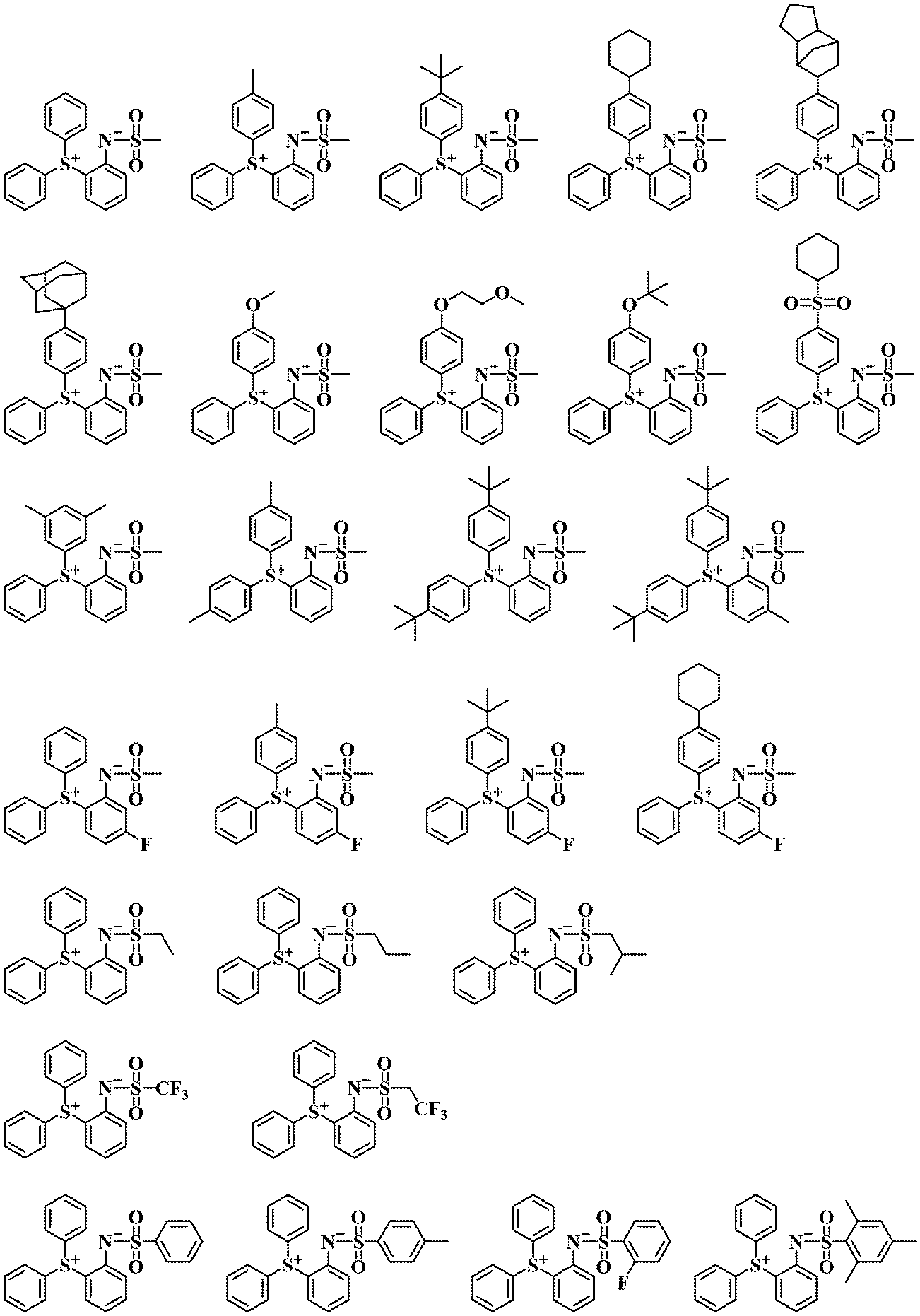
式(A)で表されるスルホニウム化合物としては、以下に示すものが挙げられるが、これらに限定されない。
本発明のスルホニウム化合物は、既知の有機化学的手法を組み合わせることで合成することができるが、一例として下記スキームに示すような製法が挙げられる。
まず、スルホニウム塩として、スルホニウムカチオンにおける硫黄原子のα位の炭素原子がスルホンアミドで置換されたものを調製する。続いて塩基で処理した後、有機溶剤−水系で分液抽出を行うことで、本発明のスルホニウム化合物が有機層に抽出される。なお塩基としては特に限定されないが、例えば、水酸化ナトリウム、水酸化テトラメチルアンモニウム等が挙げられる。 First, a sulfonium salt in which a carbon atom at the α-position of a sulfur atom in a sulfonium cation is substituted with a sulfonamide is prepared. Subsequently, after treatment with a base, liquid-liquid extraction is performed with an organic solvent-water system, whereby the sulfonium compound of the present invention is extracted into an organic layer. The base is not particularly restricted but includes, for example, sodium hydroxide, tetramethylammonium hydroxide and the like.
本発明のスルホニウム化合物は、レジスト組成物に適用することでクエンチャーとして極めて有効に機能する。なお、本発明においてクエンチャーとは、レジスト組成物中の光酸発生剤より発生した酸をトラップすることで未露光部への拡散を防ぎ、所望のパターンを形成するための材料のことである。 The sulfonium compound of the present invention functions extremely effectively as a quencher when applied to a resist composition. In the present invention, the quencher is a material for forming a desired pattern by trapping an acid generated from a photoacid generator in a resist composition to prevent diffusion to an unexposed portion. .
本発明のスルホニウム化合物の酸拡散制御機構は、以下のように考えられる。レジスト組成物中の光酸発生剤より発生した酸は、ベースポリマーの酸不安定基を脱保護するために強酸性である必要があり、例えばEBリソグラフィーではスルホ基のα位がフッ素化されたスルホン酸やフッ素化されていないスルホン酸が一般的には使用される。ここで、レジスト組成物中に光酸発生剤と本発明のスルホニウム化合物とを共存させると、光酸発生剤から生じた酸は、本発明のスルホニウム化合物によってトラップされ、本発明のスルホニウム化合物はベタイン型化合物からスルホニウム塩となる。本発明のスルホニウム化合物自身が光分解する場合も考えられるが、その場合発生するのは弱酸のベンゼンスルホンアミド系化合物であり、ベースポリマー中の酸不安定基を脱保護するには至らず、したがってクエンチャーとして強力に機能するものと推察される。 The mechanism for controlling the acid diffusion of the sulfonium compound of the present invention is considered as follows. The acid generated from the photoacid generator in the resist composition must be strongly acidic in order to deprotect the acid labile group of the base polymer. For example, in EB lithography, the α-position of the sulfo group is fluorinated. Sulfonic acids and non-fluorinated sulfonic acids are commonly used. Here, when the photoacid generator and the sulfonium compound of the present invention coexist in the resist composition, the acid generated from the photoacid generator is trapped by the sulfonium compound of the present invention, and the sulfonium compound of the present invention is betaine. It becomes a sulfonium salt from the type compound. Although it is conceivable that the sulfonium compound of the present invention itself is photodegraded, what is generated is a benzenesulfonamide compound of a weak acid, which does not lead to deprotection of the acid labile group in the base polymer, and It is presumed to function strongly as a quencher.
オニウム塩型クエンチャーは、一般的にアミン化合物を用いたクエンチャーよりもレジストパターンのLERが小さくなる傾向にある。これは、強酸とオニウム塩型クエンチャーとの塩交換が、数限りなく繰り返されることに起因すると推定される。すなわち、露光の最後に強酸が発生する場所は、最初の強酸発生型オニウム塩が存在している場所とは異なっている。光による酸の発生と塩交換のサイクルが何度も繰り返されることによって酸の発生ポイントが平均化され、このスムージング効果によって現像後のレジストパターンのLERが小さくなるものと推定される。 Generally, the onium salt type quencher tends to have a smaller LER of the resist pattern than a quencher using an amine compound. This is presumed to be due to the infinite number of salt exchanges between the strong acid and the onium salt quencher. That is, the location where the strong acid is generated at the end of the exposure is different from the location where the first strong acid-generating onium salt is present. It is presumed that acid generation points are averaged by repeating the cycle of acid generation by light and salt exchange many times, and the LER of the resist pattern after development is reduced by this smoothing effect.
同様の機構によるクエンチャー効果を有する材料として、例えば、特許文献8や特開2003−5376号公報には、カルボン酸オニウム塩、アルカンスルホン酸オニウム塩、アレーンスルホン酸オニウム塩等をクエンチャーとして用いた報告がなされている。しかし、アルカンスルホン酸オニウム塩やアレーンスルホン酸オニウム塩を用いた場合においては、発生酸の酸強度がある程度大きいので、高露光領域で一部はベースポリマー脂における酸不安定基の脱保護反応を引き起こしてしまい、結果として酸拡散が大きくなり、解像性やCDUといったレジスト性能が劣化する。また、カルボン酸オニウム塩の場合では、これより発生したカルボン酸は酸性度が弱く、ベースポリマーの酸不安定基と反応することはなく、クエンチャーとしてある程度の改善はなされているものの、より微細化が進んだ領域では、解像性、LER及びCDU等の総合的なバランスは未だ満足されていない。
As a material having a quencher effect by a similar mechanism, for example,
これに対して本発明のスルホニウム化合物は、前述したクエンチャーでは満たせなかったレジスト性能を大きく改善し得るものである。それについて明確な理由は定かではないが、以下のように推定される。 On the other hand, the sulfonium compound of the present invention can greatly improve the resist performance which cannot be satisfied by the quencher described above. The exact reason for this is not clear, but is presumed as follows.
本発明のスルホニウム化合物は、同一分子内にスルホニウムカチオン部とアミダートアニオン部とを有するベタイン構造を有し、かつアミダート部位がS+のオルト位にあることを大きな特徴としている。アニオンであるアミダートがS+の近傍に存在することで、本発明のスルホニウム化合物は超原子価構造をとっており、S+とアミダート部位が通常のイオン結合よりも結合距離が短い三中心四電子結合、すなわち共有結合に近くなっていることが推測される。この構造特異性により、通常不安定なスルホニウムアミダートが安定に存在することができる。更に前述したように、イオン結合性が弱まることによって、有機溶剤溶解性が良好になり、結果としてレジスト組成物内の均一分散性が向上し、LERやCDUが小さくなる(改善される)と考えられる。 The sulfonium compound of the present invention is characterized in that it has a betaine structure having a sulfonium cation portion and an amidate anion portion in the same molecule, and the amidate site is located at the ortho position of S + . By an anion amidate exists in the vicinity of the S +, sulfonium compounds of the present invention adopts a hypervalent structure, S + and amidate site three-center four-electron bond distance is shorter than the normal ionic bond It is presumed that the bond is close to a covalent bond. Due to this structural specificity, usually unstable sulfonium amidates can be stably present. Further, as described above, it is considered that the weakness of the ionic bond improves the solubility of the organic solvent, thereby improving the uniform dispersibility in the resist composition and reducing (improving) the LER and CDU. It is.
これまでの塩型クエンチャーは、光酸発生剤からの発生酸をトラップする際に平衡反応となる故に酸拡散制御能に劣るということは既に述べたとおりであるが、本発明のスルホニウム化合物を用いると、非可逆反応となる。それは、酸をトラップすることによってベタイン構造からより安定な塩型構造になることが駆動力になっていると推察される。加えて、本発明のスルホニウム化合物は、カウンターアニオンが強塩基性のアミダートである。これらの事由から、本発明のスルホニウム化合物は酸拡散制御能に極めて優れているものと考えられる。したがって、コントラストも改善されることから解像性や倒れ耐性にも優れたレジスト組成物を提供することができる。 As described above, the conventional salt-type quencher is inferior in acid diffusion control ability because of an equilibrium reaction when trapping the generated acid from the photoacid generator. If used, it becomes an irreversible reaction. It is presumed that the driving force is that the trapping of an acid changes the betaine structure to a more stable salt-type structure. In addition, the sulfonium compound of the present invention is an amidate whose counter anion is strongly basic. For these reasons, it is considered that the sulfonium compound of the present invention is extremely excellent in acid diffusion control ability. Therefore, a resist composition having excellent resolution and falling resistance can be provided because the contrast is improved.
同様の構造特異性を有するクエンチャー効果を有するスルホニウム化合物として、特許文献10には同一分子内にスルホニウムカチオン部とフェノキシドアニオン部からなるベタイン構造を有するクエンチャーが記載されている。しかしながらこのスルホニウム化合物をレジスト組成物として用いた場合には、レジスト組成物を数週間室温にて保存して使用した場合に高感度化を引き起こしてしまう問題があった。これはフェノキシドアニオンの立体障害が小さく求核性が高いため、レジスト組成物中の高エネルギー線照射における酸のミキシング遮蔽、及び界面活性剤としても機能するフッ素含有添加剤であるポリマーとゆるやかに反応するためと推察される。またフェノキシドの求核性により自身と反応してしまうことやベースポリマーの修飾化基を反応する可能性も考えられる。
これに対し、本発明のスルホニウム化合物のアニオン部位はスルホンアミダートであり、フェノキシドよりも明らかにアニオン周囲の立体障害が大きい。すなわち本発明のスルホニウム化合物は露光後の発生酸をトラップするために十分な塩基性を有しながらもアニオン部の立体障害のために前述した添加剤や他の不安定な官能基と反応しないと推察される。つまり本発明のスルホニウム化合物をレジスト組成物に用いた場合には、LERやCDUに優れ、保存安定性にも優れるレジスト組成物を構築することができる。 On the other hand, the anion site of the sulfonium compound of the present invention is a sulfonamidate, and the steric hindrance around the anion is clearly larger than that of phenoxide. That is, the sulfonium compound of the present invention has sufficient basicity to trap the generated acid after exposure, but must not react with the above-mentioned additives or other unstable functional groups due to steric hindrance of the anion portion. Inferred. That is, when the sulfonium compound of the present invention is used for a resist composition, a resist composition having excellent LER and CDU and excellent storage stability can be constructed.
本発明のレジスト組成物中、(A)スルホニウム化合物の配合量は、後述する(B)ベースポリマー100質量部に対し、0.1〜50質量部が好ましく、1〜30質量部がより好ましい。(A)成分の配合量が前記範囲であれば、クエンチャーとして十分に機能し、感度低下や溶解性不足で異物が発生したりする等の性能劣化を起こすおそれがない。(A)スルホニウム化合物は、1種単独で又は2種以上を組み合わせて用いることができる。 In the resist composition of the present invention, the compounding amount of the sulfonium compound (A) is preferably 0.1 to 50 parts by mass, more preferably 1 to 30 parts by mass, per 100 parts by mass of the base polymer (B) described later. When the compounding amount of the component (A) is within the above range, the compound sufficiently functions as a quencher, and there is no possibility of deterioration in performance such as a decrease in sensitivity or generation of foreign matters due to insufficient solubility. (A) The sulfonium compound can be used alone or in combination of two or more.
[(B)ベースポリマー]
本発明のポジ型レジスト組成物に含まれるベースポリマーは、下記式(B1)で表される繰り返し単位(以下、繰り返し単位B1ともいう。)、下記式(B2)で表される繰り返し単位(以下、繰り返し単位B2ともいう。)、下記式(B3)で表される繰り返し単位(以下、繰り返し単位B3ともいう。)から選ばれる少なくとも1種を含むポリマーを含むものである。
The base polymer contained in the positive resist composition of the present invention includes a repeating unit represented by the following formula (B1) (hereinafter, also referred to as a repeating unit B1) and a repeating unit represented by the following formula (B2) (hereinafter, referred to as a repeating unit). And a repeating unit B2), and a polymer containing at least one selected from repeating units represented by the following formula (B3) (hereinafter also referred to as a repeating unit B3).
式中、RAは、水素原子、フッ素原子、メチル基又はトリフルオロメチル基である。R11は、それぞれ独立に、ハロゲン原子、ハロゲン原子で置換されていてもよい炭素数2〜8のアシルオキシ基、ハロゲン原子で置換されていてもよい炭素数1〜6のアルキル基、又はハロゲン原子で置換されていてもよい炭素数1〜6のアルコキシ基である。R12及びR13は、それぞれ独立に、ハロゲン原子、アセトキシ基、ハロゲン原子で置換されていてもよい炭素数2〜8のアシルオキシ基、ハロゲン原子で置換されていてもよい炭素数1〜8のアルキル基、ハロゲン原子で置換されていてもよい炭素数1〜8のアルコキシ基、又はハロゲン原子で置換されていてもよい炭素数2〜8のアルキルカルボニルオキシ基である。A1は、単結合、又は炭素数1〜10のアルカンジイル基であり、炭素−炭素結合間にエーテル結合が介在していてもよい。t1は、0又は1である。x1は、0〜2の整数である。a1は、0≦a1≦5+2x1−a2を満たす整数である。a2は、1〜3の整数である。b1及びb2は、0≦b1≦5、1≦b2≦3、及び1≦b1+b2≦6を満たす整数である。c1及びc2は、0≦c1≦3、1≦c2≦3、及び1≦c1+c2≦4を満たす整数である。 In the formula, RA is a hydrogen atom, a fluorine atom, a methyl group or a trifluoromethyl group. R 11 is independently a halogen atom, an acyloxy group having 2 to 8 carbon atoms which may be substituted by a halogen atom, an alkyl group having 1 to 6 carbon atoms which may be substituted by a halogen atom, or a halogen atom. Is an alkoxy group having 1 to 6 carbon atoms which may be substituted. R 12 and R 13 are each independently a halogen atom, an acetoxy group, an acyloxy group having 2 to 8 carbon atoms which may be substituted with a halogen atom, or an acyloxy group having 1 to 8 carbon atoms which may be substituted with a halogen atom. An alkyl group, an alkoxy group having 1 to 8 carbon atoms which may be substituted with a halogen atom, or an alkylcarbonyloxy group having 2 to 8 carbon atoms which may be substituted with a halogen atom. A 1 is a single bond or an alkanediyl group having 1 to 10 carbon atoms, and an ether bond may be interposed between the carbon-carbon bonds. t 1 is 0 or 1. x 1 is an integer of 0-2. a 1 is an integer satisfying 0 ≦ a 1 ≦ 5 + 2x 1 -a 2. a 2 is an integer of 1 to 3. b 1 and b 2 are integers satisfying 0 ≦ b 1 ≦ 5, 1 ≦ b 2 ≦ 3, and 1 ≦ b 1 + b 2 ≦ 6. c 1 and c 2 are integers satisfying 0 ≦ c 1 ≦ 3, 1 ≦ c 2 ≦ 3, and 1 ≦ c 1 + c 2 ≦ 4.
A1で表されるアルカンジイル基としては、メチレン基、エチレン基、プロパンジイル基、ブタンジイル基、ペンタンジイル基、ヘキサンジイル基、及び分岐又は環構造を持つ炭素骨格の構造異性体等が挙げられる。前記アルカンジイル基がエーテル結合を含む場合には、式(B1)中のt1が1である場合にはエステル酸素に対してα位の炭素とβ位の炭素の間を除くいずれの箇所に入ってもよい。また、t1が0である場合には主鎖と結合する原子がエーテル性酸素となり、該エーテル性酸素に対してα位の炭素とβ位の炭素の間を除くいずれの箇所に第2のエーテル結合が入ってもよい。なお、前記アルカンジイル基の炭素数が10以下であれば、アルカリ現像液に対する溶解性を十分に得ることができるため好ましい。 Examples of the alkanediyl group represented by A 1 include a methylene group, an ethylene group, a propanediyl group, a butanediyl group, a pentanediyl group, a hexanediyl group, and a structural isomer of a carbon skeleton having a branched or cyclic structure. When the alkanediyl group contains an ether bond, when t 1 in the formula (B1) is 1, the alkanediyl group may be located at any position except between the carbon at the α-position and the carbon at the β-position with respect to the ester oxygen. May enter. When t 1 is 0, the atom bonded to the main chain becomes etheric oxygen, and the second atom is located at any position except between the α-position carbon and the β-position carbon with respect to the etheric oxygen. An ether bond may be included. It is preferable that the alkanediyl group has 10 or less carbon atoms, since sufficient solubility in an alkali developing solution can be obtained.
前記アシルオキシ基、アルキル基、アルコキシ基及びアルキルカルボニルオキシ基の炭化水素部分の好ましい例としては、メチル基、エチル基、プロピル基、イソプロピル基、ブチル基、ペンチル基、ヘキシル基、及び分岐又は環構造を持つ炭素骨格の構造異性体等が挙げられる。炭素数が上限以下であれば、アルカリ現像液に対する溶解性が良好である。 Preferred examples of the hydrocarbon moiety of the acyloxy group, alkyl group, alkoxy group and alkylcarbonyloxy group include a methyl group, an ethyl group, a propyl group, an isopropyl group, a butyl group, a pentyl group, a hexyl group, and a branched or cyclic structure. And structural isomers of a carbon skeleton having When the number of carbon atoms is at most the upper limit, the solubility in an alkali developing solution will be good.
式(B1)中、x1は0〜2の整数であり、0の場合はベンゼン骨格を、1の場合はナフタレン骨格を、2の場合はアントラセン骨格をそれぞれ表す。a1は、0≦a1≦5+2x1−a2を満たす整数であるが、x1が0の場合、好ましくは、a1は0〜3の整数であり、a2は1〜3の整数であり、x1が1又は2の場合、好ましくは、a1は0〜4の整数であり、a2は1〜3の整数である。 In the formula (B1), x 1 is an integer of 0 to 2, wherein 0 represents a benzene skeleton, 1 represents a naphthalene skeleton, and 2 represents an anthracene skeleton. a 1 is an integer satisfying 0 ≦ a 1 ≦ 5 + 2x 1 -a 2, if x 1 is 0, preferably, a 1 is an integer of 0 to 3, a 2 is an integer of 1 to 3 When x 1 is 1 or 2, preferably, a 1 is an integer of 0 to 4, and a 2 is an integer of 1 to 3.
式(B1)においてt1が0かつA1が単結合である場合、すなわち、リンカー(−CO−O−A1−)を有しない場合、繰り返し単位B1の好ましい例としては、3−ヒドロキシスチレン、4−ヒドロキシスチレン、5−ヒドロキシ−2−ビニルナフタレン、6−ヒドロキシ−2−ビニルナフタレン等に由来する単位が挙げられる。 When t 1 is 0 and A 1 is a single bond in the formula (B1), that is, when it has no linker (—CO—O—A 1 —), a preferred example of the repeating unit B1 is 3-hydroxystyrene And units derived from 4-hydroxystyrene, 5-hydroxy-2-vinylnaphthalene, 6-hydroxy-2-vinylnaphthalene, and the like.
また、式(B1)においてt1が1である場合、すなわち、リンカー(−CO−O−A1−)を有する場合、繰り返し単位B1の好ましい例としては、以下に示すものが挙げられるが、これらに限定されない。
繰り返し単位B2及びB3の好ましい例としては、それぞれ下記式(B2')及び(B3')で表されるものが挙げられるが、これらに限定されない。
繰り返し単位B1〜B3は、1種単独で使用してもよく、複数種を組み合わせて使用してもよい。 The repeating units B1 to B3 may be used alone or in combination of two or more.
前記ポリマーは、ポジ型レジスト組成物として露光部がアルカリ水溶液に溶解する特性を与えるため、酸不安定基により保護された酸性官能基を有する単位(酸不安定基により保護され酸の作用によりアルカリ可溶性となる単位)が含まれることが好ましい。この場合、前記繰り返し単位中の酸不安定基(保護基)が酸の作用により脱保護反応を起こすため、前記ポリマーがアルカリ現像液に対してより良好な溶解性を示すものとなる。 The polymer is a unit having an acidic functional group protected by an acid labile group (a unit protected by an acid labile group and acting as an alkali) due to the action of an acid in order to give a property that the exposed part dissolves in an aqueous alkaline solution as a positive resist composition. (A unit that becomes soluble). In this case, since the acid labile group (protecting group) in the repeating unit causes a deprotection reaction by the action of an acid, the polymer exhibits better solubility in an alkali developing solution.
このような繰り返し単位の最も好ましいものとしては、下記式(B4)で表されるもの(以下、繰り返し単位B4ともいう。)が挙げられる。
式中、RAは、前記と同じ。R14は、それぞれ独立に、ハロゲン原子、ハロゲン原子で置換されていてもよい炭素数2〜8のアシルオキシ基、ハロゲン原子で置換されていてもよい炭素数1〜6のアルキル基、又はハロゲン原子で置換されていてもよい炭素数1〜6のアルコキシ基である。A2は、単結合、又は炭素数1〜10のアルカンジイル基であり、炭素−炭素結合間にエーテル結合が介在していてもよい。t2は、0又は1である。x2は、0〜2の整数である。d1は、0≦d1≦5+2x2−d3を満たす整数である。d2は、0又は1である。d3は、1〜3の整数である。d3が1のとき、Xは、酸不安定基である。d3が2又は3のとき、Xは、それぞれ独立に、水素原子又は酸不安定基であるが、少なくとも1つは酸不安定基である。 In the formula, RA is the same as described above. R 14 is independently a halogen atom, an acyloxy group having 2 to 8 carbon atoms which may be substituted with a halogen atom, an alkyl group having 1 to 6 carbon atoms which may be substituted with a halogen atom, or a halogen atom. Is an alkoxy group having 1 to 6 carbon atoms which may be substituted. A 2 is a single bond or an alkanediyl group having 1 to 10 carbon atoms, and an ether bond may be interposed between the carbon-carbon bonds. t 2 is 0 or 1. x 2 is an integer of 0-2. d 1 is an integer satisfying 0 ≦ d 1 ≦ 5 + 2x 2 -d 3. d 2 is 0 or 1. d 3 is an integer of 1 to 3. When d 3 is 1, X is an acid labile group. When d 3 is 2 or 3, X is independently a hydrogen atom or an acid labile group, but at least one is an acid labile group.
A2で表されるアルカンジイル基の例としては、メチレン基、エチレン基、プロパンジイル基、ブタンジイル基、ペンタンジイル基、ヘキサンジイル基、及び分岐又は環構造を持つ炭素骨格の構造異性体等が挙げられる。前記アルカンジイル基がエーテル結合を含む場合には、式(B4)中のt2が1である場合にはエステル酸素に対してα位の炭素とβ位の炭素の間を除くいずれの箇所に入ってもよい。また、t2が0である場合には主鎖と結合する原子がエーテル性酸素原子となり、該エーテル性酸素原子に対してα位の炭素とβ位の炭素の間を除くいずれの箇所に第2のエーテル結合が入ってもよい。なお、前記アルカンジイル基の炭素数が10以下であれば、アルカリ現像液に対する溶解性を十分に得ることができるため好ましい。 Examples of alkanediyl groups represented by A 2 is methylene group, ethylene group, propane-diyl group, butanediyl group, pentanediyl group, hexanediyl group, and structural isomers of carbon skeleton having branched or cyclic structure is Can be In the case where the alkanediyl group contains an ether bond, when t 2 in the formula (B4) is 1, at any position except between the carbon at the α-position and the carbon at the β-position with respect to the ester oxygen. You may enter. When t 2 is 0, the atom bonded to the main chain becomes an etheric oxygen atom, and the atom is bonded to any position except for the carbon at α-position and the carbon at β-position with respect to the etheric oxygen atom. And two ether bonds may be included. It is preferable that the alkanediyl group has 10 or less carbon atoms, since sufficient solubility in an alkali developing solution can be obtained.
R14で表されるアシルオキシ基、アルキル基及びアルコキシ基の炭化水素部分の好ましい例としては、メチル基、エチル基、プロピル基、イソプロピル基、ブチル基、ペンチル基、ヘキシル基、及び分岐又は環構造を持つ炭素骨格の構造異性体等が挙げられる。炭素数が上限以下であれば、アルカリ現像液に対する溶解性が良好である。 Preferred examples of the hydrocarbon moiety of the acyloxy group, alkyl group and alkoxy group represented by R 14 include a methyl group, an ethyl group, a propyl group, an isopropyl group, a butyl group, a pentyl group, a hexyl group, and a branched or cyclic structure. And a carbon isomer having a carbon skeleton. When the number of carbon atoms is at most the upper limit, the solubility in an alkali developing solution will be good.
式(B4)中、x2は0〜2の整数であり、0の場合はベンゼン骨格を、1の場合はナフタレン骨格を、2の場合はアントラセン骨格をそれぞれ表す。d1は、0≦d1≦5+2x2−d3を満たす整数であるが、x2が0の場合、好ましくは0〜3の整数であり、x2が1又は2の場合、好ましくは0〜4の整数である。 In the formula (B4), x 2 is an integer of 0 to 2, wherein 0 represents a benzene skeleton, 1 represents a naphthalene skeleton, and 2 represents an anthracene skeleton. d 1 is an integer satisfying 0 ≦ d 1 ≦ 5 + 2x 2 −d 3. When x 2 is 0, it is preferably an integer of 0 to 3, and when x 2 is 1 or 2, it is preferably 0. -4.
繰り返し単位B4は、芳香環に結合したヒドロキシ基(フェノール性ヒドロキシ基)の少なくとも1つが酸不安定基で保護されたもの、又は芳香環に結合したカルボキシ基の少なくとも1つが酸不安定基で保護されたものである。このような酸不安定基としては、既に公知の多数の化学増幅レジスト組成物で用いられてきた、酸によって脱離して酸性基を与えるものであれば、特に限定されることなくいずれも使用することができる。 The repeating unit B4 has at least one hydroxy group (phenolic hydroxy group) bonded to an aromatic ring protected by an acid labile group, or has at least one carboxy group bonded to an aromatic ring protected by an acid labile group. It was done. As such an acid labile group, any one which has been used in a large number of known chemically amplified resist compositions and which gives an acidic group by being eliminated by an acid can be used without any particular limitation. be able to.
前記酸不安定基として3級アルキル基を選択すると、レジスト膜厚が、例えば、10〜100nmになるように成膜され、45nm以下の線幅を持つような微細パターンを形成した場合にも、LERが小さなパターンを与えるため好ましい。前記3級アルキル基としては、得られた重合用のモノマーを蒸留によって得るために、炭素数4〜18のものであることが好ましい。また、前記3級アルキル基の3級炭素原子に結合するアルキル置換基としては、炭素数1〜15のアルキル基が挙げられる。前記炭素数1〜15のアルキル基は、直鎖状、分岐状、環状のいずれでもよく、その炭素原子間にエーテル結合やカルボニル基等の酸素含有官能基を含んでいてもよい。また、前記3級炭素原子に結合するアルキル置換基どうしが、互いに結合して3級炭素原子と共に環を形成していてもよい。 When a tertiary alkyl group is selected as the acid labile group, the resist film is formed to have a film thickness of, for example, 10 to 100 nm, and even when a fine pattern having a line width of 45 nm or less is formed, LER is preferred because it gives a small pattern. The tertiary alkyl group preferably has 4 to 18 carbon atoms in order to obtain the obtained monomer for polymerization by distillation. Examples of the alkyl substituent bonded to the tertiary carbon atom of the tertiary alkyl group include an alkyl group having 1 to 15 carbon atoms. The alkyl group having 1 to 15 carbon atoms may be linear, branched or cyclic, and may contain an oxygen-containing functional group such as an ether bond or a carbonyl group between carbon atoms. Further, the alkyl substituents bonded to the tertiary carbon atom may be bonded to each other to form a ring together with the tertiary carbon atom.
前記アルキル置換基としては、メチル基、エチル基、プロピル基、アダマンチル基、ノルボルニル基、テトラヒドロフラン−2−イル基、7−オキサノルボルナン−2−イル基、シクロペンチル基、2−テトラヒドロフリル基、トリシクロ[5.2.1.02,6]デシル基、テトラシクロ[4.4.0.12,5.17,10]ドデシル基、3−オキソ−1−シクロヘキシル基が挙げられる。 Examples of the alkyl substituent include a methyl group, an ethyl group, a propyl group, an adamantyl group, a norbornyl group, a tetrahydrofuran-2-yl group, a 7-oxanorbornan-2-yl group, a cyclopentyl group, a 2-tetrahydrofuryl group, and a tricyclo [ 5.2.1.0 2, 6] decyl group, tetracyclo [4.4.0.1 2,5 .1 7,10] dodecyl group, and 3-oxo-1-cyclohexyl group.
前記3級アルキル基としては、tert−ブチル基、tert−ペンチル基、1−エチル−1−メチルプロピル基、1,1−ジエチルプロピル基、1,1,2−トリメチルプロピル基、1−アダマンチル−1−メチルエチル基、1−メチル−1−(2−ノルボルニル)エチル基、1−メチル−1−(テトラヒドロフラン−2−イル)エチル基、1−メチル−1−(7−オキサノルボルナン−2−イル)エチル基、1−メチルシクロペンチル基、1−エチルシクロペンチル基、1−プロピルシクロペンチル基、1−シクロペンチルシクロペンチル基、1−シクロヘキシルシクロペンチル基、1−(2−テトラヒドロフリル)シクロペンチル基、1−(7−オキサノルボルナン−2−イル)シクロペンチル基、1−メチルシクロヘキシル基、1−エチルシクロヘキシル基、1−シクロペンチルシクロヘキシル基、1−シクロヘキシルシクロヘキシル基、2−メチル−2−ノルボニル基、2−エチル−2−ノルボニル基、8−メチル−8−トリシクロ[5.2.1.02,6]デシル基、8−エチル−8−トリシクロ[5.2.1.02,6]デシル基、3−メチル−3−テトラシクロ[4.4.0.12,5.17,10]ドデシル基、3−エチル−3−テトラシクロ[4.4.0.12,5.17,10]ドデシル基、2−メチル−2−アダマンチル基、2−エチル−2−アダマンチル基、1−メチル−3−オキソ−1−シクロヘキシル基、1−メチル−1−(テトラヒドロフラン−2−イル)エチル基、5−ヒドロキシ−2−メチル−2−アダマンチル基、5−ヒドロキシ−2−エチル−2−アダマンチル基が挙げられるが、これらに限定されない。 Examples of the tertiary alkyl group include a tert-butyl group, a tert-pentyl group, a 1-ethyl-1-methylpropyl group, a 1,1-diethylpropyl group, a 1,1,2-trimethylpropyl group, and a 1-adamantyl- group. 1-methylethyl group, 1-methyl-1- (2-norbornyl) ethyl group, 1-methyl-1- (tetrahydrofuran-2-yl) ethyl group, 1-methyl-1- (7-oxanorbornane-2- Yl) ethyl group, 1-methylcyclopentyl group, 1-ethylcyclopentyl group, 1-propylcyclopentyl group, 1-cyclopentylcyclopentyl group, 1-cyclohexylcyclopentyl group, 1- (2-tetrahydrofuryl) cyclopentyl group, 1- (7 -Oxanorbornan-2-yl) cyclopentyl group, 1-methylcyclohexyl group, 1-ethylcyclohexyl Group, 1-cyclopentylcyclohexyl group, 1-cyclohexylcyclohexyl group, 2-methyl-2-norbonyl group, 2-ethyl-2-norbonyl group, 8-methyl-8-tricyclo [5.2.1.0 2, 6] decyl, 8-ethyl-8-tricyclo [5.2.1.0 2, 6] decyl, 3-methyl-3-tetracyclo [4.4.0.1 2,5 .1 7,10 ] dodecyl group, 3-ethyl-3-tetracyclo [4.4.0.1 2,5 .1 7,10] dodecyl group, 2-methyl-2-adamantyl group, 2-ethyl-2-adamantyl group, 1 -Methyl-3-oxo-1-cyclohexyl group, 1-methyl-1- (tetrahydrofuran-2-yl) ethyl group, 5-hydroxy-2-methyl-2-adamantyl group, 5-hydroxy-2-ethyl-2 -Adamantyl groups, but are not limited thereto.
また、前記酸不安定基として、下記式(B4−1)で表される基が挙げられる。下記式(B4−1)で表される基は、酸不安定基としてよく利用され、パターンと基板との界面が比較的矩形であるパターンを安定して与える酸不安定基として有用な選択肢である。Xが式(B4−1)で表される基である場合、アセタール構造が形成される。
式(B4−1)中、RL1は、水素原子、又は炭素数1〜10のアルキル基である。前記アルキル基は、直鎖状、分岐状又は環状のいずれでもよい。 In formula (B4-1), R L1 is a hydrogen atom or an alkyl group having 1 to 10 carbon atoms. The alkyl group may be linear, branched or cyclic.
RL1は、酸に対する分解性基の感度の設計に応じて適宜選択される。例えば、比較的高い安定性を確保した上で強い酸で分解するという設計であれば水素原子が好ましく、比較的高い反応性を用いてpH変化に対して高感度化という設計であれば直鎖状のアルキル基が好ましい。レジスト組成物に配合する酸発生剤やクエンチャーとの組み合わせにもよるが、RL2として末端に比較的大きなアルキル基が選択され、分解による溶解性変化が大きく設計されている場合には、RL1としては、アセタール炭素と結合する炭素が2級炭素であるものが好ましい。2級炭素によってアセタール炭素と結合するRL1の例としては、イソプロピル基、sec−ブチル基、シクロペンチル基、シクロへキシル基等を挙げることができる。 R L1 is appropriately selected according to the design of the sensitivity of the decomposable group to the acid. For example, a hydrogen atom is preferable if it is designed to decompose with a strong acid after securing relatively high stability, and a linear atom if it is designed to be highly sensitive to pH changes using relatively high reactivity. Alkyl groups are preferred. Depending on the combination with the acid generator or quencher to be blended in the resist composition, if a relatively large alkyl group is selected at the terminal as R L2 and the solubility change due to decomposition is designed to be large, then R L1 is preferably one in which the carbon bonded to the acetal carbon is a secondary carbon. Examples of R L1 bonded to the acetal carbon by the secondary carbon include an isopropyl group, a sec-butyl group, a cyclopentyl group, a cyclohexyl group, and the like.
式(B4−1)中、RL2は、炭素数1〜30のアルキル基である。特に、より高い解像性を得るためには、RL2は、炭素数7〜30の多環式アルキル基であることが好ましい。また、RL2が多環式アルキル基である場合、該多環式環構造を構成する2級炭素とアセタール酸素との間で結合を形成していることが好ましい。環構造の2級炭素上で結合している場合、3級炭素上で結合している場合に比べて、ポリマーが安定な化合物となり、レジスト組成物の保存安定性が良好となり、解像力も劣化することがない。また、RL2が炭素数1以上の直鎖状のアルカンジイル基を介在した1級炭素上で結合している場合と比べても、ポリマーのガラス転移温度(Tg)が良好なものとなり、現像後のレジストパターンがベークにより形状不良を起こすことがない。 In the formula (B4-1), R L2 is an alkyl group having 1 to 30 carbon atoms. In particular, in order to obtain a higher resolution, the R L2 is preferably a polycyclic alkyl group of 7 to 30 carbon atoms. When RL2 is a polycyclic alkyl group, it is preferable that a bond is formed between a secondary carbon constituting the polycyclic ring structure and acetal oxygen. When the bond is formed on the secondary carbon of the ring structure, the polymer becomes a stable compound, the storage stability of the resist composition is improved, and the resolution is deteriorated as compared with the case where the bond is formed on the tertiary carbon. There is no. Further, even compared with the case where R L2 is bonded on a primary carbon interposed number 1 or more straight-chain alkanediyl group carbon, glass transition temperature (Tg) of the polymer is satisfactory, development The subsequent resist pattern does not cause shape defects due to baking.
式(B4−1)で表される基の好ましい例としては、以下に示すものが挙げられるが、これらに限定されない。なお、下記式中、RL1は、前記と同じである。
その他の酸不安定基として、フェノール性ヒドロキシ基の水素原子が−CH2COO−(3級アルキル基)で置換されたものを使用することもできる。このとき前記3級アルキル基としては、前述したフェノール性ヒドロキシ基の保護に用いる3級アルキル基と同じものを使用することができる。 Other acid labile groups, a hydrogen atom of the phenolic hydroxy groups can also be used those substituted with -CH 2 COO- (3 alkyl groups). At this time, as the tertiary alkyl group, the same tertiary alkyl group used for protecting the phenolic hydroxy group described above can be used.
繰り返し単位B4は、1種単独で使用してもよくでも、複数種を組み合わせて使用してもよい。 As the repeating unit B4, one type may be used alone, or two or more types may be used in combination.
前記ポリマーは、更に、下記式(B5)で表される繰り返し単位(以下、繰り返し単位B5ともいう。)、下記式(B6)で表される繰り返し単位(以下、繰り返し単位B6ともいう。)及び下記式(B7)で表される繰り返し単位(以下、繰り返し単位B7ともいう。)から選ばれる少なくとも1種を含むことが好ましい。
式中、RAは、前記と同じである。R15及びR16は、それぞれ独立に、ハロゲン原子、アセトキシ基、ハロゲン原子で置換されていてもよい炭素数2〜8のアシルオキシ基、ハロゲン原子で置換されていてもよい炭素数1〜8のアルキル基、ハロゲン原子で置換されていてもよい炭素数1〜8のアルコキシ基、又はハロゲン原子で置換されていてもよい炭素数2〜8のアルキルカルボニルオキシ基である。R17は、アセチル基、アセトキシ基、炭素数1〜20のアルキル基、炭素数1〜20の1級アルコキシ基、炭素数2〜20の2級アルコキシ基、炭素数2〜20のアシルオキシ基、炭素数2〜20のアルコキシアルキル基、炭素数2〜20のアルキルチオアルキル基、ハロゲン原子、ニトロ基、又はシアノ基である。A3は、単結合、又は炭素数1〜10のアルカンジイル基であり、炭素−炭素結合間にエーテル結合が介在していてもよい。eは、0〜6の整数である。fは、0〜4の整数である。gは、0〜5の整数である。t3は、0又は1である。x3は、0〜2の整数である。 In the formula, RA is the same as described above. R 15 and R 16 are each independently a halogen atom, an acetoxy group, an acyloxy group having 2 to 8 carbon atoms which may be substituted by a halogen atom, or an acyloxy group having 1 to 8 carbon atoms which may be substituted by a halogen atom. An alkyl group, an alkoxy group having 1 to 8 carbon atoms which may be substituted with a halogen atom, or an alkylcarbonyloxy group having 2 to 8 carbon atoms which may be substituted with a halogen atom. R 17 is an acetyl group, an acetoxy group, an alkyl group having 1 to 20 carbon atoms, a primary alkoxy group having 1 to 20 carbon atoms, a secondary alkoxy group having 2 to 20 carbon atoms, an acyloxy group having 2 to 20 carbon atoms, It is an alkoxyalkyl group having 2 to 20 carbon atoms, an alkylthioalkyl group having 2 to 20 carbon atoms, a halogen atom, a nitro group, or a cyano group. A 3 is a single bond or an alkanediyl group having 1 to 10 carbon atoms, and an ether bond may be interposed between the carbon-carbon bonds. e is an integer of 0 to 6. f is an integer of 0 to 4. g is an integer of 0-5. t 3 is 0 or 1. x 3 is an integer of 0-2.
A3で表されるアルカンジイル基の例としては、メチレン基、エチレン基、プロパンジイル基、ブタンジイル基、ペンタンジイル基、ヘキサンジイル基及び分岐又は環構造を持つ炭素骨格の構造異性体等が挙げられる。前記アルカンジイル基がエーテル結合を含む場合には、式(B7)中のt3が1である場合にはエステル酸素に対してα位の炭素とβ位の炭素の間を除くいずれの箇所に入ってもよい。また、t3が0である場合には主鎖と結合する原子がエーテル性酸素原子となり、該エーテル性酸素原子に対してα位の炭素とβ位の炭素の間を除くいずれの箇所に第2のエーテル結合が入ってもよい。なお、前記アルカンジイル基の炭素数が10以下であれば、アルカリ現像液に対する溶解性を十分に得ることができるため好ましい。 Examples of alkanediyl groups represented by A 3 is methylene group, ethylene group, propane-diyl group, butanediyl group, pentanediyl group, structural isomers and the like of the carbon skeleton with hexane-diyl group and a branched or cyclic structure . In the case where the alkanediyl group contains an ether bond, when t 3 in the formula (B7) is 1, at any position except between the carbon at the α-position and the carbon at the β-position to the ester oxygen. May enter. Further, when t 3 is 0, the atom bonded to the main chain becomes an etheric oxygen atom, and the atom bonded to the etheric oxygen atom at any position except between the carbon at the α-position and the carbon at the β-position. And two ether bonds may be included. It is preferable that the alkanediyl group has 10 or less carbon atoms, since sufficient solubility in an alkali developing solution can be obtained.
R15及びR16で表されるアルキル基、アルコキシ基、アシルオキシ基及びアルキルカルボニルオキシ基の炭化水素部分の好ましい例としては、メチル基、エチル基、プロピル基、イソプロピル基、ブチル基、ペンチル基、ヘキシル基、及び分岐又は環構造を持つ炭素骨格の構造異性体等が挙げられる。炭素数が上限以下であれば、アルカリ現像液に対する溶解性が良好である。 Preferred examples of the hydrocarbon portion of the alkyl group, alkoxy group, acyloxy group and alkylcarbonyloxy group represented by R 15 and R 16 include a methyl group, an ethyl group, a propyl group, an isopropyl group, a butyl group, a pentyl group, Examples include a hexyl group and a structural isomer of a carbon skeleton having a branched or cyclic structure. When the number of carbon atoms is at most the upper limit, the solubility in an alkali developing solution will be good.
R17として好ましくは、塩素原子、臭素原子、ヨウ素原子、メチル基、エチル基、プロピル基、ブチル基、ペンチル基、へキシル基及びその構造異性体、シクロペンチル基、シクロへキシル基、メトキシ基、エトキシ基、プロポキシ基、ブトキシ基、ペンチルオキシ基、へキシルオキシ基及びその炭化水素部の構造異性体、シクロペンチルオキシ基、シクロへキシルオキシ基等が挙げられる。これらのうち、特にメトキシ基及びエトキシ基が有用である。また、アシルオキシ基は、ポリマーの重合後でも容易に化学修飾法で導入することができ、ベースポリマーのアルカリ現像液に対する溶解性の微調整に有利に用いることができる。前記アシルオキシ基としては、メチルカルボニルオキシ基、エチルカルボニルオキシ基、プロピルカルボニルオキシ基、ブチルカルボニルオキシ基、ペンチルカルボニルオキシ基、ヘキシルカルボニルオキシ基及びその構造異性体、シクロペンチルカルボニルオキシ基、シクロヘキシルカルボニルオキシ基、ベンゾイルオキシ基等が挙げられる。炭素数が20以下であれば、ベースポリマーとしてのアルカリ現像液に対する溶解性を制御・調整する効果(主に、下げる効果)を適切なものとすることができ、スカム(現像欠陥)の発生を抑制することができる。また、前述の好ましい置換基の中で、特にモノマーとして準備しやすく、有用に用いられる置換基としては、塩素原子、臭素原子、ヨウ素原子、メチル基、エチル基、メトキシ基が挙げられる。 R 17 is preferably a chlorine atom, a bromine atom, an iodine atom, a methyl group, an ethyl group, a propyl group, a butyl group, a pentyl group, a hexyl group and its structural isomers, a cyclopentyl group, a cyclohexyl group, a methoxy group, Examples include an ethoxy group, a propoxy group, a butoxy group, a pentyloxy group, a hexyloxy group and a structural isomer of a hydrocarbon portion thereof, a cyclopentyloxy group, a cyclohexyloxy group, and the like. Of these, methoxy and ethoxy groups are particularly useful. Further, the acyloxy group can be easily introduced by a chemical modification method even after polymerization of the polymer, and can be advantageously used for fine adjustment of the solubility of the base polymer in an alkali developing solution. Examples of the acyloxy group include a methylcarbonyloxy group, an ethylcarbonyloxy group, a propylcarbonyloxy group, a butylcarbonyloxy group, a pentylcarbonyloxy group, a hexylcarbonyloxy group and a structural isomer thereof, a cyclopentylcarbonyloxy group, a cyclohexylcarbonyloxy group And a benzoyloxy group. When the number of carbon atoms is 20 or less, the effect of controlling and adjusting the solubility of the base polymer in an alkali developing solution (mainly, the effect of lowering the solubility) can be made appropriate, and the generation of scum (development defect) can be reduced. Can be suppressed. Among the above-mentioned preferable substituents, particularly, the substituents which are easily prepared as a monomer and are usefully used include a chlorine atom, a bromine atom, an iodine atom, a methyl group, an ethyl group and a methoxy group.
式(B7)中、x3は0〜2の整数であり、0の場合はベンゼン骨格を、1の場合はナフタレン骨格を、2の場合はアントラセン骨格をそれぞれ表す。x3が0の場合、好ましくはgは0〜3の整数であり、x3が1又は2の場合、好ましくはgは0〜4の整数である。 Wherein (B7), x 3 is an integer of 0 to 2, a benzene skeleton in the case of 0, a naphthalene skeleton in the case of 1, case 2 respectively represent an anthracene skeleton. If x 3 is 0, preferably g is an integer of 0 to 3, when x 3 is 1 or 2, preferably g is 0-4 integer.
式(B7)においてt3が0かつA3が単結合である場合、つまり芳香環が高分子化合物の主鎖に直接結合した、すなわち、リンカー(−CO−O−A3−)を有しない場合、繰り返し単位B7の好ましい例としては、スチレン、4−クロロスチレン、4−メチルスチレン、4−メトキシスチレン、4−ブロモスチレン、4−アセトキシスチレン、2−ヒドロキシプロピルスチレン、2−ビニルナフタレン、3−ビニルナフタレン等に由来する単位が挙げられる。 In the formula (B7), when t 3 is 0 and A 3 is a single bond, that is, the aromatic ring is directly bonded to the main chain of the polymer compound, that is, has no linker (—CO—O—A 3 —). In this case, preferred examples of the repeating unit B7 include styrene, 4-chlorostyrene, 4-methylstyrene, 4-methoxystyrene, 4-bromostyrene, 4-acetoxystyrene, 2-hydroxypropylstyrene, 2-vinylnaphthalene, And units derived from vinyl naphthalene and the like.
また、式(B7)においてt3が1である場合、すなわち、リンカー(−CO−O−A3−)を有する場合、繰り返し単位B7の好ましい例としては、以下に示すものが挙げられるが、これらに限定されない。なお、下記式中、RAは、前記と同じである。
前記ポリマーが、繰り返し単位B5〜B7から選ばれる少なくとも1種を含む場合、芳香環が持つエッチング耐性に加えて主鎖に環構造が加わることによるエッチングやパターン検査の際のEB照射耐性を高めるという効果を得ることができる。 When the polymer contains at least one selected from the repeating units B5 to B7, it increases the EB irradiation resistance at the time of etching and pattern inspection due to the addition of a ring structure to the main chain in addition to the etching resistance of the aromatic ring. The effect can be obtained.
繰り返し単位B5〜B7は、1種単独で使用してもよく、複数種を組み合わせて使用してもよい。 As the repeating units B5 to B7, one type may be used alone, or two or more types may be used in combination.
前記ポリマーは、更に、下記式(B8)で表される繰り返し単位(以下、繰り返し単位B8ともいう。)、下記式(B9)で表される繰り返し単位(以下、繰り返し単位B9ともいう。)、下記式(B10)で表される繰り返し単位(以下、繰り返し単位B10ともいう。)及び下記式(B11)で表される繰り返し単位(以下、繰り返し単位B11ともいう。)から選ばれる少なくとも1種を含んでもよい。この場合、酸拡散を効果的に抑制することができ、解像性が向上し、かつ、LERの低減されたパターンを得ることができる。
式中、RBは、それぞれ独立に、水素原子又はメチル基である。Z1は、単結合、フェニレン基、−O−Z11−、−C(=O)−O−Z11−又は−C(=O)−NH−Z11−であり、Z11は、炭素数1〜6のアルカンジイル基、炭素数2〜6のアルケンジイル基、又はフェニレン基であり、カルボニル基、エステル結合、エーテル結合又はヒドロキシ基を含んでいてもよい。Z2は、単結合、又は−Z21−C(=O)−O−であり、Z21は、ヘテロ原子を含んでいてもよい炭素数1〜20の2価炭化水素基である。Z3は、単結合、メチレン基、エチレン基、フェニレン基、フッ素化されたフェニレン基、−O−Z31−、−C(=O)−O−Z31−又は−C(=O)−NH−Z31−であり、Z31は、炭素数1〜6のアルカンジイル基、炭素数2〜6のアルケンジイル基、又はフェニレン基であり、カルボニル基、エステル結合、エーテル結合又はヒドロキシ基を含んでいてもよい。Z4は、単結合、又はヘテロ原子を含んでいてもよい炭素数1〜30の2価炭化水素基である。t4は0又は1であるが、Z4が単結合の場合、t4は0である。 In the formula, R B is each independently a hydrogen atom or a methyl group. Z 1 is a single bond, a phenylene group, —O—Z 11 —, —C (= O) —O—Z 11 — or —C (= O) —NH—Z 11 —, and Z 11 is carbon It is an alkanediyl group having 1 to 6 carbon atoms, an alkenediyl group having 2 to 6 carbon atoms, or a phenylene group, and may contain a carbonyl group, an ester bond, an ether bond, or a hydroxy group. Z 2 is a single bond or —Z 21 —C (= O) —O—, and Z 21 is a divalent hydrocarbon group having 1 to 20 carbon atoms which may contain a hetero atom. Z 3 is a single bond, a methylene group, an ethylene group, a phenylene group, a fluorinated phenylene group, -O-Z 31 -, - C (= O) -O-Z 31 - or -C (= O) - NH-Z 31 - a and, Z 31 is alkanediyl group having 1 to 6 carbon atoms or an alkenediyl group, or a phenylene group having 2 to 6 carbon atoms, a carbonyl group, an ester bond, an ether bond or hydroxy group You may go out. Z 4 is a single bond or a divalent hydrocarbon group having 1 to 30 carbon atoms which may contain a hetero atom. t 4 is 0 or 1, but when Z 4 is a single bond, t 4 is 0.
R21〜R31は、それぞれ独立に、ヘテロ原子を含んでいてもよい炭素数1〜20の1価炭化水素基であり、これらの基の水素原子の一部が、酸素原子、硫黄原子、窒素原子、ハロゲン原子等のヘテロ原子含有基で置換されていてもよく、これらの基の炭素原子の一部が、酸素原子、硫黄原子、窒素原子等のヘテロ原子含有基で置換されていてもよく、その結果、ヒドロキシ基、シアノ基、カルボニル基、エーテル結合、エステル結合、スルホン酸エステル結合、カーボネート結合、ラクトン環、スルトン環、カルボン酸無水物、ハロアルキル基等を含んでいてもよい。また、R21とR22とが、互いに結合してこれらが結合する硫黄原子と共に環を形成してもよく、R23、R24及びR25のうちのいずれか2つ、R26、R27及びR28のうちのいずれか2つ、又はR29、R30及びR31のうちのいずれか2つが、互いに結合してこれらが結合する硫黄原子と共に環を形成してもよい。Rは、水素原子又はトリフルオロメチル基である。M-は、非求核性対向イオンである。 R 21 to R 31 are each independently a monovalent hydrocarbon group having 1 to 20 carbon atoms which may contain a hetero atom, and part of the hydrogen atoms of these groups is an oxygen atom, a sulfur atom, Nitrogen atom, may be substituted with a hetero atom-containing group such as a halogen atom, and some of the carbon atoms of these groups may be substituted with a hetero atom-containing group such as an oxygen atom, a sulfur atom, and a nitrogen atom. As a result, it may contain a hydroxy group, a cyano group, a carbonyl group, an ether bond, an ester bond, a sulfonic acid ester bond, a carbonate bond, a lactone ring, a sultone ring, a carboxylic anhydride, a haloalkyl group, and the like. R 21 and R 22 may be bonded to each other to form a ring together with the sulfur atom to which they are bonded, and any two of R 23 , R 24 and R 25 , R 26 and R 27 And any two of R 28 and R 29 , R 30 and R 31 may be bonded to each other to form a ring together with the sulfur atom to which they are bonded. R is a hydrogen atom or a trifluoromethyl group. M - is a non-nucleophilic counter ion.
式(B9)中、Z2が−Z21−C(=O)−O−である場合、Z21で表されるヘテロ原子含有基を含んでいてもよい2価炭化水素基としては、以下に示すものが挙げられるが、これらに限定されない。
繰り返し単位B8において、M-で表される非求核性対向イオンの例としては、特開2010−113209号公報や特開2007−145797号公報に記載されたものが挙げられる。また、繰り返し単位B9において、Rが水素原子である場合の具体例としては、特開2010−116550号公報に記載されたものが挙げられる。Rがトリフルオロメチル基である場合の具体例としては、特開2010−77404号公報に記載されたものが挙げられる。繰り返し単位B10としては、特開2012−246265号公報や特開2012−246426号公報に記載されたものが挙げられる。 In the repeating unit B8, examples of the non-nucleophilic counter ion represented by M − include those described in JP-A-2010-113209 and JP-A-2007-145797. Further, in the repeating unit B9, a specific example in which R is a hydrogen atom includes those described in JP-A-2010-116550. Specific examples of the case where R is a trifluoromethyl group include those described in JP-A-2010-77404. Examples of the repeating unit B10 include those described in JP-A-2012-246265 and JP-A-2012-246426.
繰り返し単位B11を与えるモノマーのアニオン部の好ましい例としては、以下に示すものが挙げられるが、これらに限定されない。
式(B9)〜(B11)において、スルホニウムカチオン中の、R23、R24及びR25のうちのいずれか2つ、R26、R27及びR28のうちのいずれか2つ、又はR29、R30及びR31のうちのいずれか2つが、互いに結合してこれらが結合する硫黄原子と共に環を形成する場合、スルホニウムカチオンとしては、以下に示すものが挙げられるが、これらに限定されない。
式(B9)〜(B11)中、スルホニウムカチオンの具体的な構造としては、以下に示すものが挙げられるが、これらに限定されない。
繰り返し単位B8〜B11は、高エネルギー線の照射により酸を発生させる単位である。これらの単位がポリマー中に含まれることで、酸拡散が適度に抑制され、LERが低減されたパターンを得ることができると考えられる。また、これらの単位がポリマーに含まれていることで、真空中でのベーク時に、露光部から酸が揮発し、未露光部へ再付着するという現象が抑制され、LERの低減や、未露光部での望まない脱保護化反応抑制によるパターン欠陥の低減等に効果的であると考えられる。 The repeating units B8 to B11 are units that generate an acid by irradiation with a high energy ray. It is considered that by including these units in the polymer, acid diffusion is appropriately suppressed, and a pattern with a reduced LER can be obtained. In addition, since these units are contained in the polymer, the phenomenon that the acid volatilizes from the exposed portion during baking in a vacuum and re-adheres to the unexposed portion is suppressed, and the LER is reduced and the unexposed portion is not exposed. This is considered to be effective in reducing pattern defects by suppressing undesired deprotection reactions in the part.
前記ポリマーは、構成単位として、繰り返し単位B1〜B3から選ばれる少なくとも1種、繰り返し単位B4、及び繰り返し単位B5〜B7から選ばれる少なくとも1種を含むことが、高いエッチング耐性と解像性の両立に優れるという点から好ましい。このとき、これらの繰り返し単位が、前記ポリマーの全繰り返し単位中、60モル%以上含まれることが好ましく、70モル%以上含まれることがより好ましく、80モル%以上含まれることが更に好ましい。 The polymer contains at least one selected from the repeating units B1 to B3, at least one selected from the repeating units B4 and B5 to B7 as a structural unit, and thus achieves both high etching resistance and high resolution. It is preferable from the point that it is excellent. At this time, these repeating units are preferably contained in an amount of at least 60 mol%, more preferably at least 70 mol%, even more preferably at least 80 mol%, in all the repeating units of the polymer.
繰り返し単位B1〜B3の含有量は、前記ポリマーの全繰り返し単位中、20〜90モル%が好ましく、40〜80モル%がより好ましい。繰り返し単位B2の含有量は、前記ポリマーの全繰り返し単位中、5〜45モル%が好ましく、10〜30モル%がより好ましい。繰り返し単位B5〜B7の含有量は、エッチング耐性を向上させるという効果を得るためには、前記ポリマーの全繰り返し単位中、5〜35モル%が好ましく、10〜30モル%がより好ましい。繰り返し単位B8〜B11の含有量は、前記ポリマーを構成する全繰り返し単位中、0〜30モル%であるが、含む場合は、0.5〜30モル%が好ましく、1〜25モル%がより好ましい。 The content of the repeating units B1 to B3 is preferably from 20 to 90 mol%, more preferably from 40 to 80 mol%, in all the repeating units of the polymer. The content of the repeating unit B2 is preferably from 5 to 45 mol%, more preferably from 10 to 30 mol%, in all the repeating units of the polymer. In order to obtain the effect of improving the etching resistance, the content of the repeating units B5 to B7 is preferably from 5 to 35 mol%, more preferably from 10 to 30 mol%, in all the repeating units of the polymer. The content of the repeating units B8 to B11 is 0 to 30 mol% in all the repeating units constituting the polymer, but when it is contained, the content is preferably 0.5 to 30 mol%, more preferably 1 to 25 mol%. preferable.
(B)ベースポリマーは、前記ポリマー(以下、ポリマーAともいう。)のほかに、繰り返し単位B1、下記式(B12)で表される繰り返し単位(以下、繰り返し単位B12ともいう。)、下記式(B13)で表される繰り返し単位(以下、繰り返し単位B13ともいう。)、及び繰り返し単位B8〜B11から選ばれる少なくとも1種を含むポリマー(以下、ポリマーBともいう。)を含んでもよい。 (B) In addition to the above-mentioned polymer (hereinafter also referred to as polymer A), the base polymer includes a repeating unit B1, a repeating unit represented by the following formula (B12) (hereinafter also referred to as a repeating unit B12), and a following formula. The polymer may include a repeating unit represented by (B13) (hereinafter also referred to as repeating unit B13) and a polymer containing at least one selected from repeating units B8 to B11 (hereinafter also referred to as polymer B).
式中、RAは、前記と同じである。ZAは、単結合、フェニレン基、ナフチレン基又は(主鎖)−C(=O)−O−ZB−であり、ZBは、ヒドロキシ基、エーテル結合、エステル結合若しくはラクトン環を含んでいてもよい炭素数1〜10のアルカンジイル基、又はフェニレン基若しくはナフチレン基である。XAは、酸不安定基である。YAは、水素原子、又はヒドロキシ基、シアノ基、カルボニル基、カルボキシ基、エーテル結合、エステル結合、スルホン酸エステル結合、カーボネート結合、ラクトン環、スルトン環及びカルボン酸無水物から選ばれる少なくとも1種以上の構造を含む極性基である。 In the formula, RA is the same as described above. Z A is a single bond, a phenylene group, a naphthylene group or (main chain) —C (= O) —O—Z B —, and Z B contains a hydroxy group, an ether bond, an ester bond or a lactone ring. It may be an alkanediyl group having 1 to 10 carbon atoms, or a phenylene group or a naphthylene group. X A is an acid labile group. Y A is a hydrogen atom, or at least one selected from a hydroxy group, a cyano group, a carbonyl group, a carboxy group, an ether bond, an ester bond, a sulfonic ester bond, a carbonate bond, a lactone ring, a sultone ring, and a carboxylic anhydride. It is a polar group having the above structure.
繰り返し単位B12及びB13の好ましい例としては、以下に示すものが挙げられるが、これらに限定されない。詳しくは、特開2015−206932号公報を参考にすることができる。
ポリマーB中、繰り返し単位B1の含有量は、ポリマーBを構成する全繰り返し単位中、5〜80モル%が好ましく、10〜40モル%がより好ましい。繰り返し単位B12の含有量は、ポリマーBを構成する全繰り返し単位中、5〜90モル%が好ましく、15〜50モル%がより好ましい。繰り返し単位B13の含有量は、ポリマーBを構成する全繰り返し単位中、4.5〜90モル%が好ましく、15〜50モル%がより好ましい。繰り返し単位B8〜B11の含有量は、ポリマーBを構成する全繰り返し単位中、0.5〜30モル%が好ましく、1〜25モル%がより好ましい。 In the polymer B, the content of the repeating unit B1 is preferably from 5 to 80 mol%, more preferably from 10 to 40 mol%, based on all repeating units constituting the polymer B. The content of the repeating unit B12 is preferably from 5 to 90 mol%, more preferably from 15 to 50 mol%, of all the repeating units constituting the polymer B. The content of the repeating unit B13 is preferably from 4.5 to 90 mol%, more preferably from 15 to 50 mol%, in all the repeating units constituting the polymer B. The content of the repeating units B8 to B11 is preferably from 0.5 to 30 mol%, more preferably from 1 to 25 mol%, of all the repeating units constituting the polymer B.
また、ポリマーBは、これらの単位以外の単位を含んでもよく、例えば、前述した繰り返し単位B2〜B7を本発明の効果を損なわない範囲で含んでもよい。 Further, the polymer B may include units other than these units. For example, the polymer B may include the aforementioned repeating units B2 to B7 within a range that does not impair the effects of the present invention.
ポリマーBは、酸発生剤としても機能し、その含有量は、ポリマーA100質量部に対し、2〜5,000質量部が好ましく、10〜1,000質量部がより好ましい。 The polymer B also functions as an acid generator, and its content is preferably from 2 to 5,000 parts by mass, more preferably from 10 to 1,000 parts by mass, based on 100 parts by mass of the polymer A.
これらのポリマーは、公知の方法によって、必要に応じて保護基で保護した各単量体を共重合させ、その後必要に応じて脱保護反応を行うことで合成することができる。共重合反応は、特に限定されないが、好ましくはラジカル重合、アニオン重合である。これらの方法については、特開2004−115630号公報を参考にすることができる。 These polymers can be synthesized by copolymerizing each monomer protected with a protecting group as necessary by a known method, and then performing a deprotection reaction as necessary. The copolymerization reaction is not particularly limited, but is preferably radical polymerization or anionic polymerization. About these methods, JP-A-2004-115630 can be referred to.
これらのポリマーは、重量平均分子量(Mw)が1,000〜50,000であることが好ましく、2,000〜20,000であることが更に好ましい。Mwが1,000以上であれば、従来知られているように、パターンの頭が丸くなって解像力が低下するとともに、LERが劣化するといった現象が生じるおそれがない。一方、Mwが50,000以下であれば、特にパターン線幅が100nm以下のパターンを形成する場合においてLERが増大するおそれがない。なお、本発明においてMwは、テトラヒドロフラン(THF)を溶剤として用いたゲルパーミエーションクロマトグラフィー(GPC)によるポリスチレン換算測定値である。 These polymers preferably have a weight average molecular weight (Mw) of 1,000 to 50,000, more preferably 2,000 to 20,000. When Mw is 1,000 or more, there is no possibility that a pattern head is rounded to reduce the resolving power and the LER is deteriorated as conventionally known. On the other hand, when Mw is 50,000 or less, there is no possibility that LER increases particularly when a pattern having a pattern line width of 100 nm or less is formed. In the present invention, Mw is a measured value in terms of polystyrene by gel permeation chromatography (GPC) using tetrahydrofuran (THF) as a solvent.
これらのポリマーは、分子量分布(Mw/Mn)が1.0〜2.0、特に1.0〜1.8と狭分散であることが好ましい。このように狭分散である場合には、現像後、パターン上に異物が生じたり、パターンの形状が悪化したりすることがない。 These polymers preferably have a molecular weight distribution (Mw / Mn) of 1.0 to 2.0, particularly 1.0 to 1.8, and a narrow dispersion. In the case of such a narrow dispersion, no foreign matter is generated on the pattern after development, and the shape of the pattern is not deteriorated.
[(C)フッ素含有ポリマー]
本発明のポジ型レジスト組成物は、高コントラスト化、高エネルギー線照射における酸のケミカルフレア及び帯電防止膜材料をレジスト上に塗布するプロセスにおける帯電防止膜からの酸のミキシングを遮蔽し、予期しない不要なパターン劣化を抑制する目的で、(C)成分として、下記式(C1)で表される繰り返し単位(以下、繰り返し単位C1ともいう。)、並びに下記式(C2)、(C3)、(C4)及び(C5)で表される繰り返し単位(以下、それぞれ繰り返し単位C2、C3、C4及びC5ともいう。)から選ばれる少なくとも1種を含むフッ素含有ポリマーを含んでもよい。前記フッ素含有ポリマーは、界面活性機能も有することから、現像プロセス中に生じ得る不溶物の基板への再付着を防止できるため、現像欠陥に対する効果も発揮する。
The positive resist composition of the present invention has high contrast, prevents chemical flare of acid in high energy ray irradiation and mixing of acid from the antistatic film in the process of coating the antistatic film material on the resist, and is unexpected. For the purpose of suppressing unnecessary pattern deterioration, as a component (C), a repeating unit represented by the following formula (C1) (hereinafter, also referred to as a repeating unit C1), and the following formulas (C2), (C3), and ( A fluorine-containing polymer containing at least one selected from the repeating units represented by C4) and (C5) (hereinafter also referred to as repeating units C2, C3, C4, and C5, respectively) may be included. Since the fluorine-containing polymer also has a surface active function, it is possible to prevent insolubles that may be generated during the development process from re-adhering to the substrate, and thus exhibit an effect on development defects.
式中、RCは、それぞれ独立に、水素原子又はメチル基である。RDは、それぞれ独立に、水素原子、フッ素原子、メチル基又はトリフルオロメチル基である。R41は、水素原子、又は炭素−炭素結合間にヘテロ原子含有基が介在していてもよい直鎖状若しくは分岐状の炭素数1〜5の1価炭化水素基である。R42は、炭素−炭素結合間にヘテロ原子含有基が介在していてもよい直鎖状又は分岐状の炭素数1〜5の1価炭化水素基である。R43a、R43b、R45a及びR45bは、それぞれ独立に、水素原子、又は炭素数1〜10のアルキル基である。R44、R46、R47及びR48は、それぞれ独立に、水素原子、炭素数1〜15の1価炭化水素基、炭素数1〜15のフッ素化1価炭化水素基、又は酸不安定基であり、R44、R46、R47及びR48が、1価炭化水素基又はフッ素化1価炭化水素基の場合、炭素−炭素結合間に、エーテル結合又はカルボニル基が介在していてもよい。X1は、単結合、−C(=O)−O−又は−C(=O)−NH−である。X2は、炭素数1〜20の(m+1)価の炭化水素基又は炭素数1〜20の(m+1)価のフッ素化炭化水素基である。n1は、1〜3の整数である。n2は、0≦n2≦5+2n3−n1を満たす整数である。n3は、0又は1である。mは、1〜3の整数である。 In the formula, R C is each independently a hydrogen atom or a methyl group. R D is each independently a hydrogen atom, a fluorine atom, a methyl group or a trifluoromethyl group. R 41 is a hydrogen atom or a linear or branched monovalent hydrocarbon group having 1 to 5 carbon atoms, in which a hetero atom-containing group may be interposed between carbon-carbon bonds. R42 is a linear or branched monovalent hydrocarbon group having 1 to 5 carbon atoms, in which a hetero atom-containing group may be interposed between carbon-carbon bonds. R 43a , R 43b , R 45a and R 45b are each independently a hydrogen atom or an alkyl group having 1 to 10 carbon atoms. R 44 , R 46 , R 47 and R 48 each independently represent a hydrogen atom, a monovalent hydrocarbon group having 1 to 15 carbon atoms, a fluorinated monovalent hydrocarbon group having 1 to 15 carbon atoms, or acid labile R 44 , R 46 , R 47 and R 48 are a monovalent hydrocarbon group or a fluorinated monovalent hydrocarbon group, and an ether bond or a carbonyl group is interposed between carbon-carbon bonds. Is also good. X 1 is a single bond, —C (= O) —O— or —C (= O) —NH—. X 2 is a (m + 1) -valent hydrocarbon group having 1 to 20 carbon atoms or a (m + 1) -valent fluorinated hydrocarbon group having 1 to 20 carbon atoms. n 1 is an integer of 1 to 3. n 2 is an integer satisfying 0 ≦ n 2 ≦ 5 + 2n 3 −n 1 . n 3 is 0 or 1. m is an integer of 1 to 3.
前記1価炭化水素基としては、アルキル基、アルケニル基、アルキニル基等が挙げられるが、アルキル基が好ましい。前記アルキル基としては、メチル基、エチル基、n−プロピル基、イソプロピル基、n−ブチル基、イソブチル基、sec−ブチル基、n−ペンチル基等が挙げられる。また、これらの基の炭素−炭素結合間に、酸素原子、硫黄原子、窒素原子等のヘテロ原子含有基が介在していてもよい。 Examples of the monovalent hydrocarbon group include an alkyl group, an alkenyl group, and an alkynyl group, and an alkyl group is preferable. Examples of the alkyl group include a methyl group, an ethyl group, an n-propyl group, an isopropyl group, an n-butyl group, an isobutyl group, a sec-butyl group, and an n-pentyl group. Further, a hetero atom-containing group such as an oxygen atom, a sulfur atom and a nitrogen atom may be interposed between the carbon-carbon bonds of these groups.
式(C1)中、−OR41は親水性基であることが好ましい。この場合、R41としては水素原子、炭素−炭素結合間に酸素原子が介在した炭素数1〜5のアルキル基等が好ましい。 In the formula (C1), —OR 41 is preferably a hydrophilic group. In this case, R 41 is preferably a hydrogen atom, an alkyl group having 1 to 5 carbon atoms in which an oxygen atom is interposed between carbon-carbon bonds, and the like.
繰り返し単位C1において、X1は、−C(=O)−O−又は−C(=O)−NH−であることが好ましい。X1にカルボニル基が存在することにより、帯電防止膜由来の酸のトラップ能が向上する。更に、RCがメチル基であることが好ましい。RCがメチル基であると、よりガラス転移温度(Tg)が高い剛直なポリマーとなるため、酸の拡散が抑制される。これにより、レジスト膜の経時安定性が良好なものとなり、解像力やパターン形状も劣化することがない。 In the repeating unit C1, X 1 is preferably —C (= O) —O— or —C (= O) —NH—. The presence of a carbonyl group in X 1 improves the ability to trap acids derived from the antistatic film. Further, it is preferred that R C is a methyl group. When R C is a methyl group, the polymer becomes a rigid polymer having a higher glass transition temperature (Tg), so that the diffusion of acid is suppressed. Thereby, the stability of the resist film with time is improved, and the resolution and the pattern shape are not deteriorated.
繰り返し単位C1としては、以下に示すものが挙げられるが、これらに限定されない。なお、下記式中、RCは、前記と同じである。
式(C2)及び(C3)中、R43a、R43b、R45a及びR45bで表されるアルキル基としては、メチル基、エチル基、n−プロピル基、イソプロピル基、シクロプロピル基、n−ブチル基、イソブチル基、sec−ブチル基、tert−ブチル基、シクロブチル基、n−ペンチル基、シクロペンチル基、n−ヘキシル基、シクロヘキシル基、n−へプチル基、n−オクチル基、n−ノニル基、n−デシル基、アダマンチル基、ノルボルニル基等が挙げられる。これらのうち、直鎖状、分岐状又は環状の炭素数1〜6のアルキル基が好ましい。 In the formulas (C2) and (C3), the alkyl groups represented by R 43a , R 43b , R 45a and R 45b include a methyl group, an ethyl group, an n-propyl group, an isopropyl group, a cyclopropyl group, and an n-alkyl group. Butyl group, isobutyl group, sec-butyl group, tert-butyl group, cyclobutyl group, n-pentyl group, cyclopentyl group, n-hexyl group, cyclohexyl group, n-heptyl group, n-octyl group, n-nonyl group , N-decyl group, adamantyl group, norbornyl group and the like. Among these, a linear, branched or cyclic alkyl group having 1 to 6 carbon atoms is preferable.
式(C2)〜(C5)中、R44、R46、R47及びR48で表される1価炭化水素基としては、アルキル基、アルケニル基、アルキニル基等が挙げられるが、アルキル基が好ましい。前記アルキル基としては前述したもののほか、n−ウンデシル基、n−ドデシル基、トリデシル基、テトラデシル基、ペンタデシル基等が挙げられる。また、フッ素化1価炭化水素基としては、前述した1価炭化水素基の炭素原子に結合する水素原子の一部又は全部がフッ素原子で置換された基が挙げられる。 In Formulas (C2) to (C5), examples of the monovalent hydrocarbon group represented by R 44 , R 46 , R 47, and R 48 include an alkyl group, an alkenyl group, and an alkynyl group. preferable. Examples of the alkyl group include, in addition to those described above, an n-undecyl group, an n-dodecyl group, a tridecyl group, a tetradecyl group, a pentadecyl group, and the like. Examples of the fluorinated monovalent hydrocarbon group include groups in which part or all of the hydrogen atoms bonded to carbon atoms of the above-described monovalent hydrocarbon group have been substituted with fluorine atoms.
前記炭素数1〜20の(m+1)価の炭化水素基又はフッ素化炭化水素基としては、前述した1価炭化水素基又はフッ素化1価炭化水素基等から更に水素原子をm個除いた基が挙げられる As the (m + 1) -valent hydrocarbon group or fluorinated hydrocarbon group having 1 to 20 carbon atoms, a group obtained by further removing m hydrogen atoms from the aforementioned monovalent hydrocarbon group or fluorinated monovalent hydrocarbon group, etc. Include
繰り返し単位C2〜C5の具体例としては、以下に示すものが挙げられるが、これらに限定されない。なお、下記式中、RDは、前記と同じである。
繰り返し単位C1の含有量は、(C)フッ素含有ポリマーの全繰り返し単位中、5〜85モル%が好ましく、15〜80モル%がより好ましい。繰り返し単位C2〜C5は、1種単独でも2種以上を組み合わせて用いてもよく、(C)フッ素含有ポリマーの全繰り返し単位中、15〜95モル%が好ましく、20〜85モル%がより好ましい。 The content of the repeating unit C1 is preferably from 5 to 85 mol%, more preferably from 15 to 80 mol%, in all the repeating units of the fluorine-containing polymer (C). The repeating units C2 to C5 may be used alone or in combination of two or more, and preferably 15 to 95 mol%, more preferably 20 to 85 mol%, in all the repeating units of the fluorine-containing polymer (C). .
(C)フッ素含有ポリマーは、前述した繰り返し単位以外のその他の繰り返し単位を含んでもよい。このような繰り返し単位としては、特開2014−177407号公報の段落[0046]〜[0078]に記載されているもの等が挙げられる。(C)フッ素含有ポリマーがその他の繰り返し単位を含む場合、その含有率は、全繰り返し単位中50モル%以下が好ましい。 (C) The fluorine-containing polymer may contain other repeating units other than the above-mentioned repeating units. Examples of such a repeating unit include those described in paragraphs [0046] to [0078] of JP-A-2014-177407. When the fluorine-containing polymer (C) contains another repeating unit, its content is preferably 50 mol% or less in all the repeating units.
(C)フッ素含有ポリマーは、公知の方法によって、必要に応じて保護基で保護した各単量体を共重合させ、その後必要に応じて脱保護反応を行うことで合成することができる。共重合反応は特に限定されないが、好ましくはラジカル重合、アニオン重合である。これらの方法については、特開2004−115630号公報を参考にすることができる。 (C) The fluorine-containing polymer can be synthesized by a known method by copolymerizing each monomer protected with a protecting group as necessary, and then performing a deprotection reaction as necessary. The copolymerization reaction is not particularly limited, but is preferably radical polymerization or anionic polymerization. About these methods, JP-A-2004-115630 can be referred to.
(C)フッ素含有ポリマーのMwは、2,000〜50,000であることが好ましく、3,000〜20,000であることがより好ましい。Mwが2,000未満であると、酸の拡散を助長し、解像性の劣化や経時安定性が損なわれることがある。Mwが大きすぎると、溶剤への溶解度が小さくなり、塗布欠陥を生じることがある。また、(C)フッ素含有ポリマーは、Mw/Mnが1.0〜2.2であることが好ましく、1.0〜1.7であることがより好ましい。 (C) Mw of the fluorine-containing polymer is preferably from 2,000 to 50,000, more preferably from 3,000 to 20,000. When Mw is less than 2,000, the diffusion of acid is promoted, and the resolution may be deteriorated and the stability over time may be impaired. If Mw is too large, the solubility in the solvent will be low, and coating defects may occur. Further, the fluorine-containing polymer (C) preferably has Mw / Mn of 1.0 to 2.2, more preferably 1.0 to 1.7.
(C)フッ素含有ポリマーの含有量は、(B)ベースポリマー100質量部に対し、0.01〜30質量部が好ましく、0.1〜20質量部がより好ましい。 The content of the fluorine-containing polymer (C) is preferably 0.01 to 30 parts by mass, more preferably 0.1 to 20 parts by mass, based on 100 parts by mass of the base polymer (B).
[(D)有機溶剤]
本発明のポジ型レジスト組成物は、(D)成分として有機溶剤を含んでもよい。前記有機溶剤としては、各成分を溶解可能なものであれば特に限定されない。このような有機溶剤としては、例えば、特開2008−111103号公報の段落[0144]〜[0145]に記載の、シクロヘキサノン、メチル−2−n−ペンチルケトン等のケトン類;3−メトキシブタノール、3−メチル−3−メトキシブタノール、1−メトキシ−2−プロパノール、1−エトキシ−2−プロパノール、ジアセトンアルコール等のアルコール類;プロピレングリコールモノメチルエーテル、エチレングリコールモノメチルエーテル、プロピレングリコールモノエチルエーテル、エチレングリコールモノエチルエーテル、プロピレングリコールジメチルエーテル、ジエチレングリコールジメチルエーテル等のエーテル類;プロピレングリコールモノメチルエーテルアセテート、プロピレングリコールモノエチルエーテルアセテート、乳酸エチル、ピルビン酸エチル、酢酸ブチル、3−メトキシプロピオン酸メチル、3−エトキシプロピオン酸エチル、酢酸tert−ブチル、プロピオン酸tert−ブチル、プロピレングリコールモノtert−ブチルエーテルアセテート等のエステル類;γ−ブチロラクトン等のラクトン類;及びこれらの混合溶剤が挙げられる。アセタール系の酸不安定基を用いる場合は、アセタールの脱保護反応を加速させるために高沸点のアルコール系溶剤、具体的にはジエチレングリコール、プロピレングリコール、グリセリン、1,4−ブタンジオール、1,3−ブタンジオール等を加えることもできる。
[(D) Organic solvent]
The positive resist composition of the present invention may contain an organic solvent as the component (D). The organic solvent is not particularly limited as long as it can dissolve each component. Examples of such an organic solvent include ketones such as cyclohexanone and methyl-2-n-pentyl ketone described in paragraphs [0144] to [0145] of JP-A-2008-111103; 3-methoxybutanol; Alcohols such as 3-methyl-3-methoxybutanol, 1-methoxy-2-propanol, 1-ethoxy-2-propanol, diacetone alcohol; propylene glycol monomethyl ether, ethylene glycol monomethyl ether, propylene glycol monoethyl ether, ethylene Ethers such as glycol monoethyl ether, propylene glycol dimethyl ether and diethylene glycol dimethyl ether; propylene glycol monomethyl ether acetate, propylene glycol monoethyl ether Esters such as acetate, ethyl lactate, ethyl pyruvate, butyl acetate, methyl 3-methoxypropionate, ethyl 3-ethoxypropionate, tert-butyl acetate, tert-butyl propionate, propylene glycol monotert-butyl ether acetate; γ -Lactones such as butyrolactone; and mixed solvents thereof. When an acetal-based acid labile group is used, a high-boiling alcoholic solvent, specifically, diethylene glycol, propylene glycol, glycerin, 1,4-butanediol, 1,3, is used to accelerate the deprotection reaction of the acetal. -Butanediol and the like can also be added.
これらの有機溶剤の中でも、1−エトキシ−2−プロパノール、プロピレングリコールモノメチルエーテルアセテート、プロピレングリコールモノメチルエーテル、シクロヘキサノン、乳酸エチル、γ−ブチロラクトン、及びこれらの混合溶剤が好ましい。 Among these organic solvents, 1-ethoxy-2-propanol, propylene glycol monomethyl ether acetate, propylene glycol monomethyl ether, cyclohexanone, ethyl lactate, γ-butyrolactone, and a mixed solvent thereof are preferable.
(D)有機溶剤の含有量は、(B)ベースポリマー100質量部に対し、200〜10,000質量部が好ましく、400〜5,000質量部がより好ましい。(D)有機溶剤は、1種単独で又は2種以上を混合して用いることができる。 (D) The content of the organic solvent is preferably from 200 to 10,000 parts by mass, more preferably from 400 to 5,000 parts by mass, based on 100 parts by mass of the base polymer (B). (D) The organic solvent can be used alone or in combination of two or more.
[(E)光酸発生剤]
本発明のレジスト組成物は、化学増幅ポジ型レジスト組成物として機能させるために、(E)光酸発生剤を含んでもよい。光酸発生剤としては、高エネルギー線照射により酸を発生する化合物であれば、特に限定されない。好適な光酸発生剤としては、スルホニウム塩、ヨードニウム塩、スルホニルジアゾメタン、N−スルホニルオキシイミド、オキシム−O−スルホネート型酸発生剤等がある。これらは、1種単独で又は2種以上を組み合わせて用いることができる。
[(E) Photoacid generator]
The resist composition of the present invention may contain (E) a photoacid generator in order to function as a chemically amplified positive resist composition. The photoacid generator is not particularly limited as long as it is a compound that generates an acid upon irradiation with high energy rays. Suitable photoacid generators include sulfonium salts, iodonium salts, sulfonyldiazomethane, N-sulfonyloxyimide, oxime-O-sulfonate type acid generators and the like. These can be used alone or in combination of two or more.
光酸発生剤の具体例としては、ノナフルオロブタンスルホネート、特開2012−189977号公報の段落[0247]〜[0251]に記載の部分フッ素化スルホネート、特開2013−101271号公報の段落[0261]〜[0265]に記載の部分フッ素化スルホネート、特開2008−111103号公報の段落[0122]〜[0142]、特開2010−215608号公報の段落[0080]〜[0081]に記載されたもの等が挙げられる。前記具体例の中でも、アリールスルホネート型又はアルカンスルホネート型の光酸発生剤が、式(B4)で表される繰り返し単位の酸不安定基を脱保護するのに適度な強度の酸を発生させるために好ましい。 Specific examples of the photoacid generator include nonafluorobutanesulfonate, partially fluorinated sulfonates described in paragraphs [0247] to [0251] of JP-A-2012-189977, and paragraph [0261] of JP-A-2013-101271. To [0265], paragraphs [0122] to [0142] of JP-A-2008-111103, and paragraphs [0080] to [0081] of JP-A-2010-215608. And the like. Among the specific examples, the arylsulfonate-type or alkanesulfonate-type photoacid generator generates an acid having an appropriate strength for deprotecting the acid labile group of the repeating unit represented by the formula (B4). Preferred.
光酸発生剤としては、特に、以下に示す構造のスルホニウムアニオンを有するスルホニウム塩が好ましい。このとき、対をなすカチオンとしては、式(B9)〜(B11)中のスルホニウムカチオンの具体例として前述したものが好ましい。
(E)光酸発生剤の含有量は、(B)ベースポリマー100質量部に対し、1〜30質量部が好ましく、2〜20質量部がより好ましい。なお、ベースポリマーとして繰り返し単位B8〜B11を含むものを使用する場合は、光酸発生剤の配合を省略してもよい。 The content of the photoacid generator (E) is preferably from 1 to 30 parts by mass, more preferably from 2 to 20 parts by mass, based on 100 parts by mass of the base polymer (B). In addition, when using what contains repeating units B8-B11 as a base polymer, you may omit mix | blending of a photo-acid generator.
[(F)塩基性化合物]
本発明のレジスト組成物は、パターンの形状補正等を目的に、(A)成分以外のクエンチャーとして(F)塩基性化合物を含んでもよい。塩基性化合物を添加することにより、酸拡散を効果的に制御することができ、かつ、被加工基板として、最表面がクロムを含む材料からなる基板を用いた場合でも、レジスト膜内に発生する酸によるクロムを含む材料への影響を抑えることができる。
[(F) Basic compound]
The resist composition of the present invention may contain a basic compound (F) as a quencher other than the component (A) for the purpose of correcting the shape of a pattern or the like. By adding a basic compound, acid diffusion can be effectively controlled, and even if a substrate made of a material containing chromium is used as the substrate to be processed, it is generated in the resist film. The effect of the acid on the material containing chromium can be suppressed.
塩基性化合物としては、多数が知られており、第1級、第2級又は第3級脂肪族アミン類、混成アミン類、芳香族アミン類、複素環アミン類、カルボキシル基を有する含窒素化合物、スルホニル基を有する含窒素化合物、ヒドロキシ基を有する含窒素化合物、ヒドロキシフェニル基を有する含窒素化合物、アルコール性含窒素化合物、アミド類、イミド類、カーバメート類、アンモニウム塩類等が挙げられる。これらの具体例は、特許文献9に多数例示されているが、基本的にはこれらの全てを使用することができる。特に、好ましいものとしては、トリス[2−(メトキシメトキシ)エチル]アミン、トリス[2−(メトキシメトキシ)エチル]アミン N−オキシド、ジブチルアミノ安息香酸、モルホリン誘導体、イミダゾール誘導体等が挙げられる。 Many are known as basic compounds, and primary, secondary or tertiary aliphatic amines, hybrid amines, aromatic amines, heterocyclic amines, and nitrogen-containing compounds having a carboxyl group , A nitrogen-containing compound having a sulfonyl group, a nitrogen-containing compound having a hydroxy group, a nitrogen-containing compound having a hydroxyphenyl group, an alcoholic nitrogen-containing compound, amides, imides, carbamates, and ammonium salts. Many of these specific examples are exemplified in Patent Document 9, but basically all of them can be used. Particularly preferred are tris [2- (methoxymethoxy) ethyl] amine, tris [2- (methoxymethoxy) ethyl] amine N-oxide, dibutylaminobenzoic acid, morpholine derivatives, imidazole derivatives and the like.
(F)塩基性化合物の含有量は、(B)ベースポリマー100質量部に対し、0〜10質量部が好ましく、0〜5質量部がより好ましい。(F)塩基性化合物は、1種単独で又は2種以上を組み合わせて使用することができる。 The content of the basic compound (F) is preferably from 0 to 10 parts by mass, more preferably from 0 to 5 parts by mass, based on 100 parts by mass of the base polymer (B). (F) The basic compound can be used alone or in combination of two or more.
[(G)界面活性剤]
本発明のレジスト組成物には、被加工基板への塗布性を向上させるために慣用されている界面活性剤を添加してもよい。界面活性剤を用いる場合、特開2004−115630号公報にも多数の例が記載されているように多数のものが公知であり、それらを参考にして選択することができる。(G)界面活性剤の含有量は、(B)ベースポリマー100質量部に対し、0〜5質量部が好ましい。
[(G) surfactant]
A commonly used surfactant may be added to the resist composition of the present invention in order to improve coatability on a substrate to be processed. When a surfactant is used, a large number of known surfactants are also known as described in JP-A-2004-115630, and can be selected with reference to them. The content of the surfactant (G) is preferably from 0 to 5 parts by mass based on 100 parts by mass of the base polymer (B).
[レジストパターン形成方法]
本発明のレジストパターン形成方法は、基板上に、前述したレジスト組成物を用いてレジスト膜を形成する工程、高エネルギー線を用いて前記レジスト膜にパターンを照射する工程、及びアルカリ現像液を用いて前記レジスト膜を現像する工程を含む。
[Resist pattern forming method]
The method of forming a resist pattern according to the present invention comprises the steps of: forming a resist film on a substrate by using the above-described resist composition; irradiating the resist film with a pattern using high energy rays; and using an alkali developing solution. Developing the resist film.
本発明のレジスト組成物を使用してパターンを形成するには、公知のリソグラフィー技術を採用して行うことができる。一般論としては、集積回路製造用の基板(Si、SiO、SiO2、SiN、SiON、TiN、WSi、BPSG、SOG、有機反射防止膜等)、あるいはマスク回路製造用の基板(Cr、CrO、CrON、MoSi2、Si、SiO、SiO2等)等の被加工基板上に、スピンコーティング等の方法で膜厚が0.03〜2μmとなるように前述したレジスト組成物を塗布し、これをホットプレート上で、好ましくは60〜150℃、1〜20分間、より好ましくは80〜140℃、1〜10分間プリベークし、レジスト膜を形成する。 A pattern can be formed using the resist composition of the present invention by employing a known lithography technique. In general terms, a substrate for manufacturing an integrated circuit (Si, SiO, SiO 2 , SiN, SiON, TiN, WSi, BPSG, SOG, an organic antireflection film, etc.) or a substrate for manufacturing a mask circuit (Cr, CrO, The above-described resist composition is applied to a substrate to be processed such as CrON, MoSi 2 , Si, SiO, SiO 2 , etc. by a method such as spin coating so that the film thickness becomes 0.03 to 2 μm. Pre-baking is preferably performed at 60 to 150 ° C. for 1 to 20 minutes, more preferably at 80 to 140 ° C. for 1 to 10 minutes on a hot plate to form a resist film.
前記レジスト膜の上に、導電性高分子を含む帯電防止膜を設けてもよい。これにより、EBによる帯電現象(チャージアップ)を防ぐことができ、描画位置精度が格段に向上する。前記帯電防止膜としては、ポリアニリン系高分子やポリチオフェン系高分子等の導電性高分子を含むものが好ましく、例えば、特開2016−200634号公報に記載されたものを使用することができる。 An antistatic film containing a conductive polymer may be provided on the resist film. As a result, the charging phenomenon (charge-up) due to EB can be prevented, and the drawing position accuracy is remarkably improved. The antistatic film preferably contains a conductive polymer such as a polyaniline-based polymer or a polythiophene-based polymer. For example, a film described in JP-A-2006-200634 can be used.
次いで、高エネルギー線を用いて前記レジスト膜を露光し、パターンを照射する。前記高エネルギー線としては、紫外線、遠紫外線、エキシマレーザー(KrF、ArF等)、EUV、X線、γ線、シンクロトロン放射線、EB等が挙げられる。前記高エネルギー線として紫外線、遠紫外線、エキシマレーザー、EUV、X線、γ線、シンクロトロン放射線等を用いる場合は、露光量が好ましくは1〜200mJ/cm2、より好ましくは10〜100mJ/cm2となるように、目的のパターンを形成するためのマスクを用いて照射する。高エネルギー線としてEBを用いる場合は、露光量が好ましくは1〜300μC/cm2、より好ましくは10〜200μC/cm2となるように、直接又は目的のパターンを形成するためのマスクを用いて描画する。なお、本発明のレジスト組成物は、EUV又はEBリソグラフィーに特に有用である。 Next, the resist film is exposed to light using a high energy beam to irradiate a pattern. Examples of the high energy rays include ultraviolet rays, far ultraviolet rays, excimer lasers (KrF, ArF, etc.), EUV, X-rays, γ-rays, synchrotron radiation, EB, and the like. When ultraviolet rays, far ultraviolet rays, excimer laser, EUV, X-rays, γ-rays, synchrotron radiation, etc. are used as the high energy rays, the exposure amount is preferably 1 to 200 mJ / cm 2 , more preferably 10 to 100 mJ / cm 2. so that 2 is irradiated using a mask having a desired pattern. When EB is used as the high energy ray, the exposure dose is preferably 1 to 300 μC / cm 2 , more preferably 10 to 200 μC / cm 2 , using a mask for forming a target pattern directly or using a mask. draw. The resist composition of the present invention is particularly useful for EUV or EB lithography.
露光は、通常の露光法のほか、場合によってはマスクとレジスト膜との間に液体を挿入する液浸法を用いることも可能である。その場合には、水に不溶な保護膜を用いることも可能である。 For the exposure, in addition to a normal exposure method, a liquid immersion method in which a liquid is inserted between the mask and the resist film may be used in some cases. In that case, a protective film insoluble in water can be used.
次いで、ホットプレート上で、好ましくは60〜150℃、1〜20分間、より好ましくは80〜140℃、1〜10分間ポストエクスポージャーベーク(PEB)する。更に、好ましくは0.1〜5質量%、より好ましくは2〜3質量%のテトラメチルアンモニウムヒドロキシド(TMAH)等のアルカリ水溶液の現像液を用い、0.1〜3分間、好ましくは0.5〜2分間、浸漬(dip)法、パドル(puddle)法、スプレー(spray)法等の常法により現像して、基板上に目的のパターンが形成される。 Next, post-exposure bake (PEB) is performed on a hot plate, preferably at 60 to 150 ° C for 1 to 20 minutes, more preferably at 80 to 140 ° C for 1 to 10 minutes. Further, 0.1 to 5% by mass, more preferably 2 to 3% by mass of a developing solution of an aqueous alkali solution such as tetramethylammonium hydroxide (TMAH) is used for 0.1 to 3 minutes, preferably 0.1 to 3% by mass. Development is performed for 5 to 2 minutes by a conventional method such as a dip method, a puddle method, or a spray method to form a target pattern on the substrate.
なお、本発明のレジスト組成物は、特に解像性が良好でLERが小さいパターンを形成することができるため、有用である。また、本発明のレジスト組成物は、レジストパターンの密着性が取り難いことからパターン剥がれやパターン崩壊を起こしやすい材料を表面に持つ基板のパターン形成に特に有用である。このような基板として、金属クロムや酸素、窒素及び炭素から選ばれる1以上の軽元素を含むクロム化合物を最表面にスパッタリング成膜した基板、SiOxを最表層に含む基板等が挙げられる。本発明のレジスト組成物は、特に、基板としてフォトマスクブランクを用いたパターン形成に有用である。 The resist composition of the present invention is useful because it can form a pattern having particularly good resolution and a small LER. In addition, the resist composition of the present invention is particularly useful for forming a pattern on a substrate having on its surface a material that is liable to cause pattern peeling and pattern collapse because the resist pattern has poor adhesion. As such a substrate, metallic chromium or oxygen, one or more substrates that sputtering a chromium compound on the outermost surface comprising a light element selected from oxygen, nitrogen and carbon, the substrate or the like comprising a SiO x as the outermost layer and the like. The resist composition of the present invention is particularly useful for pattern formation using a photomask blank as a substrate.
本発明のレジストパターン形成方法であれば、最表面が、クロム又はケイ素を含む材料等のレジストパターン形状に影響を与えやすい材料からなる基板(例えば、フォトマスクブランク)を用いた場合であっても、基板界面で効率的に本発明の組成物が酸拡散を制御することで、露光により高解像かつLERが低減されたパターンを形成することができる。 With the method of forming a resist pattern of the present invention, even when a substrate (for example, a photomask blank) whose outermost surface is made of a material that easily affects the resist pattern shape such as a material containing chromium or silicon is used. By controlling the acid diffusion of the composition of the present invention efficiently at the substrate interface, a pattern with high resolution and reduced LER can be formed by exposure.
以下、合成例、実施例及び比較例を示して本発明を具体的に説明するが、本発明は下記実施例に限定されない。なお、共重合組成比はモル比であり、Mwは、ゲルパーミエーションクロマトグラフィー(GPC)によるポリスチレン換算測定値である。また、使用した装置は、以下のとおりである。
・IR:サーモフィッシャーサイエンティフィック社製、NICOLET 6700
・1H-NMR:日本電子(株)製、ECA-500
・LC-MS:Waters社製、ACQUITY UPLC H-Classシステム及びACQUITY QDa
Hereinafter, the present invention will be described specifically with reference to Synthesis Examples, Examples, and Comparative Examples, but the present invention is not limited to the following Examples. The copolymer composition ratio is a molar ratio, and Mw is a value measured by gel permeation chromatography (GPC) in terms of polystyrene. The equipment used is as follows.
・ IR: Thermo Fisher Scientific, NICOLET 6700
· 1 H-NMR: JEOL Ltd., ECA-500
・ LC-MS: ACQUITY UPLC H-Class system and ACQUITY QDa manufactured by Waters
[1]スルホニウム化合物の合成
[実施例1−1]N−2−(ジフェニルスルホニオ)フェニルメシルアミダート(Q−1)の合成
[実施例1−1−1]N−2−フェニルチオフェニルメシルアミド(中間体A)の合成
2−アミノフェニルフェニルスルフィド500.0g、トリエチルアミン301.4g及び4−ジメチルアミノピリジン60.6gを塩化メチレン2,500gに溶解させた後、氷冷下にてメタンスルホニルクロリド340.9gを滴下し、室温で18時間熟成させた。熟成後、20質量%HCl水溶液905gを加えて反応を停止し、分取した。得られた有機層を水1,000gで3回洗浄した後、減圧濃縮し、得られた残渣にヘキサンを加えて再結晶を行い、得られた結晶を回収後、真空乾燥させることで、目的物であるN−2−フェニルチオフェニルメタンスルホンアミド(中間体A)589.9gを得た(収率85%)。 After dissolving 500.0 g of 2-aminophenylphenyl sulfide, 301.4 g of triethylamine and 60.6 g of 4-dimethylaminopyridine in 2,500 g of methylene chloride, 340.9 g of methanesulfonyl chloride was added dropwise under cooling with ice. Aged at room temperature for 18 hours. After aging, 905 g of a 20% by mass aqueous solution of HCl was added to stop the reaction, and the mixture was separated. The obtained organic layer was washed three times with 1,000 g of water, concentrated under reduced pressure, hexane was added to the obtained residue, and recrystallization was performed. As a result, 589.9 g of N-2-phenylthiophenylmethanesulfonamide (intermediate A) was obtained (yield: 85%).
[実施例1−1−2]N−2−(ジフェニルスルホニオ)フェニルメシルアミドメシラート(中間体B)の合成の合成
中間体A300.0gに、ジフェニルヨードニウムメシラート420.0g、安息香酸銅(II)0.65g及びアニソール1,500gを加え、90℃にて3時間攪拌した。その後ヘキサン3,000gを加え、再結晶を行い、得られた結晶を回収し目的物であるN−2−(ジフェニルスルホニオ)フェニルメシルアミドメシラート(中間体B)を得た。中間体Bは、特に単離せず、このまま次工程へ進めた。 To 300.0 g of the intermediate A, 420.0 g of diphenyliodonium mesylate, 0.65 g of copper (II) benzoate and 1,500 g of anisole were added, and the mixture was stirred at 90 ° C. for 3 hours. Thereafter, 3,000 g of hexane was added and recrystallization was performed, and the obtained crystals were collected to obtain N-2- (diphenylsulfonio) phenylmesylamide mesylate (intermediate B) as a target substance. Intermediate B was not isolated, and was directly subjected to the next step.
[実施例1−1−3]N−2−(ジフェニルスルホニオ)フェニルメシルアミダート(Q−1)の合成
中間体Bを全量塩化メチレン600gに溶解させ、これに25質量%水酸化ナトリウム水溶液342.4g及び純水300gを加え、30分攪拌した。攪拌後、有機層を分取し、更に有機層を水洗浄し、減圧濃縮を行い、最後にメチルイソブチルケトン60gで脱水共沸を行った。得られた残渣にジイソプロピルエーテル及びターシャリーブチルメチルエーテルを900gずつ加えて再結晶を行い、得られた結晶を回収後、真空乾燥させることで、目的物であるN−2−(ジフェニルスルホニオ)フェニルメシルアミダート(Q−1)を得た(収量158.2g、中間体Aからの収率42%)。 The whole amount of the intermediate B was dissolved in 600 g of methylene chloride, and 342.4 g of a 25 mass% aqueous sodium hydroxide solution and 300 g of pure water were added thereto, followed by stirring for 30 minutes. After stirring, the organic layer was separated, the organic layer was further washed with water, concentrated under reduced pressure, and finally dehydrated and azeotroped with 60 g of methyl isobutyl ketone. The resulting residue was recrystallized by adding 900 g each of diisopropyl ether and tertiary butyl methyl ether. The obtained crystals were collected and dried under vacuum to obtain N-2- (diphenylsulfonio), which was the target product. Phenyl mesyl amidate (Q-1) was obtained (yield 158.2 g, 42% from intermediate A).
得られた目的物のスペクトルデータを以下に示す。また、核磁気共鳴スペクトル(1H-NMR/DMSO-d6)の結果を図1に示す。なお、1H-NMRにおいて微量の残溶剤(ターシャリーブチルメチルエーテル、メチルイソブチルケトン)及び水が観測された。
IR (D-ATR): ν= 3110, 1750, 1531, 1365, 1333, 1298, 1285, 987, 950, 900, 720, 688, 522 cm-1。
LC-MS: POSITIVE [M+H]+356(C19H18NO2S2 +相当)
The spectrum data of the obtained target product is shown below. FIG. 1 shows the result of the nuclear magnetic resonance spectrum ( 1 H-NMR / DMSO-d 6 ). In 1 H-NMR, trace amounts of residual solvents (tertiary butyl methyl ether, methyl isobutyl ketone) and water were observed.
IR (D-ATR): v = 3110, 1750, 1531, 1365, 1333, 1298, 1285, 987, 950, 900, 720, 688, 522 cm- 1 .
LC-MS: POSITIVE [M + H] + 356 (equivalent to C 19 H 18 NO 2 S 2 + )
[実施例1−2]N−2−(ジフェニルスルホニオ)フェニルトシルアミダート(Q−2)の合成
[実施例1−2−1]N−2−フェニルチオフェニルトシルアミド(中間体C)の合成
メタンスルホニルクロリドのかわりにp−トルエンスルホニルクロリド用いた以外は、実施例1−1と同様の方法でN−2−フェニルチオフェニルトシルアミド(中間体C)を得た(収量722.9g、収率82%)。 N-2-phenylthiophenyltosylamide (intermediate C) was obtained in the same manner as in Example 1-1 except that p-toluenesulfonyl chloride was used instead of methanesulfonyl chloride (yield: 722.9 g, yield Rate 82%).
[実施例1−2−2]N−2−(ジフェニルスルホニオ)フェニルトシルアミドメシラート(中間体D)の合成
中間体Aのかわりに中間体Cを300g用いた以外は、実施例1−1−2と同様の方法で、N−2−(ジフェニルスルホニオ)フェニルトシルアミドメシラート(中間体D)を得た。中間体Dは、特に単離せず、このまま次工程へ進めた。 N-2- (diphenylsulfonio) phenyltosylamide mesylate (intermediate D) was obtained in the same manner as in Example 1-1-2 except that 300 g of intermediate C was used instead of intermediate A. Was. Intermediate D was not isolated, and was directly subjected to the next step.
[実施例1−2−3]N−2−(ジフェニルスルホニオ)フェニルトシルアミダート(Q−2)の合成
中間体Bのかわりに中間体Dを用いた以外は、実施例1−1−3と同様の方法でN−2−(ジフェニルスルホニオ)フェニルトシルアミダート(Q−2)を得た(収量180.6g、収率51%)。 N-2- (diphenylsulfonio) phenyltosylamidate (Q-2) was obtained in the same manner as in Example 1-1-3 except that intermediate D was used instead of intermediate B (yield). 180.6 g, 51% yield).
得られた目的物のスペクトルデータを以下に示す。また、核磁気共鳴スペクトル(1H-NMR/DMSO-d6)の結果を図2に示す。なお、1H-NMRにおいて微量の残溶剤(ターシャリーブチルメチルエーテル、メチルイソブチルケトン)及び水が観測された。
IR (D-ATR): ν= 2885, 1780, 1543, 1432, 1390, 1357, 1128, 1009, 987, 841, 821, 776, 678 cm-1。
LC-MS: POSITIVE [M+H]+432(C25H21NO2S2 +相当)
The spectrum data of the obtained target product is shown below. FIG. 2 shows the result of the nuclear magnetic resonance spectrum ( 1 H-NMR / DMSO-d 6 ). In 1 H-NMR, trace amounts of residual solvents (tertiary butyl methyl ether, methyl isobutyl ketone) and water were observed.
IR (D-ATR): ν = 2885, 1780, 1543, 1432, 1390, 1357, 1128, 1009, 987, 841, 821, 776, 678 cm -1 .
LC-MS: POSITIVE [M + H] + 432 (equivalent to C 25 H 21 NO 2 S 2 + )
[実施例1−3]N−2−(ジフェニルスルホニオ)フェニル−2−フルオロベンゼンスルホニルアミダート(Q−3)の合成
[実施例1−3−1]N−2−フェニルチオフェニル−2−フルオロベンゼンスルホニルアミド(中間体E)の合成
メタンスルホニルクロリドのかわりに2−フルオロベンゼンスルホニルクロリド用いた以外は、実施例1−1−1と同様の方法でN−2−フェニルチオフェニル−2−フルオロベンゼンスルホニルアミド(中間体E)を得た(収量722.9g、収率82%)。 N-2-phenylthiophenyl-2-fluorobenzenesulfonylamide (intermediate E) was obtained in the same manner as in Example 1-1-1, except that 2-fluorobenzenesulfonyl chloride was used instead of methanesulfonyl chloride. (722.9 g, 82% yield).
[実施例1−3−2]N−2−(ジフェニルスルホニオ)フェニル−2−フルオロベンゼンスルホニルアミドメシラート(中間体F)の合成
中間体Aのかわりに中間体Eを300g用いた以外は、実施例1−1−2と同様の方法で、N−2−(ジフェニルスルホニオ)フェニル−2−フルオロベンゼンスルホニルアミドメシラート(中間体F)を得た。中間体Fは、特に単離せず、このまま次工程へ進めた。 N-2- (diphenylsulfonio) phenyl-2-fluorobenzenesulfonylamide mesylate (intermediate) was prepared in the same manner as in Example 1-1-2 except that 300 g of intermediate E was used instead of intermediate A. Body F) was obtained. Intermediate F was not particularly isolated and was allowed to proceed to the next step.
[実施例1−3−3]N−2−(ジフェニルスルホニオ)フェニル−2−フルオロベンゼンスルホニルアミダート(Q−3)の合成
中間体Bのかわりに中間体Fを用いた以外は、実施例1−1−3と同様の方法でN−2−(ジフェニルスルホニオ)フェニル−2−フルオロベンゼンスルホニルアミダート(Q−3)を得た(収量174.5g、収率48%)。 N-2- (diphenylsulfonio) phenyl-2-fluorobenzenesulfonyl amidate (Q-3) was prepared in the same manner as in Example 1-1-3 except that intermediate F was used instead of intermediate B. Was obtained (174.5 g, 48% yield).
得られた目的物のスペクトルデータを以下に示す。また、核磁気共鳴スペクトル(1H-NMR/DMSO-d6)の結果を図3に示す。なお、1H-NMRにおいて微量の残溶剤(ジイソプロピルエーテル、メチルイソブチルケトン)及び水が観測された。
IR (D-ATR): ν= 3050, 1876, 1565, 1552, 1433, 1380, 1145, 1009, 987, 840, 769, 712, 489 cm-1。
LC-MS: POSITIVE [M+H]+435(C24H18FNO2S2 +相当)
The spectrum data of the obtained target product is shown below. FIG. 3 shows the result of the nuclear magnetic resonance spectrum ( 1 H-NMR / DMSO-d 6 ). In 1 H-NMR, trace amounts of residual solvents (diisopropyl ether, methyl isobutyl ketone) and water were observed.
IR (D-ATR): v = 3050, 1876, 1565, 1552, 1433, 1380, 1145, 1009, 987, 840, 769, 712, 489 cm- 1 .
LC-MS: POSITIVE [M + H] + 435 (equivalent to C 24 H 18 FNO 2 S 2 + )
[2]ポリマーの合成
[合成例1−1]ポリマーA1の合成
3Lのフラスコに、アセトキシスチレン407.5g、アセナフチレン42.5g及び溶剤としてトルエンを1,275g添加した。この反応容器を、窒素雰囲気下、−70℃まで冷却し、減圧脱気、窒素フローを3回繰り返した。室温まで昇温後、重合開始剤として2,2'−アゾビス(2,4−ジメチルバレロニトリル)(和光純薬工業(株)製V-65)を34.7g加え、55℃まで昇温し、40時間反応させた。この反応溶液に、攪拌しながらメタノール970g及び水180gの混合溶剤を滴下した。滴下終了後、30分間静置し、2層に分離させた。下層(ポリマー層)を減圧濃縮し、このポリマー層をメタノール0.45L及びTHF0.54Lの混合溶剤に再度溶解し、そこへトリエチルアミン160g及び水30gを加え、60℃に加熱して40時間脱保護反応を行った。この脱保護反応溶液を減圧濃縮し、濃縮液にメタノール548g及びアセトン112gを加えて溶液化した。そこへ攪拌しながらヘキサンを990g滴下した。滴下終了後、30分間静置し、2層に分離させた。下層(ポリマー層)にTHF300gを加え、そこへ攪拌しながらヘキサンを1,030g滴下し、30分後に下層(ポリマー層)を減圧濃縮した。得られたポリマー溶液を酢酸82gを用いて中和し、該溶液を濃縮後、アセトン0.3Lに溶解し、更に水10Lに添加して沈殿させ、濾過、乾燥を行い、白色重合体280gを得た。得られた重合体を1H−NMR及びGPCで測定したところ、共重合組成比が、ヒドロキシスチレン:アセナフチレン=89.3:10.7、Mwが5,000、及びMw/Mnが1.63のポリマーであった。
得られたポリマー100gに、(2−メチル−1−プロペニル)メチルエーテル50gを酸性条件下反応させて、中和、分液処理、晶出工程を経て、ポリマーA1を得た。収量は125gであった。
[2] Synthesis of polymer [Synthesis example 1-1] Synthesis of polymer A1 To a 3 L flask were added 407.5 g of acetoxystyrene, 42.5 g of acenaphthylene, and 1,275 g of toluene as a solvent. The reaction vessel was cooled to -70 ° C under a nitrogen atmosphere, and degassing under reduced pressure and nitrogen flow were repeated three times. After the temperature was raised to room temperature, 34.7 g of 2,2′-azobis (2,4-dimethylvaleronitrile) (V-65 manufactured by Wako Pure Chemical Industries, Ltd.) was added as a polymerization initiator, and the temperature was raised to 55 ° C. For 40 hours. To this reaction solution, a mixed solvent of 970 g of methanol and 180 g of water was added dropwise while stirring. After the completion of the dropping, the mixture was allowed to stand for 30 minutes to separate into two layers. The lower layer (polymer layer) was concentrated under reduced pressure, and the polymer layer was dissolved again in a mixed solvent of 0.45 L of methanol and 0.54 L of THF. 160 g of triethylamine and 30 g of water were added thereto, and the mixture was heated at 60 ° C. and deprotected for 40 hours. The reaction was performed. This deprotection reaction solution was concentrated under reduced pressure, and 548 g of methanol and 112 g of acetone were added to the concentrated solution to form a solution. While stirring, 990 g of hexane was added dropwise. After the completion of the dropping, the mixture was allowed to stand for 30 minutes to separate into two layers. THF (300 g) was added to the lower layer (polymer layer), and hexane (1,030 g) was added dropwise thereto with stirring. After 30 minutes, the lower layer (polymer layer) was concentrated under reduced pressure. The obtained polymer solution is neutralized with 82 g of acetic acid, and the solution is concentrated, dissolved in 0.3 L of acetone, further added to 10 L of water to precipitate, filtered, and dried to obtain 280 g of a white polymer. Obtained. When the obtained polymer was measured by 1 H-NMR and GPC, the copolymer composition ratio was hydroxystyrene: acenaphthylene = 89.3: 10.7, Mw was 5,000, and Mw / Mn was 1.63. Polymer.
100 g of the obtained polymer was reacted with 50 g of (2-methyl-1-propenyl) methyl ether under an acidic condition, followed by neutralization, liquid separation and crystallization to obtain a polymer A1. The yield was 125 g.
[合成例1−2〜1−9]ポリマーA2〜A7及びポリマーP1〜P2の合成
使用する原料化合物を変えた以外は、合成例1−1と同様の方法でポリマーA2〜A7及びポリマーP1〜P2を合成した。
[Synthesis Examples 1-2 to 1-9] Synthesis of Polymers A2 to A7 and Polymers P1 and P2 Polymers A2 to A7 and polymers P1 to P7 were prepared in the same manner as in Synthesis Example 1-1, except that the starting compounds used were changed. P2 was synthesized.
ポリマーA1〜A7及びポリマーP1〜P2の構造を以下に示す。
[3]ポジ型レジスト組成物の調製
[実施例2−1〜2−38、比較例1−1〜1−6]
クエンチャーとしてスルホニウム化合物Q−1〜Q−3又は比較例用のクエンチャーQ−4〜Q−6、ベースポリマーとしてポリマーA1〜A7、ポリマーP1〜P2、光酸発生剤PAG−A〜PAG−C、及び添加剤としてフッ素含有ポリマー(ポリマーC1〜C3)を表1〜3に示す組成で有機溶剤に溶解し、得られた各溶液0.02μmサイズのUPEフィルターで濾過することにより、ポジ型レジスト組成物を調製した。表1〜3中、有機溶剤は、PGMEA(プロピレングリコールモノメチルエーテルアセテート)、EL(乳酸エチル)、PGME(プロピレングリコールモノメチルエーテル)及びCyH(シクロヘキサノン)である。また、各組成物には、界面活性剤としてPF-636(OMNOVA SOLUTIONS社製)を固形分100質量部に対し、0.075質量部添加した。
[3] Preparation of positive resist composition [Examples 2-1 to 2-38, Comparative Examples 1-1 to 1-6]
Sulfonium compounds Q-1 to Q-3 as quenchers or quenchers Q-4 to Q-6 for comparative examples, polymers A1 to A7, polymers P1 to P2 as base polymers, photoacid generators PAG-A to PAG- C, and a fluorine-containing polymer (polymers C1 to C3) as an additive were dissolved in an organic solvent in the composition shown in Tables 1 to 3, and the obtained solutions were filtered through a 0.02 μm-size UPE filter to obtain a positive-working solution. A resist composition was prepared. In Tables 1 to 3, the organic solvents are PGMEA (propylene glycol monomethyl ether acetate), EL (ethyl lactate), PGME (propylene glycol monomethyl ether) and CyH (cyclohexanone). Further, to each composition, 0.075 parts by mass of PF-636 (manufactured by OMNOVA SOLUTIONS) as a surfactant was added based on 100 parts by mass of the solid content.
なお、Q−4〜Q−6、PAG−A〜PAG−C、及びポリマーC1〜C3の構造は、以下のとおりである。
[4]EB描画評価
[実施例3−1〜3−38、比較例2−1〜2−6]
ポジ型レジスト組成物R−1〜R−38及びCR−1〜CR−6を、それぞれACT−M(東京エレクトロン(株)製)を用いてヘキサメチルジシラザン(HMDS)ベーパープライム処理した152mm角の最表面が酸化ケイ素であるマスクブランク上にスピンコーティングし、ホットプレート上で、110℃で600秒間プリベークして膜厚80nmのレジスト膜を作製した。得られたレジスト膜の膜厚測定は、光学式測定器ナノスペック(ナノメトリックス社製)を用いて行った。測定は、ブランク外周から10mm内側までの外縁部分を除くブランク基板の面内81箇所で行い、膜厚平均値と膜厚範囲を算出した。
[4] EB drawing evaluation [Examples 3-1 to 3-38, Comparative examples 2-1 to 2-6]
Each of the positive resist compositions R-1 to R-38 and CR-1 to CR-6 was treated with hexamethyldisilazane (HMDS) vapor prime using ACT-M (manufactured by Tokyo Electron Ltd.) to form a 152 mm square. Was spin-coated on a mask blank in which the outermost surface was silicon oxide, and prebaked on a hot plate at 110 ° C. for 600 seconds to produce a resist film having a thickness of 80 nm. The thickness measurement of the obtained resist film was performed using an optical measuring device Nanospec (manufactured by Nanometrics). The measurement was carried out at 81 points within the plane of the blank substrate except for the outer edge portion from the outer periphery of the blank to 10 mm inside, and the average film thickness and the thickness range were calculated.
更に、電子線露光装置((株)ニューフレアテクノロジー製EBM-5000plus、加速電圧50kV)を用いて露光し、110℃で600秒間PEBを施し、2.38質量%TMAH水溶液で現像を行い、ポジ型のパターンを得た。 Further, exposure was performed using an electron beam exposure apparatus (EBM-5000plus, manufactured by New Flare Technology Co., Ltd., acceleration voltage: 50 kV), PEB was performed at 110 ° C. for 600 seconds, and development was performed using a 2.38 mass% TMAH aqueous solution. A mold pattern was obtained.
得られたレジストパターンを次のように評価した。作製したパターン付きマスクブランクを上空SEM(走査型電子顕微鏡)で観察し、200nmの1:1のラインアンドスペース(LS)を1:1で解像する露光量を最適露光量(μC/cm2)とし、200nmのLSを1:1で解像する露光量における最小寸法を解像度(限界解像性)とし、200nmLSのLERをSEMで測定した。パターン形状については、矩形か否かを目視にて判定した。また、調製したレジスト組成物を23℃で保存し、調製してから24時間以内にパターニングした場合と、6ヵ月後にパターニングした時の最適露光量(μC/cm2)の値を評価し、減少率が0〜3%未満の場合は「無」、減少率が3%以上の場合は「有」として最適露光量変動を表した。その結果を表4及び5に示す。 The obtained resist pattern was evaluated as follows. The prepared mask blank with a pattern is observed with an overhead SEM (scanning electron microscope), and the exposure amount for resolving 1: 1 line-and-space (LS) of 200 nm to 1: 1 is determined as the optimal exposure amount (μC / cm 2). ), And the minimum dimension at the exposure dose for resolving the 200 nm LS at 1: 1 was defined as the resolution (limit resolution), and the LER of the 200 nm LS was measured by SEM. Regarding the pattern shape, it was visually determined whether or not it was rectangular. In addition, the value of the optimal exposure dose (μC / cm 2 ) when the prepared resist composition was stored at 23 ° C. and patterned within 24 hours after preparation and when patterned after 6 months was evaluated and decreased. When the rate was less than 0 to 3%, it was evaluated as "absent", and when the rate of decrease was 3% or more, it was evaluated as "existing", and the variation of the optimal exposure amount was expressed. The results are shown in Tables 4 and 5.
式(A)で表されるスルホニウム化合物を含む本発明のレジスト組成物R−1〜R−38は、いずれも良好な解像性、パターン矩形性を示し、LERも良好な値を示した。一方、比較例のレジスト組成物CR−1〜CR−2は、解像性及びLERが実施例と比べて劣っていた。これは、描画により発生した酸が未描画部へ拡散した結果、未描画部でベースポリマー中の保護基をわずかに脱保護してしまうという望ましくない反応が起きた結果と考えられる。 Each of the resist compositions R-1 to R-38 of the present invention containing the sulfonium compound represented by the formula (A) showed good resolution and pattern rectangularity, and LER also showed good values. On the other hand, the resist compositions CR-1 to CR-2 of the comparative examples were inferior in resolution and LER as compared with the examples. This is considered to be a result of the undesirable reaction that the protecting group in the base polymer is slightly deprotected in the undrawn portion as a result of the acid generated by the drawing diffusing into the undrawn portion.
式(A)で表されるスルホニウム化合物を含む本発明のレジスト組成物は、比較例2−1で使用したクエンチャーを含むレジスト組成物CR−1よりも酸トラップ能が高いため、比較例2−1のクエンチャーを使用したレジスト組成物CR−1に比べて、前述の望ましくない反応は起こりにくい。また、式(A)で表されるスルホニウム化合物は、描画後に弱酸のスルホンアミド系化合物となるため酸拡散制御能を失う。そのために、描画部及び未描画部での反応コントラストを上げることができるのに対し、比較例2−2で使用したクエンチャーQ−5は、描画後にも酸拡散制御能を有するため反応コントラストが低い。結果として、本発明の組成物によって解像性及びLERが低減されたパターンを形成することができる。この結果から、本発明のスルホニウム化合物を含むレジスト組成物を用いれば、最表面が、クロム又はケイ素を含む材料等のレジストパターン形状に影響を与えやすい材料からなる被加工基板を用いた場合であっても、基板界面で効率的に本発明の組成物が酸拡散を制御することで、高エネルギー線照射により高解像かつLERの低減されたパターンを形成することができる。 The resist composition of the present invention containing the sulfonium compound represented by the formula (A) has a higher acid trapping ability than the resist composition CR-1 containing a quencher used in Comparative Example 2-1. The undesirable reaction described above is less likely to occur as compared with the resist composition CR-1 using a quencher of -1. Moreover, the sulfonium compound represented by the formula (A) becomes a sulfonamide compound of a weak acid after drawing, and thus loses the ability to control acid diffusion. For this reason, the reaction contrast in the drawing portion and the non-drawing portion can be increased. On the other hand, the quencher Q-5 used in Comparative Example 2-2 has an acid diffusion control ability even after drawing, so that the reaction contrast is low. Low. As a result, the composition of the present invention can form a pattern with reduced resolution and LER. From these results, it can be seen that the use of the resist composition containing the sulfonium compound of the present invention results in the use of a substrate whose outermost surface is made of a material that easily affects the resist pattern shape, such as a material containing chromium or silicon. Even when the composition of the present invention efficiently controls acid diffusion at the substrate interface, a pattern with high resolution and reduced LER can be formed by irradiation with high energy rays.
レジスト組成物R−1〜R−38は、保存安定性においても良好な値を示した。一方、比較例のレジスト組成物CR−4〜CR−6は、保存安定性が実施例と比べて劣っていた。これは、比較例2−3のレジスト組成物CR−3では感度変動が見られなかったことから、添加剤である(C)フッ素含有ポリマーとクエンチャーQ−6が反応してしまったためと考えられる。 The resist compositions R-1 to R-38 also showed good values in storage stability. On the other hand, the resist compositions CR-4 to CR-6 of the comparative examples were inferior in storage stability as compared with the examples. This is probably because the sensitivity change was not observed in the resist composition CR-3 of Comparative Example 2-3, and the quencher Q-6 reacted with the additive (C) fluorine-containing polymer. Can be
式(A)で表される本発明のスルホニウム化合物は、比較例2−4〜2−6で使用したスルホニウム化合物Q−6よりもアニオンの求核性が低いため、スルホニウム化合物Q−6に比べて、前述の望ましくない反応は起こりにくい。このため、実施例のレジスト組成物R−1〜R−38中の本発明のスルホニウム化合物が保存時に消費されることがないため、感度変更を起こさず、保存安定性に優れるといえる。 The sulfonium compound of the present invention represented by the formula (A) has a lower nucleophilicity of the anion than the sulfonium compound Q-6 used in Comparative Examples 2-4 to 2-6, and thus has a lower nucleophilicity than the sulfonium compound Q-6. Thus, the above-mentioned undesirable reaction is unlikely to occur. Therefore, since the sulfonium compound of the present invention in the resist compositions R-1 to R-38 of the examples is not consumed during storage, it can be said that the sensitivity does not change and the storage stability is excellent.
[5]帯電防止膜塗布時のEB描画評価
[実施例4−1〜4−8、比較例3−1〜3−2]
ポジ型レジスト組成物R−1、R−3、R−6、R−31、R−32、R−36〜R−38及びCR−1〜CR−2を、それぞれMark8(東京エレクトロン(株)製)を用いてHMDSベーパープライム処理した6インチシリコンウエハー上へスピンコーティングし、110℃、240秒間の熱処理を施して、膜厚80nmのレジスト膜を作製した。更に、導電性高分子組成物を滴下し、Mark8(東京エレクトロン(株)製)でレジスト膜上全体に回転塗布した。ホットプレート上で、90℃で90秒間ベークを行い、膜厚60nmの帯電防止膜を作製した。なお、導電性高分子組成物としては、Proc. of SPIE Vol. 8522 85220O-1に記載の、ポリスチレンでドープされたポリアニリンの水分散液を調製して用いた。続いて、電子線露光装置((株)日立ハイテクノロジーズ製HL-800D、加速電圧50kV)を用いて露光し、その後、15秒間の純水リンス工程にて帯電防止膜を剥離し、110℃で240秒間PEBを施し、2.38質量%TMAH水溶液で80秒現像を行い、ポジ型のパターンを得た。
[5] EB drawing evaluation at the time of coating an antistatic film [Examples 4-1 to 4-8, Comparative examples 3-1 to 3-2]
Each of the positive resist compositions R-1, R-3, R-6, R-31, R-32, R-36 to R-38 and CR-1 to CR-2 was used as Mark 8 (Tokyo Electron Limited) Was coated on a 6-inch silicon wafer that had been subjected to HMDS vapor-primed treatment and heat-treated at 110 ° C. for 240 seconds to form a resist film having a thickness of 80 nm. Further, the conductive polymer composition was dropped and spin-coated on the entire resist film with Mark 8 (manufactured by Tokyo Electron Ltd.). Baking was performed at 90 ° C. for 90 seconds on a hot plate to form an antistatic film having a thickness of 60 nm. As the conductive polymer composition, an aqueous dispersion of polyaniline doped with polystyrene described in Proc. Of SPIE Vol. 8522 85220O-1 was used. Subsequently, exposure was performed using an electron beam exposure apparatus (HL-800D, manufactured by Hitachi High-Technologies Corporation, acceleration voltage: 50 kV). Thereafter, the antistatic film was peeled off in a pure water rinsing step for 15 seconds. PEB was performed for 240 seconds, and development was performed for 80 seconds with a 2.38% by mass TMAH aqueous solution to obtain a positive pattern.
得られたレジストパターンを次のように評価した。作製したパターン付きマスクブランクを上空SEM(走査型電子顕微鏡)で観察し、400nmの1:1のラインアンドスペース(LS)を1:1で解像する露光量を最適露光量(μC/cm2)とし、400nmのLSを1:1で解像する露光量における最小寸法を解像度(限界解像性)とした。結果を表6に示す。 The obtained resist pattern was evaluated as follows. The prepared mask blank with a pattern is observed with a sky SEM (scanning electron microscope), and the exposure amount for resolving 1: 1 line-and-space (LS) of 400 nm at 1: 1 is determined as the optimal exposure amount (μC / cm 2). ), And the minimum dimension at the exposure amount for resolving the LS of 400 nm at 1: 1 was defined as the resolution (limit resolution). Table 6 shows the results.
表6の結果を説明する。実施例4−1〜4−8においては、式(A)で表されるスルホニウム化合物はクエンチャーとして使用されている。式(A)で表されるスルホニウム化合物を含む本発明のレジスト組成物は、いずれも良好な解像性を示した。一方、比較例3−1〜3−2のレジスト組成物は、解像性が実施例と比べて劣っていた。これは、帯電防止膜中に存在する微弱な酸によって、未露光部でベースポリマー中の保護基をわずかに脱保護してしまうという望ましくない反応が起きた結果と考えられる。本発明のスルホニウム化合物を含むレジスト組成物は、比較例3−1で使用したクエンチャーQ−4を含むレジスト組成物よりも塩交換効率が高く、また、比較例3−2と比べてレジスト層から帯電防止膜層へのインターミキシングが少ないため、前述の望ましくない反応は起こりにくい。結果として、解像性の高いパターンを形成することができる。また、実施例4−3、4−7及び4−8では、(C)フッ素含有ポリマーの酸ミキシングの抑制効果により、解像性が向上する結果となった。 The results in Table 6 will be described. In Examples 4-1 to 4-8, the sulfonium compound represented by the formula (A) is used as a quencher. Each of the resist compositions of the present invention containing the sulfonium compound represented by the formula (A) showed good resolution. On the other hand, the resist compositions of Comparative Examples 3-1 to 3-2 were inferior in resolution to the examples. This is considered to be a result of an undesirable reaction that the protecting group in the base polymer was slightly deprotected in the unexposed area due to the weak acid present in the antistatic film. The resist composition containing the sulfonium compound of the present invention has higher salt exchange efficiency than the resist composition containing quencher Q-4 used in Comparative Example 3-1 and has a higher resist layer thickness than Comparative Example 3-2. The above-mentioned undesired reaction is unlikely to occur due to less intermixing from the antistatic film layer. As a result, a pattern with high resolution can be formed. In Examples 4-3, 4-7 and 4-8, the resolution was improved due to the effect of suppressing acid mixing of the fluorine-containing polymer (C).
以上説明したことから明らかなように、本発明のレジスト組成物を用いれば、露光により解像性が極めて高く、LERが小さいパターンを形成することができ、かつ保存安定性に優れたレジスト組成物となる。また、帯電防止膜塗布時においても、本発明のレジスト組成物を用いれば、高い解像性を得ることができる。これを用いたレジストパターン形成方法は半導体素子製造、特にフォトマスクブランクの加工におけるフォトリソグラフィーに有用である。 As is apparent from the above description, the use of the resist composition of the present invention allows formation of a pattern having extremely high resolution by exposure, a small LER, and excellent storage stability. Becomes Also, when the antistatic film is applied, high resolution can be obtained by using the resist composition of the present invention. A method of forming a resist pattern using this is useful for photolithography in the manufacture of semiconductor devices, particularly in the processing of photomask blanks.
すなわち、本発明は、下記スルホニウム化合物、ポジ型レジスト組成物、及びパターン形成方法を提供する。
1.下記式(A)で表されるスルホニウム化合物。
2.(A)1のスルホニウム化合物を含むクエンチャーを含むポジ型レジスト組成物。
3.更に、(B)酸の作用により分解し、アルカリ現像液中での溶解度が増大するポリマーを含むベースポリマーを含む2のポジ型レジスト組成物。
4.前記ポリマーが、下記式(B1)〜(B3)で表される繰り返し単位から選ばれる少なくとも1種を含む3のポジ型レジスト組成物。
5.前記ポリマーが、更に、下記式(B4)で表される繰り返し単位を含むものである3又は4のいずれかのポジ型レジスト組成物。
6.前記ポリマーが、更に、下記式(B5)〜(B7)で表される繰り返し単位から選ばれる少なくとも1種を含むものである3〜5のいずれかのポジ型レジスト組成物。
7.前記ポリマーが、更に、下記式(B8)〜(B11)で表される繰り返し単位から選ばれる少なくとも1種を含む3〜6のいずれかのポジ型レジスト組成物。
8.更に、(C)下記式(C1)で表される繰り返し単位と、下記式(C2)〜(C5)で表される繰り返し単位から選ばれる少なくとも1種とを含むポリマーを含む2〜7のいずれかのポジ型レジスト組成物。
9.更に、(D)有機溶剤を含む2〜8のいずれかのポジ型レジスト組成物。
10.更に、(E)光酸発生剤を含む2〜9のいずれかのポジ型レジスト組成物。
11.基板上に、2〜10のいずれかのポジ型レジスト組成物を用いてレジスト膜を形成する工程、高エネルギー線を用いて前記レジスト膜にパターンを照射する工程、及びアルカリ現像液を用いて前記レジスト膜を現像する工程を含むレジストパターン形成方法。
12.前記高エネルギー線が、EUV又はEBである11のレジストパターン形成方法。
13.前記基板の最表面が、ケイ素を含む材料からなる11又は12のレジストパターン形成方法。
14.前記基板が、フォトマスクブランクである11〜13のいずれかのレジストパターン形成方法。
15.2〜10のいずれかのポジ型レジスト組成物を塗布したフォトマスクブランク。
That is, the present invention provides the following sulfonium compound, positive resist composition, and pattern forming method.
1. A sulfonium compound represented by the following formula (A).
2. (A) A positive resist composition containing a quencher containing the sulfonium compound of 1.
3. Further, (B) a positive resist composition containing a base polymer containing a polymer which is decomposed by the action of an acid and has an increased solubility in an alkaline developer.
4. 3. The positive resist composition according to 3, wherein the polymer contains at least one selected from repeating units represented by the following formulas (B1) to (B3).
5. The positive resist composition according to any one of 3 or 4, wherein the polymer further contains a repeating unit represented by the following formula (B4).
6. The positive resist composition according to any one of 3 to 5, wherein the polymer further contains at least one selected from repeating units represented by the following formulas (B5) to (B7).
7. The positive resist composition of any one of 3 to 6, wherein the polymer further contains at least one selected from the repeating units represented by the following formulas (B8) to (B11).
8. Further, any of 2 to 7 including (C) a polymer containing a repeating unit represented by the following formula (C1) and at least one selected from repeating units represented by the following formulas (C2) to (C5) Such a positive resist composition.
9. Further, (D) any one of the positive resist compositions containing an organic solvent.
10. Further, (E) any one of the positive resist compositions containing a photoacid generator.
11. A step of forming a resist film on the substrate using any of the positive resist compositions of 2 to 10, a step of irradiating the resist film with a pattern using high-energy rays, and A method of forming a resist pattern including a step of developing a resist film.
12. 11. The method for forming a resist pattern according to 11, wherein the high energy ray is EUV or EB.
13. The method of forming a resist pattern according to 11 or 12, wherein the outermost surface of the substrate is made of a material containing silicon.
14. The resist pattern forming method according to any one of items 11 to 13, wherein the substrate is a photomask blank.
15. A photomask blank coated with any of the positive resist compositions of 2 to 10.
同様の機構によるクエンチャー効果を有する材料として、例えば、特許文献8や特開2003−5376号公報には、カルボン酸オニウム塩、アルカンスルホン酸オニウム塩、アレーンスルホン酸オニウム塩等をクエンチャーとして用いた報告がなされている。しかし、アルカンスルホン酸オニウム塩やアレーンスルホン酸オニウム塩を用いた場合においては、発生酸の酸強度がある程度大きいので、高露光領域で一部はベースポリマーにおける酸不安定基の脱保護反応を引き起こしてしまい、結果として酸拡散が大きくなり、解像性やCDUといったレジスト性能が劣化する。また、カルボン酸オニウム塩の場合では、これより発生したカルボン酸は酸性度が弱く、ベースポリマーの酸不安定基と反応することはなく、クエンチャーとしてある程度の改善はなされているものの、より微細化が進んだ領域では、解像性、LER及びCDU等の総合的なバランスは未だ満足されていない。
As a material having a quencher effect by a similar mechanism, for example,
[実施例1−1−2]N−2−(ジフェニルスルホニオ)フェニルメシルアミドメシラート(中間体B)の合成
Claims (15)
Priority Applications (5)
| Application Number | Priority Date | Filing Date | Title |
|---|---|---|---|
| JP2018166172A JP7031537B2 (en) | 2018-09-05 | 2018-09-05 | Sulfonium compound, positive resist composition, and resist pattern forming method |
| US16/559,861 US11124477B2 (en) | 2018-09-05 | 2019-09-04 | Sulfonium compound, positive resist composition, and resist pattern forming process |
| TW108131788A TWI716995B (en) | 2018-09-05 | 2019-09-04 | Sulfonium compound, positive resist composition, and resist pattern forming process |
| CN201910836697.9A CN110878038B (en) | 2018-09-05 | 2019-09-05 | Sulfonium compound, positive resist composition, and method for forming resist pattern |
| KR1020190110332A KR102291481B1 (en) | 2018-09-05 | 2019-09-05 | Sulfonium compound, positive resist composition, and resist pattern forming process |
Applications Claiming Priority (1)
| Application Number | Priority Date | Filing Date | Title |
|---|---|---|---|
| JP2018166172A JP7031537B2 (en) | 2018-09-05 | 2018-09-05 | Sulfonium compound, positive resist composition, and resist pattern forming method |
Publications (2)
| Publication Number | Publication Date |
|---|---|
| JP2020037544A true JP2020037544A (en) | 2020-03-12 |
| JP7031537B2 JP7031537B2 (en) | 2022-03-08 |
Family
ID=69642026
Family Applications (1)
| Application Number | Title | Priority Date | Filing Date |
|---|---|---|---|
| JP2018166172A Active JP7031537B2 (en) | 2018-09-05 | 2018-09-05 | Sulfonium compound, positive resist composition, and resist pattern forming method |
Country Status (5)
| Country | Link |
|---|---|
| US (1) | US11124477B2 (en) |
| JP (1) | JP7031537B2 (en) |
| KR (1) | KR102291481B1 (en) |
| CN (1) | CN110878038B (en) |
| TW (1) | TWI716995B (en) |
Cited By (2)
| Publication number | Priority date | Publication date | Assignee | Title |
|---|---|---|---|---|
| WO2021246449A1 (en) * | 2020-06-03 | 2021-12-09 | 昭和電工株式会社 | Positive photosensitive resin composition and partition wall of organic electroluminescent element |
| EP4700479A1 (en) * | 2024-08-20 | 2026-02-25 | Shin-Etsu Chemical Co., Ltd. | Sulfonium salt, chemically amplified positive resist composition and resist pattern forming process |
Families Citing this family (9)
| Publication number | Priority date | Publication date | Assignee | Title |
|---|---|---|---|---|
| KR102442808B1 (en) * | 2018-03-01 | 2022-09-14 | 후지필름 가부시키가이샤 | Actinic ray-sensitive or radiation-sensitive resin composition, resist film, pattern formation method, electronic device manufacturing method |
| CN111170914B (en) * | 2018-11-09 | 2021-12-21 | 成都大学 | Selenium/sulfuryl sulfonyl arylamine compound and selenium/sulfuration method thereof |
| JP7376269B2 (en) * | 2019-07-25 | 2023-11-08 | 東京応化工業株式会社 | Resist composition and resist pattern forming method |
| JP7790865B2 (en) * | 2019-12-18 | 2025-12-23 | 住友化学株式会社 | Resist composition and method for producing resist pattern |
| TWI736317B (en) * | 2020-06-12 | 2021-08-11 | 華邦電子股份有限公司 | Recognition method for photolithography process and semiconductor device |
| JP7415973B2 (en) * | 2021-02-12 | 2024-01-17 | 信越化学工業株式会社 | Chemically amplified positive resist composition and resist pattern forming method |
| US20230103685A1 (en) * | 2021-09-30 | 2023-04-06 | Rohm And Haas Electronic Materials Llc | Iodine-containing acid cleavable compounds, polymers derived therefrom, and photoresist compositions |
| JP7826844B2 (en) * | 2022-06-01 | 2026-03-10 | 信越化学工業株式会社 | Chemically amplified positive resist composition and method for forming resist pattern |
| JP2023177038A (en) * | 2022-06-01 | 2023-12-13 | 信越化学工業株式会社 | Chemically amplified positive resist composition and resist pattern forming method |
Citations (9)
| Publication number | Priority date | Publication date | Assignee | Title |
|---|---|---|---|---|
| JP2001330947A (en) * | 2000-05-22 | 2001-11-30 | Fuji Photo Film Co Ltd | Positive type resist composition |
| WO2010014079A1 (en) * | 2008-07-29 | 2010-02-04 | Hewlett-Packard Development Company, L.P. | Connecting a storage subsystem and an electronic device with a control device that hides details of the storage subsystem |
| WO2010147079A1 (en) * | 2009-06-16 | 2010-12-23 | Jsr株式会社 | Radiation-sensitive resin composition |
| JP2012107151A (en) * | 2010-11-19 | 2012-06-07 | Shin-Etsu Chemical Co Ltd | Polymer compound containing sulfonium salt, resist material, pattern forming method, sulfonium salt monomer, and manufacturing method therefor |
| JP2013167826A (en) * | 2012-02-16 | 2013-08-29 | Fujifilm Corp | Active light-sensitive or radiation-sensitive resin composition, pattern forming method and resist film each using said composition, and method for manufacturing electronic device and electronic device each using these |
| JP2018025778A (en) * | 2016-08-05 | 2018-02-15 | 信越化学工業株式会社 | Positive resist composition, method for forming resist pattern, and photomask blank |
| JP2018060069A (en) * | 2016-10-06 | 2018-04-12 | 信越化学工業株式会社 | Resist material and pattern forming method |
| JP2018109764A (en) * | 2016-12-28 | 2018-07-12 | 信越化学工業株式会社 | Chemically amplified positive resist composition and resist patterning process |
| WO2019123895A1 (en) * | 2017-12-22 | 2019-06-27 | 富士フイルム株式会社 | Active-light-sensitive or radiation-sensitive resin composition, resist film, pattern formation method, method for manufacturing electronic device, and compound |
Family Cites Families (20)
| Publication number | Priority date | Publication date | Assignee | Title |
|---|---|---|---|---|
| JP3955384B2 (en) * | 1998-04-08 | 2007-08-08 | Azエレクトロニックマテリアルズ株式会社 | Chemically amplified resist composition |
| JPH11327143A (en) | 1998-05-13 | 1999-11-26 | Fujitsu Ltd | Method of forming resist and resist pattern |
| JP4231622B2 (en) | 2000-01-27 | 2009-03-04 | 富士フイルム株式会社 | Positive resist composition |
| TWI224713B (en) | 2000-01-27 | 2004-12-01 | Fuji Photo Film Co Ltd | Positive photoresist composition |
| EP1179750B1 (en) | 2000-08-08 | 2012-07-25 | FUJIFILM Corporation | Positive photosensitive composition and method for producing a precision integrated circuit element using the same |
| JP4226803B2 (en) | 2000-08-08 | 2009-02-18 | 富士フイルム株式会社 | Positive photosensitive composition |
| US6818379B2 (en) * | 2001-12-03 | 2004-11-16 | Sumitomo Chemical Company, Limited | Sulfonium salt and use thereof |
| JP4460912B2 (en) * | 2004-02-16 | 2010-05-12 | 富士フイルム株式会社 | Photosensitive composition, compound used for photosensitive composition, and pattern formation method using the photosensitive composition |
| JP5083528B2 (en) | 2006-09-28 | 2012-11-28 | 信越化学工業株式会社 | Novel photoacid generator, resist material and pattern forming method using the same |
| JP2009053518A (en) | 2007-08-28 | 2009-03-12 | Fujifilm Corp | Resist composition for electron beam, X-ray or EUV and pattern forming method using the resist composition |
| JP4575479B2 (en) | 2008-07-11 | 2010-11-04 | 信越化学工業株式会社 | Chemically amplified positive resist composition and pattern forming method |
| JP5544098B2 (en) | 2008-09-26 | 2014-07-09 | 富士フイルム株式会社 | Actinic ray-sensitive or radiation-sensitive resin composition, and pattern formation method using the photosensitive composition |
| JP5381905B2 (en) | 2009-06-16 | 2014-01-08 | 信越化学工業株式会社 | Chemically amplified positive photoresist material and resist pattern forming method |
| KR101841000B1 (en) * | 2010-07-28 | 2018-03-22 | 스미또모 가가꾸 가부시키가이샤 | Photoresist composition |
| JP5699943B2 (en) * | 2012-01-13 | 2015-04-15 | 信越化学工業株式会社 | Pattern forming method and resist material |
| JP5865725B2 (en) * | 2012-02-16 | 2016-02-17 | 富士フイルム株式会社 | Pattern forming method, actinic ray-sensitive or radiation-sensitive resin composition and resist film, and method for producing electronic device using them |
| JP6118533B2 (en) * | 2012-06-13 | 2017-04-19 | 東京応化工業株式会社 | Compound, resist composition, resist pattern forming method. |
| US9489882B2 (en) * | 2014-02-25 | 2016-11-08 | Lg Display Co., Ltd. | Display having selective portions driven with adjustable refresh rate and method of driving the same |
| JP6319188B2 (en) * | 2015-05-27 | 2018-05-09 | 信越化学工業株式会社 | Sulfonium salt, chemically amplified resist composition, and pattern forming method |
| JP6673105B2 (en) * | 2016-08-31 | 2020-03-25 | 信越化学工業株式会社 | Sulfonium compound, resist composition and pattern forming method |
-
2018
- 2018-09-05 JP JP2018166172A patent/JP7031537B2/en active Active
-
2019
- 2019-09-04 TW TW108131788A patent/TWI716995B/en active
- 2019-09-04 US US16/559,861 patent/US11124477B2/en active Active
- 2019-09-05 KR KR1020190110332A patent/KR102291481B1/en active Active
- 2019-09-05 CN CN201910836697.9A patent/CN110878038B/en active Active
Patent Citations (9)
| Publication number | Priority date | Publication date | Assignee | Title |
|---|---|---|---|---|
| JP2001330947A (en) * | 2000-05-22 | 2001-11-30 | Fuji Photo Film Co Ltd | Positive type resist composition |
| WO2010014079A1 (en) * | 2008-07-29 | 2010-02-04 | Hewlett-Packard Development Company, L.P. | Connecting a storage subsystem and an electronic device with a control device that hides details of the storage subsystem |
| WO2010147079A1 (en) * | 2009-06-16 | 2010-12-23 | Jsr株式会社 | Radiation-sensitive resin composition |
| JP2012107151A (en) * | 2010-11-19 | 2012-06-07 | Shin-Etsu Chemical Co Ltd | Polymer compound containing sulfonium salt, resist material, pattern forming method, sulfonium salt monomer, and manufacturing method therefor |
| JP2013167826A (en) * | 2012-02-16 | 2013-08-29 | Fujifilm Corp | Active light-sensitive or radiation-sensitive resin composition, pattern forming method and resist film each using said composition, and method for manufacturing electronic device and electronic device each using these |
| JP2018025778A (en) * | 2016-08-05 | 2018-02-15 | 信越化学工業株式会社 | Positive resist composition, method for forming resist pattern, and photomask blank |
| JP2018060069A (en) * | 2016-10-06 | 2018-04-12 | 信越化学工業株式会社 | Resist material and pattern forming method |
| JP2018109764A (en) * | 2016-12-28 | 2018-07-12 | 信越化学工業株式会社 | Chemically amplified positive resist composition and resist patterning process |
| WO2019123895A1 (en) * | 2017-12-22 | 2019-06-27 | 富士フイルム株式会社 | Active-light-sensitive or radiation-sensitive resin composition, resist film, pattern formation method, method for manufacturing electronic device, and compound |
Cited By (2)
| Publication number | Priority date | Publication date | Assignee | Title |
|---|---|---|---|---|
| WO2021246449A1 (en) * | 2020-06-03 | 2021-12-09 | 昭和電工株式会社 | Positive photosensitive resin composition and partition wall of organic electroluminescent element |
| EP4700479A1 (en) * | 2024-08-20 | 2026-02-25 | Shin-Etsu Chemical Co., Ltd. | Sulfonium salt, chemically amplified positive resist composition and resist pattern forming process |
Also Published As
| Publication number | Publication date |
|---|---|
| CN110878038B (en) | 2021-09-24 |
| US20200071268A1 (en) | 2020-03-05 |
| TWI716995B (en) | 2021-01-21 |
| KR20200027906A (en) | 2020-03-13 |
| JP7031537B2 (en) | 2022-03-08 |
| CN110878038A (en) | 2020-03-13 |
| TW202016070A (en) | 2020-05-01 |
| KR102291481B1 (en) | 2021-08-18 |
| US11124477B2 (en) | 2021-09-21 |
Similar Documents
| Publication | Publication Date | Title |
|---|---|---|
| KR102294327B1 (en) | Onium salt, chemically amplified positive resist composition, and resist pattern forming process | |
| KR102291481B1 (en) | Sulfonium compound, positive resist composition, and resist pattern forming process | |
| TWI723752B (en) | Positive resist composition and patterning process | |
| KR101960603B1 (en) | Positive resist composition, resist pattern forming process, and photomask blank | |
| JP7009978B2 (en) | Chemically amplified positive resist composition and resist pattern forming method | |
| JP6561937B2 (en) | Negative resist composition and resist pattern forming method | |
| JP2018109765A (en) | Chemically amplified negative resist composition and resist patterning process | |
| CN115343911B (en) | Chemically amplified resist composition, blank photomask, method for forming resist pattern, and method for producing polymer compound | |
| JP6142847B2 (en) | Chemically amplified resist composition and pattern forming method | |
| TW202107205A (en) | Positive resist composition and patterning process | |
| TW200910004A (en) | Resist composition, method of forming resist pattern, compound and acid generator | |
| KR102719194B1 (en) | Chemically amplified positive resist composition and resist pattern forming process | |
| CN112011008A (en) | Resist composition, method for producing the same, and articles containing the same | |
| KR20220115878A (en) | Chemically amplified negative resist composition and resist pattern forming process | |
| JP2023161885A (en) | Chemically amplified positive resist composition and method for forming resist pattern |
Legal Events
| Date | Code | Title | Description |
|---|---|---|---|
| A521 | Request for written amendment filed |
Free format text: JAPANESE INTERMEDIATE CODE: A523 Effective date: 20191206 |
|
| A621 | Written request for application examination |
Free format text: JAPANESE INTERMEDIATE CODE: A621 Effective date: 20200721 |
|
| A977 | Report on retrieval |
Free format text: JAPANESE INTERMEDIATE CODE: A971007 Effective date: 20210721 |
|
| A131 | Notification of reasons for refusal |
Free format text: JAPANESE INTERMEDIATE CODE: A131 Effective date: 20210803 |
|
| A521 | Request for written amendment filed |
Free format text: JAPANESE INTERMEDIATE CODE: A523 Effective date: 20210928 |
|
| TRDD | Decision of grant or rejection written | ||
| A01 | Written decision to grant a patent or to grant a registration (utility model) |
Free format text: JAPANESE INTERMEDIATE CODE: A01 Effective date: 20220125 |
|
| A61 | First payment of annual fees (during grant procedure) |
Free format text: JAPANESE INTERMEDIATE CODE: A61 Effective date: 20220207 |
|
| R150 | Certificate of patent or registration of utility model |
Ref document number: 7031537 Country of ref document: JP Free format text: JAPANESE INTERMEDIATE CODE: R150 |