JP2019160661A - Positive electrode slurry, positive electrode, battery cell sheet, and secondary battery - Google Patents
Positive electrode slurry, positive electrode, battery cell sheet, and secondary battery Download PDFInfo
- Publication number
- JP2019160661A JP2019160661A JP2018047449A JP2018047449A JP2019160661A JP 2019160661 A JP2019160661 A JP 2019160661A JP 2018047449 A JP2018047449 A JP 2018047449A JP 2018047449 A JP2018047449 A JP 2018047449A JP 2019160661 A JP2019160661 A JP 2019160661A
- Authority
- JP
- Japan
- Prior art keywords
- positive electrode
- weight
- active material
- electrode active
- secondary battery
- Prior art date
- Legal status (The legal status is an assumption and is not a legal conclusion. Google has not performed a legal analysis and makes no representation as to the accuracy of the status listed.)
- Pending
Links
Images
Classifications
-
- H—ELECTRICITY
- H01—ELECTRIC ELEMENTS
- H01M—PROCESSES OR MEANS, e.g. BATTERIES, FOR THE DIRECT CONVERSION OF CHEMICAL ENERGY INTO ELECTRICAL ENERGY
- H01M4/00—Electrodes
- H01M4/02—Electrodes composed of, or comprising, active material
- H01M4/13—Electrodes for accumulators with non-aqueous electrolyte, e.g. for lithium-accumulators; Processes of manufacture thereof
-
- H—ELECTRICITY
- H01—ELECTRIC ELEMENTS
- H01M—PROCESSES OR MEANS, e.g. BATTERIES, FOR THE DIRECT CONVERSION OF CHEMICAL ENERGY INTO ELECTRICAL ENERGY
- H01M4/00—Electrodes
- H01M4/02—Electrodes composed of, or comprising, active material
- H01M4/36—Selection of substances as active materials, active masses, active liquids
-
- H—ELECTRICITY
- H01—ELECTRIC ELEMENTS
- H01M—PROCESSES OR MEANS, e.g. BATTERIES, FOR THE DIRECT CONVERSION OF CHEMICAL ENERGY INTO ELECTRICAL ENERGY
- H01M4/00—Electrodes
- H01M4/02—Electrodes composed of, or comprising, active material
- H01M4/13—Electrodes for accumulators with non-aqueous electrolyte, e.g. for lithium-accumulators; Processes of manufacture thereof
- H01M4/131—Electrodes based on mixed oxides or hydroxides, or on mixtures of oxides or hydroxides, e.g. LiCoOx
-
- Y—GENERAL TAGGING OF NEW TECHNOLOGICAL DEVELOPMENTS; GENERAL TAGGING OF CROSS-SECTIONAL TECHNOLOGIES SPANNING OVER SEVERAL SECTIONS OF THE IPC; TECHNICAL SUBJECTS COVERED BY FORMER USPC CROSS-REFERENCE ART COLLECTIONS [XRACs] AND DIGESTS
- Y02—TECHNOLOGIES OR APPLICATIONS FOR MITIGATION OR ADAPTATION AGAINST CLIMATE CHANGE
- Y02E—REDUCTION OF GREENHOUSE GAS [GHG] EMISSIONS, RELATED TO ENERGY GENERATION, TRANSMISSION OR DISTRIBUTION
- Y02E60/00—Enabling technologies; Technologies with a potential or indirect contribution to GHG emissions mitigation
- Y02E60/10—Energy storage using batteries
Landscapes
- Chemical & Material Sciences (AREA)
- Chemical Kinetics & Catalysis (AREA)
- Electrochemistry (AREA)
- General Chemical & Material Sciences (AREA)
- Engineering & Computer Science (AREA)
- Materials Engineering (AREA)
- Battery Electrode And Active Subsutance (AREA)
- Secondary Cells (AREA)
Abstract
【課題】二次電池の寿命を向上させる。【解決手段】正極活物質、無機酸化物、非水電解液を含み、非水電解液は主溶媒を含み、正極活物質の反応電位がリチウム基準で3.5V以上であり、0<(無機酸化物の重量/正極活物質の重量)/(主溶媒の重量/非水電解液の重量)≦18%である正極。望ましくは、3.6<(無機酸化物の重量/正極活物質の重量)/(主溶媒の重量/非水電解液の重量)≦14.6%である正極スラリー。正極スラリーを有する正極および絶縁層を含む電池セルシート。正極スラリーを有する正極、負極および絶縁層を含む二次電池。【選択図】図1PROBLEM TO BE SOLVED: To improve the life of a secondary battery. SOLUTION: The positive electrode active material, the inorganic oxide, and the nonaqueous electrolytic solution are included, and the nonaqueous electrolytic solution includes a main solvent, and the reaction potential of the positive electrode active material is 3.5 V or more on the basis of lithium, and 0<(inorganic oxidation The weight of the product/weight of the positive electrode active material)/(weight of the main solvent/weight of the non-aqueous electrolyte)≦18%. Desirably, the positive electrode slurry is 3.6<(weight of inorganic oxide/weight of positive electrode active material)/(weight of main solvent/weight of non-aqueous electrolyte)≦14.6%. A battery cell sheet including a positive electrode having a positive electrode slurry and an insulating layer. A secondary battery including a positive electrode having a positive electrode slurry, a negative electrode, and an insulating layer. [Selection diagram] Figure 1
Description
本発明は、正極スラリー、正極、電池セルシート、二次電池に関する。 The present invention relates to a positive electrode slurry, a positive electrode, a battery cell sheet, and a secondary battery.
正極活物質の表面を無機酸化物の微粒子で覆う従来技術として、特許文献1には以下の内容が開示されている。正極活物質として充電電圧がLi基準で4.4V以上で使用される活物質を含有する正極活物質含有層が正極集電体上に形成された正極であって、活物質含有層の活物質含有量が85質量%以上であり、前記正極集電体は前記正極活物質含有層に接する面の平均表面粗さRaが70nm以上、5000nm以下であることを特徴とするリチウム二次電池用正極。また、特許文献2には以下の内容が開示されている。正極、負極および非水電解質を具備し、正極が、リチウムイオンを吸蔵および放出可能な活物質粒子を含み、活物質粒子は、二次粒子を含み、二次粒子は、凝集した一次粒子を含み、一次粒子は、リチウム含有複合酸化物を含み、一次粒子間に、リチウム含有複合酸化物とは異なる金属酸化物が点在している非水電解質二次電池。
正極活物質の反応電位がリチウム基準で一定電圧以上である場合、二次電池の繰返し動作に伴い、正極活物質の表面で二次電池中のエーテル系溶媒やカーボネート系溶媒などの特定溶媒が酸化分解し、二次電池の寿命を低下させる可能性がある。それに対して、特定溶媒の酸化分解を抑制するために正極中に正極活物質とは異なる材料を含有した場合でも、特定溶媒の重量に対する正極中の正極活物質とは異なる材料の重量によっては、二次電池の寿命を向上させることは難しい可能性がある。特許文献1および特許文献2には、上記に関する示唆は見受けられない。
When the reaction potential of the positive electrode active material is a certain voltage or higher with respect to lithium, a specific solvent such as an ether solvent or a carbonate solvent in the secondary battery is oxidized on the surface of the positive electrode active material as the secondary battery is repeatedly operated. There is a possibility of decomposing and reducing the life of the secondary battery. On the other hand, even when the positive electrode contains a material different from the positive electrode active material in order to suppress oxidative decomposition of the specific solvent, depending on the weight of the material different from the positive electrode active material in the positive electrode with respect to the weight of the specific solvent, It may be difficult to improve the life of the secondary battery. In
本発明は、二次電池の寿命を向上させることを目的とする。 An object of this invention is to improve the lifetime of a secondary battery.
上記課題を解決するための本発明の特徴は、例えば以下の通りである。 The features of the present invention for solving the above problems are as follows, for example.
正極活物質、無機酸化物、非水電解液を含み、非水電解液は主溶媒を含み、正極活物質の反応電位がリチウム基準で3.5V以上であり、0<(無機酸化物の重量/正極活物質の重量)/(主溶媒の重量/非水電解液の重量)≦18%である正極。 A positive electrode active material, an inorganic oxide, and a non-aqueous electrolyte solution, the non-aqueous electrolyte solution contains a main solvent, and the reaction potential of the positive electrode active material is 3.5 V or more based on lithium, and 0 <(weight of inorganic oxide / Positive electrode with weight of positive electrode active material) / (weight of main solvent / weight of non-aqueous electrolyte) ≦ 18%.
本発明により二次電池の寿命を向上できる。上記した以外の課題、構成及び効果は以下の実施形態の説明により明らかにされる。 According to the present invention, the life of the secondary battery can be improved. Problems, configurations, and effects other than those described above will be clarified by the following description of embodiments.
以下、図面等を用いて、本発明の実施形態について説明する。以下の説明は本発明の内容の具体例を示すものであり、本発明がこれらの説明に限定されるものではなく、本明細書に開示される技術的思想の範囲内において当業者による様々な変更および修正が可能である。また、本発明を説明するための全図において、同一の機能を有するものは、同一の符号を付け、その繰り返しの説明は省略する場合がある。 Hereinafter, embodiments of the present invention will be described with reference to the drawings. The following description shows specific examples of the contents of the present invention, and the present invention is not limited to these descriptions. Various modifications by those skilled in the art are within the scope of the technical idea disclosed in this specification. Changes and modifications are possible. In all the drawings for explaining the present invention, components having the same function are denoted by the same reference numerals, and repeated description thereof may be omitted.
本明細書に記載される「〜」は、その前後に記載される数値を下限値及び上限値として含む意味で使用する。本明細書に段階的に記載されている数値範囲において、一つの数値範囲で記載された上限値又は下限値は、他の段階的に記載されている上限値又は下限値に置き換えてもよい。本明細書に記載される数値範囲の上限値又は下限値は、実施例中に示されている値に置き換えてもよい。 “˜” described in the present specification is used in the sense of including the numerical values described before and after it as lower and upper limits. In the numerical ranges described stepwise in this specification, the upper limit value or lower limit value described in one numerical range may be replaced with the upper limit value or lower limit value described in another stepwise manner. The upper limit value or lower limit value of the numerical ranges described in the present specification may be replaced with the values shown in the examples.
本明細書では、二次電池としてリチウムイオン二次電池を例にして説明する。リチウムイオン二次電池とは、電解質中における電極へのリチウムイオンの吸蔵・放出により、電気エネルギーを貯蔵または利用可能とする電気化学デバイスである。これは、リチウムイオン電池、非水電解質二次電池、非水電解液二次電池の別の名称で呼ばれており、いずれの電池も本発明の対象である。本発明の技術的思想は、ナトリウムイオン二次電池、マグネシウムイオン二次電池、カルシウムイオン二次電池、亜鉛二次電池、アルミニウムイオン二次電池などに対しても適用できる。 In this specification, a lithium ion secondary battery will be described as an example of the secondary battery. A lithium ion secondary battery is an electrochemical device that can store or use electrical energy by occluding / releasing lithium ions to and from an electrode in an electrolyte. This is called by another name of a lithium ion battery, a non-aqueous electrolyte secondary battery, and a non-aqueous electrolyte secondary battery, and any battery is a subject of the present invention. The technical idea of the present invention can also be applied to sodium ion secondary batteries, magnesium ion secondary batteries, calcium ion secondary batteries, zinc secondary batteries, aluminum ion secondary batteries, and the like.
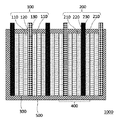
図1は、本発明の一実施形態に係る二次電池の断面図である。図1は積層型の二次電池であり、二次電池1000は、正極100、負極200、外装体500及び絶縁層300を有する。外装体500は、絶縁層300、正極100、負極200、を収容する。外装体500の材料としては、アルミニウム、ステンレス鋼、ニッケルメッキ鋼など、非水電解質に対し耐食性のある材料から選択することができる。本発明は、捲回型の二次電池にも適用できる。
FIG. 1 is a cross-sectional view of a secondary battery according to an embodiment of the present invention. FIG. 1 shows a stacked secondary battery. The
二次電池1000内で正極100、絶縁層300、負極200で構成される電極体400が積層されている。正極100または負極200を電極と称する場合がある。正極100、負極200、または絶縁層300を二次電池用シートと称する場合がある。絶縁層300および正極100または負極200が一体構造になっているものを電池セルシートと称する場合がある。
In the
正極100は、正極集電体120及び正極合剤層110を有する。正極集電体120の両面に正極合剤層110が形成されている。負極200は、負極集電体220及び負極合剤層210を有する。負極集電体220の両面に負極合剤層210が形成されている。正極合剤層110または負極合剤層210を電極合剤層、正極集電体120または負極集電体220を電極集電体と称する場合がある。
The
正極集電体120は正極タブ部130を有する。負極集電体220は負極タブ部230を有する。正極タブ部130または負極タブ部230を電極タブ部と称する場合がある。電極タブ部には電極合剤層が形成されていない。ただし、二次電池1000の性能に悪影響を与えない範囲で電極タブ部に電極合剤層を形成してもよい。正極タブ部130および負極タブ部230は、外装体500の外部に突出しており、突出した複数の正極タブ部130同士、複数の負極タブ部230同士が、例えば超音波接合などで接合されることで、二次電池1000内で並列接続が形成される。本発明は、二次電池1000中で電気的な直列接続を構成させたバイポーラ型の二次電池にも適用できる。
The positive electrode
正極合剤層110は、正極活物質、正極導電剤、正極バインダ、を有する。負極合剤層210は、負極活物質、負極導電剤、負極バインダ、を有する。正極活物質または負極活物質を電極活物質、正極導電剤または負極導電剤を電極導電剤、正極バインダまたは負極バインダを電極バインダと称する場合がある。
The positive
<電極導電剤>
電極導電剤は、電極合剤層の導電性を向上させる。電極導電剤としては、ケッチェンブラック、アセチレンブラック、黒鉛などが挙げられるが、これに限られない。これらの材料を単独または複数組み合わせて使用してもよい。
<Electrode conductive agent>
The electrode conductive agent improves the conductivity of the electrode mixture layer. Examples of the electrode conductive agent include, but are not limited to, ketjen black, acetylene black, and graphite. These materials may be used alone or in combination.
<電極バインダ>
電極バインダは、電極中の電極活物質や電極導電剤などを結着させる。電極バインダとしては、スチレン-ブタジエンゴム、カルボキシメチルセルロ-ス、ポリフッ化ビニリデン(PVDF)、ビニリデンフルオライド(VDF)とヘキサフルオロプロピレン(HFP)の共重合体(PVdF-HFP)などが挙げられるが、これに限られない。これらの材料を単独または複数組み合わせて使用してもよい。
<Electrode binder>
The electrode binder binds an electrode active material or an electrode conductive agent in the electrode. Examples of the electrode binder include styrene-butadiene rubber, carboxymethyl cellulose, polyvinylidene fluoride (PVDF), and a copolymer of vinylidene fluoride (VDF) and hexafluoropropylene (HFP) (PVdF-HFP). Not limited to this. These materials may be used alone or in combination.
<正極活物質>
正極活物質の反応電位はリチウム基準で3.5V以上であることが望ましい。正極活物質の反応電位が高いほど電池動作電位が高くなり、二次電池1000のエネルギー密度が大きくなる。反応電位がリチウム基準で3.5V以上となる正極活物質として、LiNi0.33Mn0.33Co0.33O2(NCM111)、LiNi0.8Mn0.1Co0.1O2(NCM811)、LiFePO4(LFP)等が挙げられるが、これらに限られない。これらの材料を単独または複数組み合わせて使用してもよい。リチウム基準での正極活物質の反応電位は、対極あるいは参照極を金属リチウムとするハーフセルを作製して一定値の電流を通電して電圧を計測する、あるいは、一定電圧掃印速度で電流値を計測することで測定できる。
<Positive electrode active material>
The reaction potential of the positive electrode active material is desirably 3.5 V or more based on lithium. The higher the reaction potential of the positive electrode active material, the higher the battery operating potential, and the energy density of the
<無機酸化物>
電子伝導性を持つ正極活物質の反応電位がリチウム基準で3.5V以上の場合、二次電池の充電によりリチウムが脱離して3.5 V以上の電位になると、二次電池1000に酸化分解電位が3.5V以上である主溶媒が含まれている場合、主溶媒と接触している正極活物質から主溶媒が電子を受け取って、主溶媒の酸化分解が起こる。そこで、正極活物質の表面に電子絶縁性の無機酸化物が形成されることで、二次電池1000の充電電位が3.5 V以上になっても、主溶媒が正極活物質から電子を受け取ることが難しくなり、主溶媒の酸化分解反応が抑制される。
<Inorganic oxide>
When the reaction potential of the positive electrode active material having electron conductivity is 3.5 V or more on the basis of lithium, if the lithium is desorbed by charging the secondary battery and becomes a potential of 3.5 V or more, the
無機酸化物は電子絶縁性の材料であることが望ましい。無機酸化物として、リチウムイオン伝導性を示す結晶性固体電解質、非結晶性固体電解質、オキソ酸塩、絶縁性金属酸化物、絶縁性金属非酸化物等が挙げられるが、これらに限られない。 The inorganic oxide is preferably an electronic insulating material. Examples of the inorganic oxide include, but are not limited to, a crystalline solid electrolyte exhibiting lithium ion conductivity, an amorphous solid electrolyte, an oxo acid salt, an insulating metal oxide, and an insulating metal non-oxide.
結晶性固体電解質として、LiNbO3、Li7La3ZrO12、Li3P(O,N)4、(La,Li)TiO3、(La,Li)ZrO3、Li1.3Al0.3Ti1.7(PO4)3、Li2ZrO3,Li4ZrO4、LiScO2等が挙げられる。非結晶性固体電解質として、Li-Al-Si-O系、Li-B-Si-O系酸化物等が挙げられる。絶縁性金属酸化物として、Al2O3、Li2O、ZrO2、Nb2O5等の構造中に少なくとも1種類以上の金属元素を含む酸化物、La2O3、CeO2等の希土類元素を含む希土類酸化物、B2O3、SiO2等の構造中に少なくとも1種類以上の非金属元素を含む酸化物等が挙げられる。オキソ酸塩として、AlPO4、LaPO4、LiMgPO4等の構造中に[PO4]3-ユニット、AlBO3等の構造中に[BO3]3-ユニットを含む等が挙げられる。オキソ酸が脱水縮合してポリオキソ酸となっていてもよい。LiTiO2、Li2TiO3、Li4Ti5O12等のチタン酸、MgAl2O4、LaAlO3、LiAlO2等のアルミン酸等が挙げられる。絶縁性金属非酸化物として、LiOH、Al(OH)3等の水酸基を含む水酸化物、LiF、CaF2、AlF3等のフッ化物、Li2Si2O5、Li2SiO3、MnSiO4等のシリケート等が挙げられる。上記の結晶性化合物において、絶縁性が担保されていれば、構成元素の一部は他の元素で置換されていてよい。上記の結晶性化合物において、絶縁性が担保されていれば、元素比が定比組成からずれていても良い。これらの材料を単独または複数組み合わせて使用してもよい。 As crystalline solid electrolytes, LiNbO 3 , Li 7 La 3 ZrO 12 , Li 3 P (O, N) 4 , (La, Li) TiO 3 , (La, Li) ZrO 3 , Li 1.3 Al 0.3 Ti 1.7 (PO 4 ) 3 , Li 2 ZrO 3 , Li 4 ZrO 4 , LiScO 2 and the like. Examples of the amorphous solid electrolyte include Li-Al-Si-O-based and Li-B-Si-O-based oxides. Insulating metal oxides include oxides containing at least one metal element in the structure such as Al 2 O 3 , Li 2 O, ZrO 2 , Nb 2 O 5 , rare earths such as La 2 O 3 , CeO 2, etc. Examples thereof include rare earth oxides containing elements and oxides containing at least one nonmetallic element in the structure such as B 2 O 3 and SiO 2 . Examples of the oxoacid salt include [PO 4 ] 3- unit in the structure of AlPO 4 , LaPO 4 , LiMgPO 4 , and [BO 3 ] 3- unit in the structure of AlBO 3 . The oxo acid may be dehydrated and condensed to form a polyoxo acid. Examples thereof include titanic acid such as LiTiO 2 , Li 2 TiO 3 , and Li 4 Ti 5 O 12 , and aluminate such as MgAl 2 O 4 , LaAlO 3 , and LiAlO 2 . Insulating metal non-oxides include hydroxides containing hydroxyl groups such as LiOH and Al (OH) 3 , fluorides such as LiF, CaF 2 and AlF 3 , Li 2 Si 2 O 5 , Li 2 SiO 3 and MnSiO 4. Silicates and the like. In the above crystalline compound, a part of the constituent elements may be substituted with another element as long as the insulating property is ensured. In the above crystalline compound, the element ratio may deviate from the stoichiometric composition as long as the insulating property is ensured. These materials may be used alone or in combination.
正極100中の正極活物質の重量に対する無機酸化物の重量は0〜2wt%、好ましくは0.5〜1.0wt%であることが望ましい。無機酸化物の重量が少ないと、絶縁性を十分に担保できず、充電反応中に主溶媒や低粘度有機溶媒が電子を放出して酸化分解し、二次電池1000の寿命を阻害する可能性がある。無機酸化物の重量が多いと、抵抗が増加して、二次電池1000の容量が低下する可能性がある。
The weight of the inorganic oxide relative to the weight of the positive electrode active material in the
正極活物質の表面に無機酸化物を形成する方法として、例えば正極活物質表面へ無機酸化物を被覆する方法、正極スラリー中に正極活物質と共に無機酸化物を含有させる方法、等が挙げられるが、これらに限られない。 Examples of the method for forming the inorganic oxide on the surface of the positive electrode active material include a method for coating the surface of the positive electrode active material with the inorganic oxide, a method for containing the inorganic oxide together with the positive electrode active material in the positive electrode slurry, and the like. Not limited to these.
無機酸化物がLiNbO3の場合、スプレーコート法(気相被覆法)がある。スプレーコート法とは、金属アルコキシドを出発原料として正極活物質の表面に噴霧し、得た粉末を酸素含有雰囲気で熱処理することにより無機酸化物を正極活物質表面へ被覆する方法である。これにより、正極活物質表面に無機酸化物を有する被覆層が形成される。無機酸化物がAl2O3の場合、無機酸化物を正極活物質と機械的に混合し、正極活物質の表面に無機酸化物を高分散させて被覆する方法(固相被覆法)がある。これにより、正極活物質表面に無機酸化物を有する被覆層が形成される。 When the inorganic oxide is LiNbO 3 , there is a spray coating method (vapor phase coating method). The spray coating method is a method in which a metal alkoxide is used as a starting material and sprayed onto the surface of the positive electrode active material, and the obtained powder is heat-treated in an oxygen-containing atmosphere to coat the surface of the positive electrode active material. Thereby, the coating layer which has an inorganic oxide is formed in the positive electrode active material surface. When the inorganic oxide is Al 2 O 3 , there is a method (solid phase coating method) in which the inorganic oxide is mechanically mixed with the positive electrode active material and the surface of the positive electrode active material is highly dispersed and coated. . Thereby, the coating layer which has an inorganic oxide is formed in the positive electrode active material surface.
無機酸化物の平均粒径は10nm〜50nm程度が望ましい。無機酸化物の平均粒径が小さいと、被覆層形成時の無機酸化物の取扱いが難しくなる可能性がある。無機酸化物の平均粒径が大きいと、初期の直流抵抗が大きくなる可能性がある。無機酸化物の平均粒径は、レーザー回折・散乱法で測定できる。 The average particle size of the inorganic oxide is desirably about 10 nm to 50 nm. If the average particle size of the inorganic oxide is small, it may be difficult to handle the inorganic oxide when forming the coating layer. If the average particle size of the inorganic oxide is large, the initial direct current resistance may increase. The average particle diameter of the inorganic oxide can be measured by a laser diffraction / scattering method.
被覆層の厚みは、無機酸化物1個分程度が望ましい。具体的には、被覆層の厚みは0.1〜100nm、好ましくは1〜30nmが望ましい。、被覆層の平均厚みは10〜50nm程度であることが望ましい。被覆層の厚みが小さいと、正極活物質表面での非水電解液の酸化分解を十分に抑制できない可能性がある。被覆層の厚みが大きいと、被覆層の抵抗が増大する可能性がある。被覆層の厚みは、走査型電子顕微鏡(SEM)あるいは透過型電子顕微鏡(TEM)と、エネルギー分散型X線分析(EDS)で測定できる。被覆層の平均厚みは、蛍光X線で測定できる。 The thickness of the coating layer is desirably about one inorganic oxide. Specifically, the thickness of the coating layer is 0.1 to 100 nm, preferably 1 to 30 nm. The average thickness of the coating layer is preferably about 10 to 50 nm. When the thickness of the coating layer is small, there is a possibility that the oxidative decomposition of the nonaqueous electrolytic solution on the surface of the positive electrode active material cannot be sufficiently suppressed. When the thickness of the coating layer is large, the resistance of the coating layer may increase. The thickness of the coating layer can be measured by a scanning electron microscope (SEM) or a transmission electron microscope (TEM) and energy dispersive X-ray analysis (EDS). The average thickness of the coating layer can be measured with fluorescent X-rays.
<正極集電体120>
正極集電体120として、厚さが1〜100μmのアルミニウム箔、厚さが10〜100μm、孔径0.1〜10mmの孔を有するアルミニウム製穿孔箔、エキスパンドメタル、発泡金属板、ステンレス鋼、チタンなどが挙げられるが、これらに限られない。
<Positive electrode
Examples of the positive electrode
<負極活物質>
卑な電位を示す負極活物質は、放電過程においてリチウムイオンが脱離し、充電過程において正極合剤層110中の正極活物質から脱離したリチウムイオンが挿入される。負極活物質として、炭素系材料(黒鉛、易黒鉛化炭素材料、非晶質炭素材料、有機結晶、活性炭など)、導電性高分子材料(ポリアセン、ポリパラフェニレン、ポリアニリン、ポリアセチレンなど)、リチウム複合酸化物(チタン酸リチウム:Li4Ti5O12やLi2TiO4など)、金属リチウム、リチウムと合金化する金属(アルミニウム、シリコン、スズなどを少なくとも1種類以上含む)やこれらの酸化物などが挙げられるが、これらに限られない。
<Negative electrode active material>
In the negative electrode active material exhibiting a base potential, lithium ions are desorbed in the discharging process, and lithium ions desorbed from the positive electrode active material in the positive
<負極集電体220>
負極集電体220として、厚さが1〜100μmの銅箔、厚さが1〜100μm、孔径0.1〜10mmの銅製穿孔箔、エキスパンドメタル、発泡金属板、ステンレス鋼、チタン、ニッケルなどが挙げられるが、これらに限られない。
<Negative electrode
Examples of the negative electrode
<電極>
電極活物質、電極導電剤、電極バインダ及び有機溶媒を混合した電極スラリーを、ドクターブレード法、ディッピング法、スプレー法などの塗工方法によって電極集電体へ付着させることで電極合剤層が作製される。その後、有機溶媒を除去するために電極合剤層を乾燥し、ロールプレスによって電極合剤層を加圧成形することにより電極が作製される。
<Electrode>
An electrode mixture layer is prepared by adhering an electrode slurry in which an electrode active material, an electrode conductive agent, an electrode binder, and an organic solvent are mixed to an electrode current collector by a coating method such as a doctor blade method, a dipping method, or a spray method. Is done. Then, in order to remove an organic solvent, an electrode mixture layer is dried, and an electrode is produced by pressure-molding an electrode mixture layer with a roll press.
電極合剤層に非水電解液が含まれている場合、電極合剤層中の非水電解液の含有量は20〜40vol%であることが望ましい。非水電解液の含有量が少ない場合、電極合剤層内部でのイオン伝導経路が十分に形成されずレート特性が低下する可能性がある。また、非水電解液の含有量が多い場合、電極合剤層から非水電解液が漏れ出す可能性があることに加え、電極活物質が不十分となりエネルギー密度の低下を招く可能性がある。 When the electrode mixture layer contains a non-aqueous electrolyte, the content of the non-aqueous electrolyte in the electrode mixture layer is preferably 20 to 40 vol%. When the content of the nonaqueous electrolytic solution is small, there is a possibility that the ion conduction path inside the electrode mixture layer is not sufficiently formed and the rate characteristic is lowered. In addition, when the content of the non-aqueous electrolyte is large, in addition to the possibility that the non-aqueous electrolyte leaks from the electrode mixture layer, there is a possibility that the electrode active material becomes insufficient and the energy density is lowered. .
電極が半固体電解質を有する場合、外装体500の空いている1辺や注液孔から二次電池1000に非水電解液を注入し、電極合剤層の細孔に非水電解液を充填させてもよい。この場合、半固体電解質に含まれる担持粒子を要せず、電極合剤層中の電極活物質や電極導電剤などの粒子が担持粒子として機能して、それらの粒子が非水電解液を保持する。電極合剤層の細孔に非水電解液を充填する別の方法として、非水電解液、電極活物質、電極導電剤、電極バインダを混合したスラリーを調製し、調整したスラリーを電極集電体上に一緒に塗布する方法などがある。
When the electrode has a semi-solid electrolyte, the nonaqueous electrolyte is injected into the
電極合剤層の厚さは、電極活物質の平均粒径以上とすることが望ましい。電極合剤層の厚さが小さいと、隣接する電極活物質間の電子伝導性が悪化する可能性がある。電極活物質粉末中に電極合剤層の厚さ以上の平均粒径を有する粗粒がある場合、ふるい分級、風流分級などにより粗粒を予め除去し、電極合剤層の厚さ以下の粒子とすることが望ましい。 The thickness of the electrode mixture layer is preferably equal to or greater than the average particle diameter of the electrode active material. If the thickness of the electrode mixture layer is small, the electron conductivity between adjacent electrode active materials may deteriorate. If the electrode active material powder has coarse particles having an average particle size equal to or greater than the thickness of the electrode mixture layer, the coarse particles are removed in advance by sieving classification, wind flow classification, etc., and particles having a thickness equal to or less than the thickness of the electrode mixture layer Is desirable.
<絶縁層300>
絶縁層300は、正極100と負極200の間にイオンを伝達させる媒体となる。絶縁層300は電子の絶縁体としても働き、正極100と負極200の短絡を防止する。絶縁層300は、セパレータまたは半固体電解質層を有する。絶縁層300として、セパレータまたは半固体電解質層を併用してもよい。
<Insulating
The insulating
<セパレータ>
セパレータとして、多孔質シートを用いることができる。多孔質シートとして、セルロース、セルロースの変成体(カルボキシメチルセルロース(CMC)、ヒドロキシプロピルセルロース(HPC)など)、ポリオレフィン(ポリプロピレン(PP)、プロピレンの共重合体など)、ポリエステル(ポリエチレンテレフタレート(PET)、ポリエチレンナフタレート(PEN)、ポリブチレンテレフタレート(PBT)など)、ポリアクリロニトリル(PAN)、ポリアラミド、ポリアミドイミド、ポリイミドなどの樹脂、ガラスなどが挙げられるが、これらに限られない。これらの材料を単独または複数組み合わせて使用してもよい。セパレータを正極100または負極200より大面積にすることで、正極100と負極200の短絡を防止できる。
<Separator>
A porous sheet can be used as the separator. As porous sheets, cellulose, modified cellulose (carboxymethylcellulose (CMC), hydroxypropylcellulose (HPC), etc.), polyolefin (polypropylene (PP), propylene copolymer, etc.), polyester (polyethylene terephthalate (PET), Polyethylene naphthalate (PEN), polybutylene terephthalate (PBT), etc.), polyacrylonitrile (PAN), polyaramid, polyamideimide, polyimide and other resins, glass and the like, but are not limited thereto. These materials may be used alone or in combination. By making the separator have a larger area than the
セパレータ粒子、セパレータバインダ、および溶剤を有するセパレータ形成用混合物を電極合剤層に塗布することにより、セパレータを形成してもよい。セパレータ形成用混合物を上記の多孔質シートに塗布してもよい。 The separator may be formed by applying a separator forming mixture having separator particles, a separator binder, and a solvent to the electrode mixture layer. You may apply | coat the mixture for separator formation to said porous sheet.
セパレータ粒子として、γ-アルミナ(Al2O3)、シリカ(SiO2)、ジルコニア(ZrO2)などが挙げられるが、これらに限られない。これらの材料を単独または複数組み合わせて使用してもよい。セパレータ粒子の平均粒子径は、セパレータの厚さの1/100〜1/2とすることが望ましい。セパレータバインダとして、ポリエチレン(PE)、PP、ポリテトラフルオロエチレン(PTFE)、PVDF、PVdF-HFP、スチレンブタジエンゴム(SBR)、ポリアルギン酸、ポリアクリル酸などが挙げられるが、これらに限られない。これらの材料を単独または複数組み合わせて使用してもよい。溶剤として、Nメチルピロリドン(NMP)、水などが挙げられるが、これらに限られない。 Examples of separator particles include, but are not limited to, γ-alumina (Al 2 O 3 ), silica (SiO 2 ), zirconia (ZrO 2 ), and the like. These materials may be used alone or in combination. The average particle size of the separator particles is desirably 1/100 to 1/2 of the thickness of the separator. Examples of the separator binder include, but are not limited to, polyethylene (PE), PP, polytetrafluoroethylene (PTFE), PVDF, PVdF-HFP, styrene butadiene rubber (SBR), polyalginic acid, and polyacrylic acid. These materials may be used alone or in combination. Examples of the solvent include, but are not limited to, N-methylpyrrolidone (NMP) and water.
絶縁層300としてセパレータを用いる場合、外装体500の空いている1辺や注液孔から二次電池1000に非水電解液を注入することで、セパレータ中に非水電解液が充填される。
In the case where a separator is used as the insulating
<半固体電解質層>
半固体電解質層は、半固体電解質バインダおよび半固体電解質を有する。半固体電解質は、担持粒子および非水電解液を有する。半固体電解質は、担持粒子の集合体によって形成される細孔を有し、その中に非水電解液が保持されている。半固体電解質中に非水電解液が保持されることによって、半固体電解質はリチウムイオンを透過させる。絶縁層300として半固体電解質層を用い、電極合剤層に非水電解液が充填される場合、二次電池1000への非水電解液の注入は不要になる。但し、絶縁層300がセパレータを有する場合など、外装体500の空いている1辺や注液孔から二次電池1000へ非水電解液を注入してもよい。
<Semi-solid electrolyte layer>
The semi-solid electrolyte layer has a semi-solid electrolyte binder and a semi-solid electrolyte. The semi-solid electrolyte has supported particles and a non-aqueous electrolyte. The semi-solid electrolyte has pores formed by aggregates of supported particles, and a non-aqueous electrolyte is held therein. By holding the non-aqueous electrolyte in the semi-solid electrolyte, the semi-solid electrolyte permeates lithium ions. When a semi-solid electrolyte layer is used as the insulating
半固体電解質層の作製方法として、半固体電解質の粉末を成型ダイスなどでペレット状に圧縮成型する方法や、半固体電解質バインダを半固体電解質の粉末に添加・混合し、シート化する方法などがある。半固体電解質に半固体電解質バインダの粉末を添加・混合することにより、柔軟性の高いシート状の半固体電解質層を作製できる。また、半固体電解質に、分散溶媒に半固体電解質バインダを溶解させた結着剤の溶液を添加・混合し、電極などの基材上に混合物を塗布し、乾燥により分散溶媒を留去することで、半固体電解質層を作製してもよい。 As a method for producing a semi-solid electrolyte layer, there are a method of compressing and molding a semi-solid electrolyte powder into a pellet shape with a molding die or the like, and a method of adding and mixing a semi-solid electrolyte binder to a semi-solid electrolyte powder to form a sheet. is there. By adding and mixing a semi-solid electrolyte binder powder to the semi-solid electrolyte, a highly flexible sheet-like semi-solid electrolyte layer can be produced. In addition, a solution of a binder in which a semisolid electrolyte binder is dissolved in a dispersion solvent is added to and mixed with the semisolid electrolyte, the mixture is applied onto a substrate such as an electrode, and the dispersion solvent is distilled off by drying. Thus, a semi-solid electrolyte layer may be produced.
<担持粒子>
担持粒子としては、電気化学的安定性の観点から、絶縁性粒子であり非水電解液に不溶であることが好ましい。担持粒子として、例えば、SiO2粒子、Al2O3粒子、セリア(CeO2)粒子、ZrO2粒子などの酸化物無機粒子等が挙げられるが、これらに限られない。担持粒子として固体電解質を用いてもよい。固体電解質としては、例えば、Li-La-Zr-Oなどの酸化物系固体電解質やLi10Ge2PS12などの硫化物系固体電解質などの無機系固体電解質の粒子が挙げられるが、これらに限られない。これらの材料を単独または複数組み合わせて使用してもよい。
<Supported particles>
The supported particles are preferably insulative particles and insoluble in the non-aqueous electrolyte from the viewpoint of electrochemical stability. Examples of supported particles include, but are not limited to, oxide inorganic particles such as SiO 2 particles, Al 2 O 3 particles, ceria (CeO 2 ) particles, and ZrO 2 particles. A solid electrolyte may be used as the support particles. Examples of the solid electrolyte include particles of an inorganic solid electrolyte such as an oxide solid electrolyte such as Li-La-Zr-O and a sulfide solid electrolyte such as Li 10 Ge 2 PS 12. Not limited. These materials may be used alone or in combination.
非水電解液の保持量は担持粒子の比表面積に比例すると考えられるため、担持粒子の一次粒子の平均粒径は、1nm〜10μmが好ましい。担持粒子の一次粒子の平均粒径が大きいと、担持粒子が十分な量の非水電解液を適切に保持できず半固体電解質の形成が困難になる可能性がある。また、担持粒子の一次粒子の平均粒径が小さいと、担持粒子間の表面間力が大きくなって担持粒子同士が凝集し易くなって、半固体電解質の形成が困難になる可能性がある。担持粒子の一次粒子の平均粒径は、1〜50nmがより好ましく、1〜10nmが更に好ましい。担持粒子の一次粒子の平均粒径は、TEMを用いて測定できる。 Since the retention amount of the non-aqueous electrolyte is considered to be proportional to the specific surface area of the supported particles, the average particle size of the primary particles of the supported particles is preferably 1 nm to 10 μm. If the average particle size of the primary particles of the supported particles is large, the supported particles may not properly hold a sufficient amount of the non-aqueous electrolyte, and it may be difficult to form a semi-solid electrolyte. In addition, if the average particle size of the primary particles of the supported particles is small, the inter-surface force between the supported particles becomes large and the supported particles tend to aggregate with each other, which may make it difficult to form a semi-solid electrolyte. The average particle size of the primary particles of the supported particles is more preferably 1 to 50 nm, still more preferably 1 to 10 nm. The average particle size of the primary particles of the supported particles can be measured using TEM.
<非水電解液>
非水電解液は、イオン液体またはイオン液体に類似の性質を示すエーテル系溶媒および溶媒和電解質塩の混合物(錯体)を有する。イオン液体またはエーテル系溶媒を主溶媒と称する場合がある。イオン液体とは、常温でカチオンとアニオンに解離する化合物であって、液体の状態を保持するものである。イオン液体は、イオン性液体、低融点溶融塩あるいは常温溶融塩と称されることがある。非水電解液は、大気中での安定性や二次電池内での耐熱性の観点から、低揮発性、具体的には室温における蒸気圧が150Pa以下であるものが望ましいが、これに限られない。
<Non-aqueous electrolyte>
The non-aqueous electrolyte has an ionic liquid or a mixture (complex) of an ether solvent and a solvated electrolyte salt that exhibits properties similar to those of the ionic liquid. An ionic liquid or an ether solvent may be referred to as a main solvent. An ionic liquid is a compound that dissociates into a cation and an anion at room temperature, and maintains a liquid state. The ionic liquid may be referred to as an ionic liquid, a low melting point molten salt or a room temperature molten salt. The non-aqueous electrolyte is desirably low in volatility, specifically, having a vapor pressure of 150 Pa or less at room temperature, from the viewpoint of stability in the air and heat resistance in the secondary battery. I can't.
半固体電解質層中の非水電解液の含有量は40〜90vol%であることが望ましい。非水電解液の含有量が小さい場合、電極と半固体電解質層との界面抵抗増加する可能性がある。また、非水電解液の含有量が大きい場合、半固体電解質層から非水電解液が漏れ出してしまう可能性がある。半固体電解質層がシート状に形成されている場合、半固体電解質層中の非水電解液の含有量は50〜80vol%、更には60〜80vol%であることが望ましい。半固体電解質と分散溶媒に半固体電解質バインダを溶解させた溶液との混合物を電極上に塗布することにより半固体電解質層を形成する場合、半固体電解質層中の非水電解液の含有量は40〜60vol%であることが望ましい。 The content of the non-aqueous electrolyte in the semi-solid electrolyte layer is preferably 40 to 90 vol%. When the content of the non-aqueous electrolyte is small, the interface resistance between the electrode and the semisolid electrolyte layer may increase. Moreover, when content of a non-aqueous electrolyte is large, a non-aqueous electrolyte may leak from a semi-solid electrolyte layer. When the semi-solid electrolyte layer is formed in a sheet shape, the content of the non-aqueous electrolyte in the semi-solid electrolyte layer is preferably 50 to 80 vol%, more preferably 60 to 80 vol%. When a semi-solid electrolyte layer is formed by applying a mixture of a semi-solid electrolyte and a solution in which a semi-solid electrolyte binder is dissolved in a dispersion solvent on an electrode, the content of the non-aqueous electrolyte in the semi-solid electrolyte layer is 40-60 vol% is desirable.
非水電解液における主溶媒の重量比率は特には限定されないが、電池安定性および高速充放電の観点から非水電解液中の溶媒の総和に占める主溶媒の重量比率は30〜70wt%、特に40〜60wt%、さらには45〜55wt%であることが望ましい。 The weight ratio of the main solvent in the non-aqueous electrolyte is not particularly limited, but the weight ratio of the main solvent in the total amount of the solvent in the non-aqueous electrolyte is 30 to 70 wt%, particularly from the viewpoint of battery stability and fast charge / discharge. It is desirable that it is 40 to 60 wt%, and further 45 to 55 wt%.
<イオン液体>
イオン液体はカチオンおよびアニオンで構成される。イオン液体としては、カチオン種に応じ、イミダゾリウム系、アンモニウム系、ピロリジニウム系、ピペリジニウム系、ピリジニウム系、モルホリニウム系、ホスホニウム系、スルホニウム系などに分類される。イミダゾリウム系イオン液体を構成するカチオンには、例えば、1-butyl-3-methylimidazorium(BMI)などのアルキルイミダゾリウムカチオンなどがある。アンモニウム系イオン液体を構成するカチオンには、例えば、tetraamylammoniumなどのほかに、N,N,N-trimethyl-N-propylammoniumなどのアルキルアンモニウムカチオンがある。ピロリジニウム系イオン液体を構成するカチオンには、例えば、N-methyl-N-propylpyrrolidinium(Py13)や1-butyl-1-methylpyrrolidiniumなどのアルキルピロリジニウムカチオンなどがある。ピペリジニウム系イオン液体を構成するカチオンには、例えば、N-methyl-N-propylpiperidinium(PP13)や1-butyl-1-methylpiperidiniumなどのアルキルピペリジニウムカチオンなどがある。ピリジニウム系イオン液体を構成するカチオンには、例えば、1-butylpyridiniumや1-butyl-4-methylpyridiniumなどのアルキルピリジニウムカチオンなどがある。モルホリニウム系イオン液体を構成するカチオンには、例えば、4-ethyl-4-methylmorpholiniumなどのアルキルモルホリニウムなどがある。ホスホニウム系イオン液体を構成するカチオンには、例えば、tetrabutylphosphoniumやtributylmethylphosphoniumなどのアルキルホスホニウムカチオンなどがある。スルホニウム系イオン液体を構成するカチオンには、例えば、trimethylsulfoniumやtributhylsulfoniumなどのアルキルスルホニウムカチオンなどがある。これらカチオンと対になるアニオンとしては、例えば、bis(trifluoromethanesulfonyl)imide(TFSI)、bis(fluorosulfonyl)imide、tetrafluoroborate(BF4)、hexafluorophosphate(PF6)、bis(pentafluoroethanesulfonyl)imide(BETI)、trifluoromethanesulfonate(トリフラート)、acetate、dimethyl phosphate、dicyanamide、trifluoro(trifluoromethyl)borateなどがある。これらの材料を単独または複数組み合わせて使用してもよい。
<Ionic liquid>
The ionic liquid is composed of a cation and an anion. Ionic liquids are classified into imidazolium, ammonium, pyrrolidinium, piperidinium, pyridinium, morpholinium, phosphonium, sulfonium, and the like depending on the cation species. Examples of the cation constituting the imidazolium-based ionic liquid include alkyl imidazolium cations such as 1-butyl-3-methylimidazorium (BMI). Examples of the cation constituting the ammonium-based ionic liquid include, in addition to tetraamylammonium, alkylammonium cations such as N, N, N-trimethyl-N-propylammonium. Examples of the cation constituting the pyrrolidinium-based ionic liquid include alkylpyrrolidinium cations such as N-methyl-N-propylpyrrolidinium (Py13) and 1-butyl-1-methylpyrrolidinium. Examples of the cation constituting the piperidinium-based ionic liquid include alkylpiperidinium cations such as N-methyl-N-propylpiperidinium (PP13) and 1-butyl-1-methylpiperidinium. Examples of the cation constituting the pyridinium-based ionic liquid include alkylpyridinium cations such as 1-butylpyridinium and 1-butyl-4-methylpyridinium. Examples of the cation constituting the morpholinium-based ionic liquid include alkylmorpholinium such as 4-ethyl-4-methylmorpholinium. Examples of the cation constituting the phosphonium-based ionic liquid include alkylphosphonium cations such as tetrabutylphosphonium and tributylmethylphosphonium. Examples of the cation constituting the sulfonium-based ionic liquid include alkylsulfonium cations such as trimethylsulfonium and tributhylsulfonium. Examples of the anion paired with these cations include bis (trifluoromethanesulfonyl) imide (TFSI), bis (fluorosulfonyl) imide, tetrafluoroborate (BF 4 ), hexafluorophosphate (PF 6 ), bis (pentafluoroethanesulfonyl) imide (BETI), and trifluoromethanesulfonate (BETI). Triflate), acetate, dimethyl phosphate, dicyanamide, trifluoro (trifluoromethyl) borate and the like. These materials may be used alone or in combination.
<電解質塩>
非水電解液がイオン液体を有する場合、非水電解液は電解質塩を有する。電解質塩として、主溶媒に均一に分散できるものが望ましい。カチオンがリチウム、上記アニオンからなるものがリチウム塩として使用することができ、例えば、リチウムビス(フルオロスルホニル)イミド(LiFSI)、リチウムビス(トリフルオロメタンスルホニル)イミド(LiTFSI)、リチウムビス(ペンタフルオロエタンスルホニル)イミド(LiBETI)、リチウムテトラフルオロボレート(LiBF4)、リチウムヘキサフルオロフォスファート(LiPF6)、リチウムトリフラートなどが挙げられるが、これに限られない。これらの材料を単独または複数組み合わせて使用してもよい。
<Electrolyte salt>
When the non-aqueous electrolyte has an ionic liquid, the non-aqueous electrolyte has an electrolyte salt. The electrolyte salt is preferably one that can be uniformly dispersed in the main solvent. Lithium cation and those consisting of the above anions can be used as lithium salts, such as lithium bis (fluorosulfonyl) imide (LiFSI), lithium bis (trifluoromethanesulfonyl) imide (LiTFSI), lithium bis (pentafluoroethane) Examples include, but are not limited to, sulfonyl) imide (LiBETI), lithium tetrafluoroborate (LiBF 4 ), lithium hexafluorophosphate (LiPF 6 ), and lithium triflate. These materials may be used alone or in combination.
<エーテル系溶媒>
エーテル系溶媒は、溶媒和電解質塩と溶媒和イオン液体を構成する。エーテル系溶媒として、イオン液体に類似の性質を示す公知のグライム(R-O(CH2CH2O)n-R’(R、R’は飽和炭化水素、nは整数)で表される対称グリコールジエーテルの総称)を利用できる。イオン伝導性の観点から、テトラグライム(テトラエチレンジメチルグリコール、G4)、トリグライム(トリエチレングリコールジメチルエーテル、G3)、ペンタグライム(ペンタエチレングリコールジメチルエーテル、G5)、ヘキサグライム(ヘキサエチレングリコールジメチルエーテル、G6)を好ましく用いることができる。また、エーテル系溶媒として、クラウンエーテル((-CH2-CH2-O)n(nは整数)で表わされる大環状エーテルの総称)を利用できる。具体的には、12-クラウン-4、15-クラウン-5、18-クラウン-6、ジベンゾ-18-クラウン-6などを好ましく用いることができるが、これに限らない。これらの材料を単独または複数組み合わせて使用してもよい。溶媒和電解質塩と錯体構造を形成できる点で、テトラグライム、トリグライムを用いることが好ましい。
<Ether solvent>
The ether solvent constitutes a solvated electrolyte salt and a solvated ionic liquid. As an ether solvent, a symmetric glycol diglyceride represented by a known glyme (RO (CH 2 CH 2 O) n-R ′ (R and R ′ are saturated hydrocarbons, n is an integer)) showing properties similar to ionic liquids. The generic name of ether) can be used. From the viewpoint of ion conductivity, tetraglyme (tetraethylene dimethyl glycol, G4), triglyme (triethylene glycol dimethyl ether, G3), pentag lime (pentaethylene glycol dimethyl ether, G5), hexaglyme (hexaethylene glycol dimethyl ether, G6) It can be preferably used. In addition, crown ether (a general term for macrocyclic ethers represented by (—CH 2 —CH 2 —O) n (n is an integer)) can be used as an ether solvent. Specifically, 12-crown-4, 15-crown-5, 18-crown-6, dibenzo-18-crown-6 and the like can be preferably used, but are not limited thereto. These materials may be used alone or in combination. Tetraglyme and triglyme are preferably used in that they can form a complex structure with a solvated electrolyte salt.
<溶媒和電解質塩>
溶媒和電解質塩としては、LiFSI、LiTFSI、LiBETIなどのリチウム塩を利用できるが、これに限らない。非水電解液として、エーテル系溶媒および溶媒和電解質塩の混合物を単独または複数組み合わせて使用してもよい。
<Solvate electrolyte salt>
As the solvated electrolyte salt, lithium salts such as LiFSI, LiTFSI, and LiBETI can be used, but are not limited thereto. As the non-aqueous electrolyte, a mixture of an ether solvent and a solvated electrolyte salt may be used alone or in combination.
<低粘度有機溶媒>
非水電解液は低粘度有機溶媒を有していてもよい。低粘度有機溶媒は、非水電解液の粘度を下げ、イオン伝導率を向上させる。非水電解液の内部抵抗は大きい場合、低粘度有機溶媒を添加して非水電解液のイオン伝導率を上げることにより、非水電解液の内部抵抗を下げることができる。低粘度有機溶媒として、エチレンカーボネート(EC)、ブチレンカーボネート(BC)、プロピレンカーボネート(PC)、ジメチルカーボネート(DMC)、ジエチルカーボネート(DEC)、メチルエチルカーボネート(MEC)、トリメチルフォスフェート(TMP)、トリエチルフォスフェート(TEP)、2,2,2-トリフルオロエチルフォスフェート(TFP)、ガンマブチロラクトン(GBL)、メチルホスホン酸ジメチル(DMMP)等が挙げられるが、これらに限られない。これらの材料を単独または複数組み合わせて使用してもよい。
<Low viscosity organic solvent>
The non-aqueous electrolyte may have a low viscosity organic solvent. The low-viscosity organic solvent lowers the viscosity of the nonaqueous electrolytic solution and improves the ionic conductivity. When the internal resistance of the nonaqueous electrolytic solution is large, the internal resistance of the nonaqueous electrolytic solution can be lowered by adding a low viscosity organic solvent to increase the ionic conductivity of the nonaqueous electrolytic solution. Low viscosity organic solvents include ethylene carbonate (EC), butylene carbonate (BC), propylene carbonate (PC), dimethyl carbonate (DMC), diethyl carbonate (DEC), methyl ethyl carbonate (MEC), trimethyl phosphate (TMP), Examples include, but are not limited to, triethyl phosphate (TEP), 2,2,2-trifluoroethyl phosphate (TFP), gamma butyrolactone (GBL), dimethyl methylphosphonate (DMMP), and the like. These materials may be used alone or in combination.
低粘度有機溶媒として、還元分解電位および酸化分解電位を両立し、イオン伝導率を向上できる点で、カーボネート系溶媒を用いることが望ましい。カーボネート系溶媒として、EC、BC、PC、DMC、DEC、MEC等が挙げられるが、これらに限られない。 As the low-viscosity organic solvent, it is desirable to use a carbonate-based solvent from the viewpoint that both the reductive decomposition potential and the oxidative decomposition potential can be achieved and the ionic conductivity can be improved. Examples of carbonate solvents include, but are not limited to, EC, BC, PC, DMC, DEC, MEC and the like.
低粘度有機溶媒は、電解質塩を有していてもよい。電解質塩として、溶媒に均一に分散できるものを使用できる。カチオンがリチウム、上記アニオンからなるものがリチウム塩として使用することができ、例えば、LiFSI、LiTFSI、LiBETI、LiBF4、LiPF6、リチウムトリフラートなどが挙げられるが、これに限られない。これらの材料を単独または複数組み合わせて使用してもよい。 The low viscosity organic solvent may have an electrolyte salt. As the electrolyte salt, one that can be uniformly dispersed in a solvent can be used. A lithium salt having a cation as lithium and the above anion can be used as a lithium salt. Examples thereof include, but are not limited to, LiFSI, LiTFSI, LiBETI, LiBF 4 , LiPF 6 , and lithium triflate. These materials may be used alone or in combination.
<負極界面安定化剤>
非水電解液は、負極界面安定化剤を有していてもよい。非水電解液に負極界面安定化剤が含まれることにより、二次電池1000のレート特性の向上や電池寿命の向上できる。負極界面安定化剤の添加量は、非水電解液の重量に対して30wt%以下、特に10wt%以下が好ましい。30wt%以下であれば、負極界面安定化剤を導入してもエーテル系溶媒と溶媒和電解質塩との溶媒和構造を大きく乱さない。負極界面安定化剤として、ビニレンカーボネート(VC)、フルオロエチレンカーボネート(FEC)などが挙げられるが、これらに限らない。これらの負極界面安定化剤を単独または複数組み合わせて使用してもよい。
<Negative electrode interface stabilizer>
The non-aqueous electrolyte may have a negative electrode interface stabilizer. By including the negative electrode interface stabilizer in the non-aqueous electrolyte, the rate characteristics of the
<腐食防止剤>
非水電解液は腐食防止剤を有していてもよい。腐食防止剤により、正極集電体120が高い電気化学電位に晒されても金属が溶出しにくい皮膜が形成される。腐食防止剤としては、PF6やBF4といったアニオン種を含むこと、および水分を含んだ大気で安定な化合物を形成するための強い化学結合を有するカチオン種を含んだ材料が望ましい。
<Corrosion inhibitor>
The non-aqueous electrolyte may have a corrosion inhibitor. The corrosion inhibitor forms a film in which the metal is difficult to elute even when the positive electrode
大気で安定な化合物であることを示す一指標としては、水に対する溶解度や加水分解の有無を挙げることができる。腐食防止剤が固体の場合、水に対する溶解度が1%未満であることが望ましい。また、加水分解の有無は、水と混合後の試料の分子構造解析で評価できる。ここでは、加水分解しない、とは、腐食防止剤が吸湿あるいは水と混和した後、100℃以上で加熱し水分を除去した後の残留物の95%が添加剤と同じ分子構造を示していることを意味する。 As an index indicating that the compound is stable in the air, solubility in water and presence / absence of hydrolysis can be mentioned. When the corrosion inhibitor is a solid, the solubility in water is desirably less than 1%. The presence or absence of hydrolysis can be evaluated by molecular structure analysis of the sample after mixing with water. Here, no hydrolysis means that the corrosion inhibitor is hygroscopic or mixed with water and then heated at 100 ° C. or higher to remove moisture and 95% of the residue shows the same molecular structure as the additive. Means that.
腐食防止剤は(M−R)+An-で表される(M−R)+An-のカチオンは、(M−R)+であり、Mは窒素(N)、ホウ素(B)、リン(P)、硫黄(S)のいずれかからなり、Rは炭化水素基から構成される。また、(M−R)+An-のアニオンはAn-であり、BF4−やPF6−が好適に用いられる。腐食防止剤のアニオンをBF4−やPF6−にすることで、正極集電体120の溶出を効率的に抑制できる。これは、BF4−やPF6−のFアニオンが電極集電体のSUSやアルミニウムと反応し、不動態皮膜を形成することが影響すると考えられる。
The corrosion inhibitor is represented by (M−R) + An−, the cation of (M−R) + An− is (M−R) +, and M is nitrogen (N), boron (B), phosphorus It consists of either (P) or sulfur (S), and R is composed of a hydrocarbon group. Further, the anion of (M−R) + An− is An−, and BF 4 − and PF 6 − are preferably used. By making the anion of the corrosion inhibitor BF 4 -or PF 6- , elution of the positive electrode
腐食防止剤の例として、テトラブチルアンモニウム ヘキサフルオロホスフェート(NBu4PF6)、テトラブチルアンモニウム テトラフルオロボレート(NBu4BF4)の4級アンモニウム塩、1−エチル−3−メチルイミダゾリウムテトラフルオロボレート(EMI−BF4)、1−エチル−3−メチルイミダゾリウムヘキサフルオロフォスフェート(EMI−PF6)、1-ブチル-3-メチルイミダゾリウムテトラフルオロボレート(BMI−BF4)、1-ブチル-3-メチルイミダゾリウムヘキサフルオロフォスフェート(BMI−PF6)などのイミダゾリウム塩が挙げられる。特に、アニオンがPF6であれば、正極集電体120の溶出を抑制できる。これらの材料を単独または複数組み合わせて使用してもよい。
Examples of corrosion inhibitors include tetrabutylammonium hexafluorophosphate (NBu 4 PF 6 ), quaternary ammonium salt of tetrabutylammonium tetrafluoroborate (NBu 4 BF 4 ), 1-ethyl-3-methylimidazolium tetrafluoroborate (EMI-BF 4 ), 1-ethyl-3-methylimidazolium hexafluorophosphate (EMI-PF 6 ), 1-butyl-3-methylimidazolium tetrafluoroborate (BMI-BF 4 ), 1-butyl- Examples thereof include imidazolium salts such as 3-methylimidazolium hexafluorophosphate (BMI-PF 6 ). In particular, if the anion is PF 6 , elution of the positive electrode
腐食防止剤の含有量は、非水電解液の総重量に対して、好ましくは1〜20wt%、更に好ましくは、2.5〜10wt%であることが望ましい。腐食防止剤の含有量が少ないと、電極集電体の溶出を抑制する効果が低下し、充放電に伴い電池容量が低下しやすい。また、腐食防止剤の含有量が多いと、リチウムイオン伝導度が低下し、さらに、腐食防止剤を分解させるために多くの蓄電エネルギーが消費されてしまい、結果として電池容量が低下する可能性がある。 The content of the corrosion inhibitor is preferably 1 to 20 wt%, more preferably 2.5 to 10 wt%, based on the total weight of the nonaqueous electrolytic solution. When there is little content of a corrosion inhibitor, the effect which suppresses elution of an electrode electrical power collector will fall, and battery capacity will fall easily with charging / discharging. In addition, if the content of the corrosion inhibitor is large, the lithium ion conductivity is decreased, and furthermore, a large amount of stored energy is consumed to decompose the corrosion inhibitor, and as a result, the battery capacity may be decreased. is there.
<半固体電解質バインダ>
半固体電解質バインダは、フッ素系の樹脂が好適に用いられる。フッ素系の樹脂としては、PTFE、PVDF、PVdF-HFP等が挙げられるが、これらに限られない。これらの半固体電解質バインダを単独または複数組み合わせて使用してもよい。PVDFやPVdF-HFPを用いることで、絶縁層300と電極集電体の密着性が向上するため、電池性能が向上する。
<Semi-solid electrolyte binder>
As the semi-solid electrolyte binder, a fluorine-based resin is preferably used. Examples of the fluorine-based resin include, but are not limited to, PTFE, PVDF, PVdF-HFP, and the like. These semi-solid electrolyte binders may be used alone or in combination. By using PVDF or PVdF-HFP, the adhesion between the insulating
<半固体電解質>
非水電解液が担持粒子に担持または保持されることにより半固体電解質が構成される。半固体電解質の作製方法として、非水電解液と担持粒子とを特定の体積比率で混合し、メタノールなどの有機溶媒を添加し・混合して、半固体電解質のスラリーを調合した後、スラリーをシャーレに広げ、有機溶媒を留去して半固体電解質の粉末を得る、などが挙げられる。
<Semi-solid electrolyte>
A semi-solid electrolyte is formed by supporting or holding the non-aqueous electrolyte on the support particles. As a method for producing a semi-solid electrolyte, a non-aqueous electrolyte and supported particles are mixed at a specific volume ratio, and an organic solvent such as methanol is added and mixed to prepare a semi-solid electrolyte slurry. It is spread on a petri dish and the organic solvent is distilled off to obtain a semi-solid electrolyte powder.
以下、実施例を挙げて本発明をさらに具体的に説明するが、本発明はこれらの実施例に限定されるものではない。 EXAMPLES Hereinafter, although an Example is given and this invention is demonstrated further more concretely, this invention is not limited to these Examples.
<実施例1>
<半固体電解質の作製>
溶媒和電解質塩としてLiTFSI、エーテル系溶媒としてG4、低粘度有機溶媒としてPC、負極界面安定化剤としてVC、腐食防止剤としてNBu4PF6を混合し、非水電解液を作製した。この混合溶媒と、粒子径7nmのヒュームドシリカナノ粒子が体積比80:20となるよう秤量して混合し、粉末状の半固体電解質を得た。
<Example 1>
<Preparation of semi-solid electrolyte>
A non-aqueous electrolyte was prepared by mixing LiTFSI as a solvate electrolyte salt, G4 as an ether solvent, PC as a low viscosity organic solvent, VC as a negative electrode interface stabilizer, and NBu 4 PF 6 as a corrosion inhibitor. This mixed solvent and fumed silica nanoparticles having a particle diameter of 7 nm were weighed and mixed so as to have a volume ratio of 80:20 to obtain a powdery semi-solid electrolyte.
<半固体電解質層の作製>
半固体電解質とPTFEが、重量比95:5となるよう、それぞれ秤量して乳鉢に投入し、均一混合した。この混合物を、PTFEシートを介して油圧プレス機にセットし、400kgf/cm2でプレスした。さらに、ギャップを500に設定したロールプレス機で圧延し、厚み200μmであり、VCの重量が、リチウムグライム錯体(Li(G4)TFSI)とPCの重量の和に対して3wt%、NBu4PF6の重量が、リチウムグライム錯体とPCの重量の和に対して2.5wt%のシート状の半固体電解質層を得た。これを直径16mmで打ち抜き、固体電解質として使用した。半固体電解質層に含まれる液体成分の重量比は、NMRなどの化学分析で評価した。
<Preparation of semi-solid electrolyte layer>
The semi-solid electrolyte and PTFE were weighed so as to have a weight ratio of 95: 5, put into a mortar, and uniformly mixed. This mixture was set in a hydraulic press through a PTFE sheet and pressed at 400 kgf / cm 2 . Furthermore, it was rolled with a roll press machine with a gap set to 500, the thickness was 200 μm, the weight of VC was 3 wt% with respect to the sum of the weight of lithium glyme complex (Li (G4) TFSI) and PC, NBu 4 PF A sheet-like semi-solid electrolyte layer in which the weight of 6 was 2.5 wt% with respect to the sum of the weight of the lithium glyme complex and the PC was obtained. This was punched out with a diameter of 16 mm and used as a solid electrolyte. The weight ratio of the liquid component contained in the semi-solid electrolyte layer was evaluated by chemical analysis such as NMR.
<正極活物質への無機酸化物被覆>
リチウムエトキシド(LiOC2H5)とニオブペンタエトキシド(Nb(OC2H5)5)を、脱水したエタノールに溶解して溶質濃度5wt%の溶液を得た。この溶液を、転動流動装置(株式会社パウレック社製MP−01)にて正極活物質であるLiNi0.33Mn0.33Co0.33O2へスプレーコートした。このとき、LiNbO3が正極活物質に対して2wt%となるよう、噴霧時間を制御した。得られた粉末を、空気中、350℃で3時間熱処理することで、正極活物質表面へLiNbO3を有する被覆層を形成した。被覆層の正極活物質に対する重量比は、蛍光X線により分析と併せ、粒子断面SEM/EDSにより定量的に評価した。
<Inorganic oxide coating on positive electrode active material>
Lithium ethoxide (LiOC 2 H 5 ) and niobium pentaethoxide (Nb (OC 2 H 5 ) 5 ) were dissolved in dehydrated ethanol to obtain a solution having a solute concentration of 5 wt%. This solution was spray-coated on LiNi 0.33 Mn 0.33 Co 0.33 O 2 which is a positive electrode active material using a tumbling fluidizer (MP-01 manufactured by POWREC Co., Ltd.). At this time, the spraying time was controlled so that LiNbO 3 was 2 wt% with respect to the positive electrode active material. The obtained powder was heat-treated in air at 350 ° C. for 3 hours to form a coating layer having LiNbO 3 on the surface of the positive electrode active material. The weight ratio of the coating layer to the positive electrode active material was quantitatively evaluated by the particle cross section SEM / EDS together with the analysis by the fluorescent X-ray.
<正極100の作製>
被覆層が形成された正極活物質、正極導電剤としてアセチレンブラック、正極バインダとしてN−メチルピロリドンへ溶解させたPVDF、の重量比が84:7:9となるよう秤量して混合し、正極スラリーとした。これを正極集電体120であるアルミニウム箔上へ塗布し、100℃で2時間乾燥してN−メチルピロリドンを除去し、正極シートを得た。正極シートを、直径13mmで打ち抜き、一軸プレスすることにより、両面塗工量37.5g/cm2、密度2.5g/cm3とする正極100を得た。
<Preparation of
The positive electrode active material on which the coating layer is formed, acetylene black as the positive electrode conductive agent, and PVDF dissolved in N-methylpyrrolidone as the positive electrode binder are weighed and mixed so that the weight ratio is 84: 7: 9, and the positive electrode slurry It was. This was applied onto an aluminum foil as the positive electrode
<負極200の作製>
負極活物質として黒鉛を使用した。負極導電剤と負極バインダは正極100と同様である。これらを重量比が88:2:10となるよう秤量して混合し、負極スラリーとした。これを負極集電体20である銅箔上へ塗布し、100℃で2時間乾燥してN−メチルピロリドンを除去し、負極シートを得た。負極シートを、直径13mmで打ち抜き、一軸プレスすることにより、両面塗工量18g/cm2、密度1.6g/cm3とする負極80を得た。
<Preparation of
Graphite was used as the negative electrode active material. The negative electrode conductive agent and the negative electrode binder are the same as those of the
<二次電池1000の作製>
正極100、負極200、半固体電解質層を積層し、2032型コインセルに封入して二次電池1000とした。測定電圧範囲は2.7〜4.2Vとし、充電は定電流―定低電圧モードで、放電は定電流モードで二次電池1000を動作させ、繰り返し特性を評価した。初回充放電時の定電流値は0.05CAで、その後49サイクルは0.3CAで動作させ、これを9回繰り返した。最後は、0.3CA動作を48サイクルとし、通算500サイクル目での測定を0.05CAで行った。このときの二次電池1000の容量と初回放電時の二次電池1000の容量の商を500サイクル放電容量維持利率(以下、単に放電容量維持利率という)とした。
<Production of
A
<実施例2>
<正極活物質への無機酸化物被覆>
ホソカワミクロン製ノビルタ(登録商標)を用い、正極活物質であるLiNi0.8Mn0.1Co0.1O2に対するAl2O3の重量比が0.5wt%となるよう秤量して被覆し、正極活物質表面にAl2O3が有する被覆層を形成した。
<Example 2>
<Inorganic oxide coating on positive electrode active material>
Hosokawa Nobilta using (R), the weight ratio of Al 2 O 3 is coated were weighed so as to be 0.5 wt% with respect to LiNi 0.8 Mn 0.1 Co 0.1 O 2 as a positive electrode active material, Al on the surface of the cathode active material A coating layer possessed by 2 O 3 was formed.
<正極100の作製>
被覆層が形成された正極活物質を使用し、両面塗工量を37.6g/cm2、密度を3.25g/cm3とした以外は、実施例1と同様にして正極100を得た。
<Preparation of
A
<負極200の作製>
両面塗工量を25g/cm2、密度を1.6g/cm3とした以外は、実施例1と同様にして負極200を得た。
<Preparation of
A
<実施例3〜5>
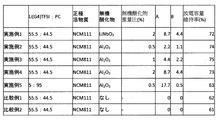
正極活物質に対する無機酸化物の重量比などを図2のようにした以外は実施例2と同様にした。
<Examples 3 to 5>
Example 2 was the same as Example 2 except that the weight ratio of the inorganic oxide to the positive electrode active material was as shown in FIG.
<比較例1>
正極活物質の表面を無機酸化物で被覆しなかったこと以外は、実施例1と同様にした。
<Comparative Example 1>
The same procedure as in Example 1 was performed, except that the surface of the positive electrode active material was not coated with an inorganic oxide.
<比較例2>
正極活物質の表面を無機酸化物で被覆しなかったこと以外は、実施例2と同様にした。
<Comparative Example 2>
Example 2 was repeated except that the surface of the positive electrode active material was not coated with an inorganic oxide.
<結果と考察>
図2に、実験例と結果を示す。実施例1〜4における二次電池1000の放電容量維持率は、比較例1〜2における二次電池1000の放電容量維持率より大きかった。以上の結果より、無機酸化物の組成や被覆方法には依存せずに、二次電池1000の放電容量維持率が向上し、その向上度合いは無機酸化物の重量比に依存することがわかった。
<Results and discussion>
FIG. 2 shows experimental examples and results. The discharge capacity maintenance rate of the
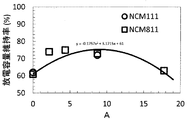
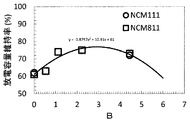
無機酸化物の重量比や非水電解液の組成が放電容量維持率へ及ぼす影響を以下の手順で検討した。放電容量維持率に対し、非水電解液に含まれる、酸化反応を起こして放電容量維持率を阻害する可能性のある主溶媒あるいは低粘度有機溶媒それぞれの濃度に対し、これら溶媒分子が正極活物質の活性サイトと衝突する頻度を表すパラメータとしての活物質重量に対する無機酸化物の重量比で規格化した。低粘度有機溶媒は、実施例及び比較例におけるPCとVCの和とした。 放電容量維持率のAに対する関係と、Bに対する関係をそれぞれ図3と図4に示す。 The influence of the weight ratio of the inorganic oxide and the composition of the non-aqueous electrolyte on the discharge capacity retention rate was examined by the following procedure. With respect to the discharge capacity retention rate, these solvent molecules are active in the positive electrode against the concentration of the main solvent or low-viscosity organic solvent contained in the non-aqueous electrolyte, which may cause an oxidation reaction and inhibit the discharge capacity retention rate. It was normalized by the weight ratio of the inorganic oxide to the active material weight as a parameter representing the frequency of collision with the active site of the material. The low-viscosity organic solvent was the sum of PC and VC in the examples and comparative examples. FIGS. 3 and 4 show the relationship between the discharge capacity retention ratio to A and the relationship to B, respectively.
[数1]
A=(正極100中の無機酸化物の重量/正極100中の正極活物質の重量)/(二次電池1000(正極100)中の主溶媒の重量)/(二次電池1000(正極100)中の非水電解液の重量)×100(%)
[Equation 1]
A = (weight of inorganic oxide in
[数2]
B=(正極100中の無機酸化物の重量/正極100中の正極活物質の重量)/(二次電池1000(正極100)中の低粘度有機溶媒の重量)/(二次電池1000(正極100)中の非水電解液の重量)×100(%)
[Equation 2]
B = (weight of inorganic oxide in
図3に示したように、Aが大きくなるにしたがって、放電容量維持率が高くなり、Aが9付近で極大値をとった後、減少に転じた。放電容量維持率のAに対する依存性は、主溶媒と低粘度有機溶媒の混合比に依らなかった。Aが小さい領域では、無機酸化物の重量比が小さい、あるいは、混合溶媒に対する主溶媒の重量比が大きくなることによって、酸化分解反応が促進されて放電容量維持率が低下したことが考えられる。一方、Aが大きな領域では、無機酸化物の重量比が大き過ぎたため、二次電池1000の内部抵抗が大きくなった、あるいは、他方の低粘度有機溶媒の混合溶媒に対する重量比が高くなって酸化分解反応が促進され、放電容量維持率が低下したことが考えられる。
As shown in FIG. 3, as A increased, the discharge capacity retention rate increased, and after A reached a maximum near 9, it began to decrease. The dependency of the discharge capacity retention rate on A did not depend on the mixing ratio of the main solvent and the low-viscosity organic solvent. In a region where A is small, the weight ratio of the inorganic oxide is small, or the weight ratio of the main solvent to the mixed solvent is large, which may promote the oxidative decomposition reaction and decrease the discharge capacity retention rate. On the other hand, in the region where A is large, the weight ratio of the inorganic oxide is too large, so that the internal resistance of the
放電容量維持率とAの関係は、非水電解液に含まれる主溶媒と低粘度有機溶媒の混合比に依らず、(放電容量維持率)=−0.1757A2+3.1715A+61となることがわかった。この関係式から、正極活物質表面へ無機酸化物を形成する効果が現れるAの範囲として、放電容量維持率が61%(比較例1)よりも高くなる0〜18.0%、放電容量維持率が65%以上となる1.4〜16.7%、放電容量維持率が70%以上となる3.6〜14.6%、がより望ましいことがわかった。 It can be seen that the relationship between the discharge capacity maintenance ratio and A is (discharge capacity maintenance ratio) = − 0.1757A 2 + 3.1715A + 61, regardless of the mixing ratio of the main solvent and the low-viscosity organic solvent contained in the non-aqueous electrolyte. It was. From this relational expression, as the range of A in which the effect of forming an inorganic oxide on the surface of the positive electrode active material appears, the discharge capacity retention rate is 0 to 18.0%, which is higher than 61% (Comparative Example 1), and the discharge capacity retention rate is It was found that 1.4 to 16.7%, which is 65% or more, and 3.6 to 14.6%, where the discharge capacity maintenance ratio is 70% or more, are more desirable.
図4に示したように、Bが大きくなるにしたがって、放電容量維持率が高くなり、Bが3付近で極大値をとった後、減少に転じた。Bが小さい領域では、無機酸化物の重量比が小さかった、あるいは、低粘度有機溶媒の混合溶媒に対する重量比が大きくなることによって、酸化分解反応が促進されて、放電容量維持率が低下したことが考えられる。一方、Bが大きな領域では、無機酸化物の重量比が大き過ぎたため、二次電池1000の内部抵抗が大きくなった、あるいは他方の主溶媒の混合溶媒に対する重量比が大きくなって酸化分解反応が促進され、放電容量維持率が低下したことが考えられる。
As shown in FIG. 4, as B increased, the discharge capacity retention rate increased, and after B reached a local maximum near 3, it began to decrease. In the region where B is small, the weight ratio of the inorganic oxide was small, or the weight ratio of the low-viscosity organic solvent to the mixed solvent was increased, which promoted the oxidative decomposition reaction and decreased the discharge capacity maintenance ratio Can be considered. On the other hand, in the region where B is large, since the weight ratio of the inorganic oxide is too large, the internal resistance of the
放電容量維持率とBの関係は、非水電解液に含まれる主溶媒と低粘度有機溶媒の混合比に依らず、(放電容量維持率)=−1.8757B2+10.91B+61なることがわかった。この関係式から、正極活物質表面へ無機酸化物を形成する効果が現れるBの範囲として、放電容量維持率が61%(比較例1)よりも高くなる0〜5.85%、放電容量維持率が65%以上となる0.4〜5.45%、放電容量維持率が70%以上となる0.95〜4.85%、がより望ましいことがわかった。 It was found that the relationship between the discharge capacity maintenance rate and B was (discharge capacity maintenance rate) = − 1.8757B 2 + 10.91B + 61, regardless of the mixing ratio of the main solvent and the low-viscosity organic solvent contained in the non-aqueous electrolyte. . From this relational expression, the range of B in which the effect of forming an inorganic oxide on the surface of the positive electrode active material appears as 0 to 5.85% in which the discharge capacity maintenance ratio is higher than 61% (Comparative Example 1), and the discharge capacity maintenance ratio is It was found that 0.4 to 5.45%, which is 65% or more, and 0.95 to 4.85%, where the discharge capacity maintenance ratio is 70% or more, are more desirable.
放電容量維持率が一定以上になるAとBそれぞれの範囲から、無機酸化物で被覆された正極活物質を有する二次電池1000の放電容量維持率を高めるための、非水電解液中の主溶媒と低粘度有機溶媒の混合比を導出することができる。
Mainly in the non-aqueous electrolyte to increase the discharge capacity maintenance rate of the
低粘度有機溶媒の重量に対する主溶媒の重量比(=主溶媒の重量/低粘度有機溶媒の重量)をα、αが取り得る最小値をα(MIN)、最大値α(MAX)とする。図3および図4より導出した関係式から、所定の放電容量維持率となるAとBの値を計算することができる。放電容量維持率とα(MIN)との関係は、(放電容量維持率)=−0.0514α(MIN)2+1.5923α(MIN)+61.688となる。放電容量維持率とα(MAX)との関係は、(放電容量維持率)=4.7031{Logα(MAX)}2−32.598{Logα(MAX)}+118.13となる。 The weight ratio of the main solvent to the weight of the low-viscosity organic solvent (= weight of the main solvent / weight of the low-viscosity organic solvent) is α, the minimum value α can take is α (MIN), and the maximum value α (MAX). From the relational expression derived from FIG. 3 and FIG. 4, the values of A and B that give a predetermined discharge capacity maintenance rate can be calculated. The relationship between the discharge capacity retention rate and α (MIN) is (discharge capacity retention rate) = − 0.0514α (MIN) 2 + 1.5923α (MIN) +61.688. The relationship between the discharge capacity retention rate and α (MAX) is (discharge capacity retention rate) = 4.7031 {Logα (MAX)} 2 −32.598 {Logα (MAX)} + 118.13.
以上より、αの範囲として、放電容量維持率が65%以上となる2.4×10⁻²〜3.9×10−0、放電容量維持率が70%以上となる6.5×10⁻²〜1.3×10−0、が望ましいことがわかった。 From the above, the range of α is 2.4 × 10 −2 to 3.9 × 10 −0 when the discharge capacity retention rate is 65% or more, and 6.5 × 10 −2 to 1.3 × 10 − when the discharge capacity retention rate is 70% or more. 0 was found to be desirable.
100 正極、110 正極合剤層、120 正極集電体、130 正極タブ部
200 負極、210 負極合剤層、220 負極集電体、230 負極タブ部
300 絶縁層、400 電極体、500 外装体
1000 二次電池
100 positive electrode, 110 positive electrode mixture layer, 120 positive electrode current collector, 130 positive electrode tab
200 negative electrode, 210 negative electrode mixture layer, 220 negative electrode current collector, 230 negative electrode tab
300 Insulating layer, 400 electrode body, 500 exterior body
1000 Secondary battery
Claims (10)
前記非水電解液は主溶媒を含み、
前記正極活物質の反応電位がリチウム基準で3.5V以上であり、
0<(前記無機酸化物の重量/前記正極活物質の重量)/(前記主溶媒の重量/前記非水電解液の重量)≦18%である正極スラリー。 Including positive electrode active material, inorganic oxide, non-aqueous electrolyte,
The non-aqueous electrolyte contains a main solvent,
The reaction potential of the positive electrode active material is 3.5 V or more based on lithium,
Positive electrode slurry in which 0 <(weight of the inorganic oxide / weight of the positive electrode active material) / (weight of the main solvent / weight of the non-aqueous electrolyte) ≦ 18%.
前記主溶媒はテトラグライムを含む正極スラリー。 In the positive electrode slurry of claim 1,
The main solvent is a positive electrode slurry containing tetraglyme.
前記非水電解液は低粘度有機溶媒を含み、
0<(前記無機酸化物の重量/前記正極活物質の重量)/(前記低粘度有機溶媒の重量/前記非水電解液の重量)≦5.85%である正極スラリー。 In the positive electrode slurry of claim 1,
The non-aqueous electrolyte contains a low viscosity organic solvent,
Positive electrode slurry in which 0 <(weight of the inorganic oxide / weight of the positive electrode active material) / (weight of the low-viscosity organic solvent / weight of the non-aqueous electrolyte) ≦ 5.85%.
前記低粘度有機溶媒はPCを含む正極スラリー。 In the positive electrode slurry of claim 3,
The low viscosity organic solvent is a positive electrode slurry containing PC.
前記無機酸化物はAl2O3を含む正極スラリー。 In the positive electrode slurry of claim 1,
The inorganic oxide is a positive electrode slurry containing Al 2 O 3 .
3.6<(前記無機酸化物の重量/前記正極活物質の重量)/(前記主溶媒の重量/前記非水電解液の重量)≦14.6%である正極スラリー。 In the positive electrode slurry of claim 1,
3.6 <(Weight of the inorganic oxide / Weight of the positive electrode active material) / (Weight of the main solvent / Weight of the non-aqueous electrolyte) ≦ 14.6%.
0.95<(前記無機酸化物の重量/前記正極活物質の重量)/(前記低粘度有機溶媒の重量/前記非水電解液の重量)≦4.85%である正極スラリー。 In the positive electrode slurry of claim 3,
Positive electrode slurry in which 0.95 <(weight of the inorganic oxide / weight of the positive electrode active material) / (weight of the low-viscosity organic solvent / weight of the non-aqueous electrolyte solution) ≦ 4.85%.
前記低粘度有機溶媒の重量に対する前記主溶媒の重量比は2.4×10⁻²〜3.9である正極スラリー。 In the positive electrode slurry of claim 3,
The positive electrode slurry in which the weight ratio of the main solvent to the weight of the low viscosity organic solvent is 2.4 × 10 −2 to 3.9.
Priority Applications (2)
| Application Number | Priority Date | Filing Date | Title |
|---|---|---|---|
| JP2018047449A JP2019160661A (en) | 2018-03-15 | 2018-03-15 | Positive electrode slurry, positive electrode, battery cell sheet, and secondary battery |
| PCT/JP2018/042854 WO2019176174A1 (en) | 2018-03-15 | 2018-11-20 | Positive electrode slurry, positive electrode, cell sheet, secondary battery |
Applications Claiming Priority (1)
| Application Number | Priority Date | Filing Date | Title |
|---|---|---|---|
| JP2018047449A JP2019160661A (en) | 2018-03-15 | 2018-03-15 | Positive electrode slurry, positive electrode, battery cell sheet, and secondary battery |
Publications (1)
| Publication Number | Publication Date |
|---|---|
| JP2019160661A true JP2019160661A (en) | 2019-09-19 |
Family
ID=67907042
Family Applications (1)
| Application Number | Title | Priority Date | Filing Date |
|---|---|---|---|
| JP2018047449A Pending JP2019160661A (en) | 2018-03-15 | 2018-03-15 | Positive electrode slurry, positive electrode, battery cell sheet, and secondary battery |
Country Status (2)
| Country | Link |
|---|---|
| JP (1) | JP2019160661A (en) |
| WO (1) | WO2019176174A1 (en) |
Cited By (2)
| Publication number | Priority date | Publication date | Assignee | Title |
|---|---|---|---|---|
| JP2020181808A (en) * | 2019-04-25 | 2020-11-05 | 株式会社日本触媒 | Positive electrode and battery with this positive electrode |
| WO2024095973A1 (en) * | 2022-10-31 | 2024-05-10 | 富士フイルム株式会社 | Slurry for nonaqueous electrolyte secondary batteries, nonaqueous electrolyte secondary battery, and method for producing nonaqueous electrolyte secondary battery |
Families Citing this family (1)
| Publication number | Priority date | Publication date | Assignee | Title |
|---|---|---|---|---|
| CN114023920B (en) * | 2021-11-01 | 2023-10-20 | 香港科技大学 | Layered positive electrode plate of lithium battery, preparation method and application |
Family Cites Families (4)
| Publication number | Priority date | Publication date | Assignee | Title |
|---|---|---|---|---|
| JPH06338348A (en) * | 1993-05-31 | 1994-12-06 | Nippon Telegr & Teleph Corp <Ntt> | Secondary battery having nonaqueous solvent electrolyte |
| US9287557B2 (en) * | 2011-01-07 | 2016-03-15 | Semiconductor Energy Laboratory Co., Ltd. | Method for manufacturing nonaqueous electrolyte secondary battery |
| KR101924989B1 (en) * | 2011-01-07 | 2018-12-04 | 가부시키가이샤 한도오따이 에네루기 켄큐쇼 | Method for manufacturing power storage device |
| JP6756634B2 (en) * | 2016-06-09 | 2020-09-16 | 東ソー・ファインケム株式会社 | Manufacturing method of positive electrode active material for lithium secondary battery and lithium secondary battery using it |
-
2018
- 2018-03-15 JP JP2018047449A patent/JP2019160661A/en active Pending
- 2018-11-20 WO PCT/JP2018/042854 patent/WO2019176174A1/en not_active Ceased
Cited By (3)
| Publication number | Priority date | Publication date | Assignee | Title |
|---|---|---|---|---|
| JP2020181808A (en) * | 2019-04-25 | 2020-11-05 | 株式会社日本触媒 | Positive electrode and battery with this positive electrode |
| JP7492348B2 (en) | 2019-04-25 | 2024-05-29 | 株式会社日本触媒 | Positive electrode and battery equipped with the positive electrode |
| WO2024095973A1 (en) * | 2022-10-31 | 2024-05-10 | 富士フイルム株式会社 | Slurry for nonaqueous electrolyte secondary batteries, nonaqueous electrolyte secondary battery, and method for producing nonaqueous electrolyte secondary battery |
Also Published As
| Publication number | Publication date |
|---|---|
| WO2019176174A1 (en) | 2019-09-19 |
Similar Documents
| Publication | Publication Date | Title |
|---|---|---|
| TWI686977B (en) | Semi-solid electrolyte layer, battery cell sheet and secondary battery | |
| WO2019234977A1 (en) | Semisolid electrolyte layer and secondary battery | |
| JP2020145054A (en) | Nonaqueous electrolyte solution, semisolid electrolyte layer, sheet for secondary battery and secondary battery | |
| JP6924264B2 (en) | Semi-solid electrolyte, semi-solid electrolyte, semi-solid electrolyte layer and secondary battery | |
| JP7553044B2 (en) | Non-aqueous electrolytes, semi-solid electrolyte layers, secondary battery sheets and secondary batteries | |
| WO2019176174A1 (en) | Positive electrode slurry, positive electrode, cell sheet, secondary battery | |
| WO2021111847A1 (en) | Non-aqueous electrolyte, semi-solid electrolyte layer, sheet for secondary battery, and secondary battery | |
| JP2016081692A (en) | ELECTROLYTE SOLUTION FOR LITHIUM SECONDARY BATTERY, ELECTROLYTE SOLUTION FOR LITHIUM SECONDARY BATTERY USING THE SAME, LITHIUM SECONDARY BATTERY | |
| WO2019225078A1 (en) | Insulating layer, battery cell sheet, and secondary battery | |
| CN110521049B (en) | Semi-solid electrolyte, electrode, electrode with semi-solid electrolyte layer, and secondary battery | |
| JP2020202158A (en) | Insulation layer, battery cell sheet, and battery cell | |
| JP2020004598A (en) | battery | |
| KR20210025103A (en) | Non-aqueous electrolyte, nonvolatile electrolyte, secondary battery | |
| EP3742530A1 (en) | Negative electrode, half secondary battery and secondary battery | |
| WO2019225077A1 (en) | Cell sheet and cell | |
| WO2020003864A1 (en) | Negative electrode, battery cell sheet, and secondary battery | |
| WO2019198329A1 (en) | Insulation layer, battery cell sheet, and battery |
Legal Events
| Date | Code | Title | Description |
|---|---|---|---|
| RD02 | Notification of acceptance of power of attorney |
Free format text: JAPANESE INTERMEDIATE CODE: A7422 Effective date: 20200121 |
|
| RD04 | Notification of resignation of power of attorney |
Free format text: JAPANESE INTERMEDIATE CODE: A7424 Effective date: 20200124 |