JP2017192577A - Ironing board - Google Patents
Ironing board Download PDFInfo
- Publication number
- JP2017192577A JP2017192577A JP2016084970A JP2016084970A JP2017192577A JP 2017192577 A JP2017192577 A JP 2017192577A JP 2016084970 A JP2016084970 A JP 2016084970A JP 2016084970 A JP2016084970 A JP 2016084970A JP 2017192577 A JP2017192577 A JP 2017192577A
- Authority
- JP
- Japan
- Prior art keywords
- support leg
- adjustment bar
- locking portion
- main body
- ironing board
- Prior art date
- Legal status (The legal status is an assumption and is not a legal conclusion. Google has not performed a legal analysis and makes no representation as to the accuracy of the status listed.)
- Granted
Links
Images

Classifications
-
- D—TEXTILES; PAPER
- D06—TREATMENT OF TEXTILES OR THE LIKE; LAUNDERING; FLEXIBLE MATERIALS NOT OTHERWISE PROVIDED FOR
- D06F—LAUNDERING, DRYING, IRONING, PRESSING OR FOLDING TEXTILE ARTICLES
- D06F81/00—Ironing boards
- D06F81/02—Ironing boards with collapsible underframe
-
- D—TEXTILES; PAPER
- D06—TREATMENT OF TEXTILES OR THE LIKE; LAUNDERING; FLEXIBLE MATERIALS NOT OTHERWISE PROVIDED FOR
- D06F—LAUNDERING, DRYING, IRONING, PRESSING OR FOLDING TEXTILE ARTICLES
- D06F81/00—Ironing boards
- D06F81/12—Sleeve boards; Attaching means therefor
Landscapes
- Engineering & Computer Science (AREA)
- Textile Engineering (AREA)
- Irons (AREA)
Abstract
Description
本発明は、衣服にアイロンがけを行う際に用いられるアイロン台に関する。 The present invention relates to an ironing board used when ironing clothes.
衣服にアイロンがけを行う際には、高温のアイロンによって衣服を平面に押し付けることで、シワやヨレを取り除くことができる。このように衣服を載置するための平面を有する器具として、アイロン台が一般的に用いられている。 When ironing clothes, wrinkles and twists can be removed by pressing the clothes against a flat surface with a hot iron. An ironing board is generally used as an instrument having a flat surface for placing clothes in this way.
アイロン台としては種々の形態のものがこれまでに実用化されている。例えば、比較的に床面に近い位置での使用を想定した短い脚を有する形式や、立位での使用を想定した長い脚を有する形式などが挙げられる。このうち、立位での使用を想定したアイロン台の一例として、下記特許文献1に記載されたものが知られている。
Various types of ironing boards have been put into practical use so far. For example, there are a type having a short leg that is assumed to be used at a position relatively close to the floor, and a type having a long leg that is assumed to be used in a standing position. Among these, what was described in the following
特許文献1に記載されたアイロン台は、衣服が載置される本体と、この本体の裏面に折り畳み可能に設けられ、互いに回動自在に交差する一対の脚体(第1脚体、第2脚体)と、を備えている。第1脚体の端部には掛止棒が設けられており、この掛止棒は、本体の裏面に取り付けられた掛止体の溝に係合する。掛止体には溝が複数形成されており、上記掛止棒はこれら複数の溝のうちの任意の一つに係合する。これにより、本体の高さを段階的に調節することができるとされている。
The ironing board described in
ところで、実際にアイロンがけを行う際には、アイロンの動きに応じて本体に様々な方向から力が加わる。このため、本体は脚体によって可能な限り安定的に支持されていることが望ましい。しかしながら、上記特許文献1に記載されたアイロン台では、力のかかる方向によっては、掛止棒と溝との係合が不用意に解除され、使用中にも関わらず脚体が折り畳まれてしまう虞がある。
また、上記特許文献1に記載されたアイロン台では、溝の数(ピッチ)に応じて掛止棒が係合する位置が決められており、本体の高さ位置を段階的にしか調整することができない。このため、使用者の姿勢や体格に応じたきめ細かな高さ調節ができないという課題もある。
By the way, when actually ironing, force is applied to the main body from various directions according to the movement of the iron. For this reason, it is desirable that the main body be supported as stably as possible by the legs. However, in the ironing board described in
Moreover, in the ironing board described in the said
本発明は上記課題を解決するためになされたものであって、より安定的に使用可能であるとともに、きめ細かい高さ調節が可能なアイロン台を提供することを目的とする。 The present invention has been made to solve the above problems, and an object of the present invention is to provide an ironing board that can be used more stably and can be finely adjusted in height.
本発明の第一の態様に係るアイロン台は、衣服が載置される載置面、及び床面に対向する下面を有する台本体と、前記下面から前記床面に向かう高さ方向に延びるとともに、一端が該下面に沿って延びる第一回動軸回りに回動可能な第一支持脚と、一端が前記下面に沿ってスライド可能に支持されるとともに、前記第一支持脚に交差した状態で接続され、該第一支持脚に対して前記第一回動軸に平行な第二回動軸回りに回動可能な第二支持脚と、前記第一支持脚及び前記第二支持脚の交差角度を調節する調節部と、を備え、前記調節部は、前記下面に沿って延びるとともに一端が前記第二支持脚に回動可能に支持された調節バーと、前記下面に設けられ、前記調節バーを前記下面に沿う方向における複数の異なる位置で係止可能な係止部と、を有し、前記調節バーには、該調節バーの前記高さ方向一方側から他方側に向かって凹没するとともに、該調節バーの延びる方向に配列された複数の第一溝部、及び前記調節バーの前記高さ方向他方側から一方側に向かって凹没するとともに、該調節バーの延びる方向に前記第一溝部よりも大きいピッチで配列された複数の第二溝部が形成され、前記係止部は、前記第一溝部と係合する第一係止部、及び該第一係止部と一体に形成されるとともに前記第二溝部と係合する第二係止部を有する。 The ironing board according to the first aspect of the present invention has a mounting surface on which clothes are placed and a base body having a lower surface facing the floor surface, and extends in a height direction from the lower surface toward the floor surface, A first support leg that is rotatable about a first rotation axis that extends along the lower surface and one end that is slidably supported along the lower surface, and that intersects the first support leg. A second support leg connected and rotatable about a second rotation axis parallel to the first rotation axis with respect to the first support leg; and an intersection of the first support leg and the second support leg An adjustment portion that adjusts an angle, the adjustment portion being provided on the lower surface, the adjustment bar extending along the lower surface and having one end rotatably supported by the second support leg, and the adjustment A locking part capable of locking the bar at a plurality of different positions in the direction along the lower surface; The adjustment bar includes a plurality of first grooves that are recessed from one side to the other side in the height direction of the adjustment bar and arranged in the extending direction of the adjustment bar, and the adjustment bar A plurality of second groove portions that are recessed from the other side in the height direction toward the one side and that are arranged at a larger pitch than the first groove portion in the extending direction of the adjustment bar, Includes a first locking portion that engages with the first groove portion, and a second locking portion that is formed integrally with the first locking portion and engages with the second groove portion.
この構成によれば、第一支持脚と第二支持脚との交差角度を変更することで台本体を所望の高さ位置とすることができる。さらに、第二支持脚に設けられた調節バーを、台本体に設けられた係止部によって係止することで、第二支持脚を第一支持脚に対して固定することができる。これにより、台本体を所望の高さ位置で維持することができる。加えて、係止部は、調節バー上の第一溝部に係合する第一係止部と、第二溝部に係合する第二係止部とを有している。これにより、例えば第一溝部及び第一係止部のみが設けられている場合に比べて、より強固に調節バーと係止部との係合を維持することができる。特に、台本体に加わった外力等によって第一係止部と第一溝部との係合が不用意に解除されて、調節バーが係止部に対して変位してしまった場合であっても、その変位の中途で第二係止部及び第二溝部が係合することで、調節バーと係止部とを再び係合させることができ、これ以上の変位を防止することができる。 According to this structure, a stand main body can be made into a desired height position by changing the crossing angle of a 1st support leg and a 2nd support leg. Furthermore, the second support leg can be fixed to the first support leg by locking the adjustment bar provided on the second support leg by the locking portion provided on the base body. Thereby, a base main body can be maintained in a desired height position. In addition, the locking portion has a first locking portion that engages with the first groove portion on the adjustment bar, and a second locking portion that engages with the second groove portion. Thereby, compared with the case where only a 1st groove part and a 1st latching part are provided, for example, engagement with an adjustment bar and a latching | locking part can be maintained more firmly. In particular, even when the engagement between the first locking portion and the first groove portion is inadvertently released by an external force applied to the base body and the adjustment bar is displaced with respect to the locking portion. Since the second locking portion and the second groove portion are engaged in the middle of the displacement, the adjustment bar and the locking portion can be engaged again, and further displacement can be prevented.
本発明の第二の態様に係るアイロン台では、前記係止部は、前記調節バーが挿通される孔部が形成されるとともに、前記第一回動軸と平行な第三回動軸回りに回動可能に設けられた係止部本体を有し、前記係止部本体には、該係止部本体を前記第三回転軸回りに回転するように付勢する付勢部が設けられ、前記係止部本体は、前記孔部の貫通方向と前記調節バーの延びる方向とが一致する第一位置と、前記貫通方向と前記調節バーの延びる方向とが互いに交差する第二位置との間で回動可能であり、前記付勢部は、前記係止部本体を前記第一位置から第二位置に向かう方向に付勢していてもよい。 In the ironing board according to the second aspect of the present invention, the locking portion is formed with a hole through which the adjustment bar is inserted, and is rotated around a third rotation axis parallel to the first rotation axis. A locking portion main body provided movably, and the locking portion main body is provided with a biasing portion that biases the locking portion main body to rotate about the third rotation axis; The locking portion main body is between a first position where the penetrating direction of the hole and the extending direction of the adjusting bar coincide with each other and a second position where the penetrating direction and the extending direction of the adjusting bar intersect each other. The biasing part may bias the locking part body in a direction from the first position toward the second position.
この構成によれば、係止部本体は第三回動軸回りに沿って、第一位置と第二位置との間で回動可能とされている。第一位置では、係止部本体の孔部の貫通方向と調節バーの延びる方向とが一致しているため、当該調節バーは係止部本体に対して相対変位可能となる。一方で、第二位置では、孔部の貫通方向と調節バーの延びる方向とが互いに交差した状態となる。つまり、孔部の端縁が調節バーに当接した状態となる。すなわち、調節バーに係止部本体が係合した状態となる。このように、係止部本体を第三回動軸回りに回動させることのみによって、容易に調節バーと係止部本体とを係合させたり、その係合を解除したりすることができる。
加えて、付勢部によって係止部本体が上記第二位置に向かって付勢されていることから、付勢部以外による外力を加えることなく、係止部本体と調節バーとの係合状態を維持することができる。
According to this configuration, the locking portion main body is rotatable between the first position and the second position around the third rotation axis. At the first position, the direction in which the hole of the locking portion main body passes and the direction in which the adjustment bar extends match, so that the adjustment bar can be displaced relative to the locking portion main body. On the other hand, in the second position, the penetration direction of the hole and the extending direction of the adjustment bar intersect each other. That is, the edge of the hole is in contact with the adjustment bar. That is, the lock body is engaged with the adjustment bar. In this way, the adjustment bar and the engaging portion main body can be easily engaged with each other and released from the engagement only by rotating the engaging portion main body about the third rotation axis. .
In addition, since the engaging portion main body is urged toward the second position by the urging portion, the engaging portion main body and the adjustment bar are engaged without applying an external force other than the urging portion. Can be maintained.
本発明の第三の態様に係るアイロン台では、前記第二溝部は、前記第一溝部よりも前記高さ方向に大きく凹没していてもよい。 In the ironing board which concerns on the 3rd aspect of this invention, the said 2nd groove part may be dented largely in the said height direction rather than the said 1st groove part.
この構成によれば、第二溝部が第一溝部よりも高さ方向に大きく凹没している。したがって、第一溝部と第一係止部との係合が不用意に解除された場合であっても、第二係止部を第二溝部に対して、さらに強固に係合させることができる。これにより、調節バーと係止部との係合を安定的に維持することができる。 According to this structure, the 2nd groove part is greatly dented in the height direction rather than the 1st groove part. Therefore, even when the engagement between the first groove portion and the first locking portion is inadvertently released, the second locking portion can be more firmly engaged with the second groove portion. . Thereby, engagement with an adjustment bar and a latching | locking part can be maintained stably.
本発明の第四の態様に係るアイロン台は、前記第一回動軸の延びる方向に配列された一対の前記調節部を有してもよい。 The ironing board which concerns on the 4th aspect of this invention may have a pair of said adjustment part arranged in the direction where said 1st rotating shaft is extended.
この構成によれば、調節部が一対設けられていることから、例えば当該調節部が一つのみ設けられている場合に比べて、より安定的に台本体の高さ位置を維持することができる。 According to this configuration, since a pair of adjusting portions is provided, for example, the height position of the base body can be maintained more stably than when only one adjusting portion is provided. .
本発明の第五の態様に係るアイロン台では、前記台本体は、前記載置面に直交する方向から見て、長軸方向に延びる一対の長辺部、及び該長軸と直交する短軸方向に延びる一対の短辺部を有し、前記一対の長辺部には、前記短軸方向の中央側に向かって凹没するくびれ部がそれぞれ形成され、少なくとも一方の前記短辺部を含む端部には、前記くびれ部から該短辺部に向かうにしたがって、前記台本体の前記短軸方向における寸法が次第に縮小する絞り部が形成されていてもよい。 In the ironing board which concerns on the 5th aspect of this invention, the said base main body sees from the direction orthogonal to the said mounting surface, A pair of long side part extended in a major axis direction, and the short-axis direction orthogonal to this major axis Each of the pair of long sides is formed with a constricted portion that is recessed toward the center in the short axis direction, and includes at least one of the short sides. The portion may be formed with a throttle portion in which the dimension of the base body gradually decreases in the short axis direction from the constricted portion toward the short side portion.
この構成では、台本体の長辺部にくびれ部が形成されているとともに、台本体の少なくとも一方の端部に絞り部が形成されている。したがって、アイロン台を用いて一般的なワイシャツにアイロンがけを施す場合、ワイシャツの前身頃(又は後身頃)のチェストからウエストにかけての曲線部をくびれ部に沿わせるとともに、ワイシャツのアームホール部分を絞り部に沿わせるように載置することができる。これにより、台本体の載置面上で、ワイシャツに不用意なシワやたるみを生じさせることなく、アイロンがけを施すことができる。一方で、台本体が直線状、又は単純な曲線状の辺部のみによって構成されている場合には、上述したワイシャツの曲線部やアームホール部分が台本体の辺部にフィットしないため、その周辺にシワやたるみが生じてしまい、満足の行く仕上がりが得られない可能性がある。 In this configuration, a constricted portion is formed on the long side portion of the base body, and a throttle portion is formed on at least one end of the base body. Therefore, when ironing a general shirt using an ironing board, the curved portion from the chest of the front body (or the back body) of the shirt to the waist is placed along the constricted portion, and the armhole portion of the shirt is used as the throttle portion. It can be placed so that it follows. Thereby, ironing can be performed on the placement surface of the base body without causing inadvertent wrinkles or sagging in the shirt. On the other hand, if the base body is composed only of straight or simple curved sides, the curved and armhole portions of the shirt described above do not fit the sides of the base body. Wrinkles and sagging may occur, and a satisfactory finish may not be obtained.
本発明の第六の態様に係るアイロン台は、衣服の筒状部に挿通可能な仕上げ馬本体と、該仕上げ馬本体に設けられた馬支持脚と、を有する仕上げ馬をさらに備え、前記台本体は、前記短辺部に隣接して設けられ、前記馬支持脚の一端を着脱可能に支持する固定部、及び前記仕上げ馬が収容される収容部を有し、前記仕上げ馬が前記収容部に収容された状態で、前記仕上げ馬の上面と、前記載置面とが互いに同じ方向を向いていてもよい。 The ironing board according to the sixth aspect of the present invention further includes a finishing horse having a finishing horse body that can be inserted into the tubular portion of the garment, and a horse support leg provided on the finishing horse body. Is provided adjacent to the short side portion, and has a fixing portion that detachably supports one end of the horse support leg, and a storage portion that stores the finishing horse, and the finishing horse is in the storage portion. In the accommodated state, the upper surface of the finishing horse and the mounting surface may face the same direction.
この構成によれば、仕上げ馬が設けられていることで、例えばワイシャツやジャケット等の袖部分(筒状部)に容易にアイロンがけを施すことができる。具体的には、仕上げ馬本体を、衣服の筒状部に挿通させることで、筒状部の全周にわたって十分なアイロンがけを施すことができる。
さらに、台本体にはこの仕上げ馬を収容するための収容部が設けられていることから、仕上げ馬を使用しない場合には、これを台本体とともに収容・管理することができる。加えて、仕上げ馬が収容部に収容されている状態では、仕上げ馬の上面と載置面とが互いに同じ方向を向いていることから、載置面に加えて仕上げ馬本体をもアイロンがけ時に使用することができる。つまり、仕上げ馬本体を載置面の延長部分として使用することができる。これにより、例えば通常よりも大型長尺の衣服等に対しても安定してアイロンがけを施すことができる。
According to this configuration, by providing the finishing horse, for example, a sleeve portion (tubular portion) of a shirt or a jacket can be easily ironed. Specifically, sufficient ironing can be applied over the entire circumference of the tubular portion by inserting the finished horse body through the tubular portion of the clothes.
Furthermore, since the base body is provided with a storage portion for storing the finishing horse, it can be stored and managed together with the base body when the finishing horse is not used. In addition, when the finishing horse is housed in the housing section, the upper surface of the finishing horse and the mounting surface are facing the same direction. Can be used. That is, the finished horse body can be used as an extension of the placement surface. Thereby, for example, ironing can be stably applied to clothes that are longer than usual.
本発明の第七の態様に係るアイロン台では、前記台本体に設けられて、該台本体に対してスライド可能に支持される支持部と、該支持部と一体に設けられ、物品を載置可能な載置部と、を有してもよい。 In the ironing board which concerns on the 7th aspect of this invention, it is provided in the said base main body, and the support part supported so that a slide with respect to this base main body is provided integrally with this support part, and can mount an article | item. A mounting portion.
この構成によれば、載置部が設けられていることにより、例えばアイロンがけ中にアイロンを載置部上に一時的に置くことができる。さらに、支持部は台本体に対してスライド可能であることから、アイロン台の不使用時には、支持部を台本体側にスライドさせて収納することができる。これにより、アイロン台の寸法体格を小さく抑えることができる。 According to this configuration, by providing the placement portion, for example, an iron can be temporarily placed on the placement portion during ironing. Furthermore, since the support portion is slidable with respect to the base body, when the ironing board is not used, the support portion can be slid to the base body side and stored. Thereby, the dimension physique of an ironing board can be restrained small.
本発明によれば、より安定的に使用可能であるとともに、きめ細かい高さ調節が可能なアイロン台を提供することができる。 ADVANTAGE OF THE INVENTION According to this invention, while being able to be used more stably, the ironing board in which fine height adjustment is possible can be provided.
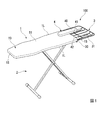
本発明の実施形態に係るアイロン台100について図面を参照して説明する。図1に示すように、本実施形態に係るアイロン台100は、衣服等が載置される台本体1と、台本体1を床面上で支持する脚部2と、を備えている。
An
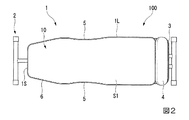
台本体1は、水平面内に広がる板状をなしている。より具体的には、台本体1は、主部10と、フレーム11(図3参照)と、アイロン置き3と、仕上げ馬4と、を有している。主部10は上方から見て略長方形状をなしている。なお、以降の説明では、主部10の長辺(長辺部1L)が延びる方向を長軸方向と呼び、短辺(短辺部1S)が延びる方向を短軸方向と呼ぶ。さらに、これら長軸方向及び短軸方向に直交する方向を高さ方向と呼ぶ。
The
主部10は、例えばメッシュ状に形成された骨組みの上に、ポリエステル繊維等で形成されたクッション材と布等の被覆材をかぶせることで形成されている。すなわち、主部10の形状は、上記の骨組みによって適宜に決定される。主部10の上側の面は、衣服等を載置するための載置面S1とされている。載置面S1は、可能な限り平滑かつ平坦に形成されている。
The
本実施形態では、載置面S1(主部10)は以下のような形状に形成されている。すなわち、図2に示すように、平面視で載置面S1の長辺部1Lの一部には、短軸方向の中央側に向かって凹没するくびれ部5がそれぞれ形成されている。各くびれ部5は、短軸方向の一方側から他方側に向かって曲面状に湾曲している。具体的には、くびれ部5の湾曲形状は、一般的なワイシャツの前身頃(又は後身頃)のチェストからウエストにかけての曲線形状に対応した形状であることが望ましい。また、これらくびれ部5は、いずれも各長辺部1Lにおける長軸方向の略中央に設けられている。
In the present embodiment, the placement surface S1 (main portion 10) is formed in the following shape. That is, as shown in FIG. 2, a
載置面S1の短辺部1Sを含む一方側の端部は、長軸方向一方側に向かうにしたがって次第に先細りに形成されることで、絞り部6とされている。より具体的には、絞り部6では、上記のくびれ部5側から当該短辺部1S側に向かうにしたがって、短軸方向における寸法が次第に縮小している。すなわち、絞り部6の端縁は、長辺部1Lの残余の部分に対して斜めに交差する方向に延びている。絞り部6における絞りの度合い(すなわち、絞り部6の端縁と長軸方向との交差角度)は、一般的なワイシャツのアームホール部分の形状に対応していることが望ましい。
One end portion including the
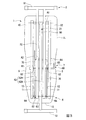
さらに、この載置面S1とは反対側の面(すなわち、下側の面)は、床面と対向する下面S2とされている。図3に示すように、下面S2には一対のフレーム11が取り付けられている。これらフレーム11は、上記の短軸方向に間隔をあけて設けられている。それぞれのフレーム11は、長軸方向に直線状に延びている。長軸方向から見た場合、このフレーム11はC字型の断面形状を有している。すなわち、フレーム11の内側には溝(案内溝12)が形成されている。この案内溝12には、後述する脚部2(第二支持脚22)の端部が収容される。
Furthermore, the surface opposite to the mounting surface S1 (that is, the lower surface) is a lower surface S2 that faces the floor surface. As shown in FIG. 3, a pair of
再び図1を参照して、台本体1には、アイロン等の物品を一時的に載置するためのアイロン置き3と、衣服の袖等にアイロンがけを施す際に用いられる仕上げ馬4と、が設けられている。アイロン置き3は、台本体1のフレーム11に取り付けられた支持部30と、アイロンを支持する載置部31と、を有している。支持部30は、フレーム11の案内溝12に沿ってスライド可能とされている。載置部31はおおむねカゴ状をなしている。載置部31と支持部30はともに金属製の線材等によって一体に形成されている。
Referring to FIG. 1 again, the
仕上げ馬4は、台本体1と同様にメッシュ状の骨組み、及びこれを外側から覆う被覆材によって構成された仕上げ馬本体40と、馬支持脚41と、を有している。仕上げ馬本体40は、平面視で長方形状をなすとともに、上記台本体1よりも小さな面積を有している。また、仕上げ馬本体40の長辺の寸法は、台本体1の短辺部1Sの寸法とおおむね同一とされている。さらに、仕上げ馬本体40の下側の面には、馬支持脚41が設けられている。馬支持脚41は柱状をなすとともに、その一端が仕上げ馬本体40の下側の面に対して回動可能に支持されている。より具体的には、馬支持脚41は、仕上げ馬本体40の下側の面に沿った状態と、当該下側の面に直交した状態との間で回動自在とされている。
The finishing horse 4 has a mesh-like framework similar to the
台本体1の短辺部1S上(上記の絞り部6とは反対側の短辺部1S)には、馬支持脚41を介して仕上げ馬4を着脱可能に支持するための固定部42が設けられている。一例として、固定部42は馬支持脚41の端部が挿通可能な筒状をなしている。仕上げ馬4を使用する場合には、馬支持脚41の端部を固定部42に挿通させることで、台本体1よりも上方の位置で当該仕上げ馬4が支持される。一方で、仕上げ馬4を使用しない場合には、台本体1に設けられた収容部にこれを収容する。収容部は、上記のアイロン置き3と同様にカゴ状をなすとともに、フレーム11によって支持されている。仕上げ馬4を収容部に収容した状態においては、仕上げ馬本体40と台本体1の短辺部1Sとが互いに隙間なく当接している。なお、図3では、簡略化のため、上記のアイロン置き3及び仕上げ馬4を省略している。
A fixing
続いて、脚部2の構成について、図3から図5を参照して説明する。脚部2は、互いに交差する一対の支持脚(第一支持脚21、第二支持脚22)と、台本体1の高さを調節するための調節部7と、を有している。
Then, the structure of the
第一支持脚21は、柱状の第一支持脚本体50と、第一支持脚本体50の床面側の端部に一体に取り付けられた接地部51と、を有している。第一支持脚本体50は、断面矩形状の角パイプによって形成されている。第一支持脚本体50は、上記の短軸方向に平行に延びる第一回動軸A1を介して下面S2に取り付けられている。すなわち、第一支持脚21は、この第一回動軸A1回りに回動可能とされている。第一支持脚21の延在中途の位置には、後述する第二支持脚22を第一支持脚21と連結するための第二回動軸A2が設けられている。この第二回動軸A2も、上記第一回動軸A1と同様に、短軸方向に対して平行に延びている。接地部51は、短軸方向に延びる棒状をなしている。すなわち、接地部51は、第一支持脚本体50に対して直交している。この接地部51は、後述する第二支持脚22における接地部61と同様に、床面に当接することでアイロン台100を下方から支持する。
The
第二支持脚22は、第二支持脚本体60と、スライド軸62と、上記接地部51と同様の接地部61と、を有している。第二支持脚本体60は、互いに間隔をあけて平行に配置された一対の第二支持脚半体62Hを有している。これら第二支持脚半体62Hは互いに同等の寸法形状を有している。具体的には、それぞれの第二支持脚半体62Hは、第一支持脚本体50と同様の角パイプによって形成されている。第二支持脚半体62Hの延在中途の位置には、上記の第二回動軸A2が挿通される。より具体的には、第二支持脚半体62H同士の間の間隙に第一支持脚本体50が挟み込まれた状態で、第二回動軸A2によって第一支持脚本体50と第二支持脚本体60とが互いに連結される。つまり、この第二回動軸A2を中心として、第一支持脚本体50と第二支持脚本体60とが互いに回動可能に接続されている。
The
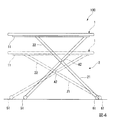
第二支持脚本体60の一端は、スライド軸62を介して台本体1の下面S2に取り付けられている。スライド軸62は、第二支持脚本体60の下面S2側の端部に設けられ、短軸方向に延びる軸本体63と、この軸本体63の短軸方向両側の端部に設けられた一対のローラ64と、を有している。各ローラ64は、軸本体63回りに回動自在とされている。また、各ローラ64は、上述したフレーム11の案内溝12内に係合した状態で収容される。すなわち、第二支持脚本体60は、上記の第二回動軸A2を中心として第一支持脚21に対して相対的に回転するとともに、これらローラ64を介して台本体1の下面S2に対してスライド可能に支持されている。これにより、側方から見た場合における第一支持脚21と第二支持脚22との交差角度(つまり、台本体1の高さ方向における位置)が自在に調節可能となっている(図4参照)。
One end of the second support leg main body 60 is attached to the lower surface S <b> 2 of the base
調節部7は、台本体1を任意の高さ位置に調節・固定するために設けられている。調節部7は、第二支持脚22(スライド軸62)に取り付けられた調節バー70と、下面S2に設けられた係止部80と、を有している。調節バー70は、長軸方向に延びる板状をなしている。より詳細には、スライド軸62に取り付けられた状態において、調節バー70の厚さ方向は、上記の短軸方向と一致している。調節バー70の一端は、第二支持脚本体60の一部に対して回動可能に取り付けられている。
The adjusting
図5に示すように、調節バー70の高さ方向一方側(上側)の端縁には、当該調節バー70の延びる方向に配列された複数の溝(第一溝部71)が形成されている。これら第一溝部71はおおむね隙間なく配列されている。各第一溝部71は、調節バー70の上側の端縁から下側に向かって高さ方向に凹没している。一方で、調節バー70の高さ方向他方側(下側)の端縁には、当該調節バー70の延びる方向に等間隔をあけて配列された複数の第二溝部72が形成されている。本実施形態では、各第二溝部72は、高さ方向他方側から一方側に向かって円弧状に凹没している。互いに隣接する一対の第二溝部72同士の間の間隔(ピッチ)は、上記第一溝部71のピッチよりも大きい。言い換えれば、第二溝部72の設けられる数は、第一溝部71の設けられる数よりも少ない。さらに、第二溝部72は第一溝部71よりも高さ方向に大きく凹没している。
As shown in FIG. 5, a plurality of grooves (first groove portions 71) arranged in the extending direction of the
さらに、調節バー70の他端(スライド軸62とは反対側に位置する端部)を含む部分では、高さ方向における寸法が、他の部分よりも小さく設定されている。具体的には、当該端部には、長軸方向に延びる切欠きRが形成されている。切欠きRの端面には、上記の第一溝部71は形成されていない。
Furthermore, in the portion including the other end of the adjustment bar 70 (the end located on the side opposite to the slide shaft 62), the dimension in the height direction is set smaller than the other portions. Specifically, a notch R extending in the major axis direction is formed at the end. The
再び図3に示すように、本実施形態に係る係止部80は、一対の係止部本体82を有している。これら一対の係止部本体82は、フレーム11同士の間に架け渡された調節軸81に取り付けられている。調節軸81は、短軸方向と平行をなす第三回動軸A3方向に延びる棒状をなしている。調節軸81の両端部は、フレーム11に形成された孔にそれぞれ挿通されている。調節軸81は、フレーム11に取り付けられた状態において、上記の調節バー70と直交している。調節軸81の短軸方向一方側の端部には、当該調節軸81を操作する際に用いるハンドル84が設けられている。
As shown in FIG. 3 again, the locking
係止部本体82は、調節軸81における調節バー70と交差する位置に設けられている。詳しくは図5に示すように、係止部本体82は、略板状をなすとともに、その中央部には調節バー70が挿通可能な矩形の孔(孔部H)が形成されている。孔部Hは、調節バー70の断面形状よりも十分に大きな開孔面積を有している。特に、高さ方向における孔部Hの寸法は、高さ方向における調節バー70の寸法よりも十分に大きく設定されている。なお、詳しくは後述するが、孔部Hの高さ方向一方側の端縁は、上記第一溝部71に係合する第一係止部H1とされている。孔部Hの高さ方向他方側の端縁は、上記第二溝部72と係合する第二係止部H2とされている。
The locking portion
以上のように構成された係止部本体82は、第三回動軸A3回りに回動することで、第一位置P1と第二位置P2との間で動くことが可能とされている。より詳細には、図5中の実線で示すように、第一位置P1では、係止部本体82は、下面S2に対して直交した姿勢となる。すなわち、孔部Hの貫通方向と調節バー70の延びる方向とが互いに一致した状態となる。このとき、孔部Hの高さ方向両側の端縁(上記の第一係止部H1、及び第二係止部H2)は、調節バー70の高さ方向両側の端縁と離間している。すなわち、調節バー70は係止部本体82に対して、上記の長軸方向に自在に変位できる状態となる。
The locking portion
一方で、図5中の鎖線で示すように、第二位置P2では、係止部本体82は、下面S2に対して直交することなく傾斜した姿勢となる。すなわち、孔部Hの貫通方向と調節バー70の延びる方向とが互いに交差した状態となる。このとき、第一係止部H1及び第二係止部H2のうち、少なくとも第一係止部H1は調節バー70上の任意の第一溝部71に係合する。すなわち、係止部80は、調節バー70を下面S2に沿う方向における複数の異なる位置で係止することができる。
On the other hand, as shown by the chain line in FIG. 5, at the second position P2, the locking portion
さらに、一対の係止部本体82のうち、一方の係止部本体82(上記のハンドル84が設けられる側の係止部本体82)には、当該係止部本体82を付勢する付勢部83が設けられている。付勢部83は、調節軸81の外周に巻き付けられたねじりばね(トーションばね)である。付勢部83は、上記の係止部本体82を、第三回動軸A3回りに回転するように付勢している。より具体的には、付勢部83は、係止部本体82を第一位置P1から第二位置P2に向かう方向に付勢している。すなわち、付勢部83に対して外力が加えられていない状態においては、係止部本体82は第二位置P2で固定されている。一方で、付勢部83の弾性力に抗して調節軸81を回動させた場合(すなわち、上記のハンドル84を下面S2方向に押し付けるように操作した場合)、係止部本体82は、第一位置P1から第二位置P2に向かって回動し、第一係止部H1と第一溝部71との係合が解除される。
Further, of the pair of locking portion
ここで、上述のように調節バー70は長軸方向における第二支持脚22の上端の位置に応じて長軸方向に変位可能とされている。したがって、係止部80が調節バー70を任意の位置で係止することで、第二支持脚22が台本体1に対して一時的に固定された状態となる。すなわち、第一支持脚21に対する第二支持脚22の交差角度が一時的に固定される。このように第一支持脚21と第二支持脚22との交差角度を変更することで、図3で示したように、台本体1の高さ方向における位置が調節される。具体的には、アイロン台100の使用者は、上記のハンドル84を下面S2側に押し付けるように回動・把持した状態で、台本体1を所望の位置にまで昇降させる。その後、ハンドル84から手を離すことで、当該位置で台本体1の高さが固定される。
Here, as described above, the
以上説明したように、本実施形態に係るアイロン台100では、第一支持脚21と第二支持脚22との交差角度を変更することで台本体1を所望の高さ位置とすることができる。さらに、第二支持脚22に設けられた調節バー70を、台本体1に設けられた係止部80によって係止することで、第二支持脚22を第一支持脚21に対して固定することができる。これにより、台本体1を所望の高さ位置で維持することができる。
As described above, in the
加えて、調節バー70には、複数の第一溝部71が隙間なく形成されていることから、係止部80と調節バー70との係合位置を、実質的に無段階に変更することができる。つまり、使用者の体格や姿勢に応じて、アイロン台100の高さ位置をきめ細かく調節することができる。
In addition, since the plurality of
さらに加えて、係止部80は、調節バー70上の第一溝部71に係合する第一係止部H1と、第二溝部72に係合する第二係止部H2とを有している。これにより、例えば第一溝部71及び第一係止部H1のみが設けられている場合に比べて、より強固に調節バー70と係止部80との係合を維持することができる。特に、台本体1に加わった外力等によって第一係止部H1と第一溝部71との係合が不用意に解除されて、調節バー70が係止部80に対して変位してしまった場合であっても、その変位の中途で第二係止部H2及び第二溝部72が係合するため、調節バー70と係止部80とを再び係合させることができる。これにより、アイロン台100をより安定的に使用することができる。
In addition, the locking
また、上記の構成によれば、係止部本体82は第三回動軸A3回りに沿って、第一位置P1と第二位置P2との間で回動可能とされている。第一位置P1では、係止部本体82の孔部Hの貫通方向と調節バー70の延びる方向とが一致しているため、当該調節バー70は係止部本体82に対して相対変位可能となる。一方で、第二位置P2では、孔部Hの貫通方向と調節バー70の延びる方向とが互いに交差した状態となる。つまり、孔部Hの端縁が調節バー70に当接した状態となる。すなわち、調節バー70に係止部本体82が係合した状態となる。このように、係止部本体82を第三回動軸A3回りに回動させることのみによって、容易に調節バー70と係止部本体82とを係合させたり、その係合を解除したりすることができる。
加えて、付勢部83によって係止部本体82が上記第二位置P2に向かって付勢されていることから、付勢部83以外による外力を加えることなく、係止部本体82と調節バー70との係合状態を維持することができる。
Moreover, according to said structure, the latching | locking part
In addition, since the locking portion
加えて、上記の構成によれば、第二溝部72が第一溝部71よりも高さ方向に大きく凹没している。したがって、第一溝部71と第一係止部H1との係合が不用意に解除された場合であっても、第二係止部H2を第二溝部72に対して、さらに強固に係合させることができる。これにより、調節バー70と係止部80との係合を安定的に維持することができる。特に、第一溝部71は調節バー70の高さ方向一方側(上側)に形成されている。ここで、アイロンの動作等に応じて台本体1には上方から力が加わる。上記の構成では、このような上方からの力が大きくなるにしたがって、係止部本体82(第一係止部H1)には下方に向かう力が加わる。つまり、第一係止部H1を第一溝部71に対して、より強固に係合させることができる。
In addition, according to the above configuration, the
さらに加えて、上記の構成によれば、調節バー70の他端を含む部分の高さ方向における寸法が、他の部分よりも小さく設定されている(切欠きRが形成されている)ことから、当該切欠きRでは係止部80との係合がなされないようになっている。ここで、調節バー70と係止部80との係合位置が該調節バー70の端部(他端)に近くなるほど、第一支持脚21と第二支持脚22との交差角度が大きくなる。交差角度が大きい場合、アイロンの動き等に応じて台本体1に上方から加わった力は、調節バー70の延びる方向に沿う成分(分力)をより多く含むようになる。この分力が大きくなると、係止部80と調節バー70とが相対移動しようとするため、係止部80が調節バー70に対して滑ってしまい、両者の係合が解除されてしまう虞がある。しかしながら、上記の構成によれば、他端を含む部分では係止部80による係合が得られないようになっていることから、上記のように不安定な状態でアイロン台100が使用されてしまうリスクを低減することができる。
In addition, according to the above configuration, the dimension in the height direction of the portion including the other end of the
また、上記の構成によれば、調節部7が一対設けられていることから、例えば当該調節部7が一つのみ設けられている場合に比べて、より安定的に台本体1の高さ位置を維持することができる。
Moreover, according to said structure, since the
さらに、上記の構成では、台本体1の長辺部1Lにくびれ部5が形成されているとともに、台本体1の少なくとも一方の端部に絞り部6が形成されている。したがって、アイロン台100を用いて一般的なワイシャツにアイロンがけを施す場合、ワイシャツの前身頃(又は後身頃)のチェストからウエストにかけての曲線部をくびれ部5に沿わせるとともに、ワイシャツのアームホール部分を絞り部6に沿わせるように載置することができる。これにより、台本体1の載置面S1上で、ワイシャツに不用意なシワやたるみを生じさせることなく、アイロンがけを施すことができる。一方で、台本体1が直線状、又は単純な曲線状の辺部のみによって構成されている場合には、上述したワイシャツの曲線部やアームホール部分が台本体1の辺部にフィットしないため、その周辺にシワやたるみが生じてしまい、満足の行く仕上がりが得られない可能性がある。
Further, in the above configuration, the
加えて、上記の構成によれば、仕上げ馬4が設けられていることで、例えばワイシャツやジャケット等の袖部分(筒状部)に容易にアイロンがけを施すことができる。具体的には、仕上げ馬本体40を、筒状部の内側に挿通させることで、筒状部の全周にわたって十分なアイロンがけを施すことができる。
さらに、台本体1にはこの仕上げ馬4を収容するための収容部が設けられていることから、仕上げ馬4を使用しない場合であっても、これを台本体1とともに収容・管理することができる。また、仕上げ馬4が収容部に収容されている状態では、台本体1の短辺部1Sと仕上げ馬本体40とが互いに隙間なく当接しているとともに、仕上げ馬40の上面と載置面S1とが互いに同じ方向を向いている(同一の面上に広がっている)ことから、載置面S1に加えて仕上げ馬本体40をもアイロンがけ時に使用することができる。つまり、仕上げ馬本体40を載置面S1の延長部分として使用することができる。これにより、例えば通常よりも大型長尺の衣服等に対しても安定してアイロンがけを施すことができる。
In addition, according to the above configuration, the finishing horse 4 is provided, so that for example, a sleeve portion (tubular portion) such as a shirt or a jacket can be easily ironed. Specifically, sufficient ironing can be performed over the entire circumference of the tubular portion by inserting the finishing
Furthermore, since the
さらに、上記の構成によれば、アイロン置き3が設けられていることにより、例えばアイロンがけ中にアイロンを一時的に置いておくことができる。さらに、アイロン置き3の支持部30は台本体1に対してスライド可能であることから、アイロン台100の不使用時には、アイロン置き3全体を台本体1側にスライドさせて収納することができる。これにより、アイロン台100の保管時の寸法体格を小さく抑えることができる。
Furthermore, according to said structure, the
以上、本発明の実施形態について図面を参照して説明した。なお、本発明の要旨を逸脱しない限りにおいて、上記の構成に種々の変更を加えることが可能である。例えば、上述のアイロン置き3、及び仕上げ馬4を備えない構成を採ることも可能である。
また、上記実施形態では、台本体1の構成として、メッシュ状の骨組みに被覆材をかぶせる構成を例にとって説明したが、台本体1を構成するに当たってはこれまでに実用化されている他の構成や材料を採用することも可能である。
The embodiments of the present invention have been described above with reference to the drawings. Various modifications can be made to the above configuration without departing from the gist of the present invention. For example, it is possible to adopt a configuration that does not include the
Moreover, in the said embodiment, although demonstrated as an example the structure which covers a mesh-like frame | frame with a coating | covering material as a structure of the
さらに、上記実施形態では、第二溝部72が、高さ方向他方側から一方側に向かって円弧状に凹没している例について説明した。しかしながら、第二溝部72の形状は上記実施形態によっては限定されない。他の例として、例えば図6に示すように、第二溝部72はおおむね三角形状に凹没していてもよい。より具体的には、同図における第二溝部72は、第一傾斜部72Aと、第二傾斜部72Bと、接続部72Cと、を有している。第一傾斜部72Aは、長軸方向の一方側から他方側に向かうにしたがって下側から上側に延びている。第二傾斜部72Bは、長軸方向の一方側から他方側に向かうにしたがって上側から下側に延びている。また、第一傾斜部72Aと第二傾斜部72Bとは、曲面状の接続部72Cによって連続的に接続されている。第二傾斜部72Bは、第一傾斜部72Aに比べて、長軸方向に対する傾斜の度合いが大きくなっている。すなわち、第二傾斜部72Bは、第一傾斜部72Aに比べて、係止部80の延びる方向に沿っている。
Furthermore, in the said embodiment, the
このような構成によれば、係止部80(第二係止部H2)を、第二溝部72に対してより安定的に係合させることができる。特に、台本体1に上方から力が加わることで、第二係止部H2が第二傾斜部72Bに対して押圧された場合であっても、第二係止部H2が第二傾斜部72Bを乗り越えて変位してしまう虞を低減することができる。
According to such a configuration, the locking portion 80 (second locking portion H2) can be more stably engaged with the
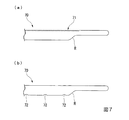
また、上記実施形態では、第一溝部71と第二溝部72とが形成された調節バー70を一対設けた例について説明した。しかしながら、調節バー70の構成は上記実施形態によっては限定されない。他の例として、例えば図7(a)と図7(b)に示すように、一対の調節バー70のうち、一方の調節バー70には第一溝部71のみが形成され、他方の調節バー70には第二溝部72のみが形成されていてもよい。
Moreover, in the said embodiment, the example which provided the
加えて、上記実施形態では、第一支持脚21は1つの第一支持脚本体50を有し、第二支持脚22(第二支持脚本体60)は、一対の第二支持脚半体62Hを有する構成について説明した。しかしながら、脚部2の構成は上記実施形態によっては限定されない。他の構成として、第一支持脚21及び第二支持脚22がそれぞれ1つの柱体によって形成されていてもよい。また、第一支持脚21が、上記実施形態における第二支持脚22と同様に、互いに独立した一対の半体によって構成されていてもよい。すなわち、第一支持脚21及び第二支持脚22がそれぞれ2つずつの柱体によって形成されていてもよい。
In addition, in the said embodiment, the
1…台本体
1L…長辺部
1S…短辺部
2…脚部
3…アイロン置き
4…仕上げ馬
5…くびれ部
6…絞り部
7…調節部
10…主部
11…フレーム
12…案内溝
21…第一支持脚
22…第二支持脚
30…支持部
31…載置部
40…仕上げ馬本体
41…馬支持脚
42…固定部
50…第一支持脚本体
51…接地部
60…第二支持脚本体
61…接地部
62…スライド軸
62H…第二支持脚半体
63…軸本体
64…ローラ
70…調節バー
71…第一溝部
72…第二溝部
72A…第一傾斜部
72B…第二傾斜部
72C…接続部
80…係止部
81…調節軸
82…係止部本体
83…付勢部
84…ハンドル
100…アイロン台
A1…第一回動軸
A2…第二回動軸
A3…第三回動軸
H…孔部
H1…第一係止部
H2…第二係止部
P1…第一位置
P2…第二位置
R…切欠き
S1…載置面
S2…下面
DESCRIPTION OF
Claims (7)
前記下面から前記床面に向かう高さ方向に延びるとともに、一端が該下面に沿って延びる第一回動軸回りに回動可能な第一支持脚と、
一端が前記下面に沿ってスライド可能に支持されるとともに、前記第一支持脚に交差した状態で接続され、該第一支持脚に対して前記第一回動軸に平行な第二回動軸回りに回動可能な第二支持脚と、
前記第一支持脚及び前記第二支持脚の交差角度を調節する調節部と、
を備え、
前記調節部は、
前記下面に沿って延びるとともに一端が前記第二支持脚に回動可能に支持された調節バーと、
前記下面に設けられ、前記調節バーを前記下面に沿う方向における複数の異なる位置で係止可能な係止部と、
を有し、
前記調節バーには、該調節バーの前記高さ方向一方側から他方側に向かって凹没するとともに、該調節バーの延びる方向に配列された複数の第一溝部、及び前記調節バーの前記高さ方向他方側から一方側に向かって凹没するとともに、該調節バーの延びる方向に前記第一溝部よりも大きいピッチで配列された複数の第二溝部が形成され、
前記係止部は、
前記第一溝部と係合する第一係止部、及び該第一係止部と一体に形成されるとともに前記第二溝部と係合する第二係止部を有するアイロン台。 A mounting surface on which clothes are mounted, and a base body having a lower surface facing the floor surface;
A first support leg that extends in a height direction from the lower surface toward the floor surface and is rotatable about a first rotation shaft having one end extending along the lower surface;
A second rotation shaft that is slidably supported along the lower surface and is connected in a state of intersecting the first support leg and parallel to the first rotation shaft with respect to the first support leg A second support leg pivotable around,
An adjustment unit for adjusting an intersection angle of the first support leg and the second support leg;
With
The adjusting unit is
An adjustment bar extending along the lower surface and having one end rotatably supported by the second support leg;
A locking portion provided on the lower surface and capable of locking the adjustment bar at a plurality of different positions in a direction along the lower surface;
Have
The adjustment bar is recessed from one side of the height direction of the adjustment bar toward the other side, and a plurality of first grooves arranged in the extending direction of the adjustment bar, and the height of the adjustment bar. A plurality of second groove portions that are recessed from the other side in the vertical direction toward the one side and that are arranged at a pitch larger than the first groove portion in the extending direction of the adjustment bar are formed,
The locking portion is
An ironing board having a first locking portion that engages with the first groove portion, and a second locking portion that is formed integrally with the first locking portion and engages with the second groove portion.
前記調節バーが挿通される孔部が形成されるとともに、前記第一回動軸と平行な第三回動軸回りに回動可能に設けられた係止部本体を有し、
前記係止部本体には、該係止部本体を前記第三回転軸回りに回転するように付勢する付勢部が設けられ、
前記係止部本体は、前記孔部の貫通方向と前記調節バーの延びる方向とが一致する第一位置と、前記貫通方向と前記調節バーの延びる方向とが互いに交差する第二位置との間で回動可能であり、
前記付勢部は、前記係止部本体を前記第一位置から第二位置に向かう方向に付勢している請求項1に記載のアイロン台。 The locking portion is
A hole portion through which the adjustment bar is inserted is formed, and a locking portion main body provided rotatably around a third rotation axis parallel to the first rotation axis,
The locking portion main body is provided with a biasing portion that biases the locking portion main body to rotate around the third rotation axis.
The locking portion main body is between a first position where the penetrating direction of the hole and the extending direction of the adjusting bar coincide with each other and a second position where the penetrating direction and the extending direction of the adjusting bar intersect each other. Can be rotated,
The ironing board according to claim 1, wherein the urging portion urges the locking portion main body in a direction from the first position toward the second position.
前記一対の長辺部には、前記短軸方向の中央側に向かって凹没するくびれ部がそれぞれ形成され、
少なくとも一方の前記短辺部を含む端部には、前記くびれ部から該短辺部に向かうにしたがって、前記台本体の前記短軸方向における寸法が次第に縮小する絞り部が形成されている請求項1から4のいずれか一項に記載のアイロン台。 The base body has a pair of long side portions extending in the long axis direction and a pair of short side portions extending in the short axis direction orthogonal to the long axis when viewed from the direction orthogonal to the mounting surface.
Each of the pair of long side portions is formed with a constricted portion that is recessed toward the center side in the short axis direction,
The narrowed portion in which the dimension in the short axis direction of the base body gradually decreases as it goes from the constricted portion to the short side portion at an end portion including at least one of the short side portions. The ironing board as described in any one of 1-4.
該仕上げ馬本体に設けられた馬支持脚と、
を有する仕上げ馬をさらに備え、
前記台本体は、前記短辺部に隣接して設けられ、前記馬支持脚の一端を着脱可能に支持する固定部、及び前記仕上げ馬が収容される収容部を有し、
前記仕上げ馬が前記収容部に収容された状態で、前記仕上げ馬の上面と、前記載置面とが互いに同じ方向を向いている請求項5に記載のアイロン台。 Finished horse body that can be inserted into the tubular part of clothes,
A horse support leg provided on the finished horse body;
And further comprising a finishing horse having
The base body is provided adjacent to the short side portion, and includes a fixing portion that detachably supports one end of the horse support leg, and a storage portion that stores the finishing horse.
6. The ironing board according to claim 5, wherein an upper surface of the finishing horse and the mounting surface face in the same direction in a state where the finishing horse is housed in the housing portion.
該支持部と一体に設けられ、物品を載置可能な載置部と、
を有する請求項1から6のいずれか一項に記載のアイロン台。 A support portion provided on the base body and slidably supported with respect to the base body;
A mounting portion provided integrally with the support portion and capable of mounting an article;
The ironing board as described in any one of Claim 1 to 6 which has these.
Priority Applications (2)
| Application Number | Priority Date | Filing Date | Title |
|---|---|---|---|
| JP2016084970A JP6652879B2 (en) | 2016-04-21 | 2016-04-21 | Ironing board |
| CN201610898150.8A CN107304519B (en) | 2016-04-21 | 2016-10-14 | Ironing board |
Applications Claiming Priority (1)
| Application Number | Priority Date | Filing Date | Title |
|---|---|---|---|
| JP2016084970A JP6652879B2 (en) | 2016-04-21 | 2016-04-21 | Ironing board |
Publications (2)
| Publication Number | Publication Date |
|---|---|
| JP2017192577A true JP2017192577A (en) | 2017-10-26 |
| JP6652879B2 JP6652879B2 (en) | 2020-02-26 |
Family
ID=60150814
Family Applications (1)
| Application Number | Title | Priority Date | Filing Date |
|---|---|---|---|
| JP2016084970A Expired - Fee Related JP6652879B2 (en) | 2016-04-21 | 2016-04-21 | Ironing board |
Country Status (2)
| Country | Link |
|---|---|
| JP (1) | JP6652879B2 (en) |
| CN (1) | CN107304519B (en) |
Family Cites Families (7)
| Publication number | Priority date | Publication date | Assignee | Title |
|---|---|---|---|---|
| JPS616400U (en) * | 1984-02-29 | 1986-01-16 | 信之 清水 | iron press stand |
| JPH0625280Y2 (en) * | 1990-03-01 | 1994-07-06 | ロイヤル株式会社 | Ironing board |
| NL1008293C2 (en) * | 1998-02-13 | 1999-08-16 | Brabantia Nederland Bv | Folding ironing table. |
| JPH11319400A (en) * | 1998-05-13 | 1999-11-24 | Hiroe Tsunoda | Ironing board with vertically movable neck part |
| JP2000218098A (en) * | 1999-01-27 | 2000-08-08 | Yamazaki Jitsugyo Kk | Ironing board |
| JP3105423U (en) * | 2004-05-24 | 2004-10-28 | 株式会社ドウシシャ | Ironing base |
| CN202644251U (en) * | 2012-06-08 | 2013-01-02 | 高继桐 | Novel ironing rack |
-
2016
- 2016-04-21 JP JP2016084970A patent/JP6652879B2/en not_active Expired - Fee Related
- 2016-10-14 CN CN201610898150.8A patent/CN107304519B/en not_active Expired - Fee Related
Also Published As
| Publication number | Publication date |
|---|---|
| JP6652879B2 (en) | 2020-02-26 |
| CN107304519A (en) | 2017-10-31 |
| CN107304519B (en) | 2021-04-09 |
Similar Documents
| Publication | Publication Date | Title |
|---|---|---|
| KR101272310B1 (en) | Angle adjustable device of upper board for table | |
| US20110145990A1 (en) | Turning apparatus for multipurpose space utilization furniture | |
| JP2017192577A (en) | Ironing board | |
| CN106958089A (en) | Fabric framework for sewing machine can be transferred | |
| KR101265298B1 (en) | Camp bed with variable legs | |
| KR200476547Y1 (en) | Portable working chair | |
| KR102618981B1 (en) | System Iron | |
| KR102630052B1 (en) | System Iron | |
| JP2019017677A (en) | Ironing board | |
| JP6857773B1 (en) | Mobile stand | |
| KR102601735B1 (en) | System Iron | |
| CN100534360C (en) | Device for displaying a range of objects | |
| KR101440035B1 (en) | Folding table | |
| KR20100069728A (en) | A ironing board | |
| KR102828548B1 (en) | Tablet Holder Stand Apparatus | |
| KR101621334B1 (en) | Ironing board support | |
| KR102604691B1 (en) | System Iron | |
| US861627A (en) | Fabric-renovator. | |
| JP5128688B2 (en) | Ironing board | |
| JP4175314B2 (en) | Ironing board | |
| RU2720117C2 (en) | Ironing board | |
| KR20170065960A (en) | Iron board | |
| CN118390279A (en) | Hand-held ironing device capable of clamping and shaping clothes | |
| KR102550353B1 (en) | System Iron | |
| KR950009093Y1 (en) | Iron |
Legal Events
| Date | Code | Title | Description |
|---|---|---|---|
| RD03 | Notification of appointment of power of attorney |
Free format text: JAPANESE INTERMEDIATE CODE: A7423 Effective date: 20181116 |
|
| A621 | Written request for application examination |
Free format text: JAPANESE INTERMEDIATE CODE: A621 Effective date: 20190215 |
|
| A977 | Report on retrieval |
Free format text: JAPANESE INTERMEDIATE CODE: A971007 Effective date: 20191003 |
|
| A131 | Notification of reasons for refusal |
Free format text: JAPANESE INTERMEDIATE CODE: A131 Effective date: 20191008 |
|
| A521 | Request for written amendment filed |
Free format text: JAPANESE INTERMEDIATE CODE: A523 Effective date: 20191129 |
|
| TRDD | Decision of grant or rejection written | ||
| A01 | Written decision to grant a patent or to grant a registration (utility model) |
Free format text: JAPANESE INTERMEDIATE CODE: A01 Effective date: 20200114 |
|
| A61 | First payment of annual fees (during grant procedure) |
Free format text: JAPANESE INTERMEDIATE CODE: A61 Effective date: 20200124 |
|
| R150 | Certificate of patent or registration of utility model |
Ref document number: 6652879 Country of ref document: JP Free format text: JAPANESE INTERMEDIATE CODE: R150 |
|
| LAPS | Cancellation because of no payment of annual fees |