JP2017128564A - Agent for improving salt tolerance of plant - Google Patents
Agent for improving salt tolerance of plant Download PDFInfo
- Publication number
- JP2017128564A JP2017128564A JP2017003961A JP2017003961A JP2017128564A JP 2017128564 A JP2017128564 A JP 2017128564A JP 2017003961 A JP2017003961 A JP 2017003961A JP 2017003961 A JP2017003961 A JP 2017003961A JP 2017128564 A JP2017128564 A JP 2017128564A
- Authority
- JP
- Japan
- Prior art keywords
- substituted
- unsubstituted
- plant
- methyl
- adenosyl
- Prior art date
- Legal status (The legal status is an assumption and is not a legal conclusion. Google has not performed a legal analysis and makes no representation as to the accuracy of the status listed.)
- Granted
Links
Images

Classifications
-
- Y—GENERAL TAGGING OF NEW TECHNOLOGICAL DEVELOPMENTS; GENERAL TAGGING OF CROSS-SECTIONAL TECHNOLOGIES SPANNING OVER SEVERAL SECTIONS OF THE IPC; TECHNICAL SUBJECTS COVERED BY FORMER USPC CROSS-REFERENCE ART COLLECTIONS [XRACs] AND DIGESTS
- Y02—TECHNOLOGIES OR APPLICATIONS FOR MITIGATION OR ADAPTATION AGAINST CLIMATE CHANGE
- Y02A—TECHNOLOGIES FOR ADAPTATION TO CLIMATE CHANGE
- Y02A40/00—Adaptation technologies in agriculture, forestry, livestock or agroalimentary production
- Y02A40/10—Adaptation technologies in agriculture, forestry, livestock or agroalimentary production in agriculture
- Y02A40/13—Abiotic stress
- Y02A40/135—Plants tolerant to salinity
Landscapes
- Breeding Of Plants And Reproduction By Means Of Culturing (AREA)
- Agricultural Chemicals And Associated Chemicals (AREA)
Abstract
【課題】植物における塩ストレスのような環境ストレス耐性を向上させる農業化合物を提供する。【解決手段】本発明の一態様は、式(I):[式中、n及びR1は、明細書又は特許請求の範囲に記載の定義と同義である。]で表される化合物若しくはその塩、又はそれらの溶媒和物、特にファルネソール酸メチル又はゲラニル酸メチルを有効成分として含有する、植物の耐塩性向上剤に関する。【選択図】なしAgricultural compounds that improve resistance to environmental stresses such as salt stress in plants are provided. One embodiment of the present invention is the compound represented by the formula (I): [wherein n and R 1 have the same definitions as described in the specification or claims. Or a salt thereof, or a solvate thereof, particularly methyl farnesolate or methyl geranilate as an active ingredient. [Selection figure] None
Description
本発明は、植物の環境ストレス耐性向上剤に関する。具体的には、本発明は、ファルネソール酸メチルを有効成分として含有する、植物の耐塩性向上剤に関する。 The present invention relates to a plant environmental stress tolerance improver. Specifically, the present invention relates to a plant salt tolerance improving agent containing methyl farnesolate as an active ingredient.
塩ストレス、乾燥ストレス及び低温ストレスのような環境ストレスは、植物の成長及び生命維持に重大な制約を与える。環境ストレスは、光合成及び呼吸等にも影響を及ぼすため、作物の品質低下及び収穫量減少等、農業において重大な被害をもたらす。環境ストレス応答に関する研究から、植物においては、様々な環境ストレス応答性遺伝子群が存在し、環境ストレスに対する抵抗性の獲得に関与していることが示唆されている。 Environmental stresses such as salt stress, drought stress and low temperature stress place significant constraints on plant growth and life support. Since environmental stress also affects photosynthesis and respiration, it causes serious damages in agriculture such as crop quality degradation and yield reduction. Studies on environmental stress responses suggest that there are various environmental stress responsive genes in plants, and that they are involved in acquiring resistance to environmental stress.
塩ストレスは、土壌中の塩類集積によって引き起こされる環境ストレスの一種である。灌漑技術の発達による圃場面積の増大、或いは津波又は高潮による圃場の海水浸漬に伴い、塩ストレスに起因する農業上の被害も増大している。植物における塩ストレスの影響は、浸透圧ストレス及びイオンストレスに分類することができる。浸透圧ストレスは、土壌中の塩類集積によって土壌の浸透圧が上昇し、根における吸水が制限され、結果として細胞レベルで水が欠乏する現象を意味する。イオンストレスは、最も豊富に存在する塩であるNaClによって引き起こされる、酵素活性の低下、及びK+等の無機イオンの吸収阻害等の現象を意味する(非特許文献1)。 Salt stress is a type of environmental stress caused by salt accumulation in soil. Agricultural damage due to salt stress is also increasing with the increase in field area due to the development of irrigation technology, or the immersion of seawater in the field due to tsunami or storm surge. The effects of salt stress in plants can be classified into osmotic stress and ionic stress. Osmotic stress means a phenomenon in which soil osmotic pressure increases due to salt accumulation in soil, water absorption in the roots is restricted, and as a result, water is deficient at the cellular level. Ion stress means phenomena such as a decrease in enzyme activity and inhibition of absorption of inorganic ions such as K + caused by NaCl, which is the most abundant salt (Non-patent Document 1).
植物に対する環境ストレスは、原因となる環境要因を取り除くことが困難であるか、又は多額の費用を要するため、回避することが困難な場合がある。特に、塩ストレスの場合、塩類集積した圃場の除塩が必要となるが、灌漑による除塩を行うためには、対象圃場に用排水設備を準備する必要がある。また、土壌成分によっては、灌漑による除塩を行っても、土壌中の塩濃度が十分に低下しない場合がある。 Environmental stress on plants can be difficult to avoid because it is difficult to remove the causal environmental factors or it costs a lot of money. In particular, in the case of salt stress, it is necessary to demineralize the field where salt is accumulated, but in order to demineralize by irrigation, it is necessary to prepare a drainage facility in the target field. In addition, depending on soil components, salt concentration in the soil may not be sufficiently reduced even when salt removal by irrigation is performed.
このような場合、植物自体の環境ストレス耐性を向上させることにより、該環境ストレスによる影響を回避できる可能性がある。植物自体の環境ストレス耐性を向上させる手段として、環境ストレス応答性遺伝子を改変した遺伝子組み換え植物の作出、及び環境ストレス耐性を向上させる化学的又は生物学的調節剤の施用を挙げることができる。 In such a case, there is a possibility that the influence of the environmental stress can be avoided by improving the environmental stress tolerance of the plant itself. Examples of means for improving the environmental stress tolerance of the plant itself include production of a genetically modified plant in which an environmental stress responsive gene is modified, and application of a chemical or biological regulator that improves the environmental stress tolerance.
例えば、特許文献1は、5-アミノレブリン酸、その誘導体及びそれらの塩、並びにヘミン類から選ばれる1種又は2種以上の化合物を有効成分とする植物の耐塩性向上剤を記載する。 For example, Patent Document 1 describes a plant salt tolerance improver comprising as an active ingredient one or more compounds selected from 5-aminolevulinic acid, derivatives thereof and salts thereof, and hemins.
特許文献2は、一般式(I)で表されるヘテロ環化合物を有効成分として含有することを特徴とする栽培植物用の植物成長調節剤を記載する。当該文献は、前記化合物が植物の耐塩性の増加に使用し得ることを記載する。
特許文献3は、パエニバチルス属に属する細菌若しくはその培養上清を含有してなる、植物の生長促進及び/又は耐塩性向上剤を記載する。
前記のように、塩ストレスのような環境ストレス耐性を向上させる化学的又は生物学的調節剤が知られている。しかしながら、これら公知の化学的又は生物学的調節剤は、効果及び/又はコストの観点から改良の余地が存在した。 As described above, chemical or biological modulators that improve environmental stress tolerance such as salt stress are known. However, these known chemical or biological regulators have room for improvement in terms of effectiveness and / or cost.
それ故、本発明は、植物における塩ストレスのような環境ストレス耐性を向上させる農業化合物を提供することを目的とする。 Therefore, an object of the present invention is to provide an agricultural compound that improves environmental stress tolerance such as salt stress in plants.
本発明者らは、前記課題を解決するための手段を種々検討した。本発明者らは、耐塩性向上効果を有する特定のヒストンデアセチラーゼ阻害剤を植物に添加することによって上方制御される植物の遺伝子群の中に、セスキテルペンの一種であるファルネソール酸のメチル化に関与する1個以上のS-アデノシル-L-メチオニン依存性メチルトランスフェラーゼ遺伝子が存在することを見出した。さらに、本発明者らは、特定のS-アデノシル-L-メチオニン依存性メチルトランスフェラーゼによって産生されるファルネソール酸メチルを植物に施用すると、植物の耐塩性を向上し得ることを見出した。また、本発明者らは、ゲラニル酸メチルを植物に施用すると、同様に植物の耐塩性を向上し得ることを見出した。本発明者らは、前記知見に基づき本発明を完成した。 The present inventors have studied various means for solving the above problems. The present inventors have included methylation of farnesolic acid, a kind of sesquiterpene, in a plant gene group that is up-regulated by adding a specific histone deacetylase inhibitor having an effect of improving salt tolerance to plants. We found that there is one or more S-adenosyl-L-methionine-dependent methyltransferase genes involved in. Further, the present inventors have found that when methyl farnesolate produced by a specific S-adenosyl-L-methionine-dependent methyltransferase is applied to a plant, the salt tolerance of the plant can be improved. The present inventors have also found that when methylgeranilate is applied to a plant, the salt tolerance of the plant can be similarly improved. Based on the above findings, the present inventors have completed the present invention.
すなわち、本発明の要旨は以下の通りである。
(1) 式(I):
nは、1以上の整数であり、
R1は、置換若しくは非置換のアルキル、置換若しくは非置換のアルケニル、置換若しくは非置換のアルキニル、置換若しくは非置換のシクロアルキル、置換若しくは非置換のシクロアルケニル、置換若しくは非置換のシクロアルキニル、置換若しくは非置換のヘテロシクロアルキル、置換若しくは非置換のシクロアルキルアルキル、置換若しくは非置換のヘテロシクロアルキルアルキル、置換若しくは非置換のアリール、置換若しくは非置換のアリールアルキル、置換若しくは非置換のヘテロアリール、又は置換若しくは非置換のヘテロアリールアルキルである。]
で表される化合物若しくはその塩、又はそれらの溶媒和物を有効成分として含有する、植物の耐塩性向上剤。
(2) nが、1又は2である、前記(1)に記載の植物の耐塩性向上剤。
(3) R1が、置換若しくは非置換のC1〜C5アルキルである、前記(1)に記載の植物の耐塩性向上剤。
(4) ファルネソール酸メチル又はゲラニル酸メチルを有効成分として含有する、植物の耐塩性向上剤。
(5) 前記(1)〜(4)のいずれかに記載の植物の耐塩性向上剤を有効成分として含有する、植物の耐塩性を向上させるための農業化学製剤。
(6) 前記(1)〜(4)のいずれかに記載の植物の耐塩性向上剤と、1種以上の農業上許容される成分とを含有する、植物の耐塩性を向上させるための農業化学組成物。
(7) 農業上有効な量の前記(1)〜(4)のいずれかに記載の植物の耐塩性向上剤を、植物又はそこから該植物が生育する土壌、培地若しくは培養液に施用することを含む、該植物の耐塩性を向上する方法。
(8) 1個以上のS-アデノシル-L-メチオニン依存性メチルトランスフェラーゼ遺伝子の発現が増加されている、耐塩性が向上した植物。
(9) 1個以上のS-アデノシル-L-メチオニン依存性メチルトランスフェラーゼ遺伝子が、ファルネソール酸カルボキシル-O-メチルトランスフェラーゼ遺伝子である、前記(8)に記載の耐塩性が向上した植物。
(10) 1個以上のS-アデノシル-L-メチオニン依存性メチルトランスフェラーゼ遺伝子が、以下の(a)〜(c):
(a)配列番号1又は2で示されるアミノ酸配列からなるポリペプチド、
(b)配列番号1又は2で示されるアミノ酸配列において1若しくは数個のアミノ酸が欠失、置換又は付加されたアミノ酸配列からなり、且つS-アデノシル-L-メチオニン依存性メチルトランスフェラーゼ活性を有するポリペプチド、及び
(c)配列番号1で示されるアミノ酸配列の第34〜348位の領域に相当するポリペプチド断片に対して92%以上の同一性を有し、且つS-アデノシル-L-メチオニン依存性メチルトランスフェラーゼ活性を有するポリペプチド
のいずれかのポリペプチドをコードする遺伝子である、前記(8)又は(9)に記載の耐塩性が向上した植物。
That is, the gist of the present invention is as follows.
(1) Formula (I):
n is an integer greater than or equal to 1,
R 1 is substituted or unsubstituted alkyl, substituted or unsubstituted alkenyl, substituted or unsubstituted alkynyl, substituted or unsubstituted cycloalkyl, substituted or unsubstituted cycloalkenyl, substituted or unsubstituted cycloalkynyl, substituted Or unsubstituted heterocycloalkyl, substituted or unsubstituted cycloalkylalkyl, substituted or unsubstituted heterocycloalkylalkyl, substituted or unsubstituted aryl, substituted or unsubstituted arylalkyl, substituted or unsubstituted heteroaryl, Or substituted or unsubstituted heteroarylalkyl. ]
Or a salt thereof or a solvate thereof as an active ingredient.
(2) The plant salt tolerance improving agent according to (1), wherein n is 1 or 2.
(3) The plant salt tolerance enhancer according to (1), wherein R 1 is substituted or unsubstituted C 1 -C 5 alkyl.
(4) A plant salt tolerance improver containing methyl farnesolate or methyl geranylate as an active ingredient.
(5) An agrochemical preparation for improving the salt tolerance of a plant, comprising the plant salt tolerance improving agent according to any one of (1) to (4) as an active ingredient.
(6) Agriculture for improving salt tolerance of plants, comprising the plant salt tolerance improver according to any one of (1) to (4) above and one or more agriculturally acceptable components Chemical composition.
(7) Applying the agriculturally effective amount of the salt tolerance improving agent of the plant according to any one of (1) to (4) to a plant, or a soil, a medium or a culture solution from which the plant grows. A method for improving the salt tolerance of the plant.
(8) A plant with improved salt tolerance, wherein the expression of one or more S-adenosyl-L-methionine-dependent methyltransferase genes is increased.
(9) The plant with improved salt tolerance according to (8), wherein the one or more S-adenosyl-L-methionine-dependent methyltransferase genes are farnesolate carboxyl-O-methyltransferase genes.
(10) One or more S-adenosyl-L-methionine-dependent methyltransferase genes are represented by the following (a) to (c):
(A) a polypeptide comprising the amino acid sequence represented by SEQ ID NO: 1 or 2,
(B) a polymorphism having an amino acid sequence in which one or several amino acids are deleted, substituted or added in the amino acid sequence represented by SEQ ID NO: 1 or 2, and having S-adenosyl-L-methionine-dependent methyltransferase activity A peptide, and (c) 92% or more identity to a polypeptide fragment corresponding to the region of positions 34 to 348 of the amino acid sequence represented by SEQ ID NO: 1, and is dependent on S-adenosyl-L-methionine The plant having improved salt tolerance according to the above (8) or (9), which is a gene encoding any one of polypeptides having sexual methyltransferase activity.
本発明により、植物における塩ストレスのような環境ストレス耐性を向上させる農業化合物を提供することが可能となる。
前記以外の、課題、構成及び効果は、以下の実施形態の説明により明らかにされる。
By this invention, it becomes possible to provide the agricultural compound which improves environmental stress tolerance like the salt stress in a plant.
Problems, configurations, and effects other than those described above will be clarified by the following description of embodiments.
以下、本発明の好ましい実施形態について詳細に説明する。
<1:環境ストレス耐性向上剤>
本発明において、「環境ストレス」は、対象となる植物の外部環境に起因して、植物が被るストレスを意味する。本発明において、環境ストレスは、1個以上のS-アデノシル-L-メチオニン依存性メチルトランスフェラーゼの活性を向上させることにより、それに対する耐性が増強される任意の環境ストレスを包含する。本発明の対象となる環境ストレスとしては、限定するものではないが、例えば、塩ストレス、乾燥ストレス及び低温ストレスを挙げることができる。環境ストレスは、対象となる植物の好適な生育条件に依存して、様々な外部環境がその要因となる。当業者であれば、対象となる植物に基づき、環境ストレスの要因となる外部環境の具体的な条件を容易に決定することができる。
Hereinafter, preferred embodiments of the present invention will be described in detail.
<1: Environmental stress tolerance improver>
In the present invention, “environmental stress” means stress experienced by a plant due to the external environment of the target plant. In the present invention, environmental stress includes any environmental stress in which resistance to one or more S-adenosyl-L-methionine-dependent methyltransferases is enhanced by improving the activity thereof. Examples of the environmental stress that is a subject of the present invention include, but are not limited to, salt stress, drought stress, and low temperature stress. Environmental stress is caused by various external environments depending on suitable growth conditions of the target plant. A person skilled in the art can easily determine specific conditions of the external environment that cause environmental stress based on the target plant.
本発明において、「環境ストレス耐性」は、環境ストレスを被る生育条件下であっても、生育不能(枯死)、生育不良(例えば、植物体の白化若しくは黄化、根長の減少若しくは葉数の減少)、生育速度の低下、又は植物体重量若しくは作物収量の減少のような望ましくない影響を実質的に受けることなく、正常に生育できる形質を意味する。本明細書において、「塩ストレス耐性」を「耐塩性」と記載する場合がある。本発明により、植物の環境ストレス耐性を向上させることにより、通常の植物では生育に望ましくない影響を受ける外部環境においても、植物を正常に生育させることができる。 In the present invention, “environmental stress tolerance” refers to inability to grow (death), poor growth (for example, whitening or yellowing of plants, reduction of root length, or number of leaves) even under growth conditions that are subject to environmental stress. Reduced), reduced growth rate, or traits that can grow normally without substantial undesired effects such as reduced plant weight or crop yield. In the present specification, “salt stress resistance” may be described as “salt resistance”. By improving the environmental stress tolerance of plants according to the present invention, plants can be grown normally even in an external environment that is undesirably affected by the growth of normal plants.
これまでに、本発明者らは、ヒストンデアセチラーゼ阻害活性を有する特定の化合物(以下、「ヒストンデアセチラーゼ阻害剤」とも記載する)が、植物の耐塩性を向上し得ることを見出した(特開2016-69380号公報)。本発明者らは、耐塩性向上効果を有する特定のヒストンデアセチラーゼ阻害剤である、シクロ[-L-2-アミノ-7-(2-オキソプロピルチオ)ヘプタノイル-アミノイソブチリル-L-フェニルアラニル-D-プロリル-](以下、「Ky-72」とも記載する):
本発明において、「S-アデノシル-L-メチオニン依存性メチルトランスフェラーゼ」又は「S-アデノシル-L-メチオニン依存性メチル基転移酵素」は、S-アデノシル-L-メチオニンをメチル基供与体として、基質化合物のカルボキシル基にメチル基を転移する反応を触媒する酵素を意味する。 In the present invention, “S-adenosyl-L-methionine-dependent methyltransferase” or “S-adenosyl-L-methionine-dependent methyltransferase” is a substrate using S-adenosyl-L-methionine as a methyl group donor. It means an enzyme that catalyzes a reaction of transferring a methyl group to a carboxyl group of a compound.
本発明の一態様は、式(I):
本発明において、「植物の環境ストレス耐性を向上させる」とは、前記で説明した環境ストレスを被る生育条件下の植物集団に本発明を適用することにより、該処理植物集団の60%以上、好ましくは70%以上、より好ましくは80%、さらに好ましくは90%以上、特に好ましくは100%が、環境ストレスに耐性を示すことを意味する。植物の環境ストレス耐性は、以下で説明する手段によって評価することができる。 In the present invention, “improving the environmental stress tolerance of a plant” is preferably 60% or more of the treated plant population by applying the present invention to the plant population under the growth conditions subjected to the environmental stress described above. Means 70% or more, more preferably 80%, even more preferably 90% or more, and particularly preferably 100% exhibit resistance to environmental stress. The environmental stress tolerance of a plant can be evaluated by the means described below.
本発明による植物の環境ストレス耐性向上効果は、植物の生育自体に対する効果、例えば、茎葉部若しくは根部の伸張、葉数の増加、植物体重量若しくは作物収量の増加、緑化、又は分蘖の促進のような生育の促進効果を包含してもよく、包含しなくてもよい。例えば、本発明による植物の環境ストレス耐性向上効果は、植物の生育を実質的に促進しつつ、塩ストレスのような環境ストレスに対する植物の耐性を特異的に向上させることを包含する。或いは、本発明による植物の環境ストレス耐性向上効果は、植物の生育を実質的に促進することなく、塩ストレスのような環境ストレスに対する植物の耐性を特異的に向上させることを包含する。いずれの場合も本発明の実施形態に包含される。 The effects of improving the environmental stress tolerance of the plant according to the present invention include effects on the growth of the plant itself, for example, the elongation of the leaves or roots, the increase in the number of leaves, the increase in plant weight or crop yield, the greening, or the promotion of tillering. It may or may not include a growth promoting effect. For example, the effect of improving the environmental stress tolerance of a plant according to the present invention includes specifically improving the tolerance of the plant to environmental stress such as salt stress while substantially promoting the growth of the plant. Or the environmental stress tolerance improvement effect of the plant by this invention includes specifically improving the tolerance of the plant with respect to environmental stresses, such as salt stress, without substantially promoting the growth of a plant. Either case is included in the embodiment of the present invention.
式(I)において、nは、1以上の整数である。nは、1〜4の範囲であることが好ましく、1又は2であることがより好ましい。nが前記で例示した基である場合、本態様の植物の環境ストレス耐性向上剤を植物に施用することにより、耐塩性のような該植物の環境ストレス耐性を向上させることができる。 In the formula (I), n is an integer of 1 or more. n is preferably in the range of 1 to 4, more preferably 1 or 2. When n is the group exemplified above, the environmental stress tolerance of the plant such as salt tolerance can be improved by applying the plant environmental stress tolerance improver of this embodiment to the plant.
式(I)において、R1は、置換若しくは非置換のアルキル、置換若しくは非置換のアルケニル、置換若しくは非置換のアルキニル、置換若しくは非置換のシクロアルキル、置換若しくは非置換のシクロアルケニル、置換若しくは非置換のシクロアルキニル、置換若しくは非置換のヘテロシクロアルキル、置換若しくは非置換のシクロアルキルアルキル、置換若しくは非置換のヘテロシクロアルキルアルキル、置換若しくは非置換のアリール、置換若しくは非置換のアリールアルキル、置換若しくは非置換のヘテロアリール、又は置換若しくは非置換のヘテロアリールアルキルである。R1は、置換若しくは非置換のC1〜C5アルキル、置換若しくは非置換のC2〜C5アルケニル、置換若しくは非置換のC2〜C5アルキニル、置換若しくは非置換のC3〜C6シクロアルキル、置換若しくは非置換のC3〜C6シクロアルケニル、置換若しくは非置換のC3〜C6シクロアルキニル、置換若しくは非置換の3〜6員のヘテロシクロアルキル、置換若しくは非置換のC7〜C11シクロアルキルアルキル、置換若しくは非置換の3〜6員のヘテロシクロアルキル-C1〜C5アルキル、置換若しくは非置換のC6〜C15アリール、置換若しくは非置換のC7〜C20アリールアルキル、置換若しくは非置換の5〜15員のヘテロアリール、又は置換若しくは非置換の5〜15員のヘテロアリール-C1〜C5アルキルであることが好ましく、置換若しくは非置換のC1〜C5アルキルであることがより好ましく、メチル、エチル、プロピル、ブチル又はペンチルであることがさらに好ましく、メチルであることが特に好ましい。R1が前記で例示した基である場合、本態様の植物の環境ストレス耐性向上剤を植物に施用することにより、耐塩性のような該植物の環境ストレス耐性を向上させることができる。 In formula (I), R 1 is substituted or unsubstituted alkyl, substituted or unsubstituted alkenyl, substituted or unsubstituted alkynyl, substituted or unsubstituted cycloalkyl, substituted or unsubstituted cycloalkenyl, substituted or unsubstituted Substituted cycloalkynyl, substituted or unsubstituted heterocycloalkyl, substituted or unsubstituted cycloalkylalkyl, substituted or unsubstituted heterocycloalkylalkyl, substituted or unsubstituted aryl, substituted or unsubstituted arylalkyl, substituted or Unsubstituted heteroaryl, or substituted or unsubstituted heteroarylalkyl. R 1 is substituted or unsubstituted C 1 -C 5 alkyl, substituted or unsubstituted C 2 -C 5 alkenyl, substituted or unsubstituted C 2 -C 5 alkynyl, substituted or unsubstituted C 3 -C 6 cycloalkyl, substituted or unsubstituted C 3 -C 6 cycloalkenyl, substituted or unsubstituted C 3 -C 6 cycloalkenyl, substituted or unsubstituted 3-6 membered heterocycloalkyl, substituted or unsubstituted C 7 -C 11 cycloalkylalkyl, substituted or 3-6 membered unsubstituted heterocycloalkyl -C 1 -C 5 alkyl, substituted or unsubstituted C 6 -C 15 aryl, substituted or unsubstituted C 7 -C 20 arylalkyl, substituted or unsubstituted 5-15 membered heteroaryl, or substituted or preferably a heteroaryl -C 1 -C 5 alkyl unsubstituted 5-15 membered, substituted or unsubstituted C 1 ~ C 5 alkyl der More preferably, methyl, ethyl, propyl, more preferably butyl or pentyl, particularly preferably methyl. When R 1 is the group exemplified above, the environmental stress tolerance of the plant such as salt tolerance can be improved by applying the environmental stress tolerance improving agent of the plant of this embodiment to the plant.
式(I)において、前記基が置換されている場合、該置換基は、それぞれ独立して、ハロゲン(フッ素、塩素、臭素又はヨウ素)、カルボキシル、シアノ、ニトロ、ヒドロキシル、置換若しくは非置換のアルキル、置換若しくは非置換のアルケニル、置換若しくは非置換のアルキニル、置換若しくは非置換のシクロアルキル、置換若しくは非置換のシクロアルケニル、置換若しくは非置換のシクロアルキニル、置換若しくは非置換のヘテロシクロアルキル、置換若しくは非置換のシクロアルキルアルキル、置換若しくは非置換のヘテロシクロアルキルアルキル、置換若しくは非置換のアリール、置換若しくは非置換のアリールアルキル、置換若しくは非置換のヘテロアリール、置換若しくは非置換のヘテロアリールアルキル、置換若しくは非置換のアルコキシ、置換若しくは非置換のシクロアルコキシ、置換若しくは非置換のヘテロシクロアルコキシ、置換若しくは非置換のアリールオキシ、置換若しくは非置換のアリールアルキルオキシ、置換若しくは非置換のヘテロアリールオキシ、置換若しくは非置換のヘテロアリールアルキルオキシ、置換若しくは非置換のアルコキシカルボニル、置換若しくは非置換のシクロアルコキシカルボニル、置換若しくは非置換のアシル、置換若しくは非置換のアシルオキシ、及び置換若しくは非置換のアミノからなる群より選択される少なくとも1個の1価基であることが好ましく、ハロゲン(フッ素、塩素、臭素又はヨウ素)、カルボキシル、シアノ、ニトロ、ヒドロキシル、置換若しくは非置換のC1〜C5アルキル、置換若しくは非置換のC2〜C5アルケニル、置換若しくは非置換のC2〜C5アルキニル、置換若しくは非置換のC3〜C6シクロアルキル、置換若しくは非置換のC3〜C6シクロアルケニル、置換若しくは非置換のC3〜C6シクロアルキニル、置換若しくは非置換の3〜6員のヘテロシクロアルキル、置換若しくは非置換のC7〜C11シクロアルキルアルキル、置換若しくは非置換の3〜6員のヘテロシクロアルキル-C1〜C5アルキル、置換若しくは非置換のC6〜C15アリール、置換若しくは非置換のC7〜C20アリールアルキル、置換若しくは非置換の5〜15員のヘテロアリール、置換若しくは非置換の5〜15員のヘテロアリール-C1〜C5アルキル、置換若しくは非置換のC1〜C6アルコキシ、置換若しくは非置換のC3〜C6シクロアルコキシ、置換若しくは非置換の3〜6員ヘテロシクロアルコキシ、置換若しくは非置換のC6〜C15アリールオキシ、置換若しくは非置換のC7〜C20アリールアルキルオキシ、置換若しくは非置換の5〜15員のヘテロアリールオキシ、置換若しくは非置換の5〜15員のヘテロアリール-C1〜C5アルキルオキシ、置換若しくは非置換のC1〜C6アルコキシカルボニル、置換若しくは非置換のC3〜C6シクロアルコキシカルボニル、置換若しくは非置換のC1〜C20アシル、置換若しくは非置換のC1〜C20アシルオキシ、及び置換若しくは非置換のアミノからなる群より選択される少なくとも1個の1価基であることがより好ましい。前記1価基が置換されている場合、該置換基は、前記1価基からさらに選択されることができる。 In the formula (I), when the group is substituted, the substituents are each independently halogen (fluorine, chlorine, bromine or iodine), carboxyl, cyano, nitro, hydroxyl, substituted or unsubstituted alkyl. Substituted or unsubstituted alkenyl, substituted or unsubstituted alkynyl, substituted or unsubstituted cycloalkyl, substituted or unsubstituted cycloalkenyl, substituted or unsubstituted cycloalkynyl, substituted or unsubstituted heterocycloalkyl, substituted or Unsubstituted cycloalkylalkyl, substituted or unsubstituted heterocycloalkylalkyl, substituted or unsubstituted aryl, substituted or unsubstituted arylalkyl, substituted or unsubstituted heteroaryl, substituted or unsubstituted heteroarylalkyl, substituted Or non-placement Substituted alkoxy, substituted or unsubstituted cycloalkoxy, substituted or unsubstituted heterocycloalkoxy, substituted or unsubstituted aryloxy, substituted or unsubstituted arylalkyloxy, substituted or unsubstituted heteroaryloxy, substituted or unsubstituted Selected from the group consisting of substituted heteroarylalkyloxy, substituted or unsubstituted alkoxycarbonyl, substituted or unsubstituted cycloalkoxycarbonyl, substituted or unsubstituted acyl, substituted or unsubstituted acyloxy, and substituted or unsubstituted amino is preferably at least one monovalent group which is a halogen (fluorine, chlorine, bromine or iodine), carboxyl, cyano, nitro, hydroxyl, a substituted or unsubstituted C 1 -C 5 alkyl, substituted or unsubstituted C 2 ~C 5 of Alkenyl, substituted or unsubstituted C 2 -C 5 alkynyl, substituted or unsubstituted C 3 -C 6 cycloalkyl, substituted or unsubstituted C 3 -C 6 cycloalkenyl, substituted or unsubstituted C 3 -C 6 cycloalkynyl, substituted or unsubstituted 3-6 membered heterocycloalkyl, substituted or unsubstituted C 7 -C 11 cycloalkylalkyl, heterocycloalkyl -C 1 3-6 membered substituted or unsubstituted -C 5 alkyl, substituted or unsubstituted C 6 -C 15 aryl, substituted or unsubstituted C 7 -C 20 arylalkyl, substituted or unsubstituted 5-15 membered heteroaryl, substituted or unsubstituted 5-15 membered heteroaryl -C 1 -C 5 alkyl, substituted or unsubstituted C 1 -C 6 alkoxy, substituted or unsubstituted C 3 -C 6 cycloalkoxy, substituted or unsubstituted 3-6 membered heterocycloalkyl alkoxy, Substituted or unsubstituted C 6 -C 15 aryloxy, substituted or unsubstituted C 7 -C 20 arylalkyloxy, substituted or unsubstituted 5-15 membered heteroaryloxy, substituted or unsubstituted 5-15 membered heteroaryl -C 1 -C 5 alkyloxy, substituted or unsubstituted C 1 -C 6 alkoxycarbonyl, substituted or unsubstituted C 3 -C 6 cycloalkyl alkoxycarbonyl, substituted or unsubstituted C 1 -C 20 acyl More preferably, it is at least one monovalent group selected from the group consisting of substituted, unsubstituted C 1 -C 20 acyloxy, and substituted or unsubstituted amino. When the monovalent group is substituted, the substituent can be further selected from the monovalent group.
好ましくは、式(I)で表される化合物は、
nが、1〜4の範囲であり、
R1が、置換若しくは非置換のC1〜C5アルキル、置換若しくは非置換のC2〜C5アルケニル、置換若しくは非置換のC2〜C5アルキニル、置換若しくは非置換のC3〜C6シクロアルキル、置換若しくは非置換のC3〜C6シクロアルケニル、置換若しくは非置換のC3〜C6シクロアルキニル、置換若しくは非置換の3〜6員のヘテロシクロアルキル、置換若しくは非置換のC7〜C11シクロアルキルアルキル、置換若しくは非置換の3〜6員のヘテロシクロアルキル-C1〜C5アルキル、置換若しくは非置換のC6〜C15アリール、置換若しくは非置換のC7〜C20アリールアルキル、置換若しくは非置換の5〜15員のヘテロアリール、又は置換若しくは非置換の5〜15員のヘテロアリール-C1〜C5アルキルであり、
前記基が置換されている場合、該置換基は、それぞれ独立して、ハロゲン(フッ素、塩素、臭素又はヨウ素)、カルボキシル、シアノ、ニトロ、ヒドロキシル、置換若しくは非置換のC1〜C5アルキル、置換若しくは非置換のC2〜C5アルケニル、置換若しくは非置換のC2〜C5アルキニル、置換若しくは非置換のC3〜C6シクロアルキル、置換若しくは非置換のC3〜C6シクロアルケニル、置換若しくは非置換のC3〜C6シクロアルキニル、置換若しくは非置換の3〜6員のヘテロシクロアルキル、置換若しくは非置換のC7〜C11シクロアルキルアルキル、置換若しくは非置換の3〜6員のヘテロシクロアルキル-C1〜C5アルキル、置換若しくは非置換のC6〜C15アリール、置換若しくは非置換のC7〜C20アリールアルキル、置換若しくは非置換の5〜15員のヘテロアリール、置換若しくは非置換の5〜15員のヘテロアリール-C1〜C5アルキル、置換若しくは非置換のC1〜C6アルコキシ、置換若しくは非置換のC3〜C6シクロアルコキシ、置換若しくは非置換の3〜6員ヘテロシクロアルコキシ、置換若しくは非置換のC6〜C15アリールオキシ、置換若しくは非置換のC7〜C20アリールアルキルオキシ、置換若しくは非置換の5〜15員のヘテロアリールオキシ、置換若しくは非置換の5〜15員のヘテロアリール-C1〜C5アルキルオキシ、置換若しくは非置換のC1〜C6アルコキシカルボニル、置換若しくは非置換のC3〜C6シクロアルコキシカルボニル、置換若しくは非置換のC1〜C20アシル、置換若しくは非置換のC1〜C20アシルオキシ、及び置換若しくは非置換のアミノからなる群より選択される少なくとも1個の1価基である。
Preferably, the compound represented by formula (I) is:
n is in the range of 1-4,
R 1 is substituted or unsubstituted C 1 -C 5 alkyl, substituted or unsubstituted C 2 -C 5 alkenyl, substituted or unsubstituted C 2 -C 5 alkynyl, substituted or unsubstituted C 3 -C 6 cycloalkyl, substituted or unsubstituted C 3 -C 6 cycloalkenyl, substituted or unsubstituted C 3 -C 6 cycloalkenyl, substituted or unsubstituted 3-6 membered heterocycloalkyl, substituted or unsubstituted C 7 -C 11 cycloalkylalkyl, substituted or 3-6 membered unsubstituted heterocycloalkyl -C 1 -C 5 alkyl, substituted or unsubstituted C 6 -C 15 aryl, substituted or unsubstituted C 7 -C 20 arylalkyl, substituted or unsubstituted 5-15 membered heteroaryl, or substituted or unsubstituted 5-15 membered heteroaryl -C 1 -C 5 alkyl,
If the group is substituted, the substituent are each independently halogen (fluorine, chlorine, bromine or iodine), carboxyl, cyano, nitro, hydroxyl, a substituted or unsubstituted C 1 -C 5 alkyl, substituted or unsubstituted C 2 -C 5 alkenyl, substituted or unsubstituted C 2 -C 5 alkynyl, substituted or unsubstituted C 3 -C 6 cycloalkyl, substituted or unsubstituted C 3 -C 6 cycloalkenyl, substituted or unsubstituted C 3 -C 6 cycloalkenyl, substituted or unsubstituted 3-6 membered heterocycloalkyl, substituted or unsubstituted C 7 -C 11 cycloalkylalkyl, substituted or unsubstituted 3-6 membered heterocycloalkyl -C 1 -C 5 alkyl, substituted or unsubstituted C 6 -C 15 aryl, substituted or unsubstituted C 7 -C 20 arylalkyl, substituted or unsubstituted 5-15 membered Heteroaryl, substituted or unsubstituted 5-15 membered heteroaryl -C 1 -C 5 alkyl, substituted or unsubstituted C 1 -C 6 alkoxy, substituted or unsubstituted C 3 -C 6 cycloalkoxy, substituted or unsubstituted 3-6 membered heterocycloalkyl alkoxy substituted, substituted or unsubstituted C 6 -C 15 aryloxy, substituted or unsubstituted C 7 -C 20 arylalkyloxy, substituted or unsubstituted 5-15 membered heteroaryloxy , substituted or unsubstituted 5-15 membered heteroaryl -C 1 -C 5 alkyloxy, substituted or unsubstituted C 1 -C 6 alkoxycarbonyl, substituted or unsubstituted C 3 -C 6 cycloalkoxy-carbonyl, substituted or unsubstituted C 1 -C 20 acyl, a substituted or unsubstituted C 1 -C 20 acyloxy, and at least one selected from the group consisting of substituted or unsubstituted amino 1 It is a valent group.
より好ましくは、式(I)で表される化合物は、
nが、1〜4の範囲であり、
R1が、置換若しくは非置換のC1〜C5アルキルであり、
前記基が置換されている場合、該置換基は、それぞれ独立して、ハロゲン(フッ素、塩素、臭素又はヨウ素)、カルボキシル、シアノ、ニトロ、ヒドロキシル、置換若しくは非置換のC1〜C5アルキル、置換若しくは非置換のC2〜C5アルケニル、置換若しくは非置換のC2〜C5アルキニル、置換若しくは非置換のC3〜C6シクロアルキル、置換若しくは非置換のC3〜C6シクロアルケニル、置換若しくは非置換のC3〜C6シクロアルキニル、置換若しくは非置換の3〜6員のヘテロシクロアルキル、置換若しくは非置換のC7〜C11シクロアルキルアルキル、置換若しくは非置換の3〜6員のヘテロシクロアルキル-C1〜C5アルキル、置換若しくは非置換のC6〜C15アリール、置換若しくは非置換のC7〜C20アリールアルキル、置換若しくは非置換の5〜15員のヘテロアリール、置換若しくは非置換の5〜15員のヘテロアリール-C1〜C5アルキル、置換若しくは非置換のC1〜C6アルコキシ、置換若しくは非置換のC3〜C6シクロアルコキシ、置換若しくは非置換の3〜6員ヘテロシクロアルコキシ、置換若しくは非置換のC6〜C15アリールオキシ、置換若しくは非置換のC7〜C20アリールアルキルオキシ、置換若しくは非置換の5〜15員のヘテロアリールオキシ、置換若しくは非置換の5〜15員のヘテロアリール-C1〜C5アルキルオキシ、置換若しくは非置換のC1〜C6アルコキシカルボニル、置換若しくは非置換のC3〜C6シクロアルコキシカルボニル、置換若しくは非置換のC1〜C20アシル、置換若しくは非置換のC1〜C20アシルオキシ、及び置換若しくは非置換のアミノからなる群より選択される少なくとも1個の1価基である。
More preferably, the compound represented by formula (I) is:
n is in the range of 1-4,
R 1 is substituted or unsubstituted C 1 -C 5 alkyl;
If the group is substituted, the substituent are each independently halogen (fluorine, chlorine, bromine or iodine), carboxyl, cyano, nitro, hydroxyl, a substituted or unsubstituted C 1 -C 5 alkyl, substituted or unsubstituted C 2 -C 5 alkenyl, substituted or unsubstituted C 2 -C 5 alkynyl, substituted or unsubstituted C 3 -C 6 cycloalkyl, substituted or unsubstituted C 3 -C 6 cycloalkenyl, substituted or unsubstituted C 3 -C 6 cycloalkenyl, substituted or unsubstituted 3-6 membered heterocycloalkyl, substituted or unsubstituted C 7 -C 11 cycloalkylalkyl, substituted or unsubstituted 3-6 membered heterocycloalkyl -C 1 -C 5 alkyl, substituted or unsubstituted C 6 -C 15 aryl, substituted or unsubstituted C 7 -C 20 arylalkyl, substituted or unsubstituted 5-15 membered Heteroaryl, substituted or unsubstituted 5-15 membered heteroaryl -C 1 -C 5 alkyl, substituted or unsubstituted C 1 -C 6 alkoxy, substituted or unsubstituted C 3 -C 6 cycloalkoxy, substituted or unsubstituted 3-6 membered heterocycloalkyl alkoxy substituted, substituted or unsubstituted C 6 -C 15 aryloxy, substituted or unsubstituted C 7 -C 20 arylalkyloxy, substituted or unsubstituted 5-15 membered heteroaryloxy , substituted or unsubstituted 5-15 membered heteroaryl -C 1 -C 5 alkyloxy, substituted or unsubstituted C 1 -C 6 alkoxycarbonyl, substituted or unsubstituted C 3 -C 6 cycloalkoxy-carbonyl, substituted or unsubstituted C 1 -C 20 acyl, a substituted or unsubstituted C 1 -C 20 acyloxy, and at least one selected from the group consisting of substituted or unsubstituted amino 1 It is a valent group.
さらに好ましくは、式(I)で表される化合物は、
nが、1又は2であり、
R1が、置換若しくは非置換のC1〜C5アルキルであり、
前記基が置換されている場合、該置換基は、それぞれ独立して、ハロゲン(フッ素、塩素、臭素又はヨウ素)、カルボキシル、シアノ、ニトロ、ヒドロキシル、置換若しくは非置換のC1〜C5アルキル、置換若しくは非置換のC2〜C5アルケニル、置換若しくは非置換のC2〜C5アルキニル、置換若しくは非置換のC3〜C6シクロアルキル、置換若しくは非置換のC3〜C6シクロアルケニル、置換若しくは非置換のC3〜C6シクロアルキニル、置換若しくは非置換の3〜6員のヘテロシクロアルキル、置換若しくは非置換のC7〜C11シクロアルキルアルキル、置換若しくは非置換の3〜6員のヘテロシクロアルキル-C1〜C5アルキル、置換若しくは非置換のC6〜C15アリール、置換若しくは非置換のC7〜C20アリールアルキル、置換若しくは非置換の5〜15員のヘテロアリール、置換若しくは非置換の5〜15員のヘテロアリール-C1〜C5アルキル、置換若しくは非置換のC1〜C6アルコキシ、置換若しくは非置換のC3〜C6シクロアルコキシ、置換若しくは非置換の3〜6員ヘテロシクロアルコキシ、置換若しくは非置換のC6〜C15アリールオキシ、置換若しくは非置換のC7〜C20アリールアルキルオキシ、置換若しくは非置換の5〜15員のヘテロアリールオキシ、置換若しくは非置換の5〜15員のヘテロアリール-C1〜C5アルキルオキシ、置換若しくは非置換のC1〜C6アルコキシカルボニル、置換若しくは非置換のC3〜C6シクロアルコキシカルボニル、置換若しくは非置換のC1〜C20アシル、置換若しくは非置換のC1〜C20アシルオキシ、及び置換若しくは非置換のアミノからなる群より選択される少なくとも1個の1価基である。
More preferably, the compound represented by formula (I) is:
n is 1 or 2,
R 1 is substituted or unsubstituted C 1 -C 5 alkyl;
If the group is substituted, the substituent are each independently halogen (fluorine, chlorine, bromine or iodine), carboxyl, cyano, nitro, hydroxyl, a substituted or unsubstituted C 1 -C 5 alkyl, substituted or unsubstituted C 2 -C 5 alkenyl, substituted or unsubstituted C 2 -C 5 alkynyl, substituted or unsubstituted C 3 -C 6 cycloalkyl, substituted or unsubstituted C 3 -C 6 cycloalkenyl, substituted or unsubstituted C 3 -C 6 cycloalkenyl, substituted or unsubstituted 3-6 membered heterocycloalkyl, substituted or unsubstituted C 7 -C 11 cycloalkylalkyl, substituted or unsubstituted 3-6 membered heterocycloalkyl -C 1 -C 5 alkyl, substituted or unsubstituted C 6 -C 15 aryl, substituted or unsubstituted C 7 -C 20 arylalkyl, substituted or unsubstituted 5-15 membered Heteroaryl, substituted or unsubstituted 5-15 membered heteroaryl -C 1 -C 5 alkyl, substituted or unsubstituted C 1 -C 6 alkoxy, substituted or unsubstituted C 3 -C 6 cycloalkoxy, substituted or unsubstituted 3-6 membered heterocycloalkyl alkoxy substituted, substituted or unsubstituted C 6 -C 15 aryloxy, substituted or unsubstituted C 7 -C 20 arylalkyloxy, substituted or unsubstituted 5-15 membered heteroaryloxy , substituted or unsubstituted 5-15 membered heteroaryl -C 1 -C 5 alkyloxy, substituted or unsubstituted C 1 -C 6 alkoxycarbonyl, substituted or unsubstituted C 3 -C 6 cycloalkoxy-carbonyl, substituted or unsubstituted C 1 -C 20 acyl, a substituted or unsubstituted C 1 -C 20 acyloxy, and at least one selected from the group consisting of substituted or unsubstituted amino 1 It is a valent group.
特に好ましくは、式(I)で表される化合物は、
nが、1又は2であり、
R1が、メチル、エチル、プロピル、ブチル又はペンチルである。
Particularly preferably, the compound represented by the formula (I) is
n is 1 or 2,
R 1 is methyl, ethyl, propyl, butyl or pentyl.
とりわけ特に好ましくは、式(I)で表される化合物は、
(1)nが、1であり、且つ
R1が、メチルである、或いは;
(2)nが、2であり、且つ
R1が、メチルである。
Particularly preferably, the compound of the formula (I) is
(1) n is 1, and
R 1 is methyl, or
(2) n is 2, and
R 1 is methyl.
前記(1)のn及びR1の組み合わせを有する場合、式(I)で表される化合物は、ゲラニル酸メチルである。また、前記(2)のn及びR1の組み合わせを有する場合、式(I)で表される化合物は、ファルネソール酸メチルである。 When it has the combination of n and R 1 in (1) above, the compound represented by the formula (I) is geranilate methyl. Also, if having a n and the combination of R 1 of the (2), the compound represented by formula (I) is a methyl farnesol acid.
本態様の植物の環境ストレス耐性向上剤において、有効成分であるファルネソール酸メチルは、昆虫の幼若ホルモンとして知られている公知の化合物である。ファルネソール酸メチルはまた、抗微生物化合物としても知られている(Kim, S.及びOH, K., J. Microbiol. Biotechnol., 2002年, 第12(6)巻, p.1006-1009)。しかしながら、植物におけるファルネソール酸メチルの生理作用は、これまでに明らかにされていなかった。 In the plant environmental stress tolerance improving agent of this embodiment, methyl farnesolate, which is an active ingredient, is a known compound known as an insect juvenile hormone. Methyl farnesolate is also known as an antimicrobial compound (Kim, S. and OH, K., J. Microbiol. Biotechnol., 2002, 12 (6), p. 1006-1009). However, the physiological action of methyl farnesolate in plants has not been clarified so far.
ファルネソール酸メチルは、特定のS-アデノシル-L-メチオニン依存性メチルトランスフェラーゼによって、セスキテルペンの一種であるファルネソール酸から産生される化合物である。ファルネソール酸メチルの生合成に関与するS-アデノシル-L-メチオニン依存性メチルトランスフェラーゼとしては、ファルネソール酸メチルトランスフェラーゼ(FAMT)を挙げることができる(FAMT:Yang, Y.ら, Arch. Biochem. Biophys., 2006年, 第448巻, p. 123-132)。FAMTは、メチルトランスフェラーゼ酵素の新規群である、SABATHファミリーに属する。「SABATH」は、3個の最初に同定された酵素である、SAMT(サリチル酸カルボキシルメチルトランスフェラーゼ)、BAMT(安息香酸カルボキシルメチルトランスフェラーゼ)及びtheobromine synthase(テオブロミンシンターゼ)を表す。SABATHファミリーに属する酵素タンパク質は、S-アデノシル-L-メチオニン依存性メチルトランスフェラーゼスーパーファミリータンパク質である。SABATHファミリーに属する酵素タンパク質の分子は、約357〜389アミノ酸残基を有し、40〜49 kDaの分子量である。また、SABATHファミリーに属する酵素タンパク質は、23〜95%の同一性を示す。シロイヌナズナには、24個のSABATH遺伝子が存在することが知られている(D’Auria, J.C.ら, Phytochem., 2003年, 第37巻, p. 253-283、及びZhao, N.ら, Plant Physiol., 2008年, 第146巻, p. 455-467)。植物において、FAMT遺伝子は、耐塩性向上効果を有するヒストンデアセチラーゼ阻害剤である化合物Ky-72によって発現が誘導される。また、ファルネソール酸メチル又はゲラニル酸メチルを植物に施用することにより、塩ストレスのような環境ストレスに対する該植物の耐性を向上させることができる。それ故、式(I)で表される化合物、特にファルネソール酸メチル又はゲラニル酸メチルを有効成分として含有する本態様の環境ストレス耐性向上剤を植物に施用することにより、耐塩性のような該植物の環境ストレス耐性を顕著に向上させることができる。 Methyl farnesolate is a compound produced from farnesolic acid, a kind of sesquiterpene, by a specific S-adenosyl-L-methionine-dependent methyltransferase. Examples of S-adenosyl-L-methionine-dependent methyltransferases involved in the biosynthesis of methyl farnesolate include farnesolate methyltransferase (FAMT) (FAMT: Yang, Y. et al., Arch. Biochem. Biophys. , 2006, 448, p. 123-132). FAMT belongs to the SABATH family, a new group of methyltransferase enzymes. “SABATH” represents the three first identified enzymes, SAMT (salicylate carboxylmethyltransferase), BAMT (benzoate carboxylmethyltransferase) and theobromine synthase (theobromine synthase). Enzyme proteins belonging to the SABATH family are S-adenosyl-L-methionine-dependent methyltransferase superfamily proteins. The enzyme protein molecule belonging to the SABATH family has about 357-389 amino acid residues and has a molecular weight of 40-49 kDa. In addition, enzyme proteins belonging to the SABATH family show 23-95% identity. Arabidopsis thaliana is known to have 24 SABATH genes (D'Auria, JC et al., Phytochem., 2003, 37, p. 253-283, and Zhao, N. et al., Plant Physiol., 2008, 146, 455-467). In plants, the expression of FAMT gene is induced by compound Ky-72, which is a histone deacetylase inhibitor having an effect of improving salt tolerance. In addition, by applying methyl farnesolate or methyl geranilate to a plant, the tolerance of the plant to environmental stress such as salt stress can be improved. Therefore, by applying to the plant the environmental stress tolerance improver of this embodiment containing a compound represented by the formula (I), particularly methyl farnesolate or methyl geranilate as an active ingredient, the plant such as salt tolerance Can significantly improve the environmental stress resistance.
本発明において、式(I)で表される化合物、或いはファルネソール酸及びゲラニル酸は、該化合物自体だけでなく、その塩も包含する。本発明において使用されるファルネソール酸の塩としては、限定するものではないが、例えば、ナトリウムイオン、カリウムイオン、カルシウムイオン、マグネシウムイオン、又は置換若しくは非置換のアンモニウムイオンのようなカチオンが好ましい。 In the present invention, the compound represented by the formula (I), or farnesolic acid and geranilic acid include not only the compound itself but also a salt thereof. The salt of farnesoleic acid used in the present invention is not limited, but a cation such as sodium ion, potassium ion, calcium ion, magnesium ion, or substituted or unsubstituted ammonium ion is preferable.
本発明において、式(I)で表される化合物、特にファルネソール酸メチル及びゲラニル酸メチル、或いはファルネソール酸及びゲラニル酸は、該化合物自体だけでなく、該化合物又はその塩の溶媒和物も包含する。前記化合物又はその塩と溶媒和物を形成し得る溶媒としては、限定するものではないが、例えば、低級アルコール(例えば、メタノール、エタノール若しくは2-プロパノール(イソプロピルアルコール)のような1〜6の炭素原子数を有するアルコール)、高級アルコール(例えば、1-ヘプタノール若しくは1-オクタノールのような7以上の炭素原子数を有するアルコール)、ジメチルスルホキシド(DMSO)、酢酸、エタノールアミン若しくは酢酸エチルのような有機溶媒、又は水が好ましい。本発明において使用される式(I)で表される化合物、特にファルネソール酸メチル及びゲラニル酸メチル又はそれらの塩が前記の溶媒との溶媒和物の形態である場合、植物の環境ストレス耐性の向上効果を実質的に低下させることなく、該化合物を使用することができる。 In the present invention, the compound represented by the formula (I), particularly methyl farnesolate and geranilate, or farnesoleic acid and geranilic acid, includes not only the compound itself but also a solvate of the compound or a salt thereof. . Solvents that can form solvates with the compound or salt thereof include, but are not limited to, for example, lower alcohols (eg, 1-6 carbons such as methanol, ethanol or 2-propanol (isopropyl alcohol)). Alcohols with the number of atoms), higher alcohols (for example, alcohols with 7 or more carbon atoms such as 1-heptanol or 1-octanol), organics such as dimethyl sulfoxide (DMSO), acetic acid, ethanolamine or ethyl acetate A solvent or water is preferred. When the compound represented by formula (I) used in the present invention, in particular, methyl farnesolate and methylgeranilate or a salt thereof is in the form of a solvate with the above-mentioned solvent, improvement of environmental stress tolerance of plants The compound can be used without substantially reducing the effect.
本発明において、式(I)で表される化合物、或いはファルネソール酸及びゲラニル酸は、該化合物自体だけでなく、その保護形態も包含する。本明細書において、「保護形態」は、1個又は複数の官能基(例えばカルボン酸基)に保護基が導入された形態を意味する。また、本明細書において、「保護基」は、望ましくない反応の進行を防止するために、特定の官能基に導入される基であって、特定の反応条件において定量的に除去され、且つそれ以外の反応条件においては実質的に安定、即ち反応不活性である基を意味する。前記化合物の保護形態を形成し得る保護基としては、限定するものではないが、例えば、カルボン酸基の保護基の場合、アルキルエステル(例えばメチル、エチル若しくはイソプロピルエステル)、又はアリールアルキルエステル(例えばベンジルエステル)が好ましい。前記保護基による保護化及び脱保護化は、公知の反応条件に基づき実施することができる。 In the present invention, the compound represented by the formula (I), or farnesolic acid and geranilic acid include not only the compound itself but also protected forms thereof. In the present specification, the “protected form” means a form in which a protecting group is introduced into one or a plurality of functional groups (for example, a carboxylic acid group). In the present specification, a “protecting group” is a group introduced into a specific functional group in order to prevent an undesirable reaction from progressing, and is quantitatively removed under specific reaction conditions. In other reaction conditions, it means a group that is substantially stable, that is, reaction-inactive. The protecting group capable of forming a protected form of the compound is not limited, but, for example, in the case of a protecting group for a carboxylic acid group, an alkyl ester (for example, methyl, ethyl or isopropyl ester), or an arylalkyl ester (for example, Benzyl ester) is preferred. The protection and deprotection by the protecting group can be carried out based on known reaction conditions.
本発明において使用される式(I)で表される化合物、特にファルネソール酸メチル及びゲラニル酸メチル、或いはファルネソール酸及びゲラニル酸が1又は複数の幾何異性体又は互変異性体を有する場合、前記化合物は、該化合物の個々の幾何異性体又は互変異性体、並びにそれらの混合物も包含する。 The compound represented by the formula (I) used in the present invention, particularly when the farnesolic acid methyl and geranylic acid methyl, or the farnesolic acid and geranylic acid have one or more geometric isomers or tautomers, Also includes the individual geometric isomers or tautomers of the compounds, as well as mixtures thereof.
前記特徴を有することにより、本発明において使用される式(I)で表される化合物、特にファルネソール酸メチル及びゲラニル酸メチルは、植物の環境ストレス耐性の向上効果を発現することができる。 By having the said characteristic, the compound represented by the formula (I) used in this invention, especially a methyl farnesolate and a methyl geranilate can express the improvement effect of environmental stress tolerance of a plant.
<2:環境ストレス耐性向上剤の農業用途>
前記で説明したように、本発明の一態様の式(I)で表される化合物、特にファルネソール酸メチル又はゲラニル酸メチルを有効成分として含有する植物の環境ストレス耐性向上剤を植物に施用することにより、該植物の環境ストレス耐性を向上させることができる。それ故、本発明の別の一態様は、式(I)で表される化合物若しくはその塩、又はそれらの溶媒和物、特にファルネソール酸メチル又はゲラニル酸メチルを有効成分として含有する農業化学製剤又は農薬に関する。本態様の一実施形態は、本発明の環境ストレス耐性向上剤を有効成分として含有する農業化学製剤又は農薬である。本発明の別の一態様はまた、農業上有効な量の前記で説明した式(I)で表される化合物若しくはその塩、又はそれらの溶媒和物、特にファルネソール酸メチル又はゲラニル酸メチルを、植物又はそこから該植物が生育する土壌、培地若しくは培養液に施用することを含む、該植物の環境ストレス耐性を向上する方法に関する。本態様の一実施形態は、農業上有効な量の本発明の一態様の環境ストレス耐性向上剤を、植物又はそこから該植物が生育する土壌、培地若しくは培養液に施用することを含む、該植物の環境ストレス耐性を向上する方法である。
<2: Agricultural uses of environmental stress tolerance improvers>
As described above, applying a plant environmental stress tolerance improver containing as an active ingredient a compound represented by the formula (I) of one embodiment of the present invention, particularly methyl farnesolate or methyl geranylate. By this, the environmental stress tolerance of the plant can be improved. Therefore, another aspect of the present invention is an agrochemical preparation comprising a compound represented by the formula (I) or a salt thereof, or a solvate thereof, particularly methyl farnesolate or methyl geranilate as an active ingredient, or Regarding pesticides. One embodiment of this aspect is an agrochemical preparation or an agrochemical containing the environmental stress tolerance improver of the present invention as an active ingredient. Another aspect of the present invention also provides an agriculturally effective amount of the compound represented by the formula (I) described above or a salt thereof, or a solvate thereof, particularly methyl farnesolate or methylgeranilate. The present invention relates to a method for improving the environmental stress resistance of a plant, which comprises applying the plant to soil, a medium or a culture solution from which the plant grows. One embodiment of this aspect comprises applying an agriculturally effective amount of the environmental stress tolerance improver of one aspect of the present invention to a plant or to the soil, medium or culture from which the plant grows. This is a method for improving the environmental stress tolerance of plants.
本態様の農業化学製剤は、植物の環境ストレス耐性を向上させるために使用することができる。前記環境ストレスは、塩ストレス、乾燥ストレス又は低温ストレスであることが好ましく、塩ストレスであることがより好ましい。本態様の農業化学製剤を植物に施用することにより、耐塩性のような該植物の環境ストレス耐性を向上させることができる。 The agrochemical formulation of this aspect can be used to improve the environmental stress tolerance of plants. The environmental stress is preferably salt stress, drought stress, or low temperature stress, and more preferably salt stress. By applying the agrochemical preparation of this embodiment to a plant, the environmental stress tolerance of the plant such as salt tolerance can be improved.
本発明において、植物の環境ストレス耐性は、限定するものではないが、以下の手段によって評価することができる。例えば、塩ストレス耐性は、対象となる植物を、適当な濃度で塩を添加した培地又は土壌中で、該植物にとって好適な状態の生育温度及び生育期間(例えば、シロイヌナズナの場合、気温22℃、2〜3週間)の条件で生育させ、その表現型を評価することにより、決定すればよい。乾燥ストレス耐性は、対象となる植物を、該植物にとって乾燥状態の生育温度、生育湿度及び生育期間(例えば、シロイヌナズナの場合、気温22℃、湿度50%以下、2〜3週間)の条件で生育させ、その表現型を評価することにより、決定すればよい。また、凍結ストレス耐性は、対象となる植物を、凍らない程度の低温で馴化させた後、-2℃以下の温度条件下で凍結処理を施し、その後、該植物にとって好適な状態の生育温度及び生育期間(例えば、シロイヌナズナの場合、気温22℃、1〜2週間)の条件で生育させ、その表現型を評価することにより、決定すればよい。
In the present invention, environmental stress tolerance of plants is not limited, but can be evaluated by the following means. For example, salt stress tolerance can be achieved when a target plant is grown in a medium or soil supplemented with salt at an appropriate concentration in a growth temperature and growth period suitable for the plant (for example, in the case of Arabidopsis, the temperature is 22 ° C., It may be determined by growing under conditions of 2 to 3 weeks) and evaluating the phenotype. Drought stress tolerance means that the target plant grows under conditions of growth temperature, growth humidity and growth period (for example, in the case of Arabidopsis thaliana, temperature 22 ° C.,
本態様の農業化学製剤において、本発明の一態様の環境ストレス耐性向上剤、例えば前記で説明した式(I)で表される化合物若しくはその塩、又はそれらの溶媒和物、特にファルネソール酸メチル又はゲラニル酸メチルを単独で使用してもよく、1種以上の農業上許容される成分と組み合わせて使用してもよい。本態様の農業化学製剤は、所望の施用方法に応じて、当該技術分野で通常使用される様々な剤形に製剤されることができる。それ故、本態様の農業化学製剤はまた、本発明の一態様の環境ストレス耐性向上剤、例えば前記で説明した式(I)で表される化合物若しくはその塩、又はそれらの溶媒和物、特にファルネソール酸メチル又はゲラニル酸メチルと、1種以上の農業上許容される成分とを含有する農業化学組成物の形態で提供されることもできる。本態様の農業化学組成物に使用される農業上許容される成分としては、担体、賦形剤、結合剤、溶解補助剤、安定剤、増粘剤、膨化剤、潤滑剤、界面活性剤、油性液、緩衝剤、殺菌剤、不凍剤、消泡剤、着色剤、酸化防止剤、及びさらなる活性成分等を挙げることができる。農業上許容される担体としては、水、ケロセン若しくはディーゼル油のような鉱油画分、植物若しくは動物由来の油、環状若しくは芳香族炭化水素(例えばパラフィン、テトラヒドロナフタレン、アルキル化ナフタレン類若しくはそれらの誘導体、又はアルキル化ベンゼン類若しくはそれらの誘導体)、アルコール(例えばメタノール、エタノール、プロパノール、ブタノール又はシクロヘキサノール)、ケトン(例えばシクロヘキサノン)、若しくはアミン(例えばN-メチルピロリドン)、又はこれらの混合物のような農業上許容される液体担体が好ましい。 In the agrochemical preparation of this embodiment, the environmental stress tolerance improver of one embodiment of the present invention, for example, the compound represented by the formula (I) described above or a salt thereof, or a solvate thereof, particularly methyl farnesolate or Methyl geranilate may be used alone or in combination with one or more agriculturally acceptable ingredients. The agrochemical formulation of this embodiment can be formulated into various dosage forms commonly used in the art depending on the desired application method. Therefore, the agrochemical preparation of this embodiment also includes an environmental stress tolerance improver of one embodiment of the present invention, such as the compound represented by the formula (I) described above or a salt thereof, or a solvate thereof, particularly It can also be provided in the form of an agrochemical composition containing methyl farnesolate or methyl geranilate and one or more agriculturally acceptable ingredients. Agriculturally acceptable ingredients used in the agrochemical composition of this embodiment include carriers, excipients, binders, solubilizers, stabilizers, thickeners, swelling agents, lubricants, surfactants, An oily liquid, a buffering agent, a disinfectant, an antifreeze agent, an antifoaming agent, a colorant, an antioxidant, and a further active ingredient can be exemplified. Agriculturally acceptable carriers include water, mineral oil fractions such as kerosene or diesel oil, oils derived from plants or animals, cyclic or aromatic hydrocarbons (eg paraffin, tetrahydronaphthalene, alkylated naphthalenes or derivatives thereof) Or alkylated benzenes or derivatives thereof), alcohols (eg methanol, ethanol, propanol, butanol or cyclohexanol), ketones (eg cyclohexanone), amines (eg N-methylpyrrolidone), or mixtures thereof An agriculturally acceptable liquid carrier is preferred.
本態様の農業化学組成物が1種以上のさらなる活性成分を含有する場合、該さらなる活性成分としては、当該技術分野で公知の様々な環境ストレス耐性向上活性を有する化合物を適用することができる。本態様の農業化学組成物が前記のような1種以上のさらなる活性成分を含有することにより、耐塩性のような植物の環境ストレス耐性をさらに向上させることができる。 When the agrochemical composition of the present embodiment contains one or more additional active ingredients, compounds having various environmental stress tolerance improving activities known in the art can be applied as the additional active ingredients. When the agrochemical composition of this embodiment contains one or more additional active ingredients as described above, it is possible to further improve environmental stress tolerance of plants such as salt tolerance.
ファルネソール酸メチルの産生を制御するFAMT等のS-アデノシル-L-メチオニン依存性メチルトランスフェラーゼは、植物を含む真核生物に広く存在する酵素である。それ故、本発明の対象となる植物は、特に限定されない。被子植物及び裸子植物を含む様々な植物に対して、本発明の一態様の環境ストレス耐性向上剤又は農業化学製剤を施用することができる。本発明の施用対象となる植物としては、限定するものではないが、例えば、シロイヌナズナ及びアブラナのようなアブラナ科植物、ダイズのようなマメ科植物、イネ、トウモロコシ、コムギ及びオオムギのようなイネ科植物、アサガオのようなヒルガオ科植物、ポプラのようなヤナギ科植物、トウゴマ、キャッサバ及びジャトロファのようなトウダイグサ科植物、ブドウのようなブドウ科植物、並びにトマトのようなナス科植物を挙げることができる。前記植物は、該植物自体だけでなく、組織、器官(例えば、根茎、塊根、球茎若しくはランナー等の栄養繁殖器官)、培養細胞及び/又はカルス等の該植物の部分であってもよい。前記のような植物に本発明の一態様の植物の環境ストレス耐性向上剤又は農業化学製剤を施用することにより、該植物の環境ストレス耐性を向上させることができる。 S-adenosyl-L-methionine-dependent methyltransferases such as FAMT that control the production of methyl farnesolate are enzymes widely present in eukaryotes including plants. Therefore, the plant which is the object of the present invention is not particularly limited. The environmental stress tolerance improving agent or agricultural chemical preparation of one embodiment of the present invention can be applied to various plants including angiosperms and gymnosperms. Examples of the plant to which the present invention is applied include, but are not limited to, for example, cruciferous plants such as Arabidopsis thaliana and rape, legumes such as soybean, gramineous such as rice, corn, wheat and barley. Mention plants, convolvulaceae plants such as morning glory, willow plants such as poplar, euphorbiaceae plants such as capsicum, cassava and jatropha, vine plants such as grapes, and solanaceae plants such as tomatoes it can. The plant may be not only the plant itself but also a part of the plant such as tissue, organ (for example, vegetative propagation organ such as rhizome, tuberous root, corm or runner), cultured cell and / or callus. By applying the plant environmental stress tolerance improver or agrochemical preparation of one embodiment of the present invention to the plant as described above, the plant's environmental stress tolerance can be improved.
本発明の一態様の植物の環境ストレス耐性向上剤又は農業化学製剤は、発芽前又は発芽後を含む任意の生育段階にある前記植物又はその部分(例えば、種子、幼苗又は成熟植物体)に施用することができる。また、本発明の一態様の植物の環境ストレス耐性向上剤又は農業化学製剤は、前記植物自体だけでなく、そこから該植物が生育する土壌、培地若しくは培養液に施用することができる。前記のような生育段階にある植物又はそこから該植物が生育する土壌、培地若しくは培養液に本発明の一態様の植物の環境ストレス耐性向上剤又は農業化学製剤を施用することにより、該植物の環境ストレス耐性を向上させることができる。 The plant environmental stress tolerance improving agent or agrochemical preparation of one embodiment of the present invention is applied to the plant or a part thereof (eg, seed, seedling or mature plant) in any growth stage including before germination or after germination. can do. Moreover, the environmental stress tolerance improving agent or agrochemical preparation of a plant of one embodiment of the present invention can be applied not only to the plant itself but also to the soil, medium or culture solution from which the plant grows. By applying the plant environmental stress tolerance improving agent or agrochemical preparation of one embodiment of the present invention to the plant in the growth stage as described above or the soil, medium or culture solution from which the plant grows, Environmental stress tolerance can be improved.
一態様において、本発明の方法は、所望により、本発明の一態様の環境ストレス耐性向上剤、例えば前記で説明した式(I)で表される化合物若しくはその塩、又はそれらの溶媒和物、特にファルネソール酸メチル又はゲラニル酸メチルに加えて、さらなる薬剤を植物又はそこから該植物が生育する土壌、培地若しくは培養液に施用することをさらに含んでもよい。さらなる薬剤としては、前記で説明した農業化学組成物のさらなる活性成分であることが好ましい。この場合、式(I)で表される化合物若しくはその塩、又はそれらの溶媒和物、特にファルネソール酸メチル又はゲラニル酸メチルを有効成分として含有する本発明の一態様の環境ストレス耐性向上剤と、さらなる薬剤とを、植物又はそこから該植物が生育する土壌、培地若しくは培養液に施用する順序は特に限定されない。例えば、本発明の一態様の環境ストレス耐性向上剤とさらなる薬剤とを同時に(単一の若しくは別々の製剤として)植物又はそこから該植物が生育する土壌、培地若しくは培養液に施用してもよく、又は逐次的に施用してもよい。式(I)で表される化合物若しくはその塩、又はそれらの溶媒和物、特にファルネソール酸メチル又はゲラニル酸メチルを有効成分として含有する本発明の一態様の環境ストレス耐性向上剤に加えて、さらなる薬剤を植物等に施用することにより、該植物の環境ストレス耐性をより顕著に向上させることができる。 In one embodiment, the method of the present invention optionally comprises an environmental stress tolerance improver of one embodiment of the present invention, such as the compound represented by the formula (I) described above or a salt thereof, or a solvate thereof, In particular, in addition to methyl farnesolate or methyl geranilate, it may further comprise applying further agents to the plant or to the soil, medium or culture from which the plant grows. The further agent is preferably a further active ingredient of the agrochemical composition described above. In this case, the environmental stress resistance improver of one embodiment of the present invention containing a compound represented by the formula (I) or a salt thereof, or a solvate thereof, particularly methyl farnesolate or methyl geranilate as an active ingredient, The order in which the additional drug is applied to the plant or the soil, medium or culture solution from which the plant grows is not particularly limited. For example, the environmental stress tolerance improving agent of one embodiment of the present invention and the additional agent may be applied simultaneously (as a single or separate preparation) to a plant or to the soil, medium or culture solution from which the plant grows. Or may be applied sequentially. In addition to the environmental stress tolerance improving agent of one embodiment of the present invention containing a compound represented by the formula (I) or a salt thereof, or a solvate thereof, particularly methyl farnesolate or methyl geranilate as an active ingredient, By applying the agent to a plant or the like, the environmental stress resistance of the plant can be remarkably improved.
本態様において、農業化学製剤の剤形は、特に限定されない。当該技術分野で通常使用される、乳剤、水和剤、液剤、水溶剤、粉剤、粉末剤、ペースト剤又は粒剤等の剤形に製剤することができる。本発明の一態様の環境ストレス耐性向上剤において、有効成分として含有される式(I)で表される化合物若しくはその塩、又はそれらの溶媒和物、特にファルネソール酸メチル又はゲラニル酸メチルの含有量は、例えば、施用時の体積1 Lあたり0.01〜500 mgの範囲であり、通常は、施用時の体積1 Lあたり1〜500 mgの範囲であり、典型的には、施用時の体積1 Lあたり10〜300 mgの範囲であり、特に、施用時の体積1 Lあたり50〜300 mgの範囲である。 In this embodiment, the dosage form of the agrochemical preparation is not particularly limited. It can be formulated into dosage forms such as emulsions, wettable powders, liquids, aqueous solvents, powders, powders, pastes or granules, which are usually used in the art. In the environmental stress tolerance improving agent of one embodiment of the present invention, the content of the compound represented by the formula (I) or a salt thereof, or a solvate thereof, particularly methyl farnesolate or methyl geranilate contained as an active ingredient Is, for example, in the range of 0.01 to 500 mg per liter of applied volume, usually in the range of 1 to 500 mg per liter of applied volume, typically 1 L of applied volume. In the range of 10 to 300 mg per unit, in particular in the range of 50 to 300 mg per liter of volume at the time of application.
<3:環境ストレス耐性が向上した植物>
本発明の特定の一実施形態における環境ストレス耐性向上剤の有効成分であるファルネソール酸メチルは、特定のS-アデノシル-L-メチオニン依存性メチルトランスフェラーゼによって、セスキテルペンの一種であるファルネソール酸から産生される化合物である。それ故、本発明の別の一態様は、1個以上のS-アデノシル-L-メチオニン依存性メチルトランスフェラーゼ遺伝子の発現が増加されている、環境ストレス耐性が向上した植物に関する。前記環境ストレスは、塩ストレス、乾燥ストレス又は低温ストレスであることが好ましく、塩ストレスであることがより好ましい。本態様により、植物において産生されるファルネソール酸メチルを増加させることによって、耐塩性のような該植物の環境ストレス耐性が向上した植物を得ることができる。
<3: Plants with improved resistance to environmental stress>
In one specific embodiment of the present invention, methyl farnesolate, which is an active ingredient of an environmental stress tolerance improving agent, is produced from farnesolic acid, a kind of sesquiterpene, by a specific S-adenosyl-L-methionine-dependent methyltransferase. It is a compound. Therefore, another aspect of the present invention relates to a plant with improved environmental stress tolerance, wherein the expression of one or more S-adenosyl-L-methionine dependent methyltransferase genes is increased. The environmental stress is preferably salt stress, drought stress, or low temperature stress, and more preferably salt stress. According to this embodiment, a plant having improved environmental stress tolerance such as salt tolerance can be obtained by increasing methyl farnesolate produced in the plant.
ファルネソール酸メチルの産生を制御するFAMT等のS-アデノシル-L-メチオニン依存性メチルトランスフェラーゼは、植物を含む真核生物に広く存在する酵素である。それ故、本態様において、対象となる植物は、特に限定されない。本発明の植物の環境ストレス耐性向上剤又は農業化学製剤の対象となる植物として前記で例示した様々な植物を対象とすることができる。 S-adenosyl-L-methionine-dependent methyltransferases such as FAMT that control the production of methyl farnesolate are enzymes widely present in eukaryotes including plants. Therefore, in this embodiment, the target plant is not particularly limited. The various plants exemplified above can be used as the target plant for the environmental stress tolerance improver or agrochemical preparation of the plant of the present invention.
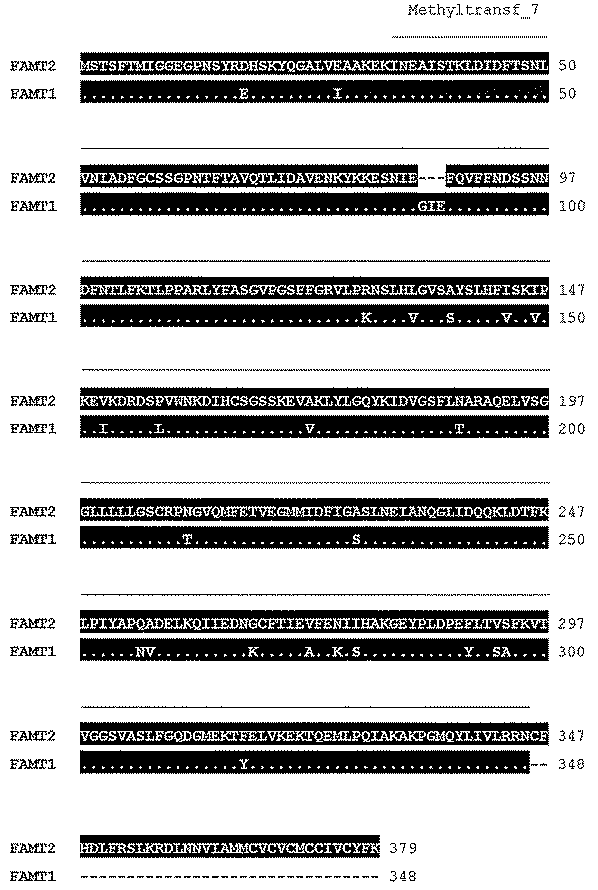
本態様において、1個以上のS-アデノシル-L-メチオニン依存性メチルトランスフェラーゼ遺伝子は、ファルネソール酸カルボキシル-O-メチルトランスフェラーゼ(FAMT)遺伝子であることが好ましい。FAMTは、配列番号1及び2で示されるアミノ酸配列からなるシロイヌナズナ由来のFAMT1及び2(以下、「シロイヌナズナFAMT1及び2」とも記載する)のみならず、シロイヌナズナ及び他の生物種由来のシロイヌナズナFAMTホモログを包含する。本態様において、「シロイヌナズナFAMTホモログ」は、配列番号1で示されるアミノ酸配列からなるシロイヌナズナFAMT1ポリペプチドに対して60%以上、好ましくは70%以上、より好ましくは80%以上、85%以上、90%以上、95%以上、若しくは98%以上、又は99%以上の同一性を有し、且つファルネソール酸カルボキシル-O-メチルトランスフェラーゼ活性を有するシロイヌナズナ及び他の生物種由来のポリペプチド(シロイヌナズナFAMTを除く)を意味する。それ故、本態様において、シロイヌナズナFAMTホモログには、シロイヌナズナ由来のFAMT遺伝子ファミリーだけでなく、他の植物種由来のFAMTオルソログも含む。FAMT1ポリペプチド及びFAMT2ポリペプチドは、高い同一性を有することから、FAMTホモログは、FAMT2を包含する。シロイヌナズナFAMTホモログは、配列番号1で示されるシロイヌナズナFAMT1のアミノ酸配列の第34〜348位の領域(以下、「methyltransf_7ドメイン」とも記載する)に相当するポリペプチド断片に対して65%以上、好ましくは、70%以上、より好ましくは80%以上、85%以上、90%以上、92%以上、95%以上、若しくは98%以上、又は99%以上の同一性を有することが好ましい。前記のホモログ及びオルソログを含む1個以上のS-アデノシル-L-メチオニン依存性メチルトランスフェラーゼ遺伝子を用いることにより、様々な植物の環境ストレス耐性、特に耐塩性を向上させることができる。 In this embodiment, the one or more S-adenosyl-L-methionine dependent methyltransferase genes are preferably farnesolate carboxyl-O-methyltransferase (FAMT) genes. FAMT includes not only Arabidopsis thaliana FAMT1 and 2 (hereinafter also referred to as “Arabidopsis thaliana FAMT1 and 2”) consisting of the amino acid sequences shown in SEQ ID NOs: 1 and 2, but also Arabidopsis thaliana and other species of Arabidopsis FAMT homolog Include. In this embodiment, the “Arabidopsis FAMT homolog” is 60% or more, preferably 70% or more, more preferably 80% or more, 85% or more, 90% or more of the Arabidopsis FAMT1 polypeptide consisting of the amino acid sequence represented by SEQ ID NO: 1. % Or more, 95% or more, 98% or more, or 99% or more identity, and a polypeptide derived from Arabidopsis and other species having farnesolate carboxyl-O-methyltransferase activity (excluding Arabidopsis FAMT) ). Therefore, in this embodiment, the Arabidopsis FAMT homolog includes not only the Arabidopsis FAMT gene family but also FAMT orthologs derived from other plant species. FAMT homologues include FAMT2 because FAMT1 and FAMT2 polypeptides have high identity. Arabidopsis FAMT homologue is 65% or more, preferably 65% or more of a polypeptide fragment corresponding to the region of positions 34 to 348 of the amino acid sequence of Arabidopsis FAMT1 represented by SEQ ID NO: 1 (hereinafter also referred to as “methyltransf_7 domain”), 70% or more, more preferably 80% or more, 85% or more, 90% or more, 92% or more, 95% or more, 98% or more, or 99% or more. By using one or more S-adenosyl-L-methionine-dependent methyltransferase genes including the homologues and orthologues described above, it is possible to improve environmental stress tolerance, particularly salt tolerance, of various plants.
本明細書において、アミノ酸配列の「同一性」は、2個のアミノ酸配列にギャップを導入して又は導入しないでアライメントさせたときに、一方のアミノ酸配列の全アミノ酸残基数に対する、他方のアミノ酸配列の同一アミノ酸残基数の割合(%)を意味する。また、塩基配列の「同一性」は、2個の塩基配列にギャップを導入して又は導入しないでアライメントさせたときに、一方の塩基配列の全塩基数に対する、他方の塩基配列の同一塩基数の割合(%)を意味する。同一性は、例えばBLAST等の当該技術分野で公知のプログラムを使用して決定することができる。 In the present specification, the “identity” of amino acid sequences refers to the other amino acid sequence with respect to the total number of amino acid residues of one amino acid sequence when two amino acid sequences are aligned with or without introducing a gap. It means the percentage (%) of the number of identical amino acid residues in the sequence. In addition, the “identity” of a base sequence is the number of identical bases of the other base sequence with respect to the total number of bases of one base sequence when aligned with or without introducing a gap between the two base sequences. Means the percentage. Identity can be determined using programs known in the art such as, for example, BLAST.
本態様において、S-アデノシル-L-メチオニン依存性メチルトランスフェラーゼ遺伝子は、前記で説明したS-アデノシル-L-メチオニン依存性メチルトランスフェラーゼの野生型ポリペプチドをコードする遺伝子(以下、「野生型遺伝子」とも記載する)だけでなく、その変異型ポリペプチドをコードする遺伝子(以下、「変異型遺伝子」とも記載する)も包含する。本態様において、「変異型ポリペプチド」は、前記で説明したS-アデノシル-L-メチオニン依存性メチルトランスフェラーゼの野生型ポリペプチドのアミノ酸配列において、S-アデノシル-L-メチオニン依存性メチルトランスフェラーゼ活性に実質的に影響を与えない範囲で1若しくは数個のアミノ酸が欠失、置換又は付加されたアミノ酸配列からなるポリペプチドを意味する。或いは、野生型ポリペプチドに含まれるアミノ酸残基の側鎖官能基が、メチル化、エステル化及び/又はファルネシル化等の翻訳後修飾を受けたポリペプチドも、変異型ポリペプチドに包含される。変異型ポリペプチドは、部位特異的突然変異誘発法等の当該技術分野で公知の手段によって人為的に作成されてもよく、天然に存在する同様の変異型ポリペプチドを用いてもよい。いずれの場合も本態様の植物に包含される。 In this embodiment, the S-adenosyl-L-methionine-dependent methyltransferase gene is a gene encoding the wild-type polypeptide of S-adenosyl-L-methionine-dependent methyltransferase described above (hereinafter referred to as “wild-type gene”). As well as a gene encoding the mutant polypeptide (hereinafter also referred to as “mutant gene”). In this embodiment, the “mutant polypeptide” refers to the S-adenosyl-L-methionine-dependent methyltransferase activity in the amino acid sequence of the wild-type polypeptide of S-adenosyl-L-methionine-dependent methyltransferase described above. It means a polypeptide consisting of an amino acid sequence in which one or several amino acids are deleted, substituted or added within a range that does not substantially affect. Alternatively, a polypeptide in which a side-chain functional group of an amino acid residue contained in a wild-type polypeptide has undergone post-translational modification such as methylation, esterification and / or farnesylation is also included in the mutant polypeptide. The mutant polypeptide may be artificially prepared by means known in the art such as site-directed mutagenesis, or a similar naturally occurring mutant polypeptide may be used. Either case is included in the plant of this embodiment.
変異型ポリペプチドに含まれる変異が生じたアミノ酸の数は、通常は、1又は数個の範囲である。「数個」の範囲は、環境ストレス耐性を増強する活性に実質的に影響を与えない範囲の2以上の整数であればよい。例えば、2〜10個の範囲であることが好ましく、2〜8個の範囲であることがより好ましく、2〜5、2〜4、2〜3又は2個の範囲であることが特に好ましい。 The number of amino acids in which a mutation is contained in the mutant polypeptide is usually in the range of 1 or several. The “several” range may be an integer of 2 or more in a range that does not substantially affect the activity of enhancing environmental stress tolerance. For example, the range is preferably 2 to 10, more preferably 2 to 8, and particularly preferably 2 to 5, 2 to 4, 2 to 3, or 2.
本態様において、「S-アデノシル-L-メチオニン依存性メチルトランスフェラーゼ遺伝子」は、S-アデノシル-L-メチオニン依存性メチルトランスフェラーゼをコードする遺伝子だけでなく、S-アデノシル-L-メチオニン依存性メチルトランスフェラーゼ活性を有するその断片をコードする遺伝子も包含する。本態様において、「S-アデノシル-L-メチオニン依存性メチルトランスフェラーゼ活性を有するその断片」は、S-アデノシル-L-メチオニン依存性メチルトランスフェラーゼタンパク質のポリペプチド断片であって、S-アデノシル-L-メチオニン依存性メチルトランスフェラーゼタンパク質が有する酵素活性を実質的に保持しているポリペプチド断片を意味する。当業者には明らかなように、このようなポリペプチド断片の長さ及び/又は全長ポリペプチドにおける領域は、元となるS-アデノシル-L-メチオニン依存性メチルトランスフェラーゼタンパク質の構造及び/又は機能等に依存して様々である。それ故、本態様において、S-アデノシル-L-メチオニン依存性メチルトランスフェラーゼ活性を有するS-アデノシル-L-メチオニン依存性メチルトランスフェラーゼの断片は、前記で説明したS-アデノシル-L-メチオニン依存性メチルトランスフェラーゼタンパク質の構造及び/又は機能等に基づき、methyltransf_7ドメインのようなS-アデノシル-L-メチオニン依存性メチルトランスフェラーゼ活性の発現に不可欠な領域を破壊しない範囲で適宜設計すればよい。例えば、S-アデノシル-L-メチオニン依存性メチルトランスフェラーゼとして配列番号1で示されるシロイヌナズナFAMT1を用いる場合、S-アデノシル-L-メチオニン依存性メチルトランスフェラーゼ活性を有するその断片は、そのアミノ酸配列の第34〜348位の領域を破壊しない範囲で保持するポリペプチド断片であることが好ましい。
In this embodiment, the “S-adenosyl-L-methionine-dependent methyltransferase gene” includes not only a gene encoding S-adenosyl-L-methionine-dependent methyltransferase but also S-adenosyl-L-methionine-dependent methyltransferase. Also included is a gene encoding a fragment thereof having activity. In this embodiment, “a fragment thereof having S-adenosyl-L-methionine-dependent methyltransferase activity” is a polypeptide fragment of S-adenosyl-L-methionine-dependent methyltransferase protein, comprising S-adenosyl-L- It means a polypeptide fragment that substantially retains the enzyme activity of a methionine-dependent methyltransferase protein. As will be apparent to those skilled in the art, the length of such a polypeptide fragment and / or the region in the full-length polypeptide is the structure and / or function of the original S-adenosyl-L-methionine-dependent methyltransferase protein, etc. Depends on the variety. Therefore, in this embodiment, the fragment of S-adenosyl-L-methionine dependent methyltransferase having S-adenosyl-L-methionine dependent methyltransferase activity is the S-adenosyl-L-methionine dependent methyl described above. Based on the structure and / or function of the transferase protein, it may be appropriately designed within a range that does not destroy a region essential for expression of S-adenosyl-L-methionine-dependent methyltransferase activity such as methyltransf_7 domain. For example, when Arabidopsis thaliana FAMT1 represented by SEQ ID NO: 1 is used as the S-adenosyl-L-methionine-dependent methyltransferase, the fragment having S-adenosyl-L-methionine-dependent methyltransferase activity is the 34th of the amino acid sequence. It is preferably a polypeptide fragment that retains the region at about
S-アデノシル-L-メチオニン依存性メチルトランスフェラーゼタンパク質をコードする遺伝子としては、前記で例示した該酵素の野生型遺伝子、又はその変異型遺伝子を挙げることができる。S-アデノシル-L-メチオニン依存性メチルトランスフェラーゼの変異型遺伝子としては、例えば、該酵素の野生型ポリペプチドをコードする核酸の塩基配列において、1若しくは数個のヌクレオチドが欠失、置換又は付加された核酸、前記塩基配列と60%以上、好ましくは、70%以上、より好ましくは80%以上、85%以上、90%以上、95%以上、98%以上、及び99%以上の同一性を有する核酸、並びに野生型遺伝子の部分塩基配列に相補的な塩基配列からなる核酸断片とストリンジェントな条件下でハイブリダイズする核酸であって、それがコードするポリペプチドがS-アデノシル-L-メチオニン依存性メチルトランスフェラーゼ活性を有する核酸を挙げることができる。ここで、「数個のヌクレオチド」は、2〜20個、2〜10個、2〜9個、2〜8個、又は2〜7個を意味する。2〜6個、2〜5個、2〜4個、2〜3個又は2個のヌクレオチドであることが好ましい。また、「ストリンジェントな条件」は、非特異的なハイブリッドが形成されない条件を意味する。通常は、低ストリンジェント〜高ストリンジェントな条件が挙げられるが、高ストリンジェントな条件が好ましい。低ストリンジェントな条件とは、ハイブリダイゼーション後の洗浄において、例えば42℃、5×SSC、0.1% SDSで洗浄する条件であり、好ましくは50℃、5×SSC及び0.1% SDSで洗浄する条件である。高ストリンジェントな条件とは、ハイブリダイゼーション後の洗浄において、例えば65℃、0.1×SSC及び0.1% SDSで洗浄する条件である。このような変異型遺伝子としては、一塩基多型(SNP)等の多型に基づく変異体、スプライス変異体、及び遺伝暗号の縮重に基づく変異体等を挙げることができる。 Examples of the gene encoding the S-adenosyl-L-methionine-dependent methyltransferase protein include the wild-type gene of the enzyme exemplified above or a mutant gene thereof. As a mutant gene of S-adenosyl-L-methionine-dependent methyltransferase, for example, one or several nucleotides are deleted, substituted or added in the nucleotide sequence of the nucleic acid encoding the wild-type polypeptide of the enzyme. A nucleic acid having 60% or more, preferably 70% or more, more preferably 80% or more, 85% or more, 90% or more, 95% or more, 98% or more, and 99% or more identity with the base sequence. A nucleic acid that hybridizes under stringent conditions with a nucleic acid and a nucleic acid fragment consisting of a base sequence complementary to a partial base sequence of a wild-type gene, and the polypeptide encoded by the nucleic acid depends on S-adenosyl-L-methionine And a nucleic acid having sexual methyltransferase activity. Here, “several nucleotides” means 2 to 20, 2 to 10, 2 to 9, 2 to 8, or 2 to 7. 2-6, 2-5, 2-4, 2-3, or 2 nucleotides are preferred. Further, “stringent conditions” means conditions under which a nonspecific hybrid is not formed. Usually, conditions of low stringency to high stringency can be mentioned, but conditions of high stringency are preferable. Low stringent conditions are conditions for washing with, for example, 42 ° C., 5 × SSC, 0.1% SDS, preferably 50 ° C., 5 × SSC, and 0.1% SDS. is there. Highly stringent conditions are conditions for washing with, for example, 65 ° C., 0.1 × SSC and 0.1% SDS in the post-hybridization wash. Examples of such mutant genes include mutants based on polymorphisms such as single nucleotide polymorphism (SNP), splice mutants, mutants based on the degeneracy of the genetic code, and the like.
S-アデノシル-L-メチオニン依存性メチルトランスフェラーゼの断片をコードする遺伝子としては、野生型又は変異型の該酵素ポリペプチドをコードする核酸の断片であって、それがコードするポリペプチドがS-アデノシル-L-メチオニン依存性メチルトランスフェラーゼ活性を有する核酸を挙げることができる。 A gene encoding a fragment of S-adenosyl-L-methionine-dependent methyltransferase includes a nucleic acid fragment encoding the enzyme polypeptide of the wild type or mutant type, and the polypeptide encoded by the gene is S-adenosyl Mention may be made of nucleic acids having -L-methionine-dependent methyltransferase activity.
好ましくは、1個以上のS-アデノシル-L-メチオニン依存性メチルトランスフェラーゼ遺伝子は、以下の(a)〜(c):
(a)配列番号1又は2で示されるアミノ酸配列からなるポリペプチド、
(b)配列番号1又は2で示されるアミノ酸配列において1若しくは数個のアミノ酸が欠失、置換又は付加されたアミノ酸配列からなり、且つS-アデノシル-L-メチオニン依存性メチルトランスフェラーゼ活性を有するポリペプチド、及び
(c)配列番号1で示されるアミノ酸配列の第34〜348位の領域に相当するポリペプチド断片に対して92%以上の同一性を有し、且つS-アデノシル-L-メチオニン依存性メチルトランスフェラーゼ活性を有するポリペプチド
のいずれかのポリペプチドをコードする遺伝子である。
Preferably, the one or more S-adenosyl-L-methionine dependent methyltransferase genes have the following (a) to (c):
(A) a polypeptide comprising the amino acid sequence represented by SEQ ID NO: 1 or 2,
(B) a polymorphism having an amino acid sequence in which one or several amino acids are deleted, substituted or added in the amino acid sequence represented by SEQ ID NO: 1 or 2, and having S-adenosyl-L-methionine-dependent methyltransferase activity A peptide, and (c) 92% or more identity to a polypeptide fragment corresponding to the region of positions 34 to 348 of the amino acid sequence represented by SEQ ID NO: 1, and is dependent on S-adenosyl-L-methionine A gene encoding any one of the polypeptides having sex methyltransferase activity.
(a)のポリペプチドは、シロイヌナズナのFAMT1又は2タンパク質に相当するポリペプチドを意味する。 The polypeptide (a) means a polypeptide corresponding to Arabidopsis FAMT1 or 2 protein.
(b)のポリペプチドは、(a)のポリペプチドにおいて、S-アデノシル-L-メチオニン依存性メチルトランスフェラーゼ活性に実質的に影響を与えない範囲で変異が生じた変異型ポリペプチドを意味する。変異が生じたアミノ酸の数は、通常、1又は数個の範囲である。「数個」の範囲は、例えば、2〜10個の範囲であることが好ましく、2〜8個の範囲であることがより好ましく、2〜5、2〜4、2〜3又は2個の範囲であることが特に好ましい。 The polypeptide (b) means a mutant polypeptide in which a mutation has occurred in the polypeptide (a) within a range that does not substantially affect the S-adenosyl-L-methionine-dependent methyltransferase activity. The number of amino acids mutated is usually in the range of 1 or several. The range of “several” is, for example, preferably in the range of 2-10, more preferably in the range of 2-8, 2-5, 2-4, 2-3, or 2 A range is particularly preferred.
(c)は、(a)のポリペプチド断片に対して通常60%以上、好ましくは、70%以上、より好ましくは80%以上、85%以上、90%以上、92%以上、95%以上、若しくは98%以上、又は99%以上の同一性を有し、且つS-アデノシル-L-メチオニン依存性メチルトランスフェラーゼ活性を有するポリペプチドを意味する。前記ポリペプチドは、methyltransf_7ドメインに相当するポリペプチド断片に対して通常65%以上、好ましくは、70%以上、より好ましくは80%以上、85%以上、90%以上、92%以上、95%以上、若しくは98%以上、又は99%以上の同一性を有することが好ましい。 (C) is usually 60% or more, preferably 70% or more, more preferably 80% or more, 85% or more, 90% or more, 92% or more, 95% or more with respect to the polypeptide fragment of (a), Alternatively, it means a polypeptide having 98% or more, or 99% or more identity, and having S-adenosyl-L-methionine-dependent methyltransferase activity. The polypeptide is usually 65% or more, preferably 70% or more, more preferably 80% or more, 85% or more, 90% or more, 92% or more, 95% or more with respect to the polypeptide fragment corresponding to the methyltransf_7 domain. Or 98% or more, or 99% or more of identity.
(a)のポリペプチドをコードする遺伝子としては、シロイヌナズナの野生型S-アデノシル-L-メチオニン依存性メチルトランスフェラーゼタンパク質をコードする核酸、及びその変異型タンパク質であってS-アデノシル-L-メチオニン依存性メチルトランスフェラーゼ活性を有するタンパク質をコードする核酸を挙げることができる。シロイヌナズナの野生型S-アデノシル-L-メチオニン依存性メチルトランスフェラーゼであるFAMT1タンパク質をコードする核酸の具体的な塩基配列は、配列番号3で、FAMT2タンパク質をコードする核酸の具体的な塩基配列は、配列番号4で、それぞれ示される。それ故、(a)の配列番号1又は2で示されるアミノ酸配列からなるポリペプチドをコードする遺伝子は、それぞれ配列番号3又は4で表される塩基配列を含む核酸を含む遺伝子であることが好ましい。 The gene encoding the polypeptide of (a) includes a nucleic acid encoding wild-type S-adenosyl-L-methionine-dependent methyltransferase protein of Arabidopsis thaliana and a mutant protein thereof, which depends on S-adenosyl-L-methionine And a nucleic acid encoding a protein having sexual methyltransferase activity. The specific nucleotide sequence of the nucleic acid encoding the FAMT1 protein, which is a wild-type S-adenosyl-L-methionine-dependent methyltransferase of Arabidopsis thaliana, is SEQ ID NO: 3, and the specific nucleotide sequence of the nucleic acid encoding the FAMT2 protein is Each is shown in SEQ ID NO: 4. Therefore, the gene encoding the polypeptide consisting of the amino acid sequence represented by SEQ ID NO: 1 or 2 in (a) is preferably a gene containing a nucleic acid comprising the base sequence represented by SEQ ID NO: 3 or 4, respectively. .
本態様の環境ストレス耐性が向上した植物において、発現が増加されているS-アデノシル-L-メチオニン依存性メチルトランスフェラーゼ遺伝子は、通常は1個以上であり、1〜2個の範囲であることが好ましく、1又は2個であることがより好ましく、2個であることが特に好ましい。前記個数のS-アデノシル-L-メチオニン依存性メチルトランスフェラーゼ遺伝子の発現を増加させることにより、植物において産生されるファルネソール酸メチルを増加させて、耐塩性のような該植物の環境ストレス耐性が向上した植物を得ることができる。 In the plant having improved environmental stress tolerance according to this embodiment, the number of S-adenosyl-L-methionine-dependent methyltransferase genes whose expression is increased is usually 1 or more and may be in the range of 1 to 2 Preferably, 1 or 2 is more preferable, and 2 is particularly preferable. By increasing the expression of the number of S-adenosyl-L-methionine-dependent methyltransferase genes, the methyl farnesolate produced in the plant was increased and the environmental stress tolerance of the plant such as salt tolerance was improved. Plants can be obtained.
本発明において、「遺伝子の発現が増加されている」は、対象となる遺伝子の転写産物の量、翻訳産物の量及び翻訳産物の有する活性の少なくともいずれかの遺伝子発現の指標の上昇を意味する。本態様において、1個以上のS-アデノシル-L-メチオニン依存性メチルトランスフェラーゼ遺伝子の増加の程度は、限定するものではないが、例えば、対象となる野生型の植物における該遺伝子発現の指標の値に対して、例えば2倍以上、好ましくは5倍以上、より好ましくは10倍以上である。 In the present invention, “gene expression is increased” means an increase in the gene expression index of at least one of the transcription product of the target gene, the translation product, and the activity of the translation product. . In this embodiment, the degree of increase of one or more S-adenosyl-L-methionine-dependent methyltransferase genes is not limited, but for example, the value of an indicator of the gene expression in a target wild-type plant In contrast, for example, it is 2 times or more, preferably 5 times or more, more preferably 10 times or more.
本態様の環境ストレス耐性が向上した植物において、1個以上のS-アデノシル-L-メチオニン依存性メチルトランスフェラーゼ遺伝子の発現を増加させる手段としては、限定するものではないが、例えば、1個以上のS-アデノシル-L-メチオニン依存性メチルトランスフェラーゼ遺伝子を発現可能な状態で包含する1個以上の遺伝子発現系の導入、及び対象の植物において1個以上のS-アデノシル-L-メチオニン依存性メチルトランスフェラーゼ遺伝子を過剰発現させる変異処理等を挙げることができる。 In the plant having improved environmental stress tolerance of the present embodiment, means for increasing the expression of one or more S-adenosyl-L-methionine-dependent methyltransferase genes is not limited, for example, one or more Introduction of one or more gene expression systems including an S-adenosyl-L-methionine-dependent methyltransferase gene in an expressible state, and one or more S-adenosyl-L-methionine-dependent methyltransferases in the target plant Examples include mutation treatment that overexpresses a gene.
本発明において、「遺伝子発現系」は、対象の植物において包含する遺伝子を所定の条件下で発現させることのできる単位を意味する。遺伝子発現系は、通常は、包含する遺伝子に対応する領域の他に、発現調節領域を有する。発現調節領域は、通常は、プロモーター及びターミネーターを含み、さらに場合によりエンハンサー、ポリA付加シグナル、5'-UTR(非翻訳領域)配列、標識若しくは選抜マーカー遺伝子、マルチクローニング部位及び複製開始点等を含む。本態様において使用する遺伝子発現系は、1個以上のS-アデノシル-L-メチオニン依存性メチルトランスフェラーゼ遺伝子を発現可能な状態で包含していれば、他の構成は特に限定されない。 In the present invention, “gene expression system” means a unit capable of expressing a gene included in a target plant under predetermined conditions. The gene expression system usually has an expression regulatory region in addition to a region corresponding to the gene to be included. The expression control region usually includes a promoter and a terminator, and optionally includes an enhancer, a poly A addition signal, a 5′-UTR (untranslated region) sequence, a marker or selection marker gene, a multicloning site, a replication origin, and the like. Including. Other configurations are not particularly limited as long as the gene expression system used in this embodiment includes one or more S-adenosyl-L-methionine-dependent methyltransferase genes in a state capable of being expressed.
本態様において使用する遺伝子発現系は、1個の遺伝子発現系に1個のS-アデノシル-L-メチオニン依存性メチルトランスフェラーゼ遺伝子を包含することが好ましい。すなわち、本態様において、発現が増加されているS-アデノシル-L-メチオニン依存性メチルトランスフェラーゼ遺伝子が複数の場合、該複数のS-アデノシル-L-メチオニン依存性メチルトランスフェラーゼ遺伝子を別々に包含する複数の遺伝子発現系を使用することが好ましい。このような実施形態により、複数のS-アデノシル-L-メチオニン依存性メチルトランスフェラーゼ遺伝子の発現を別々に制御することができる。 The gene expression system used in this embodiment preferably includes one S-adenosyl-L-methionine-dependent methyltransferase gene in one gene expression system. That is, in this embodiment, when there are a plurality of S-adenosyl-L-methionine-dependent methyltransferase genes whose expression is increased, a plurality of S-adenosyl-L-methionine-dependent methyltransferase genes separately including the plurality of S-adenosyl-L-methionine-dependent methyltransferase genes. It is preferable to use the gene expression system. According to such an embodiment, the expression of a plurality of S-adenosyl-L-methionine-dependent methyltransferase genes can be controlled separately.
本態様において使用する遺伝子発現系は、対象の植物細胞内で複数のコピー(以下、「多コピー」とも記載する)を一定の期間維持できる性質を有することが好ましい。多コピー型の遺伝子発現系を用いる場合、それぞれの遺伝子発現系からの1個以上のS-アデノシル-L-メチオニン依存性メチルトランスフェラーゼ遺伝子の発現量が低くとも、全体としての該遺伝子の発現量を増加させることができる。 The gene expression system used in this embodiment preferably has a property capable of maintaining a plurality of copies (hereinafter also referred to as “multi-copy”) for a certain period in a target plant cell. When using a multi-copy type gene expression system, even if the expression level of one or more S-adenosyl-L-methionine-dependent methyltransferase genes from each gene expression system is low, Can be increased.
本態様において使用する遺伝子発現系は、発現時期及び発現部位の少なくともいずれかが制御されていてもよく、制御されていなくともよい。後者の場合、1個以上のS-アデノシル-L-メチオニン依存性メチルトランスフェラーゼ遺伝子を、対象の植物において構成的に発現させることができる。 In the gene expression system used in this embodiment, at least one of the expression time and the expression site may be controlled, or may not be controlled. In the latter case, one or more S-adenosyl-L-methionine dependent methyltransferase genes can be constitutively expressed in the plant of interest.
本態様において使用する遺伝子発現系としては、限定するものではないが、当該技術分野で通常使用されるプラスミド又はウイルスを利用した発現ベクターを挙げることができる。プラスミド発現ベクターとしては、例えば、pPZP系、pSMA系、pUC系、pBR系、pBluescript系(stratagene社)、pTriEXTM系(TaKaRa社)、及びpBI系、pRI系又はpGW系のバイナリーベクター等を挙げることができる。ウイルス発現ベクターとしては、例えば、カリフラワーモザイクウイルス(CaMV)、インゲンマメゴールデンモザイクウイルス(BGMV)及びタバコモザイクウイルス(TMV)等を挙げることができる。発現ベクターは、対象となる植物の種類、発現時期及び/又は発現部位等に基づき、適宜選択することができる。 Examples of the gene expression system used in this embodiment include, but are not limited to, expression vectors utilizing plasmids or viruses that are usually used in the art. Examples of plasmid expression vectors include pPZP, pSMA, pUC, pBR, pBluescript (stratagene), pTriEXTM (TaKaRa), and pBI, pRI, or pGW binary vectors. Can do. Examples of viral expression vectors include cauliflower mosaic virus (CaMV), kidney bean golden mosaic virus (BGMV), and tobacco mosaic virus (TMV). The expression vector can be appropriately selected based on the type of plant, the expression time, and / or the expression site.
発現ベクターで使用されるプロモーターとしては、所望の発現パターンに応じて、例えば、過剰発現型プロモーター、構成的プロモーター、部位特異的プロモーター、段階特異的プロモーター、及び誘導性プロモーター等に分類することができる。過剰発現型で且つ構成的プロモーターの例としては、例えば、CaMV由来の35Sプロモーター、Tiプラスミド由来のノパリン合成酵素遺伝子のプロモーターPnos、トウモロコシ由来のユビキチンプロモーター、イネ由来のアクチンプロモーター、及びタバコ由来PRタンパク質プロモーター等を挙げることができる。 The promoter used in the expression vector can be classified into, for example, an overexpression promoter, a constitutive promoter, a site-specific promoter, a stage-specific promoter, an inducible promoter, and the like according to a desired expression pattern. . Examples of overexpressing and constitutive promoters include, for example, CaMV-derived 35S promoter, Ti plasmid-derived nopaline synthase gene promoter Pnos, corn-derived ubiquitin promoter, rice-derived actin promoter, and tobacco-derived PR protein A promoter etc. can be mentioned.
発現ベクターで使用されるターミネーターは、前記で例示したプロモーターにより転写された遺伝子の転写を終結できる配列であれば、特に限定されない。発現ベクターで使用されるターミネーターとしては、例えば、ノパリン合成酵素(NOS)遺伝子のターミネーター、オクトピン合成酵素(OCS)遺伝子のターミネーター、CaMV 35Sターミネーター、大腸菌リポポリプロテインlppの3’ターミネーター、trpオペロンターミネーター、amyBターミネーター、及びADH1遺伝子のターミネーター等を挙げることができる。 The terminator used in the expression vector is not particularly limited as long as it is a sequence capable of terminating the transcription of the gene transcribed by the promoter exemplified above. Examples of terminators used in expression vectors include nopaline synthase (NOS) gene terminator, octopine synthase (OCS) gene terminator, CaMV 35S terminator, Escherichia coli lipopolyprotein lpp 3 'terminator, trp operon terminator, Examples include amyB terminator and ADH1 gene terminator.
発現ベクターで使用されるエンハンサーとしては、例えば、CaMV 35Sプロモーター内の上流側の配列を含むエンハンサー領域を挙げることができる。 Examples of the enhancer used in the expression vector include an enhancer region containing an upstream sequence in the CaMV 35S promoter.
発現ベクターで使用される標識又は選抜マーカー遺伝子としては、例えば、薬剤耐性遺伝子(例えば、テトラサイクリン耐性遺伝子、アンピシリン耐性遺伝子、カナマイシン耐性遺伝子、ハイグロマイシン耐性遺伝子、スペクチノマイシン耐性遺伝子、クロラムフェニコール耐性遺伝子又はネオマイシン耐性遺伝子)、蛍光又は発光レポーター遺伝子(例えば、ルシフェラーゼ、β-ガラクトシダーゼ、β-グルクロニターゼ(GUS)又は緑色蛍光タンパク質(GFP))、ネオマイシンホスホトランスフェラーゼII(NPT II)、ジヒドロ葉酸還元酵素、及びブラストサイジンS耐性遺伝子等の酵素遺伝子を挙げることができる。 Examples of the marker or selection marker gene used in the expression vector include drug resistance genes (eg, tetracycline resistance gene, ampicillin resistance gene, kanamycin resistance gene, hygromycin resistance gene, spectinomycin resistance gene, chloramphenicol resistance) Gene or neomycin resistance gene), fluorescent or luminescent reporter gene (eg, luciferase, β-galactosidase, β-glucuronidase (GUS) or green fluorescent protein (GFP)), neomycin phosphotransferase II (NPT II), dihydrofolate reductase, And an enzyme gene such as a blasticidin S resistance gene.
本態様において、前記で説明した遺伝子発現系を対象の植物に導入する手段としては、当該技術分野で通常使用される各種の形質転換方法を適用することができる。遺伝子発現系がプラスミド発現ベクターの場合、プロトプラスト法、パーティクルガン法又はアグロバクテリウム法等を用いることができる。また、遺伝子発現系がウイルス発現ベクターの場合、植物病害抵抗性遺伝子等を組み込んだウイルス発現ベクターを対象の植物細胞に感染させる方法を用いることができる。これらの形質転換方法の詳細については、「植物代謝工学ハンドブック」(2002年、NTS社)、「新版モデル植物の実験プロトコル:遺伝学的手法からゲノム解析まで」(2001年秀潤社)、Molecular Biology of Plant Tumors(Academic Press、New York)1982、pp549)、及び米国特許第4,407,956号明細書等に記載の公知のプロトコルを参照することができる。 In this embodiment, as a means for introducing the gene expression system described above into a target plant, various transformation methods usually used in the technical field can be applied. When the gene expression system is a plasmid expression vector, a protoplast method, a particle gun method, an Agrobacterium method, or the like can be used. When the gene expression system is a viral expression vector, a method of infecting a target plant cell with a viral expression vector incorporating a plant disease resistance gene or the like can be used. For details on these transformation methods, see "Plant Metabolic Engineering Handbook" (2002, NTS), "New Edition Model Plant Experimental Protocol: From Genetic Methods to Genome Analysis" (2001 Shujunsha), Molecular Biology of Plant Tumors (Academic Press, New York) 1982, pp549), and U.S. Pat. No. 4,407,956 can be referred to.
前記の導入手段で形質転換した植物細胞は、公知の方法に基づいて遺伝子組換え植物体に再生させることができる。遺伝子組換え植物体の再生手段としては、例えば、未分化増殖細胞からなるカルス形成を経て植物体に再生させるインビトロ再生方法を挙げることができる。本方法の詳細については、「植物代謝工学ハンドブック」(2002年、NTS社)及び「新版モデル植物の実験プロトコル:遺伝学的手法からゲノム解析まで」(2001年秀潤社)等に記載の公知のプロトコルを参照することができる。或いは、カルス又は細胞培養のステップを経ることなく、目的の植物個体の細胞に直接、遺伝子発現系を導入するin planta法を用いることもできる。形質転換細胞の増殖及び/又は分裂を促進するために、オーキシン、ジベレリン、サイトカイニン、アブシジン酸、ブラシノステロイド及び/又はフィトスルホカインのような植物ホルモンを使用することができる。 Plant cells transformed by the introduction means can be regenerated into genetically modified plants based on known methods. Examples of the means for regenerating a genetically modified plant include an in vitro regeneration method in which a plant is regenerated through callus formation composed of undifferentiated proliferating cells. Details of this method are described in "Plant Metabolic Engineering Handbook" (2002, NTS) and "New Edition Model Plant Experiment Protocol: From Genetic Methods to Genome Analysis" (2001 Shujunsha). Can be referred to. Alternatively, an in planta method can be used in which a gene expression system is directly introduced into cells of a target plant individual without going through a callus or cell culture step. Plant hormones such as auxin, gibberellin, cytokinin, abscisic acid, brassinosteroids and / or phytosulfokine can be used to promote the growth and / or division of transformed cells.
前記特徴を有する遺伝子発現系を用いることにより、対象の植物において、1個以上のS-アデノシル-L-メチオニン依存性メチルトランスフェラーゼ遺伝子の発現を増加させることができる。 By using the gene expression system having the above characteristics, the expression of one or more S-adenosyl-L-methionine-dependent methyltransferase genes can be increased in the target plant.
本態様の環境ストレス耐性が向上した植物において、1個以上のS-アデノシル-L-メチオニン依存性メチルトランスフェラーゼ遺伝子の発現を増加させる手段として変異処理を適用する場合、該変異処理は、通常は、1個以上のS-アデノシル-L-メチオニン依存性メチルトランスフェラーゼ遺伝子の発現を制御する転写因子等の発現パターンを改変するために使用される。本工程において使用される変異処理としては、限定するものではないが、例えば、点変異導入法、トランスポゾン挿入変異法、T-DNA挿入変異法、γ線若しくは重イオンビームのような放射線照射法、及びメタンスルホン酸エチル(EMS)のような化学変異剤処理法を挙げることができる。これらの方法の詳細については、「植物代謝工学ハンドブック」(2002年、NTS社)及び「新版モデル植物の実験プロトコル:遺伝学的手法からゲノム解析まで」(2001年秀潤社)等に記載の公知のプロトコルを参照することができる。前記変異処理を用いることにより、対象の植物において、1個以上のS-アデノシル-L-メチオニン依存性メチルトランスフェラーゼ遺伝子の発現を増加させることができる。 When a mutation treatment is applied as a means for increasing the expression of one or more S-adenosyl-L-methionine-dependent methyltransferase genes in a plant with improved environmental stress tolerance according to this embodiment, the mutation treatment is usually performed as follows: It is used to modify the expression pattern of transcription factors and the like that control the expression of one or more S-adenosyl-L-methionine-dependent methyltransferase genes. The mutation treatment used in this step is not limited, for example, point mutation introduction method, transposon insertion mutation method, T-DNA insertion mutation method, irradiation method such as γ-ray or heavy ion beam, And chemical mutagen treatment methods such as ethyl methanesulfonate (EMS). Details of these methods are described in "Plant Metabolic Engineering Handbook" (2002, NTS) and "New Edition Model Plant Experiment Protocol: From Genetic Methods to Genome Analysis" (2001 Shujunsha). Reference can be made to known protocols. By using the mutation treatment, the expression of one or more S-adenosyl-L-methionine-dependent methyltransferase genes can be increased in the target plant.
本態様の環境ストレス耐性が向上した植物は、前記手段によって1個以上のS-アデノシル-L-メチオニン依存性メチルトランスフェラーゼ遺伝子の発現を増加させた第一世代の植物自体だけでなく、第一世代の植物と同一の遺伝情報を有するそのクローン体も包含する。前記クローン体としては、例えば、本態様の第一世代の植物から採取した植物体の一部を挿し木、接木若しくは取り木した植物、細胞培養した後、カルス形成を介して植物体を再生させた植物、及び一世代の植物から無性生殖で得られる栄養繁殖器官(例えば、根茎、塊根、球茎又はランナー等)より形成させた新たな栄養体を挙げることができる。 Plants with improved environmental stress tolerance of this embodiment include not only the first generation plants themselves that have increased the expression of one or more S-adenosyl-L-methionine-dependent methyltransferase genes by the above means, but also the first generation Also included are clones having the same genetic information as the other plants. As the cloned body, for example, a part of a plant collected from the first generation plant of this embodiment is cut, grafted or cut, a plant is cultured, and then the plant is regenerated through callus formation. Examples thereof include new nutrients formed from plants and vegetative propagation organs (eg, rhizomes, tuberous roots, corms or runners) obtained by asexual reproduction from one generation of plants.
本態様の環境ストレス耐性が向上した植物は、前記手段によって1個以上のS-アデノシル-L-メチオニン依存性メチルトランスフェラーゼ遺伝子の発現を増加させた第一世代の植物自体だけでなく、その後代も包含する。環境ストレス耐性が向上した植物の後代は、前記手段によって得られた第一世代の植物の有性生殖を介した子孫であって、且つ環境ストレス耐性が向上した形質を保持するものを意味する。環境ストレス耐性が向上した植物の後代としては、例えば、本態様の第一世代の植物の実生を挙げることができる。本態様の環境ストレス耐性が向上した植物の後代は、当該技術分野で通常使用される手段で取得することができる。本態様の環境ストレス耐性が向上した植物の後代は、例えば、本態様の第一世代の植物を結実させることにより、後代第一世代で、且つ本態様の植物第二世代の種子を得ることができる。また、本態様の後代第一世代の種子を適当な培地上で発芽させ、得られた幼植物体を適当な栽培条件下で植物体まで生育させた後、結実させることにより、後代第二世代を得ることができる。本態様の環境ストレス耐性が向上した植物は、環境ストレス耐性が増強された形質を保持する限りにおいて、その世代を問わない。したがって、後代第二世代取得の方法と同様の方法を繰り返して交配することにより、後代第三世代以降を得ることができる。 The plant having improved environmental stress tolerance according to the present embodiment is not only the first generation plant itself in which the expression of one or more S-adenosyl-L-methionine-dependent methyltransferase genes is increased by the above-mentioned means, but also its progeny Include. A progeny of a plant having improved environmental stress tolerance means a progeny of the first generation plant obtained by the above-mentioned means through sexual reproduction and retaining a trait with improved environmental stress tolerance. As a progeny of a plant having improved environmental stress tolerance, for example, the seedling of the first generation plant of this embodiment can be mentioned. The progeny of the plant having improved environmental stress tolerance according to this embodiment can be obtained by means usually used in the art. The progeny of the plant with improved environmental stress tolerance according to the present embodiment can be obtained, for example, by ripening the first generation plant of the present embodiment to obtain seeds of the first generation of the progeny and the second generation plant of the present embodiment. it can. In addition, the seeds of the first generation of this embodiment are germinated on an appropriate medium, and the seedlings obtained are grown to plant bodies under appropriate cultivation conditions and then set to yield, thereby generating the second generation of the progeny. Can be obtained. The generation of the plant with improved environmental stress tolerance of this embodiment is not limited as long as it retains the trait with enhanced environmental stress tolerance. Therefore, the third generation and subsequent generations can be obtained by repeatedly mating the same method as the method for obtaining the second generation generation.
以下、実施例を用いて本発明をさらに具体的に説明する。但し、本発明の技術的範囲はこれら実施例に限定されるものではない。 Hereinafter, the present invention will be described more specifically with reference to examples. However, the technical scope of the present invention is not limited to these examples.
<I:マイクロアレイ解析>
野生型のシロイヌナズナ(Col-0)の種子を滅菌した。滅菌処理されたシロイヌナズナ種子を、5 mlの1/2 MS液体培地(2.15 g/LのMS粉末、1質量%スクロース、1/1000濃度のB5ビタミン、0.5 g/L MES、及び0.1質量%寒天、1N KOHでpH5.7に調整)に浮かべるように播種した。播種後の種子を、4℃、暗所にて2日間低温処理した。低温処理した種子を22℃に設定されたインキュベーター内に移動し、シロイヌナズナを22℃で4日間生育させた。5 μLの1 μMの試験化合物(シクロ[-L-2-アミノ-7-(2-オキソプロピルチオ)ヘプタノイル-アミノイソブチリル-L-フェニルアラニル-D-プロリル-]、Ky-72)溶液又は5 μLのDMSOを培地に添加して、シロイヌナズナをさらに22℃で24時間生育させた。その後、100 μLの5 M NaCl水溶液(最終濃度100 mM)を培地に添加した。以下の5種類の植物体試料を得た:試料I-1 4日間生育させた植物体(試験化合物非処理);試料I-2 試験化合物存在下で24時間生育させた植物体;試料I-3 試験化合物存在下で24時間生育させた後、100 mM NaCl存在下で2時間生育させた植物体;試料I-4 DMSO存在下で24時間生育させた植物体;試料I-5 DMSO存在下で24時間生育させた後、100 mM NaCl存在下で2時間生育させた植物体。植物RNA試薬(Invitrogen)を用いて各植物体試料から全RNAを抽出し、クイックAmpラベリングキット(Agilent Technologies)を用いて標識した。標識したcRNAを、Arabidopsis custom 60KオリゴDNAマイクロアレイ(Agilent Technologies)を用いてハイブリダイズした。二元配置の分散分析(2-way ANOVA)法によって得られたデータを解析した。ratio≧0.4(log2値)及びfalse discovery rate (FDR)<0.05。
<I: Microarray analysis>
Wild-type Arabidopsis (Col-0) seeds were sterilized. Sterilized Arabidopsis seeds in 5 ml 1/2 MS liquid medium (2.15 g / L MS powder, 1 wt% sucrose, 1/1000 B5 vitamin, 0.5 g / L MES, and 0.1 wt% agar , Adjusted to pH 5.7 with 1N KOH). The seeds after sowing were subjected to low temperature treatment at 4 ° C. in the dark for 2 days. The low-temperature treated seeds were transferred into an incubator set at 22 ° C., and Arabidopsis thaliana was grown at 22 ° C. for 4 days. 5 μL of 1 μM test compound (cyclo [-L-2-amino-7- (2-oxopropylthio) heptanoyl-aminoisobutyryl-L-phenylalanyl-D-prolyl-], Ky-72) Solution or 5 μL of DMSO was added to the medium and Arabidopsis was further grown at 22 ° C. for 24 hours. Thereafter, 100 μL of 5 M NaCl aqueous solution (
マイクロアレイ解析の結果、化合物Ky-72処理(試料I-2又はI-3に対して試料I-4又はI-5)で上方制御された遺伝子を112個、100 mM NaClの塩ストレス処理(試料I-3又はI-5に対して試料I-2又はI-4)で上方制御された遺伝子を1268個、同定した。いずれの処理でも上方制御された遺伝子は、53個であった。マイクロアレイ解析の結果から、塩ストレス条件下で化合物Ky-72処理に特異的に応答する候補遺伝子を特定した。結果を表1に示す。 As a result of microarray analysis, 112 genes up-regulated by compound Ky-72 treatment (sample I-4 or I-5 versus sample I-2 or I-3), 100 mM NaCl salt stress treatment (sample) 1268 genes up-regulated in samples I-2 or I-4) relative to I-3 or I-5 were identified. In all treatments, 53 genes were up-regulated. From the results of microarray analysis, candidate genes that specifically respond to compound Ky-72 treatment under salt stress conditions were identified. The results are shown in Table 1.
表1に示す遺伝子のうち、AT3G44860及びAT3G44870遺伝子は、メチルトランスフェラーゼ酵素の新規群である、SABATHファミリーに属する。AT3G44860遺伝子は、ファルネソール酸カルボキシル-O-メチルトランスフェラーゼ (FAMT)をコードすることが同定されている(Yang, Y.ら, Arch. Biochem. Biophys., 2006年, 第448巻, p. 123-132)。FAMTは、ファルネソール酸のカルボキシル基にS-アデノシル-L-メチオニンからメチル基を転移する反応を触媒する酵素である。また、AT3G44870遺伝子は、前記FAMTと高い同一性であることから同様の機能を有していることが推定されるため、AT3G44860及びAT3G44870遺伝子を、それぞれFAMT1及びFAMT2とした。AT3G44860遺伝子は、100 mM NaCl存在下で発現が誘導される。また、AT3G44860及びAT3G44870遺伝子は、液体培地中で生育させたシロイヌナズナ幼植物体で発現する。 Among the genes shown in Table 1, the AT3G44860 and AT3G44870 genes belong to the SABATH family, which is a new group of methyltransferase enzymes. The AT3G44860 gene has been identified to encode farnesolate carboxyl-O-methyltransferase (FAMT) (Yang, Y. et al., Arch. Biochem. Biophys., 2006, 448, p. 123-132). ). FAMT is an enzyme that catalyzes the transfer of a methyl group from S-adenosyl-L-methionine to the carboxyl group of farnesoleic acid. In addition, since the AT3G44870 gene is presumed to have a similar function because of its high identity with the FAMT, the AT3G44860 and AT3G44870 genes were designated as FAMT1 and FAMT2, respectively. The expression of the AT3G44860 gene is induced in the presence of 100 mM NaCl. The AT3G44860 and AT3G44870 genes are expressed in Arabidopsis seedlings grown in a liquid medium.
FAMT1(AT3G44860)及びFAMT2(AT3G44870)のアミノ酸配列の多重配列アライメントを図1に示す。図中、黒塗り部分は、同一/類似アミノ酸残基を示す。アライメント上方に線を付した部分は、methyltransf_7ドメインを示す。また、FAMT1配列中の点で表す残基は、FAMT2配列の対応するアミノ酸残基と同一のアミノ酸残基であることを示す。 A multiple sequence alignment of the amino acid sequences of FAMT1 (AT3G44860) and FAMT2 (AT3G44870) is shown in FIG. In the figure, the black portions indicate the same / similar amino acid residues. The part with a line above the alignment indicates the methyltransf_7 domain. Further, a residue represented by a point in the FAMT1 sequence indicates that it is the same amino acid residue as the corresponding amino acid residue of the FAMT2 sequence.
図1に示すように、シロイヌナズナFAMT1タンパク質及びFAMT2タンパク質は、全体として87%の同一性を示した。また、シロイヌナズナFAMT1タンパク質のアミノ酸配列の第34〜348位の領域に相当するmethyltransf_7ドメインにおいては、両タンパク質は92%の同一性を示した。 As shown in FIG. 1, Arabidopsis FAMT1 protein and FAMT2 protein showed 87% identity as a whole. Moreover, in the methyltransf_7 domain corresponding to the region of positions 34 to 348 of the amino acid sequence of Arabidopsis FAMT1 protein, both proteins showed 92% identity.
<II:定量的RT-PCR解析>
定量的RT-PCR解析により、マイクロアレイ解析の結果を確認した。前記Iと同様の手順により、試料I-1〜I-5の5種類の植物体試料を得た。表1に示す遺伝子のうち、ERF1、VQ29、bHLH、並びにFAMT1及び2遺伝子のNaCl処理前後における相対的発現量を定量的RT-PCR解析(3生物学的反復、N=30、平均±SD)によって得た。ERF1、VQ29、bHLH、並びにFAMT1及び2遺伝子のいずれも、試験化合物処理によってNaCl処理前後における相対的発現量が増加した。この結果から、マイクロアレイ解析の結果と同様に、ERF1、VQ29、bHLH、並びにFAMT1及び2遺伝子の発現が、100 mM NaCl存在下で植物体を2時間生育させた場合、DMSO処理植物体と比較して試験化合物処理植物体で誘導されたことが確認された。
<II: Quantitative RT-PCR analysis>
The results of microarray analysis were confirmed by quantitative RT-PCR analysis. Five types of plant samples, Samples I-1 to I-5, were obtained by the same procedure as I. Among the genes shown in Table 1, quantitative RT-PCR analysis of the relative expression levels of ERF1, VQ29, bHLH, and FAMT1 and 2 genes before and after NaCl treatment (3 biological repeats, N = 30, mean ± SD) Obtained by. All of ERF1, VQ29, bHLH, and FAMT1 and 2 genes increased the relative expression level before and after NaCl treatment by the test compound treatment. From this result, similar to the results of microarray analysis, the expression of ERF1, VQ29, bHLH, and FAMT1 and 2 genes were compared with DMSO-treated plants when the plants were grown for 2 hours in the presence of 100 mM NaCl. It was confirmed that it was induced in the test compound-treated plant.
<III:シロイヌナズナ変異体の耐塩性比較>
野生型のシロイヌナズナ(Col-0)及び欠損変異体(ddf1(SALK_127759C及びSALK_137015)、cyp715(SALK_072265及びSALK_076001)、bhlh(GABI_461E05)、erf1(GABI_850A03)、vq29(SALK_061586)及びfamt2(SALK_144710)、これらの変異体は、Arabidopsis Biological Resource Center(ABRC)より入手した)の種子を滅菌した。滅菌処理された24穴マイクロプレートの各ウェルに、1 mlの1/2 MS液体培地を添加した。滅菌処理されたシロイヌナズナ種子を、1ウェルあたり3粒ずつ、ウェル中の1/2 MS液体培地に浮かべるように播種した。播種後の種子を、4℃、暗所にて2日間低温処理した。その後、マイクロプレートを、22℃に設定されたインキュベーター内に移動し、シロイヌナズナを22℃で4日間生育させた。所定のウェルに、1 μMの試験化合物(Ky-72)を添加して、シロイヌナズナをさらに22℃で24時間生育させた。その後、所定のウェルに、100 mM NaClを添加して、シロイヌナズナを22℃で4日間生育させた。肉眼又は実体顕微鏡で、生育させたシロイヌナズナの表現型を観察した。NaCl非添加区のシロイヌナズナ植物体と比較して、子葉若しくは本葉の黄化又は白化が観察された植物体を、塩ストレスによる影響を受けた植物体と判定した。各試験区において、植物体の総数(3×4ウェル=12植物体)に対する塩ストレスによる影響を受けた植物体の数の百分率を、塩ストレス条件下における生存率(%)として算出した。Col-0体及び各変異体における各試験区について、それぞれ2回反復試験を行い、その平均値及び標準誤差を算出した。その結果、試験した変異体のうちfamt2変異体のみが、生存率が低下することが明らかとなった。1 μMの試験化合物(Ky-72)処理後、NaCl存在下で4日間生育させたCol-0体及びfamt2変異体の表現型を図2に示す。
<III: Comparison of salt tolerance of Arabidopsis mutant>
Wild-type Arabidopsis (Col-0) and deletion mutants (ddf1 (SALK_127759C and SALK_137015), cyp715 (SALK_072265 and SALK_076001), bhlh (GABI_461E05), erf1 (GABI_850A03), vq29 (SALK_061586) and 144 Mutants were sterilized seeds from the Arabidopsis Biological Resource Center (ABRC). 1 ml of 1/2 MS liquid medium was added to each well of a sterilized 24-well microplate. Three sterilized Arabidopsis seeds per well were seeded so as to float on the 1/2 MS liquid medium in the well. The seeds after sowing were subjected to low temperature treatment at 4 ° C. in the dark for 2 days. Thereafter, the microplate was moved into an incubator set at 22 ° C., and Arabidopsis thaliana was grown at 22 ° C. for 4 days. 1 μM test compound (Ky-72) was added to a given well, and Arabidopsis was further grown at 22 ° C. for 24 hours. Thereafter, 100 mM NaCl was added to the predetermined well, and Arabidopsis thaliana was grown at 22 ° C. for 4 days. The phenotype of the grown Arabidopsis was observed with the naked eye or a stereomicroscope. A plant body in which yellowing or whitening of a cotyledon or a main leaf was observed as compared with an Arabidopsis plant in a NaCl-free group was determined as a plant body affected by salt stress. In each test group, the percentage of the number of plants affected by salt stress relative to the total number of plants (3 × 4 wells = 12 plants) was calculated as the survival rate (%) under salt stress conditions. Each test group in the Col-0 body and each mutant was subjected to repeated tests twice, and the average value and standard error were calculated. As a result, it was clarified that only the famt2 mutant among the mutants tested had a reduced survival rate. FIG. 2 shows the phenotypes of Col-0 and famt2 mutants grown for 4 days in the presence of NaCl after treatment with 1 μM of the test compound (Ky-72).
図2に示すように、FAMT2欠損変異体であるfamt2変異体は、試験化合物で処理した場合であってもNaCl存在下で生存率が有意に低下した。この結果から、耐塩性向上効果の発現経路において、化合物Ky-72は、SAMT2の上流側で作用することが示唆された。 As shown in FIG. 2, the famt2 mutant, which is a FAMT2-deficient mutant, had a significantly reduced survival rate in the presence of NaCl even when treated with the test compound. From these results, it was suggested that compound Ky-72 acts on the upstream side of SAMT2 in the expression pathway of the salt tolerance improving effect.
<IV:ファルネソール酸メチルによるシロイヌナズナの耐塩性向上>
野生型のシロイヌナズナ(Col-0)の種子を滅菌した。滅菌処理された24穴マイクロプレートの各ウェルに、1 mlの1/2 MS液体培地を添加した。滅菌処理されたシロイヌナズナ種子を、1ウェルあたり3粒ずつ、ウェル中の1/2 MS液体培地に浮かべるように播種した。播種後の種子を、4℃、暗所にて2日間低温処理した。その後、マイクロプレートを、22℃に設定されたインキュベーター内に移動し、シロイヌナズナを22℃で4日間生育させた。所定のウェルに、所定量のファルネソール酸メチル(MeFA)を添加して、シロイヌナズナをさらに22℃で24時間生育させた。その後、所定のウェルに、100 mM NaClを添加して、シロイヌナズナを22℃で所定の期間生育させた。肉眼又は実体顕微鏡で、生育させたシロイヌナズナの表現型を観察した。前記IIIと同様の手順により、各試験区における塩ストレス条件下におけるシロイヌナズナ植物体の生存率(%)を算出した。各試験区について、それぞれ2回反復試験を行い、その平均値及び標準誤差を算出した。ファルネソール酸メチル濃度と生存率との関係を図3に示す。図中、Aは、NaCl存在下で3日間生育後の結果を、Bは、NaCl存在下で4日間生育後の結果を、Cは、NaCl存在下で5日間生育後の結果を、それぞれ示す。また、所定量のファルネソール酸メチル処理後、NaCl存在下で3〜5日間生育後のシロイヌナズナ植物体の表現型を図4〜9に示す。
<IV: Improvement of salt tolerance of Arabidopsis thaliana by methyl farnesolate>
Wild-type Arabidopsis (Col-0) seeds were sterilized. 1 ml of 1/2 MS liquid medium was added to each well of a sterilized 24-well microplate. Three sterilized Arabidopsis seeds per well were seeded so as to float on the 1/2 MS liquid medium in the well. The seeds after sowing were subjected to low temperature treatment at 4 ° C. in the dark for 2 days. Thereafter, the microplate was moved into an incubator set at 22 ° C., and Arabidopsis thaliana was grown at 22 ° C. for 4 days. A predetermined amount of methyl farnesolate (MeFA) was added to a predetermined well, and Arabidopsis was further grown at 22 ° C. for 24 hours. Thereafter, 100 mM NaCl was added to a predetermined well, and Arabidopsis thaliana was grown at 22 ° C. for a predetermined period. The phenotype of the grown Arabidopsis was observed with the naked eye or a stereomicroscope. The survival rate (%) of Arabidopsis plants under salt stress conditions in each test group was calculated by the same procedure as in III. Each test group was repeated twice, and the average value and standard error were calculated. The relationship between methyl farnesolate concentration and survival rate is shown in FIG. In the figure, A shows the result after growth for 3 days in the presence of NaCl, B shows the result after growth for 4 days in the presence of NaCl, and C shows the result after growth for 5 days in the presence of NaCl. . Moreover, the phenotypes of Arabidopsis plants after 3 to 5 days of growth in the presence of NaCl after treatment with a predetermined amount of methyl farnesolate are shown in FIGS.
ファルネソール酸メチル非処理のシロイヌナズナ植物体を塩ストレス条件下で生育させると、2日目までは生存率の低下は観察されなかった(データは示していない)。しかしながら、図3に示すように、ファルネソール酸メチル非処理のシロイヌナズナ植物体を塩ストレス条件下で3日間以上生育させると、生存率は10%以下に低下した。この場合において、10 μg/ml以上、特に50〜300 μg/mlのファルネソール酸メチルで処理したシロイヌナズナ植物体を塩ストレス条件下で3日間以上生育させると、生存率は20%以上、特に50〜80%の範囲まで向上した(図4、6及び8)。図5、7及び9に示すように、3〜5日間の塩ストレス条件下での生育において、ファルネソール酸メチルは、50 μg/mlの濃度で、塩ストレスによる子葉若しくは本葉の白化又は黄化を部分的に抑制し、200 μg/mlの濃度で、塩ストレスによる子葉若しくは本葉の白化又は黄化を略完全に抑制した。また、NaCl非添加の場合、いずれの濃度でファルネソール酸メチルを添加した処理区のシロイヌナズナ植物体も、対照区(すなわちファルネソール酸メチルの非添加区)の植物体と実質的に同一の正常な表現型を示した。それ故、ファルネソール酸メチルは、シロイヌナズナの生育自体に影響を与えたのではなく、シロイヌナズナの耐塩性を特異的に向上させたと推測される。 When Arabidopsis plants not treated with methyl farnesolate were grown under salt stress conditions, no decrease in viability was observed until day 2 (data not shown). However, as shown in FIG. 3, when the Arabidopsis plant not treated with methyl farnesolate was grown for 3 days or more under salt stress conditions, the survival rate decreased to 10% or less. In this case, when an Arabidopsis plant treated with 10 μg / ml or more, particularly 50 to 300 μg / ml methyl farnesoleate, is grown for 3 days or more under salt stress conditions, the survival rate is 20% or more, particularly 50 to Improved to 80% range (Figures 4, 6 and 8). As shown in Figures 5, 7 and 9, methyl farnesolate is whitened or yellowed by salt stress at a concentration of 50 μg / ml in growth under salt stress conditions for 3-5 days. The whitening or yellowing of cotyledons or true leaves caused by salt stress was almost completely suppressed at a concentration of 200 μg / ml. In addition, when no NaCl was added, the Arabidopsis plants in the treatment group to which methyl farnesolate was added at any concentration were also expressed in the same manner as in the control group (that is, methyl farnesolate-free group). The type is shown. Therefore, it is presumed that methyl farnesoleate did not affect the growth of Arabidopsis itself, but specifically improved the salt tolerance of Arabidopsis.
<V:ゲラニル酸メチルによるシロイヌナズナの耐塩性向上>
前記IVにおいて、添加する化合物を30 μg/mlのゲラニル酸メチル(MeGe)に変更した他は、前記と同様の手順により、塩ストレス条件下におけるシロイヌナズナ植物体の生存率(%)を算出した。ゲラニル酸メチル又は対照としてDMSOで処理したシロイヌナズナ植物体を塩ストレス条件下で生育させた期間と生存率との関係を図10に示す。図中、白抜き四角は、DMSOで処理したシロイヌナズナ植物体をNaCl非存在下で生育させた結果を、黒塗り四角は、DMSOで処理したシロイヌナズナ植物体をNaCl存在下で生育させた結果を、白抜き丸は、ゲラニル酸メチルで処理したシロイヌナズナ植物体をNaCl非存在下で生育させた結果を、黒塗り丸は、ゲラニル酸メチルで処理したシロイヌナズナ植物体をNaCl存在下で生育させた結果を、それぞれ示す。
<V: Improvement of salt tolerance of Arabidopsis thaliana by methyl geranilate>
In the above IV, the survival rate (%) of Arabidopsis plants under salt stress conditions was calculated by the same procedure as described above except that the compound to be added was changed to 30 μg / ml of methyl geranilate (MeGe). FIG. 10 shows the relationship between the period of growth of Arabidopsis plants treated with methyl geranylate or DMSO as a control under salt stress conditions and the survival rate. In the figure, open squares are the results of growing Arabidopsis plants treated with DMSO in the absence of NaCl, black squares are the results of growing Arabidopsis plants treated with DMSO in the presence of NaCl, Open circles show the results of growing Arabidopsis plants treated with methyl geranylate in the absence of NaCl, and black circles show the results of growing Arabidopsis plants treated with methyl geranylate in the presence of NaCl. , Respectively.
図10に示すように、ゲラニル酸メチル非処理のシロイヌナズナ植物体を塩ストレス条件下、すなわちNaCl存在下で3日間以上生育させると、生存率は20%以下に低下した。この場合において、30 μg/mlのゲラニル酸メチルで処理したシロイヌナズナ植物体を塩ストレス条件下で3日間以上生育させると、生存率は70%以上、特に70〜80%の範囲まで向上した。また、NaCl非添加の場合、ゲラニル酸メチルを添加した処理区のシロイヌナズナ植物体も、対照区(すなわちゲラニル酸メチルの非添加区)の植物体と実質的に同一の正常な表現型を示した。それ故、ゲラニル酸メチルは、シロイヌナズナの生育自体に影響を与えたのではなく、シロイヌナズナの耐塩性を特異的に向上させたと推測される。 As shown in FIG. 10, when an Arabidopsis plant not treated with methyl geranylate was grown for 3 days or longer under salt stress conditions, that is, in the presence of NaCl, the survival rate decreased to 20% or less. In this case, when Arabidopsis plants treated with 30 μg / ml of methyl geranilate were grown for 3 days or more under salt stress conditions, the survival rate was improved to 70% or more, particularly 70 to 80%. In addition, when no NaCl was added, the Arabidopsis plants in the treatment group to which methyl geranilate was added also showed a normal phenotype that was substantially the same as the plant in the control group (that is, the group to which methyl geraniate was not added). . Therefore, it is presumed that methyl geranylate did not affect the growth of Arabidopsis itself, but specifically improved the salt tolerance of Arabidopsis.
Claims (10)
nは、1以上の整数であり、
R1は、置換若しくは非置換のアルキル、置換若しくは非置換のアルケニル、置換若しくは非置換のアルキニル、置換若しくは非置換のシクロアルキル、置換若しくは非置換のシクロアルケニル、置換若しくは非置換のシクロアルキニル、置換若しくは非置換のヘテロシクロアルキル、置換若しくは非置換のシクロアルキルアルキル、置換若しくは非置換のヘテロシクロアルキルアルキル、置換若しくは非置換のアリール、置換若しくは非置換のアリールアルキル、置換若しくは非置換のヘテロアリール、又は置換若しくは非置換のヘテロアリールアルキルである。]
で表される化合物若しくはその塩、又はそれらの溶媒和物を有効成分として含有する、植物の耐塩性向上剤。 Formula (I):
n is an integer greater than or equal to 1,
R 1 is substituted or unsubstituted alkyl, substituted or unsubstituted alkenyl, substituted or unsubstituted alkynyl, substituted or unsubstituted cycloalkyl, substituted or unsubstituted cycloalkenyl, substituted or unsubstituted cycloalkynyl, substituted Or unsubstituted heterocycloalkyl, substituted or unsubstituted cycloalkylalkyl, substituted or unsubstituted heterocycloalkylalkyl, substituted or unsubstituted aryl, substituted or unsubstituted arylalkyl, substituted or unsubstituted heteroaryl, Or substituted or unsubstituted heteroarylalkyl. ]
Or a salt thereof or a solvate thereof as an active ingredient.
(a)配列番号1又は2で示されるアミノ酸配列からなるポリペプチド、
(b)配列番号1又は2で示されるアミノ酸配列において1若しくは数個のアミノ酸が欠失、置換又は付加されたアミノ酸配列からなり、且つS-アデノシル-L-メチオニン依存性メチルトランスフェラーゼ活性を有するポリペプチド、及び
(c)配列番号1で示されるアミノ酸配列の第34〜348位の領域に相当するポリペプチド断片に対して92%以上の同一性を有し、且つS-アデノシル-L-メチオニン依存性メチルトランスフェラーゼ活性を有するポリペプチド
のいずれかのポリペプチドをコードする遺伝子である、請求項8又は9に記載の耐塩性が向上した植物。 One or more S-adenosyl-L-methionine-dependent methyltransferase genes are represented by the following (a) to (c):
(A) a polypeptide comprising the amino acid sequence represented by SEQ ID NO: 1 or 2,
(B) a polymorphism having an amino acid sequence in which one or several amino acids are deleted, substituted or added in the amino acid sequence represented by SEQ ID NO: 1 or 2, and having S-adenosyl-L-methionine-dependent methyltransferase activity A peptide, and (c) 92% or more identity to a polypeptide fragment corresponding to the region of positions 34 to 348 of the amino acid sequence represented by SEQ ID NO: 1, and is dependent on S-adenosyl-L-methionine 10. The plant with improved salt tolerance according to claim 8 or 9, which is a gene encoding any one of the polypeptides having sexual methyltransferase activity.
Applications Claiming Priority (2)
| Application Number | Priority Date | Filing Date | Title |
|---|---|---|---|
| JP2016007190 | 2016-01-18 | ||
| JP2016007190 | 2016-01-18 |
Publications (2)
| Publication Number | Publication Date |
|---|---|
| JP2017128564A true JP2017128564A (en) | 2017-07-27 |
| JP6917046B2 JP6917046B2 (en) | 2021-08-11 |
Family
ID=59394387
Family Applications (1)
| Application Number | Title | Priority Date | Filing Date |
|---|---|---|---|
| JP2017003961A Active JP6917046B2 (en) | 2016-01-18 | 2017-01-13 | Plant salt tolerance improver |
Country Status (1)
| Country | Link |
|---|---|
| JP (1) | JP6917046B2 (en) |
Cited By (3)
| Publication number | Priority date | Publication date | Assignee | Title |
|---|---|---|---|---|
| WO2020054878A1 (en) * | 2018-09-14 | 2020-03-19 | 積水化学工業株式会社 | Salt tolerance improving agent for plants |
| WO2020130145A1 (en) * | 2018-12-21 | 2020-06-25 | アクプランタ株式会社 | Agent for improving heat resistance or salt tolerance of plants |
| CN116035006A (en) * | 2023-02-10 | 2023-05-02 | 山东大学 | Application and method of methionine in improving salt tolerance of plants |
Citations (4)
| Publication number | Priority date | Publication date | Assignee | Title |
|---|---|---|---|---|
| JPH08151304A (en) * | 1994-11-28 | 1996-06-11 | Cosmo Sogo Kenkyusho:Kk | Plant salt tolerance improver |
| JP2013075881A (en) * | 2011-09-30 | 2013-04-25 | Fukui Prefectural Univ | Plant growth promotor and salt tolerance improver |
| JP2013523795A (en) * | 2010-04-06 | 2013-06-17 | バイエル・インテレクチユアル・プロパテイー・ゲー・エム・ベー・ハー | Use of 4-phenylbutyric acid and / or salt thereof to enhance stress tolerance of plants |
| JP2013237668A (en) * | 2012-04-20 | 2013-11-28 | Shiseido Co Ltd | Inclusion compound of ketole fatty acid |
-
2017
- 2017-01-13 JP JP2017003961A patent/JP6917046B2/en active Active
Patent Citations (4)
| Publication number | Priority date | Publication date | Assignee | Title |
|---|---|---|---|---|
| JPH08151304A (en) * | 1994-11-28 | 1996-06-11 | Cosmo Sogo Kenkyusho:Kk | Plant salt tolerance improver |
| JP2013523795A (en) * | 2010-04-06 | 2013-06-17 | バイエル・インテレクチユアル・プロパテイー・ゲー・エム・ベー・ハー | Use of 4-phenylbutyric acid and / or salt thereof to enhance stress tolerance of plants |
| JP2013075881A (en) * | 2011-09-30 | 2013-04-25 | Fukui Prefectural Univ | Plant growth promotor and salt tolerance improver |
| JP2013237668A (en) * | 2012-04-20 | 2013-11-28 | Shiseido Co Ltd | Inclusion compound of ketole fatty acid |
Cited By (11)
| Publication number | Priority date | Publication date | Assignee | Title |
|---|---|---|---|---|
| WO2020054878A1 (en) * | 2018-09-14 | 2020-03-19 | 積水化学工業株式会社 | Salt tolerance improving agent for plants |
| JPWO2020054878A1 (en) * | 2018-09-14 | 2021-09-16 | 積水化学工業株式会社 | Plant salt tolerance improver |
| JP7325429B2 (en) | 2018-09-14 | 2023-08-14 | 積水化学工業株式会社 | Plant salt tolerance improver |
| WO2020130145A1 (en) * | 2018-12-21 | 2020-06-25 | アクプランタ株式会社 | Agent for improving heat resistance or salt tolerance of plants |
| JPWO2020130145A1 (en) * | 2018-12-21 | 2021-11-04 | アクプランタ株式会社 | Plant heat resistance or salt resistance improver |
| JP2024129096A (en) * | 2018-12-21 | 2024-09-26 | アクプランタ株式会社 | Agents for improving heat or salt tolerance of plants |
| JP7575777B2 (en) | 2018-12-21 | 2024-10-30 | アクプランタ株式会社 | Agents for improving heat or salt tolerance of plants |
| JP7804362B2 (en) | 2018-12-21 | 2026-01-22 | アクプランタ株式会社 | Agents that improve heat or salt tolerance in plants |
| JP2026062862A (en) * | 2018-12-21 | 2026-04-10 | アクプランタ株式会社 | Plant heat resistance or salt resistance improver |
| CN116035006A (en) * | 2023-02-10 | 2023-05-02 | 山东大学 | Application and method of methionine in improving salt tolerance of plants |
| CN116035006B (en) * | 2023-02-10 | 2024-05-28 | 山东大学 | Application and method of methionine in improving salt tolerance of plants |
Also Published As
| Publication number | Publication date |
|---|---|
| JP6917046B2 (en) | 2021-08-11 |
Similar Documents
| Publication | Publication Date | Title |
|---|---|---|
| Dare et al. | Phenotypic changes associated with RNA interference silencing of chalcone synthase in apple (Malus× domestica) | |
| Hong et al. | Premature leaf senescence 3, encoding a methyltransferase, is required for melatonin biosynthesis in rice | |
| Guan et al. | Diverse roles of strigolactone signaling in maize architecture and the uncoupling of a branching-specific subnetwork | |
| Byeon et al. | Low melatonin production by suppression of either serotonin N‐acetyltransferase or N‐acetylserotonin methyltransferase in rice causes seedling growth retardation with yield penalty, abiotic stress susceptibility, and enhanced coleoptile growth under anoxic conditions | |
| Kakkar et al. | Polyamine research in plants–a changing perspective | |
| Lange et al. | MTR4, a putative RNA helicase and exosome co‐factor, is required for proper rRNA biogenesis and development in Arabidopsis thaliana | |
| AU2025200209A1 (en) | Haploid induction compositions and methods for use therefor | |
| Wei et al. | Arabidopsis mutant sk156 reveals complex regulation of SPL15 in a miR156-controlled gene network | |
| EP1420630A2 (en) | Stress-related polynucleotides and polypeptides in plants | |
| Xu et al. | Sorbitol induces flower bud formation via the MADS‐box transcription factor EjCAL in loquat | |
| Li et al. | Overexpressing broccoli tryptophan biosynthetic genes BoTSB1 and BoTSB2 promotes biosynthesis of IAA and indole glucosinolates | |
| EP2820037B1 (en) | Modulation of seed vigor | |
| Zhou et al. | The cauliflower Orange gene enhances petiole elongation by suppressing expression of eukaryotic release factor 1 | |
| Imhof et al. | The small subunit 1 of the Arabidopsis isopropylmalate isomerase is required for normal growth and development and the early stages of glucosinolate formation | |
| JP6917046B2 (en) | Plant salt tolerance improver | |
| WO2025026473A1 (en) | A method for increasing plant resistance to stress, and stress resistant plants | |
| Mei et al. | OsWRKY78 regulates panicle exsertion via gibberellin signaling pathway in rice | |
| Wang et al. | MicroRNA156‐SPL13B Module Induces Parthenocarpy Through the Gibberellin Pathway | |
| WO2019201059A1 (en) | Gene for regulating anti-aluminum toxicity transcription factor stop1 protein and application thereof | |
| Khodakovskaya et al. | Expression of ipt gene controlled by an ethylene and auxin responsive fragment of the LEACO1 promoter increases flower number in transgenic Nicotiana tabacum | |
| Hwang et al. | Over-expression of the IGI1 leading to altered shoot-branching development related to MAX pathway in Arabidopsis | |
| JPWO2018123651A1 (en) | Environmental stress tolerance improver for plants | |
| Xing et al. | The mitochondrial genes orf113b and orf146 from Xinjiang wild rapeseed cause pollen abortion in alloplasmic male sterility | |
| Hua et al. | The Ethylene Response factor SmERF1 Improves Salinity Tolerance and Impacts Seed Size in Tobacco | |
| Sibbett | The role of PHYTOCHROME-INTERACTING FACTOR 3 in regulating growth and development in hexaploid wheat |
Legal Events
| Date | Code | Title | Description |
|---|---|---|---|
| A621 | Written request for application examination |
Free format text: JAPANESE INTERMEDIATE CODE: A621 Effective date: 20191224 |
|
| A131 | Notification of reasons for refusal |
Free format text: JAPANESE INTERMEDIATE CODE: A131 Effective date: 20210126 |
|
| A521 | Request for written amendment filed |
Free format text: JAPANESE INTERMEDIATE CODE: A523 Effective date: 20210323 |
|
| TRDD | Decision of grant or rejection written | ||
| A01 | Written decision to grant a patent or to grant a registration (utility model) |
Free format text: JAPANESE INTERMEDIATE CODE: A01 Effective date: 20210622 |
|
| A61 | First payment of annual fees (during grant procedure) |
Free format text: JAPANESE INTERMEDIATE CODE: A61 Effective date: 20210712 |
|
| R150 | Certificate of patent or registration of utility model |
Ref document number: 6917046 Country of ref document: JP Free format text: JAPANESE INTERMEDIATE CODE: R150 |
|
| R250 | Receipt of annual fees |
Free format text: JAPANESE INTERMEDIATE CODE: R250 |
|
| R250 | Receipt of annual fees |
Free format text: JAPANESE INTERMEDIATE CODE: R250 |