JP2015190844A - Test soil for compressive strength evaluation and test method for evaluating compressive strength using test soil - Google Patents
Test soil for compressive strength evaluation and test method for evaluating compressive strength using test soil Download PDFInfo
- Publication number
- JP2015190844A JP2015190844A JP2014068112A JP2014068112A JP2015190844A JP 2015190844 A JP2015190844 A JP 2015190844A JP 2014068112 A JP2014068112 A JP 2014068112A JP 2014068112 A JP2014068112 A JP 2014068112A JP 2015190844 A JP2015190844 A JP 2015190844A
- Authority
- JP
- Japan
- Prior art keywords
- compressive strength
- cement
- soil
- test
- mass
- Prior art date
- Legal status (The legal status is an assumption and is not a legal conclusion. Google has not performed a legal analysis and makes no representation as to the accuracy of the status listed.)
- Pending
Links
- 239000002689 soil Substances 0.000 title claims abstract description 118
- 238000012360 testing method Methods 0.000 title claims abstract description 76
- 238000010998 test method Methods 0.000 title claims abstract description 17
- 238000011156 evaluation Methods 0.000 title claims description 30
- 239000000463 material Substances 0.000 claims abstract description 97
- 239000004927 clay Substances 0.000 claims abstract description 94
- 239000004568 cement Substances 0.000 claims abstract description 93
- XLYOFNOQVPJJNP-UHFFFAOYSA-N water Substances O XLYOFNOQVPJJNP-UHFFFAOYSA-N 0.000 claims abstract description 31
- 238000002156 mixing Methods 0.000 claims abstract description 30
- 239000000203 mixture Substances 0.000 claims abstract description 28
- 239000002002 slurry Substances 0.000 claims abstract description 15
- 239000004576 sand Substances 0.000 claims description 13
- 238000000034 method Methods 0.000 claims description 12
- 229910018072 Al 2 O 3 Inorganic materials 0.000 claims description 7
- 229910004298 SiO 2 Inorganic materials 0.000 claims description 7
- 229910001583 allophane Inorganic materials 0.000 abstract description 5
- 206010021703 Indifference Diseases 0.000 abstract 2
- 239000002956 ash Substances 0.000 description 22
- VYPSYNLAJGMNEJ-UHFFFAOYSA-N Silicium dioxide Chemical compound O=[Si]=O VYPSYNLAJGMNEJ-UHFFFAOYSA-N 0.000 description 16
- 239000011400 blast furnace cement Substances 0.000 description 9
- 230000000052 comparative effect Effects 0.000 description 8
- 238000007711 solidification Methods 0.000 description 8
- 230000008023 solidification Effects 0.000 description 8
- 239000000126 substance Substances 0.000 description 7
- 239000002245 particle Substances 0.000 description 4
- 238000004458 analytical method Methods 0.000 description 3
- 238000007906 compression Methods 0.000 description 3
- 230000006835 compression Effects 0.000 description 3
- 238000011161 development Methods 0.000 description 3
- NLYAJNPCOHFWQQ-UHFFFAOYSA-N kaolin Chemical compound O.O.O=[Al]O[Si](=O)O[Si](=O)O[Al]=O NLYAJNPCOHFWQQ-UHFFFAOYSA-N 0.000 description 3
- 238000004519 manufacturing process Methods 0.000 description 3
- 239000000047 product Substances 0.000 description 3
- 238000012669 compression test Methods 0.000 description 2
- 239000010433 feldspar Substances 0.000 description 2
- 238000010438 heat treatment Methods 0.000 description 2
- 239000003864 humus Substances 0.000 description 2
- 229910052622 kaolinite Inorganic materials 0.000 description 2
- 239000010453 quartz Substances 0.000 description 2
- TUSDEZXZIZRFGC-UHFFFAOYSA-N 1-O-galloyl-3,6-(R)-HHDP-beta-D-glucose Natural products OC1C(O2)COC(=O)C3=CC(O)=C(O)C(O)=C3C3=C(O)C(O)=C(O)C=C3C(=O)OC1C(O)C2OC(=O)C1=CC(O)=C(O)C(O)=C1 TUSDEZXZIZRFGC-UHFFFAOYSA-N 0.000 description 1
- 239000005995 Aluminium silicate Substances 0.000 description 1
- 239000001263 FEMA 3042 Substances 0.000 description 1
- LRBQNJMCXXYXIU-PPKXGCFTSA-N Penta-digallate-beta-D-glucose Natural products OC1=C(O)C(O)=CC(C(=O)OC=2C(=C(O)C=C(C=2)C(=O)OC[C@@H]2[C@H]([C@H](OC(=O)C=3C=C(OC(=O)C=4C=C(O)C(O)=C(O)C=4)C(O)=C(O)C=3)[C@@H](OC(=O)C=3C=C(OC(=O)C=4C=C(O)C(O)=C(O)C=4)C(O)=C(O)C=3)[C@H](OC(=O)C=3C=C(OC(=O)C=4C=C(O)C(O)=C(O)C=4)C(O)=C(O)C=3)O2)OC(=O)C=2C=C(OC(=O)C=3C=C(O)C(O)=C(O)C=3)C(O)=C(O)C=2)O)=C1 LRBQNJMCXXYXIU-PPKXGCFTSA-N 0.000 description 1
- 239000011398 Portland cement Substances 0.000 description 1
- 235000012211 aluminium silicate Nutrition 0.000 description 1
- 230000015572 biosynthetic process Effects 0.000 description 1
- 239000003153 chemical reaction reagent Substances 0.000 description 1
- 239000013065 commercial product Substances 0.000 description 1
- 238000013329 compounding Methods 0.000 description 1
- 238000010276 construction Methods 0.000 description 1
- 238000007796 conventional method Methods 0.000 description 1
- 230000007423 decrease Effects 0.000 description 1
- GUJOJGAPFQRJSV-UHFFFAOYSA-N dialuminum;dioxosilane;oxygen(2-);hydrate Chemical compound O.[O-2].[O-2].[O-2].[Al+3].[Al+3].O=[Si]=O.O=[Si]=O.O=[Si]=O.O=[Si]=O GUJOJGAPFQRJSV-UHFFFAOYSA-N 0.000 description 1
- 238000007922 dissolution test Methods 0.000 description 1
- 238000009826 distribution Methods 0.000 description 1
- 239000010881 fly ash Substances 0.000 description 1
- 238000009472 formulation Methods 0.000 description 1
- 239000010440 gypsum Substances 0.000 description 1
- 229910052602 gypsum Inorganic materials 0.000 description 1
- 229910052900 illite Inorganic materials 0.000 description 1
- 229910052500 inorganic mineral Inorganic materials 0.000 description 1
- 239000011707 mineral Substances 0.000 description 1
- 229910052901 montmorillonite Inorganic materials 0.000 description 1
- VGIBGUSAECPPNB-UHFFFAOYSA-L nonaaluminum;magnesium;tripotassium;1,3-dioxido-2,4,5-trioxa-1,3-disilabicyclo[1.1.1]pentane;iron(2+);oxygen(2-);fluoride;hydroxide Chemical compound [OH-].[O-2].[O-2].[O-2].[O-2].[O-2].[F-].[Mg+2].[Al+3].[Al+3].[Al+3].[Al+3].[Al+3].[Al+3].[Al+3].[Al+3].[Al+3].[K+].[K+].[K+].[Fe+2].O1[Si]2([O-])O[Si]1([O-])O2.O1[Si]2([O-])O[Si]1([O-])O2.O1[Si]2([O-])O[Si]1([O-])O2.O1[Si]2([O-])O[Si]1([O-])O2.O1[Si]2([O-])O[Si]1([O-])O2.O1[Si]2([O-])O[Si]1([O-])O2.O1[Si]2([O-])O[Si]1([O-])O2 VGIBGUSAECPPNB-UHFFFAOYSA-L 0.000 description 1
- 238000013031 physical testing Methods 0.000 description 1
- 238000002360 preparation method Methods 0.000 description 1
- 238000010298 pulverizing process Methods 0.000 description 1
- 150000003839 salts Chemical class 0.000 description 1
- 239000000377 silicon dioxide Substances 0.000 description 1
- 239000002893 slag Substances 0.000 description 1
- 239000010421 standard material Substances 0.000 description 1
- 238000003756 stirring Methods 0.000 description 1
- LRBQNJMCXXYXIU-NRMVVENXSA-N tannic acid Chemical compound OC1=C(O)C(O)=CC(C(=O)OC=2C(=C(O)C=C(C=2)C(=O)OC[C@@H]2[C@H]([C@H](OC(=O)C=3C=C(OC(=O)C=4C=C(O)C(O)=C(O)C=4)C(O)=C(O)C=3)[C@@H](OC(=O)C=3C=C(OC(=O)C=4C=C(O)C(O)=C(O)C=4)C(O)=C(O)C=3)[C@@H](OC(=O)C=3C=C(OC(=O)C=4C=C(O)C(O)=C(O)C=4)C(O)=C(O)C=3)O2)OC(=O)C=2C=C(OC(=O)C=3C=C(O)C(O)=C(O)C=3)C(O)=C(O)C=2)O)=C1 LRBQNJMCXXYXIU-NRMVVENXSA-N 0.000 description 1
- 229940033123 tannic acid Drugs 0.000 description 1
- 235000015523 tannic acid Nutrition 0.000 description 1
- 229920002258 tannic acid Polymers 0.000 description 1
- 239000008399 tap water Substances 0.000 description 1
- 235000020679 tap water Nutrition 0.000 description 1
Images


Landscapes
- Sampling And Sample Adjustment (AREA)
- Soil Conditioners And Soil-Stabilizing Materials (AREA)
Abstract
Description
本発明は、圧縮強度評価用試験土及び当該試験土を用いた圧縮強度評価試験方法に関し、特に、セメント系固化材の圧縮強度評価に用いる試験土と、当該試験土を用いた圧縮強度評価試験方法に関する。 The present invention relates to a test soil for compressive strength evaluation and a compressive strength evaluation test method using the test soil, and in particular, a test soil used for compressive strength evaluation of a cement-based solidified material and a compressive strength evaluation test using the test soil. Regarding the method.
セメント、石膏、スラグ等を含むセメント系固化材等は多種類あり、またセメント系固化材で処理をする処理対象土には、火山灰質粘性土や有機質土等、多種多様な土が対象となる。
対象となる土が火山灰質粘性土であったとしても、産地等により、粒度や水分量等の物理的・化学的性質は大きく異なる。
There are many types of cement-based solidifying materials including cement, gypsum, slag, etc., and the soils to be treated with cement-based solidifying materials include a wide variety of soils such as volcanic ash clay and organic soil. .
Even if the target soil is volcanic ash clay, the physical and chemical properties such as particle size and water content vary greatly depending on the production area.
このようにセメント系固化材や処理対象土が多種多様化しているため、セメント系固化材の圧縮強度性能評価を、実際の土と混合して評価する従来の方法は、評価結果にばらつきが多く、評価の客観性を保持するために非常に多くの試験が必要であり、極めて煩雑な方法となっている。 Since the cement-based solidification material and the soil to be treated are diversified in this way, the conventional methods for evaluating the compressive strength performance of cement-based solidification materials by mixing with actual soil have many variations in evaluation results. In order to maintain the objectivity of evaluation, a very large number of tests are necessary, which is an extremely complicated method.
対象土として、一般土の中から標準的な土を定めてこれを用いることにより、セメント系固化材の圧縮強度評価をすることも考えられるが、実際には、対象となる標準的な土を大量に品質を保持して長期に保管するのは困難であり、現実的ではない。 As the target soil, it is possible to evaluate the compressive strength of cement-based solidified material by defining standard soil from general soil and using it, but in reality, the target standard soil is selected. It is difficult and unrealistic to store a large amount of quality and store it for a long time.
一方、JIS R 5210「ポルトランドセメント」、JIS R 5211「高炉セメント」、JIS R 5212「シリカセメント」、JIS R 5213「フライアッシュセメント」、JIS R 5214「エコセメント」のJIS 規格品のセメントの圧縮強度を評価する方法は、JIS R 5201「セメントの物理試験方法 10.強さ試験方法」に規定されているが、セメント系固化材の圧縮強度を評価する方法は、JISには規定されていないため、セメント系固化材の圧縮強度評価に、上記JIS R 5201「セメントの物理試験方法 10.強さ試験方法」を適用すると以下のような問題がある。 On the other hand, JIS R 5210 “Portland Cement”, JIS R 5211 “Blast Furnace Cement”, JIS R 5212 “Silica Cement”, JIS R 5213 “Fly Ash Cement”, JIS R 5214 “Ecocement” JIS standard cement compression The method for evaluating strength is defined in JIS R 5201 “Physical testing method for cement 10. Strength testing method”, but the method for evaluating the compressive strength of cement-based solidified material is not defined in JIS. Therefore, when the above JIS R 5201 “Cement physical test method 10. Strength test method” is applied to the compressive strength evaluation of the cement-based solidified material, there are the following problems.
具体的には、以下の表1に示すように、JIS R 5201に規定されたセメント又はセメント系固化材:標準砂(規定された砂):水を質量比1:3:0.5で直径5cm高さ10cmの供試体を製造し、一軸圧縮試験(JIS A 1216)を実施すると、JISの高炉セメントB種を用いた場合の一軸圧縮強度はセメント系固化材の一軸圧縮強度と同等な値を示さず2倍以上を示しており、セメント系固化材を一般土に添加した場合と逆の傾向を示し,セメント系固化材の圧縮強度の正当な評価は難しいことがわかる。 Specifically, as shown in Table 1 below, cement or cement-based solidified material specified in JIS R 5201: standard sand (specified sand): water in a mass ratio of 1: 3: 0.5 in diameter. When a specimen having a height of 5 cm and a height of 10 cm is manufactured and subjected to a uniaxial compression test (JIS A 1216), the uniaxial compressive strength when using JIS blast furnace cement type B is equal to the uniaxial compressive strength of the cement-based solidified material. 2 or more times, indicating a tendency opposite to that when cement-based solidified material is added to general soil, indicating that it is difficult to properly evaluate the compressive strength of cement-based solidified material.
また、以下の表2に示すように、一般土(実際の土)1m3に対しセメント又はセメント系固化材を400kg/m3添加した場合の一軸圧縮強度試験(JIS A 1216)を実施すると、高炉セメントB種を用いた場合の一軸圧縮強度はセメント系固化材の一軸圧縮強度に比べて小さくなり、標準砂を使った上記表1のJISの結果とは異なる結果であることから、JIS R 5201ではセメント系固化材の圧縮強度を評価できないことは明らかである。 Moreover, as shown in Table 2 below, when a uniaxial compressive strength test (JIS A 1216) is performed when 400 kg / m 3 of cement or cement-based solidifying material is added to 1 m 3 of general soil (actual soil), The uniaxial compressive strength when using blast furnace cement type B is smaller than the uniaxial compressive strength of the cement-based solidified material, and is different from the results of JIS in Table 1 above using standard sand. It is clear that 5201 cannot evaluate the compressive strength of cementitious solidified material.
これは、JIS R 5201による強度評価では、標準砂を材料として用いた供試体により圧縮強度を評価している一方、セメント系固化材にて処理する処理土は、粘土あるいはシルトと称される粘性土を対象としており、標準砂とは全く性状が異なるためである。 This is because, in the strength evaluation according to JIS R 5201, the compressive strength is evaluated by a specimen using standard sand as a material, while the treated soil treated with the cement-based solidifying material is a viscosity called clay or silt. This is because it is intended for soil and has completely different properties from standard sand.
また、JIS R 5201の圧縮強度評価では,セメント:標準砂:水を質量比1:3:0.5で混合して供試体を作成して試験しており、標準砂と水とを土と考えると、土1m3に対しセメントを約500kg添加することになる。セメント系固化材の添加量は土の種類や施工方法により異なるが、一般に土1m3に対し通常100〜200kg、固化しにくい関東ローム土で約300kg、腐植土で400〜500kgである。更に、上記JISの配合の含水比(水/標準砂)は17%であり、一般的な粘性土の含水比50%前後に比べるとかなり低い。特に関東ロームでは含水比100%前後、腐植土では500%に達することもある。
従って、上記JISの配合は現実的はなく、セメント系固化材には適用することが難しい。
In the compressive strength evaluation of JIS R 5201, a specimen was prepared by mixing cement: standard sand: water at a mass ratio of 1: 3: 0.5, and the standard sand and water were mixed with soil. Considering this, about 500 kg of cement is added to 1 m 3 of soil. The addition amount of a cement-based solidifying material varies depending on the type and the construction method of soil, which is generally normal 100~200kg to soil 1 m 3, it solidified hard Kanto loam at about 300 kg, in humus 400~500Kg. Furthermore, the water content ratio (water / standard sand) of the above JIS blend is 17%, which is considerably lower than the water content ratio of about 50% of general clay soil. In particular, the water content of Kanto Loam may reach around 100%, and the humus soil may reach 500%.
Therefore, the above JIS formulation is not practical and difficult to apply to cement-based solidified materials.
そこで、セメント系固化材の圧縮強度等の性能を評価するために、標準砂を用いたJIS試験ではなく、また一般土を用いた試験でもなく、一般土の代わりに用いることができる調製土が提案されてきている。 Therefore, in order to evaluate the performance of the cement-based solidified material such as compressive strength, it is not a JIS test using standard sand, nor a test using general soil. Has been proposed.
例えば、特開2009−36550号公報(特許文献1)には、土壌の試験・分析における精度管理や測定機器の調整、分析法の開発等、具体的には溶出試験に用いられる土壌標準物質として、分析目的元素を含む試薬の1種若しくは複数種を担持材と混合し混合物を得る混合工程と、前記混合物を100〜1400℃に加熱して加熱処理物を得る加熱工程と、前記加熱処理物を粉砕して基材を調製する基材調製工程と、を備えていることを特徴とする土壌標準物質の製造方法が開示されている。 For example, Japanese Patent Application Laid-Open No. 2009-36550 (Patent Document 1) describes a soil standard substance used in a dissolution test, such as accuracy control in soil testing / analysis, adjustment of measuring equipment, and development of analytical methods. A mixing step of mixing one or more types of reagents containing the analysis target element with a support material to obtain a mixture, a heating step of heating the mixture to 100-1400 ° C. to obtain a heat-treated product, and the heat-treated product There is disclosed a method for producing a soil standard material, comprising a base material preparation step of preparing a base material by pulverizing the base material.
また、特開2013−167603号公報(特許文献2)には、固化材の性能評価に適した標準土として、SiO2が58.0〜67.0質量%、Al2O3が17.0〜23.0質量%、およびFe2O3が0.9〜5.5質量%の組成を有する粘土と、前記粘土100質量部に対しタンニン酸(塩)を0.3〜3.5質量部含有する標準土が開示されている。 JP2013-167603A (Patent Document 2) discloses that 58.0 to 67.0% by mass of SiO 2 and 17.0 of Al 2 O 3 are used as standard soil suitable for performance evaluation of a solidified material. ˜23.0 mass%, and Fe 2 O 3 having a composition of 0.9 to 5.5 mass%, and tannic acid (salt) from 0.3 to 3.5 mass with respect to 100 mass parts of the clay. A standard soil containing parts is disclosed.
本発明の目的は、セメント系固化材の種類に関係なくセメント系固化材の圧縮強度等の性能を適正に評価することができる新規な試験土、特に火山灰質粘性土を対象土とするセメント系固化材の圧縮強度を適正に評価することができる新規な試験土及び当該試験土を用いた圧縮強度評価試験方法を提供することである。 The object of the present invention is to provide a novel test soil that can appropriately evaluate the performance of the cement-based solidified material, such as the compressive strength, regardless of the type of cement-based solidified material. It is to provide a novel test soil capable of appropriately evaluating the compressive strength of a solidified material and a compressive strength evaluation test method using the test soil.
本発明者らは、特定の組成を有する2種類の乾燥粘土を特定の配合割合にて配合して得られる試験土が、種々のセメント系固化材の圧縮強度を適正に評価できることを見出し、上記課題を解決して本発明に到達したものである。 The present inventors have found that a test soil obtained by blending two types of dry clay having a specific composition at a specific blending ratio can appropriately evaluate the compressive strength of various cement-based solidified materials, and The present invention has been achieved by solving the problems.
具体的には、請求項1記載の発明は、SiO2が47.0〜57.0質量%、Al2O3が15.0〜19.0質量%及びFe2O3が3.8〜8.2質量%の組成を有し含水比が5%以下である乾燥粘土Aと、SiO2が33.0〜41.0質量%、Al2O3が33.0〜41.0質量%及びFe2O3が1.7〜4.3質量%の組成を有し含水比が5%以下である乾燥粘土Bとを、質量比で90:10〜70:30の割合で配合してなることを特徴とする、セメント系固化材の圧縮強度評価用試験土である。 Specifically, in the invention according to claim 1, SiO 2 is 47.0 to 57.0 mass%, Al 2 O 3 is 15.0 to 19.0 mass%, and Fe 2 O 3 is 3.8 to Dry clay A having a composition of 8.2% by mass and a water content of 5% or less, 33.0 to 41.0% by mass of SiO 2 , and 33.0 to 41.0% by mass of Al 2 O 3 And dry clay B having a composition of 1.7 to 4.3% by mass of Fe 2 O 3 and a water content of 5% or less, and blended in a ratio of 90:10 to 70:30 by mass ratio. A test soil for evaluating the compressive strength of a cement-based solidified material.
請求項2記載の発明は、請求項1に記載のセメント系固化材の圧縮強度評価用試験土において、乾燥粘土Aは、砂分が30質量%以下、シルト分が40〜80質量%及び粘土分が10〜50質量%であることを特徴とする、セメント系固化材の圧縮強度評価用試験土である。 The invention according to claim 2 is the test soil for evaluating the compressive strength of the cement-based solidified material according to claim 1, wherein the dry clay A has a sand content of 30% by mass or less, a silt content of 40-80% by mass, and clay. A test soil for evaluating the compressive strength of a cement-based solidified material, characterized in that the content is 10 to 50% by mass.
請求項3記載の発明は、請求項1又は2に記載のセメント系固化材の圧縮強度評価用試験土を用いることを特徴とする、セメント系固化材の圧縮強度評価試験方法である。
請求項4記載の発明は、請求項3に記載のセメント系固化材の圧縮強度評価試験方法において、セメント系固化材に水を混合してスラリーとし、該スラリーに請求項1又は2記載のセメント系固化材の圧縮強度評価用試験土を配合して供試体を製造し、該供試体の圧縮強度を評価することを特徴とする、セメント系固化材の圧縮強度評価試験方法である。
The invention described in claim 3 is a compressive strength evaluation test method for cement-based solidified material, characterized in that the test soil for evaluating compressive strength of cement-based solidified material according to claim 1 or 2 is used.
The invention according to claim 4 is the compressive strength evaluation test method for cement-based solidified material according to claim 3, wherein water is mixed with the cement-based solidified material to form a slurry, and the cement according to claim 1 or 2 is used as the slurry. This is a compressive strength evaluation test method for cement-based solidified material, characterized in that a test specimen is produced by blending test soil for evaluating compressive strength of a solidified material, and the compressive strength of the specimen is evaluated.
請求項5記載の発明は、請求項4記載のセメント系固化材の圧縮強度評価試験方法において、請求項1又は2記載のセメント系固化材の圧縮強度評価用試験土の配合は、乾燥粘土Aと乾燥粘土Bとを予め混合したものを配合しても、直接スラリーに乾燥粘土Aと乾燥粘土Bとを配合してもいずれでもよいことを特徴とする、セメント系固化材の圧縮強度評価試験方法である。 The invention according to claim 5 is the compressive strength evaluation test method for cement-based solidified material according to claim 4, wherein the composition of the test soil for evaluating compressive strength of the cement-based solidified material according to claim 1 is dry clay A Compressive strength evaluation test of cement-based solidified material, characterized in that it may be blended with pre-mixed and dry clay B, or may be blended directly with dry clay A and dry clay B Is the method.
本発明のセメント系固化材の圧縮強度評価用試験土を用いて、セメント系固化材の圧縮強度評価試験を実施することにより、セメント系固化材の種類に依存することなく、セメント系固化材の圧縮強度を適正に簡便に評価することが可能となる。特に関東ローム土等の火山灰質粘性土を処理対象土とした場合に好適に用いることができる。 By using the test soil for evaluating the compressive strength of the cement-based solidified material of the present invention, by performing the compressive strength evaluation test of the cement-based solidified material, without depending on the type of the cement-based solidified material, It becomes possible to evaluate the compressive strength appropriately and simply. In particular, it can be suitably used when volcanic ash clay such as Kanto loam is used as the soil to be treated.
更に本発明の上記試験土は、特定の組成の2種類の乾燥粘土を混合することにより得られるので、調製が容易であり、必要な時に迅速に随時必要量を製造することができる。また特定の組成を有しているため、調製された試験土は一定の品質を保持することが可能であり、圧縮強度評価試験の信頼性や再現性が向上する。
また、本発明のセメント系固化材の圧縮強度評価試験方法は、簡便な方法でセメント系固化材の圧縮強度を評価することができ、その評価値は信頼性及び再現性を有するものである。
Furthermore, since the above-mentioned test soil of the present invention is obtained by mixing two kinds of dry clays having a specific composition, it is easy to prepare, and the necessary amount can be quickly produced as needed. Moreover, since it has a specific composition, the prepared test soil can maintain a certain quality, and the reliability and reproducibility of the compressive strength evaluation test are improved.
Moreover, the compressive strength evaluation test method of the cement-based solidified material of the present invention can evaluate the compressive strength of the cement-based solidified material by a simple method, and the evaluation value has reliability and reproducibility.
本発明を以下の実施の形態を例にして説明するが、これらに限定されるものではない。
本発明のセメント系固化材の圧縮強度評価用試験土は、SiO2が47.0〜57.0質量%、Al2O3が15.0〜19.0質量%及びFe2O3が3.8〜8.2質量%の組成を有し含水比(JIS A 1203)が5%以下である乾燥粘土Aと、SiO2が33.0〜41.0質量%、Al2O3が33.0〜41.0質量%及びFe2O3が1.7〜4.3質量%の組成を有し含水比(JIS A 1203)が5%以下である乾燥粘土Bとを、質量比で90:10〜70:30の割合で配合してなる試験土である。
また、乾燥粘土Aは、その粒度組成が、JIS A 1204で測定して、砂分が30質量%以下、シルト分が40〜80質量%及び粘土分が10〜50質量%であることが望ましい。
The present invention will be described with reference to the following embodiments, but is not limited thereto.
The test soil for evaluating the compressive strength of the cement-based solidified material of the present invention has 4 to 57.0% by mass of SiO 2 , 15.0 to 19.0% by mass of Al 2 O 3 and 3 of Fe 2 O 3. Dry clay A having a composition of 0.8 to 8.2% by mass and a water content ratio (JIS A 1203) of 5% or less, 33.0 to 41.0% by mass of SiO 2 and 33 of Al 2 O 3 The dry clay B having a composition of 0.0 to 41.0% by mass and Fe 2 O 3 of 1.7 to 4.3% by mass and a water content ratio (JIS A 1203) of 5% or less is represented by a mass ratio. It is a test soil formed by blending at a ratio of 90:10 to 70:30.
The dry clay A preferably has a particle size composition of 30% by mass or less of sand, 40 to 80% by mass of silt, and 10 to 50% by mass of clay as measured by JIS A 1204. .
乾燥粘土Aは、一般土とほぼ同様の鉱物組成を有しており、石英、長石、モンモリロナイト、イライト、カオリナイト等を含む。その化学組成は上記範囲の特定の組成を有することで、一般土におけるセメント系固化材による強度発現と同様のことを期待できる。 Dry clay A has a mineral composition almost the same as that of general soil, and includes quartz, feldspar, montmorillonite, illite, kaolinite, and the like. The chemical composition having a specific composition within the above range can be expected to be the same as the strength development by the cement-based solidifying material in general soil.
また、乾燥粘土Aの粒度組成の砂分が上記範囲外となると、圧縮評価試験の際に配合した水が分離してしまう可能性があり、また粘土分が上記範囲外となると、圧縮評価試験用の試験供試体を作成する際に、練り上がり時に固くなってしまうことがあるため、上記範囲内とすることが望ましい。 Moreover, when the sand content of the particle size composition of the dry clay A is out of the above range, water blended during the compression evaluation test may be separated, and when the clay content is out of the above range, the compression evaluation test is performed. When preparing a test specimen for use, it may become hard when kneaded, so it is desirable to be within the above range.
乾燥粘土Bは、火山灰質粘性土、例えば関東ローム層に多く含まれる非晶質物質であるアロフェンに類似の化学組成を有する。アロフェンのほかに、石英や長石を含んでもよい。このような上記特定の範囲の化学組成を有することで、セメント系固化材による強度発現を阻害することを期待できる。 Dry clay B has a chemical composition similar to that of allophane, which is an amorphous substance that is abundant in volcanic ash clay, such as the Kanto Loam Formation. In addition to allophane, it may contain quartz or feldspar. By having such a chemical composition in the above specific range, it can be expected to inhibit the strength development by the cement-based solidified material.
また、本発明の試験土は、上記乾燥粘土A及び乾燥粘土Bを、質量比で90:10〜70:30の割合で配合してなるものである。
かかる範囲で構成されると、セメント系固化材を処理土に配合した際の圧縮強度、特に火山灰質粘性土を処理する際の圧縮強度を適正に評価することが可能となる。
Moreover, the test soil of this invention mix | blends the said dry clay A and the dry clay B in the ratio of 90: 10-70: 30 by mass ratio.
When comprised in such a range, it becomes possible to appropriately evaluate the compressive strength when the cement-based solidified material is blended with the treated soil, particularly the compressive strength when treating the volcanic ash clay.
乾燥粘土A及び乾燥粘土Bの含水比は、JIS A 1203に準じて測定して5%以下とすることが望ましい。これは、含水比が小さいと、予め2種類の乾燥粘土を混合して得られた試験土は軽量であり、時間経過に伴う含水比の変化を無視できる。なお,本発明の試験土を用いて、圧縮強度を評価試験する際に水を添加配合して所望する量に調整することができる。 The moisture content of the dry clay A and the dry clay B is preferably 5% or less as measured according to JIS A 1203. This is because when the water content is small, the test soil obtained by mixing two kinds of dry clay in advance is light, and the change in the water content over time can be ignored. In addition, when using the test soil of the present invention to evaluate the compressive strength, water can be added and blended to adjust the desired amount.
本発明のセメント系固化材の圧縮強度評価試験方法は、上記本発明のセメント系固化材の圧縮強度評価用試験土を用いる。
具体的には、セメント系固化材に水を混合してスラリーとし、該スラリーに本発明のセメント系固化材の圧縮強度評価用試験土を配合して供試体を製造して、圧縮強度を評価する。
セメント系固化材に水を配合するが、得られる試験土の含水比が例えば、58〜62質量%となるように添加配合することが望ましく、これは火山灰質粘性土の含水比より低いが、これは固化強度を大きくすることで、セメント系固化材の能力差を拡大して分かりやすくするためである。
The test method for evaluating the compressive strength of the cement-based solidified material of the present invention uses the above-described test soil for evaluating the compressive strength of the cement-based solidified material of the present invention.
Specifically, water is mixed into a cement-based solidified material to form a slurry, and a test specimen is prepared by mixing the slurry with the test soil for compressive strength evaluation of the cement-based solidified material of the present invention, and the compressive strength is evaluated. To do.
Water is added to the cement-based solidified material, and it is desirable to add and mix so that the water content of the obtained test soil is, for example, 58 to 62% by mass, which is lower than the water content of the volcanic ash clay, This is to increase the solidification strength, thereby expanding the difference in ability of the cement-based solidification material and making it easy to understand.
例えば、セメント系固化材に水を混合したスラリーに、乾燥粘土Aと乾燥粘土Bとを予め混合したものを配合しても、セメント系固化材に水を混合したスラリーに直接、乾燥粘土Aと乾燥粘土Bとを配合してもいずれの方法を用いてもかまわない。 For example, even if a slurry prepared by mixing dry clay A and dry clay B in advance with a slurry obtained by mixing water with a cement-based solidified material is mixed with the slurry obtained by mixing water with a cement-based solidified material, Either method may be used even if dry clay B is blended.
このようにして供試体を製造して、一軸圧縮強度評価試験を実施することにより、種々のセメント系固化材の圧縮強度を適正に評価することができる。 Thus, by producing a specimen and carrying out a uniaxial compressive strength evaluation test, the compressive strength of various cement-based solidified materials can be appropriately evaluated.
本発明を次の参考例、実施例、比較例及び試験例により具体的に説明するが、これらに限定されるものではない。
(1)使用材料
・乾燥粘土1(乾燥粘土A):藤森粘土(尾崎色土製造所製)
・乾燥粘土2(乾燥粘土C):カオリン(カオリナイト、キシダ化学)
・乾燥粘土3(乾燥粘土B):アロフォサイト(アロフェン、品川化成)
・セメント:高炉セメント
・セメント系固化材:市販品a〜jの10種類
・水:水道水
・火山灰質粘土1:佐倉産関東ローム
・火山灰質粘土2:成田山関東ローム
・粘性土:市川産粘性土
The present invention will be specifically described with reference to the following reference examples, examples, comparative examples and test examples, but is not limited thereto.
(1) Materials used: Dry clay 1 (Dry clay A): Fujimori clay (manufactured by Ozaki Colored Soil Factory)
・ Dry clay 2 (Dry clay C): Kaolin (Kaolinite, Kishida chemistry)
・ Dry clay 3 (Dry clay B): Allophofite (Allophane, Shinagawa Kasei)
・ Cement: Blast furnace cement ・ Cement-based solidification materials: 10 types of commercial products a to j ・ Water: Tap water ・ Volcanic ash clay 1: Sakura Kanto loam ・ Volcanic ash clay 2: Naritasan Kanto loam ・ Cohesive soil: Ichikawa Cohesive soil
上記乾燥粘土1〜3の化学組成(XRF)、粒度分布(JIS A 1204)、含水比(JIS A1203)を、以下の表3に、また上記火山灰質粘土1〜2及び市川産粘性土の湿潤密度(JIS A 1225)及び含水比(JIS A1203)を、以下の表4に示す。 The chemical composition (XRF), particle size distribution (JIS A 1204), and water content ratio (JIS A 1203) of the dry clays 1 to 3 are shown in Table 3 below, and the volcanic ash clays 1 to 2 and Ichikawa clay soil are wet. The density (JIS A 1225) and water content ratio (JIS A 1203) are shown in Table 4 below.
(実施例1〜3、比較例1〜9)
下記表5示す混合割合で、乾燥粘土1(乾燥粘土A)、乾燥粘土2(乾燥粘土C)、乾燥粘土3(乾燥粘土B)を混合して、各試験土を調製した。
ケース1〜5(実施例1〜3、比較例1〜7)については、試験土を構成する土は乾燥粘土1(乾燥粘土A)及び乾燥粘土3(乾燥粘土B)とし、ケース6(比較例8〜9)においては、乾燥粘土2(乾燥粘土C)及び乾燥粘土3(乾燥粘土B)とした。
(Examples 1-3, Comparative Examples 1-9)
Each test soil was prepared by mixing dry clay 1 (dry clay A), dry clay 2 (dry clay C), and dry clay 3 (dry clay B) at the mixing ratio shown in Table 5 below.
For cases 1 to 5 (Examples 1 to 3, Comparative Examples 1 to 7), the soils constituting the test soil are dry clay 1 (dry clay A) and dry clay 3 (dry clay B), and case 6 (comparison) In Examples 8 to 9), dry clay 2 (dry clay C) and dry clay 3 (dry clay B) were used.
(1)試験土と、セメント又はセメント系固化材との混合
混合容器に、水とセメント、又は、水とセメント系固化材市販品aを投入して撹拌混合することによりスラリーを調製した。得られた各スラリーに、得られた各試験土を配合して、電動ミキサにて均一になるまで撹拌し(約3分)、さらに、混合容器の内面に張り付いた混合土をゴムへら等で掻き落として混合容器の中央に集めて更に撹拌した(約3分)。
(1) Mixing of test soil and cement or cement-based solidifying material Water and cement, or water and cement-based solidifying material commercial product a were put into a mixing container and mixed by stirring to prepare a slurry. Each obtained slurry is mixed with each obtained slurry and stirred with an electric mixer until it becomes uniform (about 3 minutes). Further, the mixed soil stuck to the inner surface of the mixing vessel is rubber spatula etc. And then collected in the center of the mixing vessel and further stirred (about 3 minutes).
(2)一軸圧縮強度試験
次いで、地盤工学会基準JGS0821安定処理土の締固めをしない供試体作成方法に従って、直径5cm、高さ10cmの円柱供試体を作成し、密封状態にして20±3℃で養生を行った。
(2) Uniaxial compressive strength test Next, according to the method of preparing a specimen that does not compact the JGS0821 stable treated soil, a cylindrical specimen having a diameter of 5 cm and a height of 10 cm is prepared and sealed in a state of 20 ± 3 ° C. I was cured at.
材齢7日及び材齢28日で、JIS A 1216「土の一軸圧縮試験方法」に従い、各供試体の一軸圧縮強度を測定した。
また、同一の試験土を用いた場合の高炉セメントB種を配合した供試体と、セメント系固化材を配合した供試体とを比較し、前者の一軸圧縮強度値を「1」としてセメント系固化材を配合した供試体の一軸圧縮強度値比を強度比とした。
その結果を表5に示す。
The uniaxial compressive strength of each specimen was measured at a material age of 7 days and a material age of 28 days in accordance with JIS A 1216 “Soil Uniaxial Compression Test Method”.
Also, comparing the specimen containing blast furnace cement type B with the same test soil and the specimen containing cemented solidification material, the uniaxial compressive strength value of the former was set to "1" and cemented solidification. The ratio of the uniaxial compressive strength values of the specimens containing the materials was defined as the strength ratio.
The results are shown in Table 5.
ケース2〜4(実施例1〜3、比較例3〜5)においては、高炉セメントB種又はセメント系固化材量は同量とし、乾燥粘土A及び乾燥粘土Bの混合割合を変化させて、各供試体の一軸圧縮強度を測定した。また、ケース1(比較例1〜2)では、乾燥粘土A:乾燥粘土B=95%:5%であり、乾燥粘土Bが少なく強度が出やすいことが予想されるため、セメント量を、ケース2〜4(実施例1〜3、比較例3〜5)の半分量とした。 In cases 2 to 4 (Examples 1 to 3, Comparative Examples 3 to 5), the amount of the blast furnace cement B type or the cement-based solidifying material is the same, and the mixing ratio of the dry clay A and the dry clay B is changed. The uniaxial compressive strength of each specimen was measured. In case 1 (Comparative Examples 1 and 2), dry clay A: dry clay B = 95%: 5%, and it is expected that the dry clay B is small and the strength is likely to be increased. It was set as the half amount of 2-4 (Examples 1-3, Comparative Examples 3-5).
上記表5の結果より、ケース2〜4(実施例1〜3、比較例3〜5)が示すように、標準土中に含まれる乾燥粘土Bであるアロフェンが増加するに従い、強度が低下することがわかる。
また、含まれる高炉セメントB種とセメント系固化材との相違によって、セメント系固化材を用いた場合のほうが高炉セメントB種を用いた場合と比較して、上記強度比は1よりも大きい値となっており、セメント系固化材を用いるほうが高炉セメントB種を用いるよりも圧縮強度が増大することがわかる。
From the results of Table 5 above, as Cases 2 to 4 (Examples 1 to 3 and Comparative Examples 3 to 5) show, the strength decreases as allophane, which is the dry clay B contained in the standard soil, increases. I understand that.
Further, due to the difference between the blast furnace cement type B and the cement-based solidified material included, the strength ratio is greater than 1 when the cement-based solidified material is used compared to when the blast furnace cement type B is used. Thus, it can be seen that the compressive strength increases when the cement-based solidifying material is used than when the blast furnace cement type B is used.
(3)試験土と火山灰質粘性土(関東ローム層)との比較
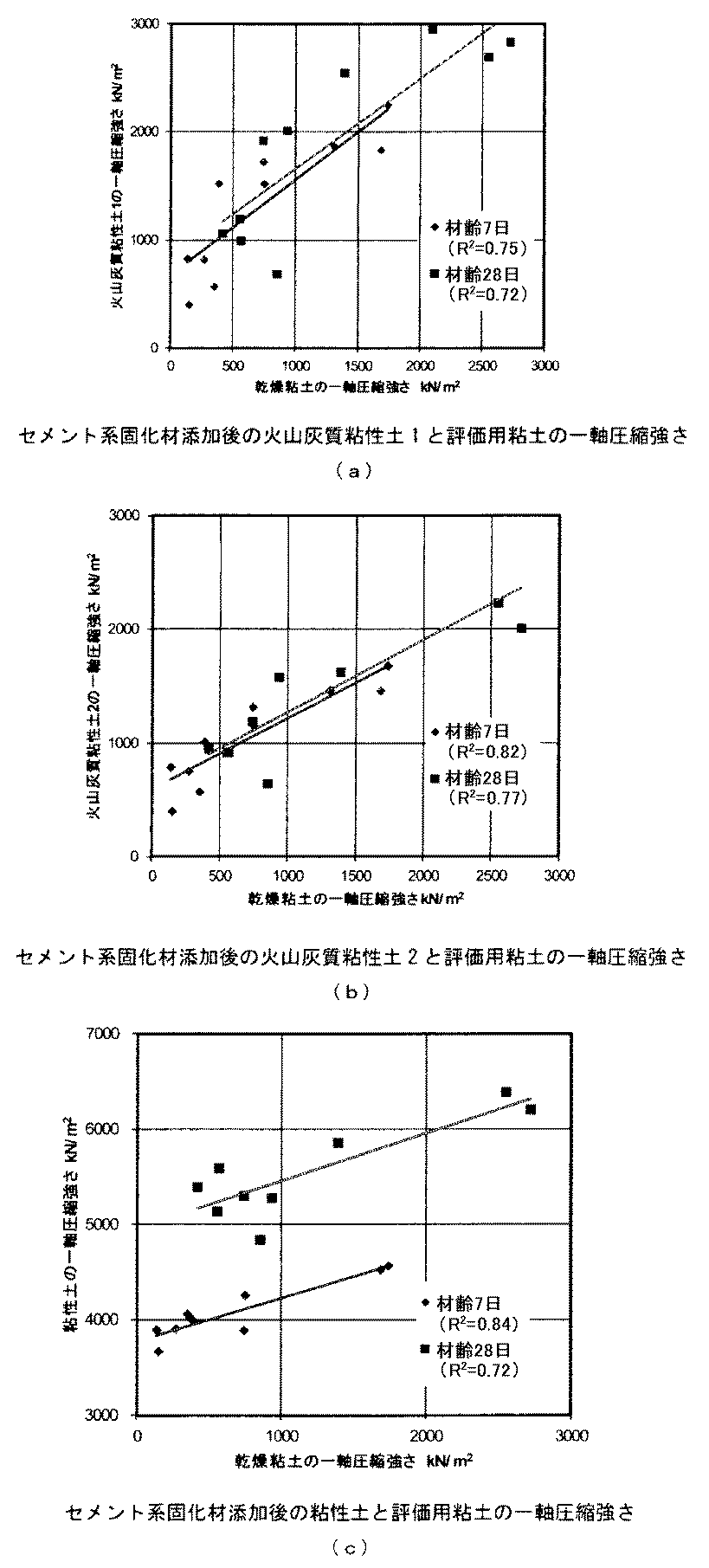
上記各火山灰質粘性土又は上記市川産粘性土にセメント系固化材を添加して処理した場合の一軸圧縮強度と上記表5中の試験土を用いてセメント系固化材で処理した場合の一軸圧縮強度とを比較試験し、その結果を図1〜6及び表6に示す。
なお、一軸圧縮強度を試験するための各供試体の製造は、上記「(2)一軸圧縮強度試験」と同様にして測定し、各材料の混合比は、上記表5に示す混合比と同量とした。但し、火山灰質粘性土の配合量は、乾燥粘土の合計量に相当する量とした。
(3) Comparison between test soil and volcanic ash clay (Kanto loam layer) Uniaxial compressive strength when treated with cement solidified material added to each of the above volcanic ash clay or Ichikawa clay and Table 5 above A comparative test was conducted with the uniaxial compressive strength when treated with the cement-based solidified material using the test soil, and the results are shown in FIGS.
The production of each specimen for testing the uniaxial compressive strength was measured in the same manner as the above “(2) Uniaxial compressive strength test”, and the mixing ratio of each material was the same as the mixing ratio shown in Table 5 above. The amount. However, the compounding amount of the volcanic ash clay was set to an amount corresponding to the total amount of dry clay.
セメント系固化材は10種類(a〜j)をそれぞれの試験土、火山灰質粘性土又は市川産粘性土に適用して、セメント系固化材の種類による一軸圧縮強度を、火山灰質粘性土と試験土(図1〜6の各(a),(b))、市川産粘性土と試験土の関係について(図1〜6の各(c))、それぞれプロットして、最小二乗法にて評価線を作成し、R2(相関係数rの2乗)を求めた。その結果を図1〜6及び表6に表す。 Ten types of cement-based solidification materials (a to j) are applied to each test soil, volcanic ash cohesive soil, or Ichikawa cohesive soil, and the uniaxial compressive strength according to the type of cement-based solidifying material is tested with volcanic ash cohesive soil. Soil (each (a), (b) in Figs. 1 to 6), Ichikawa-produced viscous soil and the relationship between the test soil (each (c) in Figs. 1 to 6), plotted and evaluated by the least square method A line was created, and R 2 (the square of the correlation coefficient r) was determined. The results are shown in FIGS.
表6に示すように相関係数R2が0.8を超えたのは、ケース2〜4となった。これは、異なるセメント系固化材の種類に依存して現れる火山灰質粘性土の一軸圧縮強度の違いが、試験土(乾燥粘土)でも同様に生じることを示しており、実施例1〜3の試験土がセメント系固化材の圧縮強度評価用試験土として優れていることがわかる。 The correlation coefficient R 2 as shown in Table 6 exceeds 0.8 became case 2-4. This shows that the difference in the uniaxial compressive strength of the volcanic ash clay that appears depending on the type of cementitious solidified material also occurs in the test soil (dry clay). It can be seen that the soil is excellent as a test soil for evaluating the compressive strength of the cement-based solidified material.
本発明は、種々のセメント系固化材の圧縮強度評価に適正に適用することができ、特に火山灰質粘性土を処理する場合のセメント系固化材による圧縮強度評価に好適に適用される。 The present invention can be appropriately applied to the compressive strength evaluation of various cement-based solidified materials, and is particularly suitably applied to the compressive strength evaluation by cement-based solidified materials when treating volcanic ash clay.
Claims (5)
5. The compressive strength evaluation test method for cement-based solidified material according to claim 4, wherein the blending of the test soil for evaluating compressive strength of the cement-based solidified material according to claim 1 is performed by mixing dry clay A and dry clay B in advance. A method for evaluating the compressive strength of a cement-based solidified material, which may be blended, or may be blended directly with dry clay A and dry clay B in a slurry.
Priority Applications (1)
| Application Number | Priority Date | Filing Date | Title |
|---|---|---|---|
| JP2014068112A JP2015190844A (en) | 2014-03-28 | 2014-03-28 | Test soil for compressive strength evaluation and test method for evaluating compressive strength using test soil |
Applications Claiming Priority (1)
| Application Number | Priority Date | Filing Date | Title |
|---|---|---|---|
| JP2014068112A JP2015190844A (en) | 2014-03-28 | 2014-03-28 | Test soil for compressive strength evaluation and test method for evaluating compressive strength using test soil |
Publications (1)
| Publication Number | Publication Date |
|---|---|
| JP2015190844A true JP2015190844A (en) | 2015-11-02 |
Family
ID=54425445
Family Applications (1)
| Application Number | Title | Priority Date | Filing Date |
|---|---|---|---|
| JP2014068112A Pending JP2015190844A (en) | 2014-03-28 | 2014-03-28 | Test soil for compressive strength evaluation and test method for evaluating compressive strength using test soil |
Country Status (1)
| Country | Link |
|---|---|
| JP (1) | JP2015190844A (en) |
Cited By (2)
| Publication number | Priority date | Publication date | Assignee | Title |
|---|---|---|---|---|
| CN106546466A (en) * | 2016-12-09 | 2017-03-29 | 东北石油大学 | A kind of conductive mixing argillaceous sandstone synthetic core sample of skeleton and compressing method |
| CN107631919A (en) * | 2017-08-31 | 2018-01-26 | 中国矿业大学 | A kind of N2Laterite analog material and preparation method thereof |
-
2014
- 2014-03-28 JP JP2014068112A patent/JP2015190844A/en active Pending
Cited By (4)
| Publication number | Priority date | Publication date | Assignee | Title |
|---|---|---|---|---|
| CN106546466A (en) * | 2016-12-09 | 2017-03-29 | 东北石油大学 | A kind of conductive mixing argillaceous sandstone synthetic core sample of skeleton and compressing method |
| CN106546466B (en) * | 2016-12-09 | 2019-04-09 | 东北石油大学 | A kind of skeleton conductive mixed argillaceous sandstone artificial rock sample and pressing method |
| CN107631919A (en) * | 2017-08-31 | 2018-01-26 | 中国矿业大学 | A kind of N2Laterite analog material and preparation method thereof |
| CN107631919B (en) * | 2017-08-31 | 2020-09-29 | 中国矿业大学 | N2Laterite-like material and preparation method thereof |
Similar Documents
| Publication | Publication Date | Title |
|---|---|---|
| Lai et al. | Dilatancy mitigation of cement powder paste by pozzolanic and inert fillers | |
| Samimi et al. | Influence of pumice and zeolite on compressive strength, transport properties and resistance to chloride penetration of high strength self-compacting concretes | |
| Al-Amoudi et al. | Correlation between compressive strength and certain durability indices of plain and blended cement concretes | |
| Yerramala | Properties of concrete with eggshell powder as cement replacement | |
| Gastaldini et al. | Total shrinkage, chloride penetration, and compressive strength of concretes that contain clear-colored rice husk ash | |
| Peethamparan et al. | Study of the effectiveness of cement kiln dusts in stabilizing Na-montmorillonite clay | |
| Barkat et al. | Effects of local metakaolin addition on rheological and mechanical performance of self-compacting limestone cement concrete | |
| Eyo et al. | Incorporation of a nanotechnology-based additive in cementitious products for clay stabilisation | |
| Abdul Rahim et al. | Properties of concrete with different percentange of the rice husk ash (RHA) as partial cement replacement | |
| Figueiredo et al. | Surfactants for dispersion of carbon nanotubes applied in soil stabilization | |
| Elinwa et al. | X-ray diffraction and microstructure studies of gum Arabic-cement concrete | |
| de Matos et al. | Effect of the superplasticizer addition time on the fresh properties of 3D printed limestone calcined clay cement (LC3) concrete | |
| Stancato et al. | Mechanism of a vegetable waste composite with polymer-modified cement (VWCPMC) | |
| Pundienė et al. | The role of temperature and activator solution molarity on the viscosity and hard structure formation of geopolymer pastes | |
| CN103601455A (en) | Grouting material with controllable rapid hardening time and preparation method thereof | |
| Baskara Sundararaj et al. | Effect of mineral admixtures on mechanical and thermal properties of geopolymer mortar at elevated temperature | |
| Rehman et al. | Stabilization of low plastic and high plastic clay using guar gum biopolymer | |
| Sheen et al. | Engineering properties of controlled low-strength material made with residual soil and Class F fly ash | |
| Rangan et al. | Sugarcane bagasse ash-portland composite cement blended in paving blocks production for effective resource utilization between sugar and construction industries | |
| Zakka et al. | Ecological selfcompacting concrete using Gum Arabic as a plasticizer | |
| Adeniji et al. | Quality assessment of Sandcrete blocks in Ibadan–A review | |
| JP2015190844A (en) | Test soil for compressive strength evaluation and test method for evaluating compressive strength using test soil | |
| JP2014141384A (en) | Neutron shielding concrete | |
| CN106186840B (en) | A kind of test model clay and preparation method thereof simulated under rich water wall rock condition | |
| Chompoorat et al. | Engineering properties of controlled low-strength material (CLSM) as an alternative fill material |