JP2015017993A - Sample for calibration of t1 relaxation time and t2 relaxation time in 1h-nmr - Google Patents
Sample for calibration of t1 relaxation time and t2 relaxation time in 1h-nmr Download PDFInfo
- Publication number
- JP2015017993A JP2015017993A JP2014192728A JP2014192728A JP2015017993A JP 2015017993 A JP2015017993 A JP 2015017993A JP 2014192728 A JP2014192728 A JP 2014192728A JP 2014192728 A JP2014192728 A JP 2014192728A JP 2015017993 A JP2015017993 A JP 2015017993A
- Authority
- JP
- Japan
- Prior art keywords
- relaxation time
- nmr
- calibration
- time
- sample
- Prior art date
- Legal status (The legal status is an assumption and is not a legal conclusion. Google has not performed a legal analysis and makes no representation as to the accuracy of the status listed.)
- Granted
Links
- 239000011148 porous material Substances 0.000 claims abstract description 99
- 239000007788 liquid Substances 0.000 claims abstract description 52
- 239000011347 resin Substances 0.000 claims abstract description 21
- 229920005989 resin Polymers 0.000 claims abstract description 21
- 239000000463 material Substances 0.000 claims abstract description 19
- 239000004677 Nylon Substances 0.000 claims abstract description 13
- 229920001778 nylon Polymers 0.000 claims abstract description 13
- 239000004925 Acrylic resin Substances 0.000 claims abstract description 9
- 229920000178 Acrylic resin Polymers 0.000 claims abstract description 9
- 239000003822 epoxy resin Substances 0.000 claims abstract description 8
- 229920000647 polyepoxide Polymers 0.000 claims abstract description 8
- 239000000113 methacrylic resin Substances 0.000 claims abstract description 5
- 239000003349 gelling agent Substances 0.000 claims abstract description 4
- XLYOFNOQVPJJNP-UHFFFAOYSA-N water Substances O XLYOFNOQVPJJNP-UHFFFAOYSA-N 0.000 claims description 121
- 238000005160 1H NMR spectroscopy Methods 0.000 claims description 107
- VYPSYNLAJGMNEJ-UHFFFAOYSA-N Silicium dioxide Chemical compound O=[Si]=O VYPSYNLAJGMNEJ-UHFFFAOYSA-N 0.000 claims description 34
- 239000000741 silica gel Substances 0.000 claims description 34
- 229910002027 silica gel Inorganic materials 0.000 claims description 34
- 230000008859 change Effects 0.000 claims description 29
- 238000005481 NMR spectroscopy Methods 0.000 claims description 27
- HNPSIPDUKPIQMN-UHFFFAOYSA-N dioxosilane;oxo(oxoalumanyloxy)alumane Chemical compound O=[Si]=O.O=[Al]O[Al]=O HNPSIPDUKPIQMN-UHFFFAOYSA-N 0.000 claims description 10
- 229910021536 Zeolite Inorganic materials 0.000 claims description 9
- 239000010457 zeolite Substances 0.000 claims description 9
- LFQSCWFLJHTTHZ-UHFFFAOYSA-N Ethanol Chemical compound CCO LFQSCWFLJHTTHZ-UHFFFAOYSA-N 0.000 claims description 8
- 239000008393 encapsulating agent Substances 0.000 claims description 5
- 150000001875 compounds Chemical class 0.000 claims description 3
- 238000005259 measurement Methods 0.000 description 122
- OKKJLVBELUTLKV-UHFFFAOYSA-N Methanol Chemical compound OC OKKJLVBELUTLKV-UHFFFAOYSA-N 0.000 description 57
- 239000000203 mixture Substances 0.000 description 44
- 239000002245 particle Substances 0.000 description 29
- 239000007787 solid Substances 0.000 description 28
- 238000004898 kneading Methods 0.000 description 19
- 239000004927 clay Substances 0.000 description 17
- 239000000919 ceramic Substances 0.000 description 8
- 238000000034 method Methods 0.000 description 6
- 230000003068 static effect Effects 0.000 description 6
- OKTJSMMVPCPJKN-UHFFFAOYSA-N Carbon Chemical compound [C] OKTJSMMVPCPJKN-UHFFFAOYSA-N 0.000 description 4
- 238000001704 evaporation Methods 0.000 description 4
- 230000008020 evaporation Effects 0.000 description 4
- 238000004519 manufacturing process Methods 0.000 description 4
- 238000002156 mixing Methods 0.000 description 4
- 230000008569 process Effects 0.000 description 4
- LYCAIKOWRPUZTN-UHFFFAOYSA-N Ethylene glycol Chemical compound OCCO LYCAIKOWRPUZTN-UHFFFAOYSA-N 0.000 description 3
- 238000010521 absorption reaction Methods 0.000 description 3
- 229910010293 ceramic material Inorganic materials 0.000 description 3
- 238000010586 diagram Methods 0.000 description 3
- 238000010438 heat treatment Methods 0.000 description 3
- 238000003384 imaging method Methods 0.000 description 3
- 238000002360 preparation method Methods 0.000 description 3
- 239000000047 product Substances 0.000 description 3
- 239000002994 raw material Substances 0.000 description 3
- 229920006395 saturated elastomer Polymers 0.000 description 3
- KAKVFSYQVNHFBS-UHFFFAOYSA-N (5-hydroxycyclopenten-1-yl)-phenylmethanone Chemical compound OC1CCC=C1C(=O)C1=CC=CC=C1 KAKVFSYQVNHFBS-UHFFFAOYSA-N 0.000 description 2
- PEDCQBHIVMGVHV-UHFFFAOYSA-N Glycerine Chemical compound OCC(O)CO PEDCQBHIVMGVHV-UHFFFAOYSA-N 0.000 description 2
- 239000011230 binding agent Substances 0.000 description 2
- 238000004364 calculation method Methods 0.000 description 2
- 239000013065 commercial product Substances 0.000 description 2
- 238000001035 drying Methods 0.000 description 2
- 238000005516 engineering process Methods 0.000 description 2
- 230000007613 environmental effect Effects 0.000 description 2
- LNEPOXFFQSENCJ-UHFFFAOYSA-N haloperidol Chemical compound C1CC(O)(C=2C=CC(Cl)=CC=2)CCN1CCCC(=O)C1=CC=C(F)C=C1 LNEPOXFFQSENCJ-UHFFFAOYSA-N 0.000 description 2
- 229910052739 hydrogen Inorganic materials 0.000 description 2
- 239000001257 hydrogen Substances 0.000 description 2
- 238000002595 magnetic resonance imaging Methods 0.000 description 2
- 125000005395 methacrylic acid group Chemical group 0.000 description 2
- 229920000609 methyl cellulose Polymers 0.000 description 2
- 239000001923 methylcellulose Substances 0.000 description 2
- 235000010981 methylcellulose Nutrition 0.000 description 2
- 230000000630 rising effect Effects 0.000 description 2
- 239000004094 surface-active agent Substances 0.000 description 2
- 229910018072 Al 2 O 3 Inorganic materials 0.000 description 1
- 150000001298 alcohols Chemical class 0.000 description 1
- 238000009529 body temperature measurement Methods 0.000 description 1
- 238000011088 calibration curve Methods 0.000 description 1
- 229910052878 cordierite Inorganic materials 0.000 description 1
- 238000004925 denaturation Methods 0.000 description 1
- 230000036425 denaturation Effects 0.000 description 1
- 238000001514 detection method Methods 0.000 description 1
- JSKIRARMQDRGJZ-UHFFFAOYSA-N dimagnesium dioxido-bis[(1-oxido-3-oxo-2,4,6,8,9-pentaoxa-1,3-disila-5,7-dialuminabicyclo[3.3.1]nonan-7-yl)oxy]silane Chemical compound [Mg++].[Mg++].[O-][Si]([O-])(O[Al]1O[Al]2O[Si](=O)O[Si]([O-])(O1)O2)O[Al]1O[Al]2O[Si](=O)O[Si]([O-])(O1)O2 JSKIRARMQDRGJZ-UHFFFAOYSA-N 0.000 description 1
- 230000001747 exhibiting effect Effects 0.000 description 1
- 238000010304 firing Methods 0.000 description 1
- 239000007789 gas Substances 0.000 description 1
- 235000011187 glycerol Nutrition 0.000 description 1
- 230000009878 intermolecular interaction Effects 0.000 description 1
- 230000001678 irradiating effect Effects 0.000 description 1
- 230000002427 irreversible effect Effects 0.000 description 1
- 230000014759 maintenance of location Effects 0.000 description 1
- -1 methanol or ethanol Chemical compound 0.000 description 1
- 238000012986 modification Methods 0.000 description 1
- 230000004048 modification Effects 0.000 description 1
- 238000013421 nuclear magnetic resonance imaging Methods 0.000 description 1
- 239000003921 oil Substances 0.000 description 1
- 150000002894 organic compounds Chemical class 0.000 description 1
- 230000000717 retained effect Effects 0.000 description 1
- 239000000565 sealant Substances 0.000 description 1
- 239000000126 substance Substances 0.000 description 1
- 150000005846 sugar alcohols Polymers 0.000 description 1
- 230000007704 transition Effects 0.000 description 1
Images
Landscapes
- Investigating Or Analyzing Non-Biological Materials By The Use Of Chemical Means (AREA)
- Magnetic Resonance Imaging Apparatus (AREA)
Abstract
Description
本発明は、1H−NMRのT1緩和時間およびT2緩和時間の校正用試料に関する。 The present invention relates to a sample for calibration of T 1 relaxation time and T 2 relaxation time of 1 H-NMR.
核磁気共鳴(NMR)は、核スピンのエネルギー吸収・放出現象に基づき分子の状態を観察できるため、その原理が有機化合物の構造決定や温度測定などに適用されている(例えば、非特許文献1を参照)。核磁気共鳴イメージング法(MRI)は、NMRを原理とする画像化技術であり、1H−NMRのT1緩和時間およびT2緩和時間の長短に関する空間上の位置ごとの差異を、空間の各位置に設定される色の濃淡に置き換えて画像化する。 Since nuclear magnetic resonance (NMR) can observe the state of molecules based on the energy absorption / release phenomenon of nuclear spins, its principle is applied to structure determination and temperature measurement of organic compounds (for example, Non-Patent Document 1). See). Nuclear magnetic resonance imaging (MRI) is an imaging technique based on the principle of NMR, and the difference at each position in space regarding the length of T 1 relaxation time and T 2 relaxation time of 1 H-NMR is calculated for each space. The image is replaced with the shade of the color set at the position.
また、物理化学的な状態がほぼ不変の製品については、1H−NMRのT1緩和時間およびT2緩和時間の実測値によって、製品のおおよその特性を把握することができる(例えば、特許文献1)。 In addition, for a product in which the physicochemical state is almost unchanged, the approximate characteristics of the product can be grasped from the measured values of the T 1 relaxation time and T 2 relaxation time of 1 H-NMR (for example, Patent Documents). 1).
しかしながら、たとえ同じ測定対象物に同じNMR測定装置を用いて測定しても、1H−NMRのT1緩和時間およびT2緩和時間の実測値は、測定時期ごとに異なることがある。異なる測定の時期で磁場強度が変化・変動している場合があり、磁場強度の変化・変動が1H−NMRのT1緩和時間およびT2緩和時間の変化に反映されてしまう。そのため、1H−NMRのT1緩和時間および/またはT2緩和時間を測定し、測定された1H−NMRのT1緩和時間および/またはT2緩和時間から測定対象物の物理化学的な状態を判断する場合において、2つの測定対象物について異なる時期に1H−NMRのT1緩和時間および/またはT2緩和時間を測定したとき、1H−NMRのT1緩和時間やT2緩和時間の実測値がたとえ同じであっても、2つの測定対象物の間で物理化学的な状態が異なることもありうる。
However, even if the same measurement object is measured using the same NMR measurement apparatus, the actual measurement values of 1 H-NMR T 1 relaxation time and T 2 relaxation time may differ depending on the measurement period. There are cases where the magnetic field strength changes or fluctuates at different measurement times, and the change or fluctuation of the magnetic field strength is reflected in changes in the T 1 relaxation time and T 2 relaxation time of 1 H-NMR. Therefore, the 1 H-
このように、異なる時期に測定を行うときには、1H−NMRのT1緩和時間やT2緩和時間の実測値のみから、それぞれの時期における測定対象物の物理化学的な状態を、比較または特定することは難しい。それでも、物理化学的な状態が変化する測定対象物について、客観的な指標を用いて特定の物理化学的な状態のもののみを抽出することが求められ、1H−NMRのT1緩和時間やT2緩和時間が異なる時期に測定された場合であっても、測定された1H−NMRのT1緩和時間やT2緩和時間から測定対象物の物理化学的な状態を判断することが望まれている。 As described above, when the measurement is performed at different times, the physicochemical state of the measurement object at each time is compared or specified only from the actual measurement values of the T 1 relaxation time and T 2 relaxation time of 1 H-NMR. Difficult to do. Nevertheless, it is required to extract only those having a specific physicochemical state using an objective index for a measurement object whose physicochemical state changes, and the 1 H-NMR T 1 relaxation time and Even when the T 2 relaxation times are measured at different times, it is desirable to determine the physicochemical state of the measurement object from the measured 1 H-NMR T 1 relaxation times and T 2 relaxation times. It is rare.
上記の問題に鑑みて、本発明の課題は、測定対象物の1H−NMRのT1緩和時間およびT2緩和時間の実測値を校正することによって測定時における測定対象物の物理化学的な状態を正確に把握するために、前記実測値を校正するための基準値の測定に用いる、1H−NMRのT1緩和時間およびT2緩和時間の校正用試料を提供することにある。 In view of the above problems, an object of the present invention is to physicochemically measure the measurement object at the time of measurement by calibrating the measured values of the 1 H-NMR T 1 relaxation time and T 2 relaxation time of the measurement object. An object of the present invention is to provide a sample for calibration of T 1 relaxation time and T 2 relaxation time of 1 H-NMR used for measuring a reference value for calibrating the actual measurement value in order to accurately grasp the state.
本発明は、上記課題を解決するために完成するに至ったものである。詳しくは、以下に示す1H−NMRのT1緩和時間およびT2緩和時間の校正用試料である。 The present invention has been completed in order to solve the above problems. Specifically, it is a sample for calibration of T 1 relaxation time and T 2 relaxation time of 1 H-NMR shown below.
[1] 1H−NMRのT1緩和時間およびT2緩和時間の測定対象となるプロトン(1H)を含有した分子を含む液体を細孔内に含浸させた多孔質材と、前記多孔質材を封入した封入材と、を含み、前記封入材は、1H−NMRの信号を出力しないものおよび物理的な要因が加わっても形状的変化が無いものであると共にアクリル樹脂、ナイロン樹脂、エポキシ樹脂、メタクリル系樹脂、およびゲル化剤からなる群から選ばれる少なくとも1種からなる1H−NMRのT1緩和時間およびT2緩和時間の校正用試料。 [1] A porous material in which pores are impregnated with a liquid containing molecules containing protons ( 1 H) to be measured for T 1 relaxation time and T 2 relaxation time of 1 H-NMR, and the porous material An encapsulant encapsulating a material, and the encapsulant does not output a 1 H-NMR signal and has no shape change even when a physical factor is applied, and an acrylic resin, a nylon resin, A sample for calibration of T 1 relaxation time and T 2 relaxation time of 1 H-NMR comprising at least one selected from the group consisting of epoxy resins, methacrylic resins, and gelling agents.
[2] 前記封入材を収容して密封された容器を含む前記[1]に記載の1H−NMRのT1緩和時間およびT2緩和時間の校正用試料。 [2] The sample for calibration of T 1 relaxation time and T 2 relaxation time of 1 H-NMR according to [1], including a sealed container containing the encapsulant.
[3] 前記容器が、アクリル樹脂、ナイロン樹脂、エポキシ樹脂、およびメタクリル系樹脂からなる群から選ばれる少なくとも1種からなる前記[1]または[2]に記載の1H−NMRのT1緩和時間およびT2緩和時間の校正用試料。 [3] T 1 relaxation of 1 H-NMR according to [1] or [2], wherein the container is made of at least one selected from the group consisting of an acrylic resin, a nylon resin, an epoxy resin, and a methacrylic resin. Sample for calibration of time and T 2 relaxation time.
[4] 前記多孔質材は、前記細孔が細孔径0.2〜1000nm、および細孔容積0.1〜2.5cm3/gである前記[1]〜[3]のいずれかに記載の1H−NMRのT1緩和時間およびT2緩和時間の校正用試料。 [4] The porous material according to any one of [1] to [3], wherein the pores have a pore diameter of 0.2 to 1000 nm and a pore volume of 0.1 to 2.5 cm 3 / g. Sample for calibration of 1 H-NMR T 1 relaxation time and T 2 relaxation time.
[5] 前記多孔質材は、前記液体の質量換算での含有率が11〜80%である前記[1]〜[4]のいずれかに記載の1H−NMRのT1緩和時間およびT2緩和時間の校正用試料。 [5] The 1 H-NMR T 1 relaxation time and T according to any one of [1] to [4], in which the porous material has a content of the liquid in terms of mass of 11 to 80%. 2 Calibration sample for relaxation time.
[6] 前記多孔質材が、シリカゲルおよび/またはゼオライトからなる前記[1]〜[5]のいずれかに記載の1H−NMRのT1緩和時間およびT2緩和時間の校正用試料。 [6] The sample for calibration of T 1 relaxation time and T 2 relaxation time of 1 H-NMR according to any one of [1] to [5], wherein the porous material is made of silica gel and / or zeolite.
[7] 前記液体が、水またはアルコールを含有する液体化合物である前記[1]〜[6]のいずれか一項に記載の1H−NMRのT1緩和時間およびT2緩和時間の校正用試料。 [7] For calibration of T 1 relaxation time and T 2 relaxation time of 1 H-NMR according to any one of [1] to [6], wherein the liquid is a liquid compound containing water or alcohol. sample.
本発明の1H−NMRのT1緩和時間およびT2緩和時間の校正用試料を用いれば、測定時の環境に依存してばらつく測定対象物の1H−NMRのT1緩和時間およびT2緩和時間の実測値を校正するための基準値を測定することができる。本発明の1H−NMRのT1緩和時間およびT2緩和時間の校正用試料による基準値を用いて導かれた校正値に基づけば、測定対象物が、1H−NMRのT1緩和時間およびT2緩和時間の変化に反映される物理化学的な状態の変遷のうちの、特定の状態にあったことを正確に把握できる。 Using the calibration sample 1 H-NMR T 1 relaxation time and T 2 relaxation times of the present invention, T 1 relaxation times of 1 H-NMR of the measurement object varies depending on the measurement time of the environmental and T 2 A reference value for calibrating the actual value of the relaxation time can be measured. Based on the calibration value derived using the reference value of the calibration sample of the T 1 relaxation time and T 2 relaxation time of 1 H-NMR of the present invention, the measurement object becomes the T 1 relaxation time of 1 H-NMR. and T 2 of the changes of the physicochemical state is reflected in a change in relaxation time can be accurately grasped that there was in a particular state.
以下、図面を参照しつつ本発明の実施の形態について説明する。本発明は、以下の実施形態に限定されるものではなく、本発明の範囲を逸脱しない限りにおいて、変更、修正、改良を加え得るものである。 Hereinafter, embodiments of the present invention will be described with reference to the drawings. The present invention is not limited to the following embodiments, and changes, modifications, and improvements can be added without departing from the scope of the present invention.
1.本発明の1H―NMRのT1緩和時間およびT2緩和時間の校正用試料の概要:
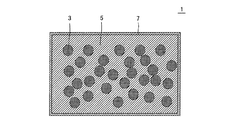
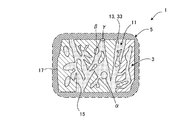
図1は、本発明の1H−NMRのT1緩和時間およびT2緩和時間の校正用試料(以下、「本発明の校正用試料」)の一実施形態の断面図である。図2は、本発明の校正用試料の一実施形態の断面の一部を拡大して表した拡大断面図である。
1. Summary of 1 H-NMR T 1 relaxation time and T 2 relaxation time calibration samples of the present invention:
FIG. 1 is a cross-sectional view of an embodiment of a calibration sample for T 1 relaxation time and T 2 relaxation time of the 1 H-NMR of the present invention (hereinafter, “calibration sample of the present invention”). FIG. 2 is an enlarged cross-sectional view showing an enlarged part of a cross section of an embodiment of the calibration sample of the present invention.
本発明の校正用試料1は、多孔質材3と、多孔質材3を封入した封入材5とを含む(図1)。多孔質材3は、多数の細孔11を有し、細孔11内には、1H−NMRのT1緩和時間およびT2緩和時間の測定対象となるプロトン(1H)を含有した分子を成分として含む液体13を含浸させている(図2)。
The
図1に示すように、本発明の校正用試料1は、多孔質材3を封入した封入材5を容器7内に収容する実施形態にしてもよい。この実施形態では、封入材5が破損し易いものや流動性を有するものであっても、容器7によって一定の形状に保持される。なお、NMR信号に影響を及ぼさない程度であれば、封入材5中に気泡が存在していてもよい。
As shown in FIG. 1, the
また、本発明の校正用試料では、図示しないが、多孔質材を容器に収容して密封した状態にすることもできる。この場合には、多孔質材同士や多孔質材と容器との間に隙間が存在していてもよく、また、この隙間が空気などのガスによって満たされていてもよい。また容器として変形し易いフィルムなどを用いる場合は、この隙間は真空状態であってもよい。 In the calibration sample of the present invention, although not shown, the porous material can be accommodated in a container and sealed. In this case, a gap may exist between the porous materials or between the porous material and the container, and the gap may be filled with a gas such as air. In the case where a easily deformable film or the like is used as the container, the gap may be in a vacuum state.
本発明の校正用試料1では、液体13が多孔質材3の細孔11内に含浸した状態でそのまま保持されている。そのため、巨視的な視点において、液体13は、時間経過にかかわらず、多孔質材3内で同じ形状で且つ液体13と多孔質材3との接触面積が一定の状態にて細孔11内に閉じ込められて保持されている。また、微視的な視点においても、液体13の成分を構成する分子と多孔質材3を構成する分子との間の分子間相互作用が、平衡状態にあるため、時間経過にかかわりなく略一定の状態で保たれている。このように、本発明の校正用試料1では、液体13の成分を構成する分子が、一定に保たれた環境に置かれて、分子の運動性も一定の状態に保たれる。
In the
そのため、本発明の校正用試料1は、測定箇所における磁場強度が変化・変動していない場合には、液体13の成分となる分子に含まれるプロトン(1H)を測定対象とする1H−NMRのT1緩和時間およびT2緩和時間が同じ値で測定される。そして、校正用試料1について測定されたT1緩和時間およびT2緩和時間の測定値に変動が生じた場合には、この測定値の変動分は、校正用試料1自体の変化が要因ではないため、測定箇所における磁場強度等の変化・変動を反映したものとみなすことができる。本発明の校正用試料1に対して測定された1H−NMRのT1緩和時間およびT2緩和時間を基準値として、目的とする測定対象物に含有される液体の成分となる分子に含まれるプロトンを測定対象とする1H−NMRのT1緩和時間および/またはT2緩和時間の測定値の校正を行えば、得られたT1緩和時間および/またはT2緩和時間の校正値によって、測定対象物が特定の物理化学的な状態にあることを正確に把握できる。当然ながら、本発明の校正用試料は、1H−NMRのT1緩和時間およびT2緩和時間の測定値に基づき画像化を行うための、MRI撮像用の校正用試料としても使用できる。
Therefore,
なお、1H−NMRのT1緩和時間およびT2緩和時間は、静磁場の磁場強度に依存して定まる観察核の共鳴周波数と略同じ周波数の高周波を照射して測定する。観察核を含む分子が水(H2O)の場合には、水分子に含まれるプロトンの共鳴周波数に応じた周波数の高周波を照射する。1H−NMRのT1緩和時間およびT2緩和時間は、液体13の成分となる分子に含まれるプロトンより発せられる最大信号を計測することによって得ればよい。液体13の成分となる分子のうちにプロトンを含む分子が複数種存在し、これら複数種のプロトンを含む分子の中で1H−NMRの共鳴周波数が異なる場合には、最も検出し易い信号を計測できる周波数の高周波を照射し、1H−NMRのT1緩和時間およびT2緩和時間を測定すればよい。 Note that the T 1 relaxation time and T 2 relaxation time of 1 H-NMR are measured by irradiating a high-frequency wave having substantially the same frequency as the resonance frequency of the observation nucleus determined depending on the magnetic field strength of the static magnetic field. When the molecule containing the observation nucleus is water (H 2 O), a high frequency with a frequency corresponding to the resonance frequency of the proton contained in the water molecule is irradiated. The T 1 relaxation time and T 2 relaxation time of 1 H-NMR may be obtained by measuring the maximum signal emitted from protons contained in the molecules that are components of the liquid 13. If there are multiple types of molecules containing protons among the molecules constituting the liquid 13 and the 1 H-NMR resonance frequency is different among the molecules containing the multiple types of protons, the most easily detectable signal is obtained. The high frequency of the measurable frequency is irradiated, and the T 1 relaxation time and T 2 relaxation time of 1 H-NMR may be measured.
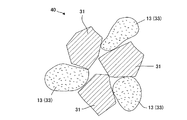
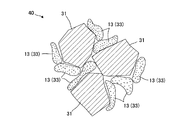
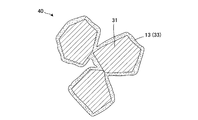
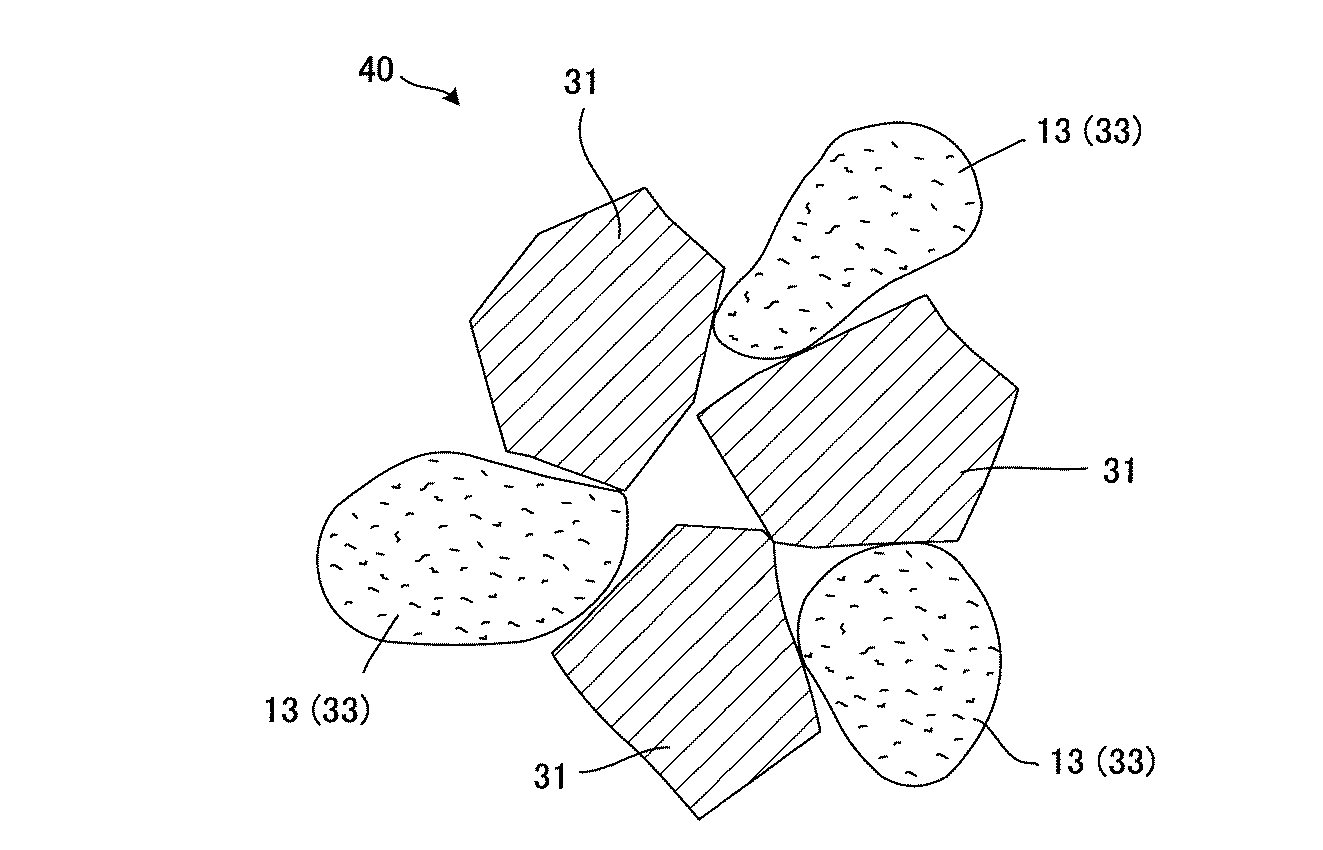
次に、本発明の校正用試料1を用いた1H−NMRのT1緩和時間およびT2緩和時間の校正について、単純化された測定系を用いて説明する。図3A〜図3Cに示す、固体粒子31と液体状態の水33との混合物40の物理化学的な状態の変遷を、混合物40に含有される水分子に含まれるプロトン(1H)を測定対象とする1H−NMRのT1緩和時間によって把握する方法を例に、以下に詳しく述べる。
Next, calibration of 1 H-NMR T 1 relaxation time and T 2 relaxation time using the
図3Aに示す混合物40は、混練開始直後の、固体粒子31と水33とが混ざり合う状態(状態A)にある。混合物40は、当初の状態Aから、混練の進行に伴って、図3Bに示すような、水33が固体粒子31の表面を被覆していく状態になっていく(状態B)。図3Cは、混練が十分にされた混合物の状態(状態C)を模式的に表す。
The
固体粒子31と水33との混合物40において、水分子は、水分子の集団(液体状態の水の塊)内にあるものと、固体粒子31に接触しているものとに大別される。前者の水分子は、自由に運動できる。対して、後者の水分子は、固体粒子31との間の水素結合や分子間力等によって結合して自由に運動できず、固体粒子31からの磁気的・物理的な影響を受ける。
In the
T1緩和時間は、スピン−格子緩和時間または縦緩和時間とも呼ばれ、T2緩和時間は、スピン−スピン緩和時間または横緩和時間とも呼ばれている。これら緩和時間の長短は、測定対象の観察核を含む分子の運動性、前記分子の存在する場所の磁場などを反映する。水分子に含まれるプロトンを測定対象として1H−NMRのT1緩和時間およびT2緩和時間を測定した場合、上述のうちの前者の水分子は、自由に運動できる(分子の運動性が高い)ため、1H−NMRのT1緩和時間およびT2緩和時間が共に長くなる傾向があり、後者の水分子は、自由に運動できず(分子の運動性が低い)、固体粒子31からの磁気的・物理的な影響も受けるため、1H−NMRのT1緩和時間およびT2緩和時間が短くなる傾向がある。 The T 1 relaxation time is also called spin-lattice relaxation time or longitudinal relaxation time, and the T 2 relaxation time is also called spin-spin relaxation time or transverse relaxation time. The length of the relaxation time reflects the mobility of the molecule including the observation nucleus to be measured, the magnetic field where the molecule exists, and the like. When the 1 H-NMR T 1 relaxation time and T 2 relaxation time are measured using protons contained in water molecules as the measurement target, the former water molecules can move freely (the molecular mobility is high). Therefore, both the T 1 relaxation time and the T 2 relaxation time of 1 H-NMR tend to be long, and the latter water molecules cannot move freely (the molecular mobility is low). Since it is also affected magnetically and physically, the T 1 relaxation time and T 2 relaxation time of 1 H-NMR tend to be shortened.
また、水分子の集団(液体状態の水の塊)内にある水分子と固体粒子31に接触している水分子とが混在している場合、両者の比率に応じて水分子に含まれるプロトンを測定対象とする1H−NMRのT1緩和時間およびT2緩和時間が定まると考えられており、特にT1緩和時間はその傾向が強いとされる。前者の水分子の割合が多く後者の水分子の割合が少ないときには、1H−NMRのT1緩和時間およびT2緩和時間が長くなる傾向にあり、逆に前者の水分子の割合が少なく後者の水分子の割合が多いときには、1H−NMRのT1緩和時間およびT2緩和時間が短くなる傾向にある。
When water molecules in a group of water molecules (liquid water mass) and water molecules in contact with the
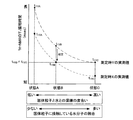
図4のグラフは、混合物40が状態A(図3A)、状態B(図3B)、状態C(図3C)へと順に変遷する過程における、固体粒子31と水33との混練の度合いと混合物40に含有される水分子に含まれるプロトンを測定対象とする1H−NMRのT1緩和時間との関係を表す。図4中の1点鎖線および破線は、同じ組成で別個の混合物40をそれぞれの測定対象物とし、1点鎖線は、測定時Xに測定された1H―NMRのT1緩和時間の実測値、破線は、測定時Xとは異なる測定時Yに測定された1H―NMRのT1緩和時間の実測値を示す。
The graph of FIG. 4 shows the degree of kneading between the
状態A(図3A)では、混練開始直後であるため、水33は液体の塊の状態にて存在する比率が高く、固体粒子31についても複数の固体粒子31が集まった塊の状態にて多く存在する。そのため、状態Aは、固体粒子31と接触している水分子の割合が最も少なく、水分子の集団(液体状態の水の塊)内にある水分子の割合が最も多い状態にある。よって、測定時Xにおいて、混合物40を測定対象物とした場合、状態Aでは、水分子に含まれるプロトンを測定対象とする1H−NMRのT1緩和時間が最も長くなる(図4、t1XA)。
In the state A (FIG. 3A), since it is immediately after the start of kneading, the ratio of the
状態B(図3B)では、水33が固体粒子31の表面を被覆し始めている。よって、水分子は、固体粒子31の表面と分子間力等によって結合しているものが比較的多くなり、液体状態の水の塊を構成して自由に運動できるものは比較的少なくなっていく。よって、測定時Xにおいて、混合物40を測定対象物とした場合、状態Bにおける水分子に含まれるプロトンを測定対象とする1H−NMRのT1緩和時間の実測値t1XBは、混練の開始直後の値t1XAよりも短くなる(図4、t1XAとt1XBを比較)。
In the state B (FIG. 3B), the
状態C(図3C)では、混合物40が十分に混練された状態となっている。水33は、殆どの固体粒子31の全表面を膜状に被覆している。この状態のとき、固体粒子31と分子間力等によって結合している水分子が最も多くなる。すなわち、状態Cは、状態A〜Cの中で、固体粒子31と接触している水分子の割合が最も多く、水分子の集団(液体状態の水の塊)内にある水分子の割合が最も少ない状態になっている。よって、状態Cでは、水分子に含まれるプロトンを測定対象とする1H−NMRのT1緩和時間およびT2緩和時間が最も短くなる(図4、t1XC)。
In the state C (FIG. 3C), the
以上で説明したように、固体粒子31と水33との混合物40を測定対象物とした場合、混合物40に含有される水分子に含まれるプロトンを測定対象とする1H−NMRのT1緩和時間を測定することによって、混合物40の混練状態をT1緩和時間という客観的な数値によって把握することができる。また、混合物40に含有される水分子に含まれるプロトンを測定対象とする1H−NMRのT2緩和時間を測定した場合でも、上述のように、T2緩和時間が水分子の運動性と高い相関性があるため、混合物40の混練状態をT2緩和時間という客観的な数値によって把握することができる。
As described above, when the
ここで留意すべきことは、測定時期が異なることによってNMR装置の磁場強度の変化・変動が生じたときには、測定対象物が同じ組成で同じ混練状態の混合物40であっても、1H−NMRのT1緩和時間の実測値は、異なる時期に測定したものの間で異なってしまうことである。図4においても、同じ組成の混合物40であるにも関わらず、測定時期が異なっているため、測定時X(図4中の1点鎖線)と測定時Y(図4中の破線)との間では、1H−NMRのT1緩和時間の実測値と混練状態との関係を表すグラフにずれが生じている。
It should be noted here that when a change or fluctuation in the magnetic field strength of the NMR apparatus occurs due to different measurement times, even if the measurement object is the same composition and the
特に、図4に示す例のように、測定時Xでの状態BのT1緩和時間の実測値であるt1XBと、測定時Yでの状態CのT1緩和時間の実測値であるt1YCとが同じ値である場合、測定時X、Yにおいて、共に状態Bにある混合物40を抽出しようとしても、T1緩和時間の実測値のみからでは、測定時X、Yの混合物40のうちのいずれが状態Bにあるのか正確に把握できない。例えば、測定時XのT1緩和時間の実測値がt1XBの時に混合物40が状態Bであると知ったことに基づき、後の測定時Yにおいて、T1緩和時間の実測値がt1XBと同一値であるt1YCの時の混合物40を抽出すれば、目的とする状態を既に経過した混練物40を抽出したことになり、状態Bから状態Cへの変化が不可逆的なものであるときには目的とする状態Bの混合物40を抽出する機会を完全に逸してしまうことにもなる。
In particular, as in the example shown in FIG. 4, t 1XB that is an actual measurement value of the T 1 relaxation time in the state B at the measurement time X and t 1 that is an actual measurement value of the T 1 relaxation time in the state C at the measurement time Y. When 1YC is the same value, even if it is attempted to extract the
上記の問題に対処するため、本発明の校正用試料1によって測定された基準値を用いることによって、例えば測定時Xに測定された1H−NMRのT1緩和時間の実測値の曲線(図4中の1点鎖線)上にプロットされるように、測定時Xとは異なる任意の時期(例えば測定時Y)に測定された1H−NMRのT1緩和時間の実測値を校正する。この校正によれば、測定時が異なる場合であっても、混合物40の特定の状態と、混合物40に含有される水分子に含まれるプロトンを測定対象とする1H−NMRのT1緩和時間との間に1対1の関係をつくることができる。
In order to deal with the above problem, by using the reference value measured by the
本発明の校正用試料1として多孔質材3に液体の水33を含浸させた実施形態を適用した場合、この校正用試料1に含有される水分子は、長いT1緩和時間を示す水分子の集団(液体状態の水の塊)内にあるもの(例えば、図2中の枠α内の水分子)と、短いT1緩和時間を示す多孔質材の細孔11の内壁15と接触しているもの(例えば、図2中の枠β内の水分子)および封入材5と接触しているもの(例えば、図2中の枠γ内の水分子)とを含んでいる。
When the embodiment in which the
そして、上記の校正用試料1では、多孔質材3の細孔11が形状を変えないため、水分子の集団(液体状態の水の塊)内にある水分子(図2中の枠α内)と、多孔質材の細孔11の内壁15に接触している水分子(図2中の枠β内)および封入材5に接触している水分子(図2中の枠γ内)との割合が時間経過に関わらず殆ど変化しない。すなわち、検出箇所の磁場強度など条件が全く同じときには、本発明の校正用試料1に含有される水分子に含まれるプロトンを測定対象とする1H−NMRのT1緩和時間は、異なる時期に測定したとしても、特定値、またはその特定値からわずかな誤差範囲内にある値しか示さない。校正用試料1に含有される水分子に含まれるプロトンを測定対象とする1H−NMRのT1緩和時間の測定値が異なる測定時で変化していた場合には、この測定値の変化は、測定対象物である校正用試料1自体の変化でなく、NMR現象に影響を及ぼす環境的要因、すなわち測定箇所の磁場の変化や変動を反映したものとみなすことができる。
In the
したがって、本発明の校正用試料1に含有される水分子に含まれるプロトンを測定対象とするT1緩和時間の測定値を校正用の基準値とし、この基準値が異なる時期で変動した場合、基準値の変動分をT1緩和時間の実測値の校正に利用すれば、得られた校正値と混合物40の特定の状態とを1対1の関係に導くことができる。
Therefore, when the measurement value of the T 1 relaxation time with the proton contained in the water molecule contained in the
図4を参照し説明すると、測定時XにおいてT1緩和時間t1XCを測定するときには、同時に校正用試料1に対してもT1緩和時間を測定し、t1XCを校正するための基準値(t1xn)を得る。そして、別の測定時YについてT1緩和時間t1YBを測定するときには、同時に基準値t1xnの測定に用いたものと同じ校正試料1に対してT1緩和時間を測定してt1YBを校正するための基準値(t1Yn)を得る。例えば、測定時YにおいてT1緩和時間の実測値t1YBを測定した場合、測定時X、Yの基準値(t1Xn、t1Yn)、および測定時Yの実測値(t1YB)を、(式):t1YB−(t1Xn−t1Yn)、にあてはめて校正を行えば、測定時XにおけるT1緩和時間と混合物40の混練状態との関係を表す曲線(図4中の1点鎖線)上にt1YBについての校正値がプロットされる。これにより、測定時Yでは、T1緩和時間の実測値t1YBにあるときに、混合物40がちょうどの目的とする状態Bにあると判断することができる。
Referring to the description of FIG. 4, when measuring T 1 relaxation time t 1XC in the measurement time X also measure the T 1 relaxation time for the
測定時Xにおいて、混練進行中の混合物40について、細かい時間間隔にて、混合物40に含有される水分子に含まれるプロトンを測定対象とする1H−NMRのT1緩和時間を測定して、混合物40の混練状態とT1緩和時間の関係を示す基準曲線(図4中の1点鎖線に相当)を予め作成しておき、後の測定時において上記の校正を行えば、測定時期にかかわらず、T1緩和時間の校正値を基準曲線上にプロットできるため、混合物40の混練状態を客観的に数値化して把握することができる。
At the time of measurement X, for the
上記の基準曲線を予め作成する手法でT1緩和時間およびT2緩和時間を校正する際には、基準曲線の作成時に用いる校正用試料1(図4の測定時Xの1点鎖線を基準曲線とする場合には、測定時Xに基準値t1Xnを測定した校正用試料)と、基準曲線を用いて校正されるT1緩和時間の実測値の測定時に用いる校正用試料1(図4の測定時Xの1点鎖線を基準曲線とする場合には、測定時Yに基準値t1Ynを測定した校正用試料)とは、同じものであることが最も望ましい。例えば、別個の校正用試料1において、多孔質材3の細孔11における平均細孔径および細孔容積率、並びに多孔質材3に含浸された液体13の質量換算での含有率が同じ場合、1H−NMRの観察核となるプロトンを含有する、液体13成分の分子の物理化学的状態も殆ど同じであると考えられる。別個の校正用試料1が上記のような同一性を有する場合には、これら別個の校正用試料1を、それぞれ、基準曲線の作成のための基準値の測定(図4の測定時Xの1点鎖線を基準曲線とする場合には測定時Xでの基準値t1Xnの測定)と、この基準曲線にもとづく校正用の基準値の測定(図4の測定時Xの1点鎖線を基準曲線とする場合には測定時Yでの基準値t1Ynの測定)とに使用をすることも可能である。
When the T 1 relaxation time and the T 2 relaxation time are calibrated by the above-described method of preparing the reference curve in advance, the
本発明の校正用試料1では、多孔質材3の細孔11が、細孔径0.2〜1000nm、且つ細孔容積率0.1〜2.5m3/gであることが好ましい。多孔質材3の細孔径は、1個の水分子の大きさに近い0.2nm以上であることにより、細孔11が水を充填しやすくなる。また、細孔径が1000nm以下であることにより、細孔11の毛細管圧力によって生じる細孔11の水分子の保持力が、水の蒸発力より大きくなる。その結果として、水が細孔11内に一旦充填されるとそのまま細孔11内に保持されやすくなる。また、液体の吸収速度および吸収量の観点から、多孔質材3の細孔径は1〜10nmであることがより好ましい。多孔質材3の細孔容積率が、0.1〜2.5m3/gであることによって、細孔11を完全に液体13にて充満させた時、適切な液体含有率となる。また、セラミックス坏土の混練状態を1H−NMRのT1緩和時間またはT2緩和時間で評価する場合には、セラミックス坏土に近い液体含有率に設定するため、細孔容積率は、0.2〜0.8cm3/gであることがより好ましい。
In the
本発明の校正用試料1では、多孔質材3は、質量換算での液体13の含有率が11〜80%であることが好ましい。上記の液体13の含有率が、11〜80%であるとき、1H−NMRのT1緩和時間の測定範囲内になる。例えば、静磁場強度0.3TのNMR装置を使用し、セラミックス坏土を測定する場合、T1緩和時間はおおよそ20〜100msecとなるが、同じ設定で±1%以内の精度で測定可能なT1緩和時間の測定範囲はおおよそ10〜150msecとなる。したがって、上記液体の含有率は、セラミックス坏土の測定に適した設定の場合には、特に適している。また、セラミックス坏土の混練状態を1H−NMRのT1緩和時間またはT2緩和時間で評価する場合には、セラミックス坏土に含有される液体成分の分子に含まれるプロトンを測定対象とする1H−NMRのT1緩和時間およびT2緩和時間の実測値と近い1H−NMRのT1緩和時間およびT2緩和時間が基準値として測定されるため、液体13の含有率が、11〜50%であることがより好ましい。
In the
細孔11が多孔質材3において網目状に複雑な形状の内壁15を有して存在している場合には、多孔質材3の細孔11内に液体13が含浸された状態は、混合物40において固体粒子31の表面を液体13が被覆している状態を擬似しているともいえる(図2と図3A〜3Cとを比較)。本発明の校正用試料1は、このような1H−NMRの観察核を含む分子が置かれる環境の共通性から、固体粒子31と液体13との混合物40を測定対象物とするケースに用いることが好ましく、例えば、セラミックスの混合や成形工程において、セラミックス(固体粒子)と水やメタノールなどの液体との混合・混練過程における混練度合いの評価には有効である。
In the case where the
ここまで、測定対象物に含有される水(H2O)が測定対象(観察核)となるプロトン(1H)を含む分子であり、1H−NMRのT1緩和時間のみを測定する場合について主に説明した。測定対象物の構成や観察核となるプロトンを含む分子の種類によって、1H−NMRのT1緩和時間およびT2緩和時間のプロファイルに相違はあるものの、上記の原理は、基本的に、測定対象物における観察核を含む液体の成分の分子が水(H2O)以外であるときや、1H−NMRのT2緩和時間を校正するときにも適用できる。 Up to this point, water (H 2 O) contained in the measurement object is a molecule containing proton ( 1 H) that becomes the measurement object (observation nucleus), and only the T 1 relaxation time of 1 H-NMR is measured It was mainly explained. Although the 1 H-NMR T 1 relaxation time and T 2 relaxation time profiles vary depending on the structure of the measurement object and the type of molecule containing protons as observation nuclei, the above principle is basically the measurement The present invention can also be applied when the liquid component molecule containing the observation nucleus in the object is other than water (H 2 O) or when the T 2 relaxation time of 1 H-NMR is calibrated.
例えば、観察核となるプロトン(1H)を含んだ液体の成分となる分子には、メタノール(CH3OH)、エタノール(C2H5OH)をはじめするプロトンを含むアルコール類や、その他プロトンを含む化合物、例えば油類を挙げることができる。アルコールは、メタノールやエタノールなどの一価のアルコール、エチレングリコールやグリセリンなどの多価アルコールのいずれでもよい。なぜなら、いずれもプロトンを相当量含有する液体であり十分な信号強度が得られるからである。 For example, molecules that are liquid components containing protons ( 1 H) as observation nuclei include alcohols including protons such as methanol (CH 3 OH) and ethanol (C 2 H 5 OH), and other protons And compounds containing, for example, oils. The alcohol may be a monohydric alcohol such as methanol or ethanol, or a polyhydric alcohol such as ethylene glycol or glycerin. This is because all of them are liquids containing a considerable amount of protons and sufficient signal intensity can be obtained.
目的とする測定対象物に含有される水分子に含まれるプロトンを測定対象とする1H−NMRのT1緩和時間の実測値を校正する場合には、観察核となるプロトン(1H)を含んだ分子の種類が同じになるように、多孔質材3の細孔11に水を含浸させた校正用試料1を用いることが好ましい。
When calibrating the measured value of the T 1 relaxation time of 1 H-NMR with protons contained in water molecules contained in the target measurement object as the measurement object, protons ( 1 H) that serve as observation nuclei are calibrated. It is preferable to use the
本発明の校正用試料1では、多孔質材3は、多数の細孔を有する材質のものであれば特に限定されないが、形状の安定性、保水性がよいものが望ましいため、シリカゲル、ゼオライト、活性炭からなることが好ましい。多孔質材3としては、上記した3種のうちの1種のみを使用してもよい。あるいはシリカゲルの粒子と活性炭の粒子を混ぜ合わせて使用するというように上記した3種のうちの2種または3種全てを多孔質材3として使用してもよい。
In the
本発明の校正用試料1では、封入材5は、多孔質材3の細孔11内に含浸させた液体13が蒸発等によって細孔11内から失われないように液体13を含浸させた多孔質材3を封入して液体13の含浸状態をそのまま保持することが可能な材質のものや、1H−NMRの信号を出力しないものや、物理的な要因が加わっても形状的変化が無いものであることが好ましい。例えば、アクリル樹脂、ナイロン樹脂、エポキシ樹脂、メタクリル系樹脂、およびゲル化剤からなる群から選ばれる少なくとも1種からなることが好ましい。
In the
容器は、1H−NMRの信号を出力しないものや、物理的な要因が加わっても形状的変化が無いものであることが好ましい。このような容器としては、例えば、アクリル樹脂、ナイロン樹脂、エポキシ樹脂、メタクリル系樹脂などの樹脂から選ばれる少なくとも1種のものが取り扱い上は容易であるため好ましい。また、容器にはセラミックス材料に代表される固体酸化物材料からなるものなども用いることが可能であるが、これらは一例に過ぎず限られたものではない。 It is preferable that the container does not output a 1 H-NMR signal or has no shape change even when physical factors are added. As such a container, for example, at least one selected from resins such as acrylic resin, nylon resin, epoxy resin, and methacrylic resin is preferable because it is easy to handle. In addition, a container made of a solid oxide material typified by a ceramic material can be used for the container, but these are merely examples and are not limited.
以下、本発明を実施例に基づいてさらに詳細に説明するが、本発明はこれらの実施例に限定されるものではない。 EXAMPLES Hereinafter, although this invention is demonstrated further in detail based on an Example, this invention is not limited to these Examples.
(1)観測核(1H)を含む分子が水(H2O)の場合:
焼成によってコーディエライト組成となるように調製された坏土(以下、「Cd坏土」)を測定対象物とし、この測定対象物に含有される水分子に含まれるプロトンを観測核とした場合について述べる。
(1) When the molecule containing the observation nucleus ( 1 H) is water (H 2 O):
When a clay (hereinafter referred to as “Cd clay”) prepared so as to have a cordierite composition by firing is a measurement object, and protons contained in water molecules contained in the measurement object are observation nuclei Is described.
(校正用試料の作製)
(参考例1)
多孔質材であるシリカゲル(豊田化工製 シリカゲルA型、平均細孔径24Å、細孔容積0.46mm3/g)40gを充分の量のイオン交換水が入っている容器に入れ、無水状態を示す青色からピンク色にシリカゲルの色が変化することを指標に、シリカゲルを完全飽和させた。吸水させたシリカゲルを、12時間自然乾燥してその表面に付いた水を除き、樹脂フィルムによって空気を抜いた状態にてナイロン樹脂フィルムを容器として真空封止して、NMR測定装置による測定まで保存した。
(Preparation of calibration sample)
(Reference Example 1)
40 g of silica gel (silica gel A type, produced by Toyoda Chemical Co., average pore diameter of 24 mm, pore volume of 0.46 mm 3 / g), which is a porous material, is put into a container containing a sufficient amount of ion-exchanged water, and shows an anhydrous state. The silica gel was completely saturated using the change in the color of the silica gel from blue to pink as an index. The water-absorbed silica gel is air-dried for 12 hours to remove the water attached to the surface, vacuum-sealed with a nylon resin film as a container in a state where air is evacuated with a resin film, and stored until measurement by an NMR measuring device. did.
(参考例2)
多孔質材であるゼオライト(主成分はNaAlO2とAl2O3)(東ソー製ゼオラムA−3)30gを、充分の量のイオン交換水が入っている容器に入れてホットプレートで加熱しながら約3時間にわたって水を含浸させた。吸水させたゼオライトを12時間自然乾燥してその表面に付いた水を除き、樹脂フィルムによって空気を抜いた状態にてナイロン樹脂フィルムを容器として真空封止して、NMR測定装置による測定まで保存した。
(Reference Example 2)
While heating 30 g of a porous material zeolite (main components are NaAlO 2 and Al 2 O 3 ) (Tosoh Zeolum A-3) in a container containing a sufficient amount of ion-exchanged water, Water was impregnated for about 3 hours. The water-absorbed zeolite was naturally dried for 12 hours to remove the water attached to the surface, and the nylon resin film was vacuum-sealed as a container in a state where air was evacuated by the resin film, and stored until measurement by an NMR measuring apparatus. .
(参考例3)
多孔質材であるシリカゲル(豊田化工製 シリカゲルA型、平均細孔径2.4nm、細孔容積0.46mm3/g)40gを充分の量のイオン交換水が入っている容器に入れ、無水状態を示す青色からピンク色にシリカゲルの色が変化することを指標に、シリカゲルを完全飽和させた。吸水させたシリカゲルを、12時間自然乾燥してその表面に付いた水を除き、アクリル樹脂製瓶に装入し、シリカゲル同士の隙間及びシリカゲルと瓶の隙間に空気が充満されたまま、蓋をし、NMR測定装置による測定まで保存した。
(Reference Example 3)
40 g of silica gel (Silica gel A type, average pore diameter 2.4 nm, pore volume 0.46 mm 3 / g, manufactured by Toyoda Chemical Co., Ltd.), which is a porous material, is placed in a container containing a sufficient amount of ion-exchanged water, and is in an anhydrous state The silica gel was completely saturated with the change in the color of the silica gel from blue to pink indicating The water-absorbed silica gel is naturally dried for 12 hours to remove the water attached to the surface of the silica gel. Then, the silica gel bottle is charged into an acrylic resin bottle, and the gap between the silica gel and the gap between the silica gel and the bottle is filled with air. And it was preserve | saved until the measurement by an NMR measuring apparatus.
(実施例1)
多孔質材であるシリカゲル(豊田化工製 シリカゲルB型、平均細孔径6nm、細孔容積0.75cm3/g)40gを充分の量のイオン交換水が入っている容器に入れ、無水状態を示す青色からピンク色にシリカゲルの色が変化することを指標に、シリカゲルを完全飽和させた。吸水させたシリカゲルを、12時間自然乾燥してその表面に付いた水を除き、容器のアクリル樹脂製瓶に装入し、シリカゲル同士の隙間及びシリカゲルと瓶の隙間に封入剤としてエポキシ樹脂を埋め込んで、蓋をし、NMR測定装置による測定まで保存した。
Example 1
40 g of silica gel (silica gel B type, average pore diameter 6 nm, pore volume 0.75 cm 3 / g, manufactured by Toyoda Chemical Co., Ltd.), which is a porous material, is placed in a container containing a sufficient amount of ion-exchanged water, indicating an anhydrous state The silica gel was completely saturated using the change in the color of the silica gel from blue to pink as an index. The water-absorbed silica gel is naturally dried for 12 hours to remove the water attached to the surface of the silica gel, and is placed in an acrylic resin bottle in a container, and an epoxy resin is embedded as a sealant in the gap between the silica gel and between the silica gel and the bottle. Then, the sample was capped and stored until measurement by an NMR measuring apparatus.
(校正用試料における水の含有率の計測)
上述のシリカゲル、およびゼオライトにおける含水量は、自然乾燥が終了した試料を120℃にて加熱して乾燥質量を計測し、この乾燥質量によって加熱前の試料の質量を除した値とした。表1に参考例1〜3、実施例1の校正用試料に含まれる多孔質材における含有率[質量%:水の質量/(水の質量+多孔質材の質量)×100]の結果を示す。
(Measurement of water content in calibration sample)
The water content in the above-mentioned silica gel and zeolite was a value obtained by heating the sample after natural drying at 120 ° C., measuring the dry mass, and dividing the mass of the sample before heating by this dry mass. Table 1 shows the results of the contents [mass%: mass of water / (mass of water + mass of porous material) × 100] in the porous material included in the calibration samples of Reference Examples 1 to 3 and Example 1. Show.
(校正用試料の水分飛散率)
4個の参考例1の校正用試料について、経過日数1日目、同2日目、同15日目、および同30日目(校正用試料の製造日を経過日数0日目とする)に各1試料、常温から120℃まで昇温をしたときの水分飛散率を測定した。水分計は(株)エー・アンド・ディ社製の赤外線水分計MX−50を用いた。定常温度を120℃、常温から120℃までの昇温速度を2.5℃/秒にした。この条件では、常温から120℃までの昇温時間は約40秒で、65℃までの昇温時間は約16秒となる。水分飛散率は、水分蒸発による校正用試料の質量の変化量Δmと製造直後の校正用試料の質量m0との比で算出されるものである。本試験では、水分飛散率をリアルタイムで測定した(水分飛散率の推移を測定した)。結果を表2に示す。4個の参考例1の校正用試料は、経過日数1日目〜30日の期間中において水分飛散率の推移は同じであった。詳しく述べると、上記の期間中において、4個の参考例1の校正用試料は、いずれも常温から50℃まで昇温する間には水分の蒸発が確認されなかった。そして、63℃のときに水分飛散率が0.1%となった。
(Moisture splash rate of calibration sample)
For the four calibration samples of Reference Example 1, on the 1st day, 2nd day, 15th day, and 30th day (the production date of the calibration sample is assumed to be the 0th day) For each sample, the water scattering rate was measured when the temperature was raised from room temperature to 120 ° C. As the moisture meter, an infrared moisture meter MX-50 manufactured by A & D Co., Ltd. was used. The steady temperature was 120 ° C., and the rate of temperature increase from room temperature to 120 ° C. was 2.5 ° C./second. Under these conditions, the temperature rising time from room temperature to 120 ° C. is about 40 seconds, and the temperature rising time to 65 ° C. is about 16 seconds. The moisture scattering rate is calculated by the ratio of the change in mass Δm of the calibration sample due to water evaporation to the mass m 0 of the calibration sample immediately after manufacture. In this test, the water scattering rate was measured in real time (the transition of the water scattering rate was measured). The results are shown in Table 2. The four calibration samples of Reference Example 1 had the same change in moisture scatter rate during the period from the first day to the 30th day. More specifically, during the period described above, no evaporation of moisture was confirmed during the temperature increase from room temperature to 50 ° C. for all the four calibration samples of Reference Example 1. And at 63 degreeC, the moisture scattering rate became 0.1%.
(測定対象物の調製)
測定対象物として、以下に述べるCd坏土を調製した。セラミック材料、有機バインダとして用いるメチルセルロース、界面活性剤として用いるラウリン酸カリウム、および水とし、これら含有物質を混合して混合原料を調製した。混合原料における各含有物質の割合は、セラミック材料100質量部に対して、有機バインダとしてのメチルセルロース6質量部、界面活性剤としてのラウリン酸カリウム1質量部、および水21.5〜32質量部を混合して、混合原料を調製した。この混合原料1.0kgを加圧ニーダー(トーシン社製、商品名:TD1−3M型 加圧ニーダー)を用いて50分間混練して坏土を調製し、50gを採取した。これら坏土の試料は、乾燥や変性を防ぐため、ナイロン樹脂フィルムを容器として空気を抜いた状態にて真空封止して、NMR測定を行った。
(Preparation of measurement object)
Cd clay described below was prepared as an object to be measured. A ceramic material, methyl cellulose used as an organic binder, potassium laurate used as a surfactant, and water were mixed to prepare a mixed raw material. The ratio of each contained substance in the mixed raw material is 6 parts by mass of methyl cellulose as an organic binder, 1 part by mass of potassium laurate as a surfactant, and 21.5 to 32 parts by mass of water with respect to 100 parts by mass of the ceramic material. A mixed raw material was prepared by mixing. 1.0 kg of this mixed material was kneaded for 50 minutes using a pressure kneader (trade name: TD1-3M type pressure kneader manufactured by Toshin Co., Ltd.) to prepare a clay, and 50 g was collected. In order to prevent drying and denaturation, these clay samples were vacuum-sealed with a nylon resin film as a container in a state where air was removed, and NMR measurement was performed.
(NMR測定装置)
NMR測定装置は、MRテクノロジー社製の静磁場強度0.3TのCompacTsacnを使用した。静磁場強度0.3Tにおいて周波数12.8MHz(12.8MHzは、0.3Tのときの水分子に含まれる1Hの共鳴周波数)の高周波の照射に対して共鳴して発せられたNMR信号を計測した。
(NMR measurement device)
As an NMR measuring apparatus, CompacTsacn having a static magnetic field strength of 0.3 T manufactured by MR Technology was used. An NMR signal generated in resonance with high-frequency irradiation having a frequency of 12.8 MHz at a static magnetic field strength of 0.3 T (12.8 MHz is a resonance frequency of 1 H contained in water molecules at 0.3 T). Measured.
(1H−NMRのT1緩和時間の実測値)
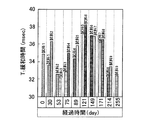
図5に、Cd坏土に含まれる水についての1H−NMRのT1緩和時間の実測値を棒グラフにて表す。図5の棒グラフでは、試料毎の模様を変えている。例えば、経過時間0日目に測定した試料1は、再び経過時間30日目に測定した。前記試料とは別に経過時間30日目に測定された試料2については、経過時間53日目(試料2は経過時間23日目)に再び測定した。他の試料の1H−NMRのT1緩和時間の実測値についても回数的に連続する異なる時期に2回測定した。
(Measured value of T 1 relaxation time of 1 H-NMR)
In FIG. 5, the measured value of 1 H-NMR T 1 relaxation time for water contained in Cd clay is represented by a bar graph. In the bar graph of FIG. 5, the pattern for each sample is changed. For example, the
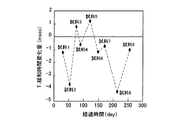
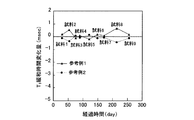
図6には、試料1〜9について、1回目に測定されたT1緩和時間の実測値に対する2回目に測定されたT1緩和時間の実測値の変化量を示す。図6のグラフでは、2回目のT1緩和時間を測定した経過時間の位置にT1緩和時間の実測値の変化量をプロットする。例えば、試料1については、T1緩和時間の実測値の変化量を経過時間30日目にプロットしている。試料1〜9は、組成および混合状態が同じであるにもかかわらず坏土に含まれる水についての1H−NMRのT1緩和時間の実測値の1回目と2回目との差が−4.25〜1.21msecの範囲内で変化した。
6, for samples 1-9, show a variation of the first to be measured for the second time for the measured value of the measured T 1 relaxation times were T 1 measured value of the relaxation time. In the graph of FIG. 6, it plots the variation of the measured values of T 1 relaxation time to the position of the second elapsed time measured the T 1 relaxation time of. For example, for
(1H−NMRのT1緩和時間の校正値)
初回測定した校正用試料のT1緩和時間実測値をT10、n日目に測定を行ったときの校正用試料のT1緩和時間実測値をT1n、n日目に測定を行ったときの計測対象物のT1緩和時間実測値をT1p、計測対象物の校正値をT1mとした時、T1m=T1p+(T10−T1n)、の計算式を用いて校正を行った。図7には、参考例1の校正用試料を用いて得た校正値(丸)、参考例2の校正用試料を用いて得た校正値(三角)を示す。試料1〜9の坏土に含まれる水についての1H−NMRのT1緩和時間の校正値の変化量は、参考例1の校正用試料を用いた場合には−0.18〜0.64msec、参考例2の校正用試料を用いた場合には−0.43〜0.12msecとなった。
(Calibration value of T 1 relaxation time of 1 H-NMR)
First measured the T 1 relaxation times measured values of the calibration samples T1 0, when n-th day to the T 1 relaxation times measured values of the calibration samples when performing measurement was measured T1 n, the n-th day Calibration is performed using the following equation: T1 m = T1 p + (T1 0 -T1 n ) where T1 p is the measured T1 relaxation time of the measured object and T1 m is the calibration value of the measured object. It was. FIG. 7 shows calibration values (circles) obtained using the calibration sample of Reference Example 1 and calibration values (triangles) obtained using the calibration sample of Reference Example 2. The amount of change in the calibration value of the T 1 relaxation time of 1 H-NMR for the water contained in the clays of
(校正用試料自体の1H−NMRのT1緩和時間の測定)
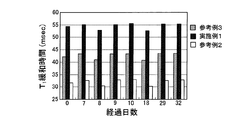
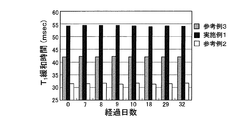
参考例2,3、実施例1の校正用試料自体を計測対象として1H−NMRのT1緩和時間の経時変化を測定した。測定は、経過日数0日目、同7日目、同9日目、同10日目、同18日目、同29日目、同32日目に行った(校正用試料の製造日を経過日数0日目とする)。参考例2,3、実施例1の校正用試料自体についての1H−NMRのT1緩和時間の実測値を図8の棒グラフに示す。同時に、参考例3の校正用試料についての1H−NMRのT1緩和時間の実測値を基準値して、参考例2,3、実施例1の校正用試料の1H−NMRのT1緩和時間の実測値を校正した。初回に測定した参考例3のT1緩和時間実測値をT10、n日目に測定を行ったときの参考例3のT1緩和時間実測値をT1n、n日目に測定を行ったときの計測対象物のT1緩和時間実測値をT1p、計測対象物の校正値をT1mとした時、T1m=T1p+(T10−T1n)、の計算式を用いて校正を行った。参考例2,3、実施例1の校正用試料の1H−NMRのT1緩和時間の校正値を図9の棒グラフに示す。
(Measurement of 1 H-NMR T 1 relaxation time of calibration sample itself)
With respect to the calibration samples of Reference Examples 2 and 3 and Example 1, the change over time of the T 1 relaxation time of 1 H-NMR was measured. The measurement was performed on the 0th day, the 7th day, the 9th day, the 10th day, the 18th day, the 29th day, the 29th day, and the 32nd day (elapsed the date of manufacture of the calibration sample). Day 0) The measured values of 1 H-NMR T 1 relaxation times for the calibration samples of Reference Examples 2 and 3 and Example 1 are shown in the bar graph of FIG. At the same time, the measured values of 1 H-NMR T 1 relaxation time of calibration samples of Reference Example 3 and the reference value, the reference example 2,3, T 1 of 1 H-NMR of the calibration sample of Example 1 The measured relaxation time was calibrated. The first measured T1 relaxation time value of Reference Example 3 is T1 0 , and the measured T1 relaxation time value of Reference Example 3 is T1 n when the measurement is performed on the nth day. Calibration was performed using the calculation formula of T1 m = T1 p + (T1 0 -T1 n ), where T1 p is the measured T1 relaxation time of the measurement object and T1 m is the calibration value of the measurement object. . The bar graphs of FIG. 9 show the calibration values of the 1 H-NMR T 1 relaxation times of the calibration samples of Reference Examples 2 and 3 and Example 1.
参考例2,3、実施例1の校正用試料自体についての1H−NMRのT1緩和時間の実測値は、いずれも経過日数ごとに同じ変化傾向を示していた。したがって、この実測値の変化は、NMR装置における測定環境の変化に起因することが確認できた。そして、図9に示すように、参考例2,3、実施例1の校正用試料についての1H−NMRのT1緩和時間の校正値は、いずれの経過日数でも略一定の値を示していた。したがって、参考例3の校正用試料による1H−NMRのT1緩和時間の実測値の校正が有効であること、さらに参考例2,3、実施例1の校正用試料は、校正用試料の作製後32日を経過したときでも、これらに含まれる水分子の状態がほぼ不変であることが確認された。すなわち、多孔質材に含浸された水における、自由水(水分子の集団(液体状態の水の塊)内にある水分子)と、結合水(固体粒子との間の水素結合や分子間力等によって結合して自由に運動できない水分子)との比率が、時間を経過してもほぼ変化しないことが確認された。 The measured values of the 1 H-NMR T 1 relaxation times for the calibration samples of Reference Examples 2 and 3 and Example 1 all showed the same changing tendency for each elapsed day. Therefore, it was confirmed that the change in the actual measurement value was caused by the change in the measurement environment in the NMR apparatus. And as shown in FIG. 9, the calibration value of the T 1 relaxation time of 1 H-NMR for the calibration samples of Reference Examples 2 and 3 and Example 1 shows a substantially constant value in any elapsed days. It was. Therefore, it is effective to calibrate the measured value of the T 1 relaxation time of 1 H-NMR with the calibration sample of Reference Example 3, and the calibration samples of Reference Examples 2 and 3 and Example 1 are the calibration samples. Even when 32 days have passed since the production, it was confirmed that the state of the water molecules contained therein was almost unchanged. That is, in water impregnated in a porous material, free water (water molecules in a group of water molecules (liquid water mass)) and bound water (hydrogen bonds and intermolecular forces between solid particles) It was confirmed that the ratio of water molecules that cannot be freely moved by being bound by the same or the like hardly changes over time.
(2)観測核(1H)を含む分子がメタノール(CH3OH)の場合:
(校正用試料の調製)
(参考例4)
シリカゲル(市販品)20gを充分の量のメタノールが入っている容器に入れて5時間吸収させた。メタノールを吸収させたシリカゲルを12時間自然乾燥して表面に付いたメタノールを乾燥させ、樹脂フィルムによって空気を抜いた状態にてナイロン樹脂フィルムを容器として真空封止して、NMR測定装置による測定まで保存した。
(2) When the molecule containing the observation nucleus ( 1 H) is methanol (CH 3 OH):
(Preparation of calibration sample)
(Reference Example 4)
20 g of silica gel (commercial product) was put in a container containing a sufficient amount of methanol and absorbed for 5 hours. Silica gel that has absorbed methanol is naturally dried for 12 hours to dry the methanol attached to the surface, and the nylon resin film is vacuum-sealed in a state where the air is evacuated by the resin film, and until the measurement by the NMR measuring apparatus. saved.
(参考例5)
ゼオライト(市販品)20gを充分の量のメタノールが入っている容器に入れて5時間吸収させた。メタノールを吸収させたシリカゲルを12時間自然乾燥して表面に付いたメタノールを乾燥させ、樹脂フィルムによって空気を抜いた状態にてナイロン樹脂フィルムを容器として真空封止して、NMR測定装置による測定まで保存した。
(Reference Example 5)
20 g of zeolite (commercial product) was put in a container containing a sufficient amount of methanol and absorbed for 5 hours. Silica gel that has absorbed methanol is naturally dried for 12 hours to dry the methanol attached to the surface, and the nylon resin film is vacuum-sealed in a state where the air is evacuated by the resin film, and until the measurement by the NMR measuring apparatus. saved.
(メタノール含有率の計測)
メタノールを吸収させる前のシリカゲル或はゼオライトの質量m1と、メタノールを吸収させた後、自然乾燥を終了した試料の質量m2を計測し、含有率=(m2−m1)/m2の計算式を用いてメタノールの含有率を算出した。シリカゲルとゼオライトのメタノール含有率の結果を表3示す。
(Measurement of methanol content)
Measure the mass m1 of silica gel or zeolite before absorbing methanol and the mass m2 of the sample that has been naturally dried after absorbing methanol, and use the calculation formula of content = (m2−m1) / m2. The methanol content was calculated. Table 3 shows the results of the methanol content of silica gel and zeolite.
(NMR測定装置)
NMR測定装置は、MRテクノロジー社製の静磁場強度0.3TのCompacTsacnを使用した。静磁場強度0.3Tにおいて周波数12.8MHz(12.8MHzは、0.3Tのときのメタノール分子に含まれる1Hの共鳴周波数)の高周波の照射に対して共鳴して発せられたNMR信号を計測した。
(NMR measurement device)
As an NMR measuring apparatus, CompacTsacn having a static magnetic field strength of 0.3 T manufactured by MR Technology was used. An NMR signal generated in resonance with high-frequency irradiation with a frequency of 12.8 MHz (12.8 MHz is a resonance frequency of 1 H contained in methanol molecules at 0.3 T) at a static magnetic field strength of 0.3 T. Measured.
(1H−NMRのT1緩和時間の実測値および基準値)
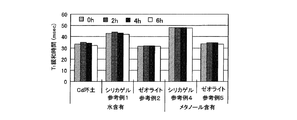
図10に、坏土及び参考例1,2の校正用試料に含有される水についての1H−NMRのT1緩和時間の実測値、および、参考例4,5のメタノールを含浸させたシリカゲルおよびゼオライトの校正用試料のT1緩和時間を示す。T1緩和時間の実測値および基準値の測定は2時間ごとに4回実施した。メタノールを含浸させた校正用試料のT1緩和時間の実測値も、Cd坏土のT1緩和時間の実測値と近い値を示しており、測定時期による変化も同じ傾向であることが確認された。
(Measured value and reference value of T 1 relaxation time of 1 H-NMR)
FIG. 10 shows the measured values of 1 H-NMR T 1 relaxation times of the clay and the water contained in the calibration samples of Reference Examples 1 and 2, and silica gel impregnated with methanol of Reference Examples 4 and 5. And the T 1 relaxation time of the zeolite calibration sample. The measured value of the T 1 relaxation time and the reference value were measured four times every two hours. The measured value of the T 1 relaxation time of the calibration sample impregnated with methanol also shows a value close to the measured value of the T 1 relaxation time of the Cd clay, and it was confirmed that the change with the measurement time has the same tendency. It was.
(校正用試料に含浸させるプロトンを含有した液体の必要含有率範囲)
多孔質材であるシリカゲル(豊田化工製 シリカゲルA型、平均細孔径24Å、細孔容積0.46mm3/g)を40gずつ3水準を用意した。それぞれ水の含有率が10%、30%、50%となるまで水を含浸させ、樹脂フィルムによって空気を抜いた状態にてナイロン樹脂フィルムを容器として真空封止して、NMR測定装置により測定を行った。表4にその結果を示す。水の含有率10%の試料はNMR信号が確認できなかったため、水の含有率11%の試料を追加した。
(Required content range of liquid containing protons to be impregnated into calibration sample)
Three levels of 40 g of silica gel (silica gel A type, average pore diameter of 24 mm, pore volume of 0.46 mm 3 / g manufactured by Toyoda Chemical Co., Ltd.) as a porous material were prepared. Water is impregnated until the water content reaches 10%, 30%, and 50%, respectively, and the resin is vacuum-sealed with a nylon resin film in a state where air is evacuated, and measurement is performed with an NMR measuring apparatus. went. Table 4 shows the results. Since the NMR signal could not be confirmed for the sample having a water content of 10%, a sample having a water content of 11% was added.
本発明は、1H−NMRのT1緩和時間およびT2緩和時間の校正用試料として利用できる。 The present invention can be used as a calibration sample for T 1 relaxation time and T 2 relaxation time of 1 H-NMR.
1:校正用試料、3:多孔質材、5:封入材、7:容器、11:細孔、13:液体、15:内壁、31:固体粒子、32:、33:水、35:塊、40:混合物。 1: calibration sample, 3: porous material, 5: encapsulating material, 7: container, 11: pore, 13: liquid, 15: inner wall, 31: solid particles, 32 :, 33: water, 35: lump, 40: Mixture.
Claims (7)
前記多孔質材を封入した封入材と、を含み、
前記封入材は、1H−NMRの信号を出力しないものおよび物理的な要因が加わっても形状的変化が無いものであると共にアクリル樹脂、ナイロン樹脂、エポキシ樹脂、メタクリル系樹脂、およびゲル化剤からなる群から選ばれる少なくとも1種からなる1H−NMRのT1緩和時間およびT2緩和時間の校正用試料。 A porous material in which pores are impregnated with a liquid containing molecules containing protons ( 1 H) to be measured for T 1 relaxation time and T 2 relaxation time of 1 H-NMR,
An encapsulating material encapsulating the porous material,
The encapsulant does not output a 1 H-NMR signal, and does not change in shape even when a physical factor is applied, and also includes an acrylic resin, a nylon resin, an epoxy resin, a methacrylic resin, and a gelling agent. A sample for calibration of T 1 relaxation time and T 2 relaxation time of 1 H-NMR comprising at least one selected from the group consisting of:
Priority Applications (1)
| Application Number | Priority Date | Filing Date | Title |
|---|---|---|---|
| JP2014192728A JP5898742B2 (en) | 2010-03-02 | 2014-09-22 | Sample for calibration of T1 relaxation time and T2 relaxation time of 1H-NMR |
Applications Claiming Priority (3)
| Application Number | Priority Date | Filing Date | Title |
|---|---|---|---|
| JP2010045791 | 2010-03-02 | ||
| JP2010045791 | 2010-03-02 | ||
| JP2014192728A JP5898742B2 (en) | 2010-03-02 | 2014-09-22 | Sample for calibration of T1 relaxation time and T2 relaxation time of 1H-NMR |
Related Parent Applications (1)
| Application Number | Title | Priority Date | Filing Date |
|---|---|---|---|
| JP2010210677A Division JP5657967B2 (en) | 2010-03-02 | 2010-09-21 | Sample for calibration of T1 relaxation time and T2 relaxation time of 1H-NMR |
Publications (2)
| Publication Number | Publication Date |
|---|---|
| JP2015017993A true JP2015017993A (en) | 2015-01-29 |
| JP5898742B2 JP5898742B2 (en) | 2016-04-06 |
Family
ID=44880014
Family Applications (2)
| Application Number | Title | Priority Date | Filing Date |
|---|---|---|---|
| JP2010210677A Expired - Fee Related JP5657967B2 (en) | 2010-03-02 | 2010-09-21 | Sample for calibration of T1 relaxation time and T2 relaxation time of 1H-NMR |
| JP2014192728A Expired - Fee Related JP5898742B2 (en) | 2010-03-02 | 2014-09-22 | Sample for calibration of T1 relaxation time and T2 relaxation time of 1H-NMR |
Family Applications Before (1)
| Application Number | Title | Priority Date | Filing Date |
|---|---|---|---|
| JP2010210677A Expired - Fee Related JP5657967B2 (en) | 2010-03-02 | 2010-09-21 | Sample for calibration of T1 relaxation time and T2 relaxation time of 1H-NMR |
Country Status (1)
| Country | Link |
|---|---|
| JP (2) | JP5657967B2 (en) |
Cited By (2)
| Publication number | Priority date | Publication date | Assignee | Title |
|---|---|---|---|---|
| CN110168394A (en) * | 2016-11-07 | 2019-08-23 | 牛津大学创新有限公司 | Correction method for magnetic resonance T1-mapping of internal organs in the presence of elevated iron and elevated fat levels with off-resonant frequencies |
| US10946552B2 (en) | 2017-04-19 | 2021-03-16 | Denso Corporation | Evaluation method for clay and manufacturing method of extrusion molded body |
Families Citing this family (2)
| Publication number | Priority date | Publication date | Assignee | Title |
|---|---|---|---|---|
| CN111610215A (en) * | 2019-06-04 | 2020-09-01 | 苏州纽迈分析仪器股份有限公司 | A kind of method of nuclear magnetic resonance fiber oil content test standard sample formula |
| CN116429536A (en) * | 2023-04-24 | 2023-07-14 | 苏州纽迈分析仪器股份有限公司 | A kind of nuclear magnetic resonance fiber oil content standard sample and preparation method thereof |
Citations (8)
| Publication number | Priority date | Publication date | Assignee | Title |
|---|---|---|---|---|
| JPS5915844A (en) * | 1982-07-16 | 1984-01-26 | Asahi Chem Ind Co Ltd | Phantom for analysis of image |
| JPS63272338A (en) * | 1987-01-26 | 1988-11-09 | ノース・アメリカン・フィリップス・コーポレーション | Three-dimensional descarte's grid and method for calibrating nmr imaging apparatus |
| US5994900A (en) * | 1994-03-21 | 1999-11-30 | Gurvich; Victor A. | Test phantom for information systems and method of its use |
| JP2001145609A (en) * | 1999-09-09 | 2001-05-29 | Hitachi Medical Corp | Magnetic resonance imaging equipment |
| US6965235B1 (en) * | 2003-07-24 | 2005-11-15 | General Electric Company | Apparatus to simulate MR properties of human brain for MR applications evaluation |
| WO2006021920A1 (en) * | 2004-08-25 | 2006-03-02 | Philips Intellectual Property & Standards Gmbh | Mr method of determining local relaxation time values using calibrated phantom |
| US20070210796A1 (en) * | 2006-03-07 | 2007-09-13 | Catholic University Industry Academic Cooperation Foundation | Phantom for evaluating magnetic resonance spectroscopy performance |
| JP2008036389A (en) * | 2006-08-07 | 2008-02-21 | Catholic Univ Industry Academy Cooperation Foundation | Phantom for magnetic resonance spectroscopy performance evaluation using magnetic resonance imaging equipment |
Family Cites Families (5)
| Publication number | Priority date | Publication date | Assignee | Title |
|---|---|---|---|---|
| JPH0659278B2 (en) * | 1985-04-26 | 1994-08-10 | 株式会社東芝 | NMR diagnostic phantom |
| US4719406A (en) * | 1986-02-07 | 1988-01-12 | General Electric Company | Phantom for performance evaluation of a nuclear magnetic resonance scanner |
| AU4528093A (en) * | 1992-06-15 | 1994-01-04 | Board Of Regents, The University Of Texas System | Clay enclosed transition and rare earth metal ions as contrast agents for the gastrointestinal tract |
| JP2002052008A (en) * | 2000-08-08 | 2002-02-19 | Katsumi Kose | Magnetic resonance diagnostic equipment |
| JP5188425B2 (en) * | 2009-03-09 | 2013-04-24 | 日本碍子株式会社 | Method for evaluating dredged soil and method for producing dredged soil |
-
2010
- 2010-09-21 JP JP2010210677A patent/JP5657967B2/en not_active Expired - Fee Related
-
2014
- 2014-09-22 JP JP2014192728A patent/JP5898742B2/en not_active Expired - Fee Related
Patent Citations (9)
| Publication number | Priority date | Publication date | Assignee | Title |
|---|---|---|---|---|
| JPS5915844A (en) * | 1982-07-16 | 1984-01-26 | Asahi Chem Ind Co Ltd | Phantom for analysis of image |
| JPS63272338A (en) * | 1987-01-26 | 1988-11-09 | ノース・アメリカン・フィリップス・コーポレーション | Three-dimensional descarte's grid and method for calibrating nmr imaging apparatus |
| US5994900A (en) * | 1994-03-21 | 1999-11-30 | Gurvich; Victor A. | Test phantom for information systems and method of its use |
| JP2001145609A (en) * | 1999-09-09 | 2001-05-29 | Hitachi Medical Corp | Magnetic resonance imaging equipment |
| US6965235B1 (en) * | 2003-07-24 | 2005-11-15 | General Electric Company | Apparatus to simulate MR properties of human brain for MR applications evaluation |
| WO2006021920A1 (en) * | 2004-08-25 | 2006-03-02 | Philips Intellectual Property & Standards Gmbh | Mr method of determining local relaxation time values using calibrated phantom |
| JP2008510557A (en) * | 2004-08-25 | 2008-04-10 | コーニンクレッカ フィリップス エレクトロニクス エヌ ヴィ | How to determine local relaxation time values using a calibrated phantom |
| US20070210796A1 (en) * | 2006-03-07 | 2007-09-13 | Catholic University Industry Academic Cooperation Foundation | Phantom for evaluating magnetic resonance spectroscopy performance |
| JP2008036389A (en) * | 2006-08-07 | 2008-02-21 | Catholic Univ Industry Academy Cooperation Foundation | Phantom for magnetic resonance spectroscopy performance evaluation using magnetic resonance imaging equipment |
Cited By (2)
| Publication number | Priority date | Publication date | Assignee | Title |
|---|---|---|---|---|
| CN110168394A (en) * | 2016-11-07 | 2019-08-23 | 牛津大学创新有限公司 | Correction method for magnetic resonance T1-mapping of internal organs in the presence of elevated iron and elevated fat levels with off-resonant frequencies |
| US10946552B2 (en) | 2017-04-19 | 2021-03-16 | Denso Corporation | Evaluation method for clay and manufacturing method of extrusion molded body |
Also Published As
| Publication number | Publication date |
|---|---|
| JP2011203233A (en) | 2011-10-13 |
| JP5657967B2 (en) | 2015-01-21 |
| JP5898742B2 (en) | 2016-04-06 |
Similar Documents
| Publication | Publication Date | Title |
|---|---|---|
| JP5898742B2 (en) | Sample for calibration of T1 relaxation time and T2 relaxation time of 1H-NMR | |
| Zou et al. | Water evolution and hydration kinetics of cement paste under steam-curing condition based on low-field NMR method | |
| Holthausen et al. | Monitoring the internal swelling in cementitious mortars with single-sided 1H nuclear magnetic resonance | |
| Nyman et al. | Measurements of mobile and bound water by nuclear magnetic resonance correlate with mechanical properties of bone | |
| Muller | Characterization of porosity & CSH in cement pastes by ¹H NMR | |
| Wang et al. | Study on Mechanism of Desorption Behavior of Saturated Superabsorbent Polymers in Concrete. | |
| Wu et al. | A study of the water vapor sorption isotherms of hardened cement pastes: Possible pore structure changes at low relative humidity and the impact of temperature on isotherms | |
| Sarı et al. | Preparation, thermal properties and thermal reliability of capric acid/expanded perlite composite for thermal energy storage | |
| Zhang et al. | Long-term creep properties of cementitious materials: Comparing microindentation testing with macroscopic uniaxial compressive testing | |
| Engstrand Unosson et al. | An evaluation of methods to determine the porosity of calcium phosphate cements | |
| Wong et al. | Determining the water–cement ratio, cement content, water content and degree of hydration of hardened cement paste: Method development and validation on paste samples | |
| CN103399027B (en) | A kind of cement-based material hydration degree measurement method based on nuclear magnetic resonance | |
| Issaadi et al. | Moisture characterization of cementitious material properties: Assessment of water vapor sorption isotherm and permeability variation with ages | |
| RU2013114383A (en) | DEVICE FOR NUCLEAR MAGNETIC RESONANCE OF A LOW FIELD FOR MEASURING WATER CONTENT IN SOLIDS AND SUSPENSIONS | |
| CN107014849B (en) | A method to characterize the pore structure of cement paste by using low-field nuclear magnetic cryo-porosimetry | |
| Wang et al. | 1H nuclear magnetic resonance characterization of Portland cement: molecular diffusion of water studied by spin relaxation and relaxation time-weighted imaging | |
| CN112129685B (en) | Method for testing early-age concrete pore structure based on nuclear magnetic resonance | |
| JP2004093187A (en) | Evaluation method for porous carbon-based materials using nuclear magnetic resonance | |
| CN109300511B (en) | Construction method and application of early hydration model of super absorbent resin internal curing cement slurry | |
| Webber et al. | USY zeolite mesoporosity probed by NMR cryoporometry | |
| US8240220B2 (en) | Method for evaluating kneaded clay, and method for manufacturing kneaded clay | |
| Kullmann et al. | Characterization of pore filling of mesoporous host systems by means of positronium annihilation lifetime spectroscopy (PALS) | |
| Lievers et al. | Specimen size effect in the volumetric shrinkage of cancellous bone measured at two levels of dehydration | |
| Consolati et al. | Positron lifetime spectroscopy as a probe of nanoporosity of cement-based materials | |
| She et al. | Evaluation of water evaporation in cementitious materials by low field NMR |
Legal Events
| Date | Code | Title | Description |
|---|---|---|---|
| A977 | Report on retrieval |
Free format text: JAPANESE INTERMEDIATE CODE: A971007 Effective date: 20150622 |
|
| A131 | Notification of reasons for refusal |
Free format text: JAPANESE INTERMEDIATE CODE: A131 Effective date: 20150707 |
|
| A521 | Request for written amendment filed |
Free format text: JAPANESE INTERMEDIATE CODE: A523 Effective date: 20150907 |
|
| TRDD | Decision of grant or rejection written | ||
| A01 | Written decision to grant a patent or to grant a registration (utility model) |
Free format text: JAPANESE INTERMEDIATE CODE: A01 Effective date: 20160216 |
|
| A61 | First payment of annual fees (during grant procedure) |
Free format text: JAPANESE INTERMEDIATE CODE: A61 Effective date: 20160304 |
|
| R150 | Certificate of patent or registration of utility model |
Ref document number: 5898742 Country of ref document: JP Free format text: JAPANESE INTERMEDIATE CODE: R150 |
|
| LAPS | Cancellation because of no payment of annual fees |