JP2013166312A - Method for manufacturing ground product of silicone rubber - Google Patents
Method for manufacturing ground product of silicone rubber Download PDFInfo
- Publication number
- JP2013166312A JP2013166312A JP2012031195A JP2012031195A JP2013166312A JP 2013166312 A JP2013166312 A JP 2013166312A JP 2012031195 A JP2012031195 A JP 2012031195A JP 2012031195 A JP2012031195 A JP 2012031195A JP 2013166312 A JP2013166312 A JP 2013166312A
- Authority
- JP
- Japan
- Prior art keywords
- silicone rubber
- aqueous solution
- polyamide
- pulverized
- metal hydroxide
- Prior art date
- Legal status (The legal status is an assumption and is not a legal conclusion. Google has not performed a legal analysis and makes no representation as to the accuracy of the status listed.)
- Pending
Links
- 229920002379 silicone rubber Polymers 0.000 title claims abstract description 193
- 239000004945 silicone rubber Substances 0.000 title claims abstract description 192
- 238000004519 manufacturing process Methods 0.000 title claims abstract description 28
- 238000000034 method Methods 0.000 title claims abstract description 17
- 238000003756 stirring Methods 0.000 claims abstract description 30
- XLYOFNOQVPJJNP-UHFFFAOYSA-N water Substances O XLYOFNOQVPJJNP-UHFFFAOYSA-N 0.000 claims abstract description 22
- 150000001412 amines Chemical class 0.000 claims abstract description 15
- 238000010438 heat treatment Methods 0.000 claims abstract description 15
- 239000007864 aqueous solution Substances 0.000 claims description 91
- 239000004952 Polyamide Substances 0.000 claims description 73
- 229920002647 polyamide Polymers 0.000 claims description 73
- 229920006122 polyamide resin Polymers 0.000 claims description 24
- 239000002131 composite material Substances 0.000 claims description 18
- 150000008044 alkali metal hydroxides Chemical class 0.000 claims description 15
- 229910001860 alkaline earth metal hydroxide Inorganic materials 0.000 claims description 15
- 239000002253 acid Substances 0.000 claims description 5
- 229920001971 elastomer Polymers 0.000 claims description 5
- 239000005060 rubber Substances 0.000 claims description 5
- 239000012535 impurity Substances 0.000 abstract description 11
- 238000000227 grinding Methods 0.000 abstract description 2
- 150000005325 alkali earth metal hydroxides Chemical class 0.000 abstract 1
- 229910000000 metal hydroxide Inorganic materials 0.000 abstract 1
- 150000004692 metal hydroxides Chemical class 0.000 abstract 1
- -1 heptenyl group Chemical group 0.000 description 34
- 239000010410 layer Substances 0.000 description 26
- 239000004744 fabric Substances 0.000 description 24
- 238000002156 mixing Methods 0.000 description 18
- 229920001296 polysiloxane Polymers 0.000 description 18
- 239000000047 product Substances 0.000 description 16
- 229920002302 Nylon 6,6 Polymers 0.000 description 15
- KWYUFKZDYYNOTN-UHFFFAOYSA-M Potassium hydroxide Chemical compound [OH-].[K+] KWYUFKZDYYNOTN-UHFFFAOYSA-M 0.000 description 15
- 229920002050 silicone resin Polymers 0.000 description 14
- 238000011156 evaluation Methods 0.000 description 12
- VEXZGXHMUGYJMC-UHFFFAOYSA-N Hydrochloric acid Chemical compound Cl VEXZGXHMUGYJMC-UHFFFAOYSA-N 0.000 description 10
- 229920002292 Nylon 6 Polymers 0.000 description 10
- QTBSBXVTEAMEQO-UHFFFAOYSA-N Acetic acid Chemical compound CC(O)=O QTBSBXVTEAMEQO-UHFFFAOYSA-N 0.000 description 9
- HEMHJVSKTPXQMS-UHFFFAOYSA-M Sodium hydroxide Chemical compound [OH-].[Na+] HEMHJVSKTPXQMS-UHFFFAOYSA-M 0.000 description 9
- 230000000052 comparative effect Effects 0.000 description 9
- 239000000243 solution Substances 0.000 description 7
- 239000004094 surface-active agent Substances 0.000 description 7
- WMFOQBRAJBCJND-UHFFFAOYSA-M Lithium hydroxide Chemical compound [Li+].[OH-] WMFOQBRAJBCJND-UHFFFAOYSA-M 0.000 description 6
- 125000003342 alkenyl group Chemical group 0.000 description 6
- 229920001577 copolymer Polymers 0.000 description 6
- 230000000694 effects Effects 0.000 description 6
- NAQMVNRVTILPCV-UHFFFAOYSA-N hexane-1,6-diamine Chemical compound NCCCCCCN NAQMVNRVTILPCV-UHFFFAOYSA-N 0.000 description 6
- 239000007788 liquid Substances 0.000 description 6
- 239000000463 material Substances 0.000 description 6
- 238000010298 pulverizing process Methods 0.000 description 6
- 238000001291 vacuum drying Methods 0.000 description 6
- 239000004677 Nylon Substances 0.000 description 5
- 238000007872 degassing Methods 0.000 description 5
- HIHIPCDUFKZOSL-UHFFFAOYSA-N ethenyl(methyl)silicon Chemical compound C[Si]C=C HIHIPCDUFKZOSL-UHFFFAOYSA-N 0.000 description 5
- 238000004898 kneading Methods 0.000 description 5
- 229920001778 nylon Polymers 0.000 description 5
- 229920006111 poly(hexamethylene terephthalamide) Polymers 0.000 description 5
- PIICEJLVQHRZGT-UHFFFAOYSA-N Ethylenediamine Chemical compound NCCN PIICEJLVQHRZGT-UHFFFAOYSA-N 0.000 description 4
- 125000000217 alkyl group Chemical group 0.000 description 4
- VHRGRCVQAFMJIZ-UHFFFAOYSA-N cadaverine Chemical compound NCCCCCN VHRGRCVQAFMJIZ-UHFFFAOYSA-N 0.000 description 4
- 150000004985 diamines Chemical class 0.000 description 4
- 239000000203 mixture Substances 0.000 description 4
- 125000000962 organic group Chemical group 0.000 description 4
- 239000002245 particle Substances 0.000 description 4
- 229920006123 polyhexamethylene isophthalamide Polymers 0.000 description 4
- 150000003141 primary amines Chemical class 0.000 description 4
- KIDHWZJUCRJVML-UHFFFAOYSA-N putrescine Chemical compound NCCCCN KIDHWZJUCRJVML-UHFFFAOYSA-N 0.000 description 4
- 239000002994 raw material Substances 0.000 description 4
- 238000004064 recycling Methods 0.000 description 4
- 238000000926 separation method Methods 0.000 description 4
- XFNJVJPLKCPIBV-UHFFFAOYSA-N trimethylenediamine Chemical compound NCCCN XFNJVJPLKCPIBV-UHFFFAOYSA-N 0.000 description 4
- 125000000391 vinyl group Chemical group [H]C([*])=C([H])[H] 0.000 description 4
- GVNWZKBFMFUVNX-UHFFFAOYSA-N Adipamide Chemical compound NC(=O)CCCCC(N)=O GVNWZKBFMFUVNX-UHFFFAOYSA-N 0.000 description 3
- OFOBLEOULBTSOW-UHFFFAOYSA-N Malonic acid Chemical compound OC(=O)CC(O)=O OFOBLEOULBTSOW-UHFFFAOYSA-N 0.000 description 3
- 125000004432 carbon atom Chemical group C* 0.000 description 3
- 238000005119 centrifugation Methods 0.000 description 3
- ILRSCQWREDREME-UHFFFAOYSA-N dodecanamide Chemical compound CCCCCCCCCCCC(N)=O ILRSCQWREDREME-UHFFFAOYSA-N 0.000 description 3
- GVGUFUZHNYFZLC-UHFFFAOYSA-N dodecyl benzenesulfonate;sodium Chemical compound [Na].CCCCCCCCCCCCOS(=O)(=O)C1=CC=CC=C1 GVGUFUZHNYFZLC-UHFFFAOYSA-N 0.000 description 3
- 239000000835 fiber Substances 0.000 description 3
- 239000003350 kerosene Substances 0.000 description 3
- 125000002496 methyl group Chemical group [H]C([H])([H])* 0.000 description 3
- 238000000465 moulding Methods 0.000 description 3
- 238000006386 neutralization reaction Methods 0.000 description 3
- 125000001997 phenyl group Chemical group [H]C1=C([H])C([H])=C(*)C([H])=C1[H] 0.000 description 3
- 238000006116 polymerization reaction Methods 0.000 description 3
- 229940080264 sodium dodecylbenzenesulfonate Drugs 0.000 description 3
- DGAQECJNVWCQMB-PUAWFVPOSA-M Ilexoside XXIX Chemical compound C[C@@H]1CC[C@@]2(CC[C@@]3(C(=CC[C@H]4[C@]3(CC[C@@H]5[C@@]4(CC[C@@H](C5(C)C)OS(=O)(=O)[O-])C)C)[C@@H]2[C@]1(C)O)C)C(=O)O[C@H]6[C@@H]([C@H]([C@@H]([C@H](O6)CO)O)O)O.[Na+] DGAQECJNVWCQMB-PUAWFVPOSA-M 0.000 description 2
- AFBPFSWMIHJQDM-UHFFFAOYSA-N N-methylaniline Chemical compound CNC1=CC=CC=C1 AFBPFSWMIHJQDM-UHFFFAOYSA-N 0.000 description 2
- 229920000571 Nylon 11 Polymers 0.000 description 2
- 229920000572 Nylon 6/12 Polymers 0.000 description 2
- NQRYJNQNLNOLGT-UHFFFAOYSA-N Piperidine Chemical compound C1CCNCC1 NQRYJNQNLNOLGT-UHFFFAOYSA-N 0.000 description 2
- VYPSYNLAJGMNEJ-UHFFFAOYSA-N Silicium dioxide Chemical compound O=[Si]=O VYPSYNLAJGMNEJ-UHFFFAOYSA-N 0.000 description 2
- 238000010306 acid treatment Methods 0.000 description 2
- 239000000654 additive Substances 0.000 description 2
- 125000003118 aryl group Chemical group 0.000 description 2
- 239000002585 base Substances 0.000 description 2
- HQABUPZFAYXKJW-UHFFFAOYSA-N butan-1-amine Chemical compound CCCCN HQABUPZFAYXKJW-UHFFFAOYSA-N 0.000 description 2
- JQVDAXLFBXTEQA-UHFFFAOYSA-N dibutylamine Chemical compound CCCCNCCCC JQVDAXLFBXTEQA-UHFFFAOYSA-N 0.000 description 2
- 239000004205 dimethyl polysiloxane Substances 0.000 description 2
- 235000013870 dimethyl polysiloxane Nutrition 0.000 description 2
- DMBHHRLKUKUOEG-UHFFFAOYSA-N diphenylamine Chemical compound C=1C=CC=CC=1NC1=CC=CC=C1 DMBHHRLKUKUOEG-UHFFFAOYSA-N 0.000 description 2
- 125000001495 ethyl group Chemical group [H]C([H])([H])C([H])([H])* 0.000 description 2
- 238000001125 extrusion Methods 0.000 description 2
- 239000000945 filler Substances 0.000 description 2
- 239000003063 flame retardant Substances 0.000 description 2
- 230000020169 heat generation Effects 0.000 description 2
- PWSKHLMYTZNYKO-UHFFFAOYSA-N heptane-1,7-diamine Chemical compound NCCCCCCCN PWSKHLMYTZNYKO-UHFFFAOYSA-N 0.000 description 2
- 239000004745 nonwoven fabric Substances 0.000 description 2
- 239000003921 oil Substances 0.000 description 2
- DPBLXKKOBLCELK-UHFFFAOYSA-N pentan-1-amine Chemical compound CCCCCN DPBLXKKOBLCELK-UHFFFAOYSA-N 0.000 description 2
- 229920000435 poly(dimethylsiloxane) Polymers 0.000 description 2
- 125000001436 propyl group Chemical group [H]C([*])([H])C([H])([H])C([H])([H])[H] 0.000 description 2
- WGYKZJWCGVVSQN-UHFFFAOYSA-N propylamine Chemical compound CCCN WGYKZJWCGVVSQN-UHFFFAOYSA-N 0.000 description 2
- 229920005989 resin Polymers 0.000 description 2
- 239000011347 resin Substances 0.000 description 2
- 150000003335 secondary amines Chemical class 0.000 description 2
- 239000004447 silicone coating Substances 0.000 description 2
- 229910052708 sodium Inorganic materials 0.000 description 2
- 239000011734 sodium Substances 0.000 description 2
- BDHFUVZGWQCTTF-UHFFFAOYSA-M sulfonate Chemical compound [O-]S(=O)=O BDHFUVZGWQCTTF-UHFFFAOYSA-M 0.000 description 2
- 125000003944 tolyl group Chemical group 0.000 description 2
- 239000002759 woven fabric Substances 0.000 description 2
- PWGJDPKCLMLPJW-UHFFFAOYSA-N 1,8-diaminooctane Chemical compound NCCCCCCCCN PWGJDPKCLMLPJW-UHFFFAOYSA-N 0.000 description 1
- BMVXCPBXGZKUPN-UHFFFAOYSA-N 1-hexanamine Chemical compound CCCCCCN BMVXCPBXGZKUPN-UHFFFAOYSA-N 0.000 description 1
- RNFJDJUURJAICM-UHFFFAOYSA-N 2,2,4,4,6,6-hexaphenoxy-1,3,5-triaza-2$l^{5},4$l^{5},6$l^{5}-triphosphacyclohexa-1,3,5-triene Chemical compound N=1P(OC=2C=CC=CC=2)(OC=2C=CC=CC=2)=NP(OC=2C=CC=CC=2)(OC=2C=CC=CC=2)=NP=1(OC=1C=CC=CC=1)OC1=CC=CC=C1 RNFJDJUURJAICM-UHFFFAOYSA-N 0.000 description 1
- TUGAQVRNALIPHY-UHFFFAOYSA-N 2,2-dimethylpentane-1,5-diamine Chemical compound NCC(C)(C)CCCN TUGAQVRNALIPHY-UHFFFAOYSA-N 0.000 description 1
- DDHUNHGZUHZNKB-UHFFFAOYSA-N 2,2-dimethylpropane-1,3-diamine Chemical compound NCC(C)(C)CN DDHUNHGZUHZNKB-UHFFFAOYSA-N 0.000 description 1
- RHUFFBLLFAYITF-UHFFFAOYSA-N 2-ethyl-2-methylpropane-1,3-diamine Chemical compound CCC(C)(CN)CN RHUFFBLLFAYITF-UHFFFAOYSA-N 0.000 description 1
- JZUHIOJYCPIVLQ-UHFFFAOYSA-N 2-methylpentane-1,5-diamine Chemical compound NCC(C)CCCN JZUHIOJYCPIVLQ-UHFFFAOYSA-N 0.000 description 1
- 125000003903 2-propenyl group Chemical group [H]C([*])([H])C([H])=C([H])[H] 0.000 description 1
- KSMVBYPXNKCPAJ-UHFFFAOYSA-N 4-Methylcyclohexylamine Chemical compound CC1CCC(N)CC1 KSMVBYPXNKCPAJ-UHFFFAOYSA-N 0.000 description 1
- 241000251468 Actinopterygii Species 0.000 description 1
- KXDHJXZQYSOELW-UHFFFAOYSA-N Carbamic acid Chemical compound NC(O)=O KXDHJXZQYSOELW-UHFFFAOYSA-N 0.000 description 1
- OKTJSMMVPCPJKN-UHFFFAOYSA-N Carbon Chemical compound [C] OKTJSMMVPCPJKN-UHFFFAOYSA-N 0.000 description 1
- JHWNWJKBPDFINM-UHFFFAOYSA-N Laurolactam Chemical compound O=C1CCCCCCCCCCCN1 JHWNWJKBPDFINM-UHFFFAOYSA-N 0.000 description 1
- 229920000299 Nylon 12 Polymers 0.000 description 1
- 229920003189 Nylon 4,6 Polymers 0.000 description 1
- 229920000305 Nylon 6,10 Polymers 0.000 description 1
- 229920000577 Nylon 6/66 Polymers 0.000 description 1
- 229920000393 Nylon 6/6T Polymers 0.000 description 1
- 229920000007 Nylon MXD6 Polymers 0.000 description 1
- 229920005647 Nylon TMDT Polymers 0.000 description 1
- XUIMIQQOPSSXEZ-UHFFFAOYSA-N Silicon Chemical group [Si] XUIMIQQOPSSXEZ-UHFFFAOYSA-N 0.000 description 1
- GWEVSGVZZGPLCZ-UHFFFAOYSA-N Titan oxide Chemical compound O=[Ti]=O GWEVSGVZZGPLCZ-UHFFFAOYSA-N 0.000 description 1
- 230000002378 acidificating effect Effects 0.000 description 1
- 150000001339 alkali metal compounds Chemical class 0.000 description 1
- 239000012670 alkaline solution Substances 0.000 description 1
- PNEYBMLMFCGWSK-UHFFFAOYSA-N aluminium oxide Inorganic materials [O-2].[O-2].[O-2].[Al+3].[Al+3] PNEYBMLMFCGWSK-UHFFFAOYSA-N 0.000 description 1
- 239000003963 antioxidant agent Substances 0.000 description 1
- 239000002216 antistatic agent Substances 0.000 description 1
- TZYHIGCKINZLPD-UHFFFAOYSA-N azepan-2-one;hexane-1,6-diamine;hexanedioic acid Chemical compound NCCCCCCN.O=C1CCCCCN1.OC(=O)CCCCC(O)=O TZYHIGCKINZLPD-UHFFFAOYSA-N 0.000 description 1
- RQPZNWPYLFFXCP-UHFFFAOYSA-L barium dihydroxide Chemical compound [OH-].[OH-].[Ba+2] RQPZNWPYLFFXCP-UHFFFAOYSA-L 0.000 description 1
- 229910001863 barium hydroxide Inorganic materials 0.000 description 1
- 239000011324 bead Substances 0.000 description 1
- 238000009835 boiling Methods 0.000 description 1
- 125000004369 butenyl group Chemical group C(=CCC)* 0.000 description 1
- 125000000484 butyl group Chemical group [H]C([*])([H])C([H])([H])C([H])([H])C([H])([H])[H] 0.000 description 1
- AXCZMVOFGPJBDE-UHFFFAOYSA-L calcium dihydroxide Chemical compound [OH-].[OH-].[Ca+2] AXCZMVOFGPJBDE-UHFFFAOYSA-L 0.000 description 1
- 239000000920 calcium hydroxide Substances 0.000 description 1
- 229910001861 calcium hydroxide Inorganic materials 0.000 description 1
- 239000006229 carbon black Substances 0.000 description 1
- 238000004140 cleaning Methods 0.000 description 1
- 239000011248 coating agent Substances 0.000 description 1
- 238000000576 coating method Methods 0.000 description 1
- 238000013329 compounding Methods 0.000 description 1
- 238000001816 cooling Methods 0.000 description 1
- WJTCGQSWYFHTAC-UHFFFAOYSA-N cyclooctane Chemical group C1CCCCCCC1 WJTCGQSWYFHTAC-UHFFFAOYSA-N 0.000 description 1
- 125000000118 dimethyl group Chemical group [H]C([H])([H])* 0.000 description 1
- LAWOZCWGWDVVSG-UHFFFAOYSA-N dioctylamine Chemical compound CCCCCCCCNCCCCCCCC LAWOZCWGWDVVSG-UHFFFAOYSA-N 0.000 description 1
- ZMUCVNSKULGPQG-UHFFFAOYSA-N dodecanedioic acid;hexane-1,6-diamine Chemical compound NCCCCCCN.OC(=O)CCCCCCCCCCC(O)=O ZMUCVNSKULGPQG-UHFFFAOYSA-N 0.000 description 1
- 238000001035 drying Methods 0.000 description 1
- 239000012634 fragment Substances 0.000 description 1
- 239000011521 glass Substances 0.000 description 1
- 239000010439 graphite Substances 0.000 description 1
- 229910002804 graphite Inorganic materials 0.000 description 1
- 125000006038 hexenyl group Chemical group 0.000 description 1
- 125000004051 hexyl group Chemical group [H]C([H])([H])C([H])([H])C([H])([H])C([H])([H])C([H])([H])C([H])([H])* 0.000 description 1
- 238000007654 immersion Methods 0.000 description 1
- 238000002347 injection Methods 0.000 description 1
- 239000007924 injection Substances 0.000 description 1
- JJWLVOIRVHMVIS-UHFFFAOYSA-N isopropylamine Chemical compound CC(C)N JJWLVOIRVHMVIS-UHFFFAOYSA-N 0.000 description 1
- LYBKPDDZTNUNNM-UHFFFAOYSA-N isopropylbenzylamine Chemical compound CC(C)NCC1=CC=CC=C1 LYBKPDDZTNUNNM-UHFFFAOYSA-N 0.000 description 1
- 150000003951 lactams Chemical class 0.000 description 1
- VTHJTEIRLNZDEV-UHFFFAOYSA-L magnesium dihydroxide Chemical compound [OH-].[OH-].[Mg+2] VTHJTEIRLNZDEV-UHFFFAOYSA-L 0.000 description 1
- 239000000347 magnesium hydroxide Substances 0.000 description 1
- 229910001862 magnesium hydroxide Inorganic materials 0.000 description 1
- 238000002844 melting Methods 0.000 description 1
- 230000008018 melting Effects 0.000 description 1
- 239000002480 mineral oil Substances 0.000 description 1
- 235000010446 mineral oil Nutrition 0.000 description 1
- GMTCPFCMAHMEMT-UHFFFAOYSA-N n-decyldecan-1-amine Chemical compound CCCCCCCCCCNCCCCCCCCCC GMTCPFCMAHMEMT-UHFFFAOYSA-N 0.000 description 1
- NJWMENBYMFZACG-UHFFFAOYSA-N n-heptylheptan-1-amine Chemical compound CCCCCCCNCCCCCCC NJWMENBYMFZACG-UHFFFAOYSA-N 0.000 description 1
- PXSXRABJBXYMFT-UHFFFAOYSA-N n-hexylhexan-1-amine Chemical compound CCCCCCNCCCCCC PXSXRABJBXYMFT-UHFFFAOYSA-N 0.000 description 1
- MFHKEJIIHDNPQE-UHFFFAOYSA-N n-nonylnonan-1-amine Chemical compound CCCCCCCCCNCCCCCCCCC MFHKEJIIHDNPQE-UHFFFAOYSA-N 0.000 description 1
- JACMPVXHEARCBO-UHFFFAOYSA-N n-pentylpentan-1-amine Chemical compound CCCCCNCCCCC JACMPVXHEARCBO-UHFFFAOYSA-N 0.000 description 1
- 229920006119 nylon 10T Polymers 0.000 description 1
- IOQPZZOEVPZRBK-UHFFFAOYSA-N octan-1-amine Chemical compound CCCCCCCCN IOQPZZOEVPZRBK-UHFFFAOYSA-N 0.000 description 1
- 239000003960 organic solvent Substances 0.000 description 1
- 125000005375 organosiloxane group Chemical group 0.000 description 1
- 125000002255 pentenyl group Chemical group C(=CCCC)* 0.000 description 1
- 125000001147 pentyl group Chemical group C(CCCC)* 0.000 description 1
- 229940100684 pentylamine Drugs 0.000 description 1
- 239000012466 permeate Substances 0.000 description 1
- 239000000049 pigment Substances 0.000 description 1
- 229920006139 poly(hexamethylene adipamide-co-hexamethylene terephthalamide) Polymers 0.000 description 1
- 125000004368 propenyl group Chemical group C(=CC)* 0.000 description 1
- 239000011802 pulverized particle Substances 0.000 description 1
- 230000009257 reactivity Effects 0.000 description 1
- 238000010992 reflux Methods 0.000 description 1
- 150000003839 salts Chemical class 0.000 description 1
- 229910052710 silicon Inorganic materials 0.000 description 1
- 239000000377 silicon dioxide Substances 0.000 description 1
- 229920002545 silicone oil Polymers 0.000 description 1
- 239000002904 solvent Substances 0.000 description 1
- 239000003381 stabilizer Substances 0.000 description 1
- 239000000126 substance Substances 0.000 description 1
- 239000000454 talc Substances 0.000 description 1
- 229910052623 talc Inorganic materials 0.000 description 1
- OGIDPMRJRNCKJF-UHFFFAOYSA-N titanium oxide Inorganic materials [Ti]=O OGIDPMRJRNCKJF-UHFFFAOYSA-N 0.000 description 1
- 238000004073 vulcanization Methods 0.000 description 1
- 239000002699 waste material Substances 0.000 description 1
- 230000004580 weight loss Effects 0.000 description 1
- 238000003466 welding Methods 0.000 description 1
- 125000005023 xylyl group Chemical group 0.000 description 1
Classifications
-
- Y—GENERAL TAGGING OF NEW TECHNOLOGICAL DEVELOPMENTS; GENERAL TAGGING OF CROSS-SECTIONAL TECHNOLOGIES SPANNING OVER SEVERAL SECTIONS OF THE IPC; TECHNICAL SUBJECTS COVERED BY FORMER USPC CROSS-REFERENCE ART COLLECTIONS [XRACs] AND DIGESTS
- Y02—TECHNOLOGIES OR APPLICATIONS FOR MITIGATION OR ADAPTATION AGAINST CLIMATE CHANGE
- Y02W—CLIMATE CHANGE MITIGATION TECHNOLOGIES RELATED TO WASTEWATER TREATMENT OR WASTE MANAGEMENT
- Y02W30/00—Technologies for solid waste management
- Y02W30/50—Reuse, recycling or recovery technologies
- Y02W30/62—Plastics recycling; Rubber recycling
Landscapes
- Separation, Recovery Or Treatment Of Waste Materials Containing Plastics (AREA)
Abstract
Description
本発明は、不純物を含むシリコーンゴムに対して、該不純物の除去およびシリコーンゴムの粉砕を同時におこなうことができるシリコーンゴム粉砕物の製造方法に関する。 The present invention relates to a method for producing a crushed silicone rubber, which can simultaneously remove impurities and pulverize silicone rubber.
ポリアミド6やポリアミド66などのポリアミド樹脂からなる成形体(ポリアミド樹脂成形体)上にシリコーンゴム層が形成されたポリアミド複合体が、自動車用部品やOA機器などの広範な分野で用いられている。 A polyamide composite in which a silicone rubber layer is formed on a molded body (polyamide resin molded body) made of a polyamide resin such as polyamide 6 or polyamide 66 is used in a wide range of fields such as automotive parts and OA equipment.
このようなポリアミド複合体をリサイクルする方法が、広く検討されている。例えば、特許文献1には、自動車用エアバッグのスクラップ布をアルカリ液に浸漬した後に脱水し、容器内で撹拌することで、スクラップ布表面のシリコーンコーティング層を分離除去する方法が提案されている。 Methods for recycling such polyamide composites have been widely studied. For example, Patent Document 1 proposes a method of separating and removing the silicone coating layer on the surface of the scrap cloth by dewatering the automobile cloth scrap cloth after being immersed in an alkaline solution and stirring in a container. .
特許文献2や特許文献3には、一種以上の樹脂成分を不純物として含むポリアミド6製品を、アルカリ水溶液や有機溶媒中で加熱することで、該不純物を除去する方法が提案されている。 Patent Document 2 and Patent Document 3 propose a method of removing the impurities by heating a polyamide 6 product containing one or more resin components as impurities in an alkaline aqueous solution or an organic solvent.
さらに、本発明者らは、アルカリ金属水酸化物および/またはアルカリ土類金属水酸化物と、特定のアミンと、必要に応じてスルホン酸ナトリウム系界面活性剤とを水に溶解させた洗浄液を用いることで、シリコーン樹脂等が付着したポリアミド樹脂成形体から、シリコーン樹脂等の付着物とポリアミド樹脂とを分離するという技術を見出している(例えば、特許文献4)。 Furthermore, the present inventors have prepared a cleaning solution in which an alkali metal hydroxide and / or alkaline earth metal hydroxide, a specific amine, and, if necessary, a sodium sulfonate surfactant are dissolved in water. By using it, the technique of isolate | separating deposits, such as a silicone resin, and a polyamide resin from the polyamide resin molded object to which a silicone resin etc. adhered was discovered (for example, patent document 4).
しかしながら、特許文献1〜4に記載されたような技術を用いることによりポリアミド樹脂成形体から分離したシリコーンコーティング層(シリコーンゴム層)には、分離工程に使用された処理液が吸収されているため、そのままではリサイクルに供することができないという問題がある。また、ポリアミド樹脂成形体が布帛である場合には、該ポリアミド基布から解れた糸屑が、分離されたシリコーンゴムに絡まっている場合もある。この場合もやはり、そのままではリサイクルに供することが不可能である。 However, the treatment liquid used in the separation process is absorbed in the silicone coating layer (silicone rubber layer) separated from the polyamide resin molded body by using the techniques described in Patent Documents 1 to 4. There is a problem that it cannot be recycled as it is. In addition, when the polyamide resin molded body is a fabric, the yarn waste unwound from the polyamide base fabric may be entangled with the separated silicone rubber. In this case as well, it cannot be recycled as it is.
上記のような問題を解決するため、本発明の課題は、シリコーンゴム以外の不純物が効果的に除去されたシリコーンゴム粉砕物の製造方法を提供することを目的とする。 In order to solve the above problems, an object of the present invention is to provide a method for producing a crushed silicone rubber from which impurities other than the silicone rubber are effectively removed.
本発明者らは、上記のような課題を解決するため鋭意検討を重ねた結果、本発明に到達した。
すなわち本発明の要旨は、以下の通りである。
(1)水と、アルカリ金属水酸化物および/またはアルカリ土類金属水酸化物と、アミンとを含有する水溶液を含むシリコーンゴムを、減圧下で加熱しながら、二軸ニーダーを用いて攪拌することにより、水溶液の脱気除去および粉砕を同時におこなうことを特徴とするシリコーンゴム粉砕物の製造方法。
(2)水と、アルカリ金属水酸化物および/またはアルカリ土類金属水酸化物と酸とが反応してなる中和物と、アミンとを含有する水溶液を含むシリコーンゴムを、減圧下で加熱しながら、二軸ニーダーを用いて攪拌することにより、水溶液の脱気除去および粉砕を同時におこなうことを特徴とするシリコーンゴム粉砕物の製造方法。
(3)シリコーンゴムにポリアミド糸が混入されており、二軸ニーダーを用いて攪拌することにより該ポリアミド糸をシリコーンゴムから分離除去することを特徴とする(1)または(2)のシリコーンゴム粉砕物の製造方法。
(4)二軸ニーダーとして、そのブレードがシグマブレードであるものを用いることを特徴とする(1)〜(3)のいずれかのシリコーンゴム粉砕物の製造方法。
(5)シリコーンゴムとして、ポリアミド樹脂成形体の表面にシリコーンゴム層が形成されてなるポリアミド複合体から分離されたシリコーンゴムを用いることを特徴とする(1)〜(4)のいずれかのシリコーンゴム粉砕物の製造方法。
(6)(1)〜(5)のいずれかの製造方法により製造されたものであることを特徴とするシリコーンゴム粉砕物。
The inventors of the present invention have arrived at the present invention as a result of intensive studies to solve the above-described problems.
That is, the gist of the present invention is as follows.
(1) A silicone rubber containing an aqueous solution containing water, an alkali metal hydroxide and / or an alkaline earth metal hydroxide, and an amine is stirred using a biaxial kneader while heating under reduced pressure. Thus, a method for producing a pulverized silicone rubber, wherein the degassing and pulverization of the aqueous solution are simultaneously performed.
(2) A silicone rubber containing an aqueous solution containing water, an alkali metal hydroxide and / or an alkaline earth metal hydroxide and an acid, and an aqueous solution containing an amine is heated under reduced pressure. A method for producing a crushed silicone rubber, characterized in that the aqueous solution is degassed and pulverized simultaneously by stirring using a biaxial kneader.
(3) Polyamide yarn is mixed in silicone rubber, and the polyamide yarn is separated and removed from the silicone rubber by stirring using a biaxial kneader. (1) or (2) Silicone rubber pulverization Manufacturing method.
(4) The method for producing a crushed silicone rubber according to any one of (1) to (3), wherein the biaxial kneader is a sigma blade.
(5) The silicone according to any one of (1) to (4), wherein a silicone rubber separated from a polyamide composite having a silicone rubber layer formed on the surface of a polyamide resin molding is used as the silicone rubber. Manufacturing method of rubber crushed material.
(6) A pulverized silicone rubber produced by the production method of any one of (1) to (5).
本発明によれば、不純物を含有するシリコーンゴムを、減圧下で加熱しながら二軸ニーダーを用いて攪拌するという簡易な操作により、シリコーンゴム以外の不純物を効果的に除去しつつ、取扱性に優れるサイズにまで粉砕されたシリコーンゴム粉砕物を製造することができる。このようなシリコーンゴム粉砕物は、リサイクル性に顕著に優れるものである。 According to the present invention, the silicone rubber containing impurities can be easily handled by stirring with a biaxial kneader while heating under reduced pressure, while effectively removing impurities other than silicone rubber for easy handling. Silicone rubber pulverized product pulverized to an excellent size can be produced. Such a crushed silicone rubber is remarkably excellent in recyclability.
以下、本発明を詳細に説明する。
本発明で用いられるシリコーンゴムは、通常シリコーンオイル又はシリコーン生ゴムと称されている、平均組成式がR1mSiO(4−m)/2で示される直鎖状のオルガノポリシロキサンを主成分とするものである。上記組成式中、mは1.98〜2.02の数を示し、R1はアルケニル基、およびアルケニル基以外の有機基を示す。
Hereinafter, the present invention will be described in detail.
The silicone rubber used in the present invention is mainly composed of a linear organopolysiloxane having an average composition formula of R 1 mSiO (4-m) / 2, which is usually referred to as silicone oil or silicone raw rubber. Is. In the above composition formula, m represents a number of 1.98 to 2.02, and R 1 represents an alkenyl group and an organic group other than the alkenyl group.
アルケニル基としては、例えば、ビニル基、アリル基、ブテニル基、ペンテニル基、ヘキセニル基、ヘプテニル基を挙げることができる。なかでも、オルガノポリシロキサンの加硫特性、耐熱性の観点から、ビニル基が好ましい。なお、ビニル基の含有量は、通常、オルガノポリシロキサン100mol%中、0.03〜0.3mol%程度であることが好ましい。 Examples of the alkenyl group include a vinyl group, an allyl group, a butenyl group, a pentenyl group, a hexenyl group, and a heptenyl group. Of these, vinyl groups are preferred from the viewpoints of vulcanization characteristics and heat resistance of the organopolysiloxane. In addition, it is preferable that content of a vinyl group is about 0.03-0.3 mol% normally in 100 mol% of organopolysiloxane.
アルケニル基以外の有機基は、ケイ素原子に結合するものである。このような有機基としては、例えば、メチル基、エチル基、プロピル基、ブチル基、ペンチル基、ヘキシル基などのアルキル基;フェニル基、トリル基、キシリル基などのアリール基;3−クロロプロピル基、3,3,3−トリフルオロプロピル基などのハロゲン化アルキル基を挙げることができる。なかでも、オルガノシロキサンの性能のバランスに優れ、かつ耐寒性に優れる観点から、メチル基、フェニル基が好ましい。 The organic group other than the alkenyl group is bonded to the silicon atom. Examples of such an organic group include alkyl groups such as a methyl group, an ethyl group, a propyl group, a butyl group, a pentyl group, and a hexyl group; an aryl group such as a phenyl group, a tolyl group, and a xylyl group; and a 3-chloropropyl group. And halogenated alkyl groups such as 3,3,3-trifluoropropyl group. Of these, a methyl group and a phenyl group are preferred from the viewpoint of excellent balance of organosiloxane performance and excellent cold resistance.
オルガノポリシロキサンにおいては、本発明の効果を損なわない範囲内で、上述のアルケニル基以外の有機基が結合していてもよい。 In the organopolysiloxane, an organic group other than the above-mentioned alkenyl group may be bonded within a range not impairing the effects of the present invention.
オルガノポリシロキサンの分子構造としては、例えば、直鎖状、一部分枝を有する直鎖状、分枝鎖状、網状が挙げられる。 Examples of the molecular structure of the organopolysiloxane include a straight chain, a partially branched straight chain, a branched chain, and a network.
このようなオルガノポリシロキサンとしては、例えば、分子鎖両末端ジメチルビニルシロキシ基封鎖ジメチルポリシロキサン、分子鎖両末端ジメチルビニルシロキシ基封鎖ジメチルシロキサン・メチルビニルシロキサン共重合体、分子鎖両末端トリメチルシロキシ基封鎖ジメチルシロキサン・メチルビニルシロキサン共重合体、ジメチルポリシロキサン・メチルビニルシロキサン・フェニルメチルポリシロキサン共重合体、これらのオルガノポリシロキサンのメチル基の一部または全部をエチル基、プロピル基などのアルキル基;フェニル基、トリル基などのアリール基;3,3,3−トリフルオロプロピル基などのハロゲン化アルキル基で置換したオルガノポリシロキサン、これらのオルガノポリシロキサンのビニル基の一部または全部をアリル基、プロペニル基などのアルケニル基で置換したオルガノポリシロキサン、およびこれらのオルガノポリシロキサンの2種以上の混合物を挙げることができる。 Examples of such organopolysiloxanes include dimethylpolysiloxane blocked with dimethylvinylsiloxy group at both ends of the molecular chain, dimethylsiloxane / methylvinylsiloxane copolymer blocked with dimethylvinylsiloxy group at both ends of the molecular chain, and trimethylsiloxy group at both ends of the molecular chain. Capped dimethylsiloxane / methylvinylsiloxane copolymer, dimethylpolysiloxane / methylvinylsiloxane / phenylmethylpolysiloxane copolymer, alkyl groups such as ethyl group and propyl group in part or all of the methyl groups of these organopolysiloxanes An aryl group such as a phenyl group or a tolyl group; an organopolysiloxane substituted with a halogenated alkyl group such as a 3,3,3-trifluoropropyl group; a part or all of the vinyl groups of these organopolysiloxanes; Lil groups, organopolysiloxane obtained by substituting alkenyl groups such as propenyl group, and the like, and mixtures of two or more of these organopolysiloxanes.
オルガノポリシロキサンの重合度は、2以上であることが好ましく、3〜300であることがより好ましく、5〜200であることがさらに好ましい。オルガノポリシロキサンの重合度が2未満であると、得られるシリコーンゴムの柔軟性などの機能性が低下する場合がある。一方、重合度が300を越えると、後述する二軸ニーダーによる撹拌に際しての操業性が低下する場合がある。 The degree of polymerization of the organopolysiloxane is preferably 2 or more, more preferably 3 to 300, and still more preferably 5 to 200. When the degree of polymerization of the organopolysiloxane is less than 2, functionality such as flexibility of the resulting silicone rubber may be lowered. On the other hand, if the degree of polymerization exceeds 300, the operability during stirring by a biaxial kneader described later may be reduced.
本発明にて用いられるシリコーンゴムは、水と、アルカリ金属水酸化物および/またはアルカリ土類金属水酸化物と、アミンとを含有する水溶液を含むものである。このような水溶液は、ポリアミド樹脂成形体の表面にシリコーンゴム層が形成されてなるポリアミド複合体から、シリコーンゴムを分離させるために用いられるものであり、分離後のシリコーンゴムに不純物として含まれるものである。 The silicone rubber used in the present invention includes an aqueous solution containing water, an alkali metal hydroxide and / or an alkaline earth metal hydroxide, and an amine. Such an aqueous solution is used to separate silicone rubber from a polyamide composite having a silicone rubber layer formed on the surface of a polyamide resin molded body, and is contained as an impurity in the separated silicone rubber. It is.
ポリアミド樹脂成形体からシリコーンゴムの分離をおこなうと、このような水溶液が分離後のシリコーンゴム100質量部に対して10質量部以上含まれている。しかしながら、このような水溶液が10質量部以上含まれたシリコーンゴムは、そのままの状態ではシリコーン樹脂製品として再利用することが困難である。しかしながら、本発明においては、二軸ニーダーを用いて攪拌するという簡易な操作により、シリコーンゴムから該水溶液を効果的に脱気除去することができ、該シリコーンゴムを容易に再利用に供することが可能となる。 When the silicone rubber is separated from the polyamide resin molded body, such an aqueous solution is contained in an amount of 10 parts by mass or more based on 100 parts by mass of the separated silicone rubber. However, silicone rubber containing 10 parts by mass or more of such an aqueous solution is difficult to reuse as a silicone resin product as it is. However, in the present invention, the aqueous solution can be effectively degassed and removed from the silicone rubber by a simple operation of stirring using a biaxial kneader, and the silicone rubber can be easily reused. It becomes possible.
該水溶液における水の含有割合は、シリコーンゴム100質量部に対して5質量部以上となるような範囲であることが好ましい。 The water content in the aqueous solution is preferably in the range of 5 parts by mass or more with respect to 100 parts by mass of the silicone rubber.
アルカリ金属化合物および/またはアルカリ土類金属水酸化物は、ポリアミド樹脂成形体からシリコーンゴムを分離させる効果を有するものであり、通常、シリコーンゴムのリサイクルに用いられるものである。そのため、本発明に用いられるシリコーンゴム中には、アルカリ金属水酸化物および/またはアルカリ土類金属水酸化物を含有する水溶液が含まれるのである。 The alkali metal compound and / or alkaline earth metal hydroxide has an effect of separating the silicone rubber from the polyamide resin molded article, and is usually used for recycling the silicone rubber. Therefore, the silicone rubber used in the present invention contains an aqueous solution containing an alkali metal hydroxide and / or an alkaline earth metal hydroxide.
なお、これらアルカリ金属水酸化物および/またはアルカリ土類金属水酸化物は、二軸ニーダーによる粉砕処理を行う前に、あらかじめ酸を用いた中和がほどこされていてもよい。このような中和がほどこされることで、原料として用いられるシリコーンゴムは、水と、アルカリ金属水酸化物および/またはアルカリ土類金属水酸化物と酸とが反応してなる中和物と、アミンとを含有する水溶液を含むものとなる。あるいは、アルカリ金属水酸化物および/またはアルカリ土類金属水酸化物の含有量が低減された水溶液を含むものとなる。 These alkali metal hydroxides and / or alkaline earth metal hydroxides may be previously neutralized with an acid before being pulverized by a biaxial kneader. By such neutralization, the silicone rubber used as a raw material is a neutralized product obtained by reacting water with an alkali metal hydroxide and / or alkaline earth metal hydroxide and an acid. And an aqueous solution containing an amine. Alternatively, an aqueous solution in which the content of alkali metal hydroxide and / or alkaline earth metal hydroxide is reduced is included.
中和に用いられる酸としては、アルカリ金属水酸化物および/またはアルカリ土類金属水酸化物を効率よく中和できるものであればよく、例えば、酢酸などが挙げられる。 The acid used for neutralization is not particularly limited as long as it can efficiently neutralize alkali metal hydroxide and / or alkaline earth metal hydroxide, and examples thereof include acetic acid.
アルカリ金属水酸化物としては、水酸化リチウム、水酸化ナトリウム、水酸化カリウム等が挙げられる。アルカリ土類金属水酸化物としては、水酸化カルシウム、水酸化マグネシウム、水酸化バリウム等が挙げられる。これらは単独で使用してもよいし、あるいは2種以上を混合して使用してもよい。これらのうち、シリコーンゴムとポリアミド樹脂成形体との分離性の観点から、水酸化リチウム、水酸化ナトリウム、水酸化カリウム等のアルカリ金属水酸化物が汎用され、なかでも水酸化ナトリウム、水酸化カリウムが特によく用いられる。 Examples of the alkali metal hydroxide include lithium hydroxide, sodium hydroxide, potassium hydroxide and the like. Examples of the alkaline earth metal hydroxide include calcium hydroxide, magnesium hydroxide, barium hydroxide and the like. These may be used singly or in combination of two or more. Among these, alkali metal hydroxides such as lithium hydroxide, sodium hydroxide and potassium hydroxide are widely used from the viewpoint of separability between the silicone rubber and the polyamide resin molded body, and among them, sodium hydroxide and potassium hydroxide. Is particularly often used.
アルカリ金属水酸化物および/またはアルカリ土類金属水酸化物の含有量は、特に限定されないが、通常、水溶液100質量%中に0.01〜40質量%程度であることが多く、特に、0.1〜30質量%であり、1〜20質量%であってもよい。アルカリ金属水酸化物および/またはアルカリ土類金属水酸化物の含有量を、水溶液100質量%中0.01〜40質量%とすることで、撹拌時の潤滑性を高めることができ、その結果、粉砕効果が向上する。また、粉砕時の過剰な発熱を抑制することが可能となるため、粉砕物の粒同士の溶着を抑制することができる。それにより、得られる粉砕物の粒径を所定の大きさとし、かつ粒度の均一化を図ることが可能となる。 The content of the alkali metal hydroxide and / or alkaline earth metal hydroxide is not particularly limited, but is usually about 0.01 to 40% by mass in 100% by mass of the aqueous solution. .1 to 30% by mass, or 1 to 20% by mass. By setting the content of the alkali metal hydroxide and / or alkaline earth metal hydroxide to 0.01 to 40% by mass in 100% by mass of the aqueous solution, the lubricity during stirring can be improved, and as a result , The crushing effect is improved. Further, since excessive heat generation during pulverization can be suppressed, welding of pulverized particles can be suppressed. Thereby, the particle size of the obtained pulverized product can be set to a predetermined size, and the particle size can be made uniform.
つまり、上記の含有量が0.01質量%未満であると、後述する攪拌工程における潤滑性が低下するため、攪拌に要する時間が長くなるばかりか、粒径、粒度が不均一となる場合がある。反対に40質量%を超えると、粉砕時の過剰な発熱に起因して、後述する撹拌工程に用いる二軸ニーダーを腐食してしまう恐れがある。加えて、得られたシリコーンゴム粉砕物を再利用に付する際の用途が限定されてしまう。 That is, if the above content is less than 0.01% by mass, the lubricity in the stirring step described later is lowered, so that not only the time required for stirring becomes longer, but also the particle size and particle size may become non-uniform. is there. On the other hand, if it exceeds 40% by mass, the biaxial kneader used in the stirring step described later may be corroded due to excessive heat generation during pulverization. In addition, the use at the time of recycle | reusing the obtained silicone rubber ground material will be limited.
アミンとしては、特に限定されないが、通常、以下のような1級アミン、2級アミンを挙げることができる。
すなわち、1級アミンとしては、プロピルアミン、イソプロピルアミン、ブチルアミン、ペンチルアミン、ヘキシルアミン、オクチルアミン、エチレンジアミン、トリメチレンジアミン、テトラメチレンジアミン、ペンタメチレンジアミン、ヘキサメチレンジアミン、へプタメチレンジアミン、オクタメチレンジアミン、2−メチル−1,5−ペンタンジアミン、2,2−ジメチル−1,5−ペンタンジアミン、2,2−ジメチル−1,3−プロパンジアミン、2−エチル−2−メチル−1,3−プロパンジアミン等が挙げられる。
Although it does not specifically limit as an amine, Usually, the following primary amines and secondary amines can be mentioned.
That is, primary amines include propylamine, isopropylamine, butylamine, pentylamine, hexylamine, octylamine, ethylenediamine, trimethylenediamine, tetramethylenediamine, pentamethylenediamine, hexamethylenediamine, heptamethylenediamine, octamethylene. Diamine, 2-methyl-1,5-pentanediamine, 2,2-dimethyl-1,5-pentanediamine, 2,2-dimethyl-1,3-propanediamine, 2-ethyl-2-methyl-1,3 -Propanediamine etc. are mentioned.
2級アミンとしては、ジブチルアミン、ジペンチルアミン、ジヘキシルアミン、ジヘプチルアミン、ジオクチルアミン、ジノニルアミン、ジデシルアミン、N−メチルアニリン、ピペリジン、ジフェニルアミン、N−ベンジルイソプロピルアミン等が挙げられる。 Examples of the secondary amine include dibutylamine, dipentylamine, dihexylamine, diheptylamine, dioctylamine, dinonylamine, didecylamine, N-methylaniline, piperidine, diphenylamine, N-benzylisopropylamine and the like.
中でも、水溶液と、ポリアミド樹脂成形体およびシリコーンゴムとの反応性に優れる観点から、1級アミンを用いることが一般的であり、そのアミンが水溶性である場合が多い。本発明における水溶液に含有される、1級アミンとして、脂肪族1級アミン、特に、炭素数2〜8の脂肪族ジアミン、より具体的には、炭素数2〜8の直鎖脂肪族ジアミンである。炭素数2〜8の直鎖脂肪族ジアミンの具体例としては、エチレンジアミン、トリメチレンジアミン、テトラメチレンジアミン、ペンタメチレンジアミン、ヘキサメチレンジアミン、へプタメチレンジアミン、オクタメチレンジアミンが挙げられる。中でも、ヘキサメチレンジアミンが挙げられる。 Among these, primary amines are generally used from the viewpoint of excellent reactivity between the aqueous solution, the polyamide resin molded body, and the silicone rubber, and the amines are often water-soluble. The primary amine contained in the aqueous solution in the present invention is an aliphatic primary amine, particularly an aliphatic diamine having 2 to 8 carbon atoms, more specifically a linear aliphatic diamine having 2 to 8 carbon atoms. is there. Specific examples of the linear aliphatic diamine having 2 to 8 carbon atoms include ethylenediamine, trimethylenediamine, tetramethylenediamine, pentamethylenediamine, hexamethylenediamine, heptamethylenediamine, and octamethylenediamine. Among them, hexamethylene diamine is mentioned.
アミンの働きについて説明する。上記のような水溶液を用いてポリアミド複合体からシリコーンゴムを分離する場合において、ポリアミド樹脂成形体とシリコーンゴムとの界面に水溶液が浸透すると、水溶液中のアミンが、ポリアミド樹脂成形体とシリコーンゴムとの間の化学的結合力、物理的結合力を低下させる。このため、アミンを含有する水溶液を用いることにより、シリコーンゴムの分離、除去を容易に行うことができる。そのため、本発明に用いられるシリコーンゴム中には、アミンを含有する水溶液が含まれるのである。 Explain the function of amine. When the silicone rubber is separated from the polyamide composite using the aqueous solution as described above, when the aqueous solution penetrates into the interface between the polyamide resin molded body and the silicone rubber, the amine in the aqueous solution becomes the polyamide resin molded body and the silicone rubber. Reduces the chemical and physical bond strength between the two. For this reason, it is possible to easily separate and remove the silicone rubber by using an aqueous solution containing an amine. Therefore, the silicone rubber used in the present invention includes an aqueous solution containing an amine.
アミンの配合量は、通常、水溶液100質量%中に0.01〜10質量%であり、特に、1〜8質量%であり、より具体的には、2〜5質量%である。0.01質量%未満、または10質量%を超えると、シリコーンゴムの分離効果が低くなる場合があるからである。 The compounding amount of the amine is usually 0.01 to 10% by mass in 100% by mass of the aqueous solution, particularly 1 to 8% by mass, and more specifically 2 to 5% by mass. This is because if the amount is less than 0.01% by mass or exceeds 10% by mass, the separation effect of the silicone rubber may be lowered.
該水溶液には、必要に応じて、スルホン酸ナトリウム系界面活性剤などの界面活性剤が含有されていてもよい。また、界面活性剤を水または灯油などの溶媒に溶解させたものを、前処理液として使用し、水溶液による分離処理前に前処理をおこなってもよい。 The aqueous solution may contain a surfactant such as a sodium sulfonate surfactant as required. Alternatively, a surfactant dissolved in a solvent such as water or kerosene may be used as a pretreatment liquid, and the pretreatment may be performed before the separation treatment with an aqueous solution.
本発明で用いられるシリコーンゴムには、ポリアミド糸が混入されていてもよい。これは、ポリアミド樹脂成形体が布帛の形態である場合に、ポリアミド複合体からシリコーンゴムを分離させると、該布帛から解かれたポリアミド糸の断片がシリコーンゴム中に残存し、混入される場合があるためである。本発明においては、ポリアミド糸が混入されたシリコーンゴムであっても、後述するような減圧下で加熱しながら、二軸ニーダーにより攪拌するという簡易な操作により、上記の水溶液の脱気除去と同時に、ポリアミド糸を分離除去することが可能であるという効果が奏される。 Polyamide yarn may be mixed in the silicone rubber used in the present invention. This is because, when the polyamide resin molded body is in the form of a fabric, if the silicone rubber is separated from the polyamide composite, the polyamide yarn fragments unwound from the fabric may remain in the silicone rubber and be mixed. Because there is. In the present invention, even with silicone rubber mixed with polyamide yarn, by the simple operation of stirring with a biaxial kneader while heating under reduced pressure as described later, simultaneously with degassing and removal of the aqueous solution. The polyamide yarn can be separated and removed.
該ポリアミド糸のシリコーンゴム中における混入量は特に限定されないが、シリコーンゴム成分100質量部に対して30質量部以下であることが好ましい。ポリアミド糸混入量が30質量部を超えると、後述する攪拌処理によるポリアミド糸の除去効率が低下してしまう恐れがある。 The mixing amount of the polyamide yarn in the silicone rubber is not particularly limited, but is preferably 30 parts by mass or less with respect to 100 parts by mass of the silicone rubber component. If the amount of the polyamide yarn mixed exceeds 30 parts by mass, the polyamide yarn removal efficiency by a stirring process described later may be reduced.
ポリアミド糸は、ポリアミド樹脂からなる繊維である。
ポリアミド樹脂は、アミノカルボン酸、ラクタムを主な原料とするか、ジアミンとジカルボン酸、ジアミンとジカルボン酸を主な原料とするか、あるいはジアミンとジカルボン酸の一対の塩を主たる原料とするアミド結合を主鎖内に有する重合体である。
The polyamide yarn is a fiber made of a polyamide resin.
The polyamide resin is mainly composed of aminocarboxylic acid and lactam, diamine and dicarboxylic acid, diamine and dicarboxylic acid as the main raw material, or amide bond with a pair of salts of diamine and dicarboxylic acid as the main raw material. In the main chain.
ポリアミド樹脂の具体例としては、ポリカプラミド(ナイロン6)、ポリテトラメチレンアジパミド(ナイロン46)、ポリヘキサメチレンアジパミド(ナイロン66)、ポリカプラミド/ポリヘキサメチレンアジパミドコポリマー(ナイロン6/66)、ポリウンデカミド(ナイロン11)、ポリカプラミド/ポリウンデカミドコポリマー(ナイロン6/11)、ポリドデカミド(ナイロン12)、ポリカプラミド/ポリドデカミドコポリマー(ナイロン6/12)、ポリヘキサメチレンセバカミド(ナイロン610)、ポリヘキサメチレンドデカミド(ナイロン612)、ポリウンデカメチレンアジパミド(ナイロン116)、ポリヘキサメチレンイソフタルアミド(ナイロン6I)、ポリヘキサメチレンテレフタルアミド(ナイロン6T)、ポリヘキサメチレンテレフタルアミド/ポリヘキサメチレンイソフタルアミドコポリマー(ナイロン6T/6I)、ポリカプラミド/ポリヘキサメチレンテレフタルアミドコポリマー(ナイロン6/6T)、ポリカプラミド/ポリヘキサメチレンイソフタルアミドコポリマー(ナイロン6/6I)、ポリヘキサメチレンアジパミド/ポリヘキサメチレンテレフタルアミドコポリマー(ナイロン66/6T)、ポリヘキサメチレンアジパミド/ポリヘキサメチレンイソフタルアミドコポリマー(ナイロン66/6I)、ポリトリメチルヘキサメチレンテレフタルアミド(ナイロンTMDT)、ポリビス(4−アミノシクロヘキシル)メタンドデカミド(ナイロンPACM12)、ポリビス(3−メチル−4−アミノシクロヘキシル)メタンドデカミド(ナイロンジメチルPACM12)、ポリメタキシリレンアジパミド(ナイロンMXD6)、ポリデカメチレンテレフタルアミド(ナイロン10T)ポリウンデカメチレンテレフタルアミド(ナイロン11T)およびこれらの混合物、あるいは共重合体等が挙げられる。中でも、ナイロン66が汎用されている。 Specific examples of the polyamide resin include polycapramide (nylon 6), polytetramethylene adipamide (nylon 46), polyhexamethylene adipamide (nylon 66), polycoupleramide / polyhexamethylene adipamide copolymer (nylon 6/66). ), Polyundecamide (nylon 11), polycapramide / polyundecamide copolymer (nylon 6/11), polydodecamide (nylon 12), polycoupler / polydodecamide copolymer (nylon 6/12), polyhexamethylene sebamide (nylon 610) ), Polyhexamethylene dodecamide (nylon 612), polyundecamethylene adipamide (nylon 116), polyhexamethylene isophthalamide (nylon 6I), polyhexamethylene terephthalamide (nylon 6) ), Polyhexamethylene terephthalamide / polyhexamethylene isophthalamide copolymer (nylon 6T / 6I), polycapramide / polyhexamethylene terephthalamide copolymer (nylon 6 / 6T), polycoupleramide / polyhexamethylene isophthalamide copolymer (nylon 6 / 6I) Polyhexamethylene adipamide / polyhexamethylene terephthalamide copolymer (nylon 66 / 6T), polyhexamethylene adipamide / polyhexamethylene isophthalamide copolymer (nylon 66 / 6I), polytrimethylhexamethylene terephthalamide (nylon TMDT) ), Polybis (4-aminocyclohexyl) methane dodecamide (nylon PACM12), polybis (3-methyl-4-aminocyclohexyl) meta Examples include dodecamide (nylon dimethyl PACM12), polymetaxylylene adipamide (nylon MXD6), polydecamethylene terephthalamide (nylon 10T), polyundecamethylene terephthalamide (nylon 11T), and mixtures or copolymers thereof. . Among these, nylon 66 is widely used.
シリコーンゴムには、必要に応じて他の充填材、安定剤などの添加剤が含まれていてもよい。添加剤としては、タルク、シリカ、アルミナ、ガラスビーズ、グラファイトのような充填材、酸化チタン、カーボンブラックなどのような顔料、そのほか、酸化防止剤、帯電防止剤、難燃剤、難燃助剤、鉱物油、界面活性剤などが挙げられる。 The silicone rubber may contain additives such as other fillers and stabilizers as necessary. Additives include talc, silica, alumina, glass beads, fillers such as graphite, pigments such as titanium oxide, carbon black, etc., antioxidants, antistatic agents, flame retardants, flame retardant aids, Mineral oil, surfactant, etc. are mentioned.
上記のようなシリコーンゴムを得る方法として、以下の方法が挙げられる。
すなわち、ポリアミド樹脂成形体の表面にシリコーンゴム層が形成されてなるポリアミド複合体を上記のような水溶液に浸漬し、必要に応じて加温することで、シリコーンゴム層を膨潤させ、分離する。
Examples of methods for obtaining the silicone rubber as described above include the following methods.
That is, the polyamide composite having a silicone rubber layer formed on the surface of the polyamide resin molded body is immersed in the aqueous solution as described above, and heated as necessary to swell and separate the silicone rubber layer.
本発明でいうポリアミド樹脂成形体とは、ポリアミド樹脂を溶融、成形して得られる成形体であれば、特に限定されず、成形体の形態としては、フィルム、シート、繊維、織物、編物、不織布、ボトル、容器などの各種成形体が挙げられる。 The polyamide resin molded body referred to in the present invention is not particularly limited as long as it is a molded body obtained by melting and molding a polyamide resin, and the form of the molded body is a film, sheet, fiber, woven fabric, knitted fabric, nonwoven fabric. And various molded articles such as bottles and containers.
ポリアミド樹脂成形体の形態が、繊維、織物、編物、不織布などの布帛である場合、ポリアミド複合体の具体例として、以下のようなものが挙げられる。つまり、衣料用品としては、雨具、防寒着、スキーウェア、ジャケット、水着、ユニフィーム等が挙げられる。また、工業用品としては、カーテン、カーペット、魚網、船舶用ロープ、エアバッグ等が挙げられる。 When the form of the polyamide resin molded body is a fabric such as a fiber, a woven fabric, a knitted fabric, or a non-woven fabric, specific examples of the polyamide composite include the following. In other words, examples of clothing articles include rain gear, winter clothes, ski wear, jackets, swimwear, and uniforms. Industrial products include curtains, carpets, fish nets, marine ropes, airbags, and the like.
ポリアミド樹脂成形体の形状が布帛以外である場合、複合体の具体例として、電線ケーブル、チューブ、ホース等の押出成形品、センサー、コネクタ等の電気、電子部品で用いられる射出成形品などが挙げられる。 When the shape of the polyamide resin molding is other than cloth, specific examples of the composite include extrusion molded products such as electric cables, tubes and hoses, and injection molded products used in electrical and electronic components such as sensors and connectors. It is done.
シリコーンゴムを分離する手法の一例を、以下に示す。
ポリアミド複合体として、ポリアミド66製の基布にシリコーンゴム層が塗布されたエアバッグ端材を、作業性に応じて、元の大きさのままで、または適当な大きさに粉砕または裁断した後、上記の水溶液に投入し、浸漬させる。または、ポリアミド複合体であるエアバッグ端材に対して、水溶液を塗布あるいは散布してもよい。
An example of a technique for separating the silicone rubber is shown below.
As a polyamide composite, an airbag end material in which a silicone rubber layer is applied to a base fabric made of polyamide 66 is crushed or cut into an original size or an appropriate size according to workability. , Put into the above aqueous solution and immerse. Or you may apply | coat or disperse | distribute aqueous solution with respect to the airbag end material which is a polyamide composite.
なお、水溶液に浸漬させる際においては、水溶液が十分にポリアミド複合体に浸透すればよく、ポリアミド複合体と水溶液との質量比率は特に限定されるものではない。 In addition, when immersing in aqueous solution, the aqueous solution should just fully osmose | permeate a polyamide composite, and the mass ratio of a polyamide composite and aqueous solution is not specifically limited.
ポリアミド複合体を水溶液中に浸漬させる際の水溶液の温度は、常温から水溶液の沸点の範囲とすることができる。 The temperature of the aqueous solution at the time of immersing the polyamide composite in the aqueous solution can be in the range from room temperature to the boiling point of the aqueous solution.
水溶液へのポリアミド複合体の浸漬時間は、特に限定されないが、通常、0.5〜48の範囲とすることができる。 The immersion time of the polyamide composite in the aqueous solution is not particularly limited, but can usually be in the range of 0.5 to 48.
上記のような手法によりポリアミド複合体から分離されたシリコーンゴムを水溶液から取り出した後、必要に応じて、該シリコーンゴムの表面に付着されたアルカリ性の水溶液を塩酸水溶液、酢酸水溶液等の酸性水溶液で中和してもよい。さらに、該シリコーンゴムの表面を水で数回洗浄してもよい。 After the silicone rubber separated from the polyamide composite by the above-mentioned method is taken out from the aqueous solution, an alkaline aqueous solution attached to the surface of the silicone rubber is removed with an acidic aqueous solution such as an aqueous hydrochloric acid solution or an aqueous acetic acid solution as necessary. You may neutralize. Further, the surface of the silicone rubber may be washed several times with water.
次に、該シリコーンゴムから、シリコーンゴム以外の不純物(上記の水溶液やポリアミド糸)を除去すると同時に、シリコーンゴムを粉砕する手法について以下に説明する。 Next, a method for pulverizing the silicone rubber at the same time as removing impurities (the above aqueous solution and polyamide yarn) other than the silicone rubber from the silicone rubber will be described below.
上記のようなシリコーンゴムを、減圧下で加熱しながら、二軸ニーダーを用いて攪拌することにより、水溶液が脱気除去される。加えて、シリコーンゴムを粉砕することができる。その結果、リサイクルにおける取扱性に優れるシリコーンゴム粉砕物を得ることができる。 The aqueous solution is degassed and removed by stirring the silicone rubber as described above using a biaxial kneader while heating under reduced pressure. In addition, the silicone rubber can be crushed. As a result, it is possible to obtain a crushed silicone rubber having excellent handleability in recycling.
さらに、シリコーンゴムにポリアミド糸が混入される場合は、該ポリアミド糸も分離除去することができる。二軸ニーダーによりシリコーンゴムからポリアミド糸が分離される原理は、次の通りである。まず、水溶液およびポリアミド糸が含まれたシリコーンゴムを二軸ニーダーで減圧加熱しつつ攪拌を行うと、水溶液が脱気除去されていき、次第にシリコーンゴムの粘性が上昇する。その状態で攪拌を継続すると、適度なせん断応力により、高粘度のシリコーンゴムからポリアミド糸が排除され始める。そして、排除されたポリアミド糸同士が絡みあって、回転している二軸ニーダーのスクリュに絡みつく。さらに攪拌を継続することで次々とポリアミド糸がシリコーンゴムからスクリュへと絡みついていき、完全にシリコーンゴムから分離されるのである。 Furthermore, when polyamide yarn is mixed in the silicone rubber, the polyamide yarn can also be separated and removed. The principle of separating the polyamide yarn from the silicone rubber by the biaxial kneader is as follows. First, when the silicone rubber containing the aqueous solution and the polyamide yarn is stirred while heating under reduced pressure with a biaxial kneader, the aqueous solution is degassed and removed, and the viscosity of the silicone rubber gradually increases. When stirring is continued in this state, the polyamide yarn starts to be removed from the high-viscosity silicone rubber by an appropriate shear stress. Then, the excluded polyamide yarns are entangled with each other and entangled with the screw of the rotating biaxial kneader. Further, by continuing the stirring, the polyamide yarn is entangled from the silicone rubber to the screw one after another, and is completely separated from the silicone rubber.
攪拌には、二軸ニーダーを用いることが必要である。二軸ニーダーは、通常、複数の樹脂の混練・捏和に用いられるものである。つまり、不純物の除去に二軸ニーダーを用いることは、従来は行われていなかった。本発明においては、二軸ニーダーを用いることで、不純物の除去、およびシリコーンゴムの粉砕を効率よく同時におこなうことができる。なお、ニーダー以外の装置(例えば、二軸押出機など)を用いたとしても、水溶液やポリアミド糸の除去、およびシリコーンゴムの粉砕を同時におこなうために必要なせん断応力が不足するため、本発明の効果を達成することはできない。また、三軸以上のニーダーを用いたとしても、ブレード同士の隙間が大きくなるために、ポリアミド糸同士の絡み合いが起きにくいため、本発明の効果を達成することはできない。 For stirring, it is necessary to use a biaxial kneader. The biaxial kneader is usually used for kneading and kneading a plurality of resins. In other words, using a biaxial kneader for removing impurities has not been conventionally performed. In the present invention, by using a biaxial kneader, it is possible to efficiently remove impurities and pulverize silicone rubber simultaneously. Even if an apparatus other than a kneader (for example, a twin screw extruder) is used, the shear stress necessary for simultaneously removing the aqueous solution and the polyamide yarn and pulverizing the silicone rubber is insufficient. The effect cannot be achieved. Even if a kneader having three or more axes is used, the gap between the blades becomes large, and the entanglement between the polyamide yarns hardly occurs. Therefore, the effect of the present invention cannot be achieved.
二軸ニーダーのブレードは特に限定されるものではなく、シグマブレード、マスチケーターブレード、Zブレード、ダブルナーベンブレードなどの各種ブレードが挙げられる。なかでも、ポリアミド糸を効率よく分離除去しうる観点から、シグマブレードを用いることが好ましい。シグマブレードが好ましい理由は、ブレード長が長く、さらに左右のブレードのオーバーラップ幅が十分であるために、シリコーンゴムが左右のブレードによって効率よく撹拌されてポリアミド糸同士の絡み合いを促進し、絡み合ったポリアミド糸をブレードに絡みつかせやすくなるからであると推測される。ここで、ブレード長とは、ブレードの中心線の長さを言う。また、オーバーラップ幅とは、軸に対して垂直方向での左右のブレードが重なり合っている長さを言う。 The blade of the biaxial kneader is not particularly limited, and examples thereof include various blades such as a sigma blade, a masticator blade, a Z blade, and a double naben blade. Among these, it is preferable to use a sigma blade from the viewpoint of efficiently separating and removing the polyamide yarn. The reason why the sigma blade is preferable is that the blade length is long and the overlap width of the left and right blades is sufficient, so that the silicone rubber is efficiently agitated by the left and right blades to promote the entanglement between the polyamide yarns. This is presumably because the polyamide yarn is easily entangled with the blade. Here, the blade length refers to the length of the center line of the blade. In addition, the overlap width refers to a length in which the left and right blades overlap in a direction perpendicular to the axis.
二軸ニーダーの具体例としては、井上製作所社製、商品名「KH−1−S」などが挙げられる。 Specific examples of the biaxial kneader include a product name “KH-1-S” manufactured by Inoue Seisakusho Co., Ltd.
攪拌時の温度は、水溶液を十分に脱気除去しうる温度であれば、特に限定されないが、80℃〜200℃であることが好ましい。80℃未満であると、水溶液の脱気除去が不十分となる場合がある。一方、200℃を超えると、シリコーンゴムが熱の影響を受け、弾力を失い脆くなってしまう場合がある。 Although the temperature at the time of stirring will not be specifically limited if it is the temperature which can fully deaerate and remove aqueous solution, It is preferable that it is 80 to 200 degreeC. When the temperature is lower than 80 ° C., degassing and removal of the aqueous solution may be insufficient. On the other hand, when it exceeds 200 ° C., the silicone rubber is affected by heat, and may lose its elasticity and become brittle.
攪拌は減圧下(真空下)でおこなわれる。本発明で言うところの「減圧」とは、水溶液を十分に脱気除去しうる圧力を示すものであり、例えば、−0.02MPaG以下であることが好ましい。なお、減圧時の圧力の下限は、汎用な減圧装置の能力の観点から、−0.1MPaGである。 Stirring is performed under reduced pressure (under vacuum). The term “reduced pressure” as used in the present invention refers to a pressure at which an aqueous solution can be sufficiently degassed and removed, and is preferably −0.02 MPaG or less, for example. In addition, the minimum of the pressure at the time of pressure reduction is -0.1 MPaG from a viewpoint of the capability of a general purpose pressure reduction apparatus.
なお、攪拌時の回転速度や処理時間は、上記の加熱温度と減圧度により適宜調整されうるものである。具体的には、攪拌時の回転速度は、水溶液の脱気除去効率の観点から、10〜300rpmとすることが好ましく、30〜100rpmとすることがより好ましい。また、攪拌時の処理時間は、水溶液の脱気除去効率の観点から、0.5〜24時間であることが好ましく、2〜5時間であることがより好ましい。 In addition, the rotational speed and processing time at the time of stirring can be suitably adjusted with said heating temperature and pressure reduction degree. Specifically, the rotational speed during stirring is preferably 10 to 300 rpm, and more preferably 30 to 100 rpm, from the viewpoint of the efficiency of degassing and removing the aqueous solution. In addition, the treatment time during stirring is preferably 0.5 to 24 hours, and more preferably 2 to 5 hours, from the viewpoint of the efficiency of degassing and removing the aqueous solution.
上記のようにして得られたシリコーンゴム粉砕物のサイズは、リサイクルに供される際の取扱性の観点から、例えば、50μm〜2mmであることが好ましい。シリコーンゴム粉砕物のサイズをこのような範囲とするためには、二軸ニーダーによる撹拌処理を、可能な範囲で高温かつ高回転で行えばよい。 The size of the pulverized silicone rubber obtained as described above is preferably, for example, 50 μm to 2 mm from the viewpoint of handleability when being used for recycling. In order to make the size of the pulverized silicone rubber within such a range, the stirring process by the biaxial kneader may be performed at a high temperature and a high rotation within a possible range.
本発明の製造方法により得られたシリコーンゴム粉砕物は、不純物の除去が良好に行われておりリサイクルが容易である。そして、該シリコーン粉砕物は、耐震マットなどのシート成形品、電線被覆材やチューブ等の押出成形品などの用途において、好適に用いられる。 The crushed silicone rubber obtained by the production method of the present invention is well-removed and easily recycled. And this silicone ground material is used suitably in uses, such as sheet molded products, such as an earthquake-resistant mat, and extrusion molded products, such as an electric wire coating material and a tube.
次に、実施例により本発明をさらに具体的に説明する。本発明はこれらによって限定されるものではない。
本発明の実施例および比較例で用いられた原料を以下に示す。
(1)ポリアミド複合体
・自動車用エアバック
ポリアミド66製の布帛表面に、メチルビニル系シリコーン樹脂によるシリコーンゴム層が形成されている。該シリコーンゴム層は、布帛100質量%に対し10質量%の割合で形成されている。
・シリコーン樹脂プリント衣服
ポリアミド6製の布帛表面の一部に、メチルビニル系シリコーン樹脂によるシリコーンゴム層が形成されている。該シリコーンゴム層は、布帛100質量%に対し5質量%の割合で形成されている。
・シリコーン樹脂充填センサー用ボックス
長さ10mm、幅20mm、深さ10mm、厚み1mmのポリアミド66製の箱型成形品に、メチルビニル系シリコーン樹脂によるシリコーンゴムが充填されている。該シリコーンゴム層は、成形品100質量%に対し100質量%の割合で形成されている。
Next, the present invention will be described more specifically with reference to examples. The present invention is not limited by these.
The raw materials used in Examples and Comparative Examples of the present invention are shown below.
(1) Polyamide Composite / Automobile Airbag A silicone rubber layer made of methyl vinyl silicone resin is formed on the surface of a fabric made of polyamide 66. The silicone rubber layer is formed at a ratio of 10% by mass with respect to 100% by mass of the fabric.
Silicone resin printed garment A silicone rubber layer made of methyl vinyl silicone resin is formed on part of the surface of the polyamide 6 fabric. The silicone rubber layer is formed at a ratio of 5% by mass with respect to 100% by mass of the fabric.
Silicone resin filled sensor box A box-shaped molded product made of polyamide 66 having a length of 10 mm, a width of 20 mm, a depth of 10 mm, and a thickness of 1 mm is filled with silicone rubber made of methyl vinyl silicone resin. The silicone rubber layer is formed at a ratio of 100% by mass with respect to 100% by mass of the molded product.
本発明においては、以下のような方法にしたがって評価をおこなった。
(1)シリコーンゴム中の水溶液の含有率、およびポリアミド糸の混入率
得られたシリコーンゴムを真空乾燥機(ADVANTEC社製、「VO−620型」)に投入し、油回転式真空ポンプ(ULVAC社製、「GCD−200XA型」)を用い、200℃、−0.1MPaGで12時間真空乾燥を行った。この際、乾燥中に発生したガスは冷却トラップにより液体で回収した。真空乾燥前後において、シリコーンゴムの質量を測定し、真空乾燥後における質量減少量をX(g)とした。
In the present invention, evaluation was performed according to the following method.
(1) Content rate of aqueous solution in silicone rubber and mixing rate of polyamide yarn The obtained silicone rubber was put into a vacuum dryer (ADVONTEC, “VO-620”), and an oil rotary vacuum pump (ULVAC) Using a “GCD-200XA type”), vacuum drying was performed at 200 ° C. and −0.1 MPaG for 12 hours. At this time, the gas generated during drying was recovered as a liquid by a cooling trap. Before and after vacuum drying, the mass of the silicone rubber was measured, and the mass loss after vacuum drying was defined as X (g).
真空乾燥中に回収した液体をロータリーエバポレーターにより減圧下60℃で蒸留し、水を分離した。このとき分離により得られた水分の量を、水溶液中の水分量とした。 The liquid collected during vacuum drying was distilled at 60 ° C. under reduced pressure by a rotary evaporator to separate water. The amount of water obtained by the separation at this time was defined as the amount of water in the aqueous solution.
次に、得られた乾燥済みのシリコーンゴムを、6N塩酸に浸し、還流させながら24時間攪拌することにより、シリコーンゴム中のポリアミド糸を溶出させた。その後、該シリコーンゴムを水洗し、100℃、−0.1MPaGで12時間真空乾燥した。塩酸処理前後において、シリコーンゴムの質量を測定し、質量減少量をY(g)とした。なお、乾燥済みであって攪拌前のシリコーンゴムの質量を、Z(g)とした。 Next, the obtained dried silicone rubber was immersed in 6N hydrochloric acid and stirred for 24 hours while being refluxed to elute the polyamide yarn in the silicone rubber. Thereafter, the silicone rubber was washed with water and vacuum-dried at 100 ° C. and −0.1 MPaG for 12 hours. Before and after the hydrochloric acid treatment, the mass of the silicone rubber was measured, and the mass reduction amount was defined as Y (g). The mass of the silicone rubber that had been dried and before stirring was defined as Z (g).
シリコーンゴムにおける水溶液の含有率を、下記式(I)により求めた。
(シリコーンゴムにおける水溶液の含有率)(質量%)=(X/Z)×100 (I)
シリコーンゴムにおけるポリアミド糸の混入率を、下記式(II)により求めた。
(シリコーンゴムにおけるポリアミド糸の混入率)(質量%)=(Y/Z)×100 (II)
The content ratio of the aqueous solution in the silicone rubber was determined by the following formula (I).
(Content ratio of aqueous solution in silicone rubber) (mass%) = (X / Z) × 100 (I)
The mixing rate of the polyamide yarn in the silicone rubber was determined by the following formula (II).
(Mixing rate of polyamide yarn in silicone rubber) (mass%) = (Y / Z) × 100 (II)
(2)シリコーンゴム粉砕物中の水溶液の含有率、およびポリアミド糸の混入率
得られたシリコーンゴム粉砕物を、真空乾燥機(ADVANTEC社製、「VO−620型」)に入れ、油回転式真空ポンプ(ULVAC社製、「GCD−200XA型」)を用い、200℃、−0.1MPaGで12時間真空乾燥を行った。真空乾燥前後において、シリコーンゴム粉砕物の質量を測定し、質量減少量をXn(g)とした。
(2) Content ratio of aqueous solution in pulverized silicone rubber and mixing rate of polyamide yarn The obtained crushed silicone rubber was put into a vacuum dryer (ADVONTEC, “VO-620”), and the oil rotation type Using a vacuum pump (manufactured by ULVAC, “GCD-200XA type”), vacuum drying was performed at 200 ° C. and −0.1 MPaG for 12 hours. Before and after vacuum drying, the mass of the crushed silicone rubber was measured, and the mass reduction amount was defined as Xn (g).
次に、得られた乾燥済みシリコーンゴムを6N塩酸に浸し、還流させながら24時間攪拌した。その後、シリコーンゴムを水洗し、100℃、−0.1MPaGで12時間真空乾燥した。塩酸処理前後での重量減少量をYn(g)とした。シリコーンゴム粉砕物の重量をZn(g)とした。
シリコーンゴム粉砕物における水溶液の含有率を、下記式(III)により求めた。
(シリコーンゴム粉砕物における水溶液含有率)(質量%)=(Xn/Zn)×100 (III)
シリコーンゴム粉砕物におけるポリアミド糸混入率を、下記式(IV)により求めた。
(シリコーンゴム粉砕物におけるポリアミド糸混入率)(質量%)=(Yn/Zn)×100 (IV)
Next, the obtained dried silicone rubber was immersed in 6N hydrochloric acid and stirred for 24 hours while refluxing. Thereafter, the silicone rubber was washed with water and vacuum-dried at 100 ° C. and −0.1 MPaG for 12 hours. The weight loss before and after the hydrochloric acid treatment was defined as Yn (g). The weight of the crushed silicone rubber was Zn (g).
The aqueous solution content in the crushed silicone rubber was determined by the following formula (III).
(Aqueous solution content in crushed silicone rubber) (mass%) = (Xn / Zn) × 100 (III)
The polyamide yarn mixing rate in the pulverized silicone rubber was determined by the following formula (IV).
(Polyamide yarn mixing ratio in pulverized silicone rubber) (mass%) = (Yn / Zn) × 100 (IV)
(3)シリコーンゴムの粉砕
得られたシリコーンゴム粉砕物を、目開きが2mmのフィルター(SUS304製)(奥谷金網製作所社製、商品名「JIS試験用ふるい」)にかけた。以下の基準で評価した。
○:全てのシリコーンゴム粉砕物がフィルターを通過した。
×:シリコーンゴム粉砕物の一部がフィルターを通過しなかった。
(3) Grinding of silicone rubber The obtained crushed silicone rubber was passed through a filter (manufactured by SUS304) having a mesh opening of 2 mm (Okutani Wire Mesh Co., Ltd., trade name “JIS Test Sieve”). Evaluation was made according to the following criteria.
○: All crushed silicone rubbers passed through the filter.
X: Part of the crushed silicone rubber did not pass through the filter.
(シリコーンゴムAの製造)
200L容器に、水酸化カリウム15kg、エチレンジアミン2kg、および水83Lを投入し、水溶液100kgを作製した。そして、一辺約15mmの切片に裁断した自動車用エアバック(ポリアミド66製の布帛表面に、メチルビニル系シリコーン樹脂によるシリコーンゴム層が形成されている構成を有するもの)5kgを、上記の水溶液の入った容器中に投入して、60℃×2時間加熱することにより、布帛とシリコーンゴム層を分離させた。その後、分離させたシリコーンゴム層を容器から取り出して別の容器内で水洗し、遠心分離により水切りを行い、シリコーンゴムAを得た。得られたシリコーンゴムAの水溶液含有量およびポリアミド糸混入量を表1に示す。
(Manufacture of silicone rubber A)
A 200 L container was charged with 15 kg of potassium hydroxide, 2 kg of ethylenediamine, and 83 L of water to prepare 100 kg of an aqueous solution. Then, 5 kg of an automobile airbag (having a structure in which a silicone rubber layer made of methylvinyl-based silicone resin is formed on the surface of a fabric made of polyamide 66) cut into a section of about 15 mm on a side contains the above aqueous solution. The fabric and the silicone rubber layer were separated by putting in a container and heating at 60 ° C. for 2 hours. Thereafter, the separated silicone rubber layer was taken out from the container, washed with water in another container, drained by centrifugation, and silicone rubber A was obtained. Table 1 shows the aqueous solution content and polyamide yarn mixing amount of the obtained silicone rubber A.
(シリコーンゴムBの製造)
200L容器に、水酸化カリウム15kg、エチレンジアミン2kg、ドデシルベンゼンスルホン酸ナトリウム500g、および水83Lを加え、水溶液100kgを作製した。そして、一辺約15mmの切片に裁断した自動車用エアバック(ポリアミド66製の布帛表面に、メチルビニル系シリコーン樹脂によるシリコーンゴム層が形成されている構成を有するもの)5kgを、上記の水溶液の入った容器中に投入して、60℃×2時間加熱することにより、布帛とシリコーンゴム層を分離させた。その後、分離させたシリコーンゴム層を容器から取り出して別の容器内で水洗し、遠心分離により水切りを行い、シリコーンゴムBを得た。得られたシリコーンゴムBの水溶液含有量およびポリアミド糸混入量を表1に示す。
(Manufacture of silicone rubber B)
To a 200 L container, 15 kg of potassium hydroxide, 2 kg of ethylenediamine, 500 g of sodium dodecylbenzenesulfonate, and 83 L of water were added to prepare 100 kg of an aqueous solution. Then, 5 kg of an automobile airbag (having a structure in which a silicone rubber layer made of methylvinyl-based silicone resin is formed on the surface of a fabric made of polyamide 66) cut into a section of about 15 mm on a side contains the above aqueous solution. The fabric and the silicone rubber layer were separated by putting in a container and heating at 60 ° C. for 2 hours. Thereafter, the separated silicone rubber layer was taken out from the container, washed with water in another container, drained by centrifugation, and silicone rubber B was obtained. Table 1 shows the aqueous solution content and polyamide yarn mixing amount of the obtained silicone rubber B.
(シリコーンゴムCの製造)
灯油に界面活性剤であるドデシルベンゼンスルホン酸ナトリウムを0.5質量%の割合で配合した溶液を前処理液とし、これにエアバック(ポリアミド66製の布帛表面に、メチルビニル系シリコーン樹脂によるシリコーンゴム層が形成されている構成を有するもの)5kgを、1分間浸漬して前処理をおこなった。その後、該溶液からエアバックを取り出し、次いで、シリコーンゴムAの製造に用いられたものと同様の水溶液を用い、60℃で2時間加熱することにより、布帛とシリコーンゴム層を分離させた。その後、分離させたシリコーンゴム層を容器から取り出して別の容器内で水洗し、遠心分離により水切りを行い、シリコーンゴムCを得た。得られたシリコーンゴムCの水溶液含有量およびポリアミド糸混入量を表1に示す。
(Manufacture of silicone rubber C)
A solution in which 0.5% by mass of sodium dodecylbenzenesulfonate, which is a surfactant, is blended with kerosene, is used as a pretreatment liquid, and this is used as an air bag (polyamide 66 fabric surface, silicone with methyl vinyl silicone resin). A rubber layer is formed) 5 kg was immersed for 1 minute for pretreatment. Thereafter, the airbag was taken out from the solution, and then the fabric and the silicone rubber layer were separated by heating at 60 ° C. for 2 hours using an aqueous solution similar to that used for the production of the silicone rubber A. Thereafter, the separated silicone rubber layer was taken out from the container, washed with water in another container, drained by centrifugation, and silicone rubber C was obtained. Table 1 shows the aqueous solution content and polyamide yarn mixing amount of the obtained silicone rubber C.
(シリコーンゴムDの製造)
シリコーン樹脂プリント衣服を用いた以外はシリコーンゴムCの製造と同様にしてシリコーンゴムDを得た。得られたシリコーンゴムDの水溶液含有量およびポリアミド糸混入量を表1に示す。
(Manufacture of silicone rubber D)
Silicone rubber D was obtained in the same manner as the production of silicone rubber C, except that silicone resin printed clothing was used. Table 1 shows the aqueous solution content and polyamide yarn mixing amount of the obtained silicone rubber D.
(シリコーンゴムEの製造)
シリコーン樹脂充填センサー用ボックスを用いた以外はシリコーンゴムCの製造と同様にしてシリコーンゴムEを得た。得られたシリコーンゴムEの水溶液含有量およびポリアミド糸混入量を表1に示す。
(Manufacture of silicone rubber E)
Silicone rubber E was obtained in the same manner as the production of silicone rubber C, except that the silicone resin-filled sensor box was used. Table 1 shows the aqueous solution content and polyamide yarn mixing amount of the obtained silicone rubber E.
(シリコーンゴムFの製造)
灯油に界面活性剤であるドデシルベンゼンスルホン酸ナトリウムを0.5質量%の割合で配合した溶液を前処理液とし、これにエアバック(ポリアミド66製の布帛表面に、メチルビニル系シリコーン樹脂によるシリコーンゴム層が形成されている構成を有するもの)5kgを、1分間浸漬して前処理をおこなった。その後、該溶液からエアバックを取り出し、次いで、シリコーンゴムAの製造に用いられたものと同様の水溶液を用い、60℃で2時間加熱することにより、布帛とシリコーンゴム層を分離させた。その後、分離させたシリコーンゴム層を容器から取り出して別の容器内で水洗し、さらに酢酸水溶液を満たした容器に投入して中和処理を行った後、遠心分離により水切りを行い、シリコーンゴムFを得た。得られたシリコーンゴムFの水溶液含有量およびポリアミド糸混入量を表1に示す。
(Manufacture of silicone rubber F)
A solution in which 0.5% by mass of sodium dodecylbenzenesulfonate, which is a surfactant, is blended with kerosene, is used as a pretreatment liquid, and this is used as an air bag (polyamide 66 fabric surface, silicone with methyl vinyl silicone resin). A rubber layer is formed) 5 kg was immersed for 1 minute for pretreatment. Thereafter, the airbag was taken out from the solution, and then the fabric and the silicone rubber layer were separated by heating at 60 ° C. for 2 hours using an aqueous solution similar to that used for the production of the silicone rubber A. Thereafter, the separated silicone rubber layer is taken out from the container, washed with water in another container, and further charged into a container filled with an acetic acid aqueous solution for neutralization treatment. Got. Table 1 shows the aqueous solution content and the amount of polyamide yarn mixed in the obtained silicone rubber F.
実施例1
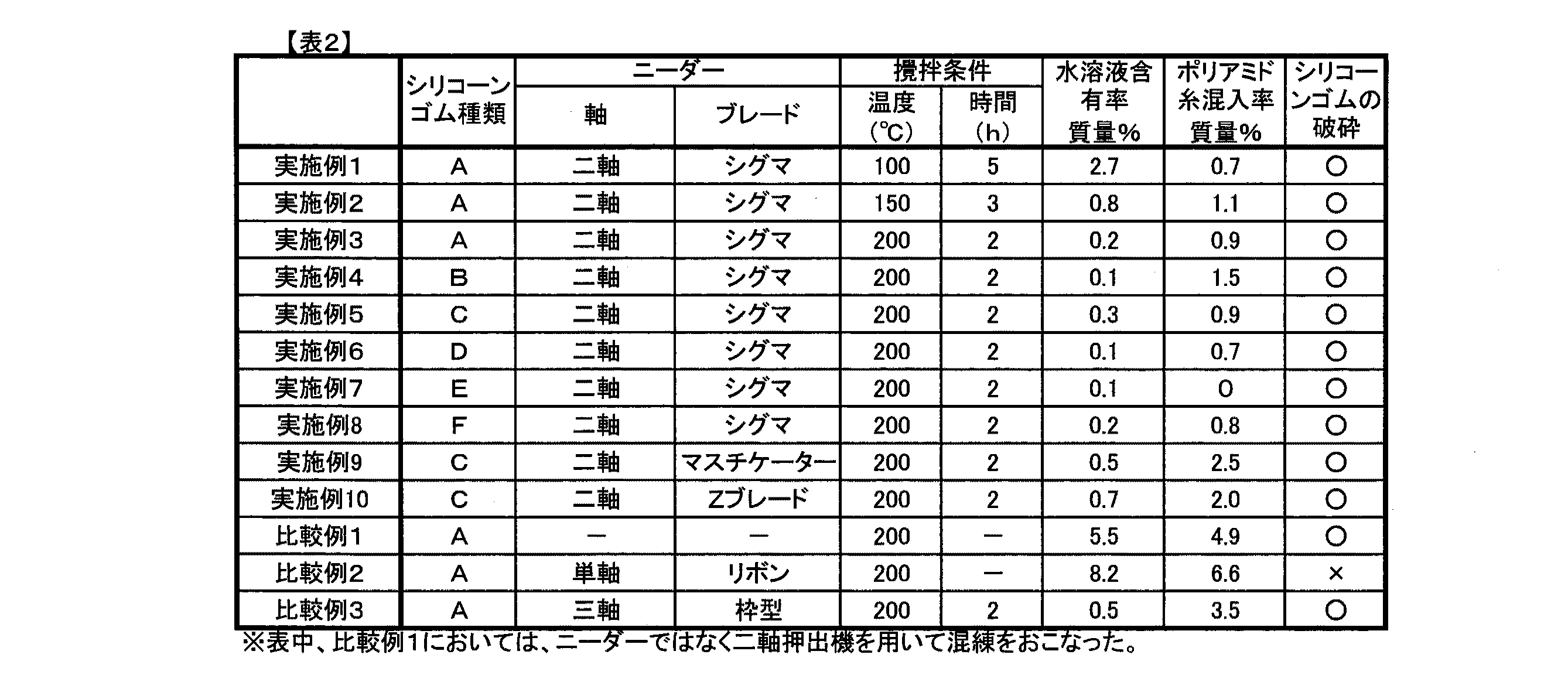
500gのシリコーンゴムAを、シグマブレードが設置された二軸ニーダー(井上製作所社製、「KHD−10」)に投入し、トロフ温度(捏和槽の温度)100℃、回転数50rpm、−0.08MPaGの減圧状態で、5時間攪拌を行った。混練終了後、シリコーンゴムは粉状の粉砕物になっており、トロフ内ではポリアミド糸がスクリュに巻き付いていた。評価結果を表2に示す。
Example 1
500 g of silicone rubber A was put into a biaxial kneader (“KHD-10” manufactured by Inoue Seisakusho Co., Ltd.) on which a sigma blade was installed, and the trough temperature (temperature of the kneading tank) was 100 ° C., the rotation speed was 50 rpm, −0 Stirring was performed for 5 hours in a reduced pressure state of 0.08 MPaG. After completion of the kneading, the silicone rubber was a powdery pulverized product, and the polyamide yarn was wound around the screw in the trough. The evaluation results are shown in Table 2.
実施例2〜5
表2に示すように、シリコーンゴムの種類、攪拌温度、攪拌時間を変更した以外は、実施例1と同様にして、シリコーンゴム粉砕物を得た。そして、水溶液含有量およびポリアミド糸混入量を求めた。評価結果を表2に示す。
Examples 2-5
As shown in Table 2, a crushed silicone rubber was obtained in the same manner as in Example 1 except that the type of silicone rubber, the stirring temperature, and the stirring time were changed. And aqueous solution content and the amount of polyamide yarn mixing were calculated | required. The evaluation results are shown in Table 2.
実施例6
シリコーンゴムDを用いた以外は、実施例3と同様にしてシリコーンゴム粉砕物を得、水溶液含有量およびポリアミド糸混入量を求めた。評価結果を表2に示す。
Example 6
Except that the silicone rubber D was used, a crushed silicone rubber was obtained in the same manner as in Example 3, and the aqueous solution content and the amount of polyamide yarn mixed in were determined. The evaluation results are shown in Table 2.
実施例7
シリコーンゴムEを用いた以外は、実施例3と同様にしてシリコーンゴム粉砕物を得、水溶液含有量およびポリアミド糸混入量を求めた。評価結果を表2に示す。
Example 7
A silicone rubber pulverized product was obtained in the same manner as in Example 3 except that the silicone rubber E was used, and the aqueous solution content and the polyamide yarn mixing amount were determined. The evaluation results are shown in Table 2.
実施例8
シリコーンゴムFを用いた以外は、実施例3と同様にしてシリコーンゴム粉砕物を得、水溶液含有量およびポリアミド糸混入量を求めた。評価結果を表2に示す。
Example 8
Except for using the silicone rubber F, a crushed silicone rubber was obtained in the same manner as in Example 3, and the aqueous solution content and the amount of polyamide yarn mixed in were determined. The evaluation results are shown in Table 2.
実施例9
シグマブレードの代わりにマスチケーターブレードが設置された二軸ニーダーを用いた以外は、実施例3と同様にしてシリコーンゴム粉砕物を得、水溶液含有量およびポリアミド糸混入量を求めた。評価結果を表2に示す。
Example 9
A crushed silicone rubber was obtained in the same manner as in Example 3 except that a biaxial kneader in which a masticator blade was installed in place of the sigma blade, and the aqueous solution content and the polyamide yarn mixing amount were determined. The evaluation results are shown in Table 2.
実施例10
シグマブレードの代わりにZブレードが設置された二軸ニーダーを用いた以外は、実施例3と同様にしてシリコーンゴム粉砕物を得、水溶液含有量およびポリアミド糸混入量を求めた。評価結果を表2に示す。
Example 10
A silicone rubber pulverized product was obtained in the same manner as in Example 3 except that a biaxial kneader provided with a Z blade instead of a sigma blade was used, and the aqueous solution content and the amount of polyamide yarn mixed therein were determined. The evaluation results are shown in Table 2.
比較例1
200gのシリコーンゴムAを、二軸押出機(池貝社製、「PCM30」)に投入し、バレル温度200℃、回転数100rpmで混練を行い、先端のダイスからシリコーンゴム押出物を得た。得られたシリコーンゴム押出物について、上記のシリコーンゴム粉砕物と同様にして、水溶液含有量およびポリアミド糸混入量を求めた。評価結果を表2に示す。
Comparative Example 1
200 g of silicone rubber A was put into a twin-screw extruder (“PCM30” manufactured by Ikegai Co., Ltd.) and kneaded at a barrel temperature of 200 ° C. and a rotation speed of 100 rpm to obtain a silicone rubber extrudate from the die at the tip. About the obtained silicone rubber extrudate, the aqueous solution content and the amount of polyamide yarn mixed were determined in the same manner as the above-mentioned pulverized silicone rubber. The evaluation results are shown in Table 2.
比較例2
200gのシリコーンゴムAを、単軸ニーダー(ケミカルエンヂニヤリング社製、「一軸式リボンブレンダー」、ブレードの形状:リボン型)に投入し、比較例1と同様の条件でシリコーンゴム押出物を得た。得られたシリコーンゴム押出物について、上記のシリコーンゴム粉砕物と同様にして、水溶液含有量およびポリアミド糸混入量を求めた。評価結果を表2に示す。
Comparative Example 2
200 g of silicone rubber A was put into a uniaxial kneader (manufactured by Chemical Engineering Co., Ltd., “uniaxial ribbon blender”, blade shape: ribbon type), and a silicone rubber extrudate was obtained under the same conditions as in Comparative Example 1. About the obtained silicone rubber extrudate, the aqueous solution content and the amount of polyamide yarn mixed were determined in the same manner as the above-mentioned pulverized silicone rubber. The evaluation results are shown in Table 2.
比較例3
200gのシリコーンゴムAを、三軸ニーダー(井上製作所社製、「TX−15」、ブレードの形状:枠型)に投入し、比較例1と同様の条件でシリコーンゴム押出物を得た。得られたシリコーンゴム押出物について、上記のシリコーンゴム粉砕物と同様にして、水溶液含有量およびポリアミド糸混入量を求めた。評価結果を表2に示す。
Comparative Example 3
200 g of silicone rubber A was charged into a triaxial kneader (“TX-15” manufactured by Inoue Seisakusho Co., Ltd., blade shape: frame type), and a silicone rubber extrudate was obtained under the same conditions as in Comparative Example 1. About the obtained silicone rubber extrudate, the aqueous solution content and the amount of polyamide yarn mixed were determined in the same manner as the above-mentioned pulverized silicone rubber. The evaluation results are shown in Table 2.
表2から明らかなように、実施例1〜6および8では、水溶液とポリアミド糸を含んだシリコーンゴムを、減圧下で加熱しながら、二軸ニーダーで攪拌したため、水溶液とポリアミド糸を同時に高効率で除去することができ、加えて、良好に粉砕されていた。 As apparent from Table 2, in Examples 1 to 6 and 8, the silicone rubber containing the aqueous solution and the polyamide yarn was stirred with a biaxial kneader while heating under reduced pressure, so that the aqueous solution and the polyamide yarn were simultaneously highly efficient. In addition, it was pulverized well.
実施例7では水溶液のみを含んだシリコーンゴムから水溶液を高効率で除去することができ、加えて良好に粉砕されていた。 In Example 7, the aqueous solution could be removed with high efficiency from the silicone rubber containing only the aqueous solution, and in addition, it was pulverized well.
実施例9および10では、シグマブレードではないブレードが設置された二軸ニーダーを用いたため、ポリアミド糸の除去性に改善の余地を残すものとなったが、十分に実用に耐えうるものであった。 In Examples 9 and 10, since a biaxial kneader in which a blade that is not a sigma blade was installed was used, there was room for improvement in the removability of the polyamide yarn, but it was sufficiently practical. .
比較例1では二軸ニーダーではなく二軸押出機を用いて混練したため、水溶液が十分に除去されておらず、ポリアミド糸はほとんど残った状態であった。また、攪拌されなかったため、粉砕されていなかった。 In Comparative Example 1, since the kneading was performed using a twin screw extruder instead of the twin screw kneader, the aqueous solution was not sufficiently removed, and the polyamide yarn was almost left. Moreover, since it was not stirred, it was not pulverized.
比較例2では二軸ニーダーではなく単軸ニーダーを用いたため、水溶液混入率やポリアミド糸混入率が高く、さらにシリコーンゴムの粉砕も十分ではなかった。 In Comparative Example 2, a uniaxial kneader was used instead of a biaxial kneader, so that the aqueous solution mixing rate and polyamide yarn mixing rate were high, and the silicone rubber was not sufficiently pulverized.
比較例3では二軸ニーダーではなく三軸ニーダーを用いたため、ポリアミド糸混入率が高く、十分にポリアミド糸を除去できないという結果であった。 In Comparative Example 3, since a triaxial kneader was used instead of a biaxial kneader, the polyamide yarn mixing rate was high, and the polyamide yarn could not be removed sufficiently.
Claims (6)
Priority Applications (1)
| Application Number | Priority Date | Filing Date | Title |
|---|---|---|---|
| JP2012031195A JP2013166312A (en) | 2012-02-16 | 2012-02-16 | Method for manufacturing ground product of silicone rubber |
Applications Claiming Priority (1)
| Application Number | Priority Date | Filing Date | Title |
|---|---|---|---|
| JP2012031195A JP2013166312A (en) | 2012-02-16 | 2012-02-16 | Method for manufacturing ground product of silicone rubber |
Publications (1)
| Publication Number | Publication Date |
|---|---|
| JP2013166312A true JP2013166312A (en) | 2013-08-29 |
Family
ID=49177146
Family Applications (1)
| Application Number | Title | Priority Date | Filing Date |
|---|---|---|---|
| JP2012031195A Pending JP2013166312A (en) | 2012-02-16 | 2012-02-16 | Method for manufacturing ground product of silicone rubber |
Country Status (1)
| Country | Link |
|---|---|
| JP (1) | JP2013166312A (en) |
Cited By (4)
| Publication number | Priority date | Publication date | Assignee | Title |
|---|---|---|---|---|
| JP7024038B1 (en) | 2020-10-30 | 2022-02-22 | 豊田通商株式会社 | How to remove silicone and how to make recycled polyamide products |
| JP7024037B1 (en) | 2020-10-30 | 2022-02-22 | 豊田通商株式会社 | Polyamide fiber recovery method, recycled polyamide product manufacturing method, and silicone solution |
| JP7118485B1 (en) | 2022-02-28 | 2022-08-16 | リファインバース株式会社 | Airbag treatment system and airbag treatment method |
| CN119978539A (en) * | 2025-02-06 | 2025-05-13 | 南通景康橡塑有限公司 | A kind of waste silicone rubber reduction and preparation method thereof |
-
2012
- 2012-02-16 JP JP2012031195A patent/JP2013166312A/en active Pending
Cited By (9)
| Publication number | Priority date | Publication date | Assignee | Title |
|---|---|---|---|---|
| JP7024038B1 (en) | 2020-10-30 | 2022-02-22 | 豊田通商株式会社 | How to remove silicone and how to make recycled polyamide products |
| JP7024037B1 (en) | 2020-10-30 | 2022-02-22 | 豊田通商株式会社 | Polyamide fiber recovery method, recycled polyamide product manufacturing method, and silicone solution |
| WO2022092196A1 (en) * | 2020-10-30 | 2022-05-05 | 豊田通商株式会社 | Method for removing silicone and method for producing recycled polyamide products |
| JP2022073182A (en) * | 2020-10-30 | 2022-05-17 | 豊田通商株式会社 | Method for removing silicone and method for producing recycled polyamide product |
| JP2022073181A (en) * | 2020-10-30 | 2022-05-17 | 豊田通商株式会社 | Method for collecting polyamide fiber, method for manufacturing recycled polyamide product, and dissolution solution of silicone |
| JP7118485B1 (en) | 2022-02-28 | 2022-08-16 | リファインバース株式会社 | Airbag treatment system and airbag treatment method |
| WO2023162287A1 (en) * | 2022-02-28 | 2023-08-31 | リファインバース株式会社 | Air bag treatment system and air bag treatment method |
| JP2023125970A (en) * | 2022-02-28 | 2023-09-07 | リファインバース株式会社 | Airbag processing system and airbag processing method |
| CN119978539A (en) * | 2025-02-06 | 2025-05-13 | 南通景康橡塑有限公司 | A kind of waste silicone rubber reduction and preparation method thereof |
Similar Documents
| Publication | Publication Date | Title |
|---|---|---|
| JP4959849B2 (en) | Polyamide resin composition, method for producing the polyamide resin composition, and molded article obtained by molding the polyamide resin composition | |
| CN110719897A (en) | Glass composition for glass fiber, glass fiber, and glass fiber-reinforced resin composition using the same | |
| JP2013166312A (en) | Method for manufacturing ground product of silicone rubber | |
| JP4841660B2 (en) | Cleaning liquid for polyamide resin molded body and cleaning method using the same | |
| CN103080232B (en) | Recycling polyamide airbags | |
| TW202120612A (en) | Liquid crystal polyester resin pellet, and production method therefor, and production method for molded article | |
| JPWO2020022153A1 (en) | Flame-retardant resin composition and its manufacturing method | |
| KR20220005096A (en) | Glass composition for glass fiber, glass fiber, glass fiber fabric and glass fiber reinforced resin composition | |
| CN1230467C (en) | Polyamide resin composition and formed product thereof | |
| TW202419572A (en) | Low silicon containing polyamide composition and method for producing the same, and fiber, woven fabric, and airbag | |
| CN104761886B (en) | Amilan polyamide resin composition and formed products | |
| EP3754054B1 (en) | Preparation method of carbon fiber and carbon fiber reinforced resin composition | |
| JP6424649B2 (en) | Gas barrier molded body | |
| CN114773731A (en) | Antistatic polypropylene plastic and preparation method thereof | |
| CN117561227A (en) | Method for producing long glass fiber filler | |
| WO2023140043A1 (en) | Polyamide resin composition, molded article obtained by molding same, and methods for producing those | |
| CN111225942B (en) | Improved polyamide stabilizers | |
| CN118556107B (en) | Polyamide resin composition, molded article obtained by molding the same, and method for producing the same | |
| CN112341812B (en) | Self-assembled network polyamide composition and preparation method and application thereof | |
| CN109233270A (en) | Utilize the halogen-free flame-retardant nylon 6 material and preparation method thereof of 6 waste silk of polyamide fibre production | |
| TW202124510A (en) | Liquid crystal polyester resin pellet, and liquid crystal polyester resin molded article and method for manufacturing liquid crystal polyester resin molded article | |
| JP4581634B2 (en) | Recycling method of polyamide resin | |
| CN115551951A (en) | Thermally conductive resin composition and molded article composed of it | |
| JP3083479B2 (en) | Polyarylene sulfide resin composition | |
| RU2806977C1 (en) | Silane-crosslinkable polymer composition based on recycled polyethylene and method for its production |