JP2012167166A - Method of manufacturing sulfonated organic pigment salt water nature dispersion - Google Patents
Method of manufacturing sulfonated organic pigment salt water nature dispersion Download PDFInfo
- Publication number
- JP2012167166A JP2012167166A JP2011028474A JP2011028474A JP2012167166A JP 2012167166 A JP2012167166 A JP 2012167166A JP 2011028474 A JP2011028474 A JP 2011028474A JP 2011028474 A JP2011028474 A JP 2011028474A JP 2012167166 A JP2012167166 A JP 2012167166A
- Authority
- JP
- Japan
- Prior art keywords
- organic pigment
- sulfonated
- treatment
- mass
- dispersion
- Prior art date
- Legal status (The legal status is an assumption and is not a legal conclusion. Google has not performed a legal analysis and makes no representation as to the accuracy of the status listed.)
- Withdrawn
Links
Landscapes
- Inks, Pencil-Leads, Or Crayons (AREA)
- Ink Jet (AREA)
Abstract
【解決課題】水性媒体中で優れた分散性および保存安定性を発揮するとともに、インクジェットインク等の水性インクに用いたときに優れた吐出性、画像濃度、色相および彩度を発揮するスルホン化有機顔料塩水性分散体を簡便に製造する方法を提供する。
【解決手段】有機顔料を、水性媒体の存在下に亜硫酸塩または亜硫酸水素塩と混合し、分散処理した後、スルホン化処理し、次いで精製処理、中和処理および脱塩精製処理を順次施すことを特徴とするスルホン化有機顔料塩水性分散体の製造方法である。
【選択図】なしA sulfonated organic that exhibits excellent dispersibility and storage stability in an aqueous medium, and exhibits excellent ejection properties, image density, hue, and saturation when used in aqueous inks such as inkjet inks. Provided is a method for easily producing an aqueous pigment salt dispersion.
An organic pigment is mixed with sulfite or bisulfite in the presence of an aqueous medium, dispersed, then sulfonated, and then subjected to purification treatment, neutralization treatment, and desalting purification treatment sequentially. Is a method for producing a sulfonated organic pigment salt aqueous dispersion.
[Selection figure] None
Description
本発明は、スルホン化有機顔料塩水性分散体の製造方法に関する。 The present invention relates to a method for producing a sulfonated organic pigment salt aqueous dispersion.
近年、水性インキはその安全性と環境負荷が少ないことから幅広い分野で有機溶剤系インキに取って代わり普及している。特にビジネス用途などではオフィスにおいて各種印刷に使用されるインクとして臭いのない水性色材が必要不可欠であり、産業用途でも作業環境、インキや塗料の取り扱いの安全性、廃液処理の問題から有機溶剤の使用をできる限り少なくする傾向が強まっている。また、水性着色材は、有機溶剤型着色材に比べ、製造時に防爆設備、排気設備、有機溶剤回収装置などの特別な装置が要らず製造コストが安価であることも普及の要因となっている。 In recent years, water-based inks have been widely used to replace organic solvent-based inks in a wide range of fields because of their safety and low environmental impact. Especially for business applications, water-free color materials that are odorless are essential as inks used for various printing in offices. For industrial applications, organic solvents can be used due to problems in the working environment, safety of ink and paint handling, and waste liquid treatment. There is an increasing tendency to use as little as possible. In addition, water-based colorants are also more popular than organic solvent-type colorants because they do not require special equipment such as explosion-proof equipment, exhaust equipment, and organic solvent recovery equipment during production. .
水性着色材としては主に染料と顔料の二つが用途に応じて使い分けられており、染料は階調性に優れ高解像度の画像形成がしやすい反面、耐光性が低く実用上問題がある。これに対して、顔料は、耐水性、耐光性が極めて優れていることから、現在では、顔料インクが数多く提供されるようになっている。 As the water-based coloring material, two dyes and pigments are mainly used depending on the application. The dye has excellent gradation and easily forms a high-resolution image, but has low light resistance and has a practical problem. On the other hand, since pigments are extremely excellent in water resistance and light resistance, many pigment inks are now provided.
印刷製版を経て印刷されるグラビアインキ、オフセット印刷用の水性リキッドインクも開発されているが、水性インクを用いるオフィス向けの記録方法として最も普及し始めているものはインクジェット記録方法である。 Gravure inks that are printed via printing plate making and water-based liquid inks for offset printing have been developed, but the most popular recording method for offices that uses water-based inks is the ink jet recording method.
インクジェット記録方法は、微細なノズルヘッドからインク液滴を吐出して、文字や画像を紙などの記録媒体の表面に記録する方法であり、非接触で記録することにより、普通紙をはじめ多種多様な記録媒体にフルカラーで印刷版をおこすことなくオンデマンドで容易に印刷可能であることから広く普及し始めている。 The ink jet recording method is a method in which ink droplets are ejected from a fine nozzle head and characters and images are recorded on the surface of a recording medium such as paper. Since it can be easily printed on demand without making a full color printing plate on a simple recording medium, it has begun to spread widely.
インクジェット記録方法を採用したインクジェットプリンターは、微細なノズルヘッドからインク液滴を吐出して、文字や画像を紙などの記録媒体の表面に記録する方法であり、代表的な記録方式としてバブルジェット(登録商標)方式とピエゾ方式とがある。前者はノズルヘッドまで導いたインクをヒーターで瞬間的に加熱して泡を発生させ、その泡による体積膨張でインク液を断続的に吐出する記録方式であり、後者は電歪素子(圧電素子)を用いて電気信号を機械信号に変換し、ノズルヘッド部分に貯えたインク液滴を断続的に吐出する記録方式である。 An ink jet printer that employs an ink jet recording method is a method in which ink droplets are ejected from a fine nozzle head and characters and images are recorded on the surface of a recording medium such as paper. (Registered trademark) method and piezo method. The former is a recording method that instantaneously heats the ink guided to the nozzle head with a heater to generate bubbles, and the ink expansion is intermittently ejected by volume expansion due to the bubbles, the latter is an electrostrictive element (piezoelectric element) Is a recording method in which an electrical signal is converted into a mechanical signal using ink and ink droplets stored in a nozzle head portion are ejected intermittently.
一方、顔料は染料に比べ分散性に劣ることから、インクジェットプリンターの普及に伴い、水性媒体に対してより優れた分散性を発揮する顔料インクが求められるようになっている。 On the other hand, since pigments are inferior in dispersibility as compared with dyes, pigment inks that exhibit better dispersibility in aqueous media have been demanded with the spread of ink jet printers.
しかしながら、顔料のうち例えば有機顔料は、顔料同士が凝集して粒径の大きな凝集体を形成する傾向があることから、有機顔料粒子の粒径をインクジェットインク等の水性インクに好適に使用し得る範囲に長期に亘って制御することは困難である。 However, among organic pigments, for example, organic pigments tend to aggregate together to form aggregates having a large particle size, and thus the particle size of organic pigment particles can be suitably used for aqueous inks such as inkjet inks. It is difficult to control the range over a long period of time.
そこで、特許文献1(特開平10−110129号公報)には、有機顔料に対し、スルホン化剤であるスルファミン酸またはスルホン化ピリジン塩を加熱処理下に反応させて、有機顔料表面に親水性基であるスルホン酸基を導入する方法が開示されているが、この方法は、活性を上げるために高温で処理する必要があるものであるため、有機顔料の色相や彩度を著しく低下させてしまうものであった。 Therefore, in Patent Document 1 (Japanese Patent Laid-Open No. 10-110129), a sulfamic acid or a sulfonated pyridine salt, which is a sulfonating agent, is reacted with an organic pigment under heat treatment, so that a hydrophilic group is formed on the surface of the organic pigment. Although a method for introducing a sulfonic acid group is disclosed, since this method requires treatment at a high temperature in order to increase the activity, the hue and saturation of the organic pigment are significantly reduced. It was a thing.
従って、本発明は、水性媒体中で優れた分散性および保存安定性を発揮するとともに、インクジェットインク等の水性インクに用いたときに優れた吐出性、画像濃度、色相および彩度を発揮するスルホン化有機顔料塩水性分散体を簡便に製造する方法を提供することを目的とするものである。 Accordingly, the present invention provides a sulfone that exhibits excellent dispersibility and storage stability in an aqueous medium, as well as excellent dischargeability, image density, hue, and saturation when used in an aqueous ink such as an inkjet ink. An object of the present invention is to provide a method for easily producing a fluorinated organic pigment salt aqueous dispersion.
上記技術課題を解決するため、本発明者等は、極性溶媒であるジメチルアセトアミドの存在下に有機顔料を亜硫酸塩または亜硫酸水素塩で処理することにより、有機顔料を効果的にスルホン化することを着想した。すなわち、有機顔料にジメチルアセトアミドを接触させることにより、有機顔料を凝集状態から微小な粒子状態に解す効果が期待され、この有機顔料の解れ状態を維持しつつ有機顔料表面の濡れ性を向上させて効率的にスルホン化処理できることが期待された。
しかしながら、本発明者等の検討によれば、ジメチルアセトアミドは亜硫酸塩または亜硫酸水素塩の溶解能が低く分散媒として使用し難いことが判明した。
そこで本発明者等がさらに検討したところ、水性溶媒の存在下に有機顔料を亜硫酸塩または亜硫酸水素塩でスルホン化処理すれば、ジメチルアセトアミドを用いなくても有機顔料を凝集状態から微小な粒子状態に解す効果を発揮し、この有機顔料の解れ状態を維持しつつ有機顔料表面の濡れ性を向上させて有機顔料を効果的にスルホン化し得るとともに、さらに精製処理、中和処理および脱塩精製処理を順次施すことにより、水性媒体中で優れた分散性および保存安定性を発揮するとともに、インクジェットインク等の水性インクに用いたときに優れた吐出性、画像濃度、色相および彩度を発揮するスルホン化有機顔料塩水性分散体を容易に作製し得ることを見出し、本知見に基づいて本発明を完成するに至った。
In order to solve the above technical problem, the present inventors have effectively sulfonated an organic pigment by treating the organic pigment with sulfite or bisulfite in the presence of dimethylacetamide, which is a polar solvent. Inspired. In other words, by bringing dimethylacetamide into contact with an organic pigment, an effect of unraveling the organic pigment from an aggregated state to a fine particle state is expected, and the wettability of the organic pigment surface is improved while maintaining the undissolved state of the organic pigment. It was expected that sulfonation could be performed efficiently.
However, according to studies by the present inventors, it has been found that dimethylacetamide has a low solubility of sulfite or bisulfite and is difficult to use as a dispersion medium.
Therefore, the present inventors have further investigated that if the organic pigment is sulfonated with sulfite or bisulfite in the presence of an aqueous solvent, the organic pigment is changed from an aggregated state to a fine particle state without using dimethylacetamide. The organic pigment can be effectively sulfonated by improving the wettability of the organic pigment surface while maintaining the dissolution state of this organic pigment, and further refinement treatment, neutralization treatment and desalting purification treatment In addition to exhibiting excellent dispersibility and storage stability in aqueous media, the sulfone exhibits excellent ejection properties, image density, hue, and saturation when used in aqueous inks such as inkjet inks. The present inventors have found that a water-based organic pigment salt aqueous dispersion can be easily produced, and have completed the present invention based on this finding.
すなわち、本発明は、
(1)有機顔料を、水性媒体の存在下に亜硫酸塩または亜硫酸水素塩と混合し、分散処理した後、スルホン化処理し、次いで精製処理、中和処理および脱塩精製処理を順次施すことを特徴とするスルホン化有機顔料塩水性分散体の製造方法、
(2)前記有機顔料として、予め水性媒体で湿潤化されたものを用いる上記(1)に記載のスルホン化有機顔料塩水性分散体の製造方法、
(3)前記有機顔料、水性媒体、亜硫酸塩または亜硫酸水素塩の混合が、水性媒体の質量/亜硫酸塩または亜硫酸水素塩の質量で表わされる比が1〜100、亜硫酸塩または亜硫酸水素塩の質量/有機顔料の質量で表わされる比が0.1〜20になるように行われ、
前記スルホン化処理が、20〜100℃の温度条件下、2〜200時間保持することにより行われる請求項1または請求項2に記載のスルホン化有機顔料塩水性分散体の製造方法、
(4)前記中和処理が、90〜100℃の温度条件下、塩基性化合物によりpHが7〜9になるように行われる請求項1〜請求項3のいずれかに記載のスルホン化有機顔料塩水性分散体の製造方法、
を提供するものである。
That is, the present invention
(1) An organic pigment is mixed with sulfite or bisulfite in the presence of an aqueous medium, dispersed, and then sulfonated, and then subjected to purification treatment, neutralization treatment, and desalting purification treatment sequentially. A method for producing a sulfonated organic pigment salt aqueous dispersion,
(2) The method for producing a sulfonated organic pigment salt aqueous dispersion according to the above (1), wherein the organic pigment is previously wetted with an aqueous medium.
(3) Mixing of the organic pigment, aqueous medium, sulfite or bisulfite has a ratio expressed by mass of aqueous medium / mass of sulfite or bisulfite, 1 to 100, mass of sulfite or bisulfite / The ratio expressed by the mass of the organic pigment is 0.1-20,
The method for producing an aqueous dispersion of a sulfonated organic pigment salt according to claim 1 or 2, wherein the sulfonation treatment is performed by holding at a temperature of 20 to 100 ° C for 2 to 200 hours.
(4) The sulfonated organic pigment according to any one of claims 1 to 3, wherein the neutralization treatment is performed under a temperature condition of 90 to 100 ° C so that the pH is 7 to 9 with a basic compound. A method for producing an aqueous dispersion,
Is to provide.
本発明によれば、水性媒体の存在下、有機顔料を亜硫酸塩または亜硫酸水素塩で処理することにより、亜硫酸塩や亜硫酸水素塩の分散性を向上させつつ有機顔料を効果的にスルホン化処理し、該スルホン化処理後に、精製処理、中和処理および脱塩精製処理を順次施すことにより、水性媒体中で優れた分散性および保存安定性を発揮するとともに、インクジェットインク等の水性インクに用いたときに優れた吐出性、画像濃度、色相および彩度を発揮するスルホン化有機顔料塩水性分散体を簡便に製造することができる。 According to the present invention, by treating an organic pigment with sulfite or bisulfite in the presence of an aqueous medium, the organic pigment is effectively sulfonated while improving the dispersibility of sulfite or bisulfite. In addition, after the sulfonation treatment, a purification treatment, a neutralization treatment, and a desalting purification treatment are sequentially performed to exhibit excellent dispersibility and storage stability in an aqueous medium, and used for aqueous inks such as inkjet inks. Sometimes, a sulfonated organic pigment salt aqueous dispersion that exhibits excellent discharge properties, image density, hue, and saturation can be easily produced.
本発明のスルホン化有機顔料塩水性分散体の製造方法は、有機顔料を、水性媒体の存在下に亜硫酸塩または亜硫酸水素塩と混合し、分散処理した後、スルホン化処理し、次いで精製処理、中和処理および脱塩精製処理を順次施すことを特徴とするものである。 In the method for producing an aqueous dispersion of a sulfonated organic pigment salt of the present invention, an organic pigment is mixed with a sulfite or a bisulfite in the presence of an aqueous medium, subjected to a dispersion treatment, a sulfonation treatment, and then a purification treatment. A neutralization treatment and a desalting purification treatment are sequentially performed.
本発明のスルホン化有機顔料塩水性分散体の製造方法において、有機顔料としては、トルイジンレッド、トルイジンマルーン、ハンザエロー、ベンジジンエロー、ピラゾロンレッド等の不溶性アゾ顔料、リトールレッド、ヘリオボルドー、ピグメントスカーレット、パーマネントレッド2B等の溶性アゾ顔料、アリザリン、インダントロン、チオインジゴマルーン等の建染染料からの誘導体、フタロシアニンブルー、フタロシアニングリーン等のフタロシアニン系顔料、キナクリドンレッド、キナクリドンマゼンタ等のキナクリドン系顔料、ペリレンレッド、ペリレンスカーレット等のペリレン系顔料、イソインドリノンエロー、イソインドリノンオレンジ等のイソインドリノン系顔料、ピランスロンレッド、ピランスロンオレンジ等のピランスロン系、チオインジゴ系顔料、縮合アゾ系顔料、ベンズイミダゾロン系顔料、フラバンスロンエロー、アシルアミドエロー、キノフタロンエロー、ニッケルアゾエロー、銅アゾメチンエロー、ペリノンオレンジ、アンスロンオレンジ、ジアンスラキノニルレッド、ジオキサジンバイオレット等から選ばれる一種以上を例示することができる。 In the method for producing a sulfonated organic pigment salt aqueous dispersion of the present invention, the organic pigment includes insoluble azo pigments such as toluidine red, toluidine maroon, Hansa Yellow, Benzidine Yellow, and pyrazolone red, ritole red, heliobordeaux, pigment scarlet, Soluble azo pigments such as permanent red 2B, derivatives from vat dyes such as alizarin, indanthrone, thioindigo maroon, phthalocyanine pigments such as phthalocyanine blue and phthalocyanine green, quinacridone pigments such as quinacridone red and quinacridone magenta, and perylene red Perylene pigments such as perylene scarlet, isoindolinone yellow and isoindolinone pigments such as isoindolinone orange, pyranthrone red and pyranthrone orange Throne, thioindigo pigment, condensed azo pigment, benzimidazolone pigment, flavanthrone yellow, acylamide yellow, quinophthalone yellow, nickel azo yellow, copper azomethine yellow, perinone orange, anthrone orange, dianthraquinonyl red, One or more selected from dioxazine violet and the like can be exemplified.
本発明のスルホン化有機顔料塩水性分散体の製造方法において、有機顔料の平均粒子径は、0.1μm〜1000μmであることが適当である。
なお、本出願書類において、上記有機顔料の平均粒子径は、レーザー沈降方式粒度分布測定装置(島津製作所社製 SALD−2100)を用いて測定した、体積基準積算粒度分布における積算粒度で50%の粒子径(平均粒子径D50)を求めることにより算出することができる。
上記粒度分布測定装置により、懸濁液中でブラウン運動を行っている粒子にレーザ光を照射し、ドップラー効果により変調した散乱光の周波数の変調度合いからブラウン運動の激しさ、すなわち粒子径を測定することができる。
In the method for producing a sulfonated organic pigment salt aqueous dispersion of the present invention, the average particle size of the organic pigment is suitably 0.1 μm to 1000 μm.
In the present application documents, the average particle size of the organic pigment is 50% in terms of the cumulative particle size in the volume-based cumulative particle size distribution measured using a laser sedimentation particle size distribution analyzer (SALD-2100 manufactured by Shimadzu Corporation). It can calculate by calculating | requiring a particle diameter (average particle diameter D50).
The particle size distribution measuring device irradiates the particles that perform Brownian motion in the suspension with laser light, and measures the intensity of Brownian motion, that is, the particle size, from the degree of frequency modulation of the scattered light modulated by the Doppler effect. can do.
従来より、有機顔料は、スルホン化処理時に変性され易く、色相や彩度が変化し易いことから、水性インクに適したものを作製し難いという技術課題が存在していたが、本発明のスルホン化有機顔料塩水性分散体の製造方法においては、有機顔料を特定の方法で処理するものであることから、水性媒体中で優れた分散性および保存安定性を発揮するとともに、インクジェットインク等の水性インクに用いたときに、優れた画像濃度、色相および彩度を発揮するスルホン化有機顔料塩水性分散体を得ることができる。 Conventionally, since organic pigments are easily modified during sulfonation treatment, and the hue and saturation are likely to change, there has been a technical problem that it is difficult to produce those suitable for water-based inks. In the method for producing a fluorinated organic pigment salt aqueous dispersion, the organic pigment is treated by a specific method, so that it exhibits excellent dispersibility and storage stability in an aqueous medium and is water-based such as inkjet ink. When used in inks, a sulfonated organic pigment salt aqueous dispersion that exhibits excellent image density, hue and saturation can be obtained.
本発明のスルホン化有機顔料塩水性分散体の製造方法において、有機顔料としては、予め水性媒体で湿潤化されたものが好ましい。
予め水性媒体で湿潤化された有機顔料を用いることにより、有機顔料を凝集状態から微小な粒子状態に解し易くなり、有機顔料表面の濡れ性を効果的に向上させることができる。
In the method for producing a sulfonated organic pigment salt aqueous dispersion of the present invention, the organic pigment is preferably wetted beforehand with an aqueous medium.
By using an organic pigment previously wetted with an aqueous medium, the organic pigment can be easily broken from an aggregated state to a fine particle state, and the wettability of the organic pigment surface can be effectively improved.
有機顔料として、予め水性媒体で湿潤化されたものを用いる場合、湿潤化された有機顔料における水性媒体の量が、50質量%以上になるように湿潤させることが適当であり、60質量%以上になるように湿潤させることがより適当であり、70質量%以上になるように湿潤させることがさらに適当である。
湿潤化した有機顔料における水性媒体の量が50質量%未満であると、水性媒体に対する十分な濡れ性を示し難くなる。
水性媒体としては後述するものと同様のものを挙げることができる。
When using an organic pigment that has been previously wetted with an aqueous medium, it is appropriate to wet the aqueous pigment so that the amount of the aqueous medium in the wetted organic pigment is 50% by mass or more. It is more appropriate to wet the film so that the amount becomes 70% by mass or more.
When the amount of the aqueous medium in the wetted organic pigment is less than 50% by mass, it becomes difficult to exhibit sufficient wettability with respect to the aqueous medium.
Examples of the aqueous medium include those similar to those described later.
予め水性媒体で湿潤化された状態にある有機顔料としては、湿式法で作製され、乾燥処理が施されていない有機顔料(ウェットケーキ状態の有機顔料)が好ましい。
通常、有機顔料は湿式法で製造され、最終的に乾燥処理が施されるが、湿潤状態にある有機顔料を乾燥処理すると、その後水性媒体と再度接触させても水性媒体による湿潤性が極めて低下し、所望の濡れ性を得難くなる。一方、予め水性媒体で湿潤化された状態にある有機顔料として、湿式法で作製され、乾燥処理が施されていない有機顔料(ウェットケーキ状態の有機顔料)を用いた場合には、水性媒体による湿潤性が向上し、水性媒体や、亜硫酸塩または亜硫酸水素塩との濡れ性を効果的に向上させることができる。
As the organic pigment that has been previously wetted with an aqueous medium, an organic pigment that has been prepared by a wet method and has not been subjected to a drying treatment (an organic pigment in a wet cake state) is preferable.
Usually, organic pigments are manufactured by a wet method, and finally are subjected to a drying process. However, when an organic pigment in a wet state is subjected to a drying process, the wettability by the aqueous medium is greatly reduced even if the organic pigment is brought into contact with the aqueous medium again thereafter. In addition, it becomes difficult to obtain desired wettability. On the other hand, when an organic pigment that has been prepared by a wet method and has not been subjected to a drying process (an organic pigment in a wet cake state) is used as an organic pigment that has been previously wetted with an aqueous medium, The wettability is improved, and the wettability with an aqueous medium, sulfite or bisulfite can be effectively improved.
本発明のスルホン化有機顔料塩水性分散体の製造方法においては、水性媒体の存在下に有機顔料と亜硫酸塩または亜硫酸水素塩とを混合する。
水性媒体としては、水や、水を主成分としさらに水溶性有機溶剤を含むものを挙げることができ、水のみからなるものが好ましい。
In the method for producing an aqueous sulfonated organic pigment salt dispersion of the present invention, an organic pigment and sulfite or bisulfite are mixed in the presence of an aqueous medium.
Examples of the aqueous medium include water and those containing water as a main component and further containing a water-soluble organic solvent, and those consisting only of water are preferable.
水性媒体を構成する水としては、イオン交換水(脱イオン水)や蒸留水等の精製水が挙げられる。 Examples of water constituting the aqueous medium include purified water such as ion exchange water (deionized water) and distilled water.
本発明のスルホン化有機顔料塩水性分散体の製造方法によれば、ジメチルアセトアミド等の極性の高い溶媒を用いなくても、水性溶媒の存在下に有機顔料を亜硫酸塩または亜硫酸水素塩でスルホン化処理すれば、有機顔料を凝集状態から微小な粒子状態に解す効果を発揮し、この有機顔料の解れ状態を維持しつつ有機顔料表面の濡れ性を向上させて有機顔料を効果的にスルホン化することができる。 According to the method for producing an aqueous dispersion of a sulfonated organic pigment salt of the present invention, an organic pigment is sulfonated with sulfite or bisulfite in the presence of an aqueous solvent without using a highly polar solvent such as dimethylacetamide. If treated, it exhibits the effect of unraveling the organic pigment from the agglomerated state to the fine particle state, and while maintaining the unraveled state of the organic pigment, improves the wettability of the organic pigment surface and effectively sulfonates the organic pigment be able to.
本発明のスルホン化有機顔料塩水性分散体の製造方法において、亜硫酸塩としては、亜硫酸ナトリウム(Na2SO3)、亜硫酸カリウム(K2SO3)、亜硫酸アンモニウム((NH4)2SO3、亜硫酸鉄(FeSO3)等を挙げることができる。また、亜硫酸水素塩としては、亜硫酸水素化ナトリウム(NaHSO3)、亜硫酸水素化カリウム(KHSO3)、亜硫酸水素アンモニウム((NH4HSO3)等を挙げることができる。
亜硫酸塩または亜硫酸水素塩としては、市販品として流通している公知のものを使用することができる。
In the method for producing a sulfonated organic pigment salt aqueous dispersion of the present invention, sulfites include sodium sulfite (Na 2 SO 3 ), potassium sulfite (K 2 SO 3 ), ammonium sulfite ((NH 4 ) 2 SO 3 , Examples thereof include iron sulfite (FeSO 3 ), etc. Examples of the bisulfite include sodium bisulfite (NaHSO 3 ), potassium bisulfite (KHSO 3 ), and ammonium bisulfite ((NH 4 HSO 3 ). Can be mentioned.
As the sulfite or bisulfite, a known product that is distributed as a commercial product can be used.
本発明のスルホン化有機顔料塩水性分散体の製造方法においては、「水性媒体の質量/亜硫酸塩または亜硫酸水素塩の質量」で表わされる比が1〜100となるように混合することが好ましく、1.5〜50となるように混合することがより好ましく、2〜30となるように混合することがさらに好ましい。
本発明のスルホン化有機顔料塩水性分散体の製造方法において、上記「水性媒体の質量/亜硫酸塩または亜硫酸水素塩の質量」で表わされる比を上記範囲内に制御しつつ水性媒体と亜硫酸塩または亜硫酸水素塩とを混合することにより、有機顔料を凝集状態から微小な粒子状態に効果的に解しつつ、有機顔料表面の濡れ性を効果的に向上させて有機顔料を効率的にスルホン化することができる。
In the method for producing a sulfonated organic pigment salt aqueous dispersion of the present invention, mixing is preferably performed so that the ratio represented by “mass of aqueous medium / mass of sulfite or bisulfite” is 1 to 100, It is more preferable to mix so that it may become 1.5-50, and it is further more preferable to mix so that it may become 2-30.
In the method for producing an aqueous dispersion of a sulfonated organic pigment salt of the present invention, the aqueous medium and the sulfite or the sulfite or the ratio of the above-mentioned “mass of aqueous medium / mass of sulfite or bisulfite” is controlled within the above range. By mixing with bisulfite, the organic pigment is effectively sulfonated by effectively improving the wettability of the organic pigment surface while effectively solving the organic pigment from the aggregated state to the fine particle state. be able to.
なお、有機顔料として予め水性媒体で湿潤化された状態にあるものを使用する場合、有機顔料に添加する上記「水性媒体の質量」には、有機顔料を湿潤化させるために予め含有されている水性媒体の質量を含まないものとする。 In addition, when using an organic pigment that has been wetted with an aqueous medium in advance, the “mass of the aqueous medium” added to the organic pigment is previously contained in order to wet the organic pigment. It does not include the mass of the aqueous medium.
本発明のスルホン化有機顔料塩水性分散体の製造方法においては、「亜硫酸塩または亜硫酸水素塩の質量/有機顔料の質量」で表わされる比が0.1〜20となるように混合することが好ましく、0.5〜10となるように混合することがより好ましく、1〜5となるように混合することがさらに好ましい。
本発明のスルホン化有機顔料塩水性分散体の製造方法において、上記亜硫酸塩または亜硫酸水素塩の質量/有機顔料の質量で表わされる比を上記範囲内に制御しつつ亜硫酸塩または亜硫酸水素塩と有機顔料を混合することにより、有機顔料表面の濡れ性を効果的に向上させつつ、有機顔料を容易にスルホン化することができる。
なお、有機顔料として予め水性媒体で湿潤化されたものを使用する場合、「有機顔料の質量」とは、有機顔料を湿潤化させるために予め含有させた水性媒体の質量を除く、乾燥状態の質量を意味するものとする。
In the method for producing a sulfonated organic pigment salt aqueous dispersion of the present invention, mixing may be performed so that a ratio represented by “mass of sulfite or bisulfite / mass of organic pigment” is 0.1 to 20. It is more preferable to mix so that it may become 0.5-10, and it is further more preferable to mix so that it may become 1-5.
In the method for producing a sulfonated organic pigment salt aqueous dispersion of the present invention, the ratio of the sulfite or bisulfite mass / the mass of the organic pigment is controlled within the above range while controlling the sulfite or bisulfite and the organic dispersion. By mixing the pigment, the organic pigment can be easily sulfonated while effectively improving the wettability of the organic pigment surface.
In addition, when using what was previously wetted with an aqueous medium as an organic pigment, "mass of an organic pigment" is a dry state excluding the mass of the aqueous medium previously contained in order to wet an organic pigment. It shall mean mass.
本発明のスルホン化有機顔料塩水性分散体の製造方法において、有機顔料に対する、水性媒体、亜硫酸塩または亜硫酸水素塩の混合順序および方法は特に制限されず、例えば、有機顔料を、亜硫酸塩または亜硫酸水素塩の水性媒体溶液と混合する方法が挙げられる。 In the method for producing a sulfonated organic pigment salt aqueous dispersion of the present invention, the mixing order and method of the aqueous medium, sulfite or bisulfite with respect to the organic pigment are not particularly limited. For example, the organic pigment is converted into sulfite or sulfite. The method of mixing with the aqueous medium solution of hydrogen salt is mentioned.
有機顔料、水性媒体、亜硫酸塩または亜硫酸水素塩を混合して得られる混合液において、亜硫酸塩または亜硫酸水素塩の濃度は30〜50質量%であることが好ましく、35〜50質量%であることがより好ましく、40〜50質量%であることがさらに好ましい。 In a mixed solution obtained by mixing an organic pigment, an aqueous medium, sulfite or bisulfite, the concentration of sulfite or bisulfite is preferably 30 to 50% by mass, and preferably 35 to 50% by mass. Is more preferable, and it is still more preferable that it is 40-50 mass%.
本発明のスルホン化有機顔料塩水性分散体の製造方法において、混合液中の亜硫酸塩または亜硫酸水素塩の濃度が上記範囲内にあることにより、硫酸塩または亜硫酸水素塩を水性媒体に十分に溶解させつつ容易にスルホン化することができる。 In the method for producing an aqueous sulfonated organic pigment salt dispersion of the present invention, the concentration of sulfite or bisulfite in the mixed solution is within the above range, so that the sulfate or bisulfite is sufficiently dissolved in the aqueous medium. And can be easily sulfonated.
本発明のスルホン化有機顔料塩水性分散体の製造方法においては、有機顔料、水性媒体、亜硫酸塩または亜硫酸水素塩を混合した後、分散処理を行う。分散処理は、分散機により行うことが好ましい。 In the method for producing a sulfonated organic pigment salt aqueous dispersion of the present invention, an organic pigment, an aqueous medium, a sulfite or a bisulfite are mixed and then subjected to a dispersion treatment. The dispersion treatment is preferably performed by a disperser.
分散機としては、高圧ホモジナイザー、サンドミル、ダイノーミル、ボールミル、ペイントシェーカー、超音波分散機、高圧の室内にてキャビテーション効果で分散する分散機等を挙げることができる。また、通常の撹拌羽を用いた攪拌機や、高速の分散機、乳化機等によって分散処理を施してもよい。 Examples of the disperser include a high-pressure homogenizer, a sand mill, a dyno mill, a ball mill, a paint shaker, an ultrasonic disperser, and a disperser that disperses by a cavitation effect in a high-pressure chamber. Further, the dispersion treatment may be performed by a stirrer using a normal stirring blade, a high-speed disperser, an emulsifier, or the like.
本発明のスルホン化有機顔料塩水性分散体の製造方法において、分散処理を、撹拌羽を用いた攪拌機を用いて行う場合、攪拌速度100rpm以上で10〜30分間行うことが妥当である。攪拌速度が100rpm未満であると有機顔料に対して亜硫酸塩または亜硫酸水素塩を十分に接触することができなくなり、十分なスルホン化を行い難くなる。 In the method for producing an aqueous sulfonated organic pigment salt dispersion of the present invention, when the dispersion treatment is performed using a stirrer using a stirring blade, it is appropriate to perform the stirring at a stirring speed of 100 rpm or more for 10 to 30 minutes. When the stirring speed is less than 100 rpm, the organic pigment cannot be sufficiently brought into contact with the sulfite or bisulfite, and it becomes difficult to perform sufficient sulfonation.
分散処理を、高圧ホモジナイザーを用いて行う場合、100MPa〜200MPaの圧力で通過回数が1回〜5回となるように行うことが妥当である。
上記圧力が、100MPa未満であると粒子の粉砕が十分に行い難く、200MPaを超えると粒子径が小さくなり過ぎる傾向にある。また、通過回数が、5回を超えると粉砕し過ぎることになる。
When the dispersion treatment is performed using a high-pressure homogenizer, it is appropriate that the number of passes is 1 to 5 times at a pressure of 100 MPa to 200 MPa.
If the pressure is less than 100 MPa, it is difficult to sufficiently pulverize the particles, and if it exceeds 200 MPa, the particle diameter tends to be too small. Moreover, if the number of passes exceeds 5, it will be crushed too much.
分散処理を、サンドミル、ダイノーミルなどのメディアミルを用いて行う場合は、ビーズ径が30μm〜1mmであるビーズを用い、回転数1500rpm〜3500rpm程度の条件下で、10〜30分間処理することが好ましい。
上記ビーズ径が30μm未満であると、スルホン化処理された有機顔料の粒子径が小さくなり過ぎる傾向にあり、上記ビーズ径が1mmを超えると有機顔料粒子が小さくなりにくくなる。
また、上記回転数が1500rpm未満であるとビーズ粒子と有機顔料との接触インパクトが弱くなり粒子径が小さくなりにくく、上記回転数が3500μmを超えると逆にインパクトが大きくなりすぎて、粒子径が小さくなり過ぎる傾向にある。
When the dispersion treatment is performed using a media mill such as a sand mill or a dyno mill, it is preferable to use beads having a bead diameter of 30 μm to 1 mm under conditions of a rotational speed of about 1500 rpm to 3500 rpm for 10 to 30 minutes. .
When the bead diameter is less than 30 μm, the particle diameter of the sulfonated organic pigment tends to be too small, and when the bead diameter exceeds 1 mm, the organic pigment particle is difficult to be reduced.
Further, when the rotational speed is less than 1500 rpm, the contact impact between the bead particles and the organic pigment is weakened and the particle diameter is difficult to be reduced, and when the rotational speed exceeds 3500 μm, the impact is excessively increased and the particle diameter is It tends to be too small.
本発明のスルホン化有機顔料塩水性分散体の製造方法において、分散処理を、高圧ホモジナイザーや、サンドミル、ダイノーミル等のメディアミルにより行うことにより、粒子径が小さく所望粒子径を有する有機顔料を得易くなる。 In the method for producing a sulfonated organic pigment salt aqueous dispersion of the present invention, the dispersion treatment is performed by a media mill such as a high-pressure homogenizer, a sand mill, or a dyno mill, so that an organic pigment having a small particle diameter and a desired particle diameter can be easily obtained. Become.
本発明のスルホン化有機顔料塩水性分散体の製造方法において、分散処理は、有機顔料の平均粒子径が0.5〜5μmになるように行うことが好ましく、0.5〜2μmになるように行うことがより好ましく、0.5〜1μmになるように行うことがさらに好ましい。 In the method for producing a sulfonated organic pigment salt aqueous dispersion of the present invention, the dispersion treatment is preferably performed so that the average particle diameter of the organic pigment is 0.5 to 5 μm, and is preferably 0.5 to 2 μm. More preferably, it is more preferable to carry out so that it may become 0.5-1 micrometer.
なお、本出願書類において、上記スルホン化した有機顔料の平均粒子径は、ヘテロダインレーザドップラー方式粒度分布測定装置〔マイクロトラック社製、UPA model9340〕を用いて測定した、体積基準積算粒度分布における積算粒度で50%の粒子径(平均粒子径D50)を意味する。 In the present application documents, the average particle size of the sulfonated organic pigment was measured using a heterodyne laser Doppler type particle size distribution measuring apparatus (UPA model 9340, manufactured by Microtrac Co., Ltd.). Means a particle diameter of 50% (average particle diameter D50).
本発明のスルホン化有機顔料塩水性分散体の製造方法において、スルホン化処理は、20℃〜100℃の温度条件下で、2〜200時間保持することにより行うことが好ましい。
上記スルホン化処理温度は、50〜100℃がより好ましく、80〜100℃がさらに好ましい。
本発明のスルホン化有機顔料塩水性分散体の製造方法において、スルホン化処理温度が上記範囲内にあることにより、反応活性を高めつつ有機顔料を効率的にスルホン化することができる。
また、スルホン化処理時間は、2〜100時間がより好ましく、24〜100時間がさらに好ましい。
本発明のスルホン化有機顔料塩水性分散体の製造方法において、スルホン化処理時間が上記範囲内にあることにより、有機顔料を効率的にスルホン化することができる。
In the method for producing a sulfonated organic pigment salt aqueous dispersion of the present invention, the sulfonation treatment is preferably carried out by holding for 2 to 200 hours under a temperature condition of 20 ° C to 100 ° C.
The sulfonation treatment temperature is more preferably 50 to 100 ° C, and further preferably 80 to 100 ° C.
In the method for producing an aqueous sulfonated organic pigment salt dispersion of the present invention, the sulfonation treatment temperature is within the above range, whereby the organic pigment can be efficiently sulfonated while enhancing the reaction activity.
The sulfonation treatment time is more preferably 2 to 100 hours, and further preferably 24 to 100 hours.
In the method for producing an aqueous sulfonated organic pigment salt dispersion of the present invention, the organic pigment can be efficiently sulfonated when the sulfonation treatment time is within the above range.
本発明のスルホン化有機顔料塩水性分散体の製造方法においては、上記スルホン化処理を施した後、精製処理、中和処理および脱塩精製処理が順次施される。 In the method for producing a sulfonated organic pigment salt aqueous dispersion of the present invention, after the sulfonation treatment, purification treatment, neutralization treatment, and desalting purification treatment are sequentially carried out.
本発明のスルホン化有機顔料塩水性分散体の製造方法において、精製処理は、上記スルホン化処理を施した有機顔料の含有液を、大量水(20倍以上)に転送した後、限外濾過膜により、残存する溶媒や亜硫酸塩または亜硫酸水素塩などを排出することにより行うことが好ましい。
上記限外濾過膜としては、ポリスルホン系、ポリアクリロニトリル系、セラミック系の限外濾過膜を挙げることができ、分画分子量が10000以上であるものが好ましい。分画分子量が10000未満であると精製処理時間が超過気味になることから、効率的な精製を行い難くなる。
In the method for producing a sulfonated organic pigment salt aqueous dispersion of the present invention, the purification treatment is performed by transferring the sulfonated organic pigment-containing liquid to a large amount of water (20 times or more), and then performing ultrafiltration membrane. Is preferably carried out by discharging the remaining solvent, sulfite or bisulfite.
Examples of the ultrafiltration membrane include polysulfone, polyacrylonitrile, and ceramic ultrafiltration membranes, and those having a molecular weight cut-off of 10,000 or more are preferred. If the molecular weight cut-off is less than 10,000, the purification treatment time will be excessive, making it difficult to perform efficient purification.
本発明のスルホン化有機顔料塩水性分散体の製造方法において、中和処理は、上記精製処理を施すことにより得られたスルホン化有機顔料塩を含む分散体に対し、塩基性化合物を添加することにより行うことができる。
塩基性化合物としては、水酸化リチウム、水酸化ナトリウム、水酸化カリウム、水酸化セシウム等のアルカリ金属水酸化物や、アンモニア、水酸化第四級アンモニウム、水酸化テトラメチルアンモニウム、コリン、水酸化テトラエチルアンモニウム、水酸化テトラブチルアンモニウム等から選ばれる一種以上を挙げることができる。
In the method for producing a sulfonated organic pigment salt aqueous dispersion of the present invention, the neutralization treatment is performed by adding a basic compound to the dispersion containing the sulfonated organic pigment salt obtained by performing the purification treatment. Can be performed.
Basic compounds include alkali metal hydroxides such as lithium hydroxide, sodium hydroxide, potassium hydroxide, cesium hydroxide, ammonia, quaternary ammonium hydroxide, tetramethylammonium hydroxide, choline, tetraethyl hydroxide. One or more selected from ammonium, tetrabutylammonium hydroxide and the like can be mentioned.
上記塩基性化合物は、水溶液として供することが好ましく、該水溶液において、塩基性化合物の濃度は、例えば0.1〜1.0mol/リットルであることが好ましい。 The basic compound is preferably provided as an aqueous solution. In the aqueous solution, the concentration of the basic compound is preferably, for example, 0.1 to 1.0 mol / liter.
本発明のスルホン化有機顔料塩水性分散体の製造方法において、中和処理は、90〜100℃の温度条件下で行うことが好ましい。中和処理温度が90℃未満であると、有機顔料表面上に形成したスルホン酸基に対してカウンターイオンが定着し難くなる。 In the method for producing a sulfonated organic pigment salt aqueous dispersion of the present invention, the neutralization treatment is preferably performed under a temperature condition of 90 to 100 ° C. When the neutralization treatment temperature is less than 90 ° C., it becomes difficult for the counter ions to be fixed to the sulfonic acid group formed on the surface of the organic pigment.
本発明のスルホン化有機顔料塩水性分散体の製造方法において、中和処理は、中和処理物のpHが7〜9になるように行うことが好ましい。
中和処理物のpHが上記範囲内にあることにより、得られるスルホン化有機顔料塩水性分散体において、長期間に亘って顔料の自己分散性を発揮し易くなるとともに、インクジェットインクに用いたときに、インクジェットノズルの腐食を抑制し易くなる。
また、中和処理時間は3〜10時間であることが好ましい。
In the method for producing a sulfonated organic pigment salt aqueous dispersion of the present invention, the neutralization treatment is preferably performed so that the pH of the neutralized product becomes 7-9.
When the pH of the neutralized product is within the above range, the resulting sulfonated organic pigment salt aqueous dispersion can easily exhibit the self-dispersibility of the pigment over a long period of time, and when used in an inkjet ink. In addition, corrosion of the inkjet nozzle can be easily suppressed.
Further, the neutralization treatment time is preferably 3 to 10 hours.
本発明のスルホン化有機顔料塩水性分散体の製造方法において、脱塩精製処理は、上記中和処理物に対し、再度、限外濾過膜を用いて残塩を除去することで行うことができる。脱塩精製処理に用いる限外濾過膜は、スルホン化処理後の精製処理で用いたものと同様のものを挙げることができる。
脱塩精製処理は、脱塩精製処理物の電気伝導度が0.2mS/m(ミリ・ジーメンス/メートル)未満になるように行うことが好ましい。
In the method for producing an aqueous sulfonated organic pigment salt dispersion of the present invention, the desalting and purification treatment can be performed again on the neutralized product by removing residual salts using an ultrafiltration membrane. . Examples of the ultrafiltration membrane used for the desalting purification treatment include the same ones as used in the purification treatment after the sulfonation treatment.
The desalting purification treatment is preferably performed so that the electrical conductivity of the desalting purification treatment product is less than 0.2 mS / m (milli Siemens / meter).
本発明のスルホン化有機顔料塩水性分散体の製造方法においては、所望濃度になるまで上記限外濾過を繰り返して濃度調整してもよいし、上記脱塩処理により得られた脱塩処理物を水性媒体中に添加して濃度調整してもよい。また、濃度調整後にホモジナイザー等によりさらに短時間分散処理を施してもよい。脱塩精製処理した直後に脱塩精製処理物を行うことにより、乾燥工程を経ずに、容易に濃度調整することができる。
上記濃度調整は、調整後のスルホン化有機顔料塩の濃度が10〜40質量%になるように行うことが適当である。
In the method for producing a sulfonated organic pigment salt aqueous dispersion of the present invention, the concentration may be adjusted by repeating the ultrafiltration until a desired concentration is reached, or the desalted product obtained by the desalting treatment is prepared. The concentration may be adjusted by adding to an aqueous medium. Further, after the concentration adjustment, dispersion processing may be further performed for a short time using a homogenizer or the like. By performing the desalted and purified product immediately after the desalting and purifying treatment, the concentration can be easily adjusted without going through the drying step.
It is appropriate to adjust the concentration so that the concentration of the sulfonated organic pigment salt after adjustment is 10 to 40% by mass.
このようにして、スルホン化有機顔料塩水性分散体を製造することができる。
本発明のスルホン化有機顔料塩水性分散体の製造方法によれば、水性媒体中で優れた分散性および保存安定性を発揮するとともに、インクジェットインク等の水性インクに用いたときに優れた吐出性、画像濃度、色相および彩度を発揮するスルホン化有機顔料塩水性分散体を簡便に製造する方法を提供することができる。
In this way, a sulfonated organic pigment salt aqueous dispersion can be produced.
According to the method for producing a sulfonated organic pigment salt aqueous dispersion of the present invention, it exhibits excellent dispersibility and storage stability in an aqueous medium, and has excellent ejection properties when used in an aqueous ink such as an inkjet ink. It is possible to provide a method for easily producing a sulfonated organic pigment salt aqueous dispersion that exhibits image density, hue, and saturation.
次に、本発明の本発明の製造方法で得られたスルホン化有機顔料塩水性分散体を用いてインクジェットインク用スルホン化有機顔料塩水性分散体を調製する方法について説明する。
本発明の製造方法で得られたスルホン化有機顔料塩水性分散体を用いてインクジェットインク用スルホン化有機顔料塩水性分散体を調製する場合、本発明の製造方法によりスルホン化有機顔料塩水性分散体を作製した後、スルホン化有機顔料塩の平均粒子径が80〜300nm、最大粒子径が700nm以下となるようにさらに湿式分級処理を行うことを特徴とするものである。
Next, a method for preparing a sulfonated organic pigment salt aqueous dispersion for inkjet ink using the sulfonated organic pigment salt aqueous dispersion obtained by the production method of the present invention will be described.
When preparing the sulfonated organic pigment salt aqueous dispersion for inkjet ink using the sulfonated organic pigment salt aqueous dispersion obtained by the production method of the present invention, the sulfonated organic pigment salt aqueous dispersion by the production method of the present invention is used. Then, wet classification is further performed so that the average particle size of the sulfonated organic pigment salt is 80 to 300 nm and the maximum particle size is 700 nm or less.
湿式分級処理する処理対象としては、本発明に係るスルホン化有機顔料塩水性分散体の製造方法における、脱塩精製処理物または脱塩精製後に濃度調整した濃度調製物の何れであってもよい。 The treatment target to be subjected to the wet classification treatment may be either a desalted and refined treatment product or a concentration preparation whose concentration is adjusted after desalting and refining in the method for producing a sulfonated organic pigment salt aqueous dispersion according to the present invention.
湿式分級処理方法としては、濾過法や遠心分離法を挙げることができる。
濾過法により湿式分級処理する場合、孔径3μm以下のフィルター、好ましくは孔径1.0μm以下のフィルター、さらに好ましくは孔径0.45μm以下のフィルターにより十分に濾過することが好ましい。
また、フィルターによる濾過に先立って、遠心分離によって大きな粒子径のものを除いてもよく、これによってフィルターによる濾過の際に目詰まりを少なくし、効率的に濾過するとともにフィルター寿命を延ばすことができる。
Examples of the wet classification method include a filtration method and a centrifugal separation method.
When wet classification is performed by a filtration method, it is preferable to sufficiently filter with a filter having a pore size of 3 μm or less, preferably a filter with a pore size of 1.0 μm or less, more preferably a filter with a pore size of 0.45 μm or less.
Prior to filtration with a filter, those having a large particle size may be removed by centrifugation, thereby reducing clogging during filtration with a filter, allowing efficient filtration and extending the life of the filter. .
湿式分級処理は、スルホン化有機顔料塩の平均粒子径が80〜300nmになるように行い、90〜200nmになるように行うことが好ましく、100〜150nmになるように行うことがより好ましい。また、湿式分級処理は、スルホン化有機顔料塩の最大粒子径が700nm以下となるように行い、600nm以下になるように行うことが好ましい。 The wet classification treatment is performed so that the average particle diameter of the sulfonated organic pigment salt is 80 to 300 nm, preferably 90 to 200 nm, and more preferably 100 to 150 nm. Further, the wet classification treatment is performed so that the maximum particle diameter of the sulfonated organic pigment salt is 700 nm or less, and preferably 600 nm or less.
なお、本出願書類において、上記スルホン化有機顔料の平均粒子径および最大粒子径は、ヘテロダインレーザドップラー方式粒度分布測定装置〔マイクロトラック社製、UPA model9340〕を用いて測定した、体積基準積算粒度分布における積算粒度で50%の粒子径(平均粒子径D50)および積算粒度で99%の粒子径を意味する。 In the present application documents, the average particle size and the maximum particle size of the sulfonated organic pigment were measured using a heterodyne laser Doppler type particle size distribution measuring apparatus [UPA model 9340, manufactured by Microtrack Co., Ltd.]. Means an average particle size of 50% (average particle size D50) and an integrated particle size of 99%.
上記湿式分級処理を施すことにより、大粒を除去し、インクジェットインクに適したスルホン化有機顔料塩水性分散体を得ることができる。 By performing the wet classification treatment, large particles can be removed, and a sulfonated organic pigment salt aqueous dispersion suitable for inkjet ink can be obtained.
本発明の製造方法で得られたスルホン化有機顔料塩水性分散体を用いて製造されたインクジェットインク用スルホン化有機顔料塩水性分散体は、分散剤を添加しなくとも良好な分散性を示すことから、単に希釈等して印字に適した濃度に調整したり、必要に応じて添加剤を加えることにより、容易にインクジェットインクとすることができる。また、さらに分散剤等を添加し分散機で分散することにより、安定で定着性の強いインクジェットインクを得ることができる。 The sulfonated organic pigment salt aqueous dispersion for inkjet inks produced using the sulfonated organic pigment salt aqueous dispersion obtained by the production method of the present invention exhibits good dispersibility without adding a dispersant. Therefore, the ink jet ink can be easily made by simply diluting and adjusting to a density suitable for printing, or by adding an additive as necessary. Further, by adding a dispersing agent or the like and dispersing with a disperser, a stable and strong fixing ink jet ink can be obtained.
上記インクジェットインク用スルホン化有機顔料塩水性分散体からインクジェットインクを調製する場合、インクジェットインク用スルホン化有機顔料塩水性分散体に加える添加剤としては、湿潤剤、防腐剤、防黴剤、防錆剤、pH調整剤、浸透剤、定着剤、消泡剤等を挙げることができる。 When preparing an inkjet ink from the sulfonated organic pigment salt aqueous dispersion for inkjet ink, additives to be added to the sulfonated organic pigment salt aqueous dispersion for inkjet ink include wetting agents, preservatives, antifungal agents, and rust preventives. Agents, pH adjusters, penetrants, fixing agents, antifoaming agents and the like.
湿潤剤としては、各種水溶性有機溶剤を挙げることができ、具体的には、エチレングリコール、ジエチレングリコール、トリエチレングリコール、テトラエチレングリコール、ポリエチレングリコール、プロピレングリコール、1,3−ブタンジオール、1,3−プロパンジオール、2−メチル−1,3−プロパンジオール、1,4−ブタンジオール、1,5−ペンタンジオール、1,6−へキサンジオール、グリセリン、1,2,6−へキサントリオール、2−エチル−1,3−ヘキサンジオール、1,2,4−ブタントリオ−ル、1,2,3−ブタントリオール、ペトリオール等の多価アルコ−ル類、エチレングリコールモノエチルエ−テル、エチレングリコ−ルモノブチルエーテル、ジエチレングリコールモノメチルエーテル、ジエチレングリコールモノエチルエーテル、ジエチレングリコールモノブチルエーテル、トリエチレングリコールモノブチルエーテル、テトラエチレングリコールモノメチルエーテル、プロピレングリコールモノエチルエーテル等の多価アルコールアルキルエーテル類、エチレングリコールモノフェニルエーテル、エチレングリコールモノベンジルエーテル等の多価アルコールアリールエ−テル類、N−メチル−2−ピロリドン、N−ヒドロキシエチル−2−ピロリドン、2−ピロリドン、1,3−ジメチルイミダゾリジノン、ε−カプロラクタム等の含窒素複素環化合物、ホルムアミド、N−メチルホルムアミド、N,N−ジメチルホルムアミド等のアミド類、モノエタノールアミン、ジエタノールアミン、トリエタノールアミン、モノエチルアミン、ジエチルアミン、トリエチルアミン等のアミン類、ジメチルスルホキシド、スルホラン、チオジエタノ−ル等の含硫黄化合物類、プロピレンカーボネート、炭酸エチレン、γ−ブチロラクトン等から選ばれる一種以上を挙げることができる。
これらの水溶性有機溶剤は、水とともに単独もしくは複数混合して用いることができる。
Examples of the wetting agent include various water-soluble organic solvents. Specifically, ethylene glycol, diethylene glycol, triethylene glycol, tetraethylene glycol, polyethylene glycol, propylene glycol, 1,3-butanediol, 1,3 -Propanediol, 2-methyl-1,3-propanediol, 1,4-butanediol, 1,5-pentanediol, 1,6-hexanediol, glycerin, 1,2,6-hexanetriol, 2 -Polyhydric alcohols such as ethyl-1,3-hexanediol, 1,2,4-butanol, 1,2,3-butanetriol, petriol, ethylene glycol monoethyl ether, ethylene glycol -Rumonobutyl ether, diethylene glycol monomethyl ether, diethyl Polyhydric alcohol alkyl ethers such as ethylene glycol monoethyl ether, diethylene glycol monobutyl ether, triethylene glycol monobutyl ether, tetraethylene glycol monomethyl ether and propylene glycol monoethyl ether, ethylene glycol monophenyl ether, ethylene glycol monobenzyl ether Nitrogen-containing heterocyclic compounds such as monohydric alcohol aryl ethers, N-methyl-2-pyrrolidone, N-hydroxyethyl-2-pyrrolidone, 2-pyrrolidone, 1,3-dimethylimidazolidinone, ε-caprolactam, formamide Amides such as N-methylformamide, N, N-dimethylformamide, monoethanolamine, diethanolamine, triethanolamine, monoethylamine One or more selected from amines such as ethylene, diethylamine and triethylamine, sulfur-containing compounds such as dimethyl sulfoxide, sulfolane and thiodiethanol, propylene carbonate, ethylene carbonate, and γ-butyrolactone.
These water-soluble organic solvents can be used alone or in combination with water.
防腐剤、防黴剤としては、デヒドロ酢酸ナトリウム、ソルビン酸ナトリウム、2−ピリジンチオール−1−オキサイドナトリウム、イソチアゾリン系化合物、安息香酸ナトリウム、ペンタクロロフェノールナトリウム、プロキセルXL−2等から選ばれる一種以上を挙げることができる。 As preservatives and antifungal agents, one or more selected from sodium dehydroacetate, sodium sorbate, sodium 2-pyridinethiol-1-oxide, isothiazoline compounds, sodium benzoate, sodium pentachlorophenol, proxel XL-2, etc. Can be mentioned.
防錆剤としては、例えば、酸性亜硫酸塩、チオ硫酸ナトリウム、チオジグリコール酸アンモン、ジイソプロピルアンモニウムニトライト、四硝酸ペンタエリスリトール、ジシクロヘキシルアンモニウムニトライト、ベンゾトリアゾール等から選ばれる一種以上を挙げることができる。 Examples of the rust inhibitor include one or more selected from acidic sulfites, sodium thiosulfate, ammonium thiodiglycolate, diisopropylammonium nitrite, pentaerythritol tetranitrate, dicyclohexylammonium nitrite, benzotriazole, and the like.
pH調整剤としては、水酸化リチウム、水酸化ナトリウム、水酸化カリウム等のアルカリ金属元素の水酸化物、水酸化アンモニウム、第4級アンモニウム水酸化物、第4級ホスホニウム水酸化物、炭酸リチウム、炭酸ナトリウム、炭酸カリウム等のアルカリ金属の炭酸塩、ジエタノールアミン、トリエタノ−ルアミン等のアミン類、硼酸、塩酸、硝酸、硫酸、酢酸等から選ばれる一種以上を挙げることができる。 Examples of the pH adjuster include hydroxides of alkali metal elements such as lithium hydroxide, sodium hydroxide, potassium hydroxide, ammonium hydroxide, quaternary ammonium hydroxide, quaternary phosphonium hydroxide, lithium carbonate, Examples include one or more selected from alkali metal carbonates such as sodium carbonate and potassium carbonate, amines such as diethanolamine and triethanolamine, boric acid, hydrochloric acid, nitric acid, sulfuric acid, acetic acid and the like.
浸透剤としては、低臭気性かつ低蒸気圧の多価アルコールアルキルエーテルを使用することが好ましく、多価アルコールアルキルエーテルの中でも、紙などの被記録材へのインク浸透速度を効果的に速めることにより、被記録材上でインクの速乾性を向上させ、遅乾性に起因するブリーディングを防止し、かつ浸透にともなう滲みを起こしにくいものを選択して使用することが好ましい。このような多価アルコールアルキルエーテルの具体例としては、例えば、ジエチレングリコールメチルエーテル、ジエチレングリコールブチルエーテル、ジエチレングリコールイソブチルエーテル、ジプロピレングリコールメチルエーテル、ジプロピレングリコールプロピルエーテル、ジプロピレングリコールイソプロピルエーテル、ジプロピレングリコールブチルエーテル、トリエチレングリコールメチルエーテル、トリエチレングリコールブチルエーテル、トリプロピレングリコールメチルエーテル、トリプロピレングリコールブチルエーテル等から選ばれる一種以上を挙げることができる。 As the penetrant, polyhydric alcohol alkyl ethers having low odor and low vapor pressure are preferably used, and among polyhydric alcohol alkyl ethers, the ink penetration rate into a recording material such as paper can be effectively increased. Therefore, it is preferable to select and use a material that improves the quick drying property of the ink on the recording material, prevents bleeding due to the slow drying property, and hardly causes bleeding due to penetration. Specific examples of such polyhydric alcohol alkyl ether include, for example, diethylene glycol methyl ether, diethylene glycol butyl ether, diethylene glycol isobutyl ether, dipropylene glycol methyl ether, dipropylene glycol propyl ether, dipropylene glycol isopropyl ether, dipropylene glycol butyl ether, One or more selected from triethylene glycol methyl ether, triethylene glycol butyl ether, tripropylene glycol methyl ether, tripropylene glycol butyl ether and the like can be mentioned.
インクジェットインクを調製する場合、例えば、攪拌容器中に、攪拌しながら、本発明の製造方法で得られたインクジェットインク用スルホン化有機顔料塩水性分散体を加えつつ、さらに湿潤剤、防腐剤、防黴剤、防錆剤、pH調整剤、浸透剤、定着剤、消泡剤等の添加剤や、公知任意の水溶性樹脂、水に分散したワックス、樹脂エマルション等を添加して、攪拌し、必要に応じて水、水溶性有機溶媒で粘度を調整して、公知任意の濾過方法により濾過することにより製造することができる。 When preparing an inkjet ink, for example, adding a sulfonated organic pigment salt aqueous dispersion for inkjet ink obtained by the production method of the present invention while stirring in a stirring vessel, further adding a wetting agent, preservative, Add additives such as glazes, rust preventives, pH adjusters, penetrants, fixing agents, antifoaming agents, any known water-soluble resin, wax dispersed in water, resin emulsion, etc., and stir, If necessary, it can be produced by adjusting the viscosity with water or a water-soluble organic solvent and filtering by a known arbitrary filtration method.
上記インクジェットインク用スルホン化有機顔料塩水性分散体を用いてインクジェットインクを調製する場合、有機顔料塩の濃度、即ち分散体中におけるスルホン化有機顔料塩の質量割合は、有機顔料の種類等に応じて適宜選択することができ、通常は12〜20質量%程度にすることが好ましい。 When preparing an inkjet ink using the aqueous sulfonated organic pigment salt dispersion for inkjet ink, the concentration of the organic pigment salt, that is, the mass ratio of the sulfonated organic pigment salt in the dispersion depends on the type of the organic pigment, etc. In general, it is preferably about 12 to 20% by mass.
上記インクジェットインク用スルホン化有機顔料塩水性分散体は、本発明の製造方法によって得られたスルホン化有機顔料塩水性分散体を用いるものであることから、インクジェットインクに適した分散体を容易に調製することができる。 Since the sulfonated organic pigment salt aqueous dispersion for inkjet ink uses the sulfonated organic pigment salt aqueous dispersion obtained by the production method of the present invention, a dispersion suitable for inkjet ink can be easily prepared. can do.
以下に本発明の内容を具体的な例を挙げて説明する。ただし、本発明はこれら実施例の内容に限定されるものではない。 The contents of the present invention will be described below with specific examples. However, the present invention is not limited to the contents of these examples.
(実施例1)
室温条件下、亜硫酸カリウム40gを純水(密度1.00g/cm3)100cm3に添加、溶解させることにより亜硫酸カリウム水溶液を得た。この亜硫酸カリウム水溶液に対し、湿式法で作製され乾燥処理が施されていない、水で湿潤化されたウェットケーキ状態の有機顔料として、固形分濃度30質量%のキナクドリン(大日精化工業(株)製PR−122、平均粒子径10μm)30gを添加、さらに純水(密度1.00g/cm3)900cm3を添加、混合して混合液をなした。
上記混合時において、純水の質量/亜硫酸塩の質量で表わされる比は25であり、亜硫酸塩の質量/有機顔料の質量で表わされる比は4.4であった。
Example 1
Added at room temperature conditions, the potassium sulfite 40g of pure water (density 1.00g / cm 3) 100cm 3, to obtain a sulfite aqueous potassium by dissolving. For this potassium sulfite aqueous solution, quinacdrine having a solid content concentration of 30% by weight (Daiichi Seika Kogyo Co., Ltd.) as an organic pigment in a wet cake state that has been prepared by a wet method and not subjected to a drying treatment and has been wetted with water. Ltd. PR-122, adding an average particle size 10 [mu] m) 30 g, further purified water (density 1.00g / cm 3) 900cm 3 added and the mixture was none in combination.
At the time of mixing, the ratio represented by the mass of pure water / the mass of sulfite was 25, and the ratio represented by the mass of sulfite / the mass of organic pigment was 4.4.
次いで、上記混合液に対し、ホモジナイザー((株)東海製:ナノマイザー TL−1500)を用いて100MPaの加圧条件下で1回通過させることにより分散処理を行った。
上記分散処理後における、分散処理液中の有機顔料の平均粒子径をヘテロダインレーザドップラー方式粒度分布測定装置〔マイクロトラック社製、UPA model9340〕を用いて測定したところ、0.5μmであった。
Next, the mixture was subjected to dispersion treatment by passing it once under a pressure of 100 MPa using a homogenizer (manufactured by Tokai Co., Ltd .: Nanomizer TL-1500).
After the dispersion treatment, the average particle size of the organic pigment in the dispersion treatment solution was measured using a heterodyne laser Doppler type particle size distribution measuring device [UPA model 9340, manufactured by Microtrack Co.], and found to be 0.5 μm.
上記分散処理液を2リットルのセパラブルフラスコに入れ、80℃の反応温度で、2日間保持することにより、スルホン化処理を行った。 The dispersion treatment liquid was put into a 2 liter separable flask and kept at a reaction temperature of 80 ° C. for 2 days to carry out sulfonation treatment.
上記スルホン化処理終了後、処理液を20リットルの純水中に添加し、分画分子量50,000の限外濾過膜モジュール(旭化成(株)製:SIP−1053)を用いて精製処理を行った。
上記精製処理後、処理液のpHを測定しつつ、濃度0.5mol/lの水酸化ナトリウム水溶液を処理液のpHが9になるまで添加した後、セパラブルフラスコ中で96℃の温度条件下、3時間加熱処理することにより熱中和処理を施した。
After completion of the sulfonation treatment, the treatment solution is added to 20 liters of pure water and purified using an ultrafiltration membrane module (Asahi Kasei Co., Ltd .: SIP-1053) with a molecular weight cut off of 50,000. It was.
After the above purification treatment, an aqueous solution of sodium hydroxide having a concentration of 0.5 mol / l was added until the pH of the treatment liquid reached 9 while measuring the pH of the treatment liquid, and then in a separable flask at a temperature of 96 ° C. The heat neutralization process was performed by heat-processing for 3 hours.
上記熱中和処理終了後、処理液に対し、再度、分画分子量50,000の限外濾過膜モジュール(旭化成(株)製:SIP−1053)を用いて、スルホン化有機顔料濃度が2質量%で電気伝導率0.125mS/cmになるまで精製処理を施した。
その後、上記限外濾過膜を用いて固形分濃度が15質量%になるまで濃縮処理を施して、目的とするスルホン化有機顔料塩水分散体を得た。
After completion of the heat neutralization treatment, the concentration of the sulfonated organic pigment is 2% by mass with respect to the treatment liquid using an ultrafiltration membrane module (Asahi Kasei Co., Ltd .: SIP-1053) having a molecular weight cut off of 50,000. Then, purification treatment was performed until the electric conductivity reached 0.125 mS / cm.
Thereafter, concentration treatment was performed using the ultrafiltration membrane until the solid content concentration became 15% by mass to obtain a target sulfonated organic pigment salt water dispersion.
(実施例2)
実施例1において、固形分濃度30質量%のキナクドリン30gに代えて、湿式法で作製され乾燥処理が施されていない、水で湿潤化されたウェットケーキ状態の有機顔料として、固形分濃度30質量%の銅フタロシニンブルー(東洋インキ製造(株)製、P.B.15:3、平均粒子径10μm)30gを用いた以外は、実施例1と同様にして固形分濃度が15質量%であるスルホン化有機顔料塩水分散体を得た。
(Example 2)
In Example 1, instead of 30 g of quinacrine having a solid content concentration of 30% by mass, an organic pigment in a wet cake state wetted with water that has been prepared by a wet method and not subjected to a drying treatment has a solid content concentration of 30 mass. % Solid content concentration of 15% by mass in the same manner as in Example 1 except that 30 g of copper phthalosinin blue (Toyo Ink Mfg. Co., Ltd., P.B. 15: 3, average particle size 10 μm) was used. A sulfonated organic pigment brine dispersion was obtained.
(実施例3)
実施例1において、固形分濃度30質量%のキナクドリン30gに代えて、湿式法で作製され乾燥処理が施されていない、水で湿潤化されたウェットケーキ状態の有機顔料として、固形分濃度30質量%のイエロー(大日精化工業(株)製、PY−138、平均粒子径10μm)30gを用いた以外は、実施例1と同様にして固形分濃度が15質量%であるスルホン化有機顔料塩水分散体を得た。
(Example 3)
In Example 1, instead of 30 g of quinacrine having a solid content concentration of 30% by mass, an organic pigment in a wet cake state wetted with water that has been prepared by a wet method and not subjected to a drying treatment has a solid content concentration of 30 mass. % Sulfonated organic pigment salt water having a solid content concentration of 15% by mass in the same manner as in Example 1 except that 30 g of yellow (manufactured by Dainichi Seika Kogyo Co., Ltd., PY-138, average particle size 10 μm) was used. A dispersion was obtained.
(比較例1)
濃硫酸(濃度98質量%)2リットルに対し、三酸化硫黄濃度が5質量%になるように発煙硫酸を添加した後、固形分濃度30質量%のキナクドリン(大日精化工業(株)製PR−122)30gを添加して、40℃で3時間反応させた。該反応により得られた反応液を滴下ロートに入れ、50000cm3の氷水中に滴下した。
上記滴下後、分画分子量50,000の限外濾過膜モジュール(旭化成(株)製:SIP−1053)にて脱硫処理を行い、脱硫処理終了後、処理液のpHを測定しつつ、濃度0.5mol/lの水酸化ナトリウム水溶液を処理液のpHが9になるまで添加し、セパラブルフラスコ中で98℃の温度条件下、3時間加熱処理することにより熱中和処理を施した。
上記熱中和処理終了後、処理液に対し、再度、分画分子量50,000の限外濾過膜モジュール(旭化成(株)製:SIP−1053)を用いて、有機顔料濃度が2質量%で電気伝導率0.125mS/cmになるまで精製処理を施した。
その後、上記限外濾過膜を用いて固形分濃度が15質量%になるまで濃縮処理を施して、目的とする有機顔料水分散体を得た。
(Comparative Example 1)
After adding fuming sulfuric acid to 2 liters of concentrated sulfuric acid (concentration 98% by mass) so that the sulfur trioxide concentration is 5% by mass, quinacdrine with a solid content concentration of 30% by mass (PR manufactured by Dainichi Seika Kogyo Co., Ltd.) −122) 30 g was added and reacted at 40 ° C. for 3 hours. The reaction solution obtained by the reaction was placed in a dropping funnel and dropped into 50000 cm 3 ice water.
After the dropping, desulfurization treatment was performed with an ultrafiltration membrane module (Asahi Kasei Co., Ltd .: SIP-1053) having a molecular weight cut off of 50,000, and after completion of the desulfurization treatment, the pH of the treatment liquid was measured and the concentration was 0. A 0.5 mol / l aqueous sodium hydroxide solution was added until the pH of the treatment solution reached 9, and heat treatment was performed in a separable flask under a temperature condition of 98 ° C. for 3 hours.
After completion of the thermal neutralization treatment, the treatment liquid was again charged with an organic pigment concentration of 2 mass% using an ultrafiltration membrane module (Asahi Kasei Co., Ltd .: SIP-1053) having a molecular weight cut off of 50,000. Purification was performed until the conductivity was 0.125 mS / cm.
Thereafter, concentration treatment was performed using the ultrafiltration membrane until the solid content concentration became 15% by mass to obtain a desired organic pigment aqueous dispersion.
(比較例2)
比較例1において、有機顔料として、固形分濃度30質量%のキナクドリン(大日精化工業(株)製PR−122)30gに代えて、固形分濃度30質量%の銅フタロシニンブルー(東洋インキ製造(株)製、P.B.15:3)30gを用いた以外は、比較例1と同様にして固形分濃度が15質量%である有機顔料水分散体を得た。
(Comparative Example 2)
In Comparative Example 1, as an organic pigment, instead of 30 g of quinacdrine having a solid content concentration of 30% by mass (PR-122 manufactured by Dainichi Seika Kogyo Co., Ltd.), copper phthalosinine blue having a solid content concentration of 30% by mass (Toyo Ink Manufacturing Co., Ltd. An organic pigment aqueous dispersion having a solid concentration of 15% by mass was obtained in the same manner as in Comparative Example 1 except that 30 g of P.B. 15: 3 manufactured by Co., Ltd. was used.
(比較例3)
比較例1において、有機顔料として、固形分濃度30質量%のキナクドリン(大日精化工業(株)製PR−122)30gに代えて、固形分濃度30質量%のイエロー(大日精化工業(株)製、PY−138)30gを用いた以外は、比較例1と同様にして固形分濃度が15質量%である有機顔料水分散体を得た。
(Comparative Example 3)
In Comparative Example 1, as an organic pigment, instead of 30 g of quinacdrine having a solid content concentration of 30% by mass (PR-122 manufactured by Dainichi Seika Kogyo Co., Ltd.), yellow having a solid content concentration of 30% by mass (Daiichi Seika Kogyo Co., Ltd.) ), PY-138) An organic pigment aqueous dispersion having a solid content concentration of 15% by mass was obtained in the same manner as in Comparative Example 1 except that 30 g was used.
<保存安定性評価>
上記実施例1〜実施例3で得られた15質量%に濃度調整したスルホン化有機顔料塩水分散体および比較例1〜比較例3で得られた有機顔料水分散体を、それぞれ密閉式ガラス瓶に入れ、インキュベーター中で70℃で4週間加熱した。
上記加熱前後における粘度(mPa・s)を回転振動式粘度計(東機産業(株)製 TV−20)により測定して、加温時における分散安定性を評価した。結果を表1に示す。
また、上記の粘度を測定した各サンプルにおいて、各有機顔料塩または有機顔料の濃度を0.1〜0.5kg/cm3 に調整し、ヘテロダインレーザドップラー方式粒度分布測定装置(マイクロトラック社製、UPAモデル9340型)を用いて、有機顔料粒子凝集体の粒子径(nm)を測定して体積基準累積度数分布曲線を作成し、この累積度数分布曲線から99%累積度数の値を有機顔料粒子凝集体の最大粒子径(Dupa 99%)とし、50%累積度数の値を有機顔料粒子凝集体の平均粒子径(Dupa 50%)として求めた。結果を表1に示す。
<Storage stability evaluation>
The sulfonated organic pigment salt water dispersion adjusted to a concentration of 15% by mass obtained in Example 1 to Example 3 and the organic pigment water dispersion obtained in Comparative Example 1 to Comparative Example 3 were each placed in a sealed glass bottle. And heated in an incubator at 70 ° C. for 4 weeks.
The viscosity (mPa · s) before and after the heating was measured with a rotational vibration viscometer (TV-20 manufactured by Toki Sangyo Co., Ltd.) to evaluate the dispersion stability during heating. The results are shown in Table 1.
Moreover, in each sample which measured said viscosity, the density | concentration of each organic pigment salt or an organic pigment was adjusted to 0.1-0.5 kg / cm < 3 >, and the heterodyne laser Doppler system particle size distribution measuring apparatus (the product made from Microtrac, UPA model 9340 type) is used to measure the particle diameter (nm) of organic pigment particle aggregates to create a volume-based cumulative frequency distribution curve. From this cumulative frequency distribution curve, the value of 99% cumulative frequency is calculated as organic pigment particle The maximum particle diameter of the aggregate (Dupa 99%) was determined, and the value of 50% cumulative frequency was determined as the average particle diameter of the organic pigment particle aggregate (Dupa 50%). The results are shown in Table 1.
(インクジェットインクの調製)
上記実施例1〜実施例3で得られた15質量%に濃度調整したスルホン化有機顔料塩水分散体または比較例1〜比較例3で得られた有機顔料水分散体を、攪拌容器中に攪拌しながら加えつつ、さらに、グリセリン、ジエチレングリコールモノブチルエーテル、アセチルグリコール、ベンゾトリアゾール、プロキセルXL−2およびトリエタノールアミンを加えた後、孔径0.8μmのメンブランフィルターで濾過することにより、各インクジェットインクを調製した。
得られたインクジェットインクは、いずれも、スルホン化処理した顔料を6.00質量%(固形分換算量)、グリセリンを14.00質量%、ジエチレングリコールモノブチルエーテルを5.00質量%、アセチルグリコールを1.00質量%、ベンゾトリアゾールを0.02質量%、プロキセルXL−2を0.03質量%、トリエタノールアミンを0.80質量%、精製水を73.15質量%含むものである。
(Preparation of inkjet ink)
The sulfonated organic pigment salt water dispersion adjusted to a concentration of 15% by mass obtained in Examples 1 to 3 or the organic pigment water dispersion obtained in Comparative Examples 1 to 3 was stirred in a stirring vessel. Each inkjet ink was prepared by adding glycerin, diethylene glycol monobutyl ether, acetyl glycol, benzotriazole, proxel XL-2 and triethanolamine, followed by filtration through a membrane filter with a pore size of 0.8 μm. did.
In each of the obtained ink-jet inks, 6.00% by mass (solid content conversion amount) of the sulfonated pigment, 14.00% by mass of glycerin, 5.00% by mass of diethylene glycol monobutyl ether, and 1 of acetyl glycol 0.000% by mass, 0.02% by mass of benzotriazole, 0.03% by mass of Proxel XL-2, 0.80% by mass of triethanolamine, and 73.15% by mass of purified water.
<画像評価>
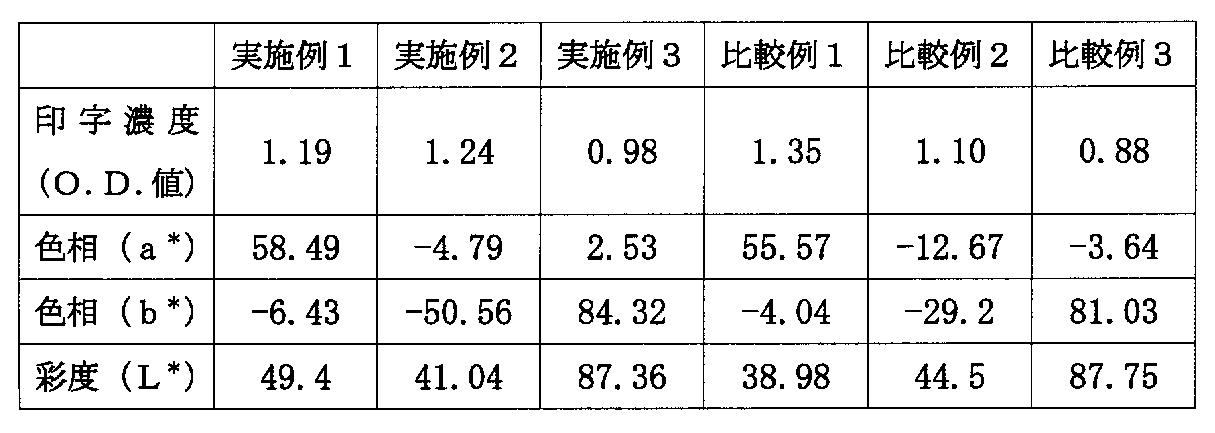
上記インクジェットインクを各々インクカートリッジに充填し、インクジェットプリンターEM−930C(セイコーエプソン(株)製)で普通紙(Xerox4024紙)に英数文字を印字し、1時間以上放置した後、光学濃度計(X−Rite社製、X−Rite 528型)を用いて印字濃度(O.D.値)を測定するとともに、色相(a*、b*)および彩度(L*)を測定した。結果を表2に示す。
なお、インクジェットインクの調製に用いた分散体が何れの実施例または比較例で作製されたものであるのか対応関係を明確にするために、表2においては、印字濃度(O.D.値)、色相(a*、b*)および彩度(L*)を、各インクジェットインクを構成する分散体を作製した実施例番号および比較例番号に対応するように記載している。
<Image evaluation>
Each of the above ink jet inks is filled in an ink cartridge, and alphanumeric characters are printed on plain paper (Xerox 4024 paper) with an ink jet printer EM-930C (manufactured by Seiko Epson Corp.). The print density (OD value) was measured using X-Rite (X-Rite 528 type), and the hue (a * , b * ) and saturation (L * ) were measured. The results are shown in Table 2.
In addition, in order to clarify the correspondence relationship in which Example or Comparative Example the dispersion used for the preparation of the ink-jet ink is used, in Table 2, the print density (OD value) is shown. , Hue (a * , b * ) and Saturation (L * ) are described so as to correspond to the Example number and Comparative Example number in which the dispersion constituting each inkjet ink was prepared.
表1に記載されているように、実施例1〜実施例3で得られたスルホン化有機顔料塩水分散体は、70℃で4週間加熱しても、粘度、平均粒子径、最大粒子径がほとんど変化しないことから、分散性および保存安定性に優れるものであることが分かる。
また、実施例1〜実施例3で得られた分散体を用いて調製されたインクジェットインクは、インクジェットプリンターから安定して吐出することができるものであった。
さらに、表2に記載されているように、実施例1〜実施例3で得られた分散体を用いて調製されたインクジェットインクは、印字物の画像濃度(O.D.値)が高く、有機顔料として重要な色相を示すa*値、b*値のバランスがよく、彩度を示すL*値が高いことから、優れた画像濃度、色相および彩度を発揮するものであることが分かる。
As described in Table 1, the sulfonated organic pigment salt water dispersions obtained in Examples 1 to 3 have viscosity, average particle diameter, and maximum particle diameter even when heated at 70 ° C. for 4 weeks. Since it hardly changes, it turns out that it is excellent in dispersibility and storage stability.
Moreover, the inkjet ink prepared using the dispersion obtained in Examples 1 to 3 could be stably ejected from an inkjet printer.
Furthermore, as described in Table 2, the inkjet ink prepared using the dispersions obtained in Examples 1 to 3 has a high image density (OD value) of the printed matter, Since the a * value and b * value indicating an important hue as an organic pigment are well balanced and the L * value indicating saturation is high, it can be seen that the image exhibits excellent image density, hue and saturation. .
これに対して、表1に記載されているように、比較例1〜比較例3で得られた有機顔料水分散体は、70℃で4週間加熱すると粘性および粒子径が著しく増加してゲル化してしまうことから、保存安定性に劣るものであることが分かる。
また、比較例1〜比較例3で得られた分散体を用いて調製されたインクジェットインクは、初期粒子径が大きく、印刷時にヘッドノズルの詰まりを生じ易いものであった。
さらに、表2に記載されているように、比較例1〜比較例3で得られた分散体を用いて調製されたインクジェットインクは、印字物の有機顔料として重要な色相を示すa*値、b*値や、彩度を示すL*値が劣るものであった。
On the other hand, as described in Table 1, the organic pigment aqueous dispersions obtained in Comparative Examples 1 to 3 were significantly increased in viscosity and particle size when heated at 70 ° C. for 4 weeks. It turns out that it is inferior to storage stability.
Further, the ink jet inks prepared using the dispersions obtained in Comparative Examples 1 to 3 had a large initial particle size, and the head nozzles were easily clogged during printing.
Furthermore, as described in Table 2, inkjet inks prepared using the dispersions obtained in Comparative Examples 1 to 3 have an a * value indicating an important hue as an organic pigment of a printed matter, The b * value and the L * value indicating saturation were inferior.
本発明によれば、水性媒体中で優れた分散性および保存安定性を発揮するとともに、インクジェットインク等の水性インクに用いたときに優れた吐出性、画像濃度、色相および彩度を発揮するスルホン化有機顔料塩水性分散体を簡便に製造する方法を提供することができる。 According to the present invention, a sulfone that exhibits excellent dispersibility and storage stability in an aqueous medium, and also exhibits excellent ejection properties, image density, hue, and saturation when used in aqueous inks such as inkjet inks. It is possible to provide a method for easily producing a fluorinated organic pigment salt aqueous dispersion.
Claims (4)
前記スルホン化処理が、20〜100℃の温度条件下、2〜200時間保持することにより行われる請求項1または請求項2に記載のスルホン化有機顔料塩水性分散体の製造方法。 Mixing of the organic pigment, aqueous medium, sulfite or bisulfite has a ratio expressed by mass of aqueous medium / mass of sulfite or bisulfite, 1-100 mass of sulfite or bisulfite / organic pigment The ratio expressed by the mass of is 0.1 to 20,
The method for producing an aqueous sulfonated organic pigment salt dispersion according to claim 1 or 2, wherein the sulfonation treatment is performed by maintaining the temperature at 20 to 100 ° C for 2 to 200 hours.
Priority Applications (1)
| Application Number | Priority Date | Filing Date | Title |
|---|---|---|---|
| JP2011028474A JP2012167166A (en) | 2011-02-14 | 2011-02-14 | Method of manufacturing sulfonated organic pigment salt water nature dispersion |
Applications Claiming Priority (1)
| Application Number | Priority Date | Filing Date | Title |
|---|---|---|---|
| JP2011028474A JP2012167166A (en) | 2011-02-14 | 2011-02-14 | Method of manufacturing sulfonated organic pigment salt water nature dispersion |
Publications (1)
| Publication Number | Publication Date |
|---|---|
| JP2012167166A true JP2012167166A (en) | 2012-09-06 |
Family
ID=46971620
Family Applications (1)
| Application Number | Title | Priority Date | Filing Date |
|---|---|---|---|
| JP2011028474A Withdrawn JP2012167166A (en) | 2011-02-14 | 2011-02-14 | Method of manufacturing sulfonated organic pigment salt water nature dispersion |
Country Status (1)
| Country | Link |
|---|---|
| JP (1) | JP2012167166A (en) |
Cited By (1)
| Publication number | Priority date | Publication date | Assignee | Title |
|---|---|---|---|---|
| CN113462188A (en) * | 2021-06-16 | 2021-10-01 | 潍坊泰兴生物化工有限责任公司 | Pigment yellow 138 easily dispersible in weak solvent and preparation method thereof |
-
2011
- 2011-02-14 JP JP2011028474A patent/JP2012167166A/en not_active Withdrawn
Cited By (2)
| Publication number | Priority date | Publication date | Assignee | Title |
|---|---|---|---|---|
| CN113462188A (en) * | 2021-06-16 | 2021-10-01 | 潍坊泰兴生物化工有限责任公司 | Pigment yellow 138 easily dispersible in weak solvent and preparation method thereof |
| CN113462188B (en) * | 2021-06-16 | 2023-12-01 | 潍坊泰兴生物化工有限责任公司 | Pigment yellow 138 easy to disperse in weak solvent and preparation method thereof |
Similar Documents
| Publication | Publication Date | Title |
|---|---|---|
| CN101297006B (en) | Carbon black aqueous dispersion and preparation method thereof | |
| JPH11323232A (en) | Inkjet recording liquid and recording method using the same | |
| JP2000303014A (en) | Aqueous pigment dispersion and recording liquid for inkjet | |
| WO2000071628A1 (en) | Ink composition and method for inkjet recording using the same | |
| JP2015013971A (en) | Method for producing water-based ink for ink-jet recording | |
| US20080011193A1 (en) | Water-bsed pigment dispersion, water-based ink, and ink jet recording liquid | |
| JP2003096355A (en) | Ink composition, ink jet recording method and recording apparatus using the ink composition | |
| JP4323159B2 (en) | Ink jet ink composition | |
| JP2000313837A (en) | Aqueous pigment dispersion and recording liquid for inkjet | |
| JP2002105352A (en) | Self-dispersing organic pigment, recording liquid, recording liquid cartridge, recording apparatus and recording method | |
| JP2002121460A (en) | Aqueous pigment dispersion and recording liquid for inkjet | |
| JP6706504B2 (en) | Method for producing hydrophilic carbon black aqueous dispersion | |
| JP2002220557A (en) | Process printing ink set | |
| JP2012167166A (en) | Method of manufacturing sulfonated organic pigment salt water nature dispersion | |
| JP2002241638A (en) | Aqueous pigment dispersion and recording liquid for inkjet | |
| JP4304866B2 (en) | Method for producing aqueous pigment dispersion | |
| JP2010222424A (en) | Ink jet recording ink, recording method, and recording apparatus | |
| JP5742097B2 (en) | Ink jet recording ink, ink cartridge, ink jet recording method, ink jet recording apparatus, and ink recorded matter | |
| JP2000169769A (en) | Ink jet recording liquid and ink jet recording method using the same | |
| JP2009067830A (en) | Pigment dispersion, recording ink and ink cartridge using the same, and image recording apparatus using the same | |
| JP5105046B2 (en) | Ink for inkjet recording | |
| JPH11166131A (en) | Carbon black dispersion, method for producing the same, and ink composition | |
| JP2012167165A (en) | Method of manufacturing sulfonated organic pigment salt water nature dispersion | |
| JP5639883B2 (en) | Ink set for inkjet recording | |
| JP5454194B2 (en) | Inkjet recording ink, ink cartridge, inkjet printing apparatus, image forming method, and image formed article |
Legal Events
| Date | Code | Title | Description |
|---|---|---|---|
| A300 | Withdrawal of application because of no request for examination |
Free format text: JAPANESE INTERMEDIATE CODE: A300 Effective date: 20140513 |