JP2012144707A - Compound, resin, resist composition and method for producing resist pattern - Google Patents
Compound, resin, resist composition and method for producing resist pattern Download PDFInfo
- Publication number
- JP2012144707A JP2012144707A JP2011267589A JP2011267589A JP2012144707A JP 2012144707 A JP2012144707 A JP 2012144707A JP 2011267589 A JP2011267589 A JP 2011267589A JP 2011267589 A JP2011267589 A JP 2011267589A JP 2012144707 A JP2012144707 A JP 2012144707A
- Authority
- JP
- Japan
- Prior art keywords
- group
- formula
- resin
- monomer
- carbon atoms
- Prior art date
- Legal status (The legal status is an assumption and is not a legal conclusion. Google has not performed a legal analysis and makes no representation as to the accuracy of the status listed.)
- Pending
Links
- 0 **C(*)(*)OC(N)=O Chemical compound **C(*)(*)OC(N)=O 0.000 description 23
- OFNISBHGPNMTMS-UHFFFAOYSA-N C=C(CC(O1)=O)C1=O Chemical compound C=C(CC(O1)=O)C1=O OFNISBHGPNMTMS-UHFFFAOYSA-N 0.000 description 1
- AEHSJUGRSCAYJQ-UHFFFAOYSA-N CC(CC1)(C(CC2C3)C3C1C(C=C)O)C2OCC(COC(C(C)=N)=O)=O Chemical compound CC(CC1)(C(CC2C3)C3C1C(C=C)O)C2OCC(COC(C(C)=N)=O)=O AEHSJUGRSCAYJQ-UHFFFAOYSA-N 0.000 description 1
- FPYJFEHAWHCUMM-UHFFFAOYSA-N O=C(C=C1)OC1=O Chemical compound O=C(C=C1)OC1=O FPYJFEHAWHCUMM-UHFFFAOYSA-N 0.000 description 1
- DPDZCXWAZNQZCY-UHFFFAOYSA-N O=S(C(F)(F)F)(NC1C(C2)C=CC2C1)=O Chemical compound O=S(C(F)(F)F)(NC1C(C2)C=CC2C1)=O DPDZCXWAZNQZCY-UHFFFAOYSA-N 0.000 description 1
- GTKQRIPEBBDJIN-UHFFFAOYSA-N O=S(C(F)(F)F)(NCC(C1)C2C=CC1C2)=O Chemical compound O=S(C(F)(F)F)(NCC(C1)C2C=CC1C2)=O GTKQRIPEBBDJIN-UHFFFAOYSA-N 0.000 description 1
- FFLKFEJGLNNMRK-UHFFFAOYSA-N O=S(C(F)(F)F)(NCCC(C1)C2C=CC1C2)=O Chemical compound O=S(C(F)(F)F)(NCCC(C1)C2C=CC1C2)=O FFLKFEJGLNNMRK-UHFFFAOYSA-N 0.000 description 1
Landscapes
- Exposure And Positioning Against Photoresist Photosensitive Materials (AREA)
- Materials For Photolithography (AREA)
- Addition Polymer Or Copolymer, Post-Treatments, Or Chemical Modifications (AREA)
Abstract
【課題】マスクエラーファクター(MEF)に優れ、欠陥の発生数が少ないレジストパターンを形成することを目的とする。
【解決手段】式(a)で表される化合物。
[式中、A1は、置換基を有していてもよいアルカンジイル基又は式(a−1)
(式中、sは0又は1;A10及びA12は、それぞれ独立に、置換基を有していてもよい脂肪族炭化水素基;A11は、単結合又は置換基を有していてもよい脂肪族炭化水素基;X10及びX11は、それぞれ独立に、酸素原子、カルボニル基、カルボニルオキシ基又はオキシカルボニル基;ただしA10、A11、A12、X10及びX11の炭素数の合計は6以下である)で表される基;R1は水素原子又はメチル基;R2は芳香族炭化水素基を表す。]
【選択図】なしAn object of the present invention is to form a resist pattern having an excellent mask error factor (MEF) and a small number of defects.
A compound represented by formula (a).
[Wherein, A 1 represents an alkanediyl group which may have a substituent or a formula (a-1)
(Wherein s is 0 or 1; A 10 and A 12 are each independently an optionally substituted aliphatic hydrocarbon group; A 11 is a single bond or a substituent; X 10 and X 11 are each independently an oxygen atom, a carbonyl group, a carbonyloxy group or an oxycarbonyl group; provided that A 10 , A 11 , A 12 , X 10 and X 11 are carbon atoms. The total number is 6 or less); R 1 represents a hydrogen atom or a methyl group; R 2 represents an aromatic hydrocarbon group. ]
[Selection figure] None
Description
本発明は、化合物、樹脂、レジスト組成物及びレジストパターンの製造方法に関する。 The present invention relates to a compound, a resin, a resist composition, and a method for producing a resist pattern.
近年、半導体の微細加工技術として、ArFエキシマレーザー(波長:193nm)等の短波長光を露光源とする光リソグラフィ技術が活発に検討されている。このような光リソグラフィ技術に用いられるレジスト組成物としては、例えば、式(u−A)で表される構造単位及び式(u−B)で表される構造単位からなる樹脂と、式(u−B)で表される構造単位、式(u−C)で表される構造単位及び式(u−D)で表される構造単位からなる樹脂と、酸発生剤とを含有するレジスト組成物が知られている(特許文献1)。
従来の樹脂を含有するレジスト組成物から製造されるレジストパターンは、マスクエラーファクター(MEF)が必ずしも満足できない場合や、レジストパターン製造時において欠陥の発生数が極めて多い場合があった。 A resist pattern manufactured from a resist composition containing a conventional resin may not always satisfy the mask error factor (MEF), or may have an extremely large number of defects when the resist pattern is manufactured.
本発明は、以下の発明を含む。
〔1〕式(a)で表される化合物。
A1は、置換基を有していてもよい炭素数1〜6のアルカンジイル基又は式(a−1)で表される基を表す。
sは、0又は1を表す。
A10及びA12は、それぞれ独立に、置換基を有していてもよい炭素数1〜5の2価の脂肪族炭化水素基を表す。
A11は、単結合又は置換基を有していてもよい炭素数1〜5の2価の脂肪族炭化水素基を表す。
X10及びX11は、それぞれ独立に、酸素原子、カルボニル基、カルボニルオキシ基又はオキシカルボニル基を表す。
ただし、A10、A11、A12、X10及びX11の炭素数の合計は6以下である)
R1は、水素原子又はメチル基を表す。
R2は、炭素数6〜18の芳香族炭化水素基を表す。]
The present invention includes the following inventions.
[1] A compound represented by the formula (a).
A 1 represents a group represented by the alkanediyl group or formula 1-6 carbon atoms which may have a substituent (a-1).
s represents 0 or 1.
A 10 and A 12 each independently represent a C 1-5 divalent aliphatic hydrocarbon group which may have a substituent.
A 11 represents a C 1-5 divalent aliphatic hydrocarbon group which may have a single bond or a substituent.
X 10 and X 11 each independently represent an oxygen atom, a carbonyl group, a carbonyloxy group or an oxycarbonyl group.
(However, the total number of carbon atoms of A 10 , A 11 , A 12 , X 10 and X 11 is 6 or less)
R 1 represents a hydrogen atom or a methyl group.
R 2 represents an aromatic hydrocarbon group having 6 to 18 carbon atoms. ]
〔2〕前記(A)が、前記式(a)のA1がエチレン基である化合物に由来する構造単位を有する樹脂である前記〔1〕記載のレジスト組成物。
〔3〕前記(B)が、前記式(B1)のYが置換基を有していてもよい炭素数3〜18の脂環式炭化水素基である塩を含む前記〔1〕又は〔2〕記載のレジスト組成物。
〔4〕前記式(a)のR2が、式(a1−1)で表される基又は式(a1−2)で表される基である前記〔1〕〜〔3〕のいずれか記載の化合物。
〔6〕前記〔5〕記載の樹脂及び酸発生剤を含むレジスト組成物。
〔7〕さらに塩基性化合物を含む前記〔6〕記載のレジスト組成物。
[2] The resist composition according to [1], wherein (A) is a resin having a structural unit derived from a compound in which A 1 in the formula (a) is an ethylene group.
[3] The above [1] or [2], wherein the (B) includes a salt in which Y in the formula (B1) is an optionally substituted alicyclic hydrocarbon group having 3 to 18 carbon atoms. ] The resist composition as described.
[4] Any one of [1] to [3], wherein R 2 in the formula (a) is a group represented by the formula (a1-1) or a group represented by the formula (a1-2). Compound.
[6] A resist composition comprising the resin according to [5] and an acid generator.
[7] The resist composition according to [6], further including a basic compound.
〔8〕さらに溶剤を含む〔6〕又は〔7〕のいずれか記載のレジスト組成物。 〔9〕(1)前記〔6〕〜〔8〕のいずれか1つに記載のレジスト組成物を基板上に塗布する工程、
(2)塗布後の組成物を乾燥させて組成物層を形成する工程、
(3)組成物層を露光する工程、
(4)露光後の組成物層を加熱する工程、
(5)加熱後の組成物層を現像する工程、
を含むレジストパターンの製造方法。
[8] The resist composition according to any one of [6] or [7], further containing a solvent. [9] (1) A step of applying the resist composition according to any one of [6] to [8] on a substrate,
(2) The process of drying the composition after application | coating and forming a composition layer,
(3) a step of exposing the composition layer,
(4) A step of heating the composition layer after exposure,
(5) a step of developing the composition layer after heating;
A method for producing a resist pattern including:
本発明の化合物に由来する構造単位を有する樹脂によれば、マスクエラーファクター(MEF)に優れ、欠陥の発生数が少ないレジストパターンを製造し得るレジスト組成物が提供できる。 According to the resin having a structural unit derived from the compound of the present invention, it is possible to provide a resist composition that can produce a resist pattern that is excellent in mask error factor (MEF) and has a small number of defects.
本明細書では、特に断りのない限り、炭素数を適宜選択しながら、以下の置換基の例示は、同様の置換基を有するいずれの化学構造式においても適用される。直鎖状、分岐状又は環状をとることができるものは、そのいずれをも含み、かつそれらが混在していてもよい。立体異性体が存在する場合は、全ての立体異性体を包含する。また、*は結合手を表す。 In the present specification, unless otherwise specified, the following examples of substituents are applied to any chemical structural formula having the same substituents while appropriately selecting the number of carbon atoms. Those which can be linear, branched or cyclic include any of them, and they may be mixed. When stereoisomers exist, all stereoisomers are included. * Represents a bond.
炭化水素基とは、脂肪族炭化水素基及び芳香族炭化水素基を包含する。
脂肪族炭化水素基は、鎖式及び環式の双方を含み、特に定義しない限り、鎖式及び環式の脂肪族炭化水素基が組み合わせられたものをも包含する。また、これら脂肪族炭化水素基は、その一部に炭素‐炭素二重結合を含んでいてもよいが、飽和の基が好ましい。
鎖式の脂肪族炭化水素基のうち1価のものとしては、典型的にはアルキル基が挙げられる。
アルキル基としては、メチル基(C1)、エチル基(C2)、プロピル基(C3)、ブチル基(C4)、ペンチル基(C5)、ヘキシル基(C6)、ヘプチル基(C7)、オクチル基(C8)、デシル基(C10)、ドデシル基(C12)、ヘキサデシル基(C14)、ペンタデシル基(C15)、ヘキシルデシル基(C16)、ヘプタデシル基(C17)及びオクタデシル基(C18)などが挙げられる。
鎖式の脂肪族炭化水素基のうち2価のものとしては、アルキル基から水素原子を1個取り去ったアルカンジイル基が挙げられる。
アルカンジイル基としては、メチレン基、エチレン基、プロパン−1,3−ジイル基、プロパン−1,2−ジイル基、ブタン−1,4−ジイル基、ペンタン−1,5−ジイル基、ヘキサン−1,6−ジイル基、ヘプタン−1,7−ジイル基、オクタン−1,8−ジイル基、ノナン−1,9−ジイル基、デカン−1,10−ジイル基、ウンデカン−1,11−ジイル基、ドデカン−1,12−ジイル基、トリデカン−1,13−ジイル基、テトラデカン−1,14−ジイル基、ペンタデカン−1,15−ジイル基、ヘキサデカン−1,16−ジイル基、ヘプタデカン−1,17−ジイル基、エタン−1,1−ジイル基、プロパン−1,1−ジイル基及びプロパン−2,2−ジイル基、ブタン−1,3−ジイル基、2−メチルプロパン−1,3−ジイル基、2−メチルプロパン−1,2−ジイル基、ペンタン−1,4−ジイル基、2−メチルブタン−1,4−ジイル基等が挙げられる。
The hydrocarbon group includes an aliphatic hydrocarbon group and an aromatic hydrocarbon group.
The aliphatic hydrocarbon group includes both a chain and a cyclic group, and includes a combination of a chain and a cyclic aliphatic hydrocarbon group unless otherwise defined. These aliphatic hydrocarbon groups may contain a carbon-carbon double bond in part, but are preferably saturated groups.
Of the chain aliphatic hydrocarbon groups, the monovalent one typically includes an alkyl group.
Examples of the alkyl group include a methyl group (C 1 ), an ethyl group (C 2 ), a propyl group (C 3 ), a butyl group (C 4 ), a pentyl group (C 5 ), a hexyl group (C 6 ), a heptyl group ( C 7 ), octyl group (C 8 ), decyl group (C 10 ), dodecyl group (C 12 ), hexadecyl group (C 14 ), pentadecyl group (C 15 ), hexyldecyl group (C 16 ), heptadecyl group ( C 17 ) and octadecyl group (C 18 ).
Examples of the divalent group of chain aliphatic hydrocarbon groups include alkanediyl groups in which one hydrogen atom has been removed from an alkyl group.
Examples of alkanediyl groups include methylene group, ethylene group, propane-1,3-diyl group, propane-1,2-diyl group, butane-1,4-diyl group, pentane-1,5-diyl group, hexane- 1,6-diyl group, heptane-1,7-diyl group, octane-1,8-diyl group, nonane-1,9-diyl group, decane-1,10-diyl group, undecane-1,11-diyl Group, dodecane-1,12-diyl group, tridecane-1,13-diyl group, tetradecane-1,14-diyl group, pentadecane-1,15-diyl group, hexadecane-1,16-diyl group, heptadecane-1 , 17-diyl group, ethane-1,1-diyl group, propane-1,1-diyl group and propane-2,2-diyl group, butane-1,3-diyl group, 2-methylpropane-1,3 − Yl group, 2-methylpropane-1,2-diyl, pentane-1,4-diyl group, a 2-methylbutane-1,4-diyl group.
環式の脂肪族炭化水素基(以下、場合により「脂環式炭化水素基」という)は、典型的には、シクロアルキル基を意味し、以下に示す単環式及び多環式のいずれをも包含する。 The cyclic aliphatic hydrocarbon group (hereinafter sometimes referred to as “alicyclic hydrocarbon group”) typically means a cycloalkyl group, and includes any of the monocyclic and polycyclic groups shown below. Is also included.
脂環式炭化水素基のうち1価のものとして、単環式の脂肪族炭化水素基は、以下の式(KA−1)〜(KA−7)で表されるシクロアルカンの水素原子を1個取り去った基である。
多環式の脂肪族炭化水素基は、以下の式(KA−8)〜(KA−22)で表されるシクロアルカンの水素原子を1個取り去った基である。
脂環式炭化水素基のうち2価のものとしては、式(KA−1)〜式(KA−22)の脂環式炭化水素から水素原子を2個取り去った基が挙げられる。 Examples of the divalent alicyclic hydrocarbon group include groups in which two hydrogen atoms have been removed from the alicyclic hydrocarbon of formula (KA-1) to formula (KA-22).
脂肪族炭化水素基は置換基を有していてもよい。該置換基としては、特に限定されない限り、ハロゲン原子、ヒドロキシ基、アルコキシ基、アルキルチオ基、アシル基、アシルオキシ基、アリール基、アラルキル基及びアリールオキシ基などが挙げられる。
ハロゲン原子としては、フッ素原子、塩素原子、臭素原子及びヨウ素原子が挙げられる。
アルコキシ基としては、メトキシ基(C1)、エトキシ基(C2)、プロポキシ基(C3)、ブトキシ基(C4)、ペンチルオキシ基(C5)、ヘキシルオキシ基(C6)、ヘプチルオキシ基(C7)、オクチルオキシ基(C8)、デシルオキシ基(C10)及びドデシルオキシ基(C12)などが挙げられる。
アルキルチオ基としては、アルコキシ基の酸素原子が硫黄原子に置き換わったものが挙げられ、例えば、メチルチオ基、エチルチオ基、プロピルチオ基、ブチルチオ基、ペンチルチオ基、ヘキシルチオ基、ヘプチルチオ基、オクチルチオ基、デシルチオ基及びドデシルチオ基などが挙げられる。
アシル基としては、アセチル基(C2)、プロピオニル基(C3)、ブチリル基(C4)、バレイル基(C5)、ヘキサノイル基(C6)、ヘプタノイル基(C7)、オクタノイル基(C8)、デカノイル基(C10)及びドデカノイル基(C12)などのアルキル基とカルボニル基とが結合したもの、ベンゾイル基(C7)などのアリール基とカルボニル基とが結合したものが挙げられる。
アシルオキシ基としては、アセチルオキシ基、プロピオニルオキシ基、ブチリルオキシ基、イソブチリルオキシ基等が挙げられる。
アラルキル基としては、ベンジル基(C7)、フェネチル基(C8)、フェニルプロピル基(C9)、ナフチルメチル基(C11)及びナフチルエチル基(C12)などが挙げられる。
アリールオキシ基としては、フェニルオキシ基(C6)、ナフチルオキシ基(C10)、アントニルオキシ基(C14)、ビフェニルオキシ基(C12)、フェナントリルオキシ基(C14)及びフルオレニルオキシ基(C13)などのアリール基と酸素原子とが結合したものが挙げられる。
The aliphatic hydrocarbon group may have a substituent. Examples of the substituent include a halogen atom, a hydroxy group, an alkoxy group, an alkylthio group, an acyl group, an acyloxy group, an aryl group, an aralkyl group, and an aryloxy group, unless otherwise specified.
Examples of the halogen atom include a fluorine atom, a chlorine atom, a bromine atom, and an iodine atom.
Examples of alkoxy groups include methoxy group (C 1 ), ethoxy group (C 2 ), propoxy group (C 3 ), butoxy group (C 4 ), pentyloxy group (C 5 ), hexyloxy group (C 6 ), heptyl Examples thereof include an oxy group (C 7 ), an octyloxy group (C 8 ), a decyloxy group (C 10 ), and a dodecyloxy group (C 12 ).
Examples of the alkylthio group include those in which an oxygen atom of an alkoxy group is replaced by a sulfur atom, such as a methylthio group, an ethylthio group, a propylthio group, a butylthio group, a pentylthio group, a hexylthio group, a heptylthio group, an octylthio group, a decylthio group, and the like. Examples include dodecylthio group.
Examples of the acyl group include acetyl group (C 2 ), propionyl group (C 3 ), butyryl group (C 4 ), valeryl group (C 5 ), hexanoyl group (C 6 ), heptanoyl group (C 7 ), octanoyl group ( Examples include those in which an alkyl group such as C 8 ), decanoyl group (C 10 ) and dodecanoyl group (C 12 ) is bonded to a carbonyl group, and those in which an aryl group such as benzoyl group (C 7 ) is bonded to a carbonyl group It is done.
Examples of the acyloxy group include an acetyloxy group, a propionyloxy group, a butyryloxy group, and an isobutyryloxy group.
Examples of the aralkyl group include benzyl group (C 7 ), phenethyl group (C 8 ), phenylpropyl group (C 9 ), naphthylmethyl group (C 11 ), and naphthylethyl group (C 12 ).
The aryloxy group includes phenyloxy group (C 6 ), naphthyloxy group (C 10 ), antonyloxy group (C 14 ), biphenyloxy group (C 12 ), phenanthryloxy group (C 14 ) and full A combination of an aryl group such as an oleenyloxy group (C 13 ) and an oxygen atom is exemplified.
芳香族炭化水素基としては、典型的には、アリール基が挙げられる。
アリール基としては、フェニル基(C6)、ナフチル基(C10)、アントリル基(C14)、ビフェニル基(C12)、フェナントリル基(C14)及びフルオレニル基(C13)などが挙げられる。
芳香族炭化水素基は置換基を有していてもよい。このような置換基は、特に限定されない限り、ハロゲン原子、ヒドロキシ基、アルコキシ基、アシル基、アシルオキシ基、アルキル基及びアリールオキシ基が挙げられる。
A typical example of the aromatic hydrocarbon group is an aryl group.
Examples of the aryl group include a phenyl group (C 6 ), a naphthyl group (C 10 ), an anthryl group (C 14 ), a biphenyl group (C 12 ), a phenanthryl group (C 14 ), and a fluorenyl group (C 13 ). .
The aromatic hydrocarbon group may have a substituent. Unless such a substituent is particularly limited, a halogen atom, a hydroxy group, an alkoxy group, an acyl group, an acyloxy group, an alkyl group, and an aryloxy group are exemplified.
また、「(メタ)アクリル系モノマー」とは、「CH2=CH−CO−」又は「CH2=C(CH3)−CO−」の構造を有するモノマーの少なくとも1種を意味する。同様に「(メタ)アクリレート」及び「(メタ)アクリル酸」とは、それぞれ「アクリレート及びメタクリレートの少なくとも1種」及び「アクリル酸及びメタクリル酸の少なくとも1種」を意味する。 Further, "(meth) acrylic monomer" means at least one monomer having a structure of "CH 2 = CH-CO-" or "CH 2 = C (CH 3) -CO- ". Similarly, “(meth) acrylate” and “(meth) acrylic acid” mean “at least one of acrylate and methacrylate” and “at least one of acrylic acid and methacrylic acid”, respectively.
〈式(a)で表される化合物〉
本発明の化合物は、式(a)で表される化合物(以下、場合により「化合物(a)」という)である。
A1は、置換基を有していてもよい炭素数1〜6のアルカンジイル基又は式(a−1)で表される基を表す。
sは0又は1を表す。
A10及びA12は、それぞれ独立に、置換基を有していてもよい炭素数1〜5の2価の脂肪族炭化水素基を表す。
A11は、単結合又は置換基を有していてもよい炭素数1〜5の2価の脂肪族炭化水素基を表す。
X10及びX11は、それぞれ独立に、酸素原子、カルボニル基、カルボニルオキシ基又はオキシカルボニル基を表す。
ただし、A10、A11、A12、X10及びX11の炭素数の合計は6以下である)
R1は、水素原子又はメチル基を表す。
R2は、炭素数6〜18の芳香族炭化水素基を表す。]
<Compound represented by formula (a)>
The compound of the present invention is a compound represented by the formula (a) (hereinafter sometimes referred to as “compound (a)”).
A 1 represents a group represented by the alkanediyl group or formula 1-6 carbon atoms which may have a substituent (a-1).
s represents 0 or 1.
A 10 and A 12 each independently represent a C 1-5 divalent aliphatic hydrocarbon group which may have a substituent.
A 11 represents a C 1-5 divalent aliphatic hydrocarbon group which may have a single bond or a substituent.
X 10 and X 11 each independently represent an oxygen atom, a carbonyl group, a carbonyloxy group or an oxycarbonyl group.
(However, the total number of carbon atoms of A 10 , A 11 , A 12 , X 10 and X 11 is 6 or less)
R 1 represents a hydrogen atom or a methyl group.
R 2 represents an aromatic hydrocarbon group having 6 to 18 carbon atoms. ]
式(a)において、脂肪族炭化水素基の置換基としては、ヒドロキシ基、炭素数1〜6のアルコキシ基などが好ましい。 In the formula (a), the substituent of the aliphatic hydrocarbon group is preferably a hydroxy group or an alkoxy group having 1 to 6 carbon atoms.
以下、基(a−1)について具体例を示す。
酸素原子を有する基(a−1)としては、以下の基が挙げられる。
Examples of the group (a-1) having an oxygen atom include the following groups.
カルボニル基を有する基(a−1)としては、以下の基が挙げられる。
カルボニルオキシ基を有する基(a−1)としては、以下の基が挙げられる。
オキシカルボニル基を有する基(a−1)としては、以下の基が挙げられる。
A1は炭素数1〜6のアルカンジイル基が好ましく、炭素数1〜4のアルカンジイル基がより好ましく、エチレン基がさらに好ましい。
R2は、炭素数6〜14の芳香族炭化水素基が好ましく、中でも、式(a1−1)で表される基又は式(a1−2)で表される基がより好ましく、式(a1−1)で表される基がさらに好ましい。
R 2 is preferably an aromatic hydrocarbon group having 6 to 14 carbon atoms. Among them, a group represented by the formula (a1-1) or a group represented by the formula (a1-2) is more preferable, and the formula (a1 The group represented by -1) is more preferable.
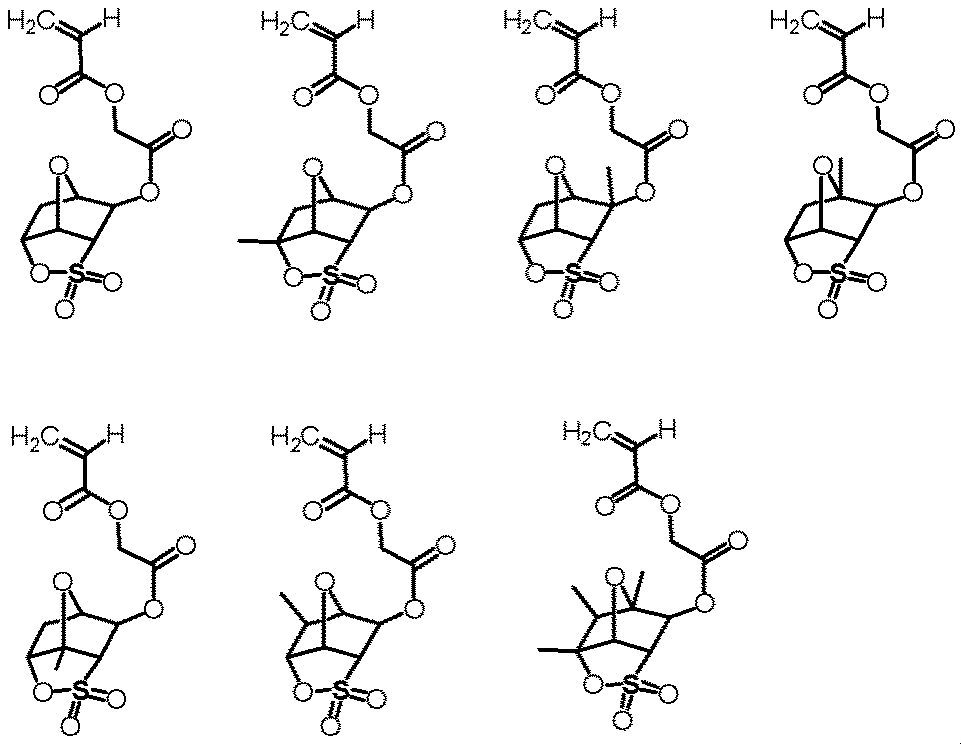
式(a)で表される化合物は、例えば以下の化合物が挙げられる。
また、式(a1)〜式(a8)のいずれかで表される式(a)の化合物において、以下に示す部分構造(Mc)を部分構造(Ac)に置き換えたものも化合物(a)の具体例として挙げることができる。
化合物(a)は、例えば以下に示すように、式(as−1)で表される化合物と式(as−2)で表される化合物とを反応させることにより製造することができる。
式(as−1)で表される化合物としては、ヒドロキシエチルメタクリレートなどが挙げられる。このヒドロキシエチルメタクリレートは市場から容易に入手できる。
式(as−2)で表される化合物としては、クロロギ酸フルオレニルメチルなどが挙げられる。このクロロギ酸フルオレニルメチルは市場から容易に入手できる。
Compound (a) can be produced, for example, by reacting a compound represented by formula (as-1) with a compound represented by formula (as-2) as shown below.
Examples of the compound represented by the formula (as-1) include hydroxyethyl methacrylate. This hydroxyethyl methacrylate is readily available from the market.
Examples of the compound represented by the formula (as-2) include fluorenylmethyl chloroformate. This fluorenylmethyl chloroformate is readily available from the market.
〈レジスト組成物〉
本発明のレジスト組成物は、樹脂(以下、場合により「樹脂(A)」という)及び酸発生剤(以下、場合により「酸発生剤(B)」という)を含む。さらに必要に応じて、溶剤及び/又はクエンチャーと呼ばれる塩基化合物などの添加剤を含むことがある。
<Resist composition>
The resist composition of the present invention contains a resin (hereinafter sometimes referred to as “resin (A)”) and an acid generator (hereinafter sometimes referred to as “acid generator (B)”). Furthermore, additives such as a base compound called a solvent and / or a quencher may be included as necessary.
〈樹脂(A)〉
本発明のレジスト組成物は、酸発生剤(B)と相互作用によりレジストパターンを形成できる樹脂を含有する。このような樹脂は、アルカリ水溶液に不溶又は難溶であり、酸の作用によりアルカリ水溶液に可溶となる特性(以下、場合により「酸作用特性」という)を有する。ここで「酸の作用によりアルカリ水溶液に可溶となる」とは、酸の接触前ではアルカリ水溶液に不溶又は難溶であるが、酸との接触後にはアルカリ水溶液に可溶となることを意味する。
樹脂(A)は、化合物(a)に由来する構造単位(以下、場合により「構造単位(a)」という)を有する限り、酸作用特性を有するもの(以下、場合により「樹脂(AA)」という)であっても、酸作用特性を有しないもの(以下、場合により「樹脂(AB)」という)であってもよい。ただし、樹脂(A)が後者である場合、酸作用特性を有し、樹脂(A)とは異なる樹脂(以下、場合により「樹脂(X)」という)が本発明のレジスト組成物に含有される。樹脂(AA)及び樹脂(AB)のいずれにおいても、それらに含有される構造単位(a)は、1種であっても、複数種であってもよい。
<Resin (A)>
The resist composition of the present invention contains a resin capable of forming a resist pattern by interacting with the acid generator (B). Such a resin is insoluble or hardly soluble in an aqueous alkali solution and has a characteristic that it becomes soluble in an aqueous alkaline solution by the action of an acid (hereinafter, sometimes referred to as “acid action characteristic”). Here, “being soluble in an alkaline aqueous solution by the action of an acid” means insoluble or hardly soluble in an alkaline aqueous solution before contact with an acid, but becomes soluble in an alkaline aqueous solution after contact with an acid. To do.
As long as the resin (A) has a structural unit derived from the compound (a) (hereinafter sometimes referred to as “structural unit (a)”), the resin (A) has an acid action characteristic (hereinafter sometimes referred to as “resin (AA)”). Or those having no acid action characteristics (hereinafter referred to as “resin (AB)” in some cases). However, when the resin (A) is the latter, a resin having acid action characteristics and different from the resin (A) (hereinafter, sometimes referred to as “resin (X)”) is contained in the resist composition of the present invention. The In both the resin (AA) and the resin (AB), the structural unit (a) contained in them may be one kind or plural kinds.
酸作用特性を有する樹脂(AA)は、分子内にある親水性基の一部又は全部が、酸の接触により脱離し得る保護基により保護されているものであり、酸と接触するとその保護基が脱離して、アルカリ水溶液に可溶となる。該保護基により保護されている親水性基を、以下「酸不安定基」という。該親水性基としては、ヒドロキシ基又はカルボキシ基が挙げられ、カルボキシ基がより好ましい。
酸作用特性を有しない樹脂(AB)は、本発明のレジスト組成物においては、添加剤として使用できる。
樹脂(AA)及び/又は樹脂(AB)等の樹脂(A)を含有することにより、本発明のレジスト組成物は、欠陥の発生量が少なく、マスクエラーファクター(MEF)が良好なレジストパターンを製造することができる。
Resin (AA) having acid action characteristics is such that a part or all of the hydrophilic group in the molecule is protected by a protecting group that can be removed by contact with an acid. Desorbs and becomes soluble in an alkaline aqueous solution. The hydrophilic group protected by the protecting group is hereinafter referred to as “acid labile group”. Examples of the hydrophilic group include a hydroxy group or a carboxy group, and a carboxy group is more preferable.
The resin (AB) having no acid action characteristic can be used as an additive in the resist composition of the present invention.
By containing the resin (A) such as the resin (AA) and / or the resin (AB), the resist composition of the present invention has a resist pattern with a small amount of defects and a good mask error factor (MEF). Can be manufactured.
樹脂(A)は、構造単位(a)の構造及び特性(酸に安定又は不安定)に応じて、樹脂(AA)又は樹脂(AB)のいずれかに分類される。構造単位(a)が酸不安定基を有さない場合には、樹脂(AA)は、構造単位(a)の他に、酸不安定基を有する構造単位を有する。また、樹脂(AA)は、酸不安定基を有する構造単位及び構造単位(a)以外の構造単位として、例えば、後述する酸安定モノマーに由来する構造単位を有していてもよい。樹脂(AA)は、酸作用特性を有する範囲で、樹脂(AA)が有する酸不安定基を有する構造単位も、1種であっても、複数種であってもよい。
樹脂(AB)は、構造単位(a)以外に、例えば、後述する酸安定モノマーに由来する構造単位を有していてもよい。この構造単位は、1種であっても、複数種であってもよい。
Resin (A) is classified into either resin (AA) or resin (AB) according to the structure and characteristic (stable or unstable to an acid) of structural unit (a). When the structural unit (a) does not have an acid labile group, the resin (AA) has a structural unit having an acid labile group in addition to the structural unit (a). Moreover, resin (AA) may have the structural unit derived from the acid stable monomer mentioned later as structural units other than the structural unit which has an acid labile group, and structural unit (a), for example. The resin (AA) may have one or more structural units having an acid labile group, as long as the resin (AA) has acid action characteristics.
In addition to the structural unit (a), the resin (AB) may have, for example, a structural unit derived from an acid stable monomer described later. This structural unit may be one kind or plural kinds.
樹脂(A)において、樹脂(A)の全構造単位(100モル%)に対する構造単位(a)の合計モル量(樹脂(A)の構造単位(a)の含有割合)は1〜100モル%の範囲が好ましく、5〜95モル%の範囲がより好ましく、10〜90モル%の範囲がさらに好ましい。なお、このような範囲とするためには、構造単位(a)を含む樹脂(A)は、樹脂(A)製造時に用いる全モノマーの総モル量に対する化合物(a)の使用モル量を調節すればよい。
上述したように、樹脂(AA)及び/又は樹脂(AB)が、構造単位(a)を複数種有する場合には、これら構造単位(a)の合計含有割合が、上述した樹脂(A)における構造単位(a)の含有割合を満たす範囲で、適宜調整することができる。同様に、樹脂(AA)又は樹脂(AB)が、構造単位(a)以外の構造単位を有する場合には、上述した樹脂(A)における化合物(a)の含有割合を満たす範囲で、構造単位(a)以外の構造単位の合計含有割合を、適宜調整することが好ましい。
In the resin (A), the total molar amount of the structural unit (a) relative to the total structural unit (100 mol%) of the resin (A) (content ratio of the structural unit (a) of the resin (A)) is 1 to 100 mol%. The range of 5 to 95 mol% is more preferable, and the range of 10 to 90 mol% is more preferable. In order to obtain such a range, the amount of the compound (a) used in the resin (A) containing the structural unit (a) is adjusted with respect to the total amount of all monomers used in the production of the resin (A). That's fine.
As described above, when the resin (AA) and / or the resin (AB) includes a plurality of structural units (a), the total content of these structural units (a) is in the above-described resin (A). It can adjust suitably in the range with which the content rate of a structural unit (a) is satisfy | filled. Similarly, when the resin (AA) or the resin (AB) has a structural unit other than the structural unit (a), the structural unit is within a range satisfying the content ratio of the compound (a) in the resin (A). It is preferable to appropriately adjust the total content of structural units other than (a).
<酸不安定基を有するモノマー(a1)>
モノマー(a1)において、親水性基がカルボキシ基である場合の酸不安定基は、カルボキシ基の水素原子が有機残基に置き換わり、カルボキシ基の−O−と結合する該有機残基の炭素原子が第三級炭素原子である基が挙げられる。このような酸不安定基としては、好ましくは、例えば、以下の式(1)で表される基(以下、場合により「酸不安定基(1)」という)である。
Ra1〜Ra3は、それぞれ独立に、炭素数1〜8の脂肪族炭化水素基を表すか、Ra1及びRa2が互いに結合して、それらが結合する炭素原子とともに炭素数3〜20の環を形成する。Ra1及びRa2が互いに結合して形成される環又は脂肪族炭化水素基に含まれるメチレン基は、酸素原子、硫黄原子又はカルボニル基に置き換わっていてもよい。
<Monomer (a1) having an acid labile group>
In the monomer (a1), when the hydrophilic group is a carboxy group, the acid labile group is a carbon atom of the organic residue in which the hydrogen atom of the carboxy group is replaced with an organic residue and bonded to —O— of the carboxy group Group in which is a tertiary carbon atom. Such an acid labile group is preferably, for example, a group represented by the following formula (1) (hereinafter sometimes referred to as “acid labile group (1)”).
R a1 to R a3 each independently represents an aliphatic hydrocarbon group having 1 to 8 carbon atoms, or R a1 and R a2 are bonded to each other and have 3 to 20 carbon atoms together with the carbon atom to which they are bonded. Form a ring. The methylene group contained in the ring or aliphatic hydrocarbon group formed by combining R a1 and R a2 with each other may be replaced with an oxygen atom, a sulfur atom or a carbonyl group.
−C(Ra1)(Ra2)(Ra3)で表される基において、Ra1及びRa2が互いに結合して形成する環としては、例えば、以下のものが挙げられる。
酸不安定基(1)としては、例えば、
1,1−ジアルキルアルコキシカルボニル基(式(1)中、Ra1〜Ra3が全てアルキル基である基、このアルキル基のうち、1つはtert−ブトキシカルボニル基であることが好ましい。)、
2−アルキルアダマンタン−2−イルオキシカルボニル基(式(1)中、Ra1及びRa2が互いに結合し、これらが結合する炭素原子とともにアダマンチル環を形成し、Ra3がアルキル基である基)及び
1−(アダマンタン−1−イル)−1−アルキルアルコキシカルボニル基(式(1)中、Ra1及びRa2がアルキル基であり、Ra3がアダマンチル基である基)などが挙げられる。
Examples of the acid labile group (1) include:
1,1-dialkylalkoxycarbonyl group (in formula (1), R a1 to R a3 are all alkyl groups, and one of these alkyl groups is preferably a tert-butoxycarbonyl group),
2-alkyladamantan-2-yloxycarbonyl group (in the formula (1), R a1 and R a2 are bonded to each other to form an adamantyl ring together with the carbon atoms to which they are bonded, and R a3 is an alkyl group) And 1- (adamantan-1-yl) -1-alkylalkoxycarbonyl group (in the formula (1), R a1 and R a2 are alkyl groups, and R a3 is an adamantyl group).
親水性基がヒドロキシ基である場合の酸不安定基は、このヒドロキシ基の水素原子が、有機残基に置き換わり、アセタール構造又はケタール構造を含む基となったものが挙げられる。このような酸不安定基としては、好ましくは、例えば、以下の式(2)で表される基(以下、場合により「酸不安定基(2)」という)である。
Rb1及びRb2は、それぞれ独立に、水素原子又は炭素数1〜12の炭化水素基を表し、Rb3は、炭素数1〜20の炭化水素基を表すか、あるいはRb2及びRb3は互いに結合して、それらが各々結合する炭素原子及び酸素原子とともに炭素数3〜20の環を形成し、前記環又は炭化水素基に含まれるメチレン基は、酸素原子、硫黄原子又はカルボニル基に置き換わっていてもよい。
Examples of the acid labile group in the case where the hydrophilic group is a hydroxy group include those in which the hydrogen atom of the hydroxy group is replaced with an organic residue to become a group containing an acetal structure or a ketal structure. Such an acid labile group is preferably a group represented by the following formula (2) (hereinafter sometimes referred to as “acid labile group (2)”).
R b1 and R b2 each independently represent a hydrogen atom or a hydrocarbon group having 1 to 12 carbon atoms, R b3 represents a hydrocarbon group having 1 to 20 carbon atoms, or R b2 and R b3 are Bonded to each other to form a ring having 3 to 20 carbon atoms together with the carbon atom and oxygen atom to which they are bonded, and the methylene group contained in the ring or hydrocarbon group is replaced with an oxygen atom, a sulfur atom or a carbonyl group. It may be.
式(2)では、Rb1及びRb2のうち、少なくとも1つは水素原子であるものが好ましい。
酸不安定基(2)としては、例えば、以下の基が挙げられる。
Examples of the acid labile group (2) include the following groups.
酸不安定基を有するモノマー(a1)は、好ましくは、酸不安定基と炭素−炭素二重結合とを有するモノマー、より好ましくは酸不安定基を有する(メタ)アクリル系モノマーである。
モノマー(a1)は、好ましくは、酸不安定基(1)及び/又は酸不安定基(2)と、炭素−炭素二重結合とをともに分子内に有するモノマーであり、より好ましくは酸不安定基(1)を有する(メタ)アクリル系モノマーである。
The monomer (a1) having an acid labile group is preferably a monomer having an acid labile group and a carbon-carbon double bond, more preferably a (meth) acrylic monomer having an acid labile group.
The monomer (a1) is preferably a monomer having both an acid labile group (1) and / or an acid labile group (2) and a carbon-carbon double bond in the molecule, and more preferably an acid-unstable group. It is a (meth) acrylic monomer having a stable group (1).
酸不安定基(1)を有する(メタ)アクリル系モノマーの中でも、酸不安定基(1)が、炭素数5〜20の脂肪族環構造を有する基であることが好ましい。立体的に嵩高い脂肪族環構造を有する基を有するモノマー(a1)を重合して得られる樹脂(AA)は、該樹脂(AA)を含むレジスト組成物を用いてレジストパターンを製造したとき、より良好な解像度でレジストパターンを製造することができる。 Among the (meth) acrylic monomers having the acid labile group (1), the acid labile group (1) is preferably a group having an aliphatic ring structure having 5 to 20 carbon atoms. Resin (AA) obtained by polymerizing a monomer (a1) having a group having a sterically bulky aliphatic ring structure, when a resist pattern is produced using a resist composition containing the resin (AA), A resist pattern can be manufactured with better resolution.
脂肪族環構造とする酸不安定基(1)を有する(メタ)アクリル系モノマーの中でも、式(a1−1)で表される構造単位(以下、場合により「構造単位(a1−1)」という)を与えるモノマー又は式(a1−2)で表される構造単位(以下、場合により「構造単位(a1−2)」という)を与えるモノマーが好ましい。樹脂(AA)製造の際には、これらは単独で使用してもよく、2種以上を併用してもよい。
La1及びLa2は、それぞれ独立に、酸素原子又は*−O−(CH2)k1−CO−O−(k1は1〜7の整数を表す。)で表される基を表す。ここで、*はカルボニル基(−CO−)との結合手である。
Ra4及びRa5は、それぞれ独立に、水素原子又はメチル基を表す。
Ra6及びRa7は、それぞれ独立に、炭素数1〜10の脂肪族炭化水素基を表す。
m1は0〜14の整数を表し、n1は0〜10の整数を表す。n1’は0〜5の整数を表す。
Among (meth) acrylic monomers having an acid labile group (1) having an aliphatic ring structure, a structural unit represented by the formula (a1-1) (hereinafter, “structural unit (a1-1)” in some cases) Or a monomer that gives a structural unit represented by the formula (a1-2) (hereinafter sometimes referred to as “structural unit (a1-2)”). In producing the resin (AA), these may be used alone or in combination of two or more.
L a1 and L a2 each independently represent a group represented by an oxygen atom or * —O— (CH 2 ) k1 —CO—O— (k1 represents an integer of 1 to 7). Here, * is a bond with a carbonyl group (—CO—).
R a4 and R a5 each independently represent a hydrogen atom or a methyl group.
R a6 and R a7 each independently represents an aliphatic hydrocarbon group having 1 to 10 carbon atoms.
m1 represents an integer of 0 to 14, and n1 represents an integer of 0 to 10. n1 ′ represents an integer of 0 to 5.
La1及びLa2は、好ましくは、酸素原子又はk1が1〜4の整数である*−O−(CH2)k1−CO−O−で表される基であり、より好ましくは酸素原子又はk1が1の*−O−(CH2)k1−CO−O−で表される基であり、さらに好ましくは酸素原子である。
Ra4及びRa5は、それぞれ、好ましくはメチル基である。
Ra6及びRa7は、それぞれ、好ましくは炭素数1〜8のアルキル基又は炭素数3〜10の脂環式炭化水素基であり、より好ましくは炭素数1〜8のアルキル基又は炭素数3〜8の脂環式炭化水素基であり、さらに好ましくは炭素数1〜6のアルキル基又は炭素数3〜6の脂環式炭化水素基である。
m1は、好ましくは0〜3の整数、より好ましくは0又は1である。
n1は、好ましくは0〜3の整数、より好ましくは0又は1である。
n1’は、好ましくは0〜2の整数、より好ましくは0又は1である。
L a1 and L a2 are preferably an oxygen atom or a group represented by * —O— (CH 2 ) k1 —CO—O—, wherein k1 is an integer of 1 to 4, more preferably an oxygen atom or k1 is a group represented by * —O— (CH 2 ) k1 —CO—O—, and more preferably an oxygen atom.
R a4 and R a5 are each preferably a methyl group.
R a6 and R a7 are each preferably an alkyl group having 1 to 8 carbon atoms or an alicyclic hydrocarbon group having 3 to 10 carbon atoms, more preferably an alkyl group having 1 to 8 carbon atoms or 3 carbon atoms. -8 alicyclic hydrocarbon group, more preferably an alkyl group having 1 to 6 carbon atoms or an alicyclic hydrocarbon group having 3 to 6 carbon atoms.
m1 is preferably an integer of 0 to 3, more preferably 0 or 1.
n1 is preferably an integer of 0 to 3, more preferably 0 or 1.
n1 ′ is preferably an integer of 0 to 2, more preferably 0 or 1.
式(a1−1)で表される構造単位としては、以下のものが挙げられる。
式(a1−1−1)〜式(a1−1−38)のいずれかで表される構造単位(a1−1)の具体例において、以下の部分構造(Mc’)を部分構造(Ac’)に置き換えたものも構造単位(a1−1)の具体例として挙げることができる。
構造単位(a1−1)のなかでも、式(a1−1−1)、式(a1−1−2)及び式(a1−1−3)のいずれかで表される構造単位(a1−1)並びにこれらの構造単位(a1−1)の部分構造(Mc)を部分構造(Ac)に置き換えたものが好ましく、式(a1−1−1)、式(a1−1−2)及び式(a1−1−3)のいずれかで表される構造単位(a1−1)がより好ましく、式(a1−1−1)及び式(a1−1−2)のいずれかで表される構造単位(a1−1)がさらに好ましい。なお、これら好ましい構造単位(a1−1)を有する樹脂(AA)は、該樹脂(AA)を製造する際に、2−メチルアダマンタン−2−イル(メタ)アクリレート、2−エチルアダマンタン−2−イル(メタ)アクリレート又は2−イソプロピルアダマンタン−2−イル(メタ)アクリレートなどを製造用原料(モノマー)として用いればよい。 Among the structural units (a1-1), the structural unit (a1-1) represented by any one of the formula (a1-1-1), the formula (a1-1-2), and the formula (a1-1-3) ) And the partial structure (Mc) of these structural units (a1-1) are preferably substituted with the partial structure (Ac), and are represented by the formulas (a1-1-1), (a1-1-2) and ( The structural unit (a1-1) represented by any one of a1-1-3) is more preferred, and the structural unit represented by any one of formula (a1-1-1) and formula (a1-1-2) (A1-1) is more preferable. In addition, resin (AA) which has these preferable structural units (a1-1), when manufacturing this resin (AA), 2-methyladamantan-2-yl (meth) acrylate, 2-ethyladamantan-2- Ir (meth) acrylate or 2-isopropyladamantan-2-yl (meth) acrylate or the like may be used as a raw material (monomer) for production.
式(a1−2)で表される構造単位としては、以下のものが挙げられる。
式(a1−2−1)〜式(a1−2−12)のいずれかで表される構造単位(a1−2)の具体例において、化合物(a)の具体例と同様に、部分構造(Mc)を部分構造(Ac)に置き換えたものも構造単位(a1−2)の具体例として挙げることができる。 In the specific example of the structural unit (a1-2) represented by any one of the formulas (a1-2-1) to (a1-2-12), as in the specific example of the compound (a), the partial structure ( What substituted Mc) with the partial structure (Ac) can also be mentioned as a specific example of the structural unit (a1-2).
なかでも、式(a1−2−1)、式(a1−2−2)、式(a1−2−4)及び式(a1−2−5)のいずれかで表される構造単位(a1−2)、あるいはこれらの構造単位(a1−2)の部分構造(Mc)を部分構造(Ac)に置き換えたものがより好ましく、式(a1−2−4)及び式(a1−2−4)のいずれかで表される構造単位、あるいはこれらの構造単位(a1−2)の部分構造(Mc’)を部分構造(Ac’)に置き換えたものがさらに好ましい。このような構造単位(a1−2)を有する樹脂(AA)を製造するためには、1−エチルシクロヘキサン−1−イル(メタ)アクリレートなどをモノマーとして用いればよい。 Among them, the structural unit (a1-2-1), the formula (a1-2-2), the formula (a1-2-4), and the formula (a1-2-5) represented by any one of the formulas (a1-2-1), (a1-2-2), (a1-2-5) 2) or those obtained by substituting the partial structure (Mc) of the structural unit (a1-2) with the partial structure (Ac), and more preferable are the formulas (a1-2-4) and (a1-2-4) More preferably, the structural unit represented by any of the above, or the partial structure (Mc ′) of these structural units (a1-2) is replaced with the partial structure (Ac ′). In order to produce a resin (AA) having such a structural unit (a1-2), 1-ethylcyclohexane-1-yl (meth) acrylate or the like may be used as a monomer.
構造単位(a1−1)及び/又は構造単位(a1−2)を有する樹脂(AA)を製造する場合、得られる樹脂(AA)の全構造単位(100モル%)に対して、これら構造単位の合計含有割合は、10〜95モル%の範囲が好ましく、15〜90モル%の範囲がより好ましく、20〜85モル%の範囲がさらに好ましく、25〜60モル%の範囲が一層好ましい。構造単位(a1−1)及び/又は構造単位(a1−2)の含有割合の合計をこのような範囲にするためには、樹脂(AA)を製造する際に用いる全モノマーの使用量に対する構造単位(a1−1)及び/又は構造単位(a1−2)を誘導するモノマーの使用量を調整すればよい。具体的には、樹脂(AA)を製造するために全モノマー量(100モル%)に対して、構造単位(a1−1)及び/又は構造単位(a1−2)を誘導するモノマーの使用量が、10〜95モル%の範囲であると好ましく、15〜90モル%の範囲であるとより好ましく、20〜85モル%の範囲であるとさらに好ましく、25〜60モル%の範囲であると一層好ましい。 When the resin (AA) having the structural unit (a1-1) and / or the structural unit (a1-2) is produced, these structural units are based on the total structural units (100 mol%) of the resin (AA) obtained. The total content of is preferably 10 to 95 mol%, more preferably 15 to 90 mol%, still more preferably 20 to 85 mol%, and even more preferably 25 to 60 mol%. In order to bring the total content of the structural unit (a1-1) and / or the structural unit (a1-2) into such a range, the structure with respect to the use amount of all monomers used when the resin (AA) is produced. What is necessary is just to adjust the usage-amount of the monomer which derives a unit (a1-1) and / or a structural unit (a1-2). Specifically, the amount of monomer used to derive the structural unit (a1-1) and / or the structural unit (a1-2) with respect to the total monomer amount (100 mol%) in order to produce the resin (AA). Is preferably in the range of 10 to 95 mol%, more preferably in the range of 15 to 90 mol%, still more preferably in the range of 20 to 85 mol%, and in the range of 25 to 60 mol%. Even more preferred.
樹脂(AA)には、構造単位(a1−1)及び構造単位(a1−2)のような(メタ)アクリル系モノマーから誘導される構造単位以外に、酸不安定基(1)と炭素−炭素二重結合とを分子内に有する他の構造単位が含まれていてもよい。
他の構造単位を有するモノマーとしては、例えば、以下の式(a1−3)で表されるノルボルネン環を有するモノマー(以下、場合により「モノマー(a1−3)」という)が挙げられる。
モノマー(a1−3)に由来する構造単位を有する樹脂は、嵩高い構造を有するので、レジスト組成物に用いた場合に、解像度を向上させることができる。さらに、モノマー(a1−3)は、樹脂の主鎖に剛直なノルボルナン環を導入してレジスト組成物のドライエッチング耐性を向上させることができる。
Ra9は、水素原子、ヒドロキシ基を有していてもよい炭素数1〜3のアルキル基、カルボキシル基、シアノ基又は−COORa13を表す。
Ra13は、炭素数1〜20の脂肪族炭化水素基を表し、該脂肪族炭化水素基を構成する水素原子は、ヒドロキシ基に置換されていてもよく、該脂肪族炭化水素基を構成するメチレン基は、酸素原子又はカルボニル基に置き換わっていてもよい。
Ra10〜Ra12は、それぞれ独立に、炭素数1〜20の脂肪族炭化水素基を表すか、或いは、Ra10及びRa11が結合して、これらが結合している炭素原子とともに、炭素数3〜20の環を形成し、該脂肪族炭化水素基及び該環を構成する水素原子は、ヒドロキシ基などで置換されていてもよく、該脂肪族炭化水素基及び該環を構成するメチレン基は、酸素原子又はカルボニル基に置き換わっていてもよい。
Resin (AA) includes, in addition to structural units derived from (meth) acrylic monomers such as structural unit (a1-1) and structural unit (a1-2), acid labile groups (1) and carbon- Other structural units having a carbon double bond in the molecule may be contained.
Examples of the monomer having another structural unit include a monomer having a norbornene ring represented by the following formula (a1-3) (hereinafter sometimes referred to as “monomer (a1-3)”).
Since the resin having a structural unit derived from the monomer (a1-3) has a bulky structure, the resolution can be improved when used in a resist composition. Further, the monomer (a1-3) can improve the dry etching resistance of the resist composition by introducing a rigid norbornane ring into the main chain of the resin.
R a9 represents a hydrogen atom, an alkyl group having 1 to 3 carbon atoms which may have a hydroxy group, a carboxyl group, a cyano group or —COOR a13 .
R a13 represents an aliphatic hydrocarbon group having 1 to 20 carbon atoms, and the hydrogen atom constituting the aliphatic hydrocarbon group may be substituted with a hydroxy group, and constitutes the aliphatic hydrocarbon group The methylene group may be replaced with an oxygen atom or a carbonyl group.
R a10 to R a12 each independently represents an aliphatic hydrocarbon group having 1 to 20 carbon atoms, or R a10 and R a11 are bonded to each other together with the carbon atom to which these are bonded, 3 to 20 rings are formed, the aliphatic hydrocarbon group and the hydrogen atom constituting the ring may be substituted with a hydroxy group or the like, and the aliphatic hydrocarbon group and the methylene group constituting the ring May be replaced by an oxygen atom or a carbonyl group.
ヒドロキシ基を有するアルキル基としては、例えば、ヒドロキシメチル基及び2−ヒドロキシエチル基などが挙げられる。 Examples of the alkyl group having a hydroxy group include a hydroxymethyl group and a 2-hydroxyethyl group.
式(a1−3)においては、Ra13は、好ましくは、炭素数1〜8のアルキル基又は炭素数3〜20の脂環式炭化水素基である。
Ra10及びRa11が互いに結合して形成される環は、脂環式炭化水素が好ましく、具体的には、シクロへキサン環及びアダマンタン環がより好ましい。
In formula (a1-3), R a13 is preferably an alkyl group having 1 to 8 carbon atoms or an alicyclic hydrocarbon group having 3 to 20 carbon atoms.
The ring formed by combining R a10 and R a11 with each other is preferably an alicyclic hydrocarbon, and specifically, a cyclohexane ring and an adamantane ring are more preferable.
モノマー(a1−3)としては、例えば、5−ノルボルネン−2−カルボン酸−tert−ブチル、5−ノルボルネン−2−カルボン酸1−シクロヘキシル−1−メチルエチル、5−ノルボルネン−2−カルボン酸1−メチルシクロヘキシル、5−ノルボルネン−2−カルボン酸2−メチル−2−アダマンチル、5−ノルボルネン−2−カルボン酸2−エチル−2−アダマンチル、5−ノルボルネン−2−カルボン酸1−(4−メチルシクロヘキシル)−1−メチルエチル、5−ノルボルネン−2−カルボン酸1−(4−ヒドロキシシクロヘキシル)−1−メチルエチル、5−ノルボルネン−2−カルボン酸1−メチル−1−(4−オキソシクロヘキシル)エチル及び5−ノルボルネン−2−カルボン酸1−(1−アダマンチル)−1−メチルエチルなどが挙げられる。 As the monomer (a1-3), for example, 5-norbornene-2-carboxylic acid-tert-butyl, 5-norbornene-2-carboxylic acid 1-cyclohexyl-1-methylethyl, 5-norbornene-2-carboxylic acid 1 -Methylcyclohexyl, 5-norbornene-2-carboxylic acid 2-methyl-2-adamantyl, 5-norbornene-2-carboxylic acid 2-ethyl-2-adamantyl, 5-norbornene-2-carboxylic acid 1- (4-methyl) Cyclohexyl) -1-methylethyl, 5-norbornene-2-carboxylic acid 1- (4-hydroxycyclohexyl) -1-methylethyl, 5-norbornene-2-carboxylic acid 1-methyl-1- (4-oxocyclohexyl) Ethyl and 5-norbornene-2-carboxylic acid 1- (1-adamantyl) -1-methyl Ethyl and the like.
良好な解像度でレジストパターンを製造でき、ドライエッチング耐性に優れたレジストパターンが得られ易いという観点から、樹脂(AA)の全構造単位(100モル%)に対するモノマー(a1−3)に由来する構造単位の含有割合は、10〜95モル%の範囲が好ましく、15〜90モル%の範囲がより好ましく、20〜85モル%の範囲がさらに好ましい。 A structure derived from the monomer (a1-3) based on the total structural unit (100 mol%) of the resin (AA) from the viewpoint that a resist pattern can be produced with good resolution and a resist pattern excellent in dry etching resistance can be easily obtained. The unit content is preferably in the range of 10 to 95 mol%, more preferably in the range of 15 to 90 mol%, and still more preferably in the range of 20 to 85 mol%.
さらに、他のモノマーとしては、以下の式(a1−4)で表されるモノマー(以下、「モノマー(a1−4)」という場合がある)を用いてもよい。
Ra32は、水素原子、ハロゲン原子又はハロゲン原子を有してもよい炭素数1〜6のアルキル基を表す。
Ra33は、ハロゲン原子、ヒドロキシ基、炭素数1〜6のアルキル基、炭素数1〜6のアルコキシ基、炭素数2〜4のアシル基、炭素数2〜4のアシルオキシ基、アクリロイル基又はメタクリロイル基を表す。
laは0〜4の整数を表す。laが2以上である場合、複数のRa33は互いに同一であっても異なってもよい。
Ra34及びRa35は、それぞれ独立に、水素原子又は炭素数1〜12の炭化水素基を表す。
Xa2は、単結合又は置換基を有していていもよい炭素数1〜17の脂肪族炭化水素基を表し、該脂肪族炭化水素基を構成するメチレン基は、酸素原子、硫黄原子、カルボニル基、スルホニル基又は−N(Rc)−で示される基に置き換わっていてもよい。ここで、Rcは、水素原子又は炭素数1〜6のアルキル基を表す。
Ya3は、置換基を有していてもよい炭素数1〜18の炭化水素基である。
Furthermore, as another monomer, a monomer represented by the following formula (a1-4) (hereinafter may be referred to as “monomer (a1-4)”) may be used.
R a32 represents a hydrogen atom, a halogen atom or an alkyl group having 1 to 6 carbon atoms which may have a halogen atom.
R a33 is a halogen atom, a hydroxy group, an alkyl group having 1 to 6 carbon atoms, an alkoxy group having 1 to 6 carbon atoms, an acyl group having 2 to 4 carbon atoms, an acyloxy group having 2 to 4 carbon atoms, an acryloyl group, or methacryloyl. Represents a group.
la represents an integer of 0 to 4. When la is 2 or more, the plurality of R a33 may be the same as or different from each other.
R a34 and R a35 each independently represent a hydrogen atom or a hydrocarbon group having 1 to 12 carbon atoms.
X a2 represents a C 1-17 aliphatic hydrocarbon group which may have a single bond or a substituent, and the methylene group constituting the aliphatic hydrocarbon group includes an oxygen atom, a sulfur atom, a carbonyl A group, a sulfonyl group or a group represented by -N (R c )-may be substituted. Here, R c represents a hydrogen atom or an alkyl group having 1 to 6 carbon atoms.
Y a3 is an optionally substituted hydrocarbon group having 1 to 18 carbon atoms.
ハロゲン原子を有するアルキル基としては、例えば、トリフルオロメチル基、ペルフルオロエチル基、ペルフルオロプロピル基、ペルフルオロイソプロピル基、ペルフルオロブチル基、ペルフルオロsec−ブチル基、ペルフルオロtert−ブチル基、ペルフルオロペンチル基、ペルフルオロヘキシル基、トリクロロメチル基、トリブロモメチル基及びトリヨードメチル基などのハロアルキル基が挙げられる。 Examples of the alkyl group having a halogen atom include trifluoromethyl group, perfluoroethyl group, perfluoropropyl group, perfluoroisopropyl group, perfluorobutyl group, perfluorosec-butyl group, perfluorotert-butyl group, perfluoropentyl group, perfluorohexyl. Haloalkyl groups such as groups, trichloromethyl groups, tribromomethyl groups and triiodomethyl groups.
式(a1−4)においては、アルキル基としては、炭素数1〜4のアルキル基が好ましく、メチル基及びエチル基がより好ましく、メチル基が特に好ましい。
アルコキシ基としては、メトキシ基及びエトキシ基がより好ましく、メトキシ基がさらに好ましい。
Xa2の脂肪族炭化水素基としては、好ましくは、鎖式脂肪族炭化水素基であり、より好ましくは飽和の脂肪族炭化水素基であり、さらに好ましくはアルキル基である。
Ya3の炭化水素基としては、好ましくは、炭素数3〜18の脂環式炭化水素基又は炭素数6〜18の芳香族炭化水素基である。
In formula (a1-4), the alkyl group is preferably an alkyl group having 1 to 4 carbon atoms, more preferably a methyl group or an ethyl group, and particularly preferably a methyl group.
As an alkoxy group, a methoxy group and an ethoxy group are more preferable, and a methoxy group is still more preferable.
The aliphatic hydrocarbon group for X a2 is preferably a chain aliphatic hydrocarbon group, more preferably a saturated aliphatic hydrocarbon group, and still more preferably an alkyl group.
The hydrocarbon group for Y a3 is preferably an alicyclic hydrocarbon group having 3 to 18 carbon atoms or an aromatic hydrocarbon group having 6 to 18 carbon atoms.
Ra34及びRa35の炭化水素基のうち、鎖式脂肪族炭化水素基としては、イソプロピル基、n−ブチル基、sec−ブチル基、tert−ブチル基、ペンチル基、ヘキシル基、オクチル基及び2−エチルヘキシル基が好ましく、脂環式炭化水素基としては、シクロヘキシル基、アダマンチル基、2−アルキルアダマンタン−2−イル基、1−(アダマンタン−1−イル)アルカン−1−イル基及びイソボルニル基などが好ましく、芳香族炭化水素基としては、フェニル基、ナフチル基、アントリル基、p−メチルフェニル基、p−tert−ブチルフェニル基、p−アダマンチルフェニル基、トリル基、キシリル基、クメニル基、メシチル基、ビフェニル基、フェナントリル基、2,6−ジエチルフェニル基及び2−メチル−6−エチルフェニルなどが好ましい。
Xa2における置換基は、好ましくは、ハロゲン原子、ヒドロキシ基、炭素数1〜6のアルコキシ基、炭素数2〜4のアシル基及び炭素数2〜4のアシルオキシ基からなる群より選ばれる基であり、より好ましくはヒドロキシ基である。
Ya3における置換基は、好ましくは、ハロゲン原子、ヒドロキシ基、炭素数1〜6のアルキル基、炭素数1〜6のアルコキシ基、炭素数2〜4のアシル基又は炭素数2〜4のアシルオキシ基であり、より好ましくはヒドロキシ基である。
Of hydrocarbon groups R a34 and R a35, as the chain aliphatic hydrocarbon group, an isopropyl group, n- butyl group, sec- butyl group, tert- butyl group, a pentyl group, a hexyl group, an octyl group and 2 -Ethylhexyl group is preferable, and examples of the alicyclic hydrocarbon group include cyclohexyl group, adamantyl group, 2-alkyladamantan-2-yl group, 1- (adamantan-1-yl) alkane-1-yl group and isobornyl group. As the aromatic hydrocarbon group, phenyl group, naphthyl group, anthryl group, p-methylphenyl group, p-tert-butylphenyl group, p-adamantylphenyl group, tolyl group, xylyl group, cumenyl group, mesityl group are preferable. Group, biphenyl group, phenanthryl group, 2,6-diethylphenyl group and 2-methyl-6-ethylpheny group And the like are preferable.
The substituent in X a2 is preferably a group selected from the group consisting of a halogen atom, a hydroxy group, an alkoxy group having 1 to 6 carbon atoms, an acyl group having 2 to 4 carbon atoms, and an acyloxy group having 2 to 4 carbon atoms. More preferably a hydroxy group.
The substituent in Y a3 is preferably a halogen atom, a hydroxy group, an alkyl group having 1 to 6 carbon atoms, an alkoxy group having 1 to 6 carbon atoms, an acyl group having 2 to 4 carbon atoms, or an acyloxy group having 2 to 4 carbon atoms. Group, more preferably a hydroxy group.
モノマー(a1−4)としては、以下のモノマーが挙げられる。
ここに示すモノマー(a1−4)において、以下に示す部分構造(V)を部分構造(P)に置き換えたものもモノマー(a1−4)の具体例として挙げることができる。
樹脂(AA)が、モノマー(a1−4)に由来する構造単位を有する場合、その含有割合は、樹脂(AA)の全構造単位(100モル%)に対して、10〜95モル%の範囲が好ましく、15〜90モル%の範囲がより好ましく、20〜85モル%の範囲がさらに好ましい。 When the resin (AA) has a structural unit derived from the monomer (a1-4), the content ratio is in the range of 10 to 95 mol% with respect to the total structural unit (100 mol%) of the resin (AA). Is preferable, the range of 15-90 mol% is more preferable, and the range of 20-85 mol% is further more preferable.
酸不安定基(2)を有するモノマー(a1)としては、(メタ)アクリル系モノマーが好ましく、例えば、式(a1−5)で表されるモノマー(以下、場合により「モノマー(a1−5)」という場合がある)が挙げられる。
R31は、水素原子、ハロゲン原子又はハロゲン原子を有してもよい炭素数1〜6のアルキル基を表す。
L1〜L3は、オキシ基、チオキシ基又は*−O−(CH2)k1−CO−O−で表される基を表す。ここで、k1は1〜7の整数を表し、*はカルボニル基(−CO−)との結合手である。
Z1は、単結合又は炭素数1〜6のアルカンジイル基であり、該アルカンジイル基中に含まれるメチレン基は、オキシ基又はカルボニル基に置き換わっていてもよい。
s1及びs1’は、それぞれ独立して、0〜4の整数を表す。]
As the monomer (a1) having an acid labile group (2), a (meth) acrylic monomer is preferable. For example, a monomer represented by the formula (a1-5) (hereinafter, “monomer (a1-5)" ”).
R 31 represents a hydrogen atom, a halogen atom or an alkyl group having 1 to 6 carbon atoms which may have a halogen atom.
L 1 to L 3 represent a group represented by an oxy group, a thioxy group, or * —O— (CH 2 ) k1 —CO—O—. Here, k1 represents an integer of 1 to 7, and * is a bond with a carbonyl group (—CO—).
Z 1 is a single bond or an alkanediyl group having 1 to 6 carbon atoms, and the methylene group contained in the alkanediyl group may be replaced with an oxy group or a carbonyl group.
s1 and s1 ′ each independently represents an integer of 0 to 4. ]
式(a1−5)においては、R31は、好ましくは、水素原子、メチル基及びトリフルオロメチル基であり、より好ましくは水素原子及びメチル基である。
L1は、酸素原子が好ましい。
L2及びL3は、一方が酸素原子、他方が硫黄原子であることが好ましい。
s1は、1が好ましい。
s1’は、0〜2が好ましい。
Z1は、単結合又は−CH2−CO−O−が好ましい。
In formula (a1-5), R 31 is preferably a hydrogen atom, a methyl group and a trifluoromethyl group, more preferably a hydrogen atom and a methyl group.
L 1 is preferably an oxygen atom.
One of L 2 and L 3 is preferably an oxygen atom and the other is a sulfur atom.
s1 is preferably 1.
As for s1 ', 0-2 are preferable.
Z 1 is preferably a single bond or —CH 2 —CO—O—.
モノマー(a1−5)としては、例えば、以下のモノマーが挙げられる。
樹脂(AA)が、モノマー(a1−5)に由来する構造単位を有する場合、その含有割合は、樹脂(AA)の全構造単位(100モル%)に対して、10〜95モル%の範囲が好ましく、10〜90モル%の範囲がより好ましく、10〜85モル%の範囲がさらに好ましく、10〜70モル%の範囲が一層好ましい。 When the resin (AA) has a structural unit derived from the monomer (a1-5), the content ratio is in the range of 10 to 95 mol% with respect to the total structural unit (100 mol%) of the resin (AA). Is preferable, the range of 10 to 90 mol% is more preferable, the range of 10 to 85 mol% is more preferable, and the range of 10 to 70 mol% is more preferable.
さらに、酸不安定基(1)と炭素−炭素二重結合とを分子内に有する他の構造単位を誘導するモノマーを用いてもよい。
このようなモノマーとしては、例えば、以下のモノマーが挙げられる。
Examples of such a monomer include the following monomers.
樹脂(AA)がその他の酸不安定モノマーに由来する構造単位を有する場合、その含有割合は、樹脂(AA)の全構造単位(100モル%)に対して、10〜95モル%であり、好ましくは15〜90モル%であり、より好ましくは20〜85モル%である。 When the resin (AA) has a structural unit derived from another acid labile monomer, the content is 10 to 95 mol% with respect to the total structural unit (100 mol%) of the resin (AA), Preferably it is 15-90 mol%, More preferably, it is 20-85 mol%.
樹脂(AA)において、アダマンチル基を有するモノマー(特に、モノマー(a1−1))をモノマー(a1)に用いる場合、該モノマー(a1)の使用量の総量(100モル%)に対して、アダマンチル基を有するモノマーの使用量を15モル%以上とすることが好ましい。この範囲とすることにより、樹脂(AA)を含むレジスト組成物から得られるレジストパターンのドライエッチング耐性がより良好になる傾向がある。 In the resin (AA), when a monomer having an adamantyl group (particularly, the monomer (a1-1)) is used as the monomer (a1), the adamantyl is used with respect to the total amount (100 mol%) of the monomer (a1) used. The amount of the monomer having a group is preferably 15 mol% or more. By setting it as this range, there exists a tendency for the dry etching tolerance of the resist pattern obtained from the resist composition containing resin (AA) to become more favorable.
<酸安定基を有するモノマー>
樹脂(AA)は、化合物(a)及び酸不安定基を有するモノマー(a1)由来の構造単位に加えて、酸不安定基を有さないモノマー(以下、場合により「酸安定モノマー」という)由来の構造単位(以下、場合により「酸安定構造単位」という)を有していることが好ましい。
また、添加物、つまり樹脂(AB)として、化合物(a)及び酸安定モノマー由来の構造単位を含む樹脂を用いてもよい。
<Monomer having acid stable group>
Resin (AA) is a monomer having no acid labile group in addition to the structural unit derived from compound (a) and monomer (a1) having acid labile group (hereinafter sometimes referred to as “acid-stable monomer”). It preferably has a derived structural unit (hereinafter sometimes referred to as “acid-stable structural unit”).
Moreover, you may use resin containing the structural unit derived from a compound (a) and an acid stable monomer as an additive, ie, resin (AB).
酸安定モノマーを併用して樹脂(AA)を製造する場合、モノマー(a1)の使用量を基準にして、酸安定性モノマーの使用量を定めることが好ましい。モノマー(a1)の使用量と酸安定モノマーの使用量の割合は、〔モノマー(a1)〕/〔酸安定モノマー〕で表して、好ましくは10〜80モル%/90〜20モル%であり、より好ましくは20〜60モル%/80〜40モル%である。 When the resin (AA) is produced using an acid stable monomer in combination, it is preferable to determine the amount of the acid stable monomer used on the basis of the amount of the monomer (a1) used. The ratio of the amount of monomer (a1) used and the amount of acid-stable monomer used is represented by [monomer (a1)] / [acid-stable monomer], preferably 10 to 80 mol% / 90 to 20 mol%, More preferably, it is 20-60 mol% / 80-40 mol%.
酸安定モノマーとしては、ヒドロキシ基又はラクトン環を有するものが好ましい。ヒドロキシ基を有する酸安定モノマー(以下、場合により「酸安定モノマー(a2)」という)及び/又はラクトン環を含有する酸安定モノマー(以下、場合により「酸安定モノマー(a3)」という)に由来する構造単位を有する樹脂(AA)は、樹脂(AA)を含むレジスト組成物を基板に塗布したとき、基板上に形成される塗布膜又は塗布膜から得られる組成物層が基板との間に優れた密着性を発現し易くなる。また、このレジスト組成物は良好な解像度で、レジストパターンを製造することができる。 As the acid stable monomer, those having a hydroxy group or a lactone ring are preferred. Derived from an acid-stable monomer having a hydroxy group (hereinafter sometimes referred to as “acid-stable monomer (a2)”) and / or an acid-stable monomer having a lactone ring (hereinafter sometimes referred to as “acid-stable monomer (a3)”) When the resin (AA) having a structural unit is applied to a substrate with a resist composition containing the resin (AA), a coating film formed on the substrate or a composition layer obtained from the coating film is placed between the substrate and the substrate. It becomes easy to express excellent adhesiveness. Further, this resist composition can produce a resist pattern with good resolution.
<酸安定モノマー(a2)>
酸安定モノマー(a2)を樹脂(AA)の製造に用いる場合、当該樹脂(AA)を含むレジスト組成物からレジストパターンを製造する際の露光源の種類等によって、各々、好適な酸安定モノマー(a2)を1種又は2種以上選択することができる。例えば、レジスト組成物を、KrFエキシマレーザ露光(波長:248nm)、電子線又はEUVなどの高エネルギー線露光に用いる場合には、酸安定モノマー(a2)として、フェノール性ヒドロキシ基を有する酸安定モノマー(a2−0)〔例えば、ヒドロキシスチレン類等〕を用いることが好ましい。短波長のArFエキシマレーザ露光(波長:193nm)を用いる場合は、酸安定モノマー(a2)として、後述の式(a2−1)で表される酸安定モノマーを用いることが好ましい。
<Acid stable monomer (a2)>
When the acid-stable monomer (a2) is used for the production of the resin (AA), a suitable acid-stable monomer (depending on the type of exposure source when producing a resist pattern from a resist composition containing the resin (AA), 1 type (s) or 2 or more types can be selected for a2). For example, when the resist composition is used for KrF excimer laser exposure (wavelength: 248 nm), high energy ray exposure such as electron beam or EUV, the acid stable monomer having a phenolic hydroxy group as the acid stable monomer (a2) It is preferable to use (a2-0) [for example, hydroxystyrenes and the like]. When short-wave ArF excimer laser exposure (wavelength: 193 nm) is used, it is preferable to use an acid-stable monomer represented by the formula (a2-1) described later as the acid-stable monomer (a2).
<酸安定構造単位(a2−0)>
フェノール性ヒドロキシ基を有する酸安定構造単位は、以下の式(a2−0)で表されるもの(以下、場合により「酸安定構造単位(a2−0)」という)を挙げることができる。
Ra30は、水素原子、ハロゲン原子又はハロゲン原子を有してもよい炭素数1〜6のアルキル基を表す。
Ra31は、ハロゲン原子、ヒドロキシ基、炭素数1〜6のアルキル基、炭素数1〜6のアルコキシ基、炭素数2〜4のアシル基、炭素数2〜4のアシルオキシ基、アクリロイル基又はメタクリロイル基を表す。
maは0〜4の整数を表す。maが2以上の整数である場合、複数のRa31は互いに同一であっても異なってもよい。
<Acid stable structural unit (a2-0)>
Examples of the acid stable structural unit having a phenolic hydroxy group include those represented by the following formula (a2-0) (hereinafter sometimes referred to as “acid stable structural unit (a2-0)”).
R a30 represents a hydrogen atom, a halogen atom or an alkyl group having 1 to 6 carbon atoms which may have a halogen atom.
R a31 is a halogen atom, a hydroxy group, an alkyl group having 1 to 6 carbon atoms, an alkoxy group having 1 to 6 carbon atoms, an acyl group having 2 to 4 carbon atoms, an acyloxy group having 2 to 4 carbon atoms, an acryloyl group, or methacryloyl. Represents a group.
ma represents an integer of 0 to 4. When ma is an integer of 2 or more, the plurality of R a31 may be the same as or different from each other.
式(a2−0)においては、Ra30は、炭素数1〜4のアルキル基が好ましく、メチル基又はエチル基がより好ましく、メチル基がさらに好ましい。
Ra31のアルキル基としては、炭素数1〜4のアルキル基が好ましく、炭素数1又は2のアルキル基がより好ましく、メチル基がさらに好ましい。
Ra31は、炭素数1〜4のアルコキシ基が好ましく、メトキシ基又はエトキシ基がより好ましく、メトキシ基がさらに好ましい。
maは0、1又は2が好ましく、0又は1がより好ましく、0が特に好ましい。
In formula (a2-0), R a30 is preferably an alkyl group having 1 to 4 carbon atoms, more preferably a methyl group or an ethyl group, and further preferably a methyl group.
As the alkyl group for R a31 , an alkyl group having 1 to 4 carbon atoms is preferable, an alkyl group having 1 or 2 carbon atoms is more preferable, and a methyl group is further preferable.
R a31 is preferably an alkoxy group having 1 to 4 carbon atoms, more preferably a methoxy group or an ethoxy group, and further preferably a methoxy group.
ma is preferably 0, 1 or 2, more preferably 0 or 1, and particularly preferably 0.
酸安定構造単位(a2−0)を与えるモノマー(以下、場合により「酸安定モノマー(a2−0)」という)としては、例えば、以下のモノマーが挙げられる。
このような酸安定モノマー(a2−0)を用いて、樹脂(A)を製造する場合は、該酸安定モノマー(a2−0)にあるフェノール性ヒドロキシ基が適当な保護基で保護されているモノマーを用いることもできる。例えば、塩基又は酸で脱離する保護基で保護されたフェノール性ヒドロキシ基は、塩基又は酸との接触により該保護基が脱保護されるため、酸安定構造単位(a2−0)が得られる。ただし、樹脂(A)は上述のとおり、酸不安定基を有する構造単位(a1)を有しているので、この前駆構造単位を脱保護する際には、構造単位(a1)の酸不安定基を著しく損なわないよう、塩基との接触により脱保護することが好ましい。塩基との接触により脱保護する保護基としては例えば、アセチル基、ベンゾイル基等が好ましい。塩基としては、例えば、4−ジメチルアミノピリジン及びトリエチルアミンなどが挙げられる。 When the resin (A) is produced using such an acid stable monomer (a2-0), the phenolic hydroxy group in the acid stable monomer (a2-0) is protected with an appropriate protecting group. Monomers can also be used. For example, a phenolic hydroxy group protected with a protecting group capable of leaving with a base or an acid is deprotected by contact with the base or acid, so that an acid stable structural unit (a2-0) is obtained. . However, since the resin (A) has the structural unit (a1) having an acid labile group as described above, when deprotecting the precursor structural unit, the acid labile of the structural unit (a1) Deprotection by contact with a base is preferred so that the group is not significantly impaired. As the protecting group to be deprotected by contact with a base, for example, an acetyl group, a benzoyl group and the like are preferable. Examples of the base include 4-dimethylaminopyridine and triethylamine.
酸安定モノマー(a2−0)としては、4−ヒドロキシスチレン又は4−ヒドロキシ−α−メチルスチレンが特に好ましい。これらを用いて、樹脂(AA)を製造する際には、これらにあるフェノール性ヒドロキシ基が適当な保護基で保護したものを用いることが好ましい。 As the acid stable monomer (a2-0), 4-hydroxystyrene or 4-hydroxy-α-methylstyrene is particularly preferable. When these are used to produce the resin (AA), it is preferable to use a resin in which the phenolic hydroxy group is protected with an appropriate protective group.
樹脂(AA)が、酸安定モノマー(a2−0)に由来する構造単位を有する場合、その含有割合は、樹脂(AA)の全構造単位(100モル%)に対して、5〜95モル%が適しており、好ましくは10〜80モル%の範囲、より好ましくは15〜80モル%の範囲である。
また、樹脂(AB)が、酸安定モノマー(a2−0)に由来する構造単位に由来する構造単位を有する場合、その含有割合は、樹脂(AB)の全構造単位(100モル%)に対して、90モル%以下の範囲から選ばれ、10〜80モル%の範囲が好ましく、20〜70モル%の範囲がさらに好ましい。
When the resin (AA) has a structural unit derived from the acid-stable monomer (a2-0), the content is 5 to 95 mol% with respect to the total structural unit (100 mol%) of the resin (AA). Is preferably in the range of 10 to 80 mol%, more preferably in the range of 15 to 80 mol%.
Moreover, when resin (AB) has a structural unit derived from the structural unit derived from an acid stable monomer (a2-0), the content rate is with respect to all the structural units (100 mol%) of resin (AB). In the range of 90 mol% or less, preferably in the range of 10-80 mol%, more preferably in the range of 20-70 mol%.
酸安定構造単位(a2−1)としては、例えば、以下の式(a2−1)で表される構造単位(以下、場合により「酸安定構造単位(a2−1)」という。)が挙げられる。
La3は、酸素原子又は*−O−(CH2)k2−CO−O−(k2は1〜7の整数を表す。)を表し、*はカルボニル基(−CO−)との結合手を表す。
Ra14は、水素原子又はメチル基を表す。
Ra15及びRa16は、それぞれ独立に、水素原子、メチル基又はヒドロキシ基を表す。
o1は、0〜10の整数を表す。
Examples of the acid stable structural unit (a2-1) include a structural unit represented by the following formula (a2-1) (hereinafter sometimes referred to as “acid stable structural unit (a2-1)”). .
L a3 represents an oxygen atom or * —O— (CH 2 ) k2 —CO—O— (k2 represents an integer of 1 to 7), and * represents a bond with a carbonyl group (—CO—). Represent.
R a14 represents a hydrogen atom or a methyl group.
R a15 and R a16 each independently represent a hydrogen atom, a methyl group or a hydroxy group.
o1 represents an integer of 0 to 10.
式(a2−1)においては、La3は、好ましくは、酸素原子又は、k2が1〜4の整数である−O−(CH2)k2−CO−O−で表される基であり、より好ましくは、酸素原子又は、−O−CH2−CO−O−であり、さらに好ましくは酸素原子である。
Ra14は、好ましくはメチル基である。
Ra15は、好ましくは水素原子である。
Ra16は、好ましくは水素原子又はヒドロキシ基である。
o1は、好ましくは0〜3の整数、より好ましくは0又は1である。
In the formula (a2-1), L a3 is preferably an oxygen atom or a group that k2 is represented there -O- (CH 2) k2 -CO- O- in an integer of from 1 to 4, more preferably, an oxygen atom or, -O-CH 2 -CO-O- and, still more preferably an oxygen atom.
R a14 is preferably a methyl group.
R a15 is preferably a hydrogen atom.
R a16 is preferably a hydrogen atom or a hydroxy group.
o1 is preferably an integer of 0 to 3, more preferably 0 or 1.
酸安定構造単位(a2−1)としては、例えば、以下のものが挙げられる。
酸安定構造単位(a2−1)の中でも、式(a2−1−1)、式(a2−1−2)、式(a2−1−13)及び式(a2−1−15)のいずれかで表される酸安定構造単位(a2−1)並びにこれらの酸安定構造単位(a2−1)の部分構造(Mc’)を部分構造(Ac’)に置き換えたものが好ましく、式(a2−1−1)、式(a2−1−2)、式(a2−1−13)及び式(a2−1−15)のいずれかで表される酸安定構造単位(a2−1)がより好ましい。これらの酸安定構造単位(a2−1)を有する樹脂(A)は、3−ヒドロキシアダマンタン−1−イル(メタ)アクリレート、3,5−ジヒドロキシアダマンタン−1−イル(メタ)アクリレート又は(メタ)アクリル酸1−(3,5−ジヒドロキシアダマンタン−1−イルオキシカルボニル)メチルなどを、樹脂(AA)製造用のモノマーとして用いればよい。 Among the acid stable structural units (a2-1), any one of the formula (a2-1-1), the formula (a2-1-2), the formula (a2-1-13) and the formula (a2-1-15) The acid stable structural unit (a2-1) represented by formula (a2-1) and the partial structure (Mc ′) of these acid stable structural units (a2-1) are preferably replaced with the partial structure (Ac ′). 1-1) The acid stable structural unit (a2-1) represented by any one of formula (a2-1-2), formula (a2-1-13) and formula (a2-1-15) is more preferred. . Resin (A) which has these acid stable structural units (a2-1) is 3-hydroxyadamantan-1-yl (meth) acrylate, 3,5-dihydroxyadamantan-1-yl (meth) acrylate or (meth) 1- (3,5-dihydroxyadamantan-1-yloxycarbonyl) methyl acrylate or the like may be used as a monomer for producing the resin (AA).
樹脂(AA)が、酸安定構造単位(a2−1)を有する場合、その含有割合は、樹脂(AA)の全構造単位(100モル%)に対して、3〜40モル%の範囲が好ましく、3〜35モル%の範囲がより好ましく、3〜30モル%の範囲がさらに好ましく、3〜15モル%が特に好ましい。
また、樹脂(AB)が、酸安定構造単位(a2−1)を有する場合、その含有割合は、樹脂(AB)の全構造単位(100モル%)に対して、90モル%以下の範囲が好まし、10〜80モル%の範囲がより好ましく、20〜70モル%の範囲がさらに好ましい。
When the resin (AA) has an acid stable structural unit (a2-1), the content ratio is preferably in the range of 3 to 40 mol% with respect to all the structural units (100 mol%) of the resin (AA). The range of 3 to 35 mol% is more preferable, the range of 3 to 30 mol% is more preferable, and 3 to 15 mol% is particularly preferable.
Moreover, when resin (AB) has an acid stable structural unit (a2-1), the content rate has the range of 90 mol% or less with respect to all the structural units (100 mol%) of resin (AB). Preferably, the range of 10-80 mol% is more preferable, and the range of 20-70 mol% is further more preferable.
<ラクトン環を有する酸安定モノマー(a3)>
ラクトン環を有する酸安定構造単位(a3)は、例えば、β−プロピオラクトン環、γ−ブチロラクトン環及びδ−バレロラクトン環のような単環式でもよく、単環式のラクトン環と他の環との縮合環でもよい。これらラクトン環の中で、γ−ブチロラクトン環及びγ−ブチロラクトン環と他の環との縮合環が好ましい。
<Acid-stable monomer (a3) having a lactone ring>
The acid stable structural unit (a3) having a lactone ring may be monocyclic such as β-propiolactone ring, γ-butyrolactone ring and δ-valerolactone ring, It may be a condensed ring with a ring. Among these lactone rings, a γ-butyrolactone ring and a condensed ring of a γ-butyrolactone ring and another ring are preferable.
酸安定構造単位(a3)は好ましくは、以下の式(a3−1)、式(a3−2)又は式(a3−3)で表されるものが挙げられる。樹脂(A)は、これらのうち1種のみを有していてもよく、2種以上を有していてもよい。なお、以下の説明においては、式(a3−1)で表されるものを「酸安定構造単位(a3−1)」という場合があり、式(a3−2)で表されるものを「酸安定構造単位(a3−2)」という場合があり、式(a3−3)で表されるものを「酸安定構造単位(a3−3)」という場合がある。
La4〜La6は、それぞれ独立して、酸素原子又は*−O−(CH2)k3−CO−O−(k3は1〜7の整数を表す。)を表す。*はカルボニル基との結合手を表す。
Ra18〜Ra20は、それぞれ独立して、水素原子又はメチル基を表す。
Ra21は炭素数1〜4の脂肪族炭化水素基を表し、p1が2以上の場合、複数のRa21は互いに同一であっても異なってもよい。
Ra22及びRa23は、それぞれ独立して、カルボキシ基、シアノ基又は炭素数1〜4の脂肪族炭化水素基を表し、q1が2以上の場合、複数のRa22は、互いに同一であっても異なってもよく、r1が2以上の場合、複数のRa23は、互いに同一であっても異なってもよい。
p1は、0〜5の整数を表す。
q1は、0〜3の整数を表す。
r1は、0〜3の整数を表す。]
The acid stable structural unit (a3) is preferably represented by the following formula (a3-1), formula (a3-2) or formula (a3-3). Resin (A) may have only 1 type among these, and may have 2 or more types. In the following description, what is represented by formula (a3-1) may be referred to as “acid-stable structural unit (a3-1)”, and what is represented by formula (a3-2) is “acid In some cases, it is referred to as “stable structural unit (a3-2)”, and what is represented by the formula (a3-3) may be referred to as “acid stable structural unit (a3-3)”.
L a4 to L a6 each independently represents an oxygen atom or * —O— (CH 2 ) k3 —CO—O— (k3 represents an integer of 1 to 7). * Represents a bond with a carbonyl group.
R a18 to R a20 each independently represents a hydrogen atom or a methyl group.
R a21 represents an aliphatic hydrocarbon group having 1 to 4 carbon atoms, and when p1 is 2 or more, a plurality of R a21 may be the same as or different from each other.
R a22 and R a23 each independently represent a carboxy group, a cyano group, or an aliphatic hydrocarbon group having 1 to 4 carbon atoms, and when q1 is 2 or more, the plurality of R a22 are the same as each other And when r1 is 2 or more, the plurality of Ra23s may be the same or different from each other.
p1 represents an integer of 0 to 5.
q1 represents an integer of 0 to 3.
r1 represents an integer of 0 to 3. ]
式(a3−1)〜式(a3−3)において、La4〜La6は、それぞれ独立に、酸素原子又はk3が1〜4の整数である*−O−(CH2)k3−CO−O−で表される基が好ましく、酸素原子又は、*−O−CH2−CO−O−がより好ましく、さらに好ましくは酸素原子である。
Ra18〜Ra21は、好ましくはメチル基である。
Ra22及びRa23は、それぞれ独立に、好ましくはカルボキシ基、シアノ基又はメチル基である。
p1、q1及びr1は、好ましくは0〜2の整数であり、より好ましくは0又は1である。
In formula (a3-1) to formula (a3-3), L a4 to L a6 are each independently an oxygen atom or k3 is an integer of 1 to 4 * —O— (CH 2 ) k3 —CO— A group represented by O— is preferred, an oxygen atom or * —O—CH 2 —CO—O— is more preferred, and an oxygen atom is more preferred.
R a18 to R a21 are preferably methyl groups.
R a22 and R a23 are each independently preferably a carboxy group, a cyano group or a methyl group.
p1, q1 and r1 are preferably integers of 0 to 2, more preferably 0 or 1.
酸安定構造単位(a3−1)としては、例えば、以下のものが挙げられる。
酸安定構造単位(a3−2)としては、例えば以下のものが挙げられる。
酸安定構造単位(a3−3)は例えば、以下のものが挙げられる。
式(a3−1−1)〜式(a3−1−11)、式(a3−2−1)〜式(a3−2−11)、式(a3−3−1)〜式(a3−3−6)のいずれかで表される酸安定構造単位において、構造単位(aa)の例示と同様に、部分構造(Mc’)を部分構造(Ac’)に置き換えたものも、各々酸安定構造単位の具体例として挙げることができる。また、この例示において、ラクトン環が有する置換基(Ra21〜Ra23)としてメチル基を有するものも例示したが、このメチル基を上述のような基に置き換えたものも、酸安定構造単位(a3)の具体例として挙げられる。
Examples of the acid stable structural unit (a3-3) include the following.
Formula (a3-1-1) to Formula (a3-1-11), Formula (a3-2-1) to Formula (a3-2-11), Formula (a3-3-1) to Formula (a3-3) −6) In the acid stable structural unit represented by any one of the structural units (aa), the partial structure (Mc ′) is replaced with the partial structure (Ac ′) as in the example of the structural unit (aa). Specific examples of units can be given. Moreover, in this illustration, those having a methyl group as an example of the substituent (R a21 to R a23 ) of the lactone ring are also exemplified, but those in which this methyl group is replaced with the above-described groups are also acid stable structural units ( Specific examples of a3) are mentioned.
酸安定構造単位(a3)の中でも、α−(メタ)アクリロイロキシ−γ−ブチロラクトン、β−(メタ)アクリロイロキシ−γ−ブチロラクトン、α−(メタ)アクリロイロキシ−β,β−ジメチル−γ−ブチロラクトン、α−(メタ)アクリロイロキシ−α−メチル−γ−ブチロラクトン、β−(メタ)アクリロイロキシ−α−メチル−γ−ブチロラクトン、(メタ)アクリル酸(5−オキソ−4−オキサトリシクロ[4.2.1.03,7]ノナン−2−イル、(メタ)アクリル酸テトラヒドロ−2−オキソ−3−フリル及び(メタ)アクリル酸2−(5−オキソ−4−オキサトリシクロ[4.2.1.03,7]ノナン−2−イルオキシ)−2−オキソエチルなどから誘導される酸安定構造単位(a3)が好ましい。 Among the acid stable structural units (a3), α- (meth) acryloyloxy-γ-butyrolactone, β- (meth) acryloyloxy-γ-butyrolactone, α- (meth) acryloyloxy-β, β-dimethyl-γ-butyrolactone, α -(Meth) acryloyloxy-α-methyl-γ-butyrolactone, β- (meth) acryloyloxy-α-methyl-γ-butyrolactone, (meth) acrylic acid (5-oxo-4-oxatricyclo [4.2.1 .0 3,7] nonane-2-yl, (meth) acrylic acid 2- tetrahydro-2-oxo-3-furyl, and (meth) acrylic acid (5-oxo-4-oxa-tricyclo [4.2.1 .0 3,7] nonane-2-yloxy) -2-oxoethyl acid derived from such stable structural unit (a3) is preferable.
樹脂(AA)が、酸安定構造単位(a3−1)、酸安定構造単位(a3−2)及び酸安定構造単位(a3−3)からなる群より選ばれる酸安定構造単位(a3)を有する場合、その合計含有割合は、樹脂(AA)の全構造単位(100モル%)に対して、5〜70モル%の範囲が好ましく、10〜65モル%の範囲がより好ましく、10〜60モル%の範囲がさらに好ましく、15〜55モル%の範囲が特に好ましく、15〜50モル%の範囲が一層好ましい。
また、酸安定構造単位(a3−1)、酸安定構造単位(a3−2)及び酸安定構造単位(a3−3)それぞれの含有量は、樹脂(AA)の全構造単位(100モル%)に対して、5〜70モル%の範囲が好ましく、10〜65モル%の範囲がより好ましく、10〜60モル%の範囲がさらに好ましく、15〜55モル%の範囲が特に好ましく、15〜50モル%の範囲が一層好ましい。
また、樹脂(AB)が、酸安定構造単位(a3)を有する場合、その合計含有割合は、樹脂(AB)の全構造単位(100モル%)に対して、90モル%以下の範囲が好ましく、10〜80モル%の範囲がより好ましく、20〜70モル%の範囲がさらに好ましい。
The resin (AA) has an acid stable structural unit (a3) selected from the group consisting of an acid stable structural unit (a3-1), an acid stable structural unit (a3-2), and an acid stable structural unit (a3-3). In this case, the total content is preferably in the range of 5 to 70 mol%, more preferably in the range of 10 to 65 mol%, more preferably 10 to 60 mol, based on the total structural unit (100 mol%) of the resin (AA). % Is more preferable, the range of 15 to 55 mol% is particularly preferable, and the range of 15 to 50 mol% is more preferable.
The content of each of the acid stable structural unit (a3-1), the acid stable structural unit (a3-2), and the acid stable structural unit (a3-3) is the total structural unit (100 mol%) of the resin (AA). Is preferably in the range of 5-70 mol%, more preferably in the range of 10-65 mol%, still more preferably in the range of 10-60 mol%, particularly preferably in the range of 15-55 mol%. A range of mol% is more preferred.
Moreover, when resin (AB) has an acid stable structural unit (a3), the total content rate is preferably in a range of 90 mol% or less with respect to all structural units (100 mol%) of the resin (AB). The range of 10-80 mol% is more preferable, and the range of 20-70 mol% is more preferable.
<その他の酸安定モノマー(a4)>
その他の酸安定モノマー(a4)としては、以下の式(3)で表される基を有するモノマー[以下、場合により、「酸安定モノマー(a4)」という。]が挙げられる。
R10は、炭素数1〜6のフッ化アルキル基を表す。*は結合手を表す。]
<Other acid stable monomer (a4)>
The other acid stable monomer (a4) is a monomer having a group represented by the following formula (3) [hereinafter referred to as “acid stable monomer (a4)” in some cases. ].
R 10 represents a fluorinated alkyl group having 1 to 6 carbon atoms. * Represents a bond. ]
フッ化アルキル基としては、例えば、ジフルオロメチル基、トリフルオロメチル基、1,1−ジフルオロエチル基、2,2−ジフルオロエチル基、2,2,2−トリフルオロエチル基、ペルフルオロエチル基、1,1,2,2−テトラフルオロプロピル基、1,1,2,2,3,3−ヘキサフルオロプロピル基、ペルフルオロエチルメチル基、1−(トリフルオロメチル)−1,2,2,2−テトラフルオロエチル基、ペルフルオロプロピル基、1,1,2,2−テトラフルオロブチル基、1,1,2,2,3,3−ヘキサフルオロブチル基、1,1,2,2,3,3,4,4−オクタフルオロブチル基、ペルフルオロブチル基、1,1−ビス(トリフルオロ)メチル−2,2,2−トリフルオロエチル基、2−(ペルフルオロプロピル)エチル基、1,1,2,2,3,3,4,4−オクタフルオロペンチル基、ペルフルオロペンチル基、1,1,2,2,3,3,4,4,5,5−デカフルオロペンチル基、1,1−ビス(トリフルオロメチル)−2,2,3,3,3−ペンタフルオロプロピル基、ペルフルオロペンチル基、2−(ペルフルオロブチル)エチル基、1,1,2,2,3,3,4,4,5,5−デカフルオロヘキシル基、1,1,2,2,3,3,4,4,5,5,6,6−ドデカフルオロヘキシル基、ペルフルオロペンチルメチル基及びペルフルオロヘキシル基などが挙げられる。 Examples of the fluorinated alkyl group include a difluoromethyl group, a trifluoromethyl group, a 1,1-difluoroethyl group, a 2,2-difluoroethyl group, a 2,2,2-trifluoroethyl group, a perfluoroethyl group, 1 , 1,2,2-tetrafluoropropyl group, 1,1,2,2,3,3-hexafluoropropyl group, perfluoroethylmethyl group, 1- (trifluoromethyl) -1,2,2,2- Tetrafluoroethyl group, perfluoropropyl group, 1,1,2,2-tetrafluorobutyl group, 1,1,2,2,3,3-hexafluorobutyl group, 1,1,2,2,3,3 , 4,4-octafluorobutyl group, perfluorobutyl group, 1,1-bis (trifluoro) methyl-2,2,2-trifluoroethyl group, 2- (perfluoropropyl) group Group, 1,1,2,2,3,3,4,4-octafluoropentyl group, perfluoropentyl group, 1,1,2,2,3,3,4,4,5,5-decafluoro Pentyl group, 1,1-bis (trifluoromethyl) -2,2,3,3,3-pentafluoropropyl group, perfluoropentyl group, 2- (perfluorobutyl) ethyl group, 1,1,2,2, 3,3,4,4,5,5-decafluorohexyl group, 1,1,2,2,3,3,4,4,5,5,6,6-dodecafluorohexyl group, perfluoropentylmethyl group And perfluorohexyl group.
式(3)においては、フッ化アルキル基は、その炭素数が1〜4であるものが好ましく、トリフルオロメチル基、ペルフルオロエチル基及びペルフルオロプロピル基がより好ましく、トリフルオロメチル基が特に好ましい。 In the formula (3), the fluorinated alkyl group preferably has 1 to 4 carbon atoms, more preferably a trifluoromethyl group, a perfluoroethyl group, and a perfluoropropyl group, and particularly preferably a trifluoromethyl group.
酸安定モノマー(a4)としては、例えば、以下で表されるものが挙げられる。
樹脂(AA)が、酸安定モノマー(a4)に由来する構造単位に由来する構造単位を有する場合、その含有割合は、樹脂(AA)の全構造単位(100モル%)に対して、1〜30モル%の範囲が好ましく、3〜25モル%の範囲がより好ましく、5〜20モル%の範囲がさらに好ましい。
また、樹脂(AB)が、酸安定モノマー(a4)に由来する構造単位に由来する構造単位を有する場合、その含有割合は、樹脂(AB)の全構造単位(100モル%)に対して、5〜90モル%の範囲が好ましく、10〜80モル%の範囲がより好ましく、20〜70モル%の範囲がさらに好ましい。
When the resin (AA) has a structural unit derived from a structural unit derived from the acid-stable monomer (a4), the content is 1 to 1 with respect to all structural units (100 mol%) of the resin (AA). The range of 30 mol% is preferable, the range of 3-25 mol% is more preferable, and the range of 5-20 mol% is more preferable.
Further, when the resin (AB) has a structural unit derived from a structural unit derived from the acid-stable monomer (a4), the content ratio is based on the total structural unit (100 mol%) of the resin (AB). The range of 5-90 mol% is preferable, the range of 10-80 mol% is more preferable, and the range of 20-70 mol% is more preferable.
<酸安定モノマー(a5)>
酸安定モノマー(a5)は以下の式(4)で表される基を有するモノマー[以下、場合により、「酸安定モノマー(a5)」という。]も挙げられる。
R11は置換基を有してもよい炭素数6〜12の芳香族炭化水素基を表す。
R12は、置換基を有してもよい炭素数1〜12の炭化水素基を表し、該炭化水素基は、ヘテロ原子を含んでいてもよい。
A2は、単結合、−(CH2)m10−SO2−O−*又は−(CH2)m10−CO−O−*を表し、ここに示すアルカンジイル鎖〔−(CH2)m10−〕に含まれるメチレン基は、酸素原子、カルボニル基又はスルホニル基に置き換わっていてもよく、当該アルカンジイル鎖にある水素原子は、フッ素原子に置き換わっていてもよい。
m10は、1〜12の整数を表す。]
<Acid-stable monomer (a5)>
The acid stable monomer (a5) is a monomer having a group represented by the following formula (4) [hereinafter referred to as “acid stable monomer (a5)” in some cases. ].
R 11 represents an aromatic hydrocarbon group having 6 to 12 carbon atoms which may have a substituent.
R 12 represents an optionally substituted hydrocarbon group having 1 to 12 carbon atoms, and the hydrocarbon group may contain a hetero atom.
A 2 represents a single bond, — (CH 2 ) m 10 —SO 2 —O— * or — (CH 2 ) m 10 —CO—O— *, and the alkanediyl chain [— (CH 2 ) m 10 − shown here ] May be replaced with an oxygen atom, a carbonyl group or a sulfonyl group, and a hydrogen atom in the alkanediyl chain may be replaced with a fluorine atom.
m10 represents an integer of 1 to 12. ]
R11における芳香族炭化水素基の置換基としては、炭素数1〜4のアルキル基、ハロゲン原子、フェニル基、ニトロ基、シアノ基、ヒドロキシ基、フェニルオキシ基及びtert−ブチルフェニル基などが挙げられる。 Examples of the substituent of the aromatic hydrocarbon group in R 11 include an alkyl group having 1 to 4 carbon atoms, a halogen atom, a phenyl group, a nitro group, a cyano group, a hydroxy group, a phenyloxy group, and a tert-butylphenyl group. It is done.
R11としては、以下のものが挙げられる。*は炭素原子との結合手である。
R12における炭化水素が含んでいてもよいヘテロ原子としては、ハロゲン原子、硫黄原子、酸素原子及び窒素原子などが挙げられる。また、連結基として、スルホニル基、カルボニル基を含む形態でもよい。
このようなヘテロ原子を含むR12としては、以下の基が挙げられる。
Examples of R 12 containing such a heteroatom include the following groups.
A2としては、下記に示す基が挙げられる。
式(4)で表される基を含む酸安定モノマー(a5)としては、例えば、式(a5−1)で表される酸安定モノマー[以下、場合により「酸安定モノマー(a5−1)」という。]が挙げられる。
R11、R12及びA2は、前記と同義である。]
Examples of the acid-stable monomer (a5) containing a group represented by the formula (4) include an acid-stable monomer represented by the formula (a5-1) [hereinafter referred to as “acid-stable monomer (a5-1)” in some cases. That's it. ].
R 11 , R 12 and A 2 are as defined above. ]
酸安定モノマー(a5−1)としては、例えば、以下で表されるものが挙げられる。
樹脂(AA)が、酸安定モノマー(a5−1)に由来する構造単位に由来する構造単位を有する場合、その含有割合は、樹脂(AA)の全構造単位(100モル%)に対して、1〜30モル%の範囲が好ましく、3〜25モル%の範囲がより好ましく、5〜20モル%の範囲がさらに好ましい。
また、樹脂(AB)が、酸安定モノマー(a5−1)に由来する構造単位に由来する構造単位を有する場合、その含有割合は、樹脂(AB)の全構造単位(100モル%)に対して、5〜90モル%の範囲が好ましく、10〜80モル%の範囲がより好ましく、20〜70モル%の範囲がさらに好ましい。
When the resin (AA) has a structural unit derived from a structural unit derived from the acid-stable monomer (a5-1), the content ratio is based on the total structural unit (100 mol%) of the resin (AA). The range of 1-30 mol% is preferable, the range of 3-25 mol% is more preferable, and the range of 5-20 mol% is further more preferable.
Moreover, when resin (AB) has a structural unit derived from the structural unit derived from an acid stable monomer (a5-1), the content rate is with respect to all the structural units (100 mol%) of resin (AB). The range of 5 to 90 mol% is preferable, the range of 10 to 80 mol% is more preferable, and the range of 20 to 70 mol% is more preferable.
<酸安定モノマー(a6)>
酸安定モノマー(a6)は、以下の式(a6−1)で表されるもののように分子内に脂環を有する(メタ)アクリル系モノマー(以下、場合により、「酸安定モノマー(a6−1)」という。)が挙げられる。
環W1は、炭素数3〜36の脂環式炭化水素環を表す。
A3は、単結合又は置換基を有していてもよい炭素数1〜17の脂肪族炭化水素基を表す。該脂肪族炭化水素基に含まれるメチレン基は、酸素原子又はカルボニル基に置き換わっていてもよいが、A3においては酸素原子に結合している原子は炭素原子である。
R14は、水素原子、ハロゲン原子、炭素数1〜6のアルキル基又は炭素数1〜6のハロアルキル基を表す。
R15及びR16は、それぞれ独立に、炭素数1〜6のアルキル基又は炭素数1〜6のハロアルキル基を表す。]
<Acid stable monomer (a6)>
The acid-stable monomer (a6) is a (meth) acrylic monomer having an alicyclic ring in the molecule like that represented by the following formula (a6-1) (hereinafter referred to as “acid-stable monomer (a6-1)”. ) ”)).
Ring W 1 represents an alicyclic hydrocarbon ring 3 to 36 carbon atoms.
A 3 represents a single bond or a substituted carbon atoms which may 1 to 17 aliphatic hydrocarbon group. A methylene group contained in the aliphatic hydrocarbon group may be replaced by an oxygen atom or a carbonyl group but, atom bonded to the oxygen atom in A 3 are carbon atoms.
R 14 represents a hydrogen atom, a halogen atom, an alkyl group having 1 to 6 carbon atoms, or a haloalkyl group having 1 to 6 carbon atoms.
R 15 and R 16 each independently represents an alkyl group having 1 to 6 carbon atoms or a haloalkyl group having 1 to 6 carbon atoms. ]
式(a6−1)においては、環W1は、炭素数は5〜18の脂環式炭化水素環が好ましく、6〜12の範囲がより好ましい。具体的には、上述した式(KA−1)〜式(KA−19)で示した脂環式炭化水素環が挙げられる。すなわち、式(a6−1)において、
環W1としては、シクロヘキサン環、アダマンタン環、ノルボルナン環及びノルボルネン環が特に好ましい。
In the formula (a6-1), the ring W 1 is preferably an alicyclic hydrocarbon ring having 5 to 18 carbon atoms, and more preferably in the range of 6 to 12. Specific examples include the alicyclic hydrocarbon rings represented by the above formulas (KA-1) to (KA-19). That is, in formula (a6-1),
As the ring W 1 , a cyclohexane ring, an adamantane ring, a norbornane ring and a norbornene ring are particularly preferable.
A3の脂肪族炭化水素基における置換基としては、例えば、ハロゲン原子、アルコキシ基、アルキルチオ基、アシル基、アリール基、アラルキル基及びアリールオキシ基が好ましい。
A3としては、例えば、アルカンジイル基と脂環式炭化水素基とを組み合わせた脂肪族炭化水素基であることが適している。このような脂肪族炭化水素基としては、以下の式(Xx−A)、式(Xx−B)及び式(Xx−C)で表される基などが挙げられる。
XX1及びXX2は、それぞれ独立に、単結合又は置換基を有していてもよい炭素数1〜6のアルカンジイル基を表し、XX1及びXX2がともに単結合であることはなく、式(Xx−A)、式(Xx−B)及び式(Xx−C)で表される基の総炭素数は17以下である。
A3における脂肪族炭化水素基に含まれるメチレン基が酸素原子又はカルボニル基に置き換わった基としては、例えば、式(a)の基(a−1)で例示したものが挙げられる。
なかでも、A3は、単結合又は*−(CH2)s1−CO−O−(*は−O−との結合手を表し、s1は1〜6の整数を表す。)で表される基が好ましく、単結合又は*−CH2−CO−O−(*は−O−との結合手を表す)で表される基がより好ましい。
As the substituent in the aliphatic hydrocarbon group for A 3 , for example, a halogen atom, an alkoxy group, an alkylthio group, an acyl group, an aryl group, an aralkyl group, and an aryloxy group are preferable.
The A 3, for example, it has suitable aliphatic hydrocarbon group formed by combining alkanediyl group and an alicyclic hydrocarbon group. Examples of such an aliphatic hydrocarbon group include groups represented by the following formula (X x -A), formula (X x -B), and formula (X x -C).
X X1 and X X2 each independently represent a single bond or an alkanediyl group having 1 to 6 carbon atoms which may have a substituent, and X X1 and X X2 are not single bonds, The total number of carbon atoms of the groups represented by formula (X x -A), formula (X x -B), and formula (X x -C) is 17 or less.
Examples of the group in which the methylene group contained in the aliphatic hydrocarbon group in A 3 is replaced with an oxygen atom or a carbonyl group include those exemplified for the group (a-1) in the formula (a).
Among them, A 3 represents a single bond or * - (CH 2) s1 -CO -O - (* represents a binding position to -O-, s1 is an integer of 1-6.) Represented by A group is preferable, and a group represented by a single bond or * —CH 2 —CO—O— (* represents a bond to —O—) is more preferable.
R14は、水素原子又はメチル基が好ましい。
R14〜R16におけるハロゲン原子としては、フッ素原子が特に好ましい。
R14及びR16のハロアルキル基のうち、好ましくはトリフルオロメチル基、ペルフルオロエチル基、ペルフルオロプロピル基及びペルフルオロブチル基などが挙げられ、より好ましくは、トリフルオロメチル基、ペルフルオロエチル基及びペルフルオロプロピル基である。
R 14 is preferably a hydrogen atom or a methyl group.
As the halogen atom in R 14 to R 16 , a fluorine atom is particularly preferable.
Of the haloalkyl groups of R 14 and R 16 , preferred are a trifluoromethyl group, a perfluoroethyl group, a perfluoropropyl group, a perfluorobutyl group, and the like, more preferably a trifluoromethyl group, a perfluoroethyl group, and a perfluoropropyl group. It is.
酸安定モノマー(a6−1)としては、例えば、以下に示すものが挙げられる。R14〜R16及びA3は、前記と同義である。
これらの中でも、以下のものが好ましい。
酸安定モノマー(a6−1)としては、以下のものが挙げられる。
酸安定モノマー(a6−1)は、式(a6−1−a)で表される化合物と、式(a6−1−b)で表される化合物とを反応させることにより製造することができる。
式(a6−1−a)で表される化合物は、例えば、特開2002−226436号公報に記載されている1−メタクリロイルオキシ−4−オキソアダマンタンなどが挙げられる。
式(a6−1−b)で表される化合物としては、例えば、ペンタフルオロプロピオン酸無水物、ヘプタフルオロ酪酸無水物及びトリフルオロ酢酸無水物などが挙げられる。この反応は、用いる式(a6−1−b)で表される化合物の沸点温度付近で加温することにより、実施することが好ましい。
W1、A3、R14、R15及びR16は、前記と同義である。]
The acid stable monomer (a6-1) can be produced by reacting the compound represented by the formula (a6-1-a) with the compound represented by the formula (a6-1-b).
Examples of the compound represented by the formula (a6-1-a) include 1-methacryloyloxy-4-oxoadamantane described in JP-A-2002-226436.
Examples of the compound represented by the formula (a6-1-b) include pentafluoropropionic anhydride, heptafluorobutyric anhydride, and trifluoroacetic anhydride. This reaction is preferably carried out by heating near the boiling temperature of the compound represented by the formula (a6-1-b) to be used.
W 1 , A 3 , R 14 , R 15 and R 16 are as defined above. ]
樹脂(AA)が、酸安定モノマー(a6−1)に由来する構造単位に由来する構造単位を有する場合、その含有割合は、樹脂(AA)の全構造単位(100モル%)に対して、1〜30モル%の範囲が好ましく、3〜25モル%の範囲がより好ましく、5〜20モル%の範囲がさらに好ましい。
また、樹脂(AB)が、酸安定モノマー(a6−1)に由来する構造単位に由来する構造単位を有する場合、その含有割合は、樹脂(AB)の全構造単位(100モル%)に対して、5〜90モル%の範囲が好ましく、10〜80モル%の範囲がより好ましく、20〜70モル%の範囲がさらに好ましい。
When the resin (AA) has a structural unit derived from a structural unit derived from the acid-stable monomer (a6-1), the content ratio is based on the total structural unit (100 mol%) of the resin (AA). The range of 1-30 mol% is preferable, the range of 3-25 mol% is more preferable, and the range of 5-20 mol% is further more preferable.
Moreover, when resin (AB) has a structural unit derived from the structural unit derived from an acid stable monomer (a6-1), the content rate is with respect to all the structural units (100 mol%) of resin (AB). The range of 5 to 90 mol% is preferable, the range of 10 to 80 mol% is more preferable, and the range of 20 to 70 mol% is more preferable.
<酸安定モノマー(a7)>
樹脂(A)製造には、その他の酸安定モノマーを用いてもよい。以下、このような酸安定モノマーを「酸安定モノマー(a7)」という場合がある。
酸安定モノマー(a7)としては、たとえば、式(a7−1)で表される無水マレイン酸、式(a7−2)で表される無水イタコン酸及び式(a7−3)で表されるノルボルネン環を有する酸安定モノマー(以下、「酸安定モノマー(a7−3)」という場合がある)などが挙げられる。
Ra25及びRa26は、それぞれ独立に、水素原子、ヒドロキシ基を有していてもよい炭素数1〜3のアルキル基、シアノ基、カルボキシ基又は−COORa27を表すか、或いはRa25及びRa26は互いに結合して−CO−O−CO−を形成する。
Ra27は、炭素数1〜18の脂肪族炭化水素基を表し、該脂肪族炭化水素基に含まれるメチレン基は、酸素原子又はカルボニル基で置き換わっていてもよい。但し−COORa27が酸不安定基となるものは除く(例えば、Ra27は、第三級炭素原子が−O−と結合するものを含まない))。
<Acid-stable monomer (a7)>
For the production of the resin (A), other acid stable monomers may be used. Hereinafter, such an acid stable monomer may be referred to as “acid stable monomer (a7)”.
Examples of the acid stable monomer (a7) include maleic anhydride represented by the formula (a7-1), itaconic anhydride represented by the formula (a7-2), and norbornene represented by the formula (a7-3). And an acid-stable monomer having a ring (hereinafter sometimes referred to as “acid-stable monomer (a7-3)”).
R a25 and R a26 each independently represent a hydrogen atom, an alkyl group having 1 to 3 carbon atoms which may have a hydroxy group, a cyano group, a carboxy group or —COOR a27 , or R a25 and R a26 a26 combine with each other to form —CO—O—CO—.
R a27 represents an aliphatic hydrocarbon group having 1 to 18 carbon atoms, and the methylene group contained in the aliphatic hydrocarbon group may be replaced with an oxygen atom or a carbonyl group. However, those in which —COOR a27 is an acid labile group are excluded (for example, R a27 does not include those in which a tertiary carbon atom is bonded to —O—).
ヒドロキシ基を有していてもよいアルキル基としては、メチル基、エチル基、プロピル基、ヒドロキシメチル基及び2−ヒドロキシエチル基などが好ましい。
脂肪族炭化水素基は、好ましくは炭素数1〜8のアルキル基及び炭素数4〜18の脂環式炭化水素基であり、より好ましくは炭素数1〜6のアルキル基及び炭素数4〜12の脂環式炭化水素基であり、メチル基、エチル基、プロピル基、2−オキソ−オキソラン−3−イル基及び2−オキソ−オキソラン−4−イル基などがさらに好ましい。
As the alkyl group which may have a hydroxy group, a methyl group, an ethyl group, a propyl group, a hydroxymethyl group, a 2-hydroxyethyl group and the like are preferable.
The aliphatic hydrocarbon group is preferably an alkyl group having 1 to 8 carbon atoms and an alicyclic hydrocarbon group having 4 to 18 carbon atoms, more preferably an alkyl group having 1 to 6 carbon atoms and 4 to 12 carbon atoms. And a methyl group, an ethyl group, a propyl group, a 2-oxo-oxolan-3-yl group, a 2-oxo-oxolan-4-yl group, and the like are more preferable.
酸安定モノマー(a7−3)としては、例えば、2−ノルボルネン、2−ヒドロキシ−5−ノルボルネン、5−ノルボルネン−2−カルボン酸、5−ノルボルネン−2−カルボン酸メチル、5−ノルボルネン−2−カルボン酸2−ヒドロキシ−1−エチル、5−ノルボルネン−2−メタノール、5−ノルボルネン−2,3−ジカルボン酸無水物などが挙げられる。 Examples of the acid stable monomer (a7-3) include 2-norbornene, 2-hydroxy-5-norbornene, 5-norbornene-2-carboxylic acid, methyl 5-norbornene-2-carboxylate, and 5-norbornene-2- Examples thereof include 2-hydroxy-1-ethyl carboxylate, 5-norbornene-2-methanol, 5-norbornene-2,3-dicarboxylic acid anhydride and the like.
樹脂(AA)が、式(a7−1)で表される無水マレイン酸に由来する構造単位、式(a7−2)で表される無水イタコン酸に由来する構造単位及び酸安定モノマー(a7−3)に由来する構造単位からなる群より選ばれる少なくとも1種の構造単位〔酸安定モノマー(a7)に由来する構造単位〕を有する場合、その合計含有割合は、樹脂(AA)の全構造単位(100モル%)に対して、2〜40モル%の範囲が好ましく、3〜30モル%の範囲がより好ましく、5〜20モル%の範囲がさらに好ましい。
また、樹脂(AB)が、式(a7−1)で表される無水マレイン酸に由来する構造単位、式(a7−2)で表される無水イタコン酸に由来する構造単位及び酸安定モノマー(a7−3)に由来する構造単位からなる群より選ばれる構造単位〔酸安定モノマー(a7)に由来する構造単位〕を有する場合、その合計含有割合は、樹脂(AB)の全構造単位(100モル%)に対して、5〜70モル%の範囲が好ましく、10〜60モル%の範囲がより好ましく、20〜50モル%の範囲がさらに好ましい。
The resin (AA) is a structural unit derived from maleic anhydride represented by the formula (a7-1), a structural unit derived from itaconic anhydride represented by the formula (a7-2), and an acid stable monomer (a7- 3) When having at least one structural unit selected from the group consisting of structural units derived from [a structural unit derived from acid-stable monomer (a7)], the total content is all structural units of resin (AA) The range of 2 to 40 mol% is preferable with respect to (100 mol%), the range of 3 to 30 mol% is more preferable, and the range of 5 to 20 mol% is more preferable.
The resin (AB) is a structural unit derived from maleic anhydride represented by the formula (a7-1), a structural unit derived from itaconic anhydride represented by the formula (a7-2), and an acid stable monomer ( When having a structural unit selected from the group consisting of structural units derived from a7-3) [structural unit derived from acid-stable monomer (a7)], the total content is 100% of all structural units of resin (AB) (100 Is preferably in the range of 5 to 70 mol%, more preferably in the range of 10 to 60 mol%, and still more preferably in the range of 20 to 50 mol%.
さらに、酸安定モノマー(a7)としては、例えば、式(a7−4)で表されるスルトン環を有するモノマー(以下、「酸安定モノマー(a7−4)」という場合がある。)などが挙げられる。
La7は、酸素原子又は*−T−(CH2)k2−CO−O−を(k2は1〜7の整数を表す。Tは酸素原子又はNHである。)表し、*はカルボニル基との結合手を表す。
Ra28は、水素原子又はメチル基を表す。
W10は、置換基を有していてもよいスルトン環基を表す。
Furthermore, examples of the acid stable monomer (a7) include a monomer having a sultone ring represented by the formula (a7-4) (hereinafter, sometimes referred to as “acid stable monomer (a7-4)”). It is done.
L a7 represents an oxygen atom or * -T— (CH 2 ) k2 —CO—O— (k2 represents an integer of 1 to 7. T is an oxygen atom or NH), and * represents a carbonyl group Represents the bond hand.
R a28 represents a hydrogen atom or a methyl group.
W 10 represents a sultone ring group which may have a substituent.
スルトン環基のスルトン環としては、脂環式炭化水素に含まれる隣り合うメチレン基のうち、一方が酸素原子、他方がスルホニル基に置き換わったもの、すなわち環骨格中に−O−SO2−を有する環であり、下記に示すものなどが挙げられる。スルトン環基の代表例は、下記スルトン環にある水素原子の1つが、結合手に置き換わったものであり、式(a7−4)においてはLa7との結合手が該当する。
アルコキシカルボニル基としては、例えば、メトキシカルボニル基(C2)及びエトキシカルボニル基(C3)等が挙げられる。 Examples of the alkoxycarbonyl group include a methoxycarbonyl group (C 2 ) and an ethoxycarbonyl group (C 3 ).
式(a7−4)で表されるスルトン環を有する酸安定モノマーとしては、例えば、以下で表されるものが挙げられる。
樹脂(AA)が、式(a7−4)で表される酸安定モノマー(a7)に由来する構造単位を有する場合、その含有割合は、樹脂(AA)の全構造単位(100モル%)に対して、2〜40モル%の範囲が好ましく、3〜35モル%の範囲がより好ましく、5〜30モル%の範囲がさらに好ましい。
また、樹脂(AB)が、式(a7−4)で表される酸安定モノマー(a7)に由来する構造単位を有する場合、その含有割合は、樹脂(AB)の全構造単位(100モル%)に対して、5〜90モル%の範囲が好ましく、10〜80モル%の範囲がより好ましく、20〜70モル%の範囲がさらに好ましい。
When the resin (AA) has a structural unit derived from the acid-stable monomer (a7) represented by the formula (a7-4), the content ratio is the total structural unit (100 mol%) of the resin (AA). On the other hand, the range of 2-40 mol% is preferable, the range of 3-35 mol% is more preferable, and the range of 5-30 mol% is further more preferable.
Further, when the resin (AB) has a structural unit derived from the acid stable monomer (a7) represented by the formula (a7-4), the content ratio is all structural units (100 mol%) of the resin (AB). ) Is preferably in the range of 5 to 90 mol%, more preferably in the range of 10 to 80 mol%, still more preferably in the range of 20 to 70 mol%.
また、樹脂(A)製造には、例えば、以下に示すようなフッ素原子を有するモノマー(以下、「酸安定モノマー(a8)」という場合がある)を用いてもよい。
このようなモノマーの中でも、単環式又は多環式の環式の炭化水素を有する(メタ)アクリル酸5−(3,3,3−トリフルオロ−2−ヒドロキシ−2−[トリフルオロメチル]プロピル)ビシクロ[2.2.1]ヘプト−2−イル、(メタ)アクリル酸6−(3,3,3−トリフルオロ−2−ヒドロキシ−2−[トリフルオロメチル]プロピル)ビシクロ[2.2.1]ヘプト−2−イル、(メタ)アクリル酸4,4−ビス(トリフルオロメチル)−3−オキサトリシクロ[4.2.1.02,5]ノニルが好ましい。 Among these monomers, (meth) acrylic acid 5- (3,3,3-trifluoro-2-hydroxy-2- [trifluoromethyl] having a monocyclic or polycyclic cyclic hydrocarbon Propyl) bicyclo [2.2.1] hept-2-yl, (meth) acrylic acid 6- (3,3,3-trifluoro-2-hydroxy-2- [trifluoromethyl] propyl) bicyclo [2. 2.1] hept-2-yl and 4,4-bis (trifluoromethyl) -3-oxatricyclo [4.2.1.0 2,5 ] nonyl (meth) acrylate are preferred.
樹脂(AA)が、酸安定モノマー(a8)に由来する構造単位を有する場合、その合計含有割合は、樹脂(AA)の全構造単位(100モル%)に対して、1〜20モル%の範囲が好ましく、2〜15モル%の範囲がより好ましく、3〜10モル%の範囲がさらに好ましい。
また、樹脂(AB)が、酸安定モノマー(a8)に由来する構造単位を有する場合、その合計含有割合は、樹脂(AB)の全構造単位(100モル%)に対して、5〜90モル%の範囲が好ましく、10〜80モル%の範囲がより好ましく、20〜70モル%の範囲がさらに好ましい。
When the resin (AA) has a structural unit derived from the acid-stable monomer (a8), the total content is 1 to 20 mol% with respect to the total structural unit (100 mol%) of the resin (AA). The range is preferable, the range of 2 to 15 mol% is more preferable, and the range of 3 to 10 mol% is more preferable.
Moreover, when resin (AB) has the structural unit derived from an acid stable monomer (a8), the total content rate is 5-90 mol with respect to all the structural units (100 mol%) of resin (AB). % Range is preferable, the range of 10 to 80 mol% is more preferable, and the range of 20 to 70 mol% is more preferable.
<樹脂の製造>
樹脂(AA)は、化合物(a)と、モノマー(a1)と、任意に酸安定基を有するモノマーとを重合することによって製造することができる。より好ましくは、化合物(a)と、モノマー(a1)と、酸安定モノマー(a2)及び/又は酸安定モノマー(a3)とを共重合することにより製造することができる。
樹脂(AA)を製造する場合、モノマー(a1)として、アダマンチル基を有するモノマー(a1−1)及びシクロへキシル基を有するモノマー(a1−2)のうち、少なくとも1種を用いることが好ましく、アダマンチル基を有するモノマー(モノマー(a1−1))を用いることがさらに好ましい。酸安定モノマーとしては、ヒドロキシアダマンチル基を有する酸安定モノマー(a2−1)及び酸安定モノマー(a3)を用いることが好ましい。酸安定モノマー(a3)としては、γ−ブチロラクトン環を有するモノマー(a3−1)及びγ−ブチロラクトン環とノルボルナン環との縮合環を有するモノマー(a3−2)の少なくとも1種を用いることが好ましい。樹脂(AA)は、公知の重合法(例えばラジカル重合法)によって製造できる。
<Manufacture of resin>
The resin (AA) can be produced by polymerizing the compound (a), the monomer (a1), and optionally a monomer having an acid stabilizing group. More preferably, it can be produced by copolymerizing the compound (a), the monomer (a1), the acid stable monomer (a2) and / or the acid stable monomer (a3).
When producing the resin (AA), it is preferable to use at least one of the monomer (a1-1) having an adamantyl group and the monomer (a1-2) having a cyclohexyl group as the monomer (a1). It is more preferable to use a monomer having an adamantyl group (monomer (a1-1)). As the acid stable monomer, it is preferable to use an acid stable monomer (a2-1) having a hydroxyadamantyl group and an acid stable monomer (a3). As the acid stable monomer (a3), it is preferable to use at least one of a monomer (a3-1) having a γ-butyrolactone ring and a monomer (a3-2) having a condensed ring of a γ-butyrolactone ring and a norbornane ring. . Resin (AA) can be manufactured by a well-known polymerization method (for example, radical polymerization method).
樹脂(AB)は、例えば、化合物(a)と、任意に酸安定基を有するモノマー、つまり、酸安定モノマー(a4)、酸安定モノマー(a5)、酸安定モノマー(a6)、酸安定モノマー(a7)及び酸安定モノマー(a8)からなる群より選ばれるモノマーとを重合することによって製造することができる。ここで、酸安定基を有するモノマーとしては、酸安定モノマー(a5)及び酸安定モノマー(a6)が好ましい。樹脂(AB)は、公知の重合法(例えばラジカル重合法)によって製造できる。
樹脂(AA)の重量平均分子量は、2,500以上50,000以下であると好ましく、3,000以上30,000以下がより好ましい。
樹脂(AB)の重量平均分子量は、特に該樹脂(AB)を本発明のレジスト組成物の添加剤として用いる場合、8,000以上80,000以下が好ましく、10,000以上60,000以下がより好ましい。
重量平均分子量は、ゲルパーミエーションクロマトグラフィー分析により、標準ポリスチレン基準の換算値として求められるものであり、該分析の詳細な分析条件は、本願の実施例で詳述する。
Resin (AB) includes, for example, compound (a) and a monomer optionally having an acid-stable group, that is, acid-stable monomer (a4), acid-stable monomer (a5), acid-stable monomer (a6), acid-stable monomer ( It can be produced by polymerizing a monomer selected from the group consisting of a7) and an acid stable monomer (a8). Here, as a monomer which has an acid stable group, an acid stable monomer (a5) and an acid stable monomer (a6) are preferable. Resin (AB) can be manufactured by a well-known polymerization method (for example, radical polymerization method).
The weight average molecular weight of the resin (AA) is preferably 2,500 or more and 50,000 or less, and more preferably 3,000 or more and 30,000 or less.
The weight average molecular weight of the resin (AB) is preferably from 8,000 to 80,000, particularly from 10,000 to 60,000, particularly when the resin (AB) is used as an additive for the resist composition of the present invention. More preferred.
A weight average molecular weight is calculated | required as a conversion value of a standard polystyrene reference | standard by gel permeation chromatography analysis, and the detailed analysis conditions of this analysis are explained in full detail in the Example of this application.
なお、本発明のレジスト組成物において、樹脂(AA)を含有させない場合は、樹脂(AB)に加えて、アルカリ水溶液に不溶又は難溶であり、酸の作用によりアルカリ水溶液に可溶の樹脂となる特性を有する樹脂(X)を含有させることが必要である。 In the resist composition of the present invention, when the resin (AA) is not included, in addition to the resin (AB), a resin that is insoluble or hardly soluble in an alkaline aqueous solution and soluble in an alkaline aqueous solution by the action of an acid. It is necessary to contain resin (X) having the following characteristics.
樹脂(X)は、樹脂(AA)から化合物(a)に由来する構造単位を除いたものが挙げられる。特に、モノマー(a1)と、酸安定モノマー(a2)及び/又は酸安定モノマー(a3)とを共重合させたものが好ましい。樹脂(X)製造に用いるモノマー(a1)は、アダマンチル基を有するモノマー(a1−1)及びシクロへキシル基を有するモノマー(a1−2)の少なくとも1種であると好ましく、アダマンチル基を有するモノマー(a1−1)がさらに好ましい。樹脂(X)製造に用いる酸安定モノマー(a2)は、ヒドロキシアダマンチル基を有するモノマー(a2−1)が好ましく、酸安定モノマー(a3)は、γ−ブチロラクトン環を有するモノマー(a3−1)及びγ−ブチロラクトン環とノルボルナン環との縮合環を有するモノマー(a3−2)の少なくとも1種が好ましい。
樹脂(X)の製造及び重量平均分子量は、実質的に樹脂(AA)と同様のものが挙げられる。
Examples of the resin (X) include those obtained by removing the structural unit derived from the compound (a) from the resin (AA). In particular, a copolymer obtained by copolymerizing the monomer (a1) with the acid stable monomer (a2) and / or the acid stable monomer (a3) is preferable. The monomer (a1) used for the production of the resin (X) is preferably at least one of a monomer (a1-1) having an adamantyl group and a monomer (a1-2) having a cyclohexyl group, and a monomer having an adamantyl group (A1-1) is more preferable. The acid stable monomer (a2) used for the production of the resin (X) is preferably a monomer (a2-1) having a hydroxyadamantyl group, and the acid stable monomer (a3) is a monomer (a3-1) having a γ-butyrolactone ring and At least one monomer (a3-2) having a condensed ring of γ-butyrolactone ring and norbornane ring is preferred.
Examples of the production and weight average molecular weight of the resin (X) are substantially the same as those of the resin (AA).
<酸発生剤(B)>
酸発生剤は、非イオン系とイオン系とに分類される。非イオン系酸発生剤には、有機ハロゲン化物、スルホネートエステル類(例えば2−ニトロベンジルエステル、芳香族スルホネート、オキシムスルホネート、N−スルホニルオキシイミド、N−スルホニルオキシイミド、スルホニルオキシケトン、ジアゾナフトキノン 4−スルホネート)、スルホン類(例えばジスルホン、ケトスルホン、スルホニルジアゾメタン)等が含まれる。イオン系酸発生剤は、オニウムカチオンを含むオニウム塩(例えば、ジアゾニウム塩、ホスホニウム塩、スルホニウム塩及びヨードニウム塩など)が代表的である。オニウム塩のアニオンとしては、スルホン酸アニオン、スルホニルイミドアニオン及びスルホニルメチドアニオンなどがある。
<Acid generator (B)>
The acid generator is classified into a nonionic type and an ionic type. Nonionic acid generators include organic halides, sulfonate esters (for example, 2-nitrobenzyl ester, aromatic sulfonate, oxime sulfonate, N-sulfonyloxyimide, N-sulfonyloxyimide, sulfonyloxyketone, diazonaphthoquinone 4). -Sulfonates), sulfones (e.g. disulfone, ketosulfone, sulfonyldiazomethane) and the like. The ionic acid generator is typically an onium salt containing an onium cation (for example, a diazonium salt, a phosphonium salt, a sulfonium salt, or an iodonium salt). Examples of the anion of the onium salt include a sulfonate anion, a sulfonylimide anion, and a sulfonylmethide anion.
酸発生剤としては、例えば、特開昭63−26653号、特開昭55−164824号、特開昭62−69263号、特開昭63−146038号、特開昭63−163452号、特開昭62−153853号、特開昭63−146029号、米国特許第3,779,778号、米国特許第3,849,137号、独国特許第3914407号、欧州特許第126,712号等に記載の放射線によって酸を発生する化合物を使用できる。 Examples of the acid generator include, for example, JP-A-63-26653, JP-A-55-164824, JP-A-62-69263, JP-A-63-146038, JP-A-63-163452, and JP-A-63-163452. Sho 62-153853, JP 63-146029, U.S. Pat. No. 3,779,778, U.S. Pat. No. 3,849,137, German Patent 3914407, European Patent 126,712, etc. Compounds that generate acids by the described radiation can be used.
酸発生剤は、以下の式(B1)で表される酸発生剤(以下、場合により「酸発生剤(B1)」という場合がある)が好ましい。
Q1及びQ2は、それぞれ独立に、フッ素原子又は炭素数1〜6のペルフルオロアルキル基を表す。
Lb1は、置換基を有していてもよい炭素数1〜17の2価の脂肪族炭化水素基を表す。該脂肪族炭化水素基を構成するメチレン基は、酸素原子又はカルボニル基に置き換わっていてもよい。
Yは、置換基を有していてもよい炭素数1〜18の脂肪族炭化水素基を表し、該脂肪族炭化水素基を構成するメチレン基は、酸素原子、カルボニル基又はスルホニル基に置き換わっていてもよい。
Z+は、有機カチオンを表す。
The acid generator is preferably an acid generator represented by the following formula (B1) (hereinafter sometimes referred to as “acid generator (B1)” in some cases).
Q 1 and Q 2 each independently represents a fluorine atom or a C 1-6 perfluoroalkyl group.
L b1 represents a C 1-17 divalent aliphatic hydrocarbon group which may have a substituent. The methylene group constituting the aliphatic hydrocarbon group may be replaced with an oxygen atom or a carbonyl group.
Y represents an optionally substituted aliphatic hydrocarbon group having 1 to 18 carbon atoms, and the methylene group constituting the aliphatic hydrocarbon group is replaced by an oxygen atom, a carbonyl group or a sulfonyl group. May be.
Z + represents an organic cation.
ペルフルオロアルキル基としては、フッ化アルキル基のうちのペルフルオロアルキル基が挙げられる。
式(B1)においては、Q1及びQ2は、それぞれ独立に、トリフルオロメチル基又はフッ素原子が好ましく、Q1及びQ2がともにフッ素原子がより好ましい。
Examples of the perfluoroalkyl group include a perfluoroalkyl group in a fluorinated alkyl group.
In the formula (B1), Q 1 and Q 2 are each independently preferably a trifluoromethyl group or a fluorine atom, and both Q 1 and Q 2 are more preferably a fluorine atom.
Lb1における脂肪族炭化水素基を構成するメチレン基が、酸素原子又はカルボニル基に置き換わったものとしては、例えば、以下の式(b1−1)〜式(b1−6)のいずれかで表される基が挙げられる。なお、式(b1−1)〜式(b1−6)は、その左右を式(B1)に合わせて記載しており、左側の結合手は、C(Q1)(Q2)と結合し、右側の結合手はYと結合している。以下の式(b1−1)〜式(b1−6)の具体例も同様である。*は結合手を表し、一方はYと、他方はCQ1Q2の炭素原子と結合している。
Lb2は、単結合又は炭素数1〜15の2価の脂肪族炭化水素基を表す。
Lb3は、単結合又は炭素数1〜12の2価の脂肪族炭化水素基を表す。
Lb4は、炭素数1〜13の2価の脂肪族炭化水素基を表し、Lb3及びLb4の合計炭素数の上限は13である。
Lb5は、炭素数1〜15の2価の脂肪族炭化水素基を表す。
Lb6及びLb7は、それぞれ独立に、炭素数1〜15の2価の脂肪族炭化水素基を表し、Lb6及びLb7の合計炭素数の上限は16である。
Lb8は、炭素数1〜14の2価の脂肪族炭化水素基を表す。
Lb9及びLb10は、それぞれ独立に、炭素数1〜11の2価の脂肪族炭化水素基を表し、Lb9及びLb10の合計炭素数の上限は12である。
Methylene group constituting the aliphatic hydrocarbon group for L b1 is, those which replaced by an oxygen atom or a carbonyl group, for example, represented by one of the following formulas (b1-1) ~ formula (b1-6) Group. Incidentally, the formula (b1-1) ~ formula (b1-6) has its left and right are described in accordance with the formula (B1), the left bond is, C (Q 1) (Q 2) coupled with and The right hand is connected to Y. The same applies to specific examples of the following formulas (b1-1) to (b1-6). * Represents a bond, one bonded to Y and the other bonded to a carbon atom of CQ 1 Q 2 .
L b2 represents a single bond or a divalent aliphatic hydrocarbon group having 1 to 15 carbon atoms.
L b3 represents a single bond or a divalent aliphatic hydrocarbon group having 1 to 12 carbon atoms.
L b4 represents a divalent aliphatic hydrocarbon group having 1 to 13 carbon atoms, and the upper limit of the total carbon number of L b3 and L b4 is 13.
L b5 represents a divalent aliphatic hydrocarbon group having 1 to 15 carbon atoms.
L b6 and L b7 each independently represent a divalent aliphatic hydrocarbon group having 1 to 15 carbon atoms, and the upper limit of the total carbon number of L b6 and L b7 is 16.
L b8 represents a divalent aliphatic hydrocarbon group having 1 to 14 carbon atoms.
L b9 and L b10 each independently represent a divalent aliphatic hydrocarbon group having 1 to 11 carbon atoms, and the upper limit of the total carbon number of L b9 and L b10 is 12.
式(b1−1)で表される2価の基は、例えば、以下のものが挙げられる。
式(b1−2)で表される2価の基は、例えば、以下のものが挙げられる。
式(b1−3)で表される2価の基は、例えば、以下のものが挙げられる。
式(b1−4)で表される2価の基としては、例えば以下のものが挙げられる。
式(b1−5)で表される2価の基としては、例えば以下のものが挙げられる。
式(b1−6)で表される2価の基としては、例えば以下のものが挙げられる。
Lb1は、好ましくは式(b1−1)〜式(b1−4)のいずれかで表される基であり、さらに好ましくは式(b1−1)〜式(b1−3)のいずれかで表される基である。
これらの中でも、Lb1として、式(b1−1)で表される2価の基、Lb2が単結合又はメチレン基である式(b1−1)で表される2価の基がより好ましい。
L b1 is preferably a group represented by any one of formulas (b1-1) to (b1-4), and more preferably any one of formulas (b1-1) to (b1-3). It is a group represented.
Among these, as L b1 , a divalent group represented by the formula (b1-1) and a divalent group represented by the formula (b1-1) in which L b2 is a single bond or a methylene group are more preferable. .
Lb1における脂肪族炭化水素基の置換基としては、例えば、ハロゲン原子、ヒドロキシ基、カルボキシ基、炭素数6〜18の芳香族炭化水素基、炭素数7〜21のアラルキル基、炭素数2〜4のアシル基及びグリシジルオキシ基等が挙げられる。 Examples of the substituent of the aliphatic hydrocarbon group in L b1 include a halogen atom, a hydroxy group, a carboxy group, an aromatic hydrocarbon group having 6 to 18 carbon atoms, an aralkyl group having 7 to 21 carbon atoms, and 2 to 2 carbon atoms. 4 acyl groups, glycidyloxy groups and the like.
Yはアルキル基及び脂環式炭化水素基が好ましく、炭素数1〜6のアルキル基及び炭素数3〜12の脂環式炭化水素基がより好ましく、炭素数3〜12の脂環式炭化水素基がさらに好ましい。
Yにおける脂肪族炭化水素基の置換基としては、例えば、ハロゲン原子(但し、フッ素原子を除く)、ヒドロキシ基、炭素数1〜12のアルコキシ基、炭素数6〜18の芳香族炭化水素基、炭素数7〜21のアラルキル基、炭素数2〜4のアシル基、グリシジルオキシ基又は−(CH2)j2−O−CO−Rb1で表される基(式中、Rb1は、炭素数1〜16の炭化水素基を表す。j2は、0〜4の整数を表す)などが挙げられる。ここで、芳香族炭化水素基及びアラルキル基には、例えば、アルキル基、ハロゲン原子又はヒドロキシ基をさらに有していてもよい。
Yの脂肪族炭化水素基を構成するメチレン基が酸素原子、スルホニル基又はカルボニル基に置き換わった基としては、例えば、環状エーテル基(脂環式炭化水素基を構成するメチレン基の1つ又は2つが酸素原子に置き換わった基)、環状ケトン基(脂環式炭化水素基を構成するメチレン基の1つ又は2つがカルボニル基に置き換わった基)、スルトン環基(脂環式炭化水素基を構成するメチレン基のうち隣り合う2つのメチレン基が、それぞれ、酸素原子及びスルホニル基に置き換わった基)及びラクトン環基(脂環式炭化水素基を構成するメチレン基のうち隣り合う2つのメチレン基が、それぞれ、酸素原子及びカルボニル基に置き換わった基)などが挙げられる。
Y is preferably an alkyl group or an alicyclic hydrocarbon group, more preferably an alkyl group having 1 to 6 carbon atoms and an alicyclic hydrocarbon group having 3 to 12 carbon atoms, and an alicyclic hydrocarbon having 3 to 12 carbon atoms. More preferred are groups.
Examples of the substituent of the aliphatic hydrocarbon group in Y include, for example, a halogen atom (excluding a fluorine atom), a hydroxy group, an alkoxy group having 1 to 12 carbon atoms, an aromatic hydrocarbon group having 6 to 18 carbon atoms, A aralkyl group having 7 to 21 carbon atoms, an acyl group having 2 to 4 carbon atoms, a glycidyloxy group or a group represented by — (CH 2 ) j2 —O—CO—R b1 (wherein R b1 is the number of carbon atoms) Represents a hydrocarbon group of 1 to 16. j2 represents an integer of 0 to 4). Here, the aromatic hydrocarbon group and the aralkyl group may further have, for example, an alkyl group, a halogen atom or a hydroxy group.
Examples of the group in which the methylene group constituting the aliphatic hydrocarbon group of Y is replaced by an oxygen atom, a sulfonyl group or a carbonyl group include a cyclic ether group (one or two of the methylene groups constituting the alicyclic hydrocarbon group). One is replaced by an oxygen atom), a cyclic ketone group (a group in which one or two of the methylene groups constituting the alicyclic hydrocarbon group are replaced by a carbonyl group), a sultone ring group (which forms an alicyclic hydrocarbon group) Of two methylene groups adjacent to each other are groups in which oxygen atoms and sulfonyl groups are replaced, respectively, and lactone ring groups (methylene groups constituting alicyclic hydrocarbon groups are adjacent to each other). , Groups in which oxygen atoms and carbonyl groups are substituted, respectively).
Yの脂環式炭化水素基の好ましい基は、以下に示す式(Y1)〜式(Y5)のいずれかで表される脂環式炭化水素基であり、これらのうち、式(Y1)、式(Y2)、式(Y3)及び式(Y5)のいずれかで表される脂環式炭化水素基がより好ましく、式(Y1)及び式(Y2)のいずれかで表される脂環式炭化水素基がさらに好ましい。
置換基を有する脂環式炭化水素基としては、例えば、以下のものが挙げられる。
なお、Yがアルキル基であり、かつLb1が炭素数1〜17の2価の脂肪族炭化水素基である場合、Yと結合する該2価の脂肪族炭化水素基のメチレン基は、酸素原子又はカルボニル基で置き換わっていることが好ましい。この場合、Yのアルキル基を構成するメチレン基は、酸素原子又はカルボニル基で置き換わらない。 When Y is an alkyl group and L b1 is a divalent aliphatic hydrocarbon group having 1 to 17 carbon atoms, the methylene group of the divalent aliphatic hydrocarbon group bonded to Y is oxygen It is preferably replaced by an atom or a carbonyl group. In this case, the methylene group constituting the alkyl group of Y is not replaced with an oxygen atom or a carbonyl group.
スルホン酸アニオンとしては、例えば、式(b1−1−1)〜式(b1−1−9)で表されるものが挙げられる。この式(b1−1−1)〜式(b1−1−9)のいずれかで表されるスルホン酸アニオンにおいて、Lb1は式(b1−1)で表される基が好ましい。また、Rb2及びRb3は、それぞれ独立に、Yの脂肪族炭化水素基が有していてもよい置換基として挙げたものと同じであり、炭素数1〜4の脂肪族炭化水素基及びヒドロキシ基が好ましく、メチル基及びヒドロキシ基がより好ましい。
式(b1−1−1)〜式(b1−1−9)のいずれかで表されるスルホン酸アニオンとしては、例えば、特開2010−204646号公報に記載されているスルホン酸アニオンが挙げられる。 Examples of the sulfonate anion represented by any one of the formulas (b1-1-1) to (b1-1-9) include sulfonate anions described in JP2010-204646A. .
スルホン酸アニオンとしては、例えば、以下のものが挙げられる。
酸発生剤(B1)中の有機カチオン(Z+)は、有機オニウムカチオン、例えば、有機スルホニウムカチオン、有機ヨードニウムカチオン、有機アンモニウムカチオン、有機ベンゾチアゾリウムカチオン及び有機ホスホニウムカチオンなどが挙げられる。これらの中でも、有機スルホニウムカチオン及び有機ヨードニウムカチオンが好ましく、有機スルホニウムカチオンがより好ましく、さらに好ましくは、以下の式(b2−1)〜式(b2−4)のいずれかで表される有機カチオンである。
Rb4〜Rb6は、それぞれ独立に、炭素数1〜30の炭化水素基を表し、該炭化水素基としては、炭素数1〜30のアルキル基、炭素数3〜18の脂環式炭化水素基及び炭素数6〜18の芳香族炭化水素基が好ましい。該アルキル基は、ヒドロキシ基、炭素数1〜12のアルコキシ基又は炭素数6〜18の芳香族炭化水素基を有していてもよく、該脂環式炭化水素基は、ハロゲン原子、炭素数2〜4のアシル基又はグリシジルオキシ基を有していてもよく、該芳香族炭化水素基は、ハロゲン原子、ヒドロキシ基、炭素数1〜18のアルキル基、炭素数3〜18の脂環式炭化水素基又は炭素数1〜12のアルコキシ基を有していてもよい。
Rb7及びRb8は、それぞれ独立に、ヒドロキシ基、炭素数1〜12のアルキル基又は炭素数1〜12のアルコキシ基を表す。
m2及びn2は、それぞれ独立に0〜5の整数を表す。
Rb9及びRb10は、それぞれ独立に、炭素数1〜18のアルキル基又は炭素数3〜18の脂環式炭化水素基を表す。
Rb11は、水素原子、炭素数1〜18のアルキル基、炭素数3〜18の脂環式炭化水素基又は炭素数6〜18の芳香族炭化水素基を表す。
Rb9〜Rb11は、それぞれ独立に、脂肪族炭化水素基であり、該脂肪族炭化水素基としては、炭素数は1〜12のアルキル基であることが好ましく、炭素数は3〜18の脂環式炭化水素基であることが好ましく、炭素数4〜12であることがより好ましい。
Rb12は、炭素数1〜18の炭化水素基を表す。該炭化水素基のうち、芳香族炭化水素基は、炭素数1〜12のアルキル基、炭素数1〜12のアルコキシ基、炭素数3〜18の脂環式炭化水素基又は炭素数1〜12のアルキルカルボニルオキシ基を有していてもよい。
Rb9とRb10及び/又はRb11とRb12は、それぞれ独立に、互いに結合して3員環〜12員環(好ましくは3員環〜7員環)の脂肪族環を形成していてもよく、これらの3員環〜12員環の脂肪族環又は該脂肪族環を構成するメチレン基が、酸素原子、硫黄原子又はカルボニル基に置き換わった環である。
Examples of the organic cation (Z + ) in the acid generator (B1) include an organic onium cation such as an organic sulfonium cation, an organic iodonium cation, an organic ammonium cation, an organic benzothiazolium cation, and an organic phosphonium cation. Among these, an organic sulfonium cation and an organic iodonium cation are preferable, an organic sulfonium cation is more preferable, and an organic cation represented by any of the following formulas (b2-1) to (b2-4) is more preferable. is there.
R b4 to R b6 each independently represent a hydrocarbon group having 1 to 30 carbon atoms, and examples of the hydrocarbon group include an alkyl group having 1 to 30 carbon atoms and an alicyclic hydrocarbon having 3 to 18 carbon atoms. And an aromatic hydrocarbon group having 6 to 18 carbon atoms are preferred. The alkyl group may have a hydroxy group, an alkoxy group having 1 to 12 carbon atoms, or an aromatic hydrocarbon group having 6 to 18 carbon atoms, and the alicyclic hydrocarbon group includes a halogen atom and a carbon number. It may have 2 to 4 acyl groups or glycidyloxy groups, and the aromatic hydrocarbon group is a halogen atom, a hydroxy group, an alkyl group having 1 to 18 carbon atoms, or an alicyclic group having 3 to 18 carbon atoms. You may have a hydrocarbon group or a C1-C12 alkoxy group.
R b7 and R b8 each independently represent a hydroxy group, an alkyl group having 1 to 12 carbon atoms, or an alkoxy group having 1 to 12 carbon atoms.
m2 and n2 each independently represent an integer of 0 to 5.
R b9 and R b10 each independently represent an alkyl group having 1 to 18 carbon atoms or an alicyclic hydrocarbon group having 3 to 18 carbon atoms.
R b11 represents a hydrogen atom, an alkyl group having 1 to 18 carbon atoms, an alicyclic hydrocarbon group having 3 to 18 carbon atoms, or an aromatic hydrocarbon group having 6 to 18 carbon atoms.
R b9 to R b11 are each independently an aliphatic hydrocarbon group, and the aliphatic hydrocarbon group is preferably an alkyl group having 1 to 12 carbon atoms, and having 3 to 18 carbon atoms. It is preferable that it is an alicyclic hydrocarbon group, and it is more preferable that it is C4-C12.
R b12 represents a hydrocarbon group having 1 to 18 carbon atoms. Among the hydrocarbon groups, the aromatic hydrocarbon group is an alkyl group having 1 to 12 carbon atoms, an alkoxy group having 1 to 12 carbon atoms, an alicyclic hydrocarbon group having 3 to 18 carbon atoms, or 1 to 12 carbon atoms. It may have an alkylcarbonyloxy group.
R b9 and R b10 and / or R b11 and R b12 are independently bonded to each other to form a 3- to 12-membered (preferably 3- to 7-membered) aliphatic ring. These 3-membered to 12-membered aliphatic rings or a methylene group constituting the aliphatic ring is a ring in which an oxygen atom, a sulfur atom or a carbonyl group is replaced.
Rb13〜Rb18は、それぞれ独立に、ヒドロキシ基、炭素数1〜12のアルキル基又は炭素数1〜12のアルコキシ基を表す。
Lb11は、酸素原子又は硫黄原子を表す。
o2、p2、s2及びt2は、それぞれ独立に、0〜5の整数を表す。
q2及びr2は、それぞれ独立に、0〜4の整数を表す。
u2は0又は1を表す。
o2が2以上であるとき、複数のRb13は互いに同一でも異なっていてもよく、p2が2以上であるとき、複数のRb14は互いに同一でも異なっていてもよく、s2が2以上であるとき、複数のRb15は互いに同一でも異なっていてもよく、t2が2以上であるとき、複数のRb18は互いに同一でも異なっていてもよい。
R b13 to R b18 each independently represent a hydroxy group, an alkyl group having 1 to 12 carbon atoms, or an alkoxy group having 1 to 12 carbon atoms.
L b11 represents an oxygen atom or a sulfur atom.
o2, p2, s2, and t2 each independently represents an integer of 0 to 5.
q2 and r2 each independently represents an integer of 0 to 4.
u2 represents 0 or 1.
When o2 is 2 or more, the plurality of R b13 may be the same or different from each other. When p2 is 2 or more, the plurality of R b14 may be the same or different from each other, and s2 is 2 or more. Sometimes, the plurality of R b15 may be the same or different from each other, and when t2 is 2 or more, the plurality of R b18 may be the same or different from each other.
アルキルカルボニルオキシ基としては、メチルカルボニルオキシ基、エチルカルボニルオキシ基、n−プロピルカルボニルオキシ基、イソプロピルカルボニルオキシ基、n−ブチルカルボニルオキシ基、sec−ブチルカルボニルオキシ基、tert−ブチルカルボニルオキシ基、ペンチルカルボニルオキシ基、ヘキシルカルボニルオキシ基、オクチルカルボニルオキシ基及び2−エチルヘキシルカルボニルオキシ基等が挙げられる。 Examples of the alkylcarbonyloxy group include a methylcarbonyloxy group, an ethylcarbonyloxy group, an n-propylcarbonyloxy group, an isopropylcarbonyloxy group, an n-butylcarbonyloxy group, a sec-butylcarbonyloxy group, a tert-butylcarbonyloxy group, Examples thereof include a pentylcarbonyloxy group, a hexylcarbonyloxy group, an octylcarbonyloxy group, and a 2-ethylhexylcarbonyloxy group.
Rb9とRb10とが結合して形成する環としては、例えば、チオラン−1−イウム環(テトラヒドロチオフェニウム環)、チアン−1−イウム環及び1,4−オキサチアン−4−イウム環などが挙げられる。
Rb11とRb12とが結合して形成する環としては、例えば、オキソシクロヘプタン環、オキソシクロヘキサン環、オキソノルボルナン環及びオキソアダマンタン環などが挙げられる。
Examples of the ring formed by combining R b9 and R b10 include a thiolane-1-ium ring (tetrahydrothiophenium ring), a thian-1-ium ring, and a 1,4-oxathian-4-ium ring. Is mentioned.
Examples of the ring formed by combining R b11 and R b12 include an oxocycloheptane ring, an oxocyclohexane ring, an oxonorbornane ring, and an oxoadamantane ring.
式(b2−1)〜式(b2−4)で表される有機カチオンの具体例は、特開2010−204646号公報に記載されたものを挙げることができる。
中でも、カチオン(b2−1)が好ましく、以下の式(b2−1−1)で表される有機カチオン〔以下、「カチオン(b2−1−1)」という場合がある。〕がより好ましく、トリフェニルスルホニウムカチオン(式(b2−1−1)中、v2=w2=x2=0である。)又はトリトリルスルホニウムカチオン(式(b2−1−1)中、v2=w2=x2=1であり、Rb19、Rb20及びRb21がいずれもメチル基である。)がさらに好ましい。
Rb19、Rb20及びRb21は、それぞれ独立に、ハロゲン原子(より好ましくはフッ素原子)、ヒドロキシ基、炭素数1〜18の脂肪族炭化水素基又は炭素数1〜12のアルコキシ基を表し、該脂肪族炭化水素基は、ハロゲン原子、ヒドロキシ基、炭素数1〜12のアルコキシ基、炭素数6〜18の芳香族炭化水素基、炭素数2〜4のアシル基又はグリシジルオキシ基を有していてもよい。
v2、w2及びx2は、それぞれ独立に0〜5の整数(好ましくは0又は1)を表す。
v2が2以上のとき、複数のRb19は互いに同一でも異なっていてもよく、w2が2以上のとき、複数のRb20は互いに同一でも異なっていてもよく、x2が2以上のとき、複数のRb21は互いに同一でも異なっていてもよい。
Specific examples of the organic cation represented by the formulas (b2-1) to (b2-4) include those described in JP2010-204646A.
Among these, a cation (b2-1) is preferable, and an organic cation represented by the following formula (b2-1-1) [hereinafter referred to as “cation (b2-1-1)” may be used. ], More preferably a triphenylsulfonium cation (in formula (b2-1-1), v2 = w2 = x2 = 0) or a tolylsulfonium cation (in formula (b2-1-1), v2 = w2 = X2 = 1, and R b19 , R b20 and R b21 are all methyl groups).
R b19 , R b20 and R b21 each independently represent a halogen atom (more preferably a fluorine atom), a hydroxy group, an aliphatic hydrocarbon group having 1 to 18 carbon atoms or an alkoxy group having 1 to 12 carbon atoms, The aliphatic hydrocarbon group has a halogen atom, a hydroxy group, an alkoxy group having 1 to 12 carbon atoms, an aromatic hydrocarbon group having 6 to 18 carbon atoms, an acyl group having 2 to 4 carbon atoms, or a glycidyloxy group. It may be.
v2, w2 and x2 each independently represent an integer of 0 to 5 (preferably 0 or 1).
When v2 is 2 or more, the plurality of R b19 may be the same as or different from each other. When w2 is 2 or more, the plurality of R b20 may be the same or different from each other. R b21 may be the same as or different from each other.
式(b2−1−1)においては、脂肪族炭化水素基の炭素数は1〜12であることが好ましく、炭素数1〜12のアルキル基及び炭素数4〜18の脂環式炭化水素基がより好ましい。
Rb19、Rb20及びRb21は、それぞれ独立に、好ましくは、ハロゲン原子(より好ましくはフッ素原子)、ヒドロキシ基、炭素数1〜12のアルキル基、又は炭素数1〜12のアルコキシ基であることが好ましい。
In the formula (b2-1-1), the aliphatic hydrocarbon group preferably has 1 to 12 carbon atoms, and the alkyl group having 1 to 12 carbon atoms and the alicyclic hydrocarbon group having 4 to 18 carbon atoms. Is more preferable.
R b19 , R b20 and R b21 are preferably each independently a halogen atom (more preferably a fluorine atom), a hydroxy group, an alkyl group having 1 to 12 carbon atoms, or an alkoxy group having 1 to 12 carbon atoms. It is preferable.
カチオン(b2−1−1)としては、以下のものが挙げられる。
式(b2−3)で表される有機カチオンとしては、以下の化合物が挙げられる。
酸発生剤(B1)は、上述のスルホン酸アニオン及び上述の有機カチオンの組合せである。これらは、例えば、表1に示すように、任意に組み合わせることができる。表1では、式(b1−s−1)で表されるスルホン酸アニオンなどを、その式番号に応じて、「(b1−s−1)」などと表し、式(b2−c−1)で表される有機カチオンなどを、その式番号に応じて、「(b2−c−1)」などと表す。 The acid generator (B1) is a combination of the above sulfonic acid anion and the above organic cation. These can be arbitrarily combined as shown in Table 1, for example. In Table 1, the sulfonate anion represented by the formula (b1-s-1) is represented as “(b1-s-1)” according to the formula number, and the formula (b2-c-1) Is represented as “(b2-c-1)” or the like according to the formula number.
さらに好ましい酸発生剤(B1)は、式(B1−1)〜式(B1−17)のいずれかで表されるものである。中でも、酸発生剤(B)は、中でもトリフェニルスルホニウムカチオンを含む塩及びトリトリルスルホニウムカチオンを含む塩が好ましく酸発生剤(B1)である、式(B1−2)、式(B1−3)、式(B1−6)、式(B1−7)、式(B1−11)、式(B1−12)、式(B1−13)又は(B1−14)で表される塩が好ましく、式(B1−2)、式(B1−3)、(B1−6)、式(B1−7)又は式(B1−11)で表される塩がより好ましい。 Further preferred acid generators (B1) are those represented by any one of formulas (B1-1) to (B1-17). Among them, the acid generator (B) is preferably a salt containing a triphenylsulfonium cation or a salt containing a tolylsulfonium cation, and the acid generator (B1) is preferably the acid generator (B1) or (B1-3). A salt represented by formula (B1-6), formula (B1-7), formula (B1-11), formula (B1-12), formula (B1-13) or (B1-14) is preferred, A salt represented by (B1-2), formula (B1-3), (B1-6), formula (B1-7) or formula (B1-11) is more preferred.
酸発生剤(B)は、酸発生剤(B1)とは異なる酸発生剤を含んでいてもよい。この場合は、酸発生剤(B)の総量における酸発生剤(B1)の含有割合は、70質量%以上が好ましく、90質量%以上がより好ましい。ただし、本発明のレジスト組成物における酸発生剤(B)は、実質的に酸発生剤(B1)のみであることがさらに好ましい。 The acid generator (B) may contain an acid generator different from the acid generator (B1). In this case, the content ratio of the acid generator (B1) in the total amount of the acid generator (B) is preferably 70% by mass or more, and more preferably 90% by mass or more. However, it is more preferable that the acid generator (B) in the resist composition of the present invention is substantially only the acid generator (B1).
<塩基性化合物(以下、場合により「塩基性化合物(C)」という)>
本発明のレジスト組成物は、塩基性化合物(C)を含有していてもよい。ここでいう「塩基性化合物」とは、酸を捕捉するという特性を有する化合物、特に、上述した酸発生剤から発生する酸を捕捉する特性を有する化合物を意味する。
<Basic compound (hereinafter sometimes referred to as “basic compound (C)”)>
The resist composition of the present invention may contain a basic compound (C). The “basic compound” as used herein means a compound having a property of capturing an acid, particularly a compound having a property of capturing an acid generated from the acid generator described above.
塩基性化合物(C)は、好ましくは塩基性の含窒素有機化合物であり、例えばアミン及び塩基性のアンモニウム塩が挙げられる。アミンとしては、脂肪族アミン及び芳香族アミンのいずれでもよい。脂肪族アミンとしては、第一級アミン、第二級アミン及び第三級アミンが挙げられる。塩基性化合物(C)として、好ましくは、式(C1)〜式(C8)で表される化合物が挙げられ、より好ましくは式(C1−1)で表される化合物が挙げられる。
Rc1〜Rc3は、それぞれ独立に、水素原子、炭素数1〜6のアルキル基、炭素数5〜10の脂環式炭化水素基又は炭素数6〜10の芳香族炭化水素基を表し、該アルキル基及び該脂環式炭化水素基に含まれる水素原子は、ヒドロキシ基、アミノ基又は炭素数1〜6のアルコキシ基で置換されていてもよく、該芳香族炭化水素基に含まれる水素原子は、炭素数1〜6のアルキル基、炭素数1〜6のアルコキシ基、炭素数5〜10の脂環式炭化水素又は炭素数6〜10の芳香族炭化水素基で置換されていてもよい。
Rc4は、炭素数1〜6のアルキル基、炭素数1〜6のアルコキシ基、炭素数5〜10の脂環式炭化水素又は炭素数6〜10の芳香族炭化水素基を表す。
m3は0〜3の整数を表し、m3が2以上のとき、複数のRc4は、互いに同一でも異なっていてもよい。]
The basic compound (C) is preferably a basic nitrogen-containing organic compound, and examples thereof include amines and basic ammonium salts. As the amine, either an aliphatic amine or an aromatic amine may be used. Aliphatic amines include primary amines, secondary amines and tertiary amines. The basic compound (C) is preferably a compound represented by the formula (C1) to the formula (C8), more preferably a compound represented by the formula (C1-1).
R c1 to R c3 each independently represent a hydrogen atom, an alkyl group having 1 to 6 carbon atoms, an alicyclic hydrocarbon group having 5 to 10 carbon atoms, or an aromatic hydrocarbon group having 6 to 10 carbon atoms, The hydrogen atom contained in the alkyl group and the alicyclic hydrocarbon group may be substituted with a hydroxy group, an amino group or an alkoxy group having 1 to 6 carbon atoms, and hydrogen contained in the aromatic hydrocarbon group The atom may be substituted with an alkyl group having 1 to 6 carbon atoms, an alkoxy group having 1 to 6 carbon atoms, an alicyclic hydrocarbon having 5 to 10 carbon atoms, or an aromatic hydrocarbon group having 6 to 10 carbon atoms. Good.
R c4 represents an alkyl group having 1 to 6 carbon atoms, an alkoxy group having 1 to 6 carbon atoms, an alicyclic hydrocarbon having 5 to 10 carbon atoms, or an aromatic hydrocarbon group having 6 to 10 carbon atoms.
m3 represents an integer of 0 to 3, and when m3 is 2 or more, a plurality of R c4 s may be the same as or different from each other. ]
Rc5、Rc6、Rc7及びRc8は、それぞれ独立に、Rc1と同じ意味を表す。
Rc9は、炭素数1〜6のアルキル基、炭素数3〜6の脂環式炭化水素基又は炭素数2〜6のアルカノイル基を表す。
n3は0〜8の整数を表し、n3が2以上のとき、複数のRc9は、互いに同一でも異なっていてもよい。]
アルカノイル基としては、アセチル基、2−メチルアセチル基、2,2−ジメチルアセチル基、プロピオニル基、ブチリル基、イソブチリル基、ペンタノイル基、2,2−ジメチルプロピオニル基等が挙げられる。
R c5 , R c6 , R c7 and R c8 each independently represent the same meaning as R c1 .
R c9 represents an alkyl group having 1 to 6 carbon atoms, an alicyclic hydrocarbon group having 3 to 6 carbon atoms, or an alkanoyl group having 2 to 6 carbon atoms.
n3 represents an integer of 0 to 8, and when n3 is 2 or more, the plurality of R c9 may be the same as or different from each other. ]
Examples of the alkanoyl group include acetyl group, 2-methylacetyl group, 2,2-dimethylacetyl group, propionyl group, butyryl group, isobutyryl group, pentanoyl group, and 2,2-dimethylpropionyl group.
Rc10、Rc11、Rc12、Rc13及びRc16は、それぞれ独立に、Rc1と同じ意味を表す。
Rc14、Rc15及びRc17は、それぞれ独立に、Rc4と同じ意味を表す。
o3及びp3は、それぞれ独立に0〜3の整数を表し、o3が2以上であるとき、複数のRc14はそれぞれ独立であり、p3が2以上であるとき、複数のRc15は互いに同一でも異なっていてもよい。
Lc1は、炭素数1〜6のアルカンジイル基、−CO−、−C(=NH)−、−S−又はこれらを組合せた2価の基を表す。]
R c10 , R c11 , R c12 , R c13 and R c16 each independently represent the same meaning as R c1 .
R c14 , R c15 and R c17 each independently represent the same meaning as R c4 .
o3 and p3 each independently represent an integer of 0 to 3, and when o3 is 2 or more, the plurality of R c14 are each independent, and when p3 is 2 or more, the plurality of R c15 are the same as each other May be different.
L c1 represents an alkanediyl group having 1 to 6 carbon atoms, —CO—, —C (═NH) —, —S—, or a divalent group obtained by combining these. ]
Rc18、Rc19及びRc20は、それぞれ独立に、Rc4と同じ意味を表す。
q3、r3及びs3は、それぞれ独立に0〜3の整数を表し、q3が2以上であるとき、複数のRc18は互いに同一でも異なっていてもよく、r3が2以上であるとき、複数のRc19は互いに同一でも異なっていてもよく、s3が2以上であるとき、複数のRc20は互いに同一でも異なっていてもよい。
Lc2は、単結合又は炭素数1〜6のアルカンジイル基、−CO−、−C(=NH)−、−S−又はこれらを組合せた2価の基を表す。]
R c18, R c19 and R c20 in each occurrence independently represent the same meaning as R c4.
q3, r3 and s3 each independently represents an integer of 0 to 3, and when q3 is 2 or more, a plurality of R c18 may be the same or different from each other, and when r3 is 2 or more, a plurality of R c19 may be the same or different from each other, and when s3 is 2 or more, the plurality of R c20 may be the same or different from each other.
L c2 represents a single bond or an alkanediyl group having 1 to 6 carbon atoms, —CO—, —C (═NH) —, —S—, or a divalent group obtained by combining these. ]
式(C1)で表される化合物としては、1−ナフチルアミン、2−ナフチルアミン、アニリン、ジイソプロピルアニリン、2−,3−又は4−メチルアニリン、4−ニトロアニリン、N−メチルアニリン、N,N−ジメチルアニリン、ジフェニルアミン、ヘキシルアミン、ヘプチルアミン、オクチルアミン、ノニルアミン、デシルアミン、ジブチルアミン、ジペンチルアミン、ジヘキシルアミン、ジヘプチルアミン、ジオクチルアミン、ジノニルアミン、ジデシルアミン、トリエチルアミン、トリメチルアミン、トリプロピルアミン、トリブチルアミン、トリペンチルアミン、トリヘキシルアミン、トリヘプチルアミン、トリオクチルアミン、トリノニルアミン、トリデシルアミン、メチルジブチルアミン、メチルジペンチルアミン、メチルジヘキシルアミン、メチルジシクロヘキシルアミン、メチルジヘプチルアミン、メチルジオクチルアミン、メチルジノニルアミン、メチルジデシルアミン、エチルジブチルアミン、エチルジペンチルアミン、エチルジヘキシルアミン、エチルジヘプチルアミン、エチルジオクチルアミン、エチルジノニルアミン、エチルジデシルアミン、ジシクロヘキシルメチルアミン、トリス〔2−(2−メトキシエトキシ)エチル〕アミン、トリイソプロパノールアミン、エチレンジアミン、テトラメチレンジアミン、ヘキサメチレンジアミン、4,4’−ジアミノ−1,2−ジフェニルエタン、4,4’−ジアミノ−3,3’−ジメチルジフェニルメタン及び4,4’−ジアミノ−3,3’−ジエチルジフェニルメタンなどが挙げられ、
これらの中でも、ジイソプロピルアニリンが好ましく、2,6−ジイソプロピルアニリン特に好ましい。
Examples of the compound represented by the formula (C1) include 1-naphthylamine, 2-naphthylamine, aniline, diisopropylaniline, 2-, 3- or 4-methylaniline, 4-nitroaniline, N-methylaniline, N, N- Dimethylaniline, diphenylamine, hexylamine, heptylamine, octylamine, nonylamine, decylamine, dibutylamine, dipentylamine, dihexylamine, diheptylamine, dioctylamine, dinonylamine, didecylamine, triethylamine, trimethylamine, tripropylamine, tributylamine, tri Pentylamine, trihexylamine, triheptylamine, trioctylamine, trinonylamine, tridecylamine, methyldibutylamine, methyldipentylamine, methyl Hexylamine, methyldicyclohexylamine, methyldiheptylamine, methyldioctylamine, methyldinonylamine, methyldidecylamine, ethyldibutylamine, ethyldipentylamine, ethyldihexylamine, ethyldiheptylamine, ethyldioctylamine, ethyldinonyl Amine, ethyldidecylamine, dicyclohexylmethylamine, tris [2- (2-methoxyethoxy) ethyl] amine, triisopropanolamine, ethylenediamine, tetramethylenediamine, hexamethylenediamine, 4,4′-diamino-1,2- Diphenylethane, 4,4′-diamino-3,3′-dimethyldiphenylmethane, 4,4′-diamino-3,3′-diethyldiphenylmethane, and the like.
Among these, diisopropylaniline is preferable, and 2,6-diisopropylaniline is particularly preferable.
式(C2)で表される化合物としては、ピペラジンなどが挙げられる。
式(C3)で表される化合物としては、モルホリンなどが挙げられる。
式(C4)で表される化合物としては、ピペリジン及び特開平11−52575号公報に記載されているピペリジン骨格を有するヒンダードアミン化合物などが挙げられる。
式(C5)で表される化合物としては、2,2’−メチレンビスアニリンなどが挙げられる。
式(C6)で表される化合物としては、イミダゾール、4−メチルイミダゾールなどが挙げられる。
式(C7)で表される化合物としては、ピリジン、4−メチルピリジンなどが挙げられる。
式(C8)で表される化合物としては、1,2−ジ(2−ピリジル)エタン、1,2−ジ(4−ピリジル)エタン、1,2−ジ(2−ピリジル)エテン、1,2−ジ(4−ピリジル)エテン、1,3−ジ(4−ピリジル)プロパン、1,2−ジ(4−ピリジルオキシ)エタン、ジ(2−ピリジル)ケトン、4,4’−ジピリジルスルフィド、4,4’−ジピリジルジスルフィド、2,2’−ジピリジルアミン、2,2’−ジピコリルアミン及びビピリジンなどが挙げられる。
Examples of the compound represented by the formula (C2) include piperazine.
Examples of the compound represented by the formula (C3) include morpholine.
Examples of the compound represented by the formula (C4) include piperidine and hindered amine compounds having a piperidine skeleton described in JP-A No. 11-52575.
Examples of the compound represented by the formula (C5) include 2,2′-methylenebisaniline.
Examples of the compound represented by the formula (C6) include imidazole and 4-methylimidazole.
Examples of the compound represented by the formula (C7) include pyridine and 4-methylpyridine.
Examples of the compound represented by the formula (C8) include 1,2-di (2-pyridyl) ethane, 1,2-di (4-pyridyl) ethane, 1,2-di (2-pyridyl) ethene, 1, 2-di (4-pyridyl) ethene, 1,3-di (4-pyridyl) propane, 1,2-di (4-pyridyloxy) ethane, di (2-pyridyl) ketone, 4,4′-dipyridyl sulfide 4,4′-dipyridyl disulfide, 2,2′-dipyridylamine, 2,2′-dipiconylamine, bipyridine and the like.
アンモニウム塩としては、テトラメチルアンモニウムヒドロキシド、テトライソプロピルアンモニウムヒドロキシド、テトラブチルアンモニウムヒドロキシド、テトラヘキシルアンモニウムヒドロキシド、テトラオクチルアンモニウムヒドロキシド、フェニルトリメチルアンモニウムヒドロキシド、3−(トリフルオロメチル)フェニルトリメチルアンモニウムヒドロキシド、テトラ−n−ブチルアンモニウムサリチラート及びコリンなどが挙げられる。 As ammonium salts, tetramethylammonium hydroxide, tetraisopropylammonium hydroxide, tetrabutylammonium hydroxide, tetrahexylammonium hydroxide, tetraoctylammonium hydroxide, phenyltrimethylammonium hydroxide, 3- (trifluoromethyl) phenyltrimethyl Examples include ammonium hydroxide, tetra-n-butylammonium salicylate, and choline.
<溶剤(D)>
溶剤(D)は、用いる樹脂(A)(樹脂(AA)又は樹脂(AB))の種類及びその量、並びに、酸発生剤(B)の種類及びその量などに応じ、さらに後述するレジストパターンの製造において、基板上にレジスト組成物を塗布する際の塗布性が良好となるという点から適宜、最適なものを選ぶことができる。
<Solvent (D)>
The solvent (D) is a resist pattern, which will be described later, according to the type and amount of the resin (A) (resin (AA) or resin (AB)) used and the type and amount of the acid generator (B). In the production of the above, an optimum one can be appropriately selected from the viewpoint that the coating property when the resist composition is coated on the substrate is improved.
溶剤(D)としては、エチルセロソルブアセテート、メチルセロソルブアセテート及びプロピレングリコールモノメチルエーテルアセテートなどのグリコールエーテルエステル類;プロピレングリコールモノメチルエーテルなどのグリコールエーテル類;乳酸エチル、酢酸ブチル、酢酸アミル及びピルビン酸エチルなどのエステル類;アセトン、メチルイソブチルケトン、2−ヘプタノン及びシクロヘキサノンなどのケトン類;γ−ブチロラクトンなどの環状エステル類を挙げることができる。溶剤(D)は、1種のみを使用してもよく、2種以上を併用してもよい。 Solvents (D) include glycol ether esters such as ethyl cellosolve acetate, methyl cellosolve acetate and propylene glycol monomethyl ether acetate; glycol ethers such as propylene glycol monomethyl ether; ethyl lactate, butyl acetate, amyl acetate and ethyl pyruvate Esters; ketones such as acetone, methyl isobutyl ketone, 2-heptanone and cyclohexanone; and cyclic esters such as γ-butyrolactone. Only 1 type may be used for a solvent (D) and it may use 2 or more types together.
<その他の成分>
レジスト組成物は、必要に応じて、本技術分野で広く用いられている添加剤(以下、「成分(F)」という場合がある)を含んでいてもよい。成分(F)としては、例えば、増感剤、溶解抑止剤、界面活性剤、安定剤及び染料などが挙げられる。
<Other ingredients>
The resist composition may contain an additive widely used in the present technical field (hereinafter sometimes referred to as “component (F)”) as necessary. Examples of the component (F) include a sensitizer, a dissolution inhibitor, a surfactant, a stabilizer, and a dye.
<レジスト組成物の調製>
レジスト組成物は、樹脂(A)及び酸発生剤(B)並びに必要に応じて用いられる樹脂(X)、塩基性化合物(C)、溶剤(D)及び成分(F)を混合することにより調製することができる。混合順序は任意であり、特に限定されるものではない。混合する際の温度は、10〜40℃の範囲から、用いる化合物(a)に由来する構造単位を有する樹脂などの種類や化合物(a)に由来する繰り返し単位を含む樹脂等の溶剤(D)に対する溶解度等に応じて適切な温度範囲を選ぶことができる。混合時間は、混合温度に応じて選べばよく、0.5〜24時間が好ましい。なお、混合手段は特に限定されず、攪拌混合などを用いることができる。
本発明のレジスト組成物を調製する際に用いる各成分の使用量により、本発明のレジスト組成物中の各成分の含有量を調節することができる。
このように、各成分を混合した後は、孔径0.01〜0.2μm程度のフィルターを用いてろ過することが好ましい。
<Preparation of resist composition>
The resist composition is prepared by mixing the resin (A) and the acid generator (B) and the resin (X), basic compound (C), solvent (D) and component (F) used as necessary. can do. The mixing order is arbitrary and is not particularly limited. The temperature at the time of mixing ranges from 10 to 40 ° C., such as a resin having a structural unit derived from the compound (a) to be used and a solvent (D) such as a resin including a repeating unit derived from the compound (a). An appropriate temperature range can be selected according to the solubility of What is necessary is just to select mixing time according to mixing temperature, and 0.5 to 24 hours are preferable. The mixing means is not particularly limited, and stirring and mixing can be used.
The content of each component in the resist composition of the present invention can be adjusted by the amount of each component used in preparing the resist composition of the present invention.
Thus, after mixing each component, it is preferable to filter using a filter with a pore diameter of about 0.01 to 0.2 μm.
溶剤(D)の含有割合は、上述のとおり、樹脂(A)の種類などに応じて適宜調節できるが、レジスト組成物総質量に対して90質量%以上、より好ましくは92質量%以上であり、さらに好ましくは94質量%以上であり、好ましくは99.9質量%以下であり、より好ましくは99質量%以下である。このような含有割合で溶剤(D)を含むレジスト組成物は、例えば後述するレジストパターンの製造方法において、厚み30〜300nm程度の組成物層を形成可能な薄膜レジストとして適している。この溶剤(D)の含有割合は、レジスト組成物を調製する際の溶剤(D)の使用量により制御可能であり、レジスト組成物を調製した後には、レジスト組成物を、例えば液体クロマトグラフィー又はガスクロマトグラフィーなどの公知の分析手段に供して求めることもできる。 As described above, the content ratio of the solvent (D) can be appropriately adjusted according to the type of the resin (A), but is 90% by mass or more, more preferably 92% by mass or more with respect to the total mass of the resist composition. More preferably, it is 94% by mass or more, preferably 99.9% by mass or less, and more preferably 99% by mass or less. The resist composition containing the solvent (D) in such a content ratio is suitable as a thin film resist capable of forming a composition layer having a thickness of about 30 to 300 nm, for example, in a resist pattern manufacturing method described later. The content ratio of the solvent (D) can be controlled by the amount of the solvent (D) used when preparing the resist composition. After the resist composition is prepared, the resist composition is subjected to, for example, liquid chromatography or It can also be obtained by using a known analysis means such as gas chromatography.
樹脂(A)の含有割合は、樹脂(A)が樹脂(AA)である場合、レジスト組成物の固形分に対して、例えば、80質量%以上99質量%以下であることが好ましい。ここで、レジスト組成物の固形分とは、本発明のレジスト組成物の総質量から溶剤(D)の含有量を除いた量のことをいう。溶剤(D)の含有割合が90質量%である場合、本発明のレジスト組成物の固形分は10質量%である。なお、樹脂(A)が樹脂(AB)である場合、樹脂(AB)及び樹脂(X)の合計が、本発明のレジスト組成物の固形分に対して、例えば、80質量%以上99質量%以下であることが好ましい。樹脂(AB)の含有割合は、本発明のレジスト組成物の固形分に対して0.1質量%以上10質量%以下であることが好ましい。 When resin (A) is resin (AA), it is preferable that the content rate of resin (A) is 80 to 99 mass% with respect to solid content of a resist composition, for example. Here, the solid content of the resist composition means an amount obtained by removing the content of the solvent (D) from the total mass of the resist composition of the present invention. When the content rate of a solvent (D) is 90 mass%, solid content of the resist composition of this invention is 10 mass%. In addition, when resin (A) is resin (AB), the sum total of resin (AB) and resin (X) is 80 mass% or more and 99 mass% with respect to solid content of the resist composition of this invention, for example. The following is preferable. The content ratio of the resin (AB) is preferably 0.1% by mass or more and 10% by mass or less based on the solid content of the resist composition of the present invention.
酸発生剤(B)の含有質量は、レジスト組成物に含まれる樹脂(A)100質量部に対して、好ましくは1質量部以上であり、より好ましくは3質量部以上であり、好ましくは30質量部以下であり、より好ましくは25質量部以下である。 The content of the acid generator (B) is preferably 1 part by mass or more, more preferably 3 parts by mass or more, preferably 30 parts with respect to 100 parts by mass of the resin (A) contained in the resist composition. The amount is at most 25 parts by mass, more preferably at most 25 parts by mass.
レジスト組成物が塩基性化合物(C)を含む場合、本発明のレジスト組成物の固形分に対する塩基性化合物(C)の含有割合は、0.01〜1質量%程度であることが好ましい。 When a resist composition contains a basic compound (C), it is preferable that the content rate of the basic compound (C) with respect to solid content of the resist composition of this invention is about 0.01-1 mass%.
これら樹脂(A)及び酸発生剤(B)並びに必要に応じて用いられる塩基性化合物(C)の各々の好適な含有割合は、レジスト組成物を調製する際の各々の使用量により制御可能である。レジスト組成物を調製した後には、レジスト組成物を、例えばガスクロマトグラフィー、液体クロマトグラフィー等の公知の分析手段に供して求めることもできる。 The suitable content of each of the resin (A), the acid generator (B) and the basic compound (C) used as necessary can be controlled by the amount of each used in preparing the resist composition. is there. After preparing the resist composition, the resist composition can be obtained by using a known analysis means such as gas chromatography or liquid chromatography.
成分(F)をレジスト組成物に用いる場合には、成分(F)の種類に応じて、適切な含有量を調節することもできる。 When component (F) is used in the resist composition, an appropriate content can be adjusted according to the type of component (F).
<レジストパターンの製造方法>
本発明のレジストパターンの製造方法は、
(1)レジスト組成物を基板上に塗布する工程、
(2)塗布後の組成物を乾燥させて組成物層を形成する工程、
(3)組成物層を露光する工程、
(4)露光後の組成物層を加熱する工程及び
(5)加熱後の組成物層を現像する工程を含む。
<Method for producing resist pattern>
The method for producing a resist pattern of the present invention comprises:
(1) A step of applying a resist composition on a substrate,
(2) The process of drying the composition after application | coating and forming a composition layer,
(3) a step of exposing the composition layer,
(4) A step of heating the composition layer after exposure and (5) a step of developing the composition layer after heating.
工程(1)におけるレジスト組成物の基板上への塗布は、スピンコーターなど、半導体の微細加工のレジスト材料塗布用として広く用いられている塗布装置によって行うことができる。このようにして基板上にレジスト組成物からなる塗布膜が形成される。塗布装置の条件(塗布条件)を種々調節することで、塗布膜の膜厚は調整可能であり、適切な予備実験等を行うことにより、所望の膜厚の塗布膜になるように塗布条件を選ぶことができる。レジスト組成物を塗布する前の基板は、微細加工を実施しようとする種々のものを選ぶことができる。なお、レジスト組成物を塗布する前に、基板を洗浄したり、反射防止膜を形成してもよい。この反射防止膜の形成には、例えば、市販の有機反射防止膜用組成物を用いることができる。 Application of the resist composition on the substrate in the step (1) can be performed by a coating apparatus widely used for applying a resist material for semiconductor microfabrication, such as a spin coater. In this way, a coating film made of a resist composition is formed on the substrate. The film thickness of the coating film can be adjusted by variously adjusting the conditions of the coating apparatus (coating conditions), and by performing appropriate preliminary experiments, the coating conditions can be adjusted so that the coating film has a desired film thickness. You can choose. Various substrates to be subjected to microfabrication can be selected as the substrate before applying the resist composition. The substrate may be washed or an antireflection film may be formed before applying the resist composition. For the formation of the antireflection film, for example, a commercially available composition for organic antireflection film can be used.
工程(2)においては、塗布膜を乾燥させて、溶剤(D)を除去する。このような乾燥は、例えば、ホットプレート等の加熱装置を用いた加熱手段(いわゆるプリベーク)又は減圧装置を用いた減圧手段或いはこれらの手段を組み合わせて行われる。乾燥の条件は、レジスト組成物に含まれる溶剤(D)の種類等に応じて選択でき、例えばホットプレートの場、該ホットプレートの表面温度を50〜200℃程度の範囲にすることが好ましい。また、減圧手段では、適当な減圧機の中に、塗布膜が形成された基板を封入した後、該減圧機の内部圧力を1〜1.0×10⁵Pa程度にすればよい。このようにして、基板上に組成物層が形成される。 In the step (2), the coating film is dried to remove the solvent (D). Such drying is performed by, for example, heating means (so-called pre-baking) using a heating device such as a hot plate, decompression means using a decompression device, or a combination of these means. Drying conditions can be selected according to the type of the solvent (D) contained in the resist composition, and it is preferable to set the surface temperature of the hot plate and the surface of the hot plate in the range of about 50 to 200 ° C., for example. In the decompression means, after the substrate on which the coating film is formed is sealed in an appropriate decompressor, the internal pressure of the decompressor may be set to about 1 to 1.0 × 10 5 Pa. In this way, a composition layer is formed on the substrate.
工程(3)は組成物層を露光する工程であり、好ましくは、露光機を用いて該組成物層を露光することができる。この際には、微細加工を実施しようとする所望のパターンが形成されたマスク(フォトマスク)を介して露光が行われる。露光機の露光光源としては、KrFエキシマレーザ(波長248nm)、ArFエキシマレーザ(波長193nm)、F2エキシマレーザ(波長157nm)のような紫外域のレーザ光を放射するもの、固体レーザ光源(YAG又は半導体レーザ等)からのレーザ光を波長変換して遠紫外域または真空紫外域の高調波レーザ光を放射するもの、電子線又は超紫外光(EUV)を照射するもの等、種々のものを用いることができる。露光機は液浸露光機であってもよい。
上述のとおり、マスクを介して露光することにより、組成物層には露光された部分(露光部)及び露光されていない部分(未露光部)が生じる。露光部の組成物層では組成物層に含まれる酸発生剤(B1)が露光エネルギーを受けて酸を発生し、さらに発生した酸との作用により、樹脂(AA)〔又は樹脂(X)〕にある酸不安定基が脱保護反応により親水性基を生じ、結果として露光部の組成物層にある樹脂(AA)〔又は樹脂(X)〕はアルカリ水溶液に可溶なものとなる。一方、未露光部では露光エネルギーを受けていないため、樹脂(AA)〔又は樹脂(X)〕はアルカリ水溶液に対して不溶又は難溶のままとなる。このように、露光部にある組成物層と未露光部にある組成物層とは、アルカリ水溶液に対する溶解性が著しく相違する。
Step (3) is a step of exposing the composition layer, and preferably the composition layer can be exposed using an exposure machine. At this time, exposure is performed through a mask (photomask) on which a desired pattern to be finely processed is formed. As an exposure light source of the exposure machine, an ultraviolet light source such as a KrF excimer laser (wavelength 248 nm), an ArF excimer laser (wavelength 193 nm), an F 2 excimer laser (wavelength 157 nm), or a solid-state laser light source (YAG Various types of lasers such as those that convert wavelength of laser light from semiconductor lasers etc. to emit harmonic laser light in the far ultraviolet region or vacuum ultraviolet region, those that irradiate electron beams or extreme ultraviolet light (EUV), etc. Can be used. The exposure machine may be an immersion exposure machine.
As described above, by exposing through a mask, an exposed portion (exposed portion) and an unexposed portion (unexposed portion) are generated in the composition layer. In the composition layer of the exposed portion, the acid generator (B1) contained in the composition layer receives exposure energy to generate an acid, and further, by the action with the generated acid, resin (AA) [or resin (X)] The acid labile group in (1) generates a hydrophilic group by the deprotection reaction, and as a result, the resin (AA) [or the resin (X)] in the composition layer of the exposed portion becomes soluble in the alkaline aqueous solution. On the other hand, since the exposure energy is not received in the unexposed area, the resin (AA) [or resin (X)] remains insoluble or hardly soluble in the alkaline aqueous solution. Thus, the solubility with respect to aqueous alkali solution differs remarkably between the composition layer in an exposed part, and the composition layer in an unexposed part.
工程(4)においては、露光部で生じうる脱保護基反応及び/又はその進行を促進するために、加熱処理(いわゆるポストエキスポジャーベーク)を行う。加熱処理は工程(2)で示したホットプレートを用いる加熱手段などが好ましい。なお、工程(4)におけるホットプレート加熱を行う場合、ホットプレートの表面温度は50〜200℃程度が好ましく、70〜150℃程度がより好ましい。 In the step (4), heat treatment (so-called post-exposure baking) is performed in order to promote the deprotecting group reaction that may occur in the exposed portion and / or the progress thereof. The heat treatment is preferably the heating means using the hot plate shown in the step (2). In addition, when performing hotplate heating in a process (4), about 50-200 degreeC is preferable and the surface temperature of a hotplate has more preferable about 70-150 degreeC.
工程(5)は、加熱後の組成物層を現像する工程であり、好ましくは、加熱後の組成物層を現像装置を用いて現像する工程であ。現像する工程で、加熱後の組成物層をアルカリ水溶液と接触させると、露光部の組成物層は該アルカリ水溶液に溶解して除去され、未露光部の組成物層は基板上に残るため、基板上にレジストパターンが製造される。
前記アルカリ水溶液としては、「アルカリ現像液」と称される本技術分野で公知のものを用いることができる。アルカリ水溶液としては例えば、テトラメチルアンモニウムヒドロキシドの水溶液、(2−ヒドロキシエチル)トリメチルアンモニウムヒドロキシド(通称コリン)の水溶液などが挙げられる。
Step (5) is a step of developing the heated composition layer, and preferably a step of developing the heated composition layer using a developing device. In the step of developing, when the heated composition layer is brought into contact with an alkaline aqueous solution, the exposed composition layer is dissolved and removed in the alkaline aqueous solution, and the unexposed composition layer remains on the substrate. A resist pattern is manufactured on the substrate.
As the alkaline aqueous solution, those known in this technical field called “alkaline developer” can be used. Examples of the alkaline aqueous solution include an aqueous solution of tetramethylammonium hydroxide and an aqueous solution of (2-hydroxyethyl) trimethylammonium hydroxide (commonly called choline).
現像後、製造されたレジストパターンは、好ましくは超純水等でリンス処理を行い、さらに基板及びレジストパターン上に残存している水分を除去することがより好ましい。 After the development, the manufactured resist pattern is preferably rinsed with ultrapure water or the like, and more preferably water remaining on the substrate and the resist pattern is removed.
以上のような工程(1)〜工程(5)を含むレジストパターン製造方法によれば、本発明のレジスト組成物は、マスクエラーファクター(MEF)に優れ、欠陥の発生数が少ないレジストパターンを形成できる。 According to the resist pattern manufacturing method including the steps (1) to (5) as described above, the resist composition of the present invention forms a resist pattern having an excellent mask error factor (MEF) and a small number of defects. it can.
<用途>
本発明のレジスト組成物は、KrFエキシマレーザ露光用のレジスト組成物、ArFエキシマレーザ露光用のレジスト組成物、電子線(EB)照射用のレジスト組成物又はEUV露光用のレジスト組成物、さらに液浸露光用のレジスト組成物として好適である。
<Application>
The resist composition of the present invention includes a resist composition for KrF excimer laser exposure, a resist composition for ArF excimer laser exposure, a resist composition for electron beam (EB) irradiation or a resist composition for EUV exposure, and a liquid It is suitable as a resist composition for immersion exposure.
以下に、実施例を挙げて、本発明をさらに具体的に説明する。例中、含有量ないし使用量を表す「%」及び「部は」、特記しないかぎり質量基準である。樹脂(A)の重量平均分子量は、ゲルパーミエーションクロマトグラフィーにより求めた値である。
ゲルパーミエーションクロマトグラフィーの分析条件は下記のとおりである。
カラム:TSKgel Multipore HXL-M x 3+guardcolumn(東ソー社製)
溶離液:テトラヒドロフラン
流量:1.0mL/min
検出器:RI検出器
カラム温度:40℃
注入量:100μl
分子量標準:標準ポリスチレン(東ソー社製)
Hereinafter, the present invention will be described more specifically with reference to examples. In the examples, “%” and “parts” representing the content or amount used are based on mass unless otherwise specified. The weight average molecular weight of the resin (A) is a value determined by gel permeation chromatography.
The analysis conditions of gel permeation chromatography are as follows.
Column: TSKgel Multipore HXL-M x 3 + guardcolumn (manufactured by Tosoh Corporation)
Eluent: Tetrahydrofuran Flow rate: 1.0 mL / min
Detector: RI detector Column temperature: 40 ° C
Injection volume: 100 μl
Molecular weight standard: Standard polystyrene (manufactured by Tosoh Corporation)
実施例1〔式(M−E)で表される化合物(a)の合成〕
MS:352.1
Example 1 [Synthesis of Compound (a) Represented by Formula (ME)]
MS: 352.1
実施例2〔式(M−M)で表される化合物(a)の合成〕
MS:264.1
Example 2 [Synthesis of Compound (a) Represented by Formula (MM)]
MS: 264.1
以下に示すモノマー(M−A)〜モノマー(M−M)を用いて、樹脂を合成した。
実施例3〔樹脂A1の合成〕
モノマーとして、モノマー(M−K)、モノマー(M−D)、モノマー(M−C)、モノマー(M−L)及びモノマー(M−E)を用い、そのモル比(モノマー(M−K):モノマー(M−D):モノマー(M−C):モノマー(M−L):モノマー(M−E))が40:10:17:30:3となるように混合し、全モノマー量の1.5質量倍のジオキサンを加えて溶液とした。この溶液に、開始剤としてアゾビスイソブチロニトリル及びアゾビス(2,4−ジメチルバレロニトリル)を全モノマー量に対して各々、1mol%及び3mol%添加し、これらを75℃で約5時間加熱した。得られた反応混合物を、大量のメタノール/水混合溶媒に注いで樹脂を沈殿させ、この樹脂をろ過した。得られた樹脂を、再びジオキサンに溶解させて溶解液を得た。この溶解液をメタノール/水混合溶媒に注ぎ、樹脂を沈殿させ、この樹脂をろ過した。この再沈殿操作を2回行い、重量平均分子量7.2×103の樹脂A1(共重合体)を収率63%で得た。この樹脂A1は、以下の構造単位を有する。
As a monomer, a monomer (M-K), a monomer (MD), a monomer (M-C), a monomer (ML) and a monomer (ME) are used, and the molar ratio (monomer (M-K)). : Monomer (MD): monomer (MC): monomer (ML): monomer (ME)) were mixed so as to be 40: 10: 17: 30: 30: 1.5 mass times dioxane was added to make a solution. To this solution, 1 mol% and 3 mol% of azobisisobutyronitrile and azobis (2,4-dimethylvaleronitrile) as initiators were added to the total monomer amount, respectively, and these were heated at 75 ° C. for about 5 hours. did. The obtained reaction mixture was poured into a large amount of methanol / water mixed solvent to precipitate the resin, and this resin was filtered. The obtained resin was dissolved again in dioxane to obtain a solution. The solution was poured into a methanol / water mixed solvent to precipitate the resin, and the resin was filtered. This reprecipitation operation was performed twice to obtain a resin A1 (copolymer) having a weight average molecular weight of 7.2 × 10 3 in a yield of 63%. This resin A1 has the following structural units.
実施例4〔樹脂A2の合成〕
モノマーとして、モノマー(M−E)及びモノマー(M−F)を用い、そのモル比(モノマー(M−E):モノマー(M−F)が30:70となるように混合し、全モノマー量の1.5質量倍のジオキサンを加えて溶液とした。この溶液に、開始剤としてアゾビスイソブチロニトリル及びアゾビス(2,4−ジメチルバレロニトリル)を全モノマー量に対して各々、0.7mol%及び2.1mol%添加し、これらを75℃で約5時間加熱した。得られた反応混合物を、大量のメタノール/水混合溶媒に注いで樹脂を沈殿させ、この樹脂をろ過した。得られた樹脂を、再びジオキサンに溶解させて溶解液を得た。得られる溶解液をメタノール/水混合溶媒に注いで樹脂を沈殿させ、この樹脂をろ過した。この再沈殿操作を2回行い、重量平均分子量1.5×104の樹脂A2(共重合体)を収率70%で得た。この樹脂A2は、以下の構造単位を有する。
The monomer (ME) and the monomer (MF) are used as the monomers, and the molar ratio (monomer (ME): monomer (MF) is mixed to be 30:70). 1.5 parts by mass of dioxane was added to prepare a solution, and azobisisobutyronitrile and azobis (2,4-dimethylvaleronitrile) as initiators were added to the total monomer amount in an amount of 0. 7 mol% and 2.1 mol% were added, and these were heated for about 5 hours at 75 ° C. The obtained reaction mixture was poured into a large amount of methanol / water mixed solvent to precipitate the resin, and the resin was filtered. The obtained resin was dissolved again in dioxane to obtain a solution, the resulting solution was poured into a methanol / water mixed solvent to precipitate the resin, and the resin was filtered. Weight Resin A2 having a molecular weight of 1.5 × 10 4 (copolymer) was obtained in 70% yield. This resin A2 has the following structural units.
実施例5〔樹脂A3の合成〕
モノマーとして、モノマー(M−E)及びモノマー(M−G)を用い、そのモル比(モノマー(M−E):モノマー(M−G))が50:50となるように混合し、全モノマー量の1.5質量倍のジオキサンを加えて溶液とした。この溶液に、開始剤としてアゾビスイソブチロニトリル及びアゾビス(2,4−ジメチルバレロニトリル)を全モノマー量に対して各々、0.7mol%及び2.1mol%添加し、これらを75℃で約5時間加熱した。得られた反応混合物を、大量のメタノール/水混合溶媒に注いで樹脂を沈殿させ、この樹脂をろ過した。得られた樹脂を、再びジオキサンに溶解させて溶解液を得た。得られた溶解液をメタノール/水混合溶媒に注いで樹脂を沈殿させ、この樹脂をろ過した。この再沈殿操作を2回行い、重量平均分子量1.4×104の樹脂A3(共重合体)を収率70%で得た。この樹脂A3は、以下の構造単位を有する。
Monomer (ME) and monomer (MG) are used as monomers and mixed so that the molar ratio (monomer (ME): monomer (MG)) is 50:50. An amount of 1.5 mass times dioxane was added to prepare a solution. To this solution, 0.7 mol% and 2.1 mol% of azobisisobutyronitrile and azobis (2,4-dimethylvaleronitrile), respectively, as initiators were added with respect to the total monomer amount, and these were added at 75 ° C. Heated for about 5 hours. The obtained reaction mixture was poured into a large amount of methanol / water mixed solvent to precipitate the resin, and this resin was filtered. The obtained resin was dissolved again in dioxane to obtain a solution. The obtained solution was poured into a methanol / water mixed solvent to precipitate a resin, and the resin was filtered. This reprecipitation operation was performed twice to obtain a resin A3 (copolymer) having a weight average molecular weight of 1.4 × 10 4 in a yield of 70%. This resin A3 has the following structural units.
実施例6〔樹脂A4の合成〕
モノマーとして、モノマー(M−E)及びモノマー(M−H)を用い、そのモル比(モノマー(M−E):モノマー(M−H))が50:50となるように混合し、全モノマー量の1.5質量倍のジオキサンを加えて溶液とした。この溶液に、開始剤としてアゾビスイソブチロニトリル及びアゾビス(2,4−ジメチルバレロニトリル)を全モノマー量に対して各々、0.7mol%及び2.1mol%添加し、これらを75℃で約5時間加熱した。得られた反応混合物を、大量のメタノール/水混合溶媒に注いで樹脂を沈殿させ、この樹脂をろ過した。得られた樹脂を、再びジオキサンに溶解させて溶解液を得た。得られた溶解液をメタノール/水混合溶媒に注いで樹脂を沈殿させ、この樹脂をろ過した。この再沈殿操作を2回行い、重量平均分子量1.6×104の樹脂A4(共重合体)を収率67%で得た。この樹脂A4は、以下の構造単位を有するものである。
Monomer (ME) and monomer (MH) are used as monomers and mixed so that the molar ratio (monomer (ME): monomer (MH)) is 50:50. An amount of 1.5 mass times dioxane was added to prepare a solution. To this solution, 0.7 mol% and 2.1 mol% of azobisisobutyronitrile and azobis (2,4-dimethylvaleronitrile), respectively, as initiators were added with respect to the total monomer amount, and these were added at 75 ° C. Heated for about 5 hours. The obtained reaction mixture was poured into a large amount of methanol / water mixed solvent to precipitate the resin, and this resin was filtered. The obtained resin was dissolved again in dioxane to obtain a solution. The obtained solution was poured into a methanol / water mixed solvent to precipitate a resin, and the resin was filtered. This reprecipitation operation was performed twice to obtain a resin A4 (copolymer) having a weight average molecular weight of 1.6 × 10 4 in a yield of 67%. This resin A4 has the following structural units.
〔樹脂A5の合成〕
モノマーとして、モノマー(M−K)、モノマー(M−J)、モノマー(M−D)、モノマー(M−L)及びモノマー(M−C)を用い、そのモル比(モノマー(M−K):モノマー(M−J):モノマー(M−D):モノマー(M−L):モノマー(M−C))が32:7:8:10:43となるように混合し、全モノマー量の1.5質量倍のジオキサンを加えて溶液とした。この溶液に、開始剤としてアゾビスイソブチロニトリル及びアゾビス(2,4−ジメチルバレロニトリル)を全モノマー量に対して各々、1mol%及び3mol%添加し、これらを73℃で約5時間加熱した。得られた反応混合物を、大量のメタノール/水混合溶媒に注いで樹脂を沈殿させ、この樹脂をろ過した。得られた樹脂を、再びジオキサンに溶解させて溶解液を得た。得られた溶解液をメタノール/水混合溶媒に注いで樹脂を沈殿させ、この樹脂をろ過した。この再沈殿操作を2回行い、重量平均分子量8.9×103の樹脂A5(共重合体)を収率78%で得た。この樹脂A5は、以下の構造単位を有する。
As a monomer, a monomer (M-K), a monomer (M-J), a monomer (MD), a monomer (ML) and a monomer (M-C) are used, and the molar ratio (monomer (M-K)). : Monomer (M-J): monomer (MD): monomer (ML): monomer (MC)) were mixed so that the ratio was 32: 7: 8: 10: 43. 1.5 mass times dioxane was added to make a solution. To this solution, 1 mol% and 3 mol% of azobisisobutyronitrile and azobis (2,4-dimethylvaleronitrile) as initiators were added to the total monomer amount, respectively, and these were heated at 73 ° C. for about 5 hours. did. The obtained reaction mixture was poured into a large amount of methanol / water mixed solvent to precipitate the resin, and this resin was filtered. The obtained resin was dissolved again in dioxane to obtain a solution. The obtained solution was poured into a methanol / water mixed solvent to precipitate a resin, and the resin was filtered. This reprecipitation operation was performed twice to obtain a resin A5 (copolymer) having a weight average molecular weight of 8.9 × 10 3 in a yield of 78%. This resin A5 has the following structural units.
〔樹脂A6の合成〕
モノマーとして、モノマー(M−B)、モノマー(M−C)及びモノマー(M−D)を用い、そのモル比(モノマー(M−B):モノマー(M−C):モノマー(M−D))が35:45:20となるように混合し、全モノマー量の1.5質量倍のジオキサンを加えて溶液とした。この溶液に、開始剤としてアゾビスイソブチロニトリル及びアゾビス(2,4−ジメチルバレロニトリル)を全モノマー量に対して各々、1.0mol%及び3.0mol%添加し、これらを75℃で約5時間加熱した。得られた反応混合物を、大量のメタノール/水混合溶媒に注いで樹脂を沈殿させ、この樹脂をろ過した。得られた樹脂を再び、ジオキサンに溶解させて溶解液を得た。得られた溶解液をメタノール/水混合溶媒に注いで樹脂を沈殿させ、この樹脂をろ過した。この再沈殿操作を2回行い、重量平均分子量7.0×103の樹脂A6(共重合体)を収率75%で得た。この樹脂A6は、以下の構造単位を有するものである。
As the monomer, monomer (MB), monomer (MC) and monomer (MD) are used, and the molar ratio (monomer (MB): monomer (MC): monomer (MD) ) Was 35:45:20, and 1.5 mass times dioxane of the total monomer amount was added to prepare a solution. To this solution, azobisisobutyronitrile and azobis (2,4-dimethylvaleronitrile) as initiators were added in an amount of 1.0 mol% and 3.0 mol%, respectively, based on the total monomer amount, and these were added at 75 ° C. Heated for about 5 hours. The obtained reaction mixture was poured into a large amount of methanol / water mixed solvent to precipitate the resin, and this resin was filtered. The obtained resin was again dissolved in dioxane to obtain a solution. The obtained solution was poured into a methanol / water mixed solvent to precipitate a resin, and the resin was filtered. This reprecipitation operation was performed twice to obtain Resin A6 (copolymer) having a weight average molecular weight of 7.0 × 10 3 in a yield of 75%. This resin A6 has the following structural units.
〔樹脂A7の合成〕
モノマーとして、モノマー(M−A)及びモノマー(M−B)を用い、そのモル比(モノマー(M−A):モノマー(M−B))が80:20となるように混合し、全モノマー量の1.5質量倍のジオキサンを加えて溶液とした。この溶液に、開始剤としてアゾビスイソブチロニトリル及びアゾビス(2,4−ジメチルバレロニトリル)を全モノマー量に対して各々、0.5mol%及び1.5mol%添加し、これらを70℃で約5時間加熱した。得られた反応混合物を、大量のメタノール/水混合溶媒に注いで樹脂を沈殿させ、この樹脂をろ過した。得られた樹脂を再び、ジオキサンに溶解させて溶解液を得た。得られた溶解液をメタノール/水混合溶媒に注いで樹脂を沈殿させ、この樹脂をろ過した。この再沈殿操作を2回行い、重量平均分子量2.8×104の樹脂A7(共重合体)を収率70%で得た。この樹脂A7は、以下の構造単位を有する。
Monomer (MA) and monomer (MB) are used as monomers, and mixed so that the molar ratio (monomer (MA): monomer (MB)) is 80:20. An amount of 1.5 mass times dioxane was added to prepare a solution. To this solution, azobisisobutyronitrile and azobis (2,4-dimethylvaleronitrile) as initiators were added in an amount of 0.5 mol% and 1.5 mol%, respectively, based on the total monomer amount, and these were added at 70 ° C. Heated for about 5 hours. The obtained reaction mixture was poured into a large amount of methanol / water mixed solvent to precipitate the resin, and this resin was filtered. The obtained resin was again dissolved in dioxane to obtain a solution. The obtained solution was poured into a methanol / water mixed solvent to precipitate a resin, and the resin was filtered. This reprecipitation operation was performed twice to obtain Resin A7 (copolymer) having a weight average molecular weight of 2.8 × 10 4 in a yield of 70%. This resin A7 has the following structural units.
実施例7〔樹脂A8の合成〕
モノマーとして、モノマー(M−M)及びモノマー(M−F)を用い、そのモル比(モノマー(M−M):モノマー(M−F)が30:70となるように混合し、全モノマー量の1.5質量倍のジオキサンを加えて溶液とした。この溶液に、開始剤としてアゾビスイソブチロニトリル及びアゾビス(2,4−ジメチルバレロニトリル)を全モノマー量に対して各々、0.7mol%及び2.1mol%添加し、これらを75℃で約5時間加熱した。得られた反応混合物を、大量のメタノール/水混合溶媒に注いで樹脂を沈殿させ、この樹脂をろ過した。得られた樹脂を、再びジオキサンに溶解させて溶解液を得た。得られる溶解液をメタノール/水混合溶媒に注いで樹脂を沈殿させ、この樹脂をろ過した。この再沈殿操作を2回行い、重量平均分子量1.7×104の樹脂A8(共重合体)を収率67%で得た。この樹脂A8は、以下の構造単位を有する。
The monomer (MM) and the monomer (MF) are used as monomers, and the mixture is mixed so that the molar ratio (monomer (MM): monomer (MF) is 30:70). 1.5 parts by mass of dioxane was added to prepare a solution, and azobisisobutyronitrile and azobis (2,4-dimethylvaleronitrile) as initiators were added to the total monomer amount in an amount of 0. 7 mol% and 2.1 mol% were added, and these were heated for about 5 hours at 75 ° C. The obtained reaction mixture was poured into a large amount of methanol / water mixed solvent to precipitate the resin, and the resin was filtered. The obtained resin was dissolved again in dioxane to obtain a solution, the resulting solution was poured into a methanol / water mixed solvent to precipitate the resin, and the resin was filtered. Weight Resin A8 molecular weight 1.7 × 10 4 (copolymer) was obtained in 67% yield. The resin A8 has the following structural units.
実施例及び比較例
<レジスト組成物の調製>
表2に示す成分を、以下に示す溶剤に混合して溶解し、さらに孔径0.2μmのフッ素樹脂製フィルターで濾過して、レジスト組成物を調製した。
Examples and Comparative Examples <Preparation of Resist Composition>
The components shown in Table 2 were mixed and dissolved in the following solvents, and further filtered through a fluororesin filter having a pore size of 0.2 μm to prepare a resist composition.
<樹脂>
A1〜A8:上述した樹脂の合成例で得られた樹脂A1〜樹脂A8
<酸発生剤>
B1:特開2010−152341号公報の実施例に従って合成
A1 to A8: Resin A1 to Resin A8 obtained in the above-described resin synthesis example
<Acid generator>
B1: Synthesis according to the example of JP 2010-152341 A
<塩基性化合物:クエンチャー>
C1:2,6−ジイソプロピルアニリン(東京化成工業(株)製)
<溶剤>
プロピレングリコールモノメチルエーテルアセテート 265.0部
プロピレングリコールモノメチルエーテル 20.0部
2−ヘプタノン 20.0部
γ−ブチロラクトン 3.5部
<Basic compound: Quencher>
C1: 2,6-diisopropylaniline (manufactured by Tokyo Chemical Industry Co., Ltd.)
<Solvent>
Propylene glycol monomethyl ether acetate 265.0 parts Propylene glycol monomethyl ether 20.0 parts 2-heptanone 20.0 parts γ-butyrolactone 3.5 parts
<レジスト組成物層の欠陥評価>
12インチのシリコン製ウェハに、レジスト組成物を、乾燥後の膜厚が0.15μmとなるようにスピンコートにより塗布した。塗布後、ダイレクトホットプレート上にて、表1のPB欄に示す温度で60秒間プリベーク(PB)し、ウェハ上に組成物層を形成した。
組成物層を形成したウェハに、現像機[ACT−12;東京エレクトロン(株)製]を用いて、60秒間、水リンスを行った。
その後、欠陥検査装置[KLA−2360;KLAテンコール製]を用いて、ウェハ上の欠陥数を測定した。
その結果を表3に示す。
<Defect evaluation of resist composition layer>
The resist composition was applied to a 12-inch silicon wafer by spin coating so that the film thickness after drying was 0.15 μm. After coating, the composition layer was formed on the wafer by pre-baking (PB) for 60 seconds on the direct hot plate at the temperature shown in the PB column of Table 1.
The wafer on which the composition layer was formed was subjected to water rinsing for 60 seconds using a developing machine [ACT-12; manufactured by Tokyo Electron Ltd.].
Thereafter, the number of defects on the wafer was measured using a defect inspection apparatus [KLA-2360; manufactured by KLA Tencor].
The results are shown in Table 3.
<レジスト組成物の液浸露光によるマスクエラーファクター(MEF)の評価>
12インチのシリコン製ウェハ上に、有機反射防止膜用組成物[ARC−29;日産化学(株)製]を塗布して、205℃、60秒の条件でベークすることによって、厚さ78nmの有機反射防止膜を形成した。
得られた有機反射防止膜の上に、上記のレジスト組成物を乾燥(プリベーク)後の膜厚が85nmとなるようにスピンコートした。
得られたシリコンウェハを、ダイレクトホットプレート上にて、表2の「PB」欄に記載された温度で60秒間プリベーク(PB)した。
このようにレジスト組成物膜を形成したウェハに、液浸露光用ArFエキシマステッパー[XT:1900Gi;ASML社製、NA=1.35、3/4Annular X−Y偏光]を用いて、露光量を段階的に変化させてラインアンドスペースパターンを液浸露光した。なお、液浸媒体としては超純水を使用した。
露光後、ホットプレート上にて、表2の「PEB」欄に記載された温度で60秒間ポストエキスポジャーベーク(PEB)を行い、さらに2.38質量%テトラメチルアンモニウムヒドロキシド水溶液で60秒間のパドル現像を行い、レジストパターンを得た。
各レジスト膜において、50nmのラインアンドスペースパターンが1:1となる露光量を実効感度とした。
<Evaluation of mask error factor (MEF) by immersion exposure of resist composition>
An organic antireflective coating composition [ARC-29; manufactured by Nissan Chemical Industries, Ltd.] was applied onto a 12-inch silicon wafer and baked at 205 ° C. for 60 seconds to obtain a thickness of 78 nm. An organic antireflection film was formed.
On the obtained organic antireflection film, the above resist composition was spin-coated so that the film thickness after drying (pre-baking) was 85 nm.
The obtained silicon wafer was pre-baked (PB) for 60 seconds on a direct hot plate at the temperature described in the “PB” column of Table 2.
The wafer with the resist composition film thus formed was subjected to an exposure amount using an ArF excimer stepper for immersion exposure [XT: 1900 Gi; manufactured by ASML, NA = 1.35, 3/4 Annular XY polarized light]. The line and space pattern was subjected to immersion exposure while changing in stages. Note that ultrapure water was used as the immersion medium.
After the exposure, post exposure bake (PEB) is performed on the hot plate at the temperature described in the “PEB” column of Table 2 for 60 seconds, and further with a 2.38 mass% tetramethylammonium hydroxide aqueous solution for 60 seconds. Paddle development was performed to obtain a resist pattern.
In each resist film, an exposure amount at which a 50 nm line and space pattern is 1: 1 was defined as an effective sensitivity.
(マスクエラーファクター(MEF)評価)
マスクサイズが48nm、50nm、52nmのマスクパターンを用いて、上述した実効感度で露光し、パターンをそれぞれ形成した。マスクサイズを横軸に、各マスクパターンを用いて形成したラインパターンの線幅を縦軸にプロットした場合の直線の傾きを、MEFとした。
この結果を表3に示す。
(Mask error factor (MEF) evaluation)
Using mask patterns having mask sizes of 48 nm, 50 nm, and 52 nm, exposure was performed with the above-described effective sensitivity to form patterns. MEF is the slope of a straight line when the mask size is plotted on the horizontal axis and the line width of the line pattern formed using each mask pattern is plotted on the vertical axis.
The results are shown in Table 3.
実施例8〜14のレジスト組成物を用いて得られるレジストパターンは欠陥数が少なく、優れたMEFで、レジストパターンを形成することができた。一方、比較例1のレジスト組成物では、得られるレジストパターンの欠陥数が多く、MEFも不良であった。 Resist patterns obtained using the resist compositions of Examples 8 to 14 had a small number of defects, and were able to form resist patterns with excellent MEFs. On the other hand, in the resist composition of Comparative Example 1, the number of defects in the resulting resist pattern was large, and the MEF was also poor.
本発明の化合物によれば、該化合物に由来する構造単位を有する樹脂を含むレジスト組成物は、優れた解像度及び露光マージンを有するレジストパターンを形成することができるため、特に、半導体の微細加工に有利である。 According to the compound of the present invention, a resist composition containing a resin having a structural unit derived from the compound can form a resist pattern having excellent resolution and exposure margin. It is advantageous.
Claims (9)
A1は、置換基を有していてもよい炭素数1〜6のアルカンジイル基又は式(a−1)で表される基を表す。
sは、0又は1を表す。
A10及びA12は、それぞれ独立に、置換基を有していてもよい炭素数1〜5の2価の脂肪族炭化水素基を表す。
A11は、単結合又は置換基を有していてもよい炭素数1〜5の2価の脂肪族炭化水素基を表す。
X10及びX11は、それぞれ独立に、酸素原子、カルボニル基、カルボニルオキシ基又はオキシカルボニル基を表す。
ただし、A10、A11、A12、X10及びX11の炭素数の合計は6以下である。)
R1は、水素原子又はメチル基を表す。
R2は、炭素数6〜18の芳香族炭化水素基を表す。] A compound represented by formula (a).
A 1 represents a group represented by the alkanediyl group or formula 1-6 carbon atoms which may have a substituent (a-1).
s represents 0 or 1.
A 10 and A 12 each independently represent a C 1-5 divalent aliphatic hydrocarbon group which may have a substituent.
A 11 represents a C 1-5 divalent aliphatic hydrocarbon group which may have a single bond or a substituent.
X 10 and X 11 each independently represent an oxygen atom, a carbonyl group, a carbonyloxy group or an oxycarbonyl group.
However, the total number of carbon atoms of A 10 , A 11 , A 12 , X 10 and X 11 is 6 or less. )
R 1 represents a hydrogen atom or a methyl group.
R 2 represents an aromatic hydrocarbon group having 6 to 18 carbon atoms. ]
(2)塗布後の組成物を乾燥させて組成物層を形成する工程、
(3)組成物層を露光する工程、
(4)露光後の組成物層を加熱する工程及び
(5)加熱後の組成物層を現像する工程、
を含むレジストパターンの製造方法。 (1) The process of apply | coating the resist composition as described in any one of Claims 6-8 on a board | substrate,
(2) The process of drying the composition after application | coating and forming a composition layer,
(3) a step of exposing the composition layer,
(4) a step of heating the composition layer after exposure, and (5) a step of developing the composition layer after heating,
A method for producing a resist pattern including:
Priority Applications (1)
| Application Number | Priority Date | Filing Date | Title |
|---|---|---|---|
| JP2011267589A JP2012144707A (en) | 2010-12-24 | 2011-12-07 | Compound, resin, resist composition and method for producing resist pattern |
Applications Claiming Priority (3)
| Application Number | Priority Date | Filing Date | Title |
|---|---|---|---|
| JP2010287369 | 2010-12-24 | ||
| JP2010287369 | 2010-12-24 | ||
| JP2011267589A JP2012144707A (en) | 2010-12-24 | 2011-12-07 | Compound, resin, resist composition and method for producing resist pattern |
Publications (1)
| Publication Number | Publication Date |
|---|---|
| JP2012144707A true JP2012144707A (en) | 2012-08-02 |
Family
ID=46788596
Family Applications (1)
| Application Number | Title | Priority Date | Filing Date |
|---|---|---|---|
| JP2011267589A Pending JP2012144707A (en) | 2010-12-24 | 2011-12-07 | Compound, resin, resist composition and method for producing resist pattern |
Country Status (1)
| Country | Link |
|---|---|
| JP (1) | JP2012144707A (en) |
Cited By (3)
| Publication number | Priority date | Publication date | Assignee | Title |
|---|---|---|---|---|
| JPWO2011125684A1 (en) * | 2010-03-31 | 2013-07-08 | Jsr株式会社 | Radiation sensitive resin composition, resist pattern forming method, polymer and compound |
| JP2014067013A (en) * | 2012-09-05 | 2014-04-17 | Shin Etsu Chem Co Ltd | Resist material and pattern forming method using the same |
| WO2025177997A1 (en) * | 2024-02-22 | 2025-08-28 | 富士フイルム株式会社 | Actinic ray-sensitive or radiation-sensitive resin composition, actinic ray-sensitive or radiation-sensitive film, pattern formation method, and method for manufacturing electronic device |
-
2011
- 2011-12-07 JP JP2011267589A patent/JP2012144707A/en active Pending
Cited By (3)
| Publication number | Priority date | Publication date | Assignee | Title |
|---|---|---|---|---|
| JPWO2011125684A1 (en) * | 2010-03-31 | 2013-07-08 | Jsr株式会社 | Radiation sensitive resin composition, resist pattern forming method, polymer and compound |
| JP2014067013A (en) * | 2012-09-05 | 2014-04-17 | Shin Etsu Chem Co Ltd | Resist material and pattern forming method using the same |
| WO2025177997A1 (en) * | 2024-02-22 | 2025-08-28 | 富士フイルム株式会社 | Actinic ray-sensitive or radiation-sensitive resin composition, actinic ray-sensitive or radiation-sensitive film, pattern formation method, and method for manufacturing electronic device |
Similar Documents
| Publication | Publication Date | Title |
|---|---|---|
| JP5750346B2 (en) | Salt, acid generator, resist composition, and method for producing resist pattern | |
| JP6039194B2 (en) | Salt, acid generator, resist composition, and method for producing resist pattern | |
| JP2016128921A (en) | Resist composition and production method of resist pattern | |
| JP6013798B2 (en) | Resist composition and method for producing resist pattern | |
| JP5824321B2 (en) | Resist composition and method for producing resist pattern | |
| JP5935634B2 (en) | Resist composition | |
| JP5829943B2 (en) | Resist composition and method for producing resist pattern | |
| JP5844674B2 (en) | Salt, resist composition and method for producing resist pattern | |
| JP6039279B2 (en) | Resist composition and method for producing resist pattern | |
| JP5833948B2 (en) | Resist composition and method for producing resist pattern | |
| JP2013040320A (en) | Resin, resist composition, and method for manufacturing resist pattern | |
| JP6163798B2 (en) | Compound, resin, resist composition, and method for producing resist pattern | |
| JP2012252244A (en) | Resist composition and resist pattern producing method | |
| JP2012176936A (en) | Salt, acid generator, resist composition, and method for producing resist pattern | |
| JP6039280B2 (en) | Resist composition and method for producing resist pattern | |
| JP2012167083A (en) | Salt, resist composition and method for manufacturing resist pattern | |
| JP2013040319A (en) | Resin, resist composition, and method for manufacturing resist pattern | |
| JP5856529B2 (en) | Resist composition and method for producing resist pattern | |
| JP5866099B2 (en) | Resist composition and method for producing resist pattern | |
| JP5864341B2 (en) | Resist composition and method for producing resist pattern | |
| JP6159833B2 (en) | Resist composition and method for producing resist pattern | |
| JP5894028B2 (en) | Resist composition and method for producing resist pattern | |
| JP2012144516A (en) | Salt, resist composition and method for producing resist pattern | |
| JP2012144517A (en) | Salt, resist composition, and method for producing resist pattern | |
| JP2012145924A (en) | Resist composition and production method of resist pattern |