JP2012144706A - Vinyl chloride-based resin, method for producing the same and ink - Google Patents
Vinyl chloride-based resin, method for producing the same and ink Download PDFInfo
- Publication number
- JP2012144706A JP2012144706A JP2011266662A JP2011266662A JP2012144706A JP 2012144706 A JP2012144706 A JP 2012144706A JP 2011266662 A JP2011266662 A JP 2011266662A JP 2011266662 A JP2011266662 A JP 2011266662A JP 2012144706 A JP2012144706 A JP 2012144706A
- Authority
- JP
- Japan
- Prior art keywords
- vinyl chloride
- monomer
- vinyl
- mass
- parts
- Prior art date
- Legal status (The legal status is an assumption and is not a legal conclusion. Google has not performed a legal analysis and makes no representation as to the accuracy of the status listed.)
- Granted
Links
- BZHJMEDXRYGGRV-UHFFFAOYSA-N Vinyl chloride Chemical compound ClC=C BZHJMEDXRYGGRV-UHFFFAOYSA-N 0.000 title claims abstract description 92
- 229920005989 resin Polymers 0.000 title claims abstract description 81
- 239000011347 resin Substances 0.000 title claims abstract description 81
- 238000004519 manufacturing process Methods 0.000 title claims abstract description 39
- 239000000178 monomer Substances 0.000 claims abstract description 80
- 229920002554 vinyl polymer Polymers 0.000 claims abstract description 53
- 125000000391 vinyl group Chemical group [H]C([*])=C([H])[H] 0.000 claims abstract description 47
- 125000002887 hydroxy group Chemical group [H]O* 0.000 claims abstract description 30
- 125000003700 epoxy group Chemical group 0.000 claims abstract description 12
- 235000014113 dietary fatty acids Nutrition 0.000 claims abstract description 7
- 239000000194 fatty acid Substances 0.000 claims abstract description 7
- 229930195729 fatty acid Natural products 0.000 claims abstract description 7
- 238000006116 polymerization reaction Methods 0.000 claims description 33
- 238000007334 copolymerization reaction Methods 0.000 claims description 12
- 239000011230 binding agent Substances 0.000 claims description 7
- 239000003960 organic solvent Substances 0.000 abstract description 13
- 239000012463 white pigment Substances 0.000 abstract description 4
- 150000004665 fatty acids Chemical class 0.000 abstract 1
- 229920001567 vinyl ester resin Polymers 0.000 abstract 1
- OKKJLVBELUTLKV-UHFFFAOYSA-N Methanol Chemical compound OC OKKJLVBELUTLKV-UHFFFAOYSA-N 0.000 description 33
- IJGRMHOSHXDMSA-UHFFFAOYSA-N nitrogen Substances N#N IJGRMHOSHXDMSA-UHFFFAOYSA-N 0.000 description 21
- 239000003505 polymerization initiator Substances 0.000 description 19
- QZPSOSOOLFHYRR-UHFFFAOYSA-N 3-hydroxypropyl prop-2-enoate Chemical compound OCCCOC(=O)C=C QZPSOSOOLFHYRR-UHFFFAOYSA-N 0.000 description 18
- VOZRXNHHFUQHIL-UHFFFAOYSA-N glycidyl methacrylate Chemical compound CC(=C)C(=O)OCC1CO1 VOZRXNHHFUQHIL-UHFFFAOYSA-N 0.000 description 18
- XTXRWKRVRITETP-UHFFFAOYSA-N Vinyl acetate Chemical compound CC(=O)OC=C XTXRWKRVRITETP-UHFFFAOYSA-N 0.000 description 15
- 229920006026 co-polymeric resin Polymers 0.000 description 15
- XLYOFNOQVPJJNP-UHFFFAOYSA-N water Substances O XLYOFNOQVPJJNP-UHFFFAOYSA-N 0.000 description 15
- 239000000049 pigment Substances 0.000 description 13
- 239000001866 hydroxypropyl methyl cellulose Substances 0.000 description 12
- 229920003088 hydroxypropyl methyl cellulose Polymers 0.000 description 12
- 235000010979 hydroxypropyl methyl cellulose Nutrition 0.000 description 12
- UFVKGYZPFZQRLF-UHFFFAOYSA-N hydroxypropyl methyl cellulose Chemical compound OC1C(O)C(OC)OC(CO)C1OC1C(O)C(O)C(OC2C(C(O)C(OC3C(C(O)C(O)C(CO)O3)O)C(CO)O2)O)C(CO)O1 UFVKGYZPFZQRLF-UHFFFAOYSA-N 0.000 description 12
- 239000012298 atmosphere Substances 0.000 description 11
- 239000002245 particle Substances 0.000 description 11
- 238000003756 stirring Methods 0.000 description 11
- 239000000375 suspending agent Substances 0.000 description 11
- NIXOWILDQLNWCW-UHFFFAOYSA-M Acrylate Chemical compound [O-]C(=O)C=C NIXOWILDQLNWCW-UHFFFAOYSA-M 0.000 description 10
- 239000008367 deionised water Substances 0.000 description 10
- 229910021641 deionized water Inorganic materials 0.000 description 10
- 229910001873 dinitrogen Inorganic materials 0.000 description 10
- 229910052757 nitrogen Inorganic materials 0.000 description 10
- XEKOWRVHYACXOJ-UHFFFAOYSA-N Ethyl acetate Chemical compound CCOC(C)=O XEKOWRVHYACXOJ-UHFFFAOYSA-N 0.000 description 9
- YXFVVABEGXRONW-UHFFFAOYSA-N Toluene Chemical compound CC1=CC=CC=C1 YXFVVABEGXRONW-UHFFFAOYSA-N 0.000 description 9
- 238000009826 distribution Methods 0.000 description 9
- -1 methyl glycidyl Chemical group 0.000 description 9
- QJGQUHMNIGDVPM-UHFFFAOYSA-N nitrogen group Chemical group [N] QJGQUHMNIGDVPM-UHFFFAOYSA-N 0.000 description 9
- 239000002002 slurry Substances 0.000 description 9
- 239000000243 solution Substances 0.000 description 9
- 238000006467 substitution reaction Methods 0.000 description 9
- 239000011248 coating agent Substances 0.000 description 8
- 238000000576 coating method Methods 0.000 description 8
- 239000000203 mixture Substances 0.000 description 6
- NTIZESTWPVYFNL-UHFFFAOYSA-N Methyl isobutyl ketone Chemical compound CC(C)CC(C)=O NTIZESTWPVYFNL-UHFFFAOYSA-N 0.000 description 5
- UIHCLUNTQKBZGK-UHFFFAOYSA-N Methyl isobutyl ketone Natural products CCC(C)C(C)=O UIHCLUNTQKBZGK-UHFFFAOYSA-N 0.000 description 4
- 238000006243 chemical reaction Methods 0.000 description 4
- 229920001577 copolymer Polymers 0.000 description 4
- BEQKKZICTDFVMG-UHFFFAOYSA-N 1,2,3,4,6-pentaoxepane-5,7-dione Chemical compound O=C1OOOOC(=O)O1 BEQKKZICTDFVMG-UHFFFAOYSA-N 0.000 description 3
- ZWEHNKRNPOVVGH-UHFFFAOYSA-N 2-Butanone Chemical compound CCC(C)=O ZWEHNKRNPOVVGH-UHFFFAOYSA-N 0.000 description 3
- CSCPPACGZOOCGX-UHFFFAOYSA-N Acetone Chemical compound CC(C)=O CSCPPACGZOOCGX-UHFFFAOYSA-N 0.000 description 3
- KFZMGEQAYNKOFK-UHFFFAOYSA-N Isopropanol Chemical compound CC(C)O KFZMGEQAYNKOFK-UHFFFAOYSA-N 0.000 description 3
- ZMXDDKWLCZADIW-UHFFFAOYSA-N N,N-Dimethylformamide Chemical compound CN(C)C=O ZMXDDKWLCZADIW-UHFFFAOYSA-N 0.000 description 3
- 229920002433 Vinyl chloride-vinyl acetate copolymer Polymers 0.000 description 3
- 239000012986 chain transfer agent Substances 0.000 description 3
- 229920005749 polyurethane resin Polymers 0.000 description 3
- 239000002904 solvent Substances 0.000 description 3
- 238000010557 suspension polymerization reaction Methods 0.000 description 3
- OZAIFHULBGXAKX-UHFFFAOYSA-N 2-(2-cyanopropan-2-yldiazenyl)-2-methylpropanenitrile Chemical compound N#CC(C)(C)N=NC(C)(C)C#N OZAIFHULBGXAKX-UHFFFAOYSA-N 0.000 description 2
- 239000004342 Benzoyl peroxide Substances 0.000 description 2
- OMPJBNCRMGITSC-UHFFFAOYSA-N Benzoylperoxide Chemical compound C=1C=CC=CC=1C(=O)OOC(=O)C1=CC=CC=C1 OMPJBNCRMGITSC-UHFFFAOYSA-N 0.000 description 2
- GAWIXWVDTYZWAW-UHFFFAOYSA-N C[CH]O Chemical group C[CH]O GAWIXWVDTYZWAW-UHFFFAOYSA-N 0.000 description 2
- IAZDPXIOMUYVGZ-UHFFFAOYSA-N Dimethylsulphoxide Chemical compound CS(C)=O IAZDPXIOMUYVGZ-UHFFFAOYSA-N 0.000 description 2
- PEDCQBHIVMGVHV-UHFFFAOYSA-N Glycerine Chemical compound OCC(O)CO PEDCQBHIVMGVHV-UHFFFAOYSA-N 0.000 description 2
- 239000002202 Polyethylene glycol Substances 0.000 description 2
- PPBRXRYQALVLMV-UHFFFAOYSA-N Styrene Chemical compound C=CC1=CC=CC=C1 PPBRXRYQALVLMV-UHFFFAOYSA-N 0.000 description 2
- WYURNTSHIVDZCO-UHFFFAOYSA-N Tetrahydrofuran Chemical compound C1CCOC1 WYURNTSHIVDZCO-UHFFFAOYSA-N 0.000 description 2
- GWEVSGVZZGPLCZ-UHFFFAOYSA-N Titan oxide Chemical compound O=[Ti]=O GWEVSGVZZGPLCZ-UHFFFAOYSA-N 0.000 description 2
- XXROGKLTLUQVRX-UHFFFAOYSA-N allyl alcohol Chemical compound OCC=C XXROGKLTLUQVRX-UHFFFAOYSA-N 0.000 description 2
- 235000019400 benzoyl peroxide Nutrition 0.000 description 2
- 239000003795 chemical substances by application Substances 0.000 description 2
- 239000000084 colloidal system Substances 0.000 description 2
- JHIVVAPYMSGYDF-UHFFFAOYSA-N cyclohexanone Chemical compound O=C1CCCCC1 JHIVVAPYMSGYDF-UHFFFAOYSA-N 0.000 description 2
- 238000011156 evaluation Methods 0.000 description 2
- 239000011521 glass Substances 0.000 description 2
- 238000005342 ion exchange Methods 0.000 description 2
- 239000002184 metal Substances 0.000 description 2
- 239000012046 mixed solvent Substances 0.000 description 2
- LQNUZADURLCDLV-UHFFFAOYSA-N nitrobenzene Chemical compound [O-][N+](=O)C1=CC=CC=C1 LQNUZADURLCDLV-UHFFFAOYSA-N 0.000 description 2
- 239000003973 paint Substances 0.000 description 2
- 229920001223 polyethylene glycol Polymers 0.000 description 2
- 239000000843 powder Substances 0.000 description 2
- 229920001897 terpolymer Polymers 0.000 description 2
- 235000010215 titanium dioxide Nutrition 0.000 description 2
- LNAZSHAWQACDHT-XIYTZBAFSA-N (2r,3r,4s,5r,6s)-4,5-dimethoxy-2-(methoxymethyl)-3-[(2s,3r,4s,5r,6r)-3,4,5-trimethoxy-6-(methoxymethyl)oxan-2-yl]oxy-6-[(2r,3r,4s,5r,6r)-4,5,6-trimethoxy-2-(methoxymethyl)oxan-3-yl]oxyoxane Chemical compound CO[C@@H]1[C@@H](OC)[C@H](OC)[C@@H](COC)O[C@H]1O[C@H]1[C@H](OC)[C@@H](OC)[C@H](O[C@H]2[C@@H]([C@@H](OC)[C@H](OC)O[C@@H]2COC)OC)O[C@@H]1COC LNAZSHAWQACDHT-XIYTZBAFSA-N 0.000 description 1
- JWTGRKUQJXIWCV-UHFFFAOYSA-N 1,2,3-trihydroxypropyl 2-methylprop-2-enoate Chemical compound CC(=C)C(=O)OC(O)C(O)CO JWTGRKUQJXIWCV-UHFFFAOYSA-N 0.000 description 1
- COXCGWKSEPPDAA-UHFFFAOYSA-N 2,4-dimethylpentanenitrile Chemical compound CC(C)CC(C)C#N COXCGWKSEPPDAA-UHFFFAOYSA-N 0.000 description 1
- STMDPCBYJCIZOD-UHFFFAOYSA-N 2-(2,4-dinitroanilino)-4-methylpentanoic acid Chemical compound CC(C)CC(C(O)=O)NC1=CC=C([N+]([O-])=O)C=C1[N+]([O-])=O STMDPCBYJCIZOD-UHFFFAOYSA-N 0.000 description 1
- SMZOUWXMTYCWNB-UHFFFAOYSA-N 2-(2-methoxy-5-methylphenyl)ethanamine Chemical compound COC1=CC=C(C)C=C1CCN SMZOUWXMTYCWNB-UHFFFAOYSA-N 0.000 description 1
- JAHNSTQSQJOJLO-UHFFFAOYSA-N 2-(3-fluorophenyl)-1h-imidazole Chemical compound FC1=CC=CC(C=2NC=CN=2)=C1 JAHNSTQSQJOJLO-UHFFFAOYSA-N 0.000 description 1
- OEPOKWHJYJXUGD-UHFFFAOYSA-N 2-(3-phenylmethoxyphenyl)-1,3-thiazole-4-carbaldehyde Chemical compound O=CC1=CSC(C=2C=C(OCC=3C=CC=CC=3)C=CC=2)=N1 OEPOKWHJYJXUGD-UHFFFAOYSA-N 0.000 description 1
- NIXOWILDQLNWCW-UHFFFAOYSA-N 2-Propenoic acid Natural products OC(=O)C=C NIXOWILDQLNWCW-UHFFFAOYSA-N 0.000 description 1
- QIRNGVVZBINFMX-UHFFFAOYSA-N 2-allylphenol Chemical compound OC1=CC=CC=C1CC=C QIRNGVVZBINFMX-UHFFFAOYSA-N 0.000 description 1
- VUIWJRYTWUGOOF-UHFFFAOYSA-N 2-ethenoxyethanol Chemical compound OCCOC=C VUIWJRYTWUGOOF-UHFFFAOYSA-N 0.000 description 1
- GCYHRYNSUGLLMA-UHFFFAOYSA-N 2-prop-2-enoxyethanol Chemical compound OCCOCC=C GCYHRYNSUGLLMA-UHFFFAOYSA-N 0.000 description 1
- ATVJXMYDOSMEPO-UHFFFAOYSA-N 3-prop-2-enoxyprop-1-ene Chemical compound C=CCOCC=C ATVJXMYDOSMEPO-UHFFFAOYSA-N 0.000 description 1
- WMSWWAAMOZXXTG-UHFFFAOYSA-N 3h-benzo[f][1,2]benzoxaphosphinine Chemical compound C1=CC2=CC=CC=C2C2=C1OPC=C2 WMSWWAAMOZXXTG-UHFFFAOYSA-N 0.000 description 1
- HMBNQNDUEFFFNZ-UHFFFAOYSA-N 4-ethenoxybutan-1-ol Chemical compound OCCCCOC=C HMBNQNDUEFFFNZ-UHFFFAOYSA-N 0.000 description 1
- HRPVXLWXLXDGHG-UHFFFAOYSA-N Acrylamide Chemical compound NC(=O)C=C HRPVXLWXLXDGHG-UHFFFAOYSA-N 0.000 description 1
- NLHHRLWOUZZQLW-UHFFFAOYSA-N Acrylonitrile Chemical compound C=CC#N NLHHRLWOUZZQLW-UHFFFAOYSA-N 0.000 description 1
- DKPFZGUDAPQIHT-UHFFFAOYSA-N Butyl acetate Natural products CCCCOC(C)=O DKPFZGUDAPQIHT-UHFFFAOYSA-N 0.000 description 1
- OKTJSMMVPCPJKN-UHFFFAOYSA-N Carbon Chemical compound [C] OKTJSMMVPCPJKN-UHFFFAOYSA-N 0.000 description 1
- 229920002134 Carboxymethyl cellulose Polymers 0.000 description 1
- IMROMDMJAWUWLK-UHFFFAOYSA-N Ethenol Chemical compound OC=C IMROMDMJAWUWLK-UHFFFAOYSA-N 0.000 description 1
- 239000001856 Ethyl cellulose Substances 0.000 description 1
- ZZSNKZQZMQGXPY-UHFFFAOYSA-N Ethyl cellulose Chemical compound CCOCC1OC(OC)C(OCC)C(OCC)C1OC1C(O)C(O)C(OC)C(CO)O1 ZZSNKZQZMQGXPY-UHFFFAOYSA-N 0.000 description 1
- 108010010803 Gelatin Proteins 0.000 description 1
- 229920000663 Hydroxyethyl cellulose Polymers 0.000 description 1
- 239000004354 Hydroxyethyl cellulose Substances 0.000 description 1
- YIVJZNGAASQVEM-UHFFFAOYSA-N Lauroyl peroxide Chemical compound CCCCCCCCCCCC(=O)OOC(=O)CCCCCCCCCCC YIVJZNGAASQVEM-UHFFFAOYSA-N 0.000 description 1
- CERQOIWHTDAKMF-UHFFFAOYSA-N Methacrylic acid Chemical compound CC(=C)C(O)=O CERQOIWHTDAKMF-UHFFFAOYSA-N 0.000 description 1
- 239000000020 Nitrocellulose Substances 0.000 description 1
- CTQNGGLPUBDAKN-UHFFFAOYSA-N O-Xylene Chemical compound CC1=CC=CC=C1C CTQNGGLPUBDAKN-UHFFFAOYSA-N 0.000 description 1
- 229920003171 Poly (ethylene oxide) Polymers 0.000 description 1
- 239000004372 Polyvinyl alcohol Substances 0.000 description 1
- OFOBLEOULBTSOW-UHFFFAOYSA-N Propanedioic acid Natural products OC(=O)CC(O)=O OFOBLEOULBTSOW-UHFFFAOYSA-N 0.000 description 1
- XBDQKXXYIPTUBI-UHFFFAOYSA-M Propionate Chemical compound CCC([O-])=O XBDQKXXYIPTUBI-UHFFFAOYSA-M 0.000 description 1
- 229920002472 Starch Polymers 0.000 description 1
- XLOMVQKBTHCTTD-UHFFFAOYSA-N Zinc monoxide Chemical compound [Zn]=O XLOMVQKBTHCTTD-UHFFFAOYSA-N 0.000 description 1
- KXKVLQRXCPHEJC-UHFFFAOYSA-N acetic acid trimethyl ester Natural products COC(C)=O KXKVLQRXCPHEJC-UHFFFAOYSA-N 0.000 description 1
- 150000001252 acrylic acid derivatives Chemical class 0.000 description 1
- 150000001298 alcohols Chemical class 0.000 description 1
- 229920000180 alkyd Polymers 0.000 description 1
- 125000000217 alkyl group Chemical group 0.000 description 1
- XYLMUPLGERFSHI-UHFFFAOYSA-N alpha-Methylstyrene Chemical compound CC(=C)C1=CC=CC=C1 XYLMUPLGERFSHI-UHFFFAOYSA-N 0.000 description 1
- 239000012736 aqueous medium Substances 0.000 description 1
- 239000003849 aromatic solvent Substances 0.000 description 1
- 229920001400 block copolymer Polymers 0.000 description 1
- 230000000903 blocking effect Effects 0.000 description 1
- DDMBAIHCDCYZAG-UHFFFAOYSA-N butyl 7,7-dimethyloctaneperoxoate Chemical compound CCCCOOC(=O)CCCCCC(C)(C)C DDMBAIHCDCYZAG-UHFFFAOYSA-N 0.000 description 1
- 238000011088 calibration curve Methods 0.000 description 1
- 239000001768 carboxy methyl cellulose Substances 0.000 description 1
- 235000010948 carboxy methyl cellulose Nutrition 0.000 description 1
- 239000008112 carboxymethyl-cellulose Substances 0.000 description 1
- DBUPOCYLUHVFHU-UHFFFAOYSA-N carboxyoxy 2,2-diethoxyethyl carbonate Chemical compound CCOC(OCC)COC(=O)OOC(O)=O DBUPOCYLUHVFHU-UHFFFAOYSA-N 0.000 description 1
- 229920002678 cellulose Polymers 0.000 description 1
- 239000001913 cellulose Substances 0.000 description 1
- 239000003086 colorant Substances 0.000 description 1
- XCJYREBRNVKWGJ-UHFFFAOYSA-N copper(II) phthalocyanine Chemical compound [Cu+2].C12=CC=CC=C2C(N=C2[N-]C(C3=CC=CC=C32)=N2)=NC1=NC([C]1C=CC=CC1=1)=NC=1N=C1[C]3C=CC=CC3=C2[N-]1 XCJYREBRNVKWGJ-UHFFFAOYSA-N 0.000 description 1
- LDHQCZJRKDOVOX-NSCUHMNNSA-N crotonic acid Chemical compound C\C=C\C(O)=O LDHQCZJRKDOVOX-NSCUHMNNSA-N 0.000 description 1
- 230000003111 delayed effect Effects 0.000 description 1
- IJGRMHOSHXDMSA-UHFFFAOYSA-O diazynium Chemical group [NH+]#N IJGRMHOSHXDMSA-UHFFFAOYSA-O 0.000 description 1
- 230000000694 effects Effects 0.000 description 1
- 239000003822 epoxy resin Substances 0.000 description 1
- 239000003759 ester based solvent Substances 0.000 description 1
- XJELOQYISYPGDX-UHFFFAOYSA-N ethenyl 2-chloroacetate Chemical compound ClCC(=O)OC=C XJELOQYISYPGDX-UHFFFAOYSA-N 0.000 description 1
- GLVVKKSPKXTQRB-UHFFFAOYSA-N ethenyl dodecanoate Chemical compound CCCCCCCCCCCC(=O)OC=C GLVVKKSPKXTQRB-UHFFFAOYSA-N 0.000 description 1
- AFSIMBWBBOJPJG-UHFFFAOYSA-N ethenyl octadecanoate Chemical compound CCCCCCCCCCCCCCCCCC(=O)OC=C AFSIMBWBBOJPJG-UHFFFAOYSA-N 0.000 description 1
- UIWXSTHGICQLQT-UHFFFAOYSA-N ethenyl propanoate Chemical compound CCC(=O)OC=C UIWXSTHGICQLQT-UHFFFAOYSA-N 0.000 description 1
- RTZKZFJDLAIYFH-UHFFFAOYSA-N ether Substances CCOCC RTZKZFJDLAIYFH-UHFFFAOYSA-N 0.000 description 1
- 229920001249 ethyl cellulose Polymers 0.000 description 1
- 235000019325 ethyl cellulose Nutrition 0.000 description 1
- 125000001495 ethyl group Chemical group [H]C([H])([H])C([H])([H])* 0.000 description 1
- 229920000159 gelatin Polymers 0.000 description 1
- 239000008273 gelatin Substances 0.000 description 1
- 235000019322 gelatine Nutrition 0.000 description 1
- 235000011852 gelatine desserts Nutrition 0.000 description 1
- 230000009477 glass transition Effects 0.000 description 1
- 235000011187 glycerol Nutrition 0.000 description 1
- LNEPOXFFQSENCJ-UHFFFAOYSA-N haloperidol Chemical compound C1CC(O)(C=2C=CC(Cl)=CC=2)CCN1CCCC(=O)C1=CC=C(F)C=C1 LNEPOXFFQSENCJ-UHFFFAOYSA-N 0.000 description 1
- FUZZWVXGSFPDMH-UHFFFAOYSA-N hexanoic acid Chemical compound CCCCCC(O)=O FUZZWVXGSFPDMH-UHFFFAOYSA-N 0.000 description 1
- 229920001519 homopolymer Polymers 0.000 description 1
- 125000002768 hydroxyalkyl group Chemical group 0.000 description 1
- 235000019447 hydroxyethyl cellulose Nutrition 0.000 description 1
- 230000001771 impaired effect Effects 0.000 description 1
- 238000002347 injection Methods 0.000 description 1
- 239000007924 injection Substances 0.000 description 1
- 239000005453 ketone based solvent Substances 0.000 description 1
- VZCYOOQTPOCHFL-UPHRSURJSA-N maleic acid Chemical compound OC(=O)\C=C/C(O)=O VZCYOOQTPOCHFL-UPHRSURJSA-N 0.000 description 1
- 239000011976 maleic acid Substances 0.000 description 1
- FPYJFEHAWHCUMM-UHFFFAOYSA-N maleic anhydride Chemical compound O=C1OC(=O)C=C1 FPYJFEHAWHCUMM-UHFFFAOYSA-N 0.000 description 1
- 230000007257 malfunction Effects 0.000 description 1
- 239000000463 material Substances 0.000 description 1
- 239000002609 medium Substances 0.000 description 1
- 238000000034 method Methods 0.000 description 1
- 229920000609 methyl cellulose Polymers 0.000 description 1
- 125000002496 methyl group Chemical group [H]C([H])([H])* 0.000 description 1
- 239000001923 methylcellulose Substances 0.000 description 1
- 235000010981 methylcellulose Nutrition 0.000 description 1
- LVHBHZANLOWSRM-UHFFFAOYSA-N methylenebutanedioic acid Natural products OC(=O)CC(=C)C(O)=O LVHBHZANLOWSRM-UHFFFAOYSA-N 0.000 description 1
- 238000002156 mixing Methods 0.000 description 1
- 229920005615 natural polymer Polymers 0.000 description 1
- 229920001220 nitrocellulos Polymers 0.000 description 1
- 239000012299 nitrogen atmosphere Substances 0.000 description 1
- 150000001451 organic peroxides Chemical class 0.000 description 1
- 239000005011 phenolic resin Substances 0.000 description 1
- 229910052698 phosphorus Inorganic materials 0.000 description 1
- 239000011574 phosphorus Substances 0.000 description 1
- 230000000704 physical effect Effects 0.000 description 1
- 229920002037 poly(vinyl butyral) polymer Polymers 0.000 description 1
- 229920002401 polyacrylamide Polymers 0.000 description 1
- 229920006122 polyamide resin Polymers 0.000 description 1
- 229920000647 polyepoxide Polymers 0.000 description 1
- 229920000728 polyester Polymers 0.000 description 1
- 229920005906 polyester polyol Polymers 0.000 description 1
- 229920001225 polyester resin Polymers 0.000 description 1
- 239000004645 polyester resin Substances 0.000 description 1
- 229920000642 polymer Polymers 0.000 description 1
- 230000000379 polymerizing effect Effects 0.000 description 1
- 229920001451 polypropylene glycol Polymers 0.000 description 1
- 229920002689 polyvinyl acetate Polymers 0.000 description 1
- 239000011118 polyvinyl acetate Substances 0.000 description 1
- 229920002451 polyvinyl alcohol Polymers 0.000 description 1
- 229920000036 polyvinylpyrrolidone Polymers 0.000 description 1
- 239000001267 polyvinylpyrrolidone Substances 0.000 description 1
- 235000013855 polyvinylpyrrolidone Nutrition 0.000 description 1
- 238000002360 preparation method Methods 0.000 description 1
- BWJUFXUULUEGMA-UHFFFAOYSA-N propan-2-yl propan-2-yloxycarbonyloxy carbonate Chemical compound CC(C)OC(=O)OOC(=O)OC(C)C BWJUFXUULUEGMA-UHFFFAOYSA-N 0.000 description 1
- 239000002994 raw material Substances 0.000 description 1
- 239000001054 red pigment Substances 0.000 description 1
- 238000007127 saponification reaction Methods 0.000 description 1
- 239000007787 solid Substances 0.000 description 1
- 239000003381 stabilizer Substances 0.000 description 1
- 235000019698 starch Nutrition 0.000 description 1
- 239000008107 starch Substances 0.000 description 1
- 239000000126 substance Substances 0.000 description 1
- 239000000725 suspension Substances 0.000 description 1
- 229920001059 synthetic polymer Polymers 0.000 description 1
- YLQBMQCUIZJEEH-UHFFFAOYSA-N tetrahydrofuran Natural products C=1C=COC=1 YLQBMQCUIZJEEH-UHFFFAOYSA-N 0.000 description 1
- VZCYOOQTPOCHFL-UHFFFAOYSA-N trans-butenedioic acid Natural products OC(=O)C=CC(O)=O VZCYOOQTPOCHFL-UHFFFAOYSA-N 0.000 description 1
- LDHQCZJRKDOVOX-UHFFFAOYSA-N trans-crotonic acid Natural products CC=CC(O)=O LDHQCZJRKDOVOX-UHFFFAOYSA-N 0.000 description 1
- KOZCZZVUFDCZGG-UHFFFAOYSA-N vinyl benzoate Chemical compound C=COC(=O)C1=CC=CC=C1 KOZCZZVUFDCZGG-UHFFFAOYSA-N 0.000 description 1
- 239000008096 xylene Substances 0.000 description 1
Classifications
-
- C—CHEMISTRY; METALLURGY
- C08—ORGANIC MACROMOLECULAR COMPOUNDS; THEIR PREPARATION OR CHEMICAL WORKING-UP; COMPOSITIONS BASED THEREON
- C08F—MACROMOLECULAR COMPOUNDS OBTAINED BY REACTIONS ONLY INVOLVING CARBON-TO-CARBON UNSATURATED BONDS
- C08F14/00—Homopolymers and copolymers of compounds having one or more unsaturated aliphatic radicals, each having only one carbon-to-carbon double bond, and at least one being terminated by a halogen
- C08F14/02—Monomers containing chlorine
- C08F14/04—Monomers containing two carbon atoms
- C08F14/06—Vinyl chloride
-
- C—CHEMISTRY; METALLURGY
- C08—ORGANIC MACROMOLECULAR COMPOUNDS; THEIR PREPARATION OR CHEMICAL WORKING-UP; COMPOSITIONS BASED THEREON
- C08F—MACROMOLECULAR COMPOUNDS OBTAINED BY REACTIONS ONLY INVOLVING CARBON-TO-CARBON UNSATURATED BONDS
- C08F14/00—Homopolymers and copolymers of compounds having one or more unsaturated aliphatic radicals, each having only one carbon-to-carbon double bond, and at least one being terminated by a halogen
- C08F14/02—Monomers containing chlorine
-
- C—CHEMISTRY; METALLURGY
- C08—ORGANIC MACROMOLECULAR COMPOUNDS; THEIR PREPARATION OR CHEMICAL WORKING-UP; COMPOSITIONS BASED THEREON
- C08F—MACROMOLECULAR COMPOUNDS OBTAINED BY REACTIONS ONLY INVOLVING CARBON-TO-CARBON UNSATURATED BONDS
- C08F2/00—Processes of polymerisation
-
- C—CHEMISTRY; METALLURGY
- C08—ORGANIC MACROMOLECULAR COMPOUNDS; THEIR PREPARATION OR CHEMICAL WORKING-UP; COMPOSITIONS BASED THEREON
- C08L—COMPOSITIONS OF MACROMOLECULAR COMPOUNDS
- C08L27/00—Compositions of homopolymers or copolymers of compounds having one or more unsaturated aliphatic radicals, each having only one carbon-to-carbon double bond, and at least one being terminated by a halogen; Compositions of derivatives of such polymers
- C08L27/02—Compositions of homopolymers or copolymers of compounds having one or more unsaturated aliphatic radicals, each having only one carbon-to-carbon double bond, and at least one being terminated by a halogen; Compositions of derivatives of such polymers not modified by chemical after-treatment
- C08L27/04—Compositions of homopolymers or copolymers of compounds having one or more unsaturated aliphatic radicals, each having only one carbon-to-carbon double bond, and at least one being terminated by a halogen; Compositions of derivatives of such polymers not modified by chemical after-treatment containing chlorine atoms
- C08L27/06—Homopolymers or copolymers of vinyl chloride
-
- C—CHEMISTRY; METALLURGY
- C09—DYES; PAINTS; POLISHES; NATURAL RESINS; ADHESIVES; COMPOSITIONS NOT OTHERWISE PROVIDED FOR; APPLICATIONS OF MATERIALS NOT OTHERWISE PROVIDED FOR
- C09D—COATING COMPOSITIONS, e.g. PAINTS, VARNISHES OR LACQUERS; FILLING PASTES; CHEMICAL PAINT OR INK REMOVERS; INKS; CORRECTING FLUIDS; WOODSTAINS; PASTES OR SOLIDS FOR COLOURING OR PRINTING; USE OF MATERIALS THEREFOR
- C09D11/00—Inks
- C09D11/02—Printing inks
- C09D11/10—Printing inks based on artificial resins
Landscapes
- Chemical & Material Sciences (AREA)
- Organic Chemistry (AREA)
- Polymers & Plastics (AREA)
- Health & Medical Sciences (AREA)
- Chemical Kinetics & Catalysis (AREA)
- Medicinal Chemistry (AREA)
- Materials Engineering (AREA)
- Wood Science & Technology (AREA)
- Engineering & Computer Science (AREA)
- Life Sciences & Earth Sciences (AREA)
- Inks, Pencil-Leads, Or Crayons (AREA)
- Addition Polymer Or Copolymer, Post-Treatments, Or Chemical Modifications (AREA)
- Polymerisation Methods In General (AREA)
Abstract
Description
本発明は、インキ顔料との分散性に優れ、かつ耐久性が良好な塗膜を与える塩化ビニル系樹脂及びその製造方法並びに該塩化ビニル系樹脂を含有したインキに関する。 The present invention relates to a vinyl chloride resin that provides a coating film having excellent dispersibility with an ink pigment and good durability, a method for producing the same, and an ink containing the vinyl chloride resin.
従来、インキには塗膜の耐久性及び発色性の向上のため、顔料との分散性に優れた水酸基を含有する塩化ビニル系樹脂を用いてきた。例えば、特開2001−271015号公報(特許文献1)の実施例3では、塩化ビニル−酢酸ビニル共重合体樹脂をケン化反応することによって得られた樹脂をポリエステルポリウレタン樹脂と併用している。また、特開2005−120225号公報(特許文献2)では、有機溶媒系の金属コロイドと塩化ビニル−酢酸ビニル共重合体の少なくとも一部を水酸基含有単量体成分にて変性した結着樹脂を用いたインキ組成物を開示しており、明細書中に塩化ビニル−酢酸ビニル−ビニルアルコール3元共重合体が記載されている。しかし、こういった樹脂は、樹脂自体が着色しており、熱安定性が悪く、特に白色顔料への使用には不向きであった。また、ケン化工程が加わるため、生産効率が下がるという欠点があった。 Conventionally, a vinyl chloride resin containing a hydroxyl group having excellent dispersibility with a pigment has been used for the ink in order to improve the durability and color developability of the coating film. For example, in Example 3 of JP 2001-271015 A (Patent Document 1), a resin obtained by saponifying a vinyl chloride-vinyl acetate copolymer resin is used in combination with a polyester polyurethane resin. JP-A-2005-120225 (Patent Document 2) discloses a binder resin obtained by modifying at least a part of an organic solvent-based metal colloid and a vinyl chloride-vinyl acetate copolymer with a hydroxyl group-containing monomer component. The ink composition used is disclosed, and a vinyl chloride-vinyl acetate-vinyl alcohol terpolymer is described in the specification. However, these resins are colored themselves and have poor thermal stability, and are not particularly suitable for use in white pigments. Moreover, since a saponification process was added, there existed a fault that production efficiency fell.
一方、特許文献1の実施例6では、塩化ビニル−酢酸ビニル−アクリル酸ヒドロキシルエチル共重合物をポリエステルポリオール樹脂と併用している。また、特許文献2では、有機溶媒系の金属コロイドと塩化ビニル−酢酸ビニル共重合体の少なくとも一部を水酸基含有単量体成分にて変性した結着樹脂を用いたインキ組成物を開示しており、明細書中に塩化ビニル−酢酸ビニル−ヒドロキシアルキルアクリレート3元共重合体が記載されている。更に、国際公開第2006/095611号パンフレット(特許文献3)では、導電性物質と、塩化ビニル/酢酸ビニル/(メタ)アクリル酸ヒドロキシアルキル共重合体樹脂とを含む導電性インキが開示されている。しかしながら、これらは重合開始前に原料を一括投入し、次いで重合することで得られる樹脂であり、樹脂の有機溶剤への溶解性が十分なレベルではなく、従ってインキ特性も満足できるものではなかった。 On the other hand, in Example 6 of Patent Document 1, a vinyl chloride-vinyl acetate-hydroxylethyl acrylate copolymer is used in combination with a polyester polyol resin. Patent Document 2 discloses an ink composition using a binder resin in which at least a part of an organic solvent-based metal colloid and a vinyl chloride-vinyl acetate copolymer is modified with a hydroxyl group-containing monomer component. In the specification, a terpolymer of vinyl chloride-vinyl acetate-hydroxyalkyl acrylate is described. Furthermore, WO 2006/095611 (Patent Document 3) discloses a conductive ink containing a conductive substance and a vinyl chloride / vinyl acetate / hydroxyalkyl (meth) acrylate copolymer resin. . However, these are resins obtained by charging raw materials all at once before the start of polymerization and then polymerizing, and the solubility of the resin in an organic solvent is not a sufficient level, and therefore ink properties are not satisfactory. .
本発明は、上記事情を改善するためになされたもので、従来の水酸基を含有する塩化ビニル系樹脂の優れた特性を損なうことなく、熱安定性、有機溶剤への溶解性に優れ、白色顔料へ使用可能な塩化ビニル系樹脂及びその製造方法並びにインキを提供することを目的とする。 The present invention has been made to improve the above circumstances, and has excellent thermal stability and solubility in organic solvents without impairing the excellent properties of conventional vinyl chloride-based resins containing hydroxyl groups. It is an object of the present invention to provide a vinyl chloride resin that can be used for the same, a method for producing the same, and an ink.
本発明者らは、上記目的を達成するために鋭意検討を重ねた結果、
(A)塩化ビニル単量体 60〜95質量%、
(B)脂肪酸ビニル単量体 2〜15質量%、
(C)エポキシ基含有ビニル単量体 0.25〜1.5質量%、
(D)ヒドロキシル基含有ビニル単量体 2〜30質量%
を共重合するに際し、重合中に(A)塩化ビニル単量体及び(D)ヒドロキシル基含有ビニル単量体のそれぞれ一部を上記の使用量範囲内で追加仕込みすることにより、熱安定性に優れ、有機溶剤への溶解性に優れ、白色顔料に使用可能な塩化ビニル系樹脂が得られ、従ってこの塩化ビニル系樹脂がインキの結合剤として有効であることを知見し、本発明をなすに至った。
As a result of intensive studies to achieve the above object, the present inventors
(A) Vinyl chloride monomer 60-95 mass%,
(B) 2-15% by mass of a fatty acid vinyl monomer,
(C) Epoxy group-containing vinyl monomer 0.25 to 1.5% by mass,
(D) Hydroxyl group-containing vinyl monomer 2 to 30% by mass
In the copolymerization, (A) vinyl chloride monomer and (D) each hydroxyl group-containing vinyl monomer are additionally charged within the above-mentioned usage amount range during polymerization, thereby improving thermal stability. A vinyl chloride resin excellent in solubility in organic solvents and usable as a white pigment is obtained, and therefore, it has been found that this vinyl chloride resin is effective as a binder for ink, and the present invention is made. It came.
従って、本発明は、下記に示す塩化ビニル系樹脂及びその製造方法並びにインキを提供する。
[1](A)塩化ビニル単量体 60〜95質量%、
(B)脂肪酸ビニル単量体 2〜15質量%、
(C)エポキシ基含有ビニル単量体 0.25〜1.5質量%、
(D)ヒドロキシル基含有ビニル単量体 2〜30質量%
を共重合するに際し、重合中に(A)塩化ビニル単量体及び(D)ヒドロキシル基含有ビニル単量体のそれぞれ一部を上記の使用量範囲内でそれぞれ追加仕込みすることを特徴とする塩化ビニル系樹脂の製造方法。
[2]更に、(C)成分であるエポキシ基含有ビニル単量体の一部を上記使用量範囲内で追加仕込みすることを特徴とする[1]記載の塩化ビニル系樹脂の製造方法。
[3]初期仕込みの(A)塩化ビニル単量体と追加仕込みの(A)塩化ビニル単量体の仕込み量比が質量比として20:80〜60:40である[1]又は[2]記載の塩化ビニル系樹脂の製造方法。
[4]初期仕込みの(D)ヒドロキシル基含有ビニル単量体と追加仕込みの(D)ヒドロキシ基含有ビニル単量体の仕込み量比が質量比として10:90〜40:60である[1]〜[3]のいずれかに記載の塩化ビニル系樹脂の製造方法。
[5]追加仕込みの(D)ヒドロキシル基含有ビニル単量体の追加時間が、追加仕込みの(A)塩化ビニル単量体の追加時間の30〜150%である[1]〜[4]のいずれかに記載の塩化ビニル系樹脂の製造方法。
[6]塩化ビニル系樹脂がインキの結合剤用である[1]〜[5]のいずれかに記載の塩化ビニル系樹脂の製造方法。
[7][1]〜[6]のいずれかに記載の製造方法により得られた塩化ビニル系樹脂。
[8][7]記載の塩化ビニル系樹脂を含有したインキ。
Accordingly, the present invention provides the following vinyl chloride resin, a method for producing the same, and an ink.
[1] (A) vinyl chloride monomer 60-95 mass%,
(B) 2-15% by mass of a fatty acid vinyl monomer,
(C) Epoxy group-containing vinyl monomer 0.25 to 1.5% by mass,
(D) Hydroxyl group-containing vinyl monomer 2 to 30% by mass
In the copolymerization, a part of each of (A) vinyl chloride monomer and (D) hydroxyl group-containing vinyl monomer is additionally charged within the above-mentioned usage amount range during the polymerization. Manufacturing method of vinyl resin.
[2] The method for producing a vinyl chloride resin according to [1], wherein a part of the epoxy group-containing vinyl monomer which is the component (C) is additionally charged within the above range of use amount.
[3] [1] or [2] where the charge ratio of the initially charged (A) vinyl chloride monomer and the additionally charged (A) vinyl chloride monomer is 20:80 to 60:40 as a mass ratio. The manufacturing method of vinyl chloride-type resin of description.
[4] The charge ratio of the initially charged (D) hydroxyl group-containing vinyl monomer and the additionally charged (D) hydroxy group-containing vinyl monomer is 10:90 to 40:60 in terms of mass ratio [1] The manufacturing method of the vinyl chloride resin in any one of-[3].
[5] The addition time of (D) the hydroxyl group-containing vinyl monomer added additionally is 30 to 150% of the addition time of the (A) vinyl chloride monomer added additionally. [1] to [4] The manufacturing method of the vinyl chloride-type resin in any one.
[6] The method for producing a vinyl chloride resin according to any one of [1] to [5], wherein the vinyl chloride resin is for an ink binder.
[7] A vinyl chloride resin obtained by the production method according to any one of [1] to [6].
[8] An ink containing the vinyl chloride resin according to [7].
本発明によれば、熱安定性、有機溶剤への溶解性に優れ、白色顔料へ使用可能な塩化ビニル系樹脂が得られる。 According to the present invention, a vinyl chloride resin excellent in thermal stability and solubility in an organic solvent and usable for a white pigment can be obtained.
以下、本発明について詳しく説明する。本発明の塩化ビニル系樹脂の製造方法は、(A)塩化ビニル単量体60〜95質量%、(B)脂肪酸ビニル単量体2〜15質量%、(C)エポキシ基含有ビニル単量体0.25〜1.5質量%、(D)ヒドロキシル基含有ビニル単量体2〜30質量%を共重合するものである。
この場合、重合中に(A),(D)成分の単量体をそれぞれ追加仕込みすることを特徴とするものであり、更に(C)成分の追加仕込みすることが推奨されるものである。
The present invention will be described in detail below. The method for producing the vinyl chloride resin of the present invention comprises: (A) a vinyl chloride monomer of 60 to 95% by mass; (B) a fatty acid vinyl monomer of 2 to 15% by mass; and (C) an epoxy group-containing vinyl monomer. 0.25-1.5 mass%, (D) 2-30 mass% of hydroxyl group containing vinyl monomers are copolymerized.
In this case, the monomers (A) and (D) are additionally charged during the polymerization, and it is recommended to additionally charge the component (C).
ここで、(A)塩化ビニル単量体は、塗膜に強靭性と高い表面硬度を付与するが、その量は60〜95質量%であり、70〜85質量%が好ましい。60質量%未満であると、印刷インキ塗膜の強度が低下し、95質量%を超えると、有機溶剤に対する溶解性が低下し、インキ用塗料の粘度が高くなって分散性が低下する。また、初期仕込みの塩化ビニル単量体と追加仕込みの塩化ビニル単量体の仕込み量比は質量比として20:80〜60:40であり、30:70〜50:50が好ましい。20:80より初期仕込みの塩化ビニル単量体が少ない場合は、重合初期の酢酸ビニル単量体濃度が極端に多くなり、最終的に得られた樹脂が組成不均一となる。その結果、樹脂溶解性が低下するといった不具合が生じる場合があり、60:40より初期仕込みの塩化ビニル単量体が多い場合は、重合初期の塩化ビニル単量体濃度が極端に多くなり、最終的に得られた樹脂が組成不均一となる。その結果、樹脂溶解性が低下するといった不具合が生じる場合がある。 Here, the vinyl chloride monomer (A) imparts toughness and high surface hardness to the coating film, but the amount is 60 to 95% by mass, and preferably 70 to 85% by mass. If it is less than 60% by mass, the strength of the printing ink coating film is reduced, and if it exceeds 95% by mass, the solubility in an organic solvent is reduced, the viscosity of the ink coating is increased, and the dispersibility is reduced. Moreover, the charging ratio of the initial charging vinyl chloride monomer and the additional charging vinyl chloride monomer is 20:80 to 60:40, and preferably 30:70 to 50:50, as a mass ratio. When the amount of the vinyl chloride monomer initially charged is less than 20:80, the concentration of the vinyl acetate monomer at the initial stage of polymerization becomes extremely high, and the finally obtained resin has a non-uniform composition. As a result, inconveniences such as a decrease in resin solubility may occur. When the amount of vinyl chloride monomer initially charged is larger than 60:40, the concentration of vinyl chloride monomer at the initial stage of polymerization becomes extremely high. The resulting resin is non-uniform in composition. As a result, the problem that resin solubility falls may arise.
(B)脂肪酸ビニル単量体の量は2〜15質量%であり、5〜10質量%が好ましい。2質量%未満であると、有機溶剤に対する溶解性の低下と共に印刷インキ用塗料の粘度が高くなって分散性が低下する。15質量%を超えると、塗膜の強度や耐久性が低下する。脂肪酸ビニル単量体としては、酢酸ビニル、モノクロル酢酸ビニル、プロピオン酸ビニル、バーサチック酸ビニル、ラウリル酸ビニル、ステアリン酸ビニル、安息香酸ビニル等が挙げられ、酢酸ビニルが好ましい。 The amount of (B) fatty acid vinyl monomer is 2 to 15% by mass, preferably 5 to 10% by mass. If it is less than 2% by mass, the viscosity of the coating material for printing ink is increased and the dispersibility is lowered as the solubility in organic solvents is lowered. When it exceeds 15% by mass, the strength and durability of the coating film are lowered. Examples of the fatty acid vinyl monomer include vinyl acetate, vinyl monochloroacetate, vinyl propionate, vinyl versatate, vinyl laurate, vinyl stearate, vinyl benzoate and the like, and vinyl acetate is preferred.
(C)エポキシ基含有ビニル単量体の量は0.25〜1.5質量%であり、0.4〜0.9質量%が好ましい。0.25質量%未満であると、樹脂自体の熱安定性が低下するといった不具合が生じ、1.5質量%を超えると樹脂自体の溶剤への溶解性が低下するといった不具合が生じる。エポキシ基含有ビニル単量体としては、メチルグリシジルメタクリレート、メチルグリシジルアクリレート、アリルグリシジルエーテル、アリルフェノールグリシジルエーテル、グリシジルメタクリレート等が挙げられる。 (C) The amount of the epoxy group-containing vinyl monomer is 0.25 to 1.5 mass%, preferably 0.4 to 0.9 mass%. When the amount is less than 0.25% by mass, the problem that the thermal stability of the resin itself is lowered occurs. When the amount exceeds 1.5% by mass, the solubility of the resin itself in a solvent is deteriorated. Examples of the epoxy group-containing vinyl monomer include methyl glycidyl methacrylate, methyl glycidyl acrylate, allyl glycidyl ether, allyl phenol glycidyl ether, and glycidyl methacrylate.
(D)ヒドロキシル基含有ビニル単量体の量は2〜30質量%であり、5〜20質量%が好ましい。2質量%未満であると、印刷インキの発色性や耐久性、密着性の面で性能が劣化し、30質量%を超えると、ガラス転移温度が低下してブロッキング等の問題が発生する。また、初期仕込みのヒドロキシル基含有ビニル単量体と追加仕込みのヒドロキシル基含有ビニル単量体の仕込み質量比は10:90〜40:60であり、20:80〜30:70が好ましい。10:90より初期仕込みのヒドロキシル基含有ビニル単量体が少ない場合は、重合安定性が低下し、樹脂が凝集するといった不具合が生じる場合があり、40:60より初期仕込みのヒドロキシル基含有ビニル単量体が多い場合は、水溶性が強いヒドロキシル基含有モノマーのホモポリマーが多くなり、溶剤への溶解性が低下するといった不具合が生じる場合がある。ヒドロキシル基含有ビニル単量体としては、ヒドロキシエチル(メタ)アクリレート、ヒドロキシプロピル(メタ)アクリレート、ポリエチレングリコールモノ(メタ)アクリレート、ポリエチレングリコールポリプロピレングリコールモノ(メタ)アクリレート、グリセロールモノ(メタ)アクリレート、グリセリンモノアリルエーテル、ヒドロキシエチルビニルエーテル、エチレングリコールモノアリルエーテル、ヒドロキシブチルビニルエーテル、(メタ)アリルアルコール、N−メチロール(メタ)アクリルアミド等が挙げられ、ヒドロキシエチル(メタ)アクリレート、ヒドロキシプロピル(メタ)アクリレートが好ましく、ヒドロキシプロピル(メタ)アクリレートが最も好ましい。 (D) The amount of the hydroxyl group-containing vinyl monomer is 2 to 30% by mass, preferably 5 to 20% by mass. When the content is less than 2% by mass, the performance deteriorates in terms of color developability, durability, and adhesion of the printing ink. When the content exceeds 30% by mass, the glass transition temperature is lowered and problems such as blocking occur. Moreover, the charging mass ratio of the initially charged hydroxyl group-containing vinyl monomer and the additionally charged hydroxyl group-containing vinyl monomer is 10:90 to 40:60, and preferably 20:80 to 30:70. When the amount of the initially charged hydroxyl group-containing vinyl monomer is less than 10:90, there may be a problem that the polymerization stability is lowered and the resin is aggregated. When there are many monomers, the homopolymer of the hydroxyl group containing monomer with strong water solubility increases, and the malfunction that the solubility to a solvent falls may arise. Hydroxyl group-containing vinyl monomers include hydroxyethyl (meth) acrylate, hydroxypropyl (meth) acrylate, polyethylene glycol mono (meth) acrylate, polyethylene glycol polypropylene glycol mono (meth) acrylate, glycerol mono (meth) acrylate, glycerin Examples include monoallyl ether, hydroxyethyl vinyl ether, ethylene glycol monoallyl ether, hydroxybutyl vinyl ether, (meth) allyl alcohol, N-methylol (meth) acrylamide, and hydroxyethyl (meth) acrylate and hydroxypropyl (meth) acrylate. Preferably, hydroxypropyl (meth) acrylate is most preferred.
更に、(C)エポキシ基含有ビニル単量体を追加仕込みする場合は、(C)成分と(D)ヒドロキシル基含有ビニル単量体はそれぞれ別途に追加してもよく、混合して追加してもよい。
追加仕込みする場合には、初期仕込みと追加仕込み比は、質量比で15:85〜60:40で仕込むことが好ましい。
Furthermore, when (C) an epoxy group-containing vinyl monomer is additionally charged, the component (C) and the (D) hydroxyl group-containing vinyl monomer may be added separately, or mixed and added. Also good.
In the case of additional charging, the initial charging and the additional charging ratio are preferably 15:85 to 60:40 in terms of mass ratio.
ここで、初期仕込みは、好ましくは重合開始前(重合温度に昇温する前)に行う。また、追加仕込みする際に、各成分(A),(C),(D)の添加時期は、所定の重合温度、具体的には重合温度が50〜80℃の範囲の所定温度になった時点で添加を開始することが好ましく、この場合該重合温度に達してから1時間以内、更に好ましくは30分以内に追加を開始することが好ましい。追加開始が遅れると、樹脂が凝集する場合がある。なお、(A)成分の追加仕込みは、好ましくは3〜12時間、更に好ましくは4〜10時間かけて行うことが好ましい。(C),(D)成分の追加仕込みは、好ましくは1〜18時間、更に好ましくは2〜10時間かけて行うことが好ましい。また、追加仕込みの(D)ヒドロキシル基含有ビニル単量体の追加時間は、追加仕込みの(A)塩化ビニル単量体の追加時間の30〜150%であることが好ましく、60〜110%が更に好ましい。30%を下回っても150%を超えても有機溶剤への溶解性が悪くなる場合がある。 Here, the initial charge is preferably performed before the start of polymerization (before raising the temperature to the polymerization temperature). In addition, when additional charging was performed, the addition timing of each component (A), (C), (D) became a predetermined polymerization temperature, specifically, a predetermined temperature in the range of 50 to 80 ° C. The addition is preferably started at this point, in which case the addition is preferably started within 1 hour, more preferably within 30 minutes after reaching the polymerization temperature. If the addition start is delayed, the resin may agglomerate. The additional charging of the component (A) is preferably performed for 3 to 12 hours, more preferably 4 to 10 hours. The additional preparation of the components (C) and (D) is preferably performed for 1 to 18 hours, more preferably 2 to 10 hours. Moreover, it is preferable that the additional time of the additional charge (D) hydroxyl group containing vinyl monomer is 30 to 150% of the additional time of the additional charge (A) vinyl chloride monomer, and 60 to 110%. Further preferred. If it is less than 30% or more than 150%, the solubility in an organic solvent may deteriorate.
この他に必要に応じて共重合性の単量体を使用することができ、これらには、例えばスチレン、α−メチルスチレン、アクリルニトリル、メチル(メタ)アクリレート、エチル(メタ)アクリレート等のアルキル(メタ)アクリレート類、アクリル酸、メタクリル酸、無水マレイン酸、クロトン酸、イタコン酸、塩化ビニリデン等が挙げられる。これらの単量体は本発明の効果を損なわない限り、全単量体の10質量%以下の範囲で使用することができる。 In addition to this, a copolymerizable monomer can be used as necessary, and examples thereof include alkyl such as styrene, α-methylstyrene, acrylonitrile, methyl (meth) acrylate, and ethyl (meth) acrylate. (Meth) acrylates, acrylic acid, methacrylic acid, maleic anhydride, crotonic acid, itaconic acid, vinylidene chloride and the like. These monomers can be used in the range of 10% by mass or less of the total monomers as long as the effects of the present invention are not impaired.
本発明の塩化ビニル系樹脂の製造に際しては、環状有機燐化合物を有する連鎖移動剤を使用する場合がある。この連鎖移動剤としては、ジヒドロオキサフォスファフェナンスレン系リン化合物が好ましく、使用量は単量体合計量に対して0.3〜0.6質量%であり、0.4〜0.5質量%が好ましい。0.3質量%未満では、所定濃度における塗料粘度が高くなって作業性が著しく悪くなり取り扱いが困難となる場合がある。0.6質量%を超えると、インキ塗膜が脆くなるなど物理的強度が低下し、耐久性も低下する場合がある。 In the production of the vinyl chloride resin of the present invention, a chain transfer agent having a cyclic organic phosphorus compound may be used. As the chain transfer agent, a dihydrooxaphosphaphenanthrene-based phosphorus compound is preferable, and the amount used is 0.3 to 0.6% by mass with respect to the total amount of monomers, and 0.4 to 0.5 Mass% is preferred. If it is less than 0.3% by mass, the viscosity of the paint at a predetermined concentration is increased, the workability is remarkably deteriorated, and handling may be difficult. If it exceeds 0.6% by mass, the physical strength may be lowered, for example, the ink coating may become brittle, and the durability may also be lowered.
本発明の塩化ビニル系樹脂は懸濁重合によって得ることが有効である。即ち、重合器内を窒素置換後にイオン交換水、懸濁剤、重合開始剤、塩化ビニル単量体の一部、脂肪族ビニル単量体全部、エポキシ基含有ビニル単量体の全部又は一部、ヒドロキシ基含有ビニル単量体の一部を圧入して窒素雰囲気下で反応温度まで昇温して反応をスタートさせ、残りの塩化ビニル単量体、ヒドロキシ基含有ビニル単量体を所定時間内に追加し、更にエポキシ基含有ビニル単量体を反応中に追加しながら懸濁重合を行う。 It is effective to obtain the vinyl chloride resin of the present invention by suspension polymerization. That is, after replacing the inside of the polymerization vessel with nitrogen, ion exchange water, suspending agent, polymerization initiator, part of vinyl chloride monomer, all aliphatic vinyl monomer, all or part of epoxy group-containing vinyl monomer Then, a part of the hydroxy group-containing vinyl monomer is injected, and the reaction is started by raising the temperature to the reaction temperature in a nitrogen atmosphere, and the remaining vinyl chloride monomer and hydroxy group-containing vinyl monomer are added within a predetermined time. In addition, suspension polymerization is performed while adding an epoxy group-containing vinyl monomer during the reaction.
懸濁剤としては、ポリビニルアルコール、ポリ酢酸ビニル部分ケン化物、メチルセルロース、エチルセルロース、ヒドロキシプロピルメチルセルロース、カルボキシメチルセルロース、ヒドロキシエチルセルロース等のセルロース誘導体、ポリビニルピロリドン、ポリアクリルアミド、マレイン酸−スチレン共重合体、マレイン酸−メチルビニルエーテル共重合体の如き合成高分子、及びデンプン、ゼラチン等の天然高分子、ポリエチレンオキサイド、オキシエチレン−オキシプロピレンブロック共重合体等が挙げられ、中でもヒドロキシプロピルメチルセルロースが好ましい。懸濁剤の使用量は、単量体合計量に対して0.05〜0.3質量%が好ましく、1種又は2種以上使用される。 Suspending agents include polyvinyl alcohol, polyvinyl acetate partially saponified product, cellulose derivatives such as methylcellulose, ethylcellulose, hydroxypropylmethylcellulose, carboxymethylcellulose, hydroxyethylcellulose, polyvinylpyrrolidone, polyacrylamide, maleic acid-styrene copolymer, maleic acid -Synthetic polymers such as methyl vinyl ether copolymer, natural polymers such as starch and gelatin, polyethylene oxide, oxyethylene-oxypropylene block copolymer, and the like. Among them, hydroxypropyl methylcellulose is preferable. The amount of the suspending agent used is preferably 0.05 to 0.3% by mass based on the total amount of monomers, and one or more are used.
重合開始剤としては、ベンゾイルパーオキサイド、ラウロイルパーオキサイド、3,3,5−トリメチルヘキサノールパーオキサイド、ジイソプロピルパーオキシジカーボネート、ジ−2−エチルヘキシルパーオキシジカーボネート、ジエトキシエチルパーオキシジカーボネート、ジ−3−メトキシブチルパーオキシジカーボネート、ブチルパーオキシネオデカネート、ジ−3,5,5−トリメチルヘキサノールパーオキサイド等の有機過酸化物やアゾビスイソブチロニトリル、2,2−アゾビス(2,4−ジメチル)バレロニトリル等のアゾ化合物等が挙げられ、これらを単独又は2種以上を組み合わせて用いることができる。重合開始剤の使用量は、単量体合計量に対して0.1〜0.3質量%が好ましい。 Polymerization initiators include benzoyl peroxide, lauroyl peroxide, 3,3,5-trimethylhexanol peroxide, diisopropyl peroxydicarbonate, di-2-ethylhexyl peroxydicarbonate, diethoxyethyl peroxydicarbonate, Organic peroxides such as -3-methoxybutylperoxydicarbonate, butylperoxyneodecanate, di-3,5,5-trimethylhexanol peroxide, azobisisobutyronitrile, 2,2-azobis (2 , 4-dimethyl) valeronitrile and the like, and the like can be used alone or in combination of two or more. The amount of the polymerization initiator used is preferably 0.1 to 0.3% by mass relative to the total amount of monomers.
重合媒体としてのイオン交換水は、単量体合計量に対して50〜200質量%が好ましい。また、50質量%を超えない範囲でメタノールやイソプロピルアルコール等の水溶性のアルコールを併用することができる。 The ion exchange water as a polymerization medium is preferably 50 to 200% by mass with respect to the total amount of monomers. Moreover, water-soluble alcohols, such as methanol and isopropyl alcohol, can be used together in the range which does not exceed 50 mass%.
また、重合温度は、50〜80℃が好ましく、55〜75℃が更に好ましい。
本発明におけるビニル単位の平均重合度は、上記要因を適切に選定し、150〜400の範囲にすることが好ましい。
Moreover, 50-80 degreeC is preferable and, as for superposition | polymerization temperature, 55-75 degreeC is still more preferable.
The average degree of polymerization of vinyl units in the present invention is preferably in the range of 150 to 400 by appropriately selecting the above factors.
重合に際しては、以上に記した連鎖移動剤、重合開始剤、懸濁安定剤等を重合開始時に一括して重合系に添加してもよいし、重合中に分割して添加することもできる。 In the polymerization, the chain transfer agent, polymerization initiator, suspension stabilizer and the like described above may be added to the polymerization system all at the time of the polymerization start, or may be added in portions during the polymerization.
以上のような懸濁重合によって、本発明の塩化ビニル系樹脂が得られ、その後水性媒体から分離されて乾燥される。なお、得られた乾燥粉末の平均粒径は、好ましくは50〜300μmである。また、この塩化ビニル系樹脂のビニル単位の平均重合度は150〜400であることが好ましい。 By the suspension polymerization as described above, the vinyl chloride resin of the present invention is obtained, and then separated from the aqueous medium and dried. In addition, the average particle diameter of the obtained dry powder is preferably 50 to 300 μm. Moreover, it is preferable that the average polymerization degree of the vinyl unit of this vinyl chloride resin is 150-400.
塩化ビニル系共重合樹脂の乾燥粉末は、種々の有機溶媒に溶解し、得られた溶液からインキ等が作られる。用いられる有機溶剤としては、アセトン、メチルエチルケトン、メチルイソブチルケトン、シクロヘキサノン等のケトン系溶剤、トルエン、キシレン等の芳香族系溶剤、テトラヒドロフラン、ジメチルホルムアミド、ジメチルスルホキシド等のプロトン系溶剤、酢酸メチル、酢酸エチル、酢酸ブチル等のエステル系溶剤などが挙げられ、これらは単独又は2種を組み合わせて用いることができる。 The dry powder of the vinyl chloride copolymer resin is dissolved in various organic solvents, and ink or the like is made from the obtained solution. Organic solvents used include ketone solvents such as acetone, methyl ethyl ketone, methyl isobutyl ketone, and cyclohexanone, aromatic solvents such as toluene and xylene, proton solvents such as tetrahydrofuran, dimethylformamide, and dimethyl sulfoxide, methyl acetate, and ethyl acetate. And ester solvents such as butyl acetate can be used, and these can be used alone or in combination.
上記のようにして得られた塩化ビニル系樹脂は、インキの結合剤として好適に用いられる。インキ用塗料製造時に上記樹脂を結合剤用樹脂として使用する際、必要に応じて、他の樹脂を併用してもよく、併用し得る樹脂としてはポリウレタン樹脂、ニトロセルロース、ポリエステル樹脂、エポキシ樹脂、ポリアミド樹脂、フェノール樹脂、アルキッド樹脂、ポリビニルブチラール樹脂等の重合体又は共重合体などの各樹脂が例示される。これらのうちではポリウレタン樹脂が好ましい。この場合、本発明の塩化ビニル系樹脂の配合量は、インキ中40質量%以下が好ましく、1〜25質量%の範囲が更に好ましい。なお、上記有機溶剤はインキ中に30質量%以上含まれることが好ましく、50質量%以上が更に好ましい。 The vinyl chloride resin obtained as described above is suitably used as an ink binder. When using the above resin as a binder resin during the production of ink paints, other resins may be used in combination as necessary. Examples of resins that can be used in combination include polyurethane resins, nitrocellulose, polyester resins, epoxy resins, Examples thereof include polymers such as polyamide resins, phenol resins, alkyd resins, and polyvinyl butyral resins, and copolymers. Of these, polyurethane resins are preferred. In this case, the blending amount of the vinyl chloride resin of the present invention is preferably 40% by mass or less in the ink, and more preferably in the range of 1 to 25% by mass. In addition, it is preferable that the said organic solvent is contained 30 mass% or more in ink, and 50 mass% or more is still more preferable.
本発明に使用される顔料をカラーインデックスで示すと、ピグメントホワイト4、ピグメントホワイト6、ピグメントホワイト21、ピグメントブラック7、ピグメントブルー15、15:1、15:3、15:4、15:6、60、ピグメントグリーン7、36、ピグメントレッド9、48、49、52、53、57、57:1、97、122、149、168、177、178、179、206、207、209、242、254、255、ピグメントバイオレット19、23、29、30、37、40、50、ピグメントイエロー12、13、14、17、20、24、74、83、86、93、94、95、109、110、117、120、125、128、137、138、139、147、148、150、151、154、155、166、168、180、185、213、ピグメントオレンジ36、43、51、55、59、61、71、74等が挙げられる。顔料はインキ中に0.1〜10質量%含まれることが好ましい。 The pigment used in the present invention is indicated by a color index. Pigment White 4, Pigment White 6, Pigment White 21, Pigment Black 7, Pigment Blue 15, 15: 1, 15: 3, 15: 4, 15: 6, 60, Pigment Green 7, 36, Pigment Red 9, 48, 49, 52, 53, 57, 57: 1, 97, 122, 149, 168, 177, 178, 179, 206, 207, 209, 242, 254, 255, Pigment Violet 19, 23, 29, 30, 37, 40, 50, Pigment Yellow 12, 13, 14, 17, 20, 24, 74, 83, 86, 93, 94, 95, 109, 110, 117, 120, 125, 128, 137, 138, 139, 147, 148, 150, 151, 154, 55,166,168,180,185,213, Pigment Orange 36,43,51,55,59,61,71,74, and the like. The pigment is preferably contained in the ink in an amount of 0.1 to 10% by mass.
以下、本発明を具体例で説明する。なお、下記例中の部及び%はそれぞれ質量部、質量%である。 Hereinafter, the present invention will be described by way of specific examples. In addition, the part and% in the following example are a mass part and the mass%, respectively.
[製造例1]
撹拌装置を備えたオートクレーブに、窒素置換後、脱イオン水100部、メタノール40部、塩化ビニル32部、酢酸ビニル5部、グリシジルメタクリレート0.2部、ヒドロキシプロピルアクリレート3.55部、懸濁剤としてヒドロキシプロピルメチルセルロースを0.1部、重合開始剤としてジ−2−エチルヘキシルパーオキシジカーボネートを0.026部、ジ−3,5,5−トリメチルヘキサノールパーオキサイドを0.25部仕込み、窒素ガス雰囲気下に撹拌しながら63℃に昇温し、63℃に到達直後に塩化ビニル48部を6時間で、グリシジルメタクリレート0.6部、ヒドロキシプロピルアクリレート10.65部を混合したものを5.4時間で連続圧入し、共重合反応させた。オートクレーブ内圧が0.3MPaになった時点で残圧を抜き、冷却して樹脂スラリーを取り出し、ろ過、乾燥して塩化ビニル系共重合樹脂を得た。この樹脂の平均重合度、溶解性、耐熱安定性、粒度を測定し、その結果を表1に示した。なお、各樹脂の物性評価は、以下のようにして行った。
[Production Example 1]
In an autoclave equipped with a stirrer, after substitution with nitrogen, 100 parts of deionized water, 40 parts of methanol, 32 parts of vinyl chloride, 5 parts of vinyl acetate, 0.2 part of glycidyl methacrylate, 3.55 parts of hydroxypropyl acrylate, suspending agent As a polymerization initiator, 0.1 part of hydroxypropylmethylcellulose, 0.026 part of di-2-ethylhexylperoxydicarbonate as a polymerization initiator, 0.25 part of di-3,5,5-trimethylhexanol peroxide are charged, and nitrogen gas The temperature was raised to 63 ° C. with stirring in an atmosphere, and immediately after reaching 63 ° C., 48 parts of vinyl chloride was mixed for 6 hours, and 0.6 parts of glycidyl methacrylate and 10.65 parts of hydroxypropyl acrylate were mixed. Continuous press-fitting over time was carried out to cause a copolymerization reaction. When the internal pressure of the autoclave reached 0.3 MPa, the residual pressure was released, cooled, the resin slurry was taken out, filtered and dried to obtain a vinyl chloride copolymer resin. The average degree of polymerization, solubility, heat stability and particle size of this resin were measured and the results are shown in Table 1. The physical properties of each resin were evaluated as follows.
a.平均重合度
試料をニトロベンゼンに溶解し、30.0℃の雰囲気下でウベローデ粘度計にて落下に要する時間を測定し、得られた秒数を換算表にてビニル単位の重合度を計算する。
a. Average degree of polymerization Dissolve the sample in nitrobenzene, measure the time required for dropping with an Ubbelohde viscometer in an atmosphere of 30.0 ° C., and calculate the degree of polymerization of vinyl units using the conversion table obtained.
b.溶解性
塩化ビニル系共重合樹脂をメチルイソブチルケトン50部、トルエン50部の混合溶剤又は酢酸エチル100部に20%濃度で溶解し、得られた溶液をガラス管に入れ、底に書いてある文字が見えるところの数値を読む(数値が大きいほど透明性が高い)。
○:35cm以上
△:5cm以上35cm未満
×:5cm未満
b. Solubility Dissolve vinyl chloride copolymer resin in a mixed solvent of 50 parts of methyl isobutyl ketone and 50 parts of toluene or 100 parts of ethyl acetate at a 20% concentration, put the resulting solution in a glass tube, and the letters written on the bottom Read the value where you can see (the higher the value, the higher the transparency).
○: 35 cm or more Δ: 5 cm or more and less than 35 cm ×: less than 5 cm
c.耐熱安定性
塩化ビニル系共重合樹脂を80℃で5時間加熱後、メチルイソブチルケトン50部、トルエン50部の混合溶剤に溶解し、4段階評価した。色度は前もって1,000mLの水に溶解したK2CrO4のmg数で検量線を求めた。例えば、色差濁度計の色度20とはK2CrO420mgを1,000mLの水に溶解した溶液と同じ濃さの溶液色であることを示す。
◎:溶液色10以下
○:溶液色11〜20
△:溶液色21〜49
×:溶液色50以上
c. Thermal stability The vinyl chloride copolymer resin was heated at 80 ° C. for 5 hours, then dissolved in a mixed solvent of 50 parts of methyl isobutyl ketone and 50 parts of toluene, and evaluated in four stages. A calibration curve was obtained from the chromaticity in terms of mg of K 2 CrO 4 dissolved in 1,000 mL of water in advance. For example, the chromaticity 20 of the color difference turbidimeter indicates that the solution color has the same strength as a solution obtained by dissolving 20 mg of K 2 CrO 4 in 1,000 mL of water.
◎: Solution color 10 or less ○: Solution color 11 to 20
Δ: Solution colors 21 to 49
X: Solution color 50 or more
d.粒度分布
JIS K−0069により求めた28メッシュパス率で判定し、3段階評価した。
○:28メッシュパス率99.0%以上
△:28メッシュパス率90.1〜98.9%
×:28メッシュパス率90.0%以下
d. Particle size distribution Judgment was made based on 28 mesh pass rate determined according to JIS K-0069, and three grades were evaluated.
○: 28 mesh pass rate 99.0% or more Δ: 28 mesh pass rate 90.1-98.9%
×: 28 mesh pass rate 90.0% or less
e.発色性
塩化ビニル系共重合樹脂を酢酸エチルに固形分20質量%となるように溶解し、その溶解液に下記顔料(A)及び(B)をそれぞれ2質量%添加後撹拌した。その後、試料をガラス板に塗布し、50℃で乾燥させた。得られた試料を色差計(NIPPON DENSHOKU社製SE2000)にて測定し、JIS Z−8729のごとく色を表示した。L*値は明るさを表し、値が大きければ明るいことになる。また、a*値は赤−緑軸を表し、値が大きければより赤いということになる。更に、b*値は黄−青軸を表し、値が大きければより黄色いということになる。例えば、赤色評価の場合、L*値、a*値が高いほうが発色性に優れることになり、白色評価の場合、L*値が高く、a*値、b*値が小さいほうがより白く、発色性が優れることになる。なお、製造例10を「1」として表記した。
(A)赤色顔料ピグメントレッド57:1
(B)白色顔料ピグメントホワイト6
e. Color development property A vinyl chloride copolymer resin was dissolved in ethyl acetate so as to have a solid content of 20% by mass, and 2% by mass of the following pigments (A) and (B) were added to the solution, followed by stirring. Thereafter, the sample was applied to a glass plate and dried at 50 ° C. The obtained sample was measured with a color difference meter (SE2000 manufactured by NIPPON DENSHOKU), and the color was displayed as in JIS Z-8729. The L * value represents brightness, and a larger value means brighter. The a * value represents the red-green axis, and a larger value means red. Furthermore, the b * value represents the yellow-blue axis, and the higher the value, the more yellow. For example, in the case of red evaluation, the higher the L * value and the a * value, the better the color developability. In the white evaluation, the L * value is higher, and the smaller the a * value and the b * value, the whiter. The property will be excellent. In addition, Production Example 10 was described as “1”.
(A) Red pigment Pigment Red 57: 1
(B) White pigment pigment white 6
[製造例2]
撹拌装置を備えたオートクレーブに、窒素置換後、脱イオン水100部、メタノール40部、塩化ビニル54.5部、酢酸ビニル2.5部、グリシジルメタクリレート0.37部、ヒドロキシプロピルアクリレート0.93部、懸濁剤としてヒドロキシプロピルメチルセルロースを0.1部、重合開始剤としてジ−2−エチルヘキシルパーオキシジカーボネートを0.026部、ジ−3,5,5−トリメチルヘキサノールパーオキサイドを0.25部仕込み、窒素ガス雰囲気下に撹拌しながら63℃に昇温し、63℃に到達直後に塩化ビニル39.5部を6時間で、グリシジルメタクリレート0.53部、ヒドロキシプロピルアクリレート1.67部を混合したものを2.4時間で連続圧入し、共重合反応させた。オートクレーブ内圧が0.3MPaになった時点で残圧を抜き、冷却して樹脂スラリーを取り出し、ろ過、乾燥して塩化ビニル系共重合樹脂を得た。この樹脂の平均重合度、溶解性、耐熱安定性、粒度分布、発色性を測定し、その結果を表1に示した。
[Production Example 2]
In an autoclave equipped with a stirrer, after substitution with nitrogen, 100 parts of deionized water, 40 parts of methanol, 54.5 parts of vinyl chloride, 2.5 parts of vinyl acetate, 0.37 parts of glycidyl methacrylate, 0.93 parts of hydroxypropyl acrylate , 0.1 part of hydroxypropyl methylcellulose as a suspending agent, 0.026 part of di-2-ethylhexyl peroxydicarbonate as a polymerization initiator, and 0.25 part of di-3,5,5-trimethylhexanol peroxide The temperature was raised to 63 ° C. while stirring in a nitrogen gas atmosphere. Immediately after reaching 63 ° C., 39.5 parts of vinyl chloride was mixed for 6 hours with 0.53 parts of glycidyl methacrylate and 1.67 parts of hydroxypropyl acrylate. The obtained product was continuously injected in 2.4 hours to cause a copolymerization reaction. When the internal pressure of the autoclave reached 0.3 MPa, the residual pressure was released, cooled, the resin slurry was taken out, filtered and dried to obtain a vinyl chloride copolymer resin. The average degree of polymerization, solubility, heat stability, particle size distribution, and color developability of this resin were measured, and the results are shown in Table 1.
[製造例3]
撹拌装置を備えたオートクレーブに、窒素置換後、脱イオン水100部、メタノール40部、塩化ビニル15.6部、酢酸ビニル8部、グリシジルメタクリレート0.09部、ヒドロキシプロピルアクリレート3.4部、懸濁剤としてヒドロキシプロピルメチルセルロースを0.1部、重合開始剤としてジ−2−エチルヘキシルパーオキシジカーボネートを0.026部、ジ−3,5,5−トリメチルヘキサノールパーオキサイドを0.25部仕込み、窒素ガス雰囲気下に撹拌しながら63℃に昇温し、63℃に到達直後に塩化ビニル49.4部を6時間で、グリシジルメタクリレート0.31部、ヒドロキシプロピルアクリレート23.2部を混合したものを8.4時間で連続圧入し、共重合反応させた。オートクレーブ内圧が0.3MPaになった時点で残圧を抜き、冷却して樹脂スラリーを取り出し、ろ過、乾燥して塩化ビニル系共重合樹脂を得た。この樹脂の平均重合度、溶解性、耐熱安定性、粒度分布、発色性を測定し、その結果を表1に示した。
[Production Example 3]
In an autoclave equipped with a stirrer, after replacement with nitrogen, 100 parts of deionized water, 40 parts of methanol, 15.6 parts of vinyl chloride, 8 parts of vinyl acetate, 0.09 part of glycidyl methacrylate, 3.4 parts of hydroxypropyl acrylate, 0.1 part of hydroxypropylmethylcellulose as a turbidity agent, 0.026 part of di-2-ethylhexylperoxydicarbonate as a polymerization initiator, and 0.25 part of di-3,5,5-trimethylhexanol peroxide are charged. The temperature was raised to 63 ° C. with stirring in a nitrogen gas atmosphere. Immediately after reaching 63 ° C., 49.4 parts of vinyl chloride was mixed for 6 hours with 0.31 part of glycidyl methacrylate and 23.2 parts of hydroxypropyl acrylate. Was continuously injected in 8.4 hours to cause a copolymerization reaction. When the internal pressure of the autoclave reached 0.3 MPa, the residual pressure was released, cooled, the resin slurry was taken out, filtered and dried to obtain a vinyl chloride copolymer resin. The average degree of polymerization, solubility, heat stability, particle size distribution, and color developability of this resin were measured, and the results are shown in Table 1.
[製造例4]
撹拌装置を備えたオートクレーブに、窒素置換後、脱イオン水100部、メタノール40部、塩化ビニル32部、酢酸ビニル5部、グリシジルメタクリレート0.8部、ヒドロキシプロピルアクリレート3.55部、懸濁剤としてヒドロキシプロピルメチルセルロースを0.1部、重合開始剤としてジ−2−エチルヘキシルパーオキシジカーボネートを0.026部、ジ−3,5,5−トリメチルヘキサノールパーオキサイドを0.25部仕込み、窒素ガス雰囲気下に撹拌しながら63℃に昇温し、63℃に到達直後に塩化ビニル48部を6時間で、ヒドロキシプロピルアクリレート10.65部を5.4時間で連続圧入し、共重合反応させた。オートクレーブ内圧が0.3MPaになった時点で残圧を抜き、冷却して樹脂スラリーを取り出し、ろ過、乾燥して塩化ビニル系共重合樹脂を得た。この樹脂の平均重合度、溶解性、耐熱安定性、粒度分布、発色性を測定し、その結果を表1に示した。
[Production Example 4]
In an autoclave equipped with a stirrer, after substitution with nitrogen, 100 parts of deionized water, 40 parts of methanol, 32 parts of vinyl chloride, 5 parts of vinyl acetate, 0.8 part of glycidyl methacrylate, 3.55 parts of hydroxypropyl acrylate, suspending agent As a polymerization initiator, 0.1 part of hydroxypropylmethylcellulose, 0.026 part of di-2-ethylhexylperoxydicarbonate as a polymerization initiator, 0.25 part of di-3,5,5-trimethylhexanol peroxide are charged, and nitrogen gas While stirring in an atmosphere, the temperature was raised to 63 ° C., and immediately after reaching 63 ° C., 48 parts of vinyl chloride was continuously injected in 6 hours and 10.65 parts of hydroxypropyl acrylate in 5.4 hours to carry out a copolymerization reaction. . When the internal pressure of the autoclave reached 0.3 MPa, the residual pressure was released, cooled, the resin slurry was taken out, filtered and dried to obtain a vinyl chloride copolymer resin. The average degree of polymerization, solubility, heat stability, particle size distribution, and color developability of this resin were measured, and the results are shown in Table 1.
[製造例5]
撹拌装置を備えたオートクレーブに、窒素置換後、脱イオン水100部、メタノール40部、塩化ビニル80部、酢酸ビニル5部、グリシジルメタクリレート0.8部、ヒドロキシプロピルアクリレート14.2部、懸濁剤としてヒドロキシプロピルメチルセルロースを0.1部、重合開始剤としてジ−2−エチルヘキシルパーオキシジカーボネートを0.026部、ジ−3,5,5−トリメチルヘキサノールパーオキサイドを0.25部仕込み、窒素ガス雰囲気下に撹拌しながら63℃に昇温し、共重合反応させた。オートクレーブ内圧が0.3MPaになった時点で残圧を抜き、冷却したところ、スケール化して塩化ビニル系共重合樹脂を得ることはできなかった。
[Production Example 5]
In an autoclave equipped with a stirrer, after substitution with nitrogen, 100 parts of deionized water, 40 parts of methanol, 80 parts of vinyl chloride, 5 parts of vinyl acetate, 0.8 part of glycidyl methacrylate, 14.2 parts of hydroxypropyl acrylate, suspending agent As a polymerization initiator, 0.1 part of hydroxypropylmethylcellulose, 0.026 part of di-2-ethylhexylperoxydicarbonate as a polymerization initiator, 0.25 part of di-3,5,5-trimethylhexanol peroxide are charged, and nitrogen gas While stirring in an atmosphere, the temperature was raised to 63 ° C. to carry out a copolymerization reaction. When the internal pressure of the autoclave reached 0.3 MPa, the residual pressure was removed and cooled. As a result, it was not possible to obtain a vinyl chloride copolymer resin by scaling.
[製造例6]
撹拌装置を備えたオートクレーブに、窒素置換後、脱イオン水100部、メタノール40部、塩化ビニル38.8部、酢酸ビニル1.5部、グリシジルメタクリレート0.05部、ヒドロキシプロピルアクリレート0.33部、懸濁剤としてヒドロキシプロピルメチルセルロースを0.1部、重合開始剤としてジ−2−エチルヘキシルパーオキシジカーボネートを0.026部、ジ−3,5,5−トリメチルヘキサノールパーオキサイドを0.25部仕込み、窒素ガス雰囲気下に撹拌しながら63℃に昇温し、63℃に到達後に塩化ビニル58.2部を6時間で、グリシジルメタクリレート0.15部、ヒドロキシプロピルアクリレート0.97部を混合したものを1.68時間で連続圧入し、共重合反応させた。オートクレーブ内圧が0.3MPaになった時点で残圧を抜き、冷却して樹脂スラリーを取り出し、ろ過、乾燥して塩化ビニル系共重合樹脂を得た。この樹脂の平均重合度、溶解性、耐熱安定性、粒度分布、発色性を測定し、その結果を表1に示した。
[Production Example 6]
In an autoclave equipped with a stirrer, after nitrogen substitution, 100 parts of deionized water, 40 parts of methanol, 38.8 parts of vinyl chloride, 1.5 parts of vinyl acetate, 0.05 parts of glycidyl methacrylate, 0.33 parts of hydroxypropyl acrylate , 0.1 part of hydroxypropyl methylcellulose as a suspending agent, 0.026 part of di-2-ethylhexyl peroxydicarbonate as a polymerization initiator, and 0.25 part of di-3,5,5-trimethylhexanol peroxide The temperature was raised to 63 ° C. while stirring in a nitrogen gas atmosphere. After reaching 63 ° C., 58.2 parts of vinyl chloride was mixed with 0.15 parts of glycidyl methacrylate and 0.97 parts of hydroxypropyl acrylate in 6 hours. The product was continuously injected in 1.68 hours to cause a copolymerization reaction. When the internal pressure of the autoclave reached 0.3 MPa, the residual pressure was released, cooled, the resin slurry was taken out, filtered and dried to obtain a vinyl chloride copolymer resin. The average degree of polymerization, solubility, heat stability, particle size distribution, and color developability of this resin were measured, and the results are shown in Table 1.
[製造例7]
撹拌装置を備えたオートクレーブに、窒素置換後、脱イオン水100部、メタノール40部、塩化ビニル34.2部、酢酸ビニル16部、グリシジルメタクリレート0.64部、ヒドロキシプロピルアクリレート10.2部、懸濁剤としてヒドロキシプロピルメチルセルロースを0.1部、重合開始剤としてジ−2−エチルヘキシルパーオキシジカーボネートを0.026部、ジ−3,5,5−トリメチルヘキサノールパーオキサイドを0.25部仕込み、窒素ガス雰囲気下に撹拌しながら63℃に昇温し、63℃に到達後に塩化ビニル22.8部を6時間で、グリシジルメタクリレート0.96部、ヒドロキシプロピルアクリレート15.2部を混合したものを9.3時間で連続圧入し、共重合反応させた。オートクレーブ内圧が0.3MPaになった時点で残圧を抜き、冷却して樹脂スラリーを取り出し、ろ過、乾燥して塩化ビニル系共重合樹脂を得た。この樹脂の平均重合度、溶解性、耐熱安定性、粒度分布、発色性を測定し、その結果を表1に示した。
[Production Example 7]
In an autoclave equipped with a stirrer, after nitrogen substitution, 100 parts of deionized water, 40 parts of methanol, 34.2 parts of vinyl chloride, 16 parts of vinyl acetate, 0.64 parts of glycidyl methacrylate, 10.2 parts of hydroxypropyl acrylate, 0.1 part of hydroxypropylmethylcellulose as a turbidity agent, 0.026 part of di-2-ethylhexylperoxydicarbonate as a polymerization initiator, and 0.25 part of di-3,5,5-trimethylhexanol peroxide are charged. While stirring in a nitrogen gas atmosphere, the temperature was raised to 63 ° C., and after reaching 63 ° C., 22.8 parts of vinyl chloride was mixed for 6 hours with 0.96 parts of glycidyl methacrylate and 15.2 parts of hydroxypropyl acrylate. 9.3 hours of continuous injection was carried out to cause a copolymerization reaction. When the internal pressure of the autoclave reached 0.3 MPa, the residual pressure was released, cooled, the resin slurry was taken out, filtered and dried to obtain a vinyl chloride copolymer resin. The average degree of polymerization, solubility, heat stability, particle size distribution, and color developability of this resin were measured, and the results are shown in Table 1.
[製造例8]
撹拌装置を備えたオートクレーブに、窒素置換後、脱イオン水100部、メタノール40部、塩化ビニル12部、酢酸ビニル5部、グリシジルメタクリレート0.06部、ヒドロキシプロピルアクリレート1.1部、懸濁剤としてヒドロキシプロピルメチルセルロースを0.1部、重合開始剤としてジ−2−エチルヘキシルパーオキシジカーボネートを0.026部、ジ−3,5,5−トリメチルヘキサノールパーオキサイドを0.25部仕込み、窒素ガス雰囲気下に撹拌しながら63℃に昇温し、63℃に到達後に塩化ビニル68部を6時間で、グリシジルメタクリレート0.74部、ヒドロキシプロピルアクリレート13.1部を混合したものを5.4時間で連続圧入し、共重合反応させた。オートクレーブ内圧が0.3MPaになった時点で残圧を抜き、冷却して樹脂スラリーを取り出し、ろ過、乾燥して塩化ビニル系共重合樹脂を得た。この樹脂の平均重合度、溶解性、耐熱安定性、粒度分布、発色性を測定し、その結果を表1に示した。
[Production Example 8]
In an autoclave equipped with a stirrer, after nitrogen substitution, 100 parts of deionized water, 40 parts of methanol, 12 parts of vinyl chloride, 5 parts of vinyl acetate, 0.06 part of glycidyl methacrylate, 1.1 parts of hydroxypropyl acrylate, suspending agent As a polymerization initiator, 0.1 part of hydroxypropylmethylcellulose, 0.026 part of di-2-ethylhexylperoxydicarbonate as a polymerization initiator, 0.25 part of di-3,5,5-trimethylhexanol peroxide are charged, and nitrogen gas While stirring in an atmosphere, the temperature was raised to 63 ° C., and after reaching 63 ° C., 68 parts of vinyl chloride was mixed for 6 hours, and 0.74 parts of glycidyl methacrylate and 13.1 parts of hydroxypropyl acrylate were mixed for 5.4 hours. The mixture was continuously injected with a copolymerization reaction. When the internal pressure of the autoclave reached 0.3 MPa, the residual pressure was released, cooled, the resin slurry was taken out, filtered and dried to obtain a vinyl chloride copolymer resin. The average degree of polymerization, solubility, heat stability, particle size distribution, and color developability of this resin were measured, and the results are shown in Table 1.
[製造例9]
撹拌装置を備えたオートクレーブに、窒素置換後、脱イオン水100部、メタノール40部、塩化ビニル52部、酢酸ビニル5部、グリシジルメタクリレート0.36部、ヒドロキシプロピルアクリレート6.4部、懸濁剤としてヒドロキシプロピルメチルセルロースを0.1部、重合開始剤としてジ−2−エチルヘキシルパーオキシジカーボネートを0.026部、ジ−3,5,5−トリメチルヘキサノールパーオキサイドを0.25部仕込み、窒素ガス雰囲気下に撹拌しながら63℃に昇温し、63℃に到達後に塩化ビニル28部を6時間で、グリシジルメタクリレート0.44部、ヒドロキシプロピルアクリレート7.8部を混合したものを5.4時間で連続圧入し、共重合反応させた。オートクレーブ内圧が0.3MPaになった時点で残圧を抜き、冷却して樹脂スラリーを取り出し、ろ過、乾燥して塩化ビニル系共重合樹脂を得た。この樹脂の平均重合度、溶解性、耐熱安定性、粒度分布、発色性を測定し、その結果を表1に示した。
[Production Example 9]
In an autoclave equipped with a stirrer, after substitution with nitrogen, 100 parts of deionized water, 40 parts of methanol, 52 parts of vinyl chloride, 5 parts of vinyl acetate, 0.36 parts of glycidyl methacrylate, 6.4 parts of hydroxypropyl acrylate, suspending agent As a polymerization initiator, 0.1 part of hydroxypropylmethylcellulose, 0.026 part of di-2-ethylhexylperoxydicarbonate as a polymerization initiator, 0.25 part of di-3,5,5-trimethylhexanol peroxide are charged, and nitrogen gas The temperature was raised to 63 ° C. while stirring in an atmosphere, and after reaching 63 ° C., 28 parts of vinyl chloride was mixed for 6 hours, and 0.44 parts of glycidyl methacrylate and 7.8 parts of hydroxypropyl acrylate were mixed for 5.4 hours. The mixture was continuously injected with a copolymerization reaction. When the internal pressure of the autoclave reached 0.3 MPa, the residual pressure was released, cooled, the resin slurry was taken out, filtered and dried to obtain a vinyl chloride copolymer resin. The average degree of polymerization, solubility, heat stability, particle size distribution, and color developability of this resin were measured, and the results are shown in Table 1.
[製造例10]
撹拌装置を備えたオートクレーブに、窒素置換後、脱イオン水100部、メタノール40部、塩化ビニル70.4部、酢酸ビニル29.1部、グリシジルメタクリレート0.5部、懸濁剤としてヒドロキシプロピルメチルセルロースを0.035部、重合開始剤としてベンゾイルパーオキサイドを0.06部、ジ−3,5,5−トリメチルヘキサノールパーオキサイドを0.01部仕込み、窒素ガス雰囲気下に撹拌しながら74℃に昇温し、共重合反応させた。オートクレーブ内圧が0.3MPaになった時点で残圧を抜き、冷却して樹脂スラリーを取り出し、ろ過、乾燥して塩化ビニル系共重合樹脂を得た。更に、この樹脂をケン化し、塩化ビニル87.6%、酢酸ビニル0.9%、ビニルアルコール11.5%の樹脂を得た。この樹脂の平均重合度、溶解性、耐熱安定性、粒度分布、発色性を測定し、その結果を表1に示した。
[Production Example 10]
In an autoclave equipped with a stirrer, after substitution with nitrogen, 100 parts of deionized water, 40 parts of methanol, 70.4 parts of vinyl chloride, 29.1 parts of vinyl acetate, 0.5 parts of glycidyl methacrylate, hydroxypropylmethylcellulose as a suspending agent As a polymerization initiator, 0.06 part of benzoyl peroxide and 0.01 part of di-3,5,5-trimethylhexanol peroxide were added, and the temperature was raised to 74 ° C. with stirring in a nitrogen gas atmosphere. Warm and copolymerize. When the internal pressure of the autoclave reached 0.3 MPa, the residual pressure was released, cooled, the resin slurry was taken out, filtered and dried to obtain a vinyl chloride copolymer resin. Further, this resin was saponified to obtain a resin of 87.6% vinyl chloride, 0.9% vinyl acetate and 11.5% vinyl alcohol. The average degree of polymerization, solubility, heat stability, particle size distribution, and color developability of this resin were measured, and the results are shown in Table 1.
[製造例11]
製造例1において、ヒドロキシプロピルアクリレートを重合前に全量配合させた以外は製造例1と同様にして、塩化ビニル樹脂を得た。その結果を表1に示した。
[Production Example 11]
In Production Example 1, a vinyl chloride resin was obtained in the same manner as in Production Example 1 except that the entire amount of hydroxypropyl acrylate was added before polymerization. The results are shown in Table 1.
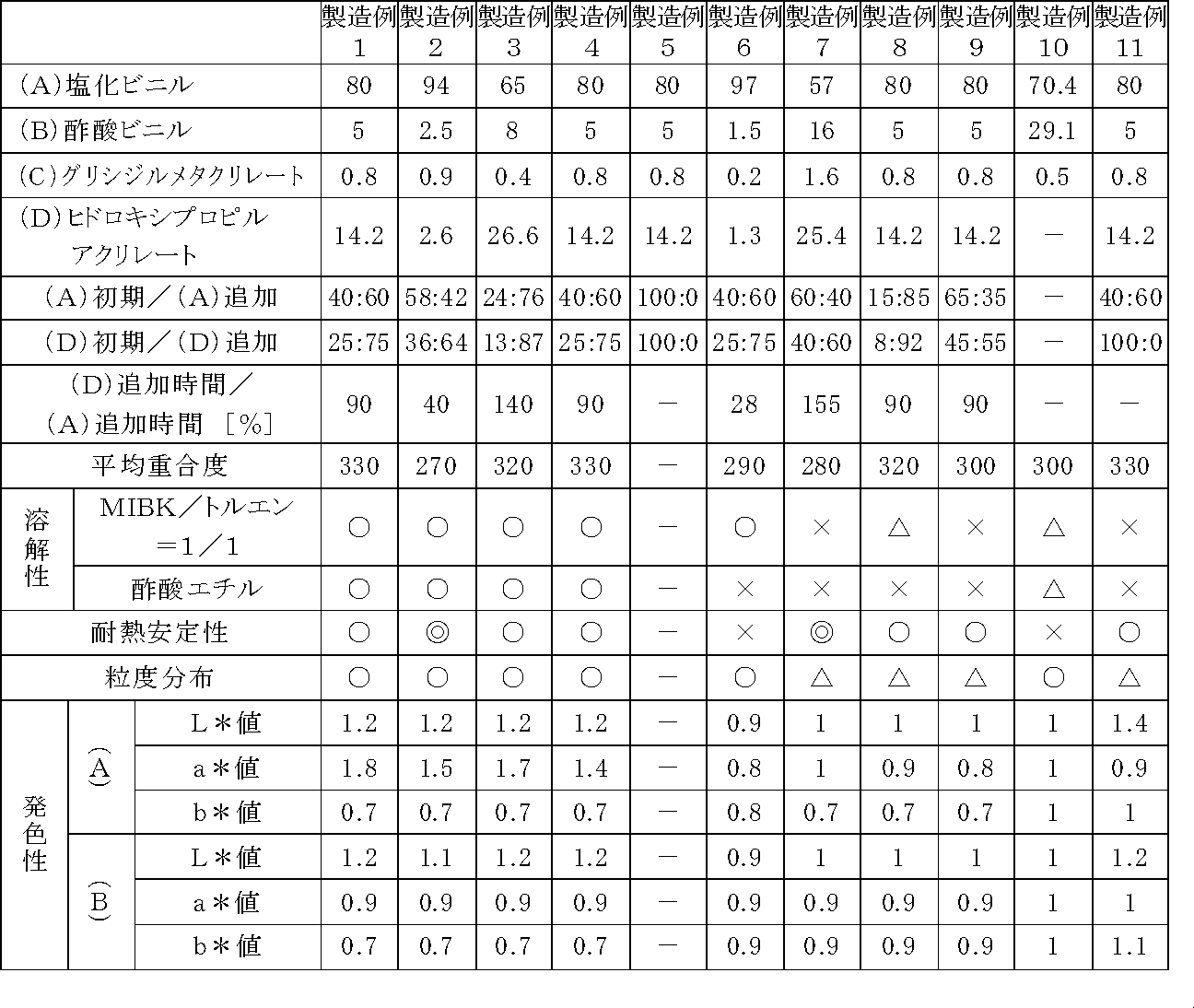
MIBK:メチルイソブチルケトン
MIBK: Methyl isobutyl ketone
Claims (8)
(B)脂肪酸ビニル単量体 2〜15質量%、
(C)エポキシ基含有ビニル単量体 0.25〜1.5質量%、
(D)ヒドロキシル基含有ビニル単量体 2〜30質量%
を共重合するに際し、重合中に(A)塩化ビニル単量体及び(D)ヒドロキシル基含有ビニル単量体のそれぞれ一部を上記の使用量範囲内でそれぞれ追加仕込みすることを特徴とする塩化ビニル系樹脂の製造方法。 (A) Vinyl chloride monomer 60-95 mass%,
(B) 2-15% by mass of a fatty acid vinyl monomer,
(C) Epoxy group-containing vinyl monomer 0.25 to 1.5% by mass,
(D) Hydroxyl group-containing vinyl monomer 2 to 30% by mass
In the copolymerization, a part of each of (A) vinyl chloride monomer and (D) hydroxyl group-containing vinyl monomer is additionally charged within the above-mentioned usage amount range during the polymerization. Manufacturing method of vinyl resin.
Priority Applications (1)
| Application Number | Priority Date | Filing Date | Title |
|---|---|---|---|
| JP2011266662A JP5729286B2 (en) | 2010-12-24 | 2011-12-06 | Vinyl chloride resin, method for producing the same, and ink |
Applications Claiming Priority (3)
| Application Number | Priority Date | Filing Date | Title |
|---|---|---|---|
| JP2010287926 | 2010-12-24 | ||
| JP2010287926 | 2010-12-24 | ||
| JP2011266662A JP5729286B2 (en) | 2010-12-24 | 2011-12-06 | Vinyl chloride resin, method for producing the same, and ink |
Publications (2)
| Publication Number | Publication Date |
|---|---|
| JP2012144706A true JP2012144706A (en) | 2012-08-02 |
| JP5729286B2 JP5729286B2 (en) | 2015-06-03 |
Family
ID=46558018
Family Applications (1)
| Application Number | Title | Priority Date | Filing Date |
|---|---|---|---|
| JP2011266662A Active JP5729286B2 (en) | 2010-12-24 | 2011-12-06 | Vinyl chloride resin, method for producing the same, and ink |
Country Status (3)
| Country | Link |
|---|---|
| JP (1) | JP5729286B2 (en) |
| KR (1) | KR101605579B1 (en) |
| CN (1) | CN102617775B (en) |
Cited By (5)
| Publication number | Priority date | Publication date | Assignee | Title |
|---|---|---|---|---|
| JP2017088717A (en) * | 2015-11-09 | 2017-05-25 | 日信化学工業株式会社 | Vinyl chloride resin for manufacturing inkjet ink and inkjet ink |
| JP2018100314A (en) * | 2016-12-19 | 2018-06-28 | 東ソー株式会社 | Ultrahigh-molecular weight polyethylene powder and process for producing the same |
| JP2018135483A (en) * | 2017-02-23 | 2018-08-30 | 日信化学工業株式会社 | Actinic ray curable composition, actinic ray curable ink composition, and production method thereof |
| JP2020535275A (en) * | 2017-09-27 | 2020-12-03 | ハンワ・ソリューションズ・コーポレイション | Vinyl chloride resin composition and its manufacturing method |
| WO2026094801A1 (en) * | 2024-10-31 | 2026-05-07 | 株式会社メニコン | Polymer material and ophthalmic lens |
Families Citing this family (3)
| Publication number | Priority date | Publication date | Assignee | Title |
|---|---|---|---|---|
| KR101759719B1 (en) * | 2016-12-05 | 2017-07-20 | 한화케미칼 주식회사 | Method for preparing vinylchloride based resin composition |
| KR101956136B1 (en) * | 2018-07-30 | 2019-03-08 | 한화케미칼 주식회사 | Vinylchloride based copolymer and method for preparing the same |
| CN113717309B (en) * | 2021-08-18 | 2023-04-11 | 无锡洪汇新材料科技股份有限公司 | Processing modified additive and preparation method thereof |
Citations (2)
| Publication number | Priority date | Publication date | Assignee | Title |
|---|---|---|---|---|
| JPS62181310A (en) * | 1985-10-15 | 1987-08-08 | ユニオン・カ−バイド・コ−ポレ−シヨン | Novel vinyl chloride resin and composition containing the same |
| JPH09118728A (en) * | 1995-09-01 | 1997-05-06 | Union Carbide Chem & Plast Technol Corp | Aqueous vinyl polymer dispersion |
Family Cites Families (6)
| Publication number | Priority date | Publication date | Assignee | Title |
|---|---|---|---|---|
| BE582656A (en) * | 1958-09-13 | |||
| CN1154972A (en) * | 1995-09-01 | 1997-07-23 | 联合碳化化学品及塑料技术公司 | Water dispersing substance for ethenyl polymer |
| JP2001114839A (en) * | 1999-10-20 | 2001-04-24 | Nisshin Chem Ind Co Ltd | Vinyl chloride-based copolymer resin and method for producing the same |
| DE10309857A1 (en) * | 2003-03-06 | 2004-09-23 | Wacker Polymer Systems Gmbh & Co. Kg | Epoxy-modified vinyl chloride-vinyl ester copolymer solid resins |
| DE10309858A1 (en) * | 2003-03-06 | 2004-09-23 | Wacker Polymer Systems Gmbh & Co. Kg | Thermostable vinyl chloride copolymers |
| DE102005041593A1 (en) * | 2005-09-01 | 2007-03-08 | Wacker Polymer Systems Gmbh & Co. Kg | Process for the preparation of vinyl chloride-vinyl acetate copolymers in the form of their solid resins |
-
2011
- 2011-12-06 JP JP2011266662A patent/JP5729286B2/en active Active
- 2011-12-22 CN CN201110463296.7A patent/CN102617775B/en active Active
- 2011-12-22 KR KR1020110139906A patent/KR101605579B1/en active Active
Patent Citations (2)
| Publication number | Priority date | Publication date | Assignee | Title |
|---|---|---|---|---|
| JPS62181310A (en) * | 1985-10-15 | 1987-08-08 | ユニオン・カ−バイド・コ−ポレ−シヨン | Novel vinyl chloride resin and composition containing the same |
| JPH09118728A (en) * | 1995-09-01 | 1997-05-06 | Union Carbide Chem & Plast Technol Corp | Aqueous vinyl polymer dispersion |
Cited By (7)
| Publication number | Priority date | Publication date | Assignee | Title |
|---|---|---|---|---|
| JP2017088717A (en) * | 2015-11-09 | 2017-05-25 | 日信化学工業株式会社 | Vinyl chloride resin for manufacturing inkjet ink and inkjet ink |
| JP2018100314A (en) * | 2016-12-19 | 2018-06-28 | 東ソー株式会社 | Ultrahigh-molecular weight polyethylene powder and process for producing the same |
| JP2018135483A (en) * | 2017-02-23 | 2018-08-30 | 日信化学工業株式会社 | Actinic ray curable composition, actinic ray curable ink composition, and production method thereof |
| JP2020535275A (en) * | 2017-09-27 | 2020-12-03 | ハンワ・ソリューションズ・コーポレイション | Vinyl chloride resin composition and its manufacturing method |
| JP7177149B2 (en) | 2017-09-27 | 2022-11-22 | ハンワ ソリューションズ コーポレイション | Vinyl chloride resin composition and method for producing the same |
| WO2026094801A1 (en) * | 2024-10-31 | 2026-05-07 | 株式会社メニコン | Polymer material and ophthalmic lens |
| WO2026094223A1 (en) * | 2024-10-31 | 2026-05-07 | 株式会社メニコン | Polymer material and ophthalmic lens |
Also Published As
| Publication number | Publication date |
|---|---|
| KR20120073122A (en) | 2012-07-04 |
| JP5729286B2 (en) | 2015-06-03 |
| CN102617775A (en) | 2012-08-01 |
| CN102617775B (en) | 2016-04-13 |
| KR101605579B1 (en) | 2016-03-22 |
Similar Documents
| Publication | Publication Date | Title |
|---|---|---|
| JP5729286B2 (en) | Vinyl chloride resin, method for producing the same, and ink | |
| EP1433794B1 (en) | Dispersion stabilizer for suspension polymerization of vinyl compound and method of producing the same | |
| CN103814051B (en) | Copolymer resin based on vinyl chloride and preparation method thereof | |
| KR101671487B1 (en) | Method of preparing vinyl chloride based resin | |
| CN110198960B (en) | Alkali-soluble resin, method for preparing the same, and emulsion polymer comprising the same | |
| JP5181566B2 (en) | Hollow particles for white ink jet ink and white ink jet ink | |
| JPH0637604B2 (en) | Fluorine-containing copolymer for paint | |
| KR101225937B1 (en) | Method for preparing polyvinyl chloride-based graft copolymer | |
| JP2023112078A (en) | Copolymer, resin composition, molded article, film-like molded article, and method for producing copolymer | |
| CN110294825B (en) | Core-shell type tertiary carbon redispersible latex powder and preparation method thereof | |
| CN101090917A (en) | Alcoholic soluble resin and preparation method thereof | |
| CN112457444B (en) | Vinyl chloride copolymer resin containing carboxyl and preparation method thereof | |
| CN102971384A (en) | Water-based liquid color containing thermostable dispersion additives for coloring poly(meth)acrylates | |
| JP2017088717A (en) | Vinyl chloride resin for manufacturing inkjet ink and inkjet ink | |
| KR101759719B1 (en) | Method for preparing vinylchloride based resin composition | |
| JP3339257B2 (en) | Vinyl chloride resin composition | |
| KR101047667B1 (en) | Method for producing vinyl chloride-vinylacetate copolymer having high volume specific gravity | |
| JP2001114839A (en) | Vinyl chloride-based copolymer resin and method for producing the same | |
| JP3254772B2 (en) | Method for producing vinyl chloride polymer | |
| JP7803190B2 (en) | Copolymer, resin composition and resin molded article | |
| JP2686564B2 (en) | Method for producing vinyl chloride resin | |
| JP6474635B2 (en) | Method for producing urethane / (meth) acrylic composite resin particles | |
| KR102770976B1 (en) | alkali water soluble resin manufacturing method comprising three-component acid, and alkali water soluble resin thereof | |
| JP2003034767A (en) | Ink and coating binder | |
| TW201843185A (en) | Active ray curable composition active ray curable ink composition and method of making the same |
Legal Events
| Date | Code | Title | Description |
|---|---|---|---|
| A625 | Written request for application examination (by other person) |
Free format text: JAPANESE INTERMEDIATE CODE: A625 Effective date: 20140225 |
|
| A977 | Report on retrieval |
Free format text: JAPANESE INTERMEDIATE CODE: A971007 Effective date: 20140728 |
|
| A131 | Notification of reasons for refusal |
Free format text: JAPANESE INTERMEDIATE CODE: A131 Effective date: 20140812 |
|
| A521 | Request for written amendment filed |
Free format text: JAPANESE INTERMEDIATE CODE: A523 Effective date: 20140917 |
|
| TRDD | Decision of grant or rejection written | ||
| A01 | Written decision to grant a patent or to grant a registration (utility model) |
Free format text: JAPANESE INTERMEDIATE CODE: A01 Effective date: 20150310 |
|
| A61 | First payment of annual fees (during grant procedure) |
Free format text: JAPANESE INTERMEDIATE CODE: A61 Effective date: 20150323 |
|
| R150 | Certificate of patent or registration of utility model |
Ref document number: 5729286 Country of ref document: JP Free format text: JAPANESE INTERMEDIATE CODE: R150 |
|
| R250 | Receipt of annual fees |
Free format text: JAPANESE INTERMEDIATE CODE: R250 |
|
| R250 | Receipt of annual fees |
Free format text: JAPANESE INTERMEDIATE CODE: R250 |