JP2012106912A - Method for manufacturing silica, and rubber composition for tire - Google Patents
Method for manufacturing silica, and rubber composition for tire Download PDFInfo
- Publication number
- JP2012106912A JP2012106912A JP2011227056A JP2011227056A JP2012106912A JP 2012106912 A JP2012106912 A JP 2012106912A JP 2011227056 A JP2011227056 A JP 2011227056A JP 2011227056 A JP2011227056 A JP 2011227056A JP 2012106912 A JP2012106912 A JP 2012106912A
- Authority
- JP
- Japan
- Prior art keywords
- silica
- solution
- sodium silicate
- water
- mass
- Prior art date
- Legal status (The legal status is an assumption and is not a legal conclusion. Google has not performed a legal analysis and makes no representation as to the accuracy of the status listed.)
- Granted
Links
Images
Landscapes
- Tires In General (AREA)
- Silicon Compounds (AREA)
- Compositions Of Macromolecular Compounds (AREA)
Abstract
【課題】分散性に優れた微粒子シリカを調製できるシリカの製造方法、及び該製造方法により得られたシリカを含むタイヤ用ゴム組成物を提供する。
【解決手段】ケイ酸ナトリウム水溶液を用いたシリカの製造方法であって、水溶性分子を用いたシリカの製造方法に関する。
【選択図】なしThe present invention provides a method for producing silica capable of preparing fine particle silica having excellent dispersibility, and a rubber composition for tires containing silica obtained by the production method.
The present invention relates to a method for producing silica using an aqueous sodium silicate solution, and a method for producing silica using water-soluble molecules.
[Selection figure] None
Description
本発明は、シリカの製造方法、及び該製造方法により得られたシリカを含むタイヤ用ゴム組成物に関する。 The present invention relates to a method for producing silica and a rubber composition for tires containing silica obtained by the production method.
シリカをゴム組成物の補強剤として使用する場合、シリカとゴム成分とをバンバリーミキサーなどで混練する、いわゆる混練法が採用されている。しかし、シリカは、自己凝集性が強いため、ゴム組成物中にシリカを分散させるためには、混練時に大きなエネルギーが必要となる。特に、水ガラス(ケイ酸ナトリウム水溶液)から調製される粒子径が10〜60nm程度のシリカ(微粒子シリカ)は、補強性が高く、ゴム組成物の物性(破壊強度など)を向上できるという利点を有する一方で、自己凝集性が非常に強く、分散が困難であるという点で改善の余地がある。 When silica is used as a reinforcing agent for a rubber composition, a so-called kneading method is employed in which silica and a rubber component are kneaded with a Banbury mixer or the like. However, since silica has a strong self-aggregation property, a large amount of energy is required during kneading in order to disperse the silica in the rubber composition. In particular, silica (particulate silica) having a particle size of about 10 to 60 nm prepared from water glass (sodium silicate aqueous solution) has an advantage that it has high reinforcing properties and can improve physical properties (such as fracture strength) of the rubber composition. On the other hand, there is room for improvement in that self-aggregation is very strong and dispersion is difficult.
特許文献1には、ゴムラテックスと水ガラスをpH調整して得られた微粒子シリカとを混合し、微粒子シリカを均一に分散させたマスターバッチの製造方法が開示されている。しかしながら、コストが高くなるデメリットがあり、従来工法によるシリカの分散性については未だ改善の余地が残されている。 Patent Document 1 discloses a method for producing a masterbatch in which rubber latex and fine particle silica obtained by adjusting pH of water glass are mixed and fine particle silica is uniformly dispersed. However, there is a demerit that increases the cost, and there is still room for improvement in the dispersibility of silica by the conventional method.
本発明は、前記課題を解決し、分散性に優れた微粒子シリカを調製できるシリカの製造方法、及び該製造方法により得られたシリカを含むタイヤ用ゴム組成物を提供することを目的とする。 The object of the present invention is to solve the above-mentioned problems and to provide a method for producing silica capable of preparing fine-particle silica having excellent dispersibility, and a rubber composition for tires containing silica obtained by the production method.
本発明者は、分散性に優れた微粒子シリカを調製する方法について検討したところ、シリカ粒子表面のシラノール基に着目した。ケイ酸ナトリウム水溶液中では、シラノール基の縮合反応が起こり、共有結合であるSi−O−Si結合が形成される。本発明者らは、このSi−O−Si結合がシリカの強い自己凝集性の原因であると考えた。 The present inventor examined a method for preparing fine-particle silica having excellent dispersibility, and focused on the silanol group on the surface of the silica particles. In the sodium silicate aqueous solution, a silanol group condensation reaction occurs, and a Si—O—Si bond which is a covalent bond is formed. The present inventors considered that this Si—O—Si bond was responsible for the strong self-aggregation of silica.
そして、本発明者が更に検討を行った結果、ケイ酸ナトリウム水溶液に水溶性分子を添加することで、シリカの自己凝集性が低下することを見出し、本発明を完成した。
すなわち、本発明は、ケイ酸ナトリウム水溶液を用いたシリカの製造方法であって、水溶性分子を用いたシリカの製造方法に関する。
As a result of further studies by the inventor, the present inventors have found that the self-aggregation property of silica is lowered by adding water-soluble molecules to an aqueous sodium silicate solution, thereby completing the present invention.
That is, the present invention relates to a method for producing silica using an aqueous sodium silicate solution, and to a method for producing silica using water-soluble molecules.
上記製造方法は、上記ケイ酸ナトリウム水溶液からシード液を調製する工程(I)と、上記ケイ酸ナトリウム水溶液からフィード液を調製する工程(II)と、該シード液及び該フィード液を、上記水溶性分子の存在下で酸とともに混合する工程(III)とを含むことが好ましい。 The manufacturing method includes a step (I) of preparing a seed solution from the aqueous sodium silicate solution, a step (II) of preparing a feed solution from the aqueous sodium silicate solution, and the seed solution and the feed solution into the water solution. And (III) mixing with an acid in the presence of a sex molecule.
上記水溶性分子がエチレングリコール及び/又はポリエチレングリコールであることが好ましい。 The water-soluble molecule is preferably ethylene glycol and / or polyethylene glycol.
上記製造方法は、平均粒子径が50nm以下の湿式法シリカが得られることが好ましい。 In the production method, it is preferable to obtain wet process silica having an average particle diameter of 50 nm or less.
本発明はまた、上記製造方法により得られたシリカを含むタイヤ用ゴム組成物に関する。 The present invention also relates to a rubber composition for tires containing silica obtained by the above production method.
本発明によれば、ケイ酸ナトリウム水溶液を用いたシリカの製造方法であって、水溶性分子を用いたシリカの製造方法であるので、分散性に優れた微粒子シリカを良好に製造できる。したがって、本発明により得られた微粒子シリカをゴム組成物に用いることで、加工性や破壊強度などに優れたタイヤ用ゴム組成物を提供することができる。 According to the present invention, since it is a method for producing silica using an aqueous sodium silicate solution and a method for producing silica using water-soluble molecules, fine-particle silica excellent in dispersibility can be produced satisfactorily. Therefore, by using the fine particle silica obtained by the present invention for the rubber composition, it is possible to provide a tire rubber composition excellent in processability and breaking strength.
本発明は、ケイ酸ナトリウム水溶液を用いたシリカの製造方法であって、水溶性分子を用いたシリカの製造方法である。水溶性分子を用いることで、シリカの自己凝集性が低下し、平均粒子径がナノオーダーの微粒子シリカであっても、良好な分散性が得られる。これは、生成したシリカ粒子の表面に水溶性分子が吸着し、上述のSi−O−Si結合の形成が抑制されるためであると考えられる。 The present invention is a method for producing silica using an aqueous sodium silicate solution, and is a method for producing silica using water-soluble molecules. By using a water-soluble molecule, the self-aggregation property of silica is lowered, and good dispersibility can be obtained even with fine-particle silica having an average particle size of nano-order. This is presumably because water-soluble molecules are adsorbed on the surface of the generated silica particles and the formation of the above-described Si—O—Si bond is suppressed.
本発明のシリカの製造方法は、ケイ酸ナトリウム水溶液を用いたシリカの製造方法であって、水溶性分子を用いたシリカの製造方法であれば特に限定されないが、上記ケイ酸ナトリウム水溶液からシード液を調製する工程(I)と、上記ケイ酸ナトリウム水溶液からフィード液を調製する工程(II)と、上記シード液及び上記フィード液を、上記水溶性分子の存在下で酸とともに混合する工程(III)とを含むことが好ましい。これにより、分散性に優れた微粒子シリカを効率良く製造できる。 The silica production method of the present invention is a silica production method using a sodium silicate aqueous solution, and is not particularly limited as long as it is a silica production method using a water-soluble molecule. Step (I) for preparing a solution, Step (II) for preparing a feed solution from the aqueous sodium silicate solution, Step of mixing the seed solution and the feed solution with an acid in the presence of the water-soluble molecule (III ). Thereby, the fine particle silica excellent in dispersibility can be manufactured efficiently.
<工程(I)>
シード液は、シリカ前駆物質(シリカの核)を含む溶液であり、その調製方法としては、例えば、ケイ酸ナトリウム水溶液のpHを調整する方法が挙げられる。なかでも、陽イオン交換樹脂を用いてケイ酸ナトリウム水溶液1のpHを2〜5に調整し、熟成する工程(I−a)、及び該工程(I−a)で得られた熟成液とケイ酸ナトリウム水溶液2とを混合した混合液のpHを、陽イオン交換樹脂を用いて9〜11に調整し、熟成する工程(I−b)又は該工程(I−a)で得られた熟成液と陽イオン交換樹脂を用いてケイ酸ナトリウム水溶液2のpHを9〜11に調整した調整液とを混合し、熟成する工程(I−c)を含む方法が好ましい。このように、pHが異なる2段階の熟成過程を経たシード液を用いることで、得られるシリカの分散性をより改善できる。理由は、上記2段階の熟成過程により、シード液中に均一なシリカの核が形成されるためではないかと考えられる。
<Process (I)>
The seed solution is a solution containing a silica precursor (silica core), and examples of the preparation method include a method of adjusting the pH of an aqueous sodium silicate solution. Among these, the pH of the sodium silicate aqueous solution 1 is adjusted to 2 to 5 by using a cation exchange resin, and is aged (Ia), and the aged liquid obtained in the step (Ia) and the silica The pH of the mixed solution obtained by mixing the sodium acid aqueous solution 2 is adjusted to 9 to 11 using a cation exchange resin, and is aged (Ib) or the aged solution obtained in the step (Ia) A method including a step (Ic) of mixing and aging the aqueous solution of sodium silicate 2 adjusted to 9 to 11 with a cation exchange resin and aging is preferable. Thus, the dispersibility of the obtained silica can be further improved by using a seed solution that has undergone a two-stage aging process with different pHs. The reason is considered to be that uniform silica nuclei are formed in the seed solution by the two-stage aging process.
<工程(I−a)>
ケイ酸ナトリウム水溶液1は、通常、下記式で示される組成で表される。
Na2O・nSiO2・mH2O
上記係数nは、SiO2/Na2Oの分子比で示される値であって、一般にモル比と呼ばれるJIS K 1408−1966に規定の範囲である。この係数nは、特に限定されないが、好ましくは2.1〜3.3であり、より好ましくは3.1〜3.3である。上記係数nが3.1〜3.3であるときは、ナトリウムイオンの含有量が低く、pH調整が容易となる。
<Process (Ia)>
The sodium silicate aqueous solution 1 is usually represented by a composition represented by the following formula.
Na 2 O · nSiO 2 · mH 2 O
The coefficient n is a value represented by a molecular ratio of SiO 2 / Na 2 O, and is a range defined in JIS K 1408-1966 generally called a molar ratio. Although this coefficient n is not specifically limited, Preferably it is 2.1-3.3, More preferably, it is 3.1-3.3. When the coefficient n is 3.1 to 3.3, the sodium ion content is low and pH adjustment is easy.
なお、一般に、上記係数nが3.1〜3.3であるケイ酸ナトリウム水溶液1は、水ガラス3号として市販されている。本発明に使用可能なケイ酸ナトリウム水溶液1は、これに限定されるものではなく、例えば、JIS K1408に規定の1〜3号水ガラスや、その他各種のグレード品を使用することができる。 In general, the sodium silicate aqueous solution 1 having the coefficient n of 3.1 to 3.3 is commercially available as Water Glass No. 3. The sodium silicate aqueous solution 1 that can be used in the present invention is not limited to this, and for example, Nos. 1 to 3 water glass defined in JIS K1408 and other various grade products can be used.
工程(I−a)では、予め水ガラスを純水で希釈する方法などにより、ケイ酸ナトリウム水溶液1が作製される。ここで、上記ケイ酸ナトリウム水溶液1中に含まれるシリカ成分(SiO2)の濃度は、0.5〜7質量%の範囲が好ましい。0.5質量%未満では、効率が悪く、7質量%を超えると、ゲル化の傾向がある。該シリカ成分の濃度は、より好ましくは0.5〜5質量%、更に好ましくは0.5〜3質量%の範囲である。 In the step (Ia), the sodium silicate aqueous solution 1 is prepared by a method of diluting water glass with pure water in advance. Here, the concentration of the silica component (SiO 2 ) contained in the aqueous sodium silicate solution 1 is preferably in the range of 0.5 to 7% by mass. If it is less than 0.5% by mass, the efficiency is poor, and if it exceeds 7% by mass, gelation tends to occur. The concentration of the silica component is more preferably in the range of 0.5 to 5% by mass, still more preferably 0.5 to 3% by mass.
工程(I−a)では、ケイ酸ナトリウム水溶液1のpHが2〜5に調整される。この範囲から外れると、熟成中に固化する傾向がある。該pHは2〜4の範囲が好ましく、2.5〜3.5の範囲がより好ましい。 In the step (Ia), the pH of the sodium silicate aqueous solution 1 is adjusted to 2 to 5. Outside this range, there is a tendency to solidify during aging. The pH is preferably in the range of 2-4, more preferably in the range of 2.5-3.5.
陽イオン交換樹脂によるpH調整方法としては、例えば、ケイ酸ナトリウム水溶液1と陽イオン交換樹脂とを接触させる方法が挙げられる。上記接触させる方法としては、ケイ酸ナトリウム水溶液1中に陽イオン交換樹脂を直接投入して撹拌、接触させるバッチ方式(ケイ酸ナトリウム水溶液1と陽イオン交換樹脂とを混合してpH調整する方法)、陽イオン交換樹脂を充填したカラムにケイ酸ナトリウム水溶液1を通液する方式(陽イオン交換樹脂を充填したカラムにケイ酸ナトリウム水溶液1を通液してpH調整する方法)が挙げられる。バッチ方式では、pH調整後、ろ過により陽イオン交換樹脂を除去できる。カラムを利用した方式は操作が簡便であり、好ましい。また、pH調整において、バッチ方式ではろ過時にシリカのロスが発生するが、カラムを利用した方式では、pH調整段階でのシリカロスを抑制することができる。 Examples of the pH adjustment method using a cation exchange resin include a method of bringing the sodium silicate aqueous solution 1 into contact with the cation exchange resin. As the method of contacting, a batch method in which a cation exchange resin is directly put into the sodium silicate aqueous solution 1 and stirred and contacted (a method of adjusting pH by mixing the sodium silicate aqueous solution 1 and the cation exchange resin). And a method of passing a sodium silicate aqueous solution 1 through a column filled with a cation exchange resin (a method of adjusting pH by passing a sodium silicate aqueous solution 1 through a column filled with a cation exchange resin). In the batch method, the cation exchange resin can be removed by filtration after pH adjustment. A method using a column is preferable because the operation is simple. Further, in pH adjustment, silica loss occurs during filtration in the batch method, but silica loss in the pH adjustment stage can be suppressed in a method using a column.
陽イオン交換樹脂としては、H型の強酸性陽イオン交換樹脂、弱酸性陽イオン交換樹脂などが使用でき、市販品として、オルガノ(株)製のアンバーライトIR120B、IR124、200CT、IRC76、FPC3500が挙げられる。 As the cation exchange resin, H-type strong acid cation exchange resin, weak acid cation exchange resin and the like can be used, and as a commercial product, Amberlite IR120B, IR124, 200CT, IRC76, FPC3500 manufactured by Organo Corporation are available. Can be mentioned.
工程(I−a)ではpH調整後に熟成し、熟成液が調製されるが、熟成温度は、好ましくは50℃以上、より好ましくは60℃以上、更に好ましくは70℃以上である。該熟成温度は、好ましくは95℃以下、より好ましくは90℃以下、更に好ましくは85℃以下である。また、熟成時間は、0.5〜24時間が好ましく、2〜10時間がより好ましい。熟成温度や熟成時間が下限未満では、熟成が不十分で、シリカの核の発生が十分でないおそれがある。上限を超えると、ゲル化し易くなる傾向がある。 In step (Ia), aging is performed after pH adjustment, and an aging solution is prepared. The aging temperature is preferably 50 ° C. or higher, more preferably 60 ° C. or higher, and further preferably 70 ° C. or higher. The aging temperature is preferably 95 ° C. or lower, more preferably 90 ° C. or lower, and still more preferably 85 ° C. or lower. The aging time is preferably 0.5 to 24 hours, and more preferably 2 to 10 hours. If the aging temperature or aging time is less than the lower limit, the aging is insufficient and the generation of silica nuclei may not be sufficient. If the upper limit is exceeded, gelation tends to occur.
<工程(I−b)、(I−c)>
工程(I−a)に続く工程として、「上記工程(I−a)で得られた熟成液とケイ酸ナトリウム水溶液2とを混合した混合液のpHを、陽イオン交換樹脂を用いて9〜11に調整し、熟成する工程(I−b)」、又は「上記工程(I−a)で得られた熟成液と陽イオン交換樹脂を用いてケイ酸ナトリウム水溶液2のpHを9〜11に調整した調整液とを混合し、熟成する工程(I−c)」が行われる。これにより、シリカ前駆体を含むシード液が調製される。
<Process (Ib), (Ic)>
As a step subsequent to the step (Ia), “the pH of the mixed solution obtained by mixing the ripening solution obtained in the step (Ia) and the aqueous sodium silicate solution 2 is 9 to 9 using a cation exchange resin. The pH of the sodium silicate aqueous solution 2 is adjusted to 9 to 11 using the aging solution and the cation exchange resin obtained in the step (Ib) ”or“ the above step (Ia) ”. Step (Ic) of mixing and aging the adjusted liquid is performed. Thereby, the seed liquid containing a silica precursor is prepared.
上記ケイ酸ナトリウム水溶液2としては、上記ケイ酸ナトリウム水溶液1と同様のものを使用できる。
工程(I−b)及び(I−c)において、ケイ酸ナトリウム水溶液2中に含まれるシリカ成分(SiO2)の濃度は、2〜30質量%の範囲が好ましい。2質量%未満では、効率が悪く、30質量%を超えると、ゲル化する傾向がある。該シリカ成分の濃度は、より好ましくは2〜10質量%、更に好ましくは3〜8質量%の範囲である。
As said sodium silicate aqueous solution 2, the thing similar to the said sodium silicate aqueous solution 1 can be used.
In the steps (Ib) and (Ic), the concentration of the silica component (SiO 2 ) contained in the sodium silicate aqueous solution 2 is preferably in the range of 2 to 30% by mass. If it is less than 2% by mass, the efficiency is poor, and if it exceeds 30% by mass, gelation tends to occur. The concentration of the silica component is more preferably in the range of 2 to 10% by mass, still more preferably 3 to 8% by mass.
工程(I−b)で陽イオン交換樹脂を用いて混合液のpHを9〜11に調整する方法、及び工程(I−c)で陽イオン交換樹脂を用いてケイ酸ナトリウム水溶液2のpHを9〜11に調整する方法は、工程(I−a)のpH調整と同様の方法を用いることができる。pHは9.0〜10.0に調整することがより好ましい。このpH調整を上記バッチ式で行う場合においても、ろ過時にシリカロスが発生する。そこで、混合順序について、工程(I−b)から工程(I−c)に変更することにより、シリカロスを低減することができ、シリカ収率が高められる。
なお、工程(I−b)及び(I−c)での混合は公知の方法により行える。
A method of adjusting the pH of the mixed solution to 9 to 11 using a cation exchange resin in the step (Ib), and a pH of the sodium silicate aqueous solution 2 using a cation exchange resin in the step (Ic). The method of adjusting to 9-11 can use the method similar to pH adjustment of a process (Ia). More preferably, the pH is adjusted to 9.0 to 10.0. Even when this pH adjustment is performed by the batch method, silica loss occurs during filtration. Therefore, by changing the mixing order from step (Ib) to step (Ic), silica loss can be reduced and the silica yield is increased.
The mixing in steps (Ib) and (Ic) can be performed by a known method.
pH調整後に熟成されるが、熟成温度は、好ましくは50℃以上、より好ましくは60℃以上、更に好ましくは70℃以上である。該熟成温度は、好ましくは95℃以下、より好ましくは90℃以下、更に好ましくは85℃以下である。また、熟成時間は、4〜50時間が好ましく、8〜35時間がより好ましい。熟成温度や熟成時間が下限未満では、熟成が不十分で、所望の粒径のシリカが生成しないおそれがある。上限を超えると、ゲル化(固化)する可能性が高くなる。 Aging is performed after pH adjustment, and the aging temperature is preferably 50 ° C. or higher, more preferably 60 ° C. or higher, and still more preferably 70 ° C. or higher. The aging temperature is preferably 95 ° C. or lower, more preferably 90 ° C. or lower, and still more preferably 85 ° C. or lower. The aging time is preferably 4 to 50 hours, more preferably 8 to 35 hours. If the aging temperature or aging time is less than the lower limit, aging is insufficient and silica having a desired particle size may not be generated. If the upper limit is exceeded, the possibility of gelation (solidification) increases.
<工程(II)>
フィード液は、シード液中のシリカ前駆物質を成長させる成分(ケイ酸ナトリウムなど)を含む溶液であり、その調製方法としては、例えば、ケイ酸ナトリウム水溶液の濃度を調整する方法が挙げられる。濃度の調整方法としては特に限定されず、ケイ酸ナトリウム水溶液を希釈する方法など、公知の方法を使用できる。
<Process (II)>
The feed liquid is a solution containing a component (such as sodium silicate) for growing a silica precursor in the seed liquid, and examples of the preparation method include a method of adjusting the concentration of an aqueous sodium silicate solution. The method for adjusting the concentration is not particularly limited, and a known method such as a method of diluting an aqueous sodium silicate solution can be used.
フィード液の調製に使用するケイ酸ナトリウム水溶液としては、シード液の場合と同様のものを使用できる。 As the sodium silicate aqueous solution used for the preparation of the feed liquid, the same solution as in the case of the seed liquid can be used.
フィード液中に含まれるシリカ成分(SiO2)の濃度は、6〜40質量%の範囲が好ましい。6質量%未満では、効率が悪く、40質量%を超えると、ゲル化する傾向がある。該シリカ成分の濃度は、より好ましくは6〜20質量%、更に好ましくは8〜15質量%の範囲である。 The concentration of the silica component (SiO 2 ) contained in the feed liquid is preferably in the range of 6 to 40% by mass. If it is less than 6% by mass, the efficiency is poor, and if it exceeds 40% by mass, gelation tends to occur. The concentration of the silica component is more preferably in the range of 6 to 20% by mass, still more preferably 8 to 15% by mass.
<工程(III)>
工程(III)は、シード液及びフィード液を、水溶性分子の存在下で酸とともに混合する工程であればよく、水溶性分子及びシード液の混合液に、フィード液及び酸を滴下して混合する工程であってもよいし(工程(III−a))、シード液に、水溶性分子及びフィード液の混合液と酸とを滴下して混合する工程であってもよいし(工程(III−b))、シード液に、水溶性分子、フィード液及び酸を滴下して混合する工程であってもよい(工程(III−c))。なかでも、反応液中での水溶性分子の濃度減少が起こらず、分散性に優れた微粒子シリカを安定して製造できるという点から、工程(III−b)、工程(III−c)が好ましく、工程(III−c)がより好ましい。
なお、工程(III−a)〜(III−c)での混合は公知の方法により行える。
<Step (III)>
Step (III) may be any step in which the seed solution and the feed solution are mixed with the acid in the presence of the water-soluble molecule. The feed solution and the acid are added dropwise to the mixture of the water-soluble molecule and the seed solution and mixed. The step may be a step (step (III-a)), or may be a step in which a mixed solution of a water-soluble molecule and a feed solution and an acid are added dropwise to the seed solution and mixed (step (III). -B)), a step of dropping and mixing the water-soluble molecule, the feed solution and the acid into the seed solution (step (III-c)). Among these, Step (III-b) and Step (III-c) are preferable from the viewpoint that the concentration of water-soluble molecules in the reaction solution does not decrease and fine silica particles having excellent dispersibility can be stably produced. Step (III-c) is more preferable.
The mixing in steps (III-a) to (III-c) can be performed by a known method.
水溶性分子としては、水への溶解性の高い分子であれば使用できるが、なかでも安価で、毒性が低く、かつ、本発明の効果が良好に得られることから、エチレングリコール、プロピレングリコール、ジエチレングリコールなどのグリコール類、その重合体(ポリエチレングリコール、ポリプロピレングリコールなど)が好ましく、エチレングリコール、ポリエチレングリコールがより好ましい。これらは単独で用いてもよく、2種以上を組み合わせて用いてもよい。 As the water-soluble molecule, any molecule can be used as long as it is highly soluble in water, but among them, it is inexpensive, has low toxicity, and the effects of the present invention can be obtained well, so that ethylene glycol, propylene glycol, Glycols such as diethylene glycol and polymers thereof (polyethylene glycol, polypropylene glycol, etc.) are preferred, and ethylene glycol and polyethylene glycol are more preferred. These may be used alone or in combination of two or more.
ポリエチレングリコールの重量平均分子量(Mw)は、好ましくは300以上、より好ましくは500以上、また、好ましくは10000以下、より好ましくは1000以下である。該Mwを上記範囲内とすることにより、本発明の効果が良好に得られる。
なお、本発明において、Mwは、ゲルパーミエーションクロマトグラフ(GPC)を用い、標準ポリスチレンより換算した値である。
The weight average molecular weight (Mw) of polyethylene glycol is preferably 300 or more, more preferably 500 or more, and preferably 10,000 or less, more preferably 1000 or less. By setting the Mw within the above range, the effects of the present invention can be obtained satisfactorily.
In the present invention, Mw is a value converted from standard polystyrene using a gel permeation chromatograph (GPC).
水溶性分子の配合量は、本発明の製造方法で使用されるシード液及びフィード液中に含まれるシリカ成分(SiO2)の合計量100質量部に対して、好ましくは5質量部以上、より好ましくは10質量部以上である。5質量部未満であると、Si−O−Si結合の形成を充分に抑制できないおそれがある。水溶性分子の配合量は、好ましくは50質量部以下、より好ましくは30質量部以下である。50質量部を超えると、シリカ微粒子の生成に影響を与え、粒子成長を阻害する可能性がある。 The blending amount of the water-soluble molecule is preferably 5 parts by mass or more with respect to 100 parts by mass of the total amount of the silica component (SiO 2 ) contained in the seed liquid and the feed liquid used in the production method of the present invention. Preferably it is 10 mass parts or more. If it is less than 5 parts by mass, the formation of Si—O—Si bonds may not be sufficiently suppressed. The compounding amount of the water-soluble molecule is preferably 50 parts by mass or less, more preferably 30 parts by mass or less. If it exceeds 50 parts by mass, it may affect the formation of silica fine particles and may inhibit particle growth.
酸としては、反応溶液のpHを調整できるものであれば特に限定されず、一般的なものを使用できる。なかでも、pH調整を効率良く行えるという点から、硫酸を好適に使用できる。 The acid is not particularly limited as long as the pH of the reaction solution can be adjusted, and a general acid can be used. Among these, sulfuric acid can be preferably used because pH can be adjusted efficiently.
工程(III)では、フィード液及び酸の滴下速度や濃度を調整するなどの方法により、反応溶液のpHを一定の範囲内に制御することが好ましい。これにより、シリカを均一に成長させ、分散性をより向上できる。 In step (III), it is preferable to control the pH of the reaction solution within a certain range by adjusting the dropping rate and concentration of the feed liquid and acid. Thereby, a silica can be grown uniformly and a dispersibility can be improved more.
工程(III)において、反応溶液のpHは8.0〜12.0に調整することが好ましい。この範囲から外れると、シリカが均一に成長できないおそれがある。pHは8.5〜11.5に調整することがより好ましい。 In step (III), the pH of the reaction solution is preferably adjusted to 8.0 to 12.0. If it is out of this range, silica may not grow uniformly. More preferably, the pH is adjusted to 8.5 to 11.5.
工程(III)において、反応溶液の温度は、好ましくは70℃以上、より好ましくは80℃以上、また、好ましくは100℃以下、より好ましくは98℃以下である。この範囲から外れると、シリカの均一性が悪化する傾向がある。 In step (III), the temperature of the reaction solution is preferably 70 ° C. or higher, more preferably 80 ° C. or higher, and preferably 100 ° C. or lower, more preferably 98 ° C. or lower. When it deviates from this range, the uniformity of silica tends to deteriorate.
工程(III)終了後は、通常の湿式法シリカの製造方法と同様にして、シリカを製造できる。例えば、まず、工程(III)によって得られたシリカ分散液に酸を滴下し、pHを3付近に調整して、反応を終了させる。次いで、必要に応じてろ過、洗浄及び乾燥を行い、平均粒子径がナノオーダーの微粒子シリカが得られる。 After completion of step (III), silica can be produced in the same manner as in the usual method for producing wet silica. For example, first, an acid is added dropwise to the silica dispersion obtained in the step (III), the pH is adjusted to around 3, and the reaction is terminated. Subsequently, filtration, washing, and drying are performed as necessary to obtain fine-particle silica having an average particle diameter of nano-order.
上記微粒子シリカの平均粒子径は、好ましくは50nm以下、より好ましくは40nm以下、更に好ましくは30nm以下である。また、該平均粒子径は、好ましくは5nm以上、より好ましくは8nm以上、更に好ましくは10nm以上である。上記範囲内であれば、分散性に優れた微粒子シリカが得られる。
ここで、平均粒子径の大きさは、上記製造方法において、シード液やフィード液のシリカ成分の濃度、上記熟成液や混合液のpH、熟成温度、熟成時間などにより調整できる。
The average particle diameter of the fine particle silica is preferably 50 nm or less, more preferably 40 nm or less, and still more preferably 30 nm or less. The average particle size is preferably 5 nm or more, more preferably 8 nm or more, and still more preferably 10 nm or more. If it is in the said range, the fine particle silica excellent in the dispersibility will be obtained.
Here, the size of the average particle diameter can be adjusted by the concentration of the silica component of the seed solution or the feed solution, the pH of the ripening solution or the mixed solution, the aging temperature, the aging time, etc. in the above production method.
本明細書において、微粒子シリカの平均粒子径の測定方法は、透過型電子顕微鏡(TEM)観察が用いられる。具体的には、微粒子を透過型電子顕微鏡で写真撮影し、微粒子の形状が球形の場合には球の直径を粒子径とし、針状又は棒状の場合には短径を粒子径とし、不定型の場合には中心部からの平均粒径を粒子径とし、微粒子100個の粒径の平均値を平均粒子径とする。 In the present specification, transmission electron microscope (TEM) observation is used as a method for measuring the average particle diameter of the fine particle silica. Specifically, the microparticles are photographed with a transmission electron microscope. If the shape of the microparticles is spherical, the diameter of the sphere is the particle diameter, and if it is needle-shaped or rod-shaped, the minor diameter is the particle diameter. In this case, the average particle diameter from the center is defined as the particle diameter, and the average value of the particle diameters of 100 fine particles is defined as the average particle diameter.
本発明のシリカは、補強剤として本発明のゴム組成物に使用できる。なお、本発明のゴム組成物は、カーボンブラック、シランカップリング剤、亜鉛華、ステアリン酸、老化防止剤、硫黄、加硫促進剤などの、タイヤ工業において一般的に用いられている配合剤を配合していてもよく、これらの配合剤の含有量も適宜設定できる。 The silica of the present invention can be used as a reinforcing agent in the rubber composition of the present invention. The rubber composition of the present invention includes compounding agents generally used in the tire industry, such as carbon black, silane coupling agent, zinc white, stearic acid, anti-aging agent, sulfur, and vulcanization accelerator. You may mix | blend and content of these compounding agents can also be set suitably.
本発明のゴム組成物は、前記各成分をオープンロール、バンバリーミキサー、密閉式混練機などのゴム混練装置を用いて混練し、その後加硫する方法などにより製造できる。得られるゴム組成物は、低燃費性、耐摩耗性、破断強度、破断時伸びなど、タイヤの要求性能を備えており、タイヤの各部材(トレッド、サイドウォールなど)に好適に使用できる。 The rubber composition of the present invention can be produced by a method of kneading each component using a rubber kneader such as an open roll, a Banbury mixer, a closed kneader, and then vulcanizing. The resulting rubber composition has the required performance of the tire such as low fuel consumption, wear resistance, breaking strength, elongation at break, and can be suitably used for each member (tread, sidewall, etc.) of the tire.
本発明のゴム組成物を用いた空気入りタイヤは通常の方法によって製造できる。すなわち、ゴム組成物を未加硫の段階でトレッド、サイドウォールなどの各タイヤ部材の形状に合わせて押し出し加工し、タイヤ成形機上にて通常の方法にて成形し、他のタイヤ部材とともに貼り合わせ、未加硫タイヤを形成する。この未加硫タイヤを加硫機中で加熱加圧して空気入りタイヤを製造できる。 A pneumatic tire using the rubber composition of the present invention can be produced by a usual method. That is, the rubber composition is extruded in accordance with the shape of each tire member such as tread and sidewall at an unvulcanized stage, molded by a normal method on a tire molding machine, and pasted together with other tire members. Together, an unvulcanized tire is formed. This unvulcanized tire can be heated and pressurized in a vulcanizer to produce a pneumatic tire.
実施例に基づいて、本発明を具体的に説明するが、本発明はこれらのみに限定されるものではない。 The present invention will be specifically described based on examples, but the present invention is not limited to these examples.
以下に、実施例1〜3及び比較例1で用いた各種薬品について説明する。
水ガラス:富士化学(株)製の水ガラス3号(Na2O・nSiO2・mH2O、n=3.2、シリカ成分(SiO2換算量)含有量:28質量%)
陽イオン交換樹脂:オルガノ(株)製のアンバーライトIR−120B(H)HG(H型強酸性陽イオン交換樹脂)
エチレングリコール:和光純薬工業(株)製特級
ポリエチレングリコール1:和光純薬工業(株)製(Mw:600)
ポリエチレングリコール2:和光純薬工業(株)製(Mw:6000)
濃硫酸:和光純薬工業(株)製
The various chemicals used in Examples 1 to 3 and Comparative Example 1 are described below.
Water glass: Water glass No. 3 manufactured by Fuji Chemical Co., Ltd. (Na 2 O.nSiO 2 .mH 2 O, n = 3.2, silica component (SiO 2 equivalent) content: 28% by mass)
Cation exchange resin: Amberlite IR-120B (H) HG (H-type strongly acidic cation exchange resin) manufactured by Organo Corporation
Ethylene glycol: Wako Pure Chemical Industries, Ltd. Special grade polyethylene glycol 1: Wako Pure Chemical Industries, Ltd. (Mw: 600)
Polyethylene glycol 2: Wako Pure Chemical Industries, Ltd. (Mw: 6000)
Concentrated sulfuric acid: Wako Pure Chemical Industries, Ltd.
(実施例1)
水230g及び上記水ガラス13gを混合し、1.5質量%ケイ酸ナトリウム溶液(ケイ酸ナトリウム溶液1)を調製した。1.5質量%ケイ酸ナトリウム溶液に含まれるナトリウムイオンを、陽イオン交換樹脂を用いて取り除き、pH3に調整した後、80℃、3時間の条件で熟成させた(熟成液A)。
次に、室温に戻した熟成液Aを、水150g及び上記水ガラス32gを混合して調製した5質量%ケイ酸ナトリウム水溶液(ケイ酸ナトリウム水溶液2)182gに加えた。この混合液のpHを陽イオン交換樹脂を用いて9.5に調整し、80℃、16時間の条件で熟成させた(シード液)。
水293gと上記水ガラス207gを混合して調製した12%ケイ酸ナトリウム水溶液(フィード液)に水溶性分子であるエチレングリコールを15g加え、混合液Aを調製した。
シリカ前駆物質を含む上記シード液を撹拌機を付属させた2L反応容器に移し、液温を80℃に加熱してから、上記混合液Aと濃硫酸とを同時に滴下し、80℃に維持しながら中和反応を行った。上記混合液Aの滴下速度は10ml/minとし、濃硫酸は、反応溶液のpHが8.5〜10.5となるように流量を調節した。中和反応の途中から反応溶液が白濁し始め、粘度が上昇してきたため、一定の混合状態を維持するために、撹拌速度を120〜210rpmの範囲で調整した。
中和反応を50分間行った時点で上記混合液Aの滴下を止め、反応溶液のpHが3になるまで濃硫酸だけを滴下し続け、ケイ酸スラリーを得た。得られたケイ酸スラリーを減圧ろ過した後、水洗を行い、湿潤ケーキを得た。得られた湿潤ケーキを80℃で乾燥させて実施例1のシリカ75gを得た。
なお、本実施例において、エチレングリコールの配合量は、使用したシード液及びフィード液中のシリカ成分の合計量100質量部に対して、20質量部とした。
Example 1
230 g of water and 13 g of the above water glass were mixed to prepare a 1.5 mass% sodium silicate solution (sodium silicate solution 1). Sodium ions contained in the 1.5 mass% sodium silicate solution were removed using a cation exchange resin, adjusted to pH 3, and then aged at 80 ° C. for 3 hours (aging solution A).
Next, the ripening liquid A returned to room temperature was added to 182 g of a 5 mass% sodium silicate aqueous solution (sodium silicate aqueous solution 2) prepared by mixing 150 g of water and 32 g of the water glass. The pH of this mixed solution was adjusted to 9.5 using a cation exchange resin and aged at 80 ° C. for 16 hours (seed solution).
15 g of ethylene glycol, which is a water-soluble molecule, was added to a 12% aqueous sodium silicate solution (feed solution) prepared by mixing 293 g of water and 207 g of the above water glass to prepare a mixed solution A.
The seed solution containing the silica precursor is transferred to a 2 L reaction vessel equipped with a stirrer and heated to 80 ° C, and then the mixture A and concentrated sulfuric acid are added dropwise at the same time and maintained at 80 ° C. The neutralization reaction was carried out. The dropping speed of the mixed solution A was 10 ml / min, and the flow rate of concentrated sulfuric acid was adjusted so that the pH of the reaction solution was 8.5 to 10.5. Since the reaction solution began to become cloudy in the middle of the neutralization reaction and the viscosity increased, the stirring speed was adjusted in the range of 120 to 210 rpm in order to maintain a constant mixed state.
When the neutralization reaction was performed for 50 minutes, the dropping of the mixed solution A was stopped, and only concentrated sulfuric acid was continuously dropped until the pH of the reaction solution reached 3, to obtain a silicic acid slurry. The resulting silicic acid slurry was filtered under reduced pressure and washed with water to obtain a wet cake. The obtained wet cake was dried at 80 ° C. to obtain 75 g of silica of Example 1.
In the present example, the blending amount of ethylene glycol was 20 parts by mass with respect to 100 parts by mass of the total amount of silica components in the seed solution and the feed solution used.
(実施例2)
エチレングリコールの代わりにポリエチレングリコール1(Mw=600)を用いた点以外は実施例1と同様の方法により、実施例2のシリカ75gを得た。
なお、本実施例において、ポリエチレングリコール1の配合量は、使用したシード液及びフィード液中のシリカ成分の合計量100質量部に対して、20質量部とした。
(Example 2)
In the same manner as in Example 1 except that polyethylene glycol 1 (Mw = 600) was used instead of ethylene glycol, 75 g of silica in Example 2 was obtained.
In the present example, the blending amount of polyethylene glycol 1 was 20 parts by mass with respect to 100 parts by mass of the total amount of silica components in the seed solution and the feed solution used.
(実施例3)
エチレングリコールの代わりにポリエチレングリコール2(Mw=6000)を用いた点以外は実施例1と同様の方法により、実施例3のシリカ75gを得た。
なお、本実施例において、ポリエチレングリコール2の配合量は、使用したシード液及びフィード液中のシリカ成分の合計量100質量部に対して、20質量部とした。
(比較例1)
エチレングリコールを加えなかった点以外は実施例1と同様の方法により、比較例1のシリカ75gを得た。
(Example 3)
75 g of silica of Example 3 was obtained by the same method as Example 1 except that polyethylene glycol 2 (Mw = 6000) was used instead of ethylene glycol.
In this example, the blending amount of polyethylene glycol 2 was 20 parts by mass with respect to 100 parts by mass of the total amount of silica components in the seed solution and the feed solution used.
(Comparative Example 1)
By the same method as in Example 1 except that ethylene glycol was not added, 75 g of silica of Comparative Example 1 was obtained.
実施例及び比較例で調製したシリカについて、TEM写真の観察により、それぞれ以下の平均粒子径を有していることを確認した。
実施例1:25nm
実施例2:25nm
実施例3:21nm
比較例1:30nm
また、FT−IR測定により、エチレングリコールやポリエチレングリコールが最終生成物であるシリカに残存していないことを確認した。
About the silica prepared by the Example and the comparative example, it confirmed that it had the following average particle diameters by observation of the TEM photograph, respectively.
Example 1: 25 nm
Example 2: 25 nm
Example 3: 21 nm
Comparative Example 1: 30 nm
Further, it was confirmed by FT-IR measurement that ethylene glycol or polyethylene glycol did not remain in the final product silica.
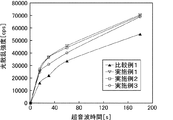
上記方法で得られたシリカ(含水ケイ酸)20mg及び水100gを100mLビーカー内で撹拌し、サンプルを調製した。撹拌は、超音波ホモジナイザー(BRANSON社製Sonifier II model450D)用いて行い、撹拌時間は、15s、30s、60s、180sとした。次に、サンプルを孔径5μmのフィルター(ザルトリウス製ミニザルト)に通過させ、得られたろ液成分を光学測定用セルに入れ、光散乱光度計(大塚電子株式会社製ELSZ−2)を用いて光散乱強度を測定した。測定は100回行い、その平均値をとった。測定結果を図1に示す。光散乱強度が高いほど、シリカが良好に分散していることを示す。 20 mg of silica (hydrous silicic acid) obtained by the above method and 100 g of water were stirred in a 100 mL beaker to prepare a sample. Stirring was performed using an ultrasonic homogenizer (Sonifier II model 450D manufactured by BRANSON), and the stirring time was 15 s, 30 s, 60 s, and 180 s. Next, the sample is passed through a filter having a pore size of 5 μm (Sartorius mini-Salto), the obtained filtrate component is put into an optical measurement cell, and light scattering is performed using a light scattering photometer (ELSZ-2 manufactured by Otsuka Electronics Co., Ltd.). The strength was measured. The measurement was performed 100 times and the average value was taken. The measurement results are shown in FIG. The higher the light scattering intensity, the better the silica is dispersed.
試験結果から、エチレングリコールやポリエチレングリコール(水溶性高分子)を添加して得られた実施例のシリカは、光散乱強度が高く、分散性が向上した(シリカの凝集が抑制された)ことがわかった。そのため、ゴム組成物内で良好な分散性が得られ、加工性、破壊強度などの性能の向上が期待できた。 From the test results, the silica of Examples obtained by adding ethylene glycol or polyethylene glycol (water-soluble polymer) has high light scattering intensity and improved dispersibility (silica aggregation is suppressed). all right. Therefore, good dispersibility was obtained in the rubber composition, and improvement in performance such as processability and breaking strength could be expected.
以下に、実施例4〜6及び比較例2で用いた各種薬品について説明する。
スチレンブタジエンゴム(SBR):日本ゼオン(株)製のNipol 1502(スチレン量:23.5質量%)
シリカ1:上記実施例1
シリカ2:上記実施例2
シリカ3:上記実施例3
シリカ4:上記比較例1
シランカップリング剤:EVONIK−DEGUSSA社製のSi69(ビス(3−トリエトキシシリルプロピル)テトラスルフィド)
亜鉛華:三井金属鉱業(株)製の亜鉛華2種
ステアリン酸:日油(株)製の椿
老化防止剤:大内新興化学工業(株)製のノクラック6C(N−(1,3−ジメチルブチル)−N’−フェニル−p−フェニレンジアミン)
硫黄:鶴見化学工業(株)製の粉末硫黄
加硫促進剤NS:大内新興化学工業(株)製のノクセラ−NS(N−tert−ブチル−2−ベンゾチアゾリルスルフェンアミド)
The various chemicals used in Examples 4 to 6 and Comparative Example 2 are described below.
Styrene butadiene rubber (SBR): Nipol 1502 (styrene content: 23.5 mass%) manufactured by Nippon Zeon Co., Ltd.
Silica 1: Example 1 above
Silica 2: Example 2 above
Silica 3: Example 3 above
Silica 4: Comparative Example 1 above
Silane coupling agent: Si69 (bis (3-triethoxysilylpropyl) tetrasulfide) manufactured by EVONIK-DEGUSSA
Zinc Hana: Mitsui Mining & Mining Co., Ltd. Zinc Hana 2 types Stearic Acid: NOF Co., Ltd. Anti-aging Agent: Nouchi 6C (N- (1,3- Dimethylbutyl) -N′-phenyl-p-phenylenediamine)
Sulfur: Powder sulfur vulcanization accelerator manufactured by Tsurumi Chemical Co., Ltd. NS: Noxera-NS (N-tert-butyl-2-benzothiazolylsulfenamide) manufactured by Ouchi Shinsei Chemical Co., Ltd.
(実施例4〜6、比較例2)
表1に示す配合に従って、1.7Lバンバリーミキサーを用いて、硫黄及び加硫促進剤以外の薬品を混練りした。次に、ロールを用いて、得られた混練り物に硫黄及び加硫促進剤を添加して練り込み、未加硫ゴム組成物を得た。得られた未加硫ゴム組成物を150℃で30分間プレス加硫して加硫物を得た。得られた加硫物を下記により評価し、結果を表1に示した。
(Examples 4 to 6, Comparative Example 2)
According to the formulation shown in Table 1, chemicals other than sulfur and a vulcanization accelerator were kneaded using a 1.7 L Banbury mixer. Next, using a roll, sulfur and a vulcanization accelerator were added to the obtained kneaded product and kneaded to obtain an unvulcanized rubber composition. The obtained unvulcanized rubber composition was press vulcanized at 150 ° C. for 30 minutes to obtain a vulcanized product. The obtained vulcanizates were evaluated as follows, and the results are shown in Table 1.
(転がり抵抗)
粘弾性スペクトロメーターVES((株)岩本製作所製)を用いて、温度50℃、初期歪み10%、動歪み2%、周波数10Hzの条件下で各配合(加硫物)のtanδを測定し、比較例2のゴム試験片(基準試験片)のtanδを100として、下記計算式により指数表示した(転がり抵抗指数)。指数が大きいほど転がり抵抗特性(低燃費性)が優れる。
(転がり抵抗指数)=(基準試験片のtanδ)/(各配合のtanδ)×100
(Rolling resistance)
Using a viscoelastic spectrometer VES (manufactured by Iwamoto Seisakusho Co., Ltd.), tan δ of each compound (vulcanized product) was measured under the conditions of a temperature of 50 ° C., an initial strain of 10%, a dynamic strain of 2%, and a frequency of 10 Hz. The tan δ of the rubber test piece (reference test piece) of Comparative Example 2 was set to 100, and the index was expressed by the following formula (rolling resistance index). The larger the index, the better the rolling resistance characteristics (low fuel consumption).
(Rolling resistance index) = (tan δ of standard test piece) / (tan δ of each formulation) × 100
(摩耗試験)
ランボーン摩耗試験機を用いて、温度20℃、スリップ率20%及び試験時間2分間の条件下で各配合(加硫物)のランボーン摩耗量を測定した。更に、測定したランボーン摩耗量から容積損失量を計算し、比較例2のゴム試験片(基準試験片)の摩耗指数を100とし、下記計算式により、各配合の容積損失量を指数表示した。指数が大きいほど、耐摩耗性に優れることを示す。
(摩耗指数)=(基準試験片の容積損失量)/(各配合の容積損失量)×100
(Abrasion test)
Using a Lambourn abrasion tester, the Lambourn abrasion amount of each compound (vulcanized product) was measured under the conditions of a temperature of 20 ° C., a slip ratio of 20% and a test time of 2 minutes. Further, the volume loss amount was calculated from the measured amount of lamborn wear, the wear index of the rubber test piece (reference test piece) of Comparative Example 2 was taken as 100, and the volume loss amount of each formulation was displayed as an index using the following formula. It shows that it is excellent in abrasion resistance, so that an index | exponent is large.
(Abrasion index) = (Volume loss amount of standard specimen) / (Volume loss amount of each compound) × 100
(破断強度・破断時伸び)
加硫物を用いて3号ダンベル型ゴム試験片を作製し、JIS K6251「加硫ゴム及び熱可塑性ゴム−引張特性の求め方」に準じて引張試験を行い、破断強度(TB)、破断時伸び(EB)を測定した。比較例2のゴム試験片(基準試験片)のTB指数、EB指数をそれぞれ100とし、下記計算式により、各配合のTB、EBを指数表示した。TB指数が大きいほど補強性(破壊強度)に優れ、EB指数が大きいほど耐クラック性に優れることを示す。
(TB指数)=(各配合のTB)/(基準試験片のTB)×100
(EB指数)=(各配合のEB)/(基準試験片のEB)×100
(Breaking strength / elongation at break)
No. 3 dumbbell-shaped rubber test piece was prepared from the vulcanized product, and a tensile test was conducted according to JIS K6251 “Vulcanized rubber and thermoplastic rubber-Determination of tensile properties”. Breaking strength (TB), at break Elongation (EB) was measured. The TB index and EB index of the rubber test piece (reference test piece) of Comparative Example 2 were set to 100, and the TB and EB of each blend were indicated by an index according to the following formula. It shows that it is excellent in reinforcement property (breaking strength), so that TB index is large, and it is excellent in crack resistance, so that EB index is large.
(TB index) = (TB of each formulation) / (TB of reference specimen) × 100
(EB index) = (EB of each formulation) / (EB of reference specimen) × 100
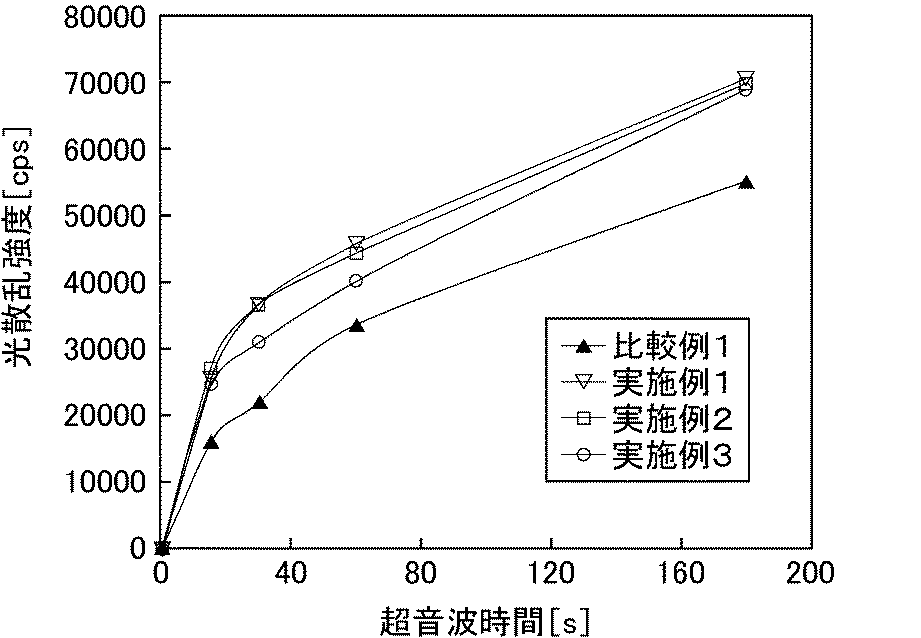
表1から、シリカ1〜3(実施例1〜3のシリカ)を用いた実施例4〜6は、比較例2と比較して、タイヤに要求される低燃費性、耐摩耗性、破断強度、破断時伸びに優れていた。また、加工性も良好に得られた。これは、実施例1〜3のシリカが、ケイ酸ナトリウム水溶液を用いたシリカの製法であって、水溶性分子を用いたシリカの製法で調製されたものであり、分散が良好になった結果と考えられる。 From Table 1, Examples 4 to 6 using silicas 1 to 3 (silicas of Examples 1 to 3) are lower in fuel efficiency, wear resistance, and breaking strength required for tires than Comparative Example 2. The elongation at break was excellent. Also, good workability was obtained. This is a result of the silica of Examples 1 to 3 being prepared by a silica manufacturing method using a sodium silicate aqueous solution and prepared by a silica manufacturing method using water-soluble molecules. it is conceivable that.
Claims (5)
水溶性分子を用いたシリカの製造方法。 A method for producing silica using an aqueous sodium silicate solution,
A method for producing silica using water-soluble molecules.
前記ケイ酸ナトリウム水溶液からフィード液を調製する工程(II)と、
該シード液及び該フィード液を、前記水溶性分子の存在下で酸とともに混合する工程(III)とを含む請求項1記載のシリカの製造方法。 Preparing a seed solution from the aqueous sodium silicate solution (I);
Preparing a feed solution from the aqueous sodium silicate solution (II);
The method for producing silica according to claim 1, comprising a step (III) of mixing the seed solution and the feed solution together with an acid in the presence of the water-soluble molecule.
Priority Applications (1)
| Application Number | Priority Date | Filing Date | Title |
|---|---|---|---|
| JP2011227056A JP5860661B2 (en) | 2010-10-19 | 2011-10-14 | Method for producing silica and rubber composition for tire |
Applications Claiming Priority (3)
| Application Number | Priority Date | Filing Date | Title |
|---|---|---|---|
| JP2010234852 | 2010-10-19 | ||
| JP2010234852 | 2010-10-19 | ||
| JP2011227056A JP5860661B2 (en) | 2010-10-19 | 2011-10-14 | Method for producing silica and rubber composition for tire |
Publications (2)
| Publication Number | Publication Date |
|---|---|
| JP2012106912A true JP2012106912A (en) | 2012-06-07 |
| JP5860661B2 JP5860661B2 (en) | 2016-02-16 |
Family
ID=46492979
Family Applications (1)
| Application Number | Title | Priority Date | Filing Date |
|---|---|---|---|
| JP2011227056A Expired - Fee Related JP5860661B2 (en) | 2010-10-19 | 2011-10-14 | Method for producing silica and rubber composition for tire |
Country Status (1)
| Country | Link |
|---|---|
| JP (1) | JP5860661B2 (en) |
Cited By (5)
| Publication number | Priority date | Publication date | Assignee | Title |
|---|---|---|---|---|
| JP2016196380A (en) * | 2015-04-02 | 2016-11-24 | 住友ゴム工業株式会社 | Silica evaluation method |
| CN110218366A (en) * | 2018-03-02 | 2019-09-10 | 中国石油化工股份有限公司 | Isoprene rubber/Nano carbon white composite material, vulcanizate and its preparation method and application |
| US10947363B2 (en) | 2016-05-16 | 2021-03-16 | Harima Chemicals, Incorporated | Filler for tires, rubber composition for tires, tire, method for producing filler for tires, and aggregation inhibitor |
| CN113501529A (en) * | 2021-07-05 | 2021-10-15 | 安徽龙泉硅材料有限公司 | Preparation method of sodium silicate for tire reinforcing agent |
| CN117658158A (en) * | 2022-05-23 | 2024-03-08 | 福建远翔新材料股份有限公司 | Preparation method of hydrated silica to prevent particle agglomeration |
Citations (9)
| Publication number | Priority date | Publication date | Assignee | Title |
|---|---|---|---|---|
| JPS60204614A (en) * | 1984-03-30 | 1985-10-16 | Nippon Sheet Glass Co Ltd | Production of high purity silica gel |
| JPS60251119A (en) * | 1984-05-24 | 1985-12-11 | Nissan Chem Ind Ltd | Manufacture of silica sol of large particle size |
| JPS627622A (en) * | 1985-07-04 | 1987-01-14 | Nissan Chem Ind Ltd | Production of silica sol having extremely fine grain diameter |
| JPH02110144A (en) * | 1979-12-20 | 1990-04-23 | Rhone Poulenc Ind | Filler for elastomer |
| JPH0474707A (en) * | 1990-07-09 | 1992-03-10 | Nippon Monsant Kk | Production of colloidal silica |
| WO2002085785A1 (en) * | 2001-04-17 | 2002-10-31 | Tokuyama Corporation | Method for producing inorganic porous material |
| JP2008179520A (en) * | 2007-01-26 | 2008-08-07 | Tokuyama Corp | Method for producing dual pore silica |
| JP2009051955A (en) * | 2007-08-28 | 2009-03-12 | Sumitomo Rubber Ind Ltd | Method for producing masterbatch and rubber composition |
| JP2009184852A (en) * | 2008-02-04 | 2009-08-20 | Nippon Chem Ind Co Ltd | Colloidal silica composed of silica particles with imidazole immobilized |
-
2011
- 2011-10-14 JP JP2011227056A patent/JP5860661B2/en not_active Expired - Fee Related
Patent Citations (9)
| Publication number | Priority date | Publication date | Assignee | Title |
|---|---|---|---|---|
| JPH02110144A (en) * | 1979-12-20 | 1990-04-23 | Rhone Poulenc Ind | Filler for elastomer |
| JPS60204614A (en) * | 1984-03-30 | 1985-10-16 | Nippon Sheet Glass Co Ltd | Production of high purity silica gel |
| JPS60251119A (en) * | 1984-05-24 | 1985-12-11 | Nissan Chem Ind Ltd | Manufacture of silica sol of large particle size |
| JPS627622A (en) * | 1985-07-04 | 1987-01-14 | Nissan Chem Ind Ltd | Production of silica sol having extremely fine grain diameter |
| JPH0474707A (en) * | 1990-07-09 | 1992-03-10 | Nippon Monsant Kk | Production of colloidal silica |
| WO2002085785A1 (en) * | 2001-04-17 | 2002-10-31 | Tokuyama Corporation | Method for producing inorganic porous material |
| JP2008179520A (en) * | 2007-01-26 | 2008-08-07 | Tokuyama Corp | Method for producing dual pore silica |
| JP2009051955A (en) * | 2007-08-28 | 2009-03-12 | Sumitomo Rubber Ind Ltd | Method for producing masterbatch and rubber composition |
| JP2009184852A (en) * | 2008-02-04 | 2009-08-20 | Nippon Chem Ind Co Ltd | Colloidal silica composed of silica particles with imidazole immobilized |
Cited By (6)
| Publication number | Priority date | Publication date | Assignee | Title |
|---|---|---|---|---|
| JP2016196380A (en) * | 2015-04-02 | 2016-11-24 | 住友ゴム工業株式会社 | Silica evaluation method |
| US10947363B2 (en) | 2016-05-16 | 2021-03-16 | Harima Chemicals, Incorporated | Filler for tires, rubber composition for tires, tire, method for producing filler for tires, and aggregation inhibitor |
| CN110218366A (en) * | 2018-03-02 | 2019-09-10 | 中国石油化工股份有限公司 | Isoprene rubber/Nano carbon white composite material, vulcanizate and its preparation method and application |
| CN110218366B (en) * | 2018-03-02 | 2024-06-04 | 中国石油化工股份有限公司 | Isoprene rubber/nano white carbon black composite material, vulcanized rubber, preparation method and application thereof |
| CN113501529A (en) * | 2021-07-05 | 2021-10-15 | 安徽龙泉硅材料有限公司 | Preparation method of sodium silicate for tire reinforcing agent |
| CN117658158A (en) * | 2022-05-23 | 2024-03-08 | 福建远翔新材料股份有限公司 | Preparation method of hydrated silica to prevent particle agglomeration |
Also Published As
| Publication number | Publication date |
|---|---|
| JP5860661B2 (en) | 2016-02-16 |
Similar Documents
| Publication | Publication Date | Title |
|---|---|---|
| CN101959700B (en) | Including silicon dioxide as the diene rubber compsns for tire of reinforcer | |
| JP6091549B2 (en) | Composite and production method thereof | |
| JP5395045B2 (en) | Rubber composition for tire and studless tire | |
| CN106029567B (en) | Novel process for the preparation of precipitated silica, novel precipitated silica and uses thereof, especially for reinforcing polymers | |
| EP3681945B1 (en) | Tyre for vehicle wheels comprising a composite reinforcing filler | |
| JP5997283B2 (en) | Silica / styrene butadiene rubber composite, method for producing the same, rubber composition, and pneumatic tire | |
| JP5860661B2 (en) | Method for producing silica and rubber composition for tire | |
| US20170121511A1 (en) | A process to prepare high-quality natural rubber silica masterbatch by liquid phase mixing | |
| JP5670768B2 (en) | Composite, production method thereof, rubber composition and pneumatic tire | |
| JP2022505630A (en) | Precipitated silica and its manufacturing process | |
| JP5524810B2 (en) | Composite, production method thereof, rubber composition and pneumatic tire | |
| WO2016014037A1 (en) | A process to prepare high-quality natural rubber-silica masterbatch by liquid phase mixing | |
| JP5860660B2 (en) | Silica / natural rubber composite and production method thereof, rubber composition and pneumatic tire | |
| JP5829473B2 (en) | Method for producing silica and rubber composition | |
| JP6068910B2 (en) | Silica / styrene butadiene rubber composite, method for producing the same, rubber composition and pneumatic tire | |
| CN106084323A (en) | A kind of tripoli/natural rubber masterbatch and preparation method thereof | |
| JP5480585B2 (en) | Composite, rubber composition and pneumatic tire | |
| JP6950151B2 (en) | Silica manufacturing method and silica | |
| WO2022173733A1 (en) | Silica gel as reinforcement agent for rubber compounds | |
| EP4291606A1 (en) | Silica gel as reinforcement agent for rubber compounds | |
| WO2021157582A1 (en) | Hydrous silicic acid for rubber-reinforcing filler and hydrous silicic acid-containing rubber composition |
Legal Events
| Date | Code | Title | Description |
|---|---|---|---|
| A621 | Written request for application examination |
Free format text: JAPANESE INTERMEDIATE CODE: A621 Effective date: 20140822 |
|
| A977 | Report on retrieval |
Free format text: JAPANESE INTERMEDIATE CODE: A971007 Effective date: 20150320 |
|
| A131 | Notification of reasons for refusal |
Free format text: JAPANESE INTERMEDIATE CODE: A131 Effective date: 20150414 |
|
| A521 | Request for written amendment filed |
Free format text: JAPANESE INTERMEDIATE CODE: A523 Effective date: 20150612 |
|
| TRDD | Decision of grant or rejection written | ||
| A01 | Written decision to grant a patent or to grant a registration (utility model) |
Free format text: JAPANESE INTERMEDIATE CODE: A01 Effective date: 20151201 |
|
| A61 | First payment of annual fees (during grant procedure) |
Free format text: JAPANESE INTERMEDIATE CODE: A61 Effective date: 20151221 |
|
| R150 | Certificate of patent or registration of utility model |
Ref document number: 5860661 Country of ref document: JP Free format text: JAPANESE INTERMEDIATE CODE: R150 |
|
| R250 | Receipt of annual fees |
Free format text: JAPANESE INTERMEDIATE CODE: R250 |
|
| R250 | Receipt of annual fees |
Free format text: JAPANESE INTERMEDIATE CODE: R250 |
|
| R250 | Receipt of annual fees |
Free format text: JAPANESE INTERMEDIATE CODE: R250 |
|
| R250 | Receipt of annual fees |
Free format text: JAPANESE INTERMEDIATE CODE: R250 |
|
| R250 | Receipt of annual fees |
Free format text: JAPANESE INTERMEDIATE CODE: R250 |
|
| R250 | Receipt of annual fees |
Free format text: JAPANESE INTERMEDIATE CODE: R250 |
|
| LAPS | Cancellation because of no payment of annual fees |