JP2012024980A - Rubber laminate - Google Patents
Rubber laminate Download PDFInfo
- Publication number
- JP2012024980A JP2012024980A JP2010163998A JP2010163998A JP2012024980A JP 2012024980 A JP2012024980 A JP 2012024980A JP 2010163998 A JP2010163998 A JP 2010163998A JP 2010163998 A JP2010163998 A JP 2010163998A JP 2012024980 A JP2012024980 A JP 2012024980A
- Authority
- JP
- Japan
- Prior art keywords
- rubber
- fluororubber
- silicone rubber
- layer
- hydrosilyl
- Prior art date
- Legal status (The legal status is an assumption and is not a legal conclusion. Google has not performed a legal analysis and makes no representation as to the accuracy of the status listed.)
- Withdrawn
Links
Landscapes
- Laminated Bodies (AREA)
Abstract
【課題】架橋フッ素ゴム層と架橋シリコーンゴム層とが強固に層間接着されたゴム積層体であって、耐熱性、耐油性、耐石油燃料性および耐バイオ燃料油性を併せもつゴム積層体を提供する。
【解決手段】ヒドロシリル架橋可能なフッ素ゴム組成物(A)からなる未架橋フッ素ゴム層(IA)とヒドロシリル架橋可能なシリコーンゴム組成物(B)からなる未架橋シリコーンゴム層(IIB)とを接触させ、加熱することにより両層を架橋しかつ接着させて得られる、架橋フッ素ゴム層(I)と架橋シリコーンゴム層(II)とを含むゴム積層体。
【選択図】なしProvided is a rubber laminate in which a cross-linked fluororubber layer and a cross-linked silicone rubber layer are firmly bonded to each other, and has both heat resistance, oil resistance, petroleum fuel resistance and biofuel oil resistance. To do.
An uncrosslinked fluororubber layer (IA) comprising a hydrosilyl crosslinkable fluororubber composition (A) and an uncrosslinked silicone rubber layer (IIB) comprising a hydrosilyl crosslinkable silicone rubber composition (B) are contacted. A rubber laminate comprising a crosslinked fluororubber layer (I) and a crosslinked silicone rubber layer (II) obtained by crosslinking and adhering both layers by heating.
[Selection figure] None
Description
本発明は、架橋フッ素ゴム層と架橋シリコーンゴム層とが強固に層間接着されたゴム積層体であって、耐熱性、耐油性、耐石油燃料性および耐バイオ燃料油性を併せもつゴム積層体に関する。 The present invention relates to a rubber laminate in which a cross-linked fluororubber layer and a cross-linked silicone rubber layer are firmly bonded to each other, and relates to a rubber laminate having heat resistance, oil resistance, petroleum fuel resistance and biofuel oil resistance. .
フッ素ゴムは、耐熱性、耐薬品性、耐燃料油性、電気的性質などの特性に優れ、自動車、産業機械、OA機器、電気電子機器等の幅広い分野で使用されている。 Fluoro rubber is excellent in properties such as heat resistance, chemical resistance, fuel oil resistance, and electrical properties, and is used in a wide range of fields such as automobiles, industrial machines, OA equipment, and electrical and electronic equipment.
たとえば、自動車産業においては、エンジンならびに周辺装置、AT装置、燃料系統ならびに周辺装置などに封止材、ホース等として使用されている。 For example, in the automobile industry, it is used as a sealing material, a hose, etc. for engines and peripheral devices, AT devices, fuel systems and peripheral devices.
近年、地球温暖化を防止することは世界的な課題であり、各自動車メーカーは、発生する二酸化炭素量を削減した環境対応車を開発中である。環境対応車としては、ハイブリッド車、電気自動車、燃料電池車、クリーンディーゼル車などがある。 In recent years, preventing global warming is a global issue, and each automobile manufacturer is developing environmentally friendly vehicles that reduce the amount of carbon dioxide generated. Examples of environmentally friendly vehicles include hybrid vehicles, electric vehicles, fuel cell vehicles, and clean diesel vehicles.
ディーゼル車は同じ出力のガソリン車に比べて、二酸化炭素排出量と燃料消費が基本的に2〜3割少ない。さらにNOxや粒子状物質の規制も強化され、クリーンで経済的な自動車としてとくに欧州で比率が高い。 Diesel vehicles basically have 20-30% less carbon dioxide emissions and fuel consumption than gasoline vehicles with the same output. In addition, regulations on NOx and particulate matter have been strengthened, and the ratio is particularly high in Europe as a clean and economical car.
また、ディーゼル車はガソリンエンジンのような異常燃焼(ノッキングやデトネーション)問題を伴わないのでターボチャージャーによる過給に適している。これに使用されるターボチャージャーホース用材料としては、エチレンアクリルゴム、シリコーンゴムがあるが、エチレンアクリルゴムは耐熱性に限界があり、シリコーンゴムは耐油性、耐燃料油性が不十分である。一方、フッ素ゴムは耐熱性、耐油性、耐燃料油性のいずれにも優れるが、材料コストが高いためシリコーンゴムと積層・接着し内層材料として用いられる。 Diesel vehicles are suitable for turbocharging because they do not have the problem of abnormal combustion (knocking or detonation) like gasoline engines. The turbocharger hose material used for this includes ethylene acrylic rubber and silicone rubber, but ethylene acrylic rubber has a limit in heat resistance, and silicone rubber has insufficient oil resistance and fuel oil resistance. On the other hand, fluororubber is excellent in all of heat resistance, oil resistance, and fuel oil resistance. However, since the material cost is high, it is laminated and bonded to silicone rubber and used as an inner layer material.
たとえば特許文献1では、架橋剤を含むフッ素ゴム組成物と架橋剤を含むシリコーンゴム組成物をパーオキサイド架橋して直接接着したゴム積層体が記載されている。 For example, Patent Document 1 describes a rubber laminate in which a fluororubber composition containing a crosslinking agent and a silicone rubber composition containing a crosslinking agent are peroxide-crosslinked and directly bonded.
特許文献2には、脱フッ化水素により不飽和結合などの反応性基を生成しうるフルオロポリマー、脱フッ化水素試薬(触媒)、ポリオール系架橋剤と過酸化物を含む硬化性フッ素ゴム組成物をシリコーンゴムと過酸化物を含むシリコーンゴム層を接着促進剤の存在下に接触させて硬化させ、積層体を製造する方法が記載されている。接着促進剤としては、フッ素ゴムの反応性基と反応し得る1つ以上の求核性基を有する有機化合物、または求核性基の前駆体、エチレン性不飽和基または少なくとも1つの加水分解性基を有するシロキシ基などの官能基を有する有機化合物を用い、また、Ca(OH)2やCaOなどの塩基性無機化合物を共存させている。 Patent Document 2 discloses a curable fluororubber composition containing a fluoropolymer capable of generating a reactive group such as an unsaturated bond by dehydrofluorination, a dehydrofluorination reagent (catalyst), a polyol-based crosslinking agent and a peroxide. A method is described in which a product is cured by bringing a silicone rubber layer containing a silicone rubber and a peroxide into contact with each other in the presence of an adhesion promoter to cure. Adhesion promoters include organic compounds having one or more nucleophilic groups that can react with the reactive groups of the fluororubber, or precursors of nucleophilic groups, ethylenically unsaturated groups, or at least one hydrolyzable group. An organic compound having a functional group such as a siloxy group having a group is used, and a basic inorganic compound such as Ca (OH) 2 or CaO coexists.
ターボチャージャーホース用途において、シリコーンゴムの耐油性、耐燃料油性を補うため、フルオロシリコーンゴムを内層に用いる例もある。特許文献3には、フルオロシリコーンゴム組成物とシリコーンゴム組成物のそれぞれに、ヒドロシリル化触媒またはケイ素結合水素基を少なくとも2つ含むシロキサンを配合した後、ヒドロシリル化反応により、フルオロシリコーンゴム層とシリコーンゴム層を接着させることが記載されている。 In turbocharger hose applications, there is an example in which fluorosilicone rubber is used for the inner layer in order to supplement the oil resistance and fuel oil resistance of silicone rubber. In Patent Document 3, the fluorosilicone rubber composition and the silicone rubber composition are each mixed with a hydrosilylation catalyst or a siloxane containing at least two silicon-bonded hydrogen groups, and then subjected to a hydrosilylation reaction to form a fluorosilicone rubber layer and a silicone. It is described that a rubber layer is adhered.
一方、ディーゼル燃料として、バイオディーゼル燃料もブラジルを中心に使用されている。バイオディーゼル燃料は、カーボンニュートラルで再生可能なバイオマス燃料として注目されているが、バイオディーゼル燃料の主成分である脂肪酸メチルエステルは、ゴムや樹脂材料を膨潤・劣化させやすいという問題がある。 On the other hand, biodiesel fuel is also used mainly in Brazil as diesel fuel. Biodiesel fuel has attracted attention as a biomass fuel that can be regenerated with carbon neutrality. However, fatty acid methyl ester, which is the main component of biodiesel fuel, has a problem in that it easily swells and deteriorates rubber and resin materials.
フッ素ゴムは脂肪酸メチルエステルに比較的侵されにくいといえるが、同じフッ素ゴムの中でもポリオール架橋系フッ素ゴムは影響を受けやすい。 Although it can be said that fluororubber is hardly affected by fatty acid methyl ester, among the same fluororubber, polyol-crosslinked fluororubber is easily affected.
特許文献4には、パーオキサイド架橋やポリオール架橋以外に、ヒドロシリル化反応により改質フルオロ炭化水素ポリマーを架橋する方法が開示されている。その用途としてホースのライニングが例示されているが、シリコーンゴムとフッ素ゴムとを共架橋し積層することは具体的に記載されていない。 Patent Document 4 discloses a method of crosslinking a modified fluorohydrocarbon polymer by hydrosilylation reaction in addition to peroxide crosslinking and polyol crosslinking. Although the hose lining is illustrated as the use, it does not specifically describe co-crosslinking and laminating silicone rubber and fluororubber.
近年、自動車用ゴム材料には、耐熱性、耐油性、耐石油燃料性に加えてバイオ燃料への耐燃料油性も要求されている。 In recent years, automotive rubber materials are required to have resistance to fuel oil to biofuels in addition to heat resistance, oil resistance, and petroleum fuel resistance.
かかる要求特性の観点からみれば、特許文献1に記載のゴム積層体はパーオキサイド架橋系であることから特に接着力の耐熱持続性に改善の余地があり、特許文献2に記載のゴム積層体ではポリオール架橋に必要な塩基性無機化合物がバイオ燃料油使用時にフッ素ゴムを劣化させる懸念がある。また、特許文献3に記載のフルオロシリコーンゴム層とシリコーンゴム層との積層体では、耐油性や耐石油燃料性の点で改善の余地がある。 From the viewpoint of the required characteristics, the rubber laminate described in Patent Document 1 is a peroxide cross-linking system, so there is room for improvement in heat resistance durability of the adhesive force. Then, there is a concern that a basic inorganic compound necessary for polyol crosslinking deteriorates the fluororubber when using biofuel oil. Moreover, the laminate of the fluorosilicone rubber layer and the silicone rubber layer described in Patent Document 3 has room for improvement in terms of oil resistance and petroleum fuel resistance.
本発明は、架橋フッ素ゴム層と架橋シリコーンゴム層とが強固に層間接着されたゴム積層体であって、耐熱性、耐油性、耐石油燃料性および耐バイオ燃料油性を併せもつゴム積層体を提供することを目的とする。 The present invention relates to a rubber laminate in which a cross-linked fluororubber layer and a cross-linked silicone rubber layer are firmly bonded to each other, and a rubber laminate having both heat resistance, oil resistance, petroleum fuel resistance and biofuel oil resistance. The purpose is to provide.
すなわち本発明は、ヒドロシリル架橋可能なフッ素ゴム組成物(A)からなる未架橋フッ素ゴム層(IA)とヒドロシリル架橋可能なシリコーンゴム組成物(B)からなる未架橋シリコーンゴム層(IIB)とを接触させ、加熱することにより両層を架橋しかつ接着させて得られる、架橋フッ素ゴム層(I)と架橋シリコーンゴム層(II)とを含むゴム積層体に関する。 That is, the present invention comprises an uncrosslinked fluororubber layer (IA) comprising a hydrosilyl crosslinkable fluororubber composition (A) and an uncrosslinked silicone rubber layer (IIB) comprising a hydrosilyl crosslinkable silicone rubber composition (B). The present invention relates to a rubber laminate comprising a cross-linked fluororubber layer (I) and a cross-linked silicone rubber layer (II) obtained by bringing the layers into contact and heating to cross-link and bond them.
加熱を加圧下に行うことが、層間接着力の向上の点から好ましい。 It is preferable to perform heating under pressure from the viewpoint of improving the interlayer adhesion.
ヒドロシリル架橋可能なフッ素ゴム組成物(A)としては、式(1):
−YRZ
(式中、Yは酸素原子、窒素原子または硫黄原子;Rは炭素数2〜20の結合セグメント;Zはアルケニル基、ただし、ZはYが結合している同じ炭素原子には結合していない)で示される改質性置換基を有し、かつ該改質性置換基の求核性原子の結合によってフッ素ゴムの炭素原子に該改質性置換基が結合しているヒドロシリル架橋可能なフッ素ゴム(a)を含むことが好ましい。
The hydrosilyl crosslinkable fluororubber composition (A) is represented by the formula (1):
-YRZ
Wherein Y is an oxygen atom, nitrogen atom or sulfur atom; R is a bond segment having 2 to 20 carbon atoms; Z is an alkenyl group, but Z is not bonded to the same carbon atom to which Y is bonded. And a hydrosilyl crosslinkable fluorine in which the modifying substituent is bonded to the carbon atom of the fluororubber by the bonding of the nucleophilic atom of the modifying substituent. It is preferable to contain rubber (a).
また、前記ヒドロシリル架橋可能なフッ素ゴム組成物(A)およびヒドロシリル架橋可能なシリコーンゴム組成物(B)の少なくとも一方がシランカップリング剤を含むことが好ましい。 Further, it is preferable that at least one of the hydrosilyl crosslinkable fluororubber composition (A) and the hydrosilyl crosslinkable silicone rubber composition (B) contains a silane coupling agent.
本発明はまた、ヒドロシリル架橋可能なフッ素ゴム組成物(A)からなる未架橋フッ素ゴム層(IA)とヒドロシリル架橋可能なシリコーンゴム組成物(B)からなる未架橋シリコーンゴム層(IIB)とを接触させ、加熱すること、好ましくは加圧下に加熱することにより両層を架橋しかつ接着させることを特徴とする架橋フッ素ゴム層(I)と架橋シリコーンゴム層(II)とを含むゴム積層体の製造方法にも関する。 The present invention also includes an uncrosslinked fluororubber layer (IA) comprising a hydrosilyl crosslinkable fluororubber composition (A) and an uncrosslinked silicone rubber layer (IIB) comprising a hydrosilyl crosslinkable silicone rubber composition (B). A rubber laminate comprising a cross-linked fluororubber layer (I) and a cross-linked silicone rubber layer (II) characterized in that both layers are cross-linked and adhered by heating, preferably heating under pressure It also relates to the manufacturing method.
本発明のゴム積層体によれば、架橋フッ素ゴム層と架橋シリコーンゴム層との層間接着が強固であり、耐熱性、耐油性、耐石油燃料性および耐バイオ燃料油性のいずれをも向上させることができる。 According to the rubber laminate of the present invention, the interlayer adhesion between the crosslinked fluororubber layer and the crosslinked silicone rubber layer is strong, and all of heat resistance, oil resistance, petroleum fuel resistance and biofuel oil resistance are improved. Can do.
本発明のゴム積層体は、架橋フッ素ゴム層(I)と架橋シリコーンゴム層(II)とを含み、ヒドロシリル架橋可能なフッ素ゴム組成物(A)からなる未架橋フッ素ゴム層(IA)とヒドロシリル架橋可能なシリコーンゴム組成物(B)からなる未架橋シリコーンゴム層(IIB)とを接触させ、加熱する、好ましくは加圧下に加熱することにより両層を架橋しかつ接着させて得られるゴム積層体であって、強固な層間接着を実現していることを特徴とする。以下、各構成について説明する。 The rubber laminate of the present invention comprises a cross-linked fluororubber layer (I) and a cross-linked silicone rubber layer (II), and comprises a hydrosilyl crosslinkable fluororubber composition (A) and an uncrosslinked fluororubber layer (IA) and hydrosilyl A rubber laminate obtained by bringing an uncrosslinked silicone rubber layer (IIB) comprising a crosslinkable silicone rubber composition (B) into contact with each other and heating, preferably by heating under pressure to crosslink and bond both layers. It is a body and is characterized by realizing strong interlayer adhesion. Each configuration will be described below.
(I)フッ素ゴム層
本発明において架橋フッ素ゴム層(I)は、ヒドロシリル架橋可能なフッ素ゴム組成物(A)からなる未架橋フッ素ゴム層(IA)の架橋物からなる。
(I) Fluororubber Layer In the present invention, the crosslinked fluororubber layer (I) is composed of a cross-linked product of an uncrosslinked fluororubber layer (IA) comprising a hydrosilyl crosslinkable fluororubber composition (A).
ヒドロシリル架橋可能なフッ素ゴム組成物(A)は、ヒドロシリル架橋可能なフッ素ゴム(a)のほか、必要に応じて他の添加剤を含んでいてもよい。 The hydrosilyl crosslinkable fluororubber composition (A) may contain other additives as required in addition to the hydrosilyl crosslinkable fluororubber (a).
ヒドロシリル架橋可能なフッ素ゴム(a)としては、式(1):
−YRZ
(式中、Yは酸素原子、窒素原子または硫黄原子;Rは炭素数2〜20の結合セグメント;Zはアルケニル基、ただし、ZはYが結合している同じ炭素原子には結合していない)で示される改質性置換基を有し、かつ該改質性置換基の求核性原子の結合によってフッ素ゴムの炭素原子に該改質性置換基が結合しているヒドロシリル架橋可能なフッ素ゴム(a1)が好ましい。
The hydrosilyl crosslinkable fluororubber (a) is represented by the formula (1):
-YRZ
Wherein Y is an oxygen atom, nitrogen atom or sulfur atom; R is a bond segment having 2 to 20 carbon atoms; Z is an alkenyl group, but Z is not bonded to the same carbon atom to which Y is bonded. And a hydrosilyl crosslinkable fluorine in which the modifying substituent is bonded to the carbon atom of the fluororubber by the bonding of the nucleophilic atom of the modifying substituent. Rubber (a1) is preferred.
ヒドロシリル架橋可能なフッ素ゴム(a1)は、ヒドロシリル架橋系シリコーンゴムと共架橋できる点、架橋速度が速い点で優れている。 The hydrosilyl-crosslinkable fluororubber (a1) is excellent in that it can be co-crosslinked with the hydrosilyl-crosslinked silicone rubber and has a high crosslinking rate.
ヒドロシリル架橋可能なフッ素ゴム(a1)としては、非パーフルオロフッ素ゴムおよびパーフルオロフッ素ゴムがあげられる。なお、パーフルオロフッ素ゴムとは、その構成単位のうち、90モル%以上がパーフルオロモノマーからなるものをいう。 Examples of the hydrosilyl crosslinkable fluororubber (a1) include non-perfluorofluororubber and perfluorofluororubber. In addition, perfluoro fluororubber means the thing which 90 mol% or more consists of a perfluoro monomer among the structural units.
非パーフルオロフッ素ゴムとしては、フッ化ビニリデン(VdF)系フッ素ゴム、テトラフルオロエチレン(TFE)/プロピレン系フッ素ゴム、TFE/プロピレン/VdF系フッ素ゴム、エチレン/ヘキサフルオロプロピレン(HFP)系フッ素ゴム、エチレン/HFP/VdF系フッ素ゴム、エチレン/HFP/TFE系フッ素ゴム、フルオロシリコーン系フッ素ゴム、またはフルオロホスファゼン系フッ素ゴムなどがあげられ、これらをそれぞれ単独で、または本発明の効果を損なわない範囲で任意に組み合わせて用いることができる。 Non-perfluoro fluororubbers include vinylidene fluoride (VdF) fluoro rubber, tetrafluoroethylene (TFE) / propylene fluoro rubber, TFE / propylene / VdF fluoro rubber, and ethylene / hexafluoropropylene (HFP) fluoro rubber. , Ethylene / HFP / VdF fluororubber, ethylene / HFP / TFE fluororubber, fluorosilicone fluororubber, fluorophosphazene fluororubber, etc., each of which is independent or does not impair the effects of the present invention. Any combination can be used within the range.
VdF系フッ素ゴムとしては、式(2)で表されるものが好ましい。
−(M1)−(M2)−(N1)− (2)
(式中、構造単位M1はVdF(m1)由来の構造単位であり、構造単位M2は含フッ素エチレン性単量体(m2)由来の構造単位であり、構造単位N1は単量体(m1)および単量体(m2)と共重合可能な単量体(n1)由来の繰り返し単位である)
As VdF type fluororubber, what is represented by Formula (2) is preferred.
-(M 1 )-(M 2 )-(N 1 )-(2)
(In the formula, the structural unit M 1 is a structural unit derived from VdF (m 1 ), the structural unit M 2 is a structural unit derived from a fluorine-containing ethylenic monomer (m 2 ), and the structural unit N 1 is a single unit. (It is a repeating unit derived from monomer (n 1 ) copolymerizable with monomer (m 1 ) and monomer (m 2 ))
式(2)で示されるVdF系フッ素ゴムの中でも、構造単位M1を30〜85モル%、構造単位M2を55〜15モル%含むものが好ましく、より好ましくは構造単位M1を50〜80モル%、構造単位M2を50〜20モル%である。構造単位N1は、構造単位M1と構造単位M2の合計量に対して、0〜20モル%であることが好ましい。 Among the VdF type fluorine-containing rubbers represented by the formula (2), the structural unit M 1 30 to 85 mol%, preferably not containing a structural unit M 2 fifty-five to fifteen mole%, more preferably 50 to the structural units M 1 80 mol%, the structural unit M 2 50 to 20 mol%. The structural unit N 1 is preferably 0 to 20 mol% with respect to the total amount of the structural unit M 1 and the structural unit M 2 .
含フッ素エチレン性単量体(m2)としては、1種または2種以上の単量体が利用でき、たとえばTFE、クロロトリフルオロエチレン(CTFE)、トリフルオロエチレン、HFP、トリフルオロプロピレン、テトラフルオロプロピレン、ペンタフルオロプロピレン、トリフルオロブテン、テトラフルオロイソブテン、パーフルオロ(アルキルビニルエーテル)(PAVE)、フッ化ビニルなどの含フッ素単量体があげられるが、これらのなかでも、TFE、HFP、PAVEが好ましい。 As the fluorine-containing ethylenic monomer (m 2 ), one or more monomers can be used. For example, TFE, chlorotrifluoroethylene (CTFE), trifluoroethylene, HFP, trifluoropropylene, tetra Fluorine-containing monomers such as fluoropropylene, pentafluoropropylene, trifluorobutene, tetrafluoroisobutene, perfluoro (alkyl vinyl ether) (PAVE), and vinyl fluoride can be mentioned. Among these, TFE, HFP, PAVE Is preferred.
単量体(n1)としては、単量体(m1)および単量体(m2)と共重合可能なものであれば、いかなるものでもよいが、たとえばエチレン、プロピレン、アルキルビニルエーテルなどがあげられる。 The monomer (n 1 ) may be any monomer as long as it is copolymerizable with the monomer (m 1 ) and the monomer (m 2 ). For example, ethylene, propylene, alkyl vinyl ether, etc. can give.
このようなVdF系フッ素ゴムとして、具体的には、VdF/HFP系ゴム、VdF/HFP/TFE系ゴム、VdF/PAVE系ゴム、VdF/TFE/PAVE系ゴム、VdF/HFP/PAVE系ゴム、VdF/HFP/TFE/PAVE系ゴム、VdF/CTFE系ゴム、VdF/CTFE/TFE系ゴムなどが好ましくあげられ、VdF/HFP系ゴム、VdF/HFP/TFE系ゴム、VdF/PAVE系ゴム、VdF/TFE/PAVE系ゴム、VdF/HFP/PAVE系ゴム、VdF/HFP/TFE/PAVE系ゴムがより好ましい。 Specific examples of such VdF-based fluororubber include VdF / HFP rubber, VdF / HFP / TFE rubber, VdF / PAVE rubber, VdF / TFE / PAVE rubber, VdF / HFP / PAVE rubber, VdF / HFP / TFE / PAVE rubber, VdF / CTFE rubber, VdF / CTFE / TFE rubber, and the like are preferable. VdF / HFP rubber, VdF / HFP / TFE rubber, VdF / PAVE rubber, VdF / TFE / PAVE rubber, VdF / HFP / PAVE rubber, and VdF / HFP / TFE / PAVE rubber are more preferable.
VdF/HFP系ゴムは、VdF/HFPの組成が、45〜85/55〜15モル%であることが好ましく、より好ましくは、50〜80/50〜20モル%であり、さらに好ましくは、60〜80/40〜20モル%である。 The VdF / HFP-based rubber preferably has a VdF / HFP composition of 45 to 85/55 to 15 mol%, more preferably 50 to 80/50 to 20 mol%, and still more preferably 60 It is -80 / 40-20 mol%.
VdF/HFP/TFE系ゴムは、VdF/HFP/TFEの組成が、40〜80/10〜35/10〜35モル%のものが好ましい。 The VdF / HFP / TFE rubber preferably has a VdF / HFP / TFE composition of 40 to 80/10 to 35/10 to 35 mol%.
VdF/PAVE系ゴムとしては、VdF/PAVEの組成が、65〜90/35〜10モル%のものが好ましい。 The VdF / PAVE rubber preferably has a VdF / PAVE composition of 65 to 90/35 to 10 mol%.
VdF/TFE/PAVE系ゴムとしては、VdF/TFE/PAVEの組成が、40〜80/3〜40/15〜35モル%のものが好ましい。 The VdF / TFE / PAVE rubber preferably has a VdF / TFE / PAVE composition of 40 to 80/3 to 40/15 to 35 mol%.
VdF/HFP/PAVE系ゴムとしては、VdF/HFP/PAVEの組成が、65〜90/3〜25/3〜25モル%のものが好ましい。 The VdF / HFP / PAVE rubber preferably has a VdF / HFP / PAVE composition of 65 to 90/3 to 25/3 to 25 mol%.
VdF/HFP/TFE/PAVE系ゴムとしては、VdF/HFP/TFE/PAVEの組成が、40〜90/0〜25/0〜40/3〜35のものが好ましく、40〜80/3〜25/3〜40/3〜25モル%のものがより好ましい。 As the VdF / HFP / TFE / PAVE rubber, the composition of VdF / HFP / TFE / PAVE is preferably 40 to 90/0 to 25/0 to 40/3 to 35, preferably 40 to 80/3 to 25 More preferred are those of / 3 to 40/3 to 25 mol%.
TFE/プロピレン系フッ素ゴムとしては、式(3)で表されるものが好ましい。
−(M3)−(M4)−(N2)− (3)
(式中、構造単位M3はTFE(m3)由来の構造単位であり、構造単位M4はプロピレン(m4)由来の構造単位であり、構造単位N2は単量体(m3)および単量体(m4)と共重合可能な単量体(n2)由来の繰り返し単位である)
As the TFE / propylene fluororubber, those represented by the formula (3) are preferable.
- (M 3) - (M 4) - (N 2) - (3)
(In the formula, the structural unit M 3 is a structural unit derived from TFE (m 3 ), the structural unit M 4 is a structural unit derived from propylene (m 4 ), and the structural unit N 2 is a monomer (m 3 ). And a repeating unit derived from the monomer (n 2 ) copolymerizable with the monomer (m 4 )
式(3)で示されるTFE/プロピレン系フッ素ゴムの中でも、構造単位M3を40〜70モル%、構造単位M4を60〜30モル%含むものが好ましく、より好ましくは構造単位M3を50〜60モル%、構造単位M4を50〜40モル%含むものである。構造単位N2は、構造単位M3と構造単位M4の合計量に対して、0〜40モル%であることが好ましい。 Among the TFE / propylene type fluorine-containing rubbers represented by the formula (3), the structural unit M 3 40 to 70 mol%, preferably not containing a structural unit M 4 60 to 30 mol%, more preferably a structural unit M 3 50-60 mol%, in which the structural unit M 4 fifty to forty mole percent. The structural unit N 2 is preferably 0 to 40 mol% with respect to the total amount of the structural unit M 3 and the structural unit M 4 .
単量体(n2)としては、単量体(m3)および単量体(m4)と共重合可能なものであればいかなるものでもよく、たとえば、VdF、エチレンなどがあげられる。 As the monomer (n 2 ), any monomer that can be copolymerized with the monomer (m 3 ) and the monomer (m 4 ) may be used, and examples thereof include VdF and ethylene.
パーフルオロフッ素ゴムとしては、式(4)で表されるものが好ましい。
−(M5)−(M6)−(N3)− (4)
(式中、構造単位M5はTFE(m5)由来の構造単位であり、構造単位M6はPAVEやパーフルオロ(アルコキシビニルエーテル)(m6)由来の構造単位であり、構造単位N3は単量体(m5)および単量体(m6)と共重合可能な単量体(n3)由来の繰り返し単位である)
As the perfluoro fluorine rubber, those represented by the formula (4) are preferable.
- (M 5) - (M 6) - (N 3) - (4)
(In the formula, the structural unit M 5 is a structural unit derived from TFE (m 5 ), the structural unit M 6 is a structural unit derived from PAVE or perfluoro (alkoxy vinyl ether) (m 6 ), and the structural unit N 3 is (It is a repeating unit derived from the monomer (m 3 ) and the monomer (n 3 ) copolymerizable with the monomer (m 6 ))
式(4)で示されるパーフルオロフッ素ゴムの中でも、構造単位M5を50〜90モル%、構造単位M6を50〜10モル%含むものが好ましく、より好ましくは構造単位M5を50〜80モル%、構造単位M6を50〜20モル%含むものである。構造単位N3は、構造単位M5と構造単位M6の合計量に対して、0〜5モル%であることが好ましく、0〜2モル%であることがより好ましい。これらの組成の範囲を外れると、ゴム弾性体としての性質が失われ、樹脂に近い性質となる傾向がある。 Among the perfluoro fluorine-containing rubbers represented by the formula (4), the structural unit M 5 50 to 90 mol%, preferably not containing a structural unit M 6 50 to 10 mol%, more preferably 50 to structural units M 5 80 mol%, in which the structural unit M 6 50 to 20 mol%. The structural unit N 3 is preferably 0 to 5 mol%, more preferably 0 to 2 mol%, based on the total amount of the structural unit M 5 and the structural unit M 6 . When the composition is out of the range, the properties as a rubber elastic body are lost, and the properties tend to be similar to those of a resin.
PAVE(m6)としては、たとえばパーフルオロ(メチルビニルエーテル)、パーフルオロ(プロピルビニルエーテル)などがあげられ、これらをそれぞれ単独で、または任意に組合わせて用いることができる。 Examples of PAVE (m 6 ) include perfluoro (methyl vinyl ether) and perfluoro (propyl vinyl ether), and these can be used alone or in any combination.
パーフルオロ(アルコキシビニルエーテル)(m6)としては、たとえば特開昭61−223007号公報記載の単量体を用いることができる。 As perfluoro (alkoxy vinyl ether) (m 6 ), for example, a monomer described in JP-A-61-2223007 can be used.
また、単量体(n3)としては、単量体(m5)および単量体(m6)と共重合可能なものであればいかなるものでもよい。 The monomer (n 3 ) may be any monomer as long as it is copolymerizable with the monomer (m 5 ) and the monomer (m 6 ).
かかるパーフルオロフッ素ゴムの具体例としては、国際公開第97/24381号パンフレット、特公昭61−57324号公報、特公平4−81608号公報、特公平5−13961号公報などに記載されているフッ素ゴムなどがあげられる。 Specific examples of such perfluoro fluorine rubber include fluorine described in International Publication No. 97/24381 pamphlet, Japanese Patent Publication No. 61-57324, Japanese Patent Publication No. 4-81608, Japanese Patent Publication No. 5-13961, and the like. For example, rubber.
これらのなかでも、フッ素ゴムとしては、VdFと他の少なくとも1種のフッ素含有モノマーからなるフッ素ゴムであることが好ましく、VdF/HFP系ゴム、VdF/HFP/TFE系ゴム、VdF/PAVE系ゴム、VdF/TFE/PAVE系ゴム、VdF/HFP/PAVE系ゴム、およびVdF/HFP/TFE/PAVE系ゴムよりなる群から選ばれる少なくとも1種のゴムであることが好ましい。 Among these, the fluorine rubber is preferably a fluorine rubber composed of VdF and at least one other fluorine-containing monomer, such as VdF / HFP rubber, VdF / HFP / TFE rubber, and VdF / PAVE rubber. It is preferably at least one rubber selected from the group consisting of VdF / TFE / PAVE rubber, VdF / HFP / PAVE rubber, and VdF / HFP / TFE / PAVE rubber.
つぎにフッ素ゴムに結合している改質性置換基について説明する。改質性置換基は、式(1):−YRZで示される基であり、ヒドロシリル架橋の架橋点を提供する。 Next, the modifying substituent bonded to the fluororubber will be described. The modifying substituent is a group represented by the formula (1): -YRZ and provides a crosslinking point for hydrosilyl crosslinking.
Yは、酸素原子、窒素原子または硫黄原子であり、改質性置換基を導入した後ヒドロシリル架橋する際、未反応の求核性試薬が触媒毒とならないことから酸素原子が好ましい。 Y is an oxygen atom, a nitrogen atom, or a sulfur atom, and an oxygen atom is preferable because an unreacted nucleophilic reagent does not become a catalyst poison when hydrosilyl crosslinking is carried out after introducing a modifying substituent.
Rは、炭素数2〜20の結合セグメントであり、代表的には炭化水素基であるが、炭素や水素以外の原子、例えば酸素またはハロゲンを含む基であってもよい。 R is a bond segment having 2 to 20 carbon atoms and is typically a hydrocarbon group, but may be a group containing an atom other than carbon or hydrogen, such as oxygen or halogen.
Zはアルケニル基であり、たとえばビニル基、アリル基、ブテニル基、イソブテニル基、ペンテニル基、ヘキセニル基、オクテニル基などの炭素数2〜8の脂肪族アルケニル基などがあげられ、ビニル基、アリル基が好ましい。ただし、ZはYが結合している同じ炭素原子には結合していない。 Z is an alkenyl group, and examples thereof include an aliphatic alkenyl group having 2 to 8 carbon atoms such as a vinyl group, an allyl group, a butenyl group, an isobutenyl group, a pentenyl group, a hexenyl group, and an octenyl group. Is preferred. However, Z is not bonded to the same carbon atom to which Y is bonded.
改質性置換基は、たとえば該フッ素ゴムと、アリルアルコール、2−アリルフェノール、4−アリル−2−メトキシフェノール、4−ペンテン−1−オール、5−ヘキセン−1−オール、アリルメルカプタン、アリルアミン、ジアリルアミン、2−ヒドロキシエチルアクリレートなどと反応させることにより導入することができる。改質性置換基を導入した後ヒドロシリル架橋する際、未反応の求核性試薬が触媒毒とならないこと、また求核反応性が良好なことからフェノール誘導体が好ましい。 Examples of the modifying substituent include the fluororubber, allyl alcohol, 2-allylphenol, 4-allyl-2-methoxyphenol, 4-penten-1-ol, 5-hexen-1-ol, allyl mercaptan, and allylamine. , Diallylamine, 2-hydroxyethyl acrylate and the like. When hydrosilyl crosslinking is carried out after the introduction of a modifying substituent, a phenol derivative is preferred because the unreacted nucleophilic reagent does not become a catalyst poison and the nucleophilic reactivity is good.
改質性置換基は、0.3〜6モル%、好ましくは、0.6〜1モル%含有されることがゴム材料として適切なる架橋密度を設定する上から好ましい。 The modifying substituent is preferably contained in an amount of 0.3 to 6 mol%, preferably 0.6 to 1 mol% from the viewpoint of setting an appropriate crosslinking density as a rubber material.
フッ素ゴム組成物(A)が含んでいてもよい他の添加剤としては、たとえば、架橋触媒、シランカップリング剤、架橋剤、有機過酸化物、架橋助剤(たとえばトリアリルイソシアヌレート)、硬化遅延剤、充填剤、加工助剤、可塑剤、着色剤、酸化防止剤、老化防止剤、オゾン劣化防止剤、紫外線吸収剤などがあげられ、本発明の効果を阻害しない範囲で使用可能である。 Other additives that the fluororubber composition (A) may contain include, for example, a crosslinking catalyst, a silane coupling agent, a crosslinking agent, an organic peroxide, a crosslinking aid (for example, triallyl isocyanurate), and curing. Examples include retarders, fillers, processing aids, plasticizers, colorants, antioxidants, anti-aging agents, ozone deterioration inhibitors, ultraviolet absorbers, and the like, and can be used within a range that does not impair the effects of the present invention. .
架橋剤はヒドロシリル化反応により、前記の改質性置換基と反応してフッ素ゴム組成物(A)を硬化させる成分であり、パーオキサイド系架橋剤やポリオール系架橋剤以外の架橋剤が用いられる。このような架橋剤は、架橋点として、1分子中に少なくとも2以上のケイ素結合水素原子を有する化合物であることが必要であり、具体的には1分子中に少なくとも2個のケイ素原子結合水素原子を有するオルガノハイドロジェンポリシロキサンである。その分子構造としては、直鎖状、一部分枝を有する直鎖状、分枝鎖状、環状、網状が例示され、2種類以上のオルガノハイドロジェンポリシロキサンを併用することもできる。 The crosslinking agent is a component that reacts with the modifying substituent by the hydrosilylation reaction to cure the fluororubber composition (A), and a crosslinking agent other than the peroxide-based crosslinking agent or the polyol-based crosslinking agent is used. . Such a crosslinking agent needs to be a compound having at least two or more silicon-bonded hydrogen atoms in one molecule as a crosslinking point, specifically, at least two silicon-bonded hydrogen atoms in one molecule. It is an organohydrogenpolysiloxane having atoms. Examples of the molecular structure include linear, partially branched, branched, cyclic, and network, and two or more kinds of organohydrogenpolysiloxanes can be used in combination.
また、該成分中のケイ素原子に結合した水素原子の結合位置としては、分子鎖末端および/または分子鎖側鎖が例示される。さらに、該成分中の水素原子以外のケイ素原子に結合している基としては、メチル基、エチル基、プロピル基、ブチル基、ペンチル基、ヘキシル基、ヘプチル基等のアルキル基;フェニル基、トリル基、キシリル基、ナフチル基等のアリール基;ベンジル基、フェネチル基等のアラルキル基;クロロメチル基、3−クロロプロピル基、3,3,3−トリフルオロプロピル基等のハロゲン化アルキル基等の置換もしくは非置換の一価炭化水素基が例示され、好ましくは、メチル基、フェニル基である。特に、反応性および入手しやすさの見地から、メチルハイドロジェンポリシロキサンの使用が好ましい。 Examples of the bonding position of the hydrogen atom bonded to the silicon atom in the component include the molecular chain terminal and / or the molecular chain side chain. Further, the groups bonded to silicon atoms other than hydrogen atoms in the component include alkyl groups such as methyl group, ethyl group, propyl group, butyl group, pentyl group, hexyl group, heptyl group; phenyl group, tolyl Groups, xylyl groups, aryl groups such as naphthyl groups; aralkyl groups such as benzyl groups and phenethyl groups; halogenated alkyl groups such as chloromethyl groups, 3-chloropropyl groups, 3,3,3-trifluoropropyl groups, etc. A substituted or unsubstituted monovalent hydrocarbon group is exemplified, and a methyl group and a phenyl group are preferable. In particular, the use of methyl hydrogen polysiloxane is preferred from the standpoint of reactivity and availability.
1分子中に少なくとも2個のケイ素原子結合水素原子を有するオルガノハイドロジェンポリシロキサンの25℃における粘度は限定されないが、通常0.5〜100,000mPa・sの範囲であり、好ましくは1〜10,000mPa・sの範囲のものが使用される。 The viscosity at 25 ° C. of the organohydrogenpolysiloxane having at least two silicon-bonded hydrogen atoms in one molecule is not limited, but is usually in the range of 0.5 to 100,000 mPa · s, preferably 1 to 10 The one in the range of 1,000 mPa · s is used.
ここで、1分子中に少なくとも2個のケイ素原子結合水素原子を有するオルガノハイドロジェンポリシロキサンの含有量は、上記フッ素ゴム組成物(A)を硬化するに十分な量であり、例えば、前記のヒドロシリル架橋可能なフッ素ゴム中の式(1):−YRZで示される基に含まれるアルケニル基の合計1モルに対して、ケイ素原子結合水素原子が0.5〜20モルの範囲内となる量であることが好ましい。これは、架橋剤であるケイ素原子結合水素原子を有するオルガノハイドロジェンポリシロキサンの含有量が上記範囲の下限未満であると、上記組成物が硬化しにくく、フッ素ゴムを形成しにくくなるからであり、一方、上記範囲を超えると架橋剤量が過剰となって、却って硬化性に悪影響を及ぼす場合があるからである。なお、一般的には、ケイ素原子結合水素原子を有するオルガノハイドロジェンポリシロキサンの配合量はフッ素ゴム(a)100質量部に対して、1〜10質量部程度が好ましい。 Here, the content of the organohydrogenpolysiloxane having at least two silicon-bonded hydrogen atoms in one molecule is an amount sufficient to cure the fluororubber composition (A). Formula (1) in the hydrosilyl-crosslinkable fluororubber: An amount in which silicon-bonded hydrogen atoms are in the range of 0.5 to 20 moles with respect to a total of 1 mole of alkenyl groups contained in the group represented by -YRZ It is preferable that This is because if the content of the organohydrogenpolysiloxane having a silicon atom-bonded hydrogen atom as a cross-linking agent is less than the lower limit of the above range, the composition is difficult to cure and hardly forms a fluororubber. On the other hand, if the above range is exceeded, the amount of the crosslinking agent becomes excessive, which may adversely affect the curability. In general, the amount of the organohydrogenpolysiloxane having a silicon atom-bonded hydrogen atom is preferably about 1 to 10 parts by mass with respect to 100 parts by mass of the fluororubber (a).
架橋触媒としては、ヒドロシリル架橋系に使用される従来公知の触媒をあげることができ、白金系触媒、ロジウム系触媒、パラジウム系触媒等が例示される。特に、反応速度が良好であることから白金系触媒が好ましい。具体的には、塩化白金酸、塩化白金酸のアルコール溶液、白金のカルボニル錯体、白金のアルケニルシロキサン錯体、白金のオレフィン錯体が例示され、特に、白金のアルケニルシロキサン錯体が好ましい。この白金のアルケニルシロキサン錯体において、アルケニルシロキサンとしては、たとえば、1,3−ジビニル−1,1,3,3−テトラメチルジシロキサン、1,1,3,3−テトラビニル−1,3−ジメチルジシロキサンがあげられる。その量は、反応を促進するに充分な量であれば特に制限されるものではないが、白金金属が質量単位で0.1〜1,000ppmの範囲内となる量、特に、1〜500ppmの範囲内となる量であることが好ましい。 Examples of the crosslinking catalyst include conventionally known catalysts used in hydrosilyl crosslinking systems, and examples thereof include platinum-based catalysts, rhodium-based catalysts, and palladium-based catalysts. In particular, a platinum-based catalyst is preferable because the reaction rate is good. Specific examples include chloroplatinic acid, chloroplatinic acid alcohol solutions, platinum carbonyl complexes, platinum alkenylsiloxane complexes, and platinum olefin complexes, with platinum alkenylsiloxane complexes being particularly preferred. In this platinum alkenylsiloxane complex, examples of the alkenylsiloxane include 1,3-divinyl-1,1,3,3-tetramethyldisiloxane and 1,1,3,3-tetravinyl-1,3-dimethyl. Examples include disiloxane. The amount is not particularly limited as long as it is an amount sufficient to promote the reaction, but the amount of platinum metal in the range of 0.1 to 1,000 ppm by mass unit, particularly 1 to 500 ppm. The amount is preferably within the range.
なかでもシランカップリング剤を配合するときは、高温での接着力に優れ、特に好ましい。 In particular, when a silane coupling agent is blended, the adhesive strength at high temperatures is excellent, which is particularly preferable.
シランカップリング剤は、積層された架橋フッ素ゴム層(I)と架橋シリコーンゴム層(II)の界面をより強固に結合させる成分であり、接着促進剤として機能する成分である。さらに、該シランカップリング剤は、フッ素系ゴム成分またはシリコーンゴム成分とシリカ等の充填剤との結合を強める働きをする。 The silane coupling agent is a component that bonds the interface between the laminated crosslinked fluororubber layer (I) and the crosslinked silicone rubber layer (II) more firmly and functions as an adhesion promoter. Furthermore, the silane coupling agent functions to strengthen the bond between the fluorine rubber component or the silicone rubber component and a filler such as silica.
かかるシランカップリング剤としては、ビニル基、エポキシ基、メルカプト基、アミノ基、イソシアネート基などの官能基を含有するシランカップリング剤が例示できる。具体例としては、ビニルトリメトキシシラン、ビニルトリエトキシシラン、ビニルトリス(β−メトキシエトキシ)シラン、γ−(メタクリロキシプロピル)トリメトキシシラン、γ−(メタクリロキシプロピル)トリエトキシシランなどのビニル基含有シランカップリング剤;β−(3,4−エポキシシクロヘキシル)エチルトリメトキシシラン、γ−グリシドキシプロピルトリメトキシシラン、γ−グリシドキシプロピルメチルジエトキシシランなどのエポキシ基含有シランカップリング剤;γ−メルカプトプロピルトリメトキシシランなどのメルカプト基含有シランカップリング剤;γ−アミノプロピルトリメトキシシラン、γ−アミノプロピルトリエトキシシラン、N−フェニル−γ−アミノプロピルトリメトキシシラン、N−β−(アミノエチル)−γ−アミノプロピルトリメトキシシランなどのアミノ基含有シランカップリング剤;3−クロロプロピルトリメトキシシラン,3−クロロプロピルトリエトキシシランなどのハロゲン化アルキル系シランカップリング剤;OCNC3H6Si(OCH3)3、OCNC3H6Si(OC2H5)3などのイソシアネート基含有シランカップリング剤などのほか、(C2H5O)3SiC3H6S4C3H6Si(OC2H5)3などがあげられる。 Examples of such silane coupling agents include silane coupling agents containing functional groups such as vinyl groups, epoxy groups, mercapto groups, amino groups, and isocyanate groups. Specific examples include vinyl groups such as vinyltrimethoxysilane, vinyltriethoxysilane, vinyltris (β-methoxyethoxy) silane, γ- (methacryloxypropyl) trimethoxysilane, γ- (methacryloxypropyl) triethoxysilane. Silane coupling agent; epoxy group-containing silane coupling agent such as β- (3,4-epoxycyclohexyl) ethyltrimethoxysilane, γ-glycidoxypropyltrimethoxysilane, γ-glycidoxypropylmethyldiethoxysilane; Mercapto group-containing silane coupling agents such as γ-mercaptopropyltrimethoxysilane; γ-aminopropyltrimethoxysilane, γ-aminopropyltriethoxysilane, N-phenyl-γ-aminopropyltrimethoxysilane, N-β- ( amino Amino group-containing silane coupling agents such as ethyl) -γ-aminopropyltrimethoxysilane; halogenated alkyl-based silane coupling agents such as 3-chloropropyltrimethoxysilane and 3-chloropropyltriethoxysilane; OCNC 3 H 6 In addition to isocyanate group-containing silane coupling agents such as Si (OCH 3 ) 3 and OCNC 3 H 6 Si (OC 2 H 5 ) 3 , (C 2 H 5 O) 3 SiC 3 H 6 S 4 C 3 H 6 Examples thereof include Si (OC 2 H 5 ) 3 .
またアルキルアルコキシシランを補助的カップリング剤として用いることができる。具体的にはテトラメトキシシラン、テトラエトキシシラン、メチルトリメトキシシラン、メチルトリエトキシシラン、ジメチルジメトキシシラン、ジメチルジエトキシシラン、エチルトリエトキシシラン、プロピルトリエトキシシラン、プロピルメチルジエトキシシラン、n−チルトリエトキシシラン、 n−ブチルメチルジエトキシシラン、イソブチルトリエトキシシラン、イソブチルメチルジエトキシシラン、n−ヘキシルトリエトキシシラン、n−ヘキシルメチルジエトキシシラン、n−オクチルトリエトキシシラン、n−オクチルメチルジエトキシシラン、n−デシルトリエトキシシラン、n−デシルメチルジエトキシシラン、フェニルトリエトキシシラン、フェニルメチルジエトキシシラン、1,6−ビス(トリメトキシシリル)ヘキサン、1,6−ビス(トリエトキシシリル)ヘキサン、1,6−ビス(メチルジエトキシシリル)ヘキサン等が挙げられる。これらの中でもメチルトリエトキシシランおよびジメチルジエトキシシランが好ましい。 Alkylalkoxysilanes can also be used as auxiliary coupling agents. Specifically, tetramethoxysilane, tetraethoxysilane, methyltrimethoxysilane, methyltriethoxysilane, dimethyldimethoxysilane, dimethyldiethoxysilane, ethyltriethoxysilane, propyltriethoxysilane, propylmethyldiethoxysilane, n-tilt Riethoxysilane, n-butylmethyldiethoxysilane, isobutyltriethoxysilane, isobutylmethyldiethoxysilane, n-hexyltriethoxysilane, n-hexylmethyldiethoxysilane, n-octyltriethoxysilane, n-octylmethyldi Ethoxysilane, n-decyltriethoxysilane, n-decylmethyldiethoxysilane, phenyltriethoxysilane, phenylmethyldiethoxysilane, 1,6-bis (trimethoxysilyl) And xanthane, 1,6-bis (triethoxysilyl) hexane, 1,6-bis (methyldiethoxysilyl) hexane, and the like. Among these, methyltriethoxysilane and dimethyldiethoxysilane are preferable.
シランカップリング剤は、後述するように、フッ素ゴム組成物(A)側のみに、あるいは、シリコーンゴム組成物(B)側にも配合してもよい。したがって、いずれの組成物に配合するかによらず、シランカップリング剤の配合量は、フッ素ゴム(a)とシリコーンゴム(b)の合計量100質量部に対して、10質量部以下、さらには7質量部以下、特に5質量部以下が好ましい。下限は、接着耐熱性の点から1質量部、さらには2質量部、特に3質量部が好ましい。 As described later, the silane coupling agent may be blended only on the fluororubber composition (A) side or on the silicone rubber composition (B) side. Therefore, regardless of which composition is blended, the blending amount of the silane coupling agent is 10 parts by weight or less, with respect to 100 parts by weight of the total amount of the fluororubber (a) and the silicone rubber (b). Is preferably 7 parts by mass or less, particularly preferably 5 parts by mass or less. The lower limit is preferably 1 part by mass, more preferably 2 parts by mass, especially 3 parts by mass from the viewpoint of adhesion heat resistance.
硬化遅延剤としては、たとえばヒドロシリル化反応抑制剤として、アセチレン系化合物、エンイン化合物、有機窒素化合物、有機燐化合物、オキシム化合物が例示される。具体的には、3−メチル−1−ブチン−3−オール、3,5−ジメチル−1−ヘキシン−3−オール、3−メチル−1−ペンチン−3−オール、フェニルブチノール、1−エチニル−1−シクロヘキサノール等のアルキニルアルコール;3−メチル−3−ペンテン−1−イン、3,5−ジメチル−1−ヘキシン−3−イン等のエンイン化合物;1,3,5,7−テトラメチル−1,3,5,7−テトラビニルシクロテトラシロキサン、1,3,5,7−テトラメチル−1,3,5,7−テトラヘキセニルシクロテトラシロキサン、ベンゾトリアゾールなどがあげられる。なかでも、少量で硬化遅延特性に優れ、着色等の問題がない点からアルキニルアルコールの使用が好ましい。配合量はフッ素ゴム(a)100質量部に対して、0.01〜2質量部程度が好ましい。 Examples of the curing retarder include acetylene compounds, enyne compounds, organic nitrogen compounds, organic phosphorus compounds, and oxime compounds as hydrosilylation reaction inhibitors. Specifically, 3-methyl-1-butyn-3-ol, 3,5-dimethyl-1-hexyn-3-ol, 3-methyl-1-pentyn-3-ol, phenylbutynol, 1-ethynyl Alkynyl alcohols such as 1-cyclohexanol; Enyne compounds such as 3-methyl-3-penten-1-yne, 3,5-dimethyl-1-hexyne-3-in; 1,3,5,7-tetramethyl -1,3,5,7-tetravinylcyclotetrasiloxane, 1,3,5,7-tetramethyl-1,3,5,7-tetrahexenylcyclotetrasiloxane, benzotriazole and the like. Of these, the use of alkynyl alcohol is preferred from the standpoint of excellent curing retardation characteristics in a small amount and no problems such as coloring. The blending amount is preferably about 0.01 to 2 parts by mass with respect to 100 parts by mass of the fluororubber (a).
充填剤としては、例えば、二硫化モリブデン、硫酸バリウム、珪酸マグネシウム(タルク)、珪酸アルミニウム(クレー)、珪藻土、メタ珪酸カルシウム(ウォラストナイト)、ゼオライト、ハイドロタルサイト、グラファイト、カーボンブラック、シリカ、石英、アルミナ等の無機充填剤;ポリテトラフルオロエチレン、アラミド繊維等の有機充填剤などが例示できる。ただし、耐バイオ燃料性が必要とされるときは、CaO、Li2O、B2O3、BeO、Al2O3、MgO、TiO2、Ca(OH)2、Mg(OH)2、LiOH、Al(OH)3、CaCO3、Li2CO3、MgCO3、Na2CO3やK2CO3などは配合しないのが好ましい。充填剤の配合量はフッ素ゴム(a)100質量部に対して1〜100質量部であることが好ましく、5〜80質量部であることがより好ましい。 Examples of the filler include molybdenum disulfide, barium sulfate, magnesium silicate (talc), aluminum silicate (clay), diatomaceous earth, calcium metasilicate (wollastonite), zeolite, hydrotalcite, graphite, carbon black, silica, Examples thereof include inorganic fillers such as quartz and alumina; organic fillers such as polytetrafluoroethylene and aramid fibers. However, when biofuel resistance is required, CaO, Li 2 O, B 2 O 3 , BeO, Al 2 O 3 , MgO, TiO 2 , Ca (OH) 2 , Mg (OH) 2 , LiOH Al (OH) 3 , CaCO 3 , Li 2 CO 3 , MgCO 3 , Na 2 CO 3 , K 2 CO 3 and the like are preferably not blended. The blending amount of the filler is preferably 1 to 100 parts by mass and more preferably 5 to 80 parts by mass with respect to 100 parts by mass of the fluororubber (a).
本発明におけるヒドロシリル架橋可能なフッ素ゴム組成物(A)は、各成分を、通常のエラストマー用加工機械、たとえば、オープンロール、バンバリーミキサー、ニーダーなどを用いて混合することにより調製することができる。このようにして得られた組成物(A)は常法に従って、たとえば圧縮成形、射出成形、押し出し成形、カレンダー成形または溶剤に溶かしてディップ成形、コーティング等により成形され、未架橋フッ素ゴム層(IA)が得られる。
(II)シリコーンゴム層
The hydrosilyl crosslinkable fluororubber composition (A) in the present invention can be prepared by mixing each component using a normal elastomer processing machine, for example, an open roll, a Banbury mixer, a kneader or the like. The composition (A) thus obtained is molded by a conventional method, for example, compression molding, injection molding, extrusion molding, calendar molding, or dip molding, coating, etc. by dissolving in a solvent, and an uncrosslinked fluororubber layer (IA) ) Is obtained.
(II) Silicone rubber layer
本発明において架橋シリコーンゴム層(II)は、ヒドロシリル架橋可能なシリコーンゴム組成物(B)からなる未架橋シリコーンゴム層(IIB)の架橋物からなる。 In the present invention, the crosslinked silicone rubber layer (II) is composed of a crosslinked product of an uncrosslinked silicone rubber layer (IIB) comprising a hydrosilyl-crosslinkable silicone rubber composition (B).
より詳細には、架橋シリコーンゴム層(II)は、(b1)1分子中に少なくとも2個のケイ素原子結合アルケニル基を有するオルガノポリシロキサン、(b2)1分子中に少なくとも2個のケイ素原子結合水素原子を有するオルガノポリシロキサン、およびヒドロシリル化触媒(b3)を含み、必要に応じて他の添加剤を含んでいてもよいヒドロシリル架橋可能なシリコーンゴム組成物(B)からなる未架橋シリコーンゴム層(IIB)をヒドロシリル化反応により架橋させてなる架橋シリコーンゴム層である。 More specifically, the crosslinked silicone rubber layer (II) comprises (b1) an organopolysiloxane having at least two silicon atom-bonded alkenyl groups in one molecule, and (b2) at least two silicon atom bonds in one molecule. An uncrosslinked silicone rubber layer comprising a hydrosilyl-crosslinkable silicone rubber composition (B) containing an organopolysiloxane having hydrogen atoms and a hydrosilylation catalyst (b3), which may optionally contain other additives It is a crosslinked silicone rubber layer obtained by crosslinking (IIB) by a hydrosilylation reaction.
以下、各成分について説明する。 Hereinafter, each component will be described.
(b1)1分子中に少なくとも2個のケイ素原子結合アルケニル基を有するオルガノポリシロキサン
このオルガノポリシロキサン(b1)は上記組成物の主成分であり、その分子構造としては、直鎖状、一部分枝を有する直鎖状、分枝鎖状、網状が例示される。(b1)成分の分子構造は直鎖状であることが好ましいが、未架橋のシリコーンゴム層(IIB)を架橋硬化して得られる架橋シリコーンゴム層(II)のゴム弾性を損なわない範囲において分岐構造、網状構造を含んでもよい。
(B1) Organopolysiloxane having at least two silicon-bonded alkenyl groups in one molecule This organopolysiloxane (b1) is the main component of the above composition, and its molecular structure is linear, partially branched Examples include straight chain, branched chain, and network having the following. Although the molecular structure of the component (b1) is preferably linear, it is branched as long as the rubber elasticity of the crosslinked silicone rubber layer (II) obtained by crosslinking and curing the uncrosslinked silicone rubber layer (IIB) is not impaired. Structures and network structures may also be included.
また、該成分中のケイ素原子結合アルケニル基としては、ビニル基、アリル基、ブテニル基、ペンテニル基、ヘキセニル基が例示され、好ましくはビニル基である。このアルケニル基の結合位置としては、分子鎖末端および/または分子鎖側鎖が例示される。ここで、ケイ素原子結合アルケニル基は、硬化して架橋シリコーンゴム層(II)を形成する架橋点であるから、ケイ素原子結合アルケニル基の含有量は、硬化後の架橋シリコーンゴム層(II)の物理的特性および硬化性に影響する因子である。本発明に用いる未架橋シリコーンゴム層(IIB)を架橋硬化して得られる架橋シリコーンゴム層(II)の機械的強度と架橋フッ素ゴム層(I)との層間接着性のバランスという点から、アルケニル基の含有量は(b1)成分中0.4〜1.8質量%含まれることが好ましい。 Further, examples of the silicon-bonded alkenyl group in the component include a vinyl group, an allyl group, a butenyl group, a pentenyl group, and a hexenyl group, and a vinyl group is preferable. Examples of the bonding position of the alkenyl group include a molecular chain terminal and / or a molecular chain side chain. Here, since the silicon atom-bonded alkenyl group is a crosslinking point that is cured to form the crosslinked silicone rubber layer (II), the content of silicon atom-bonded alkenyl group is the content of the crosslinked silicone rubber layer (II) after curing. It is a factor that affects physical properties and curability. In view of the balance between the mechanical strength of the crosslinked silicone rubber layer (II) obtained by crosslinking and curing the uncrosslinked silicone rubber layer (IIB) used in the present invention and the interlayer adhesion between the crosslinked fluororubber layer (I), alkenyl It is preferable that 0.4 to 1.8 mass% of group content is contained in (b1) component.
また、当該成分中のアルケニル基以外のケイ素原子に結合している基としては、メチル基、エチル基、プロピル基、ブチル基、ペンチル基、ヘキシル基、ヘプチル基等のアルキル基;フェニル基、トリル基、キシリル基、ナフチル基等のアリール基;ベンジル基、フェネチル基等のアラルキル基;クロロメチル基、3−クロロプロピル基、3,3,3−トリフルオロプロピル基等のハロゲン化アルキル基等の置換もしくは非置換の一価炭化水素基が例示され、好ましくは、メチル基、フェニル基である。 Examples of the group bonded to the silicon atom other than the alkenyl group in the component include alkyl groups such as methyl group, ethyl group, propyl group, butyl group, pentyl group, hexyl group, heptyl group; phenyl group, tolyl Groups, xylyl groups, aryl groups such as naphthyl groups; aralkyl groups such as benzyl groups and phenethyl groups; halogenated alkyl groups such as chloromethyl groups, 3-chloropropyl groups, 3,3,3-trifluoropropyl groups, etc. A substituted or unsubstituted monovalent hydrocarbon group is exemplified, and a methyl group and a phenyl group are preferable.
1分子中に少なくとも2個のケイ素原子結合アルケニル基を有するオルガノポリシロキサン成分(b1)の重合度は限定されず、25℃において粘度100mPa・s〜可塑性を呈する生ゴム状の範囲まで任意で使用することができる。特に、本発明に係るゴム積層体を押し出し成形やプレス成形等の加圧成形により得る場合には、(b1)成分が25℃で生ゴム状であることが好ましく、この観点からポリシロキサンの重合度が2,500〜100,000の範囲、特には3,000〜20,000の範囲にあることが好ましい。また、金型等により2色成形を行いうる場合には、重合度2500以下、具体的には粘度100〜1,000,000mPa・sを呈するアルケニル基を有するオルガノポリシロキサン成分であっても好適に使用することができる。 The degree of polymerization of the organopolysiloxane component (b1) having at least two silicon atom-bonded alkenyl groups in one molecule is not limited, and it is arbitrarily used from a viscosity of 100 mPa · s to a raw rubber-like range exhibiting plasticity at 25 ° C. be able to. In particular, when the rubber laminate according to the present invention is obtained by pressure molding such as extrusion molding or press molding, the component (b1) is preferably raw rubber at 25 ° C. From this viewpoint, the degree of polymerization of the polysiloxane Is preferably in the range of 2,500 to 100,000, particularly 3,000 to 20,000. Further, when two-color molding can be performed using a mold or the like, an organopolysiloxane component having an alkenyl group exhibiting a polymerization degree of 2500 or less, specifically a viscosity of 100 to 1,000,000 mPa · s is also suitable. Can be used for
さらに、(b1)成分は、オルガノポリシロキサン組成物を架橋させてなる架橋シリコーンゴム層(II)と架橋フッ素ゴム層(I)からなるゴム積層体の層間接着性を改善する目的で、(b1−1)分子鎖末端がアルケニル基含有オルガノシリル基で封鎖され、分子鎖側鎖にアルケニル基を有しないアルケニル基含有ジオルガノポリシロキサンと(b1−2)分子鎖側鎖にアルケニル基を2個以上有するアルケニル基含有ジオルガノポリシロキサンの混合物を選択することができる。ここで、(b1−1)成分と(b1−2)成分の配合割合は、特に制限されるものではないが、質量比で50:50〜99:1、好ましくは60:40〜98:2である。(b1−1)成分の割合が前記上限を超えると、特に、高温環境下における層間接着性を十分に改善できない場合があり、(b1−1)成分の割合が前記下限より少ないと架橋フッ素ゴム層(I)との層間接着性を十分に改善できない場合がある。 Furthermore, the component (b1) is used for the purpose of improving the interlayer adhesion of the rubber laminate comprising the crosslinked silicone rubber layer (II) obtained by crosslinking the organopolysiloxane composition and the crosslinked fluororubber layer (I). -1) an alkenyl group-containing diorganopolysiloxane whose molecular chain end is blocked with an alkenyl group-containing organosilyl group and has no alkenyl group in the molecular chain side chain; and (b1-2) two alkenyl groups in the molecular chain side chain A mixture of the alkenyl group-containing diorganopolysiloxane having the above can be selected. Here, the blending ratio of the component (b1-1) and the component (b1-2) is not particularly limited, but is 50:50 to 99: 1, preferably 60:40 to 98: 2 in mass ratio. It is. When the proportion of the component (b1-1) exceeds the upper limit, particularly, the interlayer adhesion under a high temperature environment may not be sufficiently improved. When the proportion of the component (b1-1) is less than the lower limit, the crosslinked fluororubber In some cases, the interlayer adhesion with the layer (I) cannot be sufficiently improved.
(b2)1分子中に少なくとも2個のケイ素原子結合水素原子を有するオルガノハイドロジェンポリシロキサン
このオルガノハイドロジェンポリシロキサン(b2)は上記組成物の架橋剤であり、その分子構造としては、直鎖状、一部分枝を有する直鎖状、分枝鎖状、環状、網状が例示される。また、該成分中のケイ素原子に結合した水素原子の結合位置としては、分子鎖末端および/または分子鎖側鎖が例示される。また、該成分中の水素原子以外のケイ素原子に結合している基としては、メチル基、エチル基、プロピル基、ブチル基、ペンチル基、ヘキシル基、ヘプチル基等のアルキル基;フェニル基、トリル基、キシリル基、ナフチル基等のアリール基;ベンジル基、フェネチル基等のアラルキル基;クロロメチル基、3−クロロプロピル基、3,3,3−トリフルオロプロピル基等のハロゲン化アルキル基等の置換もしくは非置換の一価炭化水素基が例示され、好ましくは、メチル基、フェニル基である。
(B2) Organohydrogenpolysiloxane having at least two silicon-bonded hydrogen atoms in one molecule This organohydrogenpolysiloxane (b2) is a cross-linking agent of the above composition, and its molecular structure is linear. Examples thereof include linear, branched, partially branched, cyclic, and net-like. Examples of the bonding position of the hydrogen atom bonded to the silicon atom in the component include the molecular chain terminal and / or the molecular chain side chain. Examples of the group bonded to silicon atoms other than hydrogen atoms in the component include alkyl groups such as methyl group, ethyl group, propyl group, butyl group, pentyl group, hexyl group, heptyl group; phenyl group, tolyl Groups, xylyl groups, aryl groups such as naphthyl groups; aralkyl groups such as benzyl groups and phenethyl groups; halogenated alkyl groups such as chloromethyl groups, 3-chloropropyl groups, 3,3,3-trifluoropropyl groups, etc. A substituted or unsubstituted monovalent hydrocarbon group is exemplified, and a methyl group and a phenyl group are preferable.
また、1分子中に少なくとも2個のケイ素原子結合水素原子を有するオルガノハイドロジェンポリシロキサン(b2)の25℃における粘度は限定されないが、通常0.5〜50,000mPa・sの範囲であり、好ましくは1〜10,000mPa・sの範囲のものが使用される。ここで、ケイ素原子結合水素原子を有するオルガノハイドロジェンポリシロキサン(b2)の含有量は、上記組成物を硬化するに十分な量であり、例えば、ケイ素原子結合アルケニル基を有するオルガノポリシロキサン(b1)中に含まれるアルケニル基の合計1モルに対して、ケイ素原子結合水素原子が0.5〜20モルの範囲内となる量であることが好ましい。これは、架橋剤であるケイ素原子結合水素原子を有するオルガノハイドロジェンポリシロキサン(b2)の含有量が上記範囲の下限未満であると、上記組成物が硬化しにくくなって、架橋シリコーンゴム層(II)を形成しにくくなるからであり、結果的に、架橋硬化して得られるゴム積層体の層間接着性が不十分となる。一方、オルガノハイドロジェンポリシロキサン(b2)の量が前記上限を超えると、架橋硬化して得られる架橋シリコーンゴム層(II)の物理特性が損なわれ、ゴム積層体の強度が不十分となる場合がある。 The viscosity of the organohydrogenpolysiloxane (b2) having at least two silicon-bonded hydrogen atoms in one molecule is not limited, but is usually in the range of 0.5 to 50,000 mPa · s, Preferably the thing of the range of 1-10,000 mPa * s is used. Here, the content of the organohydrogenpolysiloxane (b2) having a silicon atom-bonded hydrogen atom is an amount sufficient to cure the composition, for example, an organopolysiloxane (b1) having a silicon atom-bonded alkenyl group. It is preferable that the amount of silicon-bonded hydrogen atoms is in the range of 0.5 to 20 mol relative to a total of 1 mol of alkenyl groups contained therein. This is because when the content of the organohydrogenpolysiloxane (b2) having a silicon atom-bonded hydrogen atom, which is a crosslinking agent, is less than the lower limit of the above range, the composition becomes difficult to cure, and a crosslinked silicone rubber layer ( This is because it is difficult to form II), and as a result, the interlayer adhesion of the rubber laminate obtained by crosslinking and curing becomes insufficient. On the other hand, when the amount of the organohydrogenpolysiloxane (b2) exceeds the upper limit, physical properties of the crosslinked silicone rubber layer (II) obtained by crosslinking and curing are impaired, and the strength of the rubber laminate is insufficient. There is.
(b3)ヒドロシリル化触媒
ヒドロシリル化触媒(b3)としては、前記同様のヒドロシリル架橋系に使用される従来公知の触媒が例示される。特に、反応速度が良好であることから白金系触媒が好ましく、その量は、反応を促進するに充分な量であれば特に制限されるものではないが、白金金属が組成物全体に対して、質量単位で0.1〜1,000ppmの範囲内となる量、特に、1〜500ppmの範囲内となる量であることが好ましい。
(B3) Hydrosilylation catalyst Examples of the hydrosilylation catalyst (b3) include conventionally known catalysts used in the same hydrosilyl crosslinking system as described above. In particular, a platinum-based catalyst is preferable because the reaction rate is good, and the amount thereof is not particularly limited as long as it is an amount sufficient to promote the reaction, but platinum metal is based on the entire composition, It is preferable that the amount is in the range of 0.1 to 1,000 ppm, particularly in the range of 1 to 500 ppm in terms of mass unit.
ヒドロシリル架橋可能なシリコーンゴム組成物(B)は、1分子中に少なくとも2個のケイ素原子結合アルケニル基を有するオルガノポリシロキサン(b1)100質量部、1分子中に少なくとも2個のケイ素原子結合水素原子を有するオルガノハイドロジェンポリシロキサン(上記の(b1)成分中のアルケニル基の合計1モルに対して、ケイ素原子結合水素原子が0.5〜20モルの範囲内となる量を含有するもの)およびヒドロシリル化触媒(b3)を含有してなるものであるが、さらに、架橋シリコーンゴム層(II)の機械的強度の改善を目的として、比表面積が50〜400m2/gのシリカ微粉末 10〜100質量部を配合することが好ましい。 The hydrosilyl-crosslinkable silicone rubber composition (B) comprises 100 parts by mass of an organopolysiloxane (b1) having at least two silicon atom-bonded alkenyl groups in one molecule, and at least two silicon atom-bonded hydrogen atoms in one molecule. Organohydrogenpolysiloxane having atoms (containing an amount of silicon-bonded hydrogen atoms in the range of 0.5 to 20 moles per 1 mole of the total of alkenyl groups in component (b1)) And a hydrosilation catalyst (b3), and for the purpose of improving the mechanical strength of the crosslinked silicone rubber layer (II), a silica fine powder having a specific surface area of 50 to 400 m 2 / g 10 It is preferable to blend ~ 100 parts by mass.
このような補強充填剤であるシリカ微粉末としては、ヒュームドシリカ等の乾式法シリカ、沈澱シリカ等の湿式法シリカが挙げられ、さらにそれらの表面が、オルガノシラン、ヘキサオルガノジシラザン、ジオルガノポリシロキサン、ジオルガノシクロポリシロキサン等の有機ケイ素化合物で疎水化処理された微粉末状シリカも使用できる。シリカ微粉末は、その粒子径が50μm以下であることが好ましく、また十分な補強効果を得るために、その比表面積が50〜400m2/g、好ましくは100〜400m2/gであることが好ましい。シリカ微粉末の配合量は、(b1)成分100質量部に対して10〜100質量部の範囲である。これは、シリカ微粉末の配合量が前記下限未満であると、ヒドロシリル化反応により架橋硬化してなる架橋シリコーンゴム層(II)の機械的強度が不足する場合があり、シリカ微粉末の配合量が前記上限を越えると、増粘により未架橋シリコーンゴム組成物への配合が困難になるためである。 Examples of the silica fine powder that is such a reinforcing filler include dry method silica such as fumed silica and wet method silica such as precipitated silica, and further, the surface thereof is composed of organosilane, hexaorganodisilazane, diorgano. Finely powdered silica hydrophobized with an organosilicon compound such as polysiloxane or diorganocyclopolysiloxane can also be used. Silica fine powder may preferably have a particle diameter of 50μm or less, and in order to obtain a sufficient reinforcing effect, a specific surface area of 50 to 400 m 2 / g, it is preferably 100 to 400 m 2 / g preferable. The compounding quantity of a silica fine powder is the range of 10-100 mass parts with respect to 100 mass parts of (b1) component. If the blending amount of the silica fine powder is less than the lower limit, the mechanical strength of the crosslinked silicone rubber layer (II) formed by crosslinking and curing by the hydrosilylation reaction may be insufficient. If the amount exceeds the above upper limit, it is difficult to add to the uncrosslinked silicone rubber composition due to thickening.
ヒドロシリル架橋可能なシリコーンゴム組成物(B)が含んでいてもよい他の添加剤としては、たとえばシランカップリング剤、硬化遅延剤、有機過酸化物、架橋助剤(たとえばトリアリルイソシアヌレート)、増量充填剤、加工助剤、可塑剤、着色剤、酸化防止剤、老化防止剤、オゾン劣化防止剤、紫外線吸収剤、フッ素樹脂等の有機樹脂微粉末、導電性金属粉末(銀、銅等)、光散乱粒子、染料、顔料、難燃剤、耐熱剤、金型離型剤などがあげられ、本発明の効果を阻害しない範囲で使用可能である。シランカップリング剤については、フッ素ゴム組成物(A)で説明したとおりである。 Other additives that may be included in the hydrosilyl-crosslinkable silicone rubber composition (B) include, for example, silane coupling agents, cure retarders, organic peroxides, crosslinking aids (eg triallyl isocyanurate), Bulking fillers, processing aids, plasticizers, colorants, antioxidants, anti-aging agents, ozone deterioration inhibitors, ultraviolet absorbers, organic resin fine powders such as fluororesins, conductive metal powders (silver, copper, etc.) , Light scattering particles, dyes, pigments, flame retardants, heat-resistant agents, mold release agents, and the like, which can be used within the range not impairing the effects of the present invention. The silane coupling agent is as described in the fluororubber composition (A).
硬化遅延剤は、シリコーンゴム組成物(B)の塗布等の可使時間を安定に確保する目的で配合される。硬化遅延剤としては、前記同様のヒドロシリル化反応遅延剤が例示され、たとえばアセチレン系化合物、エンイン化合物、有機窒素化合物、有機燐化合物、オキシム化合物などがあげられる。なかでも、少量で硬化遅延特性に優れ、着色等の問題がない点からアルキニルアルコールの使用が好ましい。配合量はシリコーンゴム100質量部に対して、0.01〜10質量部程度が好ましい。 The curing retarder is blended for the purpose of stably securing the pot life such as application of the silicone rubber composition (B). Examples of the curing retarder include the same hydrosilylation reaction retarders as described above, and examples thereof include acetylene compounds, enyne compounds, organic nitrogen compounds, organic phosphorus compounds, and oxime compounds. Of these, the use of alkynyl alcohol is preferred from the standpoint of excellent curing retardation characteristics in a small amount and no problems such as coloring. The blending amount is preferably about 0.01 to 10 parts by mass with respect to 100 parts by mass of the silicone rubber.
増量充填剤は、たとえば、もみ殻灰(rice hull ash)、破砕石英、珪藻土、硫酸バリウム、酸化鉄、二酸化チタン、カーボンブラック、タルク、珪灰石等の非補強充填剤を使用することができる。配合量はシリコーンゴム100質量部に対して、0.1〜200質量部程度が好ましい。 Non-reinforcing fillers such as rice hull ash, crushed quartz, diatomaceous earth, barium sulfate, iron oxide, titanium dioxide, carbon black, talc, wollastonite and the like can be used as the bulking filler. The blending amount is preferably about 0.1 to 200 parts by mass with respect to 100 parts by mass of the silicone rubber.
本発明のゴム積層体において、架橋シリコーンゴム層(II)は、バイオ燃料に接触する層ではないので、非補強充填剤の使用に制限はないが、耐バイオ燃料性を損なう可能性のあるCaO、Li2O、B2O3、BeO、Al2O3、MgO、TiO2、Ca(OH)2、Mg(OH)2、LiOH、Al(OH)3、CaCO3、Li2CO3、MgCO3、Na2CO3やK2CO3などは配合しないのが好ましい。 In the rubber laminate of the present invention, the crosslinked silicone rubber layer (II) is not a layer in contact with biofuel, so there is no limitation on the use of non-reinforcing fillers, but CaO that may impair biofuel resistance. , Li 2 O, B 2 O 3 , BeO, Al 2 O 3 , MgO, TiO 2 , Ca (OH) 2 , Mg (OH) 2 , LiOH, Al (OH) 3 , CaCO 3 , Li 2 CO 3 , MgCO 3 , Na 2 CO 3 , K 2 CO 3 and the like are preferably not blended.
その他の添加剤として、希土類酸化物、セリウムシラノレート、セリウム脂肪酸塩などの耐熱剤;ステアリン酸、ステアリン酸亜鉛、ステアリン酸カルシウムなどの脂肪酸およびそれらの金属塩などの金型離型剤が例示される Examples of other additives include heat-resistant agents such as rare earth oxides, cerium silanolate, and cerium fatty acid salts; mold release agents such as fatty acids such as stearic acid, zinc stearate, and calcium stearate, and metal salts thereof.
本発明におけるヒドロシリル架橋可能なシリコーンゴム組成物(B)は、各成分を、通常のエラストマー用加工機械、たとえば、オープンロール、バンバリーミキサー、ニーダーなどを用いて混合することにより調製することができる。このようにして得られた組成物(B)は常法に従って、たとえば圧縮成形、射出成形、押し出し成形、カレンダー成形または溶剤に溶かしてディップ成形、コーティング等により成形されて未架橋シリコーンゴム層(IIB)が形成され、ついで架橋されて架橋シリコーンゴム層(II)が形成される。 The hydrosilyl-crosslinkable silicone rubber composition (B) in the present invention can be prepared by mixing each component using an ordinary elastomer processing machine such as an open roll, a Banbury mixer, a kneader and the like. The composition (B) thus obtained is formed into an uncrosslinked silicone rubber layer (IIB) according to a conventional method, for example, by compression molding, injection molding, extrusion molding, calendar molding or by dissolving in a solvent, dip molding, coating or the like. ) And then crosslinked to form a crosslinked silicone rubber layer (II).
上記のように、本発明のゴム積層体は、同一の架橋システムであるヒドロシリル架橋性のフッ素ゴム組成物(A)と上記シリコーンゴム組成物(B)と接触させ、加熱または加圧下で加熱することによって、強固な層間接着を実現することができる。 As described above, the rubber laminate of the present invention is brought into contact with the hydrosilyl crosslinkable fluororubber composition (A) and the silicone rubber composition (B), which are the same crosslinking system, and heated under heating or under pressure. Thus, a strong interlayer adhesion can be realized.
本発明のゴム積層体では、上記のように、異種のヒドロシリル架橋性の未架橋ゴム層(IA)および(IIB)を両層が互いに接触した状態で加熱することにより、両層に架橋を生起させると共に接着させることで、架橋フッ素ゴム層(I)と架橋シリコーンゴム層(II)との極めて強固な層間接着が実現されている。この理由であるが、フッ素ゴム組成物(A)とシリコーンゴム組成物(B)に同一の架橋系を採用したことによって、未架橋フッ素ゴム層(IA)と未架橋シリコーンゴム層(IIB)という異種ゴム層の界面において、フッ素ゴム組成物(A)とシリコーンゴム組成物(B)とが直接的な架橋反応を起こし、結果として、架橋フッ素ゴム層(I)と架橋シリコーンゴム層(II)との間が強固に接着されてなるゴム積層体が形成されていると考えられる。これにより、通常のゴム積層体に比して、主剤であるゴムが異なるゴム層が極めて強固な層間接着により接着されることになる。以下、このような接着機構を「架橋接着」ということがある。 In the rubber laminate of the present invention, as described above, different types of hydrosilyl crosslinkable uncrosslinked rubber layers (IA) and (IIB) are heated in a state where both layers are in contact with each other, thereby causing crosslinking in both layers. By bonding and bonding, extremely strong interlayer adhesion between the crosslinked fluororubber layer (I) and the crosslinked silicone rubber layer (II) is realized. For this reason, by adopting the same crosslinking system for the fluororubber composition (A) and the silicone rubber composition (B), the uncrosslinked fluororubber layer (IA) and the uncrosslinked silicone rubber layer (IIB). The fluororubber composition (A) and the silicone rubber composition (B) cause a direct crosslinking reaction at the interface between the different rubber layers, and as a result, the crosslinked fluororubber layer (I) and the crosslinked silicone rubber layer (II). It is considered that a rubber laminate is formed by firmly bonding between the two. Thereby, compared with a normal rubber laminated body, the rubber layer from which the rubber | gum which is a main ingredient differs is adhere | attached by very firm interlayer adhesion. Hereinafter, such an adhesion mechanism is sometimes referred to as “crosslinking adhesion”.
加熱の手段としては特に限定されず、ヒドロシリル架橋が生起する温度を所定時間維持できる手段であればよい。具体的には後述するように、ゴム積層体の製造方法にもよるが、たとえば金型内での加熱、スチーム加熱などの手段が採用できる。加熱温度は、通常100℃以上、好ましくは110℃以上であり、また、150℃以下、好ましくは140℃以下である。加熱時間も加熱手段や成形品の形状により適切に選定すればよく、たとえば10分間〜40分間の範囲から選ぶことが好ましい。 The heating means is not particularly limited as long as the temperature at which hydrosilyl crosslinking occurs can be maintained for a predetermined time. Specifically, as will be described later, although depending on the method for producing a rubber laminate, for example, means such as heating in a mold or steam heating can be employed. The heating temperature is usually 100 ° C. or higher, preferably 110 ° C. or higher, and 150 ° C. or lower, preferably 140 ° C. or lower. The heating time may be appropriately selected depending on the heating means and the shape of the molded product, and for example, it is preferably selected from the range of 10 minutes to 40 minutes.
かかる架橋接着力をさらに向上させる点から、加熱に加えて圧力を加えることが好ましい。加圧は、加熱前、加熱と同時、または加熱後でもよいが、より一層架橋接着力を高める点から加熱と同時に行うことが好ましい。 From the viewpoint of further improving the cross-linking adhesive force, it is preferable to apply pressure in addition to heating. The pressurization may be performed before the heating, simultaneously with the heating, or after the heating, but is preferably performed simultaneously with the heating from the viewpoint of further increasing the cross-linking adhesive force.
また、加圧手段は特に限定されないが、たとえば金型内にて油圧等で加圧するプレス法や、スチーム式オートクレーブを用いるスチーム架橋法の場合は、熱と圧力との両方を供給できる。加える圧力は、求める接着力、ゴムの加工性(ゴム組成物の流動・変形性)などにより適宜決定すればよい。 The pressurizing means is not particularly limited. For example, in the case of a press method in which pressurization is performed by hydraulic pressure or the like in a mold or a steam cross-linking method using a steam autoclave, both heat and pressure can be supplied. What is necessary is just to determine the pressure to apply suitably by the adhesive force calculated | required, the processability of rubber | gum (the fluidity / deformability of a rubber composition), etc.
本発明はまた、前記ヒドロシリル架橋可能なフッ素ゴム組成物(A)からなる未架橋フッ素ゴム層(IA)と前記ヒドロシリル架橋可能なシリコーンゴム組成物(B)からなる未架橋シリコーンゴム層(IIB)とを接触させ、加熱すること、好ましくは加圧下に加熱することにより両層を架橋しかつ接着させることを特徴とする架橋フッ素ゴム層(I)と架橋シリコーンゴム層(II)とを含むゴム積層体の製造方法に関する。加熱方法および加圧方法については、本発明のゴム積層体における説明を参照されたい。 The present invention also provides an uncrosslinked fluororubber layer (IA) comprising the hydrosilyl crosslinkable fluororubber composition (A) and an uncrosslinked silicone rubber layer (IIB) comprising the hydrosilyl crosslinkable silicone rubber composition (B). A rubber comprising a cross-linked fluororubber layer (I) and a cross-linked silicone rubber layer (II) characterized in that the two layers are cross-linked and bonded by heating and preferably heating under pressure The present invention relates to a method for manufacturing a laminate. For the heating method and pressurizing method, see the description of the rubber laminate of the present invention.
未架橋フッ素ゴム層(IA)と未架橋シリコーンゴム層(IIB)とが実質的に接触している積層体は、公知の方法を用いて製造することができる。たとえば、カレンダーやロールによる分出しによりフィルムやシートを成形し、これらを互いに重ね合わせて積層体とすることができる。あるいは、これらの成分を共押出するか、あるいは共射出成形してホースなどの積層体とすることができる。これらの積層体を加熱、または加圧下で加熱することにより十分な層間接着性を得ることができる。 The laminate in which the uncrosslinked fluororubber layer (IA) and the uncrosslinked silicone rubber layer (IIB) are substantially in contact can be produced using a known method. For example, a film or sheet can be formed by dispensing with a calendar or a roll, and these can be stacked to form a laminate. Alternatively, these components can be coextruded or co-injected to form a laminate such as a hose. Sufficient interlayer adhesion can be obtained by heating these laminates or heating them under pressure.
具体的には、たとえば(i)金型内に2つの未架橋ゴム層を重ねた後加熱圧縮して架橋接着する方法、(ii)加熱された金型に2種の未架橋ゴム組成物を順次圧入して2つの未架橋ゴム層を形成すると共に圧縮下に架橋接着する方法、(iii)2種の未架橋ゴム組成物を押出機で共押出しして2つの未架橋ゴム層の未架橋ゴム積層体を形成し、スチーム加熱し加圧して架橋接着する方法、(iv)フッ素ゴム組成物(A)とシリコーンゴム組成物(B)をカレンダーなどで分出して未架橋フッ素ゴム層(IA)と未架橋シリコーンゴム層(IIB)を得た後、一方を内側層、他方を外側層となるように積層してマンドレルに巻き、外側から布等で固定しスチーム等で加熱し加圧して架橋接着させる方法など、公知の方法で行なうことができる。また特性向上のため積層体をさらに加熱処理することによる二次架橋を行なってもよい。 Specifically, for example, (i) a method in which two uncrosslinked rubber layers are stacked in a mold and then heat-compressed and crosslinked and bonded, and (ii) two types of uncrosslinked rubber compositions are applied to a heated mold. (Iii) Two uncrosslinked rubber compositions are co-extruded with an extruder to form two uncrosslinked rubber layers by sequentially press-fitting to form two uncrosslinked rubber layers, and uncrosslinked of the two uncrosslinked rubber layers (Iv) a method of forming a rubber laminate, steam heating and pressurizing and cross-linking adhesion, and (iv) separating the fluoro rubber composition (A) and the silicone rubber composition (B) with a calender or the like to form an uncross-linked fluoro rubber layer (IA ) And an uncrosslinked silicone rubber layer (IIB), one is an inner layer and the other is an outer layer, wound around a mandrel, fixed with a cloth from the outside, heated with steam or the like and pressurized It can be performed by a known method such as a method of cross-linking adhesion. Moreover, you may perform secondary crosslinking by further heat-processing a laminated body for a characteristic improvement.
より具体的には、つぎに例示する方法で製造することが好ましい。 More specifically, it is preferable to manufacture by the method illustrated below.
(方法1)冷却ロール、バンバリーミキサー、インターナルミキサーなどの混合機で混練された前記フッ素ゴム組成物(A)とシリコーンゴム組成物(B)とを押出機により同時に押出すことにより内側層と外側層からなる未架橋ゴム積層体を形成し、ついで得られた未架橋ゴム積層体を加熱して架橋し層間を接着させる方法。 (Method 1) The fluororubber composition (A) and the silicone rubber composition (B) kneaded by a mixer such as a cooling roll, a Banbury mixer, an internal mixer, and the like are simultaneously extruded by an extruder to form an inner layer. A method in which an uncrosslinked rubber laminate comprising an outer layer is formed, and then the obtained uncrosslinked rubber laminate is heated to crosslink and bond the layers.
(方法2)フッ素ゴム組成物(A)またはシリコーンゴム組成物(B)のいずれか一方からなる内側層上に、必要により繊維補強層を施した後、押出機により他方のゴム組成物を外側層として押出すことにより、内側層と、必要により繊維補強層と、外側層とからなる未架橋ゴム積層体を形成し、ついで得られたゴム積層体を加熱して架橋し、架橋フッ素ゴム層(I)と架橋シリコーンゴム層(II)間を接着させる方法。 (Method 2) A fiber reinforcing layer is applied on the inner layer made of either the fluororubber composition (A) or the silicone rubber composition (B), if necessary, and then the other rubber composition is placed outside by an extruder. By extruding as a layer, an uncrosslinked rubber laminate composed of an inner layer, and if necessary, a fiber reinforced layer and an outer layer is formed, and then the obtained rubber laminate is heated to be crosslinked to form a crosslinked fluororubber layer. A method of bonding between (I) and the crosslinked silicone rubber layer (II).
上記繊維補強層は、未架橋フッ素ゴム層(IA)と未架橋シリコーンゴム層(IIB)とが接触する必要があるので、ゴム組成物が通過し得る形態、たとえば織布または編布とする。繊維補強層を施した場合には、ターボチャージャーホース用途として好適である。 Since the uncrosslinked fluororubber layer (IA) and the uncrosslinked silicone rubber layer (IIB) need to be in contact with each other, the fiber reinforcing layer has a form through which the rubber composition can pass, for example, a woven fabric or a knitted fabric. When a fiber reinforcing layer is applied, it is suitable for turbocharger hose applications.
もちろん本発明のゴム積層体の内側層や外側層に、さらに必要により繊維補強層を施してもよいし、他のゴム層(架橋フッ素ゴム層(I)や架橋シリコーンゴム層(II)であってもよいし、別のゴム層であってもよい)を形成してもよい。 Of course, a fiber reinforcing layer may be further applied to the inner layer and the outer layer of the rubber laminate of the present invention, if necessary, and other rubber layers (crosslinked fluororubber layer (I) and crosslinked silicone rubber layer (II)). Or another rubber layer).
架橋フッ素ゴム層(I)と架橋シリコーンゴム層(II)は、用途によりゴム積層体の内側層になったり外側層になったり、いずれの層構造であってもよい。たとえばオイルがホース内面を流動する場合には耐油性の高い架橋フッ素ゴム層(I)を内側層に配置し、また、オイルがホース外面に接触あるいは近傍する場合には耐油性の高い架橋フッ素ゴム層(I)を外側に配置する。もちろん耐油性の高い架橋フッ素ゴム層(I)を内側層と外側層に配置し、中間に耐油性の低い架橋シリコーンゴム層(II)を配置したり、その逆も可能である。 The cross-linked fluororubber layer (I) and the cross-linked silicone rubber layer (II) may be any layered structure such as an inner layer or an outer layer of a rubber laminate depending on the application. For example, when oil flows on the inner surface of the hose, the oil-resistant crosslinked fluororubber layer (I) is arranged on the inner layer, and when oil contacts or is close to the outer surface of the hose, the oil-resistant crosslinked fluororubber layer Layer (I) is arranged on the outside. Of course, the cross-linked fluororubber layer (I) having high oil resistance can be arranged in the inner layer and the outer layer, and the cross-linked silicone rubber layer (II) having low oil resistance can be arranged in the middle, and vice versa.
本発明のゴム積層体によれば、200℃で168時間放置した後の接着強度(界面剥離時または凝集破壊時の強度)が10N/cm以上、さらには25N/cm以上という高温でも大きな接着強度を有するものが提供できる。もちろん、接着強度の上限は凝集破壊である。 According to the rubber laminate of the present invention, the adhesive strength after standing at 200 ° C. for 168 hours (strength at the time of interfacial peeling or cohesive failure) is 10 N / cm or higher, and even at a high temperature of 25 N / cm or higher. Can be provided. Of course, the upper limit of the adhesive strength is cohesive failure.
本発明のゴム積層体は、苛酷な条件下での使用に充分耐えうるものであり、各種用途に有用である。たとえば自動車用エンジンのエンジン本体、主運動系、動弁系、潤滑・冷却系、燃料系、吸気・排気系など、駆動系のトランスミッション系など、シャーシのステアリング系、ブレーキ系など、電装品の基本電装部品、制御系電装部品、装備電装部品などの、耐熱性・耐油性・耐燃料油性・耐LLC性・耐スチーム性が要求されるガスケットや非接触型および接触型のパッキン類(セルフシールパッキン、ピストンリング、割リング形パッキン、メカニカルシール、オイルシールなど)などのシール、ベローズ、ダイヤフラム、ホース、チューブ、電線などとして好適な特性を備えている。 The rubber laminate of the present invention can sufficiently withstand use under severe conditions and is useful for various applications. For example, the basics of electrical components such as the engine body, main motion system, valve system, lubrication / cooling system, fuel system, intake / exhaust system, drive system transmission system, chassis steering system, brake system, etc. Gaskets that require heat resistance, oil resistance, fuel oil resistance, LLC resistance, and steam resistance, and non-contact and contact type packings (self-sealing packing) such as electrical parts, control system electrical parts, and equipped electrical parts , Piston ring, split ring type packing, mechanical seal, oil seal, etc.), bellows, diaphragm, hose, tube, electric wire, etc.
具体的には、以下に列記する用途に使用可能である。 Specifically, it can be used for the applications listed below.
エンジン本体:
シリンダーヘッドガスケット、シリンダーヘッドカバーガスケット、オイルパンパッキン、一般ガスケットなどのガスケット、O−リング、パッキン、タイミングベルトカバーガスケットなどのシール、コントロールホースなどのホース、エンジンマウントの防振ゴムなど。
Engine body:
Gaskets such as cylinder head gasket, cylinder head cover gasket, oil pan packing, general gasket, seals such as O-ring, packing, timing belt cover gasket, hoses such as control hose, vibration-proof rubber for engine mount, etc.
主運動系:
クランクシャフトシール、カムシャフトシールなどのシャフトシールなど。
Main motor system:
Shaft seals such as crankshaft seals and camshaft seals.
動弁系:
エンジンバルブのバルブステムオイルシールなど。
Valve system:
Valve stem oil seal for engine valves.
潤滑・冷却系:
エンジンオイルクーラーのエンジンオイルクーラーホース、オイルリターンホース、シールガスケットなどや、ラジエータ周辺のウオーターホース、バキュームポンプのバキュームポンプオイルホースなど。
Lubrication / cooling system:
Engine oil cooler hose, oil return hose, seal gasket, water hose around the radiator, vacuum pump oil hose for vacuum pump, etc.
燃料系:
燃料ポンプのオイルシール、ダイヤフラム、バルブなど、フィラー(ネック)ホース、燃料供給ホース、燃料リターンホース、ベーパー(エバポ)ホースなどの燃料ホース、燃料タンクのインタンクホース、フィラーシール、タンクパッキン、インタンクフューエルポンプマウントなど、燃料チューブのチューブ本体やコネクターO−リングなど、燃料噴射装置のインジェクタークッションリング、インジェクターシールリング、インジェクターO−リング、プレッシャーレギュレーターダイヤフラム、チェックバルブ類など、キャブレターのニードルバルブ花弁、加速ポンプピストン、フランジガスケット、コントロールホースなど、複合空気制御装置(CAC)のバルブシート、ダイヤフラムなど。
Fuel system:
Fuel pump oil seal, diaphragm, valve, etc. Filler (neck) hose, fuel supply hose, fuel return hose, fuel hose such as vapor (evaporation) hose, fuel tank in-tank hose, filler seal, tank packing, in-tank Fuel pump mount, fuel tube body and connector O-ring, etc. Fuel injector injector cushion ring, injector seal ring, injector O-ring, pressure regulator diaphragm, check valves, carburetor needle valve petals, acceleration Pump seats, diaphragm gaskets, control hoses, etc. Valve seats, diaphragms, etc. for complex air control devices (CAC).
吸気・排気系:
マニホールドの吸気マニホールドパッキン、排気マニホールドパッキンなど、EGR(排気再循環)のダイヤフラム、コントロールホース、エミッションコントロールホースなど、BPTのダイヤフラムなど、ABバルブのアフターバーン防止バルブシートなど、スロットルのスロットルボディパッキン、ターボチャージャーのターボオイルホース(供給)、ターボオイルホース(リターン)、ターボチャージャーホース(ターボエアホース)、インタークーラーホース、タービンシャフトシールなど。
Intake and exhaust system:
Manifold intake manifold packing, exhaust manifold packing, etc. EGR (exhaust recirculation) diaphragm, control hose, emission control hose, BPT diaphragm, etc. AB valve afterburn prevention valve seat, throttle valve body packing, turbo Charger turbo oil hose (supply), turbo oil hose (return), turbocharger hose (turbo air hose), intercooler hose, turbine shaft seal, etc.
トランスミッション系:
トランスミッション関連のベアリングシール、オイルシール、O−リング、パッキン、トルコンホースなど、ATのミッションオイルホース、ATFホース、O−リング、パッキン類など。
Transmission system:
Transmission-related bearing seals, oil seals, O-rings, packings, torque converter hoses, AT mission oil hoses, ATF hoses, O-rings, packings, etc.
ステアリング系:
パワーステアリングオイルホースなど。
Steering system:
Power steering oil hose etc.
ブレーキ系:
オイルシール、O−リング、パッキン、ブレーキオイルホースなど、マスターバックの大気弁、真空弁、ダイヤフラムなど、マスターシリンダーのピストンカップ(ゴムカップ)など、キャリパーシール、ブーツ類など。
Brake system:
Oil seals, O-rings, packings, brake oil hoses, etc. Master back atmospheric valves, vacuum valves, diaphragms, etc. Master cylinder piston cups (rubber cups), caliper seals, boots, etc.
基本電装品:
電線(ハーネス)の絶縁体やシースなど、ハーネス外装部品のチューブなど。
Basic electrical components:
Tubes for harness exterior parts such as electric wire (harness) insulators and sheaths.
制御系電装品:
各種センサー線の被覆材料など。
Control system electrical components:
Coating materials for various sensor wires.
装備電装品:
カーエアコンのO−リング、パッキン、クーラーホースなど。
Equipment equipped:
Car air conditioner O-ring, packing, cooler hose, etc.
また自動車用以外では、たとえば船舶、航空機などの輸送機関における耐油、耐薬品、耐熱、耐スチーム、あるいは耐候用のパッキン、O−リング、ホース、その他のシール材、ダイヤフラム、バルブに、また化学プラントにおける同様のパッキン、O−リング、シール材、ダイヤフラム、バルブ、ホース、ロール、チューブ、耐薬品用コーティング、ライニングに、食品プラント機器および食品機器(家庭用品を含む)における同様のパッキン、O−リング、ホース、シール材、ベルト、ダイヤフラム、バルブ、ロール、チューブに、原子力プラント機器における同様のパッキング、O−リング、ホース、シール材、ダイヤフラム、バルブ、チューブに、一般工業部品における同様のパッキン、O−リング、ホース、シール材、ダイヤフラム、バルブ、ロール、チューブ、ライニング、マンドレル、電線、フレキシブルジョイント、ベルト、ゴム板、ウエザーストリップ、PPC複写機のロールブレードなどへの用途に好適である。 In addition to automobiles, for example, oil, chemical, heat, steam, or weather resistant packings, O-rings, hoses, other sealing materials, diaphragms, valves, chemical plants, etc. Similar packings, O-rings, sealing materials, diaphragms, valves, hoses, rolls, tubes, chemical coatings, linings, and similar packings, O-rings in food plant equipment and food equipment (including household products) , Hose, sealing material, belt, diaphragm, valve, roll, tube, similar packing in nuclear power plant equipment, O-ring, hose, sealing material, diaphragm, valve, tube, similar packing in general industrial parts, O -Rings, hoses, sealing materials, diaphragms Is suitable valves, rolls, tubes, linings, mandrels, electric wires, flexible joints, belts, rubber plates, weather strips, the application to a roll blade PPC copying machine.
つぎに実施例をあげて本発明を説明するが、本発明はかかる実施例のみに限定されるものではない。 Next, the present invention will be described with reference to examples, but the present invention is not limited to such examples.
実施例および比較例で採用した物性の評価方法は以下のとおりである。 The physical property evaluation methods employed in the examples and comparative examples are as follows.
(1)剥離試験
(剥離試験用の架橋ゴム積層体の作製)
製造例で作製した幅20mm、長さ100mm、厚さ約2.2mmの未架橋フッ素ゴムシートと、製造例で作製した幅20mm、長さ100mm、厚さ約2.2mmの未架橋シリコーンゴムシートとを重ね、両シート間にシート端部から20mmのところまでTFE/HFP共重合体フィルム(20mm×20mm)を挿入した後、130℃で20分間プレスして架橋し、架橋フッ素ゴム層(I)および架橋シリコーンゴム層(II)の厚さがいずれも2mmの剥離試験用の架橋ゴム積層体を作製する。
(1) Peel test (production of crosslinked rubber laminate for peel test)
An uncrosslinked fluororubber sheet having a width of 20 mm, a length of 100 mm, and a thickness of about 2.2 mm produced in the production example, and an uncrosslinked silicone rubber sheet having a width of 20 mm, a length of 100 mm, and a thickness of about 2.2 mm produced in the production example. And a TFE / HFP copolymer film (20 mm × 20 mm) is inserted between the two sheets from the end of the sheet to 20 mm and then crosslinked by pressing at 130 ° C. for 20 minutes to form a crosslinked fluororubber layer (I ) And a crosslinked silicone rubber layer (II) having a thickness of 2 mm are prepared for a peel test.
(熱劣化処理前後の剥離試験)
この剥離試験用の架橋ゴム積層体(初期)について、JIS K6256に準拠し、T型剥離試験を行う(引張速度50mm/分)。
(Peeling test before and after thermal deterioration treatment)
The crosslinked rubber laminate (initial stage) for the peel test is subjected to a T-type peel test in accordance with JIS K6256 (tensile speed 50 mm / min).
また、剥離試験用の架橋ゴム積層体を熱劣化処理(200℃で168時間処理)した後、同様にしてT型剥離試験を行う(引張速度50mm/分)。 Further, the crosslinked rubber laminate for the peel test is subjected to a heat deterioration treatment (treated at 200 ° C. for 168 hours), and then a T-type peel test is similarly performed (tensile speed of 50 mm / min).
結果は剥離強度(N/cm)と剥離モード(RT:母材破壊、IF:界面剥離)として示す。 The results are shown as peel strength (N / cm) and peel mode (RT: matrix failure, IF: interface peel).
(2)浸漬試験
参考例で切り出した架橋ゴムシートを、JIS K 6258に準拠し、試験用燃料油C(Fuel C)中に60℃で168時間浸漬したときの浸漬前後の体積変化率ΔV(%)、および軽油に菜種油のメチルエステルを10体積%添加したバイオ燃料中に120℃で720時間浸漬したときの浸漬前後の体積変化率ΔV(%)を求める。
(2) Immersion test Volume change rate ΔV before and after immersion when the crosslinked rubber sheet cut out in the reference example is immersed in test fuel oil C (Fuel C) at 60 ° C. for 168 hours in accordance with JIS K 6258. %), And volume change rate ΔV (%) before and after immersion in biofuel obtained by adding 10% by volume of rapeseed oil methyl ester to light oil at 120 ° C. for 720 hours.
製造例1(ヒドロシリル架橋可能な未架橋フッ素ゴムシートF1の製造)
3L丸底フラスコにフッ化ビニリデン(VdF)/ヘキサフルオロプロピレン(HFP)(=78/22モル%比)共重合体ゴム(ムーニー粘度ML(1+10、100℃)54)を220g入れ、テトラヒドロフラン(THF)1.8Lを加え、ポリテトラフルオロエチレン(PTFE)製の攪拌翼で攪拌し、VdF/HFP共重合体ゴムをTHFに溶解させた。この溶液に、2−メトキシ−4−アリルフェノール(アルドリッチ社製のEugenol:商品名)を33g、K2CO3を22g、ベンジルトリフェニルホスホニウムクロライド(BTPPC)を4.4g加え、約65℃に加熱して還流を続け、約4.5時間後にアリル化反応を終了した。
Production Example 1 (Production of uncrosslinked fluororubber sheet F1 capable of hydrosilyl crosslinking)
220 g of vinylidene fluoride (VdF) / hexafluoropropylene (HFP) (= 78/22 mol% ratio) copolymer rubber (Mooney viscosity ML (1 + 10, 100 ° C.) 54) is placed in a 3 L round bottom flask. (THF) 1.8 L was added and stirred with a stirring blade made of polytetrafluoroethylene (PTFE) to dissolve the VdF / HFP copolymer rubber in THF. To this solution, 33 g of 2-methoxy-4-allylphenol (Eugenol (trade name) manufactured by Aldrich), 22 g of K 2 CO 3 and 4.4 g of benzyltriphenylphosphonium chloride (BTPPC) were added, and the mixture was heated to about 65 ° C. Heating was continued to reflux, and after about 4.5 hours, the allylation reaction was completed.
20Lのポリエチレン容器にエタノール9Lと水9Lを入れ、攪拌しながら、得られた反応生成液の半分を分液ロートで1時間かけて滴下し、これを2バッチ繰り返した。生じた沈殿物を減圧下に50℃で14時間乾燥する再沈殿処理を施した。得られた乾燥物をTHFに溶解させて得た共重合体ゴム溶液に対し、上記の再沈殿処理をもう一度実施し(2回目の再沈殿処理の乾燥は、50℃で65時間行った)、改質性置換基としてアリル基と酸素原子を有するヒドロシリル架橋可能なVdF/HFP共重合体ゴムを得た。 9 L of ethanol and 9 L of water were put into a 20 L polyethylene container, and half of the obtained reaction product solution was dropped with a separating funnel over 1 hour while stirring, and this was repeated 2 batches. The resulting precipitate was reprecipitated by drying at 50 ° C. for 14 hours under reduced pressure. The copolymer rubber solution obtained by dissolving the obtained dried product in THF was once again subjected to the above reprecipitation treatment (the second reprecipitation treatment was performed at 50 ° C. for 65 hours) A hydrosilyl crosslinkable VdF / HFP copolymer rubber having an allyl group and an oxygen atom as a modifying substituent was obtained.
得られたアリル基を有するヒドロシリル架橋可能なVdF/HFP共重合体ゴムについて1H−NMR分析したところ、アリル基含有量(CH2=のシグナル(5.02ppm(cis)および5.08ppm(trans))の積分値から算出)は0.8モル%であった。 The obtained hydrosilyl crosslinkable VdF / HFP copolymer rubber having an allyl group was analyzed by 1 H-NMR analysis. As a result, the allyl group content (CH 2 = signal (5.02 ppm (cis) and 5.08 ppm (trans )) Calculated from the integrated value was 0.8 mol%.
このヒドロシリル架橋可能なVdF/HFP共重合体ゴム200gに充填剤としてMTカーボン(Cancarb社製のサーマックスN−990:商品名)を40g加え、ロールミルにより40℃にて混練してマスターバッチを調製した。 A master batch was prepared by adding 40 g of MT carbon (Thermax N-990 manufactured by Cancarb) as a filler to 200 g of this hydrosilyl-crosslinkable VdF / HFP copolymer rubber and kneading at 40 ° C. with a roll mill. did.
このマスターバッチ180gに、架橋剤としてメチルハイドロジェンシロキサン架橋剤(トリメチルシリル基で分子鎖末端が封止されたパーフロロアルキル基含有メチルハイドロジェンポリシロキサン(粘度30mPa・s、SiH含有量0.5質量%、フッ素含有量33質量%))12gと硬化遅延剤として1−エチニル−1−シクロヘキサノールを1g加え、インターナルミキサーにより50℃にて混練し、混練物1を得た。 To 180 g of this master batch, a methyl hydrogen siloxane cross-linking agent (perfluoroalkyl group-containing methyl hydrogen polysiloxane having a molecular chain terminal sealed with a trimethylsilyl group (viscosity 30 mPa · s, SiH content 0.5 mass) %, Fluorine content 33% by mass)) and 12 g of 1-ethynyl-1-cyclohexanol as a curing retarder were added and kneaded at 50 ° C. with an internal mixer to obtain kneaded product 1.
別途、前記マスターバッチの残部60gに、2%白金触媒を0.5g加え、インターナルミキサーにより50℃にて混練し、混練物2を得た。 Separately, 0.5 g of 2% platinum catalyst was added to the remaining 60 g of the master batch and kneaded at 50 ° C. with an internal mixer to obtain a kneaded product 2.
それぞれ得られた混練物1と2をロールミルにより40℃にて充分混練してフッ素ゴム組成物F1を調製し、ついで厚さ約2.2mmの未架橋フッ素ゴムシートF1を得た。 The obtained kneaded materials 1 and 2 were sufficiently kneaded by a roll mill at 40 ° C. to prepare a fluororubber composition F1, and then an uncrosslinked fluororubber sheet F1 having a thickness of about 2.2 mm was obtained.
製造例2(ヒドロシリル架橋可能な未架橋フッ素ゴムシートF2の製造)
製造例1において、混練物1の調製時にシランカップリング剤としてアリルトリメトキシシランを6g添加したほかは同様にして、フッ素ゴム組成物F2を調製し、ついで厚さ約2.2mmの未架橋フッ素ゴムシートF2を得た。
Production Example 2 (Production of uncrosslinked fluororubber sheet F2 capable of hydrosilyl crosslinking)
In Production Example 1, a fluororubber composition F2 was prepared in the same manner except that 6 g of allyltrimethoxysilane was added as a silane coupling agent when preparing the kneaded product 1, and then an uncrosslinked fluorine having a thickness of about 2.2 mm was prepared. A rubber sheet F2 was obtained.
製造例3(ヒドロシリル架橋可能な未架橋フッ素ゴムシートF3の製造)
製造例1において、混練物1の調製時にシランカップリング剤としてグリシドキシプロピルトリメトキシシランを6g添加したほかは同様にして、フッ素ゴム組成物F3を調製し、ついで厚さ約2.2mmの未架橋フッ素ゴムシートF3を得た。
Production Example 3 (Production of uncrosslinked fluororubber sheet F3 capable of hydrosilyl crosslinking)
In Production Example 1, a fluororubber composition F3 was prepared in the same manner except that 6 g of glycidoxypropyltrimethoxysilane was added as a silane coupling agent when preparing the kneaded product 1, and then a thickness of about 2.2 mm was prepared. An uncrosslinked fluororubber sheet F3 was obtained.
製造例4(パーオキサイド架橋可能な未架橋フッ素ゴムシートF4の製造)
パーオキサイド架橋可能なVdF/TFE/HFP(=50/20/30モル%比)共重合体ゴム(ムーニー粘度ML(1+10、100℃)50、ヨウ素含有量約0.20モル%)200gに、充填剤としてMTカーボンを40g、MgOを20g、架橋助剤または共架橋剤としてトリアリルイソシアヌレート(日本化成(株)製のTAIC:商品名)を8g、パーオキサイド架橋剤として2,5−ジメチル−2,5−ジ(t−ブチルパーオキシ)ヘキサン(日油(株)製のパーヘキサ25B:商品名)を3g加え、ロールミルにより30℃にて充分混練してフッ素ゴム組成物F4を調製し、ついで厚さ約2.2mmのパーオキサイド架橋可能な未架橋フッ素ゴムシートF4を得た。
Production Example 4 (Production of uncrosslinked fluororubber sheet F4 capable of peroxide crosslinking)
Peroxide-crosslinkable VdF / TFE / HFP (= 50/20/30 mol% ratio) copolymer rubber (Mooney viscosity ML (1 + 10, 100 ° C.) 50, iodine content about 0.20 mol%) 200 g In addition, 40 g of MT carbon as a filler, 20 g of MgO, 8 g of triallyl isocyanurate (TAIC manufactured by Nippon Kasei Co., Ltd.) as a crosslinking aid or co-crosslinking agent, and 2,5 as a peroxide crosslinking agent -Add 3 g of dimethyl-2,5-di (t-butylperoxy) hexane (Perhexa 25B, trade name, manufactured by NOF Corporation) and knead sufficiently at 30 ° C. with a roll mill to obtain a fluororubber composition F4. Next, an uncrosslinked fluororubber sheet F4 having a thickness of about 2.2 mm and capable of peroxide crosslinking was obtained.
製造例5(ヒドロシリル架橋可能な未架橋シリコーンゴムシートQ1の製造)
架橋性基としてビニル基を有する可塑度1.64mmのガム状オルガノポリシロキサン(ビニル基含有量0.07質量%)135.4g、ジメチルシラノール末端を有するジメチルポリシロキサン(粘度40mPa・s)14.9g、シリカ微粒子(日本アエロジル(株)製、商品名「アエロジル200」、比表面積:200m2/g)53.7g、架橋剤として、トリメチルシリル基で分子鎖末端が封止されたメチルハイドロジェンポリシロキサン(粘度50mPa・s、SiH含有量0.9質量%)含有ペースト(メチルハイドロジェンポリシロキサン含有量75質量%)1.8g、硬化遅延剤として1−エチニル−1−シクロヘキサノール含有ペースト(東レ・ダウコーニング(株)製のRD−9)を1.6g、白金触媒(東レ・ダウコーニング(株)製のRD−27)を3.4g加え、ロールミルにより25℃にて充分混練してシリコーンゴム組成物Q1を調製し、ついで厚さ約2.2mmの未架橋シリコーンゴムシートQ1を得た。
Production Example 5 (Production of Hydrosilyl Crosslinkable Uncrosslinked Silicone Rubber Sheet Q1)
13.5.4 g of a gum-like organopolysiloxane having a vinyl group as a crosslinkable group and a plasticity of 1.64 mm (vinyl group content 0.07% by mass), dimethylpolysiloxane having a dimethylsilanol terminal (viscosity 40 mPa · s) 14. 9 g, 53.7 g of silica fine particles (manufactured by Nippon Aerosil Co., Ltd., trade name “Aerosil 200”, specific surface area: 200 m 2 / g), methyl hydrogen poly having molecular chain ends sealed with trimethylsilyl groups as a crosslinking agent 1.8 g of siloxane (viscosity 50 mPa · s, SiH content 0.9 mass%) containing paste (methyl hydrogen polysiloxane content 75 mass%), 1-ethynyl-1-cyclohexanol containing paste (Toray・ 1.6 g of RD-9 manufactured by Dow Corning Co., Ltd., platinum catalyst (Toray Dowco) 3.4 g of RD-27 manufactured by Corning Co., Ltd. was added, and kneaded sufficiently at 25 ° C. with a roll mill to prepare a silicone rubber composition Q1, and then an uncrosslinked silicone rubber sheet Q1 having a thickness of about 2.2 mm was prepared. Obtained.
製造例6(パーオキサイド架橋可能な未架橋シリコーンゴムシートQ2の製造)
パーオキサイド架橋可能なシリコーンゴム(東レ・ダウコーニング(株)製のSE1185U:商品名)200gに、架橋剤として2,5−ジメチル−2,5−ジ(t−ブチルパーオキシ)ヘキサン含有ペースト(東レ・ダウコーニング(株)製のRC−4:商品名)を2.0g加え、ロールミルにより25℃にて充分混練してシリコーンゴム組成物Q2を調製し、ついで厚さ約2.2mmの未架橋シリコーンゴムシートQ2を得た。
Production Example 6 (Production of peroxide-crosslinkable uncrosslinked silicone rubber sheet Q2)
Peroxide-crosslinkable silicone rubber (SE1185U: trade name, manufactured by Toray Dow Corning Co., Ltd.) 200 g, 2,5-dimethyl-2,5-di (t-butylperoxy) hexane-containing paste as a crosslinking agent ( 2.0 g of RC-4 (trade name) manufactured by Toray Dow Corning Co., Ltd. was added, and kneaded sufficiently at 25 ° C. with a roll mill to prepare a silicone rubber composition Q2. A crosslinked silicone rubber sheet Q2 was obtained.
実施例1
製造例1で製造したヒドロシリル架橋可能な未架橋フッ素ゴムシートF1と製造例5で製造したヒドロシリル架橋可能な未架橋シリコーンゴムシートQ1を用いて剥離試験用の架橋ゴム積層体を作製した。この剥離試験用ゴム積層体について、剥離試験を行った。結果を表1に示す。
Example 1
Using the hydrosilyl crosslinkable uncrosslinked fluororubber sheet F1 produced in Production Example 1 and the hydrosilyl crosslinkable uncrosslinked silicone rubber sheet Q1 produced in Production Example 5, a crosslinked rubber laminate for a peel test was prepared. A peel test was performed on the peel test rubber laminate. The results are shown in Table 1.
実施例2〜3
未架橋フッ素ゴムシートおよび未架橋シリコーンゴムシートとしてそれぞれ表1に示すシートを用いたほかは実施例1と同様にして剥離試験用の架橋ゴム積層体を作製し、剥離試験を行った。結果を表1に示す。
Examples 2-3
A cross-linked rubber laminate for a peel test was prepared in the same manner as in Example 1 except that the uncrosslinked fluororubber sheet and the uncrosslinked silicone rubber sheet shown in Table 1 were used, and the peel test was performed. The results are shown in Table 1.
比較例1
未架橋フッ素ゴムシートとして製造例4で製造されたパーオキサイド架橋可能な未架橋フッ素ゴムシートF4を用い、未架橋シリコーンゴムシートとして製造例6で製造したパーオキサイド架橋可能な未架橋シリコーンゴムシートQ2を用いたほかは実施例1と同様にして剥離試験用の架橋ゴム積層体を作製し、剥離試験を行った。ただし、剥離試験用の架橋ゴム積層体の作製時におけるプレス架橋の温度は160℃とした。結果を表1に示す。
Comparative Example 1
Using the peroxide-crosslinkable uncrosslinked fluororubber sheet F4 produced in Production Example 4 as an uncrosslinked fluororubber sheet, the peroxide-crosslinked uncrosslinked silicone rubber sheet Q2 produced in Production Example 6 as an uncrosslinked silicone rubber sheet A crosslinked rubber laminate for a peel test was produced in the same manner as in Example 1 except that was used, and a peel test was performed. However, the temperature of press crosslinking at the time of producing a crosslinked rubber laminate for a peel test was 160 ° C. The results are shown in Table 1.
比較例2
未架橋フッ素ゴムシートとして製造例4で製造されたパーオキサイド架橋可能な未架橋フッ素ゴムシートF4を用い、未架橋シリコーンゴムシートとして製造例5で製造したヒドロシリル架橋可能な未架橋シリコーンゴムシートQ1を用いたほかは実施例1と同様にして剥離試験用の架橋ゴム積層体を作製し、剥離試験を行った。ただし、剥離試験用の架橋ゴム積層体の作製時におけるプレス架橋の温度は160℃とした。結果を表1に示す。
Comparative Example 2
Using the peroxide-crosslinkable uncrosslinked fluororubber sheet F4 produced in Production Example 4 as the uncrosslinked fluororubber sheet, the hydrosilyl-crosslinkable uncrosslinked silicone rubber sheet Q1 produced in Production Example 5 as the uncrosslinked silicone rubber sheet A crosslinked rubber laminate for a peel test was prepared in the same manner as in Example 1 except that it was used, and a peel test was performed. However, the temperature of press crosslinking at the time of producing a crosslinked rubber laminate for a peel test was 160 ° C. The results are shown in Table 1.
比較例3
未架橋フッ素ゴムシートとして製造例1で製造されたヒドロシリル架橋可能な未架橋フッ素ゴムシートF1を用い、未架橋シリコーンゴムシートとして製造例6で製造したパーオキサイド架橋可能な未架橋シリコーンゴムシートQ2を用いたほかは実施例1と同様にして剥離試験用の架橋ゴム積層体を作製し、剥離試験を行った。ただし、剥離試験用の架橋ゴム積層体の作製時におけるプレス架橋の温度は160℃とした。結果を表1に示す。
Comparative Example 3
Using the hydrosilyl crosslinkable uncrosslinked fluororubber sheet F1 produced in Production Example 1 as an uncrosslinked fluororubber sheet, the peroxide crosslinkable uncrosslinked silicone rubber sheet Q2 produced in Production Example 6 as an uncrosslinked silicone rubber sheet A crosslinked rubber laminate for a peel test was prepared in the same manner as in Example 1 except that it was used, and a peel test was performed. However, the temperature of press crosslinking at the time of producing a crosslinked rubber laminate for a peel test was 160 ° C. The results are shown in Table 1.
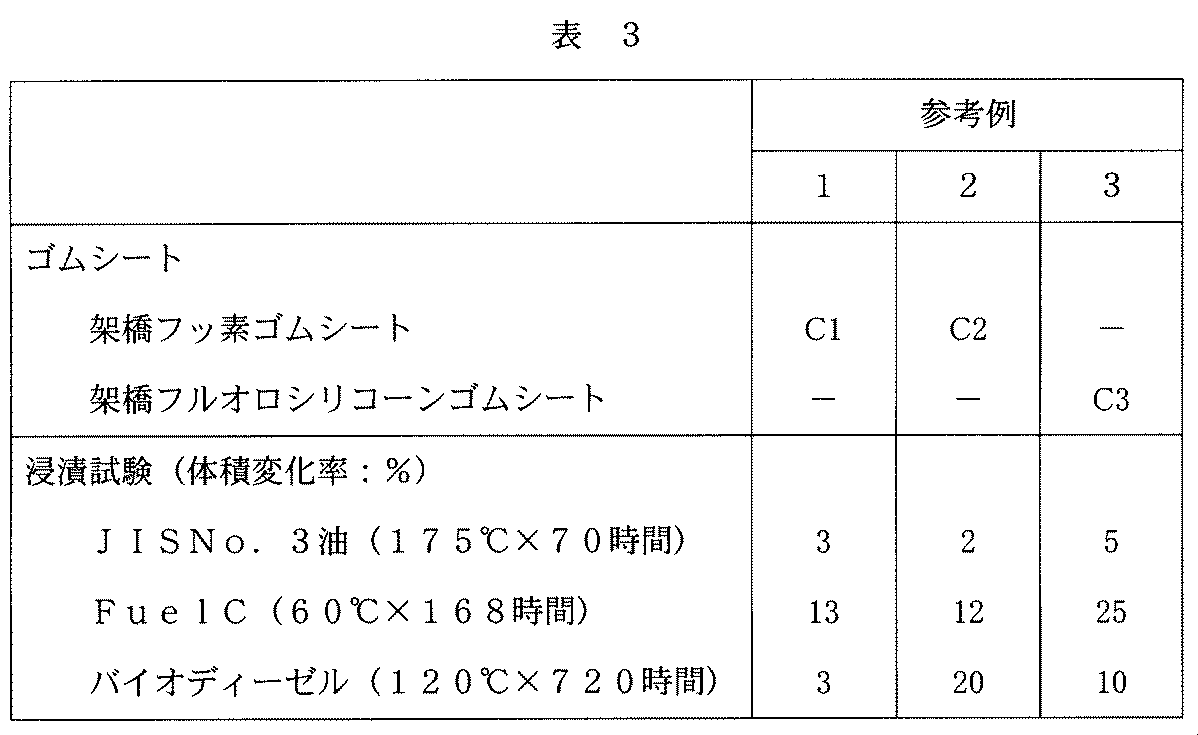
表1の結果から、未架橋フッ素ゴムシートおよび未架橋シリコーンゴムシートのいずれにもヒドロシリル架橋可能な未架橋ゴムシートを用いた場合、初期および熱劣化処理後のいずれの場合においても剥離強度(接着強度)に優れ、また、特にシランカップリング剤をさらに添加した場合(実施例2および3)、熱劣化後の剥離強度(接着強度)が著しく高くなっていることが分かる。 From the results shown in Table 1, when an uncrosslinked rubber sheet capable of hydrosilyl crosslinking was used for both the uncrosslinked fluororubber sheet and the uncrosslinked silicone rubber sheet, the peel strength (adhesion) was observed both in the initial stage and after the heat deterioration treatment. It can be seen that when the silane coupling agent is further added (Examples 2 and 3), the peel strength after heat deterioration (adhesion strength) is remarkably high.
製造例7(ヒドロシリル架橋可能な未架橋フッ素ゴムシートF5の製造)
製造例1において、VdF/HFP共重合体ゴムに代えてVdF/TFE/HFP(=61/21/18モル%比)共重合体ゴム(ムーニー粘度ML(1+10、100℃)23)を使用した以外は同様にして、改質性置換基としてアリル基と酸素原子を有するヒドロシリル架橋可能なVdF/TFE/HFP共重合体ゴムを得た。このVdF/TFE/HFP共重合体ゴムを1H−NMR分析したところ、アリル基含有量は0.6モル%であった。
Production Example 7 (Production of uncrosslinked fluororubber sheet F5 capable of hydrosilyl crosslinking)
In Production Example 1, VdF / TFE / HFP (= 61/1/18 mol% ratio) copolymer rubber (Mooney viscosity ML (1 + 10, 100 ° C.) 23) was used instead of VdF / HFP copolymer rubber. A VdF / TFE / HFP copolymer rubber capable of hydrosilyl crosslinking having an allyl group and an oxygen atom as a modifying substituent was obtained in the same manner except that it was used. When this VdF / TFE / HFP copolymer rubber was analyzed by 1 H-NMR, the allyl group content was 0.6 mol%.
ついで、このアリル基を有するヒドロシリル架橋可能なVdF/TFE/HFP共重合体ゴムを用いて製造例3と同様にしてフッ素ゴム組成物F5を調製し、さらに厚さ約2.2mmの未架橋フッ素ゴムシートF5を得た。 Next, using this hydrosilyl crosslinkable VdF / TFE / HFP copolymer rubber having an allyl group, a fluororubber composition F5 was prepared in the same manner as in Production Example 3, and an uncrosslinked fluorine having a thickness of about 2.2 mm was further prepared. A rubber sheet F5 was obtained.
製造例8(ヒドロシリル架橋可能な未架橋フッ素ゴムシートF6の製造)
3Lの丸底フラスコに、VdF/HFP(=78/22モル%比)共重合体ゴム(ムーニー粘度ML(1+10、100℃)54)250gを入れ、N,N−ジメチルホルムアミド(DMF)2Lを加え、マグネティックスターラーで1時間攪拌して共重合体ゴムをDMFに溶解させた。このDMF溶液を1時間還流し脱HF処理した後、水中で共重合体ゴムを再沈殿・洗浄し減圧乾燥した。
Production Example 8 (Production of uncrosslinked fluororubber sheet F6 capable of hydrosilyl crosslinking)
A 3 L round bottom flask was charged with 250 g of VdF / HFP (= 78/22 mol% ratio) copolymer rubber (Mooney viscosity ML (1 + 10, 100 ° C.) 54), and N, N-dimethylformamide (DMF). 2 L was added and stirred for 1 hour with a magnetic stirrer to dissolve the copolymer rubber in DMF. The DMF solution was refluxed for 1 hour and subjected to deHF treatment, and then the copolymer rubber was reprecipitated and washed in water and dried under reduced pressure.
得られた共重合体ゴムから100℃、10分間の条件でプレスフィルムを作製し、このフィルムをFT−IRで測定したところ、得られたIRチャートには、1682cm-1と1720cm-1にそれぞれ主鎖中の二重結合と思われるピークが現れた。この結果から、共重合体ゴムは脱HFされているものと考えられる。 A press film was prepared from the obtained copolymer rubber at 100 ° C. for 10 minutes, and this film was measured by FT-IR. As a result, the obtained IR chart showed 1682 cm −1 and 1720 cm −1 , respectively. A peak that appeared to be a double bond in the main chain appeared. From this result, it is considered that the copolymer rubber has been deHFed.
3Lの丸底フラスコに、脱HF処理したVdF/HFP共重合体ゴム220gを入れ、メチルエチルケトン(MEK)2Lを加えた後マグネティックスターラーで攪拌し溶解させた。これにジアリルアミン34g(Aldrich社製)を加えて3時間還流して、ジアリルアミノ基が導入されたVdF/HFP共重合体ゴムを製造した。この共重合体ゴムをエタノール/水(1/1)18L中で再沈殿し、引き続き減圧乾燥した。これを計3回繰り返した後のジアリルアミン付加VdF/HFP共重合体ゴムをFT−IRで測定したところ、得られたIRスペクトルにはアリル基のピークが1648cm-1に認められた。また、ジアリルアミン付加VdF/HFP共重合体ゴムを1H−NMRで測定した結果、アリル基の=CH2の積分値から、アリル基の含有量は約0.4モル%であった。 Into a 3 L round bottom flask, 220 g of VdF / HFP copolymer rubber subjected to de-HF treatment was added, and after adding 2 L of methyl ethyl ketone (MEK), the mixture was stirred and dissolved with a magnetic stirrer. 34 g of diallylamine (manufactured by Aldrich) was added thereto and refluxed for 3 hours to produce a VdF / HFP copolymer rubber into which diallylamino groups had been introduced. This copolymer rubber was reprecipitated in 18 L of ethanol / water (1/1) and subsequently dried under reduced pressure. When the diallylamine-added VdF / HFP copolymer rubber after repeating this three times in total was measured by FT-IR, an allyl group peak was found at 1648 cm −1 in the obtained IR spectrum. Moreover, as a result of measuring the diallylamine-added VdF / HFP copolymer rubber by 1 H-NMR, the allyl group content was about 0.4 mol% from the integral value of = CH 2 of the allyl group.
ついで、このアリル基と窒素原子を有するヒドロシリル架橋可能なVdF/HFP共重合体ゴムを用いて製造例3と同様にしてフッ素ゴム組成物F6を調製し、さらに厚さ約2.2mmの未架橋フッ素ゴムシートF6を得た。 Then, using this hydrosilyl crosslinkable VdF / HFP copolymer rubber having an allyl group and a nitrogen atom, a fluororubber composition F6 was prepared in the same manner as in Production Example 3, and an uncrosslinked film having a thickness of about 2.2 mm was further prepared. A fluororubber sheet F6 was obtained.
製造例9(ヒドロシリル架橋可能な未架橋フッ素ゴムシートF7の製造)
製造例1において、2−メトキシ−4−アリルフェノールに代えて4−ペンテン−1−オール17gを用いた以外は同様にして、ペンテニル基と酸素原子を有するヒドロシリル架橋可能なVdF/HFP共重合体ゴムを得た。1H−NMR分析したところ、ペンテニル基含有量は0.3モル%であった。
Production Example 9 (Production of uncrosslinked fluororubber sheet F7 capable of hydrosilyl crosslinking)
In the same manner as in Production Example 1, except that 17 g of 4-penten-1-ol was used in place of 2-methoxy-4-allylphenol, a hydrosilyl crosslinkable VdF / HFP copolymer having a pentenyl group and an oxygen atom was used. Got rubber. As a result of 1 H-NMR analysis, the pentenyl group content was 0.3 mol%.
ついで、このペンテニル基と酸素原子を有するヒドロシリル架橋可能なVdF/HFP共重合体ゴムを用いて製造例3と同様にしてフッ素ゴム組成物F7を調製し、さらに厚さ約2.2mmの未架橋フッ素ゴムシートF7を得た。 Then, using this hydrosilyl crosslinkable VdF / HFP copolymer rubber having a pentenyl group and an oxygen atom, a fluororubber composition F7 was prepared in the same manner as in Production Example 3, and an uncrosslinked film having a thickness of about 2.2 mm was further prepared. A fluororubber sheet F7 was obtained.
製造例10(ヒドロシリル架橋可能な未架橋シリコーンゴムシートQ3の製造)
架橋性基としてビニル基を有する可塑度1.61mmのガム状オルガノポリシロキサン(ビニル基含有量0.219質量%)135.4g、ジメチルシラノール末端を有するジメチルポリシロキサン(粘度40mPa・s)14.9g、シリカ微粒子(日本アエロジル(株)製、商品名「アエロジル200」、比表面積:200m2/g)53.7g、架橋剤として、トリメチルシリル基で分子鎖末端が封止されたメチルハイドロジェンポリシロキサン(粘度50mPa・s、SiH含有量0.9質量%)含有ペースト(メチルハイドロジェンポリシロキサン含有量75質量%)5.4g、硬化遅延剤として1−エチニル−1−シクロヘキサノール含有ペースト(東レ・ダウコーニング(株)製のRD−9)を1.6g、白金触媒(東レ・ダウコーニング(株)製のRD−27)を3.4g加え、ロールミルにより25℃にて充分混練してシリコーンゴム組成物Q3を調製し、ついで厚さ約2.2mmの未架橋シリコーンゴムシートQ3を得た。
Production Example 10 (Production of uncrosslinked silicone rubber sheet Q3 capable of hydrosilyl crosslinking)
13. 135.4 g of a gum-like organopolysiloxane having a vinyl group as a crosslinkable group and a plasticity of 1.61 mm (vinyl group content 0.219% by mass), dimethylpolysiloxane having a dimethylsilanol terminal (viscosity 40 mPa · s) 14. 9 g, 53.7 g of silica fine particles (manufactured by Nippon Aerosil Co., Ltd., trade name “Aerosil 200”, specific surface area: 200 m 2 / g), methyl hydrogen poly having molecular chain ends sealed with trimethylsilyl groups as a crosslinking agent 5.4 g of siloxane (viscosity 50 mPa · s, SiH content 0.9 mass%) containing paste (methyl hydrogen polysiloxane content 75 mass%), 1-ethynyl-1-cyclohexanol containing paste (Toray・ 1.6 g of RD-9 manufactured by Dow Corning Co., Ltd., platinum catalyst (Toray Dow RD-27) made by Corning Co., Ltd. was added, and kneaded sufficiently at 25 ° C. with a roll mill to prepare a silicone rubber composition Q3. Then, an uncrosslinked silicone rubber sheet Q3 having a thickness of about 2.2 mm was prepared. Obtained.
実施例4〜7
未架橋フッ素ゴムシートおよび未架橋シリコーンゴムシートとしてそれぞれ表2に示すシートを用いたほかは実施例1と同様にして剥離試験用の架橋ゴム積層体を作製し、剥離試験を行った。結果を表2に示す。
Examples 4-7
A cross-linked rubber laminate for a peel test was prepared in the same manner as in Example 1 except that the sheets shown in Table 2 were used as the uncrosslinked fluororubber sheet and the uncrosslinked silicone rubber sheet, and a peel test was performed. The results are shown in Table 2.
製造例11(ポリオール架橋可能なフッ素ゴム組成物F8の製造)
ポリオール架橋可能なVdF/TFE/HFP(=58/20/22モル%比)共重合体ゴム(ムーニー粘度ML(1+10、100℃)44)200gに、2,2−ビス(4−ヒドロキシフェニル)パーフルオロプロパンを2.8g、8−ベンジル−1,8−ジアザビシクロ[5,4,0]−7−ウンデセニウムクロライドを0.7g、MTカーボンを40g、MgOを6g、Ca(OH)2を12g、2,5−ジメチル−2,5−ジ(t−ブチルパーオキシ)へキサンを2g配合し、ロールミルにより混練し、フッ素ゴム組成物F8を調製した。
Production Example 11 (Production of polyol-crosslinkable fluororubber composition F8)
Polyol-crosslinkable VdF / TFE / HFP (= 58/20/22 mol% ratio) copolymer rubber (Mooney viscosity ML (1 + 10, 100 ° C.) 44) was added to 2,2-bis (4-hydroxy). 2.8 g of phenyl) perfluoropropane, 0.7 g of 8-benzyl-1,8-diazabicyclo [5,4,0] -7-undecenium chloride, 40 g of MT carbon, 6 g of MgO, Ca (OH 2 ) 12g and 2,5-dimethyl-2,5-di (t-butylperoxy) hexane 2g were blended and kneaded by a roll mill to prepare a fluororubber composition F8.
製造例12(フルオロシリコーンゴム組成物FQ1の製造)
ジメチルシラノール末端を有するメチルビニルシロキサン−メチル(3,3,3−トリフルオロプロピル)シロキサンコポリマー 144g、ジメチルシラノール末端を有するジメチルポリシロキサン(粘度40mPa・s)3.5g、シリカ微粒子(日本アエロジル(株)製、商品名「アエロジル130」、比表面積:130m2/g)40.2g、(b−1)架橋剤として、トリメチルシリル基で分子鎖末端が封止されたメチルハイドロジェンポリシロキサン(粘度50mPa・s、SiH含有量0.9質量%)含有ペースト(メチルハイドロジェンポリシロキサン含有量75質量%)2.1g、硬化遅延剤として1−エチニル−1−シクロヘキサノール含有ペースト(東レ・ダウコーニング(株)製のRD−9)を1.6g、白金触媒(東レ・ダウコーニング(株)製のRD−27)を3.4g加え、ロールミルにより25℃にて充分混練してフルオロシリコーンゴム組成物FQ1を調製した。
Production Example 12 (Production of fluorosilicone rubber composition FQ1)
144 g of methylvinylsiloxane-methyl (3,3,3-trifluoropropyl) siloxane copolymer having a dimethylsilanol terminal, 3.5 g of dimethylpolysiloxane having a dimethylsilanol terminal (viscosity 40 mPa · s), silica fine particles (Nippon Aerosil Co., Ltd.) ), Trade name “Aerosil 130”, specific surface area: 130 m 2 / g) 40.2 g, (b-1) methyl hydrogen polysiloxane (viscosity: 50 mPa) with molecular chain ends sealed with trimethylsilyl groups as a crosslinking agent・ S, SiH content 0.9 mass%) containing paste (methyl hydrogen polysiloxane content 75 mass%) 2.1 g, 1-ethynyl-1-cyclohexanol-containing paste (Toray Dow Corning ( 1.6 g of RD-9), platinum catalyst (Toray) Dow Corning Co., Ltd. manufactured RD-27) was added 3.4 g, to prepare a fluorosilicone rubber composition FQ1 sufficiently kneaded at 25 ° C. by a roll mill.
参考例1
製造例3で調製したヒドロシリル架橋可能なフッ素ゴム組成物F3を130℃で20分間プレスし架橋した後、さらに150℃で1時間オーブン架橋して、厚さ2mmのヒドロシリル架橋された架橋フッ素ゴムシートC1を得た。
Reference example 1
The hydrosilyl-crosslinkable fluororubber composition F3 prepared in Production Example 3 was pressed and crosslinked at 130 ° C. for 20 minutes, and then further oven-crosslinked at 150 ° C. for 1 hour to form a hydrosilyl-crosslinked crosslinked fluororubber sheet having a thickness of 2 mm. C1 was obtained.
このヒドロシリル架橋された架橋フッ素ゴムシートC1を1cm×2cmに切り出し、浸漬試験用試料を作製し、JIS No.3油、Fuel Cおよびバイオ燃料について、浸漬試験を行った。結果を表3に示す。 This hydrosilyl-crosslinked crosslinked fluororubber sheet C1 was cut into 1 cm × 2 cm, a sample for immersion test was prepared, and an immersion test was performed on JIS No. 3 oil, Fuel C, and biofuel. The results are shown in Table 3.
参考例2(比較)
製造例11で調製したポリオール架橋可能なフッ素ゴム組成物F8を160℃で45分間プレスし架橋した後、さらに230℃で24時間オーブン架橋して、厚さ2mmのポリオール架橋された架橋フッ素ゴムシートC2を得た。
Reference Example 2 (Comparison)
The polyol-crosslinkable fluororubber composition F8 prepared in Production Example 11 was pressed and crosslinked at 160 ° C. for 45 minutes, and then oven-crosslinked at 230 ° C. for 24 hours to form a polyol-crosslinked crosslinked fluororubber sheet having a thickness of 2 mm. C2 was obtained.
このポリオール架橋された架橋フッ素ゴムシートC2について、参考例1と同様にして浸漬試験における体積変化率ΔV(%)を求めた。結果を表3に示す。 With respect to this polyol-crosslinked crosslinked fluororubber sheet C2, the volume change rate ΔV (%) in the immersion test was determined in the same manner as in Reference Example 1. The results are shown in Table 3.
参考例3(比較)
製造例12で調製したフルオロシリコーンゴム組成物FQ1を200℃で10分間プレス架橋した後、さらに200℃で4時間オーブン架橋して、厚さ2mmの架橋フルオロシリコーンゴムシートC3を得た。
Reference Example 3 (Comparison)
The fluorosilicone rubber composition FQ1 prepared in Production Example 12 was press-crosslinked at 200 ° C. for 10 minutes and then oven-crosslinked at 200 ° C. for 4 hours to obtain a crosslinked fluorosilicone rubber sheet C3 having a thickness of 2 mm.
この架橋フルオロシリコーンゴムシートC3から、参考例1と同様にして浸漬試験における体積変化率ΔV(%)を求めた。結果を表3に示す。 From this crosslinked fluorosilicone rubber sheet C3, the volume change rate ΔV (%) in the immersion test was determined in the same manner as in Reference Example 1. The results are shown in Table 3.
表3から、ヒドロシリル架橋可能なゴムシートを用いて製造した架橋ゴムシートの場合(参考例1)、JIS No.3油やFuel Cに対し膨潤しにくいだけでなく、バイオディーゼル燃料に対しても膨潤しにくいということがわかる。 From Table 3, in the case of a crosslinked rubber sheet produced using a hydrosilyl-crosslinkable rubber sheet (Reference Example 1), not only is it difficult to swell against JIS No. 3 oil or Fuel C, but also to biodiesel fuel. It turns out that it is hard to swell.
Claims (6)
−YRZ
(式中、Yは酸素原子、窒素原子または硫黄原子;Rは炭素数2〜20の結合セグメント;Zはアルケニル基、ただし、ZはYが結合している同じ炭素原子には結合していない)で示される改質性置換基を有し、かつ該改質性置換基の求核性原子の結合によってフッ素ゴムの炭素原子に該改質性置換基が結合しているヒドロシリル架橋可能なフッ素ゴム(a)を含む請求項1または2記載のゴム積層体。 The hydrosilyl crosslinkable fluororubber composition (A) has the formula (1):
-YRZ
Wherein Y is an oxygen atom, nitrogen atom or sulfur atom; R is a bond segment having 2 to 20 carbon atoms; Z is an alkenyl group, but Z is not bonded to the same carbon atom to which Y is bonded. And a hydrosilyl crosslinkable fluorine in which the modifying substituent is bonded to the carbon atom of the fluororubber by the bonding of the nucleophilic atom of the modifying substituent. The rubber laminate according to claim 1 or 2, comprising rubber (a).
Priority Applications (1)
| Application Number | Priority Date | Filing Date | Title |
|---|---|---|---|
| JP2010163998A JP2012024980A (en) | 2010-07-21 | 2010-07-21 | Rubber laminate |
Applications Claiming Priority (1)
| Application Number | Priority Date | Filing Date | Title |
|---|---|---|---|
| JP2010163998A JP2012024980A (en) | 2010-07-21 | 2010-07-21 | Rubber laminate |
Publications (1)
| Publication Number | Publication Date |
|---|---|
| JP2012024980A true JP2012024980A (en) | 2012-02-09 |
Family
ID=45778524
Family Applications (1)
| Application Number | Title | Priority Date | Filing Date |
|---|---|---|---|
| JP2010163998A Withdrawn JP2012024980A (en) | 2010-07-21 | 2010-07-21 | Rubber laminate |
Country Status (1)
| Country | Link |
|---|---|
| JP (1) | JP2012024980A (en) |
Cited By (2)
| Publication number | Priority date | Publication date | Assignee | Title |
|---|---|---|---|---|
| JP2022178845A (en) * | 2021-05-21 | 2022-12-02 | 三菱電線工業株式会社 | Manufacturing method for rubber composite |
| JPWO2024176859A1 (en) * | 2023-02-24 | 2024-08-29 |
-
2010
- 2010-07-21 JP JP2010163998A patent/JP2012024980A/en not_active Withdrawn
Cited By (3)
| Publication number | Priority date | Publication date | Assignee | Title |
|---|---|---|---|---|
| JP2022178845A (en) * | 2021-05-21 | 2022-12-02 | 三菱電線工業株式会社 | Manufacturing method for rubber composite |
| JPWO2024176859A1 (en) * | 2023-02-24 | 2024-08-29 | ||
| JP7814686B2 (en) | 2023-02-24 | 2026-02-17 | Nok株式会社 | Fluororubber composition and seal for electric vehicle |
Similar Documents
| Publication | Publication Date | Title |
|---|---|---|
| CN101616795B (en) | Heat-curable silicone rubber composition for rubber laminate | |
| JP5482790B2 (en) | Laminated body | |
| US7879450B2 (en) | Method for preparing silicone rubber/fluoroelastomer integrated rubber article | |
| US12011904B2 (en) | Production method for laminate of fluorosilicone rubber and silicone rubber | |
| JP5370564B2 (en) | Laminated body | |
| JP2023532860A (en) | Silicone elastomer composition | |
| US8071709B2 (en) | Composite material comprising flourine-containing rubber, fuel-impermeable sealing material comprising same, and process for preparing composite material | |
| JP7215349B2 (en) | Method for manufacturing rubber articles and rubber products | |
| JP2007098900A (en) | Rubber laminate and its use | |
| JP5415094B2 (en) | PEROXIDE CROSSLINKING COMPOSITION AND CROSSLINKED MOLDED ARTICLE | |
| JP5401954B2 (en) | Laminated body comprising rubber layer and fluororesin layer and rubber composition for vulcanization | |
| CN103978751B (en) | laminate | |
| JP2015163664A (en) | Modifier for rubber, rubber composition and molded article | |
| CN116406323A (en) | Hydrosilylation cure inhibitors and their uses | |
| JP5002212B2 (en) | PEROXIDE CROSSLINKING COMPOSITION, MOLDED ARTICLE COMPRISING THE SAME, AND FUEL PERMEABILITY SEALING MATERIAL | |
| JP5083489B2 (en) | Fluoro rubber / silicone rubber mixed rubber composition and rubber molded product obtained by curing it | |
| US20260138359A1 (en) | Silicone-thermoplastic composite articles | |
| WO2024086140A1 (en) | Silicone-thermoplastic composite articles | |
| US20260139099A1 (en) | Liquid silicone rubber composition | |
| JP2018059006A (en) | Rubber composition, rubber molding, and method for producing rubber molding |
Legal Events
| Date | Code | Title | Description |
|---|---|---|---|
| RD02 | Notification of acceptance of power of attorney |
Free format text: JAPANESE INTERMEDIATE CODE: A7422 Effective date: 20120816 |
|
| RD05 | Notification of revocation of power of attorney |
Free format text: JAPANESE INTERMEDIATE CODE: A7425 Effective date: 20120816 |
|
| A521 | Written amendment |
Free format text: JAPANESE INTERMEDIATE CODE: A523 Effective date: 20121121 |
|
| A300 | Withdrawal of application because of no request for examination |
Free format text: JAPANESE INTERMEDIATE CODE: A300 Effective date: 20131001 |