JP2012018564A - Communication system, information processing device, information processing method and program - Google Patents
Communication system, information processing device, information processing method and program Download PDFInfo
- Publication number
- JP2012018564A JP2012018564A JP2010155719A JP2010155719A JP2012018564A JP 2012018564 A JP2012018564 A JP 2012018564A JP 2010155719 A JP2010155719 A JP 2010155719A JP 2010155719 A JP2010155719 A JP 2010155719A JP 2012018564 A JP2012018564 A JP 2012018564A
- Authority
- JP
- Japan
- Prior art keywords
- container
- item
- information
- search
- stored
- Prior art date
- Legal status (The legal status is an assumption and is not a legal conclusion. Google has not performed a legal analysis and makes no representation as to the accuracy of the status listed.)
- Withdrawn
Links
Images
Landscapes
- Information Retrieval, Db Structures And Fs Structures Therefor (AREA)
Abstract
【課題】アイテムの探索結果を効率的に管理することができるようにする。
【解決手段】通信システムは、DLNA機器であるDMR1、DMS2、およびDMC3がネットワークを介して接続されることによって構成される。DMC3からDMR1に対して、DMS2が管理するルートコンテナの再生が指示された場合、DMR1においては、DMS2が管理するオブジェクトの探索が開始される。探索結果は、ルートコンテナに格納されるコンテナ毎に、そのコンテナを対象とする探索により最初に見つかる先頭アイテムのトラック番号と、最後に見つかる最終アイテムのトラック番号と、先頭アイテムのコンテナ内における位置を表す位置情報とを、コンテナのObjectIDと対応付けるようにして記憶され、DMR1により管理される。本発明は、DLNA機器に適用することができる。
【選択図】図4An item search result can be efficiently managed.
A communication system is configured by connecting DMR1, DMS2, and DMC3, which are DLNA devices, via a network. When the DMC 3 instructs the DMR 1 to reproduce the root container managed by the DMS 2, the DMR 1 starts searching for an object managed by the DMS 2. The search result shows, for each container stored in the root container, the track number of the first item found first by the search for that container, the track number of the last item found last, and the position of the first item in the container. The position information to be represented is stored so as to be associated with the ObjectID of the container, and managed by the DMR 1. The present invention can be applied to DLNA equipment.
[Selection] Figure 4
Description
本発明は、通信システム、情報処理装置、情報処理方法、およびプログラムに関し、特に、コンテンツの探索結果を効率的に管理することができるようにした通信システム、情報処理装置、情報処理方法、およびプログラムに関する。 The present invention relates to a communication system, an information processing apparatus, an information processing method, and a program, and more particularly, to a communication system, an information processing apparatus, an information processing method, and a program capable of efficiently managing content search results. About.
近年、DLNA(Digital Living Network Alliance)のガイドラインに対応した機器(以下、適宜、DLNA機器という)が普及してきている。複数のDLNA機器を家庭内のネットワークを介して接続することによって、あるDLNA機器に記憶されているコンテンツを、他のDLNA機器で再生したりすることが可能になる。 In recent years, devices that comply with DLNA (Digital Living Network Alliance) guidelines (hereinafter referred to as DLNA devices as appropriate) have become widespread. By connecting a plurality of DLNA devices via a home network, the content stored in one DLNA device can be played on another DLNA device.
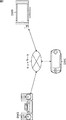
図1は、3つのDLNA機器を用いて実現される通信システムの構成例を示す図である。 FIG. 1 is a diagram illustrating a configuration example of a communication system realized using three DLNA devices.
図1の通信システムは、DMSとして動作するDLNA機器、DMRとして動作するDLNA機器、およびDMCとして動作するDLNA機器が、LAN(Local Area Network)などのネットワークを介して接続されることによって構成される。図1の通信システムはいわゆる3Box System Usageの通信システムである。以下、適宜、それぞれのDLNA機器を、単に、DMS、DMR、DMCという。 The communication system in FIG. 1 is configured by connecting a DLNA device operating as a DMS, a DLNA device operating as a DMR, and a DLNA device operating as a DMC via a network such as a LAN (Local Area Network). . The communication system of FIG. 1 is a so-called 3Box System Usage communication system. Hereinafter, the respective DLNA devices are simply referred to as DMS, DMR, and DMC as appropriate.
DMS(Digital Media Server)は、音楽コンテンツやビデオコンテンツなどのコンテンツを記憶し、他のDLNA機器に配信する機器である。図1の例においては、HDD(Hard Disk Drive)やSSD(Solid State Drive)などの内蔵の記録媒体に音楽コンテンツを記録するオーディオ機器がDMSとされている。 A DMS (Digital Media Server) is a device that stores content such as music content and video content and distributes it to other DLNA devices. In the example of FIG. 1, an audio device that records music content on a built-in recording medium such as an HDD (Hard Disk Drive) or an SSD (Solid State Drive) is a DMS.
以下、音楽コンテンツの再生について説明する。音楽コンテンツの再生は、例えばプレイリストを用いて行われる。適宜、コンテンツのことをアイテムともいう。 Hereinafter, reproduction of music content will be described. Music content is reproduced using, for example, a playlist. As appropriate, content is also referred to as an item.
DMR(Digital Media Renderer)は、アイテムを再生し、音楽を出力する機器である。図1の例においては、ディスプレイとスピーカを有するテレビジョン受像機がDMRとされている。 A DMR (Digital Media Renderer) is a device that plays items and outputs music. In the example of FIG. 1, a television receiver having a display and a speaker is a DMR.
DMC(Digital Media Controller)は、UI(User Interface)機能を有し、ユーザによる操作に応じて他のDLNA機器を制御する機器である。図1の例においては、ディスプレイや各種の操作ボタンを有する携帯機器がDMCとされている。 A DMC (Digital Media Controller) is a device that has a UI (User Interface) function and controls other DLNA devices in accordance with user operations. In the example of FIG. 1, a mobile device having a display and various operation buttons is a DMC.
DLNAでは、プレイリストの表記方法としてPlayContainerUriが定義されている。PlayContainerUriには、プレイリストに登録されているアイテムを記憶するDMSの情報、プレイリストとして再生するコンテナと、そのコンテナ内における、最初に再生するアイテムの位置の情報、および、DMSにおいて階層的にコンテナが管理されている場合において、アイテムの探索時に階層を辿る深さの情報などが記述される。プレイリストに登録されているそれぞれのアイテムが、そのプレイリストに対応するコンテナに格納されている。 In DLNA, PlayContainerUri is defined as a playlist notation method. PlayContainerUri includes DMS information for storing items registered in the playlist, containers to be played as playlists, information on the position of the item to be played first in the container, and hierarchical containers in the DMS When the item is managed, information on the depth of tracing the hierarchy when searching for an item is described. Each item registered in the playlist is stored in a container corresponding to the playlist.
DMCから送信されたPlayContainerUriを受け取ったDMRは、その記述に基づいてアイテムの探索を行い、見つかったアイテムを再生していくことでプレイリスト再生を実現する。 The DMR that has received the PlayContainerUri transmitted from the DMC searches for an item based on the description, and reproduces the found item, thereby realizing playlist reproduction.
[プレイリスト再生の流れ]
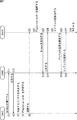
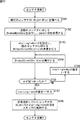
ここで、図2のフローチャートを参照して、図1の通信システムにおいて行われるプレイリスト再生の流れについて説明する。
[Playlist playback flow]
Here, with reference to the flowchart of FIG. 2, the flow of playlist reproduction performed in the communication system of FIG. 1 will be described.
ステップS1において、DMCは、DMSが管理するコンテナのBrowseを実行する。DMCからDMSに対してはBrowse要求(Browse要求を表す情報)が送信される。 In step S1, the DMC executes Browse of the container managed by the DMS. A Browse request (information indicating a Browse request) is transmitted from the DMC to the DMS.
ステップS11において、DMSは、DMCによるBrowse要求を受信し、ステップS12において応答する。DMSからの応答には、プレイリストとして選択することが可能な、アイテムが格納されているコンテナの情報が含まれる。 In step S11, the DMS receives a Browse request from the DMC and responds in step S12. The response from the DMS includes information on a container storing items that can be selected as a playlist.
ステップS2において、DMCはDMSから送信されてきた情報を受信する。DMCは、受信した情報に基づいてプレイリストの一覧をディスプレイに表示し、再生するプレイリストをユーザに選択させる。 In step S2, the DMC receives information transmitted from the DMS. The DMC displays a list of playlists on the display based on the received information, and allows the user to select a playlist to be played back.
ステップS3において、DMCは、ユーザによる操作に応じて、再生対象となるプレイリスト(コンテナ)を決定する。ここで決定されたコンテナに格納されているアイテムが順次再生される。 In step S <b> 3, the DMC determines a playlist (container) to be played in response to a user operation. The items stored in the container determined here are sequentially reproduced.
ステップS4において、DMCは、PlayContainerUriを作成する。DMCにより作成されたPlayContainerUriには、ステップS3で決定されたコンテナを指定する情報などが含まれる。 In step S4, the DMC creates PlayContainerUri. The PlayContainerUri created by the DMC includes information specifying the container determined in step S3.
ステップS5において、DMCは、PlayContainerUriをDMRに送信する。 In step S5, the DMC transmits PlayContainerUri to the DMR.
ステップS21において、DMRは、DMCから送信されてきたPlayContainerUriを受信し、ステップS22において解析する。PlayContainerUriを解析することにより、アイテムの配信元となるDMSや、プレイリストに対応するRootコンテナなどが特定される。 In step S21, the DMR receives the PlayContainerUri transmitted from the DMC, and analyzes it in step S22. By analyzing the PlayContainerUri, the DMS that is the item distribution source, the Root container corresponding to the playlist, and the like are specified.
ステップS23において、DMRは、アイテムの配信元として特定したDMSが管理する、再生対象のプレイリストに対応するRootコンテナを対象としてBrowseを実行する。DMRからDMSに対してはBrowse要求が送信される。 In step S23, the DMR executes Browse for the Root container corresponding to the play list to be played, which is managed by the DMS specified as the item distribution source. A Browse request is sent from the DMR to the DMS.
ステップS13において、DMSは、DMRによるBrowse要求を受信し、ステップS14において応答する。DMSからの応答には、Browse対象のRootコンテナに格納されているオブジェクト(コンテナまたはアイテム)の情報が含まれる。 In step S13, the DMS receives a Browse request from the DMR and responds in step S14. The response from the DMS includes information on the object (container or item) stored in the Root container to be browsed.
ステップS24において、DMRは、DMSから送信されてきた情報を受信し、ステップS25において、受信した情報に基づいてアイテムの探索を行う。アイテムの探索については後述する。 In step S24, the DMR receives information transmitted from the DMS, and in step S25, searches for items based on the received information. The item search will be described later.
探索によってアイテムが見つかった場合、ステップS26において、DMRは、アイテム取得要求(アイテム取得要求を表す情報)をDMSに送信する。ここで、探索によりオブジェクトが見つかるとは、Browseの実行結果としてDMSから送信されてきた情報の中にObjectIDなどのオブジェクトの情報が含まれており、そのオブジェクトの情報をDMRが取得したことを表す。 When an item is found by the search, in step S26, the DMR transmits an item acquisition request (information indicating the item acquisition request) to the DMS. Here, an object is found by searching means that the information sent from the DMS as the execution result of Browse includes object information such as ObjectID, and that the DMR has acquired that object information. .
ステップS15において、DMSは、DMRによるアイテム取得要求を受信し、要求されたアイテムを記録媒体から読み出す。ステップS16において、DMSは、記録媒体から読み出したアイテムをDMRに送信する。 In step S15, the DMS receives an item acquisition request by DMR and reads the requested item from the recording medium. In step S16, the DMS transmits the item read from the recording medium to the DMR.
ステップS27において、DMRは、DMSから送信されてきたアイテムを受信し、ステップS28において再生する。 In step S27, the DMR receives the item transmitted from the DMS and reproduces it in step S28.
プレイリストに登録されているアイテム毎に、ステップS23乃至S28の処理がDMRにより行われ、また、DMRの処理に対応して、ステップS13乃至S16の処理がDMSにより行われる。図1の通信システムにおいては、プレイリストの再生が以上のようにして行われる。 For each item registered in the playlist, the processing of steps S23 to S28 is performed by DMR, and the processing of steps S13 to S16 is performed by DMS corresponding to the processing of DMR. In the communication system of FIG. 1, the play list is reproduced as described above.
プレイリストの再生中、DMCからDMRに対しては、適宜、再生方法の指定などが行われる。再生方法には、トラック番号順に再生するノーマル再生、プレイリストに登録されているアイテムをランダムに再生するランダム再生がある。また、トラック番号により指定されたアイテム、または、1曲(1トラック)前、1曲後といったようにして指定されたアイテムを再生するトリック再生がある。 During playback of a playlist, a playback method is designated from the DMC to the DMR as appropriate. There are two types of playback methods: normal playback in which tracks are played in order of track number, and random playback in which items registered in a playlist are played back randomly. In addition, there is a trick reproduction in which an item designated by a track number or an item designated by one song (one track) before, one after, etc. is reproduced.
[アイテムの探索]
次に、DMRにより行われるアイテムの探索について説明する。
[Search items]
Next, item search performed by DMR will be described.
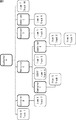
図3は、DMSが管理するアイテムのツリー構造の例を示す図である。 FIG. 3 is a diagram illustrating an example of a tree structure of items managed by the DMS.
図3の例においては、あるプレイリストに対応するRootコンテナであるContainer_Aには、第1階層のオブジェクトとして、左から順にItem_8,Container_B,Container_C,Container_D,Container_E,Item_7が格納されている。それぞれのItemは1曲の音楽アイテムに相当する。 In the example of FIG. 3, Container_A, which is a Root container corresponding to a certain playlist, stores Item_8, Container_B, Container_C, Container_D, Container_E, and Item_7 in order from the left as objects in the first layer. Each Item corresponds to one music item.
また、Container_Aには、第2階層のオブジェクトとして、Container_BにItem_9が格納され、Container_Cに、Container_F,Item_1,Item_2,Container_Gが格納されている。また、Container_DにItem_5が格納され、Container_EにItem_6が格納されている。 In Container_A, Item_9 is stored in Container_B, and Container_F, Item_1, Item_2, and Container_G are stored in Container_C as objects in the second hierarchy. Item_5 is stored in Container_D, and Item_6 is stored in Container_E.
さらに、Container_Aには、第3階層のオブジェクトとして、Container_FにItem_10が格納され、Container_GにItem_3とItem_4が格納されている。 Further, in Container_A, Item_10 is stored in Container_F and Item_3 and Item_4 are stored in Container_G as objects in the third hierarchy.
図3に示すツリー構造によって、DMSにおいてアイテムが管理されている場合について説明する。ここでは、PlayContainerUriにより指定される、プレイリストとして再生するコンテナ(Rootコンテナ)がContainer_Aであり、最初に再生するアイテムがItem_1であるものとする。DMRにおいてはItem_1の探索が最初に行われる。 A case where items are managed in the DMS using the tree structure shown in FIG. 3 will be described. Here, it is assumed that the container (Root container) to be played as a playlist specified by PlayContainerUri is Container_A, and the item to be played first is Item_1. In DMR, the search for Item_1 is performed first.
はじめに、Container_Aを対象としてDMRによりBrowseが実行される。複数のオブジェクトの情報を送信することが要求されている場合、Browse要求に対する応答として、Container_Aに格納されている第1階層のオブジェクトであるItem_8,Container_B,Container_C,Container_D,Container_E,Item_7の情報がDMSからDMRに送信される。ObjectIDや位置情報(URL(Uniform Resource Locator))を含む各オブジェクトの情報が、例えば図3の左側に示されるオブジェクトの情報の順にソートされ、DMRに送信される。 First, Browse is executed by DMR for Container_A. When it is requested to send information on multiple objects, the information of Item_8, Container_B, Container_C, Container_D, Container_E, and Item_7, which are the objects of the first hierarchy stored in Container_A, is the DMS as a response to the Browse request. Sent to DMR. Information of each object including ObjectID and position information (URL (Uniform Resource Locator)) is sorted in the order of the object information shown on the left side of FIG. 3, for example, and transmitted to the DMR.
DMRにおいては、ソートされた先頭のオブジェクトから順に注目され、注目されているオブジェクトがItemである場合には、そのItemがいま探しているItemであるか否かが判断される。また、注目されているオブジェクトがコンテナである場合には、そのコンテナを対象としてBrowseが実行される。 In DMR, attention is paid in order from the sorted first object, and when the focused object is an Item, it is determined whether or not the Item is the currently searched Item. Further, when the object of interest is a container, Browse is executed for that container.
この例においては、Item_8が注目され、注目されているItem_8が、いま探しているItemではないとしてDMRにより判断される。 In this example, Item_8 is noticed, and it is determined by the DMR that Item_8 being noticed is not the item currently being searched.
次に、Item_8の次のオブジェクト(ソート順で次のオブジェクト)であるContainer_Bが注目され、Container_Bを対象としてBrowseが実行される。DMSからDMRに対しては、Browse要求に対する応答として、Container_Bに格納されているItem_9の情報が送信される。このとき、Item_9が注目され、Item_9が、いま探しているItemではないとしてDMRにより判断される。 Next, Container_B, which is the next object of Item_8 (the next object in the sort order) is noticed, and Browse is executed for Container_B. Information of Item_9 stored in Container_B is transmitted from the DMS to the DMR as a response to the Browse request. At this time, Item_9 is noticed, and it is determined by the DMR that Item_9 is not the item currently being searched.
次に、いま注目したItem_9を格納するContainer_Bの次のオブジェクトであるContainer_Cが注目され、Container_Cを対象としてBrowseが実行される。DMSからDMRに対しては、Browseコマンドに対する応答として、Container_Cに格納されているContainer_F,Item_1,Item_2,Container_Gの情報が送信される。 Next, Container_C, which is the next object of Container_B that stores Item_9 that has been noticed, is noticed, and Browse is executed for Container_C. Information of Container_F, Item_1, Item_2, and Container_G stored in Container_C is transmitted from the DMS to the DMR as a response to the Browse command.
Container_F,Item_1,Item_2,Container_Gのうちの先頭のオブジェクトであるContainer_Fが注目され、Container_Fを対象としてBrowseが実行される。DMSからDMRに対しては、Browse要求に対する応答として、Container_Fに格納されているItem_10の情報が送信される。Item_10が注目され、Item_10が、いま探しているItemではないとしてDMRにより判断される。 Container_F, which is the first object among Container_F, Item_1, Item_2, and Container_G, is noticed, and Browse is executed for Container_F. Information of Item_10 stored in Container_F is transmitted from the DMS to the DMR as a response to the Browse request. Item_10 is noticed, and DMR determines that Item_10 is not the item currently being searched.
次に、いま注目したItem_10を格納するContainer_Fの次のオブジェクトであるItem_1が注目され、Item_1が、いま探しているItemであるとしてDMRにより判断される。DMRからDMSに対して、Item_1を指定してアイテム取得要求が送信され、アイテム取得要求に対する応答として送信されてきたデータが受信されたとき、DMRによりItem_1が再生される。 Next, Item_1 that is the next object of Container_F that stores Item_10 that has been noticed is noticed, and DMR is determined that Item_1 is the item that is currently being looked for. When an item acquisition request is transmitted from the DMR to the DMS by specifying Item_1, and data transmitted as a response to the item acquisition request is received, Item_1 is reproduced by the DMR.
Item_1の再生が終了したとき、Item_1の次のオブジェクトであるItem_2が注目される。Item_2が、いま探しているItemであるとしてDMRにより判断された場合、DMRからDMSに対して、Item_2を指定してアイテム取得要求が送信される。アイテム取得要求に対する応答として送信されてきたデータが受信されたとき、DMRによりItem_2が再生される。 When the playback of Item_1 ends, Item_2 which is the next object of Item_1 is noticed. When the DMR determines that Item_2 is the item that is being searched for, an item acquisition request is sent from the DMR to the DMS, specifying Item_2. When the data transmitted as a response to the item acquisition request is received, Item_2 is reproduced by the DMR.
この例においては、最初に再生するアイテムとしてPlayContainerUriにより指定されたアイテム(Item_1)の再生が終了した後は、探索により見つかった順にアイテムを再生するものとされている。 In this example, after the reproduction of the item (Item_1) designated by PlayContainerUri as the first item to be reproduced is completed, the items are reproduced in the order found by the search.
Item_2の再生が終了したとき、Item_2の次のオブジェクトであるContainer_Gが注目され、Container_Gを対象としてBrowseが実行される。DMSからDMRに対しては、Browse要求に対する応答として、Container_Gに格納されているItem_3,Item_4の情報が送信される。 When playback of Item_2 is finished, Container_G, which is the next object of Item_2, is noticed, and Browse is executed for Container_G. Information of Item_3 and Item_4 stored in Container_G is transmitted from the DMS to the DMR as a response to the Browse request.
DMRからDMSに対して、Item_3を指定してアイテム取得要求が送信される。アイテム取得要求に対する応答として送信されてきたデータが受信されたとき、DMRによりItem_3が再生される。 An item acquisition request is sent from DMR to DMS with Item_3 specified. When the data transmitted as a response to the item acquisition request is received, Item_3 is reproduced by the DMR.
Item_3の再生が終了したとき、DMRからDMSに対して、Item_4を指定してアイテム取得要求が送信される。アイテム取得要求に対する応答として送信されてきたデータが受信されたとき、DMRによりItem_4が再生される。 When the playback of Item_3 is completed, an item acquisition request is transmitted from the DMR to the DMS, specifying Item_4. When the data transmitted as a response to the item acquisition request is received, Item_4 is reproduced by the DMR.
Item_4の再生が終了したとき、次に、Item_4を格納するContainer_Gを格納するContainer_Cの次のオブジェクトであるContainer_Dが注目され、Container_Dを対象としてBrowseが実行される。DMSからDMRに対しては、Browse要求に対する応答として、Container_Dに格納されているItem_5の情報が送信される。 When playback of Item_4 is completed, Container_D, which is the next object of Container_C that stores Container_G that stores Item_4, is noticed, and Browse is executed for Container_D. Information of Item_5 stored in Container_D is transmitted from the DMS to the DMR as a response to the Browse request.
DMRからDMSに対して、Item_5を指定してアイテム取得要求が送信される。アイテム取得要求に対する応答として送信されてきたデータが受信されたとき、DMRによりItem_5が再生される。 An item acquisition request is sent from DMR to DMS with Item_5 specified. When the data transmitted as a response to the item acquisition request is received, Item_5 is reproduced by the DMR.
Item_5の再生が終了したとき、次に、Item_5を格納するContainer_Dの次のオブジェクトであるContainer_Eが注目され、Container_Eを対象としてBrowseが実行される。DMSからDMRに対しては、Browse要求に対する応答として、Container_Eに格納されているItem_6の情報が送信される。 When playback of Item_5 ends, Container_E, which is the next object of Container_D storing Item_5, is noticed, and Browse is executed for Container_E. Information of Item_6 stored in Container_E is transmitted from the DMS to the DMR as a response to the Browse request.
DMRからDMSに対して、Item_6を指定してアイテム取得要求が送信される。アイテム取得要求に対する応答として送信されてきたデータを受信したとき、DMRによりItem_6が再生される。 An item acquisition request is sent from DMR to DMS with Item_6 specified. When the data transmitted as a response to the item acquisition request is received, Item_6 is reproduced by the DMR.
Item_6の再生が終了したとき、次に、Item_6を格納するContainer_Eの次のオブジェクトであるItem_7が注目され、DMRからDMSに対して、Item_7を指定してアイテム取得要求が送信される。アイテム取得要求に対する応答として送信されてきたデータを受信したとき、DMRによりItem_7が再生される。 When playback of Item_6 is completed, next, Item_7, which is the next object of Container_E storing Item_6, is noticed, and an item acquisition request is transmitted from the DMR to the DMS by specifying Item_7. When the data transmitted as a response to the item acquisition request is received, Item_7 is reproduced by the DMR.
再生モードとしてリピート再生などが指定されている場合、探索により既に見つかっているアイテムであるItem_8,Item_9,Item_10が順に再生される。Item_8,Item_9,Item_10のアイテム取得要求は、既に取得され、図示せぬメモリなどに保存されていたそれらのアイテムのObjectIDや位置情報に基づいてアイテムを指定することによって行われる。 When repeat playback or the like is designated as the playback mode, Item_8, Item_9, and Item_10 that are items already found by the search are played back in order. Item acquisition requests for Item_8, Item_9, and Item_10 are made by designating items based on ObjectID and position information of those items that have already been acquired and stored in a memory (not shown).
ユーザにより選択されたプレイリストに対応するContainer_Aの再生は以上のようにして行われる。 The playback of Container_A corresponding to the playlist selected by the user is performed as described above.
なお、DMSにおいては、RootコンテナであるContainer_Aを起点としてBrowseを実行したときに見つけることができる順に、それぞれのアイテムにTrack_1〜Track_10のトラック番号が割り当てられている。Container_Aに対応するプレイリストのノーマル再生が指示された場合、DMRにより実行されるBrowseにより見つかるItem_8,Item_9,Item_10,Item_1,Item_2,Item_3,Item_4,Item_5,Item_6,Item_7の順に再生される。 In the DMS, Track_1 to Track_10 are assigned track numbers in the order in which they can be found when a Browse is executed starting from Container_A which is a Root container. When normal playback of a playlist corresponding to Container_A is instructed, playback is performed in the order of Item_8, Item_9, Item_10, Item_1, Item_2, Item_3, Item_4, Item_5, Item_6, and Item_7 found by Browse executed by DMR.
実際にアイテムの再生を行うDMRはプレイリスト内のツリー構造を知らないために以上のようにしてアイテムの探索を行う必要がある。また、アイテムの再生を行うためには、ObjectIDや位置情報によってアイテムを指定して、そのデータの送信をDMSに要求する必要がある。 Since the DMR that actually reproduces the item does not know the tree structure in the playlist, it is necessary to search for the item as described above. In order to play back an item, it is necessary to specify the item by ObjectID or position information and request the DMS to transmit the data.
従って、例えば、DMCからトラック番号を指定してアイテムの再生が指示された場合、探索が終了していないと、DMRは、指定されたトラック番号のアイテムを特定できない。 Therefore, for example, when the reproduction of an item is instructed by designating a track number from the DMC, the DMR cannot specify the item of the designated track number unless the search is completed.
同様に、ランダム再生を行うことも、探索が終了していない段階では、どこを指定してデータの送信を要求して良いのか分からないことから難しい。 Similarly, it is difficult to perform random reproduction because at the stage where the search is not completed, it is not known where the data transmission may be requested.
ここで、探索により見つかる毎にオブジェクトの情報をDMRに記憶させていくことで、探索が完了した範囲に関して、トラック番号を指定した再生やランダム再生などのノーマル再生以外の再生を可能にすることが考えられる。 Here, by storing object information in the DMR every time it is found by searching, it is possible to perform playback other than normal playback such as playback specifying a track number or random playback for the range where the search has been completed. Conceivable.
しかしながら、オブジェクトの情報を単純に記憶させていくとすると、探索で見つかるアイテムの数が多いときには、オブジェクトの情報を記憶するためのメモリの容量が無視できない量になってしまう。例えば、1つのオブジェクトの情報量が256bytesであるとした場合、1000個のアイテムが存在するときには、それだけで約256kbytesのメモリを消費してしまうことになる。アイテムの種類によっては1000個を遙かに上回る可能性もあり、DMRのメモリの容量が乏しい場合にはこの手法では対応できない。 However, if the object information is simply stored, the capacity of the memory for storing the object information becomes an amount that cannot be ignored when the number of items found by the search is large. For example, assuming that the amount of information of one object is 256 bytes, if there are 1000 items, that alone will consume about 256 kbytes of memory. Depending on the type of item, there is a possibility of far exceeding 1000, and this method cannot be used when the memory capacity of DMR is scarce.
本発明はこのような状況に鑑みてなされたものであり、アイテムの探索結果を効率的に管理することができるようにするものである。 The present invention has been made in view of such a situation, and makes it possible to efficiently manage an item search result.
本発明の一側面の情報処理装置は、DLNA機器である第1の他の情報処理装置が管理するルートコンテナに格納されるオブジェクトの探索を行う探索手段と、前記ルートコンテナに格納されるオブジェクトの探索結果を表す情報として、前記ルートコンテナに格納されるコンテナ毎に、そのコンテナを対象とする探索により最初に見つかるアイテムである先頭アイテムのトラック番号と、最後に見つかるアイテムである最終アイテムのトラック番号と、前記先頭アイテムのコンテナ内における位置を表す位置情報とを、コンテナのObjectIDと対応付けて記憶する記憶手段とを備える。 An information processing apparatus according to an aspect of the present invention includes search means for searching for an object stored in a root container managed by a first other information processing apparatus that is a DLNA device, and an object stored in the root container. As information representing the search result, for each container stored in the root container, the track number of the first item that is the first item found by the search for the container and the track number of the last item that is the last item found And storage means for storing the positional information indicating the position of the top item in the container in association with the ObjectID of the container.
前記記憶手段には、BrowseDirectChildrenによって前記先頭アイテムが見つかったときのstartingIndexの値を、前記位置情報として記憶させることができる。 In the storage means, the value of startingIndex when the head item is found by BrowseDirectChildren can be stored as the position information.
DLNA機器である第2の他の情報処理装置から送信されてきたPlayContainerUriを受信する受信手段をさらに設けることができる。この場合、前記探索手段には、前記PlayContainerUriのcontainer-id-argによってObjectIDが指定される前記ルートコンテナに格納される、first-item-id-argによってObjectIDが指定されるアイテムの親のコンテナからBrowseDirectChildrenを開始させる。 A receiving means for receiving PlayContainerUri transmitted from the second other information processing apparatus which is a DLNA device can be further provided. In this case, the search means stores the parent container of the item whose ObjectID is specified by first-item-id-arg, which is stored in the root container whose ObjectID is specified by container-id-arg of the PlayContainerUri. Start BrowseDirectChildren.
前記ルートコンテナを起点としてBrowseDirectChildrenを繰り返し行った場合に見つかるオブジェクトの順番は決まっており、前記探索手段には、前記first-item-id-argによってObjectIDが指定されるアイテムを格納する前記親のコンテナ以降のそれぞれのコンテナを対象としてBrowseDirectChildrenを行わせ、最後のオブジェクトが見つかったとき、前記ルートコンテナを起点として、前記ルートコンテナ以降のそれぞれのコンテナを対象としてBrowseDirectChildrenを行わせ、前記first-item-id-argによってObjectIDが指定されるアイテムが見つかったとき、探索を終了させることができる。 The order of the objects found when the BrowseDirectChildren is repeatedly performed starting from the root container is determined, and the search means stores the parent container that stores the item whose ObjectID is specified by the first-item-id-arg Let the BrowseDirectChildren be performed for each subsequent container, and when the last object is found, the first direct-item-id is performed for each container after the root container, starting from the root container. When an item with ObjectID specified by -arg is found, the search can be terminated.
前記探索手段には、所定のトラック番号のアイテムの再生を行う場合、前記記憶手段に記憶されている情報に基づいて、前記所定のトラック番号のアイテムを格納するコンテナのObjectIDと、前記所定のトラック番号のアイテムのコンテナ内における位置を特定し、特定したObjectIDにより識別されるコンテナ内の、特定した位置にあるオブジェクトの探索を行わせることができる。前記探索手段による探索結果に基づいて、前記所定のトラック番号のアイテムの送信を前記第1の他の情報処理装置に対して要求し、要求に応じて送信されてきたアイテムを再生する再生手段をさらに設けることができる。 When searching for an item having a predetermined track number, the search means includes, based on the information stored in the storage means, an ObjectID of a container for storing the item having the predetermined track number, and the predetermined track number. The position of the item of the number in the container can be specified, and the object at the specified position in the container identified by the specified ObjectID can be searched. Reproduction means for requesting transmission of the item of the predetermined track number to the first other information processing apparatus based on the search result by the search means and reproducing the item transmitted in response to the request Further, it can be provided.
本発明の一側面の情報処理方法は、DLNA機器である他の情報処理装置が管理するルートコンテナに格納されるオブジェクトの探索を行い、前記ルートコンテナに格納されるオブジェクトの探索結果を表す情報として、前記ルートコンテナに格納されるコンテナ毎に、そのコンテナを対象とする探索により最初に見つかるアイテムである先頭アイテムのトラック番号と、最後に見つかるアイテムである最終アイテムのトラック番号と、前記先頭アイテムのコンテナ内における位置を表す位置情報とを、コンテナのObjectIDと対応付けて記憶するステップを含む。 An information processing method according to one aspect of the present invention searches for an object stored in a root container managed by another information processing apparatus that is a DLNA device, and represents information indicating a search result of the object stored in the root container. , For each container stored in the root container, the track number of the first item that is the first item found by the search for that container, the track number of the last item that is the last item found, and the And storing the position information indicating the position in the container in association with the ObjectID of the container.
本発明の一側面のプログラムは、DLNA機器である他の情報処理装置が管理するルートコンテナに格納されるオブジェクトの探索を行い、前記ルートコンテナに格納されるオブジェクトの探索結果を表す情報として、前記ルートコンテナに格納されるコンテナ毎に、そのコンテナを対象とする探索により最初に見つかるアイテムである先頭アイテムのトラック番号と、最後に見つかるアイテムである最終アイテムのトラック番号と、前記先頭アイテムのコンテナ内における位置を表す位置情報とを、コンテナのObjectIDと対応付けて記憶するステップを含む処理をコンピュータに実行させる。 The program according to one aspect of the present invention performs a search for an object stored in a root container managed by another information processing apparatus that is a DLNA device, and includes information indicating a search result of the object stored in the root container. For each container stored in the root container, the track number of the first item that is the first item found by the search for that container, the track number of the last item that is the last item found, and the container of the first item The computer is caused to execute a process including a step of storing the position information representing the position at the position in association with the ObjectID of the container.
本発明の他の側面の通信システムは、DLNA機器である、第1の情報処理装置と、第2の情報処理装置と、第3の情報処理装置とからなる通信システムである。前記第1の情報処理装置は、前記第3の情報処理装置において再生可能なアイテムを記憶する記憶手段と、ルートコンテナを設定し、前記アイテムを前記ルートコンテナに格納して管理するとともに、前記第3の情報処理装置からの探索要求に対して応答する制御手段とを備え、前記第2の情報処理装置は、前記ルートコンテナのObjectIDをcontainer-id-argによって指定するとともに、前記ルートコンテナに格納されるアイテムのうちの最初に再生するアイテムのObjectIDをfirst-item-id-argによって指定するPlayContainerUriを作成する作成手段と、前記作成手段により作成された前記PlayContainerUriを前記第3の情報処理装置に送信する送信手段とを備え、前記第3の情報処理装置は、前記第2の他の情報処理装置から送信されてきた前記PlayContainerUriを受信する受信手段と、前記PlayContainerUriのcontainer-id-argによってObjectIDが指定される前記ルートコンテナに格納される、first-item-id-argによってObjectIDが指定されるアイテムの親のコンテナからBrowseDirectChildrenを開始するように、前記第1の情報処理装置が管理する前記ルートコンテナに格納されるオブジェクトの探索を行う探索手段と、前記ルートコンテナに格納されるオブジェクトの探索結果を表す情報として、前記ルートコンテナに格納されるコンテナ毎に、そのコンテナを対象とする探索により最初に見つかるアイテムである先頭アイテムのトラック番号と、最後に見つかるアイテムである最終アイテムのトラック番号と、前記先頭アイテムのコンテナ内における位置を表す位置情報とを、コンテナのObjectIDと対応付けて記憶する記憶手段とを備える。
A communication system according to another aspect of the present invention is a communication system including a first information processing apparatus, a second information processing apparatus, and a third information processing apparatus, which are DLNA devices. The first information processing apparatus sets storage means for storing items reproducible in the third information processing apparatus and a root container, stores and manages the items in the root container, and And a control means for responding to a search request from the
本発明の一側面においては、DLNA機器である他の情報処理装置が管理するルートコンテナに格納されるオブジェクトの探索が行われ、前記ルートコンテナに格納されるオブジェクトの探索結果を表す情報として、前記ルートコンテナに格納されるコンテナ毎に、そのコンテナを対象とする探索により最初に見つかるアイテムである先頭アイテムのトラック番号と、最後に見つかるアイテムである最終アイテムのトラック番号と、前記先頭アイテムのコンテナ内における位置を表す位置情報とが、コンテナのObjectIDと対応付けて記憶される。 In one aspect of the present invention, an object stored in a root container managed by another information processing apparatus that is a DLNA device is searched, and information indicating a search result of the object stored in the root container is For each container stored in the root container, the track number of the first item that is the first item found by the search for that container, the track number of the last item that is the last item found, and the container of the first item Is stored in association with the ObjectID of the container.
本発明の他の側面においては、第1の情報処理装置により、第3の情報処理装置において再生可能なアイテムが記憶され、ルートコンテナが設定され、前記アイテムが前記ルートコンテナに格納して管理され、第3の情報処理装置からの探索要求に対して応答することが行われる。また、第2の情報処理装置により、前記ルートコンテナのObjectIDをcontainer-id-argによって指定するとともに、前記ルートコンテナに格納されるアイテムのうちの最初に再生するアイテムのObjectIDをfirst-item-id-argによって指定するPlayContainerUriが作成され、作成された前記PlayContainerUriが前記第3の情報処理装置に送信される。前記第3の情報処理装置により、前記第2の他の情報処理装置から送信されてきた前記PlayContainerUriが受信され、前記PlayContainerUriのcontainer-id-argによってObjectIDが指定される前記ルートコンテナに格納される、first-item-id-argによってObjectIDが指定されるアイテムの親のコンテナからBrowseDirectChildrenを開始するように、前記第1の情報処理装置が管理する前記ルートコンテナに格納されるオブジェクトの探索が行われ、前記ルートコンテナに格納されるオブジェクトの探索結果を表す情報として、前記ルートコンテナに格納されるコンテナ毎に、そのコンテナを対象とする探索により最初に見つかるアイテムである先頭アイテムのトラック番号と、最後に見つかるアイテムである最終アイテムのトラック番号と、前記先頭アイテムのコンテナ内における位置を表す位置情報とが、コンテナのObjectIDと対応付けて記憶される。 In another aspect of the present invention, the first information processing device stores an item that can be reproduced in the third information processing device, sets a root container, and stores and manages the item in the root container. The response to the search request from the third information processing apparatus is performed. Further, the second information processing apparatus specifies the ObjectID of the root container by container-id-arg, and sets the ObjectID of the item to be reproduced first among the items stored in the root container to the first-item-id. A PlayContainerUri specified by -arg is created, and the created PlayContainerUri is transmitted to the third information processing apparatus. The third information processing apparatus receives the PlayContainerUri transmitted from the second other information processing apparatus, and stores the PlayContainerUri in the root container whose ObjectID is specified by the container-id-arg of the PlayContainerUri. The object stored in the root container managed by the first information processing apparatus is searched so that BrowseDirectChildren starts from the parent container of the item whose ObjectID is specified by first-item-id-arg. For each container stored in the root container, as information representing the search result of the object stored in the root container, the track number of the first item that is the first item found by searching for the container, and the last The track number of the last item that can be found in the And position information indicating the that position is stored in association with the ObjectID container.
本発明によれば、アイテムの探索結果を効率的に管理することができる。 According to the present invention, item search results can be efficiently managed.
[通信システムの構成例]
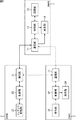
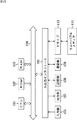
図4は、本発明の一実施形態に係るDLNA機器の構成例を示すブロック図である。
[Configuration example of communication system]
FIG. 4 is a block diagram illustrating a configuration example of a DLNA device according to an embodiment of the present invention.
図4の通信システムは、図1を参照して説明したように、DMSとして動作するDLNA機器、DMRとして動作するDLNA機器、およびDMCとして動作するDLNA機器がネットワークを介して接続されることによって構成される。 As described with reference to FIG. 1, the communication system of FIG. 4 is configured by connecting a DLNA device operating as a DMS, a DLNA device operating as a DMR, and a DLNA device operating as a DMC via a network. Is done.
図4のDMR1は図1のテレビジョン受像機などよりなるDMRに対応し、DMS2は図1のオーディオ機器などよりなるDMSに対応する。また、図4のDMC3は図1の携帯機器などよりなるDMCに対応する。重複する説明については適宜省略する。
The
図4に示すように、DMR1は、通信部11、制御部12、記憶部13、および再生部14から構成され、DMS2は、通信部21、制御部22、およびコンテンツ記憶部23から構成される。DMC3は、通信部31、制御部32、操作部33、および表示部34から構成される。
As shown in FIG. 4, the
DMR1の通信部11は、ネットワークインタフェースなどよりなり、DMS2の通信部21およびDMC3の通信部31とネットワークを介して通信を行う。通信部11により受信された情報は制御部12に供給される。例えば、通信部11は、DMC3の通信部31から送信されてきたPlayContainerUriを受信する。
The
また、通信部11は、制御部12による制御に従ってBrowse要求をDMS2の通信部21に送信し、Browse要求に対する応答として送信されてきた情報を受信する。通信部11は、アイテム取得要求を送信することに応じてDMS2の通信部21から送信されてきたアイテムを受信し、受信したアイテムを再生部14に出力することなども行う。
Further, the
制御部12は、CPU(Central Processing Unit)などよりなり、所定のプログラムを実行することによってDMR1の全体の動作を制御する。例えば、制御部12は、アイテムの探索時、Browse要求に対する応答としてDMS2から送信されてきた情報に基づいて、DMS2により管理されているコンテナに関する情報であるコンテナ情報を生成し、記憶部13に記憶させる。
The
後述するように、コンテナ情報には、アイテムのタイトルやアーティスト名、アイテムの位置情報などは含まれず、コンテナのObjectID、コンテナに格納されているアイテムのトラック番号などが含まれる。 As will be described later, the container information does not include the item title, artist name, item position information, and the like, but includes the ObjectID of the container, the track number of the item stored in the container, and the like.
制御部12は、アイテムのランダム再生がDMC3により指示された場合、または、DMC3により指定されたトラック番号のアイテムを再生する場合、記憶部13に記憶させているコンテナ情報に基づいて、再生対象のアイテムが格納されているコンテナを特定する。また、制御部12は、通信部11を制御し、特定したコンテナを探索することによってそのコンテナに格納されているアイテムの情報を取得し、アイテム取得要求をDMS2に送信する。
When the random playback of the item is instructed by the
記憶部13は、フラッシュメモリなどよりなり、制御部12により生成されたコンテナ情報を記憶する。
The
再生部14は、通信部11から供給されたアイテムを再生し、再生音をスピーカから出力する。
The
DMS2の通信部21は、DMR1の通信部11およびDMC3の通信部31とネットワークを介して通信を行う。例えば、通信部21は、DMR1の通信部11からBrowse要求が送信されてきた場合、Browse要求を受信して制御部22に出力する。通信部21は、制御部22から供給されたBrowseの実行結果を表す情報をDMR1の通信部11に出力する。
The
また、通信部21は、DMR1の通信部11から送信されてきたアイテム取得要求を受信して制御部22に出力する。通信部21は、コンテンツ記憶部23から読み出されたアイテムをDMR1の通信部11に送信する。
Further, the
制御部22は、所定のプログラムを実行することによってDMR1の全体の動作を制御する。例えば、制御部22は、プレイリスト毎にRootコンテナを設定し、プレイリストに登録されているアイテムを、図3に示すようなツリー構造によって管理する。制御部22は、アイテムの探索時にDMR1から送信されてきたBrowse要求に応じて、Browse要求に含まれるパラメータによって指定されたコンテナに格納されているアイテムに関する情報を、通信部21を制御してDMR1に送信する。
The
コンテンツ記憶部23はアイテムを記憶する。コンテンツ記憶部23に記憶されているアイテムは制御部22により管理され、適宜、読み出される。
The
DMC3の通信部31は、DMR1の通信部11およびDMS2の通信部21とネットワークを介して通信を行う。例えば、通信部31は、制御部32から供給されたPlayContainerUriをDMR1の通信部11に送信する。
The
また、通信部31は、DMS2の通信部21に対してBrowse要求を送信し、Browse要求に対する応答としてDMS2の通信部21から送信されてきた情報を受信する。通信部31は、受信した情報を制御部32に出力する。
In addition, the
制御部32は、所定のプログラムを実行することによってDMC3の全体の動作を制御する。例えば、制御部32は、Browse要求に対する応答としてDMS2から送信されてきた情報に基づいてプレイリストの一覧を表示部34に表示し、再生するプレイリストをユーザに選択させる。プレイリストが選択されたとき、制御部32は、PlayContainerUriを生成し、通信部31を制御してDMR1に送信させる。
The
操作部33は、DMC3の筐体に設けられる十字キーや決定キーに対するユーザの操作を検出し、ユーザの操作の内容を表す情報を制御部32に出力する。
The
表示部34は、LCD(Liquid Crystal Display)などのディスプレイよりなり、制御部32による制御に従って、プレイリストの一覧を表示する。
The display unit 34 includes a display such as an LCD (Liquid Crystal Display), and displays a list of playlists according to control by the
図5は、PlayContainerUriを示す図である。 FIG. 5 is a diagram illustrating PlayContainerUri.
図5の“cds-udn”は、DMSを特定するUDNを表す。“service-id-arg”は、DMSが持つCDSのService IDを表す。CDS(Content Directory Service)は、DMSが管理するアイテムのリストを階層化して配信する機能である。“container-id-arg”は、プレイリストのRootコンテナのObjectIDを表す。DMSが管理するコンテナと、コンテナに格納されているアイテムには、それぞれObjectIDが割り当てられている。 “Cds-udn” in FIG. 5 represents a UDN that identifies the DMS. “Service-id-arg” represents the CDS Service ID of the DMS. CDS (Content Directory Service) is a function that distributes a list of items managed by the DMS in a hierarchical manner. “Container-id-arg” represents the ObjectID of the root container of the playlist. An ObjectID is assigned to each container managed by the DMS and each item stored in the container.
“first-item-id-arg”は、1st Item Trackとして指定するアイテムのObjectIDを表し、“first-item-index-arg”は、1st Item Trackのアイテムのコンテナ内の位置を表す。“sort-arg”はソート条件を表し、“max-depth-arg”は、アイテムの探索時にRootコンテナから辿る階層の深さの上限を表す。 “First-item-id-arg” represents the ObjectID of the item designated as the first item track, and “first-item-index-arg” represents the position of the item of the first item track in the container. “Sort-arg” represents the sorting condition, and “max-depth-arg” represents the upper limit of the depth of the hierarchy traced from the Root container when searching for an item.
主な記述について説明すると、図5のPlayContainerUriは、“container-id-arg”で指定されるRootコンテナ以下に存在するアイテムのうち、“first-item-id-arg”で指定されたアイテムを起点とし、深さ優先で探索して見つかったアイテムを順に再生することを表す。 Explaining the main description, PlayContainerUri in Fig. 5 starts from the item specified by "first-item-id-arg" among items existing under the Root container specified by "container-id-arg". And the items found by searching with depth priority are reproduced in order.
[各機器の動作]
図6のフローチャートを参照して、DMR1、DMS2、DMC3のそれぞれの処理について説明する。
[Operation of each device]
With reference to the flowchart of FIG. 6, each process of DMR1, DMS2, and DMC3 is demonstrated.
図6には、PlayContainerUriをDMR1が受信し、解析するまでの各機器の処理を示している。図6のステップS51乃至S55のDMC3の処理は、図2のステップS1乃至S5の処理に対応し、図6のステップS61,S62のDMS2の処理は、図2のステップS11,S12の処理に対応する。図6のステップS71,S72のDMR1の処理は、図2のステップS21,S22の処理に対応する。 FIG. 6 shows the processing of each device until the DMR1 receives PlayContainerUri and analyzes it. The DMC3 process in steps S51 to S55 in FIG. 6 corresponds to the process in steps S1 to S5 in FIG. 2, and the DMS2 process in steps S61 and S62 in FIG. 6 corresponds to the processes in steps S11 and S12 in FIG. To do. The processing of DMR1 in steps S71 and S72 in FIG. 6 corresponds to the processing in steps S21 and S22 in FIG.
ステップS51において、DMC3の制御部32はBrowseを実行し、通信部31を制御してBrowse要求をDMS2に送信する。
In step S51, the
ステップS61において、DMS2の通信部21は、DMC3によるBrowse要求を受信する。
In step S61, the
ステップS62において、DMS2の制御部22は、通信部21を制御し、Browse要求に対する応答として、プレイリストとして選択することが可能な、アイテムが格納されているコンテナの情報をDMC3に送信する。
In step S <b> 62, the
ステップS52において、DMC3の通信部31は、DMS2から送信されてきた情報を受信する。制御部32は、通信部31において受信された情報に基づいてプレイリストの一覧を表示部34に表示し、再生するプレイリストをユーザに選択させる。
In step S52, the
ステップS53において、DMC3の制御部32は、操作部33から供給された情報に基づいて再生対象のプレイリスト(Rootコンテナ)を決定する。
In step S53, the
ステップS54において、DMC3の制御部32は、ユーザにより選択されたプレイリストに対応するRootコンテナを指定する情報などを含む、図5に示すPlayContainerUriを作成する。
In step S54, the
ステップS55において、DMC3の制御部32は、通信部31を制御し、PlayContainerUriをDMR1に送信する。
In step S55, the
ステップS71において、DMR1の通信部11は、DMC3の通信部31から送信されてきたPlayContainerUriを受信する。制御部12は、通信部11により受信されたPlayContainerUriを記憶部13などに記憶させる。
In step S71, the
ステップS72において、DMR1の制御部12は、PlayContainerUriを解析することによって、アイテムの配信元がDMS2であることや、プレイリストに対応するRootコンテナなどを特定する。
In step S72, the
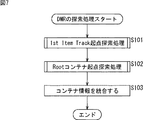
[DMRの探索処理]
次に、図7のフローチャートを参照して、アイテムを探索するDMR1の処理について説明する。
[DMR search processing]
Next, DMR1 processing for searching for an item will be described with reference to the flowchart of FIG.
図7の処理は、DMC3から送信されてきたPlayContainerUriの解析が終了した後に行われる。DMS2においては、図3に示すツリー構造によってアイテムが管理されているものとする。また、PlayContainerUriのcontainer-id-argによって図3のContainer_Aが指定され、first-item-id-argによって、1st Item TrackとしてItem_1が指定されているものとする。PlayContainerUriには、Container_AのObjectIDとItem_1のObjectIDが含まれている。
The processing in FIG. 7 is performed after the analysis of PlayContainerUri transmitted from
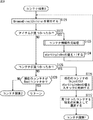
ステップS101において、DMR1の制御部12は、通信部11を制御するなどしてDMS2と通信を行い、1st Item Track起点探索処理を行う。1st Item Track起点探索処理においては、1st Item Trackとして指定されたItem_1を起点として、アイテムの探索が行われる。
In step S101, the
ステップS102において、制御部12は、Rootコンテナ起点探索処理を行う。Rootコンテナ起点探索処理においては、RootコンテナであるContainer_Aを起点として、1st Item Trackとして指定されたItem_1が見つかるまで探索が行われる。
In step S102, the
ステップS103において、制御部12は、1st Item Track起点探索処理により得られたコンテナ情報と、Rootコンテナ起点探索処理により得られたコンテナ情報を統合する。コンテナ情報の統合については後述する。
In step S103, the
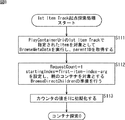
ここで、図8乃至図13のフローチャートを参照して、図7のステップS101において行われる1st Item Track起点探索処理について説明する。 Here, the 1st Item Track start point search process performed in step S101 of FIG. 7 will be described with reference to the flowcharts of FIGS.
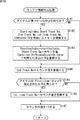
図8のステップS111において、制御部12は、PlayContainerUriのfirst-item-id-argで1st Item Trackとして指定されたアイテムを対象としてBrowseMetaDataを実行する。
In step S111 of FIG. 8, the
ここで、DMR1が行うBrowseには、BrowseMetaDataとBrowseDirectChildrenがある。
Here, Browse performed by
BrowseMetaDataは、オブジェクトを指定して、そのオブジェクトの情報をDMR1が取得するためのBrowseである。DMR1からDMS2に送信されるBrowseMetaDataのコマンドにはObjectIDが含まれており、BrowseMetaDataのコマンドを受信したDMS2は、ObjectIDにより指定されたオブジェクトの情報をDMR1に対して送信する。DMS2から送信されるオブジェクトの情報には、ObjectIDにより指定されたオブジェクトを格納するコンテナ(親のコンテナ)のObjectIDであるparentIDなどが含まれる。
BrowseMetaData is a Browse for designating an object and for the
BrowseDirectChildrenは、コンテナを指定して、そのコンテナに格納されているオブジェクト(子のオブジェクト)の情報をDMR1が取得するためのBrowseである。DMR1からDMS2に送信されるBrowseDirectChildrenのコマンドにはObjectIDが含まれており、BrowseDirectChildrenのコマンドを受信したDMS2は、ObjectIDにより指定されたコンテナに格納されているコンテナやアイテムのObjectID、アイテムのURLなどの情報をDMR1に送信する。
BrowseDirectChildren is a browse for the
この例においては、BrowseMetaDataが実行されることにより、1st Item Trackとして指定されたItem_1の親のコンテナであるContainer_CのObjectIDがparentIDとして取得される。 In this example, by executing BrowseMetaData, the ObjectID of Container_C, which is the parent container of Item_1 specified as the 1st Item Track, is acquired as the parentID.
ステップS112において、制御部12は、1st Item Trackとして指定されたアイテムの親のコンテナを対象とするBrowseDirectChildrenの準備を行う。BrowseDirectChildrenの準備として、BrowseDirectChildrenのパラメータであるRequestCountの値として1、startingIndexの値として、PlayContainerUriで指定されたfirst-item-index-argの値を設定することが行われる。
In step S112, the
RequestCountは、BrowseDirectChildrenに対する応答として情報を返すオブジェクトの数を指定するパラメータである。例えば、RequestCountの値が1であることは、startingIndexで指定された位置にある1つのオブジェクトの情報の送信を要求することを表す。 RequestCount is a parameter that specifies the number of objects that return information as a response to BrowseDirectChildren. For example, a RequestCount value of 1 indicates a request for transmission of information on one object at the position specified by startingIndex.
startingIndexは、情報の送信を要求するオブジェクトの位置を表すパラメータである。例えば、startingIndexの値が0であることは、BrowseDirectChildrenの対象となるコンテナに格納されている最初(ソート順で最初)のアイテムの位置を表す。 The startingIndex is a parameter that represents the position of an object that requests transmission of information. For example, the value of startingIndex being 0 represents the position of the first item (first in the sort order) stored in the container targeted for BrowseDirectChildren.
DMC3から送信されてきたPlayContainerUriには、Container_CにおけるItem_1の位置を表す情報としてfirst-item-index-arg=1が設定されている。first-item-index-argの値が1であることは、Container_Cを対象としてBrowseDirectChildrenを実行したときに最初に見つかるオブジェクトであるContainer_Fの位置をstartingIndex=0で表される位置として、1st Item TrackであるItem_1が、その次の位置にあることを表す。
In the PlayContainerUri transmitted from the
すなわち、制御部12は、RequestCountの値として1、startingIndexの値として1を、Container_Cを対象とするBrowseDirectChildrenのパラメータとして設定する。Container_Cを対象とすることは、Container_CのObjectIDにより指定される。
That is, the
ステップS113において、制御部12はカウンタの値を1に初期化する。制御部12は、記憶部13に記憶させておくなどして、探索により見つかったアイテムの数を表すカウンタを管理している。その後、処理はコンテナ探索0に進む。
In step S113, the
次に、図9のフローチャートを参照して、コンテナ探索0について説明する。
Next,
ステップS121において、制御部12は、BrowseDirectChildrenを実行する。
In step S121, the
例えば、図8のステップS112において準備が行われた後に、Container_Cを対象とするBrowseDirectChildrenがステップS121において行われた場合、それに対する応答として、DMS2からは、Container_Cに格納され、startingIndex=1により指定される1つのオブジェクトであるItem_1の情報が送信されてくる。Item_1の情報には、Item_1のObjectIDが含まれる。 For example, if the BrowseDirectChildren for Container_C is performed in step S121 after preparation is performed in step S112 in FIG. 8, the response from DMS2 is stored in Container_C and specified by startingIndex = 1. Information of Item_1 which is one object is transmitted. Item_1 information includes Object_1 ObjectID.
なお、1st Item Track起点探索処理、Rootコンテナ起点探索処理で実行されるBrowseDirectChildrenにおいては、RequestCountの値として常に1が設定される。すなわち、DMS2により管理されているオブジェクトの情報が、1つずつ、BrowseDirectChildrenが行われる毎にDMR1により取得されることになる。
In BrowseDirectChildren executed in the 1st Item Track start point search process and the Root container start point search process, 1 is always set as the value of RequestCount. That is, information on objects managed by the
また、startingIndexの値として、1st Item Trackで指定されたアイテムの親のコンテナに対してBrowseDirectChildrenを実行する場合を除いて、初期値として0が設定され、その後、同じコンテナを対象としてBrowseDirectChildrenを実行する毎に1を加算した値が設定される。すなわち、BrowseDirectChildrenの対象となるコンテナに格納されているオブジェクトの情報が、先頭のものから順に、1つずつ、BrowseDirectChildrenが行われる毎にDMR1により取得されることになる。
The startingIndex value is set to 0 as the initial value unless BrowseDirectChildren is executed for the parent container of the item specified in the 1st Item Track, and then BrowseDirectChildren is executed for the same container. A value obtained by adding 1 to each is set. That is, the information of the objects stored in the container that is the target of BrowseDirectChildren is acquired by the
ステップS122において、制御部12は、アイテムが見つかったか否かを判定する。
In step S122, the
アイテムが見つかったとステップS122において判定した場合、ステップS123において、制御部12は、コンテナ情報作成処理を行う。
If it is determined in step S122 that an item has been found, in step S123, the
ステップS124において、制御部12は、現在のコンテナ(現在探索対象としているコンテナ)を対象とするBrowseDirectChildrenのstartingIndexの値として、それまでの値に1を加算した値を設定する。
In step S124, the
startingIndexの値が更新された後、ステップS121に戻り、同じコンテナを対象としてBrowseDirectChildrenが実行される。同じコンテナを対象としてBrowseDirectChildrenが繰り返し行われることにより、現在のコンテナに直接格納されている全てのアイテムが見つかることになる。 After the value of startingIndex is updated, the process returns to step S121, and BrowseDirectChildren is executed for the same container. By repeating BrowseDirectChildren for the same container, all items stored directly in the current container can be found.
一方、アイテムが見つかっていないとステップS122において判定した場合、ステップS125において、制御部12は、ステップS121で実行したBrowseDirectChildrenによってコンテナが見つかったか否かを判定する。
On the other hand, when it is determined in step S122 that no item is found, in step S125, the
コンテナが見つかったとステップS125において判定した場合、ステップS126において、制御部12は、現在のコンテナのObjectIDと、現在のstartingIndexの値をスタックに格納する。スタック用のメモリ領域も例えば記憶部13に確保されている。
If it is determined in step S125 that the container has been found, in step S126, the
ステップS127において、制御部12は、ステップS121のBrowseDirectChildrenによって見つかったコンテナを、次の探索の対象として選択する。その後、処理はコンテナ探索1に進む。
In step S127, the
一方、ステップS125においてコンテナが見つかっていないと判定した場合、ステップS128において、制御部12は、現在のコンテナがRootコンテナであるか否かを判定する。現在のコンテナがRootコンテナであるか否かは、例えば、BrowseDirectChildrenによって得られたコンテナのObjectIDが、DMC3から送信されてきたPlayContainerUriのcontainer-id-argで指定されるObjectIDと同じであるか否かに基づいて判定される。
On the other hand, if it is determined in step S125 that no container is found, in step S128, the
現在のコンテナがRootコンテナではないとステップS128において判定した場合、制御部12はコンテナ探索2を行う。
If it is determined in step S128 that the current container is not the root container, the
一方、現在のコンテナがRootコンテナであるとステップS128において判定した場合、制御部12は、1st Item Track起点探索処理を終了し、図7のステップS101以降の処理を行う。
On the other hand, if it is determined in step S128 that the current container is the root container, the
次に、図10のフローチャートを参照して、図9のステップS123において行われるコンテナ情報作成処理について説明する。 Next, the container information creation process performed in step S123 of FIG. 9 will be described with reference to the flowchart of FIG.
図10の処理は、ステップS121において行われたBrowseDirectChildrenによってアイテムが見つかる毎に行われる。 The process in FIG. 10 is performed every time an item is found by BrowseDirectChildren performed in step S121.
ステップS141において、制御部12は、現在のコンテナからアイテムが見つかったのは初めてか否かを判定する。例えば、現在のコンテナがContainer_Cであり、BrowseDirectChildrenによって見つかったアイテムが、先頭のアイテムであるItem_1である場合、現在のコンテナからアイテムが見つかったのが初めてであるとして判定される。
In step S141, the
現在のコンテナからアイテムが見つかったのが初めてであるとステップS141において判定した場合、ステップS142において、制御部12は、StartingIndex,Start Track No,End Track No,1st Item Track No,ContainerIDを格納するメモリ領域を記憶部13に確保する。これらの情報は、コンテナ情報に含まれる情報である。
When it is determined in step S141 that an item has been found for the first time from the current container, in step S142, the
StartingIndexは、ContainerIDにより指定されるコンテナを対象としてBrowseDirectChildrenを行うときに、startingIndexの値としてどの値を指定すれば、そのコンテナに格納されている最初のアイテム(Start Track Noで指定されるアイテム)が見つかるのかを表す。あるコンテナを対象とするBrowseDirectChildrenによって最初にアイテムが見つかったときのstartingIndexの値が、StartingIndexとして制御部12により登録される。
StartingIndex is the value specified as the value of startingIndex when performing BrowseDirectChildren for the container specified by ContainerID, and the first item stored in that container (the item specified by Start Track No) Indicates whether it can be found. The value of startingIndex when the item is first found by BrowseDirectChildren targeting a certain container is registered by the
Start Track Noは、ContainerIDにより指定されるコンテナに格納されるアイテムのうちの最初のアイテムのトラック番号を表す。1st Item Track起点探索処理においては、見つかったアイテムの順に、トラック番号として仮の番号が割り当てられる。あるコンテナを対象とするBrowseDirectChildrenによって最初に見つかったアイテムのトラック番号がStart Track Noとして制御部12により登録される。
Start Track No represents the track number of the first item among the items stored in the container specified by ContainerID. In the 1st Item Track starting point search process, a temporary number is assigned as the track number in the order of the found items. The track number of the item first found by BrowseDirectChildren for a certain container is registered by the
End Track Noは、ContainerIDにより指定されるコンテナに格納されるアイテムのうちの最後のアイテムのトラック番号を表す。あるコンテナを対象とするBrowseDirectChildrenによって最後に見つかったアイテムのトラック番号がEnd Track Noとして制御部12により登録される。
End Track No represents the track number of the last item among the items stored in the container specified by ContainerID. The track number of the item found last by BrowseDirectChildren for a certain container is registered by the
1st Item Track Noは、PlayContainerUriのfirst-item-id-argによって1st Item Trackとして指定されたアイテムが、ContainerIDにより指定されるコンテナに格納されるものある場合に、その1st Item Trackのアイテムのトラック番号を表す。1st Item Trackとして指定されたアイテムが格納されていないコンテナの情報には、1st Item Track Noの値として0が登録される。 1st Item Track No is the track number of the item of 1st Item Track when the item specified as 1st Item Track by PlayContainerUri's first-item-id-arg is stored in the container specified by ContainerID Represents. 0 is registered as the value of the 1st Item Track No in the information of the container in which the item designated as the 1st Item Track is not stored.
ContainerIDは、それに対応付けられて記憶されるStartingIndex,Start Track No,End Track No,1st Item Track Noの各情報が、どのコンテナに関する情報であるのかを表す。ContainerIDには、コンテナのObjectIDが登録される。 ContainerID represents which container is associated with each information of StartingIndex, Start Track No, End Track No, and 1st Item Track No stored in association therewith. In ContainerID, the ObjectID of the container is registered.
ステップS143において、制御部12は、StartingIndexの値として、現在のstartingIndexの値を登録し、Start Track Noの値として、現在のカウンタ値を登録する。また、制御部12は、ContainerIDとして、BrowseDirectChildrenで利用したObjectID(現在のコンテナのObjectID)を登録する。
In step S143, the
現在のコンテナからアイテムが見つかったのが初めてではないとステップS141において判定された場合、ステップS142,S143の処理はスキップされる。 If it is determined in step S141 that an item has not been found from the current container, the processes in steps S142 and S143 are skipped.
ステップS144において、制御部12は、End Track Noの値として、現在のカウンタ値を登録する。現在のコンテナの情報として、End Track Noの値が既に登録されている場合、そのEnd Track Noの値は現在のカウンタ値によって更新される。
In step S144, the
ステップS145において、制御部12は、見つかったアイテムがPlayContainerUriのfirst-item-id-argで指定されたアイテムと同じであるか否かを判定する。
In step S145, the
見つかったアイテムがPlayContainerUriのfirst-item-id-argで指定されたアイテムと同じであるとステップS145において判定した場合、制御部12は、ステップS146において、1st Item Track Noの値として現在のカウンタ値を登録する。
When it is determined in step S145 that the found item is the same as the item specified by first-item-id-arg of PlayContainerUri, the
1st Item Track Noの値を登録した後、または、見つかったアイテムがPlayContainerUriのfirst-item-id-argで指定されたアイテムではないとステップS145において判定された場合、ステップS147において、制御部12は、カウンタの値に1を加算する。
After registering the value of 1st Item Track No, or when it is determined in step S145 that the found item is not the item specified by the first-item-id-arg of PlayContainerUri, in step S147, the
カウンタの値が更新された後、図9のステップS123に戻り、それ以降の処理が行われる。 After the value of the counter is updated, the process returns to step S123 in FIG. 9, and the subsequent processing is performed.
次に、図11のフローチャートを参照して、図9のステップS127の処理に続けて行われるコンテナ探索1について説明する。
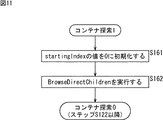
Next, with reference to the flowchart of FIG. 11, the
コンテナ探索1は、直前に実行したBrowseDirectChildrenによってコンテナが見つかった場合、その見つかったコンテナを対象として行われる。
The
ステップS161において、制御部12は、startingIndexの値を0に初期化し、現在のコンテナ(直前に実行したBrowseDirectChildrenによって見つかったコンテナ)を対象とするBrowseDirectChildrenの準備を行う。
In step S161, the
ステップS162において、制御部12は、現在のコンテナを対象としてBrowseDirectChildrenを実行する。その後、図9のコンテナ探索0のステップS122以降の処理が行われる。
In step S162, the
次に、図12のフローチャートを参照して、現在のコンテナがRootコンテナではないと図9のステップS128において判定された場合に、コンテナ探索0に続けて行われるコンテナ探索2について説明する。
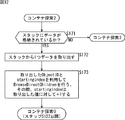
Next, with reference to the flowchart of FIG. 12, a description will be given of the
ステップS171において、制御部12は、スタックにデータが格納されているか否かを判定する。ここでは、コンテナ探索2が開始される前に図9のステップS126の処理、または、後述する図13のステップS188の処理が行われている場合、スタックにデータが格納されているとして判定されることになる。
In step S171, the
スタックにデータが格納されていないとステップS171において判定された場合、処理はコンテナ探索3に進む。
If it is determined in step S171 that no data is stored in the stack, the process proceeds to
一方、スタックにデータが格納されているとステップS171において判定した場合、ステップS172において、制御部12は、スタックに格納しておいたObjectIDとstartingIndexの値を取り出す。取り出されたObjectIDとstartingIndexの値はスタックから消去される。
On the other hand, if it is determined in step S171 that data is stored in the stack, in step S172, the
ステップS173において、スタックから取り出したObjectIDにより指定されるコンテナを対象としてBrowseDirectChildrenを実行する。その際、制御部12は、startingIndexの値として、スタックから取り出したstartingIndexの値に1を加算した値を用いる。その後、図9のコンテナ探索0のステップS122以降の処理が行われる。
In step S173, BrowseDirectChildren is executed for the container specified by the ObjectID extracted from the stack. At this time, the
次に、図13のフローチャートを参照して、図12のステップS171においてスタックにデータが格納されていないと判定された場合に行われるコンテナ探索3について説明する。
Next, the
ステップS181において、制御部12は、現在のコンテナのObjectIDを調べる。ここでは、現在のコンテナのObjectIDをαとする。
In step S181, the
ステップS182において、制御部12は、ステップS181で調べたObjectIDを用いて現在のコンテナを対象としてBrowseMetaDataを実行し、現在のコンテナの親のコンテナのObjectIDであるparentIDを取得する。
In step S182, the
ステップS183において、制御部12は、startingIndexの値として0を設定し、parentIDで指定されるコンテナを対象とするBrowseDirectChildrenの準備を行う。
In step S183, the
ステップS184において、制御部12は、BrowseDirectChildrenを実行する。
In step S184, the
ステップS185において、制御部12は、BrowseDirectChildrenの実行結果に基づいて、αで指定される、ステップS182でBrowseMetaDataを実行したコンテナが見つかったか否かを判定する。
In step S185, based on the execution result of BrowseDirectChildren, the
ステップS182でBrowseMetaDataを実行したコンテナが見つかっていないとステップS185において判定した場合、ステップS186において、制御部12は、現在のコンテナ(ステップS182で取得したparentIDで指定されるコンテナ)を対象とするBrowseDirectChildrenのstartingIndexの値として、それまでの値に1を加算した値を設定する。
If it is determined in step S185 that the container that has executed BrowseMetaData is not found in step S182, in step S186, the
startingIndexの値が更新された後、ステップS184に戻り、同じコンテナを対象としてBrowseDirectChildrenが実行される。 After the value of startingIndex is updated, the process returns to step S184, and BrowseDirectChildren is executed for the same container.
ステップS182でBrowseMetaDataを実行したコンテナが見つかったとステップS185において判定した場合、ステップS187において、制御部12は、現在のstartingIndexの値に1を加算する。
When it is determined in step S185 that a container that has executed BrowseMetaData is found in step S182, in step S187, the
ステップS188において、制御部12は、現在探索していたコンテナのObjectIDとstartingIndexの値をスタックに格納する。その後、処理はコンテナ探索0に進む。
In step S188, the
ここで、図3のツリー構造を対象として以上の探索を行った場合の処理の流れを具体的に説明する。 Here, the flow of processing when the above search is performed for the tree structure of FIG. 3 will be specifically described.
はじめに、PlayContainerUriのfirst-item-id-argによって1st Item Trackとして指定されたItem_1を対象としてBrowseMetaDataが実行される(図8のステップS111)。Item_1を対象としたBrowseMetaDataにより、親のコンテナであるContainer_CのObjectIDが取得される。 First, BrowseMetaData is executed for Item_1 designated as 1st Item Track by the first-item-id-arg of PlayContainerUri (step S111 in FIG. 8). ObjectID of Container_C that is the parent container is acquired by BrowseMetaData for Item_1.
次に、取得されたObjectIDを用いて、Container_Cを対象としてBrowseDirectChildrenが実行される(図9のステップS121)。Container_Cを対象とする1回目のBrowseDirectChildrenのstartingIndexの値は、PlayContainerUriで指定されたfirst-item-index-argの値と同じ1である。 Next, BrowseDirectChildren is executed for Container_C using the acquired ObjectID (step S121 in FIG. 9). The startingIndex value of the first BrowseDirectChildren for Container_C is 1 which is the same as the first-item-index-arg value specified in PlayContainerUri.
Container_Cを対象とする1回目のBrowseDirectChildrenによりItem_1が見つかり、それに応じてコンテナ情報作成処理が行われる(図9のステップS123)。コンテナ情報作成処理により、Container_Cの情報として、StartingIndex=1、Start Track No=1、ContainerID=Container_CのObjectIDが、それぞれ登録される(図10のステップS143)。また、1st Item Track No=1が登録される(図10のステップS146)。 Item_1 is found by the first BrowseDirectChildren for Container_C, and container information creation processing is performed accordingly (step S123 in FIG. 9). By container information creation processing, ObjectID of StartingIndex = 1, Start Track No = 1, and ContainerID = Container_C is registered as Container_C information (step S143 in FIG. 10). Also, 1st Item Track No = 1 is registered (step S146 in FIG. 10).
startingIndexの値は図8のステップS124において2となる。Container_Cを対象とする2回目のBrowseDirectChildrenによりItem_2が見つかり、それに応じて、コンテナ情報作成処理が行われる(図9のステップS123)。コンテナ情報作成処理により、Container_Cの情報として、End Track No=2が登録される(図10のステップS144)。 The value of startingIndex is 2 in step S124 in FIG. Item_2 is found by the second BrowseDirectChildren for Container_C, and the container information creation process is performed accordingly (step S123 in FIG. 9). Through the container information creation process, End Track No = 2 is registered as Container_C information (step S144 in FIG. 10).
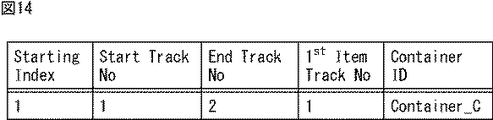
この時点で記憶部13に記憶されるコンテナ情報を図14に示す。図14に示すように、Container_Cの情報として、StartingIndex=1、Start Track No=1、End Track No=2、1st Item Track No=1が、Container_CのObjectIDと対応付けて記憶される。
The container information stored in the
このように、DMR1においては、あるコンテナを対象とした探索結果を表す情報として、アイテムの再生時に、そのコンテナを対象としてどのような値をパラメータとして設定してBrowseDirectChildrenを行えばアイテムの情報を取得することができるのかを表す情報が記憶される。 In this way, in DMR1, as information representing the search result for a certain container, when reproducing an item, what value is set as a parameter for that container and BrowseDirectChildren is used to obtain item information Information indicating whether or not it can be stored is stored.
すなわち、Container_Cを再生する場合、制御部12は、コンテナ情報を参照することによって、Container_CのObjectIDを特定することが可能になる。
That is, when playing Container_C, the
また、制御部12は、特定したObjectIDに基づいてContainer_Cを指定するとともに、startingIndex=1を指定するBrowseDirectChildrenを実行することによって、仮のトラック番号でいうTrack_1のアイテムの情報を取得することが可能になる。制御部12は、取得した情報(ObjectID、URL等)に基づいてアイテム取得要求を行うことによって、Track_1のアイテムを取得し、再生することができる。
Further, the
さらに、制御部12は、特定したObjectIDに基づいてContainer_Cを指定するとともに、startingIndex=2を指定するBrowseDirectChildrenを実行することによって、仮のトラック番号でいうTrack_2のアイテムの情報を取得することが可能になる。制御部12は、取得した情報に基づいてアイテム取得要求を行うことによって、Track_2のアイテムを取得し、再生することができる。
Furthermore, the
また、制御部12は、Container_Cに格納されているアイテムが、Track_1のアイテムからTrack_2のアイテムまでであることをコンテナ情報から特定することができる。また、制御部12は、”End Track No” - “Start Track No” + 1の計算結果から、Container_C には再生対象のアイテムが2個あることも特定することができる。制御部12は、1st Item Track No に1が設定されていることから、PlayContainerUriで指定された、最初に再生すべきアイテムがContainer_Cにあることを特定することができる。
Further, the
これにより、BrowseDirectChildrenによって取得された情報を全て記憶しておく場合に較べて、DMS2から取得可能なアイテムの情報を記憶しておくために必要なメモリの容量を減らすことが可能になる。
This makes it possible to reduce the amount of memory required to store information on items that can be acquired from the
図3のツリー構造の探索の説明に戻り、startingIndexの値は図8のステップS124において3となり、Container_Cを対象とする3回目のBrowseDirectChildrenによりContainer_Gが見つかる。 Returning to the description of the tree structure search in FIG. 3, the value of startingIndex is 3 in step S124 in FIG. 8, and Container_G is found by the third BrowseDirectChildren for Container_C.
Container_Cの情報がスタックに格納された後(図9のステップS126)、Container_Gが、次の探索対象のコンテナとして選択される(図9のステップS127)。Container_Gの探索に移る前にContainer_Cの情報をスタックに格納しておく理由は、Container_Gの探索が終わった後、Container_Cに戻り、Container_Cを対象として既に探索を行った位置の続きから探索を再開できるようにするためである。 After the information of Container_C is stored in the stack (step S126 in FIG. 9), Container_G is selected as the next search target container (step S127 in FIG. 9). The reason for storing Container_C information in the stack before moving to Container_G search is that after searching Container_G, return to Container_C so that the search can be resumed from the point where Container_C was already searched. It is to make it.
Container_Gを対象としてコンテナ探索1が行われ(図11)、続けて、コンテナ探索0のステップS122以降の処理が行われることによって、Item_3とItem_4が見つかる。それぞれのアイテムが見つかる毎にコンテナ情報作成処理が行われることによって、記憶部13には、Container_Gの情報としてItem_3とItem_4の情報が記憶される。
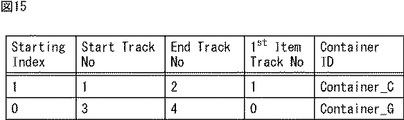
この時点で記憶部13に記憶されるコンテナ情報を図15に示す。図15に示すように、Container_Cの情報に追加して、StartingIndex=0、Start Track No=3、End Track No=4、1st Item Track No=0がContainer_GのObjectIDと対応付けて記憶される。図15のコンテナ情報は、Container_Cに格納されているアイテムを再生した後、再生対象がContainer_Gに格納されているアイテムに移ることを表す。
The container information stored in the
Container_Gを対象とする2回のBrowseDirectChildrenによってItem_3とItem_4が見つかった後に行われる、Container_Gを対象とする3回目のBrowseDirectChildren(図9のステップS121)によっては、アイテムもコンテナも見つからない。この場合、現在のコンテナであるContainer_GはRootコンテナではないから、図9のステップS128の判定を経て、処理はコンテナ探索0から、図12のコンテナ探索2に進む。
Depending on the third BrowseDirectChildren for Container_G (Step S121 in FIG. 9) performed after Item_3 and Item_4 are found by two BrowseDirectChildren for Container_G, neither an item nor a container is found. In this case, because Container_G as the current container is not a Root container, the process proceeds from
探索対象がContainer_CからContainer_Gに移る前にContainer_Cの情報がスタックに格納されているから、コンテナ探索2においては、スタックに格納されている情報に基づいて、Container_Cを対象としてBrowseDirectChildrenが実行される(図12のステップS173)。ここで行われるBrowseDirectChildrenは、既に探索が終了しているContainer_Gの次の位置にあるオブジェクトを探索するものである。その後、処理はコンテナ探索0のステップS122以降に進む。
Since Container_C information is stored in the stack before the search target moves from Container_C to Container_G, in
Container_Cを対象とするBrowseDirectChildrenによってはオブジェクトが見つからないから、処理はコンテナ探索0からコンテナ探索2に進む。2回目のコンテナ探索2においては、スタックにはContainer_Cの情報が格納されていないから、ステップS171の判定を経て、処理はコンテナ探索2からコンテナ探索3に進む。
Since the object cannot be found by BrowseDirectChildren targeting Container_C, the process proceeds from
コンテナ探索3においては、Container_Cに対してBrowseMetaDataが実行され、親のコンテナであるContainer_AのObjectIDが取得される(図13のステップS182)。また、Container_Aを対象として、Container_Cが見つかるまで、BrowseDirectChildrenが繰り返される(図13のステップS184)。
In
Container_Aを対象とする3回目のBrowseDirectChildrenによってContainer_Cが見つかり、このとき、startingIndexの値に1が加算され(図13のステップS187)、Container_Aの情報がスタックに格納された後(図13のステップS188)、処理はコンテナ探索3からコンテナ探索0に進む。
Container_C is found by the third BrowseDirectChildren for Container_A. At this time, 1 is added to the value of startingIndex (step S187 in FIG. 13), and the information of Container_A is stored in the stack (step S188 in FIG. 13). The process proceeds from
その後、Container_Dを対象としてBrowseDirectChildrenが実行され、Item_5が見つかることに応じてコンテナ情報作成処理が行われる。また、Container_Eを対象としてBrowseDirectChildrenが実行され、Item_6が見つかることに応じてコンテナ情報作成処理が行われる。 Thereafter, BrowseDirectChildren is executed for Container_D, and container information creation processing is performed in response to finding Item_5. Also, BrowseDirectChildren is executed for Container_E, and container information creation processing is performed when Item_6 is found.
Container_Aを対象としてBrowseDirectChildrenが実行され、Item_7が見つかることに応じてコンテナ情報作成処理が行われた後、図9のステップS128の処理を経て、1st Item Track起点探索処理が終了する。 After BrowseDirectChildren is executed for Container_A and Item_7 is found, container information creation processing is performed, and then the 1st Item Track starting point search processing is completed through the processing in step S128 of FIG.
以上のように、1st Item Track起点探索処理においては、Item_1を起点として、Item_1とともに同じContainer_Cに格納されるItem_2、Container_Gに格納されるItem_3、Item_3とともに同じContainer_Gに格納されるItem_4、Container_Dに格納されるItem_5、Container_Eに格納されるItem_6、Container_Aに格納されるItem_7の順に各アイテムが見つかる。 As described above, in the 1st Item Track starting point search process, starting with Item_1, Item_2 stored in the same Container_C with Item_1, Item_3 stored in Container_G, and stored in Item_4 and Container_D stored in the same Container_G together with Item_3 Item_5, Item_6 stored in Container_E, and Item_7 stored in Container_A are found in this order.
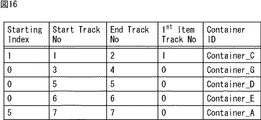
1st Item Track起点探索処理が終了したとき、記憶部13には、図16に示すコンテナ情報が記憶される。
When the 1st Item Track start point search process is completed, the
図16に示すように、コンテナ情報には、見つかったアイテムを格納するコンテナの順に、Container_C、Container_G、Container_D、Container_E、Container_Aの各コンテナの情報が登録される。 As shown in FIG. 16, in the container information, information on each container of Container_C, Container_G, Container_D, Container_E, and Container_A is registered in the order of containers storing the found items.
ただし、このままでは、PlayContainerUriで指定されたDMS2が管理するアイテムの全ての探索結果を取得したことにならない。図7を参照して説明したように、1st Item Track起点探索処理が終了したとき、Rootコンテナ起点探索処理が行われる。
However, as it is, it does not mean that all search results of items managed by the
Rootコンテナ起点探索処理においては、RootコンテナであるContainer_Aを起点として、1st Item Trackとして指定されたItem_1が見つかるまで探索が行われる。Rootコンテナ起点探索処理も、探索の起点が異なる点と、Item_1が見つかったときに処理が終了される点を除いて、基本的に、1st Item Track起点探索処理と同様の処理である。 In the Root container starting point search process, the search is performed from the Container_A that is the Root container until the Item_1 designated as the 1st Item Track is found. The root container start point search process is basically the same process as the 1st Item Track start point search process except that the search start point is different and the process is terminated when Item_1 is found.
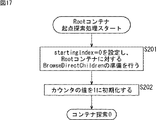
図17のフローチャートを参照して、図7のステップS102において行われるRootコンテナ起点探索処理について説明する。 With reference to the flowchart of FIG. 17, the root container starting point search process performed in step S102 of FIG. 7 will be described.
ステップS201において、制御部12は、startingIndex=0を設定し、RootコンテナであるContainer_Aに対するBrowseDirectChildrenの準備を行う。
In step S201, the
ステップS202において、制御部12は、カウンタの値を1に初期化する。
In step S202, the
その後、処理はコンテナ探索0に進み、上述した処理と同様の処理が行われる。すなわち、Rootコンテナ起点探索処理においては、Container_Aに格納されるItem_8、Container_Bに格納されるItem_9、Container_Fに格納されるItem_10が見つかる。Item_10が見つかった後、Container_Cに格納されるItem_1が見つかるから、そのときにRootコンテナ起点探索処理は終了する。
Thereafter, the process proceeds to
Rootコンテナ起点探索処理のBrowseDirectChildrenによって見つかったアイテムが1st Item Trackとして指定されたItem_1と同じアイテムであるか否かは、BrowseDirectChildrenによって得られたアイテムのObjectIDが、DMC3から送信されてきたPlayContainerUriのfirst-item-id-argで指定されるObjectIDと同じであるか否かに基づいて判定される。Rootコンテナ起点探索処理において、Container_Cを対象とし、startingIndexの値を1としてBrowseDirectChildrenを行ったときに得られるObjectIDは、PlayContainerUriのfirst-item-id-argで指定されるObjectIDと同じものとなる。このとき、Rootコンテナ起点探索処理は終了する。 Whether or not the item found by BrowseDirectChildren in the Root container origin search process is the same item as Item_1 specified as the 1st Item Track, the ObjectID of the item obtained by BrowseDirectChildren is the first- of PlayContainerUri sent from DMC3 Judged based on whether or not it is the same as the ObjectID specified by item-id-arg. In the Root container starting point search process, the ObjectID obtained when performing BrowseDirectChildren with Container_C as the target and the startingIndex value set to 1, is the same as the ObjectID specified by the first-item-id-arg of PlayContainerUri. At this time, the root container starting point search process ends.
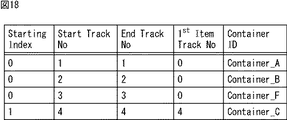
Rootコンテナ起点探索処理が終了したとき、記憶部13には、図18に示すコンテナ情報が記憶される。
When the root container starting point search process is completed, the
図18に示すように、コンテナ情報には、Rootコンテナ起点探索処理によって見つかったアイテムを格納するコンテナの順に、Container_A、Container_B、Container_F、Container_Cの各コンテナの情報が登録される。 As shown in FIG. 18, in the container information, information on each container of Container_A, Container_B, Container_F, and Container_C is registered in the order of containers storing items found by the Root container starting point search process.
上述したように、DMS2においては、RootコンテナであるContainer_Aを起点としてBrowseを実行したときに見つけることができる順に、それぞれのアイテムにトラック番号が割り当てられている。 As described above, in DMS2, track numbers are assigned to items in the order in which they can be found when a Browse is executed with Container_A as a root container as a starting point.
Rootコンテナ起点探索処理においても、見つかった順に各アイテムにトラック番号が制御部12により割り当てられるが、各アイテムに割り当てられたトラック番号は、仮の番号ではなく、DMS2により割り当てられているトラック番号と同じ、正式な番号である。図18のStart Track No、End Track No、1st Item Track Noは、正式なトラック番号である。
Also in the Root container starting point search process, the track number is assigned to each item by the
図7を参照して説明したように、Rootコンテナ起点探索処理が終了したとき、1st Item Track起点探索処理によって得られたコンテナ情報と、Rootコンテナ起点探索処理によって得られたコンテナ情報の統合が行われる(ステップS103)。 As described with reference to FIG. 7, when the root container starting point search process is completed, the container information obtained by the first item track starting point searching process and the container information obtained by the root container starting point searching process are integrated. (Step S103).
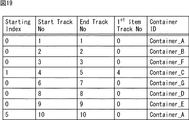
図19は、1st Item Track起点探索処理によって得られた図16のコンテナ情報と、Rootコンテナ起点探索処理によって得られた図18のコンテナ情報を統合したコンテナ情報の例を示す図である。 FIG. 19 is a diagram showing an example of container information obtained by integrating the container information of FIG. 16 obtained by the 1st Item Track start point search process and the container information of FIG. 18 obtained by the root container start point search process.
Rootコンテナ起点探索処理において各アイテムに割り当てられたトラック番号は正式な番号であるから、図19に示すように、Rootコンテナ起点探索処理によって得られた図18の情報に続けて、1st Item Track起点探索処理によって得られた図16の情報を加えるようにしてコンテナ情報の統合が行われる。 Since the track number assigned to each item in the root container starting point search process is a formal number, as shown in FIG. 19, following the information of FIG. 18 obtained by the root container starting point search process, the 1st Item Track starting point The container information is integrated by adding the information of FIG. 16 obtained by the search process.
1st Item Track起点探索処理によって得られたコンテナ情報に含まれる各アイテムのトラック番号は、PlayContainerUriによって1st Itemとして指定されたItem_1の仮のトラック番号1を基準とする相対値である。Item_1の正式なトラック番号は4であるから、コンテナ情報の統合時、1st Item Track起点探索処理によって得られたコンテナ情報に含まれる各アイテムのトラック番号は、Item_1の正式なトラック番号である4を基準として、相対的に同じ数だけ差があるように書き換えられる。すなわち、図16のコンテナ情報に含まれるトラック番号は、図19のContainer_Cの行以降に示すように、3(4-1)ずつ増えるように書き換えられる。
The track number of each item included in the container information obtained by the 1st Item Track starting point search process is a relative value based on the
これにより、PlayContainerUriで指定された、DMS2が管理するContainer_Aに格納されるアイテムの全ての探索結果を取得したことになる。
As a result, all search results of items stored in Container_A managed by
以上のように、DMS2が管理するツリー構造全体を把握するための情報として、各コンテナの情報のみを記憶するようにしたため、メモリの使用量を抑えることができる。例えば、1つのコンテナに10個のアイテムが格納されており、そのようなコンテナが1000個ある場合、アイテムの情報を個々に全て記憶しておくとした場合には10000個のアイテムの情報を格納しておく分のメモリ領域が必要になるが、以上の方法によれば10分の1の領域で済む。
As described above, since only the information of each container is stored as information for grasping the entire tree structure managed by the
また、ツリー構造全体の情報を記憶しておくことになるため、トラック番号を指定しての再生やランダム再生がDMC3から指示された場合であっても、その指示に応じた処理を行うことが可能になる。
In addition, since the information of the entire tree structure is stored, even if playback by specifying a track number or random playback is instructed from the
[DMRの再生処理]
次に、図20のフローチャートを参照して、DMR1の再生処理について説明する。
[DMR playback processing]
Next, the reproduction processing of DMR1 will be described with reference to the flowchart of FIG.
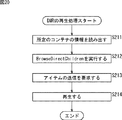
図20の処理は、DMS2が管理するアイテムの全ての探索結果が以上の処理によって取得された状態で、例えば、DMC3から、所定のアイテムの再生が指示されたときに開始される。DMC3からは、トラック番号を指定してアイテムの再生が指示される。
The processing in FIG. 20 is started when, for example, the
ステップS211において、制御部12は、DMC3により再生が指示されたトラック番号が割り当てられたアイテムを格納するコンテナの情報をコンテナ情報から読み出す。例えば、図19のコンテナ情報が記憶部13に記憶されている場合において、トラック番号9のアイテムを再生することが指示されたとき、トラック番号として9が割り当てられたアイテムを格納するContainer_EのObjectIDと、StartingIndex=0が読み出される。
In step S <b> 211, the
ステップS212において、制御部12は、再生が指示されたトラック番号が割り当てられたアイテムを格納するコンテナを対象としてBrowseDirectChildrenを実行する。StartingIndexの値にはステップS211で読み出された値が用いられる。BrowseDirectChildrenに対する応答として、DMS2からは、再生が指示されたアイテムのObjectID、URLなどの詳細情報が送信されてくる。
In step S212, the
ステップS213において、制御部12は、ObjectIDやURLを用いるなどして再生対象のアイテムを指定し、DMS2に対してアイテムの送信を要求する。ここで行われる要求に対する応答として、DMS2からは、コンテンツ記憶部23に記憶されているアイテムのデータが送信されてくる。DMS2から送信されてきたアイテムのデータは通信部11により受信され、再生部14に供給される。
In step S213, the
ステップS214において、再生部14は、通信部11から供給されたアイテムを再生する。
In step S214, the reproducing
トラック番号を指定して再生が指示された場合、その再生処理は以上のようにして行われる。図20の再生処理は、トラック番号を指定して再生が指示された場合だけでなく、ランダム再生がDMC3により指示された場合にも適用可能である。
When playback is instructed by specifying a track number, the playback processing is performed as described above. The reproduction process of FIG. 20 is applicable not only when reproduction is instructed by specifying a track number, but also when random reproduction is instructed by the
ランダム再生を行う場合、制御部12は、まず、コンテナ情報に登録されているContainer_IDの中から、1つのContainer_IDをランダムに選択する。次に、制御部12は、選択したContainer_IDに対応付けて記憶されている、同じ行のStart Track NoとEnd Track Noで表される範囲のトラック番号の中から、1つのトラック番号をランダムに選択する。
When performing random reproduction, the
トラック番号を選択し終えたとき、制御部12は、startingIndexをコンテナ情報のStartingIndexの値に基づいて決定し、Container_IDで特定されるコンテナに対してBrowseDirectChildrenを行う。これにより、制御部12は再生すべきアイテムの情報を得ることができる。
When the selection of the track number is completed, the
なお、アイテムをランダムに選択する手法として、図19のコンテナ情報から最大Track番号が分かるので、その範囲で乱数を生成し、得られた番号とコンテナ情報を照らし合わせることで、どこのコンテナの何番目の位置に、得られたトラック番号のアイテムがあるのかを選択する方法もある。 As a method for selecting an item at random, the maximum track number can be found from the container information shown in FIG. 19, and by generating a random number within that range and comparing the obtained number with the container information, There is also a method of selecting whether there is an item with the obtained track number at the second position.
[コンピュータの構成例]
上述した一連の処理は、ハードウェアにより実行することもできるし、ソフトウェアにより実行することもできる。一連の処理をソフトウェアにより実行する場合には、そのソフトウェアを構成するプログラムが、専用のハードウェアに組み込まれているコンピュータ、または汎用のパーソナルコンピュータなどに、プログラム記録媒体からインストールされる。
[Computer configuration example]
The series of processes described above can be executed by hardware or can be executed by software. When a series of processing is executed by software, a program constituting the software is installed from a program recording medium into a computer incorporated in dedicated hardware or a general-purpose personal computer.
図21は、上述した一連の処理をプログラムにより実行するコンピュータのハードウェアの構成例を示すブロック図である。 FIG. 21 is a block diagram illustrating a configuration example of hardware of a computer that executes the above-described series of processing by a program.
CPU(Central Processing Unit)101、ROM(Read Only Memory)102、RAM(Random Access Memory)103は、バス104により相互に接続されている。
A CPU (Central Processing Unit) 101, a ROM (Read Only Memory) 102, and a RAM (Random Access Memory) 103 are connected to each other via a
バス104には、さらに、入出力インタフェース105が接続されている。入出力インタフェース105には、キーボード、マウスなどよりなる入力部106、ディスプレイ、スピーカなどよりなる出力部107が接続される。また、入出力インタフェース105には、ハードディスクや不揮発性のメモリなどよりなる記憶部108、ネットワークインタフェースなどよりなる通信部109、リムーバブルメディア111を駆動するドライブ110が接続される。
An input /
以上のように構成されるコンピュータでは、CPU101が、例えば、記憶部108に記憶されているプログラムを入出力インタフェース105及びバス104を介してRAM103にロードして実行することにより、上述した一連の処理が行われる。
In the computer configured as described above, for example, the
CPU101が実行するプログラムは、例えばリムーバブルメディア111に記録して、あるいは、ローカルエリアネットワーク、インターネット、デジタル放送といった、有線または無線の伝送媒体を介して提供され、記憶部108にインストールされる。
The program executed by the
なお、コンピュータが実行するプログラムは、本明細書で説明する順序に沿って時系列に処理が行われるプログラムであっても良いし、並列に、あるいは呼び出しが行われたとき等の必要なタイミングで処理が行われるプログラムであっても良い。 The program executed by the computer may be a program that is processed in time series in the order described in this specification, or in parallel or at a necessary timing such as when a call is made. It may be a program for processing.
本発明の実施の形態は、上述した実施の形態に限定されるものではなく、本発明の要旨を逸脱しない範囲において種々の変更が可能である。 The embodiments of the present invention are not limited to the above-described embodiments, and various modifications can be made without departing from the scope of the present invention.
1 DMR, 2 DMS, 3 DMC, 11 通信部, 12 制御部, 13 記憶部, 14 再生部, 21 通信部, 22 制御部, 23 コンテンツ記憶部, 31 通信部, 32 制御部, 33 操作部, 34 表示部 1 DMR, 2 DMS, 3 DMC, 11 communication unit, 12 control unit, 13 storage unit, 14 playback unit, 21 communication unit, 22 control unit, 23 content storage unit, 31 communication unit, 32 control unit, 33 operation unit, 34 Display section
Claims (8)
前記ルートコンテナに格納されるオブジェクトの探索結果を表す情報として、前記ルートコンテナに格納されるコンテナ毎に、そのコンテナを対象とする探索により最初に見つかるアイテムである先頭アイテムのトラック番号と、最後に見つかるアイテムである最終アイテムのトラック番号と、前記先頭アイテムのコンテナ内における位置を表す位置情報とを、コンテナのObjectIDと対応付けて記憶する記憶手段と
を備える情報処理装置。 Search means for searching for an object stored in a root container managed by a first other information processing apparatus which is a DLNA device;
As information representing the search result of the object stored in the root container, for each container stored in the root container, the track number of the first item that is the first item found by the search for that container, and finally An information processing apparatus comprising: a storage unit that stores a track number of a final item that is a found item and position information indicating a position of the first item in a container in association with an ObjectID of the container.
請求項1に記載の情報処理装置。 The information processing apparatus according to claim 1, wherein the storage unit stores a value of startingIndex when the head item is found by BrowseDirectChildren as the position information.
前記探索手段は、前記PlayContainerUriのcontainer-id-argによってObjectIDが指定される前記ルートコンテナに格納される、first-item-id-argによってObjectIDが指定されるアイテムの親のコンテナからBrowseDirectChildrenを開始する
請求項2に記載の情報処理装置。 A receiving means for receiving PlayContainerUri transmitted from the second other information processing apparatus which is a DLNA device;
The search means starts BrowseDirectChildren from the parent container of the item whose ObjectID is specified by first-item-id-arg, which is stored in the root container whose ObjectID is specified by container-id-arg of the PlayContainerUri. The information processing apparatus according to claim 2.
前記探索手段は、前記first-item-id-argによってObjectIDが指定されるアイテムを格納する前記親のコンテナ以降のそれぞれのコンテナを対象としてBrowseDirectChildrenを行い、最後のオブジェクトが見つかったとき、前記ルートコンテナを起点として、前記ルートコンテナ以降のそれぞれのコンテナを対象としてBrowseDirectChildrenを行い、前記first-item-id-argによってObjectIDが指定されるアイテムが見つかったとき、探索を終了する
請求項3に記載の情報処理装置。 The order of objects found when BrowseDirectChildren is repeated starting from the root container is determined,
The search means performs BrowseDirectChildren for each container after the parent container storing the item whose ObjectID is specified by the first-item-id-arg, and when the last object is found, the root container The search is terminated when an item whose ObjectID is specified by the first-item-id-arg is found by performing BrowseDirectChildren for each container after the root container starting from Processing equipment.
前記探索手段による探索結果に基づいて、前記所定のトラック番号のアイテムの送信を前記第1の他の情報処理装置に対して要求し、要求に応じて送信されてきたアイテムを再生する再生手段をさらに備える
請求項1に記載の情報処理装置。 When the search unit reproduces an item having a predetermined track number, based on the information stored in the storage unit, the ObjectID of the container that stores the item having the predetermined track number, and the predetermined track number The position of the item in the container is specified, the object at the specified position in the container identified by the specified ObjectID is searched,
Reproduction means for requesting transmission of the item of the predetermined track number to the first other information processing apparatus based on the search result by the search means and reproducing the item transmitted in response to the request The information processing apparatus according to claim 1.
前記ルートコンテナに格納されるオブジェクトの探索結果を表す情報として、前記ルートコンテナに格納されるコンテナ毎に、そのコンテナを対象とする探索により最初に見つかるアイテムである先頭アイテムのトラック番号と、最後に見つかるアイテムである最終アイテムのトラック番号と、前記先頭アイテムのコンテナ内における位置を表す位置情報とを、コンテナのObjectIDと対応付けて記憶する
ステップを含む情報処理方法。 Search for objects stored in the root container managed by another information processing device that is a DLNA device,
As information representing the search result of the object stored in the root container, for each container stored in the root container, the track number of the first item which is the first item found by the search for the container, and finally An information processing method including a step of storing a track number of a final item that is a found item and position information indicating a position of the first item in a container in association with an ObjectID of the container.
前記ルートコンテナに格納されるオブジェクトの探索結果を表す情報として、前記ルートコンテナに格納されるコンテナ毎に、そのコンテナを対象とする探索により最初に見つかるアイテムである先頭アイテムのトラック番号と、最後に見つかるアイテムである最終アイテムのトラック番号と、前記先頭アイテムのコンテナ内における位置を表す位置情報とを、コンテナのObjectIDと対応付けて記憶する
ステップを含む処理をコンピュータに実行させるプログラム。 Search for objects stored in the root container managed by another information processing device that is a DLNA device,
As information representing the search result of the object stored in the root container, for each container stored in the root container, the track number of the first item which is the first item found by the search for the container, and finally A program that causes a computer to execute processing including a step of storing a track number of a final item that is a found item and position information indicating a position of the first item in a container in association with an ObjectID of the container.
前記第1の情報処理装置は、
前記第3の情報処理装置において再生可能なアイテムを記憶する記憶手段と、
ルートコンテナを設定し、前記アイテムを前記ルートコンテナに格納して管理するとともに、前記第3の情報処理装置からの探索要求に対して応答する制御手段と
を備え、
前記第2の情報処理装置は、
前記ルートコンテナのObjectIDをcontainer-id-argによって指定するとともに、前記ルートコンテナに格納されるアイテムのうちの最初に再生するアイテムのObjectIDをfirst-item-id-argによって指定するPlayContainerUriを作成する作成手段と、
前記作成手段により作成された前記PlayContainerUriを前記第3の情報処理装置に送信する送信手段と
を備え、
前記第3の情報処理装置は、
前記第2の他の情報処理装置から送信されてきた前記PlayContainerUriを受信する受信手段と、
前記PlayContainerUriのcontainer-id-argによってObjectIDが指定される前記ルートコンテナに格納される、first-item-id-argによってObjectIDが指定されるアイテムの親のコンテナからBrowseDirectChildrenを開始するように、前記第1の情報処理装置が管理する前記ルートコンテナに格納されるオブジェクトの探索を行う探索手段と、
前記ルートコンテナに格納されるオブジェクトの探索結果を表す情報として、前記ルートコンテナに格納されるコンテナ毎に、そのコンテナを対象とする探索により最初に見つかるアイテムである先頭アイテムのトラック番号と、最後に見つかるアイテムである最終アイテムのトラック番号と、前記先頭アイテムのコンテナ内における位置を表す位置情報とを、コンテナのObjectIDと対応付けて記憶する記憶手段と
を備える
通信システム。 In a communication system consisting of a first information processing device, a second information processing device, and a third information processing device, which are DLNA devices,
The first information processing apparatus includes:
Storage means for storing items reproducible in the third information processing apparatus;
Control means for setting a root container, storing and managing the item in the root container, and responding to a search request from the third information processing apparatus,
The second information processing apparatus
Create a PlayContainerUri that specifies the ObjectID of the root container by container-id-arg and specifies the ObjectID of the item to be played first among the items stored in the root container by first-item-id-arg Means,
Transmission means for transmitting the PlayContainerUri created by the creation means to the third information processing apparatus,
The third information processing apparatus
Receiving means for receiving the PlayContainerUri transmitted from the second other information processing apparatus;
In order to start BrowseDirectChildren from the parent container of the item whose ObjectID is specified by first-item-id-arg, which is stored in the root container whose ObjectID is specified by container-id-arg of PlayContainerUri. Search means for searching for an object stored in the root container managed by one information processing apparatus;
As information representing the search result of the object stored in the root container, for each container stored in the root container, the track number of the first item which is the first item found by the search for the container, and finally A communication system comprising: a storage unit that stores a track number of a final item that is a found item and position information indicating a position of the first item in a container in association with an ObjectID of the container.
Priority Applications (1)
| Application Number | Priority Date | Filing Date | Title |
|---|---|---|---|
| JP2010155719A JP2012018564A (en) | 2010-07-08 | 2010-07-08 | Communication system, information processing device, information processing method and program |
Applications Claiming Priority (1)
| Application Number | Priority Date | Filing Date | Title |
|---|---|---|---|
| JP2010155719A JP2012018564A (en) | 2010-07-08 | 2010-07-08 | Communication system, information processing device, information processing method and program |
Publications (1)
| Publication Number | Publication Date |
|---|---|
| JP2012018564A true JP2012018564A (en) | 2012-01-26 |
Family
ID=45603765
Family Applications (1)
| Application Number | Title | Priority Date | Filing Date |
|---|---|---|---|
| JP2010155719A Withdrawn JP2012018564A (en) | 2010-07-08 | 2010-07-08 | Communication system, information processing device, information processing method and program |
Country Status (1)
| Country | Link |
|---|---|
| JP (1) | JP2012018564A (en) |
Cited By (1)
| Publication number | Priority date | Publication date | Assignee | Title |
|---|---|---|---|---|
| WO2018051477A1 (en) * | 2016-09-16 | 2018-03-22 | ヤマハ株式会社 | Information processing device, smart phone, playback device, program, and information processing method |
-
2010
- 2010-07-08 JP JP2010155719A patent/JP2012018564A/en not_active Withdrawn
Cited By (3)
| Publication number | Priority date | Publication date | Assignee | Title |
|---|---|---|---|---|
| WO2018051477A1 (en) * | 2016-09-16 | 2018-03-22 | ヤマハ株式会社 | Information processing device, smart phone, playback device, program, and information processing method |
| JPWO2018051477A1 (en) * | 2016-09-16 | 2019-02-21 | ヤマハ株式会社 | Information processing apparatus, smartphone, playback apparatus, program, and information processing method |
| US10802789B2 (en) | 2016-09-16 | 2020-10-13 | Yamaha Corporation | Information processing device, reproducing device, and information processing method |
Similar Documents
| Publication | Publication Date | Title |
|---|---|---|
| JP4944919B2 (en) | Automatic media file selection | |
| JP4214475B2 (en) | Information processing apparatus and method, and program | |
| US8176118B2 (en) | Server device, client device, information processing system, information processing method, and program | |
| US8914389B2 (en) | Information processing device, information processing method, and program | |
| US8996412B2 (en) | Information processing system and information processing method | |
| CN103327376B (en) | Music video service device and music video customized setting method thereof | |
| JP4367662B2 (en) | Information processing system, terminal device, information processing method, program | |
| US20120116558A1 (en) | Augmenting media content in a media sharing group | |
| JP2009176060A (en) | Information processing apparatus, information processing method, and computer program | |
| EP1742222B1 (en) | Reproducing apparatus and reproducing method. | |
| JP4349313B2 (en) | Playback device, playback control method, and program | |
| JP4419879B2 (en) | Information processing system | |
| JP5141195B2 (en) | Information processing apparatus, music distribution system, music distribution method, and computer program | |
| CN101128880A (en) | Retrieve content items for playlist based on generic content ID | |
| JP5652065B2 (en) | Content playback system, control device, and playback device | |
| JP2004295569A (en) | Information processing apparatus, information processing method, and computer program | |
| JP2012018564A (en) | Communication system, information processing device, information processing method and program | |
| JP4363117B2 (en) | Content reproduction apparatus, content management apparatus, content reproduction control system, content reproduction method, content management method, content reproduction control method, and program | |
| JP2005056343A (en) | Content reproduction apparatus, content management method, and content management system. | |
| JP5962742B2 (en) | Content playback system, control device, and playback device | |
| JP6265711B2 (en) | Music playback apparatus and computer program | |
| JP5061634B2 (en) | Portable display device, display method and program | |
| US20070078847A1 (en) | System and method for generating a play-list | |
| JP2011096294A (en) | Content reproducing device, program, and method of reproducing content | |
| JP2009009667A (en) | Content information acquisition device, program, and content information acquisition method |
Legal Events
| Date | Code | Title | Description |
|---|---|---|---|
| A300 | Application deemed to be withdrawn because no request for examination was validly filed |
Free format text: JAPANESE INTERMEDIATE CODE: A300 Effective date: 20131001 |