JP2011517455A - C (10) ethyl ester and C (10) cyclopropyl ester substituted taxanes - Google Patents
C (10) ethyl ester and C (10) cyclopropyl ester substituted taxanes Download PDFInfo
- Publication number
- JP2011517455A JP2011517455A JP2011503034A JP2011503034A JP2011517455A JP 2011517455 A JP2011517455 A JP 2011517455A JP 2011503034 A JP2011503034 A JP 2011503034A JP 2011503034 A JP2011503034 A JP 2011503034A JP 2011517455 A JP2011517455 A JP 2011517455A
- Authority
- JP
- Japan
- Prior art keywords
- pharmaceutical composition
- taxane
- cancer
- tumor
- compound
- Prior art date
- Legal status (The legal status is an assumption and is not a legal conclusion. Google has not performed a legal analysis and makes no representation as to the accuracy of the status listed.)
- Pending
Links
- 0 CCCC(C)(C)CC(CC1)C1C(C1C(CC2)CC2C(C)(C)C(C)*)C1C(C)(C)C Chemical compound CCCC(C)(C)CC(CC1)C1C(C1C(CC2)CC2C(C)(C)C(C)*)C1C(C)(C)C 0.000 description 5
Images




Classifications
-
- C—CHEMISTRY; METALLURGY
- C07—ORGANIC CHEMISTRY
- C07D—HETEROCYCLIC COMPOUNDS
- C07D305/00—Heterocyclic compounds containing four-membered rings having one oxygen atom as the only ring hetero atoms
- C07D305/14—Heterocyclic compounds containing four-membered rings having one oxygen atom as the only ring hetero atoms condensed with carbocyclic rings or ring systems
-
- A—HUMAN NECESSITIES
- A61—MEDICAL OR VETERINARY SCIENCE; HYGIENE
- A61P—SPECIFIC THERAPEUTIC ACTIVITY OF CHEMICAL COMPOUNDS OR MEDICINAL PREPARATIONS
- A61P35/00—Antineoplastic agents
-
- C—CHEMISTRY; METALLURGY
- C07—ORGANIC CHEMISTRY
- C07D—HETEROCYCLIC COMPOUNDS
- C07D409/00—Heterocyclic compounds containing two or more hetero rings, at least one ring having sulfur atoms as the only ring hetero atoms
- C07D409/02—Heterocyclic compounds containing two or more hetero rings, at least one ring having sulfur atoms as the only ring hetero atoms containing two hetero rings
- C07D409/12—Heterocyclic compounds containing two or more hetero rings, at least one ring having sulfur atoms as the only ring hetero atoms containing two hetero rings linked by a chain containing hetero atoms as chain links
Landscapes
- Chemical & Material Sciences (AREA)
- Organic Chemistry (AREA)
- Health & Medical Sciences (AREA)
- Chemical Kinetics & Catalysis (AREA)
- General Chemical & Material Sciences (AREA)
- Medicinal Chemistry (AREA)
- Nuclear Medicine, Radiotherapy & Molecular Imaging (AREA)
- Pharmacology & Pharmacy (AREA)
- Life Sciences & Earth Sciences (AREA)
- Animal Behavior & Ethology (AREA)
- General Health & Medical Sciences (AREA)
- Public Health (AREA)
- Veterinary Medicine (AREA)
- Pharmaceuticals Containing Other Organic And Inorganic Compounds (AREA)
- Medicinal Preparation (AREA)
- Plural Heterocyclic Compounds (AREA)
Abstract
C(10)にエチルエステルまたはシクロプロピルエステル置換基、C(9)にケト置換基、C(7)にヒドロキシ置換基、C(3')にチエニル置換基、そしてC(3')にシクロブチルオキシカルバメートまたはシクロペンチルオキシカルバメート置換基を持つタキサン、該タキサンを含有する医薬組成物、処置および投与の方法、ならびに該タキサンを含有する医薬の製造方法。C (10) with ethyl ester or cyclopropyl ester substituent, C (9) with keto substituent, C (7) with hydroxy substituent, C (3 ′) with thienyl substituent, and C (3 ′) with cyclo A taxane having a butyloxycarbamate or cyclopentyloxycarbamate substituent, a pharmaceutical composition containing the taxane, a method of treatment and administration, and a method of producing a medicament containing the taxane.
Description
本発明は抗腫瘍剤として有用な新規タキサンに関する。 The present invention relates to a novel taxane useful as an antitumor agent.
テルペンのタキサンファミリーは、バッカチンIIIや、一般にTaxol(登録商標)とも呼ばれるパクリタキセルを含み、生物学分野でも化学分野でも、少なからぬ関心が寄せられてきた。パクリタキセル自体はがん化学療法剤として使用され、広範囲にわたる腫瘍阻害活性を有する。パクリタキセルは2'R,3'S立体配置を持ち、次の構造式で表される:
Colinらは、米国特許第4,814,470号において、一定のパクリタキセル類似体がパクリタキセルの活性よりも有意に高い活性を持つことを報告した。一般にドセタキセルと呼ばれるこれらの類似体の一つ(Taxotere(登録商標)ともいう)は、次の構造式を持つ:
パクリタキセルとドセタキセルは有用な化学療法剤であるが、一定のがんタイプに対する限られた効力や、さまざまな用量で投与された時の患者に対する毒性など、その有効性には限界がある。さらに、一定の腫瘍はパクリタキセルおよび/またはドセタキセルに対して耐性を示している。したがって、低い毒性と、パクリタキセルおよび/またはドセタキセル耐性腫瘍および非耐性腫瘍に関して改善された効力とを持つ、さらなる化学療法剤が、今も必要とされている。 Paclitaxel and docetaxel are useful chemotherapeutic agents, but their effectiveness is limited, including limited efficacy against certain cancer types and toxicity to patients when administered at various doses. In addition, certain tumors are resistant to paclitaxel and / or docetaxel. Thus, there remains a need for additional chemotherapeutic agents with low toxicity and improved efficacy with respect to paclitaxel and / or docetaxel resistant and non-resistant tumors.
本開示の概要
したがって、本発明のさまざまな態様には、毒性に関して、そして抗腫瘍剤としての効力に関して、パクリタキセルおよびドセタキセルに引けを取らないタキサンの提供が含まれる。一般に、これらのタキサンは、C(10)にエチルエステルまたはシクロプロピルエステル置換基、C(9)にケト置換基、C(7)にヒドロキシ置換基、C(3')にチエニル置換基、そしてC(3')にシクロブチルオキシカルバメートまたはシクロペンチルオキシカルバメート置換基を持つ。
SUMMARY OF THE DISCLOSURE Accordingly, various aspects of the present invention include the provision of taxanes that are incomparable to paclitaxel and docetaxel with respect to toxicity and with respect to efficacy as antitumor agents. In general, these taxanes have an ethyl ester or cyclopropyl ester substituent on C (10), a keto substituent on C (9), a hydroxy substituent on C (7), a thienyl substituent on C (3 ′), and C (3 ′) has a cyclobutyloxycarbamate or cyclopentyloxycarbamate substituent.
したがって簡単に言うと、本発明は、タキサンそのもの、そのプロドラッグ、タキサン(およびそのプロドラッグ)と医薬上許容される担体とを含む医薬組成物、処置および投与の方法、ならびにタキサン(およびそのプロドラッグ)を含む医薬品の製造方法に関する。 Briefly, therefore, the present invention provides a pharmaceutical composition comprising taxane itself, its prodrug, taxane (and its prodrug) and a pharmaceutically acceptable carrier, methods of treatment and administration, and taxane (and its prodrug). (Drugs).
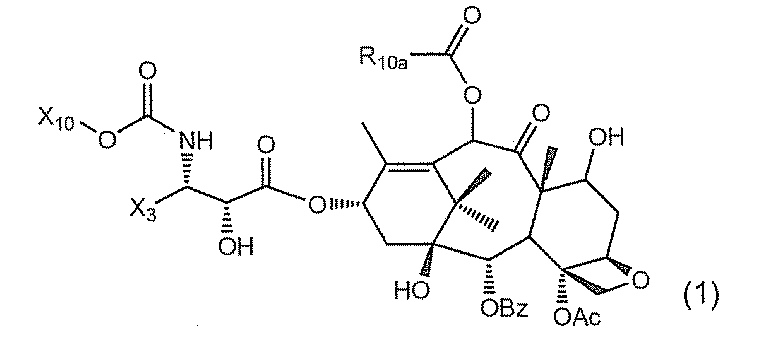
ある特定態様において、本発明は、次に挙げる構造(1)を持つタキサンに関する:
もう一つの特定態様において、本発明は、構造(1)のタキサンと少なくとも1つの医薬上許容される担体とを含む医薬組成物に関する。 In another specific embodiment, the present invention relates to a pharmaceutical composition comprising a taxane of structure (1) and at least one pharmaceutically acceptable carrier.
もう一つの特定態様において、本発明は、哺乳動物における腫瘍成長を阻害する方法であって、構造(1)のタキサンと少なくとも1つの医薬上許容される担体とを含む医薬組成物の処置有効量をその哺乳動物に投与することを含む方法に関する。ある特定実施形態では、腫瘍が多剤耐性腫瘍である。
他の目的および特徴は、一部は明白であるだろうし、一部は以下に記載する。
In another specific embodiment, the present invention provides a method for inhibiting tumor growth in a mammal, comprising a therapeutically effective amount of a pharmaceutical composition comprising a taxane of structure (1) and at least one pharmaceutically acceptable carrier. Is administered to the mammal. In certain embodiments, the tumor is a multidrug resistant tumor.
Other objects and features will be apparent in part and will be described in part below.
詳細な説明
本発明のタキサンは次に挙げる化学構造(1)を持つ:
式(1)に関して上述したように、X3はチエニルである。したがって、例えば、X3は2-チエニルまたは3-チエニルであることができる。好ましい一実施形態では、X3が2-チエニルである。 As described above with respect to formula (1), X 3 is thienyl. Thus, for example, X 3 can be 2-thienyl or 3-thienyl. In one preferred embodiment, X 3 is 2-thienyl.
これと共に、タキサンが式(1)で示される一定の実施形態では、R10aがエチルであり、X10がシクロブチルまたはシクロペンチルである。したがって例えば、R10aがエチルであり、X10がシクロブチルであるか、またはR10aがエチルであり、X10がシクロペンチルであることができる。タキサンが式(1)で示される別の実施形態では、R10aがシクロプロピルであり、X10がシクロブチルまたはシクロペンチルである。したがって例えば、R10aがシクロプロピルであり、X10がシクロブチルであるか、またはR10aがシクロプロピルであり、X10がシクロペンチルであることができる。これらの実施形態のそれぞれにおいて、X3はチエニル(例えば2-チエニルまたは3-チエニル)である。また、より好ましくは、これらの実施形態において、X3は2-チエニルである。 Along with this, in certain embodiments where the taxane is represented by formula (1), R 10a is ethyl and X 10 is cyclobutyl or cyclopentyl. Thus, for example, R 10a can be ethyl and X 10 can be cyclobutyl, or R 10a can be ethyl and X 10 can be cyclopentyl. In another embodiment where the taxane is represented by formula (1), R 10a is cyclopropyl and X 10 is cyclobutyl or cyclopentyl. Thus, for example, R 10a can be cyclopropyl and X 10 can be cyclobutyl, or R 10a can be cyclopropyl and X 10 can be cyclopentyl. In each of these embodiments, X 3 is thienyl (eg, 2-thienyl or 3-thienyl). Also more preferably, in these embodiments, X 3 is 2-thienyl.
別の組み合わせでは、タキサンが式(1)で示される一定の実施形態において、R10aがエチルまたはシクロプロピルであり、X10がシクロブチルである。したがって例えば、R10aがエチルであり、X10がシクロブチルであるか、またはR10aがシクロプロピルであり、X10がシクロブチルであることができる。タキサンが式(1)で示される別の実施形態では、R10aがエチルまたはシクロプロピルであり、X10がシクロペンチルである。したがって例えば、R10aがエチルであり、X10がシクロペンチルであるか、またはR10aがシクロプロピルであり、X10がシクロペンチルであることができる。これらの実施形態において、X3はチエニル(例えば2-チエニルまたは3-チエニル)である。また、より好ましくは、これらの実施形態において、X3は2-チエニルである。 In another combination, in certain embodiments where the taxane is represented by formula (1), R 10a is ethyl or cyclopropyl and X 10 is cyclobutyl. Thus, for example, R 10a can be ethyl and X 10 can be cyclobutyl, or R 10a can be cyclopropyl and X 10 can be cyclobutyl. In another embodiment, where the taxane is represented by formula (1), R 10a is ethyl or cyclopropyl and X 10 is cyclopentyl. Thus, for example, R 10a can be ethyl and X 10 can be cyclopentyl, or R 10a can be cyclopropyl and X 10 can be cyclopentyl. In these embodiments, X 3 is thienyl (eg, 2-thienyl or 3-thienyl). Also more preferably, in these embodiments, X 3 is 2-thienyl.
一般に、C(7)ヒドロキシ置換基およびC(10)シクロプロピルカルボニルオキシまたはエチルカルボニルオキシ置換基は、独立して、αまたはβ立体化学配置を持つことができる。したがって、タキサン化合物が化学構造(1)で示される場合、C(7)置換基とC(10)置換基がそれぞれα立体化学配置を持つか、C(7)置換基とC(10)置換基がそれぞれβ立体化学配置を持つか、C(7)置換基がβ立体化学配置を持ちC(10)置換基がα立体化学配置を持つか、またはC(7)置換基がα立体化学配置を持ちC(10)置換基がβ立体化学配置を持つことができる。したがって例えば、さまざまな実施形態において、タキサンは、これら化学構造部分の立体化学配置を示す以下の式の1つ以上で示されうる: In general, the C (7) hydroxy substituent and the C (10) cyclopropylcarbonyloxy or ethylcarbonyloxy substituent can independently have an α or β stereochemical configuration. Therefore, when the taxane compound is represented by chemical structure (1), the C (7) substituent and the C (10) substituent each have an α stereochemical configuration, or the C (7) substituent and the C (10) substituent Each group has a β stereochemical configuration, or the C (7) substituent has a β stereochemical configuration and the C (10) substituent has an α stereochemical configuration, or the C (7) substituent has an α stereochemistry. A C (10) substituent can have a β stereochemical configuration with a configuration. Thus, for example, in various embodiments, taxanes can be represented by one or more of the following formulas indicating the stereochemical configuration of these chemical structural moieties:
ある実施形態では、タキサンが式(1bb)で示され(すなわちC(7)置換基とC(10)置換基がどちらもβ立体化学配置を持つ)、式中、R10aはエチルまたはシクロプロピルであり、X3はチエニルであり、X10はシクロブチルまたはシクロペンチルである。より好ましくは、この実施形態において、X3は2-チエニルである。 In certain embodiments, the taxane is represented by formula (1bb) (ie, both C (7) and C (10) substituents have a β stereochemical configuration), wherein R 10a is ethyl or cyclopropyl X 3 is thienyl and X 10 is cyclobutyl or cyclopentyl. More preferably, in this embodiment, X 3 is 2-thienyl.
式(1)で示される好ましいタキサンのいくつかには、R10aおよびX10に、次に挙げる置換基の具体的な組み合わせを持つものが含まれる。
上記表1に記載の組み合わせのそれぞれにおいて(すなわち化合物17932、18365、18926、19244について)、タキサンのX3置換基はチエニルである。より好ましくは、これらの組み合わせにおいて、X3は2-チエニルである。したがって例えば、好ましいタキサンのいくつかは、式(1A)、(1B)、(1C)、または(1D)の1つ以上で示される。
In each of the combinations listed in Table 1 above (ie for
例えば、式(1A)、(1B)、(1C)、および(1D)で示されるタキサンのC(7)置換基とC(10)置換基がどちらもβ立体化学配置を持つ実施形態の場合、これらのタキサンは、それぞれ式(1AA)、(1BB)、(1CC)、または(1DD)で示される。
従来の化学療法剤を使った化学療法は、腫瘍細胞における多剤耐性(MDR)の発生(これにより、腫瘍細胞は構造的、機能的に無関係な種々の化合物に対する交差耐性を獲得する)によって、しばしば妨害される。一般的な形態の多剤耐性は、数ある機序のなかでもとりわけ、抗血管新生;薬物排出トランスポーター(すなわち薬物排出ポンプ)の過剰発現;チューブリンの薬物結合部位の後天性突然変異;チューブリンアイソフォームの発現差異;アポトーシス機序の変化;微小管の束化および重合(例えばG2/M停止およびアポトーシスにつながるもの);ならびに成長因子経路の活性化が原因であると考えられている。これらの(および他の)多剤耐性機序のそれぞれまたは2つ以上の寄与は依然として不明であるが、多剤耐性と薬物排出トランスポーター発現レベルは、さまざまな腫瘍タイプで関連づけられている。例えばDumontetら, J. Clin. Oncol. 17, 1061-1070 (1999);Gottesmanら, Nat. Rev. Cancer 2, 48-58 (2002)を参照されたい。 Chemotherapy with conventional chemotherapeutic agents is the result of the development of multidrug resistance (MDR) in tumor cells, which allows the tumor cells to acquire cross-resistance to a variety of structurally and functionally unrelated compounds. Often disturbed. Common forms of multidrug resistance include, among other mechanisms, anti-angiogenesis; overexpression of drug efflux transporters (ie, drug efflux pumps); acquired mutations in tubulin drug binding sites; Differential expression of phosphorus isoforms; changes in apoptotic mechanisms; microtubule bundling and polymerization (eg leading to G 2 / M arrest and apoptosis); and thought to be due to growth factor pathway activation . Although the contribution of each or more of these (and other) multidrug resistance mechanisms remains unclear, multidrug resistance and drug efflux transporter expression levels have been linked in various tumor types. See, for example, Dumontet et al., J. Clin. Oncol. 17, 1061-1070 (1999); Gottesman et al., Nat. Rev. Cancer 2, 48-58 (2002).
本発明の化合物は、パクリタキセルおよびドセタキセル耐性腫瘍を含む多剤耐性腫瘍に対して有効である。したがって、特定の態様において、本明細書に記載の化合物は、哺乳動物における腫瘍成長を阻害するための方法であって、腫瘍が多剤耐性腫瘍(すなわち多剤耐性を示す腫瘍細胞を含む腫瘍)である方法に使用することができる。これに加えて、またはこれに代えて、腫瘍は1つまたはそれ以上の従来の化学療法剤に対して耐性であってもよい。例えば腫瘍は、薬剤の中でも、カルボプラチン、ドセタキセル、ドキソルビシン、ゲムシタビン、イリノテカン、パクリタキセル、ペメトレキセド、およびビンクリスチンなどに対して耐性であってもよい。特定の一実施形態では、腫瘍がパクリタキセルに対して耐性であるか、ドセタキセルに対して耐性であるか、またはパクリタキセルとドセタキセルの両方に対して耐性である。 The compounds of the present invention are effective against multidrug resistant tumors including paclitaxel and docetaxel resistant tumors. Accordingly, in certain embodiments, the compounds described herein are methods for inhibiting tumor growth in a mammal, wherein the tumor is a multidrug resistant tumor (ie, a tumor comprising tumor cells that exhibit multidrug resistance). Can be used in any way. In addition or alternatively, the tumor may be resistant to one or more conventional chemotherapeutic agents. For example, the tumor may be resistant to carboplatin, docetaxel, doxorubicin, gemcitabine, irinotecan, paclitaxel, pemetrexed, vincristine, and the like, among other drugs. In one particular embodiment, the tumor is resistant to paclitaxel, resistant to docetaxel, or resistant to both paclitaxel and docetaxel.
さまざまな実施形態において、例えば、多剤耐性腫瘍細胞は薬物排出トランスポーターを過剰発現させる。薬物排出トランスポーターのなかでも、ATP結合カセットトランスポーター、例えばP-糖タンパク質(P-gp)、MDR関連タンパク質(例えばMDR-1、MDR-2、MDR-3など)、乳がん耐性タンパク質(例えばBCRP1)および/または多剤耐性関連タンパク質(MRP)(例えばMRP-1、MRP-2、MRP-3、MRP-9など)の過剰発現が、腫瘍細胞における多剤耐性の媒介に関連づけられている。したがってある実施形態では、過剰発現される薬物排出トランスポーターがATP結合カセットトランスポーターである。より典型的には、この実施形態において、薬物排出トランスポーターがP-糖タンパク質、MDR関連タンパク質、乳がん耐性タンパク質、多剤耐性関連タンパク質、またはそれらの組み合わせである。これらの実施形態において、本化合物は、上皮細胞癌、例えば脳、乳房、大腸、腎臓、肝臓、肺(非小細胞肺癌を含む)、卵巣、膵臓、腎臓および皮膚腫瘍タイプを含む、多種多様な腫瘍タイプに対して有効であることができる。例えば、パクリタキセルやドセタキセルとは異なり、化合物17932、18365、18926、および19244は、MDR関連タンパク質(例えばMDR-1)を過剰発現させる腫瘍細胞、例えばDLD-1大腸癌細胞株および786-0腎臓癌細胞株などの成長を阻害するのに、極めて効果的である。もう一つの例として、化合物18926、18365、19244は、MRP-2およびBCRP1を過剰発現させる腫瘍細胞、例えばMSTO-211H中皮腫細胞の成長を阻害するのに(パクリタキセルおよびドセタキセルと比較して)極めて効果的である。もう一つの例として、化合物18926、18365、19244は、MRP-9を過剰発現させる腫瘍細胞、例えばA375メラノーマの成長を阻害するのに(パクリタキセルおよびドセタキセルと比較して)極めて効果的である。特定の一理論に束縛されるものではないが、パクリタキセルやドセタキセルなどの従来の化学療法剤と比較して、これらの改善された効果の根拠は、少なくとも一つには、化合物とこれらの薬物排出ポンプおよび他の薬物排出ポンプとの相互作用が減少しているためであると考えられる。 In various embodiments, for example, multidrug resistant tumor cells overexpress a drug efflux transporter. Among drug efflux transporters, ATP-binding cassette transporters such as P-glycoprotein (P-gp), MDR-related proteins (such as MDR-1, MDR-2, and MDR-3), breast cancer resistance proteins (such as BCRP1) ) And / or multidrug resistance associated proteins (MRP) (eg, MRP-1, MRP-2, MRP-3, MRP-9, etc.) have been linked to mediating multidrug resistance in tumor cells. Thus, in certain embodiments, the overexpressed drug efflux transporter is an ATP binding cassette transporter. More typically, in this embodiment, the drug efflux transporter is a P-glycoprotein, MDR-related protein, breast cancer resistance protein, multidrug resistance-related protein, or a combination thereof. In these embodiments, the compounds have a wide variety of epithelial cell carcinomas, including brain, breast, colon, kidney, liver, lung (including non-small cell lung cancer), ovary, pancreas, kidney and skin tumor types. Can be effective against tumor types. For example, unlike paclitaxel and docetaxel, compounds 17932, 18365, 18926, and 19244 are tumor cells that overexpress MDR-related proteins (eg, MDR-1), such as DLD-1 colon cancer cell lines and 786-0 kidney cancer It is extremely effective in inhibiting the growth of cell lines and the like. As another example, compounds 18926, 18365, 19244 inhibit the growth of tumor cells that overexpress MRP-2 and BCRP1, such as MSTO-211H mesothelioma cells (as compared to paclitaxel and docetaxel) It is extremely effective. As another example, compounds 18926, 18365, 19244 are extremely effective (as compared to paclitaxel and docetaxel) in inhibiting the growth of tumor cells that overexpress MRP-9, such as A375 melanoma. While not being bound by a particular theory, the basis for these improved effects compared to conventional chemotherapeutic agents such as paclitaxel and docetaxel is that at least one compound and these drug excretion This is thought to be due to a decrease in interaction with pumps and other drug efflux pumps.
好都合なことに、また関与する機序がどうであれ、本明細書に記載する化合物は、パクリタキセルおよび/またはドセタキセル感受性および耐性腫瘍株を含む一定の腫瘍タイプに関し、従来使用されているタキサンよりも優れた形で、インビトロでもインビボでも、がんに対して効果的である。他の薬剤と組み合わせて使用するにせよ、そうでないにせよ、化合物17932、18365、18926、および/または19244を含む医薬組成物は、パクリタキセルおよびドセタキセル(それぞれTaxol(登録商標)およびTaxotere(登録商標))による処置の適応となるがんを処置するために使用することができる。驚いたことに、本化合物は、多種多様な腫瘍タイプ(例えば脳、大腸、肺、卵巣、膵臓、腎臓、および皮膚がんから派生したものを含む)に対してパクリタキセルおよび/またはドセタキセルの活性よりも数オーダー高い(例えば2倍、5倍、10倍、またはそれ以上の)活性を示す。限定するわけではないが、化合物17932、18365、18926、および/または19244を含む医薬組成物は、単独で、または組み合わせて、脳のがん、乳がん、大腸がん、肺がん(非小細胞肺がんを含む)、卵巣がん、膵がん、前立腺がん、AIDS関連カポジ肉腫、中皮腫、胃がん、および腎がんを処置するために使用することができる。本化合物は経口投与しても静脈内投与しても忍容性がかなり高く、単回投与または複数回投与で効果的であることができ、改善された毒性プロファイルを持つ。本発明の化合物は、非Cremophor(登録商標)賦形剤中でも有効である。
Conveniently, and whatever the mechanism involved, the compounds described herein are more favorable than previously used taxanes for certain tumor types, including paclitaxel and / or docetaxel sensitive and resistant tumor lines. In excellent form, it is effective against cancer, both in vitro and in vivo. Whether used in combination with other drugs or not, the pharmaceutical
化合物17932、18365、18926、および/または19244は、パクリタキセルおよびドセタキセルに対して不応性/耐性であるものを含むいくつかのヒト腫瘍ヌードマウス異種移植モデルにおいて、著しく有効である。化合物17932、18365、18926、および/または19244は、静脈内経路および経口経路により、単回投与スケジュールまたは複数回投与スケジュールで、効果的に投与することができる。試験した異種移植モデルの大半において、本化合物は、経口投与として、4日毎または7日毎の複数回投与スケジュールで投与した場合に、パクリタキセルおよびドセタキセルより優れた効力を示す。化合物17932、18365、18926、および19244は、これらのマウス異種移植モデルにおいて幅広い治療係数を示す。体重減少によって示される最大耐容量を十分に下回る用量でも効力が維持される。本化合物は、異種移植モデルで観察される効力で示されるとおり、経口投与で優れたバイオアベイラビリティを示し、スプラーグ・ドーリーラットに経口投与および静脈内投与した場合に好ましい毒性プロファイルを示す。例えば本化合物は、パクリタキセルおよびドセタキセルと比較して、著しく低い神経毒性(例えば軸索変性によって測定されるもの)を持つ。複数回投与レジメンにおける優れた効力、低い毒性、幅広い治療係数により、臨床現場では、特にヒト試験で毎週投与する場合に、用量強度を増加させる機会が与えられる。例えば、本発明の化合物は(パクリタキセルおよびドセタキセルと同じように)3週間ごとのスケジュールで投与するか、1週間ごとのスケジュールで投与することができる。1週間ごとのスケジュールは、例えば、投与頻度(dosing density)の増加を可能にすることができ、特に経口投与の場合は、患者の利便性を改善することができる。そのような経口投与レジメンは、比較的低い用量を使って、1日単位で行うことができる。好都合なことに、これらおよび他の経口投与レジメンは、抗血管新生メトロノミック投与スケジュール(パクリタキセルおよびドセタキセルの場合、それらは経口投与ではあまり効果的でないため、この投与スケジュールは望ましくない)の一部として使用することができる。
本発明のタキサンは、β-ラクタムを、タキサン四環核とC(13)金属オキシド置換基とを持つアルコキシドで処理することで、C(13)にβ-アミドエステル置換基を持つ化合物を形成させ(この反応はHoltonの米国特許第5,466,834号(この文献は参照によりその全てが本明細書に組み込まれる)に詳述されている)、次にヒドロキシ保護基を除去することによって得ることができる。一般に、これらの方法で使用されるβ-ラクタムは、式(I):
で示され、アルコキシドは式(II):
で示される。
The taxane of the present invention forms a compound having a β-amide ester substituent at C (13) by treating β-lactam with an alkoxide having a taxane tetracyclic nucleus and a C (13) metal oxide substituent. (This reaction is described in detail in Holton, US Pat. No. 5,466,834, which is fully incorporated herein by reference) and then removed by removal of the hydroxy protecting group . In general, the β-lactams used in these methods have the formula (I):
The alkoxide is represented by the formula (II):
Indicated by
構造式(II)のアルコキシドは、C(7)ヒドロキシ基を選択的に保護してからC(10)ヒドロキシ基をエステル化し、次に金属アミドで処理することにより、10-デアセチルバッカチンIII(10-DAB)(またはその誘導体)から製造することができる。本発明の一態様では、10-DABのC(7)ヒドロキシ基を、例えばDenisら(J. Am. Chem. Soc, 1988, 110, 5917)(この文献は参照によりその全てが本明細書に組み込まれる)によって記述されているように、シリル基で選択的に保護する。 The alkoxide of structural formula (II) can be prepared by selectively protecting the C (7) hydroxy group, then esterifying the C (10) hydroxy group, and then treating with a metal amide to produce 10-deacetylbaccatin III (10-DAB) (or its derivatives). In one embodiment of the present invention, the C (7) hydroxy group of 10-DAB is substituted with, for example, Denis et al. (J. Am. Chem. Soc, 1988, 110, 5917), which is hereby incorporated by reference in its entirety. Selectively protected with a silyl group, as described by.
あるいは、例えばHoltonらの米国特許第7,288,665号(この文献は参照によりその全てが本明細書に組み込まれる)に記述されているように、タキサンのC(10)ヒドロキシ基を塩基の非存在下で選択的にアシル化することもできる。タキサンのC(10)ヒドロキシ基の選択的アシル化に使用することができるアシル化剤には、置換または無置換アルキルまたはアリール無水物がある。タキサンのC(10)ヒドロキシ基のアシル化は、多くのアシル化剤で、十分な速度で進行するだろうが、反応混合物にルイス酸を含めることによって反応速度を増加させうることが見いだされている。好ましいルイス酸には、塩化亜鉛、塩化第二スズ、三塩化セリウム、塩化第一銅、三塩化ランタン、三塩化ジスプロシウム、および三塩化イッテルビウムなどがある。アシル化剤が無水物である場合は、塩化亜鉛または三塩化セリウムが、特に好ましい。 Alternatively, the taxane's C (10) hydroxy group can be removed in the absence of a base as described, for example, in US Pat. No. 7,288,665 to Holton et al., Which is incorporated herein by reference in its entirety. It can also be selectively acylated. Acylating agents that can be used for the selective acylation of the taxane C (10) hydroxy group include substituted or unsubstituted alkyl or aryl anhydrides. The acylation of the taxane C (10) hydroxy group will proceed at a sufficient rate with many acylating agents, but it has been found that the reaction rate can be increased by including a Lewis acid in the reaction mixture. Yes. Preferred Lewis acids include zinc chloride, stannic chloride, cerium trichloride, cuprous chloride, lanthanum trichloride, dysprosium trichloride, and ytterbium trichloride. When the acylating agent is an anhydride, zinc chloride or cerium trichloride is particularly preferred.
好ましいワンポットプロトコールでは、C(7)ヒドロキシル基を保護するために10-DABのN,N-ジメチルホルムアミド溶液を2〜3当量の4-N,N-ジメチルアミノピリジンの存在下、化学量論量のシリル化剤で処理した後、アシル化剤(塩化プロピオニルまたは塩化シクロプロピルカルボニル)で処理することにより、C(10)ヒドロキシル基を周囲温度で選択的にアシル化した。このプロセスにより、製造時間が短縮され、溶媒要件が緩和される。例えばHoltonらの米国特許出願公開第2005/0228037号(この文献は参照によりその全てが本明細書に組み込まれる)を参照されたい。 In a preferred one-pot protocol, a stoichiometric amount of 10-DAB in N, N-dimethylformamide solution in the presence of 2-3 equivalents of 4-N, N-dimethylaminopyridine to protect the C (7) hydroxyl group. The C (10) hydroxyl group was selectively acylated at ambient temperature by treatment with a silylating agent followed by an acylating agent (propionyl chloride or cyclopropylcarbonyl chloride). This process reduces manufacturing time and relaxes solvent requirements. See, for example, Holton et al. US Patent Application Publication No. 2005/0228037, which is incorporated herein by reference in its entirety.
C(7)置換基およびC(10)置換基に特定の立体化学配置を持つ化合物(例えば上記の化合物1aa、1bb、1ab、および1ba)は、これらの立体化学配置を持つ出発物質(例えば10-DAB)または中間体を使って製造できることは、理解されるだろう。例えば10-DABのC(7)-エピマーの製造が、Georgら, Journal of Organic Chemistry, 63, 8926-8934 (1998)(この文献は参照によりその全てが本明細書に組み込まれる)によって例示されている。例えば10-α10-DABの製造は、Appendinoら, Tetrahedron Letters 36, 18, 3233-3236 (1995)(この文献は参照によりその全てが本明細書に組み込まれる)によって例示されている。C(7)位の立体化学配置は、Chaudharyら, Journal of Organic Chemistry 58, 3798-3799 (1993)(この文献は参照によりその全てが本明細書に組み込まれる)に記載されているように、化合物(適当に置換された側鎖が結合しているもの)を塩基で処理することによって改変することができる。これに加えて、またはこれに代えて、Appendinoら(前掲)およびDattaら, Tetrahedron Letters 36, 12, 1985-1988 (1995)(この文献は参照によりその全てが本明細書に組み込まれる)によって例示される酸化-還元-エステル化シーケンスを使用し、次に挙げる反応スキーム(式中、X10、X3、およびR10aは式(1)に関して定義したとおりであり、PGはヒドロキシ保護基である)で、さまざまなC(10)α異性体を得ることができる: Compounds having a specific stereochemical configuration at the C (7) substituent and the C (10) substituent (eg, compounds 1aa, 1bb, 1ab, and 1ba above) are starting materials having these stereochemical configurations (eg, 10 It will be understood that it can be prepared using -DAB) or intermediates. For example, the preparation of the C (7) -epimer of 10-DAB is exemplified by Georg et al., Journal of Organic Chemistry, 63, 8926-8934 (1998), which is hereby incorporated by reference in its entirety. ing. For example, the production of 10-α10-DAB is exemplified by Appendino et al., Tetrahedron Letters 36, 18, 3233-3236 (1995), which is hereby incorporated by reference in its entirety. The stereochemical configuration at the C (7) position is described in Chaudhary et al., Journal of Organic Chemistry 58, 3798-3799 (1993), which is incorporated herein by reference in its entirety. Modifications can be made by treating the compound (with appropriately substituted side chains attached) with a base. In addition or alternatively, exemplified by Appendino et al. (Supra) and Datta et al., Tetrahedron Letters 36, 12, 1985-1988 (1995), which is hereby incorporated by reference in its entirety. The following reaction scheme (where X 10 , X 3 , and R 10a are as defined for formula (1) and PG is a hydroxy protecting group: ) To obtain various C (10) α isomers:
上記の酸化-還元-エステル化シーケンスにおいて、C(10)ヒドロキシ基の典型的酸化剤は、過ルテニウム酸テトラプロピルアンモニウム(TPAP)であり、C(10)ケト基の典型的還元剤は水素化ホウ素ナトリウムである。C(7)ヒドロキシ基およびC(2')ヒドロキシ基にはさまざまな保護基を使用することができ、本明細書では項を改めてそのいくつかを説明する(例えばトリアルキルシリル)。 In the above oxidation-reduction-esterification sequence, the typical oxidant for the C (10) hydroxy group is tetrapropylammonium perruthenate (TPAP) and the typical reductant for the C (10) keto group is hydrogenated. Sodium boron. Various protecting groups can be used for the C (7) hydroxy group and the C (2 ′) hydroxy group, and some of the terms are described herein again (eg, trialkylsilyl).
適当なβ-ラクタム(I)カップリングパートナーを合成するための好ましいワンポットプロトコールでは、光学的に純粋なβ-ラクタムのテトラヒドロフラン溶液を、そのヒドロキシ基を保護(P2)するために触媒量のp-トルエンスルホン酸の存在下、化学量論量の2-メトキシ-プロペンで処理した後、適当なクロロホルメート(シクロブチルまたはシクロペンチル)で処理することにより、周囲温度でX10置換基を導入した。例えばHoltonらの米国特許出願公開第2005/0228037号(この文献は参照によりその全てが本明細書に組み込まれる)を参照されたい。 A preferred one-pot protocol for synthesizing a suitable β-lactam (I) coupling partner is to use an optically pure solution of β-lactam in tetrahydrofuran with a catalytic amount of p to protect its hydroxy group (P 2 ). The X 10 substituent was introduced at ambient temperature by treatment with a stoichiometric amount of 2-methoxy-propene in the presence of toluenesulfonic acid followed by treatment with the appropriate chloroformate (cyclobutyl or cyclopentyl). See, for example, Holton et al. US Patent Application Publication No. 2005/0228037, which is incorporated herein by reference in its entirety.
β-ラクタム(I)出発物質を製造し分割するためのプロセスは、当技術分野では一般によく知られている。例えばβ-ラクタムは、Holtonの米国特許第5,430,160号(第9欄2〜25行)またはHoltonの米国特許第6,649,632号(第7欄45行〜第8欄60行)および米国特許出願公開第2006/0281914号(1頁の段落番号[0021]〜6頁の段落番号[0060](これらの各文献は参照によりその全てが本明細書に組み込まれる)に記述されているように製造することができる。その結果生じるβ-ラクタムのエナンチオマー混合物は、例えばPatelの米国特許第5,879,929号(第16欄1行〜第18欄27行)またはPatelの米国特許第5,567,614号に記述されているようなリパーゼまたは酵素を使って、またはHoltonの米国特許第6,548,293号(第3欄30〜61行)に記載されているような肝ホモジネートを使って、立体選択的加水分解を行うことにより(これらの各文献は参照によりその全てが本明細書に組み込まれる)、または米国特許出願公開第2006/0281918号(1頁の段落番号[0022]〜8頁の段落番号[0071])(この文献は参照によりその全てが本明細書に組み込まれる)に記述されているように、光学活性プロリンアシル化剤で処理した後、未反応のエナンチオマーまたはジアステレオマーの一方を選択的に回収することにより、分割することができる。例えば米国特許第6,649,632号には、β-ラクタムのC(4)位にフリル置換基を持つβ-ラクタムの製造が開示されている。当業者に明白な変更を加えることにより、これらの先行特許および特許出願に例示されているように、また下記実施例11でさらに開示するように、β-ラクタムC(4)位にチエニル置換基を持つβ-ラクタムを製造することができる。
Processes for producing and resolving β-lactam (I) starting materials are generally well known in the art. For example, β-lactams are disclosed in Holton US Pat. No. 5,430,160 (column 9, lines 2-25) or Holton US Pat. No. 6,649,632 (
本発明の化合物はその塩の形で提供することができる。通例、塩は医薬上許容される塩、すなわち医薬上許容される無毒性の酸(無機酸および有機酸を含む)から製造される塩でありうる。適切な無毒性酸には、アミンなどの塩基性残基に対して、無機酸および有機酸、例えば酢酸、ベンゼンスルホン酸、安息香酸、カンファースルホン酸、クエン酸、エテンスルホン酸、フマル酸、グルコン酸、グルタミン酸、臭化水素酸、塩化水素酸、イセチオン酸、乳酸、マレイン酸、リンゴ酸、マンデル酸、メタンスルホン酸、ムチン酸、硝酸、パモ酸、パントテン酸、リン酸、コハク酸、硫酸、バルバチン酸(barbaric acid)、p-トルエンスルホン酸などが含まれる。カルボン酸などの酸性残基のアルカリ塩または有機塩には、例えば次に挙げる塩基から誘導されるアルカリ塩およびアルカリ土類金属塩が含まれる:水素化ナトリウム、水酸化ナトリウム、水酸化カリウム、水酸化カルシウム、水酸化アルミニウム、水酸化リチウム、水酸化マグネシウム、水酸化亜鉛、アンモニア、トリメチルアンモニア、トリエチルアンモニア、エチレンジアミン、リジン、アルギニン、オルニチン、コリン、N,N"-ジベンジルエチレンジアミン、クロロプロカイン、ジエタノールアミン、プロカイン、n-ベンジルフェネチルアミン、ジエチルアミン、ピペラジン、トリス(ヒドロキシメチル)-アミノメタン、水酸化テトラメチルアンモニウムなど。本明細書に記載する組成物の医薬上許容される塩は、化合物を化学量論量の適当な塩基または酸と水中または有機溶媒中またはそれら二つの混合物中で反応させることによって製造することができ、一般的には、エーテル、酢酸エチル、エタノール、イソプロパノール、またはアセトニトリルなどの非水性溶媒が好ましい。適切な塩のリストが「Remington's Pharmaceutical Sciences」第17版(Mack Publishing Company、ペンシルベニア州イーストン、1985)の1418頁に掲載されており、この文献は参照によりその全てが本明細書に組み込まれる。 The compounds of the present invention can be provided in the form of their salts. Typically, the salt may be a pharmaceutically acceptable salt, that is, a salt prepared from pharmaceutically acceptable non-toxic acids, including inorganic and organic acids. Suitable non-toxic acids include, for basic residues such as amines, inorganic and organic acids such as acetic acid, benzene sulfonic acid, benzoic acid, camphor sulfonic acid, citric acid, ethene sulfonic acid, fumaric acid, glucone. Acid, glutamic acid, hydrobromic acid, hydrochloric acid, isethionic acid, lactic acid, maleic acid, malic acid, mandelic acid, methanesulfonic acid, mucinic acid, nitric acid, pamoic acid, pantothenic acid, phosphoric acid, succinic acid, sulfuric acid, Barbaric acid, p-toluenesulfonic acid and the like are included. Alkali salts or organic salts of acidic residues such as carboxylic acids include, for example, alkali salts and alkaline earth metal salts derived from the following bases: sodium hydride, sodium hydroxide, potassium hydroxide, water Calcium oxide, aluminum hydroxide, lithium hydroxide, magnesium hydroxide, zinc hydroxide, ammonia, trimethylammonia, triethylammonia, ethylenediamine, lysine, arginine, ornithine, choline, N, N "-dibenzylethylenediamine, chloroprocaine, diethanolamine , Procaine, n-benzylphenethylamine, diethylamine, piperazine, tris (hydroxymethyl) -aminomethane, tetramethylammonium hydroxide, etc. The pharmaceutically acceptable salts of the compositions described herein can provide compounds in stoichiometry. Suitable for quantity It can be prepared by reacting the appropriate base or acid with water or in an organic solvent or in a mixture of the two, and generally a non-aqueous solvent such as ether, ethyl acetate, ethanol, isopropanol, or acetonitrile is used. A list of suitable salts is listed on page 1418 of “Remington's Pharmaceutical Sciences” 17th edition (Mack Publishing Company, Easton, Pa., 1985), which is incorporated herein by reference in its entirety. .
これに加えて、またはこれに代えて、本化合物はプロドラッグの形で提供することもできる。一般に、医薬上許容される誘導体またはプロドラッグは、レシピエントに投与されたときに、本発明の化合物またはその阻害活性代謝産物もしくは残基を直接的または間接的に与えることができる、本発明化合物の任意の医薬上許容される塩、エステル、エスエルの塩または他の誘導体である。特に好ましい誘導体またはプロドラッグは、その化合物を患者に投与した時に本発明化合物のバイオアベイラビリティを(例えば経口投与された化合物をより容易に血中に吸収させることによって)増加させるもの、または生物学的コンパートメント(例えば脳またはリンパ系)への親化合物の送達を親化合物と比較して強化するものである。医薬上許容されるプロドラッグには、次に挙げる基の1つ以上で誘導体化された本発明のタキサンが含まれるが、これらに限るわけではない:ホスフェート、ピバロイルオキシメチル、アセトキシメチル、フタリジル、インダニル、メトキシメチル、メチルピリジニウムメシレート、バイカーボネート、オニウム塩、ホスホノオキシメチルカーボネート、シンナメート、アミノ酸、ベンゾイル、アシル、チオアリール、ポリエチレングリコール系基(polyethylene glycol based)、エステル結合(ester linked)、ポリアルキレンオキシド、デキストラン、ポリビニルアルコール、糖質系ポリマー、オリゴペプチド、ポリグルタミン酸、ポリアミノ酸、2-ハロゲン化アザアレーンのオニウム塩、高極性アミノ糖など。本発明のタキサン分子中の、プロドラッグ形成に適した位置には、C(2')およびC(7)位があるが、これらに限るわけではない。さまざまな形態のプロドラッグが当技術分野ではよく知られている。そのようなプロドラッグ誘導体の例については、次に挙げる文献を参照されたい:(a)H. Bundgaard編「Design of Prodrugs」(Elsevier、1985)およびK. Widderら編「Methods in Enzymology」第42巻の309〜396頁(Acamedic Press、1985);(b)Krosgaard-LarsenおよびH. Bundgaard編「A Textbook of Drug Design and Development」の第5章、H. Bundgaard著「Design and Application of Prodrugs」、113〜191頁(1991);(c) H. Bundgaard, Advanced Drug Delivery Reviews, 8, 1 -38 (1992);(d)H. Bundgaardら, Journal of Pharmaceutical Sciences, 77, 285 (1988);および(e)N. Kakeyaら, Chem. Pharm. Bull., 32, 692 (1984)、これらの各文献は参照によりその全てが本明細書に組み込まれる。
In addition or alternatively, the compound may be provided in the form of a prodrug. In general, a pharmaceutically acceptable derivative or prodrug is a compound of the invention which can directly or indirectly give a compound of the invention or an inhibitory active metabolite or residue thereof when administered to a recipient. Any pharmaceutically acceptable salt, ester, salt of SELL or other derivative. Particularly preferred derivatives or prodrugs are those that increase the bioavailability of the compounds of the invention when the compound is administered to a patient (eg, by more readily absorbing the orally administered compound into the blood) or biological It enhances delivery of the parent compound to a compartment (eg, brain or lymphatic system) compared to the parent compound. Pharmaceutically acceptable prodrugs include, but are not limited to, the taxanes of the invention derivatized with one or more of the following groups: phosphate, pivaloyloxymethyl, acetoxymethyl, Phthalidyl, indanyl, methoxymethyl, methylpyridinium mesylate, bicarbonate, onium salt, phosphonooxymethyl carbonate, cinnamate, amino acid, benzoyl, acyl, thioaryl, polyethylene glycol group, ester linked , Polyalkylene oxide, dextran, polyvinyl alcohol, saccharide polymer, oligopeptide, polyglutamic acid, polyamino acid, onium salt of 2-halogenated azaarene, highly polar amino sugar, and the like. Suitable positions for prodrug formation in the taxane molecule of the present invention include, but are not limited to, the C (2 ′) and C (7) positions. Various forms of prodrugs are well known in the art. For examples of such prodrug derivatives, see: (a) H. Bundgaard, “Design of Prodrugs” (Elsevier, 1985) and K. Widder et al., “Methods in Enzymology”, 42 Pp. 309-396 (Acamedic Press, 1985); (b)
本発明のタキサン類は、ヒトを含む哺乳動物において腫瘍増殖抑制に有用であり、好ましくは、抗腫瘍有効量の本発明化合物を少なくとも1つの薬学的または薬理学的に許容しうる担体と共に含む医薬組成物の形態で投与する。担体は、賦形剤、ビヒクル、補助剤、アジュバントまたは希釈剤としてもこの分野では知られているが、担体は、薬学的に不活性であり、好適なコンシステンシーまたは形状を組成物に付与し、そして抗腫瘍化合物の治療効力を損なわない任意の物質である。担体は、哺乳動物またはヒトに投与されたときに有害なアレルギー反応または他の望ましくない反応を生じさせない場合に「薬学的または薬理学的に許容しうる」。 The taxanes of the present invention are useful for tumor growth suppression in mammals including humans, preferably a medicament comprising an antitumor effective amount of the compound of the present invention together with at least one pharmaceutically or pharmacologically acceptable carrier. It is administered in the form of a composition. Although carriers are also known in the art as excipients, vehicles, adjuvants, adjuvants or diluents, carriers are pharmaceutically inert and impart a suitable consistency or shape to the composition. And any substance that does not impair the therapeutic efficacy of the anti-tumor compound. A carrier is “pharmaceutically or pharmacologically acceptable” if it does not cause an adverse allergic or other undesirable response when administered to a mammal or human.
本発明の抗腫瘍化合物を含有する医薬組成物は任意の従来の方法で調製することができる。適切な調製は、選択した投与経路に依存する。本発明の組成物は、標的組織に投与経路を介して達する限り、任意の投与経路のために調製することができる。好適な投与経路には、経口投与、非経口(例えば、静脈内、動脈内、皮下、直腸内、皮下、筋肉内、眼窩内、嚢内、髄腔内、腹腔内または胸骨内)投与、局所(例えば、鼻腔、経皮、眼内)投与、ぼうこう内投与、くも膜下投与、腸内投与、肺投与、リンパ管内投与、洞内投与、膣投与、経尿道投与、皮内投与、耳投与、乳房内投与、口内投与、正位投与、気管内投与、病巣内投与、経皮投与、内視鏡的投与、経粘膜投与、舌下投与および腸管投与が含まれるが、これらに限定されない。 The pharmaceutical composition containing the antitumor compound of the present invention can be prepared by any conventional method. Proper preparation depends on the route of administration chosen. The compositions of the present invention can be prepared for any route of administration so long as the target tissue is reached via the route of administration. Suitable routes of administration include oral, parenteral (eg, intravenous, intraarterial, subcutaneous, rectal, subcutaneous, intramuscular, intraorbital, intracapsular, intrathecal, intraperitoneal or intrasternal), topical ( For example, nasal cavity, transdermal, intraocular administration, intravesical administration, intrathecal administration, enteral administration, pulmonary administration, intralymphatic administration, sinus administration, vaginal administration, transurethral administration, intradermal administration, ear administration, breast This includes, but is not limited to, internal administration, oral administration, orthotopic administration, intratracheal administration, intralesional administration, transdermal administration, endoscopic administration, transmucosal administration, sublingual administration, and intestinal administration.
本発明の組成物に使用する薬学的に許容しうる担体は当業者にはよく知られており、下記のような多数の要因に基づいて選択する:使用する特定の抗腫瘍化合物、ならびにその濃度、安定性および意図するバイオアベイラビリティー;組成物で処置する疾患、障害または状態;被投与体、その年齢、大きさおよび全身の健康状態;ならびに投与経路。好適な担体は当業者によって容易に決定される(例えば、J.G.Nairn、Remington's Pharmaceutical Science(A.Gennaro編)、Mack Publishing Co.、Easton、Pa.(1985年)、1492頁〜1517頁を参照のこと、その内容は参考として本明細書中に組み込まれる)。 The pharmaceutically acceptable carriers used in the compositions of the present invention are well known to those skilled in the art and are selected based on a number of factors such as: the particular antitumor compound used, as well as its concentration Stability and intended bioavailability; disease, disorder or condition to be treated with the composition; subject, its age, size and general health; and route of administration. Suitable carriers are readily determined by those skilled in the art (see, eg, JGNairn, Remington's Pharmaceutical Science (A. Gennaro), Mack Publishing Co., Easton, Pa. (1985), pages 1492-1517). The contents of which are incorporated herein by reference).
本発明の組成物は、好ましくは、錠剤、分散性粉末剤、ピル剤、カプセル剤、ゲルキャップ剤、カプレット剤、ゲル剤、リポソーム剤、顆粒剤、溶液剤、懸濁剤、エマルジョン剤、シロップ剤、エリキシル剤、トローチ剤、糖衣剤、ロゼンジ剤、または経口投与し得る任意の他の投薬形態として調製する。本発明において有用な経口投薬形態を調製するための技術および組成物は下記の参考文献に記載されている:7 Modern Pharmaceutics、9章および10章(Banker & Rhodes編、1979年);Lieberman他、Pharmaceutical Dosage Forms: Tablets(1981年);Ansel、Introduction to Pharmaceutical Dosage Forms、第2版(1976年)。 The composition of the present invention is preferably a tablet, dispersible powder, pill, capsule, gel cap, caplet, gel, liposome, granule, solution, suspension, emulsion, syrup Prepared as an agent, elixir, lozenge, dragee, lozenge, or any other dosage form that can be administered orally. Techniques and compositions for preparing oral dosage forms useful in the present invention are described in the following references: 7 Modern Pharmaceutics, Chapters 9 and 10 (Banker & Rhodes, 1979); Lieberman et al., Pharmaceutical Dosage Forms: Tablets (1981); Ansel, Introduction to Pharmaceutical Dosage Forms, 2nd edition (1976).
経口投与される本発明の組成物は、有効な抗腫瘍量の本発明化合物を、薬学的に許容しうる担体内に含む。固体投薬形態に好適な担体には、糖、デンプンおよび他の従来の物質が含まれる。そのような従来の物質には、ラクトース、タルク、スクロース、ゼラチン、カルボキシルメチルセルロース、寒天、マンニトール、ソルビトール、リン酸カルシウム、炭酸カルシウム、炭酸ナトリウム、カオリン、アルギン酸、アラビアゴム、トウモロコシデンプン、ジャガイモデンプン、サッカリンナトリウム、炭酸マグネシウム、トラガカント、微結晶セルロース、コロイド状二酸化ケイ素、クロスカルメロースナトリウム、タルク、ステアリン酸マグネシウムおよびステアリン酸が含まれる。さらに、そのような固体投薬形態はコーティングなしでもよく、あるいは知られている技術でコーティングして、例えば、崩壊および吸収を遅らせることができる。 Orally administered compositions of the invention contain an effective antitumor amount of a compound of the invention in a pharmaceutically acceptable carrier. Suitable carriers for solid dosage forms include sugars, starches and other conventional materials. Such conventional materials include lactose, talc, sucrose, gelatin, carboxymethylcellulose, agar, mannitol, sorbitol, calcium phosphate, calcium carbonate, sodium carbonate, kaolin, alginic acid, gum arabic, corn starch, potato starch, saccharin sodium, carbonate Magnesium, tragacanth, microcrystalline cellulose, colloidal silicon dioxide, croscarmellose sodium, talc, magnesium stearate and stearic acid are included. Further, such solid dosage forms may be uncoated or may be coated with known techniques to delay disintegration and absorption, for example.
本発明の抗腫瘍化合物はまた、非経口投与するために好ましく調製することができ、例えば、静脈内経路、動脈内経路、皮下経路、直腸内経路、皮下経路、筋肉内経路、眼窩内経路、嚢内経路、髄腔内経路、腹腔内経路または胸骨内経路で注射するために調製しうる。非経口投与する本発明の組成物は、有効な抗腫瘍量の抗腫瘍化合物を薬学的に許容しうる担体内に含む。非経口投与に好適な投薬形態には、溶液剤、懸濁剤、分散剤、エマルジョン剤、または非経口投与され得る任意の他の投薬形態が含まれる。非経口投与形態を調製するための技術および組成物はこの分野で知られている。 The anti-tumor compounds of the invention can also be preferably prepared for parenteral administration, eg, intravenous route, intraarterial route, subcutaneous route, rectal route, subcutaneous route, intramuscular route, intraorbital route, It may be prepared for injection by intracapsular route, intrathecal route, intraperitoneal route or intrasternal route. The compositions of the present invention for parenteral administration comprise an effective antitumor amount of an antitumor compound in a pharmaceutically acceptable carrier. Dosage forms suitable for parenteral administration include solutions, suspensions, dispersions, emulsions, or any other dosage form that can be administered parenterally. Techniques and compositions for preparing parenteral dosage forms are known in the art.
経口的または非経口的に投与する液体の投薬形態を調製する際に使用する好適な担体には、非水性の薬学的に許容しうる極性溶媒、例えばオイル、アルコール、アミド、エステル、エーテル、ケトン、炭化水素およびこれらの混合物、ならびに水、生理食塩液、デキストロース溶液(例えばDW5)、電解質溶液または任意の他の水性の薬学的に受容可能な液体が含まれる。 Suitable carriers for use in preparing liquid dosage forms for oral or parenteral administration include non-aqueous pharmaceutically acceptable polar solvents such as oils, alcohols, amides, esters, ethers, ketones , Hydrocarbons and mixtures thereof, as well as water, saline, dextrose solution (eg DW5), electrolyte solution or any other aqueous pharmaceutically acceptable liquid.
好適な非水性の薬学的に許容しうる極性溶媒には、下記のものが含まれるが、それらに限定されない:アルコール(例えば、α-グリセロールホルマール、β-グリセロールホルマール、1,3-ブチレングリコール、2個〜30個の炭素原子を有する脂肪族アルコールまたは芳香族アルコール、例えば、メタノール、エタノール、プロパノール、イソプロパノール、ブタノール、t-ブタノール、ヘキサノール、オクタノール、アミレン水和物、ベンジルアルコール、グリセリン(グリセロール)、グリコール、へキシレングリコール、テトラヒドロフルフリルアルコール、ラウリルアルコール、セチルアルコールまたはステアリルアルコール、ポリアルキレングリコール(例えば、ポリプロピレングリコール、ポリエチレングリコール)などの脂肪アルコールの脂肪酸エステル、ソルビタン、スクロースおよびコレステロールなど);アミド(例えば、ジメチルアセトアミド(DMA)、ベンジルベンゾアートDMA、ジメチルホルムアミド、N-(β-ヒドロキシエチル)ラクトアミド、N,N-ジメチルアセトアミド アミド、2-ピロリジノン、1-メチル-2-ピロリジノン、またはポリビニルピロリドン); Suitable non-aqueous pharmaceutically acceptable polar solvents include, but are not limited to: alcohols (eg, α-glycerol formal, β-glycerol formal, 1,3-butylene glycol, Aliphatic or aromatic alcohols having 2 to 30 carbon atoms, such as methanol, ethanol, propanol, isopropanol, butanol, t-butanol, hexanol, octanol, amylene hydrate, benzyl alcohol, glycerol (glycerol) , Glycols, hexylene glycol, tetrahydrofurfuryl alcohol, lauryl alcohol, cetyl alcohol or stearyl alcohol, fatty alcohols such as polyalkylene glycols (eg polypropylene glycol, polyethylene glycol) Fatty acid esters, sorbitan, sucrose, and cholesterol); amides (eg, dimethylacetamide (DMA), benzylbenzoate DMA, dimethylformamide, N- (β-hydroxyethyl) lactamamide, N, N-dimethylacetamide amide, 2 -Pyrrolidinone, 1-methyl-2-pyrrolidinone, or polyvinylpyrrolidone);
エステル(例えば、1-メチル-2-ピロリジノン、2-ピロリジノン、アセタートエステル(モノアセチン、ジアセチンおよびトリアセチンなど)、脂肪族エステルまたは芳香族エステル、例えば、カプリル酸エチルまたはオクタン酸エチル、オレイン酸アルキル、安息香酸ベンジル、酢酸ベンジルなど、ジメチルスルホキシド(DMSO)、グリセリンのエステル(クエン酸モノグリセリル、クエン酸ジグリセリルまたはクエン酸トリグリセリル、あるいは酒石酸モノグリセリル、酒石酸ジグリセリルまたは酒石酸トリグリセリル)、安息香酸エチル、酢酸エチル、炭酸エチル、乳酸エチル、オレイン酸エチル、ソルビタンの脂肪酸エステル、脂肪酸由来のPEGエステル、グリセリルモノステアラート、グリセリドエステル(モノグリセリド、ジグリセリドまたはトリグリセリドなど)、ミリスチン酸イソプロピルなどの脂肪酸エステル、PEGヒドロキシオレアートおよびPEGヒドロキシステアラートなどの脂肪酸由来のPEGエステル、N-メチルピロリジノン、プルロニック60、ポリオキシエチレンソルビトールオレイン酸ポリエステル(ポリ(エトキシル化)30〜60ソルビトールポリ(オレアート)2〜4、ポリ(オキシエチレン)15〜20モノオレアートなど、ポリ(オキシエチレン)15〜20モノ12-ヒドロキシステアラート、およびポリ(オキシエチレン)15〜20モノレシノレアート、ポリオキシエチレンソルビタンエステル(ポリオキシエチレンソルビタンモノオレアート、ポリオキシエチレンソルビタンモノパルミタート、ポリオキシエチレンソルビタンモノラウラート、ポリオキシエチレンソルビタンモノステアラート、およびICI Americas社(Wilmington、DE)から得られるPolysorbate(登録商標)20、40、60または80など)、ポリビニルピロリドン、ポリオキシル40水素化ひまし油およびポリオキシエチル化ひまし油(例えば、Cremophor(登録商標)EL溶液またはCremophor(登録商標)RH40溶液)などのアルキレンオキシ修飾脂肪酸エステル、 Esters (eg, 1-methyl-2-pyrrolidinone, 2-pyrrolidinone, acetate esters (such as monoacetin, diacetin and triacetin), aliphatic esters or aromatic esters such as ethyl caprylate or ethyl octanoate, alkyl oleate, Benzyl benzoate, benzyl acetate, dimethyl sulfoxide (DMSO), ester of glycerol (monoglyceryl citrate, diglyceryl citrate or triglyceryl citrate, or monoglyceryl tartrate, diglyceryl tartrate or triglyceryl tartrate), ethyl benzoate , Ethyl acetate, ethyl carbonate, ethyl lactate, ethyl oleate, sorbitan fatty acid ester, fatty acid-derived PEG ester, glyceryl monostearate, glyceride ester (monoglyceride, diglycerin Or triglycerides), fatty acid esters such as isopropyl myristate, PEG esters derived from fatty acids such as PEG hydroxy oleate and PEG hydroxy stearate, N-methylpyrrolidinone, Pluronic 60, polyoxyethylene sorbitol oleate polyester (poly (ethoxylated) ) 30-60 sorbitol poly (oleate) 2-4 , poly (oxyethylene) 15-20 monooleate, poly (oxyethylene) 15-20 mono 12-hydroxystearate, and poly (oxyethylene) 15- 20 mono Residencial Honoré art, polyoxyethylene sorbitan esters (polyoxyethylene sorbitan monooleate, polyoxyethylene sorbitan monopalmitate, polyoxyethylene sorbitan monolaurate, polyoxyethylene sorbitan monostearate La And Polysorbate® 20, 40, 60 or 80 from ICI Americas (Wilmington, DE), polyvinylpyrrolidone, polyoxyl 40 hydrogenated castor oil and polyoxyethylated castor oil (eg, Cremophor® ) Alkylene oxide modified fatty acid esters, such as EL solution or Cremophor® RH40 solution)
サッカリド脂肪酸エステル(すなわち、単糖(例えば、リボース、リブロース、アラビノース、キシロース、リキソースおよびキシルロースなどのペントース、グルコース、フルクトース、ガラクトース、マンノースおよびソルボースなどのヘキソース、ならびにトリオース、テトロース、ヘプトースおよびオクトース)または二糖(例えば、スクロース、マルトース、ラクトースおよびトレハロース)またはオリゴ糖またはこれらの混合物とC4〜C22脂肪酸(例えば、カプリル酸、カプリン酸、ラウリン酸、ミリスチン酸、パルミチン酸およびステアリン酸などの飽和脂肪酸、ならびにパルミトレイン酸、オレイン酸、エライジン酸、エルカ酸およびリノレン酸などの不飽和脂肪酸)との縮合生成物)、またはステロイドエステル);2個〜30個の炭素原子を有するアルキルエーテル、アリールエーテルまたは環状エーテル(例えば、ジエチルエーテル、テトラヒドロフラン、ジメチルイソソルビド、ジエチレングリコールモノエチルエーテル);グリコフロール(テトラヒドロフルフリルアルコールポリエチレングリコールエーテル);3個〜30個の炭素原子を有するケトン(例えば、アセトン、メチルエチルケトン、メチルイソブチルケトン);4個〜30個の炭素原子を有する脂肪族炭化水素または環状脂肪族炭化水素または芳香族炭化水素(例えば、ベンゼン、シクロヘキサン、ジクロロメタン、ジオキソラン類、ヘキサン、n-デカン、n-ドデカン、n-ヘキサン、スルホラン、テトラメチレンスルホン、テトラメチレンスルホキシド、トルエン、ジメチルスルホキシド(DMSO)、またはテトラメチレンスルホキシド); Saccharide fatty acid esters (ie monosaccharides such as pentoses such as ribose, ribulose, arabinose, xylose, lyxose and xylulose, hexoses such as glucose, fructose, galactose, mannose and sorbose, and triose, tetrose, heptose and octose) or two Sugars (eg sucrose, maltose, lactose and trehalose) or oligosaccharides or mixtures thereof and C 4 to C 22 fatty acids (eg saturated fatty acids such as caprylic acid, capric acid, lauric acid, myristic acid, palmitic acid and stearic acid) And condensation products with unsaturated fatty acids such as palmitoleic acid, oleic acid, elaidic acid, erucic acid and linolenic acid), or steroid esters); 2 to 3 Alkyl ethers, aryl ethers or cyclic ethers having 0 carbon atoms (eg diethyl ether, tetrahydrofuran, dimethylisosorbide, diethylene glycol monoethyl ether); glycofurol (tetrahydrofurfuryl alcohol polyethylene glycol ether); 3 to 30 Ketones having carbon atoms (eg acetone, methyl ethyl ketone, methyl isobutyl ketone); aliphatic hydrocarbons or cycloaliphatic hydrocarbons or aromatic hydrocarbons having 4 to 30 carbon atoms (eg benzene, cyclohexane, dichloromethane) , Dioxolanes, hexane, n-decane, n-dodecane, n-hexane, sulfolane, tetramethylene sulfone, tetramethylene sulfoxide, toluene, dimethyl sulfoxide (DMSO), Tetramethylene sulfoxide);
鉱物起源、植物起源、動物起源または合成起源のオイル(例えば、鉱油、例えば脂肪族炭化水素またはワックス型炭化水素、芳香族炭化水素、脂肪族系および芳香族系の混合炭化水素、および精製パラフィン油、植物油(亜麻仁油、きり油、紅花油、ダイズ油、ひまし油、綿実油、ラッカセイ油、ナタネ油、ココナッツ油、パーム油、オリーブ油、コーン油、トウモロコシ胚芽油、ゴマ油、杏仁油およびピーナツ油など)およびグリセリド(モノグリセリド、ジグリセリドまたはトリグリセリドなど)、動物油(魚油、海産油、マッコウ鯨油、タラ肝油、ハリバ油、スクアレン油、スクアラン油およびサメ肝油)、オレイック(oleic)油、およびポリオキシエチル化ひまし油);1個〜30個の炭素原子および必要に応じて1個以上のハロゲン置換基を有するハロゲン化アルキルまたはハロゲン化アリール;塩化メチレン;モノエタノールアミン;石油ベンジン;トロラミン;ω-3多不飽和脂肪酸(例えば、α-リノレン酸、エイコサペンタエン酸、ドコサペンタエン酸またはドコサヘキサエン酸);12-ヒドロキシステアリン酸およびポリエチレングリコールのポリグリコールエステル(BASF社(Ludwigshafen、ドイツ)から得られるSolutol(登録商標)HS-15);ポリオキシエチレングリセロール;ラウリン酸ナトリウム;オレイン酸ナトリウム;またはソルビタンモノオレアート。 Oils of mineral origin, plant origin, animal origin or synthetic origin (eg mineral oils such as aliphatic or wax-type hydrocarbons, aromatic hydrocarbons, mixed aliphatic and aromatic hydrocarbons, and refined paraffin oils) Vegetable oils (linseed oil, linseed oil, safflower oil, soybean oil, castor oil, cottonseed oil, peanut oil, rapeseed oil, coconut oil, palm oil, olive oil, corn oil, corn germ oil, sesame oil, apricot oil and peanut oil, etc.) Glycerides (such as monoglycerides, diglycerides or triglycerides), animal oils (fish oil, marine oil, sperm whale oil, cod liver oil, hariba oil, squalene oil, squalane oil and shark liver oil), oleic oil, and polyoxyethylated castor oil); 1 to 30 carbon atoms and optionally one or more halogen substitutions Methylene chloride; monoethanolamine; petroleum benzine; trolamine; omega-3 polyunsaturated fatty acids (eg, α-linolenic acid, eicosapentaenoic acid, docosapentaenoic acid or docosahexaenoic acid); Polyglycol ester of 12-hydroxystearic acid and polyethylene glycol (Solutol® HS-15 obtained from BASF (Ludwigshafen, Germany)); polyoxyethylene glycerol; sodium laurate; sodium oleate; or sorbitan monoole Art.
本発明において使用される他の薬学的に許容しうる溶媒は当業者にはよく知られており、The Chemotherapy Source Book(Williams & Wilkens Publishing)、The Handbook of Pharmaceutical Excipients(American Pharmaceutical Association(Washington, D.C.)およびThe Pharmaceutical Society of Great Britain(London、英国)、1968年)、Modern Pharnmceutics(G. Banker他編、第3版)(Maecel Dekker, Inc.、New York、New York、1995年)、The Pharmacological Basis of Therapeutics(Goodman & Gilman、McGraw Hill Publishing)、Pharmaceutical Dosage Forms(H. Lieberman他編)(Maecel Dekker, Inc.、New York、New York、1980年)、Remington's Pharmaceutical Sciences(A. Gennaro編、第19版)(Mack Publishing、Easton、PA、1995年)、The United States Pharmacopeia 24、The National Formulary 19(National Publishing、Philadelphia、PA、2000年)、A.J. Spiegel他、Use of Nonaqueous Solvents in Parenteral Products、JOURNAL OF PHARMACEUTICAL SCIENCES、第52巻、第10号、917頁〜927頁(1963)において明らかにされている。 Other pharmaceutically acceptable solvents used in the present invention are well known to those skilled in the art and are described in The Chemotherapy Source Book (Williams & Wilkens Publishing), The Handbook of Pharmaceutical Excipients (American Pharmaceutical Association (Washington, DC)). ) And The Pharmaceutical Society of Great Britain (London, UK), 1968), Modern Pharnmceutics (G. Banker et al., 3rd edition) (Maecel Dekker, Inc., New York, New York, 1995), The Pharmacological Basis of Therapeutics (Goodman & Gilman, McGraw Hill Publishing), Pharmaceutical Dosage Forms (H. Lieberman et al.) (Maecel Dekker, Inc., New York, New York, 1980), Remington's Pharmaceutical Sciences (A. Gennaro, Id. 19) (Mack Publishing, Easton, PA, 1995), The United States Pharmacopeia 24, The National Formulary 19 (National Publishing, Philadelphia, PA, 2000), AJ Spiegel et al., Use of Nonaqueous Solvents in Parenteral Products, JOURNAL O F PHARMACEUTICAL SCIENCES, Vol. 52, No. 10, pages 917 to 927 (1963).
好適な溶媒には、抗腫瘍化合物を安定化させることが知られている溶媒が含まれ、トリグリセリドが多いオイル(例えば、紅花油、ダイズ油またはそれらの混合物)、およびアルキレンオキシ修飾脂肪酸エステル(ポリオキシル40水素化ひまし油およびポリオキシエチル化ひまし油(例えば、Cremophor EL(登録商標)溶液またはCremophor RH40(登録商標)溶液)など)などが含まれる。市販のトリグリセリドが多いオイルには、Intralipid(登録商標)乳化ダイズ油(Kabi-Pharmacia Inc.、Stockholm、スェーデン)、Nutralipid(登録商標)エマルジョン(McGaw、Irvine、California)、Liposyn(登録商標)II 20%エマルジョン(1mlの溶液あたり、100mgの紅花油、100mgのダイズ油、12mgの卵ホスファチドおよび25mgのグリセリンを含有する20%の脂肪エマルジョン溶液;Abbott Laboratories、Chicago、Illinois)、Liposyn(登録商標)III 20%エマルジョン(1mlの溶液あたり、100mgの紅花油、100mgのダイズ油、12mgの卵ホスファチドおよび25mgのグリセリンを含有する20%の脂肪エマルジョン溶液;Abbott Laboratories、Chicago、Illinois)、ドコサヘキサエノイル基を総脂肪酸含有量に基づいて25重量%〜100重量%のレベルで含有する天然または合成のグリセロール誘導体(Dhasco(登録商標)(Martek Biosciences Corp.(Columbia、MD)から得られる)、DHA Maguro(登録商標)(Daito Enterprises(Los Angeles、CA)から得られる)、Soyacal(登録商標)およびTravemulsion(登録商標)が含まれる。エタノールは、抗腫瘍化合物を溶解して、溶液およびエマルジョンなどを調製する際に使用する好ましい溶媒である。
Suitable solvents include those known to stabilize antitumor compounds, oils rich in triglycerides (eg safflower oil, soybean oil or mixtures thereof), and alkyleneoxy modified fatty acid esters (polyoxyl) 40 hydrogenated castor oil and polyoxyethylated castor oil (such as Cremophor EL® solution or Cremophor RH40® solution) and the like. Commercially available triglyceride rich oils include Intralipid® emulsified soybean oil (Kabi-Pharmacia Inc., Stockholm, Sweden), Nutralipid® emulsion (McGaw, Irvine, California),
さらなる補助成分を、製薬分野でよく知られている様々な目的で本発明の組成物に含ませることができる。このような成分の多くは、抗腫瘍化合物の投与部位での保持を向上する性質、組成物の安定性を保護する性質、pHを制御する性質、抗腫瘍化合物の医薬製剤への加工を容易にする性質などをもたらしうる。通例、これらの成分はそれぞれが、個々に、組成物全体の約15重量%未満で存在し、好ましくは約5重量%未満であり、より好ましくは組成物全体の約0.5重量%未満である。充填剤または希釈剤などのいくつかの成分は、製剤分野で知られているように組成物全体の90重量%までを構成することができる。 Additional adjunct ingredients can be included in the compositions of the present invention for various purposes well known in the pharmaceutical art. Many of these ingredients have properties that improve retention of the antitumor compound at the site of administration, properties that protect the stability of the composition, properties that control pH, and ease of processing of the antitumor compound into pharmaceutical formulations. It can bring about the nature to do. Typically, each of these components is individually present in less than about 15% by weight of the total composition, preferably less than about 5% by weight, and more preferably less than about 0.5% by weight of the total composition. Some components such as fillers or diluents can constitute up to 90% by weight of the total composition as is known in the pharmaceutical arts.
そのような添加剤には、タキサンの再沈殿を防止するための凍結防止剤、表面活性剤、湿潤化剤または乳化剤(例えば、レシチン、ポリソルベート-80、プルロニック60、ポリオキシエチレンステアラート、およびポリエトキシル化ひまし油)、保存剤(例えば、p-ヒドロキシ安息香酸エチル)、微生物防腐剤(例えば、ベンジルアルコール、フェノール、m-クレゾール、クロロブタノール、ソルビン酸、チメロサールおよびパラベン)、pH調節剤または緩衝化剤(例えば、酸、塩基、酢酸ナトリウム、ソルビタンモノステアラート)、浸透圧調節剤(例えば、グリセリン)、増粘剤(例えば、モノステアリン酸アルミニウム、ステアリン酸、セチルアルコール、ステアリルアルコール、グアーゴム、メチルセルロース、ヒドロキシプロピルセルロース、トリステアリン、セチルワックスエステル、ポリエチレングリコール)、着色剤、色素、流動補助剤、不揮発性シリコーン(例えば、シクロメチコーン)、クレイ(例えば、ベントナイト)、付着剤、増量剤、風味剤、甘味剤、吸着剤、充填剤(例えば、ラクトース、スクロース、マンニトールまたはソルビトールなどの糖、セルロースあるいはリン酸カルシウム)、 Such additives include anti-freezing agents, surfactants, wetting agents or emulsifiers to prevent taxane reprecipitation (eg lecithin, polysorbate-80, pluronic 60, polyoxyethylene stearate, and polyoxyethylene stearate). Ethoxylated castor oil), preservatives (eg ethyl p-hydroxybenzoate), microbial preservatives (eg benzyl alcohol, phenol, m-cresol, chlorobutanol, sorbic acid, thimerosal and parabens), pH regulators or buffering Agent (eg, acid, base, sodium acetate, sorbitan monostearate), osmotic pressure regulator (eg, glycerin), thickener (eg, aluminum monostearate, stearic acid, cetyl alcohol, stearyl alcohol, guar gum, methylcellulose) Hydroxypropyl cell , Tristearin, cetyl wax ester, polyethylene glycol), colorant, pigment, flow aid, non-volatile silicone (eg, cyclomethicone), clay (eg, bentonite), adhesive, extender, flavoring agent, Sweeteners, adsorbents, fillers (eg sugars such as lactose, sucrose, mannitol or sorbitol, cellulose or calcium phosphate),
希釈剤(例えば、水、生理食塩水、電解質溶液)、結合剤(例えば、トウモロコシデンプン、コムギデンプン、米デンプンまたはジャガイモデンプンなどのデンプン、ゼラチン、トラガカントゴム、メチルセルロース、ヒドロキシプロピルメチルセルロース、ナトリウムカルボキシメチルセルロース、ポリビニルピロリドン、糖、ポリマー、アラビアゴム)、崩壊剤(例えば、トウモロコシデンプン、コムギデンプン、米デンプン、ジャガイモデンプンまたはカルボキシルメチルデンプンなどのデンプン、架橋ポリビニルピロリドン、寒天、アルギン酸またはアルギン酸ナトリウムなどのその塩、クロスカルメロースナトリウムまたはクロスポビドン)、滑沢剤(例えば、シリカ、タルク、ステアリン酸またはステアリン酸マグネシウムなどのその塩、あるいはポリエチレングリコール)、コーティング剤(例えば、アラビアゴムを含む濃縮糖溶液、タルク、ポリビニルピロリドン、カルボポールゲル、ポリエチレングリコールまたは二酸化チタン)、および酸化防止剤(例えば、メタ重亜硫酸ナトリウム、重亜硫酸ナトリウム、亜硫酸ナトリウム、デキストロース、フェノール類、およびチオフェノール類)が含まれる。 Diluent (eg, water, saline, electrolyte solution), binder (eg, starch such as corn starch, wheat starch, rice starch or potato starch, gelatin, tragacanth gum, methylcellulose, hydroxypropylmethylcellulose, sodium carboxymethylcellulose, polyvinyl Pyrrolidone, sugar, polymer, gum arabic), disintegrant (eg starch such as corn starch, wheat starch, rice starch, potato starch or carboxymethyl starch, cross-linked polyvinyl pyrrolidone, agar, alginic acid or a salt thereof such as sodium alginate, cloth Carmellose sodium or crospovidone), lubricants (eg silica, talc, stearic acid or magnesium stearate) Salts thereof, or polyethylene glycol), coating agents (eg, concentrated sugar solutions containing gum arabic, talc, polyvinyl pyrrolidone, carbopol gel, polyethylene glycol or titanium dioxide), and antioxidants (eg, sodium metabisulfite, heavy Sodium sulfite, sodium sulfite, dextrose, phenols, and thiophenols).
上記経路による投薬形態の投与は、例えば、患者の生理学的状態、投与目的が治療的または予防的であるかどうか、および医師に知られ、そして医師によって評価される他の要因に依存して連続的または間断的であり得る。 Administration of dosage forms by the above routes is continuous depending on, for example, the patient's physiological condition, whether the purpose of the administration is therapeutic or prophylactic, and other factors known to and evaluated by the physician. Or intermittent.
本発明の医薬組成物を投与するための投薬量および投薬計画は、癌処置において通常の技術を有する者であれば容易に決定し得る。抗腫瘍化合物の投薬量は、被投与体の年齢、性別、健康状態および体重、併用される処置の種類(併用される場合)、処置頻度、ならびに所望する効果の性質に依存しうると理解される。どのような投与様式の場合でも、送達される抗腫瘍化合物の実際の量、そして本明細書中に記載される好都合な効果を達成するために必要な投薬スケジュールは、部分的には、抗腫瘍化合物のバイオアベイラビリティー、処置する障害、所望の処置用量、および当業者に明かな他の要因のような要因にも依存しうる。動物(特にヒト)に投与する用量は、本発明の範囲において、妥当な期間にわたって動物において所望する治療的応答が達成されるのに十分でなければならない。好ましくは、抗腫瘍化合物の有効量は、経口的または別の経路で投与されたとしても、そのような経路で投与されたときに所望する治療的応答を生じさせうる任意の量である。 The dosage and dosing schedule for administering the pharmaceutical composition of the present invention can be readily determined by those having ordinary skill in the treatment of cancer. It will be appreciated that the dosage of the anti-tumor compound may depend on the age, sex, health and weight of the recipient, the type of treatment used (if used), the frequency of treatment, and the nature of the desired effect. The For any mode of administration, the actual amount of anti-tumor compound delivered, and the dosing schedule necessary to achieve the beneficial effects described herein, in part, are anti-tumor. It may also depend on factors such as the bioavailability of the compound, the disorder to be treated, the desired treatment dose, and other factors apparent to those skilled in the art. The dose administered to an animal, particularly a human, within the scope of the present invention must be sufficient to achieve the desired therapeutic response in the animal over a reasonable period of time. Preferably, an effective amount of an anti-tumor compound is any amount that, when administered orally or by another route, can produce the desired therapeutic response when administered by such route.
好ましくは、経口投与する組成物は、1つまたはそれ以上の経口製剤における単回用量が、患者体表面積1m2あたり少なくとも20mgの抗腫瘍化合物を含有するように、あるいは患者体表面積1m2あたり少なくとも50mg、100mg、150mg、200mg、300mg、400mgまたは500mgの抗腫瘍化合物を含有するように調製する。この場合、ヒトの平均体表面積は1.8m2である。好ましくは、経口投与する組成物の単回用量は、患者体表面積1m2あたり約20mg〜約600mgの抗腫瘍化合物を含有し、より好ましくは約25mg/m2〜約400mg/m2、さらにより好ましくは約40mg/m2〜約300mg/m2、より一層好ましくは約50mg/m2〜約200mg/m2、そしてより一層好ましくは約50mg/m2〜約100mg/m2の抗腫瘍化合物を含有する。好ましくは、非経口投与する組成物は、単回用量が、患者体表面積1m2あたり少なくとも20mgの抗腫瘍化合物を含有するように、あるいは患者体表面積1m2あたり少なくとも40mg、50mg、100mg、150mg、200mg、300mg、400mgまたは500mgの抗腫瘍化合物を含有するように調製する。好ましくは、1つまたはそれ以上の非経口製剤における単回用量は、患者体表面積1m2あたり約20mg〜約500mgの抗腫瘍化合物を含有し、より好ましくは約40mg/m2〜約400mg/m2、さらにより好ましくは約60mg/m2〜約350mg/m2、そしてさらにより好ましくは約50mg/m2〜約100mg/m2の抗腫瘍化合物を含有する。しかし、投薬量は、所望する治療的効果を達成するために必要に応じて調節し得る投薬スケジュールに依存して変化し得る。本明細書中に記載する有効用量範囲は、本発明を限定するものではなく、好ましい用量範囲を表していることに留意しなければならない。最も好ましい投薬量は、被投与体毎に調節し得、そして過度な実験を行うことなく当業者が決定しうる。 Preferably, the compositions for oral administration, a single dose in one or more oral preparations, to contain the antitumor compounds of the patient body surface area 1 m 2 per at least 20 mg, or at least per patient body surface area 1 m 2 Prepare to contain 50 mg, 100 mg, 150 mg, 200 mg, 300 mg, 400 mg or 500 mg of anti-tumor compound. In this case, the average human body surface area is 1.8 m 2 . Preferably, a single dose of an orally administered composition contains about 20 mg to about 600 mg of an anti-tumor compound per 1 m 2 of patient body surface area, more preferably about 25 mg / m 2 to about 400 mg / m 2 , and even more Preferably about 40 mg / m 2 to about 300 mg / m 2 , more preferably about 50 mg / m 2 to about 200 mg / m 2 , and even more preferably about 50 mg / m 2 to about 100 mg / m 2 of an anti-tumor compound Containing. Preferably, the compositions for parenteral administration, a single dose, to contain the antitumor compounds of the patient body surface area 1 m 2 per at least 20 mg, or patient body surface area 1 m 2 per at least 40 mg, 50 mg, 100 mg, 150 mg, Prepare to contain 200 mg, 300 mg, 400 mg or 500 mg of anti-tumor compound. Preferably, a single dose in one or more parenteral preparations contains the antitumor compounds of about 20mg~ about 500mg per patient body surface area 1 m 2, more preferably from about 40 mg / m 2 ~ about 400 mg / m 2 , even more preferably from about 60 mg / m 2 to about 350 mg / m 2 , and even more preferably from about 50 mg / m 2 to about 100 mg / m 2 of an anti-tumor compound. However, the dosage can vary depending on the dosing schedule, which can be adjusted as necessary to achieve the desired therapeutic effect. It should be noted that the effective dose ranges described herein do not limit the invention and represent preferred dose ranges. The most preferred dosage can be adjusted for each recipient and can be determined by one skilled in the art without undue experimentation.
液体の医薬組成物における抗腫瘍化合物の濃度は、好ましくは組成物1mlあたり約0.001mg〜約20mgの間であり、より好ましくは組成物1mlあたり約0.01mg〜約10mgの間であり、より一層好ましくは約0.1mg/ml〜約7mg/mlの間であり、さらにより好ましくは約0.1mg/ml〜約5mg/mlの間である。1つの実施形態においては、該製剤中の化学構造(1)の抗腫瘍化合物の濃度が0.15〜4mg/mlである。抗腫瘍化合物は低い濃度で溶液に最も溶解し得るために、比較的低い濃度が一般には好ましい。経口投与用の固体医薬組成物における抗腫瘍化合物の濃度は、組成物の総重量に基づいて、好ましくは約5重量%〜約50重量%の間であり、より好ましくは約8重量%〜約40重量%の間であり、最も好ましくは約10重量%〜約30重量%の間である。 The concentration of the anti-tumor compound in the liquid pharmaceutical composition is preferably between about 0.001 mg to about 20 mg per ml of composition, more preferably between about 0.01 mg to about 10 mg per ml of composition, even more Preferably between about 0.1 mg / ml and about 7 mg / ml, even more preferably between about 0.1 mg / ml and about 5 mg / ml. In one embodiment, the concentration of the antitumor compound of chemical structure (1) in the formulation is 0.15-4 mg / ml. A relatively low concentration is generally preferred because anti-tumor compounds can be most soluble in solution at low concentrations. The concentration of the anti-tumor compound in the solid pharmaceutical composition for oral administration is preferably between about 5 wt% and about 50 wt%, more preferably about 8 wt% to about 50 wt%, based on the total weight of the composition. Between 40% by weight, most preferably between about 10% and about 30% by weight.
1つの実施形態において、経口投与用の溶液剤を調製するために、抗腫瘍化合物を溶解し得る任意の薬学的に許容しうる溶媒(例えば、エタノールまたはポリエチレングリコール)に抗腫瘍化合物を溶解して溶液とする。界面活性剤、例えばCremophor EL(登録商標)溶液、ポリソルベート80、Solutol(登録商標)HS 15、またはVitamin E TPGSである担体の適量を攪拌下に溶液に加え、患者に経口投与するための薬学的に許容しうる溶液を形成する。得られる組成物は、約15%までのエタノールおよび/または約15%までの界面活性剤(とりわけ、これらの濃度は約7〜15体積%のエタノールと、同体積の界面活性剤でありうる)、および75〜90体積%の範囲の蒸留水を含有しうる。矯味目的で、蒸留水の一部を、希釈したチェリーまたはラズベリーシロップで置き替えることができ、好ましくは約10〜30%をシロップとし、残部を水としうる。1つの実施形態において、この製剤中の化学構造(1)の抗腫瘍化合物の濃度は2〜4mg/mlである。所望する場合、経口製剤中である濃度で投与されたときに有害な生理学的作用を生じさせることが当分野で知られているエタノールを最少量で含むように、あるいはエタノールを含まないように、前記のような溶液剤を調製しうる。好ましい実施形態において、溶液剤は、エタノール約10%、ポリソルベート80(例えばTween(登録商標)80)、ポリエトキシル化ひまし油(例えばCremophor(登録商標))およびそれらの混合物から選択する界面活性剤約10%、並びに蒸留水約80%を含有する。
In one embodiment, to prepare a solution for oral administration, the antitumor compound is dissolved in any pharmaceutically acceptable solvent that can dissolve the antitumor compound (eg, ethanol or polyethylene glycol). Make a solution. A pharmaceutical for oral administration to a patient by adding an appropriate amount of a surfactant, such as a Cremophor EL® solution,
別の実施形態において、経口投与用の粉末剤または錠剤を調製するために、抗腫瘍化合物を溶解し得る任意の薬学的に許容しうる溶媒(例えば、エタノールまたはポリエチレングリコール)に抗腫瘍化合物を溶解して溶液とする。必要に応じ、溶液を減圧下に乾燥させて溶媒を蒸発させることができる。Cremophor EL(登録商標)溶液などのさらなる担体を乾燥前の溶液に加えることができる。得られた溶液を減圧下に乾燥し、ガラス状物とする。その後、ガラス状物を結合剤と混合し、粉末剤とする。粉末剤を、患者に経口投与する錠剤を調製するために、充填剤または他の従来の錠剤化剤と混合し、加工しうる。粉末剤を上記のような任意の液体担体に入れて、経口投与用の溶液、エマルジョン、懸濁剤などを調製してもよい。 In another embodiment, an anti-tumor compound is dissolved in any pharmaceutically acceptable solvent (eg, ethanol or polyethylene glycol) that can dissolve the anti-tumor compound to prepare a powder or tablet for oral administration. To make a solution. If necessary, the solution can be dried under reduced pressure to evaporate the solvent. Additional carriers such as Cremophor EL® solution can be added to the solution before drying. The resulting solution is dried under reduced pressure to give a glassy material. Thereafter, the glassy material is mixed with a binder to form a powder. Powders can be mixed and processed with fillers or other conventional tableting agents to prepare tablets for oral administration to patients. Powders may be placed in any liquid carrier as described above to prepare solutions, emulsions, suspensions, etc. for oral administration.
非経口投与用のエマルジョン剤を調製するためには、抗腫瘍化合物を溶解し得る任意の薬学的に許容しうる溶媒(例えば、エタノールまたはポリエチレングリコール)に抗腫瘍化合物を溶解して溶液としうる。Liposyn(登録商標)II、Liposyn(登録商標)III、またはIntralipid(登録商標)エマルジョンなどのエマルジョンである担体の適量を攪拌下に溶液に加えて、患者に非経口投与する薬学的に許容しうるエマルジョンを調製する。得られる組成物は例えば、約10%までのエタノールおよび/または約90%を越える担体(とりわけ、この濃度は約5〜10体積%のエタノールと、約90〜95体積%の担体でありうる)を含有しうる。1つの実施形態において、この投与液剤中の化学構造(1)の抗腫瘍化合物の濃度は約1〜2mg/mlである。所望する場合、非経口製剤中である濃度で投与されたときに有害な生理学的作用を生じさせることが当分野で知られているエタノールまたはCremophor(登録商標)溶液を最少量で含むように、あるいはエタノールまたはCremophor(登録商標)溶液を含まないように、前記のようなエマルジョンを調製しうる。好ましい実施形態において、エマルジョンは、約5%のエタノール、および約95%の担体(例えばIntralipid(登録商標)20%、Liposyn(登録商標)II 20%、またはそれらの混合物)を含有する。この好ましい実施形態において、エマルジョンは、有害な生理学的作用を引き起こすことが知られている剤、例えばポリエトキシル化ひまし油(例えばCremophor(登録商標))およびポリソルベート80(例えばTween(登録商標)80)を含有しない。
In order to prepare an emulsion for parenteral administration, the antitumor compound can be dissolved in any pharmaceutically acceptable solvent (for example, ethanol or polyethylene glycol) that can dissolve the antitumor compound. Pharmaceutically acceptable for parenteral administration to a patient by adding an appropriate amount of a carrier that is an emulsion, such as Liposyn® II, Liposyn® III, or Intralipid® emulsion, to the solution under agitation Prepare an emulsion. The resulting composition is, for example, up to about 10% ethanol and / or more than about 90% carrier (especially this concentration can be about 5-10% ethanol and about 90-95% carrier) May be contained. In one embodiment, the concentration of the antitumor compound of chemical structure (1) in the dosing solution is about 1-2 mg / ml. If desired, to contain a minimal amount of ethanol or Cremophor® solution known in the art to produce a deleterious physiological effect when administered at a concentration in a parenteral formulation, Alternatively, the emulsion as described above can be prepared so as not to contain ethanol or Cremophor® solution. In a preferred embodiment, the emulsion contains about 5% ethanol and about 95% carrier (eg,
非経口投与用の溶液剤を調製するために、抗腫瘍化合物を溶解し得る任意の薬学的に許容しうる溶媒(例えば、エタノールまたはポリエチレングリコール)に抗腫瘍化合物を溶解して溶液としうる。界面活性剤、例えばCremophor(登録商標)溶液、ポリソルベート80、またはSolutol(登録商標)HS15である担体の適量を攪拌下に溶液に加え、患者に非経口投与するための薬学的に許容しうる溶液を形成する。得られる組成物は例えば、約10%までのエタノールおよび/または約10%までの界面活性剤(とりわけ、この濃度は約5〜10体積%のエタノールと、同体積の界面活性剤でありうる)、および80〜90体積%の範囲の生理食塩液を含有しうる。所望する場合、非経口用製剤中である濃度で投与されたときに有害な生理学的作用を生じさせることが当分野で知られているエタノールまたはCremophor(登録商標)溶液を最少量で含むように、あるいはエタノールまたはCremophor(登録商標)溶液を含まないように、上記のような溶液剤を調製しうる。好ましい実施形態において、溶液剤は、エタノール約5%、ポリソルベート80(例えばTween(登録商標)80)またはポリエトキシル化ひまし油(例えばCremophor(登録商標))約5%、および生理食塩液(0.9%塩化ナトリウム)約90%を含有する。起こりうる副作用(例えば過敏性反応)を抑制または排除するために、この実施形態の投与を受ける患者には、好ましくはデキサメタゾン、ジフェンヒドラミンまたは該副作用を抑制もしくは排除することが当分野で知られている任意の他の剤で前処置する。
In order to prepare a solution for parenteral administration, the antitumor compound can be dissolved in any pharmaceutically acceptable solvent (for example, ethanol or polyethylene glycol) that can dissolve the antitumor compound. A pharmaceutically acceptable solution for parenteral administration to a patient by adding an appropriate amount of a surfactant such as Cremophor® solution,
他の適当な非経口製剤は、リポソームを包含する。リポソームは通例、脂質化合物を含む両親媒性化合物の球形または楕円形のクラスターまたは凝集体で、通例1つまたはそれ以上の同心層、例えば単層または二層の形態である。リポソームはイオン性または非イオン性脂質から調製しうる。非イオン性脂質のリポソームは、ニオソームとも称される。リポソームに関する参考文献は下記のものを包含する:(a) Liposomes Second Edition: A Practical Approach, V. TorchillinおよびV. Weissig編, Oxford University Press, 2003; (b) M. Malmstein, Surfactants and Polymers in Drug Delivery, Marcel Dekker Inc., 2002; および(c) Mullerら, Emulsions and Nanosuspensions for the Formulation of Poorly Soluble Drugs, Medpharm Scientific Publishers, 1998。 Other suitable parenteral formulations include liposomes. Liposomes are typically spherical or elliptical clusters or aggregates of amphiphilic compounds including lipid compounds, typically in the form of one or more concentric layers, such as monolayers or bilayers. Liposomes can be prepared from ionic or nonionic lipids. Nonionic lipid liposomes are also referred to as niosomes. References on liposomes include: (a) Liposomes Second Edition: A Practical Approach, edited by V. Torchillin and V. Weissig, Oxford University Press, 2003; (b) M. Malmstein, Surfactants and Polymers in Drug Delivery, Marcel Dekker Inc., 2002; and (c) Muller et al., Emulsions and Nanosuspensions for the Formulation of Poorly Soluble Drugs, Medpharm Scientific Publishers, 1998.
所望する場合、経口投与または非経口投与用の上記エマルジョン剤または溶液剤は、この分野で知られているように、濃縮された形態で、IVバッグ、バイアルまたは他の従来の容器に入れることができ、そして使用前に許容しうるタキサン濃度が得られるように、生理食塩水などの任意の薬学的に許容しうる液体で希釈することができる。 If desired, the above emulsions or solutions for oral or parenteral administration can be placed in IV bags, vials or other conventional containers in a concentrated form, as is known in the art. And can be diluted with any pharmaceutically acceptable liquid, such as saline, to obtain an acceptable taxane concentration prior to use.
略号および定義
本発明をより一層明確にすると共に、本発明を実施する当業者の指針となるように、以下に定義および方法を記載する。別段の注記がない限り、用語は当業者による従来の用法に従って理解されるものとする。
Abbreviations and Definitions Definitions and methods are described below to further clarify the present invention and to provide guidance for those skilled in the art of practicing the present invention. Unless otherwise noted, terms are to be understood according to conventional usage by those of ordinary skill in the art.
立体異性体に関し、化合物のキラル炭素原子への置換基の結合について、式(1)(および本明細書に記載する他の式)で示される化合物における結合の、実線による指定は、それらの基がそのページの平面よりも下または上に存在しうることを示す。
本明細書において単独でまたは別の基の一部として使用される用語「アセタール」および「ケタール」は、それぞれ次の式によって表される部分を意味する:
本明細書において単独でまたは別の基の一部として使用される用語「アシル」は、有機カルボン酸の-COOH基からヒドロキシル基を除去することによって形成される部分、例えばX4C(O)-(式中、X4は、X1、X1O-、X1X2N-、またはX1S-であり、X1はヒドロカルビル、ヘテロ置換ヒドロカルビル、またはヘテロシクロであり、X2は水素、ヒドロカルビルまたは置換ヒドロカルビルである)を示す。典型的なアシル部分には、アセチル、プロピオニル、ベンゾイル、ピリジニルカルボニルなどがある。 The term “acyl” used herein alone or as part of another group refers to a moiety formed by removing a hydroxyl group from a —COOH group of an organic carboxylic acid, eg, X 4 C (O) -(Wherein X 4 is X 1 , X 1 O-, X 1 X 2 N-, or X 1 S-, X 1 is hydrocarbyl, hetero-substituted hydrocarbyl, or heterocyclo, and X 2 is hydrogen , Hydrocarbyl or substituted hydrocarbyl). Typical acyl moieties include acetyl, propionyl, benzoyl, pyridinylcarbonyl, and the like.
本明細書において単独でまたは別の基の一部として使用される用語「アシルオキシ」は、酸素結合(-O-)を介して結合された上述のアシル基、例えばX4C(O)O-(式中、X4は用語「アシル」に関して定義したとおりである)を示す。 The term “acyloxy” as used herein alone or as part of another group refers to an acyl group as defined above attached through an oxygen bond (—O—), eg, X 4 C (O) O— In which X 4 is as defined for the term “acyl”.
本明細書において単独でまたは別の基の一部として使用される用語「アルコキシ」は、-OX5基(式中、X5は用語「アルキル」に関して定義するとおりである)を示す。典型的なアルコキシ部分には、メトキシ、エトキシ、プロポキシ、または2-プロポキシ、n-、イソ-、またはt-ブトキシなどがある。 The term “alkoxy” as used herein alone or as part of another group refers to an —OX 5 group, where X 5 is as defined for the term “alkyl”. Typical alkoxy moieties include methoxy, ethoxy, propoxy, or 2-propoxy, n-, iso-, or t-butoxy.
本明細書において単独でまたは別の基の一部として使用される用語「アルケノキシ」は-OX6基(式中、X6は用語「アルケニル」に関して定義するとおりである)を示す。典型的なアルケノキシ部分には、エテノキシ、プロペノキシ、ブテノキシ、ヘキセノキシなどがある。 The term “alkenoxy” as used herein alone or as part of another group refers to an —OX 6 group, where X 6 is as defined for the term “alkenyl”. Typical alkenoxy moieties include ethenoxy, propenoxy, butenoxy, hexenoxy and the like.
本明細書において単独でまたは別の基の一部として使用される用語「アルキノキシ」は、-OX7基(式中、X7は用語「アルキニル」に関して定義するとおりである)を示す。典型的なアルキノキシ部分には、エチノキシ、プロピノキシ、ブチノキシ、ヘキシノキシ、などがある。 The term “alkynoxy” used herein alone or as part of another group refers to a —OX 7 group, where X 7 is as defined for the term “alkynyl”. Typical alkynoxy moieties include ethynoxy, propynoxy, butynoxy, hexynoxy, and the like.
別段の表示がない限り、本明細書に記載するアルキル基は、好ましくは、主鎖中に1〜8個の炭素原子を含有し、最大20個の炭素原子を含む、低級アルキルである。それらは直鎖、分枝鎖または環状であることができ、メチル、エチル、プロピル、イソプロピル、ブチル、ヘキシルなどが、これに含まれる。 Unless otherwise indicated, the alkyl groups described herein are preferably lower alkyl containing from 1 to 8 carbon atoms in the backbone and up to 20 carbon atoms. They can be straight chain, branched chain or cyclic and include methyl, ethyl, propyl, isopropyl, butyl, hexyl and the like.
本明細書において単独でまたは別の基の一部として使用される用語「シクロアルキル」は、炭素原子数が3〜10の環状飽和一価架橋または非架橋炭化水素基を示す。典型的なシクロアルキル部分には、シクロプロピル、シクロブチル、シクロペンチル、シクロヘキシル、またはアダマンチルがある。さらに、場合によっては、1個または2個の環炭素原子を-CO-基で置き換えてもよい。 The term “cycloalkyl” as used herein alone or as part of another group refers to a cyclic saturated monovalent bridged or unbridged hydrocarbon group having from 3 to 10 carbon atoms. Typical cycloalkyl moieties include cyclopropyl, cyclobutyl, cyclopentyl, cyclohexyl, or adamantyl. Further, in some cases, one or two ring carbon atoms may be replaced with a —CO— group.
別段の表示がない限り、本明細書に記載するアルケニル基は、好ましくは、主鎖中に2〜8個の炭素原子を含有し、最大20個の炭素原子を含む、低級アルケニルである。それらは直鎖、分枝鎖または環状であることができ、エテニル、プロペニル、イソプロペニル、ブテニル、イソブテニル、ヘキセニルなどが、これに含まれる。 Unless otherwise indicated, an alkenyl group described herein is preferably a lower alkenyl containing 2-8 carbon atoms in the backbone and containing up to 20 carbon atoms. They can be linear, branched or cyclic, including ethenyl, propenyl, isopropenyl, butenyl, isobutenyl, hexenyl and the like.
別段の表示がない限り、本明細書に記載するアルキニル基は、好ましくは、主鎖中に2〜8個の炭素原子を含有し、最大20個の炭素原子を含む、低級アルキニルである。それらは直鎖または分枝鎖であることができ、エチニル、プロピニル、ブチニル、イソブチニル、ヘキシニルなどが、これに含まれる。 Unless otherwise indicated, alkynyl groups described herein are preferably lower alkynyls containing from 2 to 8 carbon atoms in the backbone and up to 20 carbon atoms. They can be straight or branched chain and include ethynyl, propynyl, butynyl, isobutynyl, hexynyl and the like.
本明細書において単独でまたは別の基の一部として使用される用語「アミン」または「アミノ」は、式-N(X8)(X9)の基(式中、X8およびX9は、独立して、水素、ヒドロカルビル、置換ヒドロカルビル、ヘテロアリール、またはヘテロシクロであるか、X8とX9が全体として、典型的には環内に3〜8個の原子を持つ、置換または無置換脂環式、アリール、または複素環式部分を形成する(各基名は当該用語に関して定義するとおりである))を表す。例えば「置換アミン」は、X8およびX9の少なくとも一方が水素以外である、式-N(X8)(X9)の基を指す。例えば「無置換アミン」は、X8およびX9がどちらも水素である、式-N(X8)(X9)の基を指す。 As used herein, alone or as part of another group, the term “amine” or “amino” refers to a group of formula —N (X 8 ) (X 9 ) where X 8 and X 9 are Independently, hydrogen, hydrocarbyl, substituted hydrocarbyl, heteroaryl, or heterocyclo, or X 8 and X 9 as a whole, typically having 3 to 8 atoms in the ring, substituted or unsubstituted Forming an alicyclic, aryl, or heterocyclic moiety (where each group name is as defined for that term). For example, “substituted amine” refers to a group of formula —N (X 8 ) (X 9 ), wherein at least one of X 8 and X 9 is other than hydrogen. For example, “unsubstituted amine” refers to a group of formula —N (X 8 ) (X 9 ), where X 8 and X 9 are both hydrogen.
本明細書において単独でまたは別の基の一部として使用される用語「アミド(amido)」または「アミド(amide)」は、式-CON(X8)(X9)の基(式中、X8およびX9は用語「アミン」または「アミノ」に関して定義したとおりである)を表す。例えば「置換アミド」は、X8およびX9の少なくとも一方が水素以外である、式-CON(X8)(X9)の基を指す。例えば「無置換アミド」は、X8およびX9がどちらも水素である、式-CON(X8)(X9)の基を指す。 The term “amido” or “amide” as used herein alone or as part of another group refers to a group of formula —CON (X 8 ) (X 9 ) X 8 and X 9 are as defined for the term “amine” or “amino”). For example, “substituted amide” refers to a group of the formula —CON (X 8 ) (X 9 ), wherein at least one of X 8 and X 9 is other than hydrogen. For example, “unsubstituted amide” refers to a group of formula —CON (X 8 ) (X 9 ), where X 8 and X 9 are both hydrogen.
本明細書において単独でまたは別の基の一部として使用される用語「アリール」または「Ar」は、置換されていてもよい同素環式芳香族基、好ましくは環部分に6〜12個の炭素を含む単環式または二環式基、例えばフェニル、ビフェニル、ナフチル、置換フェニル、置換ビフェニルまたは置換ナフチルなどを示す。フェニルおよび置換フェニルは、より好ましいアリールである。 The term “aryl” or “Ar” as used herein alone or as part of another group is an optionally substituted homocyclic aromatic group, preferably 6-12 in the ring portion. A monocyclic or bicyclic group containing a carbon atom such as phenyl, biphenyl, naphthyl, substituted phenyl, substituted biphenyl, or substituted naphthyl. Phenyl and substituted phenyl are the more preferred aryl.
本明細書において単独でまたは別の基の一部として使用される用語「アルカリール」または「アルキルアリール」は、-(アリーレン)-X11基(式中、X11は用語「アルキル」に関して定義したとおりである)を示す。 The term “alkaryl” or “alkylaryl” as used herein alone or as part of another group refers to the group-(arylene) -X 11 where X 11 is defined with respect to the term “alkyl”. As shown).
本明細書において単独でまたは別の基の一部として使用される用語「シアノ」は、式-CNの基を示す。 The term “cyano” as used herein alone or as part of another group refers to a group of formula —CN.
別段の表示がない限り、本明細書において単独でまたは別の基の一部として使用される用語「エステル」は、式-COOX12の基(式中、X12はアルキルまたはアリールであり、各基名は当該用語に関して定義するとおりである)を示す。 Unless otherwise indicated, the term “ester” as used herein alone or as part of another group refers to a group of formula —COOX 12 where X 12 is alkyl or aryl, each The base name is as defined for the term).
本明細書において単独でまたは別の基の一部として使用される用語「エーテル」は、2つの炭素原子に結合した酸素原子を含有する化合物または部分を包含する。例えばエーテルには、アルコキシ基で置換されたアルキル、アルケニル、またはアルキニル基を指す「アルコキシアルキル」が含まれる。 The term “ether” as used herein alone or as part of another group includes compounds or moieties that contain an oxygen atom bonded to two carbon atoms. For example, ether includes “alkoxyalkyl” which refers to an alkyl, alkenyl, or alkynyl group substituted with an alkoxy group.
本明細書で使用する用語「炭化水素」および「ヒドロカルビル」は、炭素および水素の元素だけからなる有機化合物または有機基を示す。これらの部分には、アルキル、アルケニル、アルキニル、およびアリール部分が含まれる。これらの部分には、他の脂肪族または環状炭化水素基で置換されたアルキル、アルケニル、アルキニル、およびアリール部分、例えばアルカリール、アルケンアリールおよびアルキンアリールなども含まれる。別段の表示がない限り、これらの部分は、好ましくは、1〜20個の炭素原子を含む。 As used herein, the terms “hydrocarbon” and “hydrocarbyl” refer to an organic compound or group consisting of only carbon and hydrogen elements. These moieties include alkyl, alkenyl, alkynyl, and aryl moieties. These moieties also include alkyl, alkenyl, alkynyl, and aryl moieties substituted with other aliphatic or cyclic hydrocarbon groups such as alkaryl, alkene aryl, and alkyne aryl. Unless otherwise indicated, these moieties preferably contain 1 to 20 carbon atoms.
本明細書において単独でまたは別の基の一部として使用される用語「ハライド」、「ハロゲン」または「ハロ」は、塩素、臭素、フッ素、およびヨウ素を指す。
用語「ヘテロ原子」は、炭素および水素以外の原子を意味するものとする。
The term “halide”, “halogen” or “halo” as used herein alone or as part of another group refers to chlorine, bromine, fluorine, and iodine.
The term “heteroatom” shall mean atoms other than carbon and hydrogen.
本明細書において単独でまたは別の基の一部として使用される用語「複素芳香族」または「ヘテロアリール」は、少なくとも1つの環に少なくとも1つのヘテロ原子を持ち、好ましくは各環に5個または6個の原子を持つ、置換されていてもよい芳香族基を示す。複素芳香族基は、好ましくは、1個または2個の酸素原子、1個または2個の硫黄原子、および/または1個もしくは4個の窒素原子を環内に持ち、炭素原子またはヘテロ原子を介して分子の残りの部分に結合することができる。典型的な複素芳香族には、フリル、チエニル、ピリジル、オキサゾリル、ピロリル、インドリル、キノリニル、またはイソキノリニルなどがある。典型的な置換基には次に挙げる基の1つ以上がある:ヒドロカルビル、置換ヒドロカルビル、ケト(すなわち=O)、ヒドロキシ、保護ヒドロキシ、アシル、アシルオキシ、アルコキシ、アルケノキシ、アルキノキシ、アリールオキシ、ハロゲン、アミド、アミノ、ニトロ、シアノ、チオール、ケタール、アセタール、エステルおよびエーテル。 The term “heteroaromatic” or “heteroaryl” used herein alone or as part of another group has at least one heteroatom in at least one ring, preferably 5 in each ring. Or an optionally substituted aromatic group having 6 atoms. The heteroaromatic group preferably has 1 or 2 oxygen atoms, 1 or 2 sulfur atoms, and / or 1 or 4 nitrogen atoms in the ring, and has carbon atoms or heteroatoms. To the rest of the molecule. Typical heteroaromatics include furyl, thienyl, pyridyl, oxazolyl, pyrrolyl, indolyl, quinolinyl, or isoquinolinyl. Typical substituents include one or more of the following groups: hydrocarbyl, substituted hydrocarbyl, keto (ie, ═O), hydroxy, protected hydroxy, acyl, acyloxy, alkoxy, alkenoxy, alkynoxy, aryloxy, halogen, Amides, amino, nitro, cyano, thiol, ketals, acetals, esters and ethers.
本明細書において単独でまたは別の基の一部として使用される用語「ヘテロシクロ」または「複素環式」は、少なくとも1つの環内に少なくとも1つのヘテロ原子を持ち、各環内に好ましくは5個または6個の原子を持つ、置換されていてもよい完全飽和または不飽和単環式または二環式芳香族または非芳香族基を示す。ヘテロシクロ基は、好ましくは、環内に1個または2個の酸素原子、1個または2個の硫黄原子、および/または1〜4個の窒素を持ち、炭素原子またはヘテロ原子を介して分子の残りの部分に結合することができる。典型的なヘテロシクロには、複素芳香族、例えばフリル、チエニル、ピリジル、オキサゾリル、ピロリル、インドリル、キノリニル、またはイソキノリニルなどがある。典型的な置換基には次に挙げる基の1つ以上がある:ヒドロカルビル、置換ヒドロカルビル、ケト、ヒドロキシ、保護ヒドロキシ、アシル、アシルオキシ、アルコキシ、アルケノキシ、アルキノキシ、アリールオキシ、ハロゲン、アミド、アミノ、ニトロ、シアノ、チオール、ケタール、アセタール、エステルおよびエーテル。 The term “heterocyclo” or “heterocyclic” as used herein alone or as part of another group has at least one heteroatom in at least one ring, preferably 5 in each ring. Denotes an optionally substituted fully saturated or unsaturated monocyclic or bicyclic aromatic or non-aromatic group having 1 or 6 atoms. A heterocyclo group preferably has 1 or 2 oxygen atoms, 1 or 2 sulfur atoms, and / or 1 to 4 nitrogens in the ring, and is attached to the molecule via a carbon atom or a heteroatom. Can be joined to the rest. Exemplary heterocyclo includes heteroaromatics such as furyl, thienyl, pyridyl, oxazolyl, pyrrolyl, indolyl, quinolinyl, or isoquinolinyl. Typical substituents include one or more of the following groups: hydrocarbyl, substituted hydrocarbyl, keto, hydroxy, protected hydroxy, acyl, acyloxy, alkoxy, alkenoxy, alkynoxy, aryloxy, halogen, amide, amino, nitro , Cyano, thiol, ketal, acetal, ester and ether.
本明細書で使用する用語「ヒドロキシ保護基」は、遊離ヒドロキシル基を保護し(「保護ヒドロキシ」)、保護を要した反応の後で、その分子の残りの部分を損なわずに除去することができる基を示す。ヒドロキシル基用のさまざまな保護基とその合成は、T. W. GreeneおよびP. G. M. Wuts著「Protective Groups in Organic Synthesis」第3版(John Wiley and Sons、1999)に見いだすことができる。典型的なヒドロキシ保護基にはメトキシメチル、1-エトキシエチル、ベンジルオキシメチル、(β-トリメチルシリルエトキシ)メチル、テトラヒドロピラニル、2,2,2-トリクロロエトキシカルボニル、t-ブチル(ジフェニル)シリル、トリアルキルシリル、ジメチルフェニルシリル、トリクロロメトキシカルボニルおよび2,2,2-トリクロロエトキシメチルがある。 The term “hydroxy protecting group” as used herein protects a free hydroxyl group (“protected hydroxy”) and can be removed after a reaction that requires protection without compromising the rest of the molecule. Possible groups are shown. Various protecting groups for the hydroxyl group and their synthesis can be found in “Protective Groups in Organic Synthesis” 3rd edition (John Wiley and Sons, 1999) by T. W. Greene and P. G. M. Wuts. Typical hydroxy protecting groups include methoxymethyl, 1-ethoxyethyl, benzyloxymethyl, (β-trimethylsilylethoxy) methyl, tetrahydropyranyl, 2,2,2-trichloroethoxycarbonyl, t-butyl (diphenyl) silyl, There are trialkylsilyl, dimethylphenylsilyl, trichloromethoxycarbonyl and 2,2,2-trichloroethoxymethyl.
本明細書において単独でまたは別の基の一部として使用される用語「ヒドロキシ」は、式-OHの基を示す。 The term “hydroxy” as used herein alone or as part of another group refers to a group of formula —OH.
本明細書において単独でまたは別の基の一部として使用される用語「ケト」は、二重結合した酸素部分(すなわち=O)を示す。 The term “keto” as used herein alone or as part of another group refers to a double bonded oxygen moiety (ie, ═O).
本明細書において単独でまたは別の基の一部として使用される用語「ニトロ」は、式-NO2の基を示す。 The term “nitro” as used herein alone or as part of another group refers to a group of formula —NO 2 .
本明細書にいう「置換ヒドロカルビル」部分は、炭素原子以外の少なくとも1つの原子で置換されたヒドロカルビル部分、例えば炭素鎖原子が窒素、酸素、ケイ素、リン、ホウ素、硫黄、またはハロゲン原子などのヘテロ原子で置換されている部分である。これらの置換基には、ハロゲン、ヘテロシクロ、アルコキシ、アルケノキシ、アルキノキシ、アリールオキシ、ヒドロキシ、保護ヒドロキシ、ケト、アシル、アシルオキシ、ニトロ、アミノ、アミド、ニトロ、シアノ、チオール、ケタール、アセタール、エステル、エーテル、およびチオエーテルがある。 As used herein, a “substituted hydrocarbyl” moiety is a hydrocarbyl moiety substituted with at least one atom other than a carbon atom, for example a heterocycle such as a carbon chain atom such as a nitrogen, oxygen, silicon, phosphorus, boron, sulfur, or halogen atom. This is the part that is substituted with an atom. These substituents include halogen, heterocyclo, alkoxy, alkenoxy, alkynoxy, aryloxy, hydroxy, protected hydroxy, keto, acyl, acyloxy, nitro, amino, amide, nitro, cyano, thiol, ketal, acetal, ester, ether , And thioethers.
本明細書において単独でまたは別の基の一部として使用される用語「チオエーテル」は、2つの異なる炭素原子またはヘテロ原子に結合した硫黄原子(すなわち-S-)を含有する化合物および部分を示し、2つの硫黄原子が互いに結合していて、そのそれぞれが炭素原子またはヘテロ原子にも結合しているもの(すなわちジチオエーテル(-S-S-))を含有する化合物および部分も包含する。チオエーテルの例には、アルキルチオアルキル、アルキルチオアルケニル、およびアルキルチオアルキニルがあるが、これらに限るわけではない。用語「アルキルチオアルキル」は、アルキル基に結合している硫黄原子に結合したアルキル、アルケニル、またはアルキニル基を持つ化合物を包含する。同様に用語「アルキルチオアルケニル」および「アルキルチオアルキニル」は、アルキニル基に共有結合している硫黄原子にアルキル、アルケニル、またはアルキニル基が結合している化合物または部分を指す。 The term “thioether” used herein alone or as part of another group refers to compounds and moieties that contain a sulfur atom (ie, —S—) bonded to two different carbon atoms or heteroatoms. Also encompassed are compounds and moieties containing those in which two sulfur atoms are bonded to each other, each of which is also bonded to a carbon atom or a heteroatom (ie, dithioether (—SS—)). Examples of thioethers include, but are not limited to, alkylthioalkyl, alkylthioalkenyl, and alkylthioalkynyl. The term “alkylthioalkyl” embraces compounds having an alkyl, alkenyl, or alkynyl group bonded to a sulfur atom that is bonded to an alkyl group. Similarly, the terms “alkylthioalkenyl” and “alkylthioalkynyl” refer to a compound or moiety in which an alkyl, alkenyl, or alkynyl group is bonded to a sulfur atom that is covalently bonded to an alkynyl group.
本明細書において単独でまたは別の基の一部として使用される用語「チオール」は、式-SHの基を示す。 The term “thiol” as used herein alone or as part of another group refers to a group of formula —SH.
本明細書では、「Ac」はアセチルを意味し、「Bz」はベンゾイルを意味し、「TES」はトリエチルシリルを意味し、「TMS」はトリメチルシリルを意味し、「LAH」は水素化アルミニウムリチウムを意味し、「10-DAB」は10-デスアセチルバッカチンIIIを意味し、「THF」はテトラヒドロフランを意味し、「DMAP」は4-ジメチルアミノピリジンを意味し、「LHMDS」または「LiHMDS」はリチウムヘキサメチルジシラジドを意味し、「TESCl」はトリエチルシリルクロリドを意味し、「TMSCl」はトリメチルシリルクロリドを意味し、「DMF」はN,N-ジメチルホルムアミドを意味し、「MOP」は2-メトキシプロペンを意味し、「LDA」はリチウムジイソプロピルアミドを意味し、「-OSiEt3」は-O-トリエチルシリルを意味し、「-O-SiMe3」は-O-トリメチルシリルを意味し、「nBuLi」または「BuLi」はn-ブチルリチウムを意味し、「DME」はジメトキシエタンを意味し、「ACN」はアセトニトリルを意味し、「cPr」はシクロプロピルを意味し、「cPent」はシクロペンチルを意味し、「cPentO」はシクロペンチルオキシカルボニルを意味し、「cBoc」はシクロブトキシカルボニルを意味する。 As used herein, “Ac” means acetyl, “Bz” means benzoyl, “TES” means triethylsilyl, “TMS” means trimethylsilyl, “LAH” means lithium aluminum hydride `` 10-DAB '' means 10-desacetylbaccatin III, `` THF '' means tetrahydrofuran, `` DMAP '' means 4-dimethylaminopyridine, `` LHMDS '' or `` LiHMDS '' Means lithium hexamethyldisilazide, `` TESCl '' means triethylsilyl chloride, `` TMSCl '' means trimethylsilyl chloride, `` DMF '' means N, N-dimethylformamide, `` MOP '' means 2-methoxypropene means `` LDA '' means lithium diisopropylamide, `` -OSiEt 3 '' means -O-triethylsilyl, `` -O-SiMe 3 '' means -O-trimethylsilyl, "NBuLi" or Means “BuLi” means n-butyllithium, “DME” means dimethoxyethane, “ACN” means acetonitrile, “cPr” means cyclopropyl, “cPent” means cyclopentyl. “CPentO” means cyclopentyloxycarbonyl and “cBoc” means cyclobutoxycarbonyl.
本発明を詳細に説明したので、本願特許請求の範囲に定義する本発明の範囲から逸脱することなく、変更および改変が可能であることは明らかだろう。さらにまた、本明細書の実施例はいずれも限定を意図しない実施例として記載されることを理解すべきである。 Having described the invention in detail, it will be apparent that changes and modifications can be made without departing from the scope of the invention as defined in the appended claims. Furthermore, it should be understood that any of the examples herein are described as non-limiting examples.
実施例1:10-シクロプロピルカルボニル-7-トリエチルシリル-10-DAB
10-DAB(10.00g、18.36mmol)を、無水DMFに、窒素下で磁気撹拌しながら、6.0mL/g(60.0mL)の割合で、3当量のDMAP(6.73g、55.09mmol)と一緒に溶解した。その透明な帯黄色溶液に、周囲温度(22〜25℃)で、1.05当量のクロロトリエチルシラン(2.91g、19.28mmol)を約15分かけて滴下した。1時間後、HNMR反応モニタリングにより、出発物質10-DABの約3%が未反応のまま残っていることが示された。3.8%のクロロトリエチルシランを調整量として加え、反応をほぼ完了させるために2時間撹拌したところ、約1%の出発物質が未反応のまま残った。この反応に1.05当量のシクロプロパンカルボニルクロリド(2.02g、19.28mmol)を周囲温度で約30分かけて加えた。18時間撹拌した後、HNMRモニタリングにより、約1.5%の7-TES-10-DABが未反応のまま残っていることが示された。2.6%のシクロプロパンカルボニルクロリドを調整量として加え、さらに2時間撹拌したところ、TLC(2:3 E:H)では、反応がほぼ完了していた。次に反応混合物を約800mLの氷冷水中に0℃で撹拌しながら注ぎ込んだ。1.0時間後、固形生成物を減圧濾過によって集めた。濾過ケーキを冷水で洗浄し、約400mLの酢酸エチルに溶解した。酢酸エチル溶液を分液漏斗に移し、水、飽和NaHCO3溶液およびブラインで洗浄し、Na2SO4で乾燥し、濾過し、濃縮することにより、15.4759gの粗生成物を得た。この粗製物を、3:2 E:Hを使って、短いシリカゲルのパッドで濾過した。濾液を濃縮することにより、13.5239gの生成物を91.9%のHPLC純度で得た。この生成物を還流下の酢酸エチル(8.0mL/g)に溶解し、次にヘキサン類(16mL/g)を加えた。結晶化した生成物のスラリーを室温まで冷却し、さらに0℃に冷却した。白色結晶生成物をブフナー漏斗で集め、氷冷酢酸エチル:ヘキサン類(1:4 E:H)で洗浄した。濾過ケーキを減圧乾燥してから、減圧下でオーブン乾燥(78℃および<0.1mmHg)することにより、10.34gの生成物(14.22mmol、77.46%)を97.4%のHPLC純度で得た。 10-DAB (10.00 g, 18.36 mmol) in anhydrous DMF with 3 equivalents of DMAP (6.73 g, 55.09 mmol) at a rate of 6.0 mL / g (60.0 mL) with magnetic stirring under nitrogen. Dissolved. To the clear yellowish solution, 1.05 equivalents of chlorotriethylsilane (2.91 g, 19.28 mmol) was added dropwise over about 15 minutes at ambient temperature (22-25 ° C.). After 1 hour, HNMR reaction monitoring indicated that about 3% of the starting material 10-DAB remained unreacted. An adjusted amount of 3.8% chlorotriethylsilane was added and stirred for 2 hours to nearly complete the reaction, leaving about 1% starting material unreacted. To this reaction 1.05 equivalents of cyclopropanecarbonyl chloride (2.02 g, 19.28 mmol) was added over about 30 minutes at ambient temperature. After stirring for 18 hours, HNMR monitoring showed that about 1.5% of 7-TES-10-DAB remained unreacted. When 2.6% cyclopropanecarbonyl chloride was added as an adjusted amount and stirred for another 2 hours, the reaction was almost complete with TLC (2: 3 E: H). The reaction mixture was then poured into about 800 mL of ice cold water with stirring at 0 ° C. After 1.0 hour, the solid product was collected by vacuum filtration. The filter cake was washed with cold water and dissolved in about 400 mL of ethyl acetate. The ethyl acetate solution was transferred to a separatory funnel and washed with water, saturated NaHCO 3 solution and brine, dried over Na 2 SO 4 , filtered and concentrated to give 15.4759 g of crude product. The crude was filtered through a short pad of silica gel using 3: 2 E: H. Concentration of the filtrate gave 13.5239 g of product with 91.9% HPLC purity. This product was dissolved in refluxing ethyl acetate (8.0 mL / g) and then hexanes (16 mL / g) were added. The crystallized product slurry was cooled to room temperature and further cooled to 0 ° C. The white crystalline product was collected on a Buchner funnel and washed with ice cold ethyl acetate: hexanes (1: 4 E: H). The filter cake was dried in vacuo and then oven dried (78 ° C. and <0.1 mmHg) under reduced pressure to give 10.34 g of product (14.22 mmol, 77.46%) with 97.4% HPLC purity.
実施例2:10-プロピオニル-7-トリエチルシリル-10-デアセチル-バッカチン
実施例1の手法を使って、10.00gの10-DABをトリエチルクロロシランおよび塩化プロピオニルとDMAPの存在下で反応させることにより、7.94gの10-プロピオニル-7-TES-10-DAB(収率60.5%)を95.8%のHPLC純度で得た。 Using the procedure of Example 1, 10.00 g of 10-DAB was reacted with triethylchlorosilane and propionyl chloride in the presence of DMAP to obtain 7.94 g of 10-propionyl-7-TES-10-DAB (yield 60.5 %) Was obtained with a HPLC purity of 95.8%.
実施例3:2'-MOP-7-TES-17932
10-cPr-7-TES-10-DAB(209mg、0.287mmol)およびN-cPentO-(O-MOP)-SIT302(111mg、0.316mmol)の無水テトラヒドロフラン(8mL)溶液に、窒素下で磁気撹拌しながら、-45℃において、0.316mL(0.316mmol)のリチウムヘキサメチルジシラジドを投入し、4時間撹拌した。反応を1mLの炭酸水素ナトリウム水溶液でクエンチし、10mLの酢酸エチルで希釈した。その混合物を各10mLのH2O、炭酸水素ナトリウム、およびブラインで洗浄し、硫酸ナトリウムで乾燥した。溶媒を減圧下で除去し、その粗固形物をフラッシュクロマトグラフィーで精製することにより、250mgの2'-MOP-7-TES-17932(80.6%)を得た。 10-cPr-7-TES-10-DAB (209 mg, 0.287 mmol) and N-cPentO- (O-MOP) -SIT302 (111 mg, 0.316 mmol) in anhydrous tetrahydrofuran (8 mL) were stirred magnetically under nitrogen. However, at -45 ° C., 0.316 mL (0.316 mmol) of lithium hexamethyldisilazide was added and stirred for 4 hours. The reaction was quenched with 1 mL of aqueous sodium bicarbonate and diluted with 10 mL of ethyl acetate. The mixture was washed with 10 mL each of H 2 O, sodium bicarbonate, and brine and dried over sodium sulfate. The solvent was removed under reduced pressure and the crude solid was purified by flash chromatography to give 250 mg of 2′-MOP-7-TES-17932 (80.6%).
実施例4:2'MOP-7-TES-18926
10-Pr-7-TES-10-DAB(7.72g、10.81mmol)およびN-cPentO-(O-MOP)-SIT302(4.59g、12.98mmol)の無水テトラヒドロフラン(70mL)溶液に、-45℃で、12.97mL(12.97mmol)のリチウムヘキサメチルジシラジドを投入し、1.5時間撹拌した。反応を15mLの炭酸水素ナトリウム水溶液でクエンチし、50mLのH2O、50mLの炭酸水素ナトリウムおよび50mLのブラインで洗浄した。有機層を70mLのヘプタンで希釈し、塩基処理したシリカゲルのプラグで濾過した。残留生成物を酢酸エチル/ヘプタンの1:1混合物200mLでプラグカラムからフラッシュした。溶媒を減圧除去することにより、15.08gの粗泡状物を得た。酢酸エチル/ヘプタン(1:1)からの結晶化により、9.6gの2'-MOP-7-TES-18926を白色固形物(83%)として得た。 To a solution of 10-Pr-7-TES-10-DAB (7.72 g, 10.81 mmol) and N-cPentO- (O-MOP) -SIT302 (4.59 g, 12.98 mmol) in anhydrous tetrahydrofuran (70 mL) at -45 ° C. 12.97 mL (12.97 mmol) of lithium hexamethyldisilazide was added and stirred for 1.5 hours. The reaction was quenched with 15 mL aqueous sodium bicarbonate and washed with 50 mL H 2 O, 50 mL sodium bicarbonate and 50 mL brine. The organic layer was diluted with 70 mL heptane and filtered through a plug of silica gel treated with base. The residual product was flushed from the plug column with 200 mL of a 1: 1 mixture of ethyl acetate / heptane. The solvent was removed under reduced pressure to obtain 15.08 g of a crude foam. Crystallization from ethyl acetate / heptane (1: 1) gave 9.6 g of 2'-MOP-7-TES-18926 as a white solid (83%).
実施例5:2'-MOP-7-TES-18365
10-シクロプロパンカルボキシル-7-TES-10-DAB(8.00g、11.00mmol)を、無水THFに、窒素下で磁気撹拌しながら、0.13M(84.7mL)の濃度で溶解した。その透明な溶液に、-45℃で、1.14当量の1.0Mリチウムビス(トリメチルシリル)アミド(2.10g、12.55mmol)/THF溶液を、約10〜15分かけて加えた。その溶液を-45℃で45分間撹拌した。この溶液に、-45℃で、1.14当量のN-cBoc-(O-MOP)-SIT302(4.26g、12.55mmol)の溶液を約5〜10分かけて加え、次に-5℃〜-10℃で撹拌した。TLC(2:3 E:H)分析によると、カップリングは約3時間で完了した。反応を15mLの飽和炭酸水素ナトリウム水溶液でクエンチし、150mLの酢酸エチル150mlで抽出し、50mLのブラインで洗浄し、硫酸ナトリウムで乾燥し、濾過した。濾液を濃縮することにより、14.76gの粗生成物を得た。この粗製物を、1:2.5 E:Hおよび1%トリエチルアミンを使ってプラグ濾過した。濾液を減圧下で濃縮することにより、11.65gの生成物を得た。さらに、IPA(5ml/g+1%トリエチルアミン)を使って生成物を再結晶し、減圧下(<0.1mmHg)で恒量になるまで乾燥して、10.51g(9.86mmol、89.60%)を得た。 10-Cyclopropanecarboxyl-7-TES-10-DAB (8.00 g, 11.00 mmol) was dissolved in anhydrous THF at a concentration of 0.13 M (84.7 mL) with magnetic stirring under nitrogen. To the clear solution at −45 ° C. was added 1.14 equivalents of 1.0 M lithium bis (trimethylsilyl) amide (2.10 g, 12.55 mmol) / THF solution over about 10-15 minutes. The solution was stirred at -45 ° C for 45 minutes. To this solution was added at −45 ° C. a solution of 1.14 equivalents of N-cBoc- (O-MOP) -SIT302 (4.26 g, 12.55 mmol) over about 5-10 minutes, and then −5 ° C. to −10 Stir at ° C. According to TLC (2: 3 E: H) analysis, the coupling was completed in about 3 hours. The reaction was quenched with 15 mL saturated aqueous sodium bicarbonate, extracted with 150 mL 150 mL ethyl acetate, washed with 50 mL brine, dried over sodium sulfate, and filtered. The filtrate was concentrated to give 14.76 g of crude product. The crude was plug filtered using 1: 2.5 E: H and 1% triethylamine. The filtrate was concentrated under reduced pressure to give 11.65 g of product. Further, the product was recrystallized using IPA (5 ml / g + 1% triethylamine) and dried to constant weight under reduced pressure (<0.1 mmHg) to give 10.51 g (9.86 mmol, 89.60%).
実施例6:2'-MOP-7-TES-19244
実施例7:化合物18926
2'-MOP-7-TES-18926(9.6g、8.98mmol)のアセトニトリル(70mL)溶液に、25mLの0.2N HClを室温で加えた。24時間撹拌した後、反応を70mLの酢酸エチルで希釈し、各50mLのH2O、炭酸水素ナトリウム、およびブラインで洗浄した。有機層を、シリカゲルのパッドに通し、150mLの酢酸エチルでフラッシュした。溶媒を減圧下で除去し、粗生成物を酢酸エチル:ヘプタン(1:1)から結晶化することにより、6.09gの化合物18926(76.9%)を得た。 To a solution of 2′-MOP-7-TES-18926 (9.6 g, 8.98 mmol) in acetonitrile (70 mL) was added 25 mL of 0.2N HCl at room temperature. After stirring for 24 hours, the reaction was diluted with 70 mL of ethyl acetate and washed with 50 mL each of H 2 O, sodium bicarbonate, and brine. The organic layer was passed through a pad of silica gel and flushed with 150 mL of ethyl acetate. The solvent was removed under reduced pressure and the crude product was crystallized from ethyl acetate: heptane (1: 1) to give 6.09 g of compound 18926 (76.9%).
[α]20 D=-56.4°(C=1、MeOH)
[α] 20 D = -56.4 ° (C = 1, MeOH)
実施例8:化合物17932
[α]20 D=-47.6°(C=1、MeOH)
[α] 20 D = -47.6 ° (C = 1, MeOH)
実施例9:化合物18365
上述の脱保護法を使って、10.51g(9.86mmol)の2'-MOP-7-TES-18365を0.2M HCl/アセトニトリルで処理し、酢酸エチル:ヘプタン(5.8:11.7mL/g)からの再結晶後に、8.08gの化合物18365を97.09%のHPLC純度で得た。
Using the deprotection method described above, 10.51 g (9.86 mmol) of 2′-MOP-7-TES-18365 was treated with 0.2 M HCl / acetonitrile, from ethyl acetate: heptane (5.8: 11.7 mL / g). After recrystallization, 8.08 g of
実施例10:化合物19244
上述の脱保護法を使って、10.61g(10.07mmol)の2'-MOP-7-TES-19244を0.2M HCl/アセトニトリルで処理し、酢酸エチル:ヘプタン(6.0:11.0mL/g)からの再結晶後に、5.70g(6.57mmol、65%)の化合物19244を、97.59%のHPLC純度で得た。
Using the deprotection method described above, 10.61 g (10.07 mmol) of 2′-MOP-7-TES-19244 was treated with 0.2 M HCl / acetonitrile, from ethyl acetate: heptane (6.0: 11.0 mL / g). After recrystallization, 5.70 g (6.57 mmol, 65%) of
実施例11:ラセミSIT302
0℃の、ヘキサメチルジシラザン(HMDS、230mL、1.1mol)の無水ジメトキシエタン(100mL)溶液に、2.5M n-ブチルリチウム溶液(nBuLi、400mL、1.0mol)を、反応温度が40℃未満に維持されるように、20分かけて加えた。添加後、2-チオフェンカルボキサルデヒド(112.15g、1.0mol)を反応混合物に、反応温度が40℃未満に維持されるように、30分かけて加えた。添加が完了した後、混合物を0℃に冷却し、トリス(トリメチルシロキシ)エチレン(322g、1.1mol)を加え、出発エチレン物質の消失により反応が完了したと決定されるまで(48時間)、混合物を撹拌した。反応混合物をトリメチルシリルクロリド(TMSCl、108.16g、1.0当量)でクエンチし、ヘキサン類(500mL)で希釈した。リチウム塩を焼結濾過器で濾去した。濾液を濃縮することにより、固形物を得た。ヘキサン類(500mL)を加え、その混合物を0℃で45分間撹拌してから、ブフナー漏斗で収集した。濾過ケーキを冷ヘキサン類で洗浄することにより、粗製(214.5g)ラセミ中間体ビス-(トリメチルシリル)-SIT302のオフホワイト固形物を得た。 To a solution of hexamethyldisilazane (HMDS, 230 mL, 1.1 mol) in anhydrous dimethoxyethane (100 mL) at 0 ° C, add 2.5M n-butyllithium solution (nBuLi, 400 mL, 1.0 mol) to a reaction temperature of less than 40 ° C. Added over 20 minutes to maintain. After the addition, 2-thiophenecarboxaldehyde (112.15 g, 1.0 mol) was added to the reaction mixture over 30 minutes so that the reaction temperature was maintained below 40 ° C. After the addition was complete, the mixture was cooled to 0 ° C., tris (trimethylsiloxy) ethylene (322 g, 1.1 mol) was added, and the mixture was determined to be complete by the disappearance of the starting ethylene material (48 hours). Was stirred. The reaction mixture was quenched with trimethylsilyl chloride (TMSCl, 108.16 g, 1.0 eq) and diluted with hexanes (500 mL). The lithium salt was filtered off with a sintered filter. A solid was obtained by concentrating the filtrate. Hexanes (500 mL) were added and the mixture was stirred at 0 ° C. for 45 minutes and then collected on a Buchner funnel. The filter cake was washed with cold hexanes to obtain an off-white solid of the crude (214.5 g) racemic intermediate bis- (trimethylsilyl) -SIT302.
ビス-シリル化中間体を無水メタノール(500mL)にとり、2つのトリメチルシリル保護基を除去するために、周囲温度の20〜24℃において触媒量のトリメチルシリルクロリド(5.4g、0.05mol)で処理した。TLC(3:1 酢酸エチル:ヘキサン類)でモニターしたところ、脱シリル化は1時間で完了して、最終生成物(Rf約0.2)を与えた。反応混合物をトリエチルアミン(12.7mL)で塩基性にし、濃縮することにより、結晶性生成物のスラリーを得た。酢酸エチル(500mL)を加え、濃厚なスラリーになるまで40℃で濃縮した後、周囲温度(20〜24℃)に冷却した。結晶を減圧濾過によってブフナー漏斗で集め、冷酢酸エチルで洗浄し、恒量になるまで乾燥して、74.5g(44%)のラセミSIT302を得た。第2クロップの分離は試みなかった。 The bis-silylated intermediate was taken up in anhydrous methanol (500 mL) and treated with a catalytic amount of trimethylsilyl chloride (5.4 g, 0.05 mol) at 20-24 ° C. at ambient temperature to remove the two trimethylsilyl protecting groups. Monitoring with TLC (3: 1 ethyl acetate: hexanes), desilylation was complete in 1 hour to give the final product (Rf ˜0.2). The reaction mixture was basified with triethylamine (12.7 mL) and concentrated to give a slurry of crystalline product. Ethyl acetate (500 mL) was added and concentrated at 40 ° C. until a thick slurry was obtained, then cooled to ambient temperature (20-24 ° C.). The crystals were collected on a Buchner funnel by vacuum filtration, washed with cold ethyl acetate and dried to constant weight to give 74.5 g (44%) of racemic SIT302. No attempt was made to separate the second crop.
実施例12:N-BOC-プロリンエステルによる速度論的分割
0〜5℃において窒素下で機械的に撹拌したアセトニトリル中のラセミSIT302(846g、5.0mol)およびN-Boc-プロリン無水物(1132g、2.75mol、Benoiton N. L.ら, Synthesis 1978, 928)の透明な無水溶液に、速度論的に制御されるエステル化が触媒されるように、N-メチルベンゾイミダゾール(6.6g、0.05mol)を加えた。0〜5℃で24時間の撹拌後に、TLC(3:1 E/H、CAM染色)とHNMRモニタリングにより、エステル対アルコール比が37:63であることが示された。1%のN-メチルベンゾイミダゾール(6.6g、0.05mol)を追加することで、さらに24時間の撹拌後に、この比を50:50に到達させた。混合物を周囲温度まで温め、溶媒を減圧下で除去した後、酢酸エチル(4L)を加えた。混合物をさらに濃縮して、約1.50Lの溶媒を除去した。混合物を20〜22℃の周囲温度で1時間放置してから、結晶を減圧濾過によって集め、冷酢酸エチルで洗浄した。結晶を、252g(収率60%)の恒量に達するまで乾燥して、99.4%の光学純度を得た。母液をさらに処理し、3%酢酸/水で洗浄し、体積が約1Lになるまで酢酸エチルを濃縮することにより、結晶の第2クロップ(99.1%の光学純度で52g)を得た。合わせた総収率は71.9%で、光学および化学純度は>99%だった。 Clear of racemic SIT302 (846 g, 5.0 mol) and N-Boc-proline anhydride (1132 g, 2.75 mol, Benoiton NL et al., Synthesis 1978, 928) in acetonitrile mechanically stirred under nitrogen at 0-5 ° C. N-methylbenzimidazole (6.6 g, 0.05 mol) was added to the aqueous solution so that kinetically controlled esterification was catalyzed. After stirring for 24 hours at 0-5 ° C., TLC (3: 1 E / H, CAM staining) and HNMR monitoring indicated an ester to alcohol ratio of 37:63. By adding 1% N-methylbenzimidazole (6.6 g, 0.05 mol) this ratio was reached 50:50 after another 24 hours of stirring. The mixture was warmed to ambient temperature and the solvent was removed under reduced pressure before adding ethyl acetate (4 L). The mixture was further concentrated to remove about 1.50 L of solvent. The mixture was left at ambient temperature of 20-22 ° C. for 1 hour before the crystals were collected by vacuum filtration and washed with cold ethyl acetate. The crystals were dried to reach a constant weight of 252 g (60% yield) to give an optical purity of 99.4%. The mother liquor was further processed, washed with 3% acetic acid / water, and concentrated ethyl acetate until the volume was about 1 L to give a second crop of crystals (52 g with 99.1% optical purity). The combined total yield was 71.9% and the optical and chemical purity was> 99%.
実施例13:N-CPentO-(O-MOP)-SIT302
-45℃のトリホスゲン(5.5g、18.54mmol)のトルエン(45.0mL)溶液に、ジイソプロピルエチルアミン(0.89mL、5.15mmol)を窒素雰囲気下で滴下した。その混合物にシクロペンタノール(4.72mL、51.5mmol)を滴下し、1時間撹拌した。シクロペンチルクロロホルメート形成の進行をNMRでモニターした。別のフラスコで、3.5g(20.68mmol)のSIT302を、窒素雰囲気下で100mLの無水テトラヒドロフランに溶解し、-10℃に冷却した。この溶液にp-トルエンスルホン酸(196mg、1.03mmol)を加え、次に2.37mL(24.81mmol)の2-メトキシプロペンを滴下した。10分後に、ワンポット反応の第1ステップが完了した。その溶液をトリエチルアミン(8.6mL、62.04mmol)およびDMAP(500mg、4.09mmol)で塩基性にし、0℃に温めた。反応に、シクロペンチルホルメートのトルエン溶液31.02mL(31.02mmol)を投入し、室温まで徐々に温めた。5時間撹拌した後、100mLのヘプタンを加え、その有機混合物を100mLのH2O、100mLの炭酸水素ナトリウム水溶液、および100mLのブラインで洗浄した。有機層をトリエチルアミン塩基処理したシリカゲルのパッドに通し、酢酸エチル/ヘプタンの1:1混合物200mLでフラッシュした。溶媒を蒸発させると結晶が形成されて、5.75gのN-cPentO-(O-MOP)-SIT302(78.8%)を得た。 To a solution of triphosgene (5.5 g, 18.54 mmol) in toluene (45.0 mL) at −45 ° C., diisopropylethylamine (0.89 mL, 5.15 mmol) was added dropwise under a nitrogen atmosphere. Cyclopentanol (4.72 mL, 51.5 mmol) was added dropwise to the mixture and stirred for 1 hour. The progress of cyclopentyl chloroformate formation was monitored by NMR. In a separate flask, 3.5 g (20.68 mmol) of SIT302 was dissolved in 100 mL of anhydrous tetrahydrofuran under a nitrogen atmosphere and cooled to −10 ° C. To this solution was added p-toluenesulfonic acid (196 mg, 1.03 mmol) followed by dropwise addition of 2.37 mL (24.81 mmol) of 2-methoxypropene. After 10 minutes, the first step of the one-pot reaction was completed. The solution was basified with triethylamine (8.6 mL, 62.04 mmol) and DMAP (500 mg, 4.09 mmol) and warmed to 0 ° C. To the reaction, 31.02 mL (31.02 mmol) of a toluene solution of cyclopentylformate was added and gradually warmed to room temperature. After stirring for 5 hours, 100 mL heptane was added and the organic mixture was washed with 100 mL H 2 O, 100 mL aqueous sodium bicarbonate, and 100 mL brine. The organic layer was passed through a pad of silica gel treated with triethylamine base and flushed with 200 mL of a 1: 1 mixture of ethyl acetate / heptane. Crystals formed upon evaporation of the solvent, yielding 5.75 g of N-cPentO- (O-MOP) -SIT302 (78.8%).
実施例14:O-MOP-N-シクロブトキシカルボニル-SIT302
実施例15:MTTアッセイを使った化合物18926、19244、17932および18365とパクリタキセルおよびドセタキセルとのインビトロ細胞毒活性の比較
細胞毒性およびIC50の決定
化合物18926、18365、17932、19244、パクリタキセル(PTX、1)およびドセタキセル(TXT、2)を、それらがAmerican Type Tissue Cultureから得られる次の細胞株:MALME-3(ヒト皮膚メラノーマ)、MSTO-211H(ヒト胸膜中皮腫)、HT29(ヒト大腸腺癌)、DLD-1(ヒト大腸腺癌)、PANC-1(ヒト膵腺癌)、A549(ヒト肺癌)、A375(ヒト皮膚メラノーマ)、786-0(ヒト腎細胞腺癌)、SK-MEL-28(ヒト皮膚メラノーマ)、およびNCI DCTD Tumor/Cell Line Repositoryから得られる次の細胞株:SNB-19(ヒト脳膠芽腫)、HOP-18(ヒト肺NSCLC)、OVCAR4(ヒト卵巣癌)およびOVCAR5(ヒト卵巣癌)、TK-10(腎細胞癌)の増殖に及ぼす作用について分析した。化合物17932はこれらの細胞株のうち4つで試験し、残りの化合物はこれらの細胞株の全てで試験した。全ての細胞株を、RPMI-1640組織培養培地(TCM、抗生物質および10%ウシ胎仔血清を添加したもの)で維持し、5%CO2を含有する湿潤空気中、37℃で培養した。試験化合物の抗増殖効果を評価するために、172μLの腫瘍細胞懸濁液(1.45×10⁴細胞/ml)を96穴プレートの各ウェルに加え、細胞を付着させるために、空気中の5%CO2下、37℃で24時間インキュベートした。別の96穴プレートでTCM/DMSOでの2倍薬物希釈を3つ一組にして7回行い、腫瘍細胞を含むウェルに28μLを移した(最終体積200μL/0.1%DMSO)。プレートを72時間インキュベートし、細胞生存度を決定するために、5mg/mL MTT(3-[4,5-ジメチルチアゾル-2-イル]-2,5-ジフェニルテトラゾリウムブロミド)を含む50μLの温かいTCMを各ウェルに加え、37℃で1時間インキュベートした。プレートを処理し、得られた溶液の吸光度をプレートリーダーにより570nmで測定した。(ブランクウェルを差し引いた後で)試験ウェルの吸光度を薬物非含有ウェルの吸光度で割り、無処理培養物の吸光度を50%にする薬剤濃度(IC50)を、データの最良適合曲線の解析(GraphPad Prism version 4.00 for Windows)によって決定した。試験はTaxolog, Inc.(フロリダ州タラハシー)によって行われた。
Example 15: Comparison of in vitro cytotoxic activity of
実施例16:BxPC-3がん細胞株における化合物18365および19244とドセタキセル(TXT)とのインビトロ細胞毒性の比較
BxPC-3がん細胞株(供給元ATCC)と培養培地は、Oncodesign(フランス)が購入し、用意した。
Example 16: Comparison of in vitro cytotoxicity of
BxPC-3 cancer cell line (supplier ATCC) and culture medium were purchased and prepared by Oncodesign (France).
腫瘍細胞(1ウェルあたり5,000細胞)を96穴平底マイクロタイタープレート(Ref 167008、バッチ083310、Nunc、Dutscher、フランス・ブリュマト)にプレーティングし、37℃で24時間インキュベートしてから、10%FBSを含む100μlの薬物非含有RPMI1640培地中で処理した。腫瘍細胞株を10種類の濃度の試験物質およびTXT(1/2段階希釈によって40〜0.07nM)と共に72時間インキュベートした。実験を3回繰り返し、各アッセイは4つ一組にして行った。対照細胞は賦形剤のみで処理した。処理の最後に、細胞毒活性をMTTアッセイで評価した。これらの試験はOncodesign(フランス)で行われた。 Tumor cells (5,000 cells per well) are plated on 96-well flat-bottom microtiter plates (Ref 167008, batch 083310, Nunc, Dutscher, Brumath, France), incubated at 37 ° C for 24 hours, then 10% FBS Treated in 100 μl of drug-free RPMI1640 medium. Tumor cell lines were incubated with 10 concentrations of test substance and TXT (40-0.07 nM by 1/2 serial dilution) for 72 hours. The experiment was repeated three times and each assay was performed in quadruplicate. Control cells were treated with vehicle only. At the end of the treatment, cytotoxic activity was assessed by MTT assay. These trials were conducted at Oncodesign (France).
BxPC-3細胞株における18365、19244、およびTXT化合物のIC50決定実験の結果の要約。
実施例17:MX1ヒト腫瘍異種移植片を有するヌードマウスにおける化合物18926および18365のインビボ活性
この異種移植片試験はノースカロライナ州のPiedmont Research Center(PRC)で行われた。雌無胸腺ヌードマウス(nu/nu Harlan)は、試験の1日目(D1)に、7週齢で体重(BW)範囲は15.1〜24.6gだった。これらの動物には、水(逆浸透水、1ppm Cl)と、18.0%粗タンパク質、5.0%粗脂肪、および5.0%粗繊維からなるNIH31 Modified and Irradiated Lab Diet(登録商標)とを、自由に摂取させた。固定マイクロアイソレータ中、12時間の照明周期、21〜22℃(70〜72°F)および40〜60%の湿度で、照射ALPHA-dri(登録商標)bed-o-cobs(登録商標)実験動物用敷料上に、マウスを収容した。PRCは、拘束、飼育管理、外科手技、飼料および水分調節、ならびに獣医学的ケアに関して、実験動物の管理と使用に関する指針(Guide for Care and Use of Laboratory Animals)の勧告に厳密に従う。PRCにおける動物プログラムは、実験動物の管理と使用に関して認められている基準の遵守を保証する国際実験動物管理公認協会(AALAC International)による認証を受けている。
Example 17: In Vivo Activity of
腫瘍植え込み
この試験で利用されるヒトMX-1乳癌は、逐次移植により、無胸腺ヌードマウスで維持した。腫瘍片(1mm3)を各試験マウスの右わき腹の皮下に植え込んだ。腫瘍を週に2回モニターし、その後、平均体積が80〜120mm3に達したら毎日モニターした。試験のD1に、63〜144mm3の腫瘍サイズを持ち、群平均腫瘍サイズが約88mm3である処置群に、動物を分けた。腫瘍サイズ(単位:mm3)は次の式から算出した:
腫瘍重量は1mgが腫瘍体積1mm3に相当すると仮定して見積もった。
Tumor implantation Human MX-1 breast cancer utilized in this study was maintained in athymic nude mice by sequential transplantation. Tumor pieces (1 mm 3 ) were implanted subcutaneously in the right flank of each test mouse. Tumors were monitored twice a week and then daily when the average volume reached 80-120 mm 3 . The D1 test has a tumor size of 63~144Mm 3, the treatment group group mean tumor size of about 88mm 3, the animals were divided. Tumor size (unit: mm 3 ) was calculated from the following formula:
Tumor weight was estimated assuming that 1 mg corresponds to a tumor volume of 1 mm 3 .
化合物18365および18926を、10%エタノール、10%Cremophor EL(登録商標)および80%の5%デキストロース水溶液中に調剤し、マウス20グラムあたり0.3mLの投与体積で、各マウスの体重に合わせて投与した。50%エタノールおよび50%Tween(登録商標)80にTXTを溶解して、6.67×溶液を調製し、それをD5Wで希釈して7.5%エタノールおよび7.5%Tween(登録商標)80および85%D5Wを含有する静脈内投与溶液とし、それをマウス20グラムあたり0.2mLの投与体積で、各マウスの体重に合わせて投与した。全ての薬物溶液を投与の日に新しく調製した。
処置
マウスを1群あたり5匹の群に分けた。静脈内(i.v.)処置をD1に1回施した(qd×1)。対照群1には賦形剤1を静脈内投与した。群9〜11には、それぞれ7.5、15、および30mg/kgの化合物18365を静脈内投与した。群12〜14には、それぞれ7.5、15、および30mg/kgの化合物18926を静脈内投与した。群25には25mg/kgの化合物2を静脈内投与した。
Treatment The mice were divided into groups of 5 per group. Intravenous (iv) treatment was given once on D1 (qd × 1). In control group 1, vehicle 1 was administered intravenously. Groups 9-11 received IV, 7.5, 15, and 30 mg / kg of
エンドポイント
各動物は、その新生物が所定のエンドポイントサイズ(1500mm3)に達するか、または試験の最後か、どちらか早い時点で、安楽死させた。各マウスについてエンドポイント到達時間(TTE)を次の式によって算出した。
TGD = T-C
を日数で表すか、対照群のTTE中央値に対する百分率で表したもの:
[式中、
T=処置群のTTE中央値
C=対照群1のTTE中央値
である]。
Endpoint Each animal was euthanized when its neoplasm reached a predetermined endpoint size (1500 mm 3 ) or at the end of the study, whichever comes first. The endpoint arrival time (TTE) for each mouse was calculated by the following formula.
TGD = TC
Expressed as days or as a percentage of the median TTE of the control group:
T = median TTE of treatment group
C = median TTE of control group 1].
MTVおよび退縮応答の基準
処置効力を、この試験において最終日に残っている動物の腫瘍体積からも決定し、退縮応答の数からも決定した。MTV(n)は、腫瘍がエンドポイント体積に達しなかった残存動物の数nにおける、D61での腫瘍体積中央値と定義される。処置は動物中の腫瘍の部分的退縮(PR)または完全退縮(CR)を引き起こしうる。PRは、試験中の連続した3回の測定について腫瘍体積がそのD1体積の50%以下であり、それら3回の測定のうち1回以上が13.5mm3以上であったことを示す。CRは、試験中の連続した3回の測定について腫瘍体積が13.5mm3未満であったことを示す。試験終了時にCRを持つ動物はさらに無腫瘍生存例(TFS)と分類される。
Criteria for MTV and regression response Treatment efficacy was also determined from the tumor volume of the animals remaining on the last day in this study and also from the number of regression responses. MTV (n) is defined as the median tumor volume at D61 in the number n of remaining animals whose tumors did not reach the endpoint volume. Treatment can cause partial regression (PR) or complete regression (CR) of the tumor in the animal. The PR indicates that for 3 consecutive measurements during the study, the tumor volume was 50% or less of its D1 volume, and 1 or more of those 3 measurements were 13.5 mm 3 or more. CR indicates that the tumor volume was less than 13.5 mm 3 for 3 consecutive measurements during the study. Animals with CR at the end of the study are further classified as tumor free survival (TFS).
毒性
動物の体重をD1〜D5は毎日測定し、その後は、試験が完了するまで週に2回測定した。有害薬物関連副作用の明白な徴候について、マウスを頻繁に調べた。最大耐用量(MTD)に関し、許容される毒性を、試験中に起こる20%未満の群平均BW減少、および10匹中1匹以下のTR死と定義した。死亡例は、それが臨床徴候および/または剖検により、処置副作用に起因すると証明されるか、投薬期間中または最後の投薬から10日以内に起こった、未知の原因によるものである場合に、TRと分類される。死亡例は、その死亡が処置副作用に関係することを示す証拠がない場合に、NTRと分類される。死亡例は、それが浸潤および/または転移による腫瘍播種の結果として起こった可能性があることを剖検が示す場合に、NTRmと分類される。対照群1には賦形剤1を静脈内投与し、TTE解析の対照として、また静脈内処置群の統計的評価のための一次対照として利用した。群1マウスのTTE中央値は32.1日だった。5匹全てのマウスにおける腫瘍が1500mm3エンドポイント体積まで成長した。したがってこの61日試験において可能な最大%TGDは90だった。結果の要約を以下に示す。
Toxicity Animals were weighed daily for D1-D5 and thereafter twice a week until the study was completed. Mice were frequently examined for obvious signs of adverse drug-related side effects. For maximum tolerated dose (MTD), acceptable toxicity was defined as less than 20% group mean BW reduction occurring during the study and no more than 1 in 10 TR deaths. A case of death is TR if it is proven by clinical signs and / or autopsy due to treatment side effects or due to an unknown cause that occurred during the dosing period or within 10 days of the last dosing Classified. Death cases are classified as NTR if there is no evidence that the death is associated with treatment side effects. A death case is classified as NTRm if autopsy shows that it may have occurred as a result of tumor dissemination due to invasion and / or metastasis. Control group 1 received vehicle 1 intravenously and served as a control for TTE analysis and as a primary control for statistical evaluation of intravenous treatment groups. The median TTE for group 1 mice was 32.1 days. Tumors in all five mice grew to 1500 mm 3 endpoint volume. Therefore, the maximum% TGD possible in this 61-day trial was 90. A summary of the results is shown below.
15および30mg/kgの化合物18365(群10および11)は、D5に、それぞれ6.8%および16%の最大群平均BW減少を引き起こした。7.5、15、および30mg/kgの化合物18926(群12〜14)は、それぞれ7.6%(D3)、6.6%(D4)、および15.5%(D5)の最大群平均BW減少を引き起こした。賦形剤処置群1では全ての腫瘍が1500mm3エンドポイント体積に到達し、退縮した腫瘍はなかったことから、この腫瘍モデルは申し分なく機能した。したがって全ての生存例および退縮応答は薬物処置に起因すると考えることができた。最小有効用量は、統計的に有意な結果をもたらし、かつ少なくとも1例のD61生存例および/または少なくとも1例の退縮応答を生じた、最も低い用量と定義した。賦形剤1処置は32.1のTTE中央値をもたらした(群1)。群1のTTE中央値に基づき、この試験における最大%TGDは90ということになった。化合物18365は7.5mg/kgで有意でない活性を示した(群9)。化合物18365は15mg/kgでわずかに有効(minimally effective)であって(群10)、1例のPRおよび2例のTFSをもたらし、群平均BW減少は6.8%だった。30mg/kgレジメン(群11)は5例のTFSを生じ、群平均BW減少は16%だった。化合物18926は7.5mg/kgで有意でない活性を示した(群12)。活性はわずかに有効な15mg/kg用量で急激に増加し(群13)、これは4例のTFSを生じ、群平均BW減少は6.6%だった。30mg/kg処置(群14)は5例のTFSをもたらし、15.5%の平均BW減少を引き起こした。25mg/kg qd×1の化合物2は、1例の一過性CRおよび4例のTFSをもたらし、群平均体重減少は10.2%だった。この試験についての平均腫瘍成長を図1に示す。
15 and 30 mg / kg of compound 18365 (
実施例18:MX1ヒト腫瘍移植片を有するヌードマウスにおける化合物19244のインビボ活性
この試験は、先に述べたように、PRCで行われた。化合物19244を4日に1回のスケジュールで4回投与した。ドセタキセルは週に1回で3回投与した。試験のD1に、動物を、63〜144mm3の腫瘍サイズおよび約87mm3の群平均腫瘍サイズを持つ処置群に分けた。静脈内化合物19244は、7.5mg/kgで3例のTFSおよび2例の一過性CRを生じ、15mg/kgで5例のTFSを生じ、30mg/kgで4例のTFSおよび1例のPRを生じた。それぞれの最大群平均BW減少(D19に3.1%、7.6%、および18.9%)は、投薬量と共にほぼ倍増した。結果の要約を示す。
Example 18: In Vivo Activity of
実施例19:MX1ヒト腫瘍移植片を有するヌードマウスにおける化合物19244のインビボ活性
この試験は、先に述べたように、PRCで行われた。化合物19244およびドセタキセルを1日1回のスケジュールで投与した。3匹の化合物2処置マウスがD60まで生き残り、3例の腫瘍が退縮した(1例の一過性CRおよび2例のTFS)。7.5および15mg/kgの化合物19244は、それぞれ約-3および83の%TGDをもたらし、活性は有意でなかった(ログランク検定)。これらの低用量では60日生存例または退縮は生じなかった。30mg/kgでは化合物19244が235の%TGDをもたらし、有意な活性を示した。2匹のマウスがD60まで生き残り、全ての腫瘍が退縮した(1例のPR、2例の一過性CR、および2例のTFS)。結果の要約を示す。
Example 19: In Vivo Activity of
実施例20:SKMESヒト腫瘍異種移植片を有するヌードマウスにおける化合物19244のインビボ活性
この試験は、先に述べたように、PRCで行われた。SKMESはヒト肺がん細胞株である。この試験では、化合物2および全ての薬剤を、静脈内単剤療法として、単回30mg/kg用量(qd×1)で投与した。5%エタノールおよび95%の20%Liposyn(登録商標)IIからなる賦形剤中に、試験薬剤を調剤した。対照マウスにはこの賦形剤をqd×1投与した。化合物2は、7.5%エタノール、7.5%Tween(登録商標)80、および85%D5W(5%デキストロース水溶液)からなる賦形剤中に調剤した。十分に定着した(約124mm3)皮下SKMES肺腫瘍を有するヌードマウス5匹ずつの群で、投与を1日目に開始した。腫瘍成長のエンドポイント体積を1,500mm3とした。試験は23日目に終了した。
Example 20: In vivo activity of
化合物19244は、このモデルでは単回投与で活性であり、1例の完全応答と1例のTFSをもたらした。
この試験についての平均腫瘍成長を図4に示す。
The average tumor growth for this study is shown in FIG.
実施例21:SKMESヒト腫瘍異種移植片を有するヌードマウスにおける化合物19244のインビボ活性
PRCにおいて、化合物19244を、ヒトSKMES肺癌異種移植片に対する抗腫瘍活性について調べた。化合物19244を、5%エタノールおよび95%の20%Liposyn(登録商標)IIからなる賦形剤中、30mg/kgで、4日ごとに1日1回、4回にわたって(q4d×4)、静脈内(i.v.)投与した。対照マウスにはこの賦形剤をq4d×4投与した。陽性参照群には、7.5%エタノール、7.5%Tween(登録商標)80、および85%D5W(5%デキストロース水溶液)からなる賦形剤中の化合物2を、25mg/kgで、週に1回、3週間にわたって(q7d×3)投与した。投与は、進行した(upstaged)(約182mm3)皮下SKMES腫瘍を有するヌードマウス5匹ずつの群で、1日目に開始した。
Example 21: In vivo activity of
In the PRC,
化合物19244は、このモデルでは単回投与で活性であり、2例の部分的応答と3例のTFSをもたらした。
この試験についての平均腫瘍成長を図5に示す。
The average tumor growth for this study is shown in FIG.
実施例22:HT29ヒト腫瘍異種移植片を有するヌードマウスにおける化合物19244のインビボ活性
PRCにおいて、化合物19244を、ヒトHT29大腸癌異種移植片に対する抗腫瘍活性について調べた。化合物19244を、5%エタノールおよび95%の20%Liposyn(登録商標)IIの賦形剤中、30mg/kgで、4日ごとに1日1回、4回にわたって(q4d×4)、静脈内(i.v.)投与した。対照マウスにはこの賦形剤をq4d×4投与した。各群のマウスは6匹だった。1つの陽性参照群には30mg/kgのパクリタキセルをq4d×4投与し、もう一つの陽性参照群には、25mg/kgの化合物2を、週に1回、3週間にわたって(q7d×3)投与した。パクリタキセルは、5%エタノール、5%Cremophor EL(登録商標)、および90%のデキストロース(5%)水溶液(D5W)中に調剤した。化合物2は、7.5%エタノール、7.5%Tween(登録商標)80、および85%D5W中に調剤した。投与は、進行した(約259mm3)皮下HT29腫瘍を有するヌードマウス6匹ずつの群で、1日目に開始した。腫瘍成長のエンドポイント体積は1,000mm3とした。試験継続期間は59日とした。パクリタキセルは比較的弱い活性を示し、忍容性の高い化合物2レジメンは、1例のLTTFSと4例のPR応答をもたらした。化合物19244は、より多くの退縮応答と低いMTVを与える点で化合物2をしのぎ、化合物19244は1例のLTTFSを含む6例の退縮応答をもたらした。この試験についての平均腫瘍成長を図6に示す。
Example 22: In vivo activity of
In PRC,
実施例23:HT29ヒト腫瘍異種移植片を有するヌードマウスにおける化合物18365、18926、および17932のインビボ活性
この試験はPRCで行われた。各試験薬剤を、4日ごとに1日1回、4回にわたって(q4d×4)、20または25mg/kgで静脈内(i.v.)投与した。対照マウスには、試験薬剤賦形剤である5%エタノールおよび95%の20%Liposyn(登録商標)IIを、q4d×4スケジュールで投与した。陽性参照群には、7.5%エタノール、7.5%Tween(登録商標)80、および85%D5W(5%デキストロース水溶液)からなる賦形剤中、25mg/kgの化合物2を、週に1回、3週間にわたって(q7d×3)投与した。投与は、進行した(約260mm3)皮下HT29腫瘍を有するヌードマウス6匹ずつの群で、1日目に開始した。腫瘍成長のエンドポイント体積は1,000mm3とした。試験継続期間は61日とした。化合物2は210の%TGDをもたらし、1例のLTTFSと5例のPR応答をもたらした。試験の最終日(61日目)に残っている動物の腫瘍体積中央値と定義されるMTVは、5匹のマウスで196mm3であった。化合物2は14.4%の忍容できる群平均体重(BW)減少を引き起こした。2.化合物17932および化合物18926は、20mg/kgで、それぞれ78mm3および83mm3のMTVをもたらしたが、これは化合物2処置マウスの196mm3というMTVより低い。これらの試験薬剤はそれぞれ5例のPR応答を与え、治癒活性はなかった。25mg/kgの化合物18365は5例の61日生存例をもたらした。化合物18365は、この試験では最も大きい治癒活性を示し、2例のCRおよび4例のPR応答を、1例のTR死と共にもたらした。
Example 23: In vivo activity of
実施例24:HT29ヒト腫瘍異種移植片を有するヌードマウスにおける化合物19244のインビボ活性
この試験はPRCで行われた。化合物19244を5%エタノールおよび95%Liposyn(登録商標)II(5%E 95%L-II)中に調剤し、30mg/kgで、4日ごとに1日1回、4回にわたって(q4d×4)、静脈内(i.v.)投与した。対照マウスには5%E 95%L-II賦形剤をq4d×4投与した。陽性参照群には、5%デキストロース水溶液中の7.5%エタノールおよび7.5%Tween(登録商標)80からなる賦形剤中、30mg/kgの化合物2による、週に1回、3週間の(q7d×3)静脈内治療を施した。投与は、進行した(約225mm3)皮下HT29腫瘍を有するヌードマウス6匹ずつの群で、1日目に開始した。腫瘍成長のエンドポイント体積は1,000mm3とした。化合物19244は172の%TGDをもたらし、5例の55日生存例をもたらした。化合物19244は0というMTVをもたらしたが、処置関連(TR)死が1例あったので、最大耐容量(MTD)を超えて投与された可能性がある。化合物19244は治癒活性に関して化合物2より優れていた。
Example 24: In vivo activity of
実施例25:HT29ヒト腫瘍異種移植片を有するヌードマウスにおける化合物19244および18365の経口および静脈内投与によるインビボ活性
この試験はPRCで行われた。化合物18365および化合物19244はどちらも、4日に1回のスケジュールで4回の投与により、HT29異種移植片腫瘍モデルにおいて経口および静脈内投与により活性を示す。経口試験用の製剤はエタノールおよびCremophor製剤とし、静脈内投与される化合物18365および化合物19244の製剤は5%エタノールおよび95%Liposyn II 20%とした。ドセタキセル(化合物2)製剤は前述のようにエタノールおよびTween(登録商標)80製剤とした。
Example 25: In vivo activity of
実施例26:HT29ヒト腫瘍異種移植片を有するヌードマウスにおける化合物19244および18365の経口および静脈内投与によるインビボ活性
この試験はPRCで行われた。化合物18365および化合物19244はどちらも、4日に1回のスケジュールで4回の投与により、HT29異種移植片腫瘍モデルにおいて経口および静脈内投与により活性を示す。経口試験用の製剤はエタノールおよびCremophor製剤とし、静脈内投与される化合物18365および化合物19244の製剤は5%エタノールおよび95%Liposyn II 20%とした。ドセタキセル(化合物2)製剤は前述のようにエタノールおよびTween(登録商標)80製剤とした。
Example 26: In vivo activity of
実施例27:A375ヒト腫瘍異種移植片を有するヌードマウスにおける化合物19244、18926、および18365の静脈内投与によるインビボ活性
Piedmont Research Center, LLCにおいて、化合物18926、18365、および19244を、ヒトA375メラノーマ異種移植片に対する抗腫瘍活性についてスクリーニングした。全ての試験薬剤を、5%エタノールおよび95%の20%Liposyn(登録商標)IIからなる賦形剤中、30mg/kgで、4日に1回、4回にわたって(q4d×4)、静脈内投与した。対照マウスには、この賦形剤をq4d×4レジメンで静脈内投与した。陽性対照群には、D5W中の7.5%エタノール、7.5%Tween(登録商標)80からなる賦形剤中の化合物2を、25mg/kgで、週に1回、3週間にわたって(qwk×3)投与した。処置は、定着した(約100mm3)皮下A375腫瘍を有するヌードマウス6匹ずつの群で、1日目に開始した。エンドポイントは2,000mm3の腫瘍体積とし、試験を56日目に終了した。効力を、腫瘍成長遅延ならびに部分退縮および完全退縮の数によって評価した。56日目まで持続するCRを持つ動物は、長期無腫瘍生存例(TFS)と分類した。賦形剤対照における腫瘍は全て進行性に成長して、29日目またはそれ以前に、18.1日の中央値で、エンドポイントに到達した。陽性対照である化合物2は、8.9日という有意な腫瘍成長遅延をもたらしたが、退縮は全くもたらさなかった。
Example 27: In vivo activity of
本発明化合物は、試験した用量レベルにおいて著しく有効であり、処置したマウスの大半で退縮をもたらした。
実施例28:MSTO-211Hヒト腫瘍異種移植片を有するヌードマウスにおける化合物18926およびドセタキセルの静脈内投与によるインビボ活性
MSTO-211Hは耐性中皮腫がん細胞株である。Taxolog, Inc.(フロリダ州タラハシー)において、化合物18926およびドセタキセルを、ヌードマウス中のヒトMSTO-211H中皮腫異種移植片に対する抗腫瘍活性について調べた。化合物18926を、5%エタノールおよび95%の20%Liposyn(登録商標)IIからなる賦形剤中、25mg/kgで、4日に1回、4回にわたって(q4d×4)、静脈内投与した。対照マウスにはこの賦形剤をq4d×4レジメンで静脈内投与した。陽性対照群には、D5W中の7.5%エタノール、7.5%Tween(登録商標)80からなる賦形剤中の化合物2を、25mg/kgで、週に1回、3週間にわたって(qwk×3)投与した。処置は、定着した(約225mm3)皮下MSTO-211H腫瘍を有するヌードマウス6匹ずつの群で、1日目に開始した。試験を48日目に終了した。賦形剤対照における腫瘍は全て進行性に成長して、20日目またはそれ以前にエンドポイントに達した。陽性対照である化合物2は、退縮を一切もたらさなかった。化合物18926はこのモデルで非常に活性が高く、腫瘍最下点サイズは32mg(平均)で、222mgの初期腫瘍重量に対して85%の腫瘍退縮になった。どちらの化合物も大きな体重減少を示し、ドセタキセルでは31%の最大体重減少が、また化合物18926では24%の体重減少が見られた。
この試験についての平均腫瘍成長を図12に示す。
Example 28: In vivo activity of
MSTO-211H is a resistant mesothelioma cancer cell line. At Taxolog, Inc. (Tallahassee, FL),
The average tumor growth for this study is shown in FIG.
実施例29:MSTO-211Hヒト腫瘍異種移植片を有するヌードマウスにおける化合物19244およびドセタキセルの静脈内投与によるインビボ活性
Taxolog, Inc.(フロリダ州タラハシー)において、化合物19244およびドセタキセルを、ヌードマウス中のヒトMSTO-211H中皮腫異種移植片に対する抗腫瘍活性について調べた。化合物19244を、5%エタノールおよび95%の20%Liposyn(登録商標)IIからなる賦形剤中、30mg/kgで、4日に1回、4回にわたって(q4d×4)、静脈内投与した。対照マウスにはこの賦形剤をq4d×4レジメンで静脈内投与した。陽性対照群には、D5W中の7.5%エタノール、7.5%Tween(登録商標)80からなる賦形剤中の化合物2を、25mg/kgで、週に1回、3週間にわたって(qwk×3)投与した。処置は、定着した(約220mm3)皮下MSTO-211H腫瘍を有するヌードマウス6匹ずつの群で、1日目に開始した。試験を48日目に終了した。賦形剤対照における腫瘍は全て進行性に成長して、30日目またはそれ以前にエンドポイントに達した。陽性対照である化合物2は、退縮を一切もたらさなかった。化合物19244はこのモデルで非常に活性が高く、腫瘍最下点サイズは51mg(平均)で、220mgの初期腫瘍重量に対して77%の腫瘍退縮になった。どちらの化合物も大きな体重減少を示し、ドセタキセルでは24%の最大体重減少が、また化合物19244では21%の体重減少が見られた。
この試験についての平均腫瘍成長を図13に示す。
Example 29: In vivo activity of
At Taxolog, Inc. (Tallahassee, Florida),
The average tumor growth for this study is shown in FIG.
実施例30:MSTO-211Hヒト腫瘍異種移植片を有するヌードマウスにおける化合物18926および18365の静脈内投与によるインビボ活性
Taxolog, Inc.(フロリダ州タラハシー)において、化合物18365および18926を、ヌードマウス中のヒトMSTO-211H中皮腫異種移植片に対する抗腫瘍活性について調べた。10%エタノール、10%Cremophor EL(登録商標)および80%のD5Wからなる賦形剤中、化合物18926を20mg/kgで、また化合物18365を25mg/kgの用量で、4日に1回、4回にわたって(q4d×4)、静脈内投与した。対照マウスにはこの賦形剤をq4d×4レジメンで静脈内投与した。陽性対照群には、D5W中の7.5%エタノール、7.5%Tween(登録商標)80からなる賦形剤中の化合物2を、25mg/kgで、週に1回、3週間にわたって(qwk×3)投与した。処置は、定着した(約220mm3)皮下MSTO-211H腫瘍を有するヌードマウス5匹ずつの群で、1日目に開始した。試験は継続中であり、まだ終わっていない。化合物18926および18365はどちらもこの試験で非常に活性が高く、どちらの化合物でも有意な退縮が見られている。どちらの化合物も体重減少を示し、化合物18926では16%の最大体重減少が、また化合物18365では18%の体重減少と1例のTRが見られた。
この試験についての平均腫瘍成長を図14に示す。
Example 30: In vivo activity of
At Taxolog, Inc. (Tallahassee, FL), compounds 18365 and 18926 were tested for antitumor activity against human MSTO-211H mesothelioma xenografts in nude mice. Once in 4 days at a dose of 20 mg / kg of
The average tumor growth for this study is shown in FIG.
実施例31:MSTO-211Hヒト腫瘍異種移植片を有するヌードマウスにおける化合物18926および18365ならびに他の抗がん化合物の静脈内投与によるインビボ活性
Taxolog, Inc.(フロリダ州タラハシー)において、化合物18365および18926を、他の抗がん化合物と共に、以下のプロトコールに従って、ヌードマウス中のヒトMSTO-211H中皮腫異種移植片に対する抗腫瘍活性について調べた。
Example 31: In vivo activity of
At Taxolog, Inc. (Tallahassee, FL), compounds 18365 and 18926, together with other anticancer compounds, were tested for antitumor activity against human MSTO-211H mesothelioma xenografts in nude mice according to the following protocol: It was.
処置は、定着した(約185mm3)皮下MSTO-211H腫瘍を有するヌードマウス5匹ずつの群で、1日目に開始した。化合物18365はこの試験で非常に活性が高く、腫瘍退縮が見られた。化合物18926は、この試験において、この用量では毒性だった。
この試験についての平均腫瘍成長を図15に示す。
Treatment started on day 1 in groups of 5 nude mice with established (approximately 185 mm 3 ) subcutaneous MSTO-211H tumors.
The average tumor growth for this study is shown in FIG.
実施例32:BxPC-3ヒト膵腫瘍異種移植片を有するヌードラットにおける化合物18365、19244、およびドセタキセルの静脈内投与によるインビボ活性
Oncodesign(France)において、化合物18365および19244を、ヌードラット中のヒトBxPC-3ヒト膵臓異種移植モデルに対する抗腫瘍活性について調べた。
Example 32: In vivo activity of
In Oncodesign (France), compounds 18365 and 19244 were tested for antitumor activity against a human BxPC-3 human pancreatic xenograft model in nude rats.
方法:γ線源(7.0Gy、Co60、INRA、フランス・ディジョン)による全身照射の24時間後に、200μlのRPMI1640培地中の20×106個のBxPC-3細胞を、8匹の雌ヌードラットの右脇腹に皮下注射して、腫瘍材料を生じさせた。腫瘍サイズが約1,000mm3に達したら、レシピエント雌ヌードラットへの移植のために、腫瘍を外科的に切除した。全身照射(7.0Gy、Co60、INRA、フランス・ディジョン)の24時間後、D0に、新鮮なBxPC-3腫瘍片を52匹の雌ヌードラットの右脇腹の皮下に外科用プライヤーを使って植え込み(1片/ラット)、皮膚を縫合した。平均腫瘍体積が321.6±131.2mm3に達したD21に、抗腫瘍活性試験を開始した。処置を開始する前に、移植を受けた52匹中42匹の腫瘍保有ラットを6匹ずつの7群にランダムに割り当てた。各群の平均腫瘍体積は同等であり、他の群との間に統計的な差はなかった(分散分析)。 Method: 24 hours after whole body irradiation with gamma source (7.0 Gy, Co 60 , INRA, France), 20 × 10 6 BxPC-3 cells in 200 μl RPMI1640 medium, 8 female nude rats Tumor material was generated by subcutaneous injection in the right flank. When the tumor size reached approximately 1,000 mm 3 , the tumor was surgically excised for transplantation into recipient female nude rats. 24 hours after total body irradiation (7.0Gy, Co 60 , INRA, Dijon, France), a fresh BxPC-3 tumor fragment was implanted in the right flank of 52 female nude rats using a surgical pliers at D0 (1 piece / rat), the skin was sutured. Anti-tumor activity testing was initiated at D21, where the average tumor volume reached 321.6 ± 131.2 mm 3 . Prior to initiating treatment, 42 of the 52 tumor-bearing rats that received the transplant were randomly assigned to 7 groups of 6 animals each. The mean tumor volume in each group was comparable and there was no statistical difference from the other groups (ANOVA).
処置スケジュールを以下の表に要約する。
各処置の間に回復しない重篤な体重減少が観察されたので、元のQ7D×4処置スケジュールを、化合物および用量に合わせて調節した。5mg/kg/注射では、化合物18365およびTXTについて、4回の処置をD21、D28、D42およびD49に施し、化合物19244については、体重の回復が遅かったので、D21、D42およびD49に3回だけ注射を行った。7mg/kg/注射では、重篤な体重減少が起こったので、D21とD42に2回だけ処置を行った。
Since severe weight loss that did not recover during each treatment was observed, the original Q7D × 4 treatment schedule was adjusted for compound and dose. At 5 mg / kg / injection, for
化合物18365
賦形剤処置群のラットでの腫瘍の平均倍加時間(DT)は10.9±6.0日だった。5mg/kg/注射の化合物18365で処置されたラットでの腫瘍の平均倍加時間は24.7±10.4日に増加したが、賦形剤群と比較して有意差はなかった。7mg/kg/注射で処置した時は、1匹しかDT評価に利用できなかったので、DT解析を行わなかった。賦形剤処置ラットに関して、1,000mm3の体積に達するまでの時間(T to V)は30.0±2.7日だった。5mg/kg/注射の化合物18365で処置した群に関する1,000mm3へのT to Vは、賦形剤処置群と比較して、統計的に有意(p=0.0007)に増加した(64.3±16.3日)。7mg/kg/注射で処置した場合は、十分な数の動物を利用できず(1匹だけ)、結論を下せなかった。
The mean doubling time (DT) of tumors in rats in the vehicle treatment group was 10.9 ± 6.0 days. The mean doubling time of tumors in rats treated with 5 mg / kg / injected
5mg/kg/注射の化合物18365は、D53に、11.0%の最良T/C%値をもたらした(n=5)。T/C%値はD33での42%より低かった。この群では、D81(最終屠殺時)に、2匹で、完全な腫瘍退縮が記録された。7mg/kg/注射の化合物18365は、D53に、13.2%の最良T/C%値をもたらした(n=3)。T/C%値はD33での42%より低かった。5および7mg/kg/注射の反復静脈内注射により、それぞれ合計4回(D21、D28、D42およびD49)および2回(D21およびD42)の投与で処置した場合の、化合物18365の著しい抗腫瘍活性が、皮下BxPC-3腫瘍を有するヌードラットのモデルで証明された。5mg/kg/注射では、化合物18365の反復静脈内処置が、皮下BxPC-3腫瘍を有するヌードラットによって、十分には忍容されなかった。重篤な体重減少が観察され、D33で(重要な閾値(significant threshold)に近い)-16.9±6.1%に達し、それが処置日を遅らせることになった。スケジュールQ7D×4をD21、D28、D42およびD49における処置に変更した。D35に、体重が回復しなかったために、ラットを1匹(ID3171)だけ屠殺した。
7mg/kg/注射では、化合物18365による反復静脈内処置が、皮下BxPC-3腫瘍を有するヌードラットによって忍容されなかった。1回目の処置後に、重篤で統計的に有意な体重減少が観察された(MBWC D21-D26は、7mg/kg/注射の化合物18365で処置した群および賦形剤で処置した群について、それぞれ-16.5±7.2および-2.0±4.8%だった。p<0.0001)。体重減少および体重を回復するのに要する時間が、処置の回数を減少させることになった。スケジュールQ7D×4をD21およびD42における2回だけの処置に変更した。2回目の処置も重篤な体重減少をもたらし、体重回復は1匹でしか観察されなかった。3匹のラットは死亡しているのが見つかり(D23、D27およびD49)、2匹は屠殺した(D53およびD70)。7mg/kg/注射の化合物18365で処置された6匹のうち1匹のラットだけが試験の終了時に生存していた。
At 7 mg / kg / injection, repeated intravenous treatment with
化合物19244
5mg/kg/注射では、化合物19244による反復静脈内処置が、皮下BxPC-3腫瘍を有するヌードラットにより、十分に忍容された。1回目の注射後に重篤かつ統計的に有意な体重減少が観察された(MBWC D21-D26は、5mg/kg/注射の化合物19244で処置した群および賦形剤で処置した群について、それぞれ-15.9±5.6および-2.0±4.8%だった。p<0.0001)。体重の減少が処置回数を減少をさせ、処置日を遅らせることになった。スケジュールQ7D×4をD21、D42およびD49における処置に変更した。5mg/kg/注射の化合物19244で処置した場合、3匹のラットが死亡しているのが見つかった(D34、D49およびD55)。7mg/kg/注射では、化合物19244による反復静脈内処置が、皮下BxPC-3腫瘍を有するヌードラットにより、忍容されなかった。1回目の処置後に重篤で統計的に有意な体重減少が観察された(MBWC D21-D26は、7mg/kg/注射の化合物19244で処置した群および賦形剤で処置した群について、それぞれ-20.1±5.7および-2.0±4.8%だった。p<0.0001)。体重減少および体重を回復するのに要する時間が、処置の回数を減少させることになった。スケジュールQ7D×4をD21およびD42における2回だけの処置に変更した。3匹のラットは死亡しているのが見つかり(D27、D28およびD31)、1匹はD49に屠殺した。7mg/kg/注射の化合物19244で処置した6匹のラットのうち、試験の最後に生存していたのは、2匹だけであった。
At 5 mg / kg / injection, repeated intravenous treatment with
5mg/kg/注射の化合物19244で処置したラットでの腫瘍の平均倍加時間は、19.3±6.5日に増加したが、賦形剤群(10.9±6.0日のDT)と比較して、その差は統計的に有意でなかった。7mg/kg/注射で処置した場合は、十分な数の動物を利用できず(1匹だけ)、結論を下せなかった。
The mean doubling time of tumors in rats treated with 5 mg / kg / injected
5mg/kg/注射の化合物19244で処置した群では1,000mm3へのT to Vが、賦形剤処置群と比べて増加した(46.0±11.6日)が、その差は統計的に有意でなかった(p=0.0240)。7mg/kg/注射で処置した場合、十分な数の動物を利用できず(1匹だけ)、結論を下せなかった。
In the group treated with 5 mg / kg /
5mg/kg/注射の化合物19244は、D53に、27.7%の最良T/C%値をもたらした(n=4)。T/C%値はD33での42%より低かった。7mg/kg/注射の化合物18365は、D53に、8.9%の最良T/C%値をもたらした(n=2)。T/C%値はD33での42%より低かった。
5および7mg/kg/注射の反復静脈内注射により、それぞれ合計3回(D21、D42およびD49)および2回(D21およびD42)の投与で処置した場合、化合物19244の著しい抗腫瘍活性が、皮下BxPC-3腫瘍を有するヌードラットのモデルで証明された。
When treated with repeated intravenous injections of 5 and 7 mg / kg / injection for a total of 3 doses (D21, D42 and D49) and 2 doses (D21 and D42), respectively, the significant antitumor activity of
TXT
5mg/kg/注射では、TXTによる反復静脈内処置が、皮下BxPC-3腫瘍を有するヌードラットにより、十分には忍容されなかった。重篤な体重減少が観察され、D33で(重要な閾値に近い)-15.4±8.2%に達し、処置日を遅らせることになった。スケジュールQ7D×4をD21、D28、D42およびD49における処置に変更した。1匹のラットをD35に屠殺し、2匹はD58に死亡しているのが見つかった。
TXT
At 5 mg / kg / injection, repeated intravenous treatment with TXT was not well tolerated by nude rats with subcutaneous BxPC-3 tumors. Severe weight loss was observed, reaching -15.4 ± 8.2% (close to the critical threshold) at D33, delaying the treatment date. Schedule Q7Dx4 was changed to treatment in D21, D28, D42 and D49. One rat was sacrificed at D35 and two were found dead at D58.
7mg/kg/注射では、TXTによる反復静脈内処置が、皮下BxPC-3腫瘍を有するヌードラットにより、忍容されなかった。1回目の処置後に重篤で統計的に有意な体重減少が観察された(MBWC D21-D26は、7mg/kg/注射のTXTで処置した群および賦形剤で処置した群について、それぞれ-16.3±7.0および-2.0±4.8%だった。p<0.0001)。体重減少および体重を回復するのに要する時間が、処置の回数を減少させることになった。スケジュールQ7D×4をD21およびD42における2回だけの処置に変更した。2匹のラットは死亡しているのが見つかり(D28およびD29)、2匹は屠殺した(D60およびD70)。7mg/kg/注射のTXTで処置した6匹のラットのうち、試験の最後に生存していたのは、2匹だけだった。 At 7 mg / kg / injection, repeated intravenous treatment with TXT was not tolerated by nude rats with subcutaneous BxPC-3 tumors. Severe and statistically significant weight loss was observed after the first treatment (MBWC D21-D26 was -16.3 for the 7 mg / kg / injection TXT and vehicle treated groups, respectively. ± 7.0 and -2.0 ± 4.8%, p <0.0001). Weight loss and the time taken to recover weight led to a reduction in the number of treatments. Schedule Q7Dx4 was changed to only two treatments at D21 and D42. Two rats were found dead (D28 and D29) and two were sacrificed (D60 and D70). Of the 6 rats treated with 7 mg / kg / injected TXT, only 2 survived at the end of the study.
5mg/kg/注射のTXTで処置したラットでの腫瘍の平均倍加時間は、DT評価に利用できる動物がなかったため、算出することができなかった。7mg/kg/注射で処置した場合は、十分な数の動物を利用できず(2匹だけ)、結論を下せなかった。 The mean doubling time of tumors in rats treated with 5 mg / kg / injected TXT could not be calculated because no animals were available for DT assessment. When treated with 7 mg / kg / injection, a sufficient number of animals were not available (only 2) and no conclusions could be made.
5または7mg/kg/注射のTXTで処置した群では1,000mm3へのT to Vが、賦形剤処置群と比べて増加したが、評価には1匹または2匹しか利用できなかった。 In groups treated with 5 or 7 mg / kg / injected TXT, the T to V to 1,000 mm 3 was increased compared to the vehicle-treated group, but only one or two were available for evaluation.
5mg/kg/注射のTXTは、D60に、3.8%の最良T/C%値をもたらした(n=2)。T/C%値はD33での42%より低かった。この群では、D81(最終屠殺時)に、1匹で、完全な腫瘍退縮が記録された。7mg/kg/注射のTXTは、D56に、12.3%の最良T/C%値をもたらした。T/C%値はD33での42%より低かった。 TXT at 5 mg / kg / injection gave D60 the best T / C% value of 3.8% (n = 2). T / C% values were lower than 42% for D33. In this group, complete tumor regression was recorded in one animal at D81 (at the time of final sacrifice). 7 mg / kg / injection TXT resulted in the best T / C% value of 12.3% for D56. T / C% values were lower than 42% for D33.
5および7mg/kg/注射の反復静脈内注射により、それぞれ合計4回(D21、D28、D42およびD49)および2回(D21およびD42)の投与で処置した場合、TXTの著しい抗腫瘍活性が、皮下BxPC-3腫瘍を有するヌードラットのモデルで証明された。 When treated with repeated intravenous injections of 5 and 7 mg / kg / injection for a total of 4 (D21, D28, D42 and D49) and 2 (D21 and D42) doses, respectively, the marked antitumor activity of TXT is This was demonstrated in a model of a nude rat with a subcutaneous BxPC-3 tumor.
ラット異種移植片試験から得られた結果の要約。
・毒性ラット異種移植片試験
-18365
・5mg/kg:16.9%の体重減少。1匹を体重減少により屠殺。
・7mg/kg:3匹が死亡していた。2匹を体重減少により屠殺。
-19244
・5mg/kg:3匹が死亡していた。
・7mg/kg:3匹が死亡していた。1匹を屠殺。
-ドセタキセル
・5mg/kg:2匹が死亡していた。1匹を屠殺。
・7mg/kg:2匹が死亡していた。2匹を屠殺。
Summary of results obtained from the rat xenograft study.
Toxic rat xenograft study
-18365
・ 5mg / kg: 16.9% weight loss. One animal was slaughtered due to weight loss.
・ 7mg / kg: 3 animals died. Two animals were killed by weight loss.
-19244
・ 5mg / kg: 3 animals died.
・ 7mg / kg: 3 animals died. Slaughter one animal.
-Docetaxel ・ 5mg / kg: 2 animals died. Slaughter one animal.
・ 7mg / kg: 2 animals died. Slaughter two animals.
結論として、この異種移植片試験により、ドセタキセルと同じスケジュールおよび同じ用量で投与すると、化合物18365の方が、ヌードラットにおいて毒性が低く、忍容性が高いことが示された。図15に賦形剤対照群および化合物19244群について腫瘍成長を示す。図16に化合物18365群およびドセタキセル群について腫瘍成長を示す。
In conclusion, this xenograft study showed that
実施例33:ラットにおけるインビボ毒性評価
毒性を250〜300gのスプラーグ・ドーリーラットで評価した。静脈内投与に12mg/kgの用量を使って、1用量群につき3匹のラットを使用した。動物を観察し、4日目および10日目に臨床化学データを集めた。ラットを11日目に安楽死させ、安楽死時に、さらなる検査のために神経を切除して固定した。
Example 33: In vivo toxicity assessment in rats Toxicity was assessed in 250-300 g Sprague-Dawley rats. Three rats were used per dose group using a dose of 12 mg / kg for intravenous administration. Animals were observed and clinical chemistry data was collected on
各ラットを後述のようにスコア化し、全てのパラメータを組み込んだ最終毒性スコアを割り当てる。死亡したラットには0というスコアを割り当てる。下記表18に、スコアへの各毒性パラメータの寄与の仕方に関する基準を記載する。ほとんどのパラメータは正の値を与え、可能な合計スコアは最大130になる。体重、白血球および血小板の減少については、回復を考慮する。パラメータが回復を示さない場合は、合計から-5を差し引く。合計スコアを13で割ることで、それを0から10までの尺度にする。神経毒性スコアの場合、-10は軸索変性病変が見られることを示し、0は病変がないことを示す。同じ方法で、週に1回、3週間にわたる投与レジメンを使った試験における毒性を測定した。この場合は、最後の投与の4日後に臨床化学データを得た。 Each rat is scored as described below and assigned a final toxicity score that incorporates all parameters. Rats that die are assigned a score of 0. Table 18 below provides criteria for how each toxicity parameter contributes to the score. Most parameters give positive values and the total possible score is up to 130. Consider recovery for weight, white blood cell and platelet loss. If the parameter does not indicate recovery, subtract -5 from the total. Divide the total score by 13 to make it a scale from 0 to 10. For a neurotoxicity score, -10 indicates that axonal degenerative lesions are seen, and 0 indicates that there are no lesions. In the same way, toxicity was measured in a study using a dosing regimen once a week for 3 weeks. In this case, clinical chemistry data was obtained 4 days after the last dose.
軸索変性を定量的にも測定して、一定表面積について変性した軸索の数を計算した。
ラット毒性試験e206では、5.9のスコアを示すドセタキセルを対照として、化合物19244が7.7のスコアを持っていた。12mg/kgの用量は72mg/m2に相当し、これは3週間に1回投与される場合のドセタキセルのヒト用量に似ている。化合物19244は、この試験において、ドセタキセルに似たスコアを持つだけでなく、軸索変性もドセタキセル対照より少なかった。これは、末梢ニューロパシーのリスクが低いという臨床現場における潜在的利益を示しうる。この試験では死亡例はなかった。先に述べたように、化合物19244はエタノールおよびLiposyn II 20%製剤中に調剤し、ドセタキセルはエタノールおよびTween(登録商標)80に基づく製剤中に調剤した。
In rat toxicity test e206,
ラット毒性試験e195では、化合物17932が8.1(7.3、7.7、および9.2の平均)のスコアを持っていた。これはドセタキセル既存対照より低い。また、化合物17932は軸索変性をほとんど示さなかった。化合物17932はエタノールおよびLiposyn II 20%製剤中に調剤した。
In the rat toxicity test e195, compound 17932 had a score of 8.1 (average of 7.3, 7.7, and 9.2). This is lower than the existing docetaxel control. Compound 17932 showed little axonal degeneration. Compound 17932 was formulated in ethanol and
ラット毒性試験e196では、化合物18365が、ドセタキセル既存対照より低い7.7のスコアを持っていた。また、化合物18365は軸索変性を全く示さなかった。化合物18365はエタノールおよびLiposyn II 20%製剤中に調剤した。
In rat toxicity study e196,
ラット毒性試験e199では、6.4のスコアを示すドセタキセルを対照として、化合物18926が7.4のスコアを持っていた。化合物18926は、この試験において、ドセタキセルに似たスコアを持つだけでなく、化合物18926は軸索変性も示さなかった。これは、末梢ニューロパシーのリスクが低いという臨床現場における潜在的利益を示しうる。この試験では死亡例はなかった。先に述べたように、化合物18926はエタノールおよびLiposyn II 20%製剤中に調剤し、ドセタキセルはエタノールおよびTween(登録商標)80に基づく製剤中に調剤した。
In rat toxicity test e199,
e371単回投与試験では、化合物18365、18926、および19244をドセタキセルと比較した。化合物18365、18926、および19244はエタノール、Cremophor EL(登録商標)およびD5W製剤(10:10:80)中に調剤し、ドセタキセルはエタノール-Tween(登録商標)80に基づく製剤中に調剤した。化合物18365、18926、および19244はいずれも、ドセタキセルより少ない軸索変性を示すと共に、より高い(より安全な)ラット毒性スコアを示した。
In the e371 single dose study, compounds 18365, 18926, and 19244 were compared to docetaxel.
e371反復投与試験では、化合物18365、18926、および19244をドセタキセルと比較した。化合物18365、18926、および19244はエタノール、Cremophor EL(登録商標)およびD5W製剤(10:10:80)中に調剤し、ドセタキセルはエタノール-Tween(登録商標)80に基づく製剤中に調剤した。化合物18365および18926はドセタキセルより少ない軸索変性を示し、化合物19244は、週に1回投与した場合、ドセタキセルに似ていた。単回投与試験と比較して、化合物18926は、週に1回投与した場合、ドセタキセルより低いスコアを示した。これは、臨床現場において、化合物18926は、週に1回のスケジュールより3週間に1回のスケジュールで使用した方が良いかもしれないことを示している。しかしこの試験では死亡例はなかった。
In the e371 repeated dose study, compounds 18365, 18926, and 19244 were compared to docetaxel.
e346反復投与試験では、化合物17932、18365、18926、および19244をドセタキセルと比較した。化合物18365、18926、および19244はエタノール、Lyposyn II 20%製剤に基づく製剤(5:95)中に調剤し、ドセタキセルはエタノール、Tween(登録商標)80に基づく製剤中に調剤した。化合物18365、17932、および18926はいずれも、ドセタキセルよりはるかに少ない軸索変性を示した。化合物19244は、週に1回投与した場合、やはり多くの軸索変性を示したが、それでもドセタキセルよりは少なかった。単回投与試験と比較して、化合物18926は、週に1回投与した場合、ドセタキセルより低いスコアを示した。これは、臨床現場において、化合物18926は、週に1回のスケジュールより3週間に1回のスケジュールで使用した方が良いかもしれないことを示している。しかしこの試験では死亡例はなかった。
In the e346 repeated dose study, compounds 17932, 18365, 18926, and 19244 were compared to docetaxel.
Claims (71)
で示される構造を持つタキサン。 Formula (1):
Taxane with the structure shown in
で示される構造を持つタキサンと、少なくとも1つの医薬上許容される担体とを含む医薬組成物。 Formula (1):
A pharmaceutical composition comprising a taxane having the structure represented by: and at least one pharmaceutically acceptable carrier.
で示される構造を持つタキサンと少なくとも1つの医薬上許容される担体とを含む医薬組成物の処置有効量を、その哺乳動物に投与することを含む方法。 A method of inhibiting tumor growth in a mammal comprising the formula (1):
Administering to the mammal a therapeutically effective amount of a pharmaceutical composition comprising a taxane having the structure represented by: and at least one pharmaceutically acceptable carrier.
Applications Claiming Priority (3)
| Application Number | Priority Date | Filing Date | Title |
|---|---|---|---|
| US4101708P | 2008-03-31 | 2008-03-31 | |
| US61/041,017 | 2008-03-31 | ||
| PCT/US2009/038119 WO2009145981A1 (en) | 2008-03-31 | 2009-03-24 | C(10) ethyl ester and c(10) cyclopropyl ester substituted taxanes |
Publications (2)
| Publication Number | Publication Date |
|---|---|
| JP2011517455A true JP2011517455A (en) | 2011-06-09 |
| JP2011517455A5 JP2011517455A5 (en) | 2012-05-17 |
Family
ID=41377463
Family Applications (1)
| Application Number | Title | Priority Date | Filing Date |
|---|---|---|---|
| JP2011503034A Pending JP2011517455A (en) | 2008-03-31 | 2009-03-24 | C (10) ethyl ester and C (10) cyclopropyl ester substituted taxanes |
Country Status (5)
| Country | Link |
|---|---|
| US (1) | US8242166B2 (en) |
| EP (1) | EP2276755A4 (en) |
| JP (1) | JP2011517455A (en) |
| CA (1) | CA2718567A1 (en) |
| WO (1) | WO2009145981A1 (en) |
Families Citing this family (8)
| Publication number | Priority date | Publication date | Assignee | Title |
|---|---|---|---|---|
| CA2686225A1 (en) * | 2007-06-22 | 2008-12-31 | Scidose Llc | Solubilized formulation of docetaxel without tween 80 |
| US9180088B2 (en) | 2008-03-07 | 2015-11-10 | Scidose, Llc | Fulvestrant formulations |
| US7772274B1 (en) | 2009-10-19 | 2010-08-10 | Scidose, Llc | Docetaxel formulations with lipoic acid |
| US8541465B2 (en) * | 2009-10-19 | 2013-09-24 | Scidose, Llc | Docetaxel formulations with lipoic acid and/or dihydrolipoic acid |
| US8476310B2 (en) | 2009-10-19 | 2013-07-02 | Scidose Llc | Docetaxel formulations with lipoic acid |
| US20110092579A1 (en) * | 2009-10-19 | 2011-04-21 | Scidose Llc | Solubilized formulation of docetaxel |
| US8912228B2 (en) | 2009-10-19 | 2014-12-16 | Scidose Llc | Docetaxel formulations with lipoic acid |
| US11179468B2 (en) | 2012-04-09 | 2021-11-23 | Eagle Pharmaceuticals, Inc. | Fulvestrant formulations |
Citations (5)
| Publication number | Priority date | Publication date | Assignee | Title |
|---|---|---|---|---|
| JPH07503477A (en) * | 1992-02-07 | 1995-04-13 | ローン−プーラン・ロレ・ソシエテ・アノニム | New derivatives of baccatin 3 and 10-deacetyl baccatin 3, their production and pharmaceutical compositions containing them |
| WO1999014209A1 (en) * | 1997-09-17 | 1999-03-25 | Kabushiki Kaisha Yakult Honsha | New taxane derivatives |
| WO1999032473A1 (en) * | 1997-12-19 | 1999-07-01 | Kabushiki Kaisha Yakult Honsha | Taxane derivatives |
| JP2003521545A (en) * | 2000-02-02 | 2003-07-15 | フロリダ・ステイト・ユニバーシティ・リサーチ・ファウンデイション・インコーポレイテッド | Taxane formulation with improved solubility |
| JP2003522172A (en) * | 2000-02-02 | 2003-07-22 | フロリダ・ステイト・ユニバーシティ・リサーチ・ファウンデイション・インコーポレイテッド | C10 ester-substituted taxanes as antitumor agents |
Family Cites Families (63)
| Publication number | Priority date | Publication date | Assignee | Title |
|---|---|---|---|---|
| FR2601675B1 (en) * | 1986-07-17 | 1988-09-23 | Rhone Poulenc Sante | TAXOL DERIVATIVES, THEIR PREPARATION AND THE PHARMACEUTICAL COMPOSITIONS CONTAINING THEM |
| US5175315A (en) * | 1989-05-31 | 1992-12-29 | Florida State University | Method for preparation of taxol using β-lactam |
| US5714512A (en) * | 1991-07-08 | 1998-02-03 | Rhone-Poulenc Rorer, S.A. | Compositions containing taxane derivatives |
| US5283253A (en) * | 1991-09-23 | 1994-02-01 | Florida State University | Furyl or thienyl carbonyl substituted taxanes and pharmaceutical compositions containing them |
| US5274124A (en) * | 1991-09-23 | 1993-12-28 | Florida State University | Metal alkoxides |
| US5710287A (en) * | 1991-09-23 | 1998-01-20 | Florida State University | Taxanes having an amino substituted side-chain and pharmaceutical compositions containing them |
| US5243045A (en) * | 1991-09-23 | 1993-09-07 | Florida State University | Certain alkoxy substituted taxanes and pharmaceutical compositions containing them |
| SG46582A1 (en) * | 1991-09-23 | 1998-02-20 | Univ Florida State | 10-Desacetoxytaxol derivatives |
| US5721268A (en) * | 1991-09-23 | 1998-02-24 | Florida State University | C7 taxane derivatives and pharmaceutical compositions containing them |
| US5430160A (en) * | 1991-09-23 | 1995-07-04 | Florida State University | Preparation of substituted isoserine esters using β-lactams and metal or ammonium alkoxides |
| US5250683A (en) * | 1991-09-23 | 1993-10-05 | Florida State University | Certain substituted taxanes and pharmaceutical compositions containing them |
| US5714513A (en) * | 1991-09-23 | 1998-02-03 | Florida State University | C10 taxane derivatives and pharmaceutical compositions |
| EP0884314B1 (en) | 1991-09-23 | 2004-01-21 | Florida State University | Metal alkoxides |
| US5227400A (en) * | 1991-09-23 | 1993-07-13 | Florida State University | Furyl and thienyl substituted taxanes and pharmaceutical compositions containing them |
| US5739362A (en) * | 1991-09-23 | 1998-04-14 | Florida State University | Taxanes having an alkoxy, alkenoxy or aryloxy substituted side-chain and pharmaceutical compositions containing them |
| PT1001036E (en) * | 1992-01-15 | 2005-01-31 | Squibb & Sons Inc | ENZYMATIC PROCESSES FOR THE DEVELOPMENT OF ENANTIOMERIC MIXTURES OF UTEAL COMPOUNDS AS INTERMEDIARIES IN THE PREPARATION OF TAXANS |
| US5272171A (en) | 1992-02-13 | 1993-12-21 | Bristol-Myers Squibb Company | Phosphonooxy and carbonate derivatives of taxol |
| US5200534A (en) | 1992-03-13 | 1993-04-06 | University Of Florida | Process for the preparation of taxol and 10-deacetyltaxol |
| FR2691460B1 (en) | 1992-05-21 | 1994-07-22 | Rhone Poulenc Rorer Sa | NEW TAXANE DERIVATIVES, THEIR PREPARATION AND THE COMPOSITIONS CONTAINING THEM. |
| US5254580A (en) * | 1993-01-19 | 1993-10-19 | Bristol-Myers Squibb Company | 7,8-cyclopropataxanes |
| CA2100808A1 (en) | 1992-10-01 | 1994-04-02 | Vittorio Farina | Deoxy paclitaxels |
| FR2696461B1 (en) | 1992-10-05 | 1994-11-10 | Rhone Poulenc Rorer Sa | New derivatives of taxol analogs, their preparation and compositions containing them. |
| CA2109861C (en) | 1992-12-04 | 1999-03-16 | Shu-Hui Chen | 6,7-modified paclitaxels |
| MX9307777A (en) | 1992-12-15 | 1994-07-29 | Upjohn Co | 7-HALO-Y 7ß, 8ß-METHANE-TAXOLES, ANTINEOPLASTIC USE AND PHARMACEUTICAL COMPOSITIONS THAT CONTAIN THEM. |
| CA2111527C (en) | 1992-12-24 | 2000-07-18 | Jerzy Golik | Phosphonooxymethyl ethers of taxane derivatives |
| FR2702212B1 (en) | 1993-03-02 | 1995-04-07 | Rhone Poulenc Rorer Sa | New taxoids, their preparation and the pharmaceutical compositions containing them. |
| US5703247A (en) * | 1993-03-11 | 1997-12-30 | Virginia Tech Intellectual Properties, Inc. | 2-Debenzoyl-2-acyl taxol derivatives and methods for making same |
| US5475011A (en) * | 1993-03-26 | 1995-12-12 | The Research Foundation Of State University Of New York | Anti-tumor compounds, pharmaceutical compositions, methods for preparation thereof and for treatment |
| IT1261667B (en) * | 1993-05-20 | 1996-05-29 | TAX FOR ANTI-CANCER ACTIVITIES. | |
| EP0982301B1 (en) * | 1993-06-11 | 2003-09-10 | PHARMACIA & UPJOHN COMPANY | Delta 6,7-taxols antineoplastic use and pharmaceutical compositions containing them |
| IL109926A (en) | 1993-06-15 | 2000-02-29 | Bristol Myers Squibb Co | Methods for the preparation of taxanes and microorganisms and enzymes utilized therein |
| TW397866B (en) * | 1993-07-14 | 2000-07-11 | Bristol Myers Squibb Co | Enzymatic processes for the resolution of enantiomeric mixtures of compounds useful as intermediates in the preparation of taxanes |
| WO1995004154A1 (en) | 1993-07-27 | 1995-02-09 | Nippon Steel Corporation | Process for producing taxol and its analogues using microorganisms |
| CA2129288C (en) | 1993-08-17 | 2000-05-16 | Jerzy Golik | Phosphonooxymethyl esters of taxane derivatives |
| EP0773938B1 (en) * | 1994-07-26 | 1999-02-03 | INDENA S.p.A. | Semi-synthetic taxanes with anti-tumoural activity |
| US6100411A (en) | 1994-10-28 | 2000-08-08 | The Research Foundation Of State University Of New York | Taxoid anti-tumor agents and pharmaceutical compositions thereof |
| AU4133096A (en) | 1994-10-28 | 1996-05-23 | Research Foundation Of The State University Of New York, The | Taxoid derivatives, their preparation and their use as antitumor agents |
| EP0738265A1 (en) | 1994-11-04 | 1996-10-23 | PHARMACIA S.p.A. | Taxane derivatives |
| MA23823A1 (en) | 1995-03-27 | 1996-10-01 | Aventis Pharma Sa | NEW TAXOIDS, THEIR PREPARATION AND THE COMPOSITIONS CONTAINING THEM |
| FR2732342B1 (en) * | 1995-04-03 | 1997-04-30 | Rhone Poulenc Rorer Sa | NOVEL TAXOIDS, THEIR PREPARATION AND THE PHARMACEUTICAL COMPOSITIONS CONTAINING THEM |
| FR2732968B1 (en) * | 1995-04-14 | 1997-05-16 | Rhone Poulenc Rorer Sa | NOVEL TAXOIDS, THEIR PREPARATION AND THE PHARMACEUTICAL COMPOSITIONS CONTAINING THEM |
| US5780653A (en) * | 1995-06-07 | 1998-07-14 | Vivorx Pharmaceuticals, Inc. | Nitrophenyl, 10-deacetylated substituted taxol derivatives as dual functional cytotoxic/radiosensitizers |
| US5760251A (en) | 1995-08-11 | 1998-06-02 | Sepracor, Inc. | Taxol process and compounds |
| CA2231837A1 (en) | 1995-09-13 | 1997-03-20 | Florida State University | Radiosensitizing taxanes and their pharmaceutical preparations |
| US5767297A (en) * | 1997-02-05 | 1998-06-16 | Ensuiko Sugar Refining Co., Ltd. | Taxoid derivative and method of producing thereof |
| EP0927175A4 (en) | 1996-05-06 | 2002-05-22 | Univ Florida State | 1-DEOXY BACCATIN III, 1-DEOXY TAXOL, 1-DEOXY TAXOL ANALOGS, AND MANUFACTURING METHODS THEREOF |
| US5795909A (en) | 1996-05-22 | 1998-08-18 | Neuromedica, Inc. | DHA-pharmaceutical agent conjugates of taxanes |
| US6576636B2 (en) * | 1996-05-22 | 2003-06-10 | Protarga, Inc. | Method of treating a liver disorder with fatty acid-antiviral agent conjugates |
| ES2151277T3 (en) | 1996-05-22 | 2000-12-16 | Protarga Inc | COMPOSITIONS INCLUDING CONJUGATES OF CIS-DOCOSAHEXAENOIC ACID AND TAXOTERE. |
| BR9710366A (en) * | 1996-07-15 | 1999-08-17 | Yakult Honsha Kk | Taxane derivatives and drugs that contain them |
| US5811452A (en) * | 1997-01-08 | 1998-09-22 | The Research Foundation Of State University Of New York | Taxoid reversal agents for drug-resistance in cancer chemotherapy and pharmaceutical compositions thereof |
| US5912264A (en) * | 1997-03-03 | 1999-06-15 | Bristol-Myers Squibb Company | 6-halo-or nitrate-substituted paclitaxels |
| CA2206739C (en) | 1997-06-03 | 2006-10-10 | Ensuiko Sugar Refining Co., Ltd. | Taxoid derivative and method of producing thereof |
| US7288665B1 (en) | 1997-08-18 | 2007-10-30 | Florida State University | Process for selective derivatization of taxanes |
| US6156789A (en) * | 1998-03-17 | 2000-12-05 | Rhone-Poulenc Rorer S.A. | Method for treating abnormal cell proliferation in the brain |
| JP2003026673A (en) | 1999-03-05 | 2003-01-29 | Asahi Kasei Corp | Bone formation promoter |
| IL145636A0 (en) * | 2000-02-02 | 2002-06-30 | Univ Florida State Res Found | C10 carbonate substituted taxanes as antitumor agents |
| BR0104358A (en) * | 2000-02-02 | 2002-01-02 | Univ Florida State Res Found | Taxane formulations having improved solubility |
| US6649632B2 (en) * | 2000-02-02 | 2003-11-18 | Fsu Research Foundation, Inc. | C10 ester substituted taxanes |
| CZ20013429A3 (en) * | 2000-02-02 | 2002-04-17 | Florida State University Research Foundation, Inc. | Taxanes substituted in position C7 with carbonate functioning as antitumor agents |
| IT1319168B1 (en) | 2000-03-17 | 2003-09-26 | Indena Spa | ANTI-CANCER CONDENSATION DERIVATIVES, THEIR METHOD OF PREPARATION AND FORMULATIONS CONTAINING THEM. |
| AU2006214498A1 (en) | 2005-02-14 | 2006-08-24 | Florida State University Research Foundation, Inc. | C10 cyclopropyl ester substituted taxane compositions |
| US8728527B2 (en) | 2006-07-24 | 2014-05-20 | Luminus Biosciences, Inc. | Solid nanoparticle formulation of water insoluble pharmaceutical substances with reduced ostwald ripening |
-
2009
- 2009-03-24 CA CA2718567A patent/CA2718567A1/en not_active Abandoned
- 2009-03-24 US US12/409,884 patent/US8242166B2/en not_active Expired - Fee Related
- 2009-03-24 WO PCT/US2009/038119 patent/WO2009145981A1/en not_active Ceased
- 2009-03-24 JP JP2011503034A patent/JP2011517455A/en active Pending
- 2009-03-24 EP EP09755344A patent/EP2276755A4/en not_active Withdrawn
Patent Citations (5)
| Publication number | Priority date | Publication date | Assignee | Title |
|---|---|---|---|---|
| JPH07503477A (en) * | 1992-02-07 | 1995-04-13 | ローン−プーラン・ロレ・ソシエテ・アノニム | New derivatives of baccatin 3 and 10-deacetyl baccatin 3, their production and pharmaceutical compositions containing them |
| WO1999014209A1 (en) * | 1997-09-17 | 1999-03-25 | Kabushiki Kaisha Yakult Honsha | New taxane derivatives |
| WO1999032473A1 (en) * | 1997-12-19 | 1999-07-01 | Kabushiki Kaisha Yakult Honsha | Taxane derivatives |
| JP2003521545A (en) * | 2000-02-02 | 2003-07-15 | フロリダ・ステイト・ユニバーシティ・リサーチ・ファウンデイション・インコーポレイテッド | Taxane formulation with improved solubility |
| JP2003522172A (en) * | 2000-02-02 | 2003-07-22 | フロリダ・ステイト・ユニバーシティ・リサーチ・ファウンデイション・インコーポレイテッド | C10 ester-substituted taxanes as antitumor agents |
Non-Patent Citations (1)
| Title |
|---|
| JPN6013049957; SAMPATH,D. et al: Clinical Cancer Research Vol.12, No.11, 2006, p.3459-3469 * |
Also Published As
| Publication number | Publication date |
|---|---|
| WO2009145981A1 (en) | 2009-12-03 |
| CA2718567A1 (en) | 2009-12-03 |
| US20090318543A1 (en) | 2009-12-24 |
| EP2276755A4 (en) | 2011-05-04 |
| US8242166B2 (en) | 2012-08-14 |
| EP2276755A1 (en) | 2011-01-26 |
Similar Documents
| Publication | Publication Date | Title |
|---|---|---|
| JP2011517455A (en) | C (10) ethyl ester and C (10) cyclopropyl ester substituted taxanes | |
| JP2003522167A (en) | C7 ester substituted taxanes as antitumor agents | |
| JP2003521514A (en) | C10 heterosubstituted acetate taxanes as antitumor agents | |
| KR20010111580A (en) | Taxane formulations having improved solubility | |
| CN1186340C (en) | C10 carbonate substituted taxanes as antitumor agents | |
| HUP0102979A2 (en) | Medicinal preparations containing (+)-norcisapride as an active ingredient, suitable for the treatment of gastroesophageal reflux disease | |
| JP2003055360A (en) | C10 ester-substituted taxane | |
| CN1362957A (en) | C17 heterosubustituted acetate taxanes as antitumor agents | |
| HK1047934A1 (en) | C7 carbonate substituted taxanes as antitumor agents | |
| JP4879757B2 (en) | C10 cyclopentyl ester substituted taxane | |
| JP2003522172A (en) | C10 ester-substituted taxanes as antitumor agents | |
| JP2003522173A (en) | C10 carbamoyloxy-substituted taxanes as antitumor agents | |
| JP2003522168A (en) | C7 carbamoyloxy-substituted taxanes as antitumor agents | |
| US20110039921A1 (en) | Cephalomannine derivatives, their preparation, pharmaceutical composition and use thereof | |
| WO2007025031A2 (en) | Prodrugs of indanone and tetralone compounds | |
| JP2003055361A (en) | C10 carbonate substituted taxane | |
| JP2003055373A (en) | C7 ester substituted taxane | |
| TWI286552B (en) | C10 carbonate substituted taxanes | |
| JP2007527432A (en) | C7 lactyloxy-substituted taxane | |
| MXPA06008999A (en) | C10 cyclopentyl ester substituted taxanes | |
| HUP0103245A2 (en) | C10 ester substituted taxanes | |
| HK1053472B (en) | C10 carbonate substituted taxanes as antitumor agents |
Legal Events
| Date | Code | Title | Description |
|---|---|---|---|
| A521 | Request for written amendment filed |
Free format text: JAPANESE INTERMEDIATE CODE: A523 Effective date: 20120326 |
|
| A621 | Written request for application examination |
Free format text: JAPANESE INTERMEDIATE CODE: A621 Effective date: 20120326 |
|
| A131 | Notification of reasons for refusal |
Free format text: JAPANESE INTERMEDIATE CODE: A131 Effective date: 20131008 |
|
| A02 | Decision of refusal |
Free format text: JAPANESE INTERMEDIATE CODE: A02 Effective date: 20140401 |